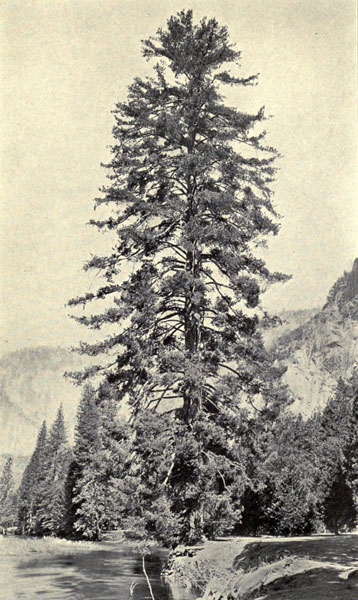
The Big Tree (Sequoia gigantea) is Nature’s forest masterpiece,
and, so far as I know, the greatest of living things. It belongs to an ancient
stock, as its remains in old rocks show, and has a strange air of other days
about it, a thoroughbred look inherited from the long ago—the auld lang
syne of trees. Once the genus was common, and with many species flourished in
the now desolate Arctic regions, in the interior of North America, and in
Europe, but in long, eventful wanderings from climate to climate only two
species have survived the hardships they had to encounter, the gigantea and
sempervirens, the former now restricted to the western slopes of the Sierra,
the other to the Coast Mountains, and both to California, excepting a few
groves of Redwood which extend into Oregon. The Pacific Coast in general is the
paradise of conifers. Here nearly all of them are giants, and display a beauty
and magnificence unknown elsewhere. The climate is mild, the ground never
freezes, and moisture and sunshine abound all the year. Nevertheless it is not
easy to account for the colossal size of the Sequoias. The largest are about
three hundred feet high and thirty feet in diameter. Who of all the dwellers of
the plains and prairies and fertile home forests of round-headed oak and maple,
hickory and elm, ever dreamed that earth could bear such growths,—trees
that the familiar pines and firs seem to know nothing about, lonely, silent,
serene, with a physiognomy almost godlike; and so old, thousands of them still
living had already counted their years by tens of centuries when Columbus set
sail from Spain and were in the vigor of youth or middle age when the star led
the Chaldean sages to the infant Saviour’s cradle! As far as man is
concerned they are the same yesterday, to-day, and forever, emblems of
permanence.
No description can give any adequate idea of their singular majesty, much less
their beauty. Excepting the sugar-pine, most of their neighbors with pointed
tops seem to be forever shouting Excelsior, while the Big Tree, though soaring
above them all, seems satisfied, its rounded head, poised lightly as a cloud,
giving no impression of trying to go higher. Only in youth does it show like
other conifers a heavenward yearning, keenly aspiring with a long quick-growing
top. Indeed the whole tree for the first century or two, or until a hundred to
a hundred and fifty feet high, is arrowhead in form, and, compared with the
solemn rigidity of age, is as sensitive to the wind as a squirrel tail. The
lower branches are gradually dropped as it grows older, and the upper ones
thinned out until comparatively few are left. These, however, are developed to
great size, divide again and again, and terminate in bossy rounded masses of
leafy branchlets, while the head becomes dome-shaped. Then poised in fullness
of strength and beauty, stern and solemn in mien, it glows with eager,
enthusiastic life, quivering to the tip of every leaf and branch and
far-reaching root, calm as a granite dome, the first to feel the touch of the
rosy beams of the morning, the last to bid the sun good-night.
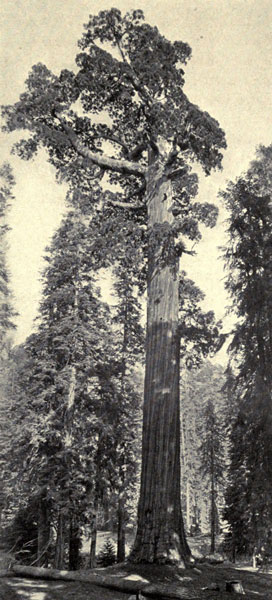
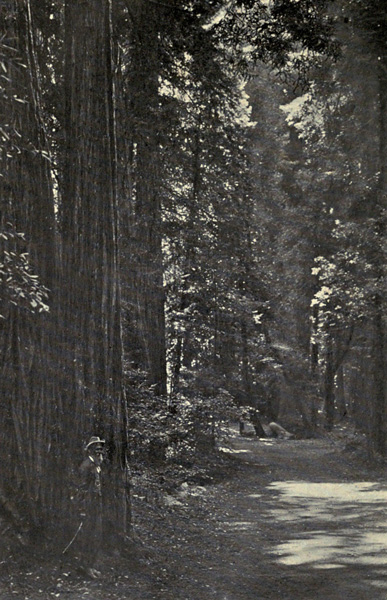
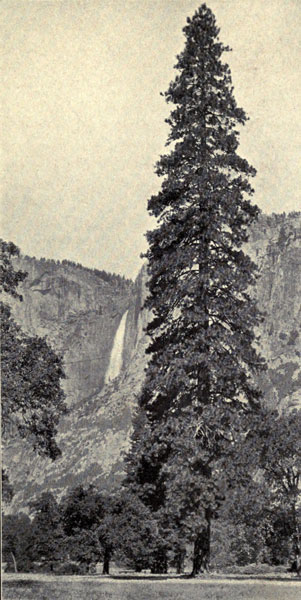
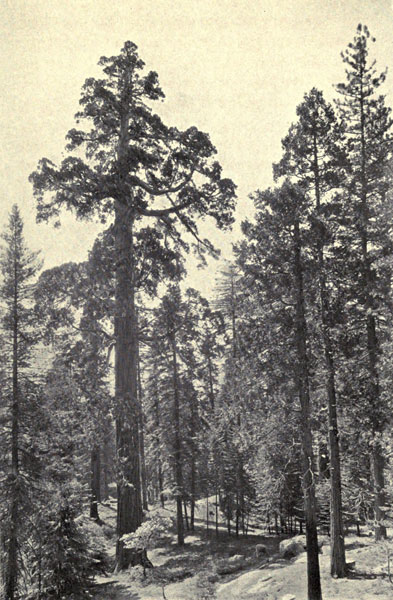
A Giant Sequoia.
Perfect specimens, unhurt by running fires or lightning, are singularly regular
and symmetrical in general form, though not at all conventional, showing
infinite variety in sure unity and harmony of plan. The immensely strong,
stately shafts, with rich purplish brown bark, are free of limbs for a hundred
and fifty feet or so, though dense tufts of sprays occur here and there,
producing an ornamental effect, while long parallel furrows give a fluted
columnar appearance. It shoots forth its limbs with equal boldness in every
direction, showing no weather side. On the old trees the main branches are
crooked and rugged, and strike rigidly outward mostly at right angles from the
trunk, but there is always a certain measured restraint in their reach which
keeps them within bounds. No other Sierra tree has foliage so densely massed or
outline so finely, firmly drawn and so obediently subordinate to an ideal type.
A particularly knotty, angular, ungovernable-looking branch, five to eight feet
in diameter and perhaps a thousand years old, may occasionally be seen pushing
out from the trunk as if determined to break across the bounds of the regular
curve, but like all the others, as soon as the general outline is approached
the huge limb dissolves into massy bosses of branchlets and sprays, as if the
tree were growing beneath an invisible bell glass against the sides of which
the branches were moulded, while many small, varied departures from the ideal
form give the impression of freedom to grow as they like.
Except in picturesque old age, after being struck by lightning and broken by a
thousand snowstorms, this regularity of form is one of the Big Tree’s
most distinguishing characteristics. Another is the simple sculptural beauty of
the trunk and its great thickness as compared with its height and the width of
the branches, many of them being from eight to ten feet in diameter at a height
of two hundred feet from the ground, and seeming more like finely modeled and
sculptured architectural columns than the stems of trees, while the great
strong limbs are like rafters supporting the magnificent dome head.
The root system corresponds in magnitude with the other dimensions of the tree,
forming a flat far-reaching spongy network two hundred feet or more in width
without any taproot, and the instep is so grand and fine, so suggestive of
endless strength, it is long ere the eye is released to look above it. The
natural swell of the roots, though at first sight excessive, gives rise to
buttresses no greater than are required for beauty as well as strength, as at
once appears when you stand back far enough to see the whole tree in its true
proportions. The fineness of the taper of the trunk is shown by its thickness
at great heights—a diameter of ten feet at a height of two hundred being,
as we have seen, not uncommon. Indeed the boles of but few trees hold their
thickness as well as Sequoia. Resolute, consummate, determined in form, always
beheld with wondering admiration, the Big Tree always seems unfamiliar,
standing alone, unrelated, with peculiar physiognomy, awfully solemn and
earnest. Nevertheless, there is nothing alien in its looks. The Madrona, clad
in thin, smooth, red and yellow bark and big glossy leaves, seems, in the dark
coniferous forests of Washington and Vancouver Island, like some lost wanderer
from the magnolia groves of the South, while the Sequoia, with all its
strangeness, seems more at home than any of its neighbors, holding the best
right to the ground as the oldest, strongest inhabitant. One soon becomes
acquainted with new species of pine and fir spruce as with friendly people,
shaking their outstretched branches like shaking hands, and fondling their
beautiful little ones; while the venerable aboriginal Sequoia, ancient of other
days, keeps you at a distance, taking no notice of you, speaking only to the
winds, thinking only of the sky, looking as strange in aspect and behavior
among the neighboring trees as would the mastodon or hairy elephant among the
homely bears and deer. Only the Sierra Juniper is at all like it, standing
rigid and unconquerable on glacial pavements for thousands of years, grim,
rusty, silent, uncommunicative, with an air of antiquity about as pronounced as
that so characteristic of Sequoia.
The bark of full grown trees is from one to two feet thick, rich cinnamon
brown, purplish on young trees and shady parts of the old, forming magnificent
masses of color with the underbrush and beds of flowers. Toward the end of
winter the trees themselves bloom while the snow is still eight or ten feet
deep. The pistillate flowers are about three eighths of an inch long, pale
green, and grow in countless thousands on the ends of the sprays. The staminate
are still more abundant, pale yellow, a fourth of an inch long; and when the
golden pollen is ripe they color the whole tree and dust the air and the ground
far and near.
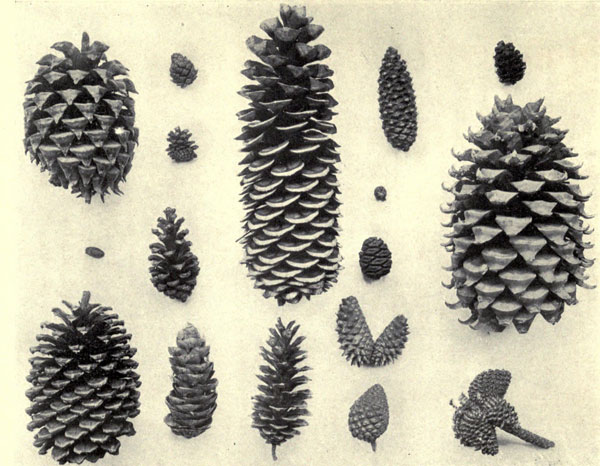
The cones are bright grass-green in color, about two and a half inches long,
one and a half wide, and are made up of thirty or forty strong, closely packed,
rhomboidal scales with four to eight seeds at the base of each. The seeds are
extremely small and light, being only from an eighth to a fourth of an inch
long and wide, including a filmy surrounding wing, which causes them to glint
and waver in falling and enables the wind to carry them considerable distances
from the tree.
The faint lisp of snowflakes as they alight is one of the smallest sounds
mortal can hear. The sound of falling Sequoia seeds, even when they happen to
strike on flat leaves or flakes of bark, is about as faint. Very different is
the bumping and thudding of the falling cones. Most of them are cut off by the
Douglas squirrel and stored for the sake of the seeds, small as they are. In
the calm Indian summer these busy harvesters with ivory sickles go to work
early in the morning, as soon as breakfast is over, and nearly all day the ripe
cones fall in a steady pattering, bumping shower. Unless harvested in this way
they discharge their seeds and remain on the trees for many years. In fruitful
seasons the trees are fairly laden. On two small specimen branches one and a
half and two inches in diameter I counted four hundred and eighty cones. No
other California conifer produces nearly so many seeds, excepting perhaps its
relative, the Redwood of the Coast Mountains. Millions are ripened annually by
a single tree, and the product of one of the main groves in a fruitful year
would suffice to plant all the mountain ranges of the world.
The dense tufted sprays make snug nesting places for birds, and in some of the
loftiest, leafiest towers of verdure thousands of generations have been reared,
the great solemn trees shedding off flocks of merry singers every year from
nests, like the flocks of winged seeds from the cones.
The Big Trees keeps its youth far longer than any of its neighbors. Most silver
firs are old in their second or third century, pines in their fourth or fifth,
while the Big Tree growing beside them is still in the bloom of its youth,
juvenile in every feature at the age of old pines, and cannot be said to attain
anything like prime size and beauty before its fifteen hundredth year, or under
favorable circumstances become old before its three thousandth. Many, no doubt,
are much older than this. On one of the Kings River giants, thirty-five feet
and eight inches in diameter exclusive of bark, I counted upwards of four
thousand annual wood-rings, in which there was no trace of decay after all
these centuries of mountain weather. There is no absolute limit to the
existence of any tree. Their death is due to accidents, not, as of animals, to
the wearing out of organs. Only the leaves die of old age, their fall is
foretold in their structure; but the leaves are renewed every year and so also
are the other essential organs—wood, roots, bark, buds. Most of the
Sierra trees die of disease. Thus the magnificent silver firs are devoured by
fungi, and comparatively few of them live to see their three hundredth birth
year. But nothing hurts the Big Tree. I never saw one that was sick or showed
the slightest sign of decay. It lives on through indefinite thousands of years
until burned, blown down, undermined, or shattered by some tremendous lightning
stroke. No ordinary bolt ever seriously hurts Sequoia. In all my walks I have
seen only one that was thus killed outright. Lightning, though rare in the
California lowlands, is common on the Sierra. Almost every day in June and July
small thunderstorms refresh the main forest belt. Clouds like snowy mountains
of marvelous beauty grow rapidly in the calm sky about midday and cast cooling
shadows and showers that seldom last more than an hour. Nevertheless these
brief, kind storms wound or kill a good many trees. I have seen silver firs two
hundred feet high split into long peeled rails and slivers down to the roots,
leaving not even a stump, the rails radiating like the spokes of a wheel from a
hole in the ground where the tree stood. But the Sequoia, instead of being
split and slivered, usually has forty or fifty feet of its brash knotty top
smashed off in short chunks about the size of cord-wood, the beautiful rosy red
ruins covering the ground in a circle a hundred feet wide or more. I never saw
any that had been cut down to the ground or even to below the branches except
one in the Stanislaus Grove, about twelve feet in diameter, the greater part of
which was smashed to fragments, leaving only a leafless stump about
seventy-five feet high. It is a curious fact that all the very old Sequoias
have lost their heads by lightning. “All things come to him who
waits.” But of all living things Sequoia is perhaps the only one able to
wait long enough to make sure of being struck by lightning. Thousands of years
it stands ready and waiting, offering its head to every passing cloud as if
inviting its fate, praying for heaven’s fire as a blessing; and when at
last the old head is off, another of the same shape immediately begins to grow
on. Every bud and branch seems excited, like bees that have lost their queen,
and tries hard to repair the damage. Branches that for many centuries have been
growing out horizontally at once turn upward and all their branchlets arrange
themselves with reference to a new top of the same peculiar curve as the old
one. Even the small subordinate branches halfway down the trunk do their best
to push up to the top and help in this curious head-making.
The great age of these noble trees is even more wonderful than their huge size,
standing bravely up, millennium in, millennium out, to all that fortune may
bring them, triumphant over tempest and fire and time, fruitful and beautiful,
giving food and shelter to multitudes of small fleeting creatures dependent on
their bounty. Other trees may claim to be about as large or as old: Australian
Gums, Senegal Baobabs, Mexican Taxodiums, English Yews, and venerable Lebanon
Cedars, trees of renown, some of which are from ten to thirty feet in diameter.
We read of oaks that are supposed to have existed ever since the creation, but
strange to say I can find no definite accounts of the age of any of these
trees, but only estimates based on tradition and assumed average rates of
growth. No other known tree approaches the Sequoia in grandeur, height and
thickness being considered, and none as far as I know has looked down on so
many centuries or opens such impressive and suggestive views into history. The
majestic monument of the Kings River Forest is, as we have seen, fully four
thousand years old, and measuring the rings of annual growth we find it was no
less than twenty-seven feet in diameter at the beginning of the Christian era,
while many observations lead me to expect the discovery of others ten or twenty
centuries older. As to those of moderate age, there are thousands, mere youth
as yet, that—
“Saw the light that shone
On Mahomet’s uplifted crescent,
On many a royal gilded throne
And deed forgotten in the present,
. . . saw the age of sacred trees
And Druid groves and mystic larches,
And saw from forest domes like these
The builder bring his Gothic arches.”
Great trees and groves used to be venerated as sacred monuments and halls of
council and worship. But soon after the discovery of the Calaveras Grove one of
the grandest trees was cut down for the sake of a stump! The laborious vandals
had seen “the biggest tree in the world,” then, forsooth, they must
try to see the biggest stump and dance on it.
The growth in height for the first two centuries is usually at the rate of
eight to ten inches a year. Of course all very large trees are old, but those
equal in size may vary greatly in age on account of variations in soil,
closeness or openness of growth, etc. Thus a tree about ten feet in diameter
that grew on the side of a meadow was, according to my own count of the
wood-rings, only two hundred and fifty-nine years old at the time it was
felled, while another in the same grove, of almost exactly the same size but
less favorably situated, was fourteen hundred and forty years old. The
Calaveras tree cut for a dance floor was twenty-four feet in diameter and only
thirteen hundred years old, another about the same size was a thousand years
older.
The following Sequoia notes and measurements are copied from my notebooks:—
Diameter.
Feet. | Diameter.
Inches. | Height in
Feet. | Age.
Years. |
| 0 | 1 3-4 | 10 | 7 |
| 0 | 5 | 24 | 20 |
| 0 | 5 | 25 | 41 |
| 0 | 6 | 25 | 66 |
| 0 | 6 | 28 1-2 | 39 |
| 0 | 8 | 25 | 29 |
| 0 | 11 | 45 | 71 |
| 1 | 0 | 60 | 71 |
| 3 | 2 | 156 | 260 |
| 6 | 0 | 192 | 240 |
| 7 | 3 | 195 | 339 |
| 7 | 3 | 255 | 506 |
| 7 | 6 | 240 | 493 |
| 7 | 7 | 207 | 424 |
| 9 | 0 | 243 | 259 |
| 9 | 3 | 222 | 280 |
| 10 | 6 | | 1440 |
| 12 | | | 1825[1] |
| 15 | | | 2150[2] |
| 24 | | | 1300 |
| 25 | | | 2300 |
| 35 | 8 inside bark | | over 4000 |
Little, however, is to be learned in confused, hurried tourist trips, spending
only a poor noisy hour in a branded grove with a guide. You should go looking
and listening alone on long walks through the wild forests and groves in all
the seasons of the year. In the spring the winds are balmy and sweet, blowing
up and down over great beds of chaparral and through the woods now rich in
softening balsam and rosin and the scent of steaming earth. The sky is mostly
sunshine, oftentimes tempered by magnificent clouds, the breath of the sea
built up into new mountain ranges, warm during the day, cool at night, good
flower-opening weather. The young cones of the Big Trees are showing in
clusters, their flower time already past, and here and there you may see the
sprouting of their tiny seeds of the previous autumn, taking their first feeble
hold of the ground and unpacking their tender whorls of cotyledon leaves. Then
you will naturally be led on to consider their wonderful growth up and up
through the mountain weather, now buried in snow bent and crinkled, now
straightening in summer sunshine like uncoiling ferns, shooting eagerly aloft
in youth’s joyful prime, and towering serene and satisfied through
countless years of calm and storm, the greatest of plants and all but immortal.
Under the huge trees up come the small plant people, putting forth fresh leaves
and blossoming in such profusion that the hills and valleys would still seem
gloriously rich and glad were all the grand trees away. By the side of melting
snowbanks rise the crimson sarcodes, round-topped and massive as the Sequoias
themselves, and beds of blue violets and larger yellow one with leaves
curiously lobed; azalea and saxifrage, daisies and lilies on the mossy banks of
the streams; and a little way back of them, beneath the trees and on sunny
spots on the hills around the groves, wild rose and rubus, spiræa and ribes,
mitella, tiarella, campanula, monardella, forget-me-not, etc., many of them as
worthy of lore immortality as the famous Scotch daisy, wanting only a Burns to
sing them home to all hearts.
In the midst of this glad plant work the birds are busy nesting, some singing
at their work, some silent, others, especially the big pileated woodpeckers,
about as noisy as backwoodsmen building their cabins. Then every bower in the
groves is a bridal bower, the winds murmur softly overhead, the streams sing
with the birds, while from far-off waterfalls and thunder-clouds come deep
rolling organ notes.
In summer the days go by in almost constant brightness, cloudless sunshine
pouring over the forest roof, while in the shady depths there is the subdued
light of perpetual morning. The new leaves and cones are growing fast and make
a grand show, seeds are ripening, young birds learning to fly, and with myriads
of insects glad as birds keep the air whirling, joy in every wingbeat, their
humming and singing blending with the gentle ah-ing of the winds; while at
evening every thicket and grove is enchanted by the tranquil chirping of the
blessed hylas, the sweetest and most peaceful of sounds, telling the very
heart-joy of earth as it rolls through the heavens.
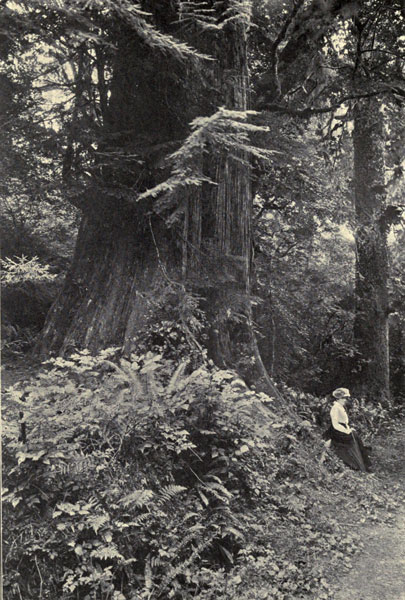
Midsummer in the Sequoia Forest.
In the autumn the sighing of the winds is softer than ever, the gentle
ah-ah-ing filling the sky with a fine universal mist of music, the birds have
little to say, and there is no appreciable stir or rustling among the trees
save that caused by the harvesting squirrels. Most of the seeds are ripe and
away, those of the trees mottling the sunny air, glinting, glancing through the
midst of the merry insect people, rocks and trees, everything alike drenched in
gold light, heaven’s colors coming down to the meadows and groves, making
every leaf a romance, air, earth, and water in peace beyond thought, the great
brooding days opening and closing in divine psalms of color.
Winter comes suddenly, arrayed in storms, though to mountaineers silky
streamers on the peaks and the tones of the wind give sufficient warning. You
hear strange whisperings among the tree-tops, as if the giants were taking
counsel together. One after another, nodding and swaying, calling and replying,
spreads the news, until at with one accord break forth into glorious song,
welcoming the first grand snowstorm of the year, and looming up in the dim
clouds and snowdrifts like lighthouse towers in flying scud and spray. Studying
the behavior of the giants from some friendly shelter, you will see that even
in the glow of their wildest enthusiasm, when the storm roars loudest, they
never lose their god-like composure, never toss their arms or bow or wave like
the pines, but only slowly, solemnly nod and sway, standing erect, making no
sign of strife, none of rest, neither in alliance nor at war with the winds,
too calmly, unconsciously noble and strong to strive with or bid defiance to
anything. Owing to the density of the leafy branchlets and great breadth of
head the Big Tree carries a much heavier load of snow than any of its
neighbors, and after a storm, when the sky clears, the laden trees are a
glorious spectacle, worth any amount of cold camping to see. Every bossy limb
and crown is solid white, and the immense height of the giants becomes visible
as the eye travels the white steps of the colossal tower, each relieved by a
mass of blue shadow.
In midwinter the forest depths are as fresh and pure as the crevasses and caves
of glaciers. Grouse, nuthatches, a few woodpeckers, and other hardy birds dwell
in the groves all winter, and the squirrels may be seen every clear day
frisking about, lively as ever, tunneling to their stores, never coming up
empty-mouthed, dividing in the loose snow about as quickly as ducks in water,
while storms and sunshine sing to each other.
One of the noblest and most beautiful of the late winter sights is the
blossoming of the Big Tree like gigantic goldenrods and the sowing of their
pollen over all the forest and the snow-covered ground—a most glorious
view of Nature’s immortal virility and flower-love.
One of my own best excursions among the Sequoias was made in the autumn of
1875, when I explored the then unknown or little known Sequoia region south of
the Mariposa Grove for comprehensive views of the belt, and to learn what I
could of the peculiar distribution of the species and its history in general.
In particular I was anxious to try to find out whether it had ever been more
widely distributed since the glacial period; what conditions favorable or
otherwise were affecting it; what were its relations to climate, topography,
soil, and the other trees growing with it, etc.; and whether, as was generally
supposed, the species was nearing extinction. I was already acquainted in a
general way with the northern groves, but excepting some passing glimpses
gained on excursions into the high Sierra about the head-waters of Kings and
Kern rivers I had seen nothing of the south end of the belt.
Nearly all my mountaineering has been done on foot, carrying as little as
possible, depending on camp-fires for warmth, that so I might be light and free
to go wherever my studies might lead. On this Sequoia trip, which promised to
be long, I was persuaded to take a small wild mule with me to carry provisions
and a pair of blankets. The friendly owner of the animal, having noticed that I
sometimes looked tired when I came down from the peaks to replenish my bread
sack, assured me that his “little Brownie mule” was just what I
wanted, tough as a knot, perfectly untirable, low and narrow, just right for
squeezing through brush, able to climb like a chipmunk, jump from boulder to
boulder like a wild sheep, and go anywhere a man could go. But tough as he was
and accomplished as a climber, many a time in the course of our journey when he
was jaded and hungry, wedged fast in rocks or struggling in chaparral like a
fly in a spiderweb, his troubles were sad to see, and I wished he would leave
me and find his way home alone.
We set out from Yosemite about the end of August, and our first camp was made
in the well-known Mariposa Grove. Here and in the adjacent pine woods I spent
nearly a week, carefully examining the boundaries of the grove for traces of
its greater extension without finding any. Then I struck out into the majestic
trackless forest to the southeastward, hoping to find new groves or traces of
old ones in the dense silver fir and pine woods about the head of Big Creek,
where soil and climate seemed most favorable to their growth, but not a single
tree or old monument of any sort came to light until I climbed the high rock
called Wamellow by the Indians. Here I obtained telling views of the fertile
forest-filled basin of the upper Fresno. Innumerable spires of the noble yellow
pine were displayed rising above one another on the braided slopes, and yet
nobler sugar pines with superb arms outstretched in the rich autumn light,
while away toward the southwest, on the verge of the glowing horizon, I
discovered the majestic dome-like crowns of Big Trees towering high over all,
singly and in close grove congregations. There is something wonderfully
attractive in this king tree, even when beheld from afar, that draws us to it
with indescribable enthusiasm; its superior height and massive smoothly rounded
outlines proclaiming its character in any company; and when one of the oldest
attains full stature on some commanding ridge it seems the very god of the
woods. I ran back to camp, packed Brownie, steered over the divide and down
into the heart of the Fresno Grove. Then choosing a camp on the side of a brook
where the grass was good, I made a cup of tea, and set off free among the brown
giants, glorying in the abundance of new work about me. One of the first
special things that caught my attention was an extensive landslip. The ground
on the side of a stream had given way to a depth of about fifty feet and with
all its trees had been launched into the bottom of the stream ravine. Most of
the trees—pines, firs, incense cedar, and Sequoia—were still
standing erect and uninjured, as if unconscious that anything out of the common
had happened. Tracing the ravine alongside the avalanche, I saw many trees
whose roots had been laid bare, and in one instance discovered a Sequoia about
fifteen feet in diameter growing above an old prostrate trunk that seemed to
belong to a former generation. This slip had occurred seven or eight years ago,
and I was glad to find that not only were most of the Big Trees uninjured, but
that many companies of hopeful seedlings and saplings were growing confidently
on the fresh soil along the broken front of the avalanche. These young trees
were already eight or ten feet high, and were shooting up vigorously, as if
sure of eternal life, though young pines, firs, and libocedrus were runing a
race with them for the sunshine with an even start. Farther down the ravine I
counted five hundred and thirty-six promising young Sequoias on a bed of rough
bouldery soil not exceeding two acres in extent.
The Fresno Big Trees covered an area of about four square miles, and while
wandering about surveying the boundaries of the grove, anxious to see every
tree, I came suddenly on a handsome log cabin, richly embowered and so fresh
and unweathered it was still redolent of gum and balsam like a newly felled
tree. Strolling forward, wondering who could have built it, I found an old,
weary-eyed, speculative, gray-haired man on a bark stool by the door, reading a
book. The discovery of his hermitage by a stranger seemed to surprise him, but
when I explained that I was only a tree-lover sauntering along the mountains to
study Sequoia, he bade me welcome, made me bring my mule down to a little
slanting meadow before his door and camp with him, promising to show me his pet
trees and many curious things bearing on my studies.
After supper, as the evening shadows were falling, the good hermit sketched his
life in the mines, which in the main was like that of most other pioneer
gold-hunters—a succession of intense experiences full of big ups and
downs like the mountain topography. Since “’49” he had
wandered over most of the Sierra, sinking innumerable prospect holes like a
sailor making soundings, digging new channels for streams, sifting
gold-sprinkled boulder and gravel beds with unquenchable energy, life’s
noon the meanwhile passing unnoticed into late afternoon shadows. Then, health
and gold gone, the game played and lost, like a wounded deer creeping into this
forest solitude, he awaits the sundown call. How sad the undertones of many a
life here, now the noise of the first big gold battles has died away! How many
interesting wrecks lie drifted and stranded in hidden nooks of the gold region!
Perhaps no other range contains the remains of so many rare and interesting
men. The name of my hermit friend is John A. Nelder, a fine kind man, who in
going into the woods has at last gone home; for he loves nature truly, and
realizes that these last shadowy days with scarce a glint of gold in them are
the best of all. Birds, squirrels, plants get loving, natural recognition, and
delightful it was to see how sensitively he responds to the silent influences
of the woods. His eyes brightened as he gazed on the trees that stand guard
around his little home; squirrels and mountain quail came to his call to be
fed, and he tenderly stroked the little snowbent sapling Sequoias, hoping they
yet might grow straight to the sky and rule the grove. One of the greatest of
his trees stands a little way back of his cabin, and he proudly led me to it,
bidding me admire its colossal proportions and measure it to see if in all the
forest there could be another so grand. It proved to be only twenty-six feet in
diameter, and he seemed distressed to learn that the Mariposa Grizzly Giant was
larger. I tried to comfort him by observing that his was the taller, finer
formed, and perhaps the more favorably situated. Then he led me to some noble
ruins, remnants of gigantic trunks of trees that he supposed must have been
larger than any now standing, and though they had lain on the damp ground
exposed to fire and the weather for centuries, the wood was perfectly sound.
Sequoia timber is not only beautiful in color, rose red when fresh, and as
easily worked as pine, but it is almost absolutely unperishable. Build a house
of Big Tree logs on granite and that house will last about as long as its
foundation. Indeed fire seems to be the only agent that has any appreciable
effect on it. From one of these ancient trunk remnants I cut a specimen of the
wood, which neither in color, strength, nor soundness could be distinguished
from specimens cut from living trees, although it had certainly lain on the
damp forest floor for more than three hundred and eighty years, probably more
than thrice as long. The time in this instance was determined as follows: When
the tree from which the specimen was derived fell it sunk itself into the
ground, making a ditch about two hundred feet long and five or six feet deep;
and in the middle of this ditch, where a part of the fallen trunk had been
burned, a silver fir four feet in diameter and three hundred and eighty years
old was growing, showing that the Sequoia trunk had lain on the ground three
hundred and eighty years plus the unknown time that it lay before the part
whose place had been taken by the fir was burned out of the way, and that which
had elapsed ere the seed from which the monumental fir sprang fell into the
prepared soil and took root. Now because Sequoia trunks are never wholly
consumed in one forest fire and these fires recur only at considerable
intervals, and because Sequoia ditches, after being cleared, are often left
unplanted for centuries, it becomes evident that the trunk remnant in question
may have been on the ground a thousand years or more. Similar vestiges are
common, and together with the root-bowls and long straight ditches of the
fallen monarchs, throw a sure light back on the post-glacial history of the
species, bearing on its distribution. One of the most interesting features of
this grove is the apparent ease and strength and comfortable independence in
which the trees occupy their place in the general forest. Seedlings, saplings,
young and middle-aged trees are grouped promisingly around the old patriarchs,
betraying no sign of approach to extinction. On the contrary, all seem to be
saying, “Everything is to our mind and we mean to live forever.”
But, sad to tell, a lumber company was building a large mill and flume near by,
assuring widespread destruction.
In the cones and sometimes in the lower portion of the trunk and roots there is
a dark gritty substance which dissolves readily in water and yields a
magnificent purple color. It is a strong astringent, and is said to be used by
the Indians as a big medicine. Mr. Nelder showed me specimens of ink he had
made from it, which I tried and found good, flowing freely and holding its
color well. Indeed everything about the tree seems constant. With these
interesting trees, forming the largest of the northern groves, I stopped only a
week, for I had far to go before the fall of the snow. The hermit seemed to
cling to me and tried to make me promise to winter with him after the
season’s work was done. Brownie had to be got home, however, and other
work awaited me, therefore I could only promise to stop a day or two on my way
back to Yosemite and give him the forest news.
The next two weeks were spent in the wide basin of the San Joaquin, climbing,
innumerable ridges and surveying the far-extending sea of pines and firs. But
not a single Sequoia crown appeared among them all, nor any trace of a fallen
trunk, until I had crossed the south divide of the basin, opposite Dinky Creek,
one of the northmost tributaries of Kings River. On this stream there is a
small grove, said to have been discovered a few years before my visit by two
hunters in pursuit of a wounded bear. Just as I was fording one of the branches
of Dinky Creek I met a shepherd, and when I asked him whether he knew anything
about the Big Trees of the neighborhood he replied, “I know all about
them, for I visited them only a few days ago and pastured my sheep in the
grove.” He was fresh from the East, and as this was his first summer in
the Sierra I was curious to learn what impression the Sequoias had made on him.
When I asked whether it was true that the Big Trees were really so big as
people say, he warmly replied, “Oh, yes sir, you bet. They’re
whales. I never used to believe half I heard about the awful size of California
trees, but they’re monsters and no mistake. One of them over here, they
tell me, is the biggest tree in the whole world, and I guess it is, for
it’s forty foot through and as many good long paces around.” He was
very earnest, and in fullness of faith offered to guide me to the grove that I
might not miss seeing this biggest tree. A fair measurement four feet from the
ground, above the main swell of the roots, showed a diameter of only thirty-two
feet, much to the young man’s disgust. “Only thirty-two
feet,” he lamented, “only thirty-two, and I always thought it was
forty!” Then with a sigh of relief, “No matter, that’s a big
tree, anyway; no fool of a tree, sir, that you can cut a plank out of thirty
feet broad, straight-edged, no bark, all good wood, sound and solid. It would
make the brag white pine planks from old Maine look like laths.” A good
many other fine specimens are distributed along three small branches of the
creek, and I noticed several thrifty moderate-sized Sequoias growing on a
granite ledge, apparently as independent of deep soil as the pines and firs,
clinging to seams and fissures and sending their roots far abroad in search of
moisture.
The creek is very clear and beautiful, gliding through tangles of shrubs and
flower beds, gay bee and butterfly pastures, the grove’s own stream, pure
Sequoia water, flowing all the year, every drop filtered through moss and
leaves and the myriad spongy rootlets of the giant trees. One of the most
interesting features of the grove is a small waterfall with a flowery, ferny,
clear brimming pool at the foot of it. How cheerily it sings the songs of the
wilderness, and how sweet its tones! You seem to taste as well as hear them,
while only the subdued roar of the river in the deep cañon reaches up into the
grove, sounding like the sea and the winds. So charming a fall and pool in the
heart of so glorious a forest food pagans would have consecrated to some lovely
nymph.
Hence down into the main Kings River cañon, a mile deep, I led and dragged and
shoved my patient, much-enduring mule through miles and miles and gardens and
brush, fording innumerable streams, crossing savage rock slopes and taluses,
scrambling, sliding through gulches and gorges, then up into the grand Sequoia
forests of the south side, cheered by the royal crowns displayed on the narrow
horizon. In a day and a half we reached the Sequoia woods in the neighborhood
of the old Thomas Mill Flat. Thence striking off northeastward I found a
magnificent forest nearly six miles long by two in width, composed mostly of
Big Trees, with outlying groves as far east as Boulder Creek. Here five or six
days were spent, and it was delightful to learn from countless trees, old and
young, how comfortably they were settled down in concordance with climate and
soil and their noble neighbors.
Imbedded in these majestic woods there are numerous meadows, around the sides
of which the Big Trees press close together in beautiful lines, showing their
grandeur openly from the ground to their domed heads in the sky. The young
trees are still more numerous and exuberant than in the Fresno and Dinky
groves, standing apart in beautiful family groups, or crowding around the old
giants. For every venerable lightning-stricken tree, there is one or more in
all the glory of prime, and for each of these, many young trees and crowds of
saplings. The young trees express the grandeur of their race in a way
indefinable by any words at my command. When they are five or six feet in
diameter and a hundred and fifty feet high, they seem like mere baby saplings
as many inches in diameter, their juvenile habit and gestures completely
veiling their real size, even to those who, from long experience, are able to
make fair approximation in their measurements of common trees. One morning I
noticed three airy, spiry, quick-growing babies on the side of a meadow, the
largest of which I took to be about eight inches in diameter. On measuring it,
I found to any astonishment it was five feet six inches in diameter, and about
a hundred and forty feet high.
On a bed of sandy ground fifteen yards square, which had been occupied by four
sugar pines, I counted ninety-four promising seedlings, an instance of Sequoia
gaining ground from its neighbors. Here also I noted eighty-six young Sequoias
from one to fifty feet high on less than half an acre of ground that had been
cleared and prepared for their reception by fire. This was a small bay burned
into dense chaparral, showing that fire, the great destroyer of tree life, is
sometimes followed by conditions favorable for new growths. Sufficient fresh
soil, however, is furnished for the constant renewal of the forest by the fall
of old trees without the help of any other agent,—burrowing animals,
fire, flood, landslip, etc.,—for the ground is thus turned and stirred as
well as cleared, and in every roomy, shady hollow beside the walls of upturned
roots many hopeful seedlings spring up.
The largest, and as far as I know the oldest, of all the Kings River trees that
I saw is the majestic stump, already referred to, about a hundred and forty
feet high, which above then swell of the roots is thirty-five feet and eight
inches inside the bark, and over four thousand years old. It was burned nearly
half through at the base, and I spent a day in chopping off the charred
surface, cutting into the heart, and counting the wood-rings with the aid of a
lens. I made out a little over four thousand without difficulty or doubt, but I
was unable to get a complete count, owing to confusion in the rings where
wounds had been healed over. Judging by what is left of it, this was a fine,
tall, symmetrical tree nearly forty feet in diameter before it lost its bark.
In the last sixteen hundred and seventy-two years the increase in diameter was
ten feet. A short distance south of this forest lies a beautiful grove, now
mostly included in the General Grant National Park. I found many shake-makers
at work in it, access to these magnificent woods having been made easy by the
old mill wagon road. The Park is only two miles square, and the largest of its
many fine trees is the General Grant, so named before the date of my first
visit, twenty-eight years ago, and said to be the largest tree in the world,
though above the craggy bulging base the diameter is less than thirty feet. The
Sanger Lumber Company owns nearly all the Kings River groves outside the Park,
and for many years the mills have been spreading desolation without any
advantage.
One of the shake-makers directed me to an “old snag biggeren
Grant.” It proved to be a huge black charred stump thirty-two feet in
diameter, the next in size to the grand monument mentioned above.
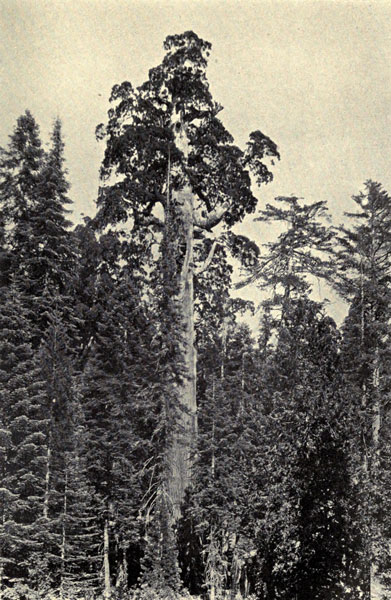
“General Grant” Sequoia in General Grant National Park.
I found a scattered growth of Big Trees extending across the main divide to
within a short distance of Hyde’s Mill, on a tributary of Dry Creek. The
mountain ridge on the south side of the stream was covered from base to summit
with a most superb growth of Big Trees. What a picture it made! In all my wide
forest wanderings I had seen none so sublime. Every tree of all the mighty host
seemed perfect in beauty and strength, and their majestic domed heads, rising
above one another on the mountain slope, were most imposingly displayed, like a
range of bossy upswelling cumulus clouds on a calm sky.
In this glorious forest the mill was busy, forming a sore, sad centre of
destruction, though small as yet, so immensely heavy was the growth. Only the
smaller and most accessible of the trees were being cut. The logs, from three
to ten or twelve feet in diameter, were dragged or rolled with long strings of
oxen into a chute and sent flying down the steep mountain side to the mill
flat, where the largest of them were blasted into manageable dimensions for the
saws. And as the timber is very brash, by this blasting and careless felling on
uneven ground, half or three fourths of the timber was wasted.
I spent several days exploring the ridge and counting the annual wood rings on
a large number of stumps in the clearings, then replenished my bread sack and
pushed on southward. All the way across the broad rough basins of the Kaweah
and Tule rivers Sequoia ruled supreme, forming an almost continuous belt for
sixty or seventy miles, waving up and down in huge massy mountain billows in
compliance with the grand glacier-ploughed topography.
Day after day, from grove to grove, cañon to cañon, I made a long, wavering
way, terribly rough in some places for Brownie, but cheery for me, for Big
Trees were seldom out of sight. We crossed the rugged, picturesque basins of
Redwood Creek, the North Fork of the Kaweah, and Marble Fork gloriously
forested, and full of beautiful cascades and falls, sheer and slanting,
infinitely varied with broad curly foam fleeces and strips of embroidery in
which the sunbeams revel. Thence we climbed into the noble forest on the Marble
and Middle Fork Divide. After a general exploration of the Kaweah basin, this
part of the Sequoia belt seemed to me the finest, and I then named it
“the Giant Forest.” It extends, a magnificent growth of giants
grouped in pure temple groves, ranged in colonnades along the sides of meadows,
or scattered among the other trees, from the granite headlands overlooking the
hot foothills and plains of the San Joaquin back to within a few miles of the
old glacier fountains at an elevation of 5000 to 8400 feet above the sea.
When I entered this sublime wilderness the day was nearly done, the trees with
rosy, glowing countenances seemed to be hushed and thoughtful, as if waiting in
conscious religious dependence on the sun, and one naturally walked softly and
awe-stricken among them. I wandered on, meeting nobler trees where all are
noble, subdued in the general calm, as if in some vast hall pervaded by the
deepest sanctities and solemnities that sway human souls. At sundown the trees
seemed to cease their worship and breathe free. I heard the birds going home. I
too sought a home for the night on the edge of a level meadow where there is a
long, open view between the evenly ranked trees standing guard along its sides.
Then after a good place was found for poor Brownie, who had had a hard, weary
day sliding and scrambling across the Marble Cañon, I made my bed and supper
and lay on my back looking up to the stars through pillared arches finer far
than the pious heart of man, telling its love, ever reared. Then I took a walk
up the meadow to see the trees in the pale light. They seemed still more
marvelously massive and tall than by day, heaving their colossal heads into the
depths of the sky, among the stars, some of which appeared to be sparkling on
their branches like flowers. I built a big fire that vividly illumined the huge
brown boles of the nearest trees and the little plants and cones and fallen
leaves at their feet, keeping up the show until I fell asleep to dream of
boundless forests and trail-building for Brownie.
Joyous birds welcomed the dawn; and the squirrels, now their food cones were
ripe and had to be quickly gathered and stored for winter, began their work
before sunrise. My tea-and-bread-crumb breakfast was soon done, and leaving
jaded Brownie to feed and rest I sauntered forth to my studies. In every
direction Sequoia ruled the woods. Most of the other big conifers were present
here and there, but not as rivals or companions. They only served to thicken
and enrich the general wilderness. Trees of every age cover craggy ridges as
well as the deep moraine-soiled slopes, and plant their magnificent shafts
along every brookside and meadow. Bogs and meadows are rare or entirely wanting
in the isolated groves north of Kings River; here there is a beautiful series
of them lying on the broad top of the main dividing ridge, imbedded in the very
heart of the mammoth woods as if for ornament, their smooth, plushy bosoms kept
bright and fertile by streams and sunshine.
Resting awhile on one of the most beautiful of them when the sun was high, it
seemed impossible that any other forest picture in the world could rival it.
There lay the grassy, flowery lawn, three fourths of a mile long, smoothly
outspread, basking in mellow autumn light, colored brown and yellow and purple,
streaked with lines of green along the streams, and ruffled here and there with
patches of ledum and scarlet vaccinium. Around the margin there is first a
fringe of azalea and willow bushes, colored orange yellow, enlivened with vivid
dashes of red cornel, as if painted. Then up spring the mighty walls of verdure
three hundred feet high, the brown fluted pillars so thick and tall and strong
they seem fit to uphold the sky; the dense foliage, swelling forward in rounded
bosses on the upper half, variously shaded and tinted, that of the young trees
dark green, of the old yellowish. An aged lightning-smitten patriarch standing
a little forward beyond the general line with knotty arms outspread was covered
with gray and yellow lichens and surrounded by a group of saplings whose
slender spires seemed to lack not a single leaf or spray in their wondrous
perfection. Such was the Kaweah meadow picture that golden afternoon, and as I
gazed every color seemed to deepen and glow as if the progress of the fresh
sun-work were visible from hour to hour, while every tree seemed religious and
conscious of the presence of God. A free man revels in a scene like this and
time goes by unmeasured. I stood fixed in silent wonder or sauntered about
shifting my points of view, studying the physiognomy of separate trees, and
going out to the different color patches to see how they were put on and what
they were made of, giving free expression to my joy, exulting in Nature’s
wild immortal vigor and beauty, never dreaming any other human being was near.
Suddenly the spell was broken by dull bumping, thudding sounds, and a man and
horse came in sight at the farther end of the meadow, where they seemed sadly
out of place. A good big bear or mastodon or megatherium would have been more
in keeping with the old mammoth forest. Nevertheless, it is always pleasant to
meet one of our own species after solitary rambles, and I stepped out where I
could be seen and shouted, when the rider reined in his galloping mustang and
waited my approach. He seemed too much surprised to speak until, laughing in
his puzzled face, I said I was glad to meet a fellow mountaineer in so lonely a
place. Then he abruptly asked, “What are you doing? How did you get
here?” I explained that I came across the cañons from Yosemite and was
only looking at the trees. “Oh then, I know,” he said, greatly to
my surprise, “you must be John Muir.” He was herding a band of
horses that had been driven up a rough trail from the lowlands to feed on these
forest meadows. A few handfuls of crumb detritus was all that was left in my
bread sack, so I told him that I was nearly out of provision and asked whether
he could spare me a little flour. “Oh yes, of course you can have
anything I’ve got,” he said. “Just take my track and it will
lead you to my camp in a big hollow log on the side of a meadow two or three
miles from here. I must ride after some strayed horses, but I’ll be back
before night; in the mean time make yourself at home.” He galloped away
to the northward, I returned to my own camp, saddled Brownie, and by the middle
of the afternoon discovered his noble den in a fallen Sequoia hollowed by
fire—a spacious loghouse of one log, carbon-lined, centuries old yet
sweet and fresh, weather proof, earthquake proof, likely to outlast the most
durable stone castle, and commanding views of garden and grove grander far than
the richest king ever enjoyed. Brownie found plenty of grass and I found bread,
which I ate with views from the big round, ever-open door. Soon the good
Samaritan mountaineer came in, and I enjoyed a famous rest listening to his
observations on trees, animals, adventures, etc., while he was busily preparing
supper. In answer to inquiries concerning the distribution of the Big Trees he
gave a good deal of particular information of the forest we were in, and he had
heard that the species extended a long way south, he knew not now far. I
wandered about for several days within a radius of six or seven miles of the
camp, surveying boundaries, measuring trees, and climbing the highest points
for general views. From the south side of the divide I saw telling ranks of
Sequoia-crowned headlands stretching far into the hazy distance, and plunging
vaguely down into profound cañon depths foreshadowing weeks of good work. I had
now been out on the trip more than a month, and I began to fear my studies
would be interrupted by snow, for winter was drawing nigh. “Where there
isn’t a way make a way,” is easily said when no way at the time is
needed, but to the Sierra explorer with a mule traveling across the cañon lines
of drainage the brave old phrase becomes heavy with meaning. There are ways
across the Sierra graded by glaciers, well marked, and followed by men and
beasts and birds, and one of them even by locomotives; but none natural or
artificial along the range, and the explorer who would thus travel at right
angles to the glacial ways must traverse cañons and ridges extending side by
side in endless succession, roughened by side gorges and gulches and stubborn
chaparral, and defended by innumerable sheer-fronted precipices. My own ways
are easily made in any direction, but Brownie, though one of the toughest and
most skillful of his race, was oftentimes discouraged for want of hands, and
caused endless work. Wild at first, he was tame enough now; and when turned
loose he not only refused to run away, but as his troubles increased came to
depend on me in such a pitiful, touching way, I became attached to him and
helped him as if he were a good-natured boy in distress, and then the labor
grew lighter. Bidding good-by to the kind Sequoia cave-dweller, we vanished
again in the wilderness, drifting slowly southward, Sequoias on every ridge-top
beckoning and pointing the way.
In the forest between the Middle and East forks of the Kaweah, I met a great
fire, and as fire is the master scourge and controller of the distribution of
trees, I stopped to watch it and learn what I could of its works and ways with
the giants. It came racing up the steep chaparral-covered slopes of the East
Fork cañon with passionate enthusiasm in a broad cataract of flames, now
bending down low to feed on the green bushes, devouring acres of them at a
breath, now towering high in the air as if looking abroad to choose a way, then
stooping to feed again, the lurid flapping surges and the smoke and terrible
rushing and roaring hiding all that is gentle and orderly in the work. But as
soon as the deep forest was reached the ungovernable flood became calm like a
torrent entering a lake, creeping and spreading beneath the trees where the
ground was level or sloped gently, slowly nibbling the cake of compressed
needles and scales with flames an inch high, rising here and there to a foot or
two on dry twigs and clumps of small bushes and brome grass. Only at
considerable intervals were fierce bonfires lighted, where heavy branches
broken off by snow had accumulated, or around some venerable giant whose head
had been stricken off by lightning.
I tethered Brownie on the edge of a little meadow beside a stream a good safe
way off, and then cautiously chose a camp for myself in a big stout hollow
trunk not likely to be crushed by the fall of burning trees, and made a bed of
ferns and boughs in it. The night, however, and the strange wild fireworks were
too beautiful and exciting to allow much sleep. There was no danger of being
chased and hemmed in, for in the main forest belt of the Sierra, even when
swift winds are blowing, fires seldom or never sweep over the trees in broad
all-embracing sheets as they do in the dense Rocky Mountain woods and in those
of the Cascade Mountains of Oregon and Washington. Here they creep from tree to
tree with tranquil deliberation, allowing close observation, though caution is
required in venturing around the burning giants to avoid falling limbs and
knots and fragments from dead shattered tops. Though the day was best for
study, I sauntered about night after night, learning what I could and admiring
the wonderful show vividly displayed in the lonely darkness, the ground-fire
advancing in long crooked lines gently grazing and smoking on the close-pressed
leaves, springing up in thousands of little jets of pure flame on dry tassels
and twigs, and tall spires and flat sheets with jagged flapping edges dancing
here and there on grass tufts and bushes, big bonfires blazing in perfect
storms of energy where heavy branches mixed with small ones lay smashed
together in hundred cord piles, big red arches between spreading root-swells
and trees growing close together, huge fire-mantled trunks on the hill slopes
glowing like bars of hot iron, violet-colored fire running up the tall trees,
tracing the furrows of the bark in quick quivering rills, and lighting
magnificent torches on dry shattered tops, and ever and anon, with a tremendous
roar and burst of light, young trees clad in low-descending feathery branches
vanishing in one flame two or three hundred feet high.
One of the most impressive and beautiful sights was made by the great fallen
trunks lying on the hillsides all red and glowing like colossal iron bars fresh
from a furnace, two hundred feet long some of them, and ten to twenty feet
thick. After repeated burnings have consumed the bark and sapwood, the sound
charred surface, being full of cracks and sprinkled with leaves, is quickly
overspread with a pure, rich, furred, ruby glow almost flameless and smokeless,
producing a marvelous effect in the night. Another grand and interesting sight
are the fires on the tops of the largest living trees flaming above the green
branches at a height of perhaps two hundred feet, entirely cut off from the
ground-fires, and looking like signal beacons on watch towers. From one
standpoint I sometimes saw a dozen or more, those in the distance looking like
great stars above the forest roof. At first I could not imagine how these
Sequoia lamps were lighted, but the very first night, strolling about waiting
and watching, I saw the thing done again and again. The thick, fibrous bark of
old trees is divided by deep, nearly continuous furrows, the sides of which are
bearded with the bristling ends of fibres broken by the growth swelling of the
trunk, and when the fire comes creeping around the feet of the trees, it runs
up these bristly furrows in lovely pale blue quivering, bickering rills of
flame with a low, earnest whispering sound to the lightning-shattered top of
the trunk, which, in the dry Indian summer, with perhaps leaves and twigs and
squirrel-gnawed cone-scales and seed-wings lodged in it, is readily ignited.
These lamp-lighting rills, the most beautiful fire streams I ever saw, last
only a minute or two, but the big lamps burn with varying brightness for days
and weeks, throwing off sparks like the spray of a fountain, while ever and
anon a shower of red coals comes sifting down through the branches, followed at
times with startling effect by a big burned-off chunk weighing perhaps half a
ton.
The immense bonfires where fifty or a hundred cords of peeled, split, smashed
wood has been piled around some old giant by a single stroke of lightning is
another grand sight in the night. The light is so great I found I could read
common print three hundred yards from them, and the illumination of the circle
of onlooking trees is indescribably impressive. Other big fires, roaring and
booming like waterfalls, were blazing on the upper sides of trees on
hillslopes, against which limbs broken off by heavy snow had rolled, while
branches high overhead, tossed and shaken by the ascending air current, seemed
to be writhing in pain. Perhaps the most starting phenomenon of all was the
quick death of childlike Sequoias only a century or two of age. In the midst of
the other comparatively slow and steady fire work one of these tall, beautiful
saplings, leafy and branchy, would be seen blazing up suddenly, all in one
heaving, booming, passionate flame reaching from the ground to the top of the
tree and fifty to a hundred feet or more above it, with a smoke column bending
forward and streaming away on the upper, free-flowing wind. To burn these green
trees a strong fire of dry wood beneath them is required, to send up a current
of air hot enough to distill inflammable gases from the leaves and sprays; then
instead of the lower limbs gradually catching fire and igniting the next and
next in succession, the whole tree seems to explode almost simultaneously, and
with awful roaring and throbbing a round, tapering flame shoots up two or three
hundred feet, and in a second or two is quenched, leaving the green spire a
black, dead mast, bristled and roughened with down-curling boughs. Nearly all
the trees that have been burned down are lying with their heads uphill, because
they are burned far more deeply on the upper side, on account of broken limbs
rolling down against them to make hot fires, while only leaves and twigs
accumulate on the lower side and are quickly consumed without injury to the
tree. But green, resinless Sequoia wood burns very slowly, and many successive
fires are required to burn down a large tree. Fires can run only at intervals
of several years, and when the ordinary amount of firewood that has rolled
against the gigantic trunk is consumed, only a shallow scar is made, which is
slowly deepened by recurring fires until far beyond the centre of gravity, and
when at last the tree falls, it of course falls uphill. The healing folds of
wood layers on some of the deeply burned trees show that centuries have elapsed
since the last wounds were made.
When a great Sequoia falls, its head is smashed into fragments about as small
as those made by lightning, which are mostly devoured by the first running,
hunting fire that finds them, while the trunk is slowly wasted away by
centuries of fire and weather. One of the most interesting fire actions on the
trunk is the boring of those great tunnel-like hollows through which horsemen
may gallop. All of these famous hollows are burned out of the solid wood, for
no Sequoia is ever hollowed by decay. When the tree falls the brash trunk is
often broken straight across into sections as if sawed; into these joints the
fire creeps, and, on account of the great size of the broken ends, burns for
weeks or even months without being much influenced by the weather. After the
great glowing ends fronting each other have burned so far apart that their rims
cease to burn, the fire continues to work on in the centres, and the ends
become deeply concave. Then heat being radiated from side to side, the burning
goes on in each section of the trunk independent of the other, until the
diameter of the bore is so great that the heat radiated across from side to
side is not sufficient to keep them burning. It appears, therefore, that only
very large trees can receive the fire-auger and have any shell rim left.
Fire attacks the large trees only at the ground, consuming the fallen leaves
and humus at their feet, doing them but little harm unless considerable
quantities of fallen limbs happen to be piled about them, their thick mail of
spongy, unpitchy, almost unburnable bark affording strong protection. Therefore
the oldest and most perfect unscarred trees are found on ground that is nearly
level, while those growing on hillsides, against which falling branches roll,
are always deeply scarred on the upper side, and as we have seen are sometimes
burned down. The saddest thing of all was to see the hopeful seedlings, many of
them crinkled and bent with the pressure of winter snow, yet bravely aspiring
at the top, helplessly perishing, and young trees, perfect spires of verdure
and naturally immortal, suddenly changed to dead masts. Yet the sun looked
cheerily down the openings in the forest roof, turning the black smoke to a
beautiful brown, as if all was for the best.
Beneath the smoke-clouds of the suffering forest we again pushed southward,
descending a side-george of the East Fork cañon and climbing another into new
forests and groves not a whit less noble. Brownie, the meanwhile, had been
resting, while I was weary and sleepy with almost ceaseless wanderings, giving
only an hour or two each night or day to sleep in my log home. Way-making here
seemed to become more and more difficult, “impossible,” in common
phrase, for four-legged travelers. Two or three miles was all the day’s
work as far as distance was concerned. Nevertheless, just before sundown we
found a charming camp ground with plenty of grass, and a forest to study that
had felt no fire for many a year. The camp hollow was evidently a favorite home
of bears. On many of the trees, at a height of six or eight feet, their
autographs were inscribed in strong, free, flowing strokes on the soft bark
where they had stood up like cats to stretch their limbs. Using both hands,
every claw a pen, the handsome curved lines of their writing take the form of
remarkably regular interlacing pointed arches, producing a truly ornamental
effect. I looked and listened, half expecting to see some of the writers
alarmed and withdrawing from the unwonted disturbance. Brownie also looked and
listened, for mules fear bears instinctively and have a very keen nose for
them. When I turned him loose, instead of going to the best grass, he kept
cautiously near the camp-fire for protection, but was careful not to step on
me. The great starry night passed away in deep peace and the rosy morning
sunbeams were searching the grove ere I woke from a long, blessed sleep.
The breadth of the Sequoia belt here is about the same as on the north side of
the river, extending, rather thin and scattered in some places, among the noble
pines from near the mains forest belt of the range well back towards the frosty
peaks, where most of the trees are growing on moraines but little changed as
yet.
Two days’ scramble above Bear Hollow I enjoyed an interesting interview
with deer. Soon after sunrise a little company of four came to my camp in a
wild garden imbedded in chaparral, and after much cautious observation quietly
began to eat breakfast with me. Keeping perfectly still I soon had their
confidence, and they came so near I found no difficulty, while admiring their
graceful manners and gestures, in determining what plants they were eating,
thus gaining a far finer knowledge and sympathy than comes by killing and
hunting.
Indian summer gold with scarce a whisper of winter in it was painting the glad
wilderness in richer and yet richer colors as we scrambled across the South
cañon into the basin of the Tule. Here the Big Tree forests are still more
extensive, and furnished abundance of work in tracing boundaries and gloriously
crowned ridges up and down, back and forth, exploring, studying, admiring,
while the great measureless days passed on and away uncounted. But in the calm
of the camp-fire the end of the season seemed near. Brownie too often brought
snow-storms to mind. He became doubly jaded, though I never rode him, and
always left him in camp to feed and rest while I explored. The invincible bread
business also troubled me again; the last mealy crumbs were consumed, and grass
was becoming scarce even in the roughest rock-piles naturally inaccessible to
sheep. One afternoon, as I gazed over the rolling bossy Sequoia billows
stretching interminably southward, seeking a way and counting how far I might
go without food, a rifle shot rang out sharp and clear. Marking the direction I
pushed gladly on, hoping to find some hunter who could spare a little food.
Within a few hundred rods I struck the track of a shod horse, Which led to the
camp of two Indian shepherds. One of them was cooking supper when I arrived.
Glancing curiously at me he saw that I was hungry, and gave me some mutton and
bread, and said encouragingly as he pointed to the west, “Putty soon
Indian come, heap speak English.” Toward sundown two thousand sheep
beneath a cloud of dust came streaming through the grand Sequoias to a meadow
below the camp, and presently the English-speaking shepherd came in, to whom I
explained my wants and what I was doing. Like most white men, he could not
conceive how anything other than gold could be the object of such rambles as
mine, and asked repeatedly whether I had discovered any mines. I tried to make
him talk about trees and the wild animals, but unfortunately he proved to be a
tame Indian from the Tule Reservation, had been to school, claimed to be
civilized, and spoke contemptuously of “wild Indians,” and so of
course his inherited instincts were blurred or lost. The Big Trees, he said,
grew far south, for he had see them in crossing the mountains from Porterville
to Lone Pine. In the morning he kindly gave me a few pounds of flour, and
assured me that I would get plenty more at a sawmill on the South Fork if I
reached it before it was shut down for the season.
Of all the Tule basin forest the section on the North Fork seemed the finest,
surpassing, I think, even the Giant Forest of the Kaweah. Southward from here,
though the width and general continuity of the belt is well sustained, I
thought I could detect a slight falling off in the height of the trees and in
closeness of growth. All the basin was swept by swarms of hoofed locusts, the
southern part over and over again, until not a leaf within the reach was left
on the wettest bogs, the outer edges of the thorniest chaparral beds, or even
on the young conifers, which unless under the stress of dire famine, sheep
never touch. Of course Brownie suffered, though I made diligent search for
grassy sheep-proof spots. Turning him loose one evening on the side of a carex
bog, he dolefully prospected the desolate neighborhood without finding anything
that even a starving mule could eat. Then, utterly discouraged, he stole up
behind me while I was bent over on my knees making a fire for tea, and in a
pitiful mixture of bray and neigh, begged for help. It was a mighty touching
prayer, and I answered it as well as I could with half of what was left of a
cake made from the last of the flour given me by the Indians, hastily passing
it over my shoulder, and saying, “Yes, poor fellow, I know, but soon
you’ll have plenty. To-morrow down we go to alfalfa and barley,”
speaking to him as if he were human, as through stress of trouble plainly he
was. After eating his portion of bread he seemed content, for he said no more,
but patiently turned away to gnaw leafless ceanothus stubs. Such clinging,
confiding dependence after all our scrambles and adventures together was very
touching, and I felt conscience-stricken for having led him so far in so rough
and desolate a country. “Man,” says Lord Bacon, “is the god
of the dog.” So, also, he is of the mule and many other dependent fellow
mortals.
Next morning I turned westward, determined to force a way straight to pasture,
letting Sequoia wait. Fortunately ere we had struggled down through half a mile
of chaparral we heard a mill whistle, for which we gladly made a bee line. At
the sawmill we both got a good meal, then taking the dusty lumber road pursued
our way to the lowlands. The nearest good pasture I counted might be thirty or
forty miles away. But scarcely had we gone ten when I noticed a little log
cabin a hundred yards or so back from the road, and a tall man straight as a
pine standing in front of it observing us as we came plodding down through the
dust. Seeing no sign of grass or hay, I was going past without stopping, when
he shouted, “Travelin’?” Then drawing nearer, “Where
have you come from? I didn’t notice you go up.” I replied I had
come through the woods from the north, looking at the trees. “Oh, then,
you must be John Muir. Halt, you’re tired; come and rest and I’ll
cook for you.” Then I explained that I was tracing the Sequoia belt, that
on account of sheep my mule was starving, and therefore must push on to the
lowlands. “No, no,” he said, “that corral over there is full
of hay and grain. Turn your mule into it. I don’t own it, but the fellow
who does is hauling lumber, and it will be all right. He’s a white man.
Come and rest. How tired you must be! The Big Trees don’t go much farther
south, nohow. I know the country up there, have hunted all over it. Come and
rest, and let your little doggone rat of a mule rest. How in heavens did you
get him across the cañons—roll him? or carry him? He’s poor, but
he’ll get fat, and I’ll give you a horse and go with you up the
mountains, and while you’re looking at the trees I’ll go hunting.
It will be a short job, for the end of the Big Trees is not far.” Of
course I stopped. No true invitation is ever declined. He had been hungry and
tired himself many a time in the Rocky Mountains as well as in the Sierra. Now
he owned a band of cattle and lived alone. His cabin was about eight by ten
feet, the door at one end, a fireplace at the other, and a bed on one side
fastened to the logs. Leading me in without a word of mean apology, he made me
lie down on the bed, then reached under it, brought forth a sack of apples and
advised me to keep “chawing” at them until he got supper ready.
Finer, braver hospitality I never found in all this good world so often called
selfish.
Next day with hearty, easy alacrity the mountaineer procured horses, prepared
and packed provisions, and got everything ready for an early start the
following morning. Well mounted, we pushed rapidly upon the South Fork of the
river and soon after noon were among the giants once more. On the divide
between the Tule and Deer Creek a central camp was made, and the mountaineer
spent his time in deer-hunting, while with provisions for two or three days I
explored the woods, and in accordance with what I had been told soon reached
the southern extremity of the belt on the South Fork of Deer Creek. To make
sure, I searched the woods a considerable distance south of the last Deer Creek
grove, passed over into the basin of the Kern, and climbed several high points
commanding extensive views over the sugar-pine woods, without seeing a single
Sequoia crown in all the wide expanse to the southward. On the way back to
camp, however, I was greatly interested in a grove I discovered on the east
side of the Kern River divide, opposite the North Fork of Deer Creek. The
height of the pass where the species crossed over is about 7000 feet, and I
heard of still another grove whose waters drain into the upper Kern opposite
the Middle Fork of the Tule.
It appears, therefore, that though the Sequoia belt is two hundred and sixty
miles long, most of the trees are on a section to the south of Kings River only
about seventy miles in length. But though the area occupied by the species
increases so much to the southward, there is but little difference in the size
of the trees. A diameter of twenty feet and height of two hundred and
seventy-five is perhaps about the average for anything like mature and
favorably situated trees. Specimens twenty-five feet in diameter are not rare,
and a good many approach a height of three hundred feet. Occasionally one meets
a specimen thirty feet in diameter, and rarely one that is larger. The majestic
stump on Kings River is the largest I saw and measured on the entire trip.
Careful search around the boundaries of the forests and groves and in the gaps
of the belt failed to discover any trace of the former existence of the species
beyond its present limits. On the contrary, it seems to be slightly extending
its boundaries; for the outstanding stragglers, occasionally met a mile or two
from the main bodies, are young instead of old monumental trees. Ancient ruins
and the ditches and root-bowls the big trunks make in falling were found in all
the groves, but none outside of them. We may therefore conclude that the area
covered by the species has not been diminished during the last eight or ten
thousand years, and probably not at all in post-glacial times. For admitting
that upon those areas supposed to have been once covered by Sequoia every tree
may have fallen, and that fire and the weather had left not a vestige of them,
many of the ditches made by the fall of the ponderous trunks, weighing five
hundred to nearly a thousand tons, and the bowls made by their up-turned roots
would remain visible for thousands of years after the last remnants of the
trees had vanished. Some of these records would doubtless be effaced in a
comparatively short time by the inwashing of sediments, but no inconsiderable
part of them would remain enduringly engraved on flat ridge tops, almost wholly
free from such action.
In the northern groves, the only ones that at first came under the observation
of students, there are but few seedlings and young trees to take the places of
the old ones. Therefore the species was regarded as doomed to speedy
extinction, as being only an expiring remnant vanquished in the so-called
struggle for life, and shoved into its last strongholds in moist glens where
conditions are exceptionally favorable. But the majestic continuous forests of
the south end of the belt create a very different impression. Here, as we have
seen, no tree in the forest is more enduringly established. Nevertheless it is
oftentimes vaguely said that the Sierra climate is drying out, and that this
oncoming, constantly increasing drought will of itself surely extinguish King
Sequoia, though sections of wood-rings show that there has been no appreciable
change of climate during the last forty centuries. Furthermore, that Sequoia
can grow and is growing on as dry ground as any of its neighbors or rivals, we
have seen proved over and over again. “Why, then,” it will be
asked, “are the Big Tree groves always found on well-watered
spots?” Simply because Big Trees give rise to streams. It is a mistake to
suppose that the water is the cause of the groves being there. On the contrary,
the groves are the cause of the water being there. The roots of this immense
tree fill the ground, forming a sponge which hoards the bounty of the clouds
and sends it forth in clear perennial streams instead of allowing it to rush
headlong in short-lived destructive floods. Evaporation is also checked, and
the air kept still in the shady Sequoia depths, while thirsty robber winds are
shut out.
Since, then, it appears that Sequoia can and does grow on as dry ground as its
neighbors and that the greater moisture found with it is an effect rather than
a cause of its presence, the notions as to the former greater extension of the
species and its near approach to extinction, based on its supposed dependence
on greater moisture, are seen to be erroneous. Indeed, all my observations go
to show that in case of prolonged drought the sugar pines and firs would die
before Sequoia. Again, if the restricted and irregular distribution of the
species be interpreted as the result of the desiccation of the range, then,
instead of increasing in individuals toward the south, where the rainfall is
less, it should diminish.
If, then, its peculiar distribution has not been governed by superior
conditions of soil and moisture, by what has it been governed? Several years
before I made this trip, I noticed that the northern groves were located on
those parts of the Sierra soil-belt that were first laid bare and opened to
preëmption when the ice-sheet began to break up into individual glaciers. And
when I was examining the basin of the San Joaquin and trying to account for the
absence of Sequoia, when every condition seemed favorable for its growth, it
occurred to me that this remarkable gap in the belt is located in the channel
of the great ancient glacier of the San Joaquin and Kings River basins, which
poured its frozen floods to the plain, fed by the snows that fell on more than
fifty miles of the Summit peaks of the range. Constantly brooding on the
question, I next perceived that the great gap in the belt to the northward,
forty miles wide, between the Stanislaus and Tuolumne groves, occurs in the
channel of the great Stanislaus and Tuolumne glacier, and that the smaller gap
between the Merced and Mariposa groves occurs in the channel of the smaller
Merced glacier. The wider the ancient glacier, the wider the gap in the Sequoia
belt, while the groves and forests attain their greatest development in the
Kaweah and Tule River basins, just where, owing to topographical conditions,
the region was first cleared and warmed, while protected from the main
ice-rivers, that flowed past to right and left down the Kings and Kern valleys.
In general, where the ground on the belt was first cleared of ice, there the
Sequoia now is, and where at the same elevation and time the ancient glaciers
lingered, there the Sequoia is not. What the other conditions may have been
which enabled the Sequoia to establish itself upon these oldest and warmest
parts of the main soil-belt I cannot say. I might venture to state, however,
that since the Sequoia forests present a more and more ancient and long
established aspect to the southward, the species was probably distributed from
the south toward the close of the glacial period, before the arrival of other
trees. About this branch of the question, however, there is at present much
fog, but the general relationship we have pointed out between the distribution
of the Big Tree and the ancient glacial system is clear. And when we bear in
mind that all the existing forests of the Sierra are growing on comparatively
fresh moraine soil, and that the range itself has been recently sculptured and
brought to light from beneath the ice-mantle of the glacial winter, then many
lawless mysteries vanish, and harmonies take their places.
But notwithstanding all the observed phenomena bearing on the post-glacial
history of this colossal tree, point to the conclusion that it never was more
widely distributed on the Sierra since the close of the glacial epoch; that its
present forests are scarcely past prime; if, indeed, they have reached prime;
that the post-glacial day of the species is probably not half done; yet, when
from a wider outlook the vast antiquity of the genus is considered, and its
ancient richness in species and individuals, comparing our Sierra giant and
Sequoia sempervirens of the coast, the only other living species, with the many
fossil species already discovered, and described by Heer and Lesquereux, some
of which flourished over large areas around the Arctic Circle, and in Europe
and our own territories, during tertiary and cretaceous times,—then,
indeed, it becomes plain that our two surviving species, restricted to narrow
belts within the limits of California, are mere remnants of the genus both as
to species and individuals, and that they probably are verging to extinction.
But the verge of a period beginning in cretaceous times may have a breadth of
tens of thousands of years, not to mention the possible existence of conditions
calculated to multiply and reëxtend both species and individuals. No
unfavorable change of climate, so far as I can see, no disease, but only fire
and the axe and the ravages of flocks and herds threaten the existence of these
noblest of God’s trees. In Nature’s keeping they are safe, but
through man’s agency destruction is making rapid progress, while in the
work of protection only a beginning has been made. The Mariposa Grove belongs
to and is guarded by the State; the General Grant and Sequoia National Parks,
established ten years ago, are efficiently guarded by a troop of cavalry under
the direction of the Secretary of the Interior; so also are the small Tuolumne
and Merced groves, which are included in the Yosemite National Park, while a
few scattered patches and fringes, scarce at all protected, though belonging to
the national government, are in the Sierra Forest Reservation.
Perhaps more than half of all the Big Trees have been sold, and are now in the
hands of speculators and mill men. Even the beautiful little Calaveras Grove of
ninety trees, so historically interesting from its being the first discovered,
is now owned, together with the much larger South or Stanislaus Grove, by a
lumber company.
Far the largest and most important section of protected Big Trees is in the
grand Sequoia National Park, now easily accessible by stage from Visalia. It
contains seven townships and extends across the whole breadth of the
magnificent Kaweah basin. But large as it is, it should be made much larger.
Its natural eastern boundary is the high Sierra, and the northern and southern
boundaries, and the Kings and Kern rivers, and thus including the sublime
scenery on the headwaters of these rivers and perhaps nine tenths of all the
Big Trees in existence. Private claims cut and blotch both of the Sequoia parks
as well as all the best of the forests, every one of which the government
should gradually extinguish by purchase, as it readily may, for none of these
holdings are of much value to their owners. Thus as far as possible the grand
blunder of selling would be corrected. The value of these forests in storing
and dispensing the bounty of the mountain clouds is infinitely greater than
lumber or sheep. To the dwellers of the plain, dependent on irrigation, the Big
Tree, leaving all its higher uses out of the count, is a tree of life, a
never-failing spring, sending living water to the lowlands all through the hot,
rainless summer. For every grove cut down a stream is dried up. Therefore, all
California is crying, “Save the trees of the fountains,” nor,
judging by the signs of the times, it is likely that the cry will cease until
the salvation of all that is left of Sequoia gigantea is sure.