THE WONDERFUL ABBEY
It was the beautiful spring-time, and the
country had begun to look green and fresh
again after the long months of snow and frost.
"Carl, my dear, how would you like to go
on a pilgrimage to the Blessed Abbey?" asked
his father one night as they finished milking
the cows. "Easter Sunday is almost here, and
the people of the village are talking of going
to Einsiedeln together."
"O, father, that would make me happier
than anything else in the world. What a fine
time we can have! And only to think that
I can see the place with my own eyes. Do
you really mean it?"
"Yes, my boy, but do you think you can
walk so far without getting tired out?"
Carl laughed. "Look at me, father; see
how I have grown since last summer," and the
boy stretched to make himself seem as tall as
possible.
"Very well, then. Your mother knows
about it, and is getting things ready for the
journey now."
The next three days Carl could think of
nothing else. He was full of excitement. The
night before they were to start, he said to his
father:
"Please tell me the story of the Wonderful
Abbey again. I wish to have the picture still
brighter in my mind as we journey along our
way to-morrow."
Rudolf leaned back in his chair. His face
was lighted by a happy smile as he said:
"Carl, my dear child, I love to think of the
good souls who have made this world so beautiful
by living in it. Yes, they have made it
more beautiful than the grandest mountains or
the loveliest lakes can make it.
"One of those good men was the holy
Meinrad, who lived over a thousand years ago.
He came from Germany to teach the priests
at a small convent on the Lake of Zurich.
After a while he said, 'I will live the life of a
hermit in a little cell in the forest. I can best
worship God if I live alone.'
"So he went up on the mountainside and
made a hut, where he prayed and fasted day
after day. It is said that the wild beasts felt
his goodness, and would do him no harm.
Whenever there was need, he went out to do
good deeds among men. People heard of him
through all the country round. They came
to ask his advice when they were in trouble, or
to seek help in other ways.
"But one day two robbers came to Meinrad's
cell. They came with a bad purpose; they
thought he must have a store of gold hidden
away, and they wished to get it. The holy
man gave them food and drink, but what do
you think these wicked men did in return for
such kindness? They cruelly murdered him!
Then, finding no money, they hurried away.
"Meinrad had two birds who kept him
company in the lonely forest. They were
ravens, and had grown very tame, loving
their master dearly.
"When the murderers fled, these birds
followed them down the mountainside, across
the lake, and into the town. The men stopped
at an inn for food and rest. The birds flapped
their wings against the windows, and kept up
shrill cries. Every one in the inn wondered
what it could mean. When this had kept
up for several hours, the men thought, 'This
is a warning to us from Heaven. We will
confess what we have done.'
"They told the fearful story, and were put
to death by the angry people who heard it.
Ever since that time the place has been called
the Ravens' Inn, and two ravens were carved
out of stone and placed upon the wall. When
we go to Zurich, Carl, you shall see those
stone ravens, for they are still there."
"Now, please tell me about the holy abbey,
father," said Carl, "and how it was blessed by
the angels."
"After a while," his father went on, "the
priests, who had heard the story of Meinrad's
death, decided to build a grand church. It
was to be on the very spot where Meinrad's
cell had stood and he had been murdered. It
was a beautiful building. When it was entirely
finished, bishops and knights came to consecrate
it to the Lord. People gathered from
far and near to listen to the service.
"Now, it was the custom of the good
Bishop Conrad to pray at midnight. On the
night before the great day of consecration, he
arose for his usual prayer, and, as he did so,
was surprised to hear beautiful music in the
air around him. He listened closely. Behold!
it was the chorus of angels; they were
consecrating the chapel. He bowed his head
in wonder and awe.
"The next morning, when the people had
come together for the sacred service, the
bishop waited in silence till nearly noon, and
then he told the crowd of listeners what had
happened during the night. There was nothing
for him to do now; the angels had already
made this a holy place.
"But the people would not, could not,
believe it. They still pressed the bishop to
go on with the service. At last, he felt that
he could not satisfy them in any other way,
so had already begun, when a clear voice was
heard to say, 'Brother, do not go on; for see,
it is already consecrated.'
"Then the people were able to understand
that the bishop had spoken truly, and the
place was indeed a holy one now. Ever since
that time good Catholics of France and Germany,
as well as from our own country, make
pilgrimages to the abbey of Einsiedeln. It is
now a very grand building. Thousands and
thousands of dollars have been spent to make
it beautiful.
"And Carl, dear, you shall see there the
very image of Jesus and Mary which the good
priest Meinrad brought to the place when he
first sought his home there. Better still, my
boy, you shall drink from the fountain from
which Jesus himself once drank, as I have
been told."
Carl listened closely to his father's words.
Others might tell him afterward that this was
only a legend, but he was an earnest little
Catholic, and believed that every word of it
was true.
The moment of starting came at last.
Rudolf, with his wife and Carl, was joined by
several others of the village people. Franz was
among them, together with his parents. There
were many, many miles to walk, and several
days must be spent upon the way. The nights
were passed at taverns along the roadside.
As our friends journeyed onward, they were
joined by other parties, all going in the same
direction,—to the abbey blessed by the angels.
In one party there was a blind man, who
hoped to see again after he had drunk from
the wonderful fountain. In another, there was
a person who was lame, and who moved painfully
along on crutches. He believed he
would be able to leave these crutches behind
him if he could once reach the abbey.
As Carl drew nearer and nearer, he could
see that thousands and thousands of people
were all going the same way. And now as
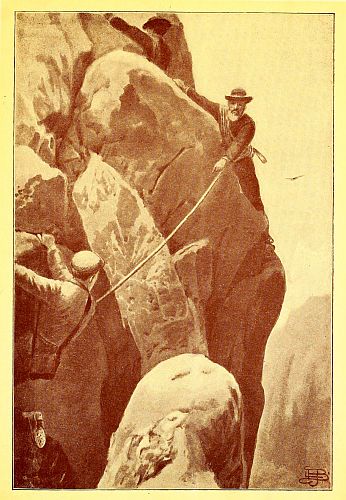
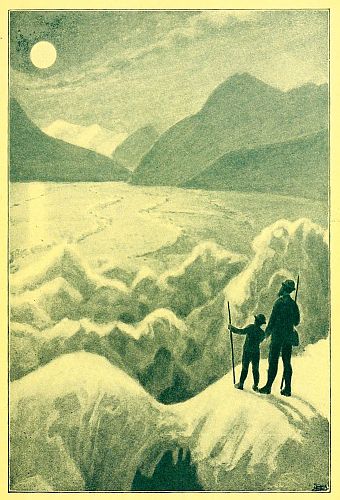
they began to climb the mountainside, there
were crosses at every turn in the road. He
never passed them by without stopping to
kneel and pray.
He was a stout little fellow, as we know,
but he was growing very tired now. His feet
were quite sore, and there were deep cuts in
the soles. This showed that he had walked
very many miles over the hard roads. But
there were many others like him who had
never travelled so far from home before; and
some of them were old and feeble, too. He
would not let his mother think he was tired.
Oh, no, not for the world.
Ah! the spires were at last in sight, and
every one hurried forward.
It was very, very beautiful, Carl thought,
when he had passed through the great doorway,
and looked upon the wonderful sight
within. He had never before seen anything
half so grand. The walls and ceilings were
richly gilded, and there were many statues in
the nooks and corners.
But best of all was the precious image of
the Divine Child and His mother. It was
only a clumsy-looking little wooden figure,
and was black with age, but it was adorned
with precious stones that sparkled brilliantly.
Before Carl entered the sacred building, he
first stopped at the fountain, and drank from
each one of the fourteen spouts. This alone
would make his life better, he thought. But
after he had received a blessing from the priest
within the church, and had touched the marble
on which the image of Jesus rested, he could
go away perfectly happy.
There were many small inns in the village,
and you may be sure that they were well filled
at this time. Carl's family were together with
their friends at one of them, and they had a
merry time. When they were well rested,
however, Carl's father said to the boy:
"We will take a trip to Zurich before going
home. It is only a few miles away, and I
promised to show you the stone ravens, you
know. An old friend of mine lives right on
the shore of the lake, and he will be glad
to have us lodge with him."
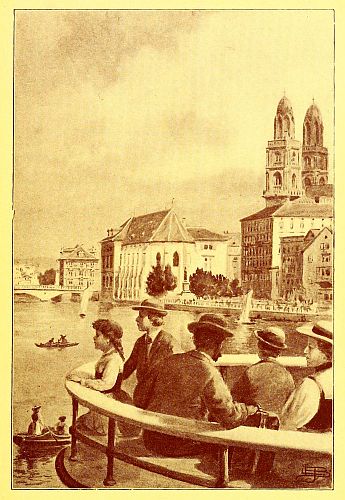
ON THE LAKE.
What a lively place Zurich seemed to the
little country boy. Every one was so busy,
and there was so much going on all the time.
"Why is it such a busy place, father?"
asked Carl.
"It is largely because of the business in
silk, Carl. We do not raise silk in Switzerland;
it is too cold. But the cocoons are
brought here from Italy, and thousands of
people are kept busy in spinning, weaving and
dyeing the precious stuff.
"The wife of my good friend is at her loom
every moment she can spare from the work of
her house. But she tells me the pay is very
poor, yet the rich man who gives her the work
sells the silk for great prices. Ah! it is hard
to be poor."
Yes, it was true. Nearly every little home
around the lake had its loom, and one could
hear the whirr and the click in the houses as
he passed along.
Carl took trips on the pretty steamboats on
the lake. They had been built in the city
and Rudolf took the boy to the shipyard
where others were being made.
"All the iron steamers of Switzerland are
built here," he said, "besides others which
are sent to Italy and Austria. Yes, it is a
great and busy place."
"Our schoolmaster told us once that people
call these lakes of ours 'the eyes of the earth.'
Don't you think that is a pretty idea, father?
They are very bright and clear, as they lie
walled in between the mountains.
"And, father, he says that there were
people living on these lakes ages and ages
ago. It was before any history was written,
even."
"Then how do they know that such people
lived on the lakes?" asked Rudolf.
"Whole rows of piles have been discovered
under the water. Many were found right
here in Lake Zurich. They must once have
reached up much higher, but have rotted
away!"
"Is that the only proof that people built
their houses out over the water, Carl?"
"O, no, the schoolmaster says that many
tools have been found in the beds of earth
between the piles. They were almost all of
stone. Besides these, there were things to use
in housekeeping, and nets for fishing, and
cloth, and even embroidery."
"Dear me! I never happened to hear of
these strange people before," exclaimed Rudolf.
"What name did the master give them,
Carl?"
"He called them Lake-dwellers, because
they built their houses out over the water."
"Does he know any more about them and
why they chose such queer places for their
homes instead of the pretty valleys or
mountainsides?"
"He said it must have been in a warlike
time and probably these people felt safer to
dwell in this way. You see they could easily
defend themselves in such places. Yet they
had some farms and gardens, so they did not
stay there all the time.
"They had very queer homes. The floors
were made of round sticks, laid side by side.
The chinks were filled in with clay and rushes.
The roofs were made of straw and rushes put
on in layers."
"How strange this all is. I don't really
see how so much could be discovered," said
Rudolf, half to himself. Then he went on,
"I suppose they had no cows or other domestic
animals, of course."
"O, yes, they had, father." Carl was proud
to think he could tell his father so many
things about them. "They had cattle, and
sheep, and goats, and pigs; and they kept
them in stalls in these lake dwellings.
"Why, only think! though it was three
thousand years ago, probably, these people
not only fished and hunted, but they spun
flax and wove cloth. They made bread of
wheat and other grains to eat with the fish
they caught and the deer they killed. They
must have known quite a deal to do that, even
if they didn't write books to tell about themselves.
Don't you think so?"
"Yes, Carl, I certainly think so. But come,
it is getting late and we must go back to your
mother and our friends. To-morrow we shall
leave them and turn our faces toward our own
little home. Are you ready for the long
tramp?"
"Yes, my feet are tough now, and I don't
believe they will get so sore as they did in
coming. What a lovely time I have had.
You are such a good, kind father to bring me
here, as well as to the chapel of the holy
Meinrad."
Carl looked up at Rudolf with such a happy
face that his father bent down and kissed him.
THE END.
THE LITTLE COUSIN SERIES
The most delightful and interesting accounts possible of
child-life in other lands, filled with quaint sayings, doings,
and adventures.
Each 1 vol., 12mo, decorative cover, cloth, with six or
more full-page illustrations in color.
Price per volume $0.60
By MARY HAZELTON WADE (unless otherwise
indicated)
| Our Little African Cousin |
Our Little Armenian Cousin |
Our Little Brown Cousin |
Our Little Canadian Cousin |
| By Elizabeth R. Macdonald |
Our Little Chinese Cousin |
| By Isaac Taylor Headland |
Our Little Cuban Cousin |
Our Little Dutch Cousin |
| By Blanche McManus |
Our Little English Cousin |
| By Blanche McManus |
Our Little Eskimo Cousin |
Our Little French Cousin |
| By Blanche McManus |
Our Little German Cousin |
Our Little Hawaiian Cousin |
Our Little Indian Cousin |
Our Little Irish Cousin |
Our Little Italian Cousin |
Our Little Japanese Cousin |
Our Little Jewish Cousin |
Our Little Korean Cousin |
| By H. Lee M. Pike |
Our Little Mexican Cousin |
| By Edward C. Butler |
Our Little Norwegian Cousin |
Our Little Panama Cousin |
| By H. Lee M. Pike |
Our Little Philippine Cousin |
Our Little Porto Rican Cousin |
Our Little Russian Cousin |
Our Little Scotch Cousin |
| By Blanche McManus |
Our Little Siamese Cousin |
Our Little Spanish Cousin |
| By Mary F. Nixon-Roulet |
Our Little Swedish Cousin |
| By Claire M. Coburn |
Our Little Swiss Cousin |
Our Little Turkish Cousin
|
THE GOLDENROD LIBRARY
The Goldenrod Library contains only the highest and
purest literature,—stories which appeal alike both to children
and to their parents and guardians.
Each volume is well illustrated from drawings by competent
artists, which, together with their handsomely decorated
uniform binding, showing the goldenrod, usually considered
the emblem of America, is a feature of their manufacture.
Each one volume, small 12mo, illustrated, decorated cover, paper wrapper $0.35
LIST OF TITLES
| Aunt Nabby's Children. By Frances Hodges White. |
| Child's Dream of a Star, The. By Charles Dickens. |
| Flight of Rosy Dawn, The. By Pauline Bradford Mackie |
| Findelkind. By Ouida. |
| Fairy of the Rhone, The. By A. Comyns Carr. |
| Gatty and I. By Frances E. Crompton. |
| Great Emergency, A. By Juliana Horatia Ewing. |
| Helena's Wonderworld. By Frances Hodges White. |
| Jackanapes. By Juliana Horatia Ewing. |
| Jerry's Reward. By Evelyn Snead Barnett. |
| La Belle Nivernaise. By Alphonse Daudet. |
| Little King Davie. By Nellie Hellis. |
| Little Peterkin Vandike. By Charles Stuart Pratt. |
| Little Professor, The. By Ida Horton Cash. |
| Peggy's Trial. By Mary Knight Potter. |
| Prince Yellowtop. By Kate Whiting Patch. |
| Provence Rose, A. By Ouida. |
| Rab and His Friends. By Dr. John Brown. |
| Seventh Daughter, A. By Grace Wickham Curran. |
| Sleeping Beauty, The. By Martha Baker Dunn. |
| Small, Small Child, A. By E. Livingston Prescott. |
| Story of a Short Life, The. By Juliana Horatia Ewing. |
| Susanne. By Frances J. Delano. |
| Water People, The. By Charles Lee Sleight. |
| Young Archer, The. By Charles E. Brimblecom. |
COSY CORNER SERIES
It is the intention of the publishers that this series shall
contain only the very highest and purest literature,—stories
that shall not only appeal to the children themselves,
but be appreciated by all those who feel with
them in their joys and sorrows.
The numerous illustrations in each book are by well-known
artists, and each volume has a separate attractive cover
design.
Each 1 vol., 16mo, cloth $0.50
By ANNIE FELLOWS JOHNSTON
The Little Colonel. (Trade Mark.)
The scene of this story is laid in Kentucky. Its heroine
is a small girl, who is known as the Little Colonel, on
account of her fancied resemblance to an old-school Southern
gentleman, whose fine estate and old family are famous
in the region.
The Giant Scissors.
This is the story of Joyce and of her adventures in
France. Joyce is a great friend of the Little Colonel, and
in later volumes shares with her the delightful experiences
of the "House Party" and the "Holidays."
Two Little Knights of Kentucky.
Who Were the Little Colonel's Neighbors.
In this volume the Little Colonel returns to us like an
old friend, but with added grace and charm. She is not,
however, the central figure of the story, that place being
taken by the "two little knights."
Mildred's Inheritance.
A delightful little story of a lonely English girl who
comes to America and is befriended by a sympathetic
American family who are attracted by her beautiful speaking
voice. By means of this one gift she is enabled to
help a school-girl who has temporarily lost the use of her
eyes, and thus finally her life becomes a busy, happy one.
Cicely and Other Stories for Girls.
The readers of Mrs. Johnston's charming juveniles will
be glad to learn of the issue of this volume for young
people.
Aunt 'Liza's Hero and Other Stories.
A collection of six bright little stories, which will appeal
to all boys and most girls.
Big Brother.
A story of two boys. The devotion and care of Steven,
himself a small boy, for his baby brother, is the theme of
the simple tale.
Ole Mammy's Torment.
"Ole Mammy's Torment" has been fitly called "a classic
of Southern life." It relates the haps and mishaps of a
small negro lad, and tells how he was led by love and kindness
to a knowledge of the right.
The Story of Dago.
In this story Mrs. Johnston relates the story of Dago, a
pet monkey, owned jointly by two brothers. Dago tells
his own story, and the account of his haps and mishaps is
both interesting and amusing.
The Quilt That Jack Built.
A pleasant little story of a boy's labor of love, and how
it changed the course of his life many years after it was
accomplished.
Flip's Islands of Providence.
A story of a boy's life battle, his early defeat, and his
final triumph, well worth the reading.
By EDITH ROBINSON
A Little Puritan's First Christmas.
A story of Colonial times in Boston, telling how Christmas
was invented by Betty Sewall, a typical child of the
Puritans, aided by her brother Sam.
A Little Daughter of Liberty.
The author's motive for this story is well indicated by a
quotation from her introduction, as follows:
"One ride is memorable in the early history of the
American Revolution, the well-known ride of Paul Revere.
Equally deserving of commendation is another ride,—the
ride of Anthony Severn,—which was no less historic in its
action or memorable in its consequences."
A Loyal Little Maid.
A delightful and interesting story of Revolutionary days,
in which the child heroine, Betsey Schuyler, renders important
services to George Washington.
A Little Puritan Rebel.
This is an historical tale of a real girl, during the time
when the gallant Sir Harry Vane was governor of Massachusetts.
A Little Puritan Pioneer.
The scene of this story is laid in the Puritan settlement at
Charlestown. The little girl heroine adds another to the
list of favorites so well known to the young people.
A Little Puritan Bound Girl.
A story of Boston in Puritan days, which is of great
interest to youthful readers.
A Little Puritan Cavalier.
The story of a "Little Puritan Cavalier" who tried with
all his boyish enthusiasm to emulate the spirit and ideals of
the dead Crusaders.
By OUIDA (Louise de la Ramée)
A Dog Of Flanders: A Christmas Story.
Too well and favorably known to require description.
The Nurnberg Stove.
This beautiful story has never before been published at
a popular price.
By FRANCES MARGARET FOX
The Little Giant's Neighbours.
A charming nature story of a "little giant" whose neighbours
were the creatures of the field and garden.
Farmer Brown and the Birds.
A little story which teaches children that the birds are
man's best friends.
Betty of Old Mackinaw.
A charming story of child-life, appealing especially to
the little readers who like stories of "real people."
Brother Billy.
The story of Betty's brother, and some further adventures
of Betty herself.
Mother Nature's Little Ones.
Curious little sketches describing the early lifetime, or
"childhood," of the little creatures out-of-doors.
How Christmas Came to the Mulvaneys.
A bright, lifelike little story of a family of poor children,
with an unlimited capacity for fun and mischief. The
wonderful never-to-be forgotten Christmas that came to
them is the climax of a series of exciting incidents.
By MISS MULOCK
The Little Lame Prince.
A delightful story of a little boy who has many adventures
by means of the magic gifts of his fairy godmother.
Adventures of a Brownie.
The story of a household elf who torments the cook and
gardener, but is a constant joy and delight to the children
who love and trust him.
His Little Mother.
Miss Mulock's short stories for children are a constant
source of delight to them, and "His Little Mother," in this
new and attractive dress, will be welcomed by hosts of
youthful readers.
Little Sunshine's Holiday.
An attractive story of a summer outing. "Little Sunshine"
is another of those beautiful child-characters for
which Miss Mulock is so justly famous.
By MARSHALL SAUNDERS
For His Country.
A sweet and graceful story of a little boy who loved his
country; written with that charm which has endeared Miss
Saunders to hosts of readers.
Nita, the Story of an Irish Setter.
In this touching little book, Miss Saunders shows how
dear to her heart are all of God's dumb creatures.
Alpatok, the Story of an Eskimo Dog.
Alpatok, an Eskimo dog from the far north, was stolen
from his master and left to starve in a strange city, but was
befriended and cared for, until he was able to return to his
owner. Miss Saunders's story is based on truth, and the
pictures in the book of "Alpatok" are based on a photograph
of the real Eskimo dog who had such a strange experience.
By WILL ALLEN DROMGOOLE
The Farrier's Dog and His Fellow.
This story, written by the gifted young Southern woman,
will appeal to all that is best in the natures of the many
admirers of her graceful and piquant style.
The Fortunes of the Fellow.
Those who read and enjoyed the pathos and charm of
"The Farrier's Dog and His Fellow" will welcome the
further account of the adventures of Baydaw and the Fellow
at the home of the kindly smith.
The Best of Friends.
This continues the experiences of the Farrier's dog and
his Fellow, written in Miss Dromgoole's well-known charming
style.
Down in Dixie.
A fascinating story for boys and girls, of a family of Alabama
children who move to Florida and grow up in the
South.
By MARIAN W. WILDMAN
Loyalty Island.
An account of the adventures of four children and their
pet dog on an island, and how they cleared their brother
from the suspicion of dishonesty.
Theodore and Theodora.
This is a story of the exploits and mishaps of two mischievous
twins, and continues the adventures of the interesting
group of children in "Loyalty Island."
By CHARLES G. D. ROBERTS
The Cruise of the Yacht Dido.
The story of two boys who turned their yacht into a
fishing boat to earn money to pay for a college course, and
of their adventures while exploring in search of hidden
treasure.
The Lord of the Air
The Story of the Eagle
The King of the Mamozekel
The Story of the Moose
The Watchers of the Camp-fire
THE STORY OF THE PANTHER
The Haunter of the Pine Gloom
THE STORY OF THE LYNX
The Return to the Trails
THE STORY OF THE BEAR
The Little People of the Sycamore
THE STORY OF THE RACCOON
By OTHER AUTHORS
The Great Scoop.
By MOLLY ELLIOT SEAWELL
A capital tale of newspaper life in a big city, and of a
bright, enterprising, likable youngster employed thereon.
John Whopper.
The late Bishop Clark's popular story of the boy who
fell through the earth and came out in China, with a new
introduction by Bishop Potter.
The Dole Twins.
By KATE UPSON CLARK
The adventures of two little people who tried to earn
money to buy crutches for a lame aunt. An excellent
description of child-life about 1812, which will greatly
interest and amuse the children of to-day, whose life is
widely different.
Larry Hudson's Ambition.
By JAMES OTIS, author of "Toby Tyler," etc.
Larry Hudson is a typical American boy, whose hard
work and enterprise gain him his ambition,—an education
and a start in the world.
The Little Christmas Shoe.
By JANE P. SCOTT WOODRUFF
A touching story of Yule-tide.
Wee Dorothy.
By LAURA UPDEGRAFF
A story of two orphan children, the tender devotion of
the eldest, a boy, for his sister being its theme and setting.
With a bit of sadness at the beginning, the story is otherwise
bright and sunny, and altogether wholesome in every
way.
The King of the Golden River: A Legend
of Stiria.
By JOHN RUSKIN
Written fifty years or more ago, and not originally intended
for publication, this little fairy-tale soon became
known and made a place for itself.
A Child's Garden of Verses.
By R. L. STEVENSON
Mr. Stevenson's little volume is too well known to need
description. It will be heartily welcomed in this new and
attractive edition.
THE LITTLE COLONEL BOOKS
(Trade Mark)
By ANNIE FELLOWS JOHNSTON
Each, 1 vol. large, 12mo, cloth decorative, per vol. $1.50
The Little Colonel Stories.
(Trade Mark)
Illustrated.
Being three "Little Colonel" stories in the Cosy Corner
Series, "The Little Colonel," "Two Little Knights of Kentucky,"
and "The Giant Scissors," put into a single volume.
The Little Colonel's House Party.
(Trade Mark)
Illustrated by Louis Meynell.
The Little Colonel's Holidays.
(Trade Mark)
Illustrated by L. J. Bridgman.
The Little Colonel's Hero.
(Trade Mark)
Illustrated by E. B. Barry.
The Little Colonel at Boarding School.
(Trade Mark)
Illustrated by E. B. Barry.
The Little Colonel in Arizona.
(Trade Mark)
Illustrated by E. B. Barry.
The Little Colonel's Christmas Vacation.
(Trade Mark)
Illustrated by E. B. Barry.
The Little Colonel, Maid of Honour.
(Trade Mark)
Illustrated by E. B. Barry.
Since the time of "Little Women," no juvenile heroine
has been better beloved of her child readers than Mrs.
Johnston's "Little Colonel."
The Little Colonel.
(Trade-Mark)
Two Little Knights of Kentucky.
The Giant Scissors.
A Special Holiday Edition of Mrs. Johnston's most
famous books.
Each one volume, cloth decorative, small quarto, $1.25
New plates, handsomely illustrated, with eight full-page
drawings in color.
"There are no brighter or better stories for boys and girls than
these."—Chicago Record-Herald.
"The books are as satisfactory to the small girls, who find
them adorable, as for the mothers and librarians, who delight in
their influence."—Christian Register.
These three volumes, boxed as a three-volume set to complete
the library editions of The Little Colonel books, $3.75
In the Desert of Waiting: The Legend of
Camelback Mountain.
The Three Weavers: A Fairy Tale for
Fathers and Mothers as Well as for Their
Daughters.
Keeping Tryst.
| Each one volume, tall 16mo, cloth decorative | $0.50 |
| Paper boards | .35 |
There has been a constant demand for publication in
separate form of these three stories, which were originally
included in three of the "Little Colonel" books, and the
present editions, which are very charmingly gotten up, will
be delightful and valued gift-books for both old and young.
Joel: A Boy of Galilee. By Annie Fellows
Johnston. Illustrated by L. J. Bridgman.
New illustrated edition, uniform with the Little Colonel Books, 1 vol., large 12mo, cloth decorative $1.50
A story of the time of Christ, which is one of the author's
best-known books, and which has been translated into many
languages, the last being Italian.
Asa Holmes; or, At the Cross-Roads. A
sketch of Country Life and Country Humor. By Annie
Fellows Johnston. With a frontispiece by Ernest
Fosbery.
Large 16mo, cloth, gilt top $1.00
"'Asa Holmes; or, At the Cross-Roads' is the most delightful,
most sympathetic and wholesome book that has been published
in a long while. The lovable, cheerful, touching incidents,
the descriptions of persons and things, are wonderfully true to
nature."—Boston Times.
The Rival Campers; or, The Adventures
of Henry Burns. By Ruel P. Smith.
Square 12mo, cloth decorative, illustrated by A. B. Shute $1.50
Here is a book which will grip and enthuse every boy
reader. It is the story of a party of typical American lads,
courageous, alert, and athletic, who spend a summer camping
on an island off the Maine coast.
"The best boys' book since 'Tom Sawyer.'"—San Francisco
Examiner.
"Henry Burns, the hero, is the 'Tom Brown' of America."—N.
Y. Sun.
The Rival Campers Afloat; or, The Prize
Yacht Viking. By Ruel P. Smith, author of "The
Rival Campers."
Square 12mo, cloth decorative, illustrated $1.50
This book is a continuation of the adventures of "The
Rival Campers" on their prize yacht Viking. Every
reader will be enthusiastic over the adventures of Henry
Burns and his friends on their sailing trip. They have a
splendid time, fishing, racing, and sailing, until an accidental
collision results in a series of exciting adventures,
culminating in a mysterious chase, the loss of their prize
yacht, and its recapture by means of their old yacht, Surprise,
which they raise from its watery grave.
The Young Section-hand; or, The Adventures
of Allan West. By Burton E. Stevenson,
author of "The Marathon Mystery," etc.
12mo, cloth, illustrated by L. J. Bridgman $1.50
Mr. Stevenson's hero is a manly lad of sixteen, who is
given a chance as a section-hand on a big Western railroad,
and whose experiences are as real as they are thrilling.
"It appeals to every boy of enterprising spirit, and at the
same time teaches him some valuable lessons in honor, pluck,
and perseverance."—Cleveland Plain Dealer.
The Young Train Despatcher. By Burton
E. Stevenson, author of "The Young Section-hand,"
etc.
Square 12mo, cloth decorative, illustrated $1.50
A new volume in the "Railroad Series," in which the
young section-hand is promoted to a train despatcher.
Another branch of railroading is presented, in which the
young hero has many chances to prove his manliness and
courage in the exciting adventures which befall him in the
discharge of his duty.
Jack Lorimer. By Winn Standish.
Square 12mo, cloth decorative. Illustrated by A. B. Shute $1.50
Jack Lorimer, whose adventures have for some time
been one of the leading features of the Boston Sunday
Herald, is the popular favorite of fiction with the boys and
girls of New England, and, now that Mr. Standish has
made him the hero of his book, he will soon be a favorite
throughout the country.
Jack is a fine example of the all-around American high-school
boy. He has the sturdy qualities boys admire, and
his fondness for clean, honest sport of all kinds will strike
a chord of sympathy among athletic youths.
The Roses of Saint Elizabeth. By Jane
Scott Woodruff, author of "The Little Christmas
Shoe."
Small quarto, cloth decorative, illustrated and decorated in color by Adelaide Everhart $1.00
This is a charming little story of a child whose father
was caretaker of the great castle of the Wartburg, where
Saint Elizabeth once had her home, with a fairy-tale interwoven,
in which the roses and the ivy in the castle yard
tell to the child and her playmate quaint old legends of the
saint and the castle.
Gabriel and the Hour Book. By Evaleen
Stein.
Small quarto, cloth decorative, illustrated and decorated in colors by Adelaide Everhart $1.00
Gabriel was a loving, patient, little French lad, who assisted
the monks in the long ago days, when all the books
were written and illuminated by hand, in the monasteries.
It is a dear little story, and will appeal to every child
who is fortunate enough to read it.
The Enchanted Automobile. Translated
from the French by Mary J. Safford.
Small quarto, cloth decorative, illustrated and decorated in colors by Edna M. Sawyer $1.00
The enchanted automobile was sent by the fairy godmother
of a lazy, discontented little prince and princess to
take them to fairyland, where they might visit their old
story-book favorites.
Here they find that Sleeping Beauty has become a famously
busy queen; Princess Charming keeps a jewelry shop,
where she sells the jewels that drop from her lips; Hop-o'-My-Thumb
is a farmer, too busy even to see the children,
and Little Red Riding Hood has trained the wolf into a
trick animal, who performs in the city squares for his
mistress.
They learn the lesson that happy people are the busy
people, and they return home cured of their discontent and
laziness.
Beautiful Joe's Paradise; or, The Island
of Brotherly Love. A sequel to "Beautiful Joe."
By Marshall Saunders, author of "Beautiful Joe,"
"For His Country," etc. With fifteen full-page plates
and many decorations from drawings by Charles Livingston
Bull.
One vol., library 12mo, cloth decorative $1.50
"Will be immensely enjoyed by the boys and girls who read
it."—Pittsburg Gazette.
"Miss Saunders has put life, humor, action, and tenderness
into her story. The book deserves to be a favorite."—Chicago
Record-Herald.
"This book revives the spirit of 'Beautiful Joe' capitally.
It is fairly riotous with fun, and as a whole is about as unusual as
anything in the animal book line that has seen the light. It is a
book for juveniles—old and young."—Philadelphia Item.
'Tilda Jane. By Marshall Saunders, author of
"Beautiful Joe," etc.
One vol., 12mo, fully illustrated, cloth, decorative cover, $1.50
"No more amusing and attractive child's story has appeared
for a long time than this quaint and curious recital of the adventures
of that pitiful and charming little runaway.
"It is one of those exquisitely simple and truthful books that
win and charm the reader, and I did not put it down until I
had finished it—honest! And I am sure that every one, young
or old, who reads will be proud and happy to make the acquaintance
of the delicious waif.
"I cannot think of any better book for children than this. I
commend it unreservedly."—Cyrus Townsend Brady.
The Story of the Graveleys. By Marshall
Saunders, author of "Beautiful Joe's Paradise,"
"'Tilda Jane," etc.
Library 12mo, cloth decorative, illustrated by E. B. Barry $1.50
Here we have the haps and mishaps, the trials and
triumphs, of a delightful New England family, of whose
devotion and sturdiness it will do the reader good to hear.
From the kindly, serene-souled grandmother to the buoyant
madcap, Berty, these Graveleys are folk of fibre and blood—genuine
human beings.
Transcriber's Notes:
Page 10, "red cross on a white ground" changed to "white cross on red
ground"
Page 100, closing single quotation mark added. (for the night!'")
Page A-14, "Boston Sunday Herald" changed to "Boston Sunday Herald"
Page A-15, "By" made mixed case instead of smallcaps to follow rest of
advertising pages layout.