One day in October, when the sun was
shining in golden beauty, the señora said to
her husband:
"I should like to go to the hacienda to-morrow,
and take the children with me, for la niña
has never seen the picking, and Fernando did
not go last year or the year before."
"It will give me pleasure to escort you,"
said the Señor de Guzman, in the courtly
manner which Spanish gentlemen use toward
their wives. "At what hour will it please you
to start?"
"As early as you can," she answered. "So
that we may arrive there in plenty of time to
see the picking before luncheon, and after a
siesta, drive back in the pleasant part of the
afternoon."
"We shall start at nine, then," said her
husband, "and should arrive there by ten or
a little after."
When Fernando returned from school and
heard that he was to accompany his mother
next day, he was nearly beside himself with
joy.
"Juanita," he cried, "you have no idea how
delightful it is at the fruit farm! I have
not been there for two years, but I remember
it well. All the oranges one can eat, and
such raisins! You will much enjoy it, I am
sure."
He was up bright and early next day, and
impatient to start long before his mother was
ready, and even his father was waiting before
the señora made her appearance. She was a
large woman, and very slow and graceful in
her movements. No one had ever seen her
hurried, and every one expected to wait for
her, so that it was nearly half-past nine when
they started. The coachman whipped up the
horses, and away they went skimming over
the rough stones. Fernando sat with Diego
and Manuel on the front seat of the carriage,
while Dolores sat beside the señora, holding
Juanita on her lap. The señor rode upon his
high-stepping Andalusian horse beside the
carriage, and pointed out places of interest to
the children as they drove along.
A gay young officer passed by them, young
and slim, riding a handsome horse, and some
soldiers were manœuvring on the Plaza. One
poor fellow, once a gay soldier, but now with
an empty sleeve, dressed in a faded army
blouse and wearing a merit medal, was begging
in the street, and the señor stopped to
give him a piece of silver, for Spaniards are
always generous and pitiful, and cannot resist
a beggar. "He had served in Cuba," said the
señor to his wife, and she sighed as she thought
of the many lost to Spain and their dear ones
in that useless war.
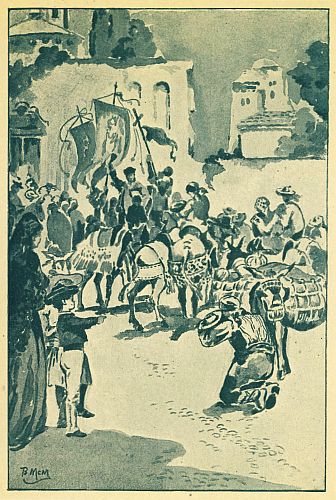
Fruit-venders passed along the street, and
donkeys so laden with fruit and flowers that
almost nothing could be seen of them but
their slim little legs and their great waving
ears. Water-carriers were there, carrying huge
jars which looked like those used by the old
Moors; and a travelling merchant, in gray
garments, but with brightly dressed mules.
It was not so bright a party that they passed
later, for a peasant funeral passed by on its
way to the cemetery. Four young men carried
the bier, upon which was the body of
a child, covered all but its face, which lay
exposed to the sun.
"Take off your hat, son," said the señora.
"Always do so to a passing funeral, for maybe
yours will be the last salute the dead will
receive on earth."
No sooner was the funeral passed than there
came a straw and charcoal merchant, crying,
"Paja! Carbon! Cabrito!" So many people
in Granada have no way to warm themselves
except by the brazero, in which charcoal
is burnt, that there is great need for
the charcoal man, and he drives a brisk
trade.
Next they saw a priest on a sick call, for he
bore the Blessed Sacrament. A crowd of
ragged urchins stopped in their play to kneel
as he passed, and Fernando and his father
raised their hats.
By this time, the carriage had reached the
outskirts of the city, and the road wound
along the banks of the Darro, a rushing
stream which gushes out of a deep mountain
gorge, and passes through the town. Its
banks are lined with quaint old houses, leaning
far over the river, and Fernando saw
women there, washing their linen in the
water, and spreading their clothes on the
stones to dry.
Outside of the town their way lay along
the beautiful Vega, which stretches beyond
Granada, in green and fertile loveliness, to the
far-away hills. Crossed by two rivers, the
Darro and Genil, the plain is dotted with
whitewashed villas, nestling like birds in the
soft green of the olive and orange trees.
Sloping gradually to the mountains above,
the Vega is green as emerald, and truly a
fair sight beneath the turquoise sky, and
the mother-of-pearl of the snowy mountains.
Fernando's father owned large estates upon
the hillsides, and raised oranges and grapes.
The last were used for raisins, the grapes from
which the finest wine is made, the Amontillado,
for which Spain is so famous, not
reaching their greatest perfection in this part
of the land.
In an hour they reached the farm and drove
down the long lane which led to the house.
The Hacienda of Santa Eulalia was a large, low
building, with a broad porch and a tangle
of vines and roses climbing over it. Huge
trees spread their arms over the roof, and from
the balcony one could see groves of cypress-trees,
pines, oaks, and poplars, beyond the
fruit-trees, and, above all, the rose-coloured
peaks of the Sierras. Upon the slope of the
hill, as it fell away toward Granada, were the
grape-vines, with huge clusters of grapes, purple,
white, and red, weighing down the vines.
There were, too, terraces where the raisins
dried; and nearer the house were the drying-sheds,
where an army of packers pressed
the raisins under boards, and carefully sorted
them before packing. The vineyards were
beautiful, but even more so were the orange
groves, and one who has seen a grove in full
fruit never forgets the beautiful sight. The
trees are deep green in colour, and full of
leaves, many of them bearing at the same
time flowers and green and ripe fruit.
The children were wild with delight, and
ran about eager to see the picking and sorting
of the fine fruit, for the oranges of Santa
Eulalia were famous for size and quality.
The trees grew rather low to the ground,
and were covered with fruit which the pickers
were gathering. Ladders were put up to the
lower branches, and each picker carried a
basket swung to his neck by a cord. He
carefully picked the oranges, one at a time,
and dropped them in his basket, and so expert
were many of them that it seemed as if they
had scarcely mounted the ladder before the
basket was full. Many young girls were employed
as pickers, and they were particularly
skilful, vying with the men in their swiftness.
Very gay were their voices, and merry jest
and song enlivened the work, until it seemed
as if it were not work but play. Fernando
and Juanita hopped about like little rabbits,
eating the fruit which rolled to the ground,
for often the golden globes fell from the trees,
as they were shaken by the picking.
When the baskets were filled, the oranges
were carried to the sheds and left overnight to
harden the skins a little, when each orange
was wrapped in soft tissue-paper. For this
are employed young boys and girls, and very
expert they grow in the wrapping of the
oranges, each one being properly wrapped with
but a twist of the hand. The next thing is
the packing, and the oranges are stored away
in wooden boxes, and are ready to be shipped
to market.
The children ate so many oranges that they
scarcely wanted any of the luncheon prepared
for them at the hacienda. There was an omelet
with green peppers, a delicious salad,
some fowl, and tiny round potato balls, all
sprinkled over with chopped parsley, with
a huge dish of oranges and grapes for
dessert.
The señora insisted upon a little siesta
after luncheon, but Fernando's eyes were so
wide open that he could not close them as
he swung to and fro in the great hammock
between two orange-trees in front of the house.
He was delighted when his father sat down
beside him, in one of the big easy chairs,
and said:
"You look to me like a boy who would like
to hear a story."
"Indeed I would; please tell me one,"
said Fernando.
"Have you ever heard about the judges
of Pedro the Cruel?"
"No, papa," said Fernando, all interest.
"A long time ago, there ruled over Andalusia
a king named Pedro, and he was so
disliked by his subjects, and did so many
wicked things, that he was called Pedro the
Cruel. He lived in the city of Sevilla, and
though he was cruel, and often heartless, still
he had a strong sense of justice, which would
not allow the common people to be badly
treated. He found out one day that four
of his judges had been cheating the people
and taking bribes, and he determined to teach
them a lesson. He went to his favourite
gardens, those of the Alcazar, and sent for
the judges to come to him there. It is a
wonderful place even to-day, and then it must
have been very beautiful. Huge banana-trees
waved their rough green leaves above the
tangled beauty of the flower-beds, where jasmine
and violets and roses grew in profusion.
In the midst was a fountain, and Don Pedro
knelt beside it, smiling wickedly as he placed
upon the perfumed waters, five oranges cut
in halves, and placed flat-side down. The
reflection was so perfect that any one would be
deceived, and think they were whole oranges
floating upon the water.
"'How many oranges are there here?'
asked the king, smiling genially, and the
judges replied:
"'Ten, may it please your Gracious Majesty.'
"'Nay, but it does not please my Gracious
Majesty to have four fools for judges,' he said.
'Liars! Can you not see that there are but
five?' and he raised two of the halves and held
them together. 'Know, oh, unjust judges,'
he said, sternly, 'that the king's servants
must see more than the surface of things if
they are to conduct that portion of the realm
which it is their business to attend to, and since
you cannot tell a half from a whole, perchance
that is the reason of the tales I hear of your
ill-dealings with the property of some of my
subjects!'
"He ordered them to be beheaded and
their places filled with better men, and the
poor people whom they had defrauded had
their property restored to them. There are
many other stories of King Pedro which are
not pleasant to tell, and it is good to remember
that he sometimes did kind things."
"Thank you," said Fernando. "What is
the Alcazar where the gardens were?"
"It is a very remarkable place, and when
you go to Sevilla you will see it. At first,
hundreds of years ago, when the Romans
were in Spain, it was the house of Cæsar;
afterward the Moors turned it into a fortress,
and it is a perfect example of Moorish
work. Don Pedro rebuilt it, and spent
a great deal of money upon it, making it
the most beautiful palace in all Spain. All
manner of things happened there, among
them the murder of Don Pedro's half-brother,
Don Fadrique, who he was afraid would lay
claim to the throne.
"But here come your mother and Juanita,
and I think your rest time is about over. Go
and play, and tell Manuel we return at four
o'clock, so you must be on time."
So Fernando spent a delightful afternoon
in the orange grove, and drove home through
the cool twilight, passing the paseo just as
the band was playing the Marche Real, the
national song, which he hummed until he
went to bed.
[Transcriber's Note: You can play this music (MIDI file) by clicking here.]