SUMMER HOLIDAYS
It was the beginning of the summer holidays,
and the Gordons, with Sandy, had come
to Skylemore that the young people might
spend their holidays together.
Many pleasant trips had been planned, and
the first was to be a picnic on Loch Katrine,
which was not far from Skylemore.
It was early on a bright summer's morning
when Dugald, with his four prancing horses,
appeared at the door, and the two Clans of
Gordons and Lindsays, to say nothing of
Sandy, who was a MacPherson, piled into
the big break, along with many baskets full
of good things.
With a waving of caps and handkerchiefs
off they went, and soon they were driving
along the beautiful mountain glens and
through the Trossachs, which means literally
a wooded gorge or ravine.
"There is the loch now," cried Don,
presently.
"No, that is Loch Achray," said his uncle,
"and that mountain is Ben Venue, but we
shall see Loch Katrine very soon;" and it
was not long before Dugald drew up on the
very edge of the loch itself, and a camping-place
was soon found under the trees and in
sight of Ellen's Isle.
Rugs were brought from the break and
spread on the ground around a big rock which
was to serve as a table. Everybody helped
to unpack the big baskets, for all were as
hungry as if they had had no breakfasts.
Not much was said for a time but "Please
pass that," and "Please pass this," and "Isn't
this good?" until finally even the boys decided
they had eaten enough.
"Papa, tell us about Ellen's Isle," said
Janet, as they all sat around after lunch, and
tried to see who could throw a stone the
farthest into the water.
So Mr. Lindsay told them the story of the
"fair Ellen," whom Sir Walter Scott wrote
of in his great poem called "The Lady of
the Lake." Ellen was called "the lady of the
lake," and lived with her father on the little
island yonder. Then Mr. Lindsay told them
of "Roderick Dhu," and of the gatherings of
the Clan Alpine which took place in the old
days in a glen not far away, and how at a
signal armed men wrapped in their plaids
would spring up out of the seemingly lonely
dells and glens as if by magic.
Those were wild days in Scotland long ago,
days of fierce fights and brave deeds, when
Clans met and rushed into battle with a wild
"slogan," as their battle-cry was known.
"Sandy says that he does not believe that
'Rob Roy' was a real person; but he was,
and lived right here, didn't he, Uncle Alan?"
said Don, eagerly, in defence of his hero.
"Indeed he did, and you would like to see
his old home, wouldn't you, Don?"
"Wouldn't I!" said Don, and his eyes
shone.
"Well, we will go there sometime; it is
now a sheep-farm, but was once the old home
of the Macgregors. In 'Rob Roy's' time
bands of lawless men came down from the
north to steal cattle and do other kinds of
mischief. So the 'lairds' in these parts paid
'Rob Roy' and his little band of followers to
protect their property from these invaders and
robbers. In after days the band was formed
into a regiment called the 'Black Watch,'
which to-day is one of the most famous of
the Scotch regiments."
Sir Walter Scott has done much to make
this part of Scotland well known, and people
come from all over the world, and especially
from America, anxious to see the beautiful
country of rocks and glens and heather-clad
mountains of which he wrote in his famous
novels and poems.
From the telling of stories our Clansmen
soon turned to singing songs, for the Scotch
are full of sentiment, and are very fond of
music. Some of the most beautiful of our
popular songs have come from Scotland.
There is one which is known the world over,
and sung as often by little American cousins
as by little Scotch cousins; and that is "Annie
Laurie."
So when Aunt Jessie began to sing "Annie
Laurie," all joined in with a will, and sang
one of the sweetest songs the world has ever
known:
"They sang of love and not of fame,
Forgot was Scotland's glory.
Each heart recalled a different name,
But all sang 'Annie Laurie.'"
After this there was a general scramble to
get the things picked up. The whole party
mounted again to their seats in the break, and
Dugald made the four horses just fly for
home; though they did not need much urging,
as every horse seems to know when his
head is turned homeward.
"Is that Robert Burns's house?" said
Janet, in a disappointed voice.
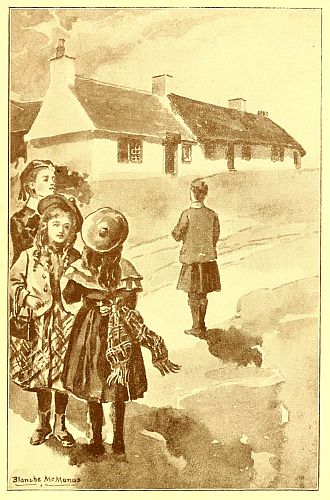
"OUR LITTLE SCOTCH FRIENDS WERE STANDING BEFORE
THE LITTLE HOUSE AT AYR, WHERE ROBERT BURNS
WAS BORN."
"Yes, my dear," said her father, "great
men have often been brought up in small
houses like this. Bobby Burns was only a
ploughboy, but he became a great poet, one
of the greatest in the world."
Our little Scotch friends were standing
before the little house at Ayr, where Robert
Burns was born. They had come down from
Glasgow for the day to visit that part of Scotland
made famous by the poet. It is hard to
say of whom the Scotch people are most fond
and proud, Scott or Burns. The young people
had looked forward with a great deal of
pleasure to this visit, and they all felt pretty
much as Janet did.
It was a tiny house, what the country people
call a "clay biggin," with a thatched roof. Inside
are many relics of Burns, but the children
were, perhaps, more interested in "Alloway's
Auld Haunted Kirk." This is the small church
of which Burns wrote in his poem, called
"Tam-o'-shanter," where Tam saw the witches
dance, and from whence he started on his wild
ride, with the witches after him riding on broomsticks.
It is one of the chief attractions for
visitors.
"Oh! it is a creepy poem," said Don; and
you will all think so, too, when you have
read it.
They saw the "Auld Brig of Ayr," which
means the old bridge, across the river Ayr,
and they walked along the "Banks and Braes
o' Bonnie Doon," of which Burns wrote and
which he loved so well. They visited the
monument to Burns. Marjorie remarked that
it was not a very grand monument, not nearly
so grand as that to Scott in Edinburgh; and
she was quite right.
"Not far from Ayr was the home of Annie
Laurie," said Mr. Lindsay, as the train speeded
them back to Glasgow.
"Was she a real person, father?" eagerly
exclaimed the little girls together.
"Indeed she was, though her eyes were black
and not blue," said Mr. Lindsay.
"How do you know?" asked Janet, who
liked to be exact.
"Because her portrait is still to be seen at
Maxwelton House, near the town of Dumfries,
where she lived," replied her father.
"Well, I'd rather her eyes had been blue,"
said Marjorie, and the children kept talking
about blue and black eyes until they
reached the great St. Enoch's railway station
at Glasgow.
There are so many delightful journeys to
be made from Glasgow by rail and steamer
that it is one of the best starting points in
all Scotland for excursions, of which all children
and most old folks are so fond. The
Lindsays and the Gordons were accordingly
to stay in Glasgow for a week, that the young
people might enjoy more of these rare treats,
and take some of the lovely sails on the river
Clyde and among the near-by islands.
Don and Sandy were having some hot discussions
as to which was the finest city in
Scotland,—Glasgow or Edinburgh. This
was about the only thing that the boys ever
disagreed on. Sandy's father came originally
from Glasgow, so Sandy always stood up
for it.
"It's a big city, and lots richer than Edinburgh;
and think of all the business that is
done here, and of the lots and lots of ships
that come and go from all parts of the world.
It's the largest city in Scotland, too, and the
second city of the kingdom," Sandy would
say.
"But it's not so beautiful as Edinburgh.
It hasn't anything like Princes Street, nor
so many famous old buildings and historic
places, nor our great colleges. Anybody had
rather live in Edinburgh—you know you
would, Sandy," Don would argue.
And the truth of it all was, both boys were
right.
Early one morning found our party gathered
on the steamer Lord of the Isles for a cruise
around the islands off the coast. They passed
the great ship-building yards of the Clyde, the
largest in the world, as they steamed down the
river. The ships built upon the Clyde have
always been famous all over the world.
"There is Gourock Bay, where the great
racing yachts anchor," said Mr. Lindsay. "It
was always thought to be a lucky place to set
sail. It was from this bay that many of the
yachts sailed for America when they were to
make the attempt to capture the 'America's
Cup,' that you doubtless all know about; but
while these Clyde-built boats were fine yachts,
none of them have been lucky enough to bring
back the cup."
Next was seen the Island of Bute and the
old Castle of Rothesay. Here they entered
a narrow bit of water, called the Kyles of Bute,
from which they entered Loch Fyne, famous
for its fresh herrings.
Another steamer took them through the
Crinan Canal, and thence to Oban, the capital
of the Western Highlands.
In this part of Scotland, called by every one
the Highlands, are the great deer forests of
many thousands of acres, belonging to some
of the great families of Scotland, where the
wild deer is hunted, or "stalked," as it is
called. Here, too, are wild moors, stretching
for miles and miles, where few people live
except the shepherds who look after the
flocks.
There was another fine summer which was
enjoyed greatly by our little Scotch cousins,
and that was when some young American
cousins came to visit the Lindsays, and they
all went on Uncle Alan's yacht for a lovely
sail of many days, among the islands which
fringe the northern and western coasts of
Scotland. It was on this occasion that they
all went to the Isle of Skye (some of you
have probably heard of the Skye terriers),
and they stopped, too, at the Shetland Isles,
where the little horses come from. Every girl
and boy wants to own a dear little Shetland
pony.
Didn't they have a splendid time on this
trip! That was the time, too, when Donald
and Sandy got left behind on one of the islands
where they had all landed for a picnic,—but
that's another story!
So many little cousins are waiting to talk
about themselves that we must really get our
little Clan safely back home, and leave them
for the present to talk over the good times
they have had together.
THE END.
THE LITTLE COUSIN SERIES
The most delightful and interesting accounts possible of
child-life in other lands, filled with quaint sayings, doings,
and adventures.
Each 1 vol., 12mo, decorative cover, cloth, with six or
more full-page illustrations in color.
Price per volume $0.60
By MARY HAZELTON WADE (unless otherwise
indicated)
Our Little African Cousin
Our Little Armenian Cousin
Our Little Brown Cousin
Our Little Canadian Cousin
By Elizabeth R. Macdonald
Our Little Chinese Cousin
By Isaac Taylor Headland
Our Little Cuban Cousin
Our Little Dutch Cousin
By Blanche McManus
Our Little English Cousin
By Blanche McManus
Our Little Eskimo Cousin
Our Little French Cousin
By Blanche McManus
Our Little German Cousin
Our Little Hawaiian Cousin
Our Little Indian Cousin
Our Little Irish Cousin
Our Little Italian Cousin
Our Little Japanese Cousin
Our Little Jewish Cousin
Our Little Korean Cousin
By H. Lee M. Pike
Our Little Mexican Cousin
By Edward C. Butler
Our Little Norwegian Cousin
Our Little Panama Cousin
By H. Lee M. Pike
Our Little Philippine Cousin
Our Little Porto Rican Cousin
Our Little Russian Cousin
Our Little Scotch Cousin
By Blanche McManus
Our Little Siamese Cousin
Our Little Spanish Cousin
By Mary F. Nixon-Roulet
Our Little Swedish Cousin
By Claire M. Coburn
Our Little Swiss Cousin
Our Little Turkish Cousin
THE GOLDENROD LIBRARY
The Goldenrod Library contains only the highest and
purest literature,—stories which appeal alike both to children
and to their parents and guardians.
Each volume is well illustrated from drawings by competent
artists, which, together with their handsomely decorated
uniform binding, showing the goldenrod, usually considered
the emblem of America, is a feature of their manufacture.
Each one volume, small 12mo, illustrated, decorated cover, paper wrapper $0.35
LIST OF TITLES
| Aunt Nabby's Children. By Frances Hodges White. |
| Child's Dream of a Star, The. By Charles Dickens. |
| Flight of Rosy Dawn, The. By Pauline Bradford Mackie |
| Findelkind. By Ouida. |
| Fairy of the Rhone, The. By A. Comyns Carr. |
| Gatty and I. By Frances E. Crompton. |
| Great Emergency, A. By Juliana Horatia Ewing. |
| Helena's Wonderworld. By Frances Hodges White. |
| Jackanapes. By Juliana Horatia Ewing. |
| Jerry's Reward. By Evelyn Snead Barnett. |
| La Belle Nivernaise. By Alphonse Daudet. |
| Little King Davie. By Nellie Hellis. |
| Little Peterkin Vandike. By Charles Stuart Pratt. |
| Little Professor, The. By Ida Horton Cash. |
| Peggy's Trial. By Mary Knight Potter. |
| Prince Yellowtop. By Kate Whiting Patch. |
| Provence Rose, A. By Ouida. |
| Rab and His Friends. By Dr. John Brown. |
| Seventh Daughter, A. By Grace Wickham Curran. |
| Sleeping Beauty, The. By Martha Baker Dunn. |
| Small, Small Child, A. By E. Livingston Prescott. |
| Story of a Short Life, The. By Juliana Horatia Ewing. |
| Susanne. By Frances J. Delano. |
| Water People, The. By Charles Lee Sleight. |
| Young Archer, The. By Charles E. Brimblecom. |
COSY CORNER SERIES
It is the intention of the publishers that this series shall
contain only the very highest and purest literature,—stories
that shall not only appeal to the children themselves,
but be appreciated by all those who feel with
them in their joys and sorrows.
The numerous illustrations in each book are by well-known
artists, and each volume has a separate attractive
cover design.
Each 1 vol., 16mo, cloth $0.50
By ANNIE FELLOWS JOHNSTON
The Little Colonel. (Trade Mark)
The scene of this story is laid in Kentucky. Its heroine
is a small girl, who is known as the Little Colonel,
on account of her fancied resemblance to an old-school
Southern gentleman, whose fine estate and old family
are famous in the region.
The Giant Scissors.
This is the story of Joyce and of her adventures
in France. Joyce is a great friend of the Little Colonel,
and in later volumes shares with her the delightful experiences
of the "House Party" and the "Holidays."
Two Little Knights of Kentucky.
Who Were the Little Colonel's Neighbors.
In this volume the Little Colonel returns to us like an
old friend, but with added grace and charm. She is
not, however, the central figure of the story, that place
being taken by the "two little knights."
Mildred's Inheritance.
A delightful little story of a lonely English girl who
comes to America and is befriended by a sympathetic
American family who are attracted by her beautiful
speaking voice. By means of this one gift she is enabled
to help a school-girl who has temporarily lost the
use of her eyes, and thus finally her life becomes a busy,
happy one.
Cicely and Other Stories for Girls.
The readers of Mrs. Johnston's charming juveniles
will be glad to learn of the issue of this volume for
young people.
Aunt 'Liza's Hero and Other Stories.
A collection of six bright little stories, which will
appeal to all boys and most girls.
Big Brother.
A story of two boys. The devotion and care of
Steven, himself a small boy, for his baby brother, is the
theme of the simple tale.
Ole Mammy's Torment.
"Ole Mammy's Torment" has been fitly called "a
classic of Southern life." It relates the haps and mishaps
of a small negro lad, and tells how he was led by
love and kindness to a knowledge of the right.
The Story of Dago.
In this story Mrs. Johnston relates the story of Dago,
a pet monkey, owned jointly by two brothers. Dago
tells his own story, and the account of his haps and mishaps
is both interesting and amusing.
The Quilt That Jack Built.
A pleasant little story of a boy's labor of love, and
how it changed the course of his life many years after
it was accomplished.
Flip's Islands of Providence.
A story of a boy's life battle, his early defeat, and his
final triumph, well worth the reading.
By EDITH ROBINSON
A Little Puritan's First Christmas.
A Story of Colonial times in Boston, telling how
Christmas was invented by Betty Sewall, a typical child
of the Puritans, aided by her brother Sam.
A Little Daughter of Liberty.
The author introduces this story as follows:
"One ride is memorable in the early history of the
American Revolution, the well-known ride of Paul
Revere. Equally deserving of commendation is another
ride,—the ride of Anthony Severn,—which was no less
historic in its action or memorable in its consequences."
A Loyal Little Maid.
A delightful and interesting story of Revolutionary
days, in which the child heroine, Betsey Schuyler,
renders important services to George Washington.
A Little Puritan Rebel.
This is an historical tale of a real girl, during the
time when the gallant Sir Harry Vane was governor of
Massachusetts.
A Little Puritan Pioneer.
The scene of this story is laid in the Puritan settlement
at Charlestown.
A Little Puritan Bound Girl.
A story of Boston in Puritan days, which is of great
interest to youthful readers.
A Little Puritan Cavalier.
The story of a "Little Puritan Cavalier" who tried
with all his boyish enthusiasm to emulate the spirit and
ideals of the dead Crusaders.
A Puritan Knight Errant.
The story tells of a young lad in Colonial times who
endeavored to carry out the high ideals of the knights
of olden days.
By OUIDA (Louise de la Ramée)
A Dog of Flanders: A Christmas Story.
Too well and favorably known to require description.
The Nurnberg Stove.
This beautiful story has never before been published
at a popular price.
By FRANCES MARGARET FOX
The Little Giant's Neighbours.
A charming nature story of a "little giant" whose
neighbours were the creatures of the field and garden.
Farmer Brown and the Birds.
A little story which teaches children that the birds
are man's best friends.
Betty of Old Mackinaw.
A charming story of child-life, appealing especially to
the little readers who like stories of "real people."
Brother Billy.
The story of Betty's brother, and some further adventures
of Betty herself.
Mother Nature's Little Ones.
Curious little sketches describing the early lifetime,
or "childhood," of the little creatures out-of-doors.
How Christmas Came to the Mulvaneys.
A bright, lifelike little story of a family of poor children,
with an unlimited capacity for fun and mischief.
The wonderful never-to-be forgotten Christmas that
came to them is the climax of a series of exciting incidents.