It is a delightful trip. The weather is just
cool enough for comfort, and no one is seasick.
The children are never tired of sitting
on deck and watching the views, changing hour
by hour.
They are never out of sight of land, but
sail along the shores of their loved island.
Here is a little village of palm-thatched huts,
there a grove of breadfruit or cocoanut trees;
again one meets another sailing vessel with all
its men busy shark-fishing. The skin of the
ugly monster is valuable, as well as its fins and
tail, which are prized as food by many of the
people of Porto Rico.
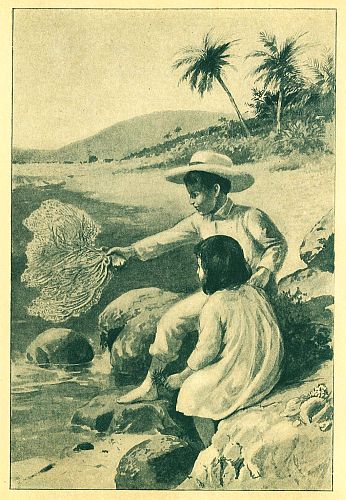
Looking down beneath the clear blue waters
Dolores descries the rainbow fish and claps her
hands at its beauty. It is so called because
of its many beautiful colours.
And see! Here is a shoal of flying-fish
darting over the waters. They do not really
fly, as some people think, but dart up out of
the water, with their long fins spread in such
a way that they are carried through the air for
quite a distance.
Deep down in the water the children see
a beautiful object. It is moving rapidly, and
its back shines like burnished gold, then
changes in the sunlight into many shades and
tints of colour.
"Papa, do please come quickly, and tell me
what this is," calls Manuel.
"That is a dolphin, my dear, one of the
most beautiful of all creatures living in the
sea," says his father, as he looks over the
ship's side. "But he is always hungry, and
if he sees those flying-fish ahead of him it will
be a sad day for them."
At this very moment the dolphin seems to
get a view of his favourite prey. He darts
to the surface of the water and leaps forward
at the flying-fish with the speed of a bullet;
at least it seems so to the watching children,
who pity the little fellows with all their hearts.
When they discover their foe it is too late for
them to escape, for, although they flee with
all their might, now in one direction, then in
another, the dolphin gains upon them and
snaps them up one by one in his great jaws.
In their fright many of them throw themselves
clear out of the water with their fins spread,
and are carried many feet on the air. It is
this that gives them the appearance of flying.
The voyage seems only too short to Manuel
and Dolores. When they arrive at San
Juan there are so many new things to see that
the days pass only too quickly. They have
never been in the city before.
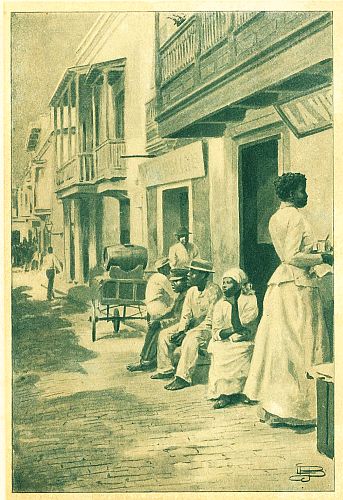
A STREET IN SAN JUAN
The narrow streets, with the still narrower
sidewalks, seem odd indeed to these children
used to plantation life. Sometimes they cannot
even walk side by side without one being
pushed into the street. And the houses,
although many of them are built of stone like
their own, are so close together that Manuel
says to his sister:
"I wonder how people can like being so
crowded together. I should think they would
feel choked."
The friends whom they visit live on the
upper floor of their house. Although they
are quite wealthy, they let the lower floor to
a poor, dirty, and ignorant family with many
children. Such an arrangement is often made
in San Juan; but the two families do not
mingle at all, although living in the same
house.
Balconies jut out from the upper story, and
Manuel and Dolores like to sit here and
watch the passers-by.
It is so odd to see the milkman ride up to
the house astride of his donkey, with his milk
cans jostling against each other between his
legs. Sometimes a cow is led through the
streets, and her owner stops at neighbouring
doorways to draw the milk as the people wish.
Dolores thinks the milk must be much nicer
when obtained in this way.
"But look, now, Manuel," she says, "at
that poor mule! He is almost smothered
under an immense bundle of fodder; and, as
though that were not enough for the poor
beastie, his master is riding on top of the load."
Sometimes the children rise as early as five
o'clock in the morning. They like to go to
the market held in a public square of the city.
They see people of all shades of colour selling
their goods.
There is the baker with his bags of freshly
baked bread and oddly twisted rolls; there is
the poultry man with wicker cages full of live
fowls hanging to the sides of his half-starved
donkey; there, too, is the butcher with sides
of beef hanging by hooks from his horse's
harness; while crowded together are those who
have brought their fruits and vegetables afoot
many a long mile in early morning.
There are great piles of yellow oranges; plantains,
green, brown, and yellow; pineapples,
melons, onions, guavas, and lemons; while
behind them sit their owners, who laugh and
joke and make love, and at the same time are
busy shouting their wares and making bargains.
Oh, but one must not forget the game-cocks
fastened to stakes here and there in the midst
of the busy crowd. Many a trade is made,
many a bet laid on these ugly, skinny, but
greatly admired cocks as they pull at their
stakes.
Later in the day no sign of this busy scene
is left in the public square. One notices for
the first time that there is a band stand, and
when the evening comes, Manuel's father and
mother are driven with their hosts to this
square. Many other carriages, filled with
richly dressed ladies and gentlemen, also arrive
and take their places at one side of the band
stand. Here they sit laughing and chatting
or listening to the music; the ladies' black
eyes sparkle as a favourite tune is played, and
they keep time by gentle taps of their fans.
Many of these fans are very beautiful.
Manuel's mother has one made of the feathers
of humming-birds. It is brilliant, even in the
soft light of evening, and the dear lady herself
looks very charming with a lace mantilla drawn
over her head, its point reaching down over
the forehead almost to her nose. To be sure,
her cheeks are heavily powdered, but that is
the fashion of all the ladies in her land, and so
it seems quite natural.
The rest of the square is filled with the crowd
of poorer people who cannot afford to ride.
They walk slowly about, and seem to enjoy the
music and each other's company as much as
those who sit in the carriages.
There are many street processions in San
Juan, and the children are on the lookout not
to miss them. These processions are in honour
of some saint. Dolores is out on the balcony
one morning when she hears music. It
is the voices of children singing.
"O Manuel, Teresa, mamma, do come and
see the pretty sight," she calls, as a procession
draws near.
People dressed in the costumes of different
lands come marching by; then follows a cart,
decked gaily with flowers, and in it stands a
little girl dressed to represent the virgin mother
of Jesus. There is a band of music playing
sacred airs.
The children take their hats and follow the
procession to the public square, where the
little girl in the flower-decked carriage recites a
poem written in honour of the day. All business
stops in the stores near by. All vehicles
give way to the procession, and the passers-by
stand still to admire and listen.
It seems strange to the children to see the
red, white, and blue of the American flag floating
over the city, instead of the colours of
Spain—the red and yellow they were formerly
taught to love.
"But this new flag means friendship, you
know, Dolores," says her brother. "The
poor will not be taxed so much as they used
to be, and the good Americans will not allow
any other people to harm us. At least father
says so, and he is very wise. Dolores, he has
promised to take us sometime to that wonderful
city, New York, where we shall see so
much we have never even dreamed of. I hope
the time will come soon, for I want to get acquainted
with my American cousins in their
own land, our own land, now."
THE LITTLE COUSIN SERIES
The most delightful and interesting accounts possible of
child-life in other lands, filled with quaint sayings, doings,
and adventures.
Each 1 vol., 12mo, decorative cover, cloth, with six full-page
illustrations in color by L. J. Bridgman.
Price per volume $0.60
By MARY HAZELTON WADE
- Our Little African Cousin
- Our Little Armenian Cousin
- Our Little Brown Cousin
- Our Little Cuban Cousin
- Our Little Eskimo Cousin
- Our Little German Cousin
- Our Little Hawaiian Cousin
- Our Little Indian Cousin
- Our Little Irish Cousin
- Our Little Italian Cousin
- Our Little Japanese Cousin
- Our Little Jewish Cousin
- Our Little Mexican Cousin
- Our Little Norwegian Cousin
- Our Little Philippine Cousin
- Our Little Porto Rican Cousin
- Our Little Russian Cousin
- Our Little Siamese Cousin
- Our Little Swiss Cousin
- Our Little Turkish Cousin
By BLANCHE McMANUS
- Our Little English Cousin
- Our Little French Cousin
By ELIZABETH ROBERTS MacDONALD
- Our Little Canadian Cousin
By ISAAC HEADLAND TAYLOR
- Our Little Chinese Cousin
By H. LEE M. PIKE
ANIMAL TALES
By Charles G. D. Roberts
ILLUSTRATED BY
Charles Livingston Bull
as follows:
The Lord of the Air
(The Eagle)
The King of the Mamozekel
(The Moose)
The Watchers of the Camp-fire
(The Panther)
The Haunter of the Pine Gloom
(The Lynx)
The Return to the Trails
(The Bear)
The Little People of the Sycamore
(The Raccoon)
Each 1 vol., small 12mo, cloth decorative, per volume, $0.50
Realizing the great demand for the animal stories of
Professor Roberts, one of the masters of nature writers,
the publishers have selected six representative stories, to be
issued separately, at a popular price. Each story is illustrated
by Charles Livingston Bull, and is bound in a handsome
decorative cover.
Transcriber's Note:
Page vii, Table of Contents, Chapter VII's page number was misprinted.
"30" has been changed to "50" to match the text.
Page 33, "themseves" changed to "themselves" (they themselves sit)
Page 42, "hall" changed to "ball" (great round ball)