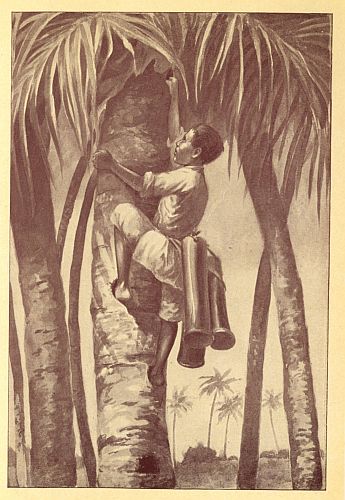
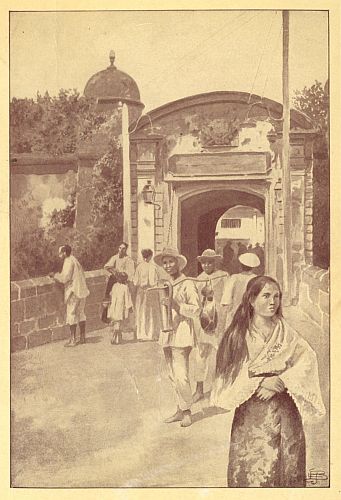
Although Alila is anxious to travel and
learn more of this great round world, yet his
own people seldom leave their island home.
Strange to say, however, white travellers from
distant lands began to visit these shores hundreds
of years ago.
The first one to do this was a brave admiral
named Ferdinand Magellan. What wonderful
adventures filled the life of this man! It
seems almost like a fairy tale.
After Columbus made his famous voyages
across the Atlantic and discovered America,
Magellan, who lived in Portugal, was much
excited over the news. The world must certainly
be round, he thought, and he was no
longer satisfied to explore the waters near his
own home. He, too, wished to find new and
distant lands; but this was not enough. He
felt sure he could discover a way to the countries
of the East, rich in silks, spices, and
precious gems, by sailing west.
The King of Portugal was a powerful ruler
and anxious for new possessions, yet he did
not encourage Magellan. Instead of this, he
was ordered to go back to Africa and keep on
fighting against the Moors, for he had already
won many victories there. The king was
even stern to him for leaving the war in
Africa. Why had he returned to Portugal
to ask for other work than what had been
given him?
It was a sad disappointment, and Magellan
turned away from the king's presence with a
bitter heart. It was almost impossible for
him to keep from bursting into tears, though
he was a brave, strong man. Just as he was
leaving the palace, an old friend stopped him
and whispered:
"Why do you not go to the King of Spain
and ask his help? He is young, to be sure,
but he will be glad to get the services of a
brave man from any country, for he is anxious
to gain new lands and greater power."
Magellan's first thought was, "I cannot
leave the service of my own country for that
of another." But afterward he said to himself,
"No, I am not right in working for one
king when I can do more for the world in
serving another. I feel that I shall do much
yet. And I am willing to dare great risks,
and give my life even, for the sake of what
is not yet known."
He went to Spain and offered his services
to King Charles. You will be pleased to
know that this king was the grandson of the
very Isabella who so nobly helped Columbus.
The young king was filled with the spirit of
his grandmother. He said to Magellan:
"Your plan is good; you are daring, yet
cautious; you shall have ships and supplies.
So be of good courage and prepare for your
voyage."
Magellan's heart bounded with joy. He
promised the king that wherever he should
land in places not discovered before, there he
would plant the flag of Spain. He also vowed
that he would do his best to teach the Christian
religion to the heathen and that a goodly
company of priests should go with him to
baptise all who were willing.
At last the great day came when Magellan
set sail. Shortly before, he was married to
one whom he had long loved and whom, alas!
he should never see again after leaving the
shores of Spain. He and his fair young wife
had watched the building and repairing of the
ships which were to sail away with him so
soon. With her at his side, he had studied
the rude maps of the Atlantic Ocean made by
earlier voyagers, and the instruments which
should aid him in managing the fleet.
The great moment arrived at last. Amidst
the shouts of the people, the peals of the bells,
and the roaring of the cannon, the anchors
were lifted and the fleet sailed into the West.
Days passed quietly by. The weather was
good, and Magellan, now Admiral Magellan,
watched constantly for land. Many wonderful
things were seen by the sailors as they
crossed the broad Atlantic. There were shoals
of flying-fish, strange and interesting birds,
besides immense sharks that followed the ships
for days at a time.
After a voyage of over two months, the
coast of South America came in sight. The
fleet stopped at different places; at one time
finding themselves among friendly savages, at
another among a race of unfriendly giants.
Each time the ships were headed farther and
farther south.
At this time Magellan had other troubles
besides directing the fleet. You remember
that he was a Portuguese, although he was
sailing under the King of Spain. So it happened
that while some of the sailors were from
Magellan's country, most of them were Spaniards.
These latter were jealous of their
leader because he belonged to a different nation
from themselves. Some of them talked
secretly together and made a plan to imprison
him and take possession of the ships.
But Magellan learned of their wicked plot
in time to defeat them, and he punished them
as they deserved. Only a cool and daring man
could have succeeded in defeating so many
strong enemies. But he did succeed, and the
ships sailed onward as though nothing had
happened.
It grew colder and colder. A violent storm
arose and the ships were tossed about like
leaves in the wind. But Magellan was without
fear and kept his men filled with courage. At
length he reached a narrow passage leading to
the west. He said to his captains:
"I believe we have come to the end of this
continent. If we can make our way through
this strait we shall look upon the new ocean."
And the brave explorer sailed safely through
the dangerous strait now named for him.
The storm passed away, and one bright, clear
morning Magellan looked for the first time
upon a new and vast extent of water. It was
the dreamed-of ocean. It looked so calm and
peaceful that he said, "I will call it 'Pacific,'
for I have never seen the like before."
Weeks were spent upon these waters. They
were so quiet that for days at a time the ships
could not advance. There was hardly a breath
of wind.
And now it was discovered that the supplies
were getting low. The sailors thought of
home so far away, of friends they might never
see again; they pictured death by starvation
here in the midst of these beautiful waters.
The food was served out in smaller and
smaller portions to the unhappy men. At last
they were told there was nothing left to satisfy
their hunger save the rats which infested the
ships and some ox-hides which had been used
to protect the rigging.
Think for a moment of the condition of
Magellan and those with him. They were
out of sight of land in the midst of an unknown
ocean. Some were already dying of
thirst; others were too sick and weak to help
in the care of the ship. Do you wonder that
the sailors felt bitter at the one who had
brought them here and was the cause of
their suffering? But Magellan did not give
up courage, even now. He ordered the hides
to be softened in the sea water and then
boiled. For some days longer the crews
managed to live on with this for food.
One morning, when hope was nearly gone,
a fresh breeze from the east filled the sails of
the ships, and in a few hours Magellan saw
land in the distance. The men's hearts beat
hard for joy at the welcome sight. They
soon reached a small island where ripe fruits
were abundant, and where they could provide
fresh supplies for the ships.
But they did not stay many days, for Magellan
was not even now ready to give up his
search for the famous lands of the East. He
felt that, as the world was round, he must
surely be near them by this time. So once
more the ships set sail, and soon reached the
shores of one of the Philippines, but a short
distance from Alila's home. It looked so
rich and beautiful that the ships anchored
once more, and the admiral ordered the sick
men to be taken on shore. Large tents were
set up, and the sufferers were nursed back to
health and strength. There was an abundance
of good pure water and fresh food. All were
soon well and strong.
There were no people living on this island,
but two days after he arrived Magellan saw
some canoes out upon the water. They were
coming swiftly toward the camp. They were
filled with natives of another island near by, who
had seen the ships of the strangers; they were
curious to look upon the white men who
were living near them.
These people of Alila's race had soft yellow
skins and beautiful white teeth. They wore
no clothing except aprons made of bark.
They danced around the great admiral as he
stood on the shore dressed in his most elegant
garments, and laughed and shouted.
They wished him to see they were friendly.
They offered fresh fish and palm wine, cocoanuts
and figs, while Magellan made them
wildly happy by giving them looking-glasses
and bells, ivory toys and brass trinkets. As
he found them honest and peaceful, he allowed
them to go on board his ships. He ordered
his men to fire the cannon to amuse them,
but the noise frightened them so much that
some of them jumped into the water and
came near drowning.
The chief of these people came to see the
Spaniards. His face was painted, and he
wore heavy gold earrings and bracelets. He
was kind and pleasant. He brought a boat-load
of fruit and, best of all, some chickens.
Magellan learned from these people that he
was near still richer and larger islands. After
a few days he started out once more. He
passed island after island, sometimes landing
on their shores, sometimes sailing slowly along,
drawing a map of these new and wonderful
places.
At the island of Cebu, Magellan made
friends with the king, who was baptised by the
priests, and pretended to become a Christian.
A large cross bearing a wooden crown was set
up on the top of a high hill near the shore.
It was a token to all travellers who should
come this way that this land now belonged to
the King of Spain.
While the white visitors were staying here,
the King of Cebu did all he could to entertain
them. He seemed anxious to show how
friendly he felt toward them. The Spanish
sailors were much interested in the strange
customs and festivals of the brown people.
They noticed that the food was only half
cooked and then heavily salted. This made
the eaters very thirsty, and quite ready to
drink quantities of palm wine afterward. They
sucked this through long reeds of bamboo.
They were always glad to have the sailors
share their feasts and entertainments.
Just as the fleet was about to set sail again,
something happened to change Magellan's
plans. The King of Cebu was in trouble.
The people of another island over whom he
was also the ruler were coming to make war
upon him. Could the brave admiral refuse
help, when the king had treated him so
kindly? Surely not. He said to the king:
"Let me go against these rebels and make
peace for you. I have cannons which I will
use, and other weapons of war such as they
have never seen before. They will be easily
terrified, and quickly submit to your rule."
So it was that Magellan and sixty of his followers
sailed against the enemy. But when
they arrived at the island they found a large
army ready to meet them. The warriors carried
sharp spears, bows, and poisoned arrows,
and each man was protected by a wooden
shield. They stood upon the side of a hill.
As Magellan and his men landed and advanced
toward them, they rushed down upon the
Spaniards with fury, surrounding them on all
sides.
The great leader was calm and brave as
usual, but there was little hope for success.
In another hour he had fallen, a noble victim
to his savage foes. Many of his followers fell
by his side; the rest managed to escape to the
ships and sail back to Cebu to tell the sad
news to the king.
Thus ended the life of the noble Magellan,
the first white man to cross the broad waters
of the Pacific, the first one to show others it
was indeed possible to sail around the world.
He was unlike many who lived in those old
days,—for he did not care for gold or great
possessions. He only wished to know more
of this wonderful world, and to help others to
greater wisdom. He gave his life for one
whom he thought had need of help.
How did the King of Cebu act when he
learned of the leader's death? He turned
against those of his followers who were left,
and they were obliged to depart in haste.
They made still other discoveries of great
value. At length, sailing around the continent
of Africa, they returned to Spain to tell of the
brave deeds of their dead leader, the great admiral
and navigator, and their own strange
adventures.
They were the first men to sail around the
world.
THE END.
L. C. Page and Company's
BOOKS FOR YOUNG PEOPLE
THE LITTLE COLONEL BOOKS
(Trade Mark)
By ANNIE FELLOWS JOHNSTON
Each 1 vol., large 12mo, cloth, illustrated, per vol. $1.50
THE LITTLE COLONEL STORIES
(Trade Mark)
Being three "Little Colonel" stories in the Cosy Corner
Series, "The Little Colonel," "Two Little Knights of
Kentucky," and "The Giant Scissors," put into a single
volume.
THE LITTLE COLONEL'S HOUSE PARTY
(Trade Mark)
THE LITTLE COLONEL'S HOLIDAYS
(Trade Mark)
THE LITTLE COLONEL'S HERO
(Trade Mark)
THE LITTLE COLONEL AT BOARDING SCHOOL
(Trade Mark)
THE LITTLE COLONEL IN ARIZONA
(Trade Mark)
THE LITTLE COLONEL'S CHRISTMAS VACATION
(Trade Mark)
THE LITTLE COLONEL, MAID OF HONOUR
(Trade Mark)
THE LITTLE COLONEL'S KNIGHT COMES RIDING
(Trade Mark)
MARY WARE: THE LITTLE COLONEL'S CHUM
(Trade Mark)
These ten volumes, boxed as a ten-volume set. $15.00
THE LITTLE COLONEL
(Trade Mark)
TWO LITTLE KNIGHTS OF KENTUCKY
THE GIANT SCISSORS
BIG BROTHER
Special Holiday Editions
Each one volume, cloth decorative, small quarto, $1.25
New plates, handsomely illustrated with eight full-page
drawings in color, and many marginal sketches.
IN THE DESERT OF WAITING: The Legend of
Camelback Mountain.
THE THREE WEAVERS: A Fairy Tale for
Fathers and Mothers as Well as for Their
Daughters.
KEEPING TRYST
THE LEGEND OF THE BLEEDING HEART
THE RESCUE OF PRINCESS WINSOME: A Fairy Play for Old and Young.
| Each one volume, tall 16mo, cloth decorative | $0.50 |
| Paper boards | .35 |
There has been a constant demand for publication in
separate form of these six stories, which were originally
included in six of the "Little Colonel" books.
JOEL: A BOY OF GALILEE: By Annie Fellows
Johnston. Illustrated by L. J. Bridgman.
New illustrated edition, uniform with the Little Colonel Books, 1 vol., large 12mo, cloth decorative $1.50
A story of the time of Christ, which is one of the author's
best-known books.
THE LITTLE COLONEL GOOD TIMES BOOK
| Uniform in size with the Little Colonel Series | $1.50 |
| Bound in white kid (morocco) and gold | 3.00 |
Cover design and decorations by Amy Carol Rand.
The publishers have had many inquiries from readers
of the Little Colonel books as to where they could obtain
a "Good Times Book" such as Betty kept. Mrs. Johnston,
who has for years kept such a book herself, has gone
enthusiastically into the matter of the material and format
for a similar book for her young readers. Every girl will
want to possess a "Good Times Book."
ASA HOLMES: Or, At the Cross-Roads. A sketch
of Country Life and Country Humor. By Annie
Fellows Johnston.
With a frontispiece by Ernest Fosbery.
Large 16mo, cloth, gilt top $1.00
"'Asa Holmes; or, At the Cross-Roads' is the most
delightful, most sympathetic and wholesome book that
has been published in a long while."—Boston Times.
THE RIVAL CAMPERS: Or, The Adventures of
Henry Burns. By Ruel Perley Smith.
Square 12mo, cloth decorative, illustrated $1.50
A story of a party of typical American lads, courageous,
alert, and athletic, who spend a summer camping on an
island off the Maine coast.
THE RIVAL CAMPERS AFLOAT: Or, The
Prize Yacht Viking. By Ruel Perley Smith.
Square 12mo, cloth decorative, illustrated $1.50
This book is a continuation of the adventures of "The
Rival Campers" on their prize yacht Viking.
By Ruel Perley Smith.
Square 12mo, cloth decorative, illustrated $1.50
"As interesting ashore as when afloat."—The Interior.
JACK HARVEY'S ADVENTURES: Or, The
Rival Campers Among the Oyster Pirates. By
Ruel Perley Smith. Illustrated $1.50
"Just the type of book which is most popular with lads
who are in their early teens."—The Philadelphia Item.
PRISONERS OF FORTUNE: A Tale of the Massachusetts
Bay Colony. By Ruel Perley Smith.
Cloth decorative, with a colored frontispiece $1.50
"There is an atmosphere of old New England in the
book, the humor of the born raconteur about the hero,
who tells his story with the gravity of a preacher, but with
a solemn humor that is irresistible."—Courier-Journal.
FAMOUS CAVALRY LEADERS. By Charles H.
L. Johnston.
Large 12mo. With 24 illustrations $1.50
Biographical sketches, with interesting anecdotes and
reminiscences of the heroes of history who were leaders
of cavalry.
"More of such books should be written, books that
acquaint young readers with historical personages in a
pleasant informal way."—N. Y. Sun.
FAMOUS INDIAN CHIEFS. By Charles H. L.
Johnston.
Large 12mo, illustrated $1.50
In this book Mr. Johnston gives interesting sketches of
the Indian braves who have figured with prominence in
the history of our own land, including Powhatan, the
Indian Cæsar; Massasoit, the friend of the Puritans;
Pontiac, the red Napoleon; Tecumseh, the famous war
chief of the Shawnees; Sitting Bull, the famous war chief
of the Sioux; Geronimo, the renowned Apache Chief, etc.,
etc.
BILLY'S PRINCESS. By Helen Eggleston Haskell.
Cloth decorative, illustrated by Helen McCormick Kennedy $1.25
Billy Lewis was a small boy of energy and ambition, so
when he was left alone and unprotected, he simply started
out to take care of himself.
TENANTS OF THE TREES. By Clarence
Hawkes.
Cloth decorative, illustrated in colors $1.50
"A book which will appeal to all who care for the
hearty, healthy, outdoor life of the country. The illustrations
are particularly attractive."—Boston Herald.
BEAUTIFUL JOE'S PARADISE: Or, The Island
of Brotherly Love. A sequel to "Beautiful Joe."
By Marshall Saunders, author of "Beautiful Joe."
One vol., library 12mo, cloth, illustrated $1.50
"This book revives the spirit of 'Beautiful Joe' capitally.
It is fairly riotous with fun, and is about as unusual
as anything in the animal book line that has seen the light."—Philadelphia
Item.
'TILDA JANE. By Marshall Saunders.
One vol., 12mo, fully illustrated, cloth decorative, $1.50
"I cannot think of any better book for children than
this. I commend it unreservedly."—Cyrus Townsend
Brady.
'TILDA JANE'S ORPHANS. A sequel to 'Tilda
Jane. By Marshall Saunders.
One vol., 12mo, fully illustrated, cloth decorative, $1.50
'Tilda Jane is the same original, delightful girl, and as
fond of her animal pets as ever.
THE STORY OF THE GRAVELEYS. By Marshall
Saunders, author of "Beautiful Joe's Paradise,"
"'Tilda Jane," etc.
Library 12mo, cloth decorative. Illustrated by E. B. Barry $1.50
Here we have the haps and mishaps, the trials and
triumphs, of a delightful New England family, of whose
devotion and sturdiness it will do the reader good to hear.
BORN TO THE BLUE. By Florence Kimball
Russel.
12mo, cloth decorative, illustrated $1.25
The atmosphere of army life on the plains breathes on
every page of this delightful tale. The boy is the son of a
captain of U. S. cavalry stationed at a frontier post in the
days when our regulars earned the gratitude of a nation.
IN WEST POINT GRAY
By Florence Kimball Russel.
12mo, cloth decorative, illustrated $1.50
"Singularly enough one of the best books of the year
for boys is written by a woman and deals with life at West
Point. The presentment of life in the famous military
academy whence so many heroes have graduated is realistic
and enjoyable."—New York Sun.
FROM CHEVRONS TO SHOULDER STRAPS
By Florence Kimball Russel.
12mo, cloth, illustrated, decorative $1.50
West Point again forms the background of a new volume
in this popular series, and relates the experience of Jack
Stirling during his junior and senior years.
THE SANDMAN: HIS FARM STORIES
By William J. Hopkins. With fifty illustrations by
Ada Clendenin Williamson.
Large 12mo, decorative cover $1.50
"An amusing, original book, written for the benefit of
very small children. It should be one of the most popular
of the year's books for reading to small children."—Buffalo
Express.
THE SANDMAN: MORE FARM STORIES
By William J. Hopkins.
Large 12mo, decorative cover, fully illustrated $1.50
Mr. Hopkins's first essay at bedtime stories met with
such approval that this second book of "Sandman" tales
was issued for scores of eager children. Life on the farm,
and out-of-doors, is portrayed in his inimitable manner.
THE SANDMAN: HIS SHIP STORIES
By William J. Hopkins, author of "The Sandman:
His Farm Stories," etc.
Large 12mo, decorative cover, fully illustrated $1.50
"Children call for these stories over and over again."—Chicago
Evening Post.
THE SANDMAN, HIS SEA STORIES
By William J. Hopkins.
Large 12mo, decorative cover, fully illustrated $1.50
Each year adds to the popularity of this unique series
of stories to be read to the little ones at bed time and at
other times.
THE DOCTOR'S LITTLE GIRL
By Marion Ames Taggart, author of "Pussy-Cat
Town," etc.
One vol., library, 12mo, illustrated $1.50
A thoroughly enjoyable tale of a little girl and her comrade
father, written in a delightful vein of sympathetic
comprehension of the child's point of view.
SWEET NANCY
The Further Adventures of the Doctor's Little
Girl. By Marion Ames Taggart.
One vol., library, 12mo, illustrated $1.50
In the new book, the author tells how Nancy becomes
in fact "the doctor's assistant," and continues to shed
happiness around her.
THE CHRISTMAS-MAKERS' CLUB
By Edith A. Sawyer.
12mo, cloth decorative, illustrated $1.50
A delightful story for girls, full of the real spirit of
Christmas. It abounds in merrymaking and the right
kind of fun.
CARLOTA
A Story of the San Gabriel Mission. By Frances
Margaret Fox.
Square 12mo, cloth decorative, illustrated and decorated in colors by Ethelind Ridgway $1.00
"It is a pleasure to recommend this little story as an
entertaining contribution to juvenile literature."—The
New York Sun.
THE SEVEN CHRISTMAS CANDLES
By Frances Margaret Fox.
Square 12mo, cloth decorative, illustrated and decorated in colors by Ethelind Ridgway $1.00
Miss Fox's new book deals with the fortunes of the delightful
Mulvaney children.
PUSSY-CAT TOWN
By Marion Ames Taggart.
Small quarto, cloth decorative, illustrated and decorated in colors $1.00
"Anything more interesting than the doings of the cats
in this story, their humor, their wisdom, their patriotism,
would be hard to imagine."—Chicago Post.
THE ROSES OF SAINT ELIZABETH
By Jane Scott Woodruff.
Small quarto, cloth decorative, illustrated and decorated in colors by Adelaide Everhart $1.00
This is a charming little story of a child whose father was
caretaker of the great castle of the Wartburg, where Saint
Elizabeth once had her home.
GABRIEL AND THE HOUR BOOK
By Evaleen Stein.
Small quarto, cloth decorative, illustrated and decorated in colors by Adelaide Everhart $1.00
Gabriel was a loving, patient, little French lad, who
assisted the monks in the long ago days, when all the books
were written and illuminated by hand, in the monasteries.
THE ENCHANTED AUTOMOBILE
Translated from the French by Mary J. Safford
Small quarto, cloth decorative, illustrated and decorated in colors by Edna M. Sawyer $1.00
"An up-to-date French fairy-tale which fairly radiates
the spirit of the hour,—unceasing diligence."—Chicago
Record-Herald.
O-HEART-SAN
The Story of a Japanese Girl. By Helen Eggleston
Haskell.
Small quarto, cloth decorative, illustrated and decorated in colors by Frank P. Fairbanks $1.00
"The story comes straight from the heart of Japan.
The shadow of Fujiyama lies across it and from every
page breathes the fragrance of tea leaves, cherry blossoms
and chrysanthemums."—The Chicago Inter-Ocean.
Transcriber's Note:
A title was added to the first page of this text to conform to the rest of
the books in this series.
Obvious punctuation errors repaired.