"OH, THE EYES OF MY MOTHER!"
"Oh, High-Born Graciousness, what is
that beautiful street we are driving into?"
asked Marushka, as they drove out in the
afternoon, and the coachman turned the
horses into a magnificent avenue.
"This is Andrássy-ut, the famous boulevard,
which leads to the park," replied the
Baroness. "We are driving toward Os
Budavará, the Park of Buda-Pest, and it
is one of the most beautiful sights in the
world."
As she spoke they entered the park, and
the children gazed in wonder at its beauty.
Swans floated on the miniature lakes; in
the feathery green woods bloomed exquisite
Persian lilacs, children played on the green
grass beneath the willows or ran to and
fro over the rustic bridges. On the Corso
the fashionables drove up and down in
the smartest of costumes, their turnouts as
well appointed as any in Paris or London.
The men were many of them in uniform,
the women, some of them with slanting
dark eyes almost like Japanese, were graceful
and elegant.
"The skating fêtes held in the park in
winter are the most beautiful things you
can imagine," said the Baroness. "The
whole country is white with snow. Frost
is in the air, the blood tingles with the
cold. Ice kiosks are erected everywhere,
and coloured lights are hung up until
the whole place seems like fairyland, and
the skaters, dressed from top to toe in
furs, look like fairy people skimming over
the ice."
"It must be beautiful," said Marushka.
"But what is that man playing?"
"The taragato, the old-fashioned Magyar
clarinet," was the answer, and the old
instrument seemed to tell tales of warlike
days, its deep tones rolling out like the
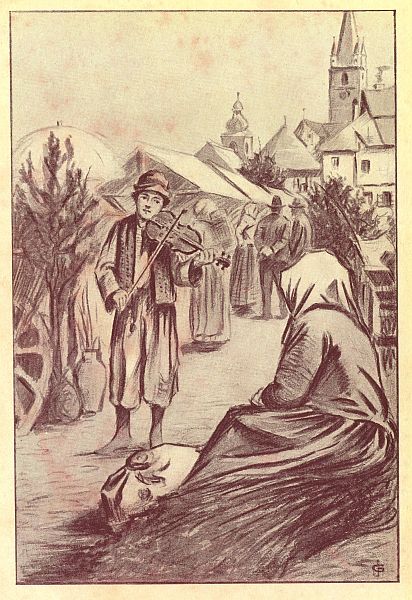
wind of the forest. A boy near by played
an impudent little tilinka (flageolet), and
Banda Bela said:
"That never sounded like real music to
me; only the violin sings. It is like the
wind in the trees, the rustle of the grass on
the moor, the dash of the waves on the
shore, the voice of the mother to her
child."
"Banda Bela, you are poet as well as
musician," said the Baroness. "You shall
never go back to Harom Szölöhoz to live.
You shall stay with me. I will sing to
your music, and you shall study music
till you are the greatest violin player in
all Hungary."
"When a Gypsy child comes into the
world they say his mother lays him on
the ground and at one side places a
purse and at the other a violin," said
Banda Bela. "To one side or other the
baby will turn his head. If he turns to
the purse he will be a thief, if he turns
to the violin he will earn his living by
music. My mother said she would give
me no chance to choose ill, but an old
woman near by laid forth both the purse
and the violin and I turned my head to
the violin and reached for it with my
baby hand. When they placed the bow
in my hand I grasped it so tight they
could scarce take it from me."
"Banda Bela," said Marushka, and her
tone was pettish. "You like your violin
better than you do me!" The boy laughed.
"My violin has earned you many a
supper, Little One; do not dislike it!"
"Oh, Your Graciousness, what are those
strange things?" cried Marushka. "They
are not automobiles, are they?"
"No, my child, they are the new steam
thrashing machines which the government
has just bought, and is teaching the peasants
to use instead of the old-fashioned ways
of thrashing. Now we are getting into
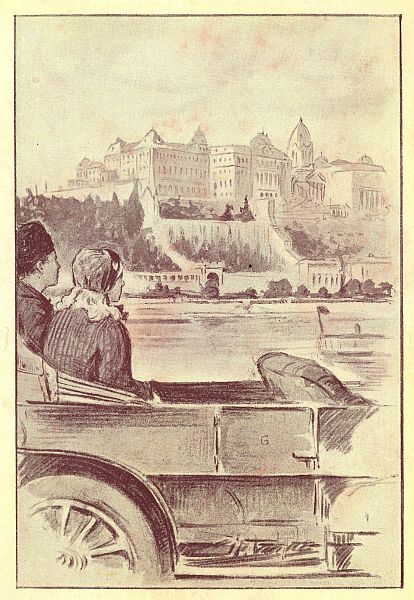
the country. See how beautifully the road
winds along the Danube! Is it not a wonderful
river? There is a famous waltz
called the 'Beautiful Blue Danube' and
the river is certainly as blue as the sky.
See that queer little cemetery among the
hills. I have often wondered why some of
the gravestones in the village cemeteries
had three feathers and coloured ribbons
on them."
"If you please, Your Graciousness," said
Banda Bela, "I can tell you. That is
for the grave of a girl who has died after
she was of an age to be married, yet for
whom no one had offered the buying money.
Aszszony Semeyer told me that."
"Aszszony Semeyer told me that every
peasant kept a wooden shovel hung upon
the wall of his house with which to throw
in the last shovelful of earth upon his
loved ones," said Marushka with a shudder.
"Ugh! I didn't like that."
"Very few people like to think about
death," said the Baroness. "See that thicket
of prickly pears beside the road? Once
when I was a little girl and very, very
naughty, I ran away from my nurse and to
hide from her I jumped over the wall and
landed in just such a thicket as that. I
think the pears must be naughty, too, for
they liked that little girl and would not
let her go. The thorns pricked her legs
and tore her frock and scratched her hands
when she tried to get her skirts loose, until
she cried with pain and called 'Kerem jojoro
ide'[14] to her nurse."
"I did not think the Gracious Baroness
was ever naughty," said Marushka.
"The Gracious Baroness was quite like
other little girls, my dear," she said, smiling.
"Ah, I have a little twinge of toothache!"
she exclaimed.
"That is too bad." Marushka was all
sympathy. "Aszszony Semeyer says that
if you will always cut your finger nails on
Friday you will never have toothache."
"Is that so? Then I shall certainly try
it," said the Baroness soberly. "Do you
see the gleam of white houses between the
trees? Those are the beautiful villas and
castles of the Svabhegy, the hill overlooking
the Danube, and here live many of
my very good friends.
"I am going to visit one of them for a
little while and you must be good, quiet
children and sit in the carriage while I go
in to make my call. Then, perhaps, I
will take you in for a few moments to
see the house, for it is a very beautiful
one. See! here we are at the gate," as
the carriage turned into a beautifully
ornamented gateway, above which was
carved the legend: If you love God and
your Country, enter; with malice in your
heart, go your way.
The driveway wound through beautiful
grounds, and through the trees were seen
glimpses of the Danube. The house itself
was white and stood at the crest of the hill
overlooking the river.
"This place belongs to the Count Ándrassy,"
said the Baroness. "He has also
another place in the Aföld and is very
wealthy. When my grandfather went to
visit his grandfather in the old days, they
once took the wheels from his carriage and
tied them to the tops of the tallest poplar
trees on the estate to prevent his leaving.
Another time they greased the shafts with
wolf fat, so that the horses would not allow
themselves to be harnessed up, for they are
so afraid of the wolf smell. Still another
time they hid his trunks in the attic so
that it was three months before my grandfather
finally got away.
"That was old-fashioned hospitality.
Here we are at the door. Sit quietly here
and I will return," and the Baroness sprang
down. There was a swish of her silken
skirts and the front door closed behind
her.
The children chattered gaily to each other
of all they had seen and heard since they
had left Harom Szölöhoz, and Marushka
said:
"It seems so long since we have left the
village, Banda Bela; somehow it seems as
if we would never go back."
"I think you never will." Banda Bela
spoke a little sadly. "Were you happy
there, Little One?"
"Oh, yes," she said brightly. "I was
happy with you and Aszszony Semeyer.
Only, when I saw other children with their
mothers, there was the ache right here—"
she laid her hand on her heart.
"I know," said Banda Bela. "I have
that always. Only when I play my violin
do I forget."
"But I cannot play the violin, nor can
I do anything, only embroider that horrible
Himmelbelt," and Marushka pouted, while
Banda Bela laughed at her.
"Think how proud you will be some day
to show that Himmelbelt to your husband,"
he said, but just then the Baroness and the
Count came out of the house together.
"What do you think?" the Baroness
asked the Count.
"I think you are right, but Maria
shall decide," he answered. "We will
say nothing to her and her heart will
speak."
"Come in, children," said the Baroness,
who looked strangely excited. Her eyes
shone and her cheeks were flushed, while
the Count's face was pale as death and he
looked strangely at Marushka.
"Banda Bela," said the Baroness, "the
Countess is not very well. She loves music
as you and I do, and I want you to come
in and play for her. She is very sad. Once
she lost her dear little daughter, and you
may play some gentle little songs for her.
It may give her pleasure. It is a beautiful
thing, Banda Bela, to give pleasure to those
who are sad."
The Baroness chattered on as they entered
the house. Marushka looked up at
the Count's face. Sad as it was she felt
drawn toward him. She saw him watching
her closely and smiled up at him with
the pretty, frank smile which always lighted
up her face so charmingly.
"High-Born Count," she said shyly, "I
have to thank you for the first present I
ever received in all my life."
"What was that, Little One?" he asked.
"The top boots which Banda Bela
bought for me at the fair at Harom
Szölöhoz. They were bought with the
florin you gave to Banda Bela for his
playing. They were so nice!" She dimpled
prettily.
"I am glad they gave you pleasure.
Come, we will go in and hear Banda Bela
play," said the Count, holding out his
hand. Marushka slipped her hand into
his and he led her into the house, entering
by the large hall, on the walls of which hung
deer horns and wolf heads, while a huge
stuffed wolf stood at one end, holding a
lamp in his paws. The Count was a great
sportsman and had shot many of these
animals himself in the forests of the Transylvania.
Banda Bela tuned his violin and then
began to play. It seemed to Marushka
as if she had never before heard him play
so beautifully. Many things he played,
all soft and dreamy, with a gentle, haunting
sadness through them, until at last he
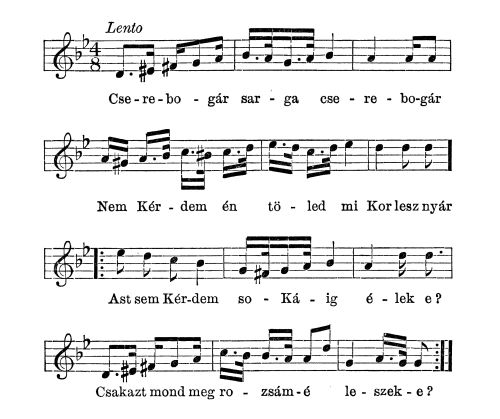
struck into a peculiar melody, a sort of
double harmony of joy and sorrow, which
he had never played before.
"What is that, Banda Bela?" demanded
the Baroness. "Who wrote it, what are
the words?"
"If you please, Your Graciousness"—the
boy flushed, "it is but a Gypsy song
of sorrow. The words are but in my own
heart."
"Strange boy," she thought, but at that
moment the door opened and a lady hastily
entered the room. She was tall and very
beautiful, with great masses of corn-coloured
hair and deep blue eyes, but her face had a
look of terrible sadness.
"Arpád!" she exclaimed. "What is this
music? It makes me weep for my lost one
and I am nearly blind with weeping now."
Her eyes, seeking her husband's, fell upon
Marushka, who during the music had been
leaning against the Count, his arm around
her. The Countess' eyes travelled up and
down the little figure, then sought her husband's
face with a sort of eager, frightened
questioning.
"Arpád!" she cried. "Arpád! Who is
this child?"
"Maria, my dearest! I have brought her
here that you may tell me who she is," he
said, trying to speak calmly.
She drew the little girl toward her and
Marushka went willingly and stood looking
into the sweet face of the Countess.
"Such a likeness," whispered the Baroness.
"They are as like as two sisters."
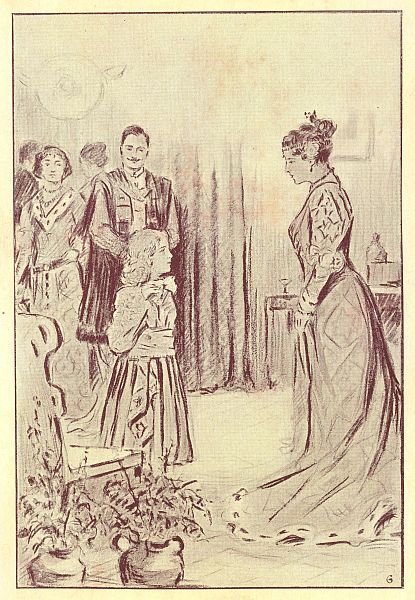
Then, all in a moment, the Countess
gathered Marushka into her arms and covered
the child's face with kisses. "You are
mine," she cried, tears streaming down her
face. "Mine! Arpád! I know it is our
little daughter come back to us after all
these years. My heart tells me it is she!"
Marushka looked frightened for a moment,
then she clung around her mother's
neck, and the Baroness quietly drew Banda
Bela from the room. From the hall the
sound of the Gypsy boy's violin came as he
played, with all his soul in his touch, the
song of his father:
"The hills are so blue,
The sun so warm,
The wind of the moor so soft and so kind!
Oh, the eyes of my mother,
The warmth of her breast,
The breath of her kiss on my cheek, alas!"
THE END
L. C. Page and Company's
BOOKS FOR YOUNG PEOPLE
THE LITTLE COLONEL BOOKS
(Trade Mark)
By ANNIE FELLOWS JOHNSTON
Each 1 vol., large 12mo, cloth, illustrated, per vol. $1.50
THE LITTLE COLONEL STORIES
(Trade Mark)
Being three "Little Colonel" stories in the Cosy Corner
Series, "The Little Colonel," "Two Little Knights of
Kentucky," and "The Giant Scissors," put into a single
volume.
THE LITTLE COLONEL'S HOUSE PARTY
(Trade Mark)
THE LITTLE COLONEL'S HOLIDAYS
(Trade Mark)
THE LITTLE COLONEL'S HERO
(Trade Mark)
THE LITTLE COLONEL AT BOARDING SCHOOL
(Trade Mark)
THE LITTLE COLONEL IN ARIZONA
(Trade Mark)
THE LITTLE COLONEL'S CHRISTMAS VACATION
(Trade Mark)
THE LITTLE COLONEL, MAID OF HONOUR
(Trade Mark)
THE LITTLE COLONEL'S KNIGHT COMES RIDING
(Trade Mark)
MARY WARE: THE LITTLE COLONEL'S CHUM
(Trade Mark)
These ten volumes, boxed as a ten-volume set. $15.00
THE LITTLE COLONEL
(Trade Mark)
TWO LITTLE KNIGHTS OF KENTUCKY
THE GIANT SCISSORS
BIG BROTHER
Special Holiday Editions
Each one volume, cloth decorative, small quarto, $1.25
New plates, handsomely illustrated with eight full-page
drawings in color, and many marginal sketches.
IN THE DESERT OF WAITING: The Legend of
Camelback Mountain.
THE THREE WEAVERS: A Fairy Tale for
Fathers and Mothers as Well as for Their
Daughters.
KEEPING TRYST
THE LEGEND OF THE BLEEDING HEART
THE RESCUE OF PRINCESS WINSOME: A Fairy Play for Old and Young.
| Each one volume, tall 16mo, cloth decorative | $0.50 |
| Paper boards | .35 |
There has been a constant demand for publication in
separate form of these six stories, which were originally
included in six of the "Little Colonel" books.
JOEL: A BOY OF GALILEE: By Annie Fellows
Johnston. Illustrated by L. J. Bridgman.
New illustrated edition, uniform with the Little Colonel Books, 1 vol., large 12mo, cloth decorative $1.50
A story of the time of Christ, which is one of the author's
best-known books.
THE LITTLE COLONEL GOOD TIMES BOOK
| Uniform in size with the Little Colonel Series | $1.50 |
| Bound in white kid (morocco) and gold | 3.00 |
Cover design and decorations by Amy Carol Rand.
The publishers have had many inquiries from readers
of the Little Colonel books as to where they could obtain
a "Good Times Book" such as Betty kept. Mrs. Johnston,
who has for years kept such a book herself, has gone
enthusiastically into the matter of the material and format
for a similar book for her young readers. Every girl will
want to possess a "Good Times Book."
ASA HOLMES: Or, At the Cross-Roads. A sketch
of Country Life and Country Humor. By Annie
Fellows Johnston.
With a frontispiece by Ernest Fosbery.
Large 16mo, cloth, gilt top $1.00
"'Asa Holmes; or, At the Cross-Roads' is the most
delightful, most sympathetic and wholesome book that
has been published in a long while."—Boston Times.
THE RIVAL CAMPERS: Or, The Adventures of
Henry Burns. By Ruel Perley Smith.
Square 12mo, cloth decorative, illustrated $1.50
A story of a party of typical American lads, courageous,
alert, and athletic, who spend a summer camping on an
island off the Maine coast.
THE RIVAL CAMPERS AFLOAT: Or, The
Prize Yacht Viking. By Ruel Perley Smith.
Square 12mo, cloth decorative, illustrated $1.50
This book is a continuation of the adventures of "The
Rival Campers" on their prize yacht Viking.
By Ruel Perley Smith.
Square 12mo, cloth decorative, illustrated $1.50
"As interesting ashore as when afloat."—The Interior.
JACK HARVEY'S ADVENTURES: Or, The
Rival Campers Among the Oyster Pirates. By
Ruel Perley Smith. Illustrated $1.50
"Just the type of book which is most popular with lads
who are in their early teens."—The Philadelphia Item.
PRISONERS OF FORTUNE: A Tale of the Massachusetts
Bay Colony. By Ruel Perley Smith.
Cloth decorative, with a colored frontispiece $1.50
"There is an atmosphere of old New England in the
book, the humor of the born raconteur about the hero,
who tells his story with the gravity of a preacher, but with
a solemn humor that is irresistible."—Courier-Journal.
FAMOUS CAVALRY LEADERS. By Charles H.
L. Johnston.
Large 12mo. With 24 illustrations $1.50
Biographical sketches, with interesting anecdotes and
reminiscences of the heroes of history who were leaders
of cavalry.
"More of such books should be written, books that
acquaint young readers with historical personages in a
pleasant informal way."—N. Y. Sun.
FAMOUS INDIAN CHIEFS. By Charles H. L.
Johnston.
Large 12mo, illustrated $1.50
In this book Mr. Johnston gives interesting sketches of
the Indian braves who have figured with prominence in
the history of our own land, including Powhatan, the
Indian Cæsar; Massasoit, the friend of the Puritans;
Pontiac, the red Napoleon; Tecumseh, the famous war
chief of the Shawnees; Sitting Bull, the famous war chief
of the Sioux; Geronimo, the renowned Apache Chief, etc.,
etc.
BILLY'S PRINCESS. By Helen Eggleston Haskell.
Cloth decorative, illustrated by Helen McCormick Kennedy $1.25
Billy Lewis was a small boy of energy and ambition, so
when he was left alone and unprotected, he simply started
out to take care of himself.
TENANTS OF THE TREES. By Clarence
Hawkes.
Cloth decorative, illustrated in colors $1.50
"A book which will appeal to all who care for the
hearty, healthy, outdoor life of the country. The illustrations
are particularly attractive."—Boston Herald.
BEAUTIFUL JOE'S PARADISE: Or, The Island
of Brotherly Love. A sequel to "Beautiful Joe."
By Marshall Saunders, author of "Beautiful Joe."
One vol., library 12mo, cloth, illustrated $1.50
"This book revives the spirit of 'Beautiful Joe' capitally.
It is fairly riotous with fun, and is about as unusual
as anything in the animal book line that has seen the light."—Philadelphia
Item.
'TILDA JANE. By Marshall Saunders.
One vol., 12mo, fully illustrated, cloth decorative, $1.50
"I cannot think of any better book for children than
this. I commend it unreservedly."—Cyrus Townsend
Brady.
'TILDA JANE'S ORPHANS. A sequel to 'Tilda
Jane. By Marshall Saunders.
One vol., 12mo, fully illustrated, cloth decorative, $1.50
'Tilda Jane is the same original, delightful girl, and as
fond of her animal pets as ever.
THE STORY OF THE GRAVELEYS. By Marshall
Saunders, author of "Beautiful Joe's Paradise,"
"'Tilda Jane," etc.
Library 12mo, cloth decorative. Illustrated by E. B. Barry $1.50
Here we have the haps and mishaps, the trials and
triumphs, of a delightful New England family, of whose
devotion and sturdiness it will do the reader good to hear.
BORN TO THE BLUE. By Florence Kimball
Russel.
12mo, cloth decorative, illustrated $1.25
The atmosphere of army life on the plains breathes on
every page of this delightful tale. The boy is the son of a
captain of U. S. cavalry stationed at a frontier post in the
days when our regulars earned the gratitude of a nation.
IN WEST POINT GRAY
By Florence Kimball Russel.
12mo, cloth decorative, illustrated $1.50
"Singularly enough one of the best books of the year
for boys is written by a woman and deals with life at West
Point. The presentment of life in the famous military
academy whence so many heroes have graduated is realistic
and enjoyable."—New York Sun.
FROM CHEVRONS TO SHOULDER STRAPS
By Florence Kimball Russel.
12mo, cloth, illustrated, decorative $1.50
West Point again forms the background of a new volume
in this popular series, and relates the experience of Jack
Stirling during his junior and senior years.
THE SANDMAN: HIS FARM STORIES
By William J. Hopkins. With fifty illustrations by
Ada Clendenin Williamson.
Large 12mo, decorative cover $1.50
"An amusing, original book, written for the benefit of
very small children. It should be one of the most popular
of the year's books for reading to small children."—Buffalo
Express.
THE SANDMAN: MORE FARM STORIES
By William J. Hopkins.
Large 12mo, decorative cover, fully illustrated $1.50
Mr. Hopkins's first essay at bedtime stories met with
such approval that this second book of "Sandman" tales
was issued for scores of eager children. Life on the farm,
and out-of-doors, is portrayed in his inimitable manner.
THE SANDMAN: HIS SHIP STORIES
By William J. Hopkins, author of "The Sandman:
His Farm Stories," etc.
Large 12mo, decorative cover, fully illustrated $1.50
"Children call for these stories over and over again."—Chicago
Evening Post.
THE SANDMAN, HIS SEA STORIES
By William J. Hopkins.
Large 12mo, decorative cover, fully illustrated $1.50
Each year adds to the popularity of this unique series
of stories to be read to the little ones at bed time and at
other times.
THE DOCTOR'S LITTLE GIRL
By Marion Ames Taggart, author of "Pussy-Cat
Town," etc.
One vol., library, 12mo, illustrated $1.50
A thoroughly enjoyable tale of a little girl and her comrade
father, written in a delightful vein of sympathetic
comprehension of the child's point of view.
SWEET NANCY
The Further Adventures of the Doctor's Little
Girl. By Marion Ames Taggart.
One vol., library, 12mo, illustrated $1.50
In the new book, the author tells how Nancy becomes
in fact "the doctor's assistant," and continues to shed
happiness around her.
THE CHRISTMAS-MAKERS' CLUB
By Edith A. Sawyer.
12mo, cloth decorative, illustrated $1.50
A delightful story for girls, full of the real spirit of
Christmas. It abounds in merrymaking and the right
kind of fun.
CARLOTA
A Story of the San Gabriel Mission. By Frances
Margaret Fox.
Square 12mo, cloth decorative, illustrated and decorated in colors by Ethelind Ridgway $1.00
"It is a pleasure to recommend this little story as an
entertaining contribution to juvenile literature."—The
New York Sun.
THE SEVEN CHRISTMAS CANDLES
By Frances Margaret Fox.
Square 12mo, cloth decorative, illustrated and decorated in colors by Ethelind Ridgway $1.00
Miss Fox's new book deals with the fortunes of the delightful
Mulvaney children.
PUSSY-CAT TOWN
By Marion Ames Taggart.
Small quarto, cloth decorative, illustrated and decorated in colors $1.00
"Anything more interesting than the doings of the cats
in this story, their humor, their wisdom, their patriotism,
would be hard to imagine."—Chicago Post.
THE ROSES OF SAINT ELIZABETH
By Jane Scott Woodruff.
Small quarto, cloth decorative, illustrated and decorated in colors by Adelaide Everhart $1.00
This is a charming little story of a child whose father was
caretaker of the great castle of the Wartburg, where Saint
Elizabeth once had her home.
GABRIEL AND THE HOUR BOOK
By Evaleen Stein.
Small quarto, cloth decorative, illustrated and decorated in colors by Adelaide Everhart $1.00
Gabriel was a loving, patient, little French lad, who
assisted the monks in the long ago days, when all the books
were written and illuminated by hand, in the monasteries.
THE ENCHANTED AUTOMOBILE
Translated from the French by Mary J. Safford
Small quarto, cloth decorative, illustrated and decorated in colors by Edna M. Sawyer $1.00
"An up-to-date French fairy-tale which fairly radiates
the spirit of the hour,—unceasing diligence."—Chicago
Record-Herald.
O-HEART-SAN
The Story of a Japanese Girl. By Helen Eggleston
Haskell.
Small quarto, cloth decorative, illustrated and decorated in colors by Frank P. Fairbanks $1.00
"The story comes straight from the heart of Japan.
The shadow of Fujiyama lies across it and from every
page breathes the fragrance of tea leaves, cherry blossoms
and chrysanthemums."—The Chicago Inter-Ocean.
THE YOUNG SECTION-HAND: Or, The Adventures
of Allan West. By Burton E. Stevenson.
Square 12mo, cloth decorative, illustrated $1.50
Mr. Stevenson's hero is a manly lad of sixteen, who is
given a chance as a section-hand on a big Western railroad,
and whose experiences are as real as they are thrilling.
THE YOUNG TRAIN DISPATCHER. By Burton
E. Stevenson.
Square 12mo, cloth decorative, illustrated $1.50
"A better book for boys has never left an American
press."—Springfield Union.
THE YOUNG TRAIN MASTER. By Burton E.
Stevenson.
Square 12mo, cloth decorative, illustrated $1.50
"Nothing better in the way of a book of adventure for
boys in which the actualities of life are set forth in a practical
way could be devised or written."—Boston Herald.
CAPTAIN JACK LORIMER. By Winn Standish.
Square 12mo, cloth decorative, illustrated $1.50
Jack is a fine example of the all-around American high-school
boy.
JACK LORIMER'S CHAMPIONS: Or, Sports on
Land and Lake. By Winn Standish.
Square 12mo, cloth decorative, illustrated $1.50
"It is exactly the sort of book to give a boy interested
in athletics, for it shows him what it means to always
'play fair.'"—Chicago Tribune.
JACK LORIMER'S HOLIDAYS: Or, Millvale
High in Camp. By Winn Standish.
Illustrated $1.50
Full of just the kind of fun, sports and adventure to
excite the healthy minded youngster to emulation.
JACK LORIMER'S SUBSTITUTE: Or, The Acting
Captain of the Team. By Winn Standish.
Illustrated $1.50
On the sporting side, this book takes up football, wrestling,
tobogganing, but it is more of a school story perhaps
than any of its predecessors.
CAPTAIN JINKS: The Autobiography of a Shetland
Pony. By Frances Hodges White.
Cloth decorative, illustrated $1.50
The story of Captain Jinks and his faithful dog friend
Billy, their quaint conversations and their exciting
adventures, will be eagerly read by thousands of boys and
girls. The story is beautifully written and will take its
place alongside of "Black Beauty" and "Beautiful Joe."
THE RED FEATHERS. By Theodore Roberts.
Cloth decorative, illustrated $1.50
"The Red Feathers" tells of the remarkable adventures
of an Indian boy who lived in the Stone Age, many years
ago, when the world was young.
FLYING PLOVER. By Theodore Roberts.
Cloth decorative. Illustrated by Charles Livingston Bull $1.00
Squat-By-The-Fire is a very old and wise Indian who
lives alone with her grandson, "Flying Plover," to whom
she tells the stories each evening.
THE WRECK OF THE OCEAN QUEEN. By
James Otis, author of "Larry Hudson's Ambition," etc.
Cloth decorative, illustrated $1.50
"A stirring story of wreck and mutiny, which boys will
find especially absorbing. The many young admirers of
James Otis will not let this book escape them, for it fully
equals its many predecessors in excitement and sustained
interest."—Chicago Evening Post.
LITTLE WHITE INDIANS. By Fannie E. Ostrander.
Cloth decorative, illustrated $1.25
"A bright, interesting story which will appeal strongly
to the 'make-believe' instinct in children, and will
give them a healthy, active interest in 'the simple life.'"
MARCHING WITH MORGAN. How Donald
Lovell Became a Soldier of the Revolution.
By John L. Veasy.
Cloth decorative, illustrated $1.50
This is a splendid boy's story of the expedition of
Montgomery and Arnold against Quebec.
Transcriber's Notes:
Obvious punctuation errors repaired.
All spelling of Hungarian words retained as printed in the original
text with the exception of "sokáig" in the song on page 36. That had
a capital K in the middle which was changed to lower case. The rest
are as printed. Toward that end, text uses both "Ándrassy" and "Andrássy";
"Budavara" and "Budavará."
Page 30, "sherpherds" changed to "shepherds" (shepherds' huts)
Page 92, "litte" changed to "little" (beautiful little creature)
Page 108, "you" changed to "your" (your old aunt)
Music Notes:
In the first system, third bar, the last note has been corrected to a dotted eighth.
In the third system, first bar, the last note has been corrected to an eighth; second bar, the sixteenths have been corrected to dotted sixteenths.