CHAPTER X. SUMMER TRAVELS.
The long winter was over at last, and Etu's
people got ready to leave their underground
homes. They would spend the first spring
days farther up the coast, and closer still to
the water's side; for there they could watch
the seal-holes more easily.
The household goods were packed on the
sledges, and Etu said good-bye to his winter
home for four months. The men walked
along, guiding the dogs, while the women and
children rode in the sledges. They travelled
nearly all day before they came to a place
where they wished to settle. But the weather
was even now bitterly cold. The snow still
covered the earth, and the water along the
shore was a mass of broken ice.
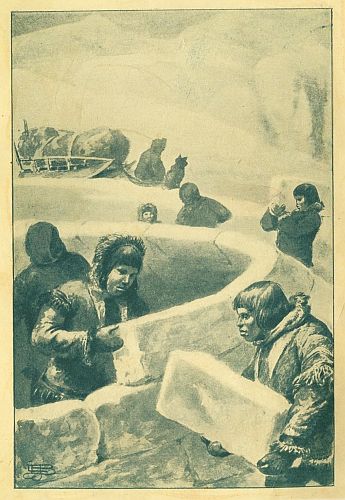
"THE BLOCKS OF SNOW WERE HANDED TO THEM"
Where were these people to be sheltered
when night came on? The question could be
easily answered. They would build homes for
themselves in an hour or two. The sheets of
snow around them were quite solid, and the
boys and men began to saw the snow into
thick blocks. The walls and roofs of the
houses should be built of these.
Two men stood in the centre of each cleared
space: the blocks of snow were handed to
them. These were laid on the ground, side
by side, in a circle as large as they wished the
house to be. The foundation was quickly
made. Then another row of snow blocks was
laid above the first, but drawn in toward the
centre a very little. Then came a third row,
and so on, till at last there was just space
enough at the top for one block of snow to
fill it in completely. The new house looked
like a great snow beehive.
But the two builders were shut up inside!
One of the men on the outside cut a block of
snow out of the wall of the house. This made
a doorway through which people could go and
come. It could be closed afterward, when the
inmates desired, by filling it again with a snow
door.
The builders now took loose snow and
sifted it into the cracks and crevices to make
the house quite close and tight.
After this, the floor must be trodden down
smooth, and then the women could enter to
set up housekeeping. A bed of snow was
quickly made, over which the fur rugs were
thrown. Next, a stand of snow was shaped,
and the lamp set up in its place. The oil was
soon burning brightly, and snow was melted to
furnish drinking-water. In half an hour more
our cousin Etu was eating supper as comfortably
as he could wish. Not long after, he
was sound asleep on his snow bedstead,
without a single dream of cold or trouble.
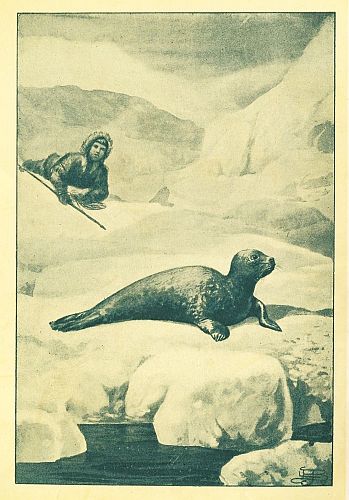
After a few weeks of seal hunting, Etu
noticed that the birds were returning. There
were great numbers of them,—wild ducks,
geese, and sea-birds of many kinds.
The ice began to disappear, and it was great
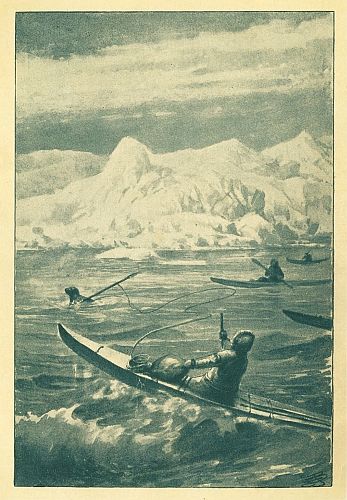
sport to paddle his boat over to the islands
near the shore, and shoot a bagful of birds
for dinner. But sometimes he stayed in his
boat, and, moving slowly along the shore,
would throw his bird-dart at ducks as they
flew by. His aim was straight and true, and
he was almost sure to be successful.
Spring changed suddenly into summer, and
now the snow house must be left, for Etu
and his people were ready to move again.
Besides, the walls of the house grew soft, and
would soon melt away.
Where would Etu travel next? you ask.
He would answer:
"Not far from here there is a broad river
where great numbers of salmon live during the
warm weather. It is great sport catching the
fish. Now we can have so much rich food
that we can all grow fat."
Once more the dogs were harnessed, and
the spring camping-ground was left behind,
as the Eskimo party journeyed southward.
When the river was reached, new homes must
be made ready. But what material would be
used now? There were no trees to furnish
wood, for the forests were still hundreds of
miles south of them, and snow at this time
of the year was out of the question.
But Etu's people were well prepared, for
they took their supply of skins, and quickly
made tents out of them. It was still so cold
that a double row of skins must be used to
keep out the sharp winds.
And now they were ready for the happiest
part of the whole year. They need not fear
hunger for a long time to come. Plenty of
fish in the river, plenty of birds in the air,
birds' eggs, which the bright eyes of the boys
and girls would discover; and, besides all
these dainties, they would get stores of reindeer
meat.
"How could any one be any happier than
I?" thought Etu, and he smiled a broad
smile, making a funny face to express his
joy.
In another country of the world as far north
as Etu lives, the Laplander has herds of tame
reindeer. They are driven as Etu drives his
dogs. They give sweet milk, too.
Etu has never heard of these people, but he
has been told that there is a place in his own
country where his kind American friends have
brought some of these tame reindeer from
Lapland. Great care is taken of them, so
they will grow and get used to their new
home. It will be a fine thing for Etu's
people to have these tame reindeer and be
able to get fresh milk during the long winter,
as well as tame animals that will supply them
with food when they are in danger of starving.
But Etu busies himself now with setting
traps for the wild reindeer which begin to
appear in the country as summer opens.
They have spent the winter in the forests
far away, but as the heat of the sun begins
to melt the snow, they travel toward the
shores of the ocean.
Here the baby reindeer are born. They
are tiny, weak little creatures at first; but they
grow fast, and in a few days are able to take
care of themselves, and get their own food.
The reindeer have a wonderfully keen sense
of smell. Even when the ground is covered
with a deep layer of snow, they seem able to
tell where the lichens and mosses are living
beneath it. No one has ever seen a reindeer
make a mistake in this matter. When he
begins to paw away the snow with his broad,
stout hoofs, you may be sure he has discovered
a good dinner for himself. The lichens
are tender and white, and taste somewhat like
wheat bran. It is no wonder the reindeer
grows fat on this plentiful food.
Etu hunts the reindeer in several different
ways. Sometimes when he is out on the
watch for them he hears a great clattering.
It may be a long way off, and he cannot see
a living thing, yet he knows what that sound
means. It is the hoofs of the reindeer as they
come pounding along.
He lies down and keeps very still. He
watches closely, however, to see if the reindeer
are coming in his direction. If he finds this
to be so, he keeps in the same position and
waits till they have passed by him and are
headed for the shore.
Then he jumps up suddenly, and chases
them with fury. They get confused, and rush
onward in disorder. On he follows till they
reach the water's side, where they plunge madly
in. They are good swimmers, but are so
frightened that Etu is easily able to secure at
least one of them.
Sometimes our Eskimo cousin goes a long
way over the plains, and with his father's help
digs a deep pit in the earth. They cover it
over with brushwood. If a herd of reindeer
should travel in this direction, some of them
would fall into the pit and break their slender
legs. It would be an easy matter then to
come and get them.
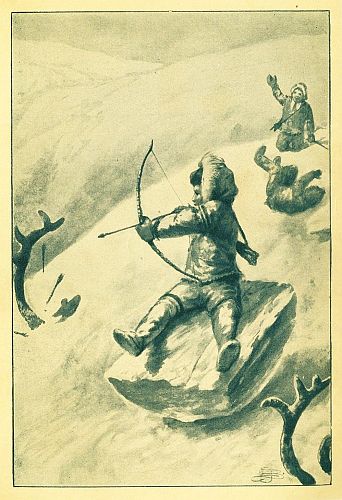
But there is another way that Etu likes best
of all. Soon after he came to his summer
home he hunted about over the country till
he had chosen a spot where the reindeer were
likely to come. Here he built a sort of fort,
or wall, out of stones. He could hide behind
this wall, and watch for his game without their
being able to see him. He spent many days
of the summer in this place with one of his
boy friends. They would sit there talking, or
playing some quiet game, but their bows and
arrows were always ready; and their eyes ever
on the lookout for the reindeer who might
come that way at any moment.
Many times, of course, they met with no
success; but many times, too, they took a
herd by surprise, and were able to carry home
a goodly feast to their friends and relatives.
Reindeer meat is tender and sweet, the
marrow and tongue being the parts best liked
by Etu's people. But the most delicious food
Etu ever puts into his mouth is the contents
of a reindeer's stomach! We must not be
shocked at this, though it does seem a queer
thing to eat, doesn't it? The reason Etu
likes it so well is probably this: the food of
the reindeer is moss; when it has entered his
stomach it has a slightly acid taste, so it gives
a relish the people cannot often get. Besides,
it belongs to the vegetable kingdom, and Etu's
people, we know, do not have the pleasure of
eating corn, potatoes, and other delicious fruits
of the earth, so commonly used by us that we
hardly appreciate them.
It was after one of these long days on the
plains that Etu came home feeling quite ill.
His head ached; his eyes were bloodshot;
his hands and face burned like fire.
His loving mother was quite worried. She
put her son to bed at once, and sent for the
medicine-man. She got a present of deer skins
ready to give him as soon as the great person
should appear.
After he had accepted the deer skins the
doctor put on a horrible black mask; then
he began to move about the tent, waving his
arms from side to side, and repeating a charm.
Do you understand what he was trying to do?
He thought a bad spirit had got hold of Etu;
he believed the hideous mask and the charm
of certain words would drive it out.
After awhile he went away, and Etu was
alone again with his own people. His fever
lasted for several days, but at length it left
him, and he grew well and strong once more.
He believed the great medicine-man had
healed him; but we think Mother Nature
worked her own cure through rest in his
own warm bed. The poor boy was tired out,
and had caught a hard cold watching on the
plains.
As soon as he was strong his father said:
"The trading season has come, for it is already
two moons since we made our camp.
We must journey southward to the great river.
We shall see our friends from the western
coast; they must have already started to meet
us. Let us get our furs, seal oil, and walrus
tusks together to sell to them, for, no doubt,
they will have many things to give us in exchange.
We greatly need some copper kettles
and tobacco. Oh, yes, let us get ready as
soon as possible."
Etu was delighted to hear these words.
Now would come the merriest time. He
would have a long journey, and he dearly
liked a change. But that was not all. He
would see new people, and hear of new things;
he would have a chance to trade, and that
would be great sport in itself.
Besides all these things, he knew his people
would spend at least ten days with their friends
from the west; and there would be much
dancing and singing and story-telling, both
day and night. Hurrah, then, for this summer
journey!
You may be sure Etu did his best in packing
and making ready. In another twenty-four
hours there was no sign left of this
Eskimo village. The dogs, the sledges, and
the people were all gone. Nothing was left
except a few articles used in housekeeping,
and these were buried in an underground
storehouse.
If you wish to hear more about Etu, and of
his yearly visit south; if you care to hear
about the big whale he helped to kill last
winter, and of his adventure with a walrus,
you must write and ask him about these
things.
And yet, after all, I fear he could not read
the letter. You would better go and visit
him. It is well worth the journey, for then
you can see for yourself how a boy can be
cheerful and happy and loving, even though
he lives in the dreariest part of the whole
world.
THE END.
L. C. Page & Co.'s
Books for
Young People
THE LITTLE COUSIN SERIES
The most delightful and interesting accounts possible
of child-life in other lands, filled with quaint sayings,
doings, and adventures.
Each 1 vol., 12mo, decorative cover, cloth, with six
full-page illustrations in color by L. J. Bridgman.
Price per volume $0.60
"Juveniles will get a whole world of pleasure and instruction
out of The Little Cousin Series.... Pleasing narratives
give pictures of the little folk in the far-away lands in
their duties and pleasures, showing their odd ways of
playing, studying, their queer homes, clothes, and play-things...."—Detroit
News-Tribune.
By MARY HAZELTON WADE
- Our Little Swiss Cousin.
- Our Little Norwegian Cousin.
- Our Little Italian Cousin.
- Our Little Siamese Cousin.
- Our Little Cuban Cousin.
- Our Little Hawaiian Cousin.
- Our Little Eskimo Cousin.
- Our Little Philippine Cousin.
- Our Little Porto Rican Cousin.
- Our Little African Cousin.
- Our Little Japanese Cousin.
- Our Little Brown Cousin.
- Our Little Indian Cousin.
- Our Little Russian Cousin.
- Our Little German Cousin.
- Our Little Irish Cousin.
- Our Little Turkish Cousin.
- Our Little Jewish Cousin.
By ISAAC HEADLAND TAYLOR
- Our Little Chinese Cousin.
By ELIZABETH ROBERTS MacDONALD
- Our Little Canadian Cousin.
ANIMAL TALES
By Charles G. D. Roberts
ILLUSTRATED BY
Charles Livingston Bull
as follows:
The Lord of the Air
(The Eagle)
The King of the Mamozekel
(The Moose)
The Watchers of the Camp-fire
(The Panther)
The Haunter of the Pine Gloom
(The Lynx)
Each 1 vol., small 12mo, cloth decorative, per volume $0.50
Realizing the great demand for the animal stories of
Professor Roberts, one of the masters of nature writers,
the publishers have selected four representative stories, to
be issued separately, at a popular price. Each story is
illustrated by Charles Livingston Bull, and is bound in a
handsome decorative cover.
THE LITTLE COLONEL BOOKS
(Trade Mark.)
By ANNIE FELLOWS JOHNSTON
Each, 1 vol., large 12mo, cloth decorative, fully illustrated, per vol. $1.50
The Little Colonel Stories.
(Trade Mark.)
Illustrated.
Being three "Little Colonel" stories in the Cosy
Corner Series, "The Little Colonel," "Two Little
Knights of Kentucky," and "The Giant Scissors," put
into a single volume.
The Little Colonel's House Party.
(Trade Mark.)
Illustrated by Louis Meynell.
The Little Colonel's Holidays.
(Trade Mark.)
Illustrated by L. J. Bridgman.
The Little Colonel's Hero.
(Trade Mark.)
Illustrated by E. B. Barry.
The Little Colonel at Boarding School.
(Trade Mark.)
Illustrated by E. B. Barry.
The Little Colonel in Arizona. (In preparation.)
(Trade Mark.)
Illustrated by L. J. Bridgman.
Since the time of "Little Women," no juvenile heroine
has been better beloved of her child readers than Mrs.
Johnston's "Little Colonel." Each succeeding book
has been more popular than its predecessor.
Joel: A Boy of Galilee.
By Annie Fellows Johnston. Illustrated by L. J.
Bridgman.
New illustrated edition, uniform with the Little Colonel Books, 1 vol., large 12mo, cloth decorative $1.50
A story of the time of Christ, which is one of the
author's best-known books, and which has been translated
into many languages, the last being Italian.
Flip's "Islands of Providence." By
Annie Fellows Johnston.
12mo, cloth, with illustrations $1.00
In this book the author of "The Little Colonel" and
her girl friends and companions shows that she is
equally at home in telling a tale in which the leading
character is a boy, and in describing his troubles and
triumphs in a way that will enhance her reputation as a
skilled and sympathetic writer of stories for children.
Asa Holmes; or, At the Cross-Roads. A
sketch of Country Life and Country Humor. By
Annie Fellows Johnston. With a frontispiece by
Ernest Fosbery.
Large 16mo, cloth, gilt top $1.00
"'Asa Holmes; or, At the Cross-roads' is the most delightful,
most sympathetic and wholesome book that has been
published in a long while. The lovable, cheerful, touching
incidents, the descriptions of persons and things are wonderfully
true to nature."—Boston Times.
The Great Scoop. By Molly Elliot Seawell,
author of "Little Jarvis," "Laurie Vane," etc.
12mo, cloth, with illustrations $1.00
A capital tale of newspaper life in a big city, and of
a bright, enterprising, likable youngster employed therein.
Every boy with an ounce of true boyish blood in him
will have the time of his life in reading how Dick Henshaw
entered the newspaper business, and how he
secured "the great scoop."
Little Lady Marjorie. By Francis Margaret
Fox, author of "Farmer Brown and the
Birds," etc.
12mo, cloth, illustrated $1.50
A charming story for children between the ages of ten
and fifteen years, with both heart and nature interest.
The Sandman: His Farm Stories. By
William J. Hopkins. With fifty illustrations by
Ada Clendenin Williamson.
One vol., large 12mo, decorative cover $1.50
"An amusing, original book, written for the benefit of
children not more than six years old, is, 'The Sandman: His
Farm Stories.' It should be one of the most popular of the
year's books for reading to small children."—Buffalo Express.
"Mothers and fathers and kind elder sisters who take the
little ones to bed and rack their brains for stories will find this
book a treasure."—Cleveland Leader.
The Sandman: More Farm Stories. By
William J. Hopkins, author of "The Sandman:
His Farm Stories."
Library 12mo, cloth decorative, fully illustrated, $1.50
Mr. Hopkins's first essay at bedtime stories has met
with such approval that this second book of "Sandman"
tales has been issued for scores of eager children. Life
on the farm, and out-of-doors, will be portrayed in his
inimitable manner, and many a little one will hail the
bedtime season as one of delight.
A Puritan Knight Errant. By Edith
Robinson, author of "A Little Puritan Pioneer," "A
Little Puritan's First Christmas," "A Little Puritan
Rebel," etc.
Library 12mo, cloth decorative, illustrated $1.50
The charm of style and historical value of Miss
Robinson's previous stories of child life in Puritan days
have brought them wide popularity. Her latest and
most important book appeals to a large juvenile public.
The "knight errant" of this story is a little Don Quixote,
whose trials and their ultimate outcome will prove
deeply interesting to their reader.
Beautiful Joe's Paradise; or, The Island
of Brotherly Love. A sequel to "Beautiful Joe."
By Marshall Saunders, author of "Beautiful Joe,"
"For His Country," etc. With fifteen full-page plates
and many decorations from drawings by Charles Livingston
Bull.
One vol., library 12mo, cloth decorative $1.50
"Will be immensely enjoyed by the boys and girls who
read it."—Pittsburg Gazette.
"Miss Saunders has put life, humor, action, and tenderness
into her story. The book deserves to be a favorite."—Chicago
Record-Herald.
"This book revives the spirit of 'Beautiful Joe' capitally.
It is fairly riotous with fun, and as a whole is about as unusual
as anything in the animal book line that has seen the
light. It is a book for juveniles—old and young."—Philadelphia
Item.
'Tilda Jane. By Marshall Saunders, author
of "Beautiful Joe," etc.
One vol., 12mo, fully illustrated, cloth, decorative cover $1.50
"No more amusing and attractive child's story has appeared
for a long time than this quaint and curious recital of
the adventures of that pitiful and charming little runaway.
"It is one of those exquisitely simple and truthful books
that win and charm the reader, and I did not put it down
until I had finished it—honest! And I am sure that every
one, young or old, who reads will be proud and happy to
make the acquaintance of the delicious waif.
"I cannot think of any better book for children than this.
I commend it unreservedly."—Cyrus Townsend Brady.
The Story of the Graveleys. By Marshall
Saunders, author of "Beautiful Joe's Paradise,"
"'Tilda Jane," etc.
Library 12mo, cloth decorative, illustrated by E. B. Barry $1.50
Here we have the haps and mishaps, the trials and
triumphs, of a delightful New England family, of whose
devotion and sturdiness it will do the reader good to
hear. From the kindly, serene-souled grandmother to
the buoyant madcap, Berty, these Graveleys are folk of
fibre and blood—genuine human beings.
PHYLLIS' FIELD FRIENDS SERIES
By LENORE E. MULETS
Six vols., cloth decorative, illustrated by Sophie
Schneider. Sold separately, or as a set.
| Per volume | $1.00 |
| Per set | $6.00 |
- Insect Stories.
- Stories of Little Animals.
- Flower Stories.
- Bird Stories.
- Tree Stories.
- Stories of Little Fishes.
In this series of six little Nature books, it is the
author's intention so to present to the child reader the
facts about each particular flower, insect, bird, or animal,
in story form, as to make delightful reading. Classical
legends, myths, poems, and songs are so introduced
as to correlate fully with these lessons, to which the
excellent illustrations are no little help.
THE WOODRANGER TALES
By G. WALDO BROWNE
- The Woodranger.
- The Young Gunbearer.
- The Hero of the Hills.
| Each, 1 vol., large 12mo, cloth, decorative cover, illustrated, per volume | $1.00 |
| Three vols., boxed, per set | $3.00 |
"The Woodranger Tales," like the "Pathfinder
Tales" of J. Fenimore Cooper, combine historical information
relating to early pioneer days in America
with interesting adventures in the backwoods. Although
the same characters are continued throughout the series,
each book is complete in itself, and, while based strictly
on historical facts, is an interesting and exciting tale of
adventure.
The Rosamond Tales. By Cuyler Reynolds.
With 30 full-page illustrations from original
photographs, and with a frontispiece from a drawing
by Maud Humphreys.
One vol., large 12mo, cloth decorative $1.50
These are just the bedtime stories that children always
ask for, but do not always get. Rosamond and Rosalind
are the hero and heroine of many happy adventures
in town and on their grandfather's farm; and the happy
listeners to their story will unconsciously absorb a vast
amount of interesting knowledge of birds, animals, and
flowers. The book will be a boon to tired mothers, and
a delight to wide-awake children.
Larry Hudson's Ambition. By James
Otis, author of "Toby Tyler," etc. Illustrated by
Eliot Keen.
One vol., library 12mo, cloth, decorative cover, $1.25
James Otis, who has delighted the juvenile public
with so many popular stories, has written the story of
the rise of the bootblack Larry. Larry is not only
capable of holding his own and coming out with flying
colors in the amusing adventures wherein he befriends
the family of good Deacon Doak; he also has the
signal ability to know what he wants and to understand
that hard work is necessary to win.
Black Beauty: The Autobiography of a
Horse. By Anna Sewell. New Illustrated
Edition. With nineteen full-page drawings by Winifred
Austin.
One vol., large 12mo, cloth decorative, gilt top, $1.25
There have been many editions of this classic, but we
confidently offer this one as the most appropriate and
handsome yet produced. The illustrations are of special
value and beauty. Miss Austin is a lover of horses, and
has delighted in tracing with her pen the beauty and
grace of the noble animal.
"Yours with All My Heart:" The
Autobiography of a Real Dog. By Esther M.
Baxendale. Very fully illustrated with upwards of
a hundred drawings by Etheldred B. Barry.
Large 12mo, cloth decorative $1.50
Mrs. Baxendale's charming story, though written
primarily for children, will find a warm welcome from
all those who love animals. It is a true story of a
deeply loved pet and companion of the author's for
thirteen years; and it cannot fail to inspire in the hearts
of all the young people fortunate enough to hear it that
affection and sympathy for domestic animals so essential
in the moulding of character.
It is delightfully human in its interest, and contains,
besides the main theme of a rarely beautiful dog life,
character sketches which show keen observation and
that high order of talent requisite in writing for children,
and exemplified in "Black Beauty" and "Beautiful
Joe," of a place beside which, the publishers believe,
"Yours with All My Heart" will be found worthy.
Songs and Rhymes for the Little
Ones. Compiled by Mary Whitney Morrison
(Jenny Wallis).
New edition, with an introduction by Mrs. A. D. T.
Whitney, with eight illustrations.
One vol., large 12mo, cloth decorative $1.00
No better description of this admirable book can be
given than Mrs. Whitney's happy introduction:
"One might almost as well offer June roses with the
assurance of their sweetness, as to present this lovely
little gathering of verse, which announces itself, like
them, by its deliciousness. Yet as Mrs. Morrison's
charming volume has long been a delight to me, I am
only too happy to link my name with its new and enriched
form in this slight way, and simply declare that
it is to me the most bewitching book of songs for little
people that I have ever known."
COSY CORNER SERIES
It is the intention of the publishers that this series shall
contain only the very highest and purest literature,—stories
that shall not only appeal to the children themselves,
but be appreciated by all those who feel with
them in their joys and sorrows.
The numerous illustrations in each book are by well-known
artists, and each volume has a separate attractive
cover design.
Each, 1 vol., 16mo, cloth $0.50
By ANNIE FELLOWS JOHNSTON
The Little Colonel. (Trade Mark.)
The scene of this story is laid in Kentucky. Its
heroine is a small girl, who is known as the Little
Colonel, on account of her fancied resemblance to an
old-school Southern gentleman, whose fine estate and
old family are famous in the region. This old Colonel
proves to be the grandfather of the child.
The Giant Scissors.
This is the story of Joyce and of her adventures in
France,—the wonderful house with the gate of The
Giant Scissors, Jules, her little playmate, Sister Denisa,
the cruel Brossard, and her dear Aunt Kate. Joyce is
a great friend of the Little Colonel, and in later volumes
shares with her the delightful experiences of the "House
Party" and the "Holidays."
Two Little Knights of Kentucky,
Who Were the Little Colonel's Neighbors.
In this volume the Little Colonel returns to us like an
old friend, but with added grace and charm. She is
not, however, the central figure of the story, that place
being taken by the "two little knights."
Cicely and Other Stories for Girls.
The readers of Mrs. Johnston's charming juveniles
will be glad to learn of the issue of this volume for
young people, written in the author's sympathetic and
entertaining manner.
Aunt 'Liza's Hero and Other Stories.
A collection of six bright little stories, which will
appeal to all boys and most girls.
Big Brother.
A story of two boys. The devotion and care of
Steven, himself a small boy, for his baby brother, is the
theme of the simple tale, the pathos and beauty of which
has appealed to so many thousands.
Ole Mammy's Torment.
"Ole Mammy's Torment" has been fitly called "a
classic of Southern life." It relates the haps and mishaps
of a small negro lad, and tells how he was led by
love and kindness to a knowledge of the right.
The Story of Dago.
In this story Mrs. Johnston relates the story of Dago,
a pet monkey, owned jointly by two brothers. Dago
tells his own story, and the account of his haps and mishaps
is both interesting and amusing.
The Quilt That Jack Built.
A pleasant little story of a boy's labor of love, and
how it changed the course of his life many years after
it was accomplished. Told in Mrs. Johnston's usual
vein of quaint charm and genuine sincerity.
By EDITH ROBINSON
A Little Puritan's First Christmas.
A story of Colonial times in Boston, telling how
Christmas was invented by Betty Sewall, a typical child
of the Puritans, aided by her brother Sam.
A Little Daughter of Liberty.
The author's motive for this story is well indicated by
a quotation from her introduction, as follows:
"One ride is memorable in the early history of the
American Revolution, the well-known ride of Paul
Revere. Equally deserving of commendation is another
ride,—untold in verse or story, its records preserved
only in family papers or shadowy legend, the ride of
Anthony Severn was no less historic in its action or
memorable in its consequences."
A Loyal Little Maid.
A delightful and interesting story of Revolutionary
days, in which the child heroine, Betsey Schuyler,
renders important services to George Washington.
A Little Puritan Rebel.
Like Miss Robinson's successful story of "A Loyal
Little Maid," this is another historical tale of a real girl,
during the time when the gallant Sir Harry Vane was
governor of Massachusetts.
A Little Puritan Pioneer.
The scene of this story is laid in the Puritan settlement
at Charlestown. The little girl heroine adds
another to the list of favorites so well known to the
young people.
A Little Puritan Bound Girl.
A story of Boston in Puritan days, which is of great
interest to youthful readers.
By OUIDA (Louise de la Ramée)
A Dog Of Flanders: A Christmas Story.
Too well and favorably known to require description.
The Nürnberg Stove.
This beautiful story has never before been published
at a popular price.
A Provence Rose.
A story perfect in sweetness and in grace.
Findelkind.
A charming story about a little Swiss herdsman.
By MISS MULOCK
The Little Lame Prince.
A delightful story of a little boy who has many adventures
by means of the magic gifts of his fairy godmother.
Adventures of a Brownie.
The story of a household elf who torments the cook
and gardener, but is a constant joy and delight to the
children who love and trust him.
His Little Mother.
Miss Mulock's short stories for children are a constant
source of delight to them, and "His Little Mother," in
this new and attractive dress, will be welcomed by hosts
of youthful readers.
Little Sunshine's Holiday.
An attractive story of a summer outing. "Little Sunshine"
is another of those beautiful child-characters for
which Miss Mulock is so justly famous.
By JULIANA HORATIA EWING
Jackanapes.
A new edition, with new illustrations, of this exquisite
and touching story, dear alike to young and old.
Story of a Short Life.
This beautiful and pathetic story will never grow old.
It is a part of the world's literature, and will never die.
A Great Emergency.
How a family of children prepared for a great emergency,
and how they acted when the emergency came.
The Trinity Flower.
In this little volume are collected three of Mrs.
Ewing's best short stories for the young people.
Madam Liberality.
From her cradle up Madam Liberality found her
chief delight in giving.
By FRANCES MARGARET FOX
The Little Giant's Neighbours.
A charming nature story of a "little giant" whose
neighbours were the creatures of the field and garden.
Farmer Brown and the Birds.
A little story which teaches children that the birds
are man's best friends.
Betty of Old Mackinaw.
A charming story of child-life, appealing especially to
the little readers who like stories of "real people."
Mother Nature's Little Ones.
Curious little sketches describing the early lifetime, or
"childhood," of the little creatures out-of-doors.
By WILL ALLEN DROMGOOLE
The Farrier's Dog and His Fellow.
This story, written by the gifted young Southern
woman, will appeal to all that is best in the natures of
the many admirers of her graceful and piquant style.
The Fortunes of the Fellow.
Those who read and enjoyed the pathos and charm
of "The Farrier's Dog and His Fellow" will welcome
the further account of the "Adventures of Baydaw and
the Fellow" at the home of the kindly smith.
The Best of Friends.
This continues the experiences of the Farrier's dog and
his Fellow, written in Miss Dromgoole's well-known
charming style.
By FRANCES HODGES WHITE
Helena's Wonderworld.
A delightful tale of the adventures of a little girl in
the mysterious regions beneath the sea.
Aunt Nabby's Children.
This pretty little story, touched with the simple humor
of country life, tells of two children who were adopted
by Aunt Nabby.
By MARSHALL SAUNDERS
For His Country.
A sweet and graceful story of a little boy who loved
his country; written with that charm which has endeared
Miss Saunders to hosts of readers.
Nita, the Story of an Irish Setter.
In this touching little book, Miss Saunders shows
how dear to her heart are all of God's dumb creatures.
Transcriber's Note: Obvious punctuation errors repaired.