WHERE THE CHEESES COME FROM
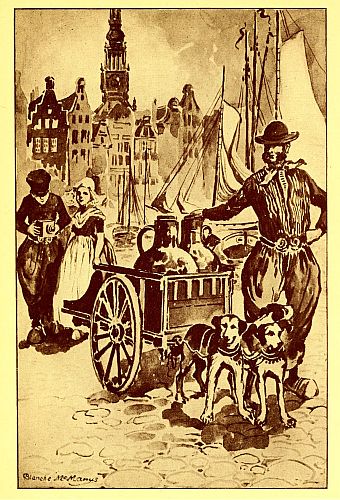
"What a jumble of ships and houses! I
shouldn't think you would know whether you
were going into a house or aboard ship, when
you open the front door," said Theodore, one
fine summer's day, when the cousins were
strolling about Amsterdam, on their way to
pay the promised visit to Mynheer Van
der Veer.
Others besides Theodore might think the
same thing, for Amsterdam really grew up
out of the water. The houses are, for the
most part, built on wooden piles; and there
are as many canals as there are streets, and
big ships move about between the buildings in
the most wonderful manner.
They found Mynheer Van der Veer smoking
his meerschaum pipe at his warehouse on
one of the principal canals. He was glad indeed
to see his little friends of the tulip-garden,
as he called them, and showed them
all around the big establishment. They saw
the big ships that were anchored right at his
door, and the bales and boxes being loaded
into their holds from the very windows of the
warehouse itself. He showed them the coffees
and sugars and spices which other ships had
brought from the Dutch East Indies, which as
you all know are around on the other side of
the world. Holland owns some of the richest
islands in the world, many of them larger than
Holland itself. One of these islands is Java,
where the fine Java coffee comes from, and
this is one of the reasons why the Dutch always
have such good coffee, and drink so much
of it.
Mynheer gave them all nice spices to taste,
and was amused at the faces they made at
some hot peppery things they were eager
to try.
After this he took them to his fine, tall
house that faced on another canal, where there
were long rows of other tall houses, all built of
tiny bricks and as neat as pins. All of them
were as much alike, in their outside appearance
at least, as a row of pins, too. Here the
children met the portly Mevrouw Van der
Veer in her rustling silk dress, who gave them
a warm welcome.
She had just come in from a walk, and on the
top of her beautiful lace cap with its gold ornaments
she wore a very fashionable modern
hat.
"Oh," thought Wilhelmina, "why does she
spoil her fine cap like that?" But you see
many Dutch ladies who combine the old and
the new styles in just that way.
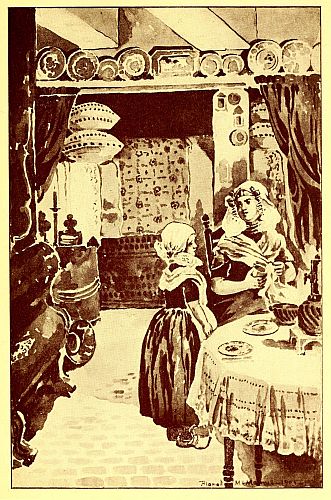
They all sat in Mevrouw's fine parlour, with
its shining waxed floor, which was filled with
beautiful things from all parts of the world.
There was furniture of teak-wood from India,
wonderfully carved, and rare china and porcelain
from China and Japan. Exquisite silk
curtains hung at the windows, and embroidered
screens cut off any possible draughts.
These rare things had been brought from
time to time in Mynheer's ships, as they were
homeward bound from these far-off countries.
Mevrouw sat before a little table laden with
silver and fine china, and poured coffee for
them from a big silver coffee-pot, and gave
them many kinds of nice Dutch cakes to eat;
and when she said good-bye she promised Mynheer
Joost that she would come some day and
see his tulip-garden herself.
"Why was that small looking-glass fastened
outside of one of the upper windows?" asked
Theodore, as they left Mynheer Van der Veer's
house.
"Many of these Dutch houses have these
little mirrors fastened before the windows at
such an angle that by merely looking in it from
the inside, one may see who is at the front
door," said his cousin; "and then, too, the
ladies can sit by the window, sewing or reading,
and can amuse themselves by watching what is
going on in the street below, without troubling
to look out of the window."
"I should hate to have to wear a dress like
that," said Wilhelmina, looking at two young
girls who were passing by. It did look strange,
for one half of their dress was red and the other
half black.
"They are the girls from the orphanage, and
this is the uniform that they all must wear,"
said Mynheer Joost.
"Now Theodore must see some of the pictures
of our great painters," he continued, as he
led the young folks toward the splendid picture-gallery,
where they strolled through what
seemed to them miles of rooms and corridors,
all hung with beautiful and valuable pictures,
for little Holland has had some of the greatest
artists the world has ever known, and some
day, if you care about pictures,—and you certainly
should,—you will want to go there and
see them for yourself.
After this they did a great deal more sight-seeing,
and Mynheer showed them the "Exchange,"
where the business of the city is
carried on, and told them that there was one
week in the year when the boys of Amsterdam
were allowed to use the "Exchange" for a
playground.
This was a reward for the good deed of some
brave boys of long ago, when the Spaniards
were plotting to capture the city. The boys,
it seems, first discovered the secret, and
went and informed the authorities, who were
thus able to defend their city from attack.
"This," said Mynheer, "was the case when
I was young, and I suppose the boys are still
allowed the same privilege."
Our little folk were glad enough to take their
seats on the deck of the little steamboat which
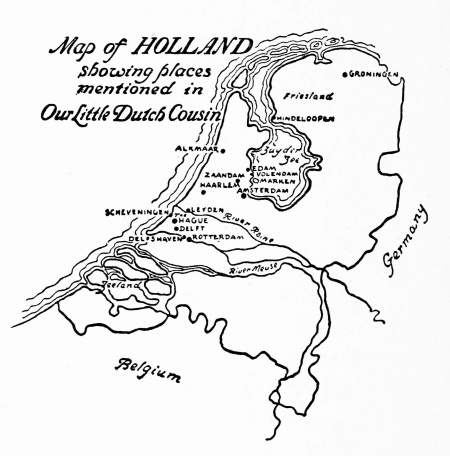
was to take them to Alkmaar, the centre of
the cheese-trade of North Holland.
"Whew! but we have done a lot of tramping
about to-day; oh, my poor feet!" said Pieter,
as he stretched himself out on a bench.
"Father, haven't you got something for us to
eat in your pocket?" asked Wilhelmina, coaxingly.
Mynheer smiled, and from away down in
the depths of his pocket, he drew forth a big
loaf of gingerbread. The children munched
away at this favourite Dutch delicacy, and
amused themselves by watching the people
who were making the journey with them.
There were two fat old women, sitting side
by side and knitting away as if for their lives.
They nodded their heads every time they
spoke, which made their long gold corkscrew
ornaments in their caps bob up and down, and
each had her feet on a little foot-stove as if it
were midwinter. There were two little girls
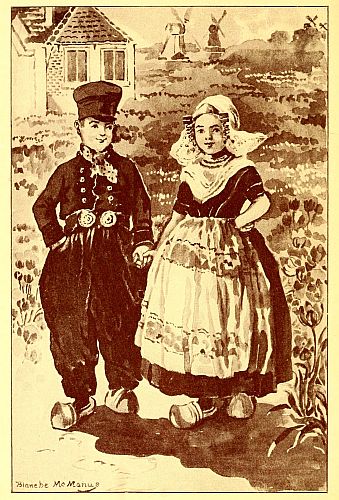
with their father, who looked like little dolls,
in short red dresses, with dark green waists and
short sleeves, and pretty aprons embroidered
in many coloured silks, and many gold chains,
and earrings reaching nearly down to their
shoulders. They had a solid gold head-piece
under their caps. The man had on velvet
knickerbockers, nearly as broad as they were
long, and two great silver rosettes fastened in
his belt. There were big silver buttons on his
jacket, and his cap must have been over a foot
high.
The little girls were very shy, but when
Wilhelmina offered them some of her gingerbread
they soon made friends, and the three
were soon chatting away like old acquaintances.
"Aren't they gorgeous?" whispered Pieter.
"They are from the little island of Marken,
near here, in the Zuyder Zee, and have on
all their holiday clothes."
The island of Marken is like a big bowl,
Mynheer told them, for all of it but the rim is
lower than the waters which surround it. The
rim is a high stone wall which was built to
keep the water out. Everybody who lives
there keeps a boat tied to their gate or door in
order that they may have some means of
escape if the wall should ever break.
"Just think of it! I should never sleep
nights, if I lived there, for fear of waking up
and finding myself floating about in the water.
I should think the Dutch would be the most
nervous people in the world, instead of the
most placid," said Theodore.
"That danger does not often happen," said
Mynheer. "But look how beautifully carved
their shoes are. The men do it themselves
during the long winter evenings, and take great
pride in their work."
The little steamer puffed along the North
Sea Canal, by which the big ships come right
up to Amsterdam. All kinds of queer tublike
boats, with big brown sails, tanned to preserve
them from the damp, passed them, and soon
they turned into the river Zaan.
"There is Zaandam," said Mynheer; "they
say that most of the people who live there are
millionaires. It is a wealthy little town."
"You would not think so from the looks
of the houses," remarked Pieter; "they seem
mostly to be small brick cottages of one story,
with a tiny yard in front."
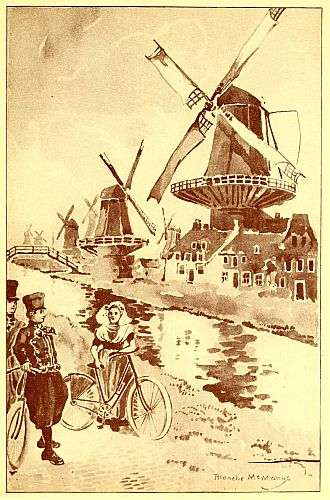
As the steamer glides along, between green
meadows as flat as one's hand, they could see
on all sides innumerable windmills. The boys
tried to count them, but soon gave up the task.
It is said that there are over six hundred of
them in this one short stretch of country.
"Why are some of the windmills built on
top of the houses?" asked Theodore.
"For the reason that they are made to turn
the machinery which is situated in the buildings
below," said Mynheer; "not all the windmills
are used for pumping water, by any
means."
They were now in the midst of the cheese
country, one of the richest sections of Holland.
There were everywhere to be seen trim little
villas and neat farmhouses, while the meadows
were full of the curiously marked black and
white cows called "Holsteins." These are the
favourite cows throughout Holland for furnishing
the milk for the famous butter and cheeses
of the country.
They were at Alkmaar before they knew it.
The two old women, who had never stopped
knitting for a moment, picked up their little
foot-stoves and waddled off; Wilhelmina bade
her little Marken friends good-bye; and Mynheer's
party hurried off to a little inn on the
market-place, for the sun was setting and the
children said they were nearly starved, in spite
of the gingerbread which they had eaten.
Outside the inn was a row of fat, sleepy-looking
old men sitting on a long bench,
watching a game of "skittles" which was
going on in the square, for both "grown-ups"
and children usually play their games in the
village square. Each had his long pipe and a
glass of "schnapps" just under his part of the
bench, and when he wanted a drink all he had
to do was to reach down and get it. Not one
of them said a word; they just sat there and
looked, and smoked and drank.
In a cosy room, with a floor of red bricks,
neatly covered with sand, a rosy-cheeked girl
soon set out a real Dutch supper for our
hungry little travellers.
There was cold sausage, potato salad, fresh
herrings, and a strange dish made of buttermilk
and buckwheat-flour, all boiled together and
flavoured with green herbs. The Joost family
thought it delicious, but Theodore said that
it would take him some time to get used to it,
and preferred the big loaves of rye-bread filled
with raisins. As for cheeses, there was no end
to the different kinds—and all of them excellent;
while to wind up with, there was a
delicious hot gingerbread and good coffee.
Did it keep them awake? No, indeed, they
dropped off to sleep in a moment, inside their
big cupboard-beds, that had doors to them,
instead of curtains, which made them look
more like boxes than ever.
"Just come and look out the window,
Theodore," said Pieter early the next morning.
He was at the window and Theodore was out
of bed in a moment and beside him.
"Why the whole square is filled with
cheeses," he cried. So it was, for this was
market-day, when the farmers—"boeren,"
they are called—from all the country roundabout
bring in their cheeses to sell them in
the market-place.
The boys scrambled into their clothes, and
in a few minutes were walking among the
great piles of cheeses. There were all kinds
and shapes and sizes,—cheeses that looked like
great red balls, yellow cheeses, white cheeses,
green cheeses, flat, round, square and all sizes.
"I didn't suppose there were as many
cheeses in the world," said Theodore, looking
around him. "And the wagons, too, aren't
they fine; they look as gay as circus wagons."
And so they did, for they were painted
every colour under the sun; some of them
even had flowers painted upon them; and
they were all shapes, too; some were curved
like shells, and others looked not unlike a boat
on wheels.
"Let us see what is going on over there,
where there is such a crowd of people," said
Pieter, as he led the way to the other side of
the square.
Here was the Weighing-House, where the
cheeses were being weighed on funny old-fashioned
scales, which looked as though they had
been in use hundreds of years. The buyers,
too, were testing the cheeses. They would
taste a cheese and cut a small plug out of it to
see if it were of good quality, and then they
would put the plug back in place again, when
the cheese, to all appearances, looked as it did
before.
The bargaining over the cheeses took a long
time, for the farmers are very careful to make
a good deal for themselves, and they will not
be hurried; and generally, when they are on
their way home again, they look very well satisfied
with themselves, and as contented as the
portly Vrouw sitting beside them, or the
"kinder," as they call the children, playing
about in the bottom of the wagon.
"I don't suppose you boys have given up
eating breakfast," a voice behind them said,
and turning they saw Mynheer Joost.
"Wilhelmina and I have already had ours,
so hurry up with yours, and then come down
to the canal; we are going to see the cheeses
loaded on to the boats."
Along the canal were drawn up the boats,
with their brown sails, and steamers and barges
and all kinds of craft. When the boys appeared
again, they all stopped to watch a
pile of round, red cheeses which were piled up
like shot, ready to be loaded.
A man picked one up in either hand and
tossed them to another man, who was standing
beside the ship's hatch; and he, in turn, tossed
them to another who was down in the hold
and who was stacking them up in neat rows.
"I'd like to play that kind of ball; it looks
as easy as can be," said Pieter.
"It's not as easy as you think," said his
father; "just pick up one of these cheeses, and
try its weight."
Pieter tried and so did Theodore; but they
thought better of it as a game, and the cheese
man himself laughed at their unsuccessful efforts
to grasp a cheese in one hand.
"Just look at our hands," exclaimed Theodore,
after they had finished handling the
cheeses; "they are quite red."
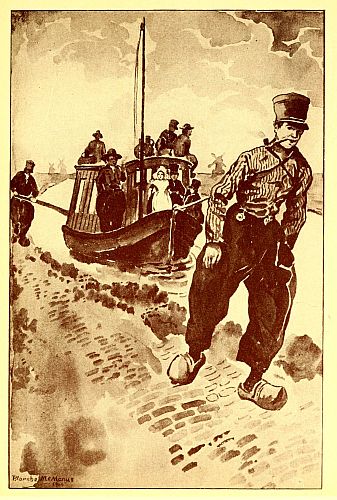 "THE CHILDREN STOOD IN THE BOWS"
"That is the red colouring matter which is
put on the outside to preserve them," said
Mynheer.
"Now we will take a walk around the town,
and then make our way back to Amsterdam,"
said Mynheer Joost; "and we will stop by
the way at Edam, and you can see the little
town which gives the name to these red
cheeses."
During the dinner at Edam, a happy idea
struck Mynheer Joost. "Children," he said,
"how would you like to have a ride in a
'trekschuit,' or passenger barge? There is
one leaving here for Volendam in half an hour,
the landlord of the inn tells me, and if you are
ready, we will go out and hunt it up."
"Oh, that will be great fun," cried the twins
in one breath.
There are few of these old-time conveyances
left in Holland, and it was as much a novelty
for them as for Theodore.
You will see from the picture what an odd
sort of a passenger craft the "trekschuit" really
is. There is one man pulling it, while another
walks behind and steers it by the big tiller,
which he handles from the shore in the same
manner that he would if he were on board.
The children stood in the bows among the
big brass milk-cans and butter baskets of the
market-women, and said they knew just how
comfortable the fat Dutchmen feel, as they sit
on their "tjalks," and let their women and
children draw them about.
The next day found our little friends home
again, planning other good times.
Soon the time came, however, when Theodore
must leave his Dutch cousins and go back
to America. The twins were nearly broken-hearted
at the very idea of it; for they had
become as fond of Theodore as if he were a
brother. Wilhelmina wept, and said she didn't
see why Theodore could not stay for St. Nicholas;
and Pieter himself had to wink hard to
keep back the tears.
But Theodore consoled them by telling them
that he would come again and spend a winter
with them, so as to see a real Dutch Christmas,
which, strange to say, is celebrated on the feast
of good St. Nicholas, which comes on the sixth
of December. Then they would have skating
and all kinds of winter sports together, which,
to tell the truth, are the favourite amusements
of our little Dutch cousins.
THE END.
THE LITTLE COUSIN SERIES
The most delightful and interesting accounts possible
of child life in other lands, filled with quaint sayings,
doings, and adventures.
Each one vol., 12mo, decorative cover, cloth, with six or more
full-page illustrations in color.
Price per volume $0.60
By MARY HAZELTON WADE (unless otherwise
indicated)
| Our Little African Cousin |
| Our Little Alaskan Cousin |
| By Mary F. Nixon-Roulet |
| Our Little Arabian Cousin |
| By Blanche McManus |
| Our Little Armenian Cousin |
| Our Little Brown Cousin |
| Our Little Canadian Cousin |
| By Elizabeth R. Macdonald |
| Our Little Chinese Cousin |
| By Isaac Taylor Headland |
| Our Little Cuban Cousin |
| Our Little Dutch Cousin |
| By Blanche McManus |
| Our Little English Cousin |
| By Blanche McManus |
| Our Little Eskimo Cousin |
| Our Little French Cousin |
| By Blanche McManus |
| Our Little German Cousin |
| Our Little Hawaiian Cousin |
| Our Little Hindu Cousin |
| By Blanche McManus |
| Our Little Indian Cousin |
| Our Little Irish Cousin |
| Our Little Italian Cousin |
| Our Little Japanese Cousin |
| Our Little Jewish Cousin |
| Our Little Korean Cousin |
| By H. Lee M. Pike |
| Our Little Mexican Cousin |
| By Edward C. Butler |
| Our Little Norwegian Cousin |
| Our Little Panama Cousin |
| By H. Lee M. Pike |
| Our Little Philippine Cousin |
| Our Little Porto Rican Cousin |
| Our Little Russian Cousin |
| Our Little Scotch Cousin |
| By Blanche McManus |
| Our Little Siamese Cousin |
| Our Little Spanish Cousin |
| By Mary F. Nixon-Roulet |
| Our Little Swedish Cousin |
| By Claire M. Coburn |
| Our Little Swiss Cousin |
| Our Little Turkish Cousin |
THE GOLDENROD LIBRARY
The Goldenrod Library contains stories which appeal
alike both to children and to their parents and guardians.
Each volume is well illustrated from drawings by
competent artists, which, together with their handsomely
decorated uniform binding, showing the goldenrod,
usually considered the emblem of America, is a feature
of their manufacture.
Each one volume, small 12mo, illustrated $0.35
LIST OF TITLES
| Aunt Nabby's Children. By Frances Hodges White. |
| Child's Dream of a Star, The. By Charles Dickens. |
| Flight of Rosy Dawn, The. By Pauline Bradford Mackie. |
| Findelkind. By Ouida. |
| Fairy of the Rhone, The. By A. Comyns Carr. |
| Gatty and I. By Frances E. Crompton. |
| Helena's Wonderworld. By Frances Hodges White. |
| Jerry's Reward. By Evelyn Snead Barnett. |
| La Belle Nivernaise. By Alphonse Daudet. |
| Little King Davie. By Nellie Hellis. |
| Little Peterkin Vandike. By Charles Stuart Pratt. |
| Little Professor, The. By Ida Horton Cash. |
| Peggy's Trial. By Mary Knight Potter. |
| Prince Yellowtop. By Kate Whiting Patch. |
| Provence Rose, A. By Ouida. |
| Seventh Daughter, A. By Grace Wickham Curran. |
| Sleeping Beauty, The. By Martha Baker Dunn. |
| Small, Small Child, A. By E. Livingston Prescott. |
| Susanne. By Frances J. Delano. |
| Water People, The. By Charles Lee Sleight. |
| Young Archer, The. By Charles E. Brimblecom. |
COSY CORNER SERIES
It is the intention of the publishers that this series shall
contain only the very highest and purest literature,—stories
that shall not only appeal to the children themselves,
but be appreciated by all those who feel with
them in their joys and sorrows.
The numerous illustrations in each book are by well-known
artists, and each volume has a separate attractive
cover design.
Each 1 vol., 16mo, cloth $0.50
By ANNIE FELLOWS JOHNSTON
The Little Colonel. (Trade Mark.)
The scene of this story is laid in Kentucky. Its heroine
is a small girl, who is known as the Little Colonel,
on account of her fancied resemblance to an old-school
Southern gentleman, whose fine estate and old family
are famous in the region.
The Giant Scissors.
This is the story of Joyce and of her adventures
in France. Joyce is a great friend of the Little Colonel,
and in later volumes shares with her the delightful experiences
of the "House Party" and the "Holidays."
Two Little Knights of Kentucky.
Who Were the Little Colonel's Neighbors.
In this volume the Little Colonel returns to us like an
old friend, but with added grace and charm. She is
not, however, the central figure of the story, that place
being taken by the "two little knights."
Mildred's Inheritance.
A delightful little story of a lonely English girl who
comes to America and is befriended by a sympathetic
American family who are attracted by her beautiful
speaking voice. By means of this one gift she is enabled
to help a school-girl who has temporarily lost the
use of her eyes, and thus finally her life becomes a busy
happy one.
Cicely and Other Stories for Girls.
The readers of Mrs. Johnston's charming juveniles
will be glad to learn of the issue of this volume for
young people.
Aunt 'Liza's Hero and Other Stories.
A collection of six bright little stories, which will
appeal to all boys and most girls.
Big Brother.
A story of two boys. The devotion and care of
Steven, himself a small boy, for his baby brother, is the
theme of the simple tale.
Ole Mammy's Torment.
"Ole Mammy's Torment" has been fitly called "a
classic of Southern life." It relates the haps and mishaps
of a small negro lad, and tells how he was led by
love and kindness to a knowledge of the right.
The Story of Dago.
In this story Mrs. Johnston relates the story of Dago,
a pet monkey, owned jointly by two brothers. Dago
tells his own story, and the account of his haps and mishaps
is both interesting and amusing.
The Quilt That Jack Built.
A pleasant little story of a boy's labor of love, and
how it changed the course of his life many years after
it was accomplished.
Flip's Islands of Providence.
A story of a boy's life battle, his early defeat, and his
final triumph, well worth the reading.
By EDITH ROBINSON
A Little Puritan's First Christmas.
A Story of Colonial times in Boston, telling how
Christmas was invented by Betty Sewall, a typical child
of the Puritans, aided by her brother Sam.
A Little Daughter of Liberty.
The author introduces this story as follows:
"One ride is memorable in the early history of the
American Revolution, the well-known ride of Paul
Revere. Equally deserving of commendation is another
ride,—the ride of Anthony Severn,—which was no less
historic in its action or memorable in its consequences."
A Loyal Little Maid.
A delightful and interesting story of Revolutionary
days, in which the child heroine, Betsey Schuyler,
renders important services to George Washington.
A Little Puritan Rebel.
This is an historical tale of a real girl, during the
time when the gallant Sir Harry Vane was governor of
Massachusetts.
A Little Puritan Pioneer.
The scene of this story is laid in the Puritan settlement
at Charlestown.
A Little Puritan Bound Girl.
A story of Boston in Puritan days, which is of great
interest to youthful readers.
A Little Puritan Cavalier.
The story of a "Little Puritan Cavalier" who tried
with all his boyish enthusiasm to emulate the spirit and
ideals of the dead Crusaders.
A Puritan Knight Errant.
The story tells of a young lad in Colonial times who
endeavored to carry out the high ideals of the knights
of olden days.
By OUIDA (Louise de la Ramée)
A Dog of Flanders: A Christmas Story.
Too well and favorably known to require description.
The Nurnberg Stove.
This beautiful story has never before been published
at a popular price.
By FRANCES MARGARET FOX
The Little Giant's Neighbours.
A charming nature story of a "little giant" whose
neighbours were the creatures of the field and garden.
Farmer Brown and the Birds.
A little story which teaches children that the birds
are man's best friends.
Betty of Old Mackinaw.
A charming story of child-life, appealing especially to
the little readers who like stories of "real people."
Brother Billy.
The story of Betty's brother, and some further adventures
of Betty herself.
Mother Nature's Little Ones.
Curious little sketches describing the early lifetime,
or "childhood," of the little creatures out-of-doors.
How Christmas Came to the Mulvaneys.
A bright, lifelike little story of a family of poor children,
with an unlimited capacity for fun and mischief.
The wonderful never-to-be forgotten Christmas that
came to them is the climax of a series of exciting incidents.
By MISS MULOCK
The Little Lame Prince.
A delightful story of a little boy who has many adventures
by means of the magic gifts of his fairy godmother.
Adventures of a Brownie.
The story of a household elf who torments the cook
and gardener, but is a constant joy and delight to the
children who love and trust him.
His Little Mother.
Miss Mulock's short stories for children are a constant
source of delight to them, and "His Little Mother," in
this new and attractive dress, will be welcomed by hosts
of youthful readers.
Little Sunshine's Holiday.
An attractive story of a summer outing. "Little Sunshine"
is another of those beautiful child-characters for
which Miss Mulock is so justly famous.
By MARSHALL SAUNDERS
For His Country.
A sweet and graceful story of a little boy who loved
his country; written with that charm which has endeared
Miss Saunders to hosts of readers.
Nita, the Story of an Irish Setter.
In this touching little book, Miss Saunders shows how
dear to her heart are all of God's dumb creatures.
Alpatok, the Story of an Eskimo
Dog.
Alpatok, an Eskimo dog from the far north, was stolen
from his master and left to starve in a strange city, but
was befriended and cared for, until he was able to return
to his owner.
By WILL ALLEN DROMGOOLE
The Farrier's Dog and His Fellow.
This story, written by the gifted young Southern
woman, will appeal to all that is best in the natures of
the many admirers of her graceful and piquant style.
The Fortunes of the Fellow.
Those who read and enjoyed the pathos and charm
of "The Farrier's Dog and His Fellow" will welcome
the further account of the adventures of Baydaw and
the Fellow at the home of the kindly smith.
The Best of Friends.
This continues the experiences of the Farrier's dog and
his Fellow, written in Miss Dromgoole's well-known
charming style.
Down in Dixie.
A fascinating story for boys and girls, of a family of
Alabama children who move to Florida and grow up in
the South.
By MARIAN W. WILDMAN
Loyalty Island.
An account of the adventures of four children and
their pet dog on an island, and how they cleared their
brother from the suspicion of dishonesty.
Theodore and Theodora.
This is a story of the exploits and mishaps of two mischievous
twins, and continues the adventures of the
interesting group of children in "Loyalty Island."
By CHARLES G. D. ROBERTS
The Cruise of the Yacht Dido.
The story of two boys who turned their yacht into a
fishing boat to earn money to pay for a college course,
and of their adventures while exploring in search of
hidden treasure.
The Young Acadian.
The story of a young lad of Acadia who rescued a
little English girl from the hands of savages.
The Lord of the Air.
The Story of the Eagle
The King of the Mamozekel.
The Story of the Moose
The Watchers of the Camp-fire.
The Story of the Panther
The Haunter of the Pine Gloom.
The Story of the Lynx
The Return to the Trails.
The Story of the Bear
The Little People of the Sycamore.
The Story of the Raccoon
By OTHER AUTHORS
The Great Scoop.
By MOLLY ELLIOT SEAWELL
A capital tale of newspaper life in a big city, and
of a bright, enterprising, likable youngster employed
thereon.
John Whopper.
The late Bishop Clark's popular story of the boy who
fell through the earth and came out in China, with a
new introduction by Bishop Potter.
The Dole Twins.
By KATE UPSON CLARK
The adventures of two little people who tried to earn
money to buy crutches for a lame aunt. An excellent
description of child-life about 1812, which will greatly
interest and amuse the children of to-day, whose life is
widely different.
Larry Hudson's Ambition.
By JAMES OTIS, author of "Toby Tyler," etc.
Larry Hudson is a typical American boy, whose hard
work and enterprise gain him his ambition,—an education
and a start in the world.
The Little Christmas Shoe.
By JANE P. SCOTT WOODRUFF
A touching story of Yule-tide.
Wee Dorothy.
By LAURA UPDEGRAFF
A story of two orphan children, the tender devotion
of the eldest, a boy, for his sister being its theme and
setting. With a bit of sadness at the beginning, the
story is otherwise bright and sunny, and altogether
wholesome in every way.
The King of the Golden River:
A Legend of Stiria. By JOHN RUSKIN
Written fifty years or more ago, and not originally
intended for publication, this little fairy-tale soon became
known and made a place for itself.
A Child's Garden of Verses.
By R. L. STEVENSON
Mr. Stevenson's little volume is too well known to
need description.
BOOKS FOR YOUNG PEOPLE
THE LITTLE COLONEL BOOKS
(Trade Mark)
By ANNIE FELLOWS JOHNSTON
Each 1 vol., large 12mo, cloth decorative, per vol $1.50
The Little Colonel Stories.
(Trade Mark)
Illustrated.
Being three "Little Colonel" stories in the Cosy
Corner Series, "The Little Colonel," "Two Little Knights
of Kentucky," and "The Giant Scissors," put into a
single volume.
The Little Colonel's House Party.
(Trade Mark)
Illustrated by Louis Meynell.
The Little Colonel's Holidays.
(Trade Mark)
Illustrated by L. J. Bridgman.
The Little Colonel's Hero.
(Trade Mark)
Illustrated by E. B. Barry.
The Little Colonel at Boarding School.
(Trade Mark)
Illustrated by E. B. Barry.
The Little Colonel in Arizona.
(Trade Mark)
Illustrated by E. B. Barry.
The Little Colonel's Christmas Vacation.
(Trade Mark)
Illustrated by E. B. Barry.
The Little Colonel, Maid of Honour.
(Trade Mark)
Illustrated by E. B. Barry.
The Little Colonel.
(Trade Mark)
Two Little Knights of Kentucky.
The Giant Scissors.
Big Brother.
Special Holiday Editions
Each one volume, cloth decorative, small quarto, $1.25.
New plates, handsomely illustrated, with eight full-page
drawings in color.
"The books are as satisfactory to the small girls, who find
them adorable, as for the mothers and librarians, who delight
in their influence."—Christian Register.
These four volumes, boxed as a four volume set $5.00
In the Desert of Waiting: The Legend
of Camelback Mountain.
The Three Weavers: A Fairy Tale for
Fathers and Mothers as Well as for Their
Daughters.
Keeping Tryst.
The Legend of the Bleeding Heart.
| Each one volume, tall 16mo, cloth decorative | $0.50 |
| Paper boards | .35 |
There has been a constant demand for publication
in separate form of these four stories, which were originally
included in four of the "Little Colonel" books.
Joel: A Boy of Galilee. By Annie Fellows
Johnston. Illustrated by L. J. Bridgman.
New illustrated edition, uniform with the Little Colonel Books, 1 vol., large 12mo, cloth decorative $1.50
A story of the time of Christ, which is one of the
author's best-known books.
Asa Holmes; or, At The Cross-Roads. A
sketch of Country Life and Country Humor. By
Annie Fellows Johnston. With a frontispiece by
Ernest Fosbery.
Large 16mo, cloth, gilt top $1.00
"'Asa Holmes; or, At the Cross-Roads' is the most delightful,
most sympathetic and wholesome book that has been
published in a long while."—Boston Times.
The Rival Campers; or, The Adventures
of Henry Burns. By Ruel Perley Smith.
Square 12mo, cloth decorative, illustrated $1.50
Here is a book which will grip and enthuse every boy reader.
It is the story of a party of typical American lads, courageous,
alert, and athletic, who spend a summer camping on an
island off the Maine coast.
"The best boys' book since 'Tom Sawyer.'"—San Francisco
Examiner.
The Rival Campers Afloat; or, The
Prize Yacht Viking. By Ruel Perley Smith.
Square 12mo, cloth decorative, illustrated $1.50
This book is a continuation of the adventures of "The
Rival Campers" on their prize yacht Viking. An accidental
collision results in a series of exciting adventures, culminating
in a mysterious chase, the loss of their prize yacht, and
its recapture by means of their old yacht, Surprise.
The Rival Campers Ashore. By Ruel
Perley Smith, author of "The Rival Campers,"
"The Rival Campers Afloat," etc.
Square 12mo, cloth decorative, illustrated $1.50
"The Rival Campers Ashore" deals with the adventures
of the campers and their friends in and around the town of
Benton. Mr. Smith introduces a new character,—a girl,—who
shows them the way to an old mill, around which the
mystery of the story revolves. The girl is an admirable acquisition,
proving as daring and resourceful as the campers
themselves.
The Young Section-Hand; or, The Adventures
of Allan West. By Burton E. Stevenson,
author of "The Marathon Mystery," etc.
Square 12mo, cloth decorative, illustrated by L. J. Bridgman $1.50
Mr. Stevenson's hero is a manly lad of sixteen, who is given
a chance as a section-hand on a big Western railroad, and
whose experiences are as real as they are thrilling.
The Young Train Dispatcher. By Burton
E. Stevenson, author of "The Young Section-hand,"
etc.
Square 12mo, cloth decorative, illustrated $1.50
The young hero has many chances to prove his manliness
and courage in the exciting adventures which befall him in the
discharge of his duty.
Captain Jack Lorimer. By Winn Standish.
Square 12mo, cloth decorative, illustrated by A. B. Shute $1.50
Jack is a fine example of the all-around American high-school
boy. He has the sturdy qualities boys admire, and
his fondness for clean, honest sport of all kinds will strike a
chord of sympathy among athletic youths.
Jack Lorimer's Champions; or, Sports
on Land and Lake. By Winn Standish, author of
"Captain Jack Lorimer," etc.
Square 12mo, cloth decorative, illustrated $1.50
All boys and girls who take an interest in school athletics
will wish to read of the exploits of the Millvale High School
students, under the leadership of Captain Jack Lorimer.
Captain Jack's Champions play quite as good ball as do
some of the teams on the large leagues, and they put all
opponents to good hard work in other summer sports.
Jack Lorimer and his friends stand out as the finest examples
of all-round American high school boys and girls.
Beautiful Joe's Paradise; or, The Island
of Brotherly Love. A sequel to "Beautiful Joe."
By Marshall Saunders, author of "Beautiful Joe."
One vol., library 12mo, cloth, illustrated $1.50
"This book revives the spirit of 'Beautiful Joe' capitally.
It is fairly riotous with fun, and as a whole is about as unusual
as anything in the animal book line that has seen the light. It
is a book for juveniles—old and young."—Philadelphia Item.
'Tilda Jane. By Marshall Saunders.
One vol., 12mo, fully illustrated, cloth decorative, $1.50
"It is one of those exquisitely simple and truthful books
that win and charm the reader, and I did not put it down
until I had finished it—honest! And I am sure that every
one, young or old, who reads will be proud and happy to
make the acquaintance of the delicious waif.
"I cannot think of any better book for children than this.
I commend it unreservedly."—Cyrus Townsend Brady.
The Story of the Graveleys. By Marshall
Saunders, author of "Beautiful Joe's Paradise,"
"'Tilda Jane," etc.
Library 12mo, cloth decorative, illustrated by E. B. Barry $1.50
Here we have the haps and mishaps, the trials and triumphs,
of a delightful New England family, of whose devotion and
sturdiness it will do the reader good to hear.
Born to the Blue. By Florence Kimball
Russel.
12mo, cloth decorative, illustrated $1.25
The atmosphere of army life on the plains breathes on
every page of this delightful tale. The boy is the son of a
captain of U. S. cavalry stationed at a frontier post in the
days when our regulars earned the gratitude of a nation.
In West Point Gray. By Florence Kimball
Russel.
12mo, cloth decorative, illustrated $1.25
West Point forms the background for the second volume
in this series, and gives us the adventures of Jack as a cadet.
Here the training of his childhood days in the frontier army
post stands him in good stead; and he quickly becomes the
central figure of the West Point life.
The Sandman; His Farm Stories.
By William J. Hopkins. With fifty illustrations by
Ada Clendenin Williamson.
Large 12mo, decorative cover $1.50
"An amusing, original book, written for the benefit of very
small children. It should be one of the most popular of the
year's books for reading to small children."—Buffalo Express.
The Sandman: More Farm Stories.
By William J. Hopkins.
Large 12mo, decorative cover, fully illustrated $1.50
Mr. Hopkins's first essay at bedtime stories met with such
approval that this second book of "Sandman" tales was
issued for scores of eager children. Life on the farm, and
out-of-doors, is portrayed in his inimitable manner.
The Sandman: His Ship Stories.
By William J. Hopkins, author of "The Sandman:
His Farm Stories," etc.
Large 12mo, decorative cover, fully illustrated $1.50
"Mothers and fathers and kind elder sisters who put the
little ones to bed, and rack their brains for stories, will find
this book a treasure."—Cleveland Leader.
"Children call for these stories over and over again."—Chicago
Evening Post.
Pussy-Cat Town. By Marion Ames Taggart.
Small quarto, cloth decorative, illustrated and decorated in colors $1.00
"Pussy-Cat Town" is a most unusual delightful cat story.
Ban-Ban, a pure Maltese who belonged to Rob, Kiku-san,
Lois's beautiful snow white pet, and their neighbors Bedelia
the tortoise-shell, Madame Laura the widow, Wutz Butz the
warrior, and wise old Tommy Traddles, were really and truly
cats.
The Roses of Saint Elizabeth. By Jane
Scott Woodruff, author of "The Little Christmas
Shoe."
Small quarto, cloth decorative, illustrated and decorated in colors by Adelaide Everhart $1.00
This is a charming little story of a child whose father was
caretaker of the great castle of the Wartburg, where Saint
Elizabeth once had her home.
Gabriel and the Hour Book. By Evaleen
Stein.
Small quarto, cloth decorative, illustrated and decorated in colors by Adelaide Everhart $1.00
Gabriel was a loving, patient, little French lad, who assisted
the monks in the long ago days, when all the books were
written and illuminated by hand, in the monasteries.
The Enchanted Automobile. Translated
from the French by Mary J. Safford.
Small quarto, cloth decorative, illustrated and decorated in colors by Edna M. Sawyer $1.00
The enchanted automobile was sent by the fairy godmother
of a lazy, discontented little prince and princess to
take them to fairyland, where they might visit their storybook
favorites.
The Red Feathers. By Theodore Roberts,
author of "Brothers of Peril," etc.
Cloth decorative, illustrated $1.50
"The Red Feathers" tells of the remarkable adventures of
an Indian boy who lived in the Stone Age, many years ago,
when the world was young, and when fairies and magicians
did wonderful things for their friends and enemies.
The Wreck of the Ocean Queen. By
James Otis, author of "Larry Hudson's Ambition,"
etc.
Cloth decorative, illustrated $1.50
This story takes its readers on a sea voyage around the
world; gives them a trip on a treasure ship; an exciting experience
in a terrific gale; and finally a shipwreck, with a
mutineering crew determined to take the treasure to complicate
matters.
But only the mutineers will come to serious harm, and
after the reader has known the thrilling excitement of lack of
food and water, of attacks by night and day, and of a hand-to-hand
fight, he is rescued and brought safely home again,—to
realize that it's only a story, but a stirring and realistic
one.
Little White Indians. By Fannie E.
Ostrander.
Cloth decorative, illustrated $1.25
The "Little White Indians" were two families of children
who "played Indian" all one long summer vacation. They
built wigwams and made camps; they went hunting and
fought fierce battles on the war-trail.
A bright, interesting story which will appeal strongly to
the "make-believe" instinct in children, and will give them a
healthy, active interest in "the simple life."
Obvious punctuation errors repaired.
Page 63, extra word "and" removed from text.
Original read: (rye bread and
and white bread)
Ads at back of book, "L. R." changed to "R. L." for Robert
Louis Stevenson's "A Child's Garden of Verses." (By R. L. Stevenson)
Ads at back of book, case of the subtitle of "Jack Lorimer's Champion's"
was changed to match the rest of the titles' layout. Originally "or, Sports
on Land and Lake" was in mixed-case lettering.