It was October, and Jozef's godfather had
gone again to Bohemia, this time as a delegate
representing the Slovak National Council.
The Czecho-Slovak National Alliance and its
army had been recognized formally some time
before as an ally by the great powers and
greater events were scheduled to follow.
When he reached beautiful "hundred-towered"
Praha, the capital, he found the
streets and coffee houses jammed with people.
Every face had an expectant look in which
anxiety and confidence were blended. Toward
the end of the month their expectations were
realized. The National Council took over the
government of the Czecho-Slovak countries,
Bohemia, Moravia, Silesia, and Slovakia, all of
them formerly belonging to the Austro-Hungarian
Monarchy.
It was a bloodless revolution, for the Austrian
Government realized the hopelessness of
its position.
All the great sufferings through which they
had passed—the hunger, the fear, the grief—were
forgotten by the people in the great
joy of their liberation. Old men embraced
each other; old women wept in each other's
arms with happiness that they had lived to see
the day. People from all the states, with their
slight variations of dialect, were there; Czechs,
Moravians, Czecho-Silesians, and Slovaks.
The ties of close kinship were felt as never
before.
Crowds stood on the big St. Vaclav Square
listening to the Proclamation of Independence
from the steps of the splendid National
Museum. When the reading came to an end,
the people, with one voice, sang the ancient
Czech choral to St. Vaclav, Bohemia's patron
saint.
Almost every hour a new report came: now
that the Emperor's Governor had fled; now that
the Magyar soldiers, who had been stationed
in the city, cared for nothing except to be
allowed to return to Hungary; now that the
commanders of the local garrison had put themselves
at the disposal of the Czecho-Slovak
government.
Similar scenes took place in the historical
Old Town Square, around the splendid monument
of John Hus, that three years before had
had to be unveiled by stealth. Men, women,
and children felt that the noble past of which
Czechs have always been so proud, was come
again. Pride swelled their hearts, too, that all
that they were gaining had come to them
through efforts and sacrifices of their own, so
great that the world had been forced to recognize
and admire.
On the following day the Slovak delegates
were received officially, thus uniting the two
branches of the Czecho-Slovak nation.
The first act of the new state was to declare
a republican form of Government with Thomas
Garigue Masaryk as President.
President Masaryk was to take up his official
residence in the immense royal palace so long
deserted. Carpenters and others were busy
modernizing it.
This palace had lived through unusual
vicissitudes of fortune. Already in the tenth
century, a stone fortified palace stood there, but
it was not until the reign of Bohemia's beloved
King Charles I that it assumed something of
its present form, being modeled by him after
the Louvre of Paris. It was enlarged by King
Vladislav, the principal hall being named after
him. In Rudolph's time other Halls were
added.
After the defeat of the White Mountain,
when Bohemia lost her independence, it no
longer served as a royal residence, and was
practically deserted. In 1757, it was bombarded,
to be rebuilt and enlarged by Empress
Maria Theresa.
And now the greatest change of all: it was
to be the home of the President of a thoroughly
democratic state.
Many days following were festal days.
People flocked to the churches, particularly to
the Cathedral of St. Vitus, which is one of the
great works of King Charles.
While the young people looked forward to
the future, the old recalled the past.
"Ah, how King Charles in his heavenly home
will rejoice," one bent old woman, supported
on crutches, murmured.
"And saintly Vaclav, too," scarcely breathed
another so emaciated that she looked like a
moving shadow. "He'll be proud now that
Bohemia is called after him the Realm of St.
Vaclav. Ah, I must see once more those
precious relics we have kept of him."
With difficulty she made her way to the
Cathedral where St. Vaclav's helmet, sword,
and coat of mail have been religiously preserved.
Jozef's godfather sent him several picture
postcards reminding him of Jozef's hero, King
Charles. One represented the historic stone
bridge, which Charles had had built with such
care that he did not live to see it finished. On
this card he wrote:
"All the statues on the bridge have a dazed
expression. I wonder what they think of the
change."
Another card was of the old walls of Praha,
working on which through the King's care
saved a thousand men from starving in a time
of famine.
"I walked past these fortifications early one
morning," was the message, "and hundreds of
birds were among the ruins, all singing the news
of our glorious resurrection."
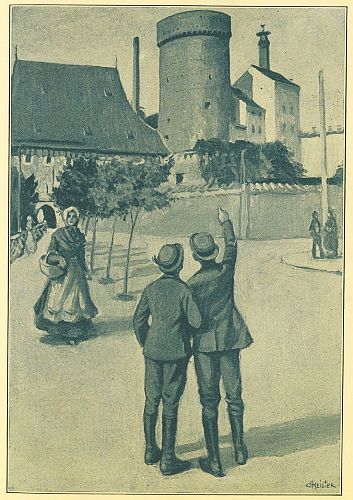
The third card showed Karluv Tyn, built by
Charles for the protection of the crown jewels
and the charters of Bohemia. This beautiful
castle stands not far from Praha, on a rock of
jasper a thousand feet above the River Mze.
To it the King-Emperor sometimes retired for
the meditative devotion which he found so
helpful. On this card the message was the
longest:
"Charles did more than build beautiful
castles and splendid cathedrals. He welcomed
men of learning and made higher education
possible even for the poor by founding the
University of Praha, the first university in all
of Central Europe. He freed the land of
robbers; he secured justice to the peasants by
making it possible for them to appeal to the
King from the decision of their own feudal
lords. His name has come down to us revered
and beloved, because of the many evidences of
his unselfish, constant thought for the people's
welfare."
By a strange coincidence, on the very day that
the last postcard came to Jozef in Slovakia,
another reached him from his friend, Jaroslav.
It was dated from the famous watering place,
Carlsbad, in northern Bohemia, where Jaroslav
had accompanied his father, who had some
business there.
"The Germans here, who have largely control
of things," it stated, "are angry at the turn
affairs have taken. They clamor about the
rights of the minority, they who never considered
the rights of the Slavic majority. But
I think they are calming down, for they see that
they're going to get justice. The Czechs are
not revengeful. If we treated them as they
treated us—whew!" He said no more of
the Germans, but humorously described some of
the patients he had seen; some very fat, some
very thin, all expecting cure from digestive disturbances.
A few days before he left, Jozef's godfather
took one more walk across the sixteen-arched
statue decorated Charles Bridge (Karluv
most), through the picturesque Little Side, with
its quaint old-time palaces of nobles, up a steep
and winding street to the Hradcany, as the
group of buildings around the royal palace together
with it, is called.
From these heights, Praha is seen in all its
wondrous beauty lying on both sides of the
River Vltava (Moldau). It seems an endless
succession of parks, gardens, queer roofs that
are the delight of every artist that sees them,
and innumerable towers and steeples. Across
the river he could see the rocky Vysehrad, the
seat of the early rulers. It was there that
Libusa, the reputed founder of Praha, made her
famous prophecy: "Lo, before me I see a
city whose glory reaches to the skies!"
He mused at the great richness not only in
Bohemia's real historic past but in her legendary
lore; how everything about the city has
its story. On the hills towards which he
was turned, Vlasta, the leader of an Amazon
band, made her stand in the early days
against Prince Premysl; near him was the
tower of Daliborka, where a noble was once
imprisoned and said to have found solace in
a violin. Since then ghostly music is said to
haunt the place. Of the alchemists who lived
near by in the Street of Gold, a street of
the tiniest, most brightly-hued houses imaginable,
he recalled the strange tales told. In the
very courts of the palace, legends mingled with
history.
A peculiar feeling that he had never experienced
before came over him. To live in Praha,
he felt, was not the prosaic, everyday life he
had always known; it was living a brightly
colored romance too disturbing for him to get
used to now. His own dear Slovakia, with its
quiet, simple life, was better for him.
The next day the new President arrived from
abroad, and was installed in office. That was
the greatest day of all in Praha. The feeling
of the multitude was expressed by one old man
who said, "I shall weep no more for my dead,
since they helped make the fairy tale come true
that brutal force no longer rules, that a proud,
deserving nation is freed at last from a bondage
to which so long the world was indifferent."
THE END
Selections from
The Page Company's
Books for Young People
THE BLUE BONNET SERIES
Each large 12mo, cloth decorative, illustrated, per volume $1.50
A TEXAS BLUE BONNET
By Caroline E. Jacobs.
"The book's heroine, Blue Bonnet, has the very finest
kind of wholesome, honest, lively girlishness."—Chicago
Inter-Ocean.
BLUE BONNET'S RANCH PARTY
By Caroline E. Jacobs and Edyth Ellerbeck Read.
"A healthy, natural atmosphere breathes from every
chapter."—Boston Transcript.
BLUE BONNET IN BOSTON; Or, Boarding-School
Days at Miss North's.
By Caroline E. Jacobs and Lela Horn Richards.
"It is bound to become popular because of its wholesomeness
and its many human touches."—Boston Globe.
BLUE BONNET KEEPS HOUSE; Or, The
New Home in the East.
By Caroline E. Jacobs and Lela Horn Richards.
"It cannot fail to prove fascinating to girls in their
teens."—New York Sun.
BLUE BONNET—DÉBUTANTE
By Lela Horn Richards.
An interesting picture of the unfolding of life for
Blue Bonnet.
THE YOUNG PIONEER SERIES
By Harrison Adams
Each 12mo, cloth decorative, illustrated, per volume $1.50
THE PIONEER BOYS OF THE OHIO; Or,
Clearing the Wilderness.
"Such books as this are an admirable means of stimulating
among the young Americans of to-day interest in
the story of their pioneer ancestors and the early days of
the Republic."—Boston Globe.
THE PIONEER BOYS ON THE GREAT LAKES;
Or, On the Trail of the Iroquois.
"The recital of the daring deeds of the frontier is not
only interesting but instructive as well and shows the
sterling type of character which these days of self-reliance
and trial produced."—American Tourist, Chicago.
THE PIONEER BOYS OF THE MISSISSIPPI;
Or, The Homestead in the Wilderness.
"The story is told with spirit, and is full of adventure."—New
York Sun.
THE PIONEER BOYS OF THE MISSOURI;
Or, In the Country of the Sioux.
"Vivid in style, vigorous in movement, full of dramatic
situations, true to historic perspective, this story is a
capital one for boys."—Watchman Examiner, New York
City.
THE PIONEER BOYS OF THE YELLOWSTONE;
Or, Lost in the Land of Wonders.
"There is plenty of lively adventure and action and
the story is well told."—Duluth Herald, Duluth, Minn.
THE PIONEER BOYS OF THE COLUMBIA;
Or, In the Wilderness of the Great Northwest.
"The story is full of spirited action and contains much
valuable historical information."—Boston Herald.
THE HADLEY HALL SERIES
By Louise M. Breitenbach
Each large 12mo, cloth decorative, illustrated, per volume $1.50
ALMA AT HADLEY HALL
"The author is to be congratulated on having written
such an appealing book for girls."—Detroit Free Press.
ALMA'S SOPHOMORE YEAR
"It cannot fail to appeal to the lovers of good things
in girls' books."—Boston Herald.
ALMA'S JUNIOR YEAR
"The diverse characters in the boarding-school are
strongly drawn, the incidents are well developed and the
action is never dull."—The Boston Herald.
ALMA'S SENIOR YEAR
"Incident abounds in all of Miss Breitenbach's stories
and a healthy, natural atmosphere breathes from every
chapter."—Boston Transcript.
THE GIRL'S OF
FRIENDLY TERRACE SERIES
By Harriet Lummis Smith
Each large 12mo, cloth decorative, illustrated, per volume $1.50
THE GIRLS OF FRIENDLY TERRACE
"A book sure to please girl readers, for the author seems
to understand perfectly the girl character."—Boston
Globe.
PEGGY RAYMOND'S VACATION
"It is a wholesome, hearty story."—Utica Observer.
PEGGY RAYMOND'S SCHOOL DAYS
The bode is delightfully written, and contains lots of exciting
incidents.
FAMOUS LEADERS SERIES
By Charles H. L. Johnston
Each large 12mo, cloth decorative, illustrated, per volume >.00
FAMOUS CAVALRY LEADERS
"More of such books should be written, books that
acquaint young readers with historical personages in a
pleasant, informal way."—New York Sun.
"It is a book that will stir the heart of every boy and
will prove interesting as well to the adults."—Lawrence
Daily World.
FAMOUS INDIAN CHIEFS
"Mr. Johnston has done faithful work in this volume,
and his relation of battles, sieges and struggles of these
famous Indians with the whites for the possession of
America is a worthy addition to United States History."—New
York Marine Journal.
FAMOUS SCOUTS
"It is the kind of a book that will have a great fascination
for boys and young men, and while it entertains them
it will also present valuable information in regard to
those who have left their impress upon the history of the
country."—The New London Day.
FAMOUS PRIVATEERSMEN AND ADVENTURERS
OF THE SEA
"The tales are more than merely interesting; they are
entrancing, stirring the blood with thrilling force and
bringing new zest to the never-ending interest in the
dramas of the sea."—The Pittsburgh Post.
FAMOUS FRONTIERSMEN AND HEROES
OF THE BORDER
"The accounts are not only authentic, but distinctly
readable, making a book of wide appeal to all who love
the history of actual adventure."—Cleveland Leader.
FAMOUS DISCOVERERS AND EXPLORERS
OF AMERICA
"The book is an epitome of some of the wildest and
bravest adventures of which the world has known and of
discoveries which have changed the face of the old world
as well as of the new."—Brooklyn Daily Eagle.
HILDEGARDE-MARGARET SERIES
By Laura E. Richards
Eleven Volumes
The Hildegarde-Margaret Series, beginning with
"Queen Hildegarde" and ending with "The Merryweathers,"
make one of the best and most popular series
of books for girls ever written.
| Each large 12mo, cloth decorative, illustrated, per volume | $1.50 |
| The eleven volumes boxed as a set | $16.50 |
LIST OF TITLES
- QUEEN HILDEGARDE
- HILDEGARDE'S HOLIDAY
- HILDEGARDE'S HOME
- HILDEGARDE'S NEIGHBORS
- HILDEGARDE'S HARVEST
- THREE MARGARETS
- MARGARET MONTFORT
- PEGGY
- RITA
- FERNLEY HOUSE
- THE MERRYWEATHERS
THE CAPTAIN JANUARY SERIES
By Laura E. Richards
Each one volume, 12mo, cloth decorative, illustrated, per volume 75 cents
CAPTAIN JANUARY
A charming idyl of New England coast life, whose
success has been very remarkable.
SAME. Illustrated Holiday Edition $1.35
MELODY: The Story of a Child.
MARIE
A companion to "Melody" and "Captain January."
ROSIN THE BEAU
A sequel to "Melody" and "Marie."
SNOW-WHITE; Or, The House in the Wood.
JIM OF HELLAS; Or, In Durance Vile, and a
companion story, Bethesda Pool.
NARCISSA
And a companion story, In Verona, being two delightful
short stories of New England life.
"SOME SAY"
And a companion story, Neighbors in Cyrus.
NAUTILUS
"'Nautilus' is by far the best product of the author's
powers, and is certain to achieve the wide success it so
richly merits."
ISLA HERON
This interesting story is written in the author's usual
charming manner.
THE LITTLE MASTER
"A well told, interesting tale of a high character."—California
Gateway Gazette.
DELIGHTFUL BOOKS FOR LITTLE
FOLKS
By Laura E. Richards
THREE MINUTE STORIES
Cloth decorative, 12mo, with eight plates in full color and many text illustrations $1.50
"Little ones will understand and delight in the stories
and poems."—Indianapolis News.
FIVE MINUTE STORIES
Cloth decorative, square 12mo, illustrated $1.50
A charming collection of short stories and clever poems
for children.
MORE FIVE MINUTE STORIES
Cloth decorative, square 12mo, illustrated $1.50
A noteworthy collection of short stories and poems
for children, which will prove as popular with mothers
as with boys and girls.
FIVE MICE IN A MOUSE TRAP
Cloth decorative, square 12mo, illustrated $1.50
The story of their lives and other wonderful things
related by the Man in the Moon, done in the vernacular
from the lunacular form by Laura E. Richards.
POLLYANNA ANNUAL NO. 1
Trade Mark
The Yearly GLAD Book.
Trade Mark
Edited by Florence Orville.
Large octavo, with nearly 200 illustrations, 12 in full color, bound with an all-over pictorial cover design in colors, with fancy printed end papers. $2.00
"The contents of this splendid volume are evidently
intended to demonstrate the fact that work is as good
a glad game as play if gone about the right way. There
are clever little drawings any one could imitate, and in
imitating learn something. There are adventurous tales,
fairy tales, scientific tales, comic stories and serious
stories in verse and prose."—Montreal Herald and Star.
THE BOYS' STORY OF THE
RAILROAD SERIES
By Burton E. Stevenson
Each large 12mo, cloth decorative, illustrated, per volume $1.65
THE YOUNG SECTION-HAND; Or, The Adventures
of Allan West.
"The whole range of section railroading is covered in
the story."—Chicago Post.
THE YOUNG TRAIN DISPATCHER
"A vivacious account of the varied and often hazardous
nature of railroad life."—Congregationalist.
THE YOUNG TRAIN MASTER
"It is a book that can be unreservedly commended to
anyone who loves a good, wholesome, thrilling, informing
yarn."—Passaic News.
THE YOUNG APPRENTICE; Or, Allan West's
Chum.
"The story is intensely interesting."—Baltimore Sun.
STORIES BY
BREWER CORCORAN
Each, one volume, 12mo, cloth decorative, illustrated, per volume $1.65
THE BOY SCOUTS OF KENDALLVILLE
Published with the approval of "The Boy Scouts of
America."
The story of a bright young factory worker who cannot
enlist because he has three dependents, but his
knowledge of woodcraft and wig-wagging gained through
Scout practice enables him to foil a German plot to blow
up the munitions factory.
THE BARBARIAN; Or, Will Bradford's School
Days at St. Jo's.
"This is a splendid story of friendship, study and
sport, winding up with a perfectly corking double play."—Springfield
Union.
Transcriber's Note: Page vi, "gyspies" changed to "gypsies" (The
gypsies, like the)