HAVANA.
"Children, would you like to go to Havana
and visit our good friend Señor Alvarez
for a week? He has invited us all to come
and talk over the good fortune that has come
to our land. You can have a good time seeing
the sights."
Of course the children were delighted at
their father's words; so it came to pass that
Maria found herself, a day or two afterward, in
a beautiful home in the very heart of the great
city.
It was a grand house to her childish eyes.
It was all of stone, covered with a yellowish
stucco. It was at least a hundred years old,
she was told. It was built around the four
sides of an open square, and had no piazzas on
the outside like her own home. But the court
inside was very beautiful. A fountain played
here all day long, and there were blossoming
plants standing in pots on the marble floor.
The family spent much of their time on the
verandas in this court. It was far pleasanter
than inside the house, where the windows were
so heavily barred that they made one not used
to the custom feel almost as if he were in a
prison. The doors of the house were bullet-proof
to make it safe against attack. There
was but one entrance to the house, and that
led directly into the court. Here the family
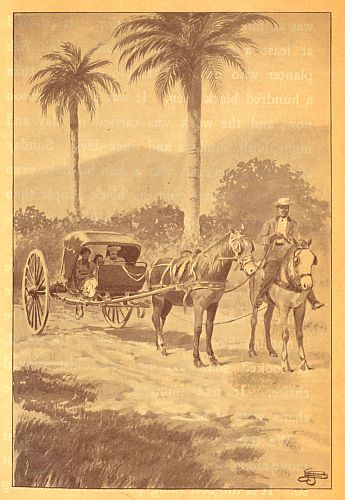
carriage always stood unless it was in use.
The gentleman who lived here had one son,
a little older than Ramon. He showed the
children all around the city. As they went
from place to place, he told them how hard
his father had worked to raise money for the
Cuban soldiers. His mother sold all her
jewels, that she might help, too. But they
had to do this secretly, of course. If the
Spaniards had discovered it, they might have
lost their lives. This boy's name was Blanco.
He was a fine, manly fellow, and was looking
forward now to coming to America.
"I shall go to Harvard College," he told
Maria. "I wish to be a minister, but I'm
afraid if I do become one, I shall not feel like
praying for the Spaniards."
The boy's heart was still bitter, but perhaps
he will feel more kindly when he grows
older.
One day he took his young friends out to
Morro Castle. Havana has a hill fortress of
that name, as well as Santiago. Although
Hobson and his men had never been imprisoned
in this one, yet the Diaz children
were glad to see it.
It stood on a rocky point reaching into the
sea. The great guns were still pointing out
between the masses of yellow stone. But they
were silent. The American flag was waving
and peace ruled in the land, although soldiers
were on guard here and all through the
city.
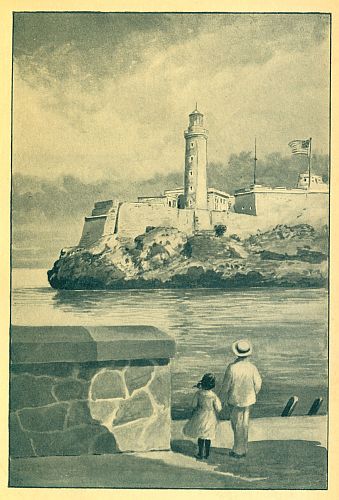
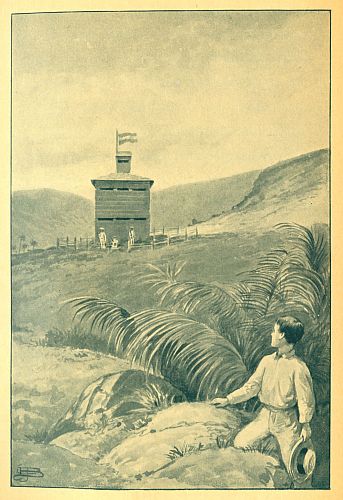
"THE AMERICAN FLAG WAS WAVING AND PEACE RULED
IN THE LAND"
At the far end of the fortress was a tall
lighthouse. It stood like a sentinel to stand
watch against possible danger. Once upon a
time a wall reached from the great fort in both
directions around the city of Havana. But
now there was scarcely a trace of it left.
"How narrow and dirty the streets are,"
said Maria as they left the Morro. "I must
say I would rather live in the country, if I
could choose for myself."
"It doesn't matter so much about the
width of the streets," said Blanco, "or the
poor sidewalks, either. Because, you know,
we almost always ride. The working people
are the ones who walk. But I do not like
the dirt. That is all the fault of the Spaniards.
They taxed us enough, but they kept the
money for themselves.
"Last summer I was very sick with yellow
fever. Mother thought I would not get well.
She said she believed we had so much of this
dreadful disease because the city is allowed to
be so unclean.
"But look quickly at that Punch and Judy
show! Let's stop and watch it. There is a
man playing the harp to make it more entertaining."
The children leaned out of the carriage to
see the show. Isabella had never seen Punch
and Judy before, and she was greatly delighted.
In a few minutes they moved on, but soon
stopped again, for here stood a man turning
a hand-organ with a monkey beside him
dressed in a most ridiculous little suit of
clothes. The monkey was dancing to the
music. Suddenly he gave a spring and landed
in the carriage right in Maria's lap.
Off came the monkey's cap into his little
hands, and with the most solemn look it was
held up to each of the children in turn.
"Take that, you poor little beggar," said
Ramon as he put a silver coin into the cap.
Down jumped the monkey and off he scampered
to his master.
There were many odd sights for the little
country cousins. Among them were Chinese
peddlers showing the pretty ornaments which
had been brought across the ocean. Once the
children passed a cow that was being led home
after her morning's work. She had gone with
her master from house to house, stopping long
enough at each place for her to give as much
milk as the people wished.
The cow was followed by a man leading
a long train of mules. They were laden with
empty baskets. They, too, were going home,
as they had left their loads at the markets in
the city.
The sun was quite hot and the party hurried
home to rest during the noon hours, for, of
course, every one took a nap at this time of the
day. They might not all lie down; perhaps
some of those who had stores in the busy part
of the city would not leave their places of
business; they might only lean back and doze
in their chairs; but they would certainly keep
quiet and close their eyes, if nothing more.
It made one think of the story of the "Sleeping
Beauty" to see Havana at twelve o'clock,
noon, in the summer season.
As for Maria, the dainty maiden quite enjoyed
her rest at the great city house. She
could lie very comfortably in a hammock while
a little negro girl kept off the flies and mosquitoes
with a big fan. She needed the nap
in the city more than at home because she was
awakened so early by the bells.
Perhaps the children enjoyed Sunday more
than any other day during their stay in the
city, for it was then that they visited the
cathedral containing the tomb of Columbus.
There were many churches and grand buildings
in Havana, but none could interest the children
like this.
It was not very far from the house, but they
all went in the carriage, carrying with them the
mats to kneel on during the service. It was
a grand old stone building, overgrown with
moss. There were many bells in the two high
towers. They were pealing loudly as the party
drove up.
"Just think how old it is," whispered Maria
to her brother as they entered the building.
"Blanco says that some of the bells were
brought from Spain more than two hundred
years ago. Do look at the beautiful marble
pillars, Isabella. Isn't it a grand place?"
It was not yet time for the service to begin,
so Blanco led the children to the tomb of Columbus,
where his ashes had rested for so many
years. It was at the right of the high altar.
All that could be seen was a marble tablet
about seven feet square. Above it stood a
bust of the great discoverer.
"They say that Spain has asked the right
to have the ashes, and America is going to let
her take them. But we shall still have the
tomb and the grand old cathedral where they
have rested so long," said Blanco.
"Now come and admire the altar."
It stood on pillars of porphyry and was fairly
covered with candlesticks, images, and gaudy
decorations. Somehow they did not go well
with the simple beauty of the rest of the church.
But the children admired it, for they were
ready to admire everything.
When the service was over, they drove out
by the governor-general's palace. It was his
no longer, however. The American general
who had charge of the city lived here now.
No doubt he enjoyed the beautiful gardens
and ponds. He was very active in improving
the city. Yes, the work had already begun,
and in a few months Maria would no longer
be able to complain of the dirt in Havana.
She could say again, but with a different
thought in her busy little mind, "To-morrow
is another day."
Yes, although it is but a short time since
Maria's visit to Havana, even now everything
is changed in the Diaz family. The good
father no longer worries; he is fast getting to
be a strong, healthy man. He has a fine position
under the new government, and Maria
lives in a new home just outside the city of
Havana. She is rapidly learning to speak
English, while one of her dearest friends is a
little American girl who has lately made her
home in Cuba.
THE END.
THE LITTLE COUSIN SERIES
By MARY HAZELTON WADE
FIRST SERIES
These are the most interesting and delightful accounts
possible of child-life in other lands, filled with quaint sayings,
doings, and adventures. The "Little Japanese
Cousin," with her toys in her wide sleeve and her tiny bag of
paper handkerchiefs; the "Little Brown Cousin," in whose
home the leaves of the breadfruit-tree serve for plates and
the halves of the cocoanut shells for cups; the "Little
Indian Cousin," who lives the free life of the forest, and the
"Little Russian Cousin," who dwells by the wintry Neva,
are truly fascinating characters to the little cousins who
will read about them.
Four volumes, as follows:
| Our Little Japanese Cousin |
| Our Little Brown Cousin |
| Our Little Indian Cousin |
| Our Little Russian Cousin |
Each 1 vol., 12mo, cloth decorative, with 6 full-page
illustrations in tints, by L. J. Bridgman.
| Price, per volume | $0.50 net (postage extra) |
| Price, per set, 4 vols., boxed | 2.00 net (postage extra) |
"Juveniles will get a whole world of pleasure and instruction
out of Mary Hazelton Wade's Little Cousin Series.... Pleasing
narratives give pictures of the little folk in the far-away lands
in their duties and pleasures, showing their odd ways of playing,
studying, their queer homes, clothes, and playthings.... The
style of the stories is all that can be desired for entertainment,
the author describing things in a very real and delightful
fashion."—Detroit News-Tribune.
THE LITTLE COUSIN SERIES
By MARY HAZELTON WADE
SECOND SERIES
The great success and prompt appreciation which this
charming little series met last season has led to its continuation
this year with a new set of child characters from other
lands, each as original and delightful as the little foreign
cousins with whom the little cousins at home became acquainted
in last season's series.
Six volumes, as follows:
| Our Little Cuban Cousin |
| Our Little Hawaiian Cousin |
| Our Little Eskimo Cousin |
| Our Little Philippine Cousin |
| Our Little Porto Rican Cousin |
| Our Little African Cousin |
Each 1 vol., 12mo, cloth decorative, with 6 full-page
illustrations in tints by L. J. Bridgman.
| Price, per volume | $0.50 net (postage extra) |
| Price, per set, 6 vols., boxed | 3.00 net (postage extra) |
"Boys and girls, reading the tales of these little cousins in
different parts of the world, will gain considerable knowledge of
geography and the queer customs that are followed among
strange people."—Chicago Evening Post.
"Not only are the books interesting, but they are entertainingly
instructive as well, and when entertainment can sugar-coat
instruction, the book is one usually well worth placing in the
hands of those to whom the knowledge will be useful."—Utica
Observer.
"To many youthful minds this little series of books may open
up the possibilities of a foreign world to which they had been
total strangers. And interest in this wider sphere, the beyond
and awayness, may bear rich fruit in the future."—N. Y. Commercial
Advertiser.
COSY CORNER SERIES
It is the intention of the publishers that this series shall
contain only the very highest and purest literature,—stories
that shall not only appeal to the children themselves,
but be appreciated by all those who feel with
them in their joys and sorrows,—stories that shall be
most particularly adapted for reading aloud in the
family circle.
The numerous illustrations in each book are by well-known
artists, and each volume has a separate attractive
cover design.
Each, 1 vol., 16mo, cloth $0.50
By ANNIE FELLOWS JOHNSTON
The Little Colonel.
The scene of this story is laid in Kentucky. Its
heroine is a small girl, who is known as the Little
Colonel, on account of her fancied resemblance to an
old-school Southern gentleman, whose fine estate and
old family are famous in the region. This old Colonel
proves to be the grandfather of the child.
The Giant Scissors.
This is the story of Joyce and of her adventures in
France,—the wonderful house with the gate of The
Giant Scissors, Jules, her little playmate, Sister Denisa,
the cruel Brossard, and her dear Aunt Kate. Joyce is
a great friend of the Little Colonel, and in later volumes
shares with her the delightful experiences of the "House
Party" and the "Holidays."
Two Little Knights of Kentucky,
Who Were the Little Colonel's Neighbors.
In this volume the Little Colonel returns to us like an
old friend, but with added grace and charm. She is
not, however, the central figure of the story, that place
being taken by the "two little knights," Malcolm and
Keith, little Southern aristocrats, whose chivalrous natures
lead them through a series of interesting adventures.
Cicely and Other Stories for Girls.
The readers of Mrs. Johnston's charming juveniles
will be glad to learn of the issue of this volume for
young people, written in the author's sympathetic and
entertaining manner.
Big Brother.
A story of two boys. The devotion and care of
Steven, himself a small boy, for his baby brother, is the
theme of the simple tale, the pathos and beauty of
which has appealed to so many thousands.
Ole Mammy's Torment.
"Ole Mammy's Torment" has been fitly called "a
classic of Southern life." It relates the haps and mishaps
of a small negro lad, and tells how he was led by
love and kindness to a knowledge of the right.
The Story of Dago.
In this story Mrs. Johnston relates the story of Dago,
a pet monkey, owned jointly by two brothers. Dago
tells his own story, and the account of his haps and mishaps
is both interesting and amusing.
By EDITH ROBINSON
A Little Puritan's First Christmas:
A Story of Colonial Times in Boston.
A story of Colonial times in Boston, telling how
Christmas was invented by Betty Sewall, a typical child
of the Puritans, aided by her "unregenerate" brother,
Sam.
A Little Daughter of Liberty.
The author's motive for this story is well indicated
by a quotation from her introduction, as follows:
"One ride is memorable in the early history of the
American Revolution, the well-known ride of Paul
Revere. Equally deserving of commendation is another
ride,—untold in verse or story, its records preserved
only in family papers or shadowy legend, the ride of
Anthony Severn was no less historic in its action or
memorable in its consequences."
A Loyal Little Maid.
A delightful and interesting story of Revolutionary
days, in which the child heroine, Betsey Schuyler,
renders important services to George Washington and
Alexander Hamilton, and in the end becomes the wife of
the latter.
A Little Puritan Rebel.
Like Miss Robinson's successful story of "A Loyal
Little Maid," this is another historical tale of a real girl,
during the time when the gallant Sir Harry Vane was
governor of Massachusetts.
A Little Puritan Pioneer.
The scene of this story is laid in the Puritan settlement
at Charlestown. The little girl heroine adds
another to the list of favorites so well known to the
young people in "A Little Puritan Rebel," etc.
By OUIDA (Louise de la Ramée)
A Dog of Flanders: A Christmas Story.
Too well and favorably known to require description.
The Nürnberg Stove.
This beautiful story has never before been published
at a popular price.
A Provence Rose.
A story perfect in sweetness and in grace.
Findelkind.
A charming story about a little Swiss herdsman.
By MISS MULOCK
The Little Lame Prince.
A delightful story of a little boy who has many adventures
by means of the magic gifts of his fairy godmother.
Adventures of a Brownie.
The story of a household elf who torments the cook
and gardener, but is a constant joy and delight to the
children who love and trust him.
His Little Mother.
Miss Mulock's short stories for children are a constant
source of delight to them, and "His Little Mother," in
this new and attractive dress, will be welcomed by hosts
of youthful readers.
Little Sunshine's Holiday.
An attractive story of a summer outing. "Little Sunshine"
is another of those beautiful child-characters for
which Miss Mulock is so justly famous.
By JULIANA HORATIA EWING
Jackanapes.
A new edition, with new illustrations, of this exquisite
and touching story, dear alike to young and old.
Story of a Short Life.
This beautiful and pathetic story will never grow old.
It is a part of the world's literature, and will never die.
A Great Emergency.
How a family of children prepared for a great emergency,
and how they acted when the emergency came.
The Trinity Flower.
In this little volume are collected three of Mrs.
Ewing's best short stories for the young people.
Madam Liberality.
From her cradle up Madam Liberality found her
chief delight in giving.
By FRANCES MARGARET FOX
The Little Giant's Neighbors.
A charming nature story of a "little giant" whose
neighbors were the creatures of the field and garden.
Farmer Brown and the Birds.
A little story which teaches children that the birds are
man's best friends. Miss Fox has an intimate knowledge
of bird life and has written a little book which
should take rank with "Black Beauty" and "Beautiful
Joe."
Betty of Old Mackinaw.
A charming story of child-life, appealing especially to
the little readers who like stories of "real people."
By WILL ALLEN DROMGOOLE
The Farrier's Dog and His Fellow.
This story, written by the gifted young Southern
woman, will appeal to all that is best in the natures of
the many admirers of her graceful and piquant style.
The Fortunes of the Fellow.
Those who read and enjoyed the pathos and charm
of "The Farrier's Dog and His Fellow" will welcome
the further account of the "Adventures of Baydaw and
the Fellow" at the home of the kindly smith among the
Green Hills of Tennessee.
By FRANCES HODGES WHITE
Helena's Wonderworld.
A delightful tale of the adventures of a little girl in
the mysterious regions beneath the sea.
Aunt Nabby's Children.
This pretty little story, touched with the simple humor
of country life, tells of two children, who, adopted by
Aunt Nabby, have also won their way into the affections
of the village squire.
By CHARLES LEE SLEIGHT
The Prince of the Pin Elves.
A fascinating story of the underground adventures of
a sturdy, reliant American boy among the elves and
gnomes.
The Water People.
A companion volume and in a way a sequel to "The
Prince of the Pin Elves," relating the adventures of
"Harry" among the "water people." While it has the
same characters as the previous book, the story is complete
in itself.
By OTHER AUTHORS
The Story of Rosy Dawn. By Pauline
Bradford Mackie.
The Christmas of little Wong Jan, or "Rosy Dawn,"
a young Celestial of San Francisco, is the theme of this
pleasant little story.
Susanne. By Frances J. Delano.
This little story will recall in sweetness and appealing
charm the work of Kate Douglas Wiggin and Laura E.
Richards.
Millicent in Dreamland. By Edna S.
Brainerd.
The quaintness and fantastic character of Millicent's
adventures in Dreamland have much of the fascination
of "Alice in Wonderland," and all small readers of
"Alice" will enjoy making Millicent's acquaintance.
Jerry's Adventures. By Evelyn Snead
Barnett.
This is an interesting and wholesome little story of
the change that came over the thoughtless imps on Jefferson
Square when they learned to know the stout-hearted
Jerry and his faithful Peggy.
A Bad Penny. By John T. Wheelwright.
No boy should omit reading this vivid story of the
New England of 1812.
Gatty and I. By Frances E. Crompton.
The small hero and heroine of this little story are
twins, "strictly brought up." It is a sweet and wholesome
little story.
The Fairy of the Rhône. By A. Comyns
Carr.
Here is a fairy story indeed, one of old-fashioned pure
delight. It is most gracefully told, and accompanied by
charming illustrations.
A Small Small Child. By E. Livingston
Prescott.
"A Small Small Child" is a moving little tale of
sweet influence, more powerful than threats or punishments,
upon a rowdy of the barracks.
Peggy's Trial. By Mary Knight Potter.
Peggy is an impulsive little woman of ten, whose
rebellion from a mistaken notion of loyalty, and her subsequent
reconciliation to the dreaded "new mother," are
most interestingly told.
For His Country. By Marshall Saunders,
author of "Beautiful Joe," etc.
A sweet and graceful story of a little boy who loved
his country; written with that charm which has endeared
Miss Saunders to hosts of readers.
La Belle Nivernaise. The Story of an
Old Boat and Her Crew. By Alphonse
Daudet.
All who have read it will be glad to welcome an old
favorite, and new readers will be happy to have it
brought to their friendly attention.
Wee Dorothy. By Laura Updegraff.
A story of two orphan children, the tender devotion
of the eldest, a boy, for his sister being its theme and
setting. With a bit of sadness at the beginning, the
story is otherwise bright and sunny, and altogether
wholesome in every way.
Rab and His Friends. By Dr. John
Brown.
Doctor Brown's little masterpiece is too well known
to need description. The dog Rab is loved by all.
The Adventures of Beatrice and
Jessie. By Richard Mansfield.
The story of two little girls who were suddenly transplanted
into the "realms of unreality," where they met
with many curious and amusing adventures.
A Child's Garden of Verses. By R.
L. Stevenson.
Mr. Stevenson's little volume is too well known to
need description. It will be heartily welcomed in this
new and attractive edition.
Little King Davie. By Nellie Hellis.
The story of a little crossing-sweeper, that will make
many boys thankful they are not in the same position.
Davie's accident, hospital experiences, conversion, and
subsequent life, are of thrilling interest.
The Sleeping Beauty. A Modern Version.
By Martha B. Dunn.
This charming story of a little fishermaid of Maine,
intellectually "asleep" until she meets the "Fairy
Prince," reminds us of "Ouida" at her best.
The Young Archer. By Charles E. Brimblecom.
A strong and wholesome story of a boy who accompanied
Columbus on his voyage to the New World.
His loyalty and services through vicissitudes and dangers
endeared him to the great discoverer, and the
account of his exploits will be interesting to all boys.
The Making of Zimri Bunker: A
Tale of Nantucket. By W. J. Long, Ph. D.
This is a charming story of Nantucket folk by a
young clergyman who is already well known through
his contributions to the Youth's Companion, St. Nicholas,
and other well-known magazines. The story deals
with a sturdy American fisher lad, during the war of
1812.
The King of the Golden River: A
Legend of Stiria. By John Ruskin.
Written fifty years or more ago, and not originally
intended for publication, this little fairy tale soon
became known and made a place for itself.
Little Peterkin Vandike. By Charles
Stuart Pratt.
The author's dedication furnishes a key to this charming
story:
"I dedicate this book, made for the amusement (and
perchance instruction) of the boys who may read it, to
the memory of one boy, who would have enjoyed as
much as Peterkin the plays of the Poetry Party, but
who has now marched, as they will march one day, out
of the ranks of boyhood into the ranks of young manhood."
Will o' the Mill. By Robert Louis
Stevenson.
An allegorical story by this inimitable and versatile
writer. Its rare poetic quality, its graceful and delicate
fancy, its strange power and fascination, justify its
separate publication.
BOOKS FOR YOUNG PEOPLE
The Little Colonel's House Party. By
Annie Fellows Johnston. Illustrated by Louis Meynell.
One vol., library 12mo, cloth, decorative cover $1.00
The Little Colonel's Holidays. By Annie
Fellows Johnston. Illustrated by L. J. Bridgman.
One vol., large 12mo, cloth, decorative cover $1.50
The Little Colonel's Hero. By Annie Fellows
Johnston.
One vol., large 12mo, cloth decorative, fully illustrated $1.20 net (postage extra)
In these three stories Mrs. Johnston once more introduces
us to the "Little Colonel," the dainty maiden who has already
figured as the heroine of two previous stories, "The Little
Colonel" and "Two Little Knights of Kentucky," and who
has won her way into the hearts of old and young alike. She
is more winsome and lovable than ever.
Since the time of "Little Women," no juvenile heroine has
been better beloved of her child readers than Mrs. Johnston's
"Little Colonel."
A Puritan Knight Errant. By Edith Robinson,
author of "A Little Puritan Pioneer," "A Little Puritan's
First Christmas," "A Little Puritan Rebel," etc.
Library 12mo, cloth decorative, illustrated $1.20 net (postage extra).
The charm of style and historical value of Miss Robinson's
previous stories of child life in Puritan days have brought
them wide popularity. Her latest and most important book
appeals to a large juvenile public. The "knight errant" of
this story is a little Don Quixote, whose trials and their ultimate
outcome will prove deeply interesting to their reader.
Ye Lyttle Salem Maide: A Story of Witchcraft.
By Pauline Bradford Mackie.
New illustrated edition.
One volume, large 12mo, cloth, gilt top $1.50
A tale of the days of the reign of superstition in New England,
and of a brave "lyttle maide," of Salem Town, whose
faith and hope and unyielding adherence to her word of honor
form the basis of a most attractive story. A very convincing
picture is drawn of Puritan life during the latter part of the
seventeenth century.
In Kings' Houses: A Tale of the Days of
Queen Anne. By Julia C. R. Dorr, author of "A
Cathedral Pilgrimage," etc.
New illustrated edition.
One volume, large 12mo, cloth, gilt top $1.50
The story deals with one of the most romantic episodes in
English history. Queen Anne, the last of the reigning Stuarts,
is described with a strong yet sympathetic touch, and the
young Duke of Gloster, the "little lady," and the hero of the
tale, Robin Sandys, are delightful characterizations.
Gulliver's Bird Book. Being the Newly Discovered
Strange Adventures of Lemuel Gulliver,
Now for the First Time Described and Illustrated.
By L. J. Bridgman, author of "Mother Goose
and Her Wild Beast Show," etc.
With upwards of 100 illustrations in color, large quarto, cloth $1.50
This is a most amusing and original book, illustrated with
startlingly odd and clever drawings. If we may accept the
account given in the preface, that renowned explorer, Lemuel
Gulliver, left behind him certain memoirs which have remained
unknown to the public up to the present day. Having
now been brought to light and given to the world, these
records establish beyond a doubt their author's claim to be
regarded as the discoverer of the Bouncing Ballazoon and a
host of other creatures unknown to Darwin and Huxley.
'Tilda Jane. By Marshall Saunders, author of
"Beautiful Joe," etc.
One vol., 12mo, fully illustrated, cloth, decorative cover $1.50
"No more amusing and attractive child's story has appeared for
a long time than this quaint and curious recital of the adventures of
that pitiful and charming little runaway.
"It is one of those exquisitely simple and truthful books that
win and charm the reader, and I did not put it down until I had
finished it—honest! And I am sure that every one, young or old,
who reads will be proud and happy to make the acquaintance of the
delicious waif.
"I cannot think of any better book for children than this. I
commend it unreservedly."—Cyrus Townsend Brady.
Miss Gray's Girls; or, Summer Days in the
Scottish Highlands. By Jeannette A. Grant.
With about sixty illustrations in half-tone and pen and ink
sketches of Scottish scenery.
One vol., large 12mo, cloth, decorative cover $1.00
A delightfully told story of a summer trip through Scotland,
somewhat out of the beaten track. A teacher, starting at
Glasgow, takes a lively party of girls, her pupils, through the
Trossachs to Oban, through the Caledonian Canal to Inverness,
and as far north as Brora, missing no part of the matchless
scenery and no place of historic interest. Returning
through Perth, Stirling, Edinburgh, Melrose, and Abbotsford,
the enjoyment of the party and the interest of the reader never
lag.
Chums. By Maria Louise Pool. Illustrated by L.
J. Bridgman.
One vol., large 12mo, cloth, decorative cover $1.00
"Chums" is a girls' book, about girls and for girls. It relates
the adventures, in school and during vacation, of two
friends. It is full of mingled fun and pathos, and carries the
reader along swiftly to the climax, which is reached all too
soon.
Little Bermuda. By Maria Louise Pool. Illustrated
by Louis Meynell.
One vol., large 12mo, cloth, decorative cover $1.00
Young people will follow eagerly the adventures of "Little
Bermuda" from her home in the tropics to a fashionable
American boarding-school. The resulting conflict between
the two elements in her nature, the one inherited from her
New England ancestry, and the other developed by her West
Indian surroundings, gave Miss Pool unusual opportunity for
creating an original and fascinating heroine.
Black Beauty: The Autobiography of a Horse.
By Anna Sewell. New Illustrated Edition. With
twenty-five full-page drawings by Winifred Austin.
One vol., large 12mo, cloth decorative, gilt top $1.25
There have been many editions of this classic, but we confidently
offer this one as the most appropriate and handsome
yet produced. The illustrations are of special value and
beauty. Mr. Austin is a lover of horses, and has delighted in
tracing with his pen the beauty and grace of the noble animal.
Feats on the Fiord: A Tale of Norwegian
Life. By Harriet Martineau. With about sixty
original illustrations and a colored frontispiece.
One vol., large 12mo, cloth decorative $1.00
This admirable book deserves to be brought to the attention
of parents in search of wholesome reading for their children
to-day. It is something more than a juvenile book, being
really one of the most instructive books about Norway and
Norwegian life and manners ever written.
Timothy Dole. By Juniata Salsbury. With
twenty-five illustrations.
One vol., large 12mo, cloth decorative $1.00
The youthful hero starts from home, loses his way, meets
with startling adventures, finds friends, kind and many, grows
to be a manly man, and is able to devote himself to bettering
the condition of the poor in the mining region of Pennsylvania.
Three Children of Galilee: A Life of Christ
for the Young. By John Gordon.
Beautifully illustrated with more than one hundred illustrations.
One vol., library 12mo, cloth, decorative cover $1.00
There has long been a need for a life of Christ for the
young, for parents have recognized that their boys and girls
want something more than a Bible story, a dry statement of
facts, and that, in order to hold the attention of the youthful
readers, a book on this subject should have life and movement
as well as scrupulous accuracy and religious sentiment.
Three Little Crackers. From Down in Dixie.
By Will Allen Dromgoole, author of "The Farrier's
Dog," etc., with fifty text and full-page illustrations, by E.
B. Barry.
One vol., library 12mo, cloth, decorative cover $1.00
A fascinating story for boys and girls, of a family of Alabama
children who move to Florida and grow up in the South.
Prince Harold, a Fairy Story. By L. F.
Brown. With 60 full-page illustrations by Vitry.
One vol., large 12mo, cloth, decorative cover $1.50
A delightful fairy tale for children, dealing with the life of
a young Prince, who, aided by the Moon Spirit, discovers,
after many adventures, a beautiful girl whom he makes his
Princess.
The Fairy Folk of Blue Hill: A Story of
Folk-Lore. By Lily F. Wesselhoeft, author of
"Sparrow the Tramp," etc., with fifty-five illustrations from
original drawings by Alfred C. Eastman.
One vol., library 12mo, cloth, decorative cover $1.00
A new volume by Mrs. Wesselhoeft, well known as one of
our best writers for the young, and who has made a host of
friends among the young people.
Larry Hudson's Ambition. By James Otis,
author of "Toby Tyler," etc. Illustrated by Eliot Keen.
One vol., library 12mo, cloth, decorative cover $1.25
James Otis, who has delighted the juvenile public with so
many popular stories, has written the story of the rise of the
bootblack Larry. Larry is not only capable of holding his
own and coming out with flying colors in the amusing adventures
wherein he befriends the family of good Deacon Doak;
he also has the signal ability to know what he wants and to
understand that hard work is necessary to win.
The Adventures of a Boy Reporter in
the Philippines. By Harry Steele Morrison, author
of "A Yankee Boy's Success."
One vol., large 12mo, cloth, illustrated $1.25
A true story of the courage and enterprise of an American
lad. It is filled with healthy interest, and will tend to stimulate
and encourage the proper ambition of the young reader.
The Young Pearl Divers: A Story of Australian
Adventure by Land and by Sea. By Lieut.
H. Phelps Whitmarsh, author of "The Mysterious
Voyage of the Daphne," etc. Illustrated with twelve full-page
half-tones by H. Burgess.
One vol., large 12mo, cloth decorative $1.00
This is a splendid story for boys, by an author who writes in
vigorous and interesting language of scenes and adventures
with which he is personally acquainted.
The Voyage of the Avenger: In the Days
of the Dashing Drake. By Henry St. John. With
twenty-five full-page illustrations by Paul Hardy.
One vol., tall 12mo, cloth decorative, gilt top $1.50
A book of adventure, the scene of which is laid in that stirring
period of colonial extension when England's famous naval
heroes encountered the ships of Spain, both at home and in
the West Indies.