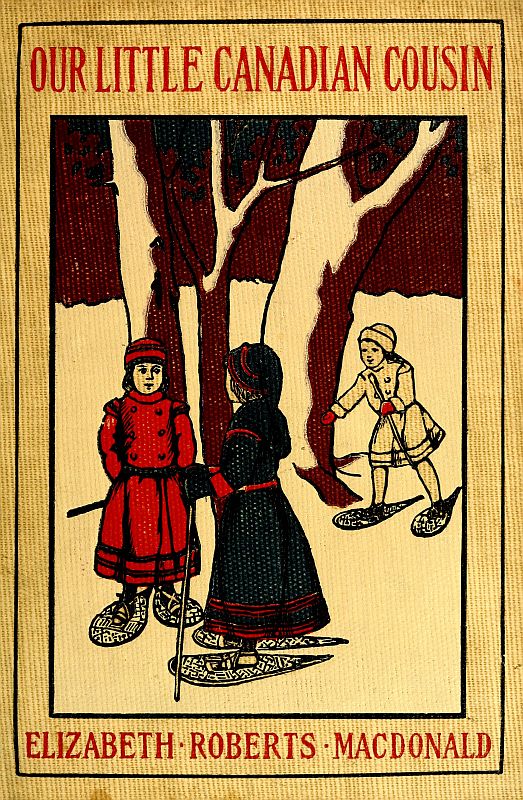
Snow-shoeing is one of the national sports
of Canada, in which most Canadians, big and
little, are proficient. Marjorie and her cousin
were no exception to the rule, and Jackie
proved a very apt pupil. He soon learned to
avoid striking one snow-shoe against the other,
and fell quickly into that long, easy swing,
which makes the snowy miles go by so quickly.
Sometimes the three children tramped on the
broad, frozen river, but that was a cold place
when there was any wind, so they generally
chose the hill-roads or the woods. Nothing,
Dora thought, could be more beautiful than
those woods in winter, with the white drifts
around the grayish tree-trunks, the firs and
hemlocks rising like green islands out of a
snowy sea, and the wonderful tracery of brown
boughs against the pale blue of the sky.
Once, Mr. and Mrs. Merrithew went with
them for a moonlight tramp, and that was
something never to be forgotten.
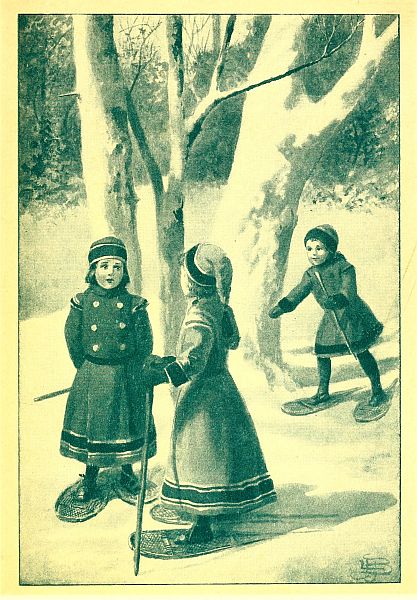 "NOTHING, DORA THOUGHT, COULD BE MORE BEAUTIFUL
THAN THOSE WOODS IN WINTER"
"NOTHING, DORA THOUGHT, COULD BE MORE BEAUTIFUL
THAN THOSE WOODS IN WINTER"
It was just after a heavy snowfall, and the
evergreens were weighed down with a white
covering that sparkled and glittered as with
innumerable jewels. Another favourite amusement
was coasting,—not tobogganing, but
good, old-fashioned coasting, generally on College
Hill, but sometimes down the steep bank
of the river. Coasting parties were frequent,
and it was a pretty sight to see the hill dotted
with blanket-coated and toqued or tam-o'-shantered
figures, and pleasant to hear the
merry voices and laughter as the sleds
skimmed swiftly down the road.
The winters in Eastern Canada, though
cold, are wonderfully bright and clear, and
the air is so free from dampness that one does
not realize how cold it sometimes becomes,
unless one consults the thermometer. Canadians,
as a rule, spend a great deal of time in
the open air in winter as well as summer, and
are as hardy a race as can be found anywhere,
but when they are indoors they like their
houses good and warm,—no half-measures,
no chilly passages and draughty bedrooms for
them!
Mr. Merrithew did not keep horses, but
occasionally he would hire a big three-seated
sleigh and take the family for a delightful spin.
They would all be warmly wrapped in woollens
and furs, and snuggled in buffalo-robes;
the bells would jingle merrily, the snow would
"skreak" under the horses' feet, and the
white world slip by them like a dream.
One day, about the middle of February,
Mrs. Merrithew announced, at breakfast, that
it was high time for the drive to Hemlock
Point, which Mr. Merrithew had been promising
them all winter. As the latter quite agreed
with this idea, they decided to go on the following
morning, spend a long day with the
friends they always visited there, and return by
moonlight. Hemlock Point was somewhere
between ten and twenty miles up-river,—it
does not always do to be too exact,—and their
friends lived in a quaint old farmhouse, on
high ground, well back from the river-bank.
That evening, when they sat in the Den
after lessons were done, Marjorie told Dora
about the good folk who lived there,—an old
bachelor farmer, the most kind-hearted and
generous of men, but as bashful as a boy; his
two unmarried sisters, who managed his house
and thought they managed him, but really
spoilt him to his heart's content; and an
orphan niece, who had lived with them for
several years, and who was the only modern
element in their lives. She graphically described
the old loom, the big and little spinning-wheels,
and the egg-shell china, till Dora
was as anxious as Jackie for to-morrow to
come.
The three-seated sleigh and the prancing
horses were at the door of the Big Brick
House by eight the next morning, for the
drive would be long and the load heavy, and
it was well to be early on the way. The girls
and Jackie wore their blanket-suits,—Dora's
and Jackie's crimson and Marjorie's bright
blue,—and Mrs. Merrithew herself, snugly
wrapped in furs, brought a grand supply of
extra cloaks and shawls. She was always prepared
for any emergency. Mr. Merrithew said
that he never knew her fail to produce pins,
rope, a knife, and hammer and nails, if they
were needed. But the hammer and nails she
repudiated, and said it was twine, not rope,
she carried! The sky was a little overcast
when they started, but the prospect of a snow-storm
did not daunt them in the least.
The bells, of which there were a great many
on the harness, kept up a musical, silvery accompaniment
to the conversation, as the horses
swung at a good speed along the level. When
the hills began to rise, the pace slackened,
and the passengers had a better chance to
enjoy the beauties spread on both sides of
the road.
"But oh, you ought to see it in summer!"
Marjorie said, when Dora praised the varied
and lovely landscapes. "There are so many
things yet for you to see all around here.
You will have to stay two or three years more
at least!"
But Dora laughed at this.
"What about all the things there are for you
to see in Montreal?" she said. "What about
the Ice Palace, and—"
"Please tell about the Ice Palace, Dora,"
Jack interrupted. "That must be a gorlious
sight!"
So Dora tried to give her cousins some idea
of the great palace of glittering ice, and the
hundreds of snow-shoers, in bright costumes
and carrying torches, gathered together to
storm this fairylike fortress.
"It must be fine," said Marjorie, when the
story was done, "but I'd rather storm Hemlock
Point, and get fried chicken and buttermilk
as the spoils of war."
Marjorie, being a tremendous home-girl,
generally tried to change the subject if Dora
made any allusions to a possible visit of Marjorie
alone to Montreal. She could not bear
the thought of parting with Dora, but to part
with mother and Daddy and Jack would be
three times worse!
The last part of the road was decidedly
hilly, and the horses took such advantage of
Mr. Merrithew's consideration for their feelings,
that Jackie, lulled by the slow motion
and the sound of the bells, fell asleep against
his mother's shoulder, and knew no more till
he woke on a couch in Miss Grier's sitting-room.
The oldest Miss Grier—whom every
one called Miss Prudence—was bustling
about, helping Marjorie and Dora off with
their things, and giving advice to Miss Alma,
who was hastening to start a fire in the great
old-fashioned Franklin. Miss Dean, the niece,
was taking off Mrs. Merrithew's overboots, in
spite of her polite protests. Jackie's eyes were
open for some moments before any one noticed
him; then he startled them by saying, in perfectly
wide-awake tones:
"I think, Miss Lois Dean, you are the
very littlest lady in the world!"
Miss Dean, who certainly could not well be
smaller and be called grown-up at all, and
whose small head was almost weighted down
by its mass of light hair, looked at her favourite
with twinkling eyes.
"Never mind, Jackie, the best goods are
often done up in small parcels; and I'm big
enough to hold you on my lap while I tell
you stories, which is the main thing, isn't it?"
"Yes, indeed," Jack cried, jumping up to
hug her, which resulted in the pretty hair getting
loosened from its fastenings and tumbling
in wild confusion around the "littlest lady,"
where she sat on the floor.
"Now you are a fairy godmother! Now
you are a fairy godmother!" exclaimed Jackie,
dancing around her.
"Then I will put a charm upon you at
once," Lois said. "No more dancing, no
more noise, no more anything, until we get the
wraps all off and put away; then you and
I will go and—fry chicken—and sausages—for
dinner!"
The last part of the sentence was whispered
in Jack's ear, and caused him to smile contentedly,
and to submit without a murmur to
the process of unwrapping.
After dinner,—which did great credit to
Lois and her assistant,—they gathered around
the Franklin in the sitting-room, with plates
of "sops-of-wine" and golden pippins within
easy reach, and Mr. Grier and Mr. Merrithew
talked farming and politics, while Miss Prudence
recounted any episodes of interest that
had taken place at or near Hemlock Point
during the past year.
Mrs. Merrithew, who had spent her summers
here as a girl, knew every one for miles
around, and loved to hear the annals of the
neighbourhood, told in Miss Prudence's picturesque
way, with an occasional pithy comment
from Miss Alma.
Dora sat, taking in with eager eyes the view
of hill and intervale, island and ice-bound
river; then turning back to the cosey interior,
with its home-made carpet, bright curtains,
and large bookcase with glass doors.
After a little while Lois, who saw that the
children were growing weary of sitting still,
proposed a stroll through the house, to which
they gladly consented. Katherine asked if
she might go with them, and they left "the
enchanted circle around the fire," and crossed
the hall to the "best parlour,"—which Miss
Prudence always wished to throw open in
Mrs. Merrithew's honour, and which the latter
always refused to sit in, because, as she frankly
said, it gave her the shivers. This was not
on account of any ill-taste in the furnishing,
but because it was always kept dark and shut
up, and Mrs. Merrithew said it could not be
made cheery all of a sudden. The children,
however, loved the long room, and the mysterious
feeling it gave them when they first
went in, and had to grope their way to the
windows, draw back the curtains, and put up
the yellow Venetian blinds, letting the clear,
wintry light into this shadowy domain. This
light brought out the rich, dark colours of the
carpet, and showed the treasures of chairs and
tables that would have made a collector's
mouth water. There was a round table of
polished mahogany in the centre of the room,
a tiny butternut sewing-table in one corner,
and against the wall, on opposite sides of the
room, two rosewood tables, with quaint carved
legs, and feet of shining brass. On the tables
lay many curious shells, big lumps of coral,
and rare, many-coloured seaweeds,—for there
had been a sailor-uncle in the family,—annuals
and beauty-books in gorgeous bindings,
albums through which the children looked
with never-failing delight, work-boxes and
portfolios inlaid with mother-of-pearl; almost
all the treasures of the family, in fact, laid
away here in state, like Jean Ingelow's dead
year, "shut in a sacred gloom."
When this room had been inspected and
admired, they lowered the blinds, drew the
curtains, and left it again to its solitude. The
rest of the house was much less awe-inspiring,
but it was all delightful. The loom, now
seldom or never used, stood in one corner of
the kitchen. Not far away was the big spinning-wheel.
Miss Dean tried to teach them
to spin, and when they found it was not so
easy as it looked, gave them a specimen of
how it should be done that seemed almost
magical. There is, indeed, something that
suggests magic about spinning,—the rhythmically
stepping figure, the whirling brown wheel,
the rolls of wool, changed by a perfectly measured
twirl and pull into lengths of snow-white
yarn, and the soothing, drowsy hum,
the most restful sound that labour can produce.
Then there was the up-stairs to visit. The
chief thing of interest there was the tiny flax-wheel
which stood in the upper hall, and which
certainly looked, as Jack said, as if it ought to
belong to a fairy godmother. In the attic,
great bunches of herbs hung drying from the
rafters, and the air was sweet with the scent
of them. There were sage, summer-savoury,
sweet marjoram, sweet basil, mint, and many
more, with names as fragrant as their leaves.
On the floor, near one of the chimneys,
was spread a good supply of butternuts,
and strings of dried apples stretched from
wall to wall at the coolest end of the one big
room.
"If I lived in this house," Dora said, "I
would come up here often and write,—try to
write, I mean!"
"I come up here often and read," Miss
Dean said, with a quick glance of comprehension
at the little girl's eager face. "I love it!
And sometimes, when I feel another way and
it's not too cold, I put up one blind in the best
parlour, and sit in there."
"I wish you were coming down to sit in
mother's den, and read—and talk—and
everything!" said Marjorie, and the others
echoed the wish.
"So I am, some time or other," Lois
answered. "Mrs. Merrithew has asked me,
and now it's just a question of how soon Aunt
Prudence can spare me. That may be next
week,—or it may be next winter!"
"It may be for years and it may be for
ever," Dora quoted, laughing, and Jackie
added, "and then—when you do come—we
will make you a Son and Daughter of
Canada right away!"
The search for the egg-shell china took
them back to the sitting-room, where Lois
begged Miss Prudence to exhibit this most
fragile of her belongings. With natural pride,
that lady unlocked a china-closet, and brought
out specimens of the beautiful delicate ware
which their grandmother had brought over
with her from Ireland, and of which, in all
these years, only three articles had been
broken. It certainly was exquisite stuff, delicately
thin, of a rich cream-colour, and with
gilt lines and tiny wreaths of pink and crimson
roses.
"I thought we would have them out for
tea," Miss Alma suggested, but Mrs. Merrithew,
with three children, all rather hasty in
their movements, to look after, begged her
not to think of such a thing.
"Your white and gold china is pretty
enough for any one;" she said, "and, my
dear Prudence, if you are determined to give
us tea after that big dinner, we will have to
ask for it soon, or we will be spending most
of the night on the road."
"Dear, dear!" said Miss Prudence, putting
back her treasures tenderly, "it does seem as
if you'd been here about half an hour, and I
do hate to have you go! But I know how you
feel about being out late with the children,
and you won't stay all night. Come along,
Alma, let's hustle up some tea, and let Lois
talk to Mrs. Merrithew awhile."
And "hustle" they certainly did, spreading
a board that groaned with the good
old-fashioned dainties, for the cooking of
which Miss Prudence was noted throughout
the country. Then the horses were
brought to the door, tossing their heads in
haste to be off, wraps were snugly adjusted,
good-byes said many times, and they were
off.
"I believe Grier has given these horses
nothing but oats all day," Mr. Merrithew
muttered, as the pretty beasts strained and
tugged in their anxiety to run down-hill; but
when it came to the up-hill stretches, they
soon sobered down, and were content with a
reasonable pace. Warm and cosey, nestled
against his mother, Jackie soon slept as before;
but the others, with rather a reckless
disregard of their throats, sang song after song,
in spite of the frosty air, and dashed up to the
door of the Big Brick House, at last, to the
sound of:
"'Twas from Aunt Dinah's quilting party
I was seeing Nellie home."