"What fortunes could be made in these
forests," said the Senhor Dias to his brother,
"if people with capital only knew of the riches
stored here. Mahogany, satinwood, rosewood
and many other kinds of trees grow here in the
greatest abundance, and were there railroads
and ships to transport them, Brazil would be
one of the richest countries in the world."
"We should try to develop our own land,"
said his brother, and the two men entered into a
long conversation as to the wonderful forests of
the country, to which Affonzo listened with
interest.
"Oh, father!" he exclaimed, at last. "When
you go up the river to see the forests may I go
with you?"
"Perhaps, but I could not make a promise
without first asking your mother's consent. The
trip will be an interesting one, but very hard,
though it might do you good."
"I should love to go," said Affonzo, and his
uncle added, "He will grow up a milksop if you
keep him in the nursery much longer; let him
go."
"It is about time we were starting now," said
the Senhor. "Joachim, make ready the bag.
Your uncle and I will walk on a little ahead,
Affonzo, and you can follow with Joachim. But
do not stray away from him, or you will miss the
path, and all manner of dangers lurk in these
forests."
Affonzo sat lazily waiting and watching as the
black put up the dinner things. "Take care of
my snake skin," he said, and Joachim smiled,
and replied, "That will make a fine belt for the
little master when it is dried."
"I should like that very much," said Affonzo.
"You must make it for me."
"Yes, sir," said Joachim as he swung over his
strong shoulders the wicker-work hamper and
game bag. "Is the young master ready to
go?"
"I am," Affonzo replied, and the two started
down the narrow path along which the Senhor
had disappeared.
"What kind of a tree is that?" asked Affonzo
pointing to a tall tree a hundred feet high.
"That is the castanhao," said Joachim.
"Some people call it the Brazil nut, and I have
often gathered nuts from it for you to eat. The
nuts grow at the very top of the tree in shells like
cocoanuts, and each shell has fifteen or twenty
nuts in it. Often I have thought my head was
broken when a shell fell upon it."
"I wonder why we don't catch up with my
father?" said Affonzo. "Joachim, what makes
it so dark?"
"Storm coming. We must hurry," was the
brief answer.
Heavy clouds had gathered quickly; not a
glimmer of sunlight came through the trees, and
great drops of rain began to fall.
"Father!" cried Affonzo, but there was no
answer. "Father!" he called again and
Joachim shouted, "Senhor! Senhor!"
Nothing was heard but the screaming of the
wind, and the rain fell faster and faster. Vivid
flashes of lightning illuminated the forest, and
the thunder muttered and grumbled in the distance.
"Come with me quickly," said Joachim, as he
seized the boy by the hand. "We mustn't stay
here."
"But my father," cried Affonzo and tried to
get away from Joachim, but the negro held tight
to him.
"The Senhor can take care of himself; I must
take care of you," he said, as he pulled the boy
into a side path which led through the woods.
They made their way with difficulty through
the dense tangle of underbrush and vines. Often
a swinging branch would strike Affonzo on the
face, or he would tangle his feet in a swaying
vine and fall full length in a bed of fern. The
rain poured down in torrents, but the leaves and
interlaced branches served as a shield from the
great drops which pelted down like bullets.
Soon they came to a small hut with a thatched
roof and no door to bar the entrance. Into it
Joachim pulled the boy with scant ceremony.
As they entered the hut a man rose hurriedly
from his grass couch, and Affonzo recognized
an Indian who had often been to the Fazenda to
see his father.
"Ah, Vicente," said Joachim. "Give us
shelter."
"Welcome," said the syringuero.[2] "The
storm is bad. You reached shelter just in time.
See!"
He pointed through the door-way and
Affonzo saw that the streams of water were
well-nigh rivers, and the thunder and lightning
were almost incessant.
"Where do you suppose my father is?" he
asked, and Joachim answered,
"The Senhor has found shelter, do not fear;
and he will know you are safe with me."
"There is nothing to do but sit still, I suppose,"
said Affonzo, rather mournfully, for that
was the hardest thing in all the world for him to
do.
Vicente gave him a slow smile. He was an
old Indian of wiry frame, with keen black eyes.
His hair was straight and black, his chin firm and
strong, his features clean-cut, his face proud and
intelligent. He was in great contrast to curly-haired,
black Joachim with his good-humoured,
stolid face.
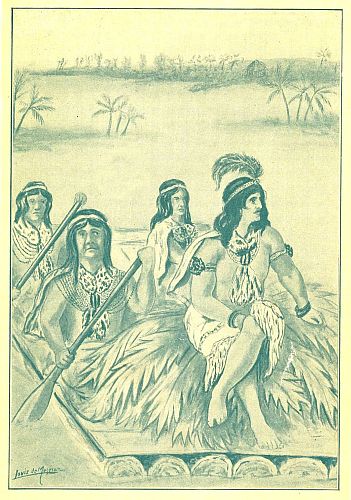
"HE PLACED HIMSELF ON A RAFT AND WAS ROWED TO
THE MIDDLE OF THE GREAT RIVER."
Vicente was one of the Indians whose fathers
had owned the land before the Portuguese discovered
it and named it Brazil from the red
colour of its dye woods. He gathered rubber
from the great trees which grew in the forest,
and lived alone in his little hut. He sat smoking
and watching the boy who looked out into the
rain feeling very miserable.
"Vicente," he said at last, "have you lived
long in the forest?"
"Many years have I been here," said the old
man. "And my fathers were here before me.
They hunted and fished and were chiefs in the
land until the white men came. Many died,
many went to the great hills, but I stayed here,
for the home of my fathers is my home."
"Tell me a story, Vicente," begged the little
boy.
"In the days of my fathers," said Vicente,
"and of my father's fathers and their fathers,
things were not as to-day they are in the country
of the great river. There were no white
Senhores. The Indians dwelt alone. They
roamed the forests hunting with the bow and
arrow; they fished in the great stream; they
dwelt in their lodges and were happy.
"Often there were fights with other Indians
and these were of great glory. But my people
were peaceful and loved not war, never fighting
if they could first have peace. To secure peace
for our village, each year they made a sacrifice
and this was the manner of it.
"A chief smeared his body with gum and then
powdered himself with gold dust. He powdered
it all over, for in our mountains was much gold
and precious gems. He placed himself on a raft
and was rowed to the middle of the great river.
There he raised his hands to heaven, praying the
Great Spirit to save his village, and jumping
into the water he washed off the precious dust.
This he sacrificed for his village.
"This was done each year and should have
been done still, when, perhaps, the Indian villages
would not have been destroyed and deserted,
but it ceased for the sin of one man. A
chief loved gold. That is an evil and a foolishness,
for gold is but for use and not for love.
He loved its glitter, and it seemed to him stupid
to waste it in a sacrifice.
"It was his turn to make the river sacrifice and
become the Gilded Man.[3] But he was angry
within himself, and said, 'why shall I do this
thing? If the village wishes gold, why must
it take mine? It is a foolish thing!'
"Yet he could not refuse the sacrifice, for to
be the Gilded Man was thought an honour, and
did he refuse, many would suspect him of faithlessness
to his tribe. So he gilded himself as
was the custom, and his brother chiefs rowed
him to the river and he raised his hands to
heaven.
"'Spirits of Rain and Wind, of Fire and
Water, of Good and Evil, keep our village and
our people,' he cried. 'We offer all to thee!'
Then he plunged into the stream and washed the
gold from his arms and legs. All the time his
heart was hot within him and he thought to himself,
'How my soul grieves to see this waste of
the beautiful, shining dust!' Then an evil spirit
tempted him and he did not wash off all the gold.
He left beneath his arms where others could not
see it, some of the glittering dust, and returned
to his village, an insult to the Spirits of Heaven.
"That night came fierce rain and wind and
with it a horde of enemies who descended like
a hurricane and destroyed the village,—men,
women and children. So the chief with all his
gold was destroyed utterly and he was the last
Gilded Man. Thus were the Spirits of Heaven
avenged!"
"Thank you, Vicente," cried Affonzo. "That
is a good story. But see, the rain is over. Now
we must hurry to find my father," pointing as
he spoke to the doorway. The sky was clear and
bright, already rose-tinted with the rays of the
setting sun, low in the heavens.
"You must not go yet," said Vicente.
"Ground too wet, trees wet, bad for white people.
You must wait."
"But I must find my father," persisted
Affonzo, who, though he was a brave boy, began
to be somewhat frightened. But Vicente
knew the danger of the steaming forest with its
snakes, mosquitoes and insects swarming after
the storm. "Not safe to go now," he said, and
Joachim, who was quite comfortable where he
was, said, "Little master must sleep here and
go home in the morning."
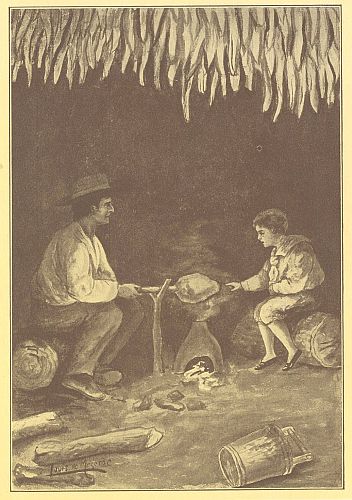
"You shall have a good supper," said Vicente,
who began at once to prepare the meal, and
Affonzo was forced to submit. So he watched
with interest the preparations for supper, for
like most boys, he was generally hungry. Vicente
built a fire in the stone fireplace in front of his
hut, and from a stone jar in the corner he
brought pork, some coarse bread, wild honey
found in the woods, and bananas.
"Take a bird from our bag," said Affonzo,
wishing to give his share of the feast, and
Joachim brought out a parrot which was soon
stewing in the pot with the pork, and a handful
of peppers and herbs. When the savoury stew
was done, the meal was spread upon a rough
bench at the door, and the three odd companions
sat down together.
"Quite a festive party," said a laughing voice,
and jumping up, Affonzo saw his father and
uncle approaching through the trees.
"Oh, papa, how glad I am to see you! I
feared you would be wet through, but you must
have found shelter as we did, for you are
scarcely wet at all."
"I worried about you, more than you did
about me, I fancy," said his father, "though I
hoped Joachim would bring you here. Your
uncle and I missed the path some way, and could
not find you or the old house again, so we took
refuge in a deserted hut."
"The Senhors will sup with me," said Vicente,
"and remain here for the night since the forest
is unsafe for the boy."
"A thousand thanks; we will stay if you can
arrange for so many," was the reply, and as
Vicente assured them that they would all be most
welcome, they ate their supper with much enjoyment.
The two Senhors slept in Indian hammocks
swung between giant rubber trees, while Affonzo
curled up in a blanket and slept, as did Vicente
and Joachim, on a fragrant couch of dried grass.