THE SPLENDOUR OF SAGHALIE TYEE
The tundra was greenish-brown in colour,
and looked like a great meadow stretching from
the beach, like a new moon, gently upward to
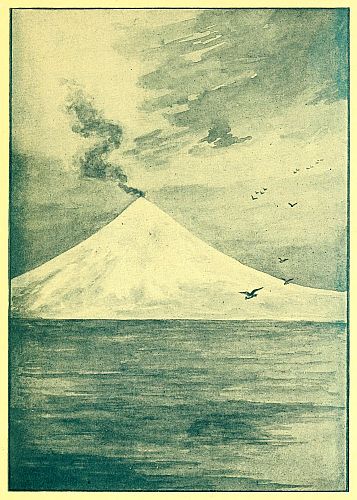
the cones of volcanic mountains far away.
The ground, frozen solid all the year, thaws
out for a foot or two on the surface during the
warm months, and here and there were scattered
wild flowers; spring beauties, purple primroses,
yellow anemone, and saxifrages bloomed in
beauty, and wild honey-bees, gay bumblebees,
and fat mosquitoes buzzed and hummed everywhere.
Ted and Kalitan were going to see the reindeer
farm at Port Clarence, and, as this was
to be their last jaunt in Alaska, they were determined
to make the best of it. Next day they
were to take ship from Cape Prince of Wales
and go straight to Sitka. Here Ted was to
start for home, and Mr. Strong was to leave
Kalitan at the Mission School for a year's
schooling, which, to Kalitan's great delight, was
to be a present to him from his American
friends.
"Tell us about the reindeer farms, daddy.
Have they always been here?" demanded Ted,
as they tramped over the tundra, covered with
moss, grass, and flowers.
"No," said his father. "They are quite
recent arrivals in Alaska. The Esquimos used
to live entirely upon the game they killed before
the whites came. There were many walruses,
which they used for many things; whales, too,
they could easily capture before the whalers
drove them north, and then they hunted the
wild reindeer, until now there are scarcely any
left. There was little left for them to eat but
small fish, for you see the whites had taken away
or destroyed their food supplies.
"One day, in 1891, an American vessel discovered
an entire village of Esquimos starving,
being reduced to eating their dogs, and it was
thought quite time that the government did
something for these people whose land they had
bought. Finding that people of the same race
in Siberia were prosperous and healthy, they
sent to investigate conditions, and found that
the Siberian Esquimos lived entirely by means
of the reindeer. The government decided to
start a reindeer farm and see if it would not
benefit the natives."
"How does it work?" asked Ted.
"Very well, indeed," said his father. "At
first about two hundred animals were brought
over, and they increased about fifty per cent.
the first year. Everywhere in the arctic region
the tundra gives the reindeer the moss he lives
on. It is never dry in summer because the frost
prevents any underground drainage, and even
in winter the animals feed upon it and thrive.
There are, it is said, hundreds of thousands of
square miles of reindeer moss in Alaska, and
reindeer stations have been established in many
places, and, as the natives are the only ones
allowed to raise them, it seems as if this might
be the way found to help the industrious Esquimos
to help themselves."
"But if it all belongs to the government,
how can it help the natives?" asked Ted.
"Of course they have to be taught the business,"
said Mr. Strong. "The government
brought over some Lapps and Finlanders to
care for the deer at first, and these took young
Esquimos to train. Each one serves five years
as herder, having a certain number of deer set
apart for him each year, and at the end of his
service goes into business for himself."
"Why, I think that's fine," cried Ted. "Oh,
Daddy, what is that? It looks like a queer,
tangled up forest, all bare branches in the summer."
"That's a reindeer herd lying down for their
noonday rest. What you see are their antlers.
How would you like to be in the midst of that
forest of branches?" asked Mr. Strong.
"No, thank you," said Teddy, but Kalitan
said:
"Reindeer very gentle; they will not hurt
unless very much frightened."
"What queer-looking animals they are," said
Ted, as they approached nearer. "A sort of a
cross between a deer and a cow."
"Perhaps they are more useful than handsome,
but I think there is something picturesque
about them, especially when hitched to sleds
and skimming over the frozen ground."
The farm at Teller was certainly an interesting
spot. Teddy saw the deer fed and milked,
the Lapland women being experts in that line,
and found the herders, in their quaint parkas
tied around the waist, and conical caps, scarcely
less interesting than the deer. Two funny little
Lapp babies he took to ride on a large reindeer,
which proceeding did not frighten the babies
half so much as did the white boy who put them
on the deer. A reindeer was to them an every-day
occurrence, but a Boston boy was quite another
matter.
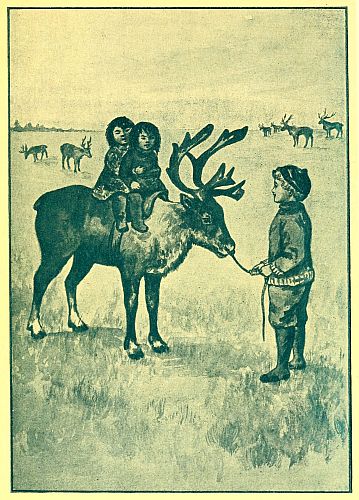 "TWO FUNNY LITTLE LAPP BABIES HE TOOK TO RIDE ON A
LARGE REINDEER."
"TWO FUNNY LITTLE LAPP BABIES HE TOOK TO RIDE ON A
LARGE REINDEER."
Better than the reindeer, however, Teddy
and Kalitan liked the draught dogs who hauled
the water at the station. A great cask on
wheels was pulled by five magnificent dogs,
beautiful fellows with bright alert faces.
"They are the most faithful creatures in
the world," said Mr. Strong, "devoted to their
masters, even though the masters are cruel to
them. Reindeer can work all day without a
mouthful to eat, living on one meal at night of
seven pounds of corn-meal mush, with a pound
or so of dried fish cooked into it. On long journeys
they can live on dried fish and snow, and
five dogs will haul four hundred pounds thirty-five
miles a day. They carry the United States
mails all over Alaska."
"I should think the dog would be worth
more than the reindeer," said Ted.
"Many Alaskan travellers say he is by far
the best for travelling, but he cannot feed himself
on the tundra, nor can he be eaten himself
if necessary. The Jarvis expedition proved
the value of the reindeer," said Mr. Strong.
"What was that?" asked Ted.
"Some years ago a whale fleet was caught
in the ice near Point Barrow, and in danger
of starving to death, and word of this was sent
to the government. The President ordered the
revenue cutter Bear to go as far north as possible
and send a relief party over the ice by sledge
with provisions.
"When the Bear could go no farther, her
commander landed Lieutenant Jarvis, who was
familiar with the region, and a relief party.
They were to seek the nearest reindeer station
and drive a reindeer herd to the relief of the
starving people. The party reached Cape
Nome and secured some deer, and the rescue
was made, but under such difficulties that it is
one of the most heroic stories of the age.
These men drove four hundred reindeer over
two thousand miles north of the Arctic Circle,
over frozen seas and snow-covered mountains,
and found the starving sailors, who ate the
fresh reindeer meat, which lasted until the ice
melted in the spring and set them free."
"I think that was fine," said Ted. "But it
seems a little hard on the reindeer, doesn't it,
to tramp all that distance just to be eaten?"
"Animals made for man," said Kalitan,
briefly.
A golden glory filled the sky, running upwards
toward the zenith, spreading there in
varying colours from palest yellow to orange
and deepest, richest red. Glowing streams of
light streamed heavenward like feathery wings,
as Ted and Kalitan sailed southward, and Ted
exclaimed in wonder: "What is it?"
"The splendour of Saghalie Tyee,"[16] said
Kalitan, solemnly.
"The Aurora Borealis," said Mr. Strong,
"and very fortunate you are to see it. Indeed,
Teddy, you seem to have brought good luck,
for everything has gone well this trip. Our
faces are turned homeward now, but we will
have to come again next summer and bring
mother and Judith."
"I'll be glad to get home to mother again,"
said Ted, then noting Kalitan's wistful face,
"We'll find you at Sitka and go home with you
to the island," and he put his arm affectionately
over the Indian boy's shoulder. Kalitan pointed
to the sky, whence the splendour was fading,
and a flock of birds was skimming southwards.
"From the sky fades the splendour of Saghalie
Tyee," he said. "The summer is gone,
the birds fly southward. The light goes from
me when my White Brother goes with the birds.
Unless he return with them, all is dark for
Kalitan!"
THE END.
THE LITTLE COUSIN SERIES
The most delightful and interesting accounts possible
of child life in other lands, filled with quaint sayings,
doings, and adventures.
Each one vol., 12mo, decorative cover, cloth, with six or more
full-page illustrations in color.
Price per volume $0.60
By MARY HAZELTON WADE (unless otherwise
indicated)
| Our Little African Cousin |
| Our Little Alaskan Cousin |
| By Mary F. Nixon-Roulet |
| Our Little Arabian Cousin |
| By Blanche McManus |
| Our Little Armenian Cousin |
| Our Little Brown Cousin |
| Our Little Canadian Cousin |
| By Elizabeth R. Macdonald |
| Our Little Chinese Cousin |
| By Isaac Taylor Headland |
| Our Little Cuban Cousin |
| Our Little Dutch Cousin |
| By Blanche McManus |
| Our Little English Cousin |
| By Blanche McManus |
| Our Little Eskimo Cousin |
| Our Little French Cousin |
| By Blanche McManus |
| Our Little German Cousin |
| Our Little Hawaiian Cousin |
| Our Little Hindu Cousin |
| By Blanche McManus |
| Our Little Indian Cousin |
| Our Little Irish Cousin |
| Our Little Italian Cousin |
| Our Little Japanese Cousin |
| Our Little Jewish Cousin |
| Our Little Korean Cousin |
| By H. Lee M. Pike |
| Our Little Mexican Cousin |
| By Edward C. Butler |
| Our Little Norwegian Cousin |
| Our Little Panama Cousin |
| By H. Lee M. Pike |
| Our Little Philippine Cousin |
| Our Little Porto Rican Cousin |
| Our Little Russian Cousin |
| Our Little Scotch Cousin |
| By Blanche McManus |
| Our Little Siamese Cousin |
| Our Little Spanish Cousin |
| By Mary F. Nixon-Roulet |
| Our Little Swedish Cousin |
| By Claire M. Coburn |
| Our Little Swiss Cousin |
| Our Little Turkish Cousin |
THE GOLDENROD LIBRARY
The Goldenrod Library contains stories which appeal
alike both to children and to their parents and guardians.
Each volume is well illustrated from drawings by
competent artists, which, together with their handsomely
decorated uniform binding, showing the goldenrod,
usually considered the emblem of America, is a feature
of their manufacture.
Each one volume, small 12mo, illustrated $0.35
LIST OF TITLES
| Aunt Nabby's Children. By Frances Hodges White. |
| Child's Dream of a Star, The. By Charles Dickens. |
| Flight of Rosy Dawn, The. By Pauline Bradford Mackie. |
| Findelkind. By Ouida. |
| Fairy of the Rhone, The. By A. Comyns Carr. |
| Gatty and I. By Frances E. Crompton. |
| Helena's Wonderworld. By Frances Hodges White. |
| Jerry's Reward. By Evelyn Snead Barnett. |
| La Belle Nivernaise. By Alphonse Daudet. |
| Little King Davie. By Nellie Hellis. |
| Little Peterkin Vandike. By Charles Stuart Pratt. |
| Little Professor, The. By Ida Horton Cash. |
| Peggy's Trial. By Mary Knight Potter. |
| Prince Yellowtop. By Kate Whiting Patch. |
| Provence Rose, A. By Ouida. |
| Seventh Daughter, A. By Grace Wickham Curran. |
| Sleeping Beauty, The. By Martha Baker Dunn. |
| Small, Small Child, A. By E. Livingston Prescott. |
| Susanne. By Frances J. Delano. |
| Water People, The. By Charles Lee Sleight. |
| Young Archer, The. By Charles E. Brimblecom. |
COSY CORNER SERIES
It is the intention of the publishers that this series shall
contain only the very highest and purest literature,—stories
that shall not only appeal to the children themselves,
but be appreciated by all those who feel with
them in their joys and sorrows.
The numerous illustrations in each book are by well-known
artists, and each volume has a separate attractive
cover design.
Each 1 vol., 16mo, cloth $0.50
By ANNIE FELLOWS JOHNSTON
The Little Colonel. (Trade Mark)
The scene of this story is laid in Kentucky. Its heroine
is a small girl, who is known as the Little Colonel,
on account of her fancied resemblance to an old-school
Southern gentleman, whose fine estate and old family
are famous in the region.
The Giant Scissors.
This is the story of Joyce and of her adventures
in France. Joyce is a great friend of the Little Colonel,
and in later volumes shares with her the delightful experiences
of the "House Party" and the "Holidays."
Two Little Knights of Kentucky.
Who Were the Little Colonel's Neighbors.
In this volume the Little Colonel returns to us like an
old friend, but with added grace and charm. She is
not, however, the central figure of the story, that place
being taken by the "two little knights."
Mildred's Inheritance.
A delightful little story of a lonely English girl who
comes to America and is befriended by a sympathetic
American family who are attracted by her beautiful
speaking voice. By means of this one gift she is enabled
to help a school-girl who has temporarily lost the
use of her eyes, and thus finally her life becomes a busy,
happy one.
Cicely and Other Stories for Girls.
The readers of Mrs. Johnston's charming juveniles
will be glad to learn of the issue of this volume for
young people.
Aunt 'Liza's Hero and Other Stories.
A collection of six bright little stories, which will
appeal to all boys and most girls.
Big Brother.
A story of two boys. The devotion and care of
Steven, himself a small boy, for his baby brother, is the
theme of the simple tale.
Ole Mammy's Torment.
"Ole Mammy's Torment" has been fitly called "a
classic of Southern life." It relates the haps and mishaps
of a small negro lad, and tells how he was led by
love and kindness to a knowledge of the right.
The Story of Dago.
In this story Mrs. Johnston relates the story of Dago,
a pet monkey, owned jointly by two brothers. Dago
tells his own story, and the account of his haps and mishaps
is both interesting and amusing.
The Quilt That Jack Built.
A pleasant little story of a boy's labor of love, and
how it changed the course of his life many years after
it was accomplished.
Flip's Islands of Providence.
A story of a boy's life battle, his early defeat, and his
final triumph, well worth the reading.
By EDITH ROBINSON
A Little Puritan's First Christmas.
A Story of Colonial times in Boston, telling how
Christmas was invented by Betty Sewall, a typical child
of the Puritans, aided by her brother Sam.
A Little Daughter of Liberty.
The author introduces this story as follows:
"One ride is memorable in the early history of the
American Revolution, the well-known ride of Paul
Revere. Equally deserving of commendation is another
ride,—the ride of Anthony Severn,—which was no less
historic in its action or memorable in its consequences."
A Loyal Little Maid.
A delightful and interesting story of Revolutionary
days, in which the child heroine, Betsey Schuyler,
renders important services to George Washington.
A Little Puritan Rebel.
This is an historical tale of a real girl, during the
time when the gallant Sir Harry Vane was governor of
Massachusetts.
A Little Puritan Pioneer.
The scene of this story is laid in the Puritan settlement
at Charlestown.
A Little Puritan Bound Girl.
A story of Boston in Puritan days, which is of great
interest to youthful readers.
A Little Puritan Cavalier.
The story of a "Little Puritan Cavalier" who tried
with all his boyish enthusiasm to emulate the spirit and
ideals of the dead Crusaders.
A Puritan Knight Errant.
The story tells of a young lad in Colonial times who
endeavored to carry out the high ideals of the knights
of olden days.
By OUIDA (Louise de la Ramée)
A Dog of Flanders: A Christmas Story.
Too well and favorably known to require description.
The Nurnberg Stove.
This beautiful story has never before been published
at a popular price.
By FRANCES MARGARET FOX
The Little Giant's Neighbours.
A charming nature story of a "little giant" whose
neighbours were the creatures of the field and garden.
Farmer Brown and the Birds.
A little story which teaches children that the birds
are man's best friends.
Betty of Old Mackinaw.
A charming story of child-life, appealing especially to
the little readers who like stories of "real people."
Brother Billy.
The story of Betty's brother, and some further adventures
of Betty herself.
Mother Nature's Little Ones.
Curious little sketches describing the early lifetime,
or "childhood," of the little creatures out-of-doors.
How Christmas Came to the Mulvaneys.
A bright, lifelike little story of a family of poor children,
with an unlimited capacity for fun and mischief.
The wonderful never-to-be forgotten Christmas that
came to them is the climax of a series of exciting incidents.
By MISS MULOCK
The Little Lame Prince.
A delightful story of a little boy who has many adventures
by means of the magic gifts of his fairy godmother.
Adventures of a Brownie.
The story of a household elf who torments the cook
and gardener, but is a constant joy and delight to the
children who love and trust him.
His Little Mother.
Miss Mulock's short stories for children are a constant
source of delight to them, and "His Little Mother," in
this new and attractive dress, will be welcomed by hosts
of youthful readers.
Little Sunshine's Holiday.
An attractive story of a summer outing. "Little Sunshine"
is another of those beautiful child-characters for
which Miss Mulock is so justly famous.
By MARSHALL SAUNDERS
For His Country.
A sweet and graceful story of a little boy who loved
his country; written with that charm which has endeared
Miss Saunders to hosts of readers.
Nita, the Story of an Irish Setter.
In this touching little book, Miss Saunders shows how
dear to her heart are all of God's dumb creatures.
Alpatok, the Story of an Eskimo
Dog.
Alpatok, an Eskimo dog from the far north, was stolen
from his master and left to starve in a strange city, but
was befriended and cared for, until he was able to return
to his owner.
By WILL ALLEN DROMGOOLE
The Farrier's Dog and His Fellow.
This story, written by the gifted young Southern
woman, will appeal to all that is best in the natures of
the many admirers of her graceful and piquant style.
The Fortunes of the Fellow.
Those who read and enjoyed the pathos and charm
of "The Farrier's Dog and His Fellow" will welcome
the further account of the adventures of Baydaw and
the Fellow at the home of the kindly smith.
The Best of Friends.
This continues the experiences of the Farrier's dog and
his Fellow, written in Miss Dromgoole's well-known
charming style.
Down in Dixie.
A fascinating story for boys and girls, of a family of
Alabama children who move to Florida and grow up in
the South.
By MARIAN W. WILDMAN
Loyalty Island.
An account of the adventures of four children and
their pet dog on an island, and how they cleared their
brother from the suspicion of dishonesty.
Theodore and Theodora.
This is a story of the exploits and mishaps of two mischievous
twins, and continues the adventures of the
interesting group of children in "Loyalty Island."
By CHARLES G. D. ROBERTS
The Cruise of the Yacht Dido.
The story of two boys who turned their yacht into a
fishing boat to earn money to pay for a college course,
and of their adventures while exploring in search of
hidden treasure.
The Young Acadian.
The story of a young lad of Acadia who rescued a
little English girl from the hands of savages.
The Lord of the Air.
The Story of the Eagle
The King of the Mamozekel.
The Story of the Moose
The Watchers of the Camp-fire.
The Story of the Panther
The Haunter of the Pine Gloom.
The Story of the Lynx
The Return to the Trails.
The Story of the Bear
The Little People of the Sycamore.
The Story of the Raccoon
By OTHER AUTHORS
The Great Scoop.
By MOLLY ELLIOT SEAWELL
A capital tale of newspaper life in a big city, and
of a bright, enterprising, likable youngster employed
thereon.
John Whopper.
The late Bishop Clark's popular story of the boy who
fell through the earth and came out in China, with a
new introduction by Bishop Potter.
The Dole Twins.
By KATE UPSON CLARK
The adventures of two little people who tried to earn
money to buy crutches for a lame aunt. An excellent
description of child-life about 1812, which will greatly
interest and amuse the children of to-day, whose life is
widely different.
Larry Hudson's Ambition.
By JAMES OTIS, author of "Toby Tyler," etc.
Larry Hudson is a typical American boy, whose hard
work and enterprise gain him his ambition,—an education
and a start in the world.
The Little Christmas Shoe.
By JANE P. SCOTT WOODRUFF
A touching story of Yule-tide.
Wee Dorothy.
By LAURA UPDEGRAFF
A story of two orphan children, the tender devotion
of the eldest, a boy, for his sister being its theme and
setting. With a bit of sadness at the beginning, the
story is otherwise bright and sunny, and altogether
wholesome in every way.
The King of the Golden River:
A Legend of Stiria. By JOHN RUSKIN
Written fifty years or more ago, and not originally
intended for publication, this little fairy-tale soon became
known and made a place for itself.
A Child's Garden of Verses.
By R. L. STEVENSON
Mr. Stevenson's little volume is too well known to
need description.
Transcriber's Notes:
Obvious punctuation errors repaired. Text uses both kyak and kiak for our
more modern kayak. This was retained.
Page 5, "alway" changed to "always" (always dear to a boy)
Page 82, "Tahgeah" changed to "Tah-ge-ah" (Tah-ge-ah would take them)
Page 83, "Kalakash" changed to "Kala-kash" (Kala-kash had not asked)
Final page of book ads, "L. R." changed to "R. L." (By R. L. Stevenson)