All open contractions have been closed up, so for example “does n’t”
and “you ’ll” are shown as “doesn’t” and “you’ll” in the etext.
Footnote anchors are denoted by [number],
and the footnotes have been placed at the end of the relevant paragraph.
Footnote [4] has two anchors.
The Table of Contents has been created by the transcriber and is
placed in the public domain.
The cover image was created by the transcriber
and is placed in the public domain.
Some minor changes to the text are noted at the end of the book.
By Lady Gregory
Irish Folk-History Plays First Series: The Tragedies Grania. Kincora. Dervorgilla Second Series: The Tragic Comedies The Canavans. The White Cockade. The Deliverer
New Comedies The Bogie Men. The Full Moon. Coats. Damer’s Gold. McDonough’s Wife
Our Irish Theatre A Chapter of Autobiography
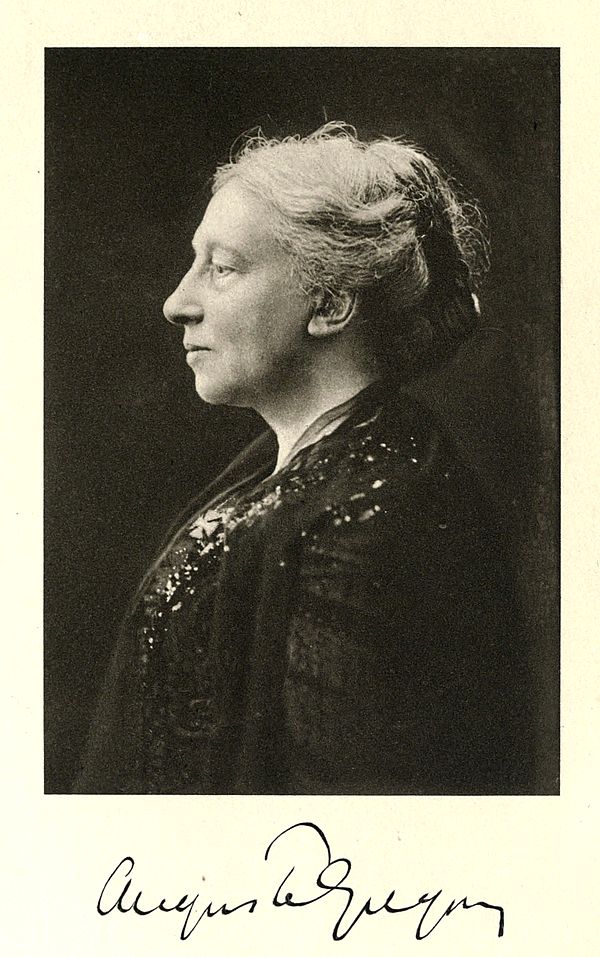
Augusta Gregory (signature)
Our Irish Theatre
A Chapter of Autobiography
By
Lady Gregory
Illustrated
G. P. Putnam’s Sons New York and London The Knickerbocker Press
1914
To Richard Gregory.—Little Grandson: When I
go into the garden in the morning to find you a nectarine
or tell you the names of flowers, Catalpa, Lovelies-bleeding,
Balsam, Phlox, you ask me why I
cannot stay but must go back to the house, and when
I say it is to write letters, you ask, “What for?”
And when winter comes, you will ask me why I must
go away over the sea instead of waiting for your
Christmas stocking and your tree.
The other day I was sitting outside the door, where
the sweet-peas grow, with an old man, and when you
came and called me he got up to go away, and as he
wished me good-bye, he said: “They were telling me
you are going to America, and says I, ‘Whatever the
Lady does, I am certain she is doing nothing but
what she thinks to be right.’ And that the Lord may
keep you safe and protect you from the power of
your enemy.”
Some day when I am not here to answer, you will
maybe ask, “What were they for, the writing, the
journeys, and why did she have an enemy?” So
I will put down the story now, that you may know
all about it bye and bye.
Fourteen or fifteen years ago I still wrote from
time to time in a diary I used to keep till the
sand in the hour-glass on my table began to run
so fast that I had to lay by the book as well as
embroidery, and archæology, and drying lavender,
and visits to the houses of friends.
I was in London in the beginning of 1898, and
I find written, “Yeats and Sir Alfred Lyall to tea,
Yeats stayed on. He is very full of play-writing....
He with the aid of Miss Florence Farr, an
actress who thinks more of a romantic than of a
paying play, is very keen about taking or building
a little theatre somewhere in the suburbs to
produce romantic drama, his own plays, Edward
Martyn’s, one of Bridges’, and he is trying to stir
up Standish O’Grady and Fiona Macleod to
write some. He believes there will be a reaction
after the realism of Ibsen, and romance will have
its turn. He has put a ‘great deal of himself’
into his own play The Shadowy Waters and rather
startled me by saying about half his characters
have eagles’ faces.”
Later in the year I was staying for a few days
with old Count de Basterot, at Duras, that is
beyond Kinvara and beside the sea. He had been
my husband’s warm friend, and always in the
summer time we used to go and spend at least one
long day with him,—we two at first, and then
later I went with my son and the boy and girl
friends of his childhood. They liked to go out
in a hooker and see the seals showing their heads,
or to paddle delicately among the jellyfish on the
beach. It was a pleasant place to pass an idle
day. The garden was full of flowers. Lavender
and carnations grew best, and there were roses
also and apple trees, and many plums ripened on
the walls. This seemed strange, because outside
the sheltered garden there were only stone-strewn
fields and rocks and bare rock-built hills in sight,
and the bay of Galway, over which fierce storms
blow from the Atlantic. The Count remembered
when on Garlic Sunday men used to ride races,
naked, on unsaddled horses out into the sea; but
that wild custom had long been done away with
by decree of the priests. Later still, when Harrow
and Oxford took my son away and I had long
spaces of time alone, I would sometimes go to
Duras to spend a few days.
I always liked to talk and to listen to the Count.
He could tell me about French books and French
and Italian history and politics, for he lived but
for the summer months in Ireland and for the
rest of the year in Paris or in Rome. Mr. Arthur
Symons has written of him and his talks of race,—to
which he attributed all good or bad habits and
politics—as they took long drives on the Campagna.
M. Paul Bourget came more than once to stay in
this Burren district, upon which he bestowed a
witty name, “Le Royaume de Pierre.” It was
to M. Bourget that on his way to the modest little
house and small estate, the Count’s old steward
and servant introduced the Atlantic, when on the
road from the railway station at Gort its waters
first come in sight: Voila la mer qui baigne
L’Amérique et les terres de Monsieur le Comte. For
he—the steward—had been taken by his master
on visits to kinsmen in France and Italy—their
names are recorded in that sad, pompous, black-bordered
document I received one day signed by
those who have l’honneur de vous faire part de la
perte douloureuse qu’ils viennent d’éprouver en la
personne de Florimond Alfred Jacques, Comte de
Basterot, Chevalier de l’ordre du Saint Sépulcre,
leur cousin germain et cousin [who died at Duras
(Irlande) September 15, 1904]; la Marquise de la
Tour Maubourg, le Vicomte et la Vicomtesse de
Bussy, la Baronne d’Acker de Montgaston, le Marquis
et la Marquise de Courcival, le Comte et la
Comtesse Gromis de Trana, la Comtesse Irène d’Entreves,
and so on, and so on. I do not know
whether the bearers of these high-sounding names
keep him in their memory—it may well be that
they do, for he was a friend not easily forgotten—but
I know there is many a prayer still said on the
roads between Kinvara and Burren and Curranroe
and Ballinderreen for him who “never was
without a bag of money to give in charity, and
always had a heart for the poor.”
On one of those days at Duras in 1898, Mr.
Edward Martyn, my neighbour, came to see the
Count, bringing with him Mr. Yeats, whom I did
not then know very well, though I cared for his
work very much and had already, through his
directions, been gathering folk-lore. They had
lunch with us, but it was a wet day, and we could
not go out. After a while I thought the Count
wanted to talk to Mr. Martyn alone; so I took
Mr. Yeats to the office where the steward used
to come to talk,—less about business I think than
of the Land War or the state of the country, or the
last year’s deaths and marriages from Kinvara to
the headland of Aughanish. We sat there through
that wet afternoon, and though I had never been
at all interested in theatres, our talk turned on
plays. Mr. Martyn had written two, The Heather
Field and Maeve. They had been offered to
London managers, and now he thought of trying
to have them produced in Germany where there
seemed to be more room for new drama than in
England. I said it was a pity we had no Irish
theatre where such plays could be given. Mr.
Yeats said that had always been a dream of his,
but he had of late thought it an impossible one,
for it could not at first pay its way, and there was
no money to be found for such a thing in Ireland.
We went on talking about it, and things seemed
to grow possible as we talked, and before the end
of the afternoon we had made our plan. We said
we would collect money, or rather ask to have a
certain sum of money guaranteed. We would
then take a Dublin theatre and give a performance
of Mr. Martyn’s Heather Field and one of Mr.
Yeats’s own plays, The Countess Cathleen. I
offered the first guarantee of £25.
A few days after that I was back at Coole, and
Mr. Yeats came over from Mr. Martyn’s home,
Tillyra, and we wrote a formal letter to send out.
We neither of us write a very clear hand, but a
friend had just given me a Remington typewriter
and I was learning to use it, and I wrote out the
letter with its help. That typewriter has done
a great deal of work since that day, making it
easy for the printers to read my plays and translations,
and Mr. Yeats’s plays and essays, and
sometimes his poems. I have used it also for the
many, many hundreds of letters that have had to
be written about theatre business in each of these
last fifteen years. It has gone with me very
often up and down to Dublin and back again, and
it went with me even to America last year that
I might write my letters home. And while I am
writing the leaves are falling, and since I have
written those last words on its keys, she who had
given it to me has gone. She gave me also the
great gift of her friendship through more than
half my lifetime, Enid, Lady Layard, Ambassadress
at Constantinople and Madrid, helper of
the miserable and the wounded in the Turkish-Russian
war; helper of the sick in the hospital she
founded at Venice, friend and hostess and guest
of queens in England and Germany and Rome.
She was her husband’s good helpmate while he
lived—is not the Cyprus treaty set down in that
clear handwriting I shall never see coming here
again? And widowed, she kept his name in
honour, living after him for fifteen years, and
herself leaving a noble memory in all places where
she had stayed, and in Venice where her home
was and where she died.
Our statement—it seems now a little pompous—began:
“We propose to have performed in Dublin,
in the spring of every year certain Celtic and
Irish plays, which whatever be their degree of
excellence will be written with a high ambition,
and so to build up a Celtic and Irish school of
dramatic literature. We hope to find in Ireland
an uncorrupted and imaginative audience trained
to listen by its passion for oratory, and believe
that our desire to bring upon the stage the deeper
thoughts and emotions of Ireland will ensure for
us a tolerant welcome, and that freedom to
experiment which is not found in theatres of
England, and without which no new movement in
art or literature can succeed. We will show that
Ireland is not the home of buffoonery and of easy
sentiment, as it has been represented, but the
home of an ancient idealism. We are confident
of the support of all Irish people, who are weary
of misrepresentation, in carrying out a work that
is outside all the political questions that divide us.”
I think the word “Celtic” was put in for the
sake of Fiona Macleod whose plays however we
never acted, though we used to amuse ourselves
by thinking of the call for “author” that might
follow one, and the possible appearance of William
Sharp in place of the beautiful woman he had given
her out to be, for even then we had little doubt
they were one and the same person. I myself
never quite understood the meaning of the “Celtic
Movement,” which we were said to belong to.
When I was asked about it, I used to say it was a
movement meant to persuade the Scotch to begin
buying our books, while we continued not to buy
theirs.
We asked for a guarantee fund of £300 to
make the experiment, which we hoped to carry
on during three years. The first person I wrote
to was the old poet, Aubrey de Vere. He answered
very kindly, saying, “Whatever develops the
genius of Ireland, must in the most effectual
way benefit her; and in Ireland’s genius I have
long been a strong believer. Circumstances of
very various sorts have hitherto tended much to
retard the development of that genius; but it
cannot fail to make itself recognised before very
long, and Ireland will have cause for gratitude to
all those who have hastened the coming of that
day.”
I am glad we had this letter, carrying as it were
the blessing of the generation passing away to
that which was taking its place. He was the
first poet I had ever met and spoken with; he had
come in my girlhood to a neighbour’s house. He
was so gentle, so fragile, he seemed to have been
wafted in by that “wind from the plains of Athenry”
of which he wrote in one of his most charming
little poems. He was of the Lake School, and
talked of Wordsworth, and I think it was as a sort
of courtesy or deference to him that I determined
to finish reading The Excursion, which though a
reader of poetry it had failed me, as we say, to
get through. At last one morning I climbed up
to a wide wood, Grobawn, on one of the hillsides
of Slieve Echtge, determined not to come down
again until I had honestly read every line. I
think I saw the sun set behind the far-off Connemara
hills before I came home, exhausted but
triumphant! I have a charming picture of Aubrey
de Vere in my mind as I last saw him, at a garden
party in London. He was walking about, having
on his arm, in the old-world style, the beautiful
Lady Somers, lovely to the last as in Thackeray’s
day, and as I had heard of her from many of that
time, and as she had been painted by Watts.
Some gave us their promise with enthusiasm
but some from good will only, without much faith
that an Irish Theatre would ever come to success.
One friend, a writer of historical romance, wrote:
“October 15th. I enclose a cheque for £1, but confess
it is more as a proof of regard for you than of
belief in the drama, for I cannot with the best wish
in the world to do so, feel hopeful on that subject.
My experience has been that any attempt at
treating Irish history is a fatal handicap, not to
say absolute bar, to anything in the shape of
popularity, and I cannot see how any drama can
flourish which is not to some degree supported by
the public, as it is even more dependent on it than
literature is. There are popular Irish dramatists,
of course, and very popular ones, but then unhappily
they did not treat of Irish subjects, and The
School for Scandal and She Stoops to Conquer
would hardly come under your category. You
will think me very discouraging, but I cannot
help it, and I am also afraid that putting plays
experimentally on the boards is a very costly
entertainment. Where will they be acted in the
first instance? And has any stage manager
undertaken to produce them? Forgive my tiresomeness;
it does not come from want of sympathy,
only from a little want of hope, the result of
experience.”
“October 19th. I seize the opportunity of
writing again as I am afraid you will have thought
I wrote such an unsympathetic letter. It is not,
believe me, that I would not give anything to see
Irish literature and Irish drama taking a good
place, as it ought to do, and several of the authors
you name I admire extremely. It is only from
the practical and paying point of view that I feel
it to be rather rash. Plays cost more, I take it,
to produce than novels, and one would feel rather
rash if one brought out a novel at one’s own risk.”
I think the only actual refusals I had were
from three members of the Upper House. I may
give their words as types of the discouragement
we have often met with from friends:
“I need not, I am sure, tell you how gladly I
would take part in anything for the honour of
Old Ireland and especially anything of the kind in
which you feel an interest; but I must tell you
frankly that I do not much believe in the movement
about which you have written to me. I
have no sympathy, you will be horrified to hear,
with the ‘London Independent Theatre,’ and I
am sure that if Ibsen and Co. could know what is
in my mind, they would regard me as a ‘Philistine’
of the coarsest class! Alas! so far from
wishing to see the Irish characters of Charles
Lever supplanted by more refined types, they have
always been the delight of my heart, and there is
no author in whose healthy, rollicking company,
even nowadays, I spend a spare hour with more
thorough enjoyment. I am very sorry that I
cannot agree with you in these matters, and I am
irreclaimable; but all the same I remain with
many pleasant remembrances and good wishes
for you and yours, Yours very truly——”
Another, the late Lord Ashbourne, wrote: “I
know too little of the matter or the practicability
of the idea to be able to give my name to your
list, but I shall watch the experiment with interest
and be glad to attend. The idea is
novel and curious, and how far it is capable of
realisation I am not at all in a position to judge.
Some of the names you mention are well known
in literature but not as dramatists or play-writers,
and therefore the public will be one to be worked
up by enthusiasm and love of country. The
existing class of actors will not, of course, be
available, and the existing playgoers are satisfied
with their present attractions. Whether ‘houses’
can be got to attend the new plays, founded on
new ideas and played by new actors, no one can
foretell.”
One, who curiously has since then become an
almost too zealous supporter of our theatre, says:
“I fear I am not sanguine about the success in a
pecuniary way of a ‘Celtic Theatre,’ nor am I
familiar with the works, dramatic or otherwise, of
Mr. Yeats or of Mr. Martyn. Therefore, at the
risk of branding myself in your estimation as a
hopeless Saxon and Philistine, I regret I cannot see
my way to giving my name to the enterprise or
joining in the guarantee.” On the other hand,
Professor Mahaffy says, rather unexpectedly, writing
from Trinity College: “I am ready to risk £5
for your scheme and hope they may yet play their
drama in Irish. It will be as intelligible to the
nation as Italian, which we so often hear upon our
stage.”
And many joined who had seemed too far apart
to join in any scheme. Mr. William Harpole
Lecky sent a promise of £5 instead of the £1 I
had asked. Lord Dufferin, Viceroy of India and
Canada, Ambassador at Paris, Constantinople,
St. Petersburg, and Rome, not only promised but
sent his guarantee in advance. I returned it
later, for the sums guaranteed were never called
for, Mr. Martyn very generously making up all
loss. Miss Jane Barlow, Miss Emily Lawless, the
Lord Chancellor of Ireland (“Peter the Packer”
as he was called by Nationalists), John O’Leary,
Mr. T. M. Healy, Lord and Lady Ardilaun, the
Duchess of St. Albans, Doctor Douglas Hyde, the
Rt. Hon. Horace Plunkett, Mr. John Dillon, M.P.,
all joined. Mr. John Redmond supported us, and
afterwards wrote me a letter of commendation
with leave to use it. Mr. William O’Brien was
another supporter. I did not know him personally
but I remember one day long ago going to tea at
the Speaker’s house, after I had heard him in a
debate, and saying I thought him the most stirring
speaker of all the Irish party; and I was amused
when my gentle and dignified hostess, Mrs. Peel,
said, “I quite agree with you. When I hear
William O’Brien make a speech, I feel that if I
were an Irishwoman, I should like to go and break
windows.”
Then Mr. Yeats and Mr. Martyn went to
Dublin to make preparations, but the way was
unexpectedly blocked by the impossibility of
getting a theatre. The only Dublin theatres,
the Gaiety, the Royal, and the Queen’s, were
engaged far ahead, and in any case we could not
have given them their price. Then we thought
of taking a hall or a concert room, but there again
we met with disappointment. We found there was
an old Act in existence, passed just before the
Union, putting a fine of £300 upon any one who
should give a performance for money in any
unlicensed building. As the three large theatres
were the only buildings licensed, a claim for a
special license would have to be argued by lawyers,
charging lawyers’ fees, before the Privy Council.
We found that even amateurs who acted for charities
were forced to take one of the licensed theatres,
so leaving but little profit for the charity. There
were suggestions made of forming a society like
the Stage Society in London, to give performances
to its members only, but this would not have
been a fit beginning for the National Theatre of
our dreams. I wrote in a letter at that time:
“I am all for having the Act repealed or a Bill
brought in, empowering the Municipality to
license halls when desirable.” And although this
was looked on as a counsel of perfection, it was
actually done within the year. I wrote to Mr.
Lecky for advice and help, and he told me there
was a Bill actually going through the House
of Commons, the Local Government (Ireland) Bill,
in which he thought it possible a Clause might be
inserted that would meet our case. Mr. John
Redmond and Mr. Dillon promised their help;
so did Mr. T. M. Healy, who wrote to Mr. Yeats:
“I am acquainted with the state of the law in
Dublin which I should gladly assist to alter as
proposed. Whether the Government are equally
well disposed may be doubted, as the subject is a
little outside their Bill, and no adequate time
exists for discussing it and many other important
questions. They will come up about midnight
or later and will be yawned out of hearing by our
masters.”
A Clause was drawn up by a Nationalist member,
Mr. Clancy, but in July, 1898, Mr. Lecky writes
from the House of Commons: “I have not been
forgetting the Celtic Theatre and I think the
enclosed Clause, which the Government have
brought forward, will practically meet its requirements.
The Attorney-General objected to Mr.
Clancy’s Clause as too wide and as interfering
with existing patent rights, but promised a Clause
authorising amateur acting. I wrote to him,
however, stating the Celtic case, and urging that
writers should be able, like those who got up the
Ibsen plays in London, to get regular actors to
play for them, and I think this Clause will allow
it.... After Clause 59 insert the following
Clause: (1) Notwithstanding anything in the
Act of Parliament of Ireland of the twenty-sixth
year of King George the Third, Chapter fifty-seven,
intituled an Act for regulating the stage
in the city and county of Dublin, the Lord Lieutenant
may on the application of the council for
the county of Dublin or the county borough of
Dublin grant an occasional license for the performance
of any stage play or other dramatic entertainment
in any theatre, room, or building where
the profits arising therefrom are to be applied for
charitable purpose or in aid of the funds of any
society instituted for the purpose of science,
literature, or the fine arts exclusively. (2) The
license may contain such conditions and regulations
as appear fit to the Lord Lieutenant, and
may be revoked by him.”
This Clause was passed but we are independent
now of it,—the Abbey Theatre holds its own
Patent. But the many amateur societies which
play so often here and there in Dublin may well
call for a blessing sometimes on the names of
those by whom their charter was won.
We announced our first performance for May
8, 1899, nearly a year after that talk on the Galway
coast, at the Ancient Concert Rooms. Mr. Yeats’
Countess Cathleen and Mr. Martyn’s Heather Field
were the plays chosen, as we had planned at the
first. Mr. George Moore gave excellent help in
finding actors, and the plays were rehearsed in
London. But then something unexpected happened.
A writer who had a political quarrel with
Mr. Yeats sent out a pamphlet in which he attacked
The Countess Cathleen, on the ground of
religious unorthodoxy. The plot of the play,
taken from an old legend, is this: during a famine
in Ireland some starving country people, having
been tempted by demons dressed as merchants to
sell their souls for money that their bodies may be
saved from perishing, the Countess Cathleen sells
her own soul to redeem theirs, and dies. The
accusation made was that it was a libel on the
people of Ireland to say they could under any
circumstances consent to sell their souls and that
it was a libel on the demons that they counted
the soul of a countess of more worth than those
of the poor. At Cathleen’s death the play tells
us, “God looks on the intention, not the deed,”
and so she is forgiven at the last and taken into
Heaven; and this it was said is against the teaching
of the Church.
Mr. Martyn is an orthodox Catholic, and to
quiet his mind, the play was submitted to two
good Churchmen. Neither found heresy enough
in it to call for its withdrawal. One of them, the
Rev. Dr. Barry, the author of The New Antigone,
wrote:
“Bridge House, Wallingford, “March 26, 1899.
“Dear Mr. Yeats,
“I read your Countess Cathleen as soon as possible
after seeing you. It is beautiful and touching.
I hope you will not be kept back from giving it
by foolish talk. Obviously, from the literal point
of view theologians, Catholic or other, would
object that no one is free to sell his soul in order
to buy bread even for the starving. But St. Paul
says, ‘I wish to be anathema for my brethren’;
which is another way of expressing what you have
put into a story. I would give the play first and
explanations afterwards.
“Sometime perhaps you will come and spend
a night here and I shall be charmed. But don’t
take a superfluous journey now. It is an awkward
place to get at. I could only tell you, as I am
doing, that if people will not read or look at a play
of this kind in the spirit which dictated it, no
change you might make would satisfy them.
You have given us what is really an Auto, in the
manner of Calderon, with the old Irish folk-lore
as a perceptive; and to measure it by the iron rule
of experts and schoolmen would be most unfair
to it. Some one else will say that you have
learned from the Jesuits to make the end justify
the means—and much that man will know of
you or the Jesuits. With many kind wishes for
your success, and fraternal greetings in the name
of Ireland,
“Ever yours,
“William Barry.”
So our preparations went on. Mr. Yeats
wrote a little time before the first performance:
“Everybody tells me we are going to have good
audiences. My play, too, in acting goes wonderfully
well. The actors are all pretty sound.
The first Demon is a little over-violent and restless
but he will improve. Lionel Johnson has done
a prologue which I enclose.”
That prologue, written by so Catholic and
orthodox a poet, was spoken before the plays
at the Ancient Concert Rooms on May 8,
1899:
The May fire once on every dreaming hill
All the fair land with burning bloom would fill;
All the fair land, at visionary night,
Gave loving glory to the Lord of Light.
Have we no leaping flames of Beltaine praise
To kindle in the joyous ancient ways;
No fire of song, of vision, of white dream,
Fit for the Master of the Heavenly Gleam;
For him who first made Ireland move in chime,
Musical from the misty dawn of time?
Ah, yes; for sacrifice this night we bring
The passion of a lost soul’s triumphing;
All rich with faery airs that, wandering long,
Uncaught, here gather into Irish song;
Sweet as the old remembering winds that wail,
From hill to hill of gracious Inisfail;
Sad as the unforgetting winds that pass
Over her children in her holy grass
At home, and sleeping well upon her breast,
Where snowy Deirdre and her sorrows rest.
Come, then, and keep with us an Irish feast,
Wherein the Lord of Light and Song is priest;
Now, at this opening of the gentle May,
Watch warring passions at their storm and play;
Wrought with the flaming ecstasy of art,
Sprung from the dreaming of an Irish heart.
But alas! His call to “watch warring passions
at their storm and play,” was no vain one. The
pamphlet, Souls for Gold, had been sent about,
and sentences spoken by the demons in the play
and given detached from it were quoted as Mr.
Yeats’ own unholy beliefs. A Cardinal who
confessed he had read none of the play outside
these sentences condemned it. Young men from
the Catholic University were roused to come and
make a protest against this “insult to their faith.”
There was hooting and booing in the gallery. In
the end the gallery was lined with police, for an
attack on the actors was feared. They, being
English and ignorant of Ireland, found it hard to
understand the excitement, but they went through
their parts very well. There was enthusiasm for
both plays, and after the first night London critics
were sent over, Mr. Max Beerbohm among them,
and gave a good report. Yet it was a stormy
beginning for our enterprise, and a rough reception
for a poetic play. The only moment, I
think, at which I saw Mr. Yeats really angry was
at the last performance. I was sitting next him,
and the play had reached the point where the
stage direction says, “The Second Merchant goes
out through the door and returns with the hen
strangled. He flings it on the floor.” The merchant
came in indeed, but without the strangled
hen. Mr. Yeats got up, filled with suspicions
that it also might have been objected to on some
unknown ground, and went round to the back of
the stage. But he was given a simple explanation.
The chief Demon said he had been given charge
of the hen, and had hung it out of a window
every night, “And this morning,” he said, “when
I pulled up the string, there was nothing on it
at all.”
But that battle was not a very real one. We
have put on Countess Cathleen a good many times
of late with no one speaking against it at all.
And some of those young men who hissed it then
are our good supporters now.
The next year English actors were again brought
over to play, this time in the Gaiety Theatre. A
little play by Miss Milligan, The Last Feast of the
Fianna was given, and Mr. Martyn’s Maeve, and
on alternate nights The Bending of the Bough,
founded by Mr. George Moore on Mr. Martyn’s
Tale of a Town. They were produced on the
evening of February 20, 1900. “On the evening
before the production,” I wrote, “Mr. Yeats gave
a little address on the play, Maeve, in which
he said there is a wonderful literary invention,
that of Peg Inerny, the old woman in rags in
the daytime, but living another and second life,
a queen in the ideal world, a symbol of Ireland.
The financial question touched in The Bending of
the Bough was chosen, because on it all parties are
united, but it means really the cause nearest to
each of our hearts. The materialism of England
and its vulgarity are surging up about us. It is
not Shakespeare England sends us, but musical
farces, not Keats and Shelley, but Titbits. A
mystic friend of his had a dream in which he saw
a candle whose flame was in danger of being extinguished
by a rolling sea. The waves sometimes
seemed to go over it and quench it, and he knew it
to be his own soul and that if it was quenched, he
would have lost his soul. And now our ideal
life is in danger from the sea of commonness
about us.”
The Bending of the Bough was the first play dealing
with a vital Irish question that had appeared
in Ireland. There was a great deal of
excitement over it. My diary says: “M. is in
great enthusiasm over it, says it will cause a revolution.
H. says no young man can see that play
and leave the house as he came into it.... The
Gaelic League in great force sang Fainne Geal an
Lae between the acts, and The Wearing of the Green
in Irish! And when ‘author’ could not appear,
there were cries of ‘An Craoibhin,’ and cheers
were given for Hyde. The actors say they never
played to so appreciative an audience, but were
a little puzzled at the applause, not understanding
the political allusions. The play hits so impartially
all round that no one is really offended,
certainly not the Nationalists and we have not
heard that Unionists are either. Curiously,
Maeve, which we didn’t think a Nationalist play
at all, has turned out to be one, the audience
understanding and applauding the allegory.
There is such applause at ‘I am only an old woman,
but I tell you that Erin will never be subdued’ that
Lady ——, who was at a performance, reported
to the Castle that they had better boycott it,
which they have done. G. M. is, I think, a little
puzzled by his present political position, but I
tell him and E. Martyn we are not working for
Home Rule; we are preparing for it.”
In our third year, 1901, Mr. F. R. Benson took
our burden on his shoulders and gave a fine performance
of Diarmuid and Grania, an heroic play
by Mr. George Moore and Mr. Yeats. I wrote:
“I am so glad to hear of Benson’s appreciation.
Anyhow, he can hardly be supposed to be on the
side of incendiarism; he is so very respectable.
Trinity College won’t know whether to go or to
stay away.” Mr. Yeats wrote: “Yesterday we
were rehearsing at the Gaiety. The kid Benson
is to carry in his arms was wandering in and out
among the stage properties. I was saying to
myself, ‘Here are we, a lot of intelligent people who
might have been doing some sort of decent work
that leaves the soul free; yet here we are, going
through all sorts of trouble and annoyance for a
mob that knows neither literature nor art. I might
have been away, away in the country, in Italy
perhaps, writing poems for my equals and my
betters. That kid is the only sensible creature
on the stage. He knows his business and keeps
to it.’ At that very moment one of the actors
called out, ‘Look at the kid, eating the property
ivy!’”
This time also we produced Casad-an-Sugan,
(The Twisting of the Rope) by the founder of the
Gaelic League, Dr. Douglas Hyde. He himself
acted the chief part in it and even to those who
had no Irish, the performance was a delight, it was
played with so much gaiety, ease, and charm. It
was the first time a play written in Irish had ever
been seen in a Dublin theatre.
Our three years’ experiment had ended, and we
hesitated what to do next. But a breaking and
rebuilding is often for the best, and so it was now.
We had up to this time, as I have said, played only
once a year, and had engaged actors from London,
some of them Irish certainly, but all London-trained.
The time had come to play oftener and
to train actors of our own. For Mr. Yeats had
never ceased attacking the methods of the ordinary
theatre, in gesture, in staging, and in the speaking
of verse. It happened there were two brothers
living in Dublin, William and Frank Fay, who
had been in the habit of playing little farces in
coffee palaces and such like in their spare time.
William had a genius for comedy, Frank’s ambitions
were for the production of verse. They,
or one of them, had thought of looking for work
in America, but had seen our performances, and
thought something might be done in the way of
creating a school of acting in Ireland. They
came to us at this time and talked matters over.
They had work to do in the daytime and could
only rehearse at night. The result was that Mr.
Yeats gave his Kathleen ni Houlihan to be produced
by Mr. Fay at the same time as a play by
Mr. George Russell (A.E.), in St. Theresa’s Hall,
Clarendon Street. I had written to Mr. Yeats:
“If all breaks up, we must try and settle something
with Fay, possibly a week of the little plays he
has been doing through the spring. I have a
sketch in my head that might do for Hyde to
work on. I will see if it is too slight when I have
noted it down, and if not, will send it to you.”
Early, in 1902, Mr. Russell wrote to me: “I
have finished Deirdre at last. Heaven be praised!
in the intervals of railway journeys, and the Fays
are going to do their best with it. I hope I shall
not suffer too much in the process, but I prefer
them to English actors as they are in love with
their story.” A little hall in Camden Street was
hired for rehearsal, Mr. Russell writing in the
same year: “I will hand cheque to Fay. I know
it will be a great assistance to them as the little
hall will require alterations and fittings and as
none of the Company are in possession of more
than artisan’s wages. They have elected W. B. Y.
as president of the Irish National Dramatic
Society, and A. E. as vice-president, and we are
the gilding at the prow of the vessel. They have
begun work already and are reading and rehearsing
drama for the autumn.”
Mr. Fay was very hopeful and full of courage.
He wrote in December, 1902: “I have received
your letter and parcel. I am not doing this show
on a large scale as I am leaving The Hour-glass off
till the middle of January.... I am just giving
a show of The Pot of Broth, The Foundations, and
Elis and the Beggarman, and I’m not making a
fuss about it, as I want to try how many people
the hall will hold, and what prices suit best, so it
is more or less an experimental show and then,
about the middle of January, I will do the first
real show with The Hour-glass as principal feature.
The hall took a great deal of work to get right,
and as we had to do all the work ourselves, we
had very little time to rehearse.” And he says
later: “I received your kind note, also enclosures,
for which we are very much obliged. We are
indeed getting into very flourishing conditions,
and if things only continue in the present state,
I have no doubt we shall be able to show a fairly
good balance at the end of the year. I have all
but concluded an arrangement with a branch of the
Gaelic League to take our hall for three nights a
week, and that will leave us under very small
rental if it comes off. About the performance
and how it worked out. I spent twenty-five
shillings on printing, etc., and we took altogether
about four pounds fifteen shillings, so I see no
reason to complain financially. But I find the
stage very small, and the want of dressing-rooms
makes it very difficult to manage about the scenery,
as all your actors have to stand against the walls
while it is being changed. I think, however, we
can struggle through if we don’t attempt very
large pieces. The hall was rather cold, but I
think I can manage a stove and get over that.”
That show of The Hour-glass went well, and in
that year—1903—two of Mr. Yeats’s verse plays
were produced, The King’s Threshold and Shadowy
Waters. In that year also, new names came in,
my own with Twenty-five, Mr. Padraic Colum’s
with Broken Soil, and that of J. M. Synge with
The Shadow of the Glen. I wrote to Mr. Yeats,
who was then in America: “After Shadow of the
Glen your sisters and Synge came in and had some
supper with me. Your sister had asked one of
her work girls how she liked Synge’s comedy, and
she said, ‘Oh, very well. I had been thinking
of writing a story on that subject myself.’ They
asked quite a little girl if she thought the girl in
Colum’s play ought to have stayed with her lover
or gone with her father. ‘She was right to go
with her father.’ ‘Why?’ ‘Because her young
man had such a big beard.’ ‘But he might have
cut it off.’ ‘That would be no good. He was so
dark he would look blue if he did that.’ Saturday
night brought a larger audience and all went well.
The few I knew, Harvey, etc., were quite astonished
at the beauty of Shadowy Waters, and some
giggling young men behind were hushed almost
at once, and I heard them saying afterwards how
beautiful it was. I should like to hear it once a
week through the whole year. The only vexing
part was Aibric’s helmet, which has immense
horns. A black shadow of these was thrown down,
and when Aibric moved, one got the impression
there was a he-goat going to butt at him over the
side of the ship.” And again from Coole: “Synge
wrote asking me if I could provide four red petticoats,
Aran men’s caps, a spinning-wheel, and
some Connacht person in Dublin who will teach
the players to keen. The last item is the most
difficult. All the actors want pampooties (the
cowskin shoes worn by the Aran people), though I
warned them the smell is rather overpowering.
Tell Mr. Quinn what a great comfort his money
is for such things as these, upon which the company
might think they ought not to spend their
little capital, and Synge would have been unhappy
without.” Through the nuns at Gort I
heard of a spinning-wheel in a cottage some way
off, which, though it had been in her family over
a hundred years, the owner wanted to sell. A
cart was sent for this, and we have had it in the
theatre ever since. As to the keening I found a
Galway woman near Dublin who promised to
teach the actors. But when they arrived at her
house, she found herself unable to raise the keen
in her living room. They had all to go upstairs,
and the secretary of the company had to lie
under a sheet as the corpse. The lessons were
very successful, and at the first performance in
London of Riders to the Sea, the pit went away
keening down the street.
Mr. Yeats said of Mr. Fay and his little company,
“They did what amateurs seldom do,
worked desperately.” This was the beginning
of a native school of acting, an Irish dramatic
company.
I remember, in 1897, hearing Mr. Bernard Shaw
make a speech before the Irish Literary Society
in London, following a lecture on “Irish Actors of
the Nineteenth Century.” He very wittily extinguished
the lecturer, who, he said, truly enough
had enumerated the best actors and actresses
and then had gone on to say they were not Irish.
“As to what an Irishman is,” he said, “is a complex
question, for wherever he may have been born,
if he has been brought up in Ireland, that is
quite sufficient to make him an Irishman. It is
a mistake to think an Irishman has not common
sense. It is the Englishman who is devoid of
common sense or at least has so small a portion of
it that he can only apply it to the work immediately
before him. That is why he is obliged to fill the
rest of his horizon with the humbugs and hypocrisy
that fill so large a part of English life. The
Irishman has a better grasp of facts and sees them
more clearly; only he fails in putting them into
practice, and has a great objection to doing anything
that will lead to any practical result. It is
a mistake to think the Irishman has feeling; he
has not; but the Englishman is full of feeling.
What the Irishman has is imagination; he can
imagine himself in the situation of others.” Then
as if afraid of making the Irish members of his
audience too well pleased with themselves, he
gave his summing up: “But the Irish language
is an effete language and the nation is effete, and
as to saying there are good Irish actors, there are
not, and there won’t be until the conditions in
Ireland are favourable for the production of drama,
and when that day comes, I hope I may be dead.”
I am glad we have shown Mr. Shaw that he can
be in the wrong, and I am glad he is not dead, for
he has been a good friend to us. But our players
have proved that even the wise may be deceived.
They have won much praise for themselves and
have raised the dignity of Ireland, and I for one
owe them very grateful thanks for the way they
have made the characters in my comedies laugh
and live.
In May, 1903, the Irish National Theatre
Society went for the first time to London. It was
hard for the actors to get away. They had their
own work to do. But they asked their employers
for a whole Saturday holiday. They left Dublin
on Friday night, arrived in London on the Saturday
morning, played in the afternoon, and again in
the evening at the Queen’s Gate Hall, and were
back at work in Dublin on Monday morning.
The plays taken were: Mr. Fred Ryan’s Laying
the Foundations, Mr. Yeats’s Hour-glass, Pot of
Broth, and
Kathleen ni Houlihan, and my own
Twenty-five. I was not able to go but Mr.
Yeats wrote to me: “London, May 4, ’03. The
plays were a great success. I never saw a more
enthusiastic audience. I send you some papers,
all that I have found notices in. When I remember
the notices I have seen of literary adventures
on the stage, I think them better than we could
have hoped.... I have noticed that the young
men, the men of my own generation or younger,
are the people who like us. It was a very distinguished
audience. Blunt was there, but went
after your play as he is just recovering from influenza
and seems to be really ill. I thought your
play went very well. Fay was charming as
Christy. The game of cards is still the weak
place, but with all defects, the little play has a
real charm. If we could amend the cards it
would be a strong play too. Lady Aberdeen,
Henry James, Michael Field—who has sent me
an enthusiastic letter about the acting—Mrs.
Wyndham—the Chief Secretary’s mother—Lord
Monteagle, Mrs. Thackeray Ritchie, and I don’t
know how many other notables were there, and
all I think were moved. The evening audience
was the more Irish and Kathleen and The Pot of
Broth got a great reception. The Foundations
went well, indeed everything went well.”
This was but the first of several London visits,
and the good audience and good notices were a
great encouragement. And this visit led also
to the generous help given us by Miss Horniman.
She took what had been the old Mechanics’ Institute
in Abbey Street, Dublin, adding to it a part
of the site of the old Morgue, and by rebuilding
and reconstructing turned it into what has since
been known as the Abbey Theatre, giving us the
free use of it together with an annual subsidy for
a term of years.
Miss Horniman did all this, as she says in a
former letter to Mr. Yeats, because of her “great
sympathy with the artistic and dramatic aims of
the Irish National Theatre Company as publicly
explained by you on various occasions.” She
also states in that letter: “I can only afford to
make a very little theatre, and it must be quite
simple. You all must do the rest to make a powerful
and prosperous theatre with a high artistic
ideal.” We have kept through many attacks
and misunderstandings the high artistic ideal we
set out with. Our prosperity enabled us to take
over the Abbey Theatre two years ago when our
Patent and subsidy came to an end. I feel sure
Miss Horniman is well pleased that we have been
able to show our gratitude by thus proving
ourselves worthy of her great and generous gift.
But in Dublin a new theatre cannot be opened
except under a Patent from the Crown. This
costs money even when not opposed, and if it is
opposed, the question has to be argued by counsel,
and witnesses have to be called in and examined
as if some dangerous conspiracy were being plotted.
When our Patent was applied for, the other
theatres took fright and believed we might interfere
with their gains, and they opposed our application,
and there was delay after delay. But at
last the enquiry was held before the Privy Council,
and Mr. Yeats wrote on its eve: “3d August,
1904. The really important things first. This
day is so hot that I have been filled with alarm
lest the lake may begin to fall again and the boat
be stranded high up on the bank and I be unable
to try my new bait. I brought the boat up to a
very shallow place the day I left. I have been
running about all over the place collecting witnesses
and have now quite a number. I will
wire to-morrow if there is anything definite about
decision. In any case I will write full particulars.”
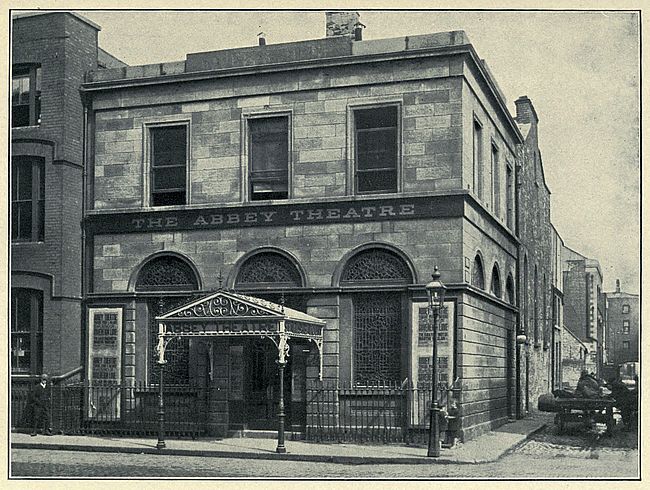
The Abbey Theatre, Dublin From a photograph by Keogh Bros., Ireland
“August 4th. Final decision is postponed
until Monday but the battle is won to all intents
and purposes. There appears to be no difficulty
about our getting a Patent for the plays of the
Society. I sent you a paper with the report of
proceedings, —— and ——, did well for us; but
I must say I was rather amused at their anxiety
to show that they supported us not out of
love for the arts but because of our use as anti-emigration
agents and the like. I think I was a
bad witness. Counsel did not examine me but
asked me to make a statement. The result was,
having expected questions and feeling myself left
to wander through an immense subject, I said
very little. I was disappointed at being hardly
cross-examined at all. By that time I had got
excited and was thirsting for everybody’s blood.
One barrister in cross-examining T. P. Gill, who
came after me, tried to prove that Ibsen and
Maeterlinck were immoral writers. He asked
was it not true that a play by Maeterlinck called
The Intruder had raised an immense outcry in
London because of its immorality. Quite involuntarily
I cried out, ‘My God!’ and Edward
Martyn burst into a loud fit of laughter. I suppose
he must have meant Monna Vanna. He also
asked if the Irish National Theatre Society had
not produced a play which was an attack on
marriage. Somebody asked him what was the
name of the play. He said it didn’t matter and
dropped the subject. He had evidently heard
some vague rumour about The Shadow of the Glen.
I forgot to say that William Fay gave his evidence
very well, as one would expect. He had the worst
task of us all, for O’Shaughnessy, a brow-beating
cross-examiner of the usual kind, fastened on to
him. Fay, however, had his answer for everything.”
The Patent was granted to me, “Dame Augusta
Gregory,” as Patentee, and in it I was amongst
other things “Enjoined and commanded to gather,
entertain, govern, privilege, and keep such and
so many players,” and not to put on the stage any
“exhibition of wild beasts or dangerous performances
or to allow women or children to be hung
from the flies or fixed in positions from which they
cannot release themselves.” “It being our Royal
will and pleasure that for the future our said
theatre may be instrumental to the promotion of
virtue and instruction of human life.”
The building was not ready for us until the end
of the year. Mr. Yeats wrote in August: “I
have just been down to see the work on the Abbey
Theatre. It is all going very quickly and the
company should be able to rehearse there in a
month. The other day, while digging up some
old rubbish in the Morgue, which is being used
for dressing-rooms, they found human bones.
The workmen thought they had lit on a murder,
but the caretaker said, ‘Oh, I remember, we lost
a body about seven years ago. When the time
for the inquest came, it couldn’t be found.’”
I remembered this when Mr. Yeats wrote to
me lately from the Abbey: “The other day at a
performance of Countess Cathleen one of the
players stopped in the midst of his speech and
it was a moment or two before he could go on.
He told me afterwards his shoulder had suddenly
been grasped by an invisible hand.”
When the time for the opening came, I was ill
and could not leave home, but had reports from
him through the days before the opening. “December
24, 1904. The Company are very disappointed
that you will not be up for the first night.
Fay says they would all act better if you were here.”
“December 20, 1904. I hear from Robert that
you may get up for a little to-day. I hope you
will take a long rest. I shall see about the awning
for the old woman’s stall to-night. Synge has a
photograph, which will give us a picturesque form.
We changed all the lighting on Saturday, and the
costumes look much better now. In any case
everything looks so much better on the new stage.
G. came in last night with a Boer, who went to
Trinity, because, so far as I could make out, he
thought he would find himself among sympathetic
surroundings. He and some other young Boers,
including one who is said to have killed more
Englishmen at Spion Kop than anybody else, had
to go to a university in Europe and chose Ireland.
Finding the sort of place it is, they look at the
situation with amusement and are trying to get
out more men of their own sort to form a rebellious
coterie.... I mention G., in order to say that
he wants to try his hand at translating Œdipus
the King for us. To-night we go on experimenting
in lighting and after that will come the great
problem of keeping the bottom of the trews from
standing out like frilled paper at the end of a ham
bone.”
And finally on the very day of the opening:
“December 27, ’04. I am confident of a fairly
good start with the plays,—the stars are quiet
and fairly favourable.”
Then after the first night, December 27th,
I had good telegrams and then a letter: “A great
success in every way. The audience seemed
‘heavy’ through the opening dialogue—Fool and
Blind man—and then it woke up, applauding for
a long time after the exit of the kings. There was
great enthusiasm at the end. Kathleen seemed
more rebellious than I ever heard it, and —— solemnly
begged me to withdraw it for fear it
would stir up a conspiracy and get us all into
trouble. Then came your play—a success from
the first. One could hardly hear for the applause.
Fay was magnificent as the melancholy man.
The whole play was well played all through. I
don’t think I really like the stone wall wings.
However, I was very near and will know better
to-night. I got a beautiful light effect in Baile’s
Strand, and the audience applauded the scene
even before the play began. The cottage, too,
with the misty blue outside its door is lovely.
We never had such an audience or such enthusiasm.
The pit clapped when I came in. Our success
could not have been greater. Even —— admits
that your comedy [Spreading the News], ‘is
undoubtedly going to be very popular.’”
We worked for several years with Mr. W. Fay
as producer, as manager, as chief actor. In 1903,
when all his time was needed for the enterprise,
we paid him enough to set him free from other
work, a part coming from the earnings of the
Company, a part from Mr. Yeats, and a part from
myself, for we had little capital at that time,
outside £50 given by our good friend Mr. John
Quinn, Attorney and Counsellor in New York.
But even large sums of money would have been
poor payment not only for William Fay’s genius
and his brother’s beautiful speaking of verse, but
for their devotion to the aim and work of the
theatre, its practical and its artistic side. But
they left us early in 1908 at a time of disagreement
with other members, and of discouragement.
I am very sorry that they, who more than
almost any others had laid the foundation of the
Irish Theatre, did not wait with us for its success.
But building up an audience is a slow business
when there is anything unusual in the methods or
the work. Often near midnight, after the theatre
had closed, I have gone round to the newspaper
offices, asking as a favour that notices might be
put in, for we could pay for but few advertisements
and it was not always thought worth while to send
a critic to our plays. Often I have gone out by
the stage door when the curtain was up, and come
round into the auditorium by the front hall,
hoping that in the dimness I might pass for a new
arrival and so encourage the few scattered people
in the stalls. One night there were so few in any
part of the house that the players were for dismissing
them and giving no performance at all.
But we played after all and just after the play
began, three or four priests from the country came
in. A friend of theirs and of the Abbey had gone
beyond the truth in telling them it was not a real
theatre. They came round afterwards and told
us how good they thought the work and asked the
Company to come down and play in the West.
Very often in the green room I have quoted the
homely proverb, heard I know not where, “Grip
is a good dog, but Hold Fast a better”! For there
is some French blood in me that keeps my spirit
up, so that I see in a letter to Mr. Yeats I am
indignant at some attributions of melancholy:
“I who at church last Sunday, when I heard in the
Psalms ‘Thou hast anointed me with the joy of
gladness above my fellows’, thought it must apply
to me, and that some oil of the sort must have
kept me watertight among seas of trouble.” And
Mr. Yeats in his turn wrote to encourage me in
some time of attacks: “Any fool can fight a winning
battle, but it needs character to fight a losing
one, and that should inspire us; which reminds
me that I dreamed the other night that I was being
hanged, but was the life and soul of the party.”
For there was not always peace inside the theatre,
and there came from time to time that breaking
and rebuilding that is in the course of nature, and
one must think all for good in the end. And so
I answered some one at a time of discord, “I am
myself a lover of peace so long as it is not the peace
of a dead body.” And to Mr. Yeats I wrote:
“I am much more angry really than you are with
those who have wasted so much of your time. I
look on it as child-murder. Deirdre might be in
existence now but for this.” And to one who left
us but has since returned: “I want you to sit
down and read Mr. Yeats’s notes in the last two
numbers of Samhain and to ask yourself if the work
he is doing is best worth helping or hindering.
Remember, he has been for the last eight years
working with his whole heart and soul for the
creation, the furtherance, the perfecting, of what
he believes will be a great dramatic movement in
Ireland. I have helped him all through, but we
have lost many helpers by the way. Mr. Lecky,
who had served us well in getting the law passed
that made these dramatic experiments possible,
publicly repudiated us because of Mr. Yeats’s
letter on the Queen’s visit.... Others were lost
for different reasons ——, ——, all of whom had
been helpful in their time. Now others are
dropping off. It is always sad to lose fellow-workers,
but the work must go on all the same.
‘No man putting his hand to the plough and
drawing back is fit for the kingdom of God.’
He is going on with it. I am going on with it as
long as life and strength are left to me.... It is
hard to hold one’s own against those one is living
amongst, I have found that; and I have found
that peace comes, not from trying to please one’s
neighbours but in making up one’s own mind
what is the right path and in then keeping to it.
And so God save Ireland, and believe me your
sincere friend.”
This now, according to my memory, is how I
came to work for a National Theatre in Ireland
and how that Theatre began.
CHAPTER II THE BLESSING OF THE GENERATIONS
On the walls of the landing outside your nursery
door there are pictures hanging, painted as you
paint your own with water-colours, but without
any blot or blur. Some are of blue hills and of
streams running through brown bogs, but many of
them are of young girls and of women, barefooted
and wearing home-dyed clothes, knitting or carrying
sheaves; or of fishermen dressed in white.
All, girls and women and men alike, have gentle
faces. There is no sign of the turf-smoke that
dries the skin to leather. There are no lines or
wrinkles to be seen. It may be faces were like
that before the great famine came that changed
soft bodies to skin and bone and turned villages
to grazing for goats. Your great-grandfather fed
his people at that time and took their sickness and
died. But perhaps if that painter were living
now, he would draw likenesses in the same way,
with the furrows and ridges left out. For he
could only see gentleness like his own in whatever
he had a mind to paint.
A little lower on the staircase there are pictures
you do not look at now, likenesses of men not very
young, who had done something that made others
like to meet them and who dined together at the
Grillon Club. Your grandfather is there with
many of his friends; some of them became friends
of mine. Here is one that wrote books, you will
maybe read them bye and bye, about good men
that once lived in Ireland, and how Europe learned
manners, and about witches that were thrown
into ponds.
Near the library door there is a drawing of an
old man. He looks very tired and sad. He was
shut up in prison for more years than you have
lived. He could not see the lime trees blooming
out or the chestnuts breaking from their husks.
That is a younger man on the other wall. There
is something like a laugh in his eyes. He will live
and work a long time, I hope, for the work he has
done is very good. He gave you a blessing in
Irish one time when I brought him to see you in
your cot.
Among the names on my first list of guarantors
is that of Sir Frederic Burton, painter, and for
many years Director of the National Gallery in
Trafalgar Square. And this name, like that of
Aubrey de Vere, brings together movements divided
by half a century; for Frederic Burton had,
through personal friendship with Thomas Davis,
come so near to that side of the National movement
of 1848 which expressed itself in writing,
that he had drawn the design for the title-page of
the Spirit of the Nation, that book of rebel songs
and ballads. And he had known others of that
time whose names have been remembered, Ferguson
and Stokes and O’Curry. It would make
my heart give a quicker beat to hear him say:
“When I was in Aran with Petrie,” or “my model
for the Blind Girl at the Holy Well was Doctor
Petrie’s daughter,” or “Davis was such a dear
fellow I could refuse him nothing,” or, as an
apology for not having read Mitchell’s wonderful
Gaol Journal, “I did not like his appearance when
I saw him. Davis took me to see him somewhere.
He was a regular Northern and did not make a
good impression on me. His skin was blotched
and he had ginger-coloured hair.” Though he
resented the rising fame of Clarence Mangan,
because, as he thought, it was at the expense of
Thomas Moore, “who had—though no one would
class him among the great poets—mellifluous
versification, exquisite choice of language, and
was endowed at least with a delicate fancy approaching
to imagination,” the only authentic
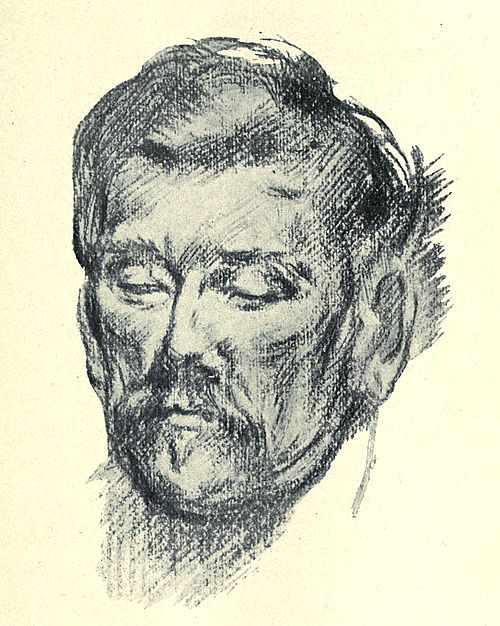
portrait of Mangan, not taken indeed from life,
but after death in an hospital, was drawn by him.
He had wandered and painted in Germany and
in the west of Ireland, in Connemara and in his
own county of Clare, till his work at the National
Gallery forced him to give up his art. But in his
last days he would often speak of his early days
in the West, and of country people he remembered,
a girl near Maam who was a great singer, and a
piper, Paddy Conneely, who was the best judge
of sheep and cattle in the whole country.
He was during the Land War when I first knew
him, a very strong Unionist, for his sensitive
nature shrank from its harsh and violent methods,
and for a while he felt that he had no longer a
country to take pride in. In 1899 he wrote:
“ ... I look forward with some uneasiness to the
advent of Patriots from beyond sea, now American
citizens under the Stars and Stripes. With this
outlook before it, the Government is reducing
the Irish Constabulary, a most extraordinary
proceeding and a quite unaccountable one except
indeed on the theory that every administration
is doomed to fatuity where Irish affairs have to
be dealt with. For the police are the appointed
guardians of civil order, and however abused or
resisted, are recognised as such. But if the military
have to be called out, what a handle is given
to vapourers on both sides of the Irish sea! And
what about the dismissed Constables? Will they
not be thrown into the ranks of the Patriots?”
And in 1895 he had written, refusing an invitation
to dine with me—I cannot remember who
I said was coming, but he expressed this regret:
“Especially as I enjoy meeting Sir A. and Lady
Clay, and should have liked to see a bird so rare
as an honest Nationalist.” Yet he kept a spirit
of independence that was akin to rebellion, even
through those years of official position and pleasant
London dinners, and friendships, and the
Athenæum Club.
During the years after the death in 1892 of my
husband, who had been a trustee of the National
Gallery, and Sir Frederic’s death in 1900, our
friendship became a close one. Our talk turned
very often from pictures and Italy to Ireland. In
1897 I published Mr. Gregory’s Letter-box, a political
history of the years between 1812 and 1830,
taken from letters to and by my husband’s grandfather,
then Under-Secretary for Ireland. Sir
Frederic was much pleased with the book. He
came to see me when he had read it and said: “I
am glad you have come down on the real culprit,
George III.,” and quoted one or two people who
had said his obstinacy was the cause of so many
of Ireland’s troubles. But after a little he said
very gravely: “I see a tendency to Home Rule
on your own part.” I said, “I defy any one to
study Irish History without getting a dislike and
distrust of England.” He was silent for a time
and then said, “That is my feeling,” and told me
how patriotic he had been as a boy though disliking
“O’Connell and his gang.” Later he
accused me of having become “A red hot Nationalist,”
and said I had no Irish blood, but I convinced
him I had, both Irish and French.
He was as angry at the time of the Boer War
as any Mayo ballad-singer or Connacht Ranger’s
wife. “According to the doctor I am better, but
really this war is killing me. It is the worst
affair I recollect. It is utterly inglorious....
I grieve particularly for our brave Irishmen whose
lives have been squandered to no purpose.” He
was to the end a Unionist, so far as his political
doctrine went, but I think his rooted passion for
Ireland increased, and made, as such strong passions
are used to do, all politics seem but accidental,
transitory, a business that is outside the heart of
life.
The language movement, of which I was able
to bring him news, began to excite him. One day
I found him “excited and incredulous at Atkinson’s
evidence against the Irish language, in which he
says all Irish books are filthy and all folk-lore is
at bottom abominable.” And then he got, “on
your recommendation and Doctor Hyde’s reputation
as a scholar” the History of Irish Literature
and wrote: “I am reading Dr. Hyde’s Literary
History with the greatest interest. It is a high
pleasure to find the matter he deals with treated
by a true scholar and in a reasonable and philosophic
spirit. But indeed the advance in this
respect since my earlier days is marvellous. At
that time the comparative method was hardly, if
at all, thought of. Rabid Irishmen, who often
didn’t know their own language but at second
hand, and knew no other tongue at all, spouted
the rankest absurdities. Now true light has been
let in and Irish history, archæology, literature,
and poetry are the gainers. Let us not grudge
to the Germans their meed of honour in having
led the way.” And again: “I should be exceedingly
sorry if the Irish language died out of men’s
mouths altogether. I look upon the loss of a
language or even a dialect as equivalent to the
extirpation of a species in natural history....”
Then, in 1899: “Those addresses of Dr. Hyde
and Mr. Yeats are very interesting and, I would
fain hope, may find a response in the hearts of the
people who heard them. The subject is one full
of sadness. Self-respect, a decaying language, a
dying music, how shall they be resuscitated! I
could weep when I recollect how full Munster,
Connacht, and even Ulster were in my earlier
days of exquisite native music—when in fact
among the peasantry and the Irish of the towns
you heard no other; when the man at the plough-tail
had his peculiar ‘whistle,’ strange, wild, and
full of melody and rhythm. All this must now
have passed away irrevocably. May the language
have a better chance! I cannot tell you how
much Doctor Hyde’s book has moved me. Principally
it is a manful effort.”
When I was again in London, he showed me the
Literary History close at hand and asked me a
little nervously what was Douglas Hyde’s age.
My answer, or surmise, pleased him, and he said:
“Then he will be able to work for a long time.”
Once or twice, when we went on to talk of other
things, he came back to this and said, “I am so
glad he is a young man.”
He was jealous for the honour of Ireland
even in lesser things. He was very much
interested in the beginning of our theatre. In
1899 he writes: “I am happy to sign the guarantee
form for the coming year, and enclose it.
You are a dreamy lot in Erin. As you say, I
think the quality comes from the atmosphere.
Here there is more of the opposite than suits me,
but I dream still, as I have done all my lifetime.
I trust there will be no shindy at the performance
of Countess Cathleen. But if not, our compatriots
will have been for once untrue to themselves!”
And later: “I am sincerely glad the experiment
was on the whole successful and that those who
intended mischief after all made but a poor effort
to inflict it.... Altogether it appears as if the
old palmy days of Dublin independent appreciation
of the drama were about to be revived in our
altered times. I congratulate Mr. Yeats on the
success of the drama as an acting piece, and in
everything except —— ——’s beautiful Irish
hyperbole. I recollect an account of a concert
given at Clonmel several years ago, in which the
eloquent local journalist said of one of the amateur
lady singers, after the loftiest eulogy, ‘but it was
in her last song that Miss —— —— gave the
coup de grace to her performance.’”
He cared very much for Mr. Yeats’s work, but
I could never persuade him to come and meet
him. He always made some excuse. At last
he made a promise for one afternoon, but, in
place of coming, he wrote, saying he was half
ashamed to confess to so much enthusiasm, but
he was so much under the spell of the poems that
he was afraid that, in meeting the writer, the
spell might be broken. He told me when next
I saw him that of the poets he had known the
only ones that did not disappoint him were
William Morris and Rossetti. “Swinburne was
excitable; Tennyson was grumpy and posing;
Browning was charming as a friend, but not fulfilling
my idea of what a poet should be.” But I
did bring them together in the end, and he thanked
me later and confessed my faith had been justified.
In 1900, during his last illness, I was often with
him. I had been away in Dublin for our plays
and I find a note written after my return to
London: “Went to see Sir F. He is in bed, and
I fear, or indeed must hope, the end is very near....
I went up to see him. He was clear but
drowsy, at first a little inarticulate, but when I
got up to go, he held my hand a long time, speaking
with great kindness ... asked for Robert,
and how the plays had gone. I told him of
them, and of the Times notice of Maeve, saying
its idealism had been so well received by an
Irish audience, and of the notice on the same
page telling that Tess in London had been jeered
at by an audience who found it too serious.
He said: ‘That is just what one would expect.’
He asked if Robert had been abroad yet, and I
said no, he was so fond of Ireland he had not cared
to go until now, and that I myself found every
year an increased delight and happiness in Ireland.
He said, ‘It is so with me. My best joys have
been connected with Ireland.’ Then he spoke of
Celtic influence in English literature and said,
‘There will some day be a great Pan-Celtic
Empire.’ And so we parted.”
I am glad that he who had been even a little
moved by that stir in the mind, that rush of
revolutionary energy that moved the poets and
patriots and rebels of ’48, should after half a
hundred years have been stirred by the intellectual
energy that came with a new generation, as its
imagination turned for a while from the Parliament
where all was to have been set right, after the
break in the Irish party and after Parnell’s death.
“I enclose you a guarantee paper filled up for
such a sum as I can afford (or perhaps more) to
lose, but I hope there will be no loss for anybody
in the matter, while there will certainly be some
gain to Ireland! I’d have answered sooner but
that I am suffering from a horrible form of dyspepsia,
with exceptional langour.” It is no wonder
if the old man who sent with this his promise for
twenty shillings was somewhat broken in health.
He was the last of the Fenian triumvirate,—Kickham,
Luby, O’Leary,—and he had come back to
Dublin after
fifteen years of banishment and five
of penal servitude at Portland. John O’Leary
had been turning over books on the stalls by the
Seine in Paris, when one day somebody had come
to him and asked him to come back to Ireland
where a rising was being planned, and he had come.
A part of the romance of my early days had
been the whispered rumours of servants, and the
overheard talk of my elders, of the threatened
rising of the Fenians:
“An army of Papists grim
With a green flag o’er them.
Red coats and black police
Flying before them.”
The house of Roxborough, my old home, had
once been attacked by Whiteboys. My father had
defended it, firing from the windows, and it was
not hard to believe that another attack might
be made. It seemed a good occasion for being
allowed to learn to shoot with my brothers,
but that was in those days not thought fitting,
even in self-defence, for a girl, and my gun was
never loaded with anything more weighty than
a coppercap. So when this new business of the
theatre brought me to meet, amongst many others
till then unknown, John O’Leary, I remembered
those old days and the excitement of a Fenian’s
escape—might he not be in hiding in our own
woods or hay-lofts? And I wondered to
find that not only Nationalists admired and
respected so wild and dangerous a rebel. So I
asked Mr. Yeats to tell me the reason, for he had
known him well and had even shared a lodging
with him for a while; so that his friends would
say: “You have the advantage over us. O’Leary
takes so long to convert to any new thing, and you
can begin with him at breakfast.” And he wrote
to me: “When John O’Leary returned from exile,
he found himself in the midst of a movement
which inherited the methods of O’Connell and
a measure of his success. Journalists and politicians
were alike in his eyes untruthful men,
thinking that any means that brought the end
were justified, and for that reason certain, as he
thought, to miss the end desired. The root of
all was, though I doubt if he put the thought into
words, that journalists and politicians looked for
their judges among their inferiors, and assumed
those opinions and passions that moved the largest
number of men. Their school is still dominant,
and John O’Leary had seen through half his life,
as we have seen, men coarsening their thought
and their manners, and exaggerating their emotions
in a daily and weekly press that was like
the reverie of an hysterical woman. He was not
of O’Connell’s household. His master had been
Davis, and he was quick to discover and condemn
the man who sought for judgment not among his
equals or in himself. He saw, as no one else in
modern Ireland has seen, that men who make this
choice are long unpopular, all through their lives
it may be, but grow in sense and courage with
their years, and have the most gazers even in the
end.
“Yet he was not unjust to those who went the
other way. He imputed to them no bad motives,
for I have heard him say of a man that he distrusted,
‘He would not sacrifice himself but he
would risk himself,’ and of a man who seemed to
him to appeal always to low motives, the chief
mischief-maker of his kind, ‘He would sacrifice
himself.’ Yet, what he himself commended with
his favourite word ‘morale’ was the opposite of
that sudden emotional self-sacrifice, the spurious
heroism of popular movements, being life-long
hardness and serenity, a choice made every day
anew. He thought but little of opinions, even
those he had sacrificed so much for, and I have
heard him say, ‘There was never cause so bad that
it has not been defended by good men for good
reasons.’ And of Samuel Ferguson, poet and
antiquarian, who was not of his party or any
Nationalist party, ‘He has been a better patriot
than I.’ He knew that in the end, whatever
else had temporary use, it was simple things that
mattered, the things a child can understand, a
man’s courage and his generosity.
“I do not doubt that his prison life had been
hard enough, but he would not complain, having
been in ‘the hands of his enemies’; and he would
often tell one of that life, but not of its hardships.
A famous popular leader of that time, who made a
great noise because he was in prison as a common
felon for a political offence, made him very angry.
I said ‘It is well known that he has done this,
not because he shrinks from hardship but because
there is a danger in a popular movement that the
obscure men who can alone carry it to success,
may say, “our leaders are treated differently.”’
He answered, ‘There are things a man must not
do, even to save a nation.’ And when I asked
‘What things?’ he said, ‘He must not weep in
public.’ He knew that a doctrine expediency
cries out on would have but few to follow, and he
would say, ‘Michael Davitt wants his converts
by the thousand. I shall be satisfied with half a
dozen.’ Most complained of his impracticability,
and there was a saying that an angel could not
find a course of action he would not discover a
moral flaw in, and it is probable that his long
imprisonment and exile, while heightening his
sense of ideal law, had deprived him of initiative
by taking away its opportunities. He would
often complain that the young men would not
follow him, and I once said, ‘Your power is that
they do not. We can do nothing till we have
converted you; you are our conscience.’ Yet he
lived long enough to see the young men grow to
middle life and assume like their fathers before
them that a good Irishman is he who agreed with
the people. Yet we, when we withstand the
people, owe it to him that we can feel we have
behind us an Irish tradition. ‘My religion,’ he
would say, ‘is the old Persian one, “To pull the
bow and speak the truth.”’
“I do not know whether he would have liked
our unpopular plays, but I cannot imagine him
growing excited because he thought them slanders
upon Ireland. O’Connell had called the Irish
peasantry the finest peasantry upon earth, and
his heirs found it impossible to separate patriotism
and flattery. Again and again John O’Leary
would return to this, and I have heard him say,
‘I think it probable that the English national
character is finer than ours, but that does not
make me want to be an Englishman.’ I have
often heard him defend Ireland against one charge
or another, and he was full of knowledge, but the
patriotism he had sacrificed so much for marred
neither his justice nor his scholarship.
“He disapproved of much of Parnell’s policy,
but Parnell was the only man in Irish public life
of his day who had his sympathy, and I remember
hearing some one say in those days before the
split that are growing vague to me, that Parnell
never came to Dublin without seeing him. They
were perhaps alike in some hidden root of character
though the one had lived a life of power and excitement,
while the other had been driven into contemplation
by circumstance and as I think by
nature. Certainly they were both proud men.”
He was, when I knew him, living in a little
room, books all around him and books in heaps
upon the floor. I would send him sometimes
snipe or golden plover from Kiltartan bog or
woodcock from the hazel woods at Coole, hoping
to tempt him with something that might better
nourish the worn body than the little custard
pudding that was used to serve him for his two
days’ dinner, because of that “horrible dyspepsia”
that often makes those who have been long in
prison live starving after their release, mocked
with the sight of food.
It was through reading Davis’s poems he had
become a Nationalist, and his own influence had
helped to shape this other poet in the same fashion,
for from the time of Yeats’s boyhood there had
been a close friendship between them, the old
man admiring the young man’s genius, and taking
his side in the quarrels that arose about patriotism
in poetry and the like. I remember their both
dining with me one evening in London and coming
on to see a very poor play, very badly acted by
some Irish society. At its end Yeats was asked
to say some words of gratitude for the performance,
during which we had all felt impatient and vexed.
He did speak at some length, and held his audience,
and without telling any untruth left them
feeling that all had gone well. John O’Leary
turned to me and said fervently, “I don’t think
there is anything on God’s earth that Willie
Yeats could not make a speech about!”
There is a bust of John O’Leary in the Municipal
Gallery. The grand lines of the massive head,
the eyes full of smouldering fire, might be those of
some ancient prophet understanding his people’s
doom.
There is nothing of storm or unrest about that
other Dublin monument, that bronze figure
sitting tranquilly within the gates of Trinity
College and within its quadrangle. Lecky was
the reasoner, the philosopher, the looker-on,
writing his histories, even of Ireland, through the
uproar of the Land War with the same detachment
as did the Four Masters, writing their older
history amongst the wars and burnings of the
seventeenth century that were so terrible in
Ireland.
He had been a debater while an undergraduate
of Trinity, and it was fitting that he should have
represented it in Parliament during his last years.
Trinity, where Wolfe Tone had been an undergraduate
a hundred years earlier had changed in
that hundred years. I was in Paris in 1900 and
went to see an old acquaintance, that most
imaginative archæologist, Salomon Reinach.
He told me he had been lately to Ireland and
he had been astonished by two things, the
ignorance of the Irish language—it was not
known even by the head of the Dublin Museum
or the head of its archæological side—and by the
hostility of Trinity College to all things Irish.
“It is an English fort, nothing else.” “Its garrison,”
the students, had gone out and broken the
windows of a newspaper office while he was there,
and he had spent an evening with Doctor Mahaffy,
who was “much astonished that I was no longer
taken up with Greek things, and that I found
Irish antiquity so much more interesting.”
I have already told of Lecky’s help to our
theatre. He had a real affection for his country,
but was not prone to join societies or leagues.
He had given us his name as one of our first
guarantors, offering £5 instead of the £1 I had
asked. But he publicly withdrew his name later,
without his usual reasonableness, because of
letters written by Mr. Yeats and Mr. George
Moore at the time of Queen Victoria’s visit to
Dublin. This had been announced as a private
visit, and Nationalists had promised a welcome.
Then it was turned into a public one, and there
was a good deal of angry feeling, and it seemed as
if the theatre—although quite outside politics—would
suffer for a while. Though Mr. Yeats,
wrote: “I don’t think you need be anxious
about next year’s theatre. Clever Unionists
will take us on our merits, and the rest would never
like us at any time. I have found a greatly
increased friendliness on the part of some of the
younger men here. In a battle like Ireland’s,
which is one of poverty against wealth, one must
prove one’s sincerity by making oneself unpopular
to wealth. One must accept the baptism of the
gutter. Have not all teachers done the like?” I answered
that I preferred the baptism of clean water.
I was troubled by the misunderstanding of friends.
Trinity College is not keeping aloof now, and as
to Mr. Lecky himself, the House of Commons
took away some prejudices. He spoke to me of
Mr. John Redmond and his leadership with great
admiration and esteem. I find a note written
after a pleasant dinner with him and Mrs. Lecky
in Onslow Gardens: “He grieved over the exaggerated
statements of the financial reformers. I
pressed Land Purchase as the solution of our
trouble, but he says what is true, ‘It means
changing every hundred pounds into seventy.’
Talking of Robert’s future, he said, ‘It is a
great thing to have a competence behind one.’
He said he had been brought up for the
Church, but found he could not enter it, and
went abroad and drifted, never thinking he
would marry, and leading a solitary life, and so
took to letters and succeeded. He thinks Parliament
lessens one’s interest in political questions,—so
much connected with them is of no value,
and there is so much empty noise.”
I often heard of his speaking well and even boasting
of our Theatre and its work, but though he
often came to see me, he would not quite give up
fault-finding. “Dined at Lecky’s; he rather cross.
He took me down to dinner and said first thing,
‘What silly speeches your Celtic people have been
making.’ ‘Moore?’ I asked. ‘Yes, and Yeats.
Oh, very silly!’ He is in bad humour because
Blackrock, which he has known, and known to
speak English all his life, has sent him a copy of
resolutions in favour of the revival of Irish. In
revenge I told him how a Deputy Lieutenant
(Edward Martyn) was proclaiming himself a
convert to Nationalism through reading his
Leaders of Public Opinion in Ireland. But that
book, he used to say, had been a long time in
influencing anybody, for of its first edition only
thirty copies had been sold.”
He forgave us all after a while, used to come and
ask for news whenever I had come to London from
home, and told me quite proudly after a visit to
Oxford that the undergraduates there accepted
no living poet but Yeats. But to the last he would
say to me plaintively on parting, “Do not do
anything incendiary when you go back to Ireland.”
My first meeting with Douglas Hyde had been
when he came in one day with a broken bicycle
during lunch at my neighbour Mr. Martyn’s house
where I was staying. He had been coming by
train, but had got out at a village, Craughwell
(as I myself did a good while afterwards on the
same errand), in search of memories of Raftery,
the Connacht poet. I had my own pony carriage
with me, and that afternoon I drove to the Round
Tower and the seven churches of Kilmacduagh,
taking with me Douglas Hyde and Mr. William
Sharp, whom I even then suspected of being
“Fiona Macleod.” Mr. Sharp—not by my invitation—took
the place beside me, and left the
back seat for the poet-dramatist, the founder of
the Gaelic League of Ireland.
He often came to stay with me and my son at
Coole after that. The first time was in winter,
for a shooting party. Some old ladies—our
neighbours—asked our keeper who our party was,
and on hearing that one was a gentleman who
spoke to the beaters in Irish, they said, “he can
not be a gentleman if he speaks Irish.” With all
his culture and learning, his delight was in talking
with the people and hearing their poems and
fragments of the legends. I remember one day,
he went into a thatched cottage to change his
boots after shooting snipe on Kilmacduagh bog,
and talked with an old woman who had not much
English and who welcomed him when he spoke
in her own tongue. But when she heard he was
from Mayo, looked down on by dwellers in
Galway, she laughed very much and repeated a
line of a song in Irish which runs:
“There’ll be boots on me yet, says the man
from the county Mayo!”
Near Kilmacduagh also he was told a long story,
having Aristotle for its hero. Sometimes he was
less lucky. I brought an old man to see him,
I was sure could give him stories. But he only
told one of a beggar who went to Castle ——,
a neighbouring house, the master of which had
given him a half-penny, saying, “that is for my
father’s and mother’s soul.” “And the beggar
added another half-penny to it, and laid it down
on the step, and, ‘There’s a half-penny for my
father’s soul and a half-penny for my mother’s,
and I wouldn’t go to the meanness of putting
them both in one.’”
He has done his work by methods of peace, by
keeping quarrels out of his life, with all but
entire success. I find in a letter to Mr. Yeats:
“I will send you Claideam that you may see some
of the attacks by recalcitrant Gaelic Leaguers on
the Craoibhin. Well, I am sorry, but if he can’t
keep from making enemies, what chance is there
for the like of us?”
He was one of the vice-presidents of our Society
for a while and we are always grateful to him for
that Twisting of the Rope in which he played with
so much gaiety, ease, and charm. But in founding
the Gaelic League, he had done far more than that
for our work. It was a movement for keeping
the Irish language a spoken one, with, as a chief
end, the preserving of our own nationality. That
does not sound like the beginning of a revolution,
yet it was one. It was the discovery, the disclosure
of the folk-learning, the folk-poetry, the
folk-tradition. Our Theatre was caught into that
current, and it is that current, as I believe, that
has brought it on its triumphant way. It is
chiefly known now as a folk-theatre. It has not
only the great mass of primitive material and legend
to draw on, but it has been made a living thing
by the excitement of that discovery. All our
writers, Mr. Yeats himself, were influenced by it.
Mr. Synge found what he had lacked before—fable,
emotion, style. Writing of him I have
said “He tells what he owes to that collaboration
with the people, and for all the attacks, he has
given back to them what they will one day thank
him for.... The return to the people, the reunion
after separation, the taking and giving, is
it not the perfect circle, the way of nature, the
eternal wedding-ring?”
CHAPTER III PLAY-WRITING
When we first planned our Theatre, there were
very few plays to choose from, but our faith had
no bounds and as the Irish proverb says, “When
the time comes, the child comes.”
The plays that I have cared for most all through,
and for love of which I took up this work, are
those verse ones by Mr. Yeats The Countess Cathleen
with which we began, The Shadowy Waters,
The King’s Threshold, and the rest. They have
sometimes seemed to go out of sight because the
prose plays are easier to put on and to take from
place to place; yet they will always be, if I have
my way, a part of our year’s work. I feel verse is
more than any prose can be, the apex of the flame,
the point of the diamond. The well-to-do people
in our stalls sometimes say, “We have had enough
of verse plays, give us comedy.” But the people in
the sixpenny places do not say they get too much of
them, and the players themselves work in them
with delight. I wrote to Mr. Yeats when On
Bath’s Strand was being rehearsed: “Just back
from rehearsal, and cheered up on the whole. The
Molière goes very well, and will be quite safe
when the two servants have been given a little
business. Synge says it was quite different to-night.
They all waked up in honour of me. As
to Baile’s Strand, it will be splendid.... The
only real blot at present is the song, and it is very
bad. The three women repeat it together. Their
voices don’t go together. One gets nervous
listening for the separate ones. No one knows
how you wish it done. Every one thinks the words
ought to be heard. I got Miss Allgood to speak
it alone, and that was beautiful, and we thought
if it didn’t delay the action too long, she might
speak it, and at the end she and the others might
sing or hum some lines of it to a definite tune.
If you can quite decide what should be done, you
can send directions, but if you are doubtful, I
almost think you must come over. You mustn’t
risk spoiling the piece. It is quite beautiful.
W. Fay most enthusiastic, says you are a wonderful
man, and keeps repeating lines. He says,
‘There is nothing like that being written in
London.’”
But the listeners, and this especially when they
are lovers of verse, have to give so close an attention
to the lines, even when given their proper
value and rhythm as by our players, that ear and
mind crave ease and unbending, and so comedies
were needed to give this rest. That is why I
began writing them, and it is still my pride when
one is thought worthy to be given in the one
evening with the poetic work.
I began by writing bits of dialogue, when wanted.
Mr. Yeats used to dictate parts of Diarmuid and
Grania to me, and I would suggest a sentence here
and there. Then I, as well as another, helped to
fill spaces in Where There is Nothing. Mr. Yeats
says in dedicating it to me: “I offer you a book
which is in part your own. Some months ago, when
our Irish dramatic movement took its present
form, I saw that somebody must write a number
of plays in prose if it was to have a good start. I
did not know what to do, although I had my dramatic
fables ready and a pretty full sketch of one
play, for my eyes were troubling me, and I thought
I could do nothing but verse, which one can carry
about in one’s head for a long time, and write
down, as De Musset put it, with a burnt match.
You said I might dictate to you, and we worked
in the mornings at Coole, and I never did anything
that went so easily and quickly; for when I hesitated
you had the right thought ready and it was
almost always you who gave the right turn to the
phrase and gave it the ring of daily life. We
finished several plays, of which this is the longest,
in so few weeks that if I were to say how few, I
do not think anybody would believe me.”
Miss Sara Allgood From a drawing by Robert Gregory
Where There is Nothing was given by the Stage
Society in London, but Mr. Yeats was not satisfied
with it, and we have since re-written it as The
Unicorn from the Stars. Yet it went well and was
vital. It led to an unexpected result: “I hear
that some man of a fairly respectable class was
taken up with a lot of tinkers somewhere in Munster,
and that the Magistrate compared him to
‘Paul Ruttledge.’ The next night one of the
tinkers seems to have said something to the others
about their being in a book. The others resented
this in some way, and there was a fight, which
brought them all into Court again. I am trying
to get the papers.”
Later in the year we wrote together Kathleen
ni Houlihan and to that he wrote an introductory
letter addressed to me: “One night I had a dream
almost as distinct as a vision, of a cottage where
there was well-being and firelight and talk of a
marriage, and into the midst of that cottage there
came an old woman in a long cloak. She was
Ireland herself, that Kathleen ni Houlihan for
whom so many songs have been sung and for
whose sake so many have gone to their death. I
thought if I could write this out as a little play, I
could make others see my dream as I had seen it,
but I could not get down from that high window
of dramatic verse, and in spite of all you had done
for me, I had not the country speech. One has to
live among the people, like you, of whom an old
man said in my hearing, ‘She has been a serving
maid among us,’ before one can think the thoughts
of the people and speak with their tongue. We
turned my dream into the little play, Kathleen ni
Houlihan, and when we gave it to the little theatre
in Dublin and found that the working people
liked it, you helped me to put my other dramatic
fables into speech.”
For The Pot of Broth also I wrote dialogue and
I worked as well at the plot and the construction of
some of the poetic plays, especially The King’s
Threshold and Deirdre; for I had learned by this
time a good deal about play-writing to which I
had never given thought before. I had never
cared much for the stage, although when living a
good deal in London, my husband and I went, as
others do, to see some of each season’s plays. I
find, in looking over an old diary, that many of
these have quite passed from my mind, although
books I read ever so long ago, novels and the like,
have left at least some faint trace by which I may
recognise them.
We thought at our first start it would make the
whole movement more living and bring it closer
to the people if the Gaelic League would put on
some plays written in Irish. Dr. Hyde thought well
of the idea, and while staying here at Coole, as he
did from time to time, he wrote The Twisting of
the Rope, based on one of Mr. Yeats’s Hanrahan
stories; The Lost Saint on a legend given its shape
by Mr. Yeats, and The Nativity on a scenario we
wrote together for him. Afterwards he wrote
The Marriage and The Poorhouse, upon in each
case a scenario written by me. I betray no
secret in telling this, for Dr. Hyde has made
none of the collaboration, giving perhaps too
generous acknowledgment, as in Galway, where
he said, when called before the curtain after
The Marriage, that the play was not his but
that Lady Gregory had written it and brought it
to him, saying “Cur Gaedilge air,” “Put Irish on
it.” I find in a letter of mine to Mr. Yeats:
“Thanks for sending back Raftery. I haven’t
sent it to Hyde yet. The real story was that
Raftery by chance went into a house where such
a wedding was taking place ‘that was only a
marriage and not a wedding’ and where there was
‘nothing but a herring for the dinner,’ and he
made a song about it and about all the imaginary
grand doings at it that has been remembered
ever since. But it didn’t bring any practical
good to the young people, for Raftery himself
‘had to go to bed in the end without as much as a
drop to drink, but he didn’t mind that, where
they hadn’t it to give.’”
But it went through some changes after that:
“I have a letter from the Craoibhin. He has lost
his Trinity College play and must re-write it from
my translation. He is not quite satisfied with
Raftery (The Marriage). ‘I don’t think Maire’s
uncertainty if it be a ghost or not is effective on
the stage. I would rather have the ghost “out
and out” as early as possible, and make it clear
to the audience.’ I rather agree with him. I
think I will restore the voice at the door in my
published version.”
And again I wrote from Galway: “I came here
yesterday for a few days’ change, but the journey,
or the little extra trouble at leaving, set my head
aching, and I had to spend all yesterday in a dark
room. In the evening, when the pain began to go,
I began to think of the Raftery play, and I want
to know if this end would do. After the miser
goes out, Raftery stands up and says, ‘I won’t be
the only one in the house to give no present to the
woman of the house,’ and hands her the plate of
money, telling them to count it. While they are
all gathered round counting it, he slips quietly
from the door. As he goes out, wheels or horse
steps are heard, and a farmer comes in and says,
‘What is going on? All the carts of the country
gathered at the door, and Seaghan, the Miser,
going swearing down the road?’ They say it is a
wedding party called in by Raftery. But where
is Raftery? Is he gone? They ask the farmer if
he met him outside—the poet Raftery—and he
says, ‘I did not, but I stood by his grave at Killeenin
yesterday.’ Do you think that better?
It gets rid of the good-byes and the storm, and
I don’t think any amount of hints convey the
ghostly idea strongly enough. Let me know at
once; just a word will do.”
As to The Poorhouse, the idea came from a visit
to Gort Workhouse one day when I heard that the
wife of an old man, who had been long there,
maimed by something, a knife I think, that she
had thrown at him in a quarrel, had herself now
been brought in to the hospital. I wondered how
they would meet, as enemies or as friends, and I
thought it likely they would be glad to end their
days together for old sake’s sake. This is how
I wrote down my fable: “Scene, ward of a workhouse;
two beds containing the old men; they are
quarrelling. Occupants of other invisible beds
are heard saying, ‘There they are at it again;
they are always quarrelling.’ They say the
matron will be coming to call for order, but another
says the matron has been sent for to see somebody
who wants to remove one of the paupers.
Both old men wish they could be removed from
each other and have the whole ridge of the world
between them. The fight goes on. One old man
tells the other that he remembers the time he used
to be stealing ducks, and he a boy at school. The
other old man remembers the time his neighbour
was suspected of going to Souper’s school, etc.,
etc. They remember the crimes of each other’s
lives. They fight like two young whelps that go
on fighting till they are two old dogs. At last
they take their pillows and throw them at each
other. Other paupers (invisible) cheer and applaud.
Then they take their porringers, pipes,
prayer-books, or whatever is in reach, to hurl at
each other. They lament the hard fate that has
put them in the same ward for five years and in
beds next each other for the last three months, and
they after being enemies the whole of their lives.
Suddenly a cry that the matron is coming. They
settle themselves hurriedly. Each puts his enemy’s
pillow under his head and lies down. The matron
comes in with a countrywoman comfortably
dressed. She embraces one old man. She is his
sister. Her husband died from her lately and
she is lonesome and doesn’t like to think of her
brother being in the workhouse. If he is bedridden
itself, he would be company for her. He is
delighted, asks what sort of house she has. She
says, a good one, a nice kitchen, and he can be
doing little jobs for her. He can be sitting in a
chair beside the fire and stirring the stirabout for
her and throwing a bit of food to the chickens when
she is out in the field. He asks when he can go.
She says she has the chance of a lift for him on
a neighbour’s cart. He can come at once. He
says he will make no delay. A loud sob from the
old man in the other bed. He says, ‘Is it going
away you are, you that I knew through all my
lifetime, and leaving me among strangers?’ The
first old man asks his sister if she will bring him
too. She is indignant, says she won’t. First old
man says maybe he’d be foolish to go at all.
How does he know if he’d like it. She says,
he is to please himself; if he doesn’t come, she can
easily get a husband, having, as she has, a nice
way of living, and three lambs going to the next
market. The first man says, well, he won’t go;
if she would bring the other old man, he would go.
She turns her back angrily. Paupers in other
beds call out she’ll find a good husband amongst
them. She pulls on her shawl scornfully to go
away. She gives her brother one more chance;
he says he won’t go. She says good-bye and
bad luck to him. She leaves. He says that man
beyond would be lonesome with no one to contradict
him. The other man says he would not.
The first man says, ‘You want some one to be
arguing with you always.’ The second man, ‘I
do not.’ The first man says, ‘You are at your
lies again.’ The second takes up his pillow to
heave at him again. Curtain falls on two men
arming themselves with pillows.”
I intended to write the full dialogue myself,
but Mr. Yeats thought a new Gaelic play more
useful for the moment, and rather sadly I laid
that part of the work upon Dr. Hyde. It was
all for the best in the end, for the little play, when
we put it on at the Abbey, did not go very well.
It seemed to ravel out into loose ends, and we did
not repeat it; nor did the Gaelic players like it as
well as The Marriage and The Lost Saint. After
a while, when the Fays had left us, I wanted a
play that would be useful to them, and with
Dr. Hyde’s full leave I re-wrote the Poorhouse
as The Workhouse Ward. I had more skill by that
time, and it was a complete re-writing, for the two
old men in the first play had been talking at an
imaginary audience of other old men in the ward.
When this was done away with the dialogue became
of necessity more closely knit, more direct
and personal, to the great advantage of the play,
although it was rejected as “too local” by the
players for whom I had written it. The success
of this set me to cutting down the number of
parts in later plays until I wrote Grania with
only three persons in it, and The Bogie Men with
only two. I may have gone too far, and have, I
think, given up an intention I at one time had of
writing a play for a man and a scarecrow only,
but one has to go on with experiment or interest
in creation fades, at least so it is with me.
In 1902, my Twenty-five was staged; a rather
sentimental comedy, not very amusing. It was
useful at the time when we had so few, but it
was weak, ending, as did for the most part the
Gaelic plays that began to be written, in a
piper and a dance. I tried to get rid of it
afterwards by writing The Jackdaw on the same
idea, but in which I make humour lay the ghost
of sentiment. But Twenty-five may yet be re-written
and come to a little life of its own. Spreading
the News was played at the opening of the
Abbey Theatre, December 27, 1904. I heard it
attacked at that time on the ground that Irish
people never were gossips to such an extent, but it
has held its own, and our audiences have had their
education as well as writers and players, and know
now that a play is a selection not a photograph
and that the much misquoted “mirror to nature”
was not used by its author or any good play-writer
at all.
Perhaps I ought to have written nothing but
these short comedies, but desire for experiment is
like fire in the blood, and I had had from the
beginning a vision of historical plays being sent
by us through all the counties of Ireland. For to
have a real success and to come into the life of the
country, one must touch a real and eternal emotion,
and history comes only next to religion in
our country. And although the realism of our
young writers is taking the place of fantasy and
romance in the cities, I still hope to see a little
season given up every year to plays on history
and in sequence at the Abbey, and I think schools
and colleges may ask to have them sent and played
in their halls, as a part of the day’s lesson. I began
with the daring and lightheartedness of a schoolboy
to write a tragedy in three acts upon a great
personality, Brian the High King. I made many
bad beginnings, and if I had listened to Mr.
Yeats’s advice I should have given it up, but I
began again and again till it was at last moulded
in at least a possible shape. It went well with
our audience. There was some enthusiasm for it,
being the first historical play we had produced.
An old farmer came up all the way from Kincora,
the present Killaloe, to see it, and I heard he went
away sad at the tragic ending. He said, “Brian
ought not to have married that woman. He
should have been content with a nice, quiet girl
from his own district.” For stormy treacherous
Gormleith of many husbands had stirred up the
battle that brought him to his death. Dervorgilla
I wrote at a time when circumstances had forced
us to accept an English stage-manager for the
Abbey. I was very strongly against this.
I felt as if I should be spoken of some day as
one who had betrayed her country’s trust. I
wrote so vehemently and sadly to Mr. Yeats
about it that he might have been moved from
the path of expediency, which I now think was
the wise one, had the letter reached him in time,
but it lay with others in the Kiltartan letter-box
during a couple of weeks, Christmas time or the
wintry weather giving an excuse to the mail-car
driver whose duty it is to clear the box as he
nightly passed it by. So he wrote: “I think we
should take Vedrenne’s recommendation unless
we have some strong reason to the contrary. If
the man is not Irish, we cannot help it. If the
choice is between filling our country’s stomach
or enlarging its brains by importing precise
knowledge, I am for scorning its stomach for
the present.... I should have said that I
told Vedrenne that good temper is essential, and
he said the man he has recommended is a vegetarian
and that Bernard Shaw says that vegetables
are wonderful for the temper.”
Mr. Synge had something of my feeling about
alien management. He wrote later: “The first
show of —— was deplorable. It came out as
a bastard literary pantomime, put on with many
of the worst tricks of the English stage. That
is the end of all the Samhain principles and this
new tradition that we were to lay down! I felt
inclined to walk out of the Abbey and go back
no more. The second Saturday was much less
offensive. —— is doing his best obviously and
he may perhaps in time come to understand our
methods.”
To come back to play-writing, I find in a letter
to Mr. Yeats. “You will be amused to hear that
although, or perhaps because, I had evolved out
of myself ‘Mr. Quirke’ as a conscious philanthropist,
an old man from the workhouse told me
two days ago that he had been a butcher of
Quirke’s sort and was quite vainglorious about it,
telling me how many staggery sheep and the like
he had killed, that would, if left to die, have been
useless or harmful. ‘But I often stuck a beast
and it kicking yet and life in it, so that it could
do no harm to a Christian or a dog or an animal.’”
And later: “Yet another ‘Mr. Quirke’ has been
to see me. He says there are no sick pigs now,
because they are all sent off to ... no, I mustn’t
give the address. Has not a purgatory been imagined
where writers find themselves surrounded
by the characters they have created?”
The Canavans, as I say in a note to it, was
“written I think less by logical plan than in one
of those moments of lightheartedness that, as I
think, is an inheritance from my great-grandmother
Frances Algoin, a moment of that ‘sudden Glory,
the Passion which maketh those Grimaces called
Laughter.’ Some call it farce, some like it the
best of my comedies. This very day, October
16th, I have been sent a leaf from the examination
papers of the new University, in which the passage
chosen from literature to ‘put Irish on’ is that
speech of Peter Canavan’s beginning. ‘Would
any one now think it a thing to hang a man for,
that he had striven to keep himself safe?’”
But we never realise our dreams. I think it
was The Full Moon that was in the making when
I wrote: “I am really getting to work on a little
comedy, of which I think at present that if its feet
are of clay, its high head will be of rubbed gold,
and that people will stop and dance when they
hear it and not know for a while the piping was
from beyond the world! But no doubt if it ever
gets acted, it will be ‘what Lady Gregory calls a
comedy and everybody else, a farce!’”
The Deliverer is a crystallising of the story, as
the people tell it, of Parnell’s betrayal. Only
yesterday some beggar from Crow Lane, the
approach to Gort, told me he heard one who had
been Parnell’s friend speak against him at the
time of the split: “He brought down O’Shea’s
wife on him and said he was not fit to be left at
large. The people didn’t like that and they hooted
him and he was vexed and said he could buy up
the whole of them for half a glass of porter!” I
may look on The Rising of the Moon as an historical
play, as my history goes, for the scene is laid in
the historical time of the rising of the Fenians in
the sixties. But the real fight in the play goes
on in the sergeant’s own mind, and so its human
side makes it go as well in Oxford or London or
Chicago as in Ireland itself. But Dublin Castle
finds in it some smell of rebellion and has put us
under punishment for its sins. When we came
back from America last March, we had promised
to give a performance on our first day in Dublin
and The Rising of the Moon was one of the plays
announced. But the stage costumes had not yet
arrived, and we sent out to hire some from a depot
from which the cast uniforms of the Constabulary
may be lent out to the companies performing at the
theatres—the Royal, the Gaiety, and the Queens.
But our messenger came back empty-handed.
An order had been issued by the authorities that
“no clothes were to be lent to the Abbey because
The Rising of the Moon was derogatory to His
Majesty’s forces.” So we changed the bill and
put on the Workhouse Ward, in which happily a
quilt and blanket cover any deficiency of clothes.
We wanted to put on some of Molière’s plays.
They seemed akin to our own. But when one
translation after another was tried, it did not seem
to carry, to “go across the footlights.” So I tried
putting one into our own Kiltartan dialect, The
Doctor in Spite of Himself, and it went very well.
I went on, therefore, and translated Scapin and
The Miser. Our players give them with great
spirit; the chief parts—Scapin, Harpagon, and
Frosine—could hardly be bettered in any theatre.
I confess their genius does not suit so well the
sentimental and artificial young lovers.
Mr. Yeats wrote from Paris: “Dec. 19, ’08,
I saw two days ago a performance of Scapin at
the Odeon. I really like our own better. It
seemed to me that a representation so traditional
in its type as that at the Odeon has got too far
from life, as we see it, to give the full natural
pleasure of comedy. It was much more farcical
than anything we have ever done. I have recorded
several pieces of new business and noted
costumes which were sometimes amusing. The
acting was amazingly skilful and everything was
expressive in the extreme. I noticed one difference
between this production and ours which
almost shocked me, so used am I to our own ways.
There were cries of pain and real tears. Scapin
cried when his master threatened him in the first
act, and the old man, beaten by the supposed bully,
was obviously very sore. I have always noticed
that with our people there is never real suffering
even in tragedy. One felt in the French comedians
an undercurrent of passion—passion which our
people never have. I think we give in comedy a
kind of fancifulness and purity.”
It is the existence of the Theatre that has
created play-writing among us. Mr. Boyle had
written stories, and only turned to plays when he
had seen our performances in London. Mr. Colum
claimed to have turned to drama for our sake,
and Mr. Fitzmaurice, Mr. Ray, and Mr. Murray—a
National schoolmaster—would certainly not
have written but for that chance of having their
work acted. A. E. wrote to me: “I think the
Celtic Theatre will emerge all right, for if it is not
a manifest intention of the gods that there should
be such a thing, why the mania for writing drama
which is furiously absorbing our Irish writers?”
And again almost sadly: “Would it be inconvenient
for me to go to Coole on Monday next ...?
I am laying in a stock of colours and boards for
painting and hope the weather will keep up. I
hear Synge is at Coole, and as an astronomer of
human nature, calculating the probable effect of
one heavenly body on another which is invisible,
I suppose W. B. Y. is at drama again and that
the summer of verse is given over.”
I asked Mr. Lennox Robinson how he had
begun, and he said he had seen our players in
Cork, and had gone away thinking of nothing else
than to write a play for us to produce. He wrote
and sent us The Clancy Name. We knew nothing
of him, but saw there was good stuff in the play,
and sent it back with suggestions for strengthening
it and getting rid of some unnecessary characters.
He altered it and we put it on. Then he wrote a
three-act play The Cross Roads, but after he had
seen it played he took away the first act, making it
a far better play, for it is by seeing one’s work
on the stage that one learns best. Then he
wrote Harvest with three strong acts, and this
year Patriots, which has gone best of all.
One of our heaviest tasks had been reading the
plays sent in. For some years Mr. Yeats and I
read every one of these; but now a committee
reports on them first and sends back those that
are quite impossible with a short printed notice:
“The Reading Committee of the National
Theatre Society regret to say that the enclosed
play, which you kindly submitted to them, is,
for various reasons, not suitable for production
by the Abbey Company.”
If a play is not good enough to produce, but
yet shows some skill in construction or dialogue,
we send another printed form written by Mr.
Yeats:
“ADVICE TO PLAYWRIGHTS WHO ARE SENDING
PLAYS TO THE ABBEY, DUBLIN.
The Abbey Theatre is a subsidised theatre
with an educational object. It will, therefore,
be useless as a rule to send it plays intended as
popular entertainments and that alone, or originally
written for performance by some popular
actor at the popular theatres. A play to be
suitable for performance at the Abbey should
contain some criticism of life, founded on the
experience or personal observation of the writer,
or some vision of life, of Irish life by preference,
important from its beauty or from some excellence
of style; and this intellectual quality is not more
necessary to tragedy than to the gayest comedy.
“We do not desire propagandist plays, nor plays
written mainly to serve some obvious moral
purpose; for art seldom concerns itself with those
interests or opinions that can be defended by
argument, but with realities of emotion and character
that become self-evident when made vivid
to the imagination.
“The dramatist should also banish from his
mind the thought that there are some ingredients,
the love-making of the popular stage for instance,
especially fitted to give dramatic pleasure; for
any knot of events, where there is passionate
emotion and clash of will, can be made the subject
matter of a play, and the less like a play it is at
the first sight the better play may come of it in
the end. Young writers should remember that
they must get all their effects from the logical
expression of their subject, and not by the addition
of extraneous incidents; and that a work of
art can have but one subject. A work of art,
though it must have the effect of nature, is art
because it is not nature, as Goethe said: and it
must possess a unity unlike the accidental profusion
of nature.
“The Abbey Theatre is continually sent plays
which show that their writers have not understood
that the attainment of this unity by what is
usually a long shaping and reshaping of the plot,
is the principal labour of the dramatist, and not
the writing of the dialogue.
“Before sending plays of any length, writers
would often save themselves some trouble by
sending a ‘Scenario,’ or scheme of the plot,
together with one completely written act and
getting the opinion of the Reading Committee as
to its suitability before writing the whole play.”
I find a note from Mr. Yeats: “Some writer
offers us a play which ‘unlike those at the Abbey,’
he says, is so constructed as to admit any topic
or a scene laid in any country. It will under
the circumstances, he says, ‘do good to all.’ I
am sending him ‘Advice to Playwrights.’”
The advice was not always gratefully received.
I wrote to Mr. Yeats: “Such an absurd letter
in the Cork Sportsman, suggesting that you make
all other dramatists rewrite their plays to hide
your own idiosyncrasy!”
If a play shows real promise and a mind behind
it, we write personally to the author, making
criticisms and suggestions. We were accused for
a while of smothering the work of young writers
in order that we might produce our own, but time
has done away with that libel, and we are very
proud of the school of drama that has come into
being through the creation of our Theatre. We
were advised also to put on more popular work,
work that would draw an audience for the moment
from being topical, or because the author had
friends in some league. But we went on giving
what we thought good until it became popular.
I wrote once, thinking we had yielded over much:
“I am sorry ——’s play has been so coldly received
(a play that has since become a favourite
one), but I think it is partly our own fault. It
would have got a better welcome a year ago. We
have been humouring our audience instead of
educating it, which is the work we ought to do.
It is not only giving so much —— and ——, it is
the want of good work pressed on, and I believe
the want of verse, which they respect anyhow....
I think the pressing on of Synge’s two plays
the best thing we can do for this season. We have
a great backing now in his reputation. In the last
battle, when we cried up his genius, we were supposed
to do it for our own interest.... I only
read Gerothwohl’s speech after you left, and
thought that sentence most excellent about the
theatre he was connected with being intended
‘for art and a thinking Democracy.’ It is just
what we set out to do, and now we are giving in
to stupidity in a Democracy. I think the sentence
should be used when we can.”
One at least of the many gloomy prophecies
written to Mr. Yeats at some time of trouble has
not come true: “I am giving you the situation
as it appears to me. Remember there is ——
and —— and ——. An amalgamation of all the
dissentients with a Gaelic dramatic society would
leave Synge, Lady Gregory, and Boyle with yourself,
and none of these have drawing power in
Dublin.... You who initiated the theatre
movement in Ireland, will be out of it.”
Neither Mr. Yeats nor I take the writing of our
plays lightly. We work hard to get clearly both
fable and idea. The Travelling Man was first my
idea and then we wrote it together. Then Mr.
Yeats wrote a variant of it as a Pagan play, The
Black Horse, and to this we owe the song, “There’s
many a strong farmer whose heart would break
in two.” It did not please him however, and then
I worked it out in my own way. I wrote to him:
“I am not sure about your idea, for if the Stranger
wanted the child to be content with the things
near him, why did he make the image of the Garden
of Paradise and ride to it? I am more inclined
to think the idea is the soul having once
seen the Christ, the Divine Essence, must always
turn back to it again. One feels sure the child
will though all its life. And the mother, with all
her comforts, has never been quite satisfied,
because she wants to see the Christ again. But
the earthly side of her built up the dresser, and
the child will build up other earthly veils; yet
never be quite satisfied. What do you think?”
And again: “I am trying so hard to get to
work on a play and first excuses came—Thursday
headache; now I feel myself longing to take over
the saw-mill, which has stopped with the head
sawyer’s departure and only wants a steady superintendent;
or to translate L’Avare or the Irish
fairy tales, or anything rather than creative
work! You feel just the same with the Theatre;
anything that is more or less external administration
is so easy! Why were we not born to be
curators of museums?”
At another time he writes: “Every day up to
this I have worked at my play in the greatest
gloom and this morning half the time was the
worst yet—all done against the grain. I had
half decided to throw it aside, till I had got back
my belief in myself with some sheer poetry. When
I began, I got some philosophy and my mind
became abundant and therefore cheerful. If I
can make it obey my own definition of tragedy,
passion defined by motives, I shall be all right.
I was trying for too much character. If, as I
think you said, farce is comedy with character
left out, melodrama is, I believe, tragedy with
passion left out.”
As to our staging of plays, in 1903, the costumes
for The Hour-Glass were designed by my son,
and from that time a great deal of the work was
done by him. The Hour-Glass dresses were purple
played against a green curtain. It was our first
attempt at the decorative staging long demanded
by Mr. Yeats. Mr. Yeats says, in Samhain, 1905,
“Our staging of Kincora, the work of Mr. Robert
Gregory, was beautiful, with a high grave dignity
and that strangeness which Ben Jonson thought
to be a part of all excellent beauty.”
The first acts of the play are laid in King Brian’s
great hall at Kincora. It was hung with green
curtains, there were shields embossed with designs
in gold upon the walls, and heavy mouldings over
the doors. The last act showed Brian’s tent at
Clontarf; a great orange curtain filled the background,
and it is hard to forget the effect at the
end of three figures standing against it, in green,
in red, in grey. For a front scene there was a curtain—we
use it still in its dimness and age—with
a pattern of tree stems interlaced and of leaves
edged with gold. This was the most costly staging
we had yet attempted: it came with costumes to
£30. A great deal of unpaid labour went into it.
Mr. Fay discovered a method of making papier
mâché, a chief part of which seemed to be the
boiling down of large quantities of our old programmes,
for the mouldings and for the shields.
I have often seen the designer himself on his knees
by a great iron pot—one we use in cottage scenes—dying
pieces of sacking, or up high on a ladder
painting his forests or leaves. His staging of The
Shadowy Waters was almost more beautiful; the
whole stage is the sloping deck of a galley, blue
and dim, the sails and dresses are green, the
ornaments all of copper. He staged for us also,
for love of his art and of the work, my own plays,
The White Cockade, The Image, Dervorgilla, and
Mr. Yeats’s On Baile’s Strand with the great
bronze gates used in other plays as well, in Lord
Dunsany’s Glittering Gate and in The Countess
Cathleen. It was by him the scenery for Mr.
Yeats’s Deirdre was designed and painted, and for
Synge’s Deirdre of the Sorrows. I am proud to
think how much “excellent beauty” he has
brought to the help of our work.
CHAPTER IV THE FIGHT OVER “THE PLAYBOY”
When Synge’s Shadow of the Glen was first
played in the Molesworth Hall in 1903, some attacks
were made on it by the Sinn Fein weekly newspaper.
In the play the old husband pretends to be
dead, the young wife listens to the offers of a young
farmer, who asks her to marry him in the chapel
of Rathvanna when “Himself will be quiet a while
in the Seven Churches.” The old man jumps up,
drives her out of the house, refusing to make peace,
and she goes away with a tramp, a stranger from
the roads. Synge was accused of having borrowed
the story from another country, from “a decadent
Roman source,” the story of the widow of Ephesus,
and given it an Irish dress. He declared he had
been told this story in the West of Ireland. It had
already been given in Curtin’s tales. Yet the
same cry has been made from time to time. But it
happened last winter I was at Newhaven, Massachusetts,
with the Company, and we were asked
to tea at the house of a Yale professor. There
were a good many people there, and I had a few
words with each, and as they spoke of the interest
taken in the plays, a lady said: “My old nurse
has been reading The Shadow of the Glen, but she
says it is but a hearth tale; she had heard it long
ago in Ireland.” Then others came to talk to me,
and next day I went on to speak at Smith College.
It was not till later I remembered the refusal to
take Synge’s word, and that now Shadow of the
Glen had been called a “hearth tale.” I was
sorry I had not asked for the old woman’s words to
be put down, but I could not remember among so
many strangers who it was that had told me of them.
But a little later, in New York, one of the younger
Yale professors came round during the plays to the
little sitting-room at the side of the stage at the
Maxine Elliott Theatre where I received friends.
I asked him to find out what I wanted to know, and
after a while I was sent the words of the old woman,
who is a nurse in a well-known philanthropic family:
“Indeed, Miss, I’ve heard that story many’s the
time. It’s what in the old country we call a
fireside story. In the evening the neighbours
would be coming in and sitting about the big fire,
in a great stone chimney like you know, and the
big long hearthstone in front, and the men would
be stretching out on their backs on the stones and
telling stories just the like of that; how that an
old man had a young wife, and he began to fear she
wasn’t true to him, and he got himself into the
bed and a big thorn stick with him, and made out to
be dead, and when his wife was watching beside
him in the night and thinking him safe dead, the
other man came in and began talking to her to
make her marry him; and himself jumped up out of
the bed and gave them the great beating, just the
same as in the book, Miss, only it reads more nice
and refined like. Oh, there were many of those
fireside stories they’d tell!”
But the grumbling against this play was only
in the papers and in letters, and it soon died out,
although I find in a letter from Mr. Yeats before
the opening of the Abbey: “The Independent
has waked up and attacked us again with a note and
a letter of a threatening nature warning us not to
perform Synge again.” The Well of the Saints
was let pass without much comment, though we
had very small audiences for it, for those were
early days at the Abbey. It was another story
when in 1907 The Playboy of the Western World
was put on. There was a very large audience on
the first night, a Saturday, January 26th. Synge
was there, but Mr. Yeats was giving a lecture in
Scotland. The first act got its applause and the
second, though one felt the audience were a little
puzzled, a little shocked at the wild language.
Near the end of the third act there was some hissing.
We had sent a telegram to Mr. Yeats after the
first act—“Play great success”; but at the end
we sent another—“Audience broke up in disorder
at the word shift.” For that plain English word
was one of those objected to, and even the papers,
in commenting, followed the example of some
lady from the country, who wrote saying “the
word omitted but understood was one she would
blush to use even when she was alone.”
On the Monday night Riders to the Sea, which
was the first piece, went very well indeed. But in
the interval after it, I noticed on one side of the
pit a large group of men sitting together, not a
woman among them. I told Synge I thought it a
sign of some organised disturbance and he telephoned
to have the police at hand. The first part
of the first act went undisturbed. Then suddenly
an uproar began. The group of men I had noticed
booed, hooted, blew tin trumpets. The editor of
one of the Dublin weekly papers was sitting next
to me, and I asked him to count them. He did
so and said there were forty making the disturbance.
It was impossible to hear a word of the
play. The curtain came down for a minute, but
I went round and told the actors to go on playing
to the end, even if not a word could be heard.
The police, hearing the uproar, began to file in,
but I thought the disturbers might tire themselves
out if left alone, or be satisfied with having made
their protest, and I asked them to go outside but
stay within call in case of any attempt being
made to injure the players or the stage. There
were very few people in the stalls, but among them
was Lord Walter Fitzgerald, grand-nephew of the
patriot, the adored Lord Edward. He stood up
and asked that he and others in the audience
might be allowed to hear the play, but this leave
was refused. The disturbance lasted to the end of
the evening, not one word had been heard after
the first ten minutes.
Next day Mr. Yeats arrived and took over the
management of affairs. Meanwhile I had asked
a nephew at Trinity College to come and bring a
few fellow athletes, that we might be sure of some
ablebodied helpers in case of an attack on the
stage. But, alas! the very sight of them was as
a match to the resin of the pit, and a roar of defiance
was flung back,—townsman against gownsman,
hereditary enemies challenging each other
as they are used to do when party or political
processions march before the railings on College
Green. But no iron railings divided pit and stalls,
some scuffles added to the excitement, and it was
one of our defenders at the last who was carried
out bodily by the big actor who was playing
Christy Mahon’s slain father, and by Synge himself.
I had better help from another nephew. A
caricature of the time shows him in evening dress
with unruffled shirt cuffs, leading out disturbers
of the peace. For Hugh Lane would never
have worked the miracle of creating that wonderful
gallery at sight of which Dublin is still rubbing
its eyes, if he had not known that in matters of
art the many count less than the few. I am not
sure that in the building of our nation he may not
have laid the most lasting stone; no fear of a
charge of nepotism will scare me from “the noble
pleasure of praising,” and so I claim a place for
his name above the thirty, among the chief, of
our own mighty men.
There was a battle of a week. Every night
protestors with their trumpets came and raised
a din. Every night the police carried some of
them off to the police courts. Every afternoon
the papers gave reports of the trial before a magistrate
who had not heard or read the play and who
insisted on being given details of its incidents by
the accused and by the police.
We held on, as we had determined, for the week
during which we had announced the play would be
acted. It was a definite fight for freedom from
mob censorship. A part of the new National
movement had been, and rightly, an attack on the
stage Irishman, the vulgar and unnatural butt
given on the English stage. We had the destroying
of that scarecrow in mind among other things
in setting up our Theatre. But the societies were
impatient. They began to dictate here and there
what should or should not be played. Mr.
Colum’s plays and Mr. Boyle’s were found too
harsh in their presentment of life. I see in a
letter about a tour we were arranging: “Limerick
has not yet come to terms. They have asked for
copies of proposed plays that they may ‘place same
before the branch of the Gaelic League there.’”
At Liverpool a priest had arranged an entertainment.
The audience did not like one of the
plays and hooted. The priest thereupon appeared
and apologised, saying he would take the play off.
In Dublin, Mr. Martin Harvey, an old favourite,
had been forced to take off after the first night a
little play because its subject was Irish belief in
witchcraft. The widow of a writer of Irish plays
that had been fairly popular was picketed through
Ireland with her company and was nearly ruined,
no one being allowed to enter the doors. Finally,
at, I think, Athlone, she was only allowed to produce
a play after it had been cut and rearranged
by a local committee, made up of the shopkeepers
of the town. We would not submit Mr. Synge’s
work or any of the work we put on to such a test,
nor would we allow any part of our audience to
make itself final judge through preventing others
from hearing and judging for themselves. We have
been justified, for Synge’s name has gone round
the world, and we should have been ashamed for
ever if we had not insisted on a hearing for his
most important work. But, had it been a far
inferior play and written by some young writer
who had never been heard of, we should have had
to do the same thing. If we had been obliged to
give in to such organised dictation, we should of
necessity have closed the Theatre. I respected
the opinion of those among that group who were
sincere. They, not used to works of imagination
and wild fantasy, thought the play a libel on the
Irish countryman, who has not put parricide upon
his list of virtues; they thought the language too
violent or it might be profane. The methods were
another thing; when the tin trumpets were blown
and brandished, we had to use the same loud
methods and call in the police. We lost some of
our audience by the fight; the pit was weak for a
while, but one after another said, “There is no
other theatre to go to,” and came back. The
stalls, curiously, who appeared to approve of our
stand, were shy of us for a long time. They got
an idea we were fond of noise and quarrels. That
was our second battle, and even at the end of the
week, we had won it.
An organiser of agriculture, sent to County Clare,
reported that the District Councils there were
engaged in passing resolutions, “Against the
French Government and The Playboy.” Mrs.
Coppinger in The Image says, on some such
occasion, “Believe me there is not a Board or a
Board Room west of the Shannon but will have a
comrade cry put out between this and the Feast of
Pentecost.” And anyhow in our case some
such thing happened.
But Synge’s fantasy is better understood now
even by those “who have never walked in Apollo’s
garden,” and The Playboy holds its place in the
repertory of the Abbey from year to year.
CHAPTER V SYNGE
It is October now and leaves have fallen from
the branches of the big copper-beech in the garden;
I saw the stars shining through them last night.
You were asleep then, but in the daytime you can
see the sky all blue through their bareness. And
the dry red heaps under them are noisy when
pheasants, looking for mast, hurry away as you
come calling, running, down the hill. The smooth
trunk of the tree that was in shadow all through
the summer time shines out now like silver. You
stop to look at letters cut in the bark. You can
read most of them yourself. You came under the
wide boughs a few weeks ago, when a soldier who
has gone now to set in order all the British dominions
over sea, carved that “Ian H.” far out of your
reach, as high as his own high head. There is
another name higher again, for the painter who cut
that “A” and that “J” climbed up to write it again
where we could not follow him, higher than the
birds make their nests. There are letters of other
names, “G. B. S.” and “W. B. Y.” Strangers
know the names they stand for; they are easily
known. But there to the north those letters, “J. M.
S.,” stand for a name that was not known at all at
the time it was cut there, a few years before you were
born.
The days are getting short and in the evening,
when you ask me for something to paint or to scribble
on, I sometimes give you one from a bundle of old
sheets of paper, with three names printed at the
head of it, with the picture of a woman and a dog.
The names are those of three friends who worked
together for a while: Yeats’s name and my own and
the name of John Millington Synge.
I first saw Synge in the north island of Aran.
I was staying there, gathering folk-lore, talking to
the people, and felt quite angry when I passed
another outsider walking here and there, talking
also to the people. I was jealous of not being alone
on the island among the fishers and sea-weed
gatherers. I did not speak to the stranger, nor
was he inclined to speak to me. He also looked on
me as an intruder. I heard only his name. But
a little later in the summer Mr. Yeats, who was
staying with us at Coole, had a note from Synge,
saying he was in Aran. They had met in Paris.
Yeats wrote of him from there: “He is really a
most excellent man. He lives in a little room
which he has furnished himself; he is his own
servant. He works very hard and is learning
Breton; he will be a very useful scholar.”
J. M. Synge From a drawing by Robert Gregory in 1904
I asked him here and we became friends at
once. I said of him in a letter: “One never has
to rearrange one’s mind to talk to him.” He was
quite direct, sincere, and simple, not only a good
listener but too good a one, not speaking much in
general society. His fellow guests at Coole
always liked him, and he was pleasant and genial
with them, though once, when he had come
straight from life on a wild coast, he confessed that
a somewhat warlike English lady in the house
was “civilisation in its most violent form.” There
could be a sharp edge to his wit, as when he said
that a certain actress (not Mrs. Campbell), whose
modern methods he disliked, had turned Yeats’
Deirdre into The Second Mrs. Conchubar. And
once, when awakened from the anæsthetic after
one of those hopeless operations, the first words
that could be understood were, “Those damned
English can’t even swear without vulgarity.”
He sent me later, when we had been long working
at the Theatre, some reviews of his work from a
German newspaper. “What gives me a sympathy
with this new man is that he does not go off into
sentimentality. Behind this legend I see a
laughing face; then he raises his eyebrows in irony
and laughs again. Herr Synge may not be a
dramatist, he may not be a great poet, but he has
something in him that I like, a thing that for
many good Germans is a book with seven seals,
that is, Humour.” He writes a note with this,
“I’d like to quote about ‘Humour,’ but I don’t
want to tell Dublin I’m maybe no dramatist;
that wouldn’t do.”
Of his other side, Mr. J. B. Yeats wrote to me:
“Coleridge said that all Shakespeare’s characters
from Macbeth to Dogberry are ideal realities, his
comedies are poetry as an unlimited jest, and his
tragedies ‘poetry in deepest earnest.’ Had he
seen Synge’s plays he would have called them,
‘Poetry in unlimited sadness.’”
While with us, he hardly looked at a newspaper.
He seemed to look on politics and reforms with a
sort of tolerant indifference, though he spoke once
of something that had happened as “the greatest
tragedy since Parnell’s death.” He told me that
the people of the play he was writing often seemed
the real people among whom he lived, and I think
his dreamy look came from this. He spent a good
deal of time wandering in our woods where many
shy creatures still find their homes—marten cats
and squirrels and otters and badgers,—and by the
lake where wild swans come and go. He told Mr.
Yeats he had given up wearing the black clothes
he had worn for a while, when they were a fashion
with writers, thinking they were not in harmony
with nature, which is so sparing in the use of the
harsh colour of the raven.
Simple things always pleased him. In his long
illness in a Dublin hospital where I went to see
him every day, he would ask for every detail of a
search I was making for a couple of Irish terrier
puppies to bring home, and laugh at my adventures
again and again. And when I described to him
the place where I had found the puppies at last, a
little house in a suburb, with a long garden stretching
into wide fields, with a view of the hills beyond,
he was excited and said that it was just such a
Dublin home as he wanted, and as he had been
sure was somewhere to be found. He asked me
at this time about a village on the Atlantic coast,
where I had stayed for a while, over a post-office,
and where he hoped he might go for his convalescence
instead of to Germany, as had been arranged
for him. I said, in talking, that I felt more and
more the time wasted that was not spent in Ireland,
and he said: “That is just my feeling.”
The rich, abundant speech of the people was a
delight to him. When my Cuchulain of Muirthemme
came out, he said to Mr. Yeats he had
been amazed to find in it the dialect he had been
trying to master. He wrote to me: “Your
Cuchulain is a part of my daily bread.” I say
this with a little pride, for I was the first to use
the Irish idiom as it is spoken, with intention and
with belief in it. Dr. Hyde indeed has used it with
fine effect in his Love Songs of Connacht, but alas!
gave it up afterwards, in deference to some Dublin
editor. He wrote to me after his first visit: “I
had a very prosperous journey up from Gort. At
Athenry an old Irish-speaking wanderer made my
acquaintance. He claimed to be the best singer
in England, Ireland, and America. One night, he
says, he sang a song at Moate, and a friend of his
heard the words in Athenry. He was so much
struck by the event, he had himself examined by
one who knew, and found that his singing did not
come out of his lungs but out of his heart, which is
a ‘winged heart’!”
At the time of his first visit to Coole he had
written some poems, not very good for the most
part, and a play, which was not good at all. I
read it again after his death when, according to his
written wish, helping Mr. Yeats in sorting out the
work to be published or set aside, and again it
seemed but of slight merit. But a year later he
brought us his two plays, The Shadow of the Glen,
and the Riders to the Sea, both masterpieces, both
perfect in their way. He had got emotion, the
driving force he needed, from his life among the
people, and it was the working in dialect that
had set free his style.
He was anxious to publish his book on Aran and
these two plays, and so have something to add to
that “£40 a year and a new suit when I am too
shabby,” he used with a laugh to put down as his
income. He wrote to me from Paris in February,
1902: “I don’t know what part of Europe you
may be in now, but I suppose this will reach you if
I send it to Coole. I want to tell you the evil fate
of my Aran book and ask your advice. It has
been to two London publishers, one of whom was
sympathetic, though he refused it, as he said it
would not be a commercial success, and the other
inclined to be scornful.
“Now that you have seen the book, do you think
that there would be any chance of Mr. N—— taking
it up? I am afraid he is my only chance, but I
don’t know whether there is any possibility of
getting him to bring out a book of the kind at his
own expense, as after all there is very little folk-lore
in it.”
I took the book to London and had it retyped,
for Synge, as I myself do, typed his own manuscripts,
and the present one was very faint and
rubbed. Both Mr. Yeats and I took it to publishers,
but they would not accept it. Synge
writes in March, 1903:
“My play came back from the Fortnightly as
not suitable for their purpose. I don’t think that
Mr. J—— intends to bring out the Aran book. I saw
him on my way home, but he seemed hopelessly
undecided, saying one minute he liked it very
much, and that it might be a great success, and
that he wanted to be in touch with the Irish movement,
and then going off in the other direction,
and fearing that it might fall perfectly flat!
Finally he asked me to let him consider it a little
longer!”
I was no more successful. I wrote to Mr.
Yeats, who was in America: “I went to Mr. B.
about the music for your book ... I think I
told you he had never opened the Synge MS., and
said he would rather have nothing to do with it.
Masefield has it now.”
Then I had a note: “Dear Lady Gregory, I
saw Mr. N. yesterday and spoke to him about
Synge’s new play [Riders to the Sea], which struck
me as being in some ways better even than the
other. He has promised to read it if it is sent to
him, though he does not much care for plays. Will
you post it to, the Editor, Monthly Review....
Yours very truly, Arthur Symons.”
Nothing came of that and in December Synge
writes:
“I am delighted to find that there is a prospect
of getting the book out at last, and equally grateful
for the trouble you have taken with it. I am
writing to Masefield to-day to thank him and ask
him by all means to get Matthews to do as he
proposes. Do you think if he brings out the book
in the spring, I should add the Tinkers? I was
getting on well with the blind people (in Well of
the Saints), till about a month ago when I suddenly
got ill with influenza and a nasty attack on my
lung. I am getting better now, but I cannot work
yet satisfactorily, so I hardly know when the play
is likely to be finished. There is no use trying to
hurry on with a thing of that sort when one is not
in the mood.”
Yet, after all, the Aran book was not published
till 1907, when Synge’s name had already gone up.
The Shadow of the Glen and Riders to the Sea
were published by Mr. Elkin Matthews in 1905.
Riders to the Sea had already been published in
Samhain, the little annual of our Theatre, edited
by Mr. Yeats. And in America a friend of ours
and of the Theatre had printed some of the plays
in a little edition of fifty copies, thus saving his
copyright. It was of Synge and of others as well
as myself I thought when, in dedicating a book to
John Quinn during my first winter in America,
I wrote, “best friend, best helper, these half score
years on this side of the sea.”
When Synge had joined us in the management
of the Theatre, he took his share of the work, and
though we were all amateurs then, we got on somehow
or other. He writes about a secretary we
had sent for him to report on: “He seems very
willing and I think he may do very well if he
does not take fright at us. He still thinks it was
a terrible thing for Yeats to suggest that Irish
people should sell their souls and for you to put
His Sacred Majesty James II. into a barrel. He
should be very useful in working up an audience;
an important part of our work that we have
rather neglected. By the way, the annual meeting
of our company must be held, I suppose,
before the year is up. It would be well to have
it before we pay off Ryan, as otherwise we shall
all be sitting about, looking with curiosity and
awe at the balance sheet.”
He went on bravely with his work, but always
fighting against ill health. He writes: “Feb. 15,
’06. Many thanks for the MS. of Le Médecin.
I think he is entirely admirable and is certain
to go well. This is just a line to acknowledge
the MS., as I suppose I shall see you in a day or
two.
“My play has made practically no headway
since, as I have been down for ten days with bronchitis.
My lung is not touched, however, and I
have got off well considering. I hope I shall be all
right by next week.”
[About the same date.]: “I am pleased with the
way my play is going, but I find it is quite impossible
to rush through with it now, so I rather think
I shall take it and the typewriter to some place in
Kerry where I could work. By doing so, I will get
some sort of holiday and still avoid dropping the
play again, which is a rather dangerous process.
If I do this, I will be beyond posts.... If I do
not get a good summer, I generally pay for it in
the winter in extra bouts of influenza and all its
miseries.”
“August 12, ’06. I shall be very glad, thanks,
to go down and read you my play (The Playboy),
if it is finished in time, but there is still a great
deal to do. I have had a very steady week’s work
since last Sunday and have made good way, but
my head is getting very tired. Working in hot
weather takes a lot out of me.”
“November 25, ’06. I have had rather a worse
attack than I expected when I wrote my last note,
but I am much better now, and out as usual. One
of my lungs, however, has been a little touched,
so I shall have to be careful for a while. Would it
be possible to put off The Playboy for a couple of
weeks? I am afraid if I went to work at him again
now, and then rehearsed all December, I would be
very likely to knock up badly before I was done
with him. My doctor says I may do so if it is
necessary, but he advises me to take a couple of
weeks’ rest if it can be managed. That cousin of
mine who etches is over here now, and he wants me
to stay with him for a fortnight in a sort of country
house he has in Surrey; so if you think The Playboy
can be put off, I will go across on Thursday or
Friday and get back in time to see The Shadowy
Waters and get The Playboy under way for January.
What do you think? If so, I would like to read the
third act of Playboy to you before I go, and then
make final changes while I am away, as I shall have
a quiet time.”
He worked very hard at The Playboy, altering
it a good deal as he went on. He had first planned
the opening act in the ploughed field, where the
quarrel between Christy and his father took place.
But when he thought of the actual stage, he could
not see any possible side wings for that “wide,
windy corner of high distant hills.” He had also
thought that the scene of the return of the father
should be at the very door of the chapel where
Christy was to wed Pegeen. But in the end all
took place within the one cottage room. We all
tried at that time to write our plays so as to require
as little scene-shifting as possible for the
sake of economy of scenery and of stage hands.
In October, 1906, Synge wrote to Mr. Yeats:
“My play, though in its last agony, is not finished,
and I cannot promise it for any definite day. It is
more than likely that when I read it to you and
Fay, there will be little things to alter that have
escaped me, and with my stuff it takes time to get
even half a page of new dialogue fully into key with
what goes before it. The play, I think, will be
one of the longest we have done, and in places
extremely difficult. If we said the 19th, I could
only have six or seven full rehearsals, which would
not, I am quite sure, be enough. I am very sorry,
but what is to be done?”
Then he wrote to me in November: “May I
read The Playboy to you and Yeats and Fay, some
time to-morrow, Saturday, or Monday, according
as it suits you all? A little verbal correction is
still necessary, and one or two structural points
may need—I fancy do need—revision, but I would
like to have your opinions on it before I go any
further.”
I remember his bringing the play to us in Dublin,
but he was too hoarse to read it, and it was read
by Mr. Fay. We were almost bewildered by its
abundance and fantasy, but we felt, and Mr.
Yeats said very plainly, that there was far too
much “bad language.” There were too many
violent oaths, and the play itself was marred by
this. I did not think it was fit to be put on
the stage without cutting. It was agreed that
it should be cut in rehearsal. A fortnight before
its production, Mr. Yeats, thinking I had seen a
rehearsal, wrote: “I would like to know how you
thought The Playboy acted.... Have they
cleared many of the objectionable sentences out of
it?” I did not, however, see a rehearsal and did not
hear the play again until the night of its production,
and then I told Synge that the cuts were
not enough, that many more should be made. He
gave me leave to do this, and, in consultation with
the players, I took out many phrases which,
though in the printed book, have never since that
first production been spoken on our stage. I am
sorry they were not taken out before it had been
played at all, but that is just what happened.
On Saturday, January 26, 1907, I found a note
from Synge on my arrival in Dublin: “I do not
know how things will go to-night. The day company
are all very steady but some of the outsiders
in a most deplorable state of uncertainty....
I have a sort of second edition of influenza and I
am looking gloomily at everything. Fay has
worked very hard all through, and everything has
gone smoothly.”
I think the week’s rioting helped to break
down his health. He was always nervous at a
first production and the unusual excitement
attending this one upset him. He took a chill
and was kept to his bed for a while. Yet he got
away to wild places while he could. He wrote to
me from the Kerry coast: “My journey went off
all right, and though I had a terribly wet night in
Tralee, I was able to ride on here next day. When
I came up to the house, I found to my horror a
large green tent pitched in the haggard and thought
I had run my head into a Gaelic League settlement
at last. However, it turned out to be only a band
of sappers, who have since moved on.” And
again: “The day after to-morrow I move on, bag
and baggage, to the Great Blasket Island. It is
probably even more primitive than Aran, and I am
wild with joy at the prospect. I will tell you of
my new abode. I am to go out in a curragh on
Sunday, when the people are going back from
Mass on the mainland, and I am to lodge with the
King!”
It was only in the country places he was shy of
the Gaelic League. In August, 1906, he says:
“I went to the Oireactas on Thursday to see their
plays. Their propagandist play, done by the
Ballaghadereen company, was clever, with some
excellent dialogue. The peasants who acted it
were quite admirable. I felt really enthusiastic
about the whole show, although the definitely
propagandist fragments were, of course, very
crude. The play was called, I think, an T-Atruighe
mor (The big change). I think I have spelled it
wrong. It would probably read badly.”
The last year was still a struggle against failing
strength: “April, ’08. I have been waiting
from day to day to write, so that I might say
something definite about my ‘tin-tacks’ (an allusion
to the old man in Workhouse Ward who had
pains like tin-tacks in his inside) and possible
plans. I was with the doctor again to-day, and
he thinks I may have to go into hospital again
and perhaps have an operation, but things are
uncertain for a day or two.... I fear there
is little possibility of my being able to go to the
shows this week, so I do not know if you ought to
come up, if you can without inconvenience. I
am rather afraid of slovenly shows if there are
poor houses and no one there to supervise. It is
very trying having to drop my rehearsals of Well
of the Saints. In fact, this unlooked for complication
is a terrible upset everyway—I have so
much to do.”
“August 28, ’08. I have just been with Sir C.
Ball. He seems to think I am going on very well,
and says I may ride and bicycle and do what I
like! All the same I am not good for much yet.
I get tired out very easily. I am half inclined to go
to the British Association matinée on Friday. I
would like to hear Yeats’ speech, and I don’t think
it would do me any harm. In any case, I will go
in and see you when you are up. I think of going
away to Germany or somewhere before very long.
I am not quite well enough for the West of Ireland
in this broken weather, and I think the complete
change would do me most good. I have old
friends on the Rhine I could stay with, if I decide
to go there. I hear great accounts of the Abbey
this week. It almost looks as if Dublin was
beginning to know we are there. I have been
fiddling with my Deirdre a little. I think I’ll
have to cut it down to two longish acts. The
middle act in Scotland is impossible.... They
have been playing The Well of the Saints in Munich.
I have just got £3:10, royalties. It was a one-act
version I have just heard this minute, compressed
from my text!”
“January 3, ’09. I have done a great deal to
Deirdre since I saw you, chiefly in the way of
strengthening motives and recasting the general
scenario; but there is still a good deal to be done
with the dialogue and some scenes in the first act
must be rewritten to make them fit in with the
new parts I have added. I only work a little
every day, and I suffer more than I like with
indigestion and general uneasiness inside.... The
doctors are vague and don’t say much that is
definite....
“They are working at the Miser now and are
all very pleased with it and with themselves, as I
hear. I have not been in to see a rehearsal yet,
as I keep out in the country as much as I can.”
But his strength did not last long enough to
enable him to finish Deirdre of the Sorrows, his
last play. After he was gone, we did our best to
bring the versions together, and we produced it
early in the next year, but it needed the writer’s
hand. I did my best for it, working at its
production through snowy days and into winter
nights until rheumatism seized me with a grip I
have never shaken off. I wrote to Mr. Yeats:
“I still hope we can start with Deirdre. I will
be in Dublin for rehearsals in Christmas week,
though I still hope to get to Paris for Christmas
with Robert, but it may not be worth while. I
will spend all January at the Theatre, but I must
be back on the first of February to do some planting
that cannot be put off.” And again: “I am
more hopeful of Deirdre now. I have got Conchubar
and Fergus off at the last in Deirdre’s
long speech and that makes an immense improvement.
She looks lonely and pathetic with the
other two women crouching and rocking themselves
on the floor.”
For we have done our best for Synge’s work
since we lost him, as we did while he was with us
here.
He had written a poem which was in the Press
at the time of his death:
“With Fifteen-ninety or Sixteen-sixteen
We end Cervantes, Marot, Nashe or Green;
Then Sixteen-thirteen till two score and nine
Is Crashaw’s niche, that honey-lipped divine.
And so when all my little work is done
They’ll say I came in Eighteen-seventy-one,
And died in Dublin. What year will they write
For my poor passage to the stall of Night?”
Early in 1909 he was sent again into a private
hospital in Dublin. A letter came to me from Mr.
Yeats, dated March 24th: “In the early morning
Synge said to the nurse ‘It’s no use fighting death
any longer,’ and turned over and died.”
CHAPTER VI THE FIGHT WITH THE CASTLE
In the summer of 1909 I went one day from
London to Ayot St. Lawrence, a Hertfordshire
village, to consult Mr. Bernard Shaw on some
matters connected with our Theatre. When I
was leaving, he gave me a little book, The Shewing
up of Blanco Posnet, which had just been printed,
although not published. It had, however, been
already rejected by the Censor, as all readers of
the newspapers know; and from that quiet cottage
the fiery challenge-giving answers had been sent
out. I read the play as I went back in the train,
and when at St. Pancras Mr. Yeats met me to
talk over the business that had taken me away, I
showed him the little book that had been given its
black ball, and I said, “Hypocrites.”
A little time afterwards Mr. Shaw offered us the
play for the Abbey, for the Censor has no jurisdiction
in Ireland—an accidental freedom. We
accepted it and put it in rehearsal that we might
produce it in Horse Show week. We were without
a regular stage manager at that time, and thought
to have it produced by one of the members of the
Company. But very soon the player who had
taken it in charge found the work too heavy and
troublesome, and withdrew from the stage management,
though not from taking a part. I
had a letter one morning telling me this, and I
left by the next train for Dublin. As I left, I sent
a wire to a London actor—a friend—asking if he
could come over and help us out of this knot.
Meanwhile, that evening, and before his answer
came, I held a rehearsal, the first I had ever taken
quite alone. I thought out positions during the
night, and next morning, when I had another
rehearsal, I began to find an extraordinary interest
and excitement in the work. I saw that Blanco’s
sermon, coming as it did after bustling action, was
in danger of seeming monotonous. I broke it up
by making him deliver the first part standing up
on the Sheriff’s bench, then bringing him down
to sit on the table and speak some of the words
into the face of Elder Posnet. After that I
sent him with a leap on to the table for the last
phrases. I was very much pleased with the effect
of this action, and by the time a telegram told
me my London friend could come, I was confident
enough to do without him. We were very proud
and pleased when the whole production was taken
to London later by the Stage Society. I have
produced plays since then, my own and a few
others. It is tiring work; one spends so much
of one’s own vitality.
That is what took me away from home to Dublin
in that summer time, when cities are out of
season. Mr. Yeats had stayed on at Coole at his
work, and my letters to him, and letters after
that to my son and to Mr. Shaw, will tell what
happened through those hot days, and of the battle
with Dublin Castle, which had taken upon itself
to make the writ of the London Censor run at the
Abbey.
I received while in Dublin, the following letter
from a permanent official in Dublin Castle:
“Dear Lady Gregory:
“I am directed by the Lord Lieutenant to state
that His Excellency’s attention has been called to
an announcement in the Public Press that a play
entitled The Shewing up of Blanco Posnet is about
to be performed in the Abbey Theatre.
“This play was written for production in a
London theatre, and its performance was disallowed
by the Authority which in England is
charged with the Censorship of stage plays. The
play does not deal with an Irish subject, and it is
not an Irish play in any other sense than that its
author was born in Ireland. It is now proposed to
produce this play in the Abbey Theatre, which was
founded for the express purpose of encouraging
dramatic art in Ireland, and of fostering a dramatic
school growing out of the life of the country.
“The play in question does not seem well
adapted to promote these laudable objects or to
belong to the class of plays originally intended
to be performed in the Abbey Theatre, as described
in the evidence on the hearing of the
application for the Patent.
“However this may be, the fact of the proposed
performance having been brought to the notice
of the Lord Lieutenant, His Excellency cannot
evade the responsibility cast upon him of considering
whether the play conforms in other respects to
the conditions of the Patent.
“His Excellency, after the most careful consideration,
has arrived at the conclusion that in its
original form the play is not in accordance either
with the assurances given by those interested
when the Patent was applied for, or with the
conditions and restrictions contained in the Patent
as granted by the Crown.
“As you are the holder of the Patent in trust
for the generous founder of the Theatre, His
Excellency feels bound to call your attention, and
also the attention of those with whom you are
associated, to the terms of the Patent and to the
serious consequences which the production of the
play in its original form might entail....”
I tell what followed in letters written to Coole:
“Thursday, August 12th. At the Theatre this
morning the Secretary told me Whitney & Moore
(our solicitors) had telephoned that they had a
hint there would be interference with the production
of Blanco Posnet by the Castle, and would
like to see me.
“I went to see Dr. Moore. He said a Castle
Official, whose name he would not give, had called
the day before yesterday and said, ‘As a friend of
Sir Benjamin Whitney, I have come to tell you
that if this play is produced it will be a very expensive
thing for Miss Horniman.’ Dr. Moore
took this to mean the Patent would be forfeited.
I talked the matter over with him and asked if he
would get further information from his friend as
to what method they meant to adopt, for I would
not risk the immediate forfeiture of the Patent,
but would not mind a threat of refusal to give a
new Patent, as by that time—1910—perhaps
neither the present Lord Lieutenant nor the present
Censor would be in office.
“Dr. Moore said he would go and see his friend,
and at a quarter past two I had a message on the
telephone from him that I had better see the
Castle Official or that he wished to see me (I
didn’t hear very well) before 3 o’clock. I went
to the Castle and saw the Official. He said, ‘Well.’
I said, ‘Are you going to cut off our heads?’ He
said, ‘This is a very serious business; I think you
are very ill-advised to think of putting on this
play. May I ask how it came about?’ I said,
‘Mr. Shaw offered it and we accepted it.’ He said,
‘You have put us in a most difficult and disagreeable
position by putting on a play to which the
English Censor objected.’ I answered, ‘We do
not take his view of it, and we think it hypocrisy
objecting to a fallen woman in homespun on the
stage, when a fallen woman in satin has been the
theme of such a great number of plays that have
been passed.’ He said, ‘It is not that the Censor
objected to; it is the use of certain expressions
which may be considered blasphemous.
Could not they be left out?’ ‘Then there would
be no play. The subject of the play is a man,
a horse-thief, shaking his fist at Heaven, and
finding afterwards that Heaven is too strong for
him. If there were no defiance, there could be no
victory. It is the same theme that Milton has
taken in Satan’s defiance in Paradise Lost. I
consider it a deeply religious play, and one that
could hurt no man, woman, or child. If it had
been written by some religious leader, or even by
a dramatist considered “safe,” nonconformists
would admire and approve of it.’ He said, ‘We
have nothing to do with that, the fact for us is
that the Censor has banned it.’ I said, ‘Yes, and
passed The Merry Widow, which is to be performed
here the same week, and which I have heard is
objectionable, and The Devil, which I saw in
London.’ He said, ‘We would not have interfered,
but what can we do when we see such paragraphs
as these?’ handing me a cutting from the
Irish Times headed, ‘Have we a Censor?’ I
replied, ‘We have not written or authorised it, as
you might see by its being incorrect. I am sole
Patentee of the Theatre.’ He said, ‘Dublin
society will call out against us if we let it go on.’
‘Lord Iveagh has taken six places.’ ‘For that
play?’ ‘Yes, for that play, and I believe Dublin
society is likely to follow Lord Iveagh.’ He went
on, ‘And Archbishop Walsh may object.’ I was
silent. He said, ‘It is very hard on the Lord
Lieutenant. You should have had more consideration
for him.’ I replied, ‘We did not know or
remember that the power rested with him, but it
is hard on him, for he can’t please everybody.’
He said, ‘Will you not give it up?’ ‘What will
you do if we go on?’ ‘Either take no notice or take
the Patent from you at once.’ I said, ‘If you
decide to forfeit our Patent, we will not give a
public performance; but if we give no performance
to be judged by, we shall rest under the slur of
having tried to produce something bad and injurious.’
‘We must not provoke Public opinion.’
‘We provoked Nationalist public opinion in
The Playboy, and you did not interfere.’ ‘Aye,’ said
he, ‘exactly so, that was quite different; that had
not been banned by the Censor.’ I said, ‘Time
has justified us, for we have since produced The
Playboy in Dublin and on tour with success, and
it will justify us in the case of this play.’ ‘But
Blanco Posnet is very inferior to The Playboy.’
I said, ‘Even so, Bernard Shaw has an intellectual
position above that of Mr. Synge, though he
is not above him in imaginative power. He is
recognised as an intellectual force, and his work
cannot be despised.’ ‘Lord Aberdeen will have
to decide.’ ‘I should like him to know,’ I said,
‘that from a business point of view the refusal to
allow this play, already announced, to be given
would do us a serious injury.’ He said, ‘No advertisements
have been published.’ ‘Yes,’ I said,
‘the posters have been out some days, and there is
a good deal of booking already from England as
well as here. We are just beginning to pay our
way as a Theatre. We should be able to do so if we
got about a dozen more stalls regularly. The people
who would take stalls will be frightened off by
your action. The continuance of our Theatre at
all may depend on what you do now. We are
giving a great deal of employment, spending in
Dublin over £1500 a year, and our Company bears
the highest possible character.’ He said, ‘I know
that well.’ I said, ‘I know Lord Aberdeen is
friendly to our Theatre, though he does not come
to it, not liking the colour of our carpets.’ He said
‘He is a supporter of the drama. He was one of
Sir Henry Irving’s pall-bearers.’ ‘When shall we
know the decision?’ ‘In a day or two, perhaps
to-morrow. You can produce it in Cork, Galway,
or Waterford. It is only in Dublin the
Lord Lieutenant has power.’ He read from time
to time a few lines from the Patent or Act of
Parliament before him, ‘just to get them into your
head.’ The last words he read were, ‘There must
be no profane representation of sacred personages’;
‘and that,’ he said, ‘applies to Blanco Posnet’s
representations of the Deity.’ I told him of the
Censor’s note on The Playboy, ‘The expression
“Khaki cut-throats” must be cut out, together
with any others that may be considered derogatory
to His Majesty’s Forces,’ and he laughed.
Then I said, ‘How can we think much of the
opinion of a man like that?’ He said, ‘I believe
he was a bank manager.’ We then said good-bye.”
“Friday, 5 o’c. Dr. Moore sent for me at
4 o’clock. I went with W. B. Yeats, who had
arrived. The Crown Solicitor at the Castle, Sir
B. Whitney’s ‘friend,’ had called and told him
the Lord Lieutenant was ‘entirely opposed to the
play being proceeded with and would use every
power the law gave him to stop it,’ and that, ‘it
would be much better for us to lay the play aside.’
“We decided to go on with the performance and
let the Patent be forfeited, and if we must die, die
gloriously. Yeats was for this course, and I
agreed. Then I thought it right to let the Permanent
Official know my change of intention, and,
after some unsuccessful attempts on the telephone,
W. B. Y. and I went to see him at the Castle. He
was very smiling and amiable this time, and
implored us, as we had understood him to do
through the telephone, to save the Lord Lieutenant
from his delicate position. ‘You defy us, you
advertise it under our very nose, at the time everyone
is making a fight with the Censor.’ He
threatened to take away our Patent before the
play came on at all, if we persisted in the intention.
I said that would give us a fine case. Yeats said
we intended to do Œdipus, that this also was a
censored play, although so unobjectionable to
religious minds that it had been performed in
the Catholic University of Nôtre Dame, and
that we should be prevented if we announced
it now. He replied, ‘Leave that till the time
comes, and you needn’t draw our attention to it.’
We said the Irish Times might again draw his
attention to it. He proposed our having a private
performance only. I said, ‘I had a letter from Mr.
Shaw objecting to that course.’ He moaned, and
said, ‘It is very hard upon us. Can you suggest no
way out of it?’ We answered, ‘None, except our
being left alone.’ ‘Oh, Lady Gregory,’ he said,
‘appeal to your own common sense.’ When I
mentioned Shaw’s letter, he said, ‘All Shaw
wants is to use the Lord Lieutenant as a whip
to lay upon the Censor.’ Yeats said, ‘Shaw would
use him in that way whatever happens.’ ‘I know
he will,’ said the Official. At last he asked if we
could get Mr. Shaw to take out the passages he
had already offered to take out for the Censor.
We agreed to ask him to do this, as we felt the
Castle was beaten, as the play even then would
still be the one forbidden in England.”
This is the letter I had received from Mr. Shaw:
“10 Adelphi Terrace, W. C. 12th August, 1909.
“Your news is almost too good to be true. If the
Lord Lieutenant would only forbid an Irish play
without reading it, and after it had been declared
entirely guiltless and admirable by the leading
high class journal on the side of his own party
[The Nation], forbid it at the command of an
official of the King’s household in London, then
the green flag would indeed wave over Abbey
Street, and we should have questions in Parliament
and all manner of reverberating advertisement and
nationalist sympathy for the Theatre.
“I gather from your second telegram that the
play has, perhaps, been submitted for approval.
If so, that will be the worse for us, as the Castle
can then say they forbade it on its demerits
without the slightest reference to the Lord
Chamberlain.
“In any case, do not threaten them with a
contraband performance. Threaten that we shall
be suppressed; that we shall be made martyrs of;
that we shall suffer as much and as publicly as
possible. Tell them that they can depend on me
to burn with a brighter blaze and louder yells than
all Foxe’s martyrs.”
Mr. Shaw telegraphed his answer to the demand
for cuts:
“The Nation article gives particulars of cuts
demanded, which I refused as they would have destroyed
the religious significance of the play. The
line about moral relations is dispensable as they
are mentioned in several other places; so it can
be cut if the Castle is silly enough to object to
such relations being called immoral, but I will cut
nothing else. It is an insult to the Lord Lieutenant
to ignore him and refer me to the requirements
of a subordinate English Official. I will
be no party to any such indelicacy. Please say I
said so, if necessary.”
I give in the Appendix the Nation article to
which he refers. My next letter home says:
“August 14. Having received the telegram from
Shaw and the Nation article, we went to the
Castle to see the Official, but only found his
secretary, who offered to speak to him through a
telephone, but the telephone was wheezy, and
after long trying, all we could arrive at was that
he wanted to know if we had seen Sir H. Beerbohm
Tree’s evidence, in which he said there were
passages in Blanco that would be better out.
Then he proposed our going to see him at his
house, as he has gout and rheumatism and couldn’t
come to us.
“We drove to his house. He began on Tree,
but Yeats told him Tree was the chief representative
of the commercial theatre we are opposed to.
He then proposed our giving a private performance,
and we again told him Shaw had forbidden that.
I read him the telegram refusing cuts, but he
seemed to have forgotten that he had asked for
cuts, and repeated his appeal to spare the Lord
Lieutenant. I showed him the Nation article,
and he read it and said ‘But the Book of Job is not
by the same author as Blanco Posnet.’ Yeats
said, ‘Then if you could, you would censor the
Deity?’ ‘Just so,’ said he. He asked if we
could make no concession. We said, ‘no,’ but
that if they decided to take away the Patent, we
should put off the production till the beginning of
our season, end of September, and produce it with
Œdipus; then they would have to suppress both
together. He brightened up and said, if we could
put it off, things would be much easier, as the
Commission would not be sitting then or the
Public be so much interested in the question. I
said ‘Of course we should have to announce at
once that it was in consequence of the threatened
action of the Castle we had postponed it.’ ‘Oh,
you really don’t mean that! You would let all the
bulls loose. It would be much better not to say
anything at all, or to say the rehearsals took longer
than you expected.’ ‘The public announcement
will be more to our own advantage.’ ‘Oh, that is
dreadful!’ I said, ‘We did not give in one quarter
of an inch to Nationalist Ireland at The Playboy
time, and we certainly cannot give in one quarter
of an inch to the Castle.’
“‘We must think of Archbishop Walsh!’ I
said, ‘The Archbishop would be slow to move, for if
he orders his flock to keep away from our play, he
can’t let them attend many of the Censor’s plays,
and the same thing applies to the Lord Lieutenant.’
The Official said, ‘I know that.’ We said
‘We did not give in to the Church when Cardinal
Logue denounced the Countess Cathleen.
We played it under police protection.’ ‘I never
heard of that. Why did he object?’ Yeats said,
‘For exactly the same objection as is made to the
present one, speeches made by demons in the
play.’
“Yeats spoke very seriously then about the
principle involved; pointing out that we were
trying to create a model on which a great national
theatre may be founded in the future, that if we
accepted the English Censor’s ruling in Ireland, he
might forbid a play like Wills’ Robert Emmet,
which Irving was about to act, and was made
to give up for political reasons. He said, ‘You
want, in fact, to have liberty to produce all plays
refused by the Censor.’ I said, ‘We have produced
none in the past and not only that, we
have refused plays that we thought would hurt
Catholic religious feeling. We refused, for instance,
to produce Synge’s Tinker’s Wedding,
much as we uphold his work, because a drunken
priest made ridiculous appears in it. That very
play was directly after Synge’s death asked for by
Tree, whom you have been holding up to us, for
production in London.’ He said, ‘I am very sorry
attention was drawn to the play. If no attention
had been drawn to it by the papers, we should
be all right. It is so wrong to produce it while the
Commission is actually sitting and the whole
question sub judice. We are in close official relation
with the English officials of whom the Lord
Chamberlain is one; that is the whole question.’
We said, ‘We see no way out of it. We are determined
to produce the play. We cannot accept the
Censor’s decision as applying to Ireland and you
must make up your mind what course to take, but
we ask to be let known as soon as possible because
if we are to be suppressed, we must find
places for our players, who will be thrown out of
work.’ He threw up his hands and exclaimed,
‘Oh, my dear lady, but do not speak of such a thing
as possible!’ ‘Why,’ I asked, ‘what else have you
been threatening all the time?’ He said, ‘Well,
the Lord Lieutenant will be here on Tuesday and
will decide. He has not given his attention to the
matter up to this’ (this does not bear out the
Crown Solicitor’s story); ‘Perhaps you had better
stay to see him.’ I told him that I wanted to get
home, but would stay if absolutely necessary.
He said, ‘Oh, yes, stay and you will probably see
Lady Aberdeen also.’”
Mr. Shaw’s next letter was from Kerry where he
was motoring. In it he said: “I saw an Irish
Times to-day with Blanco announced for production;
so I presume the Castle has not put its foot
down. The officials made an appalling technical
blunder in acting as agents of the Lord Chamberlain
in Ireland; and I worded my telegram in such
a way as to make it clear that I knew the value of
that indiscretion.
“I daresay the telegram reached the Castle
before it reached you.”
Meanwhile on August 15th I had written to the
Castle:
“I am obliged to go home to-morrow, so if you
have any news for us, will you very kindly let us
have it at Coole.
“We are, as you know, arranging to produce
Blanco on Wednesday, 25th, as advertised and
booked for, unless you serve us with a ‘Threatening
notice,’ in which case we shall probably postpone
it till September 30th and produce it with the
already promised Œdipus.
“I am very sorry to have given you so much
trouble and worry, and, as we told you, we had no
idea the responsibility would fall on any shoulders
but our own; but I think we have fully explained
to you the reasons that make it necessary for us
now to carry the matter through.”
I received the following answer:
“I am sorry you have been obliged to return to
Galway. His Excellency, who arrived this morning,
regrets that he has missed the opportunity of
seeing you and desires me to say that if you wished
an interview with him on Thursday, he would be
glad to receive you at the Viceregal Lodge.
“He will give the subject which has been discussed
between us his earliest attention.”
I received by the same post a long and very
kind letter from the Lord Lieutenant, written
with his own hand. I am sorry that it was marked
“Private,” and so I cannot give it here. I may,
however, quote the words that brought us back
to Dublin. “It would seem that some further
personal conference might be very desirable and
therefore I hope that it may be possible for you
to revisit Dublin on the earliest available day. I
shall, of course, be most happy to have an opportunity
for a talk with Mr. Yeats.”
So my next letter home says: “Friday, 20th.
We arrived at the Broadstone yesterday at 2.15,
and were met by the Official’s secretary, who asked
us to go to the Viceregal Lodge. Arrived there,
another secretary came and asked me to go and
see the Lord Lieutenant alone, saying Mr. Yeats
could go in later.”
Alas! I must be discreet and that conversation
with the King’s representative must not be given
to the world, at least by me. I can only mention
external things: Mr. Yeats, until he joined the
conference, being kept by the secretary, whether
from poetical or political reasons, to the non-committal
subject of Spring flowers; my grieved
but necessary contumacy; our joint and immovable
contumacy; the courtesy shown to us and, I think,
also by us; the kindly offers of a cup of tea; the
consuming desire for that tea after the dust of the
railway journey all across Ireland; our heroic
refusal, lest its acceptance should in any way,
even if it did not weaken our resolve, compromise
our principles.... His Excellency’s gracious
nature has kept no malice and he has since then
publicly taken occasion to show friendship for our
Theatre. I felt it was a business forced upon him,
who had used his high office above all for reconcilement,
as it was upon me, who had lived under a
peaceful star for some half a hundred years. I
think it was a relief to both of us when at last he
asked us to go on to the Castle and see again “a
very experienced Official.”
I may now quote again from my letters: “We
found the Official rather in a temper. He had been
trying to hear Lord Aberdeen’s account of the interview
through the telephone and could not. We
gave our account, he rather threatening in tone,
repeating a good deal of what he had said before.
He said we should be as much attacked as they,
whatever happened, and that men connected
with two newspapers had told him they were only
waiting for an opportunity of attacking not only
the Lord Lieutenant but the Abbey, if the play
is allowed; so we should also catch it. I said,
‘Après vous.’ He said Mr. Yeats had stated in
the Patent Enquiry, the Abbey was for the production
of romantic work. I quoted Parnell,
‘Who shall set bounds to the march of a Nation?’
We told him our Secretary had reported, ‘Very
heavy booking, first class people, a great many
from the Castle.’
“He said he would see the Lord Lieutenant on
his way home. We went to Dame Street Post
Office and wired to Mr. Shaw: ‘Have seen Viceroy.
Deleted immoral relations, refused other cuts.
He is writing to King, who supports Censor.”
Then, as holder of the Patent, I took counsel’s
opinion on certain legal points, of which the
most vital was this:
“Should counsel be of opinion that the Crown
will serve notice requiring the play to be discontinued,
then counsel will please say what
penalty he thinks querist would expose herself to
by disregarding the notice of the Crown and
continuing the representation?”
The answer to this question was:
“If the theatre ceases to be licensed, as pointed
out above, and any performance for gain takes
place there, the penalty under the 26. Geo. III.
cap 57, sec. (2) is £300 for each offence, to be recovered
in a ‘qui tam’ action; one half of the
£300 going to the Rotunda Hospital, the other
half to the informer who sues.”
Mr. Yeats and I were just going to a rehearsal
at the Abbey on the evening of August 21st
when we received a letter from the Castle, telling
us that a formal legal document, forbidding the
performance of the play, would reach us immediately.
The matter had now become a very
grave one. We knew that we should, if we went
on and this threat were carried out, lose not only
the Patent but that the few hundred pounds that
we had been able to save and with which we could
have supported our players till they found other
work, would be forfeited. This thought of the
players made us waver, and very sadly we agreed
that we must give up the fight. We did not say a
word of this at the Abbey but went on rehearsing
as usual. When we had left the Theatre and
were walking through the lamp-lighted streets, we
found that during those two or three hours our
minds had come to the same decision, that we had
given our word, that at all risks we must keep it or
it would never be trusted again; that we must in
no case go back, but must go on at any cost.
We wrote a statement in which we told of the
pressure put upon us and the objections made,
but of these last we said: “there is nothing to
change our conviction that so far from containing
offence for any sincere and honest mind, Mr.
Shaw’s play is a high and weighty argument upon
the working of the Spirit of God in man’s heart,
or to show that it is not a befitting thing for us to
set upon our stage the work of an Irishman, who
is also the most famous of living dramatists, after
that work has been silenced in London by what we
believe an unjust decision.
“One thing” we continued, “is plain enough, an
issue that swallows up all else and makes the
merit of Mr. Shaw’s play a secondary thing. If
our Patent is in danger, it is because the decisions
of the English Censor are being brought into
Ireland, and because the Lord Lieutenant is about
to revive, on what we consider a frivolous pretext,
a right not exercised for a hundred and fifty years
to forbid, at the Lord Chamberlain’s pleasure, any
play produced in any Dublin theatre, all these
theatres holding their Patents from him.
“We are not concerned with the question of the
English Censorship now being fought out in London,
but we are very certain that the conditions
of the two countries are different, and that we must
not, by accepting the English Censor’s ruling, give
away anything of the liberty of the Irish Theatre
of the future. Neither can we accept without
protest the revival of the Lord Lieutenant’s claim
at the bidding of the Censor or otherwise. The
Lord Lieutenant is definitely a political personage,
holding office from the party in power, and what
would sooner or later grow into a political Censorship
cannot be lightly accepted.”
Having sent this out for publication, we went on
with our rehearsals.
In rehearsal I came to think that there was a
passage that would really seem irreverent and
give offence to the genuinely religious minds we
respect. It was where Blanco said: “Yah! What
about the croup? I guess He made the croup
when He was thinking of one thing; and then He
made the child when He was thinking of something
else; and the croup got past Him and killed the
child. Some of us will have to find out how to
kill the croup, I guess. I think I’ll turn doctor
just on the chance of getting back on Him by
doing something He couldn’t do.”
I wrote to Mr. Shaw about this, and he answered
in this very interesting letter:
“Parknasilla, 19 August, 1909.
“I have just arrived and found all your letters
waiting for me. I am naturally much entertained
by your encounters and Yeats’ with the Castle.
I leave that building cheerfully in your hands.
“But observe the final irony of the situation.
The English Censorship being too stupid to see the
real blasphemy, makes a fool of itself. But you,
being clever enough to put your finger on it at
once, immediately proceed to delete what Redford’s
blunders spared.
“To me, of course, the whole purpose of the
play lies in the problem, ‘What about the croup?’
When Lady ——, in her most superior manner, told
me, ‘He is the God of Love,’ I said, ‘He is also
the God of Cancer and Epilepsy.’ That does not
present any difficulty to me. All this problem of
the origin of evil, the mystery of pain, and so
forth, does not puzzle me. My doctrine is that
God proceeds by the method of ‘Trial and error,’
just like a workman perfecting an aeroplane; he
has to make hands for himself and brains for
himself in order that his will may be done. He
has tried lots of machines—the diphtheria bacillus,
the tiger, the cockroach; and he cannot extirpate
them, except by making something that can shoot
them, or walk on them, or, cleverer still, devise
vaccines and anti-toxins to prey on them. To
me the sole hope of human salvation lies in teaching
Man to regard himself as an experiment in the
realisation of God, to regard his hands as God’s
hands, his brain as God’s brain, his purpose as
God’s purpose. He must regard God as a helpless
longing, which longed him into existence by its
desperate need for an executive organ. You will
find it all in Man and Super Man, as you will find
it all behind Blanco Posnet. Take it out of my
play, and the play becomes nothing but the old
cry of despair—Shakespeare’s, ‘As flies to wanton
boys, so we are to the Gods; they kill us for
their sport’—the most frightful blasphemy ever
uttered.” Mr. Shaw enclosed with this the passage
rewritten, as it now appears in the published
play.
We put on Blanco on the date announced, the
25th of August. We were anxious to the last, for
counsel were of the opinion that if we were stopped,
it would be on the Clause in the Patent against
“Any representation which should be deemed or
construed immoral,” and that if Archbishop
Walsh or Archbishop Peacocke or especially the
Head of the Lord Lieutenant’s own Church, the
Moderator of the Presbyterian Assembly, should
say anything which might be “deemed and construed”
to condemn the play, the threats made
would be carried out. There were fears of a riot
also, for newspapers and their posters had kept up
the excitement, and there was an immense audience.
It is a pity we had not thought in time of putting
up our prices. Guineas were offered even for
standing room in the wings.
The play began, and till near the end it was
received in perfect silence. Perhaps the audience
were waiting for the wicked bits to begin. Then,
at the end, there was a tremendous burst of
cheering, and we knew we had won. Some stranger
outside asked what was going on in the Theatre.
“They are defying the Lord Lieutenant” was the
answer; and when the crowd heard the cheering,
they took it up and it went far out through the
streets.
There were no protests made on any side. And
the play, though still forbidden in England, is
still played by us, and always with success. And
even if the protests hoped for had been made and
we had suffered, does not Nietzsche say “A good
battle justifies every cause”?
CHAPTER VII “THE PLAYBOY” IN AMERICA
On September 7, 1911, I received a letter from
Mr. Yeats: “I am trying possible substitutes for
Miss O’Neill and some will not do. As a last resource
I have told Miss Magee to understudy the
part of ‘Pegeen Mike.’ She was entirely natural
and delightful in that small part in The Mineral
Workers the day before yesterday. I said to
some one that she had the sweet of the apple, and
would be a Pegeen Mike if she could get the sour
of the apple too. Now the serious difficulty of
the moment is that there is nobody in the theatre
capable of teaching a folk part to an inexperienced
person. If there was, I would at once put Miss
Magee into Pegeen Mike; by the time she had
played it through the States she could come back
Miss O’Neill’s successor. Now I am going to ask
you if you feel well enough for a desperate measure.
Can you, if it seem necessary to-morrow, take my
place in the steamboat on Tuesday evening?
Allowing eight days for the passage—for the boat
is slow—you would arrive in Boston on the 20th.
The Playboy cannot come till about the 28th; you
would be able to train Miss Magee for the part,
or, of course, another if you prefer her.... I
can wire to-morrow and get the necessary papers
made out (you have to swear you are not an Anarchist).
If they want me I can follow next boat
and possibly arrive before you. I will go steerage
if necessary; that will be quite an amusing adventure,
and I shall escape all interviewers. One
thing I am entirely sure of, that there is no one
but you with enough knowledge of folk to work a
miracle.”
I could not set out on the same day as the
Company. I was needed at home. But I promised
to follow in the Cymric, sailing from Queenstown
a week later.
I think from the very first day Mr. Yeats and
I had talked at Duras of an Irish Theatre, and
certainly ever since there had been a company of
Irish players, we had hoped and perhaps determined
to go to An t-Oilean ur “the New Island,”
the greater Ireland beyond the Atlantic. But
though, as some Connacht girls said to me at
Buffalo, “Since ever we were the height of the
table, America it was always our dream,” and
though we had planned that if for any cause our
Theatre should seem to be nearing its end we
would take our reserve fund and spend it mainly
on that voyage and that venture, we did not ourselves
make the opportunity at the last. After
we had played in the summer of 1911 at the Court
Theatre, as ever for a longer period and to a larger
audience, we were made an offer by the theatrical
managers, Liebler & Co., to play for three or
four months in the United States, and the offer
had been accepted. They had mentioned certain
plays as essential, among them The Playboy of the
Western World. Miss O’Neill, who had played
its heroine, had married and left us; that is how
the difficulty had arisen.
On September 19th I said good-bye to home,
where I had meant to spend a quiet winter, writing
and planting trees, and to the little granddaughter
for whose first appearance in the world I had
waited. There had not been many days for preparation,
but it was just as well I did not require
large trunks, for on the eve of my journey a railway
strike was declared in Ireland and there were
no trains to take any one to Queenstown. Motors
are still few in the country. We wired to Limerick
but all were engaged already; to Galway which
did not answer at all; and to Loughrea, where the
only one had already been engaged by my neighbour,
Lord Gough, who had friends with him who
also wanted means to travel. I could but send
over a message to his home, Lough Cutra Castle,
in the dark of night; and a kindly answer came
that he would yield his claim to mine. So at
midday on September 19th, I set out with such
luggage as I could take, to cross the five counties
that lay between me and Queenstown harbour.
One of the tires broke at intervals, once on the
top of a wild mountain in, I think, the County
Limerick, and people came out from a lonely
cottage to say how far we were from any town or
help; and these delays kept us from reaching Cork
till after dark. Then we went on towards Queenstown
in a fine rain which had begun, and after a
while when we stopped to ask the way we were
told we had gone eight miles beyond it. But I
was in time after all, went out in the tender and
joined the Cymric next morning, and so made my
first voyage across the ocean. The weather was
rather cold and rough and I was glad of a rest,
and stayed a good deal in my cabin. I knew no
one on board and I had leisure to write a little
play, MacDonough’s Wife, which had been forming
itself in my mind for a while past.
I had always had a passion for the sea, as I
saw it from our coasts and in our bays and
invers, and when going through the Mediterranean
and the Indian Ocean. But the great
Atlantic seemed dark and dead and monotonous,
and it was a relief when on the last day
or two one could see whales spouting, and a
sparrow came and perched on the ship; and
then fishing boats, looking strange in shape
and rigging, came in sight, and I felt like Christopher
Columbus.
Mr. Yeats, who had gone on with the Company,
came to meet me on board ship as we arrived at
Boston on September 29th, St. Michael’s Day,
and told me of the success of the first performances
there; and that evening I went to the
Plymouth Theatre and found a large audience,
and a very enthusiastic one, listening to the plays.
I could not but feel moved when I saw this, and
remembered our small beginnings and the years
of effort and of discouragement.
The interviewers saved me the trouble of writing
letters these first days. I sent papers home
instead. It was my first experience of this way
of giving news, and I was amused by it. One
always, I suppose, likes talking about oneself and
what one is interested in, and that is what they
asked me to do. I found them everywhere
courteous, mannerly,
perhaps a little over-insistent.
I think I only offended one, a lady in a
provincial town. She wanted to talk about The
Playboy, and for reasons of policy I didn’t. She
avenged herself by saying I had no sense of humour
and that my dress (Paris!) “had no relation to the
prevailing modes.”
I had plenty to do at first. I had not much
time to go about, for I rehearsed all the mornings
and could not leave the theatre in the evenings,
but when I got free of constant rehearsal I was
taken by friends to see, as I longed to see, something
of the country. I wanted especially to know
what the coast here was like—whether it was very
different from our own of Galway and of Clare; and
I had a wonderful Sunday at a fine country
house on the North Shore, and saw the islands and
the reddish rocks, not like our grey ones opposite;
and the lovely tints of the autumn leaves, a red
and yellow undergrowth among the dark green
trees. My hostess’s grandchildren were playing
about. One said, “I am going to be a bear,” and
grunted. It made me so glad to think the little
grandson at home has a playfellow in the making—in
the cradle!
Boston is a very friendly place. There are so
many Irish there that I had been told at home
there is a part of it called Galway, and I met many
old friends. Some I had known as children, sons
of tenants and daughters, now comfortably settled
in their own houses. I had known of the nearness
of America before I came, for I remember asking
an old woman at Kiltartan why her daughter who
had been home on a visit had left her again, and
she had said, “Ah, her teeth were troubling her
and her dentist lives at Boston.” England, on
the other hand, seems a long way off, and there
are many tears shed if a child goes even to a good
post over the Channel. Two dear old ladies came
to see me, daughters of an old steward of my
father’s. One of them said she used to “braid my
hair” as a child that I might be in time for family
prayers, and had wept when she saw the snapshots
in the papers after I landed, and found I was so
changed. She said, weeping, “I hope the people
of America know you are a real lady; if not, I could
testify to it!” And I was able to write to my son
of the well-being of tenants’ children: “T. C.
and his wife came to the theatre and brought me
a beautiful bouquet of pink carnations. I had a
visit from M. R., such a handsome, smart girl, and
from N. H., sending up her visiting card, very
pleased with herself. Many of the ladies I meet
tell me the cook or laundress or manservant are
so excited at their meeting me and know all about
me.” And the son of a Welsh carpenter who had
lived at Roxborough in my childhood met me at
the theatre door after Spreading the News and
said, “I never thought, when you used to teach
us in Sunday School, you would ever write such
merry comedies.” This reminded me of the tailor
from Gort who wrote home after a visit to the
Abbey, “No one who knows Lady Gregory would
ever think she had so much fun in her.”
On October 8th I wrote home: “I send a paper
with opinions for and against the plays. I am
afraid there may be demonstrations against
Harvest and The Playboy. The Liebler people
don’t mind, think it will be an advertisement. I
was cheered by a visit from some members of the
Gaelic League, saying they were on our side and
asking me to an entertainment next Sunday, and
from D. K., who is very religious and wants to go
into a convent. She says the attacks on the plays
are by very few and don’t mean anything. Most
of the society people are in the country, but they
motor in sixty or eighty miles for the plays. Last
night we had a little party on the stage: some
Gaelic Leaguers, who brought me a bouquet; some
people from the Aran colony—including Synge’s
friend, McDonough, whom I had also known in
Aran; and from Kiltartan Mary R. and a cousin and
Mrs. Hession’s daughters, with the husband of
one. They were very smart, one in a white blouse,
another in a blue one with pearl necklace. You
must tell Mrs. Hession they are looking so well.
The management gave us sandwiches on the
stage, and punchbowls of claret cup, and we had
Irish songs and I called for a cheer for Ireland in
Boston. I enjoyed very much watching the
Hession women at the play. They nearly got
hysterics in Workhouse Ward, and when the old
woman comes on, they did not laugh but bent
forward and took it quite seriously. It shows the
plays would have a great success in the country.
The County Galway Woman’s League have asked
me to be their president.... Members of the
Gaelic League are working a banner for me. They
showed me the painted design at a party given in
our honour. Yeats leaves for New York to-day,
but comes back for first night of The Playboy next
Monday and sails Tuesday. They are rather
afraid of trouble, but I think the less controversy
the better now. It should be left between the
management and the audience.
“The manager says we may stay longer in
Boston, we are doing so well. I should like to
stay on. It is a homey sort of place. I am sent
quantities of flowers, my room is full of roses
and carnations.”
Now as to the trouble over The Playboy. We
were told, when we arrived, that opposition was
being organised from Dublin, and I was told there
had already been some attacks in a Jesuit paper,
America. But the first I saw was a letter in the
Boston Post of October 4th, the writer of which
did not wait for The Playboy to appear but attacked
plays already given, Birthright and Hyacinth
Halvey. The letter was headed in large
type, “Dr. J. T. Gallagher denounces the Irish
Plays, says they are Vulgar, Unnatural, Anti-National,
and Anti-Christian.” The writer declared
himself astonished at “the parrot-like
praise of the dramatic critics.” He himself had
seen these two plays and “my soul cried out
for a thousand tongues to voice my unutterable
horror and disgust.... I never saw anything
so vulgar, vile, beastly, and unnatural, so calculated
to calumniate, degrade, and defame a
people and all they hold sacred and dear.”
Birthright, written by a young National schoolmaster
in County Cork, had not been attacked in
Ireland; both it and my own Hyacinth have been
played not only at the Abbey but in the country
towns and villages with the approval of the priests
and of the Gaelic League. Birthright is founded
on some of the most ancient of stories, Cain and
Abel, Joseph and the pit, jealousy of the favoured
younger by the elder, a sudden anger, and “the
voice of thy brother’s blood crieth to me from the
ground.” In a photograph of the last scene a
Boston photographer had, to fill his picture,
brought on the father and mother looking at the
struggle between the brothers, instead of coming
in, as in the play, to find but a lifeless body before
them. This heartlessness was often brought up
against us by some who had seen the picture but
not the play, and sometimes by those who had
seen both.
The Playboy was announced for October 16th,
and on the 14th the Gaelic American printed a
resolution of the United Irish Societies of New
York, in which they pledged themselves to “drive
the vile thing from the stage.”
There was, however, very little opposition in
the Plymouth Theatre. There was a little booing
and hissing, but there were a great many Harvard
boys among the audience and whenever there was
a sign of coming disapproval they cheered enough
to drown it. Then they took to cheering if any
sentence or scene was coming that had been objected
to in the newspaper attacks, so, I am afraid,
giving the impression that they had a particular
liking for strong expressions. We had, as I have
already told, cut out many of these long ago in
Dublin, and had never put them back when we
played in England or elsewhere; and so the enemy’s
paper confessed almost sadly, “it was a revised
and amended edition that they saw ... the
most offensive parts were eliminated. It was this
that prevented a riot.... But most of those
present and all the newspaper men had read the
excised portions in the Gaelic American and were
able to fill the gaps.”
Because of the attacks in some papers, the
Mayor of Boston sent his secretary, Mr. William
A. Leahy, to report upon The Playboy, and the
Police Commissioners also sent their censor.
Both reports agreed that the performance was
not such as to “justify the elimination of any
portion of the play.” Mr. Leahy had already
written of the other plays: “I have seen the plays
and admire them immensely. They are most
artistic, wonderfully acted, and to my mind absolutely
inoffensive to the patriotic Irishman. I
regret the sensitiveness that makes certain men
censure them. Knowing what Mr. Yeats and
Lady Gregory want to do, I cannot but hope that
they succeed and that they are loyally supported
in America. My commendation cannot be expressed
too forcibly.” And after he had seen
The Playboy, he wrote: “If obscenity is to be
found on the stage in Boston, it must be sought
elsewhere and not at the Plymouth Theatre.”
After speaking with some sympathy of the objections
made to the plays, he says: “The mistake,
however, lies in taking the pictures literally.
Some of these playwrights, of course, are realists
or copyists of life and like others of their kind they
happen to prefer strong brine to rosewater and
see truth chiefly in the ugliness of things. But as
it happens the two remarkable men among the
Irish playwrights are not realists at all. Yeats
and Synge are symbolists, and their plays are as
fantastic and fabulous as the Tales of the Round
Table.”
There was no further trouble at Boston. There
was nothing but a welcome for all the plays, many
of them already so well known, especially through
Professor Baker’s dramatic classes at Harvard,
that we were now and again reproved by some one
in the audience if a line or passage were left out,
by design or forgetfulness. I wrote home on October
22nd: “Gaston Mayer came yesterday, representing
Liebler. They are delighted with our
success, and want us, urged us, to stay till May.
We refused this, but will certainly stay January,
possibly a little longer. It is rather a question
for the Company. They want me to stay all the
time. I said I would stay for the present. If I
get tired, Yeats will come back.... We had
the sad news last night that we are only to
have one more week here, and are to do some
three night places, opening at Providence on
the 30th. Mrs. Gardner came to the theatre
this morning, furious at our going so soon.”
We said farewell to Boston October 30th. Yet
it was not quite farewell, for on our last day in
America—March 5th—we stopped there on the
way from Chicago to New York and gave a
“flying matinée”; and I brought home the impression
of that kind, crowded audience, and the
knowledge that having come among strangers,
we left real friends.
On October 13th I had written from Boston:
“I am sorry to say Flynn (Liebler’s special agent),
who has been to Providence, announces strong
opposition to The Playboy. A delegation came
to demand its withdrawal, but he refused. I had
also a letter saying the Clan-na-Gael was very
strong there, and advising that we have police at
hand. Of course, had we known this, we should
not have put on The Playboy, but we must fight
it out now. The danger is in not knowing
whether we shall get any strong support there.
A Harvard lad has interviewed me for a magazine.
He promised to try and make up a party
to go to Providence Tuesday night, and also to
stir up Brown University.”
Though we all grieved at leaving friendly
Boston, we found friends also at Providence, with
its pleasant name and hilly streets and stately old
dwelling houses. But a protest had been made
before we arrived, and a committee had waited
on the Police Commissioners and presented a
petition asking them to forbid the performance of
The Playboy.
“I had to appear before the Police Commissioners
this morning. The accusations were absurd
and easy to answer; most of them founded upon
passages which have never been said upon the stage.
I wish I had been allowed to take a copy. There
was one clause which accused us of ‘giving the
world to understand a barbarous marriage custom
was in ordinary use in Ireland.’ This alluded to
the ‘drift of chosen females from the Eastern
World,’ one of those flights of Christy Mahon’s
fancy which have given so much offence.
I showed them the prompt copy with the acting
version we have always used. Unluckily the
enemy didn’t turn up. Of course the play is to
be let go on, and there are to be plenty of policemen
present in case of disturbance. The police
people said they had had the same trouble about
a negro play said to misrepresent people of colour.
“The Police Commissioners themselves attended
and have published a report, saying they not only
found nothing to object to in the play but enjoyed
every minute of it. Nevertheless, the protesting
committee published its statement: ‘How well
our objections were founded may be judged from
the fact that the Company acting this play has
agreed to eliminate from it each and every scene,
situation, and word to which we objected, and it
is on the basis of this elimination that the play
has been permitted to go on.’ And I gave my
answer: ‘I think it may be as well to state that we
gave the play to-night exactly as it has been
given in London, Oxford, Cambridge, Manchester,
and many cities in Ireland and the other night in
Boston. The players have never at any time
anywhere spoken all the lines in the published
book.’” And after its production I wrote home:
“Nov. 1st. The Playboy went very well last
night, not an attempt to hiss.”
From another town—Lowell—I wrote: “A
newspaper man from Tyrone lamented last night
the Playboy fight. He said all nationalities here
are very sensitive. The Swedes had a play taken
off that represented some Swedish women drinking.
The French Canadians, he says, are as
touchy as the Irish. He said that in consequence
of this sensitiveness, in the police reports the
nationality of those brought up before the court
is not given. I looked in the Lowell newspaper
next day, and I saw that this was true. One José
Viatchka was brought up charged with the theft
of two yards of cloth. She was found guilty
and her nationality was not given. Allan Carter
made his second appearance for drunkenness.
Being an American citizen, even his dwelling place,
Canaan, N. H., was not kept secret. Thomas
Kilkelly and Daniel O’Leary were fined for drunkenness.
I felt very glad that their nationality
was not given!”
Yale like Harvard demanded The Playboy, and
we put it on for one night at New Haven. Synge’s
plays and others on our list are being used in the
course of English literature there, and professors
and students wanted to see them. We were
there for Monday and Tuesday, the 6th and 7th
of November. On the first night we put on other
plays. Next day there was a matinée and we
gave Mr. Bernard Shaw’s Blanco Posnet and my
own Image. I left before the matinée was over
for Northampton, as I was to lecture that night
at Smith College. Next day I was astonished to
see a paragraph in a New Haven paper, saying
that the Mayor, having been asked to forbid the
performance of The Playboy, had sent his censor,
the Chief of Police, Mr. Cowles, to attend a
rehearsal of it; that several passages had been
objected to by him and that the manager had in
consequence suppressed them, and it had been
given at the evening performance without the
offending passages. I was astounded. I knew
the report could not be correct, must be wholly
incorrect, and yet one knows there is never smoke
without even a sod of turf. The players, who
arrived at Northampton that morning, were
equally puzzled. There had been no rehearsal,
and the play had been given as ever before. I
wired to a friend, the head of the University Press
at Yale, to investigate the matter. The explanation
came: “Chief Cowles,” as the papers called
him, had attended, not a rehearsal but the matinée.
He was said to have objected to certain passages,
though he had not sent word of this to any of our
people. The passages he objected to were not
spoken at the evening performance of The Playboy,
because the play in which they are spoken was
Blanco Posnet. Yale laughed over this till we
could almost hear the echoes, indeed the echoes
appeared in the next day’s papers. The Gaelic
American, however, announced that in New Haven
one of our plays “was allowed to be presented only
after careful excision of obscene passages.”
Washington was the next place where The Playboy
was to appear. I wrote home from there
on November 12th: “Liebler’s Manager wired
for me to come on here and skip Albany. To-day
two or three priests preached against us, and a
pamphlet has been given away at the chapel doors
denouncing us. I think it would be a good thing
to put it up in the Hall of the Abbey framed for
Dublin people to see. The worst news is that the
players have arrived without Sinclair. He had
a fall down six steps when coming down to the
stage at Albany and hurt his back. The doctor
said it was only the muscles that were hurt
and that he would be all right to-day, but he
has wired to-day that he cannot move. A bad
performance would worry me more than the
pamphlet.
“These are some of its paragraphs:
“‘The attention of fair-minded Washingtonians
is called to a most malignant travesty of Irish
life and religion about to be presented upon the
stage of a local theatre by the “Irish Players.”
This travelling Company is advertised as “coming
from the Abbey Theatre, Dublin.” True, but
they came from Dublin, followed by the hisses
and indignation of an outraged populace!
“‘A storm of bitter protest has been raised in
every city in which they have presented their
false and revolting pictures of Irish life. Dublin
people never accepted the plays. They virtually
kicked them from the stage. England gave them
no reception.’
“Then they quote ‘a Boston critic’ (this is Dr.
Gallagher, who wrote that letter to the Boston
papers):
“‘“Nothing but hell-inspired ingenuity and a
satanic hatred of the Irish people and their religion
could suggest, construct, and influence the production
of such plays. On God’s earth the beastly
creatures of the plays never existed.”
“‘Such are the productions which, hissed from
Dublin, hawked around England by the “Irish
Players” for the delectation of those who wished
to see Irishmen shown unfit for self-government,
are now offered to the people of Washington.
Will Washington tolerate the lie?
“‘The Aloysius Truth Society.’
“This is the first time any section of the Catholic
Church has come into the fight. It is a good
thing they denounce all the plays, not only The
Playboy. On the other hand, the Gaelic Association,
of which Monsignor Shahan, President of
the Catholic University, is head, has asked me
to address its meeting next Thursday, and, of
course, I shall do so.
“This invitation was incorrectly reported in
the papers, and Monsignor Shahan, who is just
leaving for Rome, has denied having ‘invited the
Irish Players to speak.’ The invitations sent
out, printed cards with his printed signature, had
asked people to come and hear me speak, and I
did so and had a good audience; and a resolution
was proposed, praising all I had done for literature
and the theatre, and making me the first Honorary
Member of the Association, and this was agreed
to by the whole meeting with applause.”
For among the surprises of the autumn I had
suddenly found that I could speak. I was quite
miserable when, on arriving in Boston, I found
it had been arranged for me to “say a few words”
at various clubs or gatherings. I thought a regular
lecture would be better. If it failed, I would
not be asked again or I would have an excuse for
silence. It would be easier, too, in a way than
the “few words,” for I should know how long
the lecture ought to be and what people wanted
to hear about, and I would have the assurance
that they knew what they were coming for instead
of having a stranger let loose on them just
as they were finishing their lunch. It was at one
of these lunches that that wonderful woman who
has in Boston, as the Medici in Florence, spent
wealth and vitality and knowledge in making
such a collection of noble pictures as proves once
more that it is the individual, the despot, who is
necessary for such a task—bringing the clear conception,
the decision of one mind in place of the
confusion of many—liked what I said and offered
me for my first trial the spacious music room of
Fenway Court.
I spoke on play-writing, for I had begun that
art so late in life that its rules, those I had worked
out for myself or learned from others, were still
fresh in my mind; and I wrote home with more
cheerfulness than I had felt during the days of
preparation, that I thought and was assured my
address had gone well; “what I was most proud of
was keeping it exactly to the hour. I was glad to
find I could fill up so much time. I had notes on
the table and just glanced at them now and again
but didn’t hesitate for a word or miss my points.
It is a great relief to me and the discovery of a
new faculty. I shan’t feel nervous again; that is
a great thing.”
I had boasted of this a little too soon, for the
next letter says: “I had a nice drive yesterday,
twenty-five miles to B. A lady called for me in
her motor, and we passed through several pretty
little New England villages and through woods.
Then a wait of an hour before lecture, keeping
up small talk and feeling nervous all the time,
then the lecture. I forgot to bring my watch and
gave them twenty minutes over the hour! It was
a difficult place to speak in, a private house,—a
room to the right, a room to the left, and a room
behind. However they seemed to hear all right....
I had a nice run home alone in the dark.”
I gave my ideas on “play-writing” again at
Philadelphia, and was told just before I began that
there were several dramatists in the room, including
the author of Madame Butterfly. So I had
to apologise on the ground of an inferior cook
being flattered at being asked to give recipes,
whereas a real chef keeps the secrets to himself.
And sometimes at the end of all my instruction
on the rules I gave the hearers as a benediction,
“And may you better reck the rede
Than ever did the adviser!”
Mr. Yeats, when lecturing in America, had
written to me from Bryn Mawr: “I have just
given my second lecture.... They are getting
all our books here now. Do you know I have not
met a single woman here who puts ‘tin-tacks in
the soup,’ and I find that the woman who does, is
recognised as an English type. One teacher
explained to me the difference in this way: ‘We
prepare the girls to live their lives, but in England
they are making them all teachers.’”
And I also was delighted with the girls’ colleges
and wrote home:
“At Vassar the girls were playing a football
game in sympathy with the Harvard and Yale
match going on. They were all dressed as boys,
had made up trousers, or knickers, and some
were playing on combs to represent a band, and
singing the Yale song, though the sham Harvard
had beaten the sham Yale by 25 to 5. They are
nice, merry girls, I think as nice as at Smith’s,
where I promised to suggest my granddaughter
should be educated. I had an audience of about
six hundred, a very good and pleasant one, nearly
all girls and a few men. The President was
sitting close to the door, and I asked him to call
out to me to speak up if he didn’t hear, as I was
young as a lecturer and always afraid my voice
might not reach. He said he would not like to do
that, but would hold up a handkerchief if I was
to speak louder. About the middle of the lecture
I saw him very slowly raise a handkerchief to the
level of his face, but I could not catch his eye, so
I stopped and asked if that was the signal. He
was quite confused and said, No, he wanted to
blow his nose, and the girls shrieked with delight.
He told me afterwards he had held out as long
as he could. The girls had acted some of my
plays. The Jackdaw is a great favourite there
as well as at Smith’s, where they have conjugated
a verb ‘to Jackdaw.’ One of the ‘Faculty’ said
she doubted if our players could do Gaol Gate as
well as Mr. Kennedy, the author of The Servant in
the House, reads it....”
These lectures gave me opportunity of seeing
many places where our plays did not go, and I
have delighted memories of rushing waters in
Detroit, and of little girls dancing in cruciform
Columbus, and of the roar of Niagara Falls, and
the stillness of the power house that sends that
great energy to create light and motion a hundred
or two hundred miles away, and of many another
wide-spreading, kindly city where strangers welcomed
me, and I seemed to say good-bye to
friends. Dozing in midnight trains, I would
remember, as in a dream, “the flight of a bird
through a lighted hall,” the old parable of human
life.
To return to the meeting at Washington:
“I had to get away early because Mrs. Taft had
asked me to the White House to hear the Mormon
choir. I arrived there rather late but the music
was going on. It was a very pretty sight, the
long white room with fine old glass chandeliers,
and two hundred Mormons—the men in black,
the women in white—and about fifty guests. I
heard one chorus, and they sang ‘The Star-Spangled
Banner,’ and everyone stood up. Then
we moved about and chatted, and I was presented
to the President—pleasant enough, but one doesn’t
feel him on the stage like Roosevelt.
“To-day I had a very scattered rehearsal of
Spreading the News. The players kept slipping
out by a back door, and I found the negroes were
dancing and singing out there, it being their dinner
hour. It was, of course, irresistible.”
One day when we went to rehearsal, the sun
was shining and I offered the players a holiday
and picnic to Mount Vernon, and we crossed the
river and spent the day there very pleasantly.
Donovan said, “No wonder a man should fight
for such a home as this.” I told them the holiday
was not a precedent, for we might go to a great
many countries before finding so great a man to
honour. Washington had been a friend of my
grandfather’s, who had been in America with his
regiment. There was a case of stuffed birds at
Roxborough which was said to have been a
present from Washington, and there was a field
there called Mount Vernon. My grandfather
had built a little sea lodge on the Burren coast
and had called that also Mount Vernon, so
I was specially interested in seeing the house.
It is beautifully kept and filled with memorials of
its owner and with furniture that belonged to him.
The Americans keep their sacred places well. A
school at which I lectured wanted to give me a fee;
but I did not wish to take one, and I said when
they pressed it, that I had seen in a shop window
an old jug with portraits of Washington and of
Lafayette on it, and had wished for it, but it was
nine dollars and I was refraining from luxuries,
and that I would accept that if they liked. So
it was sent to me, and I brought it safely home to
add to my collection of historic delft. It has the
date 1824. It was made to commemorate Lafayette’s
visit at that time, and the words on it are,
“A Republic is not always ungrateful.” It now
stands near another jug of about the same date,
on which there is the portrait of that other patriot
beloved by his people, O’Connell.
On November 18th I arrived at New York.
All my work was easier from that time through
the help of my friend of some ten years, Mr.
John Quinn. I had a pleasant little set of
rooms at the Algonquin Hotel. I said to Mr.
Flynn, Liebler’s manager, when I arrived there,
“Is it near the theatre? Shall I be able to
walk there?” “Walk there,” he said, “why
you could throw a cricket ball to it.” I did
walk there and back many times a day during
my stay, and grew fond of the little corner of the
city I got to know so well; but I sometimes envied
the cricket ball that would have escaped the dangerous
excitement of the five crossings, one of
them across 6th Avenue, with motors dashing in
all directions, and railway trains thundering overhead.
The theatre was charming, I wish we
could carry it about on all our tours, and I was
given a little room off the stage, which had been
Maxine Elliott’s own room, and where players and
guests often had tea with me.
“Hotel Algonquin, New York, Monday, 20th
November. We opened very well last night. A
crowded house and very enthusiastic, Rising of the
Moon, Birthright, and Spreading the News were
given. All got five or more curtains. One
man made rather a disturbance at the fight in
Birthright, saying it was ‘not Irish,’ but his voice
was drowned and he left. I was told that ——
one of the enemy who was there, said, ‘Such
things do not happen in Ireland; they may happen
in Lady Gregory’s own family.’ The Playboy
is to be put on next week. J. Q. seems a bit
anxious about The Playboy; says they may
‘throw things,’ and that seems what the Gaelic
American is inviting them to do when it says
The Playboy ‘must be squelched’ and a lesson
taught to Mr. Yeats and his fellow-agents of
England, and that I have no right to appeal for
respect for my sex.
“Last night as I went into the theatre I heard
my name spoken, and a girl told me she was the
daughter of old Matt Cahel, the blacksmith who
had lived at Roxborough, and she had come to see
the plays and said her father would have been so
proud, if he had lived, to know I was here. I am
glad of this, for I hear the plays were preached
against by some priests last Sunday. Father
Flanagan thinks the attacks all come from Dublin.
The players are convinced they are from some of
our non-paying guests.... I think we must
revise that list. The Playboy is to be put on next
Monday. I am glad they are not putting off the
fight any longer. It tries the players’ nerves.
It will be on for four nights and a matinée. By
going behind myself and gathering a party and
cheering with what voice I had left, I at last
got the shouts for Hughie in Birthright to be less
of a mournful wail.”
“Friday, November 24th. I have been to-day
to lunch with Mrs. ——, a Catholic lady I had
met in London, who gave a lunch to me to show
she was on our side. There was a Father X. there,
who is not in this diocese and is very much shocked
at the action of the priests. One told his congregation
on Sunday from the altar, it would be a
mortal sin to come to the plays, and another,
Father X. says, to his certain knowledge advised
his people from the altar if they did come, to
bring eggs to throw. Mr. Hackett was sitting
behind a woman who said in Birthright ‘it’s a
pity it ain’t Lady Gregory they are choking.’
Mr. Quinn heard I held a salon at the theatre
and it is wonderful how many people turn up or
come to express sympathy. I got a good rehearsal
to-day of Mixed Marriage, which I think might
take very well here.”
“26th. Plenty of booking for Playboy whether
by friends or enemies. I went to lecture at Vassar
yesterday. I had no idea the Hudson was so
beautiful. The train was close to the brink all the
way, and opposite are wooded cliffs and heights,
and at night, coming back, the lighted towns on
the other side gave a magic atmosphere. I find
new scenery an extraordinary excitement and
delight. I am going off just now to Oyster Bay
for the night to visit the Roosevelts. I have been
to church this morning and feel fresher.”
“Algonquin, Monday, 27th. When John
Quinn came yesterday afternoon, he brought
Gregg with him. Both had heard from different
sources that The Playboy is to be attacked to-night.
The last Gaelic American says, ‘The New
York Irish will send the Anti-Irish Players back
to Dublin like whipped curs with their tails between
their legs.’ Quinn heard it from a man he
knows well, who had called him up to say there is
a party of rowdies coming to the theatre to-night
to make their demonstration. They thought it
possible this might be stopped by letting the enemy
know we are prepared, but I thought it better
to let them show themselves. They have been
threatening us so long; we shall see who they are.
“This morning I saw Flynn and Gaston Mayer
and told them the matter was out of my hands
now, that we don’t want interviews or argument,
and that it is a question between Liebler and the
mob. Flynn went off to the police, and I have
not heard anything since. I have not told the
players.”
“Tuesday, November 28th. The papers give
a fairly accurate account of what happened last
night.[1] There was a large audience, The Gaol
Gate was put on first, which, of course, has never
offended anyone in Ireland, but there was a good
deal of coughing going on and there was unrest
in the gallery. But one man was heard saying
to another, ‘This is all right. You needn’t
interrupt this. Irishmen do die for their neighbours.’
Another said, ‘This is a part of The
Playboy that is going on now, but they are giving
it under another name.’ Very soon after the
curtain went up on The Playboy the interruptions
began. The managers had been taking much
too confident a view, saying, ‘These things don’t
happen in New York.’ When this did happen,
there were plenty of police, but they wouldn’t
arrest anyone because no one gave the order, and
the disturbance was let go on nearly all through
the first act. I went round, when the disturbance
began, and knelt in the opening of the hearth,
calling to every actor who came within earshot
that they must not stop for a moment but must
spare their voices, as they could not be heard,
and we should do the whole act over again. At
the end Tyler came round and I was delighted
when he shouted that it should be played again.
O’Donovan announced this and there were great
cheers from the audience. And the whole play
was given then in perfect peace and quiet. The
editor of the Gaelic American and his bodyguard
were in the stalls, two rows of them. They were
pointed out to me when I came in. The disturbers
were very well arranged; little groups here and
there. In the box office this morning they have
a collection of spoils left by the enemy (chiefly
stink-pots and rosaries). A good many potatoes
were thrown on the stage and an old watch, and
a tin box with a cigar in it and a cigarette box.
Our victory was complete in the end.
“Ten men were arrested. Two of them were
bar-tenders; one a liquor dealer; two clerks; one
a harness-maker; one an instructor; one a mason;
one a compositor, and one an electrician.
“Some of the police who protected us were
Irish. One of them said to our manager, Mr.
Robinson: ‘There’s a Kerryman says he has you
pictured and says he’ll have your life.’ Mr.
Robinson had had some words with this Kerryman
and had said: ‘We’ll give you a supper when you
come to Dublin,’ and the Kerryman had answered,
‘We’ll give you a wake.’
“The disturbers were fined sums from three to
ten dollars each.”
“28th. I was talking to Roosevelt about the
opposition on Sunday and he said he could not
get in to the plays: Mrs. Roosevelt not being well,
he did not like to leave home. But when I said
it would be a help to us, he said, ‘Then I will certainly
come,’ and settled that to-night he will dine
with me and come on.”
“Wednesday, 29th. I was in such a rush last
night I sent off my letters very untidily. I hadn’t
time even to change my dress for dinner. It went
off very well. John Quinn, Col. Emmet, grand-nephew
of the Patriot, Mr. Flynn. I had asked
Peter Dunne (Mr. Dooley) but he was engaged
to dinner at eight at the Guinnesses. He
came, however, at seven and sat through ours.
He was very amusing, and he and Roosevelt
chaffed each other.... When we got to the
theatre and into the box, people saw Roosevelt and
began to clap and at last he had to get up, and he
took my hand and dragged me on my feet too,
and there was renewed clapping.... Towards
the end of Gaol Gate there was a great outbreak of
coughing and sneezing, and then there was a
scuffle in the gallery and a man throwing pepper
was put out. There was a scuffle now and then
during The Playboy but nothing violent and always
great clapping when the offender was thrown out.
We played with the lights up. After the first act
I took my party on to the stage and introduced
the players, and Roosevelt spoke separately to
them and then made a little speech, saying how
much he admired them and that he felt they were
doing a great deal to increase the dignity of Ireland
(he has adopted my phrase) and that he
‘envied them and Lady Gregory for America.’
They were quite delighted and Kerrigan had tears
in his eyes. Roosevelt’s daughter, who was with
another party, then appeared and he introduced
her to them, remembering all the names, ‘This is
Mr. Morgan, this is Miss Magee....’ I brought
him a cup of tea and it was hard to tear him away
when the curtain went up.
“I stayed in my room writing letters through
the second act, and when I came back, a swarm
of reporters was surrounding Roosevelt and he was
declaring from the box, ‘I would as soon discuss
the question as discuss a pipe dream with an out-patient
of Bedlam.’ This was about an accusation
they had just shown him in some paper,
saying he had had a secret understanding with
some trusts. He was shaking his fist and saying,
‘I am giving you that straight; mind you, take it
down as I say it.’ When the play was over, he
stayed in the box a few minutes discussing it;
he said he would contribute a note on an article
he wants John Quinn to write about us. When
we left the box, we found the whole route to the
door packed, just a narrow lane we could walk
through, and everyone taking off hats and looking
at him with real reverence and affection, so unlike
those royal crowds in London. It was an extraordinary
kindness that he did us.”
The Mayor had received a protest against the
play and on that second night he sent as his representative
the Chief Magistrate, Mr. McAdoo,
who had formerly been a member of Congress,
had served as Assistant Secretary of the Navy
and as Police Commissioner of New York, and is
a leading citizen of the city.
The New York Sun, in the issue of November
30th, summarised his report:
“Chief Magistrate McAdoo, who was sent by
Mayor Gaynor on Tuesday night to see The Playboy
of the Western World, wrote to the Mayor
yesterday that he had sat through the play and
had seen nothing in it to warrant the fuss which
some Irishmen were making. Magistrate McAdoo
told the Mayor that it was not nearly as objectionable
as scores of American plays he had seen
in this city and that there was no reason why the
Mayor should either order the withdrawal of the
play or suspend the licence of Maxine Elliott’s
Theatre. The Mayor said that the letter had
satisfied him that there was no need of any action
by the city and that so far as he was concerned
the matter was closed.”
“Of the few arrested on the second night one
was an Englishman, who objected to British
soldiers being spoken of as ‘khaki cut-throats,’
and one was a Jew, who did not give his reasons.
For the accusations were getting more and more
mixed. A man was heard asking outside the
Maxine Elliott Theatre during the riot, ‘What is
on to-night?’ and the answer was, ‘There’s a Jewman
inside has a French play and he’s letting on
it’s Irish, and some of the lads are inside talking
to them.’
“I have had a nice letter from Rothenstein.
He is here painting some portraits. He says, ‘I
would have been to pay you my respects but
unhappily I have for the second time been laid
up. I hope I may still get the chance, and that
the charming and brilliant people I saw with
such delight in London are getting their due. I
want to bring some friends to see them this week,
and am looking forward to the pleasure of seeing
them again.’ This was written on the morning
of the 28th, and he adds a postscript: ‘Since
writing I see at breakfast an account of a big fuss
you had last night. I think it is a fine thing that
a work of art should have so vital an effect on
people that they feel towards it as they do towards
life, and wish to exalt or to destroy it. In these
days when there is so little understanding of the
content and so much said about the technique of
these things, I do feel refreshed that such a thing
can happen. I hope the physical experience was
not too trying. I admire the courage and determination
which both sides showed. If a country
can produce so great a man as Synge and a public
so spirited that it will protest against what seems
a wrong presentment of life to them, then we may
still have hope that art will find a place by the
fireside. I take my hat off to you all.’”
“December 1st. All well last night. Galleries
filled, and apparently with Irish, all applauding,
not one hiss.
“I was asked at a tea-party ‘what was my moral
purpose in writing The Playboy!’”
Mr. Yeats wrote from Dublin when he heard of
the riot: “December 3d. What a courageous man
Roosevelt is! I mean courageous to go so much beyond
official routine. I think it is the best thing
that has ever happened to us so far as opinion here
is concerned. The papers here have been exceedingly
venomous. I am having a baize-covered
board with a glass frame to fit in it put up in the
vestibule, and promised the audience yesterday,
speaking from the stage, that I would put up the
American notices as they reached us, good and
bad alike. At present I have put up an old
picture frame with the rather lengthy London
notices of the row. I think it wise that our own
people should know that they see there on the
board some proof of the reception we are getting....
Shaw has just sent me a copy of an interview
he is sending to the New York Sun. He says you
are ‘the greatest living Irishwoman,’ and adds
you will beat the Clan na Gael as you beat the
Castle. He makes a most amusing and ferocious
attack on the Clan na Gael, and says they are not
Irish.... But I forgot, you will have read it
before this reaches you. I hope he will not have
left you all in the plight the little boy was in after
Don Quixote had beaten his master. He will,
at any rate, have amused New York, which does
not care for the Clan, and all fuel helps when one
wants a fire. I am pleased that he has seen the
issue—that we are the true Ireland fighting the
false.”
I wrote home on December 1st. “The Company
have signed on till end of February, so I shall most
likely stay till then. The only thing I am at all
afraid of is want of sleep. I don’t get much.
Everyone says the climate here is exciting, but
I may get used to it, and we have had exciting
times.
“I have made my little room off the stage into
a greenroom, and brought some books there and
made regular arrangements for tea. There are
no greenrooms in these theatres and the Company
look rather miserable straying about. Mrs. G. is
lending me her motor this afternoon and I am
taking some of the players for a drive and to
Quinn’s for tea. He is such a help to me, so capable
and kind. My December horoscope, I
remember, said, ‘Benefit through friends’ and I
think it comes about a month wrong and that
things happen in the previous month, for in November
I had help from him and Bernard Shaw
and Roosevelt!
“A priest came in yesterday to express his
sympathy, and attended the plays, and I took him
round to see the players. So far ‘the Church’
has not pronounced against us, only individual
priests.... The servant maids are told we are
‘come to mock Ireland.’ We are answering nothing
now, just going on. Bernard Shaw’s article
is splendid, going to the root of the matter, as you
say. I am just now going over to the theatre to
see the start of the voice-production classes....
I determined there should be a beginning.”
“Dec. 12th. The luncheon with the Outlook was
great fun. There were present the editors, an
Admiral, and some other military heroes, and after
lunch some one called for silence ‘that Lady Gregory
might be questioned.’ So they asked questions
from here and there, and I gave answers. For
instance, they asked if the riot had affected our
audience, and I said, yes, I was afraid more people
had come to see us pelted than playing. And that
I had met a few nights before in Buffalo a General
Green, who told me that when driving through
crowds cheering for Roosevelt, he had said to
Roosevelt, ‘Theodore, don’t you feel elated by
this?’ And Mr. Roosevelt had said, ‘Frank, I
always keep in mind what the Duke of Wellington
said on a similar occasion, “How many more would
come to see me hanged”’ (great applause)....
Someone asked me why I had worked so hard at
the Theatre, and I quoted Blake:
I will not cease from mental strife
Or let the sword fall from my hand
Till we have built Jerusalem
In—Ireland’s—fair and lovely land.
“For, I said, it was a part of the building of
Jerusalem. This went very well, and in my lecture
at Brooklyn in the evening I tried it again,
but it was received with roars of delighted laughter.
It was explained to me afterwards that a part of
Brooklyn is full of Jews, who are trying to turn it
into a Jerusalem of their own!
“Oh, I am tired to-night!”
“Dec. 15th. Mrs. ——, the Catholic friend
who is working for us, is sending to-day to the
Tablet a very good notice of us written by a priest.
She says educated priests and Catholics generally
are so much ashamed of the riot that they give
out it was got up by the management! She
wanted me to have this contradicted, but of
course it would be useless. I have just had the
Outlook and will send it on to you. Roosevelt
‘commanded’ Quinn to write an article on us.
He said he couldn’t, but I think it is charming.”
“Sunday, 27th. I don’t think the Church will
really turn on us. It would bring it into a
fight with all the theatres and that would make
it unpopular. Here Catholics take care to say,
‘It is not the Church that is against you, only
certain priests.’ Father Y. telephoned me this
afternoon, saying he was praying for us every day
and for the success of our work, and that he thinks
Workhouse Ward as fine as Shakespeare! Another
priest, Father Z., Chaplain in the Navy, has asked
me to tea, and says he will come to see the plays,
only not The Playboy.”
“A nice matinée yesterday. My friend the
wild Irishman who comes to the theatre, tells me
the Irish are ‘waiting for us’ in Chicago, but I
don’t see what they can do.
“The Gaelic American is firing a very distant
and random gun now though it has headed an
article ‘Playboy as dead as a nail in a door.’ I
have just been reading Masefield’s Everlasting
Mercy. How fine it is, as fine as Nan, but leading
to Heaven and the wholesomeness of earth instead
of poison pies!
“Mrs. —— gave a tea for me yesterday, and
people seemed enthusiastic and there is evidently
a great deal of talk about us; but it is just like
London, we are building downwards from the
intellectuals. Image went so well last night I was
glad I had put it on. Quinn was delighted with
the scene and grouping. He thought each scene
like an Augustus John drawing.... I believe
the critics are bewildered because of so much new
work. Priests keep dropping in and seem to enjoy
the plays, and O’S. told me last night all the
young men are either coming to see us or if they
have no money, are reading our plays at the
library and getting up debates concerning them.
“A lady at Philadelphia said to another, ‘What
did you really think of Lady Gregory’s play, The
“Cowboy” of the Western World!’
“Many happy New Years to you!”
“December 29th. I am too tired to write a
letter. This is just to say all is going well, big
houses on these last nights. Kathleen and
The Playboy both go extremely well. We have got
the audience, and I believe, and everyone says,
we could now run on for weeks, but the theatre
is let to someone else. It is just as well leaving
at the top of the wave. Next week six towns,
then Philadelphia.”
“January 2d. I had a talk with Tyler. He was
nice, and they want us to confirm the contract
for next year. Talking of the opposition he said,
‘The Irish seem to be always afraid of things.’ ...
Last week was a real triumph.”
“Philadelphia, January 9, 1912. I am staying
here with Mr. and Mrs. Jayne, in a beautiful house,
with great kindness from my host and hostess.
We opened very well last night. We had a very
appreciative audience. Mr. and Mrs. —— afterwards
gave a supper for me and presented me
with an immense basket of roses.
“We dined on Sunday night with Dr. Furness,
the old Shakesperean scholar. We went by rail
and had to walk a little way to his house. It was
four degrees above zero but so still it didn’t seem
cold. There has been a good deal of snow, and
the streets are very slippery. It is impossible
to walk at all without goloshes.
“Mr. Jayne went after dinner to a meeting of a
philosophical society founded by Franklin. He
brought back philosophers and learned men of all
sorts. We talked on astronomy. I told them I
had once walked down the tube of Lord Rosse’s big
telescope. Mr. Jayne told of Herschel having his
telescope brought to him when he was old that he
might look at Orion and remember it as his last
view of the heavens.
“The Jaynes and some of the philosophers went
on to a ball at the Assembly Rooms, and I was
invited. It gave me a sense of Philadelphia
being a community of its own—very entertaining.
“A Rev. John —— called on me yesterday,
sending in a message that I used to teach him his
catechism at Killinane Church. I had forgotten,
but remembered him as a little Protestant boy.
Something made me ask what church he belonged
to. ‘Catholic.’ I said: ‘My catechism didn’t
do much good then?’ ‘Yes,’ he said, ‘I was
an Anglican clergyman for a great many years.’
‘Why did you change?’ ‘Because of authority.
I wanted authority, and I cannot give up the
belief in the divinity of our dear Lord.’ ‘But we
believe that.’ ‘No, it’s being given up little
by little, and the bishops seemed uncertain. I
wanted authority.’
“When we parted we talked about Roxborough
thirty-eight years ago. I said, ‘We must say a
little prayer now and again for each other.’ He
said, ‘Will you please say a great many for me.’
“By orders from New York two secret service
men were sent to see me safely home from the
theatre, quite unnecessary for Mr. Jayne, who
is a leading lawyer, was sufficient escort.”
“January 16th. We had a little trouble last
night, the first of The Playboy. The first act
hadn’t gone far when a man got up and protested
loudly and wouldn’t stop. Others shouted to
him to go out or keep quiet, and called out ‘New
York Irish,’ but it was a good while before the
police could be stirred up to remove him. By
that time another man in the stalls was calling
out ‘This is an insult.’ The men near were calling
to him to clear out, but they didn’t help to
evict him. It was Robinson who came at last
and led him out like a lamb, but I believe he made
some disturbance in the hall. By this time others
had started a demonstration in the balcony and
there was a good deal of noise, so that for about
ten minutes the play couldn’t be heard. I went
round, but didn’t make the actors repeat it, for
I thought the audience ought to be made to suffer
for not being more helpful. About twenty-five
men were ejected or walked out, but all were
given back their money at the box office, and I am
sure will think it a sacred duty to spend it in the
same way again. Two were arrested for assault.
Nothing was thrown but a slice of currant cake,
which hit Sinclair, and two or three eggs, which
missed him—he says they were fresh ones. I
lectured at the University this afternoon; some of
the students had come and invited me. A very
fine attendance, many of the audience standing.
I spoke only half an hour, but made quite
a new little lecture and it held them. I gave eight
tickets to be given to athletes among the Pennsylvania
students as A. D. C.’s for me to-night.
They would have been very useful putting out
offenders and taking messages to the stage. I
rehearsed this morning, and then lectured and
went to a ‘College Club’ tea—and I am tired and
won’t write more.”
“January 17th. The riot last night was not
so serious as I had expected. The agitators had
been so gently dealt with the first night and had
had their money returned, one felt sure they would
try again, and when I got to the theatre, one of
the officials told me he had been watching the
box office during the day, and had seen ‘murderers’
taking four or five seats together. The auditorium
was very full, and at the back, where I sat, there
were a great many suspicious-looking characters.
One of them began to cough loudly during Kathleen
ni Houlihan when Miss Allgood was singing
the first little song, and to mutter, so that people
near told him he was not the only person in the
theatre. Others joined in coughing, but I sent a
message round to have the lights put up, and the
moment they were turned on, the coughs stopped.
I pointed out this man, and was amused to see
him sit through the play looking sullen but silent
except for an occasional mutter or cough, which
was stopped at once, for a policeman in plain
clothes had been put on each side of him. Near
the end, where all on the stage rush out after
Christy when he is going to ‘kill his father the
second time,’ he could not resist laughing, and
then he walked out discomfited.
“There was a man behind me who coughed
loudly at intervals all through and sounded as
if making ready to spit, so that it took all my
courage not to move. In the third act, when
Christy boasts of having ‘cleft his father to the
breeches belt,’ he called out ‘Shame, shame!’
several times and walked out. However, whether
he repented or looked through the glass screen
at back of the stalls and saw the father come to
life again, I don’t know, but he returned and
stayed to the end.
“The first man who made a noise was the most
difficult to deal with. He crooked his legs round
the legs of his chair, and it took four men to take
him out. One, with a large roll of paper in his
hand, stood up and called out that he represented
the County Down. There were fifteen evicted
altogether, all from the stalls, and some others
walked out shouting protests.
“The police were more energetic last night and
did their work very well and with joy, as Irish
policemen would. The inspector too was there
and seemed very determined. Also, I had my
eight young athletes from the University at hand,
ready and willing to give aid. The play was not
interrupted for more than a minute or two at a
time. I told the players to stop speaking whenever
there was a row, and to resume when it was
over, so nothing was really lost. A good half of
the protesters last night stayed till the end of the
play. I think they were waiting for the bad bits
to begin, so they saw it at all events. The
papers say snuff was thrown, but I think not. I
think it was premeditated coughing, but the
throats didn’t hold out very long. On the other
hand, there were a lot of rough-looking Irishmen
near me, three together on my bench, who did not
take any part in the disturbance, and seemed to
enjoy the play. I am sure, therefore, that there
will be two parties.... I am having my University
boys again to-night. Flynn had to leave
in the middle of the evening and Robinson took
Mrs. Flynn to the opera, so we were a little short-handed,
but got on all right. John Quinn is
coming from New York and will stay the night,
so I shall be quite easy.”
“January 17th. At two o’clock I was just
finishing lunch alone, Mrs. Jayne lunching out
and Mr. Jayne being in bed with a cold, when I
was rung up by Mr. Bradford, our manager at the
Adelphi, to say that he had warning from Lieblers
that we might have to change the bill to-night
and take off The Playboy. I said that could not
be done, but he said it might be necessary. There
is some legal point, and Mr. Bradford thought
that we might all be arrested if we went on.
I said I would rather be arrested than withdraw
the play and could answer for the players feeling
the same. He said there was also danger that
Shubert, to whom the theatre belongs, might
close it. I said that would be bad but not so bad
as withdrawing The Playboy, for it would be
Shubert’s doing not ours, though that might not
be much help in the public view. I was anxious,
and I told Bradford not to consent to anything
without consulting me. Then I called up John
Quinn at New York, got him at his office, and
asked him to see the Lieblers, and said that
I need not tell him I would sooner go to my
death than give in. He said he would see them
at once, and that he would be here this evening,
as he had intended. At 4 o’clock I heard again
from Bradford. He said it had been decided to
go on, and that a bail bond had been prepared.
He asked if there was anyone to represent me in
case of my arrest. I said I would wait to consult
Quinn. It is such a mercy he is coming. My
only fear is lest they should get out an injunction
to stop the matinée to-morrow; even that would
be claimed as a victory. They had told me at
the theatre this morning there would probably be
trouble to-night. The men arrested were let out,
had their money returned, and were escorted
through the streets by an admiring crowd. However,
I should like to avoid arrest, because of the
publicity; one would feel like a suffragette.”
“Thursday, 18th. When Quinn arrived, we
went straight to the theatre—it was then 7:15—and
found the whole cast had already been technically
arrested! The tactics of the enemy had
been to arrest them in the theatre at 8 o’clock and
so make a performance impossible. But the
theatre lawyer had managed to circumvent them,
and the Chief of Police, now our warm friend,
had said he would not only refuse to let his
men arrest the actors, but he would have anyone
arrested who came on the stage to do so.
In the end the warrants of arrest were issued and
the manager of the theatre signed bail bonds for
the appearance of the Company on Friday morning.
The warrants are founded on a bill passed
last year in the municipality before S. Bernhardt’s
visit, forbidding ‘immoral or indecent plays.’
Our accuser is a liquor dealer. I should have been
completely bewildered by the whole thing, but
Quinn seemed to unravel it. We had a consultation
with the theatre lawyer, and Mr. Jayne’s
partners, Mr. Biddle and Mr. Yocum, to whom
he had sent me. The question seems to be
whether it is best to have the hearing put off and
brought before a judge, or whether to have it
settled straight off to-morrow. The danger is
that our case may come up for trial after some
weeks, bringing us back here, making it possible
for the enemy to boast that we were under bail.
Quinn is this morning seeing all the lawyers again,
and some decision as to our course will be come to.
“The Commissioner of Public Safety attended
the play last night, and said the attack on it must
be a joke.... I have been interrupted in this
by the correspondent of the Telegraph coming to
ask if it is true, as stated by the Irish Societies,
that I am an envoy of the English Government.
I referred him to Mr. Bryce, who, I suppose,
would be my paymaster!”
“Saturday, 20th. I have been too anxious
and hard worked to write since Thursday. That
was the last performance of The Playboy, and there
was an immense audience. I could not get a
seat. Even the little boxes at the top—it is a
very high theatre with eight boxes at each side—were
all taken. I had made appointments with
reporters and others, and had to get a high stool
from the office put in the passage and sit there
or at the back of the stage. It was the record
matinée of the Adelphi. There was tremendous
enthusiasm and not a sign of any disturbance.
Of course, we had a good many policemen in the
house, to the great regret of the management,
who had to turn so much good money away. So
that was quite a cheerful day. Someone in the
audience was heard declaring that the players are
not Irish, but all Jews. I had an anonymous
letter from some one, who accuses me of the usual
crimes and winds up: ‘The writer has never saw
the play, but has read all about you and it’!
That is the way with most of the letter writers, I
think.
“Yesterday, Friday morning, we attended the
Magistrate’s Court at nine o’clock. We had to
wait nearly an hour in a tiny, stuffy room. When
the hearing began, I was given a chair behind the
Magistrate, but the others had either to sit at the
back of the inner room, where they could not see
or hear, or stand as they did, for over an hour.
The liquor-seller, our prosecutor, was the first
witness. He had stayed only till Shawneen’s
‘coat of a Christian man’ was left in Michael
James’s hands. He made a disturbance then and
was turned out, but was able to find as much
indecency even in that conversation as would
demoralise a monastery. His brother, a priest,
had stayed all through, and found we had committed
every sin mentioned in the Act. Another
witness swore that sentences were used in the play
and that he had heard them, though they are not
either in book nor play. Several witnesses were
examined or asked to speak, all giving the same
story, ‘or if it was not the same story, anyway it
was no less than the first story.’
“Our actors were furious. Kerrigan tried hard
to keep from breaking out and risking all when the
priest was attacking his (that is Shawn Keogh’s)
character and intentions. At last he called out,
‘My God!’ and the Magistrate said, ‘If that
man interrupts the Court again, turn him out,’
forgetting that he was speaking of a prisoner at
the bar! Indeed, as the prosecutors grew excited,
the trial of the Irish Players seemed to be
forgotten, and it became the trial of Christy
Mahon for the attempted murder of his father.
Mr. Gray demanded that the actors should
be ‘held for Court,’ but Quinn, knowing what
would happen, had arranged for this, and our
lawyers ‘sued out a writ of habeas corpus’ (I hope
this is the right expression) and had arranged
with Judge Carr to try the case in the afternoon.
Mr. Gray wanted then to have it tried at once.
He said he had to leave town in the afternoon,
but in the end the Judge said he could not arrange
for the trial before three o’clock. This gave me
time to telephone to John Quinn, who had thought
the trial was not to be till next morning, and was
attending cases of his own in New York. He
answered that he would come if he possibly
could. Then there was a message that he
had missed the train by one minute, but had
caught another, ten minutes later. At three
o’clock we went to the Court, a large one this time.
The Judge didn’t know anything about the play,
and had to be told the whole story as it went on,
just like old Wall in Dublin at our first riot, so
before the case had gone far audience and officials
were in a broad grin. The liquor-dealer got a
different hearing this time, was asked some pertinent
questions instead of being simply encouraged,
as he was by the Magistrate.
“The dramatic event was the arrival of Quinn
while a witness was being examined. We had
got leave from the Judge for him to cross-examine,
and the witness had to confess that the
people of Ireland do use the name of God at other
times than in blessing or thanking those who have
been kind to them, and in gratitude or prayer, as
he had at first asserted upon oath. Also when he
based his attack on indecency by quoting the
‘poacher’s love,’ spoken of by Christy, he was
made to admit that, a few sentences earlier, marriage
had been spoken of, ‘in a fortnight’s time
when the banns will be called.’ Whether this
made it more or less moral, he was not asked to
say. He called the play ‘libidinous.’
“J. Q. asked one witness if anything immoral
had happened on the stage, and he answered
‘Not while the curtain was up!’ I think it was
the same witness who said, ‘A theatre is no place
for a sense of humour.’ The players beamed and
the audience enjoyed themselves, and then when
the Director of Public Safety was called and said
he and his wife had enjoyed the play very much
and had seen nothing to shock anybody, the enemy
had received, as Quinn said, ‘a knock-out blow.’
He made a very fine speech then. There is just
a little bit of it in the North American, but Mr.
Gray made objections to its being reported, but
anyhow, it turned the tables completely on the
enemy. It was a little disappointment that the
Judge did not give his verdict there and then,
that we might have cabled home.
“A lot of people have been expressing sympathy.
A young man from the University, who had been
bringing a bodyguard for me on the riot nights,
has just been to say good-bye, and told me the
students are going to hold an indignation meeting.
The Drama League, six hundred strong, has so
far done or said nothing, though it is supposed to
have sent out a bulletin endorsing the favourable
opinion of Boston upon our plays, a week
after we came here, not having had time to form
an opinion of its own. Can you imagine their
allowing such a thing to happen here as the arrest
of a company of artists engaged in producing a
masterpiece, and at such hands! The Administration
has been re-formed of late and is certainly on
the mend, but there is plenty more to be done,
although the city has an innocent look, as if it
had gone astray in the fields, and its streets
are named after trees. The Company are in
a state of fury, but they adore John Quinn, and
his name will pass into folk-lore like those stories
of O’Connell suddenly appearing at trials. He
spoke splendidly, with fire and full knowledge.
You will see what he said about the witnesses in
the North American and even Robinson says he
‘came like an angel.’
“Sunday, 21st. Yesterday was a little depressing,
for the Judge had not yet given out his
decision; so we are still under bail and the imputations
of indecency, etc. The Philadelphians say it
is because the Act is such a new one, it requires
a great deal of consideration.
“A reporter came yesterday to ask whether I
considered The Playboy immoral. I said my
taking it about was answer enough, but that if he
wished to give interesting news, he would go to
the twenty-six witnesses produced against us (we
were not allowed to produce one on our side) and
try to get at their opinions, and on what they were
founded. He answered that he had already been
to ten of them that morning, that they all answered
in the same words, not two words of difference—that
their opinion was founded on the boy and
the girl being left alone in the house for the night.
They can hardly have heard Quinn making the
clerical witness withdraw his statement that
immorality was implied by their being left together.
I advised him also to look at the signed articles
on the play in so many English and American
magazines, and to remember that even here the
plays have been taught in the dramatic classes of
the University of Pennsylvania, that the President
of Bryn Mawr had invited the players to the
College for the day, and had sent a large party of
students to the last matinée of The Playboy, leave
being asked to introduce them to me. I told him
he might print all this opposite the witnesses’
opinions.
“Yesterday’s matinée, Rising of the Moon,
Well of the Saints, and Workhouse Ward, was
again so crowded that I could not get a place
and went and sat in the side-wings, where a cinematograph
man came to ask if I would allow The
Playboy to be used for a moving-picture exhibition,
as it would be ‘such a good advertisement for us!’
Last night also there was a very good audience.
We took just one dollar short of eight thousand
dollars in the week. Such a pity the dollars were
returned to the disturbers or we should have
gone above it.”
“I was advised to go to a certain newspaper
office to get evidence that was considered necessary
as to the standing of the magistrate who had
issued the writ and before whom we had been
brought (we had been advised to take an action
for malicious arrest). The editor was generous
enough to let me have from the files, classified in
the newspaper office as ‘Obituary Notices,’ ready
for use at the proper time an envelope containing
reports of some curious incidents in the record of
the magistrate in question. The editor lamented
his troubles of the evening before when he had
gone for supper to the Bellevue where I had met
him. He had taken to the restaurant a young
niece, who wanted something delicate for supper,
whereas the editor himself wanted two soft-boiled
eggs with rice and cream. These simple dishes,
however, could not be had at the fashionable
Bellevue and he was able but to pick at a little of
the delicate food. After he had taken the niece
home, he made off to his own little homely restaurant,
where he secured his rice and eggs. This,
and an interview I had seen with Yeats, who supposes
that our arrest was due to the fact that
Philadelphia is a Puritan town, brought back the
rural atmosphere.”
Our friends at home were naturally amazed,
especially in London where the posters of the
newspapers had in large letters, “Arrest of the
Irish Players.” Mr. Yeats wrote from Dublin,
January 21st: “I need not tell you how startled I
was when a reporter came to me on Thursday
evening and asked me whether I had anything to
say regarding the arrest of the Abbey Players.
While I was talking to him and telling him I didn’t
really know anything about it (he was as ignorant
of your crime as I was), a second reporter came in,
equally urgent and ignorant. Then a wire came
from the London correspondent of the New York
Sun, asking for an opinion on the arrest of Abbey
Players. We were speculating as to what it could
mean, and I was surmising it was Blanco, when a
telegram came from the Manchester Guardian,
saying it was The Playboy and asking me to see
their reporter. Then a young man arrived with
a telegram, and I thought he was the reporter
and became very eloquent. He was sympathetic
and interested, and when I had finished, explained
that he was only the post-office messenger. Then
another reporter turned up and after that the
Manchester Guardian man. You will have had
the papers before this. I think for the moment it
has made us rather popular here in Dublin, for no
matter how much evil people wish for the Directors,
they feel amiable towards the players. If only
Miss Allgood could get a fortnight, I think the
pit would love even The Playboy. However, I
imagine that after a few days of the correspondence
columns, we shall discover our enemies again.
“We have done very well this week with the
school. I am rather anxious that the school, or
No. 2 Company, as it will be, should have in its
repertory some of our most popular pieces....
The great thing achieved is that if Philadelphia
had permanently imprisoned the whole Company,
our new Company would in twelve months have
taken their place here in Dublin. We have now
a fine general effect, though we have no big
personalities.”
“Philadelphia, Monday. I forget what I have
written, and I don’t know if I have explained that
we were allowed no witnesses, either at the Magistrate’s
or the Judge’s Court, and with our hastily
instructed lawyers we should not have been able
to make even any defence through them but for
the miraculous appearance of John Quinn. And
this is the fifth day we have been under bail on
charge of indecency, and its like.”
“January 22d, Hotel Algonquin, New York.
Contrary to my directions Liebler’s man had put
on The Playboy for Pittsburg. It was asked for
by some ladies who are taking the whole house
for a charity performance. Now they have
written to ask for another bill instead, Hyacinth,
Riders, Workhouse; and the papers say that The
Playboy has been taken off on religious grounds.”
“Richmond, Indiana, January 24th. The journey
to Pittsburg is a quite lovely journey, like
Switzerland but less monotonous; the sunshine
and snow exhilarating. The plays had begun
when I arrived. There was a very good audience
and Hyacinth and Workhouse Ward made them
laugh a great deal. Carnegie Hall is all gilding
and marbles, and a gilded organ towers above the
butcher’s shop in Hyacinth. I had to make a
little speech and was able to tell of the telegram
from Philadelphia, saying the Judge had dismissed
the case. We came on here through the night.
“An interviewer who came this morning has
sent me an interesting book on Indiana book
plates, and an old lady brought me an Irish Bible,
and the jeweller who packed my watch would take
nothing, and Miss Allgood has sent me a box of
roses. So the stars must be in a good mood. I
think we ought to start with The Playboy in
Chicago and get that over. It would show we
are not damped by Philadelphia.”
We went on that night to Indianapolis. The
Playboy had been specially asked for in Indianapolis.
Protests against its production were made
to the manager of the theatre by the Ancient Order
of Hibernians and others, but the manager said
he was powerless. They also called upon Superintendent
of Police Hyland, who said: “I will
have plenty of men at the theatre to quell a disturbance.
I don’t believe, however, that there
will be any trouble. If there are persons who do
not like the show, they can stay away. But
there is one thing certain; if they do not stay away
and come to the show to make trouble, they will
find plenty of it on hand.”
The Mayor was also appealed to, but he did not
see his way to stop the play. The Irish Societies
then decided to stay away, and though the theatre
was packed, the play went through in perfect
peace.
“Chicago, Hotel La Salle, January 26th. Tyler
wired me to come on here, so I left the Company
at Indianapolis this morning and came on. We
don’t begin playing here till the 5th. No theatre
is ready. Gaston Mayer was very urgent we
should stay another week on account of getting
here so late. I told the Company of this and
they decided to stay. We shall therefore finish
here March 2d and sail on the 6th. We had no
trouble at Indianapolis last night. The police
authorities were very firm and the threats collapsed.
I wish Philadelphia had been as firm.
They are all afraid of the politicians....
“I was sorry to leave the Company. I feel
like Wilhelm Meister going through ever-fresh
adventures with the little troop. As to the rows,
I don’t think there is anything you (Yeats)
could have done, except that you would have
done things yourself while others have done
them for me. The Company insist on giving John
Quinn a silver cup, in gratitude for his help. I
haven’t seen Flynn for a fortnight. He is
astray among the one-night towns and talked to
us at Indianapolis through the telephone, with
a bad cold.”
“25th or 26th. I see by the papers that at the
La Salle Hotel, where I am staying, a meeting of
Irishmen has been held at which an ‘Anti-Irish
Players’ League’ was formed, beginning with a
membership of three hundred. Such a pity I
couldn’t have slipped in to the meeting! A petition
had also been written and was being sent out
for signature, demanding the suppression of The
Playboy. This petition was said to have been signed
by eight thousand persons, and twenty thousand
signatures were expected. Meanwhile the Anti-Cruelty
Society of Chicago, at the head of which
are various benevolent ladies, had asked leave to
buy up the whole house for the first performance
of The Playboy of the Western World. They
meant to resell these seats at an increased price
for their charity and believed it was likely to draw
the largest audience. So they have taken the
theatre for Tuesday, February 6, and the public
performance of The Playboy will take place the
next day.”
“January 29th. My typewriter is mended at
last, and I am getting settled. Last night one of
the boy interviewers—they are all boys here—came
in from one of the papers. He showed me
two statements written by Liebler’s manager
here, one colourless, the other offering a reward of
five thousand dollars to anyone who could prove
the management had bribed rioters for the first
night, as has been stated in the papers. I advised
that this be put in, as people really seem to believe
it is true. This young man had been to see many
of the objectors. They said Synge was a ‘degenerate,’
who had lived abroad to collect a bad
atmosphere, which he put round Irish characters
afterwards. A nice young interviewer; he wants
to write a play around his mother’s life, to
show what a mother’s devotion can be. Another
of them is twenty-five and is going to be married
next summer. He showed me his fiancée’s
portrait, and another went and hunted for a Don
Quixote I wanted, to distract my mind from
present-day things.
“This morning one came who is in with the
Irish Clubs and had all the objections, but now
seems quite friendly. He says one of the chief
officers of the ‘Anti-Irish Players’ League’ is a
man called H., a son of old Mrs. H.! He has
hinted that my sympathies are with the landlord
side, and that he could tell tales of hard treatment.
The interviewer wanted to know if a rehearsal
could be held for the Mayor so that he might
judge the play, but I said the first night
under the patronage of the Anti-Cruelty Society
would give him his opportunity. A lady interviewer
then came, but I made her take her pencil
and write down what I did say, which is more than
the boys do. I tell them I put in my pig and it
comes out sausage.”
“Tuesday, January 30th. I am so tired!
Last night I dined with the Hamills, friends of
John Quinn. It was a very pleasant dinner and we
all went afterwards to see The Woman, a good play
in its realistic way. I came home quite cheery
but found in the passage one of my young interviewers,
who told me the Town Council had
unanimously voted against The Playboy being
put on. He had been sent to ask me for a statement,
but advised me not to make one, and there
was nothing to say. I was going to bed near
midnight when another interviewer arrived, and
said the Mayor had acted on the recommendation
of the Council and suppressed the play. He
showed me an article which was to appear in the
morning issue of his paper telling this. I was
very sad for it seemed as if there was an end of the
fight. The hot water-apparatus in my room,
which is always out of order, began grunting and
groaning between one and two when I was asleep
and wakened me; so I got no more sleep till late
morning, and then was awaked by interviewers
at the telephone. They even knocked at my door
while I was dressing.
“When I went down, however, I found that
the Mayor had not ordered the play off, and the
article in the paper had had to be re-printed.
Also Flynn arrived and was a help with the army
who came in, entertaining them while I typed out
a statement about the adventures of The Playboy
so far, and this statement I gave them. Then I
’phoned to Mr. Hamill, who is a lawyer and who
had said last night he would help me in any
legal difficulty. He came at once and was splendid.
He went into the law of the case, and
believes that if the Mayor does forbid it, we can
take him into the Federal Court, and go on all
right. He says another lawyer, who was at
dinner last night, has also volunteered to serve.
He went to try and see the Mayor but missed
him. He is, however, to see him at noon to-morrow.
He came back at five for another talk,
and says he doesn’t think the Mayor has power
to stop it. He has seen the Corporation lawyer.
“I was engaged to lunch with a nice Mrs. —— at
one, but got there after the hour and had to be
back here before two, and it was an absurd thing:
I had had my room changed. I had suffered so
much from the unmanageable hot water that I
threatened the manager that I would tell the interviewers
about it, and he at once gave me another
suite. My things were being brought up, and I
couldn’t find hat or coat, therefore had to go just
as I was. However the lunch was very pleasant
and good, what I had of it....
“I came back to find a Mr. Field, editor of one
of the papers, who had brought ‘an enemy,’
who announced he had come but for five minutes
to hear my views, and spent at least ten
in giving his own. Then Liebler’s local manager
came in. He also thinks we shall be able to circumvent
the Mayor. He believes, however, the
Mayor will give the order for political reasons,
though he has some culture and would not like
to be classed with the Aldermen. A couple of
ladies called. One comfort of being attacked is
that one finds friends to help....
“I have nice rooms now on the ninth floor—there
are twenty-two floors altogether—the place
riddled with telephones, radiators, etc. I was
glad to hear the voice of a fat housemaid from
Mayo a while ago.
“It is a strange fate that sends me into battle
after my peaceful life for so many years, and
especially over Playboy, that I have never really
loved, but one has to carry through one’s job.
One of the accusations has been that there are no
Irish persons connected with the Company, and
my answer is given accurately in one of the papers.
‘The Players are all Irish by birth. They had
never left Ireland until they came to England on
the tours made by us. With two exceptions all
are Roman Catholics.
“‘I believe the play is quite honestly considered
by some of my countrymen out here to be injurious
to Ireland and her claim for self-government, but
I know that such an assumption is wrong and that
the dignity of Ireland has been very much increased
by the work of the Theatre, of which the genius
of Mr. Synge is a component part.’”
“February 1st. Yesterday morning I took a
holiday, went to see a little amateur play in a
private house. It was on suffrage, called Everywoman,
very short and rather amusing. It was
given at 11 o’clock and afterwards there was
an ‘informal lunch,’ rather a good idea,—little
tables, not set out, here and there. There were
first cups of delicious soup, then vegetable sandwiches
with little cases of hot mince, and peas,
just a plate and fork, then ices and black coffee,
and bonbons. It was much pleasanter than sitting
down to a table; one could move about. The
luncheon was all over by 1:30, and then a Mrs.
R—— took me for a drive in her motor. We
drove about thirty miles about the park and town
and along the lake side, but never really away from
the town, which is immense. The lake is lovely,
a soft turquoise blue, not the blue of the sea, and
there was floating ice near the shore. It was
luckily a bright day, the first we have had. To-day
there is snow again and darkness.
“When I came home, I set to work to correct
a copy of The Playboy according to the prompt
copy I had just had sent on by the Company, in
case the Mayor wanted it. A journalist came in
who wanted to know about the cuts, and I got
him to help me. Then Mr. Hamill came; he
doesn’t think there will be trouble. Then I took
up a lot of telephone addresses that had been
left for me to call up, and found one was from
‘W. Dillon.’ It was a Mr. Dillon representing
the enemy, who had been brought to see me on
Tuesday. My interview with him had appeared
in a very mangled form next day and I found only
then that he was a brother of John Dillon, M.P.,
and the Corporation lawyer. I called him up, and
he answered from the City Hall, and said he was
writing a report on the legal aspect of the case for
the Mayor, and wanted to know if I was sure
certain words had been left out of the acting version,
as I told him had always been done. I said
yes, and I could now bring him the prompt copy.
He assented and I went round to the City
Hall. Mr. Dillon was sitting in his office, dictating
to a shorthand writer. He said, ‘You
may listen to what I am dictating, but you
must treat it as confidential.’ I said, ‘I will go
away if you wish,’ but he said, ‘No, I will trust
to your honour as a lady.’ He was just finishing
his statement, as printed in the papers this morning,
denouncing the play but saying that, though
in his opinion it might lead to a riot, he did not
think the Mayor had power to stop it. I showed
him the prompt copy. He asked if we could not
strike out still more. I said the passages we had
changed or left out had been changed in Mr.
Synge’s lifetime and with his consent, and we did
not feel justified in meddling any more. I think
he expected me to make some concession, for he
said then, ‘I think you would do much better to
take the play off altogether.’ I said we were
bound by contract to Liebler to put on whatever
plays they asked for. He said, ‘Then it is not
in your power to remove it?’ I answered, ‘No,’
and that ended the matter. I felt sorry for the
moment, for it would have been gracious to make
some small concession, but afterwards I thought
of Parnell.... We may bring that play some
other time, and there are many who think his
betrayal a greater slur upon Ireland than would
be even the real killing of a father.
“The Examiner announces that the Mayor won’t
stop the play. He has said. ‘I do not see how the
performance can be stopped. I have read part
of it and its chief characteristic seems to be stupidity
rather than immorality. I should think it
would take more than a regiment of soldiers to
compel an audience to fill the Grand Opera House
to see such a poor production. I certainly shall
not see it.’
“I hope I may get some breathing time. The
idea of a day spent playing with little Richard seems
an impossible heaven! And I feel a little lonely at
times. It is a mercy this will be the last fight. I
don’t think it is over yet.... I like to hear of the
success of the school. It will be a great enjoyment
sitting down to listen to a verse play again
if I survive to do it!”
“Feb. 3rd. I dined with the McC——s, and
went on to the Opera, Tristan und Isolde, which
I had never seen. It was a great delight, a
change from worries. I like the people here.
They are more merry than those of the other cities
somehow, at least those I have fallen amongst.
They are vital. They don’t want to die till they
see what Chicago is going to do.
“There is snow on the ground and yesterday
when I went for a walk, the cold frightened me at
first,—such pain in the face, but I went on and
got used to it. The thermometer has been six
below zero.”
“Feb. 8th. I seem to have been busy ever
since. The first night of The Playboy was anxious.
I was not really anxious the Anti-Cruelty
night, and it went off quite peaceably, but I was
last night, the open one, for, as I quoted from
Image, ‘There are always contrary people in
a crowd.’ But the play was acted in entire
peace. I nearly fell asleep! It seems complete
victory. The Corporation had to rescind their
resolution against it, and I suppose the objectors
found public opinion was too strong to permit any
protest to be made. It is a great mercy. I did
not know how great the strain was till it was over.
“On Monday we opened to a fairly large house
with comedies and they were well received. The
Hull House Players came and gave me a lovely
bunch of roses. They have been acting some of
my plays. When I got back to the hotel, I found
a threatening letter written in vile language, and
with picture of coffin and pistol, saying I would
‘never see the hills of Connemara again,’ and was
about to meet with my death. It seems a miracle
to have got through such a Wood of Dangers with
flags flying.”
“Feb. 12th. Everything goes on so peaceably
we are astonished. The Playboy finished its
five days’ run on Saturday with never a boo or a
hiss. I believe the enemy are making some excuse
for themselves, saying they won’t riot because it
was said they were paid to do so, but it is an
extraordinary defeat for them. Quinn was much
excited over it when he was here, and he did not
know the extent of our victory. He thinks it the
pricking of the bubble of all the societies that have
been terrorising people. Fibs go on, of course, and a
Mrs. F—— told me that her Irish maid said she
had been forbidden to go to The Playboy because
it runs down the courage of the Irish.’ She
was sad, and said ‘The Irish always had courage.’
“It makes one think The Playboy more harmless
even than one had thought, their having to
make up these inventions. One is glad to put it on
for them to see. I feel like Pegeen showing off
Christy to the Widow Quinn, ‘See now is he
roaring, romping?’ The author of ‘An Open Letter
to Lady Gregory’ came to me at some Club to
ask if I had seen it. I said yes, and that the paper
had telephoned to know if I would answer it, but
I had said no, and that I wished all my critics
would write me open letters instead of personal
ones, as I could leave them unanswered without
discourtesy.
“We have a good following among the intellectuals,
and a good many Irish begin to come in.
We know that by the reception of Rising of the
Moon.
“Coming back from my lecture at Detroit, I
was to have arrived at Chicago at eight o’clock.
I awoke to find we were in a blizzard. The train
got stuck in a suburb of Chicago, and after hours
of waiting we had to wade across the track, ankle
deep in snow, I in my thin shoes! After fighting
the blizzard, we had to sit in a shed for another
hour or two. Then they said we must wade
back to the train. They thought it could be
run to the station. I thought I might as well
wait for my end where I was, as I could not carry
my baggage and there was no one to help me, so
stayed on my bench. After a bit some omnibuses
came to our relief, and I being near the door was
put in first, and got to the hotel at three o’clock.
I had not had breakfast, expecting we should be
in, and when I asked for it later, the car had been
taken off, so all the food I had was a dry roll
I had taken from the hotel on Sunday. However,
I was none the worse, and glad to have seen a
blizzard. It was the worst they had had for
many years, deaths were caused by it, and much
damage was done.
“I have been walking to the theatre every night
as usual in spite of that threatening letter. I
don’t feel anxious, for I don’t think from the
drawing that the sender has much practical
knowledge of firearms.
“I can hardly believe we shall sail next week!
It will be a great rest surely.... Well, we have
had a great victory!”
THE BINDING
I had but just written these pages and put
together these letters when in last Christmas week
we set out again for America. We spent there the
first four months of this year, but this time there
were no riots and we were of the happy people who
have no history, unless it may be of the continued
kindness of America, and of the growing kindness
and better understanding on the part of our own
countrymen.
Last year, it was often said to me in New York
and elsewhere, “You must not think that we
Americans helped in these attacks.” And I
would answer, “No; our countrymen took care to
make that clear by throwing our national potato.
If you had attacked us you would have thrown
pumpkins, and we should have fared worse than
Æsop’s philosopher under the oak.”
I think the facts I have given show that the
opposition was in every case planned and ordered
before the plays had been seen—before we landed,
and by a very small group working through a
political organisation. As to the reason and
meaning of that attack, it is for those who made it
to set that out. I cannot but remember Alexander
Hamilton’s words when the building of America
began: “After this war is over, will come the real
war, the great battle of ideas”; and that the long
political war in Ireland may be, and seems to be,
nearing its end. I think too of Laeg looking out
from the wounded Cuchulain’s tent and making
his report at Ilgaireth: “I see a little herd of cattle
breaking out from the west of Ailell’s camp, and
there are lads following after them and trying to
bring them back, and I see more lads coming out
from the army of Ulster to attack them”; and how
Cuchulain said: “That little herd on the plain is
the beginning of a great battle.” The battle of
ideas has been fought elsewhere and against other
dramatists. Was not Ibsen banished from his
country, and Molière refused Christian burial?
It is after all the old story of the two sides of the
shield. Some who are lovers of Ireland believe we
have lessened the dignity of Ireland by showing
upon the stage countrymen who drink and swear
and admire deeds of violence, or who are misers
and covetous or hungering after land. We who
are lovers of Ireland believe that our Theatre
with its whole mass of plays has very greatly increased
that dignity, and we are content to leave
that judgment to the great arbitrator, Time. And
amongst the Irish in America it was easy to rouse
feeling against us. Is not the new baby always the
disturber in the household? Our school of drama
is the newest birth in Ireland, that Ireland which
had become almost consecrated by distance and
by romance. An old Irishwoman who loves her
country very much said while I was in America:
“I don’t want to go back and see Ireland again.
It is a finished picture in my mind.” But Ireland
cannot always be kept as a sampler upon the wall.
It has refused to be cut off from the creative work
of the intellect, and the other countries creating
literature have claimed her as of their kin.
I wish my countrymen, before coming into the
fight, had known it to be so unequal. They had
banished from the stage one or two plays that had
given them offence and no one had greatly cared.
But works of imagination such as those of Synge
could not be suppressed even if burned in the
market place. They had not realised the tremendous
support we had, that we were not fighting
alone, but with the intellect of America as well as
of Europe at our back.
There was another thing they had not reckoned
with. It had been put down in words by Professor
William James: “Democracy is still upon its trial.
The civic genius of our people is its only bulwark
and neither laws nor monuments, neither battleships
nor public libraries, nor churches nor universities
can save us from degeneration if the inner
mystery be lost. That mystery, at once the
secret and glory of our English-speaking race,
consists in nothing but two common habits, two
inveterate habits, carried into public life. One of
these is the habit of trained and disciplined good
temper towards the opposite party when it fairly
wins its innings. The other is that of fierce and
merciless resentment towards every man or set
of men who break the public peace.”
The civic genius of America decided that not
we but our opponents had broken the public peace.
Now, little Richard, that is the whole story of my
journey; and I wonder if by the time you can read it
you will have forgotten my coming home with a big
basket of grapes and bananas and grapefruit and
oranges for you, and a little flag with the Stars and
Stripes.
I was very glad to be at home with you again while
the daffodils were blooming out, and to have no more
fighting, perhaps for ever. And if it is hard to fight
for a thing you love, it is harder to fight for one you
have no great love for. And you will read some day
in one of those books in the library that are too high
now for you to reach, the story of a man who was said
to be mad but has outlived many who were not, and
who went about fighting for the sake of some one who
was maybe “the fright of seven townlands with her
biting tongue” though he still called out after every
battle, “Dulcinea is the most beautiful woman of the
world!” So think a long time before you choose
your road, little Richard, but when you have chosen
it, follow it on to the end.
Coole, July 24, 1913.
Appendices
APPENDIX I PLAYS PRODUCED BY THE ABBEY THEATRE CO.
AND ITS PREDECESSORS, WITH DATES
OF FIRST PERFORMANCES
IRISH LITERARY THEATRE AT ANTIENT CONCERT ROOMS
May 8th, 1899.
“The Countess Cathleen.”
W. B. Yeats
“ 9th, “
“The Heather Field.”
Edward Martyn
IRISH LITERARY THEATRE AT THE GAIETY THEATRE
Feb. 19th, 1900.
“The Bending of the Bough.”
George Moore
“ 19th, “
“The Last Feast of the Fianna.”
Alice Milligan
“ 20th, “
“Maeve.”
Edward Martyn
Oct. 21st, 1901.
“Diarmuid and Grania.”
W. B. Yeats and George Moore
“ 21st, “
“The Twisting of the Rope.”
Douglas Hyde
(The first Gaelic Play produced in any Theatre.)
MR. W. G. FAY’S IRISH NATIONAL DRAMATIC COMPANY
AT ST. TERESA’S HALL, CLARENDON STREET.
Apr. 2nd, 1902.
“Deirdre.”
“A.E.”
“ 2nd, “
“Kathleen Ni Houlihan.”
W. B. Yeats.
IRISH NATIONAL DRAMATIC COMPANY AT ANTIENT
CONCERT ROOMS
Oct. 29th, 1902.
“The Sleep of the King.”
Seumas O’Cuisin
Oct. 29th, 1902.
“The Laying of the Foundations.”
Fred Ryan
“ 30th, “
“A Pot of Broth.”
W. B. Yeats
“ 31st, “
“The Racing Lug.”
Seumas O’Cuisin
IRISH NATIONAL THEATRE SOCIETY, MOLESWORTH HALL
(The first prospectus of this Society, dated March, 1903, and signed by
Mr. Fred Ryan began as follows: “The Irish National Theatre Society
was formed to continue on a more permanent basis the work of the Irish
Literary Theatre.”)
Mar. 14th, 1903.
“The Hour Glass.”
W. B. Yeats
“ 14th, “
“Twenty-Five.”
Lady Gregory
Oct. 8th, “
“The King’s Threshold.”
W. B. Yeats
“ 8th, “
“In the Shadow of the Glen.”
J. M. Synge
Dec. 3rd, “
“Broken Soil.”
Padraic Colum
Jan. 14th, 1904.
“The Shadowy Waters.”
W. B. Yeats
“ 14th, “
“The Townland of Tamney.”
Seumas McManus
Feb. 25th, “
“Riders to the Sea.”
J. M. Synge
IRISH NATIONAL THEATRE SOCIETY AT THE ABBEY
THEATRE.
[2] First produced by an amateur company at the Molesworth Hall in
1909.
[3] First produced at the Avenue Theatre, London, in 1894.
TRANSLATIONS OF THE FOLLOWING HAVE BEEN PRODUCED
Apr. 16th, 1906.
“The Doctor in spite of Himself.”
(Molière.) Translated by Lady Gregory
Mar. 16th, 1907.
“Interior.”
(Maeterlinck.)
“ 19th, 1908.
“Teja.”
(Sudermann.) Translated by Lady Gregory
Apr. 4th, “
“The Rogueries of Scapin.”
(Molière.) Translated by Lady Gregory
Jan. 21st, 1909.
“The Miser.”
(Molière.) Translated by Lady Gregory
Feb. 24th, 1910.
“Mirandolina.”
(Goldoni.) Translated by Lady Gregory
Jan. 5th, 1911.
“Nativity Play.”
(Douglas Hyde.) Translated by Lady Gregory
NEW PRODUCTIONS
Nov. 21st, 1912.
“The Hour Glass” Revised.
“ “ “
“Damer’s Gold.”
Jan. 23rd, 1913.
“The Dean of St. Patrick’s.”
G. Sidney Paternoster
Feb. 6th, “
Revival, “Casting-out of Martin Whelan.”
R. J. Ray
“ 20th, “
“Hannele.”
Gerhardt Hauptmann
Mar. 6th, “
“There are Crimes and Crimes.”
August Strindberg
“ 13th, “
“The Cuckoo’s Nest.”
John Guinan
Apr. 10th, “
“The Homecoming.”
Gertrude Robins
“ 17th, “
“The Stronger.”
August Strindberg
“ 24th, “
“The Magic Glasses.”
George Fitzmaurice
“ 24th, “
“Broken Faith.”
S. R. Day and G. D. Cummins
May 17th, “
“The Post Office.”
Rabindranath Tagore
APPENDIX II “THE NATION” ON “BLANCO POSNET”
We have often spoken in these columns of the condition
of the British drama and the various ways of
mending it. But there is one of its features, or, rather,
one of its disabilities, as to which some present decision
must clearly be taken. That is the power of the
Censorship to warp it for evil, and to maim it for
good. There can be no doubt at all that this is the
double function of the Lord Chamberlain and his office.
The drama that they pass on and therefore commend
to the people is a drama that is always earthly, often
sensual, and occasionally devilish; the drama which
they refuse to the people is a drama that seeks to be
truthful, and is therefore not concerned with average
sensual views of life, and that might, if it were encouraged,
powerfully touch the neglected spheres of
morals and religion. As to the first count against the
Censorship there is and can be no defence. Habemus
confitentem reum. The man who would pass Dear
Old Charlie would pass anything. He has bound
himself to tolerate the drama of Wycherley and Congreve,
of which it is a fairly exact and clever revival,
suited to modern hypocrisy as to ways of expression,
but equally audacious in its glorification of
lying, adultery, mockery, and light-mindedness.
The case on the other count is, we think, sufficiently
made out by the Censor’s refusal to license Mr. Bernard
Shaw’s one-act play, The Showing-up of Blanco
Posnet. It is fair to the Censor to explain the
grounds of his refusal. Mr. Shaw has been good
enough to let the editor of this paper see a copy both
of his drama and of the official letter refusing a
“license for representation” unless certain passages
were expunged. There were two such passages. On
the second Mr. Shaw assures us that no difficulty
could have occurred. It raised a question of taste,
on which he was willing to meet Mr. Redford’s views.
It seems to us outspoken rather than gross, but as it
was not the subject of controversy we dismiss it, and
recur to the critical point on which Mr. Shaw, considering—and,
in our view, rightly considering—that
the heart and meaning of his play were at issue, refused
to give way. In order that we may explain the
quarrel, it is necessary to give some slight sketch
of the character and intention of The Showing-up
of Blanco Posnet. We suggest as the simplest clue
to its tone and atmosphere that it reproduces in some
measure the subject and the feeling of Bret Harte’s
Luck of Roaring Camp. It depicts a coarse and
violent society, governed by emotions and crude wants
rather than by principles and laws, a society of
drunkards, lynchers, duellists at sight, and, above all,
horse-stealers—in other words, a world of conventionally
bad men, liable to good impulses. The “hero”
is something of a throw-back to Dick Dudgeon, of
the Devil’s Disciple; that is to say, he is reckless
and an outcast, who retains the primitive virtue of
not lying to himself.
The scene of the play is a trial for horse-stealing.
Blanco is a nominal—not a real—horse-stealer, that is
to say, he has committed the sin which a society of
horsemen does not pardon. He has run away with
the Sheriff’s horse, believing it to be his brother’s,
and taking it on account of a fraudulent settlement
of the family estate. A man of his hands, he has yet
allowed himself to be tamely captured and brought
before a jury of lynchers. Why? Well, he has been
upset, overtaken, his plan of life twisted and involved
out of all recognition. On his way with the horse, a
woman met him with a child dying of croup. She
stopped him, thrust the sick child on to the horse, and
“commandeered” it for a ride to the nearest doctor’s.
The child has thrust its weak arms round his neck,
and with that touch all the strength has gone out of
him. He gives up the horse and flies away into the
night, covering his retreat from this new superior
force with obscene curses, and surrendering, dismounting,
dazed, and helpless, to the Sheriff when
the posse comitatus catches him.
Thenceforward two opposing forces rend him, and
make life unintelligible and unendurable while they
struggle for his soul. Dragged into the Sheriff’s court,
he is prepared to fight for his neck with the rascals
who sit in judgment on him, to lie against them, and to
browbeat them. Unjust and filthy as they are, he
will be unjust and filthy too. But then there was this
apparition of the child. What did it mean? Why has
it unmanned him? And here it seems to him that
God has at once destroyed and tricked him, for the
child is dead, and yet his life is forfeit to these brutes.
The situation—this sketch of a sudden, ruthless,
unintelligible interference with the lives of men—though
apparently unknown to the Censor, will be
familiar to readers of the Bible and of religious poetry
and prose, and Mr. Shaw’s treatment of it could
only offend either the non-religious mind or the sincerely,
but conventionally, pious man who is so wrapt
up in the emotional view of religion that its sterner
and deeper moralities escape him. The literary
parallels will at once occur. Browning chooses the
subject in Pippa Passes, and in the poem in which
he describes how the strong man who had hemmed in
and surrounded his enemy suddenly found himself
stayed by the “arm that came across” and saved
the wretch from vengeance. Ibsen dwells on this
divine thwarting and staying power in Peer Gynt,
and it is, of course, the opening theme of the Pilgrim’s
Progress. As it presents itself to a coarse and
reckless, but sincere, man he deals with it in coarse
but sincere language—the language which the Censor
refuses to pass. Here is the offending passage, which
occurs in a dialogue between Blanco and his drunken
hypocrite of a brother:—
“Blanco: Take care, Boozy. He hasn’t finished
with you yet. He always has a trick up his
sleeve.
“Elder Daniels: Oh, is that the way to speak of
the Ruler of the Universe—the great and almighty
God?
“Blanco: He’s a sly one. He’s a mean one. He
lies low for you. He plays cat and mouse with you.
He lets you run loose until you think you’re shut
of Him; and then when you least expect it, He’s
got you.
“Elder Daniels: Speak more respectful, Blanco—more
reverent.
“Blanco: Reverent! Who taught you your reverent
cant? Not your Bible. It says, ‘He cometh like
a thief in the night’—aye, like a thief—a horse-thief.
And it’s true. That’s how He caught me and put my
neck into the halter. To spite me because I had no
use for Him—because I lived my own life in my own
way, and would have no truck with His ‘Don’t do
this,’ and ‘You mustn’t do that,’ and ‘You’ll go to
hell if you do the other.’ I gave Him the go-bye,
and did without Him all these years. But He caught
me out at last. The laugh is with Him as far as
hanging goes.”
Now, let us first note the incapacity of the critic of such
an outburst as this to think in terms of the dramatic
art—to divine the état d’âme of the speaker, and to
recognise the method, and, within bounds, the idiosyncracy
of the playwright. But having regard to all
that the Censor has done and all that he has left undone,
let us also mark his resolve to treat as mere
blasphemy on Mr. Shaw’s part the artist’s endeavour
to depict a rough man’s first consciousness of a Power
that, selecting Blanco as it selected Paul and John
Bunyan, threatens to drag him through moral shame
and physical death, if need be, to life, and not to let
him go till He has wrought His uttermost purpose
on him. Mr. Shaw naturally makes Blanco talk as
an American horse-stealer would talk. But how does
Job talk of God, or the Psalmist, or the Author of
the Parables? Nearly every one of Blanco Posnet’s
railings can be paralleled from Job. Listen to this:—
“The tabernacles of robbers prosper, and they that
provoke God are secure, into whose hand God bringeth
abundantly.
“He removeth away the speech of the trusty, and
taketh away the understanding of the aged.
“He taketh the heart of the chief of the people of
the earth and causeth them to wander in a wilderness
where there is no way.
“They grope in the dark without light, and He
maketh them to stagger like a drunken man.
“Know now that God hath overthrown me, and
hath compassed me with His net.
“He hath fenced up my way that I cannot pass,
and He hath set darkness in my paths.
“He hath destroyed me on every side, and I am
gone: and mine hope hath He removed like a tree.”
Is this blasphemy? Is not Mr. Shaw’s theme and
its expression a reflection of Job’s, save that in the one
case a bad man speaks, and in the other a good one?
If the answer is that these subjects, these moral and
religious relationships, must not be treated on the
stage, then we reply first that the Censor is grossly
inconsistent, for he did not veto the entire play, but
only that passage which most clearly revealed its
meaning; secondly, that the licensing of Everyman,
and of Mr. Jerome’s The Third Floor Back, where God
appears, not merely as an influence on the lives of
men, but as a man, sitting at their table and sharing
their talk, forbids such an hypothesis; and thirdly,
that if Mr. Redford holds this view, he is convicted
of opening the drama to horrible mockery of life and
sensual trifling with it, and closing it to those close
questionings of its purpose, which constitute the main
theme of all serious playwrights from Æschylus to
Ibsen. That Mr. Shaw could have consented to the
omission of the passage we have quoted was out of
the question. It is vital. The entire play turns on
it. For when the woman comes into court and tells
her story, it is seen that the leaven which works in
Blanco’s mind has leavened the lump; that the prostitute
who is for swearing away his life cannot speak,
that the ferocious jury will not convict, and the unjust
judge will not sentence.
Mr. Shaw had, therefore, to fight for his play, and
the Censor has to come into the open and face the
music; to reveal his theory of the British drama, and
illustrate his continual practice of it; which is to warn
off the artist and the preacher, and to clear the path
for the scoffer and the clown.
LETTER FROM W. G. BERNARD SHAW TO
LADY GREGORY AFTER THE PRODUCTION
OF “BLANCO POSNET”
Dear Lady Gregory:
Now that the production of Blanco Posnet has
revealed the character of the play to the public, it
may be as well to clear up some of the points raised by
the action of the Castle in the matter.
By the Castle, I do not mean the Lord Lieutenant.
He was in Scotland when the trouble began. Nor do
I mean the higher officials and law advisers. I conclude
that they also were either in Scotland, or preoccupied
by the Horse Show, or taking their August
holiday in some form. As a matter of fact the friction
ceased when the Lord Lieutenant returned. But in
the meantime the deputies left to attend to the business
of the Castle found themselves confronted with
a matter which required tactful handling and careful
going. They did their best; but they broke down
rather badly in point of law, in point of diplomatic
etiquette, and in point of common knowledge.
First, they committed the indiscretion of practically
conspiring with an English official who has no jurisdiction
in Ireland in an attempt to intimidate an
Irish theatre.
Second, they assumed that this official acts as the
agent of the King, whereas, as Sir Harry Poland
established in a recent public controversy on the subject,
his powers are given him absolutely by Act of
Parliament (1843). If the King were to write a play,
this official could forbid its performance, and probably
would if it were a serious play and were submitted
without the author’s name, or with mine.
Third, they assumed that the Lord Lieutenant is
the servant of the King. He is nothing of the sort.
He is the Viceroy: that is, he is the King in the
absence of Edward VII. To suggest that he is bound
to adopt the views of a St. James’s Palace official as
to what is proper to be performed in an Irish theatre
is as gross a solecism as it would be to inform the King
that he must not visit Marienbad because some Castle
official does not consider Austria a sufficiently Protestant
country to be a fit residence for an English
monarch.
Fourth, they referred to the Select Committee which
is now investigating the Censorship in London whilst
neglecting to inform themselves of its purpose. The
Committee was appointed because the operation of
the Censorship had become so scandalous that the
Government could not resist the demand for an
inquiry. At its very first sitting it had to turn the
public and press out of the room and close its doors
to discuss the story of a play licensed by the official
who barred Blanco Posnet; and after this experience
it actually ruled out all particulars of licensed plays
as unfit for public discussion. With the significant
exception of Mr. George Edwards, no witness yet
examined, even among those who have most
strongly supported the Censorship as an institution,
has defended the way in which it is now exercised.
The case which brought the whole matter to a head
was the barring of this very play of mine, The Shewing
up of Blanco Posnet. All this is common knowledge.
Yet the Castle, assuming that I, and not the
Censorship, am the defendant in the trial now proceeding
in London, treated me, until the Lord Lieutenant’s
return, as if I were a notoriously convicted
offender. This, I must say, is not like old times in
Ireland. Had I been a Catholic, a Sinn Feiner, a
Land Leaguer, a tenant farmer, a labourer, or anything
that from the Castle point of view is congenitally
wicked and coercible, I should have been prepared for
it; but if the Protestant landed gentry, of which I
claim to be a perfectly correct member, even to the
final grace of absenteeism, is to be treated in this way
by the Castle, then English rule must indeed be
going to the dogs. Of my position of a representative
of literature I am far too modest a man to speak; but
it was the business of the Castle to know it and respect
it; and the Castle did neither.
Fifth, they reported that my publishers had refused
to supply a copy of the play for the use of the Lord
Lieutenant, leaving it to be inferred that this was done
by my instructions as a deliberate act of discourtesy.
Now no doubt my publishers were unable to supply
a copy, because, as it happened, the book was not
published, and could not be published until the day
of the performance without forfeiting my American
copyright, which is of considerable value. Private
copies only were available; but if the holiday deputies
of the Castle think that the Lord Lieutenant found
the slightest difficulty in obtaining such copies, I
can only pity their total failure to appreciate either
his private influence or his public importance.
Sixth, they claimed that Sir Herbert Beerbohm
Tree, who highly values good understanding with the
Dublin public, had condemned the play. What are
the facts? Sir Herbert, being asked by the Select
Committee whether he did not think that my play
would shock religious feeling, replied point-blank, “No,
it would heighten religious feeling.” He announced
the play for production at his theatre; the Censorship
forced him to withdraw it; and the King instantly
shewed his opinion of the Censorship by making
Sir Herbert a Knight. But it also happened that
Sir Herbert, who is a wit, and knows the weight of
the Censor’s brain to half a scruple, said with a chuckle
when he came upon the phrase “immoral relations”
in the play, “They won’t pass that.” And they did
not pass it. That the deputy officials should have
overlooked Sir Herbert’s serious testimony to the
religious propriety of the play, and harped on his little
jest at the Censor’s expense as if it were at my expense,
is a fresh proof of the danger of transacting important
business at the Castle when all the responsible officials
are away bathing.
On one point, however, the Castle followed the
established Castle tradition. It interpreted the
patent (erroneously) as limiting the theatre to Irish
plays. Now the public is at last in possession of the
fact that the real protagonist in my play who does not
appear in person on the stage at all, is God. In my
youth the Castle view was that God is essentially
Protestant and English; and as the Castle never
changes its views, it is bound to regard the divine
protagonist as anti-Irish and consequently outside
the terms of the patent. Whether it will succeed in
persuading the Lord Lieutenant to withdraw the
patent on that ground will probably depend not only
on His Excellency’s theological views, but on his
private opinion of the wisdom with which the Castle
behaves in his absence. The Theatre thought the
risk worth while taking; and I agreed with them. At
all events Miss Horniman will have no difficulty in
insuring the patent at an extremely reasonable rate.
In conclusion, may I say that from the moment
when the Castle made its first blunder I never had
any doubt of the result, and that I kept away from
Dublin, in order that our national theatre might have
the entire credit of handling and producing a new
play without assistance from the author or from any
other person trained in the English theatres. Nobody
who has not lived, as I have to live, in London, can
possibly understand the impression the Irish players
made there this year, or appreciate the artistic value
of their performances, their spirit, and their methods.
It has been suggested that I placed Blanco Posnet
at their disposal only because it was, as an unlicensed
play, the refuse of the English market. As a matter
of fact there was no such Hobson’s choice in the matter.
I offered a licensed play as an alternative, and am all
the more indebted to Lady Gregory and Mr. Yeats
for not choosing it. Besides, Ireland is really not so
negligible from the commercial-theatrical point of
view as some of our more despondent patriots seem
to suppose. Of the fifteen countries outside Britain
in which my plays are performed, my own is by no
means the least lucrative; and even if it were, I should
not accept its money value as a measure of its importance.
October 14, 1911:—“Resolved—That we, the
United Irish-American Societies of New York, make
every reasonable effort, through a committee, to induce
those responsible for the presentation of The
Playboy to withdraw it, and failing in this we pledge
ourselves as one man to use every means in our
power to drive the vile thing from the stage, as we
drove McFadden’s Row of Flats and the abomination
produced by the Russell Brothers, and we ask the
aid in this work of every decent Irish man and woman,
and of the Catholic Church, whose doctrines and devotional
practices are held up to scorn and ridicule
in Synge’s monstrosity.”
November 28, 1911:—When Christopher Mahon
said: “I killed my father a week and a half ago for
the likes of that,” instantly voices began to call from
all over the theatre:
“Shame! Shame!”
A potato swept through the air from the gallery
and smashed against the wings. Then came a shower
of vegetables that rattled against the scenery and made
the actors duck their heads and fly behind the stage
setting for shelter.
A potato struck Miss Magee, and she, Irish like,
drew herself up and glared defiance. Men were rising
in the gallery and balcony and crying out to stop the
performance. In the orchestra several men stood up
and shook their fists.
“Go on with the play,” came an order from the stage
manager, and the players took their places and began
again to speak their lines.
The tumult broke out more violently than before,
and more vegetables came sailing through the air and
rolled about the stage. Then began the fall of soft
cubes that broke as they hit the stage. At first these
filled the men and women in the audience and on the
stage with fear, for only the disturbers knew what they
were.
Soon all knew. They were capsules filled with
asafœtida, and their odour was suffocating and most
revolting.
One of the theatre employes had run to the street
to ask for police protection at the outset of the disturbance,
but the response was so slow that the ushers
and the doortenders raced up the stairs and threw
themselves into a knot of men who were standing and
yelling “Shame!”
Wednesday, November 29, 1911:—Col. Theodore
Roosevelt, who had been entertained at dinner prior
to the play by Lady Gregory, the author-producer of
many of the Irish plays, and Chief Magistrate McAdoo
sat with Lady Gregory in one of the lower tier
boxes. Col. Roosevelt was there representing the
Outlook, for he said that if he had any ideas on the
subject of the morals and merits of Synge’s play he
would write them in Dr. Abbott’s paper, and Magistrate
McAdoo was there for Mayor Gaynor to stop
the play if he saw anything contrary to the public
morals in it. Mr. McAdoo said that his task was a
light one and Col. Roosevelt did not have to say
anything. He just applauded.
When Col. Roosevelt appeared on a side aisle
escorting Lady Gregory to a seat in the box there was
a patter of hand clapping and the Colonel gallantly
insisted that Lady Gregory should stand and receive
the applause.
“He’s here because he smells a fight,” said some one
in a whisper that rebounded from the acoustic board
overhead and was audible all over the house.
When Magistrate McAdoo arrived somebody asked
him if he were serving in an official capacity, to which
he replied that the Mayor had asked him to drop in
and see the play which had so roused the wrath of
reputed Irishmen on the night before. He had orders,
McAdoo said, to squash it the minute that he should
see or hear anything that might be considered to have
tobogganed over the line of discretion. But Mr.
McAdoo said that he thought he would understand
in a fair spirit, withal, the satire and irony of the play,
if there was such, and he did not intend to be a martinet.
The players graciously handed him out the
prompt book between acts to see for himself that the
line about “shifts” which had raised a storm of protest
in Dublin as being indelicate had been deleted.
Nothing happened during the playing of the little
curtain-raiser, The Gaol Gate, Lady Gregory’s grim
little tragedy of suffering Ireland, except that near
the end of the single act in the playlet people in the
gallery began a noisy warming up on their coughs and
sneezes. Some of the plain-clothes men there began
to amble around back of the aisles, and they laid their
eyes on one individual with a thick neck who seemed
about to pull something out from under his coat. Him
they landed just as a quick curtain fell on the act and
without ado they ousted him.
The citizen began to protest loudly that he was
wedged in his seat and could not stir, but two of the
strong arms persuaded him that he might as well
unwedge himself before something happened. The
little interlude was not sufficiently stirring even to
attract the notice of those in the balcony and orchestra
below.
Everybody believed that the trouble was all past
with the second act, but the third and last was the
noisiest of the three.
It appeared that, failing to find any single line to
which they could take exception, those who had come
to protest against what they conceived to be the libelling
of the Irish race were ready to take it out in one
long spell of hissing.
The cue was given when the drunken Michael James,
the inn keeper, came on the stage to unite with a maudlin
blessing the lovers, Christopher and Margaret.
As in the second act the seat of disturbance was in
the balcony and thither six plain-clothes men were
hastened. Three heads were together and one man
was beating time with his hand while they took relays
in hissing. The plain-clothes men descended and the
three were yanked from their seats without benefit of
explanation.
“But we’re Englishmen,” said one of them, “and we
take exception to the line, ‘Khaki clad cut-throats,’
meaning of course the English constabulary.”
“And don’t call me an Irishman,” said the third,
while he adjusted his neck gingerly in the collar that
had been tightened by the cop’s grip. “I’m a Jew
and I was born in St. Joe, Missoury, and I think this
play’s rotten, just on general principles. And if I
think so I’ve got a right to show it. The law holds
that anybody has got as good a right to show displeasure
at a play as pleasure and I saw my lawyer
before I came here, and——”
LETTER FROM MR. JOHN QUINN
To the Editor of a Dublin Newspaper
Dear Sir: Now that the Irish players have been to
New York and their work seen and judged, the readers
of your paper may be interested in the publication of
one or two facts in connection with their visit. For
some time before the company came to New York
there had been threats of an organised attempt by a
small coterie of Irishmen to prevent the performance
of Synge’s Playboy. It was difficult for many
people in New York who are interested in the drama
and art to take these rumours seriously. The
attempt to prevent the New York public from hearing
the work of these Irish players of course failed.
There was an organised attempt by perhaps a
hundred or a hundred and fifty Irishmen on the
first night The Playboy was given here to prevent
the performance by hissing and booing, and by
throwing potatoes and other objects at the actors,
and red pepper and asafœtida among the audience.
The disturbers were ejected from the theatre by
the police. All the great metropolitan papers,
morning and evening, condemned this organised
disturbance. The second night, some six or seven
disturbers were put out of the theatre by the police,
and that was the end of the long-threatened attempt
to break up the performance of these plays. The
issue was not between the plays and the players and
the disturbers, but between the New York public and
the disturbers. This fight over Synge was of vast
importance for us as a city. One night settled that
question and settled it conclusively.
I have seen in some of the daily and one of the weekly
Irish papers a statement to the effect that “The Playboy
was hooted from the stage ... after the worst
riot ever witnessed in a New York playhouse.” The
statement that it was “hooted from the stage” is of
course utterly false. The greatest disorder occurred
during the first act. A few minutes after the curtain
fell at the end of the first act it was raised again and
the statement was made by a member of the company
that the act would be given entirely over again. This
announcement was greeted with cheers and applause
from the great majority of the audience, who indignantly
disapproved the attempt of the disturbers to
prevent the performance. The play was not “hooted
from the stage.”
The attempt to prevent by force the hearing of the
play having so signally failed, a committee waited
upon the Mayor of New York City the next day and
demanded the suppression of the plays. The Mayor
requested Chief Judge McAdoo of the Court of Special
Sessions to attend the play as his representative and
report to him. Judge McAdoo is an Irishman, born
in Ireland, and has had a distinguished public career as
member of Congress, Assistant Secretary of the Navy,
and Police Commissioner of New York City, and he
is now Chief Judge of the Court of Special Sessions.
Judge McAdoo attended the play and made a report to
the Mayor completely rejecting the charges that had
been made against the morals and ethics of the play.
Both attempts to prevent the performance of the
play, the first by force and the second by appeal to
the authorities, having completely failed, the work of
distorting in the Irish papers what actually took place
then began.
Among other things it has been stated that the
Abbey Theatre company was not a success in New
York. On the contrary the success of the company
has been beyond anything in my personal experience.
The verdict of critical and artistic New York in favour
of the work of the Irish Theatre has been emphatic.
The pick of the intellectual and artistic public crowded
the theatre during the weeks of the company’s performances
here and admired and enjoyed their work.
In fact intelligent New Yorkers are yet wondering
what was the real cause of the attempt to prevent the
hearing of the plays. This is one of the mysteries
of this winter in New York. I am proud, as a citizen
of New York, that New York’s verdict of approval was
so swift and decisive, and I am proud of New York’s
quick recognition of the excellence of the new Irish
school of drama and acting. As a man of Irish blood,
my chief regret is that organised prejudice and prejudgment
should have prevented these players from
getting that welcome from a section of their own
countrymen that I feel sure they will secure in future
years. This prejudice was created and the prejudgment
was largely caused by the publication of
detached sentences and quotations from the plays,
while ignoring the art of the actors and the humour
and poetry and imaginative beauty of the plays,
beauties which, as Sir Philip Sidney would say, “who
knoweth not to be flowers of poetry did never walk
into Apollo’s garden.”
Not only have the New York daily papers devoted
columns to the work of this company throughout their
stay, giving elaborate reviews of their work and long
interviews with Lady Gregory and others, but many
magazines have had articles on the subject of the plays
and writers and on the Irish dramatic movement
generally, among others the Yale Review, the Harvard
Monthly, Collier’s Weekly, the Nation (two notices),
the Dramatic Mirror (five notices), the Metropolitan
Magazine, Munsey’s Magazine, the Craftsman, Life,
Harper’s Weekly (containing repeated notices), the
Outlook, the Bookman, and others. Lady Gregory
has contributed articles to the Yale Review, the
World of Today and the Delineator, and has lectured
at many places upon the Irish dramatic movement.
The universities and colleges have shown the liveliest
interest in the movement. The professors have
lectured upon the plays and the plays have been
studied in the college classes and the students have
been advised to read them and see the players.
January 17, 1912:—Determined to force their
dramatic views on the public despite the arrests at
Monday night’s demonstration, several Irishmen last
night vented their disapproval of The Playboy of the
Western World which had its second production by
Irish Players at the Adelphi Theatre.
They started by coughing, and they caused the
player-folk to become slightly nervous. They next
essayed hissing, and cries of “shame,” and finally one
of their number rose to his feet in a formal protest.
Plain-clothes men throughout the house quelled the
slight disturbance, but at every opportunity another
belligerent broke into unruly behaviour.
The disorder approached the dignity of serious
rioting in the second and third acts of the piece, and
at the last a man from Connemara rose in the body
of the house, whipped a speech from his coat pocket,
and proceeded to interrupt the players with a harangue
against the morality of the play.
His philippics were short-lived. Sixteen cops in
plain clothes reached him at the same time, and the
red man from Connemara disappeared, while the play
was being brought to a close....
Extra precautions were taken by the police to preserve
order at last night’s performance. The lights
in the back of the house were not turned down at any
time except the first few minutes of the one-act play
Kathleen ni Houlihan which was the curtain-raiser
to the longer piece.
Evidence that there would be trouble later in the
evening was plain. Nearly the whole rear part of the
house downstairs was filled with Irishmen.
As the little poetic vision of the author unrolled
itself and the enthusiastic and for the most part
cultured audience was steeping itself in the lyric beauty
of the lines, two whole rows of the auditors were seized
with a desire to cough or clear their throats. That
caused a momentary lull in the play.
Up in the top gallery a thin but insistent ventriloquist
piped, “This is rotten!” Cries of “Hush!”
quieted the interrupter.
In the first act of The Playboy where the bulk of the
disturbance occurred Monday night, no expression
of opinion was made. But just as every one was
settling down to enjoy the play, confident no more
interruptions would occur, the trouble began.
One of the clan downstairs cried out his disapprobation.
The lights were turned on full tilt, and
policemen in plain clothes sprang up from every
quarter of the house. Women left their seats in fear.
A misguided youth near the orchestra threw his programme,
doubled into a ball, at Miss Magee. He
was promptly arrested.
The play was stopped for fully five minutes until
all the men who showed signs of making trouble were
evicted. A number of them laid low, however, and
bobbed up now and again, whenever they wanted to.
It kept the cops busy hustling them out of the doors.
Superintendent Taylor and Captain of the Detectives
Souder were in charge of the evictions and as each
man was taken out two detectives were sent with him
to City Hall where all were locked in.
The climax came when near the close of the last act
the man from Connaught began his oratorical flights,
drowning the speeches of the actors on the stage.
All interest then centred upon the little knot of
strugglers in the main aisle of the theatre and four
more Irishmen were escorted, hatless and without
overcoats, to the street.
As the men were arraigned at the City Hall, William
A. Gray, counsel for the offenders at Monday
night’s riot, appeared for them. He said he had been
sent by Joseph McLaughlin, a saloon-keeper and vice-president
of the A. O. H., and he obtained a copy of
the charges, with a view to getting the men out on
bail.... Mr. Gray said he intended taking the
matter before the courts and asking for an injunction
to prohibit further productions of the play. He said
his backer was Joseph McGarrity, a wholesale liquor
dealer, in business at 144 South Third Street, who was
one of those ejected from the theatre on Monday night.
Headed by Joseph McLaughlin, a delegation of seven
prominent members of the Irish societies of the city
waited on Mayor Blankenburg yesterday with a
petition asking him to stop the production of John
M. Synge’s comedy The Playboy of the Western World
on the ground that it is immoral.
The Mayor heard the comments of the Irishmen,
but with great good humour pointed out that inasmuch
as he could find nothing objectionable in the
play, he could not promise to stop the production.
He informed the delegation that he had previously
made inquiries of the mayors of New York, Boston,
and Providence, where the play had been shown, and
had received answers which plainly indicated it was
not necessary to stop the play.
IRISH PLAYERS APPEAR IN A “COURT COMEDY”; NO
DECISION
ANSWER CHARGE OF “IMMORALITY” BROUGHT BY A
LIQUOR DEALER—“PLAYBOY” DEFENDED
AND ATTACKED BY WITNESSES
January 20, 1912:—Second only in point of order,
not in worth, was the unadvertised comedy participated
in by the Irish Players yesterday afternoon, at
a matinée performance held in Judge Carr’s room
in the quarter sessions court.
The public flocked to see, and stayed to witness,
a most complete vindication of Synge’s much discussed
satirisation of the Irish character. The actors
arrested for appearing in The Playboy of the Western
World kept, however, in the background, while
counsel on both sides engaged in lively tilts with two
members of the clergy and the judge and other witnesses,
furnishing the crowd with entertainment.
Eleven of the Irish Players who were held in $500
bail each by Magistrate Carey, at a hearing in his
office earlier in the day, threw themselves upon the
mercy of the quarter sessions court, to obtain a
legal decision as to whether their play violated the
McNichol act of 1911, which makes it a misdemeanor
to present “lascivious, sacrilegious, obscene or indecent
plays.” The hearing before the court was brought
about by a habeas corpus proceeding.
Although no decision was handed down after the
argument, the attitude of the court was plainly shown,
by the line of questions put to various witnesses.
The testimony offered by Director of Public Safety
Porter, who was called by the commonwealth, indicated
that no fault could be found with the play. Judge
Carr reserved decision, and adjourned court until
Monday.
The defendants were represented by Charles Biddle,
William Redheffer, Jr., Howard H. Yocum, and John
Quinn, of New York. Directly back of them, in the
courtroom, sat Lady Gregory, Mrs. Henry La Barre
Jayne, and W. W. Bradford, the latter representing
Liebler & Co., managers of the Irish Players.
SURPRISE FOR PROSECUTOR
William A. Gray represented Joseph McGarrity,
the liquor dealer, who has taken principal part in
the prosecution of the actors. He was aided at times
by Assistant District Attorney Fox on behalf of the
commonwealth, although the latter’s action in calling
Director Porter to give testimony caused Mr. Gray
both surprise and embarrassment, inasmuch as Mr.
Porter said there was nothing in the piece to offend
the most devout and reverent of women. He said
he had attended the theatre with his wife and that
neither of them was “shocked”; on the contrary, distinctly
pleased.
Mr. Gray called Joseph McGarrity to the stand.
In all seriousness and sincerity the witness testified
that, in his opinion, The Playboy was a wicked piece
and that he thought he had a perfect right to show
his disapproval by protesting. He was questioned
by Judge Carr as to the reason why he did not leave
the theatre before he was ejected, if he thought the
play was bad. He could give no adequate reply.
Mr. Gray then read passages from the book, declaring
that it had been expurgated to make it presentable
on the American stage. Frederick O’Donovan, one
of the company, who takes the part of the Playboy,
testified that productions of the play had been made
in Dublin, Belfast, Cork, London, Oxford, Cambridge,
Harrowgate, Boston, New York, New Haven, and
Providence without causing any public disturbance
except in New York, and without any criminal prosecution
being brought anywhere.
It was pointed out to the court by Mr. Gray that
Pennsylvania is the only State having a statute preventing
immoral or sacrilegious plays and that this
was of so recent a date that neither side could argue
that other plays of a much more objectionable nature
than this had been permitted without hindrance.
Mr. Biddle and Mr. Quinn then summed up their
arguments, in which the court concurred, openly.
The New York lawyer paid a tribute to Philadelphia
concerning the testimony of Director Porter. He said:
“Philadelphia ought to be proud of the manhood
displayed by such a witness. He stood before this
court and testified that he and his wife had witnessed
the performance, and that neither was displeased by
any exhibition of immorality.
“I say that any man who takes a lascivious meaning
out of any of the lines of the play, or who declares
that the piece is in any way improper, must have a
depraved and an abnormal mind.
“I am ashamed that such men should come
here and insult womanhood with their views. The
American people are too good a judge of the Irish race
to agree with them.”
The court then took the case under advisement,
reserving decision, counsel agreeing, under his advice,
to allow the company to renew its bail bond of $5000.
January 30, 1913:—Mayor Harrison last night was
directed by an order passed by the city council to
prohibit the presentation in Chicago of The Playboy
of the Western World, a play which has caused riots
and organised protests in New York, Philadelphia,
and Washington when presented by the Irish Players.
What action the mayor will take he was not prepared
to indicate at the conclusion of the council
session. It was stated during the debate on the subject
that the mayor holds discretionary powers, and
with the backing of the council can prevent the play
if he chooses. But there is nothing mandatory in the
order of the council, which asked the mayor to co-operate
with Chief of Police McWeeny.
The Mayor said he would investigate the legal phases
and also look into the character of the play before he
decided upon steps to take.
Threatening letter received by Lady Gregory
MCINERNEY LEADS FIGHT
Ald. Michael McInerney led the movement for the
council order.
“The play is a studied sarcasm on the Irish race,”
asserted Mr. McInerney, reading from a typewritten
sheet; “it points no moral, and it teaches no lesson.”
“Press agent!” shouted some one.
“No, I’m not the press agent,” asserted the alderman.
“This play pictures an Irishman a coward,
something that never happened, and it attacks the
Irishwoman. There are no Irishmen connected with
the company in any way.”
In reply to a question whether Lady Gregory was
Irish, McInerney replied he had not met “the lady,”
and then added:
“There’s a difference in being from Ireland and
being Irish. There are lots of people in Ireland that
aren’t Irish. If you’re born in a stable, that doesn’t
make you a horse.”
Mr. Pringle stopped unanimous passage of the
resolution.
“While I am not Irish,” he said, “I believe Ald.
McInerney knows what he is talking about; but I
do not know enough about this subject to vote upon
it at this time.”
“Like Ald. Pringle,” said Ald. Thomson, “I am
not sufficiently informed, and I shall ask to be excused
from voting.”
GERMANS STRONG FOR IRISH
“Since some leading Irish organisations have chosen
Germans to lead them,” said Ald. Henry Utpatel,
“I feel that that fact alone makes them a great race,
and I shall vote with Ald. McInerney.”
“Would you like to hear from the Poles?” asked
Ald. Frank P. Danisch.
“That’s all right,” said McInerney, “if this play
is presented there will come along a play insulting
the Poles or some other race. It is not right for
Chicago to let any race be insulted.”
The order was then adopted, Ald. Pringle and
Thomson voting in the negative.
February 1, 1912:—Chicago’s City Council erred in
passing an order directing the mayor and the chief
of police to stop the production The Playboy of the
Western World according to an opinion sent to Mayor
Harrison yesterday by William H. Sexton, the city’s
corporation counsel.
The brief was prepared by William Dillon, brother
of John Dillon, the Irish nationalist leader, one of
Mr. Sexton’s assistants. It held that the counsel
order was of no legal effect, although the mayor could
suppress the play if he decided that it was immoral
or against public policy. Mr. Dillon further declared
that the mayor would not be legally right in prohibiting
the production.
“I read three pages of the book,” declared Mayor
Harrison, “and instead of finding anything immoral
I found that the whole thing was wonderfully stupid.
I shall abide by the corporation’s opinion.”
Interview for New York “Evening Sun”
GEORGE BERNARD SHAW ON THE IRISH PLAYERS
“I presume, Mr. Shaw, you have heard the latest
news of your Blanco Posnet in America with the Irish
Players?” he was asked.
“No. Why? Has it failed?” Mr. Shaw answered.
“Quite the contrary,” he was assured.
“Oh, in that case why should I hear about it?”
he said. “Success is the usual thing with my plays;
it is what I write them for. I only hear about them
when something goes wrong.”
“But are you not interested in the success of the
Irish Players? Or was that a matter of course too?”
“By no means,” Mr. Shaw answered. “I warned
Lady Gregory that America was an extremely dangerous
country to take a real Irish company to.”
“But why? Surely America, with its immense
Irish element——”
“Rubbish! There are not half a dozen real Irishmen
in America outside that company of actors!”
he exclaimed. “You don’t suppose that all these
Murphys and Doolans and Donovans and Farrells
and Caseys and O’Connells who call themselves by
romantic names like the Clan-na-Gael and the like are
Irishmen! You know the sort of people I mean.
They call Ireland the Old Country....
“Shall I tell you what they did in Dublin to the
Irish Players? There was a very great Irish dramatic
poet, who died young, named John Synge—a real
Irish name—just the sort of name the Clan-na-Gael
never think of.
“Well, John Synge wrote a wonderful play called
The Playboy of the Western World, which is now a
classic. This play was not about an Irish peculiarity,
but about a universal weakness of mankind: the habit
of admiring bold scoundrels. Most of the heroes of
history are bold scoundrels, you will notice. English
and American boys read stories about Charles Peace,
the burglar, and Ned Kelly, the highwayman, and
even about Teddy Roosevelt, the rough-rider. The
Playboy is a young man who brags of having killed
his father, and is made almost as great a hero as if
he were an Italian general who had killed several
thousand other people’s fathers. Synge satirises
this like another Swift, but with a joyousness and a
wild wealth of poetic imagery that Swift never
achieved. Well, sir, if you please, this silly Dublin
Clan-na-Gael, or whatever it called itself, suddenly
struck out the brilliant idea that to satirise the follies
of humanity is to insult the Irish nation, because the
Irish nation is, in fact, the human race and has no
follies, and stands there pure and beautiful and saintly
to be eternally oppressed by England and collected
for by the Clan. There were just enough of them to
fill the Abbey Street Theatre for a night or two to the
exclusion of the real Irish people, who simply get sick
when they hear this sort of balderdash talked about
Ireland. Instead of listening to a great play by a
great Irishman they bawled and whistled and sang
‘God Save Ireland’ (not without reason, by the way),
and prevented themselves from hearing a word of
the performance....”
“Do you think there will be trouble with the Clan
in New York?”
“I think there may be trouble anywhere where there
are men who have lost touch with Ireland and still
keep up the old bragging and posing. You must bear
in mind that Ireland is now in full reaction against
them. The stage Irishman of the nineteenth century,
generous, drunken, thriftless, with a joke always on
his lips and a sentimental tear always in his eye, was
highly successful as a borrower of money from Englishmen—both
in Old and New England—who indulged
and despised him because he flattered their sense of
superiority. But the real Irishman of to-day is so
ashamed of him and so deeply repentant for having
ever stooped to countenance and ape him in the darkest
days of the Captivity that the Irish Players have
been unable to find a single play by a young writer in
which Ireland is not lashed for its follies. We no
longer brazen out the shame of our subjection by idle
boasting. Even in Dublin, that city of tedious and
silly derision where men can do nothing but sneer, they
no longer sneer at other nations. In a modern Irish
play the hero doesn’t sing that ‘Ould Ireland’ is
his country and his name it is Molloy; he pours forth
all his bitterness on it like the prophets of old.
“The last time I saw an Irish play in Dublin, the
line on which the hero made his most effective exit
was ‘I hate Ireland.’ Even in the plays of Lady
Gregory, penetrated as they are by that intense love
of Ireland which is unintelligible to the many drunken
blackguards with Irish names who make their nationality
an excuse for their vices and their worthlessness,
there is no flattery of the Irish; she writes about the
Irish as Molière wrote about the French, having a
talent curiously like Molière.
“In the plays of Mr. Yeats you will find many
Irish heroes, but nothing like ‘the broth of a boy.’
Now you can imagine the effect of all this on the
American pseudo-Irish, who are still exploiting the
old stage Ireland for all it is worth, and defiantly
singing: ‘Who fears to speak of ’98?’ under the very
nose of the police—that is, the New York police, who
are mostly Fenians. Their notion of patriotism is to
listen jealously for the slightest hint that Ireland is
not the home of every virtue and the martyr of every
oppression, and thereupon to brawl and bully or to
whine and protest, according to their popularity with
the bystanders. When these people hear a little real
Irish sentiment from the Irish Players they will not
know where they are; they will think that the tour
of the Irish company is an Orange conspiracy financed
by Mr. Balfour.”
“Have you seen what the Central Council of the
Irish County Association of Greater Boston says about
the Irish Players?”
“Yes; but please do not say I said so; it would
make them insufferably conceited to know that their
little literary effort had been read right through by
me. You will observe that they begin by saying
that they know their Ireland as children know their
mother. Not a very happy bit of rhetoric that, because
children never do know their mothers; they
may idolise them or fear them, as the case may be,
but they don’t know them.
“But can you conceive a body of Englishmen or
Frenchmen or Germans publishing such silly stuff
about themselves or their country? If they said such
a thing in Ireland they would be laughed out of the
country. They declare that they are either Irish
peasants or the sons of Irish peasants. What on earth
does the son of an American emigrant know about
Ireland? Fancy the emigrant himself, the man who
has left Ireland to stew in its own juice, talking about
feeling toward Ireland as children feel toward their
mother. Of course a good many children do leave
their mothers to starve; but I doubt if that was what
they meant. No doubt they are peasants—a name,
by the way, which they did not pick up in Ireland,
where it is unknown—for they feel toward literature
and art exactly as peasants do in all countries; that
is, they regard them as departments of vice—of what
policemen call gayety....
“Good heavens!” exclaimed Bernard Shaw, waving
a cutting from the Post in his hand, “see how they
trot out all the old rubbish. ‘Noble and impulsive,’
‘generous, harum-scarum, lovable characters,’ ‘generosity,
wit, and triumphant true love’; these are the
national characteristics they modestly claim as Irishmen
who know Ireland as children know their
mother....”
“May I ask one more question, Mr. Shaw? Who
is the greatest living Irishman?”
“Well, there are such a lot of them. Mr. Yeats
could give you off-hand the names of six men, not
including himself or myself, who may possibly turn
out to be the greatest of us all; for Ireland since she
purified her soul from the Clan-na-Gael nonsense,
is producing serious men; not merely Irishmen, you
understand—for an Irishman is only a parochial man
after all—but men in the fullest international as well
as national sense—the wide human sense.”
“There is an impression in America, Mr. Shaw,
that you regard yourself as the greatest man that ever
lived.”
“I dare say. I sometimes think so myself when
the others are doing something exceptionally foolish.
But I am only one of the first attempts of the new
Ireland. She will do better—probably has done better
already—though the product is not yet grown up
enough to be interviewed. Good morning.”
From “The Gaelic American”
WHAT THE IRISH COUNTY ASSOCIATIONS OF BOSTON
SAID OF BERNARD SHAW
January 13, 1912:—The writer of such fool conceptions
is as blind as an eight-hour-old puppy to the
operation of all spiritual agencies in the life of man.
Shaw’s writings bear about the same relation to
genuine literature as Bryan O’Lynn’s extemporised
timepiece, a scooped out turnip with a cricket within,
does to the Greenwich Observatory....
Shaw stumbles along the bogs, morasses, and sand
dunes of literature, without a terminal, leading the
benighted and lost wayfarers still farther astray.
His unhappy possession of infinite egotism and his
utter lack of common sense make of him a rara avis indeed,
a cross between a peacock and a gander....
In conclusion let us say before we again notice this
Barnum of literature he must produce a clean bill of
sanity, superscribed by some reputable alienist.
APPENDIX IV IN THE EYES OF OUR ENEMIES
From “America”
THE PLAYS OF THE “IRISH” PLAYERS
November 4, 1911:—The editors, like the patriots
of the Boyle O’Reilly Club who fêted him in Boston,
took Mr. Yeats at his own none too modest estimation.
The United Irish Societies of this city denounced The
Playboy, and an advanced Gaelic organ exposed its
barbarities, but gave a clean bill of health to Mr. Yeats
and the rest of his programme. Doubtless they also
had not read the plays they approved. Well, we have
read them. We found several among them more vile,
more false, and far more dangerous than The Playboy,
the ‘bestial depravity’ of which carries its own condemnation;
and we deliberately pronounce them the
most malignant travesty of Irish character and of all
that is sacred in Catholic life that has come out of
Ireland. The details, which are even more shocking
than those of The Playboy, are too indecent for
citation, but the persistent mendacity of the Yeats
press agency’s clever conspiracy of puff makes it
needful to give our readers some notion of their
character.
Of Synge’s plays only Riders to the Sea, an un-Irish
adaptation to Connacht fishermen of Loti’s
Pecheurs d’Islande, is fit for a decent audience. None
but the most rabidly anti-Catholic, priest-hating
bigots could enjoy The Tinkers’ Wedding.[4] The plot,
which involves an Irish priest in companionship with
the most degraded pagans and hinges on his love
of gain, may not be even outlined by a self-respecting
pen. The open lewdness and foul suggestiveness of
the language is so revolting, the picture of the Irish
priesthood, drawn by this parson’s son, is so vile and
insulting, and the mockery of the Mass and sacraments
so blasphemous, that it is unthinkable how any man
of healthy mind could father it or expect an audience
to welcome it. This is the “typical Irish play” which
the “Irish Players” have presented to a Boston
audience.
The twain are kindred spirits; but in vileness of
caricature and bitterness of anti-Catholic animus,
even Synge must yield to Yeats. He also goes to
tinkers for his types; and whereas Synge is content
with three, and one priest, Yeats’s Where there is
Nothing[4] glorifies a bevy of unbelieving tinkers and
presents in contrast a dozen vulgar-spoken monks,
who utter snatches of Latin in peasant brogue, while
dancing frantically around the altar of God!
[4] Neither The Tinkers’ Wedding nor Where there is Nothing has
ever been given by our Company.—A. G.
From “The Gaelic American”
YEATS’S ANTI-IRISH CAMPAIGN
November 18, 1911:—The anti-Irish players come
to New York on Nov. 20th, and will appear first in
some of the other plays. The Playboy, it is announced,
will be given later, but the date has not yet
been given out. The presentation of the monstrosity
is a challenge to the Irish people of New York which
will be taken up. There will be no parleying with
theatre managers, or appeals to Lady Gregory’s sense
of decency. The Playboy must be squelched, as the
stage Irishman was squelched, and a lesson taught to
Mr. Yeats and his fellow-agents of England that they
will remember while they live.
When a woman chooses to put herself in the company
of male blackguards she has no right to appeal
for respect for her sex.
MRS. MARY F. MCWHORTER, NATIONAL CHAIRMAN,
L. A., A. O. H., IRISH HISTORY COMMITTEE, WRITING
IN “THE NATIONAL HIBERNIAN,” 1913
When it was announced about two months ago that
the Abbey players would appear in repertory at the
Fine Arts Theatre, in the city of Chicago, I made up
my mind to witness all of the Abbey output, if possible,
and see if they were as black as some painted them,
and now I feel I have earned the right to qualify as a
critic.
Having seen them all, I have this to say, that, with
one or two exceptions, they are the sloppiest, and in
most cases the vilest, and the most character-assassinating
things, in the shape of plays it has ever been
my misfortune to see. If, as has been often stated,
the plays were written with the intention of belittling
the Irish race and the ideals and traditions of that
race, the playwrights have succeeded as far as they intended,
for the majority of the plays leave us nothing
to our credit.
Thinking the matter over now, I cannot understand
why The Playboy was picked out as the one most
dangerous to our ideals. True, The Playboy is bad
and very bad, but it is so glaringly so, it defeats its
own ends by causing a revulsion of feeling.
There are other plays in the collection, however, that
are apparently harmless; comedies that will cause
you to laugh heartily, ’tis true, but in the middle of
the laugh you stop as if some one slapped you in the
face. You begin to see, in place of the harmless joke,
an insidious dig at something you hold sacred, or, if
it is something you think is inspiring and patriotic,
right in the midst of the thing that carries you away
for a few moments on the wings of your lofty dreams
and inspirations some monster of mockery will intrude
his ugly face, and again the doubt, “Is it ridicule?”
The certainty follows the doubt quickly, and you
know it is ridicule, and immediately you are possessed
of an insane desire to seek out Lady Gregory or some
one else connected with the plays and then and there
commit murder. That is, you will, if you have the
welfare of your race at heart. Of course, if you are
careless, or in some cases ignorant of the history of
Ireland, or unfamiliar with the conditions there, you
will accept the teaching of the Abbey school, and say to
yourself, “The Irish are a lazy, crafty, miserly, insincere,
irreligious lot after all.”
In The Rising of the Moon our patriotism is
attacked, not openly, of course, but by innuendo.
We are made to appear everything but what we are.
The policy of “Let well enough alone,” is the keynote
of this play, bringing out the avarice and selfishness
that, according to the Abbey school, is a part
of our nature.
It has often been said by our enemies that to have
a priest in the family is to be considered very respectable
by the average Irish Catholic family, and to bring
about this desired result we are willing to sell our
immortal souls. All this, not from motives of piety,
but to be considered respectable.
In the play Maurice Harte this is brought out
very forcibly. The family sacrifices everything to
keep the candidate for the priesthood in college. The
candidate has no vocation, but he is not consulted at
all. When this poor, spineless creature sees the
members of the family have set their hearts upon his
becoming a priest he lets matters drift till the day set
for his ordination, and then we behold him going mad.
All very far-fetched.
We do admit that we like to have a priest in the
family—what Irish mother but will cherish this hope
in her bosom for at least one of her sons, or that one of
the daughters of the house will become the spouse
of Christ? Not, however, from such an unworthy
motive as to be considered respectable, but from the
pure motive of serving Almighty God.
The Workhouse Ward gives you nothing more
edifying than the picture of two hateful old men snarling
at each other in a truly disgusting manner.
Coats gives the picture of two seedy, down-at-elbows
editors, who, while apparently the best of friends,
still are thinking unutterable things of each other.
The Building Fund is a disgusting display of
avarice and insincerity. It strikes at the roots of all
we hold sacred, and instead of being sincere, religious
Catholics, the family is depicted as grasping, miserly
creatures, who have no real love for the Church.
There is not a redeeming feature in the whole play.
Family Failing, to my notion, is the worst of
the output. Family Failing, of course, is idleness
and all it carries with it. It is a strong witness in
favor of that old fallacy, so often repeated by our
enemies, that it was not the cruelty of English laws
that sent us forth wanderers, but our lazy, idle,
shiftless ways. The curtain goes down after the last
act of this play on a disgusting spectacle of a lazy
uncle snoring asleep on one side of the stage, and his
lazy nephew occupying the other side, snoring also.
Kathleen ni Houlihan is beautiful, but every one
knows Yeats wrote this before he became a pagan
and went astray. His Countess Cathleen, written
since then, is a weird thing.[5] One can see he strives
after his early ideals, but it is a failure, for who can
picture a sincere, devout Catholic lady calmly selling
her soul to the devil, even though it is to purchase the
souls of her poor dependents. And it is a rather
dangerous lesson it teaches to the weak minded, when
the angel comes to console the weeping peasantry
after the countess dies. Supposedly in damnation, he
tells them she is saved, because of the good intention
she had in selling her soul to Old Nick.
[5] The first performance of The Countess Cathleen was in 1899;
Kathleen ni Houlihan was written in 1902.
The Magnanimous Lover presents the nasty problem
play. Of course our humiliation would not be complete
without the “problem play.” And the words
that this play puts in the mouth of the Irish peasant
girl!
My blood boiled as I listened. What on earth do
our Irish peasants know about the nasty problems
so much affected by certain writers of to-day? American
newspaper correspondents have commented from
time to time on the chastity of the Irish peasants, and
even the hostile ones have marvelled at the complete
absence of immorality among them. But what is
that to the Irish National (?) dramatists?
It is plain to be seen the self-styled Irish writers
affect the present-day style in vogue among French
writers. We have seen the result of all this as far as
France is concerned. To-day that once proud nation
is in a pitiable condition. And so the Abbey crowd
would bring about the same undesirable conditions in
Ireland if they could. By clever innuendo they would
take all the splendid ideals and noble traditions away
from the Irish and leave them with nothing high or
holy to cling to. But the Abbey butchers will not
succeed. They are reckoning without their host.
The Irish character is too strong and too noble to be
slain by such unworthy methods.
The plays taken as a whole have no literary merit.
The backers of the plays preach about Art with a
capital A, but they have no artistic merit, for art is
truth, and the plays are not true. The great majority
of the plays are made up of nothing more than a lot
of “handy gab.” You can hear the same any day, in
any large city in Ireland, indulged in by a lot of
“pot boys,” or “corner boys,” as they are sometimes
called. (May I be permitted to use the American
vulgarism, “can-rusher,” to illustrate what is meant
by “corner boy?”) Nor is the conversation much
more edifying than would be indulged in by those
doubtful denizens.
With this dangerous enemy striking at the very
strands of our life and from such a dangerous source,
the necessity is greater than ever for the men and
women of our beloved society to be earnest and honest
in their efforts for the revival of Irish ideals. Brothers
and Sisters everywhere, place a little history of Ireland
in the hand of each little boy and little girl of the
ancient race, and all the Lady Gregories in the world
will not be able to destroy an atom of our splendid
heritage.
APPENDIX V IN THE EYES OF OUR FRIENDS
From “The Outlook,” December 16, 1911
THE IRISH THEATRE
BY THEODORE ROOSEVELT
In the Abbey Theatre Lady Gregory and those
associated with her—and Americans should feel
proud of the fact that an American was one of the
first to give her encouragement and aid—have not
only made an extraordinary contribution to the sum
of Irish literary and artistic achievement, but have
done more for the drama than has been accomplished
in any other nation of recent years. England, Australia
South Africa, Hungary, and Germany are
all now seeking to profit by this unique achievement.
The Abbey Theatre is one of the healthiest signs of the
revival of the ancient Irish spirit which has been so
marked a feature of the world’s progress during the
present generation; and, like every healthy movement
of the kind, it has been thoroughly national and has developed
on its own lines, refusing merely to copy what
has been outworn. It is especially noteworthy, and is a
proof of the general Irish awakening, that this vigorous
expression of Irish life, so honourable to the Irish
people, should represent the combined work of so many
different persons, and not that of only one person,
whose activity might be merely sporadic and fortuitous.
Incidentally Lady Gregory teaches a lesson to us
Americans, if we only have the wit to learn it. The
Irish plays are of such importance because they spring
from the soil and deal with Irish things, the familiar
home things which the writers really knew. They
are not English or French; they are Irish. In exactly
the same way, any work of the kind done here, which
is really worth doing, will be done by Americans who
deal with the American life with which they are familiar;
and the American who works abroad as a make-believe
Englishman or Frenchman or German—or
Irishman—will never add to the sum of first-class
achievement. This will not lessen the broad human
element in the work; it will increase it. These Irish
plays appeal now to all mankind as they would never
appeal if they had attempted to be flaccidly “cosmopolitan”;
they are vital and human, and therefore
appeal to all humanity, just because those who wrote
them wrote from the heart about their own people and
their own feelings, their own good and bad traits,
their own vital national interests and traditions and
history. Tolstoy wrote for mankind; but he wrote
as a Russian about Russians, and if he had not done
so he would have accomplished nothing. Our
American writers, artists, dramatists, must all learn
the same lesson until it becomes instinctive with them,
and with the American public. The right feeling
can be manifested in big things as well as in little, and
it must become part of our inmost National life before
we can add materially to the sum of world achievement.
When that day comes, we shall understand
why a huge ornate Italian villa or French château or
make-believe castle, or, in short, any mere inappropriate
copy of some building somewhere else, is a
ridiculous feature in an American landscape, whereas
many American farm-houses, and some American
big houses, fit into the landscape and add to it; we
shall use statues of such a typical American beast as
the bison—which peculiarly lends itself to the purpose—to
flank the approach to a building like the New
York Library, instead of placing there, in the worst
possible taste, a couple of lions which suggest a caricature
of Trafalgar Square; we shall understand what a
great artist like Saint-Gaudens did for our coinage,
and why he gave to the head of the American Liberty
the noble and decorative eagle plume head-dress of an
American horse-Indian, instead of adopting, in servile
style, the conventional and utterly inappropriate
Phrygian cap.
Mary Boyle O’Reilly in the Boston “Sunday Post”
October 8, 1911;—In two shorts weeks the Irish
Players have done great and lasting service to every
lover of Synge’s Irish in Boston; a service long to be
held in grateful memory, a creative force of other good
to come. Very gravely and conscientiously, Lady
Gregory and Mr. William Butler Yeats have trained
their players to interpret to the children of Irish emigrants
the brave and beautiful and touching memories
which, through the ignorance of the second generation,
have ceased to be cause for gratitude or pride.
Not this alone: by their fine art, the players have
dealt a death blow to the coarse and stupid burlesque
of the traditional stage Irishman, who has, for years,
outraged every man and woman of Celtic ancestry
by gorilla-like buffoonery and grotesque attempts at
brogue.
... Boston owes Lady Gregory and Mr. Yeats
and their company not only grateful thanks, but a
very humble apology.
From “The Freeman’s Journal”
October 26, 1912:—It is time the Dublin public
pulled itself together and began to take a pride in its
National Theatre, this theatre which has produced in
a few years more than a hundred plays and a company
of players recognised as true artists, not only by their
fellow-countrymen, but by the critics of England and
America. The Abbey Theatre has made it possible
for a writer living in Ireland and writing on Irish
subjects to win a position of equal dignity with his
fellow-artist in London or Paris; it has made it possible
for an Irish man or woman with acting ability to play
in the plays of their fellow-countrymen, and to earn a
decent living and win a position of equal respect with
any English or Continental actor.
From New York “Journal”
December 18, 1911:—The hysterics and rowdyism
that attended the opening of the Irish plays in New
York having died away, listen to a few facts concerning
the extremely interesting and valuable work of
Lady Gregory and her associates, the Irish playwrights
and actors.
Some of those entirely ignorant of that which they
discussed thought that the Irish players were wilfully
irreligious, and others equally ignorant thought that
they were weakly lacking in Irish patriotism.
As a matter of fact, the Irish playwrights and actors
... are thoroughly imbued with the Irish spirit
and are trying as well as they can to present certain
Irish conditions and characters as they are, utilising
literature and the drama as mediums.
... It was thought by some good people
who had not seen the plays that they were irreligious
in character and showed lack of respect
especially for the Catholic faith. But this is not
true.
In the play called Mixed Marriage all the bigotry
and religious stupidity is shown by the old Protestant
father. The unselfishness, real patriotism, courage,
and broad-minded humanity in this play are the
possessions of the Catholics—as is, indeed, usually
the case in Ireland.
It is interesting to observe how real merit wins and
overcomes ignorant prejudice.
Many of the very men that hissed and hooted at
the Irish plays on the first night without listening to
them now attend the performances regularly.
Those that enjoy most thoroughly the wonderful
wit and pathos of the Irish race, as shown in these
plays, are those Irish men and women.
Sara Allgood, as the old patient wife and mother in
Mixed Marriage, is a perfect picture of the womanhood
that has created Ireland.
Lady Gregory and her friends have rendered a real
service to this country and to Ireland by bringing the
plays here.
Anonymous In Chicago “Daily Tribune”
February, 1912
TO LADY GREGORY
Long be it e’er to its last anchorage
Thy oaken keel, O “Fighting Temeraire,”
Shall forth beyond the busy harbour fare.
Still mayest thou the battle royal wage
To show a people to itself; to gauge
The depth and quality peculiar there;
Of its humanity to catch the air
And croon its plaintiveness upon the stage.
Nay, great and simple seer of Erin’s seers,
How we rejoice that thou wouldst not remain
Beside thy hearth, bemoaning useless years,
But hear’st with inner ear the rhythmic strain
Of Ireland’s mystic overburdened heart
Nor didst refuse to play thy noble part!
TRANSCRIBER’S NOTE
Obvious typographical errors and punctuation errors have been
corrected after careful comparison with other occurrences within
the text and consultation of external sources.
Except for those changes noted below, all misspellings in the text,
and inconsistent or archaic usage, have been retained.
List of Illustrations: Added entry for ‘Threatening Letter’. Pg 29: ‘been see in’ replaced by ‘been seen in’. Pg 37: ‘a for whole’ replaced by ‘for a whole’. Pg 37: ‘Kathleen in Houlihan’ replaced by ‘Kathleen ni Houlihan’. Pg 62: ‘fifteen year of’ replaced by ‘fifteen years of’. Pg 174: ‘perhaps a litte’ replaced by ‘perhaps a little’. Pg 176: ‘tell me he cook’ replaced by ‘tell me the cook’. Appendix V: the header line ‘From “The Outlook,” ... ’ has been
swapped with the next line ‘IN THE EYES ... ’.