1. This text is based on the Internet Archive scan with the identifier “ourhawaiiislands00lond”.
2. Variant spellings and hyphenations are retained throughout; only a
few simple printing errors have been remedied.
3. All illustrations are full-page in the original.
4. The book lacks a clear layout in its use of major headings. All
headings and thought breaks (horizontal rules) have been retained as printed (centered or right-aligned). Footnotes are gathered at the end of sections.
Young Hawaii
OUR HAWAII
(Islands and Islanders)
BY
CHARMIAN LONDON
(Mrs. Jack London)
AUTHOR OF “THE LOG OF THE SNARK”
“THE BOOK OF JACK LONDON”
New and Revised Edition
New York
THE MACMILLAN COMPANY
1922
All rights reserved
PRINTED IN THE UNITED STATES OF AMERICA
Copyright, 1917 and 1922,
By CHARMIAN K. LONDON
Set up and Electrotyped. Published December, 1917
New and Revised Edition; February, 1922
FERRIS PRINTING COMPANY
NEW YORK CITY
TO MY HAWAII
FOREWORD
This book was originally part of the jottings I kept
during a two years’ cruise of Jack London and myself
in the forty-five-foot ketch Snark into the fabulous
South Seas, by way of the Hawaiian Islands. The
seafaring portion of my notes was published in 1915
as “The Log of the Snark.” The record of five months
spent in the Paradise of the Pacific, Hawaii, I made
into another book, “Our Hawaii,” issued in 1917.
The present volume is a revision of the other, from
which I have eliminated the bulk of personal memoirs,
by now incorporated into my “Book of Jack London,”
a thoroughgoing biography. I have substituted more
detail concerning the Territory of Hawaii, and endeavored
to bring my subject up to date. Also, instead
of making an independent work out of Jack London’s
three articles, written in 1916, entitled, “My Hawaiian
Aloha,” I am making them a part of my book, placing
them first, because of their peculiar value with regard
to vital points of view on Hawaii. These articles,
published in 1916 in The Cosmopolitan Magazine, were
pronounced by one citizen of Honolulu, eminent under
more than two forms of government in the troublous
past of the Group, as of a worth to Hawaii not to be
estimated in gold and silver.
“They don’t know what they’ve got!” Jack London
said of the American public, when, in the Snark, he
made Hawaii his first port of call, and threw himself
into the manifold beauty and wonder of this territory
of Uncle Sam. And “They don’t know what they’ve
got,” he repeated to each new unscrolling of its wonder
and beauty during those months of enjoyment and
study of land and people. On his fourth visit, after
the breaking out of the Great War, he amended:
“Because they have no other place to go, they are just
beginning to realize what they’ve got.”
The knowledge of the average American is woefully
scant concerning this islands possession, and
woefully he distorts its very name, in conversation and
song, into something like Haw-way’-ah. To an adept in
the musical language there are fine nuances in the
vowelly word; but simple Hah-wy’-ee serves well.
What does the average middle-aged American know
of the amazing history of this amazing “native” people
who vote as American citizens and sit in the seats of
government? The name Hawaii calls to memory vague
dots on a map of the Pacific Ocean, bearing a vaguely
gastronomic caption that in no wise reminds him of
the Earl of Sandwich, Lord of the British Admiralty,
and patron of the intrepid discoverer, Captain Cook,
whose valiant bones even now rest on the Kona Coast.
Savage, remote, alluring, adventurous, are the impressions.
Few have grasped the fact that that pure Polynesian,
Kamehameha I, the Charlemagne of Hawaii,
deserves to rank as one of the most remarkable figures
of all time for his revolutionary genius, unaided by
outland influences. Dying in 1819, little more than a
year before the first missionaries sailed from Boston,
he had fought his way to the consolidation under one
government of the group of eight islands, ended feudal
monarchy, abolished idolatry, and all unknowing made
land and inhabitants ripe for Christian civilization and
exploitation.
Of the many whom I have questioned, only one ever
heard that, even previous to the discovery of gold in
California and the starting of our forbears over the
Plains by ox-team or across the Isthmus of Panama,
early settlers in California were sending their children
to the excellent missionary schools of these isles of
inconsequential name. Also they imported their wheat
from the same “savage” strand.
In this my journal, covering those few months spent
a decade ago in Hawaii, concluding with a resume of
experiences there in 1915, 1916, 1919 and 1920, I have
tried to limn a picture of the charm of the Hawaiian
Islander as he was, and of his becoming, together with
the enchantment of his lofty isles and their abundant
hospitality.
Men will continue to sorrow because circumstances
may hold them from exploring the South Pacific; meantime
they neglect the romance and loveliness that is
close at hand, less than a week’s voyage from the mainland.
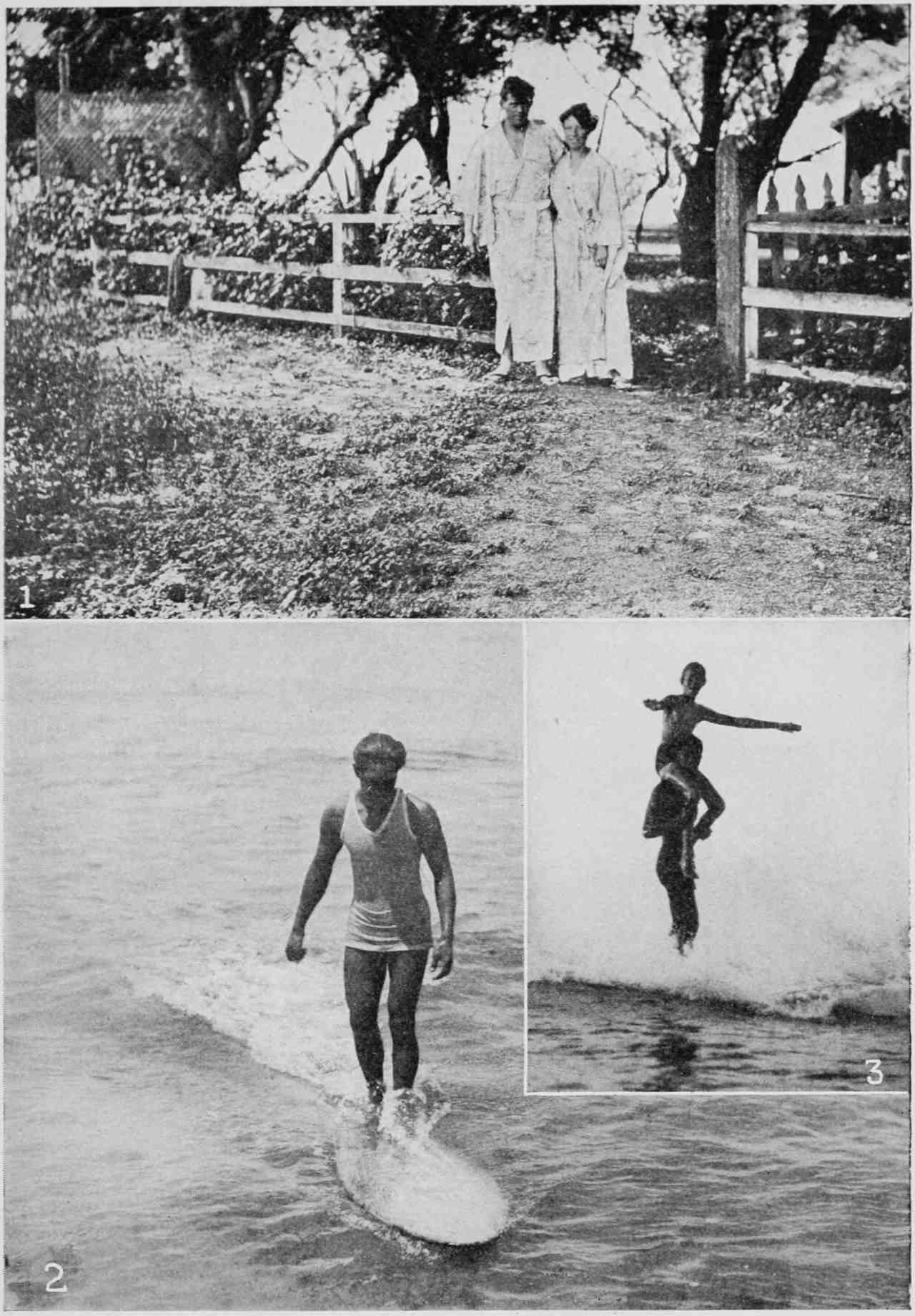
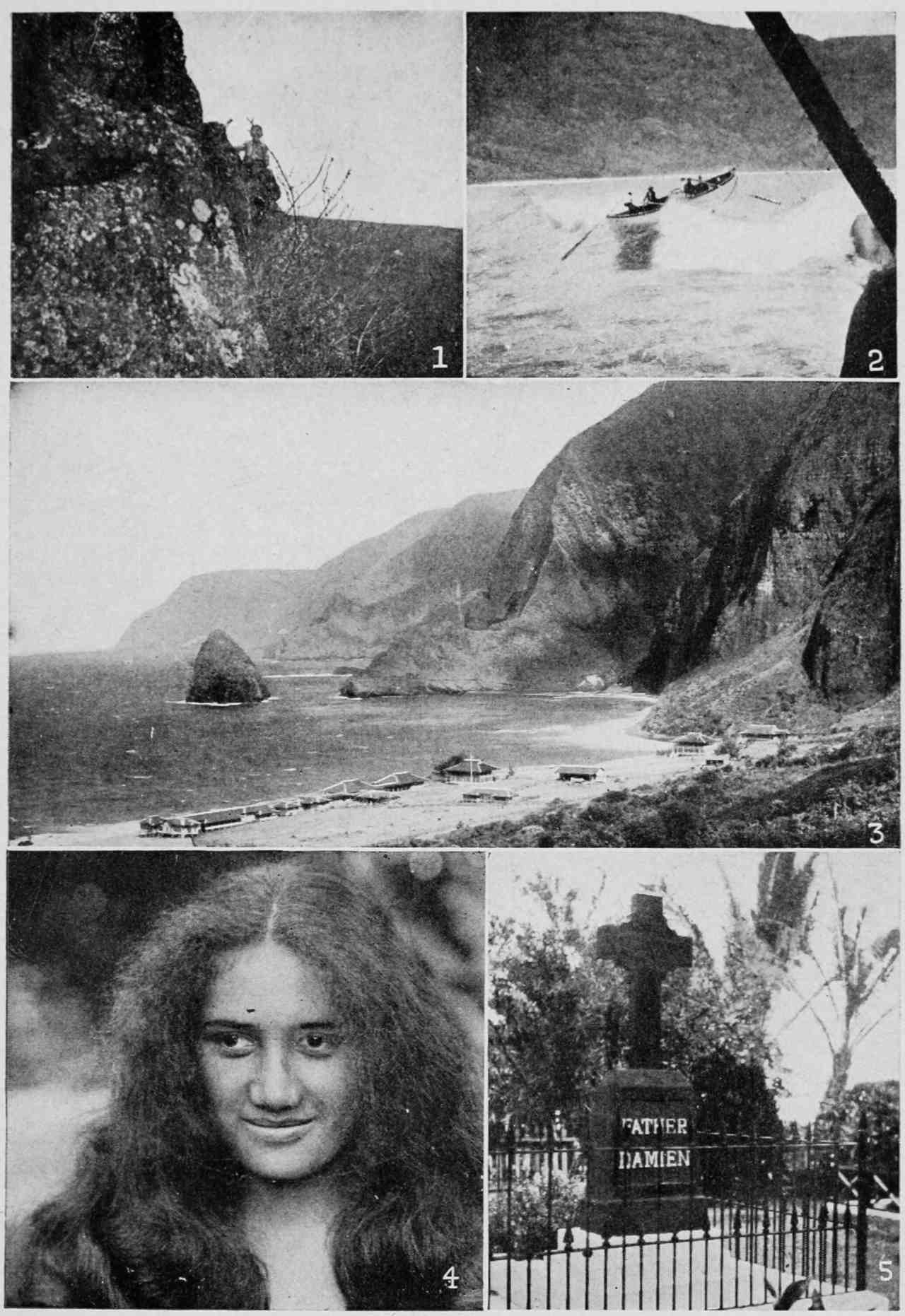
(1) Landing at Kalaupapa, 1907. (2) The Forbidden Pali Trail, 1907. (3) Coast of Molokai—Federal Leprosarium on Shore. (4) American-Hawaiian. (5) Father Damien’s Grave, 1907.
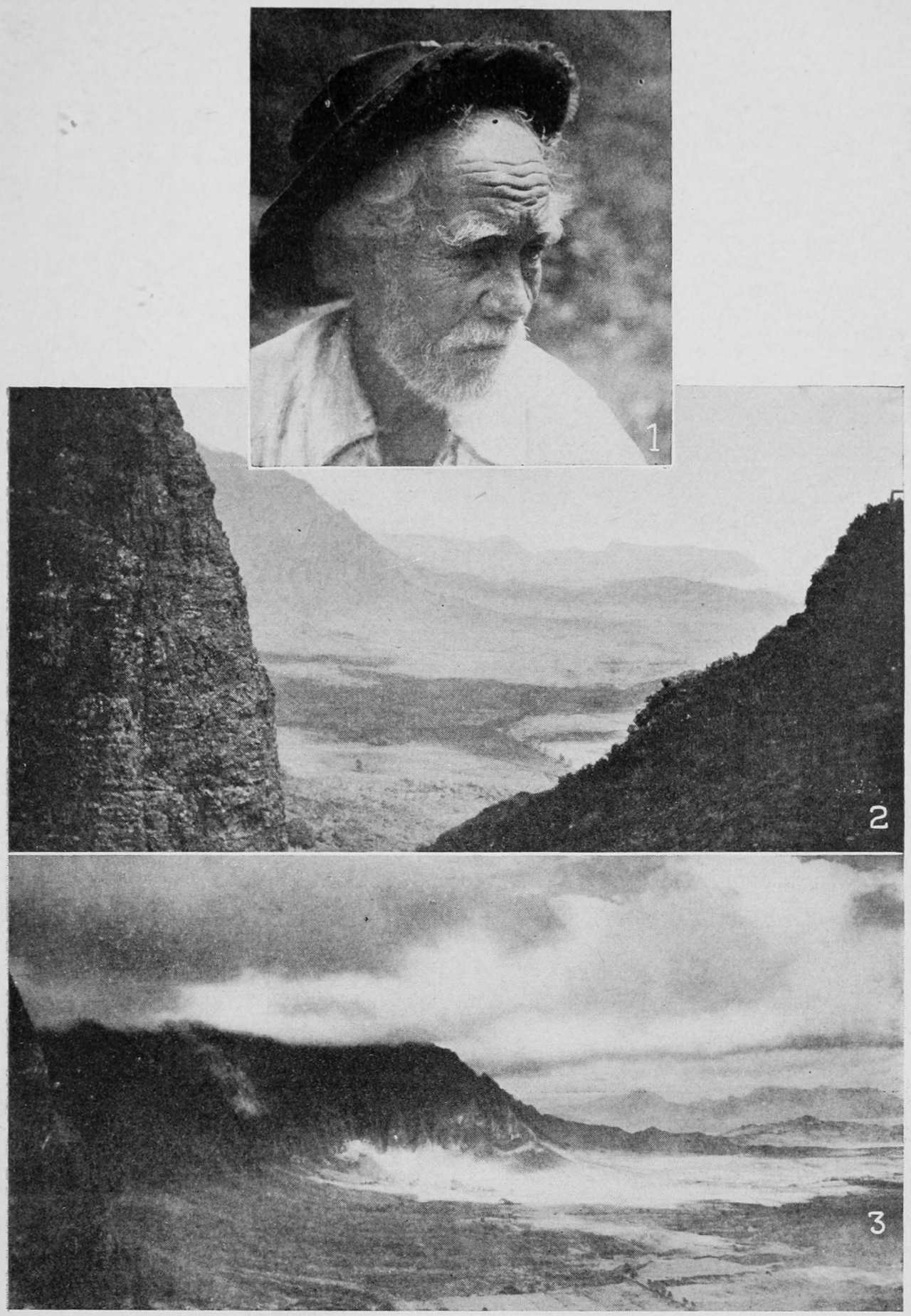
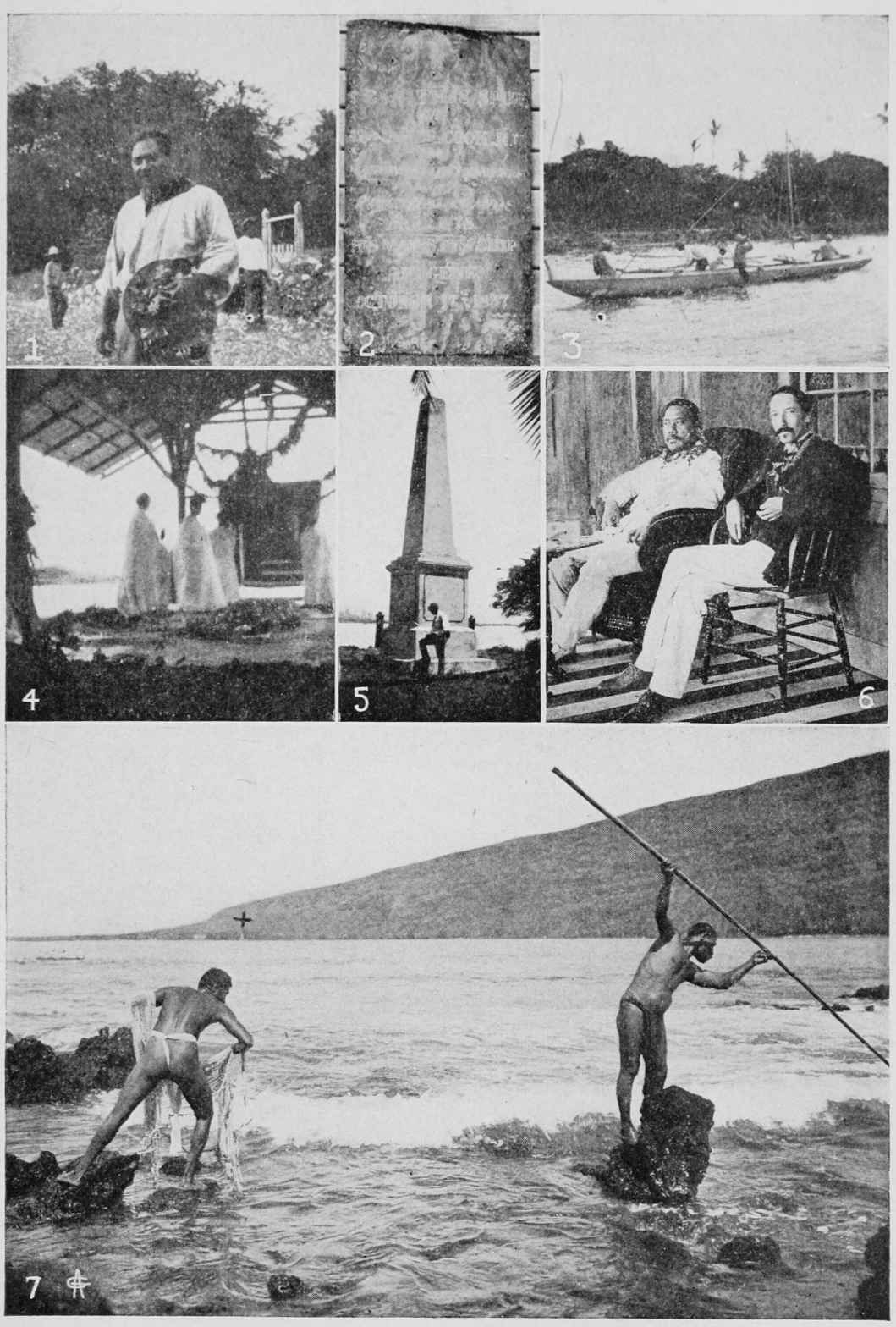
(1) Prince Cupid. (2) Original “Monument.” (3) The Prince’s Canoe. (4) At Keauhou, Preparing the Feast. (5) Jack at Cook Monument. (6) King Kalakaua and Robert Louis Stevenson. (7) Kealakekua Bay—Captain Cook Monument at +.
MY HAWAIIAN ALOHA THREE ARTICLES BY JACK LONDON — PART ONE — PART TWO — PART THREE
Once upon a time, only the other day, when jovial
King Kalakaua established a record for the kings of
earth and time, there entered into his Polynesian brain
as merry a scheme of international intrigue as ever
might have altered the destiny of races and places. The
time was 1881; the place of the intrigue, the palace of
the Mikado at Tokio. The record must not be omitted,
for it was none other than that for the first time in the
history of kings and of the world a reigning sovereign,
in his own royal person, put a girdle around the earth.
The intrigue? It was certainly as international as
any international intrigue could be. Also, it was equally
as dark, while it was precisely in alignment with the
future conflicting courses of empires. Manifest destiny
was more than incidentally concerned. When the manifest
destinies of two dynamic races move on ancient
and immemorial lines toward each other from east to
west and west to east along the same parallels of latitude,
there is an inevitable point on the earth’s surface
where they will collide. In this case, the races were the
Anglo-Saxon (represented by the Americans), and the
Mongolian (represented by the Japanese). The place
was Hawaii, the lovely and lovable, beloved of countless
many as “Hawaii Nei.”
Kalakaua, despite his merriness, foresaw clearly,
either that the United States would absorb Hawaii, or
that, allied by closest marital ties to the royal house of
the Rising Sun, Hawaii could be a brother kingdom in
an empire. That he saw clearly, the situation to-day
attests. Hawaii Nei is a territory of the United States.
There are more Japanese resident in Hawaii at the
present time than are resident other nationalities, not
even excepting the native Hawaiians.
The figures are eloquent. In round numbers, there
are twenty-five thousand pure Hawaiians, twenty-five
thousand various Caucasians, twenty-three thousand
Portuguese, twenty-one thousand Chinese, fifteen thousand
Filipinos, a sprinkling of many other breeds, an
amazing complexity of intermingled breeds, and ninety
thousand Japanese. And, most amazingly eloquent of
all statistics are those of the race purity of the Japanese
mating. In the year 1914, the Registrar General is
authority for the statements that one American male
and one Spanish male respectively married Japanese
females, that one Japanese male married a Hapa-Haole,
or Caucasian-Hawaiian female, and that three Japanese
males married pure Hawaiian females. When it comes
to an innate antipathy toward mongrelization, the
dominant national in Hawaii, the Japanese, proves himself
more jealously exclusive by far than any other
national. Omitting the records of all the other nationals
which go to make up the amazing mongrelization of
races in this smelting pot of the races, let the record of
pure-blood Americans be cited. In the same year of
1914, the Registrar General reports that of American
males who intermingled their breed and seed with
alien races, eleven married pure Hawaiians, twenty-five
married Caucasian-Hawaiians, three married pure
Chinese, four married Chinese-Hawaiians, and one
married a pure Japanese. To sum the same thing up
with a cross bearing: in the same year 1914, of over
eighteen hundred Japanese women who married, only
two married outside their race; of over eight hundred
pure Caucasian women who married, over two hundred
intermingled their breed and seed with races alien to
their own. Reduced to decimals, of the females who
went over the fence of race to secure fathers for their
children, .25 of pure Caucasian women were guilty;
.0014 of Japanese women were guilty—in vulgar fraction,
one out of four[1] Caucasian women; one out of one
thousand Japanese women.
King Kalakaua, at the time he germinated his idea,
was the royal guest of the Mikado in a special palace
which was all his to lodge in, along with his suite. But
Kalakaua was resolved upon an international intrigue
which was, to say the least, ethnologically ticklish;
while his suite consisted of two Americans, one, Colonel
C. H. Judd, his Chamberlain, the other, Mr. William N.
Armstrong, his Attorney-General. They represented
one of the race manifest destinies, and he knew it would
never do for them to know what he had up his kingly
sleeve. So, on this day in 1881, he gave them the royal
slip, sneaked out of the palace the back way, and hied
him to the Mikado’s palace.
All of which, between kings, is a very outré thing to
do. But what was mere etiquette between kings?—Kalakaua
reasoned. Besides, Kalakaua was a main-traveled
sovereign and a very cosmopolitan through contact
with all sorts and conditions of men at the feasting
board under the ringing grass-thatched roof of the
royal canoe house at Honolulu, while the Mikado had
never been off his tight little island. Of course, the
Mikado was surprised at this unannounced and entirely
unceremonious afternoon call. But not for nothing
was he the Son of Heaven, equipped with all the perfection
of gentleness that belongs to a much longer than
a nine-hundred-years-old name. To his dying day
Kalakaua never dreamed of the faux pas he committed
that day in 1881.
He went directly to the point, exposited the manifest
destinies moving from east to west and west to east,
and proposed no less than that an imperial prince of
the Mikado’s line should espouse the Princess Kaiulani
of Hawaii. He assured this delicate, hot-house culture
of a man whose civilization was already a dim and distant
achievement at the time Kalakaua’s forebears
were on the perilous and savage Polynesian canoe-drift
over the Pacific ere ever they came to colonize Hawaii—this
pallid palace flower of a monarch did he assure that
the Princess Kaiulani was some princess. And in this
Kalakaua made no mistake. She was all that he could
say of her, and more. Not alone was she the most refined
and peach-blow blossom of a woman that Hawaii
had ever produced, to whom connoisseurs of beauty and
of spirit like Robert Louis Stevenson had bowed knee
and head and presented with poems and pearls; but she
was Kalakaua’s own niece and heir to the throne of Hawaii.
Thus, the Americans, moving westward would
be compelled to stop on the far shore of the Pacific;
while Hawaii, taken under Japan’s wing, would become
the easterly outpost of Japan.
Kalakaua died without knowing how clearly he foresaw
the trend of events. To-day the United States
possesses Hawaii, which, in turn, is populated by more
Japanese than by any other nationality. Practically
every second person in the island is a Japanese, and
the Japanese are breeding true to pure race lines while
all the others are cross-breeding to an extent that
would be a scandal on any stock farm.
Fortunately for the United States, the Mikado reflected.
Because he reflected, Hawaii to-day is not a
naval base for Japan and a menace to the United
States. The haoles, or whites, overthrew the Hawaiian
Monarchy, formed the Dole Republic, and shortly
thereafter brought their loot in under the sheltering
folds of the Stars and Stripes. There is little use to
balk at the word “loot.” The white man is the born
looter. And just as the North American Indian was
looted of his continent by the white man, so was the
Hawaiian looted by the white men of his islands. Such
things be. They are morally indefensible. As facts
they are irrefragable—as irrefragable as the facts that
water drowns, that frost bites, and that fire incinerates.
And let this particular haole who writes these lines
here and now subscribe his joy and gladness in the
Hawaiian loot. Of all places of beauty and joy under
the sun—but there, I was born in California, which is
no mean place in itself, and it would be more meet to let
some of the talking be done by the Hawaii-born, both
Polynesian and haole. First of all, the Hawaii-born,
unlike the Californian, does not talk big. “When you
come down to the Islands you must visit us,” he will
say; “we’ll give you a good time.” That’s all. No
swank. Just like an invitation to dinner. And after
the visit is accomplished you will confess to yourself
that you never knew before what a good time was, and
that for the first time you have learned the full alphabet
of hospitality. There is nothing like it. The Hawaii-born
won’t tell you about it. He just does it.
Said Ellis, nearly a century ago, in his Polynesian
Researches: “On the arrival of strangers, every man
endeavored to obtain one as a friend and carry him off
to his own habitation, where he is treated with the
greatest kindness by the inhabitants of the district;
they place him on a high seat and feed him with abundance
of the finest food.”
Such was Captain Cook’s experience when he discovered
Hawaii, and despite what happened to him because
of his abuse of so fine hospitality, the same hospitality
has persisted in the Hawaiians of this day. Oh,
please make no mistake. No longer, as he lands, will
the latest beach-comber, whaleship deserter, or tourist,
be carried up among the palms by an enthusiastic and
loving population and be placed in the high seat. When,
in a single week to-day, a dozen steamships land
thousands of tourists, the impossibility of such lavishness
of hospitality is understandable. It can’t be done.
But—the old hospitality holds. Come with your invitations,
or letters of introduction, and you will find
yourself immediately instated in the high seat of abundance.
Or, come uninvited, without credentials, merely
stay a real, decent while, and yourself be “good,” and
make good the good in you—but, oh, softly, and gently,
and sweetly, and manly, and womanly—and you will
slowly steal into the Hawaiian heart, which is all of
softness, and gentleness, and sweetness, and manliness,
and womanliness, and one day, to your own vast surprise,
you will find yourself seated in a high place of
hospitableness than which there is none higher on this
earth’s surface. You will have loved your way there,
and you will find it the abode of love.
Nor is that all. Since I, as an attestant, am doing
the talking, let me be forgiven my first-person intrusions.
Detesting the tourist route, as a matter of private
whim or quirk of temperament, nevertheless I
have crossed the tourist route in many places over the
world and know thoroughly what I am talking about.
And I can and do aver, that, in this year 1916, I know
of no place where the unheralded and uncredentialed
tourist, if he is anything of anything in himself, so
quickly finds himself among friends as here in Hawaii.
Let me add: I know of no people in any place who
have been stung more frequently and deeply by chance
visitors than have the people of Hawaii. Yet the old
heart and hale (house) hospitality holds. The Hawaii-born
is like the leopard; spotted for good or ill, neither
can change his spots.
Why, only last evening I was talking with an Hawaii
matron—how shall I say?—one of the first ladies. Her
and her husband’s trip to Japan for Cherry Blossom
Time was canceled for a year. Why? She had received
a wireless from a steamer which had already
sailed from San Francisco, from a girl friend, a new
bride, who was coming to partake of a generally extended
hospitality of several years before. “But why
give up your own good time?” I said; “turn your
house and servants over to the young couple and you
go on your own trip just the same.” “But that would
never do,” said she. That was all. She had no thought
of house and servants. She had once offered her hospitality.
She must be there, on the spot, in heart and
hale and person. And she, island-born, had always
traveled east to the States and to Europe, while this
was her first and long anticipated journey west to the
Orient. But that she should be remiss in the traditional
and trained and innate hospitality of Hawaii was
unthinkable. Of course she would remain. What else
could she do?
Oh, what’s the use? I was going to make the Hawaii-born
talk. They won’t. They can’t. I shall have to go
on and do all the talking myself. They are poor
boosters. They even try to boost, on occasion; but the
latest steamship and railroad publicity agent from the
mainland will give them cards and spades and talk all
around them when it comes to describing what Hawaii
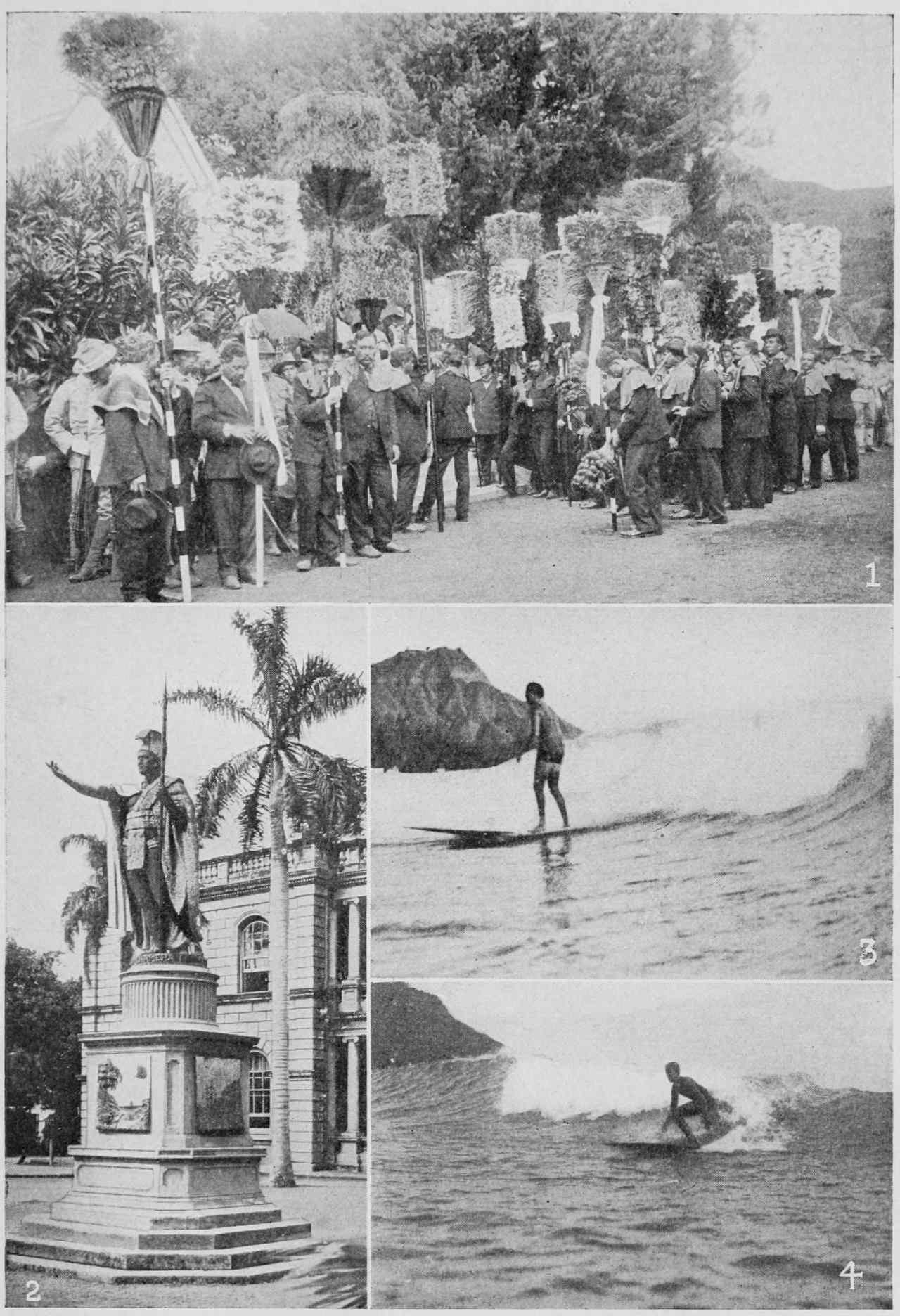
so beautifully and charmingly is. Take surf-boarding,
for instance. A California real estate agent, with that
one asset, could make the burnt, barren heart of Sahara
into an oasis for kings. Not only did the Hawaii-born
not talk about it, but they forgot about it. Just as the
sport was at its dying gasp, along came one, Alexander
Ford, from the mainland. And he talked. Surf-boarding
was the sport of sports. There was nothing
like it anywhere else in the world. They ought to be
ashamed for letting it languish. It was one of the
Island’s assets, a drawing card for travelers that would
fill their hotels and bring them many permanent residents,
etc., etc.
He continued to talk, and the Hawaii-born smiled.
“What are you going to do about it?” they said, when
he button-holed them into corners. “This is just talk,
you know, just a line of talk.”
“I’m not going to do anything except talk,” Ford replied.
“It’s you fellows who’ve got to do the doing.”
And all was as he said. And all of which I know for
myself, at first hand, for I lived on Waikiki Beach at
the time in a tent where stands the Outrigger Club
to-day—twelve hundred members, with hundreds more
on the waiting list, and with what seems like half a
mile of surf-board lockers.
“Oh, yes,—there’s fishing in the Islands,” has been
the customary manner of the Hawaii-born’s talk, when
on the mainland or in Europe. “Come down some time
and we’ll take you fishing.”—Just the same casual
dinner sort of an invitation to take pot luck. And, if
encouraged, he will go on and describe with antiquarian
detail, how, in the good old days, the natives wove
baskets and twisted fish lines that lasted a century
from the fibers of a plant that grew only in the spray
of the waterfall; or cleared the surface of the water
with a spread of the oil of the kukui nut and caught
squid with bright cowrie shells tied fast on the end
of a string; or, fathoms deep, in the caves of the coral-cliffs,
encountered the octopus and bit him to death
with their teeth in the soft bone between his eyes above
his parrot-beak.
Meanwhile these are the glad young days of new-fangled
ways of fish-catching in which the Hawaii-born’s
auditor is interested; and meanwhile, from Nova
Scotia to Florida and across the Gulf sea shore to the
coast of California, a thousand railroads, steamship
lines, promotion committees, boards of trade, and real
estate agents are booming the tarpon and the tuna that
may occasionally be caught in their adjacent waters.
And all the time, though the world is just coming
to learn of it, the one unchallengeable paradise for big-game-fishing
is Hawaii. First of all, there are the fish.
And they are all the year round, in amazing variety
and profusion. The United States Fish Commission,
without completing the task, has already described 447
distinct species, exclusive of the big, deep-sea game-fish.
It is a matter of taking any day and any choice,
from harpooning sharks to shooting flying-fish—like
quail—with shotguns, or taking a stab at a whale, or
trapping a lobster. One can fish with barbless hooks
and a six-pound sinker at the end of a drop-line off
Molokai in forty fathoms of water and catch at a single
session, a miscellany as generous as to include: the six
to eight pound moelua, the fifteen pound upakapaka, the
ten-pound lehe, the kawelea which is first cousin to the
“barricoot,” the hapuupuu, the awaa, and say, maybe,
the toothsome and gamy kahala mokulaie. And the bait
one will use on his forty-fathom line will be the fish
called the opelu, which, in turn, is caught with a bait
of crushed pumpkin.
But let not the light-tackle sportsman be dismayed
by the foregoing description of such crass, gross ways
of catching unthinkable and unpronounceable fish. Let
him take a six ounce tip and a nine-thread line and
essay one of Hawaii’s black sea bass. They catch them
here weighing over six hundred pounds, and they certainly
do run bigger than do those in the kelp beds off
Southern California. Does the light-tackle man want
tarpon? He will find them here as gamy and as large
as in Florida, and they will leap in the air—ware slack!—like
range mustangs to fling the hook clear.
Nor has the tale begun. Of the barracuda, Hawaiian
waters boast twenty species, sharp-toothed, voracious,
running to a fathom and even more in length, and, unlike
the Florida barracuda, traveling in schools. There
are the albacore and the dolphin—no mean fish for
light tackle; to say nothing of the ocean bonita and the
California bonita. There is the ulua pound for pound
the gamest salt-water fish that ever tried a rod; and
there is the ono, half way a swordfish, called by the
ancient Hawaiians the father of the mackerel. Also,
there is the swordfish, at which light-tackle men have
never been known to sneer—after they had once hooked
one. The swordfish of Hawaii, known by its immemorial
native name of a’u, averages from three to four
hundred pounds, although they have been caught between
six and seven hundred pounds, sporting swords
five feet and more in length. And not least are those
two cousins of the amber jack of Florida, the yellow
tail and the amber fish, named by Holder as the fish
of Southern California par excellence and by him
described for their beauty and desperateness in putting
up a fight.
And the tuna must not be omitted, or, at any rate,
the thunnus thynnus, the thunnus alalonsa, and the
thunnus macrapterus, so called by the scientists, but
known by the Hawaiians under the generic name of
ahi, and, by light-tackle men as the leaping tuna, the
long-fin tuna, and the yellow-fin tuna. In the past two
months, Messrs. Jump, Burnham and Morris, from the
mainland, seem to have broken every world record in
the tuna line. They had to come to Hawaii to do it,
but, once here, they did it easily, even if Morris did
break a few ribs in the doing of it. Just the other day,
on their last trip, Mr. Jump landed a sixty-seven pound
yellow-fin on a nine-thread line, and Mr. Morris similarly
a fifty-five pound one. The record for Catalina is
fifty-one pounds. Pshaw! Let this writer from California
talk big, after the manner of his home state,
and still keep within the truth. A yellow-fin tuna,
recently landed out of Hawaiian waters and sold on the
Honolulu market, weighed two hundred and eighty-seven
pounds.
Statistics compiled in 1921 by the Bishop Museum, of Honolulu, show
that one out of every six women of Caucasian birth in the Territory of
Hawaii marries a Hawaiian or part-Hawaiian; and other figures prove
that a large percentage of part-Hawaiian women marry either Hawaiians
or part-Hawaiians. Still another large proportion marries Caucasians or
Chinese. Further, the figures illustrate that the new stock is better able
to withstand disease and is, in that sense, more vigorous than its
Hawaiian ancestors, as well as more prolific. It is the creation of a new
race, strong, virile, and productive; while the pure-blooded Hawaiians
steadily decrease in numbers.
Hawaii is the home of shanghaied men and women,
and of the descendants of shanghaied men and women.
They never intended to be here at all. Very rarely,
since the first whites came, has one, with the deliberate
plan of coming to remain, remained. Somehow, the
love of the Islands, like the love of a woman, just happens.
One cannot determine in advance to love a particular
woman, nor can one so determine to love Hawaii.
One sees, and one loves or does not love. With Hawaii
it seems always to be love at first sight. Those for
whom the Islands were made, or who were made for
the Islands, are swept off their feet in the first moments
of meeting, embrace, and are embraced.
I remember a dear friend who resolved to come to
Hawaii and make it his home forever. He packed up
his wife, all his belongings including his garden hose
and rake and hoe, said “Goodbye, proud California,”
and departed. Now he was a poet, with an eye and
soul for beauty, and it was only to be expected that
he would lose his heart to Hawaii as Mark Twain and
Stevenson and Stoddard had before him. So he came,
with his wife and garden hose and rake and hoe.
Heaven alone knows what preconceptions he must have
entertained. But the fact remains that he found naught
of beauty and charm and delight. His stay in Hawaii,
brief as it was, was a hideous nightmare. In no time
he was back in California. To this day he speaks with
plaintive bitterness of his experience, although he never
mentions what became of his garden hose and rake and
hoe. Surely the soil could not have proved niggardly to
him!
Otherwise was it with Mark Twain, who wrote of
Hawaii long after his visit: “No alien land in all the
world has any deep, strong charm for me but that one;
no other land could so longingly and beseechingly haunt
me sleeping and waking, through half a lifetime, as
that one has done. Other things leave me, but it abides;
other things change, but it remains the same. For me
its balmy airs are always blowing, its summer seas
flashing in the sun; the pulsing of its surf-beat is in my
ears; I can see its garlanded crags, its leaping cascades,
its plumy palms drowsing by the shore, its remote
summits floating like islands above the cloudrack;
I can feel the spirit of its woodland solitudes; I can
hear the plash of its brooks; in my nostrils still lives the
breath of flowers that perished twenty years ago.”
One reads of the first Chief Justice under the Kamehamehas,
that he was on his way around the Horn to
Oregon when he was persuaded to remain in Hawaii.
Truly, Hawaii is a woman beautiful and vastly more
persuasive and seductive than her sister sirens of the
sea.
The sailor boy, Archibald Scott Cleghorn, had no intention
of leaving his ship; but he looked upon the
Princess Likelike, the Princess Likelike looked on him,
and he remained to become the father of the Princess
Kaiulani and to dignify a place of honor through long
years. He was not the first sailor boy to leave his ship,
nor the last. One of the recent ones, whom I know
well, arrived several years ago on a yacht in a yacht
race from the mainland. So brief was his permitted
vacation from his bank cashiership that he had planned
to return by fast steamer. He is still here. The
outlook is that his children and his grand-children after
him will be here.
Another erstwhile bank cashier is Louis von Tempsky,
the son of the last British officer killed in the Maori
War. His New Zealand bank gave him a year’s vacation.
The one place he wanted to see above all others
was California. He departed. His ship stopped at
Hawaii. It was the same old story. The ship sailed
on without him. His New Zealand bank never saw
him again, and many years passed ere ever he saw
California. But she had no charms for him. And to-day,
his sons and daughters about him, he looks down
on half a world and all of Maui from the rolling grasslands
of the Haleakala Ranch.
There were the Gays and Robinsons. Scotch pioneers
over the world in the good old days when families were
large and patriarchial, they had settled in New Zealand.
After a time they decided to migrate to British
Columbia. Among their possessions was a full-rigged
ship, of which one of their sons was master. Like my
poet friend from California, they packed all their property
on board. But in place of his garden hose and
rake and hoe, they took their plows and harrows and all
their agricultural machinery. Also, they took their
horses and their cattle and their sheep. When they
arrived in British Columbia they would be in shape
to settle immediately, break the soil, and not miss a
harvest. But the ship, as was the custom in the sailing-ship
days, stopped at Hawaii for water and fruit and
vegetables. The Gays and Robinsons are still here, or,
rather, their venerable children, and younger grandchildren
and great grandchildren; for Hawaii, like the
Princess Likelike, put her arms around them, and it
was love at first sight. They took up land on Kauai
and Niihau, the ninety-seven square miles of the latter
remaining intact in their possession to this day.
I doubt that not even the missionaries, wind jamming
around the Horn from New England a century ago,
had the remotest thought of living out all their days
in Hawaii. This is not the way of missionaries over
the world. They have always gone forth to far places
with the resolve to devote their lives to the glory of
God and the redemption of the heathen, but with the
determination, at the end of it all, to return to spend
their declining years in their own country. But Hawaii
can seduce missionaries just as readily as she can seduce
sailor boys and bank cashiers, and this particular
lot of missionaries was so enamored of her charms that
they did not return when old age came upon them.
Their bones lie here in the land they came to love better
than their own; and they, and their sons and
daughters after them, have been, and are, powerful
forces in the development of Hawaii.
In missionary annals, such unanimous and eager
adoption of a new land is unique. Yet another thing,
equally unique in missionary history, must be noted
in passing. Never did missionaries, the very first, go
out to rescue a heathen land from its idols, and on
arrival find it already rescued, self-rescued, while they
were on the journey. In 1819, all Hawaii was groaning
under the harsh rule of the ancient idols, whose
mouthpieces were the priests and whose utterances
were the frightfully cruel and unjust taboos. In 1819,
the first missionaries assembled in Boston and sailed
away on the long voyage around the Horn. In 1819,
the Hawaiians, of themselves, without counsel or suggestion,
over-threw their idols and abolished the taboos.
In 1820, the missionaries completed their long voyage
and landed in Hawaii to find a country and a people
without gods and without religion, ready and ripe for
instruction.
But to return. Hawaii is the home of shanghaied
men and women, who were induced to remain, not by
a blow with a club over the head or a doped bottle of
whisky, but by love. Hawaii and the Hawaiians are
a land and a people loving and lovable. By their
language may ye know them, and in what other land
save this one is the commonest form of greeting, not
“Good day,” nor “How d’ye do,” but “Love?” That
greeting is Aloha—love, I love you, my love to you.
Good day—what is it more than an impersonal remark
about the weather? How do you do—it is personal in
a merely casual interrogative sort of a way. But
Aloha! It is a positive affirmation of the warmth of
one’s own heart-giving. My love to you! I love you!
Aloha!
Well, then, try to imagine a land that is as lovely
and loving as such a people. Hawaii is all of this. Not
strictly tropical, but sub-tropical, rather, in the heel of
the Northeast Trades (which is a very wine of wind),
with altitudes rising from palm-fronded coral beaches
to snow-capped summits fourteen thousand feet in the
air; there was never so much climate gathered together
in one place on earth. The custom of the dwellers is
as it was of old time, only better, namely: to have a
town house, a seaside house, and a mountain house. All
three homes, by automobile, can be within half an
hour’s run of one another; yet, in difference of climate
and scenery, they are the equivalent of a house on Fifth
Avenue or the Riverside Drive, of an Adirondack camp,
and of a Florida winter bungalow, plus a twelve-months’
cycle of seasons crammed into each and every
day.
Let me try to make this clearer. The New York
dweller must wait till summer for the Adirondacks, till
winter for the Florida beach. But in Hawaii, say on
the island of Oahu, the Honolulu dweller can decide
each day what climate and what season he desires to
spend the day in. It is his to pick and choose. Yes,
and further: he may awake in his Adirondacks, lunch
and shop and go to the club in his city, spend his
afternoon and dine at his Palm Beach, and return to sleep
in the shrewd coolness of his Adirondack camp.
And what is true of Oahu, is true of all the other
large islands of the group. Climate and season are to
be had for the picking and choosing, with countless
surprising variations thrown in for good measure.
Suppose one be an invalid, seeking an invalid’s climate.
A night’s run from Honolulu on a steamer will land
him on the leeward coast of the big Island of Hawaii.
There, amongst the coffee on the slopes of Kona, a
thousand feet above Kailua and the wrinkled sea, he
will find the perfect invalid-climate. It is the land of
the morning calm, the afternoon shower, and the evening
tranquility. Harsh winds never blow. Once in a
year or two a stiff wind of twenty-four to forty-eight
hours will blow from the south. This is the Kona wind.
Otherwise there is no wind, at least no air-draughts
of sufficient force to be so dignified. They are not even
breezes. They are air-fans, alternating by day and by
night between the sea and the land. Under the sun,
the land warms and draws to it the mild sea air. In
the night, the land radiating its heat more quickly, the
sea remains the warmer and draws to it the mountain
air faintly drenched with the perfume of flowers.
Such is the climate of Kona, where nobody ever
dreams of looking at a thermometer, where each afternoon
there falls a refreshing spring shower, and where
neither frost nor sunstroke has ever been known. All
of which is made possible by the towering bulks of
Mauna Kea and Mauna Loa. Beyond them, on the
windward slopes of the Big Island, along the Hamakua
Coast, the trade wind will as often as not be blustering
at forty miles an hour. Should an Oregon web-foot become
homesick for the habitual wet of his native clime,
he will find easement and a soaking on the windward
coasts of Hawaii and Maui, from Hilo in the south
with its average annual rainfall of one hundred and
fifty inches to the Nahiku country to the north beyond
Hana which has known a downpour of four hundred
and twenty inches in a single twelve-month. In the matter
of rain it is again pick and choose—from two hundred
inches to twenty, or five, or one. Nay, further,
forty miles away from the Nahiku, on the leeward
slopes of the House of the Sun, which is the mightiest
extinct volcano in the world, rain may not fall once in
a dozen years, cattle live their lives without ever seeing
a puddle and horses brought from that region shy at
running water or try to eat it with their teeth.
One can multiply the foregoing examples indefinitely,
and to the proposition that never was so much climate
gathered together in one place, can be added that never
was so much landscape gathered together in one place.
The diversification is endless, from the lava shores of
South Puna to the barking sands of Kauai. On every
island break-neck mountain climbing abounds. One
can shiver above timber-line on the snow-caps of Mauna
Kea or Mauna Loa, swelter under the banyan at sleepy
old Lahaina, swim in clear ocean water that effervesces
like champagne on ten thousand beaches, or
sleep under blankets every night in the upland pastures
of the great cattle ranges and awaken each morning to
the song of sky-larks and the crisp, snappy air of
spring. But never, never, go where he will in Hawaii
Nei, will he experience a hurricane, a tornado, a blizzard,
a fog, or ninety degrees in the shade. Such discomforts
are meteorologically impossible, so the meteorologists
affirm. When Hawaii was named the Paradise
of the Pacific, it was inadequately named. The
rest of the Seven Seas and the islands in the midst
thereof should have been included along with the Pacific.
“See Naples and die”—they spell it differently
here: see Hawaii and live.
Nor is Hawaii niggardly toward the sportsman. Good
hunting abounds. As I write these lines on Puuwaawaa
Ranch, from every side arises the love-call of the
quail, which are breaking up their coveys as the mating
proceeds. They are California quail, yet never in California
have I seen quail as thick as here. Yesterday
I saw more doves—variously called turtle doves and
mourning doves—than I ever saw before in any single
day of my life. Day before yesterday I was out with
the cowboys roping wild pig in the pastures.
Of birds, in addition to quail and doves, in place and
season may be hunted wild duck, wild turkey, rice birds,
Chinese and Japanese pheasants, pea fowl, guinea fowl,
wild chicken (which is a mongrel cross of the indigenous
moa and the haole chicken), and, not least, the
delicious golden plover fat and recuperated after its
long flight from Alaska and the arctic shores. Then
there are the spotted deer of Molokai. Increasing
from several introduced pair, they so flourished in their
new habitat that they threatened the pastures and forests,
and some years ago the government was compelled
to employ professional hunters to reduce their numbers.
Of course there is pig-sticking, and for real hunting
few things can out-thrill the roping, after cowboy
fashion, of the wild bulls of the upper ranges. Also
are there to be had wild goats, wild sheep—yes, and
wild dogs, running in packs and dragging down calves
and cows, that may even prove perilous to the solitary
hunter. And as for adventure and exploration, among
many things, one can tackle Rabbit Island, inaccessible
to all but the most intrepid and most fortunate, or seek
for the secret and taboo burial places of the ancient
kings.
Indeed, Hawaii is a loving land. Just as it welcomed
the spotted deer to the near destruction of its forests,
so has it welcomed many other inimical aliens to its
shores. In the United States, in greenhouses and old
fashioned gardens, grows a potted flowering shrub
called lantana, which originally came from South
America; in India dwells a very noisy and quarrelsome
bird known as the mynah. Both were introduced into
Hawaii, the bird to feed upon the cutworm of a certain
moth called spodoptera mauritia; the flower to
gladden with old associations the heart of a flower-loving
missionary. But the land loved the lantana. From
a small plant that grew in a pot with its small, velvet
flowers of richest tones of orange, yellow, and rose,
the lantana took to itself feet and walked out of the
pot into the missionary’s garden. Here it flourished
and increased mightily in size and constitution. From
over the garden wall came the love-call of all Hawaii,
and the lantana responded to the call, climbed over the
wall, and went a-roving and a-loving in the wild woods.
And just as the lantana had taken to itself feet, by
the seduction of the seeds in its aromatic blue-black
berries, it added to itself the wings of the mynah, who
distributed its seed over every island in the group. Like
the creatures Mr. Wells writes of who ate of the food
of the gods and became giants, so the lantana. From a
delicate, hand-manicured, potted plant of the greenhouse,
it shot up into a tough and belligerent swashbuckler
from one to three fathoms tall, that marched
in serried ranks over the landscape, crushing beneath
it and choking to death all the sweet native
grasses, shrubs, and flowers. In the lower forests it
became jungle. In the open it became jungle, only
more so. It was practically impenetrable to man. It
filled and blotted out the pastures by tens of thousands
of acres. The cattlemen wailed and vainly fought with
it. It grew faster and spread faster than they could
grub it out.
Like the invading whites who dispossessed the native
Hawaiians of their land, so did the lantana to the native
vegetation. Nay, it did worse. It threatened to dispossess
the whites of the land they had won. And
battle royal was on. Unable to cope directly with it,
the whites called in the aid of the hosts of mercenaries.
They sent out their agents to recruit armies from the
insect world and from the world of micro-organisms.
Of these doughty warriors let the name of but one, as
a sample, be given—crenastobombycia lantenella.
Prominent among these recruits were the lantana seed-fly,
the lantana plume-moth, the lantana butterfly, the
lantana leaf-miner, the lantana leaf-bug, the lantana
gall-fly. Quite by accident the Maui blight or scale was
enlisted.
Some of these predacious enemies of the lantana ate
and sucked and sapped. Others made incubators out
of the stems, tunneled and undermined the flower
clusters, hatched maggots in the hearts of the seeds, or
coated the leaves with suffocating fungoid growths.
Thus simultaneously attacked in front and rear and
flank, above and below, inside and out, the all-conquering
swashbuckler recoiled. To-day the battle is almost
over, and what remains of the lantana is putting up a
sickly and losing fight. Unfortunately, one of the mercenaries
has mutinied. This is the accidentally introduced
Maui blight, which is now waging unholy war
upon garden flowers and ornamental plants, and
against which some other army of mercenaries must
be turned.
Hawaii has been most generous in her hospitality,
most promiscuous in her loving. Her welcome has been
impartial. To her warm heart she has enfolded all manner
of hurtful, stinging things, including some humans.
Mosquitos, centipedes and rats made the long voyages,
landed, and have flourished ever since. There was none
of these here before the haole came. So, also, were introduced
measles, smallpox, and many similar germ
afflictions of man. The elder generations lived and
loved and fought and went down into the pit with their
war weapons and flower garlands laid under their
heads, unvexed by whooping cough, and mumps, and
influenza. Some alien good, and much of alien ill, has
Hawaii embraced and loved. Yet to this day no snake,
poisonous or otherwise, exists in her forests and
jungles; while the centipede is not deadly, its bite being
scarcely more discomforting than the sting of a
bee or wasp. Some snakes did arrive, once. A showman
brought them for exhibition. In passing quarantine
they had to be fumigated. By some mischance
they were all suffocated, and it is whispered that the
quarantine officials might have more to say of that mischance
than appeared in their official report.
And, oh, there is the mongoose. Originally introduced
from India via Jamaica to wage war on that
earlier introduction, the rat, which was destroying the
sugar cane plantations, the mongoose multiplied beyond
all guestly bounds and followed the lantana into
the plains and forests. And in the plains and forests
it has well nigh destroyed many of the indigenous species
of ground-nesting birds, made serious inroads on
the ground-nesting imported birds, and compelled all
raisers of domestic fowls to build mongoose-proof
chicken yards. In the meantime the rats have changed
their nesting habits and taken to the trees. Some of
the pessimistic farmers even aver that, like the haole
chickens which went wild in the woods and crossed
with the moa, the mongoose has climbed the trees, made
friends with and mated with the rats, and has produced
a permanent hybrid of omnivorous appetite that eats
sugar cane, birds’ eggs, and farmyard chickens indiscriminately
and voraciously. But further deponent
sayeth not.
Hawaii is a great experimental laboratory, not
merely in agriculture, but in ethnology and sociology.
Remote in the heart of the Pacific, more hospitable to
all forms of life than any other land, it has received an
immigration of alien vegetable, insect, animal and
human life more varied and giving rise to more complicated
problems than any other land has received.
And right intelligently and whole-heartedly have the
people of Hawaii taken hold of these problems and
striven to wrestle them to solution.
A melting pot or a smelting pot is what Hawaii is.
In a single school, at one time I have observed scholars
of as many as twenty-three different nationalities and
mixed nationalities. First of all is the original Hawaiian
stock of pure Polynesian. These were the people
whom Captain Cook discovered, the first pioneers who
voyaged in double canoes from the South Pacific and
colonized Hawaii at what is estimated from their traditions
as some fifteen hundred years ago. Next, from
Captain Cook’s time to this day, has drifted in the
haole, or Caucasian—Yankee, Scotch, Irish, English,
Welsh, French, German, Scandinavian—every Caucasian
country of Europe, and every Caucasian colony of
the world has contributed its quota. And not least to
be reckoned with, are the deliberate importations of
unskilled labor for the purpose of working the sugar
plantations. First of these was a heavy wave of
Chinese coolies. But the Chinese Exclusion Act put a
stop to their coming. In the same way, King Sugar has
introduced definite migrations of Japanese, Koreans,
Russians, Portuguese, Spanish, Porto Ricans, and Filipinos.
With the exception of the Japanese, who are
jealously exclusive in the matter of race, all these other
races insist and persist in intermarrying, and the situation
here should afford much valuable data for the
ethnologist.
Of the original Hawaiians one thing is certain. They
are doomed to extinction. Year by year the total number
of the pure Hawaiians decreases. Marrying with
the other races as they do, they could persist as hybrids,
if—if fresh effusions of them came in from outside
sources equivalent to such continued effusions as do
come in of the other races. But no effusions of Polynesian
come in nor have ever come in. Steadily, since
Captain Cook’s time, they have faded away. To-day,
the representatives of practically all the old chief-stocks
and royal-stocks are half-whites, three-quarter
whites, and seven-eighths whites. And they, and their
children, continue to marry whites, or seven-eighths
and three-quarters whites like themselves, so that the
Hawaiian strain grows thinner and thinner against
the day when it will vanish in thin air. All of which is
a pity, for the world can ill afford to lose so splendid
and lovable a race.
And yet, in this period of world war wherein the
United States finds it necessary to prepare against
foes that may at any time launch against it out of the
heart of civilization, little Hawaii, with its hotch potch
of races, is making a better demonstration than the
United States.
The National Guard has been so thoroughly reorganized,
livened up, and recruited that it makes a showing
second to none on the Mainland, while, in proportion
to population, it has more of this volunteer soldiery
than any of the forty-eight states and territories in the
United States. In addition to the mixed companies,
there are entire companies of Hawaiians, Portuguese,
Chinese (Hawaii-born), and Filipinos; and the reviewing
stand sits up and takes notice when it casts its
eyes over them and over the regulars.
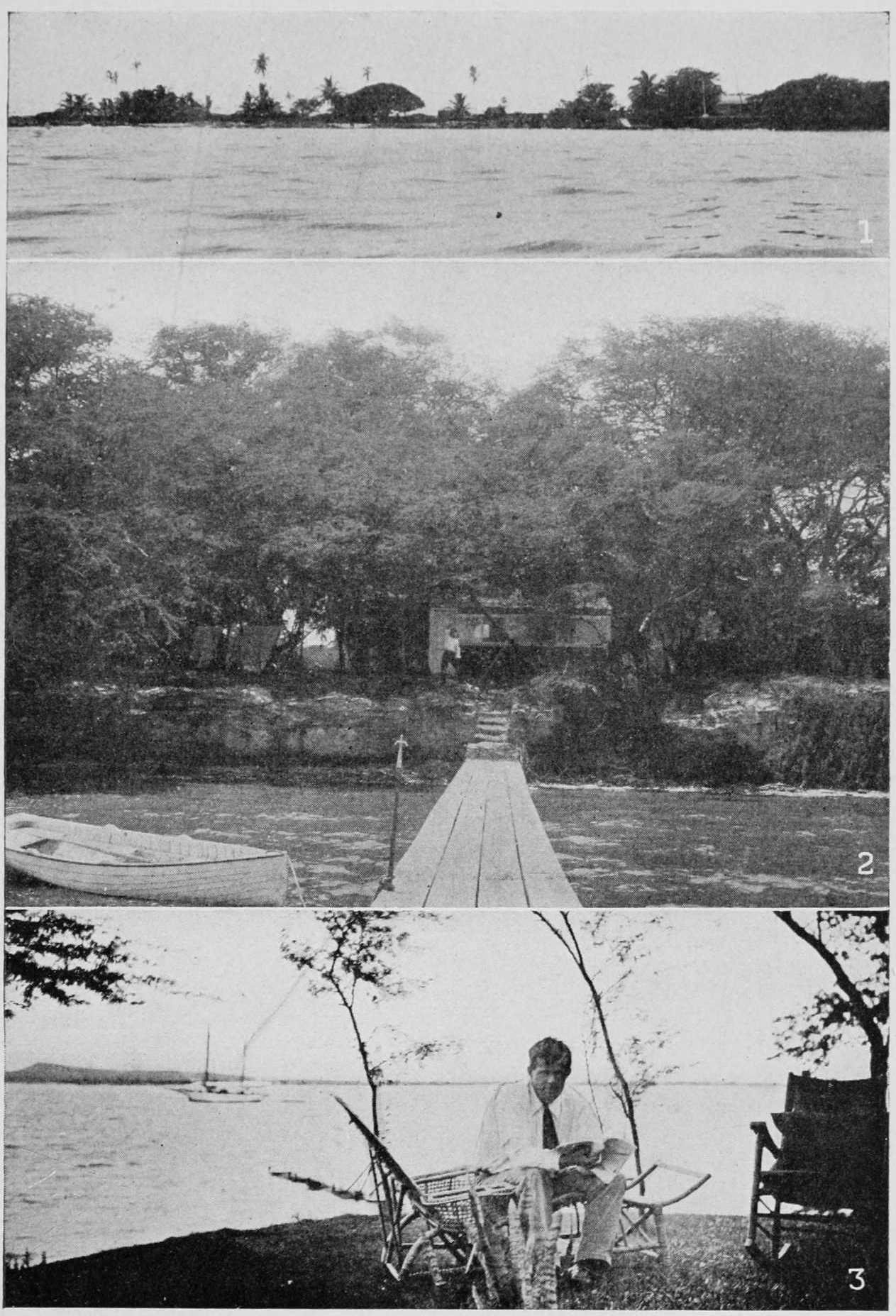
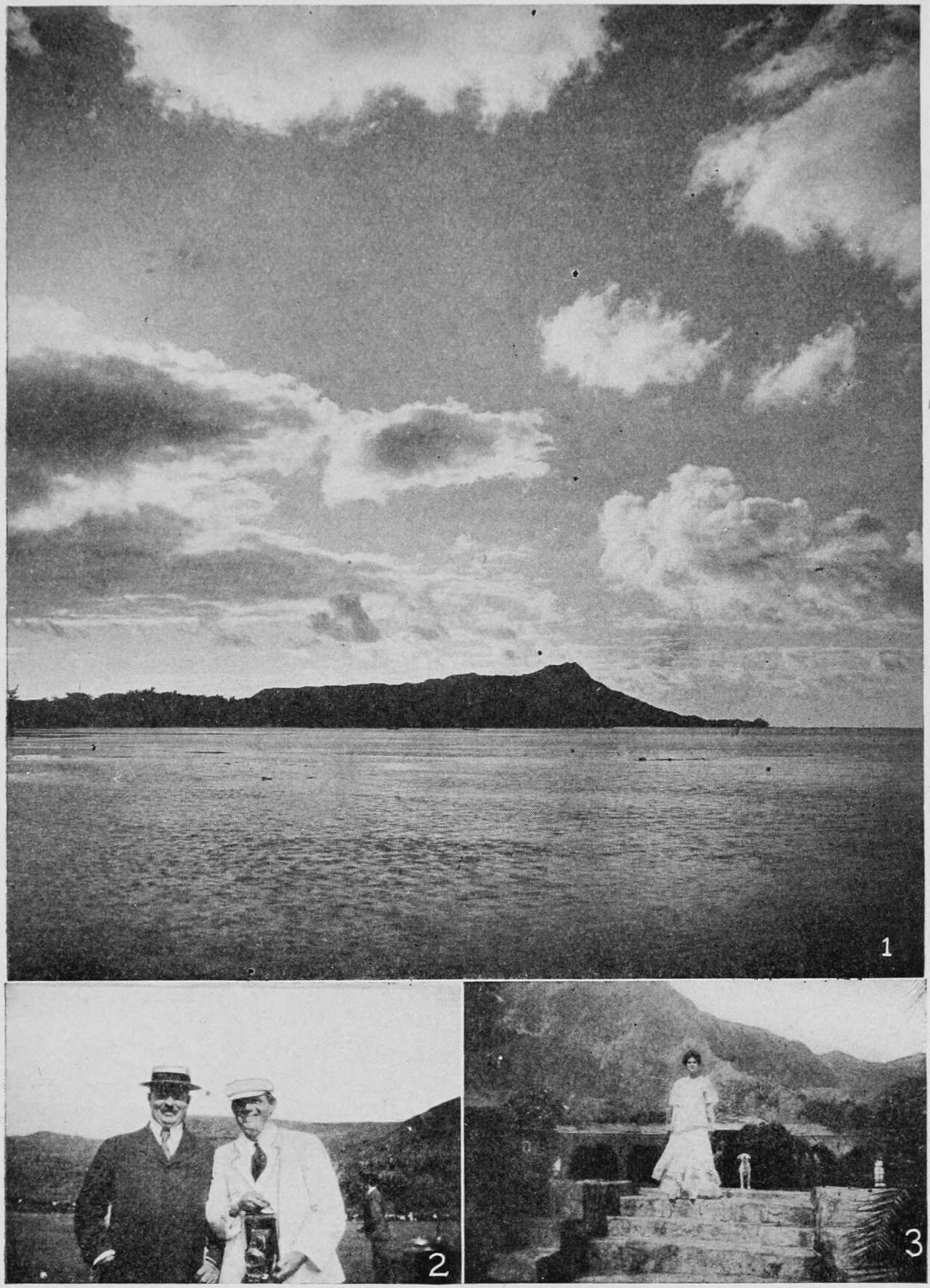
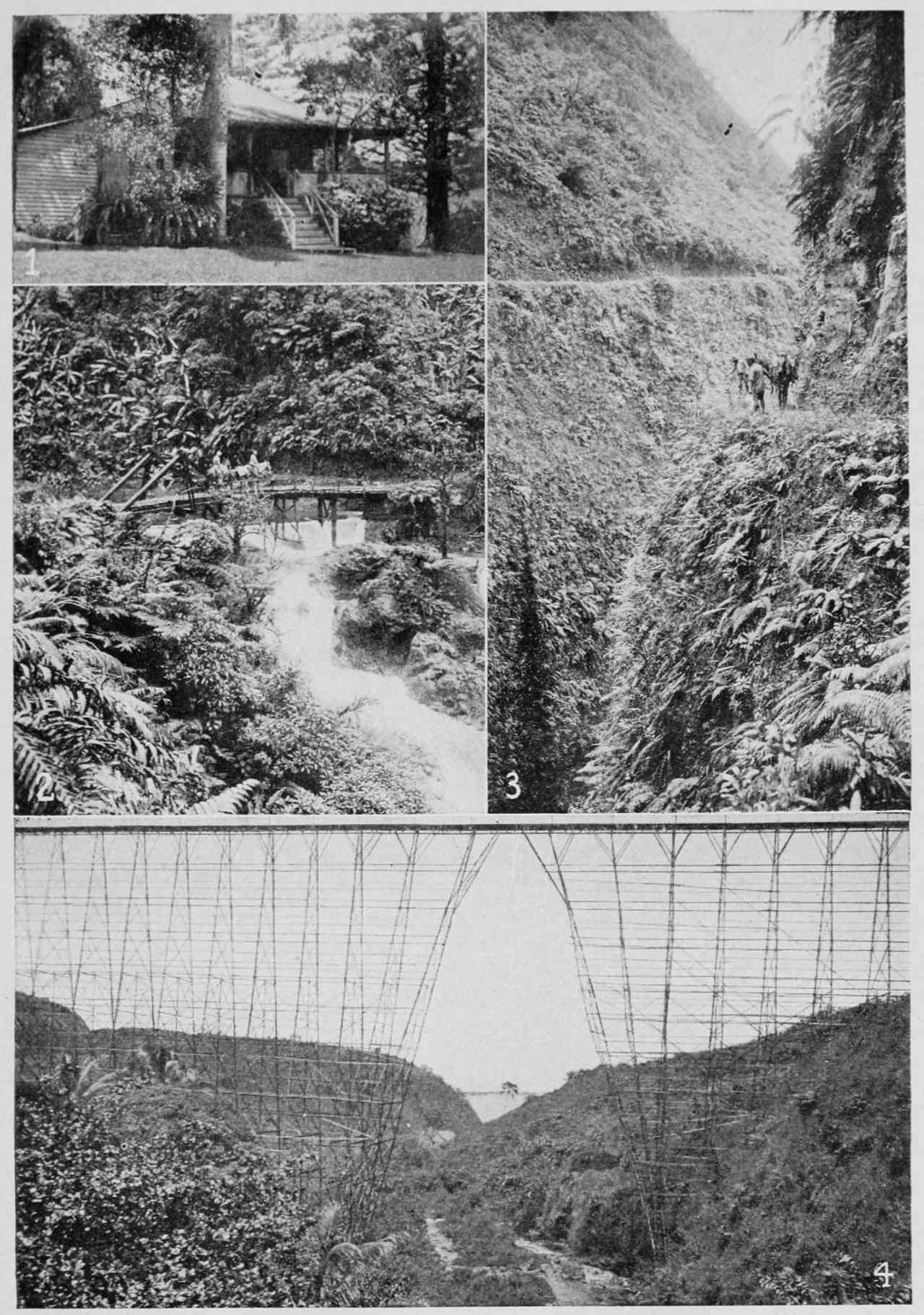
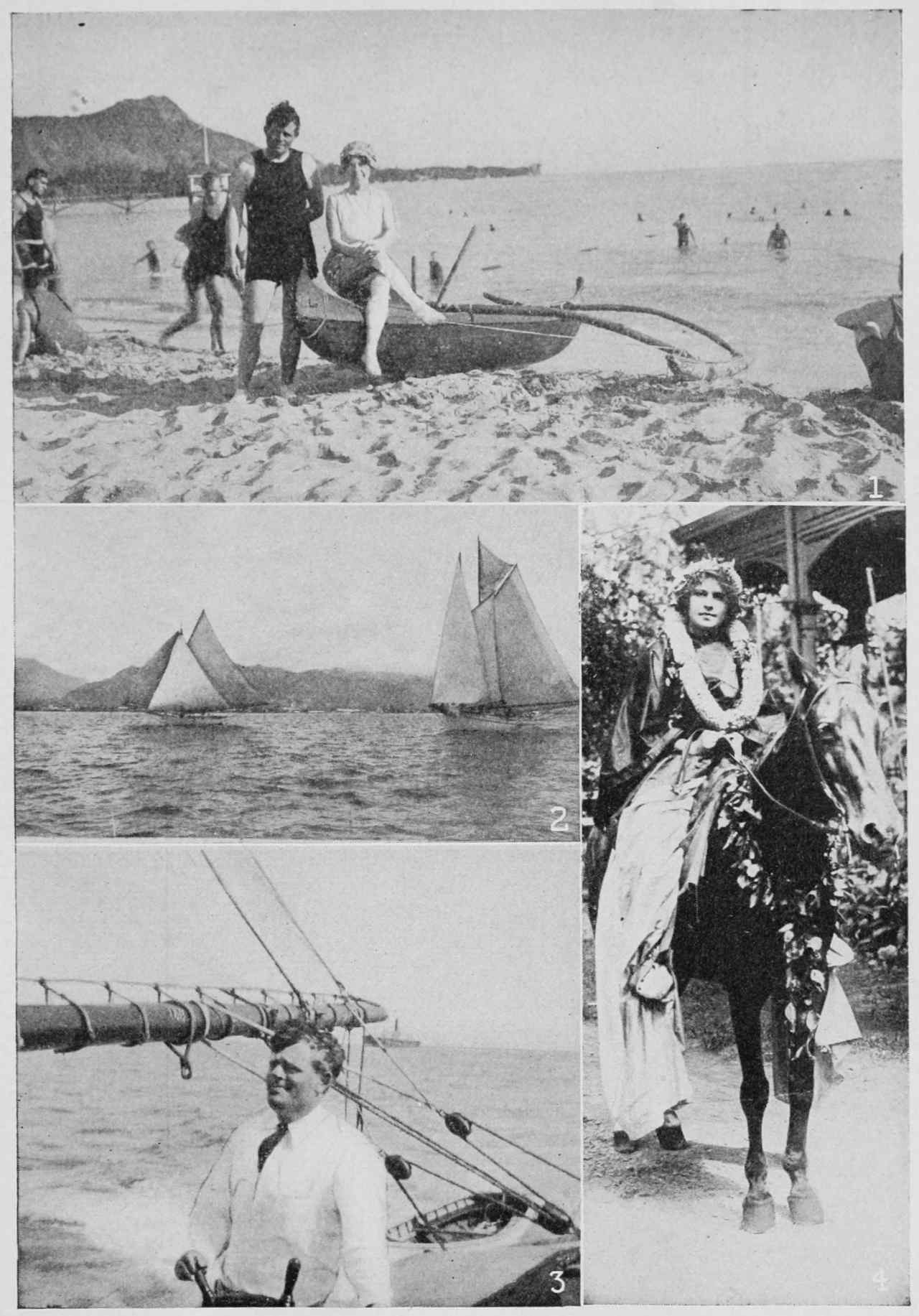
(1) The Peninsula. (2) The Hobron Bungalow. (3) The Snark, and the owner ashore.
No better opportunity could be found for observing
this medley of all the human world than that afforded
by the Mid-Pacific Carnival last February when the
population turned out and held festival for a week.
Nowhere within the territory of the United States
could so exotic a spectacle be witnessed. And unforgettable
were the flower-garlanded Hawaiians, the
women pa’u riders on their lively steeds with flowing
costumes that swept the ground, toddling Japanese
boys and girls, lantern processions straight out of old
Japan, colossal dragons from the Flowery Empire, and
Chinese school girls, parading two by two in long winding
columns, bare-headed, their demure black braids
down their backs, slimly graceful in the white costumes
of their foremothers. At the same time, while the
streets stormed with confetti and serpentines tossed by
the laughing races of all the world, in the throne room
of the old palace (now the Executive Building) was
occurring an event as bizarre in its own way and
equally impressive. Here, side by side, the two high
representatives of the old order and the new held reception.
Seated, was the aged Queen Liliuokalani, the
last reigning sovereign of Hawaii; standing beside her
was Lucius E. Pinkham, New England born, the Governor
of Hawaii. A quarter of a century before, his
brothers had dispossessed her of her kingdom; and
quite a feather was it in his cap for him to have her beside
him that night, for it was the first time in that
quarter of a century that any one had succeeded in winning
her from her seclusion to enter the throne-room.
And about them, among brilliantly uniformed army
and navy officers from generals and admirals down,
moved judges and senators, sugar kings and captains
of industry, the economic and political rulers of Hawaii,
and many of them, they and their women, intermingled
descendants of the old chief stocks and of the old missionary
and merchant pioneers.
And what more meet than that in Hawaii, the true
Aloha-land which has welcomed and loved all wayfarers
from all other lands, that the Pan-Pacific movement
should have originated. This had its inception in
the mind of Mr. Alexander Hume Ford—he of Outrigger
Club fame who resurrected the sports of surf-boarding
and surf-canoeing at Waikiki. Hands-Around-the-Pacific,
he calls the movement; and already
these friendly hands are reaching out and clasping
all the way from British Columbia to Panama,
from New Zealand to Australia and Oceanica, and on
to Java, the Philippines, China and Japan, and around
and back again to Hawaii, the Cross-Roads of the Pacific
and the logical heart and home and center of the
movement.
Hawaii is a Paradise—and I can never cease proclaiming
it; but I must append one word of qualification:
Hawaii is a paradise for the well-to-do. It is not
a paradise for the unskilled laborer from the mainland,
nor for the person without capital from the mainland.
The one great industry of the islands is sugar.
The unskilled labor for the plantations is already here.
Also, the white unskilled laborer, with a higher standard
of living, cannot compete with coolie labor, and,
further, the white laborer cannot and will not work in
the canefields.
For the person without capital, dreaming to start on
a shoestring and become a capitalist, Hawaii is the
last place in the world. It must be remembered that
Hawaii is very old... comparatively. When
California was a huge cattle ranch for hides and tallow
(the meat being left where it was skinned), Hawaii
was publishing newspapers and boasting schools of
higher learning. During the early years of the gold
rush, before the soil of California was scratched with
a plow, Hawaii kept a fleet of ships busy carrying her
wheat, and flour, and potatoes to California, while
California was sending her children down to Hawaii to
be educated. The shoestring days are past. The land
and industries of Hawaii are owned by old families and
large corporations, and Hawaii is only so large.
But the homesteader may object, saying that he has
read the reports of the millions of acres of government
land in Hawaii which are his for the homesteading.
But he must remember that the vastly larger portion
of this government land is naked lava rock and not
worth ten cents a square mile to a homesteader, and
that much of the remaining land, while rich in soil
values, is worthless because it is without water. The
small portion of good government land is leased by the
plantations. Of course, when these leases expire, they
may be homesteaded. It has been done in the past.
But such homesteaders, after making good their titles,
almost invariably sell out their holdings in fee simple
to the plantations. There is a reason for it. There are
various reasons for it.
Even the skilled laborer is needed only in small,
definite numbers. Perhaps I cannot do better than
quote the warning circulated by the Hawaiian Promotion
Committee: “No American is advised to come
here in search of employment unless he has some definite
work in prospect, or means enough to maintain
himself for some months and to launch into some enterprise.
Clerical positions are well filled; common
labor is largely performed by Japanese or native Hawaiians,
and the ranks of skilled labor are also well
supplied.”
For be it understood that Hawaii is patriarchal
rather than democratic. Economically it is owned and
operated in a fashion that is a combination of twentieth
century, machine-civilization methods and of medieval
feudal methods. Its rich lands, devoted to sugar, are
farmed not merely as scientifically as any land is
farmed anywhere in the world, but, if anything, more
scientifically. The last word in machinery is vocal
here, the last word in fertilizing and agronomy, and
the last word in scientific expertness. In the employ of
the Planters’ Association is a corps of scientific investigators
who wage unceasing war on the insect and
vegetable pests and who are on the travel in the remotest
parts of the world recruiting and shipping to
Hawaii insect and micro-organic allies for the war.
The Sugar Planters’ Association and the several
sugar factors or financial agencies control sugar, and,
since sugar is king, control the destiny and welfare
of the Islands. And they are able to do this, under the
peculiar conditions that obtain, far more efficiently
than could it be done by the population of Hawaii were
it a democratic commonwealth, which it essentially is
not. Much of the stock in these corporations is owned
in small lots by members of the small business and professional
classes. The larger blocks are held by families
who, earlier in the game, ran their small plantations
for themselves, but who learned that they could
not do it so well and so profitably as the corporations,
which, with centralized management, could hire far
better brains for the entire operation of the industry,
from planting to marketing, than was possessed by the
heads of the families. As a result, absentee ownership
or landlordship has come about. Finding the work
done better for them than they could do it themselves,
they prefer to live in their Honolulu and seaside and
mountain homes, to travel much, and to develop a
cosmopolitanism and culture that never misses shocking
the traveler or newcomer with surprise. All of which
makes this class in Hawaii as cosmopolitan as any
class to be found the world over. Of course, there are
notable exceptions to this practice of absentee landlordism,
and such men run their own plantations and
corporations and are active as sugar factors and in
the management of the Planters’ Association.
Yet will I dare to assert that no owning class on the
mainland is so conscious of its social responsibility as
is this owning class of Hawaii, and especially that portion
of it which has descended out of the old missionary
stock. Its charities, missions, social settlements,
kindergartens, schools, hospitals, homes, and other
philanthropic enterprises are many; its activities are
unceasing; and some of its members contribute from
twenty-five to fifty per cent of their incomes to the
work for the general good.
But all the foregoing, it must be remembered, is not
democratic nor communal, but is distinctly feudal. The
coolie and peasant labor possesses no vote, while
Hawaii is after all only a territory, its governor appointed
by the President of the United States, its one
delegate sitting in Congress at Washington but denied
the right to vote in that body. Under such conditions,
it is patent that the small class of large land-owners
finds it not too difficult to control the small vote in local
politics. Some of the large land-owners are Hawaiian
or part Hawaiian, as are practically all the smaller
land-owners. And these and the land-holding whites
are knit together by a common interest, by social equality,
and, in many cases, by the closer bonds of affection
and blood relationship.
Interesting, even menacing, problems loom large for
Hawaii in the not distant future. Let but one of these be
considered, namely, the Japanese and citizenship.
Granting that no Japanese immigrant can ever become
naturalized, nevertheless remains the irrefragable law
and fact that every male Japanese, Hawaii-born, by his
birth is automatically a citizen of the United States.
Since practically every other person in all Hawaii is
Japanese, it is merely a matter of time when the
Hawaii-born Japanese vote will not only be larger than
any other Hawaiian vote, but will be practically equal
to all other votes combined. When such time comes, it
looks as if the Japanese will have the dominant say
in local politics. If Hawaii should get statehood, a
Japanese governor of the State of Hawaii would be not
merely probable but very possible.
One feasible way out of the foregoing predicament
would be never to strive for statehood but to accept a
commission government, said commission to be appointed
by the federal government. Yet would remain
the question of control in local politics. The Japanese
do not fuse any more than do they marry out of their
race. The total vote other than Japanese is split into
the two old parties. The Japanese would constitute a
solid Japanese party capable of out-voting either the
Republican or Democratic parties. In the meantime
the Hawaii-born Japanese population grows and grows.
In passing it may be significantly noted that while the
Chinese, Filipinos, and Portuguese flock enthusiastically
into the National Guard, the Japanese do not.
But a truce to far troubles. This is my Hawaiian
aloha—my love for Hawaii; and I cannot finish it
without stating a dear hope for a degree of honor that
may some day be mine before I die. I have had several
degrees in the past of which I am well proud. When I
had barely turned sixteen I was named Prince of the
Oyster Pirates by my fellow pirates. Since they were all
men-grown and a hard-bitten lot, and since the term
was applied in anything but derision, my lad’s pride
in it was justly great. Not long after, another mighty
degree was given me by a shipping commissioner in
San Francisco, who signed me on the ship’s articles as
A.B. Think of it! Able-bodied! I was not a landlubber,
nor an ordinary seaman, but an A.B.! An able-bodied
seaman before the mast! No higher could one
go—before the mast. And in those youthful days of
romance and adventure I would rather have been an
able-bodied seaman before the mast than a captain
aft of it.
When I went over Chilcoot Pass in the first Klondike
Rush, I was called a chechaquo. That was equivalent
to new-comer, greenhorn, tenderfoot, short horn, or
new chum, and as such I looked reverently up to the
men who were sour-doughs. It was a custom of the
country to call an old-timer a sour-dough. A sourdough
was a man who had seen the Yukon freeze and
break, traveled under the midnight sun, and been in
the country long enough to get over the frivolities of
baking powder and yeast in the making of bread and
to content himself with bread raised from sour-dough.
I am very proud of my sour-dough degree. A few
years ago I received another degree. It was in the
West South Pacific. A kinky-headed, asymmetrical, apelike,
head-hunting cannibal climbed out of his canoe
and over the rail and gave it to me. He wore no
clothes—positively no covering whatever. On his
chest, from around his neck, was suspended a broken,
white China plate. Through a hole in one ear was
thrust a short clap pipe. Through divers holes in the
other ear were thrust a freshly severed pig’s tail and
several rifle cartridges. A bone bodkin four inches
long was shoved through the dividing wall of his nose.
And he addressed me as “Skipper.” Owner and master
I was, the only navigator on board, without even a man
I could trust to stand a mate’s watch; but it was the
first time I had been called Skipper, and I was mighty
proud of it.
I’d rather possess these several degrees of able seaman,
sour-dough, and skipper than all university degrees
from Bachelor of Arts to Doctor of Philosophy.
They mean more to me, and I am prouder of them. But
there is yet one degree I should like to receive, than
which there is no other in the wide world for which I
have so great a desire. It is Kamaaina.
Kamaaina is Hawaiian. It contains five vowels,
which, with the three consonants, compose five syllables.
No syllable is accented, all syllables are pronounced,
the vowels having precisely the same values
as the Italian vowels. Kamaaina means not exactly
old-timer or pioneer. Its original meaning is “a child
of the soil,” “one who is indigenous.” But its meaning
has changed, so that it stands to-day for “one who
belongs”—to Hawaii, of course. It is not merely a
degree of time or length of residence. It applies to
the heart and the spirit. A man may live in Hawaii
for twenty years and yet not be recognized as a
kamaaina. He has remained alien in heart warmth and
spirit understanding.
Nor can one assume this degree for oneself. Any
man who has seen the seasons around in Alaska automatically
becomes a sour-dough and can be the first so
to designate himself. But here in Hawaii kamaaina
must be given to one. He must be so named by the
ones who do belong and who are best fitted to judge
whether or not he belongs. Kamaaina is the proudest
accolade I know that any people can lay with the love-warm
steel of its approval on an alien’s back.
Pshaw! Were it a matter of time, I could almost be
reckoned a kamaaina myself. Nearly a quarter of a
century ago—to be precise, twenty-four years ago—I
first saw these fair islands rise out of the sea. I have
been back here numerous times. As the years pass, I
return with increasing frequency and for longer stays.
Of the past eighteen months I have spent twelve here.
Some day, some one of Hawaii may slap me on the
shoulder and say, “Hello, old kamaaina.” And some
other day I may chance to overhear some one else of
Hawaii speaking of me and saying, “Oh, he’s a kamaaina.”
And this may grow and grow until I am generally
so spoken of and until I may at last say of myself:
“I am a kamaaina. I belong.” And this is my
Hawaiian Aloha:
Aloha nui oe, Hawaii Nei!
Jack London.
Puuwaawaa Ranch, Hawaii,
April 19, 1916.
Pearl Harbor, Oahu,
Territory of Hawaii,
Tuesday, May 21.
Come tread with me a little space of Paradise. Many
pleasant acres have I trod hitherto, but never an acre
like this. It is so beautiful and restful and green. Green
upon green. With blue-depthed shadows imposed from
green-depthed foliage of great trees upon thick deep
lawn that cushions underfoot. Bare foot. For one
somehow dissociates the idea of footwear with an acre
of Elysium. It is one of the paradisal blessings of this
new Sweet Home of ours that we may blissfully pace it
unshod, and for the most part unobserved.
The street is a mere white, meandering, coral-powdered
by-way; no thing less inquisitive than the birds
abides in the adjoining garden, where a rustic dwelling
shows but vaguely amidst a riot of foliage; and on our
southern boundary is a tropic tangle of uninhabited
wildwood, fronting upon a native fishpond—an
elongated bit of bay inclosed by a low wall of masonry of
such antiquity that no tradition of Hawaii can place
its origin.
Bayward the outlook is a shadowy coral reef, swept
by tepid pea-green tides; and to its outer rim extends a
slender wooden jetty, at the end of which our ship’s
boat can lie even at low tide.
An eighth of a mile beyond in the rippling chrysoprase
flood of Pearl Harbor, “Dream Harbor” Jack
loves to call it, swings our Boat of Dreams, our little
Snark, anchored in the first port of call on her mission
of pure golden adventure—a gallant foolishness, perhaps,
but if we be fools, let us be gallant ones. Whenever
my eyes come to rest on her shining shape, I feel them
growing big with visions of the coming years on her
deck; and then, remembering vivid incidents of the
voyage, drift back to the present with a pleased sense
of several laps of adventure already run. Not the
least of these is mere living in a shady nook of Paradise
where one’s eyes must quest twice in the green
gloom among the big trees to discover, near the waterside,
the habitation—a very small, very rustic, very
simple brown bungalow of three rooms.
Already, in swimming suits, we have ventured the
reef at high tide, with unbounded delight in the sun-washed
liquid silk. Our goal for to-morrow is the
yacht, as there is scant danger from man-eating sharks
in this sheltered harbor.
Beyond the Snark, across this arm of the sea, over
low green volcanic hills lying southeast between Pearl
Lochs and Honolulu, one is just able to glimpse the
rosy bulk of Diamond Head, trembling in the fervent
sunlight. To the north, over vast rice fields and upland
plantations, shrug the rugged, riven Koolau Mountains,
their heads lost in heavy cloud masses that everlastingly
roll and shift above these tropic ranges.
Pearl Harbor embraces some twelve square miles,
divided naturally into three lochs, or arms, by two
peninsulas, on the eastern of which lies the village
dignified by the suggestive name of Pearl City. Trust
me for having already gleaned the information that
the locality has been these many years filched of its
jewels.
On the southeastern extremity of our particular
“neck of the woods,” stray a few suburban homes of
Honolulans, of which ours is one. Tochigi, Nipponese
and poet-browed cabin boy of the Snark, is to live
ashore with us and resume his erstwhile household
service, while the rest of the yacht’s complement will
retain their accommodations aboard. In these protected
waters, the boat lies at least as steady as a
house on wheels, as she swings to ebb and flow.
Strangely content are we in the unwonted tranquillity
of motion and sound, lacking wish to venture
afield, even to Honolulu, about twelve miles distant
by the railroad. Enough just to rest and rest, and
gaze around upon the beautiful, long-desired world of
island. Scarcely can we glance athwart the apple-green
water but there curves a span of rainbow between
our eyes and the far hills, and like as not a
double-span, with promise of a triple-bow; while frequent
warm showers delicately veil the land’s vivid
emerald with all melting tints of opal.
Very florid, all this, you will smile—a bit overdone,
perhaps? Gird at my word-storms if you will. Then
consider ... and take ship for this “fleet of islands”
in the western ocean. It isn’t real; it can’t be—too
sweet it is, the round twenty-four hours. Here but
the one night and day, already we grope for new
forms of expression, as will you an you follow the
sinking sun.
The heat is not oppressive, even though the season
is close to summer. But one must realize that Hawaii
is only subtropical. To be precise, the group of eight
inhabited islands occupies a central position in the
North Pacific, and lies just within the northern tropic.
For the benefit of any sailor who may run and read,
Jack says I might as well be still more explicit, and
record that the Snark, now anchored about 2000 sea
miles southwest of her native shore, lies between 18°
54′ and 22° 15′ north latitude, and between 154° 50′
and 160° 30′ of longitude west of Greenwich. These
islands are blessed with a lower temperature than
any other country in the same latitude. The reasons
are simple enough—the prevailing “orderly trades”
that blow over a large extent of the ocean, and the ocean
itself that is cooled by the return current from the
region of Bering Straits. Pleasantly warm though we
found the waters of Pearl Harbor this bright morning,
yet are they less warm by ten degrees than the waters
of other regions in similar latitudes.
And now, to go back a little and recount how we
came to rest in this fair haven—Fair Haven, in passing,
was the name bestowed upon Honolulu Harbor by
one of her discoverers, Captain Brown, when, in 1794,
in his schooner Jackal, accompanied by Captain Gordon
in the sloop Prince Lee Boo, he entered the bay,
and mixed in local affairs by selling arms and ammunition
to King Kalanikupule of Oahu, who was resisting
an invasion from the sovereign of the island of Maui,
Kaeo. Right near us here, at Kalauao on the way to
Honolulu, a red battle was waged, in which Kalanikupule,
assisted by Captain Brown and his men, overthrew
the powerful enemy. Poor Captain Brown was
born unlucky, it would seem. Firing a salute the next
day from the Jackal, in honor of the victory, a wad
from his guns went wild and killed Captain Kendrick,
who was quietly dining aboard his own vessel, the
Lady Washington. The blameless skipper’s funeral,
being of a different sort from the native ceremony,
was looked upon by the Hawaiians as an act of sorcery
to induce the death of Captain Brown. Kalanikupule
paid the latter four hundred hogs for his assistance
in the struggle with the vanquished Kaeo, and Brown,
after the sailing of the Lady Washington for China,
put his men to salting down the valuable pork at Kaihikapu,
an ancient salt pond between Pearl Harbor
and Honolulu.
One day while the Jackal’s mate, Mr. Lamport, and
the sailors were gathering salt, Kamohomoho, uncle
of Oahu’s king, boarded the Prince Lee Boo and the
Jackal, and more than made good the “act of sorcery”
by dispatching poor Brown as well as Gordon, imprisoning
those of the crews not employed ashore. Lamport
and his men were captured, but their lives spared.
The gratitude of the royal family for favors rendered
had been outbalanced by ambition for a modern navy
with which to attack Kamehameha the Great on the
“Big Island,” Hawaii. On the voyage, however, the
white seamen regained possession of the vessels, sent
the natives ashore in their own canoes which were
being towed, and lost no time following the Lady Washington
to the Orient.
I become lost in the history of the men who
blazed our trail to these romantic isles, forgetting
that this is the chronicle of a more modern adventure,
and return to this idyllic resting spot after the tumult
of our first traverse on the bit of boat yonder.
And yet, casting back over those twenty-six days of
ceaseless tossing, we are aware only of pleasure in the
memory of every happening, disagreeable and agreeable
alike. In fact the last week aboard was so cozy
and homelike that more than often we caught ourselves
regretting the imminent termination of the cruise.
Even at this moment of writing, despite blissful surroundings,
did I not know that the Snark’s dear adventure
were but just begun, I should be robbed indeed, so
in love am I with sea and Snark:
“For the wind and waterways have stamped me with their
seal.”
We picked up a good slant of wind to make Honolulu
yesterday morning—an immeasurable relief after
the worrisome calm of the night before, during which
we had taken our turns at the idle wheel and scanned
the contrary compass with all emotions of anxiety;
while the helpless yacht swung on every arc of the
circle, with no slightest fan of air to fill her limp sails
that flapped ponderously in the glassy offshore heave.
Never shall I forget my own tense double-watch of
four hours, straining eye and ear toward the all-too-nigh
coral reefs off Koko Head, with Makapuu Point
light blinking to the northeast. But when a dart of
sun through a decklight woke me from brief sleep, we
were spanking along smartly in a cobalt sea threshed
white on every rushing wave, with the green and gold
island of Oahu shifting its scenery like a sliding screen
as we swept past tawny Diamond Head and palm-dotted
Waikiki toward Honolulu Harbor. After an
oddly fishless voyage of four weeks from San Francisco
(called by the natives Kapalakiko—pronounced
Kah-pah-lah-ke-ko), we were joyously excited over a
school of big porpoises, “puffing-pigs,” intent as any
flock of barnyard fowl to cross our fleeing forefoot. Undignified
haste was their only resemblance to domestic
poultry, for in general movement they were more like
sportive colts hurdling in pasture with snort and puff—sleek
sides glistening blue black in the brilliant sunlight.
To our land-eager eyes, the beautiful old city was
the surpassing picture of her pictures, when, still outside,
we came abreast of her wharves—the water front
with ships and steamers moored beside the long sheds,
and behind, the Pompeian-red Punch Bowl, so often
described by early voyagers; the suburban heights of
Tantalus; the purple-deep rifts of valleys and gorges;
and the green-and-violet needled peaks upthrusting
through dense dark cloud rack.
Barely had we finished Martin’s eggless breakfast,
when a government launch frothed alongside, and the
engineer’s cheery “Want a line, Jack—eh?” sounded
classic assurance of Hawaii’s far-famed grace of
hospitality. Despite my sanguine temperament, I had
been conscious of a premonition that something unfortunate
would happen upon our arrival, probably
due to the impression left by the hasty ship chandler
of San Francisco, who unjustly libeled the Snark in Oak
land and delayed our sailing; so this gracious “Want
a line, Jack?” was music to my ears. You see, Jack
London is not infrequently arrested, or nearly arrested,
for one reason or another, whenever he sets his merry
foot upon foreign soil (I have disquieting memories of
Cuba, Japan, and Korea); and Hawaii seems like
foreign soil, albeit annexed by the Stars and Stripes.
The morning paper, the Pacific Commercial Advertiser,
preceded Immigration Inspector and Customs Inspector
over the rail, and they laughingly pointed to a
conspicuously leaded item that the Snark was supposed
to be lost with all on board—bright tidings already
cabled to California and read by our horrified families
and friends! We cannot help wishing we were early
enough here to be handed the very first English newspaper
published at Honolulu, in 1836—the Sandwich
Islands Gazette. And two years before that, the Hawaiian
sheets, Kumu Hawaii and Lama Hawaii, were
the initial newspapers in the Pacific Ocean.
Speed is not the object of our junketing in the Seven
Seas; but if we of the Snark had known any hurt vanity
about the length of our passage, it would have been
amply offset by a report the inspectors made of the
big bark Edward May, arriving six days before, which
beat our tardy record but forty-eight hours, after an
equally uneventful voyage.
Meanwhile the pilot had come aboard, a line was
passed for’ard to the launch, and we now ripped and
zipped over a billowy swell to meet the port physician,
whose snowy launch could be seen putting out from a
wharf. That dignitary, once on deck, scanned our clean
bill of health, asked a few routine questions—one of
which was whether we carried any rats or snakes;
and all three officials pronounced us free to enter the
port of Honolulu. Whereupon Jack stated that we
were bound for Pearl Lochs, to take possession of a
cottage lent us by a friend. We were then told that the
wharves of Honolulu were lined with her citizens,
waiting to garland us in welcome; but too impelling
behind our eyes was the fancied picture of the promised
retreat by the still waters of Pearl Lochs, so we thanked
our kind visitors, secured a launch, and towed resolutely
past the hospitable city.
“It does seem a darned shame,” Jack mused regretfully.
“But what can we do with all our plans made
for Pearl Harbor?” “And anyway,” he added, “I
don’t want the general public to see a boat of mine sail,
looking as if she’s been half-built and then half-wrecked,
the way this one does.... I’ve got some
pride.”
Then all attention was claimed by the beauty of our
westward way to the harbor entrance, as we skirted a
broad shoreward reef where green breakers burst into
fountains of tourmaline and turquoise, shot through
with javelins of sun gold, and the air was filled with
rainbow mist. Our boat slipped along in a world compounded
of the very ravishment of suffused colors—land
and sea, it was all of a piece; while off to the
southeastern horizon ocean and sky merged in silvery
azure, softly gloomed by shadowy shapes of other
Promised Islands.
Turning almost due north into the narrow reef entrance
to the Lochs, we could easily have sailed unassisted,
even with the light breeze then remaining, so
well marked is the channel which has been dredged, full
thirty feet deep, to admit passage of the largest vessels
into this land-locked harbor, invaluable acquisition to
the American government—the finest naval station in
the Pacific, if not in the world. Its low banks show both
lava and coral formation, and vast cane plantations
and gently terraced rice fields slope their green leagues
back to the foothills of the Waianae Mountains. Scattered
over the rice areas are picturesquely tattered
Mongolians, who utter long resonant calls to frighten
the marauding ricebirds, which, swarming up in black,
disturbed clouds, are brought down with shotguns.
We two, with oneness in love of our watery roaming,
were happy and vociferous as a pair of children, entering
this our first port. Had we given it a thought,
we could have wished for a less civilized landfall, with
conscious missing of a native face or two. But I am
sure this never entered our busy heads—not mine, at
any rate; and my memory of Jack’s alert and beaming
face precludes doubt of his contentment with things as
they were.
Presently, as we wound along between the western
peninsula and a little green islet, he called attention
to the snowy bore of a tiny craft racing toward us. In
short order a smart white launch was rounding up
with dash and style befitting the commodore of the
Hawaiian Yacht Club, Mr. Clarence Macfarlane, who,
with Mr. Albert Waterhouse, had learned by telephone
from Honolulu of our arrival, and hurried out to make
us welcome. Both of these “dandy fellows,” as Jack
promptly rated them, sent a warm glow through
us by the unassuming good will of their greeting eyes
and hand-grasp, while the first word on their lips was
the beautiful Hawaiian “Aloha!” (ah-lo-hah) that is
epitome of hearty welcome, broad hospitality, and unquestioning
friendship. No noise nor flurry was theirs,
as they set foot on the deck of the much-bruited
Snark; only the kindest, quietest, make-yourself-at-home
manner, as if we had all been acquainted for
years, or else that it was the most usual thing in the
world to receive a wild man and woman who had
essayed to circumnavigate the globe in an absurd
shallop of outlandish rig. But those keen sailor eyes
missed jot nor tittle of the vessel’s lines and visible
equipment, for to the mind of the world at large this
boat, “the strongest of her size ever built,” to quote
her owner, with convenient English dogger bank sail
plan, is a somewhat questionable experiment. I intercepted
Albert Waterhouse’s roving glance on its return
from examining the stepping of the stout mizzenmast,
which stepping constitutes the main difference between
this imported ketch-rig and the more familiar yawl.
The comprehending laugh in my own eyes called out
a roguish, half-embarrassed twinkle in his. But
“She’s some boat!” he appreciated, taking in the sturdy
sticks and teak deck fittings.
Then he related how he had been commissioned to
turn over the bungalow and do what he could to
make us at home. His first neighborly service was
to see the Snark properly anchored, the while I strained
eyes across the eighth mile of gray green water to
glimpse our home amongst the plumy foliage.
Leaving the crew aboard to make everything snug,
Jack and I were carried by launch farther up the Loch
to a long foot pier that leads over the shallow shore
reef to a spacious suburban home.
And here occurreth a teapotful of mischance. Let
none question that negotiating several hundred feet
of narrow, stationary, unrailed bridge above shifting
water, by legs that for over three weeks have known
only a pitching surface of forty-five by fifteen, is little
short of tragedy for one who would make seemly entry
into an hospitable strange land. I know how Jack
looked; I can only tell how I felt. And he was distinctly
unkind. He made no secret of his amusement at my
gyrations, although to my jaundiced eye his own
progress was open to criticism.
Repeatedly I had to apologize for the frantic dabs
made at our friends to prevent myself from going
headlong into the water. That interminable board
walk would rise straight up until I felt obliged to lean
acutely forward to the ascent, in terror of bumping a
sunburnt nose—only to find that it had abruptly slanted
downward, whereupon I must angle as giddily backward
to preserve balance. From the rear, Jack, in
difficulties of his own, tittered something about his
wife’s “sad walk,” and I remember retorting with
asperity that it was a pity he had never noticed it before.
Then we all fell to laughing and, very much
better acquainted, somehow gained the coral-graveled
pathway that led into a garden of lawns, hedged by
scarlet-blooming shrubbery, and shaded by great
gnarled trees that would have delighted Doré’s tortured
fancy.
In response to her husband’s shout of “Here they are,
Gretchen!” Mrs. Waterhouse moved towards us on bare
sandaled feet across the broad veranda of the big cool
house, a cool and unruffled vision of woman, stately
in long unbroken lines of sheer muslin and lace.
“You poor child,” was her greeting to me, with arm-around
hovering me into a white bathroom sweet-scented
and piled with fluffy towels. “You must be
nearly tired to death. Just come right in here and
rest your bones in a good hot bath before lunch.”
Rightly she guessed our tired bones; and rightly
she prescribed the beneficence of steaming water. But
the ache was from violent stresses of accommodating
our precious skeletons to a stable environment, rather
than from any hardships of sea-buffeting. Fifteen
minutes’ relaxation in that shining tub made me all
new; and once more in my blue silk bloomer-suit, I
joined the happy captain of my boat and heart. Likewise
bathed and refreshed, his wet hair futilely brushed
to snub the curling ends, sprawling in cool white ducks
upon a very wide couch spread deep with fine-woven
native mats, he was immersed in a magazine of later
date than our sailing from California. No one was
about for the moment, and we lay and looked around
with wordless content in this, our first household of
Hawaii. Everything was restfully shaded by vines,
yet nothing dark, what of the light polished floors,
light walls and handsome rattan furniture from Orient
and Philippines. Roomy window seats, banked with
cushions, lovely pictures, and a grand piano, furnished
an air of city elegance to the equally refined summer
rusticity.
Jack, watching under his long lashes, smiled indulgently.
“Funny way to make a living, Mate-Woman!” Often
he thinks aloud about his selection of a means of livelihood,
and ever grows more convinced that he chose the
best of all ways for him—and me. “I carry my office
in my head, and see the world while I earn the money
to see it with.”
Entered Gretchen with her lovely babe, breathing
beauty and comfort and cleanliness, followed by her
husband who announced luncheon with a jolly: “Come
on, you famished seafarers, and see what there is to
eat!” But first we must be crowned, I with a wreath of
small pink rosebuds, dainty as a string of coral, while
around Jack’s neck was laid a wide circlet of limp
green vine, glossy and fragrant. Commodore Macfarlane
was decorated in the same charming way that the
white dwellers of the Islands have adopted from the
native custom.
The meal was furnished forth on a wide veranda,
or lanai (lah-nah’-e—quickly lahn-I), screened with
flowering vines, and our host and hostess were on tiptoe
to see whether or not we would try the native dishes
which form part of their daily menu. As Jack said
afterward, they “let us down easy,” because, instead
of experimenting on our malihini (newcomer) palates
with straight poi, some of the smooth pinkish gray
paste was diluted with cold water and milk, and a pinch
of salt was added. Served in a long thin glass, it was
called a poi cocktail. I scarcely see how one could dislike
it. The plain thick poi, unseasoned, would be debatable
to those unfortunates who dread sampling anything
“odd”; but we took to it instanter. It must have
excellent food value, being as it is the staple of all
Pacific native peoples who are lucky enough to have
right conditions for its raising. They showed us how
to combine the unseasoned poi with accessories—a
spoonful of the cool gray mush with a bite of meat or
salt dried fish. Eaten by itself, poi is somewhat flat in
taste, like slightly fermented starch. I do not know
whether they were joking, but our friends told us that
it is used successfully for wall-paper paste! In these
days it is manufactured by machinery in nice sanitary
factories. Originally it was made by first roasting
the tuber of the plant known throughout the South
Seas as taro, Arum esculentum (kalo in the old Hawaiian),
wrapped in leaves, among heated rocks in the
ground, then pounding the malleable mass with stone
pounders and manipulating it with the hands. It
would be noteworthy if foot work had not also been
utilized, as by the Italians in macaroni making.
Also we were regaled with the tuber itself fresh
boiled—a very good vegetable, prepared like a potato,
with butter, salt, and pepper. It would be hard to give
an idea of the flavor, and so many writers have failed
to describe foreign tastes that as yet I am not going
to try, save to state that I feel sure taro would prove
a palatable substitute for both bread and potatoes, if
one were deprived of the old standbys.
Jack was interviewed by several perspiring newspaper
men who had taken the first train to Pearl City
after the elusive Snark had passed out of sight; and
in the mid-afternoon we were guided to our new
dwelling, distant about ten minutes’ walk. We met
the entire crew bound for the village to see what they
could see. Tochigi, cabin-boy, alas, failed to return
until evening, so that I was obliged to do the unpacking.
For Jack had developed a vicious headache,
due to smoking cigarettes after abstaining during the
voyage, and I hastened to reduce all confusion and
establish a serene home atmosphere; but I must confess
that the really happy task was an uphill one, when
it wasn’t downhill, due to the sad walk that led me
devious ways and many extra steps, with frequent
halts to orient a revolving brain.
By seven, with still no Tochigi, and not a scrap to
eat, came a tap on the door. As if in answer to a wish,
there stood a smiling woman bearing a tray of
enormous tomatoes and cucumbers, a napkined loaf of newly
baked bread, and a generous pat of homemade butter.
She is our nearest neighbor, Miss Frances Johnson,
descendant of an old missionary family, with whom
we have made arrangements to board.
No sooner had she gone, than another neighbor
brought an offering of papaias (pah-py’-ahs)—wonderful
green-and-yellow melon things that grow on trees—and
asked what further he could do for us. The
combination of old-world and new-world neighborliness
was quite overwhelming, and I was more than
grateful, for by now poor Jack had taken to the big
white bed, although he weakly admitted that he might
eat a tomato if urged.
At length, he fell sound asleep under the well-tucked
cloud of fine bobinet that graces all Hawaiian beds
and I breathed a sigh of relief.
My troubles had only begun.
When the crew passed through on their return to
the yacht, I softly called Martin to look at the kitchen-sink
faucet, which was not working properly. No
sooner had he turned on the water, than up wriggled
a truly appalling centipede all of five inches in length,
the only thing comparable to a serpent in this Eden.
The leathery toughness of the monstrous insect, which
was as thick as my finger, made the slaying of it an
eminently lively and disgusting tussle. Martin finally
vanquished the leggy foe, but we kept a wary eye for
its possible mate. Fate left it to me, alone in the bathroom—for
I would not disturb Jack’s healing slumbers,—to
deal with the bereft one. After scissoring off its
ugly fanged head, I fled to bed, fervently trusting to
dream of things with wings—birds, butterflies, angels.
No remembered assurances of the very mild venomousness
of this transplanted little dragon can ever lessen
its hideous offensiveness. In my mind there is filed
away a word of protest for its every leg, of which,
despite its name, I counted but seventy-four. The
people here pay scant attention to this insect’s bite.
In the morning I summoned Tochigi to remove the
mutilated remains. Oh, of course, before cremation
they must be displayed to an admiring audience of
husband. For even more fussy is he than I, about
crawly things, and he could see, by involuntary reminiscent
tremors, that my overworn nerves had been somewhat
shaken by the encounter. Not having laughed
at me, we could laugh in company later in the morning
when, hair-brush in hand, he went right into the air
with a “Great Scott!” before an ill-looking hairy gray
spider, some four or five inches across, that dropped
from the ceiling and clattered upon the bureau top.
Was it Mark Twain who, disturbed at his writing by
one of these, put the cuspidor upon it, claiming that
a fringe of legs showed all around the vessel? Somewhere
I have read that these spiders are descendants
of the tarantula; but they have descended a long way,
for tarantulas are meaty monsters compared with
these paper-and-fuzz household gods of Hawaii, which
harm nothing but mosquitoes and other dispensable
vermin.
Jack had slept off the headache, and was able to enjoy
his first luncheon at Miss Johnson’s. She served
a most appetizing table for us seaworn pilgrims—a
capital steak, done rare to a nicety, accompanied by
taro which had been boiled and then sliced and fried
lightly in fresh butter; cool platefuls of raw tomatoes
and cucumbers, in oil and lemon; poi, with dried salt
aku (ah-koo—bonita), papaias, and avocados—the
almost prohibitively expensive alligator pears that we
know in California, where they are sent by steamer
and in shipping deteriorate; and bananas so luscious
that we declared we had never before tasted bananas.
These and sweet seedling oranges, as well as papaias,
thrive in the fragrant garden of roses and hibiscus and
palms, seen through Venetian blinds from where we
sat at table, eating hothouse viands in the hothouse air.
We came away congratulating ourselves and each
other upon such a feasting place within two minutes’
walk of our own little red gate; and the trio of ladies
granted indulgence to drop over in any garmenture
that pleases our mood, and also offered the piano for
my use. Although even on this warm leeward side
of Oahu the temperature is said to range only from
60° to 85°, with a mean of 74°, the humid quality of
the atmosphere invites loose lines of apparel, of duck
and summer lawn. In the dreamy green privacy of
our lovely acre, it is kimono and kimono, with not much
else to mention. And I am already planning certain
flowing gowns of muslin and lace, on the pattern of
Gretchen Waterhouse’s home attire, which flouncy robe
is called a holoku (ho-lo-koo). It is a worthy development
from the first clothing introduced by the missionaries,
the simplest known design—like that cut by
our childhood scissors for paper dolls, and called muumuu
(moo-oo-moo-oo smoothly) by the Hawaiians. In
time this evolved into the full-gathered Mother Hubbard
atrocity; but in this year of grace it is a sumptuous,
swinging, trailing model of its own, just escaping
the curse of the Mother Hubbard and somehow eliding
the significance of wrapper. Not all women would
look as well in the holoku as does Mrs. Albert, who is
straight and tall and walks as if with pride in her fine
height and proportion, as large women should walk.
A great measure of the holoku’s good looks depends
upon its being carried well. The muumuu, in its
pristine simplicity, is still used by native women for
an under-garment, and, in all colors of calico, for
swimming, although I have yet to learn how it could
permit freedom of movement in the water.
Jack smiled to me just now, after I had read him
the above: “I hope you will get some of those loose
white things. I like them.”
Paucity of coast mail would indicate that relatives
and friends have been chary of wasting energy on
letters that might never be received by such reckless
rovers. O ye of scant faith in the Snark’s oaken ribs
and her owner’s canny judgment!
The mail is brought by a tiny bobtail dummy and
coach run by one, Tony, from Pearl City, a mile away,
to a station near the end of the peninsula. Tony is a
handsome little swarthy fellow, regarded by me with
much interest, as my first Hawaiian on his native
heath. Certain misgivings at sight of him rendered
my surprise less to learn that he is full-blooded Portuguese.
Alack, my first Hawaiian is a Portuguese—and
of course Jack is hilarious.
Another caller crossed the springy turf of our garden—one
who, having been told we were looking for
saddle animals, came to suggest that we bring up our
saddles the first of next week, and ride two of his
horses back to the peninsula, where we are welcome
to them as long as we please. Truly, the face of Hawaii
hospitality is fair to see. What a place to live, with the
gift of a roof from the rain, tree tops from the noonday
sun, a peaceful space in which to work, strange
pleasant foods irreproachably set forth, a warm vast
bowl of jade for swimming, and fleet steeds for less
than the asking! As this latest gift bringer departed,
Jack, touched to huskiness, said:
“A sweet land, Mate, a sweet land.”
And now our green gloom purples into twilight where
we have lain upon the sward the long afternoon; and
twice my companion has hinted at a dip before dinner.
(1) Damon Gardens, Honolulu. (2) Rice Fields on Kaunai.
May 22.
Too bright and warm the morning to stay asleep
even in this arboreal spot, we rose at six. Another and
earlier riser played his part, that disturber of peace—the
saucy mynah bird, whose matin racket is full as
soothing as that of our cheerfully impudent blue jay in
the Valley of the Moon. “False” mynah though he is
said to be, there is nothing false about either his voice
or his manners, both of which are blatantly real and
sincere in their abandon. Imported from India, to
feed on the cutworm of a certain moth, he has made
himself more at home than any other introduced bird,
and has been known to pronounce words. He is a
sagacious and interesting rowdy; but could one have
choice in feathered alarm clocks, the silver-throated
skylark, another importation to Hawaii, would come
first.
But who should complain? We had not stirred for
nine solid, dreamless hours—speaking for myself, for
Jack always dreams, and vividly.
In search for an ideal work-room, he pounced upon
a shaded, wafty space out of doors, mountainward of
the bungalow. Tochigi found a small table and box-stool
for that left foot which always seeks for a rest
when Jack settles to writing. A larger box serves to
hold extra “tools of trade,” such as books and notes.
Each morning, at home or abroad, Tochigi sharpens a
half dozen or more long yellow pencils with rubber
tips, and dusts the table, but never must he disturb
the orderly litter of note-pads, scribbled and otherwise.
Within a couple of brisk hours, under my direction,
the boy finished the work of settling, not the least item
being the installing of our big Victor and some three
hundred disks; then nothing would do but Jack would
have me whirring off Wagnerian overtures and other
orchestral “numbers” while I pattered about in Japanese
sandals.
By nine, with a big palm fan I was joining him in
the hammock where he hung between two huge algarobas,
surrounded by a batch of periodicals forwarded
from the Coast, and we felicitated ourselves upon having
risen in the comparative cool of the morning and
done the more active part of the day’s work. Owing
to a stoppage of the blessed Trades the air was enervatingly
heavy. For the past month Hawaii has known
the same unusual atmospheric conditions that marked
our passage. Only a mild south wind blows—the Kona,
“the sick wind,” and it does seem to draw the life out
of one. We are warned that when a Kona really takes
charge, all things that float must look lively. Because
this is not the regular season for Konas, old sea-dogs
are wagging their heads.
“Do you know what you are?” I quizzed Jack, having
outrun him by a word or two in the race for knowledge.
“No, I don’t. And I don’t care. But do you know
where you are?” he countered.
“No, I don’t. You are a malihini—did you know
that?”
“No, and I don’t know it now. What is it?”
“It’s a newcomer, a tenderfoot, a wayfarer on the
shores of chance, a—”
“I like it—it’s a beautiful word,” Jack curbed my
literary output. “And I can’t help being it, anyway.
But what shall I be if I stay here?”
Recourse to a scratch-pad in my pocket divulged the
fascinating sobriquet that even an outlander, be he the
right kind of outlander, might come in time—a long
time—to deserve. It is kamaaina, and its significance
is that of old-timer, and more, much more. It means
one who belongs, who has come to belong in the heart
and life and soil of Hawaii; as one might say, a subtropical
“sour-dough.”
“How should it be pronounced, since you know so
much?”
“Kah-mah-ah-ee-nah,” I struggled with careful notes
and tongue. “But when Miss Frances says it quickly,
it seems to run into ‘Kah-mah-I’-nah.’—And you
mustn’t say ‘Kammy-hammy-hah’ for ‘Kam-may-hah-may’-hah,’”
I got back at him, for Kamehameha the
Great’s name had tripped us both in the books read
aloud at sea.
“I’d rather be called ‘Kamaaina’ than any name in
the world, I think,” Jack ignored my efforts at his
education. “I love the land and I love the people.”
For be it known this is not his first sight of these
islands. Eleven or twelve years ago, on the way to
the sealing grounds off the Japan coast in the Sophie
Sutherland, he first saw the loom of the southernmost
of the group, Hawaii, on its side Kilauea’s pillar of
smoke by day and fiery glow by night. Again, in
1904, bound for Korea as correspondent to the Japanese-Russian
War, he was in Honolulu for the short
stop-over of the Manchuria, and spent as brief a time
there on his return aboard the Korea six months later.
And ever since, despite the scantiness of acquaintance,
he has been drawn to return—so irresistibly as now to
make a very roundabout voyage to the Marquesas in
the South Pacific, in order that Hawaii might be first
port of call.
“Here’s something I didn’t show you in the mail,”
he said presently, picking up a thick envelope addressed
in his California agent’s hand. It contained
a sheaf of rejections of his novel “The Iron Heel”
which has proved too radical for the editors, or at least
for their owners’ policies. “I had hoped it was timely,”
he went on, “and would prove a ten-strike; but it seems
I was wrong.
“They’re all afraid of it, Mate-Woman. They see
their subscriptions dropping off if they run it; but they
give hell to us poor devils of writers if they catch us
writing for the mere sake of money instead of pure
literature. What’s a fellow to do? We’ve got to eat,
and our families have got to eat. And we’ve got to
buy holo—what do you call those flowy white things?
for small wives;—and sail boats, and gather fresh
material for more stories that will and won’t sell...”
he trailed off lugubriously.
Thus Jack on his unsuccessful and very expensive
novel. Whereupon he shrugs his wide shoulders under
the blue kimono, girds the fringed white obi a little
more snugly, picks up a note-pad and long sharp
pencil, and makes swift, sprawling notes for a Klondike
yarn on which he has been working, “To Build
a Fire.” I catch myself holding back tears of disappointment
in his disappointment, and hoping he knows
the half of how sorry I am. When I turn to look at
him again, he is shaking uncontrollably in a fit of
giggles over a cartoon in Life.
Perspiring this afternoon even in the thick shade
of the gnarled algarobas, we watched the “dear old
tub” swirl on her chain cable in stiff little squalls, and
noted with satisfaction that her anchors seem to have
taken firm hold despite the reputed “skaty” bottom
of this part of the harbor.
After the exertion of a vociferous rubber of cribbage,
the crisp sage-green wavelets on the reef invited
us to come out and play. So fine was the water
that, once at the outer edge of the coral, I decided to
venture as far as the yacht.
Martin, who vanished Honolulu-ward yesterday, returned
this morning laden with an assortment of
produce—all he could carry. His ambition was to be
photographed rampant in the midst of tropical plenty
for the wonder and envy of his Kansan acquaintance.
The fruity properties for the tender scene cost him
all of five dollars. A mainlander might naturally
conjecture Hawaii to be a land of almost automatic
abundance; but the price Martin paid is illustration
of the not economical cost of living. Meat is very
high, and even fish, as this morning when Tochigi
had to pay twenty-five cents for three small mullet,
Hawaii’s best “meat that swims” (that is Jack’s) peddled
by a Chinese fisherman. And everything else
is in proportion.
Unfortunately the papaia on our trees is not yet
ripe. Jack is wild about this fruit, and has it for
every breakfast. I like it, too, but the larger part of
my pleasure is in looking at it, especially on its tree,
which is too artificially beautiful to seem a live plant.
Never have we read nor heard any adequate description
of a papaia tree; but it is the most remarkable
we have ever seen. The trunks of our papaias are
six or seven inches in diameter, rise perfectly straight
without a branch nearly to the top, where the fruit
clusters thick and close around the carven hole, for
so the ash-colored wood appears with its indented
markings. Among the “melons” and above them are
very soft large palmated leaves, some close to the
trunk and some on slender stems. And then there
are the blossoms, on the axils of the leaves, twisting
and twining where the fruit comes later, little flowerlets
not unlike orange blossoms in appearance and
odor. The trunk is said to be hollow; and there are
male and female trees, which should be planted in
company to insure a good yield—for both share in
bearing. The young trees are not so tall but one can
easily reach the fruit; but the trees at Miss Johnson’s
call for a stepladder, or stout hands and knees for
climbing. Papaia faintly resembles cantaloupe and
muskmelon, although more evenly surfaced; and it
tastes—how does it taste? We have about decided
upon “sublimated pumpkin, very sublimated, but
sweeter.” For the table, it is cut in half, lengthwise,
its large canary-yellow interior scraped of a fibrous
lining and a handful of slippery black seeds coated
with a sort of mucus, that look like caviar, and is
then set in the ice box before serving with lemon. In
conjunction with beauty and flavor, the fruit has strong
peptonic virtues, and some one told us it would disintegrate
a raw beefsteak overnight.
So Martin had us “snap” him, properly alert amidst
his Pacific plentitude, banked under an algaroba at
the waterside—cocoanuts, watermelons, pineapples,
oranges, lemons, mangoes (real mangoes but tastelessly
unripe), guavas, and bananas; not to mention
papaias and taro, and a homely cabbage or two for
charm against nostalgia. After which nothing would
do for him but he must pose Jack and myself. Martin
can now be heard developing films in our bathroom,
his principal noise a protest at the warmth of the
“cold” water.
May 23.
Beginning to wonder why Tochigi was so late laying
breakfast on the end of the long table that holds
the phonograph and the typewriter, our surprise was
sweet when with a flush on his olive cheeks he led
us out to where he had set a little table under the still
trees. It was strewn with single red hibiscus and
glossy coral peppers from a low hedge that trims the
base of the cottage. He served a faultless meal of
papaia, shirred eggs, a curled shaving of bacon, and
fresh-buttered toast, with perfect coffee brewed in the
Snark’s percolator.
Breakfast over, for an hour we lingered at table
reading aloud snatches of books on Hawaii, and laughing
over some of the freaks of her mythology, which
are not in the main so dissimilar from those of other
races, including the Caucasian, as entirely to justify
our superior mirth.
All the time I am conscious of a wish that is almost
a passion to share, with any who may read this diary,
the loveliness of this smiling garden so green and so
sweet-scented when little winds wake the acacia laces
of the umbrageous algarobas; where nothing really
exists beyond our red wicket, but dreams may be
dreamed of mirage-like mountains shimmering in the
tropic airs across the fairy lagoon.
Strolling to the bank, we sit in long grass with our
feet over the seaweed-bearded coral, and lazily watch
three native women—the first we have seen—in water
to their ample waists, with holokus tucked high, wading
slowly in the reef-shallows. One carries a small
box with glass bottom, and now and again she bobs
under with the box, and then comes up laughing and
flinging back her dark hair that waves and ringlets in
the sun. They are hunting crabs and other toothsome
sea food, which they snare in small hooped nets
with handles; and their mellow contralto voices strike
the heavy air like full-throated bells, as they gossip
and gurgle or break into barbaric measures of melody.
Whether it be hymn or native song, the voices are
musically barbaric. Upon discovery of us, a truly
feminine flurry of bashfulness overcomes them, but
they smile like children when we call “Aloha!” and
repeat the sweet greeting softly. The mirage effect
of the scene is furthered by a motionless reflection
of the white yacht in the glassy water, as well as of
the far shore and billowy reaches of snowy cloud. The
very thought of work is shocking in such drowsy unreality
of air and water and earth. Poor Jack groans
over self-discipline and there is a lag in his light
and merry foot when he finally makes for the little
work table, brushes off a brown pod and leafy lace
pattern from the algaroba, and dives into the completion
of “To Build a Fire.”
May 25.
Observing those native women (wahines—wah-he-nays)
harvest crabs gave me an idea. Stirring betimes,
virtuously I gathered a novel breakfast for my
good man. In other words, I set baited lines along
the jetty, and was soon netting the diminutive shellfish
that hurried to the raw meat. No hooks are
used; the crab furnishes these, and, being a creature
of one idea, forgets to let go his juicy prize when
the string begins to pull, so that by the time he
does relinquish hold, the net is ready for his squirming
fall. Although small, these yellowish gray, red-spotted
crabs are spicily worth the trouble of picking
to pieces.
Here is a peculiar thing: the fish of Pearl Lochs
seldom bite, and must be either netted or speared
native fashion. To be sure, there are the ancient
fishponds, where it would be easy to use a seine; but
these ponds are closely protected by their owners,
and no uncertain penalties are exacted for poaching.
There are no privileges connected with the long pond
that flanks our boundary to the north, so we must
depend upon the unromantic peddler for our sea fruit.
No lingering could we allow ourselves at table this
morning, for we were bound Honolulu-ward on the
forenoon train, to bring back the horses. “Wish I
had a million dollars, so I could really enjoy life here,”
yawned Jack, arms above head and bare feet in the
warm, wet grass (it had rained heavily overnight),
as he moved toward his work, with a longing eye
hammockward.
Always have I remembered, from my days at Mills
College, where I met and loved my first Hawaiian
girls, the enthusiasm of Mrs. Susan L. Mills over the
cross-saddle horse craft of women in Honolulu, where
she and her husband founded a school in early days.
So I do not hesitate to ride my Australian saddle here.
And so, trousered, divided-skirted, booted and
spurred, both of us coatless, as the day promised to be
sultry, we walked to Tony’s little dummy-train, on
which, with fellow passengers of every yellow and
brown nationality except the Hawaiian, we traveled
to the very Japanesque-Americanesque village of
Pearl City, to join the through-train. During the
half-hour ride, we enjoyed the shining landscape of
cane and terraced rice, long rolling hills, and the alluring
purple gorges and blue valleys of the mountains.
The volcanic red of the turned fields is like ours in
Sonoma County, with here and there splashes of more
violent madder than any at home.
I had expected Oahu to be more tropical, palmy
and jungly. But I woefully lacked information, and
the disappointment is nobody’s fault but my own. Even
the cocoanut palms of Hawaii are not indigenous, nor
yet the bananas, breadfruit, taro, oranges, sugar cane,
mangoes—indeed, this group does not lie in the path
of seed-carrying birds, and it remained for early native
geniuses navigating their great canoes by the stars,
and white discoverers like Cook and Vancouver, to
introduce a large proportion of the trees and plants
that took like weeds to the fertile soil.
Of all imported trees, the algaroba Prosopis juliflora
(Hawaiian, kiawe—ke-ah’-vay) has been the best
“vegetable missionary” to the waiting territory, and
flourishes better here than in its own countries, which
seem to include the West Indies, the southern United
States, and portions of South America. One writer
fares farther, and claims that it is the Al-Korab, the
husks of which the Prodigal Son fed to the swine he
tended. The first seed of the algaroba is supposed to
have been brought to Hawaii from Mexico by Father
Bachelot, founder of the Catholic Mission, and was
planted by him in Honolulu, on Fort Street, near Beretania,
the inscription giving the date as 1837. But an
old journal of Brother Melchoir places the date as
early as 1828. This tree is still alive and responsible
for above 60,000 acres of algaroba growth in Hawaii.
Left to itself, the algaroba seems to prefer an arid and
stony bed, judging from the manner in which it has
reclaimed and forested the reefy coast about Honolulu,
making beautiful what was formerly a bare
waste. On this island as well as on Molokai, Maui,
and Hawaii, it has changed large tracts of rocky
desert into abundantly wooded lands. The algaroba
shades the ground with a dense brush, and attains
all heights up to fifty and sixty feet—as these in our
garden, where the boles have been kept trimmed and
show their massive twisted trunks and limbs in contrast
to their light and feathery foliage. The wood
is of splendid quality, the pods are a most useful stock
feed, while bees love the sweet of the blossoms
and distill excellent honey. One of the two kinds of
gum exuded is used like gum arabic. Containing no
tannin, it has been used, dissolved in water, in laundries
in other countries than Hawaii, where for some
reason it is not appreciated.
Speeding along, we noticed a number of the exotic
monkey-pod trees. The tropical-American name is
samang, though sometimes it is called the rain-tree,
from its custom of blossoming at the beginning of
the rainy season. Broad-spreading, flat-topped, with
enormous trunk, like the algaroba it is a member of
the acacia family, folding its feathery leaves at night.
It is wonderfully ornamental for large spaces, but
cannot be used to shade streets, as its quick growth
plays ludicrous havoc with sidewalks and gutters. I
have read that a common sight in the Islands is a
noonday monkey-pod shade of a hundred and fifty
feet diameter.
“The Japanese city of Honolulu!” burst from my
astonished lips, once we were out of the station and
walking toward the famous fish market. For the
Japanese are in possession of block after block of
tenements, stores and eating places, that fairly overlap
one another, while both men and women go about
their business in the national garb of kimono and
sandals.
The market was more or less depleted of the beautiful
colored fish Jack had been so desirous for me to
see, and we plan to come back some time in the early
morning, when both the fish and the quaint crowd are
at their best.
Not until in the business center of the city proper
were our eyes gladdened by the sight of our own kind
and of the native Hawaiians, though the latter have
become so intermixed with foreign strains that comparatively
few in Honolulu can be vouched for as
pure bred. According to the latest census, there are
less than 30,000 all-Hawaiians in Hawaii Nei, with
nearly 8000 hapa-haoles (hap-pah-hah-o-lays—quickly
hah-pah-how-lees), which means half-whites. The
total population of Honolulu is around the 40,000
mark, and of these roughly 10,000 only are white.
I had pictured Honolulu differently; and the abrupt
evidence of my eyes was a trifle saddening. The name
Honolulu is said to mean “the sheltered,” and it would
not inaptly refer to the population of far-drifted
nationalities that shelters in its hospitable confines.
Soon, however, all temporary dash to my hopes became
absorbed in the types that had given rise to
disappointment, and in the unfolding of the town
itself, with its bright shop windows, and sidewalks
where real, unmistakably real, Hawaiian wahines sat
banked in a riot of flowers, themselves crowned with
leis (lay’ees—wreaths), and offering others for sale.
Many of the Japanese are of a totally different
breed from those in the cities of California—the refined,
student house-boys like our Tochigi of the gentle
voice and unfailing courtesy. The coolies in Hawaii
are of bigger, sturdier frame and coarser features,
with a masculine, aggressive expression in their
darker-skinned faces. Jack’s practiced eye leads him
to think that a large proportion of them is from the
rank and file that served in the Japanese-Russian War
three years ago.
We lunched in the Alexander Young Hotel, a modest
skyscraper of gray stone. It is altogether too continental
looking for this sub-tropic zone, but has a delightful
café in the top story, affording a view of the
city. Here we learned two new dishes of the island.
One was an “alligator-pear cocktail,” sliced avocado in
a peppery tomato-sauce; and guava ice-cream, the deliciously
flavored crushed fruit staining the cream a
salmon pink.
We could not help noting how many men go about
in woollen business suits of the cooler mainland. Jack
remarked:
“I leave it to any one if it isn’t silly that in a tropic
city the conventions of altogether different climates
should make slaves of men!”
I am glad we are not obliged to follow their example,
but may happily be counted with the “white-robed
ones” who compose the fitting majority.
Pasadena with all its riot of roses is not more
beautiful than lovely Honolulu glowing with gorgeous
flowering vines as well as large trees that vie in
abandon of bloom. And Honolulu has her roses as
well.
Inside a garden gate, I sat me down, breathless
with the astounding mantle of color that lay over
house and barns and fence. I had heard of the poinciana
regia, and bougainvillea, and golden shower, and
was already familiar with the single red and pink
hibiscus in the West Indies. And again we must
register complaint that either the globe trotters we
have met have short memories or little care for these
things, for we were quite unprepared for the splendor.
“There can’t be any such tree,” Jack broke our
silence before the poinciana regia, the “flame tree,”
and flamboyante of the French. It was named in
honor of Poinci, Governor General of the West Indies
about the middle of the seventeenth century, who
wrote upon their natural history. I have never seen
anything so spectacular growing out of the ground.
It might have been manufactured in Japan—like the
fretted papaia—for stage property. The smooth
trunk expands at the base into a buttress-like formation
that corresponds to the principal roots, with an
effect on the eye of an artificial base broad enough
to support the gray pillar without underpinning. The
tree grows flat topped, not unlike the monkey-pod;
and the foliage of fine pinnate leaves, superimposed
horizontally layer upon layer, carries out the “made
in the Orient” fantasy. But the wonder of wonders
is the burst of flame that covers all the green with
palpitating scarlet. Clearly red in the flowering mass,
it is another marvel to examine the separate blossoms,
one of which covered the palm of my hand. In form
it was suggestive of an orchid, and there were one
or two small, salmon-yellow petals. The petals were
soft and crinkly as those of a Shirley poppy, delicate
fairy crêpe.
Under this colorful shelter, Mr. Rowell raises
orchids for the market, and I thought I never could
tear myself from the floral butterflies. I was sorry
I could not carry on horseback the ones freely proffered.
In the rambling garden, we could but turn from one
bursting wonder to another. The most ramshackle
building, chicken coop, fence, or outhouse is glorified
by the bougainvillea vine, named after the early
French navigator. In color a bright yet soft brick-red,
or terra cotta, like old Spanish tiling, it flows
over everything it touches, sending out showers and
rockets that softly pile in masses on roof and arbor.
I discovered they were not exactly flowers, these
painted petals, but more on the order of leaves, or
half-formed petals. It is the bracts themselves, which
surround the inconspicuous blossoms, that hold the
color—as with the poinsettia. We had already noticed,
in other gardens, great masses of magenta vine, which
is also bougainvillea, and sports two varieties, one a
steady bloomer, season upon season. There are other
colors, too—salmon-pink, orange, and scarlet. And
speaking of the poinsettia, which, even in California,
we cherish in pots, here in magical Hawaii it thrives
out of doors, sometimes to a height of fifteen or twenty
feet—as do begonias on some of the islands; but I, for
one, want to see to believe.
We are willing to accept anything about the guava,
be it tree or shrub, and it is both in this sunset land,
for to-day we feasted on its yellow globes—dozens of
them. Ripe, they were better far than the ice cream,
a soft edible rind inclosing a heart of pulpy seeds
crushed-strawberry in tint, which, oddly enough, taste
not unlike strawberries—stewed strawberries with a
dash of lemon. Before I realize it, I am breaking my
vow not to try describing flavors.
At length we must tear rudely from this Edenic inclosure,
and saddle the little bay mares. It was good
to feel the creaking leather and the eager pull on bits,
though in the case of Jack’s mount, Koali (Morning
Glory), that eager pull was all in a retrograde direction
when we attempted to leave town. City limits
were good enough for the Morning Glory, and her
rider had a perilous time on the slippery quadruped,
who had evidently been not too well trained. My
heart was in my mouth at her narrow escapes from
electric cars, and from sliding sprawls on wet tracks.
Finally she capitulated, and all went smoothly once
we struck the fine stretch of road to the peninsula,
which leads through the Damon gardens—an enchanted
wood. This is the way to travel, intimately
in touch with land and sea and sky, without having
to crane our necks out of car windows or after vanishing
views on the wrong side of the coach. We went
leisurely, and found it very warm, with that heavy,
moist, perfumed air that more than all the scenery
makes one feel the strangeness of a new country. Tall
sugar cane rustled in the late fan of wind, and a sudden
shower, warm as milk, wet our coatless shoulders.
Little fear of catching cold from a drenching in this
climate where it is always summer.
The owner of the mares assures us that all they
need be fed is the sorghum that grows outside our
inclosure along the roadway, balanced by a measure
of grain twice daily. We are also at liberty to pasture
them in a handy vacant lot, and Tochigi will feed the
grain which he has stored in the tiny servant house.
“They’re used to outdoors day and night, so the sky
is sufficient stable roof,” their owner praised the climate.
May 28.
One old-time sojourner on this coral strand fitly wrote:
“When all days are alike, there is no reason for doing
a thing to-day rather than to-morrow.” Whether or
not he lived up to his wise conclusion I do not know;
but the average hustling white-skin, filled with unreasonable
ambition to visit other shores, does not
live up, or down, to any such maxim. Maybe it is a
mistake; maybe we should pay more heed to the lure
of dolce far niente. Even so, for us it is not expedient
and we may as well put it by. Jack does not regard
it seriously, anyway. His deep-chested vitality and
personal optimism, together with his gift of the gods,
sleep under any and all conditions, if he but will to
sleep, quite naturally make him intolerant of coddling
himself in any climate under the sun, no matter
how inimical to his supersensitive white skin. And I
decline to worry. It is so easy to acquire the habit
of worrying about one’s nearest and dearest, to the
ruin of all balance of true values. Nothing annoys
and antagonizes Jack so much as inquiries about his
feelings when he himself has not given them a thought.
Time enough when the thing happens, is his practice,
if not his theory; but in justice I must say that he
applies this unpreparedness only to himself, and has
ever a shrewd and scientific eye for the welfare of
those dependent upon him, though never will he permit
himself to “nag.” “I’m telling you, my dear,” once,
twice, possibly thrice—and there’s an end on’t.
Everything is freshening in the cool trade wind that
is commencing to wave the live-palm-leaf fans, and on
the slate-blue horizon masses of low trade wind clouds
pile and puff and promise refreshment—“wool-packs,”
sailors call them. The past few days of variable
weather have roasted us one minute, and steamed us
the next when the un-cooling rains descended. But it
is all in the tropic pattern, and it is nice never to
require anything heavier than summer garments.
“Hello, Twin Brother!” Jack greeted me yesterday,
when, booted and trousered, I was bridling Lehua. “I
wish you didn’t have to put on the skirt, you look so
eminently trim and appropriate!”
“Be patient,” I told him. “We’ll all be riding this
way in a few years, see if we aren’t. You wait.”
But the cheery prophecy of public good sense could
not stifle a sigh as I blotted out the natty boyish togs
with the long, hot black skirt. What a silliness to put
the “weaker sex” to such disadvantages—as if we did not
manifest our bonny brawn by surviving to fight
them!
To the village we cantered to have Koali and Lehua
shod at the blacksmith’s, and odd enough it was to see
a Japanese working on their hoofs. But for a succession
of violent downpours, we should have taken a
long ride. There is inexpressible glory in this broken
weather; one minute you move in a blue gloom under a
low-hanging sky and the next all brilliance of heaven
shines through, gilding and be jeweling the vivid-green
world.
This date marks a vital readjustment in ship matters.
Two of the Snark’s complement are to return to
the mainland, and Jack has cabled a man to come
down by first steamer and take hold of the engines.
Not to mention many other details of incomprehensible
neglect aboard by the undisciplinary sailing
master, the costly sails have been left to mildew in their
tight canvas covers on the booms in all this damp
weather, with deck awnings stretched under the
booms instead of protectingly above. And no bucket
of water has been sluiced over the deck since our
arrival eight days ago, necessitating the not inconsiderable
expense of recalking thus early in the voyage.
The appearance of the deck can be guessed; and otherwise
no effort has been put forth to bring the yacht
into presentable order, nor any interest nor head-work
displayed in forwarding repairs. If a salaried
master will let his valuable charge lapse, there is no
cure but to get one who will not.
Last Sunday we lunched with the Waterhouses and
their rollicking week-end crowd from town, who
showed what they thought of conventional restrictions
in tropic cities, by spending the day in light raiment
and bare feet, resting or romping over house and
grounds. Mrs. Gretchen’s father, who is superintendent
of the Honolulu Iron Works, was also there,
and came back with us to take a personal look-see at
our wrecked engine. To-day he made a special trip
from the city, bringing an engineer, and the upshot
was a more encouraging report than he had deemed
possible from his first inspection. “Anyway,” he
cheered our dubiousness, “you’re a whole lot better off
than the little yacht that piled ashore on the reef outside
yonder this morning.”
So Jack’s face, that had been fairly downcast for
two or three days, cleared like an Oahu sky after a
thunder-shower; and later he said to me, with a familiar
little apologetic smile:
“Mate Woman, you mustn’t mind my getting a little
blue sometimes. I can’t help it. When a fellow does
his damndest to be square with everybody, buys everything
of the best in the market and makes no kick
about paying for it, and then gets thrown down the
way I’ve been thrown down with the whole building
and running of this boat, from start to finish—why,
it’s enough to make him bite his veins and howl. A
man picks out a clean wholesome way of making and
spending his money, and every goldarned soul jumps
him. If I went in for race horses and chorus girls
and big red automobiles, there’d be no end of indulgent
comment. But here I take my own wife and
start out on good clean adventure.... Oh, Lord!
Lord! What’s a fellow to think!... Only, don’t you
mind if I get the blues once in a while. I don’t very
often.—And don’t think I’m not appreciating your own
cheerfulness. I don’t miss a bit of it.—And you and
I are what count; and we’ll live our life in spite of
them!”
Again referring to that beloved scrap heap, the
Snark, there’s a comedian in our own small tragedy,
although he doesn’t know it. His sweet and liquid
name is Schwank, assumably Teutonic, and, with hands
eloquent of by-gone belaying pins, “every finger a
fishhook, every hair a rope yarn,” he tinkers about the
boat in the capacity of carpenter. With his large
family, he lives on the other side of the peninsula,
and bids fair to be a great diversion to us all. Belike
he has of old been a sad swashbuckler for he hints at
dark deeds on the high seas, of castaways and stowaways,
of smuggled opium and other forbidden treasure;
and he gloats over memories of gleaming handfuls
of pearls exchanged for handfuls of sugar in the goodly
yesteryears. Why did he not make it pailfuls of
pearls while he was on the subject? In my own
dreams of pearl-gathering in the Paumotus and
Torres Straits far to the southwest, I never allow myself
to think in less measure than a lapful. But pondering
upon this theatrical old pirate’s vaunted exchange,
I cannot help wishing I had been a sugar planter, for
I care more for pearls than for sugar.
Late this afternoon we took out the horses for a
few red miles over the roads of Honolulu Plantation.
The rich, rolling country recalled rides in Iowa, its
high green cane, over our heads, rustling and waving
like corn of the Middle West. And everywhere we
turned were the stout and gnarly Japanese laborers,
women as well as men. Female field laborers may be
picturesque in some lands; but I am blest if these tiny
Japanese women, with their squat, misshapen bodies,
awful bandy legs, and blank, sexless faces, look well in
ours. Their heads are bound in white cloth, while
atop, fitting as well as Happy Hooligan’s crown, sit
small sun-hats of coarse straw. From under bent
backs men and women alike lowered at us with their
slant, inscrutable eyes. Tony, who claims a smattering
of their language, tells us: “I think Americans no
lika-da talk those Japanese I hear on my train and
Pearl City.” And there are 56,000[2] of them by now
in this covetable Territory.
Sunday night we went up by train to Honolulu, to
fulfill a dinner engagement with Mr. and Mrs. Charles
L. Rhodes. Mr. Rhodes is editor of the evening paper,
The Star, and Mr. Walter Gifford Smith, editor of the
Pacific Commercial Advertiser, whom Jack had met
here in 1904, was also a guest. The others were Brigadier-General
John H. Soper and his family. General
Soper is the first officer ever honored by the Hawaiian
Government—by any one of the successive Hawaiian
Governments—with the rank and commission of General.
He had been in charge of the police during the
unsettled days of the Revolution, and later on was
made Marshal of the Republic of Hawaii, in effect
previous to her annexation by the United States.
Mr. and Mrs. Rhodes live in a roomy, vine-clambered
cottage, set in a rosy lane tucked away behind an
avenue clanking with open electric cars; such a pretty
lane, a garden in itself, closed at one end, where a
magnificent bougainvillea flaunts magenta banners,
and a slanting coconut palm traces its deep green
frondage against the sky.
This was a most pleasant glimpse into a Honolulu
home, and our new friends further invited us to go
with them to a reception Wednesday evening. Now,
be it known that neither of us is overfond of public
receptions; but this one is irresistible, for Prince
Jonah Kuhio Kalanianaole and his royal wife are to
receive in state, in their own home, with the Congressional
party, now visiting the Islands from Washington,
on the Reception Committee. Also, there is a possibility
that Her Majesty, Liliuokalani, the last crowned
head of the fallen monarchy, may be there. In these
territorial times of Hawaii, such a gathering may not
occur again, and it is none too early for us to grasp a
chance to glimpse something of what remains of the
incomparably romantic monarchy.
May 29.
Heigh-O, palm-trees and grasses! This is a lovely
world altogether, and we are most glad to be in it.
But it has its small drawbacks, say when the honored
Chief Executive of one’s own United States of America
makes an error quite out of keeping with his august
superiority. This placid gray-and-gold morning, arriving
by first train from town, and before we had risen
from our post-breakfast feast of books at the jolly
little outdoor table, an affable young man, whose
unsettled fortune—or misfortune—it is to be a newspaper
reporter, invaded our vernal privacy. In his
hand no scrip he bore, but a copy of Everybody’s
Magazine, portly with advertising matter, his finger
inserted at an article by Theodore Roosevelt on the
subject of “nature-fakers.” In this more or less just
diatribe, poor Jack London is haled forth and flayed
before a deceived reading public as one of several pernicious
writers who should be restrained from misleading
the adolescent of America with incorrect representation
of animal life and psychology. An incident
in Jack’s “White Fang,” published last fall,
companion novel to “The Call of the Wild,” is selected
for damning evidence of the author’s infidelity to nature.
Our Teddy, oracle and idol of adventurous
youth, declares with characteristic emphasis that no
lynx could whip a wolf-dog as Jack’s lynx whipped
Kiche, the wolf-dog. But the joke is on the President
this time, as any one can see who will take the trouble
to look up the description in “White Fang.” And lest
you have no copy convenient, let me explain that Jack
never said the lynx whipped the wolf-dog. Quite to
the contrary—
“Why, look here,” he laughed, running his eye rapidly
down the magazine column, “he says that the lynx in
my story killed the wolf-dog. It did nothing of the
kind. That doesn’t show that Mr. Roosevelt is as
careful an observer as Everybody’s would have us believe.
My story is about the wolf-dog killing the lynx—and
eating it!”
“I hope he’ll get it straight,” he mused after the departing
form of the reporter with a “good story.” “I
can see myself writing an answer to Mr. Roosevelt
later on, in some magazine.”
Jack’s hope that his response to the charge of “nature-faking”
would be honestly reported, was a reflex
to the relentless treatment he has suffered from
the press of the Pacific Coast. This is undoubtedly
due to the menace of his socialistic utterances; but
what a distorted civilization it is that makes a man
who has unaided fought his way up from nether levels
of circumstance, pay so bitterly for his stark humanitarian
politics.
The newspapers of Honolulu, this Farthest West
of his own country, have shown toward him no influence
of the unkindness of his natal State, but have
been all that is hospitable, and this in face of the rebuff
put upon their city when we sailed calmly by to
the suburbs. From various sources again we hear of
the welcomes that were waiting along the wharves,
the garlands that were woven for our necks.
It must be forgiven that I jump from theme to theme
in more or less distracted manner; for if the way of
my life is one of swift adjustments, so must be the
honest way of my chronicle. And so, from Presidents,
and reporters, wolf-dogs, and politics, lynxes, and
ethics, and histories of author-husbands, I shift to
fripperies, and gala gardens, and Polynesian princes.
My party-gown hangs on a line across a corner of
the big room, faultlessly pressed by the æsthetic
Tochigi, with yards of Spanish lace, souvenir of Santiago
de Cuba, about the shoulders, arranged with unerring
taste by fair Gretchen. It is always a pleasure
to hear her benevolent “How are you people?” and
Albert’s cheery “Zing!” at the red gate. Often he
and the Madonna stroll over in the dusk, in their
hands slender red-glowing punks to ward off mosquitoes—the
“undesirable immigrants” that have infested
Hawaii’s balmy nights these eighty years, ever
since the ship Wellington, last from San Bias, Mexico,
unwittingly discharged them in her otherwise
empty water barrels at Lahaina, on Maui. It was
a sad exchange for unpolluted drinking water. Fortunately
the days are free of the pests; but woe to the
malihini who kens not deftly how to tuck his bobinet
under the edges of his mattress.
The enchantment of our lovely acre and the novel
way of living, it would seem, are being challenged by
the varying temptations of the Capital. To-night we
attend the reception, and to-morrow ride to Waikiki to
spend a few days on the Beach.
Pearl Harbor, May 30.
We took the five o’clock train to Honolulu, and drove
in a funny one-horse carriage to the Royal Hawaiian
Hotel for dinner. Ever since Jack’s letters to me
from Hawaii three years ago, I have longed to see this
noted tropic hostelry with its white tiers of balconies
and its Hawaiian orchestra, and the red and green
lights which its foreign visitors execrate and adore.
Last evening, however, the hotel was quiet—no music,
no colored lights, and few guests. But the gardens
were there, and the fairy balconies, on the lowest of
which we dined most excellently, with an unforeseen
guest. Before the “American-plan” dinner hour, we
were sitting in a cool corner, when a bearded young
man stepped briskly up:
“You’re Jack London, aren’t you?—My name is
Ford.”
(1) Working Garb in Elysium. (2) Duke Kahanamoku, 1915.
“Oh, yes,” Jack returned, quickly on his feet.
“—Alexander Hume Ford. I heard you were in Honolulu,
and have wanted to see you. I’ve read lots of
your stuff—and all of your dandy articles in The
Century.”
Mr. Ford could hardly spare time to look his pleasure,
nor to be introduced to me, before rushing on,
in a breathless way that made one wonder what was
the hurry:
“Now look here, London,” in a confidential undertone.
“I’ve got a lot of whacking good material—for
stories, you understand. I can’t write stories—there’s
no use my trying. My fiction is rot—rot, I tell you.
I can write travel stuff of sorts, but it takes no artist
to do that. You can write stories—the greatest stories
in the world—and I’ll tell you what: I’ll jot down
some of the things I’ve got hold of here and everywhere,
and you’re welcome to them.... What d’you say?”
Jack suggested that he make three at our table, and
he talked a steady stream all through—of information
about everything under the sky, it would seem,
for he has traveled widely. At present he is interested
in reviving the old Hawaiian sport of surf-riding, and
promised to see us at Waikiki, and show us how to
use a board.
On the electric car bound for Waikiki, we found
ourselves part of a holiday crowd that sat and stood,
or hung on the running-boards—a crowd that convinced
me Honolulu was Honolulu after all. The
passengers on the running boards made merry way for
the haole wahine, while a beaming Hawaiian, a gentleman
if ever was one, gave me his seat, raising a garlanded
hat. The people made a kaleidoscope of color—white
women in evening gowns and fluffy wraps,
laughing Hawaiian and hapahaole girls in gaudy
holokus and woolly crocheted “fascinators,” the native
men sporting brilliant leis of fresh flowers, the most
characteristic being the ilima, which, strung on thread,
forms an orange-hued inch-rope greatly affected for
neck garlands and hat bands. Like ourselves, all were
making for the gardens of their Prince.
Some three miles from the center of town, we
alighted at the big Moana Hotel, where, in a lofty seaward
lanai overlooking a palmy carriage court, was
spent our first hour at Waikiki, sipping from cool
glasses while we rested in large rattan chairs; for
none but a malihini moves quickly here in hours of
relaxation, though the haoles of Hawaii work at least
as hard as on the mainland, and no shorter hours.
Lovely indeed was this my first glimpse of Hawaii’s
celebrated watering place, as we lounged in the liquid
night-breeze from over rolling star-tipped waters that
broke in long white lines on the dim crescent beach.
Strolling across broad Kalakaua Avenue, we entered
a park where great looming trees were festooned high
and low with colored lights—Prince Cupid’s private
gardens thrown wide to his own people as well as to
foreign guests. A prodigious buzz and hum came
from a lighted building, and we stepped over
the lawns to a fanfare of martial music from Berger’s
Royal Hawaiian Band. From an immense open tent
where many were sitting at little tables, the lilting of
a Hawaiian orchestra of guitars and ukuleles (oo-koo-lay’lees)
blended into the festive din; and then,
threading purely the medley of sound, was heard a
woman’s voice that was like a violin, rising high and
higher, dominating the throng until it lapsed into absolute
silence. It was the sweetest of Hawaiian singers,
Madame Alapai; and when she had finished a prodigious
gale of applause went up from all over the
grounds, ceasing instantly at the first crystal tone of
her encore.
Like a child at a fair, I had no attention for the
way of my feet in the grass, and Jack laughed paternally
at my absorption as he piloted me by the elbow,
with a “Dear Kid—it’s a pleasure to take you anywhere,
you do have such a good time!”
A pretty Hawaiian maid at the dressing-tent
greeted us haole wahines with a smiling “Aloha,” and
led to where we women could shed wraps, and dust
noses and pat coiffures; after which the four of us
picked a way through the company, the women lovely
in their trailing gowns, and men in black and white
evening attire or glittering army and navy uniforms.
All around under the trees in the back-ground hundreds
of Hawaiians looked on, their dusky faces
and eyes eloquent with curiosity and interest. Up a
green terrace we paced, to the broad encircling lanai
of what looked to be an immense grass house. And
grass house it proved, in which the royal owners dwelt
before the building of the more modern mansion.
This entertainment, including as it did the Congressional
party, was unique in its significance. To the
right of the receiving line stood the delegate, Prince
Jonah Kuhio Kalanianaole, affectionately known as
Prince Cupid, a well-known figure in Washington, D. C.,
a dark, well-featured, medium-sized man in evening
dress, handsome, but in my eyes quite eclipsed by
the gorgeous creature at his side, pure Hawaiian like
himself, his wife, the Princess Elizabeth. The bigness
of her was a trifle overwhelming to one new to
the physical aristocracy of island peoples. You would
hesitate to call her fat—she is just big, sumptuous,
bearing her splendid proportions with the remarkable
poise I had already noticed in Hawaiian women, only
more magnificently. Her bare shoulders were beautiful,
the pose of her head majestic, piled with heavy,
fine, dark hair that showed bronze lights in its wavy
mass. She was superbly gowned in silk that had a
touch of purple or lilac about it, the perfect tone for
her full, black, calm eyes and warm, tawny skin. For
Polynesians of chiefly blood are often many shades
fairer than the commoners.
Under our breath, Jack and I agreed that we could
not expect ever to behold a more queenly woman. My
descriptive powers are exasperatingly inept to picture
the manner in which this Princess stood, touching
with hers the hands of all who passed, with a brief,
graceful droop of her patrician head, and a fleeting,
perfunctory, yet gracious flash of little teeth under her
small fine mouth. Glorious she was, the Princess
Kalanianaole, a princess in the very tropical essence of
her. Always shall I remember her as a resplendent
exotic flower, swaying and bending its head with unaffected,
innate grace.
One and all, they filed by, those of her own race,
proud and humble alike, kissing the small, jeweled
brown hand, while the white Americans merely
touched it with their own. And what came most
sharply to me, out of the conventionality, out of the
scene so wrapped about with state and pomp, was a
fleeting, shifting glint of the wild in her full black
eyes, shining through the garmenture of her almost
incredible culture and refinement—a fitful spark of
the passing savage soul of her, one of a people but
lately clothed in modern manners.
To the left of the deposed Princess, in a deep armchair,
sat an even more interesting, if not so beautiful,
personage—no less than Queen Lydia Kamakaeha
Liliuokalani, last sovereign of the Kingdom of Hawaii,
sister and successor to the much-traveled King Kalakaua.
The Queen is rarely on view to foreigners,
especially Americans, for she loves us not, albeit her
consort, Governor John Owen Dominis, dead these
sixteen years, was the son of a Massachusetts captain.
I was glad to be well down the line, as I had more
time to watch her, for the vigor of her hot fight of
but yesterday to preserve the Crown of Hawaii is to
me one of the most interesting dramas in history—bleeding
tragedy to her.
Photographs and paintings do not flatter Queen
Liliuokalani. All I have seen depict a coarseness and
heaviness that is entirely absent. I was therefore
surprised, brought face to face with Her Majesty, to
find that face rather thin, strong, and pervaded with
an elusive refinement that might be considered her
most striking characteristic, if anything elusive can
be striking. But this evasive effect, in a countenance
fairly European in feature, was due, I think, to the
expression of the narrow black eyes, rather close-set,
which gave the impression of being implacably savage
in their cold hatred of everything American. However
the seeming, I have been assured that by this
time the Queen has come amiably to accept the U.
S. A. in Hawaii, and to rise above all vengeful feelings.
Indeed during this very reception she greeted
an erstwhile arch-enemy: “I am glad to see you Mr—!”
As near as I can figure it, she was tricked and trapped
by brains for which her brain, remarkable though it
be, was no match. Imagine her emotions, she who received
special favor from Queen Victoria at the Jubilee
in London; she who then had the present Kaiser for
right-hand courtier at royal banquets, and the royal
escort of Duke This and Earl That upon public
occasions, now sitting uncrowned, receiving her conquerors.[3]
It is easier for the younger ones; but the Queen’s
pretense looks very thin, and my sympathy, for one,
is warm toward her. There is no gainsaying that
truism, “the survival of the fittest,” in the far drift of
the human, and the white indubitably has proved the
fittest; but our hearts are all for this poor old Queen-woman;
although I could not help wondering if she
would have liked us any better had she known. Most
certainly, when our eyes met in the short contact of
glances there was nothing of the tender suavity of
the Hawaiian, only abysmal dislike. Taking my cue
from those preceding, I offered a dubious paw, which
she touched gingerly, as if she would much prefer to
slap it. It was a distinct relief to meet the prankish
eye of Acting Governor “Jack” Atkinson, my Jack’s
old friend (who stood next the Queen’s chair, murmuring
in her ear the names of strangers), and surrender
my timorous hand to his hearty clasp.
Thence on, down one side of the long lanai, and off
to the lawn, we ran the gantlet of a bowing, embarrassed,
amused string of Congressmen with their
wives and daughters, all smiling uncomfortably in
the absence of introductions, since they formed the
Reception Committee in this stranger city. We undoubtedly
looked quite as foolish, when the tension
was immeasurably let down by a jolly young Congressman
who blurted out:
“That Jack London! Why didn’t somebody tell us?
Great Scott!”
A subdued titter went up, and I said to the grinning
Jack:
“That’s how you pay for your ‘Dream Harbor’ seclusion!”
Now we were free to mingle with the charming
throng, and it was “Aloha” here and “Aloha” there,
that all-loving salutation, employed alike by white and
native. We happened upon old acquaintances from
the States, and were introduced to many Honolulans.
Some of these were Hawaiian or part-Hawaiian, who
met us with a half-bashful, affectionate child-sweetness
that was altogether irresistible. There is that in
their beautiful eyes which is a golden trumpet call
for a like honesty and good will.
Every one shakes hands—men, women, children—at
every friendly excuse of meeting and parting. Smiles
are one with the language, and there is a pretty custom
of ending a remark, or even a direction, or command,
with a pleasant “eh!”—the e pronounced a,
with an upward inflection. Jack is especially taken
with this gentle snapper, and goes about practicing
on it with great glee.
You might have thought yourself at a social fair
at home, what of the canopies, refreshments, and faces
of countrymen—but for the interspersing of brown
Hawaiians, so soft and so velvet in face and body,
voice and movement, “the friendliest and kindest people
in the world.” A learned New Englander over
forty years ago eulogized: “When the instinct of
hospitality which is native to these islands gets informed
and enriched and graced by foreign wealth,
intelligence, and culture, it certainly furnishes the
perfection of social entertainment. Of course there
are in other lands special circles of choice spirits who
secure a brilliant intercourse all to themselves of a
rare and high kind, but I question if anywhere in the
whole world general society is more attractive than in
Honolulu. Certainly nowhere else do so many nationalities
blend in harmonious social intercourse. Natives
of every well-known country reside there, and trading
vessels or warships from America and the leading
countries of Europe are frequently in port. A remarkable
trait of these foreign-born or naturalized
Hawaiians is that interest in their native land seems
only intensified by their distant residence. The better
Hawaiians they are, the better Americans, English,
French, or Germans they are. And thus it happens
that you meet people fully alive to the great questions
and issues of the day all the world over. Their distance
from the scene of these conflicts seems to clear
their view, and I have heard some of the wisest possible
comments upon American affairs, methods, and policies
from residents of the islands. Besides, they have in
small the same problems to solve in their little kingdom
which engage us. All the projected reforms
social, moral, civil, or religious, have their place and
agitators here.”
The residence of the Prince was open to the public,
and through a labyrinth of handsome apartments we
roamed, now up a step into a big drawing-room furnished
in magnificent native woods and enormous pots
of showering ferns, the walls hung with old portraits
of the rulers of Hawaii; now down three steps into
a pillared recess where, in a huge iron safe, unlocked
for the evening, we were shown trophies of the monarchies.
Near by were several priceless old royal
capes woven of tiny bird-feathers, some red, some
of a rich deep yellow, and others of the two colors
combined in a glowing orange. Farther on, a glass-front
cabinet displayed shelf above shelf of medals
and trinkets pertaining to the past regime, including
the endless decorations received by King David Kalakaua
in the lands visited in his progress around the
world in the early ’80s. Some one remarked that he
had possessed more of these royal decorations than
any known monarch. But this is not so surprising as
the fact that he was the only known reigning monarch
who ever circumnavigated the globe.
A space in the cabinet was devoted to the Crown of
the Realm, a piece of workmanship at once formal
and barbaric, with its big bright gems, most conspicuous
of which, to me, were the huge pearls. One
diamond had been stolen, and the large gaping socket
was a pathetic reminder of the empty throne in the
old Palace now used as the Executive Building.
Many and barbaric were the objects in this modern
home, mere “curios” should the uncaring gaze upon
them in a museum; but here in Hawaii they breathed
of the vanishing race whose very hands we were pressing
and whose singers’ voices caressed the heavy, fragrant
air; the while across a lawn that had been
carpet for Hawaii Nei festivities of many years sat
the deprived sovereign under the eaves of a grass house.
When, we wonder, in our westward traverse, shall
we see another queen, or a prince, or a princess—even
shadows of such as are these of Hawaii? Not soon
enough, I swear, to fade the memory of this remarkable
trio; for nothing can ever dim the picture that
is ours. And the Princess Elizabeth Kalanianole has
set an example, a pattern, that will make us full critical
of royal women of any blood.
Seaside Hotel, Waikiki Beach, Honolulu, May 31.
“Waikiki! there is something in the very name that
smacks of the sea!” caroled a visitor in the late ’70s.
Waikiki—the seaside resort of the world, for there is
nothing comparable to it, not only in the temperature
of its effervescent water, which averages 78° the year
round, but in the surroundings, as well as the unusual
variety of sports connected with it, surf-canoeing in
the impressively savage black-and-yellow dug-outs;
surf-boarding, the ancient game of kings; fishing,
sailing; and all on a variously shallow reef, where one
may swim and romp forgetful hours without necessarily
going out of depth on the sandy bottom. The
cream-white curve of beach is for miles plumed with coconut
palms, and Diamond Head, “Leahi,” which rounds
in the southeastern end of the graceful crescent, is
painted by every shifting color, light, and shade, the
day long, on its rose-tawny, serrated steeps. And
many’s the sail comes whitening around the point,
yacht or schooner or full-rigged ship, a human mote
that catches the eye and sets one a-dreaming of lately
hailed home harbors and beckoning foreign ports with
enchanting names.
And one must not forget the earlier mariners who
fixed these island havens in the eye of the world. There
was Captain Broughton, who anchored off Waikiki in
the British discovery-ship Providence, bristling with
her sixteen guns. In lazy, inviting mood, floating upon
the rocking swell, I like to picture Kamehameha the
Great, gorgeous in his orange and crimson feather-cape,
stepping aboard from his hardly less gorgeous
black and yellow canoe of state, manned by warriors;
his mission to request arms and ammunition. But it
seems that Broughton was more peacefully bent than
his predecessors of two years before, Brown and
Gordon; for he firmly declined to lend any part of his
armament. When he went ashore, it was for the purpose
of making the first survey of Honolulu harbor,
and his men were kept at this work for three days.
Broughton was much concerned over the poor estate
of the common people, and noted a rapid decline in
their numbers since his former visit with Vancouver.
Both on Oahu and later on Kauai, he did his best to
dissuade those in power from their internecine warfare.
Nor did he relax his refusal to allow any part
of his sea-arsenal to leave the Providence.
Waikiki! Waikiki! We keep repeating the word;
for already it spells a new phase of existence. Here
but a scant twenty-four hours, the rest of the world
slips into a mild and pleasant, not imperative memory,
for the spirit of storied Waikiki has entered ours. The
air seems full of wings. I am so happy making home,
this time a tent. We two can pitch home anywhere
we happen to alight: a handful of clothes-hangers, a
supply of writing materials—and other details are
mere incidentals. The art of living, greatest of arts,
may be partially summed up in this wise:
“... to inhabit the earth is to love that which is; to catch the savor of things.”
This brown canvas domicile, comprising three rooms
separated by thin portieres, with an accessory bath-house
and servant room, also of tenting, is the last
of a scattered row of detached accommodations belonging
to the Seaside Hotel, some of them weathered old
cottages of the palmy days when Hawaiian royalty
spent most of its time on the beach. A short distance
mauka (mountainward) or away from makai
(toward the sea), on a lawn pillared with sky-brushing
coconut palms, still stands a true old grass house
of romantic association. It was created for the seaside
retreat of King Lot, Kamehameha V, during his
reign in the decade commencing 1863, and each Wednesday
was devoted to the fashioning of it, from Lama
wood inside and pandanus (screw-pine) leaves outside.
It was named Lama House, for the wood was sacred to
the construction of temples and idols in the older days.
The King left no issue, and upon his death the estate
went to the Princess Ruta (Ruth) Keelikolani, and at
her demise to Mrs. Bernice Pauahi Bishop, the last
known descendant of Kamehameha the Great.
To the south we are separated from the big Moana
Hotel with its tiers of green roofs, by a sand-banked
stream fed from the mountains, with, beyond, a lavender
field of lilies. Kalakaua Avenue is so far away
across the hotel gardens that the only sound from
that quarter is an occasional rumble of electric trams
over a bridge that spans the stream, fitting into our
bright solitude like distant thunder from the black
range that is visible through a grove of palms and
algaroba.
Not twenty feet in front, where grass grows to the
water’s edge at highest tide, the sands, sparkling under
blazing sunrays, are frilled by the lazy edges of the
surf; and the flawed tourmaline of the reef-waters,
pale green, or dull pink from underlying coral patches,
stretches to the low white line of breakers on the barrier
reef some half-mile seaward, while farthest beyond
lies the peacock-blue ribbon of the deep-sea
horizon.
In the cool of morning, we skipped across the prickly
grasses for a dip, accompanied by a frisking collie
neighbor. The water was even more wonderful than
at the Lochs, invigorating enough at this early hour,
full of life and movement. Jack gave me lessons in
diving through the mild breakers, and it was hard to
tear ourselves away, even for the tempting breakfast
tray that a white-suited Filipino was bearing to the
tent-house.
Besides our cottage row, the Seaside Hotel includes
one large frame house of many rooms, half over the
water, reached by a winding driveway from the main
avenue through a grove of lofty coconut palms, under
which stray large cottages belonging to the hotel. In
a rambling one-storied building are the kitchen, the
bar, an oriental private dining room, and a reception
hall, also furnished in Chinese carved woods and
splendid fittings, that belong to the estate. This hall
opens into a circular lanai with frescoed ceiling—a
round dining and ballroom open half its disk. Beyond
the curving steps, on the lawn toward the sea, grow
two huge gnarled hau trees, each in the center of a
round platform where drinks are served. The hau is
a native of the Islands, and is related to the hibiscus.
The limbs snarl into an impenetrable shape, and are
hung with light yellow bells formed of five to ten
lobes, which turn to mauve and then to ruddy brown
when they fall.
Mr. and Mrs. Fred Church (he is manager, and an
old Klondike acquaintance of Jack) gave us a dinner
before the “Transport Night Dance.” While the first
word is appropriate for the bewitchment of dancing
in a Hawaiian night to the music of Hawaii, it is here
used to designate the entertainment on arrival of a
United States Army transport, when the officers and
their ladies come ashore midway in the long passage
to or from the Coast and the Philippines.
The immense half-open circle of the lanai was cleared
of dining equipment, and the shining floor dusted with
shavings of wax. Many-hued Chinese lanterns were
the only lighting here and out among the trees, where
dancers rested in the pauses of the music.
And the music. It was made entirely by an Hawaiian
orchestra of guitars and ukuleles, with a piano for
accent, and all I had heard and dreamed of the glamour
of “steamer night in Honolulu” came to pass.
It seemed hardly more real than the dream, gliding
over the glassy floor to lilt of hulas played and sung
by these brown musicians whose mellow, slurring
voices sang to the ukuleles and guitars because they
could not refrain from singing.
Between two dances I found Jack talking with
Princess David Kawananakoa and her husband, who is
brother to Prince Cupid, and whom he resembles. Both
Princes are nephews of King Kalakaua’s queen, Kapiolani.
Princess David, Abigail, was a Campbell, and is
only about an eighth Hawaiian. She is a beauty; no
more splendid in carriage than her sister-in-law, but
much more European in coloring and feature. Doubtless
she could be quite as regal upon occasion; but this
evening she was charmingly vivacious, and I caught
myself looking with affection born of the instant into
her beautiful eyes that smiled irresistibly with her
beautiful mouth—“a smile of pearls.”
The lovely ball closed with “Aloha Oe,” Love to
You, in waltz measure, while the dancers joined in
singing. The last, dying cadence left one with a reposeful
sense of fulfillment, and none broke this
dreamy repose by clapping for an encore.
Waikiki, June 1.
Yesterday, after a luncheon that included our first
yam (little different from a fried potato-patty), we
rode to Diamond Head, where at last I gazed into a
real crater. The way led through Kapiolani Park,
where the little sleeping volcano formed a painted
background for the scattered trees and blossoming
lotus ponds. Once out of the shady driveways, we
sweltered in a windless glare upon the rising white
road.
It was a mud volcano, this Leahi, and upon its oblong
steep sides remain the gutterings of age-ago eruptions.
While less than eight hundred feet high, at a distance
it appears much higher. We had had a never-to-be-forgotten
view of it on our first ride to Honolulu, when,
through a gap, we looked across the tree-embowered
city, and the low red crater of Punchbowl—Puowaina;
and far Diamond Head rose too ethereal in the shimmering
atmosphere to be of solid earth thrown up by
ancient convulsions.
Skirting the south side of the Head, we tethered
our dripping horses, and on foot climbed the limy wall,
seething hot under the midday sun. I arrived at the
edge of the crater sans heart and lungs, muscles quivering,
and eyes dim. But what I there saw brought
me back in short order to my normal state of joy at
being alive. Compared with other wonders of Hawaii
Nei, probably this small hollow mountain should
be sung without trumpets. But I have not seen Haleakala
and Kilauea, Mauna Kea or Hualalai, and lacked
no thrills over my first volcano, albeit a dead one. The
bowl is a symmetrical oval, and may be half a mile
long—we could not judge, for the eye measures all
awry these incurving walls of tender green, cradling,
far beneath, the still, green oval mirror of a lakelet.
We rested our burned eyes on the soft green shell
of earth before retracing the scorching way to the
horses, and decided that small-boat travel is ill training
for mountain scaling anywhere near the Southern
Cross. Around Diamond Head we continued, gazing
off across blue bays and white beaches to Koko Head,
very innocent seen from the land by light of day, but
full of omen by night when winds blow hot and small
Snarks drift near wicked reefs. To-day the road led
close by Diamond Head lighthouse and the signal station
that telephoned our approach to Honolulu; and
we learned that it was wirelessed from the city to the
island of Maui, where the Congressional party hung
10,000 feet, on the lip of Haleakala’s twenty-three-mile
crater. How different from times when the only
way of messages was by the watery miles separating
the islands, in sloops and schooners or outrigger canoes,
and telephones had never been dreamed of.
On the way to return the mares, Jack took me aside
to the transport wharf that I might see the departure
of a vessel from Honolulu, for never, since his own experiences,
has he spoken without emotion of this beautiful
ceremonial. There is nothing like it anywhere
else in the world.
The steamer decks were bowers of fragrant color,
as was the wharf, for the shoulders of the departing
congressmen and their womenfolk were high-piled
with wreaths, of ilima, of roses, of heliotrope, carnations,
lilies, and scented green things; while the dense
throng ashore was hardly less garlanded, and streams
of flowers flowed back and forth on the gangways. A
great humming of voices blent with the quivering
strains of an Hawaiian orchestra on the upper deck,
and now and again all tuneful din drowned in a patriotic
burst from Berger’s Royal Hawaiian Band ashore.
An impressive scene it was, not alone for beauty, but
in a human way, for the myriad faces of the concourse
shaded from white through all the browns to yellow
skins, mingling in good fellowship and oneness of
spirit in this hour of farewell to the lawmakers of
their common cause. And none of these wishing godspeed
were more imposing nor charming than the Hawaiians,
from the two Princes and their splendid consorts
to the humblest commoners of their people.
Humblest is wrong—there is no humility in the breed.
Their eyes look only an innocent equality of sweet
frankness, and their feet step without fear the soil they
can but still regard as their dearest own.
Prince Cupid, the delegate, received round after
round of cheers from the passengers when a deep-mouthed
siren called the parting moment; and at the
last, the native orchestra, descending the gangway,
joined with the wind instruments in Queen Liliuokalani’s
own song, tenderest of farewells and hopes for
a returning, “Aloha Oe.” The human being did not
live whose heart was not conscious of a nameless longing
for he knew not what. One ached with burden of
all the good-bys that ever were and ever will be, of all
the sailings of all the ships of all the world.
“O warp her out with garlands from the quays,”
went through my mind when the vessel glided slowly
past the wharf, and the ropes of living blossoms and
network of wild-hued serpentine parted and fell into
the water. Flowers filled the air as they were tossed
to and from the gay decks of the ship, many falling
into the stream, until she moved upon a gorgeous
tapestry that clung to her forefoot.
As the huge black transport cleared, suddenly her
surface seemed flying to pieces. A perfect fusillade of
small dark objects in human form sprang from her
sides, rails, rigging, from every height of ringbolt
and sill, and disappeared in almost unrippling dives
through the swirling blossomy carpet of the harbor.
“Look—look at them!” Jack cried, incoherent with
the excitement of his joy in the kanaka imps who
entered the water so perfectly and came up shaking
petals from their curly heads, white teeth flashing,
their child faces eloquent with expectation of a lucrative
shower from the passengers. A bountiful hour
it was for them, and little their bright eyes and brown
hands lost of the copper and silver disks that slowly
angled through the bubbling flood. We wished we
were down there with them, for it is great fun to pick
a coin from the deep as it filters down with a short,
tipping motion.
“Do you wish you were aboard, going back?” Jack
asked, as we turned for the last time to look at the
diminishing bulk of the ship, bannered with scarves
and handkerchiefs and serpentine. I did not. I want
to go home only from east to west.
Such content is ours here at Waikiki, that it is a
shame to press it all into one life, for it could be spread
over several incarnations. We sleep like babies, in the
salt night airs wafting through mosquito canopies.
Before breakfast, it is into the blissful warm tide,
diving through bubbling combers, coming up eyes
level with tiny sails of fishermen beyond the barrier
reef. All hours one hears the steady, gentle boom
and splash of the surf—not the disturbing, ominous
gnashing and roaring of the Pacific Coast rollers, nor
the carnivorous growlings off the rock-jagged line of
New England. And under sun or moon, it is all a
piece of beauty. Toward Diamond Head, when the
south wind drives, swift breakers, like endless charges
of white cavalry, leap and surge shoreward, flinging
back long silver manes. The thrill of these landward
races never palls at Waikiki. One seems to vision
Pharaoh’s Horses in mighty contest with backwashing
waters, arriving nowhere, dying and melting impotent
upon the sand.
Jack, to whom beauty is never marred by knowledge
of its why and wherefore, has explained to me the
physics of a breaking wave.
“A wave is a communicated agitation,” he says. “The
water that composes a wave really does not move. If
it moved, when you drop a stone in a pool and the
ripples widen in an increasing circle, there should
be at the center an increasing hole. So the water in
the body of a wave is stationary. If you observe a
portion of the ocean’s surface, you will see that the
same water rises and falls endlessly to the agitation
communicated by endless successive waves. Then picture
this communicated agitation moving toward shore.
As the land shoals, the bottom of the wave hits first and
is stopped. Water is fluid, and the upper part of the
wave not having been stopped, it keeps on communicating
its agitation, and moves on shoreward. Ergo,” says
he, “something is bound to be doing when the top of a
wave keeps on after the bottom has stopped, dropped
out from under. Of course, the wave-top starts to fall,
forward, down, cresting, overcurling, and crashing.
So, don’t you see? don’t you see?” he warms to his illustration,
“it is actually the bottom of the wave striking
against the rising land that causes the surf! And
where the land shoals gradually, as inside this barrier
reef at Waikiki, the rising of the undulating water is
as gradual, and a ride of a quarter of a mile or more
can be made shoreward on the cascading face of a
wave.”
Alexander Hume Ford, true to promise, appeared to-day
with an enormous surf-board, made fun of the
small ones that had been lent us, and we went down
to the sea to learn something of hee-nalu, sport of
Hawaiian kings. The only endeavor of fish, flesh, and
fowl, which Mr. Ford seems not to have partially
compassed, is that of the feathered tribe—undoubtedly
from lack of time, for his energy and ambition seem
tireless enough even to grow feathers. Jack, who
seldom stops short of what he wants to accomplish,
finds this man most stimulating in an unselfish enthusiasm
to revive neglected customs of elder islands days,
for the benefit of Hawaii and her advertisement to the
world. Although we have seen a number of natives
riding the breakers, face downward, and even standing
upright, almost no white men appear to be expert.
Mr. Ford, born genius of pioneering and promoting,
swears he is going to make this islands pastime
one of the most popular on earth, and judging by his
personal valor, he cannot fail.
The thick board, somewhat coffin-shaped, with
rounded ends, should be over six feet long. This plank
is floated out to the breaking water, which can be
done either wading alongside or lying face-downward
paddling; and there you wait for the right wave.
When you see it coming, stand ready to launch the
board on the gathering slope, spring upon it, and—keep
on going if you can. Lie flat on your chest, hands
grasping the sides of the large end of the heavy timber,
and steer with your feet. The expert, having gauged
the right speed, rises cautiously to his knees, to full
stature, and then, erect with feet in the churning
foam, makes straight for the beach, rides up the
sparkling incline, and steps easily from his grounded
sea-car.
A brisk breeze this afternoon, with a rising surf,
brought out the best men, and we saw some splendid
natives at close range, who took our breath away with
their reckless, beautiful performance. One, George
Freeth, who is only one quarter Hawaiian, is accounted
the best surf-board rider and swimmer in Honolulu.
When a gloriously bodied Hawaiian, naked but for
a loin-cloth carved against his shining bronze, takes
form like a miracle in the down-rushing smother of a
breaking wave, arms outstretched and heels winged
with backward-streaming spray, you watch, stricken
of speech. It is not the sheer physical splendor of the
thing that so moves one, for, lighting and informing
this, is an all dominating spirit of joyful fearlessness
and freedom that manifests an almost visible soul, and
lends a slow thrilling of awe to one’s contemplation of
the beauty and wonder of the human. What was it
an old Attic philosopher exclaimed? “Things marvelous
there are many, but among all naught moves more
truly marvelous than man.”
And our journalist friend, malihini, white-skinned,
slim, duplicated the act, and Jack murmured, “Gee!
What a sport he is—and what a sport this is for white
men too!” His glowing eyes, and a well-known firm
expression about the jaw, told me he would be satisfied
with nothing less than hours a day in the deep-water
smokers. As it was, in the small surf, he came safely
in several times. I accomplished one successful landing,
slipping up the beach precisely to the feet of some
stranger hotel guests, who were not half so surprised
as myself. It took some while to learn to mount the
board without help, for it is a cumbrous and unruly
affair in the heaving water.
The rising tide was populous with Saturday afternoon
bathers, but comparatively few women, except
close inshore. A fleet of young surf-boarders hovered
around Ford and his haole pupils, for he loves children
and is a great favorite with these. Often, timing our
propelling wave, we would find a brown and smiling
cherub of ten or so, all eyes and teeth, timing the
same wave, watching with anxiety lest we fail and
tangle up with the pitching slice of hardwood. Not a
word would he utter—but in every gesture was “See!
See! This way! It is easy!”
Several times, on my own vociferous way, I was
spilled diagonally down the face of a combing wave,
the board whirling as it overturned, and slithering up-ended,
while I swam to bottom for very life, in fear
of a smash on the cranium. And once I got it, coming
up wildly, stars shooting through my brain. And once
Jack’s board, on which he had lain too far forward,
dived, struck bottom, and flung him head over heels
in the most ludicrous somersault. His own head was
struck in the ensuing mix-up and we were able to
compare size and number of stars. Of course, his
stars were the bigger—because my power of speech
was not equal to his. It seems to us both that never were
we so wet in all our lives, as during those laughing,
strenuous, half-drowned hours in the milk warm surf.
Sometimes, just sometimes, when I want to play the
game beyond my known vitality, I almost wish I were
a boy. I do my best, as to-day; but when it comes
to piloting an enormous weighty plank out where the
high surf smokes, above a depth of twelve to fifteen
feet, I fear that no vigor of spirit can lend my scant
five-feet-two, short hundred-and-eleven, the needful
endurance. Mr. Ford pooh-poohs: “Yes, you can. It’s
easier than you think—but better let your husband try
it out first.”
(1) Old Hawaiian. (2) The Sudden Vision. (3) The Mirrored Mountains. (Painting by Hitchcock.)
Waikiki, June 2.
An eventful day, this, especially for Jack, who is in
bed thinking it over between groans, eyes puffed shut
with a strange malady, and agonizing in a severe case
of sunburn. I can sympathize to some extent, for, in
addition to a considerable roasting, my whole body
is racked with muscular quirkings and lameness from
the natatorial gymnastics of the past forty-eight hours.
Our program to-day began at ten, with a delirious
hour of canoe riding in a pounding sea. While less
individual boldness is called upon, this game is even
more exciting than surf-boarding, for more can take
part in the shoreward rush.
The great canoes are the very embodiment of royal
barbaric sea spirit—dubbed out of hard koa logs, long,
narrow, over two feet deep, with slightly curved perpendicular
sides and rounded bottoms; furnished with
steadying outriggers on the left, known as the “i-á-ku”—two
curved timbers, of the light tough hardwood,
their outer ends fastened to the heavy horizontal spar,
or float, of wili-wili, called the “a-ma,” nearly the
canoe’s length. The hulls are painted lusterless, dead
black, and trimmed by a slightly in-set, royal-yellow
inch-rail, broadening upward at each end of the boat,
with a sharp tip. There is an elegance of savage warlikeness
about these long sable shapes; but the sole warfare
in this day and age is with Neptune, when, manned
by shining bronze crews, they breast or fight through
the oncoming legions of rearing, trampling, neighing
sea cavalry.
It required several men on a side to launch our forty-foot
canoe, and altogether eight embarked, vaulting
aboard as she took the water, each into a seat only
just wide enough. Jack wielded a paddle, but I was
placed in the very bow, where, both outward and back,
the sharpest thrills are to be had. As we worked reefward
in the high breaking flood, more than once
breath was knocked out of me when the bow lunged
straight into a stiff wall of green water just beginning
to crest. Again, the canoe poised horizontally on the
springing knife-edge of a tall wave on the imminence
of overcurling, and then, forward-half in midair,
plunged head-into the oily abyss, with a prodigious
slap that bounced us into space, deafened with the grind
of the shore-going leviathan at our backs. I could hear
Jack laughing in the abating tumult of sound, as he
watched me trimming my lines so as to present the
least possible surface to the next deluge. He knew,
despite my desperate clutches at the canary streak on
either hand, that I was having the time of my life, as,
from his own past experience, he had told me I would
have.
It was more than usually rough, so that our brown
crew would not venture out as far as we had hoped,
shaking their curly heads like serious children at the
big white water on the barrier reef. Then they selected
a likely wave for the slide home, shouting strange
cries to one another that brought about the turning
of the stern seaward to a low green mounting hill that
looked half a mile long and ridged higher and higher
to the burst.
“‘A hill, a gentle hill, Green and of mild declivity,’...
It is not!” some one quoted and commented on
his Byron and the threatening young mountain, with
firm hands grasping his paddle, when, at exactly the
right instant, he joined the frantic shrill “Hoe! Hoe!”
(Paddle! paddle like—everything!) that sent all the
blades madly flying to maintain equal speed with the
abrupt, emerald slope. Almost on end, wiki-wiki,
faster—faster, and yet faster, we shot, ever the curl
of white water behind, above, overhanging, menacing
any laggard crew. Once I dared to look back. Head
above head I marked them all; but never can fade
the picture of the last of all, a magnificent Hawaiian
sitting stark in the stern, hardly breathing, curls
straight back in the wind, his biceps bulging to the
weight of canoe and water against the steering paddle,
his wide brown eyes reflecting all the responsibility
of bringing right-side-up to shore his haole freight.
And then the stern settles a little at a time, as the
seething bulk of water dissipates upon the gentle up-slope
of the land before the Moana, while dripping
crew and passengers swing around in the backwash
and work out to repeat the maneuver.
Few other canoes were tempted out to-day, but we
saw one capsize by coasting crookedly down a wave.
The yellow outrigger rose in air, then disappeared in
white chaos. Everything emerged on the sleek back
of the comber, but the men were unable in the ensuing
rough water to right the swamped boat. We lost sight
of them as the next breaker set us zipping inshore,
but later saw them swimming slowly in, towing the
canoe bottom-upward, like a black dead sea monster,
and making a picnic of their plight.
An hour of this tense and tingling recreation left
us surprisingly tired, as well as chilled from the strong
breeze on wet suits. Mr. Ford, with a paternal “I-told-you-so”
smile at our enthusiasm over the canoeing,
was prompt for the next event on our program, a
further lesson in surf-boarding. After assisting me
for a time I noticed he and Jack were sending desireful
glances toward the leaping backs of Pharaoh’s Horses,
and I knew they wanted to be quit of the pony breakers
inshore—the wahine (woman) surf, as the native
swimmers have it, and manfulwise ride the big water.
Our friend had a thorough pupil in Jack, who with
characteristic abandon never touched foot to sand in
four broiling hours.
Nursing my own reddened skin in the cool tent-house,
I saw a weary figure dragging its feet across
the lawns, which it was hard to recognize for Jack
until he came quite near. Face and body, he was
covered with large swollen blotches, like hives, and his
mouth and throat were closing painfully. Rather
against his wish, I sent Tochigi to summon a doctor.
He had not given a thought during those four hours,
face-downward on the board, to the fact that under the
vertical rays of a tropic sun a part of him never before
so exposed was being cooked through and through.
Shoulders and back of neck were cruelly grilled; but
the really frightful damage was to the backs of his
legs, especially the tender hind-side of the knee joints,
which were actually warping so rapidly that in a few
moments he could not stand erect because the limbs
refused to straighten. Between us we managed to
get him into bed, and later on, restless with the intolerable
pain of his ruined surfaces, and thinking my
room might be cooler, he could progress there only on
heels and palms, face upward. “Don’t let me laugh—it
hurts too much,” he moaned through swollen lips,
realizing the preposterous spectacle.
Little aid could be rendered, either of diagnosis or
practice, by the physician, Dr. Charles B. Cooper. From
his six-foot-odd of height he bent wide, black eyes
upon the piteous mass on my bed, that indisputably
required all known sun-burn remedies; but the swollen
blotches were plainly beyond him. He had observed
cases of mouth and throat swelling from fruit poisoning
in the tropics; but this patient had eaten nothing
that he had not been living on for weeks. And also
there was the blotched body.
“Just my luck!” this from the sufferer. “I’m always
running into something no one ever saw or heard of!
Although this is something like the shingles I had on
the Sophie Sutherland.”
Dr. Cooper left some medicine, and later his filled
prescription came from a druggist, to relieve the torturing
burn. Meantime I kept up a steady changing
of cool, wet cloths on the warped legs, while Jack’s “It
can’t last forever!” was the best cheer under the circumstances,
until the blotches began to subside and the
throat could swallow grateful drafts of cold water, and
a supper of long, iced poi-cocktail—“Such beneficent
stuff,” he dwelt upon it.
You! All whiteskins who would learn Ford’s rejuvenescent
royal sport, take warning that the “particular
star” which illumes our world, despite its insidiousness,
is particularly ardent in Hawaiian skies.
Pearl Lochs, June 6.
Home in our Dream Harbor, after a full week away.
The burning hours at Waikiki were beguiled with cool
cloths and reading aloud, Jack taking his turn when
I grew nervous with my own distressed cuticle and an
aching ear from diving. Out of his grip of varied reading
matter, he had selected Lilian Bell’s “The Under
Side of Things”—I wonder if with reference to his
fried-and-turned-over condition! A Bulletin reporter
lightened a half hour in an interview upon our unplotted
future around the globe, and told us that our
erstwhile sailing master, leaving yesterday for the
Coast on the Sierra, had given the impression that he
considered the Snark unsafe.
“He built her!” was Jack’s only comment.
“And sailed over two thousand miles in her,” the
newspaper man grinned.
On Tuesday, waiving all discussion, Jack got into
his clothing, the operation (not an unappropriate
word) accompanied by running commentary on things
as they were, which would be both interesting and
instructive in a biographical sense, did one dare the
editorial censor. Neither of us was this day “admirin’
how the world was made,” and my widest sympathy
was with his fevered sentiments concerning astronomy,
geology, the starry hereafter, mid-Pacific watering
places—and Alexander-Hume-Fords.
“But I warned you, and warned you!” fended poor
Ford, suppressing a snicker as the fervid cripple, now
on his feet, essayed a step or two. “And you’re luckier
than I was the first time I got burned—worse than
you are—and by mistake used capsicum vaseline!—And
anyway, I really did think you had become toughened
a bit on your month at sea.”
With stiff-crooked legs, for he could neither unbend
nor further bend the knees, and feet pitched some
twenty inches apart, Jack’s action was perforce unlike
that of any known biped. So enamored did he become
of the wonder of it that he insisted upon employing it
to progress to the lanai for luncheon, where his most
pitying acquaintances failed to keep back their mirth.
Be assured he enjoyed it all as much as they, for the
lessening hurt made him very happy. An hour face-downward
on the beach that fateful afternoon had
not improved my own carriage, but I was not unwilling
to risk it on a short trip along Kalakaua Avenue to the
Aquarium, which Jack, from his memories, had pronounced
a world-wonder. In the cool many-roomed
grotto, built of quarried lava, we forgot all earthly
dole, spellbound before the incredible forms and colors
of the sentient rainbows.
It is impossible to communicate an adequate idea
of these color organisms. If an object could be laughably
lovely, any one of these fish would serve; Striped
Roman scarf effects showed behind the glass as if in a
shop window display; polka-dot patterns in color
schemes beyond imagining; against the crystal lay
figured designs that manufacturers would make no
mistake in copying. And all were possessed of an
iridescent quality that made one expect them to melt
into the shifting greens of their element, as they faded
into the farther spaces of the tanks. But presently
they would intensify, coming on larger and brighter
like marine headlights in Elfland.
One fish was an aquatic bird-of-paradise for hues,
with a long spine like an aigrette springing from midway
of a body almost as round as a coin and not much
larger, with golden-brown beak and bold black eye.
His name was the kihi-kihi. The hinaleanukuiwi was
a turquoise-blue, five-inch shuttle, terminating in a
peacock-blue wisp of tail, with fins like ruffles tipped
with stripes of yellow and black, and a long blue needle
for beak. The fins back of and below its beaded eyes
were tiny azure butterflies striped two ways with purple
and gold; and on each side the turquoise body a
splotch of opaque gold rested like a sunbeam. Around
this bright blue marvel slowly wove one of magenta as
vivid, and half as long, of familiar shape but with the
bulging eye of a frog shaded by a thick ruby lid, two
pale-pink fins shaped like center-boards, and a dorsal
fin carrying five smartly raked masts.
The kikakapu did not look his bristly name, being a
mere shapeless handful of pigments—green as a parrot,
with birdlike head of harlequin opal and parrot
eye of black and yellow. Half of the dorsal was a black-velvet
spot rimmed with gold, his tail two shades of
gray with a root of scarlet. I have not patience to
spell the name of an almost perfect oval of blue black,
with a flaming autumn leaf on each side, a narrow dorsal
of shaded rose and salmon-yellow bearing a dotted
line of red, and a gray and red flag for tail, while two
sapphire-blue feathers trailed underneath. Next him
flaunted a bright yellow fish that had patently been
scissored midlength and grown a stiff mauve tail in
the middle of its vertical rear, to match a mauve-velvet,
long-beaked face. A canary-wing formed this one’s
dorsal fin, and two absurd back-slanted spikes and a
ribby trailer decorated its horizontal base.
The opule and the luahine were both meant to be normally
formed,—the first, speckled on top like a mountain
trout, its frills red and black and blue, jaw crimson
spotted, with grass-green gills and tiny gilt fins, and
on its dark sides three parallel rows of larger dots,
and one dropped below, of startling blue, each with
an electric light behind! The second, all brown save
for a scarlet headlight on the tall dorsal, was similarly
lit up, all over, fins as well, the head zigzagged with
lightning streaks of the same electric blue. The akilolo
wore cold blue jewels on plum satin, with electric-green
stripes on its head, crimson and green fins and
sharply demarked rudder of yellow.
One lovely thing would have been a little heart of
gold, if its white-and-gilt tail had not transformed
it into a prefect ace of spades. Another, modestly
fashioned, bore pink fins socketed in emerald like the
head and tail, a yellow stomach, seal-brown back, with
three broad downward bands of the emerald joining a
wide lateral band of the same, decorated in hollow
squares of indigo! There were also dainty mother-of-pearl
forms, and gorgeous autumnal petals of the ocean
drifting among the jeweled swimming creatures, with
little rainbow crabs lying on the bottom of sand and
shells, and other crannied creatures.
An imaginative child could spin unending day dreams
about these living pictures in the Honolulu Aquarium;
and for nightmares, there be excellent specimens of the
octopus family. These squid we have on the Pacific
Coast, but there is no way of observing them. Mr.
Potter, the superintendent, said his were unusually
active to-day, and we saw them displaying all their
paces—a very useful spectacle for those who may venture
among the more unfrequented coral hummocks at
Waikiki. A wader can be made very uncomfortable
by their ugly ability to attach to a rock and a victim
at one and the same time. They showed their fighting
colors through the glass, coming straight at us, their
little devil’s-heads set with narrow serpent-eyes glinting
maliciously, and sharp turtle-beaks; all their tentacles—awful
constricting arms covered with awful
suckers—cast behind in the lightning dart.
When attacked, the squid opens an “ink bag,” fouling
the water to the confusion of its enemy. A native in
trouble with one bites its head, and to such mortal
wound the pediculate marine dragon gives up the ghost.
The only thing about the squid that is not unpleasant
is its color—in action a rosy tan; but when curled in
the rock crevices, protective tinting makes it hard to
find. Mr. Potter dropped some tiny crabs into the
tank from behind the scenes which caused an exhibition
not soon to be forgotten. The almost invisible
squid, watching with one bright eye, unwreathed its
eight flexile, trailing limbs, rose swiftly, swooped, and
enfolded the prey as with a swirl of grey net or veiling.
When the monster presently unwound, the mites of
crabs had been absorbed.
“And the Creator sat up nights inventing that,” Jack
observed with sacrilegious gravity. The superintendent
looked appropriately startled, but not unappreciative.
This Honolulu Aquarium, though small, is said to
surpass in the beauty of its exhibit anything in the
world, not excepting the Italian; and fancy our surprise
to learn that it is not maintained by the Territory,
nor yet by the city, existing solely by the enterprise
of the electric railway company. The “colored”
fish are recruited from the chance catch of fishermen
and from adjacent reefs by the Aquarium attendants. It
is not easy to understand why Honolulu remains
luke-warm with regard to this, one of her greatest attractions.
Mr. Ford should be spoken to about it!
Hawaii is a paradise for the visiting fisherman,
where can be hooked anything from a shark to small
fry of various sorts, whether “painted” or otherwise.
Among the many game fish may be named black sea
bass, barracuda in schools, albacore, dolphin, swordfish,
yellow-tail, amber fish, leaping tuna and several other
kinds of tuna—these of unthinkable weight and size.
And flying fish may be picked off with rifle or shotgun—or
netted, as by the old Hawaiians.[4]
Ever keen on the trail of Why and Wherefore, Jack
has left no stone of research unturned as to the cause
of the violent swelling that succeeded his sunburning,
and has finally diagnosed it as urticaria.
Glad are we to rest once more in our Sweet Home,
in sight of that bright reminder of the long voyage
yet to be, the Snark and her unwonted clatter of active
repairs. For a Captain Rosehill has accepted the commission,
and “dry bones are rattling,” as Jack chuckled
a moment ago from the hammock. The sad old sea-dog
has taken hold with a vengeance, but professes
little respect for all the modern “fol-de-rol of gewgaws”
that he found lying around, costly labor-saving
gear, unavailing only because of the ruinous mishandling
it received in the post-earthquake days of
building. But standing with huge, limp-hanging
arms, he almost half-smiled at our big sea anchor—an
article he has always yearned to possess. Clearly it is
the one thing aboard with which he is satisfied.
Jack finds endless source of amusement in his skipper
and the irrepressible Schwank, who, it seems,
once sailed together. The experience evidently has not
endeared one to the other, and all our gravity is taxed
when the pair display their divergent ways of showing
dislike and contempt. Rosehill is a man of few
words; but words are not needed when Schwank’s
name is mentioned. The sound of that raucous proper
noun curdles the old sailor’s sober and asymmetrical
features. On the other hand, Schwank is voluble and
expressive. Never in his wildest tales of that ill-starred
voyage with Rosehill has he hinted that he was
ship’s cook under Rosehill. When he recounts how the
vessel was wrecked, one would conclude that Schwank
had been in command instead of the other, and,
in giving this intentional twist, he loses sight of the
fact that it looks much as if he, Schwank, must be
responsible for the loss. “I told Rosehill to brace up,”
he will roar pompously, throwing a mighty chest. He
always appears about to rise triumphant from the
solid earth. Nor has he lost all of his piratical tendencies.
From his acre of fruitful soil, he sells produce
at extortionate prices, and is clever enough to vend
the same through his most beautiful offspring. When
Maria-of-the-Seraph-Smile or Ysabel-of-the-Divine-Gaze
stands before me in the very artistry of colorful
and revealing tatters, proffering a scraggly pineapple
or an abortive tomato, valued at Israelitic sums,
they are not to be gainsaid. The pleasure is mine to
be robbed.
Pearl Lochs, June 7.
When you come to Hawaii, do not fail to visit one
of the big sugar plantations, to see the working of
this foremost industry of the Territory, for nowhere
in the world has it been brought to such perfection.
Mr. Ford had arranged a trip to the Ewa Plantation,
a short distance by rail southwest of the Lochs. With
him came a young South African millionaire, who was
much more bent upon discussing socialism with Jack
London than inspecting sugar mills—although in the
varied nationalities among the laborers he might find
a rare mine of sociological data.
The railroad traverses a level of country dotted with
pretty villages peopled by imported human breeds.
In my mind’s eye lingers one wee hamlet like a jewel
in the sun—a cluster of little Portuguese shacks covered
with brilliant flowering vines and hedged with
scarlet hibiscus, all imaged in an unrippled stream
that brimmed even with its green banks. Not for
nothing were these sunny-blooded children of Portugal
blessed with wide and beautiful eyes; for they
can see no virtue in a dwelling that is not surrounded
and entwined with living color. No matter how
squalid their circumstance, they do not rest until
growing things begin to weave a covering of beauty.
The tourist could not please himself more than by
hunting out these adoptive spots of color in Hawaii.
Our station was in the center of the Plantation,
which embraces about 5,000 acres. It was the far-sighted
sire of Princess Kawananakoa, Mr. Campbell,
who only ten years ago bought this property for one
dollar an acre. Last year its output of sugar was
over 29,000 tons. One alone of the underground pumping
plants which we wandered through, cost $180,000;
and every day 70,000,000 gallons of water are pumped
on this Plantation.
The manager devoted his day to our party. It must
be more or less of a satisfaction, however, to a man
of his patent capabilities, lord over the complicated
affairs of such a project and its horde of workers, to
display his achievement to men who can comprehend
its enormousness and possibilities.
In comfortable chairs on a flat car drawn by a small
locomotive, over a network of tracks that intersect the
property, we rode from point to point, meanwhile
simmering gently in the moist hot air thick with odor
of growing cane, or, near the huge mill, of sugar in
the making. The land reminded us of Southern California
in springtime, with tree-arbored roads and
flower-drifted banks and fine irrigating ditches. We
want to spend a day on horseback at Ewa, in the lanes
and byways with their lovely vistas. Judging from
Mr. Renton’s own leisurely enjoyment of the occasion
and frequent halting of the car that we might gather
wildflowers and wild red tomatoes the size of cranberries,
one would not have dreamed how busy a man
he is.
It is hard, in the peaceful heart of this agricultural
prospect, to realize that not long ago it was a place
dark with pain and blood and terror. For here, a
hundred and eleven years ago, Kamehameha the Great
dedicated a temple, heiau, with human sacrifices, preparatory
to sailing for Kauai on conquest bent.
Sugar cane is classified as a “giant perennial grass,”
but, unlike most members of the grass family, has
solid stems, and grows from eight to twenty feet high.
The origin of cane in these islands is unknown though
it is thought to have been introduced from the
South Sea Islands by early native navigators in their
exploring canoes. It was used as an article of diet
at the time white men first set foot in Hawaii, but
not made into sugar until about 1828; and less than a
decade afterward the first exportation of sugar was
shipped. Primitive stone or wooden rollers pressed
out the sweet juice, which was boiled in crude iron
vessels. Present-day processes have been brought to a
high state of scientific excellence, and probably no
plant in the world has been so exhaustively exploited.
The red lava soil, decomposed through the ages, has
been found through experimentation to be the most
productive, and the irrigation scheme of one of these
large plantations, with its artesian wells and mountain
reservoirs whence water is carried great distances,
is a colossal feat of engineering.
A man once wrote that agriculture in the tropics
consisted of not hindering the growth of things. But
the raising and converting into sugar of these vast
areas of rustling sugar-in-the-stem is not such smooth
luck, for either employer or employed. He who would
manufacture sugar has many formidable if infinitesimal
foes to success, among which are named the
nimble leaf hopper, the cane borer, the leaf roller,
the mole cricket, the mealy bug, the cypress girdler, and
Fisher’s rose beetle, known locally as the Olinda bug.
To discover the natural enemies of these pests requires
an able corps of entomologists seeking over the
face of the globe, as well as working sedulously in
the Experiment Station in Honolulu.
The mill, with its enormous processes, I shall not
attempt to describe further than to assure that it is
a place of breathless interest and wonder. One sees
and tastes the sugar in its successive phases of manufacture,
up to the point where it is shipped to the
States for the last stage of refining.
And more absorbing than these technicalities of
the Plantation were the human races represented
among the workers who live and labor, are born, married,
and die within its confines. Through a bewilder
of foreign villages we wandered on foot—Japanese,
Chinese, Portuguese, Norwegian, Spanish, Swedish,
Korean, Porto Rican; even the Russians were here
but lately. One cannot fail to note the scarcity of
Hawaiian laborers—and rejoice in it, for they are
proud and free creatures, and it would seem pity to
bind them on their own soil. On the other hand, there
is no gainsaying that they are capable toilers when
they will. Indeed, it is said that they accomplish twice
the work that a Japanese is willing to do in a day;
but following pay day the Hawaiian is likely not to
appear again until all his money is gloriously squandered.
He is strong and trustworthy, and makes an
excellent overseer, or luna, as well as teacher; for he
is not merely imitative, but intelligent in applying
what he has learned.
We were led into schools and kindergartens maintained
for the scores of children, and presided over
for the most part by white women. In one room there
was a Japanese-Hawaiian teacher—a sweet and maidenly
young thing, her Nipponese strain lending an
elusive delicacy to the round warm native features. In
faultless English she explained the duties of her schoolroom,
showing great pride in a sewing class then in
session, and pointing through the window to where
the boys of her class could be seen putting the yard
to rights.
I thought we could never leave the kindergartens,
with their engaging babies of endless colors and variety
of lineaments, pure types and crossbred. Most
beautiful of all were the Portuguese, with only one
drawback to their childish charm—the grave maturity
of their faces. Bella, however, two-years-tiny, golden-eyed
and gold-tawny of skin, forgot her temperamental
soberness and coquetted shamelessly from an
absurd chair in the circle on the bright floor, when
she should have been attending to Teacher. But even
Bella came to grief. Like some other coquettes she
was winningly familiar at a distance; but when I tried
to cultivate a closer acquaintance with the young pomegranate
blossom, and take a picture of her loveliness,
she fell victim to a panic of embarrassment and terror
that ended in violent weeping in Teacher’s lap.
Homeward bound, it seemed as if we had been transported
to and from a foreign land for the day,
though what land was the problem, in view of the manifold
types we had walked among.
In the soft black evening, some of our neighbors
drifted across the yielding turf beneath the ancient
trees, the women taking form in the velvet dark like
tall spirit vestals trailing dim draperies and swirling
incense. We lay in the cool grass, the lighted ends of
our scented punks flitting and darting like fireflies,
and listened to Peer Gynt from the Victor indoors,
and Mascagni’s orchestral paradises of sound, Patti’s
rippling treble, and Emma Eames’s clear fluting of
“Still as the Night,” floating upward to the sighing
obligato of a rising wind from across the rustling
reef-waters.
Sweet land of palms and peace, love and song—and
yet, those who knew her in days gone by would walk
sadly now in remembered haunts. Old faces are missing,
and faces resembling them are few. The Hawaii
of yesterday passes, and it makes even the stranger
pensive to see the changing. To one who views her
from the height of his heart, a bright commercial
future is cold compensation for the irreplaceable loss
of the old Hawaii.
Pearl Lochs, June 11.
A bit of real Hawaii was ours last night—Hawaii
as she is, with more than a trace of what she has
been. It came about through an invitation from one of
our neighbors, who owns the cemetery near Pearl
City, to accompany his wife and himself to a native
luau (loo-ah-oo—quickly, loo-ow), meaning feast. And
a luau becomes a hookupu when the guests bring the
food. We four were the only white guests, for in these
latter days the natives are chary of including
foreigners in their more intimate entertainments. But for
our friend’s confidential and sympathetic relation
toward them, nothing would have induced them to
consent to our intrusion.
The feast was a sort of “benefit,” given at the
christening of the baby of one “Willie,” this being a
familiar custom among the people. Mr. Willie and his
pretty, giggly wife were in a small frenzy of hospitality
and diffidence at receiving a man who writes
books, and ran out to the gate calling “Come in! Come
in! Come in!” in rapid sweet staccato.
We should have preferred to remain in the garden
of palms and flowers. But we were ushered to the
cottage, where one glance into the hot little parlor,
fainting with heavy-scented bouquets, every window
sealed tight as if in a New England winter, taught us
that this was the pride of their simple, generous
lives, with its neat furniture and immaculate “tidies”
on chair, sofa, and exact center-table. Head and neck
and shoulders, we were garlanded with ropes of buff
ginger blossoms twined with mailé, and sat around
straight-backed in delighted discomfort, praying for
fans. Admiring the handsome slumbering infant who
was the object and beneficiary of the festival, we
strove the while to express to our host and hostess
how glad and honored we felt to be with them.
From the cool twilight lanai floated in the most
bewitching, sleepy, sensuous music, rippled through
with gurgles of lazy laughter. Presently, left to wander
at will, whom should we discover in the happy huddle
of musicians but Madame Alapai herself, not at all the
grand prima of her Prince’s park, but a benevolent,
smiling wahine, robed simply like all the rest in spotless
white holoku, and unaffectedly ready, once her
sudden, laughing bashfulness was conquered, to warble
anything and everything she knew.
The coyness of these winsome brown women is only
skin deep, for to smiles and sincerity they warm and
unfold like their own tropic blossoms to the morning
sun. Deliciously they laugh at everything or nothing,
with an abandon that does not tire, but draws the
becharmed malihini fervently to wish he were one of
them for the nonce—a product of sunshine and dew
and affection, without painful responsibility, with no
care but the living, loving present.
Madame Alapai accompanied the first American
tour of the Royal Hawaiian Band. The story runs
that she was prepared to go on the second, but her
husband, jealous of her successes and advantages, decided
he needed a change of air and scene, and made
the manager of his song-bird a proposition the prompt
rejection of which cost the band its prima donna.
His amiable suggestion was that he travel with the
troupe and be paid a salary for the honor of his mere
company, since he possessed no marketable talent. It
seemed enough to his limited vision that he should
allow his wife to earn her salary. Be it credited the
lady that the facts were made public without her assistance,
for she remains guiltless of shaming her
life-companion by ridicule or criticism. When asked
why she did not go to the Coast the second time, she
replies, with a slightly lofty air that is without offense,
what of its childlikeness: “Oh, they wanted me to
go, but I refused.”
She sang for us without reserve, out of her very
good repertory. Her voice is remarkable, and I never
heard another of its kind, for it is more like a stringed
instrument than anything I can think of—metallic, but
sweetly so, pure and true as a lark’s, with falls and
slurs that are indescribably musical and human. The
love-eyed men and women lounging about her with
their guitars and ukuleles, garlanded with drooping
roses and carnations and ginger, were commendably
vain of showing off their first singer in the land, and
thrummed their loveliest to her every song. None
can waken strings as do these people. Their fingers
bestow caresses to which wood and steel and cord
become sentient and tremulously responsive.
The ukulele, with its petite guitar-shape, and four
slender strings, seems a part of the Hawaiian at every
merrymaking. It hailed originally from Portugal, but
one seldom remembers this, so native has it become to
the Islands. Primitive Hawaiians played on a crude
little affair that was a mere stick from the wood of
the ulei, a flowering indigenous shrub. The tuneful
stick was cut eighteen or twenty inches long and three
or four wide, strung across with gut, and was held
in the teeth like a Jew’s harp, while the strings were
swept with a fine grass-straw. Lovers thus whispered
through their teeth an understood language of longing
and trysting, the light wood vibrating the voice to
some distance in the still night.
From temporary arbors broke the clatter of busy
wahines making ready the feast, and new guests
laughed their way into the garden. Our nostrils
twitched to unknown but appetizing odors. We expected
as a matter of course that we should be invited
to sit cross-legged on grass-mats, and were disappointed
to find a table prepared for the more distinguished
of the company.
At every place was a heap of food so attractive that
one did not know which mysterious packet to open
first. Each diner had at least a quart of poi, of the
approved royal-pink tint, in a big shiny goblet carved
from a coconut thinned and polished and scalloped
around the brim, and this substance as usual formed
the pièce de résistance. There are varying consistencies
of poi. The “one-finger” poi is thick enough to
admit of a mouthful being twirled at one twirl upon the
forefinger; two-fingered poi is thinner, requiring two
digits to carry the required portion. I do not know
whether or not three-fingered poi is ever exceeded; but
if it is, I am sure no true Hawaiian or kamaaina would
hesitate to apply his whole fist to it.
It is etiquette to sample every delicacy forthwith,
rather than to finish any one or two until all have
been tasted. And we depended solely upon our fingers
in place of forks and spoons. A twist of poi on the
forefinger is conveyed neatly to the lips, followed by
a pinch of salt salmon, for seasoning, or of hot roast
fish or beef or fowl steaming in freshly opened leaf-wrappings;
for this is the incomparable way roast
foods are prepared, then laid in the ground among
heated stones, and covered with earth. Thus none of
the essential flavor is liberated until the clean hot
leaves of the ti-plant, or the canna in absence of the
ti, are removed at table.
There was also chicken stewed in coconut milk,
sweet and tasty; for relishes, outlandish forms of sea-life,
particularly the opihis (o-pe-hees), salt and savory,
which we may come to prefer to raw oysters.
Mullet is eaten raw, cut in tempting little gray cubes
and dusted with coarse red salt. Jack pronounced it
one of his favorite articles of diet henceforth. I may
in time acquire a liking for well-seasoned raw fish,
which in all logic is less offensive than live raw oysters
and squirming razor-back clams; but fairly certain
am I that never shall I assimilate ake (ah-kay)—which
is raw liver and chile peppers.
Small crabs, alemihi, were very good, and pinkish
round tidbits from squid tentacles; to say nothing of
some little parboiled lobsters.
(1) Diamond Head. (2) A Pair of Jacks—Atkinson and London. (3) Ahuimanu.
One toothsome accompaniment to a Hawaiian meal
is the kukui, or candlenut (Aleurites Moluccana). Its
meat is baked and crushed, then mixed with native
salt. Pinches of this relish, called i-na-mo-na, are
taken with poi and other viands, and it is sometimes
stirred in to season a mess of raw mullet. The kukui
tree, a comparatively recent introduction from the
South Seas, has nearly as many uses as the coconut
palm, for aside from the gustatory excellence of its
nut, a gum from the bark is valuable, and a dye found
in the nut shell was formerly used to paint the intricate
patterns of the tapa that served for clothing. This
dye also formed a waterproofing for tapa cloaks, and
with it tattoo artists drew fashionable designs into the
flesh of their patrons, who also rubbed their bodies
with oil pressed from the nut, especially in making
them slippery for wrestling and fighting. The nuts
strung on the midrib of a coconut leaf formed the
Hawaiians’ only torch. The oil of the nut, expressed
under pressure, is a valuable paint oil.
For the drinking we were given choice of a mild
beer and “pop” (soda-water of various colors), and
coconut water in the shell; and for dessert, the not
unpleasant anti-climax of good old vanilla ice cream
to remind us that Hawaii has long been in the grasp
of Jack’s “inevitable white man.”
Next came the dancing. Mr. Moore had promised
us a hula; but a hula, except by professional dancers,
is more easily promised than delivered. The native
must be in the precise right humor before any performance
is forthcoming for the malihini. Our pleasant
task was to overcome the shyness that whelmed
both Kanakas and wahines when we coaxed them
to show their paces. Few, very likely, had ever danced
before strangers. Indeed, for the most part, the hula
is frowned upon by haole residents. And the majority
of these were simple rural folk with a terror of
wrong-doing. I think the Hawaiians are quick to
detect a meretricious gayety or any patronizing, overdone
familiarity; and to make them feel one’s genuine
interest in their customs is the only means by which to
establish a basis of confidence. Left to themselves,
they will dance anywhere at any time. Tochigi witnessed
his first hula on Toby’s train! He did not comment
upon it; but after seeing Americans dance, each
couple following its own method, he had respectfully
observed that he thought we danced more for our
own pleasure than for that of onlookers.
At length a bolder or more persuadable spirit, yearning
to express the real general desire to please, broke
through the crust of reserve and began a series of
convolutions to the endless two-step measure of guitars
and ukuleles that during the luau had throbbed in
a leafy corner of the grass shelter.
Arch faces lighted, hands clapped and feet beat
time, eyes and teeth flashed in the dim light of lanterns
and lamps, and flower-burdened shoulders
swung involuntarily to the rhythm. One after another
added the music of his throat to an old hula that has
never seen printer’s ink, while the violin threnody
of the Alapai raised the plaintive, savage lilt to something
incommunicably high and haunting.
Jack seemed in a trance, his eyes like stars, while
his broad shoulders swayed to the measure. Discovering
my regard, caught in his emotion of delight
in this pregnant folk dance and song, he did not
smile, but half-veiled his eyes as he laid a hand on
mine in token of acknowledgment of my comprehension
of his deep mood. For in every manifestation
of human life, he goes down into the tie ribs of racial
development, as if in eternal quest to connect up the
abysmal past with the palpable present.
A pause, full of murmurs and low laughter, then a
strapping young wahine with the profile of Diana
seized an old guitar. With a shout to another girl to get
on her feet, she leaned over and swept the strings masterfully
with the backs of her fingers, at the same time
setting up a wanton, thrilling hula song that was a
love cry in the starlight, each repeated phrase ending
in a fainting, crooning, tremulous falsetto which trailed
into a vanishing wisp of sound. She could not sit
quietly, but swung her body and lissom limbs in rhythm
like a wild thing possessed, seeming to galvanize
the dancers by sheer force of will, for one by one they
sprang to the bidding of her voice and magnetic
fingers, into the flickering light where they swayed
and bent and undulated like mad sweet nymphs and
fauns. Now and again a brown sprite separated from
the moving group, and came to dance before the haole
guests, the dance a provocation to join the revelry.
Sometimes the love appeal was unmistakable, accompanied
by singing words we wotted not of, but which
were the cause of good-natured merriment from the
others. Then abruptly the performer would become
impersonal in face and gesture, and melt back into the
weaving group.
After a while the dancing lagged, and we sensed
it was time to relieve these kind people of our more
or less restraining presence. They had done so much,
and to wear out such welcome would have been a
crime against good heart and manners.
Having neglected to ask the obliging Tony to wait
his dummy, down the track we footed, listening to
small noises of the night, among which was the sighing
of water buffalo, those grotesque gray shapes that
patiently toil by day in the rice fields.
Pearl Lochs, June 14.
At luncheon to-day Miss Johnson introduced us to
a girl from Maine, and it was a unique experience to
sit in the hot-house air, gazing out upon the hot-house
vegetation, the while we conversed in “down-east”
colloquialisms. “Did you see her jump at the sound
of that falling leaf!” Jack laughed on the way home,
for the young stranger had been not the only one
startled when a twenty-foot frond let go its parent
palm and crashed to earth.
Our captain of the roseate name is painting the
Snark, and she floats, a boat of white enamel, in the
still blue and silver of the morning flood; while for
frame to the fair picture a painted double-rainbow
overarches, flinging the misty fringes of its ends in
our enraptured faces. From the shell-pink dawn,
through the green and golden day, to sunset and purple
twilight and starshine, we move in beauty. “What
a lot of people must have been shanghaied here by
their own desire!” Jack ruminates. And truly,
Hawaii is sufficient excuse for never going home.
One of our pleasures, of a Sunday, is watching the
yachts from Honolulu sail into Pearl Harbor and slant
about on the crisping water, for a look at the Snark.
Last Sunday came a corps of young engineers from
the Iron Works, who had offered to give their holiday
for the fellow who wrote “The Game” and “The Sea
Wolf.” Jack was much touched; and especially pleased
at the tribute to “The Game,” which novel is a favorite
of his own.
Last evening we had opportunity again to come
in contact with the Hawaiians, receiving a party in
our sylvan drawing- and music-room. Miss Johnson
had told us that Judge Hookano (Ho-o-kah-no), the
native district judge at Pearl City, wished to bring
his wife to call. To our prompt invitation they responded
with the large immediate family as well as
more distant relatives. One of these, who dislikes
Americans, during a conversation with Miss Johnson
concerning the Londons, remarked: “Oh, yes, the
English are always very nice.” “But the Londons are
American—very American!” Miss Johnson straightened
her out. However, the dusky lady was cordial
enough when our meeting took place, as were all the
party. The Judge proved an intelligent and kindly
soul, and Mrs. Hookano whom we had long admired
at a distance, is a magnificently proportioned woman
with the port of a queen, always attired in stately lines
of black lawn or silk.
None of our visitors had heard Hawaiian music on
the phonograph and clapped their shapely hands over
the hulas like joyous children. But those merry hands
folded devoutly when the Trinity Choir voices rose on
the night air, and all joined in singing the harmonies
of “Lead, Kindly Light” and the several other beautiful
hymns. The spirit of these folk is so sweet, so
guileless; I know I shall love them forever. Manners
among them are gentle and considerate, so courteous
in every conventional observance, prompted by their
simple, affectionate hearts. Hookano means proud,
and these who bear the name demonstrate a blending
of pride and gentlehood that is altogether aristocratic.
While Jack manipulated the talking-machine, I lay
happily with head in a friendly lap, while satin-brown
fingers caressed face and hair; looking high through
the lacy foliage to where big stars hung like bright
fruit in the branches. Jack ended the machine-made
concert with the Hawaiian National Anthem, and the
Judge removed his hat and stood, the others rising
about him. Then we cajoled them into contributing
their own music, and after some hesitation, untinged
by the faintest unwillingness, they settled dreamily
to singing their melodies—brown velvet maids with
laughing, shining eyes, who warbled in voices thin
and penetrating as sweet zither-strings, softly, as if
afraid to vex the calm night with greater volume.
At parting we walked to the gate, arms around the
shoulders of our new friends, their own Aloha nui on
our lips. And every aloha spoken or sung in Hawaii
is the tender tone-fall of a dying bell, tolling for the
olden Hawaii Nei.
Then, arms-around, we two paced back across the
grass, and stood for a moment on the edge of our bewitching
garden, looking at the slender sliver of a new
moon of good omen dipping low above the shadowy
hills.
Waikiki, June 25.
Once more in the tent-cottage at Waikiki, as the hub
for many spokes of exploration in the Islands. I mistrust
we shall never again pursue the idyllic life of
the peninsula. Unfortunately, no way has been devised
to live in two or more places simultaneously—except
in the imagination, and that we can richly do.
Artemus Ward is responsible for the delicious paradox:
“No man can be in two places at once unless he is a
bird.”
Many jaunts are in prospect: an automobile journey
around Oahu; a yacht race girdling the same island,
on which “Wahine Kapu,” no woman, is writ large upon
the visages of the yachtsmen; a torchlight fishing expedition
fifty miles distant with Prince Cupid, under
the same no-petticoat mandate; a wonderful trip to
Maui, to camp through the greatest extinct crater in
the world, Haleakala, said to surpass Ætna in extent
and elevation; and Jack has been deftly pulling wires
to bring about a visit for us both to the famous Leper
Settlement on Molokai, which is said to occupy one of
the most beautiful sites in the Islands. Lucius E. Pinkham,
president of the Board of Health, has been our
guest to dinner, and not only has he put no obstacles in
our way, but appears anxious for us to see Molokai.
There has been considerable misrepresentation of the
Settlement, and he evidently believes that Jack will
paint a just picture. Mr. Pinkham seems to have the
welfare of the lepers close at heart; and I have heard
that when he fails to obtain from the Government certain
appropriations for improvements, he draws on his
own funds.
Thus, the air is brimful of glamour and interest,
which helps to offset a tender regret for the lovely
Lochs and for our neighbors who have been so lavish
in neighborliness. One night before we departed, the
Hookano young folk arranged a crabbing party, and
sang the hours away under the light of a half-moon;
another time, at sunset, we fished off the lee shore
of the peninsula, where we landed a mess of “colored
fish” like a flock of wet butterflies.
Here at the Beach life is so gay there is hardly
chance to sleep and work, what with arrivals of transports
and the ensuing frivolities in the hotel lanai,
varied by swimming and surf-boarding under sun
and moon. One fine day we essayed to ride the breakers
in a Canadian canoe, and capsized in a wild
smoker exactly as we had been warned. I stayed
under water such a time that Jack, alarmed, came
hunting for me; but I was safe beneath the overturned
canoe, which I was holding from bumping my head.
He was so relieved to find me unhurt and capable of
staying submerged so long that promptly he read
me a lecture upon swimming as fast as possible from
a capsized boat, to avoid being struck in event of
succeeding rollers flinging it about.
One night we attended a moonlight swimming party
at a seaside home and became acquainted with more
of the white Islands’ kamaainas. A lovely custom prevails
here among the owners, who, in absences abroad,
allow friends the use of their suburban places for
occasions of this kind. Across the hedges we peeped
into the next garden where, in the smother of scented
foliage, there still lurks the house Robert Louis
Stevenson once occupied.
After a military dance at the hotel last evening,
tables were carried out on the lawn to the sands-edge,
where supper was served by silent, swift Japanese in
white. It was like a dream, there among the trees
hung with soft rosy lights, our eyes sweeping the horizon
touched by a low gold disk of moon, and on across
the effervescing foam of an ebbing tide at our feet, and
the white sea horses charging the crescent beach, to
Diamond Head purple black against the star-dusted
southern sky. “Do you know where you are?” And
there was but one answer to Jack’s whisper—“Just
Waikiki,” which tells it all. The charm of Waikiki—it
is the charm of Hawaii Nei, “All Hawaii.”
June 28.
To Mr. Ford we owe a new debt of gratitude. And
so does Hawaii, for such another promoter never
existed. All he does is for Hawaii, desiring nothing
for himself except the pleasure of sharing the attractions
of his adopted land. The past two days have
been spent encircling Oahu, or partly so, since only the
railroad continues around the entire shore-line, the
automobile drive cutting across a tableland midway
of the island. Oahu comprises an area of 598 square
miles, is trapezoidal in shape, its coast the most regular
of any in the group. Another notable feature is that
it possesses two distinct mountain chains, Koolau and
Waianae, whereas the other islands have isolated peaks
and no distinct ranges. Waianae is much the older of
the two. The geology of this volcanic isle is a continual
temptation to diverge.
Two machines carried ten of us, including the
drivers. The party was composed of men whom Mr.
Ford wanted Jack to know, representing the best of
Hawaii’s white citizenship. There was Mr. Joseph P.
Cooke, dominating figure of Alexander & Baldwin,
which firm is the leading financial force of the Islands
(it was Mr. Cooke’s missionary grandparents, the Amos
P. Cookes, who founded and for many years conducted
what was known as the “Chiefs’ School,” afterward
called the “Royal School,” which was patronized by all
of the higher chiefs and their families); Mr. Lorrin A.
Thurston, also descended from the first missionaries,
and associated conspicuously with the affairs of Hawaii,
both monarchical and republican—and incidentally
owner of the morning paper; and Senor A. de Souza
Canavarro, Portuguese Consul, an able man who has
lived here twenty years and whose brain is shelved
with Islands lore.
The world was all dewy cool and the air redolent
with flowers when, after an early dip in the surf, we
glided down Kalakaua Avenue between the awakening
duck ponds with their lily pads and grassy partitions.
Leaving the center of town by way of Nuuanu Avenue,
along which an electric car runs for two miles, we
headed for the storied heights of the Pali (precipice),
and presently began climbing between converging
mountains to the pass through the Koolau Range. This
Nuuanu Valley is a wondrous residence section, of
old-fashioned white mansions of by-gone styles of
architecture, still wearing their stateliness like a page
in history. The dwellers therein are cooled by every
breeze—not to mention frequent rains. It is a
humorous custom for a resident to say, “I live at the first
shower,” or the second shower, or even the third, according
to his distance from moister elevations in the
city limits. The rainfall in upper Nuuanu, and Manoa,
the next valley to the southeast, is from 140 inches to
150 inches annually. In lower Nuuanu—only three
or four miles distant—it averages around 30-35 inches.
Many of these old houses stand amidst expansive
lawns, the driveways columned with royal palms—the
first brought to the Islands. One white New England
house was pointed out as having been the country
home of Queen Emma, bought with its adjoining acres
by the Government and turned into a public park. The
building contains some of the Queen’s furniture, and
other antiques of the period. “The Daughters of
Hawaii,” an organization of Hawaii-born women of
all nationalities, has the care of the premises.
I promised myself an afternoon in the cemetery,
where quaint tombs show through beautiful trees and
shrubbery, and where, in the Mausoleum, are laid the
bones of the Kamehameha and Kalakaua dynasties.
King Lunalilo, who was the last of the Kamehamehas
and preceded Kalakaua, rests in a mausoleum at
Kawaiahao Church in town.
Up we swung on a smooth road graded along the
hillsides, the flanks of the valley drawing together,
the violet-shadowed walls of the mountains growing
more sheer until they seemed almost to overtop with
their clouded heads breaking into morning gold—Lanihuli
and Konahuanui rising three thousand feet
to left and right. From a keen curve, we looked back
and down the green miles we had come, to a fairy white
city suffused in blue mist beside a fairy blue sea.
Four miles from the end of the car-track, quite
unexpectedly to me, suddenly the car emerged from a
narrow defile upon a platform hewn out of the rocky
earth, and my senses were momentarily stunned, for
the high island had broken off, fallen away beneath
our feet to the east and north. Alighting, we pressed
against a wall of wind that eternally drafts through
the gap, and threading among a score of small pack-mules
resting on the way to Honolulu, gained the
railed brink of the Pali. In the center of a scene that
had haunted me for years, since I beheld it in a painting
at the Pan-American Exposition at Buffalo, I
looked a thousand feet into an emerald abyss. Over
its awful pitch Kamehameha a century ago forced
the warriors of the King of Oahu, Kalanikupule—a
“legion of the lost ones” whose shining skulls became
souvenirs for strong climbers in succeeding generations.
Some one pointed to a ferny, bowery spot
far below, where Prince Cupid once kept a hunting
cabin; but there was now neither trace of it nor of
any trail penetrating the dense jungle.
To the left, lying northwest, stretch the perpendicular,
inaccessible ramparts of the Koolau Range,
which extends the length of the island, bastioned by
erosions, and based in rich green slopes of forest and
pasture that fall away to alluvial plains fertile with
rice and cane, and rippled with green hillocks. Where
we stood, a spur of the range bent in a right-angle to
the eastward at our back; and off to the right, the
great valley is bounded by desultory low hills, amid
which an alluring red road winds to Kailua and Waimanalo
by the sapphire sea, where we are told the bathing
beaches and surf are unsurpassed.
A reef-embraced bay on the white-fringed shore
caused me to inquire why Honolulu had not been
builded upon this cool windward coast of Oahu, with
its opulent and ready-made soil. “Any navigator
could tell you that,” Jack chided. “Honolulu was begun
when there was no steam, and the lee side of the island
was the only safe anchorage for sailing vessels.”
The sun was now burning up the moving mists below,
and through opalescent rents and thinning spaces
we could trace the ruddy ribbon of road we were to
travel. If I had dreamed of the majestic grandeur of
these mountains, of the wondrous painted valley to the
east, how feebly I should have anticipated other islands
until first exploring this one. Jack keeps repeating
that he cannot understand why it is not thronged with
tourists, and calls it the garden of the world. We have
seen nothing like it in America or Europe. And yet
Oahu is not generally spoken of as by any means the
most beautiful of the Hawaiian Islands. Instead, both
residents and visitors rave over the “Garden Isle,”
Kauai, the Kona coast of Hawaii and that Big Island’s
gulches, the wonders of Maui with its Iao Valley and
Haleakala, “The House of the Sun.” What must they
all be, say we, if these persons have not been stirred
by Windward Oahu!
After clinging spellbound to our windy vantage
for half an hour (meanwhile speculating how many
times Kalanikupule’s unfortunate army bumped in its
headlong fall), we coasted the serpentine road that is
railed and reënforced with masonry, fairly hanging
to a stark wall for the best part of two miles. I noticed
that Mr. Cooke preferred himself to negotiate his
car on this blood-tingling descent, until we rounded
into the undulating floor of the plain whence we stared
abruptly up at the astonishing way we had come, with
its retaining walls of cement, some of them four hundred
feet in length.
One stands at the base of an uncompromising two-thousand-foot
crag, an outjut of the range, and it appears
but a few hundred feet to its head. For there
is an elusiveness about the atmosphere that makes
unreal the sternest palisades, the ruggedest gorges.
Everything is as if seen in a mirror that has been
dulled by a silver breath. That is it—it is all a reflection—these
are mirrored mountains and shall always
remain to me like something envisioned in a
glass.
I for one was commencing to realize how early I
had breakfasted, when the machines turned aside from
the road on which we had been running through miles
of the Kahuku sugar plantation into a private driveway
that led to Mrs. James B. Castle’s sea-rim retreat,
The Dunes. Having been called unexpectedly
to Honolulu, she had left the manager of the plantation
to do the honors, together with a note of apology
embodying the wish that we make ourselves at home,
and a request that we write in her guest book. After
luncheon the men insisted that I inscribe something fitting
for them to witness. Warm and tired, I wrote
the following uninspired if grateful sentiment:
“With appreciation of the perfect hospitality—and deep regret
that the giver was absent.”
The others followed with their signatures; and
when Mr. Ford’s turn came, his eye read what I had
written, but his unresting mind must have been wool-gathering,
for he scribbled:
“Hoping that every passer-by may be as fortunate.”
A chorus of derision caused him to bend an alarmed
eye upon the page, which he carefully scanned, especially
my latter phrase. And then out came the page.
We were shown over the labor barracks, neat settlements
of Japanese and Portuguese, in which we saw
swarms of beautiful children rolling in the grass. The
Portuguese flocked around the Consul, who was apparently
an old and loved friend.
Several miles farther, we came to the Reform School,
where the erring youth of Oahu, largely of native
stock, are guided in the way they should go. There
was not a criminal face among them, and probably
the majority are detained for temperamental laxness
of one sort or another. Emotional they are, easily led,
and inordinately fond of games of chance—but dishonest
never. A small sugar plantation is carried on
in connection with the school, which is worked by the
boys.
Our last lap was from the Reform School to Haleiwa
Hotel, at Waialua, which lies at the sea edge of the
Waialua Plantation. Haleiwa means “House Beautiful,”
and is pronounced Hah-lay-e-vah. There is so
much dissension as to how the “v” sound crept into
the “w,” that I am going to retire with the statement
that Alexander, in his splendid “History of the Hawaiian
People,” remarks that “The letter ‘w’ generally
sounds like ‘v’ between the penult and final syllable
of a word.”
House and grounds are very attractive, broad lawns
sloping to an estuary just inside the beach; and in this
river-like bit of water picturesque fishing boats and
canoes lie at anchor. A span of rustic Japanese
bridge leads to the bath-houses, and thither we went
for a swim before dinner. I would not advise beginners
to choose this beach for their first swimming
lessons. It shelves with startling abruptness, while
the undertow is more noticeable than at Waikiki. But
for those who can take care of themselves, this lively
water is good sport and more bracing than on the leeward
coast.
We strolled through the gardens and along green
little dams between duck ponds spotted with lily pads,
and the men renewed their boyhood by “chucking”
rocks into a sumptuous mango tree, bringing down
the russet-gold, luscious fruit for an appetizer. I may
some day be rash enough to describe the flavor of a
mango, or try to; but not yet—though I seem to resent
some author’s statement that it bears more than a
trace of turpentine.
Leaving Haleiwa next morning, we deserted the seashore
for very different country. The motor ascended
steadily toward the southwest, on a fine red road—so
red that on ahead the very atmosphere was tinged.
Looking back as we climbed, many a lovely surf-picture
rewarded the quest of our eyes, white breakers ruffling
the creamy beaches, with a sea bluer than the deep
blue sky.
At an elevation of about eight hundred feet one
strikes the rolling green prairieland of the “Plains,”
where the ocean is visible northwest and southeast,
on two sides of the island. It is a wonderful plateau,
between mountain-walls, swept by the freshening
northeast trade—miles upon miles of rich grazing,
and hill upon hill ruled with blue-green lines of pineapple
growth. At one plantation we stopped to look
around at the fabulously promising industry. Mr.
Kellogg, the manager, gave an interesting demonstration
of how simple is the cultivation of the luscious
“pines,” and held stoutly that a woman, unaided, could
earn a good living out of a moderate patch. The first
“pine” plantation in Hawaii was established in Manoa
valley, back of Honolulu, by a Devonshire man, Captain
John Kidwell. He started in the early ‘80’s with
native shoots from the Kona Coast, later importing old
stumps from Florida. In 1892 a hundred thousand
plants were growing, and the Hawaiian Fruit and
Packing Company was established, the second canning
industry in Hawaii—fish-canning having been
the only other.
Although like prairie seen from a distance, we discovered
that this section of Oahu is serrated by enormous
gullies, in character resembling our California
barrancas, but of vastly greater proportions. A huge
dam has been constructed for the purpose of conserving
the water for irrigation.
Something went wrong with one of our machines
and we were obliged to telephone from Wahiawa to
Honolulu for some parts. Think of this old savage
isle in the middle of the Pacific Ocean, where, from its
high interior, one may talk over a wire to a modern
city, for modern parts of a “horseless carriage,” to be
sent by steam over a steel track! It is stimulating
once in a day to ponder the age in which we live.
And on one of these ridges near Wahiawa, not so
long ago, there preyed a regular ogre, a robber-chief
whose habit it was to lie in wait in a narrow pass, and
pounce upon his victims, whom he slew on a large,
flat rock, and ate them—the only sure-enough cannibal
in Hawaiian history.
June 29.
“Have you been in the Cleghorn Gardens?” is a
frequent question to the malihini, and only another
way of asking if one has seen the gardens of the late
Princess Victoria Kaiulani, lovely hybrid flower of
Scottish and Polynesian parentage, daughter of a princess
of Hawaii, Miriam Likelike (sister of Liliuokalani
and Kalakaua) and the Honorable Archibald Scott
Cleghorn. We are too late by twenty years to be welcomed
by Likelike, and eight years behind time to hear
the merriment of Kaiulani in her father’s house—Kaiulani,
who would now be of the same age as Jack
London. King Kalakaua died at the Palace Hotel in
San Francisco on January 20, 1891, and when his
remains arrived in Honolulu from the U. S. S. Charleston
nine days later, and his sister Liliuokalani was
proclaimed his successor, the little Princess Kaiulani,
their niece, was appointed heir apparent.
The house, Ainahau, is not visible from the Avenue.
Here the bereft consort of Likelike lives in solitary
state with his servants, amid the relics of unforgotten
days. He receives few visitors, and we felt as if
breaking his privacy were an intrusion, even though
by invitation. But the commandingly tall, courtly
Scot, wide brown eyes smiling benevolently under
white hair and beetling brows, paced halfway down
his palm-pillared driveway in greeting, and led our
little party about the green-shady ways of the wonderland
of flowers and vines, lily ponds and arbors,
“Where Kaiulani sat,” or sewed, or read, or entertained—all
in a forest of high interlacing trees of many varieties,
both native and foreign. I was most fascinated
by a splendid banyan, a tree which from childhood I
had wanted to see. This pleased the owner, whose
especial pride it is—“Kaiulani’s banyan”; although he
is obliged to trim it unmercifully lest its predatory
tentacles capture the entire park.
Into nurseries and vegetable gardens we followed
him, and real grass huts that have stood untouched
for years. Another pride of Mr. Cleghorn’s is his
sixteen varieties of hibiscus, of sizes and shapes and
tints that we would hardly have believed possible—magic
puffs of exquisite color springing like miracles
from slender green stems that are often too slight, and
snap under the full blossom-weight. Honolulu holds
an annual hibiscus exhibition, in which many leading
citizens compete.
The portion of the house once occupied by the vanished
Princess is never opened to strangers, nor used
in any way. Only her father wanders there, investing
the pretty suite of rooms with recollection of her tuneful
young presence. For she was little over twenty
when she died.
But we were made welcome in the great drawing-room,
reached by three broad descending steps, walled
with rare books, and containing works of art and
curios from all the world: old furniture from European
palaces that would be the despair of a repulsed
collector; tables of lustrous Hawaiian woods fashioned
to order in Germany half a century ago; rare
oriental vases set upon flare-topped pedestals ingeniously
made from inverted tree stumps of native brown
kou wood, polished like marble; a quaint and stately
concert grand piano; old portraits of royalty, white and
dusky; and, most fascinating of all, treasures of Hawaiian
courts, among them some of the marvelous
feather work. In dim corners, kahilis stand as if on
guard—barbaric royal insignia, plumed staffs of state,
some of them twice the height of a man. The feathers
are fastened at right angles to the pole of shining hardwood,
forming a barrel-shaped decoration, somewhat
like our hearse-plumes of a past generation. But the
kahili is only sometimes of funereal hue, more often
flaming in scarlet, or some grade of the rich yellows
loved of the Islanders. Originally a fly-brush in savage
courts, the kahili progressed in dignity through
the dynasties to an indispensable adjunct to official
occasions, sometimes exceeding thirty feet in height.
To me, it and the outrigger canoe are the most significantly
impressive of royal barbaric forms.
Mr. Cleghorn suggested that he could arrange a private
audience with Queen Liliuokalani at her residence
in town, if we desired. Which reminds me that Jack
holds a letter of introduction to her from Charles
Warren Stoddard, who knew her in the days of her
tempestuous reign. He and Jack have called each
other Dad and Son for years, though acquainted only
by correspondence. But we have little wish to intrude
upon the Queen, for it can be scant pleasure to her to
meet Americans, no matter how sympathetic they may
be with her changed state.
Upon a carven desk lay open a guest book, an old
ledger, in which we were asked to leave our hand. The
first name written in this thick tome is that of “Oskar,
of Sweden and Norway,” and, running over the yellowed
pages, among other notable autographs we
read that of Agassiz.
Here, there, and everywhere, in photograph, in oil
portraiture, on wall and upon easel, we met the lovely,
pale face of Kaiulani, in whose memory her father
seems to exist in a mood of adoration. Every event
dates from her untimely passing. “When Kaiulani
died,” he would begin; or “Since Kaiulani went away,”
and “Before Kaiulani left me—” was the burden of
his thought and conversation concerning the past of
which we loved to hear. Pictures show her to have
been a woman compounded of the beauty of her dual
races, proud, loving, sensitive, spirituelle, with the
characteristic curling mouth and luminous brown eyes
of the Hawaiian, looking out wistfully upon a world
of pleasure and opportunity that could not detain her
frail body. Flower of romance she was—romance that
nothing in the old books of South Sea adventuring can
rival; her sire, a handsome roving boy ashore from
an English ship back in the ’50’s; her mother a dusky
princess of the blood royal, who loved the handsome
fair-skinned youth and constituted him governor of
Oahu under the Crown, that she might with honor
espouse him.
And now, the boy, grown old—his Caucasian vitality
having survived the gentle Polynesian blood of the
wife who brought him laurels in her own land,—having
watched the changing administrations of that land
for nearly threescore years, abides alone with the
shadow of her and of the daughter with the poet brow
who did honor to them both by coming into being.
To this beloved child-woman, previous to her voyage
to England’s Court, Robert Louis Stevenson, living
where we peeped into the garden but a few nights
gone, sent the following:
[Written in April to Kaiulani in the April of her age; and at
Waikiki, within easy walk of Kaiulani’s banyan! When she
comes to my land and her father’s, and the rain beats upon the
window (as I fear it will), let her look at this page; it will be
like a weed gathered and pressed at home; and she will remember
her own islands, and the shadow of the mighty tree; and she
will hear the peacocks screaming in the dusk and the wind
blowing in the palms; and she will think of her father sitting
there alone.—R. L. S.]
“Forth from her land to mine she goes,
The island maid, the island rose,
Light of heart and bright of face:
The daughter of a double race.
“Her islands here, in Southern sun,
Shall mourn their Kaiulani gone;
And I in her dear banyan shade.
Look vainly for my little maid.
“But our Scots islands far away
Shall glitter with unwonted day,
And cast for once their tempests by
To smile in Kaiulani’s eye.”
Aboard the Noeau, bound for Molokai, Monday Evening, July 1.
Noeau (No-a-ah-oo—quickly No-a-ow)—the very
name has a mournful, ominous sound; Noeau, ship of
despair, ferry of human freight condemned. We are
not merry, Jack and I, for what we have witnessed
during the past two hours would wring emotion from
a graven image. And just when we would cheer a trifle,
it not being our mutual temperament long to remain
downcast, our eyes are again compelled by the huddle of
doomed fellow-creatures amidst their pathetic bundles
of belongings on the open after-deck of the plunging
interisland steamer bound for Molokai.
None of it did we miss—the parting and the embarkation
of the banished; and never, should I live a
thousand fair years, shall I forget the memory of that
strange, rending wailing, escaping bestiality by its
very deliberateness; for, no matter how deep and true
may be the grief, this wailing expression of it constitutes
a ceremonial in this as in other countries where
it survives as a set form of lamentation. Shrill, piercing,
it curdled the primitive life-current in us, every
tone in the gamut of sorrow being played upon the
plaintive word auwe (ah-oo-way’—quickly ow-way’),
alas, in recurrent chorusing when each parting took
place and the loved one stepped upon the gangplank,
untouched by officers and crew of the small steamer.
“Clean” passengers were taken aboard first, the
vessel picking up at another wharf those who bore no
return ticket to the land of the clean. As the Noeau
ranged alongside, the crowd ashore appeared like any
other dock-gathering of natives, even to the flowers;
but suddenly Jack at my elbow jerked out, “Look—look
at that boy’s face!” It was a lad of twelve or so,
and one of his cheeks was so swollen that the bursting
eye seemed as if extended on a fleshy horn. Beside
him a woman hovered, her face dark with sorrow.
We were soon quick to detect the marks and roved
from face to face, selecting more or less accurately
those who proved later to be passengers for the dark
fifty-odd miles across Kaiwi Channel and along the
north coast of Molokai to the village of Kalaupapa, is
their final destination and home on this earth.
But one can only see what one can see, and there
were men and women who bore no apparent blemish;
and yet these are now among the disfigured company
on the lurching after-deck.
The ultimate wrench of hearts and hands, the
supreme acme of ruth, came when, separated by the
widening breach between steamer and dock, the lost
and the deserted gazed upon one another, and the
last offerings of leis fell short into the water. No
normal malihini could stand by unwrung; it was utterly,
hopelessly sad—a funeral in which the dead themselves
walked.
Toward one white child, a blonde-haired little German
maid, we felt especial solicitude. Her bronze
companions all had dear ones to wail for them and
for whom to “keen.” She stood quite apart, with dry
eyes old before their time, watching an alien race
voice its woe in ways she had not learned. Whose
baby is she? To whom is she dear? Where is the
mother who bore her? And the answer was just now
volunteered by the Superintendent of the Leper colony,
returning from a vacation, Mr. J. D. McVeigh. The
child’s mother is already in Kalaupapa, far gone with
a rapid form of leprosy; and this little daughter, who
had been left with a drunken father who treated her
ill, has been found with the same manifestation, and
will live but a few years. So she is going to her own,
and her own is waiting for her, and it is well. But
think of the whole distorted face of the dream of
life...
(1) Princess Likelike (Mrs. Cleghorn). (2) Princess Victoria Kaiulani. (3) Kaiulani at Ainahau. (4) “Kaiulani’s Banyan.”
...Now the white child has fallen asleep in a dull
red sunset glow, her flaxen head in the lap of a beautiful
hapa haole girl who carries no apparent spot of
corrosion. She looks down right motherly upon the
tired face of the small Saxon maid. Hawaiian women
eternally “rock cradles in their hearts,” which are so
expansive that it is said to matter little whose child
they cradle—bringing up one another’s offspring with
impartial loving-kindness. This practice extended
even into highest circles, as Liliuokalani attests in
her entertaining book, “Hawaii’s Story by Hawaii’s
Queen.” She herself was “given away” at birth,
wrapped in the finest tapa cloth, to Konia, a granddaughter
of Kamehameha the Great, wedded to a high
chief, Paki. Their own daughter, Bernice Pauahi.
Liliuokalani’s foster-sister, was afterward married to
C. R. Bishop, Minister of Foreign Affairs in 1893 under
King Lunallio, Kalakaua’s predecessor. The Queen
writes that in using the term foster-sister she merely
adopts one customary in the English language, there
being no such modification recognized in her own
tongue. As a matter of fact, in childhood she knew no
other parents than Paki and Konia, no other sister
than Pauahi. Her own father and mother were no
more than interesting acquaintances. For this custom
she offers only the reason that the alliance by adoption
cemented ties of friendship between chiefs, which,
spreading to the common people, doubtless encouraged
harmony—a harmony that would have delighted King
Solomon, to say nothing of white men’s courts of law!
They forget quickly, these Hawaiians, one hears; and
one must believe, I suppose—and, believing, thank
whatever gods may be; for this blissful latitude never
was created for the harboring of grief. But the ability
or tendency to forget pain has little to do with
its momentary poignancy. The passionate Hawaiian
suffers with all the abandon of the blood that keeps
him always young. The sorrow is real, and the weeping.
If these people could not recover speedily from
despair, they would die off faster than they are already
perishing from their arcadian isles.
On our deck, observing the dolorous scene aft, is a
young native girl, round and ripe and more lovely than
any we have yet seen. Clean and wholesome, unsullied
by any blight, a happy body, she stands beside her
father, a stalwart gray-haired Hawaiian with lofty
mien. One wonders what are the young girl’s thoughts
as she gazes upon these wrecks of her kind. And yet,
she herself might have to be sought in Molokai another
year. As well seek her under-ground, is the next
thought. Poor human flesh and blood!
Kalaupapa, Molokai, July 2.
We are trying to reconstruct whatever mind-picture
we have hitherto entertained of that grave of living
death, Molokai. But it is no use, and we would
best give it up. Eye and brain are possessed of the
bewildering actuality, and having expected Heaven
knows what lugubrious prospect, we are all at sea.
Certain it is that our preconceptions were far removed
from the joyous sunny scene now before us, as I rock
in a hammock on the Superintendent’s lanai, shaded
from the late sunshine by a starry screen of white
jasmine. Jack stretches at length on a rattan lounge,
cigarette in one hand and long cool glass in the other;
and what we see is a serene pasture of many acres, a
sort of bulging village green, in the center a white
bandstand breathing of festivity. Around the verdant
semi-hemisphere, widely straggling as if space and
real estate values were the least consideration of mankind,
are dotted the flower-bedecked homes of the
leprous inhabitants. Breaking gaily into this vision of
repose, a cowboy on a black horse dashes across the
field and out of sight. A leper. Two comely wahines
in ruffly white holokus, starched to a nicety, stroll
chatting by the house, looking up brightly to smile
Aloha with eyes and lips. Lepers. Jack looks at me.
I look at Jack. And this is Molokai the dread; Molokai,
isle of despair, where Father Damien spent his
martyrdom.
The Settlement lies on a low triangle, a sort of wide-based
peninsula, selected by Dr. Hutchinson in 1865,
shut effectively off as it is from the rest of the island
to the south by a formidable wall rising over two
thousand feet against the deep-blue sky—a wall of mystery,
for it is well-nigh unscalable except by the bands of
wild goats that we can discover only by aid of Mr.
McVeigh’s telescope. Every little while, as a sailor
sweeps the horizon, he steps to the glass, hidden from
the community by the jasmine screen, and studies the
land of his charge, keeping track of the doings of
the village.
The only trail out of or into this isolated lowland
zigzags the bare face of the pali near its northern end,
at the seagirt extremity of the Settlement reserve. A
silvery-green cluster of kukui trees marks the beginning
of the trail not far up from the water’s edge.
Thus far and no farther may the residents of the peninsula
stray; and the telescope is most often trained
to this point of the compass. That trail does not
look over-inviting; but we have set our hearts upon
leaving Kalaupapa by this route, albeit Mr. McVeigh,
who knows what is in our thought, warns that it is
undergoing repairs and is unsafe. Indeed, he has
gone so far as to hint that it is out of the question for
us to ascend now.
In view of the pleasant reality of the island, yesternight’s
racking experience seems a nightmare. Over
and above pity for the stricken exiles, we were none
too comfortable ourselves. In the tiny stuffy staterooms
it was impossible to sleep, and except for coolness
the populous deck was scarcely less disturbing.
Besides the Superintendent, the other passengers were
hapa haoles and a white Catholic father with his
Bishop, bound for the Settlement to inspect their institutions.
We turned in early on deck-mattresses, after listening
to some thrilling yarns from the captain and mate
of the sorry little steamer, to say nothing of those
of Mr. McVeigh, who sparkles with Hibernian wit. As
the miles and time increased between the lepers and
the harbor of farewells, they searched out their ubiquitous
ukeleles and guitars, and rendered us happier
for their presence. All would have been well, and
the music and murmuring voices soon have had us
drowsing, but for a tipsy native sailor who chipped in
noisily with ribald song and speech that was loudly
profane.
At intervals the captain and mates issued from their
unrestful cubbies on to the short strip of plunging
deck (these interisland channels have a reputation
equal to the passage between Dover and Calais), and
conversed at length in unmuffled accents. To cap my
sleepless discomfort, Jack, who had been fighting all
night, he avers unconsciously, to wrest away the soft
pillow he had insisted upon my using, finally appropriated
the same with a determined “pounding of the
ear” in hobo parlance. And poor I, lacking the meanness
to reclaim it at price of rousing him from his
troubled slumber, languished upon a neck-wrenching
bolster stuffed, I swear, with scrap-iron. It has since
occurred to us that it may have been a life-preserver.
At the chill hour of four, all passengers for Kalaupapa
were landed in a rough-and-ready life-boat
through breakers which, to our regret, were the reverse
of boisterous. We had looked forward to making
through a breach of surf like that shown in photographs
of Kalaupapa Landing. But it was novel
enough, this being let down the lurching black flank
of the ship where she rolled in the unseen swell, into
an uncertain boat where muscular arms eased us into
invisible seats. The merest fitful whisper of air was
stirring, and there was something solemn in our progress,
deep-dipping oars sending the heavy boat in
large, slow rhythm over a broad swell and under the
frown of a wall of darker darkness against the jeweled
southern sky.
The landing is a small concrete breakwater, into
the crooked arm of which we slipped, trusting in the
lantern gleam to hands of natives that reached to
help. We wondered, entirely without alarm, if they
were leprous fingers we grasped, but rested upon fate
and climbed our spryest.
The wall was rimmed with sitting figures, and when
our twenty-five leper passengers set foot on the cement,
some were greeted in low, hesitant Hawaiian speech
as if by acquaintances. In the flicker of the swinging
lanterns we saw a white woman’s anxious face and
two pale hands stretched out. And tears were in my
eyes to see the German mother and child united, even
in their awful plight.
A silent Japanese took charge of me and my suitcase,
and I was carried in a cart up a gentle rise to this
cottage smothered in trees, the door of which is reached
by way of a fragrant, vine-clasped arbor. The night
was almost grewsomely still, and I tried to pierce the
gloom to judge how near was that oppressive wall
in the velvet black to the south.
The Japanese turned me over to his wife, a small
motherly thing who fluttered me into a bright white
room with canopied bed, into which she indicated I
was to plump forthwith; that the bath was just across
the lanai; breakfast at eight; and could she do anything
for me?
After breakfast the official “clean” members of the
colony dropped in, Doctors Goodhue and Hollmann,
the pioneer resident surgeon and his assistant, with
their wives, as well as the German-Hawaiian parents
of Mrs. Goodhue, who had tramped down the pali the
previous day from their ranch in the highlands “beyond
the pale,” to visit their daughter. Jack and I
promptly registered the thought that if they could
negotiate that trail, why not we?
Never have we spent a day of such strange interest.
Before luncheon, Mr. McVeigh drove us to within two
or three hundred yards of the foot of the pali, to see
the Kalaupapa Rifle Club at practice. Quite as a
matter of course we sat on benches side by side with
the lepers, and when our turns came, stood in their
shooting boxes, and with rifles warm from their hands
hit the target at two hundred yards. Oh, I did not
quite make the bull’s-eye, but there were certain drawbacks
to my best marksmanship—the heavy and unfamiliar
gun that I had not the strength to hold perfectly
steady, and the audience of curious men whose
personal characteristics were far from quieting to
malihini wahine nerves. We were duly decorated with
the proud red badge of the Club, bearing “Kalaupapa
Rifle Club, 1907,” in gilt letters.
But fancy watching these blasted remnants of humanity,
lost in the delight of scoring, their knotted
hands holding the guns, on the triggers the stumps of
what had once been fingers, while their poor ruined
eyes strove to run along the sights...
It took all our steel, at first, to avoid shrinking from
their hideousness; but, assured as we were of the
safety of mingling, our concern was to let them know
we were unafraid. And it made such a touching difference.
From out their watchful silence and bashful
loneliness they emerged into their natural care-free
Hawaiian spirits.
For, you must know, all leprosy is not painful.
There is what is termed the anæsthetic variety, which
twists and deforms but which ceases from twinging
as the disease progresses or is arrested, and the nerves
go to sleep. Another and loathsome form manifests
itself in running sores; but Dr. Goodhue now takes
prompt action with such cases, his brave, deft surgery
producing marvelous results. Tubercular leprosy
makes swift inroads and quick disposal of the
sufferer. But it should make the public happier to
know that here the majority of the patients come and
go about the business of their lives as in other villages
the world over, if with less beauty of face and form.
In the afternoon Dr. Hollmann took us in charge
and showed us first the Bishop (Catholic) Home for
Girls, presided over by Mother Marianne, the plucky,
aged Mother Superior of Hawaii Nei. Here she spends
most of her life, two sisters living with her. Like a
tall spirit she guided us across the playground and
through schoolrooms and dormitories. In one of the
latter we recognized a young girl who came on the
Noeau last night. Standing in a corner talking with
two old friends whose faces were almost obliterated,
this latest comer neither looked nor acted as if there
was anything unusual about them. She has a rare
sense of adjustment, that girl—or else is mercifully
wanting in imagination.
Women seem more susceptible to the ruin of disease,
mental or physical, than their brothers—at least
they show it more ruinously. I have noticed in feeble-minded
and insanity institutions that the eclipse of
personality is more complete among the females. Perhaps
it is because we are used to especial comeliness
in women; and to see a vacant or disfigured countenance
above feminine habiliments instead of the sweet
flower of woman’s face, is dreadful beyond the dreadfulness
of man’s features under similar misfortune.
“Would you like to hear the girls sing?”
Like was hardly the word; I would have fled weeping
from what could only be an ordeal to every one.
But we could not refuse good Mother Marianne the
opportunity to display the talents of her pupils, and
a Sister was dispatched to summon them.
Draggingly enough they came, unsmiling, their
bloated or contracted features emerging grotesquely
from the clean holokus. Every gesture and averted
head bespoke a piteous shame over lost fairness—a
sensitive pridefulness that does not appear to trouble
the male patients.
Clustered round a piano, one played with hands
that were not hands—for where were the fingers?
But play she did, and weep I did, in a corner, in sheer
uncontrol of heartache at the girlish voices gone shrill
and sexless and tinny like the old French piano, and
the writhen mouths that tried to frame words
carolled in happier days. They gazed dumbly at the
white wahine who grieved for them—indeed, it would
have been difficult to say who was sorrier for the other.
Out of their horrible eye-pits they watched us go, and
I wonder if Jack’s sad face and my wet cheek were
any solace to them. But they called Aloha bravely
as we went down the steps, as did a group of girls
under a hau tree—one of whom, a beautiful thing,
crossing the inclosure with the high-breasted, processional
carriage of Hawaiian, showed no mark of the
curse upon her swart skin where the blood surged
in response to our greeting.
The Bay View Home was our next objective, in
which are kept the most advanced cases of the men.
Nothing would do but Jack would see everything to
be seen—and where he goes and can take me, there
does he wish me to go to learn the face, fair and foul,
of the world in which we live. Here we found several
of our own race who appeared quite cheerful—let us
say philosophical. One in particular, a ghastly white
old man whose eyes hung impossibly upon his cheeks,
spoke with the gentlest Christian fortitude, trying
to smile with a lip that fanned his chest—I do not
exaggerate. Only one there was who seemed not in
the slightest resigned—he who led us among his
brother sufferers in this house of tardy dissolution.
“Do any of them ever become used to their condition?”
His terrible eyes came down to my face with a look
of utter hopelessness.
“I have been here twenty-five years, Mrs. London,
and I am not used to it yet.”
Glancing back from the gate, we saw him still standing
on the lanai, straight and tall, gazing out over the
sea; a man once wealthy and honored in his world—a
senator, in fact. And now there remains nothing,
after his two and a half disintegrating decades of
exile, but long years of the same to follow; at the
end of which he sees himself, an unsightly object,
laid in the ground out of the light of heaven.
There is one hope, always, for those of the lepers
who think—the shining hope that blessed science, now
aroused, may discover at any illuminated moment the
natural enemy of the bacillus lepræ which has been
isolated and become thoroughly familiar to the germ
specialists. Jack, visiting the Kalihi Detention Home
and Experiment Station, in Honolulu, was shown the
bacillus lepræ under the microscope. Plans are under
way for a federal experiment laboratory and hospital
on Molokai for the study of the evil germ. The Settlement
itself is a territorial care, managed by the Board
of Health.
In still another building we inspected the little dispensary,
and here met Annie Kekoa, a half-white telephone
operator from Hilo, on Hawaii, daughter of a
native minister. One of her small hands is very slightly
warped; otherwise she is without blemish, and very
charming—educated and refined, with the loveliest
brown eyes and heart-shaped face. Being a deft typewriter,
she is employed in the dispensary to fill her
days, for she is unreconciled to her changed condition.
Little she spoke of herself, but was eager for news
of Honolulu and our own travels. We told her of a
resemblance she bears to a friend at home, and she
said in a shaken voice: “When you see your friend
again, tell her she has a little sister on Molokai.” At
the moment of parting, a sudden impulse caused us
both to forget the rules, and we reached for each
other’s hands. I know I shall never be sorry.
“Major” Lee, one-time American engineer in the
Inter-Island Steamship Company, demonstrated the
workings of a newly installed steam poi factory. He
was in the gayest of humors, and ever so proud of
his spick-and-span machinery. “We’re not so badly
off here as the Outside chooses to think,” he announced,
patting a rotund boiler. And then, with explosive earnestness:
“I say, Mr. London—give ’em a breeze about
us, will you? Tell ’em how we really live. Nobody
knows—nobody has told half the truth about Molokai
and the splendid way things are run. Why, they give
the impression that you can go around with a basket
and pick up fingers and toes and hands and feet. They
don’t take the trouble to find out the truth, and nobody
seems to put ’em straight. Why, leprosy doesn’t
work that way, anyhow. Things don’t fall off: they
take up—they absorb. We’ve got our pride, you know
and we don’t like the wrong thing believed on the
Outside, naturally. So you give the public a breeze
about us, Mr. London, and you’ll have the gratitude of
the fellows on Molokai.”
And I thought I saw, in Jack’s active eye, a hint of
the fair breeze to a gale that he would set a-blowing on
the subject of “the fellows on Molokai.”
When “Major” Lee sailed his last trip on the old
Line, the luckier engineers of the Noeau, taking him
to Kalaupapa, said: “Come on down to our rooms,
and be comfortable.” Lee protested—No, it would not
be right; it wouldn’t be playing the game; he was a
leper now, a leper, do you hear?—and things were
different, old fellows.... “Different, your granny!”
and with friendly oaths and suspicious movements of
shirtsleeves across eyes, the chief and his men had
their old comrade into their quarters and gave him the
best they had, even to a stirrup-cup—an infringement
of orders, as alcohol is the best accomplice of leprosy.
Leaving Kalaupapa, we drove to the elder village,
Kalawao, across the mile of the rolling peninsula, a
pathway of beauty from the iron-bound, surf-fountained
sea line, to the grandeurs of the persistent pali
to the south, which is beyond word-painting, unfolding
like a giant panorama even along that scant mile. Such
crannied canyons, crowded with ferns; such shelves
for waterfalls that banner out in the searching wind;
such green of tree and purple of shadow. Midway of
the trip, Dr. Hollmann turned to the left up a short,
steep knoll, from the top of which our eyes dropped
into a tiny crater—deep, emerald cup jeweled with red
stones, a deeper emerald pool in the bottom, fringed
with clashing sisal swords. We came near having
a more intimate view of the inverted cone, for a sudden
powerful gust of the strong trade that sweeps
the peninsula caught us off guard and obliged us to
lean sharply back against the blast. Descending the
outer slopes of the miniature extinct volcano, we poked
around amidst some nameless graves, the old cement
mounds and decorations crumbling to dust. The place
was provocative of much speculation upon human
destiny.
In Kalawao we called at the Catholic Home for Boys,
presided over by Father Emmerau and the Brothers,
and met up with Brother Dutton, veteran of the Civil
War, Thirteenth Wisconsin, who later entered the
priesthood, and has immolated himself for years among
the leper youth. We found him very entertaining, as
he found Jack, with whose career he proved himself
well acquainted.
Across the road in a little churchyard, we stood
beside the tombstone of Father Damien—name revered
by every one who knows how this simple Belgian
priest came to no sanitary, law-abiding, well-ordered
community such as to-day adorns this shunned region.
He realized his destination before he leaped from the
boat; and, once ashore, did not shrink nor turn back
from the duty he had imposed upon himself. A life of
toil and a fearful lingering death were the forfeit of
this true martyr of modern times. We have seen
photographs of him in the progressing stages of his
torment, and nothing more frightful can be conjured.
Never had we thought to stand beside his grave.
Just a little oblong plot of tended green, inclosed in
iron railing, with a white marble cross and a footstone—that
is all; fittingly simple for the simple worker,
as is the Damien Chapel alongside, into which we
stepped with the Bishop, our fellow passenger on the
Noeau, and Fathers Emmerau and Maxime, to see the
modest altar. Standing before the shrine in the subdued
light, it seemed as if there could have been no
death for the devoted young priest who came so far
to lay down his life for his friends.
After dinner, cooked by the pretty Japanese Masa
and her husband, the other household came over to
our lanai. And while we talked, in through the twilight
stole vibrations of swept strings, and the sob of
a violin, and voices of the men’s “Glee Club” that wove
in perfect harmonies—voices thrilling as the metal
wires but sharpened and thinned by corroded throats.
There we sat in plenitude of health and circumstance,
while at the gate, through which none but the clean
may ever stray, outside the pale of ordinary human
association, these poor pariahs, these shapes that once
were men in a world of men, sang to us, the whole,
the fortunate, who possess return passage for that
free world, the Outside—lost world to them.
On and on they sang, the melting Hawaiian airs,
charming “Ua Like No a Like,” and “Dargie Hula,”
“Mauna Kea” beloved of Jack, and his more than favorite,
Kalakaua’s “Sweet Lei Lehua,” with tripping,
ripping hula harmonies unnumbered. At the end of an
hour bewitched, to Mr. McVeigh’s low “Good night,
boys,” their last Queen’s “Aloha Oe,” with its fadeless
“Love to You,” that has helped to make Hawaii the
Heart-Home of countless lovers the world over, laid the
uttermost touch of eloquence upon the strange occasion.
The sweet-souled musicians, who in their extremity
could offer pleasure of sound if not of sight
to us happy ones, melted away in the blue starlight,
the hulaing of their voices that could not cease abruptly,
drifting faint and fainter on the wind.
Kalaupapa, Wednesday, July 3, 1907.
“Quick! First thought! Where are you?” Jack
quizzed, as through the jasmine we peered at a score
of vociferous lepers running impromptu horse races
on the rounding face of the green. Remote, fearsome
Molokai, where the wretched victims of an Asiatic
blight try out their own fine animals for the prize
events of the Glorious Fourth! And all forenoon we
listened to no less than four separate and distinct
brass bands practicing in regardless fervor for the
great day. Laughing, chattering wahines bustled about
the sunny landscape, carrying rolls of calico and bunting;
for they, too, will turn out in force on the morrow
to show how the women of Hawaii once rode throughout
the kingdom, following upon that gift of the
first horse by Captain Cook to Kamehameha, astride
in long, flowing skirts of bright colors—the pa’u riders
of familiar illustrations.
Mr. McVeigh, satisfaction limned upon his Gaelic
countenance at all this gay preparation, is much occupied,
together with his kokuas (helpers), in an effort
to forestall another brand of conviviality that is sought
by the lepers on their feast days; and, denied all forms
of alcohol, they slyly distil “swipes” from anything
and everything that will ferment—even potatoes.
But the lusty Superintendent was not too busy to
plan for us a ride to the little valleys of the pali. There
was an odd assortment of mounts—every one of which,
despite the appearance of two I could name, was excellent
in its way. Jack’s allotment was a stout, small-footed
beastie little larger than a Shetland, and to
me fell an undersized, gentle-seeming white palfrey.
To my observant eye, Jack looked more than courtesy
would allow him to express, for his appearance was
highly ridiculous. Although of medium height, his
feet hung absurdly near the ground, and his small
Australian saddle nearly covered the pony.
We ambled along for a short distance, when our
host’s huge gray suddenly bolted, followed by the
others, and I as suddenly became aware that my husband
was no longer by my side. The next instant I
was in the thick of a small stampede across country,
the meekness of the milk-white palfrey a patent delusion
and snare, while Jack’s inadequate scrap, leaping
like a jackrabbit, had outdistanced the larger horses.
Every one was laughing, and Jack, now enjoying the
practical joke, waved an arm and disappeared down
Damien Road in a cloud of red dust.
Pulling up to a decorous gait through Kalawao, we
left the peninsula and held on around the base of the
pali till the spent breakers washed our trail, where a
tremendous wall of volcanic rock rose abruptly on the
right. The trail for the most part was over bowlders
covered with seaweed, and we two came to appreciate
these pig-headed little horses whose faultless bare hoofs
carried us unslipping.
Skirting the outleaning black wall, we looked ahead
to a coast line of lordly promontories that rise beachless
from out the peacock-blue ocean, and between
which are grand valleys inaccessible except by boat
and then only in calm weather. Two of these valleys,
Pelekunu and Wailau, contain settlements of non-leprous
Hawaiians, who are said to live much as they did
before the discovery of the Islands, although they now
sell their produce to the Leper Settlement.
Turning into the broad entrance of a swiftly narrowing
cleft called Waikolu, we rode as far as the horses
could go, and some nice problems were set them on
the sliding, crumbling trail. We overheard the Superintendent’s
undertone to Dr. Goodhue: “No malihini
riders with us to-day!” which is encouragement that
we may be permitted to travel the coveted zigzag out
of the Settlement. Then tethering the animals in the
kukui shade, we proceeded on foot up a muddy steep
where the vegetation, drenched overnight with rain,
in turn drenched us and cooled our perspiring skins.
Except for the trail—and for all we knew that might
have been a wild-pig run—the valley appeared innocent
of man; but presently we gained to where orderly
patches of water taro with its heart-shaped leaves
terraced the steep, like a nursery of lilies, and glimpsed
idyllic pictures of grass-houses clinging to ferny
ledges of the mountain side, shaded by large banana
and breadfruit trees, and learned that in these upland
vales live certain of the lepers who, preferring an
agricultural life, furnish the Settlement with vegetables
and fruit. And we tried some “mountain
apples,” the ohia ai, as distinguished from the ohia
lehua which furnishes a beautiful dark hardwood.
This fruit is pear-shaped, red and varnished as cherries,
and sweet and pulpy like marshmallows.
Here were also many pandanus trees (pandanus
ordoratissimus), called lauhala or hala by the natives.
Lest one fall into the misconception that the Hawaiian
tongue is a simple one, or depreciate the manifold importance
of the pandanus, it is interesting to note that
the tree itself is known more strictly as puuhala; the
flat, pointed knives of leaves, lauhala; the edible nut
growing at the base, ahuihala; the flower from which
leis are strung, hinana. Aakala are the many stilted
aerial roots which uphold the tree and even branch
downward from some of the limbs. These gradually
lift the trunk, at the same time anchoring it to the
ground in all directions. They bear a very slight resemblance
to the mangrove, but are straight, while
the other writhes into an inextricable tangle. The
pandanus is also familiarly spoken of as the screw-pine,
from the manner in which its sheaves of blades
twist in a perfect spiral upon the hole.
The number of its benefits to mankind is rivaled
only by the coconut. The puuhala, besides furnishing
food in the shape of nuts and esthetic pleasure by its
orange leis and its tropical beauty, is the staple for
mat-, hat-, fan-, and cushion-weaving. Of old, strands
of its fiber went to make deadly slings for warfare. The
fibrous wood of the mature trees is hard and takes
so high a polish that it is used in making the
handsome turned bowls that have come to be known as
calabashes.
Jack’s imagination went a-roving over the possibilities
of the peninsula: “Why, look here, Mate Woman,”
he planned, “we could, if ever we contracted leprosy,
live here according to our means. I could go on writing
and earning money, and we could have a mountain
place, a town house down in the village, a bungalow
anywhere on the seashore that suited us, set up our
own dairy with imported Jerseys, and ride our own
horses, as well as sail our own yacht—within the
prescribed radius, of course—and let Dr. Goodhue experiment
on our cure!—Isn’t it all practical enough?”
this to the grinning “Jack” McVeigh, who was regarding
him with unconcealed delight, and who assured
us he wished us no harm, but for the pleasure of our
company he could almost hope the plan might come
to pass!
Hours Jack London spends “cramming” on leprosy
from every book the doctors have in their libraries.
And literally it is one of the themes about which what
is not known fills many volumes. The only point upon
which all agree is that they are sure of nothing as
regards the means by which the disease is communicated.
The nearest they can hazard is that it is feebly
contagious, and that a person to contract it must have
a predisposition. Thus, one might enter the warm
blankets of a leper just risen, and, by hours of contact
with the effluvia therein, “catch” the disease. The
same if one slept long in touch with a victim—and
then only if one had the predisposition. But who is
to know if the predisposition be his? Certain theories
as to the mode of contagion were given us as settled
facts by the authorities of the Lazar Hospital in
Havana, where we first became interested in leprosy;
but that there is little dependence to be placed on
these opinions is borne out by at least two known
cases on Molokai; one, a native who has remained
“clean” though living with a wife so far gone that she
attends to her yearly babies with her deft feet; and
the other, a wahine who has buried five successive
leprous husbands, and has failed to contract their
malady.
We recall that in Havana we were assured that no
attendant, no Caucasian living for years within the
confines of the institution, had ever become afflicted;
and the same is held on Molokai—which reports make
us, as visitors, feel secure. On the other hand, several
of the few white men here assert that they are
absolutely ignorant as to the means of their own
contagion, not having, to their knowledge, been exposed.
One of these is the village storekeeper, a
hearty soul whom we have seen riding about in smart
togs on a good horse. He possesses but a spot—on one
foot—which to date has neither increased nor diminished.
When he discovered the “damned spot,”
promptly he reported himself to the Board of Health;
and here he makes the courageous best of his situation.
No positive cure of leprosy has yet been discovered.
But occasionally some patient is found upon bacteriological
examination to have no leprosy in him—never
having had leprosy. Such are discharged from the
Settlement. Nine times out of ten, they do not want
to go, and will practice any innocent fraud to retain
residence in the place that has become a congenial
home.
In some ways the inhabitants of this peninsula are
the happiest in the world. Food and shelter are automatic;
pocket-money may be earned. Several private
individuals conduct stores. The helpers, kokuas, are
in the main lepers, and earn salaries. The Board of
Health carries on agriculture, dairying, stock-raising,
and the members of the colony are paid for their labor,
and themselves own many heads of cattle and horses
which run pasture-free over some 5,000 acres. The
men possess their fishing boats and launches, and sell
fish to the Board of Health for Settlement consumption.
Sometimes a catch of 4,000 pounds is made in
a night. It is not an unhappy community—quite the
reverse. And their religions are not interfered with,
which is amply shown by the six different churches
that flourish here. Also there is a Young Men’s Christian
Association.
Long we rested on the Goodhue lanai to-night, and
long the shadowy leper orchestra serenaded beyond
the hibiscus hedges, while some one recalled a story
of Charles Warren Stoddard’s “Joe of Lahaina,” in
which a Hawaiian boy, bright companion of other
days, crept to the gateway in the dusk, and there from
the dust called to his old friend. Forever separated,
they talked of old times when they had walked arm
in arm, and arms about shoulders, in Sweet Lahaina.
July 4.
This morning we were shocked from dreams by
noises so outlandish as to make us wonder if we were
not struggling in nightmare—unearthly cackling
mirth and guttural shoutings and half-animal cries
that hurried us into kimonos and sandals to join our
household at the gate where they were watching a
scene as weird as the ghastly din. Only a little after
five o’clock, the atmosphere was vague, and overhead
we heard the rasping cry of a bosun bird, koae. In
the eery whispering dawn there gamboled a score or
so “horribles,” men and women already horrible
enough, God wot, and but thinly disguised in all manner
of extravagant costumings. They wore masks of
home manufacture, in which the makers had unwittingly
imitated the lamentable grotesquerie of the
features of their companions—the lopping mouth,
knobby or almost effaced nose, flapping ear; while,
equally correct in similitude, the hue of these false-true
visages was invariably an unpleasant, pestilent
yellow. Great heaven!—do our normal countenances
appear abnormal to them?
Some of the actors in this serio-comic performance
were astride cavorting horses, some on foot; and one,
an agile clown in dots and frills, seemed neither afoot
nor horseback, in a way of speaking, for he traveled
in company with a trained donkey that lay down
peaceably whenever it was mounted. One motley harlequin,
whose ghostly white mask did not conceal a huge
bulbous ear, exhibited with dramatic gesture and native
elocution a dancing bear personified by a man in
a brown shag to represent fur.
And all the while the crowd kept up a running fire
of jokes and mimicry that showed no mean originality
and talent.
In the silvering light across the dewy hemisphere
a cavalcade of pa’u riders took shape, coming on
larger and larger with a soft thunder of hoofs,
wild draperies straight out behind in the speeding
rush, and drawing up with a flourish, horses on
haunches, before the Superintendent’s house. The
vivid hues of the long skirts intensified in the increasing
daylight—some of them scarlet, some blue, or
orange, while one proud equestrienne sued for favor
with a flaunting panoply of Fourth of July red, white,
and blue.
Many of the girls were mercifully still comely, even
pretty, and rode superbly, handling their curvetting
steeds with reckless grace and ease.
All forenoon these gala-colored horsewomen trooped
singing and calling over the rises and hollows of the
countryside, to incessant blaring of the bands of both
villages combined. The whole was a picture of old
Hawaii not to be composed elsewhere in the Territory,
and certainly nowhere else in the world. For no set
reproduction of the bygone customs could equal this
whole-souled exhibition, costumed from simple materials
by older women who remembered days of the past,
carried out in the natural order of life in one of the
most beautiful spots in the Islands, if not on the globe.
No description can depict the sight that was ours the
forenoon long.
To our distress, we were appointed to award prizes
at the race track. We feared hurting the contestants
by injudicious choices. But Jack McVeigh pooh-poohed
our diffidence, and insisted that we serve on
the committee. Horseback we went to the races, and
found the track like any other, with its grand stand,
its judges, its betting and bickering—the betting running
as high as $150—its well-bred horses, and wild
excitement when the jockeys came under the wire.
Jack tied his fractious pony, and I saw him on foot
over by the judges’ stand, waving arms and cowboy
hat and yelling himself hoarse, just as crazy as the
crowd of lepers he jostled, who were as crazy as he.
Later, he was conversing soberly with a Norwegian
and his wife, both patients, who told us we had no
idea what it meant to them all for us to come here
and mingle among them as friends, and that people
were very happy about it. This was good tidings, for
the lepers are so little forward in manners that invariably
we must accost them first, whereupon they
break into the smiling Aloha of their land.
Between heats, there were footraces, and screaming
sack races, and races to the slowest, in which McVeigh
figured on the rump of a balking donkey, and won;
then followed a wahine contest of speed, and a wahine
horse race.
But the most imposing event of the afternoon, as of
the morning, was enacted by the pa’u riders, who
paced leisurely in stately procession once around the
course, then circled once in a swinging canter, and,
finally, with mad whoopings, broke into a headlong
stampede that swept twice and a half around before
the Amazons could win control of their excited animals.
A truly gorgeous spectacle it was, the flying
horses with their streaming beribboned tails, the glowing
riders, long curling hair outblown, and floating
draperies painting the track with brilliant color—all
mortal decay a thing forgot of actors and onlookers
alike, in one grand frolic of bounding vitality and
youth.
The three prizes were for $5, $3, and $2, and it would
not be guessing widely to say that they came out of
the private pocket of the Superintendent, along with
numerous other gifts during the day. He is not the
man to go about with his heart’s good intentions pinned
on his sleeve—indeed, a supersensitive character
would be out of place as manager of such an institution;
but hand in hand with iron will and executive
ability, he carries a heart as big as the charge he keeps,
and a keen gray eye quick to the needs of his children,
as he calls them.
The three beaming winners galloped abreast once
around the track, and then rode out; but suddenly the
buxom wahine, bright and bold of eye and irresistible
of smile, who had taken second, wheeled about and
came to attention before the judges’ stand with the request,
to our surprise, that I ride once around with her.
“Oh, do, do!” Jack under his breath instantly
prompted, fearing I might hesitate. Of course I
mounted forthwith, and together we pranced the circuit,
to deafening cheers.
But I was not riding with a leper, for it turned out
that this inviting girl is a kokua, an assistant at the
surgery, from whom the bid to ride with her was in
the best Kalaupapa social usage.
The Superintendent’s big dinner was a signal triumph,
and he handled the mixed company with rare
tact, several factions being represented. But even
the grave Bishop Liebert and the Fathers warmed to his
kindly and ready humor, and soon all were under the
spell of Kalama’s perfumed garlands and the really
sumptuous feast.
Following several merry toasts, Mr. McVeigh rose
and raised his glass to “The Londons—Jack and Charmian,
God bless them!” And went on to confess to a
warm regard that affected us deeply. For he has given
us of his confidence during the past day or two in a
way that has mightily pleased us. At the end of the
little speech, breaking into his engaging smile, he announced
that he knew all present would wish us well
upon our departure, which was approaching all too soon
etc., etc., and which would be via the pali trail; and
that Mrs. London should ride the best horse on Molokai—his
mule Makaha!
By the time we arrived at Beretania Hall for the
evening entertainment, it was crammed to suffocation
with a joyful crowd of lepers, orchestra in place, resting
on their violins, banjos, guitars and ukuleles. After
they had opened with Star-Spangled Banner and several
Hawaiian selections, a willowy young woman,
graceful as a nymph but with face as awful as her body
was lovely, rendered a popular lightsome song in tones
that had lost all semblance to music. Half-caste she
is, traveled and cultured, once a beauty in Honolulu,
whose native mother’s bank account is in seven figures.
And this girl, in the blossom-time of life, with death
overtaking in long strides, bereft of comeliness, shocking
to behold, and having known the best that life has
to bestow, rises superior to life and dissolution, and,
foremost in courage, surpasses the gayest of her sisters
in misfortune. What material for a Victor Hugo!
At the end of an hour, we left the fantastic company
dancing as lustily as it had sung and laughed and ridden
the gladsome day through. No one, listening outside
to the unrestrained merrymaking, could have
guessed the band of abbreviated human wrecks, their
distorted shadows monstrous in the flickering lamplight,
performing, unconcernedly for once, their Dance
of Death.
July 5.
Let none say that great men, capable of noble sacrifice,
have ceased from the earth in this day and age.
And Dr. William J. G. Goodhue, with his exceeding
modesty, would be the first to protest any association
of his pleasant name with such holy company. But
no outsider, entering upon the scene of his wonderful
and precarious operations in tissue and bone diseased
with the mysterious curse of the ages, could doubt that
he had come face to face with one who spares himself
not from peril of worse than sudden death. Although
the world at large recks as little of him as it does of
leprosy, great surgeons know and acclaim his work,
performed bi-weekly at his clinics, where remedial and
plastic operations of incalcuable importance take place.
His tracheotomies in lepral stenosis have saved many,
and have cured or improved conditions of the nose and
throat which no other treatment, so far, has been
known to relieve.
(1) The Forbidden Pali Trail, 1907. (2) Landing at Kalaupapa, 1907. (3) Coast of Molokai—Federal Leprosarium on shore. (4) American-Hawaiian.
(5) Father Damien’s Grave, 1907.
Ungloved, his sole protection vested in caution
against abrading his skin, and an antiseptic washing
before and after his work, the man of empirical science
waded elbow-deep into the unclean menace upon the
operating table. He was assisted by two women nurses,
one Hawaiian, one Portuguese, and both with a slight
touch of anæsthic leprosy.
The first subject to-day was a middle-aged wahine,
jolly and rolling fat, who was borne in laughing and
borne out laughing again. In between were but a few
self-pitying moans when she raised her head to watch
the doctor. We had every proof that she knew no
pain, nor even discomfort; but the sight of copiously
flowing blood caused her to weep and wail “Auwe!”
until one of the nurses said something that made her
laugh in spite of herself. The sole of her foot had
thickened two inches, and she had not stepped upon
it for a couple of years. Into this dulled pad, lengthwise,
the cool surgeon cut clean to the diseased bone,
which he painstakingly scraped, explaining that the
blood itself remains pure, only the tissues and bone
being attacked by the bacillus lepræ.
But the second patient, a good-looking lad who came
on the Noeau with us, was victim of the most loathsome
and agonizing sort, which made it necessary to
anæsthetize him—Dr. Hollman using the slow and safe
“A. C. E.” (Alcohol, one part; Chloroform, two parts;
Ether, three parts). The only visible spot was a running
sore forward of and below the left shoulder;
but what appeared on the surface was nothing to that
which the knife divulged.
Although the details are not pretty, and I shall not
harrow with more of them, I wish I could picture the
calm, pale surgeon, with his intensely dark-blue eyes
and the profile of Ralph Waldo Emerson, whose kinsman
he is, working with master strokes that cleansed
the deep cavity of corruption; for it was an illustration
of the finest art of which the human is capable.
And now this boy may possibly be quite healthy for
the rest of a natural life, and die of some other cause
or of old age. Again, the bacillus at any time may
resume its destructive inroads elsewhere in his system.
There are myriad unknown quantities about leprosy.
All that Dr. Goodhue, with his pensive smile, can say
about it with finality, is:
“The more I study and learn about leprosy, the less
assurance I have in saying that I know anything about
it!”
By this evening all troubadour spirit was quenched,
and no minstrelsy greeted our postprandial lolling on
the lanai. No voice above a night-bird’s disturbed the
quiet of tired Kalaupapa. And we also were weary,
for seeing the operations, though not our first, claimed
a certain measure of nervous energy; besides, we had
ridden hard to another rugged valley in the late afternoon,
goat-hunting on the crags, and were ready for
early bed. In passing, I must not forget to relate that
we were shown some black-and-white-striped mosquitoes
up-valley, the proper carriers of yellow fever—though
Heaven forbid that these ever have a chance
to carry it!
Mr. and Mrs. Myers to-day ascended the baking pali
on foot, to prepare for our coming on the morrow, when
we shall have accomplished the hair-raising exit from
Kalaupapa. Now that permission has been graciously
accorded, our witty host enlarges continually upon the
difficulties and dangers of the route.
Waikiki, Sunday, July 7.
At eleven o’clock yesterday, on our diminutive beasts,
we bade farewell under the cluster of kukuis where
our friends had accompanied us on the beginning of
the ascent, and proceeded to wage the sky-questing,
arid pathway, for this section of the pali is almost bare
of vegetation. Short stretches as scary we have ridden;
it is the length of this climb that tries—angling upon
the stark face of a 2300-foot barrier.
They told me, when I bestrode the short strong back
of the mule Makaha, to “stay by her until the summit
is reached. She never fails.” Implicitly I obeyed,
for the very good reason that I would have been loath
to trust my own feet, let alone my head. Never a stumble
did her tiny twinkling hoofs make, even where
loose stony soil crumbled and fell a thousand feet and
more into the sea that wrinkled oilily far below; and
the hardy muscle and lungs of her seemed to put forth
no unusual effort. But Jack and the Hawaiian mail
carrier, who led the way, were obliged several times
to dismount where the insecure vantage was too much
for the quivering, dripping ponies, though they are
accustomed to the work. Once, from the repairing
above, some rubble came down, fortunately curving
clear. Makaha, who has a few rudimentary nerves,
shied, but instantly recovered, only to shy again at a
bag of tools by the trailside.
Sometimes an angle was so acute that she and the
ponies were forced to swing on hind legs to reach
the upper zigzag, where poised front hoofs must grip
into sliding stones or feel for hold among large, fixed
rocks, and the rider lie forward on the horse’s neck. A
miss meant something less than a half mile of catapultic
descent through blue space into the blue ocean.
Once Jack glimpsed destruction from the guide’s horse
that slipped and scrambled and almost parted from
the zigzag immediately overhead. There were places
where it seemed incredible that anything less agile than
a goat could stick.
“I don’t wonder McVeigh won’t let malihinis go out
this way,” Jack called down, craning his neck to see
the base of the sea-washed rampart, and failing. “It
is worse than its reputation!”
The Settlement lay stretched in the noonday sun,
like the green map of a peninsula in a turquoise sea.
And we amused ourselves, while resting the animals,
picking out familiar landmarks.
A short distance from the summit we joined the rebuilt
portion of the trail, and passed the time of day
with the stolid Japanese laborers. Six feet wide, some
parts railed, to our pinched vision it appeared a spacious
boulevard. Our sensations, now speedily at the
top and looking over, may have been something like
those of Jack of Beanstalk fame when he found a verdant
level plain at the end of his clambering. Here was
a rolling green prairie browsed by fat cattle, and
threaded by a red road. A family carriage waited,
driven by a stalwart son of the Myers’.
The restful two-mile drive through rich pasture land
dotted with guava shrub brought us to his home in the
midst of a 60,000-acre ranch. There are no hotel
facilities on Molokai, which is forty miles long by ten
in breadth, and the visitor without friends and friends
of friends on the island will see little unless equipped
for camping. The climate at this elevation is mild and
cool, the hills and ruggeder mountains interspersed
with meadows, where spotted Japanese deer have become
so numerous that shooting them is a favor to the
ranchers.
High Molokai—and the top of it, Mt. Kamakou, is
nearly 5000 feet—should be a paradise for sportsmen,
and it is surprising the Territory does not get
together with the owners and try to develop facilities
at Kaunakakai for housing, and transportation into the
back country which is surpassingly beautiful and interesting.
Somewhere on the coast there is an old
battlefield where countless human bones still whiten;
and on the rocky coast to the south can be seen in
shallow water the ruins of miles of ancient fish ponds
equaled nowhere in the group. To the northwest
Oahu disturbs the horizon, cloud-capped and shimmering
in the blue; while Haleakala bulks ten thousand
feet in air on Maui to the east.
This ranch home is buried in flowers, and my unbelief
in begonias a dozen feet high underwent rude check.
A fairy forest of these surrounds the guest cottage,
casting a rosy shadow on window and lanai. I should
have been content to remain here indefinitely.
On the ten-mile gradual descent mid-island to the
port, Kaunakakai, there was ample chance to observe
this aspect of the supposedly melancholy isle, and noticing
dry creeks and the general thirsty appearance of
the lower foothills, we descanted upon its rich future
when irrigation schemes are worked out and applied.
As it is now, only in the rainy season do the streams
flow, while the amphitheatre-shaped valleys on the
other side of the island, set as they are almost directly
across the path of the northeast tradewinds, are
drenched with tropical rains. Some day these waters
will be controlled to make fertile these rich but
parched lands.
Dashing native cowboys, bound for a wedding luau,
passed us on the road, teeth and eyes flashing, gay
neckerchiefs about their singing brown throats, and
hatbrims blown back from vivid faces, out-Westing
the West.
Kaunakakai itself is not especially attractive, and
during two hours’ waiting for the Iwalani, we occupied
ourselves keeping as comfortable as possible, for July
is hot on the leeward sides of the “Sandwich Islands.”
Once aboard, and our luggage, taken on at Kalaupapa,
safely located, we watched the loading of freight
and live-stock on the little steamer. Between the deep
rolling of the ship and the din and odor of seasick
swine for’ard, there was little rest the night. And the
Steamship Company has a very unceremonious way
of dumping its passengers ashore in Honolulu at heathenish
hours. The car lines had not yet started when
we stood yawning and chill beside our bags and saddles
on the wharf, and we were obliged to wake a hackman
to drive us to Waikiki. The city might have been
dead but for an occasional milk-wagon; but after all
we did not grudge ourselves the dawning loveliness
of the morning—an unearthly gray-silver luminance
wherein a large lemon-tinted moon melted in a lilac
sky. It was like a miracle, this swift awakening of the
growing earth. Birds stretched into song, the water-taro
rustled in a fitful wind, young ducks stirred and
fluffed their night-damp feathers on the margins of
the ponds, where lilies opened to the brightening waves
of light, while the broken slate-blue mountains in the
background shifted their graying curtains of shimmering
rain. Diamond Head developed slowly into the
scene, like a photographed mountain in a dark-room,
and took opalescent shades of dove and rose. Creation
might have been like this! I recalled Mascagni’s
“Iris,” for all living things burgeoned visibly on the
warm awakening earth.
All through the busy morning hours, and the surf-boarding
and swimming and romping of the afternoon,
of all the remarkable impressions of that astounding
week on Molokai, the pali endured. Again and
again I seem to cling to the incredible face of it, creeping
foot by foot, alert, tense, unafraid except for each
other...[5]
Waikiki, July 11.
In a fine frenzy to give a just presentation of the
Leper Settlement, Jack has lost no time finishing the
promised article, “The Lepers of Molokai.”
In it he pictures himself having a “disgracefully
good time,” yelling at the track-side with the lepers
when the horses came under the wire, and presently
branches off into a serious consideration of the situation,
interspersed with bright items of life in the Settlement.
The article is highly approved by Mr. Pinkham,
and Mr. Lorrin A. Thurston avers it is the best
and fairest that has ever been written.
Although the President of the Board of Health is
entirely satisfied with himself and with the article, as
well as with Jack’s press interviews regarding the trip,
several prominent citizens have expressed themselves
to the official as highly indignant that we should have
been allowed in the Settlement. But the imperturable
Pinkham has told them with asperity that it does
not profit them or Hawaii to imitate ostriches and
simulate obliviousness of the fact that the world knows
of leprosy in Hawaii. And why should Hawaii be
supersensitive? Leprosy is not unknown in the large
cities even of America; and Hawaii should be proud to
advertise her magnificent system of segregation, unequaled
anywhere in the world, and be glad to have
it exploited by men of conscience and intelligence.
Wailuku, Maui, Sunday, July 14.
Two evenings gone, in company with Mr. and Mrs.
Thurston, we boarded the Claudine, which though much
larger than the Noeau, pitched violently in the head-sea
of Kaiwi Channel, and took more than spray over
the upper deck for’ard where were our staterooms.
A swarm of Japanese sailed steerage and outside
on the lower deck, each bearing a matted bundle
exactly like his neighbor’s. The women carried their
possessions wrapped in gorgeously printed challies in
which a stunning orange was most conspicuous among
vivid blues and greens and intermediate purples. Early
in the trip all were laid low in everything but clamor
and from our deck we could see the poor things in
every stage of disheartened deshabille, pretty matron
and maiden alike careless of elaborate chignon falling
awry, the men quite chivalrously trying to ease their
women’s misery in the pauses of their own.
Kahului, our destination, on Maui, the “Valley Isle,”
is on the northern shore of the isthmus connecting
West Maui with the greater Haleakala section of this
practically double island; but Mr. Thurston’s sea-going
emotions had increased to such intensity that around
midnight he crept to our latticed door and suggested
we disembark at Lahaina, the first port, finish the
night at the hotel, and in the morning drive around
the Peninsula of West Maui to Wailuku.
Nothing loath to escape the roughest part of the
passage, doubling the headland, we dressed and
gathered our hand-luggage; and at half past one in the
morning dropped over the Claudine’s swaying side. As
we clung in the chubby, chopping boat, manned by
natives with long oars, we could make out towering
heights against the star-bright sky, and on either
side heard the near breakers swish and hiss warningly
upon the coral. And all about, near and far, burned
the slanting flares of fishermen, the flames touching
the inky tide water with elongated dancing sparkles.
Voices floated after from the anchored steamer, and
ghostly hoof-beats clattered faint but distinct from
the invisible streets of the old, old town. As at Molokai,
shadowy hands helped us upon the wharf—and
the tender witchery of the night fled before the babble
of hackmen, stamping of mosquito-bitten horses, a
lost and yelping dachshund pup that insisted on being
trod upon, and the huge red-headed hotel proprietor
of an unornamental wooden hostelry, its uninviting
entrance lighted with smoking kerosene lamps.
“Beautiful Lahaina,” warbles Isabella Bird Bishop,
in her charming book “Hawaii”; “Sleepy Lahaina,”
she ecstatically trills—and she is not the only writer
who has sung the praises of this town of royal preference,
once the prosperous capital of the kingdom,
and the oldest white settlement, where touched the
whaling ships that sometimes anchored fifty strong
off shore. But this prosperity entailed disease and
death, since the sailors were given free run by their
unscrupulous captains. The village dwindled to less
than a wraith of its former opulence, much of the
original site now being planted to cane.
A short distance above the town, at an altitude of
700 feet, the old Lahainaluna (“upper Lahaina”) Seminary,
founded in 1831 by the missionaries, still flourishes,
maintaining its reputation as an excellent industrial
school. The land on which it stands was a gift
from Hoopili Wahine, wife of Hoopili, governor of
Maui. The original school opened in a temporary lanai
shed of kukui poles with grass roof. Tuition was free;
but the scholars did what work was required, and
raised their own food. Among the pupils of The Reverend
Lorrin Andrews were some of the finest young
men from the islands, many of whom were married.
During the next year a stone building with thatched
roof was raised by the scholars. In 1833 a very much
worn printing outfit was obtained and placed in charge
of Mr. Ruggles, with the aid of which school books
were printed; and the very first Hawaiian newspaper
was published, the Lama Hawaii (“Hawaiian Luminary”),
preceding the Kumu Hawaii, at Honolulu. Mr.
Andrews prepared the first Hawaiian Grammar, and
later the Hawaiian Dictionary.
The reader of Isabella Bird longs for Lahaina above
all bournes; Lahaina, Seat of Kings! He cannot wait
to test for himself its spell of loveliness and repose.
But this repose is of the broad day, or else the gallant
lady’s mosquito net was longer than ours, which did
cruelly refuse to make connection with the coverlet.
Jack’s priceless perorations will ever be lost to posterity,
for I shall repeat them not.
In the morning, Mrs. Thurston peeped laughingly in
and asked if I knew my husband’s whereabouts; and
I, waking solitary, confessed that I did not, though
I seemed to recall his desertion in a blue cloud of vituperation
against all red-headed hotel hosts and stinging
pests. Mrs. Thurston, viewing the blushing morn from
the second-story veranda, had come upon the weary
boy fast asleep on the hard boards, blanket over head
and feet exposed, as is the wont of sailors and tramps,
and led me to where he lay. But none more vigorously
famished than he, when we sat in an open-air breakfast
room, table spread with land fruit and sea fruit;
for Mr. Thurston had been abroad early to make sure
the repast should be an ideal one after our hard night—fish
from the torchlight anglers, alligator pears dead-ripe
out of the garden, mangoes of Lahaina, the best
in the Islands, and coffee from the Kona Coast.
Mrs. Bishop, in the seventies, spoke of Lahaina as
“an oasis in a dazzling desert.” The dazzling desert
has been made to produce the cane for two great sugar
mills whose plantations spread their green over everything
in sight to the feet of sudden mountains, rent by
terrific chasms that rise 6000 feet behind the village.
Once this was a missionary center as well as the regular
port of call for the devastating whale ships. The
deserted missionary house, fallen into decay these long
years, is still landmark of a Lahaina that but few live
to remember. But the blood of the missionaries has
neglected not to make hay, or, more properly, sugar,
under the ardent sun.
The streets of the drowsy town are thickly shaded
by coconuts, breadfruit with its glossy truncated leaves
and green globes, monkey-pod, kukui, bananas, and
avocados; and before we bade farewell to Lahaina, Mr.
Thurston drew up beside an enormous mango tree,
benefactor of his boyhood, where an obliging Hawaiian
policeman, in whose garden it grows, with his pretty
wife threw rocks to bring down a lapful of the ripe
fruit—deep yellow, with crimson cheeks, a variety
known as the “chutney” mango.
It is some twenty-three scenic miles from Lahaina to
Wailuku, and the road runs for a distance through tall
sugar cane, then begins an easy ascent to where it is
cut into the sides of steep and barren volcanic hills
above the sea. There was a glorious surf running,
and for miles we could gaze almost straight down to
the water, in places catching glimpses of shoals of
black fish in the blue brine where there was no beach
and deep ocean washed the feet of the cliffs.
Jack has blue-penciled my description of the capital
luncheon arranged in advance by Mr. Thurston, holding
that though I write best on the subject of food,
my readers may become bored. So I pass on to Iao
Valley (E-ah-o—quickly E-ow) where we drove in the
afternoon, following the Wailuku River several miles
to the valley mouth. On the shelving banks of this
river, near the town, many Hawaiians have their homes
and live in native style for the most part.
Iao has been pronounced by travelers quite as wonderful
in its way as Yosemite. I should not think of
comparing the two, because of their wide dissimilarity.
The walls of Iao are as high, but appear higher, since
the floor, if floor it can be called, is much narrower.
Most gulches in Hawaii draw together from a wide
entrance, but in Iao this is reversed, for, once the narrow
ascending ingress is passed, the straight walls
open like the covers of a book which Dore might have
illustrated, the valley widening into an amphitheater of
surpassing grandeur. On the ferned and mossed walls
of the entrance hang festoons of deep-trumpeted, blue
convolvulæ between slender dracena palms and far-reaching
branches of silvery kukuis, quivering or softly
swaying in passing airs.
It is foolish to try to extend any impression of the
prodigious palisades with their springing bastions; the
needled peaks; shimmering tropical growth of tree and
vine; bursting, sounding falls of watercourses rushing
headlong over mighty bowlders; the rolling glory
of clouds, casting showers of gold upon joyous green
pinnacles or with deep violet shadow turning these
into awful fingers pointing to the zenith. Nor can one
fitly characterize the climate—the zephyrs warm and
the wind-puffs cool that poured over us where we lay
on a table-land, reached by trail through a sylvan
jungle of ferns, in matted grass so deep and dense that
we never felt the solid earth.
Long we rested, speaking little, surrounded by impregnable
fastnesses, marveling at this superlatively
grand and beautiful cleft, at its head, lord of all lesser
peaks and spires and domes, Puu Kukui piercing nearly
6000 feet into the torn sky. There are other valleys
back of Puu Kukui, as beautiful as Iao, but more difficult
of access. It is said by the few who have ascended
that the view from the top of Puu Kukui is away and
beyond anything they have ever seen.
There is but one way out of Iao, as with most of these
monster gulches of Hawaii, and that is the way in. Old
warriors learned this to their rue, caught by
Kamehameha in the sanguinary battle that completed his
conquest of Maui, when their blood stained the waters
of the stream as it flowed seaward, which henceforth
bore the name of Wailuku, “Water of Destruction.”
From our high post, looking seaward, down past the
interlacing bases of beryl-green steeps eroded by falling
waters of æons, the vision included the plains
country beneath, rose and yellow and green with cultivated
abundance, bordered at the sea-rim by white
lines of surf inside bays and out around jutting points
and promontories, the sapphire deep beyond; and upon
the utmost indigo horizon pillowy trade clouds lowlying—all
the splendor softened into tremulous, mystic
fairyland. “Hawaii herself, in all the buxom beauty,
roving industry ... with all the bravery and grace
of her natural scenery.”
One pursues one’s being in Hawaii within an incessant
atmosphere of wonder and expectation—ah, I
have seen Yosemite, the Grand Canyon, the Alps, the
Swiss lakes; but Hawaii is different, partaking of those
and still different, and more elusively wonderful. Even
now, as I write of what my eyes have gloried in, they
behold mighty roofless Haleakala, ancient House of the
Sun, its ragged battlements ranging two miles into
the ether, above the cloud-banners of sunset.
Haleakala Ranch, Maui, Monday, July 15.
Except one be deaf, dumb, and blind, there is no
boredom in these Islands. Indeed, one must avoid
bewilderment among the attractions that fill the days.
Little opportunity was ours to become acquainted with
the old town of Wailuku, with its picturesque population
of natives and immigrants, for yesterday’s program
included a private-car trip over the Hawaiian
Commercial and Kihei Sugar Companies’ vast plantations.
We were the guests of the superintendent of
the Kahului Railroad Company, who entertained us at
Kahului, where we went aboard the car. There was
a bustling air of activity and newness about the port—track-laying,
boat-loading, house-building; and in the
harbor swung at anchor a big freighter of the American-Hawaiian
Line, unloading on lighters and receiving
sugar by the same means.
Waving fields of cane occupy practically all the broad
neck between the two sections of Maui, spreading into
the slopes of Haleakala’s foothills and extending well
around to the “windward” side of the island. Our trip
included one of the mills and a descent three hundred
feet into the shaft of Kihei’s pumping station, where
we were conducted by a young football giant from
Chicago.
At the village of Paia, with its alluring Japanese
shops, we transferred to carriages for an eight-mile
drive to this stock ranch 2000 feet up Haleakala. From
afar, the mountain appears simple in conformation,
smooth and gradual in rise. The rise is gradual, to be
sure, but varied by ravines that are valleys, and level
pastures, and broken by ancient blowholes and hillocks
that are miniature mountains as symmetrical as Fujiyama.
It is almost disappointing—one has a right to
expect more spectacular perpendicularity of a 10,000-foot
mountain. Even now, from where we sit on a
shelf of lawn, under a tree with a playhouse in its
boughs, it is impossible to realize that the amethyst
summit, free for once of cloud, is still 8000 feet above,
so lazily does it lean back. And looking downward,
never have I taken in so much of the world from any
single point.
Louis von Tempsky, English-Polish, son of the last
British officer killed in the Maori War, handsome, wiry,
military of bearing and discipline, is manager of this
ranch of sixty thousand-odd acres, owned by Lorrin A.
Thurston, James B. Castle, and H. P. Baldwin. He
came to Hawaii years ago on a vacation from his New
Zealand bank cashiership, and he never went back—“Shanghaied,”
says Jack. One cannot blame the man.
Here he is able to live to the full the life he loves, with
those he loves—the big free life of saddle and boundless
miles, with his own fireside (and one needs a
fireside up here of an evening) at the end of the day.
His wife, Amy, was born in Queen Emma’s house in
Honolulu, of English parentage. Her father, Major
J. H. Wodehouse, was appointed English Minister to
Hawaii about three years before annexation to the
United States took place, and now, home in England,
is retired upon a pension.
The climate is much like California’s in the mountains,
and refreshing after the sea-level midsummer
heat. This bracing air makes one feel younger by
years. Life here is ideal—a rambling old house, with
a drawing-room that is half lanai, furnished with a
good library and piano, and fine-matted couches deep in
cushions; a cozy dining-room where one comes dressed
for dinner, and a commodious guest-wing where Jack
and I have two rooms and bath, and he can work in
comfort.
The lawn is in a two-sided, sheltered court, intersected
with red-brick walks, and lilies grow everywhere.
From our books on the lawn beside a little
fountain under tall trees where birds sing and twitter,
we rise and step past the lilies to the edge of the garden
where the rich red earth, grass mantled, slopes to the
ocean. Standing as if in a green pavilion, we seem detached
from the universe while viewing it. Terrace upon
terrace of hills we trace, champaigns of green speckled
with little rosy craters like buds turned up to sun and
shower; and off in the blue vault of sea and sky, other
islands mirror-blue and palpitating like mirages. One
hears that Maui, the second largest island, contains
728 square miles and that it is 10,000 feet high; but
what are calculated confines when apparently the whole
world of land and sea is spread before one’s eyes on
every hand! Hand in hand, we look, and look, and
strive to grasp the far-flung vision, feeling very small
in its midst. “Beautiful’s no name for it,” breathes
Jack; and through my mind runs a verse of Mrs.
Browning’s, a favorite of my childhood:
“We walk hand in hand in the pure golden ether,
And the lilies look large as the trees;
And as loud as the birds sing the bloom-loving bees—
And the birds sing like angels, so mystical-fine,
While the cedars are brushing the Archangel’s feet.
And Life is eternity, Love is divine,
And the world is complete.”
This morning early we were out looking over our
mounts and seeing that our saddles were in good shape.
“I love the old gear!” Jack said, caressing the leather,
well worn on many a journey. A cattle-drive and
branding, with colt-breaking to follow, were the business
of the day. At ten we cantered away from the
corrals, and Jack and I went right into the work with
Mr. Von Tempsky and his girls, Armine and Gwendolen,
and the native cowboys, to round up the steers.
Oddly enough, although born and raised in the West,
we two have sailed over two thousand miles to take
part in our first rodeo.
To my secret chagrin, I was doomed to be tried out
upon an ambitionless mare, albeit Louisa is well-gaited
and goodly to the eye. But I dislike to spur another
person’s animal, so took occasion to look very rueful
when my host, coming alongside, inquired: “Are you
having a good time?” He could see that I was not,
and sensed why; so he advised me not to spare the spur,
adding: “There isn’t a better cattle pony, when she
knows you mean business!”
And oh, these “kanaka” horses, with their sure feet!
And oh, the wild rushes across grassland that has no
pit-falls—gophers and ground-squirrels are unknown—thudding
over the dustless, cushioned turf, hurdling
the taller growth, whirling “on a cowskin” to cut off
stray or willful stock, and making headlong runs after
the racing herd. All the while taking commands
from General Daddy, and sitting tight our eager horses,
streaking the landscape in ordered flight to head off the
runaways, the young girls with hair flying, sombreros
down backs, cheeks glowing, eyes sparkling, utterly devoted
to the work in hand.
Miles we covered, doubling back and forth, searching
out the bellowing kine; up and down steep canyons
we harried them, along narrow soft-sliding trails on
stiff inclines, turning to pathless footing to keep them
going in the right direction. And the farther afield we
rode, the farther beckoned the reaches of that deceptive
mountain.
At last the droves were converged toward a large
gate not far from the outlying corrals, and after a lively
tussle we rounded up all but one recalcitrant—a
quarter-grown, black-and-white calf that outran a
dozen of us for half an hour before we got him.
Promptly followed the segregation of those to be
marked; the throwing of calves in the dusty corral,
and their wild blatting when the cowboys trapped them
neck and thigh, with the lasso; the restless circling
of the penned victims waiting their turns; the trained
horses standing braced against lariats thrown from
their backs into the seething mass; the rising, pungent
smoke of burning hair and hide as the branding irons
bit; then frantic scrambling of the released ones to
lose themselves in the herd.
We sat fence-high on a little platform overlooking
the strenuous scene, and when the branding was finished,
the colt-breaking began, in which the Von Tempsky
children took intense interest, as did we. Their
father superintended his efficient force of native trainers
in the work of handling three-year-old colts that
had never known human restraint, which made a Buffalo
Bill show seem tame indeed. For breathless hours
we watched the making of docile saddlers, all being
finally subdued but one, which threatened to prove an
“outlaw.” After the “buck” has been taken out of the
young things, they are tied up all night to the corral
fence, and in the morning are expected to be tractable,
with all tendency to pull back knocked out of them
forever.
“And some are sulky, while some will plunge,
(So ho! Steady! Stand still, you!)
Some you must gentle, and some you must lunge,
(There! There! Who wants to kill you!)
Some—there are losses in every trade—
Will break their hearts ere bitted and made;
Will fight like fiends as the rope cuts hard,
And die dumb-mad in the breaking-yard.”
Ukulele, on Haleakala, July 16.
Thirteen strong, we rode out from the ranch house
this morning, beginning a week’s trip in the crater and
on around through the Nahiku “Ditch” country. Besides
the cowboys, gladsome brown fellows, overjoyed
to go along, there were seven in the party, with a
goodly string of pack animals trailing out behind. And
bless my soul! if there wasn’t Louisa, meekly plodding
under a burden of tent-poles and other gear. For Mr.
Von Tempsky had now allotted me his own Welshman,
“the best horse on the mountain.”
Fifty-four hundred feet above sea level, we stopped
here at Ukulele, the dairy headquarters of the ranch.
Why Ukulele, we are at loss to know, for nothing about
the place suggests that minute medium of harmony.
However, there is a less romantic connotation, for the
definition of ukulele is literally “jumping louse,” which
name was given by the natives to the first fleas imported.
Let us hope the place was called after the
instrument!
The ascent was steeper than below the ranch house,
but it worked no hardship on horse or rider. We were
in good season to “rustle” supper, and went berrying
for dessert. Of course, there had to be a berry-fight between
Jack and the two husky girls, who soon became
weird and sanguinary objects, plastered from crown to
heel with the large juicy akalas, which resemble our
loganberries. Jack asserts that they are larger than
hens’ eggs; but lacking convenient eggs, there is no
proving him in error. Nothing does him more good than
a whole-hearted romp with young people, and these
were a match that commanded his wary respect.
After supper, we reclined upon a breezy point during
a lingering sunset over the wide, receding earth,
lifted high above the little affairs of men, and, still
high above, the equally receding summit. We felt
light, inconsequential, as if we had no place, no ponderability,
no reality—motes poised on a sliver of rock
between two tremendous realities.
Louis Von Tempsky recounted old legends concerning
the House of the Sun, and the naming thereof, and
the fierce warfare that is ever going on about its walls,
between the legions of Ukiukiu and Naulu, the Northeast
Trade and the Leeward Wind; and until we were
driven indoors by the chill, we lay observing the
breezy struggle beneath among opposing masses of
driven clouds.
There is a continual temptation to digress and dwell
upon the rich folk-lore. I am glad to note that Thomas
G. Thrum, of Honolulu, has compiled a book entitled
Hawaiian Folk Tales.
It will fascinate many an older person than a child
in years to learn, whatever we know or do not know
about fairies, that in truth there is a foundation, in
the lore of Hawaii, for the belief in Brownies. Tradition
says that they were the original people of these
Islands—an adventurous and nomadic tribe known as
Menehunes, sprightly, cunning, and so industrious
that it was their rule that any work undertaken must
be entirely accomplished in one night. If it were not,
it would never be finished, since they would not put
their hand twice on one task. An ancient uncompleted
wall of a fish-pond, on Kauai, is by credulous
natives laid to the fact that the Menehunes neglected to
begin work until midnight, and dawn found them but
half done. To those who may smile at this legend, I
can only point out the Little Peoples whom Martin
Johnson has but lately discovered in both the Solomons
and New Hebrides, moving-pictures of which I have
seen: veritable Brownies, if better-proportioned than
our fairy-tale books would have us believe of Menehunes.
We are going to rest upon our hikie (hik-e-a), the
same being a contrivance of hard boards, seven feet
square, laid deep, native fashion, with lauhala mats,
and haole quilts made to measure, with warmer covering
at hand for the crisp small hours.
Paliku, Crater of Haleakala, July 17.
And it’s ho! for the crater’s rim, to look over into
the mysterious Other Side from the tantalizing skyline
that promises what no other horizon in all the
world can give. Hail, Haleakala! It’s boots and
saddles for the unroofed House of the Sun, the largest
extinct crater in existence! What will it be like?
(“Nothing you’ve ever seen or dreamed,” assures one.)
Shall we be disappointed? (“Not if you’re alive!”
laughs another.) Jack gives me a heaving hand into
the saddle, and my Welshman strikes a swinging jog-trot
that plays havoc with the opu-full—opu being
stomach—with which my terrible mountain appetite
has been assuaged.
Rolling grasslands give place to steep and rugged
mountain, with sparse vegetation. Here and there
gleams a sheaf of blades, the “silver-sword,” with a
red brand of blossoms thrusting from the center; or
patches of “silver verbena,” a velvet flower that presses
well and serves as edelweiss for Haleakala. Stopping
to breathe the horses, we nibble ohelo berries, like
cranberries, but with a mealy-apple flavor, like the
manzanita-berries of California. There is wild country
up here, where sometimes cattle and ranging horses
are pulled down by wild dogs; and back in the fastnesses,
even mounted cowboys, rounding up the stock,
have been attacked.
Somebody is singing all the time. If it is not Mr.
Von’s tenor, one hears Mr. Thurston’s pleasant voice
on the breeze, attempting a certain climacteric note that
eludes his range at the end of “Sweet Lei Lehua.”
Over the sharp, brittle lavas of antiquity our horses,
many barefooted, their hoofs like onyx, scramble with
never a fall on the panting steeps; on and on, up and
up, we forge, with a blithe, lifting feel in the thin and
thinner air, while the great arc of the horizon seems
ever above eye level. Rings a thrilling call from ahead
that the next rise will land us on the jagged edge of
the hollow mountain. I am about to join the charge
of that last lap when a runaway packhorse—none other
than Louisa—diverts my attention to the rear. When
I turn again, the rest are at the top—all but Jack, who
faces me upon his Pontius Pilate, until I come up. “I
wanted to see it with you,” he explains, and together
we follow to Magnetic Peak—so-called what of its lodestone
properties. And then...
More than twenty miles around its age-sculptured
brim, the titanic rosy bowl lay beneath; seven miles
across the incredible hollow our eyes traveled to the
glowing mountain-line that bounds the other side, and,
still above, across a silver sea, high in the sky ... we
could not believe our vision that was unprepared for
such ravishment of beauty. Surely we beheld very
Heaven, the Isles of the Blest, floating above clouds of
earth—azure, snow-crowned peaks so ineffably high, so
ungraspably lovely, that we forgot we had come to see a
place of ancient fire, and gazed spellbound, from our
puny altitude of ten thousand feet, upon peaks of snow
all unrelated to the burned-out world on which we
stood.
It was only Mauna Kea—Mauna Kea and its twin,
Mauna Loa, on the Big Island of living fire, half again
as high as our wind-swept position; but so remote and
illusive were they, that our earthborn senses were incapable
of realizing that their sublimity was anything
more than a day-dream, and that we looked upon the
same island, the loftiest on the globe, that had greeted
our eyes from the Snark.
“It never palls,” Armine whispered solemnly, the
dew in her forget-me-not-blue eyes. And her father,
who had stood here uncounted times, soberly acquiesced.
I knew, with certitude birthed of the magic
moment, that my memory, did I never return, would
remain undimmed for all my days.
(1) Hana. (2) The Ruin of Haleakala. (3) Von and Kakina.
And then we devoted ourselves to hanging upon the
glassy-brittle brink and peering into the crater’s unbelievable
depths, which are not sheer but slope with
an immensity of sweep that cannot be measured by the
eye, so deceptive are the red and jet inclined planes
of volcanic sand.
Pointing to an inconsiderable ruddy cone in the
floor of the crater, Mr. Thurston said: “You would
hardly think that that blowhole is taller than Diamond
Head, but it is!” And before there was time to readjust
our dazzled minds, he was indicating an apparent
few hundred feet of incurving cinder-slope that looked
ideal for tobogganing, with the information that it
was over a mile in length. A dotted line of hoof prints
of some wayward goat strung across its red-velvet
surface, and we tossed clinkers of lava over-edge
upon unbroken stretches immediately below, to watch
the little interrupted trails they traced until the wind
should erase them. Only when the men loosened
bowlders into the chasm, and we saw them leaving
diminishing puffs of yellow ocher dust as they bounded
upon the cindrous declivity, could we begin to line up
the proportions of the immediate crater-side. Whole
minutes were consumed, and minutes upon minutes
for those swift projectiles to pass beyond sight.
“And why,” queried Jack, “are we the only ones
enjoying this incomparable grandeur? Why aren’t
there thousands of people climbing over one another
to hang all around the rim of ‘the greatest extinct
crater in the world’? Such a reputation ought to be
irresistible. Why, there’s nothing on earth so wonderful
as this! I should think there wouldn’t be ships
enough to carry the tourists, if only for Iao and
Haleakala. Perhaps Hawaii doesn’t want them, or
need them..... Personally,” he laughed, “I’m
glad my wife and I are the only tourists here to-day.
And we’re not tourists, thank God!”
Two broad portals there are into the House Built by
the Sun, and through them march the warring winds,
Ukiukiu and Naulu. In at the northern portal,
Ukiukiu drives the trade clouds, mile-wide, like a
long line of silent, ghostly breakers, only to have them
torn to shreds, as to-day, and dissipated in the warm
embrace of the rarefied airs of Naulu. Sometimes
Ukiukiu meets with better fortune, and fills the castle
with cloud-legions; but ours was the fortune this day,
for the crater was swept of all but remnants of floating
cloud-dust, and the view was superb.
At last, tearing from the absorbing spectacle, we
descended a short way to a stone-walled corral, where
the bright-eyed, quiet-mannered cowboys had lunch
waiting—a real roughing-it picnic of jerked beef and
salt pork, products of the ranch; and hard-poi, called
pai’ai, thick and sticky, royal pink-lavender, in a
roomy sack. Into this we dug our fists, bringing them
out daubed with the hearty substance. It came to
me, blissfully licking the pai’ai from my fingers, that
this promiscuous delving for poi into one receptacle
which obtains among the natives, and which the real
kamaaina hesitates not to emulate, is far from the
unfastidious custom it is sure to appear upon first
sight. “Why, yes—” Jack caught the idea, “you
stick your finger into a thick paste, and the finger is
withdrawn coated with it. Ergo, your finger has
touched nothing of what remains in the pot—or sack.”
Having lunched, we mounted a disgorged litter of
bowlders and sharp lava, to the meager crumbling
ruins of what are thought to be fortifications built into
the side of the mountain by Kamehameha the Great;
then, overtopping the verge, slowly we sank into the
ruddy depths, by way of the cinder declivities we had
speculated upon from our soaring perch. They proved
entirely too rough with loose rubble for tobogganing.
The horses left sulphur-yellow tracks as they pulled
their pasterns from out the bottomless burnt sands,
and a golden streamer flew backward from each hoof-fall.
So swift was our drop that riders strung out
ahead speedily grew very, very small, though distinct,
as if seen through the wrong end of a telescope. In
the crystal-pure atmosphere each object stood out
clean-cut, while an insidious sunburn began to spread
over lips and cheeks and noses. Apart from slightly
shortened breathing at the summit, we had felt no
inconvenience from the elevation.
Thus our caravan straggled into the depths of
Haleakala, sometimes a horseman galloping springily
across a dark cinderslope in a halo of tawny sun-shot
dust, then dropping steeply, his mount nearly sitting;
while overhead and behind, on the evanescent path of
our making, came the picturesque pack horses and
cowboys, and one small patient mule laden with camp
comforts. From farthest below rose quaint reiterative
chants of hulas, as Louis von Tempsky rode and
sang, loose in the saddle, reins on his cow-pony’s neck,
debonair and tireless, with a bonny daughter to either
side.
Strange is the furnishing of this stronghold of the
Sun God. And few are the nooks in it that would
invite the tired and parched wayfarer to tarry. For
all the beauty of its rose and velvet of distance, there
reigns intense desolation, With something sinister in
the dearth of plant or animal life. Passing an over-toppling
crimson Niagara of dead lava frozen in its
fall, we reinvested the silent bleakness with fire and
flow and upheaval, until, suddenly whooping into a
mad race up the flanks of a big blowhole that had
earlier presented its dry throat to our downward scrutiny,
we hesitated to look over into the soundless pit,
half expecting we knew not what. Nothing happened,
of course, though dead volcanoes have been known
to resurrect; and we slanted back into the floor of the
House, and went on our burning, arid course.
It gives an odd sensation to realize that one is traversing
miles literally inside a high mountain. We
thought of friends we should have liked to transport
abruptly into this unguessable cavity. Oddly enough,
as we progressed, it turned out that the warm color,
so vivid from the summit, flushes only one side of the
cones, like a fever not burned out; although ahead,
on the opposite wall, there is a giant scar of perfect
carmine.
At last we commenced to wind among crateresque
hillocks, clothed with rough growths by the healing
millenniums, until, far on, we could just glimpse the
Promised Rest of verdure—clustered trees and smiling
pasture, where our tents were to be pitched for
two nights, while the beasts should graze. But the distance
was as deceptive as a mirage, and we had still
to endure many a sharp trail across fields of clinking
lava, black and fragile as jet, swirled smoothly in the
cooling process, and called pahoehoe; while the a-a
lava, twisted and tormented into shapes of flame,
licked against the blue-enamel sky. I never cease to
feel a sense of aghastness before these stiff, upstanding
waves of the slow, resistless molten rock, flung stark
and frozen like the stilled waters of the Red Sea of old;
and here, at the bases of the carven surges, are
smooth sandy levels, dotted with shrubs, where one
may gallop in and out as if at the bottom of a recessant
ocean.
Involved in a maze of lava-flows among small gray
cones, the vast aspect of the crater was lost. Still,
turning, we could yet discern Magnetic Peak. In every
direction the vistas changed from moment to moment;
and wonder surged as we tried to grasp the immensity
of the moribund volcano and its astounding
details. Once we halted at the Bottomless Pit itself—a
blowhole in the ground that had leisurely spat
liquid rock, flake upon flake, until around its jagged
mouth a wall piled up, of material so glassy light that
large pieces could easily be broken off. And one must
have a care not to lean too heavily, for judged by its
noiseless manner of swallowing dropped stones, a
human body falling into the well would never be heard
after its first despairing cry.
There is but one chance to water animals until
camp-ground is reached, and we found the pool dry—auwe!
But the kanakas, carrying buckets, scaled the
crater wall to a higher basin, from which they sent
down a thin stream. One by one the horses drank
while we rested in an oasis of long grass, cooling our
flaming faces in the shade.
A mile or two more, and we reined up, to the cracking
of rifle-shots, under the cliff at Paliku, a fairy nook
of a camping spot where Mr. Von and the cowboys,
having outdistanced us, were bringing down goat-meat
for supper. I was guilty of inward treacherous
glee that only one was killed, as that was plenty for
our needs; and the spotted kids looked so wonderful
upon a wall where we could see no foothold.
Camp had been planned in a luxuriant grove of
opala and kolea trees close to the foot of the pali; but
the ground being soggy from recent rains, we found
better tent-space in the open, where sleek cattle
grazed not far off, getting both food and drink from
lush grass that grows the year round in this blossoming
pocket of the desert. There are sections on the
“dry” side of Maui where herds flourish entirely upon
prickly cactus, having no other food or moisture. Only
the weaker ones succumb to the spines of the cactus,
and it is said that there are no finer cattle on the
islands than the survivors.
All took a hand in settling camp, we women filling
sacks with ferns, to serve as mattresses. The change
of exercise was the best thing that could happen to
us malihinis, else we might have stiffened from the
many hours in saddle.
It was a starved company that smacked its lips at
Von’s jerked beef broiling on a stick over a fire at the
open tent-flap, behind which the rest of us sat and
made ready the service on a blanket. For it is right
cold of an evening, nearly 7000 feet in the air—a
veritable refrigerating plant in the mansion of the
Sun.
I hope, if ever I land in heaven, and it is anything
half as attractive as this earth I go marveling upon,
that it will not be incumbent upon me to keep a journal.
Seeing and feeling are enough to keep one full
occupied.
Paliku, to Hana, Maui, July 18.
Too burned and tired to fancy goat-hunting in the
rain, Mrs. Thurston and I spent yesterday resting,
reading, sleeping, and playing cards in the dripping
tent, while our men went with Mr. Von and the girls.
The drenching clouds drifted and lifted on the pali,
where the sun darted golden javelins through showers
until the raindrops broke into a glory of rainbows.
Then the brief splendor waned, leaving us almost in
darkness at midday, in an increasing downpour.
The hunters returned in late afternoon, wet and
weary, but jubilant and successful, eager for supper
and a damp game of whist on the blankets. After we
had tucked under those same blankets, with shrewdly
placed cups to catch the leaks in our soaked tent-roof,
we listened to the mellow voices of the Hawaiians
singing little hulas and love-songs and laughing as
musically.
This morning it was down-tent, and boot and saddle
once more; but ere we made our six o’clock get-away,
I found a half hour to go prowling to the feet of the
pali, to an alluring spot that had been in my eyes since
the moment of arrival—a green lap in the gray rock
where a waterfall had been. Winning through a
thicket, I peeped into a ferny, flowery corner of Elfland
at the base of a vertical fall, down which the water
had furrowed a shining streak on the polished rock
amid fanning ferns and grasses and velvet mosses—a
grotto fit for childhood’s imaginings to people with
pink and white fairy-folk and brown and green
gnomes.
They were slippery trails that led out of the crater
and down through Kaupo Gap, chill with Naulu’s
drafty onslaught, where Pélé, Goddess of Fire, once
broke through the ramparts of the crater and fled
forever from Maui to take up her abode on Mauna
Loa’s wounded side. But soon out of the clouds we
rode and went steaming in the horizontal rays of a
glorious sunrise. Again there were glimpses of Mauna
Kea and Mauna Loa, supernal in the morning sky,
though a trifle more plausible seen from this level.
Down our sure-footed animals dropped into lush
meadows, where fat cattle raised their heads to stare;
up and down, across crackling lava beds, like wrecked
giant stairways balustraded by the cool gray-and-gold
palisades of the Gap, from between which we could
make out the surfy coast line. Once we had struck
the final descent, there were no ups, only downs, for
6000 feet; and several times our saddles, sliding over
the withers of the horses, obliged us to dismount and
set them back.
On a rocky cliff above the sea we found an early
lunch ready and waiting, at the house of a Portuguese-Hawaiian
family; and by eleven were cantering easily
along green cliffs, past old grass-houses still occupied
by natives—a sight fast becoming rare. From one
weirdly tattered hut, there rushed a nut-brown,
wrinkled woman, old, but with fluffy black hair blown
out from wild black eyes, flinging her arms about and
crying “Aloha! Aloha!” with peal upon peal of mad
sweet laughter.
For several miles the coast was much like that of
Northern California, with long points, rimmed by
surf, running out into the ocean; but soon we were
scrambling up and down gulch-trails. In olden times
these clefts were impassable on account of the tremendous
rainfall on this eastern shore; and around on
the north, or Nahuku side, it averages two hundred
inches yearly. (Three years ago it registered as high
as four hundred and twenty inches.) So the wise
chiefs, somewhere around the sixteenth century, with
numerous commoners at their command, had the curt
zigzags paved with a sort of cobblestone, without
regard to suavity of grade. So the rises and falls of
this slippery highway are nothing short of formidable,
especially when one’s horse, accustomed to leading,
resents being curbed midway of the procession and
repeatedly tries to rush past the file where there is no
passing-room.
But the animals quickly proved that they could take
care of themselves, and we advantaged by this assurance
to look our fill upon the beautiful coast and forested
mountain. Tiny white beaches dreamed in the
sunlight at the feet of the deep indentations, where
rivers flowed past banana and cocoanut palms that
leaned and swayed in the strong sea breeze, and brown
babies tumbled among tawny grass huts; while gay
calicoes, hung out to dry, gave just the right note of
brilliant color.
Some of the idyllic strands were uninhabited and
inviting; and I thought of the tired dwellers of the
cities of all the world, who never heard of Windward
Maui, where is space, and solitude, and beauty, warm
winds and cool, soothing rainfalls, fruit and flowers
for the plucking, swimming by seashore and hunting
on mountain side, and Mauna Kea over there a little
way to gladden eye and spirit. Then, “Mate, are you
glad you’re alive?” broke upon my reverie as Jack
leaned from his horse on a zigzag above my head.
It would not have seemed like Hawaii if we had not
traversed a cane plantation, and halt was made at the
Kipahulu Sugar Mill, where one of the horses must
have a shoe reset. It would appear that the onyx feet
of the unshod horses, that have never worn iron in
their lives, stand the wear and tear of the hard travel
over ripping lava better than the more pampered ones.
All of the eager train knew from experience that at
Hana waited their fodder; and we, in like frame of
mind, restrained them not. We had done thirty-five
miles when we pulled up before the small hotel—and
such miles! Mr. Cooper, manager of Hana Plantation
store, called upon us with extra delicacies to eke out
the plain hotel fare—avocados, luscious papaias, and
little sugary bananas. “Gee!” murmured Jack from the
buttery depths of a big alligator pear, “I wish we could
grow these things in the Valley of the Moon!”
This village of Hana lies high on the horseshoe of a
little blue bay embraced by two headlands, and is
fraught with warlike legend and history. In the
eighteenth century, King Kalaniopuu, of the old
dynasty, whose life was one long bloody battle with
other chiefs of Maui for the possession of these eastern
districts, held the southern headland of the bay,
Kauiki, for over twenty years; then the great Kahekili
deprived the garrison of its water supply, and retook
the fort, which is an ancient crater. In the time of
Kamehameha, it withstood his attacks for two years,
after the remainder of Maui had been brought to his
charmed heel.
To-night, I know, I shall fall unconscious with, in
my ears, the ringing of iron hoofs on stony pathways
and the gurgle and plash of waterfalls.
Hana, to Keanae Valley, Maui, July 20.
The Ditch Country—this is the unpoetical, imageless
name given to a wonderland that eludes the power
of language. An island world in itself, it is compounded
of vision upon vision of heights and depths,
hung with waterfalls. It is of a gentle grandeur
withal, clothed softly with greenest green of tree and
shrub and grass, ferns of endless variety, fruiting
guavas, bananas, mountain-apples—all in a warm,
generous, tropical tangle. It is a Land of Promise for
generations to come. All who can sit a Haleakala
horse—the best mountain horse on earth—must
come some day to feast eyes upon this possession of
the United States of America, whose beauty, we are
assured of the surprising fact, is unknown save to a
few hundred white men exclusive of the engineers of
the trail and ditch and those financially interested in
the plantations of Windward Maui. And undoubtedly
no white foot previously trod here.
The Ditch Country—untrammeled paradise
wherein an intrepid engineer yclept O’Shaughnessy,
overcame almost unsurmountable odds and put
through an irrigation scheme that harnessed the
abundant water and tremendously increased the output
of the sugar plantations. And to most intents it
remains an untrammeled paradise, for what little the
transient pilgrim marks of the fine achievement of the
Nahiku Ditch is in the form of a wide concrete
waterway running for short, infrequent distances in company
with a grassy trail before losing itself in Mr.
O’Shaughnessy’s difficult tunnels, through which most
of its course is quarried.
All manner of Hawaiian timber goes to make up
the splendid foresting of this great mountainside,
whose top is lost in the clouds; huge koa trees, standing
or fallen, the dead swathed in vines, the quick
embraced by the ie-ie, a climbing palm that clings only
to living pillars, its blossoming tendrils depending in
curves like cathedral candelabra; the ohia ai, lighting
the prevailing green with its soft, thistle-formed,
crimson-brushed blossom, and cherry-red fruit; the
ohia lehua, prized for its dark-brown hardwood, but
bearing no edible fruit; and the kukui, silver-green as
young chestnuts in springtime, trooping up hill and
down dale. More than half a hundred varieties of
bananas grow from beach to summit of this exotic
region. Especially ornamental are the luxuriant tree
ferns on their chocolate-hued, hairy pedestals. Many
of the ground ferns were familiar—even the gold-
and silver-back flourish in Hawaii. Indeed, a collector
of Filicales would be in his element in these islands,
which own to a large number known nowhere else.
Maui alone has a hundred and thirty-odd different
kinds.
We nooned on a rubber plantation, where we were
entertained at a hospitable luncheon, served by two
kimino’d Japanese maids—little bits of pictures off
a fan, Jack observed. He, by the way, well-nigh disgraced
himself when, replying to a query from the
hostess whether or not he liked foreign dishes, he
assured her he enjoyed all good food of all countries,
with one exception, “nervous” pudding, which he declared
made him tremble internally. The words and
accompanying gestures were still in the air when a
maid entered bearing the dessert, a quivering watermelon-hued
dome of gelatine! A horrified silence was
broken by a shout of laughter, in which every one
joined with relief. But Jack consistently declined any
part of the “nervous” confection, saying that he
always preferred coffee alone for his dessert.
Armine, to the surprise of father and sister, and
my speechless delight, offered to let me ride her superb
Bedouin, a young equine prince with movement so
springy that he seemed treading in desert sand. We
had traveled nearly all day in heavy showers, and were
convinced of the accuracy of the figures of Windward
Maui’s annual rainfall; for no saddle-slicker was able
to turn the searching sky-shot water. But the discomfort
of wet garments was lost in rapt attention to the
splendor round about. Rightly had our guides assured
us that yesterday’s scenery was as nothing compared to
this, where the waterfalls ever increased in height
and volume, thundering above and sometimes clear
over the trail quarried into a wall of rock that towered
thousands of feet overhead and a thousand sheer
below the narrow foothold. Our brains swam with
the whirling, shouting wonder of waters, the yawning
depths that opened beneath our feet, filled with froth
of wild rivers born of the fresh rains. Jack’s warning
was right: I have saved no words for this stunning
spectacle.
We reached Keanae Valley tired in body, in eye, in
mind—aye, even surfeited with beauty. Once in dry
clothing, however, weariness fell from us, and we reclined
in rattan chairs on a high lanai, leisurely counting
the cataracts that fringed the valley amphitheatre,
upon whose turrets the sunset sky, heavy with purple
and rose and gold, seemed to rest. We made out
thirty-five, some of them dropping hundreds of feet,
making hum the machinery in great sugar mills
elsewhere. Commercialism in grand Keanae! And yet,
it is not out of the way of romance to associate the
idea of these natural forces with the mighty enginery
that man’s thinking machinery has evolved for them
to propel in the performance of his work.[6]
Keanae Valley, to Haleakala Ranch, July 21.
Mr. Von had us stirring by half-past six, after ten
hours in bed. So soundly had we been sunk in “the
little death in life,” that even a driven rain which
soaked our dried riding togs, hanging on chairs in the
middle of the room, failed to disturb. We had the
novel sensation of shivering in a tropic vale, the while
pulling on water-logged corduroy and khaki, even hats
being soggy.
Our amiable host and hostess, Mr. and Mrs. Tripp,
after serving a breakfast of wild bananas, boiled taro,
poi, broiled jerked beef, and fresh milk, bade us Godspeed
with tiaras and necklets of ginger-blossoms, and
we fared from the mist-wreathed valley and up-trail
on horses spurred with knowledge of this last stretch
to home stables. The air was ineffably clear, as if
from a cleansing bath, with light clouds in the sunny
sky to rest the eyes.
More ditch trails and jungle of unwithering green,
sparkling wet, and steaming rainbows in the slanting
sun-gold of the morning; more and still more stupendous
gulches, to make good Mr. Von’s overnight
prophecy. And we traversed a succession of makeshift
bridges that called for the best caution of the
horses who knew every unstable inch. Jack, pacing
behind on many-gaited Pontius Pilate, told me afterward
that his heart was in his throat to see the slender
spans give to the weight and swinging motion of my
stout charger, who, never ceasing to fret at being
withheld from the lead, pranced scandalously in the
most unwise places.
At length we approached a promised “worst and
last gulch,” a flood-eroded ravine of appalling beauty,
down the pitch of which we slid with bated breath, to
the reverberation of hurtling waters on every hand.
Obeying Mr. Von’s serious behest, we gathered on the
verge of a roaring torrent overflung by a mere excuse
for a bridge, not more than four feet wide, about fifty
feet long, and innocent of railing. To our left the
main cataract sprayed us in its pounding fall to a
ledge in the rocky defile where it crashed just under
the silly bridge, thence bursting out in deafening
thunder to its mightiest plunge seaward.
“Now, hurry and tell Von what you want,” Jack
shouted in my ear above the din. And what I wanted
was to be allowed to precede the others over this
bridge;—oh, not in bravado, believe—quite the contrary.
Fact was, I feared to trust the Welshman,
justly intolerant of his enforced degradation to the
ranks, not to make a headlong rush to overtake his
rival, Mr. Von’s horse, should he lead; for a single
rider at a time was to be permitted on the swaying
structure.
Mr. Von appreciated and consented; and when the
order of march was arranged, the Welshman proved
his right to leadership; without hesitation, wise muzzle
between his exact feet, sniffing, feeling each narrow
plank of the unsteady way. It was an experience big
with thought—carrying with it an intense sense of
aloneness, aloofness from aid in event of disaster,
trusting the vaunted human of me without reserve to
the instinct and intelligence of a “lesser animal.” The
blessed Welshman!—with chaos all about the insecure
foothold, trembling but courageous, he won slowly step
by step across the white destruction and struck his
small fine hoofs into firm ground once more.
With brave, set face Harriet Thurston, who was
little accustomed to horses, came next after Mr. Von,
and her ambitious but foolhardy steed, midway of the
passage, began jogging with eagerness to be at the
end, setting up a swaying rhythm of the bridge that
sent sick chills over the onlookers, and it was with immense
relief we watched him regain solid earth. Pontius
Pilate bore Jack sedately, followed by the little
girls.
A conception may be gained of the scariness of this
adventure through an incident related by Mr. Von.
One of his cowboys, noted on Maui for his fearlessness,
always first in the pen with a savage bull, and first
on the wildest bucking bronco off range, absolutely
balked at riding this final test of all our nerve: “I
have a wife and family,” he expostulated; then led
his horse across.[7]
Kaleinalu, Maui, July 23.
Kaleinalu (Kah-lay-e-nah’-lu), “Wreath of Surf,”
the seaside retreat of the Von Tempskys, is but another
illustration of the ideal conditions that compose
existence in these fabulous isles. We become almost
incoherent on the subject of choice of climates and
scenery and modes of living to be found from mountain
top to shore. One may sleep none too warmly
under blankets at Ukulele and Paliku, with all the
invigoration of the temperate zone; enjoy mild, variable
weather at 2000 to 3000 feet, as at the Ranch
house; or lie at sea level, under a sheet or none,
caressed by the flowing trade wind. “Watch out,
Mate,” Jack warns; “I’m likely to come back here to
live some day, when we have gone round the world
and back—if I don’t get too attached to the Valley
of the Moon.” One ceases not to marvel that the
shore-line is not thronged with globe trotters bickering
for sand lots. It is an enviable place for old and
young, with finest of sand for the babies to play in,
and exciting surfing inside protecting reef, for swimmers.
And here we malihinis are resting, after one day of
tennis and colt-breaking up-mountain, from our six
days in the saddle. Nothing more arduous fills the
hours than swinging in hammocks in a sheltered ell
of the beach-house, reading, playing whist, swimming
in water more exhilarating than at Waikiki, romping,
sleeping—and eating, fingering our poi and kukui-nut
and lomi’d salmon with the best.
To-morrow we bid good-by to these new friends,
who must have sensed our heart of love for them
and their wonderland, for they beg us to return,
ever welcome, to their unparalleled hospitality. By
now we have proudly come into our unexpected own,
with a translation of our name into the Hawaiian
tongue, worked out by Kakina (Mr. Thurston) and
Mr. Von, who speak like natives with the natives, and
sometimes with each other, while the speech of the
lassies abounds in the pretty colloquialisms of their
birth-land.
Always they say pau for connotation of “finish,”
“that will do,” “enough”; kokua for help, noun or
verb—or, in the sense of approval, or permission;
hapai is to carry; hiki no, as we should say “all
right,” “very well”; hele mai, or pimai, come here, or
go up; one oftenest hears pilikia for trouble, difficulty,
or aole pilikia for the harmonious negative; the classic
awiwi, hurry, has been superseded by expressive and
sharply explosive synonym, wikiwiki; and when the
hostess orders a bath prepared, she enunciates auau
to the Japanese maids. Most commands, however, are
given in mixed English-Hawaiian. The old pure word
for food, and to eat, paina, is never heard, for the
Chinese kowkow—kaukau in the Hawaiian adaptation—has
likewise come to stay.
Peremptory commands often trail off into the
engaging eh? that charmed our ears the first day at
Pearl Lochs. And so, as I say, upon us has been
bestowed the crown of all graciousness accorded upon
Maui—the Hawaiian rendering of London, which is
Lakana; although how London can be transmuted into
Lakana is as much a mystery as the mutation of
Thurston into Kakina. At any rate, my pleased partner
struts as Lakana Kane (Kane means literally
male), while meekly I respond to Lakana Wahine.
Aboard Claudine, Maui to Honolulu, July 24.
From Kahului the passengers were towed on a big
lighter to the Claudine rocking well offshore; and,
watching Louis von Tempsky’s lean, military figure
growing smaller on the receding wharf, we felt a surge
of emotion at parting. “He’s all man, that Von,”
Jack said, hastily turning away and lighting a cigarette.
And in my ears still rang the quaint cadences of
his voice, rising from the cinder-slopes of Haleakala,
or heard from smoking corral, or hammock on the
beach, in little hulas of his own devising.
From the deck we saw his fine beef-cattle towed
swimming to the steamer and crowded in the main-deck
forward, bound for the Honolulu market. And
when the Claudine swept out of the roadstead, we
gazed our last, through daylight into dark, upon hoary
Haleakala, whose stern head only once looked out from
a red sunset smother.
The moon came up like a great electric globe, spilling
pools of brilliant light in the pitchy water. At
Lahaina the steamer lay off to take aboard a few
passengers, and again we saw the infrequent lights of
the little quiet town. We could have wished nothing
better than once more to disembark at Sleepy Lahaina,
and repeat the whole holiday.
Nuuanu Valley, August 1.
It seems that we are to know many homes in
Hawaii Nei. Now it is with Mr. and Mrs. Thurston,
who have lifted us, bag and baggage, from the August
fervency of Waikiki to a cooler site within the “first
shower” level of Nuuanu. Here, at the end of a short
side street, their roomy house[8] juts from the lip of
a ravine worn by a tumultuous watercourse from the
Koolau Mountains. And here, on the edge of the city,
from the windows, we can see, across fertile plains
broken with green hillocks, the blue, velvet masses of
the Waianae Range, and, below, can pick out Pearl
Lochs and the silvered surf-line of the coast around
to Honolulu Harbor.
(1) Prince Cupid. (2) Original “Monument.” (3) The Prince’s Canoe. (4) At Keauhou, Preparing the Feast. (5) Jack at Cook Monument. (6) King Kalakaua and Robert Louis Stevenson. (7) Kealakekua Bay—Captain Cook Monument at +.
At table, on a broad lanai, morning, noon and night,
can be observed the life of the port, the movement of
ships to and from the storied harbors of all the world.
One cannot rave too earnestly over this lanai existence,
in the ideal climate of Hawaii. Jack, at work, must
needs sit with back resolute against the distracting
windows that set him dreaming of the future of the
Snark.
We are accorded the perfect entertainment of freedom
to come and go at our own sweet will, which is
the way of the land. At meals, and afterward lounging
in hanging-couches and great reclining chairs, we
listen rapt to Kakina’s memories of the old regime,
from his missionary childhood on through the variable
fortunes of the doomed monarchies, in which he bore
his important part. And he, wisely reticent except
with those he knows are deeply appreciative of the
romance and tragedy of the Hawaiian race and dynasties,
delves into his mine of information with never
a relaxing of attention from us.
Of a late afternoon, Mrs. Thurston and I drive down
palmy Nuuanu avenue into the architectural jumble
of the business center, picturesque despite its unbeautiful
buildings, what of foreign shops and faces and
costumes. Here we abstract her husband from the
Advertiser editorial sanctum, and Jack from the barber’s
shop; afterward driving for an hour in the
bewilder of wandering hibiscus byways and narrow
streets, where hide, in a riot of foliage, the most
exquisite old cottages of both native and foreign
citizens. Thus we become acquainted with the city
known and loved until death by travelers like Isabella
Bird, whose book still holds place, with me, as the
sweetest interpretation of the Hawaii we have so far
seen.
One evening we left behind the homes that stray
over the lower slopes of the purple-rosy, time-worn
crater of Punch Bowl, Puowaina; wound up past the
Portuguese settlement that hangs, overgrown with
gayest flowers, on haphazard rock terraces, and
ascended through a luxuriant growth of blossoming,
fruiting cactus, to the height of five hundred feet,
where we stood at the mouth of the perfect crater
basin that had suggested the name of Punch Bowl.
This cone, blown out by a comparatively recent, final
upheaval between the spurs of the older peaks and
the Pacific, standing isolated as it does, we now
realize should be visited early in one’s sojourn in
Honolulu, for it is a remarkable point from which to
orient oneself to the city’s topography. And lo, a
white speck on the water-front, we could make out the
Snark, moored opposite a leviathan black freighter.
From the mauka edge of the Bowl we looked up Pauoa,
one of the wooded vales that rend Honolulu’s lofty
background, flanked with sharp green ridges.
For the present, although we miss the convenient
swimming of Waikiki, welcome indeed is this chance
to acquaint ourselves with other phases of this Paradise
at the cross-roads of the Pacific.
August 4.
“Mate, you know, or I think you know, how little
figure fame cuts with me, except in so far as it brings
you and me the worth-while things—the free air and
earth, sky and sea, and the opportunities of knowing
worth-while people.” Thus Jack, descanting upon
some of the rare privileges that money cannot buy but
which his work has earned him in all self-respect.
This leads to the observation that in this community
composed of groups of the closest aristocracies
in the world, bar none, to quote Jack’s sober judgment,
mere wealth cannot buy the favor of their hospitality.
It is a well-recommended tourist who ever sees behind
into the kamaaina social atmosphere of Honolulu. And
of all the exclusive spirit manifested by the kamaainas,
none is more difficult to conquer than that of the elder
Hawaiian and part-Hawaiian families.
So it was with quiet gratification that we two set
out upon an invitation to the out-of-town retreat of
Mr. and Mrs. Henry Macfarlane, members of the same
family with whom we have come in contact from time
to time, since the day we first shook the Commodore’s
hand in Pearl Lochs.
Our way lay over the Pali, and this second view
lost none of the glamorous memory of the former.
Now that I have seen other parts of Hawaii, I find that
no comparison can be made. Nuuanu Pali stands
unique.
Descending the zigzags to the main drive, we soon
turned off to the left and rolled over the red loops of
a branch road to the very base of the Mirrored Mountains,
where nestles Ahuimanu, “Refuge of Birds.”
It is a beauteous spot, more than faintly Spanish in
suggestion, where an old house, in sections connected
by arbors, rambles about a court of green lawn that
terraces down to the hospitable gate. The Spanish-mission
effect of the low architecture is enhanced by
the fact that it occupies the site of a Catholic institution,
built by the first French Bishop of Honolulu as
a place where he might retire for meditation and
prayer. A short distance behind the present buildings
the precipitous mountain rises until its head is lost in
the clouds. Somewhere on its face, reached by a stiff
trail, hides a pocket, a small, green solitude, called the
Bishop’s Garden. From this the climb is so steep that
it is said none but the olden natives could surmount
it, and one young priest lost his life making the
attempt.
Adown the terraced walk, with this background of
romance and stern beauty, stepped our part-Hawaiian
hostess with the inimitable stately bearing of her
chiefly kind, clad in flowing white holoku; and a little
behind walked her daughter, Helen, as stately and
graceful if more girlishly slender. Our welcome was
of a warmth and courtesy that still further bore out
the Spanish air of the place. But Hawaiian manners
and hospitality were never patterned upon the Spanish
nor any other; they are original, and as natural
to these gracious souls as the breath of their nostrils.
In bathing attire we all emerged from our rooms
that opened upon a low flagged veranda, and went
barefoot along a grassy pathway wet with a fresh
rain shot from the near clouds which hid the upstanding
heights, to a large cement pool fed from a waterfall.
The sun had dropped untimely behind the valley
wall, while the air was anything but summery in this
nook where daylight is of short duration; but the
shock of cold water sent blood and spirit a-tingling.
Before we had finished a game of water-tag, there was
a merry irruption of young cousins from the city, several
of whom we greeted as acquaintances. Boys and
girls, in haole swimming suits or muumuus, they
turned the tranquil late-afternoon into a rollicking
holiday, some making directly for the pool, others
playing hand ball, and all wasting no moment of their
youth and high spirits while the light lasted.
In the absence of her husband, Mrs. Macfarlane
presided at the head of a long table that nearly filled
the low-ceilinged, oblong room in a wing of the old
house, and the more racket the hungry swarm raised,
the more benignly she beamed. The greater the number
of guests and their appetite, the greater the content
of the Hawaiian-born.
Following dinner, we sat or lay about in the soft-illumined
living-room, gone all the bashful reserve
that unknowing ones mistake for superciliousness in
the Hawaiian. Mrs. Macfarlane we coaxed from smiling
confusion to talk of her family’s interesting
present and past, members of whom, Cornwells and
Macfarlanes, served in honored capacities under the
crowned heads of the country, as late as Queen
Liliuokalani’s interrupted reign.
In a comprehensive window seat some of the young
men sprawled reading magazines, and a quartet at the
card-table was oblivious to all comforts of deep easy-chairs,
pillowed floor-nooks, and indoor hammocks.
One golden-eyed boy on a scarlet hassock strummed
an ukulele to a low song to his lady-love. She, from the
cushioned recess of a hanging-chair, gazed back langurously
out of great soft Hawaiian eyes—lovely as
an exotic blossom, in her long, clinging holoku of rose-flowered
silken stuff. Oh, we were very Spanish this
night—and all-Hawaiian.
And yet, there is but a trace of the Hawaiian stock
in any of these—like Jack’s French, or my own
Spanish strain—an eighth, perhaps, a sixteenth, a
thirty-second; but the modicum of native blood that
they are heir to lends them their pleasant lack of sharp
edges. Among such one is gentled and loved into
thinking well of oneself and all mankind.
“I have Aloha nui loa for them, forever,” Jack murmured
as we pattered over the brick pave of the
fragrant arbor to the quaint bedroom whose small-paned
windows might have looked out upon a New
England landscape.
At six we were roused by the shouting clan trooping
to the pool, and the indefatigable Jack rose to write
for a couple of hours before breakfast, on his Maui
article, “The House of the Sun.” By nine, with dewy
cables of roses about our shoulders, unwillingly we
bade farewell to the household, and drove under a
lovely broken sky to the foot of the Nuuanu Pali. Here,
as much for the experience of climbing the up-ended
ridges as to ease the burden of the horses, we left the
carriage to meet it at the pass. Except for a short
climb I once made at Schynige Platte in Switzerland,
this wet path, lying straight up an extremely narrow
hog-back, was the steepest and most difficult of my
life. The ground drops with startling suddenness on
either hand—or foot; and for me it was not infrequently
both hand and foot. But we won over the
horses, and had leisure at the drafty platform once
more to feast our unsatiated eyes on the wide beauty
of that scene which never can tire.
My husband, who holds that it is a waste of valuable
effort to shave himself when he might be enjoying the
soothing ministrations of a specialist, went to the barber
in town while I shopped in the fascinating Japanese,
Chinese, Portuguese, and East Indian stores,
always with an eye to the fine Filipino and other
embroideries, pina or pineapple cloth, of exquisite
tints, and unusual and gorgeous stuffs worn by the
oriental women in Honolulu—silk and wool and
mysterious fibers impossible to buy in the States, as
there is no demand. And the heart feminine thrills
not in vain over kimonos and mandarin coats, for the
prices are absurdly cheap, and the colors food for the
eye, with untold possibilities for household as well as
personal decoration.
From little houses and huts on the rolling fields,
parties of natives, men, women, old and young, and
naked brown imps of babies, gather to bathe—always
the favorite sport—in a rocky basin of the verdant
ravine. From the balconies of the big house often we
watch them playing, in gaudy, wet-clinging muumuus,
unaware of any haole observer—their carefree, childlike
selves, splashing, diving, laughing and singing,
laundering their hair, and calling to one another in
wild, sweet gutturals. This afternoon we were struck
with a new note—a strange, savage chanting. In it
there was distinct, accentuated rhythm, but no music
as we understand the term—only the harsh, primitive
voicing of a man with the noble, grayed head of
the old Hawaiians. Listening to the curious untamed
note, the like of which we had never heard, Mr. Thurston
said: “You are lucky to hear it under these
circumstances—when the old fellow thinks no one
but his own people are listening. He is probably
intoning the oli, genealogy of one of the swimmers.
There was no music, what we would call music, until
the missionaries brought it here.”
In the sudden transition from the ancient tabu
system to an entirely changed order that came with
the death of Kamehameha I in 1819, followed by the
arrival from Boston a year later of the first missionaries,
the old “singing” became obsolescent. The new
music, with its pa, ko, li, conforming to our do, re, mi,
was taken up by everyone, soon becoming universal
with these people who learned with such facility; and
out of the simple, melodious Christian hymning, the
natives evolved a music inoculated with their primal
rhythms, that has become uniquely their own. Captain
James King, who sailed with Captain Cook on his
disastrous last voyage, makes the interesting statement
that the men and women chanted in parts.
The predominance of vowel and labial sounds lends
a distinct character to the tone-quality of Polynesian
language, lacking, as it does our consonants, b, c, s and
d, f, g, j, q, x, and z, so that the upper cavities of the
throat are not called into full play. Therefore the
voice, with its Italian vowels, developed a low and
sensuous quality that, when strained for dramatic or
passional expression, breaks into the half-savage,
barbaric tones that stir the ferine blood lying so close
to the outer skin of the human. Sometimes there is
a throaty musical gurgle that seems a tone-language
out of the very tie-ribs of the human race.
The phrasing was made by old Hawaiians to suit
the verse of the mélé, a sort of chanted saga, and not
to express a musical idea. The cadencing was marked
by a prolonged trilling or fluctuating movement called
i’i, in which the tones rose and fell, touching the main
note that formed the framework of the chant, repeatedly
springing away for short intervals—a half-step
or even less. In the hula the verses are shorter, with
a repetitional refrain of the last phrase of each stanza.
That full-throated, lissom-limbed girl at the christening
feast on the peninsula illustrated much of the
foregoing when she sang for the dancers.
With a pleasant thrill I looked forward to meeting
Alice Roosevelt Longworth at a dinner and dance given
this evening at the Seaside. In one’s imagination she
seems the epitome of the American Girl, and I found
her far more beautiful than her pictures, with eyes
wide apart, unafraid and level, looking like topazes
from across the table in a glow of yellow candleshades
upon yellow roses. And when “Princess Alice” smiles,
she smiles, with eyes as well as lips. There is inner
as well as outer poise about her brown-golden head,
and she is straight as a young Indian and fair as a
lily.
She and Jack were in no time cheek-by-jowl in a
heated argument upon “nature-faking” that would
have delighted, by proxy, her illustrious father, with
whom Jack has all these weeks been tilting in the
press; and I heard him offering to back a bull-dog
against the Colonel’s wolf-dog, in the latter’s back
yard!
I sat between Nicholas Longworth and “Jack”
Atkinson, and our talk at table—strange subject for
a banquet—was largely concerned with the welfare
of the Leper Settlement, in which both Mr. Longworth
and Mr. Atkinson are extraordinarily interested.
The Longworths were scheduled to serve on the
committee receiving Secretary Strauss and his party
from Washington; and though Jack and I first begged
off from attending the formal occasion, when we learned
it was to be in the old throne room of the Palace, we decided
to go. Mr. Atkinson whirled us away to the Executive
Building, standing in its illuminated gardens, and
soon we were passing along the dignified line of those
receiving, out of which Mrs. Longworth, who is
refreshingly unbound by convention, temporarily
strayed to bombard Jack with a new argument in
favor of the wolf-dog she had essayed to champion
against his imaginary bull-pup.
But what snared our fancy on this occasion was not
the gathering of American statesmen and their bejeweled
ladies, nor the impressive meeting between
Secretary Strauss from Washington and Governor
Carter of Hawaii. Our eyes were most often with
the throng of high-caste Hawaiians in the lofty
hall, more especially the queenly women, gowned in
their distinguishing and distinguished white holokus,
standing proud-bosomed, gazing with their beautiful
eyes of brown at the white-and-gold girl who is the
daughter of their alien ruler, President Theodore
Roosevelt. We wondered what memories were in
their brains as they recalled other brilliant occasions
when they had filed by the imposing crimson throne
yonder, to bow kissing the hands of their hereditary
kings, and their last queen. She, H. R. H. Liliuokalani,
has resolutely declined all invitations whatsoever to
this house of her royal triumph and her humiliating
imprisonment, since 1895, the year of her formal
renouncement of all claim to the crown, and her appeal
for clemency to those who had taken part in the
insurrection.
Honolulu, August 6.
A few kamaainas of Honolulu have long since
discovered the climatic and scenic advantages of
Tantalus, Puu Ohia, one of the high, wooded ridges
behind the city, more particularly in the sultry
summer months. Tantalus is ideal for suburban nests,
overlooking as it does the city and Waikiki District,
well-forested, with opportunity for vigorous exercise
on the steep sides of Makiki and Pauoa valleys, and
to their rustic eyry at the head of Makiki Valley, the
Thurstons carried us by saddle.
One afternoon, while I languished with a headache,
Jack returned gleefully from a tramp, bringing me
some of the wild fruits and nuts of the mountain,
among them water-lemons and rose-apples. The
former are round balls of about two-inch diameter,
with greenish-brown, crisp rind full of tart, pulpy,
spicy seeds. Although quite different in flavor and
color, the formation reminds one of pomegranates and
guavas. But the rose-apple!—evergreen native of
the West Indies, it is too good to be true, for the
edible shell has a flavor precisely like the odor of attar
of roses, which is my favorite perfume. Almost it
makes one feel native to the soil of a strange country,
to nourish the blood of life with its vegetation.
Last night, back in town, Jack, at the request of
Mr. Thurston and the Research Club of which he is a
member, delivered his much-bruited lecture, “Revolution.”
This paper of Jack’s, an arraignment of the capitalist
class for its mismanagement of human society, was
originally a partly extempore flare of the spirit
delivered in 1905 before an audience of nearly five
thousand at the University of California, where he
himself had studied during part of a Freshman year.
Hawaii knows little of socialism, for she lacks the
problems that confront the United States and other
great countries. Sugar is her backbone, labor is
almost entirely imported, and handled in a patriarchal
way that makes for comparative contentment, especially
in so rigorless a climate. Feudal Hawaii is; but
the masters are benevolent.
And Jack, who stepped before the Research Club
with the blue fire of challenge in his eyes, his spirited
head well back, and a clarion in his voice, found these
gentlemen to be their own vindication of the name
they had chosen for their Club. For with open minds
they hearkened to this passionate youngster, insolent
with righteous certitude of his solution of the wrongs
of the groaning old earth; and presently, sensing
unexpected atmosphere of intelligent and courteous
attention, Jack muted his trumpets.
Discussion lasted into the small hours, and Lorrin
Thurston, no mean antagonist with his lightning-flash
arguments, who laid every possible gin and pitfall for
Jack’s undoing, beamed upon the rather startling
guest he had introduced among his tranquil fellows, and
whispered to me:
“That boy of yours is the readiest fellow on his feet
in controversy that I ever laid eyes upon!”
Honolulu, August 14.
To-morrow we embark once more upon our Boat of
Dreams, for the Big Island. Thence, if the engines
prove satisfactory, and our new skipper, Captain
James Langhorne Warren of Virginia, measures up
to Jack’s judgment, we shall sail from Hilo in earnest
for the South Seas. Captain Rosehill and the crew
had failed to assimilate.
And now, a few notes upon these latter days on
Oahu.
No one interested should fail to visit the Entomological
and Sugar Cane Experiment Station, where
the clear-eyed and sometimes weary-eyed scientists are
glad to explain the remarkable work being done in
coping with all pestiferous enemies of profitable
agriculture in the Territory. Mr. “Joe” Cooke,
midway in a drive to the polo field, allowed us a fascinating
hour or two with our eyes glued to wondrous
microscopes that showed us an undreamed world of
infinitesimal life.
In the open air once more, we set out for Moanalua
Valley, to see the polo ponies that were being conditioned
for the great game, which we attended two
days later. The players of Hawaii cherish a widespread
and enviable reputation for their keen, clean
game.
Saturday dawned clear and fine, after a hard rain.
The beautiful course around the slippery field was
lined with automobiles, while an upper terrace furnished
the parked carriages an unobstructed view.
Miss Rose Davison, astride a mighty red roan, officer
of the S. P. C. A., and a splendidly efficient character,
marshaled the crowd, with the assistance of a staff of
mounted Hawaiian police—magnificent fellows all.
Every one loves the Hawaiian police for their ability,
courtesy, and distinguished appearance.
Mr. and Mrs. Longworth declared that this tournament,
set in the exquisite little valley, and played so
inimitably, was quite the most exciting they had ever
witnessed anywhere.
We had heard of the Bishop Museum as being one
of the world’s best, embracing exhibits from every
isle in the Pacific Ocean, historical, geographical,
ethnological, zoological; and hither one afternoon we
went. Despite the exalted repute of this storehouse
of antiquity, we had passed it by, for the idea
of wandering through a stuffy public building on a hot
day, concerning ourselves with lifeless relics, when
we might be out in the open-air world of the quick,
had never appealed.
Once inside the portals of koa wood, as ornamental
as precious marbles, we knew no passing of time until
the hour of their closing for the day. The building
alone is worthy of close inspection, finished as it is
throughout with that incomparable hardwood. In the
older sections, the timber has been fantastically
turned, much of its splendid grain being lost in convolutions
of pillar and balustrade; but modern architects
have utilized the timber in all its beauty of rich gold,
mahogany-red, maple-tints, and darker shades, with
sympathetic display of its traceries that sometimes
take the form of ships at sea, heads of animals, or
landscapes.
The Curator of the Museum, Dr. William T. Brigham,
spends his learned years in the absorbing work
of sustaining and adding to the excellence of his
charge.
Of all the treasures of this passing race, we lingered
most enchanted before the superb feather cloaks, or
capes, long and short, of almost unbelievable workmanship;
as well as helmets, fashioned of wicker and
covered with the same tiny feathers, yellow or scarlet,
of the oo, mamo, iiwi, and akakani, birds now practically
extinct, and modeled on a combined Attic and
Corinthian pattern. The cloaks, robes of state, called
mamo, were the costly insignia of high rank; a
wondrous surface of feathers, black, red, red-and-black,
yellow, yellow-and-black, upon a netting of olona,
native hemp. Some notion of the value of these kingly
garments may be gained by the statement that nine
generations of kings lapsed during the construction
of one single mantle, the greatest of all these in
the Bishop Museum, that fell upon the godlike
shoulders of the first Kamehameha. Among the
others, remarkable though they be, this woof of mamo,
of indescribable flame-yellow, like Etruscan gold,
stands out “like a ruby amidst carrots.”
All this royal regalia, blood-inherited by Mrs.
Pauahi Bishop, together with the kahilis, formed
the starting point for the Museum. And the kahilis!
Their handles are inlaid cunningly with turtle shell
and ivory and pearl, some of them ten to thirty feet
in height, topped by brilliant black or colored feather
cylinders fifteen or eighteen inches in diameter. In
1822, one of the second party of missionaries went
into ecstacies over these feather devices of Hawaii
royalty:
“So far as the feather mantles, helmets, coronets
and kahilis had an effect, I am not fearful of extravagance
in the use of the epithet (splendid). I doubt
whether there is a nation in Christendom which at the
time letters and Christianity were introduced, could
have presented a court dress and insignia of rank so
magnificent as these; and they were found here, in
all their richness, when the islands were discovered
by Cook. There is something approaching the sublime
in the lofty noddings of the kahilis of state as they
tower far above the heads of the group whose distinction
they proclaim; something conveying to the mind
impressions of greater majesty than the gleamings of
the most splendid banners I ever saw unfurled.”
Dr. Brigham comments upon the foregoing:
“Not in the least does the excellent missionary
exaggerate in his eulogy on the grand kahilis. Those
of us who, in these latter days of the degeneration of
all good native works and customs, have seen the
kahilis wave above royalty, however faded—the
finely built and naked bronze statues that bore the
kahilis replaced by clumsy, ill-dressed, commonplace
bearers of neither rank nor dignity—even the withered
rose, most of its fragrance gone, has yet appealed
strongly to our admiration and sympathy. The powerfully
built chiefs, head and shoulders above the
common crowd, free from all sartorial disfigurements,
sustained easily the great weight of these towering
plumes; but the modern bearer, stranger alike to the
strength and virtue of his predecessors, has to call in
the aid of stout straps of imported leather to bear the
much smaller kahilis of the modern civilized days.”
A bit of heraldry would not be out of place here. I
borrow Mary S. Lawrence’s description of the Royal
Hawaiian coat-of-arms. The device is extensively
reproduced in jewelry, its colors pricked up in enamel,
and is a handsome souvenir of these islands.
“It is divided into quarters. The first and fourth
quarters of the shield contain the eight red, white and
blue stripes which represent the inhabited islands.
“Upon the yellow background of the second and
third quarters are the puloulou, or tabu sticks—white
balls with black staffs. These were a sign of protection,
as well as of tabu.
“In the center is found a triangular flag, the puela,
lying across two alia, or spears. This also was a sign
of tabu and protection.
“The background represents a mantle or military
cloak of royalty. At the sides are the supporters in
feather cloaks and helmets. Kameeiamoku on the
right carries an ihe, or spear, while Kamanawa, his
twin brother, on the left, holds a kahili, or staff, used
only upon state occasions.
“Above the shield is the crown, ornamented with
twelve taro leaves. Below is the national motto taken
from the speech of the king upon Restoration Day:
‘The life of the land is perpetuated by righteousness.’”
The coat-of-arms has not been used by the government
since the islands have been a territory of the
United States.
No tapa “cloth” is made in Hawaii to-day, though
these people formerly excelled all Polynesia for fineness
of the almost transparent, paper-like tissue, beaten
from bark of the wauke, paper-mulberry. It was
worn, several deep, for draping the human form.
Now, for the most part, Hawaiian tapa can be seen
only in the Museum, where rare samples are pasted
carefully upon diamond-paned windows. Yards of it
are stored in drawers. There is little resemblance
between this delicate stuff and the handsome but heavy
modern tapas of Samoa, with which one grows
familiar in the curio shops of Honolulu.
A replica of the volcano Kilauea claimed especial
attention, in view of our visit in the near future to
the vent in Mauna Loa’s 14,000-foot flank; and we
lingered over a model, worked out in wood and grass
and stone, of an ancient temple and City of Refuge,
or heiau, with its place of human sacrifice at one end
of the inclosure. A gruesome episode took place
shortly after this model was installed. A young
Hawaiian, repairing the roof, lost balance and crashed
through, breaking a gallery railing directly above the
imitation sacrificial altar, where his real blood was
spilled—Fate his executioner, ilamuku.
One more of the countless exhibits, and I am done.
Here and there in the building, stages are set with
splendid waxen Hawaiians engaged in olden pursuits,
such as basket-weaving and poi-pounding. The
figures, full-statured, are startlingly lifelike, except in
the unavoidable deadness of the coloring. It is impossible
to imitate the living hue, of which the natives
say, “You can always see the blood of an Hawaiian
under his skin.” The model for one of the best of
these figures died some time ago; and to this day his
young widow comes, and brings her friends, to admire
the beautiful image.
No matter how the very thought of a museum aches
your feet, and back, and eyes, do not pass by the
Bishop Museum.
It was our good fortune to be bidden, with the
Thurstons, to a New England breakfast at the
Diamond Head seaside residence of Judge and Mrs.
Sanford B. Dole. Judge Dole, who was President of
the Provisional Republic (often called the Dole Republic)
that followed the collapse of the monarchy, is a
busy man; and so, rather than visit and be visited
during the week, at eleven of a Sunday he and Mrs.
Dole welcome their friends to déjeuner.
Imposingly tall, benignant and patriarchal, blue-eyed
and healthy-skinned, with silver-white hair and
long beard, the Judge is unaffectedly grand and
courteous, making a woman feel herself a queen with
his thought for her every comfort. He must have
been another of the courtly figures of the old regime,
and Jack always warms to the instance of the gallant
resistance made by him and another man, holding the
legislative doors against an infuriated mob during an
uprising incident to a change of monarchs. “Can’t
you see them? Can’t you see the two of them—the
glorious youth of them risking its hot blood to do what
it saw had to be done!” he cries in appreciation of the
sons of men.
Anna Dole, the Judge’s wife, is a forceful, stately
woman of gracious manner, with handsome eyes
rendered more striking by her shining white hair and
snowy garb—a diaphanous holoku of sheerest linen
and rare lace.
And groaning board is just what it was, from
alligator pears and big spicy Isabella grapes, papaias,
luscious Smyrna figs, mangoes, pineapples, and “sour-sop,”
a curious and pleasant fruit, of the consistency
of cotton or marshmallow, and of a taste that might
be described as a mixture of sweet lemonade and
crushed strawberries.
Also we sampled our first breadfruit, roasted over
coals, although not at its best in this season. I concluded
that upon closer acquaintance I should like it
as well as taro or sweet potatoes, for it resembles both
potato and bread, broken open and steaming its soft
shellful of tender meat, of the consistency of moist
potato. The breadfruit has no seeds, being propagated
by suckers.
But this exotic menu was not the half. We were
expected to partake, and more than once, of
accustomed as well as extraordinary breakfast dishes—eggs
in variety, crisp bacon, and delicious Kona
coffee from Leeward Hawaii—and, as if to bind us
irrevocably to New England tradition, brown-bread
and baked pork and beans!
This leisurely breakfasting was done to the
animated conversation of two of the most representative
of kamaainas, who talked unreservedly of their
vivid years and their ambitions for the future of the
Islands. Always and ever we note how devoted seem
the “big” men of the Territory, old and young alike,
above personal aggrandizement, to the interests of
Hawaii. It looks to be an example of a benevolent
patriarchy.
Following this matin banquet, which, it scarce need
be urged, one should approach after a fast, we reclined
about the awninged lanai, talking or listening to the
phonographic voices of the world’s great singers, the
while a high tide, driven by the warm Kona wind,
broke upon coral retaining walls in a rhythmic obligato.
“The Doctorage,” Holualoa, Hawaii, August 21.
Long ago, when the building and purpose of the
Snark were first reported in the press, Dr. E. S.
Goodhue, brother of our noble Dr. Will Goodhue on
Molokai wrote to Jack, bidding us welcome when we
should put in at Kailua, in the Kona District of the
west coast of Hawaii. And here we are, surrounded
with the loving-kindness of his family, in their home
nestled a thousand feet up the side of Hualalai, “Child
of the Sun,” a lesser peak on this surpassing isle of
mounts—merely eight thousand feet in height, and an
active volcano within the century.
There was a touching gathering of Honolulu acquaintance
on the 15th, to bid the Snark Godspeed
for the Southern Seas, by way of Kailua and Hilo
on Hawaii. Piled to the eyes with sumptuous leis,
we waved farewell while the little white yacht, under
power, moved out in response to the new skipper’s
low, decisive commands. She was a very different
craft, or so we thought, from the floating wreck that,
praying to be unnoticed of yachtsmen, slipped by the
same harbor four months earlier.
With the exception of Nelson, a Scandinavian
deep-water sailor, we all fell seasick in the rough
channel. Next day, with a dead calm of which we
had been warned, in Auau Channel between Maui and
the low island of Lanai, the big engine was started,
with high hopes of reaching Kailua by nightfall. But
auwe! Something went immediately wrong, despite
the months of expensive repair.
At sunset Haleakala vouchsafed a glimpse of its
head two miles in the flushing ether, and on Sunday
we sighted the island of Hawaii above a cloud-bank.
Crippled with neither engine nor wind-power, we
could only wonder when the few remaining miles
would be covered; for still in our ears rang tales of
schooners long becalmed off the Kona coast, and of one
that drifted offshore for a sweltering month.
Monday night, four days from Honolulu, the Snark
wafted into Kailua. There Kamehameha died in 1819,
at the age of eighty-two, his active brain to the last
filled with curiosity about the world even to an interest
in rumors of the Christian religion, which had found
their way from the Society group. Three years after
his death, Kaahumanu, favorite of his two wives (a
remarkable woman whose career would make a great
romance), together with her second husband, held a
grand midsummer burning of idols collected from
their hiding places.
Kailua is the first port into which our boat has
made her own way under sail. It was an occasion of
sober excitement, in a moonless night lighted softly
by large stars that illumined the shifting cloud vapors.
The enormous bulk of the island appeared twice its
height against the starry night-blue sky, and a few
unblinking lights strewn midway of the darkling mass
hinted of mouths of caverns strewn in a savage wilderness.
When at last the searchlight was manned, fed by
the five-horse-power engine that had been driving our
blessed electric fans, we discovered the palm-clustered
village on the shore, and, sweeping the water with the
shaft of radiance, made out a ghostly schooner in our
own predicament.
“Do you know where you are?—do you like it?”
Jack breathed in the almost oppressive stillness, where
we sat in damp swimming-suits, in which we had spent
the afternoon, occasionally sluicing each other with
canvas bucketfuls of water from overside. Ah, did
I like it! I sensed with him all the wordless glamour
of the tropic night; floating into a strange haven
known of old to discoverer and Spanish pirate, the
land a looming shadow of mystery; our masts swaying
gently among bright stars so low one thought to hear
them humming through space, and no sound but the
tripping of wavelets along our imperceptibly moving
sides, with a dull boom of breakers not too far off the
port bow. As we drew closer in the redolent gloom,
dimly could be seen melting columns and spires of
white, shot up by the surf as it dashed against the
rugged lava shore line.
Little speech was heard—the captain alert,
anxious, the searchlight playing incessantly to the
throbbing of the little engine, anchor ready to let go
at an instant’s notice. Suddenly the voice of Nelson,
who handled the lead-line, struck the tranquility, naming
the first sounding, and continued indicating the
lessening depth as we slid shoreward in a fan of gentle
wind, until “Twelve!” brought “Let her go!” from the
skipper. Followed the welcome grind of chain through
the hawse pipe, the yacht swung to her cable as
the fluke laid hold of bottom, the breakers now crashing
fairly close astern; and we lay at anchor in a dozen
fathoms in Kailua Bay, all tension relaxed, half-wondering
how we had got there.
Hardly could we compose ourselves to sleep, for
curiosity to see in broad daylight our first unaided
landfall. And it was not disappointing, but quite our
tropic picturing, simmering in dazzling sunlight. One
could not but vision historical enactments in the placid
open bay, say when the French discovery-ship Uranie
put in, the year of Kamehameha’s death, yonder, past
the wharf, where heavy stone walls mark his crumbling
fortifications. The Uranie was received by a
chief, Kuakine, popularly called Governor Adams,
from a fancied resemblance to President Adams of
the United States. The “palace” built by Kuakine still
is to be seen, across from the stone church with its
memorial arch to the first missionaries, who stepped
ashore near the site of the wharf where we of the
Snark landed, with their three Hawaiian associates,
Thomas Hopu, William Kenui, John Honolii, all
returning from Connecticut. Besides the Thurstons,
the other first missionaries were: Mr. and Mrs. Bingham,
Mr. and Mrs. Chamberlain with their five
children, Mr. and Mrs. Holman, Mr. and Mrs. Loomis,
Mr. and Mrs. Ruggles, Mr. and Mrs. Whitney. George
Kaumalii, son of the king of Kauai, was also with
them, returning home. “Kuakine,” says the late Dr.
Sereno E. Bishop in his Reminiscences of Hawaii,
“was disposed to monopolize such trade as came from
occasional whalers.... He possessed large quantities
of foreign goods stored up in his warehouses,
while his people went naked. I often heard my father
tell of once seeing one of Kuakine’s large double canoes
loaded deep with bales of broadcloths and Chinese
silks and satins which had become damaged by long
storage. They were carried out and dumped in the
ocean. Probably they had been purchased by the
stalwart Governor with the sandalwood which in the
twenties was such a mine of wealth to the chiefs, but
soon became extirpated.” And, later, the brig Thaddeus,
long months from Boston Town with her pioneer
missionaries, was greeted by the welcome tidings that
the tabus were abolished, temples and fanes destroyed,
and that peace reigned under Kamehameha the Second,
Liholiho, who, among other radical acts, had broken
the age-long tabu and sat at meat with his womenkind.
(1) Where the Queen Composed “Aloha Oe”. (2) A Hair-raising Bridge on the Ditch Trail. (3) A Characteristic Mountain Trail in Hawaii. (4) The Flume Across a Gulch.
Aboard the Thaddeus were Mr. and Mrs. Asa
Thurston, grandparents of our Kakina. All must have
suffered outlandish inconveniences, to say the least,
in that primitive environment. I am minded of
having read how, on one occasion, those early Thurstons
made a passage from Kailua to Lahaina in a
very small brig that scarcely furnished standing room
for its four hundred and seventy-five passengers and
numerous live stock; which was not considered an
unusual overcrowding.
A good five-mile pull it is from the village to the
“Doctorage,” through quaint Kailua, past Hackfeld’s
old store, and the small, formal white palace where
Prince Kalanianaole and his princess are staying; on,
higher and higher, across a sloping desert of cactus
blooming white and red and yellow, and laden with
juicy-sweet “prickly pears,” called papipi, and sometimes
panini, by the natives. In these, with care for
the prickles, we eased a continuous thirst in the sapping
noonday heat.
Shortly after quitting Kailua, we were pointed out
a tumble-down frame dwelling, the home of the
original Thurstons, which is now almost disintegrated
by termites, borers, inaccurately termed “white ants,”
whose undermining must ceaselessly be fought in the
Islands. This house is a dreamfully pathetic reminder
of those long-dead men and women who voyaged so
courageously to a far land where, oh, savage association!
a conch shell was the bell for the afternoon
session of school. Their special interest in the
Hawaiian people had been awakened in the New
England missionaries by the acquaintance of several
kanaka sailors brought to New Haven by Captain
Brintnall in 1809, more especially one Opukahaia,
whom they dubbed Obookiah. In 1817 the “Foreign
Mission School” was instituted at Cornwall, Connecticut,
for heathen youth, and five Sandwich Islanders
were among the first pupils. Obookiah died in 1818,
but three of his countrymen embarked for their native
isles, with the missionaries, in 1819, in the Thaddeus,
Captain Blanchard.
Presently we began to enjoy a cooler altitude, in
which the vegetation changed to a sort of exotic
orchard—a wilderness of avocado, kukui, guava, and
breadfruit trees burdened with shining knobby globes
of emerald, like those of Aladdin’s jeweled forest. And
coffee—Kona coffee; spreading miles of glossy, green
shrubbery sprinkled with its red, sweet berry inclosing
the blessed bean.
At 1000 feet elevation the road emerged upon a
variously level, winding highway which we pursued to
the post office of Holualoa. From there we turned
down an intricate lane between stone walls overhung
with blossomy trees, that with sudden twist delivered
us upon a verdant shelf of the long seaward lava
incline. Here the Goodhues live and work and raise
their young family of two in this matchless equable
climate; and here with the unstudied graciousness of
their adopted land welcomed us as we had been kinfolk.
“Now, this is what I call a white-man’s climate,”
Jack enounces. “Few of us Anglo-Saxons are so made
as to thrive in fervent spots like Kailua yonder,”
indicating the far-distant and just-visible thumb-sketch
of that storied hamlet, “no matter how beautiful
they may be to the eye and mind.”
Dr. Goodhue agrees to this; but Jack will not follow
him in the contention that, under the Hawaiian sun,
even in this semi-temperate climate, said Anglo-Saxon
should rest more than do we. “I wish you’d heed what
I am advising,” almost wistfully the good Doctor
urges. “You’ll last longer under the equator and have
a better time on your voyage.—If I did not have such
sweet responsibilities,” he smiled upon his wife and
young ones, “I’d beg the chance to go along as ship’s
physician!... And as for myself,” he added, “I
have to work too hard—largely prescribing for people
like you and myself, who have not heeded my own
warnings.”
There is small need for residents of Kona to plan
special entertainment for guests, provided those guests
have eyes. First, one’s imagination is set in motion by
this unheard-of gradient vastness of molten rock so
ancient that it has become rich soil overspread in the
higher reaches with bright sugar cane, coffee, bracken
and forestage. Below this belt of vegetation, barren,
seamy lava stretches to the coast line, lost in distance
to right and left, all its miniature palm-feathered bays
pricked out by a restless edge of pearly surf in dazzling
contrast to the vivid turquoise water inshore. Off to
the south, the last indentation visible is historic Kealakekua
Bay, where Captain Cook paid with his life for
stupid mishandling of a people proud beyond that
Englishman’s comprehension of a brown-skinned
people. We have never seen anything like this azure
hemisphere of sea and sky. For we have observed no
horizon from the Kona Coast. The water lies motionless
as the sky—a frosted blue-crystal plane, no
longer a “pathless, trackless ocean,” for over its limitless
surface run serpentine paths, coiling and intermingling
as in an inconceivable breadth of watered
silk. Ocean and dome overhead are wedded by cloud
masses that rear celestial castles in the blue, which in
turn are reflected in the “windless, glassy floor”; and
the atmospheric and vaporous suffusion I can only
call a blue flush. The very air is blue.
We can just make out our house-upon-the-sea, tiny
pearl upon lapis lazuli, beyond the slender, white spire
of Kailua’s church. Fair little Dorothy, her eyes the
all-prevalent azure, glides white-frocked and cool to
our side and lisps her father’s child-verse:
“There’s Jack London coming, see?
In a little white-speck boat;
He will wave his hands to me,
Then he’ll float and float and float;
So he said last time he wrote—
He is such a man of note!”
For three miles today we rode south along the fine
road skirting the mighty sweep of mountain. On
our saddles were tied raincoats, for smart rains are
frequent of an afternoon, filling one’s nostrils with
the smell of the good red earth.
“Oh, look—look at your yacht!” Jack suddenly
cried; and there was she, the “white-speck boat,” in
a whisper of wind crawling out across the level blue
carpet of the open roadstead, growing dimmer and
still dimmer in the Blue Flush, bound for Hilo, our
port of departure for the Marquesas.
We turned downhill on a trail through guava and
lantana shrubbery sparkling from the latest shower.
Owing to the success of an imported enemy, large
tracts of that beautiful pest, the lantana, have the
appearance of having been burned.
One of our party bestrode a ridiculous dun ass, a
pet that for the most part wreaked its own will upon
its young rider, especially when its large braying, “a
sound as of a dry pump being ‘fetched’ by water
and suction,” elicited like responses from the “bush”
where these Kona Nightingales, as they are known
throughout the region, breed unchecked and are had
for the catching. If not a favorite, they are an inexpensive
and popular means of travel among the poorer
natives and the long-legged pakés (Chinese) on the
roads of the district.
Winning through the expanse of shrubbery, we
traversed a desert of decomposed lava, our path edged
pastorally with wild flowers, among them the tiny
dark-blue ones of the indigo plant. Across this arid
prospect undulates the ruin of the prehistoric holualoa—a
causeway built fifty feet wide of irregular lava
blocks, flanked either side by massive, squat walls of
masonry several feet thick. This amazing slide extends
from water’s edge two or three miles up-mountain,
and its origin, like that of the ambitious fish ponds,
is lost in the fogs of antiquity. Its supposed use was
as an athletic track for the ancient game of holua—coasting
on a few-inches-wide sledge—papa holua—with
runners a dozen feet long and several inches deep,
fashioned of polished wood, hard as iron, curving
upward in front, and fastened together by ten or more
crosspieces. The rider, with one hand grasping the
sledge near the center, ran a few yards for headway,
then leaped upon it and launched headforemost on the
descent. Ordinarily, a smooth track of dry pili grass
was prepared on some long declivity that ended in
a plain; but this holualoa (loa connotes long) is
believed to have been sacred to high chiefdom, whose
papa holuas were constructed with canoe-bottoms.
Picture a mighty chief of chiefs, and his court of
magnificent warriors, springing upon their carved and
painted canoe-sleds, flashing with ever increasing
flight down this regal course until, at the crusty edge
of the solid world, shouting they breasted the surf of
ocean!
We have heard that there is another holua, a short
one, with a level approach of but seventy-five feet,
eight feet wide, with a two-hundred-foot incline
widening to twenty feet at the sea-edge. This may
be visited by canoe, with a chance to see beautiful
colored fish by water-telescopes.
The ancients of Hawaii were keen sportsmen—and
gamblers. One historian asserts that many of their
games were resorted to primarily for the betting,
which was pursued by both sexes, and often resulted
in impromptu pitched battles. We should hesitate
before speaking loosely of “modern” sports, for in Old
Hawaii boxing, moko-moko, regulated by umpires who
rigidly enforced strict rules, was the favorite national
sport, often attended by spectators numbering ten
thousand.
And there was wrestling, hakoko, and the popular
kukini, foot-racing. Disk-throwing, maika, was done
with a highly polished stone disk, ulu, three or four
inches in diameter, slightly convex from edge to center,
on a track half a mile long and three feet broad. The
game was either to send the stone between two
upright sticks fixed but a few inches apart at a distance
of thirty or forty yards, or to see which side
could bowl it the greater length. The champions would
sometimes succeed in propelling it upward of a
hundred rods.
They also knew a complicated game of checkers,
played with black and white pebbles upon a board
marked with numerous squares. These irrepressible
gamesters raised cocks for fighting, and wagered hotly
around the ringside. The tug-of-war was not
unknown, hukihuki; and there was a polite parlor
game, loulou, the pulling of crooked fingers hooked in
those of an opponent. Another mild amusement was
similar to “cat’s cradle,” the hei. A wide variety of
ball-playing was done with a round ball, and called
kini-popo. Po-hee was a contest in which darts or
spears were made to skip along the ground or over
the grass. Even children played at this, with reeds
or sugar-canes, getting their hand in for adult spear-throwing,
in which Kamehameha was so proficient.
There were schools for warriors, in which the use of
the sling-shot, maa, was taught as a fine art with
warlike purpose.
Mr. Ford should resurrect some of the games of
Hawaii—even to the restoration of the Great Slide—as
he has done with surf-boarding, for not only would
the natives doubtless be interested, but haole residents
have their lives enriched by either the novelty or the
resemblance of the ancient sports to modern ones.
Visitors would welcome the innovations. I do not
mean merely as a spectacle, such as Honolulu resurrects
so splendidly from time to time, but that some of
these forgotten athletics be incorporated into the life
of the Islands.
That monster scenic railway, holualoa, of Polynesian
forefathers, lies in flowing undulations like our
twentieth century ones, showing the engineers to have
been men of calculation. One old Hawaiian told us the
story that the arduous toil of building it was performed
by amorous youths contesting for a single
look at the loveliness of a favorite of the moi, king.
Despite the fact that wahines existed under severe
and sometimes heartless tabus and punishments for
the infringement thereof, they played the usual important
role of femininity among superior races. For one
thing, they were exempt from sacrifice; and rank was
inherited chiefly from the maternal parents. War
canoes were christened for the loved one of the chiefs,
as evidenced by Kamehameha, whose sentiment for
Kaahumanu caused him to rename for her the brig
Forester, bought from Captain Piggott in exchange for
sandalwood. And after Kamehameha II, Liholiho, had
removed the ban of Adamless feasting, woman’s
emancipation went on apace. When, in the past century,
the “people” were called by their white government
to vote, there was no murmur from the husbands,
fathers, and brothers, if report can be credited, at having
their womenkind accompany them to the polls to
cast their own ballot. The haole law-makers, however,
not ripe to tolerate woman suffrage, and equally
unwilling to cause hurt, got around the embarrassing
difficulty by merely neglecting to count the feminine
names![9]
The “free life of the savage” is a myth, so far as
concerns the early Hawaiians. Almost every act was
accompanied by prayer and offering, to the tutelar
deities. Every vocation had its patron gods, who must
be propitiated, and innumerable omens were observed.
A fisherman could not use his new net without sacrifice
to his patron fane, more especially the shark-god.
A professional diviner, kilokilo, had to be called in
for advice as to the position of a house to be erected;
and no tree must stand directly before the door for
some distance, lest bad luck be the portion of the
householder. Canoe-building was a ceremonial of the
strictest sort; while, most important of all, the birth
of a male child was attended by offerings to the idols,
with complicated services.
Again am I lost in the labyrinth of Hawaii’s tempting
history, for between the lines one may find the
utmost romance.
The Kona coast is said to be as primitive in its social
status as anywhere in Hawaii to-day, but we saw none
but wooden dwellings, tucked in the foliage of the
high bank behind Keauhou’s miniature crescent beach
with its miniature surf—a mere nick in the snowy
coastline, where small steamers call at a little roofed
pier. In a small lot inclosed by a low stone wall, gravely
we were shown by the natives a large sloping rock,
upon which, they said, Kamehameha III, grandson of
the Great Ancestor, was born. Queen Liliuokalani
has lately caused the wall to be built around the sacred
birthplace.
August 23.
This perfect day, in high balmy coolness, found us
driving twenty miles over the shower-laid highway.
Once more we detected the Snark, still holding to westward
in order to lay her proper slant for the coastwise
course—by now a mere-flick of white or silver or
shadow in the shifting light, sometimes entirely eluding
sight in the cloud-dimming blue mirror.
The road swings along through forest of lehua and
tree-ferns, the larger koa being found in higher regions
of the acclivity; and on some of the timbered hillsides
Jack and I exclaimed over the likeness to our
home woods.
At intervals, up little trails branching from the road,
poi-flags fluttered appetizingly in the breeze—a white
cloth on a stick being advertisement of this staple for
sale. I longed to follow those crooked pathways for
the sake of a peep at the native folk and their huts.
“I wish I had miles of these stone walls on my
ranch,” quoth Jack, on the broad top of one of which
he sat, munching a sandwich in the kukui shade. Every
where one sees examples of this well-made rock-fencing,
built by the hands of bygone Hawaiian commoners
to separate the lands of the alii. But most of the stone-fencing
along the highway has been done since 1888,
when the first wagon-road was built in Kona.
The return miles were covered in a downpour that
the side-curtains could not entirely exclude, and we
stopped but once—to make a call upon a neighbor, a
hale and masterful man of eighty-odd years, whose
fourth wife, in her early twenties, is nursing their
two-months-old babe. “Gee!” Jack said in an awed
tone as we resumed our way under a sunset-breaking
sky, “the possibilities of this high Kona climate are
almost appalling! This is certainly the place to spend
one’s declining years.” And the Doctor added, “They
say in this district that people never die. They simply
dry up and float away in the wind!”
Jack’s admiration for the holoku remains unabated;
and so, as have many Americans, I have adopted it
for housewear as the most logically beautiful toilette in
this easy-going latitude. Callers arrive: I am bending
over the typewriter, wrapped in a kimono. In a
trice, I am completely gowned in a robe of fine muslin
and lace, with ruffled train, ready for domestic social
emergency.
August 24.
To Keauhou again we came this lovely evening,
guests of Mr and Mrs. Thomas White, of Kona, she
of alii stock. After a mad dash, neck and neck, on the
bunched and flying horses, with heavy warm rain
beating in our warmer faces, someone led the riot
makai on the muddiest trail through the slapping,
dripping lantana. We arrived at the seashore drenched
to the buff, feet squashing unctuously in our boots.
Turkey-red calico muumuus had been brought for
us malihini haoles, that we might be entirely Hawaiian
in the water, and at last I was able to demonstrate
to my own skepticism that it is more than possible to
keep from drowning in a flowing robe. A bevy of
chocolate colored water-babies were already bobbing
blissfully in the sunset-rosy flood that was tepid as
new milk.
In the water I was seized with a small panic when a
distressful stinging sensation began spreading over
my body like flame. Simultaneously, others began to
make for the beach with little shrieks of pain and
laughter. The brown mer-babies tried with wry, half-smiling
faces to explain, but it took an older indigene
to make plain that in the twilight we had blundered
into a squadron of Portuguese men of war, whose
poisonous filaments are thrown out somewhat as spiders
cast their webs over victims. A man-of-war has
been known to lower these filaments many feet, say into
a shoal of sardines, whereupon the fish become paralyzed
from poison at the instant of contact and the
enemy is able to hoist them to the surface. No wonder
our tender skins felt the irritation. Never again
shall I be able to look upon the fairy fleets of Lilliputian
azure ships with the same unalloyed pleasure in
their pretty harmlessness.
Robust appetites we brought to Mrs. White’s luau,
spread on the little wharf. Although we did sit on the
floor, in approved posture, it was disappointing to note
the forks, spoons, and knives, together with many
haole dishes. Jack considerately forestalled comment
from me by whispering, “They do not know us well
enough to realize that we would appreciate the strictly
Hawaiian customs.”
Some of the Keauhou folk sat with us, but were
extremely shy, for few strangers find their way to the
little village by the sea; and at the shore end of the
pier a group of singers stared at us out of their
beautiful eyes while their voices blended “with true consent”
in older melodies than any we had heard.
Jack and I rode home in the dim misty moonlight, beholding
the land and sea in a wondrous new aspect,
the Blue Flush transformed into iridescent pearl and
the frosted silver sea streaked with dull gold by a
low-dipping moon. In the stillness the hoofs rang
sharply on the stony steep, or a clash of palm swords
in a vagrant puff of wind startled the horses to the
side. It was a wild ride, up into the chiller air strata
and along the clattering highway, and I enjoyed imagining
myself a half-winged creature in a dream.
August 25.
Farther than any day yet we have bowled along
the blithesome highroad, and then dropped into the
increasing heat of the shimmering tropic levels, into
Napoopoo village under its fruitful palms on the
beach of Kealakekua Bay where Captain Cook met
his fate. Mr. Leslie had us into his pleasant home
to rest from the hot drive, and then led to where two
canoes lay ready at the landing to paddle us over the
romantic waters to the Cook Monument. Weather-grayed
little outriggers they were; one of them propelled
by an astonishing person, a full-blooded Hawaiian
albino—curious paradox of a white man who
was not a white man.
Skimming the lustrous water beyond the inshore
breakers, on our way to the point of land, Kaawaloa,
where stands the white monument pure and silent in
the green gloom of trees, our eyes roved the palm-feathered,
surf-wreathed shore and beetling cliffs
honeycombed with tombs where rotting canoes still
hold tapa-swathed bones of bygone inhabitants. Some
of these, undoubtedly, knew the features of the Captain
James Cook whom they deified as an incarnation of
their secondary god, Lono, previous to slaying him for
his misbehavior with a people too decent to countenance
methods he had found possible among certain
South Sea groups.
Day-dreaming I reinvested the roadstead with its
sturdy whalers and picturesque adventurers’ ships,
and garlanded dusky mermaidens swimming out in
laughing schools to the strange white men from an unimagined
bourne beyond the blue flush that encircled
theirs, while again the friendly natives made high luau
beneath the palms of the waterside. Our handsome boatman
somewhat disturbed the mermaid fantasy: “Aole—no;
no swim this place ... I tell you—planty,
planty shark.”
No shark could we discern; only, in coral caverns
deep below the quaint outrigger, burnished fishes playing
in and out like sunbeams. We skimmed a jeweled
bowl, the blue contents shot through with broadsides
of amber by the afternoon sun, and on the surface
shadowy undulations—violet pools in the azure; liquid
sapphire spilled upon molten turquoise; and all exquisite
hues melting into an opalescent fusion of water
and air.
An arm of lava draws in the harbor on the north
and near its end the rocky ruin of a heiau, undoubtedly
of Lonomakahiki, where Captain Cook was worshipped,
lends a befitting sacrificial spell, which the loud and
irreverent mynah does everything in his power to desecrate.
We landed on the broad dark rocks opposite the
white concrete monument, which stands half-way of
the little cape. The original memorial was a piece
of ship’s copper, nailed to a coco palm near the site of
the present imposing shaft, which is inclosed in a military
square of chain-cable supported from posts
topped by cannon-balls.
When Captain Cook was slain here, in 1779, his
body was borne to a smaller heiau above the pali, where
the same night the high priests performed their funeral
rites. The flesh was removed from the skeleton,
and part of it burned; while the bones were cleansed,
tied with red feathers and deified in the temple of
Lono. All that the men of his ship, the Resolution,
could recover of their commander’s valorous meat was
a few pounds which had been allotted to Kau, chief
priest of Lono, which he and another friendly priest
secretly conveyed to them under cover of darkness.
Most of the wan framework, apportioned among
the chiefs according to custom, was eventually restored,
and committed with military honors to the deep.
It has been held that the flesh of Captain Cook was
devoured, but this rumor is disproved by written accounts
of officers of the Resolution and the Discovery.
What probably gave rise to the impression of gustatory
propensities in the Hawaiians at that time is
the story that three hungry youngsters, prowling about
during the ghastly ceremonial, picked up the heart
and other organs that had been laid aside, and made
a hearty lunch, taking them to be offal of some sacrificial
animal. It is not recorded whether or not these
gruesome giblets were already roasted! The three
children lived to be old men in Lahaina. There seems
to be no proof that the Hawaiians ever were cannibals—with
the exception of the man on Oahu, before mentioned,
where he was named Aikanaka, Man-Eater;
whereas there is indisputable evidence that in extremity
many Caucasians have eaten their fellows.
Always a rebellious memory will be mine that I allowed
myself to be dissuaded by the Doctor from climbing
the avalanched slope at the base of the pali in which
those canoe-coffined bones of Kealakekua’s dead are
shelved. It is even said that Kekupuohe, wife of
Kalaniopuu, who was king of Hawaii at the time of its
discovery by Captain Cook, is interred here. Such
a burial place is rare in the Islands, for more frequently
human relics were secreted beyond discovery, as in
the case of the mighty warrior Kahekili, who died at
Waikiki less than twenty years after Cook’s passing,
and whose blanched bones were effectively hidden in
some cave near Kaloko on the North Kona coast. Mine
was a perfectly healthy yearning to brave the face of
the cliff and peer into sunless cobwebby recesses to
see what I could see. The open mouths of these aerie
tombs were once barred by upright stakes. The fact
that so few are now thus grated is said to be due to
warships having used them as targets; while sailors
rifled the lower caves.
Back on the lava masonry of the steamboat landing
at Napoopoo, in the shade we ate luncheon, dangling
our happy heels overside; after which Mr. Leslie
carried us off again to his house, where he showed us
the original Cook “monument,” the slab of vert, sea-worn
copper, bearing the old scratched inscription. A
man of deep content is the wealthy Mr. Leslie, who declares
that he prefers life in this dreamy Polynesian
haven, with his tranquil-sweet part-Hawaiian wife, to
any place on earth. Perhaps his philosophy of happiness
is somewhat like that of our Jack, who always
comes back to this:
“A man can sleep in but one bed at a time; and he
can eat but one meal at a time. The same with cigarettes,
drink, everything. And, best of all, he can only
love one woman at a time ... a long time, if he is
lucky.”
August 26.
Mr. White, debonair and gay, on a nimble cattle
pony, led up a guava-wooded trail that leads to a fair
free range of upland, where we could give rein to the
impatient horses, as on the Haleakala pasture-lands.
Higher still, near the edge of the umbrageous woods
we rounded in with a flourish at an inclosure containing
a very old frame house, or connected group of houses
of various periods. Here lives Mrs. Roy, Mrs.
White’s part-Hawaiian mother of chiefly lineage.
Never were ranch-house precincts so bewitchingly
harmonious. The garden is terraced shallowly, its
grassy divisions hedged with flowering hibiscus, white
and blush, coral, and crimson flame; and all about the
rambling structure, bounded castle-like with a great
barrier of eucalyptus, grows a tended riot of plants—red
amaryllis, and glooms of heliotrope; young bananas,
their long leaves like striped ribbons; tree-ferns in the
deep, short-clipped sod; a sober cypress or two; tawny
lilies, with splashes of blood in their hearts; a merry
blow of Shirley poppies, white and crinkly and scarlet-edged
like bonbons, and double rosettes of white and
mauve and twilight-purple; steep gables of the dwelling
smothered under climbing roses; and rarest roses
blooming about the steps; flagged walks bordered with
violets white and blue, distilling perfume.
And begonias amazingly everywhere. Begonias big,
begonias little; begonias in sedate rows, pink and white;
begonias in groups, and singly; begonias standing a
dozen feet tall swaying like reeds in the wind; why, the
very entrance to the charmed garden is by a gateway
of withy begonias, afire like lanterns dripping carmine;
wrist-thick and twenty feet in length, bent and bound
into a triumphal arch of welcome. What had seemed
the enormity of the Molokai begonias receded before
these that were twice their height and girth. And
speaking of Molokai reminds me that a guest at the
Whites to-day is a relative of the Myers family—a
magnificent woman, high-featured, high-breasted,
with the form and presence of a goddess and the
indefinable Hawaiian hauteur that dissolves before a smile.
The old house seems made of crannied nooks, and
contains curious and antique furnishings that fared
across the Plains or around Cape Horn; little steps up,
little steps down, from room to room; or rooms joined
by short paved walks drifted with flowers.
Later, continuing up Hualalai, we edged along lehua
woods that would make a lumberman dream of untold
wealth of sawmills; and I for one yearned toward the
forest primeval of koa, still above, which we had not
time to penetrate. Once this mountain was the property
of the Princess Ruta Keelikolani, granddaughter of
Kamehameha.
Native cowboys, with shining eyes and teeth, gay
in colored neckerchiefs, dashed about the pasture,
working among the cattle. Upon the backs of detached
ruminating cows sat the ubiquitous and impudent
mynah birds, devouring pestiferous horn-flies. And
we malihinis were amused and edified by the sworn
statements of the men of our party, that the scraggly
tails of the Kona horses, which had aroused our polite
curiosity, are shaped by hungry calves patiently chewing
this questionable fodder with scant protest from
the larger beasts.
One feature of great human interest is a mammoth
wall of large stones, four feet high, and more than
wide enough to accommodate an automobile. It rose
in a single day, by edict of Kamehameha, to inclose
four hundred acres of choice grazing land. The people
turned out en masse and toiled systematically under
the genius of organization and the direction of his
lieutenants.
One who has come to believe that the “trade winds
make the climate of Hawaii,” cannot comprehend why,
in Kona, lying north and south, where the trades are
cut off by Mauna Loa’s bulk to the east and the dome
of Hualalai to the north, this is the most “abnormally
healthy” climate in the group. Explanation is found
in the frequent afternoon and night rains resulting
from the piling up, by a gentle west wind, of banks
of cloud against the high lands. Toward sundown,
whatever airs have been blowing from the west, die
out, replaced by an all-night mountain breeze, chill and
refreshing, which makes one draw the blankets close.
August 27.
“The little ship—the little old tub!” Jack fairly
crooned, hanging up the telephone receiver. “It was
Captain Warren, and they anchored last night in Hilo
Bay. He says they ran into a stiff gale as soon as they
got out of that Blue Flush calm of yours, and the big
schooner that left Kailua the same day had to double-reef,
while our audacious little tub weathered the big
blow under regular working canvas. The captain’s
voice was quite shaky with emotion when he said he
was more in love with the Snark than ever.—Some
boat, Mate-Woman, some boat!” And all during the
drive to Kailua to call on Prince and Princess Kalanianaole
he kept bubbling over with his joy in “the
little tub.”
Prince Cupid had urged Dr. Goodhue to bring us
to the Palace; but the meeting was doomed through
carelessness of a Japanese servant who failed to deliver
the Doctor’s telephoned message; and the couple,
to our disappointment, were absent when we called.
We tied the team in the shade of banyan, and proceeded
along the garden path between white-pillared
royal palms to the mauka entrance, where we knocked
again and again. Peering through the ajar door, we
saw, at the farther end of a little reception hall, upon
its man-high pedestal the marble head of King Kalakaua,
heroic size, festooned with freshly made leis of
the enamel-green mailé and glowing red roses. What
furniture we could see was of koa and hair-cloth,
reminiscent of our grand-parents.
So I was robbed of my opportunity to wander in
the square wooden house of departed as well as deposed
Polynesian royalty, that had surperseded the grass
habitations of Hawaii’s undiscovered centuries. It
was on the Kona coast, according to tradition, that
the very first white navigators who flushed these Delectable
Isles set their feet—the captain of a Spanish
vessel that was wrecked at Keei, just below Kealakekua
Bay. The only other survivor was his sister, and the
natives received them kindly. Intermarrying, these
Castilian castaways became the progenitors of well-known
alii families, one of these being represented by
Kaikioewa, a former governor of Kauai. There is also
small doubt that the Sandwich Islands were discovered
also by another Spaniard, Juan Gaetano, in 1555, since
no other Europeans were navigating the Pacific at
that early time.
The Princess’s garden is ravishing—a fragrant
crush of heliotrope and roses and begonias, with shadowy
bowers among tall vine-veiled trees. Our mind’s
eye needed only the flower of all—the tropic grace of
the Princess of the Palace.
August 29.
Mr. Tommy White, aided and abetted by Mrs. Tommy,
making good the determination that we should
see a real, untarnished-by-haole luau, had us down
once more to the jewel-sanded horseshoe of Keauhou
waterside, and gave us what bids fair to rival all
memories of Hawaiian Hawaii that have yet been
ours.
Our one responsibility, at ease on yielding layers of
ferns and flowers and broad ti-leaves that brown hands
had spread, was to strike the exact right human note
with the Keauhou dwellers. The essential thing a
foreigner, who would know them, should avoid is the
slightest spark of condescension toward the free, uncapturable
spirit-stuff of the race. Proud, with fine,
light scorn of lip and eye, volatile if you will, they are
still unhumiliated by circumstance. Grudges they do
not harbor; but pride bulks large in their natures.
Affection spent upon them returns in tenfold meed
of love and confidence that to forfeit would be one of
the few true sins of mankind.
Arriving early to observe the bustle of preparation,
we peeped into an improvised kitchen over by the
bank, near which sucking-pigs were barbecued in native
fashion, stuffed with hot stones and wrapped in
ti-leaves and laid among other hot roasting-stones in
the ground; and wahines sat plaiting individual poi-baskets
from wide grasses.
The men were approachable, and ready to chat upon
the least encouragement. One in particular was an elegantly
mannered man, of fine form and carriage and
handsome face, hair touched with gray at the temples
and corners of eyes sprayed with the kindly wrinkles
that come from much smiling through life. Educated
at Punahou College in Honolulu, he speaks noticeably
correct English. Again to-night we observed
that the elderly men are even more distinguished in
appearance than their sons, with unmistakably aristocratic
air, something lion-like about their gray-curled
heads, the leonine note softened by smile-wrought lines
and wonderfully sweet expression of large, wide-set,
long-lashed eyes. And in their bearing is a slow stateliness
of utter serenity, and gentlehood, as of souls
born to riches of content. Many tend to obesity; but
this superior specimen was slim, and clean-limbed, and
muscularly graceful as a cadet in marching trim.
Mr. Kawewehi, a full-blooded Hawaiian who ran for
the Legislature last year, was cordial as ever and entirely
at ease, while his pretty hapa-paké wife, amiably
non-committal at a former meeting, blossomed out deliciously,
talking excellent English and doing much by
her unaffected example to draw the other women from
their cool aloofness.
One unforgettable picture I must give: Upon arrival
we had observed a more than ordinarily large and
elegant canoe of brilliant black and yellow, fitted with
mast and sail, hauled out upon the sunset-saffron
strand. “The Prince’s canoe,” was the word, and a
perfect thing it was in the semi-torrid scene. And then
came Prince Cupid, and we knew, once and for all,
why he was so called. In careless open-breasted fishing
clothes, a faint embarrassment in his otherwise
calm expression as he regretted his absence the day
of our call, he was another creature from the formal
Prince of Honolulu. Despite mature years, he looked
a beautiful boy as he stood before us, holding his hat
in both tapering hands, showing a double row of white
teeth in a smile that spread like breaking sunlight to
his warm brown eyes. He declined an invitation to
remain to the luau, pleading as excuse his rough attire
and that he was expected home; and by the time we
were taking our places around the feast on the pier,
the great barbaric canoe floated alongside and presently
sailed out leisurely, two men resting on the steering-paddles,
their graceful, indolent Prince, crowned
with red bugles of stephanotis, in the stern sheets.
In the past, the physical difference between the
nobility—alii—and the common or laboring people was
far more conspicuous than to-day, when practically
all Hawaiians are well nourished. “No aristocracy,”
says one historian, “was ever more distinctly marked
by nature.” Death was the penalty for the most
trifling breach of etiquette, such as for a commoner to
remain on his feet at mention of the moi’s (king’s)
name, or even while the royal food or beverage was
being carried past. This stricture was carried even
to the extent of punishing by death any subject who
crossed the shadow of the sacred presence or that of
his halé, house.
Besides the ordinary household officials, such as
wielder of the kahili, custodian of the cuspidor, masseur
(the Hawaiians are famous for their clever massage,
or lomi-lomi), as well as chief steward, treasurer,
heralds, and runners, the court of a high chief included
priests, sorcerers, bards and story-tellers, hula dancers,
drummers, and even jesters.
The chiefs were as a rule the only owners of land,
appropriating all that the soil raised, and the fish
adjacent to it, to say nothing of the time and labor of
the makaainana (workers) living upon it—a proper
feudal system. The only hold the common people and
the petty chiefs had upon the moi was their freedom
to enter, service with some more popular tyrant; and
as wars were frequent, it behooved monarchs not to
act too arbitrarily lest they be caught in a pinch without
soldiery.
To dip into the lore of Hawaii, is to be stirred by
the tremendous romance of it all. Visioning the conditions
of those days, one sees the people slaving and
sweating for their warlike masters, and, after the
manner of slaves the world over down the past, worshiping
the pageantry supported by their toil, whether
of white invention, or that of the most superb savagery—priceless
feather-mantles, ornaments, weapons of
warfare, or red-painted canoes with red sails cleaving
the blue of ocean.
(1) Iao Valley, Island of Maui. (2) Rainbow Falls, Hawaii.
Before reclining upon the green-carpeted wharf, we
haole guests were weighted with leis of the starry
plumeria, awapuhi, in color deep-cream centered with
yellow, in touch like cool, velvety flesh, clinging caressingly
to neck and shoulder. The perfume is not unlike
that of our tuberose, or gardenia, though not quite
so heavy. Half-breathing in the sensuous air, we were
conscious of the lapping of dark waters below, that mirrored
the star-lamped zenith.
Our unforced relish of their traditional delicacies
had much to do with the unbending of the natives, both
those who sat with us and those who served. And
when we were seen to twirl our fingers deftly in their
beloved poi and absorb it with avidity that was patently
honest, the younger women and girls were captured,
ducking behind one another in giggly flurry at each
encounter of smiles and glances. I wonder if they ever
pause to be thankful that they live in the days of ai
noa, free eating, as against those of ai kapu, tabu
eating, which obtained before the time of Kamehameha
II.
The foods were of the finest, and, half-lying, like the
Romans, we ate at our length—and almost consumed
our length of the endless variety, this time without
implements of civilized cutlery. We pitied quite unnecessarily,
those who boast that they have lived so-and-so
many years in the Islands and have never even
tasted poi—together with most other good things of
the land and sea and air.
Recalling the christening feast at Pearl Lochs, we
looked vainly for some sign of desire on the part of
the Hawaiians to dance, and finally asked Mr. Kawewehi
about it. The young people appeared unconquerably
shy, but an old man, grizzled and wrinkled,
his dim eyes retrospective of nearly fourscore years,
squatted before us, reenforced with a rattling dried
gourd, and displayed the rather emasculated hula of
the Kalakaua reign—an angular performance of
elbows and knees accompanied by a monotonous, weird
chant, the explosive rattling of the gourd accentuating
the high lights. This obliging ancient responded to
several encores; and while the “dance” was different
from any we had witnessed, it seemed a bloodless and
decadent example of motion in which was none of the
zest of life that rules the dancing of untrained peoples.
With smiles and imploring looks, and finally, in response
to their tittering protestations of ignorance of
the steps, declaring that after all we believed they did
not know the hula, we touched the mettle of some of
the younger maidens. One white-gowned girl of sixteen
disappeared from the line sitting along the stringer-piece
of the pier, and presently, out of the dusk at
the land-end, materializing between the indistinct rows
of her people, she undulated to the barbaric two-step
fretting of an old guitar that had strummed throughout.
Directly the social atmosphere underwent a
change, vibrating and warming. Wahines with their
sweet consenting faces, and their men, strong bodies
relaxed as they rested among the ferns, jested musically
in speech that has been likened to a gargle of
vowels. Another and younger sprite took form in the
shoreward gloom and joined the first, where the two
revolved about each other like a pair of pale moths in
the lantern light. Fluttering before Mrs. Kawewehi,
with motions they invited her to make one of them;
but either she could not for diffidence, or would not,
even though her husband sprang into the charmed
space and danced and gestured temptingly before her
blushing, laughing face. A slim old wahine, coaxed by
the two girls, whom all the company seemed eager to
exhibit as their choicest exponent of the olden hula,
next stood before us, and held the company breathless
with an amazing and all-too-short dance. Unsmiling,
she seemed unconscious of our presence—twisting and
circling, drawing unseen forms to her withered heart;
level eyes and still mouth expressionless, dispassionate
as a mummy’s. She was anything but comely, and
far from youthful. But she could out-dance the best
and command the speechless attention of all.
Came a pause when the guitar trembled on, though
it seemed that the dancing must be done. Just as, reluctantly,
we began to gather our leis and every day senses,
in order not to outlive the sumptuous welcome, into the
wavering light there glided a very young girl, slender
and dark, curl-crowned, dainty and lovely as a dryad,
who stepped and postured listlessly with slow and slower
passes of slim hands in the air, as a butterfly opens
and shuts its wings on a flower, waiting for some
touch to send it madly wheeling into space.
And he came—the Dancing Faun; I knew him the
moment he greeted my eyes. Black locks curled tightly
to his shapely head, his nose was blunt and broad, eyes
wild and wicked-black with fun, and lips full and
curled back from small, regular teeth. I could swear
to a pointed ear in his curls to either side, and that his
foot was cloven. I could not see these things, but
knew they must be. His shirt, for even a Faun must
wear a shirt in twentieth century Hawaii, was a frank
tatter—a tatter and nothing more, over his bister,
glistening chest. The hands, long and supple, betokened
the getting of an easy livelihood from tropic
branches.
The listless dryad swayed into quickened life, and the
last and most beautiful spectacle of the night was on.
I do not try to describe a hula. To you it may mean
one thing, or many; to me, something else, or many
other things. History tells us that the ancient professional
dancers were devotees of a very naughty goddess,
Laka. One may read vulgarity and sordid immorality
into it; another infuse it with art and with poetry. And
it is the love-poetry of the Polynesian. A poet sings
because he must. The Hawaiian dances because he
cannot refrain from dancing. Deprived of his mode of
motion, he fades away, and in the process is likely to
become immoral where before he was but unmoral, as
a child may be. The page of the history of this people
is nearly turned. Such as they were, they have
never really changed—the individuality of their blood,
manifested in their features, their very facial expression,
is not strong enough to persist as a race, but
unaltered endures in proportion to its quantity, largely
mixed as it now is with other strains. The pure-bred
Hawaiians are become far-apart and few, dying off
every year with none to fill their gracious places. The
page is being torn off faster and faster, and soon must
flutter away.
Holualoa, to Huehue, August 30.
The Doctor, as a final benefaction, waiving inconvenience
to himself, sent us the whole journey to Waimea
on the Parker Ranch, in his own carriage, in charge of
the Portuguese coachman.
The first night we were fortunate enough to spend at
Huehue, home of the John Maguires, rich Hawaiian
ranchers who had extended the invitation at the Goodhues’
reception. Lacking such hospitality, the malihini
must travel, either by horse or carriage, or the one
automobile stage, a long distance to any sort of hotel.
“They don’t know what they’ve got!” Jack commented
on the ignorance of the American public concerning
the glorious possibilities of this country. “Just watch
this land in the future, when they once wake up!”
Mrs. Maguire, one eighth Hawaiian, is an unmitigated
joy, compounded of sweet dignity and a bubbling
vivacity that wipes out all thought of years and the
wavy graying hair that only intensifies the beauty of
her dark eyes—a merry, sympathetic companion, one
decides, for all moods and ages. Her husband is a noble
example of the Hawaiian type, like the descendant of a
race of rulers, strong kings, with commanding brow
and eye of eagle, firm mouth, square jaw, and stern
aquiline nose, the lofty-featured countenance gentled
by a thatch of thick powder-gray hair and a benevolent
expression.
The Kona Sewing Guild was in full blast when we
drew up in the blooming garden of the rambling house,
but I fell napping on a hikiè in the guest-cottage, tired
from a strenuous day of packing, typing—and traveling,
even through such ravishing country, in full view
of the ravishing Blue Flush of sea and sky.
“I hate to wake my poor tired Woman,” Jack’s voice
wooed me from sleep an hour later; “but the most
wonderful horse is waiting for you to ride him.”
“But I’ve no clothes,” as I came back to earth.
“Oh, I’ve got some for you,” he grinned, depositing
a scarlet calico muumuu on the hikiè, “and I’m just
dying to see you ride in it!—Mrs. Maguire has one on,
and looks all right.”
Properly adjusted, in a man’s saddle this full garment
appears like bloomers, and I can vouch is most
comfortable.
Then to me they led one of Pharaoh’s horses—no
other could it be, so full his eye, so proud his neck,
the pricking of his ear so fine; none but a steed of Pharaoh’s
wears quite such flare of nostril, nor looks so
loftily across the plain. Ah, he is something to remember,
“Sweet Lei Lehua,” and I can never forget his
brave crest, nor the flick of that small pointed ear, and
the red, red nostril, blowing scented breath of grass
and flowers—sweet as the flower whose name he wears.
Our ride was upon the lava flank of Hualalai and
all within the boundaries of the Maguire possessions,
which comprise some 60,000 acres. My steed, like the
Welshman on Haleakala showing yonder above the
clouds, evidenced his sober years only in judgment
of head and hoof. We attacked precarious places of
sliding stones and slid down others as steep and uncertain,
brushing lehua and great ferns; into deep,
green-grown blowholes of prehistoric convulsions we
peered; and finally, descending a verdant pinnacle
where Mrs. Maguire led for the viewing of broad downward
miles of tumultuous lava to the blue sea, we went
gingerly on a grassy trail beset with snares of slaty
lava that tinkled like glass, over natural bridges of the
same brittle-blown substance, then threaded a sparse
lehua wood to the main road.
All the while our hostess, younger hearted than any,
was the soul of the party, a constant incentive to
daring climbs or breathless bursts of speed, just an
untired girl in mind and body of her. One could
but join in abandon of enjoyment that comes with
swift motion, urging to greater effort, whirling around
curves, going out of the way to leap obstacles. And
which is better, and what constitutes long life: to sit
peacefully with folded hands while the rout goes by
a-horseback with laugh and love and song, walking
carefully all one’s days, or to live in heat of blood and
thrill of beauty and every cell of persisting youth, taking
high hazard with sea and sail, mountain and horse,
and every adventurous desire?
Spinning an abrupt curve, our mounts stopped at a
gate like shots against a target, and our gleeful leader
spurred at right angles straight up a four-foot stone
wall to the next zigzag of road, we following willy-nilly
in the mad scramble, marveling how we escaped a spill.
Following the Feast of Horses came the luau—not
so-called, for it is the accustomed dinner of these people
who, it seems to me, feed upon nectar and ambrosia.
Fancy the tender fowl, stewed in coconut cream, and
the picked and “lomied” rosy salmon bellies, with rosier
fresh tomatoes, and salmon-pink salt like ground
pigeon-blood rubies, and—but the entirely Hawaiian
dinned, served with all the silver and crystal, napery
and formality of a city banquet eludes my pen.
“Do play, Mate,” Jack said in the twilight, where he
lounged on the lanai after dining; “I haven’t heard a
grand piano for a long time, in this lotus loveland of
guitars and ukuleles and their delectable airs.”
And so, high upon a sleeping volcano in the Sandwich
Isles I sat me down to Chopin’s and Beethoven’s stately
processionals. For once, in this land of spent fires, we
all forewent and forgot the lilt of hulas and threnodies
of dusky love songs, in the brave, deep music of our
own Caucasian blood.
“I haven’t played those things since I studied in
Paris,” Mrs. Maguire said with reminiscence in her
sobered eyes; and a “Thank you” came through the
doorway from a visiting clergyman, while a blithe
young judge of the District called for Mendelssohn’s
Funeral March while I was about it.
But Jack, with cigarette dead between his pointed
fingers, lay in a long chair, his wide eyes star-roving
in the purple pit of the night sky; for music always sets
him dreaming, and many’s the time I have momentarily
wondered, at concert and opera, if he heard aught but
the suggestions of the opening measures, so busily did
he make notes upon whatever those suggestions had
been to his flying brain.
Huehue, to Parker Ranch, August 31.
“The sweetest poi is eaten out of the hau calabash,”
“He mikomiko ka ai’na oka poi o loko oka umeke hau,”
say the Hawaiians; and our parting gift from the
Maguires was a little calabash of polished, light-golden
wood, out of their cherished hoard.
Then, sped by the warm “Aloha nui oe” we set our
faces toward the expanse of lava that was to be our
portion for a day. One’s principal impression, geographical
as well as geological, of the journey, is of
lava, and lava, and more lava—new lava of 1859, old
lava, older lava, oldest lava, and wide waste of inexpressible
ruin upon ruin of lava, lava without end.
How present any conception of this resistless, gigantic
fall of molten rock across which, mid-mountain, our
road graded? The general aspect of stilled lava is
little different from photographic portrayal of the
living, fluid substance. It cools, and quickly, in the
veriest shapes of its activity, and the traveler who
misses the wonder of a moving mountain-side finds
fair representation in the arrested flood. It needs
little imagination to assist the eye to carry to the
brain an illusion of movement in the long red-brown
sweep from mountain top to sea margin. In
many places we could see where hotter, faster streams
had cut through slower, wider swaths; and again,
following the line of least resistance, where some
swift, deep torrent had burned its devastating way
down between the rocky banks of a gully.
The pahoehoe lava preserves all its swirls and
eddies precisely as they chilled in the long-ago or
shorter-ago; while the a-a rears snapping, flame-like
edges against obstructions, or has piled up of its own
coolness in toothed walls. Incalculable, shimmering
leagues below, purple-brown lava rivers lie like ominous
shadows of unseen menaces upon plains of
disintegrate eruptive stuff of our starry system that
has for remote ages ceased to resemble lava.
Ribboning this strange, fire-licked landscape our
road lay gray-white as ashes, at times spanning dreadful
chasms where once had blown giant blisters and
bubbles. These, chilling too suddenly, had collapsed,
leaving caverns and bridges of material fragile as
crystal, layer upon layer, which at close range looked
to be molten metal, shining like grains of gold and
silver mixed with base alloy.
Often our eyes lifted to the azure summer sea with
its tracks like footprints of the winds, or as if the
water had been brushed by great wings. And with
that day, meeting the breezes of Windward Hawaii,
there passed my Blue Flush into the limbo of heavenly
memories.
Leaving the later flow, we traversed a land of lava
so eternally ancient that it blossoms with fertile
growth. Beautiful color of plant life springs from
this seared dust of millenniums—cactus blossoming
magenta and reddish-gold and snow-white; native
hibiscus, flaunting tawny flames on high, scraggly
trees of scant foliage; lehua’s crimson-threaded paint
brushes; blue and white morning-glories and patches
of crimson flowers, flung about like velvet rugs. And
here one comes upon what remains of a sandalwood
forest that was systematically despoiled by generations
of traders from the time of its discovery somewhere
around 1790, according to Vancouver. By 1816
the ill-considered deforesting of sandalwood had
become an important industry of the Hawaiians, chief
and commoner, with foreigners.
The wood was originally exported to India, though
said to be rather inferior. Then the Canton market
claimed the bulk of the aromatic timber, where it was
used for carved furniture, as well as for incense. Even
the roots were grubbed by the avaricious native woodsmen,
and trade flourished until about 1835, when the
government awoke to the imminent extermination of
the valuable tree, and put a ban upon the cutting of
the younger growth. But it is not surprising to learn
that the tireless forethought of Kamehameha had long
before protested against the indiscriminate barter, and
particularly the sacrifice of the new growth.
The livelong day we had traveled upon privately
owned ranches, and at last found ourselves on Parker
Ranch, the largest in the Territory, approximately
300,000 acres, lying between and on the slopes of the
Kohala Mountains to the north, knobby with spent
blowholes, and great Mauna Kea, reaching into the
vague fastnesses of the latter. This grand estate,
estimated at $3,000,000, is the property of one small,
slim descendant of the original John Parker who,
with a beautiful Hawaiian maiden to wife, founded
the famous line and the famous ranch, which is a
principality in itself. Perhaps no young Hawaiian
beauty, since Kaiulani, has commanded, however
modestly, so conspicuous a place as that occupied by
Thelma Parker.
Although we had gone with humane leisure, the
horses fagged as the day wore. Often we walked to
rest them and refresh our own cramped members,
treading rich pasture starred with flowers we did not
know, and keeping an eye to bands of Scotch beef-cattle,
some of the 20,000 head with which little
Thelma is credited. After the pampering climate of
Kona, coats and carriage robes were none too warm
at the close of day, when we neared the sizable post-office
village of Waimea, headquarters of the enormous
ranch.
Never shall be forgotten that approach to Waimea
under Kohala’s jade-green mountains like California’s
in showery springtime; nor the little craters in plain
and valley—red mouths blowing kisses to the sun;
nor yet tenderly painted foothills and sunset cloud-rack,
and the sweet, cool wind and lowing herds.
“It seems like something I have dreamed, long
ago,” Jack mused; for, year in and year out, often in
sleep he wanders purposefully in a land of unconscious
mind that his waking eyes have never seen.
Parker Ranch, September 2.
Judging from even our sketchy view of the Parker
Ranch, it is reason in itself for a future visit to Hawaii.
The glorious country, with its invaluable assets, is
handled with all the precision of a great corporation.
Through the courtesy of Mr. Thurston, we are enjoying
the hospitality of the manager, Mr. Alfred W. Carter,
and his wife, who dwell in the roomy house of
Thelma, now abroad. In our short horseback ride we
saw a few of the fine thoroughbred horses which are
raised, one of the imported stallions being a son of
Royal Flush II. Royal Flush II lives and moves
and pursues his golden-chestnut being on the ranch of
Rudolph Spreckles, adjoining our own on Sonoma
Mountain.
Louisson Brothers’ Coffee Plantation, Honokaa District, Hawaii, September 5.
Our next lap was to Honokaa, where we were met
by another carriage. The day’s trip demonstrated
a still better realization that the big island comprises
nearly two-thirds of the 6700 square miles of the eight
inhabited islands; as well as the copiously watered
fertility of this windward coast. Leaving Waimea, we
continued across the rolling green plains, whose indefinite
borders were lost in Mauna Kea’s misty foothills.
Rain fell soothingly, and often we had glimpses
of fierce-looking, curly-headed Scotch bulls with white
faces, vignetted in breaking Scotch mist into the veriest
details of old steel engravings. Hawaiian cowboys,
taking form in the cottony vaporousness, waved and
called to our coachman ere swallowed again.
One cannot encompass Hawaii without stepping
upon the feet of one lordly mountain or another. If it is
not the exalted Mauna Kea, it is surely the hardly less
lofty Mauna Loa, or Hualalai.
At any moment in these Islands one may look off
to the sea, whether calm or blue-flushed; or, as here,
deep-blue and white-whipped, driven like a mighty
river by the strong and steady trade wind. One never
grows fully accustomed to the startling height of the
horizon, which seems always above eye-level, cradling
one’s senses in a vast blue bowl.
At last the road dipped seaward to the bluffs where
lies red-roofed, tree-sheltered Honokaa, headquarters
of a great sugar plantation. After luncheon at the
little hotel, we set out upon the almost unbroken climb
of several miles to Louissons’ coffee plantation, where
we had been invited by these two indefatigable
brothers. Never have I met but one man who could
surpass in perpetual motion our dear and earnest friend
Alexander Hume Ford, and that man is “Abe” Louisson,
who, body and eye and brain, seems animated by
a galvanic battery.
It was a waving, shimmering land of incalculable
proportions through which we ascended, of green so
fair that there is no other green like it—the fabulous
sugar-cane so closely standing that it responds to all
moods of the capricious sky, like the pale-green surfaces
of mountain lakes; cane that on the one hand surges
out of sight into the mountain clouds, and on the other
floods its fair green clear to the sudden red verge of
cliffs sheering into the blue, high-breasting Pacific.
And every way we turned, there were the sweat-shining,
swart foreigners, Japanese, Portuguese, and
what not, in blue-denim livery of labor, directed by
mounted khaki-gaitered lunas (overseers), white or
Hawaiian, or both, under broad sombreros.
We had not been in the high-basemented cottage half
an hour, when the driven enthusiasm of Mr. “Abe” had
us out again and among the magnificent coffee plants;
and we learned that a coffee plantation can be one of
the prettiest places under heaven, with its polished
dark-green foliage, head-high and over, crowded with
red jewels of berries, interspersed by an imported shade
tree which he calls the grevillea. This tree serves the
dual purpose of shading the plants—which are kept
resolutely trimmed to convenient height—and of
fertilizing with its leaves the damp ground under the
thick shrubbery. Nowhere have we seen such luxuriant
growth of coffee, and the café noir was unequaled save
for a magic brew we had once drunk in the mountains
of Jamaica.
We were making very jolly over dessert and the
thick, black coffee, when the house seemed seized in an
angry grasp and shaken like a gigantic rat. I never did
like earthquakes, and the April eighteenth disaster
which I saw through in California has not strengthened
my nerve. Jack, with expectant face, remained in his
seat; but I, as the violence augmented, stood up and
reached for his hand, vaguely wondering why every one
did not run for the outside. The frame building seemed
yielding as a basket—purposely erected that way. At
the beginning of the tremor, the cook and his kokua had
come quietly into the room and held the lamps; and
when the second shock was heard grinding through the
mountain Mr. Abe, wishing us to have the full benefit
of the harmless volcanic diversion, rose dramatically,
black eyes burning and arms waving, and cried:
“Here it comes! Listen to it! It’s coming! Hear
it! Feel it!”
It was a milder shock, and was followed by a still
lighter one, accompanied by a distant rumbling and
grinding in this last living island of the group.
Of course, our first thought following upon the
immediate excitement of the shake was of the volcanoes.
Would Kilauea, which had this long time dwindled to
a breath of smoke, awake? A telephone to Hilo
brought no report of activity. Our first attempts to
use the wire were ludicrous failures, for every Mongolian
and Portuguese of the thousands on Hawaii was
yapping and jabbering after his manner, and the effect
was as of a rising and falling murmur of incommunicable
human woe, broken here and there by a sharper
or more individual note of trouble. A white man’s
speech carried faintly in the unseen Babel.
Louisson’s to Hilo, September 6.
In the perfumed cool of morning we bade farewell
to the hospitable bachelors, and descended once more
from the knees of Mauna Kea to its feet upon the cliffs.
The world was a-sparkle from glinting mountain
brow above purple forest and cloud-ring, down the
undulating lap of rustling cane, to the dimpling sea that
ruffled its edges against the bold coast. Trees, heavy
with overnight rain, shook their sun-opals upon us from
leaf and branch, and little rills tinkled across the
road. The air was filled with bird-songs, and in our
hearts there was also something singing for gladness.
Thus far, in our junketing, we have relied for the
most part upon saddle horses and railroad trains, or
private conveyances of one sort or another. Long
stretches endured in public vehicles have never
tempted. But to-day’s journeying, in the middle seat
of three, luggage strapped on behind the four-in-hand
stage, was a unique experience, and an excellent chance
to observe the labor element. For we traveled in company
with members of its various branches—Hawaiian,
Portuguese, Japanese, and many another
breed.
The overcrowding was ludicrous. At some stop on
the way, a bevy of Japanese would swarm into the
stage without first a “look-see” to find if it was already
full, literally piling themselves upon us. Jack, determinedly
extricating them and holding firmly to his
seat, would say with laughing eyes and smiling-set lips,
while he thrust his big shoulders this way and that: “I
like to look at them, but they’d camp on us if we’d let
them!”
The only compromise we made with the overreaching
coolie tide was to take into our seat a sad little Porto
Rican cripple, a mere child with aged and painwrought
face, whom the passengers, of whatsoever nationality,
shunned because of the bad repute of his blood in the
Islands; and also a sunny small daughter of Portugal,
glorious-eyed and bashfully friendly. When presented
with a big round dollar, she answered maturely, to his
query as to how she would squander it, a laconic:
“School shoes.”
Shades of striped candy! How did her mother
accomplish it? Now, the shrinking Porto Rican lad
hobbled straight into a fruit store at the next halt,
reappeared laden with red-cheeked imported apples,
and with transfigured face of gratitude, held up his
treasure for us to share. Jack, with moist eyes, bit
his lip. So much for one Porto Rican in Hawaii. One
would like to know his mother, too.
Isabella Bird Bishop has painted a thrilling word-picture
of the gulches of Windward Hawaii in the Hilo
District—giant erosions of age-old cloud-bursts, their
precipitous sides hidden in a savage wealth of vegetation,
heavy with tropic perfume. And this day, swinging
through and beyond the coffee and cane of the Hamakua
District that adjoins the Kona, following the patient
grades along the faces of stupendous ravines, descending
to bridges over rapturous streams that began and
ended in waterfalls, we remembered how she, long before
any bridging, at the risk of her precious life,
forded on horseback these same turbulent water
courses, swollen by freshets. For she was possessed of
that same joy in existence that I know so well, and
which, unescorted in a period when few women braved
traveling alone, led her to venture ocean and island and
foreign continent, writing as vividly as she lived.
Only fleeting glimpses we had of the coast—sheer
green capes overflung with bursting waterfalls that
dropped rainbow fringes to meet the blue-and-white
frills of surf. “Bearded with falls,” to quote Robert
Louis Stevenson, is this bluffwise coast of the Big
Island, and we envied the Snark’s crew who from seaward
had viewed the complete glory, from surf to
mountain head.
Laupahoehoe, “leaf of lava,” was the simple poesy of
the ancient-Hawaiian who named a long, low outthrust
at the mouth of a wide ravine. Weather-softened old
houses as well as grass huts stray its dreamy length,
under coco palms etched against the horizon; and the
natives seem to have no business but to bask beneath
the blue-and-gold sky. One lovely thumb-sketch we
glimpsed, where a river frolicked past a thatched hut
beneath a leaning coco palm, near which a living bronze
stood motionless—a rare picture in modern Hawaii.
Laupahoehoe, Hakalau, Onomea, each representing a
sugar plantation—we passed them all, and toward
the end of day our absurd four-in-hand of gritty
little mules trotted into a fine red boulevard.
Just as we had settled our cramped limbs to enjoy the
unwonted evenness of surface, the driver pulled up in
Wainaku, a section of suburban Hilo, before a seaward-sloping
greensward terrace fanned by a “Travelers’
palm,” under which grazed a golden-coated mare. Here,
upon a word sent ahead by mutual friends in the adorable
way of the land, we were again to know the welcome
of perfect strangers—an unequalled hospitality
combined of European and Polynesian ideals by the
white peoples who have made this country their own.
On the steps of an inviting lanai room stood a blue-eyed
lady-woman, sweet and cool and solicitous, with
three lovely children grouped about her slender, blue-Princess-gowned
form—Mrs. William T. Balding,
whose husband is connected with the Hilo Sugar Company.
Its mill purrs all hours at Wainaku by the
sea.
Refreshed by a bath, and arrayed in preposterously
wrinkled ducks and holoku out of our suit cases, we
dined exquisitely with the young couple in an exquisite
dining room hung with fern baskets, the table sparkling
with its perfect appointment, in contrast with the natural
wildness of tropical growth seen through the wide
windows.
Shipmans’ Volcano Home, Hawaii, September 7.
Away back in 1790 or thereabout, an American fur-trader
named Metcalf, commanding the snow Eleanor,
visited the Sandwich Islands on his way to the Orient,
his son, eighteen years of age, being master of a small
schooner, Fair American, which had been detained by
the Spaniards at Nootka Sound.
A plot was hatched by some of the chiefs to capture
the Eleanor, which was frustrated by Kamehameha,
who himself boarded her and ordered the treacherous
chiefs ashore. Following this, a high alii of Kona was
insulted and thrashed with a rope’s-end by Captain
Metcalf for some trifling offense, and vowed vengeance
upon the next vessel that should come within his reach.
The little snow crossed Hawaii Channel to Honuaula,
Maui, where a chief of Olowalu with his men one night
stole a boat and killed the sailor asleep in it, afterward
breaking up the boat for the nails. Metcalf set sail
for Olowalu, where, under mask of trading with the
natives, he turned loose a broadside of cannon into the
flock of peaceful canoes surrounding the Eleanor, strewing
the water with dead and dying.
After this wanton massacre of innocent islanders,
Metcalf returned to Hawaii and lay on and off Kealakekua
Bay waiting for the Fair American, which had
by now arrived off Kawaihae, the seaport of the present
Parker Ranch, which we had seen when we passed
through.
Chief Kameeiamoku went out with a fleet of canoes
as if to trade, and when the eighteen-year-old skipper
of the schooner was off guard, threw him outboard and
dispatched the crew with the exception of Isaac Davis,
the mate.
Simultaneously, John Young, the original of the
Youngs of Hawaii, found himself detained ashore, and
all canoes under tabu by orders of Kamehameha, in
order that Metcalf should not hear of the loss of his
son and the schooner. The Eleanor continued lying off
and on, firing signals, for a couple of days, and finally
sailed for China.
John Young and Isaac Davis were eventually raised
by Kamehameha to the rank of chiefs, endowed with
valuable tracts of land; and they in turn lent the great
moi their service of brain and hand in council and war,
though carefully guarded for years whenever a foreign
keel hove in sight.
Small cannon, looted from the Fair American as well
as from other vessels which had been “cut out,” were
of priceless worth in the experienced hands of the white
men in enabling Kamehameha eventually to win his war
of conquest, especially over the Maui armies under the
sons of Kahekili.
All of which is preamble to the pleasant fact that
we are enviable guests of Mr. and Mrs. W. H. Shipman,
of Hilo, at their volcano residence, Mrs. Shipman being
the granddaughter of the gallant Isaac Davis. Also we
find she is half-sister to our friend Mrs. Tommy White.
Such a healthy, breezy household it is; and such a
wholesome, handsome brood of young folk, under the
keen though indulgent eye of this motherly deep-bosomed
woman. Her three fourths British ancestry
keeps firm vigilance against undue demonstration of
the ease-loving strain of wayward sunny Polynesian
blood she has brought to their dowry.
The tropic wine in her veins has preserved her from
all age and decay of spirit. During this day and evening
I have more than once failed to resist my desire to
lay my tired head upon her breast, where it has been
made amply welcome.
A social and domestic queen is Mrs. Shipman, and
right sovranly she reigns over her quiet, resourceful
Scotch spouse, in whose contented blue eye twinkles
pride in her efficient handling of their family. Although
models of discipline and courtesy, their offspring are
brimming with hilarious humor, while ofttimes their
mother’s stately, silken-holokued figure is the maypole
of a dancing, prancing romp. Those holokus are the
care of the two elder daughters, who never tire of
planning variations of pattern and richness, with wondrous
garniture of lace and embroidery.
Mrs. Shipman—and again we are in Kakina’s debt—had
telephoned our latest hostess to extend an invitation
to this suburban home; and according to arrangement
Jack and I met her on the up-mountain train from
Hilo to the terminal station, whence the Shipman carriage
carried us ten miles farther to this high house
in a garden smothered in tree-ferns.
Today we had our first glimpse of Hilo, the second
city of the Territory, on its matchless site at the feet
of Mauna Loa, divided by two rivers, the Wailuku
tearing its way down a deep and tortuous gorge. Nothing
could be more impressive than the pretty town’s
background of steadily rising mountain of sugar cane
and forest and twisted lava-flow. The rivers are spanned
by steel bridges, the main streets broad and clean
and shaded by enormous trees, with many branching
lanes over-arched by blossoming foliage and hedged
with vines and shrubbery.
Hilo Harbor was once called after Lord Byron, cousin
of the poet, who nearly a century ago dropped the
anchor of his frigate Blonde in the offing, and surveyed
the bay as well as the Volcano Kilauea. Captain Vancouver,
that thoroughgoing benefactor of Polynesia,
saw the possibilities of this port, for he wrote:
“Byron Bay will no doubt become the site of the capital of
the island. The fertility of the district of Hilo, ... the
excellent water, and abundant fish pools which surround it, the
easy access it has to the sandalwood district, and also to the
sulphur, which will doubtless soon become an object of commerce,
and the facilities it affords for refitting vessels, render it a place
of great importance.”
It was the Blonde which brought back in that year
of 1825, to his native land the remains of Kamehameha
II, Liholiho, and his queen, Kamamalu, from England,
where they had been made much of at court. Both fell
victims to measles—always one of the deadliest of diseases
to islanders throughout the South Seas.
Poor things! Three years before, this favorite queen
of Liholiho, Kamamalu, on the last day of a long revel,
had been the most gorgeous object ever described by a
reverend missionary:
“The car of state in which she joined the processions
passing in different directions consisted of an elegantly
modeled whaleboat fastened firmly to a platform of
wicker work thirty feet long by twelve wide, and borne
on the heads of seventy men. The boat was lined,
and the whole platform covered, first with imported
broadcloth, and then with beautiful patterns of tapa or
native cloth of a variety of figures and rich colors. The
men supporting the whole were formed into a solid body
so that the outer rows only at the sides and ends were
seen; and all forming these wore the splendid scarlet
and yellow feather cloaks and helmets of which you
have read accounts; and than which, scarce anything
can appear more superb. The only dress of the queen
was a scarlet silk pa’u or native petticoat, and a coronet
of feathers. She was seated in the middle of the
boat and screened from the sun by an immense Chinese
umbrella of scarlet damask, richly ornamented with
gilding, fringe and tassels, and supported by a chief
standing behind her, in a scarlet malo or girdle, and
feather helmet. On one quarter of the boat stood Karimoku
(Kalaimoku) the Prime Minister, and on the
other Naihe, the national orator, both also in malos
of scarlet silk and helmets of feathers, and each bearing
a kahili or feathered staff of state near thirty feet in
height. The upper parts of these kahilis were of scarlet
feathers so ingeniously and beautifully arranged on
artificial branches attached to the staff as to form
cylinders fifteen or eighteen inches in diameter and
twelve to fourteen feet long; the lower parts or handles
were covered with alternate rings of tortoise shell and
ivory of the neatest workmanship and highest polish.”
King Liholiho had a very engaging streak of recklessness
that more than once spread consternation
amongst his following. As once in 1821, when he left
Honolulu in an open boat for a short trip to Ewa. The
boat was crowded with thirty attendants, including
two women. But when off Puuloa, he refused to put
in to the lagoon, and kept on into the very lively water
around Barber’s Point. Then, with royal disregard
of the fear and protests of his entourage, without water
or provisions, he set the course for Kauai, ninety
miles of strong head wind and sea.
“Here is your compass!” he cried to the helmsman,
flinging up his right hand, the fingers spread. “Steer
by this!—And if you return with the boat, I shall swim
to Kauai, alone!”
Good seamanship and luck vindicated him, and they
arrived safely off Waimea, Kauai, after a night of peril.
And to think that the measles should have had their
way with such a prince as that!
From the second station out of Hilo, moored near the
main wharf, we could make out the dear little Snark.
The observation car was filled with well-to-do Hilo
residents bound for the week-end at their volcano
lodges, and I could see Jack planning two more island
homes.
To Kilauea, at last, at last—my first volcano, albeit
a more or less disappointing Kilauea these days, without
visible fire, the pit, Halemaumau, only vouchsafing
an exhibition of sulphurous smoke and fumes. But
living volcano it is, and much alive or little, does not
greatly matter. Besides, one may always hope for
the maximum since Kilauea is notoriously capricious.
For eighteen miles the track up from Hilo slants
almost imperceptibly, so gradual is the ascent through
dense forest, largely of tree ferns, and, latterly, dead
lehua overspread sumptuously with parasitic ferns and
creepers. There seems no beginning nor end to the
monster island. Despite the calm, vast beauty of
many of its phases, one cannot help thinking of it as
something sentient and threatening; of the time when
it first heaved its colossal back out of the primordial
slime. And it is still an island in the making.
The carriage, sent up the day before from Hilo, was
driven by one Jimmy, a part-Hawaiian, part-Marquesan
grandson of Kakela, a Hawaiian missionary to the
Marquesas group, whose intervention saved Mr.
Whalon, mate of an American vessel, from being
roasted and eaten by the cannibals of Hiva-oa. Jimmy’s
grandfather was rewarded by the personal gift of a
gold watch from Abraham Lincoln, in addition to a
sum of money from the American Government. “And
don’t forget, Mate,” Jack reminded me, “your boat is
next bound to the Marquesas!”
It was a hearty crowd that sat at dinner; and imagine
our smacking delight in a boundless stack of
ripe sweet corn-on-the-cob mid-center of the bountiful
table! Among all manner of Hawaiian staples and
delicacies, rendered up by sea and shore, we found one
new to us—stewed ferns. Not the fronds, mind, but
the stalks and stems and midribs. Served hot, the slippery,
succulent lengths are not unlike fresh asparagus.
The fern is also prepared cold, dressed as a salad.
The father of his flock rode in late from one of the
headquarters of his own great cattle ranch, PuuOO, on
Mauna Kea. These estates, in the royal manner of
the land, often extend from half the colossal height
of one or the other of the mountains, bending across
the great valley to the nether slope of the sister mount,
in a strip the senses can hardly credit, to the sea. This
enables a family to enjoy homes from high altitudes,
variously down to the seaside.
The flock as well as its maternal head rose as one
to make their good man comfortable after his long
rough miles in the saddle. In a crisp twilight, the
men smoked on the high lanai, and the rest of us
breathed the invigorating mountain air. It was hard to
realize the nearness of this greatest of living volcanoes.
Presently Jack and I became conscious of an ineffably
faint yet close sound like “the tiny horns of Elfland
blowing.” Crickets, we thought, although puzzled by
an unwontedly sustained and resonant note in the diminutive
bugling. And we were informed, whether seriously
I know not, that the fairy music proceeded from
landshells (Achatinella), which grow on leaves and
bark of trees, some 800 species being known. Certainly
there are more things in earth and heaven—and these
harmonious pixie conches, granting it was they, connoted
the loftier origin. Jack’s eyes and mouth were
dubious:
“I ha’e ma doots,” he softly warned; “but I hope it
is a landshell orchestra, because the fancy gives you so
much pleasure.”
September 8.
Kilauea, “The Only,” has a just right to this distinguished
interpretation of its name, for it conforms to no
preconceived idea of what a volcano should be. Not by
any stretch of imagination is it conical; and it fails
by some nine thousand feet of being, compared with the
thirteen-odd-thousand-foot peak on the side of which
it lies, a mountain summit; its crater is not a bowl of
whatsoever oval or circle; nor has it ever, but once, to
human knowledge, belched stone and ashes—a hundred
and fifty years ago when it wiped out the bulk of a
hostile army moving against Kamehameha’s hordes, thus
proving to the all-conquering chief that the Goddess
Pélé, who dwells in the House of Everlasting Fire,
Halemaumau, was on his side.
Different from Mauna Loa’s own skyey crater, which
has inundated Hawaii in nearly every direction, Kilauea,
never overflows, but holds within itself its content
of molten rock. It has, however, been known to
break out from underneath. The vertical sides, from
100 to 700 feet high, inclose nearly eight miles of flat,
collapsed floor containing 2650 acres, while the active
pit, a great well some 1000 feet in diameter, is sunk in
this main level.
In the forenoon we visited the Volcano House on
the yawning lip of the big crater, and sat before a
roomy stone fireplace in the older section, where Isabella
Bird and many another wayfarer, including Mark
Twain, once toasted their toes of a nipping night.
From the hotel lanai we looked a couple of miles
or so across the sunken lava pan to Halemaumau, from
which a column of slow, silent, white vapor rose like
a genie out of underworld Arabian Nights, and floated
off in the light air currents. No fire, no glow—only
the ghostly, thin smoke. And this inexorable if evanescent
breath of the sleeping mountain has abundant
company in myriad lesser banners from hot fissures
over all the surrounding red-brown basin, while the
higher country, variously green or arid, shows many a
pale spiral of steam.
Rheumatic invalids should thrive at the Volcano
House, for this natural steam is diverted through pipes
to a bath-house where they may luxuriate as in a Turkish
establishment; and there is nothing to prevent them
from lying all hours near some chosen hot crack in
the brilliant red earth that sulphurous exudation has
incrusted with sparkling yellow and white crystals.
Having arranged with Mr. Demosthenes, Greek proprietor
of this house as well as the pretty Hilo
Hotel, for a guide to the pit later on, Mrs. Shipman
directed her coachman farther up Mauna Loa—the
“up” being hardly noticeable—to see thriving as well
as dead koa forest, and also the famous “tree molds.”
A prehistoric lava-flow annihilated the big growth,
root and branch, cooling rapidly as it piled around the
trees, leaving these hollow shafts that are faithful
molds of the consumed trunks.
The fading slopes of Mauna Loa, whose far from
moribund crater is second in size only to Kilauea’s,
beckoned alluringly to us lovers of saddle and wilderness.
One cannot urge too insistently the delusive eye-snare
of Hawaii’s heights, because an elastic fancy,
continuously on the stretch, is needful to realize the
true proportions. Today, only by measuring the countless
distant and more distant forest belts and other
notable features on the incredible mountain side could
we gain any conception of its soaring vastitude.
For a time the road winds through rolling plains
of pasture studded with gray shapes of large, dead
trees, and then comes to the sawmills of the Hawaii
Mahogany Company. Here we went on foot among
noble living specimens of the giant koa, which range
from sixty to eighty feet, their diameters a tenth of
their height, with wide-spreading limbs—beautiful
trees of laurel-green foliage with moon-shaped, leaf-like
bracts. It was in royal canoes of this acacia, often
seventy feet in length, hollowed whole out of the
mighty boles, that Kamehameha made his conquest
of the group, and by means of which his empire-dreaming
mind planned to subdue Tahiti and the rest of
the Society Group. As a by-product, the koa furnishes
bark excellent for tanning purposes.
(1) Alika Lava Flow, 1919. (2) Pit of Halemanman.
Great logs, hugely pathetic in the relentless clutch of
machinery, were being dragged out by steel cable and
donkey-engine, and piled in enormous and increasing
heaps. Jack, who is inordinately fond of fine woods
if they are cut unshammingly thick, left an order
for certain generous table-top slabs to be seasoned from
logs which we chose for their magnificent grain and
texture.
In addition to their flourishing koa business, these
mills are turning out five hundred ohia lehua railroad
ties per day, and filling orders from the States. But
one can easily predict a barren future for the forests
of Hawaii if no restraint, as now, is enforced in the
selection of trees.
In the bright afternoon, horseback, with a Hawaiian
guide, we made descent into Kilauea.
The morning’s cursory view had been no preparation
for the beautiful trail, on which we were obliged to
brush aside tree-branches and ferns and berry bushes
in order to see the cracking desolation of the basin.
Abruptly enough, however, we debouched upon its floor,
under the stiff wall we had descended, now hundreds
of feet overhead. Before us lay a crusted field of
copperish dull-gold, where whiffs and plumes of white
rose near and far from awesome fissures—a comfortless
waste without promise of security, a treacherous valley
of fear, of lurking hurt, of extermination should a
foot slip.
On a well-worn pathway, blazed in the least dangerous
places, we traversed the strange, hot earth-substance.
The horses, warily sniffing, seemed to know
every yard of the way as accurately as the tiny Hawaiian
guide. But I recalled Christian in the Valley of
the Shadow, for at every hand yawned pitfalls large
and small and most fantastic—devilish cracks issuing
ceaseless scalding menace, broken crusts of cooled
lava-bubble of metallic dark opalescence; jagged rents over
which we hurried to avoid the hot, gaseous breath of
hissing subterranean furnaces.
Now and then the guide requested us to dismount,
and then led, crawling, into caverns of unearthly
writhen forms of pahoehoe lava, weirdly beautiful interiors—bubbles
that had burst redly in the latest overflow
of Halemaumau into the main crater. On through
the uncanny, distorted lavascape cautiously we fared
under a cloud-rifted sky, and finally left the horses in
a corral of quarried lava, thence proceeding afoot to
the House of Fire.
Perched on the ultimate, toothed edge, we peered
into a baleful gulf of pestilent vapors rising, forever
rising, light and fine, impalpable as nightmare mists
from out a pit of destruction. Only seldom, when the
slight breeze stirred and parted the everlasting, unbottled
vapors, were we granted a fleeting glimpse, many
hundreds of feet below on the bottom of the well, of
the plummetless hole that spills upward its poisonous
breath. If the frail-seeming ledge on which we hung
had caved, not one of us could have reached bottom
alive—the deadly fumes would have done for us far
short of that.
A long silent space we watched the phenomenon,
thought robbed of definiteness by our abrupt and absolute
removal from the blooming, springing, established
world above the encircling palisade of dead and dying
planetary matter. Jack’s comment, if inelegant, was
fit, and without intentional levity:
“A hell of a hole,” he pronounced.
Pélé, Goddess of Volcanoes, with her family, constituted
a separate class of deities, believed to have
emigrated from Samoa in ancient days, and taken up
their abode in Moanalua, Oahu. Their next reputed
move was to Kalaupapa, Molokai, thence to Haleakala,
finally coming to rest on the Big Island. In Halemaumau
they made their home, although stirring up the
furies in Mauna Loa and Hualalai on occasion, as in
1801, when unconsidered largess of hogs and sacrifices
was vainly thrown into the fiery flood to appease the
huhu (angry) goddess. Only the sacrifice of a part of
Kamehameha’s sacred hair could stay her wrath, which
cooled within a day or two.
Many, doubtless, have there been of great men and
women in the Polynesian race; but the fairest complement
to the greatest, Kamehameha, seems to have been
that flower of spiritual bravery, Kapiolani. A high
princess of Hawaii, she performed what is accounted
one of the greatest acts of moral courage ever known—equal
to and even surpassing that of Martin Luther.
Woman of lawless temperament, her imperious mind
became interested in the tenets of Christianity, and
swiftly she blossomed into a paragon of virtue and
refinement, excelling all the sisterhood in her intelligent
adoption of European habits of thought and
living.
Brooding over the unshakable spell of Pélé upon her
people, in defiance of their dangerous opposition, as
well as that of her husband, Naihe, the national orator,
she determined to court the wrath of the Fire Goddess
in one sweeping denunciation and renunciation. We
have it, however, that Naihe later cultivated an aloha
for the missionaries, and was buried where are now
only the ruined foundations of the first mission station,
established by Ely and Ruggles in 1824 and 1828,
mauka of Cook Monument.
It was almost within our own time, in 1824, when
she set out on foot from Kaawaloa on Kealakekua Bay,
a weary hundred and fifty miles, to Hilo. Word of the
pilgrimage was heralded abroad, so that when she
came to Kilauea, one of the pioneer missionaries, Mr.
Goodrich, was already there to greet her. But first the
inspired princess was halted by the priestess of Pélé,
Who entreated her not to go near the crater, prophesying
certain death should she violate the tabus. Kapiolani
met all argument with the Scripture, silencing the
priestess, who confessed that ke akua, the deity, had
deserted her.
Kapiolani proceeded to Halemaumau. There in an
improvised hut she spent the prayerful night; and in
the morning, undeserted by her faithful train of some
fourscore persons, descended over half a thousand feet
to the “Black Ledge,” where, in full view and heat
of the grand and awful spectacle of superstitious veneration,
unflinchingly she ate of the votive berries consecrate
to the dread deity. Casting outraging stones
into the burning lake, she fearlessly chanted:
“Jehovah is my God!
He kindled these fires!
I fear thee not, Pélé!
If I perish by the anger of Pélé,
Then Pélé may you fear!
But if I trust in Jehovah, who is my God,
And he preserve me when violating the tabus of Pélé,
Him alone must you fear and serve!”
Vision how this truly glorious soul then knelt, surrounded
by the bowed company of the faithful, in
adoration of the Living God, while their mellow voices,
solemn with supreme exaltation, rose in praise.
One cannot help wondering if Mr. Goodrich, fortunate
enough to experience such epochal event, was able,
over and above its moral and religious significance,
to sense the tremendous romance of it.
Scarcely less illuminating, was the conversion of that
remarkable woman, Kaahumanu, favorite wife of
Kamehameha, to whom I have already referred as one
of the most vital feminine figures in Polynesian annals.
Far superior in intellect to most of the chiefs, she
had been created regent upon the demise of her husband,
ruling with an iron will, haughty and overbearing.
At first disdainful of the missionaries, finally her
interest was enlisted in educational matters, whereupon
with characteristic abandon she threw herself into the
learning of the written word as well as the spoken.
An extremist by nature, born again if ever was human
soul, from 1825 to her death in Manoa Valley, Honolulu,
in June of 1832, she held herself dedicate to the
task of personally spreading virtue and industry
throughout the Islands. Her last voyage was to pay a
visit to Kapiolani, after which she lived to receive the
fourth re-enforcement of American missionaries, who
arrived in the Averick a month before her passing.
The crowning triumph of her dying hours was to
hold in her fingers the first complete copy of the New
Testament in the Hawaiian tongue. Alexander writes:
“... Her place could not be filled, and the events of the next
few years (of reaction, uncertainty, and disorder in internal
affairs) showed the greatness of the loss which the nation had
sustained. The ‘days of Kaahumanu’ were long remembered
as days of progress and prosperity.”
And yet, according to all research, the ancient Hawaiians
were essentially a religious people according
to their lights. As already said, almost every important
undertaking was led by prayer to widely diverse
gods, unfortunately not all beneficent. The “witch
doctor,” or kahuna, exerting a disastrous influence in
all phases of racial development, has not to this day
entirely ceased to blight the minds, to the actual death,
of certain classes. “Praying to death” is the most
potent principle of kahunaism, and in the past played
an important part in holding down the population of
this never-too-prolific race. One prayer alone, related
at length by J. S. Emerson, enumerates eleven
methods of causing death to any subject selected, and
illustrates the unsleeping brain and artistry of the
sorcerers, “assassins by prayer,” who invented it. Still,
kahunas were not an altogether enviable faction in
the past, since on occasion they employed their own
mental medicine against one another. A certain class
of these metaphysicians bore a reputation of being more
like evil spirits than human beings, so feared and
hated that their practices constituted a boomerang,
resulting in themselves being stoned to death.
All the foregoing, and more, we lazily discussed at
length on the precarious shelf in Pélé’s mansion,
though often speech was interrupted by sulphur fumes
that blinded and suffocated. Once more in the pure
air, we agreed that even in the quiescent mood of its
least spectacular aspect, Kilauea is more than well
worth a long voyage.
At the Volcano House, Mr. Demosthenes led the way
to his guest book in the long glass sun-room, and
showed many celebrated autographs, reaching back
into the years. Jack, upon request, added his own
sprawling, legible signature that always seems so at
variance with his small hand. With a friend, our
joint contribution was as follows, Jack leading off:
“‘It is the pit of hell,’ I said.
“‘Yes,’ said Cartwright (another guest). ‘It is the
pit of hell. Let us go down.’
“‘And where Jack goes, there go I.’ So I followed
them down.”
Next Day.
This bright, blue and crystal morning, despite the
bustle of packing for the return to Hilo, Mrs. Shipman
was found seated amidst cut flowers of her own tender
care, weaving crisp leis for our shoulders and hats.
That in itself was not surprising; but in view of the
fact that she was to accompany us, it seemed the very
acme and overflow of hospitality. Jack, gazing upon
this mother-of-many, his eyes brimming with appreciation,
broke out: “To me, Mother Shipman is the First
Lady of Hawaii!”
To the garlands were added necklaces of strung berries,
bright blue and hard as enamel, and strands of
tiny round rosebuds, exquisite as pale corals from
Naples. It was a custom in less strenuous years to
present these plant-gems laid in jewel cases of fresh
banana bark split lengthwise, the inside of which resembles
nothing so well as mother-of-pearl.
And so, wreathed in color and perfume, we rumbled
down the fragrant mountain, ourselves a moving part
of the prevalent luxuriance of flower and fern and
vine. One mile is as another for unspoiled beauty,
though turns in the magical pathway open up pictures
that surpass beauty if this may be. Great trees,
living or dead, their weird roots half above ground,
form hanging gardens of strange blooms and tendrilly
creepers imagined of other planets or the pale dead
moon. Giant ferns, their artificial-looking pedestals set
inches-deep in moss on fallen trunks, crowd the impenetrable,
dank undergrowth. Climbing-palms net the
forest high and low with fantastic festoons, and star
the glistening wildwood with point-petaled waxen blossoms
of burnt-orange luster, while the decorative ie-ie
sets its rust-colored candelabra on twisted trunk and
limb. If you never beheld else in all Hawaii Nei, the
Volcano Road would impress a memory of one of the
most marvelous journeys of a lifetime. Of the thirty
miles, the twenty nearest to Hilo wind through this
virgin forest garden, into the picturesque outskirting
lanes of the old town. If I mistake not, Kakina, when
Minister of the Interior, was the pioneer road-builder of
this region. Before that, men and women made their
way on foot or horseback; and Mrs. Shipman relates
how she carried her babies on the saddle before her.
When the carriage left the bridge that crosses Wailuku’s
roaring gorge into the Shipmans’ driveway to
their castle-white house overlooking Hilo, a pair of
white-gowned daughters, brunette Clara, and Caroline
tawny-blonde, ran to meet mother and father and
younger ones as if from long absence, and lo, also
Mary, now Mrs. English, who proved to be an old
classmate of Jack’s in the Oakland High School. Behind
them, Uncle Alec, another hale example of Hawaii’s
beneficence to the old, stood apple-cheeked and
smiling under his thatch of vital, frosty hair, and
joined in a welcome that seemed to seal us forever their
very own.
Wainaku, September 15.
As often happens, one of our giddiest experiences
came through a remembered suggestion of Mr. Ford,
who has long wished to coast the cane-flumes of the Big
Island. Jack made a tentative bid to the Baldings
for this rather startling entertainment, and the pair
entered into the spirit of the idea, which, however, was
not altogether new to them.
One of the flimsy aqueducts runs just beyond their
rear fence, on the seaward slope; and any week-day we
can follow with our eyes the loose green faggots slipping
noiselessly toward the toothed maw of the sugar
mill, the whistle of which measures the working hours
of its employees.
To the right is a gulch, crossed, perhaps two hundred
feet in air, by the flume’s airy trestle; and over this,
in swimming-suits, a merry party of us essayed the narrow
footboard that accompanies the flume elbow high
at one’s side.
Each had his or her own method of preserving balance,
mental and bodily, above the unsettling depths.
Jack sustained his confidence by letting one hand slide
lightly along the edge of the flume, with the result that
his palm, still calloused from the Snark’s ropes, picked
up an unnoticed harvest of finest splinters that gave us
an hour’s work to extract. My system was first deliberately
to train my eyes on the receding downward
lines to the tumbling gulch-stream, and at intervals,
as I walked, to touch hand momentarily to the flume.
Martin, of the Snark, debonair stranger to system of
any sort under any circumstances, paced undaunted
halfway across, and suddenly fell exceeding sick, grasping
the waterway with both hands until the color flowed
back into his ashen face.
The wooden ditch is just wide enough in which to
sit with elbows close, and the water flows rapidly
on the gentle incline. If one does not sit very straight,
he will progress on one hip, and probably get to laughing
beyond all hope of righting himself. With several
persons seated a hundred yards apart, the water is
backed up by each so that its speed is much decreased,
and there is little difficulty in regulating one’s movements
and whatever speed is to be had—and mind the
nails! Supine, feet-foremost, arms-under-head, the
maximum is obtained; sit up, and it slackens.
It was capital fun, and, safely on the ground once
more at our starting point, Jack was so possessed with
the sport that he telephoned to Hilo for “hacks” to convey
us a mile or so up the road to a point where the
flume crosses. A laughable party were we: the men,
collarless, with overcoats on top of their dripping suits,
the women also in wet garments under dry ulsters.
In a sweltering canefield we were directed how to
build small, flat bundles of the sweet-smelling sugar
stems; then still with the fear of nails, however
smoothed and flattened, strong upon us, remembering
tragical cellar-doors of childhood, we embarked upon
our sappy green rafts.
Picture lying on your back, the hour near sunset, in a
tepid stream of clear mountain water, slipping along
under the bluest of blue skies with golden-shadowed
clouds, breathing the sun-drenched air; then lifting
slowly to glance, still moving and strangely detached,
over the edge, to canefields far beneath and stretching
from timber line to sea rim; picking out rocky water-courses,
toy bridges and houses, and Lilliputian people
going about their business on the verdant face of earth;
while not far distant a gray-and-gold shower-curtain
rainbow-tapestried, blows steadily to meet you in midair,
tempering the vivid peacock hues of sea and sky
and shore. In the void betwixt ourselves and the
shimmering green earth, ragged bundles of cane, attached
to invisible wires, drawn as by a spell toward
the humming mill at sea-rim, looked for all the world
like fleeing witches on broomsticks, with weird tattered
garments straight behind. You glide in an atmosphere
of fantasy, “so various, so beautiful, so new,” in
which every least lovely happening is the most right
and natural, no matter how unguessed before.
Over-edge and on the ground again, at exactly the
proper spot to obviate feeding one’s shrinking toes into
the cane grinder, one can only think of a longer ride
next time—perhaps with a ten-mile-away start.
Belike our latest skipper is a better man at sea
than ashore. Certain rumors lead us to this hazard.
Perhaps a professional sailor is always “a sailor
ashore”; and doubtless the captain has by now read
my easy-going husband well enough to know that he
will not be left to settle the personal bills incurred
in Hilo over and above his salary.
Hilo, October 7.
Tomorrow the dream-freighted Snark, carrying only
three of her initial adventurers, Jack, Martin Johnson,
and myself, sails from Hilo for the Marquesas Islands
lying under the Line, toward which Jack’s sea-roving
spirit has yearned from boyhood, since first he devoured
Melville’s tale, “Typee,” of months guarded in the
cannibal valley on Nuka-Hiva. I, even, have early
memories of the same incomparable record. And
soon, by the favor of wind and current, we shall drop
our modern patent hook in Melville’s very anchorage
at Taiohae Bay, which was also that of Robert Louis
Stevenson’s Casco in later years; and together we shall
quest inland to Typee Vai.
Besides the captain, there is a new Dutch sailor,
Herrmann de Visser, delft-blue of eye, and of a fair
white-and-pinkness of skin that no lifetime of sea-exposure
has tarnished. The berth of the sorely regretted
Tochigi, who could never outlive seasickness, is occupied
by a brown manling of eighteen, Yoshimatsu Nakata,
a moon-faced subject of the Mikado, who speaks,
and kens not, but one single word of English, same
being the much overtaxed Yes; but his blithe eagerness
to cover all branches of the expected service
promises well. Martin has been graduated from galley
into engine-room; and Wada, a Japanese chef of parts,
bored with routine of schooner schedule between San
Francisco and Hilo, is in charge of our “Shipmate”
range and perquisites in the tiny, below-deck galley.
We had confidently assumed, after four months’
repairing in Honolulu, that the new break in the seventy-horse-power
engine could easily be mended, and
that in a week or ten days at most we might resume
the voyage. But alas, as fast as one weakness was
dealt with another appeared, until even that
long-suffering patience which Jack displays in the larger
issues, was worn to a thread. At times I could see
that he was restless and unhappy, though he worked
doggedly at his novel.
Among other exasperating discoveries, the cause of
a hitherto unaccountable pounding of the engine was
found to lie in an awryness of the bronze propeller
blades, probably caused at the time the yacht was
allowed to fall through the inadequate ways in the
shipyard at San Francisco. This corrected, something
else would go wrong, until we became soul-sick of sailing
dates and hope deferred.
One day, packed and ready for an early departure,
Jack, who had answered the telephone ring, called
that the captain wanted to talk to me. As I passed
Jack whimsically remarked: “I hope it isn’t something
so bad he doesn’t want to break it to me!”
It was precisely that, and the captain’s opening
words made me swallow hard and brace for the worst.
Some day I may learn that in Snark affairs nothing
is too dreadfully absurd nor absurdly dreadful to occur.
This time the five-horse-power engine that runs the
lights had fractured its bedplate, and the repairs would
hold the Snark in port at least a week longer. This
engine and the big one are of different makes, built
in different parts of the United States; and yet
each had been set in a flawed bedplate! Jack was forced
to laugh. “I see these things happen, but I don’t believe
them!” he repeated an old remark. We named no
more sailing dates for a while—until to-day, when
almost we believe we shall get away to-morrow at two
o’clock. In our cool bathroom lie the farewell leis, of
roses, and violets, mailé and ginger, that the Shipman
girls, entirely undiscouraged by the remembrance of
more than one withered supply, have already woven.
In face of Snark annoyance, our more than kind
friends have seemed to redouble their efforts to beguile
us from the not unreasonable fear of outstaying our
welcome. Always the carriage is at our disposal, and
beautiful saddlers.
One day the girls have taken us horseback to see
where the latest lava-flow encroached to within five
miles of the town, threatening to engulf it. This having
been in 1881, the inhabitants probably thought
Mother Shipton’s notorious prophecy was coming to
pass.
Another fine afternoon, to Rainbow Falls we rode,
to which no photograph, nor even painting, can do justice,
because the approach is impossible to the use of
lens or brush. One rides peacefully along a branch
trail from the road, when unexpectedly, into a scene
that has hinted no chasm or stream, there bursts a
cataract of the Wailuku, eighty feet, into a green shaft
lined with nodding ferns, where the fall, on a rainless
day, sprays its deep pool with rainbows. Farther up
the Wailuku, reached on foot from the main drive
through cane fields, there is a succession of pools in
the lava river-bed, known as the Boiling Pots from the
wild swirling of cascading waters. They form a close
rival to the beauty of Rainbow Falls.
One favorite spot to me will always remain the boat
landing at Waiakea village, at the mouth of the
Waiakea river, on Hilo’s southwestern edge. This little
settlement in 1877 was washed away by a wave caused
by an earthquake in Peru. It is an essentially oriental
picture, except for haoles and Hawaiians arriving or
departing in ship’s boats. It is a sequestered nook of
Nippon; from the sea approached under a bridge, and
partially bounded by rickety, balconied houses, hung
with colorful Japanese signs and flags and rags. Down
the marshy little river, after turbulent weather, come
the most fairy-like floating islets, forested in miniature
with lilac-tinted lilies. Past the bannered buildings
and the brilliantly painted sampans, under the bridge
they move in the unhurrying flood, on and out to sea;
to me, following their course, freighted with dreams.
There came a day of “Hilo rain,” when Mrs. Shipman
tucked us into the curtained rig and haled us about
town to observe an example of what the burdened sky
can do in this section. Since Hiloites must endure the
violent threshing of crystal plummets from their overburdened
sky, they wisely make of it an asset. The
annual rainfall is 150 inches against Honolulu’s 35 on
the lee side of Oahu. And we must see Rainbow Fall,
now an incredibly swollen, sounding young Niagara
born of the hour. Chaney wrote: “It rains more easily
in Hilo than anywhere else in the known world.... We
no longer demurred about the story of the Flood....
Let no man be kept from Hilo by the stories he may
hear about its rainfall. Doubtless they are all true; but
the natural inference of people accustomed to rain in
other places is far from true. There is something
exceptional in this rain of Hilo. It is never cold,
hardly damp even. They do say that clothes will dry
in it. It is liquid sunshine, coming down in drops
instead of atmospheric waves.... Laugh if you will,
and beg to be excused, and you will miss the sweetest
spot on earth if you do not go there.” And that is Hilo.
Aboard the Snark, October 7.
Half-past one, and early aboard. With the help of
moon-faced, smiling Nakata, all luggage has been
stowed shipshape in our wee staterooms, and we await
a few belated deliveries from the uptown shops, and
the friends who are to see us off.
Frankly, I am nervous. All forenoon, doing final
packing, I have startled at every ring of the telephone,
apprehensive of some new message of the Inconceivable
and Monstrous quivering on the wire. And Jack—has
done his thousand words as usual on the novel,
Martin Eden.
He now stands about the shining, holystoned deck,
unconsciously lighting cigarettes without number, and
as unconsciously dropping them overboard half-smoked
or dead full-length. He is not talking much, but nothing
of the spic-and-span condition of his boat escapes his
pleased blue sailor eye. And he hums a little air.
Over and above the antic luck that has stalked her
since the laying of her iron keel, the Snark indubitably
remains, as Jack again assures, “the strongest boat of
her size ever built”; and we both love her every pine
plank, and rib of oak, and stitch of finest canvas.
Later: We got over the good-byes somehow—even
the Shipmans’ Uncle Alec came to see us off. I hope
nothing better than to have a kiss of welcome from the
old, old man years hence when we come again to beautiful
Hilo, which means “New Moon,” fading yonder
against the vast green mountain in a silver rain.
“And there isn’t one of them ever expects to lay eyes
on us again,” Jack laughed low to me as the captain
pulled the bell to the engine-room for Martin to start
the bronze propeller, and the little white yacht began to
stand out from the wharf on her outrageous voyage.
They tried their best to look cheerful, dear friends all,
and Mrs. Balding’s “Do you really think you’ll ever
come back alive?” would have been funny but for the
unshed tears in her violet eyes. Little convinced was
she, or any soul of them, by Jack’s vivid disquisition on
this “safest voyage in the world.”
Waving our hands and calling last good-byes, we
made our way out through no floating isles of amethyst
lilies from the Waiakea River’s marshes, for Hilo Bay
lies clear and blue, in a fair afternoon that gives herald
of a starry night. The captain of the Bark Annie Johnson,
in port, a favorite poker antagonist of Jack’s the
past week, accompanied us a distance in the Iron Works
engineer’s launch, and the big American-Hawaiian
freighter, Arizonan, unloading in the stream, with a
Gargantuan sonorous throat saluted the tiny Snark,
who answered with three distinct if small toots of her
steam-whistle.
A westering sun floods with golden light the city
brightening from a silver shower, and we know that
some at least of her thoughts are with us happy estrays
on the “white-speck boat” adventuring the pathless
ocean.
And one beside me in a hushed voice repeats:
“‘The Lord knows what we may find, dear lass,
And the deuce knows what we may do—
But we’re back once more on the old trail, our own trail, the out trail
We’re down, hull down on the long Trail—the trail that is always new!’”
Thus, on our Golden Adventure, we set out to sea once
more, answering its clear call; and it is Good-by
Hawaii—Hawaii of love and unquestioning friendship
without parallel. Her sons and daughters, they
have been kind beyond measure.
Great love to you, Hawaii—“until we meet again,”
the words of your sweetest song of parting grief and
joyful welcome:
One statesman of the old régime, however, tells me this:
“But for her determination to ‘rule’ instead of ‘reign’ as a
constitutional sovereign, Liliuokalani might have lived and died
a queen, with no stronger support than those who deposed her.”
In 1916 a specimen of the yellow-fin tuna sold in the Honolulu
market weighing 287 pounds. The record yellow-fin tuna at
Santa Catalina Island, California, was 51 pounds.
Another way has been devised for the traveler who would
see the Ditch Trail: by automobile from Wailuku to Pogue’s,
thence on foot (stopping overnight at a rest house in Keanae
Valley), to Nahiku on the coast, where a steamer calls. It is
possible to travel by rail from Wailuku to Haiku, about nine
miles from Pogue’s, and begin the “hike” at Haiku. The railway
terminus is the home-steading settlement, and the railway ride
is of unique interest.
In a late Pacific Commercial Advertiser, I notice the following
cable:
“Washington, August 13, 1917.
Favorable report was made to the Senate to-day on the bill
to empower the Hawaiian Legislature to extend suffrage to
women and submit the question to voters of the territory.”
Jack London, Kamaaina
The other day a man stood, uncovered, beside the red
bowlder that marks by his own wish the ashes of Jack
London, upon the little Hill of Graves on his beloved
Ranch in the Valley of the Moon. Set in indestructible
cement, about those ashes—for he desired to rest in
the ashes rather than any dust of him—are wrapped
two cherished leis of ilima that he had brought withered
from Hawaii.
The man, there among the trees of the whispering
ridge, told me how, only a week earlier, he had been
talking with a simple ukulele-player in a Hawaiian
orchestra at one of the San Francisco theaters. The
Hawaiian boy had spoken haltingly, with emotion:
“Better than any one, he knew us Hawaiians...
Jack London, the Story Maker.... The news came
to Honolulu—and people, they seemed to have lost a
great friend—auwe! They could not understand....
They could not believe. I tell you this: Better than any
one, he knew us Hawaiians.”
Months before, a friend wrote from Honolulu:
“These many weeks, when two or three who knew him
meet upon the street, they do not speak. They cannot
speak. They only clasp hands and weep.”
And another: “Jack’s death has done a wonderful
thing. It has brought together so many of his friends
who had not known one another before. More—it
has brought together even those of his friends who did
not previously care-to know one another.”
What sweeter requiem could be his?
It was not an easy nor a quick matter for Jack London
to earn his kamaainaship. Nor did he in any way
beg the favor. Time only has been the proof whether
his two stories, “The Sheriff of Kona” and “Koolau
the Leper,” have made one tourist stay his foot from
the shores of the Hawaiian Islands.
And yet, these stories, works of art that had nothing
to do with his visit to Molokai, in no way counteracting,
to his judgment, the admitted benefit of his article on
the Settlement, were the cause of bitter feelings and
recriminations from what of provincialism there was
in Hawaii—and was ever island territory that was
not provincial? “Provincial they are,” reads a penciled
note of Jack’s: “which is equally true, nay, more than
true, of New York City.”
And untrue things were spoken and printed of Jack.
Erect, on his “two hind legs,” as was his wont, he
defended himself. In the pages of Lorrin A. Thurston’s
Pacific Commercial Advertiser, following certain
remarks of the editor, Jack and Kakina had it out,
hammer and tongs, without mincing of the English,
as good friends may and remain good friends. Even
now, it is with reminiscent smile of appreciation for
the heated pair of them that I turn over the pages of
Jack’s huge clipping scrapbook of 1910, forgotten the
grave on the Little Hill, and once more live in memory
of that brilliant discussion and Jack’s hurt and indignation
that he should have been accused of abusing
hospitality. There is no space here for the published
letters; and besides, it is the long run of events that
counts.
Kamaaina, desire of his heart, he became, until, in
the end, the Hawaiians offered him that most honored
name in their gift. In Hawaiian historical events,
Kamehameha I was the only hero ever designated
“Ka Olali o Hawaii nui Kuaulii ka moa mahi i ku i ka moku,”
which is to say,
“The excellent genius who excelled at the point of the spear
all the warriors of the Hawaiian Islands, and became the consolidator
of the group.”
And to Jack London, this is their gift:
“Ka Olali o kapeni maka kila.”
“By the point of his pen his genius conquered all prejudice
and gave out to the world at large true facts concerning the
Hawaiian people and other nations of the South Seas.”
The First Return
We came back, as we had always known we should.
The Snark’s voyage ended untimely in 1909—because
we paid too little heed to Dr. E. S. Goodhue’s
warnings against “speeding up” in the tropics. Jack’s
articles, collected under the title of “The Cruise of the
Snark” and my journal book, “The Log of the
Snark,” tell the story of the wonderful traverse as far
as it attained. To this day, friend and stranger alike
occasionally write from the South Seas that the little
Snark, now schooner-rigged, has put in at this bay or
that in the New Hebrides, under the flag of our French
Allies—Snark Number One of a fleet of Snarks
trading and recruiting in the cannibal isles.
We came back: and on the wharf at Honolulu that
morning of the Matsonia’s arrival, March 2, 1915, in
the crowd we thrilled to meet the eyes of many friends
who had kept us a-tiptoe for days aboard ship with
their welcoming wireless Alohas and invitations.
An amusing incident did much to mellow the pleasure-pang
of our meeting. Nearest the stringer-piece
of the pier stood a brown-tanned girl in an adorable
bonnet of roses, her dark eyes searching the high
steamer rail.
“Gee! what a pretty girl!” exclaimed a voyage
acquaintance at our elbow. “Wouldn’t you take her for
at least half-white?” Jack, following the directing
gesture, enthusiastically agreed that she must be “all
of hapa-haole,” and added:
“Furthermore, I’ll show you something; I’ll throw
her a kiss, see? and I’ll bet you ‘even money’ that she’ll
respond. Is it a go?—you just watch.”
And the conspicuous wafted caress arresting her eye,
the young woman answered with blown kisses and outstretched
brown arms.
“Gee!” was the awed whisper. “Are they all like
that?”
It was Beth Wiley, my cousin from California—who
is as much or as little Spanish as I, but shows it
more. By several months she had preceded us, and
had become well-tanned by unstinted sunning on the
beach at Waikiki.
The malihini’s confusion was almost pathetic when
Jack introduced “Mrs. London’s cousin—I taught her
to swim when she was a gangly kid!” and he continued
mischievously, “I’ll leave it to you, Beth, to convince
him that part of that color of yours has been acquired
since last I saw you!”
Tremulous with memory of those hack-drives in the
silver and lilac dawns of eight years gone, we entered
an automobile in the crush outside the wharf’s great
sheds, and proceeded to the Alexander Young Hotel
for one night. Kilauea being in eruption, we were to
return aboard the Matsonia next day for the round
trip to Hilo.
On this short voyage, for the first time from sea
vantage, we saw the Big Island’s green cliffs, stepped
in dashing surf and fringed with waterfalls, Mauna
Kea’s fair knees and lap of sugar cane extending into
the broad belt of clouds—and, glory of glories, Mauna
Kea’s wondrous morning face white and still against
the intense blue sky.
At Hilo, we were met by Mr. R. W. Filler, manager
of Mr. Thurston’s concrete dream of a Hilo Railroad,
over which, in an automobile on car wheels, we made
the thirty-four miles to Paauilo in the Hamakua District,
and knew it to be one of the most scenically
beautiful rail journeys we had ever had the good fortune
to travel. It was hard to realize the accomplishment
of these trestles, one horseshoe of which, we
understood, is the most acute broad gauge in existence.
And thus, high in a motorcar, upon steel tracks, we
looked fascinated into the depths of the same gulches,
unbridged and perilous in Isabella Bird’s time, and
laboriously journeyed by ourselves nearly a decade ago.
Sections of the railroad, instead of imitating the bluff
coast line, run through passes that have been sliced
deep through the bluffs themselves, the narrow cuts
already blossoming like greenhouses.
Beaching the terminal, Paauilo, a pretty spot on the
seaward edge of a sugar plantation, we lunched in a
rustic hotel, before starting on the return. Part-way
back, we left the train, at a station where Mr. Filler
had been especially urged by Kakina to have an automobile
waiting to take us mauka to the Akaka Fall,
seldom visited and rather difficult of access. A muddy
tramp in a shower brought us to the fall—a streaming
ribbon five hundred feet long, trailing into an
exquisitely lovely cleft, earth and rocks completely
hidden by maiden-hair and other small ferns. The origin
of Akaka is told in a charming legend.
Strange it seemed to speed over the red road to Hilo
in a “horseless carriage,” reminiscent as we were of
the four-mule progress of yore. Good it was to
meet up once more with the Baldings, Mrs. Balding
dimpling at Jack’s reminder of her pessimism concerning
the Snark; and with Jack’s First Lady of Hawaii,
“Mother” Shipman, her Hawaiian curls perhaps more
silvery, but her face beaming as ever. And there was
Uncle Alec, smiling only more benignly.
Next morning, in an unyieldingly new hired machine,
up mountain we fared, noting a lessening of the forestage
along the route, due to the encroachment of sugar
cane. In some of the cleared areas we recognized the
familiar ’ava plant of the South Seas. Still remained
untouched stretches, as of a dream within a dream for
beauty, and again I could vision the evanescent
minarets and airy spans of the Palace of Truth I had
once liked to fancy growing before my eyes in the delicate
tracery of parasite foliage. Nothing seen in all
the Snark’s coming and going among the isles under
the Line had surpassed this enchanted wood.
Saving the Volcano for evening, we spent the day
horseback, visiting Kilauea’s environs of sister craters,
some still breathing and others dead and cold, shrouded
in verdure. Kalauea-iki, one of the nearest to the Volcano
House and the new Crater Hotel, is an 800-foot
deep sink, with a diameter of half a mile. The neighborhood
is pitted with these void caldrons, and one could
spend wonderful weeks in the jungle trails. The
Thurstons have made a study of the region, and find it
one of the most interesting in the Islands. Into a number
of the more important craters we peered, and our
native guide finally led the way up Puuhuluhulu around
whose mellifluous name we had been rolling our tongues
from Honolulu, where Kakina’s last adjuration was not
to miss a sight of this particular blowhole.
Leaving the animals with the sandwich-munching
guide, we carried our own lunch to the summit, where,
prone, we lay with faces over the edge of the bewitching
inverted cone. For an hour, like foolish children, we
played with our fantasy, planning the most curious of
all contemplated Hawaii dwellings, this time in the
uttermost depths of Puuhuluhulu’s riotous natural
fernery, with a possible glass roof over the entire
crater!
Already, as we returned, low-pressing clouds above
Kilauea were alight with the intense red-rose glow of
Halemaumau. And no remembered volcano of Tana or
Savaii made me any less excited at prospect of at last
beholding Pélé’s boiling well.
(1) Kahilis at Funeral of Prince David Kawananakoa. (2) Kamehameha the Great. (3) and (4) Sport of Kings.
Not by the old trans-basin trail did we pilgrimage to
the House of Everlasting Fire, but upon a new road
graded through veriest stage-scenery of ohia and tree
ferns, a fairyland in the brilliant headlights. One
encircles nearly half of the great sink until, on the
southeastern section, the road winds down westerly
and across the floor to Halemaumau.
It was weird; and weirder still it became when,
within a few minutes’ walking distance of the pit, the
car, making for a walled parking circle, ran into a
waft of steam like a tepid pink fog. Out of this, or
into it, the eyes of an oncoming machine took form,
burning larger and brighter through the downy
smother, and safely passing our own.
A well-defined pathway is worn in the gritty lava to
the southeast edge. Soon we were settled there waiting
for the warm mists to incline the other way and disclose
the disturbance of liquid earth that we could hear
hissing softly, heavily, hundreds of feet beneath, like
the sliding fall of avalanches muffled by distance and
intervening masses of hills.
Then, suddenly, the mist drafted in a slanting
flight toward the western crags, sucked clear of the
inland sea of incredible molten solids. Open-mouthed
we gazed into the earth and saw nothing akin to the
colored representations of Halemaumau, but a tortured,
crawling surface of grayish black, like a mantle thrown
over slow-wrestling Titans in a fitful, dying struggle.
Then a crack would show—not red, but an intensely
luminous orange flame-color—a glimpse of earth’s hot
blood. As our eyes became accustomed to the heaving
skin of the monstrous tide, they could follow the rising,
slow-flowing, lapsing waves that broke sluggishly
against an iron-bound shore. And never a wave of the
fiery liquid but left some of itself on the black strand,
its ruthless, heavy-flung comb resistlessly imposing coat
upon coat of rocky gore that cooled, at least in comparison
to its source, in upbuilding process. Once in a
while a bubble would rise out in the central mass, and
burst info a fountain of intolerably brilliant orange
fluid, its scorching drops fading on the dense black
surge.
From the seduction of its merest smoke display to
this deep-sunk eruption of 1915, the House of Fire is
all one in its confounding marvel.
That night, when the first vivid crack broke the oily
dark surface, Jack, with a gasp of delight, seized my
hand, lighted a match above it, and peered closely at a
big black opal, precious loot of Australia’s Lightning
Ridge, that I had named “Kilauea” before ever
we had seen Pélé’s colors. Tipping the stone
from slanting plane to plane, its blue-gray dull
face cracked into flaming lines for all the world
like the phenomenon before us in the wounded
side of Mauna Loa—a truer replica of Halemaumau
than any painting.
Upon our return, Mr. Demosthenes had the old guest
book lying open in the same long glass room, and again
we read the page written years before.
“Be sure, now, Lakana,” had been another final behest
of Kakina’s, “to call up Col. Sam Johnson in Pahoa,
when you get to Hilo. I’m writing him to expect to
take you from the Volcano down to Puna. Never saw
such a man for punch.”
Next morning the Colonel arrived at the Volcano
House, and drove us by way of Hilo to Pahoa, where
he is in charge of the lumber mill.
Nine miles from Hilo, at the mill of the enormous
Olaa Sugar Plantation, we branched off southwest on
the picturesque Puna Road. Once clear of certain
beautiful miles of jungle, it crosses an interesting if
monotonous desert of aged lava, supporting a sparse
growth of lehua and ohia, and pasturage for cattle of
the Shipmans and others. Mauna Kea and her sister
mountain were good to us that day, for both going and
returning we had fair view of their snowy springtime
summits.
The mill at Pahoa demonstrated to us how the forests
of lehua, koa, the ohia, and all the valuable hard timber
of the rich woods is converted into merchantable
lumber. And we came away with a handsome souvenir,
a precious calabash of kou wood (now almost extinct,
owing to an insect that deprives the tree of its leaves,
heavy and polished like mottled brown marble), a
product of the mill.
After luncheon there were summoned three part-Hawaiian
sisters, cultured and modest-mannered, to
sing. And there, my initial time in the District of
Puna—scene of Tully’s “Bird of Paradise,”—quite
unexpectedly I learned something of what these isles
of the Snark’s first landfall meant to me. While the
contralto and treble of their limpidezzo voices sang
the beloved old “Sweet Lei Lehua,” “Mauna Kea,” the
“Dargie Hula,” and the heart-compelling “Aloha oe,”
suddenly I fell a-weeping, quite overwhelmed with all
the unrealized pent emotion of what I had seen and
felt the preceding days, and the gracious memories that
flooded back from the older past. And auwé, murmured
the dusky sisters, hovering about me in solicitude.
Once more at Hilo Harbor, the Matsonia, out in the
stream, her siren sounding the warning hour, was
reached by launch from the pretty oriental waterside at
the mouth of the Waiakea. Our eyes were more than
a little wistful as in memory we sailed out with the
Snark. But we did it! “With our own hands we did
it,” thus Jack; and the glamorous voyage was now an
accomplished verity, from which we had come back
very much alive and unjaded.
Back in Honolulu at daybreak, Jack declined to be
ousted by any officious steward until the final period
was dotted to his morning’s ten pages. Eventually he
issued upon deck almost into the arms of Alexander
Hume Ford, whom we were no end glad to see, buoyant
and incessant as ever, brimful of deeds for the advantage
of Hawaii as ever he had been of their visioning.
The first responsibility, not to be neglected for a
single hour, was the hunting of a habitation that we
might call our own for the time being. Beth had
reported the total failure of her exhaustive search.
Honolulu was chock-a-block with tourists. “Beginning
to realize what they’ve got,” Jack observed with satisfaction,
though a trifle put out that his prophesied
appreciation of the Islands by the mainlanders should
interfere with his own getting of a roof-shelter.
We learned from one of the large Trust Companies
that a cottage on Beach Walk, a newly opened residence
street not far from the Seaside Hotel, was to be let
a couple of months hence. We found it eminently
suitable for our little household of four, for Beth was
to be one of us, and Nakata, as usual, was our shadow.
Next we devoted all our powers to persuade the
somewhat flustered owners that they needed an earlier
visit to the Pan-American Exposition than they had
planned; and proceeded to move in before they could
change their minds, while Jack wirelessed to the Coast
for Sano, our cook.
Not a day passed, before, in swimming suits, we
walked down Kalia Road to the old Seaside Hotel, and
once more felt underfoot the sands of Waikiki. But
such changes had been wrought by sea and mankind
that we could hardly believe our eyes, and needed a
guide to set us right.
The sands, shifting as they do at irregular periods,
had washed away from before the hotel, leaving an
uninviting coral-hummock bottom not to be negotiated
comfortably except at high tide, and generally shunned.
A forbidding sea-wall buttressed up the lawn of the
hotel while the only good beach was the restricted
stretch between where the row of cottages once had
begun, and the Moana Hotel.
And what had we here? In place of those little
weather-beaten houses and the brown tent, the Outrigger
Canoe Club had established its bathhouses,
separate club lanais for women and men, and, nearest
the water, a large, raised dancing-lanai, underneath
which reposed a fleet of great canoes, their
barbaric yellow prows ranged seaward. At the rear,
in a goodly line of tall lockers, stood the surf-boards,
fashioned longer and thicker than of yore, of the members
of the Canoe Club.
A steel cable, whiskered with seaweed, anchored on
the beach, extended several hundred yards into deeper
water where a steel diving-stage had been erected.
Upon it dozens of swimmers, from merest children with
their swimming teachers, to old men, were making
curving flights inside the breakers. Several patronesses
of the Club give their time on certain days of the
week, from the women’s lanai inconspicuously chaperoning
the Beach.
The only landmark recognizable was the date-palm
still flourishing where had once been a corner of our
tent-house, now become a sheltering growth with
yard-long clusters of fruit, and we were told it was
known as the “Jack London Palm.” For it might be
said that in its shadow Jack wove his first tales of
Hawaii.
All this progress meant Ford! Ford! Ford!
Everywhere evidence of his unrelaxing brain and
energy met the eye. But he, in turn, credits Jack with
having done incalculably much toward bringing the
splendid Club into existence, by his article on surf-board
riding, “A Royal Sport.” Largely on the strength
of the interest it aroused, Mr. Ford had been enabled
to keep his word to Jack that he would make surf-boarding
one of the most popular pastimes in Hawaii.
Upon his representations the Queen Emma estate, at
a lease of a few dollars a year to be contributed to the
Queen’s Hospital, which her Majesty had established,
had set aside for the Club’s use this acre of ground,
which, with the revival of surf-boarding, was now
become almost priceless.
Queen Emma was the wife of Kamehameha IV,
mother of the beautiful “Prince of Hawaii,” who died
in childhood, herself granddaughter of John Young,
and adopted daughter of an English physician, Dr.
Rooke, who had married her aunt, Kamaikui. The
Queen owned this part of the Beach, from which her
own royal canoes were launched in the good old days,
and where she also used the surf-board.
“Her estate holds this land,” Ford had said in 1907,
“and I’m going to secure it for a Canoe Club. I don’t
know how; but I’m just going to.”
Honolulu had of course altered, and grown. New
streets, like this our Beach Walk, had been laid on
filled marshlands at Waikiki, and bordered with
bungalows set in unfenced lawns, while the lilied area
of duck-ponds along Kalakaua Avenue had shrunken
to the same populous end. Beyond the Moana, Heinie’s,
an open-air café chantant—and dansant—beguiled
the up-to-date residents and tourists, and a roof-garden,
with like facilities, was bruited for the Alexander
Young. The Country Club, out Nuuanu, boasted what
we heard many a mainlander term “the finest golf-links
anywhere.” Diamond Head’s rosy cradle had
become unapproachable as a heavily fortified military
position. Residential districts of beautiful homes had
extended well into the valleys; some of the vernal
ridges of Honolulu’s background had blossomed into
alluring building-sites, such as Pacific Heights; and
Tantalus was developing its possibilities. Kaimuki, on
the rolling midlands beyond Kapiolani Park, formed
quite a little city by itself. Kaimuki’s red lands, on the
side of the gentle, seaward-tipped bowl that holds
Honolulu, seemed always to be brushed by the raveled
ends of rainbow-opal scarves. Never in the minds of
living men, due to the continuous storms that year,
were there such rainbows over Oahu. We lay, Jack
and I, floating on the green hills of water beyond the
inshore surges, and bathed our very souls in heavenly
color. To mauka, out of deep blue skies pearled with
magnificent clouds, out of the warm palpitant chaos
of reflected sunset over against the eastern mountains,
came the miracle, the rainbows, formless, generous,
streaming banners of immaterial, loosely-banded colors,
frayed with melting jewels that softly drenched the
ruby and emerald vale and foothills. If I should have
to live in a house for the rest of my days, I should call
upon my memory of Oahu’s rainbow-tapestried skies,
and dwell within that memory.
Automobile traffic had drawn the island closer
together, and a drive around Oahu, by the route we
had formerly traveled, was more often accomplished in
one day. Once we spent a night on Kahuku Plantation,
and visited the huge Marconi Wireless Station near by.
Our return to Honolulu was made by way of the railroad
around the extreme western end of the island.
This trip should not be missed, for it shows a
remarkable coast line, and splendid valleys of the mountain
ranges, on the slopes of which one may still see the
ruins of stone walls and habitations of long-dead
generations. Automobile picnics from Diamond Head
to Koko Head, and others over the Nuuanu Pali to
points on the eastern shore, like Kailua and Waimanalo
bays, together with a visit to Kaneohe Bay and its
wondrous coral gardens, with swimming and sailing
in pea-green water over jet-black volcanic sands,
nearly completes the circuit one may make of this
protean isle.
That summer of 1915, during a warm spell in town,
bag and baggage we moved for a week to the little hotel
at Kaneohe Bay. Each time we emerged over the Pali
into the valley of the Mirrored Mountains, Jack would
exclaim at the vast pineapple planting that had flowed
over the carmine hillocks below. Instead of bemoaning
this encroachment of man upon the natural beauty of
the landscape, Jack hailed it with acclaim. To those
who deprecated the invasion he would cry:
“I love to see the good rich earth being made to
work, to produce more and better food for man. There
is always plenty of untouched wild that will not produce
food. Every time I open up a new field to the sun on
the ranch, there is a hullabaloo about the spoiling of
natural beauty. Meantime, I am raising beautiful crops
to build up beautiful draft-animals and cattle—improving,
improving, trying to help the failures among
farmers to succeed. And, don’t you see? don’t you
see?—there’s always plenty of wild up back. To me
the change is from one beauty to another; and the
other, in turn, goes to make further beauty of animal
life, and more abundance for man.”
Indeed, from its small beginnings of but a few years
before, the pineapple industry had risen to the second
in importance in the Islands, giving place only to sugar.
The exported product alone, for 1914, had been valued
at $6,000,000.00.[10]
Mr. Thurston took us horseback on one of the most
interesting and least known jaunts on Oahu. From
Kaneohe we held east a quarter-mile to the sandy mouth
of the Kaneohe River, across a spit of mountain-washed
debris, through abandoned fishing villages and little
tufts of groves; thence along an arm of the bay, outside
the ancient barrier of a fish pond nearly half
a mile in diameter, where the tide washed our horses’
flanks.
We attained to a plain partially covered with sand
and sand hills drifted up out of the ocean, and rode
upon a dead coral bed formerly undersea, which
had been elevated several feet by volcanic action. Northwest
to the point at the entrance to Kaneohe Bay, from
a small fishing village we climbed a low cone to see the
ruins of an old heiau, where some seventy years ago
a church was erected by the pioneer Catholics. It is
now in ruins, for the inhabitants, numbering several
hundreds, have passed away. The pathetic remains of
their little rocky homes can still be seen scattered about
the slopes of the green hills and upon surrounding
levels, where plover run, with skylarks soaring overhead.
And for the first time in our lives, in this lonely
deserted spot we listened to the celestial caroling of
those lovely flying organisms, English skylarks, which
our old friend, Governor Cleghorn, now dead, first
imported from New Zealand. Ainahau, auwe and ever
auwe, had been broken up into town lots, and was
become the site of a boarding-house! Never, once, did
Jack or I, in passing along Kalakaua Avenue, glance
that way. Too sorrowful and indignant we were, that
the home of Likelike and Kaiulani should not have been
held inviolate. A distinguished architect, later passing
through Honolulu, complained: “One thing regarding
Honolulu I would say is damnable: that is the
three-deck tenement on part of the old gardens of the
Princess Kaiulani at Ainahau. This three-deck fills me
with amazement, disgust and apprehension. This class
of construction is not desirable under any consideration
and should be stopped in this extraordinarily
beautiful city.” He went on to say: “During my drive
around the Island I came to the belief, after a matter
of conclusion extending over thirty-five years of travel
in Europe and Asia, that the Island of Oahu is the
most beautiful place on earth. You have here the home
of absolute beauty, and you should conserve it.”
On the seashore, inside a glorious surf, in view of
Namoku manu, or Bird Islands, where we could see
myriad seabirds nesting and flying about in clouds, we
lunched under grotesque lava rocks, carved by the seas
of ages; and Jack and I studied the green and turquoise
rollers that thundered close, driven by the full power
of the trans-Pacific swell, figuring how we should comport
ourselves in such waters if ever we should be
spilled therein. Again in the saddle, we let the horses
run wild over a continuous, broad sand-beach, for a
mile and a half; to our right a line of glaring sand
hills, called Heleloa. Mounting these, Kakina led us
to the battle field of a century before, where the
Mauis, landing, had fought with the Oahus. The winds
had uncovered a scattering of bleached bones, whiter
than the white sand, and we found one perfect jawbone,
larger than Jack’s, with several undecayed molars firm
in their sockets, and, curiously enough, no provision for
“wisdom teeth.”
Near the shore at one point we turned aside and
dismounted to hunt for land-shells in the bank of a
small gulch. For Lorrin A. Thurston was become a
land-shell enthusiast, and by now had, by personal
searching, amassed a fascinating collection of over 200
varieties, laid out like jewels in shallow, velvet-lined
drawers.
Following the northerly shore of Mokapu Point, the
trail mounted the outer shell of the little mountain,
until, entering at the open south side, we were in a half-crater
where cattle and horses grazed. Tying our
animals, we lay heads-over the sea wall of the broken
bowl, looking down and under, two hundred feet and
more—“Kahekili’s Leap”—where the ocean surged
against the forbidding cliff, from which our scrutiny
frightened nesting seabirds.
So far, we have met no one who has taken this journey
of a day; but it is easily accessible and more than
worth while. Nothing can surpass the view one has
of the blue Pacific, white-threshed by the glorious trade
wind; and the prospect, landward to the Mirrored
Mountains, is indescribably uplifting.
Returning to Honolulu by motor a few days later,
after heavy rains, we thrilled to the sight of those same
mountains curtained with rainbowed waterfalls. Once
in the pass, the mighty draft of the trades revealed
fresh cataracts behind torn cloud-masses, and looped
and dissipated them before ever they could reach the
bases of the dark-green palisades.
One of the most attractive means of recreation here
is under the auspices of the Trail and Mountain Club of
Hawaii, founded by Alexander Hume Ford. It is allied
with the local activities of the Pan-Pacific Union, and
associated with the American Mountaineer Club of
North America, central information offices in New
York City. It is proposed to establish a center of
information in Honolulu, to act as a clearing house so that
a member of one Pacific outing club may automatically
become a visiting member of any other similar Pacific
organization, should he travel in other lands than his
own. Mr. Ford pursues a commendable if rather startling
course in promoting this branch of his work for the
Islands. When a new trail is required, it is projected,
named for some citizen of means, who is then notified
that it will be his duty to bear the expense of building.
Once completed, the Club keeps the trail in order, the
actual labor being done by the Boy Scouts, who are
advised which particular patriotic member of society
will pay them for their work. It is understood that the
money goes toward the equipment expenses of the Scout
troop which clears the path and puts it in order.
The outcome of all this agitation is that there are
scores of different mountain trails on the island of Oahu
alone. Officers of the project have spent thousands
of dollars in erecting rest-houses, some of which, as on
the rim of Haleakala, contain bunks and camp
accommodations. Mr. Ford explains his method of
drafting money and personal interest by the fact that
the Club’s annual dues of $5.00 are not adequate for
its upkeep and expansion, and so well has he presented
his arguments that his fellow citizens are convinced of
the worth to the territory of his unremitting drive to
open up the lofty wonders of its interior to the world
at large.
Auto buses are used to transport hikers to points
from which they may radiate into the fastnesses, and
steamers are sometimes chartered to convey them to
other islands, as say to a strategic harbor for the reaching
of Haleakala’s crater.
Occasionally a patron of the Club, alive to the opportunity
for increased health, mentally and physically, in
a latitude wherein the sea-level climate does not induce
muscular effort except for water sports, places funds
at the disposal of the officers. And it may be the
Chinese, Filipino, or Japanese branch of the organization
that is eager to cut the trail. The animating spirit
among these inter-racial limbs of the body proper is one
of mutual service.
The Associated Outing Clubs of Hawaii have selected
Haleiwa—Waialua—as the location for the first of
their rest houses. To the dabblers in sugar stocks, I
have it from Mr. Ford, Haleiwa means little, and
Waialua everything. For Waialua means “two waters,”
and the length of the streams of Oahu that pour from
the mountains to the sea at Waialua spells millions of
dividends; for here there is never a drought. So, to
the kamaaina Haleiwa is Waialua. He loves both.
Waialua dividends make Haleiwa, “House Beautiful,”
week ends possible for him. On the bank of the Anahula
river, that flows into the sea near by, where the
swimming is so fine, there is left a wing of the old
Emerson homestead, built of coral in a grove of breadfruit.
This has been secured by the Outing Clubs to
fit up for a camping place; and none lovelier can be
imagined. A fleet of canoes will be maintained upon
the river. At the head of navigation are the rapids
where the natives net the opae which they use for bait
in the ocean a few hundred yards away.
From Waialua there are splendid motor trips. One in
especial leads uphill at an unvarying five per cent grade
through canefields to Opaeula, nearly 2000 feet above
the sea on the edge of a great canyon, in the bottom of
which there is a well-ordered rest-house in a tropical
grove by a large natural swimming pool. From this
point one may follow the well-cut ditch trails into the
heart of the range. And this is but a sample of the
opportunities offered the visitor to Oahu and its neighboring
isles.
One evening we became acquainted with Colonel and
Mrs. C. P. Iaukea, part-Hawaiian, and looking aristocrats
to their finger tips. He had been Chamberlain to
King Kalakaua, and accompanied Kalakaua’s queen
Kapiolani (probably named after the illustrious defier
of Pélé), to London at the time of Queen Victoria’s
Jubilee. At present Colonel Iaukea is one of the trustees
of Liliuokalani’s estate. He stated that the Queen
had expressed a wish to meet London, and Jack, pleased
that the meeting should come about in this way, arranged
to be present at a private audience the following
Thursday, March 11.
The Royal Hawaiian Band, conducted by the venerable
Henri Berger, now in his seventy-first year, after
forty years’ conducting, was in full attendance in the
Queen’s Gardens at Washington Place, which, in this
city of notable gardens, is cited as the finest. Berger,
owing to age and failing health, was later retired upon
a pension, and has since died.
The dignified white mansion is as beautiful in its own
way as the gardens, and tastefully tropical, surrounded
as it is by broad lanais, with large pillars, supporting
the roof in Southern colonial style. As one Kamaaina
has it: “The whole has an air of retirement expressive
of the attitude of the Queen herself.”
On the columned veranda, robed in black holoku,
tender old hands folded in her silken lap, Her Majesty
sat in a large armchair, at her back certain faithful
ladies—Mrs. Dominis, wife of Aimoku Dominis, the
Queen’s ward, with her cherubic little son; Mrs. Irene
Kahalelaukoa Ii Holloway; and Mrs. Iaukea, all of
them solicitous of their Queen’s every word and gesture.
Their veneration is a touching link to the close and
vivid past.
Liliuokalani’s fine face, as we saw it that day, was
calm and lovable, as if a soothing hand had but lately
passed over it.[11] She raised quiet, searching eyes, and
upon Colonel Iaukea’s introduction, smiled and
extended her hand, which it is the custom to kiss, and
which we saluted right gladly. A few low-voiced
questions and answers concerning work Jack had done
on Hawaii; the listening to a number or two from the
Band; and we were free to wander among the treasures
of the house, than which are no better specimens of
royal insignia outside the Museum. At length,
Hawaii’s National Anthem, rising from under the
palms, brought us all to the lanai again, where the men
stood uncovered.
Queen Liliuokalani’s own book, “Hawaii’s Story, by
Hawaii’s Queen,” published in 1906, by John Murray,
London, should be read not only for her viewpoint, but
also because it is piquantly entertaining in its lighter
humors, and her naive descriptions of travel and
characters in the United States and England are
delicious.
Returning from a luncheon given by that vital institution,
the Honolulu Ad Club, Jack burst into the house:
“Guess whom I met today! Two men, both of whom
you have known, one here and one in Samoa—and
now risen to different positions and titles. I give you
three chances. Bet you ‘even money’ you couldn’t
guess in a thousand years.”
That was “easy money” for him, and I threw up my
hands. Our fearless old friend, Lucius E. Pinkham,
once president of the Board of Health, was now become
Governor of the Territory of Hawaii, appointed in 1913
by President Wilson, for a term of four years; and the
other we had known in Tahiti and Pago-Pago, C. B. T.
Moore, erstwhile Governor at the latter American port,
and Captain of the Annapolis, now Rear Admiral, stationed
at Pearl Harbor. Later we exchanged visits
with Admiral and Mrs. Moore, and colorful were our
reminiscences of days and nights under the Southern
Cross.
It would require a book in itself to tell of the revolutionary
alterations in Pearl Lochs, now possessed of
all the circumstance of a thoroughgoing naval station.
On September 28, 1917, the Pearl Harbor Radio Station
was formally opened. In 1919, the drydock was completed,
at a cost exceeding $5,000,000.00. The opening
was attended by the Secretary of the Navy.
As for the old Elysian acre, we were informed it
had changed hands and the bungalow had been replaced
by a more ambitious one. It would be difficult to
express why we never went back. Perhaps it had been
a perfect thing in itself, that experience, finished and
laid aside in heart’s lavender.
So much, briefly, for naval activity on Oahu. As for
the Army, in addition to the older forts, and the new
fortifications on Diamond Head, Schofield Barracks had
sprung up, a city in itself, over against the Waianae
Mountains on the table-land, and we could hardly
believe our eyes, motoring from Haleiwa Hotel by way
of Pearl Harbor, when they rested on the modern military
post that spread over the grassy plain to the
mountain slopes. Oahu, as if overnight, had become
the largest military station of the United States.
One Sunday we spent outside Honolulu Harbor on
the famous racing yacht, Hawaii; and in our hearts
and on our lips was the wish that again we were “down,
hull down on the old trail,” with a hail and farewell
to every glamorous link of the Snark’s golden chain
of ports, thence on and on through the years, from the
Solomon Isles to the Orient, beyond to the seas and
inland waterways of Europe. “You never did gather
all that lapful of pearls I promised you,” Jack mused
regretfully.
Four days after this yachting party, Honolulu and
the rest of the Union shuddered to the loss of the
Submarine F-4. They went out merrily in the morning—F-l,
F-2, F-3, F-4—and all emerged but the
last. For weeks and months, during the work of raising,
under supervision of the U. S. S. Maryland,
Captain Kittelle, there was a subtle gloom over the
gayest life of the capital. Outside the Harbor channel,
where the submarine had eventually slipped off coral
bottom into deep ocean, from steamer and sailer, canoe
and fishing boat and yacht that passed in or out, leis
were dropped upon the mournful waters.
With the incursion of gasolene-driven craft and
vehicle, the old-time yachting has nearly lapsed. No
more does one see the racing fleets outside the reef.
One can only hope that the matchless sport will be
revived.
Upon the Beach at Waikiki it was seldom we missed
the long afternoon. “I’m glad we’re here now,” Jack
would ruminate; “for some day Waikiki Beach is going
to be the scene of one long hotel. And wonderful as it
will be, I can’t help clinging, for once, to an old idea.”
Under the high lanai of the Outrigger, we lay in the
cool sand between canoes and read aloud, napped,
talked, or visited with the delightful inhabitants of the
charmed strand, until ready to swim in the later afternoon.
One special diversion was to watch several
Hawaiian youths, the unsurpassed Duke Kahanamoku
among them, performing athletic stunts in water and
out. And that sturdy little American girl, Ruth
Stacker, with records of her own, could be seen
instructing her pupils in the wahine surf. George Freeth, we
heard, was teaching swimming and surf-boarding in
Southern California. Our own swims became longer
from day to day. Still inside the barrier reef, through
the breakers we would work, emerging with back-flung
hair on their climbing backs while they roared shoreward.
Beyond the combing crests, in deeper water
above the coral that we could see gleaming underfoot
in the sunshafts, lazily we would tread the bubbling
brine or lie floating restfully, almost ethereally, on the
heaving warm surface, conversing sometimes most
solemnly in the isolated space between sky and solid
earth.
The newest brood of surf-boarders had learned and
put into practice angles never dreamed of a decade
earlier. Now, instead of always coasting at right-angles
to the wave, young Lorrin P. Thurston and the
half-dozen who shared with him the reputation of
being the most skilled would often be seen erect on
boards that their feet and balance guided at astonishing
slants. Surf-boarding had indeed come into its own.
And it never seems to pall. Its devotees, as long as
boards and surf are accessible, show up every afternoon
of their lives on the Beach at Waikiki. When a
youth must depart for eastern college-life, his keenest
regret is for the loss of Waikiki and all it means of
godlike conquest of the “bull-mouthed breakers.” No
athletic-field dream quite compensates. Surfing remains
the king of sports. Young Lorrin, indeed, at Yale, has
captained his swimming team, the fastest that college
has ever put out in the east, to more than one world’s
record and several intercollegiate ones.
One night in early May, Mayor John C. Lane of
Honolulu gave a great luau in Kapiolani Park, where
some fifteen hundred sat under a vast tent-roof and
listened to the flowery eloquence of Senators and Congressmen
from Washington. And it was to the venerable
but sprightly “Uncle Joe” Cannon we awarded
the triumphal palm for the most sensible, logical
speechifying of the event. This magnificent luau, presided
over by the handsome Mayor, surpassed any in
our experience the South Seas over. “Mayor Lane
ought to be re-elected indefinitely,” Jack would say,
“to do the honors of his office!”
The following day we sailed from Honolulu for
Hawaii, but on separate ships. The Mauna Kea was
chartered to take the Congressional party junketing
about the Islands, and Jack was bidden to be one of
the Entertainment Committee. Owing to the fact that
the Mauna Kea was full to overflowing, so that many
of the Committee bunked on deck, we resident wives
were blandly uninvited. But I, through a timely invitation
from the Big Island, was enabled to come in
contact with the august picnic party.
And so, with “Aloha nui oe” one to the other, Jack
saw me off for Hilo on the Kilauea, sister of the smart
Mauna Kea, while twelve hours later he was headed for
Maui. My roommate on the crowded steamer was an
Englishwoman, busily knitting socks for her brothers
fighting in France. She told me how her husband, who
had worked on the Snark’s machinery eight years
before, when confronted with difficult or unsurmountable
obstacles or problems, had ever since declared:
“This is as hard as repairing Jack London’s engines!”
On Maui, Jack became much interested in the experiment
that had been made in small homesteading on
government land; but he did not foresee success in the
venture. “You can’t turn the clock back,” he said. But
his reasons for his opinion in the matter are set forth
in “My Hawaiian Aloha,” his own articles which
preface this book of mine.
And so I next saw Jack at Napoopoo, on Kealakekua
Bay, with the Blue Flush for background, and we
agreed warmly that never anywhere had we seen anything
like it, and nothing to surpass. Here the Congressional
party disembarked to see the Cook Monument,
and from Napoopoo were whirled south and
around through the Kau District, over a new, lava
highway, to the Volcano House. It was during this
day’s ride, at luncheon by the way, that the wires
flashed to us the stunning news of the sinking of the
Lusitania, and a stricken look was upon the faces of
all for a time.
The machine carried a full and very jolly cargo back
to Pahoa on the Puna coast, for in addition to its driver,
the exuberant Colonel, and us two, there were Senator
and Mrs. Warren, Mr. Roderick O. Matheson, long a
figure as editor of Kakina’s paper, and “Bob” Breckons,
Hawaii’s brilliant attorney and a unique personage
in Islands affairs.
Again on the sulphurous brink of Halemaumau, Jack,
who cared comparatively little for spectacles of this
ilk, remarked to me after a long gazing silence at the
increased flow and disturbance of the mountain’s
internal forces:
“I’m coming personally to understand your fondness
for volcanoes—I myself am getting the volcanic habit.
I shall come here every time there is a chance; and in
future, if this pot boils up and threatens to boil over,
and we’re in California, we’ll take the first steamer
down to see it!”
The fame of Mrs. Johnson’s house party the next
twenty-four hours, given to her allotment of members
of the junketing crowd and their Entertainment Committee,
is still talked in Hawaii. Among others from
Washington, besides Senator and Mrs. Warren, there
were Senator and Mrs. Shafroth and Mrs. Hamilton
Lewis. Our two steamers arrived back in Honolulu
within an hour of each other. Mr. Thurston, who was
aboard mine, carried me up Nuuanu for breakfast on
the well-remembered and ideal lanai over the rocky
stream; and I was led down into a magnificent fernery
connected to the lanai, roofed over a grotto hewn in
great bowlders on which the house rests—delightful
and feasible arrangement which I can well recommend
to new residents. While still at breakfast, we spied the
Mauna Kea entering harbor from Kauai 90 miles away,
and a taxicab delivered me on the dock exactly as my
man, beaming at my precise calculation, descended the
gangway.
Shall I ever see Kauai? I had planned to do so; for
this 1915 visit to Hawaii I had expected to make alone,
returning with my cousin. Meanwhile Jack, for an
eastern weekly, was to sail on a battleship with President
Wilson, attended by the Atlantic Fleet, through
the Panama Canal to the Exposition at San Francisco.
But Jack repeatedly complained: “If you knew how
much I’d rather go to Hawaii—but I need the money,
if I’m to carry out my schemes on the ranch!”
The official cruise being abandoned on account of
war developments, he contentedly declared:
“Now I can go to Hawaii with you for a few weeks.
And I’ll write a new dog book while I’m there. And
we’ll see Kauai, too.”
The few weeks became five months, and “Jerry of
the Islands” was begun and finished, to be followed by
“Michael, Brother of Jerry.”
So it came to pass that Jack alone of our small family
saw Kauai, the “Garden Isle,” with its exquisite
Hanalei Valley and bay, one of the most beautiful in
Hawaii; and Waimea Canyon, which he said beggared
description in grandeur and coloring, only comparable
with the Grand Canyon of Colorado. Jack came back
promising that next trip to the Islands we should
together visit Kauai.
The president of the Board of Health, Dr. John S. B.
Pratt, being absent from the Territory, Governor Pinkham,
always full of aloha toward us, sent to Mr. D. S.
Bowman, Acting, his earnest kokua (recommendation)
that we be granted a permit to revisit the Leper
Settlement. We had long since heard from Jack
McVeigh, who affectionately assured us of his personal
welcome. He had lately asked Jack to give a lecture
in Honolulu, the proceeds to be applied toward erecting
a new motion-picture theater at Kalaupapa; but shortly
the means came from some other source, and the lecture
did not take place.
Jack always disliked repeating even the most desired
experience in exactly the same manner; so this time,
for the sake of variety, we were to descend the Molokai
Pali. To this end, we landed from the Likelike one
midnight, bag and saddle, at Kaunakakai, where waited
Henry Ma, a wizzled, clever little old Hawaiian, sent
all the way from Kalaupapa with horses. Miss Myers,
a sister of Kalama of hearty memory, going home from
Honolulu, accompanied us up-mountain.
(1) Jack and Charmion London, Waikiki. (2) A Race around Oahu. (3) Sailor Jack Aboard the Hawaii. (4) Pá-u-Rider.
Thus, under a full moon, we retraced the road
descended eight years earlier in the heat of midday.
The moonlight bewitched the remembered landscape,
and silvered the receding ocean floor; and very tenuous
and unreal it all seemed, as the eager horses forged
lightly up, mile upon inclining mile, into chill air, for
which I, for one, was unprepared. To Jack’s insistence
that I wear his coat I refused to listen, until, riding
alongside, he pressed his warm hands to my cheek.
“See—how warm I am—you know me!” His circulation
was always of the best, and never have I known
his hands to be cold. Even on frosty days, tobogganing
or sleighing, or long, damp hours at the Roamer’s
winter wheel up the Sacramento or San Joaquin rivers,
it was the same; “See—how warm my hands are!”
Ten very short miles to ourselves and the home-bound
animals lay behind when we-reached the Myers’
house-gate. I shall always blame-sweet Hawaiian backwardness
that set a silence upon Kalama’s red lips.
No word she spoke except “Aloha,” as smiling she led
the flagged way to the guest-cottage. And how were
we to know that this imperial-bodied, full-blossomed
Juno was molded on the frame of that tall, slim, strapping
cow-girl we had met nearly ten years ago? There
was something only vaguely familiar about her, and
I dared to ask: “We knew you here before?” Oh,
shades of night, protect and hide! “Why, yes,” quietly,
“I am Kalama—don’t you remember?” Kalama!
Kalama! Will you ever forgive? Why were you so
gorgeously, amply different that we knew you not?
“Do you know where you are?” this, when, after
three hours’ sleep, Henry Ma had tapped upon the
begonia-screened window, and we had breakfasted and
mounted and were galloping over green pastures to
Molokai’s great falling-off place. Almost, as one hesitates
to unlock a long-sealed box of letters and pictures,
I drew back from the imminent verge. How I should
like to have been the first who ever came suddenly upon
this unexpected void of disaster and gazed upon the
incredible lapse of the world below! We had yet to
search for its equal.
A very different trail from the one we had never
forgotten was that we now descended—wider, and
so depressed in the middle that the earth was raised
at the outer edge. Man nor beast could fall off the
palisade except he went out of his way to do so. But
the action of water had on the steepest declivities
exposed large bowlders that were exceeding disconcerting
to horse and rider. Still hanging with hind-hoofs,
while feeling below with fore-, a grunt from the cheerfully
alert buckskin pony would advertise that its unprotected
belly had come in contact or impact with an
equally rounded if less yielding object. Several times
our saddles slipped so far over-neck that the beasts
almost overbalanced to a somersault.
“It would be far simpler to walk and lead them,”
Jack giggled. “But I rode up the trail without getting
off, and I’m going down the damned thing the same
way! What do you say?” And we did not dismount,
save when necessary to set back our saddles.
Once at the doubly luxuriant kukui cluster at the feet
of the pali, we saw a rider urging his flying steed in
our direction—Jack McVeigh, could it be? It was;
and the handclasp and voice were the same, if more
than ever cordial. One of the first remarks was: “I
wish you were going to be here for the Fourth. We’re
going to whoop it up in grander style than ever. The
Fourth you saw won’t be a patch on what’s going to
happen this time.”
Dr. Will Goodhue, a little heavier, and if anything
more benign if that could be, with his beautiful
Madonna, in her arms their newest babe, waited
at the arbored gate to welcome us of the wayward feet.
Dr. Hollmann was now with the indefatigable Dr.
George W. McCoy, at the Kalihi Receiving Station in
Honolulu, where subsequently we renewed acquaintance.
The huge Belgian dairyman of old memory, good Van
Lil, now a patient, had married another, and the pair
lived happily in a vine-hidden cottage near Kalawao,
making the most of their remaining time on earth.
Beyond a fleeting embarrassment in his vague blue eye,
he met us on the Damien Road with the undimmed
buoyancy of other years, and our eyes could see no
blemish on his face. Probably we were the more
affected, for in the main the victim of leprosy is as
optimistic as he of the White Plague.
Emil Van Lil was not the only one whom we saw who
had perforce changed his status toward society in the
intervening eight years. The little mail-carrier who
had led us up out of the Settlement, we found in the
Bay View Home, cheerful as of yore, though far gone
with the malefic blight. And, auwe!—some of the
men and women we had known here before as extreme
cases still lingered, sightless perhaps, but trying to
smile with what was left of their contorted visages, in
recognition of our voices. Others, whose closing
throats had smothered them, breathed through silver
tubes in their windpipes. Strange is this will to persist—tenacity
of life!
To light the almost desperate gloom of pity that
could not but overwhelm me, Jack, with the shadow on
his bright face too often there since the Great War
commenced, said:
“Dear child—awful it is; but awful as it is, think of
how thousands of healthy, beautiful human beings are
making one another look in the shambles of civilized
Europe right now while we stand here looking at
these.”
Annie Kekoa, we were cheered to hear, had been
discharged years before, all tests having failed to locate
further evidence in her of the bacillus lepræ. Its depredations
had ceased with her slightly twisted hand.
With pardonable pride the Superintendent showed
us through the new “McVeigh Home,” for white lepers;
and next forenoon, while Jack finished writing a chapter
of “Jerry,” I visited the Nursery, also new. There
behind glass, mothers may see their babes once a week
until the tiny things are removed to the Detention
Home in Honolulu. Born as they are “clean” of the
disease, they are taken from their mothers immediately
after birth, since further contact is a peril most strictly
to be avoided.
Probably not one remained of the Bishop Home girls
who had wrung our souls with their plaintive singing;
but for Mother Marianne, wraith-like in her frail
transparency, with blessings in her blue-veined hands
and old eyes that seemed to look through and beyond
us, we endured, as in the past, a concert. And it was
no easier for them and for us than it had been for us
and those who had gone before. Again were the tender
things more sorrowful for my unconcealable grief than
for their own.
But facts are facts, and joyous ones must overbalance
the sorrowful. By stern and sterner segregation,
as was done in Europe, leprosy is slowly being
stamped out of the Hawaiian Islands. Eight years
before, on Molokai, there were nearly a thousand
lepers, and the Noeau made four yearly trips to carry
the apprehended victims of the Territory; now there
are a trifle over six hundred, and but one human cargo
in the twelve months disembarks at Kalaupapa. This
diminution of roughly thirty per cent of patients led
Jack to prognosticate that fifty years hence the good
rich acres of the Molokai Peninsula will be clean farmland
for the clean, and moreover an accessible and
unparalleled scenic wonder for the travelers of the
world.
“I am happier about this place than I ever hoped to
be,” he imparted to me. “Oh, don’t think for a moment
that I minimize the dreadfulness of leprosy.
But I am certain now of the passing of it, if the Islands
persist in this rigid segregation.”
Jack ever stood reverent before the beyond-price
work of Dr. Will Goodhue toward freeing the inhabitants
of the Settlement from their thrall. Let me quote
from his article, requested by the Advertiser upon our
return to Honolulu:
“I insist that I must take my hat off in salute to two great,
courageous, noble men: Jack McVeigh ... and Dr. Will Goodhue...
My pride is to say that I have had the vast good
fortune to know two such men. McVeigh, sitting tight on
the purse-strings of the one hundred and fifty thousand dollars
a year appropriated by the Territory, sitting up nights as well,
begging money from his friends to do additional things for the
Settlement over and beyond what the Territory finds itself
able to-day to appropriate, is the one man in the Territory
to-day who could not be replaced by any other man in his
job. Dr. Goodhue, the pioneer of leprosy surgery, is a hero
who should receive every medal that every individual and every
country has ever awarded for courage and life-saving... I
know of no other place, lazar house or settlement, in the world,
where the surgical work is being performed that Dr. Goodhue
performs daily... I have seen him take a patient, who, in
any other settlement or lazar house in the world, would from
the complications of the disease die horribly in a week, or
two weeks or three ... and give it life, not for weeks, not
for months, but for years and years, to the rounded ripeness of
three score and ten, and give to it thereby the sun, the ever
changing beauty of the Pali, the eternal wine of wind of the
northeast trades, the body-comfort, the brain-quickness, the
love of man and woman—in short, all the bribes and compensations
of existence.”
But that is not all. Jack London’s hopeful prophecy
did not take into account the discovery of a positive
cure for leprosy. Alas, that he could not have read with
me the glad, almost incredible tidings that meet my eyes
in newspaper and periodical. The latest is a quotation
from the lips of Dr. William J. Goodhue himself, speaking
to members of the legislature visiting Kalaupapa
in 1921. Said he:
“With two years’ chaulmoogra oil treatment, I believe
sixty-five per cent of the chronic cases of leprosy on
Molokai can be cured.” And within ten years, he added,
all cases should be cured, and Kalaupapa be abandoned
as a leper settlement. That same day, Dr. F. E. Trotter,
president of the territorial board of health, announced
to the lepers assembled in their amusement hall, that
within a period of two years probably not twenty-five
of their number would be compelled to stay on Molokai.
The feelings of those in the audience undoubtedly
varied. To the majority, the hope held out for a return
to the outside world must have been received with
solemn thanksgiving; but there were some, I am sure,
who, suffering little, have been happy in the harmoniousness
of life on the peninsula, and who look with
dismay upon being torn from its care and kindness.
The astounding revelation, after many centuries, is
based upon results obtained at Kalihi, under Dr. J. T.
McDonald, Director Leprosy Investigation Station,
from the use of chaulmoogra oil. The history is brief.
In 1918, the distinguished chemist, Dr. Arthur L. Dean,
president of the University of Hawaii, and head of its
chemistry department, was asked by the United States
Public Health Service to add to the college research
work some scientific problems in relation to chaulmoogra
oil, which had enjoyed a good reputation with
experimenters in different parts of the world. Chaulmoogra,
according to my Standard Dictionary, is an
East-Indian tree (Gynocardia odorata) of the Indian
plum family, with a succulent fruit yielding a fixed oil.
It seems that the ethyl esters of the fatty acids of
the oil had been reported by observers elsewhere to be
ineffective on leprosy. Dr. Dean, however, succeeded in
producing a form of that derivative of the oil, which in
its curative effects on the patients of Kalihi Hospital
has surpassed, so far as known, anything ever attained
in the line of leprosy therapy.
It was in the beginning of the reign of Kamehameha
V, Prince Lot, that compulsory segregation was established
by law and the process of isolation commenced.
And now, over half a century later, in no equal period
of the history of segregation in the Hawaiian Islands
have there been so many voluntary surrenders as since
the “Dean Cure” has been known to make headway.
Not only have adults asked to be taken for treatment,
but children have been brought freely as soon as the
nature of their disease was guessed by parents and
guardians. This is in striking contrast to the necessity
in past years of arresting suspected lepers through
deputy sheriffs.
The Kalihi Station is flooded with letters from all
over the world, requesting its remedies. The reply
must perforce be that these are still of an experimental
nature, and not yet commercially available; also that
they are for hospital treatment, where the patient is
under observation; that they do not lend themselves to
the practice even of the family physician; and that they
are impossible of self-administration.
Dr. Goodhue is using Dr. Dean’s derivatives of chaulmoogra
oil at Kalaupapa; and out of the five hundred
and twelve patients, one hundred and seventy-five have
been taking regular treatment. Lack of oil is the sole
reason that all were not sharing in the capsules or the
hypodermic injections; but a full supply has been promised.
At the meeting in Kalaupapa, above referred to,
Senator L. M. Judd, commenting upon the willingness
of the legislature to do everything possible for the
patients, remarked that the board of health budget is
larger in 1921 than the territorial budget was eight
years ago. Dr. Dean, called to speak, was not to be
found in the hall. Summoned from outside, he spoke
briefly, saying that the laboratory of the University of
Hawaii, its force supplemented by workers furnished
by the board of health, is working to turn out the oil
in sufficient quantities for all needs.
But it was our friend Charles F. Chillingworth,
president of the senate, who brought up the problem
of finding homes for the patients who would be paroled
after they had made Kalaupapa their home for years.
He suggested the homesteading by them of lands on
Molokai, and voiced his intention of taking the question
before the governor and the legislature. The Hawaiian
Annual, issued by the Hawaii Tourist Bureau, and the
yearly Report of the Governor of Hawaii, trace the
progress of the Cure.
For those who have been measurably happy on that
verdant cape, and are loth to bid it farewell, how ideal
it would be if their homesteads eventually could be
chosen from its grasslands, and the yielding valleys of
the pali, no longer a barrier to outside intercourse.
But to return:
In a machine, by way of a new boulevard on the
coast, we sped to Kalawao, and saw the faithful Brother
Dutton, alert as ever among his pupils; then passed
on to the imposing Federal Leprosarium on the windswept
shore in view of the lordly front of promontories
with their feet in the deep indigo sea. This
Leprosarium had been built at a cost of $300,000, and
was now abandoned and falling into the swift decay of
disuse in the tropics. Such a Leprosarium was never
known. Jack McVeigh almost wept as he fingered the
full equipment of blankets molding in their original
wrappings: the beds, the washstands, the endless costly
paraphernalia of a hospital, lying inutile and deteriorating,
which he was unable to put into needful circulation
in the Settlement. Even the fine dynamo, which
a caretaker was paid to keep from rusting—“Think
how this could furnish my people with electricity!” he
mourned. O red, red tape—what a curious institution
dost thou create!
Jack London very shortly got himself into trouble
by airing his views in the Advertiser, which stirred up
a tidy tempest of protest in Washington, D. C.; but
he was, after much hot correspondence in the press,
the means of Jack McVeigh finally getting his selflessly
covetous hands on the outfit of the ambitious
edifice.
Eight months after Jack’s death, the Pacific Commercial
Advertiser contained a column stating that
the Federal Leprosarium would probably be torn down
and the material used for building cottages in the Settlement,
which, J. D. McVeigh is quoted as saying, “it
would be a God-send to secure.” In that column Jack
London is mentioned as having been first to suggest
such action.
For some reason the edifice has not been touched;
and I notice that Dr. Goodhue in 1921, has offered to
use it as a hospital for the treatment of patients taking
chaulmoogra oil.
By a strange fatality, writes Dr. J. T. McDonald in
the Journal of the American Medical Association, of
the four principal scientists who have resided and
worked in the Settlement, three are dead. But not
of the disease which they were investigating. One
succumbed to pneumonia, two from nephritis. The
fourth, Dr. George W. McCoy, is now director of the
Hygienic Laboratory at Washington.
Mr. Thurston had long planned a Japanese sampan
trip from Honolulu to the non-leper valleys of windward
Molokai, which lie between those stately promentories
beyond Kalawao. And so, early on Sunday,
“Decoration Day,” according to prearrangement by
wireless and telephoned to the Settlement, a smart
blue sampan hove in sight around the pali headland,
and lying off-shore sent in a coffin-shaped tender with
an alarming freeboard that made it appear topheavy.
Kakina possessed no permit and therefore did not so
much as step on the Kalaupapa breakwater-landing.
Aboard the outlandish power-boat, we found Mr.
W. L. Emory, an architect of Honolulu, and his son
Kenneth, and, to our hearty delight, Mr. Jack Atkinson,
who had not yet decided whether or not he would
be seasick. We decided for him, if unwittingly. A
rainbow-and-silver sickle of an aku, bonita, was presently
seen tripping the wave-tops at the end of the
Japanese sailors’ trolling-line. This, promptly dispatched
and prepared with Japanese soyu—to Jack
and me more toothsome than any raw oysters—proved
the last straw, not to mix metaphors, to Mr. Atkinson’s
camel of control.
Oh, the rich life we lived on our via regia of happiness!
Here were we again, in a small boat, sixty feet
over all—“Only five feet longer than the Snark, Mate-Woman!”
running before the big coastwise seas
that heaved and broke in jeweled fountains almost
over the fleeing stern. Again the “stinging spindrift”
was in our faces, and I could have cried for joy at
being on even so small a portion of “the trail that is
always new.”
Skirting the black lava-bound peninsula, with its
combing surf, we were soon in calmer water off the
mouth of the riotous valley where we had ridden that
long-ago day, its walls rising thousands of feet into
the blue. It gave us an adventurous, alert feeling to
skim the glassy swell under those overtowering somber
cliffs, in the passes between shore and the three
dark-green abrupt islets, fragments left from old convulsions
of the riven island. The largest, Mokapu,
over a hundred feet high, is crowned with mosses and
shrubs, and a species of stunted palm tree found nowhere
else in the world save, perhaps, on Necker,
another islet of Hawaii.
The air rustled with wings, around and overhead,
and Jack and I thrilled again to the call of the bosun
bird, koae, and watched rapt its flight, high, high,
and higher, above the pure white waterfalls that,
spent in the wind, never reached the sunshot dark-sapphire
brine.
Two miles or so beyond the last valley we had
known, the sampan rounded into Pelekunu, unknown
to the tourist, and visited by no one we had ever met.
No vessel can approach the beach of its U-shaped bay,
which shelves steeply out of deep water, bluer than the
staring-blue sampan. “Why, the valley ran into the
ocean,” Kenneth observed.
No possible landing place could we detect, and followed
the slant eyes of the Nipponese skipper and his
men while the oriental launch chugged steadily into
mid-bay, presently making in closer to the beetling
cliff on our right. A ledge of volcanic rock, jutting
into the ocean-deep water, was indicated as the landing;
but slow-surges swept rhythmically across it.
“Can’t help being glad we know how to swim,” Jack
remarked, every sailor-sense of him on the qui vive.
Our problem lay in gauging the leap from the top-heavy
marine coffin at the exact right moment. Only
in quiet weather can any sort of connection be effected.
If it be a trifle rougher than on this day, a basket
on a derrick is lowered into the boat for passengers
to climb into.
I decided to try both ways, and, once safely on the
ledge, indicated to several native youngsters who had
run the half mile from the village at the head of the
U, to send down the rattan car. Swinging up in the
air, the cable manipulated by two mere children, I
had a decided if precarious advantage over my companions
who clutched their way up a long vertical
ladder.
Our slight luggage disappeared villageward in the
arms of the natives, and we followed at leisure the
tropic trail. It is a story in itself, that night and the
next day in the isolate valley of Pelekunu. The sea,
and this at rare intervals, is its sole egress, except
by way of a precipitous trail that attains to a height
of nearly 4500 feet, and it is accessible only to those who
have clinging abilities second to none but wild goats.
The few inhabitants, living in weather-grayed houses
almost as picturesque as their hereditary lauhala huts,
welcomed us with wide arms, and, like souls of grace
we had known so sweetly in the South Seas, gave us
their best. A Hawaiian pastor and a Belgian priest
vie in kindness to their limited flocks, and all proffered
us the freedom of the place.
Up wet and steaming paths we strove through hot-house
plants that shook perfumed raindrops upon us,
into the short, mounting vale; and I, while the men
went landshell-hunting with and for the eager Kakina,
idled in deep grass like that remembered of Iao and
Tantalus. I tried hard to realize the earthly actuality
of this amphitheater of greenest green swishing with
water-courses and long falls, and the intense inshore
peacock-green of the precipitously walled bay, turning
to intenser peacock-blue outside, clear to the low
white wool-packs on the intensest indigo horizon.
“We’ll return here some day, when we needn’t
hurry; and then we’ll go into Wailau, too,” Jack, who
had been especially happy on this little side-voyage,
endeavored to compensate my regret in passing the
next lovely rent in the shore Wailau, “four hundred
water-falls”—lovely as Pelekunu, with an almost impregnable
partition between the two. What we saw
from the resumed sampan trip, young Kenneth Emory,
in Ford’s Mid-Pacific Magazine, later on described too
happily to omit:
“With each revolution of the propeller, scenes were laid open
whose magnificence and beauty surpassed all that we thought impossible
to surpass the day before. A plateau three thousand
feet high and a mile long ended in one vast pali—cut down as
if by a knife. Waterfalls, peaceful vales, lagoons hidden under
dark caverns, tropical birds floating above, vines swaying in
the wind, every form and color of beauty lay revealed upon the
grand precipice above us.”
Some of the finest scenery in this island, Molokai
nui a Hina, “The Lonely Isle,” is to be found in the
valley of Halawa. “The traveler,” wrote “A Haole,”
in 1854, “stumbled upon its brink unawares.” At a
depth of nearly twenty-five hundred feet below, there
spreads out a panorama of exquisite beauty. Several
large cascades spring hundreds of feet into the valley.
These, and scores of taro beds, with a scattering of
native dwellings, can all be seen in a sweeping glance.
“It seems,” the old writer said, “as if one leap would
lodge the visitor at the foot of the enormous walls
which bound this earthly Eden.”
He tells how the scenes in Pilgrim’s Progress had
stayed in his consciousness since childhood, and how
that “matchless allegory” welled up in memory as
here on Molokai he came upon the Delectable Mountains,
and the Land of Beulah, and explored their
wonders.
Halawa is little changed in this day, they say, and
is quite accessible. Hawaii is awakening to the possibilities
of this island so little known by travelers; and
hotels are planned at strategic points to enable the
visitor to reach novel sights in the “Paradise of the
Pacific” which have so far been unheard-of. I, for
one, shall make my pilgrimage to that Molokai, I have
not seen; and I shall tarry at leisure until I have known
it all.
A correspondent writes me from Pukoo, on the
southeast rim of Molokai: “I live here in my house
by the sea, as isolated as if I were in Tonga.”
But the years are few ere “the horn of the hunter,”
to say nothing of the honk of the gas-car and the strident
explosion of aeroplane enginery will daily contest
the supremacy of the birds in the utmost fastnesses.
Regretfully enough, one must remember that
the swarming of the white sojourners means the gradual
disappearance of the last indigenes, until now
practically undisturbed in their lovely retreats on the
edge of the world, by the gruelling march of events
outside in that world.
Next we voyaged to Maui. How strange to ascend
Haleakala in an automobile!—oh, not to the summit,
but even to the Von Tempsky’s and some miles above.
Kahului had fulfilled its promise and become a lively
young town. Wailuku remained as if unchangeably
serene; and fabulous Iao transcended all recollection
of it. Then we heard the voices of the Vons over
the telephone from Wreath of Surf, Kaleinalu by the
sea, and next from their smart motor car—the same
debonair Von, and the two elder girls grown to splendid
womanhood. Lorna, thirteen, brought up as a
girl in Hawaii may gloriously be, to the free life of
saddle and range, could rope cattle with the best. At
the races in Kahului, we saw Jubilee’s colt, Wallaby,
carry off honors for Gwendolen.
During the weeks spent there, I noticed with surprise
and faint misgiving that Jack stayed rather
close to the house. “Oh, you girls run along...
I thing I won’t ride to-day. There’s so much to read—I
can never catch up. Perhaps I’m lazy; I’d rather
lie around and read. We’ll do Haleakala next time we
come.” But he never looked into Haleakala again.
Even then the Shadow was upon him.
Report for 1918 showed an export of 20,000,000 cans of pineapple.
In March, 1920, the estimated pack for that year was
6,000,000 cases. All this in face of certain discouragements,
such as “pineapple wilt,” “Kauai blight,” and the objection of
large areas of plants to flourish in manganese soil.
During the World War, for the first time since her abdication,
the American flag floated over Washington Place, indicating
the Queen’s sympathy with our entry into the fight against
Prussianism. On November 11, 1917, Liliuokalani, last sovereign
of the Hawaiians, passed away.
The Second Return
Voyaging back to California in time for Jack to
attend the High Jinks of the Bohemian Club at their
Grove, which is within a few miles of the Ranch, we
spent a gay summer and fall, with a continuous house
party making merry upon Sonoma mountain-side.
Jack’s 7,000,000-gallon reservoir impounded behind
his new dam, of summer-warm water encircled by redwood
and madrono forest, made it possible to keep up
our Waikiki swimming condition. Too often, however,
I could not but notice that he sat and watched the
rest swim, or, in bathing-suit, paddled guests about
in the canvas canoe or the larger skiff—items of
Snark outfit that had never got aboard.
As the autumn wore, again he turned to Hawaii.
“Why not spend our winters there?” he suggested.
“We’ll take the whole household down.” He thereupon
set the wires vibrating, to the end that when we
arrived in Honolulu, December 23 of the same year,
1915, on the Great Northern, by way of Hilo and the
volcano, we went right into a delightful house, 2201
Kalia Road, around the corner from our former cottage
on Beach Walk.
Our place at Waikiki, adjoining the grounds of the
quiet Hau Tree Hotel of old, now the Halekulani, had
once been the property of one of the Castles, and
next of Judge Arthur Wilder, cousin of James and
Gerrit Wilder, whose suicide at the Beach in the fall
of 1916 shocked the Islands. It was now owned by a
Chicago millionaire.
Mr. Ford met us at the wharf, but before getting
away, we must shake hands and condole with our old
friend Mr. Kawewehi, of Keauhou memory, just
returning to the Big Island from burying his sweet life-partner.
Jack, so frequently and viciously misrepresented,
found he had dived full tilt into a cool wave of hostility
in Army and Navy circles, due to the recrudescence
of a canard which for years he had vigorously denied,
and which had occasioned endless annoyance at most
inopportune moments. This canard, “The Good
Soldier,” purported to be an address by Jack London
to the youth of America who might have a mind to
enlist, exhorting such, in no uncertain terms, to avoid
military service.
“If the Army and Navy men would only take the
trouble to read their own official sheets,” Jack would
fume. “But they don’t know their own papers. How
am I going to tell them all, separately, that I didn’t
write a word of the thing! I deny, and deny, and
deny, until I am tired, and what good does it do,
when they don’t see the denials?” For in the Army
and Navy Register, as well as the Journal, and in the
general press, he had repeatedly disclaimed authorship
of the canard.
Also I found a silly impression persisting among
the Army women:
“Your husband does not like us,” they voiced their
belief. “He made derogatory remarks about Army
women in ‘The House of Pride.’”
Jack fairly sizzled, with despairing arms flaying the
air: “Don’t mind my violence—I always talk with my
hands—it’s my French, I guess.—But these people
make me tired. If they’d only really read what they
think they’re reading. Because I have a bloodless,
sexless, misanthropic, misogamistic mysogynist disapprove
of décolleté and dancing, and all and every
other social diversion and custom, I myself am saddled
with these unnatural peculiarities. A merry hell of
a lot of interesting characters there would be in fiction
if they all talked alike and agreed with one another
and their author!—What’s a poor devil of a
writer to do, anyway?” he repeated his wail of nine
years earlier, at Pearl Lochs when “The Iron Heel”
had been rejected of men. “Of course I like Army
women—just as I like other women!”
On New Year’s Eve, we attended a reception in the
Throne Room of the old Palace, where Queen Liliuokalani
sat at Governor Pinkham’s right hand. “And
it’s the first time in over twenty years that Her Majesty
has received in this room,” he whispered his satisfaction
with what he had been able to bring about.
Followed a great military ball in the Armory, dinner
and dance at the Country Club, and a wild night
of fun at Heinie’s. Nowhere in the world could there
be such a New Year as in this subtropical paradise.
Rain it did, and bountifully—a tepid torrent of liquid
jewels in the many-colored lights of the city streets,
which kept no Pierrot nor Pierrette indoors. The
very gutters ran colored streams, what of the showers
of confetti.
“Can you surpass it?” Jack murmured when, at
dawn, the machine threshed hub-deep in water down
our long driveway under vine-clambered coco-palms,
to the ceaseless rhythmic impact of a big gray surf
upon our sea wall.
Carnival Week was in February—a succession of
pageantry opening with the Mardi Gras. No one
with steamer-fare in pocket should forego Carnival season
in Honolulu. It grew originally out of Washington’s
Birthday observance, and has become an institution.
Polo, the best in the world, automobile races, equine
races, took place at Kapiolani Park, with Diamond
Head spilling unwonted waterfalls down the
unwontedly green truncations of its steep flanks; and there
were aquatic contests at the harborside, where Duke
Kahanamoku added more emblems to his shield than
he lost, and where Mayor Lane’s slim kinswoman,
Lucile Legros, won over Frances Cowells from the
Coast. And Jack and I could not refrain from working,
with every nerve of desire, on behalf of our Hawaiians
in their own waters!
The military reviews were especially imposing. The
showing of the national guard, rated as second to none
in the union, surpassed that of the regulars; while
it was declared that the cadets of the Kamehameha
School for Hawaiians, founded by Mrs. Bernice Pauahi
Bishop, put both regulars and militia in the shade.
The work that had been done with the Boy Scouts was
evidenced by the orderly discharge of their Carnival
duties in maintaining order. That fabled red hill,
Punch Bowl, sprouted with verdure, its shallow crater
now become the cradle of Boy Scout encampments, their
staunch khaki bringing together unnumbered nationalities
into the fine automatic usefulness and courtesy of
a discipline one dreams of some day belonging to civil
rather than military procedure.
In Punch Bowl, I must say in passing, has been
found an excellent potter’s clay; and this, combined
with the founding of an Academy of Design in Honolulu
lends still a new allure to the Paradise of the
Pacific.
Pa’u riders turned out in full panoply, as did floats
of wondrous construction and significance; and there
were historical pageants at Kapiolani Park that left
little to be desired in illustration of old sports. Especially
impressive was the spear-throwing done by
descendants of warriors, who had not allowed their
valorous traditions to rust. And at Aala Park, in
another part of the merry metropolis, an excellent
“Midway Pleasance” furnished entertainment that was
anything but historical, but enjoyable nevertheless.
In train came a succession of balls, civic as well as
military, in the enormous Armory. Every moment
was filled and packed down, and little did Honolulu
sleep that week. Jack relinquished all work and accompanied
me throughout the whole gay rout, sitting the
long night sipping soft drinks and an occasional “small
beer,” while he talked with our many friends and shed
his ever benignant, bright approval upon my delight
in dancing.
Hawaii’s mixed population, aided and abetted by her
romantic climate, are the means of encouraging out-of-door
exhibitions of various kinds, bearing upon historic
events. Balboa Day, September 25, 1916, observed in
many Pacific lands, in Hawaii was combined with the
first great Pan-Pacific Union celebration, which lengthened
into several days of veritable carnival, with
pageantry that surpassed any that Honolulu had ever
before carried out. Guests from every country of the
western hemisphere attended. And each adopted
nationality in its own way of picturesqueness took
part in the colorful entertainment. The preponderance
of Oriental talent along the lines of decoration
insures a magnificence of display in the matter of
floats and processions. But of deeper interest, and no
less beauty, is the stately resurrection of old-time
Hawaiian custom and costuming. These must be correct
in every detail, and an afternoon spent in watching
the dramatic revival of savage royalty, its ceremonial
and its sports, as well as of humbler occupations, is
worth a voyage to the Islands.
That their forefathers and the rich old traditions
may not be forgotten by descendants and the world
at large, associations have been formed, such as
Daughters of Hawaii, Daughters and Sons of
Hawaiian Warriors, and others. These commemorate certain
historic dates or events. The most conspicuous
and general of these is Kamehameha Day, a national
holiday, when the several native societies join in decorating
their mighty hero’s imposing statue, and conducting
musical exercises in the palace park, now the
executive grounds. A grand parade is a feature. The
day is participated in by many other orders, such as
the mystic Shriners and the fraternal body of Foresters,
to say nothing of the Ad Club and the Rotary
Club.
The program of Kamehameha Day also includes an
exciting regatta in the harbor, and horse-racing at
the park.
Kamehameha’s second son, Kauikeouli, who reigned
as Kamehameha III, also has his day, which falls on
St. Patrick’s March 17. He is remembered for his
unselfish patriotism, the liberal constitution granted his
people, and for his gift of the right to hold lands in
fee simple. Alexander says: “While there were
grave faults in his character, there were also noble
traits... He was true and steadfast in friendship.
Duplicity and intrigue were foreign to his nature. He
always chose men of tried integrity for responsible
offices, and never betrayed secrets of state, even in
his most unguarded moments.”
I cannot refrain from diverging once in a while,
to point out the qualifications of such a man, whole-Hawaiian,
of whom one may speak lightly as a savage!
A week in April, 1920, saw the celebration of the
Hawaiian Missions Centennial, which was attended by
many distinguished guests from the mainland and from
foreign countries. On the second day H. R. H. the
Prince of Wales dropped in, off the Renown.
(1) Queen Lydia Kamakaeha Liliuokalani. (2) Governor John Owen Dominis, the Queen’s Consort. (3) A Honolulu Garden—Residence of Queen Emma.
Although this memorable week saw all the pageantry
and sport that was possible to crowd into it, to
many minds the greatest charm of it was in the more
specific services devoted to the Centennial itself, one
of the most beautiful exercises being the song contests
of the churches from the different islands. The
Hawaiians take the keenest interest in this expression
of themselves.
Lavish entertaining, after the manner of Honolulu,
we did that spring and summer in the old house at
Waikiki—luncheons, dinners, dances, card-parties,
teas under our hau tree, with ever the swimming between
whiles. Sometimes, after the day’s round of
social events, winding up with dancing, our guests and
we trooped out of the spacious, half-open bungalow,
through the great detached lanai roofed with a jungle-tangle
of blossomy hau trees old in story; across the
lawn bordered with young Samoan coco-palms planted
by Arthur Wilder; and along the sea-wall right-of-way
to a tiny beach two gardens away toward Diamond
Head. Here we slipped into the sensuous lapping
waters under a rust-gold moon, or the great electric-blue
stars, and swam for a wonderful hour.
“The Southern Cross rides low, dear lass... and
the old lost stars wheel back,” Jack would paraphrase
softly while we timed our strokes for the diving float
in the channel. “What shall it be, Twin Brother? The
house over there is for sale. Shall I buy you it, now,
for the first of our string of island homes?—or a
sweet three-topmast schooner after the War, to do it
all over again, only better—though never more sweetly
than in the dear little old tub—and sail on round the
world as we love to plan?”
What other choice for me, who had heard and answered
“the beat of the offshore wind”? The three-topmast
schooner, by every wish, with all it implied
of resumed adventure overseas. Our dreams had been
rudely cut midmost by ill health. But those we had
realized, instead of seeming true, were still wrapped
as in a blue and rose glamor of untried desires.
“Which way I feel goes to prove,” I wound up somewhat
of the above to Jack, “that the becoming of them,
as far as they went, was in excess of the anticipation.”
And he, to withhold me from the verge of sentimentality,
made the shocking rejoinder: “You mean to say—am
I right?—that the young fuzz has not worn off
your enthusiasms! Never did I see woman who wanted
to go to so many places!”
Ah yes, Jack had learned full well to “loaf” in the
tropics. With his comprehensive knowledge, mastery
of his implements, and his alert sense of form and
color, those inexorable thousand words a day consumed
little energy; and there was scant exertion in his
habit of life in the palm-furnished, breezy bungalow
of wide spaces, and the deep gardens of hibiscus and
lilies. Too little exertion. Too seldom was the blue-butterfly
kimono changed for swimming-suit or riding
togs; too often, from the water, I cast solicitous
eyes back to the hammock where, out of the blue-figured
robe, a too white arm waved to show that
he was watching me put to use the strokes in which
he had coached me. “Oh, yes—no—yes—no, I think
I’ll hang here and read,” he would waver between
two impulsions. Or, “No thank you—I’ll read instead—all
this war stuff I want to catch up on. I’m glad you
asked me, though,” half-wistfully, “—you forgot, yesterday,
and went in alone.” Forgot, no! Never once
did I forget. I was avoiding all approach to the “nagging”
we still never permitted in our family of two.
And ever the Great War pressed upon spirit and
brain and heart. But this is a book on Hawaii, not a
biography; and besides, I have written and published
the Biography proper, which relates all the inwardness
of the last phases of Jack London’s life.
All during those last months, there was in Jack
the widening gratification that he was advancing in
his conquest of the heart and understanding of Hawaii’s
people, Hawaii-born Anglo-Saxon and part-Hawaiian,
and the all-Hawaiians themselves.
Then, one day, we met Mary Low—Mary Eliza Kipikane
Low—a connection of the Parker family. At a
midday luau in a seaside garden at Kahala, on Diamond
Head, we came together with Mary and, as if it
had been foreordained, were forthwith adopted by her
capacious heart. Like a devoted elder sister, she assumed
a sort of responsibility for us twain with her
people. Only an eighth-Hawaiian, no malihini would
be competent to detect her Polynesian affinity. But,
to us, the royal arches of the black eyebrows on her
broad forehead, and the high aquiline nose and imperious
lift of her small, fine mouth, expounded the quintessence
of Polynesian aristocracy as we had come to
know it here and under the Equator.
Already Jack was in the way of becoming ineffaceably
associated with the interests and affections of Hawaii—was
there not more than a hint of intention to enshrine
him in the inner circle of that seclusively exclusive
lodge, Chiefs of Hawaii?—and he was bound in
good time to come into his own with them all; but
Mary, bless her forever, hastened the day, else he might
have faded back from the world ere he had known the
“Kamaaina” that had begun to form upon their lips.
At this poi-luncheon, as a noonday luau is now called,
demand was made of Jack for a speech. “My Aloha for
Hawaii” was his topic, and he gave a glowing brief
résumé of the history of that aloha nui in his life. And
then Prince Cupid, in a brilliant and logical address,
delivered a tribute to the gifts Jack had brought to the
Islands with his discerning brain that had interpreted
to the world much of the true inwardness of
misunderstood aspects of the country and its life and people.
Upon a later occasion, a luau at the home of the
Prince and Princess, Mayor Lane humorously declared,
to hearty applause, that he should like to nominate
Jack London to succeed him in office. For often Jack,
rare genius of previsioning, and with the added advantage
perspective, had thought a step in advance of the
dwellers in the Islands, and had fearlessly expressed
his earnest convictions. A few Hawaiian-born Americans
have realized this. One or two have even gone
the extraordinary length of consulting his opinions
upon how best to apply their millions to benefit their
sea-girt land which they love better than mere personal
gain. In time; as in case of Jack’s protest on the idleness
of the Federal Leprosarium, his ideas and protests
had been substantiated; and none so ready as these
people to proclaim him right.
A Progress Around the Big Island
“Why can we three not go around Hawaii together?
I will take you to some Hawaiian homes, and you will
love them and they you,” urged Mary Low, perhaps
the third time we met.
“Why not?” Jack brightly took her up. “I’m ready
as soon as I finish ‘Michael, Brother of Jerry,’ When
shall it be? Set the date. Any time you say—eh?
Mate?”
So it came to pass that on the Big Island we spent six
weeks going from house to house of the Hawaiians,
some strangers to us, some old acquaintances, in a
round of entertainment and hospitality that set us on
tiptoe with the unstudied human beauty and wonder
of it all.
“I question—do you really get what this means to
you and me, in our present and future relation to Hawaii?”
Jack would reiterate with that adorable
eagerness that I share in his vision. “I have read more,
listened to more, than have you, of the ways of the
people in the past generations—of the royal progresses
of their princes, their kings, and their queens. This
way of ours, led by Mary Low, is of the nature of a
royal progress, but with the difference that, not being
born into the honor, it is up to us to be worthy of its
being thrust upon us. Do you get me?—Oh, pardon my
insistence,” he would relax his high, sparkling tension,
“but I do so want you, my sharer, to enjoy with me the
knowledge of what all this means for you and me.”
Ah, I did, I did. And I do. My own heart and intelligence,
further quickened by his still more sensitive
divination, lent to the otherwise vastly interesting
experience an appreciation that will abide for all my
days. The imperishable charm of what it meant and
means has come back a thousandfold, pressed down and
overflowing, his share and mine together, to me in my
singleness.
“Mary Low is a wonder, I tell you!” Thus Jack,
elate. “She is a mine of interest and information.
Her mind a kingdom is. I haven’t talked with a woman
in Hawaii, of whatever nationality or blend of nationalities,
whose brain can eclipse Sister Mary’s for vision
of the enormous dramatic connotations of the race
as it has been and is being lived out right here on
this soil which you and I love. Listen here,” breaking
off to read me his scribbled notes, “think of the story
this will make—why, I want to write a dozen yarns
all at once. I become desperate with my inability to
do so, when, any hour of the day, Mary chats about
say the Parker Ranch history, or, for that matter,
almost any big holding on this isle of ranches. She
might, with her memory and adjustment of values and
her imagination, have been a great writer of fiction.”
In such company, we disembarked one morning
before daylight on the wharf at Kailua, Hawaii, where,
far cry to the old time Goodhue surrey, in the thick
darkness we made our way toward an electric-lighted
1916 motor that had cost its owner, Robert Hind,
Mary’s brother-in-law, some eight thousand dollars
to land here from the East.
Effortlessly we surmounted the familiar road, to a
point where our way turned to the left. In a gray car
in a gray-and-silver dawn we passed the home of
the Maguires, and with Mauna Kea’s icy peak flushing
in our eyes, pursued the drive toward Parker
Ranch. Bending off to the right for a remembered
sugar-loaf hill, Puuwaawaa, we came to the home of
the Hinds, and there spent a fortnight with Robert
Hind and his wife, Hannah, whose eyes and smile Jack
more than once preserved, for what time may be, in
written romances. Their sons and daughters were
absent in eastern colleges. Here in terraced gardens
of lawns and every flower and plant that will grow
at this 2700-foot elevation, we worked and played; and
each morning, before breakfast, Jack and I made it
a point to attend the toilette of a kingly peacock, whose
absorption in the preening of his black-opal plumage
was little disturbed by our admiring scrutiny and
conversation. And there were horseback rides, and
long motoring trips. One of these picnics was to the
great heiau of Honaunau, south of Kealakekua Bay.
To reach this Temple of Refuge,—which also served
as a court of Justice—one was obliged to leave a vehicle
and take to the saddle. There has since been made a
good automobile road.
We descended upon horses lent by Miss Ethel Paris,
an energetic young woman capable of running her
cattle ranch unaided should need arise. She entertained
us with the unobtrusive, faultless hospitality
of her Hawaiian strain, combined with the Caucasian
blood that attains, in this gentle tropic, to something
nearly equal in warmth and generousness.
Honaunau is one of the most imposing of Hawaii’s
relics, and covers nearly seven acres. Its walls, still
intact, measure a dozen feet in height and eighteen in
thickness, and in olden times protected uncounted
fugitives from the wrath of their fellows. Those of
the Tower of London dwindle into comparative insignificance
before this savage architectural triumph.
The heiau forms a lordly man-made promontory
upon a low cape of lava, relieved by towering coconut
palms that wave their plumage at entrancing angles
for one who would sketch. It is a mammoth pile of
mystery, every stone, small and great, a secret laid
by the hands of men who were born of woman and
who loved, and fought, and worked, and now are cosmic
dust. The Bishop Museum is conducting further investigations
into this broken edifice that piques the
imagination far beyond its available legend.
Umbilical cords were placed in interstices of the
stones and sealed with small rocks. To this day, many
a modest Hawaiian maiden of Christian beliefs could
admit, if she would, that her parents had dedicated to
the huge altar of their forefathers such souvenir of
their pride and lingering sense of romance and reverence
for hereditary custom. I wonder, left to themselves
in this lotus land, how long it would take
the Hawaiians to revert. I wonder, equally, how
long we dominant white-faces, given that same
dreamy environment, would need to attain the same
retrogression. Jack London played with this theme
in “The Scarlet Plague,” but in California climate. He
gave them about a generation.
A racy episode in the pre-Christian stage of Kaahumanu’s
career, when she fled the consequences of
Kamehameha’s rage following an amorous escapade, is still
whispered half-laughingly by hapa-haoles. They
point out, in the great inclosure, the tilted, roof-like
stone under which the fascinating and capricious lady
took sanctuary.
That night we slept at the Tommy Whites’, after
a luau at their house. Here, to our joy, we found
Mother Shipman, carrying on a little “progress” of
her own; and her greeting was: “My own son and
daughter!” Next day there was still another luau,
mauka at the old Roy place, Wahou, where again we
met the Walls. Mrs. Roy, mother of both Mrs. Shipman
and Mrs. White, had passed away several years earlier.
Her garden remained, more beautiful than ever in its
fragrant riot of roses and blumeria and heliotrope,
and the begonias had surpassed all promising.
Kiholo, seaside retreat of the Hinds, was enjoyed
for a night and a day—miles down-slope over the lava.
And again we drove to Parker Ranch, guests of Mary
and Hannah’s Aunt Kalili, Mrs. Martin Campbell. The
great holding, nearly doubled in acreage, is now the
fortune of one part-Hawaiian lad, Richard Smart. For
Thelma Parker had sacrificed herself for love in a tragic
marriage, and died untimely, survived by but one of
her children, who, the father shortly following his
child-wife to the grave, became sole heir to the estate.
On the side of Mauna Kea, in the family burial ground
walled with sepulchral cypresses, rest the ashes of beautiful
Thelma, taken there with all fitting pomp,
mourned by every Hawaiian heart born on her lands.
Standing beside her grave, we tried to vision that long
funeral cortège winding up the grassy leagues she had
so often galloped wild in her childhood. Poor little
maid—one is thankful that at least she had that wonderful
maidenhood.
Near the cemetery is Mana, old deserted home of
Parkers, rambling in a great courtyard. The main body
of the building is called Kapuaikahi; the right wing,
Waialeale; the left, Evahale. Mary wept amidst the
ruined fountains, for here her early years had been
spent with her sisters and cousins, and Princess Kaiulani
had been a familiar visitor. An Hawaiian caretaker
let us in, and through the koa rooms we wandered,
touching almost reverently the treasures of
generations—furniture, pianos, china, and moldy
albums of photographs. One curio especially appealed
to Jack, who uses a similar incident in “Michael,
Brother of Jerry”—a whale-tooth, sailor-carven, with
an inscription referring to the sinking of the Essex
by a cow-whale. Coincidentally, a man, claiming to
be a survivor of the Essex, died in Honolulu about
this time of our visit to Mana.
It was a distinct pleasure to learn that Frank
Woods, of Kohala, had lately bought the old place for
his wife, Eva, who is a daughter of the famous Colonel
Sam Parker, Minister of Foreign Affairs during the
reign of Liliuokalani, bon vivant and familiar of King
Kalakaua. Mr. Woods later acquired the house at
Waikiki, Honolulu, in which Robert Louis Stevenson
once lived and wrote. The early home of the original
Parker, Mana Hale, built with his own hands, stands
in a corner of the inclosure. One aches with the romance
of it all, and would like to write an entire volume
upon the history of the Ranch that started on this spot.
At the historic old port, Kawaihae, where the Ranch
does its shipping, we were shown Queen Emma’s home,
eloquent with decay, still dignified in the age-wreck
of its palm gardens. It was off Kawaihae, in a gale,
that Captain Cook’s Resolution sprung her foremast,
which caused him to put in at Kealakekua Bay for
repairs, to his doom. Only the heat prevented us from
making an effort to walk to the ruins of the important
heiau of Puukohala, erected upon advice of the priests,
to secure to Kamehameha the Kingdom of Hawaii.
Upon our final leave-taking of Puuwaawaa, the
Hinds’ open-handed hospitality sent us in one of their
cars to Hilo. On the way, Mrs. Tommy White ran
out with an addition to our lunch—a marvelous cold
red fish, the ulaula, baked in ti-leaves, and a huge
cake, compounded of fresh-grated, newly plucked coconut
and other delicious things we could not guess. Of
course we visited the Maguires, as well as the Goodhues
down their lovely winding lane. And we must
slip in for a moment to the wide unglassed window-ledge,
to gaze once more, from that vantage through
the needled branches of imported ironwood trees, across
the long void of lava, upon the divine Blue Flush.
South we passed beyond the Blue Flush of Kona, and
sped over the road traveled by the Congressional party
the year before, through the tranquil village of Pahala,
and on up Mauna Loa for an all-too-short stopover,
which included a sumptuous luau, with Mr. and Mrs.
Julian Monsarrat, on Kapapala Ranch in the Kau District,
before pushing on to the Volcano.
Different again from other volcanic deserts of the
island is this of Kau, made up of flow upon succeeding
flow from Mauna Loa, in color black and bluish-gray.
Vast fields of cane alternate with arid stretches, and
west of Pahala is a sisal plantation and mill, the most
extensive on the Island. Mauka of the road one sees
a fertile swath of cane growing on a mud-flow of
Mauna Loa at an elevation of 1200 feet. This mud-flow
was originally a section of clay marshland which,
in 1868, was jarred loose by an earthquake from the
bluff at the head of a valley. In but a few moments
it had swept down three miles in a wet landslide half
a mile wide and thirty feet deep. Immediately
afterward a tidal wave inundated the entire coast of Kau,
while Kilauea, joining the general celebration, disgorged
lava through underground fissures toward the
southwest.
Full majestic lies Kau under the deep-blue sky, and
as majestic moves the deep-blue, white-crested ocean
that washes its lava-bound feet. From the Monsarrats’
roof we made a side-trip to the coast, where in the
black sands of Ninole beach we gathered the “breeding-stones,”
believed by old inhabitants to be reproductive,
and which were sought after as small idols. Being
full of holes, these large pebbles secrete smaller pebbles,
which roll out at odd times, thus furnishing grist for
the fancy of simple folk. Jack, immensely taken with
the conceit, in no time had several brown urchins earning
nickels collecting a supply which, he declared, he
was going to turn loose on the Ranch at home to raise
stone walls. Another curiosity in the neighborhood is
a fresh-water pool just inside the high beach where the
Pacific swell breaks. But to the hunter, Kau’s prime
attraction is its wide opportunity for plover shooting.
A pretty legend is told of a small fishing place,
Manilo, near Honuapo on the coast. A trick of the
current eternally brought flotsam of various sorts
from the direction of Puna into the little indentation
at Manilo. Over and above the driftage of bodies of
warriors who had been slain and thrown over the cliffs
along the coast, the inlet became famous as a sort
of post office for the lovers of Puna, whose messages,
in the form of hala or mailé leis, inclosed in calabashes,
could dependably be sent to their sweethearts in Kau.
Near Punaluu, the landing place for East Kau, are
the remains of a couple of heiaus—Punaluunui and
Kaneeleele, said to have been connected in their workings
with the great Wahaula heiau, of Puna. Scientists
are continually on the hunt for old temples and sites,
and in 1921 the total for all of the Islands reached
five hundred and seventeen. Dr. T. A. Jaggar, Jr.,
recently stumbled upon a most interesting discovery—an
old heiau in the Pahala section of the Kau district,
of which the neighborhood professed to have no knowledge.
The ruins differ from all others known, in that
the stones bear many rude carvings, or petroglyphs, in
crescents and circles, with and without dots. These
may be similar to the petroglyphs that may be seen on
the rocks of the Kona shore.
And thus we merely glanced through a District rife
with treasures for the explorer into the past, making
mental notes for a return. That day we were to see
evidence of the high attainment of the Hawaiians in
the science of massage. An old woman, still handsome,
with an antic humor in her black eyes from which
the fire was yet to be quenched, noticed that I had
a severe headache. Enticing me, with benevolent gestures
and moans, to an ancient sofa, she laid rude but
shrewd hands upon the tendons of the inner side of the
legs below the knees. Nothing availed my shrieks of
agony. Those powerful fingers, relentless as the bronze
they looked, kneaded and twanged those cords until,
lo! in a mere ten minutes or so the headache, accumulated
in hours of motoring under the brassy sky, was
charmed away—charmed not by any means being the
best word for such drastic method. In this manner we
thenceforth did away with headaches in our family of
two.
The Monsarrats’, on Kapapala Ranch, is another of
the homes that quaintly combine the lines and traditions
of prim New England architecture with a lavish
charm of subtropic treatment of interior and garden
compound. In the latter, high-edged aloofly with
cypress and eucalyptus from the winds of the surrounding
amplitude of far-flung, treeless mountain areas,
one feels bewilderingly lifted apart and set aside,
amidst an abandon of flowers, from the rest of the
kingly island.
Julian Monsarrat, with keen appreciation of Hawaii’s
turbulent history, filled Jack with valuable material
for fiction.
From this Ranch, one may ride to the summit
of Mauna Loa, which is overtopped by its sister peak
only by 150 feet height of small cones in Mauna Kea’s
immense crater. But Mary Low’s time was limited,
and there was still so much ahead of us, that this
venture, too, was set forward into the ever receding
allure of future returnings.
Still another sumptuous luau, at which we came in
contact with some of the Pahala neighbors, and we set
out for Kilauea. There, in broad daylight, at last we
beheld the bursting, beating wonder of her heart of
lava quite as blood-red as all its painted or sculptured
imagings. Thus it must have been when a churchman
half a century ago wrote:
“Wine of the wrath of God, which is poured out without mixture
into the cup of His indignation.”
We amused ourselves trying to believe that this manifestation
was the reward of certain offerings, of flowers
and tid-bits brought purposely from the Monsarrat
abundance, which Mary and ourselves cast into the
burning lake.
From Hilo, where our Shipman family once more
enfolded us, even to Uncle Alec, we made another flying
trip down the Puna Coast, leaving Pahoa behind
on our second quest into idyllic Kalapana by the turquoise
sea. Here the natives are still “natives” in
simple mode of life and attitude toward the same; and
here one finds, at the village of Kaimu, what is said
to be the largest grove of coconut palms in the Islands.
On the high-piled crescent of sand, overrun by a
blossoming vine, under the angled plume-tossing pillars
of the grove lolled a scattered group of Hawaiians.
From the noble silvered head of one of the benevolent
old men Jack bought me a coral-red lei, one of a sort
seldom seen these latter days in Hawaii—a solid cable
full an inch in diameter, made by laboriously perforating,
below the center, hard red berries or seeds,
resembling the black-eyed Susan, but smaller, and sewing
these close together around a cord.
The village of Kalapana, farther south, supports
quite a large population, and is very lovely with its fine
growth of coconut, puuhala, and monkey-pod trees.
Near by are to be seen the niu moe, or sleeping-coconuts—palms
such as are bent, when young, by visiting
chiefs, and thereafter called by the names of the chiefs.
These in Kalapana were bent by Queen Emma, wife
of Kamehameha IV. The day has now gone by when
Hawaiian travelers observed their telic and beautiful
custom of planting a coconut wherever they chanced
to rest. I call to mind an exquisite cluster of five
green coco-palms beside a spring, on the Peninsula,
near Pearl Harbor, Oahu. They were planted
by John F. Colburn on his own estate, in the stormy
days of Liliuokalani’s accession to the tottering throne,
to commemorate her appointment of himself and four
other ministers to serve in her cabinet. Every mile
in the Territory of Hawaii is fraught with keen human
interest, if one could only recognize the signs.
Kalapana landing has become so rough that it is
used only for canoes, and not far off rises a cliff from
out the ocean. From an inshore dell we labored up a
gigantic litter of bowlders to the plateau of this bluff,
and looking down from the top could detect shoals of
large fish directly below in deep water. Jack, bargaining
for raw fish at a native hut, missed this side-diversion,
which included the exploring of a century-old
tunnel beginning midway of the plateau, its mouth
surrounded by broken old stone fences. Reached by
this eerie passage is a large chamber once used as a
place of refuge. The tunnel, made winding so that
spears might not be cast after the fleeing, snakes out
from the main chamber to a place on the cliff, high
above the deep water. There is also, in this neighborhood,
the remnant of the Niukukahi heiau. From Kalapana
runs a native trail to the Volcano, but no road
farther than the village itself. Also near Kalapana
lies the heiau of Wahaula, “Red Mouth,” that being a
feature of the idols it contained. Here idolatry was
most extensively, and last, practiced. It is the largest
and best preserved of the heiaus, supposed to have been
built by Paao, a powerful priest, in the eleventh century.
Wahaula, by the way, is the original of that
restored model in the Bishop Museum, at Honolulu.
The natives still tell the story of the temple’s destruction.
The tradition runs that a wrestler lived near
by, whose habit it was to slay pilgrims to the sacred
grove of pandanus and coconut. On guard in a cave
in the bluff where the trail strikes mauka toward Kau,
lived a blood-thirsty maiden whose pleasure it was to
signal the wrestler when wayfarers approached. The
inference is that she ate the flesh of those he slew;
but this, unlike the incident of the Wahiawa, Oahu,
ogre, is not authentic.
A Kona chief had a friend who had been sacrificed
in the heiau. This friend’s spirit appeared and bade
his friend go and recover his bones from the temple
inclosure. But first he must anoint his body with kukuinut
oil; and by this slippery strategy he withstood
the attack of the wrestler, whom he killed. He entered
the heiau by daylight, the spirits, akuas, being then off
duty, and hid beneath the picked bones of his friend.
When the akuas returned at dusk, they suspicioned
the presence of a human, but were reassured by the
spirit of the Kona man’s friend, who, at midnight,
crowed like a cock, and the akuas departed, thinking it
was dawn. Before the rescuer of his friend’s bones
made his own escape, he destroyed the great grass
temple by fire. The tabu (kapu) of Wahaula was fire,
and any person upon whom rested the shadow of smoke
from the ghastly rites, was sacrificed.
Farther along the trail, on the makai side, is shown
the footprint of a demigod of old, Niheu, as well as the
mark of an arrow which he sent at another demigod
who came to fight him. Following west, makai of
where the trail turns mauka, is Kamoamoa, and there
one may see a natural arch, of which there are several
in the islands. A few interesting rock-carvings have
been found here.
That night we slept in Kapoho, to the north, the
beautiful old home of Henry K. Lyman, whom we had
known for some time, Road Supervisor of the Puna
District, and part-Hawaiian, descended from the old
missionary stock, and a most interesting personality.
At the Chicago Convention of Delegates, he was affectionately
known as Prince of Kapoho. And right
princely does the tall, suave-mannered gentleman live
in the lovely house of his childhood.
Not far away is a famous spring in the lava-rock,
always at blood heat, which forms a bath sixty feet
long by thirty wide, and twenty-five deep. Also near
Kapoho is Green Lake, a “bottomless” pond in a volcanic
emerald cup, in which it is said the bodies of
swimmers under water show brilliant in shades of blue
and green.
Many lava trees are to be seen in the Puna District—trees
once surrounded and preserved by upstanding
lava—great vases sprouting from their tops with living
growths of fern or parasite. Certain deep-green hills
seen from the lanai showed as if sculptured by the
hand of man; and it is not considered unlikely that they
were fortifications in their day. This Puna coast is
packed with beauty and historical interest. Sitting on
the fragrant lanai at dusk, listening to a serenade by
the plantation boys after their day in the canefields,
Jack assured me we should come back to explore Puna
to heart’s content.
In the morning we drove to Hilo, in a steady downpour
that almost made a motorboat of the automobile.
The loops of that old road that wound over the aged
lava through the magnificent jungle into Hilo’s suburbs,
are now cut across by a perfect highway, carved
through stone and solid tropical forest that does its
best to encroach upon the asphalt. Rolling along, one
who remembers the old leisurely way cannot help casting
regretful glances upon the rambling lane that now
and again comes into view, fast falling into decay.
At the same time, let no malihini think that the
straight-away engineering of the modern motor track
is an innovation in the old Kingdom of Hawaii. I have
traveled, horseback, many miles on the Shipman holdings
along Puna’s ironbound coast, from their beach
retreat Keaau, to Papae, a sheep camp, upon a road
straight as a moonbeam, that was built by hands dust
this hundred years and more. It was Kamehameha’s
edict that it be laid in a direct line across the turbulent
surface of rotting a-a lava, so his fleet runners might
lose no dispatch in carrying his commands and news.
Where caverns from cooled bubbles were encountered,
masonry of the same lavish material was reared from
the depths to support that unswerving, level pave which
was to bear the feet of him who did the great monarch’s
bidding.
At Hilo we boarded the train for Paauilo, the end of
the railroad, and were confirmed in our belief that it
is one of the world’s wonder routes. An observation-car,
carrying a buffet, has since been added for the
convenience of tourists.
From Paauilo, the young manager of two big sugar
plantations took us to Honokaa above the sea, whence
we had ascended to Louissons eight years before. Next
day we journeyed on to the second plantation home
at Kukuihaele, an enormous house, sedately paneled the
height of its walls, and set in a terraced park of lawns
and umbrageous trees. We wondered at such an inappropriate
structure in this sub-tropic land, and were
told that the original happy bungalow, built by a Scotch
architect, had been demolished by a later German manager,
who preferred the present stately pile. But the
gravest architecture could not dampen our spirits, and
a contented time we had in the sober interior playing
cards by a large fireplace of an evening, and working
by day, meanwhile delaying for the unobliging weather
to clear, that we might visit Waipio and Waimanu valleys
near at hand.
From the deck of the Kilauea the previous spring, I
had been pointed out these grand clefts, which by old
travelers have been called the Eden of the Hawaiian
Islands; and I was urged, rather than enter by trail,
to surf in from seaward in canoes. This we had hoped
to do; but the natives reported too great a swell from
the continued rough weather. Moreover, the trail up
the pali out of Waipio into Waimanu was little safer
than the beach. But one day, riding in a drizzle, Jack
and I happened upon the broad, steep trail of the 2500-foot
eastern scarp, into Waipio, and mushed through its
mud down into a sunnier level, meeting strings of
ascending mules laden with garden produce. An old
chronicler referred to the condition of the “roads” hereabout
as “embarrassing.” Our horses tried very fractiously
to refuse the descent.
This was one of the prettiest little adventures we
two ever had together, dropping into the sequestered
vale that opened wondrously as we progressed to the
lovely banks of a wooded river that wound to the sea,
widening to meet the surf that thundered upon a two-mile
shingle. On the banks of the stream we could see
wahines at their washing, and hear the ringing sweet
voices of children at play—survivors of a once thick
population, as evidenced by remains that are to be
found of fish-ponds, taro-patches, and the like. Here
the last Hawaiian tapa cloth was made. That same
chronicler says: “There was something about that valley
so lovely, so undisturbed ... it seemed to belong
to another world, or to be a portion of this into which
sorrow and death had never entered.”
At the head of this great break in the coast nestles
the half-deserted, half-ruined village of Waipio, and
behind it there wedges into the floor of the valley a
tremendous rock bastion veiled in waterfalls to its mid-hidden
summit. A second river curved from beyond its
feet, and joined the one that flowed into the sea. We
rode on across reedy shallows to a pathway once sacred
to the sorcerers, kahunas, the which no layman then
dared to profane with his step. Only approaching twilight
held us back from the beach trail that leads to
a clump of tall coconuts, marking the site of a one-time
important temple of refuge in this section of
Hawaii, Puuhonua, built as long ago as the thirteenth
century by a Kauai king. There is reason to believe
that there were several lesser temples in the neighborhood.
They do say that Kamehameha the Great was
born here in Waipio. One would like to think that
first seeing the light of day in so superlatively grand
and beautiful a vale might make for greatness!
That day, moving along the bases of the cloud-shadowed
precipices, we planned happily how we should
some day come here, restore one of the abandoned
cottages and its garden, and live for a while without
thought of time. What a place for quietude and work!
For once Jack seemed to welcome the idea of such
seclusion and repose. Little as he ever inclined toward
folding his pinions for long, Hawaii stayed them more
than any other land. “You can’t beat the Ranch in
California—it’s a sweet land,” he would stanchly
defend, “but I’d like to spend a great deal of my time
down here.”
We bemoaned the weather that prevented us from
climbing the zig-zag stark above our heads into
Waimanu.
An accession of the storm began tearing out the road
to Honokaa, and even a section of the plantation railway
along the seaward bluffs. That repaired, we
heeded the warning of the manager, aware of our
schedule, that we might not be able to leave for weeks
if we did not avail ourselves of this route. In a heavy
downpour and wind that turned our futile umbrellas
inside-out, we made the several miles in an open roadster
on the track, and the spanning of rain-washed
gulches recalled the flume-coasting of 1907.
After an automobile passage over the roads of
our journey of years earlier, we arrived once more at
Waimea, on the Parker Ranch. Here, turning off into
North Kohala, the machine emerged into better weather
and dryer roads along the flanks of the Kohala Mountains,
which are over 5000 feet in elevation. Carelessly
enough, we had somehow pictured the North Kohala
District as in the main a wilderness of impassable
gulches. And to be sure this feature is not lacking, for
the district embraces some splendid country that is a
continuation of the gulch and valley scenery of which
Waipio and Waimanu form part.
Imagine our surprise to find ourselves, at the Frank
Woods’ home, Kahua, on a gigantic green-terraced
sweep from mountain top to sea rim, in the midst of
a ranch or conglomeration of ranches covering many
thousands of acres, whose volcanic rack had been
rounded by the ages and clothed with pasture. The
laying out of the grounds had been guided by the natural
lines of the incline. From the house, where
the living-room extended full width overlooking the
vast panorama, it was hard to discern, except by the
finer grass of the lawns, where garden and wild ended
and began. Never have I seen Jack so pleased over
any gardening as with the undulating spaces of Kahua.
And in this house of valuable antiques we slept in a
high koa bedstead, crested with the royal arms, that
had belonged to Queen Emma.
Motoring across to the northwest coast, our surprise
grew. A perfect road traversed an ordered landscape
that was unescapably English in its general trimness
as well as in the architecture of its buildings. Of
course, there was everywhere a waving expanse of the
fair green cane, and near the oceanside were ranged
the sugar mills of Kohala. At the town of Kohala,
where Kamehameha began his conquesting career, one
happens suddenly upon the original Kamehameha
statue, spear in hand, helmet and cape gilded to simulate
yellow feathers. This figure, by T. R. Gould of
Boston, cast in Italy, was lost coming around Cape
Horn. The exact duplicate, which stands before Honolulu’s
Court House, was made and set up previous to
the salving of the original from the wreck, which was
sold to the Hawaiian Government.
The rich plantations formerly depended upon rainfall
for irrigation; but in 1905 and 1906 they became
independent of this more or less sporadic source by
constructing the Kohala Ditch on the order of those of
Maui and Kauai. The indefatigable M. M. O’Shaughnessy
was chief engineer of this nine miles of tunnel-building
and fourteen of open waterway, that supplies
five plantations. He was assisted by Jorgen Jorgensen,
whose own remarkable Waiahole Tunnel and ditch on
Oahu, aggregating nearly 19,000 feet, we had seen;
and P. W. P. Bluett, whom we visited at Puuhue following
our stay at Kahua.
Mr. Bluett took us horseback up the mountain to
show us this Kohala Ditch, and also the second great
engineering feat, of his own designing and supervision,
the Kehena Ditch, consisting of fourteen miles of
tunnel and ditch line, some of it through rank jungly
swampland. This ditch supplements the Kohala viaduct
by conserving storm-waters which had heretofore
been wasted. Along the Kehena we rode at an elevation
of thousands of feet, through some of the most
gorgeous country of the whole Territory of Hawaii, culminating
in that of the valley Honokane Nui, into which
we peered while our host described the perilous building
of a trail we could see scratched oh the almost perpendicular
wooded side of the great gulch, this being
the line of communication for the O’Shaughnessy
system.
Jack, with his unquestionable love of natural beauty,
was ever impressed with man’s lordly harnessing of
the outlaw, Nature, leading her by the mouth to perform
his work upon earth.
“Do you get the splendid romance of it?” he would
say. “Look what these engineers have done—reaching
out their hands and gathering and diverting the storm
wastage of streams over the edge of this valley thousands
of feet here in the clouds.
“Look what man has accomplished, and he isn’t
shouting very loud about it, either. Do you remember
Jorgensen, what a modest, unassuming fellow he was?—and
Peter Bluett here—look at him: Anglo-Saxon,
big, strong, efficient—you have to draw out such men to
learn what they’ve done in making the world a better
place to live in.... And yet,” he would lapse sadly,
“just such men are devoting their brains to producing
destructive machinery for making anarchical chaos out
of Europe, where there should be only constructive
work ... all because a crazy kaiser and his lot want
a place in the sun, and the whole earth to boot, and the
rest of the earth objects.”
The story of this Ranch alone, and the old headquarters,
Puuhue, of its original owner, James Woods,
an Englishman who married a sister of Colonel Sam
Parker, is inextricably woven with the golden age of
the Parker Ranch. Puuhue is a house of connected as
well as detached houses, strung over a terraced green
court high-hedged from the Trades and shaded by fine
trees. The whole premises are a-whisper with gentle
ghosts of the past.
Again is the compulsion strong within me to expatiate
upon the place of our blissful tarrying; but my
book would needs start a yard-shelf of books—none too
long to do the subject justice—were I to let pen stray
among the unwritten stories that Mary Low’s active
memory, impelled by her untrained sense of artistry,
spun for us on the way to and from charming social
functions given by the hospitable dwellers of the English
countryside, from Kahua and Puuhue to Kohala
and beyond.
There was an afternoon in an entrancing British
garden on a Hawaiian hillside. And once, after tea
in a quaint garden lanai past Kohala, on the beautiful
Niulii Plantation, its little gulches choked with ferns
and blossoming ginger, we were taken to inspect a less
modern ditch, tunnel and all, that still irrigates a large
tract of taro—another striking ebullition of the constructive
genius of Kamehameha.
There is a prehistoric chart, eloquent of long-forgotten
affairs of men, laid upon the long incline of the
Woods Ranch. It resembles the map of a vast scheme
of town-lots, the rocks, overgrown with green, windrowed
into age-leveled partitions. An explanation
which has been offered is that this was not a continuously
inhabited district, but the chance halting place
of chiefs, who, ever migrating with their retainers,
were wont to settle down for months and even years,
raising their produce as well as depending upon the
commoners of the invaded soil. These miles-broad
checkerboards of windrowed stones are also to be seen
in Kona and Waianea, both sections being, like this portion
of Kohala, more or less dry in certain seasons,
where sweet potatoes were of old the principal crops,
growing abundantly in the wetter months.
This location was the point at which Kamehameha I
from time to time converged his great armies, for the
invasion of Maui, Molokai, and Oahu. Several years,
for example, were consumed in assembling his legion
of 18,000 fighting men and a fleet of war canoes to
transport them to the conquest of Oahu alone. It is
likely that many of these troops practically supported
themselves in and around this area, which would
account for the large operations in rock-gathering that
fenced and divided their myriad plots.
“And they, too, whispered to their loves that life was
sweet—and passed,” Jack would muse upon their disappearance
from the face of the earth; “and we, too,
shall pass, as they passed, from the land they loved.”
Mr. Woods lent me a chestnut horse that had been in
training for his wife, absent in Honolulu. She had not
yet seen her husband’s surprise gift, and I was the first
woman to ride the splendid creature, while the
Hawaiian cowboys who had broken him stood about waiting
for whatever might happen. For be it known
that Eva and Frank Woods are notable specimens of
Polynesian “physical aristocracy,” despite their slight
Hawaiian blood; and this animal, his dam a cow-pony
and his sire a thoroughbred race-horse belonging to
Prince Cupid, had been chosen for size and power to
carry his Amazonian mistress about the mountain
ranch, and trained by heavy men. Little was he held
down to the springy earth by my light weight, and
we spent much time in mid-air, for he touched ground
as seldom as possible in his leaping uphill or down,
over the high lush grasses, as if conquering a never ending
succession of hurdles. This is a paradise for one
who rides.
It was from Mahukona, after a luau, that our truly
royal progress around the royal island came to its end.
Laden with the leis of our friends, we embarked in
boats for the Mauna Kea anchored outside the bight.
And while the steamer edged along the southerly coast
before squaring for Oahu, stopping off several familiar
landings, over again we lived what Jack vowed were
six of the happiest weeks he had ever spent in the
Islands.
Back at Waikiki, the spreading bungalow seemed
home indeed, with our own servants, always adoring of
Jack, smiling welcome from the wide lanai.
“Almost do we feel ourselves kamaaina, Mate
Woman,” he would say, arm about my shoulders, while
we greeted or sped Honolulu guests, or watched, beyond
the Tyrian dyes of the reef, smoke of liners that
brought to us visitors from the Coast. “Only, never
forget—it is not for us to say.”
One thing that earned Jack London his kamaainaship
was his activity for the Pan-Pacific Club, with its
“Hands Around the Pacific” movement. Under the
algarobas at Pearl Harbor, in 1907, one day he and
Alexander Hume Ford had discussed socialism—upon
Ford’s initiative. “Well,” the latter concluded, “I
can’t ‘see’ your socialism. My idea is, to find out what
people want, help them to it, then make them do what
you wish them to do; and if it is right, they will do it—if
you keep right after them!... Now, I’m soon
leaving for Australia and around the Pacific at my
own expense, to see if there is a way to get the peoples
to work together for one another and for the Pacific.”
“That’s socialism—look out!” Jack contentedly blew
rings into the still air.
“I don’t care if it is,” retorted his friend. “That
won’t stop me. Walter Frear has just been appointed
Governor of Hawaii, and I’ve interested him, and carry
an official letter with me. Hawaii, with her mixture
of Pacific races, yet with no race problems, should
be the country to take the lead. I’m going to call a
Pan-Pacific Convention here.”
“Go to it, Ford, and I’ll help all I can,” Jack
approved.
“All right, then,” the other snapped him up.
“Address the University Club next week!”
“Sure I will, and glad to, though you know how I
despise public speaking.” And Jack kept his pledge,
while Mr. Ford was presently off on his mission to
Australasia.
On the day of our return from California to Honolulu
in 1915, while helping us find a house at Waikiki, Ford
recounted the expansion of his venture, which he declared
needed only Jack’s further co-operation to carry
it through to success. “It’s big, I tell you; it’s big!”
Weekly dinners were given by Ford in the lanai of the
Outrigger Club, at which occasion there were present
a score of the leading Hawaiians, or Chinese, or
Japanese, Koreans, Filipinos, or Portuguese, to
exchange ideas with the leading white men who were
behind the movement. The speeches and discussions
were of vital interest, all bent toward bringing about
a working in unison for the mutual benefit of Pacific
nations.
Out of these affairs sprang up interesting friendships
between ourselves and these foreigners and their
families, resulting in social functions in our respective
homes and at the foreign clubs, and also at the Japanese
theaters. Would that all the international differences
of the Union might be handled as harmoniously as they
are in Hawaii. During that sojourn in Honolulu, more
than one Japanese father assured us: “My sons were
born under your flag. I should expect them to fight
under your flag if need arose.”
One evening, at the Outrigger Club, Jack spoke the
Pan-Pacific doctrine before the Congressional visitors
and three hundred representatives of the various
nationalities in Hawaii, all of whom responded enthusiastically
through their orators. One of our friends, Mr.
S. Sheba, of the Japanese paper, Hawaii Shimpo, and
an early director in the Pan-Pacific Union, has since
bought the Japan Times, an English daily in Tokyo,
and placed in charge a former American editor of
Honolulu. Another American editor of Hawaii is connected
with the Transpacific Magazine in Tokyo, and is
also on the staff of the Japan Advertiser. An ex-Honolulu
newspaperman owns a daily in Manila, while
in Shanghai several Hawaii-Americans do their bit for
Pan-Pacific sentiment by their editorial writings.
While the rest of the world writhes and struggles,
Hawaii forges ahead, using its best brains to further
the means of international peace; and the Pan-Pacific
Union grows apace. It is incorporated as an international
body of trustees, the consuls in Honolulu from
all Pacific lands are on its board of management, and
the heads of all Pacific governments, from President
Harding to the king of Siam, are among its officers and
active workers. Among its branches may be named
those in Japan, Canada, Australia, New Zealand, and
the Philippines; and the zeal of its members is steadily
creating new branches. Its first official housing was
in the University Club, in the room where Jack London
first spoke to its nucleus. And in this room, on Balboa
Day, 1917, Finn Haakon Frolich’s bust of Jack London,
modeled from life in 1915, was unveiled; while at
Waikiki, beneath the date palm that marks the site
of our brown tent-cottage, a Jack London Memorial
drinking-fountain is talked of. Although Alexander
Hume Ford was the discoverer of this new Pacific, and
founder of the movement whose name now rings from
shore to shore around the Western Ocean, humbly he
insists that without his friend’s help and moral support
it would have been a longer, stronger pull to bring about
the present situation. Which is:
That Honolulu, Oahu, Territory of Hawaii, at the
very crossroads of the Pacific, has become what might
be called the racial experiment station of the Western
Hemisphere. In place of the weekly pan-race luncheons
established years ago by Mr. Ford and Mr. Thurston, to
further co-operation to the common weal of all countries
represented, and that of the adoptive one Hawaii,
now monthly dinners are attended by leaders of the
Chinese, Japanese, and American races, twelve picked
men from each, comprising editors, consuls, and other
officials of the Territory. The discussions are understood
not to be for publication, and therefore are of a
freedom and frankness, to quote Lorrin A. Thurston,
never before experienced. One triumphant consequence
of this policy of uninterrupted conference was a
settling, by the Japanese themselves, of the delicate
and long-troublesome question of the Japanese
language-schools in Hawaii. After one of these Pan-Pacific
Union meetings, they drew up a bill which was
introduced into the legislature and has become a law.
Another burning topic touched upon has been the
treatment of citizens of Oriental parentage born under
the Stars and Stripes, who are Americans. Wise
adjustment of the relations among the many peoples
whose territory margins the Pacific is a task for statesmen,
nay, for seers. The attitude of the Union is that
recognition of reciprocal rights and duties toward one’s
alien neighbor, and a general desire on the part of the
rank and file of different nationalities to live in harmony,
will accomplish wonders. The Pan-Pacific Union
and the Y. M. C. A. of Hawaii are fostering a movement
to make the passport of an American worth one
hundred per cent of its face value regardless of the
slant of a man’s eyes or the color of his skin; to devise
methods, by amendments of laws, regulations or
instructions, as may be found expedient, and to make
sure of enactment, of securing to American citizens of
Oriental descent the same rights and privileges enjoyed
by other citizens, and protect them, when traveling,
from unreasonable technical delays and annoyances
from officials, such as have been suffered by known
characters, of proven loyalty and good business and
social standing; to become familiar with our laws and
those of other countries, for the purpose of enabling
naturalized citizens of the United States, and those of
American birth but foreign ancestry, to free themselves
from the claims of the governments to whom
they or their fathers owed allegiance, and establish
their status as American citizens; to devise means to
prevent the language press from aggravating racial
antipathy, but rather to promote harmony and Americanization
of aliens and citizens of alien descent; to
organize evening schools for adults, for education in
English, in Americanization, and general knowledge; to
seek the remedying of living conditions in tenement
houses, and improving of the surroundings of the rising
generation in their individual homes; to create children’s
playgrounds.
Aside from the humanitarian aspect of these intentions,
to quote from a report of the Committee of Nine,
of which Mr. Thurston is chairman, “public policy
demands that we bind these citizens to us and encourage
their loyalty and co-operation in the solution of the
many puzzling problems that face us, for which task
they are peculiarly fitted. They are not subjects for
‘Americanization,’ They are already American by
birth, by law, by inclination, by sentiment, by residence,
by service, by participation in the burdens and responsibilities
incident to American citizenship.... Our
fellow citizens of Oriental descent proved during the
late war to be as loyal and patriotic in all respects as
those of other race origin in service in the army, participation
in Red Cross and other services and contributions.
We then freely accepted their services and
contributions and voluntarily recognized their loyalty
to the government and their value to the community.
To discriminate now against them in any manner, upon
the sole ground of their race or their ancestors, is
ungrateful, contrary to basic American principles of
justice and fair play; humiliating alike to the subjects
of the discrimination and to other American citizens
who feel that American honor is thereby being
impugned.”
But the Union branches out from this direct drive
to promote a mutually beneficial inter-racial amity.
There is, for instance, the Pan-Pacific Scientific Council,
an outgrowth of the first conference in Honolulu
in August, 1920. This was called by the Union, and
made possible by Mr. A. H. Ford, who secured a
territorial appropriation of $10,000, then a Congressional
appropriation from Washington of $9,000, and, next,
appropriations from Australia, New Zealand, and
China. The Pan-Pacific conference headquarters,
through the courtesy of Governor C. J. McCarthy, are
the throne room and senate chamber of the Executive
building, the Iolani Palace of the monarchy. Two or
three times a year, Pan-Pacific conferences of some sort
are held there.
These conferences, the resolute dream of Mr. Ford,
have been materialized by the aid of Director Herbert
E. Gregory, of the Bishop Museum, who, with a few
co-workers, organized the Conference body, and sent
out over a hundred invitations to prominent scientists
and research institutions, for delegates to consider the
desirability, and ways and means, for exploration of
the Pacific area on lines of Anthropology, Biology,
Botany, Entomology, Geography, Meteorology, Seismology
and Volcanology, and allied subjects. Some of
the main purposes of the Scientific Research Council
are: To organize, create and conduct an institute of
learning that will gather and disseminate information
of a scientific character; acting for and co-operating
with the Pan-Pacific Union in conducting its scientific
conferences. To correspond with scientific bodies
throughout the world, but more particularly with those
interested in the solution of the scientific problems
connected with the Pacific region. To co-operate at
all times with the Union in obtaining from the legislature,
and commercial bodies, as well as from individuals,
appropriations and funds necessary for carrying
on the scientific research approved by the Union.
The call to the first conference was responded to in
person by ninety-six delegates, scientists all, hailing
from the United States, British Columbia, Australia’s
various provinces, China, Japan, England, Philippines,
Samoa, New Zealand, Tahiti, and other remote quarters.
Such scientific Conferences are to be followed by others.
It is considered that the next gathering should be on
a far broader basis than the first, which was but preliminary
to the series the Pan-Pacific Union pledged
itself to call. Each class of scientific men now desires
a section under its direction—the agriculturists, the
medical brothers, the entomologists, and so through the
roster.
That the activities of the Pan-Pacific Union have not
been hid under a bushel by her publicity agents, is seen
by the fact that the state department, represented by
Dr. P. P. Claxton, U. S. Commissioner of Education,
awakening to the importance of Hawaii as the central
information outpost at the crossroads of the Pacific,
has co-operated with the Secretary of the Interior,
Thomas Barton Payne, in preparing the program for
a great Pan-Pacific Educators’ Congress at Honolulu
in August, 1921, and issuing a summons thereto to
more than a score of countries encircling the globe. The
scope of interests for the attention of such a Pan-Pacific
educational Congress are best indicated by
certain tentative questions suggested by the state
department, such as:
What are the outstanding educational problems of
each country?
What should be the ideals of education in each
country?
(a) As to preparation for citizenship?
(b) As to preparation for the vocations?
(c) As to preparation for individual development,
including health?
How are these ideals affected by forms of government
and by the social ideals of the respective countries?
How affected by geographical conditions,
including natural resources?
What elements should be included in the education
of these countries to serve international relations?
(a) Commercial relations.
(b) Political relations.
What is taught in the schools of each country in
regard to the other countries of the group—as to
resources, industries, commerce, people, civilization,
ideals, government, etc.?
(a) What does a child know about these matters
at the end of the elementary school period? At the end
of the high school period? At the end of the college
period?
(b) What attitude of mind toward the other countries
will the child have as a result?
(c) To what extent is it desirable to teach the language
and literature of given countries in the others?
By what means may the schools and other educational
agencies assure the continuity and still further
strengthen the cordial relations existing among the
countries of this group?
The adult element is taken account of with regard
to the extension of education through community activities
and otherwise; also looking toward research from
the standpoint of practical results in agriculture, home-making,
industry, commerce, and so forth.
That the purely commercial consideration is not lacking
in the schemes of the Pan-Pacific leaders, is borne
out by plans which enlisted the interest of Franklin K.
Lane, first honorary vice-president of the Union, in a
Commercial Conference at Honolulu. “Good fortune
to you, brave man of big visions,” he wrote, shortly
before his death, to Alexander Hume Ford, whose
official status is that of secretary-director. “What
an interest there is now in the South Seas,” Mr. Lane
goes on. “Never before have I seen anything like it.
Get people to your islands—boat service—that’s all
you need. Then they will become the focus of Pacific
progress.” And in furtherance of publicity for the
manifold ambitions of the Pan-Pacific Union, a
mammoth Press Conference has been called, as a
department of the Press Congress of the world. In
fact, that World Congress, representing forty nations,
convened at Honolulu in the autumn of 1921.
One tangible result of the Scientific Conference has
been that every state bordering the vast bowl of the
Pacific has been aroused to the conserving and furthering
of the world supply of sea-food. This means the
stimulation of the fishery scientists to resume a definite
study of the migrations and habits of fish, that they
may in turn counsel the various governments what
laws should be enacted for the protection of young food
fish, looking toward supplying the world. The establishment
of fish universities has become a hope of the
Pan-Pacific group; in fact, there is already an institution
in Seattle along these lines. And a merchant prince
of Osaka, Japan, Hirabayashi by name, has offered to
found and finance an extensive educational plant in a
peninsula park on the Inland Sea. It is to include an
aquarium, a library on Pacific Research, a laboratory
for the observing of fish culture, a building to house
students, and all other departments consonant with the
purpose of such an establishment, from which will be
sent out scientists to garner knowledge of fish and their
habits, as well as the methods of fishing, canning, and
distribution pursued by different lands.
It sometimes happens that government appropriations
to the Pan-Pacific Union are in blanket form, the
Union to appropriate the funds to cover expenses of
either educational or commercial conferences, the
scientific coming under the latter head, though scientists
may be invited to attend the commercial councils.
And at the Legislative Pan-Pacific conference, those
scientists who are familiar with the depredations in
Pacific waters by unscientific commercial fishermen,
may be sure of warm welcome; for the various conferences
are fashioned to overlap and co-operate as much
as possible one with another. It is prophesied that the
sages of the Pan-Pacific Union will not rest until they
have set in operation international fishery laws for the
whole Pacific area.
The Union was for a time at home in that white
caravansary dear to many a by-gone voyager to Honolulu
and beyond, the Royal Hawaiian Hotel, with its
shaded spaciousness and its flying balconies. But it has
now come to rest at the Alexander Young Hotel, while
plans are in progress for the erection of a great Pan-Pacific
Palace that will house the commercial and art
exhibits that are now being collected from every Pacific
land. Here will convene the Conference; and the scope
of the building includes an open air Greek theatre to
seat five thousand.
Professor Pitkin of Columbia University has urged
the Union to summon a conference of heads of Pacific
governments, to consider the formation of a Pan-Pacific
League of Nations. President Warren G.
Harding, in his letter of acceptance as an Honorary
President of the Pan-Pacific Union, cautions a gentle
approach to this subject. He writes:
“I feel the policy of the Union should be one of
proceeding for the time being in an unofficial fashion....
as a wise one. I should hope that in due time
such an organization might secure the co-operation and
support of the governments which have interests in the
Pacific; for I can realize that it has possibilities of very
great usefulness.”
President Harding has been invited to attend one
of the Conferences this summer of 1921. “Why not
make Honolulu the summer capital of the United
States?” the Pan-Pacific heads propose. Indeed, their
boundless ambition points out that it is the logical
National Capital. For Honolulu in truth lies halfway
between Maine and Manila; half-way between Alaska
and Samoa. It is literally the central city of the
United States of America, as it is of the Pacific Ocean,
tributary to which dwell two-thirds of the population
of the globe!
Why not?
Amongst the many social events we attended, that
are the life of the Island metropolis, there were days
and nights when we met Prince Cupid and our First
Princess, at Sam Parker’s. The old Colonel’s
devoted girls, Eva Woods and Helen Widemann, entertained
informally, and we saw the gallant spendthrift
host of other days failing, failing.... It was the
year before, one of the last days he ever left the house,
that in our Beach Walk cottage we had Colonel Parker
for luncheon, together with his life-long friend, that
good Bohemian and gentleman, Frank Unger, both old
comrades, since dead. The two wore about their Panama
hats orange leis of ilima, now so rarely seen in
these days of careless paper imitations, which they
presented to Jack and me. And it is these cherished
garlands of wilted flower-gold that now wreathe their
friend’s ashes in the Valley of the Moon.
A fine gentleman was Colonel Samuel (Kamuela)
Parker, if ever I saw one—courtly in manner yet
bearing himself with that careless, debonair sweetness
we so rarely have the privilege of knowing. He
combined all the geniality and large-heartedness of his
double heritage. He died on March 19, 1920. Less
than a week before, he had pressed my hand in farewell.
The seven days in which the body lay in his house
in Kapiolani Park, where he had peacefully slipped into
unconsciousness, was characteristic of the stately
observance attending Hawaii’s distinguished dead. The
spacious living-room was banked with orchids and
roses, its walls entirely covered with the floral tribute.
Four-hour watches, by daylight and dark, were kept
by members of the Chiefs of Hawaii, who first sent the
Tabu Stick of deep yellow chrysanthemums to stand at
the head of the bier. At the foot hung the faithful replica
of a feather cape, made of the same royal-hued
blossoms, with a pattern traced in blood-red carnations.
For one night, in regal splendor of real yellow-feather
mantle, Ahuala, and feather-lei upon her blue-black
hair, there sat Princess David (Abigail)
Kawananakoa, a picture of mourning, at the head of
her friend’s coffin. Behind her was a young Hawaiian
maiden; and to right and left two helmeted Warriors,
each with upright spear in hand, stood motionless.
Between these and two similar impressive figures at
the foot of the dead chief, were ranged on either side
in full regalia the highest in rank of the Daughters of
Warriors.
Certain ancient men and women, with rigid discipline
in the matter of chiefly precedence, maintained the
ceremonial of that splendidly somber week of honor
to the alii. The music, chanted, or played upon ukulele
and guitar, that wove softly into the spirit of the occasion,
was mostly old meles of the days of the monarchy.
In high contrast to these traditional rites was one
day of service by the Church of Christ, Scientist, in
whose faith this man had gone to sleep. His Masonic
Chapter also held its ceremony.
Colonel Parker’s body was taken “home” to Mana
on the Parker Ranch. There, beneath the cypresses of
the quaint family graveyard, his casket, swathed in
the choicest blooms that grow, was laid in the vault
with his first wife, Panana, and their daughter, Hattie.
So ended one of the monarchy’s most picturesque
careers—that of a man once accounted remarkable
by those of more than many countries, for his extraordinary
good fellowship, the gracious kindliness of his
heart, and his grandeur of physique and address.
A little story, and I am done. It is too gentle a
thing, too simple and illuminating of the past and present
of Polynesia and all mankind, to lay aside with the
countless notes no book of reasonable length can
encompass. It comes to me through one who accompanied
the funeral party, composed of representatives
from the different branches of the Parker family, from
Honolulu to Mahukona on Hawaii. There they disembarked
with the coffin, en route to Mana.
The passage through Oahu channel and Molokai
channel was extremely rough, and the Mauna Kea
“labored woundily.” The woman fell asleep, and
dreamed that she saw Kahaleahu, once valet to Sam
Parker; a cultured Hawaiian who had traveled about
the world with the Colonel, and who, when the young
folk of Parker Ranch had their vacations from school
in Honolulu, would be dispatched to escort them home
to Mana. The dreamer addressed Kahaleahu:
“Ino maoli ke kai!” (The sea is so rough!)
Kahaleahu replied:
“It will be calm in a little while, for the guide of the
night is the mother of the Boy.”
Awakening, in Hawaiian she told her cabin-mate
the dream. “But it was a vision, a sign,” she believes.
“Do you not see?—Kilia, a chieftess of Hana, Maui,
Sam Parker’s mother, was lost in the channel between
Hawaii and Maui. She had come from Hana in a canoe,
to marry Sam’s father, Eben Parker, at Kawaihae;
and when she was old, in her was a great longing to
see again her old home in Hana, and her people. And
she must go in a canoe, as she had come forty years
before. She set out in the canoe, and was never heard
from.... She was guide of that night, and sent
Kahaleahu to give me the sign that The Boy, ka keiki,
her boy, should come safely ashore at Mahukona.”
Now Sam Parker to his retainers had never been Sam
(Kamuela), in the usual native way, but was always
referred to as ka keiki, The Boy—even at forty years
and over; that being, in their etiquette, a mark of
attention to superior birth.
To the prophecy of the vision: The Mauna Kea’s
pitching and rolling began speedily to abate, and in
due course she came to anchor off Lahaina in an
unrippled calm, to send ashore and take aboard passengers
and freight. This calm, under a cloudless sky,
continued clear to Mahukona, where the landing from
ship’s boats is habitually made difficult by a heavy
swell, and passengers must watch their chance
to avoid a ducking when leaping from boat to jetty.
Never, in all the dreamer’s interisland voyaging, girl
and woman, had she known the water of this open
roadstead so like a millpond. It was a sign.
Up the long acclivity, at Kahua, Frank Woods had
a great fire burning, and fine mats spread to receive
the casket of his father-in-law; while in another room
an abundant feast of “funeral baked meats” was
spread—pig, and fowl, and fish, and all that goes
therewith in this goodly land. After partaking of it,
the mourners sat out the night, amongst the flowers,
with their dead; and with the morning started upon
the day-long journey over Kohala’s mountains to
Waimea, on up Mauna Kea’s giant flank to Mana and
the house of death.
“It was a vision, not a dream,” they believe. And
why not? “Sam died,” they say, “on the anniversary
of the birth of Panana, his youth’s bride. And was
not that nineteenth day of March also the anniversary
of the death of their first daughter?”
What would you?
There were times when we twain were included in
affairs that were solely Hawaiian except for the few
who had married into the families—as at Charles W.
Booth’s beautiful house, Halewa, one night in Pauoa
Valley. There a hundred sat down to a great banquet,
with a dance to follow in the vine-screened lanai to
music from instruments invisible in the fragrant shrubbery;
from which one could see up the valley the hundreds
of tended acres that were as a back-garden of
the estate. Mrs. Booth, herself part Hawaiian, and
daughter of a Maui chief, let us roam about the absorbing
apartments, each a veritable museum of treasure
trove inherited from her aunt, Malie Kahai, a celebrated
beauty—feather leis, tapas, calabashes, finest
of mats, and, prize of all, a feather cape that had
belonged to her princely father. Some of the furniture
had come from the palace of the king and from Queen
Emma’s residence. Here we met Stella Keomailani,
Mrs. Kea, “Stella” to her intimates, last living descendant
of the high chiefs of the Poohoolewaikala line—a
sort of royal Hawaiian clan descended from kings.
Blue-blooded pure Hawaiian, she is a remarkable type—tall,
slender with brown hair and hazel eyes and
a skin as of ivory washed with pale gold. On her
father’s side she is cousin to Queen Emma, and one of
the heirs mentioned in the Queen’s will.
But there—to mention all who blessed us with their
friendship would be almost to quote our Honolulu telephone
directory, which hangs now at my elbow, with
its markings desolately reminiscent of the roof under
which Jack London dwelt those seven months on Kalia
Road.
Eager for the criticism of Honoluluans upon certain
stories he Was writing at this period, “On the Makaloa
Mat,” “The Water Baby,” “When Alice Told Her Soul,”
“The Bones of Kahekili,” Jack often had me telephoning
for a party to come for luncheon or drop around
for tea under the hau, for the reading, with a swim to
follow. Other new stories he wrote and read aloud—“The
Kanaka Surf,” “The Message,” “The Princess,”
and “Like Argus of the Ancient Times.” With the
exception of “The Kanaka Surf,” which was a haole
tale placed in Honolulu, none of these latter are Hawaiian
fiction. The next novel he contemplated settling
down to was to bear the title of “Cherry”—a
Japanese heroine with an Islands setting and a potent
racial motif. And this work, “Cherry,” was the broken
thing he left behind when he died on November 22.
One morning Jack was obliged to have me call in
Doctors Herbert and Walters, for he had been seized
with the agonies of kidney stone. Shortly before, he
had been very ill all night, as if from ptomaine poisoning.
“Don’t worry,” he would usually brush aside
attempts to diagnose or to call in medical advice. “It
will pass—look at me: I am in good weight, and shall
live many happy years, my dear.” But there was that
in his face which brought me white nights, and caused
his friends to ask, “What ails Jack? He looks well
enough, but there’s something about him... his
eyes...”
And so the gay wheel turned in Honolulu, as the
golden days and star-blue nights came and went. And
yet, for all Jack courted more or less excitement—I
quote from my pocket diary, and the date is June 14,
1916: “Mate said to-night that this has been the happiest
day he ever spent in the Islands. And what did
he do? Write, read me what he had composed; and
we lunched and dined conjugally alone together, with a
little swim in between whiles; and in the evening he
read to me from George Sterling’s latest book of poems,
‘The Caged Eagle,’ just received from George, and
broke down in the reading before the deathless beauty
of the poem called ‘In Autumn.’”
Before we sailed for home, which was on July 26,
that Jack might attend the Bohemian Jinks, we put
our heads together with Mary Low’s for the planning
of a luau, just before our departure, under our own
roof and hau tree for our own Hawaiian friends, with
a night of dancing and music and cards to follow. The
only haoles to be bidden were their close connections.
Forty they sat at the great board that was entirely
covered with deep layers first of ti-leaves and then
ferns, strewn with flowers and fruit of every description,
native and imported. It was a feast served by
Hawaiian women whose business it was to see that
every detail was in the most approved native fashion.
To Mary Low must be given the praise for the success
of this occasion, for under her superintendence it
was produced. And upon her unerring wisdom and
tact the place-cards, bearing embossed the royal coat-of-arms
of Hawaii, were laid. The ends of the enormous
table were seated in this wise: Jack center, with
Princess Cupid to his right, and Mrs. Stella Kea left.
Myself at opposite end, with Prince Cupid on my right,
and Mayor Lane at my other side, while his wife, Alice,
sat at the Prince’s right—she of the beautiful hands
that are her husband’s pride, exquisitely modeled by
a mother’s early manipulation, lomilomi, after the
charming Hawaiian practise. A characteristic of many
well-born Hawaiians is the straight, high back-head;
and the mothers here, as with the hands, have exercised
their patient modeling. Full thighs were also deemed
a mark of superior beauty, and much attention was
given to massaging and developing the limbs of the
young wahines.
Our friends will not, I am sure, be offended if I
mention a laughable incident that all took in jovial
good part. Next the Princess, Senator “Bob” Shingle,
best of toastmasters, had concluded his opening speech,
and sat down amidst hearty applause. But his sitting
was not of a permanence that was to be expected,
being in fact an entire disappearance to those at my
end of the long table, and alarm widened the eyes
of Muriel, his wife, sister to Princess David Kawananakoa.
Alack, the floor of the aged lanai had not upborne
such weight of Polynesian aristocracy these many
years, and the hind-legs of even this medium-sized
haole’s chair had gone incontinently through the rotten
planking.
Hardly had the bubble of merriment subsided when,
to my speechless horror, Prince Cupid vanished from
my side in a clean back-somersault. He was on his
nimble feet almost before he struck the sand nearly a
foot below the lanai-level—not for nothing had he
learned football tactics in his university days. His
good-natured mirth put all at ease, and the alert nervousness
of Senator Charles Chillingworth and others
of his stature and avoirdupois called forth much funning.
There were fortunately no more accidents, and
the speech-making in appreciation of Jack and his
services to Hawaii was gratifying in the extreme.
I can see Jack now, as he rose, all in white save for
his black soft tie, hesitating half-diffidently with the
fingers of one hand absently caressing the flowers on
the ti-leaves, before lifting his eyes, black-blue and
misted with feeling. At first his voice, low and clear,
shook slightly, but gathered, with his beautiful, Greek
face, a solemnity that increased as he spoke his heart
to these people among whom he loved to dwell.
Secondarily to the pure aloha motive of this luau,
we had assembled our friends for the christening of
the Jack London Hula, chanted stanza by stanza, each
repeated by Ernest Kaai and his perfect Hawaiian
singers with their instruments. Mary Low was the
mother of this mélé, for in her fertile brain was conceived
the idea of immortalizing, for Hawaii, Jack
London himself and more specifically his progress
around the Big Isle of Mounts, as was done for the
chiefs of old by their bards and minstrels.
The Hawaiian woman best fitted, in Mary’s judgment,
to recite the saga, was Rosalie (Lokalia) Blais-dell,
who had helped in the versifying; and all Lokalia
asked in return for the long evening’s effort, which
with lofty sweetness she assured us was her honor and
pleasure, was a copy each of Jack’s “Cruise” and my
“Log” of the Snark.
Thus, during the eating of the hundred and one
tropic delicacies that a swarm of pretty girls prepared
and served from the kitchen, never was the gayety
so robust that it did not silence instantly when Lokalia’s
voice rose intoning above the lilting wash of reef waters
against the sea wall thirty feet away, followed by the
succession of Kaai’s lovely music to the mele. Each
long stanza, carrying an incident of the progress
around Hawaii and those who welcomed Jack, closed
with two lines:
“Hainaia mai ana ka puana,
No Keaka Lakana neia inoa.”
“This song is then echoed,
’Tis in honor of Jack London.”
Listened critically all those qualified to judge, and
now and again a low “Good,” or “Perfect,” or “Couldn’t
be better, Mary,” or “All honor to Mary Kipikane!”
would be forthcoming from Prince or Mayor or Senator.
And there was in the mélé a swaying Spanish
dance song for Lakana Wahine—Kaikilani Poloku,
which is myself; for kind hearts gave me that name of
a beloved queen of the long gone years, whose meaning
is passing sweet to me.
Laden to the eyes with no false leis by the hands
of Hawaii, we looked down from the high steamer deck
into the upturned faces of the people of our Aloha
Land, standing ankle-deep in flowers and serpentine.
The Matsonia cast off hawsers, and, moving ahead
majestical-slow, parted the veil of serpentine and
flowers woven from her every deck to the quay.
“Of all lands of joy and beauty under the sun...”
Jack began, the words trailing into eloquent silence.
He had approached Hawaii with gifts of candor and
affection in hands, and eyes, and lips. And real Hawaii,
impermeable to meanness or harboring of grudge over
franknesses that had but voiced a grave interest in her,
has been the greater giver, in that she granted him the
joy and satisfaction of realizing that they had not
known each other in vain.
HAWAII, 1920.
I went back, alone, and in that aloneness there was
something very solemn. Of course I went back. One
who knows Hawaii always goes back. The old lure
abides; nor does it abate when the vessel’s forefoot,
spurning the silver flying-fish, is heard thripping into
the azure silken sea-level which betokens nearness to
remembered isles. Again “The old lost stars wheel
back”; again the yard-arm of the Southern Cross leans
upon the night-purple horizon; again, the old, lovely
approach to Oahu, with Molokai sleeping to the
southeast.
It was the Maui’s first sailing for Honolulu since her
war service in the Atlantic. Long will sound in the
ears of her passengers the mighty conching of her deep-sea
siren, as the battle-grey hull warped in to the quay.
Every brazen throat, every clangorous bell of Honolulu
joined in swelling the deafening, triumphal paean.
Never had the many wharves been so obliterated by
waving, flower-bedecked throngs. It must have been
a proud and happy day for Captain Francis Milner
Edwards. The approximate number of men under
arms in Hawaii during the war, as given by the American
Legion, was 8,500. This included practically every
nationality represented in the Islands, and included
army and navy. A large proportion of this total were
in the federalized national guard, which took over the
local garrison and released the regular troops for
service on the mainland or over-seas.
How strange, to be arriving alone in Honolulu! Not
a soul in the city knew that I was aboard. Sheltered
by a life-boat, I waited, watching the concourse as it
welcomed, and bound with embraces and cables of blossoms,
its disembarking friends. There is no welcome
so rare as Honolulu’s. Do I not know? But on that
day, not a familiar face could I pick out in the vast
bouquet of upturned faces, though in it were a score
of old friends.
I have since wondered at my lack of emotion. Nature,
as if to bear me across a void, seemed to have congealed
all thrills and tears. What I remember is a sense of
almost creeping, half-diffidently, half-curiously, between
two walls of humanity that formed a lane
through the sheds to the street.
“But aren’t you Mrs. Jack?”
Startled, I looked up into a fresh, young face.
“Joe!” It was Alexander Hume Ford’s ward. Never
before had I beheld in him any striking resemblance
to an angel. Assuring me he was not meeting any one,
into his car he tucked me. I hardly had to explain that
I wanted to drive about the city, and to Waikiki, before
letting any one know I had come. I would have it all
over with first; I would acquaint myself thoroughly
with the event—that I had returned to Jack’s Loveland.
Before I had gone to the hotel, I had dared to
look into my long garden on Kalia Road; at the Beach
Walk cottage of earlier memory; once more at the
Outrigger Club, had again shaken hands with David
and Duke Kahanamoku, and met two other champion
sea-gods, Norman Ross and Rudy Langer. Then I had
been whirled up Honolulu’s incomparable background,
upon a new and perfect serpentine of road, in and out
of the canyons that opened enchanting vistas in every
direction. The last dash was out to Nuuanu Pali, to
marvel afresh at the undisappointing grandeur of
Oahu’s windward sea-prospect, Oahu’s dimming miles
of green pineapples upon rolling, rosy prairie, Oahu’s
eroded mountains, my Mirrored Mountains, their bastions
like green waves, frothing and curling with kukui
foliage that flooded cliff and gorge.
For that one day and night I went in the same
lightly frozen state, observing the world in a detached
way. I telephoned surprised acquaintances, and gradually
oriented myself. One never knows what factor
will thaw the ice. Next morning, upon the breakfast
tray it was the golden sickle of the papaia that cut my
controls and loosed the gate of tears. Why the papaia?
Why not the coco palms, the fragrance of the plumeria,
the clinging caress of the ilima lei, the sight of the long
garden beneath its palms, or, above all, the wet eyes of
Jack’s friends and mine? Why the mild breakfast
melon from the carven papaia tree? I do not know.
But thence on I was myself again, myself in my own
Hawaii, aware of the compensations of life.
After the tears, the joy of knowing more than ever
surely how kind are the hearts of Hawaii. Haole,
hapa-haole, and all-Hawaiian, they flocked to me, dear
friends all, and gave me to know that I “belonged,”
that I was kamaaina, not less but more—in double
measure for myself and our lost one.
I had made Honolulu my first port because of the
uncertainty of post-war sailings from San Francisco
for Hilo. I was tired, body and soul, from a year spent
in writing my Book of Jack London. The gaieties of
Honolulu were not for me. Hilo, and the arms of my
Mother Shipman, and a quiet winter upon the Big
Island, should precede my stay on Oahu. So I planned
to continue the next day on the Maui to Hilo. But
Mother Shipman happened to be in town, and I delayed
for a week. For old sake’s sake, after a night in the
Alexander Young, I put up at the Seaside Hotel, in one
of its white cottages beneath the lofty coco palms. My
rooms were soon full of flowers; and there were no
paper leis among these. Conspicuous upon the lanai
was a basket of sweet peas and maidenhair from
Yoshimatsu Nakata, nine years our domestic familiar,
on land and sea; now prosperous dentist, a man of
family.
I lunched purposely by myself in the well-remembered
lanai circle at the Seaside, looking out across the
rainbow reef where the mad, white-maned sea-horses
tore beachward as of yore. Memories of twelve years
marched across my vision—a lovely pageantry in
which the white sails of the doughty small Snark
appeared most often and vividly. Many brown peoples
were in the procession. Then the salt savor of the
warm spray upon my lips invited me to breast at least
the wahine surf, the little inshore breakers. But when
I had passed the shallows, to where the Bearded Ones
reared, green and menacing, I did not find myself as
courageous as once with my Strong Traveler at hand.
Thursday was my birthday, and on Thanksgiving for
the first time in many years. There was a lovable rush
of my Hawaiian family to gather native kaokao for
me. Mary Low had been the first to hear my voice
over the wire. Her sister, Hannah Hind, and Aunt
Carrie Robinson, saw to it that I lacked not for the
peculiar delicacies than which in long wanderings, I
had found nothing more to my taste. Aunt Carrie’s
home on the Peninsula, near my one-time acre of Paradise,
was the scene of a feast the like of which is seldom
known in these degenerate days. Senator “Robbie”
Hind and I vied in attention to the greatest number of
viands. I won. Nor can I be ashamed of the fact.
Which leads me to believe that the most complicated
luau in these friendly isles is a “balanced ration” for
my otherwise sensitive organism! Midway of the
repast, I noticed across the flower-mounded table that
one sylph-like maiden gazed out of window with the
far-away look of repletion. “Weakening?” I queried
scornfully. “Oh, no; I should say not!” amiably she
disclaimed. “Only resting!”
But here I am, again writing about Hawaiian food.
In conclusion, I must repeat that he or she who fails
to approach with open mind and appetite a Sandwich
Islands (no pun intended) banquet, misses the ultimate
of normal gustatory blessings. For the casual
sojourner there are special tourists’ luaus, tickets for
which can be purchased at the news-stands of the large
hotels. These native feasts include a hula dance.
Very softly I went down the red road, to pass through
the little wicket into our old Elysian acre, for the first
time since 1907, when our white ketch had swung at
anchor in the jade tide off the jetty. Oh, the pity of it!
A storm of a ferocity seldom before known in this part
of the ocean, had snapped short the giant algarobas;
while a new owner had elevated by a whole story the
once low bungalow. The world, for a few moments,
seemed as out of joint as the proportions of tree and
house. I grieved that I had come. Miss Frances
Johnson, across the way, was very full of years; and I
thought, as I responded to her emotion, that it might be
our last meeting. She has since died.
In these days there is much talk, by way of book
and periodical, about the South Seas; South Seas meaning,
for the most part, Tahiti, Samoa, Tonga, and other
Polynesian isles, with little reference to the still raw
and adventurous Melanesian region farther west,
familiar to us of the Snark. But many who long to
step upon the coralline sands of the east South Pacific,
and cannot go that far, forget our own sub-tropics,
whose spell works so wonderfully within five or six
days’ sail from California. For one who would see
Oahu in short order, the great Kamehameha Highway
is well under way. “Hammer on federal aid for roads,”
is the slogan of those interested in publicity for the
Territory. Hawaii, they saw, has contributed vast sums
to the federal government since annexation, but has
never been included in federal appropriations for roads.
Yet millions are being spent by the government in
Alaska for this purpose. President Harding is hopefully
regarded in this particular. A glance at the
week-end automobile sections of Honolulu’s leading
papers leaves no doubt of the charms of motoring about
the group.
I was overjoyed to note that work was projected
upon the red leagues to Waimanalo on windward Oahu.
There, besides other indestructible glories of God, is
that great beach, once before mentioned, the finest in
all Hawaii.
One day, returning from Waimanalo, we angled aside
to the old Irwin place, Maunawili, in an enchanting
pocket on a mountainside. Here, long years ago, Queen
Liliuokalani composed her sweet and simple song, now
so widely known and associated with Hawaii, “Aloha
Oe.” James Boyd, hapa-haole, and a close friend of the
royal family, had then been the owner. With one who
knew of the old days, I wandered about the original
house, now occupied by a caretaker, where the alii had
journeyed merrily over the Pali from Honolulu to rest
and play; when there was no thought of time; when
the heady air trembled with fragrance, and melody
from happy, care-free throats. It was a quaint experience,
stepping up or down from one built-on room to
another; peering into musty wardrobes; contemplating
the vast hikiés that had lulled long rows of Hawaiian
noblemen to child-like slumber; musing above the remnants
of furniture brought by clippers around Cape
Horn. All the time in my ears the rich lore of a generation
now silent in death.
Another day I was again at Refuge of Birds,
Ahuimanu, hard against the Mirrored Mountains. Old
as it had seemed before, now it looked far more than
thirteen years older. Then it had been an inhabited
and tended decline. Now the mossy roofs lay unrepaired
beneath sun and star, cloud and rain, silent,
deserted. But the few hours in which we awakened
the echoes in that long dining-room and remembered
chambers, and in garden and swimming pool, brought
out the hospitable spirit of other days. Beside my own
California mountain-side, there is one place above all
others that I should love to have and cherish. It is
Ahuimanu, Refuge of Birds.
I have descanted upon the outdoor sports of Hawaii.
And if you would have the fever of city life in a
rigorless climate, no city so gay as Honolulu. The hotel life
is a dream of leisure, dining, teas, bridge, bathing,
canoeing, and dancing in the immense lanais to the
swooning Hawaiian strains or the latest mainland jazz,
from stringed instruments and native voices.
One new activity I noticed was by way of well-coached
companies in Little Theatres. The Lanai
Players and the Footlight Players are notable among
these. Talent is recruited from both amateur and
professional material, even some of the older and most
exclusive kamaainas taking enthusiastic part now and
again in the excellent plays that are produced. Musical
instruction and entertainments are kept at high standard
in Honolulu. It is hardly necessary to mention that
there are the best of moving picture houses throughout
the islands.
In these latter days of the South Seas proper, one’s
heart is wrung by the decadence of the natives through
the ills of white civilization; and the influenza reaped
its ghastly harvest everywhere. But Hawaii fared not
so ill from the dread scourge. The all-Hawaiians,
though not holding their own in fecundity, are far
from presenting a puny appearance—the splendid
creatures! Thus, the traveler who would gaze upon the
pure Polynesian in his native haunt, may still have
curiosity gratified. If he be in San Francisco, New
York, or Los Angeles, he may step out and secure
steamship reservations at branch offices of the Hawaii
Tours Company. And here let me say it is in sheer
good will that I pass along this information, unbeknown
to said Tours Company. My pleasure it is to share My
Hawaii with the whole world. Many is the letter that
weights my morning mail, telling me Our Hawaii has
sent the writer out upon the blue Pacific. Never was
I more gratified in this connection than upon a day
when we went to meet Princess David Kawananakoa
and her children, arriving from New York. Stepping
from the gangplank to the wharf, a bright-faced woman
made straight for myself, stretching out her hand:
“You are Mrs. Jack London? Charmian London? Well,
I want to tell you I am here to-day because I read your
book, Our Hawaii. Oh, yes, and your Log of the Snark,
too. I fully expect to get to the South Seas because of
that! And there are others aboard who can tell you the
same story.”
It saddens me to read the cold, hard figures of the
official census of 1920. The only race registering a
decrease is the native. The total pure-Hawaiians are
given as 23,723—a decrease of 2,318 in ten years. The
Asiatic-Hawaiian has doubled, However; and the
Caucasian-Hawaiian risen from 8,772 to 11,072. Total
population of the Territory, 255,912, of which 109,274
were Japanese.
Prince Jonah Kuhio Kalananaole has announced that
at the end of his present term he will end his service
as Hawaii’s representative in Congress, which began
twenty years ago.
“I can best serve the ends of my own people by acting
as a member of the Hawaiian Rehabilitation Act
Commission,” he says. “I feel that I have done my duty
to my country and my people in the past twenty years
in Washington. I want to use what knowledge and influence
I have in making the Hawaiian home laws a
success. I succeeded in getting the Rehabilitation Act
through Congress, and will continue to work on the successful
carrying out of the law. The rest depends on
the Hawaiian people.”
The Rehabilitation Act provides homesteads on the
islands for people of Hawaiian blood as an aid to the
rebuilding and perpetuation of the race. The act was
passed on the ground that foreigners were taking up
all available land and crowding out the natives.
When Princess David returned that winter of 1919-1920,
she said it was to stay. For years she had lived
in the eastern capitals, or sometimes in California,
more especially San Diego, where once I visited her.
She has made good her intention, busying herself with
affairs in Honolulu.
Vividly there arises the memory of the great reception
staged at her own house on that day of her landing.
Owing to another engagement, I arrived in the
latter part of the festivities. The sumptuous beauty,
in a princess-like holoku of black charmeuse and lace,
crowned and garlanded with golden ilima, sat in state
near one end of her enormous lanai, still receiving the
homage of her people. All official Honolulu dropped
in during the afternoon. The orchestra played incessantly
but unobtrusively, its haunting airs threading
into the universal loveliness of low laughter, fragrance
of jasmine and plumeria, exquisite tints of hibiscus,
and the gentle pomp and happiness of the occasion.
Between the welcoming formalities, wahines, from
young maidenhood to wrinkled age, approached
wreathed in smiles and flowers, and made brief vowelly
speeches before their princess. Not so brief, however,
were those of one or two aged dames, who intoned the
mele of their royal mistress. Some knelt to her, invoking
blessings; some kissed her hands; others danced
little hulas, archly chanting words that brought merry
laughter to the lips of the princess.
“They love all this so,” she said, holding my hand
with her own beautiful one. “And I love it, too. It
makes them so happy. I am never going away again
to live. Other times I have come home, this has lasted
far into the night; and perhaps two hundred Hawaiians
brought their mats or coverings and slept right here on
this lanai. They will do the same to-night—sleep
under my roof, you see.” I caught the unstudied
regalness of her slight inclination to an old courtier,
as she answered a question I had put:
“Am I tired? I am not. I rested all the way from
San Francisco to Honolulu, in preparation for this day
and night!—Ah, I want my children to know you—Kalakaua!”
she raised her voice a little toward a tall
youth, “bring your sisters!”
They are representative Hawaiians in appearance,
the brother and two girls. Kalakaua, about sixteen,
had the seeming of other dusky princes I had met in
the world of Polynesia, with a lofty sweetness of
expression and manner, and erect ease of carriage that
made one’s eyes follow him as he moved about. The
sisters, Kapiolani and Liliuokalani, were equally attractive.
Despite their Caucasian blood and training in
fashionable schools, and their latest word in summer
modes, there was preserved an elusive wildness in their
unfathomable eyes. I had seen the same untamable
thing in the old Queen’s look of a dozen years before—though
they were not related. The very pose of their
young heads, from which rebellious curls seemed continually
springing out of bonds, bore out this wholly
charming island effect.
It had been my privilege at different times to have
with me on the Jack London Ranch certain girl friends
from Hawaii. And now I was again to meet some of
these in Hilo in their own house—the Shipmans. Here
I made home for the winter. A right royal welcome
was mine, as always. Tranquil Hilo was what I most
needed, and the days and nights were not long enough
in which to rest, write letters, and drive about the
country.
“Come—you’ve been quiet long enough for one
day!” a bright voice would call, and Margaret, or
Caroline, in summer lawns, stood beaming from the
lanai through the French window. “Come on down to
the Yacht Club for tea and a swim.” Or, “We’re off
for Keaau—come with us; and we’ll swim and have
supper there!” Keaau, as before mentioned, being
their seaside retreat, and headquarters for the lower
reaches of their cattle lands. It is pronounced Kay-ah-ah’-oo—quickly
Kay-ah-ow’.
Such tropic jungle on the winding way! But first,
last, and always, the cane, a jungle in itself, high above
the big car: and often one had to be wary of the slicing
thrusts of living green blades where the stalks had
bent down the wire barriers which protect the road.
Once at shady Keaau, Mother Shipman, knowing what
I like, has a nimble Hawaiian scaling one of her fine
palms for nuts. A clever swash of the heavy knife,
and the chalice of fragrant cool water is ready to quaff.
One lolls in hammocks on the high lanai, until an
irruption of young things carrying bathing suits stirs
one’s delicious languor.
Swimming at Keaau is inside a surf-pounded lava-rock
barrier. The high breakers spill over and through
crevices into this sheltered play-ground. We descended
steps in a stone wall, to frolic on the sand, across which
a fresh stream, never by the same route, finds its way
to the sea. One has to hunt for places to swim among
lava hummocks, and at high tide it is lively work
battling with miniature currents that wash in and out
the crevices. For a thorough swim, we would afterward
wind up in a large fresh pond on the higher
ground.
It was from here we made that ride on Kamehameha’s
arrow-straight highway to the cowboys’ camp,
Papae. Our supper was steak roasted on coals by
lantern light. The native boys at first would not credit
that I wanted raw fish, which I repeat is estimable
above oysters. But after a little parleying among
themselves, they prepared for me a morsel fresh-caught off
the iron-bound coast. The night was far from tropic.
Resting after supper, it was from under blankets where
we lay in the moonlight on a cool swirl of age-old
pahoehoe, that we watched the Pacific spouting high in
gleaming spires against the lava cliffs. It was so beautiful,
following the racing cloud-ships across an
illumined sky where hung the few enormous stars the
full moon let shine. Under the blanket, in the crook
of my arm, a blooded young fox terrier moaned with
the joy of white caresses—a white man’s dog, tolerated
kindly enough by the cowboys.
We slept on a broad platform in the Japanese goat-herd’s
hut. It did not look tempting. But noting that
the Shipman girls were nothing loth, I made myself at
home in the small, earth-floored room hung with quaint
rags. Coming to examine these and the rest of the
windowless apartment, I found it all immaculate, everything
“sweet as a nut,” as if fresh laundered. The
crisp night-wind flowed through the open doorways,
and at intervals a pink glow suffused us from far
Kilauea. We slept like children to the organ music of
the surf; and there was a poignancy in the pleasure of
awakening to the sunrise, an enormous orb, clear-cut
as a harvest moon, red as wine, lifting out of a slate-blue,
heaving plane. Then the snows of Mauna Kea
and Mauna Loa blushed from rose to fervid crimson
above the fathomless mist-blues of their towering
bulks.
Naturally, I had been eager to see the great eruption
of Mauna Loa’s crater, Mokuoweoweo, down the Kau
side of Hawaii; but it had ceased before my arrival.
Kilauea, too, had joined in the general outburst,
Halemaumau overflowing into the main crater, clear
to the foot of the bluff below the Volcano House. The
day before I landed, the lava had suddenly lapsed
several hundreds of feet, carrying with it large sections
of the pit walls. Before I had left Hilo, however, mine
was the good fortune to see it risen to within twenty
feet of the rim.
It was away and beyond all imagining from former
views. Night after night I stood upon the crusted
margin of the boiling shaft, prickly with Pélé’s strands
of spun-glass hair, and ever the wonder accumulated.
The circle of lava wall that had fallen in was raised
by the powerful tide into the wreath-form of a south
sea atoll, supporting tiny hills as does the surrounding
reef of Bora-Bora in the Societies. Upon one arc the
island bore a rugged miniature mountain with the
silhouette of a castle on the Rhine. Inside this black
lava circlet there moved and fountained a lake of fiery
liquid, while between the ring and the crater walls there
flowed and exploded a molten torrent. This would
gradually sink a few feet, disclosing awful caverns at
white heat along the lower edges of the island. The
fountains, first bubbling up in domes of exquisite rose
and lambent yellow, would swell to bursting point, and
fling high into the burning night tons of molten fire-gold,
which fell in great drops heavily back into the
restless, roaring, hissing flood.
When one first leaves his car in the parking place,
there is heard the peculiar soft-grinding, avalanching
sound of the milling chaos. The sky is painted red
above the pit, and clouds of pink steam rise and bend
back and forth in the wind, or float away. But this
illumination is no preparation, even to the very brink,
for what impinges upon the eye when it looks over into
the House of Fire. The brilliance is of an intensity
so terrific that all the white-hot furnaces of the world
could give little intimation of this glare that seems, like
the eye of God, to pierce and light the innermost
convolutions of one’s brain, rob the very spirit of its vain
secrets.
By day the brilliance is more one of color, as if the
solar spectrum dyed the earth-substance and vapor with
fervid rose, red, and orange, and sulphurous greens
and yellows.
Pélé has played fast and loose the past several years;
and no man can count upon his pilgrimage being
rewarded by her most spectacular performances.
Although I continue to maintain that her serenest
vaporings are worth the voyage.
In March of 1921, the big steamer Hawkeye State
made her first Baltimore to Hawaii trip, bringing a
large list of eastern passengers to visit the volcanic
marvel. The campaign of publicity which landed them
at Hilo had been based more than all else upon the
prayer that the fire goddess might be in wrathful
mood. As the Hawkeye State neared port, there was
a disheartening lack of glow upon the side of Mauna
Loa. The hopes of the promoters were faint when
the hotels at Kilauea were reached, and grumbling
arose at the insufficient accommodation and lethargic
aspect of Halemaumau in the distance. This continued
until the procession of motors was well on its way
through the forest, bound for the pit.
And then it happened.
Abruptly, as if ordered for their benefit, Pélé broke
loose upon the starry night; and by the time the excited
scores had reached the verge of her dwelling, the
ponderous surge, urged from beneath, was lashing
tremendously against the battlements. These capitulated
to the onslaught, and crashed into the molten
mass, driving the tourists hastily to their cars and
the safety and sight-seeing vantage of the bluffs around
the main crater. I quote from an eye-witness:
“The lake broke through crevices and rushed with
express speed out over the old lava surface, where
flowing lava had not been known for forty years. A
river formed on the side toward the Volcano House,
plunged down the incline, covered the old horse corral
where Professor Jaggar’s instruments were stored,
sealing them forever. On and on the river spread until
it stopped at the foot of the cliffs just below the Volcano
House. All night and on St. Patrick’s day, which
was also the birthday of Kamehameha III, the lava
found new openings. It poured like a Niagara over
the south side. A new fountain formed near the bluff
southwest of Halemaumau and sent incandescent
rockets into the air. Another fountain formed over
toward the Kau road.”
Never in the history of personally conducted excursions
had the volcano presented such a spectacle on
schedule time. All discontented murmurings ceased.
The goddess was surely working for the promotion
committee; and a new hotel and enlargement of all present
facilities, both there and in Hilo, were promptly on
the way. To say nothing of improvements on the
volcano highway.
Late tidings from this section of the territory augur
that it will not in future be regarded as a mere amusement
park. Its Titan energies are to be put to work.
Professor Thomas Augustus Jaggar, Jr., volcanologist
in charge (U. S. Department of Agriculture, Weather
Bureau), has submitted that borings in search of heat
for transformation into electric energy be made in the
valley that lies between Kilauea—which he has found
to be an independent mountain—and Mauna Loa. The
idea, it seems, was suggested by John Brooks Henderson,
zoologist from Washington, D. C., who backed
up the proposal with a contribution of $1,500.00. These
holes should be sunk at the base of the west bluff of
Kilauea crater, in the bottoms of Kilauea and Kilauea
Iki, and in the outer slopes of Kilauea and Mauna Loa.
The Hawaii Volcano Research Association has approached
the territorial legislature with this project,
and funds have been appropriated. The borings are to
be deep, to determine temperature, mineral and gas
conditions, earthquake phenomena, and water underground
at the volcanoes.
It is a fascinating thing to contemplate. Far more
so than the invention of fast-obsolete war enginery and
the squandering of dizzying billions on the same, while
the victims of the infernal machines beg for bread
and bed, or turn to crime. And think of the child-brains
dulling in the factories of the land of the free
and the home of the brave, because a time-dishonored
law has been found constitutional in this day. Who
knows that any one of these young brains might not be
such an one as those of Henderson and the volcanologist
on the slopes of Kilauea, who open up this vista of
scientific romance for young and old. Not for nothing
did Jack London, dying before the United States
stepped into the “fight for democracy,” picture his
native land “on her fat, helpless, lonely, unhonorable,
profit-seeking way.” We got into the fight, wastefully,
to be sure, but quickly and magnificently, and helped
the rest of the world, temporarily, out of it. But look
at us now, without conscience toward our educators,
our children, our “heroes,” our “democracy.” One is
tempted to indorse Shaw’s remark: “The longer I
live, the more firmly I am convinced that the other
planets use our earth as their lunatic asylum.”
But this is a book on Hawaii, and I have digressed—yet
have I? This work of Tom Jaggar’s, on his heights
geographically, creatively, head thrust forward into a
golden age of scientific research for the good of man,
stings one into swift realization of the cruel, wanton
loss of strength and money that makes for destruction
of body and mind, when it might be turned to account
for the beautiful emancipations of life.
In July, 1921, Kilauea National Park, comprising
a large area of Hawaii’s mountain land, including the
fire-pit, was dedicated. The picturesque exercises included
the recitation by a lineal descendant of a priest
of Pélé, of a prayer to the fire goddess. This invocation,
delivered in the full-toned chant of the old Hawaiians,
was succeeded by an impressive recitation of
the first Christian prayer delivered at the same brink
by the spirited Kapiolani in olden days.
In connection with this National Park a road is to
be built to the crater Mokuaweoweo at the summit of
Mauna Loa. Owners of the land required for this highway
are willing to donate the property. The possibilities
of this road are set astir in one’s imagination by
the popular watchword, “From Surfing to Ski-ing.”
The greatest volcanic event in Hawaii for the year
1919 was the activity of Mauna Loa itself. It was no
surprise to the unsleeping keeper of Kilauea and the
Long Mountain. That autumn, with its unruly flock
of seismic disturbances, was a busy one for Professor
Jaggar, who made more than one lofty ascent to the
flaming pastures of his charge.
Back at Kilauea observatory, it was at 1:45 on the
morning of Monday, September 29, that he noticed
the fume and glow from Mauna Loa’s 13,675-foot
crater, Mokuaweoweo, spreading to the southward
along a route he knew well. By telephone he warned
Kapapala and the other districts in the course the flow
would take. Many is the account I have listened to
from residents of those sections who saw destruction
looming far above, and who hurried to pack their
belongings in preparation for flight. Some thought
they would go grey in a night, through the freaks
played by the fluid avalanche, which would seem to
skirmish in avoidance of an obviously doomed home.
And I noticed a hesitance among these, as well as
other island visitors who rushed to the ten-days’ wonder,
about telling what they had seen.
“It’s like this,” they faltered. “We saw things that
nobody would believe. How do we know? We tried it
out when we got home. The thing was too big, too
terrible, to impress those who had not seen it—in spite
of the great smoke and glare that hid Hawaii from
the other islands for days and days. Why, I stood on
the hot bank of that burning cascade, and saw bowlders
as big as houses, I tell you, perfectly incandescent, go
rolling down to the sea; and—but there I go. I don’t
think you’d believe the things I could tell you.”
Yet I find this in Professor Jaggar’s official report:
“The lava ‘rafts’ or blocks of bench magma which rolled
down the live channel, were seen to bob up [in the sea],
make surface steam, and float out some distance from
the shore without sinking at first, as though buoyed
by the hot gas inflating them. Lightnings were seen in
the steam columns. There was much muddying of the
water, and fish were killed in considerable numbers.”
For the week previous the professor had kept a pack
train in readiness, and by sun-up on September 29 he
and Mr. Finch of the observatory, with two native
packers, were on their difficult and perilous adventure
over the lava deserts of other periods. The redoubtable
scientist risked life and limb in the following days to
secure his remarkable photographs and take samples
of gas in vacuum tubes. The absorbing details of the
journey and its observations are in his Bulletin of
October, 1919—the high fountains of lava, the great
detonations of explosions, the lake of fire on the mountain,
and the final plunge of the melt over old lava bluffs
into the sea in a river speeding five to ten miles an
hour. This red torrent coursed for ten days. The
heat of the stilled lava was not yet gone when, four
months afterward, I motored upon it where it had
crossed, a hundred yards wide, the highway in Alika
district—a waste of aa as upstanding as the wavelet
of a tide-rip, kupíkipíkio. It had swept everything in
its path, causing suffering, fear and death among the
herds. A temporary restoration of the highway was
begun as soon as the heat had sufficiently cooled; but it
made one nervous, in an inflammable vehicle, to see
how a light shower caused the lava to steam, and to feel
warmth still rising from crevices. Through the courtesy
of Professor Jaggar, I am able to present his
photograph of the flowing lava-stream.
During the eruption there was a succession of short-period,
shallow tidal waves ranging from three to fourteen
feet in height. These kept in trepidation the
passengers on vessels of all classes that swarmed off
shore. An authentic tale is told of the wife of an
islander being swept some distance off-shore by a subsiding
tidal wave. Fortunately she was a swimmer.
I have forgotten whether she was returned by the next
landward billow or was rescued by a canoe.
As I write, at this late date, of Hawaii’s volcanoes
quick and dead, it comes to me that they have new
rivals in extent—Katmai in Alaska, and Svea crater in
Iceland just discovered by the Swedish savants Yberg
and Waddell. But the character and accessibility of
Kilauea and Haleakala make them immune from
neglect.
One morning at half past two we left Hilo for the
Shipmans’ highest altitude on Mauna Kea. But not by
way of their volcano house, which necessitates traversing
the lava valley between Mauna Loa and its twin
mountain. We motored up the coast, in and out
the misty, moonlit gulches, breathing the odors of
Eden, and trying to catch glimpses of the sleeping
beaches at their mouths. The sky went every
opal tint that dawn can paint; and when the sun
rose it was a dull, blood-red globe that burned its
way through the mist at our backs. By five we were
breakfasting in substantial New England manner with
friends in Waimea on Parker Ranch.
More than one gorgeous sunrise was ours while we
wound southerly up Mauna Kea’s western side on tracks
more fit for cow-ponies, and only lately attempted by
automobiles. As the “clover-leaf” climbed, one felt
less and less inclined to talk. The beauty, the enormousness
of every prospect was almost stupefying.
The first great valley we encountered lies several thousand
feet high between the largest mountain’s broken
knees and Hualalai lifting its head more than eight
thousand feet to the right, with Mauna Loa visible
ahead. It must be kept in mind that this highest island
in the world is composed of three mountains, two of
which are nearly twice the elevation of Hualalai. This
valley had the effect of a desert basin, hemmed in by
the three looped mountains. The rolling plain, broken
by hills and lesser valleys, was tufted with tree-growths
and half-dried, golden-green pili grass, blowing in the
high wind. For the island was suffering from what
was as near drouth as it ever experiences. But one
knew that with abundant moisture the wavy plateau
would be an incalculably rich one.
At Kalaieha, on the Humuulu tract, still on Parker
Ranch, we watched the throwing and shearing of rams,
while waiting for the Japanese cowboys to bring horses
on which we rode to the Shipmans’ ranch, PuuOO. The
ponies’ feet thudded softly in the meadow turf. The
air was light and sweet, and full of bird voices—questioning
whistle of plover, bickering and calling of
mynah, and skylarks near the ground, with more of
earth-earthy mellowness than that small feathered
angel’s celestial strains from the thin blue ether. From
time to time, on our curving path among hillocks high
and low, we would have a glimpse, still six thousand
feet overhead, of Mauna Kea’s pure snowy pinnacles,
with their azure shadows.
“I’m afraid you’ll be disappointed in the buildings,”
Caroline ventured. Disappointed? Never had I seen
anything to equal this little ranch house, perched a mile
and a quarter above sea level. It is built of hand-hewn
koa—walls, roof, floors, lanais. Koa, red as
Etruscan gold, is as common here as precious metal
in heaven. The furniture, too, is of the same “Hawaiian
mahogany,” fashioned long ago in quaintest of
shapes. Outside, the house was grayed beautifully with
age and weathers of many years. We slept in high
koa beds, on fat wool mattresses carded by Jack’s
“First lady of Hawaii,” Mother Shipman herself. And
what sleep! What appetite! What life! It was snapping-cold
at morn and eve, with a moon diamond-bright—never
did I see moon so bright. I would wake to
hear, as if in a Maine winter, the telephone wire humming
and crackling, and the mynahs complaining of the
cold; and another bird, with a benevolent warble low
in the throat.
Before the moon had risen, we could make out afar,
where the sea laved the foot of the valley, the twinkling
lights of Hilo town, a little to south of east. Already
the glow from Kilauea’s raging furnace was coloring
the dark clouds beyond Mauna Loa’s long incline. Any
time of the night one could reckon upon that intense,
lurid wine-glow to the southeast.
Breakfasts were mainly of plumpest plover, proudly
served to the queen’s taste by Ondera, the Japanese
cook, a broken-down cowboy. For some reason it had
been hard for me to think of the Japanese as cowboys;
but men who are fortunate enough to get and keep them
say there are none more able nor more faithful. The
time came when none of the splendid Hawaiian horsemen
were to be found who would stay on the upper
reaches. A picturesque Japanese graveyard on a
neighboring knoll attests the devotion of the transplanted
labor.
I came to call it The Book of the Mountain, what I
read into and out of it from saddle and from lanai at
PuuOO. From dawn to dusk the pages were always
turning. Sometimes twilight came short hours after
high noon, with an infloat of cloud between earth and
sun that seemed to rob one of weight and all relation
to every-day sensations, giving great area to the imagination.
Then would show the sudden etching, against
thinning vapor, of the writhen, ghostly skeleton of a
dead koa tree, or the large grace of a living lehua. But
for the most part the satin-gray doorway framed a
happy foreground of green touched with sun-gold.
What held me most in thrall was the breathtaking
lap of earth between the two great mountains. For
the first time I realized, only possible from such vantage,
what a whale of a mountain is Mauna Loa, and
why the ancients named it Loa, Long. It is that long,
gradual slope to the sea. Upon its side, from the summit,
miles upon miles of lava that had flowed from
Mokuaweoweo in the early ’fifties and as late as 1880,
glisten under the brassy sun like streaming fields of
mica, hardly distinguishable from snow or ice.
Sometimes, at PuuOO, I seemed to be in a balcony
looking upon a gigantic stage. The cloud-drop of tarnished
silver rose and lowered upon the bright scene of
flowing leagues of seaward-declining valley, with
showers of sun-javelins falling inside the curtain. I
wondered why the very vastness of it did not speak
monotony. Perhaps the vastness was the answer.
Movement depended upon sunshine and cloud-shadow,
except when one picked out upon the colossal map a
gliding herd of cattle, or a pack-train of mules crawling
con moto over the gray and fawn of lichened lava.
What I do know is that never was the unearthly sweep
of valley twice alike; always the vision was renewed
with a difference; and never did it seem a tangible
reality.
One day we spent following the pig-hunters. There
was lacking the famed excitement of boar-sticking, for
the boars were stunted and spiritless from the prolonged
drouth. This sport is all in the day’s work for
Otji and Muranka, immovable as sacks of meal in their
saddles—efficient Japanese vaqueros, but far from
graceful. They and their ponies are of a sort in appearance,
stocky, short-legged, homely, with sagacious
eyes. Good little philosophers, both, and kindly.
Exhilarating was the dash down the hummocky,
slanting champaign, hoofs displacing dust only lightly
laid by cloud-mist. Fear of monotony is dispelled in
the first mile of closer acquaintance with the range.
Quite suddenly the soft pasture-soil gives place to
harder ground of half-decomposed lava forested in koa,
standing and fallen. Then we come quite unexpectedly
upon a large river between steep banks; but it is of
long-arrested lava. Halting on the brink, we watch
the hunters scrambling below after a boar, the collies
stringing out eagerly in pursuit, bearing their plumed
tails like kahilis, proudly.
I rein down into the channel, and negotiate the
stream of stone and the farther bank, marveling upon
the puissance of my square and honest pony. On over
a descent of rough lava country, with clinking shoes
the horses leap like goats, landing bunched from mound
to mound with perfect precision, or scampering like
rabbits in the wider spaces. We stop where a stout
plain-wire boundary is reached, by which the government
protects the young koa forestage, rooted in large
bracken and tree ferns. From among this undergrowth
the collies’ smiling faces, bright-eyed, point up at us,
where they have come upon the quarry accounted for
by the first shot. A cowboy swings from his horned
saddle, and dexterously, without a waste movement,
skins the bristly beast, whose lips in death snarl away
from yellowed tusks. The butchering is unpleasant
and malodorous, but interesting. The knife releases
the entrails, and a small rough boot is planted conveniently
midmost of the smoking ruins that seem to
shrink from contact with an inimical outer world. All
of the once vicious wild-pig is left on the ground save
the four quarters, except in case of especially fine ribs.
When the boys are out for longer periods, they roast
the meat, wrapped in koa leaves, in a bed of hot stones
lined with koa branches. The meat remains all day
in this primitive tireless cooker.
Sometimes we trailed after the hunters into deep
gulches, crowded with ferns, where the victims were
brought to bay and dispatched in places from which it
was difficult to retrieve their bodies.
Caroline and I turned homeward by way of an
obscure trail she knew upon the long acclivity. Part
of the distance was over pahoehoe lavas of antiquity,
patterned in grey-green lichen and a rich, tawny-tiger
moss deep and yielding as Wilton carpet. The sky was
wonderful as the earth—a satsuma sky of blue and
white, the fleck of clouds giving the effect of delicate
cracked surfaces.
A roaring fireplace greeted our return. The smiling
Ondera bustled about like an old nurse making us comfortable,
and set upon the koa table, already holding
his vase of dewy blue violets, a steaming roast of ranch
beef, and steaming vegetables from his garden. Later,
while we read cozily in the warmth, out of the windy
night we heard the hunters and pack animals coming
in with the slain porkers; and presently their laconic
expressions of satisfaction as they sat to meat in Ondera’s
domain.
Under a tortoise sky this time, a dome of large close
patches of lead and white, we swung down-mountain
to move into certain paddocks a drove of cattle which
had come all the way from Keaau by the sea. To
an American, the word paddock sounds so futile to
designate the seemingly immeasurable acres between
fences or gates. Moment by moment I marveled at
the variety of that sage-green obliquity. Large areas
are so rich and friable that it must have puzzled the
owner where, in some practically desirable spot, as
PuuOO, to find a place firm enough to bear a house.
It is saddening to come upon so much fallen timber.
A pest of moss has overspread and destroyed great
numbers of the large growth. Among living trees, I
saw a few of the naia, false sandalwood, pricked out
bright-green by stray sunbeams.
Over the tussocks of grass we raced, senses aching
with very pleasure of motion in so boundless a survey.
The declining earth stretches in an unbroken expanse;
then suddenly, under a clearing sky, an unguessed deep
serration yawns at our feet. The little horses drop
easily from the prairie into tropic ferns and flowering
lehua, where the ground is lush, the air hot as a greenhouse.
Just as one notices that the fern-edges are
frost-bitten to brown, a cloud rolls majestically overhead,
and coats are drawn on without delay. Shortly
afterward the torrid sunshine floods down, and one
pants in the rarefied air, while the toughest pony breaks
out in sweat.
We would ride through a living greenwood of large
koa, and the next paddock would shock as the veriest
boneyard of blanched trunks and limbs, erect or prone.
In one such, we moistened our throats with thimble-berries,
less insipid than our California ones, and quite
juicy and refreshing.
Resting loosely in saddle, we followed with our eyes
the red cattle deploying with soft impact of tired hoofs.
Next we would be over-edge driving into some wet
ruddy gulch, where the ponies, machine-like but more
reliable than any machine, slid steeply upon braced
fours, into fainting depths and dauntlessly up the opposite
walls, keeping the beeves in line.
Homeward bound, to show me more of the endless
novelty we rode leisurely by a round-about way that led
through a stretch of Kentucky bluegrass which would
make a golfer’s paradise. This close lawn spread into
the most beautiful wood I have ever seen. It was of
thriving koa and ohia lehua, and would serve for the
scene of legend or fairy tale. The lehua are of as
great girth and height as the koa; the fair green gloom,
trickled through with showers of sunrays, making the
white-grey trunks gleam as in a dream forest, or like
the spirits of trees. That a red-fibered plant may be
so white outside, is of a piece with the wonder of white-skinned
humanity. One looked for pure, exquisite
wood-sprites to step into the emerald clearings and
challenge the invader. Then, like a shot, the lovely
tranquillity was shattered by the spurring of a pony
after a frightened wild-pig, and I found myself very
much occupied staying with the bounding, darting pursuit
of my own steed. The black boar, at bay, almost
underneath a mounted hunter, stood motionless except
for the savage glint of eye, bristling crest along neck
and back, and gnashing of tusks—the strangest, wildest
note I have ever heard outside a nightmare. In this
posture, with all outdoors around him offering a
fighting chance, the animal menaced death and received it at
full gaze.
Puaakala—akala blossom—is the eastern ranch
house of PuuOO, and thither we rode for our last sleep
on Mauna Kea. Raincoats and our few traveling
effects were strapped behind on the saddles, and thus
we set out, over an entirely different route, upon the
return journey to the east coast.
Puaakala, roofed in red corrugated iron, was otherwise
even more picturesque, more hand-made in appearance
than the PuuOO eyrie, even the washing-bowl
and the bath-tub being dubbed out of koa. That tub,
long and narrow and sloped at one end, was unavoidably
reminiscent of a stout coffin. The living room had
an aged and mellow look, walled with beautifully seasoned
wood. There were well filled bookcases and cupboards
of koa, stands of rifles and shotguns, small koa
tables bearing pots of flowers; and a large couch covered
with a scarlet shawl that I fancied was an heirloom.
The fireplace shed its warmth and glow upon the
splendid woods, which gave back the cheer. Cooking
and serving was done by another Nipponese cowboy,
with a face like weathered mahogany, and whose usefulness
in the saddle had passed. He, like Ondera,
busied himself with our welfare like an old family
nurse. Unlike Ondera, various small replicas of himself
played charmingly upon the greensward outside.
The low front lanai, wreathed with honeysuckle,
faced mauka. Makai of the house we wandered on foot
at sunset through a grove of koa rooted in uneven velvet
turf pastured by Holstein Frisian and Hereford cattle
that made pictures at every turn.
That night, when I shut the koa panel that was my
bedroom door, I became aware that Gauguin had not
been the only young painter who left his mark upon
wood. I found on the inner side an oil, manifestly not
new, of a spray of akala berries and leaves. It had
been done as long ago as 1882, on a visit by Howard
Hitchcock, who has since attracted much attention by
his fine canvases of Hawaii.
In a crisp dawn that tingled cheeks and gloved
fingers, we took to the homeward trail, fifty miles down-mountain
to the railroad. There we were to board
train for Hilo, leaving the cowboys to lead our mounts
back to PuuOO. It is the sort of traveling that only
a seasoned rider should undertake. Not that it demands
special horsemanship, for the ponies are surefooted
and docile. But the approved gait is that steady jog-trot
which one must, with at least simulated composure,
maintain to the bitter end. This for five times ten
miles, downhill at that, unrelieved by even a stop for
lunch, and paced, mile in and mile out, by chunky little
Japanese whose one duty was to see that we did not
miss our train... I, fortunately, was a seasoned
rider.
But every foot of the way was of a beauty and interest
never to be forgotten. The start, for instance: did
I say dawn? It was barely more than the beginning of
the end of morning twilight. The sky was deep blue
in contrast to a crescent moon bright as any star. The
day grew, and beetling cloud-masses, slate-blue, stood
up, solid, the lightning streaking athwart, like fantastic
mountains against the heavenly hyacinth dome. I
almost listened for grand music to usher in this creation
of a new day. Music there was not wanting, however,
of birds on earth and in the scintillating air. Then a
Gargantuan cloud-zeppelin sailed on its tremendous
way above the horizon, raining reflected fire over a
burning cloud-city of sunrise upon a cobalt sea.
How different the vision upon our left—shadowy
Mauna Kea’s snows flushing rosier, shade by shade, to
the sun’s ardency; but in some towering fields it was
that the color of the snow is occasioned by the red
volcanic soil.
Dipping in and out of gulches, the clawing, sliding
hoofs uncovered earth as yellow as rusty iron. In a
light rain, the warm breath of the dust rose fog-like in
the frosty air. While the sun dispersed the mists and
sent them drifting, drifting, in opal veils, we noted
the semblance of a Japanese print in the dead and
dying koa trees, stark and gray against a pearl-white
curtain.
When the sharp, hot sunlight became obscured by
clouds through which we plodded, our coats had to be
unrolled. The changes of temperature were startling.
But as the morning wore, the heat settled down, and
jerseys were added to the saddle bundles. In and out
of forest and descending plain jogged we; and many
were the views of the mountain—red, upturned profiles
of burned-out craters against the enamel-blue sky,
and the sharp-edged summit blotched with snow. The
drouth was very apparent where we had come again
into the Parker Ranch, which reaches over the shoulders
and about both sides of Mauna Kea, into and
around other tracts. Reforesting has been done by
setting out eucalyptus. I saw some well-grown groves,
of a kind bearing blossoms which drenched the breeze
with fragrance.
The last few miles, by highway along the ocean
bluffs, were painful, I will admit; but I was not the
only “seasoned rider” who dismounted stiffly. A short
walk, and the restful trip to Hilo in an open railway
coach, put us into condition for a dance. But I was
bothered much by the sudden wrenching from transcendent
heights of which I had been a thankful and
very humble part for the past days. It was hard again
to tread city pavement, to gaze upon buildings of wood
and stone instead of fronded tree and the extravagant
bulks of God’s mountains. Even when contemplating
the Shipmans’ string of automobiles, I harked back
regretfully to my friends up yonder on Mauna Kea’s
shoulder—the funny, fuzzy, excellent philosophers, the
square, true little horses of PuuOO.
Yet for all the stupendousness of my late surroundings,
and the wholesome excitements of the chase, the
memory of it remained a quiet thing, something serenely
happy.
At one o’clock of another morning, I arrived at Lahaina,
on Maui, to spend Christmas holidays upon
Haleakala Ranch. Not long after leaving Hilo, the
Mauna Kea had run into a succession of violent squalls,
through which she threshed steadily for hours. But
when the ship’s boat landed, it was under a sky of low-hanging
stars, and I could see the loom of West Maui’s
valleyed heights.
Louis von Tempsky, debonair as of old, and the
sonsy Armine, stood peering down in the uncertain
light. Without trace of yawn from interrupted sleep,
they reached to me the hands of perfect welcome one
fails not to clasp in these sweet isles. Never, should
I embark and depart a thousand times, can Hawaii’s
landings become commonplace. Day or night, they
remain the most unspoiled of travel blessings.
If there is one thing lovelier than sea-level on Maui,
it is her temperate zone. I slept and woke for a month
in the wing of a new house on the ranch, set in thick,
wild lawns where before breakfast one romps barefoot
with an adorable sprawl of puppies. By day, it was
the old story of bird-song, of sunshine and shadow, of
illimitable mountain rim above blue-shadowed clouds.
And rainbows. Such rainbows! Conflagrations of
rainbows; the air afire with drifting rainbows; rainbows
against cloudrack of West Maui; through a veil
of rainbowed mist, all the centuried lapse of
green-clothed lava below. Each morning, my own pet rainbow
frayed itself out in a dewy meadow just beyond
my window. And once, on a day’s ride of fifty miles,
I saw at sunset, across a vast bowl of pale-green cane,
an old burial ground turned into a glittering city of the
dead, with a huge slanting shaft of rainbow piercing
a low, leaden pall of cloud.
During that same ride on the mountain, above the
cactus plains, we could make out the island of Kahoolawe.
And Armine told me how once she had found, in a
rocky interstice, an old tambourine—so old it fell to
dust in her fingers. Lanai was visible to the northwest,
and I planned some day to go there from Lehaina. One
reads that the ages have exposed on Lanai a strata of
soil of every conceivable shape and color, as remarkable
as the Garden of the Gods.
Christmas and New Year came and went, with all the
gay observance of tree and feast and dancing. On both
days, a swarm of men and women who had for years
worked under Von, came like retainers to share in the
holiday spirit—Hawaiian, Portuguese, Chinese and
Japanese. And all played their part in music and merriment.
The New Year’s Eve ball opened the new hall
at Kahului’s race-track. Then there were the New
Year’s races. In an unguarded moment I let fall that
I had always been ambitious to ride in a race. Promptly
Von took me up, and it was arranged that I should be
one in the cow-girls’ contest on polo ponies. I demanded
further practice in the required “cowboy” saddle, being
used to the English tree. But almost incessant storms
prevented much preparation, and none whatever on the
race-course.
On the great day, after dancing all night, I entered
the event on a horse and saddle I had never tried nor
even seen before that day, upon a new track so deep
in mud that several jockeys had already been hurt from
falling horses. But the worst of it was that two “dark
horses” proved to be rangy thoroughbreds. Armine
and I, indignant but determined, managed despite to
pass second and third under the wire, very close to the
winner. The other thoroughbred was at our rear,
along with the beaten ponies.
The weather did not permit the Haleakala camping
I had so longed to repeat. I was especially disappointed,
because the von Tempskys had some time previously
made the startling discovery of heiaus in many of the
interior cones of the main crater. They had so far
guarded their fascinating secret; but in September,
1920, conducted to the treasure-trove the scientists of
the new Polynesian Research Society. In all but two
of the entire number of cones were found structures.
These were of three descriptions—the first a sort of
prayer heiau; the second, a type of burial heiau, “the
passing place of priests,” in some of which skeletons
were still preserved. The Kaupo natives say that the
gray cinder-cone was for women, the black for men.
A third variety, of which there were dozens in more
or less demolished condition, were of the kind once used
by Maui troops when they tried to hold Red Hill against
an invading army from the Big Island. The floor of
one cone held several small heiaus in a perfect state,
while another crater bore nearly a dozen temples
terraced upon its inner slopes. A sling-stone of antique
pattern was the only relic they came across. I cannot
imagine any exploration in Hawaii more alluring than
this in Haleakala, and shall continue to burn for the
chance, on horseback, to make at the side of cone after
cone in the great House of the Sun.
I was to enjoy a new revelation of Hawaii, the Kona
coast in winter. Gone was the Blue Flush, except the
opalescent ghost of it at dawn or sunset. Instead, the
horizon was keen as a steel-blue knife, though at times
hardly darker than the deep blue sky. Seldom was the
ocean like the streaked mirror I remembered. Winds
blew fresh and stirred the surface into a semblance of
more turbulent waters of the group.
Over the highway from the Volcano House, on
through the Kau district, we drove close-protected as
in a tent, in warm deluging rain-flurries that lightened
to misty showers; out of rain-curtain into blazing sunshine
that tore splendid vistas in the clouds mauka and
to the crawling indigo sea far below. Lava from underneath
Kilauea had broken out, in a fine spectacle, upon
a bygone flow. The yacht Ajax, one hundred and ninety
miles off-shore, had reported as plainly visible the glow
from this Kau desert stream as well as from Halemaumau.
But seeing the lower outburst entailed arduous
tramping over sharp aa, and I, for one, having been
a spectator of Samoa’s similar eruption on Savaii,
decided not to spare the time and effort.
The Paris ranch was our goal. There we visited our
friend Ethel who, with her brother, was administering
the ranch. On the velvet lap of the mountain, the
house rests in a close of natural lawn and rioting
flowers. Oh, these gardens of Hawaii! It would seem
that here the main effort might be not to stimulate
growth, but to curb it from getting out of hand. This
garden is inclosed by a low stone wall, above which
rises a hedge bearing a profusion of rusty-orange
flowers that make an arbor of the gate-arch. I loved
to stroll down the pave of broad, flat volcanic flags,
moss-grown, edged with amaryllis and iris, and then
wander in the tree shade over the springy grass, breathing
perfume of plumeria, magnolia, orange, my eyes
full of the creamy color of their blooms and the scarlet
and coral of tall hibiscus. The deep, rich loam in beds
close to the house foundations was planted in luxuriant,
tall begonias, red, pink, and blush, and many another
flower that flourishes in this ardent clime; while the
brilliant magenta Bougainvillea clambered up the
pillars, screened the lanai, and banked upon its roof. In
a leafy, damp ell of the building, I came upon an old
well-top of mossy cement, that looked more like a beautiful
miniature mausoleum.
Outside the garden, on the natural terraces, were
untended coffee plants, with their green and red beans;
the air-plant cassia (kolu), with bell-shaped flowers,
tinged with pink. This is a native of Africa, and is a
well known curiosity. Its leaf, allowed to lie on a table,
will continue to grow from the crenate notches along
its edges, deriving life from the air—hence, air-plant.
It was to this very spot where now stands the Paris
home that from earliest times the missionaries came as
a health resort when the tropical coast proved too warm
for their New England blood.
Coffee raising in Kona, as in other sections of the Big
Island, goes on apace. The tobacco industry can hardly
be said to be firmly established, but its prospects are
excellent. The leaf has the tropical flavor and quality,
classing with “Havana” rather than with any of our
“domestic” varieties. The 1920 crop was disposed of
to a New York firm, who express faith that at no
distant day the Hawaiian “weed” will occupy a permanent
place in the American market.
One novel trip to me was on horseback to Kaawaloa,
where is the Cook monument. The trail lies down a
rocky ridge, on which one sees the site of that small
heiau where Captain Cook’s body was dismembered,
and where one may turn aside to look upon Lord
Byron’s 1825 oaken cross with tablet to the memory
of his slain countryman.
How certain faces and scenes stand out clear, definite,
as if challenging to be forgotten! One head I saw on
the cape persists in my impressions of that dreamy day.
Its owner was vouched for as pure Hawaiian—yet
why, when he flashed his eyes sidewise, did I fancy they
were grey? He was the alii type, nobly tall, with
straight-backed skull and waving iron-grey hair. The
Hawaiian lofty sweetness was not wanting, softening
the sternness of a large mouth and aquiline nose—reminiscent
of the carven lineaments of the fast-disappearing
Marquesan.
The scene that is stamped upon my recollection is of
the peacock-blue, deep water at foot of that dull-gold
burial cliff. Here some grand specimens of Polynesians,
nude save for bright loin-cloths, were fishing as of old
from a small fleet of the savage black and yellow outrigger
canoes. The noonday sun beat hot upon them,
and their skins glistened like wet copper and bronze.
Now and again a fixed, silent statue became alive and
went overboard with a perfect grace that left hardly a
ripple upon the intensely blue current. Then two or
more would pull in a tawny net, and spill into the
canoes their catch of sentient silver. Or, if some were
colored fish of unedible sorts, these were flung like
autumn leaves back into their element.
Unwatched so far as they knew, untrammeled, utterly
at one with their native environment, they gave me
unwittingly a look into the past of their race. Often
I feel again beneath my head the cast-up spar,
sun-whitened, of a forgotten wreck, and see from beneath
drowsy lashes that vision of the golden age of Polynesia,
and hear the desultory chatter and young, care-free
laughter of those children of the sun who little knew
the priceless worth of their gift to one white visitor on
their shore.
Doubtless I heard and listened to the same natives,
but in their unlovely modern clothes, at a church convention
song-festival in Napoopoo, part of the centennial
commemoration of Opukahaia. The best voices on
the island were there, sweet, pure, true, melodious. I
sat on a bench with my back to the singers, but more
particularly, to the glaring lanterns; swinging my feet
over a small surf and dreaming into the starry night.
“What dreams may come,” when one revisits lands
where one’s own romance has been enacted. I thought
I saw the Snark’s headsails come questing through the
gloom around the point—my little ship of dreams-realized.
Upon the outskirts of Napoopoo village lie the well-preserved
remains of Hikiau heiau where the monument
to the famous young Hawaii Christian of a century ago
was unveiled with day-long song and prayer and
genuine Hawaiian oratory. This temple, which has
been cleared of debris, shows half a dozen shallow
terraces rising to the final shrine. Here one can see
the very holes where once stood the idol-posts. In the
middle of this level is a divided wall inclosure. A short
distance southeast of the savage edifice, one comes upon
a small stone platform where was the house of Opukahaia’s
uncle, with its family chapel—I should say
heiau; and two tall coconut palms which the boy is
supposed to have planted.
The new monument stands hard against the outer
southwest corner of the impressive Hikiau temple, that
point being nearest to where Opukahaia had lived, and
from where he sailed quite literally for the bourne
whence there was no return for him. The Anglicized
inscription follows:
IN MEMORY OF
HENRY OPUKAHAIA
Born in Kau 1792.
Resided at Napoopoo 1797-1808
Lived in New England Until His Death at Cornwall,
Conn., in 1818.
His Zeal for Christ and Love for His People Inspired
the First American Board Mission to Hawaii in 1820.
Standing or sitting in the grass, without boredom for
hours on end I listened to the exercises. The oratory
of the Hawaiian leaders, several of them government
officials, is like music. There is nothing they would
rather do than launch into speechmaking upon public
occasions; and with good reason, for there is nothing
they do better. Their rounded periods, their intonations,
are impressive in the extreme. They know the
value of emphasis, of pause, of repose. I was transported
to Bora-Bora, the Jolly Isle, and heard again
the ringing improvisations of the Talking Men. Not
the least among the speakers at Napoopoo that day was
our good friend Mr. Kawewehi. Some of the old men of
the district, perspiring patiently in resurrected frock-coats
that were moss-green with age and damp, delivered
themselves of word and gesture with volume and
fervor that betokened they had been long-pent.
Between speeches, the choirs from various churches
and Sunday schools about the island, including every
adopted race, were heard in songs and hymns and recitations.
School songs were also given, and I can only
wish I had reels of motion-picture, in colors, to
preserve the types, beautiful, comical, dark, fair, large
and small, from royally-fleshed Hawaiian, on through
the score of other nationalities, to the tiniest, bashfullest
Chinese or Japanese maiden, or babe from sunny
Portugal. Such a gathering may never be again upon
the strand of storied Kealakekua.
One distinguished figure that mingled with the gathering
was Miss Bertha Ben Taylor. Her official title
is Supervising Principal of the West Hawaii government
schools. For years this strong and capable
woman has devoted her abilities to maintaining the
high standard she has set for the schools under her
charge.
“Do you approve of whipping children?” I once asked
Miss Taylor.
“Not now,” she replied, breaking into a smile. Then,
to my questioning look, she went on:
“The last time I ever spanked a child, it suddenly
occurred to me to ask the little fellow if he knew why
I had punished him. ‘Yes,’ he blubbered. ‘Why, then?’
said I. ‘Because you’re bigger’n me!’ Why else? it
struck me. I have never laid hand on a child since that
day.”
The collection plate was passed by the sheriff—could
that have been unpremeditated by the committee in
charge? The last hymn died away upon the seabreeze,
and the amen of the final invocation to Deity floated
up to blue heaven. The summery throng, so solemnly
happy throughout the warm hours of attention, left
chairs, stones, grass, and the walls of the heiau, and
descended upon a huge feast in a half-open building
at water’s edge. Preparations had been afoot for days.
More than once, bound through for other points, we
had noted the busy wahines and their men, and passed
the time o’ day with them. That very morning our
nostrils had dilated to delicious odors of roast pig.
We remained at the luau only long enough for a first
course, because we had been invited by the head of the
Captain Cook Coffee Company to dine at his cottage
on the beach beyond the heiau. One could envy our
host his location, tucked away back in the cool shadow
of the hoary temple, half-surrounded by ponds, and
with splendid swimming outside off the shelving sands.
There seems to be no fear of sharks here; why, I could
not unearth, for the ocean pours over no barrier reef.
I never had finer swimming than out beyond in those
large, billowing rollers that did not burst until close to
the beach, and then mildly. But it is a wicked place,
they promise, in stormy weather.
There is no part of the world I have seen that is so
fascinating to me as Kona. Aside from its material
beauty from surf-frilled coast to timberline, it is
pervaded by a mysterious charm that links it with my
oldest dreams. Back in childhood, in the beginnings
of personal memory, my dreaming at intervals took
me upon a mountain where dwelt a sophisticated people
who lived for beauty and pleasure. There were dark
rooms somewhere in the steeps, but I never fathomed
their significance. Although the men and women were
my kind—I saw no children—I seemed to wander
among them in a sort of seclusion, with little attention
paid me. For years I had not thought of this land
of unconsciousness until that week on the Paris ranch.
As soon as the clover-leaf had emerged upon the Kona
slopes, its high ridge began to stir a remembrance that
led to the all but forgotten dream mountain. That
skyline was a constant lure. The tender wedges of
young papaia groves and other crops, fingering into
the primeval forest, did not lessen the impression of
familiarity with older visits than my former ones
here. By daylight and by dark the whole prospect
retained its unreality. Twilight and dawn lent the
mountain-side a perpendicularity, the depressions and
shadows caverns of mystery. In the eerie gloom one
was almost afraid to find the ghostly wall impalpable.
By far the most savage thing in the Kona district
is a small Catholic church that clings to the precipitous
land. Some holy brother of long ago had decorated
every inch of this chapel with his conception
of the Hereafter. I will say that his sense of fitness
kept the scene in key with native surroundings, for the
wooden pillars simulated coco palms, their fronds
spreading upon the blue ceiling. The painted trunks
were scrolled in the native with hopeful prophecies such
as “You are going to hell.” The tormented souls
depicted on the right-hand wall were indubitably
Hawaiians, with a sprinkling of imported tillers of the
soil. Most of them wore expressions of pained surprise
at shrewd punishments for sins they wotted not of. It
was an unfortunate skurrying paké, Chinaman, however,
with a long and inconvenient queue, who seemed
to be having a peculiarly unpleasant time of it, between
fire and snakes and an extremely unstable equilibrium.
The distinguished attention lavished upon his execution,
artistically and spiritually, by a harrying, tailed demon
with a red pitchfork, led one to hazard that the painter
had “had it in” for his earthly prototype. An artist
of old Salem could not have used more lurid and
thrilling realism!
On the opposite wall, with a certain rude sublimity,
was limned the Temptation in the Wilderness, besides
scenes of heavenly reward for righteousness.
The story runs, if I remember aright, that when the
earnest proselyter was called to another parish, his
mural illuminations failing to meet with aught but
contumely, he revenged himself by painting brown the
angels’ faces!
I was more than curious to learn if that three miles
of new automobile road across the lava from Napoopoo
had altered the native atmosphere of Honaunau. I
record with thanksgiving that such is not to any grave
extent the case. The pilgrim, approaching the beach
village with open spirit and sympathy, may still find
a bit of real Hawaii. Myself, I spent a perfect day, the
abominable fumes and noise of gas-cars excepted. The
church convention, taking the opportunity to revisit
the heiau, motored over en masse. From what I
observed, not a Hawaiian was guilty of the slightest
levity within the pagan precincts.
It is a sweet spot, Honaunau, removed as far from
the restless work-a-day world as may be in a machine
age, considering its nearness to the continent. As all
over the island, the old women, reminded of my
identity, caressed me half-reverently for my widowhood.
They recalled Jack London of the sea-gray eyes,
and sunny curls as recalcitrant as their own, and that
he wrote understandingly of their people. “A good
man,” they murmured in the native; and Auwe! and
again Auwe! they repeated in the kindest voices I had
heard since far days in Samoa.
Ethel Paris, unknown to me, also hinted to the
villagers that Lakana Wahine favored, above haole
oysters, raw tidbits of Hawaiian fish. I had found, in
the stone-walled palm grove, a coconut frond twenty
feet long that suited me well for a sylvan couch. With
head on log, I was complete. I sharpened my pencil
on a convenient lava bowlder, and went at making
word-sketches of my environs, unwilling to lose one
moment in entire forgetfulness. I wrote a few sentences,
set down some of the colors. But I found my
mood better fed by idly wondering why the drowsy
interval between the impact of an ax wielded by a
distant woodchopper, and the sound of it, seemed
longer than in any other atmosphere. An old break in
the stone wall opened up a deep bight, striped in
peacock and green-turquoise, where rolled at anchor a
dove-gray sampan that dully mirrored the gaudy tide.
To either side, arms of lava embraced miniature bays.
On a moss-green islet stood a native boy, in perspective
a mere Tanagre figurine, tarnished with vert reflections.
In his hand was a snow-white crust of coconut,
and motionless he watched a green-crested, red-webbed
duck nozzling in the shallows.
Not far off, in a wind-ruffled, reef-sheltered place,
swam a dozen men and women. They wore loincloths
and white or red muumuus, and threshed the water,
brilliant blue even close inshore, with overhand breast-strokes
from brown arms smooth-shining against the
lava background of rougher bronze surface. The
unrestrained laughter and exclamations were too much
for me, and I went out upon the piled lava shore for
a nearer view of their gambols. While I sat, feet trailing
in the brine-washed sand, a sumptuous wahine strolled
by with the correct, straight-front poise of the heaviest
Hawaiians. With the slightest recognition of my presence,
a diffident reticence often mistaken for hauteur,
she rested at a distance, filled and smoked a small pipe
at her ease, the while carelessly studying a salt pool
near by. Pipe empty, it and her sack of Bull Durham
were tucked jauntily into the band of a tattered straw
of native weave that tilted at a killing angle over her
pretty eyes and saucy nose. The up-ended back of the
brim gave view of a generous toss of curls that made
me envious of her very probable ignorance of its beauty.
With a hand-net and bag she commenced hunting for
seafood in the sandy places, planting her feet on lava
hummocks as squarely and ponderously, with her
mighty ankles, as might a quickened idol of stone.
When she ventured in above the knees, her floating red
holoku revealed limbs like trunks, laughably fat, yet
pleasantly proportioned.
A bevy of young women came wading in from their
swim, shaking out yards of splendid hair to dry in the
sun along with their dripping muumuus—hair abundant,
not coarse, breaking into wonderful red-bronze
waves, ringleting at the long ends and about face and
neck as if in sheer celebration of vital life. Some of
these wahines and their men converged where a swift
current poured through a wee channel from one rocky
pool to another, and began netting colored fish. Joining
them with my friends, half in and half out in the drifting
sand and milk-warm water, I watched the pretty
sport.
“Do you know that they’re after the right fish for
your lunch?” Margaret whispered to me. Repeating
to the fishers in their tongue what she had said to me
in mine, they all laughed, lowered their eyelids with the
movement that caresses the cheek with the lashes, and
bobbed their heads in delighted confusion.
I swam and frolicked in the racing brine, and once,
floating face-down, spied a long shadow that sent me
half-laughing, half-panicky, to win to safety ahead of
an imaginary shark. But the natives knew that no
sea-tiger comes into these lava-rimmed baylets, and I
joined in the rippling explosion of mirth that went up
at my discomfiture.
When I had returned to my shady coconut grove
and palm-frond, ready to have lunch, a handsome
elderly Hawaiian, with leonine gray mane above beautiful
wide eyes of brown, approached with the grand
air of a queen’s minister. In his shapely hand was a
large leaf. Upon this natural platter lay freshly-snared
game of the right varieties, white-fleshed and
size of my palm, cleansed and sliced raw. Not a smile
marred the high respectfulness of his manner; only the
most formal ceremoniousness, without affectation, of
service from one race to another. Without a word, he
went as he had come, in unhurried and graceful stateliness.
After I had eaten, curiously yet courteously
observed by the passing dignified pilgrims to the ancient
shrine, I joined my fish-host at the water’s edge, where
he sat with the large wahine, who proved to be his wife.
We waxed as chummy as our lingual disadvantage
would permit. I was glad to learn that in these unprolific
times the fine couple had at least one child; but
he did not appear strong.
And thus, in all leisureliness, I linked with a chain
of hours that seemed like days, in which there was
enough of unspoiled human nature and habit to link
one in turn with Hawaii’s yesterday. These child-people
of the beach were pleased, too, in their way, that
an outsider should love to be at one, as a matter of
course, with their customs.
Ten days of reuniting with friends in Honolulu, and
there came my sailing date. The four months’ vacation
I had allotted myself was done. I must get home to
the finishing of Jack London’s biography.
On the big wharf was scarcely standing room for
those come to God-speed the ship. The faces of the
passengers were regretful, no matter what their pleasure
of home-going. Bedecked with wreaths, they
struggled through the flowery crush to reinforce the
crowded steamer rails that appeared like tiered garden
walls.
The embracing was over, the eyes-to-eyes of farewells
that tried to remain composed. Jack Atkinson,
who at the last took charge of breasting a way for me
to the gangplank, handed me through the gate. I was
banked to the eyes with the rarest leis of roses, violets,
plumeria, proud ilima and all. It being a warm March
day, and the weight of flowers very palpable, one felt
much as if in a perfumed Turkish bath!
Leaning over the topmost rail, trying to locate faces
in the dense gathering, I realized again all the sweetness
of my welcome and parting. Diffidently, desolately,
I had approached Our Hawaii. As I had been welcomed
for two, so I departed for two; and my speeding was
two-fold. And now in my heart was gratitude and
happiness for the renewed love and trust that made
it My Hawaii.
The hawsers were cast off, the band melted into
Aloha Oe, the streams of serpentine began to part and
blossoms to fly, as the Matsonia got under way. Something
made me glance down at the stringer-piece of
the pier. A handsome Hawaiian youth stood looking
aloft at me in mute distress, holding up fathoms of pink
cables made from stripped carnations. He had failed
to get aboard with them in time. It was Kalakaua
Kawananakoa. Princess David had sent him in her
stead, for I had made her promise that she would not
brave the exhaustion of the merry mob.
Then I lost track of the young prince. A few
moments later, one of the music boys came to me bearing
the royal ropes of flowers, five inches in diameter,
which Kalakaua had somehow contrived to land on the
lower deck across the widening gap. Still unable to
detect his among the myriad faces, I swung the
wondrous lariat, letting out its yards about my flower-crowned
head, that he might know the gift was safely
mine.
With a sob in the throat, I recalled Jack’s words, that
last time I had stood in the same place at the Matsonia’s
hurricane rail:
“Of all lands of joy and beauty under the sun...”
But always the sob must turn to song, in contemplation
of that beauty and joy.
Not alone because it was Jack London’s Loveland
do I adore Hawaii and her people. To me, native and
kamaaina alike, have they given their heart of sorrow,
and their Welcome Home, in ways numerous and
touching. To them, therefore, this book, Our Hawaii.
To them, friends all, greeting and farewell.