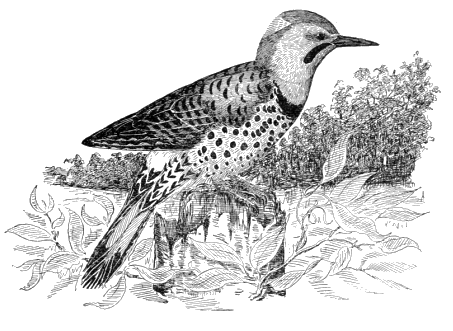
AT THE GARDEN PARTY.
The morning dew was not off from the lilacs and
the sweet calamus in the garden when the birds began
to come to the party.
They came in pairs, and in groups, and in whole
families. They were turning their heads this way and
that, whispering and chatting and showing off their
new spring suits, and looking shyly at the different
kinds of food, like people at a picnic.
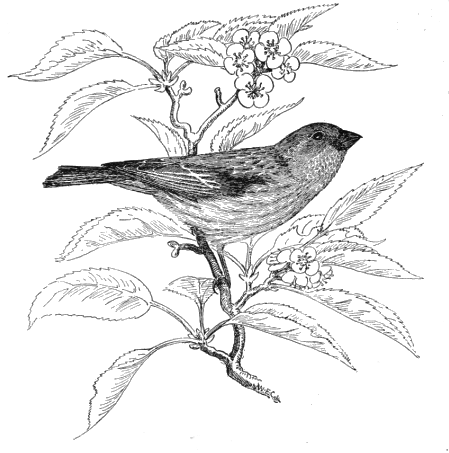
"Good morning," said old Mrs. Goldfinch to Mrs.
Hummer. "I see you have a son almost as large as
yourself. I do not understand how that can be so early
in the season."
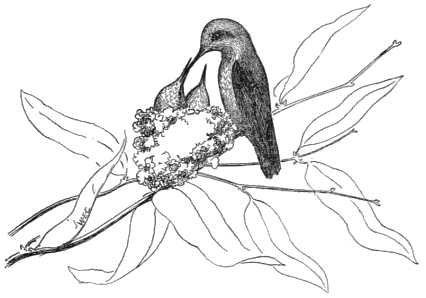
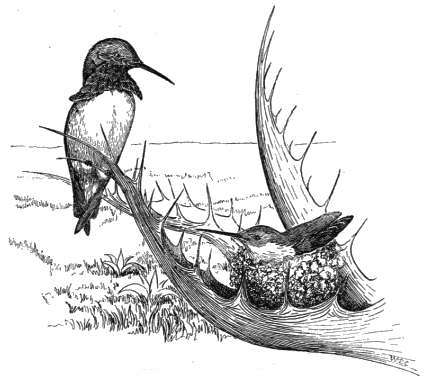
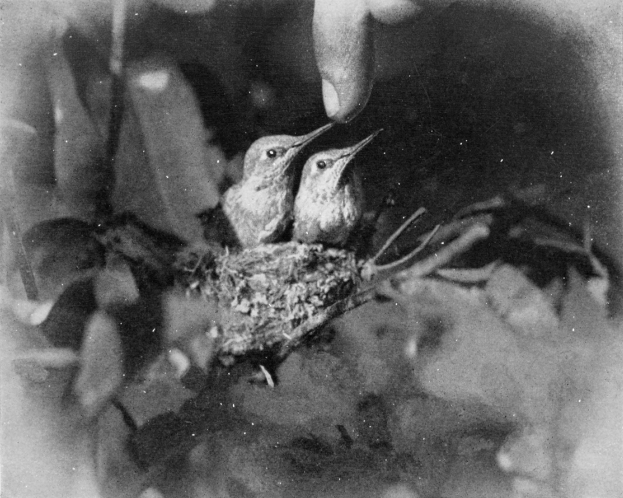
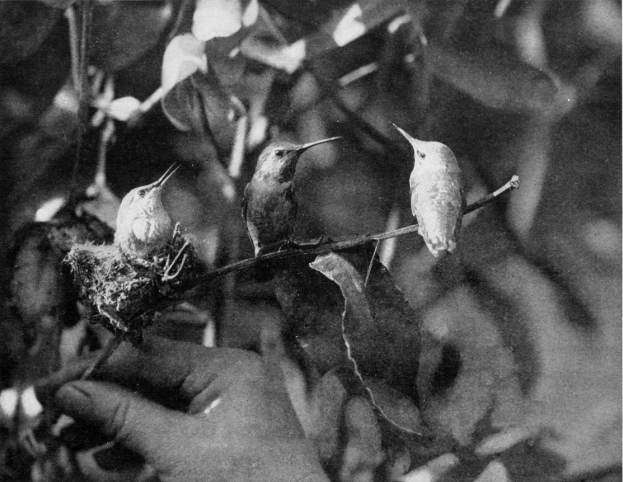
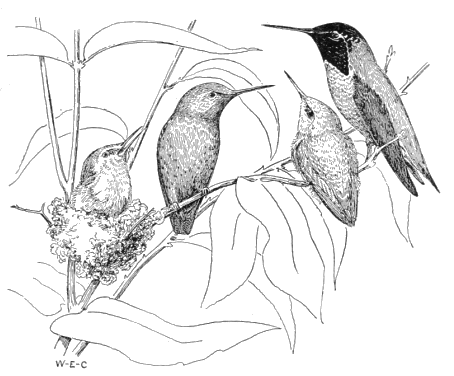
"Oh, I am very proud of my son," remarked Mrs.
Hummer. "I have a daughter almost as large as my
son. They are both very much like their father. I
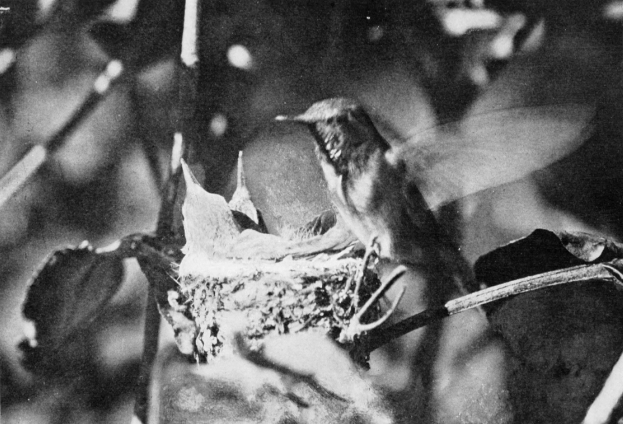
had good luck in raising them. It stormed once right
into the nest, when they were very small and weak,
but I kept mending the cradle as well as I could with
thread which I bought of Mrs. Spider. I brought both
of my children to the party with me."
"Oh, I never take my children to a party," said Mrs.
Goldfinch. "I leave them with their nurse."
Mrs. Goldfinch said this with a haughty air, which
quite amused Mrs. Hummer. She knew very well that
Mrs. Goldfinch kept no nurse, but took care of her
children herself night and day. "Very likely the cats
will get them to-day," Mrs. Hummer was thinking.
"Good morning," said Mrs. Warbler to Mrs. Cliff
Swallow. "I did not know you had returned. Have
you come to stay with us now?"
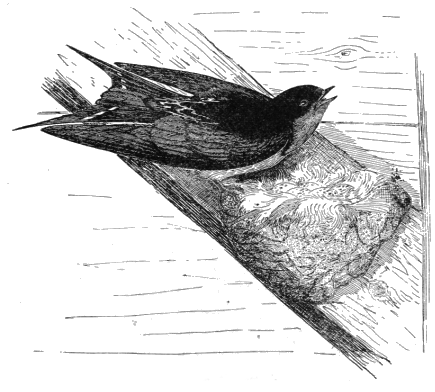
"Oh, yes; I have come to stay," answered Mrs. Cliff
Swallow. "We have taken rooms under the barn
eaves. We are just making a cradle for the young
ones we hope to have by and by. We have had a
hard time to get all the mud we wanted, and thought
we should be obliged to give up nest-making for this
year. There was a nice puddle in the road where we
were at work; you know we like road mud best, because
it is so fine and sticky. When school let out, the small
boys threw stones at us, hoping to hit some of us, I suppose,
and so we had to go down to the river to get our
mud, and that wasn't half so good as the road mud."
"That is too bad," said Mrs. Warbler.
Mrs. Cliff Swallow went on to say, "We have just
heard such a slander about our family. Mrs. Owl told
us. She overheard it outside of a window in the evening.
Somebody has started the story that we swallows
have fleas and other vermin in our nests, and on
that account we ought not to be allowed to build around
houses and barns. It is a dreadful story, and so false.
I wonder how it started. I felt almost too ashamed to
come to the party."
"Too bad; too bad," said Mrs. Warbler again. "I
would not pay any attention to it. Folks will say
unkind things about us all, if they happen to find just
one of us in mischief. Of course all birds do have a
few little mites or fleas in their houses, and they can't
help that, any more than those great human people can
help having house-flies and mosquitoes about them
where they live.
"Now some folks think I pick holes in the window
screens, just because I love to run over them, up and
down and all around, after the flies. To be sure, I do
stick my toes through the meshes to hold myself on,
but what of that? I love to peep through the window
at people eating breakfast in the morning when the
flies are stiff with cold on the outside. I can catch my
game easily then."
Just then the new birds came along, and all the rest
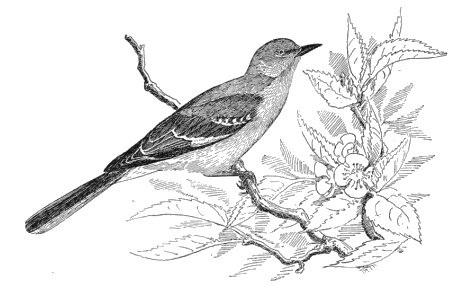
stood in a row to be introduced by Mrs. Mocker.
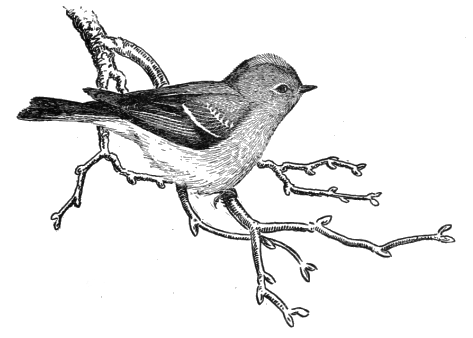
"Mr. and Mrs. Bush-tit," she said, "let me present
you to all of your neighbors."
The strangers shook hands all around, and then the
birds fell to asking Mr. and Mrs. Bush-tit questions
in true Yankee style.
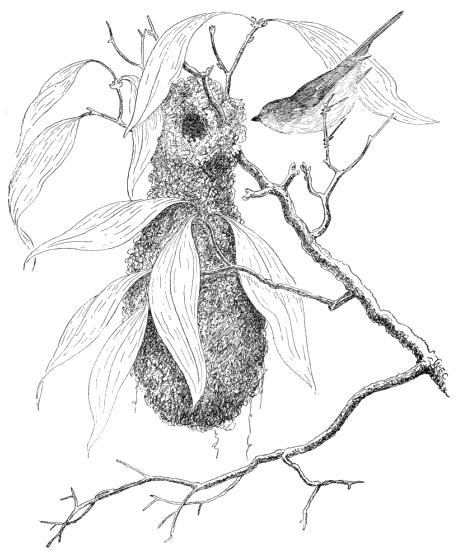
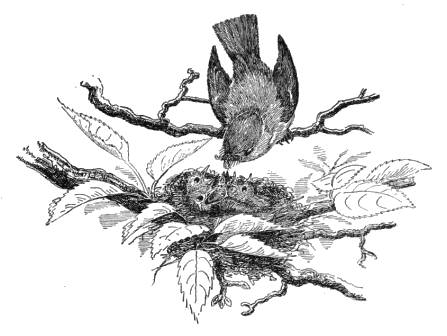
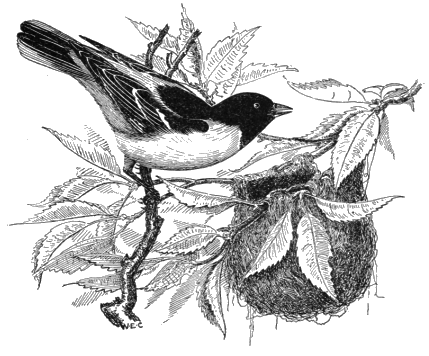
California Bush-tit and Nest.
"Yes," they answered, "we are going to stay all this
season. We are making a cradle in the eucalyptus
house, which we have rented."
"Oh, I saw your cradle," said Mrs. Towhee; "it is
such a queer one. It looks just like a bag with a little
round hole in one side no bigger than a good-sized
blackberry. What makes you build such a queer cradle
as that?"
"That is the kind of a cradle all our family make.
The little ones have to stay in until we boost them out,
or until they are strong enough to climb out. It is
very safe and warm. It is strong, too. We would
not think of making such a cradle as you do, Mrs.
Towhee. We felt very sorry one day when we found
one of your babies dead on the ground, where it had
fallen out of the nest when it was too weak to fly."
"Well, we are glad to see you, anyway," said Mrs.
Towhee, wiping the tears out of her eyes. "Now make
yourselves at home, and let your little Tits come over
and play with our little Towhees."
Mr. and Mrs. Bush-tit bowed politely, and then
along came Mr. Bluebird. "Why, how do you do?"
he said. "What brought you here? I thought you
lived up in the mountain with the other Bush-tits."
"What brought you here?" they answered, laughing
in the sweetest way. And then they agreed that our
yard is a very nice place, and they thought they would
"bring their friends" often and picnic.
"We never have rented a house in this street," said
Mr. Bluebird, "but we may do so some day. Do you
think it would be safe to try to raise a family so near
those great people?"
"We think so," said Mrs. Bush-tit, "but you ought
to see them stand and stare at us. A big, kind-faced
boy comes every day and writes in a note-book, looking
straight into our house. Once he climbed up on a
ladder and examined it. We were very much afraid,
but he did us no harm. His eye was so blue and clear
we could see ourselves in it. It looked just as if he
couldn't hurt a bird.
"Then one day a lady came with the boy, and they
both watched us and tried to make pictures of us, but
we wouldn't keep still long enough. The lady is that
boy's mother, and we heard her say, 'We'll tame these
bush-tits some day, Jo, just as we did the humming-birds,
and then we will write all about them for
children to read.'"
Then Mr. Bluebird said, "Isn't it strange what queer
things people do write about us? Sometimes they are
right, and sometimes they are wrong. I wish some
bird author would write a book about men and women
and their queer ways. Wouldn't it be interesting?"
Then Madam Bush-tit laughed a merry little giggle
that made Mr. Mocker look up in surprise, and he ran
it over in an undertone before he should forget it.
Just then a yellow-breasted meadow lark carolled
his sweet ditty on the tip-top of a pine tree. All the
birds flew to welcome him to the garden party, coaxing
him to stay and offering him lemonade from the cup of
an orange blossom. They all loved Mr. Meadow Lark.
"No, thank you," he said; "I must be off. I love
the fields better than the door-yards, and the violets
and the cream-cups look out for my drink. I just came
a minute to say good morning."
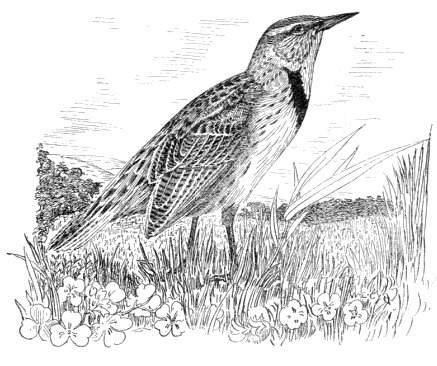
Meadow Lark.
A whole flock of wax-wings took possession of a
pepper tree and began to throw the seeds down on the
heads of the birds beneath. "Oh, excuse us," they
said, "we are tourists, and this yard looked so inviting
we stopped for a few moments. How much do you ask
a dozen for these pepper berries? We do not have any
in our country. They are good eating, we find, when
one has learned how to manage them. You ought not
to charge us a great price, for they are almost all seed.
How much do you ask?"
All the birds laughed, and then Mr. Mocker imitated
the wax-wings, calling out in a saucy tone, "How
much do you ask? How much do you ask?" The
wax-wings were offended and flew away, the bit of red
wax on the tip of their wing feathers showing very
plainly in the sunshine.
"As if we ever charge anybody anything for what
they eat," said Mr. Warbler. "I'm hungry myself."
Then Mrs. Towhee, who had really gotten up the
garden party, called them to dinner.
All the birds helped themselves. The hummers
dipped away down into the honey-pot of a morning-glory,
and the towhees and mockers ate worms and
crickets in the damp grass; the warblers snatched gnats
on the wing, and the bush-tits ran up and down on the
tree boughs, in search of bugs so small nobody else
could see them. Each bird took the sort of food it
liked best, drinking at the hydrant and breaking the
bottles of the raspberry vines.
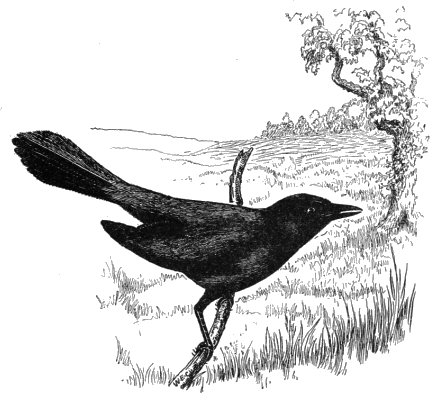
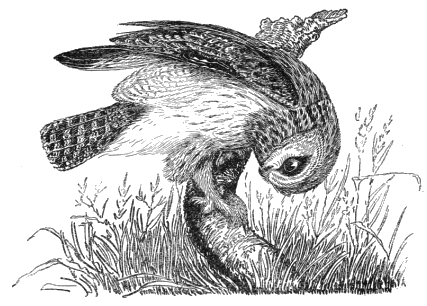
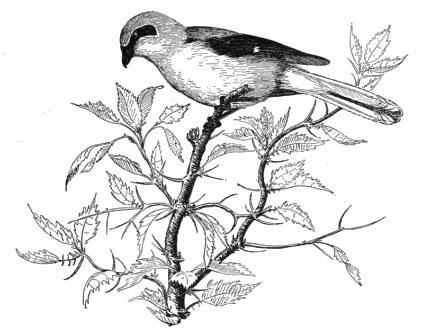
Suddenly along came Mr. Butcher-bird. "Go away,
go away," all the birds cried. "Nobody invited you
to our garden party."
"But I am here," said Mr. Butcher, in an impudent
manner. "I should like to have a taste of that fat
young hummer."
Mrs. Hummer screamed, and down swooped the
butcher. Everybody thought he was going to make a
meal of the baby, when he surprised them by grabbing
up a great Jerusalem cricket and darting off with it.
Mr. Butcher-bird thought it was a good joke, and he
laughed loudly from the peach tree. But the birds
were so scared that they all flew away, and so the
garden party broke up.

CHAPTER XXVI.
OUR BIRD HOSPITAL.
Cities have their hospitals for the sick and wounded.
When an accident happens to a person in the street, or
a man falls from a building, or is burned, or is hurt in
any way, he is taken to the hospital, where the surgeon
does what he can for him. Sometimes his life is saved
by the surgeon's care and the kindness of trained
nurses.
If a stranger in any city is taken sick, and has no
friends to care for him, he is carried to the hospital,
where he is nursed back to strength. If he has no
money, he is quite welcome to all this.
A long while ago, when we first began to be interested
in birds and to think of them as "people," like
ourselves, we found it necessary to have a bird hospital.
Our native birds seldom meet with accidents unless
they are killed outright; but the tourist birds are often
found injured in some mysterious way, so that they
cannot fly. We feel sorry for these strangers so far
from home, and so we pick them up and carry them to
our hospital.
We have several empty cages about, one being the big
cage which used to be "Robby's" house. When Robin
died, we thought it was a pity to give his cage away
or to have it doing no good to anybody.
So we called it our hospital. This hospital is "In
memory of Robin," as hospitals are sometimes built in
"memory" of great men, or with money which rich
men have left for that purpose.
We do not remember how many birds have been
taken to our hospital, but there have been a great
many. We use the "smaller wards"—the little
cages, you know—for little solitary birds.
The last patients which we had in the large hospital
were two wax-wings which we found maimed in some
way so that they could not fly. They could get along
pretty well low on the ground, but we were afraid the
cats would steal them, and so our hospital nurse took
charge of them.
At first they were very wild and would scream when
we touched them. But they tamed readily, and in a
day or two would sit on our fingers and eat from our
hands. We knew they were berry and insect eaters;
but, as it was winter, and the insects scarce, we could
think of nothing they would like but the pepper berries.
They lived on these for a few days, but evidently
wanted other food.
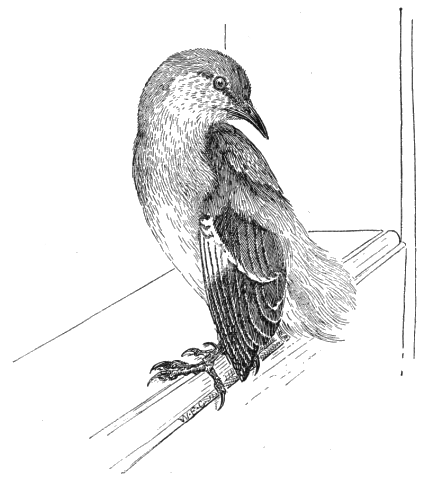
We tried angle-worms, but these did not suit. One
morning at breakfast little Sister, the hospital nurse,
was holding one of the wax-wings on her finger, when
it began to snatch at the bread crumbs. It was as if
the little bird had been used to home-made bread all
its life.
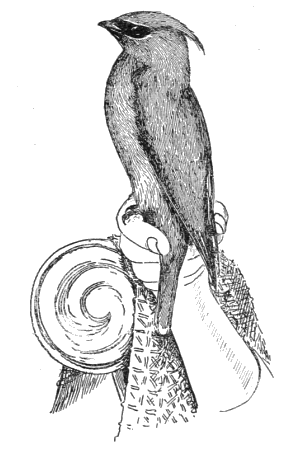
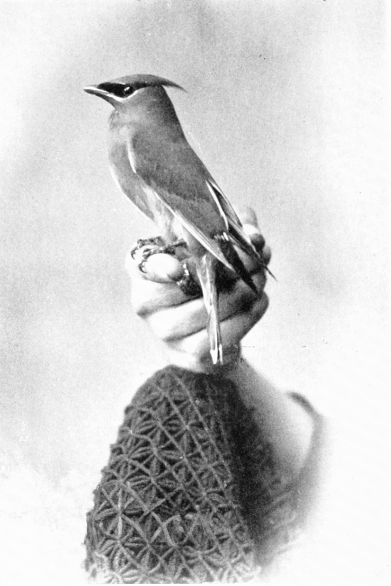
Wax-Wing.
We kept these two beautiful patients in our hospital
until they were quite strong, and just before the last
of the tourists went away they joined their friends and
flew off as if nothing had happened. We thought we
saw them in the trees once again, but were not certain,
all wax-wings look so very much alike.
At first, when we let them out of the cage, they
would run back and go in at the open door; but soon
they heard their mates calling and joined them. We
had their photographs taken just before they went
away, as people have the pictures of their friends to
"remember them by."
The birds who are at liberty are very attentive to
the birds in the hospitals, and hop close to them, as if
they were inquiring all about their troubles.
Besides these sick birds in the hospital, we have the
"out patients," young birds which we feed and look
after when they happen to fall out of the nests. They
cry all about at nesting time, so that it is as much as
one person can do to keep the cats away and see that
nothing happens to them.
Boys in our neighborhood know how we love the
birds, and often bring them to us if they are hurt, so
that they may have the benefit of our hospital. This
is better than to leave them where they happen to fall,
for the cats and dogs to worry. There are many ways
in which we can show our affection for these little
people.
CHAPTER XXVII.
A SPLENDID COLLECTION.
We could never finish a book if we told all there is
to know about birds. So we shall have to close our
story about these people, hoping that children who read
it will love the birds better than they ever did before.
The birds will stay with you wherever you live, even
if it is on a lonely island or a western prairie. There
will be garden parties, and morning concerts, and evening
serenades, and visiting birds will drop into your
yards and stop awhile. Birds are just like other
people; they like to take a meal with a neighbor now
and then. It makes good feeling on both sides.
Any one can have a fine collection of beautiful birds
without going to the museums. Not dead, stuffed,
songless creatures, who cannot say "Thank you" for a
crumb, or warble you a melody in return for a home in
your yard. You can have this splendid collection flying
from tree to tree, and making cradles among the
flowers, and giving a garden party every day in the
year, even though the snow lies on the ground.
There are wise people who study birds all their lives,
never killing the little things to put away in a drawer
with camphor balls. Such people come to love the
birds very much, and to know their sweet, wise doings
in a way that a person with a gun can never know
them. Sick people can sit in the sunshine or in the
shade and study the birds, and grow stronger as well
as wiser.
There are some strange collections of birds to be
found in milliners' shops. The milliners are not to
blame for these, for if good and kind people did not
want any out of their collection, they would not keep
so many.
Sometime on your way home from school, if your
mother is not wanting to see you early, look in at these
show windows and see the collections we are speaking
of. These birds are sold to foolish women and girls,
and worn to church and everywhere else on hats and
bonnets.
See how distressed the poor dead creatures seem to
be,—how they are twisted all out of shape. They are
made to squat or perch in positions that make them
look as if they were in agony. Not one of them all
has a natural, happy look, because the people who put
them up to sell have never loved the birds nor studied
their ways. All they care about is the money they can
get for them.
You will notice that some of the birds in ladies' bonnets
have been cut in two. Sometimes just the head
and wings are to be seen. If these ladies stopped to
see what they were doing, and to think of how ridiculous
they look, they would never wear these ornaments,
just like savages.
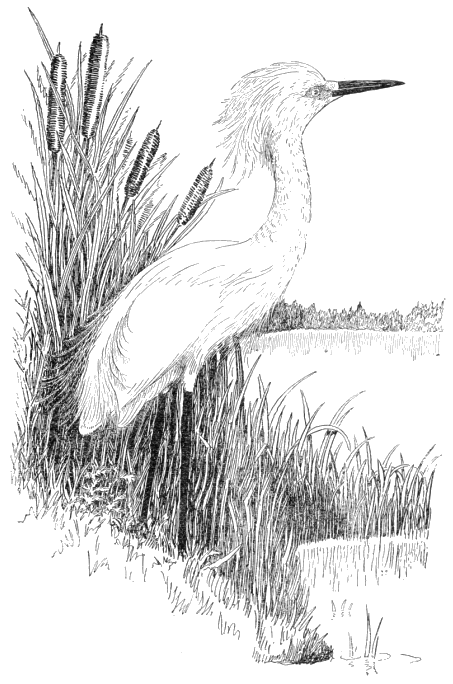
Snowy Heron.
Many of the birds that are very rare and beautiful
have been nearly or quite all killed for this fashion.
Some of the most delicate plumes you see have been
taken from the egret, or white heron, at nesting time.
The mothers are shot or stoned to death very easily,
because they will not leave their young. It is said
that many are left wounded and yet alive after the
plumes have been stripped off. There is no one to
care for the young which are left in their nests, and
so they die of cold and hunger. All this suffering
is just to satisfy the cruel pride of women and girls
who must wear birds in their bonnets.
If boys would resolve never to kill a bird, even
though they could get money by doing it; and if girls
would resolve never to wear a bird or a bird's wing on
their hats, our country would be more beautiful with
song and color than it has ever been.
We sat in church the other day, and in front of us
was a lady with nine bird's wings on her bonnet. She
was a tender-hearted lady, and probably would not hurt
a fly herself. Yet her pride had really caused the death
and suffering of five birds, and possibly of fifteen or
twenty birdlings. She did not stop to think. Will
you, kind reader, stop to think?
READING.
Badlam's Suggestive Lessons in Language and Reading. A manual for primary
teachers. Plain and practical; being a transcript of work actually done in the
school-room. $1.50.
Badlam's Stepping-Stones to Reading.—A Primer. Supplements the 283-page
book above. Boards. 30 cts.
Badlam's First Reader. New and valuable word-building exercises, designed to follow
the above. Boards. 35 cts.
Bass's Nature Stories for Young Readers: Plant Life. Intended to supplement
the first and second reading-books. Boards. 30 cts.
Bass's Nature Stories for Young Readers: Animal Life. Gives lessons on
animals and their habits. To follow second reader. Boards. 40 cts.
Firth's Stories of Old Greece. Contains 17 Greek myths adapted for reading in
intermediate grades. Illustrated. Boards. 35 cts.
Fuller's Illustrated Primer. Presents the word-method in a very attractive form to
the youngest readers. Boards. 30 cts.
Hall's How to Teach Reading. Treats the important question: what children should
and should not read. Paper, 25 cts.
Miller's My Saturday Bird Class. Designed for use as a supplementary reader in
lower grades or as a text-book of elementary ornithology. Boards. 30 cts.
Norton's Heart of Oak Books. This series is of material from the standard imaginative
literature of the English language. It draws freely upon the treasury of favorite
stories, poems, and songs with which every child should become familiar, and which
have done most to stimulate the fancy and direct the sentiment of the best men and
women of the English-speaking race. Book I, 100 pages, 25 cts.; Book II, 142 pages,
35 cts.; Book III, 265 pages, 45 cts.; Book IV, 303 pages, 55 cts.; Book V, 359 pages,
65 cts.; Book VI, 367 pages, 75 cts.
Penniman's School Poetry Book. Gives 73 of the best short poems in the English
language. Boards. 35 cts.
Smith's Reading and Speaking. Familiar Talks to those who would speak well in
public, so cts.
Spear's Leaves and Flowers. Designed for supplementary reading in lower grades
or as a text-book of elementary botany. Boards. 30015.
Ventura's Mantegazza's Testa. A book to help boys toward a complete self-development.
$1.00.
Wright's Nature Reader, No. I. Describes crabs, wasps, spiders, bees, and some
univalve mollusks. Boards. 30 cts.
Wright's Nature Reader, No. II. Describes ants, flies, earth-worms, beetles, barnacles
and star-fish. Boards. 40 cts.
Wright's Nature Reader, No. III. Has lessons in plant-life, grasshoppers, butter
flies, and birds. Boards. 60 cts.
Wright's Nature Reader, No. IV. Has lessons in geology, astronomy, world-life,
etc. Boards. 70 cts.
For advanced supplementary reading see our list of books in English Literature.
D. C. HEATH & CO., PUBLISHERS,
BOSTON. NEW YORK. CHICAGO.
Number.
Atwood's Complete Graded Arithmetic. Present a carefully graded course in
arithmetic, to begin with the fourth year and continue through the eighth year. Part I.
200 pages. Cloth. 40 cts. Part II. 382 pages. Half leather. 75 cts.
Walsh's Mathematics for Common Schools. Special features of this work are
its division into half-yearly chapters instead of the arrangement by topics; the omission,
as far as possible, of rules and definitions; the great number and variety of the problems:
the use of the equation in solution of arithmetical problems; and the introduction of the
elements of algebra and geometry. Three Book Series—Elementary, 218 pages.
35 cts. Intermediate, 252 pages. 40 cts. Higher, 387 pages. Half leather. 75 cts.
Two Book Series—Primary, 198 pages, 35 cts. Grammar School, 433 pages. Half
leather. 75 cts.
Sutton and Kimbrough's Pupils' Series of Arithmetics.
Primary Book. Embraces the four fundamental operations in all their simple relations.
80 pages. Cloth. 25 cts.
Intermediate Book. Embraces practical work through percentage and simple interest.
145 pages. Cloth. 30 cts.
Lower Book. Primary and Intermediate Books bound together. Cloth. 45 cts.
Higher Book. A compact volume for efficient work which makes clear all necessary
theory. 275 pages. Half leather. 75 cts.
Safford's Mathematical Teaching. Presents the best methods of teaching, from
primary arithmetic to the calculus. Paper. 25 cts.
Badlam's Aids to Number. For Teachers. First Series. Consists of 25 cards for
sight-work with objects from one to ten. 40 cts.
Badlam's Aids to Number. For Pupils. First Series. Supplements the above
with material for slate work. Leatherette. 30 cts.
Badlam's Aids to Number. For Teachers. Second Series. Teachers' sight-work
with objects above ten. 40 cts.
Badlam's Aids to Number. For Pupils. Second Series. Supplements above with
material for slate work from 10 to 20. Leatherette. 30 cts.
Badlam's Number Chart. 11 × 14 inches. Designed to aid in teaching the four
fundamental rules in lowest primary grades. 5 cts. each; per hundred $4.00.
Sloane's Practical Lessons in Fractions. For elementary grades. Boards
30 cts. Set of six fraction cards for children to cut. 12 cts.
White's Two Years with Numbers. Number Lessons for second and third year
pupils. 40 cts.
White's Junior Arithmetic. For fourth and fifth year pupils. Cloth. 50 cts.
White's Senior Arithmetic. In press.
For advanced work see our list of books in Mathematics.
D. C. HEATH & CO., PUBLISHERS,
BOSTON. NEW YORK. CHICAGO.
ENGLISH LANGUAGE.
Hyde's Lessons in English, Book I. For the lower grades. Contains exercises
for reproduction, picture lessons, letter writing, uses of parts of speech, etc. 40 cts.
Hyde's Lessons in English, Book II. For Grammar schools. Has enough technical
grammar for correct use of language. Co cts.
Hyde's Lessons in English, Book II with Supplement. Has, in addition
to the above, 118 pages of technical grammar. 70 cts.
Supplement bound alone, 35 cts.
Hyde's Practical English Grammar. For advanced classes in grammar schools
and for high schools. 60 cts.
Hyde's Lessons in English, Book II with Practical Grammar. The
Practical Grammar and Book II bound together. 80 cts.
Hyde's Derivation of Words. 15 cts.
Penniman's Common Words Difficult to Spell. Graded lists of common words
often misspelled. Boards. 25 cts.
Penniman's Prose Dictation Exercises. Short extracts from the best authors.
Boards. 30 cts.
Spalding's Problem of Elementary Composition. Suggestions for its solution.
Cloth. 45 cts.
Mathews's Outline of English Grammar, with Selections for Practice.
The application of principles is made through composition of original sentences. 80 cts.
Buckbee's Primary Word Book. Embraces thorough drills in articulation and in
the primary difficulties of spelling and sound. 30 cts.
Sever's Progressive Speller. For use in advanced primary, intermediate, and grammar
grades. Gives spelling, pronunciation, definition, and use of words. 30 cts.
Badlam's Suggestive Lessons in Language. Being Part I and Appendix of
Suggestive Lessons in Language and Reading. 50 cts.
Smith's Studies in Nature, and Language Lessons. A combination of object
lessons with language work. 50 cts. Part I bound separately, 25 cts.
Meiklejohn's English Language. Treats salient features with a master's skill and
with the utmost clearness and simplicity. $1.30.
Meiklejohn's English Grammar. Also composition, versification, paraphrasing, etc
For high schools and colleges, go cts.
Meiklejohn's History of the English Language. 78 pages. Part III of English
Language above, 35 cts.
Williams's Composition and Rhetoric by Practice. For high school and college.
Combines the smallest amount of theory with an abundance of practice. Revised
edition. $1.00.
Strang's Exercises in English. Examples in Syntax, Accidence, and Style for
criticism and correction. 50 cts.
Huffcutt's English in the Preparatory School. Presents advanced methods
of teaching English grammar and composition in the secondary schools. 25 cts.
Woodward's Study of English. From primary school to college. 25 cts.
Genung's Study of Rhetoric. Shows the most practical discipline. 25 cts.
See also our list of books for the study of English Literature.
D. C. HEATH & CO., PUBLISHERS,
BOSTON. NEW YORK. CHICAGO.
Transcriber's Note
Text was relocated to prevent illustrations from splitting paragraphs. Minor
typos were corrected. The final footnote on Page 144 was missing and the
anchor was deleted. Several cases of a possible "æ" ligature were printed as
individual characters and were left that way.