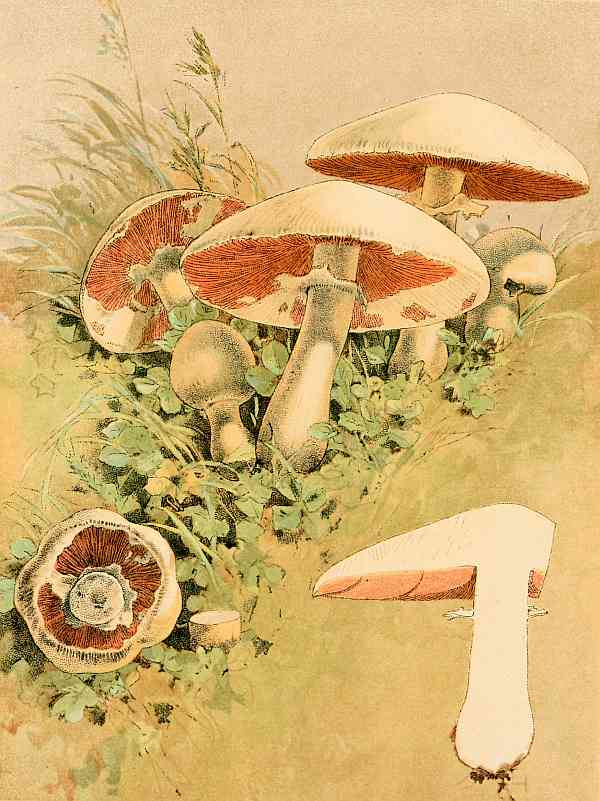
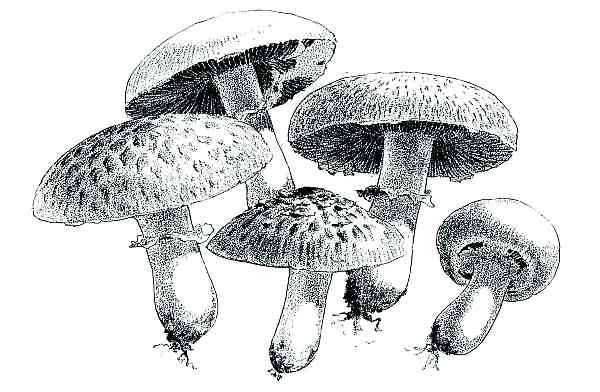
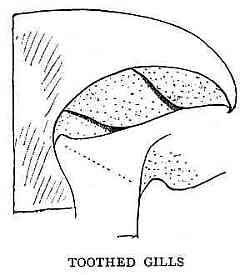
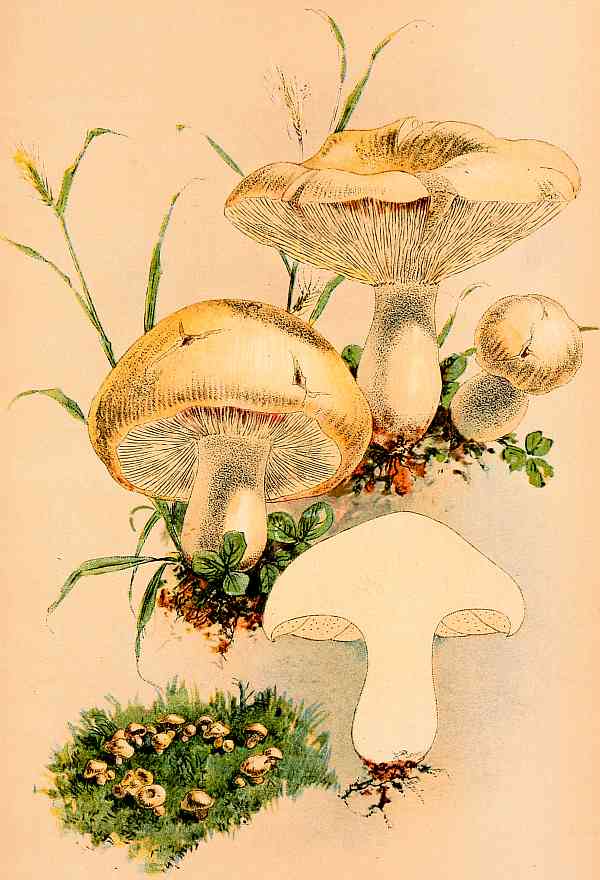
Our Edible Toadstools and Mushrooms and How to Distinguish Them
Whole book · 11 sections
Our Edible Toadstools and Mushrooms and How to Distinguish Them
The Deadly "Amanita".
A Selection of Thirty Native Food Varieties
Easily Recognisable by their Marked Individualities,
with Simple Rules for the
Identification of Poisonous Species
By W. HAMILTON GIBSON
WITH THIRTY COLORED PLATES
AND FIFTY-SEVEN OTHER ILLUSTRATIONS BY THE AUTHOR
NEW YORK
HARPER & BROTHERS PUBLISHERS
1895
THE WORKS OF W. HAMILTON GIBSON.
ILLUSTRATED BY THE AUTHOR.
SHARP EYES. A Rambler's Calendar among Birds, Insects, and Flowers. 8vo, $5.00. HIGHWAYS AND BYWAYS; or, Saunterings in New England. 4to, $7.50. STROLLS BY STARLIGHT AND SUNSHINE. Royal 8vo, $3.50. HAPPY HUNTING-GROUNDS. A Tribute to the Woods and Fields. 4to, $7.50. PASTORAL DAYS; or, Memories of a New England Year. 4to, $7.50. CAMP LIFE IN THE WOODS, and the Tricks of Trapping and Trap-making. 16mo, $1.00.
Published by HARPER & BROTHERS, New York.
Copyright, 1895, by Harper & Brothers.
All rights reserved.
"For those who do hunger after the earthlie
excrescences called mushrooms."—Gerarde.
"Whole hundred-weights of rich, wholesome diet rotting
under the trees; woods teeming with food and not one hand to gather it; and
this, perhaps, in the midst of poverty and all manner of privations
and public prayers against imminent famine."
C. D. Badham
Introduction — POPULAR TESTS REFUTED — "A POISONOUS MUSHROOM" — RULES FOR THE VENTURESOME — MUSHROOM POISONING
A prominent botanical authority connected with one of
our universities, upon learning of my intention of perpetrating a
popular work on our edible mushrooms and toadstools, was inclined
to take issue with me on the wisdom of such
publication, giving as his reasons that, owing
to the extreme difficulty of imparting exact
scientific knowledge to the "general reader," such a
work, in its presumably imperfect interpretation by
the very individuals it is intended to benefit, would
only result, in many instances, in supplanting the
popular wholesome distrust of all mushrooms with
a rash over-confidence which would tend to increase
the labors of the family physician and the coroner.
And, to a certain extent, in its appreciation of the
difficulty of imparting exact science to the lay mind,
his criticism was entirely reasonable, and would certainly
apply to any treatise on edible mushrooms for
popular circulation which contemplated a too extensive
field, involving subtle botanical analysis
and nice differentiation between species.
Identification of fatal species
But when we realize the fact—now generally
conceded—that most of the fatalities consequent upon
mushroom-eating are directly traceable
to one particular tempting group
of fungi, and that this group is moreover
so distinctly marked that a tyro
could learn to distinguish it, might not such a
popular work, in its emphasis by careful portraiture and
pictorial analysis of this deadly genus—placarding
it so clearly and unmistakably as to make it readily
recognizable—might not such a work, to that extent
at least, accomplish a public service?
Conservative mycology
Moreover, even the most conservative
mycologist will certainly admit that out of the hundred
and fifty of our admittedly esculent species of
fungi there might be segregated a few
which bear such conspicuous characters
of outward form and other unique
individual features—such as color of spores, gills,
and tubes, taste, odor, surface character, color of
milky juice, etc.—as to render them easily recognizable
even by the "general reader."
It is in the positive, affirmative assumption
of these premises that the present work is prepared, comprising
as it does a selection of a score or more, as
it were, self-placarded esculent species of fungi, while
putting the reader safely on guard against the fatal
species and a few other more or less poisonous or
suspicious varieties which remote possibility might
confound with them.
Popular interest in mushrooms
Since the publication of a recent magazine article
on this topic, and which became the basis of the present
elaboration, I have been favored with a numerous
and almost continuous correspondence upon mushrooms,
including letters from every
State in the Union, to say nothing of
Canada and New Mexico, evincing the
wide-spread interest in the fungus
from the gustatory point of view. The cautious
tone of most of these letters, in the main from neophyte
mycologists, is gratifying in its demonstration
of the wisdom of my position in this volume, or, as
one of my correspondents puts it, "the frightening of
one to death at the outset while extending an invitation
to the feast." "Death was often a consequence
of toadstool eating," my friend continued, "but I
never before realized that it was a certain result with
any particular mushroom, and to the extent of this
information I am profoundly thankful."
Caution at the threshold
While, then, from the point of view of desired
popularity of my book, the grim greeting of a death's-head
upon the frontispiece might be considered
as something of a handicap, the
author confesses that this attitude is
the result of "malice prepense" and
deliberation, realizing that he is not offering to the
"lay public," for mere intellectual profit, this scientific
analysis of certain fungus species. Were this alone
the raison d'être or the logical outcome of the work—mere
identification of edible and poisonous species—the
grewsome symbol which is so conspicuous on
two of my pages might have been spared. But when
it is remembered that with the selected list of esculent
mushrooms herein offered is implied also an
invitation and a recommendation to the feast thereof,
with the author as the host—that the digestive functions
of his confiding friends or guests are to be
made the final arbiters of the correctness of his botanical
identification—the ban of bane may as well
be pronounced at the threshold. Let the too eager
epicurean be "scared to death at the outset," on the
general principle pro bono publico, and to the conciliation
of the author's conscience.
To correspondents
The oft-repeated queries of other correspondents
suggest the wisdom of a clearer definition of the
limitations of the present work. Several
individuals have written in surprise
of their discovery of a new toadstool
which I "did not include in my pictured
magazine list," with accompaniment of more or
less inadequate description and somewhat enigmatical
sketches, and desiring the name of the species and
judgment upon its esculent qualities. Such correspondence
is a pleasing tribute to an author, and is
herewith gratefully acknowledged as to the past and,
with some mental reservations, welcomed as to the
future. The number of these communications—occasionally
several in a day, and with consequent rapid
accumulation—renders it absolutely impossible for a
busy man to give them the prompt personal attention
which courtesy would dictate. My "mushroom"
pigeon-hole, therefore, is still plethoric with the unhonored
correspondence of many weeks; and inasmuch
as the continual accession more than balances
the number of my responses, a fulfilment of my obligations
in this direction seems hopeless in contemplation.
I would therefore beg the indulgence of
such of my friends as have awaited in vain for my
reply to their kind communications, even though the
future should bring no tidings from me. All of
these letters have been received, and are herewith
acknowledged: many of them, too, if I may be pardoned
what would seem to be a most ungracious
comment, for which the "dead-letter" office would
have been the more appropriate destination.
Consider the recipient
I refer to the correspondence "with
accompanying specimens," the letter occasionally enclosed
in the same box with the said specimens,
which, upon its arrival, arouses a protest
from the local postal authorities, and
calls for a liberal use of disinfectants—a
disreputable-looking parcel, which, indeed, would
appear more consistently referable to the health-board
than to the mycologist. So frequent did this
embarrassing episode become that it finally necessitated
the establishment of a morgue for the benefit
of my mushroom correspondents, or rather for their
"specimens," usually accompanied with the queries,
"What is the name of this mushroom? Is it edible?"
I have been obliged to write to several of my
friends that identification of the remains was impossible,
that the remnant was more interesting entomologically
than botanically, and begging that in the
future all such similar tokens shall be forwarded in
alcohol or packed in ice.
Rapid decay
"First impressions are lasting" and "a word to
the wise is sufficient." I would suggest that correspondents
hereafter consider the hazard of an introduction
under such questionable auspices. Most species
of mushrooms are extremely perishable, and
their "animal" character, chemically
considered, and their tendency to rapid
decomposition, render them unfit for
transportation for any distance, unless
hermetically sealed, or their decay otherwise anticipated.
In the possibility of a continuance of this
correspondence, consequent upon the publication of this
present book, the writer, in order to forefend a presumably
generous proportion of such correspondence,
would here emphasize the fact that he is by no
means the authority on mycology, or the science
of fungi, which the attitude of his inquiring friends
would imply. Indeed, his knowledge of species is
quite limited. An early fascination, it is true, was
humored with considerable zeal to the accumulation
of a portfolio of water-colors and other drawings of
various fungi—microscopic, curious, edible, and poisonous—and
this collection has been subsequently added to at
intervals during his regular professional work.
More than one of the originals of the
accompanying colored plates have been hidden in this portfolio
for over twenty years, and a larger number for ten
or fifteen years, awaiting the further accumulation of
that knowledge and experience, especially with reference
to the edibility of species, which should warrant
the utterance of the long-contemplated book.
Number of mushroom species
The reader will therefore kindly remember
that out of the approximate 1000 odd species of fungi
entitled by their dimensions to the dignity of "toadstools"
or "mushrooms"—after separating the 2000
moulds, mildews, rusts, smuts, blights,
yeasts, "mother," and other microscopic
species—and out of the 150 recommended
edible species, the present work
includes only about thirty. This selection has direct
reference to popular utility, only such species having
been included as offer some striking or other individual
peculiarity by which they may be simply identified,
even without so-called scientific knowledge.
The addition of color to the present list
enables its extension somewhat beyond the scope of a series
printed only in black and white, as in the distinction
of mere form alone an uncolored drawing of a certain
species might serve to the popular eye as a common
portrait of a number of allied species, possibly including
a poisonous variety.
Mycology and mycophagy
Need of a practical work
While the study of "fungi" has a host of
devotees, the mysteries which involve the origin of life in
this great order of the cryptogamia having
had fascinating attractions to microscopical
students and specialists, the
study of economic mycology has been almost
without a champion in the United States. Thus
we have many learned treatises on the nature, structure,
and habits of fungi—vegetative methods, chemical
constituents, specific characters, classification—learned
dissertations on the microscopical moulds,
mildews, rusts and smuts, blights and ferments, to
say nothing of the medico-scientific and awe-inspiring
potentialities of the sensational microbe, bacterium,
bacillus, etc., which are daily bringing humanity within
their spell and revolutionizing the science of medicine.
But among all the various mycological publications
we look in vain for the great desideratum of
the practical hand-book on the economic fungus—the
mushroom as food! The mycologist who has
been courageous enough to submit his chemical
analysis and his botanical knowledge of
fungi to the test of esculence in his own
being is a rara avis among them; indeed,
a well-known authority states that
"one may number on the fingers of his two hands
the entire list of mycophagists in the United States."
The absence of such works upon the mushroom and
"toadstool," greatly desired for reference at an early
period of my career, and little better supplied to-day,
led to a resolve of which this volume is but an imperfect fulfilment.
Limitations of this volume
The special character of my volume, then—the
collateral consideration of the fungus as food—will
be sufficient excuse for the omission of
a merely technical discourse upon the
structure, classification, and vegetation
of fungi as a class—a field so fully covered
by other authors more competent to discuss
these lines of special science, and to a selection of
whose works the reader is referred in the list herewith
appended, to a number of which I am indebted
for occasional quotations. A general idea of the
methods of dissemination and habitats of fungi will
be found in the final chapter on "spore-prints," while
under the discussion of the "Amanita," Agaricuscampestris, and the "Fairy Ring" the reader is referred
to a condensed account of the methods of vegetation
and growth of fungi sufficient for present
purposes. Other references of similar character will
be noted under "Fungi," in Index.
The pioneer American mycophagist
The most conspicuous disciple of mycophagy—almost
the pioneer, indeed, in America—was the late
Rev. M. A. Curtis, of North Carolina, whose name heads the bibliography on
page 325. For the benefit of those of my readers
who may wish to follow the subject further than my pages will lead them,
I append the list of edible species of fungi contained
in Curtis's Catalogue, each group alphabetically arranged,
the esculent qualities of many of which he
himself discovered and attested by personal experiment.
The favorite habitat of each fungus is also
given, and to avoid any possibility of confusion in
scientific nomenclature or synonymes, the authority
for the scientific name is also given in each instance:
LIST OF EDIBLE AMERICAN MUSHROOMS
FROM THE CATALOGUE OF DR. M. A. CURTIS
Agaricus albellus.
De Candolle.
Damp woods.
A. (amanita) Cæsarea.
Scopoli.
In oak forests.
A. (amanita) rubescens.
Persoon.
Damp woods.
A. (amanita) strobiliformis.
Vittadini.
Common in woods.
A. amygdalinus.
M. A. Curtis.
Rich grounds, woods, and lanes.
A. arvensis.
Schaeffer.
Fields and pastures.
A. bombicinus.
Schaeffer.
Earth and carious wood.
A. campestris.
Linnæus.
Fields and pastures.
A. castus.
M. A. Curtis.
Grassy old fields.
A. cespitosus.
M. A. Curtis.
Base of stumps.
A. columbella.
Fries.
Woods.
A. consociatus.
Pine woods.
A. cretaceus.
Fries.
Earth and wood.
A. esculentus.
Jacquin.
Dense woods.
A. excoriatus.
Fries.
Grassy lands.
A. frumentaceous.
Bulliard.
Pine woods.
A. giganteus.
Sowerby.
Borders of pine woods.
A. glandulosus.
Bulliard.
Dead trunks.
A. hypopithyus.
M. A. Curtis.
Pine logs.
A. mastoideus.
Fries.
Woods.
A. melleus.
Valmy.
About stumps and logs.
A. mutabilis.
Schaeffer.
Trunks.
A. nebularis.
Batsch.
Damp woods.
A. odorus.
Bulliard.
Woods.
A. ostreatus.
Jacquin.
Dead trunks.
A. personatus.
M. A. Curtis.
Near rotten logs.
A. pometi.
Fries.
Carious wood.
A. procerus.
Scopoli.
Woods and fields.
A. prunulus.
Scopoli.
Damp woods.
A. rachodes.
Vittadini.
Base of stumps and trees.
A. radicatus.
Bulliard.
Woods.
A. (russula).
Schaeffer.
Among leaves in woods.
A. salignus.
Persoon.
On trunks and stumps.
A. speciosus.
Fries.
Grassy land.
A. squamosus.
Muller.
Oak stumps.
A. sylvaticus.
Schaeffer.
Woods.
A. tessellatus.
Bulliard.
Pine trunks.
A. ulmarius.
Sowerby.
Dead trunks.
Boletus bovinus.
Linnæus.
Pine woods.
B. castaneus.
Bulliard.
Woods.
B. collinitus.
Fries.
Pine woods.
B. edulis.
Bulliard.
Woods.
B. elegans.
Fries.
Earth in woods.
B. flavidus.
Fries.
Damp woods.
B. granulatus.
Linnæus.
Woods and fields.
B. luteus.
Linnæus.
Pine woods.
B. scaber.
Bulliard.
Sandy woods.
B. subtomentosus.
Linnæus.
Earth in woods.
B. versipellis.
Fries.
Woods.
Bovista nigrescens.
Persoon.
Grassy fields.
B. plumbea.
Persoon.
Grassy fields.
Cantharellus cibarius.
Fries.
Woods.
Clavaria aurea.
Schaeffer.
Earth in woods.
C. botritis.
Persoon.
Earth in woods.
C. cristata.
Holmskiold.
Damp woods.
C. fastigiata.
Linnæus.
Grassy places.
C. flava.
Fries.
Earth in woods.
C. formosa.
Persoon.
Earth in woods.
Clavaria fuliginea.
Persoon.
Shady woods.
C. macropus.
Persoon.
Earth.
C. muscoides.
Linnæus.
Grassy places.
C. pyxidata.
Persoon.
Rotten woods.
C. rugosa.
Bulliard.
Damp woods.
C. subtilis.
Persoon.
Shaded banks.
C. tetragona.
Schwartz.
Damp woods.
Coprinus atramentarius.
Bulliard.
Manured ground.
C. comatus.
Fries.
In stable-yards.
Cortinarius castaneus.
Fries.
Earth in woods.
C. cinnamomeus.
Fries.
Earth and wood.
C. violaceus.
Fries.
Woods.
Fistulina hepatica.
Fries.
Base of trunks and stumps.
Helvella crispa.
Fries.
Pine in woods.
H. infula.
Schaeffer.
Earth and pine logs.
H. lacunosa.
Afzelius.
Near rotten logs.
H. sulcata.
Afzelius.
Shady woods.
Hydnum caput-medusæ.
Bulliard.
Trunks and logs.
H. coralloides.
Scopoli.
Side of trunks.
H. imbricatum.
Linnæus.
Earth in woods.
H. laevigatum.
Schwartz.
Pine woods.
H. repandum.
Linnæus.
Woods.
H. rufescens.
Schaeffer.
Woods.
H. subsquamosum.
Batsch.
Damp woods.
Hygrophorus eburneus.
Fries.
Woods.
H. pratensis.
Fries.
Hill-sides.
Lactarius augustissimus.
Lasch.
Thin woods.
L. deliciosus.
Fries.
Pine woods.
L. insulsus.
Fries.
Woods.
L. piperatus.
Fries.
Dry woods.
L. subdulcis.
Fries.
Damp grounds.
L. volemus.
Fries.
Woods.
Lycoperdon bovista.
Linnæus.
Grassy lands.
Pachyma cocos.
Fries.
Underground.
Paxillus involutus.
Fries.
Sandy woods.
Polyporus Berkeleii.
Fries.
Woods.
P. confluens.
Fries.
Pine woods.
P. cristatus.
Fries.
Pine woods.
P. frondorus.
Fries.
Earth and base of stumps.
P. giganteus.
Fries.
Base of stumps.
P. leucomelas.
Fries.
Woods.
P. ovinus.
Schaeffer.
Earth in woods.
P. poripes.
Fries.
Wooded ravines.
P. sulphureus.
Fries.
Trunks and logs.
Marasmius oreades.
Fries.
Hill-sides.
M. scorodoneus.
Fries.
Decaying vegetation.
Morchella Caroliniana.
Bosc.
Earth in woods.
M. esculenta.
Persoon.
Earth in woods.
Russula alutacea.
Fries.
Woods.
R. lepida.
Fries.
Pine woods.
R. virescens.
Fries.
Woods.
Sparassis crispa.
Fries.
Earth.
S. laminosa.
Fries.
Oak logs.
Tremella mesenterica.
Retz.
On bark.
In the contemplation of such a generous
natural larder as the above list implies, Dr. Badham's feeling
allusion to the "hundred-weights of wholesome diet
rotting under the trees," quoted in one of my earlier
illustrated pages, will be readily appreciated.
Restricted scope of this volume
In the purposely restricted scope of these
pages I have omitted a large majority of species in Dr.
Curtis's list, known to be equally esculent
with those which I have selected,
but whose popular differentiation
might involve too close discrimination
and possibly serious error; and while my list is
probably not as complete as it might be with perfect
safety, the number embraces species, nearly all
of them what may be called cosmopolitan types, to
be found more or less commonly throughout the
whole United States and generally identical with European
species. It will be observed that the list of
Dr. Curtis is headed by three members of Amanitæ.
The particular species cited are well known to be
esculent, but they are purposely omitted from my list,
which for considerations of safety absolutely excludes
the entire genus Amanita of the "poison-cup" which
is discussed at some length in the succeeding chapter.
For popular utility from the food standpoint my
selection presents, to all intents and purposes, a more
than sufficient list, the species being easily distinguished,
and, with proper consideration to their freshness,
entirely safe and of sufficient frequency in their
haunts to insure a continually available mushroom
harvest throughout the entire fungus season.
Fungus food always available
The knowledge of their identities once
acquired, it is perfectly reasonable to assert that in
average weather conditions the fungus-hunter
may confine himself to these varieties
and still be confronted with an embarrassment
of riches, availing himself of
three meals a day, with the mere trouble of a ramble
through the woods or pastures. Indeed, he may
restrict himself to six of these species—the green
Russula, Puff-ball, Pasture-mushroom, Campestris
(meadow-mushroom), Shaggy-mane, and Boletus edulis—and
yet become a veritable mycological gourmand
if he chooses, never at a loss for an appetizing
entrée at his table.
In the group of Russulæ and Boleti alone, more
than one conservative amateur of the writer's acquaintance
finds a sufficient supply to meet all dietary wants.
A neglected harvest
What a plenteous, spontaneous harvest
of delicious feasting annually goes begging in our
woods and fields!
The sentiment of Dr. Badham,
the eminent British authority on mushrooms,
years ago, in reference to the spontaneous
perennial harvest of wild edible fungi which abounded
in his country, going to waste by the ton, would
appear to be as true to-day for Britain as when he
uttered it, and applies with even greater force to the
similar, I may say identical, neglected tribute of Nature
in our own American woods and fields, where the
growth of fungi is especially rich.
Fungus epicures
The fungus-eaters of Britain, it is said,
are even to-day merely a conspicuous coterie, while in America
this particular sort of specialist is
more generally an isolated "crank" who
is compelled to "flock alone," contemplated
with a certain awe by his less
venturesome fellows, and otherwise variously considered,
either with envy of his experience and scientific
knowledge, or more probably as an irresponsible, who
continually tempts Providence in his foolhardy experiments
with poison.
Chemical constituents
But what a contrast do we find on the Continent
in the appreciation of the fungus as an article of diet!
In France, Germany, Russia, and Italy, for example,
where the woods are scoured for the perennial crop,
and where, through centuries of popular familiarity
and tradition, the knowledge of its economic value
has become the possession of the people, a most important
possession to the poor peasant who, perhaps
for weeks together, will taste no other
animal food. I say "animal food" advisedly;
for, gastronomically and chemically
considered, the flesh of the mushroom
has been proven to be almost identical with
meat, and possesses the same nourishing properties.
This animal affinity is further suggested in its physiological
life, the fungus reversing the order of all
other vegetation in imbibing oxygen and exhaling
carbonic acid, after the manner of animals. It is not
surprising, therefore, that the analogy should be still
further emphasized by the discrimination of the palate,
many kinds of fungi when cooked simulating the
taste and consistency of animal food almost to the
point of deception.
Popular distrust of fungi
But in America the fungus is under the ban,
its great majority of harmless or even wholesome edible
species having been brought into
popular disrepute through the contamination,
mostly, of a single small genus.
In the absence of special scientific
knowledge, or, from our present point of view, its
equivalent, popular familiarity, this general distrust
of the whole fungus tribe may be, however, considered
a beneficent prejudice. So deadly is the insidious,
mysterious foe that lurks among the friendly
species that it is well for humanity in general that
the entire list of fungi should share its odium, else
those "toadstool" fatalities, already alarmingly frequent,
might become a serious feature in our tables
of mortality.
Fungus food for all
But the prejudice is needlessly sweeping.
A little so-called knowledge of fungi has often proven to be
a "dangerous thing," it is true, but it
is quite possible for any one of ordinary
intelligence, rightly instructed, to master
the discrimination of at least a few
of the more common edible species, while being thoroughly
equipped against the dangers of deadly varieties,
whose identification is comparatively simple.
"Toadstool" and "mushroom"
It is idle to attempt an adjudication of
the vexed "toadstool" and "mushroom" question here. The
toad is plainly the only final, appealable
authority on this subject. It may be
questioned whether he is at pains to determine
the delectable or noisome qualities—from
the human standpoint—of a particular
fungus before deciding to settle his comfortable
proportions upon its summit—if, indeed, he even
so honors even the humblest of them.
The oft-repeated question, therefore, "Is this
fungus a toadstool or a mushroom?" may fittingly be met by
the counter query, "Is this rose a flower or a blossom?"
The so-called distinction is a purely arbitrary,
popular prejudice which differentiates the "toadstool" as
poisonous, the "mushroom" being considered harmless.
But even the rustic authorities are rather mixed
on the subject, as may be well illustrated by a recent
incident in my own experience.
Popular discrimination
Walking in the woods with a country friend
in quest of fungi, we were discussing this "toadstool"
topic when we came upon a cluster of
mushrooms at the base of a tree-trunk,
their broad, expanded caps apparently
upholstered in fawn-colored, undressed
kid, their under surfaces being stuffed
and tufted in pale greenish hue.
"What would you call those?" I inquired.
"Those are toadstools, unmistakably," he replied.
"Well, toadstools or not, you see there about
two pounds of delicious vegetable meat, for it is the common
species of edible boletus—Boletus edulis."
A few moments later we paused before a
beautiful specimen, lifting its parasol of pure white above
the black leaf mould.
"And what is this?" I inquired.
"I would certainly call that
a mushroom," was his instant reply.
This mushroom proved to be a fine, tempting specimen
of the Agaricus (amanita) vernus, the
deadliest of the mushrooms, and one of the most violent and
fatal of all known vegetable poisons, whose attractive
graces and insidious wiles are doubtless continually
responsible for those numerous fatalities usually dismissed
with the epitaph, "Died from eating toadstools
in mistake for mushrooms."
So much, therefore, for the popular distinction
which makes "toadstool" a synonyme for "poisonous," and
"mushroom" synonymous with "edible," and which often proves to
be the "little knowledge" which is very dangerous.
The rustic authorities on "mushrooms"
The too prevalent mortality traceable to
the mushroom is confined to two classes of unfortunates:
1. Those who have not learned that there is such a thing as a fatal mushroom;
2. The provincial authority who Can "tell a mushroom" by a number of
his so-called infallible "tests" or "proofs." There
is a large third class to whose conservative caution is to
be referred the prevalent arbitrary distinction between
"toadstool" and "mushroom," ardent disciples
of old Tertullian, who believed in regard to toadstools
that "For every different hue they display there is
a pain to correspond to it, and just so many modes
of death as there are distinct species," and whose
obstinate dogma, "There is only one mushroom, all
the rest are toadstools," has doubtless spared them
an occasional untimely grave, for few of this class,
from their very conservatism, ever fall victims to the "toadstool."
And what a self-complacent, patronizing,
solicitous character this rustic mushroom oracle is! Go where
you will in the rural districts and you are sure of
him, or perhaps her—usually a conspicuous figure
in the neighborhood, the village blacksmith, perhaps,
or the simpler "Old Aunt Huldy." Their father
and "granther" before them "knew how to tell a
mushroom," and this enviable knowledge has been
their particular inheritance.
How well we more special students of the
fungus know him! and how he wins our tender regard with
his keen solicitude for our well-being! We meet him
everywhere in our travels, and always with the same
old story! We emerge from the wood, perhaps, with
our basket brimful of our particular fungus tidbits,
topped off with specimens of red Russula and Boletus,
and chance to pass him on the road or in the
meadow. He scans the basket curiously as he passes
us. He has perhaps heard rumors afloat that "there's
a city chap in town who is tempting Providence with
his foolin' with tudstools;" and with genuine solicitude
and superior condescension and awe, all betrayed
in his countenance, he must needs pause in
his walk to relieve his mind in our behalf. I recall
one characteristic episode, of which the above is the prelude.
"Ye ain't a-goin' to eat them, air ye?"
he asks, anxiously, by way of introduction.
Rustic discrimination
"I am, most certainly," I respond; "that is,
if I can get my good farmer's wife to cook them without
coming them and inundating them in lemon-juice."
"Waal, then, I'll say good-bye to ye,"
he responds, with emphasis. "Why,
don't ye know them's tudstools, 'n' they'll kill ye as
sartin as pizen? I wonder they ain't fetched ye
afore this. You never larned tew tell mushrooms. My
father et 'em all his life, and so hev I, 'n' I know
'em. Come up into my garden yender 'n' I'll show
ye haow to tell the reel mushroom. There's a lot
of 'em thar in the hot-bed naow. Come along. I'll
give ye a mess on 'em if ye'll only throw them
pizen things away."
"And how do you know that those in your
garden are real mushrooms?" I inquire.
"Why, they ain't anything like them o' yourn.
They're pink and black underneath, and peel up from the edge."
"How many kinds of mushrooms are there, do you suppose?" I ask.
"They's only the one kind; all the others is
tudstools and pizen. It's easy to tell the reel mushroom.
Come up and I'll show ye. Don't eat them things, I
beg on ye! I vaow they'll kill ye!"
At this point he catches a glimpse of a
Shaggy-mane mushroom, which comes to light as I tenderly
fondle the specimens, and which is evidently recognized
as an acquaintance.
"What!" he exclaims, in pale alarm.
"Ye ain't goin' t' eat them too?"
"Oh yes I am, this very evening," I respond.
"I think I'll try them first."
A rustic authority
"Why, man, yure crazy! You don't know nothin'
about 'em. I'd as soon think o' eatin' pizen outright.
Them's what we call black-slime tudstools. They come up out o' manure.
I've seen my muck-heap in my barnyard covered with the nasty things time
'n' ag'in. They look nice 'n' white naow, but they
rot into the onsiteliest black mess ye ever see. I
know wut I'm sayin'. Ye can't tell me nothin' 'baout
them tudstools! They keep comin' up along my
barn-fence all thro' the fall—bushels of 'em."
"Well, my good friend, it's a great pity,
then, that you have not learned something about toadstools as
well as mushrooms, for you might have saved many
a butcher's bill, and may in the future if you will
only take my word that this much-abused specimen
is as truly a mushroom as your pink-gilled peeler,
and to my mind far more delicious."
"What! Do you mean to tell me thet
you have reely eaten 'em?"
"Yes, indeed; often. Why, just look at its
clean, shaggy cap, its creamy white or pink gills underneath;
take a sniff of its pleasant aroma; and here!
just taste a little piece—it's as sweet as a nut!" I
conclude, offering him the white morsel.
"Not much! I'll make my will first, thank'ee!
You let me see ye eat a mess of 'em, and if the coroner
don't get ye, p'r'aps I'll try on't."
"Toadstool" prejudice
Experiences similar to this one are frequent
in the career of every mycophagist, and serve to illustrate
the pity and solicitude which he awakens among his
fellow-mortals, as well as to emphasize
the prevalent superstitions regarding
the comparative virtues of the mushroom
and toadstool—a prejudice which,
by-the-way, in the absence of available popular literature
on the subject, and the actual dangers which encompass their
popular distinction, is a most beneficent public safeguard.
Popular tests and superstitions
The mushroom which "he can tell" is
generally the Agaricus campestris, or one of its
several varieties; and knowing this alone, and
tempted by no other, this sort of village
oracle escapes the fate which often awaits another class, who
are not thus conservative, and who extend their definition of
mushroom (a word supposed to be synonymous with
"edible"), and this mainly through the indorsement
of certain so-called infallible tests handed down to
them from their forefathers, and by which the esculent
varieties may be distinguished from the poisonous.
By these so-called "tests" or "proofs" the
identification of certain species is gradually acquired.
The rural fungus epicure now "knows them by
sight," or perhaps has received his information second-hand,
and makes his selection without hesitation,
with what success may be judged from the incident
in my own experience already noted—one which,
knowing as I did the frequency and confidence with
which my country friend sampled the fungi at his
table, filled me with consternation and anxiety for his future.
"How, then, shall we distinguish a mushroom from a toadstool?"
There is no way of distinguishing them, for they are the same.
"How, then, shall we know a poisonous toadstool
from a harmless one?" the reader hopelessly exclaims.
This discrimination is by no means as difficult
as is popularly supposed, but in the first place, the student
must entirely rid himself of all preconceived
notions and traditions, such as the following almost
world-wide "tests," many of which are easily demonstrated
to be worse than worthless, and have doubtless
frequently led to an untimely funeral. Some
of these are merely local, and in widely separated
districts are supplanted by others equally arbitrary
and absurd, while many of them are as old as history.
WORTHLESS TRADITIONAL TESTS FOR THE
DISCRIMINATION OF POISONOUS AND EDIBLE MUSHROOMS
FAVORABLE SIGNS
1. Pleasant taste and odor. 2. Peeling of the skin of the cap from rim to centre. 3. Pink gills, turning brown in older specimens. 4. The stem easily pulled out of the cap and inserted in it like
a parasol handle. 5. Solid stems. 6. Must be gathered in the morning. 7. "Any fungus having a pleasant taste and odor, being found
similarly agreeable after being plainly broiled without the least seasoning, is perfectly safe."
UNFAVORABLE SIGNS
8. Boiling with a "silver spoon," the staining of the
silver indicating danger. 9. Change of color in the fracture of the fresh mushroom. 10. Slimy or sticky on the top. 11. Having the stems at their sides. 12. Growing in clusters. 13. Found in dark, damp places. 14. Growing on wood, decayed logs, or stumps. 15. Growing on or near manure. 16. Having bright colors. 17. Containing milky juice. 18. Having the gill plates of even length. 19. Melting into black fluid. 20. Biting the tongue or having a bitter or nauseating taste. 21. Changing color by immersion in salt-water,
or upon being dusted with salt.
These present but a selection of the more prevalent
notions. Taken in toto, they would prove entirely
safe, as they would practically exclude every species
of mushroom or toadstool that grows. But as a rule
the village oracle bases his infallibility upon two or
three of the above "rules," and inasmuch as the entire
list absolutely omits the only one test by which
danger is to be avoided, it is a seven-days' wonder that
the grewsome toadstool epitaph is not more frequent.
Absolute worthlessness of above tests
I once knew an aged dame who was accepted as a
village oracle on this as well as other topics,
such as divining, palmistry, and fortune-telling,
and who ate and dispensed toadstools
on a few of the above rules.
Strange to say, she lived to a good old
age, and no increased mortality is credited to her
memory as a result of her generosity.
How are these popular notions sustained
by the facts? Let us analyze them seriatim and confront each
with its refutation, the better to show their entire untrustworthiness.
Worthless popular tests
Pleasant taste and odor (1) is a conspicuous
feature in the regular "mushroom" (Agaricus campestris),
and most other edible fungi, but as a
criterion for safety it is a mockery.
The deadly Agaricus amanita, already
mentioned, has an inviting odor and to
most people a pleasant taste when raw, and being
cooked and eaten gives no token of its fatal resources
until from six to twelve hours after, when its unfortunate
victim is past hope. (See p. 68.)
The ready peeling of the skin (2) is one
of the most widely prevalent proofs of probation, and is often
considered a sufficient test; yet the Amanita will be
found to peel with a degree of accommodation which
would thus at once settle its claims as a "mushroom."
Indeed, a large number of species, including several
poisonous kinds, will peel as perfectly as the Campestris.
The pink gills turning brown(3) is a marked
characteristic of the "mushroom" (A. campestris, Plate 5),
and, being a rare tint among the fungus tribe, is really
one of the most valuable of the tests, especially as it
is limited by rules affecting other pink-gilled species.
The stem being easily pulled out of the cap (4)
applies to several edible species, but equally to the poisonous.
The notion that edible mushrooms have solid
stems (5) would be a very unsafe talisman for us to take
to the woods in our search for fungus-food.
Many poisonous species are thus solid—the emetic Russula,
for example—while the alleged importance of the
morning specimens (6) is without the slightest foundation.
The passage quoted here (7), or a statement to
the same effect, was quite widely circulated in the newspapers
a dozen or more years ago, in an article which
bore all the indications of authoritative utterance,
the assumption being that the poisonous mushroom
would invariably give some forbidding token to the
senses by which it might be discriminated.
Woe to the fungus epicure who should sample
his mushrooms and toadstools on such a criterion as this,
as the most fatal of all mushrooms, the Amanita vernus,
would fulfil all these requisites.
The discoloration of silver (8) is a test
as old as Pliny at least, a world-wide popular touchstone for the
detection of deleterious fungi, but useful only in the
fact that it will often exclude a poison not contemplated
in the discrimination. On this point, especially
as it affords opportunity to emphasize a common disappointment
of the mushroom-eater, I quote from a
recent work by Julius A. Palmer (see Bibliography,
No. 3): "Mushrooms decay very rapidly. In a short
time a fair, solid fungus becomes a mass of maggots
which eat its tissue until its substance is
honey-combed; these cells, on a warm day, are charged
with the vapors of decomposition. Now you put such
mushrooms as these (and I have seen just such on the markets of
Boston and London) over the fire. In boiling, sulphuretted
hydrogen or other noxious gases are liberated; you stir with a
bright spoon and it is discolored; proud of your test, you throw
away your stew. Now this is right, but if from this you
conclude that all fungus which discolors silver is poisonous
and that which leaves it bright is esculent, you
are in dangerous error. It is the same with fish at
sea. Tradition says that you must fry a piece of silver
with them and throw them away if it discolors.
Certainly the experiment does no harm, and shows a
decomposition in both cases which might have been
detected without the charm." Opposed to this so-called
talisman, how grim is the fact that the deadliest
of all mushrooms, the Amanita, in its fresh condition,
has no effect upon silver.
Worthless popular tests
The change of color in fracture (9) has
long been a ban to the fungus as food. But this would exclude
several very delicious species, which turn bluish,
greenish, and red when broken—viz., Boletus subtomentosus
(Plate 22), Boletus strobilaceus (Plate 23),
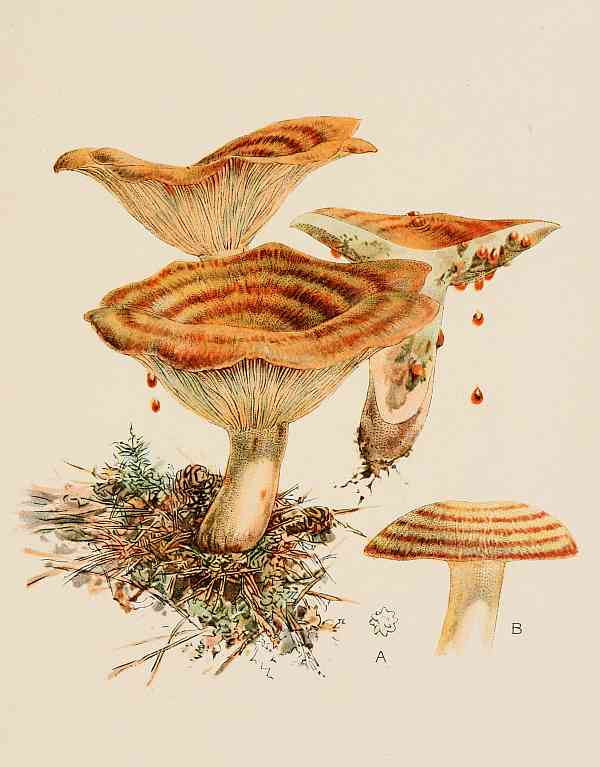
and Lactarius (Plate 18).
The "toadstools" with "sticky tops" thus discriminated
against (10) include a number of esculent species,
Boleti and Russulæ, and others, as do also the
varieties with side-stems (11)—viz., Agaricus ulmarius
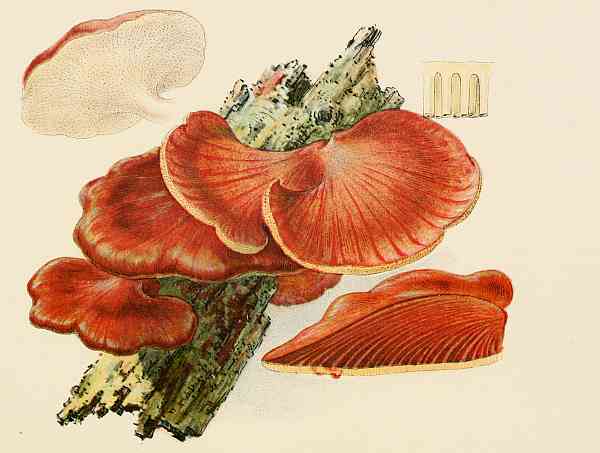
(Plate 15), Fistulina hepatica (Plate 25),
Agaricus ostreatus (Plate 14), etc.
The clustered fungi (12) have long been
included in the black-list without reason, as witness the following
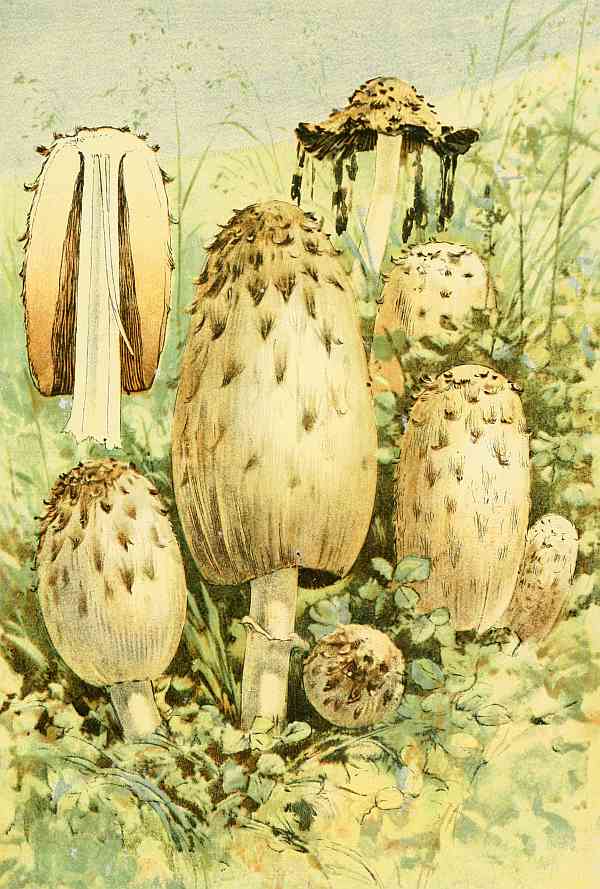
esteemed esculent species: The Shaggy-mane
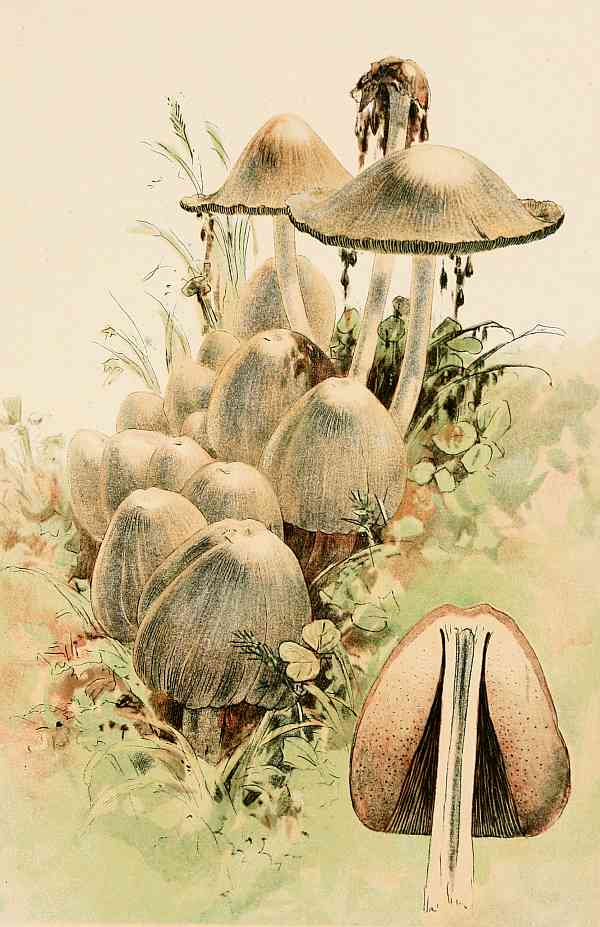
(Plate 16), Coprinus atramentarius (Plate 17),
Oyster mushroom (Plate 14), Elm mushroom (Plate 15),
Puff-balls (Plate 34), and Champignon (Plate 8).
To exclude all fungi which grow in dark,
damp places (13) is a singular inconsistency, as in some
localities this would eliminate the very one species of
"mushroom" admittedly eatable by popular favor.
In many countries these are regularly cultivated for
market in dark, damp, subterranean caverns or in
cellars. Indeed, the "dark, damp place" would appear
to be the ideal habitat of this the "only mushroom!"
Equally absurd is the discrimination against
those growing on wood (14), which again deprives us of
the delicious Hydnum (Plate 27), the Beefsteak
(Plate 25), Oyster mushroom (Plate 14),
Elm mushroom (Plate 15), and many others, including Puff-balls
(Plate 34). If we exclude those growing upon or
near manure (15), we shall be obliged to omit the Coprinus group
(Plates 16 and 17), and often the
"reel mushroom" as well.
Among the bright-colored species (16), it
is true, are many dangerous individuals, as, for instance, the
deadly Fly Amanita of Plate 4, and the emetic
Russula (Plate 13), but on this fiat we should have to
reject the other brilliant esculent Russulæ (Plates 11
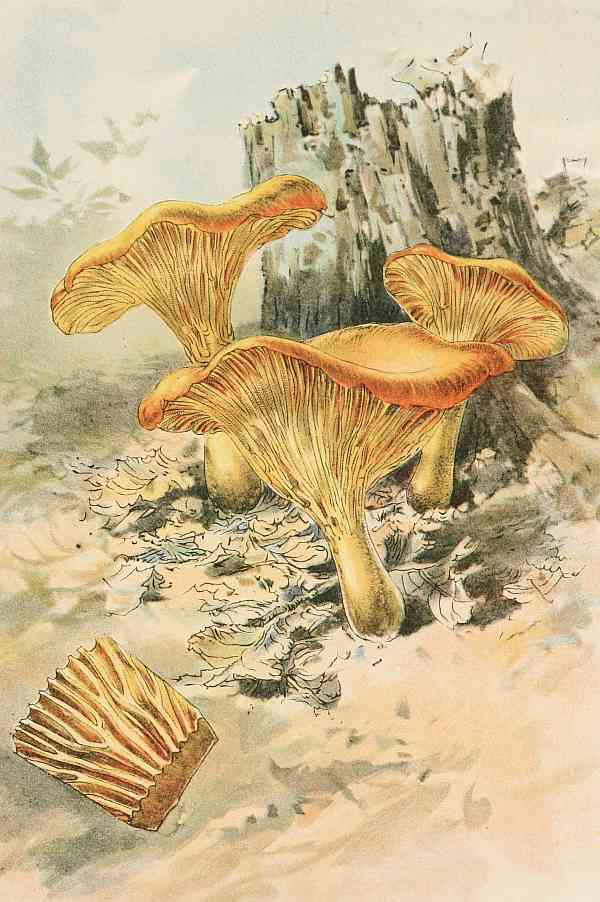
and 12), the brilliant yellow Chantarelle (Plate 19),
the Lactarius (Plate 18), and various other equally
palatable and wholesome species.
Worthless popular tests
The objection against milky mushrooms (17)
would serve to exclude the poisonous species of Lactarius,
but would thus include at least two of the delicious species of the group,
L. deliciosus, with orange milk (Plate 18),
and L. piperatus, another species with white milk not figured in
this volume.
The group of Russulæ, most of which are esculent,
is notable for their gills of even length (18), though
not all the species are thus characterized. This discrimination, however,
especially applies to the Shaggy-mane (Plate 16),
which is conspicuously even-gilled, and is a decided delicacy.
This species, together with its congener, the edible
Coprinus atramentarius (Plate 17), are notorious
for their melting into black fluid (19), which is thus of no
significance as a test, although the mushrooms are not
supposed to be eaten in this stage of deliquescence.
A fungus which bites the tongue (20) when
tasted would naturally be excluded from our mushroom diet,
as would also, of course, those of a bitter or nauseating
taste; but several species, notably the Lactarius
piperatus, as its name implies, is very hot and peppery
when raw—a characteristic which disappears in cooking,
after which it is perfectly esculent. The same
applies in a scarcely less degree to the Agaricus
melleus, and less so to the Hydnum repandum
(Plate 27), and other mushrooms. But the poisonous Russula
emetica (Plate 13) gives this same hot, warning
tang, and this rule (17) would at least thus exclude
the harmful species, and is thus contributive to popular safety.
Worthless popular tests
The salt test (21), with that of the silver
charm, is also a relic of the dim past, but is absolutely useless
as a touchstone. Many poisonous species, notably the Amanita, fail to answer
to it. All authorities agree, however, that the addition of salt in cooking, or
the preparatory soaking of specimens in brine, has a
tendency to render poisonous species innocuous. Indeed,
it is claimed that in Russia and elsewhere on
the Continent many admittedly poisonous species,
even the deadly Fly Amanita, is habitually eaten subsequent
to this semi-corning process, by which the
poisonous chemical principle is neutralized.
Omission of the only true test
Among this long list, and many other equally
arbitrary and ignorant prejudicial traditions, many
of which date back to the earliest times, it is indeed astonishing to note
the conspicuous absence of the one and only valuable sign by which
the fatal species could be unmistakably determined—a symbol
which was reserved for botanical science to discover:
the presence of the "cup" in the Amanita, which is
pointedly emphasized in my Frontispiece, and the importance
of which as a botanical and cautionary distinction
is considered at more length in the following chapter.
It is well to consider for a moment what is implied in
A fungus may be poisonous in various ways:
1. A distinct and certain deadly poison.
2. The cause of violent digestive or other functional
disturbance, but not necessarily fatal.
3. The occasion of more or less serious physical
derangement through mere indigestibility.
4. Productive of similar disorders through the employment
of decayed or wormy specimens of perfectly
esculent species.
5. These same esculent species, even in their fresh
condition, may become highly noxious by contact or
confinement with specimens of the Amanita by the
absorption of its volatile poison, as further described
on p. 69.
Concerning idiosyncrasy
And lastly comes the question of idiosyncrasy,
a consideration which is of course not taken into account
in our recommendation of certain well-established food varieties.
Decaying mushrooms
Fresh specimens
"One man's food another man's
poison." The scent of the rose is sometimes
a serious affliction, and even the delicious strawberry
has repeatedly proven a poison. Even the
most wholesome mushroom will occasionally require
to be discriminated against, as certain individuals find it necessary to exclude
cabbage, milk, onions, and other common food from their diet. When we
reflect, moreover, that in its essential chemical affinities
the fungus simulates animal flesh, and many of the larger and more solid varieties
are similarly subject to speedy decomposition, it is obviously important that
all fungi procured for the table should
be collected in their prime, and prepared and served as
quickly as possible. More than one case of supposed
mushroom poisoning could be directly traced to carelessness
in this regard, when the species themselves,
in their proper condition, had been perfectly wholesome.
No general rule for identification
There can be no general rule laid down for
the discrimination of an edible fungus. Each must be
learned as a species, or at least familiarized as a kind,
even as we learn to recognize certain flowers, trees, or birds.
Within a certain range this discrimination
is practised by the merest child. How are
the robin, the chippy, and the swallow recognized, or
the red clover, and white clover, and yellow clover?
Simple botanical discrimination
Even in the instances of species which bear a very
close outward similarity, how simple, after all, does
the distinction become. Here, for instance,
is the wild-lettuce, and its mimic,
the mulgedium, growing side by side—to
ninety-nine out of a hundred observers
absolutely alike, and apparently the same species.
But how readily are they distinguished, I will not say
by the botanist merely, but by any one who will take
the small pains of contrasting their specific botanical
characters—perfectly infallible, no matter how various
the masquerade of their foliage. The lettuce has
yellow blossoms, and a seed prolonged into a long
beak, to whose tip the feathery pappus is attached.
The mulgedium has dull bluish flowers, and its pappus
is attached to the seed by a hardly perceptible
elongation. As with the birds and wild-flowers, so
with the fungi: we must learn them as species, even
as we learn to distinguish the difference between the
trefoil of the clover and that of the wood-sorrel, or
between the innocuous wild-carrot and the poison-hemlock,
the harmless stag-horn sumach and its
venomous congener, the Rhus venenata. There are
parallel outward resemblances between esculent and
poisonous fungi, but each possesses otherwise its
own special features by which it may be identified—variations
of gills, pores, spores, taste, odor, color,
juice, consistency of pulp, method of decay, etc.
It must not be presumed that the list of
edible species just cited from the catalogue of Dr. Curtis
includes all the esculents among the fungi. Dr.
Harkness has discovered and classified many others.
Mr. Palmer and Prof. Charles Peck are never at a
loss for their "mess of mushrooms" among their list
of nearly a hundred species, while Mr. Charles McIlvaine,
whose name, so far as its practical authority
is concerned, should appear more prominently in my
bibliographical list, but who has not yet incorporated
his many mycological essays in book form,
writes me that he has tested gastronomically a host
of species, and has found over three hundred to be
edible, or at least harmless. It may be said that the
probabilities would include a large majority of the
thousand species in the same category. But this is
a matter which, in the absence of absolute knowledge,
is mere conjecture.
Of the forty-odd species which the writer enjoys
with more or less frequency at his table, he is satisfied
that he can select at least thirty which possess
such distinct and strongly marked characters of form,
structure, and other special qualities as to enable
them, by the aid of careful portraiture and brief description,
to be easily recognized, even by a tyro.
As previously emphasized, the present work
does not aim to be complete, nor does it contemplate a
practical utility beyond its specific recommendations,
nor will the author assume any responsibility for the
hazard which shall exceed its restricted list of species.
Humanity and forbidden fruit
On general principles, however,
considering the proneness of humanity towards the acquisition of
forbidden fruit, and reasoning from my
own actual experience, and that of
many others to whom this fascinating
hobby of epicurean fungology has become
a growing passion, it may almost be assumed
that the fungus appetite with many of my readers
will increase by what it feeds on, and the sufficiency
herewith offered will scarcely suffice. Like Oliver
Twist, they must needs have more. The glory of a
new acquisition to the fungus menu, and emulation
of other rival tyro mycophagists, will doubtless lead
many enthusiasts to more or less hazardous experiment
among the legion of the unknown species.
This logical tendency, then, must be met ere my
book can safely and conscientiously be launched
upon its career, to which purpose I would append
the following condensed
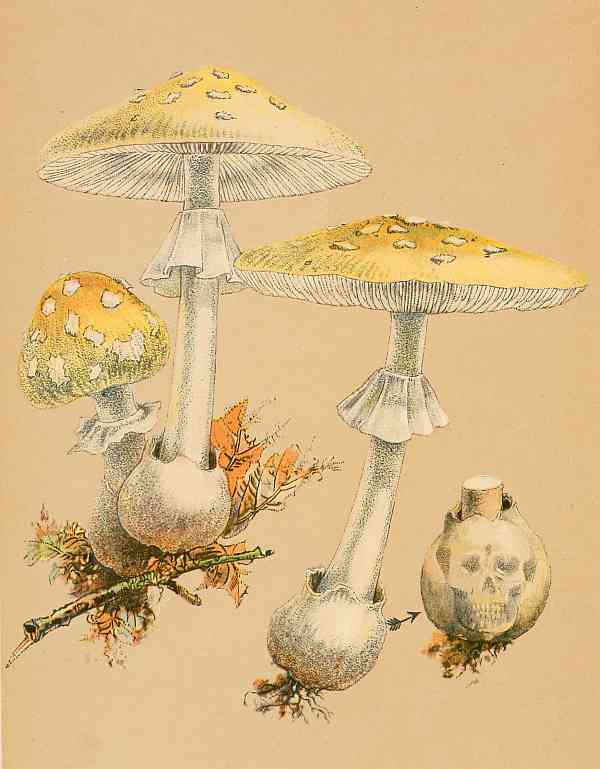
1. Avoid every mushroom having a cup, or suggestion
of such, at base (see Frontispiece,
and Plates 3 and 4);
the distinctly fatal poisons are thus excluded.
2. Exclude those having an unpleasant odor, a
peppery, bitter, or other unpalatable flavor, or tough consistency.
3. Exclude those infested with worms, or in advanced age or decay.
4. In testing others which will pass the above probation
let the specimen be kept by itself, not in contact
with or enclosed in the same basket with other species,
for reasons given on page 69.
Testing new species
Begin by a mere nibble, the size of a pea,
and gentle mastication, being careful to swallow no saliva,
and finally expelling all from the mouth. If no noticeable results follow,
the next trial, with the interval of a day, with the same quantity may
permit of a swallow of a little of the juice, the fragments of
the fungus expelled as before.
No unpleasantness following for twenty-four
hours, the third trial may permit of a similar entire fragment
being swallowed, all of these experiments to be made
on "an empty stomach." If this introduction of the
actual substance of the fungus into the stomach is
superseded by no disturbance in twenty-four hours, a
larger piece, the size of a hazel-nut, may be attempted,
and thus the amount gradually increased day by day
until the demonstration of edibility, or at least harmlessness,
is complete, and the species thus admitted
into the "safe" list. By following this method with
the utmost caution the experimenter can at best suffer
but a slight temporary indisposition as the result of
his hardihood, in the event of a noisome species having
been encountered, and will at least thus have the
satisfaction of discovery of an enemy if not a friend.
Mr. McIlvaine's general rule
It may be said that any mushroom, omitting the
Amanita, which is pleasant to the taste and otherwise
agreeable as to odor and texture when raw, is
probably harmless, and may safely be thus ventured
on with a view of establishing its edibility. A prominent
authority on our edible mushrooms, already mentioned, applies this
rule to all the Agarics with confidence. "This rule may be established,"
he says: "All Agarics—excepting the Amanitæ—mild
to the taste when raw, if they commend themselves
in other ways, are edible." This claim is borne out
in his experience, with the result, already told, that
he now numbers over one hundred species among
his habitual edible list out of the three hundred
which he has actually found by personal test to be
edible or harmless. "So numerous are toadstools,"
he continues, "and so well does a study of them
define their habits and habitats, that the writer never
fails upon any day from April to December to find
ample supply of healthy, nutritious, delicate toadstools
for himself and family." The italicized portion is
my own, as I would thus emphasize the similar possibilities
amply afforded even in the present condensed
list of about thirty varieties herein described.
Hints to mushroom-gatherers
In gathering mushrooms one should be supplied
with a sharp knife. The mushroom should be carefully
cut off an inch or so below the cap, or at least
sufficiently far above the ground to escape all signs
of dirt on the stem. They should then be laid gills
upward in their receptacle, and it is well to have a
special basket, arranged with one or two removable
bottoms or horizontal partitions, which are kept in place by upright props
within, thus relieving the lower layers of mushrooms from the weight of those
above them. Such a basket is almost indispensable.
Insects infesting mushrooms
Before preparing mushrooms for the table,
the specimens should be carefully scrutinized for a
class of fungus specialists which we have
not taken into account, and which have
probably anticipated us. The mushroom
is proverbial for its rapid development,
but nature has not allowed it thus to
escape the usual penalties of lush vegetation, as
witness this swarming, squirming host, minute grubs,
which occasionally honey-comb or hollow its entire
substance ere it has reached its prime; indeed, in
many cases, even before it has fully expanded or
even protruded above ground.
History of fungus insects
Like the carrion-flies, the bees, and wasps,
which in early times were believed to be of spontaneous
origin—flies being generated from putrefaction,
bees from dead bulls, and the martial
wasps from defunct "war-horses"—these
fungus swarms which so speedily
reduce a fair specimen of a mushroom to a melting
loathsome mass, were also supposed to be the
natural progeny of the "poisonous toadstool." But
science has solved the riddle of their mysterious
omnipresence among the fungi, each particular swarm
of grubs being the witness of a former visit of a
maternal parent insect, which has sought the budding
fungus in its haunts often before it has fully revealed
itself to human gaze, and implanted within its substance her hundred or
more eggs. To the uneducated eye these larvæ all appear similar, but the
specialist in entomology readily distinguishes between
them as the young of this or that species of fly, gnat, or beetle.
As an illustration of the assiduity with which
the history of these tiny scavenger insects has been followed
by science, I may mention that in the gnat group
alone over seven hundred species have been discovered
and scientifically described, many of them requiring
a powerful magnifier to reveal their identities.
Specimens of infected or decaying mushrooms
preserved within a tightly closed box—and, we would
suggest, duly quarantined—will at length reveal the
imago forms of the voracious larvæ: generally a swarm
of tiny gnats or flies, with an occasional sprinkling
of small glossy black beetles, or perhaps a beautiful
indigo-blue insect half an inch in length, of most
nervous habit, and possessed of a long and very active
tail. This insect is an example of the curious
group of rove-beetles—staphylinus—a family of insect
scavengers, many of whose species depend upon the
fungi for subsistence.
Even the large woody growth known as "punk"
or "touch-wood," so frequently seen upon decaying
trunks, is not spared. A huge specimen in my keeping
was literally reduced to dust by a single species of beetle.
A wise precaution
Considering the prevalence of these fungus
hosts, it is well in all mushrooms to take the precaution
of making a vertical section through
stem and cap, excluding such specimens
as are conspicuously monopolized,
and not being too critical of the
rest, for the over-fastidious gourmet will often
thus have little to show for his morning walk. I
have gathered a hundred specimens of fungi in
one stroll, perhaps not a quarter of which, upon
careful scrutiny, though fair of exterior, would be
fit for the table. The fungus-hunter par excellence
has usually been there before us and left his mark
(see page 135)—a mere fine brown
streak or tunnel, perhaps, winding through the pulp or stem,
where his minute fungoid identity is even yet secreted.
But we bigger fungus-eaters gradually learn to accept
him—if not too outrageously promiscuous—as
a natural part and parcel of our Hachis aux
Champignons, or our simple mushrooms on toast,
even as we wink at the similar lively accessories
which sophisticate our delectable raisins, prunes, and
figs, to say nothing of prime old Rochefort!
In conclusion, lest these pages, in spite of
the impress of caution with which they are weighted, should
lead to discomfiture, distress, or more serious results
among their more careless readers, it is well to devote
a few lines to directions for medical treatment where
such should seem to be required. To this end I
quote a passage from an article in the Therapeutic Gazette
of May, 1893, from the pen of Mr. McIlvaine,
whose many years' experience with gastronomic fungi
entitles his words to careful consideration:
Diagnosis and treatment
"The physician called upon to treat a case of
toadstool poisoning need not wait to query after the variety
eaten; he need not wish to see a sample. His first endeavor should be
to ascertain the exact time elapsing between the eating of the toadstools
and the first feeling of discomfort. If this is within four
or five hours one of the minor poisons is at work, and
rapid relief must be given by the administration of
an emetic, followed by one or two moderate doses of
sweet-oil and whiskey, in equal parts. Vinegar is effective
as a substitute for sweet-oil. If from eight to
twelve hours have elapsed, the physician may rest assured
that amanitine is present, and should administer
one-sixtieth of a grain of atropine at once."
This atropine is intended to be injected
hypodermically, and the treatment repeated every half-hour
until one-twentieth of a grain has been given, or the
patient's life saved.
Further consideration of the Amanita and its
deadly poison and antidote, with details as to treatment
in a notable case, will be reserved for the following chapter.
The colored plates in the volume were prepared
from pencil drawings tinted in water-color, many of
them direct from nature, several dating back fifteen
years, and many of them over twenty years, for their
original sketch. The colors as presented indicate
those of typical individuals of the various species, and
each, in addition to the extended description in the
text of the volume, is faced by a condensed description
for ready reference, the usual troublesome necessity
of turning the pages being thus avoided.
In each plate dimension marks are shown
which indicate the expansion of the pileus or cap of the
fungus in an ideal specimen.
Acknowledgments
In the preparation of this work, acknowledgments
are specially due to Messrs. Julius A. Palmer and
Charles McIlvaine for the privilege of liberal quotations from their published
works, especially with reference to the poisonous fungi. The volume is also
further indebted for occasional extracts from the
standard works of Prof. Chas. Peck, Mrs. T. J. Hussey,
Rev. Dr. C. D. Badham, Rev. Dr. M. C. Cooke,
Rev. J. M. Berkeley, Worthington Smith, and Rev.
M. A. Curtis, all of whose volumes and various other
contributions on the special subject of mycophagy
are included in my bibliography on a later page.
W. Hamilton Gibson
October 1, 1894
Washington, Conn.
The Deadly Amanita — THE POISONOUS FLY-MUSHROOM — THE POISONOUS ALKALOID
The frequency of this terrible
foe in all our woods, and the ever-recurring fatalities
which are continually traced to its seductive treachery
(some twenty-five deaths having been recorded in the public
journals during the summer of 1893 alone), render
it important that its teeth should be drawn, and its
portrait placarded and popularly familiarized as an
archenemy of mankind.
A whited sepulchre
As we have seen, from every superficial
standpoint, this species is self-commendatory. It is, without
doubt, in comeliness, symmetry, and structure, the ideal of all our mushrooms,
as it is, indeed, the botanical type of the tribe Agaricus, as well as
its most notorious genus. Since the time of that
carousing young lunatic Nero, who, doubtless, was
wont to make merry with its "convenient poison,"
upon one occasion, it is recorded by Pliny, to the
presumably amusing extinction of the entire guests
of a banquet, together with the prefect of the guard
and a small host of tribunes and centurions, the
Amanita has claimed an army of victims.
Easily identified botanically
While giving no superficial token of its dangerous
character to the casual observer, the Amanita, as a
genus and a species, is nevertheless easily identified,
if the mushroom collector will for the moment consider
it from the botanical rather than
the sensuous or gustatorial standpoint.
The deadly Amanita need no longer
impose upon the fastidious feaster in
the guise of the dainty "legume" of his menu, or as
a contaminating, fatal ingredient in the otherwise
wholesome ragoût.
Amanita vernus
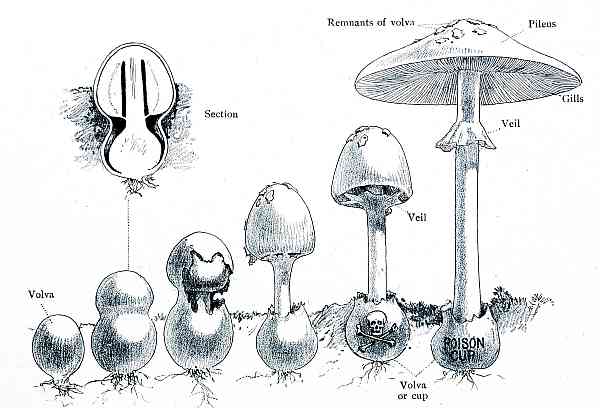
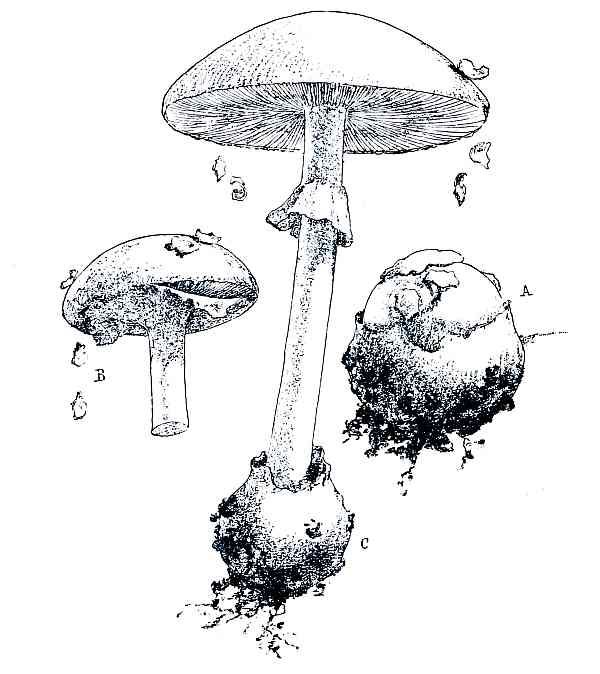
In Plate 3 I have presented the reprobate
Amanita vernus in its protean progressive proportions from infancy
to maturity. This is especially desirable, in that the fungus is equally
dangerous as an infant, and also because the development of its growth
specially emphasizes botanically the one important
structural character by which the species or genus
may be easily distinguished. Let us, then, consider
the specimen as a type of the tribe Agaricus (gilled
mushroom, see p. 79), genus Amanita.
Vegetation of an Agaric
The danger signal
Year after year we are sure of finding
this species, or others of the genus, especially in the spring and
summer, its favorite haunt being the woods. Its
spores, like other mushrooms, are shed upon the
ground from the white gills beneath, as described in
our chapter on "Spore-prints," or wafted to the ends
of the earth on the breeze, and eventually, upon having
found a suitable habitat, vegetate in the form of
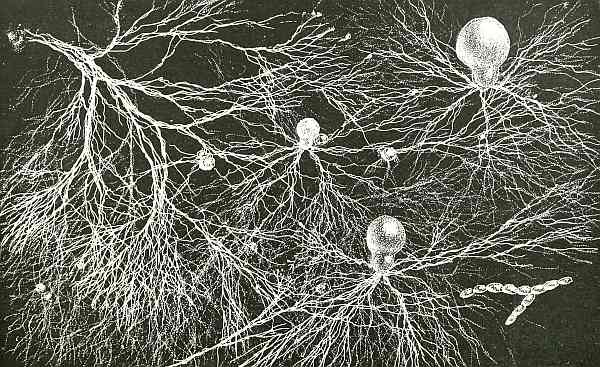
webby, white, mould-like growth—mycelium—which
threads through the dead leaves, the earth, or decaying
wood. This running growth is botanically considered
as the true fungus, the final mushroom being the
fruit, whose function is the dissemination of the
spores. After a rain, or when the conditions are
otherwise suitable, a certain point among this webby
tangle beneath the ground becomes
suddenly quickened into astonishing
cell-making energy, and a small rounded
nodule begins to form, which continues
to develop with great rapidity (Plate 2). In a
few hours more it has pushed its head above ground,
and now appears like an egg, as at A, Plate 3. The
successive stages in its development are clearly indicated
in the drawings. Each represents an interval
of an hour or two, or more, the most suggestive and
important feature being the outer envelope, or volva,
which encloses the actual mushroom—at first completely,
then in a ruptured condition, until in the mature
growth the only vestige of it which appears
above ground are the few shreds generally, though
not always, to be seen on the top of the cap. The
most important character of this deadly Amanita is,
therefore, apparently with almost artful
malice prepense, often concealed from
our view in the mature specimen, the
only remnant of the original outer sack
being the cup or socket about the base of the stem,
which is generally hidden under ground, and usually
there remains after we pluck the specimen.
Plate II.—MYCELIUM, AND EARLY VEGETATION OF A MUSHROOM
The poison-cup
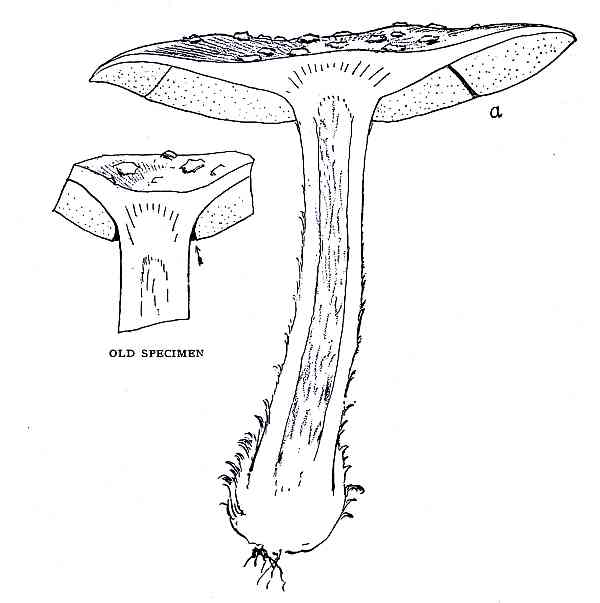
This "poison-cup" may be taken as the
cautionary symbol of the genus Amanita, common to all the
species. Any mushroom or toadstool, therefore, whose
stem is thus set in a socket, or which has any suggestion
of such a socket, should be labelled "poison"; for, though
some of the species having this cup are edible, from
the popular point of view, it is wiser and certainly
safer to condemn the entire group. But the cup must be sought
for. We shall thus at least avoid the possible danger of a fatal
termination to our amateur experiments in gustatory mycology;
for, while various other mushrooms might, and do, induce
even serious illness through digestive disturbance,
and secondary, possibly fatal, complications,
the Amanita group are now conceded to be the only
fungi which contain a positive, active poisonous principle
whose certain logical consequence is death.
The "veil" or shroud
Another structural feature of the Amanita
is shown in the illustration, but has been omitted from the
above consideration to avoid confusion. This is the "veil"
which, in the young mushroom, originally connected the
edge of the cap, or pileus, with the
stem, and whose gradual rupture necessarily follows
the expansion of the cap, until a mere frill or ring
is left about the stem at the original point of contact.
But this feature is a frequent character
in many edible mushrooms, as witness the several examples in
the edible species of our plates, and therefore of no
dangerous significance per se, being merely a
membrane which protects the growing gills.
Plate III.—DEVELOPMENT OF AMANITA VERNUS
Scales and scurfy spots
Nor are the other features, the remnants
of the volva on the summit of the cap, to be considered of
primary importance from the popular point of view,
for the reason—firstly, that these fragments, while
conspicuous and constant in Amanita muscarius (Plate 4),
are not thus permanent in several other species
of Amanitæ, notably the white-satin-capped Amanita
vernus, Amanita phalloides, and Amanita Cæsarea,
in which the fragments are deciduous; and, secondly, because the
same general effect of these warty scales is so clearly imitated
in other mushrooms which are distinctly edible, as in examples
Plate 10 and Plate 16.
It is to the volva or cup, then, that we must devote
our special attention as the only safe and constant character. And
this leads me to the prominent and necessary consideration of another
common species of Amanita, mentioned above, in which even this cup is
more or less obscure.
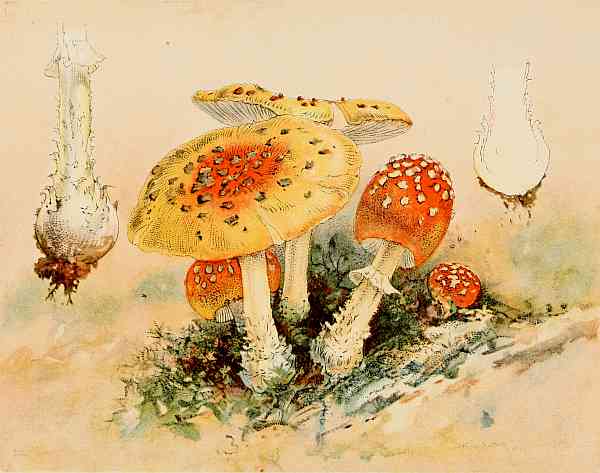
Agaricus (Amanita) muscarius
A deceptive Amanita
This, one of the most strikingly beautiful
of our toadstools, is figured in Plate 4. Its brilliant cap
of yellow, orange, or even scarlet, studded with white
or grayish raised spots, can hardly be unfamiliar to even the least observant
country walker. Its favorite habitat is the woods, and, in the writer's experience
especially, beneath hemlocks and poplars, where he has seen this species year after
year in whole companies, and in all stages shown in the plate at the same time,
from the globular young specimen almost covered with its white warts just
lifting its head above the brown carpet to the fully expanded
individual, in which the spots have assumed a shrunken and brownish tint.
Used as a fly-poison
Its obscure cup
The consideration of this species is of the
utmost importance, as its beauty is but an alluring mask,
which has enticed many to their destruction; among
the more recent of its conspicuous victims having
been the Czar Alexis of Russia. For this is another
cosmopolitan type of mushroom, common alike in
America, Great Britain, Europe, and Asia, in all of
which countries it is notorious for its poisonous resources.
It is commonly known as the "Fly-agaric,"
its substance macerated in milk having
been employed for centuries as an effectual
fly-poison. After the reader's
introduction to the botanical character
of the Amanita, he would, presumably, be somewhat
suspicious of the present species. The suggestive
white or dingy fragments upon its cap, it is true,
would alone arouse his suspicions, but in the examination
of the stem for the telltale volva or cup its
verification might be somewhat in doubt. It is for
this reason that the species is emphasized in these
pages, as the Amanita muscarius, judging
from the great dissimilarity of its
numerous portraits from all countries,
would seem to be remarkably protean,
especially with reference to its stalk. The majority
of the portraits of this reprobate presents the volva
as distinct and as clean cut as in the A. vernus just
described, and the stalk above as equally smooth,
features which are usually at variance with the associated
botanical description of the species, which
often characterizes the volva as "incomplete" or "obscure,"
and the stem as "rough and scaly." If the
portraits in these works are correct, the Amanita
qualities of the species are clearly displayed, but if
their accompanying descriptions are to be credited,
and such seem to be in perfect accord with the specimens
which I have always found, the A. muscarius
would seem in need of a more authentic historian.
PLATE IV FLY MUSHROOM
Agaricus (Amanita) muscarius
Pileus: Diameter three to six inches, quite flat at maturity;
color brilliant yellow, orange, or scarlet, becoming pale
with age, dotted with adhesive white, at length pale
brownish warts, the remnants of the volva.
Gills: Pure white, very symmetrical, various in length, the
shorter ones terminating under the cap with an almost
vertical abruptness.
Spores: Pure white. A spore-print of this species is shown
in Plate 37.
Stem: White, yellowish with age, becoming shaggy, at length
scaly, the scales below appearing to merge into the form
of an obscure cup.
Volva: Often obscure, indicated by a mere ragged line of
loose outward curved shaggy scales around a bulbous
base.
Flesh: White.
Habitat: Woods and their borders, especially favoring pine
and hemlock.
Season: Summer and autumn.
PLATE IV
Amanita Muscaria. (POISONOUS.)
Volva scales permanent
The example figured in the plate presents
the stem and volva as they have always appeared in
specimens obtained by the writer. In the young
individuals the stem is waxy-white, becoming later
a dull, pale ochre hue, the lower half being shaggy
and torn, and beset with loose projecting woolly
points which resolve themselves below into scales
with loose tips curved outward, and so distantly disposed
upon the bulbous base as to leave no marked
definition of the continuous rim or opening of a cup.
But the cup is there, and in a section of the bud state
of the mushroom could have been seen, even as in the
white warts upon the surface of the younger
specimens we note the evidences of the upper portion of
the same white volva. In many other
species of Amanita, notably A. vernus,
as already mentioned, these volva fragments
generally wither and are shed
from the cap. They are thus not to be counted on
as a permanent token. But in the fly-mushroom
they form a distinct character, as they adhere firmly
to the smooth skin of the pileus, and in drying, instead
of shrivelling and curling and falling off, simply
shrink, turn brownish, and in the maturely expanded
mushroom appear like scattered drops of mud which
have dried upon the pileus. Another peculiar structural
feature of this mushroom is shown in the sectional
drawing herewith given. The shorter gills,
instead of rounding off as they approach the pileus
(see a), terminate abruptly almost at right angles
to their edge. The contrast from the usual form will
be more apparent by comparison with the section of
the parasol-mushroom on page 114.
SECTION OF FLY-AMANITA
Few species of mushrooms have such an
interesting history as this. Its deadly properties were
known to the ancients. From the earliest times its
deeds of notoriety are on record.
Historical Amanita
This is quite possibly the species alluded
to by Pliny as "very conveniently adapted for poisoning,"
and is not improbably the mushroom
referred to by this historian in the following
quotation from his famous Natural
History: "Mushrooms are a dainty
food, but deservedly held in disesteem since the
notorious crime committed by Agrippina, who through
their agency poisoned her husband, the Emperor
Claudius; and at the same moment, in the person
of her son Nero, inflicted another poisonous curse
upon the whole world, herself in particular."
Amanita dipsomaniacs
Notwithstanding its fatal character, this
mushroom, it is said, is habitually eaten by certain peoples,
to whom the poison simply acts as an intoxicant. Indeed,
it is customarily thus employed as a narcotic
and an exhilarant in Kamchatka and Asiatic Russia
generally, where the Amanita drunkard
supplants the opium fiend and alcohol
dipsomaniac of other countries. Its
narcotizing qualities are commemorated
by Cooke in his Seven Sisters of Sleep, wherein
may be found a full description of the toxic employment
of the fungus.
The writer has heard it claimed that this
species of Amanita has been eaten with impunity by certain
individuals; but the information has usually come
from sources which warrant the belief that another
harmless species has been confounded with it. The
warning of my Frontispiece may safely be extended
to the fly-amanita. Its beautiful gossamer veil may
aptly symbolize a shroud.
Forewarned and forearmed
By fixing these simple structural
features of the Amanita in mind, and emphasizing them by a study
of our Frontispiece, we may now consider ourselves
armed against our greatest foe, and
may with some assurance make our
limited selection among this lavish larder
of wild provender continually going
to waste by the ton in our woods and pastures and
lawns. For it is now a fact generally believed by
fungologists, and being gradually demonstrated, that
the edible species, far from being the exception, as
formerly regarded, are the rule; that a great majority
of our common wild fungi are at least harmless, if
not positively wholesome and nutritious as food.
The toxic and deadly effects of certain
mushroom poisons, as already described, have been known since
ancient times; and the prolonged intoxicating debauches
to-day prevalent among the Amanita dipsomaniacs
of Northern Russia and Kamchatka, consequent
upon the allurements of the decoction of the
fly-agaric, are well-known matters of history.
The true chemical character of this poison,
however, was not discovered until 1868, when it was successfully
isolated by chemical analyses of Drs. Vigier, Schmiedeberg,
Currie, and Koppe, and ascertained to be an
alkaloid principle, to which was given originally the
name of bulbosine, since variously known as muscarine,
and finally and most appropriately amanitine.
Mr. Palmer's discovery
The poison thus identified, it was reserved
to an American authority on edible fungi, Mr. Julius A.
Palmer, of Boston, to discover the fact of its
confinement to but one fungus family—the Amanita.
In the year 1879, in an article contributed
by him to the Moniteur Scientifique, of Paris, he states:
"Mushrooms are unfit for food by decay or
other cause, producing simply a disagreement with the system
by containing some bitter, acrid, or slimy element,
or by the presence of a wonderful and dangerous alkaloid
which is absorbed in the intestinal canal. This alkaloid,
so far as known, is found only in the Amanita family."
To Mr. Palmer, then, is due the chemical
segregation of the Amanita group as the only repository of
this deadly toxic.
Lesser poisoning
It has not been discerned in other species
of fungi, whose so-called "poisonous" effects are more often
traceable to mere indigestibility, the
selection of "over-ripe" specimens, or
to idiosyncrasy, rather than to their
distinctly poisonous properties.
Many mushrooms of other families which do
possess ingredients chemically at war with the human
system—as the Russula emetica and certain Lactarii,
for instance—at least give a fair warning, either
by taste or odor, of their dark intentions.
Antidote for Amanita
First authentic application
Owing to the numerous deaths
every year consequent upon mushroom-eating, and nearly always
directly traceable to the Amanita, the discovery of
an antidote to this poison has been the quest of
many noted chemists—several supposed antidotes
having been experimented with upon dogs and other animals without
desired results. These included atropine, the deadly crystalline
alkaloid from the Atropa belladonna. The earlier experiments
upon animals with this drug in Paris, as described by Dr.
Gautier in 1884, while encouraging, were not considered
conclusive, but were sufficient to warrant
the suggestion that the treatment upon man might
be effective. In a résumé of the subject in the
Philadelphia Medical and Surgical Reporter, December,
1885, for the benefit of the medical practitioners
who are so frequently called upon to attend
cases of mushroom poisoning, Captain Charles McIlvaine
recommended the administration of a dose of
atropine of from 0.05 to 0.0002 milligramme, and it
was later reserved for the same gentleman
to witness the first authentic instance
of the application of this remedy
in antagonism with the Amanita poison
in the human system. The report of this experience
was afterwards published (see Bibliography,
No. 6), embodying also a complete and authentic account
of the symptoms and treatment of the cases
by the attending physician, Dr. J. E. Shadle, of
Shenandoah, Pa., which account I feel is appropriately
included here, being in full sympathy with the
solicitous spirit of my pages. I therefore quote the
statement of Dr. Shadle for the benefit of those interested.
Shenandoah, Pa., October 26, 1885.
Mr. Chas. McIlvaine:
My dear Sir,—In compliance with your
request, I take pleasure in submitting to your consideration the following report of five
cases of toadstool-poisoning which recently came under my observation and treatment:
Amanita poisoning symptoms
On Monday, August 31, at 10 A.M.,
I was hastily called to see a family, consisting of Mr. F., his wife, his
mother-in-law, Mrs. R., and his brother-in-law, Thomas R., who, the messenger
stated, were having "cramps in the bowels."
Promptly responding to the call, I found
them suffering from intense abdominal pains, nausea,
vomiting, boneache, and feelings of distress in
the præcordial region.
Mr. F., twenty-nine years of age, was a miner by occupation,
and had led an intemperate life. Mrs. F., twenty-two years of
age, was a brunette, possessing a delicate body, and bearing a
decided neurotic tendency. Mrs. R., forty-five years of age,
was a small nervo-bilious woman. Thomas R., thirteen years
of age, was a youth well developed.
While I was examining these patients, Mrs. B., forty
years of age, a neighbor of the family, presented herself, manifesting
in a milder degree the same symptoms. She was a tall, spare woman.
Previous to their present attack of illness their general health was
good; in none could signs of disease be traced.
Picture to your mind five persons suffering from cholera
morbus in its most aggravated form, and you will be enabled to form a
pretty correct idea of what I beheld in the Faris residence on
Monday morning, August 31.
That five individuals, four being members of one household,
should be attacked simultaneously by a similar train of symptoms,
naturally gave rise in my mind to a suspicion that something poisonous
had been eaten. Upon close inquiry I obtained the following history:
On the afternoon of Sunday, August 30, Mr. F. and
Thomas R. were walking through a wood not far distant from their home,
and, in wandering from place to place, found clusters of very
beautiful toadstools growing abundantly under trees, among which
the chestnut predominated.
Amanita poisoning symptoms
Attracted by their appearance, and supposing them to be
edible, they gathered a large quantity, with the anticipation of having
a delicious dish for their Sunday evening meal.
Various other kinds were growing in the
same locality, but this particular variety impressed
them as being the most inviting. A correct
specimen of the fungus they had collected having been sent
you, I will leave its botanical description to your pen.
At about nine o'clock, five hours after gathering them,
Mrs. F. cooked three pints of the toadstools, stewing them in milk, and
seasoning with butter, pepper, and salt.
They had dinner at a very early hour on this day, and
by the time they had supper all felt exceedingly hungry, in consequence
of which they ate quite heartily. Mrs. F. and her brother vied
with each other as to the quantity they could eat. In addition
to this dish, bread and butter and coffee were served.
Soon after supper the family retired. None experienced
the least discomfort until towards daybreak, when considerable distress
in the abdominal organs and cerebral disturbance manifested
themselves. Prominent among the initial symptoms were foul
breath, coated tongue, pain in the stomach, nausea, and a peculiar
sickening sensation in the epigastrium. These symptoms gradually
increased in severity, and in twelve hours after the ingestion
of the poison, when I made my first visit, the condition of the
victims involved great danger. Intense vomiting was present in
four, while in Mrs. R.'s case a violent retching seemed to persist.
Gastro-intestinal irritation, followed by a relaxed
condition of the bowels, showed itself in about thirty hours after the
onset of the more active symptoms. With the appearance of this trouble
an insufferable tenesmus developed, producing paroxysms of
severe agony. This was particularly true in the case of Mrs. R.,
whose suffering was so great that it became a formidable symptom
to combat. Upon the subsidence of the more severe symptoms,
the patients fell into a state of extreme prostration, accompanied
by stupor and cold extremities. In the mother, son, and daughter
this was profoundly marked. They were completely indifferent
to persons and things around them, as well as to their own suffering.
Amanita poisoning symptoms
As the symptoms increased in violence, Thos. R. advanced
into a state of coma, and Mrs. F. into coma vigil, and remained
so for about twelve hours prior to death. The face
had a shrunken and wrinkled appearance, the
eyes were sunken, the skin was dusky, and the
surface of the body was dry and cold to the
touch. The pulse, a number of hours before
death, was imperceptible at the wrist, and the heart-sounds were
scarcely perceived by auscultation.
The pulse in all cases was notably affected, ranging
from 120 to 140 per minute. In character it was soft and compressible;
intermittent at intervals.
There was a distinct rise of temperature; the
thermometer in the axilla registered as much as 140° F.
A mild form of delirium was an occasional event.
In the case of Mrs. F. it formed an important element.
Respecting the special senses, it is well to mention that
sight was peculiarly affected. Notwithstanding the fact that the pupils
responded kindly to the action of the light, an unpleasant sensation
of blindness frequently appeared, and continued for a few minutes.
In spite of all that was done to counteract its ravages,
the effects of the poison were so extremely deadly that a fatal issue
was the result in two cases. Thomas R. died in fifty-six and Mrs.
F. in sixty-three hours after the ingestion of the toadstools.
Treatment.—The treatment
instituted was mainly symptomatic.
Amanita poisoning treatment
Fearing that undigested particles of toadstools might still
be lying in the gastro-intestinal tract, to Mrs. R., who had not freely
vomited, an emetic was administered, and to
the rest a mild purge.
An intense thirst and a burning sensation
being present in the mouth, throat, and stomach, small pieces of
cracked ice were freely used with a view to allaying it.
For the gastro-intestinal irritation I prescribed with satisfactory
results the following:
℞ Bismuth subnit., ʒv; Creosote, gtt. xv; Mucil. acaciæ, f℥i; Aq. menth. pip., q.s. ad f℥iii. M. Sig.—Teaspoonful every one or two hours.
1/8 grain of morph. sulph. was administered hypodermically
to alleviate as much as possible the abdominal suffering.
The impending exhaustion and the failing heart's action
I endeavored to combat with a free administration of alcoholic stimulants
in combination with moderate doses of tincture of digitalis
both by the mouth and under the skin.
In order to invite the circulation of the blood to the
ice-cold surface of the body, heated bricks and bottles filled with hot
water were placed in bed around the patients.
Diagnosis
Analyzing each symptom as it arose, and carefully
observing the effects of the poison on the system, I formed the opinion
that the toxic element contained in the noxious fungus
eaten by these people was narcotic in its nature and spent its force
on the nerve centres, especially selecting the one governing the function
of respiration and the action of the heart.
Acting upon this conclusion, I began, in the early part
of my treatment, subcutaneous injections of sulphate of atropine in
frequently-repeated doses, ranging from 1/180 to 1/90 grain. The
injections invariably were followed by a perceptible improvement in
the patient; the heart's action became stronger, the pulse returned
at the wrist, and the respiration increased in depth and fulness.
Through the agency of this remedy, supported by the other
measures adopted, three (or sixty per cent.) of the patients recovered.
The lessons I draw from this experience are:
1. The poisoning produced by this variety of toadstool is slow
in manifesting its effects.
2. That it destroys life by a process of asthenia.
3. That in atropine we have an antidote, and it should be pushed
heroically from the earliest inception of the action of the poison.
I have the honor to remain
Yours very respectfully, J. E. Shadle, M.D.
In reply to the queries, Was atropine administered
in all the cases? and What was the total amount administered to each?
Dr. Shadle responded as follows:
Shenandoah, Pa., October 29, 1885.
My dear Mr. McIlvaine:
Yours of the 27th I have received. The two questions
you ask me therein I see are very important, and they should
be answered as fully as possible. I am sorry I overlooked
the matter in my report.
Amanitine and atropine
Before attempting an answer, it is well for me to
note right here that Mrs. B., the neighbor, did not eat very much
of the toadstool stew; Mrs. R. and Mr. F. each ate
about the same quantity—from one and one-half
to two platefuls. This is according to Faris's statement.
But the two fatal cases—Thomas R. and Mrs. F.—tried to see
which could eat the most, and consequently got their full share of the
poison. The cat mentioned before had about a tablespoonful of
the broth, and they tell me she was very sick. Whether or not
she died is not known.
Now as to the treatment by atropine, I think I can
approximate a pretty correct statement in reply to your queries. Not
knowing that atropine was considered an antidote, I began its employment
in the treatment of these cases from the physiological knowledge
I had of the drug relative to its action in other diseases in which
there was heart-failure and embarrassed respiration.
When I saw the U. S. Dispensatory suggested it, I of course
felt it my duty to use it, as I could find nowhere anything else mentioned
as an antidote. I feel convinced that it was by means of
the atropine that I saved three of the five patients. Why do I
think so? Because whenever I would administer the remedy the
patient rallied, the pulse returned at the wrist, the heart-sounds
became stronger, and the respiration increased in strength and
fulness. What more conclusive evidence do I want than this to
show as to how the agent was acting?
Administration of antidote
When I first saw the patients—twelve hours after the
ingestion of the poison—their symptoms were alike, one suffering as much
as the other (August 31). I began the use of the alkaloid in
the evening of the same day, when I saw the powers of life giving way,
the heart failing, and the respiration becoming shallow. It was used
in all the cases as follows:
Mrs. B., 1/180, 1/90, 1/90, or 5/180, or 1/36 gr.
Mr. F., 1/180, 1/90, 1/90, 1/90, or 7/180 gr.
Mrs. R., 1/180, 1/90, 1/90, 1/90, or 7/180 gr.
Thos. R., 1/180, 1/90, 1/90, 1/90, 1/90, or 9/180, or 1/20 gr.
Mrs. F., 1/180, 1/90, 1/90, 1/90, 1/90, or 9/180, or 1/20 gr.
In accordance with the above formulæ the drug was
administered. I visited the patients at intervals of six or eight hours,
and at each visitation they received an injection in the doses
above mentioned. From this we see that in all Mrs. B. received
gr. 1/36 of atropine; Mr. F. received gr. 7/180 of atropine; Mrs. R.
received gr. 7/180 of atropine; Thos R. (fatal) received gr. 1/20 of
atropine; Mrs. F. (fatal) received gr. 1/20 of atropine.
The alkaloid failing to save the two that died I think
can be attributed to one of two causes, or probably both:
1. That the use of atropine was begun too late and not used
heroically enough.
2. That so much of the poison was taken up by the system in
these cases that it became too virulent to counteract.
From the history of the cases I know they ate by far the largest
quantity. My opinion leans towards the first probable cause I have mentioned.
Another fact worth stating here is that the pupils never became
affected by the administration of these doses.
Hoping this will make the matter satisfactory, I remain
Yours truly,
J. E. Shadle.
The interval between the ingestion and
the symptoms is, therefore, a most important aid in the diagnosis
of a case of mushroom poisoning; and in the
event of an Amanita, heretofore absolutely fatal, it is
presumably under the control of medical science, now
that the deadly toxic principle has at last found its enemy
in the neutralizing properties of the equally deadly atropine.
It would seem, moreover, from the severe
personal experience of Mr. Julius A. Palmer, that the poison
of the Amanita is quite capable of mischief without
being taken into the digestive organs. So volatile is
this dangerous alkaloid that it may produce violent
effects upon the system either through its odor alone,
or by simple contact with the skin and consequent absorption.
Mr. Palmer, in his before-mentioned article in the
Moniteur Scientifique, Paris, relates the following experiences:
Poisons by contact and odor
"Once while perspiring from a long walk I
undertook to bring in a large bunch of the Amanita for
an artist. Seated in a close car, holding them in my warm hand, although
protected by a paper wrapper, a fearful nausea overcame me. The toadstool
was not at first suspected, yet I had all the symptoms
of a sea-sick person, and was only relieved by a
wide distance between myself and the exciting cause.
"While writing this article," he continues,
"a friend sent me two very elegant specimens of the Amanita
tribe. They were in a confined box. On opening
it I smelled of them a few times, and allowed the
box to lie near my desk while I wrote to a medical
gentleman anxious to procure such for chemical experiment.
Having sent them away the matter was
dismissed from my mind for three hours after, when,
by an attack of vomiting and oppression at the stomach,
they were enforced upon my attention. The
whites of my eyes became livid, and even until noon
the day following the leaden color of my face was
noticed by more than one person."
A wide berth to Amanita
The moral of this story is that the less
the reader has to do with Amanita fungi the better. Let them
have a wide berth, or at most an annihilating
kick, lest by their alluring beauty they tempt the next unwary
traveller who shall encounter them.
But you desire a specimen "to show a friend,"
or "to make a photograph of, or a sketch," perhaps.
In such case it were well to consider further the experiences
of Mr. Palmer, which will show the wisdom
of keeping your gustatorial and artistic mycology
in separate expeditions, or at least of providing your
poison-exhaling Amanita specimen with a cage by itself.
In the same article he continues:
Mushrooms inoculated by contact
"Mushrooms make the same use of the atmosphere
as men, even their exhalations are accordingly vitiated
with their properties. Those not deadly thus attack humanity—namely,
by absorption of their essential elements by the whole system. They also
inoculate each other with or without contact, so that if
edible and noxious toadstools are gathered together the
former will absorb the properties of the latter."
In proof of this assertion he instances a
personal experience as follows: "About four years ago a number
of poisonous mushrooms (not Amanitæ, but of a
totally different family) were sent me with edible fungus.
The two varieties had lain twelve hours in the
same box. The noxious ones were rejected, and the
esculent washed and eaten. In a moment my appetite
was gone; violent perspiration, vertigo, and trembling
were the next symptoms; then chills, nausea,
purging, and tenesmus, all within thirty minutes. Now
the substance could not have reached the intestines.
The virus absorbed from the noxious fungus permeated
the whole system through eating the harmless
ones; unmixed with other food it acted upon the
muscles through an empty stomach; once spent, the
ailment passed off," etc.
Poison extracted by vinegar
From these and other experiences he
draws the following conclusions: The poisonous principle
of a fungus being absorbed by a harmless
element, if the latter be eaten the venom
acts more quickly. In reinforcement
of this he states that "if the
Amanita be cut in sections and laid in vinegar the
fungus may be eaten without danger to life; but on
a very small dose of the vinegar, death will follow
more speedily than if the whole toadstool be eaten."
Further interesting matter upon this topic is contained
in the article from which I quote, and to
which the reader is referred in his volume included
in my bibliographical list. The work also contains
numerous other collected articles of Mr. Palmer's
upon this subject of fungi, to which he has devoted
so much attention, and with which his name has become
so popularly identified in America.
Effect of salt and heat
The allusion to vinegar as an absorbent of
the poison suggests the prevalent habitual use of salt as a
safeguard by many in the employment of the fungus
as food, as both of these ingredients play a prominent
part in a fungus cuisine. It is averred by some writers
that one of the most noxious of
Amanitæ—the Fly-agaric—is eaten in
some countries, notably Russia, without
unpleasant results, while it is confidently
asserted to be harmless after, as it were, having
its venom drawn by a soaking in brine previous to
cooking. Boiling—both in the possible neutralizing
of the poison through heat, and in the withdrawal of
the same in the solution—would also be contributive
to safety in such cases, provided the tainted liquid
were not retained as in a stew or soup.
Epicurean perversity
On this topic it is interesting to note the
epicurean perversity of a certain French author, who, in the
face of the already overwhelming abundance
of nature's esculent species of
fungi, must needs include all the deadly
Amanitæ as well, though he gives a recipe
by which the poison is extracted by the copious
aid of salt, vinegar, boiling water, and drawing. This
process, on general principles, might invite humorous
speculation as to the appetizing qualities of the residual
morsel thus acquired, or as to the advisability of
deliberately selecting a poisonous substance for the
desideratum of the washed-out, corned, spiced, nondescript
remnant which survives the process of extraction,
not only of its noxious properties, but of
even what nutriment it might possibly contain.
Mushrooms à la mode
Fancy a beefsteak similarly "prepared," all its
nourishing ingredients extracted and thrown away; its exhausted
remnant of muscular fibre now the mere
absorbent vehicle for vinegar, salt, lemon-juice, butter,
nutmeg, garlic, spice, cloves, and other seeming indispensables
to the preparation of the Champignon à la mode!
The verdict of the extreme fungus
epicure upon the delectable flavor of
this or that mushroom must indeed be taken cum
grano salis, the customary culinary treatment, or
maltreatment, of these delicately flavored fruits having
for its apparent object the elimination as far
as possible of any suggestion of the true flavor of
the fungus. I fancy that even the caustic, rebellious
root of the Indian-turnip or the skunk-cabbage thus
tamed and subdued in a smothering emollient of
spiced gravy or ragoût might negatively serve a purpose
as more or less indigestible pabulum.
Enough without Amanita
While, as already mentioned, a few of
this genus Amanita are edible, it is well in concluding our
chapter to emphasize the caution of an earlier page as to the
absolute exclusion of the entire genus from the bill of fare
of the amateur mycophagist. There is an abundance of wholesome,
delicious fungi at our doors without them.
Many species of Amanita are to be found more
or less frequently in company with the esculent varieties
recommended in the chapters following. Among
these the two extremes of variation from the typical
form are seen in the A. muscarius in its permanent
retention of the volva scales and the obscurity of its
cup, and in the A. phalloides, herewith pictured about
half natural size, with the frequent entire absence of
these remnant scales, which wither and fall off, leaving
the yellowish or greenish cap perfectly smooth.
It is to the volva or cup, then,
that we must turn for the one fixed permanent character by which this
genus is to be identified.
AMANITA PHALLOIDES
Agarics — CLASSIFICATION OF FUNGI — AGARICINI
Our introductory description of
the Amanita presents the most perfect botanical type of a large division
of the fungus tribe, the Agaricaceæ, or gill-bearing
mushrooms, one of the two great orders of fungi which
include the large majority of edible species.
A brief consideration of the general
classification of fungi will not be out of place at the head of this chapter.
A fungus is a cellular cryptogamous (flowerless)
plant, nourished through its spawn or mycelium in
place of roots, living in air, and propagated by spores.
Fungi—mycetes—are naturally
subdivided into two great divisions:
1. Sporifera—those in
which the spores or reproductive bodies are naked or soon exposed,
as shown in illustration on page 79.
2. Sporidiifera—in which
the spores are enveloped in sacs or asci. These resemble in
shape the cystidium of illustration on page 79.
The first of these divisions—the
Sporifera, or naked-spored fungi—is again
subdivided into four families, as follows:
1. Hymenomycetes. Hymenium, or spore-bearing
surface, exposed and conspicuous, as seen in the
common mushroom and all Agarics and Polyporei.
2. Gasteromycetes (gaster, a belly).
Hymenium, or spore-bearing surface, enclosed in a more or less
spherical case, called the peridium, which ruptures and expels the spores
at maturity in the form of dust, as in the puff-balls.
3. Coniomycetes, from the Greek κωνἱς, meaning
dust, the entire fungus having a dust-like appearance.
Mildew forms a good example of this family.
4. Hyphomycetes, from the Greek ὑφα,
meaning a thread. Thread-like fungi, the filaments being more
conspicuous than the spore masses, of which group
blue-mould affords an illustration.
The Hymenomycetes (1) is again subdivided
into six orders, the discrimination being based on the
diverse character of the spore surface. The first of
these orders is the Agaricini, or gill-bearing fungi,
to which our present chapter will be confined.
In this order the hymenium, or spore-bearing
surface, is inferior, i.e., on the under side of the pileus,
and is spread over lamellæ or gills, which radiate
from the stem of the fungus, and each of which may
be separated into two filmy flat divisions.
On the opposite page is shown an Agaric in
vertical section, disclosing a full side view of the gills.
A highly magnified view of this gill-surface is indicated
herewith, duly indexed, the sporophore being
shown in the act of shedding its spores from their points
of attachment to the four stigmata
at the summit. These fruitful four-pointed sporophores
or basidia are intermingled with the cystidia
and sterile cells, the whole mass forming the surface
of the hymenium. The dissemination of the Agaric
is further considered in a later chapter on "Spore-prints."
The most perfect botanical type of the Agarics
is the Amanita, already sufficiently dwelt upon.
We will now proceed to the consideration of
other examples in which the symbol of the fatal cup is
happily absent, and whose identities as esculent species
are clearly denoted by individual characteristics.
EDIBLE AGARICS — MEADOW MUSHROOM — HORSE-MUSHROOM — ST. GEORGE'S MUSHROOM — TRUE FAIRY-RING CHAMPIGNON — FALSE OR POISON CHAMPIGNON — THE PASTURE MUSHROOM — THE RUSSULA GROUP — THE GREEN RUSSULA — PURPLE RUSSULA — YELLOW-GILLED RUSSULA — VARIOUS-GILLED RUSSULA — POISONOUS OR EMETIC MUSHROOM — THE OYSTER MUSHROOM — THE ELM MUSHROOM — SHAGGY-MANE MUSHROOM — INKY MUSHROOM — MILKY MUSHROOM — THE CHANTARELLE
Agaricus campestris
"The" mushroom
Description of Campestris
Perhaps the one species which enjoys
the widest range of popular confidence as the "mushroom" in
the lay mind, as distinguished from "toadstool," is the
Agaricus campestris, known as the "meadow mushroom"
(Plate 5). It is the species commonly exposed
in our markets. Its cultivation is an important industry,
but it often yields an enormous spontaneous harvest in
its native haunts. The plate shows
a cluster of the mushrooms in their various stages
of development, the detached specimen below representing
the semi-opened condition in which the
fungus is usually gathered for market. It will be observed
that the base of the stem is entirely free from
any suggestion of a volva or cup. As its popular
name implies, this species in its wild state is one of
the voluntary tributes of our late summer and autumn
meadows and pastures, though it may occasionally
frequent lawns, shrubberies, and barn-yards. In size
it varies from two to three and a half inches across the
pileus or cap, which is either smooth or slightly rough,
scaly, or scurfy, and creamy white or tawny in
color, according to age or variety. The most important
distinguishing feature of this species is the
color of the gills. If we break away the "veil" in the
unopened specimen, we find them to be of a pallid
flesh tint. In the more advanced state they become
decidedly pinkish, with age and expansion gradually
deepening to purplish, purple-brown, and finally brownish
black. The gills are of unequal lengths, as shown
in the section. The stem is creamy white and of solid
substance, and always shows the remains of the veil
in a persistent frill or ring just beneath the cap.
PLATE V "THE MUSHROOM"
Agaricus campestris
Pileus: At first globular, its edge connected to stem
by the veil; then round convex, at length becoming possibly
almost flat. Surface dry, downy, or even quite scaly,
varying in color from creamy white to light brown.
Diameter at full expansion, about three inches.
Gills: Unequal in length; pink when first revealed, becoming
brownish, brown, purplish, and finally almost black.
Stem: Solid; of the color of the cap; paler and white in
section, retaining the remnant of the veil in a permanent ragged ring.
Spores: Brown.
Taste: Sweet and inviting, and odor agreeable.
Habitat: Pastures, lawns, and open rich soil generally.
Season: Late summer and early autumn, occasionally in spring.
PLATE V
Agaricus Campestris.
Cultivation of mushrooms
Doubtless a sufficient and satisfactory reason
for the universal dignity which this species has acquired
as "the mushroom" may be found in the fact that it is the only species
prominently under cultivation, and almost the only one which is sure to
respond to the artificial cultivation of its spawn in
the so-called "mushroom bed." The "spawn" of
the Campestris has thus become a mercantile commodity,
duly advertised in the seedsmen's catalogues.
Mushroom "spawn" bed
This so-called spawn is in truth nothing
but the mycelium, or subterranean vine of the mushroom
(see Plate 2), taken from the beds in which the mushrooms
have been grown, or in which the mycelium has been cultivated. The cultivator
simply prepares a "bed" to receive it—duplicating as far as
possible the soil conditions from which it was taken, whether
from foreign cultivation or his old manure-bed or
stable-yard—a rich, warm compost of loam and horse-manure,
this latter ingredient being a most important
consideration, as the fungus in its several varieties,
notably the larger, Agaricus arvensis, known as the
"horse-mushroom," has followed the track of the horse
around the world. These natural conditions having
been even approximately fulfilled, will, within two
months, generally reward the cultivator with a crop of
mushrooms, which, with the continued ramifications of
the mycelium permeating the muck as the yeast fungus
permeates the home-made loaf, will insure a continual
succession of crops for weeks or months, to be
renewed spontaneously, perhaps, the following season.
The present volume, having specific reference
to fungi in their wild state, and the celebration of their
esculent virtues, being thus essentially in antithesis
to artificial culture, further consideration of the cultivation
of the mushroom is omitted. The reader is
referred to the volumes in my bibliographical list,
Nos. 8 and 22, in which full instructions will be found.
Species opposed to cultivation
Certain exceptions
The Campestris is conspicuous among mushrooms
in its ready accommodation to artificial imitation
of its native environment. There is no
other mushroom which is thus confidently
to be relied on. Other species—not
a dozen, however, out of the thousands—will
occasionally reward the cultivator, who
has devoted the most scrupulous care to the humoring
of their fastidious conditions of growth. Thus
the Agaricus candicans of the Italian markets is
said to have been successfully raised from chips of the
white poplar which have been properly covered with
manure. Other species, it is claimed,
can be humored from a block of the
cob-nut tree after singeing its surface
over burned straw, while Dr. Thore
claims that both Boletus edulis, and Agaricus procerus
are "constantly raised by the inhabitants of his
district from a watery infusion of said plants poured
upon the ground." The truth of these statements
has been denied by authorities, and individual experiment
will only tend to discredit their trustworthiness.
In general the mushroom or toadstool absolutely refuses
to be "coaxed or cajoled." The mycelium of all
is practically identical; but species such as the Coprinus,
for instance, which are perhaps found growing
naturally in company with the Campestris, and whose
spawn is similarly transplanted to the artificial
environment, will show no sign of reappearance, while
its fellow may literally crowd the bed.
Not to be humored
The "fairy-ring" mushroom grows year after
year upon our lawn, because its mycelium is continually
present, simply threading its way outwardly, inch by
inch, in the congenial surrounding soil. Instances
are reported of the occasional successful establishment
of this mushroom in new quarters by the transfer of a
clod of earth threaded with mycelium taken from the
"fairy-ring" to another lawn, in which the immediate
soil conditions happened to be harmonious, and this
method of actual transference of the spawn might occasionally
be effectual. But the writer, in his limited
number of experiments, has never yet been able to
propagate a mushroom by a transfer of
the spores to soil where the conditions
would appear to be exactly suitable.
On a certain lawn, for instance, every
year I obtain a number of the Coprinus comatus
(Plate 16). Upon another lawn, apparently exactly
similar as to soil conditions, I transfer the melting mushroom
where it sheds its inky spore-solution upon the earth,
and yet, after years of waiting, there is no response.
Even an absolute transfer of the webby spawn from
the original haunt has proven equally without result.
Thus while the habitual fungus-hunter comes to recognize
a certain logical association between a given
character of natural haunt and some certain species
of fungi—a prophetic suspicion often immediately
fulfilled—as when he inwardly remarks, as he comes
upon an open, clear spot in the woods, "This is an ideal
haunt for the green Russula," and instantly stumbles
upon his specimen; yet he may take the pallid spawn,
with a small clod of earth from its roots, and place it
in the mould not ten feet distant, apparently in identically
auspicious conditions, and it absolutely refuses
to be humored. He may mark the spot, and look
in vain in its precincts for a decade for his Russula,
though the ground in the vicinity be dotted with them.
Dormant spores
Year after year I have thrown my refuse specimens
of hundreds of species of fungi out of my studio window,
over the piazza rail or upon my
lawn, yet never with the slightest sign
that one of the millions of spores in the
species thus sown has vegetated.
Considering the ready accommodation of
the Campestris, the contrast of the fastidiousness in other species
is a notable phenomenon. As a rule, "they will
not colonize; they will not emigrate; they will not
be cheated out of their natural possessions: they refuse
to be educated, and stand themselves upon their
single leg, as the most independent and contrary
growth with which man has to deal."
Plate VI. VARIATIONS IN AGARICUS CAMPESTRIS
Varieties of the Campestris
The Campestris is probably the most protean
of all mushrooms, and mycologists are even yet at odds as
to the proper botanical disposition of many of the contrasting
varieties which it assumes. A few of these are indicated in Plate 6.
Indeed, some of these, as in the Agaricus arvensis, following,
have until quite recently figured as distinct species. In its extreme
form it might well so do, but when science is confronted
with an intermediate specimen bearing equal
affinities to the Campestris and Arvensis—and perhaps
reinforced by other individuals which actually
merge completely into the Campestris—the discrimination
of the Arvensis as a distinct species becomes
impossible, and would hardly seem warrantable.
Berkeley gives the following selection of the more
distinct varieties, not including the Arvensis with its
variations, and which he considers a distinct species:
1. The so-called "garden mushroom," with its
brownish, hairy, scaly cap.
2. A. pratensis, in which the pileus is more or less
covered with reddish scales, and the flesh as well as gills a pinkish tinge.
3. A. villaticus, large size and very scaly.
4. A. silvicola, pileus smooth and shining, stem
elongated and conspicuously swollen at base; often found in woods.
5. A. vaporarius, brown pilose coat which covers
the stem as well as the cap, and leaves streaky fragments on the stalk
as it elongates.
6. He also figures another marked form, with the cap of
a reddish color, completely covered with a pilose coat; the gills being
perfectly white in young specimens, and the flesh turning bright
red when bruised.
Any one of the above, he admits, are as much entitled to
classification as "distinct species" as the Arvensis.
The "horse" mushroom
The application of the title "horse-mushroom"
to this last-mentioned species was generally supposed to
be referable to the same popular traditions of which we see the analogies
in the names horse-weed, horse-nettle, horse-balm, horseradish among the
herbs—the prefix "horse" referring to the element of
coarseness or rank growth. But in the instance of
the mushroom it bears a deeper significance, as this
ample cosmopolitan variety of the Campestris, which
follows the horse all over the world, from stable and
through lane to pasture, and which can only be
grown in the manure of this animal, is now generally
believed to be a secondary, exaggerated form consequent
upon the following conditions:
The spores of the Campestris are shed in
myriads in the pastures. The grazing horse no doubt swallows
thousands of them, which, upon their return to
the soil under especially favorable conditions for
growth, vegetate into mycelium, and at length fructify
in the full-formed mushroom. The dense white
spawn of this species may often be seen beneath the
manure in pastures where no sign of the mushroom
itself is yet apparent.
A huge variety
During the writing of the present pages
I have received from Arizona a letter accompanied with a
sketch of a most astonishing mushroom,
which my correspondent finds plentifully
prevalent in his vicinity, growing
in arid sand, even in an exceptionally
dry season. He claims that "it is deliciously edible,"
and he has partaken of it several times. His
sketch and description call to mind no existing form
of mushroom known to me, though from one peculiarity
in particular—namely, its frequently enormous
size, "occasionally ten inches in diameter"—one
would naturally expect to find it at least notorious,
if not famous.
It is plainly an Agaric related to the
Campestris, and from the fact of its having "pink gills darker in
older specimens" I suspect it to be simply another
local masquerade of this same Campestris, which suspicion,
by the receipt of further data, I hope soon to verify.
Agaricus arvensis
Description of Arvensis
This other and larger variety, so readily
confounded with the Campestris, demands further and more
detailed description. It may frequently be found
growing in company with the former, and so closely
do the two kinds merge in specimens of equal size
that it is often a puzzle to separate the species. Indeed,
as already mentioned by some mycologists, the
larger form is considered merely as a variety of the
Campestris. The accompanying plate (5) may well
serve as a portrait of this species also. It frequents
the same localities as the former, and is occasionally
seen crowded in clusters of crescent shape, or in scattered
rings, while its size is generally conspicuous, the solid
cream-colored or white cap often expanding
to the diameter of seven inches. Its substance
discolors to yellowish brown on being bruised.
The stem is less solid than in Campestris, often with
a pithlike or even hollow heart. The gills are of
unequal length, as in the former species, though of
much the same tints of pink and brown and black,
though more dingy in the lighter shades. The veil
is often more conspicuous, and occasionally appears
to be double, the outer or lower more or less ragged
or split into a fringe at the edge. The species can
hardly be mistaken for any poisonous variety, and,
once recognized, its generous size, frequent profusion,
and savory qualities make it a tempting quest to the
epicure, being considered by many as superior in flavor
to its rival, the smaller Campestris.
In matters of taste
But this question of gastronomic prestige
will perhaps never be finally settled. De gustibus non est
disputandum. Species considered here
by many as the ne plus ultra of delicacies,
like the Campestris, are discriminated
against in other countries, and in
Rome, it is said, are even thrown into the Tiber by
inspectors and guardians of the public health who
find it exposed for sale in the markets. There are
those connoisseurs in delicate feasting who consider
no other species comparable to this. These fastidious
gourmands are in turn viewed with pitying consideration
by other superior epicurean feeders with
finer sensuous discrimination, who know perfectly
well that our woods afford a number of common
species which easily consign the Campestris to the
fourth or fifth choice as a competitor at the feast.
The arts of the chef have been exhausted
in the savory preparation of this, the most famous of the
mushrooms. A few of his ingenious methods are
given in a later chapter. Meanwhile most of us will
be perfectly contented with our simple "mushrooms on toast."
While the Campestris is generally considered
as "the" mushroom, there is another species which almost
equally shares the honors in popular favor.
I have alluded to the habit of the
horse-mushroom as "growing in crescents or rings." This singular
tendency is, however, much more fully exemplified
in another fungus, which has thus won the popular
patronymic of the "Fairy-ring" Champignon, and
which is considered on page 101.
Agaricus gambosus
Remarkably strong odor
Another very common example of mushroom in
its season of early spring is the Agaricus gambosus,
or St. George's mushroom, as it is popularly styled
in Great Britain, from its usual appearance about the
time of St. George's Day, April 23d. In addition to
its unusually early season, which is the same with
us, and which at this date would be a valuable hint
in its identification, it has also the singular habit of
growing in rings or clustered in crescents, after the
manner of the Fairy-ring Champignon of our lawns.
Add to this, also, a very strong odor, and we have at least
three suggestive characteristics to aid us. This odor, according
to Dr. Cooke, is so strong as to occasionally become oppressive
and overpowering where the fungus is plentiful. Workmen
employed to root them out are said to have been so
overcome by the odor as to be compelled to desist.
Other features of this fungus are noted in Plate 7.
The cap varies in size in different individuals, but is
occasionally very large—five inches or more in diameter,
the average expanse, perhaps, being about three
inches. The cap is smooth, thick, and fleshy, suggesting
soft kid leather, at first rounded convex, ultimately
expanding quite horizontally, and is commonly
fissured here and there with irregular cracks,
both in its expanse and at its edges. Its color is
white, or yellowish white. In surface appearance Dr.
Berkeley compared it to a "cracknel biscuit." The
gills are yellowish white, very moist and densely
crowded, and of various lengths, as indicated in my
sectional drawing on the plate, and are, moreover,
annexed to the solid stout stem by a toothed border,
also shown herewith.
Epicurean opinions
The season of this mushroom extends
into June, and in its favorite haunt it may occasionally be
gathered by the bushel. Opinions are at variance as to the
comparative esculent qualities of this species.
Certainly delicacy cannot be claimed for it; but
those epicures who desire the characteristic fungus
flavor at its maximum will find it in the Gambosus.
PLATE VII ST. GEORGE'S MUSHROOM
Agaricus gambosus
Pileus: Three to six inches in diameter, occasionally much
larger; rounded convex, at length more flat and commonly
cracked here and there; surface smooth, thick, and
fleshy, suggesting soft kid leather. Color, pale ochre
or yellowish white.
Gills: Densely crowded; yellowish white; very moist; various
lengths; each annexed to stem by a small sharp
downward curve.
Stem: Solid; stout; substance creamy white.
Spores: White.
Taste: Highly flavored; by some considered "too gamy."
Odor: Powerfully strong, perhaps rank.
Habitat: Fields, lawns, and pastures, frequently growing in
broken rings or crescents.
PLATE VII
Plate VII.—Agaricus Gambosus.
By many fungus-feasters this species is
prized as the ne plus ultra, and most various are the methods
of its culinary preparation, either in the form of mince
and fricassee with various meats, suitably seasoned
with salt, pepper, and butter, or simply broiled and
served on buttered toast. An appetizing recipe for
this especial mushroom is given on page 313.
Marasmius oreades
Fairy-ring mushrooms true and false
I remember, as a boy, summer after summer
observing upon a certain spot upon our lawn this dense,
and at length scattering, ring of tiny yellowish mushrooms, and the
aroma, as they simmered on the kitchen stove, is an appetizing memory.
This species is very common, and inasmuch as it is likely to be
confounded with two noxious varieties, it is advisable
to bring in prominent contrast the characters of the
true and the false.
The true Fairy-ring Champignon is pictured
in Plate 8. It is common on lawns and close-cropped
pastures, where it is usually seen growing in rings
more or less broken, and often several feet in diameter,
or in disconnected arcs, the vegetation extending
outward year by year. This mushroom is held
in great esteem, and frequently grows in such profusion
that bushels may be gathered in a small area.
"True" fairy-ring
The pileus is buff or cream colored, from
one to two inches in diameter, leathery and shrivelled when
dry, but when moist, after rain or dew, becoming
brownish, soft, and pliable, the conditions perhaps
alternating for several days; the skin refuses to be
peeled, and in the older, fully opened specimens the
centre of the cap is raised in a distinct
tiny mound; gills, widely separated,
about ten or twelve to the inch at circumference
in average specimens, same color as cap, or paler, unequal
in length, curving upward on reaching stem, thus "free"
from apparent contact with it; stem, equal diameter, tough,
fibrous, and tenacious, paler than gills, smooth to the base
(no spines nor down); cup, none; spores, white; taste
nutty, somewhat aromatic, appetizing; habitat
usually on lawns or pastures.
Traditions of the mystic "ring"
The "ring" was long involved in mystery,
being attributed to moles, lightning, witchcraft, etc.; and,
clothed with popular superstition, has found its way into many
folk-legends, and has figured in the lore of elfs and goblins,
to whom, in the absence of scientific knowledge, the strange,
fungus-haunted circle was referred, the "ring" being applied not
merely to the circle of mushrooms themselves, but especially
to the clearly defined ring of clear, fresh grass surrounding
the central, more faded area. But the fairies
no longer dance their moonlight rigadoon upon
the charmed circle of the champignon, nor do the
nimble elves "rear their midnight mushrooms" upon
the rings of lush grass as of old, for science has
stepped in and cleared up the mystery. The Rev.
M. J. Berkeley, in his Outlines to British Fungology,
thus completely rescues the "fairy-ring" from the domain
of poetry and reduces it to prosaic fact:
PLATE VIII FAIRY RING CHAMPIGNON
Marasmius oreades
Pileus: Convex at first, becoming flat, with a mound at
centre, at juncture of stem; texture, tough and pliable when
moist, brittle in drying, alternating between these two
conditions with rain and sun; color, reddish buff at first,
becoming cream colored when old, when it is usually quite wrinkled.
Gills: Broad, and quite separated; about ten or twelve to
the inch at rim in large specimens; unequal in length; deep cream
color; clearing the stem as they curve upward towards cap.
Stem: Solid; equal diameter; tough and fibrous; naked and
smooth at base.
Spores: White.
Taste: Sweet, "nutty," and appetizing.
Odor: Aromatic and pleasant.
Habitat: Pastures and lawns, generally growing in rings or
curved lines.
Diameter of pileus, full expansion, one to two inches.
PLATE VIII
Marasmius Oreades.
The "ring" explained
"These rings are sometimes of very ancient
date, and attain such enormous dimensions as to be distinctly
visible on a hill-side for a great distance. It is believed that
they originate from a single fungus whose growth
renders the soil immediately beneath unfit for its reproduction.
The spawn, however, spreads all around, and in the second year
produces a crop, whose spawn spreads again, the exhausted
soil behind forbidding its return in that direction.
Thus the circle is continually increased, and extends
indefinitely till some cause intervenes to destroy it.
If the spawn does not spread on all sides at first, an
arc of a circle only is produced. The manure arising
from the dead fungi of former years makes the
grass peculiarly vigorous around, so as to render the
circle visible even when there is no external appearance
of fungus, and the contrast is often stronger
from that behind being killed by the old spawn.
This mode of growth is far more common than is
supposed, and may be observed constantly in our
woods, where the spawn can spread only in the soil
or among the leaves and decaying fragments which cover it."
Various recipes
Many recipes are recommended for the preparation
of this mushroom, some of which are given in a later
chapter, including the method of desiccation
so commonly employed with other species, and by which
the champignon may be kept for ready use
throughout the winter months.
In its fresh state, according to J. M. Berkeley, "When
of good size and quickly grown, it is perhaps the best
of all fungi for the table, whether carefully fried or
stewed with an admixture of finely mixed herbs and
a minute portion of garlic. It is at the same time
tender and easy of digestion, and when once its use is
known and its character ascertained, no species may
be eaten with less fear. It is so common in some districts
that bushels may be gathered in a day."
Marasmius urens
There are two other species of mushroom
which might possibly be mistaken for the above by the
casual eye, but which are easily distinguishable on
careful examination. The first of these is the false
Champignon (Plate 9, fig. 1). The most important
distinguishing features are italicized. They will be
seen to afford a striking contrast to the true edible
species in these especial characters.
The pileus is pale buff, convex, central mound
absent; the cap varies from one-half to one and a half
inches in diameter, and is thus slightly smaller than
the "true" fairy-ring; gills, yellowish brown, narrow,
and crowded, twenty-five or more to the inch at
circumference in good specimen, curving upward at
junction with stem, thus "free" from actual attachment;
stem, solid, clothed with whitish down, especially
noticeable at the base; cup, none; taste, acrid.
This last quality alone should distinguish the species,
which, moreover, usually grows in woods, though occasionally
found upon the lawn in association with the edible species.
PLATE IX POISONOUS CHAMPIGNONS
Marasmius urens
Pileus: Pale buff in color; tough and fleshy; flat convex,
becoming depressed and at length wrinkled; one to two
inches in diameter.
Gills: Unequal, cream colored, becoming brownish; much
closer together than in the true Champignon, hardly
reaching the stem proper.
Stem: Solid; fibrous; pale, its surface more or less covered
with white, flocculent down, and densely clothed with
white down at base.
Taste: Acrid.
Habitat: Lawns and pastures, often in association with the
edible M. oreades.
Marasmius peronatus
Pileus: Reddish buff; convex slightly flattened at top,
becoming convex by expansion; very wrinkled when old;
diameter, at full expansion, between one and two inches.
Gills: Thin and crowded; creamy, becoming light reddish
brown, continuing slightly down stem by a short, abrupt
curve.
Stem: Solid; fibrous; pale, densely clothed with stiff
yellow hairs at base.
Taste: Acrid.
Habitat: In woods, among dead leaves, etc.
PLATE IX
Poisonous Champignons.
MARASMIUS URENS. M. PERONATUS.
POISONOUS FAIRY-RING MUSHROOM
Marasmius peronatus
The other false species (Plate 9, fig. 2)
still more closely simulates the "fairy-ring," but may be identified
by the growth of spines at the base of the stalk.
The gills are also annexed to the stalk by a small,
sharp, recurved tooth. Like the previous spurious
species, it is found in woods, and is rarely to be seen
in association with the true Champignon or in its peculiar haunt.
Agaricus (Lepiota) procerus
Description
One of the most readily
recognized of our wild mushrooms is the pasture or parasol
Agaric (Agaricus procerus), a cluster of which
in various stages of development is shown
in Plate 10. It is frequently abundant
in pasture-lands, and is occasionally
found in woods. Its conspicuous cap sometimes
measures six inches or more in diameter, the centre
being abruptly raised in a mound. The pileus is at
first egg-shaped. The color of the full specimen is
pale-brown or buff, more or less spotted with darker
brown shaggy patches, generally arranged in somewhat
concentric order. The skin of the cap is thick
and somewhat tough, especially in drying. The gills
are almost pure white in early specimens, slightly
creamy later, and unequal in length. Stem, often
six or eight inches high, proportionately slender, and
of equal diameter, bulbous at base, but without a
cup, hollow, fibrous, finely speckled or streaked with
brown, and deeply inserted in the cap, at which
juncture, by a narrow flat space, as shown in the
section drawing below, it is distinctly free from contact
with the gills. The remnants of the veil are in
the form of a more or less detachable ring encircling
the stem. The spores are white and odorous. The
flavor, when raw, is distinctly nutty, aromatic, sweet,
and palatable; when dry, slightly pungent.
Simple recipe
This species is cosmopolitan, and is
a great favorite on the Continent—in France being known as the
Coulemelle, in Italy as Bubbola maggiore,
and in Spain as Cogomelos. It is by many considered
as the choicest of all mushrooms, and is indeed a delicious
morsel when quickly broiled over coals, seasoned
to taste with salt and pepper and butter melted in
the gills, and served hot on buttered toast. Other
recipes are noted in a later chapter. The scurfy
spots and stems should be removed before cooking.
PLATE X THE PASTURE MUSHROOM
Agaricus procerus
Pileus: At first egg-shaped, finally expanded like a parasol
four to seven inches in diameter, the apex raised in a
prominent mound or "umbo." Color pale buff or creamy,
occasionally almost pure white, more or less regularly
spotted with the brown shaggy patches of the separating
epidermis, which remains of the pale brown color on the
"umbo." Skin thick and somewhat tough; substance
hygrometric, drying and swelling naturally in its haunts.
Gills: Unequal in length; crowded; at first almost white,
finally becoming creamy or pale buff.
Stem: Tall, slender, equal, hollow, and fibrous; bulbous at
base, but with no sign of a "cup;" separated from the
gills above by a distinct space; surface streaked and
speckled with brown, encircled by a loose ring.
Spores: White, and, like the whole plant, fragrant aromatic—more
so, perhaps, than any other fungus.
Taste: Distinctly sweet and "nutty," slightly pungent when dry.
Habitat: Pastures and fields, occasionally woods.
Season: Summer.
PLATE X
Agaricus Procerus.
Hygrometric properties
This species is especially free from
the swarming grubs too commonly found in mushrooms. It is highly
hygrometric, dries naturally even while standing in the pasture,
in which condition it is decidedly aromatic in fragrance and nutty
sweet to the taste, as described. Indeed, it is sometimes called
"the nut mushroom." Absorbing moisture from the dews
and rains, it again becomes pulpy and enlarged, thus
alternating for days between its juicy and dry condition,
in which latter state it may be gathered and
kept for winter use. It is a palatable morsel at all
times, but especially in the prime of its first expansion,
each successive alternation, with its gradual loss
of spores, affecting its full flavor.
Generic characters
Among the wild species of mushrooms which the
novice might possibly mistake for the common "mushroom"
of the markets—which is popularly supposed
to be the only edible variety, as distinguished from
"toadstools"—is the Russula group. They are extremely
frequent in our woods from spring to late
autumn, and have many features in common. Their
caps vary in color from a gray-green, suggesting
cheese-mould, to olive-red, scarlet-red,
and purplish. The gills are generally
of the same length, or practically so,
occasionally double-branched, beginning
at the stem and usually extending to the rim of
the cap, at which portion they are covered by the
mere skin of the pileus, a slightly fluted appearance
being observable from above, which indicates the location
of the radiating laminæ below (Plate 12, fig. 6).
The stem may be white or cream-colored, or
perhaps stained or mottled with the color of the cap.
Principal species
There are at least four of these edible
Russulæ that we are certain of meeting in our walks in the
woods: The green Russula (R. virescens), with its
mottled cap of mouldy or sage green; the various-gilled
Russula (R. heterophylla), varying in the
lengths of its gill plates; the purple
Russula (R. lepida), whose cap varies
from bright red to dull purple; and the
red Russula (R. alutacea), which presents a variety of
shades of red, from bright to dull. Having once
identified the Russula as a group, or the common
characteristics of the genus, we may take our pick
from all of these delicious species for the table; but
we must avoid one other member of the genus, also
quite common, and which frequently masquerades in
the guise of some of the bright red varieties above
mentioned. This is the R. emetica, whose obnoxious
qualities are indicated by its classical surname, and
which will be separately considered.
RUSSULA VIRESCENS
(Showing mottled cap of occasional specimen,
and variations in gills. 1 even; 2 forked; 3 dimidiate.)
Agaricus (Russula) virescens
Specific characters
Our first species, the green Russula, is to be
found throughout the summer in hard-wood groves, and is
apt to frequent the same immediate locality from year
to year. I know one such veritable mushroom bed
in the woods near by, where I am almost certain of
my mess of Russulæ almost any day in their season.
This species is shown in its various stages of development
and also in section in Plate 11. Its substance is
firm and solid creamy white. The pileus, at
first almost hemispherical, as it pushes its way through the
earth, at length becomes convex, with a slight hollow at
the centre, and later ascends in a gentle
slope from centre to rim. Its color is sage green, or
mouldy green, usually quite unbroken in tint at centre,
but more or less disconnected into spots as it approaches
the circumference by the gradual expansion
of the cap, the creamy undertint appearing like network
between the separated patches of color. The
substance of the cap becomes gradually thinned towards
the circumference, where the mere cuticle connects
the gills, the position of these gills being observable
from above in a faint fluting of the edge, a
peculiarity of all the Russulæ. The cuticle peels
readily some distance from the edge, leaving the
projecting tips of the gills exposed in a row of comb-like
teeth, but usually adheres towards the centre of
cap. The gills, with rare exceptions, are all of the
same length, white or creamy in color, firm and thick,
but very brittle, easily broken into fragments by a rude
touch, a characteristic of all the group; spores, white.
The stem is short, stout, and solid, and usually tapers
towards the base. There is no vestige of a cup or
veil at any stage of growth.
A fine specimen of the green Russula should
measure five inches in diameter when fully open, but
three inches is probably the average size.
The noxious Russulæ
When once acquainted with the above as a type
of the Russula group, noting the firm substance, straight, equal gills,
and their brittle texture; the sweet, nutty flavor common
to all the edible species, these become readily identified, the
noxious Russulæ, as in the brilliant pink or scarlet R. emetica
(Plate 13), being acrid and
peppery to the taste.
Green Russula often sufficient
In an auspicious season and in a congenial
habitat—usually an open wood with scant undergrowth and
preferably raked clean of dead leaves—the green Russula
is often abundant. Familiarity even with this one species will
often afford a sufficiency of fungus food during its season. A
lady amateur mycophagist of the writer's acquaintance, whose home
is located at the border of such a wood as is above described,
and who is especially fond of the green Russula, is
never at a loss for this especially prized tidbit as a
reward for her daily stroll among the trees. A visitor
may often see upon her buffet a small glass dish
filled with the mushrooms, nicely scraped and cut in
pieces—an ever-present relish between meals. For
even in their natural state, as she discriminatingly
says, they are "as sweet as chestnuts." This is especially
the case with the "buttons" or younger specimens.
PLATE XI THE GREEN RUSSULA
Russula virescens
Pileus: Very firm; solid, dull, dry-surfaced, as with
a fine "flock"; mouldy green or creamy, with sage-greenish
broken spots more united at centre; occasionally entirely
green, with warty patches of darker hue. At first globular,
then convex with flat top, at length expanded and
hollowed towards centre.
Gills: Pale, creamy white; commonly all of equal length,
but frequently unequal and forked; very brittle, breaking in
pieces at a rude touch.
Stem: Solid; creamy white; no veil.
Taste: Very mild, sweet, and nut-like.
Habitat: In woods—July-September.
Diameter of pileus, ideal specimen, four inches.
PLATE XI
Russula Virescens.
Russula lepida
RUSSULA LEPIDA—CONTORTED AND CRACKED PILEUS
Color of cap misleading
Specific characters
This, perhaps the most common species, is
figured in Plate 12, fig. 3. It corresponds with the foregoing
in size as well as in general shape, firm texture,
and friable nature of the gills. The pileus of
this species frequently assumes eccentric shapes, or is
often cracked, as seen in the accompanying cut. Its
name of "purple" is probably local in its application,
as it is known also as the red Russula, neither of
which titles is at all distinctive. Indeed,
the color of the cap is often a misleading
character for identification, as a given species may vary greatly
in this particular. This feature is thus generally omitted in
purely scientific descriptions, more dependence being
placed upon the tint of the flesh and that of the spore
surface, the laminæ or gills, which are more permanent
and reliable as a character. Thus, in the present
species, R. lepida, the tint of the pileus or cap is often
of a deep dull purplish red or ruddy wine color. Another
authority describes it as violet-red and cherry-red
or slightly tawny, paler at circumference. Berkeley,
in his British Fungi, omits any reference to the
color of the cap, as evidently of little value in identification.
But from numerous examples gathered by the present writer,
the color may, I think, be safely averaged under the general
hue of dark, subdued red inclining to maroon. The
surface is dull, as with a fine dust or plum-like bloom, and
thus without polish. Occasional specimens appear almost velvety
in the sheen of surface. But the tints of the flesh and
the gills are always uniform, the leaflets or gills being
pure white or very slightly creamy, continuous from
stem to rim or occasionally forked, not crowded,
curved in outline in open specimen, with broadest
width near the circumference of cap. The flesh is
white or slightly creamy, firm and compact as in the
former species, with the same variations of outline
from early stage to maturity. The stem is white,
solid, and generally more or less tinted or streaked
vertically with rose or pale crimson (Fig. 8). The
taste of the flesh is sweet and appetizing.
PLATE XII EDIBLE RUSSULÆ
1. Russula heterophylla—Variable Russula
Pileus: Firm, solid; greenish or pinkish-gray; at first
convex, with flat top, ultimately rising from centre to rim.
Gills: Milk-white; extremely brittle, like all the Russulæ,
and easily crumbled (see Fig. 7); long, short, and forked
intermixed. Fig. 5.
Stem: Milk-white; solid.
Taste: Mild and sweet.
2. Russula alutacea—Yellow-gilled Russula
Pileus: Firm, solid; shape as in above; color very variable,
from bright to deep red; cuticle thin at rim, where the
lines of junction of gills are readily discernible from above
by the depressed channels. Fig. 6.
Gills: Equal, brittle, broad; yellow-buff color in all
stages. Fig. 4.
Stem: Solid; milk-white, commonly stained or streaked with
red towards the base.
Taste: Sweet and nut-like.
3. Russula lepida—Purple Russula
Pileus: In shape like above, varying in color from bright
red to dull, subdued purplish, with a distinct bloom.
Gills: White, broad, principally even, occasionally forked as
in Fig. 1; like the above, extremely brittle. Fig. 7.
Stem: Solid; white, usually stained and streaked with pink.
Fig. 8.
Taste: Sweet, and similar to above.
Average diameter of extended pileus of each of these species
about three and one-half inches; veil absent in each.
Habitat: All grow in woods—July-September.
PLATE XII
Edible Russulæ.
RUSSULA HETEROPHYLLA. R. ALUTACEA. R. LEPIDA.
Russula alutacea
Botanical characters
Our third example of the Russula
is one which is also quite common in our woods, and which might
in the extreme variation of its color be confounded with
the last by a careless observer, as indeed both might
be still further confounded with the poisonous member
bearing the red tint, and which will be hereafter
considered. The Russula alutacea (Pl. 12, figs. 2, 4, 6)
is a delicious species. In general size
and contour it resembles the foregoing.
The color of the cap varies from bright-red
to blood-red or even approaching
the purplish red of the preceding species, lightening
towards edge. But we have a clear distinction in the
color of the gills, which are distinctly yellowish,
pale ochre, or nankeen, in all stages of the mushroom, or
even tawny in old specimens. They are, moreover,
usually all of even length, being straight and
continuous from stem to circumference of pileus, none of
them forked, their juncture with the edge of the cap
being clearly manifest from above by the thinness of
the cuticle. The flesh is white, stem firm and solid,
white and smooth, often tinted with pink or red. The
flesh of the cap often appears pinkish upon peeling
the cuticle from the edge. The taste resembles that
of the previous species—sweet and nutty.
Russula heterophylla
Botanical characters
Growing in company with both of the above is
frequently to be seen another species, which is somewhat
protean in its accomplishments of color, but
which in the character of its gills, as implied in its
scientific name, gives us a ready means
of identification—heterophylla—various-leaved
(Pl. 12, figs. 1 and 5). In the previous
examples of Russulæ the gills have
been commonly straight, continuous from stem to
edge of cap, or more rarely forked and continuous in
the bifurcation. In the present species we have both
of these conditions, combined also with what are
called dimidiate gills, or shorter leaflets,
which reach, perhaps, only half-way from rim to stem, all
crowded together and alternating. The color of the cap is
very variable—occasionally pinkish-ash color or dull
pinkish-gray inclining to green or olive or even red.
Its surface is smoother than in the foregoing species,
being almost polished, and the pellicle of the cap is
usually noticeably thinner. Having found such a
specimen, possessing also all the other attributes of
shape, firmness of flesh, and dry brittleness of gills,
if tasted and found sweet in flavor it may be eaten
without the slightest fear, and like its congeners will
be found a delicious morsel, whether nibbled raw, as
the squirrels are so fond of doing, or served hot on
toast as an entrée, or otherwise prepared according to taste.
Delicious broiled Russula
Various methods prevail in the
culinary preparation of the Russula mushroom, many of which
are suggested among the receipts in another chapter,
but broiling is perhaps the most simple and
generally satisfactory. Having thoroughly
cleaned the top, or, if desired, peeled the cuticle, place
the mushrooms on a gridiron over a hot fire, gills downward,
for a few moments, sufficient to allow them to be heated
through without scorching. Then reverse them and
repeat the process, melting a small piece of butter in
the gills and salting and peppering to taste; serve
hot on toast or in the platter with roast beef or fowl.
They are also delicious fried in the ordinary way,
either with or without batter.
AN INFESTED SPECIMEN
The Russula is particularly in favor
among the fungus-eating insects, whose rapid development and
voracity are consistently related to the ephemeral
nature of their food. A Russula specimen showing
barely a trace of insect life when gathered will sometimes
prove literally honey-combed and totally unfit
for food in the space of twenty-four hours. It is
therefore well to cut each specimen in sections before
venturing upon its preparation for the table, and
to profit thereby according to our individual fastidiousness,
as suggested on page 37.
While the above esculent species of
Russulæ are being familiarized by the tyro, he must now be put
on guard against a certain dangerous species of the
group, which is sure to claim his attention, being
especially fond of the good company of its cousins,
and likely to do some mischief through its frequent disguise.
Russula emetica
The poisonous Russula
A warning tang
The variability in the coloring of the three
edible species already described brings them occasionally
into such close similarity with the gamut of color of the
one common poisonous species of the group that this
enemy must also be familiarized ere we
venture too confidently upon our Russula diet. The
Russula emetica (Plate 13), as its name implies, is
at war with luxurious gastronomy, but its distinction
from the harmless varieties is, after all, quite simple.
Its frequent general similarity to R. lepida and
R. alutacea is such that the amateur should hardly
rely upon the botanical characters alone. There is but
one safe, as it is a simple, rule for him: He should
taste every specimen of his Russula of whatever kind
before venturing upon its use as food. All of the
sweet and palatable Russulæ are esculent. When
he chances upon the R. emetica he will
be aware of its important demoralizing resources in
the peppery-hot tingle of his tongue, which, if not instantly
perceived, will within the space of a minute assert
itself distinctly. All such acrid specimens should
be excluded, as a single one would be sufficient to
bring an ignominious denouement to an otherwise
delectable feast. In the typical R. emetica the pileus
is a bright, brilliant red—which, as we have said,
is very variable, as indicated in our plate—often
polished and shining; the gills broad, equal, straight,
continuous, not crowded, and white, as is the flesh beneath
the peeled cuticle. The stem is white or pink.
The cap will average, perhaps, three inches in diameter,
though occasionally reaching the dimensions indicated
by the marks in plate, or even larger.
PLATE XIII POISONOUS OR EMETIC MUSHROOM
Russula emetica
Pileus: Expansion two to four inches; color varying from
pale bright pink to deep scarlet; very smooth.
Gills: Broad (in section), mostly equal in length, and
continuous from edge of cap to stem; not crowded; white.
Stem: White or pinkish.
Spores: White, like all Russulæ.
Taste: Hot and peppery.
Habitat: Woods, with other Russulæ.
Season: July-September.
Note.—While, for conservative
reasons, the poisonous reputation of this species is here perpetuated, it is quite
probable that such condemnation is unwarranted, except as to the raw mushroom.
The peppery tang and demoralizing powers are now claimed to be dissipated in
cooking, and the Emetica will doubtless soon be more generally
included with its congeners among the esculents, thus bringing the
entire genus Russula into the friendly group.
Captain Charles McIlvaine is largely responsible for this conversion in
favor of Emetica. His individual experiments warrant him in
pronouncing this species "as good as the rest" when cooked. Others of
the writer's acquaintance, following his example, echo his opinion.
PLATE XIII
Russula Emetica (POISONOUS)
Agaricus ostreatus
What a mass of nutritious food do we occasionally
pass in innocence or spurn with our foot upon the old
stump or fallen log in the woods!—a neglected feast,
indeed, if the specialists on edible fungi are to be believed;
a feast, in truth, for a big family, if we chance
upon even an average cluster of the "vegetable oyster,"
which is pictured in Plate 14.
A "vegetable oyster"
I have commonly observed this species, the
Agaricus ostreatus, in the autumn, and this is the season
given for its appearance in Europe by the authorities;
but according to certain American specialists, notably
Charles McIlvaine, it is common in our woods in
spring, even as early as March, and through the summer. It is usually
found in large clusters, similar to our illustration, growing upon
decaying stumps and the trunks of various trees. The "oyster"
is a gilled mushroom which grows sidewise from
its position, the stem being usually lateral and very
short, though occasionally quite prolonged, the two
varieties being indicated in the accompanying cut.
AGARICUS OSTREATUS—
Variations in Form
The individual mushroom may be five
or six inches in breadth, a cluster affording several pounds
in weight. The color of the upper surface is light brown or buff,
varying to yellowish-ashen, according to age, and the gills are dirty
white of various lengths; spores white.
PLATE XIV THE OYSTER MUSHROOM
Agaricus ostreatus
Pileus: Four to six inches in diameter; smooth. Color, dull,
light yellowish, sometimes pale ochre or grayish.
Gills: Dingy white; of various lengths, extending down the
stem.
Stem: Short or obsolete; on the side of pileus.
Spores: White.
Taste: Agreeable; suggesting the flavor of the cooked oyster;
texture tough in older specimens.
Odor: Pleasant.
Habitat: On old tree trunks and fallen logs, occasionally in
dense masses.
PLATE XIV
Agaricus Ostreatus.
This species and the one following belong
to the subdivision of the typical genus Agaricus, called
Leucospori—white spored. The division has many
sub-genera. The particular sub-genus in which
these are included is the Pleurotus, or side-foot
mushrooms, as they are sometimes called.
Another earlier species with which
A. ostreatus might be confounded (A. euosmus) has
spores of a rosy pinkish or lilac hue, a sufficient identification,
and is accounted injurious.
THIRTY POUNDS OF VEGETABLE MEAT
The clustering growth of the
"Oyster Mushroom" frequently attains huge proportions, as will
be seen from the above reproduction of a photograph sent to
me by a correspondent. The dimensions of the mass
are easily judged by the height of the gun leaning
against the tree, and introduced for comparison.
Broiled oyster recipe
This "Oyster Mushroom" should be gathered
in its young state, and may be served in various ways.
Broiling over the coals, gills upward, seasoning with butter,
pepper, and salt during the cooking, is a favorite method
with most of the Agarics, but a well-known fungus epicure claims
that this mushroom "may be cooked in any way that an oyster is,
and will be found fine eating."
The average specimen will probably
prove more ashen in hue than those represented in my plate.
Agaricus ulmarius
Appetizing qualities
This edible species of mushroom,
allied to the foregoing, and which grows in similar clusters on
the elm-tree, is the Agaricus ulmarius (Plate 15).
While much difference of opinion prevails regarding the
appetizing qualities of this mushroom or its right to
a place among the esculents, this varying individual
judgment has doubtless often had direct reference
to the character of the particular specimen chosen
for trial. Dr. M. C. Cooke is not disposed to place a
high appreciation upon its qualities. "It has been
customary," he says, "to regard this and some of its
allies [presumably in allusion to the preceding] as
alimentary, but there is no doubt that they could all
be very well spared from the list." Opposed to this
uncomplimentary aspersion is the testimony of other
authorities who claim that "it is most delectable"
and "a delicious morsel." Certain it is that in its
young and tender condition only is it fit for food, as
it becomes progressively tough in consistency towards maturity.
PLATE XV THE ELM MUSHROOM
Agaricus ulmarius
Pileus: From three to five inches in diameter. Color,
pale yellow or buff; smooth in young specimen, fissured,
spotted, and leathery at maturity. Flesh in section white.
Gills: Dingy white, becoming tawny at maturity,
extending down the stem.
Stem: Various in length, occasionally very short and
attached to side of pileus; generally longer as in Plate,
and "off centre"; white; substance solid.
Spores: White.
Taste: Suggesting fish when cooked.
Odor: Pleasant.
Habitat: Trunk of elm or from surfaces of broken
or sawn branches. Often growing in dense masses covering
several square feet.
PLATE XV
Agaricus Ulmarius.
Massive growth
As its specific name implies—Ulmus
—this mushroom is devoted to the elm, upon whose trunk and
branches it may be often seen, either
singly, which is rare, or in great dense
masses, sometimes, covering a space of
several square feet, often, unfortunately,
at an inaccessible height from the ground. I have
in my possession a photograph which has been sent
to me by an interested correspondent representing
a dead tree trunk, apparently a foot in diameter,
densely covered to a height of seven feet from the
ground with a mass of the A. ulmarius—and presumably
representing thirty or forty pounds in weight.
This species is most frequently seen on apparently
healthy branches, or growing from the wood of a
severed limb. Its season is late summer and autumn.
Botanical characters
A small cluster of these mushrooms is seen
in Plate 15. They afford a good refutation of the old-time
discriminating "ban," which excluded all mushrooms
which grow "sidewise," or "upon wood." The individual mushroom
of this species is a horizontal grower, sometimes with a barely
noticeable or obsolete stem; in other specimens this portion
being quite distinct and an inch or more in length, and
firm and solid in texture. The upper surface is pale
yellow or buff, smooth in the younger specimens, becoming
disfigured by spots and fissures with age.
The flesh is white, as also are the gills, though more
dingy, becoming tawny-tinted with maturity, when
the entire mushroom becomes quite leathery in substance,
and might well awaken doubts as to its digestibility.
The spores are white.
This fungus is known in some sections
as the "Fish Mushroom," referring to its peculiar flavor, the
appropriateness of which appellation is suggested in the
incident related by Mr. Palmer, and quoted in my last chapter.
Coprinus comatus
A plebeian toadstool
Upon a certain spot on the lawn of one
of my neighbors, year after year, without fail, there
springs up a most singular crop. For the first
two seasons of its appearance it was looked upon with
curious awe by the proprietors of the premises, and
usually ignominiously spurned with the foot by the
undiscriminating and destructive small boy. One day
I observed about five pounds of this fungus delicacy
thus scattered piecemeal about the grass, and my
protest has since spared the annual crop for my sole
benefit. It usually makes its appearance in late
September, and continues in intermittent crops until
November. A casual observer happening upon a
cluster of the young mushrooms might imagine that
he beheld a convention of goose eggs standing on
end in the grass, their summits spotted with brown.
PLATE XVI THE SHAGGY-MANE MUSHROOM
Coprinus comatus
Pileus: Egg-shaped in young specimens; at length more
cylindrical, and finally expanded, melting away in inky
fluid. Color, creamy white, becoming black at edge with
advancing age, as is also the case with the shaggy points
upon its surface, which generally cover the pileus.
Gills: Crowded; equal in length; creamy white in young
specimens, becoming pink, brown, and finally black, and
always moist.
Stem: Cylindrical; creamy white; hollow, or with a loose
cottony pith.
Spores: Black, falling away in drops.
Taste: Sweet, which applies only to the pink or white condition,
at which time alone the species is considered esculent.
Habitat: Lawns, pastures, gardens, and rich grounds in the
neighborhood of barns, etc.; usually grows in dense
clusters.
Diameter of cylindrical pileus in average specimens, two
inches.
One of the most easily identified of all mushrooms.
PLATE XVI
Coprinus Comatus.
Inky deliquescence
If one of them is examined, it is seen
to be a curious short-stemmed mushroom which never fully
expands (Plate 16), perhaps five inches high, and
whose surface is curiously decorated with shaggy
patches. In its early stages it is white and singularly
egglike, but later becomes brownish, its curved
shaggy points finally changing to almost black. The
concealed gills are crowded and of equal length, at
first creamy white, but gradually changing through
a whole gamut of pinks, sepias, and browns until they
become black, at which time the whole substance of
the cap melts on its elongated stalk—deliquesces
into an unsightly inky paste, which besmears the grass
and ultimately leaves only the bare white stem
standing in its midst, a peculiar method of dissemination
which distinguishes the group Coprinus, of
which it is the most conspicuous example. This is
the "shaggy-mane" mushroom, Coprinus comatus, the
specific name signifying a wig—"from the fancied
resemblance to a wig on a barber's block." Even
a brief description is unnecessary with its portrait
before us. It is a savory morsel, and it cannot be
confounded with any other fungus. It frequently
grows in such dense, crowded masses that a single
group will afford a dinner for a family.
A DINNER FOR A FAMILY
It should be gathered while the
gills are in the early white or pink stage, and may be prepared
for the table in various ways, either broiled or fried, as
described for previous species, or stewed with milk, or otherwise
served according to the culinary hints in our later chapter,
in which a special recipe for this species is found.
In a recent stroll down the main street of
Litchfield, Connecticut, I observed, over the fence in a
front door-yard of a summer resident, just such a
dense cluster of the shaggy Coprinus, the proprietor
of the premises, an appreciative habitué of Delmonico's
at other seasons of the year, complacently reading
his morning paper in his piazza, little dreaming
of the twenty pounds of dainty diet, fit for a king,
so easily available.
PLATE XVII THE INKY TOADSTOOL
Coprinus atramentarius
Pileus: Fleshy, moist; at first egg-shaped; of a Quaker-drab,
dirty white, or even pale brownish color; at length becoming
expanded, umbrella-like, when it melts away in inky drops.
Gills: Broad and crowded, not adhering to stem at top;
creamy white in young species, becoming pinkish gray,
and at length black.
Stem: Firm; white; hollow.
Spores: Black; shed in liquid drops.
Taste: Sweet, as is also the odor, which applies
to its early stage only.
Habitat: About old decaying stumps and rotten wood,
gardens, rich lawns, and barn-yards; usually growing in
clusters, often very dense.
Diameter of pileus, young state, two inches.
PLATE XVII
Coprinus Atramentarius.
Coprinus atramentarius
Botanical characters
In frequent company with the foregoing will be
found another allied species, Coprinus atramentarius
(Plate 17), with the same inky propensities, which is
scarcely less delicious as an article of food. In this
species the shaggy feature is absent, there being
merely a few obscure slightly raised stains at the
summit, of a brownish color. The stem is white and hollow.
The surface of the pileus is smooth and of a Quaker-drab color,
occasionally dirty-white, or with a slight shade of ochre, moist
to the touch, darkened by rubbing. In the eatable stage the
caps are drooping, as shown in the cluster on the plate, while
the mature specimen expands considerably before its
inky deliquescence. Its texture when young is firm,
and the thick gray cuticle peels readily, leaving an
appetizing nutty-flavored morsel, delicious even when
raw. The inky Agaric is frequent about barn-yards,
gardens, and old stumps in woods, and usually grows
in such crowded masses that the central individuals
are compressed into hexagonal shape. Like the
previous variety, it should be collected for food while
its gills are in the white or pink stage.
Cordier claims that all the species of Coprinus are
eatable at this stage. The profusion in which they
occasionally abound renders it often a simple matter
to obtain a bushel of them in a few minutes.
Coprinus ink
Like the foregoing, a large cluster
of these mushrooms leaves a most unsightly spot on the lawn.
A diluted solution of this melting substance,
as Cooke assures us, has been used "to replenish the
ink-bottle. The resemblance is so complete that it may
readily be employed as a substitute, all that is required
being to boil and strain it, and add a small quantity
of corrosive sublimate to prevent its turning mouldy."
It may also be employed as pigment. It is, indeed,
quite possible to paint the portrait of Coprinus with
its own dark sepia, as the author has personally
demonstrated. (See head-piece to "Illustrations".)
Lactarius deliciosus
Orange-milk Agaric
Prominent among the fungi which
give unmistakable characters for their identification is the
genus Lactarius, or milky mushrooms, another group of the
agarics or gilled fungi, from which we will select for
our first example the Lactarius deliciosus,
or orange-milk Agaric (Plate 18). The figure will itself
almost serve to identify it in its advanced open stage.
Having found a specimen resembling our illustration,
and anywhere from three to five inches in expanse,
its general upper surface dull reddish-orange in
color, more or less plainly banded with darker red,
it is safe to predict that when its surface or gills are
broken an exudation of milky juice will follow. If
this exudation is orange or deep yellow in hue, gradually
turning greenish on exposure, the identification
is complete, and we have the orange-milk L. deliciosus,
of which an authority says, "It really deserves its
name, being the most delicious mushroom known."
W. G. Smith goes still further in its praise, assuring
us that "when cooked with taste and care it is one
of the greatest delicacies of the vegetable kingdom."
The taste of this species when raw is slightly acrid,
but this quality disappears in the cooking.
PLATE XVIII THE ORANGE-MILK MUSHROOM
Lactarius deliciosus
Pileus: Diameter three to five inches. Color varying
from yellow to dull orange, or even brownish yellow with
mottled zones of deeper color, especially in younger
plants; outline at first convex, ultimately somewhat funnel-shaped;
surface usually smooth and moist.
Flesh: Brittle; creamy, more or less stained with orange.
Gills: Orange; generally clearer in hue than the pileus; when
bruised, exuding a copious milky juice of orange color,
becoming greenish in drying.
Stem: Paler than pileus; hollow; occasionally spotted with
orange or greenish stains from bruises.
Spores: White.
Taste: Slightly peppery.
Habitat: Woods, pine-groves, and swamps.
Season: July-September.
PLATE XVIII
Lactarius Deliciosus.
Mild white-milk species
One other species of Lactarius, L. volemum,
may properly find a place in this work as being easily recognized.
In general shape it resembles L. deliciosus. The top is
of a rich sienna golden hue; the gills are crowded.
The milk is white as it first falls from
the fracture, becoming dull dark-reddish, and having
a mild, pleasant taste; gills white, at length yellowish
or buff-colored. This species is esculent.
Peppery white-milk species
Other species are accounted edible, even one—the
peppery Lactarius, L. piperatus—a pure-white variety,
whose copious exudations of white milk will almost blister the lips,
an acrid property which is claimed by Curtis, Smith, and others to be
dispelled in cooking, by which treatment it becomes delicious and wholesome.
This species may reach a diameter of
seven inches, its shape at first rounded, convex, then flat, concave,
and finally funnel-shaped, as in many of the species.
But its decidedly ardent tang in the raw state, as
reminiscent from my own experience, warns me not
to dwell too enthusiastically upon its merits in my
limited selection of desirable esculent species.
Cantharellus cibarius
Fluted gills
Bearing somewhat the shape of the Lactarius, but
having its own distinguishing features, is the Chantarelle (Plate 19).
The "Agarics," as already described on
page 79, are distinguished by the feature of the gills,
or thin laminated curtains—the hymenium—upon which the
spores are produced, and from which they are shed beneath the mushroom. These
gills vary in thickness and number in the various species, and
in one genus are so short, thick, swollen, and branched as
to give rather the effect of turgid veins than gills, as
shown in the accompanying sectional drawing. We occasionally
come upon one of these mushrooms in our walks,
usually in the woods. When it first appears the cap is rounded,
and the rim folded inward towards the stem; but in mature
specimens it assumes the flat or, later, the cup-shaped form shown in Plate 19.
PLATE XIX THE CHANTARELLE
Cantharellus cibarius
Pileus: At first convex, later flat; three to five inches in
diameter, with central hollow, and finally almost funnel
form. Color, bright to deep yellow above and below.
Gills: Shallow and fluted, resembling swollen veins, branched,
more or less interconnected and tapering off down the
stem; color same as pileus.
Stem: Solid, generally (often slightly) tapering towards base;
paler than pileus or gills.
Spores: Very pale yellow ochre in color; elliptical.
Taste: Peppery and pungent in the raw state; mild and
sweet after cooking.
Odor: Suggesting ripe apricots or plums.
Habitat: In woods, especially hemlocks, generally in clusters
of two or three, or in lines or arcs of several individuals.
PLATE XIX
Cantharellus Cibarius.
Botanical characters
A fungus thus formed is a Chantarelle,
or Cantharellus, and is readily identified. Any specimen
having these features, and which possesses in addition
a fine, rich yellow color, is the C. cibarius of
our plate, the esculent morsel so highly prized by
epicures on the Continent, where to many—perhaps
somewhat indiscriminating—gastronomists it forms
one of the greatest delicacies among the entire list
of edible fungi. The diameter of the mature specimen
may reach five inches, though three inches will
be nearer the average size. The cap is frequently
quite eccentric in its form, wavy-edged,
or even folded upon itself in occasional
individuals; but the pure, deep yellow
color "suggesting the yolk of an egg,"
and the swollen, vein-like hymenium, generally of
a similar color, will be sufficient to distinguish it
under any disguise of mere form. Another unique
characteristic is its odor, which suggests ripe apricots
or plums. The taste of the Chantarelle when
raw is pungent and peppery, but this quality disappears
in cooking. The spores are of a pale yellow-ochre
color, and beneath the microscope are elliptical in shape.
Stewed Chantarelle
From the last of May until early November
the Chantarelle may be found in our woods, with more or
less frequency, singly or in clusters. According to
Dr. Badham, an eminent authority on esculent fungi,
"the best ways of dressing the Chantarelle
are to stew or mince it by itself, or to combine it with
meat or with other fungi. It requires long and gentle
stewing to make it tender, but by soaking it in
milk the night before, less cooking will be requisite."
But the recipes employed in Great Britain
and upon the Continent to the glory of the Chantarelle
would almost fill a fair-sized receipt book, and some
of them are quite elaborate. A few of these are given
in a later chapter. After a trial of a number of
them the writer is assured that the simple broiling or
frying in butter or oil, with proper seasoning, and
serving on toast, will prove a most acceptable substitute.
Another species
Another species of Chantarelle, which
might possibly be confounded with the C. cibarius, is the Orange
Chantarelle, C. aurantiacus, which is pronounced
"scarcely esculent" by the authorities. Its average
size is much smaller than the true Chantarelle, and
its much deeper orange hue, and straighter, more
regularly branched and crowded gills, will readily
identify it, the gills of cibarius being thicker,
and usually somewhat eccentric and netted. Like the
foregoing, it assumes the funnel form with age, as
indicated in the generic name,
Cantharellus—"a diminutive drinking-cup."
Polyporei — THE BOLETI — EDIBLE TUBE MUSHROOM — ROUGH-STEMMED BOLETUS — THE YELLOW-CRACKED BOLETUS — YELLOW-FLESHED BOLETUS — CONE-LIKE BOLETUS — SUSPICIOUS BOLETI — THE VEGETABLE BEEFSTEAK — THE SULPHUROUS POLYPORUS
Works by Prof. Peck
The previous examples of mushrooms have all been
included in the order of the Agarics, or "gill-bearing" fungi, the under spore-bearing
surface of the cap having been disposed in the form of laminæ or
gills. We will now pass to the consideration of a class of
mushrooms certain of which enjoy a wider reputation
as "toadstools" than any other species, a new
botanical order of fungi—the Polyporei—in which
the gills are replaced by pores or tubes—polyporus
(many pores). Conspicuous among the Polyporei
are those great shelf-like woody growths so frequently
to be seen on the trunks of trees, and popularly
known as "punk," "tinder," and "touch-wood,"
and many of which increase in size year by year
by accession of growth at the rim. A few of these
lateral-stemmed species are edible during their
young state, one or two of which are included in
my subsequent pages. But the most notable group
from the standpoint of esculence is the typical genus
Boletus, containing a large number of species, and
of which Plate 20 presents a conspicuous example.
Especial attention should here be called to the notable
monograph on the Boleti of the United States
by State Botanist Professor Charles Peck, of Albany
University, New York, which presents detailed descriptions
of one hundred and eight indigenous species. Other contributions
to mycological literature by this distinguished American authority
are noted in my bibliographical list at the close of the volume.
Tube mushrooms
The structure of these mushrooms is clearly
shown in Plate 38, in my chapter on "Spore-prints,"
the hymenium being here spread upon the honey-combed
pore surfaces, and shedding its spores from the tubes.
Each of these tubes is distinct and may be separated from the mass.
The ideal form as shown in Plate 20
is perfectly symmetrical, in which condition the pores would naturally
be perpendicular. But this perfection seldom
prevails, and we continually find the specimens more
or less eccentric in shape, especially where they are
crowded or have met with obstruction in growth.
But in any case, no matter what the angle or
distortion of growth during development, the tubes
are always adjusted to the perpendicular, or in malformed
individuals as nearly so as the conditions
will permit, as shown in the section on next page.
The Boleti are in general a salubrious
group. Certain species have long been accredited as being
poisonous, and others excluded from the feast as "suspicious."
The early authorities caution us to avoid
all Boleti having any shade of red on the spore-bearing
surface beneath, even as it was originally claimed
that all red-capped toadstools were poisonous. But
from the writer's own individual experiments, reinforced
by the experience of others, he is beginning
to be persuaded that the Boletus as a genus has been
maligned. Many species accredited as poisonous he
has eaten repeatedly without the slightest deleterious
consequences, including the crimson Boletus, B. alveolatus
(Plate 24, fig. 2), with its red spore surface,
and the B. subtomentosus (Plate 22, fig. 1),
whose yellowish flesh, like the species just mentioned, changes
quickly to blue upon fracture, a chemical feature
which has long stamped both species as dangerous.
SECTION OF BOLETUS SHOWING PERPENDICULAR TUBES
Maligned species
It is interesting to note that the ban is
gradually being lifted from the Boleti by mycophagists of
distinction, largely through their own experiments.
Thus I note that Mr. McIlvaine, who has made a
close study of esculent fungi, in a recent article
claims that "all the Boleti are harmless, though
some are too bitter to eat"; and Mr. Palmer, in his
admirable portfolio of esculent fungi, includes among his
edible species one of those whose flesh "changes color on
fracture," and which has hitherto been proscribed as "off color."
Of course, this food selection would obviously apply only to
species of inviting attributes, possessing pleasant odor,
agreeable taste, and delicate fibre. The selection comprised
in this volume is confined to a few varieties of
established good repute. As to the rest—if only on
the consideration of idiosyncrasy—it is wiser to urge
extreme caution on the lines laid down on page 34.
Changes of form in growth
The Boletus, like all other mushrooms, passes
through a variety of forms from its birth to maturity,
at first being almost round, then convex, with the spore
surface nearly flat, horizontal, the profile outline
finally almost equally cushion-like on both upper
and lower surfaces, or the upper surface absolutely
flat. Mere outline drawings of a number of Boleti
would be almost identical. The form alone, therefore,
is of minor importance in their identification.
Among those more readily recognized by their color
and structural features, may be classed the following
common species:
PLATE XX EDIBLE BOLETUS
Boletus edulis
Pileus: Cushion-like; moist; variable in color, light brown
to darker brownish red; surface smooth but dull; dimensions
at full expansion, three to six or eight inches.
Tube surface (A—magnified): Whitish in very
young specimens, at length becoming yellow and yellowish green.
Pore openings, angled.
Spores: Ochre-colored.
Stem: Stout; often disproportionately elongated. Pale
brown, generally with a fine raised network of pink
lines near junction of cap.
Flesh: White or yellowish, not changing color on fracture.
Taste: Agreeable and nutty, especially when young.
Habitat: Woods, especially during July and August; common.
PLATE XX
Boletus Edulis.
Boletus edulis
A famous delicacy
The most prominent member of the Boleti is
the typical species whose portrait I have given on Plate
20, "in vain calling himself 'edulis,' where there
were none to believe him." But in spite of this remark of
Dr. Badham, which had reference especially to his native
country, England, this fungus had long been a favorite
article of food among a large class of the more lowly Europeans,
to say nothing of the luxurious epicures of the continent.
Boletus edulis is to be found singly or
in groups, usually in the woods. Its average diameter is perhaps
four or five inches, though specimens are occasionally
found of double these dimensions. A letter
to the writer from a correspondent in the Rocky
Mountains describes specimens measuring fifteen
inches in diameter having been found there.
Specific characters
The cushion-like cap is more or less convex,
according to age, of a soft brownish or drab color somewhat
resembling kid, and with velvety softness to the touch. The
under surface or hymenium is thickly beset, honey-combed with
minute vertical pores, which will leave a pretty account of
themselves upon a piece of white paper laid beneath
them and protected from the least draught, a process
by which we may always obtain a deposit of the ochre-tinted spores,
as is further described in a later chapter.
In Boletus edulis this pore surface is
white in young specimens, later yellow, finally becoming
bright olive-green; flesh white or creamy,
unchangeable on fracture. Stem paler than cap, thick,
swollen at base, often malformed and elongated, especially
when from a cluster, generally more or less
covered with vertical raised ridges, which become
somewhat netted together and pinkish as they approach
the cap. The taste is sweet, and in the very young specimen,
which is brittle, quite suggestive of raw chestnut.
Insects and decay
Any Boletus answering this description
may be eaten without fear, assuming, of course, that its
substance is free from any taint of dissolution
and traces of insect contamination. Both of these
conditions are too apt to prevail in the mature specimens,
and all Boleti are more safely employed for food in
their young crisp stage, or at least before their full
expansion. In their maturity, moreover, they often
prove too mucilaginous in consistency to be pleasant
to the average partaker, especially the novice.
Preparation for table
In preparing them for the table, all that
is necessary is to cut off the stems, which are apt to be
tough and fibrous, and to wipe the pellicle of the cap perfectly
clean, or, if preferred, to pare the pileus with a very
sharp knife. It is recommended by some that the entire mass of the
pore section be removed. In a mature specimen this would reduce
the bulk of the mushroom by half, and, moreover,
deprive the remainder of the full flavor of the fungus.
I have not found it necessary, and it is certainly
needless in a young and tender specimen.
PLATE XXI ROUGH-STEMMED BOLETUS
Boletus scaber
Pileus: Rounded convex; diameter two to five inches;
surface occasionally smooth and viscid when moist; color
usually brownish red, but varying from orange brick red
or even black in certain varieties to yellow or whitish.
Tube surface: Rounded, cushion-like; whitish at first,
becoming dingy; tube openings small and round, and rather
long as seen in section.
Spores: Reddish brown.
Stem: Solid, dingy white, tapering slightly above, more or
less thickly beset with brownish, fibrous, dot-like scales, this being
the most pronounced botanical character for identification.
Flesh: White or dingy in certain varieties, often changing to
blue, brown, pinkish, or black where wounded.
Taste: Negatively pleasant.
Habitat: A common and widely distributed species, with
many variations of color. Found in woods and shaded waste-places.
Season: July-October.
PLATE XXI
Boletus Scaber.
Boletus scaber
This is a very common mushroom in our
woods all through the summer and autumn, in reasonably
moist weather. It is figured in Plate 21. The
cap of an average specimen expands four inches or
more, is of a brown or brownish buff color, and viscid
when moist. The pore-surface is dingy white,
the tube orifices being quite minute and
round—not so conspicuously angular or honey-combed
as in other species—and with occasional reddish stains,
presumably a deposit from the floating spores,
which are tawny reddish. The flesh is dirty white,
the stem solid, contracting upwards, and rough with
fibrous brownish scaly points—whence the name
"scaber"—often arranged somewhat in vertical lines.
Epicures fail to agree as to the esculent qualities of
this mushroom. It is certainly inferior to the edulis.
Boletus subtomentosus
Specific qualities
The general contour of the present species—
B. subtomentosus (Plate 22, fig. 1)—resembles the
foregoing, but it is easily distinguished by
the color of its cap and tube surface,
the pileus being usually olive, olive-brown,
or red of various shades; the
color, however, does not extend to the flesh beneath
the peeled cuticle, as in B. chrysenteron, Fig. 2.
The surface is soft and dry—subtomentous—to the touch.
Cracks in the cap become yellow, on which account
this species is called the "yellow-cracked Boletus,"
in contradistinction to the red-cracked B. chrysenteron.
Its most important distinction, however, is of a chemical nature.
The blue stain
The stem is stout, unequal, firm, yellowish,
and more or less ribbed, occasionally tinted, minutely
dotted, or faintly striped with the color of the cap.
The taste of the flesh is sweet and agreeable.
Palmer compares it to the flavor of walnuts. The
tube surface is yellow or yellowish green,
and the tubes and yellowish flesh of cap
and stem turn a rich peacock-blue immediately
on fracture, becoming deeper
moment by moment until the entire exposed portion
becomes leaden—especially noticeable in mature
specimens. The pore surface shows a similar blue
stain whenever bruised. The tubes are angular-sided
instead of round, and much larger than in the
B. edulis; spores ochre colored.
An unwarranted stigma
This blue stain was formerly, and is
even now, deemed sufficient with many mycophagists to place
this mushroom on the black-list, but is believed by
Mr. Palmer and Mr. McIlvaine to be unwarranted
as a stigma, assuming that fresh specimens
are employed. The B. subtomentosus
is also among the eleven edible
Boleti in the list of Dr. Curtis, given
on a previous page, and the present author has
habitually eaten the species with enjoyment and
without unpleasant results. Fresh young specimens
with the least change of color would perhaps be the
wiser choice for the novice.
PLATE XXII YELLOW CRACKED BOLETUS
1. Boletus subtomentosu
Pileus: Diameter three to six inches. Color, varying in
different individuals, yellowish brown, olive, or subdued tan
color; epidermis soft and dry, with a fine pubescence.
Cracks in surface become yellow.
Flesh: Creamy white in mature specimens, changing to blue,
and at length leaden on fracture.
Tube surface: Yellow or yellowish green, becoming bluish
when bruised; opening of tubes large and angled.
Stem: Stout; yellowish; minutely roughened with scurfy
dots, or faintly striped with brown.
Spores: Brownish ochre.
Taste: Sweet and agreeable.
Habitat: Woods.
Season: Summer and autumn.
GOLDEN-FLESH BOLETUS
2. Boletus chrysenteron
Pileus: Diameter two to four inches; convex, becoming
more flattened; soft to the touch, varying from light yellowish
brown to bright brick red; more or less fissured
with red cracks and clincks.
Flesh: Rich, bright yellow, red immediately beneath the
cuticle.
Tube surface: Olive-yellow, becoming bluish where bruised;
tube openings rather large, angled, and unequal in size.
Stem: Generally stout and straight; yellowish, and more or
less streaked or spotted with the color of the cap.
Spores: Light brown.
Habitat: Woods and copses.
Season: Summer and autumn.
PLATE XXII
Boletus Subtomentosus.
B. CHRYSENTERON
Caution advisable
Another species having this peculiar
property of "turning blue" even in a more marked degree, and
named, in consequence, the B. cyanescens, though
always heretofore considered poisonous, is now pronounced
by certain prominent mycophagists to be not only harmless but esculent.
It is still advisable, however, to caution moderation in its
use as food, if only on the ground of idiosyncrasy. The
spores of this species are white, which, with the more
minute tube openings, form a sufficient discrimination
from subtomentosus. The spores should be obtained
by a deposit on black or dark-colored paper.
The flesh is white also. Other blue-stain species,
such as B. alveolatus (Plate 24),
are still considered with suspicion, presumably groundless.
Boletus chrysenteron
Among the toadstools which tradition would
surely brand as poisonous on account of "bright color" is
the common species whose name heads this paragraph,
and which is illustrated in Plate 22, fig. 2. In
its various shapes it suggests the preceding varieties.
Its cap, however, is brownish red, often bright brick
red. Flesh almost lemon-yellow, stained red just beneath
the cuticle, and not noticeably changeable on
fracture. Tube surface yellowish green, turning blue
or bluish green when bruised. Spores light brown.
Tubes rather large, angular, and unequal in shape of aperture.
Stem yellow, often brightly colored with
the red of the cap. Chance cracks in its surface become
red, whence the common name of the "Red-cracked
Boletus." A species frequent in woods
throughout the summer and autumn, and edible.
In its brightly colored cap it might
possibly be superficially confounded with the suspicious Boletus
alveolatus of Plate 24. But the latter species
is easily distinguished by its rose-colored spores and red pore surface.
Strobilomyces strobilaceus
Botanical characters
Another allied species, not especially famous
for its esculent qualities, but which is, nevertheless, not to be
despised, is here introduced on account of its especially
pronounced character (Plate 23)—the cone-like
Boletus, or, more properly, Strobilomyces. It is of a
brownish gray color, its shaggy surface more or less
studded with deep brown or black woolly
points, each at the centre of a scale-like
segment. The tubes beneath are
covered by the veil in the younger
specimens, but this at length breaks, leaving ragged
fragments hanging from the rim of the pileus. The
pore surface thus exposed is at first a grayish white,
ultimately becoming brown. The substance of the
fungus turns red when broken or cut.
This very striking mushroom is found
in woods, especially under evergreens. It frequently attains a
diameter of four inches. Its spores are a deep
brown, and a specimen selected at the stage when the
under surface is flat will yield a most beautiful spore
print if laid upon white paper and protected from the
atmosphere, as described in a later chapter.
PLATE XXIII THE CONE-LIKE BOLETUS
Strobilomyces strobilaceus
Pileus: From two to four inches in diameter, covered
with a soft gray wool drawn into regular cone-like points
tipped with dark brown.
Flesh grayish white, turning red when bruised.
Pore surface: Grayish white in young specimen, and then
usually covered with the veil; dark brown or almost
black at maturity. Plate 38
shows a spore-print of this species.
Spores: Very dark brown.
Taste: Negatively pleasant.
Odor: Sweet and mild.
Habitat: Woods; singly or in small clusters.
PLATE XXIII
Strobilomyces Strobilaceus.
Black spore-prints
A reproduction of one of these prints
is shown in Plate 38, the white reticulation
representing the contact of the tube orifices with the paper, each tube
depositing its dot composed of spores, the depth of color increasing
in proportion to the time involved in the deposit. A single mushroom
will yield a half-dozen or more prints. This fungus dries readily,
and may be kept indefinitely.
Boletus felleus—B. alveolatus
Maligned species
A daring pioneer mycophagist
In Plate 24 are shown two examples
of the Boleti which have commonly been accounted poisonous—B. felleus
and B. alveolatus—and, in the absence of
absolutely satisfactory assurance to the contrary, it is
safer from our present point of view to consider them
still as suspicious and to give them a wide berth. There
can be no doubt but that the popular condemnation of
the Boleti has been altogether too sweeping. The gradual accession
of many questionable species to the edible list of Messrs.
McIlvaine and Palmer and other daring mycophagists is a
sufficient attestation of this fact. Thus subtomentosus
and cyanescens, already described, always heretofore
branded as reprobates, are now redeemed from
obloquy, and even the universal ill-repute of the B.
satanas, with its pale pileus and blood-red pores,
has not frightened the indefatigable Captain McIlvaine
from a personal challenge and encounter with
this lurid specimen, with the result that
the formidable "Satanas" has proved
anything but deserving of its name—not
half so lurid as it has been painted;
indeed, it has been even pronounced "the best
of them all." Of course there's no telling to what
extent the considerations of contrast, through surprise
and the consequent demoralization on the contingents
of the personal equation, may have influenced
the captain's discrimination, but it certainly
would appear, to put it negatively, that even the ill-favored
world-renowned B. satanas has apparently
been freed from aspersion as an enemy of mankind.
But it is well for the amateur to avoid these
notorious species absolutely until their edibility becomes
universally accepted by the "professionals."
The bitter Boletus
The Boletus felleus (Plate 24, fig. 1)
is a very common species. The pinkish substance of this Boletus
is so extremely bitter when raw as to make it sufficiently repellent
as food. The color of its smooth cap varies from creamy yellow to
reddish brown. Substance white in young specimens, flesh color or
pinkish in older individuals. Tube surface white at first,
becoming pinkish. Opening of tubes, angled. Stem usually more or
less netted with raised lines towards cap. Spores pinkish or
"flesh colored." Common in rich soil in woods.
PLATE XXIV SUSPICIOUS BOLETI
Alveolate Boletus—Boletus alveolatus
Pileus: Smooth, polished; bright, deep crimson or maroon,
occasionally mottled or marbled with yellowish; three to
six inches in diameter.
Flesh: Firm and solid in substance; pale greenish or yellowish
white, changing blue in fracture or where bruised.
Tubes: Tube-surface reaching the stem proper; undulate
with uneven hollows; maroon, the tubes in section being
yellow beyond their dark red mouths.
Spores: Yellowish brown.
Stem: Usually disproportionately long, covered with depressions
or oblong pitted indentations, with intermediate
coarse network of raised ridges; red and yellow.
Habitat: Woods; quite common.
Bitter Boletus—Boletus felleus
Pileus: At first firm in substance, becoming soft and cushion-like;
smooth, without polish, varying in color from pale
ochre to yellowish or reddish brown; diameter three to
nine inches.
Flesh: White on immediate section, generally changing to
slight pinkish or flesh color in fracture.
Tubes: Tube-surface rounded upward as it reaches stem;
white at first, becoming dull pinkish with age, or upon
being bruised.
Spores: Flesh colored or dull pink.
Stem: Usually quite stout, nearly as smooth as the cap, and
somewhat lighter in color; more or less ridged with coarse
reticulations, occasionally covered with them to its thickened
base.
Taste: Bitter.
Habitat: Rich woods and copses, often about decaying trunks.
PLATE XXIV
Suspicious Boleti.
BOLETUS ALVEOLATUS. B. FELLEUS.
The crimson Boletus
Boletus alveolatus.—Pileus smooth
and polished, usually rich crimson or maroon, sometimes varied
with paler yellowish tints. Substance very solid,
changing to blue on fracture or bruise. Tube surface
deep dull crimson or maroon, this color not extending the full
length of the pores, which are yellow a short distance above their
mouths. The stem is quite stout and tall for the size of the cap
as compared with other Boleti. It is mottled in yellow
and bright red or crimson, and conspicuously meshed
with a network of firm ridges. The spores are yellowish
brown. A conspicuous and easily identified species.
Fistulina hepatica
Botanical characters
Our next member of the Polyporus order,
or tube-bearing fungi, is a unique member of the fungus
tribe, and cannot be mistaken for any other
species. An example of this species is shown in
Plate 25, the beefsteak
mushroom—Fistulina hepatica. The specimen from which
my drawing was made was found growing at the foot of a chestnut-tree,
and was about nine inches across by about two in greatest
thickness. Its upper surface was dark meaty red or liver colored,
somewhat wet, or viscid and clammy, and its taste slightly acid.
The under tube surface was yellowish white, and, as the section
will show, was proportionately thin—the pores being
about one-eighth of an inch in length. The solid
red substance much resembled meat, and in sections
was streaked with darker lines of red, as indicated in
plate, somewhat suggesting a section of beet-root.
Savory qualities
Though not common in my vicinity, I
nevertheless succeed in obtaining a few specimens during
the season. It varies greatly in size and shape.
M. C. Cooke, in his admirable "plain and easy"
account of British fungi, says of it: "When old it
affords an excellent gravy, and when young, if sliced
and grilled, would pass for a good beefsteak. Specimens
are now and then met with that would furnish
four or five men with a good dinner, and they
have been collected weighing as much as thirty
pounds. The liver, or paler pinkish meaty color,
clammy viscidity, and streaky section are sufficient
guides in the recognition of this species."
Culinary preparation
It is a highly prized article of diet on the
Continent where the arts of the chef are ingeniously employed
in endless recipes for its savory preparation,
often, it would seem, with the main object of obliterating
as far as possible all trace of the delicate flavor
of the mushroom per se.
If the reader's experience correspond with the
writer's in his mycological experiments "à la mode"
he will gladly fall back to the plain plebeian method
of simply broiling over the coals, or frying or roasting
in the pan, with the least possible seasoning of
pepper, salt, and butter, relying upon his mushroom
to furnish the predominant zest and flavor.
Other hints for serving this fungus are given
in a later chapter. Besides the common name of "beefsteak mushroom,"
it is also known on the Continent as the "oak tongue," and "chestnut tongue."
PLATE XXV THE BEEFSTEAK MUSHROOM
Fistulina hepatica
Pileus: Diameter, average specimen, about six inches,
occasionally twice or three times this size; color varying from
pinkish to dark meaty red; surface roughened with minute
papillæ; soft and moist.
Flesh: Light red, streaked with darker red; tender and juicy
in young specimens; juice light red.
Tube surface: Creamy in color; tubes distinct from each
other, crowded, very short, as shown in section opposite.
Stem: Short or obsolete, growing at the side.
Taste: Slightly acid.
Habitat: On the stumps and trunks of oak and chestnut trees.
Season: July-September.
PLATE XXV
Fistulina Hepatica.
Polyporus sulphureus
Probably the most conspicuous member of
our native polyporei remains to be considered among the
esculents, though until recently it was included in the
black list, Dr. Curtis, of North Carolina, I believe,
having first demonstrated its edibility, though pronouncing
it merely "tolerable."
The brilliancy of its sulphur-yellow and
orange-salmon colors, in association with its large size,
renders it a most conspicuous object, especially from its
habit of growing in dense clusters, often a number
of such clusters in close contiguity upon a decaying
stump or prostrate log, frequently so numerous
and so crowded as to completely conceal the bark
beneath, as shown in the accompanying figure, or
completely covering; a space of several square feet.
There lies before me even as I write a fragment
of a single cluster which I plucked yesterday from the
trunk of an apparently healthy red-oak near my studio,
the remainder of the clump having been enjoyed
as a special course in my dinner of last evening. In
Plate 26 I present a portrait of this specimen,
the well-named Sulphur Polyporus—Polyporus sulphureus.
It may be found frequently from July till
frost upon its favorite habitat of old trunk, stump, log
water-trough, or fencepost, usually upon wood
in the early stages of decay. A single cluster
will often measure a foot in diameter through
its very solid mass of thickened pulpy branches,
its early and esculent stage being thus compact
with the subdivisions ascending from their common
thick stem, the mass somewhat suggesting a cauliflower
in shape, as shown in the illustration above.
The general color at this tender stage is
pure sulphur-yellow, this being the ultimate lower
or spore surface now exposed by its upright position. The
true upper surface or cap of the later eccentrically
branched fungus is of a bright orange-salmon color,
and is mostly concealed by the crowded growth.
A voice in the wilderness
The specimen above alluded to would have
weighed about two pounds, and this central mass was so
crowded as to afford scarcely a glimpse of the pinkish-orange
pileus surface. Upon showing my specimen
to a friend, I was informed that a certain log
by the roadside about two miles distant was covered
with this same kind of fungus, which seemed to be spreading
all over the ground. Doubtless ten or twenty pounds of good
nourishing food was thus going begging by the way-side, even
in sight of a rural homestead, whose lord and master finds
the butcher's bill a serious drain upon his resources.
My plate shows a more open cluster of the fungus
in its earlier stages, the only time when it is fit
for food. In this condition it is tender, succulent, and
juicy. In a few days the lobed fringes or fan-like
divisions have lowered and spread out as widely as
their crowded condition will permit, assuming the
horizontal or even drooping position seen at C, and
at D in the plate, as viewed from above. The pileus
now being exposed, the fungus presents a deep
orange-red or salmon color to the beholder, its sulphurous-hued
pore surface being turned beneath.
Its texture at this adult stage is tough, fibrous, and
almost woody, especially as it approaches the stem,
and no one would think of eating it.
The young specimen, however, is quite delicious
and wholesome, and, considering that a single cluster
will afford a dinner for a large family, its importance
as a food product, especially to the farmer or peasant
who finds economy a necessity, is thus manifest.
Tasted at the tip, it yields for the first moment of
mastication an acid flavor recalling that of the Fistulina
hepatica. This is followed by a sweet, slightly
mucilaginous savor, which, in the realization that the
species is wholesome, will at once prove an invitation
to further experiment with the fungus as food.
Texture and quality
The texture of the young mushroom will
be found to vary in its different parts, extremely tender
at the thickened tuberculated tips, becoming
fibrous as the stem is approached, and
increasing in toughness, in fracture
suggesting wood in appearance (see A, Plate 26),
and unless the specimen is very young
this portion will have to be excluded from the diet.
Excepting this precaution it needs no preparation
for the table, assuming, of course, that the substance
is free from grubs, which will presumably be the
case, as I have never seen this fungus thus infested
except in its more advanced woody growth.
Methods of cooking
I have not as yet satisfied myself
as to the best methods of cooking this polyporus. Fried in butter
it has a tendency to become slightly tough in consistency,
in its white stringy fibre as well as in taste
closely suggesting the "white meat" of chicken.
It lends itself well to a stew or ragoût,
and might, perhaps, to a curry, the substance being cut
or broken in small pieces and treated after the manner
of meat under similar recipes. Following the hints
contained in our last chapter, many methods of its
culinary treatment will suggest themselves.
PLATE XXVI THE SULPHUROUS POLYPORUS
Polyporus sulphureus
In the mature specimen the growth is horizontal,
spreading fan-like from stem, undulating with radiating flutings.
Upper surface salmon orange or orange red, the edge
being smooth and unevenly thickened with nodule-like
prominences. In young specimen ascending, under yellow
surface outwardly exposed.
Pore Surface: Bright sulphur yellow; pores very minute.
Spores: Dingy white.
Stem: Very short; a mere close attachment for the
spreading growth.
Taste: Slightly acid and mucilaginous when raw; after
cooking somewhat suggesting white meat of chicken.
Odor: Suggesting A. campestris.
Habitat:: On tree trunks, particularly oaks, often
growing in very large clusters.
A. Section of fungus showing fibre.
C. and D. Matured specimen.
PLATE XXVI
Polyporus Sulphureus.
Its ornamental attributes
The freely expanded specimen of this species
is full of beauty, in its wavy fan-like form and flowing
lines and flutings presenting a suggestive decorative
theme, whether in the branches of painting, sculpture,
or the plastic arts. The pores upon its sulphurous surface
are so minute as to be scarcely visible, but they shed a copious
quantity of whitish spores. The pileus of the dried specimen is often
more or less frosted with minute white crystals—binoxalate
of potash—and the spore surface dulls to the color of buckskin.
Luminous by night
Another remarkable feature about this fungus,
if report be true, is its visibility by night, not merely
from its pale yellow hue, but by an actual flood of bluish
luminous phosphorescent light, the environment of its
haunt in the woods sometimes being
lighted up by the effulgence from its ample mass of
growth, a resource not uncommon among the fungi,
and popularly known under the name of "foxfire."
This phenomenon is frequently observable in woods
at night, following rainy weather. An old stump
or prostrate log will appear streaked with lines of
brilliant light. If we approach and detach the loosened
bark, its back and the decayed surface of the
log thus exposed will prove ablaze in phosphorescence,
whose presence had scarcely been suspected
but for the chance fissures which revealed the telltale
streaks. I recall from my boyhood experience
one such midnight episode as this in which, from
the peculiar outline of the fallen trunk and the coincident
circumstance of two approximate dots of brilliant
light suggesting the eyes of a huge puma or
tiger, I stood spell-bound with momentary fear, until
I realized that the apparition was only a bugaboo
after all. Approaching in the darkness, I soon laid
hold of the rough head of the monster, and with a
strong pull at the mass of bark of which it was composed,
laid bare several square feet of blazing phosphorescence
whose only hint had gleamed through
those two imaginary eyes, which proved to be holes
which had disclosed the hidden luminous fungus.
One authority describes a single mass of this phosphorescence
as extending the entire length of a prostrate
trunk thirty feet long.
Hawthorne records having made good use
of foxfire upon one occasion when, left in the lurch at
night by a canal-boat, he procured a phosphorescent
flambeau which effectually lighted his path for several
miles through the otherwise impassable woods.
Miscellaneous Fungi — THE HEDGEHOG MUSHROOM — THE MEDUSA HYDNUM — THE CORAL OR CLUB FUNGUS — THE MOREL — HELVELLA — PUFF-BALLS
The species of fungi thus far
described have been confined to the two great orders of the Agarics and the Polyporei,
which include the large majority of our edible mushrooms and toadstools.
The remainder of my selection in the
present chapter comprises scattered examples
from four other orders: Hydnei (Spine-bearers),
Clavariei (Coral-fungi), and the Trichogastres
(Puff-balls), all belonging to the first great division
of the Sporifera. The remaining two species considered—Morel
and Helvella, of the order Elvellacei—are
my only representatives of the second grand cohort
of the Sporidiifera, whose botanical characters
are described on page 77.
In our previous examples the hymenium or
spore-bearing surface has been disposed upon "gills," as in
the Agarics, and on "tubes" in the Polypores. In the
Hydnei group, which we will first consider, this disseminating
surface is spread over spines or teeth.
SECTION OF A HYDNUM
The examples selected from this order
are both in the typical genus Hydnum; and the object of this
present book on fungi being especially the presentation
of only such varieties as are conspicuously self-placarded
by some distinctive marks for identification,
these delicious spine-bearing or "hedgehog" mushrooms
should of course be included—a genus which
cannot be mistaken for any other, and which is instantly
recognized by its own peculiar character, already
mentioned, its spore surface being beset with
soft, drooping spines instead of pores or gills. There
are more than a score of species. The two more or
less common with us are the Hydnum repandum, in
outline suggesting an ordinary mushroom, and of
which the above cut represents a section, and the
H. caput-medusæ, or Medusa-head Hydnum. None of
the group is accounted poisonous, though some of
them are too tough to be acceptable as food.
PLATE XXVII THE HEDGEHOG MUSHROOM
Hydnum repandum
Pileus: Diameter two to five inches, generally irregular,
with the stem off centre. Color varying from pale buff, the
typical hue, to a distinct bricky red.
Spines: Beneath the cap, one-quarter to one-third inch in
length; soft, creamy in tint, becoming darker in old specimens.
Flesh: Creamy white, solid.
Stem: Often set eccentrically into the cap;
proportionately thick and short.
Taste: Slightly aromatic.
Habitat: Woods or shaded places in rich soil,
often in clusters.
Season: Summer and autumn.
PLATE XXVII
Hydnum Repandum.
Hydnum repandum
Characters and qualities
In this species, figured on Plate 27, bearing
somewhat the contour of an Agaric, the spines are all
confined to the lower surface of the expanded cap.
The general color of the upper surface is buff, generally
very pale, occasionally almost white. The spines being of similar
hue, this color and the smoothness of texture have suggested
the common popular English name of "doeskin mushroom." The
flesh is firm and white or creamy, turning brownish
when bruised. Its sweet but slightly pungent or
peppery taste when raw disappears in cooking. It
is quite frequent in our woods, and if fresh and free
from insects may be eaten without the slightest hesitation.
It is a species highly favored on the Continent,
where the surplus yield is habitually dried and
kept for winter use. The hot flavor of the raw
Hydnum was formerly sufficient to brand it as poisonous,
Roques, I believe, having been the first to
demonstrate its edibility, and Dr. Badham to distinguish
its mimetic flavor—"Hydna as good as oysters,
which they somewhat resemble in taste."
Variations and varieties
Cooke and Berkeley describe a variety of this mushroom
having a distinctly reddish pileus—H. rufescens—and
Prof. Charles Peck gives the species quite a
range in its color gamut. "Its color may be pale buff,
rusty yellow, pale red, or sienna color." The "pale
buff" will doubtless be found to be the most common.
In the variety rufescens the size is smaller and
the form more symmetrical, but the general shape and
fringe-toothed spore surface are sufficient to identify
the typical species under any disguise of color.
The cap is occasionally quite symmetrical,
suggesting the outline of a Boletus in profile, but more
commonly is irregular and eccentric, with stem attached
towards its side, as indicated in section on previous page.
It may reach the diameter of five inches in a fine specimen.
Its favorite haunt is the open woods, where it
may be seen from the last of June until September, either
singly or in clusters, lifting the dried leaves from
their bed, or occasionally barely revealed beneath them.
But the most important and savory of the entire
group of Hydnei is the species following:
H. caput-medusæ
A dinner thrown away
While driving through the White Mountain
Notch, many years ago, I chanced upon a mass of cream-colored,
fringy fungus growing upon a fallen beech-log
by the side of the road. The fungus was then
entirely new to me, and I lost no time in making
a sketch of it, with notes. The growth covered a
space possibly eighteen inches wide by eight in height,
and I estimated it would weigh fully five pounds, its
most marked feature being the dense growth of
drooping spines. In my limited knowledge of edible
fungi at the time, I cautiously left the specimen in
the woods, afterwards to learn from Dr. Harkness, the mycologist, that I
had "thrown away five pounds of the most delicious fungus meat known to
the epicure." I have since found minor specimens
many times, and can readily understand the enthusiastic
encomiums of my connoisseur friend as to its esculent qualities.
PLATE XXVIII THE MEDUSA MUSHROOM
Hydnum caput-medusæ
Spines: The long, soft spines cover the entire exposed
portion of the fungus, which is disposed in fleshy branching
divisions, each terminating in a "crown" of shorter,
drooping teeth. The color is pale buff or dark creamy.
Stem: Short, concealed beneath the growth.
Taste: Sweet and aromatic, slightly pungent.
Habitat: Trunks of trees, especially beech.
Season: July to October.
PLATE XXVIII
Hydnum Caput-Medusæ.
Plate XXIX.—HYDNUM CAPUT-MEDUSÆ
Haunt and description
This species (Plate 28) cannot be confounded
with any other; it is of a dark creamy color, and usually
grows sidewise upon dead beech wood (Plate 29), sometimes in great profusion,
especially in the summer. The soft spines entirely cover the rounded
branching protuberances of the fungus. The upper teeth are short and form
a sort of "crown," falling from which the more and more elongated spines
are firmly pendent beneath, somewhat suggesting as many
heads of tiny skye-terriers in crowded convocation—or
a tiny bleached "hedgehog," if you choose.
A fungus bearing such conspicuous characteristics
may be gathered and eaten without fear, assuming
the specimen to be fresh and free from grubs. It will
be found an aromatic and savory morsel, though simply
fried in butter and served on toast.
Moss-mushroom
One other species may be mentioned briefly, the
H. coralloides, or Moss-mushroom, which is unfamiliar
to the writer, but which Curtis includes among
his edible fungi. It may be found growing sidewise
"on old trunks of living trees," at first white, then
yellowish, resembling when young the chou-fleur
(cauliflower). From its base, which is tender and fleshy,
spring a large number of flexible branches, interlaced and
assembled in tufts, bearing upon the summit of each of their
divisions an expansion of long points or projections, at first
straight, then pendent, and even curved under, and terminating in
layers. Cordier says that it is "delicate food."
Professor Peck speaks enthusiastically of
this species. "It is found in woods, especially in hilly and
mountainous districts, and occurs during rainy or
showery weather from August to October. It is a
pretty fungus, and very attractive to those who are
neither botanists nor fungus eaters, and it is as good
as it is beautiful. In our botanical expeditions in the
vast wilderness of the Adirondack region, we were
often obliged to camp in the woods several nights in
succession. On such occasions this fungus sometimes
formed a luxurious addition to our ordinarily
simple and sometimes limited bill of fare."
Hydnum in the kitchen
The Hydnei may be cooked in the
same manner as employed for the ordinary mushroom, or gathered
and dried for winter use, a very common
custom on the Continent. Owing to the somewhat firm,
compact substance of these mushrooms they should
be cooked slowly, in order to preserve their tenderness.
Berkeley recommends that they be "previously"
steeped in hot water. Badham especially favors the
Hydnum stew, which he claims is "an excellent dish
with a flavor of oysters." According to the same authority
it yields also a "very good purée." The
"oyster" flavor is recognized in many of the epicurean
encomiums on this species. Various hints as
to its culinary treatment will be found in a later chapter.
Clavaria
A neglected feast
What frequenter of the summer and autumn woods
has failed to observe that occasional dense cluster of
creamy-colored, coral-like growth such as I have indicated
at Plate 30, and who has thought to gather up
its fragile, succulent mass with designs on the cook? I have seen
clusters of this fungus so dense and ample as to strikingly suggest a
huge cauliflower, and representing many pounds in weight.
But in the absence of popular appreciation it must needs
decay by "whole hundred-weights" in the woods.
This is the Clavaria, or coral fungus—more
literally translated, though less appropriate to this particular
species, "club fungus"—a representative of a
genus containing many edible species.
The one presented in the Plate is
Clavaria formosa, or the elegant Clavaria. It grows
from four to six inches in height, is deep creamy yellow or
pale orange buff in color, and slightly reddish at tips of
branches. It has a sweet taste, a fragile, brittle consistency,
and white substance; its spores are pale-ochre
colored. Curtis gives thirteen edible native
species. Among them are the following, which hardly
call for severe technical description, as the entire
group are doubtless edible:
THE WHITE CORAL FUNGUS
Clavaria coralloides
The true "coral fungus"—Clavaria coralloides—of
our woods resembles C. formosa in general shape,
but its color is white, or perhaps pale gray. Its thick
stem is hollow, and its uneven, crowded branches are
brittle and flesh-white. Its odor is like that of the Agaricus campestris,
and it possesses a sweet, pleasant flavor. Cordier recommends it as eatable
even when raw. This species is in great favor in Germany, Switzerland, and Italy,
where it is desiccated for winter use.
PLATE XXX THE CORAL FUNGUS
Clavaria formosa
Thickly branched from a stout pale base, the dense branchlets
being tipped with two or three minute teeth.
Color: Saffron yellow. Tips generally darker and more rosy.
Flesh: White.
Spores: Ochre-tinted.
Taste: Sweet, tender, and delicate.
Height: Four to six inches.
Habitat: Woods.
PLATE XXX
Clavaria Formosa.
Plate XXXI.—VARIOUS FORMS OF CLAVARIA.
Clavaria fastigiata
Clavaria fastigiata is a somewhat dwarf
variety, usually found on lawns and pastures, seldom reaching
a height of more than two inches. In general aspect it resembles
Fig. 3 in Plate 31. It is of a yellow color, very densely branched
from its short, slender stem close to the ground, the branches
mostly terminating at the same height.
White-spored species edible
All of the above-mentioned species, except C. formosa,
have white spores, and while none of the genus
is considered poisonous, though some are so bitter and of such
tough consistency as to make them unfit for food,
it is generally conceded among the authorities
that all white-spored Clavarias are certainly
edible. The spores are easily obtained by simply
laying the fungus upon a dark surface and excluding
the air, as directed in a later chapter.
The various forms assumed by the Clavarei are
indicated in Plate 31.
Fig. 1 is C. flava;
2. C. stricta; 3. C. umbrina;
4. C. rugosa; 5. C. amethystina. Any specimen bearing
resemblance to any of these in form, and which is
found to have white spores, may be eaten without fear.
The Clavaria forms a most inviting relish
by the simple process of frying in butter, with seasoning to
taste. They have the advantage of being quite free
from "fungus-worms," and in the larger species are
occasionally so plentiful that a half-bushel may be
gathered in a few moments.
Another species bearing the general shape
suggested in Plate 31, fig. 1, is the C. botrytis. It has a
thick, fleshy trunk and swollen branches. Its substance
is very brittle; color creamy-yellow, with red-tipped
branchlets. It is found in woods.
Morchella esculenta
In decided contrast to any of the foregoing
fungi, and of unmistakable aspect, is the famous Morel,
Morchella esculenta (Plate 32).
Botanical characters
The Morel belongs to a cohort of fungi known
as the Sporidiifera, in which the spores are enclosed
in bag-like envelopes, in distinction to the Sporifera,
in which the spores are naked and exposed,
as shown in Plates 35 and 36.
These cysts, or bags, or asci, which resemble
the cystidium in Plate 35, and
in the family of Ascomycetes, to which the Morel
belongs, each contains about eight spores, which are
finally liberated by the bursting of the tip of the
bag, after the manner of a Puff-ball.
In the Morel the hymenium or spore-bearing
surface is crowded with these cysts, and covers the entire
exposed conical and pitted surface of the mushroom.
Description is hardly necessary
with its portrait before us. No other fungus at all resembles
it except those of the same genus, and inasmuch as they
are all edible, we may safely add to our bill of fare
any fungus which resembles our illustration. The
Morel has long been considered as one of the rarest
of delicacies, always at a fancy premium in the
markets—a bon-mot for the rich, a prize for the
peasant. I could fill all my allotted space with the
delicate schemes of the chefs in its preparation for the table.
PLATE XXXII THE MOREL
Morchella esculenta
Pileus: Oval, elliptical, or round in outline; diameter
one inch to three inches in a large specimen; hollow. Color pale
yellowish brown, varying to greenish; surface more or
less regularly honey-combed with deep depressions.
Stem: Hollow, dingy white, united to the base of pileus.
Taste: Sweet and pleasant.
Habitat: Woods, orchards, and shaded grassy places.
Season: May and June.
PLATE XXXII
Morchella Esculenta.
Dr. Badham's recommendation, among my list of
recipes, is worth a trial for the sake of novelty, if
nothing more. The hollow shape of our Morel thus suggests
a variation on the conventional methods of cooking.
The color of the Morel in its
prime is grayish-green, occasionally brownish. It is most
commonly found in orchards, and is said to favor spots where
charcoal or cinders have been thrown.
Helvella crispa
Specific characters
One of the most strikingly individual
of all the mushrooms, and one which could not possibly be
confounded with any other kind, is the example pictured
in Plate 33. With this mere portrait as our
guide, we might safely classify our specimen—at least,
as to its genus; and inasmuch as no one of the
group is poisonous, and all are edible with varying degrees
of esculence, we can make no mistake even in our ventures
as amateur mycophagists. When, therefore, we find a fungus with
such a peculiar, irregularly fluted and hollowed stem, itself
hollow within, or tubular, and surmounted with a rather thin,
flexible, wavy cap, resembling our illustration, we may
know that we have a specimen of Helvella. If this
example happens to be creamy above and ochre-colored
beneath, it is the Helvella crispa of our Plate.
The specimen here shown is somewhat larger than
in nature. Other species are differently formed and
colored, one of them having the cap dark ash-colored
or even black. There are three species occasionally
met with, of which the first, H. crispa, is the
most common and perhaps the most delectable.
Dried mushrooms
The peculiar texture of these mushrooms permits
of their ready desiccation, and in Britain and on the
Continent they are commonly strung on strings and
dried for future use, in which condition they have
been compared to dried "wash-leather" in texture.
The famous aristocratic Morel (Morchella esculenta),
already described, so prized as food in Europe, and to
which the Helvella is closely allied, has a similar
irregular, pitted, hollowed, and netted surface
over its entire conical or globular gray cap, and the
same texture. Most competent judges claim that
the delicious Morel possesses no advantages over
the more plebeian Helvella as a delicacy for the
table. The flavor is identical, and the other qualities
of the two mushrooms make them equally desirable.
The readiness with which they may be dried,
and thus kept indefinitely, is another distinct advantage
which the Morels and Helvellas possess over the
ordinary gilled Agarics, many of which must be gathered
in their young prime and immediately eaten.
There are numerous ways of serving these
fungi, among which is the common method of frying with
butter or oil, and variously seasoning with onion,
garlic, herbs, etc., according to taste, and serving on
toast, or with crisped bread-crumbs. Our chapter on
recipes will suggest other more elaborate methods.
PLATE XXXIII THE WHITE HELVELLA
Helvella crispa
Pileus: Two to three inches in diameter; wavy or curled,
reflexed at edges, often puckered towards centre; white or pale creamy;
somewhat leathery in texture in older specimens.
Spore surface: On underside of cap, ochraceous.
Stem: White, more or less furrowed with vertical hollows.
Taste: Similar to Morel, to which it is closely allied.
Habitat: Woods.
Season: Summer and autumn.
PLATE XXXIII
Helvella Crispa.
Lycoperdaceæ
SECTION OF PUFF-BALL—Earlier and Later Stages
A detailed discrimination of the Puff-balls
is hardly necessary here, and I will therefore omit it. While
I am not inclined to go so far as to contend, as was
the quaint habit of old Dr. Culpeper, in his Herbal,
in which he was wont similarly to elude description
of an herb, affirming that "he were a fool indeed
who does not know this plant"—or words of similar
import—it is perfectly safe to say that if there is one
fungus more than another with which the populace
is specifically familiar it is the Puff-ball.
Spore-cloud dissemination
In these fungi, of which there are many
species, the spores are incased within the white or dingy
peridium or more or less globular case—gasteromyceteæ,
from gaster, a stomach. The interior spore
substance is at first white and firm in structure, at
length peppered with gray, both conditions being indicated
in accompanying cut, and ultimately black
or brown, after which the outer case becomes dry
and papery, and soon bursts at the summit, liberating
its clouds of spores with the slightest
zephyr, or, later, becoming dislodged
from its slender anchorage to the soil,
is whisked before the breeze enveloped
in its spore-smoke. Fries, the eminent fungologist,
has reckoned the number of these spores in a
single Puff-ball at ten millions—presumably a
conservative estimate.
But it will surprise most people to know that
the plebeian Puff-ball of our pastures is good for something
besides the kick of the small boy.
There are a number of species of the Puff-ball,
and none of them is known to be poisonous.
Various species
I have indicated an arbitrary group in
Plate 34 ranging in shape and size from the
small white globular variety of an inch in diameter, L. saccatum,
and the pear-shaped L. gemmatum, to the giant pasture
species, which may frequently attain the dimensions of a football
or a bushel basket. In its larger dimensions it is more spreading
in shape, being somewhat wider than high. All the Puff-balls
are edible if gathered at the white stage—i.e., white
pulp; those of yellow or darker fracture being excluded,
as the fungus in this later stage is not considered fit for food.
PLATE XXXIII A GROUP OF PUFF-BALLS
Lycoperdaceæ
The group opposite represents three species.
The largest, L. giganteum; the pear-shaped, L. gemmatum;
and the small, round L. saccatum.
L. giganteum. The largest species. Diameter ten to
twenty-five inches; often more spreading in shape than
specimen shown; surface smooth; stem hardly apparent; color
dingy white in the edible state, at which time the solid
flesh is also white. Spore dust, at maturity, yellowish
brown. Grows in fields and pastures.
L. gemmatum. Stem prolonged and tapering from above,
suggesting the specific name pear-shaped; color dingy white;
surface covered with deciduous warts; substance, young
state, white; spore dust brown; height two to three inches.
L. saccatum. Stemless; white; setting close to the ground;
one to two inches in diameter; surface covered with loose,
warty granules; substance, young state, white; spore dust brown.
These and all other Puff-balls are edible in the young condition
when the pulp is white.
PLATE XXXIV
A Group of Puff-Balls.
LYCOPERDON GIGANTEUM. L. GEMMATUM. L. SACCATUM.
Esculent qualities
Of the esculent qualities of the larger species,
Lycoperdon giganteum, we may judge from the statement
of a connoisseur: "Sliced and seasoned in butter and
salt, and fried in the pan, no French omelette is half
as good in richness and delicacy of flavor." M. C. Cooke,
the British authority, says of it: "In its young and
pulpy condition it is excellent eating,
and indeed has but few competitors for the place of
honor at the table." Other epicurean suggestions
will be found in a later page. Occasionally in its
plenitude, especially during August and September,
single clusters will be found which would afford a
meal for a large family.
Other species, more or less frequent, are the
L. separans, whose outer epidermis cracks off in flakes
at maturity; L. cyathiforme, or cup-shaped Lycoperdon,
a large species with distinctly purplish smoke
so familiar to us all, the final cup-shaped remnant
of its case having suggested its name. The larger
specimens will be found the more fully flavored.
Closing words of caution
There is but one danger which would seem
to be possible with reference to the use of the Puff-ball as
food within the restrictions already given, and that is,
the remote contingency—assumable only on the supposition
of most careless observation—of
confounding the white ball with the globular condition
of the Amanita (see Plate 3, fig. 1), or other
fungi of the same deadly group, which are similarly
enclosed in a spherical volva in their early stages.
But inasmuch as this spherical period of
the Amanita is usually spent underground and out of sight,
and the merest glance at its contents would at once
reveal the folded form of the enclosed mushroom, it
would hardly seem necessary to warn the intelligent
reader. But "once warned, twice armed;" and for
absolute safety the tyro would do well to open every
specimen, and be sure of its even, white, homogeneous
substance before turning it over to the cook.
There are a number of other esculent species
of fungi as easily available and enjoyable as those already
described, but the scheme of the volume would
hardly warrant their inclusion. Even though the element
of danger is practically eliminated, so far as the
identification of the foregoing fungi is concerned, it
is still wise for the amateur to proceed with caution
until he has absolutely learned the individual species
in their various forms of development.
Mushroom Spore-prints
Puff-ball spore-clouds
Our common dusty Puff-ball,
floating its faint trail of smoke in the breeze from the ragged flue
at its dome-shaped roof as from an elfin tepee, or perhaps
enveloping our feet in its dense purple cloud as
we chance to step upon it in the path, is familiar
to every one. To the mycophagist connoisseur, on
the alert for every delectable fungus morsel for his
fastidious appetite, the Puff-ball is indeed
pleasantly familiar, though a specimen
in such a powdery stage as theits discovery has been thus delayed,
for in its earlier firm white stage he knows it at his table as a most
delicate entrée of "mock omelet."
The old-time country physician gathered its
powdery bag and carefully preserved it for another purpose,
its spongy, dusty contents having been a time-honored
remedy as a styptic, or for the arrest of
hemorrhage from wounds. But by no class of the
community perhaps is it so enthusiastically welcomed
as by the small boy, to whom it is always a challenge
for a kick and a consequent demonstration of smoke
worthy of a Fourth-of-July celebration.
A week ago this glistening gray bag, so free with
its dust-puff at the slightest touch, was solid in substance
and as white as cottage cheese in the fracture.
In this condition, sliced and fried, it would have
proven a veritable delicacy upon our table, quite suggesting
an omelet in consistency and flavor, and in
size also, if perchance we had been favored with
one of the larger specimens, which frequently approaches
the dimensions of a football.
Development of spores
But in a later stage this clear white fracture
would have appeared speckled or peppered with gray spots
(see page 271), and the next day entirely
gray and much softened, and, later again, brown and apparently
in a state of decay. But this is not decay. This
moist brown mass by evaporation becomes powdery,
and the Puff-ball is now ripe, and preparing
for posterity.
Buoyant spore-atoms
Number of spores
Each successive squeeze, as we hold it between
our fingers, yields its generous response in a puff of
brown smoke, which melts away apparently into air.
But the Puff-ball does not thus end in mere smoke.
This vanishing purple cloud is composed of tiny atoms,
so extremely minute as to require the aid of a powerful
microscope to reveal their shapes. Each
one of these atoms, so immaterial and buoyant as to
be almost without gravity, floating away upon the
slightest breath, or even wafted upward by currents
of warm air from the heated earth, has within
itself the power of reproducing another clump of
Puff-balls, if only fortune shall finally lodge it in
congenial soil. These spores are thus analogous to the
seeds of ordinary plants. The number of these vital
atoms or spores in a single Puff-ball is almost past
computation. Fries, however, an eminent fungologist,
went to some pains to estimate this
number, and, referring to a certain puff-ball,
says: "The spores are infinite. In
a single individual of Reticularia maxima
I have reckoned ten millions so subtle as to
resemble thin smoke as light as if raised by evaporation,
and dispersed in so many ways—by the sun's
attraction, by insects, by adhesion and elasticity—that
it is difficult to conceive the spots from which they
could be excluded."
Spore-cloud from mushrooms
We have seen the myriad-fold dispersion
of its potential atoms in the cloud of spore-smoke, but who
ever thinks of a spore-cloud from a mushroom or a toadstool?
Yet the method of the Puff-ball is followed by
all the other fungi, with only less conspicuousness.
The Puff-ball gives a visible salute,
but any one of the common mushrooms or toadstools
will afford us a much prettier and more surprising
account of itself if we but give it the opportunity.
This big yellow toadstool out under the poplar-tree—its
golden cap studded with brownish scurfy warts,
its under surface beset with closely plaited laminæ or
gills—who could ever associate the cloud of dry
smoke with this moist, creamy-white surface? We
may sit here all day and watch it closely, but we shall
see no sign of anything resembling smoke or dust,
albeit a filmy emanation is continually eluding us,
floating away from beneath its golden cap, the eager
breeze taking such jealous care of the continual
shower that our eyes fail to perceive a hint of it.
Catching the spores
Do you doubt it? You need wait but a
few moments for a visible demonstration of the fact in a
pretty experiment, which, when once observed, will
certainly be resorted to as a frequent pastime in leisure
moments when the toadstool or mushroom is available.
A spore-portrait
Here is a very ordinary-looking specimen
growing beside the stone steps at our back door perhaps. Its top
is gray, its gills beneath are fawn-colored. We may shake it as
rudely as we will, and yet we shall get no response
such as the Puff-ball will give us. But let us lay
it upon a piece of white paper, gills downward, on
the mantel, and cover it with a tumbler or finger-bowl,
so as to absolutely exclude the least admission
of air. At the expiration of five minutes, perhaps,
we may detect a filmy pinkish-yellow tint on the
paper, following beneath the upraised border of the
cap, like a shadow faintly lined with white. In a quarter
of an hour the tinted deposit is perceptible across the
room, and in an hour, if we carefully
raise the mushroom, the perfect spore-print is revealed
in all its beauty—a spore-tint portrait of the under
surface of the mushroom—a pink-brown disk
with a white centre, which indicates the point of contact
of the cut stem, and white radiating lines, representing
the edges of the thin gills, many of them
as fine and delicate as a cobweb.
Every fresh species experimented with will yield
its surprise in the markings and color of the prints.
These spore-deposits are, of course, fugitive,
and will easily rub off at the slightest touch. But inasmuch
as many of these specimens, either from their
beauty of form or exquisite color, or for educational
or scientific purposes, it will be desirable to preserve,
I append simple rules for the making and "fixing"
of the prints by a process which was original with
the writer, and which he has found most effective
for their preservation.
Making and fixing spore-prints
Various colors of spores
Take a piece of smooth white writing-paper and
coat its surface evenly with a thin solution of gum-arabic,
dextrine, or other mucilage, and allow it to dry. Pin this,
gummed side uppermost, to a board or table, preferably
over a soft cloth, so that it will lie
perfectly flat. To insure a good print the mushroom
specimen should be fresh and firm, and the gills or
spore-surface free from breaks or bruises. Cut the
stem off about level with the gills, lay the mushroom,
spore-surface downward, upon the paper, and cover
with a tumbler, finger-bowl, or other vessel with a
smooth, even rim, to absolutely exclude the slightest
ingress of air. After a few hours, perhaps even
less, the spores will be seen through the glass on
the paper at the extreme edge of the mushroom, their
depth of color indicating the density of the deposit.
If we now gently lift the glass, and with the utmost
care remove the fungus, perhaps by the aid of pins
previously inserted, in a perfectly vertical direction,
without the slightest side motion, the spore-print in
all its beauty is revealed—perhaps a rich brown circular
patch with exquisite radiating white lines, marking the direction
and edges of the gills, if an Agaric; perhaps a delicate pink, more or
less clouded disk, here and there distinctly and finely honey-combed
with white lines, indicating that our specimen is
one of the polypores, as a Boletus. Other prints will
yield rich golden disks, and there will be prints of
varying red, lilac, green, orange, salmon-pink, and
brown and purple, variously lined in accordance with
the nature of their respective parent gills or pores.
Plate XXXV.—SPORE-SURFACE OF AN AGARIC
Plate XXXVI.—SPORE-SURFACE OF POLYPORUS (BOLETUS)
Invisible prints
Fixing the print
Occasionally we shall look in vain for our
print, which may signify that our specimen had already
scattered its spores ere we had found it, or, what is
more likely, that the spores are invisible
upon the paper, owing to their whiteness, in which case
black or colored paper must be substituted for the white
ground, when the spores will be beautifully manifest
in a white tracery upon the darker background. One
of these, from the Amanita muscarius, is reproduced
in Plate 37. If the specimen is left too long, the
spore-deposit is continued upward between the gills,
and may reach a quarter of an inch in height, in
which case, if extreme care in lifting the cap is used,
we observe a very realistic counterfeit of the gills of
the mushroom in high relief upon the paper. A
print of this kind is of course very fragile, and must
be handled with care. But a comparatively slight
deposit of the spores, without apparent thickness, will
give us the most perfect print, while at the same
time yielding the full color. Such a print may also be fixed
by our present method so as to withstand considerable rough usage,
by laying the paper upon a wet towel until the moisture has penetrated
through and reached the gum. The spores are thus set, and,
upon drying the paper, are securely fixed. Indeed,
the moisture exuded by the confined fungus beneath
the glass is often sufficient to set the spores.
A number of prints may be obtained successively
from a single specimen gathered at its fruitful prime.
Agarics and Polypores
To those of my readers interested in the
science of this spore-shower I give illustrations of examples
of the two more common groups of mushrooms—the
Agaric, or gilled mushroom, and the Polyporus, or
tube-bearing mushroom. The entire surface of both gills and
pores is lined with the spore-bearing membrane or
hymenium, the spores being produced
in fours from each of the crowded sporophores, and,
where all air is absolutely excluded, permitting them
to fall directly beneath their point of departure as
indicated; in the case of the Agaric, in radiating
lines in correspondence with the spaces between the
gills; and in Polyporus, directly beneath the opening
of each pore, whose inner surface is lined with the
sporophores, as shown in Plate 36.
Spore-mist from an Agaric
This dust-shower is continuous in nature after the
perfect ripening of the spores, but it is almost impossible
to conceive of such an entire absence of moving
air under natural conditions as to permit even a
visible hint of the spore-shower to appear beneath its
respective fungus. An exception to this rule is
sometimes to be seen in fungi of massed growth—as, for example,
beneath such a cluster as that shown on page 147. Indeed,
a correspondent recently described such a cluster as "enveloped in a mist of its
own spores floating away in the apparently still air."
Plate XXXVII.—SPORE-PRINT OF AMANITA MUSCARIUS
Plate XXXVIII.—ACTION OF SLIGHT DRAUGHT ON SPORES
Affected by a pin-hole draft
In Plate 38 is shown a spore-print with a peculiar
elongated tail. Such was the specimen which I observed
when lifting the pasteboard box which had been placed above the mushroom
to absolutely exclude the air. The explanation was simple when I
discerned that the tapering elongation pointed directly to a tiny hole
in the box barely larger than a knitting-needle.
FUNGUS SPORES
The greatest portion of the myriads
of spores are wafted to the ends of the
earth, and form an important element in the so-called
"dust" so unwelcome to the tidy housewife. A
sticky glass slide exposed to the deposit of such dust,
and placed beneath the microscope, will reveal many
fungus spores. The air is full of them.
A few of the various characteristic forms
of these fungus-spores is shown on a previous page, somewhat
as a powerful microscope would reveal them to us.
Whims of habitat
But it is only as they chance to alight individually
in congenial conditions for growth that they will consent
to vegetate. Thus billions of them are doomed
to perish without progeny. These whims of habitat
among the fungi are almost past belief. Here, for instance,
is a tiny Puff-ball hardly larger than the period on this
page. It bursts at the summit, and
sheds its puff of microscopic spores, so light as to
be without gravity, floating and settling everywhere
upon the earth, but only as they chance to alight
upon the spines of a dead chestnut-burr of two years'
decay will they find heart to grow. Such is the
fastidiousness of the little white mushroom, whose
globular caps dot the spines of the decaying chestnut-burrs
in so many damp nooks in the woods.
Curious fastidiousness
In closing my chapter a glance at the further
eccentricities of choice will not be inopportune. I append
a few taken at random from the pages of Berkeley, which lie open before
me. In addition to the general broad distinctions of habitat as "woods,"
"rotten wood," "old pastures," "dunghills," we find
such fastidious selections as the following, each by a
distinct species with its own individual whim: "Dead
fir-cones, sawdust, beechnuts, plaster walls, old fermenting
coffee-grounds, wheat ears, cinders, dead oak
leaves, old linen, wheat bread, hoofs, feathers, decayed
rope, fat, microscopic lenses, and damp carpets."
A complete list of these exclusive habitats
of fungi would well fill a large book, and might indeed almost
involve the "index" of our botanies and zoologies,
to say nothing of organic substances generally.
House-fly fungus
Plants, both living and dead, are favorite
habitats for various species. The old stems of the common
European nettle, according to Cooke, becomes the
host of about thirty distinct species of the minute
fungi. The toadstool itself is often the victim of
other minor species. Insects are a frequent prey.
The wasp succumbs to its special fungus parasite,
which has formed a home within its body, and the
common house-fly is seen in the toils of its similar enemy,
as it hangs helpless by its proboscis upon the window-pane,
enveloped in the winding-sheet
of white mould from the fungus which has done its
work within the insect's body. Spiders, locusts,
ants, cicadæ, and presumably all insects, are subject
to similar fate from their especial parasitic fungi.
The fungus thus often comes to the rescue of afflicted
humanity in regulating the undue increase of insect
pests. Here is a pretty, slender, orange, pointed mushroom
growing in the moss. We pluck it from its
bed, and it brings to the surface a chrysalis, with the
dead moth distinctly seen within the cavity from
which its roots spring. When we next come upon
this species in the moss, we may confidently predict
the discovery of this same species of chrysalis.
Edible caterpillar fungi
A similar long, slender fungus springs from
the head of a caterpillar in New Zealand, and at length
almost absorbs the insect's body. A similar species
upon another caterpillar is carefully collected and
desiccated by the Chinese, with whom it forms an important
article in their native pharmacopœia, and, moreover, it seems, may be
perhaps appropriately included among the "edibles," for are we not assured by
these expert and indiscriminate epicures of the chopsticks that this species
"makes an excellent dressing for roast duck."
Concerning "Mushromes and Tadstoles"
And now for that our fine mouthed and daintie wantons
who set such store by their tooth; take so great delight
to dress this only dish with their own hands, that they
may feed thereon in conceit and cogitation
all the while they be handling and preparing the same,
furnished in this their businesse with their fine knives
and razors of amber and other vessels of silver about them.
"I for my part also am content to frame and accomodate myself
to their humourous fancie and will shew unto them in generall
certaine observations and rules how to order and use them
that they may be eaten with securitie."
Plinius Secundus.
Recipes — 1 Mushroom Soup — 2 Purée of Mushrooms — 3 Mushroom Stew — 4 Broiled Mushrooms on Toast — 5 Mushrooms à la Provençal — 6 Mushrooms à la Crème — 7 Mushroom Ragoût — 8 Stewed Mushrooms on Toast — 9 Champignon — 10 Chantarelle Stew — 11 Hydnum Stew — 12 Roast Mushrooms — 13 Baked Russula — 14 Baked Procerus — 15 Cottagers' Procerus Pie — 16 Baked Gambosus — 17 Fried Mushrooms on Toast — 18 Mushrooms with Bacon — 19 Mushrooms en Caisse — 20 Hungarian Soup of Boleti — 21 Boletus Fritters — 22 Beefsteak Mushroom — 23 The Oyster Mushroom — 24 Polyporus Stew — 25 Ragoût of Morels or Helvella — 26 Stuffed Morels — 27 Morelles à la Italienne — 28 Clavaria Stew — 29 Fried Clavaria — 30 Puff-ball Fritters, Omelettes, Sweetbreads, and Soufflé — 31 Mushroom Salad — 32 Pickled Mushrooms — 33 Mushroom Catsup — 34 Dried Mushrooms — Menu
The earnest plea of Dr. Badham for this neglected—rather,
I may say, spurned—spontaneous harvest of
fungi is well worth emphasizing in our pages; affording,
as it does, a most suggestive commentary on the
universal popular ignorance, so far as America is concerned,
of the economic value of this perennial offering of Nature,
which abounds in such luxuriance throughout our continent.
The spurned harvest
"I have this autumn myself," he writes,
"witnessed whole hundred-weights of rich, wholesome diet rotting
under trees; woods teeming with food, and not one hand to
gather it; and this, perhaps, in the midst of a potato-blight,
poverty, and all manner of privations, and public prayers
against imminent famine.
The comprehensive fungus
"I have, indeed, grieved, when I have reflected
on the straitened condition of the lower classes this year,
to see pounds innumerable of extempore beefsteaks
growing on our oaks in the shape of Fistulina hepatica;
Agaricus fusipes, to pickle, in clusters under
them; Puff-balls, which some of our friends have not
inaptly compared to sweetbreads for delicacy of their
unassisted flavor; Hydna, as good as oysters, which
they somewhat resemble in taste; Agaricus deliciosus,
reminding us of tender lamb kidneys; the beautiful yellow
Chantarelle, that kalon kaigothon of diet,
growing by the bushel, and no basket but our own
to pick up a few specimens on our way; the sweet,
nutty-flavored Boletus, in vain calling himself 'edulis'
where there was none to believe him; the dainty
Orcella; the Agaricus heterophyllus, which tastes like
a crawfish when grilled; the Agaricus ruber, and
Agaricus virescens, to cook in any way and equally
good in all—these are the most conspicuous of the
trouvailles."
A reliable crop
His remarks applied to Great Britain, and
reflected a popular disdain of fungi, which presented a marked
contrast to the appreciation of the mushroom of the Continent,
where the fungus had become the much-sought
bonne bouche of the epicure, and the welcome
reliance of the peasant poor, to whom it afforded
a perfect substitute for the desideratum of animal
food commonly denied them by their circumstances.
The fungus specialist
This plea of Dr. Badham's is even more
pointedly pertinent to the America of the present than it
was for his own country at the time; for while, in Great Britain,
the mycophagist epicure was even then occasionally to
be met with, in America to-day this particular
gastronomic specialist is locally conspicuous, or
rather notorious, from his very rarity, being popularly
considered as a sort of dangerous crank, who should
be conservatively muzzled by the authorities, for the
safety of himself as well as the public.
Mycophagist missionaries
In the absence of any adequate popular guide
to this great food resource, it may be hoped that this
present work may afford not merely an occasional dainty
entrée to the menu of the luxurious epicure, but—a
far more important consideration—a means
of bringing the fungus within reach of the less-favored
masses as a never-failing dependence for their daily food.
Dr. Badham's further pertinent remarks
are worth quoting, in this connection, with emphasis: "As
soon as the reader is initiated in this class of dainties
he will, I am persuaded, lose no time in making
the discovery known to the poor of his neighborhood;
while in so doing he will render an important
service to the country at large, by instructing the indigent
and ignorant in the choice of an ample, wholesome,
and excellent article, which they may convert
into money or consume at their own tables, when
properly prepared, throughout the winter."
A suggestive statement
Concerning the lavish plenitude of the fungus
as a food resource, a passage from a letter of the late Dr.
Curtis, of North Carolina, to the Rev. J. M. Berkeley,
of England, many years ago, is most significant: "Of this
latter quality I had become so well convinced that, during our
late war, I sometimes averred—and I doubt if there was much,
if any, exaggeration in the assertion—that in some parts of
the country I could maintain a regiment of soldiers
five months in the year upon mushrooms alone." A
statement which doubtless will appear extravagant to
those who have been accustomed to consider the one
common "mushroom" as the only esculent among the fungi.
Nutritious properties
As already mentioned previously in my pages,
the fungus affords a perfect substitute, chemically and
gastronomically, for animal food. The analysis of its substance
is almost identical with that of meat, being especially
rich in nitrogenous elements, while its
flavor and aroma and texture, as served for the table,
occasionally so closely imitate that of flesh food as
to be actually deceptive. Even in its raw state it
would occasionally seem to suggest the same animal
similarity. As an illustration, I recall the following
striking instance of gastronomic discrimination in a
carnivorous appetite, as exemplified in a full-grown
pet hawk which I had tethered near my country studio.
A discriminating hawk
One day, returning from a toadstool hunt,
she observed me approaching with a basketful of mushrooms.
They were mostly of the fleshy Boleti species. Supposing
that I was bringing her food, she became very demonstrative in
her actions, eying me most eagerly, and uttering that peculiar
low squeal which seemed to emanate from the region of her
appetite. As she approached me, thinking to satisfy
her that the basket contained nothing suitable for
hawk-food, I tossed her one of the largest of the
mushrooms, which she almost caught in mid-air in
her talons. Such was the strength of her clutch that
the fungus was scattered in fragments upon the
ground, when what was my surprise to observe the
bird proceed from one fragment to another in a most
ravenous manner, exhibiting all those tactics habitual
to the hawk with live prey—the lowering and outspreading
of the wings and tail against the ground,
the raising of the neck feathers, and the same defiant,
defensive mien which she had so often shown
on previous occasions when a mouse or a squirrel
had been the object of her solicitude. Having eaten
the first fungus, I threw her another, which she devoured
with the same eagerness, and another, and
another, until she had taken five, and her crop was
as large as a pint cup; after which she betook herself
quietly to her roost on the rail near by, evidently
under the supposition that she had broken her fast
with a sumptuous meal of rabbit or squirrel flesh.
Fish, flesh, and fowl
The Agaricus ostreatus is known as the
"vegetable oyster "—its flavor in a stew quite closely
simulating the flavor of the bivalve; another fungus as the
"beefsteak mushroom"—not without good reason; the
Polyporus sulphureus distinctly suggests the flesh
and flavor of chicken; others, as we have seen, resemble
kidneys and sweetbread; while the Agaricus ulmarius
of the elm would seem entitled to its popular name of
"fish-mushroom," from the following incident related by Palmer:
"I recently sent some elm-tree mushrooms
to a family where the youngest member is but twenty-one
months of age. At breakfast-time she noticed the
strange dish, and her father gave her a small piece.
'More fish! more fish!' was the instant response."
A boon to the vegetarian
Indeed, the vegetarian may humor his
humane whim, and still enjoy fish, flesh, and fowl at
his table without a qualm of conscience in a menu which,
in aroma, quality, and flavor, might well deceive his
unconverted omnivorous brother, only at last to win
his encomium to the glory of the multum in parvo
fungus. The possibilities in this direction are suggested
in my appended hints for a menu for the vegetarian.
In my previous pages I have made occasional
reference to the more simple methods of preparation of certain
species of fungi for the table, but have reserved extended
reference to culinary treatment for the present chapter.
Fungi in the kitchen
For the benefit of those of my readers who
may desire to "humour their delicate fancie" to the full,
with the result of a more or less complete
disguise of the characteristic mushroom flavor through
the arts which are supposed to "assist nature," I append
a selected list of favorite recipes for such alleged
appetizing sophistication of the mushroom.
Many of them will be found equally applicable to
other species than that for which they are nominally
recommended, especially if such species should possess
the same general character as to consistency.
The author confesses that he is not in
thorough sympathy with the general trend of these ingeniously
contrived lures to dyspepsia, whose contemplation
may well awaken a sympathetic appreciation of that
antique philosophic epigram, "There are as many
diseases as cooks"—the discriminating impeachment
of Seneca regarding the "chef à la mode."
De gustibus non est disputandum
But doubtless the author will be overwhelmingly
overruled in his hypercriticisms, and will remain one
of a select discriminating minority in continued genuine
enjoyment of his mushrooms, while the majority
of his proselytes to mycophagy will in vain
endeavor to detect the mushroom flavor in the obliterating
disguise concocted in the kitchen or instigated
by the mischievous "receipt-book."
Indeed, the prominence of the spice, clove,
nutmeg, thyme, tarragon, and pepper ingredient in most
of these "favorite recipes," to say nothing of the
champagne, onion, garlic, lemon-juice, cayenne, anchovy,
etc., with which the delicately flavored mushrooms
are so generally sophisticated in these culinary
preparations, would seem to warrant our scepticism
as to the value of the epicurean testimony
as to the "superior flavor," of the various "Champignons,"
"Chantarelles," etc., so confidently recommended.
The juice of a lemon, or oil of lemon-peel,
will absolutely annihilate the peculiar characteristic
"fungus" flavor of the average mushroom. The true
mushroom epicure, it would seem, should value his
mousseron not as an absorbent vehicle for the gastronomic
conveyance of highly seasoned sauce or
dressing, but for the unique individual flavor which
differentiates the fungus from other kinds of food.
But we are all allowed to differ in matters of
taste, and each must decide for himself or herself what particular
disguise is most palatable.
The recipes which follow are from various
sources, most of them modifications based upon the earlier
epicurean devices of Mrs. Hussey and Dr. Badham, the
pioneers of English mycophagy, and of Roques, Persoon,
Paulet, Cordier, and other noted European authorities.
I am indebted, also, to the works of M. C.
Cook, Worthington Smith, W. Robinson, and J. A. Palmer
for occasional selections from their recommended recipes.
RECIPES FOR MUSHROOM COOKING
In all cases the mushroom should be fresh,
clear and free from the insect indications mentioned on
page 131. Some epicures recommend that
the specimens be also washed in cold acidulated water and dried in
a cloth; for what reason is not clear, unless the mushrooms
are sufficiently dirty to require such cleansing process.
"Take a good quantity of mushrooms,
cut off the earthy ends and wash them; stew them, with some
butter, pepper, and salt, in a little good stock until
tender; take them out and chop them up until quite
small; prepare a good stock as for any other soup,
and add it to the mushrooms and the liquor they have
been stewed in. Boil all together and serve. If white
soup be desired, use the white button-mushrooms and
a good veal stock, adding a spoonful of cream or a
little milk, as the color may require."—W. Smith.
Other mushrooms may be substituted for
the ordinary Campestris above mentioned. A very good
mock oyster soup may be prepared from the mushrooms
Hydnum and the Agaricus ostreatus.
"To make a purée of mushrooms, select such
as are of a globular shape, called 'button-mushrooms;' wash
them in cold water and wipe them dry; chop them as
fine as possible and press them in a cloth; put them
in a stewpan with a little butter and pepper; let
them stand over a brisk fire, and when the butter is
melted squeeze in lemon-juice and add jelly broth, according
to the quantity of the mushrooms. Stew
until reduced to the consistency of pea-soup, and
serve with meat, fish, or poached egg."—Cooke.
Put about two ounces of butter into a
stewpan; when thoroughly melted add a teaspoonful of salt,
and from a quarter to half the quantity of black pepper,
according to taste, and a small bit of mace or a
pinch of powdered nutmeg. Having a pint of the
mushrooms in readiness, put them in the pan, cover
closely, and stew them till they are tender, which will
probably require from twenty minutes to half an
hour. The addition of flour stirred in cream or
milk, by which the stew is thickened, is by some
considered a desirable addition. This recipe is given
with special reference to the Campestris, but will be
found suitable for other mushrooms of the same consistency.
Remove the stems, and place the mushrooms
in a double wire broiler over the coals, with the gill sides
down, for about two minutes, or even less if the specimens
are small. The broiler should then be turned,
and the cooking should proceed for two minutes more;
towards the end of that time the juicy gills should
be sprinkled with salt and pepper, a small piece of
butter being finally melted in each as they are served
on the hot toast. By this simple method all the
natural juices of the mushroom are retained and the
true aroma and flavor is conserved. Bacon toasted over
the mushrooms is considered by some to improve the flavor.
Take mushrooms of good size, remove the
stems and cut their tops in halves or quarters, which, with
the chopped stems, should then be immersed in olive
oil, spiced with salt, pepper, and a piece of garlic,
for about two hours. They should then be put into a
stewpan with oil and cooked over a brisk fire. A
variation of this method includes the addition of
chopped meat and the yolks of two eggs, the whole
being slightly browned in the oven before serving.
"Trim and rub half a pint of button-mushrooms;
dissolve two ounces of butter rolled in flour in a stewpan;
then put in the mushrooms, a bunch of parsley,
a teaspoonful of salt, half a teaspoonful each of white
pepper and powdered sugar; shake the pan around
for ten minutes, then beat up the yolks of two eggs
with two tablespoonfuls of cream, and add by degrees
to the mushrooms. In two or three minutes you can
serve them in the sauce."—Worthington Smith.
"Put into a stewpan a little stock, a small
quantity of vinegar, parsley and green onions chopped up,
salt, and spices. When this is about to boil, the
mushrooms being cleaned, put them in. When done
remove them from the fire and thicken with yolks of
eggs."—Worthington Smith. Another recommends
that the stew should be poured upon toast, or upon
crusts of bread previously fried in butter.
Put a pint of mushrooms into a stewpan, with
two ounces of butter rolled in flour, add a teaspoonful of
salt, half a teaspoonful of white pepper, a blade of
powdered mace, and half a teaspoonful of grated lemon;
stew until the butter is all absorbed, then serve
on hot toast as soon as the mushrooms are tender.
"Cut in small pieces and seasoned it makes
an excellent addition to stews, hashes, or fried meats; but
it should be added only a few minutes before serving,
as the aroma is dissipated by over-cooking. It is the
mushroom used in the French à la mode beef-shops
in London."—Badham. They may be cooked in any of the
methods employed for the ordinary mushroom already noted.
This mushroom, being of rather tough
consistency, requires long and slow cooking.
"Cut the mushrooms across and remove the
stems; put them into a closely covered saucepan with a little
fresh butter, and sweat them until tender at the lowest
possible temperature. A great heat always destroys
the flavor."—Mrs. Hussey.
Roques, the French mycologist, says of
the Hydnum repandum: "The general use of this fungus
throughout France, Italy, and Germany leaves no
room for doubt as to its good qualities." But very
little has been said of its companion species, the H.
caput-medusæ, described in the foregoing pages, and
which is certainly greatly its superior in texture and
flavor. Dr. Harkness considers it one of the most
delicious morsels among the whole fungus tribe.
Both species, containing naturally less
moisture than most mushrooms, are easily dried. When fresh
they should be soaked in water and cooked slowly
at low temperature and frequently basted, the dried
specimens being first soaked in tepid water until their
original form and pulpy consistency are nearly regained.
In a purée the Hydnum makes an appetizing
dish, with a slight flavor of oysters.
Roques recommends the following recipe
for a stew: "Cut the mushrooms into pieces and let them
steep in warm water for twenty minutes. Then allow
them to simmer for an hour in a pan with butter, pepper,
salt, and parsley, with the addition of beef or other gravy."
Mrs. Hussey recommends stewing in brown or white sauce;
in the latter case it will closely suggest "oyster sauce."
Another mushroom—the Lactarius deliciosus—stewed in
a similar manner closely suggests the flavor of lambs' kidneys.
Mr. Palmer recommends the following: "Cut
the larger specimens into fine pieces and place them in a
small dish, with salt, butter, and pepper to taste; put
in about two tablespoonfuls of water, then fill the dish
with the half-open specimens and the buttons; cover
tightly and place in the oven, which must not be overheated,
for about ten minutes. The juice of the larger mushrooms will
keep them moist, and, if fresh, yield a most abundant gravy."
See that the mushrooms are free from dirt
and grit on tops and stems, or rinse in cold water, afterwards
wiping them dry and shaking off the water from the
gills; make a mince of the stems, bread-crumbs,
sweet herbs, pepper, salt, and a little butter or oil;
pile this upon the gills; place the mushrooms in a
shallow dish in a hot oven and baste them frequently
with the melted butter or oil. In about fifteen minutes
they will be ready to serve.
The Oyster Mushroom or its congener, the
Agaricus ulmarius, might both be treated by this method,
the oyster or fish-like flavor of these species thus
affording a distinct second course for our menu.
Either of these Pleurotus species may also be treated
so as to closely suggest an escalop of oyster or fish.
Remove the stems; do not rinse the mushrooms
unless they are soiled, and this species is usually conspicuously
clean; put some slices of toast in a well-buttered
pie-dish, and, with a little melted butter or
cream poured over them, lay in the mushrooms;
sprinkle with pepper, salt, and a small quantity of
minced parsley which has previously been rubbed
with onion or garlic; cover the dish with a plate
and bake in a hot oven for fifteen minutes and serve
in the dish. The aroma is thus conserved, and, upon
being released at the table, will prove a most savory appetizer.
The following appetizing recipe is
recommended by Robinson: "Cut fresh Agarics in small pieces,
cover the bottom of a pie-dish with small, thin slices
of bacon, and place the mushroom fragments upon
them, with the addition of salt and pepper; upon
this place a layer of mashed potatoes, following again
with other similar layers of bacon, mushrooms, and
potatoes, until the dish is filled, the last layer of
potato answering for a crust; bake in the oven for
half an hour, and brown before a brisk fire."
Doubtless many other species of mushroom would lend
themselves equally well to this particular treatment.
"Place some fresh-made toast, nicely divided,
on a dish, and put the Agarics upon it; pepper, salt, and
put a small piece of butter on each; then pour on
each one a tablespoonful of milk or cream, and add a
single clove to the whole dish; place a bell-glass or
inverted basin over the whole; bake twenty minutes,
and serve up without removing the glass until it comes
to the table, so as to preserve the heat and aroma,
which, on lifting the cover, will be diffused through
the room."—Cooke. "A great quantity of gravy
comes out of it, mingled, in the case of a good
specimen, with osmazome, which tastes very much
like the similar brown exudation on the surface of a
roast leg of mutton."—Robinson.
Place a pint of mushrooms in a pan, with
a piece of butter about the size of an egg; sprinkle in a
teaspoonful of salt, and half a teaspoonful of pepper;
when the butter is nearly absorbed, thicken with
fresh butter and flour and pour upon hot toast, which
should be served hot.
Fry a few rashers of nice streaky bacon
in the pan in the usual manner; when nearly done add a
dozen or so of mushrooms, and fry them slowly until
they are cooked. In this process they will absorb
all the fat of the bacon, and, with the addition of a
little salt and pepper, will form a most appetizing
breakfast relish.
The following is recommended as a
dainty by Worthington Smith: "Peel the mushrooms lightly
and cut them into pieces; put them into cases of
buttered paper, with a bit of butter, parsley, green
onions, and shallots chopped up; salt and pepper;
dress them on a gridiron over a gentle fire and serve
in the cases." The cases might be made of pastry.
"Dry the Boleti in the oven; soak the mushrooms
in tepid water, thickening with toasted bread till the
whole be of the consistency of a purée; then rub
through a sieve, throw in some stewed boleti, boil
together, and serve with the usual condiments."—Paulet.
Persoon recommends this method of treatment
of the Boletus as very appetizing: The fritters may be
prepared in the method ordinarily adopted, the slices
of the mushroom being dipped in batter and browned either in the
frying-pan or in the hot fat, after the manner of the doughnut.
This species is claimed to resemble meat in
flavor more than any other fungus. The gravy, in quality
and color, would certainly deceive a most discriminating
palate. Like many of the Polyporei, it is comparatively
slow in maturing, occasionally, it is said, requiring two
weeks ere it reaches its prime, when it may acquire a large size.
It should be gathered before its maturity to
insure tenderness, though the older, tougher individuals, cut
in pieces and cooked separately, will yield a quantity
of rich red gravy, to be added to the dish of more
tender specimens. "If it is not beef itself," says Mrs.
Hussey, "it is sauce for it." "If sliced and grilled it
would pass for a good beefsteak," says Cooke, with
truth. Mrs. Hussey recommends that it should be
sliced and macerated in salt, the deep-red liquor
which exudes should be put hot into a dish with a
little lemon-juice and minced shallots, and a broiled
steak deposited in it. It may also be variously
stewed or fricasseed with excellent results, and affords
a delicious soup with savor closely suggesting
beef broth or consommé clair. A "beefsteak" pie
made on the foregoing recipe prescribed for the
Procerus would doubtless prove a most appetizing entrée.
"It may be cooked in any way that an oyster is,
and is equally good in all," says a distinguished connoisseur—in
soups, stewed, broiled, curried, baked, in the form of an escalop, patties,
or vol-au-vent, or fried with butter in the form of fritters.
In all cases where the fungus itself is to be eaten, the specimens
should be young and tender, the older individuals,
if free from insects, might be used for soups. See Recipe 13.
The beautiful sulphur-colored Polyporus
described in my previous pages when stewed closely suggests
the tender white meat of chicken or veal, and might
lend itself to various deceptive dishes, as, for instance,
soups, croquettes, fricassees, or patties.
Only the tender young plant should be employed, and a little
experience will suggest various appetizing methods of treatment.
The following is an old-time recipe of
Persoon: "Pick and clean your fungi and cut them in two;
wash and dry them well by wiping; then put them in
a stewpan with butter, or a piece of ham or bacon;
place them over a brisk fire, and when the butter is
melted squeeze in a little lemon-juice, give a few turns,
and then add salt, pepper, and a little grated nutmeg;
cook slowly for an hour, pouring on at intervals small
quantities of beef gravy or jelly broth to prevent burning;
when done, thicken with yolks of eggs." The lemon-juice
is omitted by many, who consider it a positively
unpalatable as well as unwholesome ingredient.
Dr. Badham's work contains the following
recipes from Persoon, which, from the peculiar construction
of the fungus, affords a contrast to ordinary methods:
"Choose the freshest and whitest Morels; open the
stalk at the bottom; wash and wipe them well; fill
with veal stuffing, anchovy, or any rich farce
you choose, securing the ends and dressing between
slices of bacon. Serve with a sauce."
Here is another skilful compound from
the same source: "Having washed and dried the mushrooms,
divide them across; put them on the fire with some
parsley, scallion, chervil, burnet, tarragon, chives, a
little salt, and two spoonfuls of fine oil; stew until
the juice runs out, then thicken with a little flour.
Serve with bread-crumbs and a squeeze of lemon."
Badham gives the following recipe for the
Clavaria, or coral fungus: "After sousing in tepid water and
wiping perfectly clean, the fungus should be 'sweated'
over a slow fire, afterwards to be strained and the
liquor thrown away; stew for an hour; add salt, pepper,
cloves, and parsley to taste, masking with plain
stock and dredging occasionally with flour. Thicken
with yolks of eggs and cream."
The simple process of browning in butter or
oil in the frying-pan, with the addition of pepper and salt,
and serving hot on buttered toast or with fried eggs,
will be found a most palatable method of treating
this fungus. For those who are willing to sacrifice
the characteristic fungus flavor to a savor more
pronounced, the Clavaria is also said to be delicious
when fried with onions or with curry in the usual method.
As already described, the Puff-balls in their
white-pulp condition are esculent and afford a delicate relish.
The species Giganteus sometimes attains a diameter of nearly
two feet, and where such a specimen or even much smaller ones
are situated at an easily available distance, we may profit by
the hint of Vitadini, the Italian mycologist: "Cut off a slice
at a time, cutting it horizontally, and using great care
not to disturb its growth, to prevent decay, and thus
one may have a fritter every day for a week." Dr.
Curtis calls this species the "Southdown of mushrooms."
His opinion of its merits as food will be
shared by others who give it a trial: "It has a delicacy
of flavor that makes it superior to any omelette
I have ever eaten. It seems, furthermore, to be so
digestible as to adapt itself to the most delicate stomach."
Mrs. Hussey, the pioneer English authority,
recommends the following recipe: "First remove the
outer skin; cut in slices half an inch thick; have
ready some chopped herbs, pepper, and salt; dip the
slices in the yolk of egg, and sprinkle the herbs upon
them; fry in fresh butter and eat immediately."
The extreme tenderness and delicacy of the
Puff-ball thus cooked resembles a soufflé, and suggests
many possibilities of appetizing variations and combinations,
as, for example, with jelly, in the form of
an entremet or dessert. By many the flavor of the
Puff-ball has been compared to "sweetbread," and
doubtless so cooked and served would afford an
agreeable variation in the menu. Indeed, it may be
prepared in a variety of ways, as suggested for other
species, but from its peculiar consistency is particularly
adapted to frying in the pan. With chopped
ham or thinly sliced smoked beef it might furnish a
good substitute for the ham-omelette or frizzled beef.
Another addition to our entremets might be
availed of in the "jelly mushroom," Hydnum, or Tremelodon
gelatinosum, which is not described in this volume.
It is eaten raw, either plain or with milk and sugar,
and is said to be of most delicate flavor.
According to Cooke, the Beefsteak mushroom
before mentioned is employed as an entremet in Vienna,
the fresh fungus being cut in thin slices and eaten
as a salad. The fresh, crisp young Russula mushrooms
thus served also furnish a very appetizing
relish, with the usual varieties of dressing as in the
various sauces, mayonnaise, French dressing, etc.
The Polyporus sulphureus having been boiled and
allowed to cool might furnish a deceptive "chicken"
salad. Doubtless other species of mushrooms—Clavaria,
for example—would lend themselves acceptably
to this method of serving. Cordier recommends this
latter species as "appetizing even when raw."
Select the mushrooms in the round-button
condition and before expansion; immerse them in cold
water for a few moments, then drain them; cut off the
stalks, and gently rub off the outer skin with a moist
flannel dipped in salt; boil the vinegar, adding to
each quart two ounces of salt, half a nutmeg grated,
a dram of mace, and an ounce of white pepper-corns;
put the mushrooms into the vinegar for ten minutes
over the fire; then pour the whole into small jars,
taking care that the spices are equally divided; let
them stand a day, then cover them.
Large quantities of mushrooms of various species
are annually consumed in Europe in the manufacture of catsup.
Following is one of the many favorite foreign recipes:
Place the Agarics, of as large a size as
you can procure, layer by layer in a deep pan; sprinkle each
layer with a little salt; the next day stir them well
several times, so as to mash and extract their juice; on
the third day strain off the liquor, measure and boil
for ten minutes, and then to every pint of liquor add
half an ounce of black pepper, a quarter of an ounce
of bruised ginger-root, a blade of mace, a clove or two,
and a teaspoonful of mustard-seed; boil again for
half an hour, put in two or three bay-leaves, and set
aside until quite cold; pass through a strainer, and
bottle; cork well and dip the ends of the bottle in
melted resin or beeswax; a very little Chili vinegar
is an improvement, and some add a glass of port-wine
or of ale to every bottle. Care should be taken
that the spice is not so abundant as to overpower
the true flavor of the mushrooms.
It will often happen in a normal fungus season
that the production will exceed the possibility of consumption,
and thousands of pounds of delicious mushrooms
will thus be left to decay in their haunts.
The process of drying mushrooms for winter
use is in most extensive practice by the peasantry of Europe
and Britain, who thus find an all-the-year-round dependence
upon mushroom diet.
With most species this process of desiccation
is so simple that it is recommended, in the confident belief
that, once tried, the winter mushroom will hereafter afford
a frequent relish upon many a board and will well
repay the slight trouble in their summer preparation.
In most of the Agarics—notably the Campestris,
Procerus, Champignon, Russula, Chantarelle—simply
threading on strings and hanging in the sun and
wind, or festooned above the kitchen range, will be
sufficient to reduce them to complete dryness in a
few hours. Indeed, some of these, such as the Procerus
and Champignon, dry spontaneously in their
haunts, and may be thus gathered.
In the instances of more fleshy fungi, such
as the Boleti, Polyporei, and Coprinus, more rapid desiccation
is necessary. By exposing them in the sun on
a tin roof or absorbent paper the moisture is rapidly
evaporated. They might also be suspended above
the kitchen range in a wire basket and thus quickly
dried. In Boleti the drying is facilitated by the removal of
the whole pore layer, which is easily separated from the cap.
The Clavaria and Morel are very simply dried,
even in ordinary house temperature. Strung upon threads
and suspended in the sun or near the fire they would
very quickly be reduced to absolute dryness.
Mushrooms thus treated seem to retain their
aroma; in Procerus, Clavaria, Morel, Helvella, and "Fairy-ring"
being intensified above that of their moist condition
and most appetizing.
The desiccated specimens should be kept in a dry
place, with good circulation of air, or enclosed in hermetically
sealed tin boxes; in the latter case being
occasionally examined to insure against mould by
possible absorption of moisture.
When desired for use they are simply soaked
in tepid water, which, by gradual absorption, causes the
specimens occasionally to assume almost their original
dimensions and juicy character, when they should
be treated as recommended for the fresh mushrooms.
For the benefit of the vegetarian, or the curiously
or experimentally inclined, I append a few suggestions
apropos of a menu à la mode, in which the fungus
might be employed with good effect as a rival to
the familiar established prandial delights. Each selection
is numbered with reference to its particular descriptive or
suggestive paragraph in the preceding pages of the chapter.
A feast based upon these recommendations,
re-enforced with appropriate adjuncts—the "mother"-born
vinegar, the fungus-leavened loaf, the fungus-foaming
beaker—might cumulatively prove a persuasive
plea for the creed of vegetarianism.
Potages
Consommé de bœuf clair, 22 Potage à la purée d'huîtres, 1, 11, 13 Potage à la purée de bœuf, 22 Potage à la purée de volaille, 24
Poissons
Côtelettes de poisson—Sauce aux champignons, 13 Escalope de poisson, 13
Hors-d'oeuvres
Croquettes de ris de veau, 24 Bouchées au poulet, 24
Relevée
Filet de bœuf aux champignons, 22, 23
Entrées
Omelette aux jambon, 30 Rognons d'agneau, 11 Pâté de biftecks, 22 Beignettes d'huîtres, 13, 23 Huîtres en curry, 23 Petits vols-au-vent d'huîtres ou bouchées d'huîtres, 13, 23 Fricassée de poulet, 24
Entremets
Salad de Russula au mayonnaise, 31 Salad de Fistulina, 31 Salad de Clavaria, 31 Salad de volaille, 31
Dessert
Omelette soufflé au gelée, 30 Pouding soufflé, 30 Gelée de Hydnum, 30
Bibliography — AMERICAN — ENGLISH — FRENCH
1. Geological and Natural History Survey of North
Carolina. Part III. Botany. Containing a catalogue of the indigenous
and naturalized plants of the State. By Rev. M. A. Curtis, D.D., etc.
Raleigh, 1867. (Out of print.)
2. Mushrooms of America. Edible and Poisonous.
Edited by Julius A. Palmer, Jr. Numerous colored plates. Published by
L. Prang & Co., Boston, 1885.
3. About Mushrooms. A Guide to the Study of Esculent
and Poisonous Fungi. A collection of various articles upon the subject.
By Julius A. Palmer. Lee & Shepard, Boston, 1894.
4. Boleti of the United States. A catalogue containing
full descriptions of one hundred and eight species. (No illustrations.)
By Professor Charles H. Peck, State Botanist, State Hall, Albany,
N. Y. Annual Report of the State Botanist issued by the Board
of Regents, Albany University.
Professor Peck has also published a series of papers on
"Edible Mushrooms" in The Country Gentleman, of Albany, N. Y. A
new work from him on this subject is in preparation.
5. Pacific Coast Fungi. By Dr. H. W. Harkness
and Justin P. Moore. 1880. A catalogue.
6. The Deadly and Minor Poisons of Mushrooms.
By Charles McIlvaine. Reprint from the Therapeutic Gazette.
George S. Davis, Detroit, Mich. Quoted in present volume. Captain McIlvaine
is also the author of several popular articles on the subject
of esculent mushrooms which have appeared in various journals and magazines.
7. Fungi Caroliniani Exsiccati. Five Fasciculi, one hundred
specimens in each. By H. W. Ravenel, of Aiken, S. C. John Russell, Charleston.
8. Bulletins of United States Department of Agriculture,
Washington, D. C. By Thomas M. Taylor, Chief of the Division of
Microscopy. Washington, D. C., 1893-94. Five issues, with many
colored plates of various specimens, both edible and poisonous;
also full directions for cultivation of the common mushroom.
9. Notes for Mushroom Eaters. By W. G. Farlow.
Pamphlet. Illustrated. Garden & Forest Publishing Co., New York.
10. Illustrations of British Mycology. (Hand-painted.)
By Mrs. T. J. Hussey. Reeve Brothers, London, 1847. An admirable
work, the pioneer treatise in Great Britain; rare; reference copies
only in prominent libraries.
11. Esculent Funguses of England. By Rev. Dr. C. D. Badham.
With twenty colored plates. 8vo. L. Reeve & Co., London. 1870.
12. A Plain and Easy Account of the British Fungi;
with Descriptions of the Esculent and Poisonous Species, Details of the
Principles of Scientific Classification, and a Tabular Arrangement
of Orders and Genera. By M. C. Cooke, M.A., LL.D. With
twenty-four colored plates. R. Hardwick, Piccadilly, London,
1871. An excellent, inexpensive, and popular hand-book.
13. Outlines of British Fungology. Containing
Characters of above a Thousand Species of Fungi, and a Complete List
of all that have been described as Natives of the British Isles. By
Rev. M. J. Berkeley, M.A., F.L.S. Lovell Reeve, Henrietta
Street, Covent Garden, London, 1860. Beautifully illustrated
with twenty-four lithographic hand-colored plates by W. Fitch,
each plate presenting several species, and including a number of
the esculent.
14. Mushrooms and Toadstools: How to Distinguish
Easily the Differences between Edible and Poisonous Fungi. With two
large sheets containing figures of twenty-nine edible and thirty-one
poisonous species drawn the natural size, and colored from
living specimens. By Worthington T. Smith, F.L.S. 2d edition,
R. Hardwick, 192 Piccadilly, London, 1875.
15. A Selection of the Eatable Funguses of Great Britain.
Edited by Robert Hogg, LL.D., and Geo. W. Johnson, F.R.H.S. Numerous
excellent hand-colored plates.
16. Fungi: Their Nature and Uses. By M. C. Cooke, M.A.,
LL.D.; edited by the Rev. M. J. Berkeley, M.A., F.L.S. In
"International Scientific Series." D. Appleton & Co., N. Y.
A very full and condensed epitome of the science of fungology.
17. Hand-book of British Fungi.
By M. C. Cooke. 2 vols. Macmillan & Co., London, 1871.
18. Illustrations of British Fungi. Atlas to accompany
above. By M. C. Cooke. Williams & Norgate, London, 1889.
19. Scottish Cryptogamic Flora. 6 vols.
By R. R. Greville, 1823.
20. Fungi-hunters' Guide. By William D. Hay.
Swan Sonnenschein, Lowrey & Co., London, 1887.
21. Elementary Text-book. By William D. Hay.
Swan Sonnenschein, Lowrey & Co., London, 1887.
22. British Fungi. By John Stevenson.
William Blackwood & Sons, London, 1886.
23. Mushroom Culture. By W. Robinson. F. Warne & Co.,
London, 1870. Containing full directions for the cultivation of
mushrooms; also an extended chapter upon common wild species.
Illustrated with wood-cuts, numerous recipes, etc.
24. Plantes Usuelles. Par Joseph Roches. Vol. IV., containing
the Edible and Poisonous Fungi: also his Histoire des Champignons
Comestibles et Téné-neux. Elegantly illustrated. Paris,
1838.
25. Les Champignons: Histoire, Description, Culture,
Usages des Espèces Comestibles, Vénéneuses, Suspectes, etc. Par F. S.
Cordier. With sixty chromo-lithographs. 4th edition. Paris, 1876.
26. Histoire Naturelle des Champignons.
By G. Sicard. C. H. Delagrave, Paris, 1883. Numerous colored plates.
Rare. Copy in Astor Library, N. Y.
27. Botanique Cryptogamique, ou Histoire des Familles Naturelles
des Plantes Inférieures. Par J. Payer, Docteur ès Sciences, etc.
With 1105 engravings on wood. Victor Masson, Paris, 1850.
28. Des Champignons. (Orfila Prize Essay.)
By Emile Boudier. J. B. Ballière, Paris, 1866.
29. Champignons. By L. M. Gautier.
J. B. Ballière et Fils. Paris, 1884.
30. Figures Peintes de Champignons. By Captain L. Lucand.
Friedlander & Son, Berlin, 1882. (Reference copy at Massachusetts
Horticultural Society.)
31. Les Champignons. By J. Moyen. J. Rothschild, Paris, 1889.
32. Nouvelle Flore. By J. Constantin and Leon Dufour.
Paul Dupont, Paris, 1891.
Transcriber Notes:
A functioning Table of Contents was added below the decorative Table of Contents
provided in the original.
Obvious misspellings were corrected.
The illustrations have been moved so that they do not break up
paragraphs and so that they are next to the text they illustrate.
INDEX
Acknowledgments, 40. Agaricaceæ, order of the, 77. Agaricini, 75-178;
botanical characters of, 79.
Agarics, edible, 80-178;
Curtis's list of, 9-12. Agaricus, 43-44;
vegetation of, 44-47, 85-92, 107;
botanical characters of, 77-79, 283. Agaricus, species of:
—— Amanita, see Amanita;
—— arvensis, 85, 91;
epicurean opinions of, 94;
—— campestris,9, 13, 21,
24, 80-95,
307, 308, 321;
the "Mushroom," 16-22;
variations in, 89-93;
spore-print of, 283;
—— candicans, 86;
—— euosmus, 147;
—— fusipes, 299;
—— gambosus, 95-101;
to cook, 313;
—— heterophylla, see Russula;
—— Marasmius oreades, 101-108;
—— melleus, 10, 28;
—— orcella, 300;
—— ostreatus, 10, 26,
141-148, 303, 307;
—— pratensis, 91;
—— procerus, 10, 86-87,
113-119, 312, 321;
—— ruber, 300;
—— ulmarius, 10, 26, 27,
148-154, 303, 312;
—— vaporarius, 91;
—— villaticus, 91;
—— virescens, 300.
See, also, Russula, Coprinus, Lactarius, Chantarelle, and Marasmius.
Agrippina, victim of Amanita, 59. Amanita, genus of, readily identified, 2, 23,
74, 273.
—— Botanical characters of, 29, 33,
41-51, 79, 273.
—— The cup or volva in, 29, 33,
47-48, 57,
74, 273.
—— Vegetation and development of, 44-45, 74;
the veil or shroud of, 48.
—— Fatalities from eating, 2, 15,
29, 60;
a dangerous enemy, 15, 23, 29;
"silver test" upon, 26;
effect of salt and heat upon, 29.
——Poison of, 48, 60;
chemical nature of poison of, 48, 61;
Czar Alexis, 52;
Agrippina, 59;
intoxication from, 59-60;
dipsomaniacs, 59-60;
isolation of poison of, 61;
absorption of poison of, by contact and odor, 30, 69;
diagnosis and treatment of poison of, 38-39;
antidote for poison of, 61-68;
report of a case of poisoning by, 63-66;
poison of, extracted by vinegar, 71. Amanita, Poisonous species of:
—— vernus, 17, 25, 51;
—— muscarius, 51, 73;
spore-print of, 289, 291;
—— phalloides, 51, 74.
—— Edible species of, 73; Cæsarea, rubescens, strobiliformis, 9, 12,
48.
Amanitine, 60; antidote, 62.
Alexis, Czar, victim of Amanita, 52.
America and Europe, comparative appreciation of fungi in, 299.
American and European fungi identical, 12.
American mycophagists, 8-9, 15.
Antidotes for mushroom poisoning, 62, 67-68.
Ants attacked by fungi, 295. Asci in fungi, 256. Ascomycetes, 256.
Asiatic Russia, Amanita dipsomaniacs of, 59.
Campestris. See Agaricus. Cantharellus,
—— cibarius, 10, 27,
172-178, 300;
—— aurantiacus, 178;
to cook, 310;
drying of, 321.
Caterpillar fungi, 295.
Catsup, Mushroom, 320. Champignon "Fairy-Ring," 27, 87, 95;
to cook, 309;
dried, 321.
—— Poisonous, 108, 113.
Chantarelle. See Cantharellus.
"Chef à la mode," the, 305.
Chemical analysis of fungi, 14, 302.
Chestnut-burr fungus, 294.
Chestnut tongue. See Fistulina.
Chicken flavor in mushrooms, 303, 316.
Chinese caterpillar fungus, 296.
Cicada fungus, 295.
Classification of fungi, 77-78.
Claudius, Emperor, poisoned, 59. Clavariei, 231, 247-256. Clavaria, Various, 10-11; amethystina, fastigiata, flava, rugosa, stricta, umbrina, 255;
—— botrytis, 256;
—— formosa, 247;
to cook, 317;
used as salad, 319;
to dry, 322.
Club fungi. See Clavaria. Cogomelos. See Pasture Mushroom.
Colored plates of the book, 39. Coniomycetes, 78.
Consommé from mushrooms, 315.
Cooke, Rev. Dr. M. C., 40, 59, 214,
237, 273, 295,
306-307, 313, 315. Bibliography, Nos. 12, 16, 17, 326; No. 18, 327.
Cooking fungi, 72, 306-322. Coprinus, 87;
to dry, 321;
—— atramentarius, 11, 27-28,
161, 163;
—— comatus, 11, 87, 154-160.
Coral fungi. See Clavaria.
Cordier, F. S., 246, 248, 306,
319. Bibliography, No. 25, 327.
Correspondents, 2-6. Cortinarius castaneus, cinnamomeus, violaceus, 11.
Cosmopolitan fungi, 12. Coulemelle. See Pasture Mushroom.
Crimson Boletus, 213. Cryptogamia, the, 7.
Crystals on drying fungi, 227.
Culinary "treatment" of fungi, 72, 214, 304.
Cultivation of mushrooms, 85-86. Bibliography, No. 8, 325; No. 23, 327.
"Cup," the, in Amanita, 29, 33, 47-48,
57, 74, 273.
Currie, Dr., on Amanita poison, 60.
Curtis, Rev. M. A., pioneer American mycophagist, 9, 32, 40.
Curtis's, Rev. M. A., list of edible mushrooms, 9-12; quoted, 219,
245, 301, 318. Bibliography, No. 1, 325. Cystidium, the, 77, 256.
Deadly mushrooms and toadstools, 2-3, 43-74.
Deaths by fungi, 43, 61.
Decaying fungi, 6, 25, 30, 278.
Delagrave, C. H. Bibliography, No. 26, 327.
Desiccation of fungi, 107, 119, 246,
262, 321.
Diagnosis and treatment of mushroom poisoning, 38, 63-68.
Doe-skin mushroom. See Hydnum repandum.
Dried fungi. See Desiccation of fungi.
Dufour, J. Constantin and Leon. Bibliography, No. 32, 327.
Dust-like fungi, 78.
Economic fungology, 7, 13-14.
Edible Amanitæ, 9, 12, 73.
Edible mushrooms, number of species, 2, 7,
32, 60;
list of, by Curtis, 9-12;
popular tests for identification, 22-23;
become poisonous from contact with Amanita, 70.
Elm mushroom, 10, 26-27, 148-154,
303, 312. Elvellacei, 231. See Helvella.
Emetic mushroom. See Russula.
Epicurean perversity, 72.
European and American fungi identical, 12.
European mycologists, 14, 326-327.
Fairy-ring mushroom, 95, 101-108;
cause of "ring," 102, 107;
recipes for cooking, 107-108;
false or poisonous, 108, 113.
False Champignon, 108.
Farlow, W. G. Bibliography, No. 9, 326.
"Fish mushroom," 154, 303, 312. Fistulina hepatica, 11, 26-27, 213,
299, 303;
to cook, 314;
as salad, 319.
Fly, Fungus attacking, 295.
Fly-poison, Amanita, 27, 51-52, 72.
See Amanita muscarius.
Food, Fungi as, 8, 13-15, 35,
221, 245, 299-323.
"Foxfire," 227.
France, Fungus-eaters of, 14.
Fried mushrooms, 313-318.
Fries, Fungologist, 268.
Fritters of fungi, 314, 318. Fungi. See, also, Toadstools, Mushrooms, and Moulds.
—— by mail, 4-5.
—— Chemical constituents of, 14, 302.
—— Classification of, 77-78.
—— Common tests for "Edible," and their reputation, 17-21, 24-29.
—— Coral. See Clavaria.
—— Crystals on, 227.
—— Cultivation of, 85, 88.
Bibliography, No. 8, 325; No. 23, 327.
—— Desiccation of, 119, 246, 262,
301, 310, 321.
—— Economic, 7, 13.
—— Edible. See Agaricus Boletus, Clavarei, Fistulina, Helvella, Morel, Mushroom, and Puff-balls.
—— Fastidiousness in vegetation, 86-88, 294.
—— Gill-bearing (Agarics), 78, 178.
—— Hawk fed upon, 302.
—— Hygrometric properties of, 119.
—— Insects infesting, 25, 29, 34,
36-38, 135.
—— List of works on, 325.
—— Medical, 277.
—— Menu for fungus repast, 323.
—— Miscellaneous, 231-274.
—— Mycelium, or spawn, of, 44-45, 77, 85,
88, 92, 107.
—— Number of species of, 6, 30, 60.
—— on caterpillars and chrysalids, 295.
—— on chestnut-burr, 294.
—— on house-fly, 295.
—— opposed to cultivation, 86-88.
—— Ornamental forms of, 227.
—— Phosphorescent, 227.
—— Physiological features of, 15.
—— Poisoning by, 2, 15, 29;
diagnosis and treatment, 37;
remedies, 38-39;
intoxication from, 59;
antidotes, 62, 67-68;
report of poisoning case, 63-66;
poisoning by contact and odor, 69;
edible species inoculated by contact, 70.
—— Popular distrust of, 15, 21.
—— Rapid decay of, 6, 25, 30.
—— Raw, eaten as salad, 248, 319.
—— Recipes for cooking, 306-319.
—— simulating animal food, 15, 30, 302.
—— Spores and Spore-print of, 277-296.
—— Study of, 7.
—— traditions and superstitions, 22-23.
—— Vegetation of, 44, 47, 85-92,
107, 294.
—— Whims of habitat of, 294.
Fungologists, Amateur, safe rules for, 33.
Fungus food in Europe and America, 8, 13-15,
35, 299.
—— gnats, flies, and beetles, 37.
Gasteromycetes, 78.
Gathering mushrooms, Rules for, 35-36.
Gautier, Dr. M. L., 62. Bibliography, No. 29, 327.
Germany, Fungus-eaters in, 14.
Gill-bearing mushrooms, 75-178.
Gnats infesting fungi, 37.
Greville, R. R. Bibliography, No. 19, 327.
"Grubs" in fungi, 25, 29, 34,
36-38, 135.
Harkness, Dr. H. W., 32, 245,
310. Bibliography, No. 5, 325.
Hawk fed upon Boleti, 302.
Hawthorne, Nathaniel, allusion to fungus phosphorescence, 228.
Hay, William D. Bibliography, Nos. 20, 21, 327.
Heat destroys poison, 29, 72.
Hedgehog mushroom. See Hydnum. Helvella crispa, 11, 231, 261-262;
other species, 11;
recipes for cooking, 262, 316;
to dry, 322.
Historical fungi, 43, 59-60.
Hogg, Robert, LL.D. Bibliography, No. 15, 326.
Horse mushroom. See Agaricus arvensis.
House-fly fungus, 295.
Hungarian soup of Boleti, 314.
Hussey, Mrs. T. J., 40, 306, 310-311,
315, 318. Bibliography, No. 10, 326. Hydnei, 231-247;
to cook, 310. Hydnum, 300, 307;
—— caput-medusæ, 11, 27, 238-243;
—— repandum, 11, 28, 232-238;
—— rufescens, 237-238;
—— coralloides, 245;
—— gelatinosum, 319.
—— Various edible species of, 11;
to cook, 246.
Hygrometric fungus, 119. Hygrophorus eburneus and pratensis, 11.
Hymenium of fungi, 78. Hymenomycetes, 78. Hyphomycetes, 78.
Identification of fungi, 31.
Idiosyncrasy, 30, 61.
Indigestibility of certain species, 30.
Inky mushroom, 28. See Coprinus.
Insects attacked by fungi, 295.
—— infesting fungi, 25, 29, 34,
36, 38, 135.
Intoxication by Amanita, 59.
Introduction, 1.
Italy, Fungus-eaters of, 14, 86.
Jelly-like mushroom, 319.
Johnson, Geo. W. Bibliography, No. 15, 326.
Kamchatka, Amanita dipsomaniacs of, 59-60.
Ketchup, Mushroom. See Catsup.
Koppe, Dr., on Amanita poison, 60.
Lactarius, Poisonous, 61. Lactarius, Various edible species of, 11;
—— deliciosus, 28, 166-171,
300, 311;
—— piperatus, 28, 171;
—— volemum, 171.
Lambs' kidneys, Flavor of, in fungi, 300, 311.
Letters to the author, 4.
Liver mushroom. See Fistulina.
Lucand, L. Bibliography, No. 30, 327.
Luminous fungi, 227. Lycoperdaceæ, 267. Lycoperdon. See Puff-ball.
—— bovista, 11.
—— structure of, 270.
Mailing fungus specimens, 4. Marasmius,
—— scorodoneus, 11;
—— oreades, 11, 101-108;
—— urens, 108-111;
—— peronatus, 109-113.
McIlvaine, Captain Charles, 32;
rule regarding edibility of fungi, 35;
diagnosis and treatment of mushroom poisoning, 39-40, 62;
fastidiousness of fungi, 86, 184,
208. Bibliography, No. 6, 325.
Meadow Mushroom. See Agaricus campestris. Medical and Surgical Reporter quoted, 62.
Medusa Mushroom. See Hydnum.
Menu of mushrooms, 323.
Microbes, 7.
Microscopic fungi, 7.
Mildew, 7, 78.
Milky mushroom. See Lactarius.
Miscellaneous fungi, 231-274.
Mock oyster soup, 306.
Moore, Justin P. Bibliography, No. 5. 325. Moniteur Scientifique, quotation from, 61. Morchella esculenta. See Morel.
—— caroliniana, 12.
Morel, 12, 231, 256;
to cook, 316;
to dry, 322.
Mortality in mushroom poisoning, 43.
Moss-mushroom, 245.
"Mother," 7.
Moulds, 7, 78.
Moyen, J. Bibliography, No. 31, 327.
"Muscarine" poison, 60.
"Mushroom" and "Toadstool," 16-21.
Mushrooms. See Toadstools, Agaricus, Boletus, Polyporei, Fistulina, and Fungi.
—— à la crème, 308.
—— à la Provençal, 308.
—— Analysis of, 289-291.
—— Baked, 311-313.
—— Basket for, 36.
—— Bibliography, No. 8, 325; No. 23, 327.
—— Broiled, 308.
—— by mail, 4.
—— catsup, 320.
—— Chemical nature of, 14, 61.
—— Chestnut-burr, 294.
—— Classification of, 77-78.
—— Cosmopolitan types of, 12.
—— Cultivation of, 85-86. Bibliography, No. 23, 327.
—— Drying of, for food, 119, 246,
262, 301, 310, 321.
—— Edible, 8, 13-15, 32.
—— Edible species: plentiful supply of, 13, 35, 303; Beefsteak, 11, 27; Coral, see Clavaria; Elm, 10; "Fairy-ring," 95, 101; False Fairy-ring, 108-109; Horse, 85, 91-95; Inky, 11, 26,
28, 88; Meadow, see Agaricus campestris; Milky, see Lactarius; Moss, 245; Oyster, see Agaricus ostreatus; Pasture, 10, 13, 113; Russulæ, 119-141; Spine-bearing, see Hydnum; St. George's, 95-101.
—— Fastidiousness of most species of, 86, 294.
—— Fried, 313, 317.
—— Fritters of, 314, 317.
—— Insects infesting, 25, 29,
34, 36-38, 135.
—— Large specimens of, 92.
—— List of works on, 325.
—— Menu, 323.
—— Melting. See Coprinus.
—— Milky. See Lactarius.
—— Moss. See Hydnum.
—— Mycelium or spawn of, and vegetation of, 44-45,
77, 85-88, 92, 107.
—— Number of edible species of, 2, 7,
9, 32, 60; identification of, 2, 31; Curtis's list of, 9-12; nourishing properties of, 14; chemical simulation of animal food by, 15,
30, 302; popular tests for detecting, 22-23; refutation of same, 24-29; desiccation of, 119, 321; recipes for cooking, 306-322.
—— Number of general species of, 6.
—— Pickled, 319.
—— pie, 312.
—— Poisonous species of, 2, 15,
17, 43-74; deadly species of, 2, 15,
43-74; poison by contact with, 30, 69; vinegar, sweet oil, and whiskey, 39; diagnosis and treatment of poisoning, 39, 63-66; historical poisoning by, 43, 59-60; fatalities from, 43, 61; intoxication from, 59-60; poison discriminated, 61; antidotes, 62, 67-68; report of a poisoning case, 63-66; harmless mushrooms inoculated from poisonous, 70; salt, vinegar, and heat, 29, 39,
71-72. See, also, Amanita, Russula emetica, Boletus, and False Champignon.
—— Rapid decay of, 6, 25, 30.
—— Roast, 311.
—— Rules for gathering, 36, 70.
—— Rural authorities on, 16-22.
—— salad, 319.
—— soup, 306-307, 323.
—— spawn. See Mycelium.
—— spores. See Spores and Spore-prints.
—— Stewed, 307-311, 315-317.
—— tube. See Polyporei.
—— Testing new species of, for edibility, 33.
—— Whims of habitat of, 294. Mycetes fungi, 77.
Mycology and mycophagy, 3-4, 7-8.
—— Medical and economic, 7-8, 13-15,
35, 277.
Mycophagists of America, 8-9.
—— Amateur, safe rules for, 38.
Nero, 59; poisonous mushrooms used by, 43.
Night, Fungi luminous by, 227.
Nourishing properties of mushrooms, 14.
Pachyma cocos, 11.
Palmer, Julius A., quoted:
"Silver test," 25, 32, 40;
on Amanita poison, 61, 69-71,
184, 207;
on mushroom food, 303, 306,
311. Bibliography, Nos. 2, 3, 325.>
Pasture, or parasol, mushroom, 9, 13,
80, 113.
Paulet, 306, 314. Paxillus involutus, 11.
Payer, J. Bibliography, No. 27, 327.
Peck, Prof. Charles H., 32, 40, 182,
237, 246. Bibliography, No. 4, 325.
Persoon, 306, 316.
Phosphorescence in fungi, 227.
Pickled mushrooms, 319.
Pie of mushrooms, 312, 315.
Plates of the book, 39.
Pliny on mushroom "tests," 25;
on poisonous mushrooms, 43, 59;
on edible mushrooms, 298.
Poison-cup. See Amanita.
Poison of Amanita, 43, 61;
antidote, 68;
poisoning by contact and odor, 69.
Poisoning by fungi:
Diagnosis and treatment, 38, 63, 68;
vinegar as an antidote, 38, 71;
antidote, 62, 68;
Amanita, 2, 15, 43-74;
poisonous species identified, 2, 15, 61;
popular poison "tests" refuted, 17, 21-29;
poisoning by contact, 30, 69.
Poisons, fatal and minor, 2, 15, 17,
29-30, 61. Polyporei, 78, 181-228;
to dry, 321. Polyporus, various edible species of, 11;
—— sulphureus, 11, 219, 303;
to cook, 316;
botanical character of, 181-184, 285.
Popular discrimination between "toadstool" and "mushroom," 16-22;
popular distrust of fungi, 15.
Pore-bearing mushrooms. See Boletus, Polyporei, and Fistulina.
Procerus mushroom, 10;
pie of, 312.
Puff-ball fungi, 11, 13, 27, 78,
231, 267, 299; gemmatum, 268; saccatum, 268; giganteum, 268, 318;
dissemination of spores of, 268, 277-280;
medical use of, 277;
as food, 277, 318;
to cook, 318.
"Punk," 37, 181.
Purée of mushrooms, 307.
Ragoût of mushrooms, 309, 316.
Ravenel, H. W. Bibliography, No. 7, 325.
Recipes for cooking fungi, 72, 306-322.
"Ring" in mushrooms, 48, 85, 95.
Robinson, W., 306, 312-313. Bibliography, No. 23, 327.
Roques, Joseph, 237, 306,
310-311. Bibliography, No. 24, 327.
Rove-beetles infesting fungi, 37.
Rules for the venturesome, 33.
Russia, Fungus-eaters in, 14;
fly Amanita in, 29. Russula, 12-13, 18,
26, 28;
—— lepida, 12, 127;
—— alutacea, 12, 133;
—— virescens, 12, 88,
120, 300;
—— emetica, 25, 27-28, 61,
120, 122, 136-141;
—— heterophylla, 134, 300;
—— ruber, 300. Russulæ, 119;
opposed to cultivation of, 88;
insects infesting, 135;
to bake, 311;
as salad, 319;
to dry, 321.
Rust, 7.
Rustic fungology, 18-22.
Salad of mushrooms, 319.
Salt as an antidote, 39, 72.
"Salt test" of mushrooms, 23, 29.
Scaly mushrooms. See Amanita, Agaricus procerus, and Boletus strobiloides.
Schmiedeberg, Dr., on Amanita poison, 60.
"Scotch Bonnet." See Agaricus procerus.
"Sep." See Boletus edulis.
"Seven Sisters of Sleep," by Rev. Dr. M. C. Cooke, 59.
Shadle, Dr. J. E., 62.
Shaggy-mane mushrooms, 11, 13; See Coprinus comatus.
rustic appreciation of, 19, 27-28.
"Shroud" in Amanita, 48.
Silver, Discoloration of, as a "test," 23.
Smith, Worthington T., 40, 306-307,
309, 314. Bibliography, No. 14, 326.
Smuts, 7.
Socket in Amanita. See Volva.
Soufflé of puff-balls, 318. Sparassis,
—— crispa, 12;
—— luminosa, 12.
"Spawn," or mycelium, of fungi, 44-45, 77, 80,
85-88, 92, 107.
Specimens by mail, 5.
Spiders attacked by fungi, 295.
Spine-bearing mushrooms, 11, 27. See Hydnum.
Spore-prints from mushrooms, 44, 277-296;
from Amanita muscarius, 287, 289;
from Boletus, 285, 287;
from Agaricus campestris, 283.
Spore surface, or hymenium, 78, 182.
Spores of fungi, 79, 87, 182,
268, 277-296;
number of, 279;
buoyancy of, 278-293;
various colors of, 287;
various forms of, 293. Sporidiifera, 77, 231, 256. Sporifera, 77-78, 231, 256.
Staphylinus beetles infesting mushrooms, 37.
Stevenson, John. Bibliography, No. 22, 327.
Stew of fungi, 307-311, 315-317.
St. George's mushroom, 95-101. Strobilomyces, 202.
Styptic, Puff-balls used as, 277.
Sulphur mushroom, 219, 303;
to cook, 316;
as a salad, 319.
"Sweetbreads" in fungi, 300, 303.
Sweet-oil treatment for mushroom poisoning, 39.
Taylor, Thomas M. Bibliography, No. 8, 325.
Teeth-bearing mushrooms. See Hydnum.
Tertullian on toadstools, 17.
Testing new species for edibility, 33.
"Tests" or "proofs" for the detection of poisonous species, 17, 21-29. Therapeutic Gazette, quotation from, 39.
Thore, Dr., quoted, 86.
Thread-like fungi, 78.
"Tinder," 37, 181.
"Toadstool" and "Mushroom," 16-21, 36;
popular discrimination of, 16-24;
popular tests for their discrimination and their refutation,
17-22, 24-29;
See Mushroom, Fungi, Agaricus, Amanita,Boletus, Polyporei, Morel, Clavaria, Helvella.
"Toadstools," 181.
"Touchwood," 37, 181. Tremella mesenterica, 12. Tremelodon gelatinosum, 319. Trichogastres, 231. See Puff-balls.
Tube mushrooms. See Polyporei, Boletus, and Fistulina.
Vegetarian, Menu for the, 304, 323.
Veil in mushrooms, 48, 60, 85.
Vigier, Dr., on Amanita poison, 60.
Vinegar as an antidote for mushroom poisoning, 39, 71.
Vitadini, 318.
Volva in Amanita, Importance of, in classification, 29, 33,
48, 77.
Warty mushrooms. See Amanita, Pasture Mushroom, and Strobylomyces.
Wasps and bees, 36.
Fungus attacking, 295.
Whiskey in mushroom poisoning, 39.
Wormy specimens of fungi, 25, 30, 34,
36-38, 135.