“Rebecca, I am going to give a party to some young
folks on Christmas Eve, and so you must hold yourself
in readiness for the occasion.”
Rebecca is my housekeeper, the best-hearted old
soul that ever lived; she perfectly agrees with my arrangements
in the main, but feels bound, for some
reason which I have never attempted to fathom,
invariably to object to them at the first start, and then
to fall into them enthusiastically afterwards.
“Lor a mussy, Sir! them parties—”
I must here say that Rebecca despises the English Grammar;
next to Baron Munchausen, who she somewhat irreverently calls
the “father of lies,” she objects to Lindley Murray.
It was not very often that she was really “put out” about anything,
but when she was her grammar was much worse than at
other times. Just as when a foreigner, who has lived in England
for years, and knows the language perfectly, gets into a rage, he
instinctively falls back upon his native tongue for expression.
“Lor a mussy, Sir! them parties,” said Rebecca, “is a getting
too much of a good thing, if I may make so bold as to say it. It’s
always parties at this time of the year. You’ll excuse me a mentioning
of it, Mr. Merry,” she continued, “but if I might make so
bold again, I should say why don’t you keep a school, or a sylum,
or a hinn, and so you could have the young people, as you call ’em,
always about you?”
Now you must not think that this was an expression of Rebecca’s
real state of feeling, nor that I was in the least degree alarmed or
vexed at the light in which she viewed my proposition. Faithful
old servants, who have lived in one’s family for a generation or so,
do get queer whims, and contract habits which could not be
tolerated in upstart new comers. Rebecca never gives way to an
explosion like this if anybody else is present, and I have two or
three alternatives always in reserve for pacifying her.
Not wishing to use any of the alternatives on the occasion in
question, I merely said—
“Christmas only comes once a year, Rebecca, and I mean, as
long as I have health and strength, to keep up the good old custom
of giving Christmas parties, and I look to you to carry out the
arrangements this year in the same admirable way you have done
on so many previous occasions.” If Rebecca could have blushed,
I believe she would have done so at this compliment, but her
blushing days have gone by, so she dropped a mild curtsey, and
said, “It shouldn’t be her fault, please ’eving, that should prevent
this party being the best we had ever given.”
So a council of war was held on the spot. Amelia and the cook
were summoned, paper and pencil were called into requisition, and
if a newspaper reporter, or a secretary of a society, had been
present, a summary of the proceedings would have been given in
something like the following style:—
Moved by Mr. Merry, and seconded by Rebecca—
“That the invitations be issued for six o’clock on Christmas
Eve, and that tea be served up in the breakfast room.”—Carried.
Moved by Rebecca, and seconded by Mr. Merry—
“That, in the opinion of this meeting, it is desirable and advisable
that the fun of the evening should take place in the drawing
room; that supper should be laid in the breakfast room; that the
dining room be completely divested of furniture, to allow plenty of
room for dancing, and that the spare bedroom be appropriated
for the necessary costuming required by those who take part in the
charades.”—Carried unanimously.
Moved by the cook, and seconded by Amelia—
“That if false moustachios are required by those who take part
in the charades, young gentlemen be prohibited from using the
kitchen fire for burning the corks necessary for that purpose.”
Moved by Amelia, and seconded by the cook—
“That it is desirable to lock the cupboard in which the gas
metre is kept, and hide the key, as on a previous occasion much
inconvenience was sustained in consequence of one of the visitors
having turned off the gas.”
Moved by Mr. Merry, and seconded by Rebecca—
“That this meeting stands pledged to do its best to make the
party thoroughly pleasant and successful, and that all further arrangements
be left to a sub-committee, to consist of Mr. Merry”—Carried
unanimously.
A vote of thanks having been passed to the Chairman for his
manly and impartial conduct in the chair, the meeting broke up
amid a general feeling of satisfaction.
THE PARTY. — THE MEANDERING MUSICIAN; or, The Vitch!! The Vow!! and the Voucher!! — ACT II. — ACT III. — THE GREAT REFORM DEBATE AND DEMONSTRATION.
The clock was yet warm with its vigorous efforts to
strike the eventful hour of six on merry Christmas
Eve, when a carriage containing the first arrivals
came rattling down the street. There was no mistaking
the energetic rat-tat-tat at the door; or, if
there had been, the buzz of voices was sufficient
to inform those inside that Charlie Stanley and his
party were there. As soon as the door was open there was a rush
and a scramble, for those mad young people had made many
rash stakes as to who should be the first to wish Old Merry the
compliments of the season. All stakes, however, were drawn,
for the object of their search was discovered simultaneously by
all the party; discovered, too, in the act of coming down the
stairs, with his frill shirt, bald head, and pumps, glistening in
the light of the hall lamps, and a chorus of voices rang out the
welcome old salutation—“A merry Christmas and a happy
New Year!”
Charlie and Walter Stanley, and Alec Boyce—the lads who
went one summer with Old Merry to Switzerland—had been
entrusted with the preparation of part of the evening’s amusement.
They were constituted masters of the ceremonies, and
had been charged to bottle up all their fun for at least two
days before the party, in order that it might explode and
scintillate for the benefit of the company. So, as a host of
packages were put down in the hall, Charlie said—
“Here are our properties, Mr. Merry—wigs, crinolines,
whiskers, royal robes, banners from the camp of King John,
feathers from the chief of the Mohawks, diamonds lent privately
by the secretary of Sinbad the Sailor, the shield of Achilles,
kindly contributed by Mr. Barnum; and here—”
But here he stopped, for the rattle of horses’ feet outside,
and a sharp rap at the door, announced fresh arrivals. Charlie
was in a dramatic humour, so, striking an attitude, he cried—
“By the pricking of my thumbs,
Something wicked this way comes;
Open, locks, whoever knocks.
And, guards, what ho! bear hence our treasures to some secret
place.”
“Such a getting up-stairs you never did see,” as in a twinkling
the impromptu guards obeyed the mandate of their chief.
Tom and Ada Martin, and the fiddle, were the next to
arrive. The fiddle was Tom’s; his special hobby. No party
was complete without it, for if it were not there neither was
Tom. His motto was, “Love me, love my fiddle.” A merry
fellow was Tom; he could sing and play, and the proudest
moments in Ada’s life were when she accompanied him in a
solo on his violin. Moreover, he wrote poetry (?), rattling,
merry ditties, that broke out into exuberant choruses of
And it’s heigh, ho, hum,
With a tum, tum, tum,
Fal lal de riddle ho, tum, tum, tum!
Ada Martin was Tom Martin in the feminine; she had all
the boy’s humour, with the girl’s grace and refinement. Everybody
who knew her knew that she could tell them the last
new game, or ask the last new riddle; and if at a party the fun
came to a standstill, and somebody asked “What shall we do
next?” the reply would be sure to come in the shape of a
question, “Where’s Ada Martin?” Ada rejoiced in long curls,
treacherous curls, that had made many a lad fall in love with
her; in fact, Frank Edwards was once heard to say that he
should like to win her heart by gallantly rescuing her from the
power of some grim tyrant; or, “Better still,” said he, “if she
would fall into the sea off the pier at Margate, and I could
jump in and save her by catching hold of her beautiful curls,
it would be so jolly!”
Frank Edwards! The next rat-tat announced him and his
sister, “Little Flo,” as he called her at home, though in company
she was Florence. Frank was very fond of his sister;
he had a weakness for hair, as we have seen, and hers descended
like a cataract, or, as Frank said, like a Great Flow,
over her neck and shoulders. A bright, merry little fairy was
Florence Edwards, and a very popular young lady. Alec
Boyce was nearly on the point of fighting a duel with Walter
Stanley one snowy night, when it was proposed at a party that
she should be carried to the carriage, and it became a question
as to who should do it. Fortunately, however, no blood was
spilt, for the boys clasped hands, and carried her sedan-fashion;
and as she had to put an arm over each shoulder, in order to
steady herself, what could be fairer?
Elasticity runs in some families, as gout does in others, and
the Edwards’ were elastic people. Frank could turn himself
into a catherine wheel, imitate Donato on one leg, dance a
hornpipe, or stand on his head and fire off sham pistols with
both hands at once; and as his talent was quite distinct from
that of the musical Tom Martin, or the dramatic Charlie
Stanley, he enjoyed a popularity as great in its way as theirs.
Rat-tat-tat!
The Misses Clara and Alice Stanley, with their music.
Mr. Stanley, with his microscopes.
Miss Marianne Layton, with her doll—white tulle, looped
up with spangles.
Mr. Oswald Layton (his first appearance in stand-up collars.)
The Misses Emily and Nelly Cathcart (with their bran new
dolls—blue tarleton, looped with snowdrops).
Master Willie Cathcart, with his dog Leo, who barks for
lumps of sugar.
Mr. Cathcart, with a prodigious white vest and a black
bâton, “as leader of the choir.”
Rat-tat-tat!
Misses and Masters, Misters and Mistresses, ad lib., ad infin.
Tea and coffee at six o’clock—and why that should mean
from half-past six to seven, custom must reply—is much better
than tea at six o’clock. A sit-down tea is a mistake; it tries
the temperament, terrifies the timid, and taxes the talkers,
whereas tea and coffee implies wandering about with a cup in
your hand, and spilling it as occasion requires; it makes work
for the lads and pleasure for the lassies, and it breaks the ice
between strangers. Little groups form and chat, and when a
joke has taken with effect, it is passed on to a neighbouring
group, and so all the company gets jocular. For instance,
Tom Martin was surrounded by his favourites, and was replying
to their questions as to how his violin had stood the cold
journey.
“Delightfully. But she is now reclining on the couch up-stairs,
in order to get up her strength for the evening.”
“That’s all fiddle de dee, said one.” (Applause.)
“Why do you call the violin she?” asked another.
“Because I have named her Pysche; she has so much life
in her,” answered Tom.
“You are her sycophant, then!” said another. (Renewed
applause.)
“It seems to me your violin always has a very guttural
sound with it,” remarked Alec Boyce. (Laughter.)
“Yes,” replied Tom Martin; “and no doubt the poet detected
the same thing in other instruments, when he composed
those time-honoured lines—
“Hey diddle diddle,
The cat and the fiddle.”
Then the applause reached its climax, and of course the
little jokes were retailed to other groups.
By degrees the company in the tea-room began to decrease.
In the cold months, however temperate the atmosphere may
be kept, there is always a chilliness in passing from one room
to another, and especially at parties. When, therefore, the
drawing-room began to fill, Charlie started a proposition—“Had
we not better have a dance to warm us?” and he added,
“It used to be the fashion to terminate a concert with God
save the Queen; and now the National Anthem comes first, and
it used to be the fashion to wind up a party with Sir Roger de
Coverley, but why should we not begin with it?” Of course
nobody knew of any just cause or impediment, and so the
proposition was carried without a dissentient voice.
Who can describe a party from beginning to end? It would
fill a large book to criticise all the songs and other performances,
to chronicle all the jokes, and to tell again all the tales.
And how tame on paper are the little stories which are told
during a quadrille, when the introduction is given in La Pantelon,
and the plot commences at L’Ete, and the incidents
increase in interest till Trenise, and the dénouement is galloped
over in the Finale. Well, suffice it to say the fun kept up
unflaggingly, and as the evening advanced, and everybody was
in high spirits, Charlie Stanley collected his “troupe,” and
began to make preparations for a charade. While the folding
doors were closed for the scenery to be placed in one room,
and while the seats were being adjusted in the other, the actors
in the charade were in the great excitement of dressing for
their parts. The boys had prepared the performances for the
evening beforehand, and supplied copies to all who were to
appear in the scenes; and, as Charlie was good enough to
present Old Merry with complete copies, we will give them for
the benefit of our readers, with the condition on which they were
given to us, namely, that they should not be too severely
criticised from a literary point of view.
A brief overture on the piano, and then Charlie came to the
front of the folding doors, and said:—
“Ladies and Gentlemen, I beg to announce that we are
about to act a burlesque charade, and you will be good enough
to try and find out our word. It is in three syllables; the first
act will give two syllables used as one word, the second act
will give the remaining syllable, and the third act will bring in
the whole word. The charade is entitled—
And will be supported by the following powerful cast:—
A burst of applause followed the announcement, and was
renewed when the doors were thrown open and Berlinda was
discovered leaning out of a window overlooking the room, with
a candle burning by her side to assist her in viewing the stars,
on which she was supposed to be gazing.
Berlinda (in a rhapsody addressing the stars).
O! beaming beauties of the broad and boundless abyss,
Whose whirling worlds seem wondrously whiter than is this.
O! vision! vast and various to my view,
Ye stars, which shine “because you’ve nothing else to do.”
I gaze upon your splendours, so superbly spacious—
Good gracious!
A minstrel wanders forth. I’ll quench the light
And hear his music on the airs of night.
(Puts out the candle.)
Enter Roderigo.
I see her! I see her! I see her at the winder,
It is! my beating heart! it is Berlinda!
Come forth, my lute! ye muses, up above,
Smile while it thus amuses her I love!
(Cats are heard on the tiles in chorus.)
O, rapture! ’tis Berlinda’s voice I hear,
Those strains are hers—alas! I feel so queer—
Courage, faint heart! thy mistress thou must please,
Pour forth thy lays upon the lazy breeze.
(Tunes his violin and sings to the air of “Beautiful Star.”)
Loverly girl, on yonder height,
Sweeter than the (h)owls of night,
Hear thy fond one’s voice to you
Genteely asking, How do you do?
How do you do-oo!
Chanticleer in the distance.Cock-a-doodle-do-oo!
Chorus of Rivals.How do you do-oo?
Lovely Berlinda, how do you do?
Roder. Ha! there are rivals—such arrivals much I fear—
Hist! they are coming, my idea is to hide here.
(Hides.)
Enter Banquo Belvidere. (Anxiously gazes round and then addresses the window.)
Berlinda! art thou there, my own Berlinda?
My heart is hot with love—a very cinder—
Alas! she’s gone to bed, she cannot hear,
And I shall go to Bedlam soon I fear.
I place these flowers on the sill within thy reach,
They’re better, p’raps, than silly flowers of speech.
(Exit.)
Roderigo (comes forth and takes the flowers).
A sweet expression of my love, but not a dear one.
What, another rival? Yes, I think I hear one.
(Hides.)
Enter Theophilus Balderdash (with a cold in the head—sneezes violently during his speech).
This is a scene indeed to foster love,
Brick walls around and chimney-pots above;
Yon chanticleer the guardian bird is,
To join his voice with distant hurdy-gurdies.
All speaks of love, and shall my voice be still?
Nay, perish! Balderdash, an if you will,
But speak!
Addressing the window— Berlinda, dearest;
If walls have ears, surely thou hearest;
Hearest thy lover, though his tones be hoarse,
Hearest by means of love’s detective force,
Warm at the heart, though with a cold i’ the head—
(Sneezes.)
(Aside.) (By Jove, I really ought to be in bed.)
Accept my love, resist it not, be not so cruel—
(Sneezes again.)
(Aside.) (I really must go in for something strong, and gruel.)
I leave this billet-do. Read, loved one, its contents;
(Aside.) (And I’ll go home and seek my night habillements.)
Scene—a wood. Berlinda and Roderigo seated on the ground.
Ber. Alas! I’m hungry, love can’t support itself on air.
Rod. I’m much more hungry; think how much I’ve had to bear.
Ber. Monster! is it for this I left my frugal home in haste,
To fly with you and see this dreadful waste.
Where is our home? where do you mean to go?
Rod. Upon my word, Berlinda, I don’t know;
I think we’ll pic-nic, drink the morning dew,
And eat the berries,—see, I’ve got a few,—
And then we’ll take a quiet stroll to search
For parson, marriage lines, and church,
And then live happy ever after. What d’ye say?
Ber. Why, most emphatically, nay!
I call this treatment shameful, sinful, flagrant—
Rod. Come, come Berlinda, let me have no vague rant;
You wander in your speech. What is’t you need?
Ber. My breakfast! oh, I’m dying for a feed.
Rod. I would I were a bird, and then I might your favour win;
Alas, I can but offer you some scrapings from my violin.
Berlinda bursts into a passionate flood of tears, and Roderigo
plays pathetically “Home, sweet home.” By-and-by the sound
of voices and the tramp of feet are heard in the distance.
Ber. O! Roderigo, we’re pursued! they’re armed! what shall we do?
Rod. When they’ve mustered, we shall both get peppered, we are in a stew.
Is’t meet that we should wait, or shall we fly?
Ber. I would I were a bird!
Rod.And so do I.
But, see, your father comes—his passion’s at a pitch,
And he is followed by the rivals; and the witch—
Ber. Which it is. O! goodness, what will now become of me?
I’ll climb—but no, they’ll think I’m “up a tree.”
They come. Down, Roderigo; down upon your knees.
Rod. It’s not an easy place, but anything to please.
(Enter Infuriated Parient, Rivals, Witch, Policeman, and a
Perambulator.)
Berlinda’s Pa. Rogue! villain! rascal! Lend me your ears
That I may pierce them with my taunts and jeers.
I come to claim my daughter you have borne away.
Rod. (aside.) ’Twere better she had not been born, I say.
Ber.Pa. And you shall answer for this day’s affray.
Rod. I’m much afraid I shall; but pray be calm.
My hand upon it—I would never do her harm.
Ber. Pa. Silence, base rogue! My friends, the time is fleeting,
I think we’d better now prorogue this meeting.
Riv. Not till we’ve fought, and thus expressed our hate.
Rod. Good Sirs, I deem that I am fortunate.
I’ll fight you on the morrow—not to-day.
Excuse me if I’m acting in a sordid way;
But—
Ber. Pa. Ho! guards, bring forth the prison van, and bear her hence.
(They carry Berlinda to the perambulator—en route she says:)
Dear Roderigo, dreadful is suspense;
But write to me, prepaid, and when you see your way
All clear, be good enough to name the day.
Rod. (weeping.) Farewell, Berlinda, fairest of the fair!
Ber. Good-bye, cheer up, old chap, and take that ere (hair).
(Door closes while Roderigo kisses the ringlet flung to him by Berlinda from the perambulator.)
Before the doors are open a servant in livery enters the
room, in which the company are seated, and puts up a placard
with the following notice:—
“GREAT ATTRACTION FOR ONE NIGHT ONLY!!
Mr. Alonzo Napoleon Smith, of the Boundless Prairie,
America, begs to announce that he will exhibit his unrivalled
WAX-WORK FIGURES. Admission free. Children half-price.
N.B.—NO MONEY RETURNED WITHOUT IT’S BAD.”
Prior to the opening of the doors Berlinda takes her seat
among the audience.
The door opens. A row of figures, covered over with sheets,
stand on rout seats round the room. One or two reclining
figures in the foreground. Overture on the violin, “How doth
the little busy bee,” by Roderigo Pipkins, the meandering
musician.
A servant in livery then enters, and uncovers the wax-work
figures, revealing—
Joan of Arc, represented by
Miss Florence Edwards.
Queen of Night
Miss Emily Cathcart.
Field Marshal the Duke of Wellington
Master Alec Boyce.
Richard III.
Master Walter Stanley.
Lay Figures, &c., &c.
Enter Alonzo Napoleon Smith, as Lecturer.
Ladies and Gentlemen, at the request of the Universe, seconded
by the United States of America, I have brought my caravan
from the Boundless Prairie, in order to raise the tone of the
fine arts in your country, and to devote the proceeds of
the entertainment to the liquidation of your national debt.
No, no! not a word of thanks, I beg. Such an audience as
this before me fills me with awe, and I speak with authority
when I say that had I not a dash of Minerva’s wisdom my
nervous system would hardly stand the ordeal.
I will not trouble you with an account of how I collected
the information which will be contained in my brief lecture.
Suffice it to say that a friend having presented me with a copy
of the Bodleian Library, and having taken apartments in the
British Museum for some time past, not to mention the fact of
a visit to the Alexandrian Library prior to the late disastrous
fire, has posted me up in the points which will be brought
under your notice. But as Homer very beautifully says in his
last little work, we have—
“Ad referendum in loco, viva voce summum bonum videlicet.”
Let our business be to show the product of the busy bee,
namely, these “neatly spread” wax figures.
And first let me call your attention to Joan of Arc.
(Joan of Arc moves her head, and raises her hand
mechanically).
Much mystery attaches to the young person now before us.
It is supposed that she was called Joan d’Arc, because we are
in the dark as to her birthplace, unless we accept the idea that
she came from Arcadia. She suffered much from nightmare,
and fancied she was riding over France as its victoress. Consequently
she adopted men’s clothes. It is well to observe too
that she cut off her hair before she arrived at Chinon. She
headed an army, so the tale goes, of 7,000 men; and with the
strength of her arms the foe was defeated. After which she
came to ruin (Rouen), that is to say she was burnt there.
Virtue and manliness always succeed in the long run, however,
and her successes have been immortalized in Paris by a gorgeous
tombstone, entitled the Arc de Triomphe!
The next figure I shall introduce is one of a paragorical
nature. The Queen of Night, represented by a daughter of
Eve. Unseen she spreads her mantle over the earth, and thus
acts the part of anitinerant angel. The umbrella in her hand
is also an emblematic figure, representing the pernicious influences
which attend upon her, and is called the deadly
nightshade. In the absence of any further proofs of the
authenticity of this character there will be an interval of a
minute, during which the band will play.—Exit.
Roderigo Pipkins immediately strikes up, but suddenly leaves
off, takes out the ringlet from his pocket, and waves it before
the audience. Berlinda hides her face in her pocket handkerchief.
Roderigo advancing, and whispering to Berlinda—
“Berlinda is it you dear? do you love me now as then?
O! wilt thou be my bride, love, and not fly oft again?
You will? Then come up quickly—Smith will come ere long;
He’ll be puzzled when he reckons, you’re another figurant!”
Berlinda stands on a pedestal beside the wax figures, and
Roderigo covers her with a sheet.
Enter Alonzo Napoleon Smith.
I shall now briefly introduce another well-known character—Field
Marshal the late Duke of Wellington—he will be
easily recognized from the fact of his nasal probus being the
most prominent feature of his face. I will not go all over
his history. You remember all about Magna Charta, and the
formation of a body called the Chartists. You know how the
Spanish Armada was defeated in Trafalgar Bay, and how
Wellington cheered on his men, saying, “I’ll be your leader.”
You remember that little affair with the Duchess of Salisbury
at the ball at Brussels, and how the Duke was made a knight
of the Garter. Having brought the history thus far up to the
eve of Waterloo, let us confine our attention to that event.
And first, I notice it was not a bootless expedition, for ever
since that event Wellington and Blucher boots have become
an institution of your free and enlightened country. Second,
it is a popular fallacy to suppose that His Grace was in any
way connected with the trade of a hatter. When he said “Up
boys and (h)at ’em,” he merely wished his men to give the foe
a bonneting! Moral from the life. He earned a glorious
reputation as the Iron Duke, and his monument overlooking
Hyde Park is the finest bit of irony extant.
Let us now turn to the figure of Richard III. A bad figure,
as you will see; and we learn on the very face of our subject
that though deformities may be put behind one’s back they are
not therefore altogether out of sight. Richard was Duke of
Gloster, and it is generally admitted that it was not the cheese
for him to seize the crown in such mighty haste. As you are
aware, one of the main features of his reign was the introduction
of the pillo(w)ry, by which he smothered the two little princes
in the Tower.
And now, ladies and gentlemen, I must draw my entertainment
to a close—
Rod. (aside). Now screw thy courage to the sticking place.
Here goes!
Ladies and gentlemen, I hope I don’t behave—
A. N. Smith.Silence, slave!
Rod. Good sir, I crave permission just to say
Before this worthy audience goes away,
There’s still one figure more to show—
A. N. Smith (in surprise). No!
Rod. Indeed there is—one worth her weight in gold.
Berlinda, Roderigo’s bride, behold!
(Uncovers the figure and leads Berlinda to the audience.)
Ladies and gentlemen, we’ve played our little game—
We’re satisfied (aint we, Berlinda?) we hope you are the same.
And now as all the parts of our charade you’ve heard,
It only rests with you to say the word.
[Exit.
The applause was deafening; never did the drawing-room
echo back such clapping of hands and hearty bravos as it did
that Christmas Eve; the doors were closed, but long and loud
shouts for Alonzo Napoleon Smith were raised, and they had
again to be opened, for the performers to come in and
make their bows to the audience. Roderigo led in Berlinda,
Richard the Third came arm in arm with Joan of Arc, the
Duke of Wellington chaperoned the Queen of Night, and the
livery servant brought in the meandering musician’s fiddle!
And then came the puzzling part of the affair, to try and
find out the word. One guessed “Audience,” awe-die-hence;
another “Entertainment,” enter-tàen-ment; a third “Overlooking;”
and others the most absurd and improbable words
possible, and words which were never introduced into the
charade at all. At last one sharp boy, who had been taking
notes between the acts, stumbled upon the right word, and it
was ⸺.[2]
A question now arose as to whether there should be any
more charades, or whether the rooms should be cleared again
for more general fun. The set entertainments carried the day,
however, and after an interval for refreshment, and a little
variety in the way of some songs by some of the young ladies,
the loud bell of the town crier was heard in the hall, and
Master Willie Cathcart, who represented that institution, announced—“O
yes! O yes! O yes! a great Reform Debate
and Demonstration will take place in this place on Christmas
Eve, of which all persons interested in the great questions of
the day will be pleased to take notice. God save the Queen.”
In double-quick time the company fell into position, and then
came
The demonstration came first, and consisted of a procession
all round the drawing-room. “See, the Conquering Hero
comes,” was struck up on the piano, and Tom Martin accompanied
it on the violin, but having forgotten to get his instrument
in tune with the piano beforehand, played excruciatingly
as he headed the procession. Then came Edward Barnes—
Clenching in his hand, as in a vice,
A banner with the strange device,
“Here we are again!”
A motley crew of reformers followed, some with flags, and
some with rosettes; one boy had some pieces of paper, and
was chanting a parody on Tennyson’s lines, “Sweet and low.”
The first verse ran thus:—
“Bright and Lowe, Bright and Lowe,
Members of high degree;
Lowe, Lowe, spout and blow,
But Bright’s got the better of thee.”
Last of all, arm in arm, came the reform agitators. The
cheering that greeted them was loud and long, and when they
had elbowed their way through the crowd, which was purposely
arranged so as to make it difficult, they ascended the
platform, which had been reared on the spot lately occupied
by the wax figures. And then, by one of those transformations
which are so easy in fiction and on the stage, the scene was
changed from Hyde Park to the House of Commons, represented
by the platform. Charlie Stanley took the chair as
Speaker of the House, and to the right and left of the table,
in places marked “ministerial” and “opposition,” the members
arranged themselves. This arrangement was not on the
ground of political opinion, but it was deemed desirable that,
when any cries of “oh!” or “order!” were to be introduced,
it would be better for those on one side of the speaker to cry
down those on the other side. It was not a full house; only
four honourable gentlemen appeared on the platform beside
the Speaker, and they were Messrs. Walter Stanley, Alec Boyce,
Arthur Mortram, and Oswald Layton. Edward Barnes having
carefully arranged his banner so that the motto should appear
above the head of the Speaker, acted as Usher, or Master of
the Ceremonies, and not being very familiar with the proceedings
in the House of Commons, commenced by crying
“Silence in the Court,” which immediately produced an uproar.
However, this was soon put down, and then the Speaker
rose and said—
Gentlemen,
I think you will agree with me, it would be quite beside the mark
For us to sift the question of the riots in Hyde Park,
Or even bring that railing accusation up again,
Which most suppose was settled then by might and Mayne.
We will not name the Bright ideas in fashion long ago,
Nor condescend to thoughts that may be anything like Lowe.
Reform debates are very sober things, but still
They don’t go on successfully without a Mill.
Stick therefore to your points, and let us hope you’ll bring,
For all who are inclined to roam, a Whalley-ping.
We meet to-night to take the young idea by storm,
And quote the latest standard for reform.
We vote for Boyhood suffrage—that’s our motto,
We want no Dull uns’ cave, or hole, or grotto,
But urge that all our boys should boldly take their stand,
And in a solemn League go hand in hand,
And try to put down all the wrong that rules
In play-grounds, workshops, cricket-fields, or schools.
“Reform, complete and genuine Reform,” that is our maxim,
No bribery or corruption, or £7 rate to tax him;
But let each boy, who has a good opinion he can quote,
Be free to use, as best he can, his vote.
Now, Gentlemen, the weighty question lies with you,
Sift well its points, and show us something new.
Don’t fear, in studying the welfare of a lad,
To say of shuffling measures, “Dis really is too bad.”
Don’t fear the Opposition, and to each who axes,
Say “Every one for all, and bother taxes.”— (Cheers.)
Mr. Alec Boycerose and said—
I take it that this point is ceded,
Namely, that Universal Boyhood Suffrage is needed.
I fear—(Opposition, hear! hear!)
I fear the subject is too vast for me to hold in hand,
So just upon one point I take my stand.
The point, in fine, is this; it’s plain and clear as day,
Reform is greatly needed with our boys at play;
I take it that in this debate the use is,
To “let fly” at our popular abuses.
Now what is it we see in almost every school?
Why right is the exception, wrong the rule.
Mr. Walter Stanley (interrupting).
I think, if, Mr. Speaker, I might make so bold,
The honourable member should be told—
Speaker.
Hold!
My duty is to take down several pegs
Whoever spars at any member when he’s on his legs.
Mr. Alec Boyceresumes.
The thread of my discourse is tangled; what I want to say
Is this, that boys are often awfully unfair in play,
Trench on the rights of youngsters, tease and frighten,
Make heavier the burdens which they ought to lighten,
Turn bullies, fag the weakest, and, in short,
Do many things which members of a play-ground never ought.
I know a school, not many hundred miles from here,
Where practices prevail which at the least are queer.
For instance, I have sometimes heard a boy declare,
With all the bombast of a champion’s air,
That he was best man in the school; and he would prove his right
By calling any trembling unfledged urchin out to fight;
Now fighting, gentlemen, is not to be applauded, and I say
That he’s the better man who does not fight, but runs away.
(Opposition, Nay!)
Neigh as you will, ay, even till you’re hoarse,
(A racy bit of humour comes of course,)
I’ll say nae mair, but still, if fight he must, I hope
You’ll recommend his joining Garibaldi or the Pope.
And in that self-same school an evil still prevails,
Of settling disputes by means of heads and tails.
I hold it, Sir, unparliamentary for us to toss in air
The likeness of our sovereign lady fair,
And make her settle, whether or not she chooses,
Such points as “Heads I win, and tails he loses.”
I move, therefore, as one important clause in our reforming rules,
Leave fighting for the Pope, and “tossing” for his bulls.
Time will not now permit, or I would seek to show
How many more important measures we might take in tow,
And change in toto many evil things which sway
The conduct of Young England when at play.
But as the hour advances, I feel, Sir, it is meet
That I should—er—hem! er—take my seat.
(Satirical cries of “Hear, hear,” from the Opposition, and
immense applause from Arthur Mortram, the other
member on the Ministerial bench.)
Mr. Walter Stanley.
I rise in some surprise, to tell my noble friend,
Who brought his speech to such a cheery end,
That however much he is inclined to tax his mind,
Great faults in play-ground practices to find,
I have no hesitation, er—hem! in declaring,
That while in some degree his feeling sharing,
I cannot be in ignorance of the fact how much he lacked
A forcible expression of his views, and, did I chose,
I think I should be justified in saying
He made foul statements on fair playing.
He stated in a most decisive way—
Mr. Alec Boyce.
Allow me just to say—
Mr. Walter Stanley.
Eh?
Mr. Alec Boyce.
I wish to say in explanation, and for fear—
Mr. Oswald Layton.
Hear! hear!
Mr. Arthur Mortram.
I rise to order, Mr. Speaker, and should like to know—
Chorus.
Oh! oh!
Mr. Speaker, in a passion.
Chair, gentlemen! To wonder now at Balaam’s ass were weak,
It seems the custom for such animals to speak.
Mr. Walter Stanleyresumes.
The point I wish to touch upon, if not amiss, is simply this—
An evil very great prevails, on which some folks are often joking,
I mean in sober seriousness the evil habit some boys have of smoking.
I cannot walk in London through a street
Unless some little rag-a-muffin boys I meet,
Smoking their pipes; or if young gentlemen they are,
Perhaps they sport a penny pickwick, or cigar.
I fear that many honourable members will get warm
At hearing that this habit needs a great reform.
I will not say a word about the habit as indulged by men,
Or raise the question of the “Counterblast” again;
Let each man please himself who’s old enough to know
Whether it’s good or bad, respectable or low.
But if there is a thing that makes me sad,
Or drives me into desperation, nearly mad,
It is to see behind a great cigar
A youngster who, if his good pa and ma
Knew what the little fellow was about,
Would quickly put their tempers, and his smoking, out.
But arguments are needed; it will not take me long
To find a backer to my statement that tobacco smoking’s wrong.
And first—If I’d a puppy, and I wanted all to know
That I could stop his growth and keep him low,
In very early dog days I’d begin
To dose the little fellow well with gin;
And if I wished to enervate a boy,
The fire and vigour of his life destroy,
And all his brightness and his briskness mar,
I’d daily give the little fellow a cigar.
Second—To keep my dog respectable, I’d make him stay at home,
He’d lose his character were he with other dogs to roam;
He’d learn to fight and quarrel, bite and bark—
Mr. A. Mortram.
“It is their nature too.”
Mr. Walter Stanley.
(The Doctor’s quite beside the mark.)
And when a boy likes smoke, he’s sure to try and find
Some other smoky fellows suited to his mind,
And very soon his native goodness they’ll destroy,
And he will soon become a bacca-nalian boy.
Third. If my pup has been and gone and done what is not right,
’Tis pitiful to see him slinking home at night;
His ears are back, his tail is down, his eyes
Have lost their merriment, and don’t look wise,
And while he suffers justly his disgrace,
He throws a gloom and coldness through the place.
So with a boy who smokes, or acts in any sort
His better sense and conscience seek to thwart,
He soon grows sly and underhanded in his ways,
He spoils his future in his early days;
He apes the man, and when he comes to man’s estate,
The love of boyish recollections turns to hate.
If any one, I care not who he is, is careless as a lad,
Dishonourable, sly, or mean, he’s sure to “turn out bad.”
And he who does a foolish thing, like smoking, let me say,
At once should give it up—it’ll give it him some day.
So, gentlemen, I beg you take this smoking citadel by storm,
And vote for anti-bacca in your measures of Reform.
Mr. A. Mortram.
I think the honourable gentleman who just now spoke
In such a piping tone of boys not consuming their own smoke
Should bear in mind in what direction he would cast his pearls,
Our movement takes in boys but not excludes the girls.
(Cheers in the Ladies’ gallery.)
And therefore his ideas are narrow, unless he meant to try
And show that it was equally injurious for girls to pipe their eye.
The subject of my speech is—to be brief—
Mr. Oswald Layton—That’s a relief.
Mr. Alec Boyce—Chair! chair!
Mr. Arthur Mortram.
Gentlemen, forbear! The sentence I began
Is this. The subject of my speech is “slang;”
We need Reform, a radical reform; we ought to teach
The Saxon, Lindley Murray parts of speech,
Use sparingly flash words imported from abroad,
Not always echoing the late Artemus Ward.
We want to root out words that pass as English in the town,
Learn lessons from, not imitate, a Sketchley’s “Mrs. Brown.”
We ought to cry down common phrases such as these—
“It’s all my eye,” I’m certain that is “not the cheese.”
’Twere better for a boy or girl to sit quite still and dumb
Than call their Father “Governor,” or Mother “Mum.”
Some call their fellows “bloke,” or “thing,” or “cove,”
Appeal to Jingo, Gimini, and George, and Jove;
Are “awfully” delighted, or “hideously” pleased,
Are suited “all to pieces,” or “villanously” teased.
If any man is tipsy they say he’s “screwed,” or “tight;”
Is any one ill-dressed? then he’s a “horrid fright;”
If one’s removed, he’s “mizzled,” “hooked it,” or else “cut;”
If any one is crazy, then he’s “off his nut;”
If appetite is bad, a man is “off his chump;”
Who pays for anything, must first “shell out,” or “stump.”
And so on—I might give a hundred sayings more,
But you would think me green, or p’raps a “bore.”
Yet, gentlemen, I cannot take my seat until I stoutly say
These slang expressions spoil the converse of our day.
They make young people flippant, loose in thought and speech,
And not worse English than worse morals do they teach,
For serious subjects have their slang expressions, but I dare
Not quote them here, so, Mr. Speaker, I forbear.
Yet ere I take my seat, I trust, my honourable friends, you will
Bring in the measure I propose in your forthcoming Bill.
Mr. Oswald Layton.
Mr. Speaker, gentlemen, a certain sage
Was pleased to call our present time the iron age;
I will not argue on that point, but let it pass,
It seems to me the present is the age of brass.
At borrowed phrases the last speaker made a shy
In borrowed jokes allow me to reply—
Well, that the speech last heard was sound, it cannot be denied,
Grant that, and then it will be found, it’s little else beside.
The speech, no doubt, will be immortal of our friend,
For he who hears it, hears it to no end.
(Mr. W. Stanley, hear! hear!)
We must admit, though, that his speeches have great weight,
We’ve found it hard to bear them oft of late;
And also that his arguments are quite profound
For not a bit can anybody see the ground.
“Some say his wit’s refined, thus is explained
The seeming mystery—his wit is strained—
No wonder, therefore, the debate falls dead
Beneath such close and constant fire of lead.”
I will not occupy the meeting very long,
I wish to ask one question,—Am I right or wrong?
Each gentleman exposed the faults he had been chiding,
Would it not be better, Sir, to give those faults a hiding?
I think we have been nibbling at our subject all the night
Instead of saying all we ought to say outright.
I say, Let every boy and girl throughout the land
On radical reform come boldly out and stand;
Fight against wrong in every shape and dress,
Gain for our slighted cause a sound redress;
Be manly, womanly, in everything they do,
And keep the true and blessed ends of life in view;
Succour the weak, be kind to foe and friend,
Tell old men it is not too late to mend;
Take children tempted into wrong and sin,
And seek for better ends their hearts to win;
And show through life’s dull day, and cloud, and storm,
The peace and shelter found beneath Reform!
(Loud cheers)
The Speaker vacates the chair and comes to the front of
the platform—
Mr. Merry, Ladies and Gentlemen, it is proposed that
we should now go into a Committee of the whole house.
You’ve listened patiently to all that has been spoken—
You listen still, and so we take it as a token
That you approve the measures that we think are needed,
And which, we fear, by many folks are scarcely heeded;
So, you who would enroll yourselves beneath our banner,
Will signify it in the usual manner.
The Government and the Opposition, everybody in the
room, and the servants who were crowding round the door,
held up their hands immediately, and the Bill was carried amid
such enthusiasm as is rarely seen even in the House. And as
the speakers came down from the platform, headed by Tom
Martin, who played “We won’t go home till morning,” (no
doubt under the impression that that best expressed the habits
of Members of Parliament,) they were cheered all the way to
the refreshment room, where they amicably settled their political
differences over lemonade and sherry.
How fast time flies when the evening is being merrily spent!
Who would have thought it was supper-time already? But so
it was, and the lads and lasses were fast pairing off for that
event, when a loud rat-tat was heard at the door.
“What, fresh arrivals at this time of night!” said one or two.
“I wonder who it can be!”
“It is a surprise of some sort or other,” said Ada Martin;
“I am quite sure it is. I can tell it by the twinkle in Mr.
Merry’s eye.”
Rat-tat, again and again, at the door.
“I can’t bear this suspense any longer,” said Emily Cathcart;
“I must peep.” But the door was closed, and a firm hand on
the outside kept it fast.
“I say it’s a Punch and Judy,” said one.
“No; I say it’s Christy’s Minstrels,” said another.
“I believe it’s fireworks, to go off on the lawn,” said Arthur
Mortram.
And in the midst of the speculations the doors were thrown
open, and the visitors were announced:
Mr. W. H. G. Kingston.
Mr. R. M. Ballantyne.
Mr. Edwin Hodder.
Mrs. Mona Bickerstaffe.
Mr. Sidney Daryl.
Mr. R. Hope Moncrieff.
Cousin Cyntha.
As each name was announced a buzz of welcome was heard,
for every name was associated with bright and happy recollections,
and every one in the room felt (as every child in the
land feels) that the authors of the tales which had been their
delight for years could not be other than their friends. So
there was a great deal of hand-shaking, and many a kind and
cheery word given to the youngsters, and then Old Merry said:
“Let us give one good hearty cheer of welcome to our friends,
and then off to supper. And when that is over we will have our
chairs brought round the fire, and I may promise you, on behalf
of my good friends here, that each in turn will spin you a Christmas
yarn. Now, hip! hip!”—and if the visitors had not been
thoroughly accustomed to youngsters they would have been
stunned and staggered at the “hurrah!” which burst from every lip.
The fund of conversation which the new arrivals furnished for
the supper table was unlimited; but anxiety was so great to be
back again in the drawing-room, that the time usually allowed
on such occasions for refreshment was very much curtailed.
The chandeliers glistened and the fires burnt as they only do
on Christmas Eve. A large ring, with double rows of seats,
was made all round the room, and then the stories commenced.
We will give them in the order in which they came, and omit
the occasional interruptions which attended, and the questions
and criticisms which followed, every story.
[2] As some of our young friends may like to guess out the word for themselves, it is
withheld, but will be published in the January number of “Merry and Wise.”
FROZEN UP; OR, My Polar Experiences.
By William Henry Kingston, Author of “Peter the Whaler,” “Washed Ashore,” &c., &c.
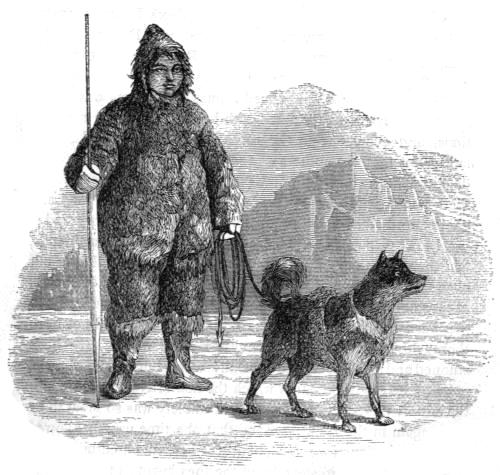
“In a few minutes an Esquimaux, with his seal spear in his
hand and his dog by his side, stood before us.”—Page 52.
You ask for a yarn, my friends. I’ll spin you one
with all my heart. You are all agreed that
Christmas is a merry time. It ought to be so
with you who have many kind friends around
you, a warm, blazing fire, plenty of roast beef and
plum-pudding, and other satisfactory things; and
good houses, and warm clothing, and numberless
other blessings, spiritual as well as temporal. But, I say boys,
that should not allow us to forget that there are thousands of
our fellow-creatures, and of our fellow-countrymen, too, who
are perhaps at this moment starving and freezing—dying
of cold and hunger. Those who have never suffered themselves
are apt not to think of the sufferings to which others are exposed.
I, however, can never forget a winter I spent—where do
you think? In Scotland. Oh, no. Shetland? Further north.
Iceland? Further north still. At the North Pole, or, at least,
not far off it. I went to sea in the old “Grampus,” Greenland
whaler, from Hull, for a summer trip, hoping to be back with
my friends by the end of October. The old “Grampus” was
barque-rigged, 350 tons burden, carried six whale-boats, three
hung up on each side, and a crew of fifty men, all told—consisting
of harpooners, boat-steerers, line-managers, coopers,
carpenters, foremast-men, landsmen, and apprentices. Each
man was to have a share in the profits on every whale caught,
so that all were interested. The ship was very strongly built,
with ice-knees to withstand the pressure of the ice. When I
examined her, and observed that her bows were one mass of
wood, I thought that nothing could harm her. I little knew,
at that time, the tremendous power of masses of ice when
grinding together, though no storm is raging over head, and the
sea beneath may seem calm as a mill-pond. Our courses, that
is our lower sails, were differently shaped to those of an ordinary
merchantman, being narrow at the foot, and fitted with
booms, so that they would swing round of themselves when, as
was often the case, a few hands only were left on board to work
the ship. But an important feature in our ship, in common
with other whalers, by which she might be known at a distance,
was the “crow’s nest” at her maintop-gallant-mast head. It
was like a big cask, and contained a seat, and a place for a telescope,
a speaking-trumpet, a flag, and a few other articles.
Here an officer was stationed, when whales were supposed to
be near, to watch for their appearance. Our boats were different
to those in general use aboard trading vessels, the stem
and stern were alike, and were about twenty-six feet long.
Each carried six whale-lines, of 120 fathoms in length, and
harpoons and lances, an axe for cutting the line should it foul,
and many other articles. The boats pulled from four to six
oars. The captain, or one of the mates, acted as harpooner,
the boat-steerer ranked next to him, and the line-manager
took the third place. The crew were formed into divisions
according to the number of boats, and thus each division consisted
of a harpooner, boat-steerer, line-manager, and four or
five rowers. The harpooner had command, and when in
pursuit pulled the bow oar. I looked forward, with great
delight, to the cruise. To see a real, palpable iceberg—not a
mere painted one in a panorama—and huge living whales
caught, was, I thought, worth going all round the world for,
and would amply repay me for any danger I might have to
overcome during the short summer trip I expected to make.
Captain Blowhard, the master of the “Grampus,” was a relative
of my mother, and had offered to take me as a supernumerary
in his own cabin. If I liked a sea life I was to continue in it
as a profession, but if not, I was to return on shore and learn
to wield a pen or a yard measure, instead of a harpoon or a
sword. The full complement of our crew, including some of
our best men, was to be made up at Lerwick, in Shetland, where
we called to take them on board. We remained three days in
the Sound, off the chief of those treeless but highly picturesque
islands, and, I must say, that a more hospitable, kind-hearted,
pleasant-mannered people I never met. They have, however,
one grievous cause of complaint. The map-makers will persist
in putting their group of islands up in an out-of-the-way corner
of the maps, so that a very large proportion of the human race
do not know where they are really to be found. In spite of
this, however, they are a tolerably happy and contented community.
Away we sailed on our voyage, which was anything
but a smooth one, for we were tumbled and tossed about by
the big waves in a manner which I thought must shake even
our stout ship to pieces. They did not, however; and, towards
the end of April, our captain showed me our position on the
map, not far from Davis Straits. The next morning, going on
deck, the sky very blue, the sea tolerably smooth, and the sun
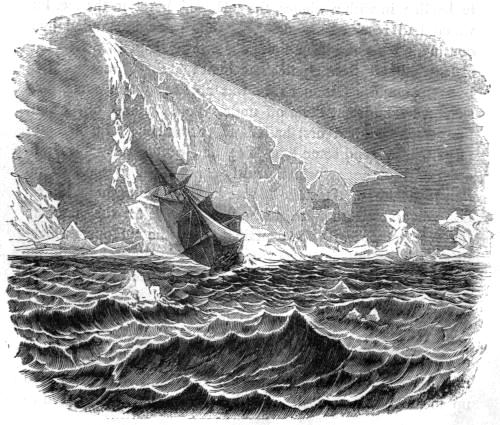
shining brightly, though the air was unusually keen, I saw close
to us, towering up high above the masts of the ship, a white,
floating mountain—an iceberg—pure as alabaster. Curiously
shaped peaks formed the upper part, which seemed to rest on
a base of arches, forming the mouths of caverns, of the most
delicate blue tint. The peaks glittered brightly in the sunbeams,
and every instant seemed to change their shape, either
as the berg moved slowly round, or we passed by. I exclaimed
that I had never seen anything so magnificent. “Wait a bit,
youngster, you’ll see stranger sights than that before long,”
observed Sam Grummet, our first mate, who had followed the
fortunes of Captain Blowhard for the best part of his life. I
had one shipmate of about my own age, “Jack;” he had
another name, but he was never called anything but Jack.
He and I soon became fast friends, though he was before the
mast and I was in the cabin. Then there was Sandy Dow, a
boat-steerer, a true-hearted and an honest Shetlander. He took
an interest in me from the first; not a mere fancy, but because I
was young, thoughtless, and inexperienced, and he earnestly
wished to do me good. A few days passed away after we got
among icebergs, and we were in hourly expectation of making
the ice. Even in calm weather it requires great vigilance to
discover an opening into which the ship may sail, but when
blowing hard, as it did when we entered Davis Straits, it was
a very anxious time. The danger was, however, chiefly from
the washing pieces of ice, which are often large masses just
even with the water. An experienced hand was stationed at
each yard-arm throughout the night to look out for them. My
wonder was, as I saw the men up there, that they did not drop
asleep and fall off, as I am sure that I should have done. At
length, a collection of sheets of ice appeared one morning
ahead of us, with passages between them, into which no sooner
did we run than we found the sea smooth as a mill-pond.
Gaily we glided along, sometimes through narrow lanes, at other
times across broad lakes bordered by ice. Our crow’s nest,
and boats, and gear, were got ready, the first being occupied
during the day by a look-out, for any moment whales might
appear, and the boats would start in chase. We were at this
time sailing along the coast of Greenland, and, although we
were from twelve to twenty miles off it, so lofty are the mountains,
and so pure the atmosphere, that often it appeared as if
we were close under them. Indeed, when we at length stood in
for the land, it seemed as if it was actually drawing back from
us, so long did we sail on and yet seemed to be getting no
nearer. I remembered the story of some of the old navigators
who, in consequence of this, thought the country was an
enchanted one, and rather than venture on it put about and
made the best of their way home again.
As the season advanced, the days gradually increased in
length, till the sun itself was visible at midnight, and darkness
was banished from our part of the globe. Still, there was a
difference, for the night always seemed calmer and more quiet
than the day. At length, our ears were gladdened by a shout
from the crow’s nest of “A fish, a fish; she spouts, she spouts.”
The crew had till then been moving leisurely about, but, in an
instant, all were in a state of the greatest excitement. Three
boats were sent away in pursuit. No one, by rule, goes in
the boats except those who row or steer; but just as Sandy
Dow’s boat was shoving off I slipped in, and so eager was
everybody to be off that they did not stop to put me on board
again. Away we dashed, the water foaming up at our bows.
Sandy’s practised eye had marked the spot where the whale had
gone down, and well he knew where it would come up again.
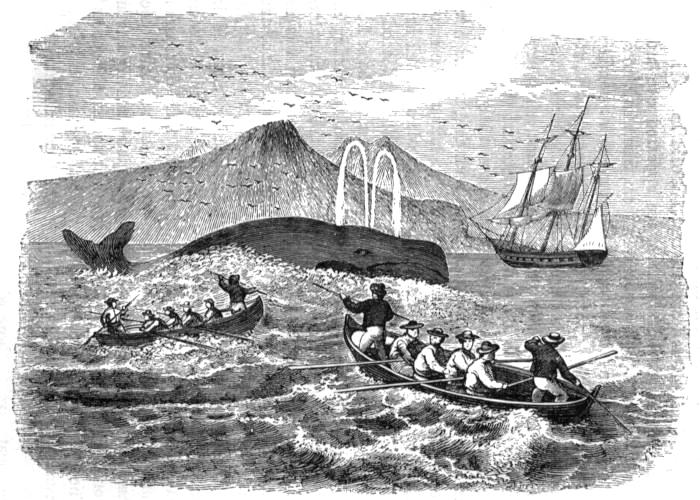
On we went, and there was a whirling in the waters, and the
monster’s back rose gradually out of it, while a column of
steam-like vapour ascended into the air.
“There was a whirling in the waters, and the monster’s
back rose gradually out of it.”—Page 41.
Our harpooner, who pulled the bow oar, rose from his seat.
For an instant he stood with his weapon in hand, then darted
it with all his strength against the side of the whale, into which
it sunk deeply. We were fast. Downwards plunged the
whale, the line flying out with lightning rapidity, making the
timber over which it passed smoke with the friction. We had
but short time for breathing. “She’ll soon be up again,” observed
Sandy. So, indeed, she was, when we again hauled up
to her with the line, and three lances were plunged into her
sides. The agony made her spring almost out of the water.
Then down she went, as if she could thus free herself from her
tormentors, but the depths of the ocean are no permanent
home for the whale, she must come up to breathe. She soon,
therefore, appeared, and again we were at her. As we drew
near, I saw a huge body in between us and the bright sun, and
instantly afterwards there was a loud flop, and a thick shower
of a ruddy liquid descended on our heads. We had reason to
be thankful that the whale’s tail did not strike us instead of
the water, or there would not have been much left either of
the boat or crew to pick up. We backed out of the monster’s
way, for she was, in her flurry, twisting and turning, and lashing
the water, till she was surrounded by a mass of crimson foam,
while our crew cheered lustily at the thought of the prize they
had won, for such a whale as we had now killed is worth not
much less than five hundred pounds. Meantime one of the
other boats had got fast to another whale, a huge monster,
which was giving a great deal of trouble. As soon, therefore,
as our capture turned over on her side, and showed that
she was dead, we stuck a flag into her, and, hauling in our
lines, went to the assistance of our shipmates. Fearing that
the whale would after all escape them, they closed in on her,
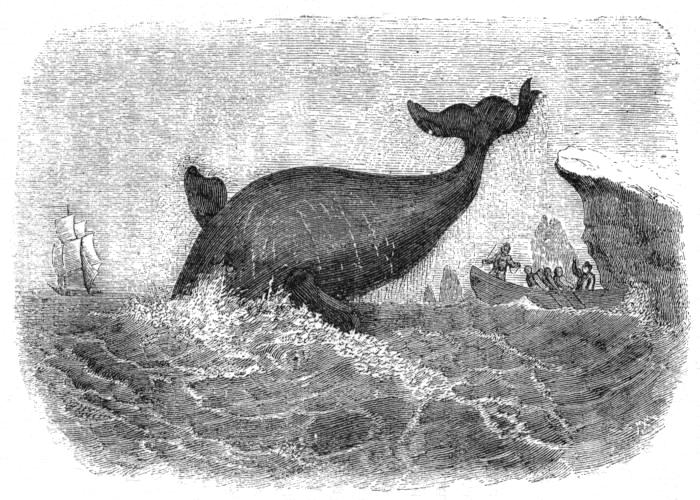
to plunge a fresh harpoon into her side. Loud cries for help
reached our ears. With one sweep of her tail she had knocked
the boat to pieces, and we feared had killed some if not all of
the crew. We dashed on with redoubled speed. “Make fast
to her, make fast,” shouted the harpooner, whom we met
swimming towards us. All the other men whom we saw had
secured oars with which to support themselves, and seemed in
no way distressed. We accordingly approached the whale.
Another harpoon, and a fresh shower of darts, were fixed in her,
and not till then would the crew consent to be taken on board.
Two poor fellows had, however, been struck by the whale, and
must have been instantly killed, for they sank immediately.
“With one sweep of her tail she knocked the boat
to pieces.”—Page 42.
But I have not time to give you an account of all
the whales we killed. We were unusually successful for the
season of the year and that side of the bay. We had now to
cross over to the west side, in some of the bays on which
coast whales were said to abound. To effect this, we were
obliged to pass through the middle ice, a work of great labour
and often of danger. The route chosen by our captain was
round by the north, across Melville Bay. At first we got on
merrily enough, a course of northerly winds having blown the
ice to the southward. After a time, however, the favourable
wind ceased, and the ice drifting slowly back, we were obliged
to commence cutting our way through it. While it moved thus
gently, with our ice saws we cut a canal towards the nearest
piece of clear water we could see ahead, and towed the ship
along it. Then, perhaps, we were able to make sail for an
hour or so, once more to find a barrier drawn across our
course. Sometimes for a whole day together the crew were
sawing and towing, and I heard some of them say that they
might have to go on that way for a month. Still they kept
their tempers, and worked with a will, in the hopes of getting
a full ship at the end. I was awaked, however, one morning,
by hearing the captain summoned on deck, and when I followed
him there I saw nothing but long faces, and not without
good reason. The clouds were flying rapidly overhead from
the S.S.W., and the ice was moving along and upheaving in a
peculiarly ominous manner. No time was lost in getting out
the ice saws to cut a dock into which to tow the ship. This
is a work of great labour, but all hands worked with a will, for
they well knew that the safety of the ship depended on the
speed with which it was accomplished. The ship had just
been towed into the dock, when the ice to the southward
began to lift and heave more violently than before. I saw the
captain, Mr. Grummet, Sandy Dow, and other old hands, looking
out anxiously, and I guessed not without good cause.
There was a loud rumbling crashing sound, something like
thunder, and yet more terrible. Not a single spot of clear
water could be seen, but far as the eye could reach towards
the south there appeared huge masses of ice rising with their
edges uppermost, leaping and overlapping each other, tearing
and crushing those below them to pieces. Still on they pressed,
mass behind mass, the places of those which rose up in front
immediately supplied by others in the rear. The ice surrounding
us was in violent commotion. Closer and closer it
pressed around. Suddenly, as if pushed towards us by some
unseen giant’s hand, a huge floe came gliding on. “A nip, a
nip,” cried the crew. Calmly the captain had stood watching
the upheaving of the icy sea. He now ordered all hands to
bring their bedding and clothes on deck. Some casks of provision
had already been got up. These were lowered on to
the ice alongside, and rolled to a distance. The crew followed,
each man laden with as much as he could carry.
Captain Blowhard brought up the rear with his chronometer,
compass, sextant, and other nautical instruments and books.
He had scarcely got thirty yards from the ship when she was
caught between two huge masses of ice, which came sweeping
by. Her stout timbers could no more resist the prodigious
pressure than could a wicker basket. One moment I looked
round, and she stood with her yards and rigging complete; the
next, a grinding and crashing sound reached my ears, and
when I again looked she was a mass of wreck, her tall masts
falling, and her sides literally pressed together till they met.
Part of the floe had gone underneath her, and then rising,
had cast up her cargo and stores, scattering them around, with
portions of the deck and bulwarks, and the boats. “I never
knew anything happen but what it might be worse,” observed
Sandy Dow, as he stood looking at the wreck. “There, see
what Providence has done for us. Our good ship is lost,
there’s no doubt about that; but the provisions, and stores,
and boats are saved, and with their help we may yet see our
homes again.” These words roused the drooping spirits of
our men, few of whom had before seen so complete a wreck
as was our good ship the “Grampus.” All hands were immediately
set to work to collect the various articles, and to drag
them to that part of the ice which appeared most secure.
Scarcely had the mischief been done than the commotion
ceased, in consequence of the wind falling, probably to the
southward, and also of the strength of the barriers which had
been thrown up outside us. Looking north, there appeared
to be one unbroken field of ice, while some thirty miles away
we could see a lofty cliff, which showed us our position.
That distant sight of land, barren and inhospitable as we knew
it to be, somewhat cheered our spirits, as we hoped that, should
the ice again break up, we might then at all events find firm
footing for our feet. We had no lack of materials for building
huts or tents, and these having been erected, and fires lighted,
the men were ordered to refresh themselves, and take some
rest. In a few hours the men were ready for work, when they
commenced constructing sleighs on which to drag our stores
to the land. Later in the year we should have been safe where
we were, but it would at present have been hazardous to remain,
lest the ice should move away to the southward, and
break up before we could escape from it. Our boats, too,
had received so much damage, that they were incapable of
conveying us to any of the Danish settlements before they had
received a considerable amount of repair. Though the cape
looked so near, we found it a very long journey to get there.
Most of the crew made three trips before all the articles we
required were conveyed to the spot which had been fixed on for
our encampment. We still entertained the hope that other
whalers might pass by within sight of the cape, and that we should
get on board them. A large quantity of stores and provisions
were still left on the ice, which it was supposed we should not
require. Week after week, however, passed by, the ice remained
firm, and no whaler appeared to take us off. Captain
Blowhard began to look very grave. I observed to him that
I thought we might make ourselves very comfortable where we
were till another season. “You do not know what an arctic
winter is, my lad,” he answered. “But it is not that. It is
bad enough to lose one’s ship, but I am thinking of those at
home who will be mourning us as dead. It is the thought of
their grief which makes me sad.” Our good old captain always
thought of others more than of himself.
I might spin a very long yarn about all the things that
happened to us, but I have not time. The cold of an arctic
winter soon began with all its rigour. We had built huts with
stones and earth, and parts of the wreck which we had dragged
over the ice, but we were very much cramped, and when the
cold began in earnest it penetrated into the interior, and we
could not keep ourselves warm even with our thick clothing in
bed. As soon, however, as the snow fell, the captain ordered
ice-huts to be built, the snow serving as mortar. Large slabs
of ice were cut out and built up as if they had been blocks of
stone, and with them eight huts were formed of the shape of
bee-hives. Each hut held from three to five people comfortably.
A long passage led to it, with three different slabs,
which served as doors; a slab of clear ice was placed on the
top to serve as a window. The bed-places were built of snow,
covered over thickly with the twigs of a low shrub which grew
on the hill side. This, the captain told us, was exactly the
fashion of the Esquimaux huts. We had brought several casks
of whale’s blubber, and this served us for fuel, and gave us
light and warmth; without it we could not have existed. We
had a number of shallow metal washhand basins, these were
filled with oil, and along one half of the edge of each a row of
wicks, made of moss, was arranged; on the opposite side a
piece of blubber was hung up, which, as it gradually melted,
replenished the basin with oil. This was in imitation of the
lamps used by the Esquimaux. One amply warmed each hut.
By thus taking a lesson from those we were accustomed to
call ignorant savages, we were enabled to exist, and retain our
health, when otherwise we must have perished. Our only fear
was that the blubber would not hold out till we could make
our escape. Our first huts had been built close under the
cliff; but, for the convenience of obtaining ice, we had
placed those we now occupied at some distance, close to
the water, or, rather, where the water would have been had
it not been frozen. Our boats, and a good many of our
stores, had been left under the cape. One night—now that
the winter had begun the night occupied the greater part of
the twenty-four hours—we were aroused by a tremendous
rushing, thundering sound. I slept in a hut with Mr. Grummet,
Sandy Dow, and the youngest mate. They hurriedly put on
their clothes and ran out. I followed their example, though
I felt almost frozen in an instant by the bitter wind which met
us, for a storm was raging. By the twilight which prevails in
that region during night, we could see huge pieces of the cliff
and masses of snow come tumbling down in quick succession,
one after the other. It was a perfect avalanche, and in a few
minutes the whole spot where our summer huts had stood, and
where our stores and boats now were, was completely overwhelmed.
Some of the men even ran away from our present
abode, thinking that that also would be overwhelmed, but the
captain shouted to them to stand fast, as he was sure that the
falling cliff would not reach us, nor did it.
With foreboding hearts we once more hurried back into our
huts. Our boats, on which we might have to depend to escape
from this inhospitable region, were destroyed; a large portion
of the fuel, without which we could not exist, was buried
deeply under rocks and snow. As soon as the men had
finished taking their necessary rest, and had breakfasted, all
hands set off to the scene of the disaster to try and recover
some of the stores. On arriving at the spot the task appeared
hopeless, so vast was the mass of ruin which covered them.
After exploring the ground and digging in various spots, in the
hope of finding only snow, we were obliged to return homewards.
When Mr. Grummet and I reached our hut, we found
that Sandy Dow was not with us. Mr. Grummet asked when
I had last seen him. I could not tell, but thought that he
must have gone into one of the other huts. We waited dinner
for him for some time, but still he did not appear. At last I
offered to run round to the other huts and enquire. A snow-storm
was raging, and I found it no easy matter to make my
way from hut to hut. I did so, however, but no one had seen
our friend. When I went to the captain he said that Dow
must have certainly remained at the cape, and that a party
must set off immediately and try to find him. I smuggled
myself in with the party, though the captain was unwilling to
let me go, fearing that I might not be able to endure the cold
and fatigue. Mr. Grummet led the party, and off we set,
thinking that there would be no difficulty in finding the way in
spite of the snow-storm. We went on and on, supposing that
we should every instant arrive at the cape, and that the snow
hid it from our view. Still we did not reach it. At last Mr.
Grummet, in a tone of vexation, declared that he had lost his
way. The distance was so short, and we had been so accustomed
to be guided by the high cape ever in view, that we had
come without a compass. The snow came down thicker and
thicker, and the prospect of finding our way appeared more and
more hopeless. We shouted, thinking that we might possibly
after all not be far from the huts, but there was no answer.
Mr. Grummet and another officer, who had guns, fired them off,
but no report was heard in return. If we remained quiet we
might be frozen, for the cold was intense, so we pushed on in
the hope that we might before long sight either the huts or the
cape. Some of the men proposed that we should halt, build
up a snow-hut, and shelter ourselves in it till the snow was
over, but to this our leader would not consent. He expressed
his belief that the snow might fall for several days, so that we
might be completely covered up and unable to work our way
out of our hut. Besides, we had come to look for Sandy Dow,
and nothing should induce him to give up the search as long
as he could move a foot forward. So on we went; every now
and then a gun was fired, and we all shouted at the top of our
voices. We continued this practice, though with little hope
of an answer. We were, therefore, still more surprised when a
shout was heard very like ours, and which came from no great
distance. Again we shouted, and again there was a reply.
Was it only an echo? It was not quite like enough for that.
Directly after we heard a bark, and in a few minutes an
Esquimaux, with his seal spear in his hand and his dog by his
side, stood before us. He saluted us in a friendly manner.
To our great satisfaction we found that he could speak a few
words of English. He told us that he knew a ship had been
lost, and that we were in the neighbourhood, but he did not
know exactly where we were located. On our telling him that
it was near the cape, he set off in a perfectly opposite direction
to that in which we had been going. We explained that we
were in search of a lost shipmate, and begged him to help us
in our search. To this he at once consented. The snow fell
thicker than ever, still our new friend led on with unwavering
steps. I felt very sad, for I heard Mr. Grummet say that he
scarcely expected to find my friend Sandy alive. An expressive
action of the Esquimaux confirmed this opinion. Still we
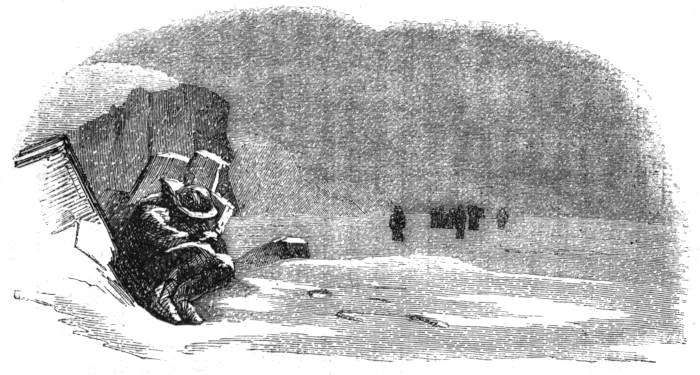
pushed on; at length the cliff appeared before us, and as the
snow slackened a little, we could discern a figure seated on a
rock and almost bent double, as if to try and avoid the icy
blast. That it was Sandy Dow we had little doubt; we
hurried towards him; we called his name, but he did not look
up. Mr. Grummet and others went up to him and shook him.
A low groan was the only sound he uttered. Still that was
sufficient to give us hope that he would recover. Mr. Grummet
poured a few mouthfuls of brandy down his throat, and then
two of the strongest of our party took him between them and
hurried him along as fast as they could go. The great thing
was to restore circulation. The desired effect was produced,
and we had the satisfaction of seeing our friend, under the
care of the doctor, himself again. Sandy had stopped behind
to explore, when, the snow coming on, he had been prevented
reaching the hut, but fortunately found his way back again to
the cliff.
“We could discern a figure seated on a rock and almost bent
double, as if to try and avoid the icy blast.”—Page 52.
Our new friend Upnick told us that he was one of a small
party of natives settled for the winter in a bay about ten miles
off, and that he was out on an expedition to catch seals when
he fell in with us. He was a merry, happy fellow. We
wanted him to stop with us, but he replied that he must go
back to his family to supply them with blubber and oil for
their lamps, and that then he would come back to us. Some
of our men agreed to accompany him. When they came back
they did not give a very tempting account of the Esquimaux
mode of life. Upnick accompanied them. His appearance
somewhat raised the spirits of our party, which were getting
very low. Our oil was well-nigh expended, and it seemed
doubtful whether our provisions would hold out to the spring.
It was also a weary time, for though our captain and officers
did their best to amuse us, we had but few books, and the
weather often kept us for days and days within our huts.
Upnick, however, offered to show us how to catch seals, which
would give us both food and fuel. He went off some distance
from the land, where there was less snow, and his dog hunted
about till he found a small hole. To this hole he said the
seals came to breathe; he then told our men to sit quiet.
They had to wait a long time, till a sound of blowing was
heard. Quick as lightning Upnick darted his harpoon down
through the hole. The tightened line showed that it had got
hold of something; he then began to work away with his
ice-knife till he had considerably enlarged the hole, when he
drew forth a full-sized seal. He killed three others in the
same way, which he and our men dragged to the huts. We
gave him some coloured pocket handkerchiefs and a hatchet in
return. This afforded, indeed, a seasonable supply of fuel,
and we were also very glad of the flesh for food. It was
found, however, that though Upnick had showed us how to
catch the seals, our men could but ill follow out his lessons.
In the first place they had great difficulty in finding the
holes, and when found they were not in time to catch the
seals, or did not hear them blow, or did not properly direct
their harpoons.
We had hung up the seals on spars just outside the huts,
that we might chop off as much as we required. We had been
for some time asleep one night, when Dow awoke, saying that
he heard a peculiar noise outside. He instantly jumped up,
and slipping on his clothes, ran out with a harpoon in his hand.
He had not been gone long before we heard him shouting
for help. Mr. Grummet had been meantime putting on his
clothes, and followed with a loaded musket. I slipped out
after him, when what was my horror to see Sandy Dow in the
embrace of a huge white polar bear! “Fire, fire, or he will
squeeze the breath out of me,” he cried out. Not only was
the monster squeezing poor Sandy, but he was threatening to
take a piece out of his shoulder with his huge jaws. No time
was to be lost; Mr. Grummet advanced cautiously and fired
close past Sandy’s head down the animal’s mouth. Another
man came up the next instant with a whale spear, which he
plunged into its side, when the bear, letting go his hold of
Sandy, rolled over, and was very soon dead. The creature
had been attracted to the place by the seals, of which he had
already eaten a large piece. He was welcome to it, considering
that his own carcass afforded us many a welcome meal. We
carried Sandy into the hut, for he was very much hurt by the
bear. “It’s an ill wind that blaws naebody guid,” he
observed. “If the bear had na grabbed me, we should have
gane without his steaks.”
The supply of fresh meat was very valuable, and restored
most of the invalids to health. Still there was the want of
blubber for our lamps. Upnick, however, on seeing that we
could not catch the seals as well as he did, made a bargain
with the captain to act as our hunter. Some of the men by
degrees became more expert, and with his help obtained a
sufficient supply to keep our lamps burning. One day, however,
he told us that he must go away, and, in spite of all the
captain’s expostulations, he took his departure with the treasures
he had accumulated, and we were left to our own resources.
Oftentimes we were reduced to a very sad plight, and to make
our oil last longer, we had all to congregate in two or three
huts; this increased the heat certainly, but, as there was no
means of ventilation, it was far from pleasant. Such was the
state of things when Christmas day arrived. Our crew were
divided into two parties; our fare was seals’ blubber, and
twenty-five of us were seated round one oil lamp in a hut
about twelve feet in diameter. We had materials for a plum
pudding, but as hot water was too valuable to throw away we
had mixed it porridge fashion: Still we tried to make ourselves
as merry as circumstances would allow. Now and then one
of the party would brave the snow-storm raging outside for the
sake of carrying some amusing message to our friends in the
other hut, knowing that we should get a facetious answer in
return. After this, however, matters grew worse; in vain the
best hunters went out to catch seals; not a pint of oil remained,
and even inside our huts we could not have existed
twenty-four hours without the warmth of the lamp. We talked
once more of trying to dig down to our stores, but the crew
soon found that their strength was inadequate to the undertaking.
And now that Christmas had gone by, that time which
we had all expected to pass with our families in comfort and
happiness at home, the true horrors of our situation burst on
us. The scurvy, that scourge of mariners, broke out, and
several of our poor fellows could scarcely move hand or foot.
All those who could get out were engaged in seal killing; their
success was small, though they procured just sufficient to keep
two and sometimes three lamps burning at a time. Week
after week and month after month passed by, and we began to
fear that we should not escape from our perilous position till
late in the summer, when perhaps some whalers might pass
within sight of our encampment. How many of us might be
alive then was the question. Death had already begun to thin
our numbers. One day, Jack and I, who had kept our health
better than any of our shipmates, were amusing ourselves at a
little distance from the hut, when we saw, approaching, several
sleighs drawn by dogs, with an Esquimaux walking before the
first to lead the way. We ran into the hut to announce the
coming of the strangers, and then ran out again to meet them.
The first man was Upnick; the next we took to be an Esquimaux,
but a cheery voice in English hailed us, and we soon
found that this was an expedition sent expressly for our relief.
Upnick, on leaving us, had travelled south, and at length
had fallen in with a whaler, the “Hope,” beset in the ice, but
which had received no damage. She was commanded by a
cousin and an old friend of our worthy captain. He had
satisfied himself from Upnick’s account that the “Grampus” had
been lost, and, as soon as he was able to collect some dog-sleighs,
he had sent them off under the command of his son,
the person who had first hailed us, to our relief; he had not
forgotten to send some lime-juice, and potted vegetables, and
other anti-scorbutics, which greatly contributed to the restoration
to health of the sick. Some of our men without hesitation
volunteered to remain where they were till the summer;
the rest set out with the captain to join the “Hope,” which,
being nearly full, it was expected would return home early
in the summer, or as soon as she was released from her icy
prison.
We were warmly welcomed on board the “Hope” by Captain
Tom Blowhard and his officers and crew, and soon forgot all
the toils and dangers we had gone through. Many people
might have pitied us having to live on board a whaler frozen
up in the ice, but we did not pity ourselves, for, compared to
the life we had so long led, we considered that we fared luxuriously.
Even, however, when the sun shone brightly and the
days grew long we were not free of the ice, and I heard some
of the crew remarking that we might possibly remain beset the
whole summer through. The captain replied, when he heard
of this, that if an inch of water was to be seen within a mile
of the ship we would work our way to it. He was as good as
his word, and before long the ice-saws were set to work; and,
by hard toil, often sawing away for a fortnight, we were once
more free of the ice and bounding over the heaving waves
on a southerly course. We had still, however, reminders of the
northern latitude in which we were sailing, in the shape of
icebergs, to avoid which, during the night, we had to keep a
very bright look out. One afternoon, dinner just being over
when I went on deck, a very fine one, on which the sun shone
brightly, appeared right ahead. As I stood watching it, the
top appeared to be bending forward; so it was, there it came,
the whole mountain mass collapsing in the most extraordinary
manner, till a few fragments alone appeared above the waters
to show where it had been. It was fortunate that we were not
close under it, or we might have been overwhelmed by the
ruins.
This was the last among the many providential escapes for
which I had to be thankful during my trip to the North Pole.
Three weeks afterwards, we were gladdening the hearts of our
relatives and friends in Hull, and sending some of the more
sensitive into hysterics in consequence of our sudden re-appearance
after they had so long given us up as lost. Terrible as
were our sufferings at times, now that they were over I could
look back at my adventures with pleasure, and never grew
weary of benefiting my friends with the yarn which I have just
spun for your amusement.
A RESCUE IN THE ROCKY MOUNTAINS.
By R. M. Ballantyne, Author of “The Life-boat;” “A Tale of our Coast Heroes;” “Silver Lake;
or, Lost in the Snow,” &c.
Quito was a young brave of the Tsekanie Indians,
one of the tribes which dwell among the Rocky
Mountains of North America.
The squaws said of him that he was tall as the
pine tree, gentle as a woman, yet strong and bold
like the grizly bear; and there is no doubt that
much truth lay in what they said, for the young
Tsekanie could throw the spear, hurl the tomahawk, bestride
the wild horse, or kill the buffalo, better than any man in his
tribe; although, unlike his brother braves, he never boasted of
his prowess, nor talked big swelling words of what he would
do to his enemies when he got hold of them! In fact, Quito
was unlike a savage in many respects, and very like to a
civilized gentleman in some things; for, notwithstanding his
well-known courage and physical powers, he did not delight in
war. He never went on the war-path except when he believed
there was very good reason for so doing. He never scalped
an old man, or a woman, or a child, which is more than
could be said of most of his comrades. It was even said of
him that on more than one occasion he had spared the life and
the scalp of a prostrate foe.
On the other hand, Quito was fond of meditation and study.
Of course he did not study printed books, such silently eloquent
and sweet companions being utterly unknown in those far
western regions, but he studied the book of nature, and was
wont to say, in a quiet way, that he loved to look into the
works of the Great Manitou, by which term he meant God.
Quito did not say this to everybody, for he was very reserved;
he said it to his wife, whose name in the Indian language
was Laughing-eye.
Laughing-eye had a loving and sympathetic heart, and Quito
treated her as an equal, in which respect also he differed widely
from his brethren, who were more or less addicted to beating
their wives.
Once Quito went a long journey to the southward, and it so
chanced that he met with a missionary in his travels, who did
not miss the opportunity of telling him of the gospel of Jesus
Christ. Among other things, he learned from this missionary
that Christians were usually united in matrimony by a clergyman,
which, the missionary explained, meant a servant and
preacher of the Lord Jesus. Quito had been married in the
regular Indian fashion—that is to say, he had gone to his
father-in-law’s tent, demanded Laughing-eye for his wife, paid
down the price required in the shape of cloth, gums, beads, and
trinkets of various kinds, such as are supplied by fur traders,
and then carried her off to his own wigwam.
A strange but strong desire now seized the young Indian to
be married after the Christian manner to Laughing-eye, so he
returned to his home in the Rocky Mountains, resolving to take
his wife to the mission-station without delay.
Quito had a bosom friend, named Bunker, a white man and
a hunter. Bunker might well have been ashamed of his name,
as far as sound went, but he was not. He was proud of it.
He was wont to say, sometimes, that “the Bunkers was comed
of a good stock, an’ had bin straight-for’ard hunters in the Rocky
Mountains, off an’ on, for nigh a century, an’ he hoped he would
never disgrace his forefathers.” There was no fear of that, for
Bunker was as sturdy, and honest, and simple-minded a man
as ever shot a grizly bear, or trapped a beaver. He, too, was
fond of meditation, and had great delight in the society of
Quito.
On his way home the young Indian met with Bunker, who
said he was going to visit some traps, but that he would follow
his friend’s trail the next day, and might perhaps overtake him
before he reached his village.
It was a beautiful autumn evening when Quito approached
his mountain home. Not the finest park of the greatest noble
in our land could compare with the magnificent scenery through
which the Indian walked, with his gun on his shoulder, and
his yellow leathern garments—fashioned and richly wrought by
the fingers of Laughing-eye—fluttering with innumerable fringes
and other ornaments in the gentle breeze. His dark eye
glanced from side to side with that sharp restless motion which
is peculiar to red Indians and hunters of the far west, whose
lives are passed in the midst of danger from lurking enemies
and wild beasts, but the restless glance was the result of caution,
not of anxiety. Quito’s breast was as calm and unruffled
as the surface of the lakelet along whose margin he walked,
and, although he kept a sharp look-out, from the mere force of
habit, he thought no more of enemies at that time than did the
little birds which twittered in the bushes, unconscious and unmindful
of the hawk and eagle that soared high over head.
There were woods and valleys, through which flowed streams
of limpid water. Here and there were swamps, in which
thousands of water-fowl and frogs filled the air with melody,
for the frogs of America are a musical race, and a certain class
of them actually whistle in their felicity at certain periods of
the year; their whistle, however, is only one intermittent note.
Elsewhere undulating plains, or prairies, gave variety to the
scene, and the whole was backed by the lofty, rugged, and
snow-clad peaks of the vast mountain range which runs through
the whole continent from north to south.
On reaching the summit of a hill, on which Quito had often
halted when returning from his frequent hunting expeditions,
to gaze in satisfaction at his village in the far distance, and
think of Laughing-eye, a shade of deep and unmistakeable
anxiety crossed his grave features, and instead of halting, as
he was wont to do, he hastened onwards at redoubled speed,
for his eye missed the wreaths of smoke that at other times
had curled up above the trees, and one or two of the wigwams
which used to be visible from that point of view were gone.
The terrible anxiety that filled Quito’s breast was in a short
time changed into fierce despair, when he suddenly turned round
the base of a cliff, behind which his village lay, and beheld
his late home a mass of blackened ruins. Little circles of
grey ashes indicated where the tents had been, and all over
the ground were scattered charred bones and masses of putrefying
flesh, which told of ruthless murder.
Savage nature is not like civilized. No sound or word
escaped the desolate Indian, who now knew that he was the
last of his race, but the heaving bosom, the clenched teeth,
and compressed lips, the fierce glittering eye, and the darkly
frowning brows, told of a deadly struggle of anguish and wrath
within.
While Quito was still gazing at the dreadful scene, he observed
something move among the bushes near him and darted
towards it. It proved to be an old woman, who was blind and
scarcely able to make herself understood. She was evidently
famishing from hunger, so Quito’s first care was to give her a
little of the dried meat which formed his store of provisions.
After she had devoured some of it, and drunk greedily of the
water which he fetched from a neighbouring stream in a cup
of birch bark, she told him that the camp had been suddenly
attacked, some days before, by a war-party of enemies, who
had slain all the men and old women, and carried the young
women away into captivity—among them Laughing-eye.
As far as outward appearance went, Quito received the news
with calm indifference, but his subsequent actions told another
tale. His first step was to erect a sort of hut out of the
broken fragments of wigwams that lay around, into which he
led the old woman, and placed within her reach a large vessel
of water with a small bark cup. He then gave her all his provisions,
sufficient for more than a week’s consumption, and told
her he would return to her as soon as possible. The poor
creature appeared grateful, and sought to detain him, but this
he would not permit Having learned from her the name of
the tribe that attacked the village, and that she had escaped
in the general mêlée by crawling into the bush, he asked which
way their enemies had gone. When she had related all she had
to tell on the subject, Quito left her, and divested himself of
nearly every article of unnecessary costume, placed a tomahawk
and scalping-knife in his girdle, slung a short bow and a
quiver of arrows on his back, and, throwing his gun on his
shoulder, prepared to quit the spot. Before leaving, he
kneeled beside the old squaw and said in her ear:—
“In a day or two Bunker will be here. Tell him I have
gone to the west by the Mustang Valley, and that he must
follow my trail quickly.”
The old woman promised to do this, and then Quito took
his leave.
For several days he followed up the trail of the retreating
Indians with the perseverance and unerring certainty of a
bloodhound. He took so little rest and went on with such
unflagging energy that he gradually drew near to them, a fact
which became evident from the heat that still remained in the
ashes of their camp fires when he came upon them.
At last he reached one of those mighty rivers which traverse
the great continent from west to east. Here he found that his
enemies had crossed, and he prepared to plunge in and swim
over, though the current was turbulent, deep, and broad.
Tying his powder in a piece of leather on the top of his head
to keep it dry, he was about to take the water when he espied
an old Indian canoe, and proceeded to examine before launching
it. While thus engaged he was arrested by one of the most
astonishing sights that had ever met his gaze.
Rapidly and perceptibly the great river that rolled before
him began to diminish in volume. Accustomed as he was to
all the varying aspects of lake and stream in their conditions
of flood and drought, Quito had never seen anything at all
resembling that which now occurred before his eyes. His
wonted reason and sagacity were at fault; it was utterly
unaccountable!
Naturally his untutored mind began to look upon the phenomenon
in a superstitious light. At first he was alarmed,
and sat down to gaze in silent wonder, while the water continued
to sink in its bed, began to flow sluggishly, then collected
into pools, and finally ceased to flow altogether, leaving
the bed of the river quite dry in many places. After a time
it occurred to the Indian that this might be a direct interposition
on the part of the Manitou, to enable him to cross on
foot and pursue his enemies without delay. Full of this idea,
Quito rose, and, with feelings of deep awe, went down the
bank of the river and began to walk across its bed.
He had got about half way over when he was arrested by a
peculiar sound, something like distant thunder but more continuous;
he stopped, and listened intently. He was more
perplexed than ever, for no sound of the wilderness with which
he was acquainted at all resembled it; it seemed to come from
the mountains, but a bend in the river concealed the distance
from his view.
The sound increased gradually in strength until it became a
continuous roar, louder than the fiercest gale that ever blew.
Quito stood erect and motionless with eyes and nostrils distended,
uncertain what to do, when suddenly a mighty flood of
waters came thundering round the bend of the river above him.
On it came, with deafening clamour, a wall of water full twenty
feet high, tumbling mighty trees and huge stones over its
gleaming crest like playthings, and licking them up again to
hurl them on in mad fury!
Quito bounded across the dry bed of the river for his life, and
reached the opposite bank only a few seconds before the rushing
torrent swept by, leaving a very chaos on its surging breast.
Fetching his breath quickly, the Indian turned and gazed
long in solemn silence at the magnificent scene. Then the
thought of Laughing-eye recurred to him. He turned at once
and pursued his way with redoubled speed.
Only a few miles above this spot he discovered the cause of
the phenomenon he had just witnessed. A land-slip, on an
unusually large scale, had occurred. It had been caused by
the water undermining the soil of a high bank. The half of a
huge hill had tumbled into the river and dammed it across,
so that no water could escape. Trees were heaped in wild
confusion—some with their heads in the earth and their roots
in the air; piles of stones and rubbish crushed the shattered
limbs, and great fissures yawned everywhere in the mass.
Ere long the searching water had cut through the obstruction,
and, bursting away in all the strength of its recovered freedom,
had produced the startling results which we have described.
Day after day Quito followed the trail of his enemies, and
night after night he lay down on the hard ground to snatch a
couple of hours’ repose before resuming the chase, regardless of
fatigue or cold, for hope steeled his muscles, and his heart was
warmed by love.
At last, one evening he came upon them. He saw their
wigwams on a little plain, which was free from shrubs and trees,
although surrounded by the latter. The smoke of their fires
curled up in straight columns, for the air was so still that the
sound of the horses’ jaws munching their food could be distinctly
heard at some distance from the camp.
Quito lay down until the shades of night fell, and watched
his enemies. He saw them post sentries for the night; he
noted the silence that gradually stole over the scene as the
savages lay down to rest, and he saw the fires die down until
the whole camp was shrouded in darkness. During the hours
that he watched there he lay as still as a fallen tree—only his
dark eyes moved about, restlessly.
At last he rose and prepared for action. Leaving his quiver
and bow behind him, he took his gun and advanced—at first in
a crouching attitude. He might have been a shadow, so noiseless
were his motions. The edge of the forest gained, he sank
into the long grass of the prairie, like a phantom, and disappeared.
Thenceforth his progress was like to that of the
serpent. Pushing his gun before him he gradually worked his
way forward until he had passed the line of sentries and gained
the midst of the camp. Here his proceedings were cool and
daring.
He first crawled among the horses, and made up his mind
as to which two of them were the best. Then he went to the
chief’s tent, and, gently raising the curtain of skin, looked in.
His enemy was there sound asleep. He could have stabbed
him to the heart, as he lay, with such deadly certainty, that he
would have died without being able to utter a cry, but Quito’s
object was to rescue, not to avenge. He observed that the
chief lay alone in his tent. A grim smile crossed the Indian’s
face as he lowered the curtain and again sank among the grass.
There was a large tent near to that of the chief, and Quito
knew that there were women in it, but whether or not his wife
was there he had not been able to ascertain from his distant
view-point in the woods.
Raising the edge of this tent, he found that it was full of
slumbering women, but it required a close inspection of their
faces in the dark to ascertain who they were—so close that his
face almost touched that of the first woman he looked at. His
heart throbbed, for he thought he recognised the features of
Laughing-eye. Just then the sleeper drew a long breath and
sighed, and Quito knew that it was his lost one. He also
guessed that the others were the women of his own tribe, but
he knew that it would be impossible for him, single-handed, to
save them at that time. To save his wife would be difficult
enough, he thought.
Putting his face close to that of Laughing-eye, he heaved a
long-drawn sigh, and yawned pretty loudly, imitating a woman’s
voice as much as possible, and giving his wife a push. She
half awoke, and, turning round in a sleepy way, muttered a few
unintelligible words.
Quito again drew a long breath, and muttered a sleepy remark.
Laughing-eye was startled. She raised her head to listen.
This was the moment of danger. If taken by surprise, she
might utter a cry or an exclamation which might awaken her
companions, and the rousing of the whole camp would be
certain to follow, for Indians’ ears are very sharp. Quito felt
the difficulty and danger of his position, but there was only
one course left open to him.
“Hist! Laughing-eye,” he whispered, close in his wife’s ear.
Next instant his left hand was on her mouth, and with his
right he pressed her down, as she made an effort to rise. The
effort was momentary, almost involuntary. Immediately she
lay so still that Quito knew she had recognised him, so he
whispered a few more words, and released her.
Nothing more was said. Speech was not necessary, for
Indians’ wits are sharpened by experience. Quito glided, one
might almost say melted, away, and Laughing-eye followed
him so quietly through the same aperture that the blanket
which she left behind appeared merely to subside into a flat
state. Quito did not stop to speak outside. Gliding through
the grass, serpent-like, in the direction of the horses, he was
followed by his wife, and after some minutes, for they moved
very slowly, they were clear of the group of tents. Not far
from them one of the sentinels stood leaning on his rifle, and
gazing into the far-off horizon, where a faint glimmer of light
showed that the moon was about to rise.
To pass this man was difficult, indeed, it would have been
impossible, had he not been a very young man, whose eyes
were rather heavy, and whose experience of Indian warfare
was slight. They succeeded, however, and Quito ceased to
advance when he came up to a splendid horse which stood
picketted by a long line to a peg driven into the ground, and
with its fore feet “hobbled,” or tied together. Without a word
he cut the hobbles, and the line by which the animal was
fastened, the end of which last he placed in Laughing-eye’s
hand. She had crept up alongside of her husband, and
remained perfectly quiet, while he glided away from her.
She might have remained perhaps two minutes in this state,
when, peeping upwards, she saw another horse moving towards
her. Instantly her husband was by her side, and she saw that
the end of a rope was in his hand.
“Go first,” whispered Quito in her ear, “fly towards the
rising sun.”
The whisper was so soft that the very grasshoppers at their
side must have failed to hear it. In a moment both Indians
stood up, and Quito lifted his wife lightly on the horse whose
larryat she held.
Such a proceeding could not, of course, pass unnoticed in an
Indian camp. Instantly a yell was given by a sentry. Just as
Quito vaulted on his steed’s back a couple of arrows whizzed past
his ear, and the young warrior whom they had first seen darted at
his horse’s head. A blow from the butt of Quito’s gun felled
him, and in another moment husband and wife were bounding
away at full stretch over the plain—the former giving utterance
to a shout of defiance, which the savages returned with yells
of fury, accompanied by a mixed shower of arrows and
bullets.
Just as Quito was bounding over the crest of a mound the
chief of the Indians fired a shot at a venture. He took no aim,
but the bullet sped with fatal accuracy, and pierced the heart
of Quito’s horse, which fell heavily to the earth, sending its
rider over its head. The Indian fell with such violence that he
lay for a moment or two stunned. Seeing this, Laughing-eye
at once reined up, and galloping back leaped to the ground.
Quito rose, and, staggering towards the horse, made an effort
to lift his wife on to its back. He failed, and before another
attempt could be made the unfortunate fugitives were surrounded
and recaptured.
Hopeless, indeed, was Quito’s case now. Death by slow
torture was certain to be his end, while Laughing-eye would be
doomed to slavery. Yet both husband and wife conducted
themselves with quiet dignity, and an assumption of stoical
indifference.
But their case was not so hopeless as they supposed. Other
eyes besides those of their enemies witnessed what had
passed.
Quito’s bosom friend, Bunker, on reaching the desolate
village, and learning from the old woman what had occurred,
set off in pursuit of his friend without delay, and travelled at
his utmost speed. But the man whom he followed was about
equal to himself in physical powers and endurance, so that he
could not overtake him easily. On the way he fell in with four
trappers like himself, who readily consented to join him.
These all continued to advance together night and day, with
the exception of the brief time devoted to necessary sleep, but
they did not overtake Quito until he had reached the camp of
his enemies. They gained on him during the time he lay
watching the camp, and waiting for the hour of action. Arriving
at the spot where he had left his bow and arrows, not half an
hour after he had quitted it, they at once guessed that he was
reconnoitring the camp, and resolved to await the issue.
While the hunters were yet discussing the best method of
procedure, the yell of the sentry was heard.
“Down with you, lads,” cried Bunker, sinking into the grass,
“they’ll come this way.”
“No,” cried one of the others, “they’re off to the left—a
man an’ a squaw.”
“That’s them—Quito and Laughing-eye,” exclaimed Bunker,
“an’ all the reptiles after them. Now, boys, git hold o’ the
horses—look alive!”
The sturdy hunter set the example. Big though he was, he
bounded over the bushes like a deer, followed by his comrades.
While all the men of the camp were in hot pursuit of the
fugitives they ran up to the horses, and each secured one, which
he mounted, having previously cut the hobbles of all the rest
and sent them flying over the plain.
A regular fight then ensued, in which the Indians were
beaten and their captives rescued. The remainder of the
horses, too, were secured, and, mounted on these, the whole
party returned to their village in the Mustang Valley.
Here the state of things was so desolate and mournful that
it was resolved all the Indians who remained should start with
Quito and his wife for the Mission Station in the south. This
intention was carried out the next day, and they parted with
many expressions of good-will from their friends the hunters,
who returned to their wild and lonesome occupations of shooting
and trapping in the mountains.
After a long journey the Indians reached the Mission Station,
where they remained three weeks under the instruction of the
missionary. At the end of that time they expressed their desire
to join themselves to the followers of Jesus Christ, and were
baptized. Then Quito begged that the missionary would unite
him to his wife after the manner of the Christians. Of course
there could be no objection to this request, so it was complied
with—and thus Quito and Laughing-eye were baptized and
married on the same day.
LOST AND FOUND. A STORY OF TWO CHRISTMAS DAYS.
By Edwin Hodder, Author of “Memories of New Zealand Life;”
“Junior Clerk;” “Tossed on the Waves,” &c.
If a merry day is associated with painful memories,
its charm is lost, it is a day to be avoided, one
would wish to let it pass unheeded; any attempt
to make it gay only increases the gloom, and if
the unpleasant remembrances are indulged, they
come back on the day which commemorates them
with a living reality, making the mind morbid and
unhappy; and cherishing dead regrets is as vain and wrong a
thing as retaining the remains of a loved life, which should be
buried out of one’s sight.
Christmas day is not a sad and gloomy day to me now, but
it was once; and then such a party as this you are giving to-night,
Mr. Merry, would have been of all things in the world
the one that I could not have endured, for it would have
recalled so many sad circumstances to my mind, that, with all
the fun and gaiety of you youngsters, I could not have thrown
off the shroud of regrets which such a scene as this would
have cast around me. But those days are past, and now Christmas
day is one of the happiest of the year; and how all this
came to pass I am going to tell you.
When I was a boy about fifteen or sixteen, I was at Dr.
Spanker’s school, in Berkshire, and if anybody ever had a life
like a long summer day, without a cloud or a cold nipping
wind, that life was mine in those days. The boys were the
heartiest, jolliest fellows that ever threw a quoit or kicked a
ball; we knew every orchard, every bathing place, every level
piece of land for racing or cricket, every hill side for nutting,
and hedge-row for blackberrying, within twelve miles of the
school. We were all hand-and-glove in every exploit, and
many a glorious scrape we got into. Poor Dr. Spanker, how
it was he did not go out of his mind we never could make out;
but he was such an easy-going, good-natured man, and so
thoroughly sympathised with young life, that he winked at
many things which other schoolmasters would have made a
terrible fuss about, and never punished anybody for their freaks
unless those freaks infringed upon some moral law. We loved
the old Doctor as cordially as if he had been our father, and
in the whole school I don’t believe there was one boy who
would not rather have had his teeth knocked down his throat
than have wilfully said or done anything which would have
given the dear old gentleman pain.
The boys were not mere school acquaintances, but real
friends; and now, although years have passed away, the best
friends I have in the world are those who were my friends
when I was a boy at school. Andrew Morris was one of my
great chums, and never did two boys “hit it” more thoroughly
than did we. In sport, in study, and in more serious things,
our thoughts, and desires, and aspirations were as one.
It was in the winter of 18— that my story commences.
Christmas was at hand; the school had broken up for the
holidays, and Andrew Morris had been invited to spend the
first fortnight with me at my father’s house in Marantby.
There were coaches in those days; and, as we sat on the roof
wrapped up to the chin with the snow falling around us, we
talked about our plans for the holidays, and wondered what
sort of a programme they had drawn up at home for our
amusement.
It was a cheery sight to see our house as it stood among the
trees in the snow, with columns of smoke rising from the
chimneys, and lights gleaming in the hall and from the windows.
Long before the coach drew up, our loud hallos had brought all
the family to the door; and then there was such a commotion
as to who should get the first kiss, and who should carry in the
boxes. In the commotion, my sister Nell ran up to Andrew
Morris and gave him a good sound kiss, and then uttered a
little scream, as if she had mistaken him for me. (O! Nelly,
Nelly, sly little puss, that was not the first time you had seen
Andrew, and that was not the last kiss he ever had from you.)
“Now for a surprise, John,” said Nelly, when we had taken
off our coats and beaten off some of the snow. My mother,
and I, and Andrew, and Cousin Mary, all crowded round, as
Nelly, with her hand on the dining-room door, said “Open
Sesame!” And when the door opened I confess I was surprised;
such a sight burst upon me as I had never seen in my home
before. The carpets were up, and the floors were chalked in the
old-fashioned way, which has long since gone out; the furniture
was removed, and rout seats were all round the room; the
folding-doors had been taken down, so as to throw two rooms
into one; the walls were decorated with banners and beautiful
devices in evergreen; and, there was no mistake about it, that
this year we were going to have a regular Christmas party.
“We have sent invitations to everybody,” said Nelly, “and
to-morrow night, that is Christmas Eve, we shall have such a
party as Marantby never saw before.”
Andrew Morris and I were enthusiastic in our admiration of
the arrangements, and promised to give all the assistance we
could to complete any plans that might yet remain for the
evening’s entertainment. But, as soon as my father’s back was
turned, I whispered to Nell, “However did you manage to get
father’s consent to all this? He has always made such terrible
objections, even to having a few friends, for fear he should
be thought extravagant, that I cannot make out how he should
have agreed to this.”
“Oh, mamma will tell you all about it by-and-bye. Come
along and have supper, for, after your long ride, you must be
half-starved.”
So, after supper, when the others had gone to bed, I got my
mother into a cosy chat, and asked her all about it.
“Well, my dear John,” she said, “I’m rather anxious about
your father. As you know, he is far from being a poor man, but
he has, for the last two or three years, had a strange notion that
his money will take to itself wings and fly away, and a terrible
dread of poverty, and ultimately the workhouse or starvation,
is always haunting him. There is not the slightest foundation
for this fancy, which arises from some mental disorder; and, at
times, he is perfectly aware that it is but a fancy, and has had
the very best medical advice; but, at other times, the impression
comes upon him so vividly that his life is perfectly
wretched. So we are having this party for two or three reasons;
one is to try and enliven him with a change of scene; another,
to show him that he will not be ruined by the expense. We
must all do what we can to make him enter into the spirit of
the amusement; for, although he has given his free consent to
all the arrangements, his manner has been very strange at
intervals to-day, and I can see that something oppresses him.
Do your best then, my boy, to cheer him up, and let us pray
God to give him better health to enjoy the mercies with which
He has surrounded us.”
I shared in my mother’s anxiety; but on the next day my
father seemed so much better, and joined so very heartily in
all we did, that in the bustle and excitement of expectation I
almost forgot the conversation of the preceding evening. At
last the carriages began to arrive, and the merry-making commenced.
Everybody was in high spirits, for the weather was
just the right sort for the season, with the snow thick upon the
ground, and the difficulties in the journey to our house had
made some fun for the guests, and put them in the cue for
more. My father was as merry as any of us, and warmly welcomed
each arrival; and when the music struck up for a set
of quadrilles, he accepted the challenge of my mother, and
danced with her. I could not help noticing, however, that
when he was not engaged in conversation, his countenance
fell, and a look of pain came on his pale face; but he recovered
himself almost instantaneously, and was at once himself again.
Merrily flew the hours, and never were charades played with
greater spirit, or dances whizzed through with more delight.
It was nearly supper time, and I went to find my father, who,
on a plea of head-ache, had withdrawn for a little while into
the study. But he had left the study, and so, fearing that he
was really unwell, I went to his bedroom, but found that he
was not there. For a moment a horrible undefined dread
came over me; I trembled in every limb, and cold perspiration
dropped down my face. There was no reason for this; there
were twenty places where my father might be; it was not at
all an unusual thing for him to seclude himself when he felt
unwell, but for all that I could not divest myself of the strange
feeling that came over me that something wrong had happened.
I ran hastily through all the bedrooms, and then looked into
every room down stairs, but he was not there. Old Williams,
the gardener, was in the hall, and I asked him if he had seen
my father? “Yes, Master John; he was here about half-an-hour
ago. He put on a stout pair of boots, and his top coat,
and said he should go into the stable to wish the horses and
old Carlo a merry Christmas.” I went at once to the stables
and called to him, but no answer came in reply. A lantern
was in the loft, and, lighting it, I walked round the place to
see if I could trace whether, by his footprints, he had been
there. The snow marked his steps distinctly, but they were
turned from the stable towards the paddock. Again that horrible
dread, which had seized me in the bedroom, returned,
for I knew that at the bottom of the paddock ran the river,
swollen by the recent snows! Mechanically I followed the
footprints, which led directly to the river. I tried to call out, but
a suffocating feeling like night-mare rendered me speechless. I
fell down on my knees in the snow, and cried with my whole
heart to the merciful Father in heaven to avert the evil I so intensely
dreaded. Strength came to me with the necessity; my
voice came back to me, and I made the silent night ring with
my father’s name. But no answer came, and now I stood at the
edge of the rushing river, and the marks of the footprints had
ceased! There was no time to be lost; the snow, which before
had been falling gently, now began to descend in a storm,
and every moment would serve to obliterate the tracks of his
steps, if there were any more that might be found. With a
cry to heaven to give me strength for all that remained to be
done, I flew back to the house. Nelly was the first to meet
me upon my return, and my face betrayed to her my anxiety.
“My darling Nell, be calm and strong. I fear something has
happened to father. Comfort mother while I and some of the
friends are away. Go first to Williams, and tell him to come
here with all the lanterns he can get, and then bid him saddle
both the horses without delay.” A brave little woman was my
sister Nell! I can see her pale face, and her white hands
clenched together, as she stood beside me that night in her
pretty evening dress, and heard my hurried news. In less than
ten minutes I had a party of eight trusty men around me, to
whom I told my suspicions, and begged their help. Among
them was Captain Wray, an old friend of my father’s; he saw
with a military instinct the position, and at once took the command
of the expedition. “Let four follow each other through
the paddock to the river,” said he, “and then divide, two to
the right, and two to the left. John, Andrew Morris, Williams,
and I, will go across the bridge, and adopt the same plan on
the other side of the river. Now let us be off, and may God
grant us success.”
A deep and earnest amen followed, and we started off.
I will not give you a history of that terrible time; in vain
we searched for footprints, in vain we dragged the river; messengers
were sent into every village round about, letters were
sent to all the principal posting stations along the high roads,
information was given to the London constabulary, rewards
were offered for any clue of the missing one; and every effort
failed.
Had it not been for my good friend Andrew Morris, I do
not know how I should have gone through the fatigue and
anxiety of those days. He never seemed to tire; he was determined
not to encourage a feeling of despair; at one moment
he was devising some fresh scheme, and the next comforting
my mother and Nelly with hope. At last Andrew and I,
when we found every endeavour in our neighbourhood fruitless,
determined to go up to London and seek for him there. We
journeyed from street to street, gazing earnestly in the face of
every passer by; we went from workhouse to workhouse, from
shipping place to shipping place; and at last, worn out with
fatigue, we returned to Marantby disappointed and distressed.
Time wore away; Andrew Morris went home to engage in
business, and I returned no more to school, for the management
of my father’s affairs now devolved in a great measure
upon me. The spring time came, with its songs of birds and
perfume of flowers; the glad summer sunshine played upon the
murmuring waters of Marantby; the red leaves of autumn fell in
gorgeous showers, and the silver traceries of frost sparkled in the
wintry nights, but still our home was desolate; and so it came to
pass that Christmas Day became a day full of painful memories.
Six years passed, and time, the great physician for the
wounded heart, had taken the sting of our sorrow away. Our
good Father in heaven never allows a sorrow to come into this
world unless He sends a joy to counterbalance it; life would
be a stunted and deformed thing, if, when the night enveloped
it, the bright sunshine of morning did not as surely follow;
and the law which regulates the outer world has its counterpart
in the inner, that “while the earth remaineth, seed time and
harvest, and cold and heat, and summer and winter, and day
and night, shall not cease.” Well, Christmas Day was coming
round again, and we determined that we would spend it in
London, with Andrew Morris. It was a cosy little party we
made on Christmas Eve—I and my mother, and Captain Wray,
Mr. and Mrs. Morris, sen., and Andrew and Nelly, and the
baby. Whose baby? Why Nelly’s, to be sure, and never was
there a prettier and prouder little mother, or a handsomer and
happier young husband, than Nelly and Andrew Morris.
There was no boisterous fun or merriment, but there was a
great deal of quiet enjoyment amongst us as we sat at the
table after dinner and played round games, or as Nelly and
Andrew sang duets, while baby crowed a chorus. There was an
air of homeliness, too, and comfort about the house, and that
was increased tenfold from the fact that the night was bitterly
cold. The wind roared along the streets, and every now and
then the hail came down in a perfect cataract. The evening
slipped rapidly away, and, as Martha came in at about ten o’clock
to lay the cloth for supper, a pause in the rattle of the conversation
within, and a pause in the rattle of hailstones without,
enabled us to hear voices somewhere along the street joined in
very good harmony, singing a Christmas carol. By-and-bye they
came opposite our window, and struck up that fine old carol—
“When Christ was born of Mary free,
In Bethlehem, in that fair citie,
Angels sang then with mirth and glee,
In Excelsis Gloria.”
Now I confess I never had a passion for street music, but
this was much beyond the average of merit. It was a part of
my education to love and venerate old customs, and it was a
part of my creed always at Christmas time to relieve, as far as
lay in my power, those who were excluded from the privileges
which are enjoyed by those who have been more highly
favoured by a kind providence. So, putting on my hat, I went
to the door with a jug of foaming ale and a glass, and Andrew
followed me with a good many shining pieces of silver in his hand,
which he had collected in the room. As soon as I opened the
door, an old man, with a lantern in one hand and his hat in
the other, stood before us to receive the contribution. Just as
Andrew was putting the money into his hat the light flashed
up into his face. A spasm of joy and fear shot through me; I
staggered back, and should have fallen, had not Andrew
held me. The old man was my father! Wrinkled as the
face was, white as the hair had grown, bent as was that once
graceful figure, I was absolutely certain that I was not mistaken.
In a moment my self-possession returned, and in that
moment I realized the meaning of the phrase, “quick as
thought.” For I remembered that I was only a boy when my
father went away, and he could not recognise me. I remembered
that a sudden shock of joy might deprive me of my
mother, the very while it restored to me my father. I understood
that Andrew had ascertained the meaning of my sudden
emotion, for he had adroitly screened me from the gaze of my
father and the minstrels, and was beginning to pour out the ale
for them. I thought, too, that a sudden revelation of myself
to my father might be injurious to him; and not knowing the
state of his mind, it might be the most fatal thing to surprise
him. So at once my plans were made; and all this happened
in a moment! I whispered to Andrew, “Be spokesman, for
my voice may betray me. Invite them to supper at the
‘King’s Arms’ in an hour, on condition that they will sing
some carols. Say they shall be well paid. Follow them till
then, and don’t let your eyes be off my father for an instant.
I will gently prepare them indoors.”
“All right,” said Andrew, “but come inside with me first,
while I get my coat, and tell them I am going. I will not
damage your plan.”
There was great surprise when Andrew called for his coat,
and said to his wife, “Nelly, my dear, I must leave you and
our good friends for a little while. I know you will pardon
me, but I have just seen an old friend who I knew in my
school days, and he seems in distress. I can’t ask him in here
to-night, but I will see him into the hotel at the end of the
street; and, John, come for me in half-an-hour to release me, if
I am detained so long.”
Without waiting longer than to give Nelly a kiss he was off,
and the street door closed upon him. Then began an attack
of questions which puzzled my ingenuity to parry. There was
something remarkably strange in the event, and their curiosity
was strongly excited. There was not much time to lose, and the
questions were working me towards the subject. At last Nelly
said, “Cannot you guess, John, at all, who this stranger is, or
what he wants with Andrew.” And then I said, “I did not
mean to tell you, or to awaken sad memories, especially to-night,
but I think the stranger will be able to tell him something of
the fate of father!”
I had said enough and seen enough to know that I might
safely carry out my plan. Affected as my mother was by the
news, she was perfectly calm. She did not weep, or dream of
fainting, or going into hysterics, but a holy joy lighted up her
face, and her very smile was a thanksgiving. Brave little Nell
clasped her hands together (it was just the attitude she used on
that other Christmas Eve), and said, “Thank God.” For a
minute or two there was a dead silence in the room, only
broken by Captain Wray, who took snuff violently.
“John,” said my mother, at length, and her voice faltered
just a very little, “John, you know more than you have told;
let me hear it all. I am more than strong enough to bear
it; I have waited for years in preparation of this hour. Tell
me, when did it happen, and where?”
I sat down between her and Nelly, and said, as calmly as I
could, “Now, my dearest mother, be brave and cheery, father
is still alive. It would not be well for you to see him for some
time, but he is in London, and well.”
The tears came at last; not a dry eye was in the room; but
when I left them to go with Captain Wray to the “King’s
Arms” (for he could not remain inactive), a voice had said to the
storm of feeling, “Peace, be still;” and there was a great calm.
My story is nearly ended. That night I made myself known
to my father, and the shock of feeling at seeing me and
learning that my mother and sister were alive and near him,
instead of doing him injury, effected a good that probably
nothing else could have done. His was a strange wild history,
and it was only little by little, and that extending over a long
time, as the powers of mind and memory gradually returned,
that I learnt it. When he left his home it was under the
terrible delusion that nothing but the workhouse was before
him, and he could not bear to see the distress that would come
upon his family. He took ship to America, and on the voyage
his mind gave way. Arrived in that country, he was placed in
proper care by the authorities, but in all the wanderings of his
mind he never divulged his name or residence. Several times
his reason became temporarily restored, but then the thought
of his deserted wife and home was too terrible for him ever to
think resolutely of returning thither. Years passed in this
way, and during his rational periods he had to earn his bread
by the sweat of his brow. At last he so far recovered that his
determination to return to his native land, and at least ascertain
what had become of his family, was carried into effect.
Penniless when he arrived, and the season cold and inclement,
he had to endure severe hardships. Circumstances brought
him into the company of a band of carol singers, to whom he
engaged himself as money collector, and he had resolved to
work his way to Marantby as soon as he was able.
The best medical advice that could be had in London was
obtained for him, and, by the blessing of God, his health of
body and mind was restored. I will not attempt to describe
the meeting with my mother, for no eye saw it. The effect
was not injurious, on the contrary, from that day his old habits
and spirits began to return, and for many years his life was one
of unmingled peace and happiness.
And so it came to pass that Christmas Day ceased to be
a day of painful memories, for we could say, “He was dead
and is alive again, and was lost and is found.” Now his body
rests beside that of my mother in the little churchyard at
Marantby, and their spirits are in the bright world, where,
perhaps, the angels are singing again this night that beautiful
song they sang years ago, “Glory to God in the highest, and
on earth peace and goodwill towards men.”
CASTLE CONNOR.
By Mona B. Bickerstaffe, Author of “Begin Well, End Well;” “Araki, the Damio,” &c.
Christmas was always a merry season at Castle
Connor, and not less merry than usual was the
Christmas time of which I am going to tell you.
The house was as full as it could hold, and added
to the usual number of guests were three English
cousins, who had come over to pay their first visit
to their Irish relatives. At the public school from
which they came, they were known as Max, Major, and Minor,
and so we shall name them here. Max (whose real name was
Dick Lindsaye) was in his seventeenth year, and only famous
at K⸺ for being the biggest dunce, the biggest bully, and the
biggest boaster in the school; for, while careful to avoid every
kind of danger, he was prone to forge Falstaffian tales of the
dangers he had surmounted, when no one was there to see him.
Tom and Harold Cunliffe were his step-brothers; the former
was a soft-faced boy, about thirteen years of age, with curly,
brown hair, dark brown eyes, and a countenance beaming with
good nature and good temper, but evidently a being more
capable of enjoying the dolce far niente than any state of life
in which he might be expected to be an active or energetic
member of society. Yes, a quiet, easy-going youth was Tom,
very different from the twelve-year-old Harry, a wiry, springy
young fellow, who, while living in great awe of his big brother,
was always laying plots for fun at his expense.
Major and Minor were great favourites wherever they went,
while no one could endure Max’s snobbish conceit and self-importance.
To have a speck of mud upon his highly polished
boots, or a grain of dust upon his ever-glossy clothes, was to
spoil his pleasure for the day, while his young brothers, unfortunately,
went off to the opposite extreme, and were only too
regardless of their personal appearance.
The family at Castle Connor consisted of the father, mother,
two daughters, and three sons. The latter were manly, warm-hearted
youths, quick-tempered and quick-witted, first rate
horsemen, masters of all field sports, but not very polished in
their manners. They had never been to any school, but were
brought up at home, under the care of a tutor, whom they
managed just as they pleased, and who found himself in too
snug a berth at Castle Connor, to venture to make it less
agreeable by complaints that his pupils too often preferred
sporting to Latin. He (Mr. Moriarty) was at Christmas time
always absent, enjoying the holidays at his own home, so the
youths were then left entirely to their own devices, which
generally led them to play tricks of all kinds upon the rest of
the household.
Directly they saw Max, they (as Major said) “twigged him
at once,” and came to the conclusion that he was fair game
for fun. He soon adopted a patronizing manner to Dennis
Connor, most aggravating to that high-spirited youth, who cast
about in his very fertile mind as to how he might, once for all,
humble the self-conceit of his lofty cousin; and finding that
his father was to be away from home for a day or two, he laid
his plans accordingly. They were standing together in the
drawing-room, waiting for dinner, when he turned abruptly to
Max, and asked him if he had seen the dungeons of Castle
Connor?
“The dungeons! no. I never knew there were any.”
Mrs. Connor did not appear to know it either, for she looked
up in astonishment, but a look from her son silenced her.
“Don’t say anything now,” said Dennis, mysteriously; “I’ll
tell you all about it after dinner.”
After dinner, accordingly, Dennis took him aside, and told
him that he never mentioned the dungeons before his father or
mother, for “fact is,” said he, “they are a great source of
annoyance and discomfort to them, and all of us. Dark deeds
have been done down there, in the times of the fights between
the O’Connors and the Condons. Weird sounds come from
them in the night time, especially on certain nights, when one
Con Condon, the headless, is said to come to look for his
head, which centuries ago was taken from him by our ancestor,
Modha O’Connor, who married a daughter of Oilioll Olum,[3]
King of Munster. Oilioll had carried off a beautiful lady,
Modweena Condon, but somehow she contrived to escape
from the place where he had locked her up, and seeing him
sleeping, she in revenge bit off his ear while he slept, whereon
Oilioll, roused by the pain, seized a spear, and thrust it through
her with such force that he flattened the point against a stone
in the wall. Drawing forth the spear, regardless of his victim’s
agonies, he tried to straighten the point with his teeth, but it
had been poisoned, and from that moment his teeth became jet
black. I only tell you this in case you should notice the dark
colour of father’s teeth, for the blackness still runs in the family;
but, as I was saying, Modha O’Connor took the Condon prisoner,
brought him to his castle here, shut him up in the dungeon, and
coolly cut off his head. When the clan heard of it, they assembled
in great force, stormed the castle, broke into the dungeons, and
found the body of their chief, but nowhere could they find his
head. The body was buried with all funeral honours, when
the earth fell over it, wild unearthly voices sang the Dahtan
Da mort, Augustha Cadine; but the spirit of Con can never
rest easy until the head is found. The circumstance I have
told you occurred in the second century, so, of course, the head
must now be a skull, but though we have, generation after
generation, sought for it, it has never been found. Well, some
time ago an old crone passed this way (she was for all the
world like a banshee), and, pointing up at the house, she said
she would come again soon after the arrival of a certain youth,
of whom it has been predicted that he alone can find Con
Condon’s head. They say she has been seen about the place
to-day. Have you seen her, Major?”
“Look!” said Minor. “Isn’t there something dark sitting
under the great arbutus tree? Yes; surely there is. Look, Max.”
Max looked, and while he did so, the moon, breaking through
a cloud, lighted up the carriage drive in front of the house;
while its rays, falling upon an arbutus tree, distinctly revealed
a dark figure crouched beside it. It seemed to be a very old
woman, sitting, Irish fashion, with her chin resting on her
knees, while she rocked herself to and fro, and crooned out a
wailing Irish keen. Her face (which was very dark coloured)
was turned towards the boys, and her large features and long
grey hair gave her a very uncanny appearance. Seeing Dennis,
she beckoned to him. “Come with me, Max,” said he; “I’m
awfully frightened.” “I’ll go, too,” said Harry. “And I.”
“And I.” So they all stepped through the open window, and
were soon standing round the old crone.
“Save ye,” said Dennis.
“Save you, kindly,” said she.
“Are you the grana?” asked Dennis.
“Yes, I’m grana, grana, of Carrigogunnel. I’m come from
St. Patrick’s purgatory, an’ there I left Con Condon the headless;
an’ says he, ‘Grana,’ says he, ‘I’ve been here this
tousandh year and more, an’ I’m tired of it entirely; but I
can’t git out,’ says he, ‘till I find my head, which that thafe,
Modha O’Connor, tuck from me. Good grana,’ says he, ‘go
to Castle Connor an’ find it for me; for it is written,’ says he,
‘that there is wan there now that is Irish, an’ Scotch, an’ Sassenach,
all in one, an’ ’tis he alone that can find me head.’ This
is the message of Con Condon the headless; an’ you,” shrieked
the hag, pointing her bony finger at Max, “you, whose mother
was a Connor, yer father a Scotchman, an’ yerself a Sassenach,
come with me an’ find Con Condon’s head!”
“Mercy,” said Max, aside, to Dennis; “what must I do;
where must I go? I daren’t go a step with that terrible old
woman.”
“Terrible old woman!” screamed the hag. “Yes, I’m
terrible; I’m grana of Carrigogunnel, sister to the mighty
Finn. Don’t cross me, young man, or ’twill be worse for ye.”
“What must I do?” pleaded Max, in real agony, and trembling
in every limb. “Dennis, speak to her.”
Dennis spoke to the woman, and then turned to Max: “She
insists that you go with her to the dungeons, but says we may
go, too, as far as the door; so we shall be near you, and, perhaps,
you won’t see Con the headless; being a Sassenach may
break the spell.”
“See him,” said Max; “I should think not, I don’t believe
such superstitions as you Irish do.”
“Oh, very well,” said Dennis; “that being the case we can
go on immediately.”
“Yes, come on,” said the hag, and she slowly rose from her
crouching posture, and, to Max’s great horror, stood before him,
nearly six feet five in height. “Come on,” she cried, “come
on!” and on she went with long strides, while Max, frightened
out of his seventeen senses, followed her, and the others came
close behind. Suddenly the hag stopped: “Dennis O’Connor,”
said she, “you lade the way until we come to the foot of the
steps, thin the Sassenach must go on wid me alone.”
Well, on they went, round by the back door, through the
kitchens (where, strange to say, not a servant was to be seen),
until they came to the top of a flight of steep stone steps, to all
appearances cut out of the solid rock.
“Bring a light,” said the hag; “bring two lights.”
Indeed even two lights failed to throw much light on the
subject, only serving to show the horrors of the darkness
before them, for here and there in the wall were narrow
passages or crevices, and certain projections which cast deep
shadows, and had a very fearful effect. The light emitted from
two small tallow candles did not much improve the matter,
for, though the shadows became less, the crevices remained
as dark and darker than ever.
“Oh, I can’t go on,” said Max, turning very white, and
looking as if he were going to faint.
“Here,” said the hag, drawing a flask from her bosom (very
like a railway flask, but perhaps they use them in St. Patrick’s
purgatory), “drink this,” said she; “’tis good an’ old, for ’tis it
that sperrited Brien Boru when he fought that mighty battle,
when meself saw 3,000 Danes lying dead together.”
“Drink,” said Dennis; “I’ll take a pull at it, too; ’twill
keep your courage up, man.”
“Oh, ’tisn’t that I’m afraid,” said Max, but he drank at the
flask, and finding it good, tried it again, and the colour came
to his face, and down the stone steps he followed the grana,
until they stood at a heavy oaken door.
“The kay,” said the grana, and Dennis handed her an
ancient clumsy-looking key. She turned it in the lock, and
pushed open the door with such force that it went back with a
tremendous crash, causing a sudden gust of cold air that put
out both the candles. But they were not in the dark! No;
for there was a faint and ghastly light, just enough to show
them that they were in a huge chamber hewn out of the rock.
Max’s face became livid. He looked at his companions; their
faces were livid too, and as for the grana, her countenance was
something unearthly.
Presently there was a sound like the clanking of a heavy
chain, and far away, somewhere in the depths of the vault, were
alternately heard heavy despairing groans and a wailing cry, like
“My head! my head!”
“That’s him,” said the grana. “Out, every mother’s son of
ye, save the Sassenach an’ me. Quick, or the spell will be
broken;” and seizing Max tight by the wrist, she pulled him
on into the vault.
“Sassenach,” said she, “have ye iver read the Bratheim-hadth,
the book of sacred judgment? Ye havn’t, more’s the
pity, for from that book
‘The priest, the prince, the bard, the man of art,
An’ you, too, in this vault might larn yer part.’
Howsomiver, as yer ignorant of mystheries, ye must mind what
I tell ye, an’ the first white thing ye sees on the ground grab it
up quick, afore the evil wan hides it agin. Whisht—”
She might well say “whisht,” for nearer and nearer, from the
depths of the vault, came the clanking chain, and the hollow
voice, crying, “My head, my head! ullagone, ullagone!”
Max, not knowing whether he was on his head or his
heels, allowed himself to be dragged on by the grana. The
faint blue light was becoming fainter and fainter; the wailing
“ullagone” was drawing nearer and nearer, when his foot
stumbled against something; he stooped to look at it—it was
white; he took it up—it was a skull! Max fainted.
When he returned to consciousness, he found himself in a
vault indeed, but neither skulls nor groans, nor ghastly blue
lights shed their weird influence round him, but a cheerful
glow, as of many candles, lighted up the place; and as he
looked round he saw, not headless Con, but more than one
hogshead, for the vault was, in fact, a spacious cellar, contrived
with much care by Master Dennis Connor’s grandfather, for
the accommodation of those choice wines from Burgundy and
elsewhere, which he had “loved, not wisely, but too well.”
Max sat up, rubbed his eyes, and looked about him: “Where
am I,” said he; “and how did I come here?” Then, as
memory returned, he asked, anxiously, “Where is she?”
“She’s here!” and before him stood Grana of Carrigogunnel,
who, tearing off her long grey horsehair locks and the rest of
her costume, appeared in the proper character of his decidedly
gaunt, but not at all horrible, cousin Ned.
“Here I am, Max; I’ll wash off the walnut juice by-and-bye.”
“Serve you right if it won’t come off,” said his mother. “It
was too bad of you all to frighten this poor fellow nearly out of
his life. It is well for you your father is not at home.”
“’Tis so,” said the butler, who all the while had been privy
to the joke; “they a’most kilt him intirely with fright. Niver
mind ’em in there; ’twas only the skull of the ould white cow
that ye tuck up! Ha, ha, ha! he, he, he!” and in spite of all
their pity for the victim, Mrs. Connor and the girls could not
help laughing at the absurdity of the whole thing.
“You see, mother,” said Dennis (to whom Mrs. Connor was
administering a private lecture on practical jokes), “we’d never
have done it, only he was such an awfully conceited chap. We
told him some stories the other day, and he tossed up his nose
and talked about Irish ignorance and superstition. I knew he
was a hollow sham all the while; and you see, directly he heard
the hag’s story he was carried away by his fright, and never
stopped to reason about anything. He’ll never lord it over
Major and Minor again, that’s one comfort; the former has
twice his sense, and Harry’s a plucky little fellow, and will be
sure, if he tries it, to give him a reminder about Con Condon
the headless, and the white cow’s skull.”
[3] Oilioll Olum was king of Munster in the second century. He
was a ferocious and powerful monarch. The story here told of him is
recorded in the ancient annals of Ireland.
THE “BLACK DRAGOON.”
By Sidney Daryl.
“Thro’ the black night that sits immense around,
Lash’d into foam the fierce contending brine,
Seems o’er a thousand raging waves to frown.”
Thomson.
Somewhere under the cliffs, on the South Coast,
lay the little fishing village of Gunnerstone, at least,
if some dozen ricketty huts and a tumble-down
jetty deserve the appellation. Isolated and cut off
from anything like familiar intercourse with the rest
of the world, its inhabitants led a wild, precarious
existence, and some ugly stories were told of their
predilection for plunder and wrecking. Many vessels had been
known to go upon the Gunnerstone reef in comparatively calm
weather, when all hands might have been saved with little
difficulty, but by some unaccountable mishap or other none
were ever known to survive, and by the time the Coastguard
men arrived they were astonished to find how quickly the ship
herself had gone to pieces. Nature had made Gunnerstone
almost inaccessible from the sea, save to the natives of the
place, to whom alone a certain narrow passage was known
through which they could navigate their boats in safety up to
the jetty. From the very edge of the beach to some half mile
out to sea stretched a long reef of sunken rocks, which the
blue jackets on board the revenue cutter were wont to call
the real Gunnerstone fishing nets. Many and fatal had been
the wrecks in this particular locality, and Homeward and Outward
bound always wished themselves well past it. It became
obvious that the establishment of a lighthouse here was absolutely
necessary, and after the usual amount of official circumlocution,
and the preparation of a great many surveys and plans, things
at length took a business-like turn, and the building of a lighthouse
was commenced on a large rock at the extremity of the
reef, which rose abruptly out of the water as if specially
intended by nature to assist in the work of humanity. The
construction proceeded but slowly, what with the caprices of
the weather and the opposition offered by the inhabitants of
Gunnerstone, who regarded the innovation much in the same
way as a burglar would the establishment of a huge gas-lamp
just in front of a house he contemplates robbing. It was many
months before the revolving beacon sent its dazzling rays
flashing out over the sea to warn passers by of their propinquity
to the ill-omened reef. When thoroughly finished, the lighthouse
presented an appearance of strength and solidity that
did infinite credit to the architect who had planned, and the
contractor who had built it. The interior was arranged so as to
be as roomy as possible, in order to accommodate the two keepers
and the boy who had charge of it; and the lower part was
divided into a sitting and sleeping-room. Outside, a couple of
substantial outbuildings had been erected, which in the summertime
were used as residences; while all round the upper surface
of the rock huge blocks of granite had been raised one on the
other, making a wall of tremendous thickness, which shielded
the outbuildings, and left a considerable space protected, which,
with marvellous ingenuity, had been turned into a garden,
though I fear its productive powers were not of a very high
order. Down one side of the rock was cut a rough staircase,
by means of which the keepers were enabled to get into their
boat, whenever they had occasion to take a trip to the shore.
Their life was a very uneventful, and yet withal, a very stirring
one; for, in winter time, when the storm was at work, the
waves came dashing up against their house in wild confusion
and noise as of thunder, racing one with the other as if to see
which would send its flecks of foam nearest the lighthouse
lantern.
On the 24th of December, 18—, about five o’clock in the
afternoon, three people were standing in the little yard at
Gunnerstone Lighthouse, looking out towards the sea. Above
them the bright glare shot forth into the darkness from the
lantern, and disclosed the white crests on the waves as they
came rolling in grandly from mid ocean.
“It will blow hard afore morning, Bill,” said old Seth
Lawrence, wiping from his cheek a great drop of salt spray as
cold as an icicle, “the wind’s been a chopping and shifting
about the last eight and forty hours, but he seems to have come
to anchor in the right quarter at last, and he’s going to give us
a taste of his quality, or I’m a lubber. It aint very cheerful
for Christmas folks, specially them’s as at sea. Hallo, that’s a
damper,” he added, as one wave more daring than its fellows
ran up the side of the rock and sent a deluge of salt water
hissing over the granite wall into the yard.
“I tell you what it is, Uncle Seth,” interrupted the younger
member of the two he had addressed, who had come in for his
share of wetting, “I’m not going to stand out here to get soaked
to the skin. I have a regard for my constitution, if you haven’t,
so allow me to wish you a very good evening.” The speaker at
once suited the action to the word, and disappeared through the
door into the lighthouse, and his example was speedily followed
by his two companions. The exchange from the cold and wet
outside to the warmth and comfort within was in every way
agreeable, and in a little while tea was ready, and the party
sat down fully prepared to enjoy it. While they are so engaged
just a word or two about them.
Seth Lawrence was a fine, muscular man, who had seen plenty
of rough service in his time, but appeared none the worse for
the buffeting. He was the very “beau ideal” of an Englishman,
cool, resolute, and indomitable, and in every way suited for the
post in which we find him. Neither chick nor child had Seth,
but his nephew Charlie was to him as a son, and the lad in his
turn looked upon him in the light of a father. Gunnerstone
Reef was scarcely the spot on which to spend Christmas Day as
a matter of preference, but with these two, who had no ties of
kindred or relationship on shore, it was just as good as any
other. Not so was it with Bill Marston, he was anything but
satisfied with the arrangements that compelled him to eat his
plum pudding in the lighthouse, and had been making himself
miserable for some time past about the hardness of his lot. But
all the sulking in the world could not alter the state of affairs,
and so he himself began to think, as he sat down to tea on the
evening when we first make his acquaintance. He was short
and somewhat squat in figure, and by the side of Seth presented
very much the same appearance as does a steam-tug in the
company of a screw frigate. But though Bill Marston was short
in stature, he was an awkward customer to get to close
quarters with, as a certain cheeky jack tar, who came with the
revenue cutter to the lighthouse on one occasion, had good
cause to remember. He was a singularly good hand with a
rifle, and when the sea was calm, and no craft were in the way,
would amuse himself practising. He had lately been giving
Charlie lessons in shooting, and his pupil progressed with a
rapidity that excited his hearty admiration. Just a word or two
of that young gentleman, and then “revenons à nos moutons.”
Charlie Fairfield was an orphan; his mother, Seth’s sister, had
died when he was quite a baby, never having quite recovered
from the shock her husband’s being lost at sea in a storm had
occasioned her. With her last breath she bequeathed her blue-eyed
baby boy to Seth, and he, with tears coursing down his
brown cheeks, swore “that he’d stick to the kid through foul
and fair weather, and as long as he’d a shilling in the locker
the “young un” should have half.” And, as I have said before,
no oath was ever more religiously kept. Charlie was put out to
school and received a good sound commercial education, for
which Seth found the money, and, at length, when he thought
that he had had enough of his books he made a strong representation
to his employers, and persuaded them to give Charlie
a berth at the lighthouse, where we now find him. Story tellers
have a dreadful habit of always making their favourite character
very handsome, in fact, an admirable Crichton of the most
approved type; and I am afraid that if I attempt to sketch a
portrait of mine I shall lay the paint on too thick and spoil the
effect. Therefore I leave the task to the imagination of my
hearers, merely adding that Charlie was brave and true as
steel, and loved Seth with his whole heart.
Tea was over and cleared away, and Seth had been upstairs
to see that the lights were all right, and was now taking it easy
in a comfortable arm-chair.
“Look here, Bill,” he said, performing that process which is
known as washing the hands with imaginary soap, “as it’s
Christmas Eve, we’ll treat ourselves to a drop of grog, and
make ourselves cosy.”
“All right, mate,” answered Bill, evidently quite ready to
enjoy himself after the prescription suggested; “here’s the
bacca jar, and presently, if Charlie don’t mind, we’ll get him
to spell out a bit of reading.”
“So we will, so we will, mate,” echoed Seth. “Fetch out
the groceries, lad, and then I’m blowed if we shan’t be as
square and ship-shape this here festive season as any of your
land lubbers.”
Charlie bustled about, got out the rum and all the other
necessary etceteras, and then made himself excessively comfortable
on one of the lockers with the book, from which he
was to hold forth for the delectation of the company. It was
the ever-green “Pickwick Papers,” and soon the roar of the
wind and storm outside was almost lost in the shouts of laughter
that Sam Weller’s eccentricities and witticisms excited.
Charlie had been reading uninterruptedly for about half-an-hour,
when Seth suddenly jumped up from his chair, exclaiming,
“I could swear I heard some one moving in the yard
outside.”
“Lor, mate, you must be a dreaming,” answered Bill;
“we’re not likely to be troubled with visitors, let alone on
such a night as this; but, as I’m nearest the door, I’ll just take
a look out.”
Bill Marston rose from his seat and did as he said. The
wind came driving into the room, rude, bitter, and searching,
threatening to put out their lamp.
“Bless your heart,” continued he, shutting the door quickly,
“there arn’t nobody, it was only fancy;” and with that the
two resumed their seats and the reading continued.
But presently Bill Marston in his turn cried to Charlie to
stop, and, putting his finger on his lips, crept once again to the
door, whispering as he did so:—
“Seth, you’re right, mate, there’s some mischief up, and
we’ve got company on the rock that we don’t know about
yet.”
Seth Lawrence was up in a moment like a lion.
“Hold, Bill, a moment,” he cried, “don’t open the door
till we’ve put the light out, and we’d best take a six-shooter a-piece,
for we don’t quite know how many friends we may
have to receive.”
“Ten to one it’s some of those thieving scoundrels from
Gunnerstone, come to see if they can catch us asleep in order
to play tricks with the lights, but they’ll find we’re up to their
little games.”
Seth and Bill hastily pulled on their rough pea-jackets, invested
their heads in their sou-westers, and, having looked at
their revolvers to see that they were properly loaded, put out
the lamp and opened the door. As they did so a dark object
slid away from before it and was lost in the gloom.
“That cove’s been listening through the key-hole,” whispered
Bill to his companion.
“Well, he didn’t hear much good of himself,” replied Seth;
and then he added in a louder tone, “Now then, you skulks,
come out and let’s see what you’re made of. I’ve got a nice
taste of cold lead for each of you.”
“Two can play at that game, Seth Lawrence,” answered a
deep voice from out of the darkness, “look to yourself.”
There was a flash, a report, and Bill Marston was standing
by himself.
“You murdering dogs,” he cried, firing in the direction
whence the voice had come, “good luck send this through one
of your ugly heads.”
This wish seemed to have been fulfilled, for there was a yell
of some one in pain. Meanwhile Charlie had run out at the
first sound of fire-arms, and found his uncle lying on the
ground. Seth whispered hoarsely to Bill when he fell:—
“Get back into the lighthouse, lad, their game is to douse
the lights, and get some ship ashore in this storm; leave me
here, they can’t do worse with me. Get thee back, get thee
back, or there will be more lives lost before the morning.”
But Bill was not to be thus defeated, he would not go and
leave his mate alone, but remained resolutely by him, prepared
to fall by his side if necessary.
“Charlie, lad, go you inside,” he said hurriedly to the boy,
“take you care of the lights, stick to them to the last, and die
rather than give in.”
To hear was to obey; Charlie ran inside the lighthouse, closed
the door, and turned the key. Not a minute too soon, for a
moment after a strange hand was laid upon the latch, and a
rough voice called for admission. He was startled for a moment,
and his heart thumped against his side; but then he thought
of his Uncle Seth, and how he would have behaved under like
circumstances, while Bill Marston’s words rang in his ears:
“Stick to them to the last, and die rather than give in.” In
an instant fear was forgotten, and he was prepared to fight to
the last, come what might. This he knew, that he had to
contend with enemies who would show him no mercy. They
were bent on extinguishing the lights, and they would not stop
at murder if it were necessary to secure the successful prosecution
of their nefarious enterprise.
It was for Charlie to defend them as long as life and strength
were his! His eyes turned to the clock; it was only eight.
What an age till daybreak!
To thoroughly barricade and fasten the door was his first
consideration. It was well and strongly built of oak, strengthened
here and there with iron ribs, and secured by three bolts
and a huge bar that passed immediately across the centre. All
these were duly pushed into their places by Charlie, regardless
of the hammering and knocking that was going on outside.
This done, he hurried up-stairs to see that the lights were
burning all right; wick, oil, and reflectors, were all in perfect
order, and might in the emergency be left to themselves.
They would do their duty till morning if only the wreckers’
fingers could be kept at a respectful distance. Satisfied as to
these particulars, Charlie hurried downstairs again to defend
the door. How thankful did he now feel to Bill for the lessons
he had given him in shooting! There was another revolver
lying at the bottom of the locker, he took it up, loaded it
carefully, and then prepared himself for the siege.
The wind still howled and whistled, while the thunder of
the waves upon the rock was almost deafening, still Charlie
was just able to catch the sound of voices outside during
the intervals of cessation from knocking on the part of his
besiegers. “Blow up,” and “pistol,” he distinctly heard,
and then a hoarse cry from some one, evidently intended for
him.
“If you don’t open the door we’ll blow it up.”
“Blow away, my hearties,” shouted he in reply, “and take
care how you play with gunpowder, for it’s dangerous.”
A sound very much like a laugh followed this: and then the
same voice that had addressed him before screamed out:—
“If you’ll give in, young ’un, we won’t hurt you. It’s no use your
fighting against odds; we’ve cobbled your mates, and we shall have
to do the same for you if you keep us out here much longer.”
To this Charlie vouchsafed no answer, and the battering
at the door was resumed. The threat to blow him up was
evidently an empty one, as nothing of the sort was attempted,
but presently there was a loud report, and a bullet came
crashing through the woodwork, passing disagreeably near
to the lad’s head. Through the opening that had thus
been made, five other bullets followed one another in close
succession, evidently fired not so much with an intention of
hitting as of alarming him. Charlie crept on his hands and
knees up to the door, and, when the discharge had ended,
quietly raised himself up, and, placing the muzzle of his
revolver in the aperture, pulled the trigger. There was a
groan, a smothered curse, and a heavy fall, and immediately
after the hammering was resumed more savagely than ever.
Charlie reloaded the empty chamber of his revolver, and drew
himself a little on one side. Just then his eye noticed that the
top bolt was giving way. At the same moment the sound as of
blows dealt by an axe upon the door made itself audible, and
warned him that, with an instrument such as that, his assailants
would soon be able to cut their way through to him.
How slowly the hours, or, more properly speaking, minutes,
dragged on. The hands of the clock seemed glued upon its
face. The atmosphere of the room was stifling. “God help
me,” murmured Charlie to himself: “the door wont stand
much longer, and then there’s no help for it. They’d soon do
for me. Oh! if I only had Uncle Seth or Bill Marston with
me.” Alas! Charlie, you might as well have wanted the whole
battalion of guards at your back; they whom you called were
lying out in the storm and rain, sore stricken, and motionless!
By this time the wreckers were evidently infuriated at the
resistance they had met with, and redoubled their efforts upon
the door, which slowly but surely was giving way. The axe
was doing its work only too well, and already a huge piece
of the wooden framework had fallen in.
The barrier was now nearly broken down that protected
him, and in a moment more the enemy would be upon him.
In those few seconds that ensued the boy’s lips moved rapidly.
With the shadow of death almost upon him, he had yet time
to remember Him whose omnipotent arm could snatch him
from out the jaws of death. Like the Puritan soldier of old,
Charlie paused in the conflict to whisper a prayer. Then,
resolute and undaunted, he prepared to meet the fate that he
felt must inevitably fall upon him.
He had not to wait long; there was a crash, and then a
rush of dark forms through the doorway; he had but time to
aim his revolver and pull the trigger, then some heavy body fell
against him and brought him to the ground. The darkness had
saved him, for the wreckers did not wait to look for him, but
hurried upward to the light room to extinguish the lights.
Charlie did not remain long where he was, but aroused himself,
and found that there was a human body lying on the top
of him. It was with difficulty he managed to push it off, and
then he crept stealthily out into the yard. Upstairs, the
seekers were evidently at their work of spoliation, the sound
of crashing glass, mingled with shouts, might be heard amid
the rushings of the wind. As he found himself outside, a deep
“boom, boom,” from the direction of the sea, startled him. It
was clear that there was some vessel in difficulties.
Little hope for her now. The Gunnerstone lights were dead,
and in vain might those on board of her look eagerly through
the mist and scud for the guiding beacon. Charlie groped his
way across the yard, and as he did so stumbled over a prostrate
form; he bent down by it, and passed his hand over the
face. He knew then that it was his Uncle Seth. He knelt
by his side and whispered—
“Are you better, Uncle?”
A feeble voice murmured in reply—
“Good lad, good lad!” and then it ceased, as if from exhaustion.
Still “boom, boom,” went the guns, each report sounding nearer
and nearer than the last. Charlie knew, as certainly as if he
had seen it with his eyes, that the labouring ship was driving
straight on for the reef.
By this time the wreckers had accomplished their work of
destruction, and now they came hurrying out of the lighthouse
and made for the landing stairs, which were situated on the
more sheltered side of the rock. Charlie crouched into a
corner of one of the outhouses, was gnashing his teeth at being
unable to communicate its danger to the ill-fated ship.
Suddenly he was startled by a ruddy glare from the direction
of the shore, shooting up towards the skies, and in a few seconds
a bright flame burnt there steadily. Some one had improvised
a beacon on the cliffs above Gunnerstone. Charlie was gazing
intently on this welcome apparition, when he heard a loud
exclamation of rage. The wreckers found that their boat was
gone, and that they were caught in a trap. No lock, or bolt,
or bar, could hold them in closer imprisonment than did the
green waves, rolling ceaselessly round the rock. Retribution
had come at last, and not a bit too soon!
It was dangerous work for Charlie to be thus shut up in
the midst of his enemies, but I am bound to say that, instead
of being in the least put out, he rubbed his hands together with
pleasure to think that villainy had thus met its reward. And
they, like cravens and cowards as they were, seemed utterly
defeated by the blow.
It was a strange beginning for a Christmas Day, thought
Charlie, as, cowering under the rocks, worn out and exhausted
with the events of the night, he saw the daylight rising out of
the sea, and thanked God for his preservation. Likely enough,
could the wreckers have seen him, they would have disposed
of him, in order to preclude any possibility of his turning up
hereafter at some disagreeable moment. But he was hidden
from their view, and most of them believed that he was
“knocked on the head,” as one of their number elegantly
expressed it.
But now the dawn had come, and these midnight marauders
and murderers looked one another in the face—some pale,
others haggard, but all seemed impressed with the danger of
their position. And thus the morning of this Christmas Day
broke upon the rock whereon stood Gunnerstone Lighthouse.
The storm had gone to rest now, and the glorious sun already
made a golden pathway over the waters, slumbering peacefully
after their riot and revelry. Its brightness fell on the granite
sides of the lighthouse, and glanced back on to a pale face
lying still and motionless, as stony in look as the walls themselves,
while it lit up a white sail that was disappearing on the
horizon. Brave, honest, noble Seth Lawrence knew not that
the day was up and that the world was already stirring to
celebrate its great festival, its feast of feasts. A messenger had
come to him, whose summons none could disobey, and he fled
away with him on the wings of the wind, to stand in the
presence of the Master who had sent for him.
And the good ship the “Black Dragoon,” with its living
freight, bound for the west, passed on its way; but there were
many, indeed most of those on board of her, offering up a
thanksgiving for their preservation, when the world awoke
from its slumbers. On, on, brave vessel, into the open sea,
towards the new country; the sacrifice that has gained thee
thy safety would not have been grudged by the victim; for, like
a true English heart, unselfish to the end, he would have
gladly bartered his life to save a fellow-man.
I must now venture to assert my privilege as chronicler, and
dispose of certain important events in a somewhat summary
manner. The wreckers were captured immediately, upon the
scene of their crime, by the revenue cutter, which had come
round on the information given by Bill Marston, who had
launched the lighthouse boat, and with great difficulty made
his way in it to the shore, when he was supposed to be lying
safe and quiet with a bullet through his head. He had first
taken the precaution to cut the painter with which the wreckers
had secured the big galley that had brought them, and thus
shut off from them the only means of escape. His first care
on landing had been to make his way to a farmhouse on the
cliffs, where he obtained the assistance that enabled him to
light the beacon that warned the “Black Dragoon” of her
danger just in time. It was all due to his indomitable pluck
and energy that the machinations of these banditti of the sea had
been defeated, and the emigrant ship saved from destruction.
It was some time before Charlie recovered from the very
severe struggle to which he had been subjected, but youth and
a strong constitution gained the victory, and he was well
enough to appear at the assizes, where the “Great Wrecking
Case at Gunnerstone” excited an immense amount of attention.
He gave his evidence with much modesty, and in a way that
called forth the hearty commendation of the learned judge who
presided. The two ringleaders of the wreckers perished on
the scaffold, and the rest were sent to expiate their crime by
various terms of penal servitude, and thus Seth Lawrence’s
death was avenged.
The owners of the “Black Dragoon” presented Bill Marston
with a gold watch and £100, while Charlie was rewarded with
a silver one and £30, whereat the two recipients were highly
delighted.
A turn of the pen, and behold another Christmas Eve has
come round. Bill and Charlie are sitting in the room in the
lighthouse, but a stranger is in their company, a jovial, genial
fellow, but not Seth Lawrence. There was a big salt tear
rolling down Bill Marston’s cheek, forced out by the tide of
recollection that was flooding on him.
“Aye, lad,” he murmured, in a strangely choky tone, “he
was made of the right stuff, he was. Let’s hope to do our duty
as he did.”
And the lad’s sobbing voice said, “Amen.”
OUR CHRISTMAS DINNER AT DR. LICKEMWELL’S.
By Robert Hope Moncrieff, Author of “Oudendale,” “Horace Hazelwood,” “The Lycée Boys,” &c., &c.
When I was a boy—dear me, what a long time
ago it seems!—I was a boarder at Upton House,
Dr. Lickemwell’s school. It was a good school,
and Dr. Lickemwell was a very good sort of
man, and we were on the whole very happy there.
I didn’t think so then, but I think so now, and I
dare say you boys will think as kindly of your old
schools and masters when you come to be men. You don’t
believe what your parents tell you, that your school days will
be the happiest time of your life, but it is true all the same, as
you will find out some day.
We were a very decent set of fellows at Dr. Lickemwell’s.
None of your prim young gentlemen, who always have clean
collars on, and go out walking two by two, like the picture of
the beasts going into Noah’s ark. And none of your young
swells that I see now-a-days swaggering to school with canes
and kid gloves. No; we were nearly all real, honest school-boys,
fond of play, and not very fond of lessons, but obliged
to do them all the same; occasionally given to idleness and
mischief, but not at all above taking our canings, as a matter
of course, when we were found out.
Though we were happy enough at school, you may be sure
we were not at all sorry when the holidays came round. Like
most boys, we used to think weeks before of the joyful journey
home, and the bright blaze of our own firesides, and our father’s
cheery welcome, and our sisters’ kisses, and our mother’s
smiles—and jam cupboards. The Doctor kept us to our work
in a way which made us relish thoroughly the pleasures of
idleness for a few weeks, and the comforts and luxuries of
home seemed doubly pleasant after the dusty, noisy school-rooms,
and the bread and scrape, and Mrs. Lickemwell’s
puddings, in which (though she was an excellent woman in
other respects) a strict regard for truth compels me to say that
there was a great deal of suet and very few plums. But let
me not seem ungrateful. The puddings might not be adapted
to our taste, but, while we could get nothing better, we adapted
our taste to the puddings, and enjoyed them thoroughly at the
time, with only an occasional looking back to the flesh pots of
the home kitchen, and a regretful remembrance of the glories
of mamma’s Christmas plum pudding.
To such a plum pudding, among other delights, was I
looking forward one cold, snowy December. The holidays
were drawing near, lessons were growing doubly stupid and
tedious, the days were passing slowly by. But we lived on
hope, and exercised our arithmetical talents in counting the
days that had yet to pass by before the day, a course of study
which we liked better than compound proportion, but which
did not please our master at all, seeing that it obliged him to
do more caning in the last fortnight of the half than in a month
at any other time.
But on this occasion my calculations were put an end to by
a terrible and unexpected misfortune—the most terrible misfortune
which had ever happened to me, as I thought then.
Just a week before the beginning of the holidays, I received a
letter from my father.
“There’s some money in it,” thought I, as I eagerly broke
the seal. “Perhaps I am to come home at once. Oh, how
jolly!” But, alas! these were the contents:—
“December 13th.
“My dear Boy,
“I am as sorry, as you will be, to tell you that we cannot
allow you to come home for the Christmas holidays this year. Your
little brother Ned has taken scarlet fever, and though we hope he
is in no danger, we think it right that you should not come to the
house, for fear of infection. I have therefore written to Dr. Lickemwell,
asking him to keep you for the holidays. If Ned gets
better soon, your mamma and I may, perhaps, come and see
you.
“I know that this will be a great disappointment to you, but disappointments
are things none of us can help meeting in this world,
and we must just try to bear them cheerfully, and make the best of
them.
“I am sure Dr. and Mrs. Lickemwell will do all they can to
make you enjoy your holidays, and I hope that your not being able
to come home may turn out to be not such a great misfortune after
all. I enclose you five shillings as a Christmas present.
“I have no time to write more. Mamma cannot write at all, she
is so anxious about Ned, but she sends her love to you. And,
hoping you are quite well, I am, your affectionate
“Pater.”
Just fancy my feelings when I had read this letter! It was
so sudden and unexpected, that at first I could scarcely believe
it to be true. But there was the well-known handwriting, and
the words were plain enough. When I had read it over twice, I
put the letter into my pocket, and, seeking out a solitary corner
of the playground, had a good cry. Need I be ashamed of it?
I was only twelve years old, and you may judge for yourselves
how great the disappointment was.
For two or three days I was very dull and miserable. The
pleasure with which I had looked forward to the holidays was
all gone, and the glee of the other boys made me feel quite
angry. But it takes a great deal to depress a boy’s spirits for
any length of time, and I soon began to get over my disappointment,
and to console myself with the first maxim of
philosophy, “What must be, must be.” Perhaps the five
shillings contributed more than the philosophy to reconcile me
to my lot.
But when the breaking-up day came, I felt my misfortune
very keenly. The Doctor had been in the habit of making us
a farewell speech on these occasions, which had always appeared
to me very appropriate, but now I thought his jesting
tone singularly out of place. “I have to bid you good-bye for a
few weeks,” he said, “and, in doing so, I need not say how
sorry I am to part with you. Of course teaching you, and
caning you, and scolding you, is the greatest pleasure I have
in the world. Of course I don’t like holidays. Of course you
give me very little trouble, and I am very angry with your
parents for taking that trouble off my shoulders for a few
weeks. But that we may not forget each other during the
holidays, I suppose I must give out some work for you to do
while you are away.”
Dr. Lickemwell always said this at the beginning of the
holidays, but the boys, who understood very well the merry
twinkle in his eye, always met the proposal by a laughing
shout of “No, no; oh, no, Sir! No holiday task.” “What!”
cried the Doctor, pretending to be very much astonished. “No
holiday task! Well, I think that I understand your feelings.
You haven’t the heart to do any work away from me and my
cane. It is very gratifying to me to find that we are such
favourites. So let it be, then. And now all I have to do is
to hope that you will get home safely, and spend a merry
Christmas.”
At this the boys leaped up and gave three tremendous cheers
for the Doctor, and then most of them rushed off to make their
final preparations for departure. I could not bear to see the
coaches full of happy faces roll off, so I betook myself to my
retreat in the playground, and remained there alone till the
dinner bell rang, when I returned to the house and joined my
companions in misery.
There were five of us who, from various reasons, were to
pass the holidays at school. First, Jack and Willy Somers.
These two brothers generally spent their holidays at the house
of an aunt, but she was ill, and could not receive them this
time. Jack was certainly the very worst boy to be near a sick
bed, always chattering, and shouting, and racketing about.
Unless his aunt was a very different person from most single
ladies I have known, I can’t understand how she ever managed
to put up with him; indeed, I believe they had frequent
squabbles, in consequence of a propensity of Jack’s for climbing
on the outside of the staircase, and a habit he had of tying
a tin kettle to the tail of her favourite cat, and other amusements,
which the good lady did not at all approve of. Willy was
a small boy, about nine years old, and all I can remember of
him is that he had curly hair, great red cheeks, and a funny
little lump in the place where other people have noses. Then
there was Arthur Howard, a quiet, gentle boy, who had neither
father nor mother, nor aunt to go to, and spent all his holidays
at the school, poor fellow. And the last was Edwin
Saunders, whose parents were in India, where he gave us to
understand that he was soon to follow them, and reside in a
palace surrounded with palm-trees, with about a dozen white
elephants, and rather more than a hundred native servants at
his disposal. This picture of oriental luxury rather dazzled
us, and we looked to Saunders as a person of consequence,
but I have since had reason to believe that he was exaggerating
his expectations, inasmuch as I afterwards found him residing
in a small house in a country town with his father, who had
retired from the army on half pay.
Being left alone, then, in the great school-house, which
seemed so strangely silent and empty, we five resolved to make
the best of it. And we got on pretty well after all. We had
no lessons to learn, and almost nobody to look after us, and
could roam about all day where we liked. So we chattered,
and played, and read story books out of the school library, and
enjoyed our freedom. If it had only come on hard frost,
we wouldn’t have minded staying at school a bit, for there
was a splendid pond for skating just at the back of Upton
House.
On the third day we were all sitting round the fire in the
school-room, after dinner, when Willy Somers, who had been
meditating deeply, uttered the following remarkable piece of
information:—
“To-morrow’s Christmas Day.”
“Well, we all know that,” said his brother. “Can’t you
think of something new and original to tell us, Willy?”
“I was thinking—I was wondering if Lickemwell would give
us a plum pudding.”
“Catch him,” said Saunders, who was of a cynical disposition,
and had no great faith in human nature. “He’ll have
one himself, but we’ll get nothing better than that everlasting
stick jaw. If I was in India, what a splendid pudding I should
have!”
“‘If ifs and ands were pots and pans,’” quoted Jack, and
then stopped, leaving us to meditate over this unfinished
sentiment.
We were all silent for a few minutes, thinking of the same
subject, the glories of the Christmas dinner which the other
boys would enjoy. And the more we thought of it, the less
we liked the cheerless prospect which was before us. I am
afraid we were a set of greedy little fellows.
Suddenly, as I turned over my five shillings, or what was left
of them, in my trousers’ pocket, a bright idea came into my mind.
“Why shouldn’t we get up a Christmas dinner for ourselves?
I mean, buy a lot of things, and cook them at the school-room
fire, and have a regular spread.”
“Oh, that would be jolly!” cried little Willy. “I have
three shillings and sixpence. That would buy—let me see—forty-two
apple tarts. No; I think I would rather buy eighty-four
sponge biscuits.”
“Buy your grandmother!” said Jack, contemptuously. “If
we go in for the thing at all, we must do it in regular style—get
a goose or a turkey, or something of that sort. It’s not a
bad idea. What do you say, Saunders?”
“I say it’s a splendid idea,” said Saunders, who hadn’t any
money, and therefore felt free to pronounce a very decided
opinion on the matter.
“But the Doctor won’t allow us to be cooking things in the
school-room,” objected Howard.
“Then we’ll allow ourselves,” said Jack. “No fear of the
Doctor shoving his nose into the business. He’ll be too busy
guzzling in the parlour with Mrs. L. and the young Licks.”
“Oh, we can easily manage it,” said I. “I have about half-a-crown.”
“At all events, if we are to do it, we must look sharp about
it,” said Jack. “We must buy the things this afternoon. All
the shops will be shut to-morrow.”
Without further discussion Jack and I settled that the thing
should be. Saunders and Howard held back, being rather
afraid of the Doctor; but, as they were not to furnish the funds,
their opinion was not regarded.
Our first step was to form ourselves into a committee of
ways and means, of which Jack, who was one of those fellows
that always take the lead in everything, elected himself president,
secretary, and treasurer. Our joint funds were found
to amount to about ten shillings, but as we didn’t care to spend
all our money, Jack, Willy, and I, agreed to give two shillings
a-piece, which we thought would be enough to furnish a
sumptuous feast. Saunders contributed half of a cake, which
somebody had sent him. Greedy fellow! he had already
eaten up the other half, without saying a word to any of us.
Howard gave nothing, but nobody grudged him his share in
the matter, for we all knew that he would have been generous
enough, if he had had anything to give.
Of course the great question was what to buy with our
money. Willy was very anxious to have a turkey, but that
was out of the question, so it was settled that a duck should be
got instead, which Jack assured us could be bought for half-a-crown,
and could be easily roasted at the school-room fire.
Then sixpence was to be spent on potatoes, tenpence on apple
tarts, two for each of us, the same sum on sweet biscuits, and
the rest, it was unanimously voted, should be applied to the
purchase of chocolate drops, by way of dessert. As soon as
this bill of fare was decided upon, we sallied forth in a body
to make our purchases, and succeeded in bringing back the
articles, duck and all, without being observed, and locking
them up in an empty desk in the school-room.
Next day, you may be sure, we were in a state of great
excitement. I am sure no family in England could have been
looking forward to their Christmas dinner with more pleasing
anticipations than we five. As soon as church was done we
hastened home, and sat down with no great relish to our
ordinary school dinner. It seemed lucky for us that we had
something better in view, for all that was on the table was a
dish of potatoes and some scraps of cold mutton. Neither the
Doctor nor Mrs. Lickemwell made their appearance; only one
of the maids was in attendance, and to her Jack began to
grumble, more for the sake of grumbling than because he
cared particularly what he had for dinner on that day.
“I say, Sally,” said he, “this is a low shame. Is this all
the grub we’re to get?”
I may here remark that, by time-honoured custom, all the
maids at Upton House were called Sally by the boys, who
further distinguished them, with a lofty disregard for the rules
of gender, as Sally Primus, Sally Secundus, and so forth. They
didn’t use to like it at first, but they soon got accustomed to
it, I dare say.
“That’s all you are to get just now,” said Sally. “There’s
a great deal of cooking going on to-day.”
“Mother L. might have given us a plum pudding, at least.
We’ll all be starved,” said Jack, winking at us.
Sally vouchsafed no further answer, but disappeared with the
dish cover, leaving us to the enjoyment of the cold mutton,
which disappeared very fast. We were too full of the thoughts
of our own banquet to waste more time on the discussion of
Mrs. Lickemwell’s stinginess, as we thought it.
Before Sally came back we had hidden away as many plates
and knives as we thought she would not miss, and, when she had
cleared away and left the room, we at once commenced operations,
trusting to good luck that we would not be interrupted.
Jack and I undertook the important business of roasting the
duck. We first carefully plucked it and buried the feathers, and
then tied a string to one of its legs, and took turns at spinning
it round before the fire, with such satisfactory results that in
about an hour and a half it was pronounced ready for eating,
one side being by that time burnt quite black. To Willy and
Howard was entrusted the task of roasting the potatoes, which
they accomplished much to their own satisfaction, though a
critical observer might have objected that they burned to
cinders a good many more than they cooked. Saunders, for
his part, engaged to manufacture a wonderful cake of bread
crumbs, slices of raw potato, and salt butter, which compound,
I may here remark, was unanimously pronounced to be an
utter failure.
Everything being thus ready, it was agreed to take the
viands up to one of the bedrooms, and spend the rest of the
afternoon there, in the enjoyment of them. This was done,
and we were preparing to abandon ourselves to festivity, when
a heavy tread was heard in the passage, and Jack exclaimed
in a loud whisper—“Look out! Here’s the Doctor, or Porbury.”
In a moment a counterpane was flung over the tempting
array of tarts and so forth, spread out on one of the beds.
Saunders hastily sat down on the dish containing the potatoes,
thereby mashing them for us very well, as Jack afterwards remarked.
The roast duck was not so easily disposed of, but Jack’s
presence of mind did not forsake him. He hastily squeezed it
into the pocket of his greatcoat, which he had just put on, as
there was no fire in the bedroom. Scarcely was all this done, than
the door opened, and in walked Mr. Porbury, the only one of the
assistant masters who had remained for the Christmas holidays.
How lucky it wasn’t the Doctor! we thought Porbury was
a heavy, slow fellow, with spectacles, whom we boys rather
looked down upon, I am sorry to say, because it was so easy
to “humbug him.”
“What are you doing here?” asked Mr. Porbury.
“Nothing, sir,” said Saunders, who was in agony lest he
should have to rise and reveal the potatoes.
This seemed to satisfy Mr. Porbury, and he was going out
again, when he suddenly stopped, and began to snuff about
him suspiciously.
“H’m. Dear me! Isn’t there a very curious smell in this
room, boys?”
“Smell, sir?” said Jack, innocently, though all the while
guiltily conscious of the roast duck in his pocket.
“Yes; a smell of burning, I think. Surely there is something
on fire. Dear me, I hope not.”
“Perhaps it is in some of the other rooms, sir,” suggested
Jack, hoping that he would go to look, and thus give us an
opportunity of getting rid of the unlucky duck.
“Perhaps it is,” said Mr. Porbury. “Will you come round
with me to the other rooms, and we will see.”
There was nothing for it but to obey, and with a comical
look at us Jack followed him out of the room. His presence of
mind quite forsook him here. He should have taken off his great
coat, and left it behind. But he did not think of that, and so,
as Mr. Porbury was making his tour of inspection, he, curiously
enough, noticed the same smell in every room they entered.
You may be sure we waited in great anxiety for Jack’s return.
In a few minutes he rushed back into the room, choking
with laughter, and, flinging himself on his bed, began to relieve
his feelings by kicking up his heels, and writhing about convulsively.
“Oh, dear! oh, dear! What a joke! I never
saw anything like it. Oh! I say, you fellows, hold me together,
or I’ll split with laughing. Oh, dear!”
“What’s the matter? Did he twig the duck?” we inquired,
anxiously.
“Not a bit of him,” shouted Jack, drawing it forth from his
pocket in triumph. “Every room we went into he snuffed
about, and said, ‘very curious; there’s the same smell here.’
At length he thought it must be coming from the kitchen—oh,
dear! I shall never get over it;” and Jack rolled about, and
screamed, till the tears ran down his cheeks, and he could
laugh no longer. Only, for the next half hour or so, he was
always threatening to burst out into another explosion, and
exclaiming, “Well, I can’t help it. To think how neatly
Porbury was taken in. What a splendid joke!”
Not having such a keen sense of the ludicrous as Jack, our
mirth was not so boisterous, but we were greatly relieved to
find that our duck was safe. It was thought prudent, however,
to put off the feast for a little, in case we should again
be interrupted. But at the end of half-an-hour our impatience
overcame our prudence.
“The Doctor has a dinner-party to-day, so he’s safe not to
come near us,” said Jack. “And Porbury’s sure to be at it.
He wasn’t at our dinner, you know.”
So we set to work at once upon the duck, which Jack divided
by tearing off the legs and wings, and giving one to each of
us. The body he kept to himself, and I think he had the best
of the bargain. But Jack, as I said before, was one of those
fellows who manage to get the best of everything for themselves.
I remember we thought him very generous when he
cut off a piece of the breast with his pocket knife, and gave it
to Howard, to whose lot had fallen the wing that had been
burned in the process of cooking.
The duck was pronounced excellent; the only fault was that
there seemed to be so little on it after all; and when it and
the potatoes were finished, and the bones licked clean, we
turned our attention to the less substantial portion of the entertainment.
Didn’t we make short work of the apple tarts and
Saunders’ cake, washing them down with lemonade, made out
of two lemons and some sugar, which we had coaxed out of
the housekeeper! All the while we were talking and laughing,
as well as eating as fast as we could, and agreeing that it was
the jolliest Christmas dinner we had ever had.
The fun, indeed, began to grow fast and furious. At a very
early stage of the proceedings Jack had volunteered a song,
and now, inspired by the potent liquor I have just mentioned,
he had mounted on a chair, and was bellowing, at the pitch
of his voice, a song which some youthful genius had composed,
as a sort of national anthem for the school. I only remember
the first verse, which was—
“In Upton House’s wintry clime,
We now must work at our books for a time,
Or, if we don’t, we’ll catch toko,
Which is what Mr. Patrick did upon the musical instrument bestow,
So early in the morning,
So early in the morning,
So early in the morning,
Before the break of day.”
The remarkable feature of this melody was, that every verse
was sung to a different air, and with a different chorus, in
which we all joined lustily, and made such a din, that this time
we never heard footsteps creaking along the passage, as we
might have done if we had been less noisy.
But in the middle of the song the door of the room was
flung open, and in stalked—the Doctor.
He cast one sharp glance at the bed, on which was spread
out our feast, and another at us. We looked at one another,
and then, though we were in a great fright, couldn’t help
smiling, the whole thing was so ludicrous. Jack, standing on
a chair, with his back turned to the door, flourishing the backbone
of the duck in one hand, and a half-eaten tart in the
other, had just begun a new verse—
“Old Lickemwell, he is a—”
But here, suddenly perceiving from our silence that something
had gone wrong, Jack turned round, and, when he saw
the Doctor, stopped short, and got down from the chair, looking
foolish enough. We were all looking foolish, I dare say,
but we couldn’t help laughing, and the Doctor looked as if he,
too, was inclined to smile, though he was trying to look stern.
“Well,” he said at length, and then there was a portentous
silence. When Dr. Lickemwell said “well,” in a peculiarly
dry, meaning way which he had, we generally understood that
matters were going to turn out anything but well for us. “This
is how Mr. Porbury felt a smell of burning. Ah!”
Then the Doctor looked at us again, and we felt particularly
uncomfortable.
“I suppose you are the ringleader in this, Somers?”
“Yes, sir,” said Jack, modestly.
“Come with me,” said the Doctor, motioning to Jack to
follow him out of the room.
Jack obeyed, trying to wink at us as he went, to show that
he didn’t care for what was going to happen. But it was rather
an unhappy wink.
The rest of us waited in great suspense for about ten minutes,
wondering what would be done to Jack, and if we ourselves
would escape punishment. A sudden damper had been cast
on our mirth. We all knew the Doctor’s cane too well to feel
happy while we were expecting to have an interview with it
At length the Doctor came back, and made us a speech:—
“I am very sorry to find, boys, that you have been resorting
to deception of this kind. If you had known something which
I wished to be a surprise for you, I don’t think you would have
cared to take all this trouble on the sly. Come here with me,
all of you.”
We followed him, looking at each other in surprise, and
quite unable to make out what he meant. Was he angry with
us? Was he going to punish us? Was he taking us to his
study, which was to Upton House what the torture-chamber
was to the Tower of London! No; he led the way past the
study door, and over the hall, and into his private dining-room,
at the door of which we all hung back, like a brood of chickens,
reluctant to follow into the pond the duck that has hatched
them.
“Come along,” said the Doctor, encouraging us; and, taking
courage to venture inside, we saw the table spread out for
dinner, and the sideboard loaded with apples, oranges, and
nuts.
“We are just going to dine,” said the Doctor, in the same
grave voice, but with a merry twinkle in his eye. “Mrs.
Lickemwell and I had intended to ask you to take your Christmas
dinner with us—it is a pity we did not issue our invitation
sooner. However, if you think you could eat a little bit,
although you have dined, perhaps you will sit down and join
us. You see Somers has kindly consented to favour us with
his company.”
We looked at the Doctor, and at the table, and at each
other, in perfect amazement. Was the Doctor speaking seriously?
We felt quite uncomfortable. But there was that
cool fish, Jack Somers, sitting at the head of the table, beside
Mrs. Lickemwell, making himself agreeable, and grinning at
us like a porpoise. Seeing our perplexity, the Doctor burst
into a laugh, and cried out—
“Poor fellows! Did you really think we weren’t going to
give you a Christmas dinner? We meant it to be a surprise,
but perhaps I should have told you, and then we shouldn’t
have had you wasting your money on bad pastry, and bothering
Mr. Porbury with your culinary operations. Well, we’ll say no
more about it, but sit down and see if you can’t find room for
another dinner.”
Then the Doctor laughed louder than before, and Mrs.
Lickemwell laughed, and Jack laughed, and we all laughed,
and finally we sat down, and Sally Primus, and Sally Secundus,
appeared with a splendid turkey, and a roast joint of beef, at
the sight of which we discovered that the duck and the apple
tarts had been mere trifles that had only whetted our appetites.
In short, we had a splendid dinner, and glorious fun afterwards.
The young Lickemwells were all there in their best
bibs and tuckers, and some other boys and girls came in to
tea, and we had a snap-dragon, and a Christmas tree, and
charades, and no end of games. And, when we had said good
night, and gone back to the school-room to gather up the
remnants of our own despised feast, which were now preserved
for another time, we agreed that the Doctor was a much jollier
fellow than we had ever before thought him, and that we were
great fools for having wasted our money. And that is the story
of our Christmas dinner, the only one, I am glad to say, I ever
ate at school, for Ned got all right again very soon, and, as he
came to school himself next half, took good care not to catch
any more scarlet fevers about Christmas time.
A WILD YULE E’EN.
By Cyntha.
There are mad northern breezes howling over the
heather, and there are savage blinding showers of
snow, which fall in stinging bits and cover up the
little dells, leaving only those same wind-waked
heath-tops uncovered. There are loud-voiced
tempestuous waves and anger-tossed foam, which
lift themselves wildly up, as if in their insolent pride
they would mingle with the low-lying clouds. There are grey
gaunt cliffs frowning over the black water, and there are bare
dreary-looking hills, with here and there a solitary cottage,
standing unsheltered by tree or wall. It is not a pleasant scene,
although, for some folks, it may have a weird beauty of its
own. This snow is not like the gentle feathery flakes which
robe your naked Christmas boughs in a robe of heavenly white.
These gales are not the soft-toned breezes which bear to your
expectant ears the sound of Christmas bells. These champing
surges are not the light-footed friends who come to greet you
with a smile and a word of seasonable cheer. Ah, no! but
surely those fierce combating elements are fit attendants on the
Yule of our sea-king sires.
“Mother, this is Yule e’en,” said little Tronda Henderson,
looking wistfully up in her mother’s face.
“Well, what if it is, bairn? we can have no Yule fun, you
know,” and Doya cast a glance at her husband, who was sitting
by the uncurtained window. It was a look which said much:
it was a look of reproach, of enquiry, of fear, of love; and the
children, who sat beside Doya, crept nearer to her chair and
kept silence when they saw that look. But Bartle did not
notice either the woman or children. He was a sullen, discontented
man, who evaded, as lazy ne’er-do-wells will always
do, the poor man’s honest lot—a life of labour. He was the
scion of a good old house, which had fallen into poverty and
decay. Being too idle and too proud to work for a living,
Bartle had left Shetland in his early manhood and had betaken
himself to the wild unfettered life of an Australian digger.
Years went past, and he came back in his prime and married
an orphan cousin, to whom he had been engaged since his
youth. He came back a reserved and selfish man, with a
shadow on his brow and a strange mystery about even his
everyday life. Bartle took up his abode in the half-ruined
home of his boyhood, and became a subject of curiosity and
conjecture to the whole island. His wife was a lady born, yet
it was known that she did all the work of the house, keeping
no servant; and the public also discovered that she “knitted
and ’broidered and sewed” for a livelihood, just as any poor
man’s spouse might do. They did not mingle with their neighbours,
but rather shunned the society of high and low. Bartle
had no live stock or banked money; he did no work, either
mental or physical, and although he always wore the dress of a
sailor, he never soiled his fingers with a fishing-line or other
marine implements. He always had plenty of silver, nay, even
gold, in hand for his own personal wants, yet Doya’s deft
fingers provided for herself and the three children. Once
Bartle had offered half-a-crown to his wife, when he chanced to
overhear the little ones cry for breakfast, but she gave it back
with such a gesture of horror and disgust as deterred him from
ever repeating the act. And so they jogged on for many years,
living in the same house utterly independent of one another,
each going their own way—the mother keeping Rassmie,
Hermann, and Tronda by her, and the father shrouded in the
same mystery which had hitherto encompassed him.
On this same dark Yule even, Bartle looked out of window,
moodily unconcerned for those within. He looked on a dismal
scene. Between the cottage and the sea there stretched a
piece of rough stony ground, which hardly allowed a weed to
find refuge on it. This meagre morsel of mother earth terminated
in a reef of dangerous crags, which were quite covered
at high water, but, when the tide was out, extended high and
dry between the island and a large grass-crowned skerry, which
lay a short distance from the mainland. You could not picture
to yourself a more barbarous coast.
The grey of night had come down, and only the outlines of
the landscape, with here and there a foam-wreath curling about
the rocks, could be descried by the looker out. Evidently
such an imperfect view was not to Bartle’s liking, for very soon
he got up, donned his seaman’s hat of waterproof, and without
a word left the house. It was not pleasant out in that shivering
cold, and the sullen man was not a good companion, but
he had scarcely quitted the cottage ere he was followed by his
sons. They were fine manly boys of twelve and fourteen, on
whose honest faces lurked no resemblance to the hard features
of their father. It seemed that they followed Bartle with
reluctance, but certainly with a purpose, and he was not long
in observing them. Turning round, he addressed the boys
savagely, with a “What do you want? where are you bound
for, you young rascals?”
They hesitated some time, and then Rassmie, as the oldest,
replied, “Mother told us to go after you in case you might
want help or a messenger, for she guessed you were going to
look after the ship we saw locking the land this afternoon.”
These were simple enough words, but they roused Bartle’s
passion in an instant, and, catching Rassmie by the collar, he
would have flung the poor boy to the ground, had not Hermann
thrown himself on his father’s arm, and so prevented the blow
from falling On his beloved brother. “You young scoundrels,”
shouted Bartle, shaking them from him; “what do you mean
by dogging me like this, as if I were a madman who required a
keeper, or—”
“A sinner who needs a Saviour,” said the meek voice of
Doya, who had come to the spot. “Don’t be angry with me,
Bartle; don’t hurt the poor boys, they are too young and
innocent to dream of what I know is true, or to suspect the
real motive of your going from home at this late and stormy
hour. Oh, Bartle! it is years since I spoke to you thus—listen
to me. Let me lead you home again, or let us rouse the
neighbours, that your already red hand may be held from
further crime.”
I may not repeat to you all the profane abuse with which
Bartle Henderson replied to the timid entreaties of his wife,
while the boys stood by, too terrified to move or speak. When
he had exhausted his powers of swearing (and they were not by
any means limited), and had ordered his wife and children to
return to the house, Bartle took his way along the rough beach
with a rapid stride and a lowering look on his face that it was not
good to see. Doya gazed after the figure of her husband until
it was lost in the obscurity of nightfall. Her face was very
pale, and sad, and spiritless. She scarcely knew what instinct
had told her to follow Bartle and speak words which she had
never ventured to address to him since the early days of their
married life, when first she came to know the dark mystery of
his means of livelihood.
The courage which had prompted her appeal had died out
before his fierce outburst of anger, and after telling the boys not
to go near their father again, the poor woman returned to her
lonely dwelling. Ah! not all lonely, for little deformed Tronda
was waiting there for her mother’s return. The tiny lassie had
raked the fire together and swept the hearth, as well as her feeble
hands could, and the bright face which she lifted to Doya’s
shed light, warm as sunshine, on the leaden heart of her parent.
“Mother, mother, how came you to be so forgetful as to leave
me here alone on Yule e’en, and after day set?” A sweet
ringing laugh followed Tronda’s words, and Doya caught its
infection and smiled upon the bonnie-featured, crooked-backed
child, whose infirmities had not prevented her from being (as the
“one ewe lamb” always is) the most useful and most beloved
member of the family.
“Ah, bairn! I was indeed forgetful, but I have been so short
a time away, that I cannot think the fairies have had leisure
left them in which to do mischief to you.”
“Don’t be too sure, mother; I did hear a noise of something
hopping about by the churn, and may be you won’t get any
butter to-morrow; and are you quite sure I am just the same as
when you left me? You know this,” touching her own twisted
side, “came of my being left on Yule e’en by myself.” Tronda
spoke jestingly, of course, but her light words carried a sad
pang to the mother’s heart.
Folding her arms about the little thin figure, Doya said,
whisperingly, “If the fairies took my child that night, or if they
brought this life-trouble to her, I dare not repine, for who could
be to us what loving, patient, unselfish, sickly Tronda is?”
Tronda knew that there were serious thoughts expressed in
those words of pleasantry, so she let the Yule joke pass by, and
nestling closer to the loving bosom above her, the child asked:
“Tell me how it really happened, dear mother; I want so
much to know, for although it’s all nonsense about the fairies or
trows hurting me, still—I should—like to—know.”
“How old is my little girl?” Doya answered. “Let me see,
thirteen past in September, and not so large as most bairns are
at ten; but more than thirteen, aye, more than twenty, in mind
and feeling. I have never spoken of my sorrows to any one,
but I think my daughter can be my sympathizing friend, so she
shall hear it all. It was just ten years ago, on that awful
stormy Yule even, of which you have heard folks talk. I was
happy then, for your father was kind, my little ones were
healthy and beautiful, and I had never looked upon sin in its
darker aspects. My little Tronda shall know all the story.
On that wild Yule even I had put you and Rassmie to bed, and
was hushing Hermann on my knee, when I was startled by
hearing a succession of shrieks, which seemed borne to my ear
on the wings of an exultant storm fiend. With the baby in my
arms, I ran to the door and looked out into the mirkness—just
such a night as this,” and Doya shivered, even by the glowing
fire; “a tempest of wind, bright gleaming moonlight, and flying
clouds. Again and again that dreadful cry arose, and, forgetful
of everything, I flew down the slope and stood upon the beach.
It was covered with bits of wreck—tables, chairs, trunks,
hammocks. Near these, up to his waist in the roaring sea, I
found your father. Above us, on the height, gleamed a gigantic
fire of peat, and among the surf, close beside me, floated unresistingly
the blood-stained form of a sailor—”
“Oh! mother, don’t tell me more of that. I know, I know;
it is all plain now!”
“Yes,” Doya said, in a dreamy apathetic tone; “it’s all
plain; you know now what I knew then. Hours afterwards I
returned to the house, with Hermann still innocently sleeping on
my bosom, and I discovered that in my absence you had waked
up, and finding yourself alone, had tried to get out of bed, and
in so doing had fallen against something on the floor, where I
found you lying helpless and almost unconscious. It was not
trows—no, Tronda; on that Yule e’en it was not trows that
came to injure you—it was a fiend—your own flesh and blood!”
The poor feeble girl shrank away in meek terror from the
sudden fierceness of Doya’s words and gesture. She had never
seen her gentle, patient mother in that mood before, but it
passed away, and a long painful silence fell upon them both.
Loudly and hoarsely roared the winter gales around the
cottage. Sometimes their stormy voices rose defiantly above
the boom of the breaking wave. Sometimes they clamoured
fiercely against the chafing surge, whose anger they had awakened.
Oftentimes they moaned and mourned among the heather, or
hurled the “drifting veil” of snow before their impatient pinions
deep into some dimpled valley; and you might well have
deemed that evil spirits were wandering unfettered over the
world, for the sweet Christmas heralds could not have bent
their bright brows to earth in such a fearful hour. But still,
musing and silent, sat Doya Henderson and her deformed
child; and the minutes passed into hours, and both were so
engrossed with dismal thoughts and forebodings that they never
seemed to miss the presence of Rassmie and Hermann. But
the same dark demon to whom power had been given over
land and sea and human heart—that same “foul fiend” was
reigning to-night as then; and again was brought to Doya’s
ear the wail of bitterest mortal agony. You might almost have
thought that she expected it, for when that awful cry rang out
on the night air, Doya did not start or look surprised, her face
just paled, and she dropped on her knees beside Tronda,
whose trembling figure had sought that attitude which instinct
teaches us to adopt when we turn to God in our hours of
helplessness and woe.
“Pray, mother; pray!” cried the girl. “Pray for father;
oh! let it be for him more than all.”
Earnest, though broken, were the supplications which rose
from those grieving hearts; but their “woman’s heavenly part”
was interrupted by the hasty entrance of Rassmie and Hermann,
who rushed to their mother, with white and horror-stricken
faces.
“We saw it all; oh, mother, we saw it!” they panted forth.
“The peat stack had been lighted, and the ship had come on
the rocks, lured by the false signals. She went down at once,
and then—then we saw father among the crags. Some one
floated on shore; and oh, how could he? he—father! struck
at the swimming man with his knife, and there was a great cry,
and blood among the white surf. Mother, mother! what shall
we do? Father saw us beside him there; his face was awful,
and oh, there may come others, for he was waiting, when we
fled to you!”
Tronda had stood up when her brothers came, and as soon
as their hurried tale was told, she spoke calmly and with resolution:
“We must all go to father. It is not for us to give him
to the hand of justice, but we dare not stand still and see
murder committed. Come, mother; come, boys; father must
be guided by us now,” and the small decrepit figure and
pinched puny face looked noble and beautiful when the spirit
spoke so boldly and undauntedly.
In obedience to a mind stronger than their own, the others
followed Tronda from the house—from the house, down the
slope, over the stony beach, under the moonlight, against the
gale, to the scene of the shipwreck. There they found no
living thing. There were broken spars and floating débris of
various kinds, and there was a helpless human corpse, but that
was all. In vain did Rassmie and Hermann search among the
crags, in the hope of finding their father concealed there. In
vain did Doya call upon his name; and at last they were
obliged to believe that fear had compelled Bartle to fly. He
had felt that he was safe from discovery while only Doya knew
of his crimes, but he could not be so certain of the boys, whose
eyes had actually been on him while he committed murder.
They all lingered on the beach for some time, but no one
came from either land or sea, and at last the storm compelled
them to seek the shelter of their home. You may believe it
was a sad, sad night in that lone dwelling, and although the
gale calmed down, and the snow lay still and fair when
the daylight gleamed upon it, there was no hushing the inward
storm. A very dark picture of sin had been presented to young
pure spirits, and it was little wonder that their innocent hearts
quivered and bled before the remembrance of that dreadful scene.
Morning—Yule morning—with its merry breakfast by candlelight,
frothing bowl of “whipcull,” and sweetest of short-cakes
for the rich; its “burstin” and rarely-tasted bacon, with jolly
drams of whiskey, for the cottagers; and its fun and mystic
spells, and football and evening dance, and olden tale and
Norland song for both high and low. Morning—Yule morning—brought
the discovery to all in the neighbourhood of the
disastrous shipwreck on the island. Doya and her children
sat in the house and saw the gathering crowd hurry to and fro
upon the beach. They saw when the poor sailor’s body was
found wounded, as the simple islanders supposed, by their own
cruel crags; and all the day long the wife and family of the
wrecker watched and waited, but no one came to them. The
corpse was conveyed to an uninhabited dwelling close by, and
decently buried next day; and Doya fell mechanically into all
her accustomed duties. Curious people wondered what had
become of Bartle, and somehow a story got about that he had
deserted his wife, because she had taunted him with having
taken her from a life of ease to one of hard and humble work.
Those who believed such a tale had surely observed little of
Doya’s meek contented acceptance of her lowlier lot; but she
was quite willing that the inquisitive neighbours should accept
that solution of Bartle’s conduct. That he had fled from his
home and family she knew was true, but the reason, ah! how
different from what was supposed.
The events of that most eventful Yule e’en had worked a
great change in Rassmie and Hermann. They were sharp
enough lads, and had made a pretty shrewd guess that their father
gained his livelihood by rescuing from the deep its unlawful prey,
but that he employed such criminal means for that end they
never dreamed of. The appropriation of wreck was viewed,
with smuggling, as a very light offence by the Shetlanders, who,
at the same time, would have shrunk with horror from such
crimes as those which Bartle had committed, and however
little the boys might have thought of the sin against human
codes of morality, they saw in all its deepest blackness the
enormity of their parent’s offence against Divine laws. Therefore,
as I told you, these things went a great way to work a
change in the characters of the lads, adding to their hatred of
sin, and taking away much that was evil in their disposition.
But time, that never flies from the happy, nor lingers with
the sad, although we often think he is cruel enough to do so;
time, whose monotonous footsteps echo along the years at the
same even pace, no matter how we smile or suffer; time went
on, and marked another season on the tablets of eternity, and,
as he traced the first lines of the coming year, he also brought
back the brave old Yule. Yule came this time with glittering
frost and smiling sky, quiet waves, and scarce a breath of wind,
and Rassmie launched his fishing boat for a day’s excursion
among the cliffs. Their home was, as usual, unbrightened by
festivity, so the good lads persuaded their mother and Tronda
to accompany them on the water, and the four made a pleasant,
if sober, party. Tronda had seldom been upon the sea, and
had seen very little of the sublime scenery so near her home,
therefore she easily prevailed on her brothers to row close to
the shore, that she might the better admire the varied beauty
of the crags and caves. One of the latter particularly attracted
Tronda’s girlish fancy, and at her desire the boat entered the
rock-hewn hall, whose tinted walls gave back a thousand silvery
echoes of the splashing oars. It was a vast cavern into which
the boat had entered, and the further she went the wider and
more extensive seemed the boundaries of that ocean home.
Even Doya’s broken spirit seemed to share in the enthusiasm of
the young people, whose exclamations of rapture mingled with
the shrill cry of the brooding sea fowl, and the whispering of
the billows. But suddenly Tronda’s voice changed to a scream
of terror, and she pointed to a ledge of rock in one of the
deepest recesses of the cave. There lay what at first appeared
to be merely a heap of ragged clothing, but which contained
too surely a human skeleton. Rassmie’s first instinct was to
turn his boat and fly from the horrible sight, but his mother
was quite above the vulgar fears of the ignorant, and, after she
had by her quiet mien and pious words reassured her children,
their skiff was gently impelled nearer to the object of their
alarm. There was nothing loathsome about those poor mortal
remains; only a few whitened bones, huddled within the folds
of a seaman’s dress, and a fleshless hand spread out upon the
chilly stone. He had escaped from drowning by the help of a
little boat, whose broken bits, cast up beyond the reach of the
sea, by some unusually high tide and storm, spoke to so much
of the sad tale. On that hard bed of shelving rock the unfortunate
man had met a more dreadful death than that of the
engulphing wave. Unheard, unsuccoured, he had died of
starvation. “What had we better do, mother?” said one of
the boys, after a long silence, which had been employed by the
young people in gazing upon the miserable spectacle of man’s
helpless humanity, and in gathering up the courage which had
so suddenly deserted them. Doya did not reply, and the pallor
and anguish which had fallen so suddenly upon her features
gave much alarm to her children. “Are you ill, dear mother?
What is it?” they queried. When at last she spoke, her voice
trembled, and her figure shook with the force of some inward
trouble, which she evidently tried to conceal and overcome.
Having summoned all her strength of mind, she said, hurriedly—“No
one must come here, no one must know of this
but you and I. Children, children, the guardian spirit, who
never forsakes its charge, has guided us here.” By the mother’s
direction, Rassmie and Hermann landed on the little strip of
sand which carpeted the further end of the cave. There they
gathered together some bits of wood belonging to the broken
boat, and, clambering up the rude walls, they deposited the
spars on a ledge close to that on which the sailor lay. Then
Doya got out of the boat, telling her children to return to the
mouth of the cavern, and linger there out of sight until she
called them. They were reluctant to leave her alone in such a
place, and with such a task as they rightly guessed she had set
herself to do, but obedience was the first lesson these young
people had learned, and reverence for their mother and her
wishes was the consequence of her wise training. The oars
were dipped into the quiet water, and in a few moments Doya
was alone with it. Ah! who but a wife would have knelt so
tenderly by that ghastly object, and wrapped it in the folds of
her cloak? who else would have laid her living lips on the
bleached and bony palm, and have recognized in those un-sepulchred
bones something she had once loved? Who but a
wife, whose young affections had been altogether his, would
have forgotten the sin and sorrow, the neglect and unkindness of
years, and have thus cared for the poor remains of a wicked man?
Doya knelt long and prayed by her husband’s corpse, then
with reverent hands she wrapped it closer in the shroud she
had taken from her own person for that purpose, and while
doing so she found among the skeleton fingers a small pocket-book.
With an eager hope she opened this message from the
departed. The sleeve of the dead man’s oil-skin coat had protected
the paper from destruction, and the words which Bartle’s
dying hand had pencilled on the leaves were easily deciphered.
This is what he had written:—
“My wife and children, forgive me. God has done so. I am
dying here, within a short distance of you all and home. I do not
know how many days I have been here. It seems like ages. No
help can come to me, and I am beyond the reach of being heard.
I fled from your accusing eyes, and the boat carried me here. She
was tossed like a weed on the rocks, and I have crawled up hither
to die a harder death than any I ever dealt. It is the meet reward
for all my crimes—that I know; but I am not alone, and I am forgiven.
Try to think kindly of me. I have been very wicked, but
now I am at peace, and dying. Something whispers you will know
my fate, my children, my wife.”
Could anything have been of such infinite value to Doya as
those parting words? They washed away every trace of bitter
or offended feeling, and when she placed the precious relic in
her bosom, she blotted out from its generous heart every remembrance
of Bartle, save their early love and his Christian death.
Very slowly, very tenderly, Doya encased the withered form
in the broken bits of wood, lashing them around it by means of
some fishing lines which they had chanced to have in the boat.
Very carefully she attached some pieces of rock to the rope,
and then, after one long lingering look, and a silent, earnest
prayer, she let it slide gently down into the calm limpid ocean.
The waves gave one low gurgling sigh as they opened to receive
that strangely buried thing, and Doya, kneeling on the cold
stone, strained her sight to see the very last of her husband.
The clear water hid nothing from her, and she saw him sink to
rest down below the sea. And then the tide bore a floating
mass of weed, glittering brown and crimson, to the spot, and
laid it over poor Bartle, who slumbers peacefully there in that
wild cavern, cradled by the surf, and lulled by the wind. And
surf and wind say, better than sculptured stone, that mercy
endureth for ever, and He, our Father, and our Judge, is long-suffering,
and doeth all things well.
It was some time ere Doya could venture to break the awe
and quiet of that scene by summoning her children. It seemed
as if she had parted from every earthly trouble, as she knelt
there alone, and pressed to her heart the token of her husband’s
repentance; as she knelt there, alone with nature’s sublimest
voices speaking to her soul; but slowly her thoughts
came back to life and earth, and at her call the boat glided
into the cave again. Then, as the boys rowed slowly homewards,
Doya told them the end of the story. They had guessed
it already, but they were not prepared for the surprise which
she had in store—the reading of their father’s parting words.
That took away almost all the sorrow. Under the moonlit
sky of Yule, with Yule stars looking down like eyes of
forgiving love, and Yule zephyrs winnowing by like the rustle
of angel-wings, when they hurry to earth with Christmas messages
of peace and good will, of mercy and pardon; with
Yule frost glittering upon the heath, Doya and her children
returned to their home; and when Rassmie clung to her neck,
and Hermann’s head nestled on her bosom, while Tronda’s
sweet voice whispered, “You have us, mother,” Doya’s sorely
tried heart was comforted.
Just as Cousin Cyntha concluded her story, the clock struck,
and then a strange stare of astonishment stole over every face.
What the hour was it is not necessary to state, but a general
stirring among the company told the fact that all of them were
of opinion it was high time to be thinking of returning to their
homes. But while glasses were being handed round, Old
Merry took the opportunity of arresting attention; and, amid
cries of “Hurrah, bravo! A speech! Old Merry, a speech!”
got upon his legs, and after polishing his bald pate and adjusting
his specs, according to time-honoured usage, he thus delivered
himself:—
“Ladies and Gentlemen, my dear Young People,
“Before we separate we must all pledge ourselves
in lemonade, et cetera, and wish one another ‘A Merry
Christmas and a Happy New Year!’ Perhaps in all the year
the few merry hours of Christmas Eve are the brightest and
happiest to the whole world. This night, while we have been
here enjoying ourselves together, thousands of homes have
been full of gladness and merriment. Boys and girls from
school have been telling the adventures of the ‘last half;’
apprentices, home for the Christmas-tide, have been giving their
parents and friends an account of their trials and joys; family
circles, broken throughout the year by circumstances, have been
united round the old fireside in thousands of homes; sailors on
the sea have struggled between cheerfulness and sorrow as they
have told their shore stories and drunk to absent friends;
settlers in the colonies, despite the differences of time and
climate, have been linking themselves again with the associations
of the old country; heaven and earth have been vocal with new
songs of praise; and the blessed Redeemer Himself, whose
birth in this world is the source of all our joy and gladness,
has looked down on the delights which He has created, and
seeing the results of the travail of His soul ‘has been satisfied.’
Well, my young friends, I am not going to preach you a sermon,
but I do ask you to try and realize the pleasure of sharing
the joy of the whole world. But do not forget amid the
festivities that Christmas is the anniversary of the birthday of
our Lord. He came to bless us and He lives to bless us. He
gave to us all we have, and we should seek to give back to
Him all we are. The cheerful heart, the smiling face, the
happy thought, the kindly act, the friendly speech, are more
acceptable to Him than the long drawn face and the sigh and
the groan. His service is not simply that of the Sabbath-day
or the appointed Church, but at the fireside, the play-ground,
the office; in our hours of rest and toil and recreation, at home
and at school, all through the life He requires, and is pleased
with, our acknowledgment of Him. So now for all the happy
hours of this happy season let us devoutly thank Him, and let
us each determine that as He came this day to bless all the
world, we will try to follow His example as far as we can.
“Let each of you determine that some other life shall be
happier to-morrow through your means. Join your labours to
those of the ministering angels, and see if you cannot lighten
some burden, and give joy to some sad heart on Christmas Day.
The lad who sweeps the crossing, encourage him with a copper;
your sister who has quarrelled with you, kiss her and make it
up; that poor old woman in the garret, beg some plum pudding
for her and send it with a twig of holly in it. Only be willing
to do what you can, and depend upon it the opportunities will
not be wanting. And now we must separate; I wish you all
happy meetings and greetings on the morrow, pleasant hours
for merry thoughts and serious thoughts—good digestions—and
everything that can make to its full degree, A Merry, Happy,
Christmas!”