This little Volume of Natural History
has been prepared to fill a long-felt want.
As a child the author was especially interested
in the study of animals, but met
with the usual drawback—nothing could
be found in classified form to meet the requirements
of young people, not yet old
enough to take up a college course of
study. Natural Histories abounded in
every form and in every language, there
were scientific works in plenty, and numerous
books for children, from the fairy
tales founded on animal life to the usual
descriptive matter accompanying profuse
illustrations in childish books; but nothing
could be found in which the Mammals,
Birds and Fishes, were carefully
classified and arranged in the proper
families, and the whole in words of
easy reading—discarding unnecessary
scientific words and phrases, and carefully
explaining the necessary ones. It
was not until later in school life, when
a certain knowledge of Greek and Latin
became necessary in the college-preparatory
course that these scientific
works could be really enjoyed. And
the author of this little volume—who was
then preparing her first literary efforts in
the intervals of school work—resolved
that one of her earliest books should be
a carefully arranged Natural History for
Young People, in which all the desires of
her own childhood should be realized.
The immensity of the labor involved in
preparing such a work did not become
apparent until once seriously commenced,
and French, German, Greek
and Latin dictionaries were called into
requisition in order that every scientific
word and classification might be carefully
explained. The best authorities
among ancient and modern naturalists
have been consulted; Goldsmith, Jones,
Figuier and Brehm have been quoted,
and other English, French and German
works, studied and compared. And although
this has been delayed, because of
the tedious work required, and other
books for young people, by the same author
have been allowed to precede it, this
is finished in time to meet the demands of
the small son of her household, who has
reached the age so aptly described by the
well-worn phrase, “An animated interrogation
point”—especially in the direction
of Natural History. And filling as
it does, the demands of one, may it meet
the desires of the many mothers of inquiring
sons and daughters, and the
young people who are eager for such a
work, that is accurate, readable and interesting,
and fully up to the present condition
of modern science.
OUR animal friends are usually supposed
to be included in the home
pets, and the domestic animals
which are useful to us in so many ways;
but when we learn how closely some of
the wildest and fiercest of animals are of
the greatest benefit to mankind, how
they resemble us in the formation of their
bodies, and in the care and love for their
little ones, how the many different kinds
of animals scattered all over the world
are related to each other, and how they
are divided into families, we will have a
more friendly feeling toward all the wonderful
creatures which are often looked
upon as the enemies of mankind, and a
greater interest in their habits and lives in
their native homes.
In this little volume of Natural History
we will not only study our animal friends
as individuals, but will learn of their relationship
to each other, carefully arranged
and classified, but much more
easily understood, than the classification
found in the numerous great volumes of
encyclopedia of Natural History.
We are always interested in the relatives
of our human friends; even their distant
relations living in far off countries
soon have a special interest for us when
they are closely connected to our friends,
and we are constantly learning of their
manner of living and their doings in distant
lands. In the same manner we find
new interest in the fierce wild animals of
other countries when we learn how they
are related to our domestic animals and
home pets.
We find that not only the Wild Cats,
but the fierce Lions, Tigers, Panthers,
Leopards, Lynxes, Pumas, Jaguars, and
many smaller animals, belong to the same
family as our pet Cats. The Wolf, Jackal,
Hyena, and many different kinds of
Foxes are all closely related to our good
friends, the Dogs. The Sheep and Cows
have some very fierce relations in distant
countries, as the Gnu and Yak and Bison,
and also some very accommodating and
useful relations, like the Camel, Dromedary,
Llama and Paca, who are as helpful
to their masters and owners as the domestic
animals of this country. We would
not suppose at first thought that our
Horses belong to the same family as the
Rhinoceros, Hippopotamus, Elephant,
and the Tapir and many smaller animals
which are classified with them, besides
the different kinds of Ponies, Donkeys,
and the Dauw and Quagga and Zebra.
It is this classification into families, by
the use of Latin words, that makes the
study of Natural History so difficult to
many who are interested in our animal
friends, but do not know just how to find
out about them without first wading
through quantities of long, hard names,
that seem to have very little use, except to
puzzle the reader. As one of these interested
readers recently remarked while
delving away at an encyclopedia to learn
something of an animal in which he was
14especially interested: “I believe the
writer of that article just used all those
big words to show off, and try to make
people believe he knows more than any
one else.”
This does seem to be the case at times,
but many of these hard Latin words are
often really necessary to make us acquainted
with particular kinds of animals
and their families; and we will use only
the absolutely necessary ones in this
book, and master them together, with the
different scientific terms explained and
made easy to understand, even in the index.
Then after mastering these general
terms for dividing animals into families,
the study of scientific works on Natural
History will not be so difficult; for
the animals are as carefully classified
here, from the works of famous Naturalists,
as in those larger volumes, although
the Latin names are used only when it is
necessary to distinguish different animals
that are very much alike, or to divide
them into families.
There is a very good reason for the
hard words and sometimes whole sentences
of unpronounceable Greek and
Latin, often used to describe a single little
animal—the Greek and Latin language
is studied and understood by
scholars of every other language. If the
great Naturalist, Linnaeus, had written
in Swedish or German, only a Swede or a
German could have understood his meaning.
To talk to a Spaniard or a Frenchman
about a “River Horse,” giving its
English name, would not give him any
idea of the animal described, but call it a
Hippopotamus (which is derived from
two Greek words meaning horse and
river,) and he would at once understand
the nature of the animal.
It is the same with the classification of
the different animals. The English and
French and German Naturalists differ in
their manner of arranging into families—according
to the formation of the bodies
of various animals, their manner of moving,
what they eat, the number of their
teeth, the shape of their feet, etc., but it
was from the Latin and Greek terms that
the names of these divisions were taken
for all the different languages in which
works of Natural History have been written.
Take the first great division—the
Mammalia—and it is found that the term
is used by Naturalists in all languages,
and that it comes from the Latin word
mamma, meaning “the breast.” And we
find that all animals grouped under this
great class are fed on their mother’s milk
while they are too small to eat the vegetable
and animal food on which the father
and mother live. This is very different
from the birds who carry the same food
that the father and mother eat (the
worms and insects) and place it in the
mouth of the baby bird; and the fowls
who teach their little ones to scratch
and pick up their food from the ground.
And while the little ones of the birds and
fishes and the smaller orders of creation
develop rapidly and are soon able to take
care of themselves, the babies of some of
the larger animals are almost as helpless
as human babies, and feed on their mother’s
milk for many months before their
teeth are well formed and they are strong
enough for other food. We often see
pictures of Lions and other fierce beasts
tearing dead animals to pieces to feed
their little ones, but this is only after their
teeth begin to grow, and like the babies
of the human family they are old enough
to feed at the same table and eat the same
kind of food as older members of the
family.
15Many do not realize what a great number
of our animal friends belong to this
great family of Mammals or Mammalia,
from the Moles and the Bats to the huge
Mastodons of past ages. Even some of
the large water animals are included in it,
like the Seals, the Whales and their numerous
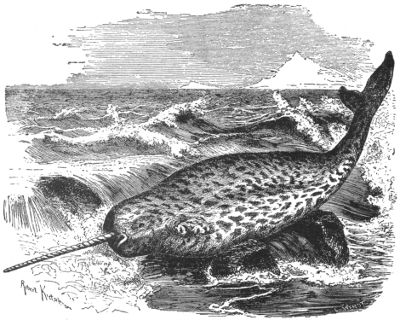
relatives—the Dolphins, Porpoises,
Narwhals, etc. The latter are usually
called fishes by those who do not understand
this division into orders and families;
they are not fishes, however, but belong
to the Water Mammalia. And in
dividing this book into Animals, Birds
and Fishes, all these members of the
Whale family will be found where they
belong with the great family of Mammalia.
Then after classifying all Mammals
both of land and water under the one
great family, or order, the Latin terms
help to sub-divide them into smaller families,
more closely related, in such a manner
that all the readers of different languages
may understand the meaning of
the words because of their Greek or Latin
origin. Thus we know that a quadruped
is a four footed animal because the term
comes from the Latin words quatuor, four,
and pes, pedis, a foot. And the term
quadrumane comes from quatuor, four,
and manus, a hand, which makes it easy
to understand that all the animals classified
under “Quadrumana” belong to the
monkey family, who have four hands instead
of four feet, with regular thumbs
and fingers on the hind hands (which are
usually known as feet) as well as on the
front ones. Thus the word Quadrumana
distinguishes this whole four-handed
family from the Bimanes, or two-handed
family, to which mankind belongs
(making an order by itself) and the
Quadrupeds, or the great four-footed
family.
In the same manner the family to
which the Horses belong are not only
quadrupeds, but they have very thick
skin. They are, therefore, classified under
the term Pachydermata, made up of
two Greek words meaning thick and skin.
We often find many of the Mammalia arranged
in orders, or large groups, before
being divided and sub-divided into families
and smaller groups. Thus the Dog
family and the Cat family are both included
under the order of Carnivora, or
carnivorous quadrupeds, which is derived
from the two Latin words caro, carnis,
flesh, and vorare, to devour; and we know
that the animals found under this order
prefer a diet of flesh food, and devour
other animals in their wild state.
Thus we might continue with explanations
of terms, but it requires only a few
such words and their derivations to make
us understand how easy it is, after all, to
keep in mind the main families and orders
and groups under which all the different
animals are classified. And we will soon
become so well acquainted with our numerous
animal friends in their native
homes, and grouped in their proper families,
that we can easily recognize many
of the animals that must be crowded out
of a book of this size. Because we know
the meaning of the term used to describe
a particular animal, we can place him in
the family to which he belongs, and then
understand something of his life and habits
by comparing them with those of his
well-known relatives.
16
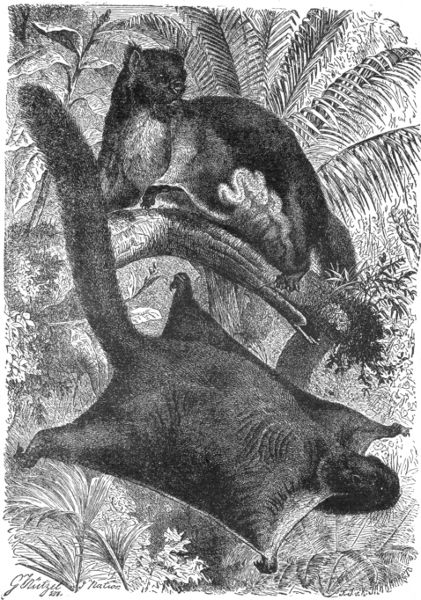
FLYING SQUIRRELS.
Quadrumana—The Four-Handed Mammals.
17
WE will begin with the Monkey
family in learning about our
animal friends, because they
resemble mankind more closely than any
other animal. Although Darwin and
other Naturalists have spent years of
their lives in tracing the resemblances between
the Human and the Monkey family
we had much rather trace the points of
difference, for it is not pleasant to claim a
very close relationship to some of the hideous
monsters who make their homes in
the dense forests or distant countries.
Although the formation of the body,
especially the skull, and the features, are
more like ours, than are those of other
animals, the first great point of difference
is their four hands, those of the legs being
formed the same as those of the arm, with
thumbs and long flexible fingers, which
enables them to climb trees quickly and
swing from branch to branch with fearless
activity, because they can grasp the
limbs of the trees with any one of their
four hands. Some of them also use their
tails to assist them in climbing, and the
Monkeys are sometimes classified under
the “prehensile tailed” and the “non-prehensile”
tailed according to whether
the tails are formed for seizing or grasping
the limbs of the trees. And there is
still another family of tailless Monkeys.
But while many of the different Monkeys
are very active in trees, in which
they spend the greater part of their time,
when in their native homes, this formation
of hands instead of feet on their legs,
makes them very awkward when standing
erect or walking. Even in the most
man-like Apes, these hands that serve as
feet, are not placed at right angles to the
legs, so as to come flat upon the ground
like ours; but when the legs are extended,
the soles nearly face each other, so that,
when erect, the whole weight of the body
rests upon the outer edge of the sole of
this strange foot, or as it should be more
properly called, the palm of the hand.
In addition to this peculiarity, the legs
are bent inwards to enable them firmly to
grasp the boughs of the trees, and this
makes them very awkward when trying
to walk upright on the ground.
Their arms are also very much longer
than ours, in proportion to the rest of the
body, and in some families the fingers will
almost touch the ground when the large
animal is standing erect.
While the majority of the Monkey
family have their faces covered with hair
like the rest of the body, others have what
are known as “naked faces,” with only a
beard, or a fringe of whiskers about the
chin and throat, and some of these are
comically like a human face.
The great family of Quadrumana is
divided in various ways by different Naturalists;
but the easiest classification to
keep in mind is the grouping of five distinct
Orders, each made up of small families.
The first order—The Tailless Apes—includes
the Gorilla, the Orang-Outang,
and the Chimpanzee, and is called by
some, Troglodytidae, from the Greek
word troglodytes, meaning one who hides
in caverns. Although this is a peculiarity
of these Apes, this does not seem so
19good a classification as that given by another
Naturalist who calls these the Anthropomorphous
Monkeys because they
so closely resemble the human species;
the word Anthropomorphous comes
from two Greek words meaning man and
form, and signifies that which has the
form of man.
The second order is the Simiadae—The
Ape Monkeys—and the term comes
from the Greek word simos, meaning
flat-nosed; these have oblong heads and
flat nostrils, and the same number of
teeth as man, and many of them have
cheek pouches in which they stow away
food for future use. A few of the Simiadae
are without tails, others have tails
(of different lengths in the different families),
but none of them have prehensile
tails, that can be used to help them in
climbing. All the different families belonging
to this order are natives of the
Old World, and the most of them are
found in the forests and the mountainous
districts of Western Africa.
The third order—Cebidae—includes
the American Monkeys; and they are distinguished
from the Monkeys of the Old
World by having four more grinding
teeth, making thirty-six in all instead of
thirty-two. These American Monkeys
have long tails and no cheek-pouches.
The fourth order—Lemuridae—includes
the different Lemurs, and the
word comes from Latin lemur, a sprite, a
night-walker, so called from their habits
of roaming about at night.
Some naturalists include in this order
the Flying Cat, or Flying Lemur. Others
make a distinct fifth order of this species.
Although they resemble both a
weasel and an ape, they have one peculiar
formation that does not belong to either
of these; the long slender limbs are connected
by a broad, hairy membrane,
which looks like a cloak when folded up,
but which expands and gives the appearance
of wings when the animal is springing
from tree to tree.
Although each one of these orders
contain many small families, until the different
Monkeys seem numberless, yet
they can all be classified in some one of
these groups, and it is not so hard to remember
the long names when we understand
the meaning of the words from
which they are derived.
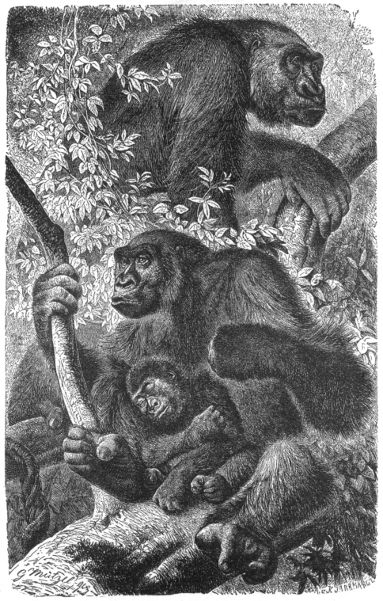
THE GORILLA—THE STRONGEST APE. — THE ORANG-OUTANG—THE WILD MAN OF THE WOODS. — THE CHIMPANZEE—THE MAN-LIKE APE.
GORILLAS.
The Gorillas live in the hottest parts of
Western Africa, and as their home is so
near the Equator they search out the
loneliest and shadiest parts of the dense
African forests, and whenever it is possible
they keep near a running stream. It
is called a nomadic animal because it seldom
remains in one place many days together.
The reason for this wandering
life, is the difficulty it finds in procuring
its favorite food, which is fruit, seeds,
nuts, and banana leaves, the young
shoots of this plant, and the juice, of
which it sucks, and other vegetable substances.
Although the Gorilla likes to dwell
among the trees, it does not find this necessary
for its happiness, nor does it remain
long on the trees like some other
Monkeys who sit and sleep on the
branches. In fact it is always found on
the ground except when it climbs a tree
to gather fruit or nuts, and it descends as
soon as it has satisfied its hunger. These
enormous animals would be incapable of
jumping from branch to branch like the
small Monkeys.
20The young Gorillas occasionally sleep
on trees for safety, but the adults rest
seated on the ground, their backs against
a log or tree, thus causing the hair on this
part to be worn off.
The Gorilla belongs to the family of
“Tailless Apes” and although it is not so
large as the Orang-Outang—measuring
about five feet in height—it is very
strong. It is called the king of the forests
which it inhabits because of this
strength, which is said to be equal to that
of the Lion. The Negroes of Africa never
attack it except with firearms, and they
are very proud when they can kill one,
because this is very difficult.
The old Gorillas are not fond of company,
and usually go about alone or in
couples. The young Gorillas sometimes
go about in groups of six or eight but
never in great numbers. Their sense of
hearing is very delicate, and on the approach
of the hunter they hurry away
with loud cries, so that it is difficult to
get within gun-shot of them.
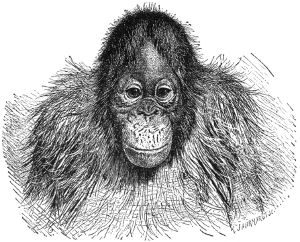
ORANG-OUTANG.
This large and hideous species of the
Monkey family is sometimes called the
“Wild Man of the Woods.” These animals
are somewhat rare, and limited to a
small region. They live in the thick forests
covering the low damp lands in the
islands of Borneo and Sumatra. Very
little is known of their habits in a wild
state, as it is only by accident that they
come out in open places, or where the
country is inhabited.
When full grown the Orang measures
from six to seven feet in height. His
21head is covered with a sort of mane of
smooth hair of greyish black color, and
his face is naked, with the exception of a
tufted moustache on the upper lip, and a
long thick beard. The nose is flat and
the muzzle very prominent and it is not
surprising that some of the inhabitants of
these countries have many strange and
superstitious beliefs concerning this hideous
“Wild Man of the Woods.”
Although so little is known of these
strange animals in their wild state, the
habits of tame ones have been closely
studied, as it is not difficult to capture
them when very young, and they make
very interesting pets while small. One
of the most intelligent of these animals
that has yet been known, was brought
from Java by Dr. Abel Clark, and many
interesting stories have been told about
it.
At Java, this Monkey lived under a
tamarind tree, near the Doctor’s dwelling.
There it had made a bed, composed
of small interlaced branches covered with
leaves; on this it passed the greater portion
of the time, looking out for the people
who carried fruit, and, when they approached,
descending to obtain a share.
When taken on board the vessel, it was
secured by an iron chain to a ring-bolt;
but it unfastened itself and ran away,
when, finding the chain trailing behind,
an encumbrance, it threw it over its
shoulder. As it released itself in this
manner several times, it was decided to
allow it to go at large. It became very
familiar with the sailors; it played with
them, and knew how to escape when pursued,
for it darted into inaccessible parts
of the rigging.
“At first,” writes Doctor Abel Clark,
“it usually slept on one of the upper
yards, after enveloping itself in a sail.
In making its bed it took the greatest
care to remove everything that might disturb
the smooth surface of the place on
which it intended to lie. After satisfying
its tastes in this part of its domestic arrangements,
it lay down on its back,
bringing the sail over the surface of its
body. Frequently to torment it, I have
beforehand taken possession of its bed.
In such a case it would endeavor to pull
the sail from beneath me, or try to expel
me from its resting-place, and would not
rest until it had succeeded. If the bed
proved to be large enough for two, it
slept quietly beside me. When all the
sails were unfurled, it searched for some
other couch, often stealing the sailors’
jackets which were hung out to dry, or
robbing some hammock of bed-clothes.
“It willingly ate all kinds of meat, especially
raw flesh. It was very fond of
bread, but always preferred fruit when
procurable. Its ordinary beverage at
Java was water, but on board its drink
was as varied as its food. Above everything
it liked coffee and tea, but it also
willingly took wine.
“One of the sailors was its special
friend, and this man shared his meals with
it. I must say, however, that the Orang-Outang
sometimes stole from its benefactor.
He taught it to eat with a spoon;
and it might have been seen more than
once, tasting its protector’s coffee, and
affecting a serious air, a perfect caricature
of human nature.”
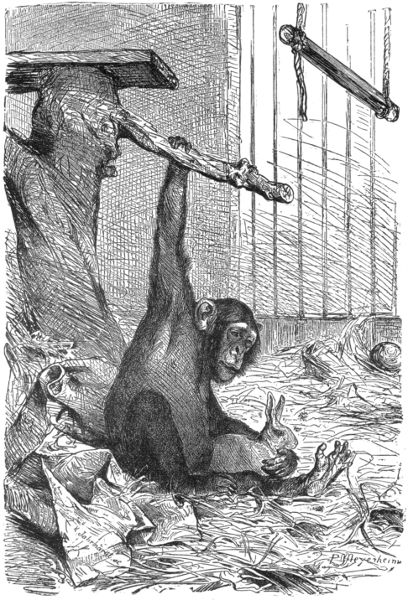
CHIMPANZEE.
Of all known Monkeys, the Chimpanzee
in its habits, its motions and its intelligence,
comes nearest to the human species.
In the first place its arms are not
23so long as those of the other Monkeys
described; they scarcely reach below the
knee when the Chimpanzee is standing
erect. And although it seldom wears a
beard like the “Wild Man of the Woods,”
its face and ears and the palms of its
hands are entirely without hair, giving it
a much more Human appearance; and in
walking, its “hind-hands” are often
planted quite firmly on the ground like
our feet, instead of walking on the sides
of them. When walking erect, it is fond
of using a large stick to help support it,
and this gives it a manly appearance of
carrying a cane. Another favorite manner
of walking is to bend down and
touch its fingers to the ground, then by
keeping the legs bent, it swings itself
along by the means of its arms as by a
pair of crutches.
The Chimpanzee inhabits the same regions
as the Gorilla—the dense forests of
Africa, and another point of resemblance
is that the Chimpanzees live in small
troops while they are young, and alone or
in couples in adult life. But unlike the
Gorillas they are great climbers and pass
nearly all their time on trees, seeking the
fruits which constitute their food.
There is a kind of Chimpanzee called
by the natives “Nshiego-mbouve,” which
builds a kind of leafy nest among the
boughs of the loftiest trees. This nest is
composed of small interlaced branches
with a tight roof of leaves. It is fixed
with firmly tied bands, and is generally
from six to eight feet in diameter, and
presents the form of a dome, an arrangement
which readily throws off the rain.
The Nshiego is distinguished from the
ordinary Chimpanzee, by the absence of
hair on its head, and it is sometimes
called the Bald Chimpanzee.
THE BABOONS—THE DOG-HEADED MONKEYS. — THE MANDRILLS—THE BRILLIANT MONKEYS. — CURIOUS MONKEYS OF THE MACAQUES FAMILY. — THE WANDEROO. — THE BARBARY APE. — THE BONNET MACAQUES.
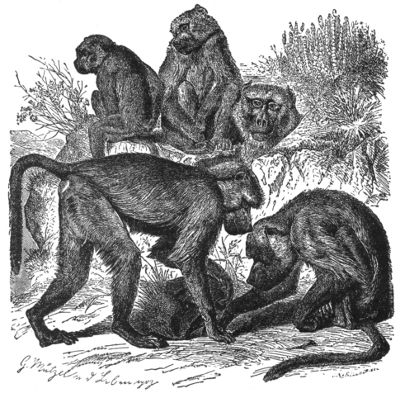
BABOON OR DOG-HEADED MONKEYS.
The Baboons and the Mandrills are
sometimes placed in separate classes by
Naturalists because of the difference in
the length of their tails, but they both belong
to the same family—the Cynocephali,
which is derived from the words
cyon, cynos, a dog, and cephale, a head,
and means dog-headed.
In these creatures the teeth and the
cheek-pouches, which are similar to those
of the majority of the Monkey family, are
combined with a long nose and the nostrils
situated like those of a dog. The
Baboons have longer tails than the Mandrills,
and although their forms are very
clumsy, they climb trees easily, and even
display much agility when they are sporting
among the branches; yet they seldom
select the forest as their place of residence.
They are found almost exclusively
in Africa, although a single species
is found in Asia.
The Baboon was known to the ancient
Egyptians, on whose monuments it often
appears, and as it symbolized the god
Thoth, the inventor of the alphabet, it
was held in great veneration in those days
of long ago, and numerous mummies of
this animal have been found in Egyptian
burial places.
The Baboon prefers to walk on all
fours like a quadruped, and instead of living
in forests, they choose the mountainous
districts, and rocky places covered
with bushes and brush wood. They live
in troops, and each troop takes possession
of a certain district, which they defend
against all intruders. If men approach,
the alarm is instantly raised, the
whole troop gather together, and endeavor
both by their cries and their actions
to drive them away. And if not
24successful in this they will attack such visitors
with sticks, or throw stones and
other missiles at them. Even firearms
will not frighten the Baboons and a troop
will not retreat until many are left dead
upon the ground.
If a traveler is unfortunate enough to
encounter one of these troops when
alone, he is soon surrounded by numbers
of the infuriated beasts, and literally torn
to pieces. Rather than encounter such
a death an Englishman once killed himself
by leaping from a cliff, where he had
been hemmed in by a multitude of these
ferocious creatures.
Their canine teeth are almost as formidable
as those of the Tiger, yet they are
said to live entirely on vegetable diet, and
to be so fond of fruit that they sometimes
seriously destroy orchards and gardens.
It is usually during the night that they
make their thieving excursions, and they
take great care to ensure the success of
their stealing. When the troop arrives
at the scene of action, it divides into three
companies, one enters the orchard or garden,
25while those of the second division
place themselves as sentinels to give
warning of the approach of danger, while
a third division establishes itself in the
rear and forms a long line extending from
the other troops to their home in a neighboring
mountain. When all these arrangements
are completed, those who
have broken into the orchard or garden
throw the produce of their thieving to the
nearest sentinels, who pass it on to those
behind, and thus in a very short time it is
handed along the line and stored in a safe
place at the end, until there has been
enough secured to make a feast for the
entire troop. While thus engaged, if one
of the sentinels raises a cry of alarm, the
whole body will scamper off to their hiding
places.
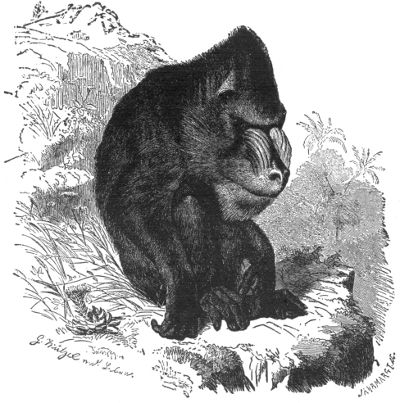
MANDRILL.
The Mandrills are distinguished by
their very short tails, and by deep wrinkles
on each side of the nose which are
often brilliantly colored. There are two
species living in Western Africa which
are known as the Mandrill and the Drill.
The Drill is very much like the Mandrill
except that its face is completely
black instead of being striped with color;
and it also inhabits Guinea.
The Mandrill has a very peculiar appearance
when the colors of its face are
bright. In some instances the entire face
is streaked with bright red and blue and
black bands, and what seems still more
curious the upper part of the thigh is
sometimes of a bright red mixed with
blue, giving the Monkey a very peculiar
appearance. And what seems even more
strange, these colors are not permanent,
but often disappear after or during disease,
and they even change when the animal
is strongly excited.
The Mandrill when old is deceitful and
malicious. Even when taken quite
young and supposed to be tame, it should
not be trusted, for taming does not seem
to improve its character.
Besides these changeable colors that
stripe the face and tint the thighs of the
Mandrill, their permanent colors are very
bright and striking. The hair upon its
body is a brownish grey, with olive upon
the back; the chin is surrounded by a
beard of bright lemon yellow; its cheeks
are either striped or of a brilliant blue,
while the nose is red, especially towards
the tip where it becomes scarlet. It
would be difficult to find an animal more
gaily decorated and yet so hideous. And
as it grows to be almost as large as a man,
it is not surprising that the negroes of the
Guinea coast, where it is commonly
found, should have a superstitious fear of
so dangerous a creature.
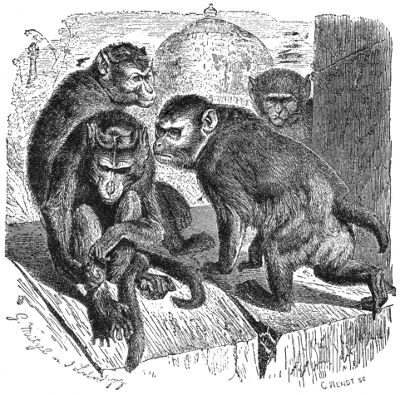
The Monkeys belonging to the group
known as Macaques, or Macacus, nearly
all have tails; some quite long, others
short, and still others of medium length,
and Naturalists sometimes divide them
into different groups according to the
length of the tail. Others classify in different
ways, making a great many distinct
groups or Genus of this particular
tribe of Monkeys, but the three main
groups—the Wanderoo, the Barbary Ape
and the Bonnet Monkey—are the most
important and include the main characteristics
of all the others.
26
The Wanderoo is commonly found in
the island of Ceylon. These Monkeys
have cheek pouches like the others of this
family. They do not grow much larger
than an English Spaniel Dog and are of a
grey color with black faces and great
white beards reaching from ear to ear,
making them look like old men. They
do very little mischief, keeping in the
woods, and eating only leaves and buds of
trees; but when they are tamed they can
be taught to eat anything.
The other Monkeys have great respect
for this species, looking upon them as
their superiors; and they are usually considered
by mankind to be much more intelligent
than the rest of the Monkey
race.
27
The Barbary Ape is the only Monkey
found in Europe, and differs from almost
all others belonging to the Macaques, in
being without a tail. When full grown
it is from three to four feet high. Its general
color is olive green and grey; the face
is of a dirty flesh color, with brown spots,
very much wrinkled, and surrounded
with dirty grey hair.
It usually goes on all fours. The
young animals are very intelligent and
gentle, and they are well known throughout
Europe as objects of exhibition and
amusement.
The Barbary Apes prefer to live in
rocky places and on the mountains. In
their native home they live upon pine
cones, chestnuts, figs, melons, nuts and
vegetables which they carry off from gardens
near their homes, although great
care is taken to exclude these mischievous
animals. While they are committing
their thefts, two or three mount to the
summits of the trees, and of the highest
rocks to keep watch, and as soon as these
sentinels see any one, or hear a noise,
they utter a cry of warning, and immediately
the whole troop take to flight, carrying
off whatever they have been able to
lay their hands on.
BONNET MONKEYS.
The Bonnet Monkey is frequently
caught for exhibition. It is about the
size of a large cat, greenish grey above
and white below, with a long tail. The
face is naked and wrinkled; the hair of the
crown is long and dark, and spreads in all
directions, lying upon the surface of the
head like hair in a scalp-wig. On this account
the animal is sometimes called the
Scalp Monkey.
In its native country the Bonnet Monkey
is almost as much venerated as the
Hoonuman in Bengal, and although it
does great injury to fields and gardens,
the natives forbid any one to kill it. Or
if this has been done through mistake,
they demand from the culprit enough
money to pay for a grand funeral.
When young, the Bonnet Monkey is
very amusing as a pet, performing all his
tricks with a comical gravity. When
two or three are kept together, they are
constantly hugging and nursing each
other. When a Monkey of this kind has
no companions of its own species, it will
make friends with some other animal, and
will often pet and hug a kitten with great
gravity and all the fondness of a child, at
a great risk of choking it. When full-grown,
however, the behavior of the Bonnet
Monkey changes, and it becomes sullen
and savage and spiteful.
THE AMERICAN MONKEYS. — THE HOWLING MONKEYS. — THE SPIDER MONKEYS. — THE WEEPING MONKEYS.
There are several queer families of
American Monkeys that make their home
in Brazil, Peru and on the banks of the
Amazon and the Orinoco. Further
South, and along the western part of
South America are found many of the
small Monkeys with long tails like those
we usually see in this country patiently
following the street organs and making
trade for their Italian masters. The
most of these are intelligent, affectionate
little fellows, and are more in demand for
taming than the Monkeys of Africa, or
even those of the smaller families found
in Asia and Europe.
Nearly all of the American Monkeys
have long tails, and some find them a
great help in climbing; these are usually
classed as the Prehensile tailed Monkeys,
28and the Non-prehensile tailed Monkeys
are those who do not make any use of
their long tails in grasping the limbs of
the trees, etc., in climbing. Very few of
the American Monkeys have cheek-pouches
and their nostrils are placed on
the sides of the nose, instead of beneath
it, giving them a very different appearance
from the Apes, Baboons, etc., found
in Africa.
The different kinds of American Monkeys
are usually divided into several families
with the usual long hard Latin names
to distinguish them, but as these names
mean simply, the Howlers, the Spider
Monkeys, the Weepers, etc., we will use
only their English names in describing
them.
The Monkeys belonging to the family
of Howlers are remarkable on account of
the formation of their throat, which
causes their voice to be hoarse and loud
29and very disagreeable. Although they
are scarcely two feet in height, these
Monkeys have the most powerful voice of
any known animal. When gathered in
troops they make the great forests re-echo
with their tumult, which carries terror
even to the bravest man when heard
for the first time. Travelers compare this
noise to the creaking of a great multitude
of carts whose wheels and axle-trees need
greasing; and with all this creaking and
grinding noise there is a sound like the
rolling of a drum.
Every day, morning and evening, the
Howlers assemble in the forests, and one
of their number, taking his station upon
a lofty tree, makes a sign with his hands,
as though inviting the others to sit
around him. He then begins a sort of
discourse, in a voice so loud and harsh
that any one might suppose that they
were all screaming together, although
one only is thus employed; when this one
leaves off, he gives a signal to the others,
who immediately set up a cry in full
chorus, until their leader commands silence,
and is instantly obeyed. The first
speaker, or rather howler, then begins
again, and it is only after several repetitions
of this that they cease from their
discordant yellings.
These Monkeys live in large troops and
only frequent the highest trees, from
which they rarely come down. They
leap from branch to branch with wonderful
agility, and, contrary to the habits of
most Quadrumana, seem to prefer those
parts of the forests which are in the vicinity
of rivers or swamps. They live almost
entirely upon the fruits and foliage
of the trees around them, and are said
occasionally to catch and eat insects.
The whole race is remarkably sullen,
lazy, heavy and of disagreeable nature;
they are tamed with difficulty. And it is
not often that this is attempted, for even
if they were good-natured and intelligent,
they would not make desirable pets on account
of their voice.
These curious little Monkeys are found
in nearly all parts of South America, and
they live in troops, making their homes
in trees. They feed on the insects which
are usually found in great quantities in
many of the South American trees, and
occasionally they will descend to the
ground, in search of small Fish and Molluscs
which they find in the mud on the
banks of the rivers. It is said that they
even venture on the beds of the rivers
when the water is low, and capture the
oysters, and they are very quick in learning
how to open the shells and take out
the oyster.
These Monkeys are distinguished by
their fine silky hair, their strong tails,
which they use in climbing and in swinging
themselves from limb to limb, and the
fact that they have no thumbs; but only
the four fingers on each hand. This peculiarity
has given them the Greek name
by which the family is usually classified
which means imperfect, but the name
Spider Monkey has been given to them
because of their long, slender limbs and
their slow, queer manner of walking,
which sometimes gives them the appearance
of huge spiders.
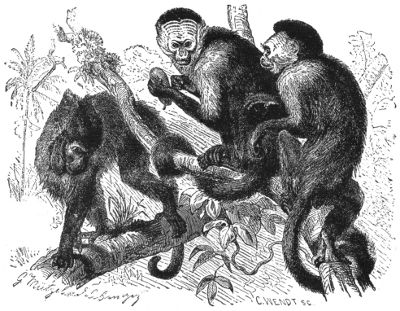
WEEPING MONKEYS.
The Weeping Monkeys are smaller,
but not so slim as the Spider Monkeys.
They live in the forests of Guinea and
Brazil, and flock together in great troops.
They will eat snails and small Birds when
30they can get them, but their principal
food is the abundance of fruits found
among the trees where they make their
home.
They generally keep on the topmost
branches of the highest trees to keep out
of the way of the Serpents, of which they
are very much afraid. Even when tamed
and brought to this country, the sight of
the most harmless Snake will fill them
with terror.
These Monkeys are called weepers
from their plaintive cry. Usually their
voice is soft; when excited or angry it becomes
loud and pitiful; when teased it
keeps up a kind of plaintive wailing,
which has given it its name of Weeping
Monkey, although they have also been
called Musk Monkeys at times, because
of their musky odor.
These Monkeys have short round
heads with the skull projecting backwards,
and many of them have their faces
bordered with long hair; others have
long hair on top of the head, and in one
species, called the Horned Monkey, this
hair forms two black tufts, having the
appearance of horns.
All the Weeping Monkeys are gentle
and easily tamed, and perform many
amusing tricks, such as firing off a gun,
and sweeping with a small broom. They
will break a nut between two stones when
it is too strong to be cracked with their
teeth, and show many signs of unusual intelligence.
THE LEMURS, OR FOX-HEADED MONKEYS.
31
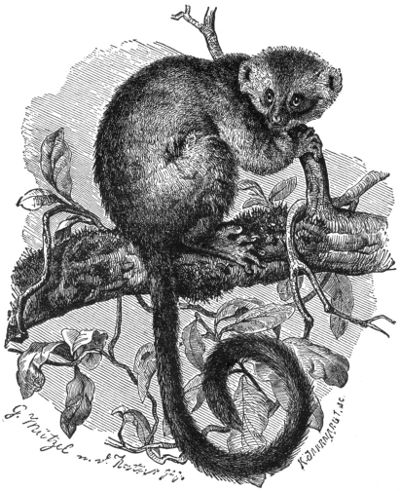
LEMUR OR FOX-HEADED MONKEYS.
Some very curious animals are found
in the Lemur family. The Sloth Monkeys,
the Indris, the Aye-Ayes and the
ugly big-eyed Tarsier, are all related to
the Lemurs, and some look more like
fairy-tale monsters than harmless, timid,
little animals of the Monkey family.
What are known as the “Lemurs proper,”
or the Fox-Headed Monkeys, are the
best known of this family. Their hair is
thick, soft and woolly, their ears short
and velvety, and their tails long and
bushy. They have very large eyes, and
queer hands with flattened nails.
Nearly all the different members of the
Lemur family live in Madagascar and the
surrounding islands. They like to live in
companies or troops among the trees, and
their food is mainly the fruits of these
trees; but they will also eagerly catch and
devour insects. They are very sociable
animals, and like to collect in numerous
bands; and they sleep in the highest parts
of the trees where no harm can come to
them.
Carnivora—Flesh-Eating Quadrupeds.
33
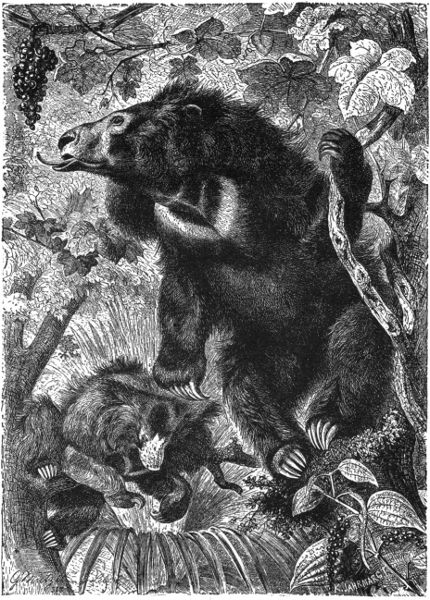
SLOTH BEAR.
THE Carnivorous animals form the
largest and most powerful family
of Mammals that live on the
land; and in this family are also included
many water Mammals. Although this
extensive family contains animals that
are very different in size and form, yet
they are all alike in their flesh-eating habits,
in possessing strong sharp claws, and
three kinds of teeth, the incisors, molars
and canines; the latter being sharp
and powerful fangs used for seizing and
holding their struggling prey.
Although the animals of this family are
all flesh-eaters, and all prefer this diet,
there are some members that live partially
on vegetable food, especially when
flesh diet is scarce, and this fact is sometimes
used to help divide the large family
into smaller groups. There is also a
great difference in the manner of walking.
Some of the animals place the entire
sole of the foot upon the ground,
from the heel to the toes, so that the soles
of the feet are without hair; but the
greater number have their heel so much
raised that they walk only on their toes;
and in these, the part corresponding to
the sole is hairy (like that of the cat) and
is sometimes mistaken for the leg of the
animal.
To the first of these divisions the term
Plantigrade has been applied. The word
means stepping on the sole, and comes
from planta, the sole; and gradior, to
step. To the latter division the name
Digitigrade is given, which means stepping
on the toes, and comes from digitus,
a finger, or toe, and gradior, to step.
There is still another important division
to this great family, known as the
Amphibious Carnivora, which includes
the Seals, Sea-Lions, etc., which are capable
of living both on the land and in the
water.
This is the simplest and most easily remembered
of all the divisions of the great
order of Carnivorous animals. Some
Naturalists object to it as not being
clearly defined, and divide the Carnivora
into six great families. First the Mustelidae,
or Weasel family; second, the
Hyena family; third, the Felidae, or Cat
family; fourth, the Canidae, or Dog family;
fifth, the Viverridae or Civet family;
and sixth the Ursidae or Bear family.
These six families are then sub-divided
into many smaller families, and the Amphibia
are grouped by themselves instead
of being included among the Carnivora—although
they are flesh eaters, and this
seems to be their proper place.
For easy grouping we will cling to the
old method of classifying all the Carnivorous
animals under the three main orders
of Plantigrade, Digitigrade, and
Amphibious Carnivora.
PLANTIGRADE CARNIVORA—THE BEAR FAMILY. — THE BROWN OR ALPINE BEAR. — THE COLLARED AND THE AMERICAN BEAR. — THE GRIZZLY, OR “FEROCIOUS BEAR.” — THE WHITE, OR POLAR BEAR. — THE LABIATED, OR SLOTH BEAR.
The Bears form the most important
family of the “Plantigrade Carnivora.”
The sole of the foot is very wide, and the
whole surface touches the ground in
34walking. They are very strong and can
easily crush a man to death in their arms.
Different members of the family live in
various parts of the globe. They eat almost
any kind of food, and many of them
prefer a vegetable diet; very few of them
will kill a man or an animal simply for the
sake of food, unless necessity compels
them. But they will defend themselves
vigorously when attacked, and in spite of
their heaviness and their slow motions,
they prove very quick and fierce at such
times. They can easily overtake a man
in running, and most of them climb trees
easily.
Bears can stand upright on their hind
legs longer than almost any other animal,
and they usually take this position when
they fight.
In eating, Bears sit down like Dogs,
and taking up the food in their paws raise
it to their mouths.
When caught young, the Bear may be
easily tamed, and its gentle nature enables
it to learn many amusing tricks, but
it will not often show off these tricks
without first expressing its unwillingness
by deep growling, and it often gets very
angry during the training.
The best known varieties of Bears are
the Brown Bear of Europe, the Grizzly
and the Black Bear of America, the Syrian
Bear, the White or Polar Bear, the
Sloth Bear and Malay Bear and the Bornean
Bear.
Although their native homes are in
America, Europe and Asia (it is uncertain
whether any exist in Africa) they are
mainly found in the northern regions as
they do not like the heat; and when they
are found in temperate or warm climates,
they generally live in the lofty mountain
ridges.
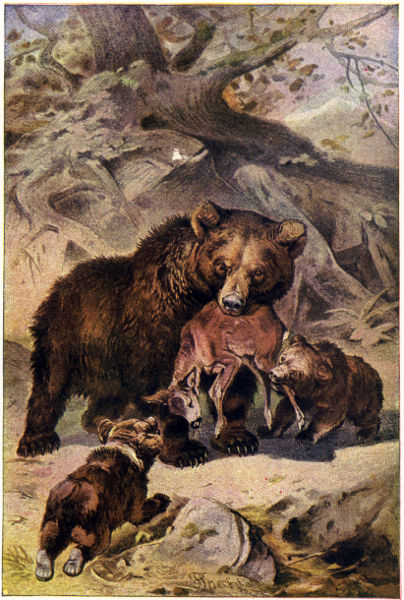
The Brown Bear leads a lonely life in
the dark pine forests, and the deep
gorges or on the highest mountain
ridges. It makes its den in caverns, on
clefts of the rocks, or in the hollow of
some giant old tree. It generally sleeps
during the day and seeks its food at
night. It feeds on the nuts of the beech,
and many kinds of wild fruits and berries,
preferring those that are slightly sour,
and also seeds, vegetables and roots. It
is very fond of honey, strawberries and
grapes and will travel many miles to procure
these delicacies, and it is especially
fond of a swarm of ants, which it likes on
account of their acid taste.
In the lofty region in which it lives,
when all these kinds of food fail, it makes
its way down to some of the lower valleys,
and ravages the fields of wheat, oats,
etc., and any flesh food that it may find,
especially a carcass of some dead animal.
When very hungry it will often go many
miles from home to seek its vegetable or
to kill its animal food if necessary, but at
dawn it never fails to return to its own
home.
This Bear is very cautious, and if it gets
into trouble it is not because of want of
care. It has very keen sight and smell
and hearing, and whenever it goes into a
new neighborhood to search for food, it
will first climb to the top of some small
tree, and explore the surrounding space,
both by sight and smell. It very seldom
enters a trap, and if it finds a carcass, it
will examine it very carefully before attempting
to drag it away and eat it.
When it becomes necessary to kill animals
for food, it prefers a sheep or a goat.
It will seldom attack cows, although it
has been known to lay in wait for these
37near their drinking places, and when it
has sprung on the back of one, it seizes
it by the nape of the neck, biting and
tearing it until it bleeds to death. Then,
after devouring part of it, the Bear carries
off the remainder.
The Brown Bear is an easy tempered
animal, and is cruel only from necessity.
It is happy and comic in its ways. But
when it is attacked or wounded or suddenly
disturbed in its sleep, or when its
cubs are in peril, this bear becomes a dangerous
foe.
The Collared Bear and the American
Black Bear are somewhat peculiar in
their nature and habits.
The Ringed, Collared, or Siberian
Bear owes its name to a large white ring
which surrounds its shoulders and fades
away on the chest. The Siberian Bear is
much more formidable than the European
variety. In the gloomy and cold
countries which it inhabits, the vegetation
is not sufficient to satisfy its appetite;
it must therefore, fall back upon
some kind of animal food. It will also
feed on fish, which it catches cleverly,
and on carcasses thrown on the seashore.
It hunts the Reindeer, and will often attack
man. The inhabitants of Kamtschatka
wage a war of extermination
against this animal.
The American Black Bear, on the contrary,
is naturally one of the least offensive
animals. It has little taste for flesh.
Even when hungry, if a choice is offered
between animal food and fruit, it does not
hesitate in selecting the vegetable substance.
It swims well, and is fond of fish,
which it catches skillfully. It seldom attacks
man, unless it is hunted; as a rule,
it prefers seeking safety in flight. It
principally makes its abode in the hollows
of firs and pines, selecting the holes
which are the highest. Under these circumstances,
the Americans capture it by
setting fire to the foot of the tree. This
animal is hunted with great activity, not
only to put an end to its depredations in
the corn-fields, but also for the sake of its
flesh, fat, and fur; the latter is used for
many purposes. The hams of the American
Bear, when salted and smoked, have
a high reputation both in the United
States and Europe.
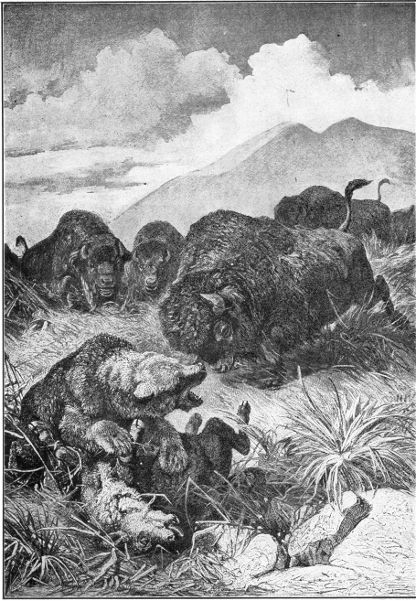
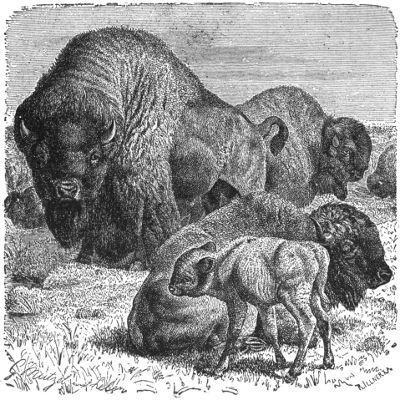
Grizzly Bear and Buffaloes.
The Grizzly Bear is a native of North
America, and has been found near 61 degrees
north latitude, and as far as Mexico
to the south. It is exceedingly formidable
on account of its great strength and
ferocity. It overpowers even the American
Bison, and has been seen to drag
along a carcass a thousand pounds in
weight.
These bears vary considerably in
color; the young are darker than the
older specimens. The feet are armed
with long curved claws, those on the fore-feet
being larger than the hind ones.
The Grizzly Bear can dig with ease, and
is able when young to ascend trees.
It usually inhabits swampy, well-covered
spots among trees and bushes, and
here it makes its lair. It prowls forth
both by night and day, and is more carnivorous
than the Black Bear, but in the
latter part of summer seeks eagerly for
the fruits which then abound; it prefers,
however, the flesh of animals, and will
38partially bury a carcass for future supply,
after having feasted upon its best parts.
Townsend, in the “Narrative of a Journey
across the Rocky Mountains,” gives
the following account of an adventure
with a Grizzly Bear on a small stream
running down a valley covered with
quagmires:
“As we approached our encampment
near a small grove of willows on the
margin of the river, a tremendous Grizzly
Bear rushed out upon us. Our horses
ran wildly in every direction, snorting
with terror, and became nearly unmanageable.
Several balls were instantly
fired into him, but they only seemed
to increase his fury. After spending
a moment in rending each wound (their
invariable practice), he selected the person
who happened to be nearest, and
darted after him, but before he proceeded
far he was sure to be stopped again by a
ball from another quarter.
“In this way he was driven about
among us for fifteen minutes, at times so
near some of the horses that he received
several severe kicks from them. One of
the pack-horses was fastened upon by the
brute, and in the terrified animal’s efforts
to escape the dreaded gripe, the pack and
saddle were broken to pieces and disengaged.
One of our mules also gave him
a kick in the head, which sent him rolling
to the bottom. Here he was finally
brought to a stand. The poor animal
was now so surrounded by enemies, that
he was completely bewildered. He
raised himself upon his hind-feet, standing
almost erect, his mouth partly open;
and from his protruding tongue the
blood fell in fast drops. While in this
position he received about six more balls,
each of which made him reel. At last,
in complete desperation, he rushed into
the water and swam several yards with
astonishing strength and agility, the
guns cracking at him constantly. But
he was not to proceed far. Just then,
Richardson, who had been absent, rode
up, and fixed his deadly aim upon him,
fired a ball into the back of his head,
which killed him instantly.
“The strength of four men was required
to drag the ferocious brute from
the water; upon examining his body, he
was found completely riddled; there did
not appear to be four inches of his shaggy
person, from the hips upward, that had
not received a ball. There must have
been at least thirty shots made at him,
and probably few missed him; yet such
was his tenacity of life that I have no
doubt he would have succeeded in crossing
the river, but for the last shot in the
brain. He would probably weigh at the
least six hundred pounds, and was about
the height of an ordinary steer. The
spread of the foot laterally was ten
inches, and the claws measured seven
inches in length. This animal was remarkably
lean. When in good condition
he would doubtless much exceed in
weight the estimate given.”
When driven by hunger, the Grizzly
Bear is especially fierce and daring in
seeking his prey, and (as our illustration
shows on page 35) will even approach a
herd of Buffalo and attack a straying calf.
He has fallen upon this young Buffalo
which has foolishly wandered apart from
the herd, and thrown him down. Directly
will the Grizzly tear his prey upon
whose body his powerful fore paws are
placed, when he is interrupted in an unwelcome
manner. The anguished bellowing
and bleating of the fallen animal
have been heard by the distant feeding
herd, and the old Buffalos come immediately,
39their great, clumsy, heavy bodies
storming along with startling swiftness to
punish the Bear for his bloody deed. He
sees that he must for the time being postpone
his feast and prepare to protect himself
against the approaching attacking
party of whom especially the foremost
steer, with colossal head sunk low, jaws
foaming and tail thrown up, presents a
vivid picture of ungovernable strength
and fury. The outcome of the battle can
not be doubtful to us. Although the
Grizzly could easily capture a single Buffalo,
his great strength can avail nothing
against the whole herd of these great animals.
The Bear, who is a swift runner,
must either seek safety in flight, or find
his end under the horns of his opponents.
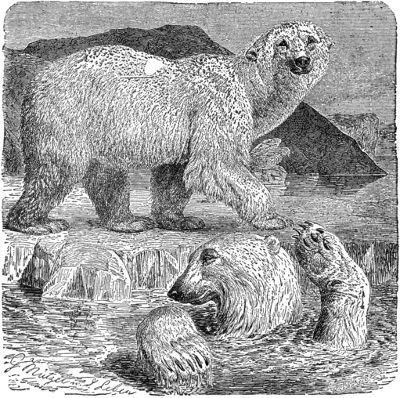
POLAR BEARS.
The Polar Bear is a very distinct species,
easily recognized by its long, flat
head, as well as by the white color and
smoothness of its fur. It is an inhabitant
40of the frozen shores of the northern hemispheres,
and semi-aquatic in its habits,
swimming and diving with the utmost
ease and facility, for the purpose of capturing
Seals, young Whales and Fish, upon
which it principally feeds; nevertheless,
even this animal is not altogether
carnivorous, but feeds greedily on vegetable
substances whenever they can be
procured.
The Seal, however, is his favorite food;
and Captain Lyon, in the following passage,
describes the mode in which he captures
this animal: “The Bear, on seeing
his intended prey, gets quietly into the
water and swims to the leeward of him,
from whence, by frequent short dives, he
silently makes his approaches, and so arranges
the distance that, at the last dive,
he comes to the spot where the Seal is
lying. If the poor animal attempts to
escape by rolling into the water, he falls
into the Bear’s clutches; if, on the contrary,
he lies still, his destroyer makes a
powerful spring, kills him on the ice, and
devours him at his leisure.”
The Polar Bear is seldom seen far inland,
but frequents the fields of ice, and
swims to icebergs—often at a great distance
from the shore. Captain Sabine
saw one half-way between the north and
south shores of Barrow’s Straits, although
there was no ice within sight.
The Polar Bear is found further north
than any other quadruped, having been
seen by Captain Parry beyond 82 degrees
north latitude.
In illustration of the affection of the
mother Bear for her young, Captain
Scoresby relates the following anecdote:
“A mother Bear with her two cubs were
pursued on the ice by some of the men,
and were so closely approached as to
alarm the mother for the safety of her offspring.
“Finding that they could not advance
with the desired speed, she used various
artifices to urge them forward, but without
success. Determined to save them
if possible, she ran to one of her cubs,
placed her nose under it, and threw it forward
as far as possible; then going to the
other, she performed the same action,
and repeated it frequently until she had
thus conveyed them to a considerable
distance. The young Bears seemed perfectly
conscious of their mother’s intention;
for, as soon as they recovered their
feet after being thrown forward, they immediately
ran on in the proper direction,
and when the mother came up to renew
the effort, the little rogues uniformly
placed themselves across her path, that
they might feel the full advantage of the
force exerted for their safety.”
Doubtless, much of the ferocity of the
Polar Bear is to be attributed to the barrenness
of the regions which it inhabits,
the absence of vegetation obliging it to
attack animals to supply its craving appetite.
Its domain includes all those solitudes
which surround the arctic pole—Greenland,
Spitzbergen, Nova Zembla,
&c. Over these vast ice-fields it reigns
supreme.
In the summer time, when the White
Bears betake themselves to the forests
farther inland, they attack the Mammals
which are natives of these regions, especially
Reindeer.
Most mariners who have been detained
by the ice in the polar seas have had frequent
encounters with White Bears. Instances
have been known in which they
pursued them into their vessels, even endeavoring
to make their way into cabins
at night through the port-holes.
The White Bear is terrible in its attack.
Accustomed, as it is, to meet with little or
41no resistance, and not even suspecting
danger, it rushes upon Man with a blind
fury and determination too often fatal in
their results.
It is not an uncommon thing for White
Bears to drift out to sea on floating icebergs,
when they become reduced to the
most frightful distress from hunger. Fatally
confined to their icy raft, and utterly
devoid of all means of subsistence, they
ultimately attack and devour one another.
The White or Polar Bear often attains
a length of nine feet. Its huge limbs and
powerful claws are developed in fitting
proportion to the massive body; and the
soles of its feet are clad with hair, enabling
it to tread with safety on the slippery
ice floes, where it finds a home.
Purely carnivorous in its diet, the Polar
Bear subsists chiefly on the Seals it contrives
to trap by watching their breathing
holes patiently for hours, or it may be for
days together. The fur is of a dirty-white
hue, inclining towards a yellowish-brown
tint in the young. When the
Seals are scarce, these Bears will welcome
the carcase of a Whale which has floated
beyond the recall of the whaler.
The instinct which prompts the Esquimau
to feed upon a fatty diet rich in carbon,
by way of providing in his body a
heat-producing basis, also leads the Bear
to choose his food in the fat and blubber
of the Seals and Walruses of his seas.
Dr. Robert Brown, in his remarks in the
“Mammals of Greenland,” tells us that he
has seen upwards of twenty Polar Bears
feeding on the huge inflated carcase of a
Whale in Pond’s Bay, on the western
shores of Davis’s Strait.
The Polar Bear is hunted by the Esquimau
chiefly by means of Dogs. Its flesh,
however, is not very desirable. In fact,
some parts of the body of the Polar Bear,
such as the liver, are said to possess poisonous
qualities. Scoresby relates cases
of illness, and even death, which have followed
upon eating the liver of this animal.
The “nennok,” as the Esquimau terms
the Polar Bear, is unusually regarded as
a fierce and predatory animal. When irritated,
or at bay, and when pressed by
hunger, this Bear, like every other animal,
will become dangerous. It does
not grip or “hug” its enemy, but bites
him.
This strange specimen of the Bear family
differs from all the others by its extended
lips, and a tongue of remarkable
length. It is a native of India and feeds
mainly on vegetables.
The Sloth Bear is often classed with
the Borean and Malay Bears, which are
natives of Malacca and the Borean Isles,
and which climb trees readily and feed
chiefly on fruits. These are all alike in
their desire for vegetable diet and will not
eat flesh except when forced to it, and
they are all easily tamed and soon learn
numerous tricks.
These Bears are sometimes made prisoners
in rather a ludicrous manner. The
natives fill a little barrel with honey and
brandy, and lay it in some place to which
the Bear often resorts. The attraction of
the sweet liquor is so great, that Mr.
Bruin not only indulges himself, but often
brings Mrs. B. and all the little B.’s to
partake of the delicacy; the whole party
eat and drink till the spirit does its work;
they then caper and dance about for a
time, as if demented, and at length fall
asleep, and become an easy prey to their
captors.
DIGITIGRADE CARNIVORA—THE HYENA FAMILY. — THE STRIPED HYENA. — THE SPOTTED HYENA. — THE HUNTING HYENAS.
42
The Hyenas are often grouped with
the Cat family, as they have many points
of resemblance (particularly the rough
tongue) and prowl and seize their prey
in much the same manner. But the Hyenas
differ from all the members of the
Cat family in having the fore legs longer
than the hind ones, giving them a shambling
gait and a strange, sneaking appearance.
They have large heads, and
their jaws are very powerful, and able to
lift easily a prey of great weight. Their
coat is very thick, and forms a kind of
flowing mane along the ridge of the
spine. Their claws are short and stout,
and are more useful for digging than
tearing their prey.
Dreadful tales have been told of the
Hyenas, and their unclean habits; how
they rob the grave yards and devour the
43dead bodies, and how they prefer decaying
animals, to killing their prey and eating
it while fresh. But they accomplish
a good work in one direction, even if it
does fill us with disgust. They perform
the same service among quadrupeds that
the Vulture does among birds.
In the cities and villages of Africa, in
which the care of the public roads is often
left to chance for their cleaning, the Hyenas
are in the habit of removing all the
decaying substances, which would otherwise
soon cause diseases by decaying in
the hot burning African sun. The Hyena
even eats all the bones of the carcasses
on which they feed.
The Hyenas are not so fierce as is usually
supposed. If they can find sufficient
decaying matter to satisfy their
hunger, they will seldom attack living
prey, and they will never attack mankind
except in cases of great necessity, but
they have been known to break down the
walls which the inhabitants of African
villages erect around their homes and kill
and drag off the cattle.
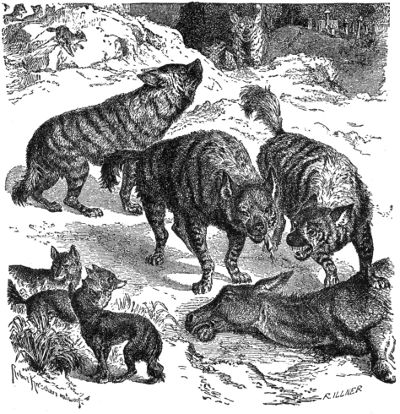
STRIPED HYENA.
The Striped Hyena is of a grey color,
marked with upright stripes of brown or
black. It has a thick mane which extends
along the whole length of the neck,
and down the center of the back. This
mane stands erect when the animal is
very angry. This Hyena is about the
size of a large Dog.
The Spotted Hyena, and an animal
very much like it which is some times
called the Aard Wolf, and the “Hunting
Hyena,” all belong to this family, but
there is very little difference in their
forms or their manner of living. The
Spotted Hyena, which is called by the
colonists of the Cape of Good Hope the
Tiger Wolf, is most commonly met with
in Southern Africa, where its appetite for
living prey, as well as for carrion, causes
it to be justly regarded as a very dangerous
neighbor; indeed, as we learn from
the reports of travelers, it seems to be
especially fond of attacking children, and
many harrowing tales might be told of
the fiend-like deeds of which it is guilty.
“To show clearly the preference of the
Spotted Hyena for human flesh,” says
Steedman, “it will be necessary to observe
that the Mambookies build their
houses in the form of bee-hives, and tolerably
large, often eighteen or twenty
feet in diameter; at the higher or back
part of the house, the floor is raised until
within three or four feet of the front,
where it suddenly terminates, leaving an
area from thence to the wall, in which
every night the calves are tied, to protect
them from storms or wild beasts.
Now, it would be natural to suppose that
should the Hyena enter, he would seize
the first object for his prey, especially as
the natives always lie with the fire at their
feet; but notwithstanding this, the practice
of this animal has been in every instance
to pass by the calves in the area,
and even the fire, and take the children
from under the mother’s caress; and this
in such a gentle and cautious manner that
the parent has been unconscious of her
loss until the cries of the poor little innocent
have reached her from without,
when hopelessly a prisoner in the jaws of
the monster.”
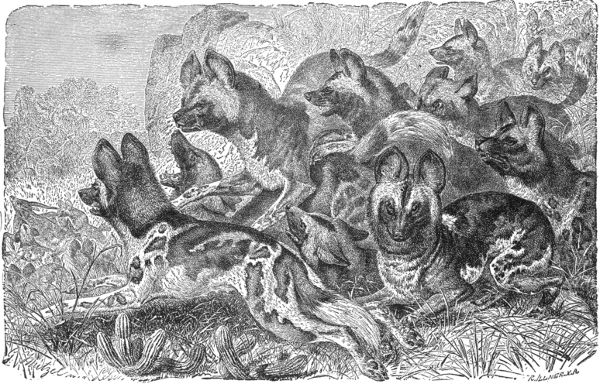
The Hunting Hyena was first described
by Mr. Burchell. It is smaller
and of a more slender shape than either
44the Striped or the Spotted Hyena; the
ground color of its body is sandy, shaded
with darker hair, varied with irregular
blotches of black, and spots of white. In
its teeth it resembles the Dog; but, on the
other hand, it approaches the Hyenas in
having only four toes on each foot.
Mr. Burchell was fortunate in bringing
home a living specimen, which he kept
chained up for more than a year. At
first it was so ferocious that no one attempted
to tame it; but at length its manners
became softened, and it used to play
with a Dog chained up in the same yard;
yet still the man who fed it never dared
to venture his hand within its reach.
Mr. Burchell informs us that in a wild
state this animal hunts in packs; though
in general it hunts at night, it frequently
pursues its prey by day, and as it is very
fleet, none but the swiftest animals can
escape it. Sheep and oxen are particularly
objects of its attacks, the first
openly, the latter only by surprising them
in their sleep and suddenly biting off their
tails, a mode of attack for which the wide
gape and great strength of its jaws are
peculiarly adapted. This species is found
throughout Africa.
THE CAT FAMILY. — WILD AND DOMESTIC CATS. — THE LION—THE KING OF BEASTS. — THE TIGER. — THE LEOPARD. — THE PANTHER. — THE JAGUAR. — THE PUMA OR COUGAR. — THE OCELOT. — THE LYNXES. — THE EUROPEAN LYNX. — THE CANADA LYNX. — THE CARACAL. — THE OUNCE AND SERVAL. — THE CHEETAH.
All the different animals of this great
family are alike in having short, powerful
jaws armed with sharp teeth, and a rough
bristling tongue, which feels like a rasp
when it is drawn across the bare skin—wounding
by mere licking; in their manner
of walking on their toes, and in several
other characteristics. The fiercest
beasts of all the carnivorous animals are
found in the Felidae family, which includes
three groups—the Cat tribe, the
Lynx and the Hunting Leopard. The
Cat tribe includes, in the Old World, the
Lion, Tiger, Panther, Leopard, Ounce,
Serval, and Wild and Domestic Cats.
In the New World are found the Domestic
Cats, the Jaguar, Puma and
Ocelot.
All these animals in the wild state prefer
to feed on living victims, devouring
their prey as they kill it. Although the
various animals belonging to this great
family differ much in size, they are all
alike in their mode of attacking and killing
their victims. They usually take
them by surprise, for they do not have so
much courage as people sometimes
think. Crouched in some hidden retreat,
they silently and patiently await their
prey; and as soon as within reach, they
spring upon it from behind, without allowing
time for escape or defence.
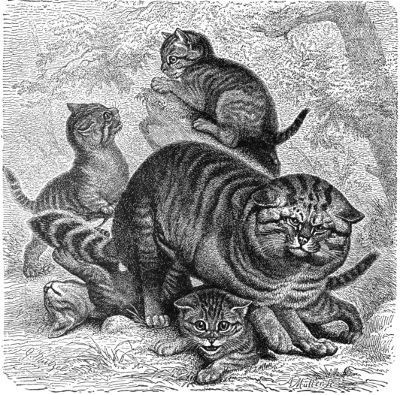
WILD CATS.
It is usual to place the Lion at the head
of this great Felidae family, which takes
its name from the Latin felis, a cat; but
it seems more appropriate to first describe
the Wild and Domestic Cats, as
these particular feline members have
given the great family its name.
The Wild Cat is a reddish brown animal,
marked with more or less distinct
black stripes and spots.
Its length is about two feet. It does
not differ in its habits from the larger
members of this family. It climbs trees
with agility, and feeds on Birds, Squirrels,
Hares, Rabbits, &c. At one time it was
very common in France and Scotland.
It is found in nearly the whole of Europe,
and a large portion of Asia.
45There ought to be ranged beside the
Wild Cat a multitude of species, which
are only separated from it by differences
in the color of the fur and length of hair,
and which are its representatives in the
countries it does not inhabit. Such are
the Pampas Cat, the Bengal Cat, the
Neptaul, the Egyptian Cat, the Serval
Cat, the Caffir Cat, indigenous to the
Cape, &c.
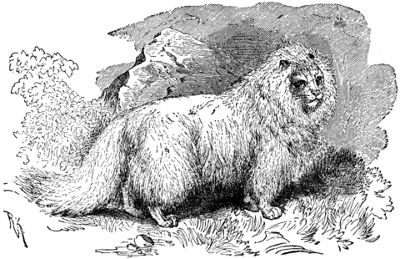
Certain authors are inclined to believe
that the numerous varieties of the Domestic
Cat have descended from the Wild
Cat, and the Egyptian Cat. However
this may be, there exist several kinds of
well-characterised Domestic Cats. Such
are the Spanish Cat, the Chartreuse Cat,
the Red Cat of Tobolsk, the Angora Cat,
the most highly prized of home pets, the
Chinese Cat with pendant ears, and the
46tailless Malay Cat. The tails of Wild
Cats terminate in an abrupt thick point,
while the tails of Domestic Cats taper to
a finer point.
The Domestic Cat is one of those few
animals which has remained in a state of
independence in its domesticity; it lives
with Man, but still is not reduced to servitude.
If it renders service, it is simply
for its own interest to do so. That disinterestedness
which distinguishes the Dog
we do not find in the Cat. Whatever
Buffon and others may have said, it is
capable of affection; this attachment is
only manifested by infrequent caresses,
not by devotion. Has a Cat ever been
known to defend its master? It has been
said that it is more attached to localities
than persons; yet we know of numerous
exceptions to this.
ANGORA CAT.
No animal is more savage than the Cat
when threatened by punishment or danger.
For when it sees no chance of escape,
it defends itself with energy that
cannot be surpassed. So long as its enemy
keeps at a respectful distance, it confines
itself to a passive resistance, watching,
however, for the slightest indication
of hostility, and holding itself ready for
every emergency. Should its adversary
advance to seize it, with wonderful activity
it strikes with its claws, at the same
time expressing anger with its voice. It
nearly always comes off victorious, unless
over-matched, for its agility renders escape
almost certain.
The Cat is less an enemy of the Dog
than is generally believed. When unacquainted
with one another, they have little
sympathy in common; but when associated
for a length of time they become
good friends. Then they lick each other,
sleep with each other, and understand
making mutual concessions, which enable
47them to live in peace; in short, the
most perfect harmony frequently reigns
between them.
The Lion has been called the “King of
Beasts” from most ancient times, and this
is a very appropriate title, if we consider
the impression we usually have of this
animal when viewed for the first time.
He carries his head high and walks with a
slowness which may well pass for majesty.
He always appears calm and dignified
and conscious of his strength.
The bushy and magnificent mane which
overshadows his head and neck gives an
added grandeur to his appearance.
Some adult Lions have attained a
length of nearly ten feet, from the tip of
the nose to the root of the tail; but usually
they do not exceed six or seven feet.
With the exception of the mane and a
tuft of hair at the tip of the tail, the coat
of the Lion is entirely smooth, and of a
tawny color. The mane, which gives
this great “King of the Beasts” such a
lordly appearance, is missing in his mate,
who has a smooth neck and a smaller
head, and is generally in proportion
about one-fourth as large. The mother
Lion is at her fiercest when her little ones
are threatened with danger; at other
times she shows very little of the Lion nature
except when pressed by hunger.
The Lion has also been called the
“Lord of the Forest,” but this is not an
appropriate title, as he does not prefer the
forest for a home. He lives in desert
arid plains, lightly covered with shrubby
vegetation or tracts of low brushwood.
In India he prowls along the borders of
rivers, and makes his lair in the jungles.
The Lion slumbers during the day in
his retreat, and as night comes on he
prowls abroad in search of prey. This is
not because his eyes are unfitted to see
in the daytime—like those of the majority
of “night prowlers”—but he seems
to think it prudent to keep at home until
evening. When the first shadows of
twilight appear, he enters upon his campaign.
If there is a pool in the vicinity
of his haunt, he places himself in ambush
on the edge of it, with the hope of securing
a victim among the Antelopes, Gazelles,
Giraffes, Zebras, Buffaloes, &c.,
which are led thither to slake their thirst.
These animals, well aware of this habit of
their enemy, will not approach a pond
without extreme caution. If one, however,
places itself within reach of their
terrible foe, its fate is generally sealed.
One enormous bound enables the Lion
to spring on its back, and one blow with
his paw breaks its back. If the Lion
misses his aim, he does not endeavor to
continue a useless pursuit, well knowing
that he cannot compete in speed with the
children of the plains. He therefore
skulks back into his hiding-place, to lie
in ambush until some more fortunate
chance presents itself, or complete night-fall
shuts out all hope of success.
The Lion, however, is not disposed to
remain long with an empty stomach.
Then it is that he approaches Man’s habitations,
with the hope of surprising the
domestic animals. Fences ten feet in
height form no obstacle to him, for he
will bound over such with ease, when,
falling into the midst of the herd, he
seizes the nearest.
The amount of strength which he manifests
under circumstances similar to
these is really extraordinary. A Lion
has been known, at the Cape of Good
Hope, to carry off a small Cow as a Cat
48would a Mouse, and, with the burden,
leap a wide ditch. It is almost impossible
to conceive the muscular force necessary
to jump a fence several feet high
when carrying a load of several hundred-weight.
The audacity of the Lion increases in
proportion to his requirement. When
he has exhausted all means of procuring
subsistence, and when he can no longer
put off the cravings of hunger, he sets no
limit to his aggressions, and will brave
every danger rather than perish by famine.
In open day he will then proceed
to where the herds of Oxen and Sheep
pasture, entirely disregarding Shepherds
and Dogs. At such times he has been
known to carry his rashness so far as to
attack a drove of Buffaloes—an action
which is all the bolder as a single one,
unless it is taken by surprise, is well able
to defend itself.
The Lion seems to delight in the tempests
of wind and rain, so common in
Southern Africa; his voice mingles with
the thunder, and adds to the terror of the
timid animals, on whom he then boldly
advances. He usually, however, waits
in ambush, or creeps insidiously towards
his victim, which with a bound and a rush
he dashes to the earth.
“In South Africa,” says Capt. Burton,
“the Lion is seldom seen, unless surprised
asleep in his lair of thicket; during my
journey I saw but one, although at times
his roaring was heard at night. Except
in darkness or during violent storms,
which excite the fiercer Carnivora, he is
a timid animal, much less feared by the
people than the angry and agile Leopard.
When encountered in the daytime, he
stands a second or two gazing; then turns
slowly round and walks as slowly away
for a dozen paces, looking over his shoulder;
he then begins to trot, and when he
thinks himself out of sight bounds like a
Greyhound.”
If attacked, however, he will show fight
as the following experience, not likely to
be often repeated, will testify: “Being
about thirty yards off the foe,” says Dr.
Livingstone, “I took a good aim at his
body, through the bush, and fired both
barrels into it. The men then called out:
‘He is shot! he is shot!’ Others cried:
‘He has been shot by another man, too;
let us go to him!’ I did not see any one
else shoot at him; but I saw the Lion’s
tail erected in anger behind the bush and,
turning to the people, said: ‘Stop a little
till I load again.’ When in the act of
ramming down the bullets, I heard a
shout. Starting and looking half round,
I saw the Lion just in the act of springing
upon me. I was upon a little height.
He caught my shoulder as he sprang, and
we both came to the ground below together.
Growling horribly close to my
ear, he shook me as a Terrier Dog does a
Rat. The shock produced a stupor similar
to that which seems to be felt by a
Mouse after the first shake of the Cat.
It caused a sort of dreaminess, in which
there was no sense of pain or feeling of
terror. It was like what patients partially
under the influence of chloroform
describe, who see all the operation, but
feel not the knife. This singular condition
was not the result of any mental process.
The shake annihilated fear, and
allowed no sense of horror in looking
round at the beast. This peculiar state
is probably produced in all animals killed
by the Carnivora, and, if so, is a merciful
provision by our Creator for lessening the
pain of death. Turning round to relieve
myself of the weight, as he had one paw
on the back of my head, I saw his eyes directed
49to Mebalwe, who was trying to
shoot him at the distance of fifteen yards.
His gun, a flint one, missed fire in both
barrels. The Lion immediately left me,
and attacking Mebalwe, bit his thigh.
Another man, whose life I had saved before,
after he had been tossed by a Buffalo,
attempted to spear the Lion while
he was biting Mebalwe. He left Mebalwe
and caught this man by the shoulder;
but at that moment the bullets he
had received had taken effect, and he fell
down dead. The whole was the work of
a few moments, and must have been his
paroxysm of dying rage. In order to
take out the charm from him, the Bakatla,
on the following day, made a huge
bonfire over the carcass, which they declared
to be that of the largest Lion they
had ever seen. Besides crunching the
bone into splinters, he left eleven teeth-wounds
in the upper part of my arm.”
Dr. Livingstone says: “The same feeling
which has induced the modern
painter to caricature the Lion, has led
the sentimentalist to consider the Lion’s
roar the most terrific of all earthly
sounds. We hear of the majestic roar of
the king of beasts. It is, indeed, well
calculated to inspire fear, if you hear it in
combination with the tremendously loud
thunder of that country, on a night so
pitchy dark that every flash of the intensely
vivid lightning leaves you with
the impression of stone-blindness, while
the rain pours down so fast that your
fire goes out, leaving you without the
protection of even a tree, or the chance
of your gun going off. But when you
are in a comfortable house or wagon, the
case is very different, and you hear the
roar of the Lion without any awe or
alarm.
“The silly Ostrich makes a noise as
loud, yet it never was feared by man.
To talk of the majestic roar of the Lion
is mere majestic twaddle. On my mentioning
this fact some years ago, the assertion
was doubted; so I have been careful
ever since to inquire the opinions of
Europeans who had heard both, if they
could detect any difference between the
roar of a Lion and that of an Ostrich.
The invariable answer was that they could
not, when the animal was at a distance.
The natives assert that they can detect a
variation between the commencement of
the noise of each. There is, it must be
admitted, a considerable difference between
the singing noise of a Lion when
full, and his deep gruff voice when hungry.
In general, the Lion’s voice seems
to come deeper from the chest than that
of the Ostrich; but to this day I can distinguish
between them with certainty
only by knowing that the Ostrich roars
by day and the Lion by night.”
“Attempts to deprive the Lion of his
prey are of frequent occurrence in the interior
of Africa. Indeed, it is no unusual
thing to find a number of natives residing
near such pools of water as are frequented
by Antelopes, other wild animals,
and their constant attendant, the
Lion, subsisting almost altogether in this
way, or on carcasses which the Lion has
not had time to devour before the return
of day, when it is his habit to return to
his lair.”
Mr. Anderson mentions, as a remarkable
circumstance connected with a
Rhinoceros hunt, that “While following
the trail of the animal, we came to a spot
where one or two Lions, probably taking
advantage of his crippled condition, had
evidently attacked him, and, after a desperate
scuffle, had been compelled to retreat.
This is the only instance I know
50of Lions daring to attack a Rhinoceros,
though I have seen it stated in print that
they will not only assail, but can master
the horned monster.”
In former times Lions were numerous
even in Europe. According to Herodotus,
Aristotle, and Pausanias, they were
abundant in Macedonia, Thrace, and
Thessaly; but for centuries in these countries
they have been unknown. Arabia,
Syria, and Babylonia used also to contain
large numbers. In Arabia and on
the confines of Persia and India at the
present date they are scarce.
We may form some idea of their number
in ancient times by the quantity absorbed
annually in the combats which
were so much in favor with the Romans.
In a very brief interval, Sylla had slaughtered
a hundred Lions, Pompey six hundred,
and Caesar four hundred.
In this age the Lion is rarely met with
except in Africa, where every day its
numbers are diminishing, and from
whence it will soon completely disappear
if the present rate of slaughter is continued.
Our grand-children probably
will know the Lion only from our descriptions.
Several varieties of the Lion are distinguished.
The most ferocious is the
Brown Lion of the Cape. In the same
neighborhood lives another, much less
dangerous, the Yellow Cape Lion. After
these we may enumerate the Lion of
Senegal, the Barbary Lion, and the Lion
of Persia and Arabia.
The Tiger is as high on the limbs as the
Lion; but it is more slender, active, and
stealthy, closely resembling, in figure and
movements, the domestic Cat, which
serves as the type of the entire genus.
Its coat is very handsome, being of a yellowish
fawn color above and a pure white
beneath; everywhere irregularly striped
by brown transverse bands. Its tail,
which is very long, is ringed with black,
and contributes not a little to its beauty.
It has also white around the eyes, on the
jaws, and on the back of each ear.
The Tiger is peculiar to Asia. It inhabits
Java, Sumatra, a great part of Hindostan,
China, and even Southern Siberia
as far north as the banks of the river Obi.
The Tiger makes its lair in jungles or
densely wooded districts bordering on
water-courses. Like the Lion, it has a
den, to which it retires for rest; from
whence it steals forth, secretes itself in a
wood on the borders of a frequented
path, and there, concealed from every
eye, awaits its victim. The moment it
sees the object of its desire, its eyes flash,
and its whole bearing manifests a savage
joy; it allows the unsuspecting prey to
draw near, and when it is sufficiently
close, springs upon it with tremendous
velocity. If it scents prey from a distance,
it glides through the high grass
with the undulating movements of the
serpent, almost impossible to be detected
by the human eye.
The Tiger has for a long time borne a
reputation for cruelty, as little deserved as
that for generosity which has been given
the Lion. The old Naturalists pretended
that the Tiger gloried in shedding blood,
and that it never saw a living creature
without desiring to destroy it. Nothing
can be more untrue. The Tiger does not
kill for the pleasure of killing; it kills only
to appease its hunger. In doing this, it
only conforms to the necessities of its nature;
but when it has fed, it does not exhibit
any blood-thirsty propensity, but
51simply defends itself when threatened or
attacked.
Tigers will occasionally take to water.
In the Sunderbunds especially they are
often seen swimming across the various
rivers, which form innumerable islands,
inhabited only by wild beasts. Invariably,
the fore-paw is the Tiger’s instrument
of destruction. Most people imagine
that if a Tiger were deprived of his
claws and teeth he would be rendered
harmless; but this is an error; the weight
of the limb is the real cause of the mischief,
for the claws are rarely extended.
When the Tiger strikes his victim, the
operation is similar to that of a hammer,
the Tiger raising his paw and bringing it
down with such force as not only to stun
a common-sized Bullock, but often to
crush the bones of the skull!
Williamson gives an amusing account
of the mode by which Tigers are captured
in Oude: “The track of the Tiger being
ascertained, which, though not invariably
the same, may yet be sufficiently known
for the purpose, the peasants collect a
quantity of the leaves of the prouss,
which are like those of the sycamore, and
are common in most underwoods, as they
form the larger portion of most of the
jungles of India. These leaves are
smeared with a species of bird-lime, made
by bruising the berries of an indigenous
tree; they are then strewed, with the gluten
uppermost, near to that shady spot to
which it is understood the Tiger usually
resorts during the noontide heats.
“If by chance the animal should tread
on one of the smeared leaves, his fate may
be considered as decided. He commences
by shaking his paw, with the view
to removing the adhesive incumbrance,
but finding no relief from that expedient,
he rubs the nuisance against his face with
the same intention, by which means his
eyes, ears, &c., become sticky, and cause
such uneasiness as occasions him to roll
perhaps among many more of the
smeared leaves, till at length he becomes
completely enveloped, and is deprived of
sight. In this situation he may be compared
to a man who has been tarred and
feathered. The anxiety produced by this
strange and novel predicament soon
shows itself in dreadful howlings, which
serve to call the watchful peasants, who in
this state find no difficulty in shooting
the mottled object of their detestation.”
The Leopard is smaller and more active
than the Tiger and larger than the Panther.
It is arboreal in its habits and finds
in the spots or rosettes which decorate
its tawny skin a provision highly favorable
to concealment among the foliage,
wherein it lurks, until some passing animal
approaches sufficiently near to enable
it to spring upon its unsuspecting
prey.
The activity of the Leopard is almost
beyond belief. Mr. Andersson, speaking
of his Dogs, says: “They were, I conjectured,
from their steady, unbroken, deep
bay, close upon the haunches of their enemy,
yet I could not see distinctly either
the Dogs or the object of the pursuit,
when all at once a magnificent Leopard
sprang right before me, from the topmost
branches of a tall acacia, clearing with a
single bound all his fierce assailants. I
was so astounded at the magnitude of the
leap—without having witnessed it one
can hardly form a notion of the distance
oversprung—that, looking first at the
tree, and then at the spot on which the
beautiful beast had alighted, I could not
52withdraw my eyes from the scene of its
exploit.”
From the propensity of the Leopard to
ascend trees, especially when pursued, it
has in India obtained the name of the
lackree-bang or Tree-tiger. “Leopards,”
says Mr. Williamson, “will not ascend
trees which have not some underwood
growing near them; their usual
haunts are found in those close woods of
which the intervals are grown up with
thorns, etc., and especially where there
are old trees with low boughs, favoring
their access to the more shady parts of the
foliage.
“The royal Tiger will not touch anything
but of its own killing, but Leopards
are not quite so fastidious, and may be allured
by the scent of meat. I have heard
this doubted; but the following fact,
which occurred while the corps to which
I was then attached was at Hazary-bhang,
in the Ram-ghur country, puts the
matter out of doubt. The sergeant-major
of our battalion had killed an Ox for
his winter provision, and had hooked up
the joints within his hut, which was on the
right flank of the line, close to the grenadier
bell of arms. The sentry stationed
there gave the alarm that some large animal
had entered the hut, in which there
were several apartments. A light was
brought, and numbers crowded the place,
but nothing could be seen for awhile. All
were about to retire, when it was discovered
that a Leopard was clinging to the
thatch with his claws, just above where
the meat was hanging. No sooner did
the animal perceive that he was discovered
than he quitted his hold, springing
suddenly down, and darted through the
doorway, clawing several as he passed,
and giving the poor sentry in particular a
scratch in the face which laid him up for
several weeks.”
“Nightly,” says Sir W. C. Harris,
“may his low half-smothered growl be
heard as he prowls round the fold; and in
spite of the baying troops of Watch Dogs
that are maintained for the protection of
the flock, he not unfrequently contrives
to purloin mutton. Viewed in his wild
state, few animals can surpass the lurking
Leopard in point of beauty, his brilliant
orange and white skin, which shines like
silk, being richly studded with open rosettes,
sometimes of the most intense sable,
at others disposed as if a Cat had
been walking over him with her paws
tarred. Nor is he less distinguished for
elegance and grace. His every motion
easy and flexible in the highest degree, he
bounds among the rocks and woods with
an agility truly amazing; now stealing
along the ground with the silence of a
Snake—now crouching with his fore-paws
extended, and his spotted head laid
between them, while his chequered tail
twitches impatiently, and his pale eyes
glare mischievously upon his unsuspecting
victim.”
Panther Surprised by Tree Snake.
The Panther is a pretty animal, about
three feet in length, not including the
tail, and is distinguished from the preceding
Felidae by its deep yellowish-brown
coat, speckled with numerous
spots. These spots, quite black on the
head, are disposed in a rose-like fashion
over the other parts of the body, being
formed of five or six little black patches
grouped in a circular manner around a
piece which is of the same color as the
ground of the coat.
For a long time, and even sometimes
now-a-days, the Panther has been frequently
55confounded with the Leopard, to
which certainly it bears a great resemblance.
From this error has arisen grave
contradictions as to its history, and much
uncertainty with regard to the limits of its
natural locality.
It appears to be demonstrated, however,
that the veritable Panther is not
found in Africa, but only in India, Japan,
and the neighboring islands, such as Java,
Sumatra, &c. The island of Java possesses
a variety which is completely black.
This is the famous Black Panther, the
terror of Java and Sumatra.
The Panther ascends trees with agility,
into which it pursues Monkeys and other
climbing animals. It is a ferocious and
untamable animal, and inhabits only the
wildest forests. No Carnivore, not even
the Tiger, is more unconquerable, and its
pursuit is proportionably dangerous. It
rarely attacks Man without being provoked;
but it is irritated at the merest
trifle, and its anger is manifested by the
lightning rapidity of its onset, which invariably
results in the speedy death of the
imprudent being who has aroused its
fury. Its power, nimbleness, and stealth
surpass anything that can be imagined;
and it is these qualities which render it so
dangerous.
Notwithstanding its ferocity when
wild, the Panther is easily tamed when
captured young and is then as mild and
affectionate as a Dog.
The Panther is especially fond of
young Birds, but is frequently disappointed
in his search by finding that a
Snake has preceded him and secured the
prize, as illustrated. During his rovings,
the Panther espies a nest and begins at
once to climb the bough on which it is
built just as the father Bird returns with
food for the Birds. At the sight of the
fearful enemy near his nest, he utters a series
of low pitiful shrieks. The mate answers
him from the distance and comes flying
swiftly towards him. But the Panther
does not allow himself to be turned from
his purpose; on the contrary, the parents’
alarm makes him feel assured that the
nest contains a prize for him. Meanwhile
the Snake’s rest has become disturbed
during the clamor and just as the
Panther raises his head to peer into the
nest, the head of the Snake with wide
open jaws shoots hissing upon him. He
falls backward startled! He shares the
abhorrence of many animals for the
Snake, and also fears its sharp bite. One
moment he hesitates as to whether to
give up the hoped-for prize, then slowly
retreats.
The Panther not only climbs the trees
to secure the Birds and small climbing
animals, but lurking in concealment
among the foliage it springs upon the Antelopes
or other large game which happens
to approach its hiding place.
A tame Panther in the possession of
Mrs. Bowdich was left at liberty to go
where he pleased, and a boy was appointed
to prevent him from intruding
into the apartments of the officers. His
keeper, however, generally passed his
watch in sleeping, and Sai, as the Panther
was called, roamed at large. On one occasion
Sai found his servant sitting on the
step of the door, upright, but fast asleep,
when he lifted his paw, gave him a blow
on the side of the head, which laid him
flat, and then stood wagging his tail as if
conscious of the mischief he had committed.
He became exceedingly attached
to the governor, and followed him
everywhere, like a Dog. His favorite
station was at a window of the sitting-room,
which overlooked the whole town.
56There, standing on his hind-legs, his fore-paws
resting on the ledge of the window,
and his chin laid between them, he appeared
to amuse himself with what was
passing underneath. The children also
stood with him at the window, and one
day, finding his presence an incumbrance,
and that they could not get their
chairs close, they united their efforts to
pull him down by the tail. He one day
missed the governor, who, being in the
hall, surrounded by black people, was hidden
from view, Sai wandered in search
of him, and having at length found him
seated writing at a table, the Panther immediately
sprang from the door on to his
neck, put his head close to the governors,
rubbed his head upon his shoulder, and
tried to evince his happiness.
When on board a ship at anchor in
the river Gaboon, an Orang-Outang was
brought for sale, and lived three days on
board. “I shall never,” writes Mrs. Bowdich,
“forget the uncontrollable rage of
the one, or the agony of the other, at this
meeting. The Orang was about three
feet high, and very powerful in proportion
to his size, so that when he fled with
extraordinary rapidity from the Panther
to the farther end of the deck, neither
men nor things remained upright when
they opposed his progress; there he took
refuge in a sail, and although generally
obedient to the voice of his master, force
was necessary to make him quit the shelter
of its folds. As to the Panther, his
back rose in an arch, his tail was elevated
and perfectly stiff, his eyes flashed, and as
he howled he showed his huge teeth;
then, as if forgetting the bars before him,
he tried to spring on the Orang, to tear
him to atoms.”
JAGUAR.
The Jaguar is the Leopard of the
American forests, and nearly approaches
to the Tiger of India in strength and daring.
The Jaguar may be distinguished
from the Leopard by a bold streak or two
of black extending across the chest from
shoulder to shoulder. The rosettes on
the body are very large, open and rather
angular, with a central spot or two in
each, and a central chain of black dashes
extends along the spine. The size of the
Jaguar varies, but usually exceeds that
of the Leopard. Its form is more robust
and less agile and graceful. The limbs
are short, but exceedingly thick and muscular,
the head square and larger, and the
tail comparatively shorter. The Jaguar
is the most formidable of all the American
members of the Cat family. It prefers
the marshy and wooded districts of
the warmer latitudes, and haunts the vast
forest along the larger rivers. He climbs
and swims with equal facility, and preys
on the larger domestic quadrupeds, on
Peccaries and Monkeys, and also on Tortoises
and Fishes. Sonnini saw the
scratches left on the smooth bark of a tree
without branches forty feet high. Humboldt
heard the Jaguar’s yell from the
tops of the trees, followed by the sharp,
shrill, long whistle of the terrified Monkeys,
as they seemed to flee. It takes
Birds in their nests and Fish in the shallows
and makes havoc in some districts
among Horses, Cattle and Sheep.
The Jaguar is also called the American
Tiger; it is the largest carnivorous animal
of the New World. It almost equals the
Tiger in size, as well as in blood-thirstiness;
it measures nearly seven feet from
the end of the nose to the root of the tail.
It is not Zebra-striped like the Tiger, but
spotted in the same manner as the Panther.
57Its markings are most numerous
on the head, thighs, legs and back, but
always irregular in shape. The ground
color of the coat is of a bright tawny hue
above, and white beneath.
The Jaguar is spread over nearly the
whole of South America and of the
warmer parts of North America. It inhabits
the great forests traversed by rivers,
and actively pursues various aquatic
Mammals. Like the Tiger, it swims with
ease and passes the day in inaction among
the islets of the great lagoons and rivers.
In the evening it seeks its food, and levies
a heavy tribute on the immense herds of
wild Cattle and Horses that graze in the
Pampas of the Plata. With a single blow
of its paw it breaks the back-bone of its
victims.
At the setting and rising of the sun it
gives utterance to two cries, which are
well known to the natives and to hunters.
It is by this means that it announces to
living nature the commencement and the
termination of its feeding operations, and
thus excites terror or joy. In certain
parts of South America, Jaguars were so
numerous, that, according to Azara, in
the seventeenth century, two thousand
were killed every year at Paraguay. At
the present time many are yet to be found
in that region, although their numbers
are considerably diminished.
58
Pumas Fighting over Vultures.
The Puma or Cougar, formerly improperly
called the American Lion, is an
animal about four and a half feet long,
and of an uniform fawn color without any
spots. It inhabits Paraguay, Brazil, Guiana,
Mexico and the United States. It
has the general appearance of a Lioness,
without possessing its dimensions.
This animal is alike remarkable for
stealth and agility. It makes great ravages
among the herds, and differs from
the other Cats, in slaying numerous victims
before it commences to feed. To
carry off the smaller domestic animals, it
visits human habitations during the
night. It prefers living in the open country,
yet it climbs trees; its agility is such,
that at one bound it can ascend upwards
of twenty feet.
The Puma is easily tamed, when it
knows its master, and receives his caresses
with pleasure. No inconvenience
results from allowing it to run at liberty.
The celebrated English actor, Kean, had
a Puma which followed him like a Dog,
and kept close to him in the most
crowded assembly.
The Ocelot, one of the most beautiful
of the Cat family, is a little more than
three feet in length. The color of its fur
is a greyish fawn, marked with large
spots of a bright fawn, edged with black.
Its habits are entirely nocturnal; it feeds
on Monkeys, Rodents and Birds, climbing
the trees in their pursuit with great
swiftness. It is found in various parts of
North and South America.
Like the Puma, it rapidly becomes attached
to Man. Azara has seen one
which, although it enjoyed the greatest
liberty, would never leave its master.
The animals belonging to the Lynx
family differ from the other Felidae in
their longer coat, their shorter tail, and
their ears, which are terminated by a tuft
of hair. A great number of varieties of
Lynx are known, as well in the Old as in
the New World. The principal ones,
however, are the European Lynx, the
Canada Lynx and the Caracal.
The European Lynx is well known in
the great forests of Northern Europe and
in Asia; it is also found in some of the
Alps and Pyrenees, as well as in the Sierras
of Spain. This animal measures
from thirty to thirty-six inches, not including
the tail, which is four inches long.
The upper parts of its body are of a bright
red color, with small brown spots, while
the under parts are white. On each side
of its face it has an addition of white
hairs, which resemble whiskers.
The name of “Loup-cervier” sometimes
given to it, probably originated
from its howling like a Wolf during the
night. It nimbly climbs trees in pursuit
of prey. Martens, Ermines, Hares and
Rabbits are its favorite food. It does
not, however, eat the flesh of larger victims,
unless its hunger is extreme; but
generally is satisfied by sucking out the
brain.
Taken young, it becomes accustomed
to captivity, and is fond of being caressed,
but it will return to its wild life if opportunity
offers, so really never becomes attached
to its master. It is an extremely
cleanly animal, and, like the Cat, passes a
large portion of its time in washing and
cleansing its fur.
The European Lynx is not much
smaller than the Wolf, and is said to be
59rather shy than bold, never attacking
Man except in self-defence, and using his
claws as his principal weapons. This animal
frequents mountainous and thickly-wooded
districts, and confines himself to
a limited hunting ground, not hunting in
a pack, but usually in pairs, the mother
being frequently followed by her young
ones. The Lynx usually reposes during
the day in such a position as to perceive
either the approach of danger or of prey,
going forth at twilight or early dawn to
seek for food. Mr. Lloyd tells us that if
the Lynx fails in his spring, he does not
pursue his prey to any great distance, but
slinks back to his retreat, in proof whereof
he relates the following anecdote:
“Some years ago, while a peasant was occupied
with agricultural labors in the
spring, he observed that some Sheep
feeding in the distance shied when passing
near a boulder on the hill-side. Inclination
for the green grass, however,
having at length got the better of their
fears, they once more approached the
spot, when out dashed a large Lynx from
his ambush, and made several bounds towards
them; but as the poor creatures
had the start of him, they were so fortunate
as to escape his clutches. Seeing
that his efforts were fruitless, the beast
now turned about and retreated to his
hiding place, which the peasant observing,
he hastened home for his gun, and
stealthily approaching the spot, shot him
while in his lair.”
LYNX ATTACKING FAWN.
The Canada Lynx in size and coloring
closely resembles the European species
last mentioned. It is about three feet in
length, besides the tail, which measures
from four to five inches. It is retired in
its habits, keeping away even from the
dwellings of the first settlers in the forests.
Its fine long fur enables it to resist
the cold of the high latitudes in which it
lives. It is found north of the Great
Lakes, as far southward as the Middle
States, and occasionally near the sea
coast.
When alarmed or pursued, the Canada
Lynx leaps or bounds rapidly in a
straight direction from danger, and takes
to a tree when hard pressed by Dogs. It
is very strong, and possessing remarkably
60large and powerful fore-legs and
claws, is able to climb trees of any size;
and can leap from a considerable height
to the ground without seeming to feel
the jar, alighting on all four feet at the
same instant, ready for flight or for battle.
The food of the Canada Lynx consists
principally of Birds and small quadrupeds.
Occasionally it may carry off some
small live stock of the farmer, but it usually
prefers such game as may be met
with in the depths of the forest in which it
lurks.
Caracal Defending His Booty from Jackals.
The Caracal is about the size of the
European Lynx. Its fur is red above,
without spots, and its chest is fawn colored,
speckled with brown. It is the
Lynx of the ancients, and inhabits the
north and east of Africa, Arabia and Persia.
Its habits differ very little from those
of the Lynx. It always retains, when in
captivity, its savage disposition and a
great desire for liberty.
The Caracal lies in wait for young Antelope
and overpowers them without
special exertion, tearing with his sharp
teeth the artery of the throat. The dexterous
hunter seldom enjoys his prey in
peace for, as all large animals of prey pursue
the small, so the bold, intruding
Jackal presses him from all sides, waiting
his chance to snatch part whenever possible.
Our illustration shows such a
scene. The Jackal generally has a bad
time in a combat with the Caracal. The
Caracal has never yet been tamed in any
menagerie. Even the Arabs of the Soudan
fear him. In the illustration he has
been aggravated to the highest pitch by
the attacks of the Jackal. With his long
bushy ears lying flat, lips drawn backward
and one sharp, pointed claw raised,
he stands ready to strike and bite. Several
of the Jackals have already felt his
weapons. Despite this they howl and
press around him until he has had his fill
and leaves the rest of his meat for the persistent
beggars.
The Caracal is said to occasionally
hunt in packs like Wild Dogs. But this
is uncommon; they usually hunt singly or
in companies of two or three, creeping
towards their victim and springing suddenly
upon it.
In captivity, Caracals are very irritable,
and sometimes display great ferocity.
Dr. Charleton saw one kill and destroy a
Hound in a moment, although the poor
creature defended itself to the uttermost.
They retire to a corner of their den,
crouching sullenly, and resenting every
attempt at familiarity; when irritated, the
ears are laid close to the head, the eyes
glare with malignant fury, the teeth are
displayed, and they utter a hiss not unlike
that of a Cat, and quite different from the
growl of a Lion or Tiger. In their wild
state they avoid man, but are dangerous
foes when hard pressed or wounded.
These are two members of the Cat family
that seem but little known.
In size, the Ounce is between the Panther
and Leopard. The color of its coat
is not yellow, but grey, and its spots are
much more irregular than on these animals.
It is a native of Asia.
The Serval is also named the Cat-pard
or Tiger Cat. It is only about thirty
inches long. It is found in the forests of
Southern Africa; also in Abyssinia and
Algeria. It lives on small animals, particularly
Monkeys and Rodents. Its savage
nature cannot be changed by taming.
61Its fur, which is varied with bars and
black spots on a buff ground, is quite valuable.
The Cheetah or Hunting Leopard
forms the transition between the Cat and
Dog families. By its physical organization
and its character it belongs, in fact,
to both these classes. It has weak, non-retractile
claws, which are unfitted for
tearing purposes; but in its teeth it unmistakably
shows its affinity to the Cat
family. Its limbs are also longer, and
the body more slender than that of the
Cats, from whence results a greater aptitude
for hunting. Its tail is curled over
on itself at the extremity, a disposition
very common in Dogs, but which is not
observed in the Cats. Its mildness, obedient
temper, and attachment when tame,
naturally define its place on the confines
of the Feline and the Canine family.
The Hunting Leopard inhabits Southern
Asia and various parts of Africa. It
is about four feet in length, and twenty-six
inches in height. Its fur is very elegant,
being a bright fawn color above,
perfectly white beneath, and everywhere
interspersed with black spots. The tail is
barred with twelve alternately white and
black rings. A quantity of hair, longer
than on other parts of the body, grows on
the back of the head and neck, forming a
scanty mane.
The Cheetah seizes its prey by a succession
of bounds remarkable for their
rapidity. In India and Persia has been
adopted the habit of training it to hunt
certain animals, its natural docility allowing
it to be readily trained for this service.
The custom of employing the
Cheetah for hunting goes back to a very
remote period, for the Arab Rhazes speak
of it in the tenth century.
In Mongolia the following is the
method of conducting this sport. The
sportsmen start off on horseback, carrying
the Cheetah either on a Horse, or in a
carriage specially constructed for the
purpose. The animal is chained, and its
eyes blindfolded. The places which
Gazelles frequent are sought out. As
soon as one is perceived, the hunters
stop, the Cheetah is unfastened, and its
eyes unbandaged and the game is pointed
out to it. Immediately, under cover of
the high vegetation and brushwood, the
beast glides off in pursuit, taking advantage,
with unequalled tact, of the slightest
breaks in the ground to conceal its movements.
When it considers that it is sufficiently
near its victim, it suddenly shows
itself, dashes on with terrible impetuosity,
springs on the prey after a succession of
prodigious bounds and immediately pulls
it to the ground.
Its master, who has followed the events
of the chase, then enters upon the scene.
To detach it from its victim, he throws it
a piece of flesh, speaks gently to it, and
caresses it; after which he again covers its
eyes, and replaces it on the saddle or in its
conveyance, while the assistants carry off
the prey.
This kind of hunting is very popular in
Mongolia, and a well-trained Hunting
Leopard attains an extraordinary price
among the inhabitants.
In captivity, the Cheetah is familiar,
gentle and playful, becoming greatly attached
to those who are kind to it. When
pleased it purs; and mews like a Cat when
in distress.
THE DOG FAMILY. — THE HYENA DOG. — THE DESTRUCTIVE WOLF. — THE JACKAL. — THE FOXES. — THE FENNEC FOX. — THE COMMON FOX.
63
ESQUIMAU DOGS.
The many different kinds of Dogs that
are spread over the entire surface of the
globe, with the Wolves, Jackals and
Foxes, and their numerous smaller relatives
are all grouped under the family of
Canidae, which is derived from the Latin
word Canis, meaning a Dog. All the
members of this family are digitigrade.
Though they walk on their toes, like the
members of the Felidae, or Cat family,
their claws are neither sharp nor retractile
like those of the Cat and they cannot
serve either for attack or defence.
Nearly all the members of this family
have long tails, more or less clothed with
hair, and their tongue is smooth, and in
this respect different from the Cats.
NEWFOUNDLAND DOG.
They are the most intelligent of the
Carnivora. Their senses, particularly
that of smell, are strongly developed.
Some Naturalists claim that the Dog
is a tamed Wolf, others that he is a well-educated
Jackal, but there can be little
doubt that he constitutes a genus set
apart for the service of mankind, although
there are such numerous varieties
of domestic Dogs. It is impossible to
discover in which of the past ages, the
Dog became the servant of Man. The
oldest traditions and the most ancient
history show us the Dog as the friend and
the servant of mankind.
64Volumes might be written relating
stories of which Dogs are the heroes.
Every day in ordinary life we see something
of this kind, and which, although
of such frequent occurrence, is none the
less curious. As examples of the past we
might call to memory the Dog of Ulysses,
the model of fidelity; the Dog of
Montargis, the vanquisher of crime; of
Munito, the brilliant player of dominoes.
It is not necessary to mention
the Newfoundland Dog and the
Dog of Mount St. Bernard, as preservers
of human life; their wonderful exploits
are too well known to require special instances
as examples. Nor is it necessary
to speak of the numberless instances of
intelligent Dogs going for provisions for
their masters, and serving them in curious
ways—like the shoe-black’s Dog,
who was trained to plant his muddy paws
on the best polished boots, so as to bring
more business to his master, the man of
the brush. We should never come to an
end if we attempted to tell of all the exploits
of this valuable companion of man.
It is also useless to attempt to mention
all the various species of Dogs that are
found scattered over all the inhabited
parts of the world; but certain varieties
may be divided into classes. The Sporting
Dogs, for instance, are usually divided
into two classes—the Running Dogs
or Hounds, and the Setters or
Pointers. The first follow rapidly on a
track or scent, howling and crying all the
way, and only stop when they have captured
or lost their game. The second follow
silently on the trail of the game, and
only stop pursuing it when the scent announces
that they are close to the object
of their search. It is then that they are
said to be pointing or setting. Setters
generally lie down and wait for the
sportsman, while the Pointers stand.
Among the Running Dogs might be
mentioned the Greyhound, the Hounds
of Saintonge and of Poitou, English Foxhounds,
Harriers and Beagles, Turnspits,
Bull-dogs, Mastiffs, etc. The
principal sporting Dogs are the Pointers,
Setters, Land Spaniels and Water Spaniels.
It is almost impossible to class all the
different kinds of Dogs in groups, with
the many races and sub-races now existing.
Some Naturalists have divided all
these different varieties into three classes—the
Matins, the Spaniels, and the Mastiffs,
and although this method may
have its faults, it also has the advantage
of being easy to remember and sufficient
for practical use.
It is among the Matins that the largest-sized
Dogs are found. The ordinary
Matin—the great Danish Dog—is as
large as a good-sized Donkey; under this
class are also found the Spotted Danish
Dog, the Little Danish Dog, the different
varieties of Greyhounds, the Pyrenean
Shephard’s Dog, the Alpine Dog,
and the St. Bernard Dog.
The Spaniels comprise the Wolf Dog,
the Chinese Dog, the Siberian Dog, the
Esquimaux Dog—the two latter being
used to draw sledges across the snow—the
French and English Spaniels, and
what is classed as the Small Spaniel, including
a great number of varieties of
“Lap Dogs,” which are the favorite home
pets, in spite of the fact that they are particularly
remarkable for their ugliness,
and their small size. The principal Lap-dogs
are the King Charles, Cocker, Blenheim,
Small Poodle and the Small White
Dog of Cuba, or Havanese Dog, etc.
Then we come to the Turnspits, with
straight and crooked legs; the St. Domingo
65Dog; the large Water Spaniel—the
most faithful and intelligent of all
dogs; the Little Water Spaniel, Poodle,
Newfoundland Dog; Stag, Fox and Hare
Hounds; Bloodhounds, Pointers and Setters.
Among the Mastiffs are placed the
Great Dog or English Mastiff, an animal
that is very courageous, and a great
fighter; the Thibit Mastiff, the Small
Mastiff, the Pug, the Bull-dog, the Terrier,
and Bull Terrier, the Turkish Dog,
remarkable for its almost naked skin,
and last of all, our common Cur Dog,
with no distinct characteristics.
Then we have a class of Dogs distinct
from these friends and servants of mankind.
These live either entirely wild or
half-wild, and are scattered over various
parts of the globe. These are the Dingo,
or New Holland Dog, which is very
destructive to domestic animals, and even
to cattle; the Dhale, or East Indian Dog,
which in packs, pursues Deer, Gazelles,
etc., and which, when collected in troops,
does not fear to fight with the Lion or
Tiger; the Wild Dog of Sumatra; the
Cape of Good Hope Dog and the Maroon
Dog of America.
HYENA DOGS.
The Hyena Dog might be classed with
these wild and half-wild Dogs, although
it is usually given a distinct genus. As
the name indicates, it has several points
of resemblance with the Hyena. This
Dog inhabits South Africa. It is about
the size of a Wolf, but not so strong as
that animal. Its coat is of a deep gray
color speckled with spots of various colors.
It has large pointed ears and the
tail is long and bushy. Although like
the Hyena, it is very fond of putrid flesh,
the Hyena Dog also feeds on living prey,
especially Gazelles, Antelopes, etc. To
pursue and capture these, the Hyena
Dogs collect in troops, which are sometimes
very numerous, and under the direction
of a chief, they hunt with an intelligence
unsurpassed by the best pack of
Hounds. When the game is taken they
divide it equally, but if any of the larger
Carnivorous animals approach to take
a share in the feast, they all unite against
the intruder. Even Leopards and Lions
have been driven off by a troop of these
fierce Hyena Dogs.
WOLF.
Wherever the Wolf is found it is especially
dreaded by the owners of flocks and
herds, and it is considered the most destructive
quadruped met with in Europe.
Both in their habits and their
physical structure they are very closely
related to the Dog. The sense of smell
in the Wolf is very acute, but its speed is
not great. It wearies out its victim by
untiring perseverance and when in full
chase it persistently follows the track of
the fugitive.
The Wolf is found throughout the
whole of Europe, excepting Great Britain
and the neighboring islands, where it
has been exterminated. It also inhabits
the cold and temperate regions of Asia
and America. In some natural excavation
situated in the woods, the Wolf takes
up its abode. From here it steals forth
at night to prey upon all the weaker animal
life.
Among the varieties of the Common
Wolf, it is necessary to mention the Black
Wolf, which inhabits the North of Europe,
and the Black Wolves of the Himalayas;
the Dusky Wolf and the Prairie
67Wolf, which lives in troops on the great
plains of North America; the Red Wolf,
which leads a solitary life on the pampas
of La Plata and in Texas and Mexico;
lastly, the Mexican Wolf or Coyotte, and
the Java Wolf. In the glacial regions of
the two continents, White Wolves are
found.
Although our Domestic Dogs and
Wolves in a wild state are deadly enemies,
yet when Wolves are captured
quite young and tamed, they often become
quite friendly with the Dogs of the
home, and they are even considered safe
playmates of the children in some instances,
although they are rather treacherous,
and probably few mothers would
consider them safe. Yet a lady mentioned
by Mr. Lloyd in this “Scandinavian
Adventures” tells of a pet Wolf which
she found trustworthy. “This Wolf became
so faithful and attached that when
we took a walk about the estate, and he
was with us, he would crouch beside us
when we rested, and would not allow anyone
to approach nearer than about
twenty paces; for if they came closer he
would growl and show his teeth. When
I called him he would lick my hand, at
the same time always keeping his eyes
fastened on the intruder. He went about
the house and in the kitchen in the same
manner as a Dog, and was much attached
to the children, whom he would lick and
play with. This continued until he was
five months old. He had his kennel in
the lower yard near the gate, and in the
winter-time when the peasants came with
charcoal, he would leap on to the stone
fence, where he would wag his tail and
68whine until they came up to him and patted
him. At such times he was always
desirous of searching their pockets, that
he might ascertain if they had anything
good to eat about them. The men became
so accustomed to this that they
used to amuse themselves by putting a
piece of bread in their coat pockets to let
him find it out, and he ate all that they
gave him. Besides this, he ate three
bowls of food daily. It was remarkable
that our Dogs used to eat with him out
of the same bowl, but if any strange animal
attempted to share the food with
him, he would soon show anger.”
“At one time,” says Mr. Lloyd, “I had
serious thoughts of training a fine Wolf
in my possession as a pointer, but was deterred,
owing to the liking she exhibited
for the neighbor’s pigs. She was chained
in a little enclosure, just in front of my
window, into which these animals, when
the gate was left open, ordinarily found
their way. The devices the Wolf employed
to get them into her power were
very amusing. When she saw a Pig in
the vicinity of the kennel she, evidently
with the purpose of putting him off his
guard, would throw herself on her side
or back, wag her tail most lovingly, and
look innocence personified. And this
amiable demeanor would continue until
the grunter was beguiled within the
length of her tether, when in the twinkling
of an eye the prey was clutched.
“When the Wolf is hungry, everything
is game that comes to his net. In the
Gulf of Bothnia he often preys upon
Seals. When that sea is frozen over, or
partially so, as is generally the case soon
after the turn of the year, he roams its icy
surface in search of the young of the Gray
Seal, which at that season breeds among
the hummocks in great numbers; and
finding this an easy way of procuring
sustenance, he remains on the ice until it
breaks up in the spring. It not unfrequently
happens, however, that during
storms large fields of ice, on which numbers
of Wolves are congregated, break
loose from the shore or the land-ice; in
this case, as soon as the beasts perceive
their danger, but see no possibility of
escape, they rush to and fro, keeping up
the while a most woeful howling, heard
frequently at a great distance until they
are swallowed up by the waves.”
The vision and hearing, but more particularly
the sense of smell in the Wolf,
are very fully developed. These faculties
are of great service in enabling it to
obtain food and avoid danger.
When suffering from hunger it loses
all caution, and becomes a scourge to the
farmers’ flocks and a source of danger
even to Man. In broad daylight, under
such circumstances, without being seen, it
will draw near a flock of Sheep, eluding
the vigilance of the dogs, it will dart forward,
seize a victim that it has singled
out, and bear it off with such velocity as
often to defy pursuit. This exploit accomplished,
it returns time after time to
the scene of its previous success, until destroyed
or driven from the neighborhood.
When it succeeds in obtaining entrance
to a sheepfold, the havoc it commits
is fearful, for it makes a general massacre
among the inmates. The slaughter
terminated, it carries away a victim
for immediate use. It afterwards takes
a second, third, and fourth, which it conceals
in different places in the neighboring
woods. Nor does it return to its retreat
until daybreak, devoting the last
moments to secreting its booty.
This craving for slaughter, preceding
the act of hiding the carcasses, rather denotes
69foresight than ferocity; the Wolf is
not, therefore, the monster of cruelty
pictured by Buffon.
The Wolf often destroys Dogs, its
most deadly enemy; and resorts to stratagem
the better to accomplish its purpose.
Should it see a Puppy about a
farmyard, it approaches, and attracts attention
by frisking and making all kinds
of gambols to gain its confidence. When
the youngster, seduced by these overtures,
responds to them, and leaves the
friendly shelter of its home, it is immediately
overpowered, and carried off.
Against a vigorous Dog, capable of defending
itself with success, the stratagem
is different. Two Wolves arrange between
themselves the following plan:—One
shows itself to the hoped-for-victim,
and endeavors to make the Dog follow
its track into an ambuscade, where the
second Wolf is concealed. Both suddenly
assail it at once, and through their
combination obtain an easy victory.
Under ordinary circumstances the
Wolf does not molest Man, but even flies
from his presence. In cases of extreme
hunger, on the contrary, it attacks him,
looking out for an unguarded moment in
order to take him unawares. If the Man
is on horseback or accompanied by a
Dog, its first efforts are directed against
the quadrupeds.
During the winter, when the ground
is covered with snow, in the great plains
of Germany, in the vast steppes of Russia
and Poland, Wolves are most dangerous.
“Hunger drives the Wolf from the
wood,” says a proverb. Allied in immense
troops they range the country in
every direction, and become a terrible
scourge.
In those plains of Siberia that are infested
by Wolves a sledge journey is far
from agreeable, for frequently a band of
these ferocious brutes persistently follow
travelers. If the sledge stops for only a
second, the Men and Horses are lost;
safety exists only in flight. The struggle
on such occasions is fearful. The
Horses, mad with terror, seem to have
wings. The Wolves follow on their
track, their eyes flashing with fire. It is
a terrible situation to be placed in to behold
these black spectres tearing across
the surface of the white shroud of snow,
thirsting for your blood. From time to
time a report is heard; a Wolf falls.
More audacious than the others, the victim
had tried to climb the sledge, and one
of the travelers has shot it. This incident
gives some advantage to the fugitives;
for the carnivorous troop halt for a
few seconds to devour the body of their
companion.
Wolves are not hunted with Hounds
that run by scent, for it would only be
possible to overtake them with Greyhounds,
as they are endowed with great
speed and endurance. The method generally
adopted for their destruction is to
post the hunters around the covers which
a Wolf frequents. These measures being
taken, the grizzly marauder is started by
Bloodhounds, specially trained for the
purpose. The Wolf dashes past the
sportsmen, either successfully running
the gauntlet or getting shot.
JACKAL.
The Jackal, five or six varieties of
which are known, is common to the
whole of Africa, all the warm regions of
Asia, and to portions of Southern Europe.
It is about the same length as the
Fox, but stands a little taller. Its coat
is of a greyish-yellow color above, and
70white beneath; its tail is tipped with black
at the extremity.
Jackals live together in troops, which
are sometimes composed of more than a
hundred individuals. Although their
eyes are adapted for seeing in daylight,
they usually sleep during the day, and do
not go abroad until night to seek their
food. To keep together they are constantly
howling, and their voice is sad,
loud and unmusical. Their voracity and
audacity are unparallelled. They enter
habitations, when opportunity presents
itself, and sweep off everything eatable
they can reach; devouring even boots,
Horse harness and other articles made of
leather. In the desert they follow the
caravans, prowl all night around their encampment,
and endeavor to carry off anything
chance may throw in their way.
After the start of the caravan they rush
upon the deserted halting-place, greedily
fighting for all the refuse.
Captain Williamson tells us that “Mr.
Kinloch, who kept a famous pack of
Hounds, having chased a Jackal into a
jungle, found it necessary to call off his
Dogs, in consequence of an immense
herd of Jackals, which had suddenly collected
on hearing the cries of their
brother, which the Hounds were worrying.
They were so numerous that not
only the Dogs were defeated, but the
Jackals rushed out of cover in pursuit of
them; and when Mr. Kinloch and his
party rode up to whip them off, their
71Horses were bit, and it was not without
difficulty that a retreat was effected. The
pack was found to have suffered so severely
as not to be able to take the field
for several weeks.
“The Jackal is very watchful. He will
wait at your door, and will enter your
house, and avail himself of the smallest
opening for enterprise; he will rob your
roost, and steal Kids, Lambs, Pigs and
sometimes even take a Pup from its
sleepy mother; he will strip a larder or
pick the bones of a carcass, all with equal
avidity. It is curious to see them fighting,
almost within reach of your stick, to
reach the expected booty.
“Both Jackals and Foxes sham death
to admiration. After having been almost
pulled to pieces by Dogs and left to
all appearance lifeless, they sometimes
gradually cock their ears, then look askance
at the retiring enemy, and when
they think themselves unobserved, steal
under a bank, and thus skulk along till
they find themselves safe, when, setting
off at a trot or a canter, they make the
best of their way to some place of security.”
FOXES AT HOME.
These animals are distinguished from
Wolves and Dogs by their longer and
more bushy tail, and by their elongated
and more pointed muzzle. They have a
most offensive odor; and dig holes in the
ground, wherein they reside and rear
their young. They live upon Birds and
other animals, but never attack any but
such as have no power of resistance. The
cunning of the Fox has always furnished
a subject fertile in amusing anecdotes.
Their attachment to their young is well
illustrated in the following little narrative
extracted from Mr. Lloyd’s “Scandinavian
Adventures:”
“A Fox having slaughtered a whole
flock of Goslings, M. Drougge, to whom
they belonged, resolved to attack her and
her cubs in their ‘earth.’ This, however,
was so deep that night set in before any
satisfaction could be obtained. Some
days after, on revisiting the kula (or
‘earth’), it was found deserted, but, after
some search, five cubs were found in a
newly-made retreat, and deposited in an
old hen-house belonging to the Lansmann,
from whence, however, the mother
nearly released them during the succeeding
night; for in the morning the building
was found undermined, and the half-rotten
floor nearly bitten through. The
cubs were now removed to an unoccupied
room in the dwelling-house itself; and
even here, by burrowing under the foundations
of the building, as she was discovered
to be doing during the two following
nights, her attempts to free the prisoners
were renewed. But the matter did
not rest here; for one night shortly after,
a continuous noise was heard in the attic,
where, in consequence, the Lansmann
proceeded to ascertain the cause of the
disturbance. On his way up the stairs he
was startled by an animal apparently resembling
a Dog, running hastily past his
legs, to which circumstance he at the time
paid little attention; but as, when he
reached the attic, he found everything
quiet, he returned to his bed again. On
the following morning, however, it was
discovered that the Fox had been the
cause of the uproar; for, with the intention
of getting access to her cubs, she had
been endeavoring to make an aperture in
the chimney, and it then became perfectly
clear that it was the Fox herself
which, in her hurry to escape, had nearly
73upset the Lansmann, while mounting the
steps the night before. The room below,
in which the cubs were confined, was now
examined, but they were nowhere to be
seen. At length, however, their cries
were heard in the flue of the stove, the
whole of which structure it was necessary
to take down before they could be extricated.”
The Fennec Fox is a remarkable little
animal found in Nubia and other parts of
Northern Africa, where it resides in burrows
excavated in the sand. Its body,
head included, does not measure more
than thirteen inches in length, while its
tail, which is very bushy, is about eight
inches long. Its head is narrow, with a
pointed muzzle. Its eyes are large, and
the iris of a deep blue color; the sides of
its face are margined by long thick whiskers,
while its enormous ears, which are
very broad at the base, erect, and pointed,
give a very singular appearance. The
hair covering the body is of a pale fawn
or cream color, shading into white beneath.
Bruce describes the Fennec as being a
white Weasel. He had several of these
successively in his possession, and says:
“They were all known by the name of
Fennec, and no other, and said to inhabit
the date villages, where they build their
nests upon trees.” Of one, which he
kept, he tells us: “Though his favorite
food seemed to be dates or sweet fruit,
yet I observed he was very fond of eggs.
Pigeons’ eggs and small Birds’ eggs were
first brought him, which he devoured
with great avidity, but he did not seem
to know how to manage the egg of a hen;
when broken for him, however, he
seemed to eat it with the same eagerness
as the others. When he was hungry, he
would eat bread, especially with honey
or sugar. It was observable that a Bird,
whether confined in a cage near him or
flying across a room, engrossed his whole
attention. He followed it with his eyes
wherever it went, nor was he at this time
to be diverted by placing biscuit before
him, and it was obvious, by the great interest
he seemed to take in its motions,
that he was accustomed to watch for victories
over it, either for his pleasure or his
food. He seemed very much alarmed at
the approach of a Cat, and endeavored to
hide himself, but showed no symptom of
preparing for any defence. He suffered
himself, not without some difficulty, to
be handled in the day, when he seemed
rather inclined to sleep, but was exceedingly
restless when night came, always
endeavoring to make his escape, and
though he did not attempt the wire, yet
with his sharp teeth he soon mastered the
wood of any common bird-cage.”
The Common Fox is still found
throughout Europe. For ages past it
has had a reputation for cunning, which
has given it great notoriety. “As cunning
as a Fox” is one of the most common
adages in the languages of nations.
The Fox never attacks animals capable
of resistance. In the twilight it ventures
out in quest of its prey, when it wanders
silently around the country, prowling
about the covers and hedges, hoping to
surprise Birds, Rabbits or Hares, its usual
prey.
If it fails to secure such delicate food,
however, it will eat Field Mice, Lizards,
Frogs, &c. It does not dislike certain
fruits, and it is especially fond of grapes.
To domestic Fowls it is terribly destructive.
When during its nightly prowling
the crow of a Cock strikes its ear, it turns
at once in the direction of the welcome
sound. It wanders around the poultry
74yard, examining and observing all the
weak points by which an entrance might
be gained. When at last successful in
reaching the Hen-roost, a reckless carnage
among its occupants is made, and
this not so much to satisfy a craving for
blood as to provide store for the future.
With this object, one by one the victims
are carried off, and concealed in the
woods or its den.
If all efforts to enter the Hen-roost are
unsuccessful, then Reynard undertakes to
ruin it in detail, and to slay in one or more
months those which he cannot kill in a
day. With this intention he installs himself
on the margin of a wood, close to the
farm, and anxiously watches every movement
of the poultry. If his prey wander
into the fields, his attentions are doubled;
seizing the moment when the Watch-dog
is out of sight, he creeps towards them,
draws near his victim without being seen,
seizes, strangles and carries it off. When
these manoeuvres have once succeeded,
they are repeated till the poultry yard is
empty.
The following story, narrated to me by
an old woodman, also illustrates their
cunning. Two Foxes, located in a neighborhood
where Hares abounded, adopted
an ingenious plan for capturing them.
One of them lay in ambush on the side of
a road; the other started the quarry and
pursued it with ardor, with the object of
driving the game into the road guarded
by his associate. From time to time, by
an occasional bark, the associate in ambush
was notified how the chase was succeeding.
When a Hare was driven into
the road it was immediately pounced on,
and both Foxes devoured it in thorough
good fellowship. Nevertheless, it sometimes
happened that the Fox who kept
watch miscalculated his spring, and the
Hare escaped. When, as though puzzled
at his want of skill, he resumed his
post, jumped on to the road, and several
times repeated the movement. His comrade
arriving in the middle of this exercise,
was not slow to comprehend its
meaning, and irritated at being fatigued
to no purpose, chastised his clumsy associate;
but a tussle of a few minutes sufficed
to expend the bad humor, and they
were ready to try again.
The adult Fox is also assisted by its
young in procuring food when they become
old enough. Some observers say
that these family excursions are undertaken
for the education of the cubs.
When on a hunt to obtain aquatic Birds,
among the reeds and rushes that margin
the borders of lakes and rivers, Foxes always
proceed with extreme caution, and
take especial care not to become unnecessarily
wet.
One of the most frequent tricks of the
Fox, and which shows an unusual
amount of intelligence, consists in simulating
death when surprised by the hunters,
and there is no hope of safety by
flight. It may then be handled, kicked
about in every direction, even lifted by
the tail, hung up in the air, or carried
thrown over one’s shoulder, without
showing the slightest sign of life. But
as soon as released, and opportunity for
escape offers, it will hurry away to the
great amazement of those so cleverly
fooled.
The Fox most frequently inhabits a
burrow or “earth,” which it excavates
75among stones, rocks, or under the trunk
of a tree, at the edge of a wood; at other
times it digs its subterraneous retreat on
cultivated land; always it is careful to
have it on an elevated slope, so as to be
protected against rain and inundations.
At times it appropriates the burrow of
a Rabbit or Badger, and re-arranges it to
suit itself.
Its dwelling it divides into three parts:
The first part is the place from whence it
examines the neighborhood before coming
out, and from where it watches for a
favorable moment to escape its persecutors,
when pursuit has driven it home.
Then comes the store-room, a place with
several outlets, where the provisions are
stored away. Lastly, behind the store-room,
quite at the bottom of the burrow,
is the den, the sleeping chamber and real
habitation of the animal. The Fox seldom
regularly inhabits its burrow, except
when rearing young. After that period
it generally sleeps in a cover, near a spot
where it thinks plunder is to be had,
sometimes at a distance from its burrow.
THE WEASEL FAMILY. — THE ERMINE. — THE MARTENS. — THE OTTERS.
WEASELS AND ERMINES.
The Weasels and their many small relatives—the
Ermines, Martens, Otters and
many others—are usually classed with
the Dog and Cat families and the Civets
and Hyenas, under the second great division
of the flesh-eating animals or those
that walk on their toes; known as the
Digitigrade Carnivora.
The fierce little Weasel, which is taken
as a type of the whole Weasel family is
the smallest of all the carnivorous animals.
It does not often measure more
than six inches in length. It is found all
over the temperate part of Europe, although
the most of its relatives prefer the
cold climate of the far North. Its boldness
and courage are wonderful, and it
will often seize and kill animals very
much larger than itself.
76A Weasel has even been seen to attack
an Eagle, and after allowing himself to be
carried high into the air, he has succeeded
after a long, hard fight in biting through
the throat of the Eagle. Then both fall
to the ground, and the Eagle dies, although
the Weasel is not hurt, except
the wounds in his skin made by the
Eagle’s talons, which soon heal.
Of all the animals belonging to this
family, the Weasel is most easily tamed,
and it soon shows a great affection for
its master.
This little animal is very much like the
Weasel in size and form, but it usually
prefers a colder climate, and makes its
home in the northern regions of Sweden,
Norway, Russia, Siberia and Arctic
America. These animals do not often
measure more than ten inches in length
(not including the tail) but their skins are
very valuable. They bring a high price,
and a very important trade in them is carried
on. In summer, the Ermine is of a
beautiful brown color above and white
below, while the tail is tipped with black.
In winter the whole coat becomes a brilliant
white, with sometimes a slightly
yellow tinge, the tip of the tail remaining
black. This is the season in which the
fur is most valuable.
MARTEN SEEKING FOOD IN THE TREES.
There are three species of Marten that
make their home in Europe and Western
Asia—the Pine Marten, the Sable and
the Beech or Stone Marten. These all
have large, open ears, and long bushy
tails, and they live principally upon the
trees, where, creeping from branch to
77branch, they hunt the small Birds and
Squirrels. They are usually found in the
gloom of dense forests.
The Beech or Stone Marten is found in
all parts of Europe, not only in the
woods, but often in thick hedges and
vineyards wherever there is shelter for
it to creep along and hunt its prey. It
will often make its home near a farm
house and destroy with great fury the
small domestic animals.
The Sable is eagerly sought after on
account of its fur. Its home is in the
northern part of Europe, in the coldest
parts of Russia and Siberia. The Turks,
Russians and Chinese are the principal
purchasers of their skins, and they distribute
them in trade, far and wide,
through Europe and Asia. The winter
coat of the Sable is almost black and very
close, and is much more valuable than
when the animal is in summer dress.
The Russian exiles in Siberia hunt the
Sable, and when in search of this animal
they are exposed to the perils of famine,
climate and wild beasts.
The Pine Marten is found in Northern
Europe and North America. It owes its
name to its supposed preference for the
cones of the pine tree, as the Beech Marten
is thought to select the fruit of the
beech. The Pine Marten is of considerable
size; its color yellowish, blended in
some parts with a blackish tint; head
lighter; throat yellow; tail long, bushy,
and pointed. The fur varies in different
individuals, both in color and fineness.
This animal lurks in the thick woods,
where its prey—Squirrels, Mice, Birds
and their eggs—abound. It feeds likewise
on Insects, Fish and the smaller
Reptiles, and also on berries, nuts and
honey. It is active and sprightly, and
we are told by Dr. Godman that the Pine
Marten frequently has his den in the hollows
of trees, but very commonly takes
possession of the nest of some industrious
Squirrel, which it enlarges to suit its convenience,
after putting the builder to
death.
These animals are caught for the sake
of their fur, which is, however, inferior to
that of the Sable Marten. A Partridge’s
head with the feathers is the best bait for
the log traps in which this animal is taken.
It often destroys the hoards of meat and
fish laid up by the natives, when they
have accidentally left a crevice by which
it can enter.
The Marten, when its retreat is cut off,
shows its teeth, sets up its hair, arches
its back, and makes a hissing noise like a
cat. It will seize a dog by the nose, and
bite so hard that, unless the latter is accustomed
to the fight, it allows the animal
to escape.
It may be easily tamed, and it soon acquires
an attachment to its master, but it
never becomes docile. Its flesh is occasionally
eaten, though it is not prized by
the Indians.
OTTER FISHING FOR HIS DINNER.
The Otters prefer to live in or near the
water, and they are formed to find great
enjoyment in this life. Their webbed
feet, their slender shape and flattened
head make them very active in darting
through the water for their prey. They
are usually found along the edges of
lakes, rivers and streams, where they
either dig out a burrow communicating
with the water, or make their home in
some natural crevice near the bank of the
stream. They feed principally upon fish,
and they cause a great deal of trouble in
the waters near their home, as they are
79not satisfied with killing simply to satisfy
their hunger, but often hunt and kill the
Fish, etc., simply for the sake of killing.
Unlike the most of the Weasel family,
the Otters will eat vegetables, although
they prefer an animal diet. The skin of
the Otter has always been a fur of great
value, for it is soft, close and durable. The
coat of this animal, like that of the Beaver
and almost all of the aquatic Mammals,
is composed of two layers—the one next
to the skin formed of short, fine, downy
hair; the other, which grows through it, is
more glossy, longer and coarser.
Otters are found in all parts of the
world, but they are most plentiful in Europe
and America. The Common Otter
measures about two feet and a quarter
from the tip of the nose to the tail—which
is from twelve to fifteen inches in length.
The usual color of the fur is brown, shading
to darker tints.
In Kamschatka and on the coasts of
the North Pacific Ocean, there exists a
species of Otter, which differs from all
other species in the softness and brilliancy
of its fur, and its living almost entirely
in the water. It measures more
than a yard in length and is very mild in
disposition. The skins of the Sea Otters
are very high in price, and are increasing
in value, as these animals are becoming
very scarce.
THE CIVET FAMILY. — THE MANGOUSTS. — THE GENETS.
80
The Civets are the best known of the
family classed as the Viverridae which
comprises not only the two kinds of Civets—the
African and the Indian Civet—but
the Mangousts, the Genets and many
small relatives. The Civets are the largest
of this family, although they are not
often larger than a Fox. For many
years they were very popular, because of
the perfume which they furnish and
which bears their name. This is secreted
in small glands which pour it into a double
pouch. Since musk has become better
known, the use of the Civet has been
less popular, but at one time it formed a
valuable article of trade. Each year
Africa and India exported to Europe
large quantities which was used in medicine
and perfumery.
The Indian Civet inhabits not only the
Indian Continent, but also the neighboring
islands. It differs from the African
Civet in having a longer and rougher
coat. Both are fawn-colored, marked
with stripes or brown spots.
MANGOUSTS.
These are small animals found in the
warmest parts of Africa and Asia. They
have a low body, but are very rapid in
their movements, and their legs are so
81short, they have the appearance of crawling
rapidly along the ground instead of
running. Their tail is long and thick at
the root, and their skin is silky and
marked with colored rings.
The Mangousts make their home in
marshy places where there are plenty of
Reptiles. They prefer these to any other
food, although they attack small animals
and Birds. They also search for the eggs
of Reptiles, and such Birds as build on the
ground. They sometimes manage to get
into poultry yards, when, like the Ferrets
and Weasels, they kill all that can be
found, only eating their brains and drinking
their blood.
GENETS.
The Genets are handsomer little animals
than others of this family. Their
silky fur, speckled with black spots on
a fawn-colored ground, has a very pretty
appearance, and is an object of considerable
trade.
The Common Genet is found in the
south of France and Spain, and throughout
the African Continent, and makes its
home in low grounds near the rivers.
The claws of the Genets are retractile,
that is, capable of being drawn back, like
those of the Cat. These animals are very
successful in hunting Rats and Mice, and
they also climb trees and hunt for young
Birds.
AMPHIBIOUS CARNIVORA. — THE COMMON SEAL. — THE SEA-LIONS. — THE SEA-ELEPHANTS. — THE WALRUS OR MORSE.
The Seals, Walruses, Sea-Elephants
and Sea-Lions, etc., are grouped
in a family known as the Amphibious
Carnivora—or the flesh-eating
animals that live both on the land and in
the water. Some Naturalists object to
this classification, and say that the word
Amphibia should only be applied to the
Batrachians—like the Frogs and the Reptiles
that can breath either in the water by
means of gills, or in the air by means of
lungs.
But this expression has been altered
from its true meaning, and what are now
called Amphibia, are the animals like the
Seals, etc., which are organized for living
in the water, but which can, with difficulty
move about on the land.
Very curious animals are found in the
Seal family. Their bodies are long and
cylinder-shaped, with many of the characteristics
of the Fishes; and their limbs
are converted into fins by being provided
with broad connecting webs. The fur of
these various animals is composed of a
woolly compact coat, the thickness and
fineness of which increases with the severity
of the climate they inhabit; and
which is covered by rather coarse hairs
lubricated with oil, the object of which is
to prevent the water from penetrating to
the skin. A thick layer of fat protects
the body against cold, especially in the
species which inhabit the frigid regions.
The Seal family live in numerous
troops, and feed on Fishes, Mollusks,
Crustaceans, etc. They are famous divers,
and although they must come to the
surface to breathe, they can remain a
long time under water. This is explained
by a peculiarity in their circulation.
They are provided with reservoirs
in which the blood accumulates while the
lungs are inactive; and the animal is not
suffocated while under water, because
suffocation only comes from the stoppage
of circulation as soon as the breathing is
suspended, and in this case the circulation
82continues all the time the animal is under
water; and it is only when the blood overruns
these reservoirs that it is necessary
for them to return to the surface of the
water to breathe.
Owing to this precaution of nature the
Amphibia can wander freely about in the
depths of the ocean in search of their
food.
As their members are badly fitted for
locomotion on land, the Amphibia only
leave the water when they want to sleep,
or while their babies are very young, and
feed on the mother’s milk. But these
clumsy little fellows soon grow strong
enough to dive to the bottom of the
ocean with their mother, and search for
food among the small Fishes, etc.
The Amphibia do not live in very warm
regions, and they increase more and more
in number in proportion as one advances
towards the poles. They are found on
the coasts of Europe—in the North Seas,
the British Channel and the Mediterranean;
and in southern latitudes of the Pacific,
along the coast of Southern Chili
and upon the shores of New Zealand.
COMMON SEAL.
The Common Seal, a species frequently
seen upon our northern coasts, measures
from three to five feet in length, and is of
a yellowish grey color, spotted with
patches of brown. These animals are
met with in greater numbers as we approach
the Arctic seas, and afford the
principal means of support to the Esquimaux
of Labrador, and the inhabitants of
the coast of Greenland.
83“The Seal,” says Mr. Low, “swims
with vast rapidity, and before a gale of
wind is full of frolic, jumping and tumbling
about, sometimes wholly throwing
itself above water, performing many awkward
gambols, and at last retiring to a
rock or cavern, of which it keeps possession
till the storm is over.
“Seals seem to have a great deal of curiosity;
if people are passing in boats, they
often come quite close up to the boat, and
stare at them, following for a long time
together. The church of Hay, in Orkney,
is situated near a small sandy bay,
much frequented by these creatures, and
I observed when the bell rang for divine
service, all the creatures within hearing
swam directly for the shore, and kept
looking about them as if surprised rather
than frightened, and in this manner continued
to wonder as long as the bell
rang.”
They are exceedingly docile and intelligent,
and when tamed will be quite
friendly with the Esquimaux Dogs and
spend much of their time with them on
the icy shore.
Sea Lions in Battle.
The Seals belonging to this group differ
from the others in having prominent
external ears. The fingers of the front
flippers are nearly stiff and immovable,
while those of the hind pair are considerably
extended by a web, and supported by
small flattened claws.
The Sea-Lion, or Maned Seal, is an animal
of gigantic size, measuring from fifteen
to twenty feet in length, or even
more; it is of a dull tawny color, and the
neck of the male is covered with a sort of
mane, composed of hair considerably
longer and more crisp than that which
covers the rest of the body. These formidable
creatures are extensively distributed
along the coasts of the Pacific ocean,
more especially in the vicinity of the
Straits of Magellan, and the neighboring
84islands. After choosing their home, the
Sea-Lions will fight fiercely for the rights
of possession, and, as illustrated on page
87; this is probably one of the most interesting
and clumsy battles that can well be
imagined.
SEA ELEPHANTS.
The appearance of the Seals belonging
to this group are very curious. The
head is broad and short, with a tuft of
bristles over each eye. The upper lip is
longer than the lower; the nostrils are
wrinkled, and can be blown up into a
crest. The whiskers are very long; the
fore-feet are rather small and oblong,
with five elongated claws.
The Sea-Elephant is very numerous in
the southern latitudes of the Pacific,
more especially upon the coasts of Terra
del Fuego and Chili, as well as upon the
shores of New Zealand. The full-grown
creature measures eighteen to twenty feet
in length, and from the abundance of oil
obtained from its carcass, is the subject
of important fisheries.
WALRUS.
These enormous animals closely resemble
seals, both in the shape of their
body and the structure of their limbs, but
86are distinguished by the shape of their
head, and by the enormous tusks which
project from their upper jaw. These
remarkable weapons sometimes measure
two feet in length, and are of proportionate
thickness. The great size of the
bones of the face required for holding
these teeth renders their appearance peculiarly
striking, their nostrils being
pushed so far upwards that, instead of being
situated at the extremity of the snout,
they are placed near the top of the head.
Their food seems to consist of sea-weed
(which they detach from the soil
by means of these tusks, which act like
garden rakes), as well as of animal substances.
They frequently measure from
twenty to twenty-five feet in length, and
a full-sized Bull Walrus, weighing three
thousand pounds, will yield six hundred
pounds of blubber, from which excellent
oil is procured. Its hide is used for harness,
shoe soles, and the rigging of ships,
as well as for the manufacture of glue.
CHIEROPTERA—ANIMALS WITH WINGED-HANDS. — THE LONG-EARED BATS. — THE LONG-NOSED BATS. — THE VAMPIRES.
FOR a long time these curious little
animals puzzled the Naturalists.
Aristotle defined them as Birds
with wings of skin. After him, Pliny and
other Naturalists fell into the same error
of classifying them with the Birds; but
after many centuries the different characters
that fix the rank of these animals
in the scale of created beings are well
known, and they are placed where they
belong, in the great family of Mammals,
and classed as the Cheiroptera, or animals
with winged-hands—as the word
Cheiroptera comes from two Greek
words meaning wing and hand.
All the fingers of the hand (with the
exception of the thumb, which is short,
has a nail, and is quite free) are immoderately
long, and united by means of a
transparent membrane which is without
hair. This membrane covers also the
arm and forearm, and is simply a prolongation
of the skin of the flanks, composed
of two very thin layers. It also
extends down the hind legs, where it is
more or less developed, according to the
species; but it never reaches the toes of
the feet, which are short and have nails.
It is owing to this membranous sail
that Bats direct their course through the
air in the same manner as Birds. When
they are at rest they fold their wings
around them, covering their bodies as if
in a mantle, similar to our closing an umbrella
to diminish its volume when it is
no longer required. This comparison is
still more exact when we note that the
curiously long fingers of the animal perfectly
correspond to the ribs or rods of
the umbrella.
Bats do not descend to the ground if it
can possibly be helped, for they are very
awkward and slow in attempting to walk
along the ground; and besides this, when
on the ground they find themselves in a
very inconvenient position to resume
their flight. Their case is then almost
the same as that of high-soaring Birds,
which, full of grace and assurance aloft,
are compelled to resort to the most painful
efforts to ascend again from low levels.
The Bats are classed as nocturnal animals,
as they hunt their prey at night, and
spend the day in caverns, lofts, church
spires and old ruins, or the trunks of
trees. Their eyes, although small, are
89organized for seeing, not in complete
darkness but in the twilight, or in the
feeble light of the moon and stars.
LONG EARED BATS.
The Long-eared Bat is one of the most
interesting of the whole race. Its ears
are twice as long as its head, and very
nearly as long as the body, being an inch
and a half from the base to the point.
Within these large ears are what are
known as the lesser ears, which are fine
and transparent, and can be expanded
and contracted by their owner to produce
a beautiful feathery appearance, or festoon-like
foldings.
This Bat measures about eighteen
inches from tip to tip of its expanded
wings.
LONG NOSED BATS.
There are several varieties of these
Bats having a long nose and Fox-like
face. The best known is commonly
called Roussette by the French, because
of its being generally of a red or brown
90color; and Kalony, or Flying Fox, by the
English. It is the largest of the Bat family.
There are some which attain the
size of a Squirrel, and sometimes measure
four feet across the wings.
The animals belonging to this family
inhabit Africa, Asia and the Oceanic Islands.
The Vampires are the most dreaded of
the Bat family. They are characterized
by two nasal leaves situated above the
upper lip. Wonderful tales have been
told of their appetite for blood, and although
their power of sucking the blood
of the larger animals has been exaggerated,
the tales concerning them are by no
means devoid of foundation, neither are
we surprised that such spectral visitants
should have received the once terrible
name of “vampire,” by which they are
designated.
Mr. Gardner, during his travels in the
interior of Brazil, stopped at Riachao.
He says:
“For several nights before we reached
this place, the Horses were greatly annoyed
by Bats, which are very numerous
on this sierra, where they inhabit the
caves in the limestone rocks; during the
night we remained at Riachao the whole
of my troop suffered more from their attacks
than they had done before on any
previous occasion. All exhibited one or
more streams of clotted blood on their
shoulders and backs, which had run from
the wounds made by these animals, and
from which they had sucked their fill of
blood.
“When a small sore exists on the back
of a Horse, they always prefer making an
incision in that place. The owner of the
house where we stopped informed me
he was not able to rear Cattle here, on
account of the destruction made by the
Bats among the Calves, so that he was
obliged to keep them at a distance, in a
lower part of the country; even the Pigs
were not able to escape their attacks.”
These singular creatures, which are
productive of so much annoyance, are peculiar
to the continent of America, being
distributed over the immense extent of
territory between Paraguay and the Isthmus
of Darien. Their tongue, which is
capable of considerable extension, is furnished
at its extremity with papillae,
which appear to be so arranged as to form
an organ of suction, and their lips have
also tubercles symmetrically arranged.
These are the organs by which they draw
the life-blood both from man and beast.
These animals are the famous Vampires
of which various travellers have given
such wonderful accounts.
Gardner says: “The molar teeth of the
true Vampire, or Spectre Bat, are of the
most carnivorous character, the first
being short and almost plain, the others
sharp and cutting, and terminating in
two or three points. Their rough tongue
has been supposed to be the instrument
employed for abrading the skin, so as to
enable them more readily to abstract the
blood; but Zoologists are now agreed
that such supposition is altogether
groundless. Having carefully examined
in many cases the wounds thus made on
Horses, Mules, Pigs and other animals,
observations that have been confirmed by
information received from the inhabitants
of the northern parts of Brazil, I am led
to believe that the puncture the Vampire
makes in the skin of animals is effected
by the sharp hooked nail of its thumb,
and that from the wound thus made it abstracts
the blood by the suctorial powers
91of its lips and tongue. That these animals
attack men is certain, for I have frequently
been shown the scars of their
punctures in the toes of many who had
suffered from their attacks, but I never
met with a recent case. They grow to a
large size, and I have killed some that
measure two feet between the tips of the
wings.”
A very similar account of the Vampires
is given by Humboldt:
“Our great Dog was bitten, or as the
Indians say, stung at the point of the
nose by some enormous Bats that hovered
round our hammocks. The Dog’s
wound was very small and round, and
though he uttered a plaintive cry when
he felt himself bitten, it was not from
pain, but because he was frightened at
the sight of the Bats, which came out
from beneath our hammocks. These accidents
are much more rare than is believed
even in the country itself. In the
course of several years, notwithstanding
we slept so often in the open air, in climates
where Vampire Bats and other
species are so common, we were never
wounded. Besides, the puncture is in
no way dangerous, and in general causes
so little pain that it often does not
awaken the person till after the Bat has
withdrawn.”
INSECTIVORA—INSECT-EATERS. — THE SHREWS. — THE WATER-SHREWS. — THE ELEPHANT SHREW. — THE HEDGEHOGS.
THE quadrupeds which compose
this small but numerous group
live principally upon insects, and
have their molar teeth studded with
sharp points. The habits of the different
families are extremely varied. Some for
instance, like the Hedgehog, seek their
food on the ground, while others like the
Tupaia, hunt for it on trees. The Moles,
on the other hand, find their subsistence
deep in the soil, and live entirely under
the ground; while the Desmans, and
some species of the Shrew Mice live in or
near the water.
The Insect-eaters are usually divided
into three families—the various kinds of
Moles, which are too well known to require
special description; the Shrew Mice
and their numerous small relatives, including
the Water, the Oared and the
Elephant Shrew, the Desmans, etc.; and
the Hedgehogs—including the Long-eared
and the Common Hedgehog, the
Tupaia, and other members of this curious
prickly family.
The Common Shrew is a pretty little
creature, remarkable for its square tail,
which is about two-thirds as long as the
body. It lives in meadows, and has been
falsely accused by the ignorant of causing
by its bite a disease in Horses, and even of
witchcraft. The truth seems to be that
the Shrew has a strong and peculiar odor,
which is very repugnant to Cats; they
drive away and kill the Shrew Mouse, but
never eat it. It is apparently this circumstance
that has been the origin of the
prejudice against the supposed venomous
bite of this animal, and of the danger
of its attacking Cattle, as well as
Horses. It is, however, neither venomous
nor capable of biting, for it cannot
open its mouth sufficiently wide to seize
the double thickness of an animal’s skin,
which is especially necessary in biting;
and the Horse malady attributed by the
ignorant to the bite of the Shrew Mouse is
a swelling which proceeds from an internal
cause, and has nothing to do with the
92bite, or rather puncture, of this little creature.
Its usual abodes, especially in
winter, are hay-lofts, stables and barns attached
to farm yards; it lives upon insects
and decayed animal substances.
These little animals are slightly larger
than the real Shrews, which they very
much resemble, and from which they are
further distinguishable by the facility
with which they swim and dive, owing to
the fringed condition of their feet.
The Water-shrew frequents fresh, clear
streams and ponds, constructing in their
banks long winding burrows, terminating
in a chamber lined with moss and
grass. “When born they are,” Mr.
Austen tells us, “curious pinky-white little
creatures, but very unlike their parents.”
A small colony of these Shrews
frequently inhabit the same spot, and towards
the cool of the evening may be observed
searching for food, and sporting
with each other in the water; now hiding
behind stones or large leaves, as if to
elude their companions, and then darting
out to engage in a general skirmishing
chase, diving and swimming with the
greatest activity, and occasionally taking
a plunge into their holes. By constantly
traversing the same ground, in going and
returning from their burrows, they gradually
tread down a path among the grass
and herbage, by which their presence
may readily be discovered by an experienced
eye. When under water, their fur
is covered with multitudes of tiny air-bubbles
that shine like silver and have a
beautiful effect when seen against the
dark surface of the body.
THE ELEPHANT SHREW.
This little creature has received its
name from its long nose which somewhat
resembles the trunk of the Elephant on
a small scale. This species is found in
South America, where they may be seen
93in search of prey among the bushes, retiring
quickly to their burrows when they
find themselves observed. They are
leaping animals, and love to sit erect,
basking in the full heat of the sun.
HEDGEHOGS.
The Hedgehogs owe their name to the
singular texture of their hair, which consists
of real spines, capable of being
thrown erect at the will of the animal.
They frequent the woods and hedgerows,
living in a burrow excavated in some
bank, wherein it passes the winter in a
lethargic condition. It lives principally
upon insects, but does not refuse fruits
and other vegetable substances. Hedgehogs
do not stir out during the day, but
they run or walk about the whole night
long. They rarely approach dwellings,
and prefer elevated and dry places, although
they are sometimes found in
meadows. If laid hold of, they do not
try to escape or defend themselves, either
with their mouth or feet, but they roll
themselves up into a ball as soon as
touched.
As they sleep during winter, the provisions
which they are said by some to
accumulate during the summer would be
useless to them. They do not eat much,
and pass a considerable time without food.
Their flesh is sometimes eaten by the
gipsy race, who envelope the carcass in
soft clay, and then roast it among the
heaped fuel of their camp-fire.
EDENTATA—TOOTHLESS QUADRUPEDS.
94
THIS order is usually known as the
Edentata, which means animals
which are toothless; and yet this
does not infer that all the animals included
in this group are completely devoid
of teeth, although this really is the
case with several species—but in the majority
of these animals only the incisors
are missing, so that there is an empty
space in the front of their jaws.
All the animals of this group have their
limbs terminated by very strong claws,
which are used for climbing or scratching.
Some of these animals instead of
being clothed with hair, are covered with
scales—a peculiarity which adds to the
strangeness of their appearance; they are
all rather clumsy in form, slow in their
motions and possessed of very little intelligence.
Their habits and manner of feeding differ
much in the various families—some
living on vegetables, others on animal
substances; some burrowing in holes,
others living on trees. All are natives of
the warm regions, both of the Old and
New World; and the larger number of
them are found in South America. They
never attain great size, the largest species
measuring about three feet in length,
not including the tail.
The Edentata, or Toothless Quadrupeds,
include five families—the Sloths,
Armadillos, Ant-eaters, Aard-vark and
Pangolins.
THE SLOTH FAMILY. — THE ARMADILLOS. — THE ANT-EATERS. — THE PANGOLINS.
SLOTHS.
The Sloths are a strange kind of animal,
which, from their more prominent
characteristics and climbing habits, were
for a long time classed among the Monkeys.
When they are examined on the
ground they appear deformed and incapable
of active motion, for they can only
move with extreme slowness. This peculiarity
is the origin of their name. In
fact, their fore-legs are so much longer
than the hind ones, that in walking they
are obliged to drag themselves along on
their knees.
But if we follow its motions on a tree,
in the midst of those conditions of existence
which are natural to it, the Sloth
leaves on our mind a very different impression.
We then recognize that there
is in them no want of harmony, and that
they, like every other creature, possess
the means of protecting themselves from
the attacks of their enemies. They embrace
the branches with their strong
arms, and bury in the bark the enormous
claws which terminate their four limbs.
As the last joint of their toes is movable,
they can bend them to a certain extent,
and thus convert their claws into
powerful hooks, which enable them to
hang on trees. Hidden in the densest
foliage, they browse at their ease on all
that surrounds them; or, firmly fixed by
three of their legs, they use the fourth to
gather the fruit and convey it to their
mouths. Their coat is harsh, abundant
and long; and they have neither tail nor
any visible external ear. They are natives
of the forests of South America;
the two best known being the Unau and
the Ai, which are found in Guiana, Brazil,
Peru and Columbia.
ARMADILLOS.
This family is remarkable for the very
peculiar nature of their coat, which, at
first sight, might lead to their being taken
for Reptiles. Instead of being clad
96in hair, like other Mammals, they have
the upper part of the head, the top and
sides of the body and the tail protected
by a scaly covering, very hard in its nature.
This covering is composed of a
number of bony plates, arranged in parallel
rows and of various shapes; it is not
separate from the skin, but forms a very
curious modification of it. On the head,
and fore-part of the body, these plates are
firmly fixed to one another; but on the
middle of the back they are possessed of
a certain amount of mobility, so as to
move one over the other. In this way,
the animal has the power of executing
various bending and stretching movements,
for instance, of rolling itself up
into a ball whenever it is attacked.
When pursued it makes hastily for its
burrow, but if unable to gain it, or to dig
a temporary retreat, it partially rolls itself
into a ball, and allows itself to be turned
about by its enemy without attempting to
move. The Armadillo, we are told, in
Nicaragua is kept not only by the people
of the ranches, but by the inhabitants of
some of the little towns, to free their
houses from ants, which it can follow by
scent. When searching for ants about a
house, the animal puts out its tongue and
licks the ants into its mouth from around
the posts on which the houses are raised
a little above the ground. It has been
known to dig down under the floors, and
remain absent for three or four weeks at
a time. They are said to dig down in a
straight direction when they discover a
subterranean colony of ants, without beginning
97at the mouth or entrance of the
ant-hole. They are very persevering
when in pursuit of ants; and while they
turn up light soil with the snout, keep the
tongue busy taking the insects. The
burrows of this Armadillo are several feet
long, winding and generally dug at an
angle of 45 degrees. The South American
negroes, however, dig them up from
their holes, whither they have been driven
by Dogs. Their flesh is considered very
delicate, and is roasted in the shell.
ANT-EATER OR ANT BEAR.
The Ant-eaters feed upon a variety of
insects. They are specially organized
for procuring this food. Completely
destitute of teeth, the head is terminated
by an elongated tube, which encloses a
very long tongue, something like a
worm. This slender tongue, being
darted into the ant-hills, all the interstices
where the insects take refuge yield
numerous victims, which adhere to it
through the gummy secretion with which
it is covered. The Ant-eaters are armed
with sharp claws, useful both as instruments
for scratching and weapons of defence.
The most remarkable species is the
Great Ant-eater, the largest of the family.
It grows to more than a yard and a half
in length, from the tip of its long nose to
its tail. Its coat is rough, abundant and
of a dark color. The tail, covered with
very long and extremely bushy hair, has
the power of being raised like a plume,
and is more than a yard in length. The
strength of this animal is so great that it
can defend itself successfully against the
ferocious Jaguar, which it either hugs,
like a Bear, or tears to pieces with its
formidable claws.
It lives in damp forests in which its insect
food is most abundant.
98There are two other species of the Ant-eater,
which live more or less on trees and
enjoy, on this account, one of the characteristics
which are peculiar to American
Monkeys—that of grasping branches
firmly with the tail, a portion of which is
bare of hair underneath, and capable of
being twisted round any object. These
species are the Tamandua, an Ant-eater
about three feet long, which divides its
time between the ground and the thick
foliage of trees; and the Little, or Two-toed
Ant-eater, so called because it has
only two toes, instead of four, on the
front feet. This latter species is a native
of Brazil and Guiana. It but seldom descends
to the ground, and is not much
larger than a Rat.
The Pangolins are also Ant-eaters, but
the peculiar nature of the covering of
their bodies will not allow them to be
classed with the preceding family. The
hair of their coat is glued together so as
to form large scales, inserted in the skin
in nearly the same way as the nails of a
Man, and lapping one over the other,
like the slates of a roof. From their
strong resemblance to Reptiles, the name
Scaly Lizard has been applied to these
creatures.
The Pangolin (from the Javanese word
Pangoeling, meaning to roll into a ball)
have short legs, furnished with stout
claws; they are devoid of any external ear
and have no trace of teeth. Their
method of feeding is exactly the same as
that of the Ant-eaters; but their head, although
elongated in shape, is not quite
so long, and their tongue is less slender.
They dwell in forests, where they dig
burrows, or lodge in the hollow of trees.
When they are attacked, they roll themselves
into a ball, like the Armadillo; at
the same time their scales are erected,
forming an impregnable buckler. This
family possesses several species.
The Pangolins are of medium size;
they never exceed a yard in length. They
are natives of the Old World exclusively;
India and the Malay Isles, the south of
China, and a great part of Africa, are the
regions in which they are usually found.
Although the animals look at first
sight like curious, heavy-bodied Lizards,
they have warm blood, and nourish their
young like the rest of the Mammalia.
The Pangolin lives in burrows in the
earth, or sometimes in the large hollows
of colossal trees which have fallen to the
ground. The burrows are usually made
in light soil on the slope of a hill. There
are two holes to each gallery: One for
entrance, and another for exit. This is
quite necessary on account of the animal
being quite incapable of curving its body
sideways, so that it cannot turn itself in
its burrow.
The bodies of Pangolins are very flexible
vertically—that is, they can roll
themselves up into a ball, and coil and
uncoil themselves very readily—but they
cannot turn round within the confined
limits of their burrows.
“In hunting them,” says M. Du Chaillu,
“we had first to ascertain by the foot-marks,
or more readily by the marks left
by the trail of the tail, which was the entrance
and which the exit of the burrow,
and then making a trap at one end, drive
them out by the smoke of a fire at the
other, afterwards securing them with
ropes.
“Their flesh is good eating. Those I
captured were very lean, but I was informed
by the natives that they are
sometimes very fat.”
RODENTIA—GNAWING QUADRUPEDS. — THE BEAVERS.
99
THE order of animals to which the
well known and widely distributed
Rats and Mice belong, is a
very large one, including animals that
are adapted, according to the genus,
either for running, jumping, climbing,
flying or swimming. They are armed
with sharp claws, enabling them to climb
trees or burrow in the earth. But the
special characteristic of all the animals of
this group, is that they possess only two
kinds of teeth—incisors and molars. The
incisors, two in number, in front of each
jaw, are very remarkable. Their office
is to cut, as with shears, roots and
branches, and they are wonderfully constructed
for this purpose. These teeth
are long, stout and curved, and being
covered with enamel on their front face
only, they wear away more behind than
in front; and by rubbing one against the
other naturally form a bevelled edge.
They therefore keep a hard edge that is
always sharp-cutting, ready for sawing
through or gnawing tough substances.
Another strange thing about these
teeth is that they always keep the same
length, notwithstanding their continual
wear. The fact is, they have no roots,
and grow from the base in the same proportion
as they are worn away at the top.
Many of the Gnawing Quadrupeds
have their hind limbs much larger than
the front ones, so that they leap rather
than walk, giving them the appearance
of the Kangaroo and others belonging to
the Marsupial family. The animals of
the Rodent order feed mainly on seeds,
fruit, leaves, grasses and occasionally on
roots and bark. Some of them, however,
such as the Rat, are omnivorous,
and will even eat flesh.
A great number of the Rodents have
their bodies covered with fine, soft and
prettily-colored hair. For instance, the
small Grey Squirrel and the Chinchilla
both furnish furs of value; and the coats
of the Beaver and the Rabbit are used in
some of our manufactures.
The Rodents are not usually divided
into very distinct families, as their natural
characteristics are not clearly marked.
In the family of Rats and Mice a large
number may be grouped. These form the
Mus species, from the Latin, Mus, meaning
Mouse or Rat. The most of the
members of this family are too well
known to require more than mere mention.
This family includes besides what
are known as the Rats and Mice proper,
the Field Rats and Mice, the Dormice,
Ondatras, Musquash or Musk Rats,
Lemmings, Hamster Rats and Jerboa
Rats.
Grouped with the Chinchillas we find
the Lagotis, the Viscacha, and the Ctenomys.
Then come the Porcupine family,
the family of Ground Hogs, Guinea
Pigs and the Agoutis. The Beavers and
the extensive Squirrel family are then followed
by the Marmots and Woodchucks,
the Prairie Dogs, and the large family of
Hares and Rabbits.
BEAVERS.
These animals, which are celebrated all
over the world for their industrious habits
and their intelligence, do not possess
a very pleasing appearance. The thick-set
shape of the large head, small eyes,
cloven upper lip which shows its powerful
incisors, the long and wide tail, flattened
like a spatula and covered with scales—combine
to give the animal an awkward
100appearance. The hind feet are larger
than the fore, and are fully webbed.
The Common Beaver is an aquatic animal;
the structure of its feet and tail enables
it to swim with perfect facility. As
these animals live principally upon the
bark of trees and other hard substances,
their front teeth are excessively strong,
and by their assistance they are enabled
to cut down trees of considerable size, to
be used in the construction of the curious
edifices for the erection of which they
have been long celebrated. Their mode
of building, as adopted by the Beaver of
America, is described by Hearne with
great exactness.
“The situation chosen is various where
the Beavers are numerous. They tenant
lakes, rivers and creeks, especially the
two latter for the sake of the current, of
which they avail themselves in the transportation
of materials. They also choose
such parts as have a depth of water beyond
the freezing power to congeal at the
bottom. In small rivers or creeks in
which the water is liable to be drained off
when the back supplies are dried up by
the frost, they are led by instinct to make
101a dam quite across the river, at a convenient
distance from their houses, thus artificially
procuring a deep body of water
in which to build.
“The dam varies in shape; where the
current is gentle it is carried out straight,
but where rapid it is bowed, presenting a
convexity to the current. The materials
used are drift wood, green willows, birch
and poplar, if they can be secured, and also
mud and stones. These are intermixed
without order, the only aim being
to carry out the work with a regular
sweep, and to make the whole of equal
strength.
“Old dams by frequent repairing become
a solid bank, capable of resisting a
great force of water and ice; and as the
willows, poplars and birches take root
and shoot up, they form by degrees a sort
of thick hedgerow, often of considerable
height. Of the same materials the
houses themselves are built, and in size
proportionate to the number of their respective
inhabitants, which seldom exceeds
four old and six or eight young
ones. The houses, however, are ruder in
structure than the dam, the only aim
being to have a dry place to lie upon, and
perhaps feed in.
“When the houses are large it often
happens that they are divided by partitions
into two or three, or even more
compartments, which have in general no
communication except by water; such
may be called double or treble houses
rather than houses divided. Each compartment
is inhabited by its own possessors,
who know their own door, and have
no connection with their neighbors, more
than a friendly intercourse and joining
with them in the necessary labor of building.
“So far are the Beavers from driving
stakes, as some have said, into the ground
when building, that they lay most of the
wood crosswise, and nearly horizontal,
without any order than that of leaving a
cavity in the middle, and when any unnecessary
branches project they cut them
off with their chisel-like teeth and throw
them in among the rest to prevent the
mud from falling in; with this is mixed
mud and stones, and the whole compacted
together. The bank affords them
the mud, or the bottom of the creek, and
they carry it, as well as the stones, under
their throat, by the aid of their fore-paws;
the wood they drag along with their
teeth.
“They always work during the night,
and have been known during a single
night to have accumulated as much mud
as amounted to some thousands of their
little handfuls. Every fall they cover the
outsides of their houses with fresh mud,
and as late in the autumn as possible,
even when the frost has set in, as by this
means it soon becomes frozen as hard as
a stone, and prevents their most formidable
enemy, the Wolverine, or Glutton,
from disturbing them during the winter.
In laying on this coat of mud, they do not
make use of their broad flat tails, as has
been asserted—a mistake which has
arisen from their habit of giving a flap
with the tail when plunging from the
outside of the house into the water, and
when they are startled, as well as at other
times. The houses, when completed, are
dome-shaped, with walls several feet
thick.”
THE PORCUPINE FAMILY. — COMMON PORCUPINES. — THE BRUSH-TAILED PORCUPINE. — THE CANADIAN PORCUPINE. — PREHENSILE-TAILED PORCUPINES.
102
PORCUPINES.
The Porcupines are singular animals,
endowed with a very peculiar faculty,
that of causing their body, which is covered
with quills, to bristle up, and thus
forming for themselves a formidable armor.
The small family of Porcupines is
divided into four genera—Porcupines
proper, the Brush-Tailed Porcupine, the
Canadian Porcupine and the Prehensile
Porcupines.
The species often called the Crested
Porcupine, inhabits Italy, Greece, Spain,
Northern Africa, and different parts of
Asia. We shall describe it, which will
serve to characterize the whole genus.
This Porcupine is one of the largest
Rodents; its average length exceeds
twenty-four inches. The principal features
are very powerful upper incisors,
short thick toes, furnished with strong
claws, a large head, small eyes, short ears,
a slightly split mouth, and thick-set
shape, combined with an awkward and
clumsy gait.
The body of this animal is covered
with pointed quills from eight to nine
inches long. By means of the action of
an enormous muscle, which moves at the
will of the animal, these can bristle up
and radiate in all directions. The tail is
rudimentary, and is not, like the back,
covered with quills, but with entirely hollow,
white tubes, which produce a sharp
sound when they clash together. The
muzzle is furnished with long and strong
whiskers; the head and neck are covered
with flexible hair, which is not prickly,
but is susceptible of standing on end.
Under ordinary circumstances, the
quills of the Porcupine lie close down on
its body, and no one would suppose that
at a moment’s warning they could become
formidable weapons. But let anger
or fear seize upon the animal, and a
whole forest of bayonets spring up. If
assailed, the Porcupine turns its back to
the enemy, and places its head between
its fore-paws, at the same time uttering a
hollow grunting noise. If the assailant
will not be intimidated, the Porcupine endeavors
to thrust its quills against the
body of the foe. The wounds thus inflicted
are much to be dreaded; for not
only are they difficult and tedious to cure,
but frequently the detached barbs adhering
in the flesh are almost impossible to
extract.
The Porcupine is a shy, solitary and
nocturnal animal. It inhabits unfrequented
localities, and hollows out deep
burrows with several entrances. At
night it comes forth to procure its food,
which consists of herbs and fruit.
The flesh of the Porcupine is good
food, with somewhat the flavor of pork.
It is, doubtless this similarity, and also
the grunting noise which it makes, to
which it owes its name of Porcupine, as
they were originally called Porcus Spinatus,
or “Prickly Pigs.”
The Sunda Islands possess a species of
Porcupine which is distinguished from
the preceding by a long tail. This is the
Malacca Porcupine, or Brush-tailed Porcupine.
It is smaller than the common
species, and is found in Sumatra, Java
and Malacca.
104
America also possesses some species of
Porcupines. The most remarkable is
the Urson, or Canadian Porcupine, which
is found north of the 46th degree of latitude.
It is as large as the European species,
and it inhabits pine forests, feeding
principally on the bark of trees, and its
den is hollowed out underneath their
roots. When attacked, it draws its legs
beneath its body, sets up its quills, and
lashes around with its tail.
The Indians hunt it for the sake of its
flesh, which is good, and also for its skin,
from which they make caps, after having
plucked out the quills, which are used by
them for pins.
Prehensile Porcupines are characterised
by a partly bare, prehensile tail, and
hooked and sharply-pointed claws, which
enable them to climb trees. Their quills
are not long, and are frequently hidden
under their hair. They have a depressed
forehead, and not a prominent one, like
that of common Porcupines. They are
principally met with in South America.
THE SQUIRREL FAMILY. — GREY SQUIRRELS. — THE FLYING SQUIRRELS. — MARMOTS AND PRAIRIE DOGS. — HARES AND RABBITS. — THE PICAS AND THE CALLING HARES.
The Squirrels are pretty little animals,
distinguished by their graceful forms and
bushy tails. The Common Squirrel lives
in tree-tops and feeds upon fruit and
nuts. During the fine summer nights
the voices of the Squirrels may be heard,
as they chase each other in the tops of the
trees. They appear to dislike the heat
of the sun, and remain during the day in
their nests, coming out in the evening to
play and to feed. The nest is warm, neat
and impervious to rain; it is generally
placed in the fork of a tree. They construct
it by interlacing twigs with moss,
pressing and treading on their work to
make it firm and capacious, that their little
ones may repose in safety. The only
opening to this nest is at the top, just
sufficiently wide to allow the Squirrel to
pass in and out; above the aperture is a
kind of conical roof, which completely
shelters it, and allows no rain to enter
the nest.
At the commencement of winter the
coat of the Squirrel is renewed, the hair
being redder than that which falls off.
They comb and smooth themselves with
their paws and teeth, and are very neat.
“The Grey Squirrels of North America,”
says Audubon, “migrate in prodigious
numbers, crossing large rivers by
swimming with their tails extended on
the water, and traverse immense tracts of
country where food is most abundant.
During these migrations they are destroyed
in vast numbers. Their flesh is
very white and delicate, and affords excellent
eating when the animal is young.”
The Flying Squirrels are so called from
having the skin of the sides spread out
between the fore and hind legs, so as to
constitute a sort of parachute, whereby
there are enabled to sail through the air
to some distance, and thus take prodigious
leaps from tree to tree.
The Flying Squirrels are gregarious,
traveling from one tree to another in
companies of ten or twelve together.
107They will fly from sixty to eighty yards
from one tree to another. They cannot
rise in their flight, nor keep in a horizontal
line, but descend gradually, so that in
proportion to the distance the tree they
intend to fly to is from them, so much the
higher they mount on the tree they fly
from; that they may reach some part of
the tree, even the lowest part, rather than
fall to the ground, which exposes them to
peril. But having once recovered the
trunk of a tree, no animal seems nimble
enough to take them. Their food is that
of other Squirrels, including nuts, acorns,
pine-seeds, berries, &c.
PRAIRIE DOGS.
Between the lively, graceful, well-proportioned
Squirrels and the Marmots,
with their squat bodies and sluggish
movements, there is a great difference.
Yet, notwithstanding this, the Marmots
are allied to the Squirrel.
The Marmots are characterised by very
long, powerful incisors, strong claws, indicating
108burrowing habits, and by a tail
of medium length, somewhat thickly
garnished with hair. They have short
limbs, and from that results the slowness
of movement peculiar to them.
The Marmots inhabit different chains
of mountains in Europe, Asia and North
America. They have nearly all the same
habits; so that it will suffice if we speak
of the common species, the only one, in
fact, which has been well studied.
The Common Marmot lives on the
high peaks of the Swiss and Savoy Alps,
in the vicinity of the glaciers. It forms
small societies, composed of two or three
families, and digs out burrows on the
slopes exposed to the sun. These burrows
have the form of the letter Y; the
galleries are so very narrow that it is with
difficulty the human hand can be inserted
into them. At the extremity of one of
these oblique shafts is found a spacious
chamber of an oval form, in which the
proprietors rest and sleep.
The Marmots in a state of nature live
exclusively on herbage. They crop off
the shortest grass with wonderful rapidity.
During fine weather they love to
stretch themselves out, frisk, play or bask
in the rays of the sun. Remarkable for
caution, they never leave their retreats
without taking the greatest precaution;
the old venturing first, after carefully inspecting
the neighborhood, then the others
following. Feeding, playing, or
basking, they lose nothing of their vigilance,
for as soon as one has the slightest
suspicion of danger, it utters a sharp
bark of warning, which is quickly repeated
by those near it, and in an instant
the whole band rush into their burrow,
or fly towards some place of concealment.
After the Alpine Marmot, we may
mention the Quebec Marmot, the Maryland
Marmot, or Woodchuck, which is
peculiar to various parts of North America,
and the Bobac or Poland Marmot.
The Prairie Dog is an allied species,
which lives in extensive communities in
the wild prairies of North America; their
villages, as the hunters term their burrows,
extending sometimes many miles
in length. They owe their name to the
supposed resemblance of their warning
cry to the bark of small Dog.
RABBITS.
The animals composing this family
have twenty-two molar teeth, formed of
vertical layers joined to each other; the
ears are very large and funnel-shaped,
covered with hair externally, almost nude
internally; the upper lip cleft; the tail is
short, furry and ordinarily elevated; the
hind feet are much longer than those in
front, and are provided with five toes,
while the fore feet have only four; the
claws are but little developed; the feet are
entirely covered with hair, above as well
as below.
It would be superfluous to describe
the Hare in detail; the animal is too well
known to render it necessary. As, however,
it might be confounded with the
Rabbit, which it much resembles, it may
be remarked that the Hare has the ears
and the thighs longer, the body more
slender, the head finer, and the coat of a
deeper fawn color.
The Hare inhabits hilly or level regions,
forest or field; but it is most frequently
found in flat or slightly elevated
districts. It does not burrow, but
chooses a form or seat, the situation of
which varies with the season. In summer
it is on the hillocks exposed to the
north, in the shade of heaths or vines; in
winter, it is found in sheltered places facing
109the south. It is often found crouched
in a furrow between two ridges of earth,
which have the same color as its coat, so
that it does not attract attention.
During the daytime, the Hare does not
generally stir from its retreat; but as soon
as the sun approaches the horizon it goes
forth to seek food—consisting of herbs,
roots and leaves. It is very fond of aromatic
plants, such as thyme, sage and
parsley. It is also partial to the bark of
some varieties of trees.
No animal has so many enemies as the
Hare. Snares and traps are set for it by
poachers. Foxes, Birds of Prey, and
sportsmen, aided by Dogs, are all its persecutors.
To guard itself against so many perils,
the poor creature has ears endowed with
extraordinary mobility, and which catch
the faintest sounds from a great distance;
four agile and very muscular limbs, which
rapidly traverse space, and transport their
owner quickly from its pursuers. In a
110word, its defence consists in perceiving
danger and fleeing from it.
The Rabbit is closely allied to the
Hare in its form and external aspect, the
two differ greatly in habits. The Rabbit
lives in societies, and retires into burrows.
It is not found on the open plain, but
chooses for its home places where there
are hillocks and woody banks. Like the
Hare, the Rabbit has not a preference for
day; but towards evening it comes forth
and gambols about in the glades or nibbles
the dewy herbage.
It has also, like the Hare, many enemies,
and to escape them it takes refuge
in its subterranean dwelling. As it has
not the speed of the Hare, it would be
rapidly overtaken by Dogs if it trusted
to its powers of flight. Its fear or anger
is expressed in a singular fashion, namely,
by striking the ground with its hind foot;
some say it does this to warn its fellows
of danger.
Besides our well known Wild Rabbits,
many fine species have been imported
from different countries and trained as
pets.
The Wild Rabbit, also called the Warren
Rabbit, is said to be a native of Africa,
from whence it passed into Spain, then
into France and Italy, and successively
into all the warm and temperate parts of
Europe and America.
Among the different breeds of domestic
Rabbits must be mentioned the Angora
Rabbit, originally derived from
Asia Minor. Like the Cats and Goats
bearing the same name, it is celebrated
for the length and fineness of its hair. It
is bred for its fur, which is of value.
Not only is the flesh and the hair of the
Rabbit utilized, but its skin is also employed
in the manufacture of gelatine.
The domestic Rabbit is, therefore, a
valuable animal. Not so the wild Rabbit,
for, by its rapid multiplication, its
burrowing habits, and its herbivorous
tastes, it is to the agriculturist a veritable
scourge. For this reason it is hunted
with perseverance, ferrets being frequently
employed in some countries to
drive it from the depths of its warren.
These Rodents differ from the Hares
and Rabbits in having ears of moderate
length, and in the nearly equal development
of all their limbs. They are principally
inhabitants of Siberia and the
north of Europe; their voice is sharp and
piercing, and they are destitute of any
tail; they are all of small size, none of
them exceeding the dimensions of a large
Rat.
The Pica is about the size of a Guinea
Pig, and covered with yellowish-red hair.
It inhabits the loftiest summits of mountains,
and employs itself, during the
summer, in collecting and drying a supply
of herbage for winter use. The
heaps of hay thus accumulated are of
extraordinary dimensions, sometimes
measuring as much as six or seven feet
in height, and are invaluable to the hunters
of Sables, affording fodder for their
Horses at a period when no other provender
is obtainable.
The Calling Hare inhabits the southeastern
parts of Russia, and the slopes of
the Ural mountains, and also the western
side of the Atlantic chain. The head is
long; the ears large, short, and rounded;
there is no tail. There are twenty molar
teeth, five on either side of each jaw.
The body is only six inches in length.
The fur is of a greenish-brown color,
hoary underneath.
MARSUPIALIA—POUCHED QUADRUPEDS. — THE KANGAROO FAMILY. — THE OPOSSUMS.
111
A CURIOUS pouch, or fur bag, in
which they carry their babies
while they are still too young to
run about by themselves is the distinguishing
feature of the members of this
group of animals. The name of the order,
Marsupialia, comes from the Latin,
marsupium, meaning a pouch or bag.
When these babies are born they are
the most helpless of all young animals, as
they are not fully developed, and the
mother places them in this pouch where
they remain, like Birds in a nest, until
they are strong enough to run about by
themselves; and for a long time after
that, they make use of this pouch, by hiding
in it in times of danger or when the
mother is escaping from an enemy; and
the little ones could not keep up with her
unless carried in this pouch.
There are several different animals
that belong to this family of Pouched
Quadrupeds, like the Wombats, Bandicoots,
Phalangers, Dasyures, etc., but the
most important are the Kangaroos and
the Opossums.
GIANT KANGAROOS.
The Kangaroos vary in size, some being,
when erect, as tall as a Man, while
others are not so large as a Rabbit.
They are remarkable for the small size of
their fore-legs in proportion to their hind
ones, and the slender make of the fore
parts of their body. When eating, their
fore-feet are placed on the ground, but
they usually sit upright, resting entirely
on the hind-feet and tail, with the body
slightly bent forwards.
There are a few species, however, in
which the body is in better proportion.
In the Tree Kangaroos of New Guinea,
for instance, the tail is very bushy, and
the fore-legs almost as long as the hind
ones.
The Great Kangaroo inhabits New
South Wales, and Southern and Western
Australia. It lives on low grassy hills
and plains in the open parts of the country,
feeding upon the low bushes and
herbage, and sheltering itself in the high
grass during the heat of the day.
The Jerboa Kangaroo is so called on
account of the length and slenderness of
its hind-legs similar to those of the Jerboa
Rats.
“Like other members of this family,
the Jerboa,” says Mr. Gould, “constructs
a thick grassy nest, which is placed in a
hollow, scratched in the ground for its reception,
so that when completed it is only
level with the surrounding grass, which
it so closely resembles that, without a
careful survey, it may be passed unnoticed.
“The site chosen for the nest is the foot
of a bush, or any large tuft of grass. During
the day it is generally tenanted by
one, and sometimes by a pair of these little
creatures, which, lying coiled in the
centre, are perfectly concealed from view.
There being no apparent outlet, it would
seem that after they have crept in, they
drag the grass completely over the entrance,
when the whole is so like the surrounding
herbage that it is scarcely perceptible.
The natives, however, rarely
pass without detecting it, and almost invariably
kill the sleeping inmates, by
112dashing their tomahawks or heavy clubs
at the nest.
“The most curious circumstance connected
with the history of the Jerboa
Kangaroo is the mode in which it collects
the grasses for its nest, carrying
them with its tail, which is strongly prehensile;
and, as may be easily imagined,
their appearance when leaping towards
their nests, with their tails loaded with
grasses, is exceedingly grotesque and
amusing.
“The usual resorts of the Jerboa Kangaroo
are low grassy hills and dry ridges,
thickly intersected with trees and bushes.
It is a nocturnal animal, lying curled up
in the shape of a ball during the day, and
going forth as night approaches in search
of food, which consists of grasses and
roots; the latter being procured by
scratching and burrowing, for which its
fore-claws are admirably adapted. When
startled from its nest, it bounds with
amazing rapidity, and always seeks the
113shelter of a hollow tree, a small hole in a
rock, or some similar place of refuge.”
The Opossums were the first Marsupial
Quadrupeds known to Naturalists.
They are peculiar to the American continent.
They have fifty teeth. Their
tongue is rough, and their tail, which is
partially denuded of hair, prehensile.
The Virginian Opossum is found in
Southern States. It destroys poultry of
which it sucks the blood, but does not eat
the flesh. It feeds on roots and fruits,
climbing the trees, and suspending itself
by the tail from the branches; in this position
it swings itself to and fro, and by
catching hold of the neighboring
branches, passes from tree to tree. It
hunts after Birds and their nests, and
when pursued, feigns to be dead, and will
endure great torture without showing
any sign of vitality.
The Opossum excavates a burrow near
a thicket not far distant from the abode
of Man, and sleeps there during the whole
day. While the sun shines it does not
see clearly, and therefore feeds and plays
during the night. Although its mode of
life resembles that of the Fox and the
Polecat, it is much less cruel, and has also
inferior means of defence. It runs badly,
and although its jaws are large, they are
not strong.
“The Opossum,” says Audubon, “is
fond of secluding itself during the day,
although it by no means confines its
predatory rangings to the night. Like
many other quadrupeds which feed principally
upon flesh, it is both frugivorous
and herbivorous, and when very hard
pressed by hunger, it seizes various kinds
of insects and reptiles. Its gait when
traveling, and when it supposes itself unobserved,
is altogether ambling—in other
words, it, like a young foal, moves the
two legs of one side forward at once. Its
movements are rather slow, and as it
walks or ambles along, its curious prehensile
tail is carried just above the
ground, and its rounded ears are directed
forwards.”
There are several species of Opossum
found in South America, but none in the
Antilles or the West Indies.
Their method of hunting their prey is
interesting. An Opossum is seen slowly
and cautiously trudging along over the
melting snow, by the side of an unfrequented
pond, nosing as it goes for the
fare its ravenous appetite prefers. Now
it has come upon the fresh track of a
Grouse or Hare, and it raises its snout
and snuffs the keen air. It stops and
seems at a loss in what direction to go,
for the object of its pursuit has taken a
considerable leap or has cut backwards,
before the Opossum entered its track. It
raises itself up, stands for a while on its
hind-feet, looks around, sniffs the air, and
then proceeds. But now at the foot of
a noble tree, it comes to a full stand. It
walks round the base of the large trunk,
over the snow-covered roots, and among
them finds an aperture, which it at once
enters. Several minutes elapse, when it
re-appears, dragging along a Squirrel,
already deprived of life; with this in its
mouth it begins to ascend the tree.
Slowly it climbs; the first fork does not
seem to suit it, for perhaps it thinks that
it might be there too openly exposed to
the view of some wily foe, and so it proceeds,
until it gains a cluster of branches
intertwined with grape-vines; and there
composing itself, it twists its tail round
one of the twigs, and with its sharp teeth
demolishes the unlucky Squirrel, which
it holds all the while in its fore-paws.
PACHYDERMATA—THICK-SKINNED QUADRUPEDS.
114
ALL the animals of this great order
are classified under the name
Pachydermata, which is derived
from two Greek words meaning thick-skinned.
In nearly all of them the toes
are rendered motionless by a horny covering
which surrounds them, called a
hoof, which blunts them to the sense of
touch; and the form of this hoof helps to
divide the order into families. There are
three divisions in the Pachydermata—the
Elephant family, known as the Proboscidae
(from the Latin word proboscis,
meaning a trunk); the family of ordinary
Pachydermata, including the Hippopotamus,
Rhinoceros, Hyrax, Tapir, Wild
Boar, Phacocheres and Peccari; and the
family of Solipedes, the name of which is
derived from the Latin words solus,
alone, and pes, pedis, a foot, and includes
the animals with undivided hoofs, like the
Horse, the Donkey, Hemionus, Daw,
Zebra and Quagga.
THE ELEPHANT FAMILY.
ELEPHANT.
The Elephants are the largest animals
that live on the earth, as the Whales are
the largest that live in the water. And
it is said that if size and strength conferred
the right of dominion, these two creatures
would be able to divide between
them the empire of the world.
The proportions of the Elephant are
clumsy, its body is thick and bulky, its
gait heavy and awkward, but its general
appearance is imposing and noble.
These giants of creation have three especially
remarkable features, their enormous
development of skull; their curious
trunk, which is in reality a marvellous
nasal organ which performs the duties of
arm and hand; and their great tusks,
which are nothing but their incisive teeth
wonderfully elongated.
These tusks protect the trunk, which
curls up between them when the animal
traverses woods in which there are many
thorns, prickles and thick underbrush.
The Elephant also uses them for putting
aside and holding down branches, when,
with its trunk it plucks off the tops of
leafy boughs. The ivory obtained from
the tusks of the Elephant is remarkable
for the fineness of its grain, whiteness,
hardness, and the beautiful polish that
can be given to it.
Under the feet is a sort of callous sole,
thick enough to prevent the hoofs from
touching the ground, and the toes remain
encrusted and hidden under thick skin.
The Elephants live in the hottest parts
of Africa and Asia, spending the greater
part of their time in the swamps and forests.
Their food consists mainly of
herbs, fruit and grains.
For a long time it was asserted that
Elephants could not lie down, and that
they always slept standing. It is true
that among Elephants as among Horses,
are found some that can sleep standing,
and only rarely lie down; but generally
they sleep lying on their side, like the
majority of quadrupeds.
The African Elephant has a head much
rounder and less broad than the Asiatic
Elephant. Its ears are very much longer
and its tusks are generally stronger.
African Elephants live like those of India,
in troops more or less numerous; yet
they are sometimes found alone—these
are called rovers or prowlers.
To these should be added the extinct
species of the Elephant family, the famous
Mammoth of the far north—a carcass
116of which was found under the ice in
Siberia in 1799, and the wonderful Mastodon
of Ohio. The bony remains of the
Mastodon are found in America and in
Central Europe. The tusks of the Mastodon
have been found to be almost
straight, while those of the Mammoth are
curved round until they nearly form a
circle.
THE HIPPOPOTAMUS.
HIPPOPOTAMUS.
The Hippopotamus is an enormous animal.
After the Elephant and the Rhinoceros,
it is the largest of terrestrial
Mammalia. Its head is very bulky and
its mouth extends very nearly from eye
to eye. All who have seen in the menagaries
this monstrous mouth opening for a
little piece of bread, have been surprised
at the frightful appearance of this living
gulf, armed with enormous teeth. When
it is shut, the upper lip descends in front
and on the sides, like an enormous blobber
lip which covers the extremity of the
lower jaw, and partly hides the underlip;
but on the sides it is the lower lip which
stands up. The nostrils, which are in
front of the muzzle, are surrounded by a
muscular apparatus, which closes them
hermetically when the animal is under
water.
The Hippopotamus inhabits Southern
and Eastern Africa; but everything announces
117that it will not be long in disappearing
before civilization, that is to say,
the sportsman’s gun.
These animals live in troops on the
banks of rivers and in their waters. On
land, their gait is clumsy and heavy, for
their own enormous weight tires them;
but they are very quick and active in
water, where they lose, by the pressure
of the water, a great portion of their
weight. And so they pass all day in the
water, in which they swim and dive with
great facility. When swimming they
only let the upper surface of their heads
be seen, from the ears to the surface of
the nostrils, which allows them to
breathe, to see all round them, and to
hear the slightest noises. In breathing,
they spout out noisily, in the form of irregular
jets, such water as has become
introduced into their nostrils. This
spouting announces to the hunter the
presence of the Hippopotamus.
The Hippopotamus feeds on young
stalks of reeds, little boughs, small shrubs
and water plants, also on roots and succulent
bulbs.
Its cry is hoarse, but of incredible
depth, power and volume. The habits
of this animal are peaceable; its disposition
is, in general, mild and inoffensive;
it only turns vicious when it is attacked.
Hippopotamus hunting is performed
in different ways. Its enemies surprise
it at night, on its leaving the water, when
it comes to browse in the meadows and
the neighboring plains; or attack it by
day in the river, either with harpoons or
guns, assailing it when it comes to the
surface to breathe. The unfortunate
animal tries to defend itself. In its sudden
action it sometimes overturns the
boats containing its enemies. Occasionally,
desperate with rage at being
wounded, it tries to tear the boats to
pieces with its formidable tusks. With
one bite it could cut through the middle
of the body of a full-grown man.
The natives of Africa hunt the Hippopotamus,
first to obtain the ivory furnished
by its tusks—an ivory which, without
being so good as that of the Elephant,
is nevertheless very valuable. The skin,
or hide, which is very thick, is also employed
in the manufacture of various instruments.
The flesh of the Hippopotamus
is sought after in South Africa as a
delicate morsel.
THE TAPIRS.
INDIAN TAPIR.
The American Tapir is of about the
size of a small Donkey. Its skin is of a
brown color and nearly naked, its tail of
moderate length, its neck strong and
muscular, and crested above with an upright
mane. This animal inhabits
swampy localities in the vicinity of rivers,
and is peculiar to the tropical parts
of South America, where its flesh is
prized by the inhabitants as affording excellent
and wholesome meat.
The Tapir is a solitary animal, resting
during the day in the depths of the forest,
and coming forth at night to collect its
food, which consists of fruit, the young
shoots of trees, or other vegetables. Its
senses of smell and hearing are very acute
and at the slightest alarm it can make its
way with ease “through bush and
through briar,” without the slightest danger
of injuring its thick, tough hide. It
swims and dives well, and can remain for
some minutes beneath the water without
coming to the surface. The Tapir is
peaceable unless attacked, in which case
it defends itself vigorously with its strong
teeth.
118Tapirs, although common in the Brazilian
forests, are scarcely ever encountered
by hunters during the day-time, so
that there is little chance of travelers
seeing anything more than the foot-marks
of this largest of the tropical
American Mammals. Their flesh is of a
very rich flavor, something between pork
and beef. The young are speckled with
white.
The Indian Tapir is larger than the
South American Tapir, which it resembles
in the shape of its body. Its hair is
short and it has no mane. It inhabits
the forests of the Island of Sumatra and
the Peninsula of Malacca.
THE RHINOCEROS FAMILY. — THE ONE-HORNED RHINOCEROS. — THE TWO-HORNED RHINOCEROS.
The Rhinoceroses are large animals,
having but three toes on each foot. The
bones of the nose are massive and conjoined
so as to form a sort of vault of sufficient
strength to support one or two
solid horns, which are adherent to the
skin of the face and constitute formidable
weapons either for defence or attack.
The structure of these horns is fibrous,
as if they were composed of a mass of
hairs glued together.
The natural disposition of these animals
is stupid and ferocious. They inhabit
marshes and other damp localities,
and live altogether upon vegetable substances—grass,
119herbs, or the branches of
trees.
There are two species—the One-horned
and the Two-horned.
ONE-HORNED RHINOCEROS.
The One-horned Rhinoceros, as its
name imports, has but a single horn,
which is situated upon the middle of the
snout; and as this weapon sometimes
measures upwards of two feet in length,
tapering gradually from the base to the
point, sharp at its extremity, and slightly
curved towards the back of the animal, it
becomes when wielded by its herculean
possessor a very deadly instrument; with
which, at a stroke, it rips up the most
powerful assailant, and is a formidable antagonist
even to the Elephant itself.
The skin of this species forms a coat of
armor, almost impenetrable by a musket-ball;
120it is in some parts nearly an inch in
thickness.
The One-horned Rhinoceros is an inhabitant
of the East Indies, more especially
of that portion of the country situated
beyond the Ganges; its range, indeed,
extends from Bengal to Cochin,
China. Slow and careless in his movements,
this animal wanders through his
native plains with a heavy step, carrying
his huge head so low that his nose almost
touches the ground, and stopping at intervals,
to crop some favorite plant, or in
playfulness to plough up the ground with
his horn, throwing the mud and stones
behind him.
The Two-horned Rhinoceros is a native
of Africa. It differs remarkably
from the preceding species, first by the
possession of a second horn of smaller
size, situated midway between the larger
one and the top of its head, and secondly
because its skin, more supple than that of
the preceding species, is entirely destitute
of folds.
Whether from a limited sphere of vision
arising from the extraordinary minuteness
of the eyes, which resembling
the Pigs in expression, are placed nearer
to the nose than in most other animals;
or whether from an over-weening confidence
in its own powers, the Rhinoceros
will generally suffer itself to be approached
within even a few yards before
condescending to take the smallest heed
of the foe, who is diligently plotting its
destruction. At length, uttering a great
blast or snort of defiance, and lowering
its armed muzzle almost to the ground,
it charges on its enemies; and bullets,
hardened with tin or quicksilver, are used
to kill it.
THE BOAR FAMILY. — THE WILD BOAR. — THE WART HOGS. — THE PECCARIES.
The members of this extensive family
are distinguished by having four hoofs
upon each foot; but of these the two middle
ones are much the largest, giving the
foot much the appearance of being
cloven. The lower incisors slant forward,
and the canines project in the
shape of long and formidable tusks.
Their muzzle is prolonged into a snout of
peculiar conformation—its margin being
dilated and highly sensitive. Its use is
to turn up the earth in search of roots, in
which operation these animals seem
guided by their sense of smell. They eat
nearly all sorts of vegetable matter, and
may be said to be omnivorous; even flesh
not being rejected by their accommodating
appetite.
To this family belong the Hogs
Proper, the Peccaries, the Wart Hog and
the Babiroussas.
WILD BOARS.
The Wild Boar, supposed to be the
stock from which all our domesticated
Pigs take their origin, is very different in
its habits from the swinish multitudes
with which it is looked upon as nearly related;
his long prismatic tusks, curving
outwards and slightly upwards on each
side of his mouth, are weapons which he
knows full well how to wield; and from
the strength of his neck and the activity of
his movements, by their assistance he is
enabled to repel the attacks of all ordinary
foes.
122The chase of the wild Boar has been
from remote antiquity one of the most
dangerous of field-sports, for when once
at bay, the furious creature attacks indiscriminately
Men, Dogs and Horses, ripping
them with his tusks, and often inflicting
frightful wounds upon his assailants.
In India, Boar-hunting is a favorite
amusement. The hunters are always
armed with javelins, which they throw at
the animal as he runs away or rushes to
the charge. His assaults are frequently
so furious that the Horses will not stand
the shock, or if they do are often thrown
down and severely injured.
WART HOGS.
The Wart Hogs, which resemble the
true Hogs, are distinguished from them
by the structure of their molar teeth. A
fleshy excrescence hangs down on each
side of their cheeks, which gives them a
repulsive appearance. There are several
species to be found in Africa, of which
country they are natives. They are very
courageous, and possessed of immense
strength. Their habits are similar to
those of the Wild Boar. The Cape Wart
Hog, found at the Cape of Good Hope, is
probably the best known.
The Peccaries are animals which are
peculiar to America. They resemble the
123common Pig in their general shape and
in their teeth, but their canine tusks do
not project from the mouth, and they
have no tail.
The Collared Peccary is eaten in South
America, and is considered a wholesome
article of food. The White-lipped Peccary,
which is found in Guiana, is larger
and more strongly built than the others.
THE HORSE FAMILY. — THE WILD AND DOMESTIC DONKEY. — THE ZEBRA. — THE HEMIONUS OR DSHIKKETEE. — THE QUAGGA. — THE DAUW.
SHETLAND PONIES.
This includes all quadrupeds that have
but a single toe or hoof on each foot—the
Horse, the Domestic Ass (or Donkey),
the Hemionus (or Dshikketee), the
Dauw (or Peechi), the Zebra and the
Quagga.
The subjection of the Horse to Man
may be traced back to the most primitive
date. Moses recommends the Hebrews
to have no dread in war of the Horses of
their enemies. We read in the Book of
Kings (I Kings iv, 26) that “Solomon
had 40,000 stalls for his Horses, and 12,000
horsemen.” According to the same
book, these Horses were bought in Egypt
and brought into the country of the Hebrews.
The remote period to which we can
trace back the Horse being employed as
a domestic animal, renders it very difficult
to determine its original country.
Nor is it possible to state where the finest
species may be found. The Arabian
Horses have long been famous for their
beauty and intelligence, the English for
their racing qualities, the Norman Horses
for their great strength, and the Breton
Horses for their hardiness and good temper.
And so on through all the different
species of past ages, we might mention
special characteristics for which they
were famous; and in the mixed species
which have been brought to this country
from time to time, we find traces of these
many good qualities.
It is the same with the smaller races of
the Horse family, known as the Ponies.
The various breeds have different characteristics
for which they are noted. But
the ones deserving of special mention belong
to the race which are natives of a
group of islands situated to the north of
Scotland. These are called Shetland
Ponies and are perfect Horses in miniature.
Some of them are scarcely as high
as a Newfoundland Dog, yet they are
very strong, and will endure any amount
of fatigue and privation.
DOMESTIC DONKEY.
The Ass, or Donkey, like the Horse, is
the servant and helper of Man, but its
domestication is of much less ancient
date. The wild type of this animal
(known under the names of Kiang, Koulan,
Onager, or Dziggetai) is still a native
of many of the Asiatic deserts.
They live together in innumerable
droves and travel under the guidance of
a leader, whom they obey with intelligent
submission. If they chance to be attacked
by Wolves, they range themselves
in a circle, placing the weaker and
younger members in the centre, when
they defend themselves so courageously
with their fore-feet and teeth that they almost
invariably come off victorious.
The domestic Donkey carries the heaviest
burden in proportion to its size of all
beasts of burden. It costs little or nothing
to keep, and requires very little care.
It is especially valuable in rugged mountainous
countries, where its sureness of
125foot enables it to go where Horses could
not fail to meet with accidents.
In energy, nervous power, and in temperament,
the Donkey even surpasses the
Horse; and it has a greater capacity to
endure fatigue.
ZEBRAS.
The Zebra is larger than the Wild Ass,
sometimes attaining the size of a mature
Arab Horse. The richness of its coat
would suffice to distinguish this creature
from every other species of the same
genus. The ground color is white tinged
with yellow, marked with stripes of black
and brown.
This elegant animal is a native of the
Cape of Good Hope, and probably the
whole of southern, and a part of eastern,
Africa. Travelers state that they have
met with it in Congo, Guinea, and Abyssinia.
It delights in mountainous countries,
and, although it is less rapid than
the Wild Ass, its paces are so good that
the best Horses are alone able to overtake
it.
The Zebra lives in droves, but is very
shy in its nature; it is endowed with powers
of sight that enable it to perceive from
great distances the approach of hunters.
127
The Dshikketee in its shape and proportions
seems to occupy a position intermediate
between the Horse and the
wild Ass. This indeed is implied by its
name, derived from the Greek word hemionos,
meaning half-ass. It somewhat
resembles a Mule, but its legs are more
slender and it is more attractive. Its
general color is brown, with black mane
and a black stripe across the shoulders;
the tail likewise is terminated by a black
tuft.
These quadrupeds inhabit the sandy
deserts of Asia, especially those of Mongolia
or the plains north of the Himalaya,
and live in droves often consisting of
more than a hundred individuals. Enduring
and swift, they are not easily approached,
but as both their hides and
flesh are much sought after, they are
often caught in traps arranged for the
purpose, or are shot by hundreds lying in
ambush near the salt meadows which
they love to frequent. They were said
to be as easily broken in as the Horses
reared in our meadows and permitted to
run at large till they are four or five years
old.
The Quagga is smaller than the Zebra,
and resembles the Horse in general
shape. His head is small, and his ears
are short. The color of head, neck and
shoulders is a dark brown, verging on
black. The tail is terminated by a tuft of
long hair. It is a native of the plateaux
of Caffraria, and feeds on grasses and
shrubs, and lives in droves with the
Zebra.
It is tamed without difficulty. The
Dutch colonists were in the habit of keeping
them with their herds, which they defended
against the Hyenas. If one of
these formidable carnivora threatened to
attack the Cattle, the domesticated
Quagga would attack and beat down the
enemy with its fore-hoofs, trampling it
to death.
The geographical range of the Quagga
does not appear to extend to the northward
of the river Vaal. The animal was
formerly extremely common within the
colony, but vanishing before the strides
of civilization, is now to be found there in
very limited numbers, and on the borders
only. Beyond, on those sultry plains
which are completely taken possession of
by wild beasts, and may with strict propriety
be termed the domains of savage
nature, it occurs in interminable herds.
Moving slowly across the profile of the
ocean-like horizon, uttering a shrill barking
neigh, of which its name forms a correct
limitation, long files of Quaggas
continually remind the early traveler of a
rival caravan on its march. Bands of
many hundreds are thus frequently seen
during their migration from the dreary
and desolate plains of some portion of the
interior which has formed their secluded
abode, seeking for more luxuriant pastures
where, during the summer months,
various herbs and grasses thrive.
The Dauw seems to take a middle
place between the Zebra and the Quagga.
It resembles the former in its shape and
proportions, and the latter in the color of
its coat.
This quadruped is a native of the Cape
of Good Hope, and doubtless of many of
the mountainous districts of Southern
Africa. It lives in arid and desert localities,
in droves, and is shy, and difficult to
tame.
QUADRUPEDS THAT CHEW THE CUD.
129
THIS order of animals is known as
the Ruminantia, or the Ruminant
Order, because all these animals
possess the strange power of ruminating,
or of bringing back into their
mouth (in order to re-chew it), the food
that they have once swallowed.
This power is owing to a complicated
structure of their stomach, which is divided
into several compartments, and
which have been considered, though with
some exaggeration, as so many distinct
stomachs. The first and largest of these
divisions is the paunch, which occupies a
large portion of the abdomen. The food
is here accumulated after being roughly
crushed by the first chewing. After the
paunch comes the bonnet or cap stomach.
In this cap the food is gradually
moulded into small pellets, which ascend
again into the mouth, by means of a natural
movement, and not a convulsive or
irregular one as in other animals; these
pellets then undergo a thorough chewing
and mixing with the saliva. Such is
“chewing the cud.”
When the food, thus transformed into
a soft and nearly fluid paste descends
again into the stomach, it goes straight
into a third intestine and from this it at
length passes into the digesting stomach
or rennet-bag.
The feet of all these animals terminate
in two toes which are joined together in
a bone called the shank. Sometimes also
there exists at the back of the foot two
small spurs or toes. In all these animals
except the Camels and Llamas—the
hoofs, which entirely cover the last joint
of the two toes on each foot, act side by
side on a smooth surface, and resemble
one single but cloven hoof. Thus the
origin of the word cloven-hoofed.
The Ruminants are divided in various
ways by different Naturalists. Some are
satisfied with the division simply into
Horned and Hornless Ruminants. But
the best classification is into the two
large families of the Camels and Common
Ruminants. The Camel family includes
the Camels and Dromedaries—the
beasts of burden in dessert lands, and
the Llama, etc., the beast of burden
among the mountains.
The Common Ruminants are divided
into three tribes—those with hairy and
permanent horns, those with hollow-horns,
and those that shed their horns.
THE CAMEL FAMILY. — THE DROMEDARY. — THE LLAMAS. — THE PACA. — THE VICUNA.
CAMEL.
Most of the modern Naturalists admit
two distinct species of the Camel genus;
the Camel proper, which has two humps
on its back, and the Dromedary, which
has only one.
The individuals of the Camel genus
have a small and strongly-arched head.
Their ears are slightly developed, still
their sense of hearing is excellent. Their
eyes, which have oblong and horizontal
pupils, are projecting and gentle in expression,
and are protected by a double
eyelid. Their power of sight is very
great. Their nostrils are situated at
some distance from the extremity of the
upper lip, and, externally, appear only
two simple slits in the skin, which the animal
can open or shut at will. Their upper
lip is split down the centre, and the
two halves are susceptible of various and
separate movements. These constitute a
very delicate organ of feeling. They are
130also possessed of an extremely acute
sense of smell.
This remarkable head is carried with a
certain degree of nobility and dignity on
a somewhat long neck, which, when the
animal moves slowly, describes a graceful
arched curve.
Their peculiar body, made more remarkable
by the one or two humps on its
back, is supported on four long legs,
which appear slender in comparison with
the mass they bear.
In the Camel proper the color of the
coat is chestnut-brown. The hair grows
to a considerable length, and becomes
rather curly on the humps and about the
neck. Below the neck it forms a fringe,
which descends over the fore-legs.
DROMEDARY.
The Dromedary, which is less massive
in form and smaller in size than the
Camel, has a coat of brownish-grey. Its
hair is soft, woolly, and moderately long,
more especially about its hump and neck.
The Camel is a native of ancient Bactria.
It principally lives in Asia, where
it has been used, from antiquity, for domestic
and military service. In Africa,
131where it is acclimatised, it has doubtless
existed since the time of the conquest of
that country by the Arabs.
The Dromedary is distributed all over
a great part of Northern Africa, and a
portion of Asia. It seems originally to
have been a native of Arabia.
The faculty which the Camel possesses
of being able to dispense with drinking
for a considerable time, has generally
been attributed to the fact that it carries
internally a reservoir of water, which it
uses in case of necessity. Its digestive
organs, like those of other Ruminants,
are composed of four different
stomachs.
LLAMA.
The Llamas are to the New World
what Camels are to the Old Continent.
They are distinguished from the latter
animal by the absence of humps on their
backs; by their two-toed feet only touching
the ground at their extremities; by
their soles, which are less flattened; and
their shape, which is more slender and
graceful.
There are three species of Llama—the
Llama proper, the Paca, and the Vicuna.
The Llama was the only beast of burden
made use of by the Peruvians at the
time America was discovered by Europeans,
and it exists nowhere else in a wild
132state. It is about the height of an under-sized
Horse; its head is small and well
set; its coat is coarse, and varies in color
from brown to black; occasionally it is
grey, and even white. The hair on its
body is always longer and more shaggy
than on its head, neck and legs.
The ancient inhabitants of Peru made
use of this species entirely as beasts of
burden and labor; but since the introduction
of Horses into South America their
employment has much diminished.
These animals are, however, very useful
for the transportation of heavy
weights across the mountains, on account
of the wonderful sureness of their footing.
They walk very slowly, and can
carry upwards of a hundred and sixty
pounds weight; but they must not be
hurried, for if violence is used to quicken
their pace they are certain to fall down,
and refusing to get up, would allow themselves
to be beaten to death on the spot
rather than resume their course.
The climate which this animal prefers is
that of plateaux, from 10,000 to 11,000
feet above the sea, and in these localities
the most numerous herds of Llamas are
to be found. The natives fold the domesticated
ones, like Sheep, in special enclosures
near their cabins. At sunrise
they are set at liberty to seek their food.
133In the evening they return, frequently escorted
by wild Llamas; but these take
every precaution to avoid being captured.
In more ways than one the Llama is
most valuable to the inhabitants of the
mountains; for the flesh of the young is
good and wholesome food, their skin produces
a leather of value, and their hair is
used for various manufactures.
PACA.
The Paca inhabits similar localities to
the former. It may be recognized by
the development of its hair, which is of a
tawny-brown color, very long, and falling
on each side of the body in long locks.
The Paca is gentle and timid, and allows
itself to be led about by those who
feed and tend it; but if a stranger attempts
to take liberties with it, it kicks
viciously, or ejects its saliva over him.
Its food is similar to that of Sheep; and its
wool is very fine, elastic and long.
The Vicuna is the smallest species of
the Llama genus. It is the same size as
a Sheep, and strongly resembles the
Llama, only that its shape is more elegant.
Its legs, which are longer in proportion
to the body, are more slender and
better formed; its head is shorter and its
forehead wider. Its eyes are large, intelligent
and mild; its throat is of a yellowish
color, while the remainder of its
body is brown and white.
The rich fleece of this animal surpasses
in fineness and softness any other
wool with which we are acquainted. In
order to obtain possession of the skin
the American hunters pursue them even
over the steepest summits of the Andes,
when, by driving, they force them into
pens, composed of tightly stretched
cords, covered with rags of various colors,
which frighten and prevent the prey
attempting to escape. One of these
battues sometimes produces from five
hundred to a thousand skins.
THE MUSK DEER.
Although it belongs to the Deer family,
the little Musk Deer is often classified
with this group because it is without
horns, and resembles the Camel family
in its teeth and other characteristics.
This is a graceful little animal, about the
size of a half-grown Fawn of our common
Deer. Its tail is very short, and it
is covered with hair so coarse and so brittle
that it is almost like bristles, but what
especially distinguishes it, is its pouch
filled with the substance so well known in
medicine and perfumery under the name
of musk.
The Musk Deer is a native of the
mountainous region between Siberia,
China and Thibet.
THE HORNED RUMINANTS.
The family of Common Ruminants
form a natural group comprehending the
greatest number of Ruminants. The
feature which distinguishes the animals
composing it, not only from the Camel
family, but also from all the other Ruminants,
is the existence of two horns on
the forehead of the male, and sometimes
on the female.
The structure of these horns presents
various differences, and has caused the
division of this large and important family
into three tribes, namely, Ruminants
134with hairy and permanent horns, hollow-horned
Ruminants and Ruminants which
shed their horns.
RUMINANTS WITH HAIRY AND PERMANENT HORNS.
GIRAFFE.
This tribe consists of a single genus,
that of the Giraffe, which has also but one
species.
The height of the Giraffe, the singular
proportions of its body, the beauty of its
coat and the peculiarity of its gait, are
sufficient to explain the curiosity which
these animals have always excited.
Its long and tapering head is lighted
up by two large, animated and gentle
eyes; its forehead is adorned with two
horns, which consist of a porous, bony
substance, covered externally with a thick
skin and bristly hair. In the middle of
the forehead there is a protuberance of
the same nature as the horns, but wider
and shorter. The head of the Giraffe is
supported by a very long neck. Along
the neck is a short, thin mane. The body
is short, and the line of the backbone is
very sloping. Its fore-quarters are
higher than the hinder—a feature which
is observed in the Hyena. Its legs are
most extensively developed, and are terminated
by cloven hoofs. The skin,
which is of a very light fawn-color, is covered
with short hair, marked with large
triangular or oblong spots of a darker
shade.
Giraffes are only found in Africa, and
even there they are not numerous. They
live in families of from twelve to sixteen
members. They frequent the verge of
the deserts, and are met with from the
northern limits of Cape Colony to Nubia.
The usual pace of the Giraffe is an amble,
that is to say, they move both their
legs on one side at the same time. Their
mode of progression is singular and very
ungainly. At the same time as they
move their body, their long neck is
stretched forward, giving them a very
awkward appearance. Their long neck
enables them to reach with their tongue
the leaves on the tops of high shrubs,
which constitute a large part of their
food.
RUMINANTS WITH HOLLOW HORNS. — THE CHAMOIS. — THE GAZELLES. — THE GNU. — THE GOATS. — THE COMMON GOAT. — THE IBEX. — THE BEZOARGOAT. — THE SHEEP.
These Ruminants have horns which
are covered with an elastic sheath, something
like agglutinated hair; they may
be divided into two groups.
To the first group belong the Chamois,
Gazelle, Saiga, Nyl-ghau, Gnu and Bubale.
To the second group belong the
Common Goat, the Mouflon or Wild
Sheep, the Domestic Sheep and the Ox.
The most remarkable species belonging
to the first division all come under
the natural group formerly known by the
name of Antelopes. It comprehends
about a hundred species, which live, for
the most part, in Africa. They are generally
slender and lightly-made, fleet in
running, of a gentle and timid disposition;
they are gregarious, and are particularly
distinguishable by the different
shapes of their horns.
We shall glance at the most remarkable
genera resulting from the division of
the old general group of Antelopes.
The chief characteristic of the Chamois
is constituted by the smooth horns
which are placed immediately above the
orbits. These horns are almost upright,
136with a backward tendency, and curved
like a hook at the end. The horns exist
in both sexes, and are nearly the same
size in each. The Chamois has a short
tail, and no beard.
The European Chamois is about the
size of a small Goat. It is covered with
two sorts of hair—one woolly, very
abundant, and of a brownish color; the
other, silky, spare and brittle. Its coat is
dark brown in winter and fawn-color in
summer; its fine and intelligent head is of
a pale yellow, with a brown stripe down
the muzzle and round the eyes. Its horns
are black, short, smooth, and not quite
rounded.
This graceful Ruminant inhabits the
Pyrenees and Alps, and also some of the
highest points in Greece. But from constant
persecution it has lately become so
rare that few people can boast of having
been successful in its pursuit.
The Chamois lives in small herds, in the
midst of steep rocks on the highest mountain
summits. With marvelous agility it
leaps over ravines, scales with nimble and
sure feet the steepest acclivities, bounds
along the narrowest paths on the edge of
the most perilous abysses, and jumping
from rock to rock, will take its stand on
the sharpest point, where there appears
hardly room for its feet to rest; and all
this is accomplished with an accuracy of
sight, a muscular energy, an elegance
and precision of movement, and a self-possession
which are without equal.
From these facts, it can easily be understood
that hunting this nimble and daring
animal is an amusement full of danger.
On the approach of winter the Chamois
goes from the northern side of the
mountains, to the southern, but it never
descends into the plain.
GAZELLES.
The Gazelles are animals of graceful
shape, rather smaller in size than the
Chamois. The horns are twice bent, in
the shape of a lyre, and without sharp
edges; the nostrils are generally surrounded
by hair.
The eyes of this animal are so beautiful
and so soft in expression, its movements
are so elegant and so light, that the Gazelle
is used by the Arab poets as the type
of all that is lovely and graceful.
Gazelles proper are the species of this
genus which are generally to be seen in
our parks and menageries. Such, for instance,
as the Dorcas Gazelle, which inhabits
the large plains and Saharian region
of Northern Africa. It is the same
size as a Roe, but its shape is lighter and
more graceful.
GNU.
The Gnu, sometimes called the Gnu
Antelope, inhabits Southern Africa. It
is about the size of a Donkey, and is curiously
formed. Added to its muscular
and thick-set body, it has the muzzle of
an Ox, the legs of a Stag, and the neck,
138shoulders and rump of a small Horse.
Its head is flattened, and its brown hair
is short. On its neck it has a mane of
white, grey and black hair, and under its
chin hangs a thick brown beard. It also
has horns, something like those of the
Cape Buffalo, which first bend downwards
and then curve in an upward direction.
It is not surprising with such a
queer combination, that strange stories
were told of this animal in the past, as it
has the appearance of being made up of
various portions of several other animals.
These strangely constructed animals
are found in the mountainous districts to
the north of the Cape of Good Hope, and
probably throughout a large portion of
Africa. They are very wild, and are swift
runners and may be seen skimming along
in single file following one of their number
as a guide.
These animals differ among themselves
to a wonderful extent in their shape,
their color and even in the texture of
their fleece. The Goats of Angora in
Cappadocia are provided with a soft and
silky clothing. Those of Thibet have become
celebrated for the delicacy of a kind
of wool which grows among their hair,
from which Cashmere shawls are manufactured.
In Upper Egypt is a race remarkable
for the roughness of their coat,
while the Goats of Guinea and of Judea
are distinguished by the smallness of
their dimensions, and by their horns,
which are pointed backwards. But
whatever may be the cause of these peculiarities,
the whole race seems to retain
the characters derivable from a mountain
origin; they are robust, capricious, and
vagabond; they prefer dry hills and wild
localities, where they can procure only
the coarsest herbage, or browse upon the
shrubs and bushes. They are likewise
very injurious in forests, where they destroy
the young trees by devouring the
bark. Their flesh is strong and rank, so
that they are seldom eaten; nevertheless,
their milk is an article of diet, and the
Kid, while young, is tender and nutritious.
The Common Goat inhabits wild and
mountainous regions in a state of semi-wildness,
seeming to have little regard
either for the protection or the neglect of
people resident in its vicinity; but although
not cared for, like its not very
distant relative, the Sheep, it is by no
means without its value. The Goat affords
milk in considerable abundance; its
hair, though more harsh than wool, is
useful in the manufacture of various kinds
of stuffs, and its skin is more valuable
than that of the sheep. The Goat has
more intelligence than the Sheep, and
soon becomes familiar and attached; it is
light, active, and less timid than the
Sheep; it is capricious and loves to wander,
to climb steep mountains, sleeping
frequently on the point of a rock or the
edge of a precipice. It is robust, and will
feed on almost any plant. It does not,
like the Sheep, avoid the mid-day heat,
but sleeps in the sunshine, and exposes itself
willingly to its full glare. It is not
alarmed by storms, but appears to suffer
from a great degree of cold.
The Ibex combines with the characters
of the Goat the agility and fleetness of
the Antelopes. “All readers of natural
history,” says Col. Markham, “are familiar
with the wonderful climbing and saltatory
139powers of the Ibex; and although
they cannot (as has been described in
print) make a spring and hang on by the
horns until they gain a footing, yet in
reality for such heavy animals they get
over the most inaccessible-looking places
in an almost miraculous manner. Nothing
seems to stop them nor to impede
their progress in the least. To see a
flock, after being fired at, take a distant
line across country, which they often do
over all sorts of seemingly impassable
ground, now along the naked surface of
an almost perpendicular rock, then across
a formidable landslip or an inclined plane
of loose stones or sand, which the slightest
touch sets in motion both above and
below, dividing into chasms to which
there seems no possible outlet, but instantly
reappearing on the opposite side,
never deviating in the slightest from their
course, and at the same time getting over
the ground at the rate of something like
fifteen miles an hour, is a sight not to be
easily forgotten.”
The Ibex inhabits the most inaccessible
summits of the loftiest mountains of
Europe, Asia and Africa, and may frequently
be seen bounding from rock to
rock among the highest peaks of their
snow-clad grandeur, climbing cliffs with
the activity of a Bird, and disporting itself
in regions unapproachable by any
other quadruped.
Goat Defending His Family from a Lynx.
There is a striking resemblance in
form, the habit of living and character of
the Bezoargoat, (extensively raised in
mountainous regions of Asia Minor,
Persia and various islands of Greece) and
the Stonebuck of the Alps. The body
of the Bezoargoat is narrow and the
limbs high. The long, strong horns
form a uniformly curved arch, and both
sexes have strong beards. The skin is colored
reddish gray along the sides of the
neck, growing lighter towards the body.
The thigh is white both underneath and
outside. The breast, chin and ridge of
the nose is blackish brown. Their nourishment
consists of dry grasses, cedar
needles, leaves and fruits.
The Bezoargoats are very shy and experts
in racing and climbing, venturing
the most dangerous leaps with the utmost
courage and dexterity. They are able to
brave the greatest dangers. There is,
nevertheless, a source of danger threatening
their young from the Eagle, the
Bearded Vulture and the Pardellynx.
The Birds of Prey swoop rapidly and unexpectedly
from the heights and carry off
the young Kid; but the Pardellynx steals
slyly upon the herd at pasture. This
beautiful, slender, crafty beast of prey,
about the size of the Lynx, which is also
abundantly found in the Spanish mountains,
eagerly hunts the Bezoargoat.
Through his exceptionally keen sense of
sight and hearing, the crafty, noiseless,
sneaking Pardellynx frequently succeeds
in stealing upon the herd and despite
their watchfulness attempts to overpower
one of the flock. The illustration on
page 105 carries us into the mountain regions
of Taurus. A Pardellynx has crept
unnoticed upon a family of grazing Bezoargoats
and has suddenly sprung upon
the back of the old Goat, burying his
fangs into the neck of his prize.
MOUNTAIN SHEEP.
The members of this family have horns
which, at first directed backwards, wind
spirally forwards; their forehead is generally
convex, and they are without any
140beard. In other respects they are closely
allied to the Goats.
The Common Sheep, like other animals
placed at the disposal of mankind,
presents innumerable varieties in accordance
with the breed or climate to which
it may belong. Thus we find in Europe
flocks with coarse or fine wool, of large
or of small size, with long horns or with
short horns—some in which the horns
are wanting in the females; others in
which they are deficient in both sexes.
The Spanish varieties are distinguished
by their fine curly wool and large spiral
horns, which exist in the males only;
while the English breeds are celebrated
on account of the length of their fleece
and the delicacy of their mutton.
The Sheep of Southern Russia are remarkable
on account of the length of
their tails; while those of India and some
parts of Africa are distinguished by the
length of their legs, pendent ears, coarse
wool, and total want of horns in either
sex. In Persia, Tartary, and China the
tail of the Sheep appears to be entirely
transformed into a double globe of fat;
and those of Syria and Barbary, notwithstanding
the length of their tails, have
them loaded with fat, while their wool is
intermixed with coarse hair. Everywhere,
however, the Sheep is invaluable
to the human race, and the care of their
flocks one of the earliest occupations of
civilized nations.
141“This species,” says Buffon, “appears
to be preserved only by the assistance and
care of Man; it seems unable to subsist
by itself. The reclaimed Sheep is absolutely
without resource and without defence.
The Ram is but weakly armed;
its courage is only petulance. The females
are still more timid than the males.
It is fear that causes them so often to assemble
in flocks; the slightest noise
makes them throw themselves down
headlong or crowd one against the other;
and this fear is accompanied with the
greatest stupidity, for they know not how
to avoid danger.”
They appear not even to feel the inconveniences
of their situation; they remain
obstinately where they are exposed
to the rain or snow. In order to oblige
them to change their situation and take a
certain road, a leader is necessary, whose
movements they follow at every step.
This leader would himself remain motionless
with the rest of the flock, if he
were not driven by the Shepherd or excited
by the Sheep-dog, which knows well
how to defend, direct, separate, reassemble
them, and communicate to them all
necessary movements.
They are, of all animals, the most stupid
and devoid of resources. Goats,
which resemble them in so many other respects,
have much more sense. They
know how to guide themselves, they
avoid danger, and easily familiarize themselves
with new objects; while the Sheep
neither retreats nor advances, and although
it stands in need of assistance,
does not approach Man so willingly as
the Goat, besides—a quality which, in
animals, appears to indicate the last degree
of timidity or of want of feeling—it
allows its Lamb to be taken away without
defending it, without anger or resistance,
or even signifying its grief by a cry
differing from its usual bleat.
Nevertheless, this creature, so helpless
and so apathetic, is to mankind the most
valuable of all animals, and of the most
immediate and extensive use. Alone it
suffices for his most pressing wants, furnishing
both food and clothing, besides
the various uses of the fat, milk, skin, entrails
and bones. Nature has not bestowed
anything upon the Sheep that
does not serve for the advantage of the
human race.
THE OX FAMILY. — THE AMERICAN BUFFALO. — THE MUSK OX. — THE EUROPEAN BUFFALO. — THE CAPE BUFFALO. — THE YAK. — THE JUNGLE OX. — THE COMMON BUFFALO.
Bisons in Battle.
This family is easily distinguished from
the other groups of Hollow-horned Ruminants.
It is composed of large, heavy
animals, in which the skin of the neck is
loose and hanging, forming a large fold
called the dew-lap.
There are eight species found in this
family—the American Buffalo or Bison,
the Musk Ox, the Cape Buffalo, the European
Bison or Auroch, the Yak, the
Jungle Ox, the Common Buffalo of India,
and the Common Ox, or the well
known group including our domestic
Cattle.
AMERICAN BUFFALO.
The American Buffalo, commonly
known in other countries as the Bison, is
a gigantic species which ranges over the
temperate and northern provinces of the
American continent. It is of thick-set
shape, and carries its head low, on a level
with its back, while its shoulders are high.
Its head is short and large; its horns are
small, lateral, far apart, black and
rounded. Its head, neck, and shoulders
are covered with thick, curly, dark brown
hair. Its tail is short, and terminated by
a tuft of long hair.
142This immense animal inhabits all parts
of North America, especially the plateaux
on the eastern slopes of the Rocky Mountains.
In the spring, herds of thousands
of Buffaloes, crowded closely together,
make their way up from the south to the
north of these vast steppes; in the autumn
they migrate again to the south.
When the summer comes, these wild
troops break up, and the Buffaloes separate
into couples or small herds.
American Buffaloes are not ferocious
in their nature; they seldom attack Man,
but will defend themselves when
wounded; they then become formidable
adversaries, for their enormous heads,
well furnished with horns, and their fore-feet,
are terrible weapons. In their migrations,
their numbers are so enormous,
that as they advance everything that
comes in their way is devastated.
The Musk Ox is much smaller than the
Common Ox, and has somewhat the appearance
of an enormous sheep. Its
143forehead is arched; its mouth small; its
muzzle completely covered with hair;
and its horns, which are very large, are
closely united at the base, and bending
downwards over the sides of its head, suddenly
turn backwards and upwards at the
tips. Its long and abundant coat is of a
dark brown color. It exhales a strong
odor of musk.
This animal, which is a combination of
the Ox, Sheep, and Goat, inhabits North
America below the polar circle, and lives
in families of from ten to twenty individuals.
Notwithstanding its apparent heaviness,
the Musk Ox climbs over rocks almost
as nimbly as a Goat, and its speed
across the rocky, rough, barren grounds,
(its principal habitat) for an animal so
clumsy, is truly astonishing.
The European Buffalo, or Auroch, is,
next to the Elephant, Rhinoceros and
Giraffe, the largest terrestrial Mammals.
It is nearly six feet high. Its horns are
large, round and lateral, and its tail is
long; the front of the body, as far as the
shoulders, is covered with coarse, harsh,
brown hair; the underneath part of its
throat, down to its breast, is furnished
with a long pendulous mane, and the rest
of its body is covered with short black
hair.
This animal is the Urus of the ancients.
It formerly lived in all the marshy forests
of temperate Europe, even in Great Britain.
In the time of Caesar it was still to
be found in Germany, but, from the increase
of Man and his conquests, it has
become more and more rare. At the
present time it is only to be found in two
provinces of Russia. Very severe orders
have been issued by the Emperor of Russia
to prevent the destruction of these
animals, and not one can be killed without
his permission.
The Cape Buffalo is distinguished by
its large horns, from all the other species
peculiar to the Old World, the flattened
bases of which cover the top of its head
like a helmet, only leaving a triangular
space between them. The horns of this
African Ruminant are black, while its
coat is brown. It lives in numerous
herds in the thickest forests of Southern
Africa, from the northern limits of Cape
Colony as far as Guinea.
When in the open country it is shy and
cautious; but is formidable and aggressive
when hunted in the woods which
form its principal retreat. Buffalo hunting
is one of the occupations of the natives
of the south of Africa; and it is not
unaccompanied by danger, for it often
happens that the respective characters
are inverted, and it is the Buffalo which
chases the hunters.
YAK.
The Yak, or Horse-tailed Buffalo, has
a large tuft of woolly hair on its head, and
a sort of mane on its neck; the underneath
part of its body, particularly around
the legs, is covered with very bushy, long,
pendent hair; its tail, which is entirely
covered with hair, resembles that of a
horse; while its voice is a low and monotonous
sound, which becomes harsh and
discordant when the animal is excited.
It is found undomesticated on the confines
of Chinese Tartary. It is then wild,
and dangerous; but when captured and
broken in, it proves a useful servant to
the inhabitants of Thibet and the north
of China, who utilize it as we do our Cattle.
145Its milk is excellent; and its strength
in carrying loads and dragging ploughs
and conveyances extraordinary. But it
is with difficulty they are tamed, for their
disposition is always restless and wilful,
and subject to fits of bad temper. Its
flesh is highly esteemed, and coarse fabrics
are made from its hair.
The tail of this Ruminant has long
been valued in the East. Attached to
the end of a lance, with the Mussulmen it
is the insignia of the dignity of Pacha;
and, the higher this dignity, the greater
is the number of tails which the possessor
of rank has a right to have carried before
him. The Chinese also adorn themselves
with the tail of the Yak, dyed red,
by placing it in their caps. It is moreover
employed as a switch for driving
away flies.
The Jungle Ox very strongly resembles
the Common Ox, but its horns are
flattened from front to back, and tend
outwards and upwards. These Oxen are
reared in a domestic state in the mountainous
countries of the northeast of
India.
The Common Buffalo appears to be a
native of the warm and damp parts of India
and the neighboring isles, from
whence it has spread into Persia, Arabia,
the south of Africa, Greece and Italy. It
is nearly the same size as an Ox. Its
bulging forehead, which is longer than it
is wide, bears two black horns, turned
outwards. Its coat is coarse and scant,
except on its throat and cheeks, and it
has a very small dew-lap. It lives in
numerous herds in marshy and low
plains, where it delights in wallowing.
It is of a wild and untractable disposition,
particularly towards strangers; and, in order
to make use even of those which are
the tamest, the more perfectly to control
them, a ring of iron is passed through
their nostrils. In the cultivation of rice
that cereal particularly requiring moist
land—their services are most valuable,
for their power of draught, even when
immersed to the knees in mud, far exceeds
all other animals in a similar situation.
The Arna, or Wild Buffalo, must be
considered as a variety of this species.
Its horns are very large, about five feet
long, wrinkled on their concave side, and
flat in front. It is principally found in
Hindostan.
RUMINANTS WHICH SHED THEIR HORNS. — THE REINDEER. — THE ELKS. — THE DEER PROPER. — THE RED DEER. — THE CANADIAN STAG. — THE VIRGINIAN DEER. — THE SAMBOO, AXIS AND PORCINE DEER. — THE FALLOW DEER. — THE COMMON ROE.
AMERICAN DEER.
The distinctive characteristic of the animals
of this group consists in the texture,
shape and manner of growth of their
frontal protuberances. These projections,
which are called antlers, and not
horns, are bony, solid, and more or less
branching. They do not have the horny
casing which exists in all Hollow-horned
Ruminants. They fall off and are renewed
at a certain period every year up
to a certain age, and it is because of this
peculiarity that these animals are known
as Ruminants with deciduous horns.
In the full grown animal the antler is
composed of a cylindrical or flattened
stem, according to the genus, which is
called the brow-antler, from which branch
out at intervals slighter or shorter
additions, called tines or branches. The
base of the brow-antler is surrounded by
a circle of small bony excrescences, which
afford a passage to the blood vessels intended
146to provide for the growth of the
antler; these are called burrs.
There are various terms used to indicate
the growth of the antlers. In the
first place, on the brow of the young animal,
two small elevations or knobs are
seen to make their appearance, above
each of which there soon grows a projection
of cartilage, which finally assumes a
bony texture.
Until they become perfectly hard,
these two early sprouts are protected
from any external friction by a kind of
velvety skin, which dries up as soon as
the cartilage turns to bone.
The short horns which then adorn its
brow take the name of dags. At the
commencement of the third year the dags
fall off, but soon after they are replaced
by other and longer ones, which throw
out their first tines; and from this time
they are considered as entitled to the
name of antler.
The falling off and periodical renewal
of these bony projections is really a very
curious phenomenon. It seems as if it
ought to take several years for the horns
to regain, as they do, equal or even larger
dimensions than their predecessors; nevertheless,
they shoot out all complete in
the space of a few weeks. Still, the explanation
of this fact is simple enough.
The skin which covers the base of the
antlers of this animal is traversed by a
large number of blood vessels, which supply
the phosphate of lime necessary to
solidify the bony parts. Up to the time
when the antler has acquired the full
growth which it is to attain in each year,
this skin continues to receive the requisite
flow of blood; it retains, in fact, its living
action. But as soon as the growth
is complete, and it becomes bony, the
burrs increase in size, strangulate the
vessels, and stop the flow of the alimentary
fluid. This skin then withers and
147comes away from the antler, which, thus
laid bare and no longer receiving nourishment,
gradually wastes away or decays,
and falls off at the end of a few
months, again making its appearance in
the approaching season.
Nearly all the members of this family
are remarkable for the elegance of their
shape, the dignity of their attitudes, the
grace and vivacity of their movements,
the slenderness of their limbs, and the
sustained rapidity of their flight. They
have a very short tail; moderately sized
and pointed ears, and their eyes are clear
and full of gentleness.
The coat of Ruminants which shed
their horns is generally brown or fawn-colored.
It is composed of short, close
and brittle hair, which assumes a somewhat
woolly nature in the inclement regions
of the extreme north, more especially
in the winter season.
These Ruminants live in small droves
or herds in forests, on mountains or
plains, and feed on leaves, buds, grass,
moss, or the bark of trees, etc. They are
distributed over all the surface of the
globe, both in the hottest and coldest
climates. The Reindeer and Elk are peculiar
to the northern regions of both
continents; but numerous species are, on
the contrary, found in hot and temperate
countries.
The family of Ruminants which shed
their horns comprehends three genera—the
Reindeer, the Elk, and the Deer
proper—all differing in the shape and
size of their antlers.
REINDEER.
The Reindeer is of about the size of the
Red Deer, but its legs are shorter and
thicker. The horns, which exist in both
sexes, are divided into several branches;
at first they are slender and pointed, but
as they grow they extend, and ultimately
terminate in broad and toothed palmations.
The hair of this animal, which is
brown in summer, becomes almost white
as winter approaches—a circumstance
which accounts for the idea among the
ancients, that the “Tarandus” could assume
any color it thought proper.
The Reindeer is met with only in the
extreme north of Europe and of America.
It is more especially a native of Lapland,
where it is as serviceable to the sojourner
in those icy regions as the Camel to the
inhabitants of the sandy desert. The
Laplanders keep numerous flocks of
them, drive them in summer-time to the
mountains of their country, and in winter
cause them to return to the plains,
where they use them as beasts of burden
and of draught, eat their flesh, feed their
children with their milk, and clothe themselves
with their skins. “These useful
animals,” says Mr. Lloyd, “not only
mainly contribute to the subsistence, but
constitute the chief riches of that nomade
people. Without the Reindeer, indeed,
the Lapp could hardly contrive to exist
in the dreary region he inhabits, the needful
provender being too scanty to admit
of the well-being of other animals, such as
Sheep and horned Cattle, which in more
southern countries are made subservient
to the purposes of Man.”
“A large herd of Reindeer,” says Lloyd
in his Scandinavian Adventures, “traversing
the open country or the surface
of a frozen lake, as the case may be, when
the Lapp is changing his encampment, is
a very magnificent sight. In the front
walks a Man leading a Reindeer, or perhaps
the Man quite alone, who only now
and then calls to the animals, which, at a
148few paces’ distance, faithfully follow
where he leads.
“In the first ranks of the herd one commonly
sees many noble males, who
proudly elevate their heads, attired with
large and branching antlers. The rest
of the herd follow one another in close
phalanx. It resembles a wondrous moving
forest, whose innumerably branched
crowns, with their rapid and constantly
shifting motion, make the most pleasing
impression on the eye and mind of the
spectator.
“The Lapp sometimes calls a great herd
of Reindeer a sava, or sea, a figurative
expression, beautiful as faithful; taken,
probably, not only from the immensity of
the ocean, but from its surface being in
constant undulatory motion.”
ELK OR MOOSE.
The Elk, or Moose Deer, the typical
representative of this sub-family, is an
ungainly-looking animal, as large as, or
larger than an ordinary Horse. It
seems to be raised on legs of disproportionate
height. Its muzzle is broad and
149pendulous; its throat swollen, as if it was
afflicted with a goitre; while its hair is
rough and of an ashy color of variable
shades. The horn of the Elk is at first
dagger-shaped, and then divided into
strips; but at the age of five years, it assumes
the shape of a broad triangular expansion,
with prongs upon its outer margin.
The weight of these horns increases
with the age of the animal, until they
weigh fifty or sixty pounds, and present
as many as fourteen antlers or projections
from each horn.
This animal inhabits the forests of
the north, both of the European and
American continents, where it may be
seen in small herds, making its way
through the marshy forests. It is an excellent
swimmer, and from the peculiar
structure of its hoofs, able to cross
marshy ground with great facility. The
sense of smell in the Elk is exceedingly
acute; and when once he scents a pursuer,
he darts away with lightning speed,
and usually without a single pause till he
is four or five miles away from the object
150of his fear. He frequents in summer low
and marshy ground, where water and
trees abound; while in winter he resorts
to thicker shelter on higher levels. The
Elk feeds chiefly by day, in the summer
on the bark, leaves and small branches of
young trees, and various species of
grasses. In the winter he adds to his
food the leaves of various firs, and different
kinds of lichens.
The animals classified under this title
include a large number of species distributed
over the warm and temperate regions
of both continents. The animals
are remarkable for their grace and agility.
The various species differ somewhat in
the shape of their antlers, and the color of
their coat, which is sometimes all of a
fawn-colored shade, sometimes dotted
over with white spots during their youth,
and sometimes mottled during the whole
of their life. The principal species are
the Common Stag, or Red Deer, the
Large Stag of Canada, or Wapiti, the
Virginian Stag, the Axis, the Porcine
Deer, the Fallow Deer, and the Common
Roe.
The Red Deer is certainly one of the
most beautiful of European animals, owing
to the majestic antlers which adorn
its head, and its stately and graceful bearing.
This quadruped is about the size of
a small Horse. Its coat, which varies according
to the season, changes from light
brown in summer to greyish in winter.
It has generally a very gentle and timid
disposition, and dreads the presence of
Man, taking flight at the slightest alarm.
On the contrary, when not disturbed, it
manifests an amount of laziness which
contrasts strangely with its extraordinary
agility.
When arrived at a certain age, and in
full possession of all its strength, the Stag
loves solitude, and in localities where possible,
confines itself during the whole summer
to thickets and woods, scarcely coming
forth except at night to search for
sustenance; this done, it again retires to
the thickest brake, to rest and digest its
food. At the end of autumn it visits the
plains, making its way into badly-enclosed
gardens, where it satisfies its appetite
with the agriculturist’s cereals and
fruit. If there should not be a sufficiency
of the latter on the ground, the
Stag increases the supply by standing upright
against the trunk of the tree, and
using its antlers as a pole to knock down
enough to satisfy its appetite.
The favorite food of the Red Deer is
grass, leaves, fruits and buds; but as none
of these can be found in winter, it is compelled
to eat moss, heath and lichens.
When the ground is covered with snow it
will feed upon the bark of trees. At this
season of the year these animals assemble
in numerous herds under the tallest trees
of the forest, to obtain shelter from the
north wind, when they crowd closely
against one another for warmth.
The Stag produces every year a new
head of horns; and its age is generally indicated
by them. At six years of age it
is said to possess a full head; in the following
years, and up to the end of its life,
it is known as a Royal Stag.
A magnificent species of Stag is found
in North America, which is called the
Large Stag of Canada, or Wapiti. This
animal bears some resemblance to the
151Elk. It is easily tamed, and soon becomes
used to confinement. The North
American Indians catch it in snares when
young, and rear it with care. At maturity
they harness it to their sledges during
the winter, and its powerful frame enables
it to draw heavy loads. Its flesh, which
is excellent, forms a large portion of the
Red Man’s sustenance.
The Virginian Deer is common in the
United States, where it is the favorite animal
of chase. It is larger than the Fallow
Deer, and is excessively abundant in
some portions of this country; but so
many of them are annually slaughtered
that, before a hundred years are past,
says Audubon, this animal will have become
an extraordinary rarity. Their
death is generally accomplished by the
hunter stalking on them unawares, when
they are shot; or driving them from cover
when their favorite passes (which are easily
distinguished by the experienced) are
guarded by marksmen.
The Indian continent and Malay Islands
produce several very remarkable
species of Stags. First let us mention
the Samboo, or Aristotle Deer, so called
because it was first described by that celebrated
philosopher of antiquity; then the
Axis, a very elegant animal with a fawn-colored
coat speckled with white, and
horns furnished with only two branches;
and lastly, the Porcine Deer, which owes
its name to its small size and massive
shape. In Bengal, these two last named
species are reared in a domesticated state,
and fattened for the table.
The Fallow Deer holds a middle place
in size between the Red Deer and the
Roe. Its height, at the withers, is little
more than ten hands. It may be easily
recognized by its horns, which are round
at the base, and palmated above. Its
coat, like that of the Axis, is fawn-colored
or brown, dotted over with white spots,
which in summer are very distinctly
marked, but are scarcely perceptible in
winter. Its habits differ but slightly
from those of the Red Deer.
The Fallow Deer is found over a large
part of Europe, in the north of Africa and
also in Asia Minor.
The Roe Deer is one of the most elegant
and graceful representatives of this
group. It does not measure much more
than a yard in length. Its horns are
small, and very simple in their shape.
They are composed of a deeply indented
stem, which is straight for the greater
part of its length, and furnished at the top
with two branches, forming a fork at the
extremity. Its coat is a uniform fawn-color,
the shade of which varies with the
season.
The Roes frequent young woods and
thickets in the vicinity of cultivated
ground, where they delight to crop the
buds and shoots, thus doing considerable
mischief in plantations. They are timid,
intelligent and gentle; the least unaccustomed
noise frightens them. Still, all
their precautions are not sufficient to protect
them against the multitude of huntsmen
eager for their capture—an eagerness
the more excusable as the Roe furnishes
the finest venison.
CETACEA—THE WHALES. — THE WHALE, AND ITS ENEMIES. — THE CACHALOTS. — THE WHALEBONE WHALES. — THE DOLPHINS. — THE PORPOISES. — THE NARWHALS.
152
Whale Attacked by Bloodheads.
THE Whale family, or the Cetacea,
are really aquatic animals, although
they resemble Fishes externally.
Their whole structure—their
lungs instead of gills for breathing, their
heart, and their manner of feeding their
young, all show that they belong to the
Mammals. Only, instead of being organized
for living on land, they are better
suited for the water. Some of them
reach an enormous size, and are the
giants of the animal kingdom.
Their body, more or less spindle-shaped,
is terminated in a tail which is
very broad and forms a fin. This fin or
tail is not vertical, as in Fishes, and it is
the principal agent for moving these living
masses.
On the back of most of the Cetacea
there is another fin, which is merely a part
of the skin. They have no hind fins, and
their great front fins or arms are of little
use for locomotion through the water, but
serve to balance their movements.
The skin of the different members of
the Whale family is generally quite hairless,
which very rarely happens in the case
of other Mammalia. The largest of other
animals are small when compared with
many of the Cetacea. These great creatures
swim quite rapidly, however. Because
of the air contained in their chest,
and the great quantity of grease with
which their tissues are charged, and the
great strength of their tail in pushing
them forward, they move easily through
the waves, looking for the Fish, Molluscs
and Crustacea, which they eat in enormous
quantities.
The Whale family is first divided into
two classes, the Blowing Cetacea, and
the Herbiverous Cetacea. The Herbiverous
class includes the Manatees and the
Duyongs who live on the weedy, shallow
shores around the islands and mouths of
rivers, and feed on the sea-weed.
The class of Blowing Cetacea includes
the Whale proper, the Rorquals and the
great Cachalot or Sperm Whale, in which
the head constitutes in itself one-third, or
even one-half of the total length of the
creature, the Whalebone Whale; and a
second division containing the Dolphin,
the Porpoise, Narwhal, etc., in which the
head is in the usual proportion to the
body.
We hear surprising stories of the
Whales of past ages which measured from
one or two hundred feet in length; and
from the skeletons that have been discovered,
it is found that even if they did not
reach this great length, it is probably
true, as Goldsmith claims, that they were
very much larger in the past than now.
It is the same as with the quadrupeds, the
huge Mastodons, etc., from the skeletons
that have been dug up from time to time
it is evident that there must have been
terrestrial animals twice as large as the
Elephant, but these, being rivals with
mankind for the large territory required
for their existence, must have been destroyed
in the contest. And in the sea,
as well as upon land, Man has destroyed
the larger tribes of animals.
The Whale is the largest animal of
which we have any certain information;
and the various purposes to which, when
taken, its different parts are converted,
have made us well acquainted with its
history. Of the Whale proper, there are
no less than seven different kinds; all distinguished
153from each other by their external
figure or internal formation. They
differ somewhat in their manner of living;
the Fin-fish having a larger swallow than
the rest, being more active, slender and
fierce, and living chiefly upon Herrings.
However, they are none of them very
voracious; and, if compared to the Cachalot,
that enormous tyrant of the deep,
they appear harmless and gentle. The
history of the rest, therefore, may be comprised
under that of the Great Common
Greenland Whale, with which we are best
acquainted.
The Great Greenland Whale is a large,
heavy animal, and the head alone makes
a third of its bulk. It is usually found
from sixty to seventy feet long. The
fins on each side are from five to eight
feet, composed of bones and muscles, and
sufficiently strong to give the great mass
of body which they move, speed and activity.
The tail, which lies flat on the
water, is about twenty-four feet broad,
and, when the Whale lies on one side, its
blow is tremendous. The skin is smooth
and black, and in some places marbled
with white and yellow; which, running
over the surface, has a very beautiful
effect.
The Whale makes use only of the tail
to advance itself forward in the water.
This serves as a great oar to push its mass
along; and it is surprising to see with
what force and celerity its enormous
bulk cuts through the ocean. The fins
are only made use of for turning in the
water, and giving direction to its course.
The Mother-whale also makes use of
them, when pursued, to bear off her
young, clapping them on her back, and
supporting them, by the fins on each side,
from falling.
The outward or scarf skin of the Whale
is no thicker than parchment; but this
removed, the real skin appears, of about
an inch thick, and covering the fat or
blubber that lies beneath; this is from
eight to twelve inches in thickness; and
is, when the Whale is in health, of a beautiful
yellow. The muscles lie beneath;
and these, like the flesh of quadrupeds,
are very red and tough.
Nothing can exceed the tenderness of
the mother for her young; she carries it
with her wherever she goes, and, when
hardest pursued, keeps it supported between
her fins. Even when wounded,
she still clasps her baby; and when she
plunges to avoid danger, takes it to the
bottom; but rises sooner than usual, to
give it breath again.
It seems astonishing how a shoal of
these enormous animals find subsistence
together, when it would seem that the
supplying even one with food would require
greater plenty than the ocean could
furnish. To increase our wonder, we not
only see them herding together, but usually
find them fatter than any other animals
of land or sea. We likewise know
that they cannot swallow large Fishes, as
their throat is so narrow, that a Fish
larger than a Herring could not enter.
How then do they subsist and grow so
fat? A small insect which is seen floating
in those seas, and which Linnaeus
terms the Medusa, is sufficient for this
supply.
These insects are black, and of the size
of a small bean, and are sometimes seen
floating in clusters on the surface of the
water. They are of a round form, like
Snails in a box, but they have wings,
which are so tender that it is scarcely possible
to touch them without breaking.
These serve rather for swimming than
154flying; and the little animal is called by
the Icelanders, the Walfischoas, which
signifies the Whale’s provender. They
have the taste of raw muscles, and have
the smell of burnt sugar. These are the
food of the Whale, which it is seen to
draw up in great numbers with its huge
jaws, and to bruise between its barbs,
which are always found with several of
these sticking among them.
As the Whale is a meek animal, it is not
to be wondered that it has many enemies,
willing to take advantage of its disposition,
and inaptitude for combat. There
is a small animal, of the Shell-fish kind,
called the Whale-louse, that sticks to its
body, as we see shells sticking to the bottom
of a ship. This hides itself chiefly
under the fins; and whatever efforts the
great animal makes, it still keeps its hold
and lives upon the fat, which it is provided
with instruments to reach.
The Sword-fish, however, is the
Whale’s most terrible enemy. “At the
sight of this little animal,” says Anderson,
“the Whale seems agitated in an extraordinary
manner; leaping from the
water as if with affright. Wherever it
appears, the Whale perceives it at a distance,
and flies from it in the opposite direction.
I have been myself,” he continues,
“a spectator of their terrible encounter.
The Whale has no instrument of
defence except the tail; with that it endeavors
to strike the enemy; and a single
blow taking place, would effectually destroy
its adversary; but the Sword-fish is
as active as the other is strong, and easily
avoids the stroke; then bounding into the
air, it falls upon its great enemy, and endeavors,
not to pierce with its pointed
beak, but to cut with its toothed edges.
The sea all about is soon dyed with blood,
proceeding from the wounds of the
Whale, while the enormous animal vainly
endeavors to reach its invader, and strikes
with its tail against the surface of the water,
making a report at each blow louder
than the noise of a cannon.”
The Whale has still another deadly enemy—the
tribe of Bloodheads, known as
the Wolves of the ocean. This is a species
of Whale and, like the Whale, also
belongs to Mammalian animals. Although
the Bloodheads in relation to the
enormous Whale may be termed small,
they wage war in troups of five or ten, undaunted
and impassionately attacking
the huge monster who usually succumbs
to the assault. They, therefore, deserve
the name assigned them by Linneus,
“Torment of the Whale.” They are even
more blood-thirsty than the Shark in
boldness, killing Seal and smaller Fish in
masses.
The Whale when attacked by these
Fish of Prey appears to become at first
paralyzed with fear and hardly makes any
effort to defend himself, although it
would hardly benefit him to do so as the
Bloodheads are the swiftest of the Whale
family, swimming with extraordinary
quickness and dexterity. The “Wolves
of the Sea” encircle the gigantic, clumsy
Whale like a pack of Hounds around a
pursued and exhausted Deer. Some of
them attack him at the head and forefins,
others attack him from underneath, while
others attack the lips, and when he opens
his gigantic mouth, attempt to slash
apart his tongue. Finally the giant becomes
angered. He whips the water
with his tail and his front fins with tremendous
force, snorts powerful streams
out of the nostrils of his colossal head;
dives under and shoots up in an endeavor
to shake off his enemies and to dispatch
them with his fins. Often this terrific
155combat, as illustrated on page 88, lasts
for a considerable length of time, ending
mostly with the downfall and death of the
Whale. The Bloodheads tear him apart
in a horrible manner until death ensues,
after which they feast for days with pleasure
on the immense carcass, and then
start in search of further prey.
SPERM WHALE.
In these Cetaceans the head is of vast
size and excessively vaulted, or arched,
especially in front. The upper jaw has
no whalebone nor teeth of any kind, excepting
a few rudiments. The lower jaw,
which is very narrow and much elongated,
is armed on each side with a
lengthy row of teeth of considerable size
and conical shape, the points of which
when the mouth is shut, are received into
corresponding depressions in the upper
jaw.
The upper region of their prodigious
head is made up of vast caverns filled with
an oily fluid, which on cooling becomes
solid, constituting the valuable substance
generally known by the name of “spermaceti.”
It is not, however, in the vaults
of the head only that this fat is found.
It appears to be distributed through various
excavations in the body, and to be
diffused even among the dense mass of
blubber which envelopes the exterior of
the animal.
156The peculiar odorous substance, so well
known under the name of “ambergris,”
is likewise obtained from the Cachalot.
How many species of these monstrous
creatures exist in the ocean we cannot
tell, seeing that the observations of the
Whale-fishermen are generally by no
means sufficiently precise for the purposes
of Natural History. That which
appears to be most frequently met with is
the Great-headed Spermaceti Whale.
This giant of the deep has merely a callous
hump upon its back, in place of a
dorsal fin. On each side of its lower jaw
are from twenty to twenty-three large
conical teeth. The “blow hole” through
which it respires is a single orifice, situated
on the top of the head—not a double
aperture as in most other Cetaceans.
The species seems to be widely distributed,
but its range is principally confined
to the oceans south of the Equator.
These Whales resemble the Cachalots,
both in the vastness of their bulk, and in
the disproportionate size of their head,
when compared with their entire length.
Their forehead, however, is considerably
flatter than that of the Spermaceti
Whales, and they have no true teeth. Instead
of the usual implements of mastication,
their upper jaw, which somewhat
resembles a great boat turned keel upwards,
or the roof of a house, has its under
surface densely furnished with plates
of a substance called “whalebone,” consisting
of horny plates resembling the
blades of scythes, placed transversely.
These becoming thinner towards their
edges, are fringed with a long hair-like
border, so that the whole apparatus forms
an immense sieve.
The Whalebone Whale—long considered
as the largest animal at present in
existence—according to the testimony of
the Rev. Captain Scoresby, seems rarely,
if ever, to exceed seventy feet in length;
a size, which, although prodigious, is exceeded
by some other Cetaceans. Its
back is unprovided with a dorsal fin. The
blubber, or elastic fat beneath its skin,
which is sometimes several feet in thickness,
furnishes immense quantities of oil,
in search of which whole fleets were formerly
fitted out, until the entire race of
these Whales has become almost extinct.
At a very recent period these leviathans
of the ocean were not uncommonly met
with on the British coast; but generally
they have been compelled to retire for
safety to the recesses of the ice-bound
coasts of the north, and even there they
are rarely to be encountered, their number
appearing to constantly diminish.
In addition to the large supplies of oil
fat, commerce was indebted to them for
the whalebone, formerly so abundant,
consisting of broad plates of that black,
flexible, horny substance, sometimes
measuring eight or ten feet in length; and
of these a single individual has been
known to furnish eight or nine hundred
from each side of the roof of its mouth, as
well as upwards of twenty tons of oil.
Notwithstanding its colossal size, the
Whalebone Whale is very harmless, living
principally upon the small animals
that crowd the seas to which it resorts,
straining them from the surrounding water
by means of its sieve-like mouth.
DOLPHIN.
These animals are easily distinguished
from the others of the Whale family by
their arched forehead, the beak-like jaws,
and the beauty and elegance of their
157movements in the water. For many
ages the Dolphin has been noted for its
intelligence and docility, its affectionate
disposition being quite as noticeable
among the water animals, as that of the
Dog or the Elephant among quadrupeds.
They usually swim in companies, leaping
and tumbling over one another with
amusing playfulness. They live principally
upon Fishes, which, from the swiftness
of their movements, they have no
difficulty in catching.
People have always had a great idea
of the strength of the Dolphin, and at one
time it was said of those who attempted
to perform impossibilities, that they
“wanted to tie a Dolphin by the tail.” It
is principally with the assistance of this
powerful tail that the Dolphin swims
with such rapidity, and that it has gained
for itself the title of “Sea-arrow.”
When the Dolphins—which go in
numerous troops and in certain order—meet
a ship, they follow it, so as to catch
the Fish which the refuse thrown from
the ship attracts in quantities. At whatever
speed the ship may be, either sailing
or steaming, they keep up with it, and
play about among the waves, bounding,
turning over and over, and never tiring
of frisking and tumbling, affording continual
amusement to the crew.
Many authors have said that the Dolphin
leaps high enough above the surface
of the water to jump on board small vessels.
They say that in this case the animal
curves its body round with force,
bends its tail like a bow, and then unbends
it, in such a manner as to fly like
the arrow from a bow.
When they saw these animals following
their ships, the sailors imagined that
158they were accompanying them from an
instinct of sociability. They have even
gone so far as to say that these animals
have a sort of affection for seamen, as
well as for each other.
The Porpoises differ from the Dolphins
in having their snout short and uniformly
rounded, without a beak-like projection.
Their teeth are compressed, sharp-edged,
and rounded, their number from
twenty-two to twenty-five in each jaw.
Their skin is smooth and shining, black
above and white below, and as they never
attain a greater length than four or five
feet from the tip of the muzzle to the extremity
of their flat horizontal tail, they
may be regarded as the smallest of the
Cetacean Order. These animals abound
in every sea, and many people have witnessed
their unwieldy gambollings, the
character of which is by no means badly
expressed by their name (porc-poisson,
hog-fishes). They have, in fact, somewhat
the appearance of floating pigs, as
they wallow in the trough of the sea and
roll over each other amid the foaming
waves.
Their food consists entirely of Fishes,
of which they destroy great quantities.
They follow the shoals of Herrings and of
Mackerel, and when pursuing their prey,
not unfrequently venture into the estuaries
of rivers, and make excursions up
the rivers themselves.
159
NARWHAL.
The Narwhals have no teeth, but are
furnished with an enormous tusk, that
projects from the upper jaw, and becomes
a most formidable weapon.
The Narwhal is an inhabitant of the
Arctic seas, where it sometimes attains a
length of from twenty to twenty-five
feet. Its skin is beautifully marbled with
brown and white; its muzzle is round, and
its mouth, unlike that of other Cetaceans,
is disproportionately small. Its single
tooth, or horn-like tusk, projects from the
head in a line with the body, sometimes
to the length of nine or ten feet. It is
spirally twisted, tapering to a point, and
as it is composed of the hardest ivory, is
capable not only of transfixing the body
of a Whale, but when impelled by such
momentum as is derived from the speed
of its ponderous owner, has been known
to penetrate the oaken ribs of a British
man-of-war to the depth of nearly a couple
of feet, and probably has thus caused
the loss of many ships incapable of resisting
the shock.
HERBIVOROUS CETACEANS. — THE MANATEES. — THE SOUTH AMERICAN MANATEE. — THE DUGONGS.
Until a very recent period the animals
composing this family were quite unknown,
or perhaps we ought rather to
say they were just sufficiently known to
make them the objects of superstition.
Seeing that there is in their general appearance,
somewhat of a resemblance to
the human form, the casual glimpses obtained
of them at once satisfied their first
discoverers that they were Tritons and
Sirens, such as they had read of in mythological
writings, and the belief in the existence
of Mermaids and Mermen was
thus at once confirmed.
In the works of Gesner, Aldrovandus
and Jonston, the earliest authors after the
renaissance of Natural History in modern
times, the figures of creatures having
human bodies joined with the tails of
Fishes are inserted with the utmost faith
in their existence.
A more accurate acquaintance with
these strange creatures has, however, revealed
to later voyagers that they are
merely a race of animals very closely allied
in their organization to Whales,
which in form they closely resemble,
while their internal structure shows them
to be still more nearly related to the gigantic
Pachyderm Quadrupeds, such as
the Hippopotamus and the Tapir.
The main feature which distinguishes
the Herbivorous Cetaceans is their total
want of hind limbs, a circumstance in
which they resemble the true Whales and
Dolphins; but in the structure of their
nostrils they conform to the usual arrangement
met with in four-footed Mammalia.
Instead of whalebone or the
sharp conical teeth of the Dolphins, they
are furnished with broad, flat grinders,
wherewith they chew their vegetable
food, which consists principally of the
sea-weeds, etc., abundant near the shores
which they frequent. In short, as Buffon
well expresses it, these creatures terminate
the list of terrestrial quadrupeds
and commence the history of the population
of the sea, or, more correctly, form
the connecting link between the Mammiferous
inhabitants of the ocean and
those of the river and the marsh.
This family comprises the Manatees
and the Dugongs.
160
MANATEE.
These animals are distinguished by the
arrangement of their teeth and by certain
peculiarities in the structure of their head.
The number of their teeth is considerable,
their grinders have roots distinct from
the crown of the tusk, which forms a
grinding surface composed of transverse
elevated ridges. The incisor teeth are
quite rudimentary. Their only limbs
somewhat resemble hands, and their fingers
are provided with nails, while the fin
at their tail is not forked, but single, and
of an oval shape. These creatures seem
to be intermediate in their structure between
the Pachyderms and the Cetaceans,
seeing that their grinding teeth
very much resemble those of the Tapirs.
Three species are known to Naturalists—one
from South America, one from Senegal
and one from Florida.
Although the western coasts of Africa
were frequented by sailors in very ancient
times, and known to Europeans long before
the discovery of the American continent,
the Manatee which is found upon
the eastern shores of America was known
to Naturalists before the African species.
The interest aroused by the discovery of
a new world attracted enlightened men,
who flocked to its shore, and described its
productions; while the African continent,
never having received Europeans but as
enemies, was in turn treated as an enemy’s
country, and could only be visited
at a considerable risk.
The name of Manatus is evidently derived
from the Spanish word mano, a
hand, or manato, furnished with hands,
seeing that the creature seems to have no
161arms, little being seen externally but the
fingers. Its length is from eighteen to
twenty feet, and it is at least six feet
across at the broadest part of its body,
just behind the hands. Its general appearance
is that of a Whale; it has no
neck, nor any vestiges of hinder extremities,
but it differs materially from the true
Cetaceans in many points of its structure.
Four of its fingers, for instance, are furnished
with nails, and its tail is of an oval
shape.
This animal appears to live entirely
upon sea-weed, nothing but the remains
of various kinds of fucus having been
found in its stomach. The form of its
teeth corresponds with the supposition
that this is its only food, and seeing that
it has no incisor teeth, it must necessarily
browse this kind of grass by means of its
fleshy lips, which are covered with stiff
hairs. The habits of the Manatee are
gentle; it is even stated to be capable of
being to some extent tamed. It associates
with its fellows in herds, which are
more or less numerous. The mother exhibits
the greatest affection for her young
ones, which are one or two in number;
she carries them in her hands while feeding
them, and her milk is said to be as
sweet and well-tasted as that of a cow.
The Manatee frequents the estuaries of
the rivers of South America, and even
sometimes ventures to ascend their
streams for a short distance. Its flesh
and its fat are both considered delicacies.
One is said to resemble veal, the other
bacon, the latter having the additional
recommendation of keeping good for a
long period.
The Dugongs were for some time
confounded with the Walruses and Manatees,
under the generic name of Trichecus,
until Lacepede, perceiving their distinctive
characters, separated them as a
distinct race, to which he applied the
name Dugong, thus trying to Latinize
their native appellation. Such Latin as
that, however, could not be tolerated
even by Zoologists, and hence Illiger conferred
upon them the more euphonious
name of Halicore (daughter of the sea).
Although the organization of the Dugong
in its general features resembles
that of the Manatee, there are important
differences whereby they are clearly distinguishable.
The molar teeth of the
Dugong have no roots, but present
merely a flat surface bordered with
enamel; moreover, they are fewer than in
the Manatee, and the Dugong has rudimentary
incisors. The structure of the
hands is likewise modified. The fingers
of the Dugong have no nails, and very
much resemble the flippers of ordinary
Cetaceans, while the nostrils, instead of
opening at the end of the snout, are approximated
to the top of the head, another
circumstance by which the Dugongs
seem to be intermediate between
the herbivorous and carnivorous forms of
Whale.
The only known species is the Halicore
Dugong. These animals live in societies,
in shallow bays near the mouths of rivers,
and in narrow arms of the sea where the
depth is only two or three fathoms. In
such situations they find abundance of
sea-weed, which seems to constitute their
only nutriment, and which they tear from
the rocks by means of their flexible but
powerful and fleshy lips. In the Sunda
Isles Dugongs were formerly numerous,
but their flesh is esteemed a dainty, and
the species is now becoming scarce.
162The chase after them is carried on during
very calm weather, and generally by
night. Their vicinity is detected by the
noise they make in breathing as they lie
at the top of the water, when by approaching
them cautiously in a boat, they
are easily harpooned. When once the
weapon is fixed, all the efforts of the assailants
are directed to getting a rope
round the tail of their victim, and this being
accomplished it is quite helpless.
The mother and her young, and also
the male and his mate, show great attachment
for each other; if one is caught, the
capture of the other is a certainty, as the
survivor, totally regardless of danger,
gives itself up to its enemies.
Birds.
165
STONE EAGLE GUARDING HIS BOOTY.
IN the study of our beautiful and interesting
friends, the Birds, it is
useless to enter into any prolonged
discussion concerning their structure
and their habits in this limited space;
we are too eager to arrange them in
their proper families, and learn of the interesting
traits of individuals.
TAILOR BIRD.
There is one thing worthy of consideration,
however, in studying the Birds as
a whole, before taking up individuals;
and that is their wonderful intelligence
166in the building of their nests and the care
of their young. It is difficult to understand
this intelligence as exhibited in
Birds. In the Mammals, whose organization
approaches nearer to our own, we
are enabled partly to comprehend their
joys and griefs, but in the case of Birds
it is difficult to understand their sensations.
To explain this mystery a word has
been invented which proves generally
satisfactory. Thus we call the sentiment
which leads the Birds to perform so many
admirable actions, instinct. The tenderness
of the mother for her young for instance—a
tenderness so full of delicacy
and foresight, is, we say, only the result
of instinct. It is agreed, however, that
this instinct singularly resembles the intelligence
called reason.
Take the intelligence that is shown in
the majority of Birds in the nest building.
The Tailor bird—an East Indian
Bird related to the Warblers—shows rare
intelligence in constructing its nest by
stitching together the leaves of plants;
and as we study the individuals of the different
families of Birds we will find numerous
instances of this marvellous quality
commonly known as instinct.
Birds have been arranged in groups
and families in various ways by different
Naturalists, but the most satisfactory
classification is the division into six great
families. First, the Raptores, or Birds
of Prey; second, the Natatores, or Swimming
Birds; third, the Grallatores, or
Wading Birds; fourth, the Scransores,
or Climbing Birds; fifth, the Gallinaceae,
or Domestic Birds; sixth, the Passerines,
or the Sparrow Family.
BIRDS OF PREY.
The numerous Birds classified as Raptores,
or Birds of Prey, are divided
into two great families—the Owls or
Nocturnal Birds of Prey, who hunt and
kill their prey during the night; and the
Diurnal Birds of Prey, including the Falcons,
Eagles and the Vultures, who seek
their food during the day.
All the different Birds belonging to
this order are characterized by a strong,
hooked and sharp-edged bill, strong legs
covered with feathers, four toes, three in
front and one behind, which are usually
very flexible, and provided with strong
talons. As their name indicates, they
live by plunder and blood-shedding.
They correspond in the class of Birds
with the Carnivora among Mammals.
Like them, they live on animals, either
dead or living; like them, too, they possess
the strength and cunning which are
necessary to secure their victims.
The Birds of Prey do not possess any
of the graces and power of song which
characterize other races of Birds. Their
only utterance consists of harsh cries or
strange and plaintive sounds, and it is
very seldom that their plumage is gay or
attractive. Destruction is the sole object
of their existence, and they are the
terror of the rest of the feathered creation.
They are found over the whole surface
of the globe. The larger species inhabit
lofty mountains, or seek a hiding place in
solitary cliffs.
THE OWL FAMILY. — THE HORNED OWLS. — THE LONG-EARED OWL.
167
OWLS.
The Owls represent the nocturnal
Birds of Prey. They are distinguished
by large staring eyes directed straight in
front, and surrounded by a circle of slender
and stiff feathers, which by their radiation
around the face form a nearly complete
disc. They have short strong bills
and sharp claws for seizing their prey.
With the exception of the Barn Owl,
all these nocturnal Birds of Prey lay eggs
of spherical shape. They live in couples,
only assembling in flocks at the time of
migrating to a warmer climate. They
do not build any nests but deposit their
eggs in the cavities in old trunks of trees
or ruined habitations. None of these
Birds come out of their roosting places
during the day, unless they are forced to
do so.
For brief and simple classification the
168Owl family is usually divided into two
groups—the Horned Owls and the
Hornless Owls.
These are distinguished by two tufts
or horns of feathers placed on each side
of their head. They are sub-divided into
many species. The five most important
are the Great Owl, Virginian Eared Owl,
the Long-eared Owl, Short-eared Owl,
and Scops-eared Owl.
The Great Owl is the most remarkable
of the whole family on account of its size
and strength. Its height is on an average
of two feet, and it is known as the
king of nocturnal Birds. Its bills and
claws are of a black color, very strong
and hooked. Its plumage is brown,
with black spots and dark brown stripes.
Its wings when extended, are not less
than five feet across. This bird makes
its home among the clefts of rocks on
mountain sides, rarely leaving this elevated
ground to descend into the plain,
even when hunting. Its peculiar cry, re-echoing
in the silence of the night, is a
source of terror to the rest of the feathered
creation. It feeds upon Rabbits,
Moles, Rats and Mice, and even devours
Toads, Frogs and small reptiles. This
Owl is the most courageous of the family,
and often fights with the Tawny
Eagle. In these fierce fights, both the
Owl and the Eagle are sometimes killed,
as they bury their claws so deep in one
another’s flesh that they cannot withdraw
them.
The Great Owl is common in Switzerland
and Italy and also inhabits Asia.
The Virginian Eared Owl inhabits
North America. This bird is nearly the
size of the Great Owl of Europe. It is
distinguished from the latter by a different
arrangement of the feathered projections
on its head, which, instead of starting
from the ears, take their rise close
above the bill. This bird feeds on young
poultry, which it boldly carries off from
the very midst of poultry yards; to the
Turkey it is especially destructive.
When other food fails, it feeds on dead
fish. If caught when young it is easily
tamed, but as it gets mature its blood-thirsty
instincts become so powerful that
it proves a most expensive pet.
The Long-eared Owl is more sociable
than most nocturnal Birds of Prey, and is
often met with in the north of France and
England. It is also found in Asia, Africa
and America. It is not large, for it seldom
exceeds fifteen inches in length;
nevertheless, it is possessed of great courage,
and attacks successfully Birds and
Mammals of considerable size. Its appetite
appears insatiable. The general
color varies from pale to dark brown,
marked with dark pencilings. Any nest,
even that of the Squirrel, suits its fancy,
in which it lays four or five white eggs.
Although so blood-thirsty, it is easily
tamed.
The Short-eared Owl is about a foot in
height. The horns of this species are
much shorter than those of the Long-eared
Owl. Its length is about fifteen
inches; its plumage is russet, shaded with
grey and brown. It has a black bill and
claws, and beautiful yellow eyes. It inhabits
hollows in rocks or dead trees, and
old ruined houses, and sometimes installs
itself in nests left vacant by Magpies, Ravens
and Buzzards.
This Owl being very fond of Mice,
which form its principal food, all that is
necessary to attract it to a snare is to imitate
169the cry of those Rodents. It also
feeds on Moles, and, in cases of emergency,
even on Frogs, Toads, Leverets
and young Rabbits. Its nest has been
found in a Rabbit hole. This Bird displays
much courage in the defence of its
young when it thinks them in danger,
and does not even fear to attack Man.
Its cry is a kind of low moaning, which
it frequently utters during the night.
The Scops-eared Owl is remarkable for
its small size, which does not exceed that
of the Thrush; and for its horns, which
are perfectly formed of a single feather.
These Owls are more sociable than the
others, and they are of great service to
the farmers in destroying field Mice.
Bats and large insects are also favorite
food for these Birds, and when these are
scarce, they will eat Fish, and may then
be seen hovering over ponds and rivers,
seizing the Fish when they come to the
surface of the water.
HORNLESS OWLS.
The Hornless Owls are much like the
others with the exception of their smooth
round heads, without any projecting
feathers to form curious ears and horns.
There are many species in this group, the
principal ones being the Snow Owls, the
Barn or Screech Owls, the Hawk or Canada
Owls, Brown or Tawny Owls, Ural
Owls, Burrowing Owls, and Sparrow
Owls.
The Barn or Screech Owls are among
the best known of the family, as they are
found in nearly all parts of the globe.
The White Owl, or Snow Owl, sometimes
called the Harfang, may also be found in
all parts of North America, Europe and
Asia. Its plumage is a brilliant white,
with some black spots on the head. This
color is well suited to the nature of the
places in which it lives, for it sometimes
inhabits the most desolate solitudes of
North America, Newfoundland, Hudson’s
Bay, Greenland and Iceland; and
its color harmonizes so well with its surroundings
that it can traverse almost unseen,
the immense deserts of snow in
search of its prey.
THE FALCON FAMILY. — THE EAGLES. — THE STONE EAGLE. — THE SEA EAGLE. — THE BUZZARDS.
The Falcon tribe form the most important
group of the Diurnal Birds of
Prey—or those that hunt during the day.
They usually feed on living animals, also
there are some species of this family that
will feed like the Vultures on putrid flesh.
The Diurnal Birds of Prey are divided into
three different families—the Falcons,
the Vultures and the Serpent Eaters.
The Falcon family is divided into the
Falcons proper, the Eagles, Sea Eagles,
Harpy Eagles, Buzzards, Hawks, Goshawks
and Harriers.
Falcons properly so called (from falx a
reaping-hook) are the ideal Birds of Prey.
They have a short bill bent from the base
with a very strong tooth on each side of
the upper part, with which an indentation
corresponds in the lower portion.
The wings of this Bird are long and
pointed, causing its flight to be powerful
and rapid. They feed only on living
170prey, Birds and small Mammals, and they
always hunt on the wing.
HARPY OR CRESTED EAGLE.
The Eagles are distinguished from the
Falcons proper by their strong bills which
are scalloped and not toothed. Their
wings are long and tails rounded. The
Harpy or Crested Eagle is called the
model species of this tribe. It is very
large and the most formidable, measuring
nearly five feet from the extremity of
the head to that of the tail. Its bill is
more than two inches in length, and
its claws and toes are larger and more robust
than the fingers of a man. It is said
that the Harpy does not fear to attack
animals of large size and even Men. Two
or three blows from its bill are sufficient
to break its victim’s skull. The Harpy
inhabits the great forests situated on the
banks of the rivers of South America.
The Indians, who have great admiration
for its warlike qualities, show great respect
171for this Bird; and they use its long
wing and tail feathers to adorn themselves
on state occasions.
Eagle Picking up an Ice Fox.
Anyone who has visited Switzerland
has often seen these powerful Birds
swaying majestically over the highest
point of the Alps. With widespread
wings they glide along with easy motion.
The sharp eye searches the earth anxiously
and discerns the smallest prey from
the greatest height. The Bird descends
with slow circling movements and presently
drawing his wings with loud, rustling
noise, he darts to the earth like an arrow.
He buries his outstretched fangs
into the body of his prey and crushes it
sooner or later, according to its size and
power of resistance, without the use of his
bill. After killing his prize, the Eagle
spreads himself out to his full size and
gives vent to a triumphant shriek of conscious
victory. The powerful bill then
begins the work of annihilation.
He steals smaller and larger animals—Rabbits,
Lambs, Kids and Foxes. Nordmann
relates that Stone Eagles have even
been known to pounce upon heavy
Swine. Neither are small Children safe
from him. Among Birds, his prey is the
Crane, Stork, Duck, Goose, etc., or any
large and clumsy Bird. He does not attack
swift Birds.
In the spring they hatch their eggs in
a lonely, quiet cliff on the mountains, locating
the nest in a strong tree. No
other interloper is tolerated in the same
district. Should any such appear, the
male Stone Eagle advances with loud,
angry shrieks. The intruder pauses,
startled for the moment. He does not
feel safe in the strange district and hesitates
for a moment as to whether to undertake
the combat with the rightful
owner of the district. Soon, however,
his boldness overweighs his better judgment
and the powerful Birds circle about
each other seeking to attack a weak
spot. They circle nearer and presently
with a bold plunge one swoops down upon
his opponent. Each clutches the
other with powerful fangs, making the
blood flow and amid the rushing noise of
the flapping wings, furious blows are
struck, causing the feathers to fly in every
direction. The combatants gradually
sink lower and soon touch the earth upon
which they roll about. Presently the intruder
endeavors to free himself and,
bleeding from many wounds, hastens
away. The victor pursues him for a
short distance and finally returns to his
mate, who, having been an interested witness
of the combat from the distance, welcomes
him with joyful clamor.
The Stone Eagle lays from two to four
eggs, about the size of a Peacock’s, of a
greenish white color with brown spots.
During the time their young remain in
the nest the parents’ search for prey is
continuous. In one of the nests, Hunter
Regg found part of a Fox, a Prairie Dog
and remains of not less than five Rabbits
of the Alps.
Falcons Fighting.
The common name of the Sea Eagle—Pygargus—is
derived from the Greek
word which means “white tail.” These
Birds feed on Fish and aquatic Birds.
They are found along the shores of Europe,
Northern Siberia, Asia Minor and
Egypt. A powerful, bold and dangerous
Bird of Prey, with a covering of slate colored
and golden brown feathers with light
and dark streaks and bands. Like the
Stone Eagle, he pursues every wild animal
172he can overpower and besides this, he
makes good use of his unfeathered talons
to the terror of the watery inhabitants, in
catching Fish with ease. The Porcupine’s
prickly coat is no protection
against him, nor the Fox’s sharp teeth.
Neither the precaution of the Wild
Goose, nor the readiness of the Diving
Bird in disappearing under the waves,
nor the guard of the faithful Dog and
Shepherd over the Lamb. Neither the
Fish’s cool element. All are the prey of
the bold robber. He attacks Children,
and, under favorable conditions, even
grown persons. His principal nourishment
is Fish and for this reason his aerie
is generally near the seacoast or large inland
streams. He does not at all despise
carrion and during the winter regularly
haunts fishing places and the regions of
mankind, such as flaying places, slaughter-houses,
etc., wherever there is a possibility
of his obtaining booty. In Northern
Russia and Siberia, in the winter,
173when every river and pond is frozen over,
the Sea Eagle is obliged to exist entirely
on land animals, and overcome by hunger
boldly snatches a Fox from the horde (see
illustration), soars away with and kills
him; heedless of his struggles and attempt
to free himself, by attacking with
his sharp teeth, the fangs and bill grasping
him.
BUZZARDS.
The Buzzards have long wings and a
large head. They do not chase their
prey when it is on the wing, but hide
themselves, where they wait until a victim
passes within reach. When thus occupied
they will sometimes remain for
several hours perfectly quiet, looking so
sleepy and inactive that their stupidity
has become proverbial. This stupid look
is partly due to the weakness of their
eyes, which are affected by strong light.
They generally build their nests in the
loftiest trees, and occasionally in thickets
of brushwood among the rocks. When
frost comes they visit farm yards and
steal poultry, and when pressed by hunger
they become very bold.
THE VULTURE FAMILY. — THE BEARDED GRIFFON. — THE CONDOR.
Vulture and Griffin Fighting over Prey.
The Vultures are the most disgusting
of the feathered creation. Like the Hyena
among animals, they rarely attack
living prey, but live almost entirely upon
putrid flesh, and after filling themselves
with this food they will remain in a state
of stupid torpor until it is digested. Yet
much as we despise them, we must recognize
their friendly mission to mankind,
for while the other Birds of Prey are often
of use to the farmers, etc., in killing
off the field and barn Mice, and destructive
insects, the Vultures remove all decaying
flesh and putrid matter from the
earth that might otherwise breed disease.
The Vultures fly heavily, but mount
aloft to great altitudes. They have wonderful
powers of vision. Should a carcass
be left on the plain they immediately
see it, and drop down, turning over and
over in their hurry to arrive at the feast.
The Bearded Griffon, Condor, King
Vulture, Urubu, Turkey Buzzard, Fulvous
Vulture and Pondicherry Vulture,
are the principal species of the great Vulture
family.
The Bearded Griffon is the celebrated
Lammergeyer, described by some Naturalist
under the name of the Golden
Vulture. The Lammergeyer forms, as
the name indicates, an intermediate
genus between the Eagles and the Vultures,
having head and eyes like the Vultures
and feet and strong beak like the
Eagles. It owes its name—Bearded
Griffon—to a tuft of stiff hair that is under
the beak. The loftiest mountains of
Europe, Asia and Africa are its home,
and its aerie, which is of great size, is
built among the most inaccessible rocks.
In our illustration, one of these
Bearded Griffons or Golden Vultures has
discovered a Common Vulture (sometimes
called the Goose Hawk) feasting
upon the carcass of a Pamir-sheep (one of
the greatest of the Sheep species, inhabiting
lofty plateaus above the tree limit).
The Vulture at the feast hears the rushing
of mighty wings and the Bearded
Griffon, followed by his wife, drops on a
neighboring rock.
174With spreading wings and wide opened
bill, the Bearded Griffon flies on his opponent
to make him relinquish his booty;
but the Vulture is not easily scared off.
He is courageous, passionate and artful.
With ruffled plumage, neck drawn in,
beak opened to ward off the blow, he
awaits the attack. Suddenly he darts out
the long neck quick as a wink and seeks
to give his enemy a blow with his beak.
But the other is on his guard, and the
Vulture again takes the waiting attitude.
But it will not last long; the Bearded
Griffon rushes on him, and with claws
meeting these kings of the air fight out a
mighty battle. It is scarcely to be
doubted that the stronger Bearded Griffon
will at last win the victory and divide
the spoil with his wife, while the exhausted
and bleeding Vulture flies away
to seek some other supply to satisfy his
hunger. So throughout all nature the
bitter fight for existence goes on, and
ever the strong must be overcome by the
yet stronger.
Condor Capturing Llama.
As in the Alps and Pyrenees the Vulture
and his kin reign and build their
aerie, so in the mountain heights of the
South American Andes, from the equator
to the 45 degrees of latitude, the mighty
Condor reigns. He is the most powerful
of all Birds of Prey, of whose mode of living
mankind has only been able during
the last few years, to obtain much accurate
information. The color of his plumage
is black shading toward dark blue.
The centre of the wings are white, head
and throat are almost bare, and the warty
skin on both sides of the neck is red. The
red comb on the head and the white silky
collar are sufficiently characteristic of the
Condor to distinguish him from other
Birds of these mountains.
The power of flight and swiftness of
this Bird is altogether extraordinary and
the keenness of his sight wonderful. He,
like the other Vultures, subsists on carrion.
In case of a deficiency in this direction,
he attacks herds of Lambs, Sheep
and Calves and among the various species
of Llama infesting his regions he causes
great devastation, wherefore inhabitants
of these mountain regions have great
aversion for him and endeavor in every
possible manner to entrap and destroy
him. It is astonishing how this Bird,
swaying at such tremendous height that
the naked eye can scarcely discern him,
can detect carrion, which has been
thrown aside as a bait for him, or the nearness
of wounded animal, and how first
one, then others, appear, of whose presence
one has previously had no inkling.
When the Condor pursues an animal, he
continues the chase until either the prey,
leaping over a precipice, dashes to pieces,
or he pounces upon and crushes it, battering
in its skull with his powerful bill.
His principal booty as previously mentioned,
is the swift-footed though defenceless
Llama. In the illustration we
see how a powerful Condor has pursued
one of the most useful of domestic animals
until he has fallen exhausted, and
now proceeds to kill and consume him.
In the distance hovers a comrade with
whom he will be obliged, willingly or
otherwise, to share the booty.
THE NATATORES, OR SWIMMING BIRDS. — THE BLACK-THROATED DIVER.
175
The Swimming Birds or Natatores
take their name from the Latin natare, to
swim. The toes are united by the extension
of webs between them; and the
whole order of Swimming Birds can dive
without the body becoming wet, as their
feathers are anointed with an oily liquid
furnished by certain glands in their skin,
which renders them impervious to moisture.
This oily substance and the structure
of their feathers—which are smooth,
three-cornered, and closely interlaced—cause
the water to glide off their polished
surface; while the down beneath the
feathers protects their bodies from the
cold of the most severe winters.
The Swimming Birds are very numerous
both in species and individuals, and
inhabit all countries. According to
some Naturalists these Birds which frequent
the sea constitute one-fourteenth
part of all the Birds on the globe, and the
number of species is said to be nearly
ten thousand. They feed on vegetables,
insects and Fishes, and build their nests
on the sand, in nooks and crannies of the
rocks, or on the margin of lakes and
rivers.
The Black-throated Diver is small and
slender. It floats deep in the water, and
when alarmed, swims at surprising speed,
with outstretched neck and rapid beat
of the wings, and little more than its head
above the surface.
It flies high and in a direct course with
great rapidity.
Mr. Selby describes an ineffectual pursuit
of a pair on Loch Shin, in Sutherlandshire,
which was long persevered in.
In this case submersion frequently took
place, which continued for nearly two
minutes at a time, and they generally reappeared
at nearly a quarter of a mile distant
from the spot at which they went
down. In no instance did he ever see
them attempt to escape by taking wing.
When swimming, they are in the constant
habit of dipping their bill in the
water with a graceful motion of the head
and neck.
“I may observe,” says this acute ornithologist,
“that a visible track from the
water to the nest was made by the female,
whose progress on land is effected by
shuffling along upon her belly, propelled
from behind by her legs.”
The Black-throated Diver has the beak
and throat black; summit of the head
ashy grey; the breast and the sides of the
neck white, with black spots; the back
and rump black; the coverts of the wings
with white spots, and all the lower parts
pure white. The Bird, though rare in
England and France, is very common in
the north of Europe. It is found on the
lakes of Siberia, of Iceland, in Greenland
and Hudson’s Bay, and sometimes
in the Orkney Islands. The women of
Lapland make bonnets with its skin
dressed without removing the feathers;
but in Norway it is considered an act of
impiety to destroy it, as the different cries
which it utters are said to prognosticate
fine weather or rain.
The eggs, of which there are two,
sometimes three, in the same nest, are of
a very elongated oval form, three inches
in length, two inches in the greatest girth
and of a brownish olive sprinkled with
black or dark-brown spots, and are larger
at one end than at the other.
176In the spring the Sea-birds assemble in
large flocks. In fact certain localities
are chosen year after year, and these are
occupied by innumerable flocks at certain
seasons, all of which seem to live together
in perfect harmony.
Some of the families of the Swimming
Birds are valuable additions to the poultry
yards. Ducks and Geese furnish delicate
and nourishing food; the Swan is
gracefully ornamental on our lakes and
ponds. The down of all the aquatic
Birds as an article of commerce is of
great value in northern countries. Their
eggs constitute good food, and in many
countries the inhabitants consume them
in great quantities.
But their usefulness does not end here.
Guano, so eagerly sought for by the
farmer, is the excrement of aquatic
Fowls which has accumulated for ages,
until in the South Pacific Ocean it is said
to have formed whole islands; some of
them being covered with this valuable
agricultural assistant to the depth of
ninety or a hundred yards. This does
not seem so marvellous when it is considered
that twenty-five or thirty thousand
Sea-birds sleep on these islands night
after night, and that each of them will
yield half a pound of guano daily, which
owes its unrivalled fertilizing power to
the ammoniacal salts, phosphate of lime,
and fragments of feathers of which it is
composed.
Although the numerous Swimming
Birds are alike in having webbed feet and
oily plumage that cannot be saturated
with water, they have also many points
of difference which make it necessary to
divide them into various families. For
instance, some of the Swimmers are feeble
and slow in their flight, and others
cannot even rise from the water as their
wings are so small. On the other hand,
there are species which possess wonderful
power of traversing the air, their well-developed
wings enabling them to pass
through space with marvellous rapidity.
The Petrels seem to delight in storms
and tempests, mingling their cries with
the roar of the waves; and the dread
which is experienced by the mariner at
the approach of a gale is unknown to the
Sea Gull and Albatros, for they appear to
delight in the warring elements.
Because of these differences in their
characteristics, Naturalists have divided
the Swimming Birds in various ways, but
the best and the simplest is the division
into four great families. First, the Divers,
or the Sea Birds with thin, short
wings; second, the large family to which
the Swan and Ducks and Geese belong;
third, the Pelican family; fourth, the
Swimming Birds with long wings.
THE FAMILY OF DIVERS. — THE GREAT NORTHERN DIVER. — THE PENGUINS. — THE AUK. — THE GREBES.
The most important birds found in this
family are the Great Northern Diver, the
Arctic Diver, Penguins, Auks, Grebes,
and Guillemots.
All these Birds are distinguished by
wings so thin and short as to be almost
useless for flying. They are all habitual
divers and tireless swimmers, using their
wings as Fish do their fins. To raise
their wings after taking a down stroke requires
much greater effort than a Bird of
flight makes in raising its wings in the
air; for this reason the muscle in the
wings of the Diving Birds has an unusually
large development to give them
greater strength.
179The Divers are inhabitants of northern
seas. There they build their nests on
some solitary island and lay two eggs, oblong
in shape and white in color. Fish,
particularly the Herring, are their principal
food, and they are such active swimmers
and divers that it takes a quick eye
and hand to shoot them.
This great Bird has been called a wanderer
on the ocean. It is not only found
along the margins of the sea, fishing in
the bays and at the river banks, but is
also met with out on the ocean many
miles from the shore. Narrow channels
and sandy bays are, however, its favorite
resorts; there it floats, its body deeply
submerged in the water. But though
swimming so deep in the water, it can
overtake and shoot ahead of all the more
buoyant swimmers.
The Bird is sometimes known as the
Loon. It is seldom found on the land,
180being ill fitted for walking or flying, and
although it is expert in swimming long
distances under water, and when it does
come up seldom exposes more than its
neck, it flies rather better than many
other short-winged divers. It flies heavily,
in a circle, round those who have
disturbed it in its haunts, its loud and
melancholy cry resembling the howling
of a wolf, or the distant scream of a man
in distress. When the “Loon” calls frequently,
it is supposed to portend a
storm. In the bad weather which precedes
the advent of winter on the northern
American lakes, previous to migration,
the wild weird note of the Loon is
so unnatural that the Indians ascribe to it
supernatural powers.
PENGUIN.
The Penguins belong exclusively to
cold countries. They live almost entirely
in the water, and although they seldom
come ashore, except to build their
nests and lay their eggs, or when driven
by squalls or storms from their favorite
element, they do not often swim far from
the land. On the shore they are compelled
to sit erect, as their feet are placed
at the extremity of the body—an arrangement
which renders them awkward
and heavy when they try to sit or walk.
They carry the head very high and the
neck stretched out, while their short
winglets are held out like two short arms.
When they sit perched in flocks on some
lofty projecting rock they might be mistaken
at a distance for a line of soldiers.
At certain periods of the year the Penguins
assemble on the beach as if they had
planned to meet for deliberation. These
assemblies last for a day or two, and are
conducted with an obvious degree of solemnity.
When the meeting results in a
decision, they proceed to work with great
activity.
Upon a ledge of rock, sufficiently level
and of the necessary size, they trace a
square with one of its sides parallel and
overlooking the edge of the water, which
is left open for the egress of the colony.
Then with their beaks they proceed to
collect all the stones in the neighborhood,
which they heap up outside the lines
marked out, to serve them as a wall to
shelter them from the prevailing winds.
During the night these openings are
guarded by sentinels.
They afterwards divide the enclosure
into smaller squares, each large enough
to receive a certain number of nests, with
a passage between each square. No architect
could arrange the plan in a more
regular manner.
What is most singular is that the Albatross,
a Bird adapted for flight, associates
at this period with these half Fish, half
Birds, the Penguins; so that the nest of an
Albatross may be seen next the nest of a
Penguin, and the whole colony, so differently
constituted, appear to live on the
best terms of intimacy. Each keeps to
its own nest, and if by chance there is a
complaint, it is that some Penguin has
robbed the nest of his neighbor, the Albatross.
Other Sea-birds come to partake of the
hospitality of the little republic. With
the permission of the masters of the society,
they build their nests in the vacancies
that occur in the squares.
The Penguin lays but one egg, which
she only leaves for a few moments until
hatched, the mate taking her place while
she seeks her food. The Penguins are
so numerous in the Antarctic seas, that
100,000 eggs have been collected by the
crew of one vessel.
181The King Penguin has been described
by most Naturalists as a distinct species.
Of this there is little doubt. They
abound in the southern seas. Their
short stunted wings, which make them
quite incapable of flying, are reduced to a
flat and very short stump, totally destitute
of feathers, being covered with a soft
down, having something of the appearance
of hair, which might be taken for
scales. Like all the Penguins, this Bird
is an excellent swimmer and diver, and
its coating of down is so dense that it
even resist a bullet; it is consequently difficult
to shoot.
Their nests are a very simple construction,
for they content themselves with a
hole in the sand deep enough to contain
two eggs, but more often one.
In spite of the limited number of eggs,
the quantity of these Birds found in the
south of Patagonia is something marvellous.
When sailors land in these high
latitudes they take or kill as many as they
choose. Sir John Narborough says,
speaking of those at the Falkland Islands,
that “when the sailors walked among the
feathered population to provide themselves
with eggs, they were regarded with
sidelong glances.” In many places the
shores were covered with these Birds, and
300 have been taken within an hour; for
generally they make no effort to escape,
but stand quietly by while their companions
are being knocked down with sticks.
In another islet, in the Straits of Magellan,
Captain Drake’s crew killed more
than 3,000 in one day. These facts are
not exaggerated. This island, when visited
by these navigators, probably had
never been pressed previously by a human
foot, and the Birds had succeeded each
other from generation to generation in
incalculable numbers, hitherto free from
molestation.
The Penguins have no fear of man.
Mr. Darwin pleasantly relates an encounter
that he had with one of these Birds on
the Falkland Islands. “One day,” he
says, “having placed myself between a
Penguin and the water, I was much
amused by the action of the Bird. It
was a brave Bird, and, till reaching the
sea, it regularly fought and drove me
backwards. Nothing less than heavy
blows would have stopped him. Every
inch gained he kept firmly, standing close
before me firm, erect and determined, all
the time rolling his head from side to side
in a very odd manner.”
There are many species of Penguins,
the handsomest probably being the
Crested Penguin, which is a native of Patagonia,
and has a very conspicuous appearance.
These Birds are called by
sailors, regardless of species, Jackass Penguins,
from their habit, when on shore, of
throwing their head backwards, and of
making a strange loud noise very like the
braying of a Donkey.
This family all defend themselves vigorously
with their beaks when an attempt
is made to lay hands on them; and
when pursued, they will pretend to retreat,
and return immediately, throwing
themselves upon their assailant. “At
other times they will look at you
askance,” says Pernetty, “the head inclined
first on one side, then on the other,
as if they were mocking you.” They
hold themselves upright on their feet, the
body erect in a perpendicular line with
the head. Navigators passing these islands
of the southern seas might suppose
that they were densely inhabited, for the
loud roaring voices of these Birds produce
a noise equal to that of a great
182crowd. The flesh is most unpalatable,
but it is frequently the only resource of
ship’s crews who find themselves short of
provisions in these inhospitable regions.
However, their eggs have the redeeming
quality of being excellent.
The Auk is a noble Bird, which was
once common in our waters, but at this
date scarce even in the Arctic seas; it is
but little known. In habits and mode of
life it strongly resembles the Penguins.
The Grebes have the head small, the
neck somewhat elongated, the legs attached
to the abdomen, the tail rudimentary,
the tarsi compressed, the anterior
toes united at their base by a membrane.
These Birds live on the sea, but they inhabit
fresh water by preference, feeding
on small Fishes, Worms, Molluscs, Insects,
and the products of aquatic vegetation.
While they dive and swim admirably,
they also fly with vigorous wing;
but they rarely resort to this unless
alarmed or when migrating.
The nest of the Grebe is usually placed
in a tuft of rushes on the edge of the water.
It is composed of large grassy
plants roughly interlaced, and the interior
is lined with soft broken grasses delicately
arranged. The eggs vary from
three to seven. On shore they cannot
walk well, but creep along in an awkward
manner. They are covered with fine,
warm down, so close and lustrous that
muffs are made from their breast.
Grebes are inhabitants of the old and
new Continents. Among the European
species may be noticed the Crested
Grebe, about the size of a Duck, ornamented
with a double black crest; the
Horned Grebe, provided with two long
tufts of feathers, in the form of a horn;
and the Eared Grebe, distinguished by its
beak, the base of which is depressed,
while the point is raised upwards.
The Crested Grebe is the best known
in the United States. These have been
found in limited numbers around the
Great Lakes and as far south as Mexico.
DUCKS, GEESE AND SWANS. — DUCKS. — GEESE. — SWANS.
This family of Swimming Birds are perhaps
better known all over the world than
any other large group of Birds. It is
unnecessary to describe the characteristics
to make us acquainted with the family,
but it may be well to mention some of
the principal types.
The Ducks are of two sorts, either wild
or tame. The Wild Ducks comprise two
groups—the Sea Ducks, which feed
mostly in salt waters, dive much in feeding,
and have a very broad bill; and the
Pond Ducks, which have a straight and
narrow bill; these generally frequent the
fresh water, but pass much of their time
on land, feeding on aquatic plants, Insects,
Worms and sometimes Fish.
The first division comprises the Shieldrake,
Muscovy Duck, Gadwall, Shoveller,
Pintail, Widgeon, Bimaculated Duck,
Garganey and Teal. The second division
includes the Red-crested Duck, Pochard,
Ferruginous Duck, Scaup, Tufted
Duck, Harlequin Duck, Long-tailed
Duck, and Golden Eye; while between
the two divisions are placed (as possessing
some of the characteristics of each)
the Eider Duck, King Duck, Velvet
Duck and Scoter.
183
Geese in many respects resemble
Ducks and Swans, but they are less
aquatic in their habits, often keeping at a
distance from large bodies of water and
living in moist meadows and marshes,
where they find herbage and various
kinds of seeds on which to feed. They
swim very little and seldom dive. They
make their nests on the ground, and lay
from six to eight eggs, which are hatched
in a little more than a month.
The Wild Goose, though not very elegant
in form, has none of the awkwardness
of the Domestic Goose, which is generally
supposed to be descended from it.
There are very few species of Wild
Geese compared with the Ducks. The
Grey-lag Goose, the Canada Goose, Bean
Goose, White-fronted Bernicle and the
Black-faced Bernicle form the most distinct
species.
Although they are seldom seen on the
water during the day, Wild Geese go
every evening to the ponds and rivers in
their neighborhoods to pass the night, so
that the Wild Goose visits its aquatic
haunts when the Wild Ducks are leaving
them.
BLACK NECKED SWANS.
Just as the Goose has long been the
symbol of awkwardness and stupidity, so
the Swan has been an object of admiration
in all ages for its noble proportions,
the graceful curve of its neck and its
small and shapely head. On the water it
is the picture of elegant ease. It swims
apparently without effort and with great
rapidity. Different species are found in
America, Europe and Asia, and in Australia
a black Swan is very abundant.
In the wild state it lives on lakes, rivers
and sea-coasts of both hemispheres, feeding
on such seeds, leaves, roots, water-insects,
Frogs and Worms as come in its
way. In its domestic state, it is the charm
and ornament of our lakes and rivers;
but, except in a few instances, it is only
kept for show, as it is jealous and cruel in
disposition and not friendly with domestic
fowls.
Both the Mute and the Whistling Swan
were celebrated among the ancients; and
the Black Swan of Australia is quite distinct
from the white and the Grey Swans
of other countries; and one curious species
is pure white with a black neck, like
those of our illustration who are enjoying
themselves in the water, all unconscious
of the danger lurking on the tree-branch
above them, although the chattering
Parrots seem to be endeavoring to give
them warning.
The Swan, like the Goose, lays from six
to eight eggs, of a greenish white color.
It takes them about six weeks to hatch.
The baby Swans or Cygnets are first covered
with a grey down, soft and fine like
the yellow down of Goslings. The regular
feathers do not appear until the third
year.
THE PELICAN FAMILY. — THE CRESTED PELICAN. — THE WHITE PELICAN. — THE BROWN PELICAN. — THE SPECTACLED PELICAN.
PELICANS.
All the Birds of the Pelican family are
distinguished by having the hind toe
united to the others by a single membrane.
Some of the group are large and
heavy Birds, but they are all gifted with
powerful wings, and they are, at the same
time, good swimmers. Besides the Pelicans
themselves, we find in this family of
Birds, the Tropic Bird, the Darter, the
Gannets and the Cormorants.
The Pelicans are large, heavy aquatic
Birds, with great extent of wing and are
185excellent swimmers; their haunts are the
sea-coast, and the banks of rivers, lakes,
and marshes. Whenever a Fish betrays
its presence by leaping or flashing its glittering
scales in the sun, the Pelican will
be seen sailing towards it.
This Bird has an appetite so insatiable
and a stomach so capacious that, in one
day it devours as much food as would
satisfy six men. The Egyptians have
nicknamed it the River Camel, because it
can imbibe at once more than twenty
pints of water. Certainly it only makes
two meals a day; but, oh, what meals they
are!
Pelicans often travel in large flocks,
visiting the mouths of rivers or favorite
retreats on the sea-coast. When they
have made choice of a suitable fishing
place, they arrange themselves in a wide
circle, and begin to beat the water with
extended wing, so as to drive the Fish before
them, gradually diminishing the circle
as they approach the shore or some
inlet on the coast. In this manner they
get all the Fish together into a small
space, when the common feast begins.
After gorging themselves, they retire
to the shore, where the process of digestion
follows. Some rest with the neck
over the back; others busily dress and
smoothe their plumage, waiting patiently
until returning appetite invites them to
fresh exertions. When thus resting, occasionally
one of these Birds empties his
well-lined pouch, and spreads in front of
him all the Fish that it contains, in order
to feed upon them at leisure.
In spite of its great size, the Pelican
flies easily and to considerable distances.
It does not dive but will occasionally dash
down on Fish from a considerable height,
and with such force that it becomes submerged;
but its buoyancy instantly
brings it again to the surface. It
perches on trees, but seems to prefer
rocks.
The nest is generally formed of coarse,
reedy grass, lined with softer material and
placed in the clefts of dry rocks near the
water. Occasionally they will lay in an
indentation in the ground which they
have previously roughly lined with blades
of grass.
The Pelican is more common in tropical
regions than in temperate climates.
They are very numerous in Africa, Siam,
Madagascar, the Sunda Isles, the Philippines;
and in the Western Hemisphere
they abound from the Antilles to the
northern temperate part of the North
American continent. They haunt the
neighborhood of rivers and lakes and the
sea-coast.
The best known species are—first, the
Crested Pelican; second, the White Pelican;
third, the Brown Pelican; fourth,
the Spectacled Pelican.
The Crested Pelican in common with
the White Pelican, inhabits the southeast
of Europe and Africa, and is also found in
Hungary, Dalmatia, Greece, the Crimea,
and the Ionian Islands, as well as in Algeria,
and, according to some authors, it
is frequently met with in China.
It has white plumage, with the exception
that the ends of the feathers of the
back and wings are black. The feathers
of the head and upper part of the neck are
twisted up so as to form a large tuft or
crest, hence the name it bears. Its European
home is principally the marshes
round the Black Sea.
Of their modes of life travelers in those
regions give very interesting descriptions.
186“Nowadays,” says W. H. Simpson, “a
solitary individual may be seen fishing
here and there throughout this vicinity;
the remnant have betaken themselves to
the neighboring islands. Here, towards
the end of February last, the community
constituted a group of seven nests—a sad
falling off from the year before, when
thirty-four nests were grouped upon a
neighboring islet.
“As we approached the spot in a boat
the Pelicans left their nests, and taking to
the water, sailed away like a fleet of
stately ships, leaving their nursery in possession
of the invader. The boat
grounded in two or three feet of mud, and
when the party had floundered through
this, the seven nests were found to be
empty. A fisherman had plundered
them that morning, taking from each nest
one egg, which we afterwards recovered.
The nests were constructed in a great
measure of old reed palings (used by the
natives for enclosing Fish) mixed with
189such pieces of the vegetation of the islet
as were suitable for the purpose. The
seven nests were arranged in the shape of
an irregular cross, the navel of the cross,
which was the tallest nest, being about
thirty inches high, the two next in line
being about two feet, and the two forming
the arms being a few inches lower,
the two extremes at either end being
about fourteen inches from the ground.
The eggs are chalky, like others of the
Pelican family, very rough in texture.”
The White Pelican is as large as a
Swan. Its bill is about fifteen inches in
length. Its plumage is white, with a
slightly rosy tint, the crest and a few
feathers on the neck yellowish.
It is very common on the lakes and rivers
of Hungary and southern Russia, as
well as on the banks of the Danube. A
wild rocky shore, where it can look down
on the sea, is the favorite haunt of this
Pelican; but it is not uncommon for it to
perch on trees. The nest is formed of
coarse reedy grass, with a lining of finer
quality; it is generally made on the
ground, and is about eighteen inches in
diameter, in which it lays four, sometimes
five, white eggs, but more frequently two,
slightly oblong, and alike at both ends.
Fish forms its principal food, which it
captures chiefly in shallow inlets, as it is
an indifferent diver. Occasionally its
flight is lofty, but generally close to the
surface of the water.
The Brown Pelican is an American
species, smaller than the preceding. It
has the head and the neck variegated with
white and ash-color; all the rest of the
plumage of a brownish grey, with white
marks on the back; the pouch is of an
ashy blue, striped with a red hue. It is
found on the coasts of Peru, Florida and
South Carolina.
Although heavy-looking on the wing,
this species is capable of performing
flights of immense distance, and to a certain
extent may be considered migratory.
In winter they are seldom seen beyond
the edge of the tropics, but in summer
they are frequently found as far north as
the thirty-sixth degree of latitude. Extremely
wary and difficult of approach,
they are seldom shot, although persistently
pursued by fishermen, on account of
the immense damage they do to the
spawn and young Fish.
They are also possessed of the greatest
powers of vitality, and resist death
when pierced with wounds so serious that
they would inevitably kill any other species.
From this circumstance doubtless they
receive the name of Die-hards from the
residents that dwell on the margin of the
Gulf of Mexico. When disabled from
taking flight, their courage in defending
themselves from an assailant is as remarkable
as that of the Bittern; but being possessed
of superior size and strength to
the latter Bird, the Brown Pelican can
successfully resist the strongest Dog.
Like the other species of this genus
they live in small communities of twenty
or thirty members, and build their nests
upon the ground closely adjoining each
other, and the utmost good fellowship,
almost affection for each other, exists between
them. The young Birds remain
with their parents till the spring following
their birth, the old ones driving them off
to seek new homes, when the advance of
the season tells them that they must provide
a home for a coming family. As in
190many other races, the plumage of the
young is much darker and less handsomely
marked than in the adults. From
frequent persecution, the Brown Pelican
has of late years much diminished in
numbers.
The Spectacled Pelican, which is only
found in southern climates, is thus named
from the naked skin which surrounds its
eyes, giving the Bird the appearance of
having on a pair of spectacles. Its plumage
is white, and in habits and mode of
life it closely resembles the previously described
species. One of its principal
haunts is along the southern coasts of
China, especially in the vicinity of the
mouth of the Canton river, and on the
bays near it. The Chinese regard them as
sacred, and nothing would induce them
either to rob them of their eggs or young.
Longevity is reported to be one of
their characteristics. A very old mandarin,
living on the margin of Meers’
Bay, once pointed out a Spectacled Pelican,
that he said he could remember since
his childhood. This Bird was partially
tamed; for although it went long distances
to fish, it always returned to his
village to pass the night.
THE LONG-WINGED SWIMMING BIRDS.
ALBATROS.
The fourth large family of Swimming
Birds includes the many long-winged
species which are thus named not only
because of the great length of their
wings, but for their long and enduring
power of flight. Mariners meet them everywhere,
and easily recognize them by
their long and pointed wings, forked tails
and short legs. They pass their lives at
a great distance from land, and do not approach
the shore except to lay their eggs
and hatch their young. In this family
are found the Albatrosses, the Petrels,
Gulls, Skuas, Scissors-bills or Skimmers,
and the Sea Swallows.
The Albatross is the largest and the
most bulky of all the Birds which fly over
the surface of the sea. It belongs principally
to the southern hemisphere. The
sailors know it under the name of Cape
Sheep, which they give it on account of
its enormous size. Its extended wings
measure as much as sixteen feet five
inches across. Its plumage is generally
white, with the exception of a dark back.
Courage is not measured by size.
This rule holds good in these Birds, for
notwithstanding their wonderful strength
and their large, strong, sharp and hooked
bills, they exhibit the most unaccountable
cowardice. Even a poor weak Sea-mew
will attack an Albatross, the cowardly
giant finding no better means of
getting rid of his enemy than by plunging
into the water. Although they are
most gluttonous in taste, they prefer
flight to contending for their food. This
consists of marine animals, Molluscs, and
the spawn of Fish. When they are filled
to repletion, and the prey which they
have seized is too large to swallow whole,
they may be seen with part of it hanging
outside their bill, until the first half is digested.
Thus embarrassed, the Albatross
has only one mode of escape if it
happens to be pursued; namely, by disgorging
the food with which its stomach
is overloaded.
Gifted with an extraordinary power of
flight, these Birds venture out to enormous
191distances from land, more especially
in stormy weather. They seem to
delight in storms. When overcome with
fatigue, they repose on the surface of the
sea, placing their head under their wings.
When in this position they are very easily
captured. In order to do this, the sailors
have only to approach silently, and knock
them down with a boat-hook or spear
them with a harpoon.
Navigators have opportunities of observing
these Birds in the Antarctic regions,
where there is no night at certain
seasons of the year, and they assert that
the same flocks may be seen hovering
around their vessel during many successive
days without exhibiting the least
signs of exhaustion or the slightest relaxation
in their strength. A peculiarity in
their mode of flight is that, whenever
they are ascending or descending, they
seldom flap their wings, but fly without
an effort.
To follow in the wake of some passing
ship, probably because the agitation of
192her track brings to the surface the small
fry of marine animals which are their
principal food, appears to delight them.
They pounce upon anything that falls
overboard, even Man. On one occasion
a sailor fell into the sea from a French
vessel, and could not be immediately rescued
because there was no boat in a fit
state to be lowered. A flock of Albatrosses,
which followed in the ship’s wake,
pounced upon the unfortunate seaman,
and commenced to peck his head. Being
unable to buffet both with the sea and
the enemies which surrounded him, the
poor sailor perished before the very eyes
of his comrades.
The Gulls, the Albatrosses and Petrels
may be said to be the Vultures of the
ocean—its scavengers; for they cleanse
it of all the putrefied animal substances
which float on its surface.
In the autumn the Albatrosses congregate
at their favorite nesting-places.
They assemble in immense numbers on
the islands in the South Atlantic Ocean.
Their nests, which are about three feet in
height, are formed of mud.
Their flesh is very hard, and can only
be rendered eatable by laying it for a long
time in salt, and afterwards boiling it, and
flavoring it with some piquant sauce.
The most remarkable species are the
Common Albatross, which frequents
the seas washing the south of Africa; the
Sooty Albatross which also inhabits
the seas round the Cape of Good Hope;
the Yellow-beaked Albatross which, like
the preceding species, inhabits the seas
of the South Pole.
THE GRALLATORES, OR WADING BIRDS.
Nearly all the Wading Birds have very
long legs; in some species these are of
such surprising dimensions that the Birds
appear to be mounted on stilts. This peculiarity
is well adapted to their modes of
life. They inhabit river banks, lakes and
marshes, in which they find their food;
consequently they are fearless of water
and ooze. Not all the birds classed
with the Waders live near the water,
however; the Runners, or such Birds as
the Ostrich, Agami, Bustard Emu, etc.,
are usually classed with the same group
because of the similarity of their long,
strong legs and short wings.
The bills of the different Birds found
in this group assume various forms.
They are generally long, but according
to the species, they may be thick or slender,
tapering or flat, blunt or pointed,
strong or weak, and in some kinds, such
as the Flamingo, the Spoonbill, the
Boatbill, etc., they really defy all description.
The neck is always slender
and in perfect harmony with the length
of the legs.
Almost all the Waders are powerful
Birds on the wing, and twice a year most
of them emigrate like the Wild Ducks,
Geese and Swans. There are exceptions
to this rule, however. Some of
them, like the Bustard, move through the
air with difficulty; while the short winged
species are unable to fly at all, their wings
being only useful for helping them along
in running, and thus assisted, they are
remarkably swift.
The nature of their food varies with
the form and strength of the bill, and the
locality they inhabit. It consists generally
of Fish, worms and insects, and
sometimes of small animals and reptiles,
as well as grasses and seeds.
The Waders are usually divided into
195six great families. These are classified
under long Latin names descriptive of
some peculiarity belonging to each, but
which can be more easily remembered as:
First, the Waders with united toes; second,
the long-toed Waders; third, the
Waders with long bills; fourth, the Waders
with knife-shaped bills; fifth, the
Waders with compressed bills; sixth, the
short-winged Birds.
THE WADERS WITH UNITED TOES. — THE AVOCET. — THE STILT BIRDS.
As the feet of these Birds are partly
webbed, they seem to belong to the
swimmers, but the arrangement of their
toes is altogether different, and their unusually
long legs would also place them
in a different family. This is the smallest
of the family of Waders. In fact only
two varieties are usually found in it—the
Avocet and the Stilt Bird.
This Bird has a very curious bill—long,
slender, flexible and curved upwards.
It uses this strange instrument
to rake up the sand and mud in order to
catch the worms, small molluscs and
Fish-spawn, which constitute its chief
food. Its long legs enable it to travel
in safety over swamps and lagoons; it
also swims with great ease. It may often
be seen looking for its food on the margins
of lakes and ponds.
The Avocet stands about twenty
inches in height, although its body is
but little larger than a Pigeon’s. It is a
pretty bird, of slender make; its plumage
is black on the head and back, and
white underneath. It is to be met with
on both the Continents; the European
species is common in Holland and on the
French coast. Wild and shy in its nature,
it is very difficult of approach, and
is clever in avoiding snares and in escaping
pursuit, either by flight or swimming.
The nest of the Avocet is a very
simple structure, generally made by placing
a few blades of grass in a hole in the
sand, where it lays two or three eggs, of
which it is frequently robbed, for they
are regarded as great delicacies. The
flesh, however, is of little value.
The Stilt Birds obtain their name from
the excessive length of their legs, which
are also so slender and flexible that they
can be bent considerably without breaking.
Their feet are not so completely
webbed as the species we have just mentioned;
the two membranes which unite
the toes are unequal in size. The bill is
long, slender and sharp, like that of the
Avocet, but straight; the wings are long
and pointed; the tail small. They are
about the size of the Avocet, and sometimes
attain the height of twenty-six
inches. They possess considerable powers
of flight, but walk with difficulty; on
the other hand, they are much at home
on mud or in marshes and swamps, in
which they bore with their long beaks for
insects, larvae, and small molluscs, dainties
to which they are very partial.
They are dull, shy birds, leading a solitary
life, except at nesting time. At
that period they assemble in great numbers,
build their nests in the marshes, on
little hillocks, close to one another, grass
being the principal material employed.
They lay four greenish colored eggs,
with ash colored spots. The male bird
watches while the females are sitting;
and, at the slightest alarm, he raises a cry
which startles the flock. The whole colony
may then be seen on the wing, waiting
196for the danger to pass before settling
down.
Stilt Birds are uncommon in Western
Europe; they are principally to be met
with in the Russian and Hungarian
marshes. During the summer they occasionally
visit the shores of the Mediterranean,
but they are seldom seen on
those of the Atlantic.
LONG-TOED WADERS.
Reed Hen Caught by Fish.
The Birds forming this family are remarkable
for the extreme length of their
toes, which are entirely separate, or but
slightly webbed; they are thus enabled
to walk on the weeds growing on the
surface of the water. In most instances
the shortness of their wings limits their
powers of flight.
This order includes the Gallinules, or
Water Hens, Rails, Coots, Pratincoles,
and Screamers.
The chief characteristics of the Reed
Hen are a short and strong bill, thick at
the base and sharp at the end, with a
prolongation of it extending up the forehead;
four well-spread toes, furnished
with sharp claws—the three front toes
united by a small and cloven membrane.
Their favorite haunts are marshy places
and the banks of lakes or rivers, where
they feed on Worms, Insects, Molluscs,
and the smaller Fish. The Pike is their
greatest enemy.
In early spring, Reed Hens return
from the southern winter quarters and
hunt up their summer pond. Like the
Stork and the Swallow, they return from
year to year to their chosen and beloved
home. Among last year’s reeds and
gray rushes, the pair bustle around hunting
food and a suitable place for the cradle
of their children. They are neat and
graceful looking Birds, interesting in
every movement, likewise in figure and
coloring. The feathers are dark brown
and slate gray, spotted white on the sides.
The forehead is red and the glistening
eyes are encircled with yellow, gray and
red rings. The bill is yellow at the point
and red at the roots. The long toes are
edged with flaps for swimming and they
glide easily and safely over the water.
They locate their nest on a down-trodden
reed bush by the shore, a low decayed
trunk of a tree or on the edge of an island
of leaves. It is mostly hidden and presents
little of beauty, but is suitable for its
purpose. From six to twelve eggs are
soon laid therein, which are large for the
size of the Bird, and are spotted dark
brown. The hatching lasts three weeks,
then the young ones appear, cute little
things who leave the nest the next day
and follow the lead of the mother into the
water.
A more delightful picture can hardly
be imagined, than when the little chicks
bustle around the parents, now here, now
there, catching large flies, a worm, or a
water insect. Swift as an arrow they
shoot towards the mother when she has
found a morsel for them. Alertly the old
ones watch in every direction for possible
danger. Now appears above them a
dark circling dot. A short call, and swift
as lightning the whole family disappears.
Where to? One could hardly guess if
not here and there a brown head peeps
out from under the green leaf or blade in
the water, or a yellow bill point appears
on the mirrored surface. When the danger
is over, all again appear.
197These Birds are experts in hide and
seek play. They dive and swim like a
Fish under water, using their wings to
row. It would appear as though no enemy
could harm them. Mankind protects
them. Dogs and Cats cannot pursue
them into the water. Falcon, Hawk
or Marshbirds cannot find their hiding
places. Yet in the midst of the quiet,
poetic, lonely pond, among blooming
water-roses and lilies, treason and death
lurks for them; and this enemy, knavish
and frightful, the Reed Hen cannot escape.
It is the Pike. His outward appearance
shows what a bold robber he is.
The trunk narrow and long, the flattened
head with wide open, broad jaws lined
with a terrible set of long, pointed, rake-like
teeth. Anything they catch hold of
is lost.
With strong strokes the pirate rows
through his element. Nothing is safe
from him. He feeds on the small Frogs
and Snakes, Carp, Trout and White Fish.
Like the Shark in the ocean, the blood-thirsty
tyrant is master of the surroundings
in every fresh water settlement. He
snatches young Ducks, and often destroys
whole broods. He is the destroyer
of Pond Hens if they come within
his reach. With brutal grip he drags the
young Hen into the depths of the water,
nor does he spare the old ones. Under
the mirrory surface he chases the harmless
family, until he has destroyed every
one. The Reed Hen avoids the spot
where the Pike is found.
If everything is favorable, young Reed
Hen are able to take care of themselves
after the first two or three weeks, and the
old ones go about their second hatching.
When these are hatched the picture is
still more interesting, as the older children
take care of the younger and help
the parents feed them, making a picture
of a prosperous, flourishing family. So
they continue during the whole summer
and by the beginning of autumn the
whole pond is filled with the neat little
Birds, until suddenly one morning they
have all disappeared towards their winter
quarters.
They return the next spring, intending
to settle where they were born, but now
circumstances are changed. Last year’s
Chicks are able to take care of themselves
and want to build in their own home, and
naturally search for the old familiar pond,
but here arises trouble. Only one pair
is allowed in the old home. The parents
jealously defend their chosen spot against
all intruders; and as loving and kind as
they nurse their young in childhood, now
that they are grown up they see in them
only intruders, whom they must disperse
with force. This often causes bitter
strife until the district has been cleared.
WADING BIRDS WITH LONG BILLS. — THE WOODCOCK. — THE SNIPES.
The Birds composing this family are
characterized by a long and flexible bill,
which is well adapted for boring in the
mud and soft ground. They are usually
found in the marshes or along the shore,
yet some species spend the greater part of
their time inland. Among them are
found the Woodcocks, Snipes, Sandpipers,
Turnstones, Ruffs, Knots, Godwits,
Curlews and Ibis.
WOODCOCK.
The Common Woodcock has a very
long, straight and slender bill, and a flattened
head. These Birds live in the
woods, and seldom frequent the shore or
199river banks. They differ from the Snipes
in having a fuller body and broader
wings. They are shy, timid Birds, and
conceal themselves by day in the depths
of the most retired woods. The brightness
of daylight appears to dazzle them,
and they do not seem to see clearly until
evening when they leave their retreats
to seek their food of worms and grubs in
the cultivated fields, damp meadows or
near springs.
The Woodcock lays four or five
oval eggs rather larger than those of the
Pigeon. The young Birds run about as
soon as they are hatched, and the parent
Birds guard them with great care. If
any danger threatens, the old Birds catch
up their little ones, holding them under
their necks by means of their beaks, and
thus carry them to a place of safety.
These Birds closely resemble the
Woodcocks, but are smaller and also different
in their habits. They live in the
marshes, feeding on grubs and aquatic
plants. They are found in nearly all
parts of the globe, and they make their
nests among the reeds in muddy, boggy
places, difficult of access to both man and
beast; in which they lay four or five eggs.
The young ones leave the nest as soon as
they are hatched, but for a long time the
parents feed them, as their long bills are
not solid enough to bore for their own
food.
WADING BIRDS WITH KNIFE-SHAPED BILLS. — THE STORKS. — THE SPOONBILL.
The fourth family of Wading Birds is
classified by a Latin name meaning
knife-shaped bill, although the different
Birds found in this group have bills of
many curious forms; they are all long,
sharp-edged and very strong. These
Birds live along the edges of marshes and
the banks of rivers, and their long legs
have great strength; so that many of them
are able to stand on one leg for hours together.
This faculty is said to be due to
a curious arrangement in the knee—a
sort of knot which stiffens the ligaments
of the knee, forming a kind of catch similar
to the spring of a knife.
The principal species of this family are
the various Storks—including the Argala
or Adjutant, the Marabou and Jabiru—the
Spoonbill, Boatbill, Heron and the
different Cranes—including the Egret
and the Bittern.
BROAD-BILLED STORK OF AFRICA.
The Common Stork has a long and
straight bill, wide at the base, pointed and
sharp-edged; the legs are long and slender;
the tail is short. They are found in
nearly all parts of the world. Some species
migrate with regularity, being admirably
constructed for traveling long
distances; for, although their bulk seems
great, their weight is comparatively
small, as most of their bones are hollow.
In their migratory journeys, which occur
principally by night, they fly in continuous
or angular lines.
Storks prefer moist swampy localities,
as they feed principally on Reptiles, Batrachians
and Fishes; but small Birds
and Mammalia, Molluscs, Worms, Insects,
even Bees are not refused by them,
or carrion, and other impurities. Their
manner is slow and grave; they never appear
in a hurry. On the wing they resemble
crosses, from their manner of carrying
the head and neck. They have no
voice, and the only noise they make is a
cracking, which results from one mandible
striking against the other, and which
expresses either anger or love; it is sometimes
201very loud. They lay from two to
four eggs. The duration of their life is
from fifteen to twenty years.
There are several species of Storks, the
most important being the White Stork.
It measures about forty inches in height;
its plumage is white; the wings are
fringed with black. This is the species
best known in Europe. Holland and
Germany are its favorite residences. It
is very common in the warm and temperate
parts of Asia. In the month of
August it leaves Europe to visit Africa,
from whence it returns in the following
spring. This migration is not caused by
temperature, as the Stork can bear severe
cold. No, it is a mere question of sustenance;
for, feeding as it does principally
upon reptiles which remain in a complete
state of torpor during our winters, it is
naturally compelled to seek its food elsewhere.
The Stork is of a mild nature, and is
easily tamed. As it destroys a host of
202noxious creatures, it has become a useful
helper to Man, who, not ungrateful, gives
it protection. In ancient Egypt it was
venerated on the same score as the Ibis;
in Thessaly there was a law which condemned
to death any one killing these
Birds. Even at the present day the Germans
and Dutch esteem it a fortunate
omen when a Stork selects their house for
its home, and they even furnish it with
inducements to do so by placing on their
roofs a box or wheel, which forms a foundation
for the Bird to build a nest, which
it constructs of reeds, grass and feathers.
The Black Stork is rather smaller than
the White Stork; it is a native of eastern
Europe. It feeds almost exclusively on
Fish, which it catches with much skill.
It is very shy; avoids the society of Man;
and builds its nest in trees.
The Argala, also called the Adjutant, is
characterized by its very strong and large
bill, and the bareness of its neck, the
lower part of which is provided with a
pouch somewhat resembling a large sausage.
According to Temminck, there is
a notable difference between the Marabou
and the Argala, the characteristic
mark of the latter frequently hanging
down a foot, while it is much shorter in
the Marabou.
The Marabou inhabits India; they feed
on Reptiles and all kinds of filth, and this
fact has been the means of securing for
them the goodwill of the people. In the
large cities of Hindostan they are as tame
as Dogs, and clear the streets of every
kind of garbage which litters them. At
meal times they never fail drawing themselves
up in line in front of the barracks,
to eat the refuse thrown to them by the
soldiers; their gluttony is so great that
they will swallow enormous bones. At
Calcutta they are protected by law, which
inflicts a fine on any one killing them.
The long white feathers, celebrated for
their delicacy and airiness, which are
known in commerce by the name of Marabou
feathers, come from this Bird and
the African Marabou. Consequently, in
spite of their ugliness, a good many are
reared in a domestic state.
There are several other species which
are allied to the Storks, and are only distinguished
from them by a slightly different
form of the bill.
JABIRU.
The best known among these are the
Jabiru, which is a native of Australia; the
curious Broad-billed Stork of Africa, as
illustrated (with the White Storks and
the Demoiselle Crane on the tree); the
Bec-ouvert, which inhabits India and Africa;
the Drome, which is met with on
the shores of the Black Sea and Senegal;
and the Tantalus, which lives in the warm
regions of both the Old and New World.
The Spoonbill is remarkable for the
singular form of its bill, which is about
four times the length of the head, straight
and flexible. The upper part, which is
about an inch and a quarter broad at the
base, gradually narrows to three-quarters
of an inch, and again increases to two
inches at the point, causing a resemblance
to a spoon, from which it takes its name.
It uses this bill for dipping into the
mud and water, whence it extracts worms
and small Fish, on which it principally
feeds. It also eats water insects, which it
catches by placing its bill, half open, on
the surface of the water, permitting them
to float on to the lower part of the bill,
when it quickly closes the bill and makes
them captive.
THE WADING BIRDS WITH COMPRESSED BILLS. — THE FRIGATE BIRD AND FLAMINGOES. — THE FRIGATE BIRD.
203
SPOONBILL.
The Birds which belong to this family
differ greatly in the length of their legs—which
seems to be the main characteristic
of the Waders. In fact, some of these
204Birds seem to form a sort of connecting
link between the Waders and the Domestic
Fowls, in the form of the bill as well as
in the length of the leg. Among them
are the Golden-breasted Trumpeter, the
Cariama, the Oyster-catcher, the Plovers,
the Lapwing, the Coursers, the Dotterel,
and the Bustard.
Before passing on to the sixth family of
Wading or Long-legged Birds, we must
notice two curious types that seem to
form distinct classes. The Flamingoes,
which are certainly Waders and yet with
webbed feet like the Swimmers, and the
curious Frigate Bird about which so
many strange tales are told of its wonderful
power of flight.
The Flamingo is one of the most curious
of the tribe of Waders. The most
fanciful imagination would fail to picture
to itself anything more odd than the conformation
of this Bird. It has extremely
long legs, supporting quite a small body;
a neck corresponding in length with the
leg, a rather long bill, sharply curved
and apparently broken in the middle.
Add to this a plumage of rose-color,
warming into a bright red on the back
and wings, and we have an object of both
wonder and admiration.
Ancient writers, struck by the vivid
coloring of its wings, called this the
Fiery-winged Bird; this term was designated
in France by the word flambert, or
flamant; from which came the name
Flamingo, by which the Bird is popularly
known.
Flamingoes inhabit the margins of
lakes and ponds, more rarely the seashore.
They feed on Worms, Molluscs,
and the Spawn of Fishes, which they capture
by the following stratagem: Placing
their long neck and head in such a position
that the upper mandible of their bill
is the lowest, they stir the mud about in
every direction, thus easily succeed in disturbing
the small Fish which have settled
in it, and capturing them while blended
with the thick sediment. They also use
their feet for working the ooze and detaching
the fry and spawn, to which they
are partial.
They love company, and live in flocks,
which are subject to strict discipline.
When they are fishing they draw themselves
up into long, straight and regular
files, protected by sentinels whose office
it is to give a signal of alarm on the approach
of danger. If any cause for uneasiness
should arise, the scout-birds give
a piercing cry, not unlike the note of a
trumpet, and the whole flock immediately
wing their way to a place of safety.
Flamingoes are very shy and timid,
and shun all attempts of Man to approach
them; the vicinity of animals, however,
they disregard. Any one who is acquainted
with this fact can take advantage
of it, for, by dressing himself up in
the skin of a Horse or an Ox, he can effect
immense slaughter among these
beautiful creatures. Thus disguised, the
sportsman may shoot them down at his
ease, so long as their enemy is unrecognized;
the noise of the gun only stupefies
them, so that they refuse to leave, although
their companions are dropping
down dead around them.
Some authors have asserted that the
Flamingo makes use of its long neck as a
third leg, walking with its head resting on
the ground like a foot. The fact that has
doubtless given rise to this supposition is
the position of the neck, necessitated by
its peculiar method of seeking food. We
are told about a Flamingo reared in captivity
which, being accidentally deprived
of one of its limbs, found out a remedy
for its infirmity by walking on one leg
and helping itself along by means of its
bill, using the latter as a crutch; the master
of the Bird, noticing this, fitted it with
a wooden leg, which it used with the
greatest success. But this story, which
applies very well to a domesticated Bird
which was maimed, and consequently under
peculiar conditions, does not prove
that this is a common practice.
205The Flamingo makes itself a nest
which is as original as its own personal
appearance. It consists of a truncated
cone, about twenty inches in height, and
formed of mud dried in the sun. At the
summit of this little hillock it hollows out
a shallow cavity, in which two eggs are
laid, rather elongated in shape, and of a
dead white color. When hatching the
eggs, the Flamingo sits astride on this
novel imitation of a throne, with her legs
hanging down on each side. The young
ones run about very soon after they are
hatched, but it is some time before they
are able to fly—not, indeed, until they are
clothed with their full plumage. At two
years old they assume the more brilliant
colors of the adult Bird.
The Flamingo is found in all the warm
and temperate regions of the globe. On
certain islands off the American continent
they exist in such numbers that navigators
have given them the name of the
Flamingo Islands. In the Old World
they are found spread over a region below
the fortieth degree of latitude, principally
in Egypt and the Nile tributaries;
during the summer they seek a cooler climate.
The height of these magnificent
Birds reaches to about five feet; when
they are flying, in the peculiar formation
common to most aquatic Birds, with the
neck stretched out and the legs projecting
behind, they look, in the clear sky,
like gigantic triangles of fire.
The ancients greedily sought after the
flesh of the Flamingo, which they regarded
as the most choice food. The
tongue especially was thought to be an
exquisite dainty. At the present day we
no longer eat the Bird; to modern palates
its flesh is disagreeable in flavor, and it
retains a marshy smell which is far from
being pleasant. With regard to the
tongue, the Egyptians, it is said, are content
with extracting an oil from it, which
is used to flavor certain food.
The Frigate Bird is principally characterized
by a strong, robust bill, longer
than the head, with mandibles hooked at
the point; the front of the neck bare of
feathers; wings very long and narrow,
first two feathers longest; tail lengthy and
forked; feet short; toes united by a membrane
deeply notched.
The Frigate Bird has a most expansive
spread of wing; its power of flight is,
therefore, very great. It inhabits the
tropical seas of both the Old and New
World; and navigators assure us that
they have met with it many miles
from any shore. When a hurricane arises
they mount up far above the storm, and
remain in those empyrean regions until it
is again fine weather. In consequence of
their almost disproportionate spread of
wing, they can sustain themselves in the
air for lengthened periods, without taking
or requiring rest.
Their sight is so piercing that, at a distance
far beyond that which would render
them invisible to us, they can perceive
their prey, the principal of which is the
Flying-fish. From their elevated situation,
they dart down upon their favorite
food, which has relinquished its native
element; and, keeping their neck and feet
in a horizontal position, cleave asunder
the air and grasp their victim, who little
expected to meet with an enemy in the
element which it sought for safety. It is
no unusual thing for it to rob the Gannet
of the Fish which it has just caught; the
unfortunate Bird acting as purveyor to
this sea-robber.
206The Frigate Bird is of such a combative
temperament, and has such an unbounded
confidence in its strength, that
it is not afraid of Man. It has been
known to dash at a sailor, and to snatch
at the Fish which he held in his hand.
M. de Kerhoent, a French navigator, relates
that, during a residence at the Island
of Ascension, a perfect cloud of Frigate
Birds surrounded his crew. They
hovered about a few feet above the coppers
of the open-air kitchen, in order to
carry off the meat, without being intimidated
in the least by the presence of his
followers. Some of them approached so
near, that M. de Kerhoent knocked down
one of the impudent intruders with a blow
of his stick.
They assemble in large flocks on the islands
where they are accustomed to
breed. In the month of May they begin
to repair their old or construct new nests.
They pluck off with their beaks from the
bush small dry branches, and with these
pieces of stick crossed and re-crossed, a
foundation is formed. These nests are
situated upon trees which hang over the
water, or are placed on rocks overjutting
the sea; in them they lay one egg of a
pure white color.
THE SHORT-WINGED BIRDS. — THE OSTRICH.
The family of Short-winged Birds
which is represented by the Ostrich, differs
so greatly from all the other long-legged
Birds that some Naturalists include
them in a separate group, and call
them Cursores or Runners. This is an arrangement
that has much in its favor, but
they seem to be more popularly grouped
with the great order of Long-legged or
Wading Birds.
All the Birds in this family have wings,
but so slightly developed that they are
entirely unfit for purposes of flight, and
are only useful in increasing the speed of
their limbs. Their legs are very long
and powerful and capable of immense
muscular effort, thus enabling them to
run with extraordinary fleetness.
This group includes the Ostrich, Emu,
Rhea, Cassowary and the Apteryx.
Ostrich on Her Nest.
The head of the Ostrich is naked and
callous, with a short bill, much depressed
and rounded at the point; its legs are half
naked, muscular, and fleshy; the feet are
207long and rough, terminating in two toes
pointing forward, one of which is shorter
than the other and has no claw; the wings
are very short, and formed of soft and
flexible feathers; the tail taking the form
of a plume.
There is but one species of the Ostrich;
it is sparsely diffused over the interior of
Africa, and is rarely found in Asia except
perhaps in Arabia. It is the largest
member of the family, generally measuring
six feet in height, and occasionally attaining
nine feet; its weight varies from
twenty to a hundred pounds.
The Ostrich has been known from the
most remote antiquity. It is spoken of
in the sacred writings, for Moses forbade
the Hebrews to eat of its flesh, as being
“unclean food.” The Romans, however,
far from sharing the views of the Jewish
legislator, considered it a great culinary
luxury. In the days of the Emperors
they were consumed in considerable numbers;
and we read that the luxurious Heliogabalus
carried his magnificence so far
as to cause a dish composed of the brains
of 600 Ostriches to be served at a feast;
this must have cost an almost incalculable
sum. In former days it was a favorite
dish with the tribes of Northern Africa.
At the present date the Arabs content
themselves with using its fat as an outward
application in certain diseases, especially
rheumatic affections; and they
derive from it, as they say, very beneficial
effects.
The natives of Africa call the Ostrich
“the Camel of the desert,” just as the Latins
denominated it Struthio camelus.
There is, in fact, some likeness between
them. This resemblance consists in the
length of the neck and legs, and in the
form of the toes. In some of their habits
they also resemble each other; the Ostrich
lies down in the same way as the Camel,
by first bending the knee, then leaning
forward on the fleshy part of the sternum,
and letting its hinder quarters sink down
last of all.
That the Ostrich is extremely voracious
is certain. Although the senses of
sight and hearing are so highly developed
that it is said to distinguish objects six
miles off, and the slightest sounds excite
its ear, the senses of taste and smell are
very imperfect. This is the explanation
given for its readiness to swallow unedible
substances. In a wild state it takes into
its stomach large pebbles, to increase its
digestive powers; in captivity it gorges
bits of wood and metal, pieces of glass,
plaster and chalk, probably with the same
object.
Herbage, Insects, Molluscs, small Reptiles,
and even small animals, are the principal
food of the wild Ostrich; when it is
in a state of domesticity even young
Chickens are frequently devoured by it.
It is capable of enduring hunger and
thirst for many days—about the most
useful faculty it could possess in the arid
and burning deserts which it inhabits—but
it is quite a mistake to suppose it
never drinks, for it will travel immense
distances in search of water when it has
suffered a long deprivation, and will then
drink with evident pleasure.
The muscular power of the Ostrich is
truly surprising. If matured it can carry
a man on its back; and is readily trained
to be mounted like a Horse, and to bear
a burden. The tyrant Firmius, who
reigned in Egypt in the third century,
was drawn about by a team of Ostriches;
even now the Negroes frequently use it
for riding.
When it first feels the weight of its
rider, the Ostrich starts at a slow trot; it
however soon gets more animated, and
stretching out its wings, takes to running
with such rapidity that it seems
scarcely to touch the ground. To the
wild animals which range the desert it offers
a successful resistance by kicking, the
force of which is so great that a blow in
the chest is sufficient to cause death.
Man succeeds in capturing the Ostrich
only by stratagem. The Arab on his
swiftest courser would fail to get near if
he did not by his intelligence supply the
deficiency in his physical powers. “The
legs of an Ostrich running at full speed,”
says Dr. Livingstone, “can no more be
seen than the spokes in the wheel of a vehicle
drawn at a gallop.” According to
the same author, the Ostrich can run
about thirty miles in an hour—a speed
and endurance much surpassing that of
the swiftest Horse.
The Arabs, well acquainted with these
facts, follow them for a day or two at a
distance, without pressing too closely, yet
sufficiently near to prevent them taking
food. When they have thus starved and
208wearied the Birds, they pursue them at
full speed, taking advantage of the fact,
which observation has taught them, that
the Ostrich never runs in a straight line,
but describes a curve of greater or less
extent. Availing themselves of this
habit, the horsemen follow the chord of
this arc, and, repeating the stratagem
several times, they gradually get within
reach, when, making a final dash, they
rush impetuously on the harassed Birds,
and beat them down with their clubs,
avoiding as much as possible shedding
blood, as this depreciates the value of the
feathers, which are the chief inducement
for their pursuit.
Some tribes attain their object by a
rather singular artifice. The hunter covers
himself with an Ostrich’s skin, passing
his arm up the neck of the Bird so as to
render the movements more natural. By
the aid of this disguise, if skilfully managed,
Ostriches can be approached sufficiently
near to kill them.
The Arabs hunt the Ostrich with
Dogs, which pursue it until it is completely
worn out. In the breeding season,
having sought and found out where the
Ostriches lay their eggs, another artifice
is to dig a hole within gunshot of the spot,
in which a man, armed with a gun, can
hide himself. The concealed enemy easily
kills the male and female Birds in turn,
as they sit on their nest. Lastly, to lie
in wait for them close by water, and shoot
them when they come to quench their
thirst is often successful.
The Ostrich, which is an eminently sociable
Bird, may sometimes be seen in
flocks of 200 or 300, mixed up with
droves of Zebras, Quaggas, &c. They
pair about the end of Autumn.
The nest of the Ostrich is more than
three feet in diameter; it is only a hole
dug in the ground and surrounded by a
rampart composed of sticks, etc., and a
trench scratched round it outside to drain
off the water. The eggs weigh from two
to three pounds, one of them being more
than sufficient for the breakfast of two or
three people.
The Rhea or South American Ostrich
bears the greatest resemblance to the African
Ostrich, of which it is the representative
in the New World; but it is only
about half the size of the African Bird,
and has three toes instead of two. The
color of its plumage is a uniform grey.
This Bird (called by the Brazilians
Nhandu-Guacu) inhabits the Pampas of
South America, the coolest valleys in Brazil,
Chili, Peru, and Magellan’s Land.
There they may be seen wandering over
the open plains in flocks of about thirty,
in company with herds of Oxen, Horses
and Sheep. They browse on the grass
like Cattle, at the same time searching for
various seeds. They run nearly as
swiftly as the Ostrich, so are well able, by
speed, to escape the pursuit of their enemies.
If a river interrupts their course,
they do not hesitate to plunge into it, as
they are excellent swimmers; indeed, so
fond are they of water that they take
pleasure in splashing and bathing in it.
The Rhea lays its eggs and hatches
them in the same manner as the Ostrich.
They are Birds of a gentle nature, and are
tamed with the greatest ease, becoming
very familiar in the house, visiting the
various apartments, wandering about the
streets, and even into the country; but
they always return to their homes before
sunset.
THE SCANSORES, OR CLIMBING BIRDS.
209
The family to which these Birds belong
takes its name from the Latin words,
scandere, scansum, meaning to climb;
yet, strange as it may seem, there are
many birds belonging to this family that
cannot climb, and there are other Birds,
especially some of those belonging to the
Sparrow family, that can climb and are
not classified in this group.
The peculiar characteristic of all the
birds found among the Scansores is the
formation of their feet. The toes are
in pairs, two before and two behind,
which enables them to cling to the
branches, and climb all about the trees.
All the different Birds who have their
toes arranged in this peculiar manner
are included in the family of Scansores;
and although some of them do not climb
so readily as others, they spend the
greater part of their time perched in the
trees instead of flying about in the air.
Their flight is medium, not being so
strong as that of the Birds of Prey nor so
light as that of the Sparrow family.
The climbers do not form a very large
family; the most familiar are the Parrots,
Cockatoos, Cuckoos, Toucans, Jamicars,
Woodpeckers, etc. They live chiefly in
warm countries, and feed upon fruits and
insects, and the majority are noted for
their brilliant colors.
THE PARROTS.
AMAZONIAN PARROT.
The Parrots have large, strong, round
beaks, with the upper part hooked and
sharp at the tip, and the under part rather
deeply hollowed. The tongue is thick,
fleshy and movable, and the feet are perfected
to such a degree that they really
become hands, able to seize, hold and retain
small objects. Their toes are supplied
with strong and hooked claws,
which make these birds pre-eminently
climbers. The Parrots walk with difficulty,
and with such trouble that they
rarely descend to the ground in their native
homes, and only under pressing circumstances.
Besides, they find all the
necessaries of their existence on trees.
They are not more favored with regard
to their flight; and we can understand
that it should be so; for, living in thick
woods, they only require to make trifling
changes of place, such as from one tree
to another. However, some species, especially
the smaller, are capable of a prolonged
and effective use of their wings.
According to Levaillant, some even migrate,
and travel hundreds of miles every
year; but this is unusual. In general,
Parrots remain in the localities where
they are reared.
Sociable in their dispositions, they assemble
in more or less numerous bands,
and make the forests re-echo with their
loud cries. To some species it is such an
imperative necessity to be near each
other and live in common, that they have
received from Naturalists the name of
“inseparables.” They deposit their eggs
in the hollows of trees and in the crevices
of rocks. The young birds are quite
naked when hatched; it is not till the end
of three months that they are completely
covered with feathers. The parent birds
wait upon them with the greatest care,
and become threatening when approached
too closely by intruders.
Parrots prefer the fruits of the palm,
banana, and guava trees. They may be
seen perched upon one foot, using the
other to bear the food to their beaks, and
retain it there till eaten. After they have
210extracted the kernel they free it from its
envelope, and swallow it in particles.
They often visit plantations, and cause
great devastation. In a domestic state
they eat seeds, grain, bread, and even raw
or cooked meat, and it is with pleasure
that they receive bones to pick; they are
also very partial to sugar. It is well
known that bitter almonds and parsley
act upon them as violent poisons. They
drink and bathe frequently; in summer
they show the greatest desire for plunging
and splashing in water.
They climb in a peculiar manner,
which has none of the abruptness displayed
by other Birds of the same order.
This they accomplish with slow and irregular
movements, helped by their beak
and feet. Like almost all birds of tropical
regions, these Birds are adorned with
most beautiful colors, green and red being
the most prominent, with occasional
213markings of yellow and even blue; and
some kinds of Parrots have very handsomely
developed tails.
The Parrots are the favorites of the
human family because of their remarkable
talent of imitation. They retain and
repeat words which they have heard by
chance, or sentences which they have
been taught, and also imitate the cries of
different animals, and the sounds of musical
instruments, etc. The species most
remarkable for their talking and imitating
are the Grey Parrot or Jaco, a native
of Africa, and the Green Parrot from the
West Indies and tropical America.
The Macaws—the largest of the Parrots—are
recognized by their bare
cheeks and long tapering tails. They inhabit
South America and are arrayed in
the most brilliant colors. The principal
species are the Ara or Blue and Yellow
Macaw.
The Parrakeets are much smaller than
the Macaws, and like them, have long
214tapering tails, but their cheeks are feathered.
What are known as the “Love-birds”
are the rarest and smallest of this
group. They make their home in America
and Southern Africa.
What are known as the “Parrots proper”
are distinguished from other groups
of the same family by their short, square
tails. They have feathered cheeks like
the Parrakeets, and are between these
and the Macaws in size. They are appreciated
on account of their memory and
their habit of repeating what they hear
without any special teaching. These
Parrots are divided into several groups,
and species according to their size and
color. Among them we find the Grey
Parrot or Jaco, a native of the West coast
of Africa, the Festive Green Parrot, and
the Amazonian Parrot, which is remarkable
for its power of imitating, and the
richness of its green plumage.
THE COCKATOOS.
COCKATOOS.
These Birds are very handsome members
of the Parrot family, especially the
ones that are crowned with very full tufts
of feathers about the head. Some have
the head entirely surmounted by a white,
yellow or pink tuft, which they can raise
or lower at will. Their tails are short,
and their cheeks feathered. They are
the largest among the race of Parrots of
the old continent. They inhabit the
Indies; and, although they are pretty,
graceful, and very docile and caressing
when tamed, they do not talk so well as
some of the other Parrots.
There is one remarkable species of the
Cockatoos, sometimes called the Trumpet
Cockatoo, because of the formation
of the tongue. This is cylindrical and
terminated by a little gland slightly hollowed
at the end. In eating, this Bird
takes the kernels of the fruits which form
its food, crushes them by the help of its
jaws, then seizes the food by means of the
hollow which terminates the tongue, projects
the trumpet in front, and makes it
pass to the palate which causes it to fall
into the throat. As this peculiarity of
the trumpet-like tongue has never been
noticed in any other Bird, it has made
this species quite as noted as the Great
White Cockatoo, and Leadbeater’s Cockatoo,
which have long been known as the
handsomest species of this family.
THE CUCKOOS. — HONEY-GUIDES OR INDICATORS. — ANIS AND BARBETS. — TROGONS AND TURACOS. — THE TOUCANS.
The Cuckoos are about the size of a
Turtle Dove. They have beaks about as
long as the head, slightly curved and
compressed, and rather long and rounded
tails, and long pointed wings. There are
several kinds of Birds belonging to this
group, some of which differ from the
Cuckoos proper, in having short wings
and long tapering tails. Among these
are found the Trogons, Honey-guides,
Anis or Annos, Barbets and the Touracos
or Plantain-eaters. These different
species belong to all the countries of the
old continent.
Only one species is found in Europe—the
Grey, or European Cuckoo. These
are migratory Birds; they pass the warm
season in Europe, and the winter in Africa,
or in the warm parts of Asia.
Cuckoos are celebrated for the peculiar
manner in which they raise their young.
They do not build a nest, nor cover their
eggs, neither do they take care of their
young. They place their eggs in the
nests of other Birds, such as the Lark, the
Robin, the Hedge Sparrow, the Thrush,
Blackbird, etc. They leave the care of
hatching their eggs, and even the care of
the young Birds to these strangers.
215Cuckoos lay eight to ten eggs in the
space of a few weeks. When an egg has
been laid the Bird picks it up in her beak,
and carries it to the first unoccupied nest
that she can find, and there deposits it
when the owner of the nest is away. The
next egg is placed in a neighboring nest,
but never in the same as the first. The
mother shows great intelligence in this,
for by placing two eggs in the same nest
of a smaller Bird, the greater size of her
little ones would crowd the space intended
by the builder, for smaller Birds
of her own. And two Robins or Hedge-sparrows
would be kept very busy feeding
such great hungry Birds as would
hatch from the Cuckoo’s eggs.
Another way in which the Mother
Cuckoo shows her intelligence is her plan
of breaking an egg in the nest in which
hers is to be placed. If she finds one or
more eggs in the nest, after she has
placed hers in position she will take one of
the others out, break it with her beak and
scatter the shell, so that when the other
Bird returns to her nest she will find the
same number of eggs that she left. The
Cuckoo has often been considered a very
mean Bird, and a hard-hearted mother,
because of this practice of imposing on
other Birds, yet Naturalists excuse them
by explaining that as the Cuckoo lays her
eggs at considerable intervals she would
find that she could not cover them and
raise a family at the same time, for while
some were hatching and the young Birds
requiring constant attention, the other
eggs would require her sitting upon them
and keeping them warm for hatching
later; so perhaps after all, the poor, misjudged
Bird is simply following instinct
without any thought of meanness.
The Honey-guides or Indicators which
stand nearest to the Cuckoos in this
group, take their name from their unusual
habit of guiding the natives of the
countries in which they are found to hives
of wild honey bees. They feed on insects
and are especially fond of the pupae of
bees. So while the natives (who have
been attracted by the cries of the Bird to
the hive of the bees) are taking out the
honey, the Bird remains in a tree nearby
watching the process, and when the
honey is all removed they approach to
reap the fruits of its trouble.
The Anis and the Barbets also belong
to the group of Cuckoos. The Anis have
bulky, short beaks surmounted by a sharp
crest. They live in the hot regions of
South America and feed upon Reptiles
and Insects. The two principal species
of this genus are the Razor-bill of Jamaica,
and the Savannah Blackbird of America.
The Barbets owe their name to a number
of straight hairs which they have
upon their beak. They are massive in
form, and their flight is heavy. They inhabit
the warm countries of both continents,
and feed upon fruits, berries and Insects.
The best known of this genus is
the Collared Barbet, with a distinct collar
of white feathers about the throat.
The Barbets have a curious habit of raising
all their plumage till they look like a
ball of feathers; from this peculiarity they
have gained the name of Puff-birds.
The Trogons, like the Barbets, have
the bases of their beaks covered with hair.
216Their soft and silky plumage glitters with
the most brilliant hues, and their tails are
extremely long and in some instances
very beautifully formed. They are sometimes
called Couroucous because of their
peculiar cry or call to each other. The
most remarkable species is the Resplendent
Trogon, which is found both in Mexico
and Brazil. The plumage of this
Bird is a magnificent emerald green,
frosted with gold; its breast is red, and its
head is surmounted by a beautiful tuft of
the green color.
The Turacos or Plantain-eaters are African
Birds which closely resemble the
Curassows. They live in forests and
perch upon the highest branches of trees;
their flight is heavy and awkward.
TOUCAN.
An immense beak is the first thing to
attract attention to any member of the
Toucan family. This group is divided
into the Common Toucans and the Aracaris.
217The Aracari are not so large as
the other Toucans, and they have a more
solid beak and a longer tail. The Curl-crested
Aracaris is noted for its beautiful
variegated plumage.
Some of the Common Toucans also
have handsome markings about the
throat; but the enormous beak is their
principal characteristic, and it is much the
same in all the different members of the
family.
It is much longer than the head, is
curved at its extremity and dented at its
edges. It is not so heavy to bear, and
incommodes the movements of the Birds
less than might be supposed, for it is
formed of a spongy tissue, the numerous
cells of which are filled with air. Thus it
is very weak, and does not serve to break
or even to bruise fruits, notwithstanding
the idea one forms at first sight of its
strength, for it is not even capable of
breaking off the bark of trees, as certain
authors have claimed. This wonderful
bill encloses a still more strange tongue;
very straight and as long as the beak,
which is covered on each side with closely
packed barbs, similar to a feather, the use
of which remains to us a complete mystery.
This curious instrument so struck
the Naturalists of Brazil, where many
Toucans are found, that it furnished
them with a name. In Brazilian toucan
means “feather.”
Toucans feed on fruits and insects;
they live in bands of from six to ten in
damp places where the palm tree flourishes,
for its fruit is their favorite food.
In eating they seize the fruit with the extremity
of the beak, make it bounce up in
the air, receive it then into the throat, and
swallow it in one piece. If it is too large,
and impossible to divide, they reject it.
They are rarely seen on the ground, and
although their flight is heavy and difficult,
they perch on the branches of the
highest trees, where they remain in ceaseless
motion. Their call is a sort of whistle,
frequently uttered.
They build their nests in holes hollowed
out by Woodpeckers or other
Birds. They all have very brilliant plumage,
and inhabit Paraguay, Brazil and
Guiana.
THE WOODPECKERS. — THE JACAMARS.
Ivory-Billed Woodpecker.
The Birds which comprise this group
have long conical pointed beaks, and a
very extensible tongue. They form two
genera—the Woodpeckers and the Wry-necks.
Woodpeckers excel in the art of climbing,
but they do not perform it in the
same manner as the Parrots. They
climb by extending their toes supplied
with bent claws, upon the trunk of a tree
and maintain themselves hanging there.
Then they move themselves a little
further by a sudden and jerked skip, and
so on. They are helped in these movements
by the disposition of the tail,
formed of straight resistant feathers,
slightly worn away at the ends, which
pressed against a tree serve as a support
to the Bird. By means of these peculiarities
in their feet and tail feathers, the
Woodpeckers traverse the trees in every
direction—upwards, downwards or horizontally.
Woodpeckers are of a timid, restless
disposition; they live alone in the midst
or on the borders of large forests.
SPOTTED AND DOWNY WOODPECKERS.
Insects and their larvae form their
nourishment, which they seek in the
trunks and clefts of trees. Their tongue
is wonderfully suited for this purpose. It
218is very long, and, by a peculiar mechanism,
can be projected out far enough to
reach objects three or four inches away.
The beak is terminated by a horny point
bristling with small hooks. In many
species it is overlaid with a sticky substance
secreted by two glands, the effect
of which is to catch the insects which it
touches. Whenever the Bird darts this
tongue into the crevices, it draws it out
more or less laden with insects. If it
perceives an insect that it cannot reach
by means of this organ, it uses its strong
beak; striking the tree with redoubled
blows, it cuts the bark, breaks an opening,
and seizes the coveted prey.
It often also taps with its beak to sound
a tree, and assure itself that there is no
recess in the interior which would serve
as a refuge for its prey. If the trunk is
hollow, it examines all parts to find an entrance
to the cavity. When it has discovered
it, it introduces its tongue; and if the
canal is not large enough to permit it to
explore the hiding place with success, it
increases the size of the aperture. It is
219not only to seek for food that Woodpeckers
make holes in trees, but also to form
secure hiding places for their nests.
Some species, it is true, select the openings
which they find, but others hollow
out their nesting places according to their
tastes. When such is the case, they select
soft-wood trees, such as willow, aspen,
etc. The cavity which they bore to
where the nest is placed is generally so
oblique and so deep that perfect darkness
surrounds them. This is doubtless a
measure of security against small Mammals,
especially the rodents, the natural
enemies of their family. The mother deposits
her eggs upon a bed of moss or the
dust of worm-eaten wood. The young
Birds grow slowly, and receive for a long
time the care of their parents.
Woodpeckers are generally considered
noxious Birds, because they are supposed
to injure the trees of forests and orchards,
and for this reason a relentless war is
made against them. They should, on the
contrary, be protected; for they destroy
innumerable insects, the real enemies of
timber, and never touch a sound limb, for
in it their food is not to be found. There
are a great number of species of Woodpeckers
known, which are spread over
the two continents. The principal are
the Ivory-billed Woodpecker, a native of
America; the great Spotted Woodpecker
and the Downy Woodpecker.
Wry-necks owe their name to the curious
property they possess of being able
to twist their necks in such a manner as
to turn the head in all directions. They
repeat this movement every instant, especially
when surprised or angry. At
the same time their eyes become fixed,
the feathers of the head stand up, and the
tail expands. Like Woodpeckers, they
can hang upon trees, and sustain themselves
in a vertical position for a long
time; but they are incapable of climbing.
The weakness of their beaks does not permit
of their boring trees; therefore they
seek their nourishment upon the ground,
principally among the ant-hills. They
build in natural holes in trees, or in those
hollowed by Woodpeckers. Their plumage
is attractive and their size is about that
of the Lark. They inhabit all the old
continent.
Jacamars inhabit equatorial America.
They are characterized by long and
pointed beaks, and short wings. They
have three or four toes, according to the
species. Their habits are little known;
but it is certain that they live isolated or
in pairs, that they are stupid, move but
little, and rarely depart from the neighborhood
where they have chosen their dwelling.
All species do not frequent similar
localities—as some like thick woods, others
prefer open plains; all, however, are
insect eaters. In their manners, as well
as in their physical characteristics, Jacamars
appear to resemble Kingfishers, of
which we shall speak hereafter. The
Paradise Jacamar is a good representative
of the family.
THE GALLINACEAE, OR DOMESTIC BIRDS.
220
The family of Birds to which our domestic
fowls belong is a very large one.
It is known as the family of Gallinaceous
Birds. The word is derived from the
Latin gallina, a hen, and gallus, a cock.
The many different Birds and Fowls
found under this family are usually divided
into six groups, and these may be
readily classified without their long Latin
names to designate them.
In the first we find the different
kinds of Grouse, the Cock of the Plains,
the Heathcock, the Hazel Hen and others
of the same nature, that resemble our
Hens and Roosters, and care for their
chickens in the same manner. Under
the second group we find the Quail, the
Colin, the Partridge, etc., that are well
known in this country and in Europe.
The Birds under the third group belong
to South America, and are representatives
of the Partridge on that continent.
The birds belonging to the fourth group
are the Chionides of Australia and New
Zealand. In size they are between our
Partridge and Pigeon. They live near
the sea-beach, and feed on the sea-weed
and dead Fishes that are thrown up by
the waves.
In the fifth group are found a queer
family of birds with straight slender bills
and feet that are furnished with long,
sharp claws. These birds are also found
in Australia and they have a peculiar
habit of laying each of their eggs in a separate
hole, then covering each with a
large mound, scraped together by the
Birds; and the eggs are then left to be
hatched by the sun. The Bush-turkeys
of Australia and New Guinea also belong
to this group.
The sixth group comprises our Pheasants,
Peacocks, Guinea Fowls, Curassows
and Turkeys. The handsomest
Birds belonging to the family of domestic
Fowls—the Peacocks, Golden Pheasants,
etc., are found in this group.
THE PARTRIDGES.
COMMON GRAY PARTRIDGE.
The Partridges make their home on
the ground and never perch in trees except
when they are forced to do so. Like
the Quail they run with remarkable swiftness;
their flight is rapid, but low, and
does not extend to long distances. These
Birds are very sociable, and live in flocks
or coveys composed of the parents and
the young of the last brood. They are
not migratory, and they seem to attach
themselves to certain localities and do
not leave unless compelled to.
At the time of laying, the mother-bird
makes a hole in the earth, which she lines
with grass and leaves, and in it deposits
her eggs, to the number of twelve or fifteen,
and sometimes twenty or more.
While she is sitting upon the eggs her
mate watches over her and guards her
from danger.
When the young are hatched, the
father-bird devotes himself to the care
of his children. He accompanies them
in their wanderings; he teaches them to
catch grubs, find ants’ eggs, and shows
himself as skilful as the mother in guarding
them from attacks of their enemies.
At the appearance of danger the father
utters a cry of alarm, which warns the
young ones to hide. Drooping his
wings in order to induce the intruder to
follow him, he pretends to be unable to
fly. At the same time the mother-bird
proceeds in another direction and, alighting
221some distance off, she runs back to
her family, and leads them to a place of
safety. This is one of the intelligent
methods by which the young brood is
protected.
A few weeks after they are hatched the
young Partridges are able to fly, and to
provide for their own wants; they do not
leave their parents, but continue to live
with them until the following spring,
when they begin to build nests and plan
for their own children.
Partridges are of a shy and timid nature,
which shows itself in many ways.
But this is not surprising when it is remembered
how numerous are their foes,
for Foxes and Birds of prey make continual
havoc among them; the latter
especially are particularly dreaded. At
the mere sight of one of the Falcon tribe,
a Partridge is so overcome with fear as
to be almost incapable of concealing itself,
and it is not until the dreaded enemy
is gone that it regains self-possession.
When a Bird of prey unsuccessfully
dashes at a Partridge in cover, no power
is able to make it take wing, and any one
can then lay hands on it without difficulty.
222A Partridge has even been
known to prefer dying in its hiding-place
from suffocation to exposing itself to the
mercies of its pursuer.
The knowledge of these facts has suggested
a very simple and effectual method
of making Partridges which are wild remain
on the ground without flying, till
the sportsman is within gun-shot. This
is done by frightening them with an artificial
Bird of Prey, attached to the tail
of a kite, which is flown over them.
Partridges make very delicate food of
fine flavor, and they are not only shot in
their wild state for this purpose, but in
some countries are tamed and raised in
great numbers, like the domestic fowls,
especially the Grey Partridge. We are
told of a whole covey of Partridges of
this variety in England which were so
tame that they could be driven like a
flock of Geese.
The California Partridge is one of the
handsomest of the whole family of Partridges.
It is a native of the western
shores of North America. It is adorned
with a crest, giving it a much finer appearance
than that of the plain little
brown fellows of the Eastern part of this
country.
THE GROUSE AND THE HEATHCOCK.
Heathcocks Fighting.
There is a great variety of Grouse and
Prairie Chickens belonging to this family
of Birds. The Pinnated Grouse is a native
of the prairies of North America.
Its feathers are light brown, occasionally
spotted with white. Its call is deep and
sonorous, and can be heard for miles in
still weather. The Pinnated Grouse is
frequently called the Prairie Chicken.
They lay from twelve to fourteen eggs
and are the most devoted parents.
The Black Grouse is about the size of
a Pheasant, and is distinguished by the
tail, which is divided into two parts composed
of four feathers on each side curling
outwards.
The Ruffled Grouse is an American
Bird, but differs from the others in size
and habits. The hill-sides, densely covered
with evergreens or birch are its favorite
resorts, and on the wing, it is remarkable
for its swiftness.
The Hazel Grouse is suspicious and
timid, and hides among the thick foliage
of the green trees at the least appearance
of danger. This bird flies awkwardly,
but runs very swiftly. It is about the
size of a Partridge, and its plumage is of
a reddish brown color, mixed with white.
The Heathcock is very similar to the
Grouse. The heath plains with their juniper
bushes and birches are his favorite
abode. His food consists of all kinds of
seeds and berries, especially the bilberry,
juniper berry, wheat, oats and buckwheat,
besides Insects, Snails and Worms, and
he is particularly fond of Ants. The
Heathcocks are great fighters. They
fight in the fashion of the domestic
Cocks, but with much greater fury and
bitterness. With heads down, fan-shaped
tails erected, and wings hanging, the two
opponents circle around each other.
Suddenly they rush together, spring at
each other, and mutually endeavor to inflict
wounds with beak and claws, so that
the feathers fly far and wide. Wearied,
they pause only to take up the battle
again with equal bitterness after a short
rest, until finally one of the combatants is
put to flight. Then the victor flies to a
neighboring tree and announces his victory
in clear, joyous tones to all the Hens
that can be found in the neighborhood.
But very often this song of triumph is
223also his death song. Already the hunter
has long observed him from his place of
concealment, and awaited a favorable opportunity.
Now he sends at him the
deadly lead, and in the midst of his triumph
song the Cock falls dead to the
ground.
The Hens build a simple nest out of
dry twigs, grass and feathers in some hollow
in the high grass, in the midst of the
heath or under bushes. The setting consists
of from six to twelve yellow eggs
with brown spots of the same size as those
of the domestic Hen’s eggs. After three
weeks the young are hatched out and are
taken by the careful mother under her
wings, and anxiously guarded and followed.
The flesh of the Heathcock is
more tender and finely flavored than that
of the Wood-grouse.
THE PIGEONS.
224
CROWNED PIGEON.
The family of Birds to which the Pigeons
and the Doves belong is usually
classed by itself, as forming a link between
two other families, and as these
are important divisions, it will be well to
keep in mind the meaning of their Latin
names. The Pigeons and Doves belong
to the family of Columbidae, which is derived
from the Latin word columba,
meaning a dove; and this forms the division
between the domestic or Gallinaceous
family, that we have just studied,
and the family of Passerines, or Sparrows;
the name of this family being derived
from the Latin word passer, meaning
a sparrow.
It would be useless to attempt to describe
all the different kinds of Pigeons in
this space, but we can mention the leading
groups, with their distinguishing
features.
The Crowned Pigeon is one of the
handsomest. This is usually found in
New Guinea. The plumage of this Bird
is a beautiful greyish blue, with markings
of dark blue and white, and its head is
crowned with a plume of long tapering
feathers.
The Fan-tailed Pigeon is remarkable
for its tail, which is very large and raised
like that of a Peacock when spread out
to its handsomest extent.
The Nun Pigeon is recognized by a
kind of hood formed of raised feathers,
which covers the back of the head and
neck, and to which it owes its name.
The Wheeling Pigeon describes circles,
like Birds of Prey, when it is flying.
This Bird has an unpleasant disposition,
and a bad habit of annoying other Pigeons.
It should be excluded from Pigeon-houses.
The Tumbler Pigeon owes its name to
its curious manner of flying. It has a
habit, after it has risen to a certain height,
of throwing five or six summersaults.
The Pouter Pigeon owes its name to
the faculty which it possesses of inflating
its crop to an immense size by the introduction
of air. This peculiarity often
destroys them; indeed, when feeding
their young, they find so much difficulty
in causing the seeds which they have
swallowed to reascend into their beaks,
that they contract a malady which is frequently
fatal.
The Roman Pigeons, thus named because
they are very common in Italy, are
easily recognized from the circle of red
which surrounds their eyes.
The Swift Pigeon is of small size, its
flight is light and rapid.
The Carrier Pigeons belong to this
race. They are celebrated for their attachment
to their birthplace, or to the
spot that contains their young, and for
the intelligence which enables them to regain
their native countries from whatever
distance. Transport them miles from
their homes, even in a well-closed basket,
then give them their liberty, and they will
return, without the slightest hesitation,
to the place from which they were taken.
This valuable faculty has long been utilized,
especially in the East.
The Romans made use of Pigeons as
messengers. Pliny says that this means
was employed by Brutus and Hirtius to
concert together during the siege of a
town by Mark Antony. At the siege of
Leyden, in 1574, the Prince of Orange
employed Carrier Pigeons to carry on a
correspondence with the besieged town,
which he succeeded in freeing. The
Prince, to mark his acknowledgment of
the services rendered by these wise Birds,
225wished them to be fed with strawberries,
and their bodies to be embalmed after
death.
We learn from Pierre Belon, the Naturalist,
that in his time navigators from
Egypt and Cyprus took Pigeons upon
their galleys, and liberated them when
they had arrived at the port of destination,
in order to announce to their families
their safe journey. In our century
they have been made use of for similar
purposes.
THE PHEASANTS.
GOLDEN PHEASANTS
Under the name of Phasianidae, the
Pheasants form a distinct family, which
is divided into several groups of Birds
and Domestic Fowls which have similar
characteristics. Not only our well
known Pheasants, but the Peacocks,
Guinea Fowls, Turkeys, Currassows,
Bankiva Fowl, Tragopans, and the Argus
are all grouped in this family, because
they all have short bills, wings so short
that they cannot fly readily, brilliant
plumage, and tails largely developed,
226forming the greatest beauty of the Bird in
many instances.
The Pheasant, especially, is remarkable
for the length of its tail; the middle
feathers of which in one species, known as
Reeve’s Pheasant, sometimes attain a
length of seven or eight feet.
The Silver Pheasant and the Golden
Pheasant are two beautiful species. The
former is clothed in a black and white
costume that gives it a fine silvery appearance.
The latter is brilliantly clothed
in purple and gold, and bears a golden
yellow crest on its head, with a handsome
circular collar effect; and the tail of the
Golden Pheasant is very long and showy.
There are many other species of
Pheasants, distinguished by some peculiarity
of the plumage, but there is no special
difference in their habits.
In the wild state the Pheasants prefer
wooded slopes or marshy plains, and their
food is composed of grains, berries,
Worms, Insects, Snails, etc. They are
shy and timid in their nature, taking
flight at the least indication of danger.
They make their nest on the ground in
the midst of a thicket, or in a tuft of grass,
and the hen Pheasant lays from twelve to
twenty eggs, which require twenty-four
days to hatch.
In some parts of the country these
Birds are raised in enclosures called
pheasantries. During the first two
months of existence, the young Pheasants
require the greatest care, as the tender
little fellows are subject to numerous
maladies.
THE PASSERINES, OR THE SPARROW FAMILY. — THE PERCHING BIRDS WITH UNITED TOES. — THE HORNBILLS. — THE FLY-CATCHERS.
It seems strange that one of the very
largest families of Birds should take as its
type our common little Sparrow, yet the
Passerine family takes its name from the
Latin word passer, meaning a Sparrow.
These are also known as Perching Birds.
Taking it altogether this is an odd family
of Birds, so many are included in it, in
which it is difficult to detect the bonds
which connect them.
For example, where is the link which
unites the Crow to the Swallow, or the
Hornbill to the Humming-bird? Nevertheless
all these winged creatures, so
different externally, belong to the Passerines.
Some Naturalists have claimed
that this family presents only negative
characteristics, bringing together in an
odd group all the birds that are not included
among the Rapacious, the Swimming,
Wading, Gallinaceous or Domestic,
and Climbing Birds. The principal
points in common among these birds is
that the outer toe is united to the middle
one, more or less. Their food consists
mainly of seeds, insects and fruit. They
fly gracefully and easily, and their walk
consists of a succession of little leaps.
They build their nests and take their rest
under the thick foliage of trees, or under
the eaves of buildings.
In this extensive family we find most
of the songsters of the woodlands. Some
of them have even the gift of imitating
the human voice and the cries of wild animals.
Many are remarkable for their
brilliant plumage, others are appreciated
as delicacies for the table. Some of them
are easily tamed, but none of them have
been brought to a domestic state.
Some Naturalists divide the Passerines
into five great groups, the first based
227upon the structure of the feet, the other
four on the formation of the bill. Others
object to this classification because it
is not always possible to assign a place to
certain groups because of peculiarities of
their beak alone. This distribution is
generally followed, however, as it is easy
to remember.
As the different members of the great
Passerine or Sparrow family are nearly
all Perching Birds, it is easier to give
them this classification in dividing them
into groups, and thus avoid the many
Latin names that it is not necessary to
remember. In the first group we find
the Perching Birds with united toes—the
outer toe being nearly as long as the
middle one and fast to it. This group includes
the Hornbills, the Fly-catchers,
the King-fishers, the Bee-eaters, and the
Motmots.
The Hornbills are remarkable for their
enormous development of beak, which is
long, very wide, compressed, and more
or less curved and notched, and in some
species surmounted by a large helmet-like
protuberance. This immense beak
is nevertheless very light, being spongy,
as in the Toucans. The Hornbills have
in some respects the bearing of the Crow;
this led Bontius to class them among the
Crows, under the name of Indian Crow.
They walk with difficulty, and their flight
is clumsy, their favorite position being on
a perch at the summit of lofty trees.
Great flocks of these haunt the forests of
the warmer regions of the Old World,
especially Africa, India, and the Oceanic
Archipelago. They build their nests in
the hollows of trees. They are omnivorous.
The fruits, seeds, and insects of
those regions are their principal food;
yet they will not refuse flesh.
In India they are domesticated, their
services in destroying rats and mice being
valuable. The plumage of the Hornbill
is black or grey, of various shades;
but there is a species described by Dr.
Latham and Dr. Shaw under the name
of the Crimson Hornbill, which Mr.
Swainson thinks may prove to be a link
between Toucans and Hornbills, and thus
combine the beauty of plumage of the
former with the peculiarity of form of
the latter. Their flesh is delicate, especially
when fed on aromatic seeds. Many
species are described, varying in size,
among which the Rhinoceros Hornbill is
the most worthy of notice. This bird is
so named from the singular protuberance
with which its bill is surmounted; this is
a smooth horny helmet, curving upwards
from the bill, somewhat resembling the
horn of the rhinoceros. It is a native of
India and the islands of the Indian
Ocean.
The Fly-catchers are a family of insect-eating
Birds, many of which are British,
distinguished by long, broad, and very
flat bills, contracting suddenly at the tip;
the tail is short, slender and rounded; the
legs long and weak. It has a bright
green plumage above, whitish beneath;
and a scarlet throat. It is a native of
South America and the Antilles; and a
traveler, under the name of Green Humming-bird,
describes it as “one of the
most beautiful birds he ever saw.” It is
a familiar little Bird, and will often let a
Man come within a few feet to admire it
before becoming alarmed.
229It lives almost entirely on the ground,
feeding on Insects, which it catches in the
evening. It builds its nest in the crevices
on river banks, or in the soft rocks, in
which it hollows out a dwelling by means
of its bill and feet.
THE KING-FISHERS. — THE BEE-EATERS. — THE MOTMOTS. — PERCHING BIRDS WITH LONG BEAKS.
KING FISHERS.
The King-fishers, the Martin-fishers of
some authors, form a highly interesting
group. They are very singular Birds.
Their bill is strong, straight and angular,
being of immense length compared with
their size. Living on the banks of rivers,
they feed almost exclusively on Fish,
watching patiently from a fixed station,
generally a naked twig overhanging the
water, or a stone projecting above the
surface, for its prey. In this position it
will sometimes remain for hours, absolutely
immovable.
When a Fish comes within reach, with
great rapidity the King-fisher darts upon
it, seizing it in its powerful mandibles, and
after destroying it by compression, or by
knocking it against a stone or the trunk
of a tree, swallows it head foremost.
When Fish are scarce they feed upon
aquatic Insects, which they seize on the
wing. They build their nests in the steep
banks of rivers, either in the natural crevices,
or in holes hollowed out by Water-rats;
and these dwelling places are generally
littered by the fragments of their
food. Father and mother sit alternately,
and when the young are hatched they
feed them with the produce of their fishing.
The Bird has a shrill and piercing
note, which it utters on the wing.
The Bee-eaters have the beak long,
thin, slightly curved and pointed; the
wings are long and pointed; the tail is
well-developed, tapering or forked. They
are slender, graceful Birds. Their cries,
while they skim through the air on rapid
wing, are constant. The name of Bee-eaters
they receive from their principal
food, which consists of large bees and
wasps. They seize their prey either on
the wing, like the Swallows, or secrete
themselves at the entrance to a hive, and
catch the inmates that enter or depart,
whose stings they are skilful in avoiding.
Living together in numerous flocks, they
rapidly clear a district of wasps and bees.
They build their nests in the banks of
rivers or rivulets, in holes which they excavate
to the depth of six or seven feet.
The Motmots are Birds still very imperfectly
known. They are remarkably
massive in form, heavy and slow on the
wing. In the Motmots the beak is long,
robust and crenated at the edge. They
are very wild, and lead an isolated life in
the thick forests of South America, where
they build in holes in trees. They are
about the size of a Magpie and many of
that Bird’s bad qualities are attributed to
the Brazilian Motmot.
This group is characterized by a long,
slender beak, straight or curved, but always
without indentation, and comprises
the Humming-birds, Creepers, Nuthatches
and Hoopoes.
THE HUMMING-BIRDS.
SWORD BILL HUMMING BIRD.
The Humming-birds are the most
lovely of the winged race. Nature seems
to have endowed them with her rarest
gifts. In creating them she surpassed
herself, and exhausted all the charms at
230her disposal; for she gave them grace, elegance,
rapidity of motion, magnificence
of plumage, and indomitable courage.
What can be more delightful than the
sight of these little feathered beauties,
flashing with the united fires of the ruby,
the topaz, the sapphire, and the emerald,
flying from flower to flower amid the
richest tropical vegetation? Such are
the lightness and rapidity of some of the
smaller species, that the eye can scarcely
follow the quick beat of their wings.
When they hover they appear perfectly
motionless, and one might fancy them
suspended by an invisible thread.
Specially adapted for life in the air,
they are unceasingly in motion, searching
for their food in the calyx of flowers, from
which they drink the nectar with so much
gentleness that the plant is scarcely
stirred. But the juice and honey of flowers,
as some authors affirm, are not their
231only food—such unsubstantial diet would
be insufficient to sustain the great activity
displayed almost every moment of their
existence.
The tongue of the Humming-bird is a
microscopic instrument of marvellous arrangement.
It is composed of two half-tubes
placed one against the other, capable
of opening and shutting, like a pair of
pliers. Moreover, it is constantly moistened
by a glutinous saliva, by which it
is enabled to seize and hold Insects.
CRESTED HUMMING BIRD.
Proud of their gay colors, the Humming-birds
take the greatest care to protect
their plumage. They frequently
dress themselves by passing their feathers
through their bills.
The nest of the Humming-bird is a
masterpiece. It is about the size of half
an apricot. These consist of lichens,
and are most artistically interwoven, the
crevices being closed up with the Bird’s
saliva; the interior is padded with the
silky fibres furnished by various plants.
This pretty cradle is suspended to a leaf,
sometimes to a small branch of rushes, or
233even to the straw roof of a hut. The
Bird lays twice a year a pair of pure white
eggs, about the size of a pea.
These little creatures are universally
admired for their elegance and beauty,
and the names given them are generally
descriptive of their excessive minuteness.
The creoles of the Antilles call them
Murmurers; the Spaniards Picaflores;
the Brazilians, Shupaflores, or Flower-suckers;
finally, the Indians call these
darlings Sunbeams.
Among the most formidable enemies
of the Humming-bird may be reckoned
the Monster Spider, which spins its web
round their nests, and devours eggs or
young; even the old Birds are sometimes
its victims.
Humming-birds are scattered over the
greater part of South and North America,
even as far north as Canada; but in Brazil
and Guiana they are most abundant. At
least 500 species are known. Among the
more remarkable species we may note
the Topaz-throated Trochilus, a native of
Brazil; the Sickle-winged Humming-bird;
the Double-crested Humming-bird;
Gould’s Humming-bird; Cora Humming-bird;
the Giant Humming-bird,
which attains the size of a Swallow; the
Dwarf Humming-bird, whose size does
not exceed that of a bee; the Bar-tailed
Humming-bird or Sapho Comet, a native
of Eastern Peru; the Racket-tailed Humming-bird,
so named from the shape of its
tail, which spreads out at the extremity in
the form of a racket; the Crested Humming-bird,
with a double crest on the
head of the male Bird; and the Sword-bill
Humming-bird, with a bill as long as
the whole body of the Bird.
THE CROWS.
CROWS AND RAVENS.
The Crows are divided into four groups
or sub-genera—namely, the Crows properly
so called, Pies, Jays and Nutcrackers.
The genus Corvus, or Crow family, as
limited by modern Naturalists, comprehends
the Raven, the Carrion Crow, the
Royston or Hooded Crow, the Rook, the
Jackdaw, Great-billed Crow, Philippine
Crow and Fish Crow.
All these species have in many respects
the same characteristics, and the same
habits. With the exception of the Raven
and Magpie, which live in pairs, the others
reside together in companies, whether
they are in quest of their daily food or
roosting for the night. They are all possessed
of intelligence, cunning, mischievous
habits, the gift of imitation, though in
different degrees, and the same provident
habit of amassing provisions in secret
places. This last peculiarity in the tamed
Birds degenerates into a perfect mania,
which leads them to carry off and hide
everything that attracts or pleases their
eye, especially gems and bright articles of
metal. The whole group are easily
tamed.
The Crows, especially the Raven and
the Carrion Crow, are omnivorous. Living
or dead flesh, Insects, eggs, fruit,
seeds—nothing comes amiss to their palate.
The Ravens possess a vigorous and
sustained flight; they have a keen sense of
smell and excellent vision. By exercising
these latter qualities they quickly
learn where food is to be obtained, and as
they wing towards it they constantly utter
their cry, as if inviting their companions
to join them; this croak, as it is
called, is harsh and dissonant. Their
plumage being of a sombre black, and
their voice so unmusical, have doubtless
been the reasons why they have long
been considered Birds of ill omen. When
taken young, they are tamed with great
facility, for they will neither rejoin their
235own race nor desert the neighborhood
where they have been kindly treated.
True, they may go into the fields to seek
for food, but when the increasing shadows
predict the approach of night, their
familiar resting place in the house of their
protector will be sought. They become
much attached to those who take notice
of them, and will recognize them even in
a crowd.
THE DIPPERS.
DIPPERS OR WATER WRENS.
The Dippers or Water Wrens have
straight and slender bills; large and stout
toes, furnished with strong hooked claws,
and short wings and tails. The decidedly
aquatic habits of these Birds form a
curious exception to the rest of the Sparrow
family. They live constantly on the
edge of the water, or in the water itself,
hunting for the Insects which constitute
their food.
Although their toes are not webbed,
they may often be noticed diving and
moving about under water, by extending
their wings and using them as fins. They
are frequently seen flying along streams,
and catching the winged Insects skimming
over the surface of the water.
They build their nests along the banks of
mountain streams, and thrive in great
numbers in such rocky countries as the
Alps, Pyrenees, and other mountain
chains in the south, west and north of
Europe.
Fishes.
239
FLYING-FISH.
THE numerous Fishes that inhabit
the waters all over the globe are
divided into two great groups—the
Cartilaginous Fishes, with their framework
made up of bones in the form of
cartilage or gristle, and the Osseous, or
bony Fishes. These large groups are
sub-divided in a most puzzling manner
by many Naturalists. The long Latin
and Greek names used to classify these
groups and smaller families are so much
more difficult to remember than are the
divisions of the great group of Mammals,
that we will entirely discard all these derivations
and explanations, using only
the common English names for grouping
them according to their peculiarities
of form, the arrangement of the gills, the
number and form of their fins, etc., etc.
The first great group of Cartilaginous
Fishes is divided into three sections,
which make in reality four families, as the
second section comprises two. In the
first of these we find the queer family of
Lampreys, in which the mouth forms
a sucker. In the second, are the family
of Raias, and the Shark family, characterized
by their mouth being furnished
with jaws. The third includes the Sturgeons,
which are distinguished by having
the gills free.
The Bony Fishes are divided into four
great sections. The first is represented
by the family of Globe Fish and Coffers,
which have the jaw attached to the cranium.
The second includes the queer
family of Pipe-fish and Sea-horses, which
have the gills divided into round tufts arranged
in pairs. The third division includes
the family of soft-finned Fishes,
in which the rays of the fins are soft. In
the fourth section are the various families
of spiny-finned Fishes. And in some
one of these groups with their distinct
characteristics, may be classified all the
numerous Fishes that are known to modern
Naturalists.
THE LAMPREYS AND THE EELS. — THE EELS. — ELECTRICAL EELS. — SEA EELS. — SAND EELS. — COMMON EELS. — CONGER EELS.
It is not usual to class these two families
together, but they look so much alike
until studied closely, all the different varieties
having the appearance of serpents,
with fins and curious forms of tails and
heads, that it seems best to study them
together and find the points of difference.
The Lamprey is of a lighter color than
the Eel, and is not so graceful, but of a
rather clumsy form. But it differs most
in its mouth, which is round, and placed
below the end of the nose. It resembles
the mouth of a Leech more than that of
an Eel.
The Lamprey has a hole on top of its
head through which it spouts water,
somewhat like a Whale, and the fins are
formed by a lengthening out of the skin
instead of having a set of bones or spines
for that purpose. The mouth of the
Lamprey is not only formed like that of
the Leech, but it has the same property
of sticking close to and sucking any body
that is applied to it. It has a wonderful
240power of holding on to stones by sucking
with its mouth, so that it is almost
impossible to draw it away. We are told
of one that weighed only three pounds,
and yet it stuck so firmly to a stone
weighing twelve pounds, that it remained
suspended by its mouth, and it was almost
impossible to make it loosen its
hold.
This wonderful strength of suction is
supposed to arise from the power of the
Lamprey to exhaust the air within its
body by the hole over the nose, while the
mouth is closely fixed to the object, and
allows no air to enter.
This adhesive or sticking quality in the
Lamprey is somewhat increased by the
slimy substance which is smeared all over
its body. This substance serves to keep
it warm in the cold water, and it also
keeps its skin soft and pliant.
Every year, usually about the beginning
of the spring, the Lampreys leave
the sea, where they usually make their
home, and make holes or nests in the
gravelly bottoms of rivers. Here the
eggs are laid, and the mother Lamprey
watches near until the eggs hatch. Then
she is often seen with her whole family
playing about her until they have become
well grown, when she takes the whole
family back in triumph to the ocean.
There are several different species belonging
to the Lamprey family. The
kind known as the Lesser Lamprey inhabits
Europe, Japan and the lakes of
South America. It measures from twelve
to fifteen inches long. Then there is a
still smaller member of the family called
the Lampern, which lives in European
rivers, and is about six or seven inches
long. It hides itself under stones or in
the mud, but does not have the same
power of suction as some of the larger
ones.
The Sea Lamprey belongs to the Mediterranean.
When full grown it is about
three feet long, and its light yellow body
is marbled with brown. The Lampreys
feed on worms, molluscs and small
Fishes. The larger ones often seize
Fishes of great size, and suck them like
a Leech.
All the different kinds of Lampreys
are considered very fine and delicate
food, and horrible stories are told of how
kings and emperors used to raise the best
kinds of Lampreys in ponds and feed
them by throwing into the ponds live
slaves who had displeased them; as they
considered the Lamprey had a finer flavor
when fed on human flesh. But only
one man, a senator of Rome, was really
known to do such a dreadful thing, and
we are told that when Augustus, the emperor,
heard it he ordered all these ponds
to be filled up; but not until after many
poor slaves had met this awful death,
simply because they did not happen to
please their wicked master.
The Eels belong to the family of bony
Fishes, although the Lampreys which
they resemble in general appearance, belong
to the family of Fishes whose framework
is made up of cartilage, or gristle.
The Eels form a very large family if we
would include the different kinds of bony
Fishes that have the same snake-like
form of the common Eel. We find these
smaller families classed under the name
of Apoda; this word means without feet
when applied to animals, but when used
to describe Fishes, means without the
ventral fins which serve in the place of
feet.
241As the different kinds of Eels found
under this family of Apoda are described
by their Greek or Latin names, it will be
well for us to understand the meaning of
each of the four divisions. We would
hardly recognize the plain Sand Eel,
when we find him classed with “Osseous
Fishes” under the name of “Ammodytes,”
yet this is where the Naturalists
place him, because this word in Latin
means a sand-burrower, a kind of serpent,
and is also derived from two Greek
words meaning sand, and diver. The
Electrical Eel is classed under fresh water
Fishes under the name of Gymnotus,
which comes from two Greek words
meaning naked and back, showing that
the back of the Electrical Eel is without
fins. The Sea Eel is classed under the
name of Muraenas, while Anguilla,
which means snaky, serpent-like, is used
to describe the plain Eels with smooth
bodies and very few of the characteristics
which distinguish the other Eels.
We will simply give all these different
kinds of Eels their plain common name,
but when we read of wonderful fresh water
Fishes called Gymnotus Electricus,
who have strange electrical powers, we
will know the word is used to describe
the Electrical Eel.
Very strange stories are told of these
Eels, and its power to give an Electric
shock to any person or animal who
touches it. Alexander von Humboldt
is said to have given the first precise
account of this very curious Eel. This
celebrated Naturalist tells of a voyage
up the Orinoco for the purpose of
studying the Electrical Eel, great numbers
of which are found in the neighborhood
of this river. Some Indians conducted
the party to the Cano de Bera, a
muddy pond surrounded by rich vegetation,
Indian figs and beautiful flowers.
The party of Naturalists were surprised
when they learned that it would be necessary
to use about thirty half-wild Horses
to help them fish for the Electrical Eel,
and that the severe shocks of electricity
given by the Eels must be expended upon
the Horses before it would be safe to
touch the Eels.
While our hosts were explaining to us
this strange mode of fishing, the troop
horses and mules had arrived, and the
Indians had made a sort of battue, pressing
the horses on all sides, and forcing
them into the marsh. The Indians,
armed with long canes and harpoons,
placed themselves round the basin, some
of them mounting the trees, whose
branches hung over the water, and by
their cries, and still more by their canes,
prevented the horses from landing
again.
The Eels, stunned by the noise, defended
themselves by repeated discharges
of their batteries. For a long time it
seemed as if they would be victorious
over the Horses. Some of the Mules especially,
being almost stifled by the frequency
and force of the shock, disappeared
under the water, and some of the
Horses, in spite of the watchfulness of the
Indians, regained the bank, where, overcome
by the shocks they had undergone,
they stretched themselves at their whole
length.
The picture presented was now indescribable.
Groups of Indians surrounded
the basin; the Horses with bristling
mane, terror and grief in their eyes,
trying to escape from the storm which
had surprised them; the Eels, yellow and
livid, looking like great aquatic Serpents
242swimming on the surface of the water,
and chasing their enemies, were objects
at once appalling and picturesque. In
less than five minutes two Horses were
drowned.
When the struggle had lasted a quarter
of an hour, the Mules and Horses appeared
less frightened, the manes became
more natural, the eyes expressed less terror,
the Eels shunned, in place of attacking
them; at the same time approaching
the bank, when they were easily taken
by throwing little harpoons at them attached
to long cords; the harpoon, sometimes
hooking two at a time, being
landed by means of the long cord. They
were drawn ashore without being able to
communicate any shock.
Having landed the Eels, they were
transported to little pools dug in the soil,
and filled with fresh water; but such is
the terror they inspire, that none of the
people of the country would release them
from the harpoon—a task which the
travelers had to perform themselves, and
receive the first shock, which was not
slight—the most energetic surpassing in
force that communicated by a Leyden
jar, completely charged.
The Electrical Eel surpasses in size
and strength all the other Electric Fishes.
Humboldt saw them five feet three inches
long. They vary in color according to
age, and the nature of the muddy water
in which they live. Beneath, the head
is of a fine yellow color mixed with red;
243the mouth is large, and furnished with
small teeth arranged in many rows.
The Electrical Eel gives the most
frightful shocks without the least muscular
movement in the fins, in the head,
or any other part of the body. The
shock, indeed, depends upon the will of
the animal, and in this respect differs
from a Leyden jar, which is discharged
by communicating with two opposite
poles. It happens sometimes that an
Electrical Eel, seriously wounded, only
gives a very weak shock, but if, thinking
it exhausted, it is touched fearlessly, its
discharge is terrible.
SEA EEL.
The Sea Eels are slender, serpent-like
Fishes, that are very strong and active,
and they swim with the same waving
movements in the water, as the serpents
use in creeping on dry land. These Eels
feed on small Fishes, Crabs, etc., and
are such hungry fellows that when other
food fails they begin to nibble at each
other’s tails.
It is difficult to catch a Sea Eel; they
are usually caught with rod and line, or
with line and ground bait, but they are
quick in making their escape. When
they have swallowed a hook they will
often cut the line with their teeth, or they
turn upon it, and try, by winding it round
some object, to strain or break it. When
caught in a net they quickly choose
some mesh through which their body can
glide.
Like the Lampreys, these Sea Eels
make excellent food, and are often raised
in ponds and carefully fed to give their
flesh a delicate flavor.
The Sand Eel is an easily frightened
little fellow who buries himself in the
sand. He is quite handsome, being silvery-blue—brighter
on the lower parts
than on the upper, with the radiating fins
first white and then blue in color.
This Eel is seldom seen swimming
about. It hollows out a burrow for itself
in the sand to the depth of fifteen or
twenty inches, where it hunts out worms
on which it feeds, while it shelters itself
from the jaws of the hungry Fishes which
eagerly hunt for its delicate flesh.
The plain, snake-like Eel classed under
the name of Anguilla is found in
European rivers, and in various parts of
North America. Although it is sometimes
eaten it is not considered especially
good for food; it does not often
measure much over two feet in length,
and is covered with a soft, slimy skin, and
sometimes with tiny scales almost too
small to be seen.
The Conger Eel of the United States
which belongs to this family is often five
feet or more in length, while the Conger
Eel of Europe is very large, as thick as a
man’s leg, and sometimes ten feet long.
THE FAMILY OF RAIAS, OR FLAT-FISH. — THE WHITE RAY. — THE LUMP-FISH. — THE TORPEDO, OR CRAMP FISH.
All the curious Fish of this family—which
forms the second group of the
Cartilaginous Fishes—are broad, and
swim flat on the water, and they are distinguished
by the spines or prickles
which the different species have on various
parts of their body, or on the tail.
It is by these spines that the different
244members of this family are distinguished
from each other. The Skate has the
middle of the back rough, and a single
row of spines on the tail. The Sharp-nosed
Ray has ten spines that are situated
towards the middle of the back.
The Rough Ray has its spines spread
over the whole back. The Fire-flare has
but one spine but that is a terrible one.
This dangerous weapon is placed on the
tail, about four inches from the body,
and is about five inches long. It is of
flinty hardness; the sides are thin, sharp-pointed,
and closely and sharply bearded
the whole way.
The White Ray, the Lump-fish and the
Torpedo or Cramp-fish are the most important
of this family, and these curious
specimens are worthy of special description.
245
WHITE RAY.
The mouth of this Fish is placed in the
lower part of the head, and far from the
extremity of the nose; it is furnished with
many rows of hooked and pointed teeth.
The eyes, which are on the upper part of
the head are half projecting and are protected
by an elastic skin which covers the
head. Immediately behind the eyes are
two blow-holes which are connected with
the interior of the mouth. The Fish is
able to open and close these holes at
pleasure, by means of a membrane which
acts as a sort of valve. Through these
246holes it ejects the surplus water that is not
required for respiration. In its general
color this Fish is ashy grey on its upper
surface; and white, with rows of black
spots below.
Its tail is long, flexible and slender and
is used as a rudder, and as a weapon.
When lying in wait for its prey at the bottom
of the sea, and it has no desire to
change its position, a rapid and sudden
stroke of this formidable weapon, armed
with hooked bones on its upper surface,
arrests its victim by wounding or killing
it, without disturbing the mud or sea-weed
by which the Fish is covered. This
species often grows to be quite large, and
their flesh is firm and nourishing, but the
larger specimens seldom approach inhabited
shores.
LUMP FISH.
This is one of the largest of the Ray
family. It sometimes reaches a length
of twelve feet, and being excellent eating,
is much sought after by fishermen. It is
commonly seen with the Skate-fish in
European markets, as it inhabits all the
European seas.
A ray of great curving spines extends
all along the back of the Lump-fish, to
the end of the tail. Two similar spines
are above and two below the point of the
nose. Two others are placed before, and
three behind the eyes. In fact, the whole
surface of this curious Lump-fish fairly
bristles with large and small spines, and
because of this it is sometimes called the
Buckler-fish; for these spines are not
merely for ornament, but for defence.
The color of the upper surface of this
Fish is brown with light spots. The tail,
which often exceeds the body in length,
has three small fins at the end.
Ray-fish of all kinds are inhabitants of
the deep sea, but they change according
to the seasons. While stormy weather
prevails they hide themselves in the
depth of the ocean, where they lie in ambush,
creeping along the bottom. But
they do not always live at the bottom;
they rise occasionally to the surface, far
from shore, eagerly chasing other inhabitants
of the deep, lashing the water with
their tails and fins, springing out of the
water, and making it foam with their
sport.
When pursuing their prey they use
their great fins which resemble wings,
and with these and their tail, they beat
the waters in order to fall unexpectedly
upon their prey, as the Eagle swoops upon
its victim.
The Torpedo has no spines which can
wound, but it has a much more powerful
weapon of defence. Like the Electrical
Eel, this Fish has the power of producing
violent electrical shocks.
The electrical effects produced on the
fisherman who seizes one of these Fish,
were noted from early times; but Redi,
the Italian Naturalist of the seventeenth
century, was the first who studied them
scientifically. Having caught and landed
one of them with every precaution, “I
had scarcely touched and pressed it with
my hand,” says this Naturalist, “than I
experienced a tingling sensation, which
extended to my arms and shoulders, and
which was followed by a disagreeable
trembling, with a painful and acute sensation
in the elbow joint, which made
me withdraw my arm immediately.”
Other Naturalists have described similar
sensations, and careful study has been
made of this Fish to discover the cause of
249this shock, and the hidden power possessed
by the Fish of storing up this animal
electricity. It still remains a mystery,
however, in spite of extensive experimenting.
The body of the Torpedo or Cramp-fish
is almost circular, and it is thicker
than others of the Ray family. The skin
is soft and smooth, and of a yellowish
color marked with darker spots. The
eyes are very small, and behind them are
two star-like spout-holes; the mouth is
small, and the long tail tapers to a point,
finished with a sort of caudal fin. These
curious Fishes are found in the English
Channel and along the shores of the Mediterranean.
THE SHARK FAMILY. — THE DOG-FISH. — THE HAMMERHEAD. — THE SAW-FISH.
Diver Battling with a Shark.
The Sharks, like the Raias, have their
mouth furnished with jaws, and for this
reason they are classified in the same
group of Cartilaginous Fishes, as distinct
from the Lampreys and the Sturgeons.
This family includes not only the Sharks,
but the Dog-fishes, Hammerheads and
the Saw-fish. All the species have a
lengthened body, merging into a thick
tail and a rough skin.
The Shark becomes the terror of the
sea almost as soon as it is born. At first
it eats the Cuttle-fish, Molluscs, etc., then
the Flounders and Cod-fish. But the
prey which has the greatest charm for
him is Man. He will even attack a diver
in the strong diver’s costume, and in the
waters where these “Hyenas of the Seas,”
(as the Sharks are sometimes called) are
to be found, the divers find it necessary to
make special preparations for fighting
them.
When the diver is eagerly engaged
with his work, he sees suddenly a great
shadow fall on the bottom of the sea and
he immediately recognizes with horror
the spindle-shaped body of the Man-eating
Shark. The head is flat; the fore-part
of the snout is projected forward;
the wide mouth, pushed far back, is supplied
with sharp triangular teeth.
The bold robber has seen the diver and
comes at him. If he loses his coolness,
he will be the spoil of the greedy Shark.
He draws his dagger, which he carries
with him for such an event. Dexterously
he avoids the animal and stabs him deep
with the dagger. A great stream of
blood stains the water. In his death
struggles the mighty animal threshes the
water with his great fins and seeks safety
in flight. Then another Shark approaches,
and again must the diver fight
a life and death battle. He is successful
in making this enemy also incapable of
fighting; then completely exhausted, he
gives the signal to be drawn up. But
the diver is not always fortunate enough
to overcome the horrible animals. He is
sometimes terribly torn by the daring
Man-eaters.
The back and sides of the Shark are of
an ashy brown; beneath it is faded
white. The head is flat, and terminates
in a nose slightly rounded. Its terrible
mouth is in the form of a semi-circle, and
of enormous size; the contour of the upper
jaw of a Shark of ten yards length
being about two yards wide, and its
throat being in proportion to this monstrous
opening.
When the throat of the Fish is open
we see beyond the lips (which are straight
and of the consistency of leather) certain
plates of teeth, which are triangular and
white as ivory. If the Shark is an adult
250it has in the upper as in the lower jaw six
rows of these murderous arms, an arsenal
ready to tear and rend its victim. These
teeth take different motions according to
the will of the animal; and obedient to the
muscles round their base, by means of
which it can erect or retract its various
rows of teeth, it can even erect a portion
of any row, while the others remain at
rest in their bed. Thus this far-seeing
tyrant of the ocean knows how to measure
the number and power of the arms
necessary to destroy its prey. For the
destruction of the weak and defenceless,
one row of teeth suffices; for the more
formidable adversary it has a whole arsenal
at command.
The eyes of the Shark are small, and
nearly round; its scent is very subtle; its
fins are strong and rough. The tail is
possessed of immense power, and is capable
of breaking the limb of a robust Man
by a single stroke.
He seeks eagerly for human flesh, and
haunts the neighborhood where it hopes
to find the precious morsel. He follows
the ship in which his instinct tells him it
is to be found, and makes extraordinary
efforts to reach it. He has been known
to leap into a boat in order to seize the
frightened fishermen; he throws himself
upon the ship, cleaving the waves at full
speed to snap up some unhappy sailor
who has shown himself beyond the bulwarks.
He follows the course of the slaver,
watching for the horrors of the middle
passage, ready to engulf the Negroes’
corpses as they are thrown into the sea.
Commerson relates a significant fact
bearing on the subject. The corpse of a
Negro had been suspended from a yard-arm
twenty feet above the level of the sea.
A Shark was seen to make many efforts to
reach the body, and it finally succeeded
in securing it, member by member, undisturbed
by the cries of the horror-stricken
crew. In order that an animal so large
and heavy should be able to throw itself
to this height, the muscles of the tail and
posterior parts of the body must have an
astonishing power.
The mouth of the Shark being placed
in the lower part of the head, it becomes
necessary to turn itself round in the water
before it can seize the object which is
placed above him. He meets with men
bold enough to profit by this conformation,
and chase this formidable and ferocious
creature. On the African coast
the Negroes attack the Shark in his own
element, swimming towards him, and
seizing the moment when he turns himself
to rip him up with a sharp knife.
This act of courage and audacity cannot,
however, be said to be Shark-fishing.
The fishing operation is conducted as
follows: Choosing a dark night, a hook
is prepared by burying it in a piece of lard
and attaching it to a long and solid wire
chain. The Shark looks askance at this
prey, feels it, then leaves it; he is tempted
by withdrawing the bait, when he follows
and swallows it gluttonously. He now
tries to sink into the water, but, checked
by the chain, he struggles and fights. By-and-by
he gets exhausted, and the chain
is drawn up in such a manner as to raise
the head out of the water. Another cord
is now thrown out with a running knot or
loop, in which the body of the Shark is
caught near the tail. Thus bound, the
captured Shark is soon lifted on deck,
where he is put to death with great precaution
as there is still great danger from
his bites and the fierce blows of his tail.
251
DOG-FISH.
The Dog-fish, which sometimes attains
the length of between three and four feet,
is exceedingly voracious. It feeds upon
other fish, of which it destroys great
quantities; it does not hesitate to attack
the fishermen, and especially bathers in
the sea. It places itself in ambush, like
the Raias, in order to attack its prey.
The flesh of the Dog-fish is hard, smells
of musk, and is rarely eaten; but the skin
becomes an article of commerce, and is
known as shagrin, being, like the skin of
the Shark, used for making spectacle-cases
and for other ornamental purposes,
for which its green color and high polish
recommend it.
There is a smaller species than the preceding,
which haunts rocky shores, where
it lies in wait for its prey. Its spots are
larger and more scattered, and its ventral
fins are nearly square. It feeds on Molluscs,
Crustaceans, and small Fishes.
252
The Hammerhead is chiefly distinguished
by the singular form of its head,
which is flattened horizontally, and the
sides prolonged, giving it the appearance
of the head of a hammer. The eyes of
this Fish are placed at the extremity of
these hammer points of the head; they
are grey, projecting, and the iris is gold-colored.
When the animal is irritated,
the colors of the iris become like flame,
to the horror of the fishermen who behold
them.
Beneath the head and near to the junction
of the trunk is the mouth, which is
semi-circular, and furnished on each jaw
with three or four rows of large teeth
pointed and barbed on two sides.
The most common species in our seas
is long and slender in the body, which is
grey, and the head is black. It usually
attains the length of eleven or twelve feet,
weighing occasionally nearly five hundred
pounds. Its boldness and voracity,
and craving for blood, are more remarkable
than its size. If the Hammerhead
has not the strength of the Shark, it surpasses
it in fury; few Fishes are better
known to sailors in consequence of its
striking form. Its voracity often brings
it round ships and near the coast. Its
visits impress themselves on the memory
of the sailor, and he loves to relate his
hair-breadth escape from the meeting.
The Saw-fish is distinguished from all
other known Fishes by the formidable
arm which it carries in its head. This
weapon is a prolongation of the nose,
which, in place of being rounded off or
reduced to a point, forms a long, straight,
strong, sword-like termination, flat on
both sides, and on the two edges furnished
with numerous strong teeth, giving
the appearance of a double saw, or
one with teeth on both edges.
Thus armed, the Saw-fish—the length
of which is from twelve to fifteen feet—fearlessly
attacks the fiercest inhabitants
of the ocean. With this threatening
weapon, sometimes two yards in length,
it dares to try its strength with the Whale,
and in a combat between the two, the
Saw-fish is usually victorious.
The Saw-fish is sometimes called the
Sword-fish because of the sword-shape of
its long saw, but it should be remembered
that these Fishes are entirely distinct, for
the Saw-fish belongs to the class of Cartilaginous
Fishes, while the real Sword-fish,
whose sharp sword is strong and
smooth—without the saw-like teeth—is
found among the Osseous or bony
Fishes in the Mackerel family.
THE STURGEON FAMILY. — THE CHIMERA.
STURGEON.
The principal Fish belonging to this
family are the different kinds of Sturgeon
and the strange Chimaera, concerning
which so many weird tales have been told.
Four species of Sturgeon are commonly
known. The Caviare Sturgeon,
the Huso or Isinglass Fish, the Great
Sturgeon and the Common Sturgeon.
The Caviare Sturgeon is the best known
in this country, as well as in European
waters, and it is the most eagerly sought
after by fishermen because it is from the
roe of this Fish that the noted delicacy
called caviare is made, which until recent
years was confined principally to Russia,
254but which is now well known and consumed
on both continents.
What is known as the Isinglass Fish,
besides supplying us with roe similar to
that of the Caviare Sturgeon, also furnishes
a valuable commodity known as
isinglass.
The Common Sturgeon abounds in the
North Sea and the Mediterranean. It is
usually about two yards to seven feet
long, but has been known to attain the
length of ten or twelve feet.
It is remarkable for the number and
form of the osseous plates or scales, which
cover the body like so many bucklers.
It has no less than twelve to fifteen of
these rough bony plates, relieved by projections,
which are pointed in the young,
and soften down with age. On each side
is a row of thirty to thirty-five of these
triangular plates, separated from each
other by considerable intervals. The
head is broad at the base, gradually contracting
towards the point, and terminating
in a conical nose. The mouth is
large and considerably behind the extremity
of the nose, and its jaws, in place
of teeth, are furnished with cartilages.
Between the mouth and the nose are four
slender and very elastic barbs, or wattles,
like so many little worms. It is claimed
that these wattles attract small Fishes to
the jaws of the animal, while it conceals
itself among the roots of aquatic plants.
In the sea the Sturgeon feeds on Herrings,
Mackerel, Cod-fish and other
Fishes of moderate size. In the rivers it
attacks the Salmon which ascend them
about the same time. Mingling with
them, however, it seems a giant. Its
flesh is delicate, and in countries where
they are caught in quantities it is dried
and preserved.
The Great Sturgeon, which sometimes
exceeds a thousand pounds, is only found
in the rivers which flow into the Caspian
and Black seas. The Volga, the Don,
and the Danube produce the largest
species.
CHIMERA
This curious member of the Sturgeon
family resembles the Sturgeon only in
the formation of the gills. Otherwise it
seems distinct not only from the rest of
the family with free gills, but from all
other Fishes. Many strange tales have
been told of it in the past; and the Arctic
Chimera is the monster of mythological
antiquity, which used to be represented
with the body of a Goat, the head of a
Lion, the tail of a Dragon, and a gaping
throat that vomited flames. At a later
period it was described simply as a monstrous
Fish with a Lion’s head. But now
that it has become better known, we are
inclined to ridicule these old-time tales
that surrounded this Fish with a fascinating
mystery.
But even now the strange form of the
Chimera, the manner in which it moves,
the different parts of its hideous mouth
and nose, its mode of showing its teeth,
its ape-like contortions and grimaces, its
long tail which acts with such rapidity—reminding
one of a Reptile—all work on
the imagination with a horrible fascination,
and we can understand how it influenced
the superstitious fishermen of the
past who noticed its queer antics in the
sea, and were too cautious to give it close
study.
This strange Fish is usually from five to
six feet in length, of a silver color, spotted
with brown. The largest variety, known
as the Arctic, or the Monster Chimera,
inhabits the North Sea, and another species,
255which closely resembles it, but is
somewhat smaller, known as the Antarctic Chimera, is found in the southern
hemisphere.
THE OSSEOUS OR BONY FISHES.
Some Naturalists claim that these are
the only inhabitants of the water that
should be called Fishes—that the Cetacea
or the Whale family are simply huge
beasts that have taken up their abode in
the ocean, and that the cartilagenous
Fishes form an amphibious band by
themselves.
Others have classed the whole of these
three great groups under the name of
Fishes. But modern Scientists have settled
upon the classification which has
been carried out in this little Natural History—the
Cetacea are placed among the
Mammals and kept entirely distinct from
the Fishes (none of which feed and care
for their young in the same manner as the
Mammals); and the great tribe of Fishes
are now divided into two groups of cartilaginous
and osseous Fishes, with their
numerous sub-divisions into families and
species.
We have studied the curious families
of the cartilaginous Fishes and now we
find more familiar varieties of our well-known
Fishes among the families of bony
256Fishes, although even in this division
some very rare and wonderful specimens
are found.
The history of any one family of the
bony Fishes very closely resembles all the
rest—they breathe air and water through
the gills. They live by devouring such
Fish and the animal life of the great waters
as their mouth is capable of admitting.
They propagate not by bringing
forth their young alive, like the Mammals
and a few of the cartilaginous Fishes,
nor by distinct eggs, like the remainder
of the latter class, but by spawn, as their
roe is called, which is made up of hundreds,
and in some instances hundreds of
thousands of tiny eggs.
The bones of these Fishes also makes
them distinct from all others. They
have the appearance of being solid, but
when examined more closely they are
found to be hollow and filled with a substance
less oily than marrow. These
bones are very numerous and pointed
and to them the muscles are fixed which
move the different parts of the body.
THE FAMILY OF GLOBE FISH AND COFFERS. — THE DIODONS. — THE COFFERS. — THE FILE-FISH.
257
COFFRE OR OSTRACION.
This forms the first group of bony
Fishes, which are distinguished by having
the jaw attached to the cranium. In
the Globe Fish the jaws have no apparent
teeth, but they are furnished with a kind
of beak in ivory, which represents them.
In the group to which the Coffer Fish belong
the nose terminates in a little
mouth armed with true teeth. The first
group includes the Globe-fish and the
Diodons; in the second group we find the
Coffers or Ostracions and the File-fish
or Balistes.
The skin of the Globe-fish bristles
with small slightly projecting spines,
which repel their enemies, and even
wound the hand that would grasp them.
They enjoy, besides, a strange power;
they can inflate the lower part of their
body, and give it an extension so great
that it becomes like an inflated ball, in
which the real shape of the Fish is lost.
This result is obtained by the introduction
of an immense quantity of air into
the stomach when it wishes to ascend to
the surface. The species of Globe-fish
are numerous. Some of them are common
in the Nile, where they are frequently
left ashore during the annual inundations.
There is a smooth Globe-fish known as
the Moon-fish. Its compressed, spineless
body, being very round, has been
compared to a disk, and more poetically
to the moon, to the great circular surface
of which the dazzling silvery white disk
bears some resemblance. But it is especially
during the night that it justifies the
name given to it. Then it shines brightly
from its own phosphorescent light, at a
little distance beneath the surface.
On very dark nights, this Globe-fish is
sometimes seen swimming in the soft
light which emanates from its body, the
rays rendered undulating by the rippling
of the water which it traverses, so as to
resemble the trembling light of the moon
half-veiled in misty vapors. When many
of these Fishes rove about together,
mingling their silvery trains, the scene
suggests the idea of dancing stars. The
Moon-fish is common in the Mediterranean,
and sometimes reaches the markets
of Europe. It is about thirty inches in
length.
DIODON.
The curious Diodons differ from the
Globe-fish in the form of their bony jaws,
each forming only one piece. They differ
also in their spines, which are much
larger than those of the Globe-fish.
These Fishes may be said to be the
Hedgehogs and Porcupines of the sea.
Like the Globe-fish, they can erect their
spines and inflate their bodies.
The Coffers or Ostracions, are without
scales, but are covered with regular bony
compartments which are so jointed to one
another that the body seems to be enclosed
in a kind of box or long coffer,
which only reveals the fins and a portion
of the tail. The body is usually of a triangular
shape, although some species are
quadrangular; but no matter what the
form, this queer bony box gives the Fish
an odd appearance, making it distinct
from all others.
These singular Fishes are found in the
Indian Ocean and in the American seas.
They are of moderate size, and of little
value as food for mankind.
258
These have a compressed body, and the
jaws are furnished with eight teeth arranged
in a single row on each jaw. The
mouth is small and the body is enveloped
in very hard scales. The File-fish or Balistes
are inhabitants of tropical seas, with
one exception. They are brilliantly colored,
and as they herd together in great
numbers they form curious combinations
of rare coloring in the equatorial seas.
THE PIPE-FISH AND SEA-HORSES. — THE SEA-HORSE.
PIPE FISH.
The second division of the bony Fishes
is quite small, including only the Pipe-fish
and the Sea-horses. These are distinguished
by having the gills divided into
small round tufts and arranged in pairs—a
structure that is peculiar and different
from that of any other Fishes. These
gills are enclosed under a large cover,
which leaves only a small hole for the escape
of water which has served the purposes
of respiration.
The Pipe-fishes belonging to this family
possess a very strange organic peculiarity.
Their bodies are long, slender,
and slightly tapering, covered with plates
set lengthwise; and the skin in swelling
forms a pouch near the tail into which the
eggs glide to be hatched, and which is afterwards
a shelter for the young.
The Trumpet Pipe-fish has a small
head and a long cylinder-shaped nose,
slightly raised at the end, and terminating
in a very small mouth without teeth.
It is generally found in the Atlantic and
the Mediterranean.
There is still another Pipe-fish—the
Fistularia—not often classed with this
family, but found among the spiny-finned
259Fishes, with an extremely long nose in
front of the head; this forms a long tube,
in fact, at the end of which is the mouth.
This species is common at the Antilles.
It reaches a length of about three feet.
It feeds upon crustaceans and small
Fishes, which it drags from the interstices
of the rocks and stones by means of
its long pipe.
The queer little Sea-horses which are
often found dried among a collection of
sea-shells and ocean relics, are only a few
inches in length. Their head bears some
resemblance to that of a Horse, while the
tail resembles the rings of a Caterpillar,
and the body is covered with triangular
scales. They keep in a vertical position
when they swim, and the tail seems on the
alert, to seize whatever it meets in the
water, clasping the stems of rushes, etc.
Once fixed by the tail, the queer little
animal seems to watch all the surrounding
objects, and darts quickly on any prey
presenting itself. They live on Worms
and Fish eggs and substances found at
the bottom of the sea.
THE FAMILY OF SOFT-FINNED FISHES. — SOME STRANGE SPECIMENS.
The principal character of the Fishes
of this large family (which forms the third
group of bony Fishes) is that the rays of
the fins are soft, with very few exceptions.
They inhabit both the sea and fresh water,
and this group is found to include
Fishes of the most importance as human
food, such as the Herring, the Cod, Salmon,
Carp, Pike, and many others.
This family is usually divided into three
groups: The Eels—which have already
been described with the Lampreys—the
260various flat Fishes, like the Flounders,
Turbot, Plaice, Sole, Halibut, etc., and
third, the Fishes already mentioned as
the favorites for food, with curious specimens
of Flying-fish, etc.
In the second division of this family we
find several curious specimens before
coming to the better known flat Fish
which are used for food. The first of
these is the Sea-snail, which has a long
mucuous body without scales and front
fins forming suckers, whereby it can attach
itself to the rocks. A curious
Lump-fish is also classified here which is
very different from the Lump-fish of the
Ray family. It has little to distinguish
it, except that this also has a strong
sucker formed by the disc of the ventral
fins. And a third queer specimen is the
Echineis—an inhabitant of the Mediterranean,
which has a flat disk covering its
head, which is formed of a number of
movable plates of cartilage. Aided by
this queer organ it attaches itself firmly
to rocks, and even to ships and larger
Fishes which it meets with in its wanderings.
Its adhesion to these objects is so
strong that the strength of a man often
fails to separate them. It sometimes attaches
itself to a Shark by means of this
strange disk, and makes long voyages on
this monstrous locomotive Fish, without
fatigue or danger; for its enemies are kept
a distance by fear of the fierce monster
which carries it.
THE FLAT-FISHES OF THE SOFT-FINNED FAMILY. — THE SOLES. — THE TURBOT. — THE FLOUNDERS AND PLAICE. — THE HALIBUT AND THE DAB.
These have peculiar flat bodies, greatly
compressed, but in a direction different
from the flat Fishes of the Ray family.
In the case of the Raia, the body is flattened
horizontally, but in the Fishes belonging
to this family the bodies are compressed
laterally—like that of the well-known
Flounder. The head of the
Fishes of this group are not symmetrical;
the two eyes are placed on the same side,
and the two sides of the mouth are unequal.
These strange flat Fishes are always
turned upon their side, and the side
turned towards the bottom of the sea is
that which has no eye. It is to this habit
of swimming on their side that they owe
their popular name of side-swimmers.
They advance through the water very
slowly compared with the motion of other
Fishes. They can ascend or descend in
the water very quickly, but cannot turn
to the right or left with the same ease as
other Fishes. This property of rapidly
rising or sinking in the water is more useful
to them, as they spend the greater
part of their time at the greatest depths,
where they draw themselves along the
sands at the bottom of the sea, and often
hide themselves from their enemies.
These flat Fish have an oblong body,
the side opposite to the edges being furnished
with shaggy, soft hairs; the nose is
round and nearly always in advance of the
mouth, which is twisted to the felt side,
and furnished with teeth only on one side,
while the eyes are on the right side. The
Common Sole is from eighteen to twenty
inches in length. It is brown on the
right, and whitish on the opposite side.
Its flesh has a very delicate flavor, and it
is said to acquire a finer taste by being
kept for several days.
261
The Turbot resembles a lozenge in
general form. Its under jaw is more advanced
than the upper one, and is furnished
with many rows of small teeth.
One side is marbled brown and yellow,
and the other is white with brownish spots
and points; the long rows of soft fins are
yellow with brown spots. The true Turbot
has always been the special delight
of the epicure, and fabulous sums are
said to have been paid at different times,
in order to secure a fine specimen.
The Flounders and Plaice inhabit the
northern seas of Europe. They are also
found along our coasts; the Flounders are
fresh water Fishes of small size, abundant
in the Thames and many other rivers;
and they are desirable for food, although
not so delicately flavored as the Turbot.
The Common Plaice attains the length of
ten or twelve inches. It is brown,
spotted with red or orange. On the
eye-side of the head are some bony tubercles,
but the rest of the body is smooth.
The Dab is distinguished from the
other flat Fish by having very hard scales
on its body, and the Halibut has the distinction
of being the largest of this class
of flat Fish. It is occasionally caught in
the seas of Northern Europe and Greenland,
measuring seven feet, and weighing
from three to four hundred pounds. The
body of the Halibut is more elongated
than that of the Plaice or Flounder, and
its jaws are armed with strong and
pointed teeth.
The natives of Greenland fish for the
Halibut with an implement which they
call gangnaed. It is composed of a
hempen cord five or six hundred yards in
length, to which are attached about thirty
smaller cords, each furnished with a
barbed hook at the end. The larger cord
is attached to floating planks, which act
as trimmers, indicating the place of this
destructive contrivance. At the end of
twenty-four hours these lines are drawn
from the water, and it is not unusual to
find five or six large Halibut caught on
the hooks.
Another mode of catching this and
other flat Fish is to spear them on their
sandy beds. No rule is laid down for this
method of fishing; in some places it is
carried on successfully by means of a
common pitchfork. In other places a
fine spear is used for the purpose—very
long and with sharp prongs.
THE THIRD GROUP OF SOFT-FINNED FISHES. — THE CHEATODONS. — FLYING-FISH. — THE HERRING.
This includes the well-known Fishes—of
which the Cod-fish is the type—so
commonly found on our tables. They
are characterized by their pointed fins,
and grouped according to the position of
these fins. The body is long and slightly
compressed; the head well proportioned.
Their fins are soft and their scales are
small and soft. The majority of these
Fishes are too well known to require
further description. According to the
position of their fins we find forming one
of the smaller groups—the Cod, the
Whiting and the Haddock. In another
small group is the Salmon and the Trout.
A third group includes the Pike, and several
curious relatives—the Stomias, Flying-fish
and the Chetedon. And a fourth
263includes the Herring, Ancovy, Pilchard,
Sprat and Shad.
CHAETODON.
These Fish form a very curious species.
They are brilliantly colored and marked
with odd stripes. Their head is large,
with small eyes placed near the top; the
nose and the mouth of some species are
very curiously formed; and the tail—which
is not divided—also shows strange
forms in some varieties.
One of the best known is the Bow-banded
Chaetodon. The ground color
of this Fish is brown, which shades to
black towards the back, and looks as
though covered with velvet and inlaid
with ivory, and the light stripes in the
form of a bow, on both sides of the body
give it still more showy appearance. This
species inhabits the coasts of Brazil, and
other parts of South America, and grows
from three to six inches in length. Other
varieties are somewhat larger, but they
are all comparatively small Fish.
In the winter or rainy seasons they lie
deep in holes near the shore. During
the summer, when the sun in that climate
blazes the whole day, they keep at a depth
of twenty to thirty yards, which protects
them from its intense heat.
Strange tales have been told from time
to time of the marvellous powers of flight
possessed by certain Fishes; and while
some of these have been greatly exaggerated,
it is nevertheless true that some
Fish do possess that power to a surprising
degree, yet only on certain limited
lines, unlike the upward flight of Birds.
(See colored plate).
The front fins of the Flying-fish are
transformed into wings by which they are
enabled to rise for a few seconds. These
wings, however, are neither long nor
powerful, for they act the part of a parachute,
rather than wings.
These curious fins of the Flying-fish
are nearly as long as the whole body; the
head is flattened above and on the sides,
and the lower part of the body is covered
with a long series of scales; and the
mouth is filled with small pointed teeth.
The Flying-fishes in their own element
are harassed by attacks of other inhabitants
of the ocean, and when under the excitement
of fear they take to the air, they
are equally exposed to the attack of
aquatic Birds, especially the various species
of Gulls. In their leap from the water,
their fins sustain them like parachutes,
with which they beat the air.
Mr. Bennett’s description is clear on this
point. “I have never,” he says, “been
able to see any percussion of the pectoral
fins during flight; and the greatest length
of time I have seen this Fish on the fly has
been thirty seconds by the watch, and the
longest flight, mentioned by Captain
Basil Hall, has been two hundred yards,
but he thinks that subsequent observation
has extended the space. The usual
height of their flight, as seen above the
surface of the water, is from two to three
feet, but I have known them come on
board at the height of fourteen feet and
upwards. And they have been well ascertained
to come into the chains of a
line-of-battle ship, which is considered to
be upwards of twenty feet. But it must
not be supposed that they have the power
of raising themselves into the air after
having left their native element; for on
watching them I have often seen them
fall much below the elevation at which
they first rose from the water; nor have
I ever in any instance seen them rise from
264the height to which they first sprang, for
I conceive the elevation they take depends
on the power of the first spring.”
The brilliant coloring of the Flying-fish
would seem designed to point it out
to its enemies, against whom it is totally
defenceless. A dazzling silvery splendor
pervades its surface. The summit of its
head, its back, and its sides, are of azure
blue; this blue becomes spotted upon the
fins and the tail. This Fish is the common
prey of the more voracious Fishes,
such as the Shark, and also of the Sea-birds;
its enemies abound in the air and
water. If it succeeds in escaping the
Charybdis of the water, the chances are in
favor of its coming to grief in the Scylla
of the atmosphere; if it escapes the jaws
of the Shark, it will probably fall to the
share of the Sea-gull.
The Dolphin is also a formidable enemy
to the much-persecuted Flying-fish.
Captain Basil Hall gives a very animated
description of their mode of attack. He
was in a prize, a low Spanish schooner,
rising not above two feet and a half out
of the water. “Two or three Dolphins
had ranged past the ship in all their
beauty. The ship in her progress
through the water had put up a shoal of
these Flying-fish which took their flight
to windward. A large Dolphin which
had been keeping company with us
abreast of the weather gangway at the
depth of two or three fathoms, and as usual
glistening most beautifully in the sun,
no sooner detected our poor friends take
wing than he turned his head towards
them, darted to the surface, and leaped
from the water with a velocity little short,
as it seemed to us, of a cannon ball. But
though the impetus with which he shot
himself into the air gave him an initial
velocity greatly exceeding that of the
Flying-fish, the start which his fated prey
had got enabled them to keep ahead of
him for a considerable time. The length
of the Dolphin’s first spring could not be
less than ten yards, and after he fell we
could see him gliding like lightning
through the water for a moment, when he
again rose, and shot upwards with considerably
greater velocity than at first, and
of course to a still greater distance.
“In this manner the merciless pursuer
seemed to strike along the sea with fearful
rapidity, while his brilliant coat
sparkled and flashed in the sun quite
splendidly. As he fell headlong in the
water at the end of each leap, a series of
circles were sent far over the surface, for
the breeze, just enough to keep the royals
and topgallant studding-sails extended,
was hardly felt as yet below.
“The group of wretched Flying-fishes,
thus hotly pursued, at length dropped
into the sea; but we were rejoiced to observe
that they merely touched the top of
the swell, and instantly set off again in a
fresh and even more vigorous flight. It
was particularly interesting to observe
that the direction they took now was
quite different from the one in which they
had set out, showing that they had detected
their fierce enemy, who was following
them with giant steps along the waves
and was gaining rapidly upon them.
His pace, indeed, was two or three times
as swift as theirs, poor little things! and
the greedy Dolphin was fully as quick-sighted;
for whenever they varied their
flight in the smallest degree, he lost not
the tenth part of a second in shaping his
course so as to cut off the chase; while
they, in a manner really not unlike that of
the Hare, doubled more than once upon
the pursuer. But it was soon plainly to
be seen that the strength and confidence
265of the Flying-fish were fast ebbing; their
flights became shorter and shorter, and
their course more fluttering and uncertain,
while the leaps of the Dolphin
seemed to grow more vigorous at each
bound.
“Eventually this skilful sea-sportsman
seemed to arrange his springs so as to fall
just under the very spot on which the exhausted
Flying-fish were about to drop.
This catastrophe took place at too great a
distance for us to see from the deck what
happened; but on our mounting high on
the rigging, we may be said to have been
in at the death; for then we could discover
that the unfortunate little creatures
one after another, either popped right
into the Dolphin’s jaws as they lighted on
the water, or were snapped up instantly
after.”
Herring Attacked by Whale.
As this Fish is so commonly known in
all parts of the world, it would not seem
necessary to give it special mention or description,
except for the fact of its congregating
in such wonderful “schools” at
various seasons, and the fact that it
forms the principal food of the Whale
family. Because of the great quantities
in which it is captured in certain parts of
the Old World, it has been called the
most important of all Fishes for mankind,
and the old Hollanders used to say
that the Herring fishery was the greater
and the Whale fishery the least.
The Herring banks or schools are separated
into two groups—the high sea and
the coast schools. In each, the Fish are
found in unbelievable masses; they extend
over a vast space, and in some instances
it is claimed that in these great
schools the Fish swam so thick that an
oar pushed into the midst, did not fall,
but remained standing.
It has been stated that about thirty
years ago, when one of these great
schools were passing, the fishermen of
Lowestoft, a coast city of about fifteen
thousand inhabitants, in the English
county of Suffolk, caught in two days
around twenty-two millions of Herring,
only a small part of which could be preserved.
Neither people, nor casks, nor
salt enough were at hand, and the greater
part of these Herring were used for fertilizer.
The markings of the Herring are very
peculiar in some instances, and have lead
to curious superstitions. The back of
the Fish is green during life, but after
death it becomes an indigo blue color.
Other parts vary in their color and markings,
sometimes representing written
characters, which ignorant fishermen
have considered to be words of mystery.
In November, 1587, two Herrings
were taken on the coast of Norway on
the bodies of which were markings representing
Gothic printed characters. These
Herrings had the signal honor of being
presented to the King of Norway, Frederick
II. This superstitious prince
turned pale at sight of this supposed
prodigy. On the back of these innocent
inhabitants of the deep he saw certain
cabalistic characters, which he thought
announced his death and that of his
queen. Learned men were consulted.
Their science, as reported, enabled them
to read distinctly words expressing the
sentiment, “Very soon you will cease to
fish Herrings, as well as other people.”
Other savants were assembled who gave
another explanation; but in 1588 the king
died, and the people were firmly convinced
that the two Herrings were celestial
266messengers charged to announce to
the Norwegian people the approaching
end of the monarch.
This Fish abounds throughout the entire
Northern Ocean in immense shoals,
which are found in the bays of Greenland,
Lapland, and round the whole coast of
the British islands. Great shoals of them
also occupy the gulfs of Sweden, of Norway
and of Denmark.
It was the favorite theory, not very
long ago, that Herrings emigrated to and
from the arctic regions. It was asserted,
by the supporters of this theory, that in
the inaccessible seas of high northern latitudes
Herring existed in overwhelming
numbers, an open sea within the arctic
circle affording a safe and bounteous feeding-ground.
At the proper season vast
bodies gathered themselves together into
one great army, which, in numbers exceeding
the powers of imagination, departed
for more southern regions.
This great Herr, or army, was sub-divided,
by some instinct, as they reached
the different shores, led, according to the
ideas of fishermen, by Herring of more
than ordinary size and sagacity, one division
taking the west side of Britain, while
another took the east side, the result being
an adequate and well divided supply
of Herrings, which penetrated every bay
and arm of the sea.
Closer observation, however, shows
that this theory has no existence in fact.
Lacepede denies that those periodical
journeyings take place. Valenciennes
also rejects them. It is true that the
Herrings have disappeared in certain
neighborhoods in which they were formerly
very plentiful; but it is also certain
that, in many of the fishing stations, Fish
are taken all the year round. Moreover,
the discovery that the Herring of America
is a distinct species from that of Europe,
and that they do not even spawn in
the same waters, is fatal to the theory.
In short, there is a total absence of proof
of their migrations to high northern latitudes,
and recent discoveries all tend to
show that the Herring is native to the
shores on which it is taken.
What seems most surprising is the fact
that these harmless little Fishes, which
live largely on small crustaceans and
small Fishes just hatched, should continue
to thrive in such marvellous numbers,
when its enemies are the most formidable
inhabitants of the ocean. All the
different members of the Whale family
destroy them by the thousands, and our
illustration on Page 247, where the
Sword-Whales are feasting on one of the
great shoals of Herring, gives a limited
idea of the great quantities devoured by
these great Fish. Then we must take into
consideration that man, on the other
hand, carries on a war which threatens to
be one of extermination. In fact, the
Herring fishery has been to certain nations,
the great cause of their prosperity.
It was the foundation of Dutch independence.
But in spite of this continual war
against them, the Herrings continue to
thrive and increase, and they are well
worthy of the place they have long held
as one of the greatest friends and helpers
of mankind that has been found in the animal
kingdom of the great deep.
THE FAMILY OF SPINY-FINNED FISHES. — THE GURNARDS. — THE SWORD-FISH. — THE ARCHER FISH.
267
RED GURNARD.
This fourth large family of bony Fishes
includes the Perch family, which is altogether
a fresh water Fish; and many curious
species which are found in the sea—like
the Weevers, Mullets, Gurnards,
Labrus, Frog-fish and Sword-fish. The
well known Mackerel family is also included
among the Fishes with spiny fins,
with the Tunny and the curious Archer-fish.
The Weevers are a good type of these
spiny-finned Fishes. They bury themselves
in the sand, and are dangerous to
the fishermen because of the serious
wounds which they inflict with their
spines.
268
FLYING GURNARD.
These fascinating Sea-scorpions are
remarkable for the hideous appearance of
their heads, quite as much as for the beautiful
markings of their body. The head
is mailed and cuirassed in a wonderful
manner; it is very large in proportion to
the body, broad in front and compressed
at the sides, and completely covered with
large spines and fringed barbs; the longest
of these are over the eyes, and the
broadest near the corners of the mouth;
the jaws are furnished with a great number
of small sharp teeth; the tongue is
loose, thin and pointed at the end; the lips
are also movable, and the upper lip is
composed of two bones which form a furrow
in the middle where they join; the
nostrils are single and lie midway between
the mouth and the eyes. The whole effect
of these Fishes, so different from
other species, gives them a disagreeable
and even hideous appearance, and has
procured for them various names, such as
Sea-frog, Sea-devil, Sea-scorpion, and
others equally significant. And whether
we consider the curious and remarkable
appearance of the Red Gurnard as he
moves along the sandy bottom, seeming
to walk on the strange projections that
look like huge toes growing out from the
front fins—or the still more startling effect
of the Flying Gurnard—it is not surprising
that superstitious fishermen have
270told remarkable tales of these strange
Fish in the past.
Twelve species of the Trigula or Gurnards
are known. The commonest species
are the Grey Gurnard—a silvery grey
Fish, clouded with brown, and speckled
with black. This is found in British seas.
The Red Gurnard is commonly found in
the Mediterranean. This is a fine, bright
red-rose color, paler beneath and more
vivid about the fins. The Perlon or
Sapharine Gurnard is a large species,
handsomely marked with green and blue
hues.
The Flying Gurnard is much like the
other Flying-fishes in the formation of
the front fins into wings, and in the manner
of their flight, but their appearance is
very different because of their queer armored
head and the large eyes, as well as
the brilliant markings peculiar to the
Gurnard family.
SWORD FISH SPEARING HIS PREY.
The Sword-fish, so called from the upper
jaw being elongated into a formidable
spear or sword, was known to the ancients,
and has borne this name which recalls
its important characteristic, from
very early times. And while the Saw-fish,
which belongs to the group of Cartilaginous
Fishes, and a species of Sword-whale,
have also been known as Sword-fishes,
this species—scientifically known
as Xiphias gladius—is the real, and the
original Sword-fish.
This Fish attains a great size, being
found in the Mediterranean and Atlantic
from five to six feet in length. Its body
is covered with minute scales, the sword
forming three-tenths of its length. On
the back it bears a single long dorsal fin;
the tail is keeled, the lower jaw is sharp,
the mouth toothless, the upper part of the
Fish bluish-black, merging into silver beneath.
It seems to have a natural desire to exercise
towards and against all the arm
with which nature has furnished it; it
darts with the utmost fury upon the most
formidable moving bodies; it attacks the
Whale; and there are numerous and well
authenticated instances of ships being
perforated by the jaw of this powerful
creature, while the toothed spear of the
Saw-fish has been found fast in the body
of a Whale which it has pierced.
In 1725, some carpenters having occasion
to examine the bottom of a ship,
which had just returned from the Tropical
seas, found the lance of a Sword-fish
buried deep in the timbers of the ship.
They declared that, to drive a pointed
bolt of iron of the same size and form to
the same depth, would require eight or
nine blows of a hammer weighing thirty
pounds. From the position of the
weapon it was evident that the Fish had
followed the ship while under full sail; it
had penetrated through the metal sheathing,
and three inches and a half beyond,
into the solid frame.
The Sword-fish has obstinate combats
with the Saw-fish, and even the Shark,
and it is supposed that when he attacks
the bottom of a vessel he takes that sombre
mass for the body of an enemy.
ARCHER FISH.
The idea of a Shooting-fish seems quite
as odd as that of a Flying-fish, yet the
Archer-fish often uses this method of
bringing down its prey. For this reason
he is sometimes known as the Toxotes—the
word meaning a bowman or archer.
Although the Archer-fish belongs to this
fourth family of bony Fishes—those with
spiny fins—it is not only unlike any other
272species of this family, but unlike any other
Fish known; in that it is the only one that
goes out gunning for its prey. It possesses
the power of spurting water from
its mouth with such force as to bring
down Insects from aquatic plants within
its reach. As it lives almost entirely
upon these insects, it may take rather
tedious gunning at times to secure
enough to satisfy its hunger, and it is decidedly
interesting to watch this small
archer on one of his hunting expeditions.
In these four groups of cartilaginous
Fish, and the four distinct sections of
bony Fishes, with their numerous sub-divisions,
may be classified all the different
Fishes that have become known,
through all the careful research of modern
Naturalists. Not that they could all
be described in this limited space; nor,
in fact, even given separate mention.
Very few have a clear idea of how many
different kinds of Fishes there really are.
In the long ago, when Naturalists first
made a study of the inhabitants of the water,
and began to write the results of their
researches, it seemed surprising to them
to discover nearly a hundred distinct species.
In their different families, Pliny,
the Naturalist, described ninety-four species
of Fish. Later Linnaeus characterized
four hundred and seventy-eight.
And, marvellous as it may seem, the Naturalists
of the present day know upwards
of thirteen thousand, a tenth of which are
fresh water Fishes. While all these numerous
species may possess some distinct
peculiarity, they are sure to possess other
characteristics that will classify them with
some of these families. And after becoming
familiar with the characteristics
of this limited number of groups and families
we may feel acquainted, to a certain
extent, with this whole great throng of
nearly thirteen thousand Fishes.
We often hear the fact regretted, that
so many of the larger Fish live almost entirely
by devouring smaller species. And
taking into consideration the immense
quantities consumed by mankind each
year, not only as they are caught fresh
from the water, but the hundreds and
thousands of barrels and cans of dried and
pickled Fish that are shipped all over the
world from the great Salmon and Cod
and Herring fisheries, it is sometimes
thought that, in time, the different species
of Fish must surely be exhausted.
But when we think of this marvellous
number of species, and then remember the
quantities of a single kind sometimes
found in a single shoal (like that of the
Herrings, quoted, in which twenty-two
millions were caught in two days), there
appears to be little danger of the Fishes
becoming scarce; for it seems almost past
belief that there can be so many finned inhabitants
of the vast waters that comprise
nearly three-fourths of the surface of the
globe.
Transcriber's Note:
Some punctuation has been corrected without note, however inconsistent spelling and hyphenation were retained.
Some page numbers in the table of contents have been corrected and/or rearranged to match the actual page order.
Many headings in the table of contents do not correspond directly to the headings in the text. These were left as printed.
Such headings were linked to the heading in the text which was closest contextually.
Missing page numbers in internal references were added.
The order of illustrations was changed in order to place
the illustrations near to the text describing them.
Links (in the list of illustrations and within the text) are therefore
made to go to the illustration referenced rather than to the page number.
The line 'Caracal Defending His Booty from' in the list of illustrations
was moved to correspond to the correct illustration.
On p. 73-74, some out of order text was rearranged.