Very naturally the moon has always been a great favorite with those who,
either in a scientific or in a literary spirit, have speculated about
the plurality of inhabited worlds. The reasons for the preference
accorded to the moon in this regard are evident. Unless a comet should
brush us—as a comet is suspected of having done already—no celestial
body, of any pretensions to size, can ever approach as near to the earth
as the moon is, at least while the solar system continues to obey the
organic laws that now control it. It is only a step from the earth to
the moon. What are 240,000 miles in comparison with the distances of the
stars, or even with the distances of the planets? Jupiter, driving
between the earth and the moon, would occupy more than one third of the
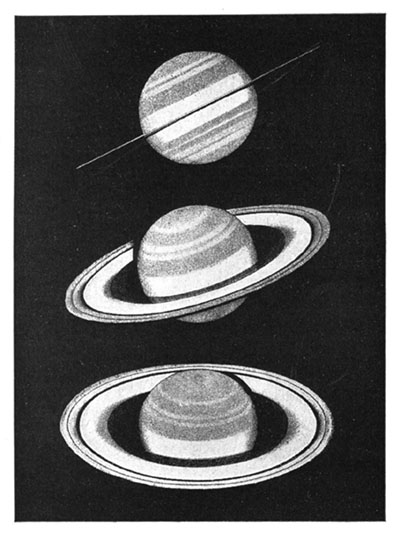
intervening space with the chariot of his mighty globe; Saturn, with
broad wings outspread, would span more than two thirds of the distance;
and the sun, so far from being able to get through at all, would overlap
the way more than 300,000 miles on each side.
In consequence, of course, of its nearness, the moon is the only member
of the planetary system whose principal features are visible to the
naked eye. In truth, the naked eye perceives the larger configurations
of the lunar surface more clearly than the most powerful telescope shows
the details on the disk of Mars. Long before the time of Galileo and the
invention of the telescope, men had noticed that the face of the moon
bears a resemblance to the appearance that the earth would present if
viewed from afar off. In remote antiquity there were philosophers who
thought that the moon was an inhabited world, and very early the
romancers took up the theme. Lucian, the Voltaire of the second century
of our era, mercilessly scourged the pretenders of the earth from an
imaginary point of vantage on the moon, which enabled him to peer down
into their secrets. Lucian's description of the appearance of the earth
from the moon shows how clearly defined in his day had become the
conception of our globe as only an atom in space.
"Especially did it occur to me to laugh at the men who were quarreling
about the boundaries of their land, and at those who were proud because
they cultivated the Sikyonian plain, or owned that part of Marathon
around Œnoe, or held possession of a thousand acres at Acharnæ. Of
the whole of Greece, as it then appeared to me from above, being about
the size of four fingers, I think Attica was in proportion a mere speck.
So that I wondered on what condition it was left to these rich men to be
proud."[14]
Such scenes as Lucian beheld, in imagination, upon the earth while
looking from the moon, many would fain behold, with telescopic aid,
upon the moon while looking from the earth. Galileo believed that the
details of the lunar surface revealed by his telescope closely resembled
in their nature the features of the earth's surface, and for a long
time, as the telescope continued to be improved, observers were
impressed with the belief that the moon possessed not only mountains and
plains, but seas and oceans also.
It was the discovery that the moon has no perceptible atmosphere that
first seriously undermined the theory of its habitability. Yet, as was
remarked in the introductory chapter, there has of late been some change
of view concerning a lunar atmosphere; but the change has been not so
much in the ascertained facts as in the way of looking at those facts.
But before we discuss this matter, it will be well to state what is
known beyond peradventure about the moon.
Its mean distance from the earth is usually called, for the sake of a
round number, 240,000 miles, but more accurately stated it is 238,840
miles. This is variable to the extent of more than 31,000 miles, on
account of the eccentricity of its orbit, and the eccentricity itself is
variable, in consequence of the perturbing attractions of the earth and
the sun, so that the distance of the moon from the earth is continually
changing. It may be as far away as 253,000 miles and as near as 221,600
miles.
Although the orbit of the moon is generally represented, for
convenience, as an ellipse about the earth, it is, in reality, a varying
curve, having the sun for its real focus, and always concave toward the
latter. This is a fact that can be more readily explained with the aid
of a diagram.
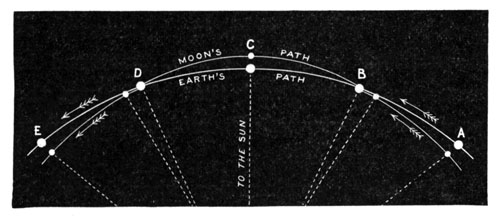
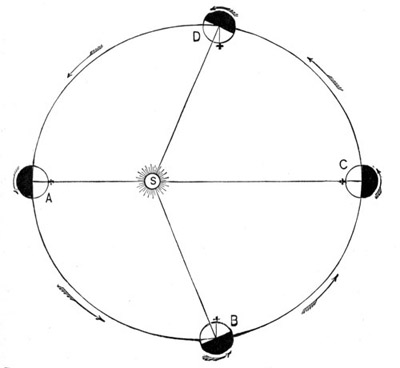
The Moon's Path with Respect to the Sun and the Earth.
In the accompanying cut, when the earth is at A the moon is between it
and the sun, in the phase called new moon. At this point the earth's
orbit about the sun is more curved than the moon's, and the earth is
moving relatively faster than the moon, so that when it arrives at B
it is ahead of the moon, and we see the latter to the right of the
earth, in the phase called first quarter. The earth being at this time
ahead of the moon, the effect of its attraction, combined with that of
the sun, tends to hasten the moon onward in its orbit about the sun, and
the moon begins to travel more swiftly, until it overtakes the earth at
C, and appears on the side opposite the sun, in the phase called full
moon. At this point the moon's orbit about the sun has a shorter radius
of curvature than the earth's. In traveling from C to D the moon
still moves more rapidly than the earth, and, having passed it, appears
at D to the left of the earth, in the phase called third quarter. Now,
the earth being behind the moon, the effect of its attraction combined
with the sun's tends to retard the moon in its orbit about the sun,
with the result that the moon moves again less rapidly than the earth,
and the latter overtakes it, so that, upon reaching E, the two are
once more in the same relative positions that they occupied at A, and
it is again new moon. Thus it will be seen that, although the real orbit
of the moon has the sun for its center of revolution, nevertheless, in
consequence of the attraction of the earth, combined in varying
directions with that of the sun, the moon, once every month, makes a
complete circuit of our globe.
The above explanation should not be taken for a mathematical
demonstration of the moon's motion, but simply for a graphical
illustration of how the moon appears to revolve about the earth while
really obeying the sun's attraction as completely as the earth does.
There is no other planet that has a moon relatively as large as ours.
The moon's diameter is 2,163 miles. Its volume, compared with the
earth's, is in the ratio of 1 to 49, and its density is about six
tenths of the earth's. This makes its mass to that of our globe about as
1 to 81. In other words, it would take eighty-one moons to
counterbalance the earth. Before speaking of the force of gravity on the
moon we will examine the character of the lunar surface.
To the naked eye the moon's face appears variegated with dusky patches,
while a few points of superior brilliance shine amid the brighter
portions, especially in the southern and eastern quarters, where immense
craters like Tycho and Copernicus are visible to a keen eye, gleaming
like polished buttons. With a telescope, even of moderate power, the
surface of the moon presents a scene of astonishing complexity, in which
strangeness, beauty, and grandeur are all combined. The half of the moon
turned earthward contains an area of 7,300,000 square miles, a little
greater than the area of South America and a little less than that of
North America. Of these 7,300,000 square miles, about 2,900,000 square
miles are occupied by the gray, or dusky, expanses, called in lunar
geography, or selenography, maria—i.e., "seas." Whatever they may
once have been, they are not now seas, but dry plains, bordered in many
places by precipitous cliffs and mountains, varied in level by low
ridges and regions of depression, intersected occasionally by immense
cracks, having the width and depth of our mightiest river cañons, and
sprinkled with bright points and crater pits. The remaining 4,400,000
square miles are mainly occupied by mountains of the most extraordinary
character. Owing partly to roughness of the surface and partly to more
brilliant reflective power, the mountainous regions of the moon appear
bright in comparison with the dull-colored plains.
Some of the lunar mountains lie in long, massive chains, with towering
peaks, profound gorges, narrow valleys, vast amphitheaters, and beetling
precipices. Looking at them with a powerful telescope, the observer
might well fancy himself to be gazing down from an immense height into
the heart of the untraveled Himalayas. But these, imposing though they
are, do not constitute the most wonderful feature of the mountain
scenery of the moon.
Appearing sometimes on the shores of the "seas," sometimes in the midst
of broad plains, sometimes along the course of mountain chains, and
sometimes in magnificent rows, following for hundreds of miles the
meridians of the lunar globe, are tremendous, mountain-walled, circular
chasms, called craters. Frequently they have in the middle of their
depressed interior floors a peak, or a cluster of peaks. Their inner and
outer walls are seamed with ridges, and what look like gigantic streams
of frozen lava surround them. The resemblance that they bear to the
craters of volcanoes is, at first sight, so striking that probably
nobody would ever have thought of questioning the truth of the statement
that they are such craters but for their incredible magnitude. Many of
them exceed fifty miles in diameter, and some of them sink two, three,
four, and more miles below the loftiest points upon their walls! There
is a chasm, 140 miles long and 70 broad, named Newton, situated about
200 miles from the south pole of the moon, whose floor lies 24,000 feet
below the summit of a peak that towers just above it on the east! This
abyss is so profound that the shadows of its enclosing precipices never
entirely quit it, and the larger part of its bottom is buried in endless
night.
One can not but shudder at the thought of standing on the broken walls
of Newton, and gazing down into a cavity of such stupendous depth that
if Chimborazo were thrown into it, the head of the mighty Andean peak
would be thousands of feet beneath the observer.
A different example of the crater mountains of the moon is the
celebrated Tycho, situated in latitude about 43° south, corresponding
with the latitude of southern New Zealand on the earth. Tycho is nearly
circular and a little more than 54 miles across. The highest point on
its wall is about 17,000 feet above the interior. In the middle of its
floor is a mountain 5,000 or 6,000 feet high. Tycho is especially
remarkable for the vast system of whitish streaks, or rays, which
starting from its outer walls, spread in all directions over the face of
the moon, many of them, running, without deviation, hundreds of miles
across mountains, craters, and plains. These rays are among the greatest
of lunar mysteries, and we shall have more to say of them.
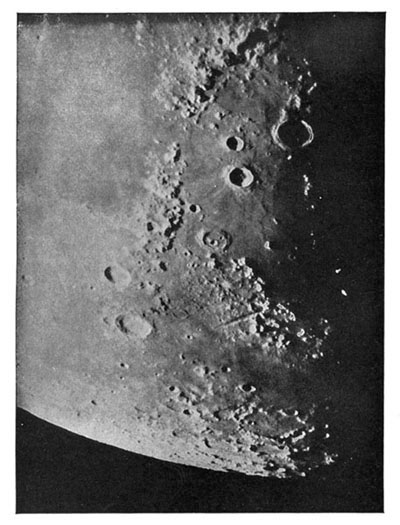
THE LUNAR ALPS, APENNINES, AND CAUCASUS.
Photographed with the Lick Telescope.
Copernicus, a crater mountain situated about 10° north of the equator,
in the eastern hemisphere of the moon, is another wonderful object, 56
miles in diameter, a polygon appearing, when not intently studied, as a
circle, 11,000 or 12,000 feet deep, and having a group of relatively low
peaks in the center of its floor. Around Copernicus an extensive area of
the moon's surface is whitened with something resembling the rays of
Tycho, but more irregular in appearance. Copernicus lies within the edge
of the great plain named the Oceanus Procellarum, or "Ocean of
Storms," and farther east, in the midst of the "ocean," is a smaller
crater mountain, named Kepler, which is also enveloped by a whitish
area, covering the lunar surface as if it were the result of extensive
outflows of light-colored lava.
In one important particular the crater mountains of the moon differ from
terrestrial volcanoes. This difference is clearly described by Nasmyth
and Carpenter in their book on The Moon:
"While the terrestrial crater is generally a hollow on a mountain top,
with its flat bottom high above the level of the surrounding country,
those upon the moon have their lowest points depressed more or less
deeply below the general surface of the moon, the external height being
frequently only a half or one third of the internal depth."
It has been suggested that these gigantic rings are only "basal wrecks"
of volcanic mountains, whose conical summits have been blown away,
leaving vast crateriform hollows where the mighty peaks once stood; but
the better opinion seems to be that which assumes that the rings were
formed by volcanic action very much as we now see them. If such a crater
as Copernicus or the still larger one named Theophilus, which is
situated in the western hemisphere of the moon, on the shore of the "Sea
of Nectar," ever had a conical mountain rising from its rim, the height
attained by the peak, if the average slope were about 30°, would have
been truly stupendous—fifteen or eighteen miles!
There is a kind of ring mountains, found in many places on the moon,
whose forms and surroundings do not, as the craters heretofore described
do, suggest at first sight a volcanic origin. These are rather level
plains of an oval or circular outline, enclosed by a wall of mountains.
The finest example is, perhaps, the dark-gray Plato, situated in 50° of
north latitude, near an immense mountain uplift named the Lunar Alps,
and on the northern shore of the Mare Imbrium, or "Sea of Showers."
Plato appears as an oval plain, very smooth and level, about 60 miles in
length, and completely surrounded by mountains, quite precipitous on the
inner side, and rising in their highest peaks to an elevation of 6,000
to 7,000 feet. Enclosed plains, bearing more or less resemblance to
Plato—sometimes smooth within, and sometimes broken with small peaks
and craters or hilly ridges—are to be found scattered over almost all
parts of the moon. If our satellite was ever an inhabited world like the
earth, while its surface was in its present condition, these valleys
must have presented an extraordinary spectacle. It has been thought that
they may once have been filled with water, forming lakes that recall the
curious Crater Lake of Oregon.
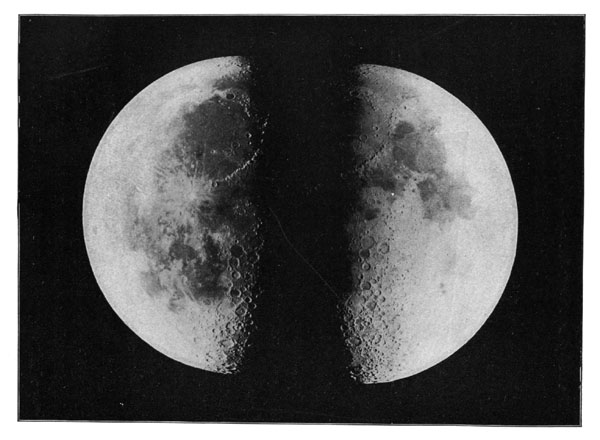
THE MOON AT FIRST AND LAST QUARTER (WESTERN AND EASTERN
HEMISPHERES).
Photographed with the Lick Telescope.
It is not my intention to give a complete description of the various
lunar features, and I mention but one other—the "clefts" or "rills,"
which are to be seen running across the surface like cracks. One of the
most remarkable of these is found in the Oceanus Procellarum, near the
crater-mountain Aristarchus, which is famed for the intense brilliance
of its central peak, whose reflective power is so great that it was once
supposed to be aflame with volcanic fire. The cleft, or crack, in
question is very erratic in its course, and many miles in length, and
it terminates in a ringed plain named Herodotus not far east of
Aristarchus, breaking through the wall of the plain and entering the
interior. Many other similar chasms or cañons exist on the moon, some
crossing plains, some cleaving mountain walls, and some forming a
network of intersecting clefts. Mr. Thomas Gwyn Elger has this to say on
the subject of the lunar clefts:
"If, as seems most probable, these gigantic cracks are due to
contractions of the moon's surface, it is not impossible, in spite of
the assertions of the text-books to the effect that our satellite is now
a 'changeless world,' that emanations may proceed from these fissures,
even if, under the monthly alternations of extreme temperatures, surface
changes do not now occasionally take place from this cause also. Should
this be so, the appearance of new rills and the extension and
modification of those already existing may reasonably be looked for."
Mr. Elger then proceeds to describe his discovery in 1883, in the
ring-plain Mersenius, of a cleft never noticed before, and which seems
to have been of recent formation.[15]
We now return to the question of the force of lunar gravity. This we
find to be only one sixth as great as gravity on the surface of the
earth. It is by far the smallest force of gravity that we have found
anywhere except on the asteroids. Employing the same method of
comparison that was made in the case of Mars, we compute that a man on
the moon could attain a height of thirty-six feet without being
relatively more unwieldy than a six-foot descendant of Adam is on the
earth.
Whether this furnishes a sound reason for assuming that the lunar
inhabitants, if any exist or have ever existed, should be preposterous
giants is questionable; yet such an assumption receives a certain degree
of support from the observed fact that the natural features of the moon
are framed on an exaggerated scale as compared with the earth's. We have
just observed that the moon is characterized by vast mountain rings,
attaining in many cases a diameter exceeding fifty miles. If these are
volcanic craters, it is evident, at a glance, that the mightiest
volcanoes of the earth fall into insignificance beside them. Now, the
slight force of gravity on the moon has been appealed to as a reason why
volcanic explosions on the lunar globe should produce incomparably
greater effects than upon the earth, where the ejected materials are so
much heavier. The same force that would throw a volcanic bomb a mile
high on the earth could throw it six miles high on the moon. The giant
cannon that we have placed in one of our coast forts, which is said to
be able to hurl a projectile to a distance of fifteen miles, could send
the same projectile ninety miles on the moon. An athlete who can clear a
horizontal bar at a height of six feet on the earth could clear the same
bar at a height of thirty-six feet on the moon. In other words, he could
jump over a house, unless, indeed, the lunarians really are giants, and
live in houses proportioned to their own dimensions and to the size of
their mountains. In that case, our athlete would have to content himself
with jumping over a lunarian, whose head he could just clear—with the
hat off.
These things are not only amusing, but important. There can be no
question that the force of gravity on the moon actually is as slight as
it has just been described. So, even without calling in imaginary
inhabitants to lend it interest, the comparative inability of the moon
to arrest bodies in motion becomes a fact of much significance. It has
led to the theory that meteorites may have originally been shot out of
the moon's great volcanoes, when those volcanoes were active, and may
have circulated about the sun until various perturbations have brought
them down upon the earth. A body shot radially from the surface of the
moon would need to have a velocity of only about a mile and a half in a
second in order to escape from the moon's control, and we can believe
that a lunar volcano when in action could have imparted such a velocity,
all the more readily because with modern gunpowders we have been able to
give to projectiles a speed one half as great as that needed for
liberation from lunar gravity.
Another consequence of the small gravitative power of the moon bears
upon the all-important question of atmosphere. According to the theory
of Dr. Johnstone Stoney, heretofore referred to, oxygen, nitrogen, and
water vapor would all gradually escape from the moon, if originally
placed upon it, because, by the kinetic theory, the maximum velocities
of their molecules are greater than a mile and a half per second. The
escape would not occur instantly, nor all at once, for it would be only
the molecules at the upper surface of the atmosphere which were moving
with their greatest velocity, and in a direction radial to the center of
the moon, that would get away; but in the course of time this gradual
leakage would result in the escape of all of those gases.[16]
After it had been found that, to ordinary tests, the moon offered no
evidence of the possession of an atmosphere, and before Dr. Stoney's
theory was broached, it was supposed by many that the moon had lost its
original supply of air by absorption into its interior. The oxygen was
supposed to have entered into combination with the cooling rocks and
minerals, thus being withdrawn from the atmosphere, and the nitrogen was
imagined to have disappeared also within the lunar crust. For it seems
to have always been tacitly assumed that the phenomenon to be accounted
for was not so much the absence of a lunar atmosphere as its
disappearance. But disappearance, of course, implies previous
existence. In like manner it has always been a commonly accepted view
that the moon probably once had enough water to form lakes and seas.
These, it has been calculated, could have been absorbed into the lunar
globe as it cooled off. But Johnstone Stoney's theory offers another
method by which they could have escaped, through evaporation and the
gradual flight of the molecules into open space. Possibly both methods
have been in operation, a portion of the constituents of the former
atmosphere and oceans having entered into chemical combinations in the
lunar crust, and the remainder having vanished in consequence of the
lack of sufficient gravitative force to retain them.
But why, it may be asked, should it be assumed that the moon ever had
things which it does not now possess? Perhaps no entirely satisfactory
reply can be made. Some observers have believed that they detected
unmistakable indications of alluvial deposits on lunar plains, and of
the existence of beaches on the shores of the "seas." Messrs. Loewy and
Puiseux, of the Paris Observatory, whose photographs of the moon are
perhaps the finest yet made, say on this subject:
"There exists, from the point of view of relief, a general similarity
between the 'seas' of the moon and the plateaux which are covered to-day
by terrestrial oceans. In these convex surfaces are more frequent than
concave basins, thrown back usually toward the verge of the depressed
space. In the same way the 'seas' of the moon present, generally at the
edges, rather pronounced depressions. In one case, as in the other, we
observe normal deformations of a shrinking globe shielded from the
erosive action of rain, which tends, on the contrary, in all the
abundantly watered parts of the earth to make the concave surfaces
predominate. The explanation of this structure, such as is admitted at
present by geologists, seems to us equally valid for the moon."[17]
It might be urged that there is evidence of former volcanic activity on
the moon of such a nature that explosions of steam must have played a
part in the phenomena, and if there was steam, of course there was
water.
But perhaps the most convincing argument tending to show that the moon
once had a supply of water, of which some remnant may yet remain below
the surface of the lunar globe, is based upon the probable similarity in
composition of the earth and the moon. This similarity results almost
equally whether we regard the moon as having originated in a ring of
matter left off from the contracting mass that became the earth, or
whether we accept the suggestion of Prof. G.H. Darwin, that the moon is
the veritable offspring of the earth, brought into being by the
assistance of the tidal influence of the sun. The latter hypothesis is
the more picturesque of the two, and, at present, is probably the more
generally favored. It depends upon the theory of tidal friction, which
was referred to in Chapter III, as offering an explanation of the manner
in which the rotation of the planet Mercury has been slowed down until
its rotary period coincides with that of its revolution.
The gist of the hypothesis in question is that at a very early period in
its history, when the earth was probably yet in a fluid condition, it
rotated with extreme rapidity on its axis, and was, at the same time,
greatly agitated by the tidal attraction of the sun, and finally huge
masses were detached from the earth which, ultimately uniting, became
the moon.[18]
Born in this manner from the very substance of the earth, the moon would
necessarily be composed, in the main, of the same elements as the globe
on which we dwell, and is it conceivable that it should not have carried
with it both air and water, or the gases from which they were to be
formed? If the moon ever had enough of these prime requisites to enable
it to support forms of life comparable with those of the earth, the
disappearance of that life must have been a direct consequence of the
gradual vanishing of the lunar air and water. The secular drying up of
the oceans and wasting away of the atmosphere on our little neighbor
world involved a vast, all-embracing tragedy, some of the earlier scenes
of which, if theories be correct, are now reenacted on the
half-desiccated planet Mars—a planet, by the way, which in size, mass,
and ability to retain vital gases stands about half-way between the
earth and the moon.
One of the most interesting facts about the moon is that its surface
affords evidence of a cataclysm which has wiped out many, and perhaps
nearly all, of the records of its earlier history, that were once
written upon its face. Even on the earth there have been geological
catastrophes destroying or burying the accumulated results of ages of
undisturbed progress, but on the moon these effects have been
transcendent. The story of the tremendous disaster that overtook the
moon is partly written in its giant volcanoes. Although it may be true,
as some maintain, that there is yet volcanic action going on upon the
lunar surface, it is evident that such action must be insignificant in
comparison with that which took place ages ago.
There is a spot in the western hemisphere of the moon, on the border of
a placid bay or "sea," that I can never look at without a feeling of awe
and almost of shrinking. There, within a space about 250 miles in length
by 100 in width, is an exhibition of the most terrifying effects of
volcanic energy that the eye of man can anywhere behold. Three immense
craters—Theophilus, 64 miles across and 3-1/2 miles deep; Cyrillus, 60
miles across and 15,000 feet deep; and Catharina, 70 miles across and
from 8,000 to 16,000 feet deep—form an interlinked chain of mountain
rings, ridges, precipices, chasms, and bottomless pits that take away
one's breath.
But when the first impression of astonishment and dismay produced by
this overwhelming spectacle has somewhat abated, the thoughtful observer
will note that here the moon is telling him a part of her wonderful
story, depicted in characters so plain that he needs no instruction in
order to decipher their meaning. He will observe that this ruin was not
all wrought at once or simultaneously. Theophilus, the crater-mountain
at the northwestern end of the chain, whose bottom lies deepest of all,
is the youngest of these giants, though the most imposing. For a
distance of forty miles the lofty wall of Theophilus has piled itself
upon the ruins of the wall of Cyrillus, and the circumference of the
circle of its tremendous crater has been forcibly thrust within the
original rim of the more ancient crater, which was thus rudely compelled
to make room for its more vigorous rival and successor.
The observer will also notice that Catharina, the huge pit at the
southeastern end of the chain, bears evidence of yet greater age. Its
original walls, fragments of which still stand in broken grandeur,
towering to a height of 16,000 feet, have, throughout the greater part
of their circuit, been riddled by the outbreak of smaller craters, and
torn asunder and thrown down on all sides.
In the vast enclosure that was originally the floor of the
crater-mountain Catharina, several crater rings, only a third, a
quarter, or a fifth as great in diameter, have broken forth, and these
in turn have been partially destroyed, while in the interior of the
oldest of them yet smaller craters, a nest of them, mere Etnas,
Cotopaxis, and Kilaueas in magnitude, simple pinheads on the moon, have
opened their tiny jaws in weak and ineffective expression of the waning
energies of a still later epoch, which followed the truly heroic age of
lunar vulcanicity.
This is only one example among hundreds, scattered all over the moon,
which show how the surface of our satellite has suffered upheaval after
upheaval. It is possible that some of the small craters, not included
within the walls of the greater ones, may represent an early stage in
the era of volcanic activity that wrecked the moon, but where larger and
smaller are grouped together a certain progression can be seen, tending
finally to extinction. The internal energies reached a maximum and then
fell off in strength until they died out completely.
It can hardly be supposed that the life-bearing phase of lunar
history—if there ever was one—could survive the outbreak of the
volcanic cataclysm. North America, or Europe, if subjected to such an
experience as the continental areas of the moon have passed through,
would be, in proportion, worse wrecked than the most fearfully battered
steel victim of a modern sea fight, and one can readily understand that,
in such circumstances, those now beautiful and populous continents would
exhibit, from a distance, scarcely any token of their present
topographical features, to say nothing of any relics of their occupation
by living creatures.
There are other interesting glimpses to be had of an older world in the
moon than that whose scarred face is now beautified for us by distance.
Not far from Theophilus and the other great crater-mountains just
described, at the upper, or southern, end of the level expanse called
the "Sea of Nectar," is a broad, semicircular bay whose shores are
formed by the walls of a partially destroyed crater named Fracastorius.
It is evident that this bay, and the larger part of the "Sea of Nectar,"
have been created by an outwelling of liquid lavas, which formed a
smooth floor over a portion of the pre-existing surface of the moon, and
broke down and submerged a large part of the mountain ring of
Fracastorius, leaving the more ancient walls standing at the southern
end, while, outlined by depressions and corrugations in the rocky
blanket, are certain half-defined forms belonging to the buried world
beneath.
Near Copernicus, some years ago, as Dr. Edward S. Holden pointed out,
photographs made with the great Lick telescope, then under his
direction, showed, in skeleton outline, a huge ring buried beneath some
vast outflow of molten matter and undiscerned by telescopic observers.
And Mr. Elger, who was a most industrious observer and careful
interpreter of lunar scenery, speaks of "the undoubted existence of the
relics of an earlier lunar world beneath the smooth superficies of the
maria."
Although, as already remarked, it seems necessary to assume that any
life existing in the moon prior to its great volcanic outburst must have
ceased at that time, yet the possibility may be admitted that life could
reappear upon the moon after its surface had again become quiet and
comparatively undisturbed. Germs of the earlier life might have
survived, despite the terrible nature of the catastrophe. But the
conditions on the moon at present are such that even the most confident
advocates of the view that the lunar world is not entirely dead do not
venture to assume that anything beyond the lowest and simplest organic
forms—mainly, if not wholly, in the shape of vegetation—can exist
there. The impression that even such life is possible rests upon the
accumulating evidence of the existence of a lunar atmosphere, and of
visible changes, some apparently of a volcanic character and some not,
on the moon's surface.
Prof. William H. Pickering, who is, perhaps, more familiar with the
telescopic and photographic aspects of the moon than any other American
astronomer, has recorded numberless instances of change in minute
details of the lunar landscapes. He regards some of his observations
made at Arequipa as "pointing very strongly to the existence of
vegetation upon the surface of the moon in large quantities at the
present time." The mountain-ringed valley of Plato is one of the places
in the lunar world where the visible changes have been most frequently
observed, and more than one student of the moon has reached the
conclusion that something very like the appearances that vegetation
would produce is to be seen in that valley.
Professor Pickering has thoroughly discussed the observations relating
to a celebrated crater named Linné in the Mare Serenitatis, and after
reading his description of its changes of appearance one can hardly
reject his conclusion that Linné is an active volcanic vent, but
variable in its manifestations. This is only one of a number of similar
instances among the smaller craters of the moon. The giant ones are
evidently entirely extinct, but some of the minor vents give occasional
signs of activity. Nor should it be assumed that these relatively slight
manifestations of volcanic action are really insignificant. As Professor
Pickering shows, they may be regarded as comparable with the greatest
volcanic phenomena now witnessed on the earth, and, speaking again of
Plato, he says of its evidences of volcanic action:
"It is, I believe, more active than any area of similar size upon the
earth. There seems to be no evidences of lava, but the white streaks
indicate apparently something analogous to snow or clouds. There must be
a certain escape of gases, presumably steam and carbonic acid, the
former of which, probably, aids in the production of the white
markings."[19]
To Professor Pickering we owe the suggestion that the wonderful rays
emanating from Tycho consist of some whitish substance blown by the
wind, not from Tycho itself, but from lines of little volcanic vents or
craters lying along the course of the rays. This substance may be
volcanic powder or snow, in the form of minute ice crystals. Mr. Elger
remarks of this theory that the "confused network of streaks" around
Copernicus seems to respond to it more happily than the rays of Tycho
do, because of the lack of definiteness of direction so manifest in the
case of the rays.
As an encouragement to amateur observers who may be disposed to find out
for themselves whether or not changes now take place in the moon, the
following sentence from the introduction to Professor Pickering's
chapter on Plato in the Harvard Observatory Annals, volume xxxii, will
prove useful and interesting:
"In reviewing the history of selenography, one must be impressed by the
singular fact that, while most of the astronomers who have made a
special study of the moon, such as Schroeter, Maedler, Schmidt, Webb,
Neison, and Elger, have all believed that its surface was still subject
to changes readily visible from the earth, the great majority of
astronomers who have paid little attention to the subject have quite as
strenuously denied the existence of such changes."
In regard to the lunar atmosphere, it may be said, in a word, that even
those who advocate the existence of vegetation and of clouds of dust or
ice crystals on the moon do not predicate any greater amount, or greater
density, of atmosphere than do those who consider the moon to be wholly
dead and inert. Professor Pickering himself showed, from his
observations, that the horizontal refraction of the lunar atmosphere,
instead of being less than 2″, as formerly stated, was less than 0.4″.
Yet he found visual evidence that on the sunlit side of the moon this
rare atmosphere was filled to a height of four miles with some absorbing
medium which was absent on the dark side, and which was apparently an
emanation from the lunar crust, occurring after sunrise. And Messrs.
Loewy and Puiseux, of the Paris Observatory, say, after showing reasons
for thinking that the great volcanic eruptions belong to a recent period
in the history of the moon, that "the diffusion of cinders to great
distances infers a gaseous envelope of a certain density.... The
resistance of the atmosphere must have been sufficient to retard the
fall of this dust [the reference is to the white trails, like those from
Tycho], during its transport over a distance of more than 1,000
kilometers [620 miles]."[20]
We come now to a brief consideration of certain peculiarities in the
motions of the moon, and in the phenomena of day and night on its
surface. The moon keeps the same side forever turned toward the earth,
behaving, in this respect, as Mercury does with regard to the sun. The
consequence is that the lunar globe makes but one rotation on its axis
in the course of a month, or in the course of one revolution about the
earth. Some of the results of this practical identity of the periods of
rotation and revolution are illustrated in the diagram on page 250. The
moon really undergoes considerable libration, recalling the libration of
Mercury, which was explained in the chapter on that planet, and in
consequence we are able to see a little way round into the opposite
lunar hemisphere, now on this side and now on the other, but in the
diagram this libration has been neglected. If it had been represented we
should have found that, instead of only one half, about three fifths of
the total superficies of the moon are visible from the earth at one time
or another.
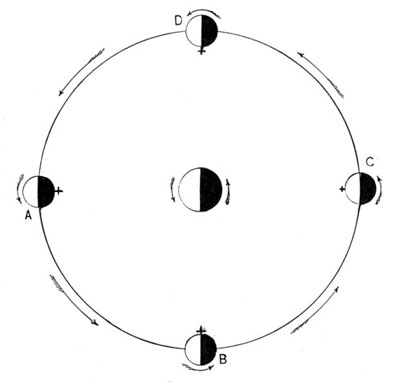
Phases and Rotation of the Moon.
Perhaps it should be remarked that in drawing the moon's orbit about the
earth as a center we offer no contradiction to what was shown earlier
in this chapter. The moon does travel around the earth, and its orbit
about our globe may, for our present purpose, be treated independently
of its motion about the sun. Let the central globe, then, represent the
earth, and let the sun be supposed to shine from the left-hand side of
the diagram. A little cross is erected at a fixed spot on the globe of
the moon.
At A the moon is between the earth and the sun, or in the phase of new
moon. The lunar hemisphere facing the earth is now buried in night,
except so far as the light reflected from the earth illuminates it, and
this illumination, it is interesting to remember, is about fourteen
times as great—reckoned by the relative areas of the reflecting
surfaces—as that which the full moon sends to the earth. An inhabitant
of the moon, standing beside the cross, sees the earth in the form of a
huge full moon directly above his head, but, as far as the sun is
concerned, it is midnight for him.
In the course of about seven days the moon travels to B. In the
meantime it has turned one quarter of the way around its axis, and the
spot marked by the cross is still directly under the earth. For the
lunar inhabitant standing on that spot the sun is now on the point of
rising, and he sees the earth no longer in the shape of a full moon, but
in that of a half-moon. The lunar globe itself appears, at the same
time from the earth, as a half-moon, being in the position or phase that
we call first quarter.
Seven more days elapse, and the moon arrives at C, opposite to the
position of the sun, and with the earth between it and the solar orb. It
is now high noon for our lunarian standing beside the cross, while the
earth over his head appears, if he sees it at all, only as a black disk
close to the sun, or—as would sometimes be the case—covering the sun,
and encircled with a beautiful ring of light produced by the refraction
of its atmosphere. (Recall the similar phenomenon in the case of Venus.)
The moon seen from the earth is now in the phase called full moon.
Another lapse of seven days, and the moon is at D, in the phase called
third quarter, while the earth, viewed from the cross on the moon, which
is still pointed directly at it, appears again in the shape of a huge
half-moon.
During the next seven days the moon returns to its original position at
A, and becomes once more new moon, with "full earth" shining upon it.
Now it is evident that in consequence of the peculiar law of the moon's
rotation its days and nights are each about two of our weeks, or
fourteen days, in length. That hemisphere of the moon which is in the
full sunlight at A, for instance, is buried in the middle of night at
C. The result is different than in the case of Mercury, because the
body toward which the moon always keeps the same face directed is not
the luminous sun, but the non-luminous earth.
It is believed that the moon acquired this manner of rotation in
consequence of the tidal friction exercised upon it by the earth. The
tidal attraction of the earth exceeds that of the sun upon the moon
because the earth is so much nearer than the sun is, and tidal
attraction varies inversely as the cube of the distance. In fact, the
braking effect of tidal friction varies inversely as the sixth power of
the distance, so that the ability of the earth to stop the rotation of
the moon on its axis is immensely greater than that of the sun. This
power was effectively applied while the moon was yet a molten mass, so
that it is probable that the moon has rotated just as it does now for
millions of years.
As was remarked a little while ago, the moon traveling in an elliptical
orbit about the earth has a libratory movement which, if represented in
our picture, would cause the cross to swing now a little one way and now
a little the other, and thus produce an apparent pendulum motion of the
earth in the sky, similar to that of the sun as seen from Mercury. But
it is not necessary to go into the details of this phenomenon. The
reader, if he chooses, can deduce them for himself.
But we may inquire a little into the effects of the long days and nights
of the moon. In consequence of the extreme rarity of the lunar
atmosphere, it is believed that the heat of the sun falling upon it
during a day two weeks in length, is radiated away so rapidly that the
surface of the lunar rocks never rises above the freezing temperature
of water. On the night side, with no warm atmospheric blanket such as
the earth enjoys, the temperature may fall far toward absolute zero, the
most merciful figure that has been suggested for it being 200° below the
zero of our ordinary thermometers! But there is much uncertainty about
the actual temperature on the moon, and different experiments, in the
attempt to make a direct measurement of it, have yielded discordant
results. At one time, for instance, Lord Rosse believed he had
demonstrated that at lunar noon the temperature of the rocks rose above
the boiling-point of water. But afterward he changed his mind and
favored the theory of a low temperature.
In this and in other respects much remains to be discovered concerning
our interesting satellite, and there is plenty of room, and an abundance
of original occupation, for new observers of the lunar world.