I was at Biskra in December, 1900, when I
learned through the newspapers of the
lamentable end of Oscar Wilde. Distance, alas!
prevented me from joining in the meagre procession
which followed his body to the cemetery
at Bagneux. It was of no use reproaching myself
that my absence would seem to diminish still
further the small number of friends who remained
faithful to him—at least I wanted to write these
few pages at once, but for a considerable period
Wilde's name seemed to become once more the
property of the newspapers.
Now that every idle rumour connected with
his name, so sadly famous, is hushed; now that
the mob is at last wearied after having praised,
wondered at, and then reviled him, perhaps, a friend
may be allowed to lay, like a wreath on a forsaken
grave, these lines of affection, admiration, and
respectful pity.
When the trial, with all its scandal, which so
excited the public mind in England threatened to
wreck his life, certain writers and artists attempted
to carry out, in the name of literature and art, a
kind of rescue. It was hoped that by praising the
writer the man would be excused. Unfortunately,
there was a misunderstanding here, for it must be
acknowledged that Wilde was not a great writer.
The leaden buoy which was thrown to him helped
only to weigh him down; his works, far from
keeping him up, seemed to sink with him. In
vain were some hands stretched out: the torrent
of the world overwhelmed him—all was over.
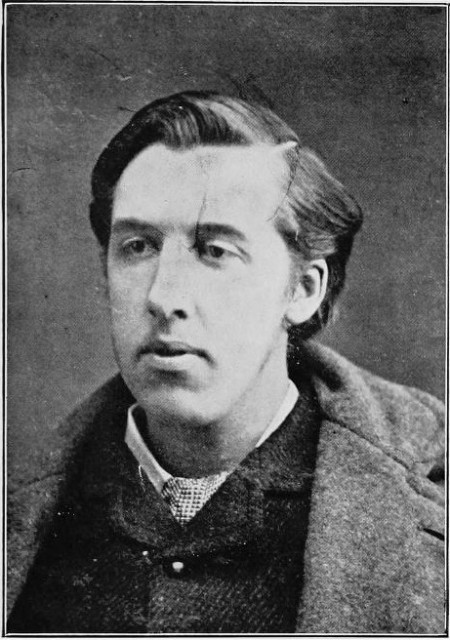
OSCAR WILDE AT OXFORD, 1878.
It was not possible at that time to think of defending
him in any other way. Instead of trying
to shelter the man behind his work, it was necessary
to show forth first the man as an object of
admiration—as I am going to try to do now—and
then the work itself illuminated by his personality.
'I have put all my genius into my life; I have put
only my talent into my works,' said Wilde once.
Great writer, no, but great viveur, yes, if one may
use the word in the fullest sense of the French
term. Like certain Greek philosophers of old,
Wilde did not write his wisdom, but spoke and
lived it, entrusting it rashly to the fleeting memory
of man, thereby writing it as it were on water.
Let those who knew him for a longer time than
I did, tell the story of his life. One of those who
listened to him the most eagerly relates here
simply a few personal recollections.
And the mighty nations would have crowned me, who
am crownless now and without name,
And some orient dawn had found me kneeling on the
threshold of the House of Fame.
Those who became acquainted with Wilde
only in the latter years of his life form a
wrong conception of the wonderful creature he
formerly was, if they judge from the enfeebled
and crushed being given back to us from prison,
as Ernest Lajeunesse paints him, for instance, in
the best or rather the only passable article on the
great reprobate which any one has had the talent
or the courage to write[1].
It was in 1891 that I met him for the first time.
Wilde had then what Thackeray calls 'one of the
greatest of a great man's qualities'—success[2]. His
manner and his appearance were triumphant.
His success was so assured that it seemed to go
in front of him, and he had only to advance. His
books were causing wonder and delight. All
London was soon to rush to see his plays[3]. He
was rich, he was great, he was handsome, he was
loaded with happiness and honours.
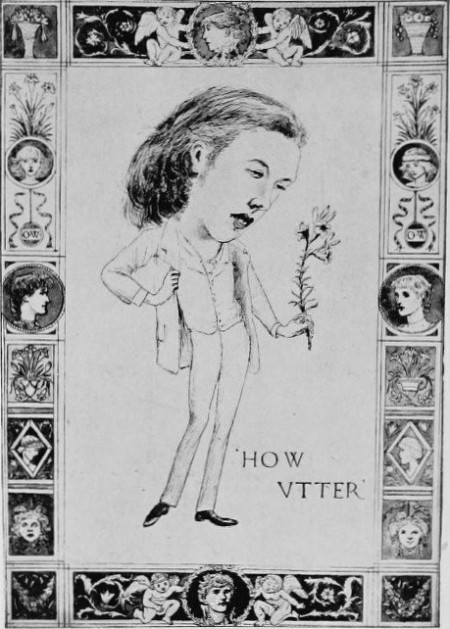
Some compared him to an Asiatic Bacchus,
others to some Roman Emperor, and others again
to Apollo himself,—in short, he was resplendent.
In Paris his name passed from mouth to
mouth as soon as he arrived. Several absurd
sayings went round concerning him, as that after
all he was only the man who smoked gold-tipped
cigarettes, and walked about the streets with a
sunflower in his hand. For, skilful in misleading
those who are the heralds of earthly fame, Wilde
knew how to hide his real personality behind an
amusing phantom, with which he humorously deluded
the public.
I had heard him talked about at Stéphane Mallarmé's
house, where he was described as a brilliant
conversationalist, and I expressed a wish to know
him, little hoping that I should ever do so. A
happy chance, or rather a friend, gave me the
opportunity, and to him I made known my desire.
Wilde was invited to dinner. It was at a restaurant.
We were a party of four, but three of
us were content to listen. Wilde did not
converse—he told tales. During the whole meal he
hardly stopped. He spoke in a slow, musical
tone, and his very voice was wonderful. He knew
French almost perfectly, but pretended, now and
then, to hesitate a little for a word to which he
wanted to call our attention. He had scarcely
any accent, at least only what it pleased him to
affect when it might give a somewhat new or
strange appearance to a word—for instance, he
used purposely to pronounce scepticisme as skepticisme.
The stories he told us without a break
that evening were not of his best. Uncertain of
his audience he was testing us, for, in his wisdom,
or perhaps in his folly, he never betrayed himself
into saying anything which he thought would not
be to the taste of his hearers; so he doled out
food to each according to his appetite. Those
who expected nothing from him got nothing, or
only a little light froth, and as at first he used
to give himself up to the task of amusing, many
of those who thought they knew him will have
known him only as the amuser.
When dinner was over we went out. My two
friends walking together, Wilde took me aside and
said quite suddenly, 'You hear with your eyes;
that is why I am going to tell you this story.'
He began:—
'When Narcissus died, the Flowers of the
Fields were plunged in grief, and asked the
River for drops of water that they might
mourn for him.
'"Oh," replied the River, "if all my drops
of water were tears, I should not have enough
to weep for Narcissus myself—I loved him."
'"How could you help loving Narcissus?"
rejoined the Flowers, "so beautiful was he."
'"Was he beautiful?" asked the River.
'"And who should know that better than
yourself?" said the Flowers, "for, every day,
lying on your bank, he would mirror his own
beauty in your waters."'
Wilde stopped for a moment, and then went
on:—
'"If I loved him," replied the River, "it is
because when he hung over my waters I saw
the reflection of my waters in his eyes."'
Then Wilde, drawing himself up, added with a
strange outburst of laughter, 'That is called The
Disciple.'
We had reached his door, and left him. He
asked me to meet him again. During the course
of that year and the next I saw him frequently
and everywhere.
In the presence of others, as I have mentioned,
Wilde would put on an air of showing off in order
to astonish, or amuse, or even exasperate people.
He never listened to, and scarcely took any notice
of an idea from the moment it was no longer
purely his own. When he was no longer the
only one to shine, he would shut himself up, and
emerge again only when one found oneself alone
with him once more. But as soon as we were
alone again he would begin, 'Well, what have you
been doing since yesterday?' Now, as at that
time my life was passing uneventfully enough,
the telling of what I had been doing was of no
interest. So, to humour him, I began recounting
some trifling incidents, and noticed while I was
speaking that Wilde's face was growing gloomy.
'You really did that?' he said.
'Yes,' I answered.
'And you are speaking the truth?'
'Absolutely.'
'Then why repeat it? You must see that it
is not of the slightest importance. You must
understand that there are two worlds—the one
exists and is never talked about; it is called the
real world because there is no need to talk about
it in order to see it. The other is the world of
Art; one must talk about that, because otherwise
it would not exist.'
Then he went on:—
'Once upon a time there was a man who
was beloved in his village because he used to
tell tales. Every morning he left the village,
and when he returned in the evening all the
labourers of the village who had been working
all the day would crowd round him and
say, "Come, now, tell us a tale. What have
you seen to-day?"
'The man said, "I have seen in the forest
a Faun playing on a flute and making a band
of little wood-nymphs dance."
'"Go on with your story; what did you
see?" the men would say.
'"When I reached the sea-shore, I saw
three mermaids beside the waves, combing
their green hair with golden combs."
'And the villagers loved him because he
used to tell them tales.
'One morning he left his village as usual,
and when he reached the sea-shore he saw
three mermaids at the water's edge combing
their green hair with golden combs. And as
he passed on his way he saw, near a wood,
a Faun playing a flute to a band of wood-nymphs.
'That evening when he returned to his
village the people said to him as they did
every evening, "Come, tell us a tale: what
have you seen?"
'And the man answered, "I have seen nothing."'
Wilde stopped for a moment to allow the effect
of the story to sink into me, and then he continued,
'I do not like your lips; they are quite
straight, like the lips of a man who has never
told a lie. I want you to learn to lie so that your
lips may become beautiful and curved like the lips
of an antique mask.
'Do you know what makes the work of art,
and what makes the work of nature? Do you
know what the difference is? For the narcissus
is as beautiful as a work of art, so what distinguishes
them cannot be merely beauty. Do
you know what it is that distinguishes them?
A work of art is always unique. Nature, who
makes nothing durable, is ever repeating herself,
so that nothing she makes may be lost. A single
narcissus produces many blooms—that is why
each one lives but a day. Every time Nature
invents a new form she at once makes a replica.
A sea-monster in one sea knows that in another
sea there is another monster like itself. When
God creates in history a Nero, a Borgia or a
Napoleon He puts another one on one side.
No one knows it, but that does not matter; the
important point is that one may be a success. For
God makes man, and man makes the work of art.'
Forestalling what I was on the point of saying,
he proceeded, 'Yes, I know ... one day a great
restlessness fell upon the earth, as if, at last,
Nature was going to create something unique,
something quite unique, and Christ is born on
earth. Yes, I know, quite well, but listen:—
'When Joseph of Arimathæa came down in
the evening from Mount Calvary where Jesus
had just died, he saw on a white stone a
young man seated weeping. And Joseph
went near to him and said, "I understand
how great thy grief must be, for certainly
that Man was a just Man." But the young
man made answer, "Oh, it is not for that
that I am weeping. I am weeping because
I, too, have wrought miracles. I also have
given sight to the blind, I have healed the
palsied, and I have raised the dead; I, too,
have caused the barren fig-tree to wither
away, and I have turned water into wine.
And yet they have not crucified me[4]."'
And that Oscar Wilde was convinced of his representative
mission was made quite clear to me
on more than one occasion.
The Gospel disturbed and troubled the pagan
Wilde. He could not forgive it its miracles. The
pagan miracle lies in the work of Art; Christianity
encroached on it. Every strong departure from
realism in art demands a realism which is convinced
in life. His most ingenious fables, his
most alarming ironies were uttered with a view
to confront the two moralities—I mean, pagan
naturalism and Christian idealism, and to put the
latter out of countenance in every respect. This
is another of his stories:—
'When Jesus was minded to return to
Nazareth, Nazareth was so changed that He
no longer recognised His own city. The
Nazareth where He had lived was full of
lamentations and tears; this city was filled
with outbursts of laughter and song. And
Christ entering into the city saw some slaves
laden with flowers, hastening towards the
marble staircase of a house of white marble.
Christ entered into the house, and at the
back of a hall of jasper He saw, lying on a
purple couch, a man whose disordered locks
were mingled with red roses, and whose lips
were red with wine. Christ drew near to him,
and laying His hand on his shoulder said
to him, "Why dost thou lead this life?" The
man turned round, recognized Him and said,
"I was a leper once; Thou didst heal me.
Why should I live another life? "
Christ went out of the house, and behold!
in the street He saw a woman whose face and
raiment were painted and whose feet were
shod with pearls. And behind her walked
a man who wore a cloak of two colours,
and whose eyes were bright with lust. And
Christ went up to the man and laid His
hand on his shoulder, and said to him, "Tell
Me why art thou following this woman, and
why dost thou look at her in such wise?"
The man turning round recognized Him and
said, "I was blind; Thou didst heal me;
what else should I do with my sight?"
'And Christ drew near to the woman and
said to her, "This road which thou art following
is the pathway of sin; why follow
it?" The woman recognized Him,
and laughing said, "The way which I follow
is a pleasant way, and Thou hast pardoned
all my sins."
'Then Christ felt His heart filled with sadness,
and He was minded to leave the city.
But as He was going out of it He saw sitting
by the bank of the moat of the city, a young
man who was weeping. He drew near to
him, and touching the locks of his hair, said
to him, "Friend, why dost thou weep?" The
young man raised his eyes, recognized Him
and made answer, "I was dead and Thou
hast raised me to life. What else should I
do with my life?"'
Let me tell this one story more, illustrating one
of the strangest pitfalls into which the imagination
can mislead a man, and let any one, who is able,
understand the strange paradox which Wilde here
makes use of:—
'Then there was a great silence in the Judgment
Hall of God. And the Soul of the
sinner stood naked before God.
'And God opened the Book of the life of
the sinner and said, "Surely thy life hath
been very evil. Thou hast" (there followed a
wonderful, a marvellous list of sins[5]). "Since
thou hast done all this, surely I will send thee
to Hell."
'And the man cried out, "Thou canst not
send me to Hell."
'And God said to the man, "Wherefore can
I not send thee to Hell?"
'And the man made answer and said, "Because
in Hell I have always lived."
'And there was a great silence in the Judgment
Hall of God.
'And God spake and said to the man, "Seeing
that I may not send thee to Hell, I am
going to send thee to Heaven."
'"Thou canst not send me to Heaven."
'And God said to the man, "Wherefore can
I not send thee to Heaven?"
'And the man said, "Because I have never
been able to imagine it."
'And there was a great silence in the Judgment
Hall of God[6].'
One morning Wilde handed me an article in
which a sufficiently dense critic congratulated him
on 'knowing how to write pretty stories in which
the better to clothe his thoughts.'
'They think,' began Wilde, 'that all thoughts
come naked to the birth. They do not understand
that I cannot think otherwise than in stories. The
sculptor does not try to reproduce his thoughts
in marble; he thinks in marble, straight away.
Listen:—
'There was once a man who could think
only in bronze. And this man one day had
an idea, an idea of The Pleasure that Abideth
for a Moment. And he felt that he must give
expression to it. But in the whole world there
was but one single piece of bronze, for men
had used it all up. And this man felt that
he would go mad if he did not give expression
to his idea. And he remembered a piece of
bronze on the tomb of his wife, a statue which
he had himself fashioned to set on the tomb of
his wife, the only woman he had ever loved.
It was the image of The Sorrow that Endureth
for Ever. And the man felt that he was becoming
mad, because he could not give expression
to his idea. Then he took this image of
Sorrow, of the Sorrow that endureth for Ever,
and broke it up and melted it and fashioned of
it an Image of Pleasure, of the Pleasure that
abideth for a Moment.'
Wilde was a believer in a certain fatality besetting
the path of the artist, and that the Man is
at the mercy of the Idea. 'There are,' he used to
say, 'artists of two kinds: some supply answers,
and others ask questions. It is necessary to know
if one belongs to those who answer or to those
who ask questions; for the one who asks questions
is never the one who answers them. There are
certain works which wait for their interpretation
for a long time. It is because they are giving
answers to questions that have not yet been
asked—for the question often comes a terribly
long time after the answer.'
And he added further, 'The soul is born old in
the body; it is to rejuvenate the soul that the
body becomes old. Plato is Socrates young
again.'
Then it was three years before I saw him
again.
I have made my choice, have lived my poems, and
though youth is gone in wasted days,
I have found the lover's crown of myrtle better than
the poet's crown of bays.
Here tragic reminiscences begin.
A persistent rumour, growing louder and
louder with the fame of his successes (in London
his plays were being acted in no less than three
different theatres at the same time[1]), attributed to
Wilde strange habits, on hearing of which, some
people tempered their indignation with a smile,
while others were not in the least indignant. It
was claimed, moreover, as regards these alleged
habits, that he concealed them little, and often on
the other hand paraded them—some said courageously,
others out of cynicism, and others for a
pose. I was filled with astonishment when I
heard these rumours. In no way, all the time
that I had been intimate with him, had he given
me the slightest ground for suspicion. But already
out of prudence numbers of his old friends were
deserting him. They did not yet actually cut him,
but they no longer made a point of saying they
had met him.
An extraordinary coincidence brought us together
again. It was in January, 1895. I was travelling.
A peevish disposition urged me on, and I
sought solitude rather than novelty of scene. The
weather was frightful. I had fled from Algiers to
Blidah, and I was about to quit Blidah for Biskra.
Just as I was leaving my hotel, I glanced, through
idle curiosity, at the slate on which visitors' names
were inscribed. What did I see there? By the
side of my own name, actually touching it, was
Wilde's. I have said that I was thirsting to be
alone, so I took the sponge and rubbed my name
out. Before reaching the railway station, however,
I was not quite sure that a little cowardice did not
underlie that act, so at once retracing my steps
I had my bag taken upstairs and wrote my name
on the slate again.
In the three years since I had seen him—for
I can hardly count a short meeting in Florence
the year before—Wilde had certainly changed.
One felt that there was less tenderness in his
look, that there was something harsh in his
laughter and a madness in his joy. He seemed,
at the same time, to be more sure of pleasing and
less ambitious to succeed therein. He had grown
reckless, hardened, and conceited. Strangely
enough, he no longer spoke in fables, and during
several days that I tarried there I was not once
able to draw the shortest tale from him. My first
impression was one of astonishment at finding him
in Algeria.
'Oh,' he said to me, 'just now I am fleeing from
art. I want only to adore the sun. Have you ever
noticed how the sun detests thought? The sun
always causes thought to withdraw itself and take
refuge in the shade. Thought dwelt in Egypt originally,
but the sun conquered Egypt; then it lived
for a long time in Greece, and the sun conquered
Greece, then in Italy, and then in France. Nowadays
all thought is driven back as far as Norway
and Russia, places where the sun never goes.
The sun is jealous of art.'
To adore the sun, ah! that was—for him—to
adore life. Wilde's lyrical adoration was fast becoming
a frenzied madness. A fatality led him on;
he could not and would not withdraw himself from
it. He seemed to devote all his zeal and all his
worth to over-rating his destiny, and over-reaching
himself. 'My special duty,' he used to say, 'is to
plunge madly into amusement.' He used to make
a point of searching for pleasure as one faces an
appointed duty. Nietzsche surprised me less, on
a later occasion, because I had heard Wilde say,
'No, not happiness! Certainly not happiness!
Pleasure. One must always set one's heart upon
the most tragic.'
He would walk about the streets of Algiers
preceded, escorted, and followed by an extraordinary
mob of young ruffians. He talked to them
all, regarded them all with equal delight, and
threw them money recklessly. 'I hope to have
thoroughly demoralized this town,' he told me.
I thought of Flaubert's saying when he was asked
what kind of reputation he most desired—'that of
being a demoralizer,' he replied. In the face of all
this I was filled with astonishment, admiration, and
alarm. I knew of his shaky position, the enmities
he had created, and the attacks which were being
made upon him, and I knew what dark unrest lay
hidden beneath his outward pretence of pleasure.
On one of those last evenings in Algiers, Wilde
seemed to have made up his mind not to say a
single serious word. At last I became somewhat
annoyed at the exaggerated wit of his paradoxes,
and I said to him, 'You have got something better
to talk about than this nonsense; you are talking
to me as if I were the public. You ought rather
to talk to the public as you know so well how
to talk to your friends. Why is it your plays
are not better? The best that is in you,
you talk; why do you not write it?' 'Oh,
well,' he cried immediately, 'my plays are not
good, I know, and I don't trouble about that, but
if you only knew how much amusement they
afford! They are nearly all the results of a bet.
So was Dorian Gray—I wrote that in a few days
because a friend of mine declared that I could not
write a novel. Writing bores me so.'
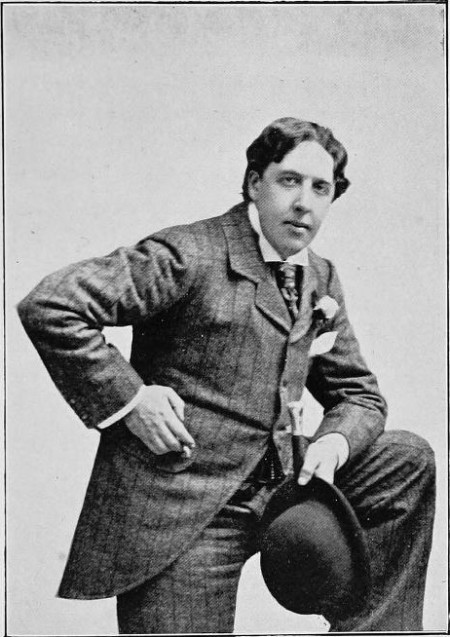
OSCAR WILDE, 1893.
Then, turning suddenly towards me, he said,
'Would you like to know the great drama of
my life? It is that I have put my genius into
my life—I have put only my talent into my
works.'
It was only too true. The best of his writing is
but a poor reflection of his brilliant conversation.
Those who have heard him talk find him disappointing
to read. Dorian Gray in its conception
was a wonderful story, far superior to La Peau de
Chagrin, and far more significant! Alas! when
written, what a masterpiece spoiled. In his most
delightful tales literary influence makes itself too
much felt. However graceful they may be, one
notices too much literary effort; affectation and
delicacy of phrase[2] conceal the beauty of the first
conception of them. One feels in them, and one
cannot help feeling in them, the three periods of
their generation. The first idea contained in them
is very beautiful, simple, profound, and certain to
make itself heard; a kind of latent necessity holds
the parts firmly together, but from that point
the gift stops. The development of the parts is
done in an artificial manner; there is a lack of
arrangement about them, and when Wilde elaborates
his sentences and endeavours to give them
their full value, he does so by overloading them
prodigiously with tiny conceits and quaint and
trifling fancies. The result is that one's emotion
is held at bay, and the dazzling of the surface so
blinds one's eyes and mind, that the deep central
emotion is lost.
He spoke of returning to London, as a well-known
peer was insulting him, challenging him,
and taunting him with running away.
'But if you go back what will happen? 'I asked
him. 'Do you know the risk you are running?'
'It is best never to know,' he answered. 'My
friends are extraordinary—they beg me to be
careful. Careful? but can I be careful? That
would be a backward step. I must go on as far
as possible. I cannot go much further. Something
is bound to happen ... something else.'
Here he broke off, and the next day he left for
England.
The rest of the story is well-known. That
'something else' was hard labour.
[I have invented nothing, nor altered anything, in the last
few sentences I have quoted. Wilde's words are fixed in my
mind, and, I might almost say, in my ears. I do not say that
Wilde clearly saw the prison opening to receive him, but I do
assert that the great and unexpected event which astonished
and upset London, suddenly changing Oscar Wilde from accuser
into accused, did not cause him any surprise.
The newspapers, which chose to see in him only a buffoon,
misrepresented, as far as they could, the position taken up for
his defence, even to the extent of wresting all meaning from it.
Perhaps some day in the far future it will be seemly to lift this
dreadful trial out of the mire—but not yet.]
For the crimson flower of our life is eaten by the cankerworm
of truth.
And no hand can gather up the fallen withered petals
of the rose of youth.
As soon as he came out of prison, Oscar
Wilde went back to France. At Berneval,
a quiet little village near Dieppe, a certain 'Sebastian
Melmoth' took up his abode. It was he. As
I had been the last of his French friends to see
him, I wanted to be the first to greet him on
his return to liberty, and as soon as I could find
out his address I hastened to him.
I arrived about midday without having previously
announced my proposed visit. M. Melmoth,
whom T——[1] with warm cordiality invited to
Dieppe fairly frequently, was not expected back
till the evening. He did not return till midnight.
It was as cold as winter. The weather was
atrocious. The whole day I wandered about the
deserted beach in low spirits and bored to death.
How could Wilde have chosen Berneval to live in,
I wondered. It was positively mournful. Night
came, and I went back to the hotel to engage
a room, the same hotel where Melmoth was
living—indeed it was the only one in the place.
The hotel, which was clean and pleasantly situated,
catered only for second-class boarders, inoffensive
folk enough, with whom I had to dine.
Rather poor company for Melmoth, I thought.
Fortunately I had a book to read, but it was a
gloomy evening, and at eleven o'clock I was just
going to abandon my intention of waiting up for
him when I heard the rumbling of carriage wheels.
M. Melmoth had arrived, benumbed with cold.
He had lost his overcoat on the way. And, now
that he came to think of it, he remembered that a
peacock's feather which his servant had brought
him the previous evening was a bad omen, and
had clearly foretold some misfortune about to
befall him; luckily it was no worse. But as he
was shivering with cold, the hotel was set busy
to warm some whiskey for him. He hardly said
'How do you do?' to me. In the presence of
others, at least, he did not wish to appear to be at
all moved. And my own emotion was almost immediately
stilled on finding Sebastian Melmoth so
plainly like the Oscar Wilde of old—no longer the
frenzied poet of Algeria, but the sweet Wilde
of the days before the crisis; and I found
myself taken back not two years, but four or
five. There was the same dreamy look, the same
amused smile, the same voice.
He occupied two rooms, the best in the hotel,
and he had arranged them with great taste.
Several books lay on the table, and among them
he showed me my own Nourritures Terrestres,
which had been published lately. A pretty Gothic
Virgin stood on a high pedestal in a dark corner.
Presently we sat down near the lamp, Wilde
drinking his grog in little sips. I noticed, now
that the light was better, that the skin of his face
had become red and common looking, and his
hands even more so, though they still bore the
same rings—one to which he was especially attached
had in a reversible bezel an Egyptian
scarabæus in lapis lazuli. His teeth were dreadfully
decayed.
We began chatting, and I reminded him of our
last meeting in Algiers, and asked him if he remembered
that I had almost foretold the approaching
catastrophe.
'Did you not know,' I said, 'almost for certain
what was awaiting you in England? You saw
the danger and rushed headlong into it, did you
not?'
Here I think I cannot do better than copy out
the pages on which I wrote shortly afterwards as
much as I could remember of what he said.
'Oh, naturally,' he replied, 'of course I knew
that there would be a catastrophe, either that or
something else; I was expecting it. There was
but one end possible. Just imagine—to go any
further was impossible, and that state of things
could not last. That is why there had to be some
end to it, you see. Prison has completely changed
me[2]. I was relying on it for that. —-is terrible.
He cannot understand that—he cannot understand
that I am not taking up the same existence again.
He accuses the others of having changed me—but
one must never take up the same existence again.
My life is like a work of art. An artist never
begins the same work twice, or else it shows that
he has not succeeded. My life before prison was
as successful as possible. Now all that is finished
and done with.'
He lighted a cigarette and went on: 'The public
is so dreadful that it knows a man only by the last
thing he has done. If I were to go back to Paris
now, people would see in me only the convict. I
do not want to show myself again before I have
written a play. Till then I must be left alone and
undisturbed.' And he added abruptly, 'Did I not
do well to come here? My friends wanted me to
go to the South to recruit, because at first I was
quite worn out. But I asked them to find me, in
the North of France, a very small place at the seaside,
where I should see no one, where it was very
cold and there was hardly ever any sun. Did I
not do well to come and live at Berneval? [Outside
the weather was frightful.] Here every one
is most good to me—the Curé especially. I am
so fond of the little church, and, would you believe
it, it is called Notre Dame de Liesse[3]! Now, is not
that charming? And now I know that I can never
leave Berneval, because only this morning the Curé
offered me a perpetual seat in the choir-stalls.
And the Custom-house men, poor fellows, are so
bored here with nothing to do, that I asked them if
they had not anything to read, and now I am giving
them all the elder Dumas' novels. So I must stay
here, you see. And the children, oh, the children
they adore me. On the day of the Queen's Jubilee
I gave a grand fête and a big dinner, when I had
forty children from the school, all of them, and
the schoolmaster, to celebrate it. Is not that
absolutely charming? You know that I admire
the Queen very much. I always have her portrait
with me.'
And he showed me her portrait by Nicholson,
pinned on the wall. I got up to look at it. A
small bookshelf was close to it, and I began
glancing at the books. I wanted to lead Wilde
on to talk to me in a more serious vein. I sat
down again, and rather timidly asked him if he
had read Souvenirs de la Maison des Morts.
He gave me no direct answer, but began:—'Russian
writers are extraordinary. What makes
their books so great is the pity they put into
them. You know how fond I used to be of
Madame Bovary, but Flaubert would not admit
pity into his work, and that is why it has a petty
and restrained character about it. It is sense
of pity by means of which a work gains in
expanse, and by which it opens up a boundless
horizon. Do you know, my dear fellow,
it was pity that prevented me from killing myself?
During the first six months I was dreadfully
unhappy, so utterly miserable that I wanted
to kill myself, but what kept me from doing so
was looking at the others, and seeing that they
were as unhappy as I was, and feeling sorry for
them. Oh, dear! what a wonderful thing pity is,
and I never knew it.'
He was speaking in a low voice without any
excitement.
'Have you ever learned how wonderful a thing
pity is? For my part I thank God every night, yes,
on my knees I thank God for having taught it to
me. I went into prison with a heart of stone,
thinking only of my own pleasure, but now my heart
is utterly broken—pity has entered into my heart.
I have learned now that pity is the greatest and
most beautiful thing in the world. And that is why
I cannot bear ill-will towards those who caused
my suffering and those who condemned me; no,
nor to any one, because without them I should
not have known all that. —— writes me terrible
letters. He says he does not understand me,
that he does not understand that I do not wish
every one ill, and that every one has been horrid
to me. No, he does not understand me. He
cannot understand me any more. But I keep
on telling him that in every letter: we cannot
follow the same road. He has his, and it is
beautiful—I have mine. His is that of Alcibiades;
mine is now that of St. Francis of Assisi. Do
you know St. Francis of Assisi? A wonderful
man! Would you like to give me a great
pleasure? Send me the best life of St. Francis
you can find.'
I promised it to him. He went on:
'Yes, afterwards we had a charming prison
Governor, oh, quite a charming man, but for the
first six months I was dreadfully unhappy. There
was a Governor of the prison, a Jew, who was
very harsh, because he was entirely lacking in
imagination.'
This last expression, spoken very quickly, was
irresistibly funny; and, as I laughed heartily, he
laughed too, repeated it, and then said:
'He did not know what to imagine in order to
make us suffer. Now, you shall see what a lack of
imagination he showed. You must know that in
prison we are allowed to go out only one hour
a day; then, we walk in a courtyard, round and
round, one behind the other, and we are absolutely
forbidden to say a word. Warders watch us,
and there are terrible punishments for any one
caught talking. Those who are in prison for the
first time are spotted at once, because they do
not know how to speak without moving their
lips. I had already been in prison six weeks
and I had not spoken a word to anyone—not to
a soul[4].
'One evening we were walking as usual, one
behind the other, during the hour's exercise, when
suddenly behind me I heard my name called. It
was the prisoner who followed me, and he said,
"Oscar Wilde, I pity you, because you must suffer
more than we do." Then I made a great effort
not to be noticed (I thought I was going to faint),
and I said without turning round, "No, my friend,
we all suffer alike." And from that day I no
longer had a desire to kill myself. We talked
in that way for several days. I knew his name
and what he had done. His name was P——;
he was such a good fellow; oh! so good. But
I had not yet learned to speak without moving
my lips, and one evening,—"C.3.3." (C.3.3. was
myself), "C.3.3. and A.4.8. step out of the ranks."
'Then we stood out, and the warder said, "You
will both have to go before the Governor." And
as pity had already entered into my heart, my
only fear was for him; in fact I was even glad
that I might suffer for his sake. But the Governor
was quite terrible. He had P—— in first; he
was going to question us separately, because you
must know that the punishment is not the same
for the one who speaks first, and for the one
who answers; the punishment of the one who
speaks first is double that of the other. As a rule
the first has fifteen days' solitary confinement,
and the second has eight days only. Then
the Governor wanted to know which of us had
spoken first, and naturally P——, good fellow
that he was, said it was he. And afterwards
when the Governor had me in to question me,
I, of course, said it was I. Then the Governor
got very red because he could not understand it.
"But P—— also says that it was he who began
it. I cannot understand it. I cannot understand
it."
'Think of it, my dear fellow, he could not understand
it. He became very much embarrassed and
said, "But I have already given him fifteen days,"
and then he added, "Anyhow, if that is the
case, I shall give you both fifteen days." Is not
that extraordinary? That man had not a spark
of imagination[5].'
Wilde was vastly amused at what he was saying,
and laughed—he was happy telling stories.
'And, of course,' he continued, 'after the fifteen
days we were much more anxious to speak to one
another than before. You do not know how
sweet that is, to feel that one is suffering for
another. Gradually, as we did not go in the same
order each day, I was able to talk to each of the
others, to all of them, every one of them. I knew
each one's name and each one's history, and when
each was due to be released. And to each one
I said, "When you get out of prison, the first
thing you must do is to go to the Post Office, and
there you will find a letter for you with some
money." And so in that way I still know them,
because I keep up my friendship with them. And
there is something quite delightful in them. Would
you believe it, already three of them have been to
see me here? Is not that quite wonderful?'
'The successor of the harsh Governor was a
very charming man—oh! remarkably so—and
most considerate to me. You cannot imagine
how much good it did me in prison that Salomé[6]
was being played in Paris just at that time. In
prison, it had been entirely forgotten that I was
a literary person, but when they saw that my play
was a success in Paris, they said to one another,
"Well, but that is strange; he has talent, then."
And from that moment they let me have all the
books I wanted to read[7]. I thought, at first, that
what would please me most would be Greek literature,
so I asked for Sophocles, but I could not get
a relish for it. Then I thought of the Fathers of
the Church, but I found them equally uninteresting.
And suddenly I thought of Dante. Oh!
Dante. I read Dante every day, in Italian, and
all through, but neither the Purgatorio nor the
Paradiso seemed written for me. It was his
Inferno above all that I read; how could I help
liking it? Cannot you guess? Hell, we were in
it—Hell, that was prison!'[8]
That same evening he told me a clever story
about Judas, and of his proposed drama on
Pharaoh. Next day he took me to a charming
little house[9], about two hundred yards from the
hotel, which he had rented and was beginning to
furnish. It was there that he wanted to write his
plays—his Pharoah first, and then one called
Ahab and Jezebel (he pronounced it 'Isabelle'),
which he related to me admirably.
The carriage which was to take me away was
waiting, and Wilde got into it to accompany me
part of the way. He began talking to me again
about my book, and praised it, though with some
slight reserve, I thought. At last the carriage
stopped; he bade me good-bye, and was just going
to get out, when he suddenly said, 'Listen, my
dear friend, you must promise me one thing.
Your Nourritures Terrestres is good, very good,
but promise me you will never write a capital
"I" again.' And as I seemed scarcely to understand
what he meant, he finished up by saying,
'In Art, you see, there is no first person.'
Ah! what else had I to do but love you, God's own
mother was less dear to me,
And less dear the Cytheræan rising like an argent lily
from the sea.
On returning to Paris I went to give news of
him to ——.
---- said to me: 'But all that is quite absurd.
He is quite incapable of bearing the ennui. I
know him so well. He writes to me every day.
I also am of opinion that he ought to finish his
play first, but after that he will come back here.
He has never done anything good in solitude; he
needs to be constantly drawn out of himself. It
is by my side that he has written all his best
work. Besides, just look at his last letter.'
He thereupon read it to me. In it Wilde
begged —— to let him finish his Pharaoh in
peace, but, in effect, the letter implied that as
soon as his play was written he would come back,
he would find him again; and it ended with these
boastful words, 'and then I shall be once more the
King of Life.'
Rudderless, we drift athwart a tempest, and when once
the storm of youth is past,
Without lyre, without lute or chorus, Death the silent
pilot comes at last.
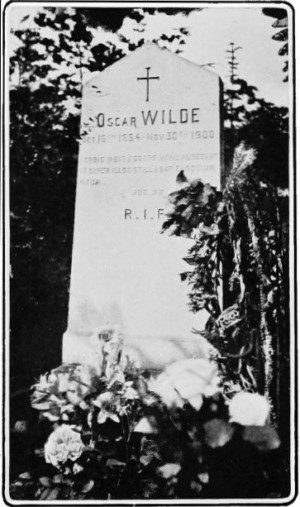
THE GRAVE AT BAGNEUX.
And a short time afterwards, Wilde went back
to Paris.[1]
His play was not written—it will never be written
now. Society well knows what steps to take when
it wants to crush a man, and it has means more
subtle than death. Wilde had suffered too grievously
for the last two years, and in too submissive
a manner, and his will had been broken. For the
first few months he might still have entertained
illusions, but he soon gave them up. It was as
though he had signed his abdication. Nothing
remained in his shattered life but a mouldy ruin,
painful to contemplate, of his former self. At
times he seemed to wish to show that his brain
was still active. Humour there was, but it was
far-fetched, forced, and threadbare.
I met him again on two occasions only. One
evening on the Boulevards, where I was walking
with G——, I heard my name called. I turned
round and saw Wilde. Ah! how changed he
was. 'If I appear again before writing my play,
the world will refuse to see in me anything
except the felon,' he had once said to me. He
had appeared again, without his play, and as he
found certain doors closed in his face, he no longer
sought admission anywhere. He prowled.
Friends, at different times, tried to save him[2].
They did all they could think of, and were for
taking him to Italy, but he eluded their efforts,
and began to drift back. Among those who had
remained faithful for the longest time, some
had often told me that Wilde was no longer
to be seen, and I was somewhat uneasy, I admit,
at seeing him again, and what is more, in a place
where so many people might pass. Wilde was
sitting at a table outside a café. He ordered two
cock-tails for G—— and myself. I was going to
sit opposite to him in such a way as to turn my
back to the passers-by, but Wilde, noticed this
movement, which he took as an impulse of absurd
shame, (he was not entirely mistaken, I must
admit), and said, 'Oh, sit here, near me,' pointing
to a chair at his side, 'I am so much alone just
now.'
Wilde was still well-dressed, but his hat was
not so glossy; his collar was of the same shape,
but it was not so clean, and the sleeves of his coat
were slightly frayed at the edges.
'When I used to meet Verlaine in days gone
by,' he continued with an outburst of pride, 'I was
never ashamed of being seen with him. I was
rich, light-hearted, and covered with glory, but I
felt that to be seen with him was an honour, even
when Verlaine was drunk.' Then fearing to bore
G——, I think, he suddenly changed his mood,
tried to be witty and to make jokes. In the effort
he became gloomy. My recollections here are
dreadfully sad. At last my friend and I got up.
Wilde insisted on paying for the drinks, and
I was about to say good-bye, when he took
me aside, and, with an air of great embarrassment,
said in a low voice, 'I say, I must tell you,
I am absolutely without a penny[3].
Some days afterwards I saw him again, and for
the last time. I do not want to repeat more than
one word of our conversation. He told me of his
troubles, of the impossibility of carrying out, or
even of beginning, a piece of work[4]. Sadly I reminded
him of the promise he had made not to
show himself in Paris without having finished one
book. 'Ah!' I began, 'why did you leave Berneval
so soon, when you ought to have stayed there
so long? I cannot say that I am angry with you,
but—'
He interrupted me, laid his hand on mine,
looked at me with his most sorrowful look, and
said, 'You must not be angry with one who has
been crushed[5].'
Oscar Wilde died in a shabby little hotel in the
Rue des Beaux Arts. Seven persons followed
the hearse, and even they did not all accompany
the funeral procession to the end. On the coffin
were some flowers and some artificial wreaths,
only one of which, I am told, bore any inscription.
It was from the proprietor of the hotel,
and on it were these words: 'A Mon Locataire.'