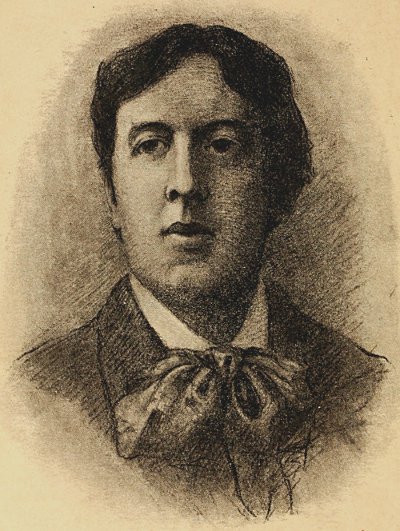
THE MAN
The συνετοι, the connoisseurs, always recognised
the genius of Oscar Fingal O'Flahertie Wills
Wilde from the very first moment when he
began to write. For many years ordinary people
to whom literature and literary affairs were not
of, at anyrate, absorbing interest only knew of
Oscar Wilde by his extravagances and poses.
Then it happened that Wilde turned his
powers in the direction of the stage and achieved
a swift and brilliant success. The English public
then began to realise that here was an unusually
brilliant man, and the extraordinary genius of
the subject of this work would have certainly
been universally recognised in a few more years,
when the shocking scandals associated with his
name occurred and Oscar Wilde disappeared
into oblivion.
A great change gradually took place in public
opinion. Little by little the feeling of prejudice
against the work of Oscar Wilde began to die
away. The man himself was dead. He had
expiated his crimes by a prolonged agony of
the most hideous suffering and disgrace, and
people began to wonder if his writings were in any
way associated with the dark side of his life and
character, or whether they might not, after all, be
beautiful, pure, and treasures of the literature of
our time. The four comedies of Manners, "Lady
Windermere's Fan," "The Ideal Husband," "A
Woman Of No Importance," "The Importance
Of Being Earnest," everyone had seen and
laughed at. They were certainly absolutely
without offence. It was gradually seen that
because a house was built by an architect of an
immoral private life that did not necessarily
invalidate it as a residence, that if Stephenson
had ended his life upon the gallows people would
still find railways convenient and necessary.
The truth gradually dawned that Wilde had
never in his life written a line that was immoral
or impure, and that, in short, the criminal side
of him was only a part of his complex nature,
horribly disastrous for himself and his personal
life, but absolutely without influence upon his
work.
Art and his aberration never mingled or overlapped.
Everybody began to realise the fact.
Opinion was also being quietly moulded from
within by a band of literary and artistic people,
some of them friends of the late author, others
knowing him simply through his work.
The public began to ask for Wilde's books
and found it almost impossible to obtain them,
for the "Ballad of Reading Gaol," published
while its author was still alive, had not stimulated
any general demand for other works.
It was after Oscar Wilde's death that his
friends and admirers were able to set to work at
their endeavours to rehabilitate him as artist in
the mind of general prejudice. Books and monographs
were written about Wilde in English,
French, and German. He was quoted in the
leading Continental reviews. His play "Salomé"
met with sudden and stupendous success all over
Europe, a famous musician turned it into an
opera. A well-known English man of letters,
Mr Robert Harborough Sherard, published a
final official "Life" of the dead author, and
Wilde's own "De Profundis" appeared to
startle, sadden, and thrill the whole reading
world.
His plays are being revived, and an authoritative
and exhaustive edition of his writings is
being issued by a leading publishing house.
There is no doubt about it, the most prejudiced
and hostile critics must admit it—in a
literary sense, as a man of letters with extraordinary
genius, Oscar Wilde has come into his
own. The time is, therefore, ripe for a work of
the present character which endeavours to "appreciate"
one of the strangest, saddest, most
artistic and powerful brains of modern times.
Five years ago such a book as this would probably
have been out of place. When Balzac
died Sainte-Beuve prefaced a short critical article
of fourteen pages, as follows:—
"A careful study of the famous novelist who
has just been taken from us, and whose sudden
loss has excited universal interest, would require
a whole work, and the time for that, I think, has
not yet come. Those sort of moral autopsies
cannot be made over a freshly dug grave, especially
when he who has been laid in it was
full of strength and fertility, and seemed still
full of future works and days. All that is possible
and fitting in respect of a great contemporary
renown at the moment death lays it low
is to point out, by means of a few clear-cut lines,
the merits, the varied skill, by which it charmed
its epoch and acquired influence over it."
When Oscar Wilde died, and before the
publication of "De Profundis," various short
essays did, as I have stated, make an appearance.
A longer work seems called for, and it
is that want which the present volume does its
best to supply.
"Oscar Wilde: The Man" is the title of the
first part of this Appreciation. In Mr Sherard's
"The Story of an Unhappy Friendship," as also
in his careful and scholarly "Life," the many-sided
nature of Oscar Wilde was set forth with
all the ability of a brilliant pen. But there is
yet room for another, and possibly more detached
point of view, and also a summary of the views
of others which will assist the general reader to
gain a mental picture of a writer whose works,
in a very short time, are certain to have a
general, as well as a particular appeal.
The scheme of a work of this nature, which is
critical rather than biographical, would nevertheless
be incomplete without a personal study.
The study of Wilde's writings cannot fail to
be enormously assisted by some knowledge of
synetoithe man himself, and how he was regarded by
others both before and after his personal disgrace.
Ever since his name was known to the world
at all the public view of him has constantly been
shifting and changing. There are, however, four
principal periods during each of which Wilde
was regarded in a totally different way. I have
made a careful analysis of each of these periods
and collected documentary and other evidence
which defines and explains them.
The first period of all—Oscar Wilde himself
always spoke of the different phases of his extraordinary
career as "periods"—was that of the
"Æsthetic movement" as it is generally called,
or the æsthetic "craze" as many people prefer
to name it still. New movements, whether good
or bad in their conception and ultimate result,
always excite enmity, hostility, and ridicule. In
affairs, in religion, in art, this is an invariable
rule. No pioneer has ever escaped it. England
laughed at the first railway, jeered at the
volunteer movement and laughed at John Keats
in precisely the same fashion as it ridiculed
Oscar Wilde and the æsthetic movement.
It is as well to define that movement carefully,
for, though marred by innumerable extravagances
and still suffering from the inanities
of its first disciples, it has nevertheless had a
real and permanent influence upon English life.
Oscar Wilde was, of course, not the originator
of the æsthetic movement. He took upon
himself to become its hierophant, and to infuse
much that was peculiarly his own into it. The
movement was begun by Ruskin, Rossetti,
William Morris, Burne-Jones, and a host of
others, while it was continued in the delicate
and beautiful writings of Walter Pater. But
it had always been an eclectic movement, not
for the public eye or ear, neither known of nor
popular with ordinary people.
Oscar Wilde then began to interest and excite
England and America in the true aims and
methods of art of all kinds. It shows an
absolute ignorance of the late Victorian era to
say that the movement was a passing craze. To
Oscar Wilde we owe it that people of refined
tastes but moderate means can obtain beautiful
papers for the walls of their houses at a moderate
cost. The cheap and lovely fabrics that we
can buy in Regent Street are spun as a direct
consequence of the movement; harmony and
delicacy of colour, beauty of curve and line, the
whole renaissance of art in our household furniture
are mainly due to the writings and lectures
of Oscar Wilde.
It is not a crime to love beautiful things, it is
not effeminate to care for them. It is to the
subject of this appreciation we owe our national
change of feeling on such matters.
This, briefly, is what the æsthetic movement
was, such are its indubitable results. Let us
see, in some instances, how Wilde was regarded
in the period when, before his real literary successes,
he preached the gospel of Beauty in
everyday life.
Let us take a Continental view of Wilde in his
first period, the view of a really eminent man, a
distinguished scientist and man of letters.
The name of Dr Max Nordau will be familiar
to many readers of this book. But, if the book
fulfils the purpose for which it was designed,
then possibly there will be many readers who
will know little or nothing of the distinguished
foreign writer. Hard, one-sided, and bitter as
his remarks upon Wilde during the æsthetic
movement will seem to most of us—seem to me—yet
they have the merit of absolute detachment
and sincerity. It is as well to insist on this fact
in order that my readers may realise exactly such
value as the words may have, no less and no
more. The following short account of Dr Max
Nordau's position and achievements is taken from
that useful dictionary of celebrities, "Who's
Who?" for 1907:—
"Nordau, Max Simon, M.D. Paris, Budapesth;
Officier d'Académie, France; Commander
of the Royal Hellenic Order of the St Saviour;
author and physician; President Congress of
Zionists; Hon. Mem. of the Greek Acad. of
the Parnassos; b. Budapesth, 29th July 1849;
y. s. of Gabriel Südfield, Rabbi, Krotoschin,
Prussia, and his 2nd wife, b. Nelkin, Riga,
Russia. Educ. Royal Gymnasium and Protestant
Gymnasium, Budapesth; Royal University,
Budapesth; Faculty of Medicine, Paris. Wrote
very early for newspapers; travelled for several
years all over Europe; practised as a physician
for a year and a half, 1878-80, at Budapesth;
settled then at Paris, residing there ever since;
m. Anna-Elizabeth, 2nd d. of State-councillor
Captain Julius Dons, Copenhagen, Denmark;
one d. Publications: Paris, Studien und Bilder
aus dem wahren Milliardenlande, 1878; Seifenblasen,
1879; Vom Kreml zur Alhambra, 1880;
Aus der Zeitungswelt (together with Ferdinand
Gross), 1880; Paris under der dritten Republik,
1881; der Krieg der Millionen, 1882; Die conventionellen
Lügen der Culturmenschheit, 1883;
Ausgewählte Pariser Briefe, 1884; Paradoxe,
1885; Die Krankheit des Jahrhunderts, 1887;
Seelenanalysen, 1891; Gefühlskomödie, 1892;
Entartung, 1893; Das Recht zu lieben, 1894;
Die Kugel, 1895; Drohnenschlacht, 1896; La
funzione sociale dell arte, 1897; Doctor Kohn,
1898; The Drones must Die, 1899: Zeitgenössische
Franzosen, 1901; Morganatic, 1904;
Mahâ-Rôg, 1905. Recreations: foil-fencing,
swimming. Address: 8, Rue Léonie, Paris."
Nearly all the modern manifestations of Art,
implies Dr Max Nordau, in "Degeneration," are
manifestations of madness. Such a sweeping
statement is incredible and has not—nor will
it have—many advocates, despite the brilliant
special pleading of its originator. In Oscar
Wilde's case the aphorism seems particularly
misleading for the reason that there may appear
to be a considerable amount of truth in it.
That Wilde's social downfall was due to a
certain kind of elliptiform insanity is without
doubt. Mr Sherard has insisted on this over and
over again. He has spent enormous labour in
researches into Wilde's ancestry. His view is
really a scientific view because it is written by
an artist who sees both sides of the question, has
a judicial mind, and while capable of appreciating
the truths that science teaches us, is further capable
of welding them to the psychological truths
which the intuition of the artist alone evolves.
A certain definite and partial insanity alone
can explain Wilde's life in certain of its aspects.
But when once his pen was in his hand, in his
real bright life of literature and art, this hidden
thing entirely disappears. Therefore, Dr Max
Nordau's study seems to me fundamentally
wrong, though extremely interesting and not
to be disregarded. To know Oscar Wilde we
must know what all sorts of people, whose
opinion has weight enough to secure a wide
hearing, really thought about him.
The German scientist said:
"The ego-mania of decadentism, its love of the
artificial, its aversion to nature, and to all forms
of activity and movement, its megalomaniacal
contempt for men and its exaggeration of the
importance of art, have found their English
representative among the 'Æsthetes,' the chief
of whom is Oscar Wilde.
"Wilde has done more by his personal eccentricities
than by his works. Like Barbey
d'Aurevilly, whose rose-coloured silk hats and
gold lace cravats are well known, and like his
disciple Joséphin Péladan, who walks about in
lace frills and satin doublet, Wilde dresses in
queer costumes which recall partly the fashions
of the Middle Ages, partly the rococo modes.
He pretends to have abandoned the dress of the
present time because it offends his sense of the
beautiful; but this is only a pretext in which
probably he himself does not believe. What
really determines his actions is the hysterical
craving to be noticed, to occupy the attention
of the world with himself, to get talked about.
It is asserted that he has walked down Pall Mall
in the afternoon dressed in doublet and breeches,
with a picturesque biretta on his head, and a
sunflower in his hand, the quasi-heraldic symbol
of the Æsthetes. This anecdote has been reproduced
in all the biographies of Wilde, and I have
nowhere seen it denied. But it is a promenade
with a sunflower in the hand also inspired by a
craving for the beautiful.
"Phrasemakers are perpetually repeating the
twaddle, that it is a proof of honourable independence
to follow one's own taste without being
bound down to the regulation costume of the
Philistine cattle, and to choose for clothes the
colours, materials and cut which appear beautiful
to oneself, no matter how much they may
differ from the fashion of the day. The answer
to this cackle should be that it is above all a sign
of anti-social ego-mania to irritate the majority
unnecessarily, only to gratify vanity, or an
æsthetical instinct of small importance and easy
to control—such as is always done when, either
by word or deed, a man places himself in opposition
to this majority. He is obliged to repress
many manifestations of opinions and desires out
of regard for his fellow-creatures; to make him
understand this is the aim of education, and he
who has not learnt to impose some restraint upon
himself in order not to shock others is called
by malicious Philistines, not an Æsthete, but a
blackguard.
"It may become a duty to combat the vulgar
herd in the cause of truth and knowledge; but
to a serious man this duty will always be felt as
a painful one. He will never fulfil it with a light
heart, and he will examine strictly and cautiously
if it be really a high and imperative law which
forces him to be disagreeable to the majority
of his fellow-creatures. Such an action is, in
the eyes of a moral and sane man, a kind of
martyrdom for a conviction, to carry out which
constitutes a vital necessity; it is a form, and
not an easy form, of self-sacrifice, for it means
the renunciation of the joy which the consciousness
of sympathy with one's fellow-creatures
gives, and it exacts the painful overthrow of
social instincts, which, in truth, do not exist in
deranged ego-maniacs, but are very strong in the
normal man.
"The predilection for strange costume is a
pathological aberration of a racial instinct. The
adornment of the exterior has its origin in the
strong desire to be admired by others—primarily
by the opposite sex—to be recognised by them
as especially well shaped, handsome, youthful, or
rich and powerful, or as pre-eminent through
rank or merit. It is practised, then, with the
object of producing a favourable impression on
others, and is a result of thought about others,
of preoccupation with the race. If, now, this
adornment be, not through misjudgment but
purposely, of a character to cause irritation to
others, or lend itself to ridicule—in other words,
if it excites disapproval instead of approbation—it
then runs exactly counter to the object of
the art of dress, and evinces a perversion of the
instinct of vanity.
"The pretence of a sense of beauty is the excuse
of consciousness for a crank of the conscious.
The fool who masquerades in Pall Mall does not
see himself, and, therefore, does not enjoy the
beautiful appearance which is supposed to be an
æsthetic necessity for him. There would be
some sense in his conduct if it had for its object
an endeavour to cause others to dress in accordance
with his taste; for them he sees and they
can scandalise him by the ugliness, and charm
by the beauty, of their costume. But to take
the initiative in a new artistic style in dress
brings the innovator not one hair's breadth nearer
his assumed goal of æsthetic satisfaction.
"When, therefore, an Oscar Wilde goes about
in 'æsthetic costume' among gazing Philistines,
exciting either their ridicule or their wrath, it is
no indication of independence of character, but
rather from a purely anti-socialistic, ego-maniacal
recklessness and hysterical longing to make a
sensation, justified by no exalted aim; nor is it
from a strong desire of beauty, but from a malevolent
mania for contradiction."
It is impossible to read the extracts quoted
above—and only a few paragraphs sufficient to
show the trend of a much longer article have
been used—without realising its injustice and
yet at the same time its perfect sincerity. During
the "first period," with which we are dealing
now, Wilde undoubtedly excited the enmity
and ridicule of a vast number of people. He
knew that he had something to say which was
worth listening to. He knew also—as the genius
always has known—that he was superior in
intellect to those by whom he was surrounded.
His temperament was impatient. He wanted
to take the place to which he felt he was entitled
in a sudden moment. His quick Celtic imagination
ran riot with fact, his immeasurable ambition,
his serene consciousness of worth, which to usual
minds and temperaments suggested nothing but
conceit, all urged him to display and extravagance
in order to more speedily mount the
rostrum from which he would be heard.
Therefore, in this first period of this so
astonishing a career, he went far to spoil and
obscure his message by the very means he hoped
would enable him to publish it widely. He invented
a pose which he intended should become
a megaphone, whereas, in the effect, it did but
retard the hearing of his voice until the practical
wisdom of what he wished to say proved itself
in concrete form.
Nor must we ever forget the man's constant
sense of humour, a mocking sprite which doubtless
led him to this or that public foolishness
while he chuckled within at his own attitude and
the dance he was leading his imitators and fools.
For Oscar Wilde had a supreme sense of
humour. Many people would like to deny him
humour, while admitting his marvellous and
scintillating wit. That they are wrong I unhesitatingly
assert, and I believe that this will
be proved over and over again in the following
pages.
Let us take another view of Wilde at this
period. It was written after his disappearance
from public life, or rather when it was imminent
and certain. The words are those of Mr
Labouchere, the flaneur with an intellect, the
somewhat acid critic of how many changing
aspects and phases of English social life.
"I have known Oscar Wilde off and on for
years," writes Mr Labouchere in Truth.
"Clever and witty he unquestionably is, but I
have always regarded him as somewhat wrong in
the head, for his craving after notoriety seemed
to me a positive craze. There was nothing that
he would not do to attract attention. When he
went over to New York he went about dressed
in a bottle-green coat with a waist up to his
shoulders. When he entered a restaurant people
threw things at him. When he drove in the
evening to deliver his lectures the windows of
his carriage were broken, until a policeman rode
on each side of it. Far from objecting to all
this, it filled him with delighted complacency.
'Insult me, throw mud at me, but only look
at me,' seemed to be his creed; and such a
creed was never acted upon by anyone whose
mind was not out of balance. So strange and
wondrous is his mind, when in an abnormal condition,
that it would not surprise me if he were
deriving a keen enjoyment from a position which
most people, whether really innocent or guilty,
would prefer to die rather than occupy. He
must have known in what a glass house he lived
when he challenged investigation in a court of
justice. After he had done this he went abroad.
Why did he not stay abroad? The possibilities
of a prison may not be pleasing to him, but I
believe that the notoriety that has overtaken
him has such a charm for him that it outweighs
everything else. I remember, in the early days
of the cult of æstheticism, hearing someone ask
him how a man of his undoubted capacity could
make such a fool of himself. He gave this
explanation. He had written, he said, a book of
poems, and he believed in their excellence. In
vain he went from publisher to publisher asking
them to bring them out: no one would even
read them, for he was unknown. In order to
find a publisher he felt that he must do something
to become a personality. So he hit upon
æstheticism. It succeeded. People talked about
him; they invited him to their houses as a sort
of lion. He then took his poems to a publisher,
who—still without reading them—gladly accepted
them."
This is thoroughly unsympathetic, but no
doubt it represents a mood with some faithfulness.
In criticising the work of critics one must
be a psychologist. Religion, the Christian religion
at anyrate, teaches tolerance. Its teachings
are seldom obeyed. The four Hags of the
litany—let us personify them!—Envy, Hatred,
Malice, and Uncharitableness unfortunately intrude
into religious life too often and too powerfully.
But the real psychologist, not the
scientist (vide Nordau) is able to understand
better than anyone else the motives which have
animated criticism at any given date. The
psychologist more than any other type of man
or woman has learnt the lesson Charles Reade
tried to inculcate in "Put Yourself In His
Place."
With a little effort, we can realise what
Truth thought when these lines were written.
We cannot blame the writer, we can only record
his words as a part of the general statement
dealing with Oscar Wilde's life and attitude
during the "Æsthetic Period."
At this point the reader may possibly ask
himself if the title given to the book—"Oscar
Wilde: an Appreciation"—is entirely justified.
"The writer of it," he may say to himself, "is
giving us examples of hostile criticism of Wilde's
first period, and though he endeavours to explain
them, yet, in an appreciation, it rather seems that
such quotations are out of place."
I do not think that if the point of view is
considered for a moment, the stricture will be
persisted in.
Eulogy, indiscriminating eulogy, is simply an
ex parte statement which can have no weight at
all. I shall endeavour to show, before this first
part of the book is completed, not only how
those who attacked Wilde were mistaken, not
only how those who bestowed indiscriminate
praise upon him made an over-statement, but
finally and definitely what Wilde was as seen
through the temperament of the writer, corrected
by the statements of other writers both for and
against him.
I am convinced that this is the only scientific
method of arriving at a just estimation of the
character of this brilliant and extraordinary man.
No summing up of the æsthetic period could be
complete without copious references to the great
chronicler of our modern life—the pages of Mr
Punch.
Punch has never been bitter. It has often
been severe, but Mr Punch has always, from
the very first moment of his arrival among us,
successfully held the balance between this or
that faction, and, moreover, has faithfully reflected
the consensus of public opinion upon
any given matter.
The extraordinary skill with which some of
the brightest and merriest wits have made our
national comic paper the true diary of events
cannot be controverted or disputed. Follies and
fashions have been criticised with satire, but
never with spleen. Addison said that the
"appearance of a man of genius in the world
may always be known by the virulence of
dunces." Punch has proved for generations
that its kindly appreciation or depreciation has
never been virulent, but nearly always an
accurate statement of the opinion and point
of view of the ordinary more or less cultured
and well-bred person.
It has always been a sign of eminence in this
or that department of life to be mentioned in
Punch at all. The conductors of that journal
during its whole career have always exercised
the wisest discrimination, and have always kept
shrewd fingers upon the pulses of English
thought. When a politician, for example, is
caricatured in Punch that politician knows that
he has arrived at a certain place and point in
public estimation. When a writer is caricatured,
either in line or words, he also knows that he
has, at anyrate, obtained a hold of this or that
sort upon the country.
Now those who would try to minimise the
place of Oscar Wilde in the public eye during
the æsthetic period have only to look at the
pages of Punch to realise how greatly that
movement influenced English life during its
continuance.
Let it be thoroughly understood—and very
few people will attempt to deny it—that Punch
has always been a perfectly adjusted barometer
of celebrity.
It is, therefore, not out of place, herein, to
publish a bibliography of the references to Oscar
Wilde which, from first to last of that cometlike
career, appeared in the pages of Mr Punch.
Such a list proves immediately the one-sidedness
of Dr Max Nordau's and Mr Labouchere's views.
From extracts I have given from the remarks of
these two eminent people the ordinary man
might well be inclined to think that the æsthetic
movement and the doings of Oscar Wilde in his
first period were small and local things. This is
not so, and the following carefully compiled list
will show that it is not so.
The list has been properly indexed and is now
given below. Afterwards I shall give a small
selection from the witticisms of the famous
journal to support the bibliography.
Those students of the work of Oscar Wilde
and his position in modern life will find the
references below of great interest. They date
from 1881 to 1906, and those collectors of
"Oscariana" and students of Wilde's work will
doubtless be able to obtain the numbers in which
the following articles, poems, and paragraphs
have appeared.
1881
| February |
12, |
p. |
62. |
Maudle on the Choice of a Profession. |
| " |
" |
p. |
71. |
Beauty Not at Home. |
| April |
9, |
p. |
161. |
A Maudle in Ballad. To His Lily. |
| " |
30, |
p. |
201. |
The First of May. An Æsthetic Rondeau. Substitution. |
| May |
7, |
p. |
213. |
A Padded Cell. |
| " |
" |
p. |
215. |
Design for an Æsthetic Theatrical Poster. "Let Us Live Up To It." |
| " |
14, |
p. |
218. |
The Grosvenor Gallery. |
| " |
" |
p. |
220. |
Fashionable Nursery Rhyme. |
| " |
" |
p. |
221. |
Philistia Defiant. |
| " |
28, |
p. |
242. |
More Impressions. By Oscuro Wildegoose. La Fuite des Oies. |
| " |
" |
p. |
245. |
Æsthetic Notes. |
| June |
25, |
p. |
297. |
Æsthetics at Ascot. |
| " |
" |
p. |
298. |
Punch's Fancy Portraits. No. 37, "O. W." |
| July |
23, |
p. |
26. |
Swinburne and Water. |
| " |
" |
p. |
29. |
Maunderings at Marlow. (By Our Own Æsthetic Bard.) |
| August |
20, |
p. |
84. |
"Croquis" by Dumb-Crambo Junior.
|
| " |
20, |
p. |
84. |
Too-Too Awful. A Sonnet of Sorrow.
|
| September |
17, |
p. |
132. |
Impression De L'Automne. (Stanzas by our muchly-admired Poet, Drawit Milde.) |
| October |
1, |
p. |
154. |
The Æsthete to the Rose. (By Wildegoose, after Waller.) |
| " |
29, |
p. |
204. |
Spectrum Analysis. (After "The Burden of Itys," by the Wild-Eyed Poet.) |
| November |
12, |
p. |
228. |
A Sort of "Sortes." |
| " |
19, |
p. |
237. |
Poet's Corner; Or, Nonsense Rhymes on Well-known Names. |
| " |
26, |
p. |
241. |
The Downfall of the Dado. |
| " |
" |
p. |
242. |
Theoretikos. By Oscuro Wildegoose. |
| December |
10, |
p. |
274. |
"Impressions du Theatre." |
| " |
17, |
p. |
288. |
The Two Æsthetic Poets. |
| " |
24, |
p. |
289. |
Mr Punch's "Mother Hubbard" Fairy Tale Grinaway Christmas (Second Series.) |
| " |
31, |
p. |
309. |
Mrs Langtry as "Lady Macbeth." |
Almanack for 1882 (Dec. 6, 1881) (p. 5).
More Impressions. (By Oscuro Wildegoose.) Des Sornettes.
1882
| January |
7, |
p. |
10. |
"A New Departure." |
| " |
" |
pp. |
10, 11. |
Clowning and Classicism. |
| " |
" |
p. |
12. |
In Earnest. |
| " |
14, |
p. |
14. |
Oscar Interviewed. |
| " |
" |
p. |
16. |
Æsthetic Ladies' Hair. |
| " |
" |
p. |
18. |
Murder Made Easy. A Ballad à la Mode. By "Brother Jonathan" Wilde.
(With Cartoon.) |
| " |
" |
p. |
18. |
To An Æsthetic Poet. |
| " |
" |
p. |
22. |
Impression du Theatre. |
| February |
4, |
p. |
49. |
Sketches from "Boz." Oscar Wilde as Harold Skimpole.
|
| " |
4, |
p. |
58. |
A Poet's Day. Ariadne in Naxes;
Or, Very Like a Wail. |
| " |
" |
p. |
49. |
Distinctly Precious Pantomime. |
| " |
18, |
p. |
81. |
Lines by Mrs Cimabue Brown. |
| March |
11, |
p. |
109. |
The Poet Wilde's Unkissed Kisses. |
| " |
" |
p. |
117. |
Ossian (with Variations). |
| April |
1, |
p. |
153. |
A Philistine to An Æsthete. |
| " |
" |
p. |
156. |
The Poet Wilde. |
| " |
8, |
p. |
168. |
Impression De Gaiety Théâtre. By Ossian Wilderness. |
| " |
22, |
p. |
192. |
Likely. |
| November |
4, |
p. |
216. |
Not Generally Known. |
| " |
25, |
p. |
249. |
"What! No Soap!" Or, Pop Goes The Langtry Bubble. |
1883
| March |
31, |
p. |
155. |
To Be Sold. |
| " |
" |
p. |
156. |
Sage Green. (By a Fading-out Æsthete.) |
| May |
12, |
pp. |
220-1. |
Our Academy Guide. No. 163.—Private Frith's View.—
Members of the Salvation Army, led by General Oscar Wilde, joining in a hymn. |
| September |
1, |
p. |
99. |
"The Play's (not) the Thing." |
| November |
3, |
p. |
209. |
Sartorial Sweetness and Light. |
| " |
10, |
p. |
218. |
Counter Criticism. |
| " |
17, |
p. |
231. |
Cheap Telegrams. |
| " |
" |
p. |
238. |
Another Invitation to Amerikay. |
| " |
24, |
p. |
249. |
"And is this Fame?" |
1884
| June |
14, |
p. |
288. |
The Town. II.—Bond Street. |
| August |
23, |
p. |
96. |
The Town. No. XI.—"Form." A Legend of Modern London. Part I. |
| " |
30, |
p. |
105. |
A Legend of Modern London. Part II. |
1885
| May |
30, |
p. |
253. |
Ben Trovato. |
| June |
27, |
p. |
310. |
Interiors and Exteriors. No. 13. At Burlington House. The "Swarry." |
| December |
7, |
|
Almanack for 1886. The Walnut Season. "Here Y' ar'. Ten a Penny. All Cracked." |
1887
| December |
10, |
p. |
276. |
Our Booking-Office. Woman's World. |
1889
| January |
5, |
p. |
12. |
Our Booking-Office. Article in The Fortnightly. |
| July |
6, |
p. |
12. |
Advertisement of Blackwood's Magazine, containing "The Portrait of Mr W. H." by Oscar Wilde. |
| October |
5, |
p. |
160. |
Appropriate Subject. |
1890
| July |
19, |
p. |
26. |
Our Booking-Office. Dorian Gray. |
| September |
20, |
p. |
135. |
Development. |
| Christmas Number. |
|
Punch Among the Planets. |
1891
| March |
14, |
p. |
123. |
Desdemona to the Author of "Dorian Gray." (Apropos of his paragraphic Preface.) |
| " |
" |
p. |
125. |
Wilde Flowers. |
| May |
30, |
p. |
257. |
Our Booking-Office. Intentions. |
1892
| March |
5, |
p. |
113. |
A Wilde "Tag" to a Tame Play. With Fancy Portrait. "Quite Too-Too Puffickly Precious."
|
| March |
12, |
p. |
123. |
Lord Wildermere's Mother-in-Law.
|
| " |
" |
p. |
124. |
Pathetic Description of the Present State of Mr George Alexander. |
| April |
30, |
p. |
215. |
Staircase Scenes.—No. 1, Private View, Royal Academy. |
| June |
25, |
p. |
304. |
The Playful Sally. |
| July |
2, |
p. |
315. |
A Difficulty. |
| " |
9, |
p. |
1. |
A Wilde Idea; Or, More Injustice to Ireland. |
| " |
16, |
p. |
16. |
On the Fly-leaf of an Old Book. |
| " |
16, |
p. |
23. |
Racine, With the Chill Off. |
1893
| January |
19, |
p. |
29. |
"To Rome for Sixteen Guineas." |
| April |
22, |
p. |
189. |
The B. and S. Drama at the Adelphi. |
| " |
29, |
p. |
193. |
Stray Thoughts on Play-Writing. |
| " |
" |
p. |
195. |
The Premier at the Haymarket last Wednesday. |
| May |
6, |
p. |
213. |
A Work—of Some Importance. |
| " |
13, |
p. |
221. |
Wilder Ideas; Or, Conversation as she is spoken at the Haymarket. |
| " |
27, |
p. |
246. |
A Wylde Vade Mecum. (By Professor H-xl-y) |
| June |
3, |
p. |
257. |
Second Title for the Play at the Haymarket. |
| July |
15, |
p. |
13. |
An Afternoon Party. |
| " |
15, |
p. |
22. |
"The Play is Not the Thing." |
| " |
29, |
p. |
46. |
At The T. R. H. |
| August |
26, |
p. |
94. |
Still Wilder Ideas. (Possibilities for the next O. Wilde Play.) |
| December |
30, |
pp. |
304-5. |
New Year's Eve at Latterday Hall. An Incident. Dorian Gray taking Juliet in to Dinner. |
1894
| February |
17, |
p. |
73. |
"Blushing Honours." |
| March |
10, |
p. |
109. |
She-Notes. By Borgia Smudgiton. |
| July |
21, |
p. |
33. |
The Minx.—A Poem in Prose. |
| August |
4, |
p. |
60. |
Our Charity Fete. |
| October |
13, |
p. |
177. |
The O.B.C. (Limited). |
| " |
20, |
p. |
185. |
The Blue Gardenia. (A Colourable Imitation.) |
| " |
27, |
p. |
204. |
Morbidezza. |
| November |
10, |
p. |
225. |
The Decadent Guys. (A Colour-Study in Green Carnations.) |
| December |
15, |
p. |
287. |
The Truisms of Life. (Note 12.) |
1895
| January |
12, |
p. |
24. |
Overheard Fragment of a Dialogue. |
| " |
19, |
p. |
29. |
"To Rome for Sixteen Guineas." |
| " |
" |
p. |
36. |
"A penny Plain—But Oscar Coloured." |
| February |
2, |
p. |
54. |
A Wilde "Ideal Husband." |
| " |
" |
p. |
60. |
A God in the Os-Car. |
| " |
23, |
p. |
85. |
The O. W. Vade Mecum. |
| March |
2, |
p. |
106. |
"The Rivals" at the A.D.C. |
| " |
" |
p. |
107. |
The Advisability of Not Being Born in a Handbag. |
| " |
16, |
p. |
121. |
The Advantage of Being Consistent. |
| April |
6, |
p. |
157. |
April Foolosophy. (By One of Them.) |
| " |
13, |
p. |
171. |
The Long and Short of It. |
| " |
" |
p. |
177. |
Concerning a Misused Term; viz. Art, as recently applied to a
certain form of Literature. |
1906
| January |
3, |
p. |
18. |
Our Booking-Office. (R. H. Sherard's "Twenty Years in Paris.") |
This list at least spells, and spelt, celebrity and
a recognition of the importance of the Æsthetic
movement.
Especially did the American lecturing tour of
Oscar Wilde excite the comment and ridicule of
Punch.
I quote some paragraphs from a pretended
despatch from an "American correspondent."
A POET'S DAY
(From an American Correspondent)
| Oscar at Breakfast! |
Oscar at Luncheon!! |
| Oscar at Dinner!!! |
Oscar at Supper!!!! |
"You see I am, after all, but mortal," remarked the Poet, with an
ineffable affable smile, as he looked up from an elegant but
substantial dish of ham and eggs. Passing a long, willowy hand
through his waving hair, he swept away a stray curl-paper with the
nonchalance of a D'orsay.
After this effort, Mr Wilde expressed himself as feeling somewhat
faint; and, with a half-apologetic smile, ordered another portion of
HAM AND EGGS
in the evident enjoyment of which, after a brief interchange of
international courtesies, I left the Poet.
The irresponsible but not ungenial and quite
legitimate fun of this is a fairly representative
indication of the way in which the young "Apostle
of Beauty" was thought of in England during
his American visit.
The writer goes on to tell how, later in the
day, he once more encountered the "young
patron of Culture." It is astonishing to us now
to realise how even the word "culture" was distorted
from its real meaning and made into the
badge of a certain set. At anyrate, Mr Punch's
contributor goes on to say that "Oscar" was
found at the business premises of the
CO-OPERATIVE DRESS ASSOCIATION.
On this occasion the Poet, by special request,
appeared in the uniform of an English Officer of
the Dragoon Guards, the dress, I understand,
being supplied for the occasion from the elegant
wardrobe of Mr D'oyley Carte's "Patience"
Company.
Several ladies expressed their disappointment
at the "insufficient leanness" of the Poet's figure,
whereupon his Business Manager explained that
he belonged to the fleshy school.
To accommodate Mr Wilde, the ordinary lay-figures
were removed from the showroom, and,
after a sumptuous luncheon, to which the élite of
Miss ——'s customers were invited, the distinguished
guest posed with his fair hostess in an
allegorical tableau, representing English Poetry
extending the right hand to American Commerce.
"This is indeed Fair Trade," remarked Mr
Wilde lightly, and immediately improvised a
testimonial advertisement (in verse) in praise of
Miss ——'s patent dress-improver.
At a dinner given by "Jemmy" Crowder
(as we familiarly call him), the Apologist of Art
had discarded his military garb for the ordinary
dress of an
ENGLISH GENTLEMAN
in which his now world-famed knee-breeches
form a conspicuous item, suggesting indeed the
Admiral's uniform in Mr D'Oyley Carte's
"Pinafore" combination.
"I think," said the Poet, in a pause between
courses, "one cannot dine too well"—placing
everyone at his ease by his admirable tact in
partaking of the thirty-six items of the menu.
The skit continues wittily enough, but it is
not necessary to quote more of it. The paragraphs
sufficiently explain the attitude of Mr
Punch, which was the general attitude at the
time.
It was hammered in persistently. "Oscar
Interviewed" appeared under the date of January
1882, and again, in the following extracts the
reader will recognise the same note.
"Determined to anticipate the rabble of
penny-a-liners ready to pounce upon any distinguished
foreigner who approaches our shores, and
eager to assist a sensitive Poet in avoiding the impertinent
curiosity and ill-bred insolence of the Professional
Reporter, I took the fastest pilot-boat
on the station, and boarded the splendid Cunard
steamer, the Boshnia, in the shucking of a peanut."
HIS ÆSTHETIC APPEARANCE
He stood, with his large hand passed through
his long hair, against a high chimney-piece—which
had been painted pea-green, with panels
of peacock-blue pottery let in at uneven intervals—one
elbow on the high ledge, the other hand
on his hip. He was dressed in a long, snuff-coloured,
single-breasted coat, which reached to
his heels, and was relieved with a sealskin collar
and cuffs rather the worse for wear. Frayed
linen, and an orange silk handkerchief, gave a
note to the generally artistic colouring of the
ensemble, while one small daisy drooped despondently
in his buttonhole.... We may state
that the chimney-piece, as well as the sealskin
collar, is the property of Oscar, and will appear
in his Lectures "on the Growth of Artistic
Taste in England."
HE SPEAKS FOR HIMSELF
"Yes; I should have been astonished had I not
been interviewed! Indeed, I have not been well
on board this Cunard Argosy. I have wrestled
with the glaukous-haired Poseidon, and feared
his ravishment. Quite: I have been too ill, too
utterly ill. Exactly—seasick in fact, if I must
descend to so trivial an expression. I fear the
clean beauty of my strong limbs is somewhat
waned. I am scarcely myself—my nerves are
thrilling like throbbing violins—in exquisite
pulsation.
"You are right. I believe I was the first to
devote my subtle brain-chords to the worship
of the Sunflower, and the apotheosis of the
delicate Tea-pot. I have ever been jasmine-cradled
from my youth. Eons ago, I might
say centuries, in '78, when a student at Oxford,
I had trampled the vintage of my babyhood,
and trod the thorn-spread heights of Poesy. I
had stood in the Arena and torn the bays from
the expiring athletes, my competitors."
LECTURE PROSPECTS
"Yes; I expect my Lecture will be a success.
So does Dollar Carte—I mean D'Oyley
Carte. Too-Toothless Senility may jeer, and
poor, positive Propriety may shake her rusty curls;
but I am here in my creamy lustihood, to pipe of
Passion's venturous Poesy, and reap the scorching
harvest of Self-Love! I am not quite sure
what I mean. The true Poet never is. In fact,
true Poetry is nothing if it is intelligible. She
is only to be compared to Salmacis, who is not
a boy or girl, but yet is both."
And so forth, and so forth.
About the conversation and superficial manner
of Oscar Wilde there must have been something
strangely according to formula. Among intimate
friends, friends who were sympathetic to
his real ideals, his talk was wonderful. That
fact is vouched for in a hundred quarters, it is
not to be denied.
As I write I have dozens of undeniable testimonies
to the fact, I myself can bear witness to
it on at least one occasion. But when Wilde
was not with people for whose opinion of him he
cared much—really cared—his odd perversity of
phrase, his persistent wish to astonish the fools,
his extraordinary carelessness of average opinion
often compelled him to talk the most frantic
nonsense which was only redeemed from mere
childish inversion of phrase by the air and manner
with which it was said, and the merest tinsel
pretence of wit. The wittiest talker of his generation,
certainly the wittiest writer, gave the very
worst of his wit to the pressmen who pestered
him but who, and this was the thing he was unable
to appreciate at its true value, represented
him to the world during this "first period."
The mock interviews in Punch which have
been quoted from are really no very wide departures
from the real thing. A year or two after
the Æsthetic movement was not so prominent in
the public eye as was the success of Wilde as a
writer of plays, an actual interview with him
appeared in a well-known weekly paper in which
he talked not much less extravagantly than he
was caricatured as talking in Punch. A play of
his had been produced and, while it was a complete
and satisfying success, it had been assailed
in that unfortunately hostile way by the critics
to which he was accustomed.
He was asked what he thought about the
attitude of the critics towards his play.
"For a man to be a dramatic critic," he is said
to have replied, "is as foolish and inartistic as it
would be for a man to be a critic of epics, or a
pastoral critic, or a critic of lyrics. All modes
of art are one, and the modes of the art that
employs words as its medium are quite indivisible.
The result of the vulgar specialisation of
criticism is an elaborate scientific knowledge of
the stage—almost as elaborate as that of the
stage-carpenter, and quite on a par with that of
the call-boy—combined with an entire incapacity
to realise that a play is a work of art, or to
receive any artistic impressions at all."
He was told that he was rather severe upon
the dramatic critics.
"English dramatic criticism of our own day
has never had a single success, in spite of the
fact that it goes to all the first nights," was his
reply.
Thereupon the interviewer suggested that
dramatic criticism was at least influential.
"Certainly; that is why it is so bad," he
replied, and went on to say:
"The moment criticism exercises any influence
it ceases to be criticism. The aim of the
true critic is to try and chronicle his own moods,
not to try and correct the masterpieces of others."
"Real critics would be charming in your eyes,
then?"
"Real critics? Ah, how perfectly charming
they would be! I am always waiting for their
arrival. An inaudible school would be nice.
Why do you not found it?"
Oscar Wilde was asked if there were, then,
absolutely no critics in London.
"There are just two," he answered, but refused
to give their names. The interviewer goes
on to recount his exact words:
"Mr Wilde, with the elaborate courtesy for
which he has always been famous, replied, 'I
think I had better not mention their names;
it might make the others so jealous.'
"'What do the literary cliques think of your
plays?'
"'I don't write to please cliques; I write to
please myself. Besides, I have always had grave
suspicions that the basis of all literary cliques is
a morbid love of meat-teas. That makes them
sadly uncivilised.'
"'Still, if your critics offend you, why don't
you reply to them?'
"'I have far too much time. But I think
some day I will give a general answer, in the
form of a lecture, in a public hall, which I shall
call "Straight Talks to Old Men."'
"'What is your feeling towards your audiences—towards
the public?'
"'Which public? There are as many publics
as there are personalities.'
"'Are you nervous on the night that you are
producing a new play?'
"'Oh no, I am exquisitely indifferent. My
nervousness ends at the last dress rehearsal; I
know then what effect my play, as presented
upon the stage, has produced upon me. My
interest in the play ends there, and I feel
curiously envious of the public—they have
such wonderful fresh emotions in store for
them.'
"I laughed, but Mr Wilde rebuked me with a
look of surprise.
"'It is the public, not the play, that I desire
to make a success,' he said.
"'But I'm afraid I don't quite understand——'
"'The public makes a success when it realises
that a play is a work of art. On the three first
nights I have had in London the public has
been most successful, and had the dimensions
of the stage admitted of it, I would have called
them before the curtain. Most managers, I
believe, call them behind.'"
There are pages more of this sort of thing, and
the earlier and pretended interview in Punch
differs a little in period but very little in manner
from this real interview.
Punch continued its gibes during the whole
time of the first period. Really witty parodies
of Oscar Wilde's poems and plays appeared from
time to time. Pictures of him were drawn in
caricature by well-known artists. It was the
same in almost every society. The band of
enthusiasts listened to the message, but gave
more prominence to the poses and extravagances
which accompanied it. The message
was obscured and it was the fault of Oscar
Wilde's eccentricity.
We are reaping the benefit of it all now, at
present I am merely the chronicler of opinion
when the movement was in what the unobservant
thought was its heyday, but which has
proved to be its infancy.
The chorus of dislike and mistrust was almost
universal. At Oxford itself, popularly supposed
to be a stronghold of æstheticism at the time,
a debate on the question took place at the Union.
A very prominent undergraduate of the day,
Mr J. A. Simon, of Wadham College, reflected
the bulk of Oxford opinion when he spoke as
follows:—
"Mr J. A. Simon (Wadham) said he felt
nervous, for it was an extraordinary occasion for
him to be on the side that would gain a majority.
He did not consider that the motion had at
all the meaning the mover gave it. He quite
agreed with him as to the advances made in
the illustrated press, and other things, and
that many of these selected changes were good.
The motion, however, evidently referred to the
movement headed by Oscar Wilde, and represented
by such things as the 'Yellow Book,' etc.
He always thought that the mover was most
natural when he was on the stage (applause)
and they had all been given pleasure by his impersonations
(applause). He believed, though,
that he had been acting that night, and the
speaker quoted from the speeches of Bassanio
passages which he considered described the way
the mover had led them off the scent. He
intended to discuss the matter seriously. As a
book entitled 'Degeneracy' pointed out, the
new movement was the outcome of a craving
for novelty, and the absurdities in connection
with it would do credit to a madhouse. People
were eccentric in the hope that they would be
taken to be original (applause). It was not a
development at all; it was but a jerk or twitching,
the work of a moment. Oscar Wilde had
actually signed his name to a most awful pun,
as those who had seen 'The Importance Of
Being Earnest' would understand. The writer's
many epigrams were doubtless clever, for next
to pretending to be drunk, pretending to be
mad was the most difficult (applause). The
process was to turn a proverb upside down,
and there was the epigram. Then Aubrey
Beardsley's figures, if they showed anything,
showed extraordinary development; they certainly
were not delicate; in fact, he should call
them distinctly indelicate. For one thing, such
creatures never existed, and it was a species of
art that was absolutely imbecile. Oscar Wilde,
though, had said that until we see things as they
are not we never really live. But all he could
say was that he hoped he should never live
(applause). It was really not art at all, for art
was nearly allied to nature, although Oscar
Wilde said that the only connecting link was
a really well-made buttonhole. That sort of
thing was the art of being brilliantly absurd
(applause). It was insignificant to lay claim
to manners on the ground of personal appearance;
such were not manners but mannerisms.
Aubrey Beardsley's figures were but a mannerism
of this sort (applause). A development must
be new and permanent, and the pictures referred
to were not new, for similar ones could be found
on the old Egyptian monuments (applause).
This cult were not even original individually, for
where one led all the rest followed. Oscar Wilde
talked about a purple sin: the others did the
same. By-the-by, that remark was not original,
for scarlet sins had been mentioned in very early
days; it was indeed all of it but a resuscitation of
what was old and had been long left behind by
the rest of the world (applause). The movement
was not permanent, as might be seen by the
æsthetic craze of fifteen years ago. Velvet coats
and peacock feathers were dying out, and soon
it would not be correct to wear the hair long
(laughter). It was but a phase; if everyone
were to talk in epigrams it would be distinguished
to talk sense. He was in a difficulty,
for if he got a large majority against the motion,
to be in a minority was just what would please
the æsthetes most. Therefore, let as few vote
against as possible (laughter). To be serious,
he considered that true art should give pleasure
and comfort to people who were in trouble or
down in the world, and who, he asked, would
be helped by the art of either Aubrey Beardsley
or Oscar Wilde? (applause). In conclusion, he
would ask the House to give the movers the
satisfaction of having as few as possible voting
for them (applause)."
"Ars longa est! All know what once that meant;
But cranks corrupt so sickeningly have shindied
About their Art of late, 'tis evident
The rendering now must be, 'Art is long-winded!'
For Vita brevis,—all true men must hope,
Brief life for such base Art—and a short rope!"
said a popular rhyme of the time. It sums up
average opinion and may fittingly close this
summary of it during the "Æsthetic" period.
We are forced to admit that the general misunderstanding
was partially due to the fashion
in which the new doctrines were presented. The
thing was well worth saying, but it was not said
seriously enough. It was a lamentable mistake,
but it helps us to understand a certain aspect of
Oscar Wilde: the man.
At the time in which what I have called the
"second period" may be said to have begun,
Wilde was emerging from the somewhat obscuring
influences of the Æsthetic movement and
was in a state of transition.
He was then editing a magazine known as
The Woman's World, and doing his work with
a conscientiousness and sense of responsibility
which shows us another side of him and one
which, to the sane, if limited, English temperament
is a singularly pleasant one. He had
moaned, money must be earned, and he earned
it faithfully under a discipline. It is a speculation
not without interest when we wonder to
what heights such a man might not have risen if
a discipline such as this had been more continuous.
"Lord of himself, that heritage of woe," sang
Lord Byron, well aware from personal experience
of the constant dangers, the almost certain
shipwreck that the life of perfect freedom has for
such as he was, and for such a temperament as
Wilde's also.
Oscar was living in a beautiful house at Chelsea,
and it is a remarkable instance of how surely the
first period had merged into the second when
we find that the decorations of his home were
beautiful indeed, but not much like those he had
preached about and insisted on in his æsthetic
lectures and writings.
There was an utter lack of so-called æsthetic
colouring in the house where Mr and Mrs Wilde
had made their home. The scheme consisted,
indeed, of faded and delicate brocades, against a
background of white or cream painting, and was
French rather than English.
Rare engravings and etchings formed a deep
frieze along two sides of the drawing-room, and
stood out on a dull-gold background, while the
only touches of bright colour in the apartment
were lent by two splendid Japanese feathers let
into the ceiling, while, above the white, carved
mantelpiece, a gilt-copper bas-relief, by Donaghue,
made living Oscar Wilde's fine verses, "Requiescat."
Not the least interesting work of art in this
characteristic sitting-room was a quaint harmony
in greys and browns, purporting to be a portrait
of the master of the house as a youth; a painting
which was a wedding present from Mr Harper
Pennington, the American artist.
The house could boast of an exceptionally
choice gallery of contemporary art. Close to a
number of studies of Venice, presented by Mr
Whistler himself, hung an exquisite pen-and-ink
illustration by Walter Crane. An etching of
Bastien Le Page's portrait of Sarah Bernhardt
contained in the margin a few kindly words
written in English by the great tragedienne.
Mrs Oscar Wilde herself had strong ideas upon
house decoration. She once told an inquirer that
"no one who has not tried them knows the
value of uniform tints and a quiet scheme of
colouring. One of the most effective effects in
house decoration can be obtained by having, say,
the sitting-room pure cream or white, with,
perhaps, a dado of six or seven feet from the
ground. In an apartment of this kind, ample
colouring and variety will be introduced by the
furniture, engravings, and carpet; in fact, but
for the trouble of keeping white walls in London
clean, I do not think there can be anything
prettier and more practical than this mode of
decoration, for it is both uncommon and easy to
carry out. I am not one of those," continued
Mrs Wilde, "who believe that beauty can only
be achieved at considerable cost. A cottage
parlour may be, and often is, more beautiful,
with its unconsciously achieved harmonies and
soft colouring, than a great reception-room,
arranged more with a view to producing a
magnificent effect. But I repeat, of late, people,
in their wish to decorate their homes, have
blended various periods, colourings and designs,
each perhaps beautiful in itself, but producing
an unfortunate effect when placed in juxtaposition.
I object also to historic schemes of
decoration, which nearly always make one think
of the upholsterer, and not of the owner of the
house."
In conjunction with her husband, Mrs Wilde
had also thought out the right place of flowers
in the decoration of a house. She would say:
"It is impossible to have too many flowers in a
room, and I think that scattering cut blossoms
on a tablecloth is both a foolish and a cruel
custom, for long before dinner is over the poor
things begin to look painfully parched and
thirsty for want of water. A few delicate
flowers in plain glass vases produce a prettier
effect than a great number of nosegays, and
yet, even though people may see that something
is wrong, many do not realise how easily a
charming effect might be produced with the
same materials somewhat differently disposed.
"A Japanese native room, for example, is furnished
with dainty simplicity, and one flower
and one pot supply the Jap's æsthetic longing
for decoration. When he gets tired of his flower
and his pot, he puts them away, and seeks for
some other scheme of colour produced by equally
simple means."
Oscar Wilde now began to take a definite
place in the English social world. His wit, his
brilliance of conversation, his singular charm of
manner all combined to render him a welcome
guest, and in many cases a valued friend, in
circles where distinction of intellect and charm
of personality are the only passports. He began
to make money and to indulge a natural taste
for profusion and splendour. Yet, let it be said
here, and said with emphasis, that greatly as he
desired, and acquired, the elegances of life, increasing
fortune found him as kind and generous
as before. It is a known fact that he gave away
large sums of money to those less fortunate in
the effort to make an income by artistic pursuits.
His purse was always open to the struggling and
the unhappy and his influence constantly exerted
on their behalf.
Suddenly all London was captured by the
brilliant modern comedies he began to write.
Success of the completest kind had arrived, the
poet's name was in everyone's mouth. Curiously
enough it is the French students of Wilde's
career who have paid the most attention to
Wilde in this second period. The man of
society, the witty talker, the maker of epigrams—Wilde
at his apogee just before his fall—this
is the picture on which the Latin psychologists
have liked to dwell.
"In our days, the master of repartee and the
after-dinner speaker is foredoomed to forgetfulness,
for he always stands alone, and to gain
applause has to talk down to and flatter lower-class
audiences. No writer of blood-curdling
melodramas, no weaver of newspaper novels is
obliged to lower his talent so much as the professional
wit. If the genius of Mallarmé was
obscured by the flatterers that surrounded him,
how much more was Wilde's talent overclouded
by the would-be-witty, shoddy-elegant, and
cheaply-poetical society hangers-on, who covered
him with incense. We are told that the first
attempts of the sparkling talker were by no
means successful in the Parisian salons.
"In the house of Victor Hugo, seeing he must
wait to let the veteran sleep out his nap whilst
others among the guests slumbered also, he made
up his mind to astonish them. He succeeded,
but at what a cost! Although he was a verse
writer, most sincerely devoted to poetry and art,
and one of the most emotional and sensitive and
tender-hearted amongst modern wielders of the
pen, he succeeded in gaining only a reputation
for artificiality.
"We all know his studied paradoxes, his five or
six continually repeated tales, but we are tempted
to forget the charming dreamer who was full of
tenderness for everything in nature."
Thus M. Charles Grolleau, and there is much
in his point of view. The writer of "The Happy
Prince" and "The House of Pomegranates" is
a different person from the paradoxical causeur
who went cometlike through a few London and
Paris seasons before disappearing into the darkness
of space.
And it was the encouragement and applause
bestowed upon Oscar Wilde during the second
period that not only confirmed him in his determination
to live as the complete flaneur, but
which prevented even sympathetic critics from
appreciating his work at its true worth.
The late M. Hugues Rebell, who knew him
fairly intimately, said of him:
"It is true that Mallarmé has not written
much, but all he has done is valuable. Some
of his verses are most beautiful, whilst Wilde
seemed never to finish anything. The works of
the English æsthete are very interesting,
because they characterise his epoch; his pages
are useful from a documentary point of view,
but are not extraordinary from a literary standpoint.
In the 'Duchess of Padua,' he imitates
Hugo and Sardou; the 'Picture of Dorian
Gray' was inspired by Huysmans; 'Intentions'
is a vade mecum of symbolism, and all the ideas
contained therein are to be found in Mallarmé
and Villiers de l'Isle-Adam. As for Wilde's
poetry, it closely follows the lines laid down by
Swinburne. His most original composition is
'Poems in Prose.' They give a correct idea of
his home-chat, but not when he was at his best;
that, no doubt, is because the art of talking must
always be inferior to any form of literary composition.
Thoughts properly set forth in print
after due correction must always be more
charming than a finely sketched idea hurriedly
enunciated when conversing with a few disciples.
In ordinary table-talk we meet nothing more
than ghosts of new-born ideas foredoomed to
perish. The jokes of a wit seldom survive the
speaker. When we quote the epigrams of
Wilde, it is as if we were exhibiting in a glass
case a collection of beautiful butterflies, whose
wings have lost the brilliancy of their once
gaudy colours. Lively talk pleases, because of
the man who utters it, and we are impressed also
by the gestures which accompany his frothy discourse.
What remains of the sprightly quips
and anecdotes of such celebrated hommes d'esprit
as Scholl, Becque, Barbey d'Aurevilly! Some
stories of the eighteenth century have been transmitted
to us by Chamfort, but only because he
carefully remodelled them by the aid of his
clever pen."
Yet during all the time of his success, when
he was receiving flattery enough, celebrity
enough, money enough to turn the head of a
far stronger-willed man than he was, there is
abundant evidence of a frequent aspiration after
better things. Serene and lofty moods came to
him now and again and found utterance in his
words or writings.
From the very beginning of his career he had
been in the public eye. Now he had, it seemed,
come into his own. The years of ridicule and
misrepresentation, the years of the first period,
were over and done with. A real and solid
popularity seemed to be his. Yet, just as he
had spoilt and obscured his æsthetic message by
those eccentricities which the Anglo-Saxon mind
will not permit in anyone who comes professing
to teach it, so now Oscar Wilde was to spoil the
triumphs of the second period by a mental
intoxication that led him step by step to ultimate
ruin and disgrace.
At this moment let us sum up the results at
which we have arrived in the study of this complex
character. We are all of us complex, but
Wilde was more strangely compounded than
the ordinary man in exact proportion as his
intelligence was greater and his power beyond
the general measure. This much and no more.
We have seen that the great fault of Wilde's
career up to this period was that of an unconquerable
egoism. He was complex only because
such mighty gifts as those with which he was
dowered were united to a temperament naturally
gracious, kindly, and that of a gentleman in the
best sense of the word, while both were obscured
by a self-appreciation and confidence which
reached not only the heights of absurdity but
surely impinged upon the borders of mental
failure. As he himself said over and over again
after his downfall, he had nobody but himself
to blame for it. Generous-hearted, free with all
material things, kind to the unfortunate, gentle
to the weak—Oscar Wilde was all these things.
Yet, at the same time, he committed the most
dreadful crimes against the social well-being;
without a thought of those his influence led into
terrible paths, without a thought of those nearest
and dearest to him, he deliberately imposed upon
them a horror and a shame with an extraordinary
and almost unparalleled callousness and hardness
of heart.
Bound up in the one man were the twin
natures of an angel of light and an angel of dark.
It is the same with all men, but never perhaps
in the history of the world, certainly never in
the history of literature, is there to be found a
contrast so astonishing. It is not for the writer
of this study to hold the balance and to say
which part of his nature predominated. Opinion
about him is still divided into two camps, and
this book is a statement from which everyone
can draw his own conclusion, and does not
attempt to do more than provide the materials
for doing so. Yet, the explanation of it all,
if explanation there is, seems simple enough.
There was an extraordinary and abnormal divorce
between will-power and intelligence. Heavy
indulgence grew and grew and gradually obscured
the finer nature until he imagined his will
was supreme and his wishes the only law. The
royal intellect dominated the soul and grew by
what it fed on, until it unseated the reason, and
Wilde fell never to rise again, except only in his
work.
At the end of the second period came the
frightful exposure and scandals which sent the
author into prison. It is no part of this book to
touch upon these scandals or to do more than
breathe the kindly hope that Wilde was unconscious
of what he did, and was totally incapable
of realising its enormity.
The third period, in this attempt at chronicling
the various phases of his life and temperament,
might be said to have begun on the day
of his arrest, when his long agony and punishment
were to begin. Greatly as he deserved a
heavy punishment, not so much as for what he
did to himself but because of the corrupting
influence his life and association with others had
upon a large section of society, it is yet a moot
point whether he did not suffer for others and
was made their scapegoat. The true history of
this terrible period cannot be written and never
will be written. Yet, those who know it in its
entirety will say that Wilde bore the penalty for
the transgressions of many other people in addition
to the just punishment he received for his
own.
Few nobler things can be said of any man
than this. Let it be eternally placed to his
credit that he made no endeavour to lighten
his own punishment by implicating others. In
more than one instance the betrayal of a friend
would undoubtedly have lessened the cumulative
burden of the indictment brought against him.
He betrayed none of his friends.
This beautiful thread of brightness in the
dark warp and woof of Wilde's life at this
moment must not be forgotten by those who
would estimate his character. It is one of the
few relieving lights in the blackness with which
the third period opens. And yet, there is still
something that can be said for Wilde at this
time which certainly provides the student with
another aspect of him. It is the way in which
he met his fate and was prepared to endure his
punishment, although it would have been simple
for him to have avoided it. To avoid the consequences
of what he had done, inasmuch as the
ruin of his career is concerned, was, of course,
impossible. That, indeed, was to be the heaviest
part of his penalty. Yet, had he so chosen,
imprisonment and the frightful agony of the two
years need never have been his portion. A
French critic writing of him in the Mercure
de France takes an analytical view of this
fact, which I do not think is the true one,
though, nevertheless, it is interesting. He says:
"Neither his own heedlessness nor the envious
and hypocritical anger of his enemies, nor the
snobbish cruelty of social reprobation were the
true cause of his misfortunes. It was he himself
who, after a time of horrible anguish, consented
to his punishment, with a sort of supercilious
disdain for the weakness of human will, and out
of a certain regard and unhealthy curiosity for
the sportfulness of fate. Here was a voluptuary
seeking for torture and desiring pain after having
wallowed in every sensual pleasure. Can such
conduct have been due to aught else but sheer
madness?"
That is all very well, but it does not bear the
stamp of truth. It is an interesting point of
view and nothing more. The conduct of Wilde
when he at last came athwart the horror of his
destiny, when he realised what all the world
realised, that he must answer for his sins before
the public justice of England, was not unheroic,
nor without a fine and splendid dignity. At
this time I would much prefer to say, and all
the experiences of those around him confirm it,
that Wilde knew that it was his duty to himself
to endure what society was about to mete
out to him. To say that he was a mere gloomy
and jaded voluptuary who wished to taste the
pleasures of the most horrible and sordid pain, is
surely to talk something perilously like nonsense,
though full of one of those minute psychological
presumptions so dear to a certain type of Latin
mind.
Let it be remembered that Oscar Wilde
refused to betray his friends, and in the light of
that fact, let us see whether his motive for
remaining in England to "face the music," as
his brother, William Wilde, expressed it, was
not something high and worthy in the midst of
this hideous wreck and bankruptcy of his fortune.
A friend who was with him then, his biographer,
and a man of position in English letters, said
that when the subject of flight was discussed, he
declared to Wilde that, in his opinion, it was the
best thing he could do, not only in his own
interests but in those of the public too. This
self-sacrificing friend offered to take all the
responsibility of the flight upon his own shoulders
and to make all the arrangements for it being
carried out.
It must be remembered that, at the time Wilde
was out on bail, and it has since been proved,
with as much certainty as anything of the sort
can be proved, that he was not watched by the
police, and that even between the periods of his
first and second trials, if he had secretly left the
country and sought a safe asylum on the Continent,
everybody would have felt relieved and the
public would have been spared a repetition of
the horrors which had already filled the pages
of the newspapers to repletion. After the collapse
of the action Oscar Wilde brought against
Lord Queensberry, he was allowed several hours
before the warrant for his arrest was executed in
order that he might leave the country. "But
imitative of great men in their whims and fancies,
he refused to imitate the base in acts which he
deemed cowardly. I do not think he ever
seriously considered the question of leaving the
country, and this, in spite of the fact that the
gentleman who was responsible for almost the
whole of the bail, had said, 'it will practically
ruin me if I lose all that money at the present
moment, but if there is a chance, even after conviction,
in God's name let him go.'"
Whatever Wilde's motive was for staying to
"face the music," we cannot deny that it was
fine. Either he felt that he must endure the
punishment society was to give him because he
had outraged the law of society, or else he was
unwilling to ruin the disinterested and noble-minded
man—a gentleman who had only the
slightest acquaintance with him—who had
furnished the amount of his bail.
Let these facts be written to his credit and
considered when the readers of this memoir pass
their judgment upon his character.
At the beginning of this third period public
opinion which, but a short time ago, had simply
meant a chorus of public adulation, except for
a minority of people who either envied his successes
or honestly reprobated his attitude towards
art and life, was now terribly bitter, venomous,
and full of spleen and hatred.
Society, however much society was disposed to
deny the fact, had set up an idol in their midst.
It was partly owing to the senseless and indiscriminate
adulation of its idol that its foundations
were undermined and that it fell with so resonant
a crash. When it was down society assailed it
with every ingenuity of reprobation and hatred
that it knew how to voice and use.
Nothing was too bad to be said about the
erstwhile favourite who, let it be remembered,
was not yet adjudged guilty but who, if ever a
man was, was denied the application of the prime
principle of English criminal law, which says that
every man accused is to be deemed innocent
until guilt has been proved against him. People
gloated over the downfall.
When Wilde was first arrested and placed in
Holloway, and before he was admitted to bail,
the more scurrilous portion of the press was full
of sickening pictures, both in line and words, of
the fallen creature's agony.
Contrasts were drawn by little pens dipped in
venom, and the writer of this memoir has in his
possession a curious and saddening collection of
the screeds of those days, a collection which shows
how innate the principle of cruelty is still in the
human mind despite centuries of civilisation and
the influence of the Cross, which forbids gladiators
to slay each other in the arena but allows a more
subtle and terrible form of savage sport than
anything that Nero or Caligula ever saw or
promulgated.
It is unnecessary to quote largely from the
productions which disgraced the English press
at this time. One single article will serve to
prove the point. Let those who read it learn
tolerance from this mock sympathy and cruel
dwelling upon the tortures of one so recently
high in public popularity and esteem, still
presumably innocent by English law, and yet
placed under the vulgar microscope of the
morbid-minded and the lovers of sensation at
any cost.
"Figuratively speaking but yesterday Oscar
Wilde was the man of the hour, and to him, and
him alone, we looked for our wit, our epigrams,
and our learned and interesting plays. But what
a change! To-day, Oscar Wilde, the wit, the
epicure, is gone from his world, and is languishing
in a dreary cell in Holloway Prison. In short,
Mr Wilde, in a moment of weak-headedness,
walked over the side of the mountain of fame
and fell headlong from its height to the morass
below, to lie there forgotten, neglected and
abused.
"Yes, although I have little or no sympathy
with Oscar Wilde I cannot but help feeling for
him in his altered circumstances. He is a man
who from his very infancy has been nursed in the
lap of luxury, and has systematically lived on the
fat of the land. Mr Wilde's residence in Tite
Street was elegantly and luxuriously furnished.
His rooms at the Cadogan Hotel were all that
comfort could desire. His room, or rather cell,
in Holloway Prison is altogether undesirable, is
badly furnished, ill-lighted, and uncomfortable.
Picture to yourself this change—yes, a change
effected within twenty-four hours—and then you
can imagine what the mental and physical sufferings
of a man of the Oscar Wilde temperament
must be. It is in this sense alone that my
sympathy goes out towards him, and I feel as a
man for another man who has been suddenly
snatched from the lap of indolent, free livelihood
and suddenly pitched foremost into the icelike
crevasse of a British prison cell.
"I will now describe in as few words as I possibly
can, but with absolute accuracy and detail, the
cell in which Mr Wilde spends his time and the
manner in which he lives. The cell in which
Oscar is incarcerated is not an ordinary one—that
is, it is not one that is used by any condemned
or ordinary prisoner under remand. The cell is
known in prison parlance as a 'special cell,' for
the use of which a fee is payable to the authorities,
and is the same one as was occupied by a certain
well-known Duchess some few months back when
she was committed by the Queen's Bench Judges
for contempt of court. The prison authorities
only supply the 'cell,' the prisoner himself has
to find his own furniture, which he usually hires,
by the advice of one of the warders, from a local
firm who have a suite they keep for the use of
this 'special cell' in Holloway. When Mr
Wilde arrived at the prison last Saturday week
afternoon this 'cell' was vacant. He promptly
gave orders for the furniture to be brought in,
and in an incredibly short space of time the cell
was furnished, and the distinguished prisoner
took possession of his apartment. I will first
describe the room, and then take one typical day
in the prison routine, which will clearly show
the kind of life that Mr Wilde is compelled to
live.
"Now to the cell. The room is situated at
the far end of the east wing of the prison, and is
entered from the long passage which runs from
the head warder's rooms past the convict cells,
and terminates at the door which protects Oscar
from the common herd, and helps to make him
secure. The door is an ordinary prison cell door,
possessing spyholes and flaptrap, and large iron
bars and locks. The cell itself is about 10 ft. broad,
12 ft. long, and 11 ft. high. The walls are not
papered but whitewashed, and the light by which
the room is supplied is obtained through an iron-barred
window in the wall placed high up and
well out of the prisoner's reach. A small fireplace
is also fixed securely at the end of the room,
but it is seldom lit, as the room is well heated
by hot-water pipes. Now to the furniture in the
room. Just on the right-hand side of the window
is placed a table made of hard, white wood. No
cloth covers it, but at the back is placed a looking-glass,
whilst on the table itself is a water jug and
a Bible. Near the table and almost under the
window is an arm-chair, in which Oscar spends
most of his time. But more of this anon. In
the corner near the fireplace is placed a small
camp bedstead, which is so small that it seems
almost an impossibility that so massive a form as
that of Oscar could recline with any ease upon
so small a space. No feather bed is upon the
iron supports, and the sleeper is compelled to
repose upon hard—probably too hard—mattresses.
The bed is supplied with sheets, blankets,
and a cover quilt, made up of patches of all
colours of the rainbow. This quilt is not pretty,
and most considerably upsets the artistic being
of a man like Wilde. A small table on the
other side of the room, another chair, and a small
metal washing stand, go to make up all the
furniture the room possesses. No carpet is on
the floor, but the boards are kept scrupulously
clean. This I think briefly comprises a description
of Mr Wilde's residential and sleeping compartment.
Now to his daily routine and the
life he is compelled to lead. He is awakened by
a warder at six o'clock, and whether he likes it
or not, is compelled to get up. After washing
himself in cold water—hot is not permitted—and
using ordinary common soap, Mr Wilde dresses
himself, and to do him justice, he turns himself
out very neat and span considering he has no
valet to wait upon him. At seven o'clock one
of the convicted prisoners enters Mr Wilde's cell,
cleans up the room, makes the bed, and generally
tidies up the place. For this service the prisoner
receives 1s. per week, and it usually takes him
quite half-an-hour per day to get through his
work. Truly a munificent remuneration, but
then prison regulations, whenever reasonable, are
on the side of liberality. At half-past seven
o'clock Wilde's breakfast, usually consisting of
tea, ham and eggs, or a chop, toast and bread and
butter, arrives from a well-known restaurant in
Holloway. Of course Mr Wilde pays for the
food, and, within reason, can eat and drink what
he pleases.
"At nine o'clock Mr Wilde is compelled to
leave his cell, and proceed to the exercising
yard of the prison, and for one hour he is compelled
to walk at regulation pace round a kind
of tower erected in the centre of the yard.
After exercise the distinguished prisoner returns
to his cell, and the daily newspapers are brought
to him, for which he also pays. Mr Wilde sits
during the time he is in his cell in the chair
by the window, and then reads his papers. He,
however, has moments of very low-spiritedness,
and becomes almost despondent in the moods.
The sketch in this issue represents him seated in
his favourite chair, with a paper in his hand, and,
after an interview with his solicitor, Mr Wilde is
very fond, when his active brain is working too
deeply, to push back his hair from off his forehead
and then leave the hand on the head, and,
as if staring into vacancy, sit for hours in this
position thinking deeply. But, to continue, at
twelve o'clock Mr Wilde's lunch arrives from
the restaurant, for which he pays. It consists
of a cut off the joint, vegetables, cheese, and
biscuits and water, or one glass of wine. After
lunch he is again taken to the exercise ground
for an hour, and then sent back to his cell.
Still seated in his chair, he still reads his papers,
and thinks out improbable problems. Sometimes
one of his friends comes to see him. On
these occasions he brightens up, but after the
visits of his solicitor he is visibly very low-spirited
and morose. At six o'clock Mr Wilde's
dinner—for which he pays—arrives. It consists
usually of soup, fish, joint, or game, cheese, and
half-a-pint of any wine he chooses to select.
The dinner finished, Mr Wilde sits again in his
chair, and the agony he endures at not being
allowed even a whiff at his favourite cigarette
must to him be agony indeed. At eight o'clock
a warder enters his room and places a lamp on
the table to light the room. At nine o'clock
the same warder again enters the room and gives
Oscar five minutes to undress himself and get
into bed. He complies willingly but with a
sigh. When he is safely in bed the warder
removes the lamp, bolts and locks the door,
and leaves Oscar to sleep or remain awake thinking,
just as he pleases. Oscar, however, does not
sleep much. He is out of bed most of the night,
and in unstockinged feet paces the room in
apparently not too good a mood. Yes, poor
Oscar, I do pity you."
So much for popular kindness!
The trial, at which the accused man was admitted
by everyone to have comported himself
with a dignity and resignation that had nothing
of that levity and occasional pose which must be
allowed to have characterised his attitude during
the two former ordeals, came to a close. Wilde
was sentenced to prison for two years' hard
labour.
During the trial, of course, no comment was
permissible, though there were not wanting
some papers who committed contempt of court.
When, however, the sentence had been pronounced
and Wilde as a man with a place in
society—I am using the word society here not
in its limited but its economic sense—had ceased
to exist, then the thunders of the important and
influential journals were let loose.
The Daily Telegraph which, to do it justice,
had never been sympathetic to Wilde in his
days of prosperity and fame, came out with a
most weighty and severe condemnation. The
article, from which I am about to quote an
extract, certainly represented the opinion of the
country at the time—as The Daily Telegraph has
nearly always represented the mass of opinion
of the country at any given moment. To
the sympathisers with Wilde this article will
seem unnecessarily cruel and severe. But to
those who have taken into account the best that
has been written herein about him during this
terrible third period, and who have realised that
the writer simply states facts and does not desire
to comment on them, the article will seem only
a natural and dignified expression of a truth
which was hardly controvertible.
"No sterner rebuke could well have been
inflicted on some of the artistic tendencies of
the time than the condemnation on Saturday of
Oscar Wilde at the Central Criminal Court.
We have not the slightest intention of reviewing
once more all the sordid incidents of a case
which has done enough, and more than enough,
to shock the conscience and outrage the moral
instincts of the community. The man has now
suffered the penalties of his career, and may
well be allowed to pass from that platform of
publicity which he loved into that limbo of disrepute
and forgetfulness which is his due. The
grave of contemptuous oblivion may rest on
his foolish ostentation, his empty paradoxes,
his insufferable posturing, his incurable vanity.
Nevertheless, when we remember that he enjoyed
a certain popularity among some sections
of society, and, above all, when we reflect that
what was smiled at as insolent braggadocio was
the cover for, or at all events ended in, flagrant
immorality, it is well, perhaps, that the lesson of
his life should not be passed over without some
insistence on the terrible warning of his fate.
Young men at the universities, clever sixth-form
boys at public schools, silly women who lend an
ear to any chatter which is petulant and vivacious,
novelists who have sought to imitate the
style of paradox and unreality, poets who have
lisped the language of nerveless and effeminate
libertinage—these are the persons who should
ponder with themselves the doctrines and the
career of the man who has now to undergo the
righteous sentence of the law. We speak sometimes
of a school of Decadents and Æsthetes
in England, although it may well be doubted
whether at any time its prominent members
could not have been counted on the fingers of
one hand; but, quite apart from any fixed
organisation or body such as may or may not
exist in Paris, there has lately shown itself in
London a contemporary bias of thought, an
affected manner of expression and style, and
a few loudly vaunted ideas which have had a
limited but evil influence on all the better
tendencies of art and literature. Of these the
prisoner of Saturday constituted himself a representative.
He set an example, so far as in him
lay, to the weaker and the younger brethren;
and, just because he possessed considerable intellectual
powers and unbounded assurance, his
fugitive success served to dazzle and bewilder
those who had neither experience nor knowledge
of the principles which he travestied, or of that
true temple of art of which he was so unworthy
an acolyte. Let us hope that his removal will
serve to clear the poisoned air, and make it
cleaner and purer for all healthy and unvitiated
lungs."
It was the duty of a great journal to say what
it said. Yet, nevertheless, a certain wave of
sorrow seemed to pass over the press generally,
and hostile comment on the débâcle was not
unmingled with regret for the unhappy man
himself. The doctrines he was supposed to have
preached to the world at large were sternly denied
and thundered against. His own fate was, in
the majority of cases, treated with a sorrowful
regret.
Yet, nobody realised at all that in condemning
what was supposed to be the teaching and
doctrine of Oscar Wilde, they were condemning
merely supposititious deduction from his manner
of life, which could not be in the least substantiated
by any single line he had ever written.
All through this first part of the book I have
insisted upon the fact that the man's life and the
man's work should not be regarded as identical.
To-day, as I write, that attitude has taken complete
possession of the public mind. As was
said in the first few pages of the memoir, the
whole of Europe is taking a sympathetic and
intelligent interest in the supreme art of the
genius who produced so many beautiful things.
The public seems to have learned its lesson at
last, but at the beginning of what I have called
the third period it was unable to differentiate
between the criminal, part of whose life was
shameful, and the artist, all of whose works
were pure, stimulating, and splendid. I quote
but a few words from the printed comments
upon Wilde's downfall. They are taken from
the well-known society paper Truth, and the
writer seems to strike only a note of wonder
and amazement. The horrible fact of Wilde's
conviction had startled England, had startled
the writer, and a writer by no means unsympathetic
in effect, into the following paragraphs:—
"For myself, I turned into the Lyceum for
half-an-hour, just to listen, when the performance
was actually stopped by the great shout of congratulation
that welcomed the first entrance of
'Sir Henry.' Yet, through all these cheers I
seemed to hear the dull rumble of the prison van
in which Oscar Wilde made his last exit—to
Holloway. While the great actor-manager stood
in the plenitude of position bowing and bowing
again, to countless friends and admirers, again
there rose before my eyes the last ghastly scene
at the Old Bailey—I heard the voice of the
foreman in its low but steady answer, 'Guilty,'
'Guilty,' 'Guilty,' as count after count was
rehearsed by the clerk. I heard again that last
awful admonition from the judge. I remembered
how there had flitted through my mind the recollection
of a night at St James's, the cigarette,
and the green carnation, as the prisoner, broken,
beaten, tottering, tried to steady himself against
the dock rail and asked in a strange, dry, ghostlike
voice if he might address the judge. Then
came the volley of hisses, the prison warders, the
rapid break-up of the Court, the hurry into the
blinding sunshine outside, where some half-score
garishly dressed, loose women of the town danced
on the pavement a kind of carmagnole of rejoicing
at the verdict. 'He'll 'ave 'is 'air cut regglar
now,' says one of them; and the others laughed
stridently. I came away. I did not laugh, for
the matter is much too serious for laughter.
"The more I think about the case of Oscar
Wilde, my dear Dick, the more astounding does
the whole thing seem to me. So far as the man
himself is concerned, it would be charitable to
assume that he is not quite sane. Without considering—for
the moment—the moral aspect of
the matter, here was a man who must have known
that the commission of certain acts constituted
in the eye of the Law a criminal offence. But
no thought of wife or children, no regard, to put
it selfishly, for his own brilliant prospects, could
induce him to curb a depraved appetite which
led him—a gentleman and a scholar—to consort
with the vilest and most depraved scum of the
town."
Although, as I have said, printed comment
was in one way reserved and not ungenerous,
the public and spoken comment on the case was
utterly and totally cruel. Those readers who
remember the period of which I am writing will
bear me witness as to the universal chorus of
hatred which rose and bubbled all over the
country.
This was natural enough.
One cannot expect mob law to be tolerant or
to understand the myriad issues and influences
which go to make up any given event. The
public was right from its own point of view in
all it said. To give instances from personal recollection
or the personal recollection of others of
this terrible shout of condemnation and hatred
would be too painful for writer and reader alike.
While in prison Oscar Wilde wrote his marvellous
book "De Profundis." The reader will
find that work very fully dealt with in its due
place in this work. It is not, therefore, necessary
to say very much about it in this first part of the
volume which I have headed "Oscar Wilde:
the Man." It may not be out of place, however,
to say that grave doubts were thrown upon the
truth of the statement that the book was written
in prison. Upon its publication rumours were
circulated that the author wrote "De Profundis"
at his ease in Paris or in Naples, and finally the
rumours crystallised in a letter which was sent
to The St James's Gazette, the gist of which was
as follows:—
"I have very strong doubts that it was written
in prison, and the gentleman who asserts that he
received the MSS. before the expiration of the
sentence in Reading Gaol ought to procure a
confirmatory testimony to a proceeding which is
contrary to all prison discipline. If there is one
thing more strictly carried out than another it is
that a prisoner shall not be allowed to handle
pen, ink, and paper, except when he writes the
letter to his friends, which, until the Prison Act,
1899, was once every three months. Each
prisoner can amuse himself with a slate and
pencil, but not pen and ink. It is now, and was,
absolutely forbidden by the prison authorities.
"As was seen in Adolf Beck's case, where nine
petitions appear in the Commissioner's Report
(Blue Book), a prisoner's liberty, fortune, reputation,
and life may be at stake, but he must tell
his story on two and a half sheets of foolscap.
Not a scrap of paper is allowed over the regulation
sheets. In a local prison Oscar Wilde could
apply for the privilege of a special visit or a
letter, and probably would receive it, but as the
official visitors of prisoners are simply parts of a
solemn farce, and there is no such stereotyped
method as giving a prisoner the slightest relief
in matters affecting the intellect, I have grave
doubts that such facilities were given as supplying
pen, ink and paper to write 'De Profundis.'
"If it was otherwise the following process
would have had to be gone through, either an
application to the official prison visitor (possibly
Major Arthur Griffiths) for leave to have pen,
ink and paper in his cell, which would be refused.
By the influence of friends, or the statement of
his solicitors that they required special instructions
in reference to some evidence, his case,
or his property, leave might be granted, but not
for journalistic or literary purposes. Had Oscar
Wilde's sentence been that of a 'first-class misdemeanant'
he could have had those privileges,
but I never heard that his sentence was mitigated
in this respect.
"Or, he might have applied to the visiting
magistrates. In either case there would be a
record of such facilities, and the Governor of
Reading Gaol, the chaplain, and other officials
can satisfy the public as well as the Prison Commissioners.
If the book was written in prison
then it is clear the officials made a distinction
between Oscar Wilde and other prisoners.
"There is some glamour about books written
in prisons. The 'Pilgrim's Progress' is a prison
book, but Bedford Gaol was a pretty easy
dungeon. Under the old régime such men as
William Corbett, Orator Hunt, and Richard
Carlile, conducted their polemic warfare in prison.
The last Chartist leader (the late Mr Ernest
Jones) used to tell how he wrote the 'Painter of
Florence' and other poems in a London gaol
while confined for sedition. It was a common
subject of conversation with his young disciples
how, as ink was denied in Coldbath Street Prison,
he made incisions in his arm and wrote his
poetry in his own blood. We believed it then,
but as we grew older that feeling of doubt made
us sceptical. Thomas Cooper's prison rhyme,
the 'Purgatory of Suicides,' and his novel, the
'Baron's Yule Feast,' were written during his
two years' imprisonment in Stafford Gaol for
preaching a 'universal strike' as a means of
establishing a British Republic.
"As 'De Profundis' is likely to be a classic,
is it not as well to have this question thrashed
out at the beginning and not leave it to the
twenty-first century?"
The editor of "De Profundis" replied in a
short letter saying, in effect, that he was not
concerned to add anything to his definite statement
in the preface of the book, a course with
which everyone will be in agreement. To
answer a busybody throwing doubts upon the
statement of an honourable gentleman is a
mistake. The matter, however, went a little
further and was eventually set finally at rest.
In The Daily Mirror a facsimile of a page
of the manuscript written on prison paper was
reproduced, and Mr Hamilton Fyfe accompanied
the letterpress by informing the public that he
had seen the whole of the manuscript of "De
Profundis." It was written on blue foolscap
paper with the prison stamp on the top. There
were about 60,000 words, of which altogether
not more than one-third were published in the
English edition. The explanation of the fact
that the prisoner was allowed to write in his cell
is perfectly simple.
Oscar Wilde handed this roll of paper to Mr
Robert Ross on the day of his release, and gave
him absolute discretion as to printing it. He
had written most of it during the last three
months of his two years' sentence. It was
during the last half-year of his term that Wilde
was allowed the special privilege of writing as
much as he pleased. His friends represented
to the Home Office that a man who had been
accustomed to use his brain so continually was
in danger of having his mind injured by being
unable to write for so long a time as two years.
Dr Nicholson, of Broadmoor, who was consulted
on the point, said he thought this danger
was quite a real one. So the necessary permission
was given, and Wilde could write
whatever he liked.
Later on the prison regulations were relaxed
again. As a rule, prisoners are not allowed to
take away with them what they have written in
their cells. Strictly, the MS. of "De Profundis"
ought to have remained among the archives of
Reading Gaol.
The authorities realised, however, that to enforce
this rule in Wilde's case would have been
harsh and unreasonable, so when (in order to
defeat the intentions of the late Lord Queensberry
and his hired bullies) he was removed
from Reading to Wandsworth Prison, on the
evening before his release he took the MS. with
him; and he had it under his arm when he left
the gloomy place next morning a free man.
This statement, and the facsimile printed
above, should make it impossible henceforward
for anyone to suggest, as many have been
suggesting quite recently, that there is any
doubt about the whole of the book having
been written by Oscar Wilde during the time
he was in prison.
The development of Oscar Wilde during his
incarceration has, of course, been summed up
and stated for all time by himself in the marvellous
pages of "De Profundis." Yet, there
are various accounts of that time of agony which
do but go to show what a really purifying and
salutary influence even the awful torture he
underwent had upon the unhappy man. By
those who knew him in prison he is described as
living a life which, in its simple resignation, its
kindly gentleness, its sweetness of demeanour,
was the life of a saint. No bitterness or harsh
word ever escaped him. When opportunity occurred
of doing some tiny and furtive kindness
that kindness was always forthcoming. Those
who rejoiced at the fact of Wilde's imprisonment
may well pause now when the true story
of it has filtered through various channels and
is generally known. He himself told Monsieur
André Gide a strange and pathetic story of
those silent, unhappy hours.
He speaks of one of the Governors under
whose rule he lay in durance, and says that this
gentleman imposed needless suffering upon his
unhappy charges, not because of any inherent
cruelty or contravention of the rules for prison
discipline, but because he was entirely lacking
in imagination.
On one occasion, during the hour allowed for
exercise, a prisoner who walked behind Wilde
upon the circular pathway of the yard addressed
him by name, and told him that he pitied him
even more than he pitied himself, because his
sufferings must be greater than his. Such a
sudden word of sympathy from an unknown
fellow-convict gave the poor poet an exquisite
moment of pleasure and pain. He answered him
appropriately with a word of thanks. But one
of the warders had been a witness of the occasion,
and the matter was reported to the Governor.
Two convicts had been guilty of the outrage of
exchanging a few words. The unknown convict
was taken first before the Governor. It is a
prison regulation that the punishment is not the
same for the man who speaks first and the man
who answers him. The first offender has to pay
a double penalty. The Convict X., when before
the Governor, stated that he was the culprit and
that he had spoken first. When afterwards
Wilde was taken before the martinet, he very
naturally told him that he himself was the
principal offender. The Governor stated that
he was unable to understand the matter at all.
He grew red and uneasy, and told Wilde that
he had already given X. fifteen days' solitary confinement.
He then stated that as Wilde had
also confessed to be the principal offender he
should award him fifteen days' solitary confinement
also!
This touching incident shows both Wilde and
the unknown convict in a noble light, but the
gentle way in which Oscar told of the incident
to the French journalist is even a greater tribute
to the innate dignity of his character, so long
obscured by the exigencies of his life, so beautifully
laid bare when he had paid his debt to
society.
There are other anecdotes extant which confirm
the above. All go to show that the third
period brought out the finest traits in Wilde's
character. We have in this period another and
most touching side of the complex temperament
of this great genius, this extraordinary and unhappy
man. Much will have to be said on this
point when the criticism of "De Profundis" is
reached.
Meanwhile, I close the "third period" with
a sense that here, at anyrate, there is nothing to
be said which is not wholly fragrant and redolent
of sincerity.
It is with a sense of both reluctance and relief
that I enter upon a short account of the fourth
period, insomuch as this or that incident during
it throws a light upon the character of him of
whom we speak.
With a relief, because it is a far happier and
more gracious task to endeavour to criticise and
appreciate the literary works of a great genius
than it is to chronicle facts in the life of a most
unhappy man which may help to elucidate the
puzzle of his personality.
With reluctance, because the fourth period is
again one of almost unadulterated gloom and
sadness. I shall be as brief as possible, and too
much already has been written about the last
days of Oscar Wilde after his release from prison.
A considerable amount of information has
been placed at my disposal, but I design to use
none of it. The facts that are already known to
those who have taken an interest in Oscar Wilde
may be briefly touched upon here, and that is
all. An eloquent plea from a near relation of
the poet should be respected here, and only such
few facts as are really necessary to complete this
incomplete study shall be given. "Nothing
could have horrified him more than that men
calling themselves his friends should publish
concerning his latter days details so disgusting
as those appearing in your issue of yesterday."
Thus a paragraph from the appeal I have
mentioned, an appeal which was prompted by
the publication of many controversial articles
as to the truth, or otherwise, of Mr Wilde's reception
into the Roman Church, his debts, his
manner of living towards the end. "I should be
glad to think that this expression of my wish
may put an end to this unpleasant correspondence.
If it does not, I can only appeal to your
correspondents to be very careful of what they
write, and to reflect upon what Mr Oscar Wilde
would think if he could read their letters. In
life, he never said or countenanced a coarse or
common thing. Personally, I write with too
much reluctance to reply to them again, and I
leave the matter to their sense of decency and
chivalry."
Immediately upon his release from prison
Oscar Wilde wrote his famous letters to The
Daily Chronicle on "Children in Prison and
Other Cruelties of Life in Gaol." He told a
terrible story of a poor little child whose face
was "like a white wedge of sheer terror," and in
his eyes "the mute appeal of a hunted animal."
Wilde had heard the poor little fellow at breakfast-time
crying and calling to be let out. He
was calling for his parents, and every now and
then the elder prisoner could hear the harsh
voice of the warder on duty telling the little boy
to be quiet. The child had not been convicted
of the offence with which he was charged, but
was simply on remand. A kind-hearted warder,
finding the little fellow crying with hunger and
utterly unable to eat the bread and water given
it for breakfast, brought it some sweet biscuits.
This, Mr Wilde truthfully said, was a "beautiful
action on the warder's part." The child, grateful
for the man's kindness, told one of the senior
warders about it. The result was that the
warder who had brought the biscuits to the
starving child was reported and dismissed from
the service.
It is not too much to say that this story, told
in the prose of a master of prose, written with a
crushing and sledgehammer force all the more
powerful because it was most marvellously
simple, thrilled the whole of England. There
followed an even more terrible story.
Three months or so before his release, Wilde
had noticed, among the prisoners who took
exercise with him, a young prisoner who was
obviously either half-witted or trembling upon
the verge of insanity. This poor creature used
to gesticulate, laugh and talk to himself. "At
chapel he used to sit right under the observation
of two warders, who carefully watched him all
the time. Sometimes he would bury his head in
his hands, an offence against the chapel regulations,
and his head would be immediately struck
up by a warder.... He was on more than
one occasion sent out of chapel to his cell, and
of course he was continually punished.... I
saw that he was becoming insane and was being
treated as if he were shamming." There was a
terrible denouement to this hideous story. Mr
Wilde went on to say in words that do him
eternal credit and which no one who has read
them could ever forget:
"On Saturday week last, I was in my cell
at about one o'clock occupied in cleaning and
polishing the tins I had been using for dinner.
Suddenly I was startled by the prison silence
being broken by the most horrible and revolting
shrieks, or rather howls, for at first I thought
some animal like a bull or a cow was being unskilfully
slaughtered outside the prison walls. I
soon realised, however, that the howls proceeded
from the basement of the prison, and I knew
that some wretched man was being flogged. I
need not say how hideous and terrible it was for
me, and I began to wonder who it was being
punished in this revolting manner. Suddenly it
dawned upon me that they might be flogging
this unfortunate lunatic. My feelings on the
subject need not be chronicled; they have nothing
to do with the question.
"The next day, Sunday, I saw the poor fellow
at exercise, his weak, ugly, wretched face bloated
by tears and hysteria almost beyond recognition.
He walked in the centre ring along with the old
men, the beggars and the lame people, so that I
was able to observe him the whole time. It was
my last Sunday in prison, a perfectly lovely day,
the finest day we had had the whole year, and
there, in the beautiful sunlight, walked this poor
creature—made once in the image of God—grinning
like an ape, and making with his hands
the most fantastic gestures."
The story continued with even more terrible
details than these. It is no part of my plan to
harrow the feelings of my readers by a reprint
of such horrors. I have said enough, I trust,
to fulfil my purpose in quoting Oscar Wilde's
letters to all—to show how powerfully he himself
was moved with pity, and how he strove,
even in his own terrible re-entrance to a world
which would have none of him, to influence
public opinion on the behalf of one who was
being done to death, not perhaps by conscious
cruelty, but by the awful stupidity of those who
live by an inflexible rule which can make no
allowance for special circumstances, which is as
hard as the nether millstone and as cold as
death itself.
So Oscar Wilde passed out of England with
pity flowing from his pen and with pity in his
heart. I wish that it was possible to end this
memoir here. As I have set out to give all the
facts which seem necessary to provide a complete
picture for readers who know little or nothing
of Oscar Wilde's nature, beyond the fact of his
triumphs as a playwright and his subsequent
disgrace, I must not shrink from proceeding to
the end, as I have not shrunk from frankly
recording facts in the first and second periods.
It would be a fault, and insincere, to allow a
deep and very natural sympathy to interfere with
the performance, however inadequately it has
been carried out, of the task I set out to
complete.
Oscar Wilde crossed immediately to Dieppe,
and shortly afterwards installed himself in a
villa at a small seaside place some miles away
from the gay Norman bathing place. His life at
Berneval was simple and happy. His biographer,
Mr Robert Harborough Sherard, who visited
him there, has told of the quiet repose and healing
days which Oscar Wilde enjoyed. He had
a sufficient sum of money to live in comfort for
a year or so, and all would doubtless have gone
well with him had it not been for certain malign
influences which had already been prominent
factors in wrecking his life, and which now
appeared again to menace his newly found salvation
of mind and spirit. Such references are not
within the province of the book, the story has
been told elsewhere. The thing would not have
been referred to at all, did it not illustrate the
impatience and weakness of Wilde's character,
even at this point in his history. The malign
influences eventually had their way with the
poet—that is to say, certain companions whom
it was most unwise of him to see or recognise,
once more entered into his life in a certain
degree.
A letter which was written to a gentleman
who has translated a French memoir dealing
with the poet, says: "No more beautiful life
has any man lived, no more beautiful life could
any man live than Oscar Wilde lived during the
short period I knew him in prison. He wore
upon his face an eternal smile; sunshine was on
his face, sunshine of some sort must have been
in his heart. People say he was not sincere: he
was the very soul of sincerity when I knew him.
If he did not continue that life after he left
prison, then the forces of evil must have been
too strong for him. But he tried, he honestly
tried, and in prison he succeeded." The forces of
evil were too strong.
Oscar Wilde spent the last few years, and
alas! miserable years, of his life in alternations of
sordid poverty and sudden waves of temporary
prosperity, in the city of Paris. There have been
all sorts of stories about these last few years.
The truth is simply this. Wilde's intellect was
crushed and broken. The creative faculty flamed
up for the last time in that brilliant and terrible
poem, "The Ballad of Reading Gaol." Then it
sank again and was never revived. When I say
"creative faculty" I mean the faculty of producing
a sustained artistic effort. As a talker
the poet was never more brilliant. "Every now
and again one or other of the very few faithful
English friends left to him would turn up in
Paris and take him to dinner at one of the best
restaurants, and anyone who met him on these
occasions would have found it difficult to believe
that he had ever passed through such awful
experiences. Whether he was expounding some
theory, grave or fantastic, embroidering it the
while with flashes of impromptu wit, or deepening
it with extraordinary intimate learning, or
whether he was keeping the table in a roar with
his delightfully whimsical humour, a summer
lightning that flashed and hurt no one, he was
equally admirable. To have lived in his lifetime
and not to have heard him talk is as though
one had lived at Athens without going to look
at the Parthenon."
I think we should be glad to know that in the
wrecked life of this period the poet had some
happy moments when he could reconstruct in
bright and brilliant surroundings some slight
renewal of other days that were gone for ever.
There is no doubt at all that friends, both those
who had had a good and those who had had
a bad influence on his past life, were very kind
to him.
He was supplied with enough money to have
lived in considerable comfort had he not been
incurably reckless and a spendthrift. It has
been said that he died in wretched poverty and
in debt. This is partly true, but it was entirely
his own fault. There is indubitable proof of the
fairly large sums he received from time to time.
Some of his letters to a man in London, who
occasionally employed his pen, have been sold to
the curious, and such poignant passages as: "I
rely on your sending me a little money to-morrow.
I have only succeeded in getting twenty francs
from the Concierge, and I am in a bad way," or,
"I wish to goodness you could come over, also—send
me, if you can, £4 or even £3. I am now
trying to leave my hotel and get rooms where
I can be at rest, and so stay in during the
morning."
These letters seem to show that Oscar Wilde
was nearly starving. I can assure my readers
this was not the case. With the realisation that
there would never be any more place for him in
the world had come a carelessness and recklessness
to all but immediate and petty sensual
gratifications from day to day.
His landlord stated that towards the end it
became very difficult for Wilde to write at all.
"He used to whip himself up with cognac. A
litre bottle would hardly see him through the
night. And he ate little. And he took little
exercise. He used to sleep till noon, and then
breakfast, and then sleep again till five or six
in the evening."
This is enough. I have said as little as can
well be said. But let us remember the frightful
and crushing disabilities under which Wilde
suffered. Who is there who dare cast a stone?
His death came as a happy release, and it was
sordid and dreadful enough to complete the grim
tragedy of his life without deviation from its
completeness. True, an attached friend was
by him at the end. True, the offices of the
Holy Catholic Church lightened his passing.
Yet, nevertheless, there was an abiding and
sinister gloom about all his last hours. Details
can be found in other places. "How Oscar
Wilde died" was a journalistic sensation at the
time.
I will simply quote the words of a French
critic, who, after the end, went to pay his last
sad duties to the shell which had held the poet's
soul: "... The hotel in which he died was one
of those horrible places which are called in the
popular papers 'Houses of Crime.' A veritable
Hercules of a porter led me through a long, evil-smelling
corridor. At last the odour of some
disinfectant struck my nostrils. An open door.
A little square room. I stood before the corpse.
His whitish, emaciated face, strangely altered
through the growth of a beard after death, seemed
to be lost in profound contemplation. A hand,
cramped in agony, still clutched the dirty bed
cloth. There was no one to watch by his body.
Only much later they sent him some flowers.
The noise of the street pierced the thin walls of
the building. A stale odour filled the air. Ah,
what loneliness, what an end!"
If I have quoted this ugly and vulgar picture
of the poet's body in the sordid room I have done
so with intention.
It is in the contemplation of such scenes as
this that our minds and hearts are uplifted from
the material to the supreme hope of all of us.
The man who had suffered and sinned and done
noble things in this world had gone away from
it. Doubtless, when the Frenchman with his
prying eyes and notebook was gloating over the
material sensation of the scene, the soul of the
poet was hearing harmonies too long unknown
to it, and was beginning to undergo the Purification.
Requiescat.
Oscar Wilde was always a loving student of
Dante. In that contempt for the world's opinion,
which is sometimes the strength and also the
ruin of great geniuses, Wilde bore a strong
resemblance to the great Italian who said
"Lascia dir le genti." The versatility of Oscar
Wilde was supreme, and that is in itself the real
solution of whatever is most astonishing in his
power or startling in his madness, of all that
most draws us towards him or repels us with an
equal strength. "A variety of powers almost
boundless, a pride not less vast in displaying
them—a susceptibility of new impressions and
impulses, even beyond the usual allotment of
genius ... such were the two great and leading
sources of all that varied spectacle which his life
exhibited; and that succession of victories achieved
by his genius, in almost every field of mind that
genius ever trod, and of all those sallies of character
in every shape and direction that unchecked
feeling and dominant self-will can dictate."
It is not for the author of this memoir, whose
attitude has been studiously impersonal throughout,
to attempt any dictation to his readers as to
the judgment they shall ultimately form upon
the character of Oscar Wilde.
At the same time, he hopes that it may not
be forbidden him to give his own, and doubtless
very imperfect, view. He thinks that in regarding
the whole field of the poet's life, as far as it
can be known to others, one finds him to be a
sweet and noble nature with much of the serenity
of "highness" which accompanies a great genius,
yet, obscured, soiled, overlapped, and periodically
destroyed by a terrible and riotous madness, both
of talk and of thought. It is a facile and
dangerous thing to attribute all the good and
noble actions of any man to his "real self," and
to say that all the evil he wrought and did came
from madness or irresponsibility. If such a
doctrine were to be generally accepted and
believed, laws would lose their raison d'être,
punishment would become a mockery, and society
would inevitably end.
Yet, possibly it may be that some few souls
exist and have existed of whom such a statement
may be true. If such exceptions do exist and
have existed, then surely Oscar Wilde was one
of them. There seems to be no other explanation
of him but just this; and if we do not accept
it I, at anyrate, cannot see any other.
Let each reader of this book appropriate his
own, and I conclude the first part of it by repeating
the old, old prayer—
Requiescat.