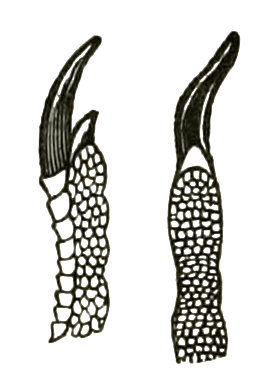
Anser canadensis, Vieill.
PLATE CCI. Male and Female.
Although the Canada Goose is considered as a northern species, the
number of individuals that remain at all seasons in the milder latitudes,
and in different portions of the United States, fully entitles this bird to
be looked upon as a permanent resident there. It is found to breed sparingly
at the present day, by many of the lakes, lagoons, and large
streams of our Western Districts, on the Missouri, the Mississippi, the
lower parts of the Ohio, on Lake Erie, the lakes farther north, and in several
large pools situated in the interior of the eastern parts of the States
of Massachusetts and Maine. As you advance farther toward the east
and north, you find it breeding more abundantly. While on my way to
Labrador, I found it in the Magdeleine Islands, early in June, sitting on
its eggs. In the Island of Anticosti there is a considerable stream, near
the borders of which great numbers are said to be annually reared; and
in Labrador these birds breed in every suitable marshy plain. The
greater number of those which visit us from still more northern regions,
return in the vernal season, like many other species, to the dismal countries
which gave them birth.
Few if any of these birds spend the winter in Nova Scotia, my friend
Mr Thomas M’Culloch having informed me that he never saw one about
Pictou at that period. In spring, as they proceed northward, thousands
are now and then seen passing high in the air; but in autumn, the flocks
are considerably smaller, and fly much lower. During their spring movements,
the principal places at which they stop to wait for milder days are
Bay Chaleur, the Magdeleine Islands, Newfoundland, and Labrador, at
all of which some remain to breed and spend the summer.
The general spring migration of the Canada Goose, may be stated to
commence with the first melting of the snows in our Middle and Western
Districts, or from the 20th of March to the end of April; but the precise
time of its departure is always determined by the advance of the season,
and the vast flocks that winter in the great savannahs or swampy
prairies south-west of the Mississippi, such as exist in Opellousas, on the
borders of the Arkansas River, or in the dismal “Ever Glades” of the
Floridas, are often seen to take their flight, and steer their course northward,
a month earlier than the first of the above mentioned periods. It
is indeed probable that the individuals of a species most remote from the
point at which the greater number ultimately assemble, commence their
flight earlier than those which have passed the winter in stations nearer
to it.
It is my opinion that all the birds of this species, which leave our
States and territories each spring for the distant north, pair before they
depart. This, no doubt, necessarily results from the nature of their place
of summer residence, where the genial season is so short as scarcely to afford
them sufficient time for bringing up their young and renewing their
plumage, before the rigours of advancing winter force them to commence
their flight towards milder countries. This opinion is founded
on the following facts:—I have frequently observed large flocks of
Geese, in ponds, on marshy grounds, or even on dry sand bars, the mated
birds renewing their courtship as early as the month of January, while
the other individuals would be contending or coquetting for hours every
day, until all seemed satisfied with the choice they had made, after which,
although they remained together, any person could easily perceive that
they were careful to keep in pairs. I have observed also that the older
the birds, the shorter were the preliminaries of their courtship, and that
the barren individuals were altogether insensible to the manifestations of
love and mutual affection that were displayed around them. The bachelors
and old maids, whether in regret, or not caring to be disturbed by
the bustle, quietly moved aside, and lay down on the grass or sand at
some distance from the rest; and whenever the flocks rose on wing, or
betook themselves to the water, these forlorn birds always kept behind.
This mode of preparing for the breeding season has appeared to me the
more remarkable, that, on reaching the place appointed for their summer
residence, the birds of a flock separate in pairs, which form their nests
and rear their young at a considerable distance from each other.
It is extremely amusing to witness the courtship of the Canada Goose
in all its stages; and let me assure you, reader, that although a Gander
does not strut before his beloved with the pomposity of a Turkey, or the
grace of a Dove, his ways are quite as agreeable to the female of his
choice. I can imagine before me one who has just accomplished the defeat
of another male after a struggle of half an hour or more. He advances
gallantly towards the object of contention, his head scarcely raised
an inch from the ground, his bill open to its full stretch, his fleshy tongue
elevated, his eyes darting fiery glances, and as he moves he hisses loudly,
while the emotion which he experiences, causes his quills to shake, and
his feathers to rustle. Now he is close to her who in his eyes is all loveliness;
his neck bending gracefully in all directions, passes all round her,
and occasionally touches her body; and as she congratulates him on his
victory, and acknowledges his affection, they move their necks in a hundred
curious ways. At this moment fierce jealousy urges the defeated
gander to renew his efforts to obtain his love; he advances apace, his
eye glowing with the fire of rage; he shakes his broad wings, ruffles up
his whole plumage, and as he rushes on the foe, hisses with the intensity
of anger. The whole flock seems to stand amazed, and opening up a
space, the birds gather round to view the combat. The bold bird who
has been caressing his mate, scarcely deigns to take notice of his foe, but
seems to send a scornful glance towards him. He of the mortified feelings,
however, raises his body, half opens his sinewy wings, and with a
powerful blow, sends forth his defiance. The affront cannot be borne in
the presence of so large a company, nor indeed is there much disposition
to bear it in any circumstances; the blow is returned with vigour, the
aggressor reels for a moment, but he soon recovers, and now the combat
rages. Were the weapons more deadly, feats of chivalry would now be
performed; as it is, thrust and blow succeed each other like the strokes
of hammers driven by sturdy forgers. But now, the mated gander has
caught hold of his antagonist’s head with his bill; no bull-dog could cling
faster to his victim; he squeezes him with all the energy of rage, lashes
him with his powerful wings, and at length drives him away, spreads out
his pinions, runs with joy to his mate, and fills the air with cries of exultation.
But now, see yonder, not a couple, but half a dozen of ganders are
engaged in battle! Some desperado, it seems, has fallen upon a mated
bird, and several bystanders, as if sensible of the impropriety of such conduct,
rush to the assistance of the wronged one. How they strive and
tug, biting, and striking with their wings! and how their feathers fly
about! Exhausted, abashed, and mortified, the presumptuous intruder
retreats in disgrace;—there he lies almost breathless on the sand!
Such are the conflicts of these ardent lovers, and so full of courage
and of affection towards their females are they, that the approach of a
male invariably ruffles their tempers as well as their feathers. No sooner
has the goose laid her first egg, than her bold mate stands almost erect
by her side, watching even the rustling sound of the breeze. The least
noise brings from him a sound of anger. Should he spy a racoon making
its way among the grass, he walks up to him undauntedly, hurls a vigorous
blow at him, and drives him instantly away. Nay I doubt if man
himself, if unarmed, would come off unscathed in such an encounter.
The brave gander does more; for, if imminent danger excite him, he
urges his mate to fly off, and resolutely remains near the nest until he is
assured of her safety, when he also betakes himself to flight, mocking as
it were by his notes his disappointed enemy.
Suppose all to be peace and quiet around the fond pair, and the female
to be sitting in security upon her eggs. The nest is placed near
the bank of a noble stream or lake; the clear sky is spread over the
scene, the bright beams glitter on the waters, and a thousand odorous
flowers give beauty to the swamp which of late was so dismal. The gander
passes to and fro over the liquid element, moving as if lord of the
waters; now he inclines his head with a graceful curve, now sips to
quench his thirst; and, as noontide has arrived, he paddles his way towards
the shore, to relieve for a while his affectionate and patient consort.
The lisping sounds of their offspring are heard through the shell; their
little bills have formed a breach in the inclosing walls; full of life, and
bedecked with beauty, they come forth, with tottering steps and downy
covering. Toward the water they now follow their careful parent, they
reach the border of the stream, their mother already floats on the loved
element, one after another launches forth, and now the flock glides
gently along. What a beautiful sight! Close by the grassy margin,
the mother slowly leads her innocent younglings; to one she shews the
seed of the floating grass, to another points out the crawling slug. Her
careful eye watches the cruel turtle, the garfish, and the pike, that are
lurking for their prey, and, with head inclined, she glances upwards to
the eagle or the gull that are hovering over the water in search of food.
A ferocious bird dashes at her young ones; she instantly plunges beneath
the surface, and, in the twinkling of an eye, her brood disappear after
her; now they are among the thick rushes, with nothing above water but
their little bills. The mother is marching towards the land, having lisped
to her brood in accents so gentle that none but they and her mate can
understand their import, and all are safely lodged under cover until the
disappointed eagle or gull bears away.
More than six weeks have now elapsed. The down of the goslings,
which was at first soft and tufty, has become coarse and hairlike. Their
wings are edged with quills, and their bodies bristled with feathers. They
have increased in size, and, living in the midst of abundance, they have
become fat, so that on shore they make their way with difficulty, and as
they are yet unable to fly, the greatest care is required to save them from
their numerous enemies. They grow apace, and now the burning days
of August are over. They are able to fly with ease from one shore to
another, and as each successive night the hoarfrosts cover the country,
and the streams are closed over by the ice, the family joins that in their
neighbourhood, which is also joined by others. At length they spy the
advance of a snow-storm, when the ganders with one accord sound the
order for their departure.
After many wide circlings, the flock has risen high in the thin air, and
an hour or more is spent in teaching the young the order in which they
are to move. But now, the host has been marshalled, and off it starts,
shewing, as it proceeds, at one time an extended front, at another a single
lengthened file, and now arraying itself in an angular form. The old
males advance in front, the females follow, the young come in succession
according to their strength, the weakest forming the rear. Should one
feel fatigued, his position is changed in the ranks, and he assumes a place
in the wake of another, who cleaves the air before him; perhaps the parent
bird flies for a while by his side to encourage him. Two, three, or
more days elapse before they reach a secure resting place. The fat with
which they were loaded at their departure has rapidly wasted; they are
fatigued, and experience the keen gnawings of hunger; but now they spy
a wide estuary, towards which they direct their course. Alighting on the
water, they swim to the beach, stand, and gaze around them; the young
full of joy, the old full of fear, for well are they aware that many foes
have been waiting their arrival. Silent all night remains the flock, but
not inactive; with care they betake themselves to the grassy shores, where
they allay the cravings of appetite, and recruit their wasted strength.
Soon as the early dawn lightens the surface of the deep they rise into the
air, extend their lines, and proceed southward, until arriving in some place
where they think they may be enabled to rest in security, they remain
during the winter. At length, after many annoyances, they joyfully perceive
the return of spring, and prepare to fly away from their greatest
enemy, man.
The Canada Goose often arrives in our Western and Middle Districts
as early as the beginning of September, and does not by any means confine
itself to the seashore. Indeed, my opinion is, that for every hundred
seen during the winter along our large bays and estuaries, as many thousands
may be found in the interior of the country, where they frequent
the large ponds, rivers, and wet savannahs. During my residence in the
State of Kentucky, I never spent a winter without observing immense
flocks of these birds, especially in the neighbourhood of Henderson, where
I have killed many hundreds of them, as well as on the Falls of the Ohio
at Louisville, and in the neighbouring country, which abounds in ponds
overgrown with grasses and various species of Nympheæ, on the seeds of
which they greedily feed. Indeed all the lakes situated within a few miles
of the Missouri and Mississippi, or their tributaries, are still amply supplied
with them from the middle of autumn to the beginning of spring.
In these places, too, I have found them breeding, although sparingly.
It seems to me more than probable, that the species bred abundantly in
the temperate parts of North America before the white population extended
over them. This opinion is founded on the relations of many old
and respectable citizens of our country, and in particular of General
George Clark, one of the first settlers on the banks of the Ohio, who,
at a very advanced age, assured me that, fifty years before the period
when our conversation took place (about seventy-five years from the present
time), wild geese were so plentiful at all seasons of the year, that he
was in the habit of having them shot to feed his soldiers, then garrisoned
near Vincennes, in the present State of Indiana. My father, who travelled
down the Ohio shortly after Bradock’s defeat, related the same to
me; and I, as well as many persons now residing at Louisville in Kentucky,
well remember that, twenty-five or thirty years ago, it was quite
easy to procure young Canada Geese in the ponds around. So late as
1819, I have met with the nests, eggs, and young of this species near
Henderson. However, as I have already said, the greater number remove
far north to breed. I have never heard of an instance of their
breeding in the Southern States. Indeed, so uncongenial to their constitution
seems the extreme heat of these parts to be, that the attempts made
to rear them in a state of domestication very rarely succeed.
The Canada Goose, when it remains with us to breed, begins to form
its nest in March, making choice of some retired place not far from the
water, generally among the rankest grass, and not unfrequently under a
bush. It is carefully formed of dry plants of various kinds, and is of a
large size, flat, and raised to the height of several inches. Once only did
I find a nest elevated above the ground. It was placed on the stump of
a large tree, standing in the centre of a small pond, about twenty feet
high, and contained five eggs. As the spot was very secluded, I did not
disturb the birds, anxious as I was to see in what manner they should
convey the young to the water. But in this I was disappointed, for, on
going to the nest, near the time at which I expected the process of incubation
to terminate, I had the mortification to find that a racoon, or some
other animal, had destroyed the whole of the eggs, and that the birds had
abandoned the place. The greatest number of eggs which I have found
in the nest of this species was nine, which I think is more by three than
these birds usually lay in a wild state. In the nests of those which I
have had in a domesticated state, I have sometimes counted as many as
eleven, several of them, however, usually proving unproductive. The
eggs measure, on an average,
3 1/2 inches by
2 1/2, are thick shelled, rather
smooth, and of a very dull yellowish-green colour. The period of incubation
is twenty-eight days. They never have more than one brood in a
season, unless their eggs are removed or broken at an early period.
The young follow their parents to the water a day or two after they
have issued from the egg, but generally return to land to repose in the
sunshine in the evening, and pass the night there under their mother, who
employs all imaginable care to ensure their comfort and safety, as does
her mate, who never leaves her during incubation for a longer time than
is necessary for procuring food, and takes her place at intervals. Both
remain with their brood until the following spring. It is during the
breeding-season that the gander displays his courage and strength to the
greatest advantage. I knew one that appeared larger than usual, and of
which all the lower parts were of a rich cream colour. It returned three
years in succession to a large pond a few miles from the mouth of
Green River in Kentucky, and whenever I visited the nest, it seemed to
look upon me with utter contempt. It would stand in a stately attitude,
until I reached within a few yards of the nest, when suddenly lowering
its head, and shaking it as if it were dislocated from the neck, it would
open its wings, and launch into the air, flying directly at me. So daring
was this fine fellow, that in two instances he struck me a blow with one
of his wings on the right arm, which, for an instant, I thought, was
broken. I observed that immediately after such an effort to defend his
nest and mate, he would run swiftly towards them, pass his head and neck
several times over and around the female, and again assume his attitude
of defiance.
Always intent on making experiments, I thought of endeavouring to
conciliate this bold son of the waters. For this purpose I always afterwards
took with me several ears of corn, which I shelled, and threw towards
him. It remained untouched for several days; but I succeeded at last,
and before the end of a week both birds fed freely on the grain even
in my sight! I felt much pleasure on this occasion, and repeating my
visit daily, found, that before the eggs were hatched, they would allow
me to approach within a few feet of them, although they never suffered
me to touch them. Whenever I attempted this the male met my fingers
with his bill, and bit me so severely that I gave it up. The great
beauty and courage of the male rendered me desirous of obtaining possession
of him. I had marked the time at which the young were likely
to appear, and on the preceding day I baited with corn a large coop
made of twine, and waited until he should enter. He walked in, I
drew the string, and he was my prisoner. The next morning the female
was about to lead her offspring to the river, which was distant nearly half
a mile, when I caught the whole of the young birds, and with them the
mother too, who came within reach in attempting to rescue one of her
brood, and had them taken home. There I took a cruel method of preventing
their escape, for with a knife I pinioned each of them on the
same side, and turned them loose in my garden, where I had a small but
convenient artificial pond. For more than a fortnight, both the old birds
appeared completely cowed. Indeed, for some days I felt apprehensive
that they would abandon the care of the young ones. However, with
much attention, I succeeded in rearing the latter by feeding them abundantly
with the larvæ of locusts, which they ate greedily, as well as with
corn-meal moistened with water, and the whole flock, consisting of eleven
individuals, went on prosperously. In December the weather became intensely
cold, and I observed that now and then the gander would spread
his wings, and sound a loud note, to which the female first, and then all
the young ones in succession, would respond, when they would all run
as far as the ground allowed them in a southerly direction, and attempt
to fly off. I kept the whole flock three years. The old pair never
bred while in my possession, but two pairs of the young ones did, one
of them raising three, the other seven. They all bore a special enmity
to dogs, and shewed dislike to cats; but they manifested a still greater
animosity towards an old swan and a wild turkey-cock which I had. I
found them useful in clearing the garden of slugs and snails; and although
they now and then nipped the vegetables, I liked their company.
When I left Henderson, my flock of geese was given away, and I have
not since heard how it has fared with them.
On one of my shooting excursions in the same neighbourhood, I chanced
one day to kill a wild Canada Goose, which, on my return, was sent
to the kitchen. The cook, while dressing it, found in it an egg ready
for being laid, and brought it to me. It was placed under a common
hen, and in due time hatched. Two years afterwards the bird thus raised,
mated with a male of the same species, and produced a brood. This
goose was so gentle that she would suffer any person to caress her, and
would readily feed from the hand. She was smaller than usual, but in
every other respect as perfect as any I have ever seen. At the period of
migration she shewed by her movements less desire to fly off than any
other I have known; but her mate, who had once been free, did not participate
in this apathy.
I have not been able to discover why many of those birds which I have
known to have been reared from the egg, or to have been found when very
young and brought up in captivity, were so averse to reproduce, unless
they were naturally sterile. I have seen several that had been kept for more
than eight years, without ever mating during that period, while other individuals
had young the second spring after their birth. I have also observed
that an impatient male would sometimes abandon the females of his species,
and pay his addresses to a common tame goose, by which a brood would
in due time be brought up, and would thrive. That this tardiness is not
the case in the wild state I feel pretty confident, for I have observed having
broods of their own many individuals which, by their size, the dulness
of their plumage, and such other marks as are known to the practical
ornithologist, I judged to be not more than fifteen or sixteen months
old. I have therefore thought that in this, as in many other species, a
long series of years is necessary for counteracting the original wild and
free nature which has been given them; and indeed it seems probable
that our attempts to domesticate many species of wild fowls, which would
prove useful to mankind, have often been abandoned in despair, when a
few years more of constant care might have produced the desired effect.
The Canada Goose, although immediately after the full development
of its young it becomes gregarious, does not seem to be fond of the company
of any other species. Thus, whenever the White-fronted Goose,
the Snow Goose, the Brent Goose, or others, alight in the same ponds, it
forces them to keep at a respectful distance; and during its migrations I
have never observed a single bird of any other kind in its ranks.
The flight of this species of Goose is firm, rather rapid, and capable
of being protracted to a great extent. When once high in the air, they
advance with extreme steadiness and regularity of motion. In rising
from the water or from the ground, they usually run a few feet with outspread
wings; but when suddenly surprised and in full plumage, a single
spring on their broad webbed feet is sufficient to enable them to get
on wing. While travelling to some considerable distance, they pass
through the air at the height of about a mile, steadily following a direct
course towards the point to which they are bound. Their notes are distinctly
heard, and the various changes made in the disposition of their
ranks are easily seen. But although on these occasions they move with
the greatest regularity, yet when they are slowly advancing from south
to north at an early period of the season, they fly much lower, alight
more frequently, and are more likely to be bewildered by suddenly formed
banks of fog, or by passing over cities or arms of the sea where much
shipping may be in sight. On such occasions great consternation prevails
among them, they crowd together in a confused manner, wheel irregularly,
and utter a constant cackling resembling the sounds from a disconcerted
mob. Sometimes the flock separates, some individuals leave the rest, proceed
in a direction contrary to that in which they came, and after a while,
as if quite confused, sail towards the ground, once alighted on which they
appear to become almost stupified, so as to suffer themselves to be shot
with ease, or even knocked down with sticks. This I have known to take
place on many occasions, besides those of which I have myself been a witness.
Heavy snow-storms also cause them great distress, and in the midst
of them some have been known to fly against beacons and lighthouses,
dashing their heads against the walls in the middle of the day. In the
night they are attracted by the lights of these buildings, and now and then
a whole flock is caught on such occasions. At other times their migrations
northward are suddenly checked by a change of weather, the approach
of which seems to be well known to them, for they will suddenly
wheel and fly back in a southern direction several hundred miles. In
this manner I have known flocks to return to the places which they had
left a fortnight before. Nay even during the winter months, they are
keenly sensible to changes of temperature, flying north or south in search
of feeding-grounds, with so much knowledge of the future state of the
weather, that one may be assured when he sees them proceeding southward
in the evening, that the next morning will be cold, and vice versa.
The Canada Goose is less shy when met with far inland, than when
on the sea-coast, and the smaller the ponds or lakes to which they resort,
the more easy it is to approach them. They usually feed in the manner
of Swans and fresh-water Ducks, that is, by plunging their heads towards
the bottom of shallow ponds or the borders of lakes and rivers, immersing
their fore parts, and frequently exhibiting their legs and feet with the
posterior portion of their body elevated in the air. They never dive on
such occasions. If feeding in the fields or meadows, they nip the blades
of grass sidewise, in the manner of the Domestic Goose, and after rainy
weather, they are frequently seen rapidly patting the earth with both
feet, as if to force the earth-worms from their burrows. If they dabble
at times with their bills in muddy water, in search of food, this action is
by no means so common with them as it is with Ducks, the Mallard for
example. They are extremely fond of alighting in corn-fields covered
with tender blades, where they often remain through the night and commit
great havoc. Wherever you find them, and however remote from
the haunts of man the place may be, they are at all times so vigilant and
suspicious, that it is extremely rare to surprise them. In keenness of
sight and acuteness of hearing, they are perhaps surpassed by no bird
whatever. They act as sentinels towards each other, and during the
hours at which the flock reposes, one or more ganders stand on the watch.
At the sight of cattle, horses, or animals of the deer kind, they are seldom
alarmed, but a bear or a cougar is instantly announced, and if on
such occasions the flock is on the ground near water, the birds immediately
betake themselves in silence to the latter, swim to the middle of
the pond or river, and there remain until danger is over. Should their
enemies pursue them in the water, the males utter loud cries, and the
birds arrange themselves in close ranks, rise simultaneously in a few seconds,
and fly off in a compact body, seldom at such times forming lines
or angles, it being in fact only when the distance they have to travel is
great that they dispose themselves in those forms. So acute is their sense
of hearing, that they are able to distinguish the different sounds or footsteps
of their foes with astonishing accuracy. Thus the breaking of a
dry stick by a deer is at once distinguished from the same accident occasioned
by a man. If a dozen of large turtles drop into the water, making
a great noise in their fall, or if the same effect is produced by an alligator,
the Wild Goose pays no regard to it; but however faint and distant may
be the sound of an Indian’s paddle, that may by accident have struck the
side of his canoe, it is at once marked, every individual raises its head
and looks intently towards the place from which the noise has proceeded,
and in silence all watch the movements of their enemy.
These birds are extremely cunning also, and should they conceive
themselves unseen, they silently move into the tall grasses by the margin
of the water, lower their heads, and lie perfectly quiet until the boat has
passed by. I have seen them walk off from a large frozen pond into the
woods, to elude the sight of the hunter, and return as soon as he had
crossed the pond. But should there be snow on the ice or in the woods,
they prefer watching the intruder, and take to wing long before he is
within shooting distance, as if aware of the ease with which they could be
followed by their tracks over the treacherous surface.
The Canada Geese are fond of returning regularly to the place which
they have chosen for resting in, and this they continue to do until they
find themselves greatly molested while there. In parts of the country
where they are little disturbed, they seldom go farther than the nearest
sandbank or the dry shore of the places in which they feed; but in other
parts they retire many miles to spots of greater security, and of such extent
as will enable them to discover danger long before it can reach them.
When such a place is found, and proves secure, many flocks resort to it,
but alight apart in separate groups. Thus, on some of the great sandbars
of the Ohio, the Mississippi, and other large streams, congregated
flocks, often amounting to a thousand individuals, may be seen at the approach
of night, which they spend there, lying on the sand within a few
feet of each other, every flock having its own sentinel. In the dawn of
next morning they rise on their feet, arrange and clean their feathers,
perhaps walk to the water to drink, and then depart for their feeding
grounds.
When I first went to the Falls of the Ohio, the rocky shelvings of
which are often bare for fully half a mile, thousands of wild geese of this
species rested there at night. The breadth of the various channels that
separate the rocky islands from either shore, and the rapidity of the currents
which sweep along them, render this place of resort more secure
than most others. The wild geese still betake themselves to these islands
during winter for the same purpose, but their number has become very
small; and so shy are these birds at present in the neighbourhood of
Louisville, that the moment they are disturbed at the ponds where they
go to feed each morning, were it but by the report of a single gun, they
immediately return to their rocky asylums. Even there, however, they
are by no means secure, for it not unfrequently happens that a flock
alights within half gunshot of a person concealed in a pile of drifted wood,
whose aim generally proves too true for their peace. Nay, I knew a gentleman,
who had a large mill opposite Rock Island, and who used to kill
the poor geese at the distance of about a quarter of a mile, by means of
a small cannon heavily charged with rifle bullets; and, if I recollect truly,
Mr Tarascon in this manner not unfrequently obtained a dozen or more
geese at a shot. This was done at dawn, when the birds were busily engaged
in trimming their plumage with the view of flying off in a few minutes
to their feeding grounds. This war of extermination could not last
long: the geese deserted the fatal rock, and the great gun of the mighty
miller was used only for a few weeks.
While on the water, the Canada Goose moves with considerable grace,
and in its general deportment resembles the wild Swan, to which I think
it is nearly allied. If wounded in the wing, they sometimes dive to a
small depth, and make off with astonishing address, always in the direction
of the shore, the moment they reach which, you see them sneaking
through the grass or bushes, their necks extended an inch or so above the
ground, and in this manner proceeding so silently, that, unless closely
watched, they are pretty sure to escape. If shot at and wounded while
on the ice, they immediately walk off in a dignified manner, as if anxious
to make you believe that they have not been injured, emitting a loud note
all the while; but the instant they reach the shore they become silent,
and make off in the manner described. I was much surprised one day,
while on the coast of Labrador, to see how cunningly one of these birds,
which, in consequence of the moult, was quite unable to fly, managed for
a while to elude our pursuit. It was first perceived at some distance from
the shore, when the boat was swiftly rowed towards it, and it swam before
us with great speed, making directly towards the land; but when we
came within a few yards of it, it dived, and nothing could be seen of it
for a long time. Every one of the party stood on tiptoe to mark the spot
at which it should rise, but all in vain, when the man at the rudder
accidentally looked down over the stern and there saw the goose, its
body immersed, the point of its bill alone above water, and its feet busily
engaged in propelling it so as to keep pace with the movements of the
boat. The sailor attempted to catch it while within a foot or two of him,
but with the swiftness of thought it shifted from side to side, fore and aft,
until delighted at having witnessed so much sagacity in a goose, I begged
the party to suffer the poor bird to escape.
The crossing of the Canada Goose with the common domestic species
has proved as advantageous as that of the wild with the tame Turkey,
the cross breed being much larger than the original one, more easily raised,
and more speedily fattened. This process is at present carried on to a considerable
extent in our Western and Eastern States, where the hybrids are
regularly offered for sale during autumn and winter, and where they bring
a higher price than either of the species from which they are derived.
The Canada Goose makes its first appearance in the western country,
as well as along our Atlantic coast, from the middle of September to that
of October, arriving in flocks composed of a few families. The young
birds procured at this early season soon get into good order, become tender
and juicy, and therefore afford excellent eating. If a sportsman is
expert and manages to shoot the old birds first, he is pretty sure to capture
the less wily young ones afterwards, as they will be very apt to return
to the same feeding places to which their parents had led them at
their first arrival. To await their coming to a pond where they are known
to feed is generally effectual, but to me this mode of proceeding never
afforded much pleasure, more especially because the appearance of any
other bird which I wished to obtain would at once induce me to go after
it, and thus frighten the game, so that I rarely procured any on such occasions.
But yet, as I have witnessed the killing of many a fine goose, I
hope you will suffer me to relate one or two anecdotes connected with the
shooting of this kind of game.
Reader, I am well acquainted with one of the best sportsmen now
living in the whole of the western country, one possessed of strength, activity,
courage, and patience,—qualities of great importance in a gunner.
I have frequently seen him mount a capital horse of speed and bottom at
midnight, when the mercury in the thermometer was about the freezing
point, and the ground was covered with snow and ice, the latter of
which so encased the trees that you might imagine them converted into
glass. Well, off he goes at a round gallop, his steed rough shod, but nobody
knows whither, save myself, who am always by his side. He has a
wallet containing our breakfast, and abundance of ammunition, together
with such implements as are necessary on occasions like the present. The
night is pitch-dark, and dismal enough; but who cares! He knows the
woods as well as any Kentucky hunter, and in this respect I am not much
behind him. A long interval has passed, and now the first glimpse of day
appears in the east. We know quite well where we are, and that we have
travelled just twenty miles. The Barred Owl alone interrupts the melancholy
silence of the hour. Our horses we secure, and on foot we move
cautiously towards a “long pond,” the feeding-place of several flocks of
geese, none of which have yet arrived, although the whole surface of open
water is covered with Mallards, Widgeons, Pintail Ducks, Blue-winged
and Green-winged Teals. My friend’s gun, like mine, is a long and
trusty one, and the opportunity is too tempting. On all fours we cautiously
creep to the very edge of the pond; we now raise ourselves on
our knees, level our pieces, and let fly. The woods resound with repeated
echoes, the air is filled with Ducks of all sorts, our dogs dash
into the half frozen water, and in a few minutes a small heap of game
lies at our feet. Now, we retire, separate, and betake ourselves to different
sides of the pond. If I may judge of my companion’s fingers by
the state of my own, I may feel certain that it would be difficult for
him to fasten a button. There we are shivering, with contracted feet and
chattering teeth; but the geese are coming, and their well known cry,
hauk, hauk, awhawk, awhawk, resounds through the air. They wheel
and wheel for a while, but at length gracefully alight on the water,
and now they play and wash themselves, and begin to look about for
food. There must be at least twenty of them. Twenty more soon arrive,
and in less than half an hour we have before us a flock of a hundred
individuals. My experienced friend has put a snow-white shirt over his
apparel, and although I am greatly intent on observing his motions, I
see that it is impossible even for the keen eye of the sentinel goose to follow
them. Bang, bang, quoth his long gun, and the birds in dismay instantly
start, and fly towards the spot where I am. When they approach
I spring up on my feet, the geese shuffle, and instantaneously rise upright;
I touch my triggers singly, and broken-winged and dead two birds come
heavily to the ground at my feet. Oh that we had more guns! But the
business at this pond has been transacted. We collect our game, return
to our horses, fasten the necks of the geese and ducks together, and throwing
them across our saddles, proceed towards another pond. In this
manner we continue to shoot until the number of geese obtained would
seem to you so very large that I shall not specify it.
At another time my friend proceeds alone to the Falls of the Ohio,
and, as usual, reaches the margins of the stream long before day. His
well-trained steed plunges into the whirls of the rapid current, and, with
some difficulty, carries his bold rider to an island, where he lands drenched
and cold. The horse knows what he has to do as well as his master,
and while the former ranges about and nips the frozen herbage, the latter
carefully approaches a well-known pile of drifted wood, and conceals
himself in it. His famous dog Nep is close at his heels. Now the dull
grey dawn gives him a dim view of the geese; he fires, several fall on the
spot, and one severely wounded rises and alights in the Indian Chute.
Neptune dashes after it, but as the current is powerful, the gunner whistles
to his horse, who, with pricked ears, gallops up. He instantly vaults
into the saddle, and now see them plunge into the treacherous stream.
The wounded game is overtaken, the dog is dragged along, and at length
on the Indiana shore the horse and his rider have effected a landing. Any
other man than he of whose exploits I am the faithful recorder, would
have perished long ago. But it is not half so much for the sake of the
plunder that he undergoes all this labour and danger, as for the gratification
it affords his kind heart to distribute the game among his numerous
friends in Louisville.
On our eastern shores matters are differently managed. The gunners
there shoot geese with the prospect of pecuniary gain, and go to work in
another way. Some attract them with wooden geese, others with actual
birds; they lie in ambush for many hours at a time, and destroy an
immense number of them, by using extremely long guns; but as there is
little sport in this sort of shooting, I shall say no more about it. Here
the Canada Goose feeds much on a species of long slender grass, the Zostera
marina, along with marine insects, crustacea, and small shell-fish,
all of which have a tendency to destroy the agreeable flavour which their
flesh has when their food consists of fresh-water plants, corn, and grass.
They spend much of their time at some distance from the shores, become
more shy, diminish in bulk, and are much inferior as food to those which
visit the interior of the country. None of these, however, are at all to
be compared with the goslings bred in the inland districts, and procured
in September, when, in my opinion, they far surpass the renowned Canvass-backed
Duck.
A curious mode of shooting the Canada Goose I have practised with
much success. I have sunk in the sand of the bars to which these birds
resort at night, a tight hogshead, to within an inch of its upper edges,
and placing myself within it at the approach of evening, have drawn over
me a quantity of brushwood, placing my gun on the sand, and covering
it in like manner with twigs and leaves. The birds would sometimes
alight very near me, and in this concealment I have killed several at a
shot; but the stratagem answers for only a few nights in the season. During
severe winters these birds are able to keep certain portions of the
deepest parts of a pond quite open and free from ice, by their continued
movements in the water; at all events, such open spaces occasionally occur
in ponds and lakes, and are resorted to by the geese, among which
great havoc is made.
It is alleged in the State of Maine that a distinct species of Canada
Goose resides there, which is said to be much smaller than the one now
under your notice, and is described as resembling it in all other particulars.
Like the true Canada Goose, it builds a large nest, which it lines
with its own down. Sometimes it is placed on the sea-shore, at other
times by the margin of a fresh-water lake or pond. That species is distinguished
there by the name of Flight Goose, and is said to be entirely
migratory, whereas the Canada Goose is resident. But, notwithstanding
all my exertions, I did not succeed in procuring so much as a feather of
this alleged species.
While we were at Newfoundland, on our return from Labrador, on
the 15th August 1833, small flocks of the Canada Goose were already
observed flying southward. In that country their appearance is hailed
with delight, and great numbers of them are shot. They breed rather
abundantly by the lakes of the interior of that interesting country. In
the harbour of Great Macatina in Labrador, I saw a large pile of young
Canada Geese, that had been procured a few days before, and were already
salted for winter use. The pile consisted of several hundred individuals,
all of which had been killed before they were able to fly. I was
told there that this species fed much on the leaves of the dwarf firs, and,
on examining their gizzards, found the statement to be correct.
The young dive very expertly, soon after their reaching the water, at
the least appearance of danger. In the Southern and Western States, the
enemies of the Canada Goose are, by water, the Alligator, the Garfish,
and the Turtle; and on land, the Cougar, the Lynx, and the Racoon.
While in the air, they are liable to be attacked by the White-headed
Eagle. It is a very hardy bird, and individuals have been kept in a state
of captivity or domestication for upwards of forty years. Every portion
of it is useful to man, for besides the value of the flesh as an article of
food, the feathers, the quills, and the fat, are held in request. The eggs
also afford very good eating.
Anas canadensis, Linn. Syst. Nat. vol. i. p. 198.—Lath. Ind. Ornith. vol. ii. p. 838.
Anser canadensis, Ch. Bonaparte, Synopsis of Birds of the United States, p. 377.
Canada Goose, Anas canadensis, Wils. Amer. Ornith. vol. viii. p. 52. pl. 67. fig. 4.
Anser canadensis, Canada Goose, Swains. and Richards. Fauna Bor. Amer. p. 468.
Canada Goose, Nuttall, Manual, vol. ii. p. 349.
Adult Male. Plate CCI. Fig. 1.
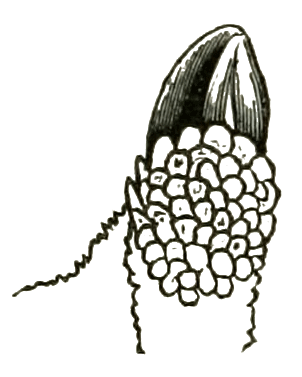
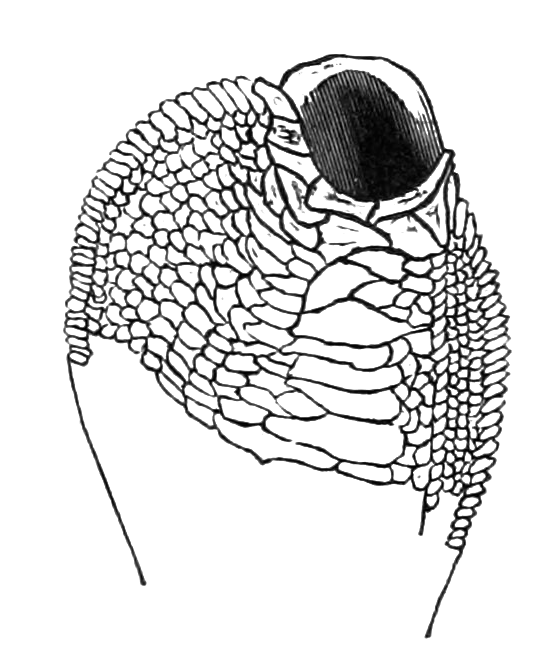
Bill shorter than the head, rather higher than broad at the base, somewhat
conical, depressed towards the end, rounded at the tip. Upper
mandible with the dorsal line sloping, the ridge broad and flattened, the
sides sloping, the edges soft and obtuse, the oblique marginal lamellæ
short, transverse, about thirty on each side; the unguis obovate, convex,
denticulate on the inner edge. Nasal groove oblong, parallel to the ridge,
filled by the soft membrane of the bill; nostrils medial, lateral, longitudinal,
narrow-elliptical, open, pervious. Lower mandible straight, with
the angle very long, narrow, and rounded, the edges soft and obtuse, with
about thirty oblique lamellæ on a perpendicular plane.
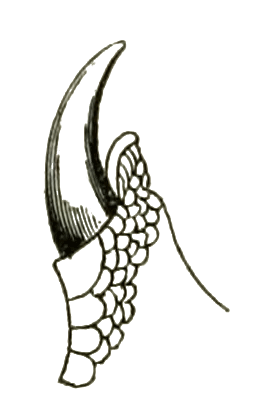
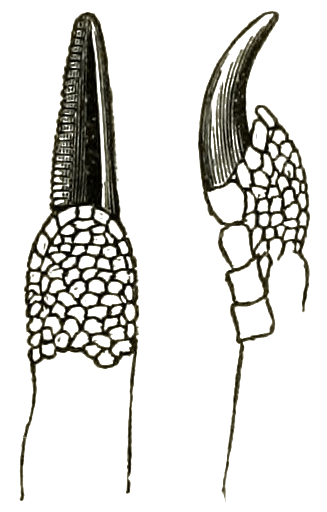
Head small, oblong, compressed. Neck long and slender. Body full,
slightly depressed. Feet short, stout, placed behind the centre of the
body; legs bare a little above the tibio-tarsal joint; tarsus short, a little
compressed, covered all round with angular reticulated scales, which
are smaller behind; hind toe very small, with a narrow membrane;
third toe longest, fourth a little shorter, but longer than second; all the
toes reticulated above at the base, but with narrow transverse scutella towards
the end; the three anterior connected by a reticulated membrane,
the outer with a thick margin, the inner with the margin extended into a
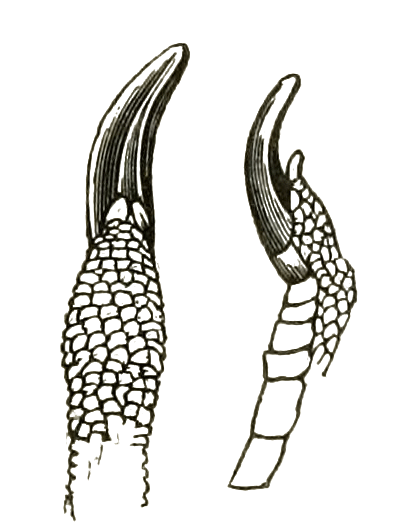
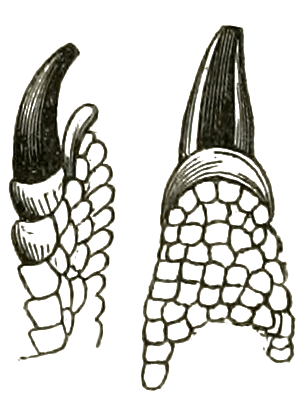
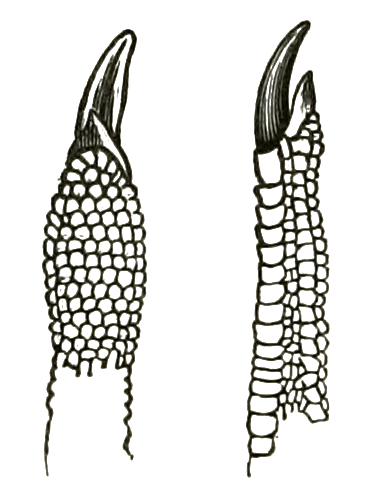
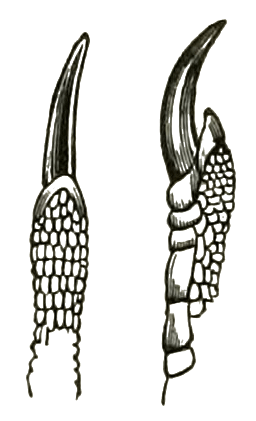
two-lobed web; claws small, arched, rather compressed, except that of
the middle toe, which is bent obliquely outwards and depressed, with a
curved edge. Wings of moderate length, with an obtuse protuberance at
the flexure.
Plumage close, rather short, compact above, blended on the neck and
lower parts of the body. The feathers of the head and neck very narrow,
of the back very broad and abrupt, of the breast and belly broadly rounded.
Wings, when closed, extending to about an inch from the end of the
tail, acute; primaries very strong, curved, the second longest, the third
slightly shorter, the first almost as long as the third, the rest rapidly
graduated; secondaries long, rather narrow, rounded. Tail very short,
rounded, of eighteen stiff, rounded, but acuminate, feathers.
Bill, feet, and claws black. Iris chestnut-brown. Head and two
upper thirds of the neck glossy black; forehead, cheeks, and chin, tinged
with brown; lower eyelid white; a broad band of the same across the
throat to behind the eyes; rump and tail-feathers also black. The general
colour of the rest of the upper parts is greyish-brown, the wing-coverts
shaded into ash-grey; all the feathers terminally edged with very pale
brown; the lower part of the neck passing into greyish-white, which is
the general colour of the lower parts, with the exception of the abdomen,
which is pure white, the sides, which are pale brownish-grey, the feathers
tipped with white, and the lower wing-coverts, which are also pale brownish-grey.
The margins of the rump, and the upper tail-coverts, pure
white.
In very old males, I have found the breast of a fine pale buff.
Length to end of tail 43 inches, extent of wings 65; bill along the
ridge
2 1/2, in depth at the base
1 2/12, in breadth 1; tarsus
3 7/12; middle toe
and claw
4 1/4; wing from flexure 20; tail
7 1/2. Weight 7 lb.
Adult Female. Plate CCI. Fig. 2.
The Female is somewhat less than the male, but similar in colouring,
although the tints are duller. The white of the throat is tinged with
brown; the lower parts are always more grey, and the black of the head,
neck, rump, and tail, is shaded with brown.
Length 41 inches. Weight
5 3/4 lb.