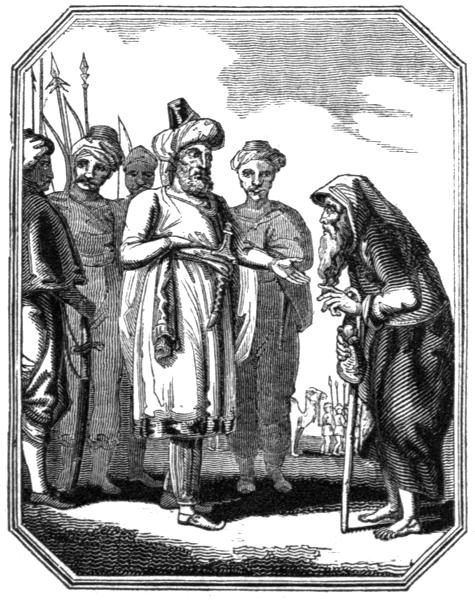
“A certain Cham of Tartary going a progress with
his nobles, was met by a Dervise, who cried with a loud
voice,”—“Whoever will give me a hundred pieces of
gold, I will give him a piece of advice.”——Page 13.]
ORIENTAL TALES, FOR THE ENTERTAINMENT OF YOUTH: SELECTED FROM THE
MOST EMINENT ENGLISH WRITERS.
LONDON:
PRINTED AND SOLD BY R. HARRILD, No. 20, Great Eastcheap.
1814
THE MERCHANT AND HIS SONS.
A certain merchant had two sons, the
eldest of whom was of so bad a disposition as to
behave with great hatred and ill-nature towards
the younger, who was of a temper more mild and
gentle. It happened that the old gentleman, after
having acquired a large estate by his trade,
left it by his will to his eldest son, together with
all his ships and stock in merchandize, desiring
him to continue in the business, and support his
brother.
The father was no sooner dead than the elder
began to shew his ill-will to his brother. He
desired him to leave his house, and, without giving
him any thing for his support, turned him
loose into the wide world. The young man was
much dejected with this treatment; but, considering
that in his father’s life-time he had acquired
some knowledge of business, he applied
to a neighbouring merchant, offering to serve
him in the way of trade.
The merchant received him into his house, and
finding from long experience that he was prudent,
virtuous, and diligent in his business, gave
him his daughter and only child in marriage,
and, when he died, bequeathed to him his whole
fortune. The young man, after the death of
his father-in-law, retired with his wife into a
distant part of the country, where he purchased
a fine estate, with a splendid dwelling; and
there he lived with great credit and reputation.
The elder brother, after the father’s death, for
some time had great success in trade. At length,
however, a violent storm tore to pieces many of
his ships, which were coming home richly laden.
About the same time some persons failing, who
had much of their money in his hands, he was
reduced to great want. To complete his misfortunes,
the little which he had left at home was
consumed by a sudden fire, which burnt his
house, and every thing in it; so that he was
brought into a state of beggary.
In this forlorn condition, he had no other resource
to keep himself from starving than to
wander up and down the country, imploring the
assistance of well-disposed persons. It happened
one day, that having travelled many miles,
and obtained but little relief, he saw a gentleman
walking in the fields, not far from a fine seat.
To this gentleman he addressed himself, and
having laid before him his misfortunes and his
present necessitous condition, he earnestly entreated
him to grant him some assistance. The
gentleman, who happened to be no other than
his own brother, did not at first know him; but
after some discourse with him, he perceived who
he was. At first, however, he did not make it
appear that he had any knowledge of him, but
brought him home, and ordered his servants to
take care of him, and furnish him for that night
with lodgings and victuals.
In the mean time he resolved to discover himself
to his brother next morning, and offer him a
constant habitation in his house, after he had
got the consent of his wife to the proposal. Accordingly,
next morning, he ordered the poor
man to be sent for. When he was come into
his presence, he asked if he knew him.
The poor man answered, he did not. I am,
said he, bursting into tears, your only brother!
and immediately fell on his neck, and embraced
him with great tenderness. The elder, quite
astonished at this accident, fell to the ground,
and began to make many excuses, and to beg
pardon for his former cruel behaviour. To
whom the other answered, “Brother, let us forget
those things; I heartily forgive you all that
is past; you need not range up and down the
world; you shall be welcome to live with me.”
He readily accepted the proposal, and they lived
together with great comfort and happiness till
death.
STORY OF MENCIUS.
As Mencius, the philosopher, was travelling
in pursuit of wisdom, night overtook him at the
foot of a gloomy mountain, remote from the habitations
of men. Here, as he was straying,
(while rain and thunder conspired to make solitude
still more hideous) he perceived a hermit’s
cell, and approaching, asked for shelter. “Enter,”
cries the hermit in a severe tone; “men
deserve not to be obliged; but it would be imitating
their ingratitude to treat them as they deserve.
Come in: examples of vice may sometimes
strengthen us in the ways of virtue.”
After a frugal meal, which consisted of roots
and tea, Mencius could not repress his curiosity
to know why the hermit had retired from mankind,
whose actions taught the truest lessons of
wisdom. “Mention not the name of man,”
cried the hermit with indignation; “here let me
live retired from a base ungrateful world; here,
in the forest I shall find no flatterers. The lion
is an open enemy, and the dog a faithful friend;
but man, base man, can poison the bowl, and
smile when he presents it.” “You have then
been used ill by mankind?” interrupted the philosopher
drily. “Yes,” replied the hermit;
“on mankind I have exhausted my whole fortune;
and this staff, that cup, and those roots,
are all that I have in return.”—“Did you bestow
your fortune among them, or did you only
lend it?” returned Mencius. “I bestowed it,
undoubtedly,” replied the other; “for where
were the merit of being a money lender?”—“Did
they ever own that they received your benefits?”
still adds the philosopher. “A thousand
times,” cries the hermit; “they every day loaded
me with professions of gratitude for favours
received, and solicitations for future ones.”—“If,
then, (says Mencius smiling) you did not
lend your fortune in order to have it returned,
it is injustice to accuse them of ingratitude;
they owned themselves obliged; you expected
no more; and they certainly earn a favour who
stoop to acknowledge the obligation.”—The hermit
was struck with the reply; and, surveying
his guest with emotion, “I have heard of the
great Mencius, and thou certainly art the man.
I am now fourscore years old, but still a child in
wisdom; take me back to the world, and educate
me as one of the most ignorant, and youngest,
of thy disciples.”
THE STORY OF SCHACABAC.
Schacabac being reduced to great poverty, and
having eat nothing for two days together, made
a visit to a noble Barmecide, in Persia, who was
very hospitable, but withal a great humourist.—The
Barmecide was sitting at his table, that
seemed ready covered for an entertainment.
Upon hearing Schacabac’s complaint, he desired
him to sit down and fall on. He then gave him
an empty plate, and asked him how he liked his
rice-soup. Schacabac, who was a man of wit,
and resolved to comply with the Barmecide in
all his humours, told him it was admirable, and
at the same time, in imitation of the other, lifted
up the empty spoon to his mouth with great
pleasure. The Barmecide then asked him if he
ever saw whiter bread? Schacabac, who saw
neither bread nor meat, If I did not like it, you
may be sure, says he, I should not eat so heartily
of it. You oblige me mightily, replied the
Barmecide, pray let me help you to this leg of
goose. Schacabac reached out his plate, and received
nothing on it with great chearfulness.
As he was eating very heartily of this imaginary
goose, and crying up the sauce to the skies, the
Barmecide desired him to keep a corner of his
stomach for a roasted lamb, fed with pistachio-nuts,
and after having called for it, as though it
had really been served up, Here is a dish, says
he, that you will see at nobody’s table but my
own. Schacabac was wonderfully delighted
with the taste of it, which is like nothing, says
he, I ever eat before. Several other nice dishes
were served up in idea, which both of them
commended, and feasted on after the same manner.
This was followed by an invisible desert,
no part of which delighted Schacabac so much
as a certain lozenge, which the Barmecide told
him was a sweet-meat of his own invention.
Schacabac at length, being courteously reproached
by the Barmecide, that he had no stomach,
and that he eat nothing, and at the same time
being tired with moving his jaws up and down
to no purpose, desired to be excused, for that
really he was so full that he could not eat a bit
more. Come, then, says the Barmecide, the
cloth shall be removed, and you shall taste of my
wines, which I may say, without vanity, are the
best in Persia. He then filled both their glasses
out of an empty decanter. Schacabac would
have excused himself from drinking so much at
once, because he said he was a little quarrelsome
in his liquor; however, being prest to it, he pretended
to take it off, having before-hand praised
the colour, and afterwards the flavour. Being
plied with two or three other imaginary bumpers
of different wines equally delicious, and a
little vexed with this fantastic treat, he pretended
to grow fluttered, and gave the Barmecide a
good box on the ear; but immediately recovering
himself, Sir, says he, I beg ten thousand pardons,
but I told you before, that it was my misfortune
to be quarrelsome in my drink. The
Barmecide could not but smile at the humour of
his guest, and instead of being angry with him,
I find, says he, thou art a complaisant fellow, and
deservest to be entertained in my house. Since
thou canst accommodate thyself to my humour,
we will now eat together in good earnest. Upon
which calling for his supper, the rice-soup, the
goose, the pistachio-lamb, the several other nice
dishes, with the desert, the lozenges, and all the
variety of Persian wines, were served up successively
one after another; and Schacabac was
feasted, in reality, with those very things which
he had before been entertained within imagination.
HAMET AND RASCHID.
When the plains of India were burnt up by
a long continuance of drought, Hamet and Raschid,
two neighbouring shepherds, faint with
thirst, stood at the common boundary of their
grounds, with their flocks and herds panting
round them, and in extremity of distress prayed
for water. On a sudden the air was becalmed,
the birds ceased to chirp, and the flocks to bleat.
They turned their eyes every way, and saw a being
of mighty stature advancing through the valley,
whom they knew upon his nearer approach
to be the Genius of Distribution. In one hand
he held the sheaves of plenty, and in the other,
the sabre of destruction. The shepherds stood
trembling, and would have retired before him;
but he called to them with a voice gentle as the
breeze that plays in the evening among the spices
of Sabæa: “Fly not from your benefactor, children
of the dust! I am come to offer you gifts,
which only your own folly can make vain. You
here pray for water, and water I will bestow;
let me know with how much you will be satisfied:
speak not rashly; consider, that of whatever
can be enjoyed by the body, excess is no
less dangerous than scarcity. When you remember
the pain of thirst, do not forget the danger
of suffocation. Now, Hamet, tell me your
request.”
“O Being, kind and beneficent,” says Hamet,
“let thine eye pardon my confusion. I entreat
a little brook, which in summer shall never be
dry, and in winter never overflow.” “It is
granted,” replies the Genius; and immediately
he opened the ground with his sabre, and a fountain
bubbling up under their feet, scattered its
rills over the meadows; the flowers renewed
their fragrance, the trees spread a greener foilage,
and the flocks and herds quenched their
thirst.
Then turning to Raschid, the Genius invited
him likewise to offer his petition. “I request,”
says Raschid, “that thou wilt turn the Ganges
through my grounds, with all his waters, and all
their inhabitants.” Hamet was struck with the
greatness of his neighbour’s sentiments, and secretly
repined in his heart, that he had not made
the same petition before him; when the Genius
spoke, “Rash man, be not insatiable! remember,
to thee that is nothing which thou canst not
use; and how are thy wants greater than the
wants of Hamet?” Raschid repeated his desire,
and pleased himself with the mean appearance
that Hamet would make in the presence of the
proprietor of the Ganges. The Genius then retired
towards the river, and the two shepherds
stood waiting the event. As Raschid was looking
with contempt upon his neighbour, on a
sudden was heard the roar of torrents, and they
found by the mighty stream that the mounds of
the Ganges were broken. The flood rolled forward
into the lands of Raschid, his plantations
were torn up, his flocks overwhelmed, he was
swept away before it, and a crocodile devoured
him.
THE CHAM AND THE DERVISE.
A certain Cham of Tartary going a progress
with his nobles, was met by a Dervise, who
cried with a loud voice, whoever will give me a
hundred pieces of gold, I will give him a piece of
advice. The Cham ordered him the sum: upon
which the Dervise said, begin nothing of which
thou hast not well considered the end.
The courtiers upon hearing this plain sentence,
smiled, and said with a sneer, “The dervise
is well paid for his maxim.” But the king
was so well satisfied with the answer, that he ordered
it to be written in golden letters in several
places of his palace, and engraved on all his
plate. Not long after, the king’s surgeon was
bribed to kill him with a poisoned lancet at the
time he let him blood. One day, when the
king’s arm was bound, and the fatal lancet in
the surgeon’s hand, he read on the bason, begin
nothing of which thou hast not well considered the
end. He immediately started, and let the lancet
fall out of his hand. The king observed his
confusion, and enquired the reason: the surgeon
fell prostrate, confessed the whole affair, and
was pardoned, and the conspirators died. The
Cham, turning to his courtiers who heard the
advice with contempt, told them, “that counsel
could not be too much valued, which had saved
a king’s life.”
THE STORY OF OMAR.
Omar, the hermit of the mountain Aubukabis,
which rises on the east of Mecca, and overlooks
the city, found one evening a man sitting
pensive and alone, within a few paces of his cell.
Omar regarded him with attention, and perceived
that his looks were wild and haggard, and
that his body was feeble and emaciated: the
man also seemed to gaze stedfastly on Omar;
but such was the abstraction of his mind, that
his eye did not immediately take cognizance of
its object. In the moment of recollection he
started as from a dream, he covered his face in
confusion, and bowed himself to the ground.—“Son
of affliction,” said Omar, “who art thou,
and what is thy distress?” “My name,” replied
the stranger, “is Hassan, and I am a native of
this city: the Angel of adversity has laid his
hand upon me; and the wretch whom thine eye
compassionates, thou canst not deliver.” “To
deliver thee,” said Omar, “belongs to Him only,
from whom we should receive with humility both
good and evil; yet hide not thy life from me;
for the burthen which I cannot remove, I may at
least enable thee to sustain.” Hassan fixed his
eyes upon the ground, and remained some time
silent; then fetching a deep sigh, he looked up
at the hermit, and thus complied with his request.
It is now six years since our mighty lord the
Calif Almalic, whose memory be blessed, first
came privately to worship in the temple of the
holy city. The blessings which he petitioned of
the Prophet, as the Prophet’s vicegerent, he was
diligent to dispense; in the intervals of his devotion,
therefore, he went about the city, relieving
distress, and restraining oppression: the widow
smiled under his protection, and the weakness
of age and infancy was sustained by his
bounty. I, who dreaded no evil but sickness,
and expected no good beyond the reward of my
labour, was singing at my work, when Almalic
entered my dwelling. He looked round with a
smile of complacency; perceiving that though it
was mean, it was neat, and that though I was
poor, I appeared to be content. As his habit
was that of a pilgrim, I hastened to receive him
with such hospitality as was in my power; and
my cheerfulness was rather increased than restrained
by his presence. After he had accepted
some coffee, he asked me many questions;
and though by my answers I always endeavoured
to excite him to mirth, yet I perceived that
he grew thoughtful, and eyed me with a placid
but fixed attention. I suspected that he had
some knowledge of me, and therefore inquired
his country and his name. “Hassan,” said he,
“I have raised thy curiosity, and it shall be satisfied:
he who now talks with thee is Almalic,
the sovereign of the faithful, whose seat is the
throne of Medina, and whose commission is from
above.” These words struck me dumb with
astonishment, though I had some doubt of their
truth: but Almalic, throwing back his garment,
discovered the peculiarity of his vest, and put
the royal signet upon his finger. I then started
up, and was about to prostrate myself before him,
but he prevented me: “Hassan,” said he, “forbear;
thou art greater than I, and from thee I
have at once derived humility and wisdom.” I
answered, “Mock not thy servant, who is but as
a worm before thee; life and death are in thy
hand, and happiness and misery are the daughters
of thy will.” “Hassan,” he replied, “I
can no otherwise give life or happiness than by
not taking them away: thou art thyself beyond
the reach of my bounty, and possessed of felicity
which I can neither communicate nor obtain.—My
influence over others fills my bosom with
perpetual solicitude and anxiety; and yet my
influence over others extends only to their vices,
whether I would reward or punish. By the bow-string,
I can repress violence and fraud; and by
the delegation of my power, I can transfer the
insatiable wishes of avarice and ambition from
one object to another; but with respect to virtue,
I am impotent: if I could reward it, I would
reward it in thee. Thou art content, and hast
therefore neither avarice nor ambition: to exalt
thee, would destroy the simplicity of thy life, and
diminish that happiness which I have no power
either to increase or continue.” He then rose
up, and, commanding me not to disclose his secret,
departed.
As soon as I recovered from the confusion and
astonishment in which the Calif left me, I began
to regret that my behaviour had intercepted his
bounty; and accused of folly, that cheerfulness
which was the concomitant of poverty and labour.
I now repined at the obscurity of my station,
which my former insensibility had perpetuated:
I neglected my labour, because I despised
the reward; I spent the day in idleness, forming
romantic projects to recover the advantages
which I had lost; and at night, instead of losing
myself in that sweet and refreshing sleep, from
which I used to rise with new health, cheerfulness,
and vigour, I dreamt of splendid habits
and a numerous retinue, of gardens, palaces,
eunuchs, and women, and waked only to regret
the illusions that had vanished. My health was
at length impaired by the inquietude of my mind;
I sold all my moveables for subsistence: and reserved
only a mattrass, upon which I sometimes
lay from one night to another.
THE STORY OF OMAR. (CONCLUDED.)
In the first moon of the following year, the
Calif came again to Mecca, with the same secrecy,
and for the same purposes. He was willing
once more to see the man, whom he considered
as deriving felicity from himself. But he found
me, not singing at my work, ruddy with health,
and vivid with cheerfulness; but pale and dejected,
sitting on the ground, and chewing
opium, which contributed to substitute the phantoms
of imagination for the realities of greatness.
He entered with a kind of joyful impatience in
his countenance, which, the moment he beheld
me, was changed to a mixture of wonder and
pity. I had often wished for another opportunity
to address the Calif; yet I was confounded
at his presence, and throwing myself at his feet,
I laid my hand upon my head, and was speechless.
“Hassan,” said he, “what canst thou have
lost, whose wealth was the labour of thy own
hand; and what can have made thee sad, the
spring of whose joy was in thy own bosom?—What
evil has befallen thee? Speak, and if I can
remove it, thou art happy.” I was now encouraged
to look up, and I replied, “Let my Lord
forgive the presumption of his servant, who rather
than utter a falsehood, would be dumb for
ever. I am become wretched by the loss of that
which I never possessed: thou hast raised wishes
which indeed I am not worthy thou shouldst satisfy:
but why should it be thought, that he who
was happy in obscurity and indigence, would
not have been rendered more happy by eminence
and wealth?”
When I had finished this speech, Almalic stood
some moments in suspense, and I continued
prostrate before him. “Hassan,” said he, “I
perceive, not with indignation but regret, that I
mistook thy character; I now discover avarice
and ambition in thy heart, which lay torpid only
because their objects were too remote to rouse
them. I cannot, therefore, invest thee with authority,
because I would not subject my people
to oppression; and because I would not be compelled
to punish thee for crimes which I first enabled
thee to commit.
“But as I have taken from thee that which I
cannot restore, I will at least gratify the wishes
that I excited, lest thy heart accuse me of injustice,
and thou continue still a stranger to thyself.
Arise, therefore, and follow me.” I sprung from
the ground as it were with the wing of an eagle;
I kissed the hem of his garment in an extasy of
gratitude and joy; and when I went from my
house, my heart leaped as if it had escaped from
the den of a lion. I followed Almalic to the caravansary
in which he lodged; and after he had
fulfilled his vows, he took me with him to Medina.
He gave me an apartment in the seraglio;
I was attended by his own servants; my provisions
were sent from his own table; and I received
every week a sum from his treasury, which
exceeded the most romantic of my expectations.
But I soon discovered, that no dainty was so
tasteful, as the food to which labour procured an
appetite; no slumbers so sweet as those which
weariness invited; and no time so well enjoyed,
as that in which diligence is expecting its reward.
I remembered these enjoyments with regret;
and while I was sighing in the midst of
superfluities, which though they encumbered
life, yet I could not give up, they were suddenly
taken away.
Almalic, in the midst of the glory of his kingdom,
and in the full vigour of his life, expired
suddenly in the bath; such, thou knowest, was
the destiny which the Almighty had written upon
his head.
His son Aububeker, who succeeded to the
throne, was incensed against me, by some who
regarded me at once with contempt and envy:
he suddenly withdrew my pension, and commanded
that I should be expelled the palace; a
command which my enemies executed with so
much rigour, that within twelve hours I found
myself in the streets of Medina, indigent and
friendless, exposed to hunger and derision, with
all the habits of luxury, and all the sensibility of
pride. O! let not thy heart despise me, thou
whom experience hast not taught, that it is misery
to lose that which it is not happiness to possess.
O! that for me, this lesson had not been
written on the tablets of Providence! I have travelled
from Medina to Mecca: but I cannot fly
from myself. How different are the states in
which I have been placed! The remembrance of
both is bitter; for the pleasures of neither can
return. Hassan, having thus ended his story,
smote his hands together, and looking upwards,
burst into tears.
Omar, having waited till this agony was past,
went to him, and taking him by the hand, “My
son,” said he, “more is yet in thy power than
Almalic could give, or Aububeker take away.
The lesson of thy life the Prophet has in mercy
appointed me to explain.
“Thou wast once content with poverty and
labour, only because they were become habitual,
and ease and affluence were placed beyond thy
hope; for when ease and affluence approached
thee, thou wast content with poverty and labour
no more. That which then became the object,
was also the bound of thy hope; and he, whose
utmost hope is disappointed, must inevitably be
wretched. If thy supreme desire had been the
delights of Paradise, and thou hadst believed that
by the tenor of thy life these delights had been
secured, as more could not have been given thee,
thou wouldst not have regretted that less was not
offered. The content which was once enjoyed
was but the lethargy of the soul; and the distress
which is now suffered, will but quicken it to action.
Depart, therefore, and be thankful for all
things: put thy trust in Him, who alone can
gratify the wish of reason, and satisfy the soul
with good: fix thy hope upon that portion, in
comparison of which the world is as the drop of
the bucket, and the dust of the balance. Return,
my son, to thy labour; thy food shall be again
tasteful, and thy rest shall be sweet: to thy content
also will be added stability, when it depends
not upon that which is possessed upon earth,
but upon that which is expected in Heaven.”
Hassan, upon whose mind the Angel of instruction
impressed the counsel of Omar, hastened
to prostrate himself in the temple of the Prophet.
Peace dawned upon his mind like the radiance
of the morning: he returned to his labour
with cheerfulness; his devotion became fervent
and habitual: and the latter days of Hassan were
happier than the first.
STORY OF A DERVISE.
A Dervise, travelling through Tartary, went
into the king’s palace by mistake, as thinking it
to be a public inn, or caravansary. Having
looked about him for some time, he entered into
a long gallery, where he laid down his wallet,
and spread his carpet, in order to repose himself
upon it, after the manner of the eastern nations.
He had not been long in this posture before he
was discovered by some of the guards, who asked
him what was his business in that place? The
dervise told them that he intended to take up his
night’s lodging in that caravansary. The guards
told him, in a very angry manner, that the house
he was in was not a caravansary, but the king’s
palace. It happened that the king himself passed
through the gallery during this debate; and,
smiling at the mistake of the dervise, asked him
how he could possibly be so dull as not to distinguish
a palace from a caravansary.
Sir, says the dervise, give me leave to ask your
majesty a question or two. Who were the persons
that lodged in this house when it was first
built? The king replied, his ancestors. And
who, says the dervise, was the last person that
lodged here? The king replied, his father. And
who is it, says the dervise, that lodges here at
present? The king told him that it was himself.
And who, says the dervise, will be here after
you? The king answered, the young prince his
son. “Ah, Sir,” said the dervise, “a house that
changes its inhabitants so often, and receives such
a perpetual succession of guests, is not a palace,
but a caravansary.”
OMAR’S PLAN OF LIFE.
Omar, the son of Hassan, had passed seventy-five
years in honour and prosperity. The favour
of three successive califs had filled his house
with gold and silver; and whenever he appeared,
the benedictions of the people proclaimed his
passage.
Terrestrial happiness is of short continuance.
The brightness of the flame is wasting its fuel;
the fragrant flower is passing away in its own
odours. The vigour of Omar began to fail, the
curls of beauty fell from his head, strength departed
from his hands, and agility from his feet.
He gave back to the calif the keys of trust, and
the seals of secrecy; and sought no other pleasure
for the remains of life than the converse of
the wise, and the gratitude of the good.
The powers of his mind were yet unimpaired.
His chamber was filled by visitants, eager to catch
the dictates of experience, and officious to pay
the tribute of admiration. Caled, the son of the
viceroy of Egypt, entered every day early, and
retired late. He was beautiful and eloquent;
Omar admired his wit and loved his docility.
Tell me, said Caled, thou to whose voice nations
have listened, and whose wisdom is known to the
extremities of Asia, tell me how I may resemble
Omar the prudent. The arts by which you have
gained power and preserved it, are to you no
longer necessary or useful; impart to me the secret
of your conduct, and teach me the plan upon
which your wisdom has built your fortune.
Young man, said Omar, it is of little use to
form plans of life. When I took my first survey
of the world, in my twentieth year, having considered
the various conditions of mankind, in the
hour of solicitude, I said thus to myself, leaning
against a cedar which spread its branches over
my head: Seventy years are allowed to man; I
have yet fifty remaining: ten years I will allot
to the attainment of knowledge, and ten I will
pass in foreign countries; I shall be learned, and
therefore shall be honoured; every city will shout
at my arrival, and every student will solicit my
friendship. Twenty years thus passed will store
my mind with images which I shall be busy
through the rest of my life in combining and
comparing. I shall revel in inexhaustible accumulations
of intellectual riches; I shall find new
pleasures for every moment, and shall never
more be weary of myself. I will, however, not
deviate too far from the beaten track of life, but
will try what can be found in female delicacy. I
will marry a wife beautiful as the Houries, and
wise as Zobeide; with her I will live twenty
years within the suburbs of Bagdat, in every
pleasure that wealth can purchase, and fancy can
invent. I will then retire to a rural dwelling,
pass my last days in obscurity and contemplation,
and lie silently down on the bed of death.
Through my life it shall be my settled resolution,
that I will never depend upon the smile of princes;
that I will never stand exposed to the artifices
of courts: I will never pant for public honours,
nor disturb my quiet with affairs of state.
Such was my scheme of life, which I impressed
indelibly upon my memory.
The first part of my ensuing time was to be
spent in search of knowledge; and I know not
how I was diverted from my design. I had no
visible impediments without, nor any ungovernable
passions within. I regarded knowledge as
the highest honour and the most engaging pleasure;
yet day stole upon day, and month glided
after month, till I found that seven years of the
first ten had vanished, and left nothing behind
them. I now postponed my purpose of travelling;
for why should I go abroad while so much
remained to be learned at home? I immured
myself for four years, and studied the laws of the
empire. The fame of my skill reached the
judges; I was found able to speak upon doubtful
questions, and was commanded to stand at
the footstool of the calif. I was heard with attention,
I was consulted with confidence, and the
love of praise fastened on my heart.
I still wished to see distant countries, listened
with rapture to the relations of travellers, and
resolved some time to ask my dismission, that I
might feast my soul with novelty; but my presence
was always necessary, and the stream of
business hurried me along. Sometimes I was
afraid lest I should be charged with ingratitude;
but I still proposed to travel, and therefore would
not confine myself by marriage.
In my fiftieth year I began to suspect that the
time of travelling was past, and thought it best
to lay hold on the felicity yet in my power, and
indulge myself in domestic pleasures. But at
fifty no man easily finds a woman beautiful as
the Houries, and wise as Zobeide. I inquired
and rejected, consulted and deliberated, till the
sixty-second year made me ashamed of gazing
upon girls. I had now nothing left but retirement,
and for retirement I never found a time,
till disease forced me from public employment.
Such was my scheme, and such has been its
consequence. With an insatiable thirst for knowledge,
I trifled away the years of improvement;
with a restless desire of seeing different countries,
I have always resided in the same city;
with the highest expectation of connubial felicity,
I have lived unmarried; and with unalterable
resolutions of contemplative retirement,
I am going to die within the walls of Bagdat.
THE BASKET MAKER.
In the midst of that vast ocean, commonly
called the South-Sea, lie the islands of Solomon.
In the centre of these lies one not only distant
from the rest, which are immensely scattered
round it, but also larger beyond proportion.
An ancestor of the prince, who now reigns absolute
in this central island, has, through a long
descent of ages, entailed the name of Solomon’s
Islands on the whole, by the effect of that wisdom
wherewith he polished the manners of his
people.
A descendant of one of the great men of this
happy island, becoming a gentleman to so improved
a degree as to despise the good qualities
which had originally ennobled his family,
thought of nothing but how to support and distinguish
his dignity by the pride of an ignorant
mind, and a disposition abandoned to pleasure.
He had a house on the sea-side, where he spent
great part of his time in hunting and fishing;
but found himself at a loss in pursuit of those
important diversions, by means of a long slip of
marsh land, overgrown with high reeds, that
lay between his house and the sea. Resolving,
at length, that it became not a man of his quality
to submit to a restraint in his pleasures, for
the ease and convenience of an obstinate mechanic;
and having often endeavoured, in vain,
to buy out the owner, who was an honest poor
basket-maker, and whose livelihood depended on
working up the flags of those reeds, in a manner
peculiar to himself, the gentleman took advantage
of a very high wind, and commanded his
servants to burn down the barrier.
The basket-maker, who saw himself undone,
complained of the oppression in terms more
suited to his sense of the injury, than the respect
due to the rank of the offender; and the reward
this imprudence procured him, was the additional
injustice of blows and reproaches, and all
kinds of insult and indignity.
There was but one way to a remedy, and he
took it: for going to the capital, with the marks
of his hard usage upon him, he threw himself at
the feet of the king, and procured a citation for
his oppressor’s appearance; who, confessing the
charge, proceeded to justify his behaviour by
the poor man’s unmindfulness of the submission
due from the vulgar to gentlemen of rank and
distinction.
“But pray,” replied the king, “what distinction
of rank had the grand-father of your
father, when, being a cleaver of wood in the
palace of my ancestors, he was raised from
among those vulgar you speak of with such contempt,
in reward for an instance he gave of his
courage and loyalty in defence of his master?
Yet his distinction was nobler than yours: it
was the distinction of soul, not of birth; the
superiority of worth, not of fortune! I am
sorry I have a gentleman in my kingdom who
is base enough to be ignorant that ease and distinction
of fortune were bestowed on him but to
this end, that, being at rest from all cares of providing
for himself, he might apply his heart,
head, and hand, for the public advantage of
others.”
Here the king, discontinuing his speech, fixed
an eye of indignation on a sullen resentment of
mien which he observed in the haughty offender,
who muttered out his dislike of the encouragement
this way of thinking must give to the
commonality, who, he said, were to be considered
as persons of no consequence, in comparison
of men who were born to be honoured.
“Where reflection is wanting,” replied the
king, with a smile of disdain, “men must find
their defects in the pain of their sufferings.
Yanhuma,” added he, turning to a captain of
his gallies, “strip the injured and the injurer;
and, conveying them to one of the most barbarous
and remote of the islands, set them
ashore in the night, and leave them both to their
fortune.”
The place in which they were landed was a
marsh; under cover of those flags the gentleman
was in hopes of concealing himself, and giving
the slip to his companion, whom he thought it a
disgrace to be found with: but the lights in the
galley having giving an alarm to the savages, a
considerable body of them came down, and discovered
in the morning the two strangers in their
hiding-place. Setting up a dismal yell, they
surrounded them; and advancing nearer and
nearer with a kind of clubs, seemed determined
to dispatch them, without sense of hospitality
or mercy.
Here the gentleman began to discover that
the superiority of his blood was imaginary; for
between the consciousness of shame and cold,
under the nakedness he had never been used to;
a fear of the event from the fierceness of the
savages approach; and the want of an idea
whereby to soften or divert their asperity, he
fell behind the poor sharer of his calamity, and
with an unsinewed, apprehensive, unmanly
sneakingness of mien, gave up the post of honour,
and made a leader of the very man whom
he had thought it a disgrace to consider as a
companion.
The basket-maker on the contrary, to whom
the poverty of his condition had made nakedness
habitual, to whom a life of pain and mortification
represented death as not dreadful, and
whose remembrance of his skill in arts, of which
these savages were ignorant, gave him hopes of
becoming safe, from demonstrating that he could
be useful, moved with bolder and more open
freedom; and having plucked a handful of the
flags, sat down without emotion, and making
signs that he would shew them something worthy
of their attention, fell to work with smiles
and noddings; while the savages drew near, and
gazed with expectation of the consequence.
It was not long before he had wreathed a
kind of coronet of pretty workmanship; and
rising with respect and fearfulness, approached
the savage who appeared the chief, and placed
it gently on his head; whose figure, under this
new ornament, so charmed and struck his followers,
that they all threw down their clubs, and
formed a dance of welcome and congratulation
round the author of so prized a favour.
There was not one but shewed the marks of
his impatience to be as fine as the captain: so
the poor basket-maker had his hands full of employment:
and the savages, observing one quite
idle, while the other was so busy in their service,
took up arms in behalf of natural justice,
and began to lay on arguments in favour of their
purpose.
The basket-maker’s pity now effaced the remembrance
of his sufferings; so he arose and
rescued his oppressor, by making signs that he was
ignorant of the art; but might, if they thought
fit, be usefully employed in waiting on the
work, and fetching flags to his supply, as fast
as he should want them.
This proposition luckily fell in with a desire
the savages expressed to keep themselves at leisure,
that they might crowd round, and mark
the progress of a work they took such pleasure
in. They left the gentleman therefore to his
duty in the basket-maker’s service; and considered
him, from that time forward, as one who
was, and ought to be treated as inferior to their
benefactor.
Men, women, and children, from all corners
of the island, came in droves for coronets; and,
setting the gentleman to work to gather boughs
and poles, made a fine hut to lodge the basket-maker;
and brought down daily from the country
such provisions as they lived upon themselves,
taking care to offer the imagined servant
nothing till his master had done eating.
Three months reflection, in this mortified
condition, gave a new and just turn to our gentleman’s
improved ideas; insomuch that, lying
weeping and awake one night, he thus confessed
his sentiments in favour of the basket-maker.
“I have been to blame, and wanted judgment to
distinguish between accident and excellence.
When I should have measured nature, I but
looked to vanity. The preference which fortune
gives, is empty and imaginary; and I perceive,
too late, that only things of use are naturally
honourable. I am ashamed, when I compare
my malice, to remember your humanity;
but if the gods should please to call me to a repossession
of my rank and happiness, I would
divide all with you, in atonement for my justly
punished arrogance.”
He promised, and performed his promise:
for the king, soon after, sent the captain who
had landed them with presents to the savages,
and ordered him to bring both back again.
And it continues to this day a custom in that
island, to degrade all gentlemen who cannot
give a better reason for their pride, than they
were born to do nothing: and the word for
this due punishment is, send him to the basket-maker.
THE STORY OF ALMET.
Almet, the dervise, who watched the sacred
lamp in the sepulchre of the Prophet, as he one
day rose up from the devotions of the morning,
which he had performed at the gate of the temple,
with his body turned towards the east, and
his forehead on the earth, saw before him a man
in splendid apparel, attended by a long retinue,
who gazed stedfastly at him, with a look of
mournful complacence, and seemed desirous to
speak, but unwilling to offend.
The Dervise, after a short silence, advanced,
and saluting him with the calm dignity which
independence confers upon humility, requested
that he would reveal his purpose.
“Almet,” said the stranger, “thou seest before
thee a man whom the hand of prosperity
has overwhelmed with wretchedness. Whatever
I once desired as the means of happiness, I now
possess; but I am not yet happy, and therefore
I despair. I regret the lapse of time, because it
glides away without enjoyment; and as I expect
nothing in the future but the vanities of the past,
I do not wish that the future should arrive.
Yet I tremble lest it should be cut off; and my
heart sinks when I anticipate the moment in
which eternity shall close over the vacuity of my
life, like the sea upon the path of a ship, and
leave no traces of my existence more durable
than the furrow which remains after the waves
have united. If in the treasures of thy wisdom
there is any precept to obtain felicity, vouchsafe
it to me: for this purpose am I come; a purpose
which yet I feared to reveal, lest, like all
the former, it should be disappointed.”
Almet listened, with looks of astonishment
and pity, to this complaint of a being, in whom
reason was known to be a pledge of immortality;
but the serenity of his countenance soon returned;
and stretching out his hand towards
heaven, “Stranger,” said he, “the knowledge
which I have received from the Prophet, I will
communicate to thee.
“As I was sitting one evening at the porch
of the temple, pensive and alone, mine eye wandered
among the multitude that was scattered
before me; and while I remarked the weariness
and solicitude which was visible in every countenance,
I was suddenly struck with a sense of
their condition. ‘Wretched mortals,’ said I,
‘to what purpose are you busy? Do the linens
of Egypt, and the silks of Persia, bestow felicity
on those who wear them, equal to the wretchedness
of yonder slaves, whom I see leading the
camels that bring them? Is the fineness of the
texture, or the splendour of the tints, regarded
with delight by those to whom custom has rendered
them familiar? or can the power of habit
render others insensible of pain, who live only
to traverse the desart; a scene of dreadful uniformity,
where a barren level is bounded only
by the horizon; where no change of prospect,
or variety of images, relieves the traveller from a
sense of toil and danger, of whirlwinds which
in a moment may bury him in the sand, and of
thirst, which the wealthy have given half their
possessions to allay? Do those on whom hereditary
diamonds sparkle with unregarded lustre,
gain from the possession what is lost by the
wretch who seeks them in the mine; who lives
excluded from the common bounties of nature;
to whom even the vicissitude of day and night
is not known; who sighs in perpetual darkness,
and whose life is one alternative of insensibility
and labour? If those are not happy who possess,
in proportion as those are wretched who
bestow, how vain a dream is the life of man!
and if there is, indeed, such difference in the
value of existence, how shall we acquit of partiality
the hand by which this difference has
been made?”
While my thoughts thus multiplied, and my
heart burned within me, I became sensible of a
sudden influence from above. The streets and
the crowds of Mecca disappeared; I found myself
sitting on the declivity of a mountain, and
perceived at my right hand an angel, whom I
knew to be Azoran, the minister of reproof.
When I saw him I was afraid. I cast mine eye
upon the ground, and was about to deprecate
his anger, when he commanded me to be silent.
“Almet,” said he, “thou has devoted thy life
to meditation, that thy counsel might deliver
ignorance from the mazes of error, and deter
presumption from the precipice of guilt; but
the book of nature thou hast read without understanding:
it is again open before thee:
look up, consider it, and be wise.”
I looked up, and beheld an inclosure, beautiful
as the gardens of Paradise, but of a small
extent. Through the middle there was a green
walk; at the end a wild desart; and beyond,
impenetrable darkness. The walk was shaded
with trees of every kind, that were covered at
once with blossoms and fruit; innumerable
birds were singing in the branches; the grass
was intermingled with flowers, which impregnated
the breeze with fragrance, and painted
the path with beauty; on one side flowed a
gentle, transparent stream, which was just heard
to murmur over the golden sands that sparkled
at the bottom; and on the other were walks and
bowers, fountains, grottoes, and cascades, which
diversified the scene with endless variety, but
did not conceal the bounds.
THE STORY OF ALMET, CONCLUDED.
While I was gazing in a transport of delight
and wonder on this enchanting spot, I perceived
a man stealing along the walk with a thoughtful
and deliberate pace; his eyes were fixed upon
the earth, and his arms crossed on his bosom; he
sometimes started, as if a sudden pang had
seized him; his countenance expressed solicitude
and terror; he looked round with a sigh, and
having gazed a moment on the desart that lay
before him, he seemed as if he wished to stop,
but was impelled forwards by some invisible
power; his features however soon settled again
in a calm melancholy; his eye was again fixed
on the ground; and he went on as before, with
apparent reluctance, but without emotion. I
was struck with his appearance; and turning
hastily to the angel, was about to enquire what
could produce such infelicity in a being surrounded
with every object that could gratify
every sense; but he prevented my request:
“The book of nature,” said he, “is before thee;
look up, consider it, and be wise.” I looked,
and beheld a valley between two mountains that
were craggy and barren; on the path there was
no verdure, and the mountains afforded no
shade; the sun burned in the zenith, and every
spring was dried up; but the valley terminated
in a country that was pleasant and fertile, shaded
with woods, and adorned with buildings. At a
second view, I discovered a man in this valley,
meagre indeed and naked, but his countenance
was cheerful, and his deportment active; he
kept his eye fixed upon the country before him,
and looked as if he would have run, but that he
was restrained, as the other had been impelled,
by some secret influence: sometimes, indeed, I
perceived a sudden impression of pain, and
sometimes he stepped short, as if his foot was
pierced by the asperities of the way; but the
sprightliness of his countenance instantly returned,
and he pressed forward without appearance
of repining or complaint.
I turned again towards the angel, impatient
to enquire from what secret source happiness
was derived, in a situation so different from that
in which it might have been expected: but he
again prevented my requested: “Almet,” said
he, “remember what thou hast seen, and let
this memorial be written upon the tablets of thy
heart. Remember, Almet, that the world in
which thou art placed, is but the road to another;
and that happiness depends not upon the
path, but the end; the value of this period of
thy existence is fixed by hope and fear. The
wretch who wished to linger in the garden,
who looked round upon its limits with terror,
was destitute of hope, and was perpetually tormented
by the dread of losing that which yet
he did not enjoy; the song of the birds had been
repeated till it was not heard, and the flowers
had so often recurred, that their beauty was not
seen; the river glided by unnoticed; and he
feared to lift his eye to the prospect, lest he
should behold the waste that circumscribed it.
But he that toiled through the valley was happy,
because he looked forward with hope. Thus to
the sojourner upon earth it is of little moment
whether the path he treads be strewed with
flowers or with thorns, if he perceives himself to
approach these regions, in comparison of which
the thorns and the flowers of this wilderness
lose their distinction, and are both alike impotent
to give pleasure or pain.
“What then has Eternal Wisdom unequally
distributed? That which can make every station
happy, and without which every station must be
wretched, is acquired by virtue, and virtue is
possible to all. Remember, Almet, the vision
which thou hast seen; and let my words
be written on the tablet of thy heart, that thou
mayest direct the wanderer to happiness, and
justify God to men.”
While the voice of Azoran was yet sounding
in my ear, the prospect vanished from before
me, and I found myself again sitting at the
porch of the temple. The sun was gone down,
the multitude was retired to rest, and the solemn
quiet of midnight concurred with the resolution
of my doubts to complete the tranquillity
of my mind.
Such, my son, was the vision which the Prophet
vouchsafed me, not for my sake only, but
for thine. Thou hast sought felicity in temporal
things; and, therefore, thou art disappointed.
Let not instruction be lost upon thee,
as the seal of Mahomet in the well of Aris:
but go thy way, let thy flock clothe the naked,
and thy table feed the hungry; deliver the poor
from oppression, and let thy conversation be
Above. Thus shalt thou “rejoice in Hope,”
and look forward to the end of life as the consummation
of thy felicity.
Almet, in whose breast devotion kindled as
he spake, returned into the temple, and the
stranger departed in peace.
THE STORY OF GELALEDDIN OF BASSORA.
In the time when Bassora was considered as
the school of Asia, and flourished by the reputation
of its professors, and the confluence of
its students, among the students that listened
round the chair of Albumazar was Gelaleddin,
a native of Taurus, in Persia, a young man,
amiable in his manners, and beautiful in his
form, of boundless curiosity, incessant diligence,
and irresistible genius, of quick apprehension
and tenacious memory, accurate without narrowness,
and eager for novelty without inconstancy.
No sooner did Gelaleddin appear at Bassora,
than his virtues and abilities raised him to distinction.
He passed from class to class rather
admired than envied by those whom the rapidity
of his progress left behind; he was consulted
by his fellow-students as an oraculous
guide, and admitted as a competent auditor to
the conference of the sages.
After a few years, having passed through all
the exercises of probation, Gelaleddin was invited
to a professor’s seat, and intreated to increase
the splendour of Bassora. Gelaleddin
affected to deliberate on the proposal, with which,
before he considered it, he resolved to comply;
and next morning retired to a garden planted
for the recreation of the students, and entering
a solitary walk, began to meditate upon his
future life.
“If I am thus eminent,” said he, “in the
regions of literature, I shall be yet more conspicuous
in any other place: If I should now devote
myself to study and retirement, I must pass
my life in silence, unacquainted with the delights
of wealth, the influence of power, the
pomp of greatness, and the charms of elegance,
with all that man envies and desires, with all that
keeps the world in motion, by the hope of gaining
or the fear of losing it. I will, therefore,
depart to Tauris, where the Persian monarch
resides in all the splendour of absolute dominion:
my reputation will fly before me, my arrival
will be congratulated by my kinsmen and
friends; I shall see the eyes of those who predicted
my greatness sparkling with exultation,
and the faces of those that once despised me
clouded with envy, or counterfeiting kindness
by artificial smiles. I will show my wisdom by
my discourse, and my moderation by my silence;
I will instruct the modest with easy gentleness,
and repress the ostentatious by seasonable superciliousness.
My apartments will be crowded by
the inquisite and the vain, by those that honour
and those that rival me; my name will soon
reach the court; I shall stand before the throne
of the emperor; the judges of the law will confess
my wisdom, and the nobles will contend to
heap gifts upon me. If I shall find that my
merit, like that of others, excites malignity, or
feel myself tottering on the seat of elevation, I
may at last retire to academical obscurity, and
become, in my lowest state, a professor of
Bassora.”
Having thus settled his determination, he
declared to his friends his design of visiting
Tauris, and saw with more pleasure than he
ventured to express, the regret with which he
was dismissed. He could not bear to delay the
honours to which he was destined, and therefore
hastened away, and in a short time entered
the capital of Persia. He was immediately immersed
in the crowd, and passed unobserved to
his father’s house. He entered, and was received,
though not unkindly, yet without any
excess of fondness, or exclamations of rapture.
His father had, in his absence, suffered many
losses, and Gelaleddin was considered as an
additional burthen to a fallen family.
When he recovered from his surprise, he began
to display his acquisitions, and practised
all the arts of narration and disquisition; but
the poor have no leisure to be pleased with
eloquence; they heard his arguments without
reflection, and his pleasantries without a smile.
He then applied himself singly to his brothers
and sisters, but found them all chained down
by invariable attention to their own fortunes,
and insensible of any other excellence than that
which could bring some remedy for indigence.
It was now known in the neighbourhood that
Gelaleddin was returned, and he sat for some
days in expectation that the learned would visit
him for consultation, or the great for entertainment.
But who would be pleased or instructed
in the mansions of poverty? He then frequented
places of public resort, and endeavoured
to attract notice by the copiousness of his talk.
The sprightly were silenced, and went away to
censure in some other place his arrogance and
his pedantry; and the dull listened quietly for a
while, and then wondered why any man should
take pains to obtain so much knowledge which
would never do him good.
He next solicited the viziers for employment,
not doubting but his service would be eagerly
accepted. He was told by one, that there was
no vacancy in his office; by another, that his
merit was above any patronage but that of the
emperor; by a third, that he would not forget
him; and by the chief vizier, that he did not
think, literature of any great use in public business.
He was sometimes admitted to their
tables, where he exerted his wit and diffused his
knowledge; but he observed, that where, by
endeavour or accident, he had remarkably excelled,
he was seldom invited a second time.
He now returned to Bassora, wearied and disgusted,
but confident of resuming his former
rank, and revelling again in satiety of praise.
But he who had been neglected at Tauris, was
not much regarded at Bassora; he was considered
as a fugitive, who returned only because
he could live in no other place; his companions
found that they had formerly over-rated his
abilities, and he lived long without notice or
esteem.
STORY OF ORTOGRUL OF BASRA.
As Ortogrul of Basra was one day wandering
along the streets of Bagdat, musing on the varieties
of merchandize which the shops offered to
his view, and observing the different occupations
which busied the multitudes on every side, he
was awakened from the tranquility of meditation
by a crowd that obstructed his passage. He
raised his eyes, and saw the chief vizier, who
having returned from the divan, was entering
his palace.
Ortogrul mingled with the attendants, and
being supposed to have some petition for the
vizier, was permitted to enter. He surveyed
the spaciousness of the apartments, admired the
walks hung with golden tapestry, and the floors
covered with silken carpets, and despised the
simple neatness of his own little habitation.
Surely, said he to himself, this palace is that
seat of happiness where pleasure succeeds to
pleasure, and discontent and sorrow can have no
admission. Whatever nature has provided for
the delight of sense, is here spread forth to be
enjoyed. What can mortals hope or imagine
which the master of this palace has not obtained.
The dishes of luxury cover his table,
the voice of harmony lulls him in his bowers;
he breathes the fragrance of the groves of Java,
and sleeps upon the down of the cygnets of
the Ganges. He speaks, and his mandate is
obeyed; he wishes, and his wish is gratified; all
whom he sees obey him; and all whom he hears
flatter him. How different, Ortogrul, is thy
condition, who art doomed to the perpetual torments
of unsatisfied desire, and who hast no
amusement in thy power that can withhold
thee from thy own reflections! They tell
thee that thou art wise, but what does wisdom
avail with poverty? None will flatter the poor,
and the wise have very little power of flattering
themselves. That man is surely the most
wretched of the sons of wretchedness who lives
with his own faults and follies always before
him, and who has none to reconcile him to himself
by praise and veneration. I have long
sought content, and have not found it; I will
from this moment endeavour to be rich.
Full of his new resolution, he shut himself in
his chamber for six months, to deliberate how
he should grow rich; he sometimes proposed to
offer himself as a counsellor to one of the kings
of India, and sometimes resolved to dig for
diamonds in the mines of Golconda. One day,
after some hours passed in violent fluctuation of
opinion, sleep insensibly seized him in his chair;
he dreamed that he was ranging a desart country,
in search of some one that might teach him
to grow rich! and as he stood on the top of a
hill shaded with cypress, in doubt whither to
direct his steps, his father appeared on a sudden
standing before him. “Ortogrul,” said the old
man, “I know thy perplexity; listen to thy
father, turn thine eye on the opposite mountain.”
Ortogrul looked, and saw a torrent
tumbling down the rocks, roaring with the noise
of thunder, and scattering its foam on the impending
woods. “Now,” said his father,
“behold the valley that lies between the
hills.” Ortogrul looked, and espied a little well,
out of which issued a small rivulet. “Tell me
now,” said his father, “dost thou wish for sudden
affluence, that may pour upon thee like the
mountain torrent, or for a slow and gradual increase,
resembling the rill gliding from the
well?” “Let me be quickly rich,” said Ortogrul;
“let the golden stream be quick and violent.”
“Look round thee,” said his father,
“once again.” Ortogrul looked, and perceived
the channel of the torrent dry and dusty; but
following the rivulet from the well, he traced it
to a wide lake, which the supply, slow and constant,
kept always full. He waked, and determined
to grow rich by silent profit, and persevering
industry.
Having sold his patrimony, he engaged in
merchandize, and in twenty years purchased
lands, on which he raised a house, equal in
sumptuousness to that of the vizier, to which he
invited all the ministers of pleasure, expecting
to enjoy all the felicity which he imagined riches
able to afford. Leisure soon made him weary
of himself, and he longed to be persuaded that
he was great and happy. He was courteous
and liberal; he gave all that approached him
hopes of pleasing him, and all who should please
him hopes of being rewarded. Every art of
praise was tried, and every source of adulatory
fiction was exhausted. Ortogrul heard his flatters
without delight, because he found himself
unable to believe them. His own heart told
him its frailties, his own understanding reproached
him with his faults. “How long,”
said he, with a deep sigh, “have I been labouring
in vain to amass wealth, which at last is useless.
Let no man hereafter wish to be rich,
who is already too wise to be flattered.”
THE STORY OF ALNASCHAR.
It is a precept oftentimes inculcated, that
we should not entertain an hope of any thing
in life which lies at a great distance from us.
The shortness and uncertainty of our time
here, makes such a kind of hope unreasonable
and absurd. The grave lies unseen between
us and the object which we reach after: where
one man lives to enjoy the good he has in
view, ten thousand are cut off in the pursuit
of it.
Men of warm imaginations and towering
thoughts are apt to overlook the goods of fortune
which are near them, for something that
glitters in the sight at a distance; to neglect
solid and substantial happiness, for what is
showy and superficial; and to contemn that
good that lies within their reach, for that
which they are not capable of attaining. Hope
calculates its schemes for a long and durable
life; presses forward to imaginary points of
bliss; and grasps at impossibilities; and consequently
very often insnares men into beggary,
ruin, and dishonour.
What I have here said, may serve as a
moral to an Arabian fable, which I find translated
into French by Monsieur Galland. The
fable has in it such a wild, but natural symplicity,
that I question not but my reader will be
as much pleased with it as I have been, and
that he will consider himself, if he reflects on
the several amusements of hope which have
sometimes passed in his mind, as a near relation
to the Persian Glass-man.
Alnaschar, says the fable, was a very idle
fellow, that never would set his hand to any
business during his father’s life. When his
father died, he left him to the value of an
hundred drachmas in Persian money. Alnaschar,
in order to make the best of it, laid it
out in glasses, bottles, and the finest earthenware.
These he piled up in a large open
basket, and having made choice of a very little
shop, placed the basket at his feet, and leaned
his back upon the wall, in expectation of customers.
As he sat in this posture, with his
eyes upon the basket, he fell into a most amusing
train of thought, and was overheard by
one of his neighbours, as he talked to himself
in the following manner:
“This basket,” says he, “cost me, at the
wholesale merchant’s, an hundred drachmas,
which is all I have in the world. I shall
quickly make two hundred of it, by selling it
in retail. These two hundred drachmas will
in a very little while rise to four hundred,
which of course will amount in time to four
thousand. Four thousand drachmas cannot
fail of making eight thousand. As soon as by
this means I am master of ten thousand, I will
lay aside my trade of a glass-man, and turn
jeweller. I shall then deal in diamonds,
pearls, and all sorts of rich stones. When I
have got together as much wealth as I can
well desire, I will make a purchase of the
finest house I can find, with lands, slaves,
eunuchs, and horses. I shall then begin to
enjoy myself, and make a noise in the world.
I will not, however, stop there, but still continue
my traffic, until I have got together an
hundred thousand drachmas. When I have
thus made myself master of an hundred thousand
drachmas, I shall naturally set myself on
the footing of a prince, and will demand the
grand vizier’s daughter in marriage, after having
represented to that minister the information
which I have received of the beauty, wit, discretion,
and other high qualities which his
daughter possesses. I will let him know at
the same time, that it is my intention to make
him a present of a thousand pieces of gold, on
our marriage night. As soon as I have married
the grand vizier’s daughter, I will buy her
twelve black eunuchs, the youngest and best
that can be bought for money. I must afterwards
make my father-in-law a visit, with a
great train of equipage. And when I am
placed at his right hand, which he will do of
course, if it be only to honour his daughter, I
will give him the thousand pieces of gold
which I promised him, and afterwards, to his
great surprise, will present him with another
purse of the same value, with some short
speech, as, ‘Sir, you see I am a man of my
word; I always give more than I promise.’
“When I have brought the princess to my
house, I shall take a particular care to breed
her in a due respect to me, before I give the
reins to love and dalliance. To this end I
shall confine her to her own apartment, make
her a short visit, and talk but little to her.
Her women will represent to me that she is
inconsolable by reason of my unkindness, and
beg me, with tears, to caress her, and let her
sit down by me; but I shall still remain inexorable,
and will turn my back upon her all the
first night. Her mother will then come and
bring her daughter to me, as I am seated upon
my sofa. The daughter, with tears in her
eyes, will fling herself at my feet, and beg of
me to receive her into my favour. Then will
I, to imprint in her a thorough veneration for
my person, draw up my legs and spurn her
from me with my foot, in such a manner that
she shall fall down several paces from the
sofa.”
Alnaschar was entirely swallowed up in this
chimerical vision, and could not forbear acting
with his foot what he had in his thoughts; so
that unluckily striking his basket of brittle
ware, which was the foundation of all his
grandeur, he kicked his glasses to a great distance
from him into the street, and broke them
into ten thousand pieces.
THE STORY OF CARAZAN.
Carazan, the merchant of Bagdat, was
eminent throughout all the East for his avarice
and his wealth: his origin was obscure, as that
of the spark, which by the collision of steel and
adamant, is struck out of darkness; and the patient
labour of persevering diligence alone had
made him rich. It was remembered, that when
he was indigent, he was thought to be generous;
and he was still acknowledged to be inexorably
just. But whether in his dealings with men he
discovered a perfidy which tempted him to put
his trust in gold, or whether in proportion as he
accumulated wealth he discovered his own importance
to increase, Carazan prized it more as
he used it less; he gradually lost the inclination
to do good, as he acquired the power; and as
the hand of time scattered snow upon his head,
the freezing influence extended to his bosom.
But though the door of Carazan was never
opened by hospitality, nor his hand by compassion,
yet fear led him constantly to the mosque
at the stated hours of prayer; he performed all
the rites of devotion with the most scrupulous
punctuality, and had thrice paid his vows at the
temple of the Prophet. That devotion which
arises from the love of God, and necessarily includes
the love of man, as it connects gratitude
with beneficence, and exalts that which was moral
to divine, confers new dignity upon goodness,
and is the object not only of affection but of reverence.
On the contrary, the devotion of the
selfish, whether it be thought to avert the punishment
which every one wishes to be inflicted,
or to insure it by the complication of hypocrisy
with guilt, never fails to excite indignation and
abhorrence. Carazan, therefore, when he had
locked his door, and turning round with a look
of circumspective suspicion proceeded to the
mosque, was followed by every eye with silent
malignity: the poor suspended their supplication
when he passed by; and though he was known
by every man, no one saluted him.
Such had long been the life of Carazan, and
such was the character which he had acquired,
when notice was given by proclamation, that he
was removed to a magnificent building in the
centre of the city, that his table should be spread
for the public, and that the stranger should be
welcome to his bed, the multitude soon rushed
like a torrent to his door, where they beheld him
distributing bread to the hungry, and apparel to
the naked, his eye softened with compassion, and
his cheek glowing with delight. Every one
gazed with astonishment at the prodigy; and
the murmur of innumerable voices increasing like
the sound of approaching thunder, Carazan
beckoned with his hand; attention suspended
the tumult in a moment, and he thus gratified
the curiosity which had procured him audience.
To him who touches the mountains and they
smoke, the Almighty and the Most Merciful, be
everlasting honour! he has ordained sleep to be
the minister of instruction, and his visions have
reproved me in the night. As I was sitting alone
in my Haram, with my lamp burning before me,
computing the product of my merchandize, and
exulting in the increase of my wealth, I fell into
a deep sleep, and the hand of him who dwells
in the third heaven was upon me. I beheld the
angel of death coming forward like a whirlwind,
and he smote me before I could deprecate the
blow. At the same moment I felt myself lifted
from the ground, and transported with astonishing
rapidity through the regions of the air.—The
earth was contracted to an atom beneath;
and the stars glowed round me with a lustre that
obscured the sun. The gate of Paradise was
new in sight; and I was intercepted by a sudden
brightness which no human eye could behold:
the irrevocable sentence was now to be
pronounced; my day of probation was past: and
from the evil of my life nothing could be taken
away, nor could any thing be added to the good.
When I reflected that my lot for eternity was
cast, which not all the powers of nature could
reverse, my confidence totally forsook me; and
while I stood trembling and silent, covered with
confusion, and chilled with horror, I was thus
addressed by the radiance that flamed before
me:—
“Carazan, thy worship has not been accepted,
because it was not prompted by love of God:
neither can thy righteousness be rewarded, because
it was not produced by love of man: for
thy own sake only hast thou rendered to every
man his due; and thou hast approached the Almighty
only for thyself. Thou hast not looked
up with gratitude, nor around thee with kindness.
Around thee, thou hast indeed beheld
vice and folly; but if vice and folly could justify
thy parsimony, would they not condemn the
bounty of heaven? If not upon the foolish and
the vicious, where shall the sun diffuse his light,
or the clouds distil the dew? Where shall the
lips of the spring breathe fragrance, or the hand
of autumn diffuse plenty? Remember, Carazan,
that thou hast shut compassion from thine heart,
and grasped thy treasures with a hand of iron:
thou hast lived for thyself; and, therefore, henceforth
for ever thou shalt subsist alone. From
the light of heaven, and from the society of all
beings shalt thou be driven; solitude shall protract
the lingering hours of eternity, and darkness
aggravate the horrors of despair.” At this
moment I was driven by some secret and irresistible
power through the glowing system of
creation, and passed innumerable worlds in a
moment. As I approached the verge of nature, I
perceived the shadows of total and boundless
vacuity deepen before me, a dreadful region of
eternal silence, solitude, and darkness! Unutterable
horror seized me at the prospect, and this
exclamation burst from me with all the vehemence
of desire: “O! that I had been doomed for ever
to the common receptacle of impenitence and
guilt! there society would have alleviated the
torment of despair, and the rage of fire could not
have excluded the comfort of light. Or, if I had
been condemned to reside in a comet, that would
return but once in a thousand years to their regions
of light and life; the hope of these periods,
however distant, would cheer men in the dread
interval of cold and darkness, and the vicissitude
would divide eternity into time.” While this
thought passed over my mind, I lost sight of the
remotest star, and the last glimmering of light was
quenched in utter darkness. The agonies of despair
every moment increased, as every moment augmented
my distance from the last habitable world.
I reflected with intolerable anguish, that when ten
thousand thousand years had carried me beyond
the reach of all but that power who fills infinitude,
I should still look forward into an immense abyss
of darkness, through which I should still drive
without succour and without society, farther and
farther still, for ever and for ever. I then stretched
out my hand towards the regions of existence,
with an emotion that awaked me. Thus have I
been taught to estimate society, like every other
blessing, by its loss. My heart is warmed to liberality;
and I am zealous to communicate the
happiness which I feel, to those from whom it is
derived; for the society of one wretch, whom in
the pride of prosperity I would have spurned
from my door, would, in the dreadful solitude to
which I was condemned, have been more highly
prized than the gold of Afric, or the gems of
Golconda.
At this reflection upon his dream, Carazan became
suddenly silent, and looked upward in ecstacy
of gratitude and devotion. The multitude
were struck at once with the precept and example;
and the Caliph, to whom the event was related,
that he might be liberal beyond the power
of gold, commanded it to be recorded for the benefit
of posterity.
THE STORY OF ALMAMOULIN.
In the reign of Jenghiz Khan, conqueror of
the East, in the city of Samarcand, lived Nouradin
the merchant, renowned throughout all the
regions of India for the extent of his commerce,
and the integrity of his dealings. His warehouses
were filled with all the commodities of the
remotest nations; every rarity of nature, every
curiosity of art, whatever was useful, hastened
to his hand. The streets were crowded with his
carriages; the sea was covered with his ships;
the streams of Oxus were wearied with conveyance,
and every breeze of the sky wafted wealth
to Nouradin.
At length Nouradin felt himself seized with a
slow malady; he called to him Almamoulin, his
only son; and, dismissing his attendants, “My
son,” says he, “behold here the weakness and
fragility of man; look backward a few days, thy
father was great and happy. Now, Almamoulin,
look upon me withering and prostrate; look
upon me, and attend. My purpose was, after ten
months more spent in commerce, to have withdrawn
my wealth to a safer country; to have
given seven years to delight and festivity, and
the remaining part of my days to solitude and repentence;
but the hand of death is upon me; I
am now leaving the produce of my toil, which it
must be thy business to enjoy with wisdom.”—The
thought of leaving his wealth, filled Nouradin
with such grief, that he fell into convulsions,
became delirious, and expired.
Almamoulin, who loved his father, was touched
a while with honest sorrow, and sat two hours
in profound meditation, without perusing the paper
which he held in his hand. He then retired
to his own chamber, as overborn with affliction,
and there read the inventory of his new possessions,
which swelled his heart with such transports,
that he no longer lamented his father’s
death.
He was now sufficiently composed to order a
funeral of modest magnificence, suitable at once
to the rank of Nouradin’s profession, and the reputation
of his wealth. The two next nights he
spent in visiting the tower and the caverns, and
found the treasures greater to his eye than to his
imagination.
Almamoulin had been bred to the practice of
exact frugality, and had often looked with envy
on the finery and expences of other young men:
he therefore believed, that happiness was now in
his power, since he could obtain all of which he
had hitherto been accustomed to regret the
want.
He immediately procured a splendid equipage,
dressed his servants in rich embroidery, and covered
his horses with golden caparisons. He
showered down silver on the populace, and suffered
their acclamations to swell him with insolence.
The nobles saw him with anger, the wise
men of the state combined against him, the leaders
of armies threatened his destruction. Almamoulin
was informed of his danger: he put on
the robe of mourning in the presence of his enemies,
and appeased them with gold, and gems,
and supplication.
He then sought to strengthen himself, by an
alliance with the princes of Tartary, and offered
the price of kingdoms for a wife of noble birth.
His suit was generally rejected, and his presents
refused; but a princess of Astracan once condescended
to admit him to her presence. She received
him sitting on a throne, attired in the robe
of royalty, and shining with the jewels of Golconda;
command sparkled in her eyes, and dignity
towered on her forehead. Almamoulin approached
and trembled. She saw his confusion,
and disdained him: How, says she, dares the
wretch hope my obedience, who thus shrinks at
my glance? Retire, and enjoy thy riches in sordid
ostentation; thou wast born to be wealthy,
but never canst be great.
He then contracted his desires to more private
and domestic pleasures. He built palaces, he
laid out gardens, he changed the face of the
land, he transplanted forests, he levelled mountains,
opened prospects into distant regions, poured
fountains from the tops of turrets, and rolled
rivers through new channels.
These amusements pleased him for a time; but
languor and weariness soon invaded him.
He therefore returned to Samarcand, and set
open his doors to those whom idleness sends out
in search of pleasure. His tables were always
covered with delicacies; wines of every vintage
sparkled in his bowels, and his lamps scattered
perfumes. The sound of the flute, and the voice
of the singer, chased away sadness; every hour
was crowded with pleasure; and the day ended
and began with feasts and dances, and revelry
and merriment. Almamoulin cried out, “I have
at last found the use of riches: I am surrounded
by companions, who view my greatness without
envy; and I enjoy at once the raptures of popularity,
and the safety of an obscure station.—What
trouble can he feel, whom all are studious
to please, that they may be repaid with pleasure?
What danger can he dread, to whom every man
is a friend?”
Such were the thoughts of Almamoulin, as he
looked down from a gallery upon the gay assembly,
regaling at his expence; but in the midst of
this soliloquy, an officer of justice entered the
house, and in the form of legal citation, summoned
Almamoulin to appear before the emperor. The
guests stood awhile aghast, then stole imperceptibly
away, and he was led off without a single
voice to witness his integrity. He now found
one of his most frequent visitors accusing him of
treason, in hopes of sharing his confiscation;
yet, unpatronized, and unsupported, he cleared
himself by the openness of innocence, and the
consistence of truth; he was dismissed with honour,
and his accuser perished in prison.
Almamoulin now perceived with how little
reason he had hoped for justice or fidelity from
those who live only to gratify their senses; and
being now weary with vain experiments upon
life, and fruitless researches after felicity, he had
recourse to a sage, who, after spending his youth
in travel and observation, had retired from all
human cares, to a small habitation, on the banks
of Oxus, where he conversed only with such as
solicited his counsel. “Brother,” said the philosopher,
“thou hast suffered thy reason to be
deluded by idle hopes, and fallacious appearances.
Having long looked with desire upon
riches, thou hast taught thyself to think them
more valuable than nature designed them, and
to expect from them what, as experience has now
taught thee, they cannot give. That they do
not confer wisdom, thou mayest be convinced
by considering at how dear a price they tempted
thee, upon thy first entrance into the world, to
purchase the empty sound of vulgar acclamation.
That they cannot bestow fortitude or magnanimity,
that man may be certain, who stood trembling
at Astracan before a being not naturally
superior to himself. That they will not supply
unexhausted pleasure, the recollection of forsaken
palaces, and neglected gardens, will easily inform
thee. That they rarely purchase friends, thou
didst soon discover, when thou wert left to stand
thy trial uncountenanced and alone. Yet think not
riches useless; there are purposes to which a wise
man may be delighted to apply them: they may,
by a rational distribution to those who want
them, ease the pains of helpless disease, still the
throbs of restless anxiety, relieve innocence from
oppression, and raise imbecility to chearfulness
and vigour. This they will enable thee to perform,
and this will afford the only happiness ordained
for our present state, the confidence of divine
favour, and the hope of future reward.”
THE STORY OF BOZALDAB.
Bozaldab, Calif of Egypt, had dwelt securely
for many years in the silken pavilions of pleasure,
and had every morning anointed his head with
the oil of gladness, when his only son Aboram,
for whom he had crowded his treasuries with
gold, extended his dominions with conquests,
and secured them with impregnable fortresses,
was suddenly wounded, as he was hunting, with
an arrow from an unknown hand, and expired in
the field.
Bozaldab, in the distraction of grief and despair,
refused to return to his palace, and retired
to the gloomiest grotto in the neighbouring
mountain: he there rolled himself on the dust,
tore away the hairs of his hoary beard, and dashed
the cup of consolation that Patience offered
him to the ground. He suffered not his minstrels
to approach his presence; but listened to
the melancholy birds of midnight, that flit
through the solitary vaults and echoing chambers
of the Pyramids. “Can that God be benevolent,”
he cried, “who thus wounds the soul, as
from an ambush, with unexpected sorrows, and
crushes his creatures in a moment with irremediable
calamity? Ye lying Imans, prate to us no
more of the justness and the kindness of an all-directing
and all-loving Providence! He, whom
ye pretend reigns in heaven, is so far from protecting
the sons of men, that he perpetually delights
to blast the sweetest flowerets in the garden
of Hope; and like a malignant giant to beat
down the strongest towers of happiness with the
iron mace of his anger. If this Being possessed
the goodness and the power with which flattering
priests have invested him, he would doubtless be
inclined and enabled to banish those evils which
render the world a dungeon of distress, a vale of
vanity and woe.—I will continue in it no longer!”
At that moment he furiously raised his hand,
which Despair had armed with a dagger, to
strike deep into his bosom; when suddenly thick
flashes of lightning shot through the cavern, and
a being of more than human beauty and magnitude,
arrayed in azure robes, crowned with amaranth,
and waving a branch of palm in his right
hand, arrested the arm of the trembling and astonished
Calif, and said with a majestic smile,
“Follow me to the top of this mountain.”
“Look from hence,” said the awful conductor;
“I am Caloc, the Angel of Peace; Look from
hence into the valley.”
Bozaldab opened his eyes and beheld a barren,
a sultry, and solitary island, in the midst of which
sat a pale, meagre, and ghastly figure: it was a
merchant just perishing with famine, and lamenting
that he could find neither wild berries,
nor a single spring in this forlorn and uninhabited
desert; and begging the protection of heaven
against the tigers that would now certainly destroy
him, since he had consumed the last fuel
he had collected to make nightly fires to affright
them. He then cast a casket of jewels on the
sand, as trifles of no use; and crept, feeble and
trembling, to an eminence, where he was accustomed
to sit to watch the setting sun, and to give
signal to any ship that might haply approach the
island.
“Inhabitant of heaven,” cried Bozaldab, “suffer
not this wretch to perish by the fury of wild
beasts!”
“Peace,” said the angel, “and observe.”
He looked again, and behold a vessel arrived
at the desolate isle. What words can paint the
rapture of the starving merchant, when the captain
offered to transport him to his native country,
if he would reward him with half the jewels of
his casket? No sooner had this pityless commander
received the stipulated sum, than he held a
consultation with his crew, and they agreed to
seize the remaining jewels, and leave the unhappy
exile in the same helpless and lamentable
condition in which they discovered him. He
wept and trembled, intreated and implored in
vain.
THE STORY OF BOZALDAB. (CONCLUDED.)
“Will Heaven permit such injustice to be
practised?” exclaimed Bozaldab. “Look
again,” said the angel, “and behold the very
ship in which, short-sighted as thou art, thou
wishedst the merchant might embark, dashed in
pieces on a rock: dost thou not hear the cries of
the sinking sailors? Presume not to direct the
Governor of the Universe in his disposal of
events. The man whom thou hast pitied shall
be taken from this dreary solitude, but not by
the method thou wouldst prescribe. His vice
was avarice, by which he became not only abominable,
but wretched; he fancied some mighty
charm in wealth, which, like the wand of Abdiel,
would gratify every wish and obviate every
fear. This wealth he has now been taught not
only to despise but abhor: he cast his jewels upon
the sand, and confessed them to be useless;
he offered part of them to the mariners, and perceived
them to be pernicious: he has now learnt,
that they are useful or vain, good or evil, only by
the situation and temper of the possessor. Happy
is he whom distress has taught wisdom! But
turn thine eyes to another and more interesting
scene.”
The Calif instantly beheld a magnificent palace,
adorned with the statues of his ancestors
wrought in jasper; the ivory doors of which,
turning on hinges of the gold of Golconda, discovered
a throne of diamonds, surrounded with
the Rajas of fifty nations, and with ambassadors
in various habits, and of different complexions;
on which sat Aboram, the much-lamented son of
Bozaldab, and by his side a princess fairer than
a Houri.
“Gracious Alla!—it is my son,” cried the Calif—“O
let me hold him to my heart!” “Thou
canst not grasp an unsubstantial vision,” replied
the angel: “I have now shewn thee what would
have been the destiny of thy son, had he continued
longer on the earth.” “And why,” returned
Bozaldab, “was he not permitted to continue?
Why was not I suffered to be a witness
of so much felicity and power?” “Consider the
sequel,” replied he that dwells in the fifth heaven.
Bozaldab looked earnestly, and saw the
countenance of his son, on which he had been
used to behold the placid simplicity and the vivid
blushes of health, now distorted with rage, and
now fixed in the insensibility of drunkenness: it
was again animated with disdain, it became pale
with apprehension, and appeared to be withered
by intemperance; his hands were stained with
blood, and he trembled by turns with fury and
terror. The palace so lately shining with oriental
pomp, changed suddenly into the cell of a
dungeon, where his son lay stretched out on the
cold pavement, gagged and bound, with his eyes
put out. Soon after he perceived the favourite
Sultana, who before was seated by his side, enter
with a bowl of poison, which she compelled Aboram
to drink, and afterwards married the successor
to his throne.
“Happy,” said Caloc, “is he whom Providence
has by the angel of death snatched from
guilt! from whom that power is withheld, which,
if he had possessed, would have accumulated upon
himself yet greater misery than it could bring
upon others.”
“It is enough,” cried Bozaldab; “I adore
the inscrutable schemes of omniscience!—From
what dreadful evil has my son been rescued by a
death, which I rashly bewailed as unfortunate
and premature; a death of innocence and peace,
which has blessed his memory upon earth, and
transmitted his spirit to the skies!”
“Cast away the dagger,” replied the heavenly
messenger, “which thou wast preparing to
plunge into thine own heart. Exchange complaint
for silence, and doubt for adoration. Can
a mortal look down, without giddiness and stupifaction,
in the vast abyss of Eternal Wisdom?
Can a mind that sees not infinitely, perfectly
comprehend any thing among an infinity of objects
mutually relative? Can the channels, which
thou commandest to be cut to receive the annual
inundations of the Nile, contain the waters of
the ocean? Remember, that perfect happiness
cannot be conferred on a creature; for perfect
happiness is an attribute as incommunicable as
perfect power and eternity.”
The Angel, while he was speaking thus,
stretched out his pinions to fly back to the Empyreum;
and the flutter of his wings was like the
rushing of a cataract.
THE STORY OF OBIDAH.
Obidah, the son of Abensina, left the
caravansera early in the morning, and pursued
his journey through the plains of Indostan. He
was fresh and vigourous with rest; he was animated
with hope; he was incited by desire; he
walked swiftly forward over the vallies, and saw
the hills gradually rising before him. As he
passed along, his ears were delighted with the
morning song of the bird of Paradise; he was
fanned by the last flutters of the sinking breeze,
and sprinkled with dew by groves of spices: he
sometimes contemplated the towering height of
the oak, monarch of the hills; and sometimes
caught the gentle fragrance of the primrose,
eldest daughter of the spring: all his senses were
gratified, and all care was banished from his
heart.
Thus he went on till the sun approached his
meridian, and the increasing heat preyed upon
his strength; he then looked round about him
for some more commodious path. He saw, on
his right hand, a grove that seemed to wave its
shades as a sign of invitation; he entered it, and
found the coolness and verdure irresistibly pleasant.
He did not however, forget whither he
was travelling, but found a narrow way, bordered
with flowers, which appeared to have the
same direction with the main road, and was
pleased that, by this happy experiment, he had
found means to unite pleasure with business, and
gain the rewards of diligence without suffering
its fatigues. He therefore still continued to walk
for a time, without the least remission of his ardour,
except that he was sometimes tempted to
stop by the music of the birds, whom the heat
had assembled in the shade, and sometimes
amused himself with plucking the flowers that
covered the banks on either side, or the fruits
that hung upon the branches. At last the green
path began to decline from its first tendency,
and to wind among hills and thickets, cooled
with fountains, and murmuring with waterfalls.
Here Obidah paused for a time, and began to
consider whether it were longer safe to forsake
the known and common track; but remembering
that the heat was now in its greatest violence,
and that the plain was dusty and uneven,
he resolved to pursue the new path, which he
supposed only to make a few meanders, in compliance
with the varieties of the ground, and to
end at last in the common road.
Having thus calmed his solicitude, he renewed
his pace, though he suspected that he was not
gaining ground. This uneasiness of his mind
inclined him to lay hold on every new object,
and give way to every sensation that might
sooth and divert him. He listened to every
echo, he mounted every hill for a fresh prospect,
he turned aside to every cascade, and pleased
himself with tracing the course of a gentle river
that rolled among the trees, and watered a large
region with innumerable circumvolutions. In
these amusements the hours passed away unaccounted,
his deviations had perplexed his memory,
and he knew not towards what point to
travel. He stood pensive and confused, afraid
to go forward lest he should go wrong, yet conscious
that the time of loitering was now past.
While he was thus tortured with uncertainty,
the sky was overspread with clouds, the day
vanished from before him, and a sudden tempest
gathered round his head. He was now roused
by his danger to a quick and painful remembrance
of his folly; he now saw how happiness
is lost when ease is consulted; he lamented the
unmanly impatience that prompted him to seek
shelter in the grove, and despised the petty
curiosity that led him on from trifle to trifle.
While he was thus reflecting, the air grew
blacker, and a clap of thunder broke his meditation.
He now resolved to do what remained yet in
his power, to tread back the ground which he
had passed, and try to find some issue where the
wood might open into the plain. He prostrated
himself on the ground, and commended his life
to the Lord of Nature. He rose with confidence
and tranquillity, and pressed on with his
sabre in hand, for the beasts of the desart were
in motion, and on every hand were mingled
howls of rage and fear, and savage expiration;
all the horrors of darkness and solitude surrounded
him; the winds roared in the woods,
and the torrents tumbled from the hills.
Work’d into sudden rage by wint’ry show’rs,
Down the steep hill the roaring torrent pours;
The mountain shepherd hears the distant noise.
Thus forlorn and distressed, he wandered
through the wild, without knowing whither he
was going, or whether he was every moment
drawing nearer to safety or to destruction. At
length not fear but labour began to overcome
him; his breath grew short, and his knees trembled,
and he was on the point of lying down in
resignation to his fate, when he beheld through
the branches the glimmer of a taper. He
advanced towards the light, and finding that it
proceeded from the cottage of a hermit, he
called humbly at the door, and obtained admission.
The old man set before him such provisions
as he had collected for himself, on which
Obidah fed with eagerness and gratitude.
When the repast was over, “Tell me,” said
the hermit, “by what chance thou hast been
brought hither; I have been now twenty years
an inhabitant of the wilderness, in which I never
saw a man before.” Obidah then related the
occurrences of his journey, without any concealment
or palliation.
“Son,” said the hermit, “let the errors and
follies, the dangers and escapes, of this day, sink
deep into thy heart. Remember, my son, that
human life is the journey of a day: we rise in
the morning of youth, full of vigour, and full of
expectation; we set forward with spirit and
hope, with gaiety and with diligence, and travel
on awhile in the strait road of piety towards the
mansions of rest. In a short time we remit our
fervour, and endeavour to find some mitigation
of our duty, and some more easy means of obtaining
the same end. We then relax our vigour,
and resolve no longer to be terrified with crimes
at a distance, but rely upon our own constancy,
and venture to approach what we resolve never
to touch. We thus enter the bowers of ease,
and repose in the shades of security. Here the
heart softens, and vigilance subsides; we are
then willing to inquire whether another advance
cannot be made, and whether we may not at
least turn our eyes upon the gardens of pleasure.
We approach them with scruple and hesitation;
we enter them, but enter timorous and trembling,
and always hope to pass through them
without losing the road of virtue, which we, for
awhile, keep in our sight, and to which we propose
to return. But temptation succeeds temptation,
and one compliance prepares us for another;
we in time lose the happiness of innocence,
and solace our disquiet with sensual gratifications.
By degrees we let fall the remembrance
of our original intention, and quit the
only adequate object of rational desire. We
entangle ourselves in business, immerge ourselves
in luxury, and rove through the labyrinths
of inconstancy, till the darkness of old age
begins to invade us, and disease and anxiety obstruct
our way. We then look back upon our
lives with horror, with sorrow, with repentance;
and wish, but too often vainly wish, that we had
not forsaken the ways of virtue. Happy are
they, my son, who shall learn from thy example
not to despair, but shall remember, that though
the day is past, and their strength is wasted,
there yet remains one effort to be made; that
reformation is never hopeless, nor sincere endeavours
ever unassisted; that the wanderer may at
length return after all his errors, and that he
who implores strength and courage from above,
shall find danger and difficulty give way before
him. Go now, my son, to thy repose, commit
thyself to the care of Omnipotence, and when
the morning calls again to toil, begin anew thy
journey and thy life.”
INGRATITUDE PUNISHED.
A Dervise, venerable by his age, fell ill in
the house of a woman who had been long a widow,
and lived in extreme poverty in the suburbs
of Balsora. He was so touched with the
care and zeal with which she had assisted him,
that at his departure he said to her, “I have remarked
that you have wherewith to subsist
alone, but that you have not subsistence enough
to share it with your only son, the young Abdallah.
If you will trust him to my care, I will endeavour
to acknowledge, in his person, the obligations
I have to you for your care of me.” The
good woman received this proposal with joy; and
the Dervise departed with the young man, advertising
her, that they must perform a journey
which would last nearly two years. As they
travelled he kept him in affluence, gave him excellent
instructions, cured him of a dangerous
disease with which he was attacked; in fine, he
took the same care of him as if he had been his
own son. Abdallah a hundred times testified his
gratitude to him for all his bounties; but the old
man always answered, “My son, it is by actions
that gratitude is proved; we shall see in a proper
time and place, whether you are so grateful
as you pretend.”
One day, as they continued their travels, they
found themselves in a solitary place, and the
Dervise said to Abdallah, “My son, we are now
at the end of our journey; I shall employ my
prayers to obtain from Heaven, that the earth
may open and make an entrance wide enough to
permit thee to descend into a place where thou
wilt find one of the greatest treasures that the
earth incloses into her bowels. Hast thou courage
to descend into this subterraneous vault?”
continued he. Abdallah swore to him, he might
depend upon his obedience and zeal. Then the
Dervise lighted a small fire, into which he cast a
perfume; he read and prayed for some moments,
after which the earth opened, and the Dervise
said to him—“Thou mayest now enter, my dear
Abdallah, remember that it is in thy power to do
me a great service; and that this is, perhaps, the
only opportunity thou canst ever have of testifying
to me that thou art not ungrateful: Do not
let thyself be dazzled by all the riches thou wilt
find there; think only of seizing upon an iron
candlestick with twelve branches, which thou
wilt find close to a door; that is absolutely necessary
to me; come up immediately, and bring
it to me.” Abdallah promised every thing, and
descended boldly into the vault. But forgetting
what had been expressly recommended to him,
whilst he was filling his vest and bosom with
gold and jewels, which this subterraneous vault
inclosed in prodigious heaps, the opening by
which he entered closed of itself. He had, however,
presence of mind enough to seize on the
iron candlestick, which the Dervise had so strongly
recommended to him; and though the situation
he was in was very terrible, he did not abandon
himself to despair; and thinking only in what
manner he should get out of a place which might
become his grave, he apprehended that the vault
had closed only because he had not followed the
order of the Dervise; he recalled to his memory
the care and goodness he had loaded him with;
reproached himself with his ingratitude, and finished
his meditation by humbling himself before
God. At length, after much pains and inquietude,
he was fortunate enough to find a narrow
passage which led him out of this obscure
cave; though it was not till he had followed it a
considerable way, that he perceived a small opening
covered with briars and thorns, through
which he returned to the light of the sun. He
looked on all sides, to see if he could perceive the
Dervise, but in vain; he designed to deliver him
the iron candlestick he so much wished for, and
formed a design of quitting him, being rich
enough with what he had taken out of the cavern,
to live in affluence without his assistance.
Not perceiving the Dervise, nor remembering
any of the places through which he had passed,
he went on as fortune had directed him, and was
extremely astonished to find himself opposite to
his mother’s house, which he imagined he was at
a great distance from him. She immediately enquired
after the holy Dervise. Abdallah told
her frankly what had happened to him, and the
danger he had run to satisfy his unreasonable desires;
he afterwards shewed her the riches with
which he was loaded. His mother concluded,
upon the sight of them, that the Dervise only designed
to make trial of his courage and obedience,
and that they ought to make use of the
happiness which fortune had presented to them;
adding, that doubtless such was the intention of
the holy Dervise. Whilst they contemplated
upon these treasures with avidity; whilst they
were dazzled with the lustre of them, and formed
a thousand projects in consequence of them,
they all vanished away before their eyes. It
was then that Abdallah sincerely reproached
himself for his ingratitude and disobedience;
and, perceiving that the iron candlestick had resisted
the enchantment, or rather the just punishment
which those deserve who do not execute
what they promise, he said, prostrating himself,
“What happened to me is just; I have lost
what I had no design to restore, and the candlestick
which I intended to deliver to the Dervise,
remains with me: It is a proof that it rightly belongs
to him, and that the rest was unjustly acquired.”
As he finished these words, he placed
the candlestick in the midst of their little house.
When the night was come, without reflecting
upon it, he placed the light in the candlestick.
Immediately they saw a Dervise appear, who
turned round for an hour, and disappeared, after
having thrown them an asper. The candlestick
had twelve branches. Abdallah, who was meditating
all the day upon what he had seen
the night before, was willing to know what would
happen the next night, if he put a light in each
of them; he did so, and twelve Dervises appeared
that instant; they turned round also for an
hour, and each threw an asper as they disappeared.
He repeated every day the same ceremony,
which had always the same success; but
he could never make it succeed more than once
in twenty-four hours. This trifling sum was
enough to make his mother and himself subsist
tolerably: there was a time when they would
have desired no more to be happy; but it was
not considerable enough to change their fortune:
it is always dangerous for the imagination to be
fixed upon the idea of riches. The sight of what
he believed he should possess; the projects he
had formed for the employment of it; all these
things had left such profound traces in the mind
of Abdallah, that nothing could efface them.
Therefore, seeing the small advantage he drew
from the candlestick, he resolved to carry it back
to the Dervise, in hopes that he might obtain
of him the treasure he had seen, or at least find
again the riches which had vanished from their
sight, by restoring to him a thing for which he
testified so earnest a desire. He was so fortunate
as to remember his name, and that of the city
where he inhabited. He departed, therefore, immediately
for Magrebi, carrying with him his
candlestick, which he lighted every night, and
by that means furnished himself with what was
necessary on the road, without being obliged to
implore the assistance and compassion of the
faithful. When he arrived at Magrebi, his first
care was to enquire in what house, or in what
convent, Abounadar lodged; he was so well
known that every body told him his habitation.
He repaired thither directly, and found fifty porters
who kept the gate of his house, having each
a staff with a head of gold in their hands: the
court of this palace was filled with slaves and
domestics; in fine, the residence of a prince
could not expose to view greater magnificence.
Abdallah, struck with astonishment and admiration,
feared to proceed. Certainly, thought he,
I either explained myself wrong, or those to
whom I addressed myself designed to make a
jest of me, because I was a stranger: this is not
the habitation of a Dervise, it is that of a king.
He was in this embarrassment when a man approached
him, and said to him, “Abdallah, thou
art welcome; my master, Abounadar, has long
expected thee.” He then conducted him to an
agreeable and magnificent pavilion, where the
Dervise was seated. Abdallah, struck with the
riches which he beheld on all sides, would have
prostrated himself at his feet, but Abounadar
prevented him, and interrupted him when he
would have made a merit of the candlestick,
which he presented to him. “Thou art but an
ungrateful wretch,” said he to him: “Dost thou
imagine that thou canst impose upon me? I am not
ignorant of any one of thy thoughts; and if thou
hadst known the value of this candlestick, thou
would never have brought it to me: I will make
thee sensible of its true use.” Immediately he
placed a light in each of its branches; and when
the twelve Dervises had turned round for some
time, Abounadar gave each of them a blow with
a cane, and in a moment they were converted
into twelve sequins, diamonds, and other precious
stones. “This,” said he, “is the proper
use to be made of this marvellous candlestick.
As to me, I never desired it, but to place it in
my cabinet, as a talisman composed by a sage
whom I revere, and am pleased to expose sometimes
to those who come to visit me: and to
prove to thee,” added he, “that curiosity was
the only occasion of my search for it; here are
keys of my magazines, open them, and thou
shalt judge of my riches: thou shalt tell me
whether the most insatiable miser would not be
satisfied with them.” Abdallah obeyed him, and
examined twelve magazines of great extent, so
full of all manner of riches, that he could not
distinguish what merited his admiration most;
they all deserved it, and produced new desires.
The regret of having restored the candlestick,
and that of not having found out the use of it,
pierced the heart of Abdallah. Abounadar
seemed not to perceive it; on the contrary, he
loaded him with caresses, kept him some days
in the house, and commanded him to be treated
as himself. When he was at the eve of the
day which he had fixed for his departure, he said
to him, “Abdallah, my son, I believe by what
has happened to thee, thou art corrected of the
frightful vice of ingratitude; however, I owe thee
a mark of my affection, for having undertaken so
long a journey, with a view of bringing me the
thing I had desired: thou may’st depart, I shall
detain thee no longer. Thou shalt find to-morrow,
at the gate of my palace, one of my horses
to carry thee; I make thee a present of it, as well
as of a slave, who shall conduct thee to thy house;
and two camels loaded with gold and jewels,
which thou shalt choose thyself out of my treasures.”
Abdallah said to him all that a heart sensible
to avarice could express when its passion
was satisfied, and went to lie down till the morning
arrived, which was fixed for his departure.
During the night he was still agitated, without
being able to think of any thing but the
candlestick and what it produced. “I had it,”
said he, “so long in my power; Abounadar,
without me, had never been the possessor of it:
what risks did I not run in the subterraneous
vault? Why does he now possess this treasure of
treasures? Because I had the probity, or rather
the folly, to bring it back to him; he profits by
my labour, and the danger I have incurred in so
long a journey. And what does he give me in
return? Two camels loaded with gold and
jewels; in one moment the candlestick will furnish
him with ten times as much. It is Abounadar
who is ungrateful: what wrong shall I do
him in taking this candlestick? None, certainly,
for he is rich: and what do I possess?” These
ideas determined him, at length, to make all possible
attempts to seize upon the candlestick.
The thing was not difficult, Abounadar having
trusted him with the keys of the magazines. He
knew where the candlestick was placed; he
seized upon it, hid it in the bottom of one of the
sacks, which he filled with pieces of gold and
other riches which he was allowed to take, and
loaded it, as well as the rest, upon his camels.
He had no other eagerness now than for his
departure; and after having hastily bid adieu to
the generous Abounadar, he delivered him his
keys, and departed with his horse, and slave,
and two camels.
When he was some days journey from Balsora,
he sold his slave, resolving not to have a
witness of his former poverty, nor of the source
of his present riches. He bought another, and
arrived without any obstacle at his mother’s,
whom he would scarcely look upon, so much
was he taken up with his treasure. His first
care was to place the loads of his camels, and the
candlestick, in the most private part of the
house; and, in his impatience to feed his eyes,
with his great opulence, he placed lights immediately
in the candlestick: the twelve Dervises
appearing, he gave each of them a blow with a
cane with all his strength, lest he should be
failing in the laws of the talisman: but he had
not remarked, that Abounadar, when he struck
them, had the cane in his left hand. Abdallah,
by a natural motion, made use of his right; and
the Dervises, instead of becoming heaps of
riches, immediately drew from beneath their
robes each a formidable club, with which they
struck him almost dead, and disappeared, carrying
with them all his treasures, the camels, the
horse, the slave, and the candlestick.
Thus was Abdallah punished by poverty, and
almost by death, for his unreasonable ambition,
which perhaps might have been pardonable, if
it had not been accompanied by an ingratitude
as wicked as it was audacious, since he had not
so much as the resource of being able to conceal
his perfidies from the too piercing eyes of his
benefactor.