 T is not altogether surprising that in a most
materialistic age many of a race distinguished more for its
utilitarian than artistic accomplishments should fail to see in
Oriental carpets high artistic expression; yet during the last
twenty years choice specimens have been sold for sums which not
only are very large, but show a tendency to increase with each
succeeding year. In 1893 a woollen rug, known as the Ardebil
carpet and regarded, on account of its beautiful designs and
exquisite colours, as one of the finest products of Oriental art,
was purchased for the South Kensington Museum. Since it had a
length of thirty-four and a half feet with a breadth of seventeen
and a half, the price of £2500, which was the sum paid, was
at the rate of twenty dollars per square foot. At an auction sale
in New York in 1910,1 a
woollen rug five and a half feet long by three and three quarters
wide was sold for the sum of $10,200, or at the rate of four
hundred and ninety-one dollars per square foot; and a silk rug
seven feet and two inches long by six feet and four inches wide
was sold for the sum of $35,500, or at the rate of nine hundred
and thirty dollars per square foot. As it was the general opinion
of connoisseurs that the prices paid for these two rugs were low,
and as it is well known that these rugs are not more valuable
than some others of equal size, it is not unreasonable to assume
that many of the best judges of Oriental rugs would declare that
at the present time the sum of five hundred dollars per square
foot is a fair price for some antique woollen rugs, and the sum
of one thousand dollars per square foot a fair price for some
antique silk rugs.
T is not altogether surprising that in a most
materialistic age many of a race distinguished more for its
utilitarian than artistic accomplishments should fail to see in
Oriental carpets high artistic expression; yet during the last
twenty years choice specimens have been sold for sums which not
only are very large, but show a tendency to increase with each
succeeding year. In 1893 a woollen rug, known as the Ardebil
carpet and regarded, on account of its beautiful designs and
exquisite colours, as one of the finest products of Oriental art,
was purchased for the South Kensington Museum. Since it had a
length of thirty-four and a half feet with a breadth of seventeen
and a half, the price of £2500, which was the sum paid, was
at the rate of twenty dollars per square foot. At an auction sale
in New York in 1910,1 a
woollen rug five and a half feet long by three and three quarters
wide was sold for the sum of $10,200, or at the rate of four
hundred and ninety-one dollars per square foot; and a silk rug
seven feet and two inches long by six feet and four inches wide
was sold for the sum of $35,500, or at the rate of nine hundred
and thirty dollars per square foot. As it was the general opinion
of connoisseurs that the prices paid for these two rugs were low,
and as it is well known that these rugs are not more valuable
than some others of equal size, it is not unreasonable to assume
that many of the best judges of Oriental rugs would declare that
at the present time the sum of five hundred dollars per square
foot is a fair price for some antique woollen rugs, and the sum
of one thousand dollars per square foot a fair price for some
antique silk rugs.
If these judges were asked on what they based their opinion of
the value of these old pieces, which are less serviceable for
wear than new rugs that can be bought of an American factory at
twenty cents per square foot, they might with reason reply that
they are works of art, woven in those days when Michelangelo,
Titian, Rubens, and Rembrandt were busy in their studios; that
they are as scarce as the paintings of these masters; and that
they might justly be compared with them in beauty and artistic
execution. Though granting that the technique of weaving makes it
impossible to represent a design as perfectly as can be done with
a brush, they would claim that the drawing of dainty vines,
scrolls, and arabesques was often represented by lines that in
abstract beauty of form are unsurpassed, and that no artist had
ever produced from his palette colours which equalled in
brilliant sheen and marvellously changing hue those of the woven
masterpieces.
Whoever is inclined to disagree with these judges and with
those art critics of Europe and America who assert that in an
aesthetic sense the people of the Orient are cultured to a
standard beyond the comprehension of the Western world, should
remember that the taste for any kind of art is based on
convention and is largely a matter of cultivation. The
Occidental, who for generations has cultivated the taste for
paintings and statuary, looks to the painter and sculptor for the
highest expression of artistic genius; but the Oriental takes
greater delight in his marvellous creations of porcelain or woven
fabrics. There is, too, a marked difference in treatment. The
Occidental demands that in art “everything should be stated
with the utmost fullness of a tedious realism before he can grasp
its meaning”2 and
fails to recognise the more subtle beauty of various forms of
Oriental art. The Oriental, on the other hand, is far less
realistic and is better satisfied if his subject suggests
abstract qualities that depend for their fullest appreciation on
those quickening experiences that at different times have touched
the soul of the observer. Moreover, as Buddhism, which prevails
in many of the countries of Asia, teaches that a universal spirit
is manifested in each form of nature, determining its character,
and a similar idea pervades other religions of the East, the
highest aim of Asiatic art is to express that inner spirit. It is
largely this difference in artistic cultivation that accounts for
the difference in taste. Whoever then would fully appreciate
these rugs must view them not only with an eye trained to see
the beautiful harmonies of colour and design, but with the
artistic temperament of the Oriental.
By study and cultivation the European as well as the American
is growing to value more highly the products of Oriental art.
When the old sea captains carried on trade with Japan, they
imported into Europe large quantities of Imari ware, which the
Japanese purposely decorated with crude and vulgar colours to
meet the less refined taste of the Europeans, who regarded many
of them as fine specimens of ceramic art and studiously copied
them in their factories. But so great has been the change in
artistic taste since then that now they are valued principally as
objects of curiosity. Likewise, many beautiful Japanese
Makimonos, in which a few strong lines gave but a hint of the
essential thought, formerly passed before the eyes of Europeans
as the paintings of semi-barbarians. But now we begin to see, as
did Whistler, that they are often the products of great genius
and that they express thought and feeling with marvellous power.
There has been a similar growth in the appreciation of Oriental
rugs. Even within the last generation this growth has been
apparent, so that the few who wisely bought those old worn pieces
which thirty years ago hung at doors of little shops where
dark-faced foreigners invited acquaintance, are now the envy of
the many who, too late, have learned that to-day they can
scarcely be bought at any price.
The more we study the several fields of art in the Orient, the
better we realise the wonderful creative genius of its people and
learn to value the products of any one field. Japan has awakened
the admiration of the highest art critics for its bronzes, some
of which exceed in size any other castings in the world, and for
its netsukés, which are the smallest of carvings. Its
blades of steel are superior to those of Damascus and Toledo; and
its lacquer, which is the most wonderful of its artistic
products, displays genius of a very high order. To China, a
country that we often regard as barbarous, we owe the invention
of silks, the printing press, and gunpowder; yet it is in
porcelain, that was manufactured even in those days when Caesar
was marching with his legions against the barbarous races of
Central and Northern Europe, that China has surpassed the world
and set a standard that probably will never again be reached. In
the land where glide the Indus and the Ganges stand temples,
erected by the descendants of the house of Tamerlane,
before which the beholder, even if familiar
with the wonders of St. Peter’s, is lost in admiration of
the intricate delicacy of detail, the majesty of proportions, and
the gorgeous splendour of colour with which some of the spirit of
the East is expressed in material form. When we realise that in
these different lines of artistic effort the genius of Asia has
rivalled and surpassed that of Europe and America, we become the
better prepared to believe that choice specimens of woven
fabrics, in weaving which every class of every country of Asia
has been engaged from time immemorial, are to be regarded as
works of the highest art.
However pleasing the design or elaborate the detail, it is
principally in the colouring that these rugs claim our interest
and admiration. The colours which are derived from vegetable or
animal dyes grow more mellow and beautiful with passing years,
and applied to wools of finest texture acquire a lustre and
softness which in the choicest specimens are like the radiant
throat of a humming bird, or tints at the close of an autumn day.
The different shades have different moods, expressing peace, joy,
pensiveness, sorrow, the deep meaning of which the Oriental mind
with its subtle and serious imagination has grasped as has none
other. Moreover, in all truly fine pieces there is perfect
harmony of tone. It is in this richness, suggestiveness, and
harmony that the greatest artistic value lies.
That all do not appreciate these qualities is not because they
do not exist; for the keen perception of colour, like the keen
perception of music, is a faculty granted to one person but
denied to another. Even to those who take delight in colour there
are different degrees of appreciation. “The fact is,”
said John Ruskin, “we none of us enough appreciate the
nobleness and sacredness of colour.” But as the ear can be
cultivated to a higher taste for music, so can the eye be
cultivated to a higher taste for colour; and to fully appreciate
the beauties of Oriental rugs it is necessary to develop this
faculty to its fullest extent.
And yet it is not alone as works of art that Oriental rugs
interest us. They suggest something of the life and religious
thought of the people who made them. Some seem redolent with the
fragrance of flowers, others reflect the spirit of desert wastes
and wind-swept steppes. So, too, in the colours and designs of
some appear the symbols of that mysticism with which the minds of
the followers of Zoroaster in their effort to commune with the
unseen forces of the universe were imbued; and
though the original meaning of many of these symbols has been
forgotten, the study of others leads to a better understanding of
the life-thought of the weavers.
Realising, then, that Asia has been the cradle from which has
come the highest expression of many forms of artistic
achievement, and that the Western mind is now assigning to its
woven fabrics their proper place in the galleries of art, we may
begin the study of Oriental rugs with the assurance that the
further it is pursued the greater will be the appreciation and
delight. It will take us among strange and interesting people,
and over fields that were historic grounds before the walls of
Rome were built. It will lead beyond the dome of St. Sophia to
the land of the Arabian tales, where the splendour of former days
is reflected in tomb and mosque, and where, perhaps, when the
Western world grows old, there will rise again from crumbling
ruins another nation that will revive the poetic and artistic
genius of the East with all the majesty and creative power of the
past.
 HE artistic character of Oriental rugs, like
every other artistic impulse, is subject to the influence of
physical environment. This influence is not alone that to which
an individual weaver has been subjected, but is the transmitted
effect of the accumulated experiences of many generations. It
appears in the colours which simulate tones displayed by varying
phases of nature, and also in the designs or symbols which,
derived from older types by a long process of evolution,
partially reflect feelings engendered in a people of highly
imaginative and poetic temperament by long contact with elemental
forces. Moreover, the quality of material used depends almost
exclusively on the climate and physical conditions of countries
where it is produced. Accordingly, the artistic and essential
characteristics of rugs are better understood by a knowledge of
the salient physical features of the countries where they are
woven.3
HE artistic character of Oriental rugs, like
every other artistic impulse, is subject to the influence of
physical environment. This influence is not alone that to which
an individual weaver has been subjected, but is the transmitted
effect of the accumulated experiences of many generations. It
appears in the colours which simulate tones displayed by varying
phases of nature, and also in the designs or symbols which,
derived from older types by a long process of evolution,
partially reflect feelings engendered in a people of highly
imaginative and poetic temperament by long contact with elemental
forces. Moreover, the quality of material used depends almost
exclusively on the climate and physical conditions of countries
where it is produced. Accordingly, the artistic and essential
characteristics of rugs are better understood by a knowledge of
the salient physical features of the countries where they are
woven.3
The principal Oriental countries that continue to produce rugs
are China, India, Afghanistan, Beluchistan, Persia, Turkestan,
Caucasia, and Asia Minor. As all of them are contiguous, they may
be regarded as a geographic unit; and though there is much
diversity of detail, there is also much in common. From near the
western boundary of Asia Minor a vast plateau stretches eastward
into Central Asia, increasing in altitude towards the east.
Its mean elevation in Asia Minor is from two thousand to three
thousand feet, and as it extends beyond the Zagros Mountains and
crosses the northern half of Persia, it rises from four thousand
to five thousand feet. Continuing eastward through Southern
Turkestan and Afghanistan it increases in altitude until it has
risen to nearly twelve thousand feet in the lofty table-lands of
Central Asia, where it begins to descend as it extends farther
into the desert of Gobi. From the western part of this plateau a
spur extends northward between the Black and Caspian seas, to
form the high table-land of Caucasia, which has a mean elevation
of about seven thousand feet.
The general topographic features of this plateau include great
stretches of comparatively level land, broad tracts from which
there is no drainage to the sea, and sandy desert wastes. On
almost every side it is bounded by mountain chains and is
intersected by transverse ridges that lift still higher peaks
where rests the perpetual snow. Throughout the deserts and large
parts of the table-lands the rainfall is slight, so that there
are but few important river courses.
The cultivated portions of this vast area are relatively
small, and consist largely of strips of land in fertile valleys,
through which flow perennial streams. From time immemorial these
streams have been used for irrigation, and the inhabitants of the
districts have prospered by abundant harvests. In one or another
of these valleys have been built the principal cities, within the
walls of which were imposing temples that stimulated religious
fervour, schools of learning to quicken the intellect, and
gardens where perfumed flowers and the songs of birds delighted
the aesthetic senses. In these cities science, philosophy,
religion, and art received their highest development. In them
lived the most skilled artisans and artists of the Orient; and
the products of the loom were of the finest quality.
Beyond these valleys are great stretches of uncultivated
tracts consisting of plains, hills, and mountains. Some of these
tracts are naturally fertile and could be made productive, but at
present are used only for pasturage, and over them numberless
tribes of fierce nomads drive their flocks of sheep. On the other
hand, where the land has no drainage to the sea, so that the
streams and rivers that flow into it empty into small lakes or
are finally absorbed, the soil becomes impregnated with alkali
deposited from the waters, and the grass is scanty.
There are also sandy wastes of great extent where scarcely any
animal life can exist. Moreover in many parts of the country the
rain falls only during a few months of the year, and more
abundantly in the higher altitudes, so that the nomads are
constantly searching for fresh pasturage, and moving from the
lowlands, where the grass dies after the rainy season, to the
higher altitudes, from which they return again at the approach of
winter. So numerous are the flocks that in the struggle for
pasture the weaker tribes are driven to the poorer land.
The pastoral life, the necessity of moving from place to
place, the strife resulting from the difference in quality of
pasture, have affected the temperament and character of the
people. The boundless stretches of land, the clear atmosphere,
the burning desert sands, the delicate mirage, and the starry
heavens, have made men hospitable, thoughtful, devotional;
constant wanderings have made them independent; the struggle for
pasturage has made them lawless and cruel. These qualities are
reflected to some extent in their woven fabrics, which lack the
high artistic finish of those woven in cities. A large proportion
of them are prayer rugs and contain symbols of the sun and fire
worship. The designs are barbaric, and many are doubtless the
same as those used hundreds of years ago. The colours of the old
pieces, woven on upland plains or in mountain fastnesses, blend
less harmoniously than those woven by more cultured weavers; but
they frequently possess rich, pure tones, which are no longer
seen in the modern rugs. As even a partial expression of the
thoughts and feelings of a people, there are no rugs from the
Orient more worthy of study than the rare old pieces woven by
nomadic tribes.
Not only physical environment but the conquests of foreign
enemies, as well as political struggles at home, have had an
important influence on all art. It will be of interest,
therefore, to briefly review the histories of Central and
Southwestern Asia, where rugs have been made for over three
thousand years, in order to understand the different racial
influences which have affected their artistic development.
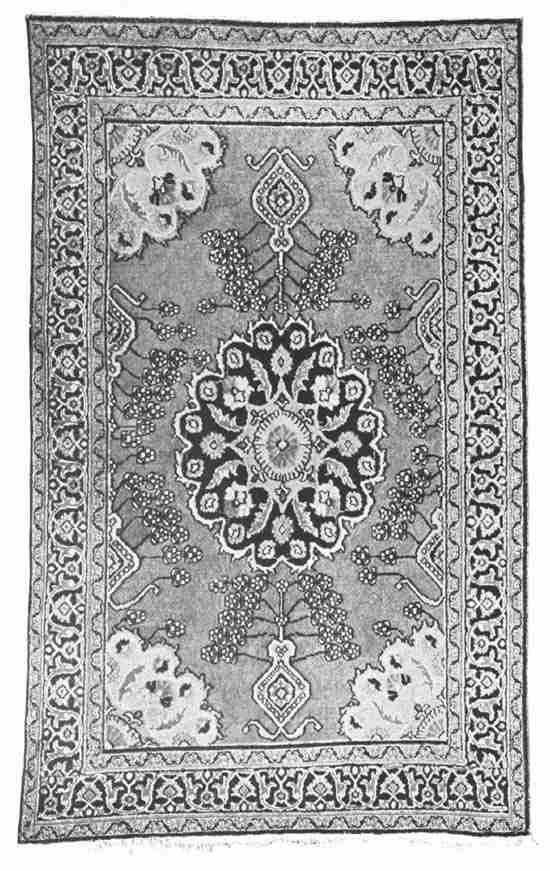
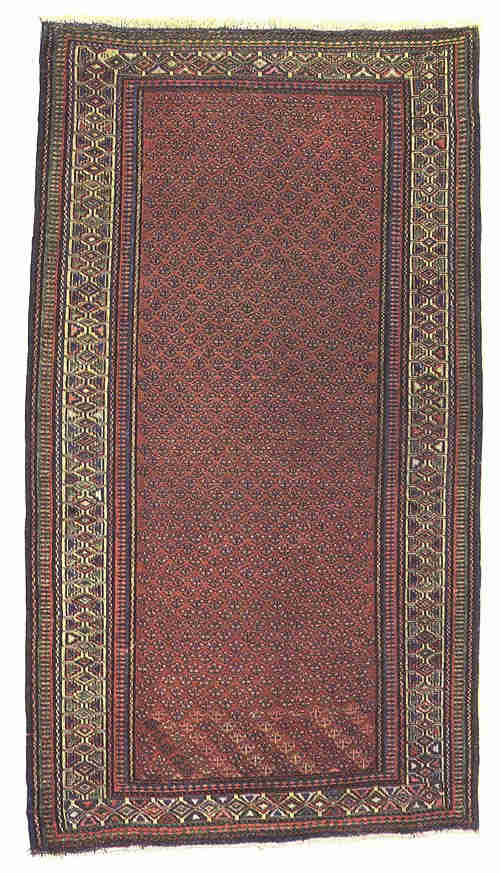
Plate 1. Khorassan
Rug
In the rich valleys near the mouths of the Tigris and
Euphrates dwelt in the remote past a race of unknown origin
called Sumerians, and to the north of them lived another people
known as the Accadians. These races built canals, cultivated the
soil, established towns, and invented the cuneiform writing. They
lived in harmony with one another, and continued to prosper
until about 3000 b.c., when the
Semitic race of the Chaldees, appearing from an unknown land,
subdued them. The Chaldees, however, allowed the conquered races
to retain part of their lands, adopted their civilisation, and
about the year 2500 b.c. built the
city of Babylon, the foundation of which biblical students claim
was laid by the mighty hunter Nimrod. By cultivating the
surrounding country, by developing its trade and commerce, the
Babylonians became a wealthy and powerful nation; and by
encouraging manufactures, art, and science, they became noted for
their delicate fabrics, magnificent temples, and knowledge of
mathematics and astronomy.
About the year 2000 b.c. a number
of tribesmen, among whom was Abraham, migrated with their flocks
to the upper valleys of the Tigris and founded Nineveh. A century
later the land occupied by colonists who settled about Nineveh
was known as Assyria. It increased in numbers and in power until,
in 1300 b.c., it gained its first
victory over Babylon; and during the next four hundred years,
though meeting with occasional reverses, it extended its rule
over Babylonia, Asia Minor, and Assyria, and received tribute
even from Egypt. It thus became the first great conquering power
in Southwestern Asia. In their magnificent palaces of Nineveh,
surrounded by luxury, the rulers of Assyria were resting in
supposed security when a powerful and unexpected enemy appeared
from the land now known as Persia.
When the valleys of the Tigris and the Euphrates were
inhabited by Sumerians and Accadians, Iran, which included modern
Persia, was similarly inhabited by races of unknown origin.
Subsequently, but at an exceedingly remote period, from the
region about the Oxus river in Western Asia two branches of the
great Aryan family migrated to Iran. One of these, which settled
in the northern part, was known as the Medes; the other, which
settled in the southern part, was known as the Persians. Both
Medes and Persians subdued the native races and in the course of
centuries constructed powerful empires. The former were the first
to extend their conquests, and forming an alliance with the
viceroy of Babylon they attacked Nineveh in the year 606
b.c. and destroyed it. Babylon now
became the mistress of all Mesopotamia, and under Nebuchadnezzar
it was enlarged to cover an area of one hundred square miles, and
surrounded by walls three hundred feet high. These walls enclosed
parks, orchards, gardens, and a city that soon became famous
for its palaces, its temple of Bel, and its Hanging Gardens.
While Babylon was rising in power changes were occurring in
Iran. Cyrus, leader of the Persians, instigated a revolt against
the Medes and conquered them. But not satisfied with making the
Persians rulers of Iran he extended his conquests westward, and
in the year 538 b.c., by diverting the
waters of the Euphrates, surprised Belshazzar in his banquet hall
and became master of Babylonia. The complete subjection of all
Asia Minor followed, and for the next two centuries the warlike
Persians were the dominant power in Western Asia. But in the year
331 b.c., when Alexander the Great
defeated their armies under Darius, the Persian Empire melted
away.
Whether in Egypt or China or by the Tigris the art of weaving
first took definite form, it was in this land of Babylon and
Nineveh, of the Medes and the Persians, of Abraham, Belshazzar,
and Cyrus, where a few remaining monuments attest the delicate
textiles of those early days, that in more recent ages have been
woven the most perfect carpets of which there is any
knowledge.
During the succeeding five hundred years Persia, Asia Minor,
Caucasia, and Syria became the prey of the Parthians, Greeks, and
Romans, to whom petty tribes, recognising no sovereign power and
secure in their mountain fastnesses, bade occasional defiance.
About the year 226 a. d. an able
leader of one of the Persian tribes founded the dynasty of the
Sassanides, which during the reign of Chosroes (531-579
a. d.) and his grandson Chosroes II
(590-628 a. d.) ruled over the country
from the Oxus on the north to Arabia and Egypt on the south, and
from India on the east to Assyria on the west. This was a period
of prosperity and luxury, the glory of which continued until the
middle of the VII Century, when it was overthrown by a new power
rising from a most unexpected quarter.
In the inhospitable land of Arabia, noted for its coffee,
dates, and myrrh, for its dreary, sandy, waterless wastes, a land
hitherto almost unknown in history, Mohammed promulgated the
religion which, suited to the temperament and desires of the
Bedouins, united them into a fanatic, militant body of
conquerors. After his death his successors, known as the Caliphs,
extended his conquests. Their successful armies quickly overran
Persia and overthrew the Sassanian rule; then marching northward
into Turkestan and as far east as the Indus they overcame all
resistance. From the Greeks, by whom they were known
as the Saracens, they snatched Palestine and Syria, and invading
Egypt, conquered it after the long stubborn siege of Alexandria.
A little later the Arabs became masters of Northern Africa, and
settling there intermarried with the native races. Near the
Straits of Gibraltar their African descendants, known as the
Moors, crossed to Spain, where in the year 711 they vanquished a
powerful army that opposed them. During the following year they
subdued all of that country and began an invasion of Northern
Europe. But on the rich pasture lands near Tours, where the
infantry of Charles Martel met the Mussulman cavalry in one of
the most decisive battles of history, they were defeated with
terrible slaughter and Christian Europe was saved.
These conquests of the Mohammedans had not only a political
and religious significance, but also an important influence on
art at a time when Europe was sunk in ignorance and barbarism.
Fond of magnificence and luxury, the Caliphs founded great
capitals in Assyria, Egypt, and Spain, and built palaces that
have histories which sound like fairy tales. Bagdad on the banks
of the Tigris, with its sixteen hundred canals, one hundred and
five bridges, and nearly a million people, with its countless
baths, its many thousand mosques, and its royal palace, where was
collected the best of Asiatic taste, elegance, and splendour,
possessed more grandeur than any other city in the world. Gibbon
states that within the palace, furnished with Oriental luxury,
hung thirty-eight thousand pieces of tapestry, one third of which
were of silk embroidered with gold, and that on the floors lay
twenty-two thousand carpets. In Cairo and in Cordova, likewise,
the Caliphs surrounded themselves with similar splendour, of
which, unfortunately, but few traces now exist; but the Castle of
the Alhambra still remains as a powerful reminder of their taste
and artistic genius. It is largely to the influence of this race
that were due many of the beautiful Spanish rugs such as Queen
Eleanor in the XIII Century took to England from Cordova and
Granada, as well as those of other periods. Moreover, in some of
the choicest pieces of Asia Minor and Persia, woven during the
XVI and XVII Centuries, are traces of this early Saracenic
art.
For about five centuries the militant power of these
Mohammedans was dominant in Southwestern Asia when another
conquering race appeared. The great wall of China, which was
built over two hundred years before Christ by the famous
Che-Hwang-te, to protect it against the invasions of the Tartars,
turned westward many wandering hordes from the more fertile
pastures and valleys of Southeastern Asia. One of these hordes
was of Turks, who, leaving their homes near the sources of the
Irtish and Yenisei rivers in the Altai Mountains, settled in
Turkestan. Many centuries afterwards, to escape from other hordes
pressing westward and to reach fresh pastures, different branches
of them migrated southward and westward. About the year 1000
a. d. one of these branches known as
the Seljukian Turks gained a foothold in Persia, and under Malek
Shah, in 1072, made Ispahan its capital. About the same time it
extended its power over Asia Minor and overran Georgia, where it
destroyed the capital Tiflis after slaughtering the inhabitants.
To this Turkoman race should probably be accredited the earliest
Mongolian influence on Persian textile art.
Somewhat later a people numbering forty thousand tents were
ranging that part of Mongolia which lies north of the desert of
Gobi in search of pasture and water. One of their number gathered
about him a few followers, and by his own genius gained the
ascendency over his tribes. He then allied himself with another
powerful tribe, and reducing to obedience all the Mongolians who
dwelt north of the desert of Gobi, in 1206, in the presence of
his chiefs, he assumed the title of Genghis Khan. After becoming
the ruler of millions of nomads of the great central plateau of
Asia and conquering part of China, which was then enjoying a
period of great wealth and prosperity, he invaded Western Asia.
Bokhara offered no resistance and might have been spared, but
learning that some of the Sultan’s garrison were concealed
he ordered the city to be burned. Samarkand, which surrendered
after three days’ siege, was pillaged and the inhabitants
were slaughtered. Herat appeased his anger by opening its gates.
Even his death did not stop the ravages of the Mongol horde that
captured and sacked Bagdad, and, crossing the Tigris and
Euphrates, pillaged all Asia Minor. In 1258, Hulaku Khan,
grandson of Genghis, conquered Persia and established his capital
in the province of Azerbijan, where his descendants ruled for
over a century.
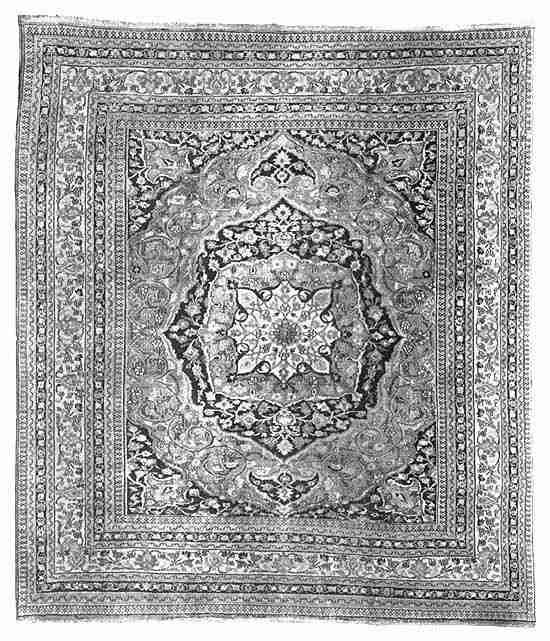
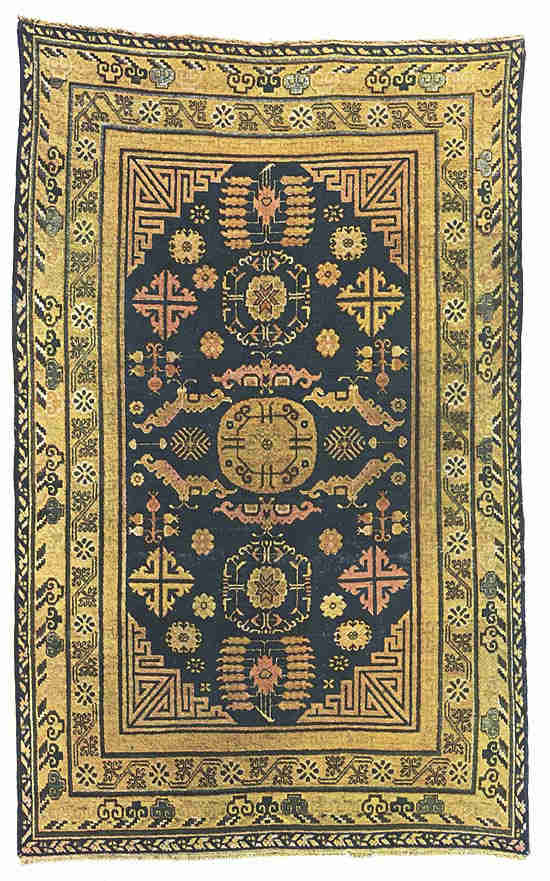
Plate 2. Meshed
Rug
With these invasions another wave of Mongolian influence was
felt in Western Asia. Whatever may have been the effect on local
art by the settlement of the Seljukian Turks in Persia and Asia
Minor during the early part of the XI Century, it was
inappreciable as compared with that of
Genghis Khan and his followers. For the influence of Bagdad over
Southwestern Asia was like that of Rome over the empire of the
Cæsars, and when in the middle of the XIII Century it was
plundered for forty days, and other important cities of Asia
Minor and Persia similarly treated, there was no longer the same
incentive to work, so that art for a time languished. But in some
cities the artistic spirit of the people prevailed over the loss
of independence, and the more skilled workmen were encouraged by
their new masters, who, recognising the beauty of the Persian
carpets, sent many Persian artists to China and brought many
Chinese artists to Persia, that the different races might derive
advantages from the instruction of one another. It is therefore
not surprising that from this time the influence of Chinese art
has been recognised in the woven fabrics and metal work made in
the southwestern part of Asia. In fact, the Chinese motive known
as the “key pattern,” as well as other less familiar
designs of distinctly Mongolian origin, appeared for the first
time in some of the carpets and metal work of this period.
Like Turkestan, Asia Minor has been one of the great
battle-grounds of the world. During parts of the XI, XII, and
XIII Centuries not only Seljukian Turks, but Mongols and Ottoman
Turks under Murad and Bajazet, rose in influence until all Asia
Minor, as well as Thrace and Macedonia, was subject to them. But
still another power from the far East was to overrun Asia and
divert Bajazet from the walls of Constantinople.
Under Tamerlane, the descendant of Genghis Khan, the Mongol
hordes were again united and again attempted the conquest of the
world. From the walls of China to the Mediterranean Sea, and from
the Steppes of Turkestan to the Arabian deserts, his victorious
armies overcame all opposition. Never was conqueror more
rapacious, more bloodthirsty. At Ispahan, seventy thousand
inhabitants were slain. Georgia was laid waste and the people
were massacred. In 1401, Bagdad was besieged and, when taken, a
pyramid of ninety thousand human victims was raised as a monument
to the Tartar conqueror. In the following year, when the armies
of Bajazet and Tamerlane met on the plains near Angora, the Turks
were defeated and Bajazet was captured. But now the tide of
Mongol invasion receded; and laden with spoils Tamerlane returned
to his capital at Samarkand, where he enjoyed the remaining years
of his life by surrounding himself with a brilliant court
and by building palaces and temples, which he
adorned with royal splendour. With all his atrocious barbarities
he had a higher appreciation of art than his Mongolian
predecessors. At his capital were assembled skilled artisans from
Eastern and Western Asia; and there at the beginning of the XIV
Century European travellers saw innumerable art treasures,
including carpets of wonderful workmanship and beauty.
The Mongol power also gained an important foothold in India.
This country, like Iran, had been subjugated by a branch of the
Aryan race, which conquered the native Dravidians, and remained
dominant until the VII and VIII Centuries. Then the Mohammedans
invaded it, and were still in ascendency when Tamerlane crossed
the mountains and attacked Delhi. After the lapse of more than a
hundred years his descendants, Baber, Akbar, and Shah Jahan, rose
to power. The magnificence of their courts and the splendour of
the temples which they built stimulated Indian art; and under the
instruction of Persian artisans, who were induced to settle in
that country, the natives attained their highest skill in
weaving.
With the death of Tamerlane, in 1405, the Ottoman power in
Persia and Asia Minor rose again, and Turkish victories followed
in quick succession until in 1453 Constantinople fell and the
church of St. Sophia became a mosque.
After the lapse of half a century Shah Ismael of the family of
the Safavids defeated the Turkomans in 1502, and founded a new
dynasty in Persia. With his rise began one of the most splendid
periods in its history. Within a few years victories extended his
empire from the Euphrates river to Afghanistan and from the Oxus
to the Persian gulf. This was the land of ancient Iran, over
which from his court at Ardebil he ruled until his death. In the
early part of the reign of Shah Tamasp, which lasted from 1524 to
1576, the new dynasty was threatened by the Turkish ruler,
Soliman the Magnificent, after he had taken Rhodes from the
Knights of St. John and invaded Southern Europe. In 1534 he
captured Bagdad and Tabriz, as well as conquered Shirvan and
Georgia.4 But the lost territory was
soon regained and the new Persian capital was established at
Tabriz where, as will be seen later, were woven many of the
greatest masterpieces of Persian textile fabrics. Much as these
monarchs had accomplished, it was Shah
Abbas the Great who, after ten years of internal strife,
succeeded by expelling the Turks from Persia, restoring
tranquillity, and establishing commerce, in elevating his country
from one of devastation and confusion to one of greatness such as
it had not known for many ages. He transferred his court to
Ispahan, where, while adding to the magnificence of the city, he
encouraged art even to the extent of sending to Italy, for study,
a number of the most skilled artists of Persia. These in time
returned and exerted an influence that appeared in the more
elaborate designs of carpets of a subsequent period. It is also
probable that he rendered valuable assistance to Akbar of India
in founding carpet-weaving in that country. He ruled from 1586 to
1628. This period, during which America was a wilderness and
England under Queen Elizabeth was still struggling with the
feudal system, was the golden age of Persian history and Persian
art; but with his death the Safavid dynasty declined and art
decadence began.
In 1722, the Afghans conquered Persia and for a number of
years ruled it with horrible cruelty; but they were finally
defeated by Nadir Shah, who captured Herat in 1731, extended his
dominion into Georgia, and recovered some of the lost territory
from the Turkish Empire in the West. After his death the
sovereignty of Persia again waned, until in time it was confined
to its present limits.
It thus appears that from the earliest times recorded in
history the southwestern part of Asia has been subject to
invasion, and to constant struggles between the different races
of the East for supremacy. Even from the desert of Gobi, the
flanks of the Altai Mountains, and the deserts of Arabia have
poured forth armies to devastate the land. One victorious power
after another has extended its sway from the banks of the Indus
to the shores of the Mediterranean. The result is that the
present Oriental textile art is of a composite character, which
can be understood only by taking into consideration the value of
these racial influences that have contributed to it some of its
most interesting and subtle charms.
 S was the case with the earliest shepherd
weavers, many nomads living in unfrequented parts of Asia spin
the wool taken from their own flocks, then colour it with dyes
brewed from roots and herbs that they have personally gathered,
and finally weave it according to well-known patterns into
fabrics. But in large, enlightened communities the manufacture of
an Oriental rug involves a division of labour. From the shepherds
the professional dyers obtain the wool, which, after colouring,
they sell to weavers; and these in turn often receive their
patterns from others. A knowledge of these separate steps
involving the industries of producing the different materials and
the crafts of dyeing, weaving, and designing is essential to a
full understanding of any Oriental woven fabric.
S was the case with the earliest shepherd
weavers, many nomads living in unfrequented parts of Asia spin
the wool taken from their own flocks, then colour it with dyes
brewed from roots and herbs that they have personally gathered,
and finally weave it according to well-known patterns into
fabrics. But in large, enlightened communities the manufacture of
an Oriental rug involves a division of labour. From the shepherds
the professional dyers obtain the wool, which, after colouring,
they sell to weavers; and these in turn often receive their
patterns from others. A knowledge of these separate steps
involving the industries of producing the different materials and
the crafts of dyeing, weaving, and designing is essential to a
full understanding of any Oriental woven fabric.
The materials that were formerly used in weaving were
generally of animal origin, such as the wool of sheep, goats, and
camels. To a more limited extent silk and cotton also were used,
and occasionally hair of the yak, cow, and even human hair. In
later years, when there arose a western demand for eastern
fabrics so that the aim of the weaver was to produce an article
as cheaply as possible, flax, hemp, jute, and larger quantities
of cotton were sometimes substituted. Since all of these
materials are indigenous to the country where they are used, and
are affected by its climate, altitude, humidity, and fertility,
they acquire qualities that frequently give to rugs a distinctly
local character.
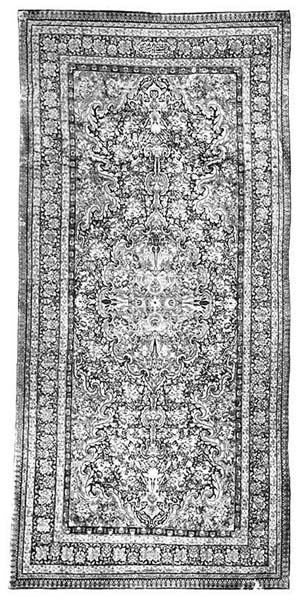
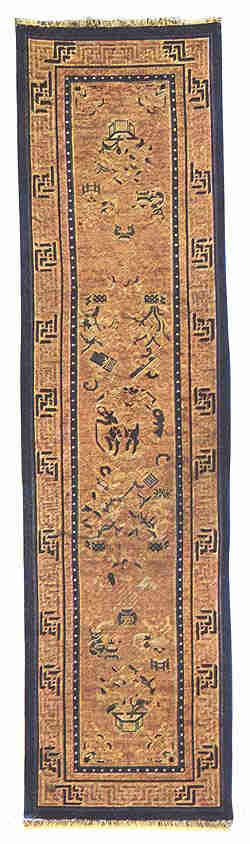
Plate 3. Kirman
Rug
The wool of sheep constitutes the warp and weft of at least
half the Oriental rugs and the pile of over ninety per cent. To
be sure, in Japan the pile is largely jute and cotton; in a few
of the districts of Asia Minor and Persia it is mercerised cotton
or silk; and in districts where the camel is still a beast of
burden its wool and fine hair are often substituted for other
kinds; but throughout all the rug-weaving countries
of the East the wool of the sheep has been and still is preferred
to all other materials for the pile of rugs. This is due not
alone to its warmth, to the facility with which it can be spun
and twisted into knots, but also to the fact that from the
remotest times the inhabitants of these districts, like Abraham
of old, have been shepherds, who followed their calling because
over the steppes of Tartary and the great plateaus that extend
through Asia Minor, Persia, Afghanistan, and Turkestan spread
vast pasture lands that seem better suited than any other parts
of the world for the nourishment of sheep with fine fleeces. In
fact, a part of these districts seems to be the natural habitat
of the sheep; for among the crags of some of the lofty mountain
chains of Central Asia, and farther west where Eastern and
Western Turkestan meet in the lofty plateau of Pamir, called the
“Roof of the World,” still wander great bands of
magnificent native sheep with enormous horns and brownish grey
wool, from which it is believed sprang the vast flocks that now
browse on every hill and mountain slope of Western Asia.
Centuries of care have effected an important evolution in this
native stock, for in no other part of the world are there sheep
with longer and more silky fleeces. Nevertheless there are
different grades, as the quality depends in a measure on the
climate and pasturage as well as on the care of the sheep. Thus
in the hot, sandy lands the wool shows some deterioration; but in
the cold, dry climates of the many high lands of Western Asia and
in the pastures of particular localities the wool is long, fine,
and lustrous. For instance, in parts of Khorassan, on the flanks
of high mountains near Kirman and Shiraz, on the shores of Lake
Niris in Farsistan, among the rolling uplands of Asia Minor, are
produced uncommonly fine and beautiful fleeces. When, moreover,
the sheep of these localities receive the care that is given by
some of the nomadic tribes, as the Uzbeck Tartars, who not only
shelter them but cover them with blankets, the wool acquires a
soft and silky quality that is unsurpassed. The wool produced in
many parts of India, on the other hand, is poor; for not only are
the serrations, on which largely depends its value for textile
purposes, less numerous than in better varieties, but it is harsh
and contains many long hairs that do not well unite with it and
that take up very little dye.
The wool of the goat is much less extensively used, yet
appears in some rugs, not only as warp and weft, but also as
pile. The goats of Kashmir, which live in the cold
climate of a table-land three miles above the ocean level,
produce the finest and most beautiful wool; but as it grows near
the skin, and beneath wiry hairs from which it can be removed
only with tedious care, it is too precious to be used excepting
for the most beautiful shawls and choicest carpets. Of next
importance and finest texture is the wool of the Angora goat,
known to commerce as mohair. Formerly there was not much demand
for it, but now, on account of the consideration that it has
received in the carpet factories of recent Sultans, it is found
in many of the rugs of Asia Minor. As it grows to an average
length of five to six inches it is easily spun; and its soft,
lustrous sheen gives to the rugs in which it is used a silky and
brilliant appearance. Some of the Bokhara goats, also, yield fine
wool that is used in rugs. Yet, as a rule, yarn made from the
fleece of the goat is not regarded with favour by weavers, since
it is apt to be coarse and to pack closely. Nor does the wool of
the goat mix well with the wool of the sheep. There is, however,
a much finer grade growing next to the skin, which may be removed
with a knife when it is exposed by combing the longer fleece in a
direction reverse to that in which it lies. The tougher grades
are preferred to any other material by weavers of the
Afghanistan, Beluchistan, and some Turkoman rugs for selvages at
the sides, as they afford excellent protection against hard
usage. Goat’s hair is also sometimes used in these rugs for
warp. Unless mixed with wool it is very rarely used for weft, as
it is not sufficiently pliable.
Of more frequent use than the wool of the goat is the wool of
the camel which grows close to the skin beneath the long hair. In
the tropical countries, as in Soudan, the camel has no wool, but
in more northern latitudes it yields a crop which increases in
quantity and improves in quality as the climate grows colder.
Thus in Arabia, Asia Minor, and in most of Persia and Turkestan
the yield is small, in the table-lands of Eastern Persia and
Afghanistan it is much larger, and on the lofty plateaus of
Turkestan and Chinese Tartary as much as ten pounds of wool is
obtained yearly from each beast. The clip is taken at the usual
moulting season during the spring of the year. The wool of the
older camels is coarse and dark, what is taken from the young is
finer and lighter, and the most silky and valuable of all is what
is obtained from the unborn. The best grade has been more highly
esteemed than the wool of any other animal, and rugs in which it
constitutes the pile are more valuable than those in
which the wool of sheep is used. It is seldom woven in modern
rugs, but dyed wool or goats’ hair of similar colour is
often substituted for it.
The wool or underhair of the yak is used only among the
mountain tribes of Tartary, and is never found in any of the
choicer grades of rugs. Occasionally the hair of the horse or cow
is employed to a limited extent in the pile of nomadic rugs,
where it may be distinguished by its coarse and wiry character.
In old rugs of which the pile is much worn cows’ hair will
now and then protrude like the hairs of small bristle brushes.
Only very rarely is human hair seen in a rug.
Natural colours of the several kinds of wool, which have made
it possible to dispense with their dyeing, have always been taken
advantage of by weavers. The only black yarn on which the wear of
time has left no impress is from the fleece of the proverbially
despised black sheep. Shades of white, ivory, brown, grey, rufus,
and even a plum are obtained from different varieties. Likewise a
wide range of rich chestnut colours are furnished by the
camel.
It is but natural that the nomad should depend on the wool of
his flocks and herds for warp, weft, and pile; but people of
fixed habitations have employed other kinds of material also.
Where the sensuous luxury of the East called for magnificent
carpets, they were often woven almost entirely of silk, which was
easily obtained, as silkworms thrive on the mulberry trees that
grow wild on the plains of Central and Southwestern Asia. Silk
rugs are still woven in a few cities of Asia Minor and Persia.
For the cheaper grades of rugs flax, hemp, and jute have been
sparingly used; and during recent years cotton has been widely
adopted, particularly in Persian, Indian, and Chinese rugs, on
account of its cheapness as compared with wool. It is, however,
almost entirely as warp and weft and rarely as pile that it is
used. Though much less durable than wool, its white colour is far
less likely to darken with age; yet there is a poorer variety
which, after being thoroughly wet, acquires a dark colour.
In the preparation of these different textile materials wool
requires the greatest care. In some parts of the Orient it is not
washed, and the lustrous hues of the pile are attributed to the
fact that it is dyed in its naturally greasy state; but in other
parts the grease and dirt are carefully removed. This cleansing
is a craft that has been transmitted from parent to child, and is
practised according to different methods in
different parts of the country. One of the chief essentials is an
abundance of clear running water free from alkali; for when the
water is hard, as is often the case in the more arid parts of the
country, it loses some of its cleansing properties, and potash or
other chemicals are required to counter-act this unfavourable
quality. After the wool has been thoroughly washed it is
carefully dried in the sun and open air.
The next important step is the proper sorting, picking, and
combing. The sorting consists of the separation of black and
light wool, or of an inferior from a better grade; and the
picking consists of the removal of burrs or foreign particles.
The object of combing is to effect an orderly arrangement of the
wool so that it is ready for spinning. One method, corresponding
to carding, is to draw the wool repeatedly between rows of
upright spikes set in a wooden frame until every matted particle
has been separated and all the fibres are disentangled. The older
method, still employed in nearly every part of the Orient,
consists of “teasing” with the cord of a heavy bow,
which is suspended or held firmly by the left hand over the wool,
while with the right hand the cord is made to vibrate either by
striking it with a wooden instrument or plucking it, so that the
fibres of wool are separated and assorted by the vibrations.
When the wool has thus been prepared, it is wound about the
distaff and then spun into yarn. In many parts of the Orient the
common spinning-wheel has been introduced and adopted for both
wool and cotton; in other parts are crudely made spinning-wheels
of different design and about the height of a man. The natives of
districts more remote from civilisation still cling to the
primeval spindle, which sometimes consists of no more than a
rounded stick half an inch in diameter and a foot in length with
a ball of clay at one end. Many of the nomadic tribes of Asia
Minor and Mesopotamia use in place of it a small stone of
convenient shape, to which is tied a strip of linen a few inches
in length. A few fibres of wool are attached to the end of the
linen by twisting them about it, and a few more fibres are
similarly attached to these when the stone is suspended and
twirled. As the fibres become closely twisted together more
fibres are added until on account of the length of the thread
thus formed the stone reaches the ground. The thread is then
wound about the stone and secured by a couple of loops so as to
leave a piece only a few inches in length, to which more wool is
attached in continuing the spinning. When a large ball of thread
has been spun, it is removed from the
stone and the process begun again.
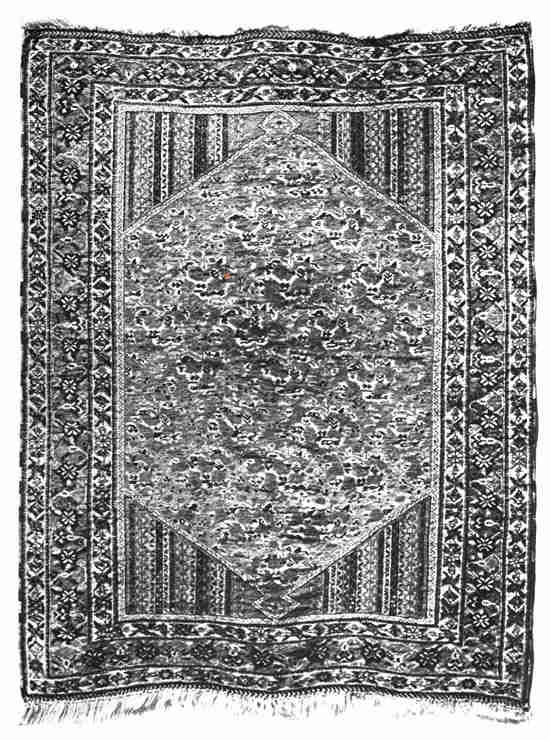
Plate 4. Shiraz
Rug
One advantage of these simple devices is that they can easily
be carried anywhere. Even to-day a not unusual sight is a half
barbaric shepherd following his flock, while he spins with simple
distaff and spindle or stone, as did his ancestors thousands of
years ago. On the end of the distaff, that rests beneath his left
arm, is the ball of wool from which he selects and twists the
fibres, while he deftly turns the short spindle or twirls the
stone with thumb and forefinger of the right hand. The threads
spun by professional spinners on spinning-wheels are of small
diameter and are the most regular in size and texture, those spun
with the small spindle are of larger diameter and less regular,
and those spun by twirling a stone are made of the coarsest
diameter in order to insure sufficient stoutness, since they are
the most irregular in size and texture; yet yarn so made is the
most highly valued by all weavers.
Only very rarely, indeed, is one of these single threads used
for yarn, since it would be apt to part. Two of them, therefore,
are twisted together to form a double thread. A simple device
used by many nomadic tribes for this purpose consists of two
short sticks crossing at right angles, and another piece with end
like a crochet needle perpendicular to them. The threads which
are attached to this piece pass through a hole at the
intersection of the crossed sticks and are twisted by twirling
them. It is very seldom that three single threads are twisted to
make a triple thread, and when such is the case it is the work of
a professional spinner who uses a large spinning-wheel, and never
the work of a nomad. For the weft of many rugs, and for the pile
of a few rugs such as Sarouks and Kashans, a double thread alone
is used; whilst for the pile of most rugs the double thread is
again doubled, trebled, or quadrupled, so as to form yarn of two,
three, or four ply, and even yarn of six ply is sometimes used. A
distinction also exists in the manner of twisting together double
threads to make yarn of two or more ply, since according to the
custom of different tribes they may be twisted so loosely that in
the length of an inch they do not describe more than a single
revolution or so tightly as to describe several.
Until the introduction of the modern spinning-wheel wool was
spun in the Orient exactly as it was ages ago. It is this almost
incredible disposition to adhere as with religious fanaticism to
methods transmitted from father to son and to resist as
pernicious every attempt at innovation that makes a
precise analysis of rugs possible. Accordingly, the evenness or
unevenness of single threads, the looseness or tightness with
which double threads are twisted together to form yarn of
different ply, as well as the number of the ply used, are a few
of the important indices for distinguishing between rugs of
different districts.
Even after the yarn is spun it is not always ready for the
dyer, and in order that it may properly absorb the dye it is
often washed and rewashed. In some parts of the Orient it is
first soaked in warm water and carefully rinsed in cold water. It
is then placed in a copper pot or vat containing boiling water to
which has been added carbonate or sulphate of soda and potash,
and stirred for about an hour. After this thorough cleansing it
is again washed very carefully in soft water and thoroughly dried
in the sun.
The wonderful sheen of many old rugs is due almost entirely to
the materials of which they are made. This material, as a rule,
is unsurpassed by similar products of any other part of the
world, and is prepared by patient races who know little of the
value of time. The simple labour required is in itself prosaic
enough, yet without a doubt the earlier spinners and weavers,
while following their flocks with minds free from all conventions
and limitations of art, discerned the elemental forces of nature
in all their freshness and power, and from them drew inspiration
that bore fruit in the exquisite colouring and delicate tracery
of the woven carpets.
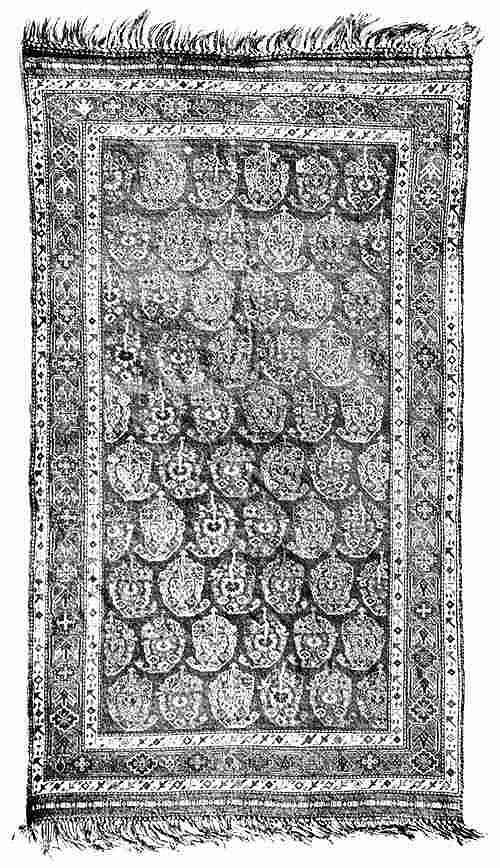
Plate 5. Niris
Rug
 OWEVER remarkable the achievements of Oriental
art in any field, their most pleasing effect has always been
associated with colour. Without it the beauty of the lustre tiles
of Persia, the marvellous porcelains of China, and the delicate
textiles of Western Asia would fade into insignificance. It is
indeed the wonderful harmonies of exquisite tints chosen by the
touch of genius from a palette of many thousand pigments that
awaken the appreciation of the luxurious splendour of the East.
This love for colour is inherent in every rug-producing race of
Asia and is older than history. It is but natural, then, that the
earliest carpets should be radiant with glorious tints, which in
a lesser measure are reflected in modern fabrics.
OWEVER remarkable the achievements of Oriental
art in any field, their most pleasing effect has always been
associated with colour. Without it the beauty of the lustre tiles
of Persia, the marvellous porcelains of China, and the delicate
textiles of Western Asia would fade into insignificance. It is
indeed the wonderful harmonies of exquisite tints chosen by the
touch of genius from a palette of many thousand pigments that
awaken the appreciation of the luxurious splendour of the East.
This love for colour is inherent in every rug-producing race of
Asia and is older than history. It is but natural, then, that the
earliest carpets should be radiant with glorious tints, which in
a lesser measure are reflected in modern fabrics.
If high praise is due to the artist who, by a skilful
association of different colours of co-ordinate tones, creates
the picture that delights the sense, a fair measure is also due
to the artisan who not only controls the secrets of the dyes, but
has mastered the difficult knowledge of their proper application;
for the beauty of the finished woven product depends on the
judicious dyeing of the yarn more than on anything else. From
father to son for many generations has been transmitted a
knowledge of those particular vegetable and animal products of
root, leaf, fruit, and insect, and the manner of their use, by
which the imperishable lustrous sheen and colour of the finest
woven fabrics are produced. Indeed, this art requires to-day more
technical knowledge than any other branch of rug weaving, since
modern designs are no longer more than the imitation of those in
older carpets; and so important is it regarded that a successful
dyer is a man of distinction in his tribe.
The sources from which are obtained many of the dyes that give
the innumerable carpet colours are recorded. A few of them are
received from remote countries, but most of the plants from
which they are extracted grow in marshes and on
hills and plains where the nomads wander with their flocks. Many
of them are used without blending, but even some of the seven
primary colours are derived by proper blending; and from a number
of dyes of different strengths and qualities are produced an
infinite number of rich and delicate shades.
The principal blues of Oriental rugs are obtained from indigo.
This is derived from colouring matter in the leaves of plants of
the genus Indigofera, that grow to a height of four to six
feet in the East Indies, when they are cut and placed in a vat
containing water. In about twelve hours fermentation ensues; and
after this subsides the liquid is drawn off into another vat,
where after one or two hours of agitation the indigo forms as a
precipitate. Many different species of this plant grow wild
throughout Asia, and from the earliest times have been used to
produce dye-stuff. Indigo is one of the most valuable of all
dyes, as by using it in conjunction with others an infinite
variety of shades result.
Some reds are obtained from the plant madder (Rubia
tinctorum), that grows abundantly in Central and Southwestern
Asia, Its colouring properties were known to the ancients; and
for a long period it has been cultivated in Asia Minor, where the
succulent roots of the second and third years’ growth are
regularly dried and prepared for use. Other reds are derived from
the insect cochineal (Coccus ilicis) that lives on oaks of
the countries bordering the Mediterranean, and was known among
the Arabs as “kermes,” signifying Red Dye. After the
discovery of America another species (Coccus cacti) was
found that was more productive of dyeing qualities. The females,
which alone are valuable, are plucked from the trees and killed
by exposing them to vapours of acetic acid, or placing them in
hot water, or in an oven. From their dried bodies, of which over
fifty thousand are necessary to make a pound, the dye is
produced. As both these dyes are noted for their fastness, they
are constantly used, but when silk or wool is to be dyed
cochineal is preferable to madder.
The yellow dyes are obtained from several sources. Some are
from the berries of plants of Western Asia. Others are from the
leaves of the sumach bushes, that are indigenous to nearly every
part of the world. An orange tinge is derived from the turmeric
extracted from the short root stocks of a plant of the genus
Curcuma. From time immemorial a beautiful yellow has been
obtained from saffron. It is the product of the stigmas
of the fragrant crocus, which are so small that over four
thousand are necessary to furnish an ounce of dried saffron; yet
the dye is so powerful that it will give a distinct tint to seven
hundred thousand times its weight of water. As saffron has
something of a stimulating effect on the human system, it has
been taken by the Persians when mixed with their rice.
With none of these three basic colours was any national
feeling associated, yet the Persians excelled in the use of
blues. The Turkomans of Turkestan and Asia Minor produced better
reds than any other colour, and the best yellows, even if
generally inferior in positiveness to blues and reds, were those
of the Chinese.
Though other primary and secondary colours sometimes result
from the application of a single dye, the many thousand different
tints can only be produced by the blending of two or more.
Moreover, the qualities of the same dye vary greatly, as they
depend on the soil where the plant grew, the time of year when it
was removed, and the weather and other conditions prevailing
during the dyeing.
In nature green is one of the most pleasing colours, but in
carpets it is most unsatisfactory, as it has generally a faded
appearance, due probably to the fact that one of the dyes of
which it is formed by blending is less permanent than the other.
The Chinese greens obtained from the buckthorns are generally the
best.
Greys and browns are sometimes derived from gall nuts, and
reddish brown from henna. For very dark browns and black, iron
pyrites has been largely used in both old and modern rugs; but
unfortunately the dye has a corrosive effect on the wool, so that
the black knots of old rugs are often worn to the warp.
In parts of India flowers of the bastard teak (Butea
frondosa) make a favourite dye, from which are produced, by
blending with other dyes, a large number of shades ranging from
deep yellow to brownish copper tones. Another well known dye is
Butti lac, obtained from an insect, Coccus lacca,
that lives on the twigs of trees. It is a substitute for
cochineal and produces different shades of red, crimson, terra
cotta, and purple, according to the other dyes and the mordants
with which it is blended.
Besides these few dyes are innumerable others that are used
either singly or in combination. Furthermore, different colour
effects are produced by the application of different mordants,
which it is necessary to use for the reason that without them
many fibrous materials are unable to absorb a
large number of the dyes. The most valuable of all mordants is
alum; and the sulphate of iron and tin are largely employed in
the case of red colours. Of the vegetable mordants, pomegranate
rind, which contains some yellow colouring matter, is the best
known. Valonia also is sometimes used, as well as limes, lemons,
the fruit of the tamarind, and the mango.
In the monograph of Mr. Harris on the “Carpet Weaving
Industry of Southern India” are a number of directions from
an old manuscript owned by a dyer who stated that he was the
descendant of twenty generations of dyers who originally came
from Tabriz, and that he had made his copy from a Persian book of
dyes which had belonged to his grandfather. A few of these are
given below, because they show not only the dyes and mordants,
but also the methods employed.
“Birbuls Blue. Take cinnabar, indigo, and alum, grind
and sift lighter than the light dust of the high hills; soak for
ten hours; keep stirring it; put in the wool and soak for many
hours. Boil for three hours; wash in kurd water, water in which
kurds and whey have been well beaten up; leave for three hours,
and then wash and beat again in water.
“A Fine Indigo Blue. Take indigo, soak it in water for
twelve hours, grind it to a fine paste in a mortar, add some
Terminalia citrina, pomegranate peel, and alum; and mix
thoroughly. Boil; put the water into the hot bath and keep
stirring till cold. Now mix in some iron-filings water, and boil
steadily for another two and a half to three hours; wash with a
beating and dry.
“Ruddy Brown Grey. Take sulphate of iron, Terminalia
citrina, oak galls, and alum; mix well; dry; then steep for
twenty-four hours. Put in the wool; soak it for twenty-four
hours, then boil for two or three hours. Dip in a soda-bath,
wash, and dry.
“Cinnamon. Take oak galls, acacia bark, cinnabar, and
alum, and steep for a night. Put in the wool, and soak for twenty
or thirty hours; boil the water for two or three hours and give a
soda-bath wash; dip in acidulated water; and wash again with
beating.
“Crimson. Take lac colour and cochineal. Steep for from
four to six days in the sun, in hot weather for the lesser time,
stirring constantly till a rich deep colour comes where some has
stood for a few minutes in a thin glass bottle and settled. Then
strain through two cloths, and put in pomegranate rind and good
iron-filings water. Add mineral acid; steep wool for
thirty-six hours, then boil for three hours, wash well, and
dry.
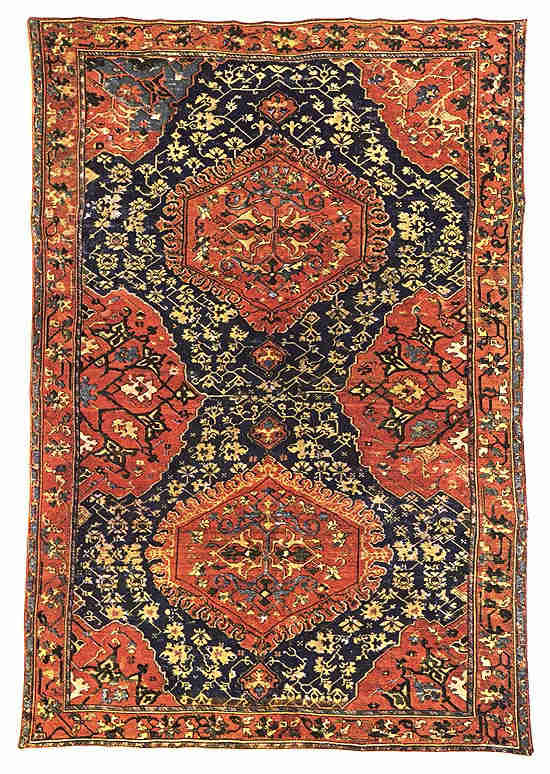
The colours and pattern of this antique Oushak are similar
to those of the best examples that remain of the carpets woven in
Asia Minor during the XV and XVI Centuries. The deep blue of the
central field, the rich red of the medallions, and the golden
yellow of the leaves are entirely unlike the more subdued hues
found in Persian rugs. Strongly contrasting with them are the
more delicate tones of the tendrils and leaves, which display in
their drawing a keen sense of refinement. In the formal pattern
of the field are stateliness and elegance; in the narrow borders
are simplicity and grace. Such colours and drawing show that the
early Asia Minor weavers had an intense appreciation of the
ennobling qualities of beauty and harmony.
Loaned by Mr. James F. Ballard
“Pale Greyish Green. Take copper rust, asburg,5 and alum. Mix well with any hot water, not
boiling; soak wool for eighteen hours, then boil for three hours.
Give a bath with water acidulated with some limes, and dry in
shade.
“Old Gold and Rich Yellow. Take turmeric and asburg,
cinnabar and alum. Soak all night. Steep wool for twenty-four
hours, boil for four and a half hours, wash with a beating, and
dry in shade.
“Dark Grey. Take of the fruit of Cupressus
sempervirens, seeds and seed pods of babul (Acacia
arabica), iron-filings water, and alum. Steep over night. Now
add the water and let it soak for twenty-four hours, then boil
for two or three hours, until the colour is right, then wash and
dry in the sun.
“Rose Colour. Take ratanjot (Onosma echioides), a
thought of cochineal, manjit (Rubia cordifolia) or lac
colour a very little, and cinnabar. Add water, soak them for
twelve hours, put in wool, and steep for thirty-six hours; cook
it for three hours, then bathe the wool in alum and wash nicely;
afterward dry in the shade.
“Persian Scarlet. Take lac colour, and if you choose a
little cochineal for richness, and soak from four to six days;
strain it in two cloths and add alum and a little turmeric; let
it stand for three hours. Put wool in and steep for twenty-four
hours, then boil for two hours. Take out the wool and add mineral
acid; re-enter wool and boil an hour more. Wash fifteen minutes
when cold, and dry in the shade.
“Saffron Yellow. Take turmeric, cinnabar, and soda, add
water and keep for a full day. Then add some alum, make the dip,
and soak the wool for thirty hours. Cook it for several hours,
and dry in the shade after beating and good washing.
“Rich Yellow. Take asburg and turmeric, soak for a night
in water, steep the wool for twenty-four hours, add alum, shake
out, and dry in shade.”
Identical shades of a number of colours are not produced in
all parts of the Orient, not only for the reason that soil,
moisture, and climate affect the colour values of dye-stuff, but
because each family of dyers preserve inviolable the craft
secrets transmitted from their forefathers. Thus it happens that
different parts of the rug-producing countries adhere to
particular tones that help to identify the locality where the
fabrics were woven.
Unfortunately the Western aniline dyes, which were introduced
about the year 1860 and quickly adopted because they are cheaper
and less complicated in their application, have to such an extent
transplanted some of these fine old vegetable dyes that a number
of the richest and most delicate colours found in the rugs of a
former century are no longer produced. Thus the superb blue of
the fine old Ispahans, as well as of lustre tiles and illuminated
manuscripts, belongs to a lost art. The disadvantages of the
aniline dyes are several: they have a tendency to make the fibres
of the textile fabric brittle, and when it is wet the colours
will frequently run. Some dyes also fade more readily than
others, so that if a colour be the product of two or more dyes,
the resultant tint may be totally unlike the original. On the
other hand, not all vegetable dyes are fast; but as they fade
they mellow into more pleasing shades. Efforts have been made to
encourage the use of old vegetable dyes; but unless the laws
which have been enacted in parts of Asia to restrict the
importation of aniline dyes be more stringently enforced than in
the past, the cultivation in the garden patch of the
dye-producing herbs and plants will soon cease to be the
time-honoured occupation it was in days gone by.
Almost as important as the art of preparing the dyes is that
of properly applying them to the yarns. It is an art that demands
infinite pains in its technique, as well as a lifetime to
acquire. It is in itself a separate profession practised by
artisans who guard with jealousy the sacred secrets that
transmitted from generation to generation occupy their thoughts
to the exclusion of almost everything else. The homes of these
professional dyers in the larger villages and cities are located
on a stream of water which possesses mineral properties that long
experience has proven especially suitable as solvents for the
different kinds of colouring matter. Ranged about the walls of
their low dwellings are jars or vats containing liquid dye of
various colours. Suspended above them, from hooks driven into
beams, are the yarns from which, after immersion in the proper
vats, the liquids are allowed to drain. After this the yarns are
exposed for the proper length of time to the dry air and burning
sun. It is, therefore, the suitable mordants, the preparation of
the proper dyes for the vats, the immersion of the yarn in
correct sequence and for the correct length of time, as well
as the exposure to the glare and heat of
the sun for a definite period to be gauged to the exact moment,
on which the colour results depend. This complicated process by
which, for instance, the infinitely different shades of a red, a
blue, or a brown may be conveyed to yarn by using the same dyes
but by slightly modifying the steps requires the greatest
precision, for which no rule but an experience amounting almost
to instinct is the guide.
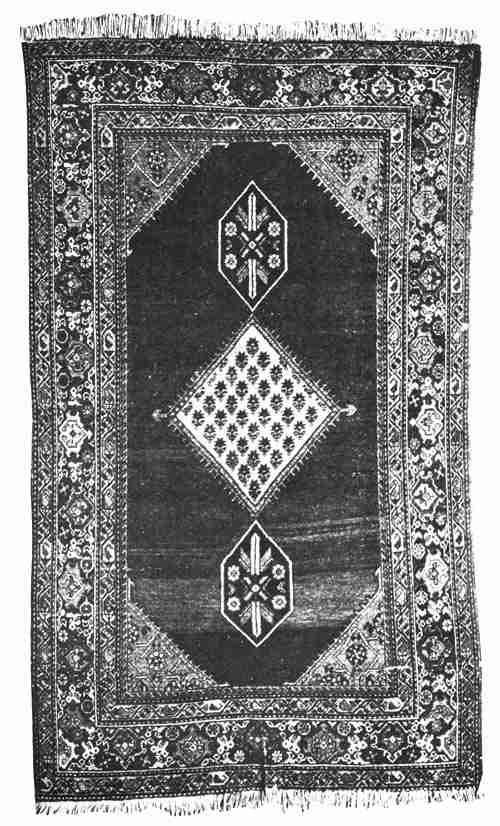
Plate 6. Feraghan
Rug
There was a time when the Oriental had not learned the meaning
of tempus fugit or seen the glitter of Western gold, when
his dyeing and weaving were proud callings, in which entered his
deepest feelings. Then the old vegetable dyes that mellow, grow
softer and more lustrous, were almost exclusively used; but now
throughout all weaving countries the dyer has deteriorated so
that he can no longer produce some of the rich colours in use
half a century ago. Yet remote from the principal lines of
travel, on the edges of the desert, in lonely valleys, among
rugged mountains, half-tamed tribes are still dyeing their
hand-spun yarn as did their fathers’ fathers.
 EAR the tents of some nomadic tribes may
occasionally be seen crude looms on which are woven some of the
most interesting rugs that now reach the Western markets. In all
probability they are not dissimilar to what were used thousands
of years ago, for it would be impossible to construct a simpler
loom. Where two trees suitably branching are found growing a few
feet apart, all of the upper branches are removed excepting two,
which are so trimmed as to leave a crotch at the same height in
each tree. In each crotch is rested the end of a pole or beam,
and parallel to it is placed another extending at a short
distance above the ground from trunk to trunk. Or, as is more
frequently the case, roughly hewn posts are firmly implanted in
the ground and horizontal beams are stretched between them. In
the upper one is a groove with a rod to which one end of the
warp, consisting of strong threads of yarn numbering from ten to
thirty to the inch, is attached, while the other end is tightly
stretched and firmly secured to the lower horizontal beam.
Sometimes the beams to which the warp is attached are placed
perpendicularly, so that the weaver may stand and move sideways
as the work progresses. But among a very large number of those
tribes that are constantly wandering in search of new pastures
for their flocks and herds, it is customary to let the loom lie
flat on the ground, while the weaver sits on the finished part of
the rug.
EAR the tents of some nomadic tribes may
occasionally be seen crude looms on which are woven some of the
most interesting rugs that now reach the Western markets. In all
probability they are not dissimilar to what were used thousands
of years ago, for it would be impossible to construct a simpler
loom. Where two trees suitably branching are found growing a few
feet apart, all of the upper branches are removed excepting two,
which are so trimmed as to leave a crotch at the same height in
each tree. In each crotch is rested the end of a pole or beam,
and parallel to it is placed another extending at a short
distance above the ground from trunk to trunk. Or, as is more
frequently the case, roughly hewn posts are firmly implanted in
the ground and horizontal beams are stretched between them. In
the upper one is a groove with a rod to which one end of the
warp, consisting of strong threads of yarn numbering from ten to
thirty to the inch, is attached, while the other end is tightly
stretched and firmly secured to the lower horizontal beam.
Sometimes the beams to which the warp is attached are placed
perpendicularly, so that the weaver may stand and move sideways
as the work progresses. But among a very large number of those
tribes that are constantly wandering in search of new pastures
for their flocks and herds, it is customary to let the loom lie
flat on the ground, while the weaver sits on the finished part of
the rug.
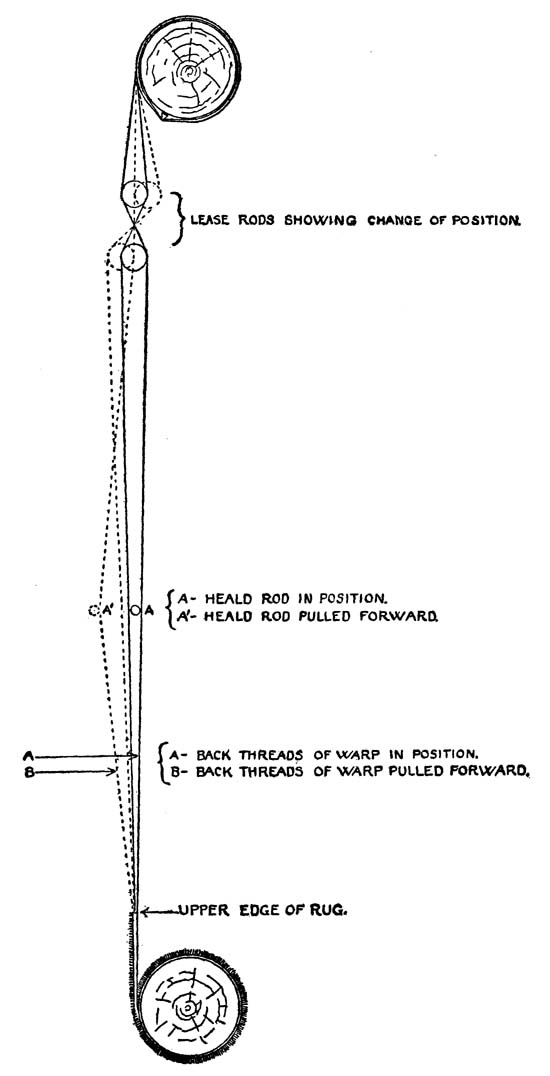
Plate A.—An Upright
Loom.
Under more favourable circumstances, when the tribes live in
villages or cities, the looms are so made that the weavers are
not compelled to bend in order to tie the first row of knots or
stand erect to finish the last rows of a long rug. Of the several
devices by which the weaver may remain seated while at work, the
crudest consists of a plank used as a seat, which rests on the
rungs of two ladders placed parallel to each other at the sides
of the rug. As the work progresses, the plank is raised
and rested upon the higher rungs. More frequently, however, both
upper and lower beams of the frame have the shape of cylinders of
small diameter, which revolve between the upright posts. The
lower ends of the threads of warp are attached to the lower beam,
and the other ends may either be wound several times around the
upper one or else pass over it and be kept taut by weights
attached to them. Such a loom is generally used for weaving very
large rugs, which are rolled up on the lower beam as the work
progresses.
In Plate A (Page 45) is represented a loom
commonly used in many parts of the Orient. When preparing it for
weaving two stakes are driven in the ground at a suitable
distance apart, and about them the warp is wound in the way a
figure eight is formed. The warp is then carefully transferred to
two rods that are attached to the upper and lower beams. If it
has been carefully wound, none of the threads should be slack;
but if desired the tension may be further increased by different
devices. Two other rods, known as “Healds,” are then
attached to the front and back threads of warp; or in the case of
a single rod, it is attached to the back threads, as shown in the
Plate. A lease rod is next inserted between the threads of warp
that cross below the upper beam, and another is placed below it
where, if necessary, it is supported in position by loops. When
the weaving begins, a short web is generally woven at the lower
end to protect the knots from wear. After the first row has been
tied, the shuttle carrying the thread of weft is passed between
the front and back threads of warp; the heald rod attached to
these back threads is then pulled forward, so that they are now
in front of the others, and the shuttle is passed back. If the
rug is narrow, only one shuttle is used; but if the rug is wide,
or if the weft consists of two threads of unequal thickness, a
shuttle is passed across from each side. Every thread of warp is
in this way completely encircled by the thread of weft as it
passes and repasses. When weaving large rugs, there is an
advantage in having two heald rods, as by their use the distance
between the front and back threads of warp may be increased. The
object of the lease rod is to prevent any slack caused by drawing
forward the threads of warp, and is accomplished in a very simple
manner, as will be seen by studying the drawing; since when the
tension of the back threads is increased by drawing them forward,
the tension of the front threads is also increased by displacing
the lease rods which thereby stretches them.
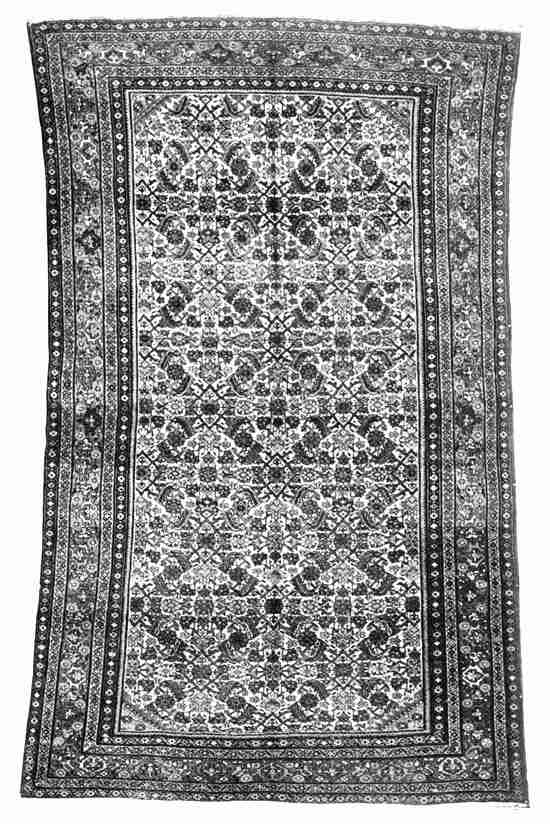
Plate 7. Feraghan
Rug
The products of the loom are divided according to their weave
into three separate classes. The simplest of these are the
kilims, which are without pile and consist only of warp and weft
to which a few embroidered stitches representing some symbol are
occasionally added.
A more elaborately made class are the Soumaks. They consist of
warp covered by flat stitches of yarn and of a thread of weft
which extends across and back between each row of stitches in the
old rugs and between each second and third row of stitches in the
new rugs. In the narrow, perpendicular lines that define both
borders and designs the stitch is made by the yarn encircling two
adjacent threads of warp; but in other parts of the rug it is
made by the yarn passing across two adjacent threads of warp at
the front, and after encircling them at the back, recrossing them
again at the front. It is then continued across the next pair of
adjacent threads of warp. The result is that at the back of these
rugs each of the two threads of warp encircled by the yarn
appears as a separate cord, while at the front the yarn passes
diagonally across four threads of warp. As this diagonal movement
is reversed in each succeeding row, the surface has an uneven
appearance sometimes termed “herring bone” weave.
By far the largest class of rugs are those with a pile. When
making them, the weaver begins at the bottom and ties to each
pair of adjacent threads of warp a knot of yarn so as to form a
horizontal row. A thread of weft is then passed, as often as
desired, between the threads of warp and pressed more or less
firmly with a metal or wooden comb upon the knots, when they are
trimmed with a knife to the desired length. Another horizontal
row of knots is tied to the threads of warp; again the yarn of
weft is inserted; and so the process continues until the pile is
completed. In tying the knots, work almost invariably proceeds
from left to right and from the bottom to the top. It is but
rarely that the warp is stretched horizontally and that the knots
are tied in rows parallel to the sides. It is still more
infrequently that a rug is found in which the knots are tied by
working from the centre to the right and left, and to the top and
bottom. These interesting exceptions may easily be discovered by
rubbing the hand over the pile, when it will be noticed that the
knots lie on one another so as to face the same direction, which
is the opposite to that in which the work of tying advanced, or
as is generally the case, from top to bottom.
The compactness, durability, and value of a rug depend
somewhat on the number of knots in any particular
area. Yet if the yarn is coarse, the rug may be compact even
though the number of knots be small; and if the yarn is fine, the
rug may be loosely woven, either because the rows of knots have
not been firmly pressed down, or because there are several
“filling threads” of weft, and still the number of
knots be large. A square inch is a convenient size for
measurement; but since all parts of a rug are not woven with
equal compactness, the measurement should be made in several
places if exactness be required. In loosely woven pieces, such as
the Oushaks and some of the Genghas, there may be less than
twenty knots to the square inch; but among the more closely
woven, as the Kirmans and Bokharas, are frequently several
hundred.
These knots are of two classes, the Ghiordes and the Sehna.
The Ghiordes are found in all rugs of Asia Minor and Caucasia, in
some of the rugs of India, and in most of the rugs of Persia.
They are named after the town of Ghiordes in Asia Minor, where
some of the finest Asiatic pieces were made, and which tradition
states was once the ancient Gordion, noted even in the days of
Alexander. In tying the knot, the two ends of yarn appear
together at the surface included between two6
adjacent threads of warp around which they have been passed, so
that the tighter the yarn is drawn the more compact the knot
becomes. The three different ways of tying this knot are shown in
Plate B, Figs. 1, 2, and 3 (Page 49), of which
the second is known as a “right hand” and the third
as a “left hand” knot. The Sehna knots, which are
used in the Turkoman, Chinese, many of the Persian, and in some
of the Indian rugs, take their name from the city of Sehna in
Persia. In tying them, a piece of yarn encircles a thread of warp
and is twisted so that its ends appear at the surface, one at
each side of the adjacent thread of warp, as is shown in Plate
B, Figs. 4, 5, and 6. According as this thread
of warp is to the right or the left of the one they encircle, the
knots are known as “right-hand” or
“left-hand” knots,7 but
in the appearance of the carpet there is no distinction. If the
pile of a rug is carefully parted, the two ends of yarn forming a
Sehna knot can be separated; but with the Ghiordes knot this is
impossible, as will be understood by studying Plate B, in which Figs. 1, 2, 3, 7, 8, and 9 are Ghiordes
knots, and Figs. 4, 5, 6, and 10 are Sehna knots. As a rule, the
Sehna knots, which permit of closer weaving and clearer
definition of pattern, appear in rugs of shorter nap.
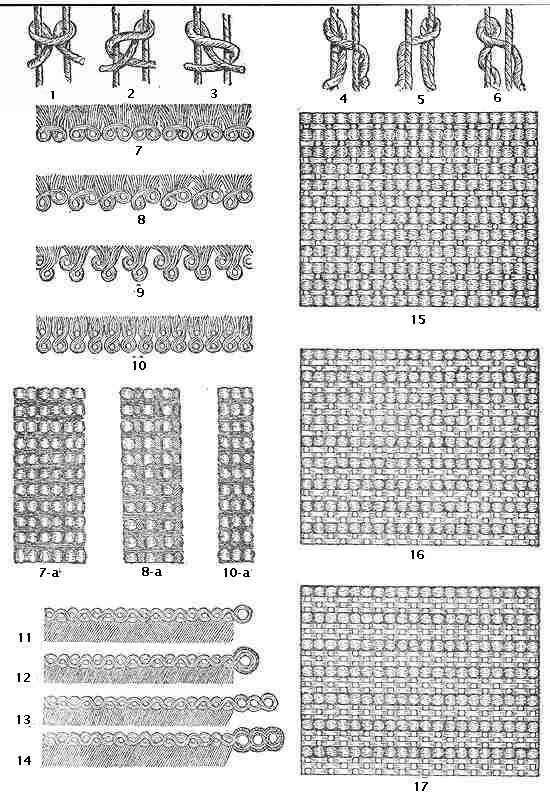
Plate
B.—Nos. 1, 2, 3, 7, 8, 9, Ghiordes knots. Nos. 4,
5, 6, 10, Sehna knots. No. 11, Weft-overcasting. No. 12,
Double-overcasting. No. 13, Weft-selvage. No. 14,
Double-selvage. Nos. 15, 16, 17, illustrate one, two, and three
threads of weft passing between two rows of knots.
The nice distinctions in the technique of
weaving are rarely understood even by those who are familiar with
Oriental rugs. The general pattern, which next to colour is the
characteristic that most quickly arrests the attention, is often
the sole guide by which novices guess the class. The more
experienced will observe if the knot be Ghiordes or Sehna, and
examine the finish at the sides and ends; but few give the
peculiarities of the weave the consideration they deserve. This,
perhaps, is because only those who have made a special study
would believe the constancy with which members of a tribe or
locality have followed the same method of tying the knot and
inserting the weft. The different methods of treatment by
separate tribes are sometimes only slight, but they afford a most
important clue for determining the place of origin of doubtful
classes. In fact, nearly every class has a typical weave
differentiating it from all other classes. To be sure, there are
exceptions to the established type which are inevitable; since,
for instance, a man from the Feraghan district might marry a
woman from the adjoining Hamadan district, who, to please her
husband, might weave a rug with pattern common to his district
but follow the style of weaving that she has been familiar with
from childhood. Nevertheless, weavers of a particular district
adhere more closely to a typical style of weaving than they do to
any other characteristic of a rug. Nor is this surprising, since
weaving is learned in earliest childhood; and as it contains no
elements calculated to stimulate the imagination, it is
mechanically followed with stereotyped precision. An innovation
in pattern, by copying some strange designs that strike the
fancy, is far more likely. These distinctions in weaving may be
conveniently divided into those that affect the knot, the warp,
and the weft.8
The Knot.—Not only may a knot
be tied as a Ghiordes or a Sehna knot, but it may have other
distinguishing peculiarities; as, for instance, it may be of fine
or coarse wool. This is most conveniently observed at the back,
where it will be seen that the knots of rugs such as the Bokhara,
Kirman, Joshaghan, and Bergamo are tied with fine yarn; while the
knots of other rugs, as the Samarkand, Bijar,
Gorevan, Kurdistan, Yuruk, and Kazak are tied with coarse yarn.
Whether the yarn be fine, medium, or coarse, all specimens of any
class will show a remarkable conformity. Also in some rugs the
knots are drawn very tight against the warp, while in others the
yarn encircles the warp loosely. Any one who has examined the
back of many Sarouks, Kashans, Kirmans, or Daghestans, and rubbed
the finger-nail against them, could not possibly mistake them for
a Shiraz, Kulah, Yuruk, or Karabagh, which are less tightly
woven. Again, as a result of using yarn in which the double
thread that forms two or more ply has been very loosely or very
tightly twisted together, there is some difference in the
direction or slant of the strands forming the yarn, where it
shows at the back, though this feature is not pronounced. For
example, in most Afghans, Yuruks, Bijars, and others the strands
of yarn where it crosses the warp in forming the knot lie for the
most part in a direction parallel to the weft; while in other
rugs, as Mosuls, Kurdistans, and Kazaks, the strands of yarn
slant irregularly. Furthermore, in some rugs, as the Melez and
Yuruks, as a result of the threads of yarn being strung rather
far apart, each half of a knot encircling a thread of warp stands
out at the back distinctly from the other with clear cut edges;
while in many rugs, as the Shiraz or Sehna, each half is very
closely pressed together. Also in some rugs, as Sarabends and
Afshars, each of these half knots where they show at the back
have the same length, measured in a direction parallel to the
warp, as width, measured in a direction parallel to the weft;
while in such rugs as the Kazaks, since the yarn generally
consists of several ply, the length exceeds the width; and in a
few rugs the length is less than the width.
The Warp.—The appearance of
the back of a rug is partly due to the relative positions of the
two threads of warp encircled by a knot. If, for instance, in any
Kazak a pin be thrust through the nap wherever a single
perpendicular line of one colour appears at the surface, it will
be seen that each of the two threads of warp encircled by a
single knot lie side by side with equal prominence. This is shown
in Plate B, Figs. 7 and 7a (Page 49), in which
the former represents a section of a rug cut transversely to the
threads of warp, and the latter the appearance of the rug at the
back. The same will be found true of Beluchistans, Feraghans,
Yuruks, and many others. If, however, a Kulah, Persian-Kurdish,
or Karabagh be similarly examined, it will be seen that one
thread of warp to each knot is depressed, so that the back
has a slightly corrugated appearance (as in Plate B, Figs. 8 and 8a). And in the case of a Bijar or
Sarouk it will be seen that one thread of warp, included in every
knot, has been doubled under so as to be entirely concealed from
view; with the result that the foundation of warp has a double
thickness, which makes the rug much stronger, as in Plate
B, Fig. 9, representing a Ghiordes knot, and
Fig. 10 representing a Sehna knot. To be sure, it occasionally
happens that in rugs of a particular class some may have each
thread of warp included in a knot equally prominent and others
may have one slightly depressed; or that in rugs of another class
some may have one thread of warp depressed and others may have it
entirely concealed; but as a rule these tribal features show a
remarkable constancy. These relative positions of the two threads
of warp encircled by a knot are partly due to the degree of
closeness with which the threads of warp are strung, also partly
to the method of inserting the threads of weft or
“filling” between the rows of knots; but more than
all else they are due to the way one end of the knots is pulled
when they are tied.
The Weft.—In the character
and arrangement of weft are technical differences that are more
serviceable than any other feature for distinguishing between the
rugs of different tribes and districts. So subtle are some of
them that they can be learned only by long and painstaking study,
and are appreciated by few except native weavers. Nevertheless,
to any one who will carefully examine almost any well-known
classes, it will be apparent that these differences in the weave
are real, and that they are sufficiently constant to
differentiate one class from another. The fine brown weft of the
Bokhara, or equally fine bluish weft of a Sarouk that is almost
concealed between firmly tied knots; the fine thread of cotton
weft passing but once between two rows of knots and covered only
by the transverse warp of the Sehna; the coarse thread of cotton
weft similarly passing but once between two rows of knots in the
Hamadan; the coarse thread of cotton weft that once crossing and
recrossing appears irregularly between appressed rows of knots in
Kermanshahs; the bead-like appearance of the threads of weft
that, as a rule, pass many times between two rows of knots in
Genghas; the crudely spun weft of coarse diameter crossing and
recrossing once between the rows of knots in modern Mosuls; the
very fine reddish brown weft that entirely conceals from view the
warp in old Bergamos, —are features peculiar to these
separate classes with which every rug expert is familiar.
The weft of many other classes is equally distinctive, though
there are exceptions to the types. It should be remembered,
however, that the weave of many rugs woven over a hundred and
fifty years ago is different from the weave of rugs woven only
fifty years ago; and that many modern pieces cheaply made for
commercial purposes are more crudely woven than were the same
classes thirty years ago.
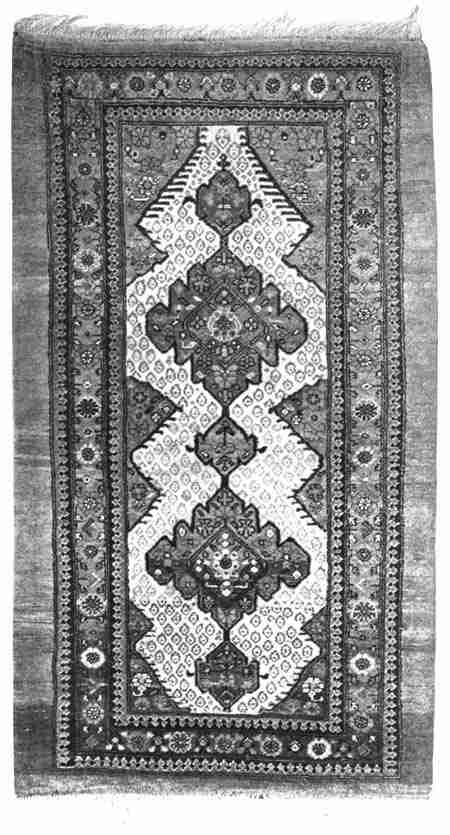
Plate 8. Hamadan
Rug
These distinctions in the weft relate to the material of which
it is made, its colour, the size of the diameter, the way in
which it is spun, to its loose or compressed condition between
separate rows of knots, as well as to the number of times it
crosses the warp between them, and to whether it is inserted with
much or little slack. Most rugs are woven with woollen weft of a
natural colour, but occasionally it has a reddish brown, a blue,
or a yellow tint. When cotton, jute, or hemp are used, they are
almost invariably of natural colour; only in a very few pieces,
as some of the Kulahs, are both wool and jute ever used in the
same piece. The weft of some classes, as Bokharas, Sarouks, and
Bergamos, is of a very small diameter, and of others, as the
Hamadans and Kurdistans, it is of relatively large diameter. In
some classes, as the Karajes and Genghas, the weft is tightly
spun like twine; while in the Beluchistans, Mosuls, and
Kurdistans it is loosely spun, so that the projecting fibres of
wool give a rough appearance to its surface.
Also the weavers of some districts invariably compress very
firmly the yarn of weft between every two rows of knots, while
other weavers compress it only to a slight degree; as, for
instance, in the Afghan, Tabriz, and Kirman the rows of knots are
pressed down so firmly that the weft is almost concealed at the
back and the transverse threads of warp are entirely covered;
whilst, on the other hand, in the Karabagh or Kazak between every
two rows of knots the weft and part of the transverse threads of
warp are exposed to view. According as the rows of knots are
pressed down upon the threads of weft or not, one of the two
halves of each separate knot, as shown at the back, may extend
slightly or very much beyond the other in the direction of the
length of the rug, or each of them may lie in a straight line at
right angles to the warp. Comparing Kazak, Kutais, and Tiflis
rugs, for example, it will be noticed that as a rule the line
thus formed in Tiflis rugs is nearly an even, clear cut line at
right angles to the warp, that in the Kutais part of one knot
extends beyond the other, while in Kazaks this unevenness is even
more conspicuous. Or again, if typical
Shirvans, Kabistans, and Daghestans be compared, it will be
noticed that in Shirvans the half-knots, or parts of the knot
encircling the two adjacent threads of warp, are often inclined
at an angle of at least thirty degrees to the line of weft so as
to present a serrated appearance, but that the alignment formed
by knots of Daghestans is nearly even, and that of Kabistans is
intermediate. To be sure, there are exceptions to this rule, but
these features are remarkably constant.
The number of times that a thread of weft is inserted between
two rows of knots varies with the practice of different
localities, but is almost constant in each locality. Weavers of
Sehna rugs insert only a single thread of weft between every two
rows of knots, which winds in front of and behind alternate
threads of warp, with the result that the back of these rugs have
a checkered or quincunx appearance, caused by minute portions of
exposed warp and weft crossing each other at right angles. In
Hamadans a much heavier thread of weft passes only once before
and behind alternate threads of warp, so that the appearance of
the weave is very similar to that of Sehnas.9
In almost all other rugs the weft crosses twice, that is, across
and back once, between every two rows of knots so as to
completely encircle each thread of warp. The weave of a few rugs,
as some Anatolians, shows the weft crossing three times, that is,
twice in one direction and once in the opposite direction. In the
Genghas, Tcherkess, Bergamos, and in many rugs over one hundred
and fifty years old, the threads of weft frequently cross many
times; and it is not unusual for the number to vary in different
parts of the same rug. In Plate B, Figs. 15,
16, and 17 (Page 49), is illustrated the appearance of the back
of rugs in which a thread of weft crosses once, twice, and three
times between two adjacent rows of knots. There are likewise rugs
in which the number varies with methodical regularity; for
instance, in Khorassans it is usual to find an extra thread of
weft inserted at intervals of every few rows of knots; in many
Herats the threads of weft cross twice between several successive
rows of knots, then three times between the following several
rows, and so continue to alternate; and in some of the Kulahs a
thread of woollen weft that crosses twice alternates with a
single coarser thread of jute.
As the shuttle passes back and forth, the
thread of weft may be allowed considerable slack, so that when it
is pressed down by the comb it will fit about the sides of the
warp; or it may be drawn tightly across, so that it has a
tendency to displace the threads of warp. If, for instance, a
Hamadan and one of the Feraghans which, unlike the majority of
them, has only one thread of weft crossing between the rows of
knots, be examined, it will be seen that in the Hamadan the weft
crosses with hardly any slack, so that the warp stands out
clearly and well defined at the back; but that in the Feraghan
the weft crosses with much slack, so that it folds about the
warp, which accordingly seems slightly imbedded in it at the
back. In some rugs the weft is passed across once with very
slight slack, and as it recrosses it is allowed much slack. These
features of the weave, which are followed with remarkable
constancy in the same class, can be observed to advantage in a
fragment of a rug cut transversely to the direction of the warp.
If, for instance, the weft which crosses and recrosses between
the rows of knots be carefully removed so as not to disturb its
mould, it will be noticed in the case of many rugs that each
thread of yarn has a similar shape of moderately deep
undulations, which show how it conformed to the warp and indicate
how slack it was when inserted. In the case of a few rugs, as the
Luristans, each thread will likewise have similar undulations,
but they will be very prominent. If, on the other hand, the weft
be removed from some classes, as the Tabriz, Sarouk, and Kashan,
one of the two threads will be almost straight or have slight
undulations, while the other thread will have deep undulations.
The weft of the Herez, Herats, old Khorassans, and Koniehs have
the same peculiarities, excepting that the thread with very
slight undulations is of three or four ply, while the other is of
a single ply.
The only instruments employed in weaving are the knife, comb,
and scissors. The first is used, after each row of knots has been
tied, to cut the ends of yarn to nearly the proper length; the
second, to press firmly each row of knots; and the last, to trim
the nap with care, so that the finished product may present an
even and compact appearance.
Finish of Sides.—As the sides
are constantly exposed to wear weavers of different districts
strengthen them in different ways, which may be designated as
Weft Overcasting, Double Overcasting, Weft Selvage, Double
Selvage, and Added Selvage. Each of these terms, though not
euphonious, suggests the method employed. In Weft
Overcasting (Plate B, Fig. 11, Page 49) the
thread of weft, after encircling the threads of warp to which the
knots are tied, is wound about a much heavier cord that is strung
at the side of the rug for a space equal to the thickness of the
knots. It then partly encircles the threads of warp between the
next two rows of knots as it passes to the other side, when it is
wound about the heavy cord there. As this process continues, the
cords at the sides are completely overcast with the thread of
weft. When the sides have a Double Overcasting (Plate B, Fig. 12), heavy yarn is wound about the cord that
has previously been encircled by the weft. Frequently several
threads of yarn take the place of a single heavy cord. Weft
Selvage (Plate B, Fig. 13) is made by placing
two or more heavy cords instead of a single one at the side of
the warp, and encircling them by the weft in figure-eight
fashion. As they extend beyond the rows of knots they form a
plain flat selvage. The Double Selvage (Plate B, Fig. 14) is used among nomadic tribes such as the
Beluches and Afghans, whose rugs receive an unusual amount of
hard wear, so that an extra selvage is necessary. In adding this
extra selvage the threads of weft are carried about the heavy
cords, as in weft selvage, and then the extra yarn is wound over
it in figure-eight fashion so as again to encircle the heavy
cords. In Added Selvage the heavy cords are not encircled by the
weft, but are attached to the side of the rug by the extra yarn
that winds about them figure-eight fashion, and also encircles
two or more adjoining threads of warp. Sometimes also the selvage
is “Mixed,” or made by the weft encircling only one
or two of the heavy cords, and then an extra yarn is wound about
these and the remaining cord or cords. Moreover, the Double
Overcasting and Double Selvage may be “attached” more
firmly to the sides of the rug by the yarn passing in
figure-eight fashion about the adjacent thread or threads of warp
between the two rows of knots. When a Double Overcasting is thus
“attached,” it is somewhat similar to a two-cord
Double Selvage.
These are the principal methods of finishing the sides, though
they are sometimes modified by tribal customs. Simple as they
seem, skill is required in both overcasting and making the
selvage; for if carelessly done the sides are frequently made to
curl. This is occasionally found to be the defect of old rugs,
the worn sides of which have been recently overcast by
inexperienced weavers. When such is the case, removing the
stitches and overcasting with more care will remove the
defect.
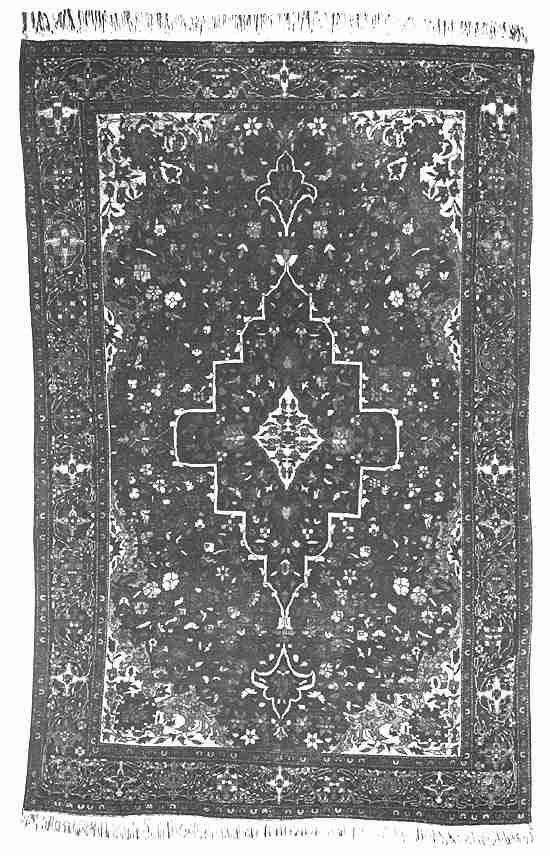
Plate 9. Sarouk
Rug
Finish of
Ends.—The ends, which receive more attention than
the sides, are treated in several different ways; and in many
rugs a distinction exists between the treatment of each end. The
simplest finish is where the warp and weft are woven like the
threads of a kilim, and extend beyond the pile as a web, which
may be exceedingly short, or, as in Beluches and Afghans, several
inches long. Frequently the ends are finished by a selvage formed
by cords heavier than the weft braided into the warp; or the
upper end may be doubled back and hemmed. It is not unusual to
find both web and selvage; but though the finish be web, selvage,
or web and selvage, the warp of the end finished last generally
forms a fringe, and often each end will have a fringe. Sometimes
each separate thread of warp hangs loose; sometimes a number a
foot or more in length are twisted together in cords; and again
they are knotted or are tied to one another diagonally so as to
form a network from which hang the loose ends. Very frequently
the loops formed by the warp that encircled the rod extend beyond
the web at the lower end of the rug, or else are braided about
the ultimate thread of weft in the web. Though the warp and weft
are generally undyed in the body of the rug, the web of the ends
is very frequently coloured. Some of the webs, particularly those
of the Beluches, are embroidered; and through others, as the
Kurdistans, a parti-coloured cord runs transversely; still
others, as Bergamos, are adorned with shells, beads, or other
articles to avert the evil eye.
In the study of rugs it should be remembered that the effect
of rough usage is so considerable that in old pieces the webs of
the ends have frequently disappeared, leaving short fringes
composed of the ends of warp from which some rows of knots have
been removed, and that recent overcasting of the sides may take
the place of former selvage.
The many characteristics of knot, warp, weft, sides, and ends,
with all the variations made by innumerable tribes, remarkably
constant in their methods, are technical peculiarities that are
uninteresting to those who feel only an aesthetic interest in
rugs, yet they demand the most careful consideration of whoever
would learn to differentiate accurately between the many classes.
Though admitting of exceptions, these peculiarities are real and
definite, yet their analyses often require the subtlest
perception of small though exact distinctions, without which
expert understanding would be impossible.
OWEVER well woven, however resplendent in rich
modulations of colour, Oriental rugs would quickly lose their
fascination if in patterns and designs there were not at least
some partial expression of the simple lives of the people, of
their religious feelings, and of that veiled mysticism which
pervades the thought of every Eastern race.
In all nomadic rugs as well as in many others are innumerable
reminders of common life. It may be only crude outlines of the
goat or camel, or realistically drawn rose and lily; but even
these are suggestive of associations.
Religion, too, exercised on the character of rugs an important
influence, which is expressed in the symbolism of both designs
and colour. Without a doubt, some of these well-known designs
have been transmitted from the earliest times, and were once
associated with different forms of idolatry. Thus, among the old
Babylonians the sun and moon, which are sometimes seen in the old
pieces, represented particular deities; and very many of the
oldest Chinese rugs that remain also contain symbols of their
deities. In the early religion of Iran, which over 1000 years
b.c. was reduced to a system by
Zoroaster, the elements were worshipped, so that designs
representing these elements would likewise represent the divine
forces they personified. This ancient fire worship of the
Parsees, which even to-day has a few devotees in parts of Persia,
and the kindred sun worship have added much to the symbolism of
Oriental rugs. Buddhism also has contributed its share; and with
the spread of Mohammedanism appeared a Saracenic influence that
is frequently recognised. Even the two great sects of Mohammedan
followers, the Shiites and Sunnites, have had distinct effects in
the use of designs, as the former employed animal figures and the
latter prohibited them.
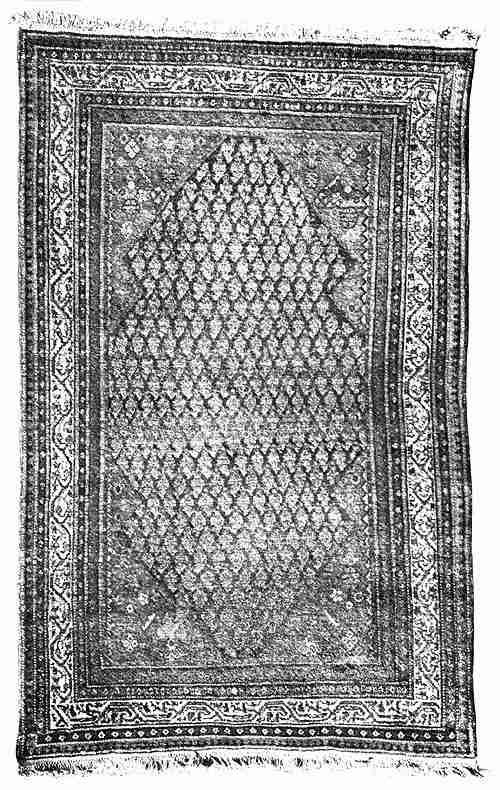
Plate 10. Sarabend
Rug
There was, moreover, a symbolism that in a
manner expressed the vague philosophic teachings of the ancient
races. It was but natural that the early weaver engaged in
tedious sedentary work, often requiring many months of constant
application to complete, should endeavour to express therein not
only artistic taste, but also the spirit of his innermost
thoughts. So as he wove he sometimes left the result, though
poorly defined and little understood to-day, of that struggle to
interpret the great mysteries of the visible and unseen universe,
from which arose the crude beginnings of philosophy.10
The patterns, however, of many Oriental rugs are chiefly
decorative. Even a casual examination shows that in all of them
the coloured knots of the surface represent a border surrounding
a central field. The former serves much the same function to the
latter as a frame to a picture; yet its office is in no wise
subordinate. Nor is there any part of the pattern more useful in
determining the place of its origin. For this reason it is well
to clearly define the special names which in this work are
applied to its different parts. The lineal divisions are
designated “Stripes,” though they are frequently
spoken of as separate borders. At or near the centre of the
border is the main stripe, which is generally accompanied by a
much narrower pair, one on each side, known as “Guard
stripes.” Very narrow stripes are sometimes called
“Ribbon stripes,” and those of only one or two knots
in width are called “Lines.” The latter are of solid
colour or have the simplest geometric device. The decoration of
the ribbon stripes is also necessarily simple; but in the main
stripe of artistic rugs the patterns are often exceedingly
elaborate, of exquisite colours, and co-ordinate in character
with those of the field.
The fields display even greater diversity of pattern than the
borders. Frequently they are covered with
a heterogeneous mass of detached and unrelated figures, as in
many of the nomadic rugs; or, on the other hand, are entirely
covered with repetitive patterns, as in the Turkomans; or with
intricate and correlated designs, as in the diaper and floral
patterns of so many of the Persian and Indian rugs. Others
consist of a background of solid colour on which appear isolated
formal designs, as in some of the Khorassans, or medallions on
which are represented smaller figures, as in some of the old
Sehnas and Feraghans. Occasionally the medallions are so large as
to extend to the sides and ends of the fields, and thus separate
the corners into nearly triangular shaped sections, such as are
characteristic of a number of Persian and one or two Caucasian
rugs. In a few of the latter, also, the fields are covered with
large geometric figures suggesting the medallions. It is only
within comparatively modern times that weavers have used solid
colours for large portions of the fields. The intent no doubt was
a saving in labour and pains, but the effect is frequently most
gratifying; as when, for instance, the space beneath the arch of
Asia Minor prayer rugs is of a uniform red, blue, or cream,
relieved only by a gracefully suspended lamp, the tree of life,
or some other emblem of immortality.
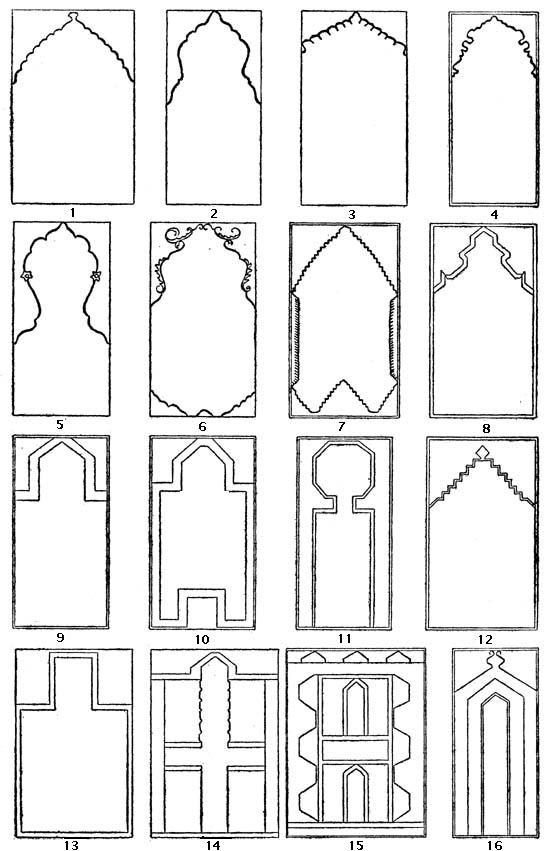
Plate C.—Prayer
Arches of Persian, Caucasian, and Central Asiatic
Rugs
No. 1, Antique silk. No. 2, Kermanshah. No.
3, Khorassan. No. 4, Sarouk. No. 5, Persian, XVI Century. No.
6, Kashan. No. 7, Feraghan. No. 8, Shiraz. No. 9, Daghestan,
Kabistan, Shirvan, Chichi, Kazak, Karabagh. No. 10, Kazak. No.
11, Shirvan. No. 12, Karabagh (not usual). No. 13, Beluchistan.
No. 14, Bokhara, Tekke. No. 15, Khiva. No. 16, Beshire.
The patterns of prayer rugs are not only pleasing, but have a
peculiar importance, as weavers of certain sections of the
country adhere so strictly to time-honoured traditions that the
shape of the arch, or mihrab, which is the principal feature,
often denotes the class, as well as the group, to which they
belong. Some of these arches are illustrated in Plates C and D (Pages 61 and 63), from which
it will be seen that in Persian rugs they are formed by
gracefully curving lines, but that in rugs of other groups, with
the exception of a very few old Ghiordes pieces, they are
geometric. The peculiarities of the arches of the several
classes, also, are observable; as those of the Beluchistans,
which are rectilinear and relatively high, and those of the
Bokharas, which are tent-shaped, flat, and small. In the
Caucasian group they have a marked resemblance to one another and
also to those of the Turkoman rugs, but are larger than the
latter. Again, the arch of almost all Asia Minor rugs rises
higher than those of any others, excepting the Persian, and
extends from one side of the field to the other. In many of them
a panel is placed above the spandrel, and occasionally a second
panel is placed beneath the field. Above the niche of some Asia
Minor and Caucasian prayer rugs is woven a small rhomboidal
figure, where the suppliant plants the pebble or bit of earth
that he has brought from Mecca; and at the sides of a few arches
are crude figures, where are placed the hands during the act of
worship. More than one arch is the exception; but now and then
are seen two and even four, one above the other, or several
parallel to one another. These and other special features
associated with prayer rugs will be considered more fully in
subsequent chapters.
The smaller designs that appear in rugs and compose the
general pattern are distinguished as geometric and floral
ornamentation. The former is adopted in those countries where the
population is principally nomadic; and the latter is the accepted
style in countries where exist numerous towns and cities in which
the arts have been cultivated and where a large percentage of the
population have enjoyed an advanced state of society. Thus in
Caucasia, Turkestan, Afghanistan, and Beluchistan geometric
designs are characteristic of the rugs; but in China, India,
Persia, and part of Asia Minor floral designs prevail. Sir George
Birdwood, an eminent authority on Oriental rugs, has made the
statement that the geometric designs are found among the lower
Turanian and the floral among the higher Aryan. But it seems most
probable that the adoption of the geometric or floral style of
ornamentation is due not so much to racial distinctions as to the
state to which the textile art had advanced among the different
peoples and to the waves of influence that at times spread over
the countries. Thus the early rugs of Asia Minor had patterns
that were more geometric than those of later times, and during
the period when the Mongols ruled in Persia geometric patterns
were more frequently employed in the rugs of that country than
subsequently.
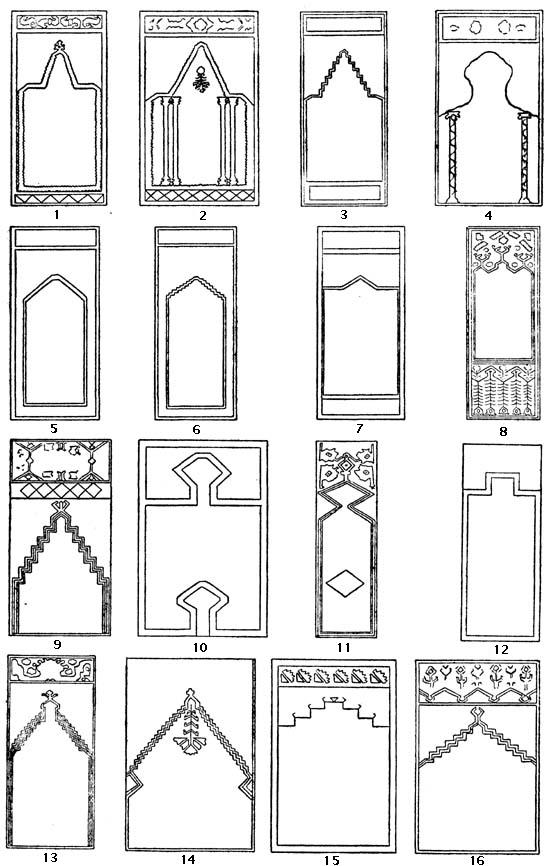
Plate D.—Prayer
Arches of Asia Minor Rugs
Nos. 1, 2, 3, 4, Ghiordes. Nos. 5, 6, 7,
Kulah. No. 8, Ladik. Nos. 9, 10, Bergamo. Nos. 11, 12, Melez.
No. 13, Kir-shehr, Mudjar. Nos. 14, 15, Konieh. No. 16,
Anatolian.
In all rugs, however, some trace of the floral design appears.
Even in the Turkoman weavings, the pattern of which is strictly
geometric, some vestige of the tree of life is manifest. In the
fields of Caucasian rugs, in which are represented squares,
octagons, triangles, diagonals, lozenges, stars, etc., the
weavers have depicted designs that are almost as geometric as
those of the Turkoman rugs by which they have been influenced;
but, on the other hand, large numbers of the border designs are
distinctly floral. In the rugs of China and Asia Minor are found
both geometric and floral ornamentation, the latter predominating
in pieces woven during the last two centuries, and the former in
those of earlier date. Among > the woven fabrics of India
and Persia, however, few traces of the geometric pattern remain;
but vines, leaves, and flowers form the favourite theme for
decoration.
The floral patterns are the result of many centuries of
growth, that reached its highest development in the Persian
carpets of the XVI and XVII Centuries; and since then till the
present time they have continued as the most characteristic
features of the rugs of that country and India. They represent
the highest technique of the weaver. In the borders are generally
represented vines from which are pendant rosettes, palmettes, or
flowers; and in the fields, particularly those of the fine
antique rugs, are a profusion of floral forms realistically
portrayed. On long, gracefully twining and intertwining stems is
often the rose, pink, violet, lotus, crocus, narcissus, or daisy.
But if the rug is more modern, in its field of uniform colour may
be represented a central medallion covered with delicate tracings
enriched by bright-coloured conventionalised flowers.
In the general pattern of all rugs are interwoven particular
designs or motives that give them a distinctive character and
render the greatest assistance in distinguishing the groups and
classes. Thus the serrated leaf and wine cup (Plate I, Fig. 1, opp. Page 226) is found only in Caucasian
and old Armenian rugs; and the design represented in Plate
H, Fig. 10 (opp. Page 194), suggestive of some
Chinese character, is found almost exclusively in Kulahs. Not
only are all designs important as aids in classification, but
they have a special interest, as it is maintained by writers of
the highest authority that when employed by the earliest weavers
each had a symbolic meaning. To be sure, the origin of many has
been lost in the remote past and is unknown even to those who now
employ them; but others still represent definite ideas, as they
did centuries ago, and portray to some extent the thought of the
weaver. They therefore deserve the most careful study.
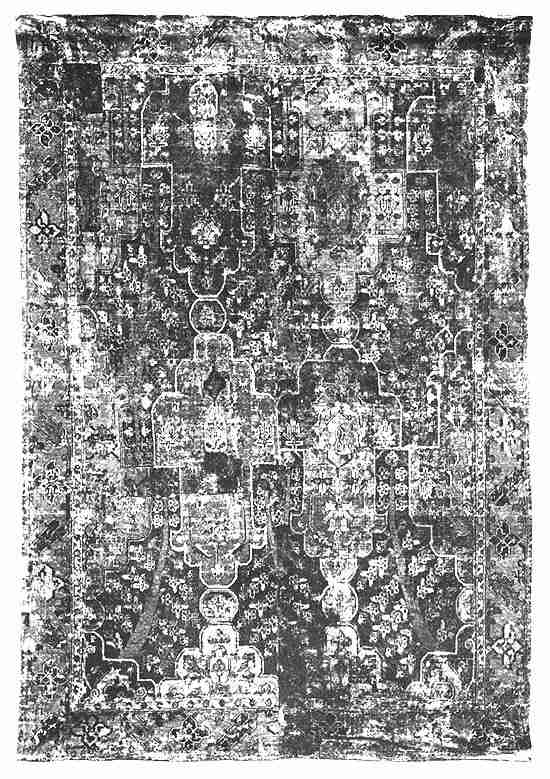
Plate 11. Carpet from
Northwestern Persia
Loaned by C. F. Williams, Esq., to the
Metropolitan Museum of Art, New York
Few of these designs have been transmitted from a more remote
past or have been more universally employed than has been the
figure  or
or  . It appears in
each of the groups of Oriental rugs excepting the Chinese; and
two of the forms it assumes are exceedingly like the arms of the
swastika and parts of the fret as occasionally seen in Chinese
designs. In Indian rugs it is rarely found except in the borders,
which may have been copied from those of other countries. It is
very commonly seen in the Beluchistans, Tekkes, and
Beshires, of the Central Asiatic group; and in the rugs of the
Persian group that show nomadic influences. There is probably not
a single class of the Caucasian group, nor any of the Asia Minor
group, with the exception of the old Ghiordes, in which it is not
sometimes represented. It may be seen near the corner of the Asia
Minor “Dragon and Phœnix” carpet of the XIV
Century, illustrated in Plate 20 (opp. Page
88); and appears in some of the old Armenian carpets, which are
believed to be even older. That it was associated with sun
worship and regarded as an emblem of light and the deity is the
accepted belief. It is possible, however, that it was intended by
some weavers to represent the serpent, which among many different
races is emblematic of superhuman knowledge.
. It appears in
each of the groups of Oriental rugs excepting the Chinese; and
two of the forms it assumes are exceedingly like the arms of the
swastika and parts of the fret as occasionally seen in Chinese
designs. In Indian rugs it is rarely found except in the borders,
which may have been copied from those of other countries. It is
very commonly seen in the Beluchistans, Tekkes, and
Beshires, of the Central Asiatic group; and in the rugs of the
Persian group that show nomadic influences. There is probably not
a single class of the Caucasian group, nor any of the Asia Minor
group, with the exception of the old Ghiordes, in which it is not
sometimes represented. It may be seen near the corner of the Asia
Minor “Dragon and Phœnix” carpet of the XIV
Century, illustrated in Plate 20 (opp. Page
88); and appears in some of the old Armenian carpets, which are
believed to be even older. That it was associated with sun
worship and regarded as an emblem of light and the deity is the
accepted belief. It is possible, however, that it was intended by
some weavers to represent the serpent, which among many different
races is emblematic of superhuman knowledge.
Probably no other design has been more universally employed
than the swastika, which appears in the textile fabrics of North
American Indians, on the Maya ruins of Yucatan, among the
monuments of the Nile, and on the temples of India. Widely as is
its distribution, its most usual form of intersecting right
angles is found in each of these countries. It is not improbable
that it originated in China, where it is a most common decorative
motive, and was almost invariably represented in the borders and
in many of the medallions of rugs woven before the beginning of
the XVIII Century. It is also very frequently seen in the rugs of
Samarkand, and occasionally in those of Caucasia. It seldom
appears in the rugs of Persia, Asia Minor, or Turkestan. The
universality of the design indicates its great antiquity, yet its
primitive symbolic meaning of abundance, fertility, and
prosperity has never been lost. Some of its different forms are
shown in Plate O, Figs. 5a, 5b, 5c, 5d, 5e, and
5f (Page 291).
The reciprocal trefoil (Plate F, Fig. 17,
opp. Page 158) is a very usual design in Caucasian and Persian
rugs; it is often found in some of the rugs of India and in
Beluchistans, but is very rarely seen in other classes of the
Central Asiatic or in the Chinese and Asia Minor groups. Its
origin is uncertain, but since it appears in the “Polish
Carpets” and other antique Persian carpets of strictly
floral pattern, where its drawing is more elaborate than in
modern rugs, it is not improbable that it is the conventionalised
form of the lily or a spray bearing three leaves, and that it has
the emblematic significance of the tree form.
Among all primitive races the sun, moon, and stars have been
associated with their religion, so that it is surprising that so
few emblems of them are recognised in rugs.
In the theology of the Chaldees, from which the earliest weavers
must have received inspiration, the sun was regarded as one of
their principal deities and the moon as another. The sun is
generally represented by a plain circle, a circle with diameters
intersecting at right angles, or a circle with small ovals
intersecting at right angles; the moon is represented by the
crescent. Of much more frequent occurrence is the eight-pointed
star, another inheritance of those ancient times when all
primitive races worshipped the heavenly bodies. It represented
the female principle of the Chaldean sun god; and it is believed,
too, that it represented the deity to the Medes, ancestors of
many of the present Persians. There is a tradition among some
Eastern races that King Solomon wore a ring of diamonds arranged
in the form of an eight-pointed star, and also a crown containing
a large star of which the eight points and centre were composed
of precious stones of different colour. A star now and then seen
in rugs with colours so arranged is known as
“Mohammedan’s jewel design.” The six-pointed
star, a Jewish symbol for the “shield of David,” was
adopted as a talisman by some of the Moslems. All of these stars
are chiefly nomadic symbols, they rarely if ever are seen in the
rugs of China or India, they are only occasionally found in those
of Persia, and are of most frequent occurrence in the Caucasian
pieces.
Another design is an octagonal-shaped disc (Plate O, Fig. 10, Page 291), usually about two and a half
inches in diameter, on the face of which and extending the full
width are figures somewhat like hour-glasses placed at right
angles to one another. It seems not improbable that it is of the
same origin as the large designs that appear in the field of the
Holbein rug of the XV Century, illustrated in Plate 21 (opp. Page 92). It is a very old motive, and is
sometimes regarded as a dial symbolising the diurnal motion of
the earth. It is of very frequent occurrence in nomadic rugs; and
is found in Beluchistans, in nearly all Caucasians, in some rugs
from Asia Minor, and in only a very few from Persia.
The zigzag line, known as the water motive, is found in many
of the rugs of China, India, Persia, Caucasia, and Asia Minor, as
well as in the Beluchistans and Beshires of the Central Asiatic
group, though in some instances it appears as little more than a
serrated line. It is represented in the narrow guard-stripes of
some of the Western Asia Minor carpets of the XV Century.
According to Mr. John Mumford, “even in the oldest
Egyptian symbolism a zigzag line stood for water and by
implication for eternity; and a succession of these arranged to
represent the sea has long been a recognised carpet design in
India, China, and Persia.”
Long before the commercial instinct had been felt among the
weavers of the Orient, one or more of them dwelling in the
Mesopotamian valley tied the knots of this old Mosul. The central
field is of camel’s hair that shades from a rich dark
chestnut at one end to lighter tones at the other, and is
enlivened by bright flowers representing those found on the
river’s banks. This variation of ground colour, the small
geometric designs at the extreme ends of the fields, the
eight-pointed stars of the main stripe of the border, and some of
the drawing are nomadic characteristics. The dainty vine and
flower of the narrow guard stripes, on the other hand, show
Persian influence. This piece represents a type of which few now
remain.
Property of the Author
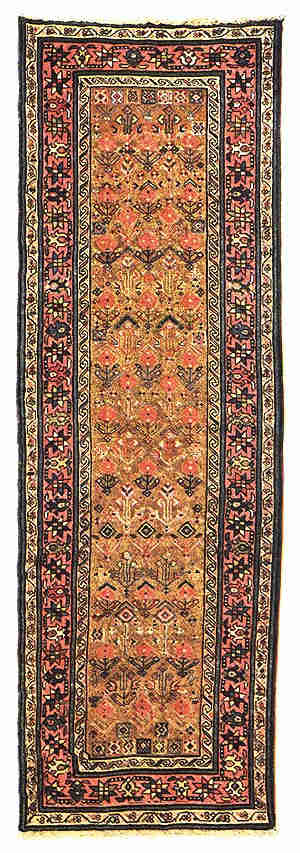
One of the most common designs is what has been called the
“latch-hook.” When there is a long succession of
latch-hooks with the straight ends resting on a line and the
hooked ends inclined in the same direction, as in Plate K, Fig. 20 (opp. Page 230), they are called
“running latch-hooks.” Since they appear in the
Dragon and Phœnix rug (opp. Page 88), that was probably
woven about the end of the XIV Century, they are evidently a very
old design, which not improbably was derived from the Chinese
fret. The hook is of different shapes, and is sometimes
perpendicular, sometimes inclined. Its particular function is to
shade or subdue the harsh effect of a sudden transition from one
colour to another that is entirely different. As such a device is
unnecessary in artistic rugs of intricate designs, it is rarely
seen in any Indian or Persian piece, excepting the modern Shiraz
that frequently adopts geometric patterns; but it is found in all
the rugs of Caucasia, Central Asia, and in most of those of Asia
Minor. It is in fact as universal as the reciprocal trefoil.
In rugs of geometric patterns are occasionally found both
Greek and Roman crosses. The latter are represented in most of
the Soumak rugs, and appear profusely in old Asia Minor or
Armenian rugs, in which they were probably woven with the intent
to convey a religious significance; but in many instances crosses
are not used symbolically.
The design of a comb (Plate O, Fig. 11, Page
291) is a Mohammedan emblem suggestive of cleanliness, yet it is
not improbable that it is sometimes intended to represent the
instrument employed in pressing the threads of weft closely
against the knots. It is found mostly in Caucasian rugs, and
rarely in those of other groups.
In a large number of the finest carpets woven in Persia three
or four centuries ago was represented what is known as the
Chinese cloud-band (Plate O, Fig. 7). It
appeared in Persia about the middle of the XV Century, and was
conspicuous in the carpets of Herat, Tabriz, and Gilan, as well
as in many of the “Polish Carpets.” Later it was
introduced into Asia Minor, but was never represented in any of
the strictly nomadic weavings. It appears in only a very few of
the modern rugs, and these are mostly Persian. Nor is
it recognised in its usual form in any of
the Chinese rugs that now exist; though without a doubt it
originated with the Chinese, since their early mythology placed
the abode of the Supreme Ruler in the Constellation of Ursa
Major, of which the stars of the Big Dipper were represented in
early art as enveloped in a band of clouds; but in more
conventionalised ornamentation the stars are omitted and the band
remains. As a motive, then, it is symbolic of heaven and the
deity.
In almost all rugs are found expressions of vegetable life, as
a twig, vine, flower, or tree. Sometimes they are most
naturalistic, again they are partly conventionalised, or so
disguised, as in nomadic rugs of geometric designs, that only by
study and comparison of many forms in a series can their origin
be established. This universal adoption of floral form was due to
something more than an aesthetic love for the beautiful, since in
every country of the East some part of the tree or plant was
emblematic. Moreover, a tree form known as the Tree of Life had a
religious significance among many races. The Jews were told that
in the Garden of Eden grew the “Tree of Knowledge of Good
and Evil;” and in the Book of Revelation the Apostle John
speaks of “The Tree of Life which bore twelve manner of
fruits and yielded her fruit every month, and the leaves of the
tree were for the healing of the nations.” From this
passage may have been borrowed the belief of the Mohammedans in
the Tree of Life which grew in Paradise, and spread its branches
that true believers might rest beneath them and enjoy its fruits
and the companionship of beautiful houri. In the ancient lore of
China is the Taoist tradition of the Tree of Life, growing by the
Sea of Jade, that confers immortality on the fortunate who may
gather and eat its fruits; also the tradition of the mountain top
where grows the sacred tree on which the elect may climb and
mount to heaven. Even among the ancient Chaldees was a story of a
tree that grew to heaven and sheltered the earth. In different
countries the Tree of Life is represented by different kinds; in
Yarkand of Eastern Turkestan it takes the form of a cedar; in
Persia it is generally the cypress. Wherever employed it is
symbolic of knowledge, resurrection, immortality.
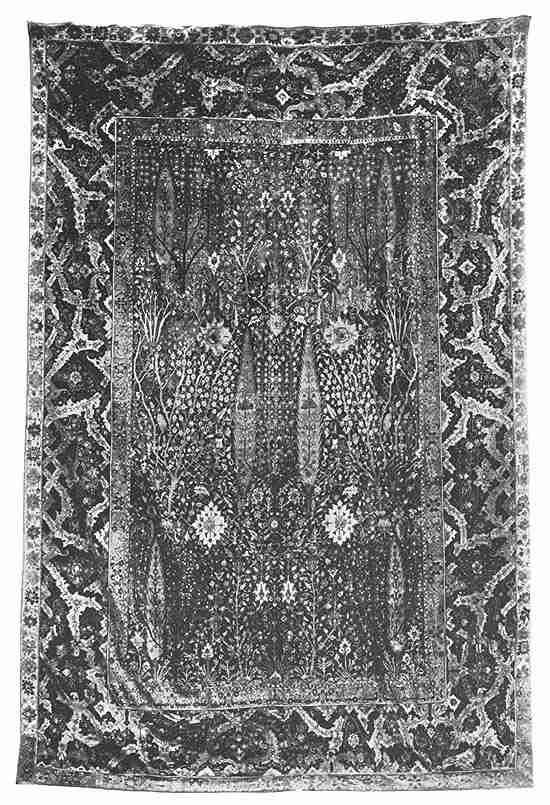
Plate 12. Carpet from
Northwestern Persia
Loaned by C. F. Williams, Esq., to the
Metropolitan Museum of Art, New York
No other form of vegetable life was so universally employed in
Oriental symbolism as the lotus flower (Plate O, Figs. 16a, b, and c), since the Egyptian, Assyrian,
Indian, Chinese, and Persian alike did it reverence. It was,
perhaps, first employed emblematically in the
valley of the Nile, but later it was held in high esteem by the
inhabitants of India where the floating blossom is regarded as an
emblem of the world. It was inseparately associated with Buddha,
and its religious significance must have extended with the spread
of Buddhism. Professor Goodyear regards a large number of designs
that apparently are not related in form as derived from it
through a long series of evolutions. During the highest
development of the textile art in Persia it appears most
realistically drawn in a large number of the carpets, especially
the so-called Ispahans, or Herats, and the so-called Polish. It
is also most artistically represented in the fabrics of India,
and is a favourite design for Chinese weavers. But in other
modern rugs it is seldom used as a motive, and is so
conventionalised as often to escape notice.
If the lotus was the first flower to be represented in early
woven fabrics, as seems not improbable, several others have met
with greater favour among modern weavers. Of these the rose,
which is cultivated extensively in the gardens of the East,
appears in a large number of the rugs of Persia and Asia Minor.
Moreover, a pattern frequently seen in many old Persian rugs is
an all-over pattern of small bushes with flowering roses. Almost
equally popular is the lily, which is characteristic of many of
the rugs of India and of a few of Western Asia Minor. The
“Euphrates flower,” which grows by the river banks of
the Mesopotamian valley, is also occasionally found as an
all-over pattern in some of the rugs of Western Iran and Southern
Caucasia. Less frequently seen and still less frequently
recognised, as they are generally woven in small figures, are the
daisy, anemone, crocus, narcissus, pink, and violet. All are
depicted chiefly on account of their associations and beauty, and
whatever emblematic meaning they are intended to convey is
generally no more than that of their colours. There are, however,
in a few old Persian carpets designs of sunflowers, which were
accepted by the Zoroastrians and the earlier sun and fire
worshippers as symbols of the sun and emblems of light.
Of the fruits of the earth none is more highly esteemed than
the pomegranate, which was sculptured in temples of Mesopotamia
and embroidered on the robes of Assyrian and Jewish priests. In
the days of King Solomon it was cultivated in Palestine, where
the Israelites, like modern Persians, made a sherbet by mixing
its juice with sugar and spices. At the time of Homer it was
cultivated in Phrygia. Now it grows wild over vast tracts of
Syria, Persia, and Asia Minor. Yet it rarely appears
conspicuously in any woven fabrics excepting the Ladik prayer
rugs, in which it is invariably seen. Since the weavers of these,
whether Christian or Moslem, would probably be familiar with many
of the old Jewish and Assyrian rites, it is not unlikely that it
refers emblematically to its religious associations rather than
symbolises, as has been suggested, the idea of fruitfulness as
expressed in the Turkish wedding custom where the bride throws a
pomegranate at her feet that the scattered seed may fore-tell the
number of her children.
In almost every rug of Persia, India, and Asia Minor there is
in some part of the border a vine with pendant leaves, flowers,
rosettes, or palmettes; and even in many Caucasian rugs of
geometric pattern the vine with its appendages is seen in
conventionalised form. In a few of the more sumptuous carpets,
where the drawing is elaborate, delicate tendrils bearing flowers
or the more formal designs of the Herati border take the place of
the vine, from which they were evolved. In such borders the
designs generally convey no symbolic meaning, but the simpler
vine encircling the field without beginning or end represents
symbolically the continuity of purpose and permanency.
One of the most interesting designs (Plate O, Fig. 6, Page 291) is known as the Cone, Palm, Mango,
Almond, River Loop, and Pear. By some it is believed to represent
no more than the closed palm of the hand, since there is an old
tradition in Persia that a weaver once asked his little son to
devise for him a new design, whereupon the boy thrust his hand
into a pot of dye, then placed it sidewise upon a piece of white
linen, on which became impressed the “palm” design
formed by the hand and incurving small finger. By some it is
regarded as a cluster of old Iranian crown jewels. To others, who
point to the well-known pattern of the Kashmir weaving, it
denotes the bend of the river Jhelum above Srinagar in the valley
of Kashmir; and to Sir George Birdwood it symbolises the flame
sacred to ancient fire worshippers. In this work it will be
called the Pear, the name now generally applied to it. In the
course of the many centuries that have elapsed since its origin,
and in its migration through India, Persia, Turkestan, Caucasia,
and Asia Minor, it has adopted more strange shapes than any other
device. In the rugs of Sarabend it is represented in its
best-known form of simple curving lines, in the Bakus its
identity is almost lost on account of its geometric appearance,
and in the fabrics of India it is often very ornate.
Though its origin is hidden in the mists of the past, when its
antiquity is considered, and also the devotion of the early races
to the glowing orb of the sun and to terrestrial fires, it is not
surprising that it has been regarded as a relic of the
Zoroastrian faith of old Iran, symbolising the eternal flames
before which the Parsees worshipped.
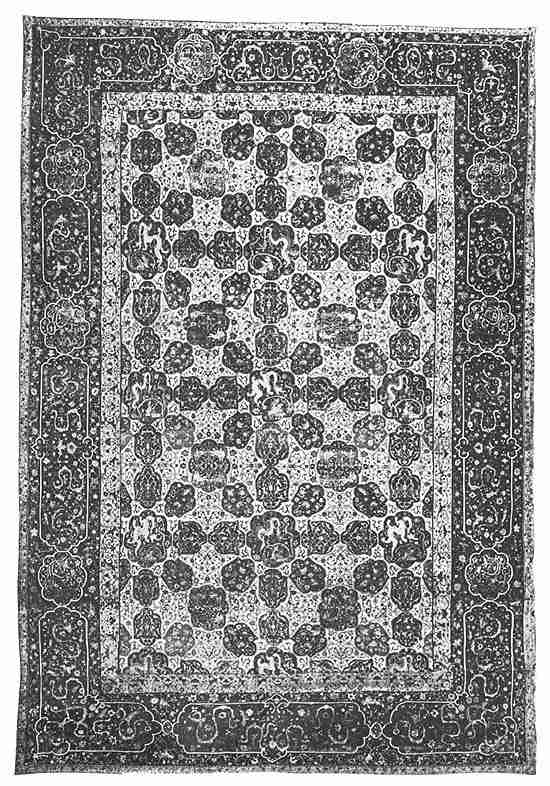
Plate 13. Compartment
Carpet in the Metropolitan Museum of Art, New York
If the floral designs are more beautiful, others are more
truly symbolic, and when appearing in rugs of barbaric patterns
they are more interesting. Of these the creeping things are
represented by the serpent, scorpion, turtle, crab, and
tarantula. Among a few races of Asia the serpent, which is found
in a few old Persian carpets, has been regarded as emblematic of
immortality, but has been more frequently considered as the
symbol of knowledge. The scorpion, also, was supposed to
represent the idea of knowledge. It does not often appear in
woven design, but is sometimes drawn with careful precision in
Caucasian fabrics. The turtle or tortoise stands for constancy.
What is called the “turtle border” (Plate E, Fig. 3, opp. Page 156), which was probably derived
from interlacing arabesques, occurs most frequently in Feraghans
and also in some other Persian rugs, as Muskabads, Sarabends,
Serapis, and even the Sehnas. The tarantula and crab designs are
found exclusively in borders of Caucasian rugs. As their
resemblance to the animals they are supposed to represent is
remote, it is most probable that they are simply the
conventionalised forms of the star and palmette.
Among the designs seen in Chinese rugs are several not found
in any others. Of these the dragon, originally intended as a
symbol of the infinite, denotes imperial power; the stork, long
life; the duck, conjugal felicity; the bat, happiness; and the
butterfly, a spirit. These designs will be noticed in the chapter
on Chinese rugs.
With few exceptions the only modern rugs in which birds are
represented are the Persian. The drawing as a rule is far from
natural; but in the fine old carpets it is often so accurate as
to show unmistakably the order to which they belong. Several of
them were used symbolically, as the bird of paradise, suggestive
of felicity; the peacock, symbol of fire; the eagle, emblem of
power. The attitude, to be sure, in which they appear, affects in
a measure their symbolic meaning; as an eagle in flight denotes
good fortune, but one in the act of descending denotes ill
luck.
As the Mohammedan religion interdicts portraying birds and
beasts as well as human forms, they are rarely seen in any rug
of Western Asia Minor, which is inhabited by
the Sunnites, the strict conformists to the law of the Koran; but
in Mohammedan countries lying farther to the east, where the
Shiites or nonconformists live, animal designs are very common.
In modern rugs of Persia and Caucasia, dogs, goats, and camels
are the most popular animal subjects, but the drawing is often so
poor that the identity is in doubt. In the old carpets, on the
other hand, animals and human beings were most realistically
drawn, and were intended to represent symbolically the
weaver’s thought. In fact, those masterpieces of Persian
art known as the “Hunting Carpets” would lose much of
their interest if their many forms of animal life were without
symbolic meaning. In them the lion is a symbol of victory, power,
the sun, and the day; the antelope and unicorn are symbols of
restfulness and the moon. The lion destroying an antelope would
mean, then, the victory of day over night, or of a powerful over
a weak foe. Leopards and hounds likewise symbolise success and
fame. There are also mythological creatures, as the phœnix,
emblematic of life and resurrection, and the winged djinni
or Persian spirits, that often adorn the fields and borders of
some of the elaborate antique carpets of Iran.
Not only the forms of vegetable and animal life and their
relative attitudes to one another were intended to convey a
symbolic meaning, but among almost all ancient races colours had
a special significance. To the Moslems no colour was more sacred
than the green, which, though difficult to produce in beautiful
tones, they have placed in the fields of many of their prayer
rugs. To them, also, blue was the emblem of eternity, and in the
spandrels above the arches it was the symbol of the sky. Though
to the Hindoo it denotes ill luck, it was the chosen colour of
the Persians, as well as one of the imperial colours of the
Chinese. Among all nations yellow, another imperial colour of
China, and red are suggestive of joy and happiness. Such colours,
when used in conjunction with other emblems, expressed not only
beauty, but also different shades of thought.
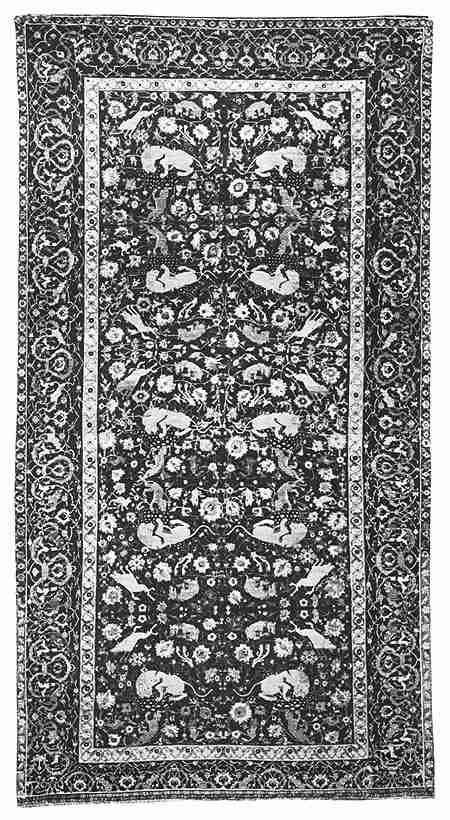
Plate 14. Persian Animal
Carpet in the Metropolitan Museum Of Art, New York
These are but a few of the many motives that are employed by
the weaver. Some of them represent objects intimately associated
with his daily life. Some of them reflect his thoughts and
emotions. Others are the still unsolved hieroglyphics of his
craft. When, then, we examine some old worn rug, we may see only
an exquisite pattern resplendent in the deep rich colours of an
art now lost; but if to an æsthetic
taste be added an interest in a symbolism that expresses
something of the thought and life of the weaver, we may find in
the study of the various designs another charm that increases
with the discovery of any previously hidden meaning.
HERE are no records to definitely indicate in
what land the art of rug weaving originated, or to disprove that
it developed independently in different lands. It would be
unreasonable, then, to assume that rugs were not woven in
northern regions as early as in southern. In fact, during the
Neolithic age the Lake-dwellers of Switzerland grew and spun
flax, and it is believed that they had looms. Moreover, it is
probable that the savages of cold climates soon learned to weave
garments with the long wool of their sheep or goats; and the
similar process of weaving mats for the floors of their huts
would naturally follow. Nevertheless, such evidence as now
remains points to the civilisations of the Euphrates or the Nile,
as the birthplace of this art.
Though we do not know when the first rugs were made, without a
doubt they existed before the pyramids of Egypt or the palaces of
Babylon had risen from the plains. Among the rock-cut tombs of
Beni-Hassan in Egypt, that date from about 2500 B. C. are
pictures of men with spindles, of looms and weavers. There is
also unmistakable evidence of the antiquity of a high state of
the textile art among the ruins in the valleys of the Tigris and
the Euphrates. On carved walls of the palaces of Nineveh, where
dwelt the rulers of Assyria over three thousand years ago, are
elaborate drawings indicating that carpets of remarkable
workmanship were then in use. In the borders of some of the robes
worn by the rulers are designs of rosettes and latch-hooks, and
on one is depicted the tree of life, similar to what may be seen
in modern rugs. Nor are ancient writers silent. In the Old
Testament are frequent references to woven fabrics. Homer, also,
speaks of them in his Odyssey. Herodotus, Diodorus, Pliny,
Strabo, in fact almost all classic writers have mentioned them.
Moreover, designs on pottery, bowls, tiles, and walls, similar
in appearance to those found in the oldest existing carpets,
carry contributory evidence to their antiquity and character.
This art, that necessity created, comfort nourished, and
luxury matured, has been a process of slow development. To the
mind of some dark tribeswoman of the desert contemplating the
rushes gathered from a sluggish stream and strewn upon the floor
of her master’s hut several thousand years ago, may have
been suggested the first idea of a mat. Indeed, from earliest
times mats of reeds, straw, bamboo, or other pliable material
have been constantly made. At first they were doubtless without
ornament; later they were coloured with dyes obtained from roots
and herbs to increase their attractiveness; finally designs
symbolic of nature or the deity were embroidered on them. As
wealth and luxury increased the ornamentation became more
elaborate, until during the rule of the Caliphs the mats rivalled
in beauty the carpets for which, during the summer months, they
were substituted. “On these mats,” wrote the eminent
authority, Dr. F. R. Martin, “the artist found free scope
for displaying as much artistic skill as on the real carpets, and
gold threads were intertwined to make them as precious as the
most expensive silk and gold carpets.” Long, however,
before they had reached such a high state of perfection, they
would have suggested the idea of making warmer and more durable
floor coverings. The first of these was a simple web of warp and
woof; later they assumed a character not dissimilar to the kilims
now made in the lands of their origin. With further advance, more
elaborate carpets and tapestries were made; but it was not until
the art had been developing for a great many centuries, that
there appeared those most perfect products of knotted pile that
were similar in kind but superior in quality to the modern
pieces.
Slow as was this development, as early as the Christian era,
the work of the most skilled weavers of the Orient deserved to be
classed as a fine art. During the time of the Sassanian kingdom
(extending from about 226 a. d. to 632
a. d.) carpets of elaborate design and
finish were produced in Mesopotamia and Syria. Most of them were
of the wool of sheep or goats; and in them were represented
designs of trees, birds, animals, and other figures. Other pieces
were made of silk richly embroidered with silver and gold.
Moreover, authentic evidence from the VI Century a. d. not only gives us positive knowledge of the
marvellous workmanship of that time, but
enables us to conjecture through what a long period of
progression the artisans had been labouring to arrive at such
results. Dr. Karabacek, director of the Imperial Library of
Vienna, in his monograph “Die Persische Nadelmalerei
Susandschird,” gave the following description of the
“Spring of Chosroes” carpet:
“When Ctesiphon, the residence of the Sassanides, fell
into the hands of the Arabs in the year 637 a. d., they found in the royal palace, the ruins
of which still remain, a colossal carpet of 1051 square
metres,11 which was originally made
for Chosroes I. His successor, Anoschar (531-579 a. d.), used it also, but only during the stormy
weather, when remaining in the gardens was impracticable. The
festivities were then transferred to the palace, where a garden
with the beauty of springtime was represented by the pattern of
the carpet. This was the Winter Carpet that was called in Persia
the Spring of Chosroes. Its material, which was marvellous and
costly, consisted of silk, gold, silver, and precious stones. On
it was represented a beautiful pleasure ground with brooks and
interlacing paths, with trees and flowers of springtime. On the
wide borders surrounding it were represented flower-beds in which
precious stones coloured blue, red, yellow, white, and green
denoted the beauty of the flowers. Gold imitated the
yellow-coloured soil and defined the borders of the brooks, where
the water was represented by crystals. Gravel paths were
indicated by stones of the size of pearls. The stalks of trees
were of gold and silver, the leaves and flowers of silk, the
fruits of many-coloured stones.”
As the value of this carpet was estimated at about three
quarters of a million dollars, it was regarded as too precious to
fall to the lot of a single captor, and was accordingly divided
into segments to be distributed as booty among the soldiers. Even
if during this period there was no other fabric so valuable and
elaborate, it represented the importance of the textile art
during the dynasty of the Sassanides.
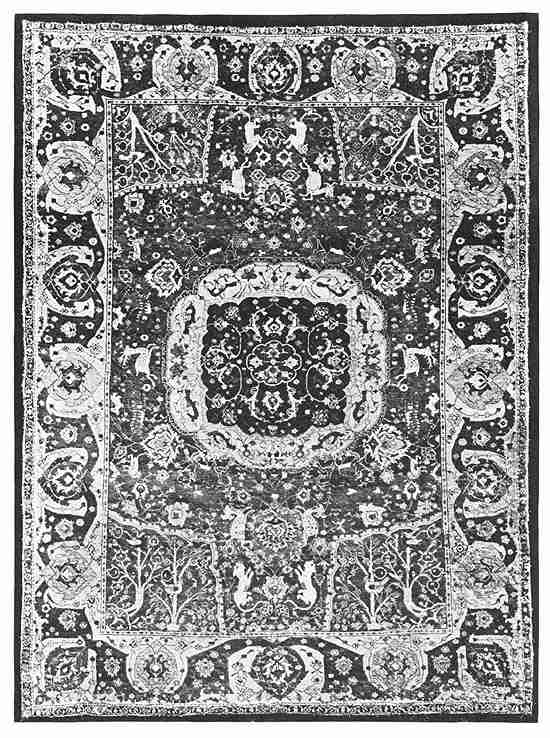
Plate 15. Persian Animal
Carpet in the Metropolitan Museum of Art, New York
During the Caliphate (632 to 1258 a.
d.) the Moslem rulers, devoted to luxury, preserved the
art treasures of their conquered subjects and encouraged them to
renewed efforts. This is particularly true of the Caliphs and
sultans of Syria and Egypt. A carpet that adorned the banquet
hall of the Caliph Hisham of Egypt, who died 743 A. D., was of
silk interwoven with strands of gold, and had a length of three
hundred feet and a breadth of one hundred and fifty feet.
All of the rooms of the Egyptian palaces, occupied by the
sultans, contained carpets of silk and satin; and the mosques of
Syria were similarly furnished. In the year 1067 a. d. one of the Caliphs was forced to sell his
accumulated treasures, which consisted, besides jewels and works
of art, of about four thousand bales of carpets. Dr. Martin
states that a single one of these bales contained several hundred
perfect carpets, which were woven in silk and gold, and that some
of them contained portraits of entire royal families. One of
them, valued at about $300,000, was made for the Caliph el Mirz
li alla in the year 964 a. d. It was
of blue silk, on which were represented the heavens and the
earth, seas and rivers, as well as the holy cities Mecca and
Medina. Such was the character of some of the carpets woven
during the days of the Caliphs.
As the imperfect records which have been left us indicate that
the finest carpet collections of this period were in the mosques
and palaces of Syria and Egypt, it has been assumed that they
were woven by the native artisans. To some extent this is
doubtless true, as rug weaving was one of the oldest industries
of these countries. But it is more probable that most of them
were made elsewhere and were acquired as presents or by purchase.
Some were made in Armenia, Assyria, and Turkestan; but the
largest number, as well as the most costly and elaborate,
doubtless came from the same hills and towns of Persia where many
of the finest pieces are woven to-day. In several of these towns
as many as three or four hundred looms were constantly at work;
and since the carpets consisted of warp and weft only, it is
probable that they were produced far more rapidly than modern
rugs in which knots are tied to the warp. But if they lacked the
richness of deep, heavy pile, they were elaborately woven with
threads of gold and silver, and were often embellished with
precious stones.
To the tendency of overestimating the age of art objects to
which antiquity adds value, there is no exception in the case of
Oriental rugs, yet there is good reason to believe that a few
pieces still exist that were woven in Persia as early as the XIII
or XIV Century. Indeed, we cannot positively affirm that there
may not be religiously preserved some relic of the Seljukian
dynasty, which ruled in Persia till about 1150 a. d., for we have little knowledge of what
some of the old mosques which no Christian has ever entered may
contain; but it is more probable that the oldest remaining pieces
belong to the Mongolian period, which began with the invasion of
the armies of Genghis Khan in the first half of the XIII Century.
This conclusion is based partly on the facts that their archaic
patterns indicate a very remote period, and that they suggest
early Mongolian influences. Moreover, as the age of rugs of a
somewhat later period can be determined by the evidence of
similarity of their designs with those of early tiles, metal
work, pottery, and miniatures, of established age, it is possible
to infer the relative age of these older pieces by comparison of
patterns showing a progressive development.
One of the oldest Persian pieces now existing, the property of
C. F. Williams, Esq., of Norristown, Pa., is in the Metropolitan
Museum of Art of New York (Plate 11, opp. Page
64). It is also one of the most interesting. In it are found
Persian, Armenian, Caucasian, and Mongolian characteristics,
which serve to determine the district where it was woven and to
suggest its age. Its Sehna knot, cotton warp and weft, as well as
much of the drawing, are typical of Persia. The tri-cleft leaf
and stem seen in the two lower corners, in the main stripe, and
in parts of the field are found in almost all Armenian rugs. The
reciprocal sawtooth of the outer border stripe and the geometric
inner stripe are Caucasian features. Certain colour tones, the
octagonal discs at each end of the large central palmettes, and
more particularly the tendrils or scrolls of the main stripe of
the border which resemble the foliate forms as they appear in
Chinese rugs and porcelains of the late Ming and Kang-hi periods,
are Mongolian. The combination of these characteristics indicates
that it was made in the most northwesterly part of Persia where
in 1258 Hulaku Khan established his capital, and his successors
ruled for over a century. Here undoubtedly the craft of weaving
flourished for a long period, and exercised an important
influence on the surrounding countries. To judge by the colours;
the formal character of the border; the rigid lines of the large
palmette motives of the field, which are not seen in carpets of a
much later period; and the stiff, archaic character of the bushes
with foliage and blossoms arranged mechanically on the thick
trunks, it is not unreasonable to place this piece as early as
the middle of the XIV Century, during the interval between the
overthrow of the Seljukian dynasty by the followers of Genghis
Khan and the later invasion of the Timurids. In fact, it may be
even older, since those graceful lines that belong to the highest
art of a subsequent period are entirely lacking. But in the
drawing is strength, and in the colours, a few of which have
faded, are beauty and harmony.
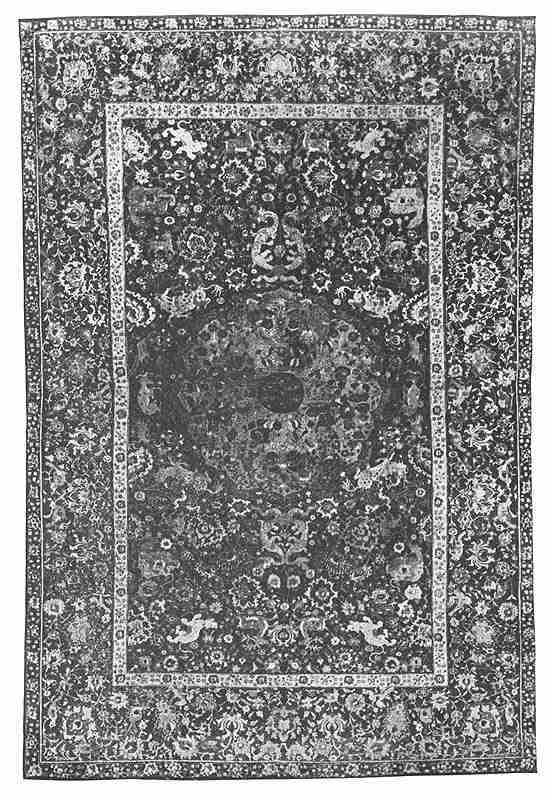
Plate 16. Persian Animal
Carpet in the Metropolitan Museum of Art, New York
Such old pieces are very rare, yet a similar one, belonging to
Prof. W. Bode, is in the Kaiser Friedrich Museum at Berlin. Its
drawing is more regular, and the trunks of the trees are broader.
These two carpets represent the art of weaving at a very early
period.
Of equal interest and higher artistic merit is another carpet
(Plate 12, opp. Page 68), belonging to C. F.
Williams, Esq., and at present in the Metropolitan Museum of Art
but formerly in the possession of J. Böhler of Munich. It
has a length of nearly seventeen feet and a breadth of nearly
twelve. There are about three hundred knots to the square inch.
Though much of that stiffness of drawing found in the earlier
pieces remains, the more pliant branches and less regular setting
of the flowers indicate a later date; so that it is not
improbable that it was woven about the first of the XV Century.
Dr. Martin regards this piece as one of the oldest of the Timurid
period if not from the Mongolian, and says that the trees
resemble those in a Mongolian miniature in the Musée des
Arts Decoratifs in Paris, and in a manuscript from the year 1396.
At any rate, they display more formal drawing than the trees of
more recent carpets. The character of pattern and the colouring
suggest that it was woven in Northwestern Persia.
The field is skilfully divided into three subfields by beds of
flowers, from which slender trees rise and partly screen from
view more stately cypresses. The subdivisions are further
indicated by pairs of palmettes, of which the upper pair mark a
transition between the lower pair and those more elegant forms
commonly seen two centuries later. There are likewise palmettes
of simpler form in the two guard stripes. But the principal
ornamentation of the rich border is the interlacing arabesques of
three different colours, which are decorated with a slender
wreath of leaf and flower. There is, moreover, a particular
interest in the grouping of the arabesques since they form a
design which may be the prototype of the so-called turtle borders
so frequently seen in Feraghans and Gorevans, and is itself
derived, according to Dr. Martin, from a still older form in
which branching arabesques extend across the whole field. It may
not be unreasonable to assume that this pattern has been
handed down from that earlier period when a Saracenic influence
was felt in all the weavings.
If the chief interest in this piece is centred in the pattern,
its greatest charm lies in its soft, dainty colours, some of
which are exquisitely beautiful. They are expressed in delicate
shades of orange, ivory, light green, sable brown, and light and
dark blue on a background of pinkish red. This pattern and
colouring suggest an Eastern wood when the first frost of autumn
has left its touch on the leaves. The border contains the same
colours as the field but is strong and effective, since the soft
tones are in the narrow guard stripes and the deeper colours
appear in the broad central stripe in larger masses and in
immediate contact.
If this carpet was woven about 1400 a.
d., as seems not improbable, the drawing of the trees,
palmettes, and border designs becomes by comparison an important
guide for determining the age of other antique Persian
carpets.
Very different, indeed, from the preceding is a woollen piece
(Plate 13, opp. Page 70), sixteen feet four
inches long by eleven feet two inches wide, that was formerly in
the collection of Mr. Vincent Robinson of London, but is now in
the Metropolitan Museum of Art, New York, which bought it at the
Yerkes sale in 1910, for $19,600. It has about six hundred knots
to the square inch, and is woven with warp of cotton and silk,
and with weft of silk. The pile is velvety, and the texture,
drawing, and colouring display a high grade of artistic
craftsmanship. Another of similar character is represented in the
Vienna Publication of Oriental Carpets of 1889, at which time it
belonged to the Countess Clotilde Clam-Gallas of Vienna; and a
third belongs to the Palais de Commerce at Lyons.
In no other rugs from Iran is the effect of Mongolian
tradition on design more noticeable; but that this was due to the
Timurid invasion at the end of the XIV Century is doubtful, and
it is not improbable that more immediate intervention with China
determined the motives. Nor is the Saracenic influence obscured,
since in every part of the field and border is seen the perfect
rhythm of graceful arabesques. Such carpets represent, in fact,
the transition from those earlier pieces to the higher products
of Persian looms.
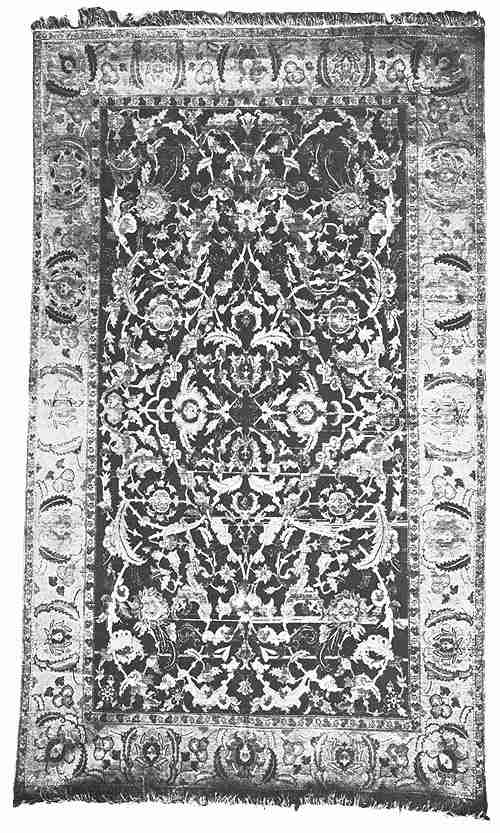
Plate 17. So-called
Polish Or Polonaise Carpet in the Metropolitan Museum of Art,
New York
One of the simplest ways of studying the pattern is to regard
it as consisting of a number of units formed by a large rounded
octagon encircled by eight heart-shaped escutcheons, and with a
smaller rounded octagon at the centre of
the diagonal lines connecting them. On the large octagons, which
are of dark blue crossed by narrow bands of sable brown, is
represented the fight of dragon and phœnix so common in the
ornamentation of the Ming dynasty; and in the smaller octagons,
which are plum colour, are four running lions in red, blue, and
green. The eight escutcheons alternate in crimson and blue, and
have arabesques and Chinese ducks. The large pentagonal-shaped
areas of the ivory field are covered with a most symmetrically
drawn tracery of tendrils and flowers in red, yellow, and blue;
and in the smaller hexagonal-shaped areas are cloud bands of
similar colours.
The border shows a marked advance over that of the preceding
piece. The main stripe, which follows a pattern that with slight
modification is adopted in many of the carpets of this and a
later period, consists of a chain-like series of octagons similar
to those of the field, separating elongated panels with crenated
edges. The latter are adorned with cloud bands in yellow
interlaced with delicate tendrils supporting flowers in red,
yellow, green, and white, on a dark blue field; and surrounding
them on a red ground is also a delicate tracery of leaves and
flowers. The outer and inner stripes have arabesques and tendrils
bearing flowers in red, green, and blue on a ground of golden
yellow. All the colours of both field and border have mellowed
into rich, beautiful hues in which is the most perfect
harmony.
The intricacy and character of design, the delicacy of
drawing, and the tones of colour indicate that this piece was
woven near the beginning of the Safavid dynasty, in the early
part of the XVI Century. Mr. Robinson ascribes its origin to
Bagdad; but it seems far more probable that it came from the
northwestern part of Persia, which was an important centre of
textile art only a few years later. This piece and the two others
described on the pages just preceding are among the most
interesting carpets now existing; for they represent not only a
very high standard of the textile craft, but also most important
steps in its development.
There is no evidence to indicate how early animal carpets were
woven in Persia. Dr. Martin found a piece with archaic drawing,
that from its resemblance to an old tile of established age, he
placed at about the year 1300 a. d.;
but it was about the beginning of the XVI Century that were woven
the first of those masterly pieces which displayed animals
surrounded by a maze of floral life. Lions, leopards,
boars, deer, and hounds were the principal motives. To each of
these was ascribed some principle or quality, so that it has been
assumed that the aim of the weaver was to give expression to some
theme of interest.
A number of these carpets represent the chase and are called
“Hunting Carpets.” The best of them are regarded by
Dr. Martin as belonging to the latter half of the XVI Century for
reasons indicated in the following extract from his work:
“The manuscript of Nizami, one of the pearls of the British
Museum, which was executed in Tabriz 1539-1542 for the Shah
Tamasp, has the most wonderful designs on the margins. Although
the manuscripts and the miniatures are signed by Persia’s
most renowned masters, there is nothing to give a hint as to who
has drawn these magnificent borders. This manuscript, which at
the time it was written, was considered one of the most
remarkable ‘the like of which the eye of time never
beheld,’ plainly proves that the large carpets with hunting
scenes must be relegated to a later time or to about 1560-1570.
Both animals and trees are of a far more stately and earlier
character in the manuscript.”
One of the best of these pieces with animals (Plate 14, opp. Page 72) is in the Metropolitan Museum of
Art, in New York, by which it was purchased at the Yerkes sale in
1910, for $15,200. It has a length of ten feet eleven inches with
a breadth of five feet ten inches, and an average of four hundred
and eighty knots to the square inch. Both warp and weft are of
silk, and the pile is of wool. As it was confidently believed by
Mr. Edward Stebbing12
that this piece belonged for a long time to the Mosque of
Ardebil, where Ismael had established his capital, and from which
Tamasp subsequently moved; it is not improbable that it belongs
to the early period, between the closing years of Ismael’s
reign and the first part of the reign of Tamasp.13 Nor is there anything in the technique of
colour or design to convey a different impression, as the general
colour of the field is a claret red, and that of the border a
dark blue characteristic of this period.
The most noticeable feature of the carpet is the display of
animal life amid the carefully balanced arrangement of floral
figures. Four-fifths of the field can be divided into two perfect
squares with sides equal to the breadth of the field; and the
remainder will be equivalent to one-half of one of these
squares. Each quarter of a square contains animals, probably
intended to represent a lion, leopard, and boar, that are
perfectly balanced with those of the adjacent and alternating
quarters. Moreover, the same balance exists in the case of the
smaller animals and floral forms. Thus it appears that each
square forms a perfect unit in which is shown a remarkable
relation between all parts. Such mathematical exactness indicates
the highest artistic skill. The repetition of pattern also
accentuates the predominant idea of animal life, which is
rendered even more noticeable by the strong golden yellow of some
of the group. Whoever has studied the early Iranian monuments
remembers with how slight variation some of the drawing has been
copied during subsequent generations; so that it is not
surprising that Mr. Stebbing should call attention to the
resemblance of some of the animals in this carpet to those of the
rock-carved sculptures of Tak-i-Bostan near Kermanshah.
As is the case with most modern Persian rugs, there is no
correspondence between the size of the animals and the flowers.
Nevertheless the lack of harmony is not felt, as the animal and
the floral life are intended to be regarded separately. The
principal flowers of the field are peonies, some of which are
woven with silver threads. They also appear in the border
arranged with perfect precision within the folds of symmetrical
cloud-bands and interlacing arabesques. The latter form a
well-executed repetitive figure that suggests an origin for the
reciprocal trefoil or lily pattern, as it is sometimes called,
which received its highest development in the silk rugs of a
later century.
On the whole, this piece is not far short of the highest
sumptuary standard of a subsequent period, and is an excellent
example of the artistic development of the earliest part of the
Safavid dynasty. In few other carpets is combined such intricacy
of design with richness and simplicity of colour.
Of still greater interest than the last is the Arbedil Carpet,
now in the South Kensington Museum. It has a length of
thirty-four and a half feet with a breadth of seventeen and a
half; the texture shows about three hundred and twenty-five knots
to the square inch; and the pile is of wool tied to warp and weft
of silk. It has been very carefully studied by Mr. Edward
Stebbing, from whose description the following extracts are
taken:
“The body ground is blue, covered with a floral tracery
of exquisite delicacy and freedom of
treatment. A central medallion of pale yellow terminates on its
outer edge in sixteen minaret-shaped points from which spring
sixteen cartouches; four green, four red, and eight light cream;
and from two of these again, as it were, suspended and hanging in
the direction of the respective ends of the carpet, two of the
sacred lamps of the mosque.
“Quarter sections of the central medallion also on a
pale yellow ground, relieved by tracery, form the angles; while a
broader border completes the glorious design, a border of the
alternate elongated and rounded cartouches filled with floral and
other tracery, the former on a base of red, the latter on a rich
brown ground flanked on the inner side by a broad band of cream
seven inches wide, relieved by a variation of a so-called cloud
pattern, and a narrower band of crimson near the body of the
carpet; and on the outer side by a single broad band, also seven
inches wide, of tawny hue, shading from dark to light, and
relieved by a bold design in blue.”
But however exquisite the tracery, however delicate the
colouring, the greatest interest centres in the fact that in a
panel adjoining the border of the upper end is the following
inscription:
“I have no refuge in the world other
than thy threshold; “My head
has no protection other than thy porchway;
“The work of the slave of the holy
place, Maksoud of Kashan, in the year 946.”
Here is revealed the age of the carpet, which not only
determines the character of workmanship of a particular period,
but affords a standard for determining by comparison the relative
age of other pieces. The year 946 corresponds with our year 1540
A. D., and the position of the date indicates that it was
inscribed a little before the completion of the fabric.
Accordingly, it would not be unreasonable to assume that the
carpet was begun during the closing years of the reign of Ismael,
who died at Ardebil in 1524, and that it was finished during the
reign of Tamasp I.
To infer that at this period were many such carpets would be a
mistake; since this was doubtless woven by the order of the
court, and by one of the most skilled artisans, who may have made
it the crowning labour of his life. It indicates the highest
technique acquired in the early part of the Safavid dynasty.
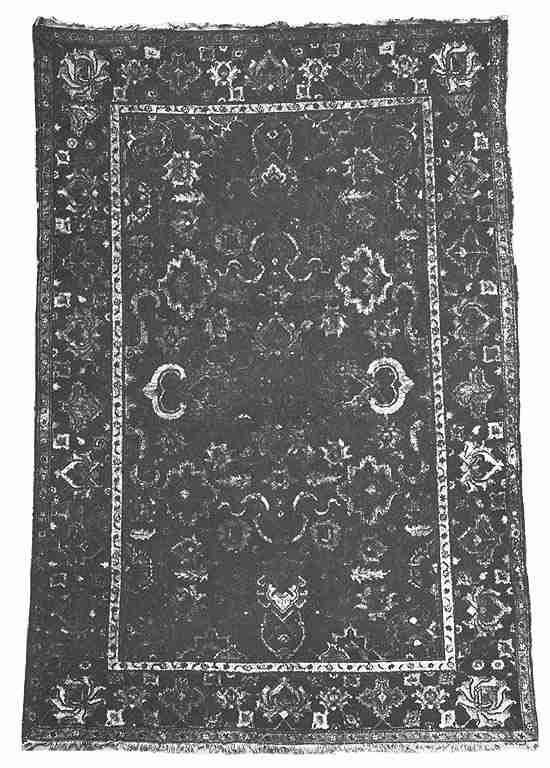
Plate 18. So-called
Ispahan in the Metropolitan Museum of Art, New York
Besides the mosque carpets, other pieces such as small prayer
rugs were used for devotional purposes. When the first of them
were made is unknown, though they existed in the days of the
Caliphs, when the words of the Prophet
were still fresh in the memories of his followers; and they were
also used at an early period among Turkomans. The oldest that
remain belong to the early part of the Safavid rule. One that was
formerly in the collection of Stefano Bardini of Florence and is
now owned by Mr. Benjamin Altman, appeared at the exhibit of the
Metropolitan Museum of Art in 1910. It is a woollen piece with a
length of nearly five and a half feet and a breadth of three and
a quarter. In the central field is a prayer arch resembling some
of a later period, with outlines gracefully recurving near the
base and broken on each side by a pentagonal-shaped flower. All
parts of each of the two trees that rise from the bottom of the
field are reversely duplicated in the other. Some of the
stiffness of drawing of the earlier carpets remains, but the
blossoms are clustered more naturally and the whole treatment is
more skilful. The effect of the scroll-work on the red ground of
the spandrel; of the suspended lamp with its bright flowers of
red, yellow, and pink; and of the blossoming trees beneath, is
most pleasing; but the chief interest centres in the outer border
stripe, where appear features that are more interesting than
harmonious, features derived from Persia, Assyria, Mongolia, and
Arabia. The rounded octagons have Cufic lettering that recalls
early Mesopotamian civilisation; the cartouches at the bottom
with their cloud-bands suggest Mongolian conquests; and the upper
cartouches contain the following verses from the Koran:
“Iman the victorious and expected
Mahdi, the Lord of the Age. Zalsi
and Hason; and bless the standing proof. Oh Lord bless Mohammed the chosen one. Ali, the elect,
Fatimeh the Immaculate. Jofer Sadik,
Mooza Kazin, Ali Riza Mohammed Taki, Mohammed Nakee,
Ali. The two branches Harson and
Hussein Bless Ali Zaimulubbad Mohammed
Bak’r.”
These verses, the archaic lamp, and the green of the field, a
colour sacred to Moslems, all indicate the religious character of
the carpet. Similar features also appear in another antique piece
of about the same age, but the Cufic characters of the border are
within squares surrounded by circles that resemble Chinese seals
as they appear in early manuscripts. Both of these pieces were
probably woven in Northwestern Persia about the middle of the XVI
Century. Few such prayer carpets remain, though without doubt
they were used by devotees during succeeding periods,
and it is not unusual to see, even in modern Kermanshahs, prayer
arches of the same pattern.
Of totally different character but of about the same age is an
animal rug (Plate 15, opp. Page 76) that
belongs to the Metropolitan Museum of Art. It was bought at the
Yerkes sale in 1910, for $5,600, and had previously belonged to
the collection of Vincent Robinson of London. It has a length of
about seven and a half feet with a breadth of about five and a
half, and consists of woollen pile tied to cotton warp crossed by
woollen weft. The weave is not unlike what is seen in many modern
Sarouks; as the knot is Sehna, one thread of warp is doubled
under the other in each knot, and the coloured thread of weft,
which crosses twice, is partly exposed at the back.
Like so many of the old Persian pieces, the ground colour of
red appears in the main field, and is strongly contrasted with
the dark blue of the medallion and dark green of the corners. Red
and green also appear in the border contrasted with yellow. This
association of colour is not usual, nor is the repetitive pattern
of the border with its sharp cusps at many of the angles, nor the
trapeziform corners, and the nearly rectangular medallion.
Likewise the mechanically formed bushes with their quince-like
fruit, on which sit birds of disproportionate size, show a
departure from the accepted traditions of the Safavid schools.
Yet these very features awaken new interest, and suggest that it
was probably woven in some part of Northern or Western Persia
where the influence of the court was not paramount. Nevertheless
the accurate balance of the different halves, and the drawing of
the palmettes show that it is distinctly Iranian.
If this last piece be compared with the animal rug (Plate
16, opp. Page 78) that was presented to the
Metropolitan Museum of Art by Mr. Cochran, the wide contrast will
at once be noticeable. As the latter has a length of about eight
and two-thirds feet with a breadth of nearly six, the difference
in size and proportions is not great; nor is there any particular
difference in the number of animals; nor in the balanced relation
of upper and lower, right and left halves; nor in the red ground
of the main fields. But here the resemblance ends. Whereas in the
former the animals are one of the most prominent features, in the
latter they are subordinate to the rich assemblage of floral and
palmette forms, that occupy not only the field but also the
border. It is, indeed, a piece that marks a
transition from the animal rugs, so prominent in the early part
of the XVI Century but rarely woven later than its end, to the
more elegant pieces, so characteristic of the court of Ispahan,
which belong almost exclusively to the XVII Century. It
accordingly seems not without reason to assign it to about the
year 1600.
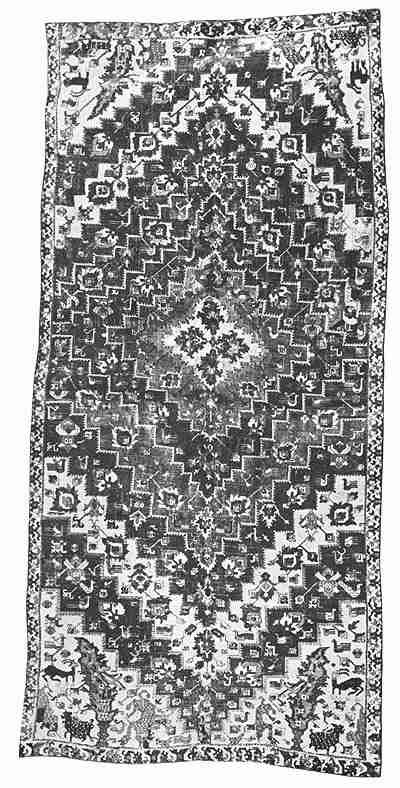
Plate 19. Armenian Carpet
in the Metropolitan Museum of Art, New York
Not only do these different elements that denote a transition
add interest; they also give a most pleasing effect. The main
border stripe of a rich green with its well-drawn palmettes
surrounded by vines and foliated stalks, on which rest naturally
drawn birds of handsome plumage, and the chaste floral designs of
the narrow guards, serve as a tasteful frame to the central
picture. Here again the outer field, with artistic effect, brings
into greater relief the central medallion, where on a ground of
greenish yellow, standing and seated amidst blossoming shrubs in
red, blue, and green, as in a garden, are richly dressed human
forms. Apart from these, yet perhaps intended in some way to
reflect the tenor of their thoughts, are four ducks, emblematic
of matrimonial happiness. Whatever may have been the original
shade of the central medallion, it is now slightly out of harmony
with the surrounding colours, and is perhaps the only jarring
note in this exquisite piece of workmanship. Not improbably the
present shade is due to the unfriendly hand of time, since the
artistic genius of the weaver is fully displayed in the masterly
arrangement of other colours and in the delicacy and precision of
the drawing of the perfectly balanced floral and animal
forms.
The difficulty of determining the locality where the antique
carpets were woven is often greater than in the case of modern
rugs, but this piece was probably one of the last of those fine
old animal carpets that were woven in the northwestern part of
Persia.
Though modern silk rugs fail to awaken the interest of woollen
pieces, the old silk carpets were formerly regarded as the
choicest products of weaving. As a rule, they were the work of
the most skilled artists employed in the imperial factory under
the direction and patronage of the court. It was during the reign
of Shah Tamasp that they received special attention. Following a
custom that had been in vogue of sending carpets as presents to
foreign courts, in 1566 he sent to the Sultan of Constantinople a
number of pieces on which flowers, birds, and animals were woven
with silk on threads of gold. But it was doubtless after his
successor Shah Abbas I had begun to embellish his capital at
Ispahan, that were made the famous “Polish” silk
or “Polonaise” carpets about which there has been so
much controversy. It is true that Mr. Robinson in his
“Eastern Carpets” claims that they were woven in
Poland by Persians taken there by a Pole named Mersherski; but it
seems far more probable that they were woven under the
supervision of the Persian court and were either sent as presents
to European sovereigns or purchased by wealthy connoisseurs of
art.
How many of these pieces may be hidden away in the palaces and
mosques of the far East it is impossible to determine, but two
hundred would be a very conservative estimate of the number owned
by the different courts of Europe and by private collectors of
that country and America. One of them was presented to the Danish
court as late as 1639; and it is believed that all that reached
Europe arrived there between the years 1604 and 1650.
Their beauty is exquisite and chaste. To the threads of silver
and gold is tied silken nap that often displays a striking
brilliancy. Unlike the earlier Persian carpets which had more
subdued hues, these pieces have light tones such as salmon, rose,
and green, which are arranged with perfect harmony. Moreover,
there is an elegance of design representing the highest types of
Iranian, Saracenic, and Mongolian influences combined. Here in
perfection are dainty floral forms, the rhythmic tracery of
arabesques, and delicate cloud-bands. In them the textile art of
the East reached a perfection that probably has never been
surpassed.
One of these (Plate 17, opp. Page 80), that
has a length of about nine feet and a breadth of five and a half,
belongs to the Metropolitan Museum of Art. In many respects it is
typical of its class, though threads of yellow and grey are
substituted for the usual gold and silver of the foundation. On a
field of rose are outlined palmettes, leaves, and scrolls in
green, blue, brown, and salmon, that harmonise with the light
blue of the border. All of these colours blend with pleasing
effect and soften lines that in a print seem harsh. Furthermore
with all its complexity of detail, every part of the pattern is
arranged with mathematical precision. That a carpet with such
perfect balance of every part, such intricacy of elaborate
detail, such graceful curves of the heavy foliate leaves should
be woven without copying some older pattern or a carefully
executed drawing, seems improbable.
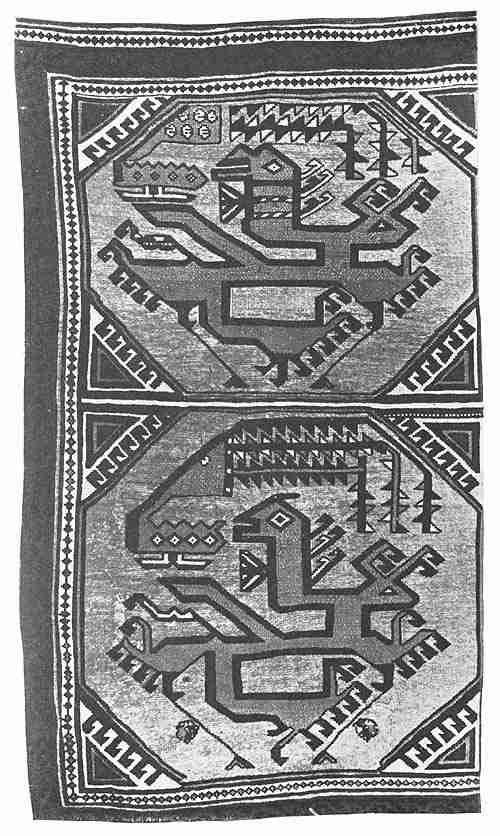
Plate 20. Asia Minor
Dragon and Phoenix Carpet in the Kaiser Friedrich Museum,
Berlin
In this piece and in others of the same class can be
recognised what is probably the prototype of more
conventionalised and less elegant designs so often seen in modern
Persian pieces, since the palmette with encircling lancet leaves
in its borders is most suggestive of the borders of modern
Herats; and the rhomboidal-shaped figure connecting four
palmettes at the centre is equally suggestive of the Herati or
fish pattern seen in the field of innumerable Feraghans.
It was also during the reign of Shah Abbas14 and his immediate successors that most of the
so-called Ispahans were woven, though some of them appeared as
early as the XV and some as late as the close of the XVII
Century. As in the case with the Polish silk carpets, within
recent years some difference of opinion has existed regarding the
place of their manufacture. After careful research, Dr. Martin
believes that they came from Herat and with this idea some other
authorities concur. It is true that Herat belonged to the Persian
Empire during the reign of the Safavid dynasty, and that even in
the days of Shah Ismael magnificent carpets were woven there. It
is also true that during the time of Tamasp and Abbas it was as
important an art centre as Tabriz, and that the weaving of
carpets was a leading industry there. Furthermore, there has not
been found the same evidence to show that Ispahan was at this
period an equally important centre of weaving. On the other hand,
it is well known that the splendid industrial and art products of
this period were largely due to the direct encouragement and
favour of the court, and that the court was for most of the time
at Ispahan. It is also known that skilled artisans were
repeatedly removed from one district to another at the command of
a sovereign, so that carpets of similar character might be woven
contemporaneously in remote parts of Persia. It accordingly seems
not improbable that the original type of these carpets was
evolved at Herat and that many of them at least were made at
Herat, but that others were also made at Ispahan. At any rate
they were made to a great extent under the influence that
emanated from Ispahan.
Almost without exception they are pieces of large size and
oblong shape. The ground colour of the field is usually red, the
border blue; but blue is occasionally used in the field and green
in the border. Their distinguishing feature is the use of the
palmette, that was probably derived from the lotus, so frequently
associated with the Buddhist cult of India and China. In the
field it generally occurs in pairs that slightly vary in
size. Of almost equal importance are the Chinese cloud-bands and
the scrolls or arabesques. These three designs were constant
motives in almost all the Ispahans; but they were subject to
modifications in size and shape, which appearing in chronological
order furnish some guide to the time when the carpets were woven.
For instance, the palmettes were at first small and distributed
plentifully over the field; later they became larger, until in a
few instances they were a yard in diameter. Dr. Martin says that
in the first part of the XVII Century the palmettes began to be
very large and the richness of the interior design to disappear;
until at the end of the XVII Century only a few were sufficient
to cover the ground that one hundred years before was almost
hidden by innumerable designs of small palmettes, cloud-bands,
and scroll work. He also states that towards the middle of the
XVII Century the borders began to lose their importance and that
the palmettes were surrounded by two long, narrow leaves.
Though most of the antique Iranian carpets that remain were
woven in the Northern provinces, it is well known that even from
earliest times carpets of elaborate design and skilful technique
were also woven in Southern Persia. In fact, many of the
wonderful pieces that adorned the palaces and mosques of the
Fatimid Caliphs of Egypt came from the districts of Fars and
Kirman. The latter, notwithstanding invasions of Seljukian Turks,
Mongolians, and Afghans, has continued almost uninterruptedly as
a centre of the textile industry; yet comparatively few pieces
exist that were woven there three or four centuries ago. Their
colour scheme harmonises more with that of the carpets of Western
Persia than with the more sombre tones of the old animal carpets
and Ispahans, or with the brighter hues of the so-called Polish.
Their patterns also show a distinction from those of northern
textile fabrics. The fields are often artificially divided, by
foliate stalks or lance-shaped leaves with serrated edges, into
rhomboidal figures that contain mechanically drawn shrubs,
palmettes, or flowers. In the main stripe of the border are
generally represented interlacing arabesques adorned with
flowering vines or arabesques and a sub-pattern of vines.
Mongolian designs are rarely seen in any of these pieces, which
probably represent more closely than any other Persian carpets
native art unaffected by foreign influences. Almost all of them
are now owned in Europe.
Of the early rugs, those woven in Armenia
are far less known than those from Persia. Nevertheless, it may
reasonably be assumed that the high culture that was manifested
in Bagdad and Ctesiphon during the sway of the Caliphs was felt
among the mountainous districts to the north; and that the
Seljukian rulers, who left such artistic monuments in the old
Armenian capitals, appreciated and encouraged the manufacture of
fine woollen fabrics. In fact, Marco Polo, who travelled through
that region during the latter part of the XIII Century, referred
to them as being remarkably handsome.
Probably the oldest remaining pieces are the so-called Dragon
carpets, which, it is believed, were produced from the XIV to the
XVII Century and possibly even earlier. Not infrequently the
length is at least twice the breadth; the very narrow border
occasionally consists of only a single stripe; and the field is
occupied by a trellis-like pattern of narrow, conventionalised
leaves, within which are designs containing archaic flowers and
dragons. The ground colour of the field is generally some shade
of red, that of the border white, and the leaves are yellow,
blue, or green. In the borders of many of them appear an S motive
from which undoubtedly was derived the design so frequently seen
in panels of more recent Asia Minor prayer rugs.
In the Metropolitan Museum of Art of New York is a XV Century
carpet (Plate 19, opp. Page 86), which, though
widely differing from these pieces in general pattern, so closely
resembles them in the essential characteristics of weave and
colour that it is unquestionably of the same class. The field is
occupied by concentric diamonds with stepped sides. The
encircling bands, that are mostly red, yellow, and violet, and
the corners, that are white, contain numerous archaic forms,
including palmettes, trees, birds, and animals. There are also
numerous small designs of the tri-cleft leaf so common to the
Circassian and Soumak rugs; and the ray-like edges of the central
lozenge, as well as the four palmettes that rest upon it, suggest
the origin of the effulgent stars of old Daghestans and
Kabistans. An effort has been made to balance similar designs in
corresponding parts of the field, though its centre is at one
side of the geometric centre of the diamonds. The palmettes show
distinctly a strong Persian influence and the animal forms
likewise show that it was not woven by a sectarian Sunnite of
Western Asia Minor.
Part of a very unusual carpet (Plate 20,
opp. Page 88), from a district in Eastern Asia Minor, is in the
Kaiser Friedrich Museum at Berlin. Its principal interest lies in
the fact that it is very old and that its approximate age has
been determined. In the hospital at Siena, Italy, a similar rug
is represented in a fresco called the “Wedding of the
Foundling,” painted by Domenico di Bartolo about the year
1440, so that it is reasonable to conclude that this particular
piece was woven not much later. In fact, its character would
indicate that it or some other from which it has been copied was
much older. Each of the nearly square compartments contain
octagons, within which on a yellow field are represented the
mythical fight of the dragon and phœnix that was adopted as
the Ming coat of arms. It is interesting to note that the chain
pattern of the brownish-black main border stripe is not unlike
what is seen in modern pieces, but the running latch hooks of the
corners and the small S designs are unusually stiff. This
disposition to formal drawing, which is conspicuous in all parts
of the rug, shows an archaic style noticeable only in the very
earliest carpets.
In the celebrated painting of Georg Gyze (Plate 21, opp. Page 92) which hangs in the Berlin Gallery,
is represented a rug of a class so frequently seen in the
paintings of Hans Holbein that they are known as “Holbein
rugs.” Their marked dissimilarity to those previously
described indicates that they were woven under different
circumstances if not in different regions. Neither in the fields
nor borders is any trace of Mongolian or Persian influences; and
the absence of all floral, leaf, and animal forms so usual in
most antique carpets is noticeable. Indeed, the fact that animal
forms rarely appear in the art of the Sunni Mohammedans aids in
determining the place of their origin. They came from Asia Minor
or Western Armenia.
It has generally been assumed that they were woven in Western
Asia Minor, because they were purchased there in former centuries
and taken thence to Europe; but they possess many features that
indicate they may have been woven farther to the east, whence
many could easily have been transported westward in caravans.
Their borders contain the well-known pattern derived from Cufic
letters which, more conventionalised, appears in later years only
in such rugs as the Kabistans and Daghestans of Eastern Caucasia.
Most of them also contain the small octagonal discs and larger
octagonal figures with Greek crosses at the centre that suggest
forcibly the designs of Southeastern Caucasia. The narrow stripes
of ribbon and chain pattern found in many
of them also are very common in Caucasian rugs; so that it seems
not improbable that these Holbein rugs were made within the
boundaries of that greater Armenia which, embracing the upper
Mesopotamian valley, extended over the eastern part of Asia Minor
and the southern part of modern Caucasia.
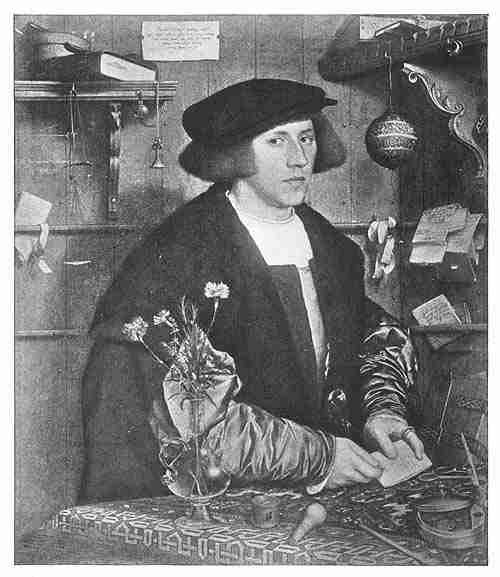
Plate 21. Portrait of
Georg Gyze by Hans Holbein, Showing a Holbein Rug With Cufic
Border
These rugs claim the attention not only because they have
borders of such interesting origin, but by the fact that the age
when they were woven is ascertainable. As Holbein lived between
the years 1497 and 1543, and some other rugs of this type appear
in the works of early Flemish and Italian painters, it may
reasonably be assumed that some of them were made before the end
of the XV Century.
A very excellent example of this class, owned by Mr. C. F.
Williams, is now in the Metropolitan Museum of Art. It has a
length of about five feet with a breadth of three and a half. The
ground colour of the field is an olive green and that of the main
stripe of the border is red. The prevailing colours of the
designs, which are entirely geometric, are blue, green, and
ivory. All of these rugs are small or of moderate size, and are
slightly oblong. Some of them have a ground colour of green; and
yellow is frequently found in the pattern. The weaving is rather
loose; and compared with Persian rugs they have fewer knots to
the square inch.
Another carpet from Asia Minor that also belongs to Mr. C. F.
Williams appears in Plate 22, opp. Page 94. It
is the only entire rug with this pattern that is known, though a
piece of a similar rug is in the Victoria and Albert Museum at
London. On fields of blue and red are outlined three large
four-pointed stars separated by smaller diamonds. Within these
figures and in the surrounding field is a network of tracery
supporting conventionalised leaf and floral forms. Between the
field and the main stripe of the narrow border is a close
co-ordination of pattern, but the simple ribbon of the inner
guard seems alien. It appears without modification in many later
Asia Minor and Caucasian rugs.
An important feature are the double knots at the corners of
the stars, since they are identical with designs found in a
manuscript made for one of the Shahs in 1435, and thus assist to
determine the age of the rug. For this reason and on account of
its general character, it seems not unreasonable to place it as
early as the middle of the XV Century.
Similar carpets were woven during a long
period, and it is probable that in the latter half of the
following century they were largely influenced by the weavers
that Solyman the Magnificent, after capturing Tabriz in 1534,
transported to his own country. The same general features still
remained, but the detail was more elaborate and ornate.
Arabesques, palmettes, and floral forms, both of field and
border, resembled more nearly the Iranian character. But at a
later period, after the beginning of the general decadence to
which every industry and art were subject, the patterns became
much simpler, and the colours were reduced almost exclusively to
red and blue with a little green. At length, both pattern and
colours assumed the type of modern Oushaks, that by a slow
process of devolution originated from these antique pieces.
In Armenia and Asia Minor it is probable that weaving existed
before the Christian era, and that the earliest carpets which
remain, though affected by more eastern influences, are largely
the product of an indigenous art. But in India it was otherwise.
It is true that Sir George Birdwood is authority for the
statement that the Saracens introduced carpet-weaving there; but
it is most probable that at the time of the invasion of the
armies of Tamerlane and during the lives of many of his
successors, whatever carpets were woven were very crude. Even
when the Moguls began to build and embellish palaces, they
obtained their carpets from Persia. But at length Shah Akbar
established manufacturies at Lahore about the year 1580, and
invited Persian weavers to settle there. From them the native
workmen acquired much of their knowledge of patterns and
technique.
It was during the reign of Shah Jahan (1628-1658), builder of
the famous peacock throne and Taj Mahal, that most of the
choicest pieces that now remain were woven. In delicacy of
texture they rival those of any other country, and it is not
unusual to find pieces with nearly eight hundred knots to the
square inch; moreover, all their designs are depicted with
remarkable clearness of definition. One of the most noted of
these carpets is the woollen piece, about eight yards long by two
and a half wide, that was made at the royal factory at Lahore and
presented to the Girdlers Company of London in 1634. The mingling
of leaf and floral forms, as well as the Herati designs of
rosette and crumpled leaf, on a field of red, shows unmistakably
its relation to Persian carpets. At the same period were woven
large numbers of others with fields covered with an
imposing display of superbly drawn flowers, of which every part
from root to leaf tips was represented with astonishing realism.
Another class included the animal or hunting carpets, which
unlike their Persian prototypes seem intended not so much to
portray symbolically some historic event or abstract idea, as to
convey a correct impression of an actual event.
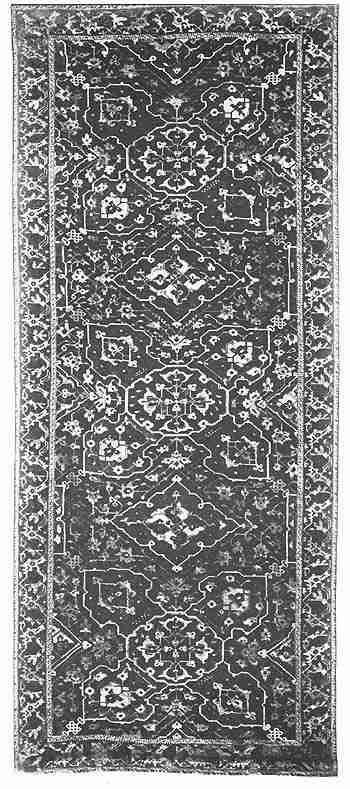
Plate 22. Oushak
Carpet
Loaned by C. F. Williams, Esq., to the
Metropolitan Museum of Art, New York
One of these, a woollen piece with a length of eight and a
quarter feet and a breadth of five and a quarter, is in the
Boston Museum of Fine Arts. The inspiration was from some old
Persian piece, but the rendering is peculiarly Indian. In this
representation of an Oriental jungle is a strange mingling of the
real and unreal. The struggle of a monster bird with a winged
beast, half lion, half elephant, and the demoniac faces of the
border suggest the inspiration of early pagan mythology; but the
movements of the running gazelles and the stealthily creeping
tiger, the attitude of the driver of the cart and his attendant,
are most natural. The drawing as a whole is exceedingly delicate.
The ground colour of the field is the red of most Ispahans and
Herats of this period, but the border is a cream colour, a
combination not in accord with Persian tradition. The other
colours are fawn, blue, pink, grey and brown. It is probably the
only Indian hunting carpet of its kind.
Few strictly antique carpets from other countries of the
Orient are known. Of the innumerable pieces that were surely
woven in Caucasia and Western Turkestan before the end of the
XVII Century, scarcely a vestige can be found. Nor are there many
from the looms of Syria, though in the days of the Caliphs every
mosque was adorned with magnificent carpets. It is true a few
sterling pieces of Saracenic character, that have been ascribed
to the region about Damascus, still exist. There are also a few
rare and beautiful pieces that have come to light in
China.15 But of the countless
thousands that in almost every country of the Orient once covered
floors of palaces and mosques, representing one of the most
refined arts, now nearly lost, only an insignificant fraction
remains.
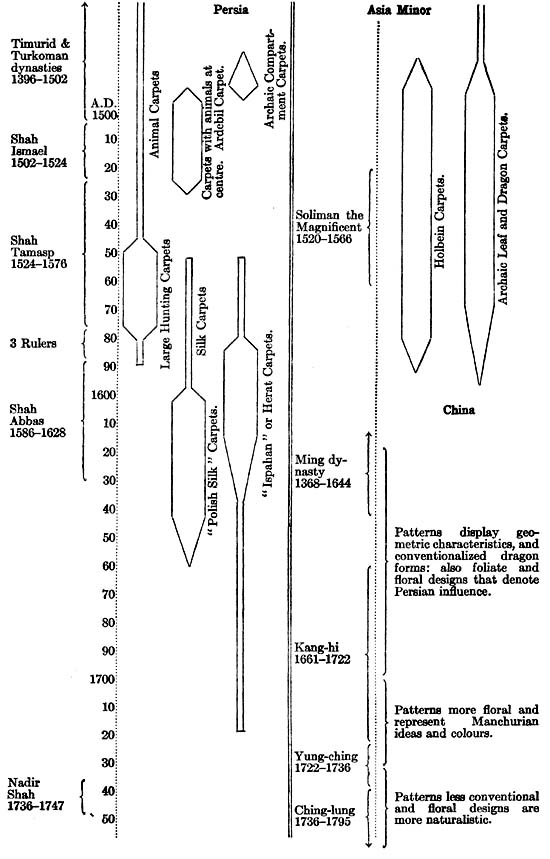
 UGS contribute to the comfort of the nomad
more than any other fabric. With them he closes the entrance to
his tent or covers the floor and couches on which he sits and
sleeps. Thrown over other objects they form the table, made into
saddle bags they take the place of trunks. The followers of Islam
when at prayer kneel on a rug, and in token of affection spread
one over the grave of a friend. To dwellers in cities, also, rugs
contribute largely to the comfort and luxury of the home. Indeed,
without them the splendour of Oriental life would seem
incomplete, since they are the principal furnishings of every
house, where stout woven pieces with long pile are spread as
floor coverings, and lighter ones are hung as portières
and tapestries. Yet it is in the assembly or dining hall that the
finest rugs are used, though here the most valued are exposed
only on great occasions.
UGS contribute to the comfort of the nomad
more than any other fabric. With them he closes the entrance to
his tent or covers the floor and couches on which he sits and
sleeps. Thrown over other objects they form the table, made into
saddle bags they take the place of trunks. The followers of Islam
when at prayer kneel on a rug, and in token of affection spread
one over the grave of a friend. To dwellers in cities, also, rugs
contribute largely to the comfort and luxury of the home. Indeed,
without them the splendour of Oriental life would seem
incomplete, since they are the principal furnishings of every
house, where stout woven pieces with long pile are spread as
floor coverings, and lighter ones are hung as portières
and tapestries. Yet it is in the assembly or dining hall that the
finest rugs are used, though here the most valued are exposed
only on great occasions.
In the East a rug receives a particular name according to
which of these special purposes it is adapted. The large, almost
square piece that is used to cover the centre of the assembly
hall is known as the “Khali;” and the narrow strips
or “runners” that are placed at its sides and ends
are known as the “Kenares.” It is on the Kenares that
the servants are required to walk and the less honoured guests to
stand, for they are rarely of such fine quality as the former.
Before the divan, that generally surrounds three walls and is
covered with fine cloth and velvet, are seats on which are placed
carpets called “Sedjadeh.” They are nearly twice as
long as broad, and since they are of moderate size and excellent
quality they are frequently used for many other purposes. The
hearth rug, termed “Odjalik,” can generally be
distinguished from others, as each end of the field is of
triangular shape with the apex at the extremity. However much any
of these may be valued, the one that to every worshipper
of Allah has the most sacred association is the
“Namazlik,” or prayer rug, at one end of which is an
arch in token of the mosque. At call for prayer the faithful
Moslem spreads his rug with arch directed towards Mecca, and
kneeling with the palms of his hands at each side of the centre
he bows his head till it touches the rug. As the Mohammedans of
Persia are unwilling that a Namazlik be trampled by the foot of
an infidel, few from there can be bought; but the Mohammedans of
other countries are less scrupulous, so that many of the prayer
rugs sold in America have been made solely for trade and have
never been used in worship. They may be beautiful, but special
interest attaches to old pieces of which the well-worn nap shows
where the knees of both father and son for over half a century
have often pressed. In addition to these are other rugs with
technical names, but a classification of much greater importance
is that which depends on the country or district where they are
woven.
When the Oriental rugs first appeared in the market of the
United States, they were spoken of as “Turkish,” for
the reason that importers purchased them from Turkish merchants
of Constantinople. But when it became known that they had been
taken there by caravans from countries farther to the east, and
that large numbers of them came from Persia, the name
“Persian,” that to the mind of many conveys ideas of
splendour, was at once applied; even to-day all classes of
Oriental rugs are often spoken of as Persian. As objects of
ornament or utility, their value is independent of their place of
origin; yet it is known that the wool of the nap and the dyes
used in some districts are superior to those in others, and that
in consequence the beauty of some rugs will improve with age far
more than that of others. It is also known that because in
certain districts the material of warp and weft, as well as the
workmanship, is of a superior quality, the rugs made there will
wear better than others. The knowledge, then, of where a rug is
made is important in determining the quality and value, which
otherwise only a critical examination, that few people are able
to make, would show.
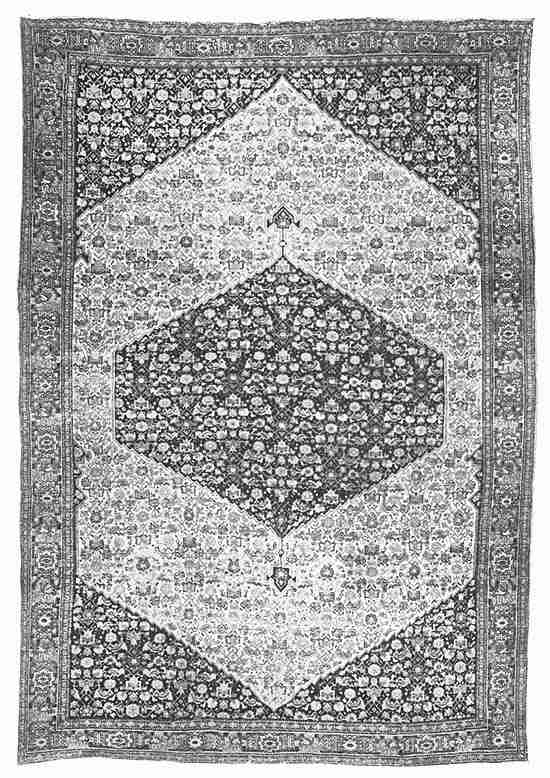
Plate 23. Sehna
Rug
Furthermore, the knowledge of where a rug is made, suggesting
the class of people who wove it, adds immeasurably to our
interest. When, for instance, we look at an old piece of Kurdish
weave with its nomadic designs and shaggy nap, on which a Moslem
savage as an Apache often rested fully half a century ago, there
is called up a picture of the dark-visaged tribesman, fearless
and untamed as were his ancestors who contested the
march of Xenophon over two thousand years ago. We see him
wandering with his flocks over the hills while he watches for a
chance to fall upon an unsuspecting stranger. We picture to
ourselves the hut of brush upon the mountain side where a slender
barbaric girl bends to tie, with wonderful patience, the knots
one by one. So if we would enjoy our Oriental rugs, we should
know what people made them, and whence and how they journeyed,
before they reached our fireside.
At the request of a purchaser the vendor is ever ready to
classify a rug, but his statements are not always reliable. This
is partly due to the fact that even the great importing houses
are often deceived. Throughout Asia Minor, Persia, Turkestan,
even farther east, great fairs are regularly held. Here gather
the representatives of tribes from far distant quarters to enjoy
for a few days or weeks the gay life and abandon of the East
while bartering the products of their different crafts. Here come
the purchasing agents looking for rugs; and the pieces that may
be brought from afar are bought and shipped by camel and rail to
such great marts as Tabriz, Tiflis, and Constantinople, where the
bales are unpacked and the rugs assorted, classified and
labelled, before they are resold to the importing houses of
Europe and America. Thus both in the buying from the itinerant
agent of rugs assembled from different quarters and in the
reassortment at the exporting cities there is frequent
opportunity for errors of classification.
The characteristics of the different groups and classes of
rugs are given in later chapters, but it should not be presumed
that these are infallible guides to the locality where they were
made. Often a ruler, by fostering art, has drawn to his capital
artists and artisans from other districts. Thus designs and
quality of workmanship characteristic of one district would be
adopted in another. So, too, the great caravans that pass along
regular routes eastward and westward, and the annual pilgrimages
to Meshed and Mecca, have been most potent influences for the
dissemination of designs. Yet taking into consideration the
general pattern and smaller designs; the material of warp, weft,
and pile; the knot; the dyes; the finish of sides and ends, and
the peculiarities of the weave, it is possible with a reasonable
amount of certainty to determine in what districts almost all
Oriental rugs are woven.
It should be borne in mind, however, that the names by which
some of the rugs are known in America are not the same as
those by which they are known in Asia. For
instance, the rugs made by some of the tribes of the Tekke
Khanate are known in the Orient as “Tekkes;” but as
the great depot for Turkestan carpets was formerly the city of
Bokhara, they are generally known in this country as
“Bokharas.” On the other hand, there are local
distinctions in the eastern countries not known in the western.
The accompanying classification, therefore, is slightly
arbitrary, but should be convenient for reference; since the
classes represent the cities or districts where are woven the
several different kinds, excepting the Chinese, which are divided
chronologically. The names of the groups are not in each instance
entirely satisfactory, but are probably the best that can be
chosen. The fourth group, for example, has frequently been called
the “Turkoman;” but as it includes some of the rugs
of Afghanistan, and also those of Beluchistan, which is remote
from Turkestan, that name is not sufficiently comprehensive. The
district where these rugs are made is, strictly speaking, the
western and southwestern part of Central Asia; but the term here
employed has the authority of some German writers of note. So,
too, the rugs of Herat, though it is now a city of Afghanistan,
are included with the Persian group; but it should be remembered
that Herat, as well as the districts of Mosul and Kurdistan, was
once part of the old Persian Empire.
|
(a) Khorassan district:
|
| |
Herat, Khorassan, Meshed.
|
|
(b) Shiraz district:
|
| |
Ispahan, Kirman, Yezd, Shiraz,
Niris.
|
|
(c) Feraghan district:
|
| |
Feraghan, Hamadan, Kara-Geuz, Bibikabad,
Iran, Sarouk, Kashan, Sarabend, Burujird, Sultanabad,
Muskabad, Mahal, Joshaghan, Gulistan, Teheran.
|
|
(d) Sehna district, or Adelan
province:
|
| |
Sehna, Bijar, Kermanshah, Persian
Kurdistan, Karaje.
|
|
(e) Tabriz district:
|
| |
Tabriz, Gorevan, Bakshis, Serapi, Herez,
Suj-Bulak, Karadagh, Afshar.
|
|
(f) Kurdistan district:
|
| |
Western Kurdistan, Mosul, Gozene.
|
|
(a) West Asia Minor district:
|
| |
Bergamo, Ghiordes, Kulah, Oushak,
Ak-Hissar, Demirdji, Kutayah, Smyrna, Melez, Isbarta,
Rhodian, Broussa, Hereke.
|
|
(b) Central Asia Minor
district:
|
| |
Konieh, Ladik, Kir-Shehr, Anatolian,
Karaman, Sivas, Mudjar, Nigde, Tuzla, Kaisariyeh, Zile,
Yuruk.
|
|
(a) North Caucasian:
|
| |
Daghestan, Kabistan, Kuba, Derbend,
Lesghian, Chichi, Tcherkess.
|
|
(b) Trans Caucasian:
|
| |
Baku, Shirvan, Soumak, Shemakha, Tiflis,
Kutais, Kazak, Karabagh, Shusha, Gengha.
|
|
(a) West Turkoman sub-group,
Western influence:
|
| |
Royal Bokhara, Princess Bokhara, Tekke,
Yomud, Khiva, Afghan, Beshir.
|
|
(b) East Turkoman sub-group,
Eastern influence:
|
| |
Samarkand, Kashgar, Yarkand.
|
|
(c) Beluchistan.
|
|
(a) Northern India:
|
| |
Srinagar, Amritsar, Lahore, Multan,
Agra, Allahabad, Mirzapur, Zabalpur, Patna, Jaipur.
|
|
(b) Southern India:
|
| |
Madras, Mysore, Bangalore, Warangal,
Malabar, Hyderabad, Marsulipatam.
|
|
(a) XVII Century:
|
| |
Late Ming 1600-1643 and Early Kang-hi
(1662-1700).
|
|
(b) XVIII Century:
|
| |
1. Late Kang-hi (1700-1722). 2.
Yung-ching (1722-1736). 3. Keen-lung (1736-1795).
|
|
(c) Early and Middle XIX
Century.
|
|
(d) Late XIX Century or
Modern.
|
N the grouping of Oriental rugs, it is not
always desirable to follow the present political divisions of
territory, since great and frequent changes in national
boundaries have occurred without corresponding changes in the
traditional style of weaving. Thus it happens that with the rugs
made in Persia, which is still called Iran by its inhabitants, it
is desirable to group those made within that former Iran that
included the valley of Mesopotamia on the west and part of
Afghanistan on the east. The woven products of all this territory
have characteristics that are similar to one another and that
differentiate them from those of other countries. Their patterns
are distinctly floral, representing leaf, bud, and flower, and
show a tendency to naturalistic drawing with graceful and often
intricate lines. Moreover, their colour schemes of delicate tones
are not only beautiful but in perfect harmony. In marked contrast
with them are the rugs of Caucasia, Asia Minor, and Central Asia,
which have patterns of geometric shape or highly conventionalised
flower forms, and colours that often appear in bold contrast. In
the Chinese rugs, also, is generally less harmony of colour, as
well as less co-ordination of design, than in the Persian. The
scroll and floral patterns appear on the field in isolated
figures, or else imitate with more formal drawing the diaper
pattern of some Iranian carpets. Only in the rugs of India is
there a similarity to the patterns and colour tones of those of
Persia; but the designs are more realistically drawn, less
artistically arranged, and less profuse.
The weaver of this interesting Bergamo followed the early
Asia Minor traditions in the use of rich, deep blue and red of
field and border, yet in respect to pattern showed his freedom
from conventionality by departing from types peculiar to his
district and adopting many nomadic designs prevalent throughout
Anatolia. Reciprocal latch-hooks form the background of the
central field, on which are three upright panels containing
octagonal discs; and latch-hooks surrounding lozenges and forming
what may originally have been intended to represent the tree of
life appear almost as conspicuously in the border. There are also
combs, knots of destiny, and innumerable S-forms. The panels at
the upper and lower ends of the field and the reciprocal vandykes
are most suggestive of Ladiks, but in the place of pomegranates
at the ends of the upright stalks are small checquered squares.
Bergamos with such patterns are now rarely seen.
Loaned by Mr. Hulett C. Merritt
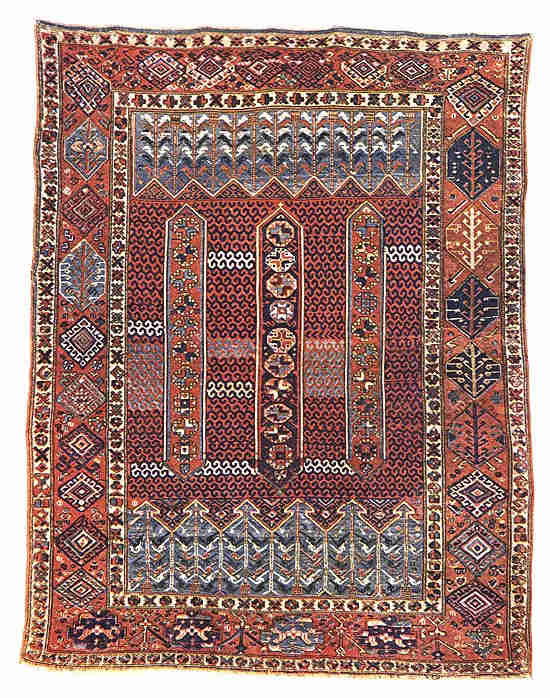
The similarity in the rugs of the Persian group is due to past
political influences as well as to common ties of race and
religion. From the time when Ctesiphon and Babylon vied with the
cities of Persia in the splendour of their capitals, all of this
territory was repeatedly under one and the same dominant power,
which at different times was held by Saracens, Seljukian
Turks, Timurids, and Safavids; and even after the end of the
Safavid dynasty the influence of Nadir Shah was felt over
Mesopotamia as well as Western Afghanistan. A still stronger
influence is that of race; for Aryans, Arabs, Armenians, and
Turks have blended with the early people of the whole territory,
until not only do all resemble one another, but their
craftsmanship is similar. Furthermore, with the exception of a
few rapidly disappearing Parsees, who still cling to the early
Zoroastrian faith, all are Mohammedans; and in their frequent
pilgrimages to the same shrines is a constant interchange of
ideas and exchange of fabrics. It is true Asia Minor, Caucasia,
and India have shared to some extent the same influences, but to
a much less degree.
A resemblance, also, exists between many of the physical
features of the entire country that affect the habits and
industries of the people. To be sure the Euphrates and Tigris,
that wind sluggishly through the great Mesopotamian valley, and
the great ranges of the Elburz and Zagros, that extend from Mt.
Ararat easterly and southeasterly through Persia, have no
counterpart; but on the other hand in Mesopotamia, Persia, and
Western Afghanistan are great stretches of sandy wastes where
there is little vegetation, high table-lands where during
rainless summer months the earth is parched, and little valleys
of fertile soil that are watered by streams from the encircling
mountain ridges. Throughout this territory, wherever physical
conditions are similar, the people follow similar pursuits. In
the deserts the impoverished Bedouins live; in the higher lands
some two millions of nomads follow their sheep and goats,
pitching their tents wherever there is pasture; in the valleys
are several millions of people, who, with the placid contentment
of the East, irrigate their garden patches, fashion simple
articles of metal, and weave artistic rugs.
A general decadence in social, political, and industrial life
pervades the whole country; yet due partly to the inheritance of
a past associated with the glories of Persepolis and Ecbatana,
Babylon and Nineveh, Bagdad and Ctesiphon, and to the more
immediate influence of the textile masterpieces of three
centuries ago, rugs are still produced that in delicacy of weave,
beauty of design, and harmony of colours surpass those of any
other part of the world. In the weave of the best examples is
displayed a technical skill only approached by a few of the Royal
Bokharas. In the fine rhythm of lines and in the colour
scheme of harmonious and delicate tones, with which a few of the
best products of India alone compare, is united the touch of both
artist and artisan. The fields of the old pieces are lavishly
covered with intricate designs of buds and blossoms supported by
vines or tendrils, and frequently encircled by arabesques that
interlace so as to form an harmonious whole. The fields of the
modern pieces are frequently of solid colour, with central
medallions and triangular corners defined by graceful lines.
Again, the ground colour of the field, which is either uniform or
slightly shading from one end to the other, is covered with
realistically drawn or conventionalised floral designs that are
arranged with studied precision, and are now and then relieved by
some nomadic design. Surrounding the fields are borders of
several stripes, some of which contain an undulating vine with
pendent flowers or palmettes co-ordinate in drawing and colouring
with the main pattern. It is, however, principally in the
colours, which are delicate yet rich, subdued yet lustrous, that
these rugs surpass all others. Their most distinctive tones are
blues, reds, browns, and greens, so arranged that the ground
colours of border and field generally contrast yet remain in
perfect harmony; as where there is some moss green in border and
wine colour in field, each being subordinated to other
superimposed colours representing floral detail.
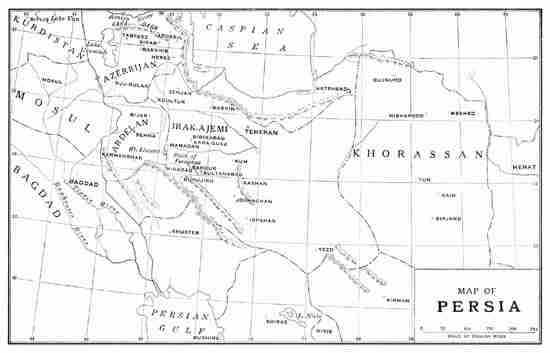
MAP OF PERSIA
The best known of the floral patterns, repeated with formal
precision throughout the field, is the Herati pattern, which is
of uncertain antiquity and origin. It consists of a central
figure that generally represents a rose, but sometimes a peony or
rosette, about which are grouped other figures like crumpled or
lance-shaped leaves. Probably both the central and encircling
figures are of Persian origin, though the latter have been
regarded by some authorities as representing fish and attributed
to Egypt or to China; in fact, they are occasionally drawn so as
distinctly to show eyes and fins. Very frequently four of these
figures are arranged about a lattice-shaped design with pendants
and a central rosette, as in Plate O, Fig. 4
(Page 291). This Herati or Fish Pattern, as it is frequently
called, appears in many of the old Persian rugs and in most of
the modern pieces, particularly the Feraghans and Herats. A less
frequently seen floral pattern, which has been used from a very
remote time and is still represented in modern rugs, is the Guli
Hinnai, or Flower of Hinnai (Plate O, Fig. 3).
Of this plant Mohammed was so fond that he called it the
“chief of this world and the next.” It
occurs as a formal pattern in many of the Feraghans, and in
several other rugs in which its bright five-petalled flowers are
scattered informally over the field. Another floral pattern
frequently seen is the Mina Khani, illustrated in Plate O, Fig. 2, that was named after Mina Khan, a former
Persian ruler. It is particularly characteristic of Persian
Kurdish pieces in which a dark blue field is covered by a network
of intersecting olive-coloured vines. At the intersections are
placed large flowers that alternate in regular series according
to their different designs and colours; and between them often
appear other flowers, such as the smaller and brighter coloured
Hinnai, so as to destroy too great stiffness of design. As the
flowers are relatively large and sufficiently separate to show
the intervening blue field, this is one of the most effective of
the formal repetitive floral patterns. A still more formal
pattern (Plate O, Fig. 1), which appeared in some of the Persian
rugs of the XVI and XVII centuries, was named after Shah Abbas.
It is not unlikely that it was suggested by the Mina Khani
design, to which it bears a slight resemblance; but the principal
motive is so conventionalised that it has lost much of the floral
character. Between the large and formal palmettes, that are
arranged with mathematical precision, are grouped with similar
regularity smaller palmettes, connected by angular vines and
leafy branches.
Only a few Persian rugs have the formal repetitive patterns,
such as the Herati, Guli Hinnai, Mina Khani, and Shah Abbas.
Others have the repetitive pattern of bushes, flowers, or the
pear, on a field of rich colour. The remainder have patterns
consisting largely of scrolls, vines, or tendrils, drawn with
exquisite art and decorated with leaves, flowers, and buds in
beautiful profusion; also birds, beasts, human beings, demons,
and other imaginary shapes, sometimes associated with the foliage
but frequently bearing no apparent relation to it, appear as
special motives. Since many of these forms, which originated in
the remote past, have been transplanted from one country to
another, and conventionalised to meet the new environment, it is
interesting to observe the designs in the different classes of
rugs and trace as far as possible the influences to which they
are due.
Herats.—On great
lines of travel between India, Turkestan, and Persia, the city of
Herat in Northwestern Afghanistan for centuries occupied
commercially a most important position, so that
its people long since became familiar with the best fabrics of
the surrounding countries. During the XV Century it reached its
greatest prosperity, and exerted an important influence on the
art and culture of Western Asia. Before the art decadence that
followed the capture of the city by Nadir Shah in 1731, and the
removal of many of its artisans to Persia, its looms were
producing some of the best rugs of the Orient, which excelled in
delicacy of drawing and in perfect harmony of colours. The fields
contained patterns of serrated leaves entwined with flowing
arabesques, scrolls, and Chinese cloud-bands. Conspicuous among
this tracery were palmettes and such flowers as the lotus and
peony, which were often most realistically drawn.17 These rugs are of further interest, as they
contained in field and border the design that, slightly changed,
appears in many of the later rugs of Persia as the Herati
pattern.
The modern rugs are as unlike other Afghans as were the
antique pieces and show a close relationship to those of Persia.
Nor is this surprising, as the weavers, though falling far short
of the high standards of the time when Herat was part of Persia,
are still mindful of the early traditions. Moreover, many of the
rugs are made across the border in Khorassan, and have the silky
pile peculiar to the rugs of that province; but their tones of
colour, consisting principally of red or blue in the field, and
light green, yellow, and ivory in the border, as well as most of
the patterns, are dissimilar. In one type the fields are covered
with pear designs; but their bent narrow ends always turn in the
same direction, whilst those of other rugs turn in different
directions in alternate rows. Another type suggests the
Feraghans, because their fields are covered with the Herati or
Fish pattern; but the borders of the Feraghans usually have the
well-known turtle pattern, while the borders of these adhere to
the traditional Herati design. It is also not unusual to see a
large central medallion, in which blue or red predominates,
separated by a field of lighter colour from the triangular
patterns of the corners. Now and then, a nomadic influence is
seen in the small adventitious figures of the field.
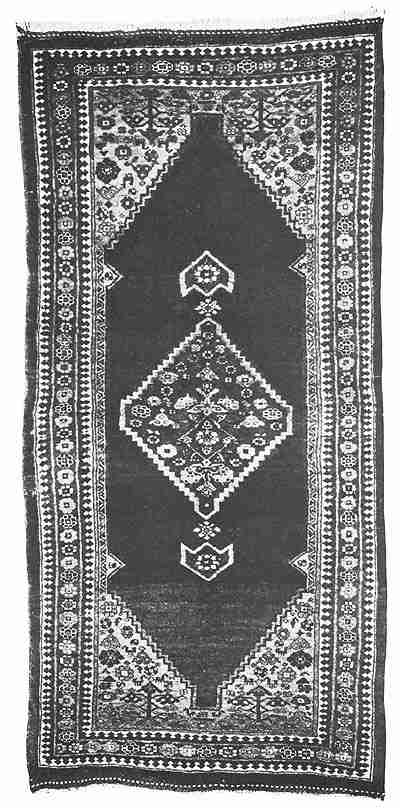
Plate 24. Bijar
Rug
One of the most characteristic features of this class are the
borders, that generally have three stripes, of which the central
consists of a continuous vine of
crumpled leaves so conventionalised as to be merely bent, thorny
stalks partly enveloping formal rosettes. The other stripes are
narrow, and have some simple undulating vine. This typical
border, the stout, closely woven warp and weft of cotton, their
large, almost square shapes and rather coarse weave, are
important aids in distinguishing this class from all others. Some
of the rugs recently made are coarse; but the older rugs have
excellent dyes, lustrous nap, and matured tones of well-blended
colours.
Type Characteristics.18
Colours, principally red and blue with minor quantities of
green, yellow, and ivory. Knot, Ghiordes, rarely Sehna.
Knots to inch horizontally, eight to eleven; perpendicularly,
nine to twelve. A half knot, as it appears at back, is about as
long, measured in direction of length of rug, as wide.19 The rows of knots are firmly pressed down so
that the warp is concealed at back. Warp, of cotton,
rarely wool; one of the two threads encircled by a knot is
generally doubled under the other, sometimes it is only
depressed. Weft, wool, occasionally cotton; of coarse
diameter. For a short space a thread of weft crosses twice, that
is across and back once, between every two rows of knots, then
three times, and so alternates every several rows. Pile,
wool of medium length, soft, and silky. Border, three to
five stripes, and frequently an outer edging of uniform colour.
Sides, a double overcasting. Both ends, narrow web
and loose warp fringe. Texture, stout and firm.
Weave at back is of coarse grain. Usual length,
eight to twenty feet. Usual width, three fifths to three
quarters length.
Khorassans.—Among
Iranians, Khorassan is often spoken of as the Land of the Sun. In
its northern part are long ranges of mountains where herds and
flocks find excellent pastures, and intervening valleys where the
soil is cultivated. But the remainder of the province, with the
exception of scattered oases, where small towns and villages are
located, is almost entirely a desert, from which in classic times
the Parthians advanced to harass the armies of Greece and Rome,
then retreated to seek the protection of its vast salt marshes
and inhospitable wastes.
Nevertheless, in the little villages surrounded by a dreary
wilderness have been produced as beautiful rugs as in those more
favoured spots where prevailed cultured influences that could
develop an Omar Khayyam and produce the sacred shrine of Meshed.
Even before the Mongolian invasion several hundred looms, each
employing four or five women, were busy in the town of Toon in
Central Khorassan. Lying farther to the east is the district of
Kain, which was once renowned for its beautiful rugs of Herati
pattern, but of later years has produced coarser pieces with
inferior designs and bad colours. Still better known was Birjand,
in the southeastern part of the province, where formerly were
woven pieces of superior workmanship that contained from two
hundred to three hundred knots to the square inch. Their colours
were of delicate shades; and it was not unusual to employ ivory
or other light tones for the ground, with which was contrasted
the darker tones of the Herati or pear patterns. Over a century
ago many such towns in Khorassan were weaving rugs of artistic
design and beautiful colours, but as a rule the present products
fall far below the early standards.
Most of the Khorassans now seen were made almost fifty years
or more ago and rival the best of modern Persian rugs. As a rule,
they are of large size and have closely woven texture. They can
be distinguished from most others by the silkiness of their
moderately long nap, which is often due to the fact that it is
from the fleece of a yearling lamb as well as because it is cut
long and unevenly. Another characteristic is the use of some
shade of red, as a pink, rose, or wine colour. Very frequently it
is magenta or even purple, which are rarely found in other
Persian rugs. Blue and cream are also largely employed. Their
colours are generally softened by age, yet are warm, and at times
brilliant, as when a large field of bright rose red or blue
surrounds a central medallion.
The diversity of pattern in Khorassans is partly due to
copying designs of rugs brought from other provinces by the
pilgrims who yearly visit Meshed, and to the remoteness from one
another of different centres of weaving in a province occupying
one fourth of all Persia. One pattern, however, based upon the
treatment of the pear design, which is employed in many of these
pieces, at once distinguishes them from rugs of other districts.
It consists of large pears arranged in regular order on a field
of dark colour with their principal axes inclined diagonally in
the same direction, and of two or three much smaller pears
partly resting on them and partly projecting beyond their edges.
Unlike the pear designs in other Persian rugs, which are oval,
these are elongated like those of Indian rugs; and within them,
as well as in the field, are often small floral figures. This
distinctive pattern is rendered more effective by the colour
scheme; since frequently pears of red or magenta, defined by
lines of yellow and containing white petalled flowers, rest upon
a ground of dark blue. The Herati design is also frequently
employed, and in very old pieces are occasionally represented
birds and animals naturalistically drawn. It is not unusual to
see a central medallion or large vase of flowers surrounded by a
field of bright uniform colour, and in some rugs are two
medallions. When the centre contains a medallion, the
triangular-shaped corners are set off by lines that are much
simpler than those in Sarouks and Kermanshahs.
Few other rugs have more noticeable borders; for not only are
they very wide, but in the main stripe, which is as wide as
several guard stripes, is some characteristic pattern.
Occasionally it contains the Herati design, but more frequently
it consists of a heavy undulating vine with incipient flower
forms, that at times almost assume the appearance of a
bird’s head resting on a sub-pattern of double floral vine.
This stripe, illustrated in Plate E, Fig. 2,
(opp. Page 156) is so frequently met with in Khorassans as to be
characteristic of them. The narrow guard stripes usually contain
some simple vine or ornate reciprocal figure.
Type Characteristics. Colours, principally rose,
blue, and ivory, with minor quantities of yellow and green.
Knot, Sehna. Many are “left-hand.” Knots to
inch horizontally, eight to thirteen; perpendicularly, twelve to
twenty. The rows of knots are firmly pressed down, so that the
warp is concealed and the weft is partly hidden at back.
Warp, cotton; one of the two threads encircled by a knot
is doubled under the other. A few short lengths of threads of
warp hang loose at the back of some pieces. Weft, almost
always cotton, occasionally wool of fine diameter and usually
dyed blue. A thread of weft crosses twice between two rows of
knots, excepting at intervals of every six or eight rows of
knots, where it crosses three or more times. Pile, wool of
medium length, silky and unevenly clipped. Border, three
to six stripes, and generally an outer edging of uniform colour.
Sides, a double overcasting of same colour as edging.
Both ends, a narrow web and short warp fringe.
Texture, moderately firm. Weave at back is of
moderately fine grain. Usual length, five to
twelve feet. Usual width, three fifths to three quarters
length.
Mesheds.—In few
parts of the East have the weavers received greater inspiration
from sacred and historic association than those of Meshed. To
Shiite Mohammedans it contains the most holy spot in Persia; for
within a mosque resplendent with façade of blue and white
tiles, and with gilded minarets of exquisite design, lie the
remains of Ali Riza, the eighth Imam or Moslem priest, in a tomb
that is viewed yearly by nearly one hundred thousand pilgrims. It
was for a short time the capital of Shah Abbas, who beautified
its mosques; and here Nadir Shah, whose remains lie in the
mausoleum, held his court after the capture of Delhi. Within its
walls was born Firdousi, the Homer of Persia; and not far away,
among the mountains to the west, was the home of the poet and
astronomer, Omar Khayyam. Not only devotees but large numbers of
merchants regularly visit the city in the caravans from Khiva,
Bokhara, Herat, Yezd, and Teheran, so that it is also a city of
commercial importance.
It is possible that a few of those matchless pieces which were
attributed to Herat before its destruction by Nadir Shah were
made in the district near Meshed, since according to an Arabian
traveller20 who visited it during the
XIV Century many fine carpets then lay on the floor of its
mosque. It is also believed that within the shrine, which has
never been entered by an unbeliever, still remain some of the
most magnificent carpets of the Orient. But for more than a
century the textile industry has been declining, and the rugs now
seen are generally of recent manufacture.
As a rule, these rugs are of the Khorassan type, and have the
same silky appearance of nap, though it is shorter and more
evenly clipped. The pattern, however, is generally different, as
seldom is the field completely covered with the pear design, but
whenever used, it is of elaborate drawing and frequently very
large. Nor is the characteristic Khorassan border stripe,
illustrated in Plate E, Fig. 2 (opp. Page 156),
employed. On the other hand, it is not usual to see large central
medallions, with floral designs in tones of rose or pink on
fields of blue or ivory, and borders with undulating floral
vines, in which appears evidence of Herati influence. Most of the
rugs that now exist were made within the last fifty years, and
are of large size and almost square shape. The colour
scheme inclines to light and often brilliant tones, which at
times are strongly contrasted with small masses of much darker
shades. The wool is excellent, and the warp and weft are rarely
coarse.
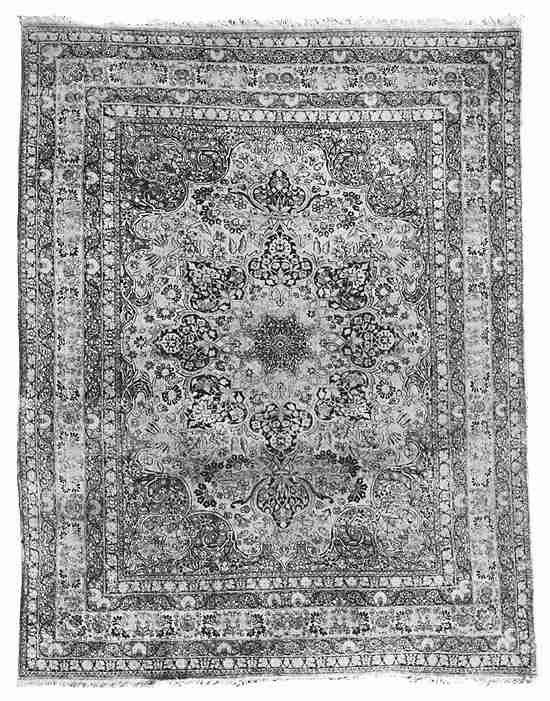
Plate 25. Kermanshah
Rug
Type Characteristics. Colours, principally rose
or pink, blue and white, with minor quantities of yellow and
green. Knot, generally Sehna, rarely Ghiordes. Knots to
inch horizontally, eight to fifteen; perpendicularly, twelve to
seventeen. The rows of knots are pressed down, so that the warp
is concealed and the weft is partly hidden at back. Warp,
generally cotton, occasionally wool; one of the two threads
encircled by a knot is doubled under the other. Weft, wool
or cotton, of fine diameter and usually dyed blue. A thread of
weft crosses twice between every two rows of knots. Pile,
wool of fine quality and medium length. Border, usually
from three to six stripes, occasionally as many as eight, and
generally an outer edging of uniform colour. Sides, a
double overcasting of same colour as edging. Lower end, a
narrow web and warp fringe. Upper end, a web and warp
fringe. Texture, moderately firm. Weave at back is
of slightly coarse grain. Usual length, six to fourteen
feet. Usual width, two thirds to seven eighths length.
Ispahans.—Still
imposing in the ruins of its former splendour, surrounded by
orchards, vineyards, and groves of trees that shade a broad,
well-watered plain, is the ancient city of Ispahan. Under the
Caliphs it became the capital of Persia; and though sacked by
Tamerlane, who slew seventy thousand of its inhabitants, it rose
to such importance that in the XVII Century it contained within
its walls several palaces, one hundred and sixty mosques, over
two score of colleges, nearly two thousand caravansaries, and
about three quarters of a million people. Now the population has
dwindled to about sixty thousand; and the few stately mosques and
colleges that remain amid miles of deserted streets, abandoned
bazaars, and ruined homes but feebly reflect the magnificence of
the former capital.
Here was the royal court of Shah Abbas, who sent to Italy, for
the purpose of studying decorative art, a number of the most
experienced artisans, to whom are accredited some of the
gracefully drawn designs of many of the early carpets. Here, in
the days of its greatest prosperity, were founded many
industries, and on its looms were undoubtedly woven some of the
best of old Persian carpets. Though Herat is now
regarded by some authorities as the centre where the so-called
Ispahan rugs were made, it is improbable, as previously pointed
out, that all of them came from there. But after the death of
Shah Abbas the rug industry began to decline; and with the
removal of the capital to Shiraz, in 1760, Ispahan ceased to be a
rug-producing centre of consequence. There may be a doubt whether
such enormous carpets, as the one with length of sixty feet and
breadth of thirty that Sir Purdon Clark in his monograph on
Oriental Carpets mentions as lying in the hall of Chehel Sutoon
at Ispahan, were made there or were imported from other cities;
but the weaving of rugs has never entirely ceased; and so great
is the fame of the former glory of the city that even now
Oriental dealers will often apply to rugs the term
“Ispahan” as an epithet of superiority.
The few modern pieces which reach the western markets bear
little resemblance to their prototypes; and even among themselves
show little similarity of pattern, though the pear and Herati
designs are not uncommon. In some rugs a century old the field is
almost covered with what is known as the Persian crown jewel, and
in others the field contains diamond-shaped medallions arranged
in regular order with small foliate and floral forms placed
between them. Small figures of animals are also occasionally
represented. The border is generally narrow and lacking in
impressive individuality, so that the character of the rugs
depends largely on the pattern of the field and the well-seasoned
colours, which are always rich and harmonious. Some shade of red
or blue is usually chosen for the ground; and in the designs are
green, yellow, and white. The weave has variations rarely found
in other rugs; for the warp, which is usually cotton, may also be
wool, or wool and cotton twisted together; and the weft may
likewise be wool or cotton, and may cross between the rows of
knots either once or twice in different rugs, or even once or
twice in the same rug.
Type Characteristics.21
Colours, principally red and blue, with minor quantities
of green and yellow. Knot, Ghiordes. Knots to inch
horizontally six to nine; perpendicularly, eight to fourteen. The
rows of knots are firmly pressed down. Warp, usually
cotton, occasionally wool; in a few pieces wool or cotton are
twisted together. Each thread of warp is equally prominent at
back. Weft, wool or cotton. A thread of weft crosses once
or twice between two rows of knots. If it is wool, it
generally crosses twice; if of cotton, two threads are generally
placed side by side and cross together once as a single thread.
Pile, wool, of short or medium length. Sides, a
double selvage of two or three chords. Lower end, a web.
Upper end, a web and fringe. Occasionally the web is
turned back and hemmed. Texture, firm. Weave at
back is moderately coarse. Usual length, six to fourteen
feet. Usual width, two fifths to two thirds length.
Kirmans.—On
account of the isolated position of Kirman in Southeastern
Persia, where the almost impassable saline and sandy deserts by
which it is surrounded on the north and east, and the mountain
ridges that separate it from the fertile valleys of Persia on the
west, in a measure protected it from the repeated invasions that
disturbed the political and industrial conditions of Northern
Persia, it has continuously for over a thousand years been an
important centre for the manufacture of rugs. Moreover, during
all this period it has been noted for the excellence of their
quality. As early as the Mohammedan conquests its fabrics were
taken to furnish the floors and divans of Caliphs’ palaces.
When Marco Polo visited Persia in 1270 he wrote of the beautiful
shawls and carpets made by the women of Kirman; and the noted
French traveller Chardin, who lived in that country during part
of the XVII Century, also spoke most favourably of them. Even
after Nadir Shah removed many of the most skilled weavers to the
northern part of Persia subsequent to ascending the throne in
1739, and Aga Mohammed Khan pillaged the city and massacred many
of the inhabitants in 1794, the rug industry continued to
prosper, and to-day that district is producing the best of modern
pieces.
To this isolation is also largely due the excellence of the
weave and dyes, since the artisans have in a measure escaped the
pernicious influences of market demands and aniline colours. And
to it must be attributed the fact that the old Iranian textile
art appears nowhere else in greater purity; for of all the rugs
on the market to-day these conform more nearly in texture,
colour, and design to the masterpieces of earlier times, and show
none of the foreign influences appearing in pieces woven in the
north. And yet in Kirman is complexity of race as well as
religion; for the Beluches who have wandered across the desert
mingle with the Persians; and the Guebres, still practising in
secret their fire worship, meet with the Mohammedans.
For long ages silkworms have been
cultivated in the district about Kirman and fed on the mulberry
trees that grow wild among its hills, so that it is not
surprising that small quantities of silk are sometimes used in
the rugs; but as a rule the pile is entirely of wool, yet of such
fine quality and so well woven that many of the old pieces have a
lustrous and silky appearance. This wool, which is white and of
unusually fine texture, is partly the product of the native sheep
and partly the product of a variety of goats that live among the
ridges and yield fleeces almost as fine as those of Kashmir.
It is probably because of the fondness of the people of Kirman
for roses, which they cultivate for the attar, that they depict
them so profusely in their rugs. Sometimes they represent them as
filling vases set in rows, or again as formal bouquets arranged
in regular order upon the field. They also weave them in the
borders among green leaves, as placed there tenderly and not
hanging from such stiffly formed vines as are seen in other
Persian rugs. Nor are they conventionalised like the flowers of
most modern rugs; but petal, leaf, and stem are drawn with a
precision that suggests the work of Indian weavers. Usually they
are red contrasting with a ground colour of soft, ashy grey in
the field, and of golden yellow in the rich, harmonious border.
Sometimes, instead of a profusion of roses, there are other
flowers, such as the sunflower, suggesting the old Zoroastrian
faith, the cypress, or the sacred “cocos.” Again, the
general design may be modified from one strictly floral, and amid
the foliage may be introduced birds, animals, or human beings;
but the naturalistic drawing is always noticeable. In modern
pieces the central medallion is often adopted, yet the general
resemblance to older pieces is evident. As a rule the border has
five stripes, of which the main one is twice the width of any
other, and surrounding the outer is a narrow edging that is
usually pinkish red; though now and then, according to the
general colour scheme, a very pleasing effect is obtained by
substituting an edging of moss green.
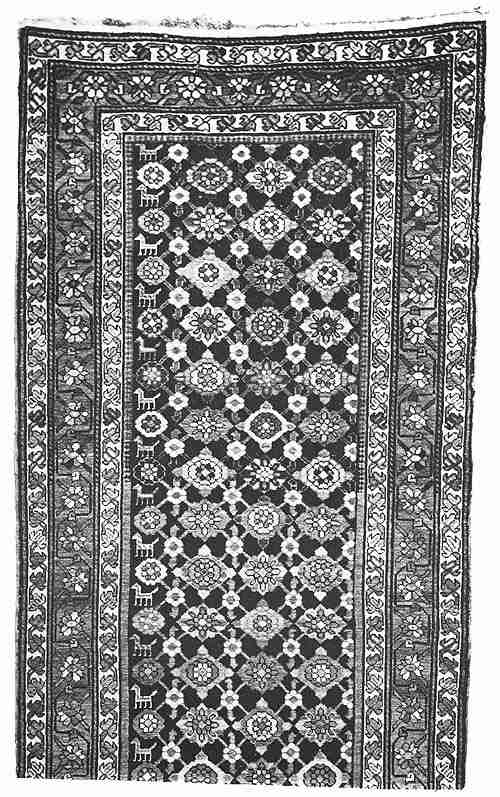
Plate 26. Kurdistan Rug
with Mina Khani Pattern
Type Characteristics. Colours, principally grey
or ivory, with minor quantities of faun, yellow, rose, and blue.
Knot, Sehna. Knots to inch horizontally eleven to twenty;
perpendicularly, eleven to twenty. The rows of knots are pressed
down so that the warp is concealed and the weft is partly hidden
at back. Warp, cotton; one of the two threads encircled by
knot is doubled under the other. Weft, generally wool of
fine diameter, occasionally cotton, and frequently dyed blue. A
thread of weft crosses twice between every two rows
of knots. Pile, wool, short, soft, and silky.
Border, usually of five stripes and an outer edging of
uniform colour that is generally pink but sometimes green.
Sides, a double overcasting of the same colour as edging.
Both ends, a narrow web and short warp fringe.
Texture, very firm. Weave at back is of moderately
fine grain. Usual length, five to seven feet. Usual
width, three fifths to two thirds length.
Yezd.—In the
centre of a sandy plain, midway between Kirman and Kashan, is the
city of Yezd, where almost the last of the Iranian
fire-worshippers, now a small part of the total population, still
follow the ancient faith. Though partly shut off from the great
desert of Khorassan by a mountain range, the city is only an
oasis, where the drifting sands that buried the old city ever
suggest to the inhabitants the dread spirit of desolation which
finds an echo in ruined walls within. At the present time very
few piled rugs are woven there and they are rarely seen in
Western markets; yet on account of the historic interest in its
people, the name is sometimes applied to modern products made in
other districts. At one time it was noted for its silk rugs, and
also for its felt “namads,” which are generally too
heavy to be transported, since some of them have a thickness of
two inches and a superficial area of ten thousand square
feet.
Shiraz.—Near the
centre of a small, well-cultivated valley encircled by mountains
is Shiraz, capital of Farsistan. During the reign of Kerim Khan,
from 1760 to 1779, it was the capital of Persia; but since then
it has suffered from earthquakes and neglect until now much of
its former glory has departed. And yet there still remain
associations to kindle the imagination, for without the gates are
the gardens that Persian poets have extolled in verse; the tombs
of Saadi and Hafiz; and not far away are the spots where Cyrus,
Darius, and Xerxes lived, and the ruined palaces that Alexander
destroyed in a night of drunken revelry.
As early as the time of the Caliphs this district produced
large numbers of carpets; though few, if any, remain that were
woven before the XV Century. As is the case with modern pieces,
all of them were distinguished for their soft and beautiful wool,
which is to be attributed to the climate and pasture of the
surrounding mountains and valleys. One of the oldest
existing rugs of this district which displays
the characteristic wool is referred to by Dr. F. R. Martin in the
following words:22
“As soon as I had touched it, I was certain that we had to
deal with a very rare kind of carpets which were made at Shiraz,
or at least with the brilliant Shiraz wool. Most of the carpets
made of that wool are lost, because the material was such a soft
one that it was easily worn out. I know of very few which are
older than the eighteenth century. No wool in all Persia takes
such rich and deep colour as the Shiraz wool. The deep blue and
the dark ruby red are equally extraordinary, and that is due to
the brilliancy of the wool, which is firmer and, so to say, more
transparent than silk, and makes one think of translucent enamel.
As a piece of colour this carpet is certainly one of the finest,
and there are very few carpets that have greater charm, which
even the best reproduction could not give. In its colours there
is something of an early Gothic stained-glass window, where the
dust of ages has so covered the design that it has become
obscured and the imagination of the spectator must complete it.
Certainly the Persians for whom this carpet was made used to sit
and dream for hours over the beauty of its colours, beautiful as
the wonderful landscape surrounding Shiraz.”
On account of the design and workmanship of this remarkable
piece it is referred by Dr. Martin to the XV Century. During the
two following centuries the carpets of Shiraz attained the high
standard of excellence prevalent in the principal cities of
Persia; but most of those pieces are now extremely rare, as they
were woven chiefly for imperial use or for exchange with foreign
rulers. This city experienced the art decadence that began with
the XVIII Century, yet under the patronage of Kerim Khan imperial
factories for weaving were again established there.
Though some of the rugs made eighty or even sixty years ago
are certainly beautiful, these modern pieces, as a rule, lack the
excellent qualities of early rugs, and those more recently woven
are still poorer. On a few of them are depicted designs that are
strictly Persian; but they generally depart widely from the early
traditions, and floral forms are very much conventionalised. In a
large number of this class the field is covered with pear designs
which are described by straight lines and angles. Sometimes they
are as small as in the Sarabends, occupying the whole field
as the principal motive; or they may be placed less prominently
within diagonal or perpendicular stripes. Again, they may be as
large as in Khorassans and grouped with other designs. Another
very common pattern, known as the “pole-medallion,”
consists of a narrow perpendicular bar connecting two or more
large diamond-shaped figures on which are grouped
conventionalised floral forms and geometric designs. In other
pieces the pattern is as geometric as that of any Caucasian rug,
and it is not unusual to see both field and border profusely
adorned with latch-hooks enclosed within and surrounding
geometric figures. Nor is it unusual to see small figures of men
and animals scattered through the field. Indeed, there is no
other Persian rug in which the pattern is so heterogeneous. The
borders usually consist of a number of narrow stripes, or a wide
one with narrow guard stripes. One of them, at least, almost
invariably contains some form of vine and leaves, and not
infrequently the row of small X figures that also appear in
Shirvans. In fact, the rugs are sometimes mistaken for Shirvans
on account of the resemblance in geometric designs.
Though there is such variety in the patterns, these rugs are
not difficult to recognise. There is something distinctive about
the dark blues and reds contrasted with smaller areas of ivory
and yellow. They are, as a rule, loosely woven, and many of them
have a trait of lying unevenly on the floor. Not infrequently an
extra band of pile is woven between the border and the broad
embroidered webs of the ends, from which hang a loose fringe. The
sides are overcast with heavy strands of wool varied like a
barber-pole at regular intervals; and, as is not the case with
any other class, they are often ornamented at intervals with
coloured tassels.
There are also large numbers of Shiraz saddle-bags, which are
superior to any others made. They resemble the Caucasian, as the
patterns are geometric; but they may be distinguished from them
by the finer wool and a slightly different colour scheme.
Not infrequently the term “Mecca” is applied to
Shiraz rugs, and the impression is conveyed that they were made
there. Nor is the statement always entirely devoid of truth; for
each year caravans aggregating some two hundred thousand souls
enter that city to make their devotions to Allah, to walk around
the sacred stone within the Kaaba, and leaving behind their
forgotten sins to return homeward with a bit of sacred earth or a
strip of the temple’s covering. Each of these pilgrims
bears offerings for propitiation, of which a large proportion
are rugs; and whatever their size, they are invariably the
choicest the devotee can offer. Since the Mohammedan priests
regard the best interests of their religion and themselves as
conserved by a disposition of all articles not directly available
for their use, they sell large quantities of such rugs, that find
their way to Cairo, Damascus, and Constantinople. Furthermore,
the pilgrims carry many pieces which are sold or exchanged along
the routes of the caravans or at Mecca, and ultimately reach the
same markets. Such a large number of the pieces that years ago
came from these sources were of the well-known type of Shiraz
rugs that they and similar pieces which had never left Persia
were called Mecca rugs. This deception is still encouraged by
some dealers, because for many buyers a special interest is
attached to a piece that they are persuaded has been carried on
this pilgrimage as an offering.
Type Characteristics.
Colours, principally blue, red, and ivory, with minor
quantities of yellow and green. Knot, generally Sehna,
frequently Ghiordes. Knots to inch horizontally seven to twelve;
perpendicularly, eight to twelve. At back one of the half knots
is generally smaller than the other and pressed to one side. The
other half knot is about as long as wide, and the yarn is not
drawn tight against the warp. The rows of knots are pressed down,
so that their alignment is slightly irregular, and the warp is
concealed at back. Warp, almost always wool; in a few
modern rugs goats’ hair is used. Each of the threads
encircled by a knot is almost equally prominent at back, or
occasionally one to each knot is depressed. Weft, wool of
medium diameter, frequently coloured red. A thread of weft
crosses twice between every two rows of knots. Pile, wool,
short to medium, and silky. Border, three to five stripes.
Beyond the borders, at each end, is frequently a narrow band of
pile. Sides, a heavy double overcasting in a barber-pole
stripe or in short lengths of different colours, which generally
consist of two of the following colours: red, yellow, green, and
blue. In some pieces small tufts of wool protrude from the sides
at regular intervals of one or more feet. Lower end, a
broad web of coloured stripes, through which may run a dovetailed
coloured cord, and warp loops. Upper end, a broad web of
coloured stripes, through which may run a dovetailed coloured
cord, and warp fringe. Texture, loose. Weave at
back is of slightly coarse grain. Usual length, five to
nine feet. Usual width, three fifths to four fifths
length.
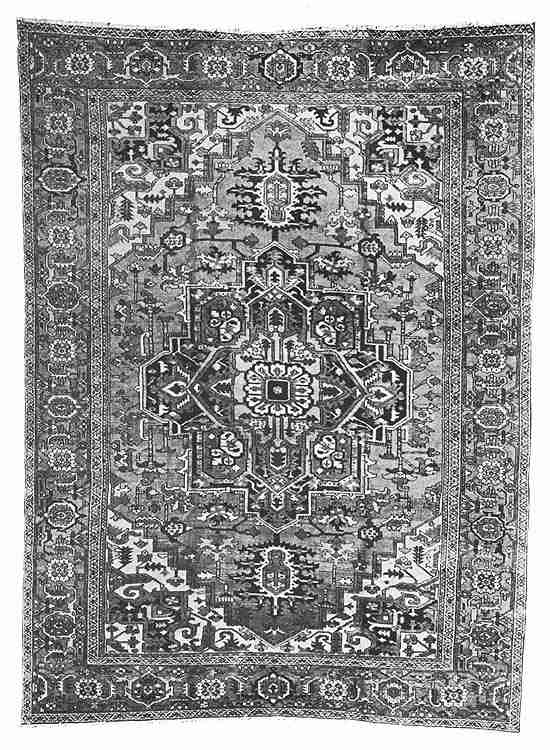
Plate 27. Gorevan
Rug
Niris.—A
resemblance exists between the rugs that take their name from
Lake Niris and those of Shiraz, which is distant only fifty miles
to the westward; for many of each class are woven with the same
silky wool, obtained from sheep that graze in the intervening
mountain ranges, and the shepherd weavers about the lake have
acquired ideas from the old capital. This resemblance exists
mostly in the soft, floccy appearance of the nap, and in the
barber-pole or parti-coloured overcasting of the sides. The webs
of each end are broad and have long fringes; but generally those
of the Shiraz are embroidered and crossed with one or more
parti-coloured cords, whilst those of Niris pieces are, as a
rule, flatly woven in stripes of different colours. There is also
an occasional resemblance in pattern, but the best known pattern
of the Niris is rarely seen in the Shiraz. On the other hand,
they are more firmly woven; and there is a slight difference in
the character of their weave, since one of the two threads of
warp encircled by a knot is depressed below the other, and the
weft is of wool coloured red, whereas in the Shiraz it is
frequently of cotton.
The pears are the favourite design, and, like those in
Sarabends, extend over the field in orderly array; but they are
much larger and consist of an assemblage of bright colours
isolated from one another, yet grouped gracefully in a way that
might readily suggest the origin of crown jewels sometimes
ascribed to them. Frequently the ground is a dark blue, and the
pears are of red, blue, green, and ivory. Violet and yellow are
also employed. In other types, less usually seen, the field is
covered with a lattice-work pattern containing small figures. The
typical border has a broad central stripe of vine and flower,
with narrow guards of simpler vine or reciprocal trefoil.
Barber-pole stripes are also characteristic of the borders.
Type Characteristics. Colours, principally blue,
red, yellow, green, and ivory. Knot, Ghiordes. Knots to
inch horizontally six to eleven; perpendicularly, seven to
fifteen. The rows of knots are not closely pressed down, so that
at the back the warp is noticeable and the weft conspicuous.
Warp, wool; one of the two threads encircled by a knot is
depressed below the other at back and frequently doubled under
the other. Weft, wool of medium diameter, generally dyed
red. A thread of weft crosses twice between every two rows of
knots. Pile, wool, of medium length. Border,
generally of three stripes, sometimes as many as seven.
Sides, a heavy double overcasting in a barber-pole stripe
or in short lengths of different colours, such as red,
blue, green, yellow, and black. Both ends, a broad web of
coloured stripes, one row of knots, and loose warp fringe.
Texture, loose. Weave at back is of slightly coarse
grain. Usual length, four to seven feet. Usual
width, three quarters to four fifths length.
Feraghans.—Stretching eastward from the base
of Mt. Elwund is the plain of Feraghan. Its length does not
exceed forty-five miles, nor its breadth ten or fifteen, yet here
are clustered several hundred villages. On account of its
altitude of seven thousand feet, the ground is covered with snow
in winter, and the people are then huddled in their low mud
houses, and the flocks and herds are gathered within the village
walls. But in the spring the men are cultivating the fields, and
the sheep are grazing on the banks of numerous streams. It is a
plain of fertility and industry. For generations it has been
productive of large numbers of fine rugs, and it is still
possible among its villages to find some of those old pieces that
have been regarded by the Persians themselves as the best
examples of the textile art.
When the characteristic patterns of Feraghans have once been
carefully observed, they are never forgotten; yet it is
surprising to note the many distinctions observable in a large
collection. These patterns may conveniently be divided into two
groups, namely: one in which the field is entirely covered with
diaper designs, and the other in which the field contains a
central medallion surrounded by uniform colour. Probably nine
tenths of these rugs fall within the first group, which is
divisible into three sub-groups: those in which the field is
covered with the Herati design; those in which the field is
covered with the Guli Hinnai design; and those in which the field
is covered with some other small diaper design.
The Herati design is the one most frequently seen, and is
found in the very oldest of existing Feraghans. As a rule, the
crumpled leaf does not exceed a length of four or five inches,
and the rosettes are proportionally small, so that the ground
colour is almost entirely concealed, and at a short distance is
not distinguishable; but there are other pieces in which the leaf
is over a foot in length, and the figures less closely clustered,
so that the ground enters prominently into the colour scheme. The
prevailing colour of the leaf and rosette is generally rose red,
which gives a distinctly reddish tone to the rug; though the
small designs have shades of green, yellow, white,
and light blue. The ground is usually a rich, dark blue; but
occasionally red or even ivory is used. In very few other rugs
are the corners separated from the field, unless there is a
central medallion; but in almost all Feraghans small
triangular-shaped corners, with colours contrasting with those of
the field, are separated from it by lines bearing teeth or
serrated edges.
Surrounding the field is a border that has from five to seven
stripes. The main stripe is about three times as wide as any
other, and may have a ground colour of red, blue, or ivory white;
but in many of the best pieces it is moss green, with blue,
yellow, or red appearing in the overlying pattern. Of different
but corresponding shades is the colour of the ground and designs
of other stripes. Probably three fourths of the Feraghans now
seen have the well-known turtle design in the main stripe; but it
is sometimes replaced by the rose design shown in Plate E, Fig. 12 (opp. Page 156), or by an undulating vine
with rosette or palmettes. On the innermost stripe, which is very
narrow, is invariably represented some reciprocal figure, as the
trefoil or sawtooth; and on the other stripes are undulating
vines, with floral or quasi-floral figures.
The Feraghans with fields covered with Guli Hinnai designs
instead of the Herati show a difference in both drawing and
colouring, though the general effect is much the same. In place
of crumpled leaves and rosettes of reddish hue are the star-like
flowers of the Hinnai plants that brighten the mountains
surrounding the Feraghan plain with their large yellow or ivory
coloured petals. The pattern, as a whole, is slightly more
prominent, and the prevailing colour tone, which is rich, is less
red and more yellow. There is, however, a very noticeable
difference in the pattern of the third sub-group, though
specimens are not frequently seen. In these the small figures of
conventionalised flowers sometimes have geometric shapes and are
arranged in diagonal or perpendicular rows. Moreover, they
generally lack the rich colouring of the preceding
sub-groups.
The central medallion is found not only in modern but also in
old Feraghans. It is generally of diamond or hexagonal shape,
with serrated edges and with pendants. Almost invariably Herati
figures cover its surface, and not infrequently some lattice-work
design with small conventionalised leaves or flowers appear
faintly on the field of uniform colour surrounding it. As a rule,
pieces of this group are of a more striking and handsome
appearance than those in which the entire field is covered
with numerous minute figures of equally rich hues that blend and
produce, when viewed at a distance, an undefined colour. The
border designs are similar to those of the other group. All of
the old pieces were stoutly woven; and though the nap was short,
many of those that remain are still serviceable.
Type Characteristics. Colours, principally red
and dark blue, with minor quantities of yellow, light blue,
green, and white. Knot, Sehna, rarely Ghiordes. Knots to
inch horizontally eight to thirteen; perpendicularly, seven to
eighteen. The rows of knots are pressed down, so that the warp is
usually concealed at back. Warp, cotton; each of the two
threads encircled by a knot is equally prominent at back.
Weft, cotton, occasionally dyed blue or pink. A thread of
weft of fine or medium diameter crosses twice between every two
rows of knots, or occasionally a thread of coarse diameter with
much slack crosses only once, so that the transverse warp
produces a quincunx effect. Pile, wool, clipped short.
Border, three stripes. Sides, a double overcasting
in dark colour. Lower end, a web. Upper end, a web
and warp fringe. Texture, firm. Weave at back is of
slightly coarse grain. Usual length, four to twelve feet.
Usual width, three fifths to two thirds length.
Hamadans.—A little
to the northeast of Elwund and at an altitude that overlooks a
small, well-cultivated valley adjacent to the Feraghan plain is
the city of Hamadan. On this site was the ancient city of
Ecbatana, capital of Media; and here guarded by Jews is a tomb,
which tradition declares is the burial place of Esther and
Mordecai. Within the encircling walls are gardens, bazaars, and
mosques; yet the present city of forty thousand inhabitants with
its general misery and squalor has little to remind one of the
magnificence of that former capital which for a short period was
mistress of the world.
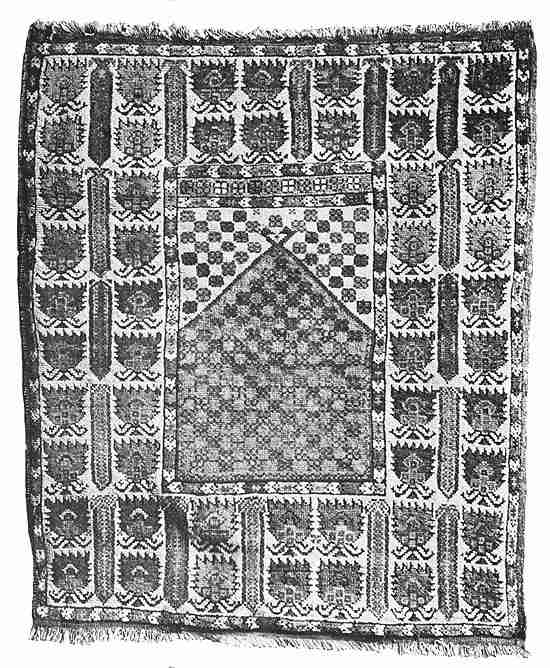
Plate 28. Bergamo Prayer
Rug
Like Yezd, Hamadan is famous for its namads; and like Yezd it
once produced, according to tradition, most beautiful silk
carpets, though no longer are any woven there. But its looms have
been busy for the last few generations weaving rugs of wool and
camels’ hair, which have such marked individuality that
they bear unmistakably on their face the stamp of identification.
The few old rugs that remain are sterling pieces, which are
stoutly woven and of excellent dyes. They come in many sizes;
some are simply mats, others sedjadehs, and an unusually
large number are runners. The typical pattern of the mats and
smaller sedjadehs consists of a central diamond-shaped medallion,
surrounded by a field of contrasting colour, from which are set
off the triangular-shaped corners. In the large sedjadehs and in
the runners, which are sometimes twenty feet or more in length,
are often three or more pole medallions, though the pole device
may be omitted. These medallions and corners are covered with
small, carefully drawn geometric figures, or more frequently with
floral designs such as appear in Feraghans, and as a rule are
defined by serrated lines or are fringed with hooks or comb-like
teeth. The colour of the surrounding field is unobtrusive. In
some pieces it is void of pattern, and its monotonous tone is
broken only by slight variations of shade; yet not infrequently
it is marked with faint lines of slightly darker or lighter tint,
like a delicate tracery. Not only are the borders wide, but a
broad edging, which is at least one half and sometimes two thirds
as wide as all the coloured stripes combined, surrounds them. As
it is usually of camels’ hair and without pattern, it is a
very noticeable characteristic. The main stripe has an undulating
vine with conventionalised flowers, and the two guard stripes
have a simpler vine, or, more frequently, the reciprocal
trefoils.
To this general type, however, are many exceptions. Sometimes
the figures of the medallion and corners are more geometric;
sometimes the corners are omitted; the outside edging may be
decorated with large conventionalised floral or geometric
figures; and occasionally a camel or some other animal is
represented in the field or border. A few of the old rugs were
strikingly handsome. Dr. George Birdwood refers to a large
Hamadan that formerly hung in the India Museum in these
words:23 “An irregular
lozenge form, a little island of bright clustering flowers, of
which the prevailing colours are red and blue, adorns the centre;
while the wide extended ground of yellow, in irregular shades,
surrounds it with a rippling amber sea; and there are blue pieces
in the corners, within the broad blue border worked in
arabesques. It is a carpet not to be laid on a floor, but to be
hung in a gallery, to be looked at like a golden sunset. It was a
sacrilege to remove it from the mosque where it evidently was
once spread under the great dome. Beati
possidentes.”
Most of the old pieces have disappeared, and in their places
are modern products with pile of wool or
goat’s hair often dyed in garish colours. There are also
many nondescript rugs, which were gathered from wandering tribes
or surrounding villages and taken to Hamadan, since for a long
time it has been one of the great rug markets of Persia. When
exported from there they were often classed as products of that
city.
Moderately old Hamadans contain more camel’s hair than
any other class of rugs, since in very many of them it forms the
pile of both field and outer edging, where its soft tones of pale
chestnut colour contrast with the bright shades of blue, red, and
yellow yarn used in other parts of the field and border. This
lavish use of camel’s hair, the broad encircling edging,
the cotton warp, and a single thread of coarse weft passing once
between two rows of knots, distinguish them from all other
rugs.
Type Characteristics. Colours, principally the
chestnut of camel’s hair with red and blue. Knot,
Ghiordes. Knots to inch horizontally, six to nine;
perpendicularly, eight to twelve. The rows of knots are firmly
pressed down. Warp, cotton; each of the two threads
encircled by a knot is equally prominent at back. Weft,
generally cotton, frequently wool; of coarse diameter. A thread
of weft crosses only once without slack between every two rows of
knots, so that the white spots of transverse cotton warp exposed
at back have a quincunx appearance. Pile, in old rugs,
mostly camel’s hair and some wool; in recent rugs, mostly
wool clipped short. Border, wide, generally of three or
four stripes, and a broad outer edging of camel’s hair.
Sides, overcast, generally in brown or red. Lower
end, a narrow web and warp loops. Upper end, a narrow
web turned back and hemmed. Texture, very firm.
Weave, at back is of moderately coarse grain.
Length, three to twenty-four feet. Width, two
fifths to three quarters length.
Irans.—Although
neither a city nor district of Persia is called Iran, a
well-defined class of rugs is known to the trade by that name.
They are woven by some of the old Iranian stock dwelling
principally in the province of Irak-Ajemi. These people follow no
particular pattern or colour scheme of their own, but to a large
extent copy those of a few well-known Persian classes; yet in
other respects their rugs have a noticeable individuality. They
are woven with a Ghiordes knot and so loosely that if the rug be
observed from the front, as it is bent backward in a plane
parallel to the direction of the weft, the foundation threads
of warp and weft, which are of cotton, will show distinctly
between the knots. Each of the two threads of warp encircled by a
single knot are equally prominent at the back. Ordinarily the
threads of weft cross twice between the rows of knots, but
occasionally they cross only once, as in Hamadans. Many of the
fabrics regarded as Sarabends, Feraghans, and even Hamadans are
in reality Irans, which on account of their inferior workmanship
are much less valuable.
Type Characteristics. Colours, principally blue
and red, with minor quantities of ivory, yellow, green, and
brown. Knot, Ghiordes. Knots to inch horizontally, six to
eleven; perpendicularly, seven to eleven. A half knot as it
appears at back is frequently longer, measured in the direction
of the length of the rug, than wide. The rows of knots are not
pressed down closely, so that the warp is noticeable at back.
Warp, cotton; each of the two threads encircled by a knot
is equally prominent at back; they are not closely strung, so
that each half knot stands out distinctly. Weft, cotton; a
thread of weft of coarse diameter as a rule crosses twice between
each two rows of knots, and only rarely crosses but once. The
weft is conspicuous between the knots at front when the rug is
bent backwards. Pile, wool of medium length.
Border, generally four to six stripes. Sides, a
heavy double overcasting that is generally brown or black, but
sometimes red. Lower end, a narrow web. Upper end,
a narrow web and loose warp fringe. Texture, loose.
Weave at back is of coarse grain. Usual length,
five to ten feet. Usual width, two fifths to three
quarters length.
Sarouks.—Towards
the western end of the Feraghan plain and at an altitude of
seventy-five hundred feet is the mud-walled village of Sarouk.
Here, shaded by poplars, are clustered one hundred and fifty
houses, with floors, roofs, and sides of mud that has dried and
cracked until it admits the wind. The sun and light enter through
the open doors, for there are no windows. Nor are there chimneys,
but simply openings between the rafters to permit the escape of
smoke from the open fireplace in the floor below and the entrance
of more wind. At times the atmosphere is not only oppressive with
smoke, but is laden with odours that arise from the pens beneath
and beside the houses, where fowls, sheep, and goats are huddled.
During the winter and early spring snow lies on the ground; a
little later a hot summer follows. Yet amid these depressing
surroundings and under these adverse conditions lived weavers who
gave the name of their little village to some of the most
beautiful rugs made in all the East.
Now and then is seen an old piece with surface like velvet and
with mellowed tones of perfect harmony that has come from these
huts or surrounding hills; but probably not one in a score,
perhaps not one in a hundred, of the Sarouks now offered for sale
in this country was woven there, as most of them are made in the
workhouses of larger cities, though they follow essentially the
general appearance and technique of old and genuine pieces, even
if lacking some of their best qualities. Nevertheless, the modern
pieces are of handsome colour, of graceful pattern, and are well
woven. Some of them, which were made two or three decades ago,
had large designs of the cypress, willow, or the tree of life, as
well as realistically drawn animals represented in the fields;
but the great majority of those now seen invariably follow a
pattern consisting of a large medallion with pendants, or of two
or more concentric medallions resting on the field, from which
are set off the four corners. Defining the edges of both
medallions and corners are lines that are most artistically
irregular, yet correspond with one another.
Between each part is the greatest co-ordination, for the
designs of field, corners, medallions, and borders are similar.
On long delicate stems that bend and interlock like carved
tracery are leaves, buds, and flowers, suggesting the
craftsmanship of the best days of old Iran. The borders generally
have only three stripes: a broad main stripe on which appears an
elaborately drawn undulating vine with pendent flowers, and a
narrow guard stripe on each side. Sometimes the guards are
ornamented with only a simple vine, but more frequently with a
reciprocal pattern, which, however, is so well drawn as to
conflict in no wise with the harmony of the floral forms. In the
drawing of the borders the weavers exercise greater latitude than
in any other part of the rug; for occasionally they add a narrow
outer edging of dark colour, place the reciprocal figure next to
the innermost stripe as a fringe to the field, or increase the
number of stripes to seven. Rarely is the medallion wanting in
modern pieces, but now and then the pendants are replaced by
bunches of flowers, and in some pieces the corners extend along
the sides in undulating lines until they meet near the
centre.
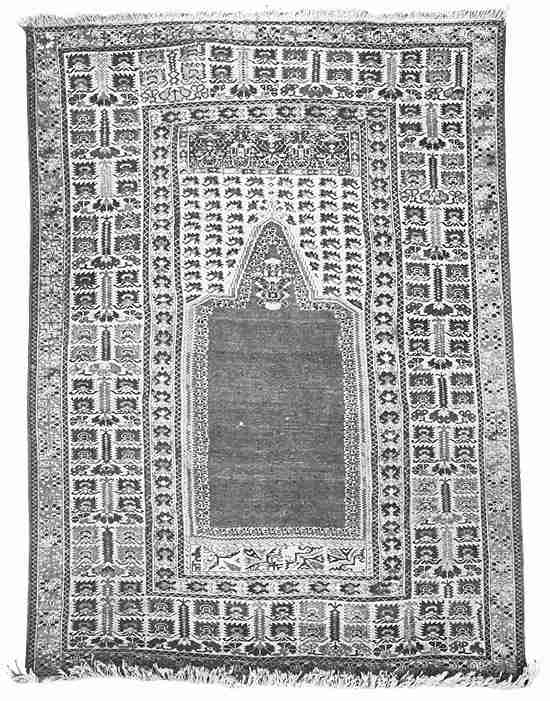
Plate 29. Ghiordes Prayer
Rug
All of these pieces are so closely woven that the fine bluish
weft is hardly discernible at the back. Very few other rugs have
such short-cut wool, which has a velvety
appearance, rendered more effective by the soft, rich colours
that are always in perfect harmony and excellent taste. As a rule
they are dark. Ever present in the ground colours are deep blues
and reds, suggestive of the hues of the so-called
“Ispahans;” while olives, delicate greens, and ivory
represent with consummate dignity of tone and design a lavish
tracery of leaves and foliage motives.
Type Characteristics. Colours, principally dark
blue and red, with minor quantities of green, olive, buff, and
ivory. Knot, Sehna. Knots to inch horizontally twelve to
eighteen; perpendicularly, twelve to twenty. The rows of knots
are pressed down, so that the warp is concealed and the weft is
partly hidden at back. Warp, cotton, rarely linen; one of
the two threads encircled by a knot is almost always doubled
under the other; in a few pieces it is only depressed.
Weft, cotton, of small diameter, dyed blue. A thread of
weft of fine diameter crosses twice between every two rows of
knots. Pile, wool, short and velvety. Border,
generally of three stripes but sometimes as many as seven.
Occasionally there is an outer edging of dark colour.
Sides, a tightly wound double overcasting of red, blue, or
black wool. Both ends, a narrow web, or web and short warp
fringe. Texture, very firm. Weave at back is of
fine grain. Length, four to twelve feet. Width, two
thirds to three quarters length.
Kashans.—Near the
centre of the province of Irak-Ajemi, on the ancient and
well-travelled highway between Ispahan and Teheran, is the city
of Kashan, from which, according to an old tradition, the three
Wise Men of the East followed the Star of Bethlehem. Like many of
the cities of Persia it is now largely in ruins; its homes are
infested with scorpions; for many months of the year the heat,
which in a measure is due to the proximity of the great salt
desert that extends far into Khorassan, is unendurable; yet in
spite of these inconveniences, for which perhaps familiarity has
in a measure lent contempt, forty thousand people live there. In
the past it has produced some of the greatest artists and
artisans of weaving. It was once the home of Maksoud, whom Shah
Ismael I ordered to weave the famous carpet of the Mosque of
Ardebil, which, ranking among the greatest woven products that
still exist, bears unmistakable evidence of the wonderful
technique and artistic skill then practised in Kashan. Without a
doubt other textile masterpieces of the XVI and XVII
Centuries were woven there, for it would be unreasonable to
believe that the city where Maksoud had learned his art was not
at that time a prominent rug-producing centre.
According to Persian tradition many of the antique silk
carpets came from Kashan. At any rate, it has been for a long
time customary to take the raw silk from other places to be spun
and dyed there. Some of it is woven into rugs, which are
considered among the best of modern pieces, though the demand for
them is small.
On the other hand, the woollen pieces are now found in every
market, though it is only within recent years that they have been
generally known. Occasionally they are defined as a higher grade
of Sarouks, on account of the striking resemblance in texture,
colours, and designs; yet there are certain distinctions: the
warp is often linen, the nap is a little shorter, the texture
slightly firmer, and there are a great number of border stripes.
A feature that is more frequently found in these two classes than
in any other is the fringe of hooks or short comb-like teeth that
border the innermost stripe and extend into the field. Without
doubt Kashans are among the most perfect as well as the most
expensive woollen products of the modern Persian looms. Their
velvet-like surface and rich sheen give them an appearance that
to those unfamiliar with rugs seems like that of silken pieces.
The fine wool is dyed with rich, deep tones of blue, olive, red,
and brown; the perfectly balanced pattern is artistic as well as
ornate; and on account of the very short nap the drawing of each
minute detail is clear. In place of bold designs accentuated by
masses of colour are delicate tracings of floral and foliage
motives, of graceful arabesques and foliated stalks, so expressed
in rhythmic lines and harmonious tones as to give a sense of the
greatest refinement. Even though these rugs be modern and
chemically washed, their wealth of artistic workmanship and
exquisite colour make them exceedingly handsome.
Type Characteristics. Colours, principally dark
blue, red, and yellowish brown, with minor quantities of light
blue and green. Knot, Sehna. Knots to inch horizontally
sixteen to twenty; perpendicularly, sixteen to twenty-four. The
rows of knots are firmly pressed down so that the warp is
concealed and the weft almost hidden at back. Warp,
generally cotton, rarely linen; one of the two threads encircled
by a knot is doubled under the other. Weft, generally
cotton, of small diameter, dyed blue; rarely linen. A thread
of weft crosses twice between every two rows of knots.
Pile, wool, very short and velvety. Border,
generally of seven stripes. Sides, a tightly wound double
overcasting in dark red, blue, or brown. Lower end, a
narrow web. Upper end, a narrow web and short warp fringe.
Texture, very firm. Weave at back is of very fine
grain. Usual length, six to ten feet. Usual width,
three fifths to three quarters length.
Sababends.—Standing on the top of lofty
Elwund, that rises on the boundary between the provinces of
Ardelan and Irak-Ajemi, in Northwestern Persia, one would see
within a radius of ninety miles as prolific a centre of rug
weaving as anywhere exists. Just within this distance to the
northwest are Sehna and Bijar, to the southeast is Sultanabad, to
the southwest is Kermanshah; and skirting the mountain on the
eastern side are the high plains where lie the districts of
Hamadan, Feraghan, and Sarawan, as well as the village of Sarouk
and less important centres of weaving.
Among the valleys of the Sarawan district, that lies on the
northern flanks of mountain ranges extending as far as Ispahan,
are made the rugs which, by a corruption of the word Sarawan, are
known as the Sarabends. No other rugs of Persia have a pattern
that is so simple, and that for generations has been followed
with so little variation. Nor are there any other modern rugs
that have changed less from the old styles in respect to colour
and quality. The typical pattern of the field consists of rows of
pear designs arranged in transverse lines, with the smaller ends
pointing in different directions in alternate lines. The pears of
the field show great diversity of shape, but those of the borders
are long, narrow, and most angular; yet they never assume the
rectilinear figures found in Baku rugs. Only very rarely is there
any departure from this pattern; though in a few old pieces is an
adaptation of the Herati design, and now and then is seen a
geometric figure, or human form, or the date when the piece was
woven.
The ground colour of the field may be blue, red, or white. If
blue, it is so largely covered with pinkish or rose-coloured
pears that the prevailing hue, when the pieces are viewed from a
distance, is light red. If, on the other hand, the field is red,
the pears are mostly blue; and if the field is ivory white, the
pears are red and blue. In all old pieces the blue has rich, deep
tones, the red has mellowed into soft rose or delicate pink, and
the white has turned to ivory. This pleasing effect is
increased by shades of yellow and green, which are added to the
other colours of the pears.
With few exceptions the borders have a large number of narrow
stripes, of which the central is about one third the aggregate
width. Its ground colour is ivory white, but the angular vine and
pendent, narrow pears have the same colours as those of the
field. On each side of it is usually a stripe with ground colour
corresponding to that of the field and with an undulating vine
and rosette. Almost invariably there is an outer stripe of
reciprocal trefoil in red and blue, which may be balanced by a
reciprocal sawtooth adjoining the field. It is not unusual to see
large pieces with two white stripes, and very rarely one is seen
with three.
The best of these pieces are made in the town of Mirabad,
which signifies the “city of Mir,” and are
accordingly called Mir-Sarabends. They can be distinguished from
others, known to the trade as Royal Sarabends, by the fact that
in tying the knots the yarn is so twisted that one thread of warp
is doubled under the other; and in the latter each of the two
threads appear with equal prominence at the back. Neither of them
should ever be mistaken for Iran imitations, in which the pile is
of much looser texture and is tied with the Ghiordes knot. For
durability, there are very few modern pieces that will give the
satisfaction of Sarabends; for as a rule they are stoutly and
closely woven, and though there is monotony in the pattern, those
coloured with vegetable dyes will grow more beautiful with
age.
Type Characteristics. Colours, principally red
or blue, with minor quantities of ivory, yellow, and green.
Knot, Sehna. Knots to inch horizontally eight to thirteen;
perpendicularly, nine to thirteen. The rows of knots are firmly
pressed down, so that the warp does not show at back.
Warp, cotton. In Mir-Sarabends one of the two threads
encircled by a knot is doubled under the other at back. In Royal
Sarabends each is equally prominent. Weft, cotton, of fine
diameter, and dyed red or blue. A thread of weft crosses twice
between every two rows of knots. Pile, wool of short or
medium length. Border, five to seven stripes, and
occasionally even more. Sides, a red double overcasting.
Lower end, a web, or web and short warp fringe. Upper
end, a web and short warp fringe. Texture, firm.
Weave at back is of moderately fine grain. Length,
five to eighteen feet. Usual width, two fifths to two
thirds length.
Only now and then is seen a prayer Ghiordes that represents
such a high type of artistic skill. The weaving follows more
closely the fine technique of the Persian than that of the Asia
Minor weaver. Yet it is the drawing and colouring that claim
attention. The delicate tracery of the spandrel, the minute
delineation of tendril and leaf in the border, and the perfect
balance of every part of one side with a corresponding part in
the other, resemble the finest workmanship of old Iran. Not only
so, but the beautiful border pattern of rosette and leaf is so
suggestive of the well-known Herati design that it seems not
improbable that here is shown the influence of those Persian
weavers that Solyman the Magnificent took with him to Asia Minor
after his capture of Tabriz. The colour also displays dainty
tones and careful shading found in no other class of Asia Minor
rugs. Such pieces are usually regarded as products of the XVI
Century.
Property of the Author
Burujirds.—About
sixty miles to the west of Sultanabad and forty to the south of
the Sarawan district is the city of Burujird. It is in a rich,
well-watered valley and is surrounded by numerous hamlets. Most
of the population are engaged in agriculture; and only a small
part, who are stimulated by the increased prices occasioned by
the rug industry of Sultanabad, are weavers. They produce pieces
that resemble closely the Sarabend rugs, as the field is
generally occupied with pear designs; but on account of the
Ghiordes knot and cotton warp and weft, they might be mistaken
for Iran rugs.
Sultanabads.—Southeastward from the plain of
Feraghan is the city of Sultanabad, which in recent years has
become important as the centre of a great rug industry controlled
by Europeans and Americans. Higher prices, resulting from the
constantly increasing Western demand for Persian rugs, have
stimulated the native weavers to more persistent efforts. Those
who are too poor to purchase wool and dyes24 are supplied by the companies. Others, who are
more dependent, are paid regular wages. Thus it happens that not
only large numbers of looms are constantly at work in the city,
but a hundred hamlets and villages that lie within a day’s
journey produce rugs that are marketed there. But while the
output has been increased the true artistic spirit has been
suppressed, and patterns favoured or supplied by foreign
purchasers only are in demand. Most of the rugs are well woven,
though there is a difference in grades. Some take the name of the
city, others are called Savalans, from a range of mountains that
lie to the north, and others are known as Mahals. Most of them
are large pieces, rather coarsely woven.
Muskabads.—In the
district of Muskabad, a short distance to the northwest of
Sultanabad, are produced rugs very similar to the Mahals. They
come in the same large carpet sizes and nearly square shapes;
they have almost the same harmonious colour scheme of unobtrusive
red, yellow, blue, green, and ivory; they have the same cotton
warp and weft, the same finish of sides and ends; but as a rule
they are less closely woven. The patterns are varied.
Occasionally they have large figures such as are seen in
Gorevans, though these are more usual in Mahals.
In some of them the field is covered with conventionalised leaf
and floral form. But the usual type has two or more concentric
medallions of different colours covered with the small Herati
designs so distinctive of the Feraghans. When such is the case,
the border has usually the turtle pattern in the main stripe and
some stiffly drawn vine and floral pattern in the smaller
stripes. But the velvety appearance, the elegant finish of old
Feraghans, is always lacking. The nap is of soft wool of medium
length, but the surface of the back displays coarse texture.
These pieces lack the artistic qualities of most Persian rugs;
but on account of their excellent quality of material and
stoutness of weave they are very serviceable.
Type Characteristics. Colours, principally red,
blue, and ivory, with minor quantities of green and brown.
Knot, Ghiordes or Sehna. Knots to inch horizontally seven
to fourteen; perpendicularly, eight to twelve. The rows of knots
are not firmly pressed down. Warp, cotton; one of the two
threads encircled by a knot is generally depressed at back, and
frequently nearly doubled under the other. Weft, cotton,
of medium to coarse diameter. A thread of weft crosses twice
between every two rows of knots. Pile, wool, of medium
length. Border, three to five stripes, with a narrow outer
edging. Sides, a double overcasting. Lower end, a
very narrow web and short warp fringe. Upper end, short
warp fringe. Texture, moderately firm. Weave at
back is of very coarse grain. Length, ten to eighteen
feet. Width, two thirds to seven eighths length.
Joshaghans.—Lying
to the southeast of Sultanabad and to the north of Ispahan is a
district where a century ago were woven some of the best carpets
of Persia, known as Joshaghans or Djushghans. Even long before
then it was noted for its textile fabrics; but during the reign
of Nadir Shah, who removed many of the best artisans from the
central to the northwestern part of Persia, the carpet weaving
received a new impulse, and continued to flourish there until
nearly the middle of the last century. Since that time it has
almost ceased, so that the genuine Joshaghans of rich, deep
colour and skilfully drawn pattern are all sixty or more years of
age. They may still be found scattered throughout the country,
and should be carefully preserved; for they merit the high esteem
accorded to them by the Persians themselves.
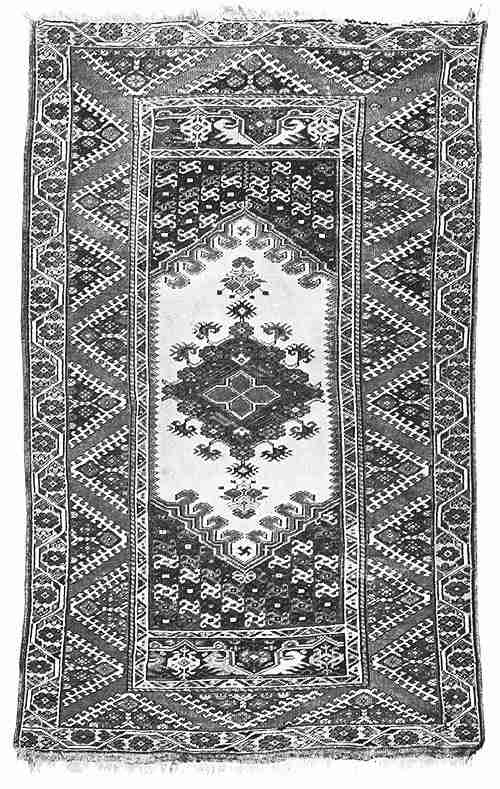
Plate 30. Ghiordes
Rug
In a few of these pieces are seen the Shah Abbas pattern. In
other pieces the field is covered with
scrolls, or with a lattice-work pattern in which small floral
forms are the motives. Again it is occupied by pear designs
encircled by small rounded figures, which combined form the
outlines of a larger pear, while in the intervening spaces are
small floral forms. The principal border stripe generally
consists of floral designs, which not infrequently are some form
of the Herati pattern. The secondary stripes often contain floral
vines.
Whatever the pattern of the field, the effect is always
striking and beautiful; for the lines are never harsh, and the
colours are rich. The ground is very frequently a rose tint, but
is sometimes dark blue; and the overlying designs are rose,
yellow, green, and ivory. The colours of the border are generally
the same as those of the smaller designs, so that the effect is
always harmonious. These rugs are excellently woven; and the soft
lustrous wool of the pile, which is usually longer than that of
Sarabends and Feraghans, has often an appearance like plush.
Type Characteristics. Colours, principally red
and blue, with lesser quantities of yellow, green, brown, and
ivory. Knot, Ghiordes. Knots to inch horizontally seven to
eleven; perpendicularly, eight to thirteen. The rows of knots are
not always firmly pressed down, so that the warp may be seen at
back. Warp, usually cotton, occasionally wool; one of the
two threads encircled by a knot is usually depressed below the
other at the back. Weft, wool, sometimes dyed red, brown,
or reddish brown, but frequently of natural colour. A thread of
weft generally crosses twice, but sometimes three times between
every two rows of knots. Pile, wool of short or medium
length. Border, usually three stripes. Sides, a
double overcasting that is generally brown or black. Lower
end, a web. Upper end, a web and warp fringe.
Texture, moderately firm. Weave at back is of
moderately fine grain. Usual length, eight to sixteen
feet. Usual width, two fifths to two thirds length.
Sehnas.—Seldom has
prophecy been more precisely fulfilled than the one made a decade
ago that the old Persian rugs would rapidly disappear from the
market. Nor is it better exemplified than in the case of those
woven before the middle of the last century in Sehna, capital of
Ardelan, for to-day it is exceedingly difficult to obtain any of
them. Nevertheless, there are still many looms among the four or
five thousand families of the city, where true to early
traditions are woven modern fabrics that maintain the
same floral Persian patterns, the same
colour, the same general character of weave; but they lack the
fine technique of the older pieces. It is, indeed, surprising
that these modern pieces so closely resemble the old in all save
quality, when it is considered that Sehna is distant only fifty
miles from the western border of Persia; that it is surrounded by
Kurdish tribes who for generations have woven rugs with nomadic
features; and that it is not far distant from other important rug
centres.
To one familiar with the leading characteristics it is
possible at once to distinguish these rugs. Their nap is
exceedingly short, and the weave is so distinctive that with eyes
closed an expert will generally recognise them after rubbing the
hand across the front and back. Their patterns, also, conform to
well-established types, yet have sufficient variety to be always
interesting. They may be conveniently divided into two groups:
one represents the entire field covered with floral designs, and
the other represents a field of uniform colour with a medallion
at the centre, or with two or more concentric medallions. The
former, which is undoubtedly the older group, has generally a
small diaper pattern of the Herati design or floral figures
daintily drawn. To obviate too great monotony, a number of the
old pieces have the leaves and flowers so adjusted that the
ground conveys the effect of lattice work, or less often have
small trees of cypress regularly placed amid the other floral
designs. Again, the field may be covered with large pear designs
placed in rows. Of modern pieces the most beautiful pattern, as a
rule, consists of a field of rich, uniform colour, as ivory or
red, containing at its centre a single medallion of contrasting
ground colour, which is generally dark blue or even black. The
four corners of the field have serrated edges and are covered
with floral designs similar to those of the medallion. The
borders, which are invariably narrow, usually consist of three
stripes, but sometimes of only two. With very few exceptions they
are floral, and in the main one, that has a ground colour of
yellow or red, are represented designs which are also similar to
those of the medallion. Some of the old Sehnas had borders that
were less floral than more modern pieces, and the turtle design
so common to Feraghans was often used. Isolated and adventitious
designs, such as are seen in all nomadic rugs, are never found in
these pieces, nor are the floriated scrolls that are peculiar to
Sarouks, Kashans, and Kermanshahs.
As is seldom the case with modern rugs, occasionally both
linen and silk are used for the warp, and
silk for overcasting, but generally the warp is cotton and the
overcasting is of wool. The city of Sehna has given its name to
the kind of knot with which almost all the rugs of China and
Turkestan as well as many of the rugs of India and Persia are
tied; yet strange as it may seem, its own weavers have been
inconsistent in its use. To be sure, most of its rugs have the
Sehna knot, but a surprisingly large proportion of both recent
and comparatively old pieces have the Ghiordes knot. Only a few
other rugs ever adopt the same style of weaving; for a thread of
weft passes between two rows of knots but once, so that at the
back only alternate threads of white cotton warp appear between
these knots and thus give to the weave a checkered appearance or
quincunx effect. Moreover, the yarn of the knots is not drawn
tightly against the warp, so that in whatever direction the hand
is rubbed the surface feels like a file. Very few other rugs are
so closely woven, as four hundred knots to the square inch are
not uncommon; and in very old pieces nearly double that number
are now and then met with. Since both warp and weft are of fine
threads and the nap is very short, these rugs are exceedingly
thin and, accordingly, are not well adapted for floor use.
Some old saddle-bags are still to be found, rich in their
fields of deep blues and floral forms of brighter tones, but
unfortunately they are somewhat marred by the long slit in the
centre made to fit the saddle.
Type Characteristics. Colours, principally dark
blue, red, and ivory, with lesser quantities of green, light
blue, and yellow. Knot, Sehna, often Ghiordes. Knots to
inch horizontally eleven to twenty; perpendicularly, twelve to
twenty-four. The rows of knots are closely pressed down, but the
yarn of knots is not drawn tight against the warp. Warp,
generally cotton, occasionally linen, rarely silk. Each of the
two threads encircled by a knot is equally prominent at back.
Weft, generally cotton, occasionally wool or linen, rarely
silk. A single thread of small diameter crosses only once between
every two rows of knots, so that the white spots of transverse
warp exposed at back have a quincunx appearance. Pile,
wool clipped very short. Border, three stripes.
Sides, a tightly wound double overcasting. Lower
end, a short web, or web and warp loops, or web and short
warp fringe. Upper end, short web and fringe.
Texture, very firm. Weave at back is of fine grain
but very rough. Length, three to seven feet. Width,
two thirds to three quarters length.
Bijars.—One hundred miles beyond Hamadan, on
the road to Tabriz, is the city of Bijar, capital of the district
of Gehrous. It is surrounded by barren mountains that rise out of
high table-lands, where for miles scarcely a habitation or bush
breaks the monotony, and where not even a blade of grass or
flower brightens the cracked and sun-parched earth, except for a
short season of the year. As is the case throughout nearly all
Persia, the spirit of desolation has crept into the city; the
grapevine climbs over ruined walls; the shade of poplars and
willows falls alike on decaying palace and crumbling houses. Yet
there still remain caravansaries, schools, and mosques, as well
as a population of five thousand people. Without doubt the
importance of the city is partly due to the regiment of soldiers
that the governor maintains to keep in subjection the bands of
robbers and fierce Kurds who, in large numbers, live throughout
the surrounding country. Nor are they the only tribes of fierce
foreign blood dwelling in this region; for it is stated that
during the invasions of the Timurids, a body of Turkomans from
the fortress town of old Saraks, where the corners of Persia and
Afghanistan meet Turkestan, followed the conqueror westward and
settled here. After them is named a small river that flows a
short distance to the north and finally empties into Lake
Urumiah; and it is not unusual to apply the name Saraks to the
rugs woven about Bijar, though they have none of the Turkoman
characteristics.
By adopting some of the best qualities of both Persian and
Kurdish rugs, the Bijar weavers have produced pieces of unusual
merit. The foundation is generally of wool; but unlike almost all
other rugs with nomadic features one thread of warp to each knot
is doubled beneath the other in the process of weaving, so that
it is almost or entirely concealed. Bijars are accordingly pieces
of great firmness and durability. Moreover, their threads of warp
and weft are of coarse diameter, so that they are invariably
thick even when the nap is not long. They are also distinctive in
the effective massing of bright and strong colours. Perhaps the
association with ranges of treeless hills, with salt wastes, with
vast plains where rainless months leave the grass parched and the
flowers withered, has deadened the Persian love for the
brilliant, joyous colours so acutely cherished in other parts of
Asia; but by the weavers of Bijar it is not unusual to discard
many of the Persian colours, which, however rich, are subdued and
sombre, and adopt the brighter hues seen in
some of the rugs of Asia Minor. Yet, as is not always the case
with the latter, there is no sense of outraged taste; and though
crimson reds, deep blues, or tawny camel’s hair be brought
in relief against a field of strongly contrasting colour, the
effect, except in modern pieces of poor dyes, is never
displeasing.
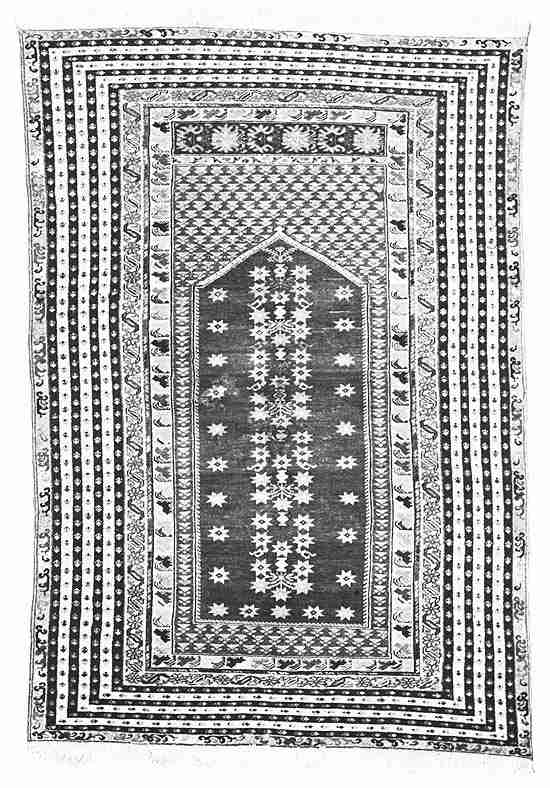
Plate 31. Kulah Prayer
Rug
In the pattern much latitude is exercised, but only in the
oldest pieces are found the gracefully flowing lines suggestive
of the highest Persian art. In many pieces a central medallion
and triangular-shaped corners, separated by a field of plain or
slightly shaded colour, is a favourite pattern. But the defining
lines are severe, and lack the delicate drawing characteristic of
Kermanshahs and Sarouks. Or the field may be covered with a
lattice-work pattern that contains small repetitive forms,
consisting of slender stems supporting one or more flowers.
Frequently a rug is covered with a medley of designs composed of
conventionalised flowers, crudely drawn trees, as well as birds,
animals, or human beings. The borders generally consist of an
outer edging of plain colour, and three stripes, on which are
often represented purely geometric forms, but more frequently the
undulating vine and pendent leaves, such as are common to most
Persian rugs. Fortunately many sterling pieces still remain that
have none of the earmarks of factory-made rugs, but are beautiful
with their soft wool and lustrous colours, as well as interesting
with their blending of Persian and Kurdish features.
Type Characteristics. Colours, principally red,
also blue, ivory, green, yellow, and chocolate. Knot,
Ghiordes. Knots to inch horizontally six to ten; perpendicularly,
eight to twelve. The rows of knots are pressed down, so that the
warp is concealed at back and the weft partly hidden.
Warp, wool; one of the two threads encircled by a knot is
doubled under the other. Weft, wool, of medium or coarse
diameter, frequently dyed red. A thread of weft crosses twice
between every two rows of knots. Pile, of medium length,
usually wool, but frequently partly of camel’s hair.
Border, of three stripes, often with an outer edging.
Sides, a double overcasting in red or purple. Lower
end, a web that is occasionally coloured or a narrow braided
selvage. Upper end, a web with loose warp fringe and
sometimes a braided selvage. The webbing is occasionally turned
back and hemmed. Texture, very firm. Weave at back
is of coarse grain. Length, six to sixteen feet.
Width, one quarter to three fifths length.
Kermanshahs.—On an ancient highway between
Bagdad and Teheran is the city of Kermanshah. As it is situated
near the frontiers of northwestern Persia, facing the Turkish
provinces, and is surrounded by mountains where once wandered
bands of homeless marauding Kurds who recognised no government,
it was formerly a most important stronghold of defence. A century
ago Robert Kerr Porter, who visited the city, referred to the
luxurious gardens and orchards that surrounded it, and to the
villages of the vicinity in which were made “carpets of
most beautiful colour and fabric.” Within later years the
moat has filled with rubbish, the encircling walls have crumbled,
and the deserted bazaars and caravansaries show that its present
population of about twelve thousand is but a small part of what
it has been. With its decline in political importance followed a
decline in industrial activities; yet for a long time it remained
a rug-producing centre of importance. In 1880 Sir George Birdwood
wrote that “the finest Oriental rugs of our time, which at
the Vienna Exhibition astonished all beholders, are those made in
the palace of the Governor of Kermanshah, in Kurdistan, and are
only disposed of as presents.”25
And in 1890 a traveller26
spoke of the weaving as follows: “It is a process carried
on in homes, hovels, and tents by women and children.... The
vegetable dyes used are soft and artistic, especially a wonderful
red and the various shades of indigo. The dull, rich tints, even
when new, are quite beautiful. The women pursue their work
chiefly in odds and ends of time, and in some cases make it much
of a pastime.”
From this city and the surrounding hills are still obtained
large quantities of rugs, which follow the same patterns that for
years have been characteristic of this district. Yet most of the
modern Kermanshahs are made elsewhere in the workhouses of
exporting companies. So noticeable is the resemblance in drawing
and colouring of some of them to the Kirmans of Southeastern
Persia, that they are offered now and then by dealers as real
Kirmans, though they lack the fine technique and artistic merit
of the latter. They possess, however, the same wealth of floral
expression, for throughout border and field are sprays of flowers
on delicate vines and foliate stalks. Most of the pieces now seen
contain at the centre of the field a large medallion, which may
have serrated or lobed edges, be oval or of diamond shape, and
with or without pendants. The corners are
defined by lines that do not always conform to those of the
medallion; and the borders have always several stripes, of which
the main one is usually but little wider than the others. In all
these different parts are floral and foliage motives that find
expression in sunflowers, roses, tulips, daisies, and many
simpler forms, supported by delicate branching sprays and
vines.
There are, however, other patterns less frequently met with,
as it is not unusual to see elaborate pear designs, and sometimes
the cypress or the palm tree naturalistically drawn. Covering the
field of a rare old Kermanshah recently seen were thirty large
panels, which like so many small rugs contained central fields
that were alternately coloured blue and ivory. Surrounding each
of these little fields, on which were represented the arch of a
temple and the tree of life, were borders wherein were woven
verses from the Koran, and at the intersections of the borders
were floral designs like roses. Encircling all the panels was a
wide border containing escutcheons in which were woven other
verses. Without doubt this rug was used for sacred purposes. In
fact, a larger proportion of Kermanshahs than almost any other
Persian rugs have prayer arches as well as verses from the Koran
inscribed in some part of them, but with very few exceptions they
are recently woven and bear no evidence of devotional usage.
The general colour scheme is distinctive, for the tones are
much lighter than those of most other Persian rugs. Frequently a
field of ivory surrounds the central medallion, though sometimes
a light rose red is used. Other colours are light blue, green,
and buff, which are softened by the floccy quality of the
excellent and moderately short-clipped wool. One feature common
to almost all of them is the narrow edging of pinkish red that
surrounds the border. This edging, the foliate scrolls, the soft
light tones, and the rather coarse weaving, that leaves the white
or sometimes pinkish weft exposed at the back, are
characteristics by which these rugs may readily be distinguished.
As they come in all sizes from small mats to large carpets, and
have tones that harmonise with almost any surroundings, they are
a most popular class with those who care little for association
and ignore the fact that they are chemically washed.
Type Characteristics. Colours, principally light
rose and ivory, also blue, green, and buff. Knot, Sehna.
Knots to inch horizontally twelve to eighteen, perpendicularly
eleven to eighteen. The rows of knots are pressed
down, so that the warp is concealed at back, but the weft is
conspicuous. Warp, cotton; one of the two threads
encircled by a knot is doubled under the other. Weft,
cotton, of medium diameter, sometimes dyed pink. A thread of weft
crosses twice between every two rows of knots. Pile, wool,
soft and of medium length. Border, frequently of three
stripes of almost equal width, but sometimes many stripes; also
an outer edging that is generally red, but occasionally blue.
Sides, a double overcasting in same colour as edging.
Lower end, a narrow web and warp loops, or short warp
fringe. Upper end, a narrow web and short warp fringe.
Texture, firm. Weave at back is of moderately
coarse grain. Usual length, four to fourteen feet.
Usual width, three fifths to four fifths length.
Western
Kurdistans.—Within the land lying between the
Anti-Taurus and Zagros mountains, where the Euphrates and Tigris
rivers have their sources, dwell a people almost as untamed as
when in the dawn of history they were designated the
“Warriors;” or centuries later, under the name
“Carduchis,” opposed the retreat of Xenophon and his
ten thousand Greeks. Now they are known as “Kurds,”
of whom large numbers, wild, brave, and hospitable, live a
nomadic life among table-lands partly covered with sycamores and
oaks, or follow their sheep over lofty pine-crowned mountains,
that for long months are enveloped in snow. Doubtless the
cheering influence of green hillsides and the rich vegetation of
innumerable valleys, where streams flow perennially, is in a
measure responsible for their more sprightly aspect when
contrasted with that of the Persians. They recognise no law but
the will of their chief, to whom they maintain strictest fealty.
“There was up to a recent period no more picturesque or
interesting scene to be witnessed in the East than the court of
one of these great Kurdish chiefs, where, like another Saladin,
the bey ruled in patriarchial state, surrounded by his clansmen
with reverence and affection, and attended by a body-guard of
young Kurdish warriors, clad in chain armor, with flaunting
silken scarfs, and bearing javelin, lance, and sword, as in the
time of the Crusades.”27
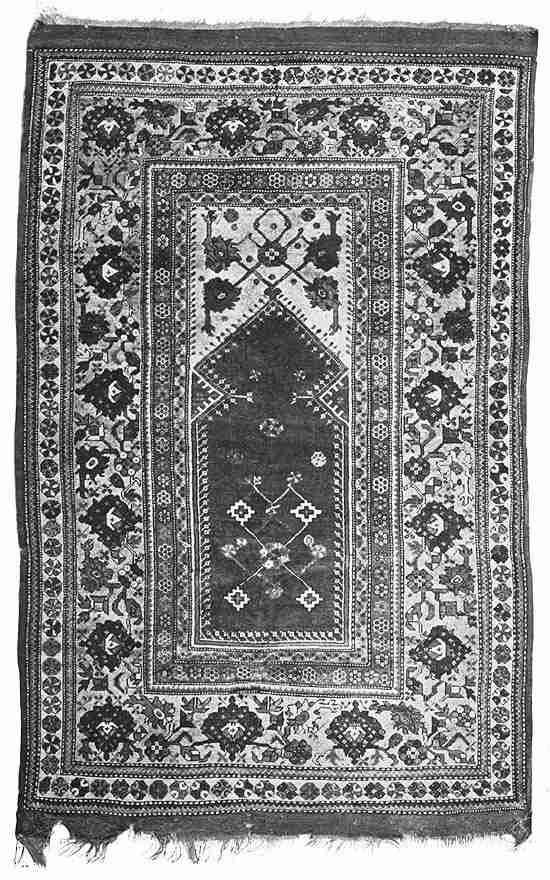
Plate 32. Melez Prayer
Rug
Large numbers, also, are settled in Persia, where they
cultivate the soil of small tracts of land, or live in villages
of stone houses. Many of them are scattered around Lake Urumiah.
Others have made their homes in the district of Kermanshah, and
not a few have wandered as far as Khorassan. But
wherever they may be, they are distinguished by their appearance;
for the men are bold and handsome, and the young women, whom
custom permits to appear unveiled in public, are beautiful as
well as graceful.
There is no racial distinction between the Kurds who live the
pastoral life and those who dwell in villages, or between the
Kurds of Asiatic Turkey and those of Persia; yet environment has
produced a marked difference in their textile fabrics. Those
woven by the tribes that live among the mountains that encircle
Lake Van and extend to the north of Diarbekr embody the wild
characteristics of the weavers. They are strong and coarse, with
close weave, long nap, and bold patterns, that suggest Caucasian
influence devoid of artistic feeling. In some of them is a large
central diamond or lozenge surrounded by latch-hooks, as well as
floral forms so conventionalised as to be purely geometric; now
and then Arabic symbols and letters are scattered over the field.
Moreover, the colours lack the delicate shades of Persian rugs,
but possess rich, strong hues obtained from native dyes that
applied to the excellent wool give it a warm, lustrous
appearance. Brown is very largely used. There are also dark reds
and blues brightened by dashes of white and yellow. Only the
Kazaks, Tcherkess, and one or two Asia Minor weaves are trimmed
with such long nap, which, together with the deep colours and
long shaggy fringe, give these pieces a semi-barbaric appearance
possessed by no other rugs. Sometimes they are confused with the
Mosuls; but as a rule the pile is longer, and they are more
coarsely woven. In fact, the yarn is so coarse that it is not
unusual to see pieces with only thirty or forty knots to the
square inch. Like the Persian-Kurdish rugs, they rarely come in
large, almost square shapes, and are frequently decidedly oblong.
They may, however, easily be distinguished from them by their
cruder patterns, darker colours, coarser texture, and the fact
that each of the two threads of warp encircled by a knot is
equally prominent at the back.
Type Characteristics. Colours, principally
brown, red, and blue, with minor quantities of yellow, green, and
white, and the natural colour of the undyed wool. Knot,
Ghiordes. Knots to inch horizontally four to seven;
perpendicularly, six to nine. A half knot, as it appears at back,
is as long as, or longer than, wide. The rows of knots are
closely pressed down. Warp, wool; each of the two threads
encircled by a knot is equally prominent at back.
Weft, wool, of coarse diameter, and often
dyed a reddish colour. A thread of weft crosses twice between
every two rows of knots. Pile, wool, occasionally
camel’s or goat’s hair clipped long. Border,
generally of three stripes. Sides, a heavy double
overcasting, usually in brown or black, occasionally in several
different colours. Lower end, a narrow web, through which
runs a coloured cord, and warp loops. Upper end, a narrow
web, one or more rows of knots and long, coarse warp fringe.
Texture, very stout. Weave at back is of very
coarse grain. Length, five to sixteen feet. Width,
two fifths to two thirds length.
Persian
Kurdistans.—Nowhere is the influence of association
among weavers more evident than in the Kurdish rugs woven by the
tribes settled in the rich valleys of Northwestern Persia, as is
apparent in weave, colours, and pattern, which differ widely from
those seen in the Kurdish rugs of Asiatic Turkey. The warp is
only rarely of coarse goats’ hair, and is generally soft,
brown wool. The pile is much shorter, so that the drawing is
clearly defined. Likewise, the colours are more varied and of
more delicate tones so as to include lighter shades of green,
rose, and ivory with the darker reds, blues, and browns. But the
chief distinction consists of the more artistic pattern. The
medallion in the centre of the field with corner pieces in which
appear some form of repetitive pattern is most common. Instead of
large figures are often the more dainty Herati designs borrowed
from the Feraghans and the Sehnas, or the pear design from the
Sarabends. Now and then is seen a rare old piece with field
completely covered with drawings of the tree of life and strange
floral conceits; but the pattern that is pre-eminently typical of
this type of Kurdish pieces is the Mina Khani, though it is
occasionally adopted in other rugs. The white and yellowish
flowers, connected by a lattice work sub-pattern of brown or
olive, rests on a ground of dark blue, that in accordance with a
feature peculiar to rugs of Kurdish weaves varies from one end of
the field to the other, so as to suggest that their wandering
life often made it difficult to obtain the roots and herbs
necessary to produce similar shades. As is rarely the case with
other patterns, the naturalistic flowers that are pendent from
the undulating vine of the main stripe and the flowers of the
field have nearly the same drawing. The two remaining stripes of
the narrow border have most simple vines.
Almost without exception rugs of this class are stoutly
woven. To assure firmness, one thread of warp
is depressed below the other in tying the knots; and the weft
that is thrown across for filling is of fair quality. On account
of the firm texture, excellent wool, and good colours it is still
possible to obtain moderately old pieces, that as objects of
utility as well as ornament are desirable for their sterling
qualities.
A similarity exists between the Persian-Kurdish, Mosul, and
Bijar rugs; but a precise, even if easily overlooked, difference
in the weave serves to distinguish one from the other. As may be
seen by examining the backs of typical specimens, in Mosuls every
thread of warp lies in the same plane parallel with the surface
of the pile; in the Persian Kurdistans one of the two threads of
warp encircled by a knot is depressed at an acute angle to that
plane; and in Bijars one of the two threads of warp encircled by
a knot is doubled under the other so as to be at right angles to
that plane.
Type Characteristics. Colours, principally red
and blue, also yellow, green, and white. Knot, Ghiordes.
Knots to inch horizontally seven to ten; perpendicularly, eight
to twelve. A half knot, as it appears at back, is no longer than
wide and is frequently not so long. The yarn is loosely woven, so
that each separate ply is distinct. The rows of knots are pressed
down, so that the warp is largely concealed and the weft partly
hidden at back. Warp, wool; one of the two threads
encircled by a knot is generally much depressed below the other
at back; but sometimes each is equally prominent. Weft,
wool, of medium diameter. A thread of weft usually crosses twice
between every two rows of knots, only rarely once. Pile,
wool, and occasionally some camel’s hair of medium length.
Border, three to four stripes. Sides, a heavy
double overcasting in dark colour. Lower end, web crossed
by a parti-coloured cord, and warp loops. Upper end, web
crossed by a parti-coloured cord, and loose warp fringe.
Texture, very firm. Weave at back is of coarse
grain. Usual length, six to twelve feet. Usual
width, five eighths to two thirds length.
Karajes.—Dwelling
near Hamadan, in the northwestern part of Persia, are tribes who
weave rugs that are known in the markets as Karajes. In their
colour scheme, length of nap, and texture they resemble many of
the Kurdistans; but in the technicalities of weave they show a
marked difference. As a rule, a single thread of weft crosses
only once between two rows of knots, or in a few pieces
two threads of weft pass side by side as
though one. In this particular they resemble Hamadans; but the
alignment of their knots at the back is more regular, their weft
is inserted with some slack, their warp is of wool, and their
weft is almost always of wool. They are generally runners, with
long nap of soft, lustrous wool, with rich colours, and with
border of three stripes. The pattern is Iranian, and very often
consists of a small bush or sprig of leaf and flower disposed in
formal array throughout the field. Sometimes the floral forms are
placed within the diamonds formed by a trellis pattern, but more
frequently they are arranged in rows like the pear designs of
Sarabends. In some pieces they are very much conventionalised and
suggest similar figures seen in rugs of Southern Caucasia; and in
others stem, leaf, and flower are very realistic. Another pattern
frequently followed consists of three or four large
diamond-shaped medallions extending from one end of the field to
the other. The borders are moderately narrow, and an undulating
vine of well-known Persian character generally appears in one or
more of the stripes. As these pieces are almost always
comparatively old, the vegetable dyes that were used for
colouring have mellowed, and have a richness of tone that is
accentuated by the depth of pile and softness of wool. The
prevailing tone of many is a deep plum colour.
Type Characteristics. Colours, principally dark
blue or plum and red, with minor quantities of yellow, brown, and
white. Knot, Ghiordes. Knots to inch horizontally six to
twelve; perpendicularly, seven to twelve. A half knot, as it
appears at back, is as long as wide, and occasionally is longer.
The rows of knots, which have even alignment at back, are not
firmly pressed down. Warp, wool, rarely cotton; each of
the two threads encircled by a knot is equally prominent at back.
Weft, wool, rarely cotton; a single thread of medium
diameter crosses once between every two rows of knots; but in
parts of the same rug two, three, or even four threads of small
diameter will cross side by side as a single coarse thread.
Occasionally a thread of weft crosses three or four times. The
filling of weft stands up as high as the knots at the back,
giving an even surface. Pile, wool, of medium length or
moderately long. Border, of three stripes. Sides, a
heavy double overcasting. Lower end, web and warp loops.
Upper end, web and short fringe. Texture,
moderately loose. Weave at back is of coarse grain.
Usual length, eight to fourteen feet. Usual width,
three eighths to one half length.
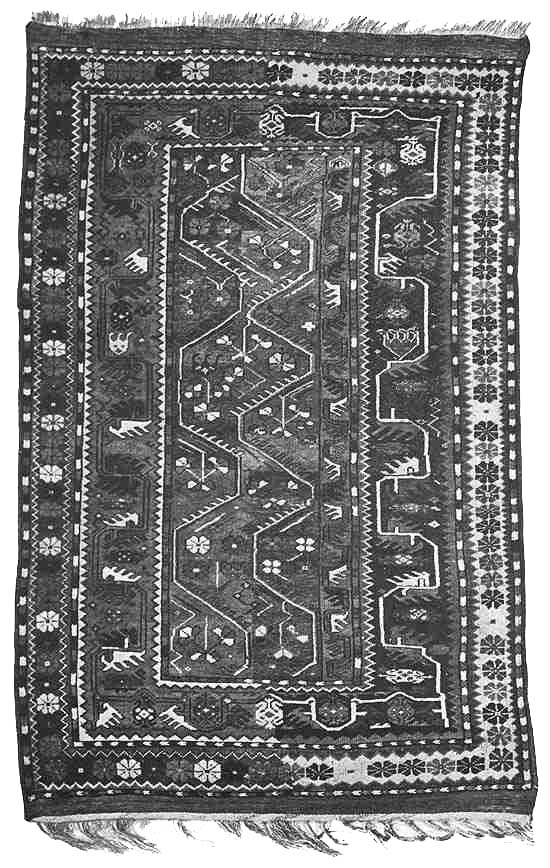
Plate 33. Melez
Rug
Tabriz.—Although
Tabriz, capital of the province of Azerbijan, is situated in a
remote corner of Persia, from the earliest times it has been one
of the most important centres in the Orient for the production of
carpets. They were well known in the days of the Caliphs; and
some of the earliest masterpieces that now remain were woven
there during the reign of Shah Tamasp, who extended to this
industry his royal patronage. This city has been for a long
period on the great routes of caravans passing to Trebizond and
Tiflis from the country to the south and east, so that it has
become the principal mart of Persia for the export of rugs
gathered from surrounding regions. Nevertheless, it still
continues to produce its own pieces; but the weavers are in the
employ of foreign companies who prescribe the character of
workmanship. As a consequence, the rugs are of good material,
excellently woven; and though many of the old dyes are no longer
used, the colours as a rule are fair; yet on account of the
mathematical exactness of their formal patterns the truly
Oriental spirit is largely lacking.
Since the rugs are made solely to meet the requirements of
Western buyers, the patterns are various. Most of them consist of
a large central medallion surrounded by a broad field of ivory,
blue, or red that extends to the sides and ends. In others, a
small diamond occupies the centre and is surrounded by a series
of concentric medallions. Although in these respects they
correspond with Kermanshahs, Sarouks, and Kashans, the patterns
of their fields lack the long scrolls and interlacing branches,
and consist frequently of short, slender stems supporting fronds,
leaves, flowers, or the pear designs arranged so as to present
almost the appearance of lace-work. Sometimes the drawing is a
delicate tracery representing intertwining arabesques. A field
completely covered with the small designs peculiar to Sehnas, or
containing the disjunct forms of nomadic rugs, is never seen; and
yet it is not improbable that many of the early Tabriz weavers
were Kurds. Sometimes the flowers are similar to the roses of
Kirmans, or are realistically drawn compositæ surrounded by
delicate leaves on graceful stems; some times the small designs
are as formal as the palmettes of old Ispahans, from which they
were doubtless copied; again, the naturalistic and conventional
may be blended together in an harmonious whole. But whatever the
pattern, the different parts show the perfect balance so
frequently seen in the antique pieces of three or four centuries
ago. Nevertheless, to these types are many exceptions,
since the weavers will produce for hire any class of rug or copy
any coloured drawing.
The borders differ from those of Kermanshahs, with which these
rugs are frequently compared, in the fact that in their central
stripe the continuous vine of leaf and flower is less
conspicuous; and in its place are often palmettes, pears, shrubs,
or formal trees separated by foliated scrolls. Not infrequently
the smaller stripes, also, have a repetitive pattern of leaf and
flower, though in some of the many stripes is usually a
well-drawn vine. Again, the border may consist of a series of
cartouches that have been copied from much older rugs and contain
verses of the Koran or of Persian poets. Within recent years this
tendency among the Tabriz and Kermanshah weavers to imitate not
only borders but also fields of old masterpieces is
increasing.
A feature peculiar to a very large number of these rugs is the
adoption of very finely spun linen for the warp; though cotton,
which is used for the weft, is sometimes substituted. The knots
are carefully tied, and the closely woven texture presents an
appearance at the back similar to that of Sarouks; but the almost
concealed weft is generally either white or pink. The weave
compared with that of Kermanshahs is finer, but the wool of the
closely shorn nap is neither so soft to the touch nor so silky,
the colours are harsher, and the patterns more formal. These rugs
are made in all sizes, though most are large and almost
square.
Type characteristics. Colours, principally red,
blue, and ivory. Knot, Ghiordes. Knots to inch
horizontally twelve to twenty; perpendicularly, ten to
twenty-two. The rows of knots are pressed down, so that the warp
is hidden and the weft partly concealed at back. Warp,
generally cotton, frequently linen; one of the two threads
encircled by a knot is doubled under the other. Weft, as a
rule, is cotton, occasionally it is wool or linen, of fine
diameter, and frequently dyed pink. A thread of weft crosses
twice between every two rows of knots. Pile, wool, clipped
short and harsh to the touch. Border, from five to eight
stripes and an outer edging. Sides, a two-cord selvage.
Both ends, a narrow web and loose warp fringe.
Texture, firm. Weave at back is of fine texture.
Usual length, nine to eighteen feet. Usual width,
two thirds to four fifths length.
Gorevans.—Of the
many rugs now made in Persia and designed primarily for use, few
are of such moderate price as the Gorevans, which,
during recent years, have been imported in large numbers from the
province of Azerbijan in Northwestern Persia. A hasty glance
suggests Occidental craftsmanship, but in every essential they
are distinctly Oriental. Their stout weave, large size, and
nearly square shape place them in the class of Persian pieces
often called carpets, to which belong the Kermanshahs, Muskabads,
Mesheds, and rugs of Tabriz. Yet they are frequently larger than
any of these, and are readily distinguished from them by their
colours and patterns. It is true that they have the same light
shades, but the tones are in a distinctly different scale,
consisting principally of dull brick-red, light terra cotta,
buff, dark blue, dull green, yellow, and ivory, which, when once
recognised, are rarely mistaken for those of any other rugs. Nor
are the colours distributed in patches so small as to blend when
viewed at a short distance, but are of sufficient masses to be
separately observed and analysed.
The patterns are equally distinctive. The field is generally
covered with a number of concentric hexagonal-shaped medallions,
of which the longer sides of the largest are often marked with
conspicuous indentations such as are not seen in classes made in
other districts. All of the medallions are covered with large
designs, in which the artist has departed from the usual forms of
vine, leaf, and flower, that poorly imitate the splendid examples
of so-called “Ispahans,” and in many instances has
represented them in the archaic drawing of the oldest remaining
Persian carpets. Hard, straight lines with angles replacing
graceful curves define the medallions, corners, stems, leaves,
and flowers. And not infrequently the formal treatment shows a
European influence, as when all semblance of leaf and flower has
disappeared in the extremely conventionalised forms that are
placed with set regularity in the field. A very noticeable
feature of these rugs is the manner in which the designs are
coloured, as it is not unusual to represent a large figure in two
strongly contrasting colours, as blue and pink separated by a
stiffly drawn line.
The designs of the corners are similar to those of the central
medallions, but the designs of the borders are dissimilar. The
small stripes are marked with Persian vines of well-known floral
and leaf forms that show nothing of the drawing characteristic of
the field. The main stripe occasionally has cartouches and star
medallions, but in most instances has the turtle pattern, though
its treatment differs from the usual form seen in Feraghans.
A co-ordination in colour exists between
field and border. The ground of both the main stripe and one of
the medallions is often a dark blue or a red, while the ground of
the other stripes corresponds with those of other medallions.
All of the Gorevans are modern pieces, and so lack the
interest of those that follow traditional patterns; but their
stout weave, warm colours, and archaic designs make them both
serviceable and pleasing.
Type Characteristics. Colours, principally dull
red, dark blue, and buff, with minor quantities of green, yellow,
and white. Knot, Ghiordes. Knots to inch horizontally six
to eight; perpendicularly, six to ten. The most conspicuous half
of a knot, as it appears at the back, is, as a rule, longer than
wide. The rows of knots are somewhat pressed down, but the warp
is rarely entirely concealed at back. Warp, cotton; one of
the two threads encircled by a knot is usually depressed below
the other at back; sometimes both threads are equally prominent.
Weft, cotton, of coarse diameter, sometimes dyed blue. A
thread of weft crosses only once between every two rows of knots,
or frequently twice. Pile, wool, of medium length.
Border, generally of three stripes, occasionally four or
five. Sides, a two-cord double selvage. Both ends,
a short warp fringe. Texture, rather loose. Weave
at back is of very coarse grain. Usual length, ten to
sixteen feet. Usual width, three fifths to three quarters
length.
Bakshis.—A close
relationship exists between the Gorevans, which are a
comparatively modern product, and several other less known
sub-classes of earlier origin that are woven in small towns in
the east central part of the province of Azerbijan. One of these
towns, located fifty miles to the southeast of Tabriz, is
Bakshis, which formerly produced rugs that were highly esteemed
by the Persians, before the weavers were corrupted by a spirit of
commercialism. Those which are exported to-day are of little
artistic value, are poorly coloured, and carelessly woven. The
patterns are inferior copies of other well-known classes.
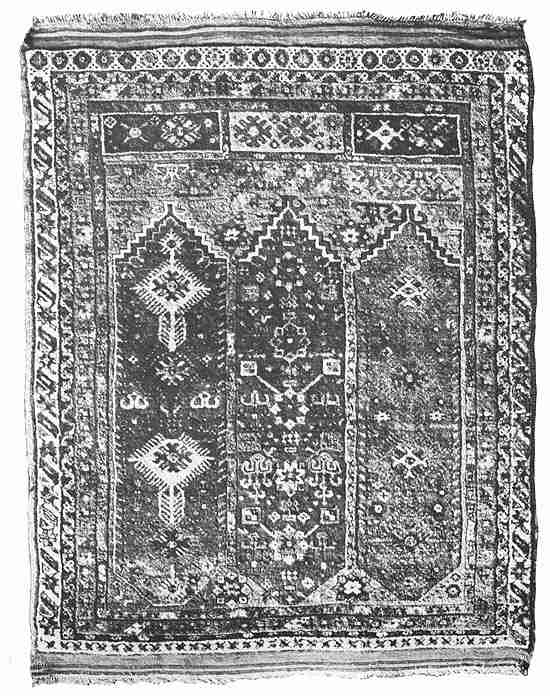
Plate 34. Rhodian
Rug
Serapis.—The rugs
known as Serapis are named after the village of Sirab in the
mountainous district between Tabriz and Ardebil; but they are
made not only there, but also in the country farther to the east.
The large sizes are frequently mistaken for Gorevans, as
they are of similar shape and have
similar finish of sides and ends, yet as a rule they are better
woven. Many of them follow the same patterns of concentric
medallions, but the lines of others are more artistically drawn.
Although the borders lack the gracefully symmetric vines of old
Iranian pieces, the drawing is interesting in its individuality
and is in harmony with that of the field. All the colours are
cheerful. A field of ivory or some light shade of buff usually
surrounds the central medallions, on which appear soft and
pleasing tones of smaller designs. Yet on the whole there is a
tendency to employ richer and deeper tones than those of
Gorevans. The smaller pieces often contain more elaborate
patterns, but there are always the same pleasing and unobtrusive
shades of colour.
Type Characteristics. Colours, principally red,
blue, and ivory, with minor quantities of green and yellow.
Knot, generally Sehna, frequently Ghiordes. Knots to inch
horizontally six to ten; perpendicularly, seven to twelve. The
rows of knots are firmly pressed down, so that the warp does not
show at back. Warp, cotton; one of the two threads
encircled by a knot is generally much depressed below the other
at back, and frequently doubled under the other. Weft,
cotton, of coarse diameter. A thread of weft crosses twice
between every two rows of knots. Pile, wool of medium
length. Border, three stripes. Sides, a double
selvage of two cords, or double overcasting attached figure-eight
fashion to the sides. The selvage or overcasting is usually in
red or buff. Lower end, a narrow web and warp loops or
short warp fringe. Upper end, a narrow web and warp
fringe. Texture, stout. Weave at back is of coarse
grain. Usual length, ten to eighteen feet. Usual
width, two thirds to three quarters length.
Herez.—The city of
Herez is in the extreme eastern part of the province of
Azerbijan, where for a long time the weavers steadily adhered to
the sterling values of early fabrics and produced pieces that
were followed with slight modification in many of the former
Gorevans. In a measure the rugs of Tabriz also are reflected in
the medallion pattern of some of these pieces, but for their
gracefully flowing lines are substituted more rectangular ones;
and in place of many colours are few, of which blue and a reddish
copper are particularly noticeable. Another well-known and
interesting type consists of a field of white, on which, with
formal precision, are represented, in delicate shades of red,
blue, yellow, and green, archaic leaves and flowers supported
by stems and tendrils that are so conventionalised as to form
geometric lines and angles. At regular intervals the branching
tendrils assume the shape of arches, of which in larger pieces
there are frequently one or two dozen; and so closely do they
resemble prayer arches that these rugs are sometimes mistaken for
namazliks. The borders usually consist of three stripes. The
outer and inner are narrow guards containing some simple floral
figure, and the broad central stripe has often a continuous vine
with formal leaves and a conspicuous design suggestive of the
cloud-band. The tones are never harsh; many of the pieces are
large and almost square, and the wool of the pile is generally
excellent.
Type Characteristics. Colours, principally
ivory, light blue, and reddish brown, also some yellow and green.
Knot, Ghiordes. Knots to inch horizontally five to ten;
perpendicularly, six to twelve. The most conspicuous half of a
knot, as it appears at the back, is longer than wide. The rows of
knots are only slightly pressed down, so that the weft is
noticeable at back. Warp, cotton; one of the two threads
encircled by a knot is depressed below the other at back, or each
thread is equally prominent. Weft, of cotton, seldom of
wool, of moderately coarse diameter. A thread of weft crosses
twice between every two rows of knots. Pile, wool of
medium length. Border, generally of three stripes.
Sides, a two-cord double selvage. Lower end, a very
narrow web and short warp fringe. Upper end, a short warp
fringe. Texture, loose. Weave at back is of very
coarse grain. Usual length, nine to fifteen feet. Usual
width, two thirds to seven eighths length.
Suj-Bulaks.—About
fifty miles to the south of Lake Urumiah and the same distance
from the western boundary of Persia is the old Kurdish capital of
Suj-Bulak. Kurds still largely predominate in the district and
comprise most of the population of the city, to the discomfort of
the much smaller number of Persians, for whose protection a large
garrison was formerly maintained. Accordingly, the rugs made in
this vicinity are strongly characteristic of Kurdish pieces in
the strong texture, the excellent quality of wool, the rich, dark
colours, the finish of sides and ends. The patterns also are
largely Kurdish, but frequently show the influence of Persian
association.
In typical old pieces deep reds and blues are largely used.
One of them is generally the ground colour
of the central field, and shows the Kurdish influence by a
gradual shading from end to end; the other appears in the
overlying pattern, which partakes of a floral character. The
drawing sometimes represents flowering plants, such as the rose
bush, arranged in perpendicular rows and brightened by tints of
white, green, or yellow. Detached flowers not infrequently line
the edges of the field. The wide borders also, as a rule, have
vines and floral forms.
Type Characteristics. Colours, principally dark
red and blue, with minor quantities of brown, green, yellow, and
ivory. Knot, Ghiordes. Knots to inch horizontally seven to
ten; perpendicularly, eight to twelve. The rows of knots are, as
a rule, pressed down, so that the alignment of each half knot is
very uneven; but frequently this feature is not regularly
maintained in all parts of the same rug, so that here and there
the warp is noticeable at back. Warp, wool; each of the
two threads encircled by a knot is generally equally prominent at
back, but occasionally one is depressed below the other.
Weft, wool, of medium diameter. A thread of weft crosses
twice between every two rows of knots. Pile, wool of
medium length. Border, of three to four stripes.
Sides, a double selvage of two or three cords in blue,
red, or brown. Lower end, a web through which runs a
parti-coloured cord, and a warp fringe. Frequently there is a
braided selvage in addition to the web. Upper end, the
same as lower, excepting that the web is occasionally turned back
and hemmed. Texture, moderately loose. Weave at
back is of slightly coarse grain. Usual length, six to
seven feet. Usual width, two fifths to three fifths
length.
Karadaghs.—In the
extreme northwestern part of Persia, between the city of Tabriz
and the river Aras, is a mountain range called Kara Dagh, which
signifies the “Black Mountain,” On its slopes and in
the adjoining valleys rugs have been woven for at least several
hundred years, and at one time were well known in Europe, but few
have reached this country. Most of them are produced for home
use, so that they are, as a rule, well woven, of good material,
and of vegetable dyes. They resemble in colour scheme, weave, and
finish of sides and ends the rugs of Karabagh, which immediately
adjoins this district on the north. Indeed, in no other rugs of
Persia are the traditions of Iranian weavers so much disregarded
and Caucasian ideas so closely followed.
The field of many of these rugs is
completely covered with conventionalised flowers of several
different colours, so arranged that diagonal lines are of similar
colours. Sometimes it is covered with a pattern of
hexagonal-shaped figures containing geometric forms or
conventionalised floral designs. Again, it may contain the Herati
pattern or one similar to the Mina-Khani. In fact, some
repetitive pattern of small design is the usual type; but now and
then some form of pole medallion, which the weavers have learned
from their more southern neighbours, is substituted. The patterns
of the borders are either mechanically drawn vines or contain
geometric figures characteristic of Caucasian pieces. For guard
stripes the reciprocal trefoil is constantly used.
The colour scheme is generally bright and pleasing. A
favourite colour for the field is blue or a camel’s hair
yellow; sometimes rose is seen. The nap of modern pieces is
medium long and of old pieces is short. The weave of the latter
is excellent, so that the closely pressed knots and stout threads
of weft make at the back an even surface unlike the coarse
appearance of many rugs.
Type Characteristics. Colours, principally blue,
red, yellow, green, and white. Knot, Ghiordes. Knots to
inch horizontally seven to eleven; perpendicularly, seven to
eleven. The rows of knots are not firmly pressed down, so that
the warp appears at back, and the weft is prominent. Warp,
wool; each of the threads encircled by a knot is equally distinct
at back. Weft, wool, of coarse diameter, occasionally
dyed. A thread of weft crosses twice between every two rows of
knots. Pile, wool, of moderate length. Border,
three to six stripes. Sides, a double selvage of two or
three cords. Both ends, a narrow web and short warp
fringe. Texture, moderately firm. Weave at back is
of rather coarse grain. Usual length, five to nine feet.
Usual width, two fifths to two thirds length.
Mosuls.—Near the
ruins of ancient Nineveh, on the bank of the Tigris, is the city
of Mosul. Once it was not only an important mart for wares
carried up and down the river, and for vast caravans from east
and west, but it became noted for its textiles from which was
derived the name “muslin.” At length on account of
pestilence, misrule, and the sack of armies its population and
industries have dwindled; though it is still the capital and
commercial centre of a district that lies between the high
table-lands surrounding Lake Van and the low plains of Bagdad,
and that extends across the Mesopotamian valley
to the mountain ridges bordering Western Persia. Within this
extensive area are large stretches of rich pasture, where Abraham
once fed his flocks, and where each year Kurdish nomads from the
north drive their sheep when the winter snows cover their own
hillsides. Arabs, Turks, Armenians, Jews, and Christians likewise
mingle with the natives, so that the population is as mixed as
can be found anywhere in the Orient.
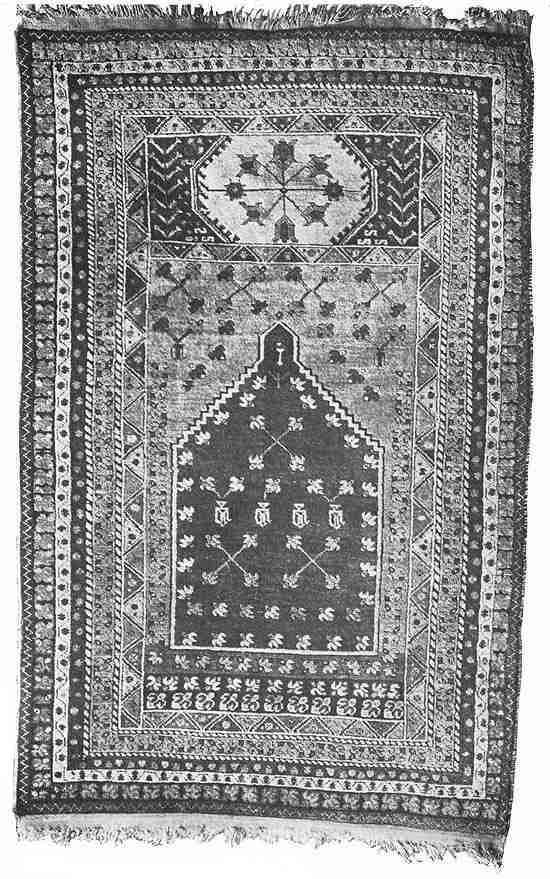
Plate 35. Konieh Prayer
Rug
Thus it happens that the rugs marketed in the city of Mosul
are made by different races and show great diversity of
character. It would, indeed, be often difficult to distinguish
them if the weave were disregarded; for though they are prone to
yellow and russet hues, and the long wool is floccy as well as
lustrous, there is no pattern that can be considered truly
typical. Many of them borrow Caucasian designs, such as stars,
latch-hooks, diagonal bands, and barber-pole stripes. Others have
patterns adopted almost bodily from Kurdish pieces. But however
much the nomadic rugs are copied, a Persian influence is always
shown by the way in which the severer features are softened. In
fact, a very large percentage of rugs that come from Mosul are
made by the tribes that wander as far east as the great mountain
divides along the borders of Western Persia, and adopt patterns
and colour schemes current in Azerbijan and Ardelan. It
accordingly happens that medallion patterns resembling those of
Bijars, but with bolder and less graceful outlines, are seen.
More frequently the field is covered with small figures common to
Feraghans, as well as with the well-known pear designs; but the
former are coarsely drawn, and the latter lack the gracefully
rounded lines seen in Sarabends and are often as geometric as
those of the Baku rugs. Somewhere in almost all these pieces
appears evidence of some conventionalised floral form; but now
and then a rare old piece is found which was woven in the plains
of Mesopotamia, with field completely covered with a
naturalistically drawn tulip that grows on the banks of the
Tigris and Euphrates. Its bright flowers and leaves, supported by
a delicate stalk, constitute one of the most beautiful designs
seen in any rug.
The borders are rarely wide, and generally consist of three
stripes, one of which usually has some simple vine, and the
others some well-known geometric pattern. It is, also, not
unusual to find an outer edging surrounding the border. In a few
of these pieces camel’s hair is used even to the extent of
occupying the whole field; and goat’s hair or
sheep’s wool, dyed to a similar colour, is constantly
employed. One of the most usual colours is some shade of yellow.
Reddish hues also prevail. These rugs frequently have the same
pleasing effect of slightly graduated changes so common in the
ground colour of Kurdistans, but as a whole the colour scheme is
lighter. On the other hand, they follow the shading adopted in
Persian rugs, which in a measure eliminates the sudden transition
between adjacent areas of strongly contrasting colour so
noticeable in nomadic pieces. On account of the present
remoteness of the Mosul district from important highways of
travel, many excellent pieces, which with careful use should
acquire the rich tones of those now old, are still woven
there.
Type Characteristics. Colours, principally
yellow and brownish red, with minor quantities of blue, green,
and white. Knot, Ghiordes. Knots to inch horizontally five
to seven; perpendicularly, seven to nine. A half knot, as it
appears at back, is as long as wide and frequently longer. The
yarn is not drawn tightly against the warp. The rows of knots are
firmly pressed down, so that the warp is concealed at back.
Warp, almost always wool, rarely cotton; each of the two
threads encircled by a knot is equally prominent at back.
Weft, generally of wool, of coarse diameter and frequently
dyed red or orange, but occasionally of cotton. As a rule, a
thread of weft crosses twice between two rows of knots, but
sometimes crosses only once; or two or three threads cross side
by side, as in Karajes. Pile, wool and occasionally
camel’s hair, of medium length. Border, of three
stripes with frequently an outer edging of solid colour.
Sides are generally a heavy double overcasting, but in a
few pieces there is a two-cord weft selvage or double selvage.
Lower end, a web. Upper end, a web and warp fringe;
occasionally there is a heavy braided selvage, or the web is
turned back and hemmed. Texture, moderately firm.
Weave at back is of coarse grain. Usual length, six
to ten feet. Usual width, two fifths to three quarters
length.
Now and then are seen comparatively scarce rugs,
such as the Teheran, Gulistan, Kara-Geuz, Bibikabad, Afshar, and
Gozene, that were woven within the Iranian boundaries. Some of
them are no longer produced, and others are woven in such small
numbers that but few are exported.
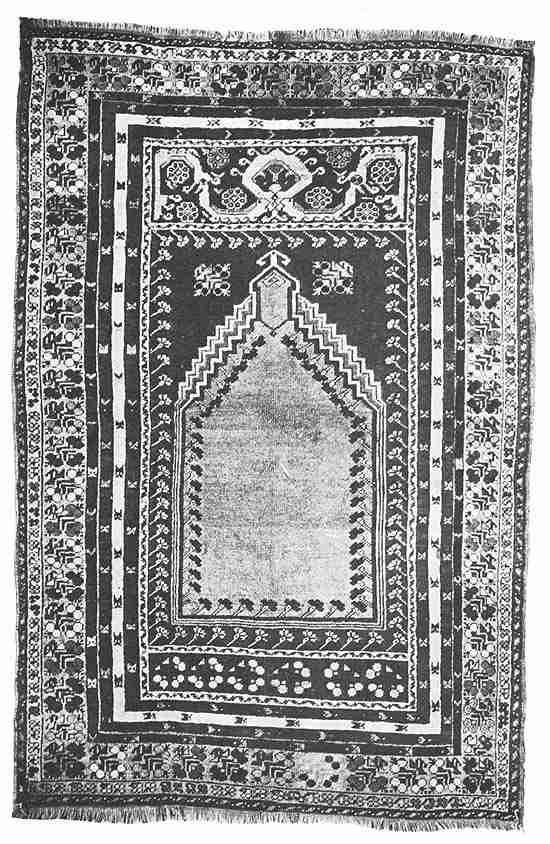
Plate 36. Kir-shehr
Prayer Rug
The Teherans were formerly made in the present capital of
Persia. The typical pattern consists of the Herati design or some
floral form occupying the central field, which
is two or three times as long as wide. The weave resembles that
of Irans, since the knot is Ghiordes, each of the two threads of
warp that it encircles is equally prominent at the back, and both
warp and weft are cotton. The borders are wide, and the sides are
finished with a two-cord selvage.
Gulistan is the Persian name for a flower garden, and the rugs
known by that name were once made in a district not far from
Kashan, where rose bushes bloomed profusely. The fields may be
covered with conventionalised floral and leaf patterns, or again
they may contain roses naturalistically drawn with extended
petals, as if viewed from above. The most striking characteristic
is the opulence of colour, such as red, blue, and yellow softened
by shades of brown and green. Even the weft and the webs of the
ends are red, blue, or brown. The sides have a two-cord selvage,
warp and weft are usually of cotton, and one thread of warp to
each knot is depressed at the back. These rugs, which formerly
came in large sizes, are no longer made.
Only a short distance to the northeast of Hamadan is the
district of Kara-Geuz, which is occupied by a large tribe, who in
the past have furnished some of the best of Persian cavalry. The
people are industrious, and not only cultivate the land but
engage in weaving. Some of their rugs closely resemble the
Kurdish pieces, and others correspond with the Irans. In the
technique of weave they often follow the Hamadans. On the
outskirts of this district is the town of Bibikabad, where, also,
rugs are woven for market.
For a number of generations the country adjoining Lake Urumiah
on the west and stretching into the Turkish domain has been
partly occupied by a powerful race of brave and active people who
are known as Afshars. They are regarded as a branch of the Yuruks
of Asia Minor, and the rugs of both tribes have many points of
similarity. The wool of the nap is generally the coarse product
of the mountain sheep. The patterns incorporate some of the
floral features of Persian rugs, though they display many
Caucasian characteristics. These Afshars bear a close resemblance
to the Kazaks, from which they may be distinguished by observing
a fold as they are bent backwards, which will show the fibres of
the yarn of a knot standing out at front as a unit, while in
Kazaks they have a greater tendency to blend. Also at the back,
each half of a knot is no longer than wide, nor is it drawn
closely against the warp, while in Kazaks each half of a knot is
often double its width and is drawn closer.
In the country about Gozene, in the
watershed of the Euphrates river, are made a few rugs for local
use, though they occasionally reach Western markets. The pattern,
which is very simple, usually consists of some small diaper
figure of brown or grey colour, or of dull tones of maroon. Many
of this class have a double foundation of warp; and frequently,
at the back, the knots do not form regular lines parallel with
the length, as is the case with other rugs. This is due to the
fact that any thread of warp may be encircled by both the left
half of some knots and the right half of others. Occasionally,
also, a knot is tied about four threads of warp. In other rugs of
this class which have a single foundation of warp the weave
resembles that of Mosuls.
The most noticeable feature of Persian border stripes is their
floral character, which is very frequently represented by a vine
winding from side to side with pendent flowers marking each
flexure. Some of these vines have been evolved from arabesques,
and others from naturalistic tendrils, but all are graceful. In a
few pieces the stripes contain rows of detached flowers,
rosettes, or pears, expressed in rich yet unobtrusive colours,
that are always in perfect harmony with those of the field.
Rarely is the pattern geometric. Accordingly, with the exception
of the Indian and some of the Chinese, they are the most elegant,
pleasing, and artistic of all border stripes. Moreover, some of
them follow almost the same patterns that were in use centuries
ago.
Primary Stripes.—In Plate E, Fig. 1 (opp. Page 156), is represented a typical
Herat stripe derived from some of the XV and XVI Century carpets.
It shows close relationship to the pattern of conventional
rosette and pair of attendant leaves so frequently seen on the
fields of such rugs as the Feraghans and Sehnas. In this stripe
the angular and serrated leaves are extended to form a vine.
One of the best known Khorassan stripes, shown in Plate
E, Fig. 2, bears a resemblance to the Herat
stripe; and it is not unlikely that they had a common origin,
since they were designed in adjoining and freely communicating
districts. The enlargements of the vine at the centre of each
flexure are doubtless leaves, but they occasionally resemble the
heads of birds.
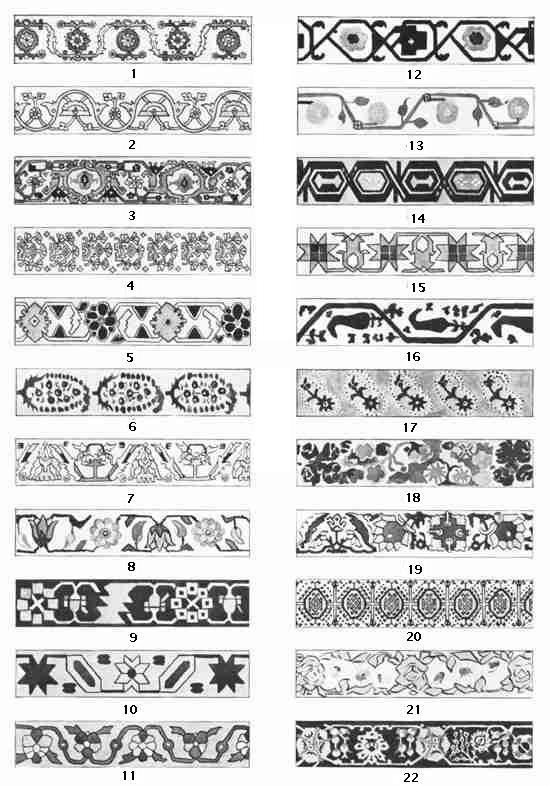
Plate E. Primary
Border-Stripes of Persian Rugs
The so-called turtle pattern, Plate E, Fig.
3, has probably been derived from the interlacing arabesques that
appeared in rugs at least as early as the beginning of the XV
Century, as is indicated on Page 79. The rosette and attendant
leaves between adjacent “turtles” suggest the Herati
pattern. This stripe is found principally in Feraghans, Irans,
Sehnas, and Muskabads. One that is similar, but more mechanically
drawn and with wider spreading arms, is typical of Gorevans and
Serapis.
A stripe found in Joshaghans, representing a row of floral
bushes, is shown in Plate E, Fig. 4. It is also
seen in some of the old rugs of Northwestern Persia. Another
Joshaghan stripe, which also suggests the Herati pattern, is
represented in Fig. 5.
A single row of pears (Plate E, Fig. 6) is a
characteristic Luristan stripe.
The dainty pattern of Plate E, Fig. 7, in
which the vine has been abandoned and serrated leaves nearly
surround a floral device, shows a not unusual Herez stripe.
As a rule the drawing of Persian-Kurdish stripes is never
crowded, and represents a simple vine with bright pendent
flowers. A stripe commonly seen in this class is represented in
Plate E, Fig. 8. It is also seen in the
Bijars.
On account of the geographic position of the Karadagh
district, which is separated only by the Aras river from
Caucasia, its stripes show a combination of floral and geometric
design not usual in other Persian pieces. Plate E, Fig. 9, represents one of these stripes with a
rosette, and the serrated leaf so common among the Shirvans.
Plate E, Fig. 10, represents another stripe of
the same class with eight-petalled star-shaped flowers pendent
from an angular vine.
A beautiful stripe, representing a vine and pendant flower,
which is frequently seen in some of the Persian-Kurdish rugs, is
shown in Plate E, Fig. 11.
In Plate E, Fig. 12, is illustrated a very
dainty pattern of vine and roses that now and then is seen in old
Feraghans; and in Fig. 13 are also represented vine and roses as
they occasionally appear in old rugs of Northwestern Persia.
The very mechanically drawn double vine shown in Plate
E, Fig. 14, is sometimes seen in stripes of
Hamadans. In fact, simplicity of border is a characteristic of
this class.
Mosul and Kurdish stripes show a similarity, but the former
are often more mechanically drawn than the latter. In Plate
E, Fig. 15, is a stripe from an old
and beautiful Mosul with conventionalised vine and King
Solomon’s eight-pointed star.
Undoubtedly the most typical of any class of Persian stripes
is the well-known Sarabend pattern of formal vine with pendent
pear on white ground. It is very rarely that a rug of this class
is without this stripe (Plate E, Fig. 16). Its
presence at once indicates that the piece is either a Sarabend or
an Iran copy.
In Plate E, Fig. 17, is the well-known pear
pattern of a Meshed stripe. The graceful form, resembling in a
measure the Indian drawing, is peculiar to these stripes.
The Kirman stripe (Plate E, Fig. 18)
invariably contains red roses naturalistically drawn, surrounded
by a profusion of leaves and stems. This is one of the most
beautiful of Persian border patterns.
Somewhat similar, but far more formal, is the Kermanshah
stripe, one of which appears in Plate E, Fig.
19, with mechanically drawn flowers, leaves, and vines.
The formal pattern (Plate E, Fig. 20) of
octagons surrounded by latch-hooks is now and then found in
borders of Shiraz rugs, and indicates how great a concession
their weavers at times make to nomadic influences.
The main stripe of Sehnas is always narrow and contains some
floral form, though frequently much conventionalised. One of
these stripes is shown in Plate E, Fig. 21.
Very few Persian rugs have such wealth of floral ornamentation
in the borders as the Sarouks and Kashans. A stripe typical of
the former is represented in Plate E, Fig.
22.
Secondary and Tertiary Stripes.—The
ornamentation of a large proportion of secondary stripes of
Persian rugs consists of running vines, which fall within two
divisions, according to the absence or presence of pendants.
Plate F, Fig. 1 (opp. Page 158), taken from
an inner stripe of a Kermanshah, shows one of the simplest vines
with budding tendrils at each flexure.
In Plate F, Fig. 2, is a simple stripe seen
in such rugs as Gorevans. Similar stripes are very common. As
there is no pendant, the character of the vine depends upon the
form it assumes in alternating flexures, one of which in this
instance is an eight-petalled star.
In many of the Karadaghs is seen the Caucasian stripe (Plate
F, Fig. 3) consisting of an angular vine, from
each flexure of which spring small designs like three-leaf
clover.
Plate F. Secondary
Border-Stripes of Persian Rugs
Plate F. Secondary
Border-Stripes of Persian Rugs
Another type peculiar to some rugs of Northwestern Persia, as
the Bijars and even Sehnas, is shown in Plate F, Fig. 4. Here one flexure is a serrated leaf, and the
other is a small rosette with short curving tendrils.
A simple vine of somewhat similar order appears in Plate
F, Fig. 5. At each flexure is a flower of four
petals, and from alternating flexures spring tendrils of colour
different from that of the vine. Stripes of similar drawing
appeared in Persian carpets as early as 1350 a. d. A further stage in the development of the
same pattern is illustrated in Plate F, Fig.
6.
One of the simplest forms of a vine with pendant is shown in
Plate F, Fig. 7. It appears in Asia Minor
carpets woven during the XIII Century, and also in some of the
earliest Iranian carpets. Now and then it is seen in modern
Persian rugs.
A very common form of a vine with pendant is shown in Plate F, Fig. 8. This pattern is seen in a large number
of Persian rugs, such as Mosuls, Bijars, Kurdistans, and
Hamadans. Each flexure of the vine is enlarged to almost the form
of a leaf, and between them is a branching pendant.
In another stripe (Plate F, Fig. 9), taken
from a Feraghan, there is no particular enlargement to the vine,
and the alternating pendants are buds and flowers of four
petals.
A more geometric form that appears in such rugs as Muskabads
is shown in Plate F, Fig. 10. In this the vine
represents serrated leaves, and suggests one of the Shirvan
patterns.
A very similar stripe (Plate F, Fig. 11),
taken from a Sehna, should be compared with those of Figs. 8 and
10, as it serves to illustrate the evolution of vine patterns. In
fact, if a very large number of stripes were arranged in proper
order, they would show almost imperceptible gradations from one
type to another.
One of the simplest vines with pendant, adopted by the Kurdish
tribes, is shown in Plate F, Fig. 12; and in
Fig. 13 is another vine with pendent pear alternating with a
rosette.
Not all the patterns, however, are vines. In Plate F, Figs. 14 and 15, for instance, is represented the
same secondary stripe as it appears at the sides and the ends of
some moderately old Persian rugs. The former pattern bears a
resemblance to the one in Fig. 5, and each illustrates a series
of connecting links.
A graceful pattern that is seen in
Bijars, Hamadans, and other rugs of Northwestern Persia is
represented in Plate F, Fig. 16. It was
probably derived from an old form of leaf and tendril.
The reciprocal trefoil (Plate F, Fig. 17)
which is constantly used in a tertiary stripe, is probably a
degenerate form of an ornate floral design. It is more widely
used for a border stripe than any other pattern, as it is found
not only in such Persian rugs as Sarabends, Bijars, Sarouks, and
Kashans, but in many of the Indian and Beluchistan rugs, and in
almost all of the Caucasian group. It was commonly used in
Persian rugs as early as the year 1500.
In many of the rugs of Persia and Asia Minor is seen as a
tertiary stripe the simple ribbon pattern (Plate F, Fig. 18). Its origin is lost in the dim past, and it
is not improbable that once it had a symbolic meaning.
A very interesting tertiary stripe, because of its
well-authenticated age, contains the “Y” pattern
shown in Plate F, Fig. 19. It is found in some
Persian carpets that were woven as early as 1550.
One of the simplest guard stripes, shown in Plate F, Fig. 20, is frequently found in modern Persian rugs,
as well as in Iranian carpets woven six centuries ago.
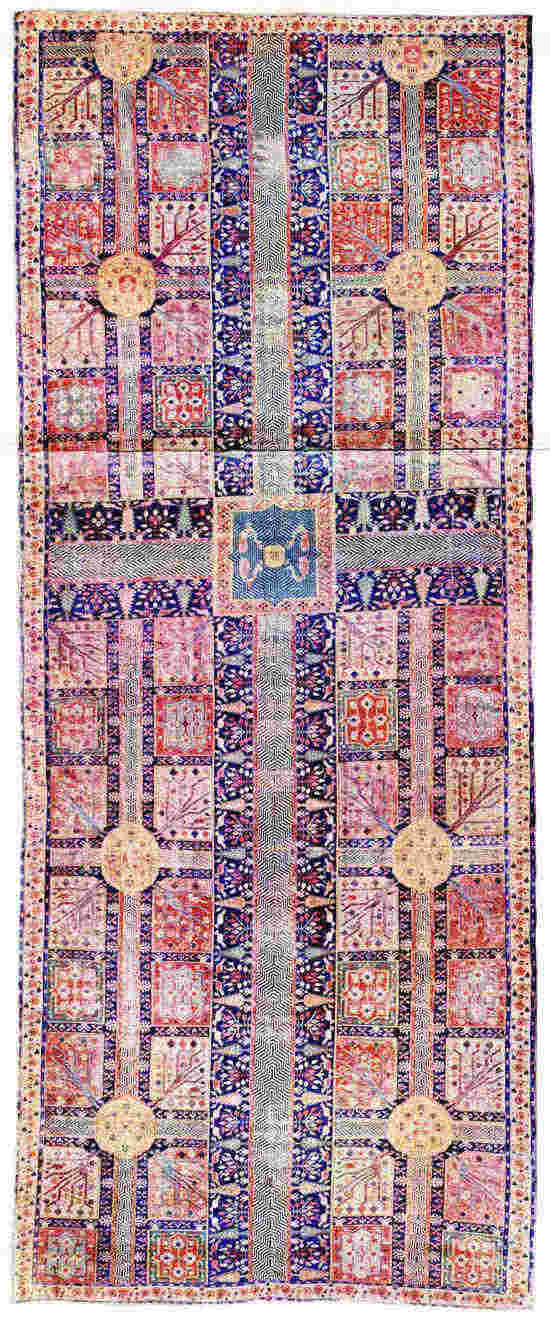
Colour Plate VI. Persian
Garden Carpet
This carpet and the one at the Naesby House,
Sweden, which it resembles in pattern but not in colouring, are,
so far as known, the only complete carpets of this type. The
Naesby carpet has been assigned to the middle of the XVIII.
Century; this is undoubtedly much older.
A 16TH CENTURY PERSIAN ROYAL
“GARDEN” CARPET
(Reputed to have been made for Shah
’Abbās for Sefavi Palace.) Date 1587-1628.
31 ft. 0 in. x 12 ft. 3 in.
Statement of the owner
ORIGINALLY IMPORTED BY VINCENT ROBINSON &
CO., LTD., LONDON.
The pattern represents a Persian garden
divided into four sections by two intersecting streams, which are
bordered by rows of cypress trees, alternating with bushes on
which are birds. These sections are similarly divided by smaller
streams, that meet at the four pavilions of each side, into plots
containing trees and flowering bushes. Four peacocks rest above
the central basin. The colours are harmonious, and show the
mellowing influence of time.
Legend:
KNOT—
H = Horizontally
P = Perpendicularly
WARP—
g = goat’s
hair
l = linen
e = each equally
prominent
d = 1 to the knot
depressed
h = 1 to the knot doubled
under
WEFT—
s = silk
l = linen
No. = No. times crossing bet. two
round knots
SIDES—
O = overcast
S = selvage
LOWER END
W = web
S = Selvage
K = Rows knots
L = warp loops
F = fringe
UPPER END
W = web
S = selvage
K = Rows knots
T = turned back and
hemmed
F = fringe
| PERSIAN |
KNOT |
WARP |
G =
Ghiordes |
S =
Sehna |
Number to
Inches |
w=
wool |
c=
cotton |
s/l |
At back |
| H |
P |
e |
d |
h |
Bijar
Feraghan
Gorevan
Hamadan
Herat
Herez
Iran
Mod. Ispahan
Joshaghan
Kashan
Karadagh
Karaje
Kermanshah
Khorassan
Kirman |
G
[G]
G
G
G
G
G
G
G
G
G
|
S
[S]
S
S
S
S |
6-10
8-13
6-8
6-9
8-11
5-10
6-11
6-9
7-11
16-20
7-11
6-11
12-18
8-13
11-20 |
8-12
7-18
6-10
8-12
6-12
6-12
7-11
8-11
8-13
16-24
7-11
7-12
11-18
12-20
11-20 |
w
[w]
w
[w]
w
w
|
c
c
c
c
c
c
c
c
c
[c]
c
c
c |
[1]
|
e
[e]
e
[e]
e
e
e
e
e
|
d
[d]
d
|
h
h
h
h
h
h |
| PERSIAN |
WEFT |
SIDES |
LOWER END |
w =
wool |
c =
cotton |
s/l |
P |
O |
S |
W/S |
K |
L |
F |
Bijar
Feraghan
Gorevan
Hamadan
Herat
Herez
Iran
Mod. Ispahan
Joshaghan
Kashan
Karadagh
Karaje
Kermanshah
Khorassan
Kirman |
w
[w]
w
[w]
w
w
w
w
[w]
W |
c
c
c
[c]
c
c
c
c
[c]
c
c
[c] |
[1]
|
2
2
1-2
1
2/[3-4]
2
2/[1]
1-2
2
2
2
1
2
2/[6-8]
2 |
O
O
O
O
O
O
O
O
O
O
O
O |
S
S
S
|
W/[S]
W
W
W
W
W
W
W
W
W
W
W
W
W |
;
|
L
L
L
[L]
|
F
F
F
F
F
F |
| PERSIAN |
UPPER END |
NAP |
WEAVE |
TEXTURE |
| W/S |
K |
T |
F |
l = long
m = medium
s = short |
f = fine
m = medium
c = coarse |
l = loose
m = medium
f = firm |
Bijar
Feraghan
Gorevan
Hamadan
Herat
Herez
Iran
Mod. Ispahan
Joshaghan
Kashan
Karadagh
Karaje
Kermanshah
Khorassan
Kirman |
W/[S]
W
W
W
W
W
W
W
W
W
W
W
W |
W
W
W
W
W
W
W
K |
T
T |
F
F
F
F
F
F
F
F
F
F
F
F
F
F |
m
s
m
m/s
m
m
m
m/s
m
s
m
m/l
m
m
s |
m
m
c
m
c
c
c
m
f
f
m/c
c
c
m/f
f |
f
m
l
f
f
l
l
f
m
f
m/f
l
f
m/f
f |
| PERSIAN |
KNOT |
WARP |
G =
Ghiordes |
S =
Sehna |
Number to
Inches |
w=
wool |
c=
cotton |
s/l |
At back |
| H |
P |
e |
d |
h |
Persian Kurdistan
Western Kurdistan
Mahal
Meshed
Mosul
Muskabad
Niris
Sarabend
Sarouk
Sehna
Serapi
Shiraz
Suj-Bulak
Tabriz |
G
G
G
[G]
G
G
G
G
[G]
[G]
G
G |
S
S
S
S
S
S
S
S
|
5-9
4-17
7-12
8-15
5-7
6-11
6-11
8-13
12-20
12-24
7-12
8-12
6-12
10-22 |
6-13
6-9
6-12
12-17
7-9
6-11
7-15
9-13
12-20
12-24
7-12
8-12
6-12
10-22 |
w
w
[w]
w
w
w
w
|
c
c
[c]
c
c
c
c
c
c |
[l]
[l]
[g]
[l] |
e
e
e
e
e
e
e
e
|
d
d
d
d
[d]
d
[d]
[d]
|
h
[h]
[h]
h
h
[h]
h |
| PERSIAN |
WEFT |
SIDES |
LOWER END |
w =
wool |
c =
cotton |
s/l |
P |
O |
S |
W/S |
K |
L |
F |
Persian Kurdistan
Western Kurdistan
Mahal
Meshed
Mosul
Muskabad
Niris
Sarabend
Sarouk
Sehna
Serapi
Shiraz
Suj-Bulak
Tabriz |
w
[w]
w
[w]
w
w
w
w
[w]
W |
c
c
[c]
c
c
c
c
c
c |
[1] |
2
2
2
2
2/[1]
2
2
2
2
1
2
2
2
2 |
O
O
O
O
O
O
O
O
O
O
O
|
S
S
S
|
W
W
W
W
W
W
W
[W]
W
[W]
W
W
W
W |
[K]
[K]
|
L
[L]
L
L
|
F
F
F
F
F
F
F
[F]
F
F |
| PERSIAN |
UPPER END |
NAP |
WEAVE |
TEXTURE |
| W/S |
K |
T |
F |
l = long
m = medium
s = short |
f = fine
m = medium
c = coarse |
l = loose
m = medium
f = firm |
Persian Kurdistan
Western Kurdistan
Mahal
Meshed
Mosul
Muskabad
Niris
Sarabend
Sarouk
Sehna
Serapi
Shiraz
Suj-Bulak
Tabriz |
W
W
[W]
W/[S]
[W]
W
W
W
W
W
W
W
W |
[K]
K
|
T
[T]
[T]
|
F
F
F
F
F
F
F
F
F
F
F
F
F
F |
l
l
m
m
m
m
m
m/s
s
s
m
m
m
s |
c
c
c
m
c
c
m
m/f
f
m
c
m
m/c
f |
f
f
m/f
m/f
m/f
m/f
l
f
f
m
f
l
m/l
f |
[] indicates the less frequent condition.
LL rugs that are woven in the Turkish
provinces of Asia are frequently grouped together and called
“Turkish” rugs; but a more natural classification is
to distinguish between those made to the east and those made to
the west of a line drawn from the Gulf of Iskenderoon to
Trebizond, deflecting slightly in its course so as to follow the
ridges that divide the watershed of the western forks of the
Euphrates river from the plateau of Anatolia. With the exception
of the very few pieces that come from Syria or other southerly
districts, those woven in the Turkish provinces east of this line
show such a relationship to those of Persia that they are more
properly classed with them; while on the other hand, with the
exception of the rugs of the wandering Yuruks, those woven to the
west of this line and in the neighbouring islands of the
Mediterranean conform so closely to a common type that they fall
naturally into a separate group. It is better, therefore, to
treat them separately and to call them the Asia Minor Rugs.
Though a certain glamour attaches to all that comes from
Persia, the Indes, or Far Cathay, in no part of the Orient are
rugs woven on more classic ground than are the Asia Minor pieces.
They are still made in the shadow of the walls where Cro[es]us
lived and among villages where Homer trod. Their yarn is spun
with crude distaff by the shepherd who still drives his flock
along the same road where Artaxerxes marched, across the bridges
that Roman legions built, and over the green slopes of Mt. Ida.
In fact the names of some of them call to mind pictures of the
Crusades, the journey of Paul, the march of Alexander’s
conquering army, and of cities founded before the beginning of
history.
When analysing the rugs of Asia Minor, it is necessary to make
a distinction that has been previously noticed in the case of
Persian rugs, though with them it is less
important. From the time when there arose a large demand in the
markets of Europe and America for the rugs of the East the
natural supply decreased, and, as a consequence, the price of
those that remained increased. To meet this deficiency, and
because of the higher prices, there was established a system by
which large numbers of women and children were constantly
employed; although many worked in their own homes, using such
material as was furnished by their employers and receiving fixed
daily wages. In the western and southern parts of Asia Minor,
which are connected by railroads with seaports, are a number of
communities where this system is in vogue. One of these is at
Demirdji in the province of Smyrna, where there are a small
number of looms; others are in the districts of Ghiordes and
Kulah, which together have about one thousand looms; and Oushak,
the principal rug-weaving centre of Asia Minor, has as many
more.28 Almost all rugs produced
at such places are now shipped to Smyrna, which itself has but
very few looms, or to Constantinople, whence they are reshipped
to Western markets. These products lack much of the oldtime
artistic spirit and individuality of character, on account of the
dependence of the weavers on their employers, who demand the
largest output consistent with fair quality. Furthermore, the
weavers are frequently required to reproduce Western patterns.
The result is that most of these rugs possess little of the
firmness of texture, the harmonious relations of designs, and the
excellent colour of old fabrics. Since, then, they represent in a
measure European influences, and are subject to further changes
to meet the demands of a fluctuating foreign taste, it would be
of little use to describe them, especially as all their original
characteristics exist in the old pieces.
The striking features of Asia Minor rugs woven over fifty
years ago are the colour schemes, main patterns, and the separate
designs, which may be either independent of the pattern or
constitute part of it. The colour effect of Asia Minor rugs is as
a rule brighter than that of the Central Asian, Indian, or
Persian groups; for the reds, blues, and yellows are less
subdued. Some of their tones never appear in Chinese rugs, and on
the whole they most closely resemble those of the Caucasian
pieces; yet it is not unusual to see such colours as mauve,
lavender, and canary yellow, that rarely appear even among these.
Moreover, in a few of them masses of strongly
contrasting colours are placed beside one another
without the customary shading of Persian rugs or the artificial
device of Caucasian latch-hooks to soften the effect of harsh
combinations.
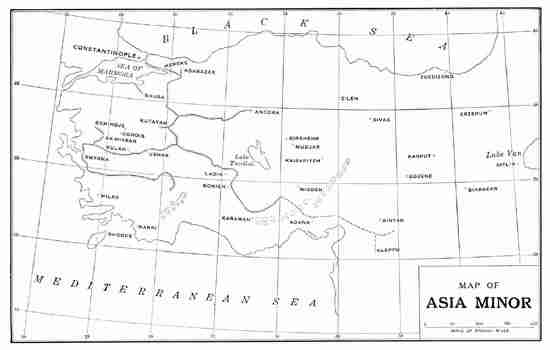
MAP OF ASIA MINOR
The difference, nevertheless, between the Asia Minor rugs and
those of other groups is less apparent in the colour schemes than
in the main patterns, for in the Asia Minor rugs is evidence of
an independent inspiration and development. There are lacking the
rigid octagonal figures of the Central Asian groups; the frets
and floral sprays distinctive of Chinese; the naturalistic floral
treatment of the Indian; the delicate tracings, rhythm of
movement, and wealth of foliage motives that characterise the
Persian; as well as the severely geometric forms and
conventionalised motives of the Caucasian. Instead of gracefully
flowing lines we find strong rectangular ones; instead of flowers
realistically balanced on interlacing, foliate stalks, they are
arranged separately in formal rows. But if their patterns lack
the fertility of invention or the refinement of Persian and
Indian pieces, they excel them in the strength of their clear
definition, accentuated by massing of colour. It is, however, in
the prayer patterns, which appear in the majority of Asia Minor
rugs, that the weavers attain their best results; for in such
work they have the inspiration of a high religious as well as
artistic spirit. In these patterns, which differ from those of
any other group of rugs, is often manifest singular beauty and
grace, as well as delicate sentiment derived from worship in
Moslem chapels; for in many is represented the burning lamp that,
projected against a background of sacred green, hangs from the
column-supported arch, above which is spread a spandrel of blue
typifying the vaulted heavens.
Likewise many of the small designs that are found in other
groups of rugs are rarely, if ever, seen in this one; as, for
instance, animals, birds, fishes, and human beings are never
employed, on account of the religious prejudice of the Sunnite
Mohammedans, who prevail in the country. Nor, with very few
exceptions, is the Herati design, so characteristic of Persian
rugs, nor the pear design, so characteristic of both Persian and
Indian rugs, ever seen. Furthermore, the reciprocal trefoil, that
is used as a motive for a small border stripe in all Caucasian
and many Persian rugs, is very rarely found in Asia. Minor pieces
woven during the last two centuries, though it appears in some of
an earlier era. But in its place are the water motive and ribbon,
which are less frequently employed by the weavers of
any other country. There are also many
small floral motives that appear only in Asia Minor rugs, and
that will be noticed in connection with the separate classes.
These characteristics of colour, pattern, and design are not
the result of a spontaneous growth unalloyed by foreign
influences; for a natural art never existed in Asia Minor, which
has never enjoyed a national existence; but they are the results
of artistic movements that at different times have swept over
that country. Thus, as an heirloom of dynasties that once
flourished farther east, are the Cufic characters that appear in
some of the early border patterns; and as a relic of the Mongol
and Timurid invasions are the dragon and other designs found in
the oldest pieces. In Oushaks, as well as others, are seen the
evidences of Persian treatment; while the drawing and colour
schemes of the prayer rugs forcibly suggest Saracenic, Grecian,
and Christian ideas. In fact, the rugs of Asia Minor, while
possessing co-ordination of colour and design, are in a measure
composite. They never reach the high artistic development of
Persian rugs, because the latter were produced under the
fostering care of great kings whose royal magnificence could
secure from years of patient labour suitable furnishings for
palaces and mosques; yet they are none the less interesting
subjects for speculation and study.
Bergamos.—In the
valley of the Caïcus and twenty miles from the Ægean
Sea is the city of Pergamus, that gives its name to the Bergamo
rugs. It is of unknown antiquity, and may have stood when
Agamemnon was warring with the house of Priam before the walls of
that other city of the same name. In turn, Persians, Macedonians,
Thracians, Syrians, and Romans had taken possession of it before
the Apostle Paul founded there one of the seven churches of Asia.
Greek sculptors chiselled its monuments, philosophers taught
beneath the shade of its trees, and scholars gathered there the
library that rivalled that of Alexandria. Partly encircled by
mountains and enclosed by the wall of this old city, that was
wellnigh destroyed during the Turkish wars, is the modern city of
some fifteen thousand inhabitants. It is to-day one of the
flourishing cities of the Levant, yet only in the surrounding
ruins is there any reminder of its former greatness and
splendour. But in these crumbling relics of the past and in the
excellence of its woven fabrics of more recent times are traces
of the artistic spirit that once prevailed there.
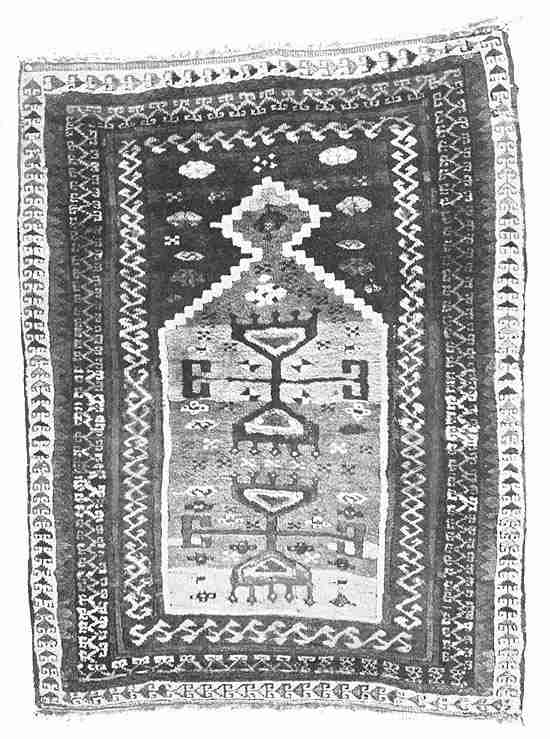
Plate 37. Anatolian
Prayer Rug
It is still possible to obtain many good specimens of Bergamos
representing the craftsmanship of fifty or more years ago, when
aniline dyes and European patterns were unknown east of the
Hellespont. Almost without exception they are sterling fabrics
that glory in a wealth of colour accentuated by depth of pile and
sheen of soft lustrous wool. An observer is at once impressed by
the tones of deep blue and madder red that a few lines or patches
of ivory white bring out more clearly, and forms a favourable
estimate of the value of these pieces independently of the
drawing, which seems subservient to the part of giving spirit and
quality to the colour scheme. In fact, it is to the genius of the
dyer who applies his knowledge to the tinting of carefully
selected wool, and to the pains of the weaver in constructing the
foundation of warp and weft rather than to his skill in arranging
artistic designs, that these pieces command as high a price as
old Kirmans of similar age.
In two particulars Bergamos differ from most Asia Minor rugs:
in shape they are nearly square, and prayer rugs are the
exception rather than the rule. Nor do all the prayer rugs follow
the same general pattern, as is usually the case with other
classes. They may have low tent-shaped arches like those of
Daghestans, high triangular arches with stepped sides and a panel
above the spandrels as in the Kir-Shehrs, or they may have shapes
unlike those of any other class. Moreover, the pieces not used as
prayer rugs also have great diversity of pattern; but as a rule
some large figure, as a medallion, occupies the centre of the
field. Very frequently it is of hexagonal shape, with the sides
at upper and lower ends of the rug serrated or fringed with
latch-hooks. As is not the case with many of the Persian rugs,
the field surrounding the medallion is almost always covered with
small designs, arranged with careful precision so as to show a
perfect balance with reference to the centre. Eight-pointed stars
and other geometric figures are frequently used, but there is a
leaning to floral designs, which, however, are often so
conventionalised as almost to lose their identity. Most prominent
of these is the Rhodian lily and the pomegranate; but the lily
never shows such graceful drawing or such dainty colouring as in
the Kulahs, and in some pieces even loses all resemblance to a
floral form. The pomegranate, which suggests the Ladik, is more
frequently seen in the main border stripe. Undulating vines do
not find favour among the Bergamo weavers, and small isolated
geometric designs are largely employed in the narrow border
stripes, while larger, more complex figures often
replace the floral in the main stripe.
In no other class of rugs are so many and such painstaking
devices to avert the spell of the evil eye. Should an unexpected
visitor surprise the weaver while at work, he may be required to
part with a bit of his frock, which is then attached to the wide
web of the end; should a similar occurrence of ill omen follow,
another bit of different material and colour may be sewn upon
this; and as a crowning talisman, a button may be affixed to
both. Small cowrie shells from the Ægean shores are often
used for such purposes; and now and then may be seen a woollen
tassel dangling from the centre or from one of the ends of the
rug.
Type Characteristics. Colours, principally red
and blue, with minor quantities of yellow, white, and green.
Knot, Ghiordes. Knots to inch horizontally five and one
half to nine; perpendicularly, seven to eleven. The rows of knots
are pressed down, so that the warp is concealed at back.
Warp, wool; each of the two threads encircled by a knot is
equally prominent at back. Weft, wool of fine diameter,
dyed red. A thread of weft crosses from two to six times between
every two rows of knots. Pile, wool; generally of medium
length but frequently long. Border, from one to four
stripes; most frequently of three. Sides, a weft selvage
of two, three, or four cords, coloured red or blue, with
occasionally some green or yellow. Both ends, a web, that
is sometimes six or seven inches wide, coloured red and crossed
by broad longitudinal stripes, which are generally blue, but may
be black, white, brown, or yellow. Some device to avert the evil
eye is frequently attached to the webs. Beyond the web is a
tasselled warp fringe. Texture, moderately firm.
Weave at back is of fine grain. Usual length, three
to seven feet. Usual width, three quarters to nine tenths
length.
Ghiordes.—Whether,
as has been maintained, the town of Ghiordes, that lies a
day’s journey to the east of Pergamus, is on the site of
the ancient Gordium where tradition says the father of Midas
dedicated his chariot to Jupiter, and Alexander severed the bark
which bound the pole to the yoke, it claims attention from the
fact that the rugs woven there one and two centuries ago not only
excelled similar products in all other parts of Asia Minor, but
equalled the best fabrics woven in Persia during the same period.
Indeed, a few connoisseurs would rank them still higher; yet with
reference to technique of weave and delicacy of
colour and drawing, very few should be classed with those woven
in the previous century by the protégés of Tamasp
and Shah Abbas.
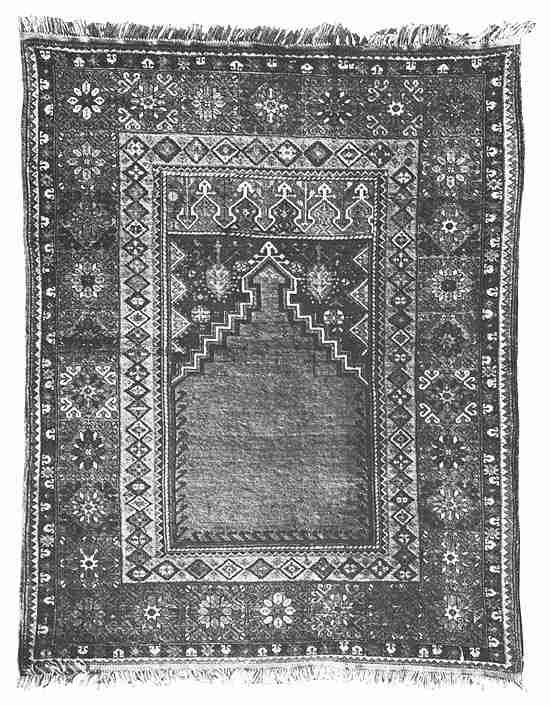
Plate 38. Mudjar Prayer
Rug
So essentially do the modern rugs of the Ghiordes district
differ from the old pieces in weave, colour, and pattern, and so
great is their inferiority, that they have little interest; but
fortunately it is still possible to purchase pieces from
seventy-five to one hundred and fifty years of age, and others
still older are in the hands of collectors or in museums. In
determining their age the colours and drawing, as well as weave
and pattern, are important indices. For instance, the reddish
tones of the fields of pieces less than a century old have a
pinkish or even magenta tinge, while in the oldest the red is of
rich, deep colour. Similarly, in the case of blues, greens,
yellows, and even the ivories that rarely occupy the field, a
riper and richer colour marks the greater age. Likewise with the
drawing, greater painstaking and higher artistic skill are
apparent in the older rugs; though in some of the oldest the
designs are less ornate than in those of a subsequent period.
This is also true of the patterns as a whole; since the best
types are found in rugs that are probably from one hundred and
fifty to two hundred and fifty years old, whereas in the
extremely old pieces there is an approach to archaic forms.
The difference between the odjaliks and namazliks, which are
the kinds most frequently seen, is most noticeable. The colours,
to be sure, are much the same, though as a rule lighter and
duller tones predominate in the odjaliks. Their borders show a
greater tendency to use geometric figures, some of which are
profusely fringed with latch-hooks suggestive of Caucasian
influences. They also contain archaic designs believed to be
associated with sun worship, as well as many floral forms common
to the prayer rugs. It is, however, in the fields that the
distinction is most noticeable; since the large masses of uniform
colour that make the namazliks so effective are wanting, and
instead are frequently seen hexagonal-shaped medallions that are
fringed with large rounded latch-hooks and contain a lozenge or
other geometric design in the centre. At both ends of the fields
are sometimes narrow panels containing quasi-floral forms, and
stiff conventions occupy the intervening corner spaces.
In striking contrast to these odjaliks are the old Ghiordes
prayer rugs, with the rich tones of solid colour in the fields
and the delicate drawing of the borders. No doubt they were made
with unusual care, since they were intended for religious
purposes. The pattern represents an entrance into a mosque;
and it is not improbable that some of the earliest rugs were
copied directly from archways, many of which still exist in
Mohammedan countries.29
Near the base of all Ghiordes arches, at each side, is a
shoulder, which in old pieces was supported by a single pilaster
or a pair. Sometimes these were ornamented with scroll work or
floral forms, but finally many of them degenerated into floral
devices that bore slight resemblance to columns, and in other
rugs they have entirely disappeared. In some very old pieces the
shoulders and the mihrab were rounded, but as a rule the
shoulders are flattened at a very obtuse angle; and the mihrab is
either plain or has stepped sides that culminate in a blunted
apex. To further suggest the sacred purposes of the rug a lamp is
often suspended from the niche, though floral forms may take its
place, and not infrequently these too are wanting. Almost without
exception some reminder of the tree of life, such as the small
floral sprig or the Rhodian lily, is projected from the inner
side of the arch and from all sides of the border against the
field. In the spandrel, also, is almost invariably some floral or
leaf form; though these may be very much conventionalised or even
supplanted by geometric figures. Above the spandrel is a panel,
which may contain some floral form, scroll device, or verse from
the Koran; and another panel, though generally with different
design, is almost invariably placed beneath the field. A scroll
resembling a large S (Plate O, Fig. 9, Page
291) frequently appears in these panels. Its resemblance to forms
found in Armenian dragon carpets of earlier centuries is very
noticeable.
The border surrounding the field is as characteristic of this
class as is the prayer arch. There are invariably a number of
stripes, which generally consist of a wide central one, two
secondary, and two or more small guard stripes. The drawing is
distinctly floral, yet is widely different from the Persian. A
design (Plate G, Fig. 1, opp. Page 192)
frequently seen in the central stripe represents a large palmette
or rosette partly surrounded by leaves, suggestive of the Herati
design, and connected by tendrils with
more delicate flowers or leaves. But the more usual design (Plate
G, Fig. 3) consists of flowers and fruits that
are arranged in quadrangular shape, so that the alternate units
face in different directions as they extend around the border.
Though it is far from naturalistic, its delicate lace-like
drawing with clear definition and its tones in harmony with the
central field, contribute largely to the beauty of the rug. The
secondary stripes have generally repetitive leaf forms; and
running through the guard stripes is a simple vine, ribbon, or
wave design. Occasionally, however, the typical Ghiordes border
is replaced by one borrowed from the near district of Kulah, and
instead of the broad central stripe are several narrow parallel
stripes studded by perpendicular rows of small floral figures
(Plate G, Fig. 12). An unusual feature of these
rugs is the linen nap which is sometimes used in the field
instead of wool, for the reason that it retains its colour while
wool darkens with age; and another is the silken fringe which is
often seen at the corners of fine specimens. The nap is always
short, and the rugs are closely woven.
Type Characteristics. Colours, principally red,
blue, yellow, and white. Knot, Ghiordes. Knots to inch
horizontally seven to twelve; perpendicularly, eight to sixteen.
The rows of knots are pressed down, so that the warp is concealed
and the weft is partly hidden at back. Warp, wool or
cotton and in a few pieces raw silk. One of the two threads
encircled by a knot is usually slightly depressed below the other
at the back. Weft, wool or cotton. A thread of weft
crosses twice between every two rows of knots. Pile, wool,
and occasionally some cotton, clipped very short so as to be
harsh to the touch. Border, six to nine stripes.
Sides, a weft selvage of two or three cords, or only
infrequently an added selvage of silk. Both ends, a narrow
web and warp fringe. A few pieces have an added silk fringe at
the corners. Texture, firm. Weave at back is of
very fine grain, but slightly rough. Usual length, five to
seven feet. Usual width, two thirds to three quarters
length.
Kulahs.—About
fifty miles from Ghiordes, in a southeasterly direction, is the
Turkish village of Kulah. Both places are surrounded by the same
general character of hills and plains, and for the last several
centuries the people of each have been subject to the same
influences of race and religion. They have undoubtedly visited,
intermarried, and become familiar with the arts and crafts of
one another. It is not, therefore,
surprising that some of their rugs should have similar technique
of weave, and that a few resemble one another in general pattern
and small designs. Moreover, such a close correspondence exists
between many of the old rugs of both districts, that even the
most experienced are sometimes at a loss to distinguish between
them. In fact it is surprising that there is so marked a
distinction between most of them. In the Kulahs the border
designs are not so elaborately drawn, nor are the prayer arches
so high. They have rarely the fringe that adorns the corners of
some Ghiordes rugs, or more than one panel. The field usually
contains floral figures, arranged in formal order; the spandrel
is almost always extended in two narrow stripes, one at each side
of the field; and the colours are always subdued. These and other
characteristics of each class make it possible to distinguish
between most of them.
As is the case with Ghiordes rugs, sedjadehs are almost
unknown; but it is not unusual to see odjaliks. These resemble
prayer rugs in the following respects: the borders are almost
identical; the central fields contain the same floral figures
resting on a similarly coloured ground; both ends of the
hexagonal-shaped field resemble a mihrab; and the space between
the field and border is covered with designs peculiar to the
spandrels of the prayer rugs.
On account of their artistic drawing and soft colours the
prayer rugs are favourite pieces with all collectors. It is true
that the arch is flatter than that of any other rug of this
group, and is defined either by plain sloping lines, or more
frequently by stepped edges, so that it lacks the classic beauty
of the Ghiordes type; but on the other hand the Rhodian lily and
other floral forms characteristic of these pieces are delineated
with a realism and graceful delicacy that are unequalled in any
other Asia Minor rugs. Arranged on slender sprays along each side
of the field, hanging as long clusters from the niche in place of
a lamp, or placed on the panel in formal rows, they accentuate
with their bright tones the subdued richness of the ground
colours. Sometimes, however, these simple field designs are
replaced by more formal drawings that represent a plat of land
with a tomb shaded by a tall cypress and other trees with many
leafy branches. Rugs with these designs are not uncommon in
Germany, whither large quantities of Asia Minor prayer rugs were
shipped many years ago, and where they are known as
“Friedhofteppiche,” or “Grave Rugs,”
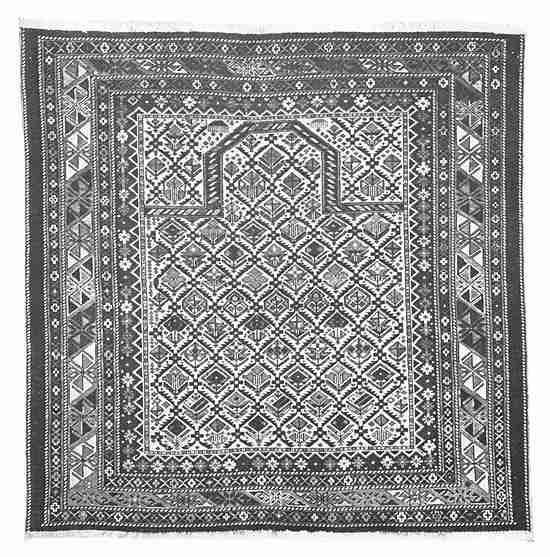
Plate 39. Daghestan
Prayer Rug
The most pleasing features are in the fields, but the most
distinguishing features are in the borders,
which are invariably of several stripes. Instead of the large
central stripe with floral and repetitive designs common to most
rugs is a series of parallel bands, from five to ten in number
and about an inch in width, that contain rows of minute floral
forms. These narrow bands are a distinguishing feature of the
Kulahs, though they have occasionally been copied by the Ghiordes
weavers. Nevertheless, they are sometimes replaced by the broad
stripe containing rows of geometric-shaped designs, as in Plate
G, Fig. 13 (opp. Page 192), which also are
peculiar to these rugs. Strange as it may seem, these designs
have doubtless been derived from leaf forms by successive
degradation, as will be seen by comparing Figs. 13a, 13b, 13c,
and 13d of Plate O (Page 291). There is still
another border design that is so constantly found in the
secondary stripe of these pieces and so rarely in any others that
it might well be designated the “Kulah stripe” (Plate
H, Fig. 10, opp. Page 194). The design consists
of a repetitive figure suggestive of some Chinese device, but is
in reality a degraded form of a vine, as will be seen by
observing some of the very old border stripes. Between the inner
secondary stripe and the field is usually a narrow stripe
containing a continuous ribbon design, or a simple vine-like
form, as in Plate F, Fig. 18 (opp. Page 158).
Often a part of each succeeding undulation of the vine has been
omitted and the remaining parts have been compressed, so as to
leave small detached figures like a row of
“f’s,” as in Plate H, Fig. 2.
It is not unusual to see both vine and detached figures in the
same rug.
Diversity prevails in the colours of field, spandrel, panel,
and borders. In the field is generally a mellowed red, or a
yellow tint that is described both as golden brown and apricot;
blue also is occasionally seen, and white is very rare. But
whatever the colour of the field, that of the spandrel is
generally a light blue, indicative of the sky, and the overlying
panel is frequently a dark blue. Green and brown often appear in
the border, as well as a canary yellow peculiar to Asia Minor
rugs. Moreover, a few of these pieces have a single small area of
red or blue, that was doubtless inserted to avert the evil eye,
since it shows no more relation to the surrounding colours than
spilt ink might have; yet in spite of these contrasts and the
fact that the nap lacks the lustre peculiar to many other
classes, some of them are as beautiful as Ghiordes.
Between these old fabrics and the modern, which factory-like
are produced in large quantities to meet the demands of a
Western market and taste, is the most
noticeable difference, for the latter are inferior to the former
in patterns, weave, and dyes. Furthermore, with the wool of many
is mixed mohair, so that rapid deterioration follows slight
usage.
Type Characteristics. Colours, principally red,
brownish yellow, and blue, with minor quantities of green, dark
brown, and white. Knot, Ghiordes, Knots to inch
horizontally five to ten; perpendicularly, seven to twelve. The
rows of knots are not firmly pressed down. Warp, wool; one
of the two threads encircled by a knot is noticeably depressed at
the back. Weft, in most rugs, of wool of medium diameter,
sometimes dyed yellow. A thread of weft crosses twice between
every two rows of knots. In other rugs, even very old, the weft
consists of a coarse thread of jute crossing once between two
rows of knots and alternating with a small thread of jute and
another of wool crossing side by side once between the next two
rows of knots. Pile, wool, of short or medium length.
Border, six to nine stripes. Sides, a coloured
mixed selvage of two, three, or four cords. Both ends, a
coloured web and warp fringe. Texture, loose. Weave
at back is of moderately coarse grain. Usual length, five
to seven feet. Usual width, three fifths to three quarters
length.
Oushaks.—Fifty
miles eastward from Kulah is the city of Oushak, famous during
the XV and XVI Centuries for the carpets exported thence to
Europe to adorn the halls of cathedrals and thrones of monarchs.
But with the subsequent decadence in Asiatic art its glory ebbed,
so that half a century ago it was but a small mud-housed city
known for the excellence of its dyes and the wool which was taken
there from the interior to be washed, spun, and then sold to the
weavers of the surrounding country. Since then, however, its
population has steadily grown, and the weaving industry has
thrived, until now it is one of the most populous cities of Asia
Minor, with looms more numerous than those of any other city. The
weaving is done entirely by women and girls, most of whom are
Mohammedans. Though they live principally in private houses, they
are under the direction of large firms, who furnish the wool as
well as the patterns, which are in accordance with European and
American demands.
Important distinctions exist between the different grades of
these rugs. Some are known as “Turkish Kirmans,” in
which Persian designs are frequently introduced, others are of
still finer workmanship, but the oldest and coarsest pieces
were formerly known as “Yapraks.” These are
distinguishable by their strong colours of red, green, and blue,
of which only two as a rule are seen in a single rug, and are
massed to produce striking effects. Their foundation of warp and
weft, which are dyed in the same colours, is loosely woven and
often of an inferior grade of wool. Many of them are too large
and heavy for domestic use, but are well adapted for salons and
public halls.
With such slight variations in pattern and none in colour,
Oushaks would be of little interest were it not that their
prototypes were striking pieces woven by artisans whom Sultan
Solyman the Magnificent brought from the northwestern part of
Persia, when he conquered it in the XVI Century. Some of them
appear in the paintings of old masters, and when contrasted with
the modern fabrics indicate how great is the decline in the
craftsmanship of the weavers. Of the beautiful well-balanced
designs once represented in the fields, only large stars and
diamonds, defined by less pleasing lines and placed with less
regularity, remain. All of the graceful arabesques and dainty
floral motives that appeared as sub-patterns are omitted. As
works of art, the modern products are little esteemed; but their
durability, depth of pile, and wealth of colour make them
excellent objects of utility.
Type Characteristics. Colours, principally red,
blue, and green. Knot, Ghiordes. Knots to inch
horizontally four to eight; perpendicularly, four to nine. A half
knot, as it appears at back, is longer than wide. The rows of
knots are not closely pressed down. Warp, wool. Each of
the two threads encircled by a knot is equally prominent at back,
or one is slightly depressed below the other. Weft, wool
of medium diameter and generally dyed red. A thread of weft
crosses twice between every two rows of knots. Pile, wool,
clipped long. Border, usually of three stripes.
Sides, generally a double overcasting, occasionally a
selvage. Both ends, generally a web coloured red and a
warp fringe. Texture, very loose. Weave at back is
of moderately coarse grain. Length, carpet sizes. Usual
width, two thirds to four fifths length.
Ak-hissar.—Almost
seventy-five miles by rail from Smyrna and a short distance to
the west of Ghiordes is the Turkish town of Ak-Hissar, the White
Citadel. Even before the building of the railroad rugs were woven
in this district; and in recent years the
work-house system has been established, and large quantities,
that bear some resemblance to the modern products of Kulah and
Oushak, have been exported.
Demirdji.—Half a
century ago the town of Demirdji was almost uninhabited; but as a
result of the Occidental demand for Oriental rugs and the
disappearance of old pieces, it has grown to be an important
manufacturing centre. Many of its weavers learned their trade at
the historic Ghiordes, which is about twenty-five miles distant;
but the fabrics are more closely woven and the wool is more
carefully selected than is the case with the modern Ghiordes.
Kutayah.—On the
main railroad that will eventually connect the Bosphorus with the
Euphrates is the town of Kutayah. As it is on the edge of the
Anatolian plateau, wool and goat’s hair have been for a
long period important articles in its trade. Both of them are now
used in the local manufacture of rugs, which in a measure
resemble the products of Oushak.
Smyrna.—The
location of Smyrna on a magnificent harbour and its connection by
rail with all the important rug districts of the interior, have
made it the principal centre for the export trade in Asia Minor
rugs. Many of the people are also largely engaged in the industry
of weaving, but almost all weavers are now in the employ of large
companies who furnish the materials and patterns. As a result,
the Smyrna rugs are mere copies of well-known types of other
Turkish pieces, or, as is generally the case, of stereotyped
patterns that have been evolved to meet the requirements of
European and American tastes. Many of the rugs, to be sure, are
well woven and serviceable, but they lack individuality of
character.
Melez.—About
seventy-five miles to the south of Smyrna and twenty from the
Mediterranean Sea is the town of Melassa, or Melez. It is now
little known, but was once the market place of an important
rug-producing district, which included a large part of the
classic province of Caria. Accordingly, the pieces that came from
there were sometimes called Carian, but are more generally known
as Melez.
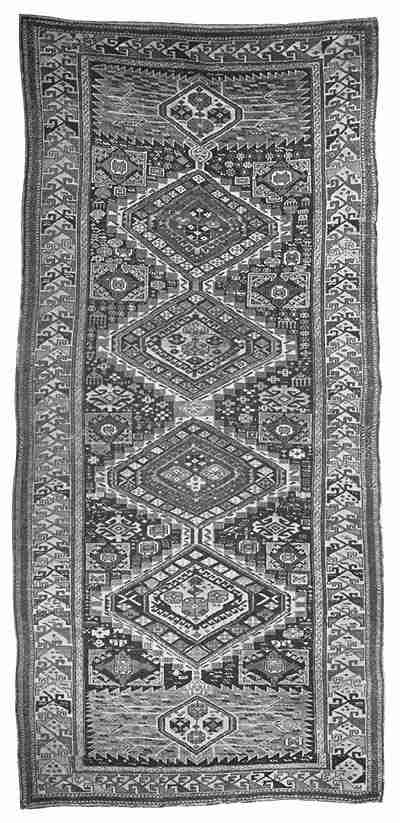
Plate 40. Kabistan
Rug
On their face they show a close relationship to the
Anatolians, and also, though in a less degree, to
many other Asia Minor rugs; yet as is to be expected of the
products from one corner of the country, they have a distinct
individuality in both pattern and colour. Occasionally an old
piece is seen, in which the border is very narrow and the whole
field is covered with parallel stripes on which are
systematically arranged geometric and semi-floral forms; but as a
rule the fields are not much wider, and often less wide, than
each of the adjacent borders. Within this central space are
frequently arranged prominent designs, which are widely different
from the designs of any other rugs, and are suggestive of Chinese
ornament, but were doubtless derived from floral or tree forms
(Plate O, Fig. 12, Page 291). Moreover,
projecting in regular order from the alternate sides of the
narrow border stripe, next to the field, are sometimes seen
thumb-like figures, that fit against one another like the cogs of
a wheel (Plate H, Fig. 15, opp. Page 194). Each
of these features, though not always present, is peculiar to this
class.
Of the several border stripes, the central is generally as
wide as the remainder and not altogether dissimilar to that of
the Ladiks. Very frequently it consists of a row of palmettes
between which are conventionalised leaves and flowers on slender
stems; but now and then the palmettes are replaced by
eight-pointed stars or other geometric figures, and the
intervening spaces filled with corresponding designs. The
secondary stripes are of a pronounced Caucasian type; and almost
invariably in a smaller tertiary stripe is represented a waving
line or the reciprocal sawtooth.
The prayer rugs are equally characteristic. In typical
examples the lines defining the mihrab descend from the niche to
meet the sides of the narrow field at an angle of forty-five
degrees, and are then deflected towards its centre, to return
again to its sides. The resulting drawing shows two equilateral
triangles on each side of the field at the base of the mihrab,
which in conjunction with the upper sides of the triangles has
the appearance of an incomplete diamond. This effect, moreover,
is frequently accentuated by a perpendicular row of diamonds
extending from just below the niche to the base of the field. The
sides of mihrab, field, and central designs are, as a rule,
fringed with small geometric or conventionalised floral forms;
and in the spacious spandrel are more realistic floral designs
arranged on a trellis-like sub-pattern.
This individuality of pattern is accompanied by a less marked
yet noticeable individuality of colour scheme. As is the case
with many Bergamos, the principal tone is a
dark red, which generally appears in the central field, and is
also used almost without exception in the broad end webs, the
side selvages, and the threads of weft. Ivory white for the
spandrel, some yellow and green for the borders, are common
colours; but the one that rarely appears in any appreciable
quantity in other rugs is a characteristic tone of lavender or
mauve, which is present in almost every old Melez. Not always are
these tones pleasing, as many of the rugs have been poorly dyed;
but there are other pieces, now rapidly growing scarce, of which
the colours are exceedingly rich and harmonious.
Type Characteristics. Colours, principally red,
with minor quantities of blue, yellow, white, and some mauve.
Knot, Ghiordes. Knots to inch horizontally five to eight;
perpendicularly, six to eleven. A half knot, as it appears at
back, is as long as wide or slightly longer. The rows of knots
are not closely pressed down, yet the warp does not show at back.
Warp, wool; each of the two threads encircled by a knot is
equally prominent at back. Weft, wool of small diameter,
dyed blue or red. A thread of weft generally crosses four times
between every two rows of knots. Pile, wool, of medium
length and sometimes short. Border, wide, from three to
seven stripes. Sides, a selvage of two to four cords,
usually coloured red. Lower end, a red web and loose warp
fringe. Upper end, a red web, a braided selvage, and loose
warp fringe. Texture, moderately loose. Weave at
back is of slightly coarse grain. Usual length, four and
one half to six feet. Usual width, three fifths to three
quarters length.
Isbarta.—In the
town of Isbarta in the southern part of the province of Konieh
are woven rugs which are sometimes known to the trade as
“Spartas.” Like many other pieces made to meet the
Western demand, they lack spontaneous individuality, but are
often of excellent quality and coloured in delicate tones,
arranged harmoniously.
Rhodian.—Even at a
very early period the people of the islands bordering the
southwestern coast of Asia Minor produced textile fabrics that
rivalled many of the best products of the mainland. None of them
were more beautiful or more interesting than those which came
from the Island of Rhodes, where were blended the vigorous
Grecian and the more subtle Oriental arts. Here was the
inspiration of the sea, cloudless skies,
luxuriant vegetation. Here was felt the deep influence of the
Mohammedan and Christian religions, as well as an early pagan
mythology; and there is little doubt that the cathedral walls and
picturesque church of the valiant knights of St. John made an
impression on the weavers. It is not surprising, therefore, that
the fabrics should be of deep, rich colour full of suggestion,
and that the drawing of the long central panels should remind one
of cathedral windows.
Of the many beautiful rugs formerly woven in Rhodes only a few
now remain, and these are generally in the hands of collectors.
Some are odjaliks, some namazliks, some sedjadehs; but all, with
the exception of a few crude and coarsely woven pieces, have
colours and weave that bespeak a ripe age, amounting in many
instances to one hundred years or more. On the field of odjaliks
are represented as a rule the usual hexagonal figure with two
sides at each end forming a triangle; and on the fields of the
namazliks are prayer arches which, though characteristic, never
equal the graceful drawing seen in Ghiordes rugs. It is the
sedjadehs that awaken the greatest interest, as they have some
striking peculiarities rarely seen in rugs of the mainland.
Their field is divided into two or three panels that extend
almost the full length of the field, and terminate at one end in
flat and often serrated arches. The spandrels are small; and
placed transversely above them is a low panel, that contains
designs of mechanically drawn leaves, vandykes resembling those
of Ladiks, and other figures common to Asia Minor rugs. In fact,
these pieces at once suggest prayer rugs containing two or more
prayer arches, but the pattern is generally regarded as a
representation of cathedral windows. Both colouring and designs
give force to this idea. In each of the principal panels is a
different ground colour, as red, blue, or green, which is never
gaudy, yet exceedingly rich on account of the depth of pile; and
in the overlying figures there is often a strangely contrasting
splendour of brighter colouring. Furthermore, one of the most
usual of these designs, arranged like pole medallions, consists
of large eight-pointed stars with effulgent rays of brilliant
hues. As we look at some of the rare old pieces with this
pattern, cathedral windows almost appear before us with bright
sunshine streaming in golden rays through the stained glass and
brightening the interior with its more sombre tones of “dim
religious light.” Sometimes the pole design is modified so
as to suggest a tree of life extending from one end of
the panel to the other. An equally common design represents six
very mechanically drawn leaves assembled in the form of a
medallion (Plate O, Fig. 15, Page 291). Each of
these leaves has two straight edges meeting at right angles and
containing at the corner a small rectangular spot; but the
remaining sides that form the circumference of the medallion are
deeply serrated, so as to produce much the same effect as the
rays of effulgent stars. In the fields are also frequently seen
latch-hooks, and occasionally checkerboards with different
colours for separate squares.
Between field and border is a close correspondence in both
colours and small designs. The latter consist principally of
geometric and semi-floral forms, as eight-pointed stars, the
octagonal disc, and the geometric leaf that is typical of Kulah
rugs. No other design is more prevalent than the last, which may
be found in all parts of these rugs. Sometimes it is drawn most
realistically so as to resemble the flower forms so common in
spandrels of Kulahs; but again the outlines are most conventional
with square-like projections at the edges and a bar of underlying
field of contrasting colour crossing the face diagonally, as in
the border stripe of Plate G, Fig. 13, (opp.
Page 192), which shows the foliate origin of the latter.
The name “Makri” is frequently applied to these
rugs, since they were often bought in the city of that name,
which is one of the harbours of Southwestern Asia Minor nearest
to Rhodes.
Type Characteristics. Colours, principally red
and blue, also considerable yellow, green, and white.
Knot, Ghiordes. Knots to inch horizontally five to eight;
perpendicularly, seven to nine. The rows of knots are not firmly
pressed down, so that the warp shows in places at back.
Warp, wool; each of the two threads encircled by a knot is
equally prominent at back, occasionally one to each knot is
slightly depressed below the other. Weft, wool, of medium
diameter, coloured red. A thread of warp usually crosses twice
between every two rows of knots, rarely only once, and sometimes
as many as four times. Pile, wool, clipped long.
Border, two to three stripes. Sides, a double
selvage of two, three, or four cords, usually coloured red or
blue. Lower end, a web, either red or of several colours,
and long warp fringe hanging loose or braided. Upper end,
a web, either red or of several colours, beyond which is often a
heavy braided selvage; also a long warp fringe hanging loose or
braided. Texture, moderately loose. Weave at back
is of slightly coarse grain. Length, four to
seven feet. Width, three fifths to four fifths length.
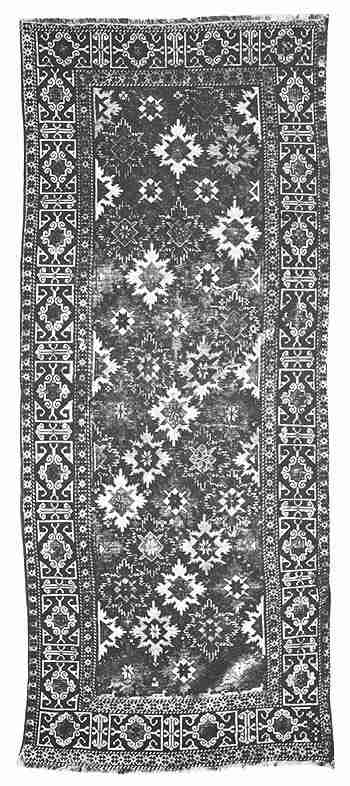
Plate 41. Kuba
Rug
Broussa.—At the
base of Mt. Olympus and distant only twenty-five miles from the
Sea of Marmora, with which it is connected by rail, is the city
of Broussa. By reason of this location and its proximity to
Constantinople, it is an important commercial centre; and on
account of the excellence of the wool and silk obtained in the
surrounding country, rugs are woven here for foreign markets. The
fabrics are stoutly made and compare favourably with those of
Smyrna.
Hereke.—In the
town of Hereke, on the Sea of Marmora, is a Turkish factory,
where large numbers of silk rugs are manufactured. Most of the
silk is obtained in the immediate neighbourhood and from the
country about Mt. Olympus. As the early weavers were brought from
Kirman to instruct the artisans of the Sultan, and the patterns
have been largely copied from old Persian and Asia Minor pieces,
it is not surprising that many of the fabrics compare favourably
with the silk rugs of Persia.
Koniehs.—At the
base of Mt. Taurus and overlooking the salt desert of Central
Asia Minor is the city of Konieh. Within its present walls is all
that is left of the ancient Iconium that opened its gates to
Xenophon, Cyrus, and Alexander, but drove forth the Apostle Paul.
Finally it surrendered to Seljukian conquerors, who, realising
the importance of its situation on one of the great highways
between east and west and in an oasis of well-watered fields,
orchards, and gardens which face a great barren plain,
established there a Mussulman capital, that became noted for its
opulence and culture. In later years it successfully resisted the
assault of Frederic Barbarossa; but subsequently it declined,
until now the only remaining vestiges of its former importance
are several colleges, one hundred mosques, and the famous green
tower surmounting the tomb of the whirling dervishes.
In few other cities of Asia Minor were greater inducements
offered to the rug weavers. Surrounding them lay hills and plains
that produced sheep with soft, fine fleeces. On the oaks that
grew not far to the north lived the kermes, from which were
obtained the vermilion dyes famous even through Persia. The
political and commercial importance of the city, as well
as the religious fanaticism of the people, aided them.
Accordingly a great many choice pieces were formerly woven there,
but on account of the remoteness of the city from the markets
that supplied Europe, few found their way into channels of
trade.
Large numbers were used solely for religious purposes, but
other kinds are as frequently seen. All of them contain both
geometric and floral forms. The geometric forms resemble designs
prevalent in Eastern Anatolia and in Caucasia, such as
latch-hooks, eight-pointed stars, and barber-pole stripes; and
the floral forms consist of mechanically drawn palm leaves and
the tree-of-life design.
Probably in no other Asia Minor rug is such latitude in the
drawing of the prayer arch. Sometimes it begins below the middle
of the field and rises at a sharp angle to a point near the upper
end; again it may be exceedingly flat; but generally it has the
same pitch as the arches of Kulahs, and, like them, the sides, as
a rule, are stepped or serrated. Furthermore, it is not unusual
to see latch-hooks projecting from each step or serration into
the spandrel, which is filled with small floral and geometric
forms. From the niche is occasionally suspended a lamp; and
arranged against the border, on each side of the field, is a row
of conventionalised flowers, or small sprigs which resemble three
triangular-shaped petals at the end of a straight stem. These
floral or foliate designs are one of the most constant features
of this class. The borders are more geometric than those of
almost any other Asia Minor rugs, and even when vines are
represented they are drawn with stiff formality.
Whatever may be lacking in artistic drawing is frequently
atoned for by the excellence of the colour scheme, which
occasionally rivals that of the Ghiordes and Kulahs. Rich reds or
blues are almost invariably found in the fields, where there is
sufficient depth of nap to enhance their richness; and the
borders are brightened by attractive tones of yellow, green, and
white. Contrasted with these old pieces, the modern rugs of
Konieh have little artistic merit, but are large pieces desirable
solely for their durability.
Type Characteristics. Colours, principally red
and blue, with minor quantities of yellow, green, and white.
Knot, Ghiordes. Knots to inch horizontally five to eight;
perpendicularly, six to ten. The rows of knots are not very
firmly pressed down. Warp, wool; each of the two threads
encircled by a knot is equally prominent at back. Weft,
wool, of medium diameter, dyed red. A thread of weft
crosses twice between every two rows of knots.
Pile, wool, of medium length. Border, from two to
five stripes, with frequently an outer edging. Sides,
generally a selvage of two or three cords, but occasionally an
overcasting. Both ends, a web and warp fringe.
Texture, only moderately firm. Weave at back is of
slightly coarse grain. Usual length, four and one half to
six feet. Usual width, three fifths to three quarters
length.
Ladiks.—On the
ruins of ancient Laodicea is the mud-walled town of the village
of Ladik, once the centre of an important rug industry. Among the
surrounding hills are still woven pieces which resemble in
pattern, though they poorly imitate in weave and colour, the
early prototypes that have been classed among the masterpieces of
Asia Minor. Few of these old rugs remain, and they are often
badly worn in spots; yet they display tones mellowed by the touch
of more than a century, and rival the Ghiordes in beauty of
design.
As is the case with other classes of rugs woven in Turkish
countries, the sedjadehs and odjaliks lack the interesting
details of the namazliks, from which they widely differ. On the
central fields of many of them are oblong hexagonal-shaped
medallions, often three in number, that contain designs of stars
or other geometric figures. Between the fields and the borders of
the ends are generally spacious panels, on which are represented
rows of vandykes. These figures are one of the most permanent
characteristics of this class of rugs; and though their origin is
uncertain, it is not improbable that they are derived from
arrowheads, which were one of the emblems of the Chaldean deity
Hoa, the reputed inventor of Cufic writing. The borders are also
geometric, consisting, as a rule, of three stripes, of which the
central contains an angular vine that in different pieces may be
very simple or very ornate. One of the central stripes often
adopted is represented in Plate G, Fig. 10
(opp. Page 192) and shows a vine with conventionalised leaf.
Latch-hooks are common in the sedjadehs, and when floral forms
are present the fact is generally disguised by the harsh,
mechanical drawing.
In contrast with these pieces, the namazliks with their
interesting arches and dainty drawing are most pleasing. In a
large number of them the central fields occupy about one half the
space within the border, the spandrels extend for a considerable
distance above the arch, and the panels are larger than in any
other prayer rug. Occasionally arches resembling those of the
Ghiordes or Kir-Shehrs are seen; but they are to be
regarded merely as copies, since the typical arch differs widely
from any other and gives to this class one of its greatest
charms. Instead of rising to the apex in lines of many
serrations, each side of the arch rises from the border and falls
in one large serration, then rises again to form the niche. The
arch is often fringed with latch-hooks, and extending above the
apex of each serration and the niche are perpendicular devices
that may, also, be a development of the latch-hook, since they
have not been traced to any other satisfactory origin. But
whatever their origin may be, their shape as well as that of the
arch at once suggests Saracenic mosques. In the spandrel are
constantly seen serrated leaves, rosettes, and designs peculiar
to the Ladik. The large panel is equally typical, and consists of
reciprocally drawn vandykes, from which rise perpendicular stems
supporting leaves and pomegranates. These are generally five in
number, and are so gracefully and naturalistically drawn that it
seems surprising that the vandykes, from which they spring, are
ornamented with a profusion of latch-hooks. The central fields
are sometimes without ornament, but as a rule they contain some
suggestions of the tree of life either in the central design or
in the three-leaf sprigs arranged about the borders. The latter
are as characteristic as any other part of the rug, and consist
of four stripes separated by dotted lines. The main stripe most
frequently contains a row of delicately drawn lilies alternating
with rosettes, though occasionally a very formal vine with
conventionalised leaf is substituted for it. In the stripes at
each side are very angular vines with three-cleft leaves, and in
the narrow innermost stripe is generally a ribbon pattern.
All of the drawing has clear definition accentuated by rich
and strongly contrasting colours. The fields of the namazliks,
like those of the Ghiordes, are entirely occupied by masses of
unshaded blue, red, or brown, that are relieved only by the
colours of superimposed designs. But as is not the case with
Ghiordes, there is often a strong contrast between the colours of
centre and ends; yet the tones are always in perfect harmony.
Other rugs may have more delicate drawing or more exquisite
finish; but in the barbaric arrangement of strong colour and in
the uniqueness of graceful designs, none exceed the old prayer
Ladiks.
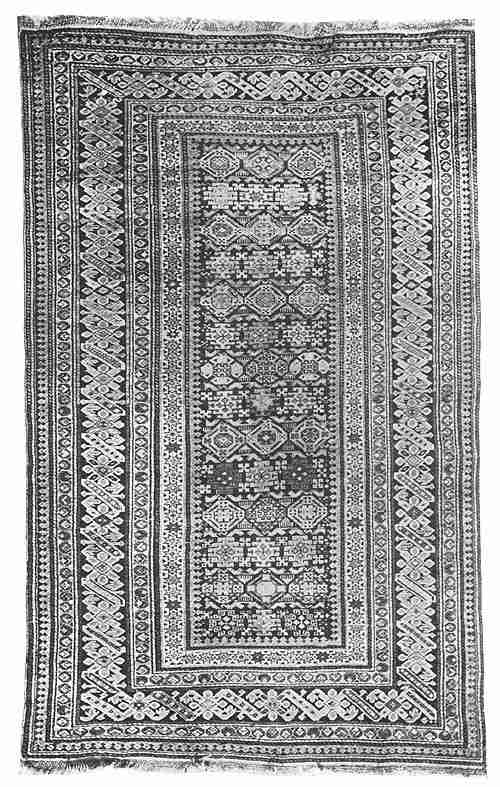
Plate 42. Chichi
Rug
Type Characteristics. Colours, principally red
and blue, with minor quantities of green, yellow, and brown.
Knot, Ghiordes. Knots to inch horizontally nine to twelve;
perpendicularly, ten to thirteen. A half knot as it appears
at back is longer than wide. The rows of knots are pressed down
so that the warp is concealed at back. Warp, wool. One of
the two threads encircled by a knot is generally depressed below
the other at the back. Weft, wool of fine diameter,
generally dyed red. A thread of weft crosses twice between every
two rows of knots. Pile, wool, of medium length.
Border, three to five stripes. Sides, a red added
selvage of two or three cords. Both ends, a narrow web and
warp fringe. Texture, moderately firm. Weave at
back is of medium grain. Usual length, four and one half
to seven feet. Usual width, three fifths to two thirds
length.
Kir-Shehrs.—To the
north of the great salt desert and in the southern part of the
province of Angora is the town of Kir-Shehr. It stands between
two mountain ranges, on which are raised sheep with fine fleeces,
and is on the branch of the Kizil Irmak, whose waters are well
suited for preparing wool for the dyes obtained in the
surrounding country. On account of the excellence of wool, water,
and natural dyes, as well as the remoteness of the town from main
highways of travel, many of the old rugs were excellent pieces,
free from the taint of Western influences, and possessing the
charm of individuality. It was due, moreover, to the fact that
its three or four thousand inhabitants, and the Turkomans who
roamed the surrounding country, rarely felt the influence of
larger cities that they were so untrammelled by
conventionalities. Unhesitatingly they grouped together large
spaces of red, yellow, and blue, as well as grass-coloured green,
for which they had a particular fondness and employed to a
greater extent than almost any other weavers; yet in the case of
these old pieces the artistic sense is rarely shocked, since the
individual colours are good and the tones are harmonious.
Furthermore, the patterns show an unusual blending of floral and
geometric forms.
Most of the pieces come in moderate sizes; some are mats,
others small sedjadehs, but the choicest are the prayer rugs. The
serrated sides of the arch, which rise at a steep angle from the
centres of each side of the rather narrow fields, are formed of
several parallel lines of different colour. In a not unusual rug,
for instance, eight narrow lines separating the spandrel of
grass-green from the inner field of brick-red appeared in the
following order: red, black, white, yellow, lavender, yellow,
red, and blue. The inmost line is frequently
fringed with tri-cleft floral forms, which, as in Koniehs, extend
in a row along the sides of the field. From the niche is usually
suspended the design of an inverted tree of life, and above it
are projected latch-hooks or similar devices. It is not unusual
to see two arches, and there are sometimes as many as four,
placed one within the other. The spacious spandrel that is
continued in narrow stripes along the borders to the bottom of
the field is covered with geometric or conventionalised floral
forms; and the horizontal panel, which may be placed at either
end of the field, contains designs in harmony with the remaining
parts.
On the whole, the wide borders have some of the most
characteristic features; for, as a rule, not only are one or two
of the stripes of a peculiar cherry red and one a rich yellow,
but three or four of the narrow stripes next to the field are
similar in width and ornamentation to those of the Kulah. When
contrasted with them the broad central stripe and the outer one
seem lacking in harmony, for they are distinctly floral and
suggestive of Persian influences.
On account of the quality of their wool and weave, these rugs
are soft and flexible. They resemble in some minor details others
of the Anatolian plateau, yet they can be distinguished by the
presence of grass-green colour and the shape of the prayer arch.
The nap of these old pieces, like that of Kulahs and Ladiks, is
of medium length; though in modern pieces it is often longer, and
the weft and webs are coloured as are those of Bergamos.
Type Characteristics. Colours, principally red
and green, also some blue, brown, and white. Knot, Ghiordes.
Knots to inch horizontally five to nine; perpendicularly,
five to ten. A half knot as it appears at back is as long as, or
longer than, wide. The rows of knots are not firmly pressed down,
so that in places the warp shows. Warp, wool; each of the
two threads encircled by a knot is equally prominent at back, or
occasionally one is slightly depressed. Weft, wool, of
medium or coarse diameter and generally of different colours in
the same rug. A thread of weft crosses from two to six times
between two rows of knots, varying in the same rug. Pile,
wool, of medium length. Border, from five to eight
stripes. Sides, a weft selvage of two, three, or four
cords of different colours. Lower end, web and warp loops.
Upper end, a web and warp fringe. Texture, loose.
Weave at back is of coarse grain. Usual length,
four to six feet. Usual width, two thirds to four fifths
length.
Anatolians.—To all of Asia Minor was once
applied the term “Anatolia,” which signifies the Land
of the Rising Sun; so that any product of this country might well
be called Anatolian, just as any product of Persia might be
called Iranian. In fact, many of the less known classes, as the
Nigde, Tuzla, Mudjar, and even the Kir-Shehr, Melez, and Konieh,
are often called Anatolian. But as there is a special type of
rugs known as Iranians, so is there a special type known as
Anatolians. They are, however, a mixed lot, that come from parts
of a wide stretch of territory, extending over the interior
table-land to the home of the Kurds, and incorporating ideas
received from many districts. It is, accordingly, difficult to
define them as a type; but, as a rule, they are small pieces that
are often used for mats and pillows, with moderately long nap of
soft, floccy wool, with narrow borders, and a colour scheme that
inclines to bright and sometimes garish colours.
Doubtless the best of them come from the provinces of Angora
and Konieh, lying within a radius of one hundred miles of Lake
Tuz Gul. Here can be obtained the best of wool and dyes; and in
some of the old pieces appears the artistic drawing of the more
important rug centres farther to the west, but with a strange
blending of geometric and floral forms. Eight-pointed stars as
well as latch-hooks are seen everywhere, and a very old design
with the shape of ram’s horns is frequently used. In many
of the prayer rugs the arches are of the Kir-Shehr order, though
the panels may contain vandykes suggestive of Ladiks. There is
the greatest latitude in the width of the borders, which
occasionally are their most noticeable feature and again are most
insignificant; but in either case they rarely contain more than
three stripes, and not infrequently only one. Red, blue, green,
and brown are the usual colours, but pink and canary yellow are
sometimes used.
Farther to the east, among the foot-hills of the Anti-Taurus
mountains, is woven a coarser type by the Kurdish tribes. With
the exception of wool and dyes they have little to their credit;
for their usual unsymmetric shapes, crude geometric designs, long
uneven nap, and braided fringe of warp at the ends are lacking in
all elegance.
Type Characteristics. Colours, principally red,
blue, green, brown, and white. Knot, Ghiordes. Knots to
inch horizontally five to nine; perpendicularly, six to twelve. A
half knot, as it appears at back, is generally as long as wide,
or longer. The rows of knots are not firmly pressed down, yet the
warp is frequently concealed at back. Warp,
wool; each of the two threads encircled by a knot is equally
prominent at back. Weft, wool, of medium or coarse
diameter and usually dyed, A thread of weft crosses two, three,
and four times between two rows of knots frequently varying in
the same piece. Pile, wool, of medium length.
Border, one to three stripes, and occasionally an edging.
Sides, a weft selvage of two or three cords. Both
ends, a web and warp fringe. Texture, loose.
Weave at back is of coarse grain. Usual length, two
and one half to six feet. Usual width, one half to two
thirds length.
Karamans.—At the
foot of Mt. Taurus and overlooking the plain that stretches
northward into the heart of Asia Minor is the city of Karaman.
Before its subjection in the XV Century by Bajazet II and the
removal of the capital to Konieh, that lies sixty miles to the
northwest, it was the seat of a Turkish government extending to
the Mediterranean Sea; but to-day the only reminder of its early
importance are several Saracenic mosques covered with rich
arabesques. Of the rugs woven there during the early period
almost nothing is known, but, on account of the former importance
of the city, it is not improbable that they compared favourably
with the rugs of other parts of the Turkish Empire. On the other
hand, some of the modern products are among the poorest rugs of
the East, and contain little artistic merit. A feature peculiar
to many of them is the use of natural wool of reddish brown
colour, obtained from sheep which live on the mountain ranges to
the south of Karaman. The pile is long, the weave is never very
firm, and at each end is a coloured web.
Sivas.—In the city
of Sivas, at the eastern end of Anatolia, and in the villages of
the surrounding plain, girls and women have woven rugs from time
immemorial; but on account of the difficulties of transportation
few of them reach this country. The carefully finished sides and
ends, the formal character of the pattern, and the almost harsh
effect of the strongly contrasting colours of many of them are
unlike what are found in the nomadic rugs made farther to the
east and west. In the weave is a hint of Persian influence; for
not only are both warp and weft of cotton, but the warp is of
small diameter and well spun, and one of the two threads to which
a knot is tied is depressed below the other. The pattern, on the
other hand, is distinctly Turkish. One of the best known types
consists of a large hexagon that reaches to the
sides and ends, and contains within it a medallion on which are
designs similar to those seen in Bergamos. On the white field
surrounding the medallion are often small rosettes and floral
figures. The corners of the field may be fringed with running
latch-hooks or a row of formal T’s, and contain a rosette
at their centre. The borders are rarely wide, and often consist
of a single stripe that contains some conventionalised floral
form. Although these rugs are well woven, their crude blending of
floral and geometric figures, as well as their formality of
drawing, which is accentuated by the shortness of the nap, are
most suggestive of Occidental conventions.
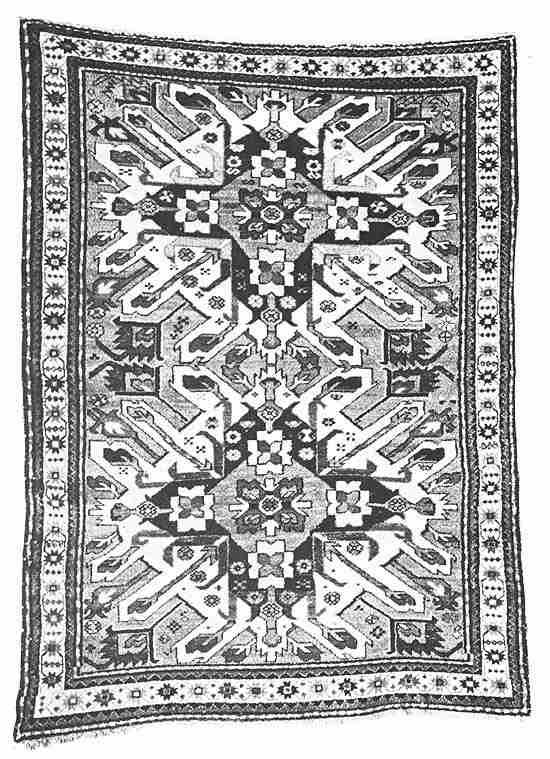
Plate 43. Tcherkess
Rug
Type Characteristics. Colours, principally red
and white; also dull blue, green, and light yellow. Knot,
Ghiordes. Knots to inch horizontally seven to eleven;
perpendicularly, nine to fifteen. A half knot, as it appears at
back, is not as long as wide. The rows of knots are pressed down,
so that the warp does not show at back. Warp, cotton, well
spun and of small diameter. One of the two threads encircled by a
knot is depressed below the other at back and sometimes doubled
under the other. Weft, cotton, of medium diameter. A
thread of weft crosses twice between every two rows of knots.
Pile, wool of short to medium length. Border,
narrow, one to three stripes. Sides, an added selvage of
four or five cords attached in places, and with weft encircling
inner cord of selvage. Both ends, narrow web and loose
warp fringe. Texture, firm. Weave at back is only
slightly coarse. Usual length, three and one half to six
and one half feet. Usual width, two thirds to four fifths
length.
Mudjars.—Near the
river Kizil Irmak in Central Asia Minor is the city of Mudjar,
which produces rugs that occasionally reach this country. They
are often classed as Anatolians, but their colour scheme covers a
wider range, including red, yellow, green, blue, mauve, and pink,
all of which may be seen in the same piece. In fact no other rug
of Asia Minor contains as a rule so many colours, which appear in
the broad borders of old, well-woven pieces with glistening wool
almost like mosaic work. Many of this class are namazliks with
arches very similar to the arches in the rugs of Kir-Shehr, which
is distant only twenty-five miles to the north; and in the panels
above the spandrel are not infrequently designs of vandykes
borrowed from the Ladiks. Some suggestion of the tree of life
often appears in the field, and again rows of flowers
may extend into it from the sides. Some of
the best examples are very handsome.
Type Characteristics. Colours, principally red,
yellow, blue, green, and ivory, also mauve and pink. Knot,
Ghiordes. Knots to inch horizontally six to nine;
perpendicularly, seven to twelve. Warp, wool. Each of the
two threads of warp encircled by a knot is frequently equally
prominent at the back, but generally one is depressed below the
other. Weft, wool, of medium to coarse diameter dyed red
or brown. A thread of weft crosses twice between every two rows
of knots. Pile, wool of medium length. Border,
broad, of three to four stripes. Sides, a three-cord
selvage, frequently red. Both ends, coloured webs and
fringe. Texture, loose. Weave, moderately coarse.
Usual length, four to six feet. Usual width, two
thirds to three quarters length.
Nigdes.—Near the
base of the Anti-Taurus mountains in the eastern part of the
province of Konieh is the city of Nigde, which is little known in
this country as a rug-producing centre, though its fabrics reach
Europe. Many of them are namazliks, that are distinguished by
their high geometric arches. The borders often show the influence
of the Kurdish tribes, and contain patterns common in the
Mesopotamian valley; but their colour scheme of red, blue, and
yellow more closely resembles the Anatolian. Most of them are of
small size and are poorly woven.
Tuzlas.—Another
class of Asia Minor rugs rarely seen are the Tuzlas. They are
generally regarded as Anatolians, but are made by people who live
about Lake Tuz Gul in the province of Konieh. Some of them are
well woven, and have soft woollen pile and attractive patterns.
The prayer arch of the namazliks bears some resemblance to the
arch of the Kir-Shehrs; the panel is relatively high; and not
infrequently the borders have rosettes similar to those of
Bergamos. The principal colours are red, blue, green, and
ivory.
Kaisariyeh.—One of
the few Asia Minor centres for the manufacture of silk textiles
is the city of Kaisariyeh, the ancient Cæsarea, near the
eastern part of Anatolia. Formerly rugs of excellent quality were
made there; but the modern products are, as a rule, inferior both
in workmanship and material to those of Hereke. Frequently their
dyes are aniline and the colours garish. Many of them are
prayer rugs with arches resembling the
Ghiordes pattern, but their borders are more conventional.
Woollen rugs which are copies of other well-known Asia Minor
pieces are also woven there.
COLOUR PLATE VII—LADIK PRAYER
RUG
The rug here represented conforms in every particular to
one of the best types of Ladik prayer rugs. It contains the
beautiful border stripe of Rhodian lilies, the pomegranates and
vandykes in the panel below the central field, and the queer
designs of scrolls and serrated leaves so peculiar to these rugs.
It is interesting to see how the pattern of the innermost stripe,
which consists of a row of S-forms at the top and sides, is
changed so as to resemble a ribbon at the bottom, to note the
eight-pointed stars resting on octagons in the lower panel, so
suggestive of nomads, and also the designs which have been placed
near the two corners on the left, between the rosettes and
Rhodian lilies of the main stripe, as if to divert the spell of
the “evil-eye.” Such irregularities, denoting the
idiosyncrasies of the weaver, add to the charm of Oriental
rugs.
Loaned by Mr. Hulett C. Merritt
Yuruks.—Suggestive
of gipsies, yet widely unlike them, are the tribes of Turkoman
descent known as Yuruks. This term means “Wanderers;”
and they are well named, since throughout the western part of
Asia Minor they follow their sheep, cattle, and camels from the
rich pastures among the mountain tops of the interior, where they
live in summer, to the fertile, sunny plains bordering the
seashore in winter. Even near Smyrna and the slopes of Mt.
Olympus may be seen their black goat’s-hair tents, where
the unexpected guest is always welcome.
In their rugs is the reflection of their untrammelled lives,
unaffected by the refinements of cities; and as their lives are
different from those of all other inhabitants of Asia Minor, so
are these rugs entirely distinct, resembling more than anything
else the work of the wild Kazaks of the Caucasus. In them will be
recognised the same long nap, the same massing of colour, the
same profusion of latch-hooks, and other simple designs. The
colours, however, are less brilliant, bright reds and yellows
being more sparingly used; but on the other hand the depth of
floccy nap gives a subdued richness to the dark metallic madder,
blue, green, and brown, such as is rarely seen in any Kazak. The
patterns show the usual diversity of nomadic rugs. The fields may
contain crude, unrelated figures, or diagonal stripes on which
are small geometric designs. Again from the Kurdish tribes to the
east may be adopted the pear designs as well as floral forms, but
the drawing is always far from realistic.
Most of the modern rugs have fine wool coloured with vegetable
dyes, and stout warp and weft woven to give flexibility; but
their patterns show a want of all artistic feeling. Now and then,
however, comes to light a piece that has stood the wear of more
than a century, showing the touch of a higher craftsmanship, and
with colours softened by each succeeding year.
Type Characteristics. Colours, principally
brown, red, and blue, with minor quantities of yellow, green, and
white. Knot, Ghiordes. Knots to inch horizontally five to
seven; perpendicularly, six to nine. The rows of knots are not
closely pressed down, yet the warp does not show at back.
Warp, wool or goat’s hair; each of the two
threads encircled by a half knot is equally
prominent at back. Weft, wool of medium diameter. A thread
of weft crosses two, three, or four times between every two rows
of knots, varying in the same rug. Pile, wool, clipped
long. Border, from four to six stripes, occasionally with
an outer edging. Sides, generally a heavy double
overcasting, but occasionally a double selvage of two or three
cords. Lower end, a coloured web through which generally
runs a parti-coloured cord, and warp loops; or the warp threads
may be knotted and hang loose. Upper end, a coloured web
through which generally runs a parti-coloured cord, a braided
selvage, and a warp fringe; or the warp ends may be braided
together at short intervals. Texture, loose. Weave
at back is of moderately coarse grain. Usual length, four
to nine feet. Usual width, two fifths to two thirds
length.
Regarded as a whole, the borders of Asia Minor rugs show but
slight relationship to either the geometric patterns of the
Caucasian, or the floral patterns of the Persian; for as a rule
the geometric features either are subordinate or suggest an
origin by degradation from floral designs, and the floral
features generally are represented by an orderly arrangement of
disjunct forms rather than by continuous vines with pendent
flowers. Yet there is no doubt that some were copied by Caucasian
weavers, and that many were derived from Persian patterns. They
are frequently, however, more artistic than the former, more
interesting than the latter, and rival both in beautiful
colouring and delicate drawing.
Primary Stripes.—Several different stripes
peculiar to Ghiordes prayer rugs are illustrated in Plate
G, Figs. 1, 2, 3, 4, and 5 (opp. Page 192). The
first of these is probably the oldest. It is so strikingly
suggestive of the Herati design of rosette and attendant leaves
that there can be little doubt of its Persian origin. The
seed-like processes of the alternate rosettes are noticeable. The
second, which is found in many of the Ghiordes rugs, shows the
same pattern more conventionalised, with the rosette resembling
an open pod and with the leaves almost octagonal-shaped. The
third is a still greater evolution of the same pattern in which
leaves and rosettes of nearly equal shape and size are placed at
three angles of a quadrangular space. The last, which is a very
elaborate pattern somewhat similar to the first, is found in a
few old rugs. Besides these, a number of parallel lines similar
to those of Kulah rugs (Plate G, Fig. 12) are
sometimes seen in the Ghiordes.
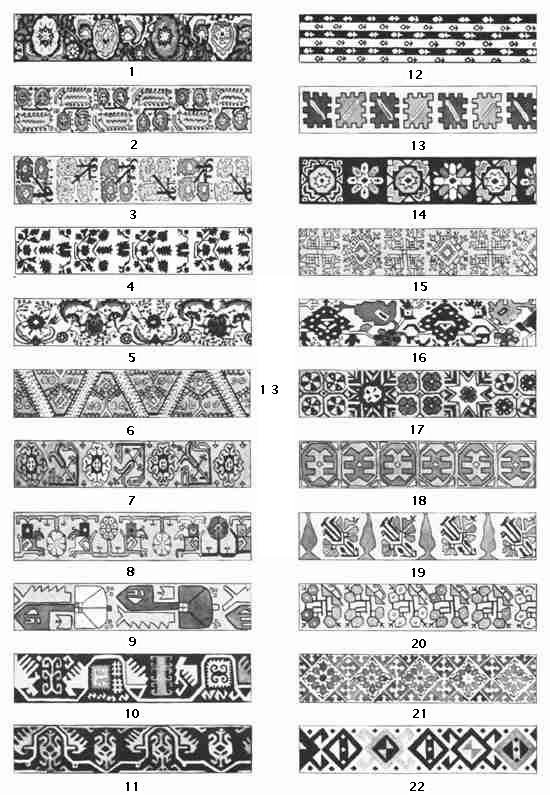
Plate G. Primary
Border-Stripes of Asia Minor Rugs
One of the best known Ghiordes stripes found in odjaliks and
sedjadehs is shown in Plate G, Fig. 6. It is a
broad stripe with wide, vine-like bands covered with rows of
small flecks or flowers. Between each flexure of the band are
designs probably symbolic of early sun worship.
In Plate G, Fig. 7, is represented the most
usual and beautiful stripe of the Ladik prayer rugs. The
principal motives are Rhodian lilies, and rosettes identical with
Persian forms, that are probably conventionalised roses. Another
stripe, in which the lily is replaced by a conventionalised vine,
is shown in Plate G, Fig. 8. Both these stripes
are found only in Ladik rugs. Other stripes seen now and then in
Ladik and Melez sedjadehs are illustrated in Plate G, Figs. 9, 10, and 11, each of which shows a
conventionalised leaf.
One of the most typical Kulah stripes is seen in Plate
G, Fig. 12. It might in fact be regarded as a
number of parallel stripes, but as will be evident by observing a
large series of Kulahs it serves the function of a single broad
stripe. Often the separate bands are replaced by a ground of
uniform colour marked by parallel rows of minute flowers of
regularly varying colour. Occasionally this stripe is copied by
Ghiordes weavers.
In Plate G, Fig. 13, is a well-known stripe
that appears both in Kulah and Rhodian rugs. As previously
explained, its origin is probably floral, though the drawing is
geometric. A formal stripe found in Bergamos, and consisting
largely of diamonds and eight-pointed stars, is represented in
Plate G, Fig. 14.
Figs. 15 and 16 of Plate G illustrate the
border stripes of Melez rugs. Each contains regularly spaced
rosettes, separated by conventionalised leaf forms. A much more
geometric Melez border, in which the rosettes are replaced by
eight-pointed stars and the leaves by discs, is shown in
Plate G, Fig. 17.
A geometric stripe of uncertain origin that is found in some
Koniehs is shown in Plate G, Fig. 18.
In Plate G, Figs. 19 and 20, are represented
two stripes characteristic of Kir-Shehrs. The former is a dainty
pattern consisting of a row of bushes separated by the lily
design. It is occasionally found in the Melez also.
A typical Mudjar stripe in which the geometric patterns are
subdivided into small and richly coloured
mosaic work is seen in Plate G, Fig. 21.
In Plate G, Fig. 22, is illustrated a Yuruk
border stripe such as is frequently seen in modern pieces.
Secondary and Tertiary Stripes.—In Plate H, Figs. 1 and 2 (opp. Page 194), are illustrated two
secondary stripes frequently seen in Ghiordes and Kulah rugs. The
first is most suggestive of a running vine, and the second has
doubtless been derived from it.
A more ornate pattern, which generally accompanies the broad
band of perpendicular lines peculiar to Ghiordes and Kulah rugs,
is shown in Plate H, Fig. 3. The arrangement of
three leaves in angles of quadrangular spaces suggests
relationship to the primary stripe of Plate G,
Fig. 3 (opp. Page 192).
Two other secondary stripes found in Ghiordes rugs are seen in
Plate H, Figs. 4 and 5. The former, which is
also found in Kulahs is a vine and flower subject to many
modifications.
A tertiary stripe containing a ribbon-like vine is very usual
in Ghiordes and Kulah pieces. One of these, which is very
graceful, is shown in Plate H, Fig. 6.
Another angular vine with pendent flower, that appears as a
secondary stripe of a large number of Ladik prayer rugs, is
illustrated in Plate H, Fig. 7. This resembles
a few Persian stripes, but the drawing of the pendent leaf is
characteristic of Asia Minor.
Figs. 8 and 9 of Plate H represent two
tertiary stripes often seen in Ladiks and Kulahs. They illustrate
the evolution of patterns; for in the same stripe of a rug will
sometimes be seen the first of these and the simple ribbon
pattern of Plate F, Fig. 18 (opp. Page 158),
and also in the same stripe of another rug will sometimes be seen
the second of these and a continuous row of
“ff” designs, as in Plate H,
Fig. 2.
The most typical of all Kulah secondary stripes, though it is
also seen in Rhodian rugs and occasionally in an old Ghiordes, is
illustrated in Plate H, Fig. 10. A somewhat
similar stripe is shown in Plate H, Fig. 11.
The design looks like a Chinese motive, but that it is evolved
from a vine will be seen by comparing these stripes with those in
Figs. 4 and 12. All of them are Asia Minor border stripes.
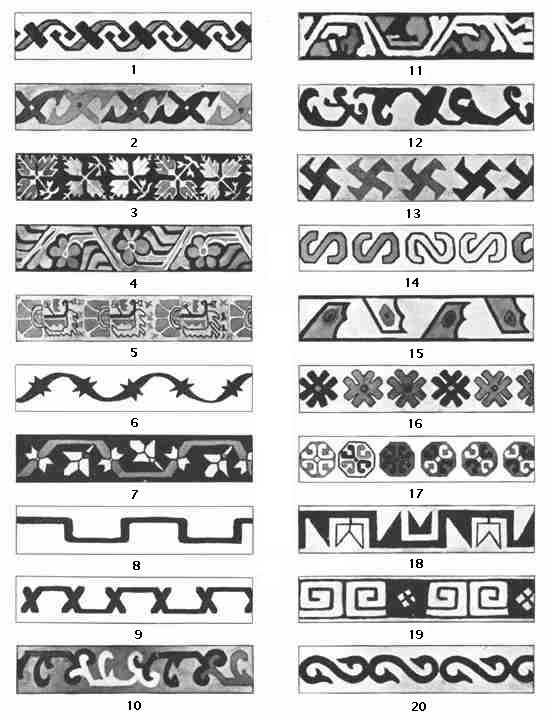
Plate H. Secondary and
Tertiary Border-Stripes of Asia Minor Rugs
In Figs. 13 and 14 of Plate H are
illustrated the swastika and S stripe, which are seen
now and then in Asia Minor rugs, such as Kulahs, and also in
Caucasian rugs.
One of the most typical of Melez secondary stripes,
representing processes like cogs projecting in a row from
alternating sides of the stripe, is shown in Plate H, Fig. 15. The stripes shown in Figs. 16 and 17 of
Plate H, representing a row of small rosettes
and a row of octagonal discs, are also occasionally seen in Melez
rugs.
The very angular vine shown in Plate H, Fig.
18, is sometimes seen in Koniehs.
A very unusual secondary stripe (Plate H,
Fig 19), found in a few Anatolians, represents a fret pattern,
which was probably copied from some monument.
The chain pattern (Plate H, Fig. 20) is
occasionally seen as a tertiary stripe in the Ghiordes. It
appeared in Asia Minor rugs of several centuries ago, and has
been copied by the weavers of Caucasia. Sometimes the lines are
angular, and again the S’s are separated by small round or
square dots.
Legend:
KNOT—
H = Horizontally
P = Perpendicularly
WARP—
g = goat’s
hair
s = silk
e = each equally
prominent
d = 1 to the knot
depressed
h = 1 to the knot doubled
under
WEFT—
s = silk
j = jute
No. = No. times crossing bet. two
round knots
SIDES—
O = overcasting
S = selvage
LOWER END
W = web
S = Selvage
K = Rows knots
L = warp loops
F = fringe
UPPER END
W = web
S = selvage
K = Rows knots
T = turned back and
hemmed
F = fringe
| ASIA MINOR |
KNOT |
WARP |
G =
Ghiordes |
S =
Sehna |
Number to
Inches |
w=
wool |
c=
cotton |
s/l |
At back |
| H |
P |
e |
d |
h |
Anatolian
Bergamo
Ghiordes
Karaman
Kir-Shehr
Konieh
Kulah
Ladik
Meles
Rhodian
Sivas
Youruk |
G
G
G
G
G
G
G
G
G
G
G
G |
|
5-9
5-9
7-12
6-9
5-9
5-8
5-10
9-12
5-8
5-8
7-11
5-7 |
6-12
7-10
8-16
8-13
5-10
6-10
7-12
10-13
6-11
7-9
9-15
6-9 |
w
w
w
w
w
w
w
w
w
w
w |
c
c
|
[s]
[g] |
e
e
e
e
e
[e]
[e]
e
e
e |
[d]
d
[d]
d
d
[d]
d
|
[h]
|
| ASIA MINOR |
WEFT |
SIDES |
LOWER END |
w =
wool |
c =
cotton |
s/j |
No. |
O |
S |
W/S |
K |
L |
F |
Anatolian
Bergamo
Ghiordes
Karaman
Kir-Shehr
Konieh
Kulah
Ladik
Meles
Rhodian
Sivas
Youruk |
w
w
w
w
w
w
w
w
w
w
w
w |
c
c
|
[s]
[j]
|
2-4
2-6
2
2
2-6
2
2/[1]
2
4
2/[1-4]
2
2-4 |
O
O |
S
S
S
S
S
S
S
S
S
S
S
[S] |
W
W
W
[W]
W
W
W
W
W
W
W
W |
[K] |
L
L
L |
F
F
F
F
F
F
F
F
F
F |
| ASIA MINOR |
UPPER END |
NAP |
WEAVE |
TEXTURE |
| W/S |
K |
T |
F |
l = long
m = medium
s = short |
f = fine
m = medium
c = coarse |
l = loose
m = medium
f = firm |
Anatolian
Bergamo
Ghiordes
Karaman
Kir-Shehr
Konieh
Kulah
Ladik
Meles
Rhodian
Sivas
Youruk |
W
W
W
W/[S]
W
W
W
W
W/S
W/S
W
W |
K |
T
[T] |
F
F
F
F
F
F
F
F
F
F
F
F |
m
m/l
s
l
m
m
m/s
m
m/[s]
l
m/s
l |
c
f
f
c
c
m/c
m/c
m
m/c
m/c
m/c
c |
l
m
m
l
l
m/f
l
m/f
l
m/l
f
l |
[] indicates the less frequent condition.
SIDE from the facts that the Caucasus is
rugged, that during the Middle Ages it was ruled by the
illustrious Tamara, and that till recently the physical charms of
its women made them favourites in the slave markets of
Constantinople, the character and history of that country are
to-day almost as unknown to the average reader as they were when
the bards of ancient Greece bound Prometheus to its rocks and
hung the Golden Fleece from its oaken boughs. Yet it is a country
of wonderful interest. Above its gorges, rivalling those of the
Himalayas, rise mountains higher than the Alps. On the
southwestern slope are combined the luxuriant vegetation of
tropical lowlands with virgin forests of fir and pine, and in
meadows and beside shaded brooks grow flowers of strange beauty.
Beneath the ground is undeveloped wealth of ores and mineral oil.
The river Phasis is the natural home of the pheasant; the crags
are the resorts of ibex; and in secluded glens sharing solitude
with bear, wolf, and boar are hidden the wild aurochs.
Moreover, the philologist, ethnologist, and historian can here
follow his favourite pursuit with as much zest as the Alpine
climber, botanist, mineralogist, and sportsman; for within the
confines of this region are spoken some seventy languages by as
many distinct clans, each of remote origin. Some are the
descendants of the early dwellers; some are the Aryan stock that
found its way to Europe before the beginning of history; still
others are but the offspring of the flotsam and jetsam which
recurring waves of Asiatic conquerors, surging westward in
ancient times, left stranded here. Nevertheless, for so many
generations have the present inhabitants remained among their
mountain strongholds, unabsorbed and unassimilating, that they
have been regarded as a type sufficiently pure and characteristic
to give its name to the great Caucasian race.
Though enjoying greater isolation than
surrounding countries, the Caucasus at different times and in
different ways has felt their influences. During the Augustan age
of Tamara’s rule she attracted by her brilliancy, taste,
and industry foreign courtiers and artisans. Hardly was she dead
before Genghis Khan’s horde of conquering Mongols poured
over the land; and rival suitors, enraptured by her
daughter’s beauty, pressed their claims by invading it with
their Mohammedan armies. For long succeeding years Persia
struggled with Turkey for the mastery of the country, and was
about to take it when Russia grasped the prize, but only after
Shamyl with a few brave thousands had defeated vast armies.
Each of these foreign guests or foes left some impression on
the native art; so that Caucasian rugs show traces of Turkoman,
Turkish, and Persian influences. It is rarely, excepting in a few
small geometric figures, that there is any evidence of the
Turkoman influence; but it is not unusual to see border stripes
and field designs adopted from the Turkish rugs. Some of these
stripes represent both geometric and floral patterns, either
copied directly or derived with slight modifications from rugs
woven three or four centuries ago in Asia Minor or Armenia. The
Persian influence is apparent only in the floral forms. It
doubtless inspired the stripe of dainty carnations so common in a
large number of Caucasian pieces, the pear design inseparable
from Baku rugs, as well as many other figures that first appeared
in the rugs of Persia.
Nevertheless, these rugs have their own distinct
characteristics, which have a boldness and virility that are to
be attributed in a measure to grand and rugged scenery as well as
to centuries of struggle for independence, since in art the
influence of environment is most apparent. They lack something of
the sobriety, artistic drawing, and delicate colouring of those
woven in vast deserts, amid the monuments of fallen empires, and
in the gardens of the East; they contain on the other hand, both
in line and colour, the forceful expression of untrammelled
thought. The patterns are largely geometric; the tones of colour,
in which clear red, blue, green, and yellow predominate, are
strong. On the whole, they possess an individuality of character
that is not surpassed by the rugs of any other group.
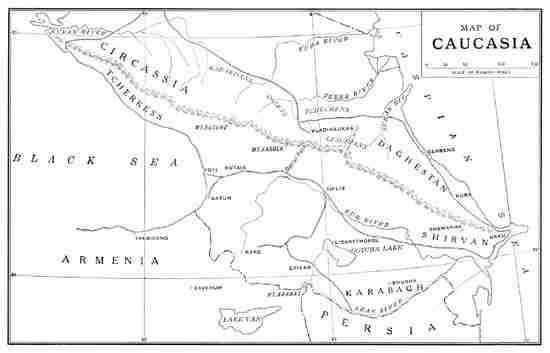
MAP OF CAUCASIA
Daghestans.—In no
part of Caucasia have better rugs been woven than in Daghestan,
“the mountain country.” Nor is it surprising
that this province should produce distinctive types, when it is
considered that it has a length of over two hundred miles; that
its topography is diversified by glaciated mountains, barren
steppes, and fertile valleys; and that it is occupied by numerous
clans, many of whom differ in origin as well as religion. Some of
the rugs come from the city of Derbend on the Caspian Sea; some
come from Kuba in the southeastern corner; others, called
Kabistans, are produced in the country about Kuba; a few are made
by the Lesghians who live among the lofty mountains; and in other
parts of the province are woven pieces which formerly were sent
in large numbers to Europe and America, where they soon became
known as Daghestans.
Though their resemblance to the Kabistans is so great that it
is often difficult to distinguish between them, the rugs which
acquired the trade name of Daghestans are different from almost
all other Caucasian pieces. This is largely because the province
is bounded on three sides by a sea and a nearly impassable
mountain range, which render communication with surrounding
territory difficult, and create a natural isolation, where in the
course of many generations a distinct type was developed.
Moreover, these same physical conditions have impeded both the
introduction of aniline dyes, so that even among modern pieces
spurious colours are not frequently seen; and also the adoption
of new designs, so that the patterns of two or three centuries
ago are still largely used.
It is among the oldest rugs of the Daghestan weave that are
found many of the best examples of Caucasian textile art. The
dark, rich reds and blues of the fields, which are brightened by
the ivory, light blue, green, and yellow of the small designs,
resemble the fine colouring of choice Persian carpets. But the
patterns are totally dissimilar; for it is only in a few rare old
pieces, in which are copied some designs such as the lotus, or
the running vine with leaf and bud, that there is any likeness to
the realism of Persian floral ornamentation.
The drawing, however, is never crude, and on account of the
short nap and strongly contrasting colours always appears with
clear definition. With the exception of conventionalised pears,
the three-leaf sprig, which is commonly seen in the field, and
the narrow border stripes of carnations, almost all of the
figures are geometric; and are so carefully drawn, so closely
clustered, that they represent an appearance frequently compared
to mosaic work. Even when the patterns represent large
medallions or stars, they contain smaller concentric forms, or
are divided and redivided into smaller stars, diamonds, or
tessellated figures, so that the effect is the same. In some form
or other the latch-hook is seen in almost all these pieces. Of
small designs, the octagonal disc is almost invariably found; and
animals, human beings, and the pear are not infrequently
seen.
As the population of the province is largely Mohammedan,
namazliks as well as sedjadehs are made; but with the exception
of the unobtrusive arch of the namazlik, which is represented in
Plate C, Fig. 9 (Page 61), there is little difference between
them. There is never any panel as in Asia Minor rugs; nor is
there a noticeable spandrel, since the space above the arch
contains designs similar to those on the rest of the field.
As a rule, the borders consist of three or four stripes
separated by coloured lines. Only in the secondary stripes are
any floral forms employed; and these, with the exception of the
carnation design, are rare. The reciprocal trefoil is most
characteristic as an outer stripe; the serrated line is also
employed; and it is not unusual to find next to the field a broad
stripe of diagonal barber-pole bars, on which are small dotted
lines.
Type Characteristics. Colours, principally blue,
red, and ivory, with minor quantities of green and yellow.
Knot, Ghiordes. Knots to inch horizontally seven to
twelve; perpendicularly, eight to fifteen. A half knot, as it
appears at back, is as long as wide and occasionally longer. The
rows of knots are not firmly pressed down, so that their
alignment is even and the warp shows at back. Warp, wool;
each of the two threads encircled by a knot is equally prominent
at the back; occasionally in old pieces one thread is slightly
depressed below the other. Weft, wool of medium diameter.
A thread of weft crosses twice between every two rows of knots.
Pile, wool, clipped short. Border, three to five
stripes. Sides, a selvage of two, three, or four cords, or
occasionally a weft-overcasting. Both ends, a web, one row
of knots or more, and loose warp fringe. Occasionally there is
also a narrow braided selvage. Texture, moderately firm.
Weave at back is of fine grain. Usual length, five
to ten feet. Usual width, one half to two thirds
length.
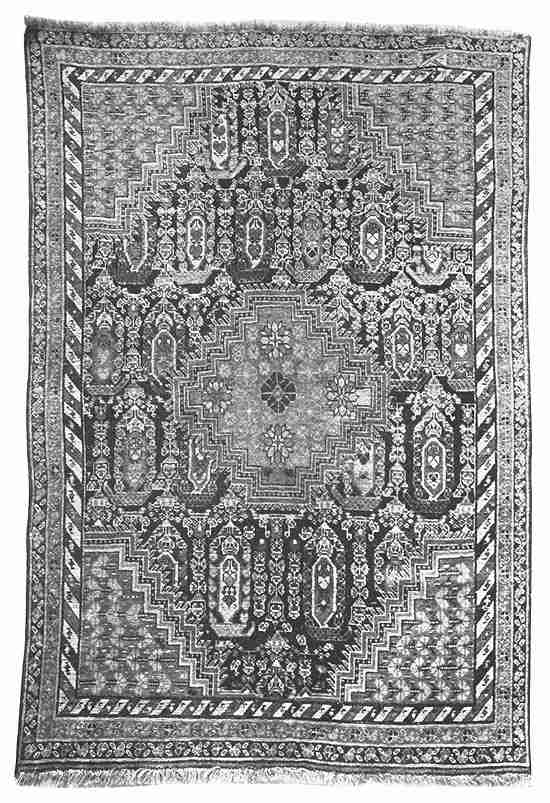
Plate 44. Baku
Rug
Kabistans.—Within
recent years most of the rugs shipped from the southern part of
Daghestan have become known in Western markets
as Kabistans, though the distinction between them and the type
that takes the name of the province is so slight that it is
determinable only by the strictest analysis. In fact, Kabistans
are merely a variety of Daghestans. Both have short nap and
occasionally adopt the same colour scheme and patterns, so that
many of each class are indistinguishable from one another.
On the other hand, there are a few interesting points of
difference between the best types, which are largely attributable
to geographic environment. As the only easy access to this
province from the south is by the shore of the Caspian, where the
great mountain wall that forms an almost impassable barrier
between Northern and Southern Caucasia descends to the plain, the
district adjacent to this entrance on the line of travel would
naturally feel and show a foreign influence, while the remote and
more inaccessible parts of the province would be unaffected.
Accordingly, the designs of Kabistans are more varied, and it is
not surprising to find in them evidences of Persian influence not
so apparent in the Daghestans. In some, for instance, are pear
designs, like those occasionally seen in Shiraz pieces; and the
rich tones, that are usually more subdued than those of the
Daghestans, suggest the finest dyes of the Feraghans. There is
also a slight difference in weave. Both display the two threads
of warp encircled by each knot with equal prominence at the back;
but in the Daghestans the alignment of the two halves of the
knot, as they appear at the back, is more regular; while in the
Kabistans one extends beyond the other in the direction of the
length of the rug, as is the case with the Shirvans woven in the
adjoining country to the south. Frequently the weft of Kabistans
is of cotton; and the filling is not as wide as that of
Daghestans, which is of wool. Moreover, the Kabistans may be
either overcast or have a selvage at the sides, but the
Daghestans have almost always a narrow selvage. Among the modern
pieces there is a tendency for both classes to follow the side
finish of the Shirvans.
A well-known type of old Kabistans, that is also sometimes
repeated in Daghestans, has a dark blue field on which are spaced
in regular order white bracket-like designs, in which the
perpendicular arms are usually connected (Plate O, Figs. 18-a and 18-b, Page 291). Their origin is
unknown; but when their shape and their position in reference to
the rosettes or effulgent stars that are placed near them are
considered, the thought is at once suggested that in them is
reproduced after a long process of slow change a
conventionalised form of the Herati design.
Other small harmonious designs are properly spaced throughout the
fields, and in the main stripe of the border, on a cream-coloured
ground, is frequently seen the beautiful pattern of Cufic origin
represented in Plate J, Fig. 19 (opp. Page
228). Old pieces of this pattern, which are now growing rare,
represent in weave, colour, and design the masterpieces of
Caucasian textile art.
Another pattern consists of diagonal stripes with small
geometric figures, or of small floral forms arranged in rows, so
that those of similar colour fall in diagonal lines. Again, the
entire field may be covered with rectangular pears like those of
Baku rugs. Oblong odjaliks are often seen with fields of dark
colour, at each end of which are large geometric figures
symmetrically balanced with reference to the centre. But they are
so fringed with latch-hooks and so subdivided into smaller
devices, which are accentuated by the shortness of the nap, that
they have the effect of an assemblage of smaller designs.
Type Characteristics. Colours, principally blue,
also some red, ivory, green, and brown. Knot, Ghiordes.
Knots to inch horizontally seven to twelve;
perpendicularly, eight to sixteen. A half knot, as it appears at
back, is as long as wide and occasionally longer. The rows of
knots are not firmly pressed down; their alignment is less even
than in Daghestans, yet the warp may be seen at back.
Warp, wool; each of the two threads encircled by a knot is
equally prominent at back. Weft, wool or cotton, of medium
diameter. A thread of weft crosses twice between every two rows
of knots and occasionally three times. Pile, wool, of
medium length. Border, three to five stripes.
Sides, generally a weft-overcasting, or a two-cord weft
selvage; occasionally a double overcasting or selvage. Lower
end, a narrow web, not infrequently a fine braided selvage
and warp loops. Upper end, a narrow web, occasionally a
fine braided selvage and warp fringe. Texture, moderately
firm. Weave at back is of medium grain. Usual
length, five to twelve feet. Usual width, one half to
three quarters length.
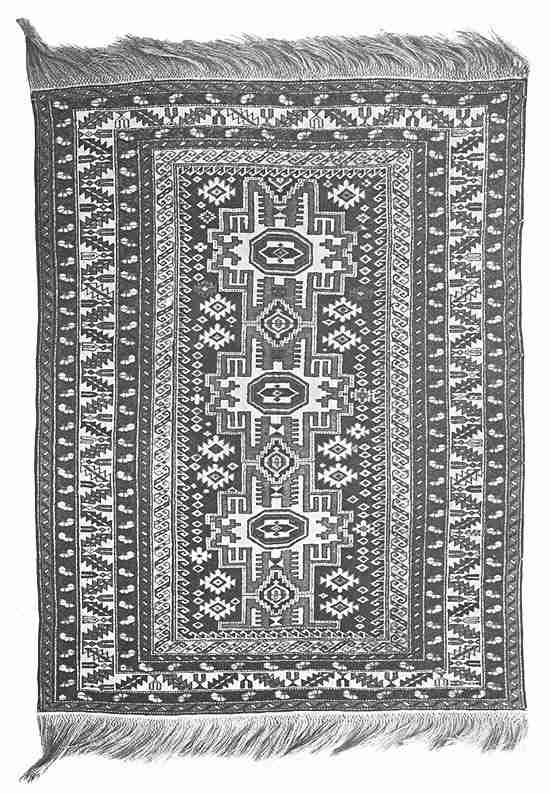
Plate 45. Shirvan
Rug
Kubas.—Not far
from the southeast corner of the province of Daghestan, in a
plain watered by streams that debouch from the Caucasus, is the
small town of Kuba. It is on the site of an old Persian fort,
about which in the course of time sprang up a town sufficiently
important to be the residence of a Khan. For a long period
previous to the treaty of Gulistan, in 1813, the influence of the
Persians had been predominant in this part of the country; and it
is not improbable that some of the oldest Kuba rugs now existing
are the work of their weavers. Many, on the other hand, have few
foreign characteristics either of weave or design, and show a
relationship to the work of the Shemakha tribes, who inhabit an
adjoining district in Shirvan.
In some of this class the floral form receives more elaborate
treatment than in any other Caucasian rug. One of the patterns of
undoubted Iranian inspiration represents a large oval panel or
medallion, with graceful outlines resting on a field of deep blue
and sable brown, streaked with waving lines of gold. Within the
medallion is a lavish display of large flowers en masse,
and not detached from one another or arranged in set form, as is
the case with most floral patterns. In each corner is a rose with
spreading petals that equals the largest seen in nature, and with
colour that suggests the beauty of a Duchess or Marechal Niel.
Surrounding all is a narrow dainty border of some well-known
Persian vine. The most recent copies of this pattern, that has
been followed for at least a century and a half, are so crude as
to resemble but slightly the oldest, which suggest the work of
some early Kirman weaver and are unsurpassed in beauty and
artistic elegance by any other Caucasian rug.
Other patterns are more distinctly representative of the
native art. The field of some is occupied by large, irregular,
octagonal-shaped figures defined by serrated edges and subdivided
by mosaic work, at the centre of which is some well-known design.
One of the most pleasing patterns consists of a field on which
with mathematical precision are placed large effulgent stars. At
their centre is often a much smaller star enclosed by a diamond
from which extend broad rays directed towards the eight principal
points of the compass. When softened by time the different
shades, such as light blue, ivory, and deep red of the enveloping
rays, contrasted with other shades at the centre and with a dark
blue of the ground, are exceedingly beautiful.
The Kubas and Shemakhas have similar tones of colour,
consisting principally of blues, reds, sable brown, and yellow,
to which the soft, velvety character of the wool of the best
examples gives a quality of richness that is distinctive. The
finish of their sides and ends, which is usually similar to that
of the Soumaks, is also identical, so that they are frequently
mistaken for one another, and can only be distinguished by
a difference of pattern and a slight difference of weave.
Type Characteristics. Colours, principally blue,
red, and brown, occasionally some green. Knot, Ghiordes.
Knots to inch horizontally six to nine; perpendicularly, seven to
thirteen. The rows of knots are pressed down, so that the warp is
almost hidden at back. Warp, fine wool; the two threads
encircled by a knot are equally prominent at back. Weft,
wool of fine or medium diameter. A thread of weft crosses twice
between every two rows of knots. Pile, wool of medium
length. Border, one to three stripes. Sides, a blue
double selvage of two or three cords. Both ends, a narrow
blue web of “herring-bone” weave, a knotted selvage
or several rows of knots, and short warp fringe. Texture,
slightly loose. Weave at back is of moderately fine grain.
Usual length, four to nine feet. Usual width, one
half to two thirds length.
Derbends.—Near the
great walls built by Alexander on the Caspian Sea, where
mountains rise abruptly so as to leave only a narrow pass, is one
of the oldest cities of Caucasia. It was known by the Romans as
Albana, and was renamed by the Persians of the VI Century
“Derbend,” which in their language signifies a
gateway. No other city of Caucasia has been visited by more
foreign foes. Tartar tribes passed that way when entering Europe;
Mongolians captured it as late as the XIII Century; Russians and
Persians in turn held it. Moreover, the sea has offered an easy
approach to the Turkoman tribes dwelling to the east. It is
therefore somewhat surprising that there is so little evidence of
artistic foreign influence in the weavings; but this is due,
perhaps, to the fact that pieces with an authentic age of over
two centuries no longer exist, and such old rugs as remain are
very scarce; whilst the modern pieces are derived largely from
the mountainous districts that find a market in the city.
Occasionally, however, there comes to light a very old piece
that reaches the standard of the finest Kabistan. The field of
such a one may be filled with elaborately drawn pears like those
seen in many of the Niris rugs. Again, it may be covered with a
checkered or lattice-work pattern that contains within the
diamonds geometric or semi-floral mosaic designs. Surrounding
this field are three or four stripes, of which the outer has a
reciprocal pattern. The nap is of fine wool of moderate length.
At the back of these older rugs is sometimes displayed
finely spun reddish dyed threads of woollen weft pressed closely
together between lines of knots carefully tied to brownish
threads of woollen warp; but not infrequently cotton is used for
both warp and weft. Such designs and technique suggest the rugs
woven much farther to the south.
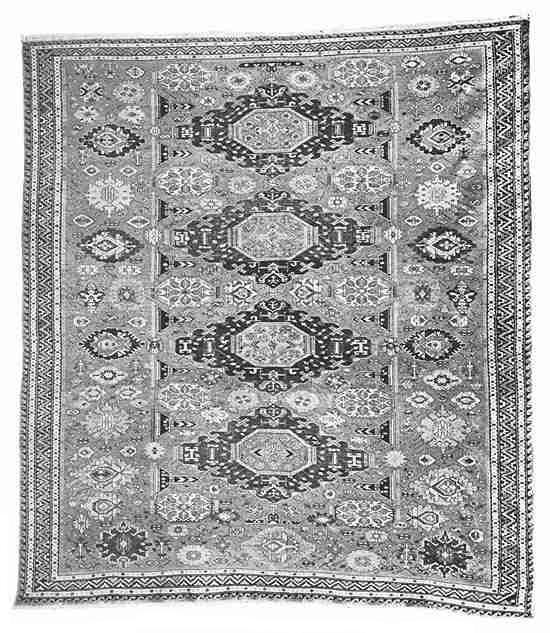
Plate 46. Soumak
Rug
In contrast with these beautiful but rare pieces, the modern
products are sad commentaries on the retrogression in weaving;
for those that are ordinarily found in the market are like poor
imitations of inferior Daghestans. They are of slightly larger
size, and have longer nap, looser weave, and cruder colours.
Moreover, they show evidences of Turkoman influences; for not
infrequently the warp is of brown goat’s hair, and at each
end is a reddish brown web like what may be seen in the rugs of
Yomud tribes living on the eastern shores of the Caspian. Still
other nomadic characters, resembling the workmanship of Kazak
tribes, appear in the large star-like or diamond-shaped figures
which, fringed with latch-hooks and coloured with bright tones of
red, blue, or green, are often placed in simple array on a field
of strongly contrasting colour. There is nothing, however,
offensive in the colour scheme, excepting when aniline dyes are
used. With wear the nap of many of them acquires the soft and
pleasing effect of Beluchistans. Furthermore, they are both
flexible and durable, though entirely lacking in artistic
qualities.
Type Characteristics. Colours, principally blue,
red, and ivory, with minor quantities of green, yellow, and
brown. Knot, Ghiordes. Knots to inch horizontally five to
nine; perpendicularly, six to twelve. Each half knot is about as
long as wide, and occasionally longer. The rows of knots are
generally pressed down, so that the warp is concealed at back.
Warp, generally wool, occasionally cotton. The separate
threads are not strung closely together. Each of the two threads
encircled by a knot is equally prominent at the back.
Weft, generally wool, but often cotton. In some pieces a
thread of weft of medium diameter crosses twice between every two
rows of knots; not infrequently it crosses both twice and three
times in the same piece; rarely a thread of coarse diameter
crosses only once. Pile, wool of medium length.
Border, three stripes. Sides, a double selvage of
two or three cords, or occasionally a double overcasting. Both
ends have a web, frequently a knotted selvage, and a warp
fringe. Texture, moderately loose. Weave at back is
of medium grain. Usual length, five to seven feet.
Usual width, one half to two thirds length.
Lesghians.—On the northern flank of the high
mountain ranges that extend eastward from Kazbek into the
province of Daghestan, live the numerous tribes classed as
Lesghians. Their different dialects and languages would indicate
unrelated origins; but their common religion, mode of life, and
struggle for liberty have established between all of them strong
bonds of sympathy. They are nominally Christians, but essentially
Mohammedans. Most of them live in almost inaccessible spots,
beneath the snow covered, glaciated ridges, and beside fierce
flowing torrents, where on occasions they have converted their
homes into almost impregnable fortresses. These are the people
who united with the Circassians in the long-continued struggle
against the Russian Empire, and followed Shamyl to repeated
victory among the mountain defiles.
It might naturally be expected that the rugs of such people
would partake of a character totally distinct from those woven in
the sunny atmosphere of Kirman, amid the sacred influences of
Meshed, or among the peaceful hills of Ghiordes. Such, in fact,
is the case, since both patterns and colouring display extreme
simplicity, as well as strength and beauty. Large numbers of
these rugs are of moderate size and slightly oblong; and are
flexible yet stout. Both warp and weft are of fine brown wool;
and as is rarely the case with any other Caucasian rugs excepting
the Shushas, one of the two threads of warp encircled by a knot
is often almost doubled beneath the other. The knotted fringe of
the ends suggests the work of tribes living further westward, but
the selvage of the sides shows relationship to the
Daghestans.
The patterns of some of these rugs are not unlike those of
rugs woven south of the Caucasus; and not infrequently the fields
contain unrelated designs such as the lozenge fringed with hooks,
the octagonal disc, eight-pointed stars, and S forms. The borders
usually consist of two or three stripes, on which is some
geometric pattern. The colours are few and characteristic. Blue
and yellow are generally present, and frequently red and brown.
On the whole, these pieces have an interesting individuality
unlike that of any other rugs.
Type Characteristics. Colours, blue, yellow,
red, brown, and ivory. Knot, Ghiordes. Knots to inch
horizontally six to nine; perpendicularly, six to eleven. The
rows of knots are firmly pressed down, so that the warp is almost
hidden at back. Warp, brown wool; one of
the two threads encircled by a knot is depressed below the other
at back, or doubled under the other. Weft, wool of medium
diameter. A thread of weft crosses twice between every two rows
of knots. Pile, wool of medium length. Border,
usually three stripes. Sides, an added selvage, which is
generally wool but occasionally cotton, of two, three, or four
cords. Both ends, a web, two or three rows of knots, and a warp
fringe. In some pieces there is also a braided selvage.
Texture, firm. Weave at back is of slightly coarse
grain. Usual length, five to eight feet. Usual
width, one half to two thirds length.
Chichis.—On the
lower slope of the Caucasus, extending down into the valley of
the Terek are the homes of the Tchechens, the weavers of pieces
so often spoken of as Chichis. Beyond them to the north are great
stretches of Russian steppes, and to the south is the land of the
hardy Lesghians. Nevertheless, their rugs show little
relationship to the work of the latter or of any other tribes to
the north of the mountain chain; but resemble more closely the
work of the Shirvans in the valley of the Kur, so that not
infrequently they are mistaken for them. Indeed, their general
character is remote from anything barbaric, and is more in
keeping with the pleasing effect of the Persian sense of harmony.
All floral forms are conventionalised, but the geometric designs
have a delicacy of drawing, a refinement of detail, from which
every jarring note is eliminated.
Like almost all weavers, the Tchechens adopt different
patterns. On the field of some of the rugs is a plentiful array
of small devices surrounding two or three large geometric
figures; or again the field may be covered with pear designs
arranged in regular order; but most of the rugs now seen follow a
common type. In this the field resembles a floor inlaid with
beautiful mosaic work, formed of carefully cut stones of various
hues, studiously arranged in the form of small diamonds,
eight-pointed stars, or rosettes. Not infrequently the rosettes
are outlined by a fret device surrounding a central star. They
are invariably arranged in lines parallel to the ends of the
rugs, and this horizontal effect is sometimes accentuated by
inserting between each row narrow bands composed of
conventionalised leaves. The colours of these small designs are
generally ivory, light blue, pale yellow, or red; and appear more
pronounced by contrast with the underlying ground of light blue.
Now and then the nomadic instinct of the Tchechen tribes, who
lead their flocks regularly from the green pastures of
the ridges to the valley of the Terek, crops out in unrelated
devices such as combs and S forms, which they weave in the field.
But they usually arrange them so as to harmonise with the main
pattern, or else place them near the sides and ends, which are
almost invariably fringed with either a serrated line or a row of
reciprocal trefoils projecting from the border into the field.
This feature of a reciprocal trefoil employed as a fringe to the
edges of a field independently of the lines of a stripe, is seen
in very few other classes.
Often the borders, which contain a large number of stripes,
are as wide as the central field, with which they harmonise both
in colour and design. There is something chaste in the simplicity
of the geometric figures of the secondary stripes and of the
conventionalised floral drawing of the main stripe. The latter,
as represented in the type generally seen (Plate I, Fig. 6, opp. Page 226), consists of a row of about
eight rosettes, connected by an angular vine drawn with such
breadth and regularity as to resemble a number of parallel bars
diagonal to the sides. In fact, this pattern would be entirely
geometric were it not for the three-cleft leaves, which spring
from opposite sides of the rosettes. Of the secondary stripes,
the outer almost invariably has the reciprocal trefoil, and one
has frequently a continuous line of eight-pointed stars. The arch
of the prayer rugs is similar to that of Daghestans.
Type Characteristics. Colours, principally
ivory, blue, and red, with minor quantities of green and brown.
Knot, Ghiordes. Knots to inch horizontally seven to ten;
perpendicularly, eight to twelve. The rows of knots are not
firmly pressed down, so that the warp may be seen at back.
Warp, wool; each of the two threads encircled by a knot is
equally prominent at back. Weft, wool, of medium diameter.
A thread of weft crosses twice between every two rows of knots.
Pile, wool, of short or medium length. Border,
three to five stripes. Sides, generally a double
overcasting, but occasionally a double selvage of two or three
cords. Both ends, a web, one row of knots or more, and a
warp fringe. Texture, moderately firm. Weave at
back is of medium grain. Usual length, four and one half
to six and one half feet. Usual width, five eighths to
three quarters length.
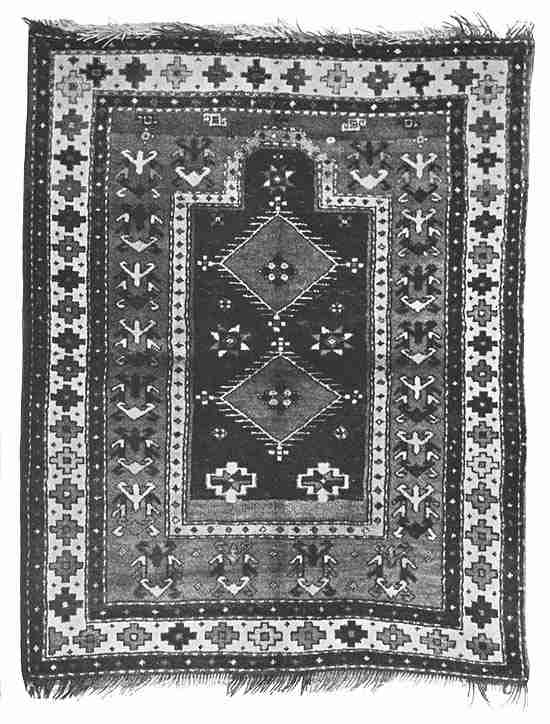
Plate 47. Kazak Prayer
Rug
Tcherkess.—The
narrow strip of fertile and beautiful country that reaches from
the Kuban valley southward along the shore of the Black Sea for a
distance of two hundred miles is occupied by a people
known to the western world as Circassians. In their own land they
are called “Tcherkesses,” a Tartar term for
“cutter of roads” or highwaymen; and they have been
in the habit of speaking of themselves as “Adighies”
or Nobles. In fact, there has been no prouder Caucasian race,
even though their homes were often log huts and their daughters
were sold in the markets of Constantinople. These are the people,
who half a century ago finally yielded after a long, fierce
struggle for independence; but a hundred thousand families,
preferring exile to submission to the Czar, migrated to Armenia
and Asia Minor, where they intermarried with other races, and are
rapidly losing their identity.
Very few of the Circassian or Tcherkess rugs have been woven
by those who left their country. The best were made before the
exodus; and on account of the hardships and poverty of the
people, many that have come to the market within recent years are
greatly inferior to the excellent pieces of former times and are
often mistaken for the work of nomadic tribes. Not only so, but
crude and foreign devices have crept into some of them. It is,
therefore, to the older pieces that we must turn for a better
understanding of this class.
Something of the ruggedness of lives spent in struggles with
men and nature found expression in the fabrics, which show
firmness of texture, boldness of design, richness of colour. In
fact they resemble the Kazaks so closely in their long nap, and
finish of sides and ends that they are constantly mistaken for
them; yet they may be distinguished from all classes by the large
amount of brownish red or tawny colour of the field and their
stereotyped patterns. These usually consist of diamond-shaped
figures sometimes called “sun-bursts,” that are often
regarded as crude copies of the Russian coat of arms; but there
is little doubt that they have been derived from the medallions
of some old Armenian rugs of the XIV and XV Centuries, in which
also appear the same tri-cleft leaves so common in both this
class and the Soumaks. These patterns are sufficiently large to
occupy the full breadth of the field; and there are seldom less
than two and occasionally as many as four or five extending from
one end to the other. The strong contrast between the blue and
ivory of the figures and the red or tawny colour of the ground is
softened by the depth of pile, which in turn adds warmth and
richness. The borders are always of three stripes. The main one
almost invariably has the tarantula design and is enclosed by
guards with the serrated sawtooth design. Many of these old
pieces are excellently woven and have a dignity of
pattern and wealth of harmonious colour rarely seen in nomadic
rugs.
Type Characteristics. Colours, principally red
and tawny yellow, with minor quantities of blue and white.
Knot, Ghiordes. Knots to inch horizontally six to nine;
perpendicularly, seven to ten. A half knot, as it appears at
back, is as long as wide or longer. The rows of knots are firmly
pressed down, so that the warp does not show at back.
Warp, wool; generally each of the two threads encircled by
a knot is equally prominent at back, occasionally one is
depressed below the other. Weft, wool of medium diameter.
A thread of weft usually crosses only twice between every two
rows of knots, but in some pieces as many as four or six times.
Pile, wool of medium length. Border, three stripes.
Sides, a two-cord double selvage. Both ends, as a
rule have a web, a heavy braided selvage, and knotted warp
fringe; occasionally either web or selvage may be omitted.
Texture, very firm. Weave at back of medium grain.
Usual length, five to ten feet. Usual width, one
half to two thirds length.
Bakus.—No other
rugs of Caucasia have greater individuality of colour and design
than the Bakus. This, perhaps, is partly due to the fact that the
district from which they come is dissimilar to any other. It
consists largely of the peninsula of scanty vegetation, where the
great mountain chain extends to the dreary Caspian, leaving at
its base the narrow strip of land now famous for its immense
accumulations of mineral oil. Hither, during the past, the
followers of Zoroaster have come from all directions to worship
in the temple of the Guebres, where day and night the priests
watched the blue flame that rose perpetually from the ground, and
once in long intervals spread over the waters like a sea of fire.
This sacred spot has been owned in turn by Saracens, Persians,
Turks, Russians, and the Princes of Shirvan; so that the
influences of different religions and different races have been
felt here.
The most noticeable feature of many of these rugs is their
dull colours, that give the impression of being partly bleached
or having faded. There are subdued tones of light blue, tan, pale
ocherous yellow, and black, as well as light, medium, and dark
brown colours of natural wool; but in the rugs woven a century
ago the colours were much richer. None of them are used in large
masses excepting for the underground; nor are there striking
contrasts, so that the effect is somewhat monotonous.
The shape, colouring, and particularly the pattern of this
interesting Soumak, which was probably woven seventy-five or more
years ago, not only are unusual but belong to a higher type than
is often seen. Arranged in diagonal rows on a field of red are
flowering bushes, that for the most part are blue and pink, but
at one end are green, yellow, and brown. The accurate drawing of
these bushes and of the reciprocal trefoils of the guard stripes,
the care with which the stitches have been inserted, and the fine
texture of the wool, as is shown even in the cream-white warp at
the knotted ends, alike proclaim the excellent quality of this
rare piece.
Loaned by Mr. Theodore S. Hawley
An equally important characteristic is the large number of
pear designs, which are unlike those of any other rug. These
designs (Plate O, Fig. 6b, Page 291) are so
rectangular that they have lost all resemblance to floral
drawing; and to add to their formality, each is placed in the
field with studied regularity and often surrounded by a delicate
hexagonal shaped sub-pattern giving a diaper effect. Sometimes,
also, they appear in the border between an array of other
designs, to which they show no relation; but they never
constitute the sole feature of the rug as they do in
Sarabends.
At the centre of the field is often a star-shaped design
surrounded by a large diamond or other figure fringed with
radiating lines. These lines suggest the effulgence of light; and
it is not improbable that their origin lay in the mysticism of
fire worship. In sedjadehs the corners are set off by quadrants
of octagons, of which the diagonal sides are serrated and
frequently fringed with radiating lines like the central
medallions. Throughout both corners and fields often appear
eight-pointed and effulgent stars, the three-cleft leaf, S
designs, crude human and animal forms, and other small geometric
devices like those seen in Daghestans and Shirvans. But more
noticeable than any of these are the realistic but mechanically
drawn birds, which are represented in larger numbers and more
frequently than in any other rugs woven within the last
century.
The borders contain from three to five stripes, of which one
at least is always geometric; and another, as a rule, has some
suggestion of floral form. Often it is only the carnation in
profile; but now and then it is a running vine with leaf or
flower, adopted without modification from Persian rugs. This is
not, however, surprising, when it is remembered that during the
reign of Shah Abbas, Baku belonged to Persia, which for centuries
had been the home of devout Parsees, some of whom undoubtedly
made pilgrimages to the sacred temple.
These rugs can at once be recognised by their short nap, and
their characteristic colours and designs. They are always
interesting on account of their marked individuality and the
still unsolved symbols of Zoroastrian mysticism they may contain;
but in spite of the careful delineation of the design and the
delicate mosaic effect of the central medallions, very few,
excepting the old pieces, are handsome.
Type Characteristics. Colours, principally
brown, tan, blue, yellow, and black. Knot, Ghiordes. Knots
to inch horizontally six to nine; perpendicularly, seven to
eleven. The rows of knots are firmly pressed down, so that the
warp does not show at back. Warp, wool; each of the two
threads encircled by a knot is generally equally prominent at
back, occasionally one is depressed slightly below the other.
Weft, usually cotton, sometimes wool, of medium diameter.
A thread of weft crosses twice between every two rows of knots.
Pile, wool, clipped short. Border, three to five
stripes. Sides, a weft overcasting or a narrow weft
selvage. Both ends, a web, one row of knots or more, and a
warp fringe. Texture, moderately firm. Weave at
back is of slightly coarse grain. Usual length, six to
nine feet. Usual width, one half to two thirds length.
Shirvans.—Between
the rugs of Shirvan and Daghestan is a relationship easily
accounted for by the fact that they are adjoining provinces, and
that almost the only approach to Daghestan for the Asiatic races
among whom the art of weaving reached its highest development was
through Shirvan. Both districts, therefore, received ideas from
the same sources; but since Shirvan has been at times more
completely under the sway of Persia, it has yielded more readily
to the influence of the Persian weavers, as is observable in the
flower and foliate forms which are used more frequently and are
drawn more realistically in its rugs than in those of Daghestan.
On the other hand, the technique of weave as well as finish of
sides and ends in the Shirvans lacks something of the refinement
observable in the Daghestans.
The oldest existing Shirvans are absorbingly interesting. In
them the foliate forms are more noticeable than in almost any
other Caucasian rugs, though they may in a measure be disguised
by formal treatment. Sometimes they appear as large figures
covering a great part of the field and acting as sub-patterns for
superimposed smaller devices; but they are most frequently found
in the borders. Other old pieces contain lattice-work of
hexagonal-shaped diaper patterns, within which may be designs
abounding in latch-hooks and figures strongly suggestive of
Chinese devices. Such patterns, however, are unusual; as the
fields of most old Shirvans are covered with large medallions,
stars, and diamonds similar to those of Daghestans, although the
drawing inclines to greater simplicity of outline and detail; and
they have greater diversity of colour, as tones of blue, red,
green, and brown in a field of ivory are not unusual.
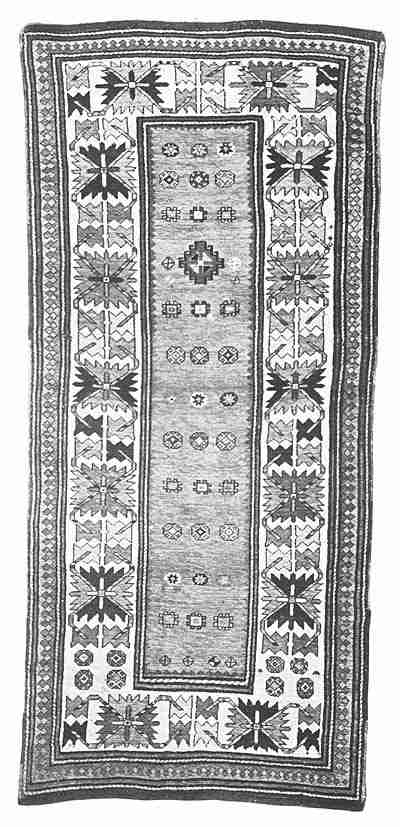
Plate 48. Kazak
Rug
The patterns of the more modern rugs have become corrupted
into a mere mechanical copying of conventional forms lacking all
artistic spirit. Some of them resemble those found in both
Daghestans and Kabistans, but generally the designs are drawn
less clearly in Shirvans. This is partly because, as a rule, they
are not so closely woven and the nap is not quite so short. Now
and then the large medallions so common to Soumaks are seen; and
not infrequently the field is covered with diagonal parallel
stripes on which are small geometric devices.
There is, however, one pattern peculiar to Shirvans that
rarely, if ever, is adopted in any other class. It has somewhat
the appearance of pole medallions and consists of a panel that
occupies nearly the whole field and contains broad incisions at
each side, which nearly divide it into three or four rectangular
sections. Within each of them are octagonal figures, and an
octagonal shape is given to both ends of the panel so as to leave
small corners to the field. Each part often contains small
designs such as latch-hooks, octagonal discs, S forms,
eight-pointed stars, and combs, as well as crudely drawn dogs and
other animal or human forms. With slight modifications this
pattern is sometimes repeated in the prayer rugs (Plate C, Fig. 11, Page 61), but the section at one end is
more completely an octagon, and the remainder is an oblong
rectangle. A more usual pattern for prayer rugs has the same form
of arch that is common in Daghestans.
Whatever the fields of these rugs may lack in delicacy of
drawing is amply compensated for by the diversity and beauty of
some of their borders, which have a well balanced harmony of
colours. They have seldom less than three, nor more than five
stripes, of which the secondary are often as interesting as the
primary. The best known is the one with serrated leaf and wine
glass, represented in Plate I, Fig. 1, opp.
Page 226, which is found in such a large percentage of Shirvans
that it is almost typical of them. If the figures of the field
contain latch-hooks, they are very apt to be expressed in some
form in the primary stripe. Such a one appears in Plate I, Fig. 2; and the beautiful Georgian pattern (Plate
J, Fig. 9, opp. Page 228) is also occasionally
seen. A very much rarer stripe, which is shown in Plate J, Fig. 8, is only used when the field has a large
central panel with a corresponding pattern. Now and then appears
a stripe with no other ornamentation than a formal row of pear
designs. Of the secondary stripes, the one with the designs of
carnations (Plate K, Fig.
1, opp. Page 230) is very frequently seen, but its beauty depends
largely upon the delicacy of its drawing and colour scheme. On
the whole, the Shirvan dyer displays a wider scope in the
selection of colours than his Daghestan neighbour, but the tones
are not always so rich or harmonious.
Type Characteristics. Colours, principally blue,
red, and ivory. Knot, Ghiordes. Knots to inch horizontally
seven to twelve; perpendicularly, eight to twelve. The rows of
knots are firmly pressed down, so that the transverse warp does
not show at back. Warp, wool; each of the two threads
encircled by a knot is equally prominent at back. Weft,
generally wool, occasionally cotton, of medium or coarse
diameter. A thread of weft crosses twice between every two rows
of knots. Pile, wool, of short or medium length.
Border, three to five stripes. Sides, generally a
weft selvage of two or three cords or a double selvage,
occasionally a double overcasting. Both ends, a web, one
row of knots or more, and a warp fringe. Texture, slightly
loose. Weave at back is moderately coarse. Usual
length, four to six feet. Usual width, one half to
four fifths length.
Soumaks.—Seventy
miles to the northwest of Baku, and about the same distance to
the south of Kuba, where the high ranges of the Caucasus begin to
descend to the sea, is the city of Shemakha. It was almost
destroyed by Nadir Shah, but recovered sufficiently within the
last century to become the capital of Shirvan and a manufacturing
centre of silks. It is the market place for many tribes from the
mountains of Daghestan and the valley of the Kur, who take
thither their rugs, from which its own weavers often borrow
patterns. By a corruption of the name of the city, their fabrics
are called Soumaks, though they are more popularly known as
Kashmirs, because ends of yarn hang loosely at the back, as is
the case with the beautiful shawls of the noted valley of
India.
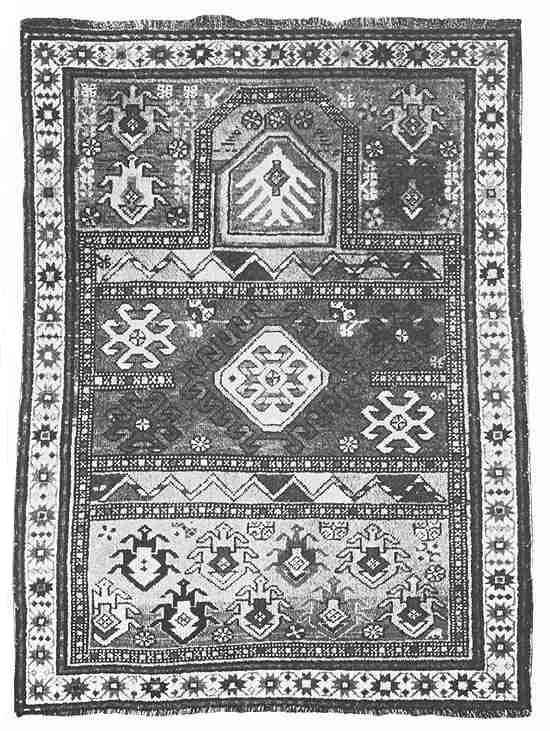
Plate 49. Karabagh Prayer
Rug
It is, of course, the finish at the back and the absence of
pile that make them so different from all other rugs and place
them in a class by themselves; but even apart from these
characteristics, they are as distinct a type as any in Caucasia.
On the fields of most of them are three or four diamond-shaped
medallions, that occupy nearly the full width of the field and
extend from one end to the other. Almost without exception they
are slightly hexagonal, and are incised on the diagonal sides to
represent crosses. These patterns are doubtless derived from very
old Armenian rugs; and it is possible that
once the crosses had a religious significance, as it is claimed
that the earlier weavers of this type were a Christian sect; but
the present weavers are mostly Mohammedans. At the centre of the
medallions and in the triangular spaces at the sides are
flattened octagons, which are generally ornamented with some
star-shaped devices. Superimposed on these larger patterns and
surrounding them on the field, are also many small designs, which
as a rule are grouped with a regularity suggestive of the mosaic.
Some are common to other Caucasian pieces; but a few are more
frequently seen in this class than in any other, as for instance,
the knot of destiny (Plate O, Fig. 17, Page
291), and the tri-cleft leaf, drawn like a bird’s claw,
which appeared in Armenian rugs at least five centuries ago.
Sometimes the medallions and octagons are replaced by smaller and
more ornate figures, but the geometric character is seldom
entirely lost.
There are also some old pieces with a totally different
pattern, and with fine colours that are most pleasing in the rich
harmony of tones. They may contain geometric, foliate, or floral
designs. One recently examined had a field of rose red completely
covered with diagonal rows of innumerable dainty figures, which
were evidently the conventionalised forms of small flower bushes.
Not a single other design appeared in the field, yet the richness
of colour and chasteness of pattern made it exceedingly
beautiful.
The patterns of the border stripes, that number from two to
five, are generally distinctive; though occasionally they follow
well known Caucasian drawing. The outer one has so frequently the
running latch-hook that it is almost typical. As a rule, it has
the simple form shown in Plate K, Fig. 20 (opp.
Page 230); but now and then the more elaborate drawing of the
Georgian stripe (Plate J, Fig. 9, opp. Page
228) is followed. Sometimes this is replaced by the reciprocal
trefoil, which is used also for the inner stripe; and a running
vine and rosette, such as the one in Plate K,
Fig. 4, is not infrequently used for a secondary stripe. The
primary stripes, on the other hand, although most dissimilar to
those of other rugs, differ so widely among themselves, that no
one is typical. Separating these primary and secondary parts of
the border are frequently narrow lines with the barber-pole
device.
The old pieces are of fine texture and excellent wool, which
even in the warp displays a silky character. The dyes are
faultless, though the colours never acquire a lustre. Red and
blue are largely employed, but they are partly replaced by
brown in the more modern pieces; and in both old and modern is
usually an orange yellow that rarely appears in other Caucasian
rugs.
Type Characteristics. Colours, principally red,
blue, brown, some yellow, and white. Knot, flat stitch.
Knots to inch horizontally eight to fourteen; perpendicularly,
six to sixteen. Warp, wool; each thread is equally
prominent at the back. Weft, wool, of fine or medium
diameter. A thread of weft crosses twice between every two rows
of knots in old rugs, and between every second and third row in
modern rugs. Border, two to five stripes. Sides,
generally a double selvage of several cords, occasionally an
overcasting. Both ends, narrow web, one or more rows of
knots and fringe; sometimes heavy added selvage. No nap.
Usual length, five and one half to twelve feet. Usual
width, one half to three quarters length.
Shemakhas.—Flatly
woven Soumaks are not the only rugs of the Shemakha tribes. Some
of the same people, who dwell among the ranges of the Caucasus a
short distance to the north, make rugs of pile that occasionally
surpass in quality of material and beauty of colour scheme the
best of Daghestans, and are sometimes spoken of by dealers as
“Royal Daghestans;” yet they are seldom seen and
little known. In fact, they are frequently mistaken for Persian
fabrics on account of the subdued richness of their deep reds,
blues, greens, yellows, and browns, and the patterns which are
largely floral.
Very often the principal border stripe is the well-known
Georgian pattern, that occurs in so many Soumaks, even though the
secondary stripe be some Persian pattern. These rugs also
resemble the Soumaks in the coloured woollen selvage of the
sides, and in the narrow coloured web of
“herring-bone” weave and knotted fringe of the ends.
In some, the field is divided by diagonal bars into large
diamond-shaped figures containing conventionalised flowers; in
others, it is merely a background over which are strewn more
realistically drawn floral forms; and in all is expressed an
artistic perception of design and colour not frequently found in
Caucasian pieces.
Type Characteristics. Colours, principally blue,
red, and brown. Knot, Ghiordes. Knots to inch horizontally
seven to eleven; perpendicularly, seven to thirteen. The rows of
knots are pressed down, so that the warp is almost hidden.
Warp, wool; one of the two threads encircled by a knot is
depressed below the other at back. Weft, wool, of
fine or medium diameter. A thread of weft crosses twice between
every two rows of knots. Pile, wool, of medium length.
Border, two to three stripes. Sides, a blue selvage
of two or three cords. Both ends, a narrow blue web of
“herring-bone” weave, a knotted selvage or several
rows of knots, and short warp fringe. Texture, slightly
firm. Weave at back is of moderately fine grain. Usual
length, four to eight feet. Usual width, two fifths to
two thirds length.
Tiflis.—When it is
considered that for centuries Tiflis has been the Georgian
capital, where culture and art received more encouragement than
in the provinces; that it was in constant communication with the
rug-producing countries on all sides; and was on one of the great
highways between Persia and Europe, it is surprising that what
has been written hitherto about Caucasian rugs has contained
almost no reference to a type peculiar to this city and district.
This is undoubtedly due to the fact that within recent years
hardly any rugs have been produced there, and that the old pieces
are few and but little known.
Nevertheless, now and then come to light beautiful old rugs
which are dissimilar to those of all other classes. The wool of
their moderately long nap has a silkiness that suggests a Shiraz
or a Meshed; the colour scheme includes a very wide range of
bright and positive tones, such as blue, green, rose, and ivory;
the weave of delicate and fine threads is as close as that of old
Bergamos. A glance at the ends and back helps to determine the
type; for the warp is occasionally of cotton, which is a
peculiarity not seen in many other Caucasian classes; the weft
which crosses from three to five times is of very finely spun
wool mostly dyed a brown or dull red, and strung with great
exactness; and the knots are tied with care. There is also
something distinctive in many of the patterns; for however
interesting they may be, precision of drawing is often combined
with discordance of detail. One part of the field, for instance,
may consist of a well executed diaper pattern; another part may
represent a number of stiff, perpendicular, parallel bars,
occupying the full width of the field; and still another part may
be entirely occupied by hexagonal-shaped pear designs. Adjoining
these may be other pear designs of totally dissimilar shape as
well as mystic symbols and other strange devices. Likewise, many
different colours may be placed in close relation, yet the wool
is so soft and the tones so delicate that the effect is not
harsh. Some sort of tree-form is not unusual; but
on the whole, the designs of both field and border are
geometric.
Type Characteristics. Colours, principally blue
and red, with minor quantities of yellow, green, and brown.
Knot, Ghiordes. Knots to inch horizontally six to ten;
perpendicularly, six to ten. A half knot, as it appears at back,
is as long as wide or longer. The rows of knots are firmly
pressed down, so that the warp does not show at back.
Warp, generally wool, occasionally cotton; each of the two
threads encircled by a knot is equally prominent at back.
Weft, wool, of fine diameter, usually dyed red or brown. A
thread of weft crosses from three to five times between every two
rows of knots. Pile, soft wool of medium length.
Border, three to five stripes. Sides, a double
overcasting or narrow selvage. Both ends, a web and warp
fringe. Texture, firm. Weave at back is of
moderately fine grain. Usual length, six to eleven feet.
Usual width, three eighths to two thirds length.
Kutais.—Among a
large assortment of Caucasian rugs are occasionally seen a few
pieces from Kutais, once famed as the home of Media, and now the
capital of Imeritia. The gardens surrounding its homes, that line
both banks of the river Rion, are fragrant with lilacs and roses;
in the valley beyond the city, pink rhododendrons and yellow
azaleas blossom beneath the oaks. Here is woodland scenery not
found in other parts of Caucasia, and it might be expected that
the weavings of the people would have a striking individuality of
their own; but they are little known as a distinct class. In
fact, they bear such a resemblance to the Kazaks that they are
constantly mistaken for them; though as a rule they have a more
oblong shape and somewhat shorter nap; they are less stoutly
woven, less barbaric, and contain fewer crude, nomadic devices.
Moreover, as this district was producing rugs before the Cossacks
had settled permanently in Southern Caucasia, it is not
improbable that some of its patterns were copied by them.
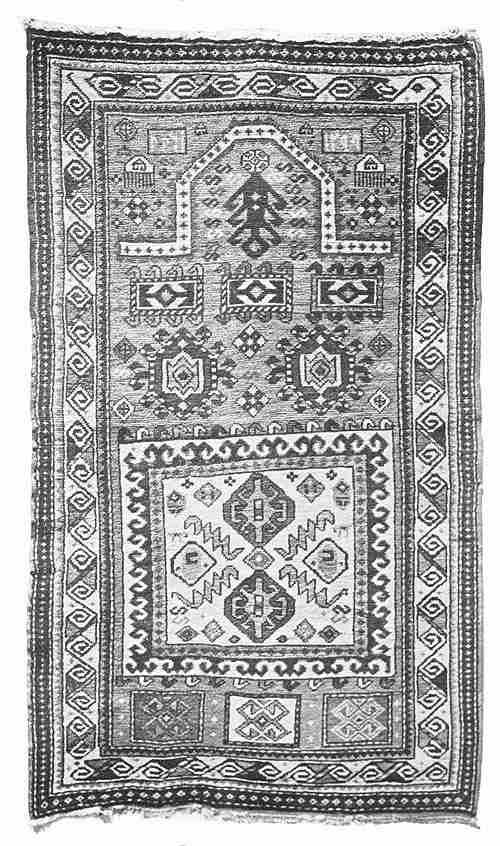
Plate 50. Gengha
Rug
A peculiarity of this class is the drawing of the pear
designs, which are found in a very large number of the rugs. The
extension of the narrower end, instead of being a short, curved
hook, is generally more developed, so that it may be as long as
the major axis of the pear and frequently stands almost at right
angles to it. Also attached to the sides of the pear are
rectangular bead-like processes (Plate O, Fig.
6c, Page 291). In many of these rugs, the field is divided
into a number of bands parallel with the sides; and through them
run vines, from which the pears are suspended. Or the pears may
be arranged in regular order on the field without the bands and
vines. Sometimes the field is reduced to a very small space by a
broad border consisting of a number of stripes, some of which are
often of striking patterns. One of them is represented in Plate
I, Fig. 15 (opp. Page 226), which suggests the
grape vine common to the gardens of Kutais. Some form of the tree
of life and floral forms are also seen in old pieces.
A resemblance exists between the weave of Kutais and Tiflis
rugs, as in each the weft usually crosses several times; it is
generally coloured blue or red, and is formed of fine threads of
yarn. The wool of the nap is of the same fine quality; but the
warp of the Kutais rugs, which is almost invariably of wool,
frequently consists of a brown and white thread twisted together;
and the knots are tied less evenly, so that the alignment at the
back is a little more irregular, yet less so than in Kazaks.
Type Characteristics. Colours, principally red,
blue, and white, with minor quantities of yellow, brown, and
black. Knot, Ghiordes. Knots to inch horizontally five to
nine; perpendicularly, six to eleven. A half knot, as it appears
at back, is as long as wide or longer. The rows of knots are
slightly pressed down. The alignment is more even than in Kazaks.
Warp, generally wool, occasionally cotton; each of the two
threads encircled by a knot is equally prominent at the back.
Weft, wool, of fine or medium diameter. A thread of weft
usually crosses three times, occasionally only once, and again
four or five times. Pile, wool, of medium length or long.
Border, three to five stripes. Sides, either a
double overcasting, or a double selvage of two or three cords.
Both ends, a web and warp fringe. Texture,
moderately firm. Weave at back, generally of medium fine
grain but occasionally coarse. Usual length, six to twelve
feet. Usual width, one third to two thirds length.
Kazaks.—Of the
warlike Cossack tribes, which were once stationed along the
southeastern border of Russia to protect it from the depradations
of Caucasians, a number settled permanently in Circassia, and a
few crossed the mountains to the high plateau lying between Lake
Gotcha and Mt. Ararat. Here they adopted more sedentary lives;
but there still lingers the inherited spirit that generations ago
won for them the name Kazaks, which denotes to the
Tartars, from whom many have doubtless sprung, a Marauder. All of
these tribes weave; but the rugs seen in this country come
principally from the southern district, where may also be found
the fabrics of other races such as Armenians, Tartars, and the
native people. Nevertheless, the Kazak weavings are of a most
distinct type, to which even the smaller Kazakjes conform. They
have bright, rich colours, of which a liberal amount of green is
almost invariably present, though sparingly used in other
Caucasian rugs. Only the Tcherkess vie with them in the length of
the nap; and no other class has such noticeable patterns of
incongruous sizes and shapes. They have, in fact, the most
nomadic, unconventional patterns of all this northern group; and
in their barbaric characteristics, they bear much the same
relation to other Caucasian rugs as those of Western Kurdish and
Yuruk tribes bear to Persian and Asia Minor pieces.
In marked contrast to the almost mosaic drawing of Chichis and
many Daghestans, the Kazaks show a tribal fondness for large
patterns. Sometimes the field is divided into three horizontal
panels, which may be entirely plain except for a simple design
fringing the edges; or as is more frequently the case, it may be
occupied by large, slightly elongated octagons, within which are
represented smaller figures. Occupying almost the entire field of
other pieces are large patterns like medallions, perfectly
balanced with reference to the centre and subdivided into small
sections, each of which contains individual motives. A few of
this class, also, have the “sunburst” pattern, so
characteristic of the Tcherkess.
At least half the pieces now seen are without any formal
pattern, but contain a heterogeneous lot of geometric designs
characteristic of nomadic weavings; but even these are generally
arranged with the idea of symmetrical balance. For instance, at
the centre may be a large geometric figure surrounded at equal
distances by pairs of smaller and similar figures. Not
infrequently the drawing of the upper and lower half, or of the
right and left side, shows an almost perfect correspondence,
notwithstanding the many separate designs. The most common of
these are eight-pointed stars, lozenges fringed with latch-hooks,
and what are known as the “tarantula” device. Of the
innumerable small figures, the octagonal discs and S forms are
the most common; crude animal and human figures are also
seen.
Excepting the addition of the arch, there is little
distinction between namazliks and sedjadehs. It is
small and less graceful than that of Asia Minor pieces, and
follows stiff lines in harmony with the general pattern. It is,
however, drawn in two different ways. Generally it has the shape
of half an octagon, or of a wall-tent with apex flattened; but
not infrequently it is square or slightly oblong. The narrow
bands that form the arch are extended transversely from each side
of the base to the borders; and occasionally they are continued
down the sides of the field to form at the bottom a figure
similar to the square-shaped arch. Now and then a comb, or small
figure of diamond shape, on which to place the bit of sacred
earth from Mecca, is outlined within the mihrab; and now and then
crude palm-like figures, indicating where the hands are to be
rested in the act of devotion, are represented at the sides.
However many stripes the border may contain, rarely are there
more than one of any consequence; since the guard stripes have
generally only the reciprocal sawtooth or trefoil patterns, the
barber-pole or dotted lines. The absence of important secondary
stripes, however, brings out more prominently the drawing and
colouring of the main one. The most common pattern is what is
known as the “tarantula” represented in Plate
I, Fig. 8 (opp. Page 226). Very similar is the
crab pattern (Plate I, Fig. 7), which was
undoubtedly derived from the double vine of some Persian rug, as
the crab-like figure may be resolved into a rosette to which are
attached four conventionalised leaves. Another pattern, which is
also seen in Kutais rugs, is the crude but striking vine shown in
Plate I, Fig. 15, which, when represented in
bold, rich colours on an ivory field, makes a most effective and
beautiful border stripe. Other border stripes frequently employed
in these rugs appear in Plate I.
Unfortunately, during recent years, many inferior rugs of
other tribes have been sold as Kazaks, which in a measure they
often resemble though they lack their spirit and character. The
very modern Kazaks, also, are often of poor quality, but those
made two generations or more ago were carefully and stoutly
woven, with silky wool dyed with the best of vegetable colours.
There is always something interestingly barbaric in their long,
almost shaggy nap, their masses of rich red and green, their bold
designs surrounded by smaller nomadic figures, all of which
collectively find no counterpart in any other Caucasian rugs.
Type Characteristics. Colours, principally red,
green, and yellow, also some blue, white, and brown. Knot,
Ghiordes. Knots to inch horizontally six to nine;
perpendicularly, seven to ten. The rows of knots are pressed
down, so that the warp is hidden at back. Warp, wool; each
of the two threads encircled by a knot is equally prominent at
back. Weft, wool, of coarse diameter, usually dyed red or
brown. A thread of weft generally crosses only twice between
every two rows of knots, but occasionally three or four times.
Pile, wool, clipped long. Border, three to five
stripes. Sides, a double overcasting attached in
figure-eight fashion to the sides, or a double selvage having
from three to five cords. Lower end, a red or brown web
and warp loops, or a braided selvage and fringe. Upper
end, a red or brown web, occasionally a braided selvage or
several rows of knots, and a warp fringe. Texture, stout.
Weave at back is of very coarse grain. Usual
length, five to twelve feet. Usual width, one third to
three quarters length.
Karabaghs.—To the
southeast of Lake Gotcha and north of the river Aras, that
divides Caucasia from Persia, is the district of Karabagh, a name
signifying “Black Vineyard.” On account of its
geographic position, it has been subject to the Shahs for long
periods, during the many struggles between the two countries. It
is, moreover, separated from the rug-producing district of
Karadagh by the river only; and its southern border is less than
eighty miles distant from the city of Tabriz, to which many of
its rugs are taken. For these reasons it would be only natural to
expect that the weavings of Karabagh would show more of the
Persian influence than those of any other part of Caucasia. Such,
indeed, is true, when applied to the oldest pieces; but it is not
at all true in the case of a large percentage of the modern
products.
Within recent years large numbers of these coarsely made and
wretchedly dyed rugs have reached the Western markets. Some of
them resemble Kazaks in their geometric figures; but differ from
them in their workmanship, since one of the two threads encircled
by a knot is depressed; they are much more loosely woven; they
are not so large; nor for the most part are they so heavy. Other
pieces often lack the symbolic and other small designs that
render nomadic rugs so interesting. Occasionally the central
field is almost figureless, or there may be large expanses of
white or some raw colour such as startling red, yellow, or blue,
on which appear stiffly and crudely drawn nondescript
devices.
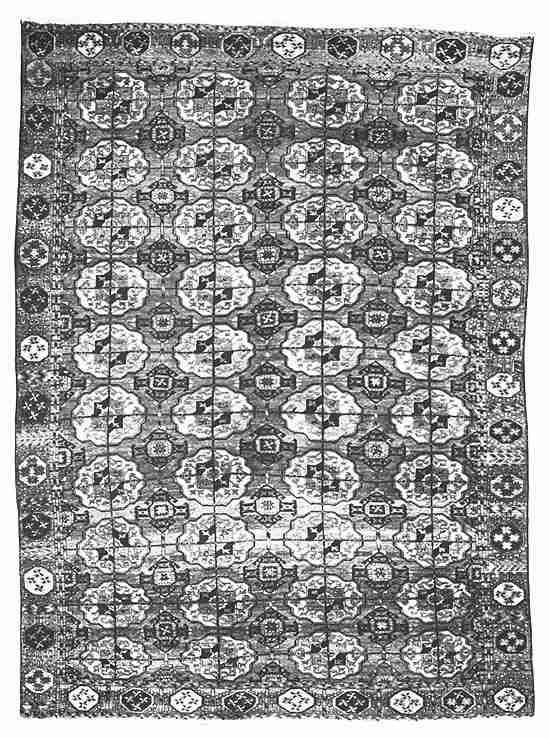
Plate 51. Royal Bokhara
Rug
It is a relief to turn from these poor pieces to those woven
half a century ago, with less obtrusive
colouring and more chaste patterns. Many of the old pieces are
oblong sedjadehs, which have often a length almost twice the
breadth; though the more modern pieces incline to smaller and
nearly square sizes. There are also namazliks that do not always
religiously follow the usual pattern; for now and then one is
seen with an arch of several steps, rising from near the middle
of the sides, and with a diamond for the sacred earth or pebble
from Mecca, as is shown in Plate C, Fig. 12
(Page 61). The particular piece from which this was drawn was
over fifty years old and was three fourths as wide as long.
Scattered over the main field, which was yellowish brown, and the
spandrels, which were white, were geometrically shaped flowers
with long angular stems tinted with blue, green, and pinkish
red.
The borders show as great diversity as the fields, but one
stripe usually contains a concession to the Persian and another
to the Caucasian tradition. For instance, the primary stripe may
be of Iranian character flanked by the running latch-hook; or it
may be the well-known crab pattern, while the adjacent stripe may
be a running vine of simple form.
Many of these old pieces are very handsome and equal in
artistic finish the best of Caucasian rugs; the drawing is
carefully executed; the colours are rich; the weave is fair; but
like the rare old rugs of Daghestan and Tiflis, are now seldom
seen.
Type Characteristics. Colours, principally red,
blue, yellow, and white. Knot, Ghiordes. Knots to inch
horizontally six to ten; perpendicularly, seven to ten. The rows
of knots are only slightly pressed down, yet the warp is
generally concealed at back. Warp, wool; one of the two
threads encircled by a half knot is depressed below the other at
back. Weft, wool, of medium or coarse diameter, sometimes
dyed red. A thread of weft crosses twice between every two rows
of knots. Pile, wool, of short or medium length.
Border, three stripes. Sides, generally a double
selvage of two or three cords, in lengths of different colours;
occasionally a double overcasting attached figure-eight fashion.
Lower end, a web and warp loops, or a braided selvage, one
row of knots or more, and a warp fringe. Upper end, a web,
a web turned back and hemmed, or a braided selvage, one row of
knots or more, and a warp fringe. Texture, loose.
Weave at back is of coarse grain. Usual length,
four to nine feet. Usual width, one half to three quarters
length.
Shushas.—About seventy miles to the
southeast of Lake Gotcha is Shusha, capital of Karabagh. Nearly
two centuries ago, it was built by Nadir Shah on an almost
inaccessible mountain side to guard the northern boundary of
Persia, which had been extended to the Caucasus. It has now about
twelve thousand inhabitants, and is the market place for numerous
tribes that are scattered over the dry plains as far as the Aras
river. In this city and in the suburbs are woven rugs that are
frequently imported to this country and sold under several names,
yet are of a distinct type. They resemble the Karabaghs of the
surrounding country but differ from them in their richer and more
subdued colours as well as in the stoutness of weave. One thread
of warp to each knot is doubled beneath the other, whereas in the
rugs of the desert tribes it is only depressed.
Type Characteristics. Colours, principally dark
blue, red, and brown, with minor quantities of green and yellow.
Knot, Ghiordes. Knots to inch horizontally seven to
twelve; perpendicularly, six to eleven. The rows of knots are
only slightly pressed down, so that the warp shows at back.
Warp, wool; one of the two threads encircled by a knot is
much depressed below the other at back, and frequently doubled
under the other. Weft, wool, of medium diameter, generally
dyed red. A thread of weft crosses twice between every two rows
of knots. Pile, wool of medium length. Border,
three stripes. Sides, a double selvage of two or three
cords, often attached to the sides in figure-eight fashion.
Lower end, a narrow web and warp loops. Upper end,
a web that is sometimes turned back and hemmed, and a warp
fringe. Texture, moderately firm. Weave at back is
of slightly coarse grain. Usual length, four to nine feet.
Usual width, one half to three quarters length.
Genghas.—Over the
land lying between lakes Gotcha, Van, and Urumiah, in Caucasia,
Armenia, and Persia, tribes of mixed origin wander back and
forth, but frequently gather at the yearly fair of Elizabethpol.
During the period when the Persian rule extended over the
country, it was the residence of a Khan and an important centre
of trade. As it was then known as Ganja or Gengha, the weavings
of these nomads, which were marketed there, acquired that
name.
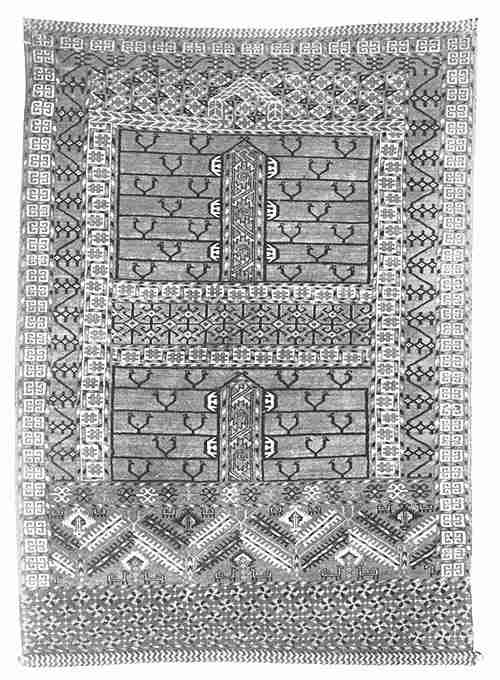
Plate 52. Princess
Bokhara Rug
Naturally they are a heterogeneous lot containing ideas
incorporated from many sources; but they resemble the Kazaks more
than anything else, and are frequently
mistaken for them. Yet some of the distinctions are very marked:
they have a more oblong shape; the nap is shorter; and they are
less stoutly woven. In the Kazaks a thread of weft, as a rule,
crosses only twice between two rows of knots, which are firmly
pressed down; but in these rugs a thread of weft crosses from
four to eight times between two rows of knots, which are not
firmly pressed down, so that the narrow filling of weft is
sometimes even four times as wide as a row of knots and presents
a bead-like appearance. In the colour scheme of numerous pieces,
which in many respects resembles that of Karabaghs, is often a
preponderance of ivory white. There is no characteristic pattern.
The field may be covered with diagonal stripes as in some
Shirvans; it may consist largely of lozenges fringed with
latch-hooks and tarantula devices; again, it may have some large
central figure surrounded by a motley lot of emblematic as well
as apparently meaningless devices, or crudely drawn human,
animal, or floral forms. The borders, likewise, include a wide
scope of patterns. It is, therefore, largely by the character of
the weave, quality of material, and finish of sides and ends,
that these pieces can be distinguished from other nomadic
products.
Type Characteristics. Colours, principally blue,
red, and white, with minor quantities of green, yellow, and
brown. Knot, Ghiordes. Knots to inch horizontally six to
eight; perpendicularly, six to nine. A half knot, as it appears
at back, is longer than wide. The rows of knots are not firmly
pressed down, so that the warp shows at the back. Warp,
generally wool, occasionally goat’s hair; each of the two
threads encircled by a knot is equally prominent at the back.
Weft, wool, of medium diameter and usually dyed red. A
thread of weft crosses twice between every two rows of knots, but
generally three and frequently as many as six or eight times.
Pile, wool of medium length. Border, three or four
stripes. Sides, a double selvage of two, three, or four
cords. Lower end, a web, usually coloured red, and warp
loops. Upper end, a web to which a braided selvage is
often added, and a warp fringe. Texture, very loose.
Weave at back is of coarse grain. Usual length,
five to nine feet. Usual width, two fifths to two thirds
length.
Disregarding a very few floral secondary stripes that have
been derived from Persian rugs, the Caucasian borders are
characterised by geometric patterns, which
distinguish them from other groups. But were it possible to trace
them to their origin, it would doubtless be found that a very
large number that are now strictly geometric have degenerated
from leaf and flower patterns. Of the remainder, some are
symbolic and others are crude copies of familiar objects. The
more artistic and realistically drawn floral patterns appear in
the less conspicuous secondary stripes; but on the other hand the
primary stripes contain a number of unusually interesting
patterns, which have been copied for centuries.
Primary
Stripes.—The cup and serrated leaf pattern (Plate
I, Fig. 1, opp. Page 226) appears so frequently
in Shirvans as to be almost typical. It is also occasionally seen
in Daghestans and Kabistans; but probably originated in Southern
Caucasia or Armenia, since it is found similarly drawn in rugs
woven in that district about 1500 a.
d. It is a pattern that scarcely varies with time or
locality except in the number of serrations to the leaf and in
the shape of the cup.
Serrated leaf patterns, represented in Figs. 2 and 3, Plate
I, are sometimes seen in Kazak and other
nomadic rugs. It is not improbable that they have a common origin
with the Shirvan cup and leaf pattern.
In the stripe represented in Plate I, Fig.
4, is a series of wine cup rosettes that are occasionally seen in
the old rugs from the Shirvan district. In fact, the wine cup
design is a favourite there.
Another stripe, in which a somewhat similar cup appears, is
shown in Plate I, Fig. 5. This is an old
nomadic pattern not frequently seen.
Fig. 6 of Plate I, represents the well-known
Chichi border stripe, composed of rosettes separated by
diagonally drawn ribbon-like bars. To the rosettes are attached
tri-cleft leaves. This stripe suggests at once some Persian vine
and flower.
What is known as the crab pattern (Plate I,
Fig. 7), is seen in Kazaks and other Caucasian nomadic rugs, as
well as in a few very modern Asia Minor pieces. Though its
resemblance to a crab is noticeable, it is really a rosette to
which are attached four crudely drawn leaves, that frequently
contain smaller designs at their centres.
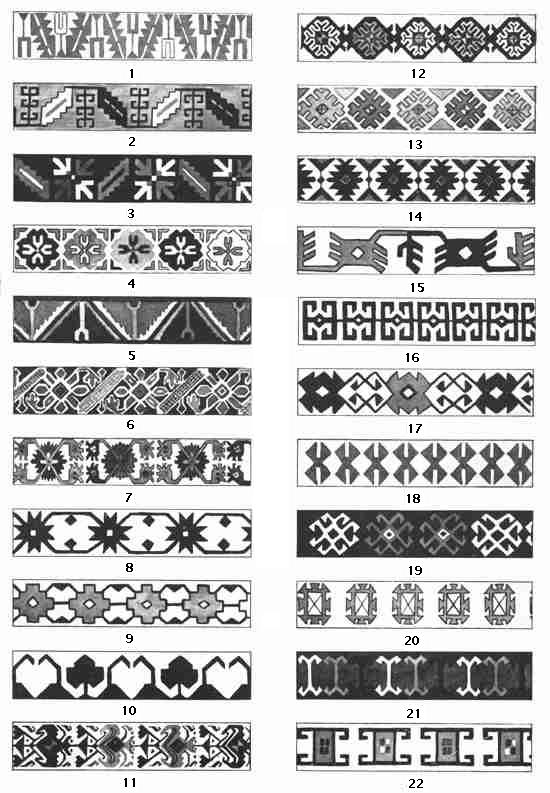
Plate I. Primary
Border-Stripes of Caucasian Rugs
Slightly resembling the last is the so-called tarantula
pattern (Plate I, Fig. 8), that was possibly
derived from the stripe with an eight-pointed star (Plate
K, Fig. 12, opp. Page 230); but it seems more
probable that the inspiration is Iranian
and that it is intended for rosette and double vine. This stripe
is found in Kazaks, Genghas, Tcherkess, and other nomadic
rugs.
Somewhat like the last is the stripe of Plate I, Fig. 9, that is now and then seen in old Tiflis and
other rugs of Southern Caucasia. It suggests a geometric rosette
and double vine.
Occasionally the dainty clover-leaf design, represented in
Plate I, Fig. 10, is used by the nomadic
weavers. It is almost the only reciprocal pattern found in a
Caucasian primary stripe.
The repetitive urn-shaped pattern of Plate I, Fig. 11 is once in a while seen in old rugs of the
Daghestan country.
On account of the resemblance between the stripes shown in
Plate I, Figs. 12 and 13, they have probably a
common origin. Both are found in rugs of the Daghestan and
Shirvan districts, and the former is occasionally seen in rugs of
Asia Minor. Sometimes smaller adventitious devices are placed at
the sides of the stripes between the rosettes.
Resembling the last is the pattern shown in Plate I, Fig. 14, which is commonly seen in Shirvan rugs and
kilims. It is purely geometric and resembles one used in Western
Asia Minor rugs of the XV Century, from which it may have been
derived.
Though greatly conventionalised, the pattern represented in
Plate I, Fig. 15 is a vine and leaf derived
from much more ornate forms, which may be seen in a XVI Century
Asia Minor piece that is in the British Museum. It is now seldom
copied, but was once a popular pattern for the Kazak and Kutais
weavers.
Some form of the latch-hook appears in a large number of
Caucasian stripes, but mostly in nomadic pieces. Figs. 16, 17,
18, 19, and 20 of Plate I, represent patterns
found mostly in old Kazaks and kindred rugs. The last one is also
occasionally used as a secondary stripe. The patterns shown in
Plate I, Figs. 21 and 22 are from stripes
sometimes seen in the Daghestan and Shirvan districts.
A much more interesting stripe because of its well
authenticated antiquity, is the one shown in Plate J, Fig. 1 (opp. Page 228). It is found in rugs made in
Southern Caucasia two centuries ago, and according to Dr. Martin
has been used since the XII Century. Probably as the result of
copying, the design appears reversed in many old rugs.30 These stripes are seen in comparatively recent
pieces, but principally
in those of the Daghestan and Shirvan districts. Though the
latch-hook is suggested by the small triangular parts, it is more
probable that originally they were intended for leaves. In a few
stripes the design is elongated, and in place of a single
crossbar there are several, forming a figure that slightly
resembles a poinsetta, which is the term occasionally applied to
it by weavers.
The stripe shown in Plate J, Fig. 2, which
is found in Kazak and other nomadic rugs, is interesting as
representing a vine of which the pendant flower is replaced by a
T formed by latch-hooks.
In Figs. 3 and 4 of Plate J, are patterns of
stripes found in rugs of the Shirvan and Daghestan districts. As
they are several centuries old, they may be derived from Armenian
patterns, to which they show kinship. Both patterns are at times
reversed as the result of copying.31
A stripe also used in the same districts and probably of similar
origin is seen in Plate J, Fig. 5.
Differing from any of these because of their utilitarian
origin, are the separate designs, which arranged in perpendicular
rows, form the “churn” stripe of Plate J, Fig. 6. Each of them represents crude machines for
churning milk, which were formerly used by the nomadic tribes of
Southern Caucasia and Armenia, who constructed them out of logs
with a length of about five feet, and placed the sharpened base
in the ground. Then hanging a goat’s skin filled with milk
over each of the sides, and seating themselves in the middle,
they turned first one then the other. As might be expected, these
stripes belong entirely to nomadic rugs.
Figs. 7 and 8 of Plate J, represent stripes
sometimes seen in Shirvans. The latter is undoubtedly derived
from the prayer patterns that are often used in these rugs.
What is known as the Georgian stripe is shown in Plate
J, Fig. 9. It is found in Daghestans,
Kabistans, Shirvans, Soumaks, Shemakhas, and Kubas. Though a
primary stripe, it is rarely placed at the centre of the border,
but at the outer or the inner side, or at both sides with a less
ornate stripe between. As a rule it accompanies only the more
artistic rugs.
Generally the primary stripes of Soumaks are different from
those of other rugs. A few appear in Figs. 10, 11 and 12 of Plate
J. The last is interesting on account of the
leaf-like forms of the octagonal designs.
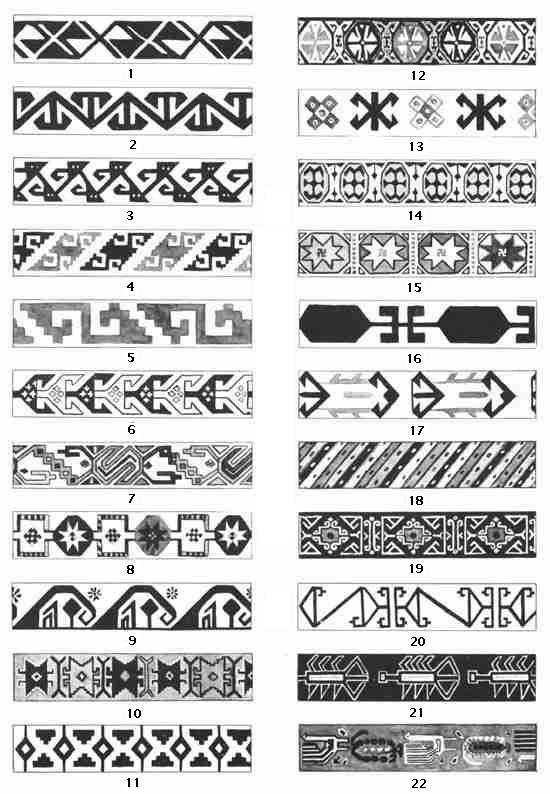
Plate J. Primary
Border-Stripes of Caucasian Rugs
The stripes seen in Plate J, Figs. 13, 14
and 15 are found only in nomadic rugs. The last is interesting
principally on account of the swastikas.
And old form now and then seen in the Daghestan-Shirvan
classes appear in Plate J, Fig. 16. It is an
archaic pattern copied from a most interesting Daghestan prayer
rug.
The stripe shown in Plate J, Fig. 17 is
sometimes adopted in rugs of Southern Caucasia, such as the
Kutais and Kazak.
Another very old pattern found in the borders of the
Daghestan-Shirvan classes is shown in Plate J,
Fig. 18. Though it suggests the narrow tertiary stripes known as
“barber-poles,” it differs from them by being very
much wider, and by containing bars of many different colours, as
red, yellow, cream, blue, green, and brown, which generally
contain short, oblong dashes.
A very interesting stripe, found almost exclusively in rugs
from the districts of Daghestan and Shirvan, is the Cufic pattern
of Plate J, Fig. 19. It is particularly
characteristic of old Daghestans and Kabistans, but must have
been introduced through Shirvan from Armenia, as it can be traced
through a gradation of changes to stripes of Cufic characters
used in Asia Minor rugs of the XV Century.
Plate J, Fig. 20 represents a
“bracket-chain” pattern that probably originated in
Asia Minor, but is occasionally found in the rugs of
Caucasia.
In Plate J, Fig. 21 is a stripe representing
scorpions, that is very rarely seen in Shirvans; and in Fig. 22
is a stripe representing birds, sometimes seen in Bakus.
Secondary and Tertiary
Stripes.—As the pattern shown in Plate K, Fig. 1 (opp. Page 230) shows in profile flowers
representing carnations, it has been called the “carnation
pattern.” It is very common in Shirvans, Kabistans, and
Daghestans.
Less frequently seen are the rectangular vine with a design
like a three-leaf clover, shown in Plate K,
Fig. 2, and the very graceful vine with leaf and flower shown in
Fig. 3, both of which are indiscriminately used in place of the
carnation pattern in rugs with the same primary stripe. The
latter is the most dainty and graceful Caucasian floral stripe.
It is found in pieces of the Kabistan and Daghestan classes made
over a century and a half ago, and is probably of Iranian
extraction.
Another floral pattern from the same
district is seen in Plate K, Fig. 4. It often
accompanies the Georgian stripe of Daghestans and Soumaks, with
which its stiff drawing harmonises.
Likewise, the stripe shown in Fig. 5 is found now and then in
the same classes of rugs. Similar rosettes are sometimes
represented in Persian stripes that show the influence of nomadic
weavers.
Simple forms of the running vine which are seen mostly in the
rugs of Southern Caucasia are represented in Plate K, Figs. 6, 7, 8, 9, and 10. All are old patterns. The
third appears in an Asia Minor carpet woven about 1250
a. d. The fourth is found in some of
the oldest remaining rugs from Southern Caucasia, that date back
two and a half centuries; and a pattern similar to the last is
seen in some Persian carpets made about 1650 a. d.
Plate K, Figs. 11 and 12 represent stripes
sometimes seen in Chichis and a few other Caucasian rugs.
A very simple pattern, but one that at times is very
attractive on account of its delicate colouring, is shown in
Plate K, Fig. 13, and another is shown in Fig.
14. Both are used principally in rugs of Southern Caucasia.
The stripe represented in Plate K, Fig, 15,
is found in very old rugs of the Daghestan and Derbend types; and
there is a tradition among some of the native weavers that the
designs originally represented boat hooks used by the sailors of
the Caspian Sea. It is not unreasonable to suppose that the early
weavers imitated objects of utility before those of mere
ornament; but even if there is any basis for the tradition, it is
equally probable that these designs are derived from the lily or
other floral forms, and were introduced from Persia.
Somewhat similar to the last is the reciprocal trefoil, which
generally appears with more simple drawing than is shown in Plate
F, Fig. 17 (opp. Page 158). It is more widely
used for a border stripe than any other pattern, as it is found
in almost all Caucasian, in a large number of Persian, in Indian,
and Beluchistan rugs. It was commonly used in Persian rugs as
early as the year 1500.
The dainty Chain pattern of Plate K, Fig. 16
has a well authenticated antiquity, as it is found in Asia Minor
carpets of the XV Century, from which it was probably derived.
Without doubt it was a favourite pattern three centuries ago, as
it appears in some of the early paintings in which Oriental
carpets are represented.
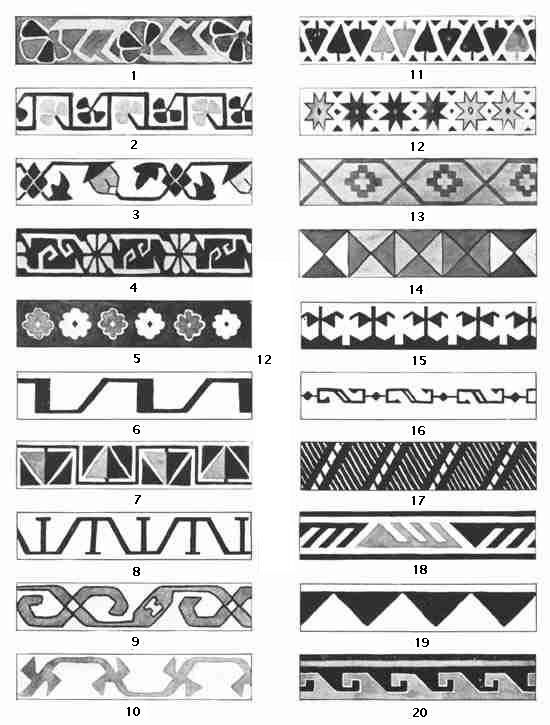
Plate K. Secondary and
Tertiary Border-Stripes of Caucasian Rugs
Not infrequently the right-angled corners are rounded so as to
give it a more graceful form.
As the purely geometric pattern of Plate K,
Fig. 17 is entirely lacking in ornamental features, it is used
principally to separate more important stripes. Occasionally it
is found in such rugs as the Chichis and Shirvans.
Another very simple pattern that is sometimes used as an
inside stripe is seen in Plate K, Fig. 18. This
is evidently an archaic form and is found principally in pieces
of the Shirvan district.
The reciprocal sawtooth and the running latch-hook patterns
(Plate K, Figs. 19 and 20) belong to the less
important stripes of not only Caucasian but a number of Persian
rugs. The former pattern appears constantly on the monuments of
ancient Susa, and doubtless had once some symbolic meaning. The
latter is seen in the corners of the Dragon and Phœnix
carpet (Plate 20, opp. Page 88) which was
woven about 1350 a. d.
Legend:
KNOT—
H = Horizontally
P = Perpendicularly
WARP—
g = goat’s
hair
e = each equally
prominent
d = 1 to the knot
depressed
h = 1 to the knot doubled
under
WEFT—
No. = No. times crossing bet. two
round knots
SIDES—
O = overcast
S = selvage
LOWER END
W = web
S = Selvage
K = Rows knots
L = warp loops
F = fringe
UPPER END
W = web
S = selvage
K = Rows knots
T = turned back and
hemmed
F = fringe
| CAUCASIAN |
KNOT |
WARP |
G =
Ghiordes |
S =
Sehna |
Number to
Inches |
w=
wool |
c=
cotton |
s/l |
At back |
| H |
P |
e |
d |
h |
Baku
Chichi
Daghestan
Derbend
Gengha
Kabistan
Karabagh
Kasak
Kuba
Kutais
Lesghian
Shemakha
Shirvan
Shousha
Soumak
Tcherkess
Tiflis |
G
G
G
G
G
G
G
G
G
G
G
G
G
G
G
G |
|
6-9
7-10
7-10
5-9
6-8
7-12
6-10
6-9
6-9
5-9
6-9
7-11
7-12
7-12
8-14
6-9
6-10 |
7-11
8-12
8-15
6-12
6-9
8-16
7-10
7-10
7-13
7-12
6-11
7-13
8-12
6-11
6-16
7-10
6-10 |
w
w
w
w
w
w
w
w
w
w
w
w
w
w
w
w
w |
[c]
[c]
[c] |
[g]
|
e
e
e
e
e
e
e
e
e
[e]
e
e
e
e |
[d]
d
d
d
d
[d]
|
[h]
h
|
| CAUCASIAN |
WEFT |
SIDES |
LOWER END |
w =
wool |
c =
cotton |
No. |
O |
S |
W/S |
K |
L |
F |
Baku
Chichi
Daghestan
Derbend
Gengha
Kabistan
Karabagh
Kasak
Kuba
Kutals
Lesghian
Shemakha
Shirvan
Shousha
Soumak
Tcherkess
Tiflis |
w
w
w
w
w
w
w
w
w
w
w
w
w
w
w
w
w |
[c]
c
[c]
|
2
2
2
2/[1]
2-4/[6-8]
[2]/[3]
2
2/[3-4]
2
3/[1-5]
2
2
2
2
2
2/[4-6]
3-5 |
O
O
[O]
[O]
O
[O]
O
O
[O]
[O]
O |
S
[S]
S
S
S
S
S
S
S
S
S
S
S
S
S
S
S |
W
W
W
W
W
W/[S]
W/[S]
W/[S]
W
W
W
W/S
W
W
W/S
W/S
W |
K
K
K
[K]
[K]
[K]
K
K
K
K
|
L
L
L
L
L
|
F
F
F
F
F
F
F
F
F
F
F
F
F
F |
| CAUCASIAN |
UPPER END |
NAP |
WEAVE |
TEXTURE |
| W/S |
K |
T |
F |
l = long
m = medium
s = short |
f = fine
m = medium
c = coarse |
l = loose
m = medium
f = firm |
Baku
Chichi
Daghestan
Derbend
Gengha
Kabistan
Karabagh
Kasak
Kuba
Kutals
Lesghian
Shemakha
Shirvan
Shousha
Soumak
Tcherkess
Tiflis |
W
W
W
W
W/[S]
W/[S]
W/[S]
W/[S]
W/[S]
W
W
W/S
W
W
W/S
W/S
W |
K
K
K
[K]
[K]
[K]
[K]
K
K
K
K
|
T
[T]
|
F
F
F
F
F
F
F
F
F
F
F
F
F
F
F
F
F |
s
m/s
s
m
m
m
m
l
m
m
m
m
m/s
m
m
m |
m
m
f
m
c
m
c
c
m
m/c
c
m/f
m/c
m/c
m
m
m/f |
m/f
m
m/f
m/l
l
m/f
l
f
m/l
m/f
f
m/f
m/l
m/f
m
f
f |
[] indicates the less frequent condition.
HE land that extends eastward about fourteen
hundred miles from the Caspian Sea to the western boundary of the
Chinese Empire, and northward for a similar distance from the
Arabian Sea through Beluchistan and Afghanistan to the steppes of
Western Siberia, is one of the least civilised parts of the
eastern continent. Here until within a few recent years, the
people lived the same untrammelled lives that their ancestors
pursued for past centuries; and the encroachments of the Russian
Empire on the north and the English on the southeast, have as yet
made little impression on their uncultured natures. To these
circumstances it is largely due that the rugs termed Central
Asiatic, which come from this district, still possess to a large
degree the originality of design, virility of character, and
beauty of colour that are so rapidly disappearing from the woven
products of countries more subject to the influence of Western
civilisation.
These rugs may conveniently be divided into three natural
sub-groups, which include:
1. The Turkoman, consisting of what are known in this country
as Royal and Princess Bokharas, the Tekkes, Yomuds, Khivas, and
Beshires, all of which are made in Turkestan;32 and the Afghan, of which part are made in
Turkestan and part in Afghanistan.
2. The Turko-Chinese, consisting of the Samarkands, which
are made in Western Turkestan, and the Kasghars and Yarkands
made in Eastern Turkestan.
3. The Beluchistans or Beluches, made principally in
Beluchistan.
No other rugs adhere more strictly to uniformity of
colour and design than the Turkoman. And, when it is considered
that their prevailing tones and their simple, geometric designs
are such as would readily be adopted by people with primitive
ideas of ornamentation, it seems probable that they have been
copied with only slight modification for a great many centuries,
even though more gorgeous and elaborate carpets were woven during
the short period when Samarkand was capital of the East. This is
probably true, notwithstanding no other country in the world has
been subject to more conquests than Turkestan or overrun by so
many different races. For here, as we learn by the aid of
philology, dwelt the Aryans even before the light of history had
come to dispel the mists of antiquity. Two or three thousand
years later it was overrun by Cyrus and added to the dominion of
the Medes and Persians. In the V Century a.
d., Tartar tribes conquered it; and in the following
century Turks and Persians divided it between them. Still later
it was again overrun by the Arabs, who, sword in hand, converted
the vanquished to the creed of Islam. When a few more centuries
had rolled away the Mongol hordes of Genghis Khan swept over it;
and once again it suffered desolation under the iron hand of
Tamerlane, “Scourge of Asia.” But in spite of these
waves of conquest and the minor struggles with Persians, Greeks,
and Romans, that left their impress on the country, each of the
several classes of Turkoman rugs, including even those made two
centuries ago, show a remarkable conformity to definite types,
however much may be their modification in small detail. Their nap
is invariably short; in all of them some shade of dark red is the
predominating colour; and in most of them some form of an octagon
appears. They are, moreover, the best woven and the most
beautiful of the Central Asiatic rugs.
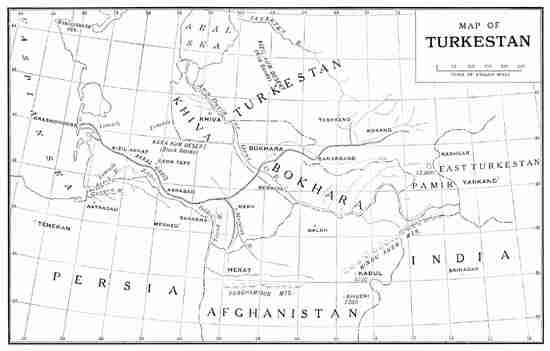
MAP OF TURKESTAN
Though the Turko-Chinese rugs are made in places subject to
the influence of Turkomans and far removed from the culture of
Chinese, they are unlike the rugs of the former and resemble
those of the latter. Not improbably this is because Tamerlane had
gathered at Samarkand noted artists and artisans from China,
whose influence continued long after his death. And as
traditional patterns have been transmitted for centuries, there
is little doubt that some of the modern rugs, even though
falling far short of the standard of their early prototypes, more
closely resemble them than they do any other rugs of Asia. In
these pieces Turkoman simplicity of geometric figures is replaced
by an elaboration of conventional floral forms and by designs
associated with early philosophies; sobriety of colour yields to
the bright and even gaudy tones not infrequent in modern textile
fabrics.
The Beluchistans, which are regarded as a sub-group of the
Central Asiatic rugs, show a closer relationship to the Turkoman
rugs than to any others. A few of them have octagonal patterns
suggestive of Bokharas, and all have the long webs at the ends
and the heavy goat’s hair selvage at the sides peculiar to
Afghans and Tekkes. On the other hand, many of the patterns both
of field and border resemble Persian workmanship; so that placing
these rugs in the same group with the Turkoman and Turko-Chinese
rugs, which are not made in an adjoining territory, is slightly
arbitrary.
Royal
Bokharas.—The best known district in Turkestan is
the Khanate of Bokhara, which extends from the offshoots of the
lofty Pamir mountains in the east to the desolate sandy plains
beyond the Amu Daria, or Oxus river, on the west. Situated in its
northern half and near the centre of a fertile valley is its
capital, Bokhara, “The Noble.” Though noted for its
cruelty, it was once the intellectual centre of Asia, and still
possesses nearly a hundred schools and innumerable mosques. These
and its bazaars are almost all that remain of the splendour of
those days when the great caravans that came from China, India,
Persia, and Russia made it one of the great marts of the
East.
On account of its commercial importance, the wild tribes of
the Kirghiz steppes, the Turkomans from Kizil Kum,33 the Afghans who dwell north of the Paropamisus
range, and the fierce Tekkes and Yomuds from the west, came and
bartered their rugs for other necessities. Many of these rugs
were taken in caravans, that often numbered several thousand
camels, and sold in the Russian market places of Astrakan,
Orenburg, or Nijni Novgorod. Since they came from the same place,
the term Bokhara was often applied to each of the different
classes. Thus we hear of Royal Bokharas, Princess Bokharas, Tekke
Bokharas, Yomud Bokharas, and Khiva Bokharas.
Of these five classes the Royal Bokharas, as a rule, not only
are the best woven, but are made of the
finest material; even the warp of many of them is of soft, silky
white wool. The old rugs were made in the city and suburbs of
Bokhara, where now only a few pieces are made. Both old and new
are found only as sedjadehs. They have two well-known patterns,
one of which consists of an octagon surrounding a quartered
hexagon. Of these quarters, which are either plain or contain a
small triangle of contrasting colour, a pair that are opposite
are always white or cream coloured, and the other pair are of
some shade of red. Small triangular figures are invariably seen
above and below the hexagons, as well as small diamond, oval, or
spear-shaped figures at each end of the major axis. In the other
pattern the contour of the octagon is rounder; and the hexagon is
replaced by an eight-pointed star, at the centre of which is a
diamond containing a rectangle or occasionally a Greek cross.
Projecting into the four corners from the star are small designs,
that careful observation of a large number in many different
kinds of rugs shows to be leaf forms. Between the diagonally
placed octagons of both these types are stars or diamond-shaped
figures, that are usually of the same design regardless of the
shape of the octagon. In large rugs the centres of the octagons
are generally joined by straight lines of dark blue colour.
It is uncertain why the term Royal has been applied to this
class of Bokharas, but it is eminently befitting the old
well-woven, velvet-like pieces. A few have small patches of pink
or ruby coloured silk; and all have a prevailing tone of red
diversified by deep blues and touches of lighter red and ivory,
that convey an idea of opulence and dignity worthy of a king.
Type Characteristics. Colours, principally dark
red, with minor quantities of blue, pink or orange, and ivory.
Knot, Sehna. Knots to inch horizontally eight to twelve;
perpendicularly, sixteen to twenty-four. The rows of knots are
firmly pressed down, so that the warp is concealed at back and
the weft is almost hidden. Warp, fine white wool; each of
the two threads encircled by a knot is equally prominent at back.
Weft, wool, of fine diameter. A thread of weft crosses
twice between every two rows of knots. Pile, fine wool, or
occasionally silk, clipped short. Border, three stripes
divided by smaller coloured lines. Sides, a blue double
overcasting. Both ends, a narrow web and short warp
fringe. Texture, firm. Weave at back is of fine
grain. Usual length, four to ten feet. Usual width,
three fifths to four fifths length.
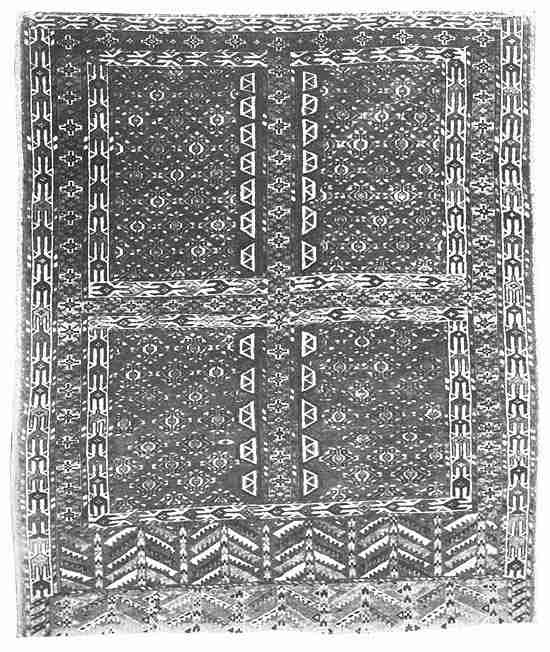
Plate 53. Turkoman Rug
with Katchli Pattern
Princess
Bokharas.—The rugs known as Princess Bokharas are
woven by the Mohammedan tribes who dwell in parts of the Khanate
of Bokhara. They are nearly square and the field is divided into
four equal sections by perpendicular and horizontal bands.
Because of this pattern they are called “Katchlis,” a
word derived from the Armenian language signifying “like a
cross.” The bands generally have designs that are
co-ordinate with those in part of the border; but not
infrequently the designs of the horizontal band differ from those
of the perpendicular one, and in a few rare instances consist of
an octagonal figure. It is generally believed that the well-known
Y-shaped motive characteristic of the field and the border is
intended to represent the tree of life, but some native weavers
suggest a different interpretation. To them the whole rug
symbolises a mosque; the perpendicular arm of the cross is the
entrance; the Y-shaped designs are benches; and the broad
diagonal lines with serrated edges in the borders are groves of
trees surrounding the mosque. A very large percentage of these
pieces are namazliks. One of their peculiarities is the position
of their unobtrusive tent-shaped prayer arch, which is in a panel
entirely within their upper border.
Compared with Royal Bokharas their nap is rarely of as fine
quality, the warp is usually of brown instead of cream white
wool, and the weave is coarser. Also, the tones of colour are
more sombre, and of browner shades; but in rare old pieces the
rich mahogany and bronze hues of the ground, on which are
represented small designs in shades of cream and dark blue, are
exceedingly rich and pleasing. Unfortunately, within recent years
large numbers of this class have been made solely for commercial
purposes, and lack the finer qualities of their prototypes.
Type Characteristics. Colours, principally dark
red or brown, with minor quantities of dark blue and ivory.
Knot, Sehna. Knots to inch horizontally eight to twelve;
perpendicularly, fourteen to eighteen. The rows of knots are
firmly pressed down, so that the warp is concealed at back and
the weft partly hidden. Warp, brown wool or goat’s
hair; each of the two threads of warp encircled by a knot is
equally prominent at back. Weft, wool, of fine diameter. A
thread of weft crosses twice between every two rows of knots.
Pile, wool of short or medium length; occasionally some
goat’s hair is used. Border, three stripes,
separated by narrow lines. Sides, a double overcasting or
a double goat’s hair selvage of three cords. Both
ends, a web and warp fringe. Texture,
stout. Weave at back is of moderately
fine grain. Usual length, four and one half to six feet.
Usual width, two thirds to four fifths length.
Tekkes.—A little
over two centuries ago there lived on the peninsula of
Mangishlar, on the eastern shore of the Caspian Sea, an almost
unknown tribe called the “Tekke,” a term which is
said to denote a mountain goat, and was applied on account of the
headlong pace at which the men rode over rough mountain sides.
About the beginning of the XVIII Century they packed their
khibitkas,34
and after moving southward to escape from the attacks of a more
powerful tribe, they met the Yomuds in the southwestern corner of
Turkestan and robbed them of their lands. Further eastward they
snatched the fertile oasis of Ak-kal from some Kurds, whose
ancestors a Shah of Persia had located there in earlier times to
protect his kingdom from fierce northern tribes. By irrigating
and cultivating the soil, they prospered and increased rapidly in
population, until, about 1830, they numbered one hundred
thousand. One fourth of them then moved eastward; and after
settling on the banks of the Tajand, not far from the Persian
town of Saraks, they attacked the inhabitants of Merv and
captured the city. Growing thus to be a powerful people, they
occupied much of the country between Persia and the Amu
Daria.
Ever restless, they were constantly looking for weaker foes on
whom to fall; and when a leader would announce an intended raid,
hundreds or even thousands would meet at the appointed rendezvous
prepared to blindly follow him. Sometimes it was through the
passes that looked down into the fertile valleys of Northern
Persia. Stealthily creeping through them they would fall
unexpectedly upon an unprotected village and dash away with young
women and children. If pursued, they would stab their captives,
and if necessary, ride more than one hundred miles a day in
flight. At other times, they would attack caravans crossing the
deserts and carry away both camels and wares.
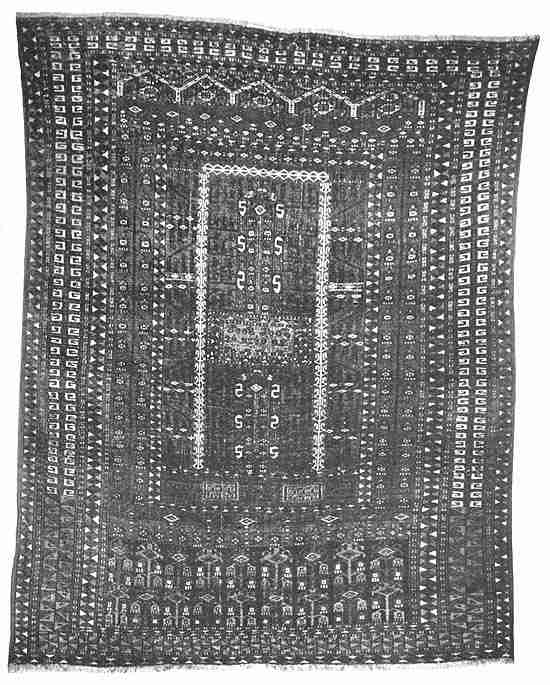
Plate 54. Turkoman Prayer
Rug, which according to A. Bogolubow has the Typical
Pindé Pattern
Their raids, however, were not viewed with complacence by the
Russians, who had been steadily advancing on the land lying
between the Caspian and the Amu Daria, and whose armies the
Tekkes harassed. At length in January, 1881, came the final death
struggle in the memorable attack on the fortress of Geok Teppe,
where thirty-three thousand tribesmen and seven thousand women
and children had taken refuge. With the fall
of that stronghold and the terrible punishment that followed, the
power of the Tekkes was completely crushed; and a people whose
ancestors for countless centuries had roamed the desert,
recognising no master, yielded finally to the advance of
civilisation.
These were the people whose wives and daughters wove the rugs
generally known as Tekke Bokharas, of which large numbers with
excellent weave and sterling dyes can still be found. As few of
them were designed for mosques or palaces, it is very unusual to
find pieces over one hundred years old, and even these are rare.
Indeed, any that are now forty years old should possess great
interest, as they were woven at a time when the Tekkes were still
a fierce race. Very many have the Katchli pattern. The prayer
arch, which is similar to that of Princess Bokharas, is in a
panel exterior to the field and within the border. Not
infrequently there are three arches in the same horizontal panel,
which, as a rule, is above the field, but occasionally below it.
In a great many of these rugs the three-leaf clover is found in
some part of the field; and in the band of pile that extends
beyond the border at one end are usually small conventionalised
bushes with white and yellow flowers. The pattern shown in Plate
L, Fig. 4 (opp. Page 250), appears almost
invariably in the outer stripe.
There are other types, into one of which it would seem as if
the very spirit of the desert had crept. Their dark ground
colours are brightened by lighter tones that give an effect of
strange yet not inharmonious beauty. A few would seem to speak of
the early Zoroastrian faith, for in their fields are designs like
stars with effulgent rays that suggest the burning altars of fire
worshippers.
The shape or some peculiarity of the rug indicates the purpose
for which it was intended. For instance, the rugs which were made
for doors of the khibitkas have at the upper end a selvage with
the web turned back and hemmed, and at each corner a heavy
braided cord of about two feet in length, by which they were
suspended. Other pieces have webs at both ends. Many beautiful
pieces are made for use on horses or camels. Those intended for
camels are of oblong shape with a field usually containing large
octagons, between which are smaller octagons similar to those in
Royal Bokharas.
Tekkes may be distinguished from the Princess Bokharas, which
they resemble, by their goat’s hair selvage at the sides,
by one thread of warp to each knot being slightly depressed at
the back, and by their coarser character. There is,
however, a great similarity in the colours, though in the Tekkes
tones of deep plum and rich red are not uncommon.
Type Characteristics. Colours, principally dark
red, brown, or plum, with minor quantities of dark blue and
ivory. Knot, Sehna. Knots to inch horizontally seven to
twelve; perpendicularly, nine to fourteen. The rows of knots are
slightly pressed down, but the warp shows at back. Warp,
wool or goat’s hair; one of the two threads encircled by a
knot is depressed below the other at back. Weft, wool of
fine or medium diameter. A thread of weft crosses twice between
every two rows of knots. Pile, wool, or occasionally
goat’s hair of short or medium length. Border, three
stripes, separated by coloured lines. Sides, a three-cord
double goat’s hair selvage. Lower end, a wide
coloured web and long warp fringe. Upper end, a braided
selvage turned back and hemmed, or occasionally a wide coloured
web and long warp fringe. Texture, firm. Weave at
back of moderately fine grain. Length, five to eight feet.
Usual width, three fifths to four fifths length.
Khivas.—On the
west bank of the Amu Daria, and stretching for two hundred miles
above its mouth, is the plain of the Khanate of Khiva. Most of
the people live in khibitkas, and either follow a nomad’s
life or raise from the alluvial soil, that is watered by
innumerable canals, crops of cotton, corn, and rice, as well as
melons, peaches, and pomegranates. A large population, also,
inhabits the city of Khiva, which before the building of the
Siberian railway, was on one of the direct highways between east
and west. Caravans of nearly two thousand camels regularly passed
through it en route to Orenburg in spring and to Astrakan in
fall, carrying wares from districts farther to the east as well
as its own rugs and manufactured articles.
Although this rug is an excellent example of that class
generally known as Samarkands, it was bought in Yarkand.
Undoubtedly it was woven in some part of Turkestan that lies
between these two cities; yet with the exception of the
eight-pointed stars at the centre of the upper and lower
medallions the pattern is characteristic of Chinese
ornamentation. Surrounding the central medallion, on a ground of
rich deep blue, are six conventionalised butterflies, and near
them are four clusters of pomegranates. At each end of the field
are designs that suggest the tree of life, which under different
forms appears so persistently in the woven fabrics of the East.
The delicate drawing of these motives is accentuated by the
formal character of the four corners and by the broad border of
well-known stripes. It is a piece in which beauty of line and
colour is combined with unsolved symbolism.
Loaned by Mr. Hulett C. Merritt
On account of the constant intercourse between the Khiva and
Bokhara tribes, their woven fabrics show a close relationship in
patterns and colours; yet they contain important differences.
Those made by the Khiva tribes are cruder, and reflect the effect
of constant struggles against the rigours of the desert and the
fierce Kirghiz from the steppes to the north. The wool is also
coarser and longer, and the knots are much fewer to the inch.
Occasionally geometric as well as animal designs suggestive of
Caucasian influence occur. Moreover, the brownish threads of weft
that separate each row of knots, are noticeable at
the back, whereas in other Turkoman rugs the weft is hardly
perceptible.
Many of the old pieces were very handsome, as is shown by the
following description of an antique goat’s hair carpet from
Khiva by Dr. Birdwood.35
“The ground is of madder red, decorated with leaves and
scrolls and lozenge-shaped forms in red, white, and orange, each
lozenge being defined by a deep line of indigo blue. The ends
terminate in a fringe. Professor Vambery says that these rich
lustrous carpets are made entirely by the nomad women about
Khiva, the head worker tracing out the design in the desert sand
and handing out to her companions the dyed materials of different
colours as required in the progress of weaving.”
Type Characteristics. Colours, principally dark
red, with minor quantities of blue and ivory. Knot,
Ghiordes or Sehna. Knots to inch horizontally six to ten;
perpendicularly, eight to fourteen. The rows of knots are but
slightly pressed down, so that the warp shows at back.
Warp, wool or goat’s hair; each of the two threads
encircled by a knot is equally prominent at the back.
Weft, wool of medium or coarse diameter. A thread of weft
crosses twice between every two rows of knots. Pile, wool
of medium length. Border, generally three stripes.
Sides, a double selvage of two or three cords, which is
generally of goat’s hair. Both ends, a web, one or
more rows of knots and a warp fringe. Texture, stout.
Usual length, four and one half to six feet. Usual
width, three fifths to three quarters length.
Yomuds.—When, in
1718, the Yomuds were driven by the Tekkes from their homes in
the well-watered region about Kizil Arvat, they moved to a less
fertile country to the north and west. Though now numbering about
one hundred thousand, they have few villages; and regardless of
the dreary sand storms, the biting cold of winter, or the
terrible heat of summer, they wander with their sheep and goats
from place to place in search of more favoured spots. Sometimes
their khibitkas are seen along the border of the Caspian Sea as
far south as Astrabad in Khorassan, or among the sandy trackless
wastes of Kara Kum, nearly as far north as the Aral Sea.
Many of their rugs rival the Royal Bokharas in wealth of
colour. The prevailing tone of the field is usually red or
maroon, but is sometimes rose, plum, or dark brown; and the
remaining shades correspond with the blue, green, brown,
and white of Tekkes. Contrasted with these is the ivory ground of
the border, which, as a rule, has a much brighter colour than the
field. Furthermore, the pile of the old pieces has a lustre that
is due to the excellence of the dyes and the thick soft wool.
There are several distinct types, of which only one is
well-known. Its pattern is clearly Turkoman, though the lesser
designs show that there has been frequent intercourse with the
weavers of Caucasia. Covering the field of these pieces are
regularly placed diamond-shaped figures that suggest those of the
Royal Bokharas, from which they may have been developed to the
almost entire exclusion of the octagon; though the latter appears
much less prominently in the centre of the diamonds. In the
border occurs the running latch-hook, the barber-pole stripe, and
a geometrically drawn vine. The webs of the ends, which are
usually red and striped, are broad and have a fringe of
goat’s hair, sometimes braided into ropelike tassels, but
more often hanging loose.
The saddle bags are of irregular shape resembling a flat
walled tent, and contain in both field and border much brighter
colour than the rugs. Their field is checkered with
diamond-shaped figures rich in ivory colour and separated from
each other by diagonal barber-pole stripes; their border contains
the running latch-hook.
Type Characteristics. Colours, principally dark
red and mahogany brown, with minor quantities of blue, green, and
white. Knot, generally Sehna, occasionally Ghiordes. Knots
to inch horizontally five to eight; perpendicularly, seven to
ten. The rows of knots are pressed down, so that the warp is
largely concealed at back. Warp, coarse wool or
goat’s hair; each of the two threads encircled by a knot is
equally prominent at the back, or one is slightly depressed below
the other. Weft, wool, of medium diameter, or occasionally
wool mixed with goat’s hair. A thread of weft crosses twice
between every two rows of knots. Pile, wool, of medium
length. Border, three stripes. Sides, either a
two-cord selvage of red alternating with blue or brown, or a
goat’s hair double selvage of three or four cords. Both
ends, a broad, reddish brown web through which, as a rule,
run coloured lines or several narrow stripes, and a long warp
fringe. Texture, stout. Weave at back is moderately
coarse. Usual length, five to twelve feet. Usual
width, two thirds to three quarters length.
Beshires.—On the Amu Daria and not far from
Afghanistan is a small district from which the rugs known as
Beshires now and then find their way to this country. As it is
not far from several routes of caravans, these rugs show a
relationship to the products of other Turkoman tribes. Their
colour scheme is principally the dark red and brownish tones
found in Bokharas, Yomuds, and Khivas. The ends, too, have the
web crossed by several lines, such as blue, green, and yellowish
brown, that are usual in Afghans. The patterns sometimes contain
a suggestion of the geometric figures of the Yomuds and some
Caucasian pieces; and yet they have a striking character of their
own. Not infrequently the field is covered with broad, irregular
scrolls or foliate forms, unlike anything seen in any other class
of rugs. Again the field may be occupied with a trellis pattern,
which divides it into diamond-shaped figures. Within these are
smaller diamonds surrounded by eight-pointed stars and
quasi-floral forms. The borders, as a rule, are narrow and have
simple designs that incline to the geometric; but a few are of
fair width and are ornamented with rosettes and conventionalised
leaves. In namazliks, which are rarely seen, the prayer arch lies
within the field. Almost all of this class found in this country
are old rugs; and on account of their rich, harmonious colours
and unobtrusive yet distinctive patterns, are always pleasing and
interesting.
Type Characteristics. Colours, principally dark
red and brown, with minor quantities of blue, yellow, and white.
Knot, Sehna. Knots to inch horizontally seven to twelve;
perpendicularly, seven to twelve. A half knot, as it appears at
back, is as long as, or longer than, wide. The rows of knots are
pressed down, so that the warp is almost hidden at back.
Warp, generally goat’s hair. Each of the two threads
encircled by a knot is equally prominent at back, or occasionally
one is slightly depressed. Weft, wool or goat’s hair
of medium or coarse diameter. A thread of weft crosses twice
between every two rows of knots. Pile, wool, of medium
length. Border, generally three stripes, occasionally only
one. Sides, a goat’s hair selvage of two to four
cords. Both ends, a wide web, crossed with several
coloured stripes. Texture, stout. Weave, coarse.
Length, four to twelve feet. Usual width, two
fifths to two thirds length.
Afghans.—One of
the most distinctive classes of Turkoman rugs is known in this
country both as Afghans and Khivas. Both of these names
are unfortunately applied; for their only title to be called the
latter is that many were formerly exported from the bazaars of
Khiva, and that they slightly resemble the rugs of that city. Nor
are they strictly Afghans, since they come from the territory of
mountain ridges and fertile valleys that stretches from the Hindu
Koosh Mountains northward across the eastern part of the Khanate
Bokhara, and are made by the tribesmen of both countries. In
fact, they differ considerably from the rugs of Central and
Southern Afghanistan, and bear no resemblance to those of floral
pattern woven about Herat.
Within the territory where these rugs are made the Aryan and
Teutonic races have met and blended; and across it have passed
the armies of the greatest conquerors of Asia. Here still exist
some of the most untamed races of the East, feeding their flocks
on lofty table-lands, or cultivating patches of valleys, through
which flow icy streams to form the Amu Daria. Here the rights of
hospitality are held sacred, but wrongs are revenged without
recourse to any tribunal.
When the antecedents, customs, and surroundings of the people
are taken into consideration, it is not strange that their rugs
should be strong and firm in texture, bold in design, positive
and striking in colour. Most of them are large and almost square
in shape, though mats are not uncommon. The traditional pattern
consists of perpendicular rows, usually three in number, of large
octagons, that are almost in contact. Between these rows are much
smaller diamond-shaped designs, which consist in some pieces of a
cluster of eight-pointed stars, and in others of a geometric
figure that is occasionally fringed with hooks and contains
within its centre an eight-pointed star.
With a few exceptions the octagons, which closely resemble
those of Royal Bokharas, are symmetrical, and all their details
are drawn as regularly as if the rugs were factory woven. They
are invariably divided into quarters which usually are marked
with a small figure like a three-leaf clover. The field contains
but few adventitious designs and they are rarely animal, as the
Afghans are Sunni Mohammedans. One of the most common of these
designs, which appears also in the Tekkes and Yomuds, is probably
intended to represent part of the headstall of camel trappings.
The pattern of the border conforms to that of the field, but
frequently has crudely drawn floral forms and a conventionalised
vine. The sides have an added selvage of brown goat’s
hair; and the ends are finished with reddish brown webs, from
which hang loose fringes of dark wool or goat’s hair.
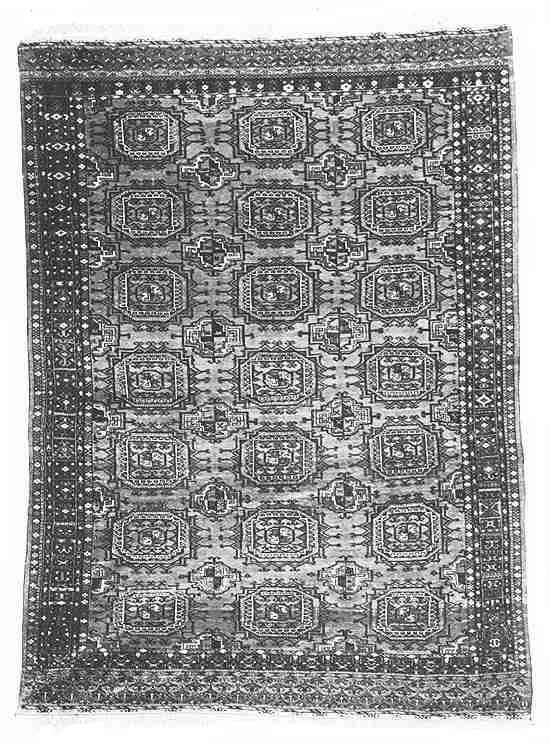
Plate 55. Turkoman Rug of
the Salor Tribes
As characteristic as the large bold octagons are the colours,
which however subdued are invariably of rich hues. Those of the
field consist of dark red, maroon, or reddish brown. The quarters
of the octagon are of a deep blue alternating with a red that is
lighter than the field. In some pieces this red is blood colour,
or nearly crimson, standing out in bold relief against the
adjacent blue and a field of maroon. Lines of green, orange,
yellow, and white often appear in the body of the rug; lines of
dark blue and a checkered pattern in red and blue are frequent in
the red webs of the ends.
Though these rugs are, as a rule, heavier and coarser in
texture than most other Turkoman rugs, the old pieces have a soft
plushy nap of fine wool and goat’s fleece, as well as
richness of tone, that is very attractive. They are exceedingly
durable and moderate in price.
Type Characteristics. Colours, principally dark
red and mahogany brown, with minor quantities of blue, green,
yellow, and white. Knot, generally Sehna, occasionally
Ghiordes. Knots to inch horizontally five to eight;
perpendicularly, seven to ten. The rows of knots are pressed
down, so that the warp is largely concealed at back. Warp,
coarse wool or goat’s hair; each thread encircled by a knot
is equally prominent at back, or one is slightly depressed below
the other. Weft, wool, of medium diameter, or occasionally
wool mixed with goat’s hair. A thread of weft crosses twice
between every two rows of knots. Pile, wool, of medium
length. Border, three stripes. Sides, a
goat’s hair double selvage of three or four cords. Both
ends, a broad web of reddish brown colour through which run
several narrow lines or several narrow stripes, and a long
fringe. Texture, stout. Weave at back is moderately
coarse. Usual length, five to twelve feet. Usual
width, two thirds to three quarters length.
Samarkands.—A
little over one hundred miles east of Bokhara, and on the
southern border of the desert of Red Sands, the river Zarafshan,
“Strewer of Gold,” has turned a plain of yellow loam
into an oasis. Forty-three large canals bring its waters to
fields of cotton; to vineyards; to orchards of apple, pear,
peach, and pomegranate; and to gardens of fragrant flowers. Here
is Samarkand, “The Mirror of the World.” Few cities
as old remain after passing through so many
vicissitudes of fortune. Alexander forced his way through its
gates, the Chinese Empire annexed it, and finally Tamerlane
seized and made it the magnificent capital of one third of the
known world. His tomb and other remaining monuments attest the
grandeur of that time when there was fostered here the art, the
luxury, and the splendour of the East.
The rugs known as Samarkands are woven in a district somewhat
eastward from the city and are often called
“Malgarans.” They are not to be compared with the
magnificent carpets that adorned the palaces and mosques of the
capital of Tamerlane; yet they possess a special interest, as in
them are combined features derived from both Eastern and Western
Asia. Either because this city, known as Samo-Kien, was once part
of the Chinese Empire, or as is more probable, because it is on
one of the great highways of caravan travel between China and
Western Asia, the Chinese element is particularly noticeable. It
appears in the colours that are in strong contrast; in the
general pattern that shows little affinity for those of Persian
or West Asian rugs; and even in the weave, in which silk is
occasionally mixed with the wool of both warp and pile.
The ground colour of the field is usually some shade of red or
madder, with blue and yellow appearing conspicuously in the
principal designs and border stripes. Or again, the field may be
blue, soft brown, gray, or tan, with which the colours of the
designs and borders, that may contain red, yellow, and blue,
invariably appear in strong contrast.
Few rugs have a more noticeable pattern, which consists
principally of rounded medallions. If there be but one, it is in
the centre; and if there be many, one is at each corner. They are
usually ornamented with Chinese scrolls or some geometric design,
as an eight-pointed star; but dragons, birds, or fishes are not
uncommon. Occasionally, also, flowers of Persian design, with
eight rounded petals, appear in the medallion, and others of
larger size cover the field; or they may even exclude the
medallion and constitute the principal motive. Some simple design
in fretwork gives finish to the corners of the field, which is
further covered with Chinese butterflies, scrolls, or archaic
flower forms. The borders are equally distinctive, and unlike
those of Chinese rugs are relatively wide and consist of several
stripes surrounded by an edging of uniform colour. One of the
stripes has generally a stiffly undulating vine; another a
continuous swastika design; and a third is marked with frets, the
barber-pole design, or a design which by
some is regarded as the sacred Chinese mountain rising from the
waves. In most pieces warp and weft are loosely woven, and the
pile is of a medium grade of wool; but in very old pieces the
wool is fine and lustrous.
Type Characteristics. Colours, principally red,
blue, and yellow. Knot, Sehna. Knots to inch horizontally
six to eight; perpendicularly, five to eight. Each half knot, as
it appears at back, is as long as, or longer than, wide. The rows
of knots are not firmly pressed down, so that the warp shows at
back. Warp, generally cotton, occasionally wool; one of
the two threads encircled by a knot is doubled under the other.
Weft, generally cotton, occasionally wool, of coarse
diameter and frequently dyed. A thread of weft crosses twice,
between every two rows of knots, and occasionally three times.
Pile, wool, of medium length. Border, three stripes
with a pink edging. Sides, a red or pink overcasting.
Lower end, web and warp loops. Upper end, web and
warp fringe. Texture, moderately firm. Weave at
back, rather coarse. Length, six to fourteen feet.
Usual width, one half to three fifths length.
Kashgars and
Yarkands.—Among the foothill plains at the western
end of the Chinese Empire, are the mud-walled cities of Kashgar
and Yarkand, that were ancient even in the days when Marco Polo
visited there. Situated in populous and fertile districts, each
has been a city of political and industrial importance; but on
account of the great divides that separate them from Western
Turkestan, Persia, and India, their commerce has been principally
with Thibet and China. Thus it has happened that only within
recent years have any of their textile fabrics reached Europe and
America, where they are still almost unknown. Yet even in the
remote past, these cities gained a reputation for the culture of
silk and the weaving of carpets. Moreover, at different periods
they were centres of luxury, so that it may safely be assumed
that many of their woven products were of a high order of
excellence.
These rugs, to be sure, come from a district lying within the
Chinese Empire; but it is so remote from the centres where the
well-known Chinese rugs have been and are woven, and is so much
nearer to West Turkestan and Afghanistan, that it seems best to
place them in the Central Asiatic group.
As a rule, such pieces as reach this country show crude
workmanship entirely lacking in graceful floral patterns or
artistic drawing. Octagonal forms, animals, and even
mythical creatures are often distributed over the fields so as to
give them a decidedly Chinese character. The narrow border
stripes ornamented with the swastika and fret forms are often
similar to some of the Samarkand stripes. The colours, which lack
the subdued richness of Persian pieces, are often light; but they
occasionally consist largely of tones of dark blue and red which
show Turkoman influences. Most of these rugs are interesting on
account of their quaintness and individuality; but few compare in
quality of material, weave, or artistic finish with other classes
of this group.
Beluches or
Beluchistans.—“When creating the world, the
Almighty made Beluchistan out of the refuse” are the words
of an old proverb, that refers to a land which formerly produced
some of the most interesting rugs of the East. In fact, the
thought is not surprising when the desolate character of the
country is considered; for a sandy, waterless waste stretches
over the greater part, and only in a corner to the northeast and
in narrow strips, where streams from mountain sides water small
valleys, is any cultivation. Across this sparsely settled land
and farther westward into the southeastern part of Persia,
untamed tribes of Beluches and Brahoes wander with their sheep,
goats, and large numbers of camels. Their rugs, woven on crudely
made looms, bear little resemblance to the more artistic floral
pieces of the Indian weavers to the east or to those of Kirman to
the west. Nor are they closely related to the Turkoman rugs with
which they are usually grouped. In fact, they possess an
individuality that once recognised is never forgotten; an
individuality due to the isolated condition of a country that is
protected from its nearest neighbours by barriers of deserts and
mountain ridges, and is possessed by a still unconquered people.
To these circumstances, also, it is due that the rugs are rarely
coloured with aniline dyes, though many modern pieces have been
chemically washed by dealers.
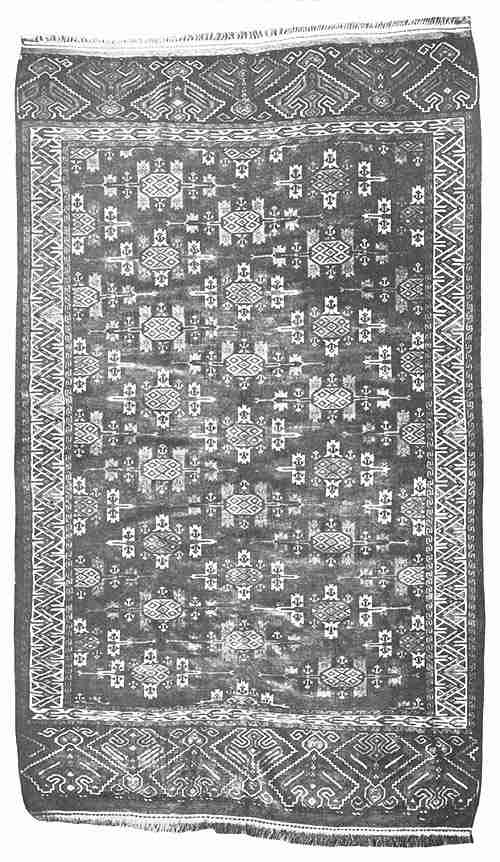
Plate 56. Yomud
Rug
One of the most distinguishing features of Beluchistans are
their tones of colour, that rarely depart from traditional usage.
They are principally a red of the shade of madder, a blue with
purple cast, and a dark brown that has sometimes a slight olive
tinge, particularly when appearing in the webs. Frequently, too,
dull tones of green are seen. Contrasting with these more subdued
ground colours is almost invariably some ivory which appears as
small detached figures in part of the border, or as
outlines of principal designs. The patterns also show
individuality and diversity. Most frequently they are geometric
and represent some ill defined octagons suggesting Turkoman rugs.
Or they may consist of a field covered with diagonal bands, with
large lozenges, or medallions, all of which are decorated
profusely with latch-hooks. Still others have some crudely drawn
flower design, as the Mina Khani, that tells of Persian
influences.
A fair proportion have the prayer pattern, consisting of a
large rectangular shaped mihrab, which is as high as, and
frequently higher than, wide. The borders, as a rule, consist of
three or four stripes. The main stripe is geometric and in the
guard stripes are running latch-hooks or the reciprocal trefoil,
though occasionally they are replaced by some conventionalised
vine or ribbon pattern.
Proportionally to their length few other rugs have such long
webs at the end, though they are sometimes entirely worn away
while the body of the rug is still serviceable. They are usually
coloured in harmony with the colours of the field, and are marked
with embroidered lines or simple designs. No other rugs have a
surface with more lustrous sheen, due to the soft, fine wool of
the pile, which in old pieces is short and closely woven, giving
a play of colours, and velvety appearance unsurpassed by any
other nomadic rugs. Many of the choicest pieces of Beluchistan
weave now on the market are the small saddle bags, that are of
rich yet subdued colours, and possess the character and sheen of
very old rugs.
Type Characteristics. Colours, principally red,
blue, and brown, with minor quantities of white. Knot,
Sehna. Knots to inch horizontally six to nine; perpendicularly,
seven to ten. The rows of knots are usually pressed down, so that
the warp does not show at back. Warp, wool; each of the
two threads encircled by a knot is equally prominent at back, or
one is slightly depressed below the other. Weft, of
coarse, wiry wool, of medium diameter. A thread of weft crosses
twice between every two rows of knots. Pile, wool, and
occasionally camel’s hair, of medium length. Border,
three stripes. Sides, a heavy goat’s hair selvage of
three or four cords. Both ends, a broad embroidered web
with warp fringe. Texture, slightly loose. Weave at
back is moderately coarse. Usual length, four and one half
to six feet. Usual width, two thirds to three quarters
length.
The border stripes of the Central Asiatic group are even more
geometric than the Caucasian; for it is rarely that any floral
forms are seen in them, though they may appear in the pile that
extends beyond the borders of the ends. Even the vines are so
angular as almost to lose their identity. Octagonal figures,
stars, frets, and latch-hooks are common. In fact, the group as a
whole, shows the influence of the Caucasian and Chinese groups
more than the Persian.
The stripe shown in Plate L, Fig. 1 (opp.
Page 250) is one of many found in the rugs known as Royal
Bokharas. The eight-pointed stars, as well as the small tent-like
designs, which may have been derived from the headstalls of
horses, are almost always found in it.
A well-known stripe of Princess Bokharas corresponding with
the pattern of the field, appears in Plate L,
Fig. 2. It represents a continuous series of designs shaped like
a Y, that were doubtless derived from forms of trees. More
frequently the stripe (Fig. 3) of broad, serrated diagonal lines,
that originally may have been intended to represent foliage, is
seen.
Another stripe found in Princess Bokharas and also in Tekkes
and Khivas is shown in Plate L, Fig. 4. It
forcibly suggests the Chinese fret. Sometimes it is used as a
primary but more frequently as a secondary stripe.
In Plate L, Fig. 5, is a stripe frequently
seen in Tekkes, which is interesting on account of the
eight-pointed stars and latch-hooks similar to those of Caucasian
rugs. Without doubt this is only one of the many instances
illustrating the migration of designs.
Plate L, Fig. 6 represents a stripe peculiar
to Yomuds. The running vine is most mechanically drawn and
fringed with latch-hooks, which are a constant feature of this
class.
Another Yomud stripe with vine in which serrations take the
place of latch-hooks is shown in Plate L, Fig.
7. Pendent from the vine are other hooks shaped like frets.
Very similar to an old Caucasian stripe is the one represented
in Plate L, Fig. 8; but in this stripe the
small designs are drawn so that the proportion of length to width
is greater; and it is probable that they were copied from a
wreath of leaves. This stripe is very commonly seen in
Beluchistans.
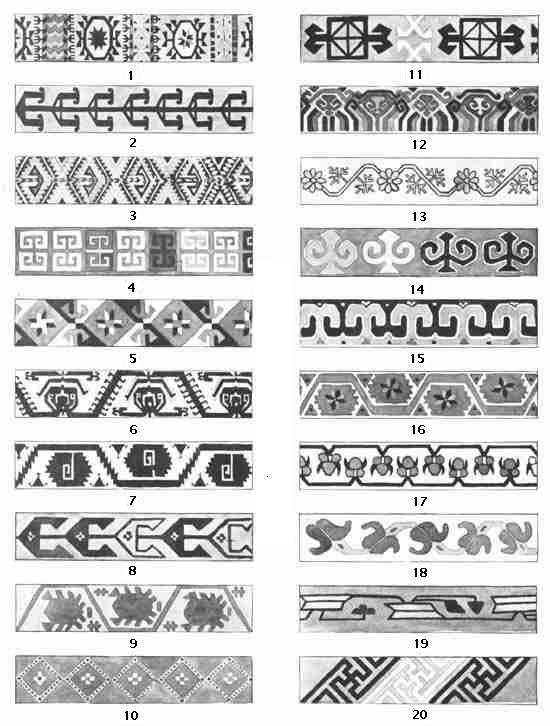
Plate L. Primary and
Secondary Border-stripes of Central Asiatic Rugs
Plate L, Fig. 9 represents a mechanically
drawn vine found in Beshires.
Well-known Afghan stripes are shown in Plate L, Figs. 10 and 11.
In Plate L, Figs. 12 and 13 are two of the
most typical and interesting stripes of Samarkands and Yarkands.
The first is supposed to represent the sacred mountain of Chinese
lore rising out of the waves. The second is a vine with leaves
and flowers, which suggest Persian influences.
A stripe with simple archaic pattern peculiar to Yarkands is
seen in Plate L, Fig. 14.
In Plate L, Fig. 15 (opp. Page 250), is a
well-known form of a secondary stripe found in Royal
Bokharas.
A stripe seen in both Princess Bokharas and Tekkes is shown in
Plate L, Fig. 16. It bears a slight resemblance
to some conventionalised vines found in other groups.
Stripes of running latch-hooks (Plate K,
Fig. 20, opp. Page 230) are frequently found in Yomuds, and
occasionally in Beluchistans.
In Beluchistans the reciprocal trefoils, so well-known in
Caucasian and Persian rugs, are very frequently used.
The pattern of a double vine, illustrated in Plate L, Fig. 17, is a Beshire stripe that suggests a Persian
influence.
In Plate L, Fig. 18, is the narrow pear
stripe that appears in a very large number of Afghans and in some
Khivas.
Two well-known stripes that belong to Samarkands are shown in
Plate L, Figs. 19 and 20. The pattern of the
conventionalised vine speaks of Persian origin, and the swastikas
suggest Chinese origin.
In Tekkes, Yomuds, Afghans, and Beluchistans the small
barber-pole stripes are constantly employed.
Legend:
KNOT—
H = Horizontally
P = Perpendicularly
WARP—
g = goat’s
hair
e = each equally
prominent
d = 1 to the knot
depressed
h = 1 to the knot doubled
under
WEFT—
g = goat’s
hair
No. = No. times crossing bet. two
round knots
SIDES—
O = overcasting
S = selvage
LOWER END
W = web
S = Selvage
K = Rows knots
L = warp loops
F = fringe
UPPER END
W = web
S = selvage
K = Rows knots
T = turned back and
hemmed
F = fringe
CENTRAL
ASIATIC |
KNOT |
WARP |
G =
Ghiordes |
S =
Sehna |
Number to
Inches |
w=
wool |
c=
cotton |
g |
At back |
| H |
P |
e |
d |
h |
Afghan
Beluchistan
Beshire
Princess Bokhara
Royal Bokhara
Tekke Bokhara
Khivah
Samarkand
Yomuk |
G
G
[G] |
S
S
S
S
S
S
S
S
S |
5-8
6-9
6-9
8-12
8-12
7-12
6-10
6-8
7-12 |
7-10
7-10
8-11
16-24
14-18
9-14
8-14
5-8
9-17 |
w
w
[w]
w
w
w
w
[w]
w |
[c]
c
|
[g]
[g]
g
[g]
[g]
[g]
g |
e
e
e
e
e
e
e |
d
d
[d]
[d]
d
[d] |
h
|
CENTRAL
ASIATIC |
WEFT |
SIDES |
LOWER END |
w =
wool |
c =
cotton |
s/j |
No. |
O |
S |
W/S |
K |
L |
F |
Afghan
Beluchistan
Beshire
Princess Bokhara
Royal Bokhara
Tekke Bokhara
Khivah
Samarkand
Yomuk |
w
w
[w]
w
w
w
w
[w]
w |
[c]
c
|
g
|
2
2
2/[1]
2
2
2
2
2
2 |
O
O
O
|
S
S
S
[S]
S
S
S |
W
W
W
[W]
W
W
W
W
W |
K
|
L
|
F
F
F
F
F
F
F
F |
CENTRAL
ASIATIC |
UPPER END |
NAP |
WEAVE |
TEXTURE |
| W/S |
K |
T |
F |
l = long
m = medium
s = short |
f = fine
m = medium
c = coarse |
l = loose
m = medium
f = firm |
Afghan
Beluchistan
Beshire
Princess Bokhara
Royal Bokhara
Tekke Bokhara
Khivah
Samarkand
Yomuk |
W
W
W
W
W
W
W
W
W |
|
[T]
|
F
F
F
F
F
F
F
F
F |
m
m
m
s
m/s
m/s
m
m
m |
m/c
c
c
f
m/s
m/f
m
c
m/c |
f
m/l
f
f
f
f
f
m
f |
[] indicates the less frequent condition.
HROUGHOUT parts of India are woven rugs known
as Dari, which are unlike the rugs of any other country.
They are pileless cotton fabrics, that may represent an
indigenous craft old as the Aryan migrations. Their designs are
of the simplest order; usually no more than plain stripes of
blue, red, and black, or only blue and white modified
occasionally by simple geometric figures. Furthermore, their
workmanship is poor, so that they possess little artistic merit.
Some pieces of large size are exported, but they awaken but
little interest compared with other kinds of rugs.
The weaving of pile carpets in India, on the other hand, does
not appear to have been the result of spontaneous growth or to
have flourished without artificial encouragement. It was probably
introduced by the Saracens, but carpets of elaborate design and
workmanship were not made till the reign of Shah Akbar, who
imported Persian weavers. Under his patronage and the
encouragement of his royal successors, the manufacture of pieces
that rivalled those of Persia continued for a hundred years, but
after the death of Shah Jahan, in 1658, the industry began to
decline. Nevertheless, for nearly a hundred years longer
excellent fabrics were produced as the result of the system that
was maintained in all the provinces by lesser potentates. This
system, which was also in vogue in parts of Persia, is described
by Dr. George Birdwood as follows: “The princes and great
nobles and wealthy gentry, who are the chief patrons of these
grand fabrics, collect together in their own houses and palaces
all who gain a reputation for special skill in their manufacture.
These men receive a fixed salary and daily rations and are so
little hurried in their work that they have plenty of time to
execute private orders also. Their salaries are continued even
when through age or accident they are past work; and on their
death they pass to their sons, should they have
become skilled in their father’s art. Upon the completion
of any extraordinary work, it is submitted to the patron; and
some honour is at once conferred on the artist and his salary
increased. It is under such conditions that the best art work of
the East has always been produced.”
After the overthrow of the Mogul dominion by Nadir Shah, in
1731, the production of carpets rapidly diminished and the
quality deteriorated. This was due to several causes. With the
conquests of the East Indian Company, that began in the middle of
the XVIII Century, and the extension of trade into every
district, large quantities of antique carpets became the property
of the Company or of those in its employ. Many of them, including
sumptuous pieces that had adorned the palaces of the descendants
of Tamerlane, found their way to England. Thus were removed many
of the masterpieces that had been an inspiration to the weavers.
Moreover, with the overthrow of native princes their patronage
ceased; and later, when looms were established in jails for the
employment of convicts, undesirable competition reduced the wages
of free labour. Still more pernicious was the introduction of
aniline dyes, and the elimination of individual taste by
supplying patterns, that were often of European origin, to be
mechanically copied. Thus it followed that, in spite of the
efforts of Mr. Robinson and of others, for nearly half a century,
to resuscitate the art and restore it to its former condition,
weaving in India, to-day, rests purely on a commercial basis; and
the workmanship is almost as mechanical as the manufacture of
machine-made carpets in Europe or America.
Yet to the cloud hanging over the weaving of India is a
brighter lining. European companies have established factories
where natives are employed making rugs that in quality equal the
products of Smyrna and Sultanabad. Some of them, indeed, are even
more firmly woven than the Persian products from which they are
copied. In many of the towns, also, are looms where the weavers,
who are mostly boys, enjoy more independence. Moreover, the
companies, realising that the future of their business depends on
the quality of the fabrics, are largely discarding aniline dyes.
It is now possible, therefore, to obtain Indian rugs of excellent
workmanship and colours at very moderate prices; but
individuality, representative of native character and
temperament, is entirely lacking; and in its place is simply a
reproduction of Persian or European patterns.
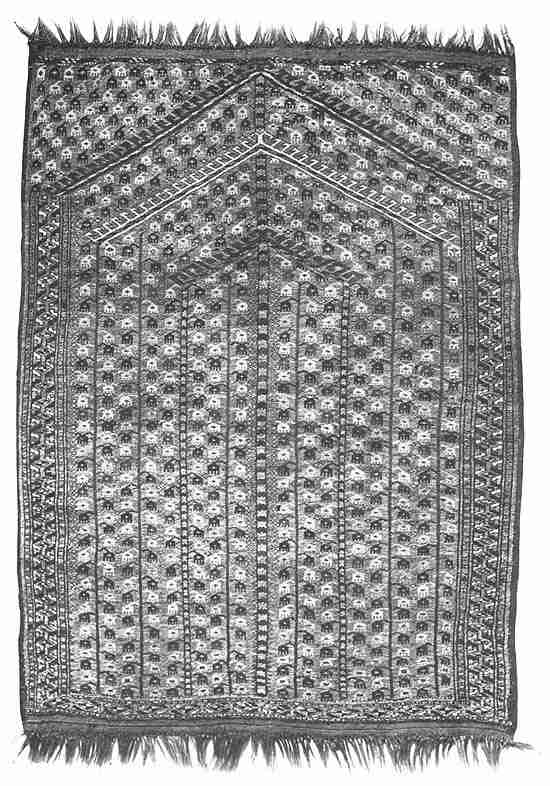
Plate 57. Beshire Prayer
Rug
Any arrangement of these rugs in sub-groups must be arbitrary,
as similar conditions of early foreign
influence, royal patronage, and the jail and factory systems,
have prevailed throughout India. Yet since the northern part has
been more directly under the influence of the courts and more
intimately connected with Herat, which seems to have left a
strong impress on the weavings of all the surrounding country, it
is convenient to make a distinction between the rugs of Northern
and Southern India.
The principal rug-producing centres of Northern India at
present are Srinagar, Amritsar, Lahore, Multan, Allahabad, Agra,
Mirzapur, Sindh, Jubbulpur, and Jaipur.
Srinagar.—From the
extreme northern part of India come the rugs of Kashmir, which
are often named after the capital of the province, Srinagar, the
“City of the Sun.” To a large extent, they resemble
the far more famous shawls that were woven in the central valley,
where winds the Jhelum, that some believe first suggested the
pear design. The pieces woven before the British occupation of
India were of excellent quality and contained delicate colour
schemes, that were exceedingly pleasing; but the products of the
last half century show deterioration. The colours are harsher,
the mechanical drawing of the patterns show European influence,
and the borders resemble too closely the central field to have
distinct characters. Yet many of them are now dyed with vegetable
colours, and are stoutly woven with the soft and silky wool for
which this district is renowned.
Amritsar.—On
account of famine and several other causes, a large number of the
people of Kashmir migrated about the year 1840. Some of them
settled at Amritsar, where they followed their former craft of
making shawls, until a change of fashion, that occurred about the
year 1870, deprived many of their occupation. These turned to rug
weaving and thus gave an impetus to that industry.
Amritsar is now the most populous and wealthy city of the
Punjab; and as some twenty thousand men and boys are employed at
the looms, it is one of the leading rug-producing centres of
India. Yet before the exhibition of Indian rugs at the
World’s Fair in Chicago, in 1893, there had not been any
demand in this country for its rugs. For a long period it has
been the home of weavers who found in the surrounding mountains
and valleys the best of wool, but before the revival of the
industry their patterns and workmanship were of an inferior
character. Under the factory system, conducted by American and
English firms, has been a marked improvement. Both dyes and wool
are excellent, and the technique of weave equals what is found in
the best of Persian products, to the square inch are frequently
two hundred Sehna knots; and since when tying a knot one thread
of warp is doubled under the other, as in Bijars, and the threads
of weft are pressed down very firmly, the texture is unusually
close. The nap is short; the sides are overcast; and as a rule,
the lower end has a cotton web and the upper end a web and
fringe. The moderate prices for rugs of such excellent dyes and
workmanship are possible only on account of the wage of the
weaver, which does not exceed one eighth what he would receive in
this country.
There is nothing, however, in the pattern to distinguish these
rugs from others; for in the drawing the greatest latitude is
exercised. It may be a copy of a European carpet, or some Indian
or Iranian antique. Of recent years, many well-known modern
Persian patterns have been followed, so that not infrequently
these pieces are mistaken for the products of Kermanshah or
Sultanabad.
Lahore.—About the
year 1580, the imperial carpet factory of Shah Akbar was
established at Lahore, the capital of the Punjab; where during
the reign of the Mogul princes were produced many of the best
examples of Indian weaving. It was here that, in 1634, was woven
the well-known carpet now in the possession of the
Girdler’s Company of London. Some of the pieces that still
remain show wonderful delicacy of drawing and brilliancy of
colouring. At a much later period, under the British rule, the
jail system of weaving was inaugurated, and rugs were made with
both woollen and cotton foundation. Within more recent years the
factory system followed; and on account of the nearness of
Amritsar to the capital, some foreign firms have weaving
establishments in both cities. It is not surprising, then, that
there should be a resemblance in their products, which is seen in
the finish of sides and ends and in the character of weaving,
which usually shows one thread of warp to each knot doubled under
the other; but as a rule the rugs of Lahore come in lighter
shades and are woven with fewer knots to the square inch. In the
guards of the border often appear geometric figures; but the
patterns in other respects largely follow well-known Persian
drawing, though leaf and flower are more artistically portrayed
and the designs are less crowded.
Multans.—One of
the most ancient cities of the Punjab is Multan, which during the
vicissitudes of centuries was more than once captured by early
Mohammedan conquerors and also by Tamerlane. Its woven fabrics
are of three types: the Dari, which are made almost
exclusively in the jails; rugs of cotton pile, that have been
made only within the last sixty years; and rugs of woollen pile,
that have been produced for an unknown period. As the looms on
which they are made are unlike those of other districts, and the
weavers are but little affected by external influences, it is not
surprising that the pile carpets not only display uniqueness of
pattern rarely seen in other Indian pieces but also possess
peculiarities of weaving as well as of material. Usually they are
of moderate size, but some have a breadth of twelve feet. There
are seldom more than one hundred knots to the square inch and
occasionally only nine, so that the texture is coarse. Not
infrequently a single knot encircles four threads of warp, and
between two rows of knots is a single thread of weft. Almost all
of the weavers are Mohammedans, who have a tradition that they
originally came from Persia; yet their products contain few of
the Iranian characteristics, since the field is usually occupied
by geometric designs or crudely drawn floral patterns. As is
seldom the case with weavers who dwell in cities, these dye their
own wool, using both vegetable and aniline dyes. The principal
colours are bold and strongly contrasting tones of red, yellow,
and blue. Some of the cotton rugs, however, have a single colour
of bluish shade. On the whole, the Multan rugs possess great
individuality but little artistic merit.
Agra.—Almost
within sight of the minarets of the Taj Mahal are prison walls
where convicts of Agra ploddingly weave. In 1891, Dr. John Hurst
“saw a long row of prisoners for life, who were chained to
each other by the feet, engaged in weaving a rug for Queen
Victoria, and another for the ex-Empress Eugenie.” Most of
these pieces are of cotton foundation. Each thread of warp is
equally prominent at the back, and the texture is looser than in
Amritsars. The nap is short, and the fibres of the knots blend
well together. Not infrequently the fields are monotones of
delicate shades of blue, green, or fawn colour. As a rule, the
rugs are very large and heavy; and it would seem that this
has always been the case, as Mr. Robinson suggested that the
reason for establishing looms at this place was the early demand
for carpets too large to be imported on elephants.
Allahabad.—Situated like Benares on the
banks of the Ganges, and next to it the most sacred city of India
to the faithful Brahman, is Allahabad, capital of the
northwestern provinces. Its geographic and political importance,
as well as the fact that each year half a million or more
devotees visit it, have been important factors in the growth of
its industries, one of which is the weaving of rugs. Yet the
numbers produced have never been great. As a rule they are of
large size, and are loosely woven with each thread of warp
equally distinct at the back. Few of them equal the best examples
of the Amritsar looms.
Mirzapur.—When it
is considered that Mirzapur is the centre of a very populous
cotton-producing district in the valley of the Ganges, to the
west of Benares, and is the seat of important manufactures, it is
not surprising that it is noted for its carpets. Those made half
a century ago were well woven and dyed with fast colours, but
largely on account of the employment of convicts, the texture of
those made since then is coarse and loose, the patterns are poor,
the colours crude. To a limited extent a higher grade of wool has
been imported as a substitute for the harsh local product, but
the result has not been satisfactory. These rugs accordingly find
small favour among those who appreciate artistic qualities, and
give little satisfaction where durability is the chief requisite.
It should be noted, however, that within recent years efforts
have been made to raise their standard.
Jubbulpur.—Two
hundred miles to the southwest of Allahabad is Jubbulpur, capital
of a district of over half a million people. A century ago many
beautiful rugs were woven there; but since the establishment of a
School of Industry, in 1850, the character of weaving has
retrograded rather than advanced. In 1880, Dr. Birdwood wrote of
its rugs as follows: “The foundation, as now scamped is
quite insufficient to carry the heavy pile which is a feature of
this work; and is moreover so short in the staple as to be
incapable of bearing the tension even of the process of
manufacture. Jubbulpur carpets often reach this country (England)
which will not bear sweeping, or even unpacking. I know of
two which were shaken to pieces in the attempt to shake the dust
out of them when first unpacked. The designs once had some local
character, but have lost it during the last four or five
years.” Within recent years few have been exported.
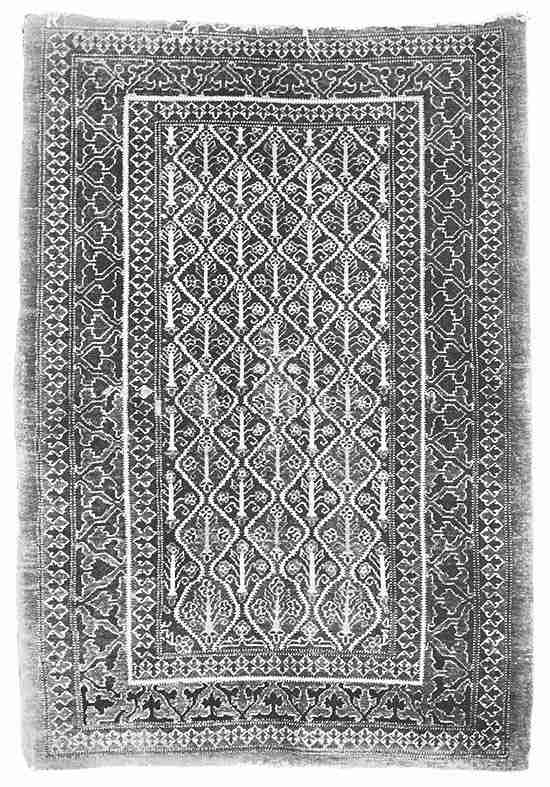
Plate 58. Beshire
Rug
Sindh.—Formerly
good rugs were woven at Sindh, one hundred miles above the mouth
of the Indus; but after the introduction of aniline dyes their
colours, as well as patterns, deteriorated. In the poorest pieces
the foundation was of cotton and hemp, and cow hair was
frequently used for pile. Very few of them have been imported
into this country.
Jaipur.—In the
palace of the Maharajah at Jaipur, the great commercial centre of
Rajputana, are some of the most beautiful carpets that remain in
India. Native appreciation is also apparent in the present
workmanship of the district weavers. There is nothing crass or
inelegant in the patterns which follow the pleasing drawing of
Persian rugs. The vine, leaf, and flower, trees, and animals are
faithfully portrayed. The texture of weave is excellent.
The principal rug-producing centres of Southern India are
Madras, Marsulipatam, Ellore, Vellore, and Bangalore. Rugs are
also woven in Hyderabad, Warangal, and Ayyampet in the Tanjore
district.
Madras.—Only
within a comparatively recent period have rugs been made at
Madras, the early stronghold of the British in South India. Over
half a century ago, native products, woven in the interior towns
of the Dekkan, were shipped by way of Coconada to that city and
were sometimes known as Madras rugs. Two of these pieces, which
were sent by Mr. Vincent Robinson to the South Kensington Museum,
differ widely in harmony of colours, beauty of design, and
delicacy of workmanship from the present products of Madras. Yet
the latter have much to commend them. Some are made in the jail,
others in the School of Fine Arts, and others in the Anjuman
Industrial School. All are made of good wool, coloured with
vegetable dyes. Great diversity appears in the patterns, as some
are copied from antique carpets represented in the “Vienna
Carpet Book,” others are copied from rugs of Northern
India, Persia, and Asia Minor. As a rule, the fields
are well covered with repetitive designs, that give them the
appearance of factory-made carpets.
Marsulipatam.—Two
hundred and fifty miles north of Madras on the Coromandel coast
is the city of Marsulipatam, one of the earliest of the British
settlements in India, from which the East India Company shipped
rugs over two centuries ago. At that time they were among the
finest produced in that country, but the demands of agents for
articles that could be produced as cheaply as possible resulted
in the use of inferior materials and in poorer workmanship. Most
of the dyes are aniline. The patterns, that once were executed
with marvelous beauty of detail, gave way to crude drawing until
“these glorious carpets of Marsulipatam have sunk to a
mockery and travesty of their former selves.”36 Few of them are any longer imported into this
country.
Ellore.—Not far
from the delta of the Godavari river is the town of Ellore, where
a few centuries ago some Persians settled, and where their
descendants, faithful to early tradition, have followed the craft
of weaving. Here in former times were produced some of the best
rugs in Southern India; and even as late as 1883, Mr. E. B.
Havell wrote that he had seen pieces woven to meet special orders
which were equal in point of interest and material to the old
specimens in the hands of connoisseurs of London or in native
palaces. This is one of the few districts in Southern India where
the industry exists outside of jails. In the town and surrounding
country are about four hundred looms operated by some three
thousand people, who are Mohammedans.
In the better class of rugs, in which vegetable dyes are still
used, and the yarn is often a native product of wool obtained
from sheep of the uplands and spun by shepherds, something of the
old style of craftsmanship remains. On the other hand, a very
large percentage of the rugs which are intended solely for export
trade are of an inferior order, since many of their colours are
obtained from aniline, their weaving is inferior, and their
patterns are ordinary. Mr. Henry T. Harris, in his report on the
Madras Industrial and Art Exhibition, 1903, said: “The
exhibits of carpets sent from Ellore were poor in conception,
weave, and colour.... The patterns in use were poor and often
modifications of cheap Wilton, Kidderminster, and
German power loom designs. Some of the old patterns are still
with the weavers, but unfortunately there is no trade demand for
this fine class of goods, the old dyes are being forgotten and
have given place to cheap anilines unskilfully
applied.”
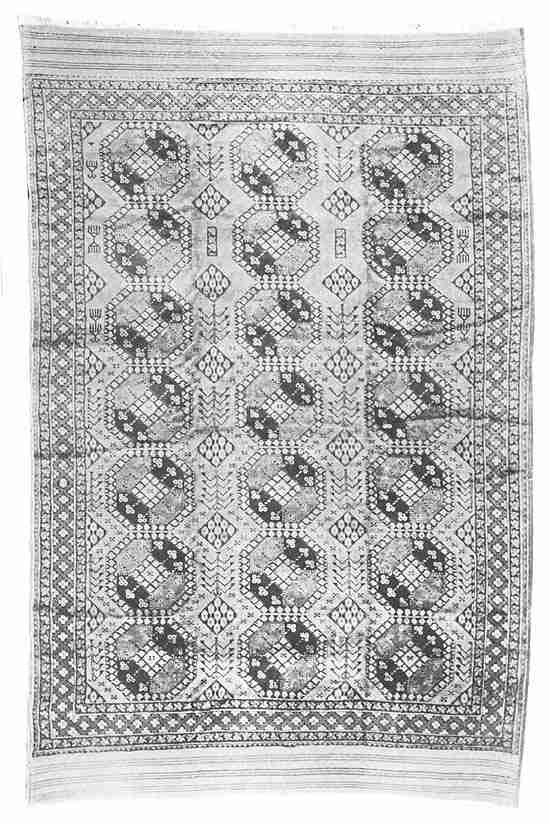
Plate 59. Afghan
Rug
In length, the rugs are from a few feet to twenty-four feet.
The warp is of cotton, and the weft is sometimes of jute or hemp.
The pile is of an inferior quality, as it consists largely of the
wool taken from a sheep after death, known as “dead”
wool, or as “Chunam” or “limed” wool,
since it is necessary to treat it with lime. Unfortunately
vegetable dyes do not produce in it the same results as in
“live” wool; and since the scarcity of wool in
Southern India frequently necessitates its use, aniline dyes are
for this reason alone often employed. The number of knots to the
square inch is relatively small. The patterns show great
diversity, as Persian features predominate in the older rugs; but
both geometric and floral designs are employed in the modern.
Vellore.—Almost a
hundred miles to the west of Madras is the town of Vellore, where
native weavers once produced fine woollen carpets on their own
looms. A few specimens of these old pieces are preserved in the
jail to serve as patterns for the convicts, who now weave the
only rugs of the district. There are some fifty looms; and as the
largest is about thirty feet wide, almost any size of rug may be
obtained. The product rests on a commercial basis and depends on
the market demands, restricted by the material available and the
limitations of the weavers. According to the order, the rugs may
be coloured with vegetable or aniline dyes; they may have warp
and weft of cotton, jute or hemp; and they may have from six to
sixteen knots to the inch measured horizontally and
perpendicularly. In the patterns, which are as promiscuous as
those of Ellore and often similar, the Herati design with a
corresponding border is not infrequently used. Recently an effort
has been made to exclude all but vegetable dyes and improve the
craftsmanship.
Bangalore.—The
principal weaving industry in the Mysore state is centred about
Bangalore, a city of about two hundred thousand inhabitants. Its
founder, Hyder Ali, is said to have established looms and to have
imported the first weavers. In 1908, the nine jail looms, of
which the largest had a length of nearly thirty feet, were
constantly occupied in making rugs to order. The number
of knots to the square inch varied greatly
according to the quality required; and the dyes were almost
entirely aniline. In the city are employed a much larger number
of weavers, who clean and spin the wool produced in the district,
as well as dye it by secret processes, that they guard most
carefully. The closeness of texture; the colouring by aniline or
vegetable dyes; and the use of cotton, jute, or hemp, for warp
and weft, are regulated by the requirements of the trade, which
is conducted largely by two or three English firms.
Hyderabad.—Splendid craftsmanship was once
displayed in the rugs made in the cities of Hyderabad and
Warangal, in the district of Hyderabad. The weave was exceedingly
fine, and the colours were brilliant but harmonious. Now few rugs
are produced in these cities, and they have poor patterns and
wretched colours.
HE existence of Chinese rugs of age and merit
was almost unknown to the Western world until the close of the
last century, when a few pieces reached Europe, where they
aroused the just admiration of art connoisseurs. About the
beginning of this century a larger number, which were obtained
during the Boxer revolution by reason of the spoliation of homes,
temples, and palaces, that never before had been entered by
foreigners, were exported to this country. In New York City,
between the years 1908 and 1910, some of them were sold at public
auctions for prices that stimulated collectors in China to search
for more. But they have proved to be scarce when compared with
other Oriental rugs, so that, as yet, the general public are only
slightly familiar with them.
Moreover, little is known about their antecedents, for written
records are exceedingly meagre. It has been suggested that many
were made in Eastern Turkestan along the highways that extend to
Persia and India. But it is more probable that they were woven in
Eastern China, where other branches of art reached a remarkable
development under the patronage of wealthy mandarins and the
imperial court. Even if they are not the product of an indigenous
growth, the knowledge of weaving may easily have been acquired
from Western Asia; since it was not unusual several centuries ago
to import weavers from one country to another to instruct native
craftsmen. Furthermore, the features which at a glance
differentiate these rugs from all others, proclaim their Chinese
character. The diaper patterns that cover the fields of some of
them, and the foliate and floral forms that appear in most of
them, not only are unlike those of any other groups, but have
well-known Chinese elements. A more distinctive feature are the
colours, which are relatively few. Many of them, as tan, yellow,
and blue, are of shades unlike what are seen in other rugs.
Even more distinctive than these are the reds, which never have
the primary colours found in other groups but resemble the tints
of ripe apricot, peach, pomegranate, and persimmon. Similar tones
are seen in old Chinese porcelain. The geometric and floral
ornamentation also shows relationship to what is found in the
products of other branches of Chinese art. More characteristic
still are the small designs which are so related to the
philosophic and religious thought of the people and to the
industrial and social life that their Chinese origin is
unmistakable.
Though it be granted that nearly all were woven in Eastern
China, it is not possible satisfactorily to assign them to
different classes based on locality; yet without doubt important
distinctions, observable also in the early paintings and
porcelains and resulting largely from differences of race and
character of country, exist between those woven in Northern
China, where the highest appreciation of art existed, and those
woven in Southern China. It is probable, however, that such
marked local distinctions as are found in other groups never
existed in Chinese rugs. Such distinctions as do exist relate
more to stages in development of the textile art, so that the
natural classification is based on the successive periods when
they were woven.
The absence of written and traditional history regarding the
weaving of these periods is by no means an insuperable obstacle
to such classification. By a careful examination of large numbers
of rugs, it is possible to arrange them with reasonable accuracy
in series that represent progressive forms of ornamentation and
design from the archaic to the modern. A most important aid to
this arrangement is the interdependence so conspicuous in the
several arts of China; for designs of innumerable articles with
well-established ages, especially of the ceramic art, have been
copied by the weavers.
Technical peculiarities in weaving are also an aid in
determining the period to which rugs belong. An important
distinction, for instance, often exists in the manner in which
the material is spun. If pieces of yarn be taken from old rugs
and carefully examined, as they are untwisted, the simpler,
cruder methods of spinning practised in former days are often
apparent. In some of the oldest fabrics that remain the wool was
very loosely spun. Irregularities in the size of yarn are also
more noticeable in old than in modern pieces.
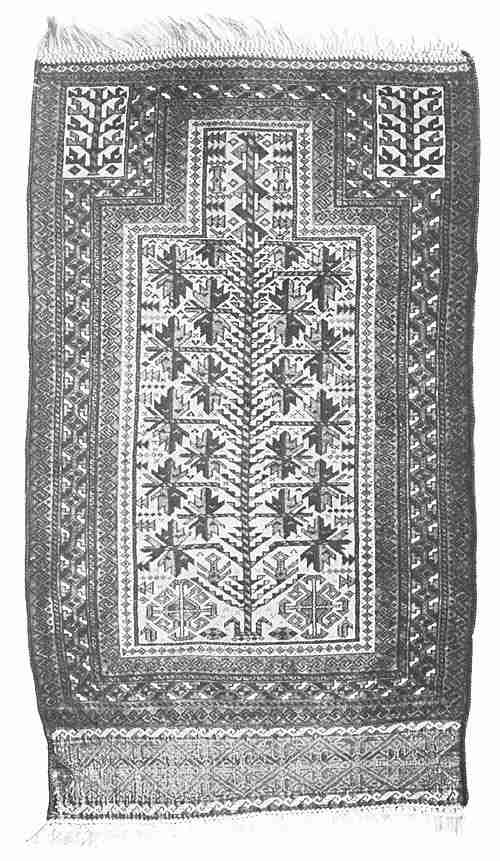
Plate 60. Beluchistan
Prayer Rug
More important often in determining the relative age of a rug
than either design or technical
peculiarities of weaving, is the shade of colour; for however
excellent were the original dyes and whatever care was exercised
in their application, they slowly changed under the mellowing
influence of time to tones that are obtained by no human process.
Furthermore, as is the case with porcelains, certain colours were
peculiar to certain periods. For instance, golden browns are seen
mostly in pieces woven before the middle of the XVIII Century,
and azure blue in pieces woven before the XIX Century. Yellow
with a lemon or citron cast is found principally in pieces woven
since the beginning of the XVIII Century; and green is rarely
found in pieces woven before the middle of the XVIII Century.
Aniline dyes were not introduced into China much before the year
1870. The time when a rug was woven may safely be regarded as not
more remote than the period when the ornamentation and designs it
contains were generally adopted; yet it may be much more recent,
as the oldest designs were copied even after the adoption of
newer ones. It is necessary, then, in determining the age of a
rug to consider not only the evidence of the spinning, the
weaving and designs, but also the evidence of colour.
Though Chinese rugs have features that distinguish them from
other groups and divide them into separate classes; they also
have many features in common. All are woven with the Sehna knot.
In all but the earliest rugs the warp and weft are of cotton;
each thread of warp is equally prominent at the back; and the
weft, which is coarser than the warp, crosses twice between two
rows of knots. The nap of both old and modern rugs is almost
always wool or silk, and rarely, if ever, jute or cotton. The
sides are finished by carrying the weft around the outer threads
of warp, but never so as to form a wide selvage. The lower end,
as a rule, has a very narrow web and warp loops; and the upper
end has a narrow web and fringe. Compared with other groups they
are generally more loosely woven. These and other features of
resemblance and of distinction will be more fully noticed in
considering the rugs of different periods.
In rugs of this group are constantly seen symbols intimately
associated with the religious and philosophic thought of China.
One of them is the Sacred Mountain rising out of the waves of
eternity, which is an old Chinese emblem, though more frequently
found in rugs of Samarkand and Yarkand. Others are the cloud-band
and the Joo-e. There are also mythical creatures, as the dragon,
emblem of imperial power; the Ky-lin, partly deer, partly
unicorn; the Fung-Kwang or phœnix; and the
lion-dog. Still other symbolic and decorative designs are the
figure Shou and the stork, emblems of longevity; the bat and
butterfly, denoting happiness; the conch, wheel of law, and the
two fishes, which are Buddhist emblems; and the lyre and chess
board, which are symbols of the literati.
It is not improbable that rugs were woven during the Sung
dynasty (960-1280 a. d.), when for
nearly three centuries prosperity prevailed, literature and art
flourished, and the court at Hang Chow was maintained with
imperial splendour; but as far as is known, none of them exist.
Nor do any remain that may have been woven during the Yuan
dynasty (1280-1370) distinguished by the reign of the illustrious
Mongol prince, Kublai Khan; though designs appearing in later
rugs were used in kindred arts of these and preceding
periods.
Ming Rugs.—The
oldest Chinese rugs that remain were probably woven near the end
of the Ming period, or during the first half of the XVII Century.
It may reasonably be assumed that they were superior in quality
to those of any former period, since during this time Persia and
India were producing their greatest woven masterpieces; and other
branches of Chinese art were marked by an advance over the work
that had preceded. Yet, on the whole, it was a period of ebb in
the splendid accomplishments of intellectual and artistic effort
that marked the Tang and Sung dynasties.
Such pieces as exist are distinguished by careful workmanship,
archaic designs, and sobriety of colour. Most of the rugs were
woven with warp and weft of cotton. Some, intended principally
for wealthy mandarins or the imperial court, had pile of silk
attached to warp and weft of cotton; and others were made
entirely of silk. Fewer in number, but constituting the most
sumptuous products of the Chinese weavers’ art, were the
rugs of silk woven on a web of metal threads.
The field of many of these early rugs contained all-over
patterns. Sometimes the repeat designs are of octagonal shape and
are arranged in horizontal and perpendicular lines, so as to
leave small diamond-shaped spaces between diagonally placed
octagons. Within these designs are often the emblems of happiness
or longevity, floral motives, and sometimes archaic dragons. In
another well-known pattern the field is completely covered with a
swastika-fret and marked at regular intervals with diagonal rows
of bats, emblematic of happiness. Occasionally a field of
plain colour contains an irregular arrangement of objects used
for sacrificial or sacred purposes. Again, it may be covered with
an all-over pattern of small archaically drawn dragons resembling
some of the earliest designs in Chinese decorative art, or of
most conventionalised floral forms on mechanically drawn
stems.
The essential feature, however, of a large number of these
rugs, and one that probably antedates the all-over pattern, is a
central medallion surrounded by a field that is either plain,
that is marked with a subdued diaper pattern, or contains what is
known as the “tiger skin” pattern, consisting of
waving lines repeated throughout the field. The medallions may be
either octagonal or, as is more frequently the case, rounded; but
the defining lines are angular and generally represent frets.
Sometimes they contain archaic dragons, which are so
conventionalised in a few pieces that it is apparent that from
them originated many of the Chinese scrolls. In other pieces, the
shape of the central medallions and the designs which cover them
suggest most forcibly that they were copied from old mirror
backs. The corners of the fields may contain simple scrolls, but
more frequently they correspond closely in drawing with the
central medallions.
The borders are equally typical. They are invariably narrow,
and generally consist of a single stripe which is figured and
surrounded with a coloured edging. Probably over three quarters
of the rugs of this period have a stripe with a pattern of
swastika-frets. Two of these stripes, which are very old
patterns, are illustrated in Plate N, Figs. 1
and 2 (opp. Page 274). Occasionally some form of the key pattern
appears in the inner stripe, but almost all Chinese rugs that
have two border stripes with figures belong to a later period.
Many of the oldest borders are without figured stripes, and
consist merely of one or more stripes of plain colour.
The few colours used in the rugs of this period have deep,
rich tones. Undyed dark brown or blackish wool was occasionally
used in the outer edging that surrounded the field or in the
narrow border stripes; but more frequently the same colour effect
was obtained by the use of corrosive dyes that in time have often
eaten the wool almost to the foundation of warp and weft. Wools
dyed with corrosive browns are also used in the fields and
enhance the effect of designs of contrasting colours, which stand
out in bold relief. Other colours, as soft dull yellow and shades
of blue, are also seen in the borders. The field is usually
richer. In some pieces it is a deep red; in others it is a soft
yellow, golden brown or yellowish tan, that shows the effect of
time on what were originally several shades of apricot. Dark and
light blues, sky blue, and robin’s egg blue, as well as
jade green and bottle green, are also found in these old pieces.
In the metal and silk rugs the glint of silver even though
tarnished, adds lustre to colours that have grown deeper and
richer with age.
Kang-hi.—During
the first years of the Tsing dynasty, that continued from 1644 to
its recent overthrow, the country was so occupied by wars waged
between the conquering Manchoos and the still resisting followers
of the Ming dynasty that art was nearly at a standstill. But
during the reign of the illustrious Kang-hi, 1662-1722, art
revived and enjoyed one of the most splendid periods of its
history. There is, however, a noticeable difference between the
rugs that belong to the early and to the late part of this reign;
so that it is convenient to divide them into the early Kang-hi
pieces, that were woven during the last part of the XVII Century,
and the late Kang-hi pieces, almost all of which were woven at
the beginning of the XVIII Century. This division is also
convenient; as many rugs cannot be definitely assigned to the
reign of a particular emperor, and, accordingly, the broader
distinction of assigning them to different centuries is
frequently adopted.
In weaving, as in making porcelain, many of the products of
the late Ming were still copied during the early Kang-hi period,
but there was a freer use of colour and a more decorative
ornamentation. Many of the figures are still geometric. Frets are
conspicuous in the fields of large numbers of these pieces. The
dragon also is a favourite motive; but in the scrolls that
represent the legs and bifurcated tail, and in the
conventionalised head, the resemblance to the mythical monster is
almost lost. Sometimes two or more of these constitute a
medallion in the centre of the field, in which others are grouped
with regularity; while similar forms occupy the corners. Some of
the rugs in which the fields are covered with sundry objects, as
scrolls, vases, altar pieces, and sacred plants, also belong to
this period. The borders of these and late Kang-hi pieces have
frequently an outer edging of brown and a single border stripe
with swastika-fret. In a few pieces, the stripe has a
well-balanced scroll which has been developed from designs of
conventionalised dragons and frets that appear in the central
medallion and in the corners of the field. Occasionally, however,
there is an inner stripe with the key meander. The colour scheme
of the late Ming, including the golden browns and deep blues, is
largely employed in rugs of this period.
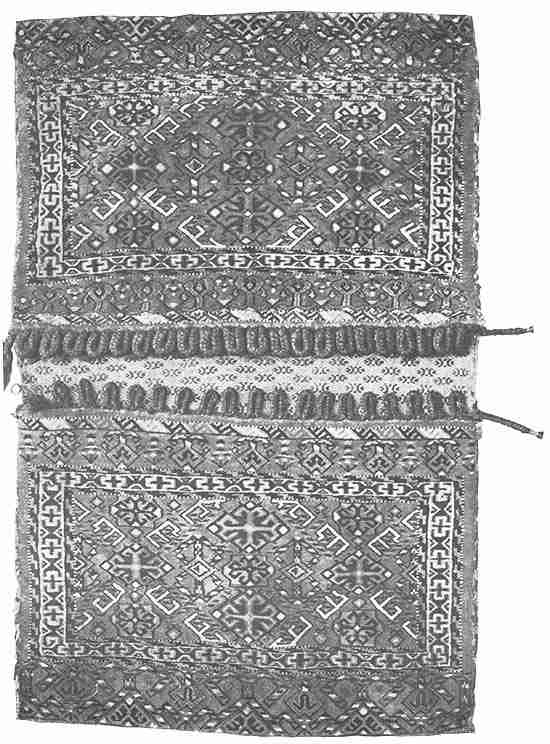
Plate 61. Turkoman
Saddle-bags
The same influences that resulted during the late Kang-hi
period in the remarkable development of decorative art as applied
to porcelains, produced a corresponding effect in the rugs woven
at the same time. Manchurian ideas and taste gave renewed spirit
to earlier Chinese style. The fields were not infrequently
covered with sub-patterns of fret work, on which medallions
appeared more prominently. The geometric figures were largely
supplanted by foliate forms. Even when the central medallions and
corner figures are of frets or stiffly conventionalised dragons,
the fields are often covered with delicate scroll or foliate
sub-patterns that support floral forms resembling the lotus or
the peony. The drawing of some of these has a Western character,
and there is little doubt that at this time the art of Persia had
a strong influence on the weaving of China. In other pieces of
this class, the foliate and floral forms no longer appear as
sub-patterns but become the prominent feature in the decoration
of the field; and the conventionalised flowers are arranged with
precision in diagonal or perpendicular lines. To this period also
belong rugs of a distinct type, in which the field represents a
blending of pictorial and symbolic ideas, as, for instance, a
homeward flight of swallows; or a grove where butterflies flit
among the leaves, and deer with sacred fungus, emblematic of
longevity, wander.
The employment of border stripes of uniform colour was still
continued, but there was a tendency to employ more elaborate
designs in many of the figured stripes. It is not unusual to see
single or double vines with conventionalised flowers; and though
the drawing is mechanical, the relationship to Persian art is
apparent. Yet in most of these pieces the swastika-fret is used.
A noticeable difference also exists in the colour scheme of many
of the late Kang-hi rugs, which frequently display brighter
colours. Much of the yellow, for instance, contains more red,
giving it a golden hue known as the “imperial
yellow.”
Yung-ching.—During
the short reign of Yung-ching (1722-1736), though many of the old
patterns were followed, the tendency to adopt more ornate forms
begun during the first part of the XVIII Century continued.
Manchurian ideas were now a strong factor in
Chinese art, so that the use of colours and ornamentation
followed broader lines. To this period are assigned most of those
rugs in which designs are defined by lines of contrasting colour
that has been so treated that the lines are depressed and throw
the designs into bold relief. It is very difficult, however, to
definitely determine that any particular rug belongs to this
period; since the transition in colour scheme and patterns was
gradual; and the effect of time on dyes, one of the most reliable
factors in determining age, depends somewhat on their exposure to
the elements and to use. But broadly speaking, figures of leaf
and flower were more frequently adopted than in preceding periods
and designs became less conventionalised and more artistic. Lemon
and citron shades of yellow, also, became more prominent during
this period.
Keen-lung.—The
long reign of Keen-lung, lasting from 1736 to 1795, was one of
the most prolific for Chinese art. To this period may safely be
assigned most of the existing rugs made before the XIX Century,
as well as many of the finest porcelains. The rugs partake of a
more cosmopolitan character than those which had preceded; for
not only are many of the designs and colours strictly Chinese,
but others are of a Persian character, and others still suggest
Mohammedan influences observable in the products of Turkestan and
India. Moreover, many of the designs show a delicate shading that
is not observable in the rugs made during the early part of the
century. As a whole they are the most ornate of Chinese rugs.
Woven after the inspiration of Persian masterpieces had left its
strongest impress on Chinese weavers, and decoration in kindred
arts had assumed a luxurious style, they represent in the drawing
of leaf and flower, of birds, butterflies, and emblems of early
philosophy and faith, and in the colours that blend with rare
harmony, the most elaborate and voluptuous expression of native
craftsmanship.
In the best examples the geometric, and many of the stiff
conventional forms which continued through the XVII and the early
part of the XVIII Century, disappeared. In their place was a
greater refinement of design, a greater accuracy of drawing,
which found expression in floral forms that reached their highest
development at this time and became characteristic of it.
Occasionally they are represented in profile as is usually the
practice in Western Asia, but more often are represented as
viewed from above. Some of them, as chrysanthemums,
peonies, sunflowers, and orchids, are most dainty and
naturalistic. The fields of many of these pieces are covered with
such flowers carefully arranged in harmonious groupings of leaf,
bud and flower, but never with the formal and exact balance of
old Persian carpets. Not infrequently mingled with them in the
same piece are more conventional designs that belong to an
earlier period; sometimes there is a single central medallion;
and occasionally there are a large number of them. As a rule
these medallions are entirely floral, and in rugs made during the
latter part of this period they display elaborate ornamentation
that distinguishes them from earlier ones; but now and then they
contain fabulous creatures, as the lion-dogs, by which in a few
instances they are entirely replaced.
Perfect technique of weaving, accuracy of drawing, and
subdued rich colouring are the characteristics of this unusual
piece. The knots of the fine woollen yarn are tied with a
precision not frequently seen in Chinese rugs, and the shortness
of nap discloses the faithfulness with which an artist of no
ordinary ability has represented plants and flowers. Their soft
tones stand out in relief against a background now darkened and
enriched by the mellowing influence of time. Moreover, the
motives of the upper and the lower half of the field, even to the
minutest detail, show an exact balance. Many old Chinese rugs are
of uncertain age, but this piece has been attributed, not without
reason, to the Kang-hi period.
Loaned by Mr. Nathan Bentz
There are also many other well-known types of Keen-lung rugs.
Surrounding the central medallion of some pieces are grouped the
Taoist symbols; emblems of the literati, as chess boards,
scrolls, and the lyre; as well as tripods, flower vases, fans of
state, fruits of abundance, emblems of honours, and symbols of
longevity and happiness. To this class also belong many of the
pieces which have neither medallions nor corner pieces, but have
fields completely covered with a pattern of continuous foliate
stems and conventional flowers, repeated with exact precision of
drawing. Likewise, in a few pieces the field is completely
covered with an all-over pattern of small hexagonal or other
geometric figures containing a conventionalised flower, strongly
suggesting Turkoman influences. Some of the “Grain of
Rice” rugs, also, were woven during this period.
The borders are as distinctive as the fields. Only in a few
pieces is the swastika meander seen, but in its place is often
the T pattern. The key patterns represented in Plate N, Figs. 7 and 8 (opp. Page 274), as well as the dotted
line (Fig. 22), are also largely employed. Almost all of these
rugs have two ornamented stripes, and occasionally three, to
which is added an outer margin of plain colour. In a few pieces
both stripes are geometric; but generally one is floral and one
geometric, in which case the wider, that, with very few
exceptions, is the floral, is the inner one. Very rarely the
border contains two floral stripes; and now and then Buddhist
emblems and other devices are introduced.
The breadth of artistic conception expressed in designs is
accompanied by a wider scope of colour, in the use of which these
rugs may conveniently be grouped in three subclasses. The first
is the Blue and White, with ground of ivory or
ashy white and designs that have shades of light or dark blue.
The second comprises those in which the ground is some shade of
yellow. Sometimes it has a tinge of lemon, orange, or apricot.
Again it is what is known as dull, golden, mandarin, or imperial
yellow. The overlying designs may contain a different shade of
yellow from that of the field, an ivory white, a blue, or a red.
The third subclass comprises those in which the ground colour is
some shade of red; such as persimmon, terra cotta, crushed
strawberry, apricot red, or a deep salmon pink, which is rare.
The overlying designs may be a shade of blue, ivory white,
yellow, gray, and even green. Colours of both field and border
are sometimes the same but are more frequently complementary. As
a whole, the elaborate designs, delicate shading, and rich
colours rank these rugs among the most beautiful products of the
Chinese loom.
The rugs woven during the reigns of Kea-king (1796-1820) and
Tao-Kwang (1821-1850), extending to the middle of last century,
repeat with slight modification the patterns of the preceding
period, though there is a tendency to use larger and coarser
designs. The colours, too, are similar, yet they lack the deep
richness that is matured only with the lapse of great time. Many
of these rugs, as well as some woven still later, before the
introduction of aniline dyes and factory processes, are
beautiful; but as a rule the modern pieces lack the refinement of
technique observable only in those produced before the beginning
of the XIX Century.
The study of medallions which occur in fields of Chinese rugs
is not only interesting but is an important aid in determining
their age; yet it should be remembered that approved patterns
were often repeated even after the introduction of more elaborate
styles. Many of the oldest medallions were copied from bronzes or
mirror backs, and their drawing is geometric except as
embellished by some conventionalised figures of the dragon. By a
process of evolution these figures, in turn, were converted into
scrolls, which in time were replaced by elaborate leaf and flower
patterns.
In Plate M, Fig. 1 (opp. Page 272), is a
“Shou” design of octagonal shape, copied from an old
rug which was probably woven during the early part of the XVII
Century.
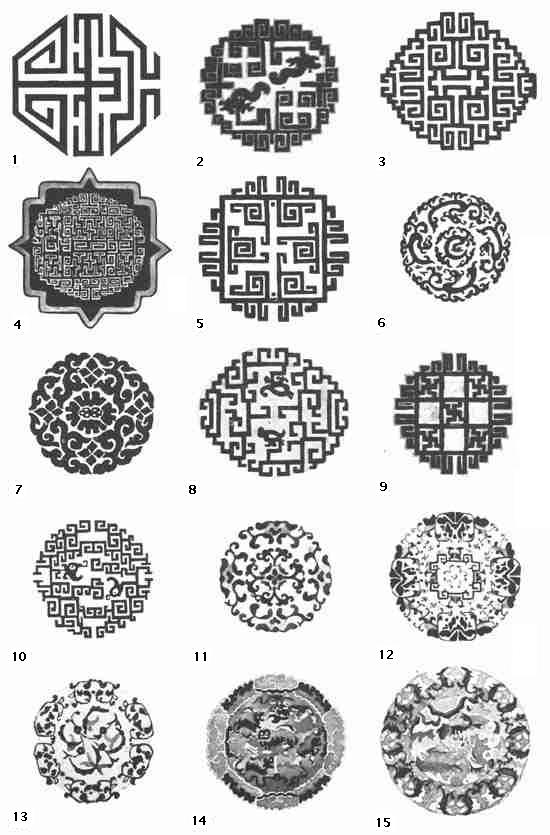
Plate M. Medallions in
Chinese Rugs
Figs. 2, 3 and 4 of Plate M, represent
fret-covered medallions, which also are found in rugs of the same
period. The first is probably the oldest pattern; and the last,
to judge by the panel surrounding it, was apparently copied from
a bronze mirror back.
In Plate M, Fig. 5, is a copy of a medallion
similar to the one shown in Plate M, Fig. 2,
but with the dragons replaced by frets.
A medallion of greater interest is illustrated in Plate
M, Fig. 6. It shows the evolution of scrolls
from dragons, of which the heads alone betray their origin. Such
medallions are found mostly in the earliest rugs.
By comparing Fig. 7 of Plate M with the
preceding, it is apparent that its scrolls had a similar origin,
but in this one the dragon heads have entirely disappeared. The
design is characteristic of the early Kang-hi rugs.
In Plate M, Fig. 8, is represented a
medallion that closely resembles some of the earliest period; but
the more accurate drawing and clearer definition of lines shows
that it is a later copy. It is found in late Kang-hi pieces.
To this period, also, belongs the geometric pattern with
swastikas represented in Plate M, Fig. 9.
Another medallion with frets and dragon heads is shown in
Plate M, Fig. 10. The particular rug from which it was copied was
probably woven about the Yung-ching period; but there is little
doubt that similar medallions appeared in older rugs.
In Figs. 11 and 12 of Plate M, are
represented two medallions with foliate designs that were largely
employed in the early Keen-lung period. A comparison of the first
with Fig. 13 of Plate M, shows an interesting
step in the evolution of the Chinese drawing.
A very different medallion pattern of the same age is shown in
Plate M, Fig. 14, in which an encircling border
consists of cloud-bands.
Also during the Keen-lung time first appeared medallions with
accurately drawn flower designs. One of this period is shown in
Plate M, Fig. 15. Wreath-like borders, such as
are seen in this and the preceding one, are found in XVIII and
XIX Century pieces.
The knowledge that certain border stripes antedate others in
definite sequence of time, is another aid in determining the age
of Chinese rugs. As was seen to be the
case with medallions, the earliest stripes were purely geometric.
In others, still very old, appeared forms of conventionalised
dragons, which again were replaced by simple scrolls and these by
ornate floral forms. But it should be remembered that earlier
designs were often copied in later rugs, so that the evidence of
age is merely contributory.
Stripes containing the swastika meander were used almost
exclusively in the oldest rugs. Figs. 1, 2, and 3 of Plate
N (opp. Page 274), represent three old forms,
which rarely appear in any pieces woven since the Kang-hi time.
The pattern of Plate N, Fig. 4, in which
alternate swastikas are reversed, is also very old.
The usual drawing of the swastika stripe is shown in Plate
N, Fig. 5. It is found largely in Kang-hi rugs,
and if used in more recent fabrics, is often accompanied by a
stripe with some other pattern. As illustrated here, the facing
of the swastika is reversed in the middle of the stripe.
The shading of Plate N, Fig. 6, which is
somewhat similar to Plate N, Fig. 4, is
characteristic of the Keen-lung and subsequent periods.
In Figs. 7, 8, 9, and 10, of Plate N, are
Key and T patterns, which are found in rugs of the Kang-hi and
subsequent periods, but rarely in earlier pieces. When employed
in rugs woven later than the middle of the XVIII Century they are
often shaded. These meander and key-patterns are of great
antiquity; and though the drawing is exceedingly simple, it is
supposed that the figures from which they were derived once
symbolised clouds and thunder.
A very interesting stripe derived from dragons is illustrated
in Plate N, Fig. 11. The rectangular frets
represent bodies of which conventionalised heads alone betray
their origin. The graceful scroll in the middle was also probably
derived from dragon forms. This stripe is seen in old Kang-hi
rugs.
The rectangular frets and floral forms are combined in an
unusual stripe (Plate N, Fig. 12) that appeared
in rugs which were probably woven about the Yung-ching period. It
shows the influence of older traditions on which are ingrafted
the later inspiration.
Still more interesting is a stripe (Plate N,
Fig. 13) seen in what are known as Buddhist rugs of the Keen-lung
period. In different parts of the border appear the Buddhist
emblems, the Joo-e, conch, wheel of law, and knot of destiny,
separated by cloud-bands and foliate and floral motives.
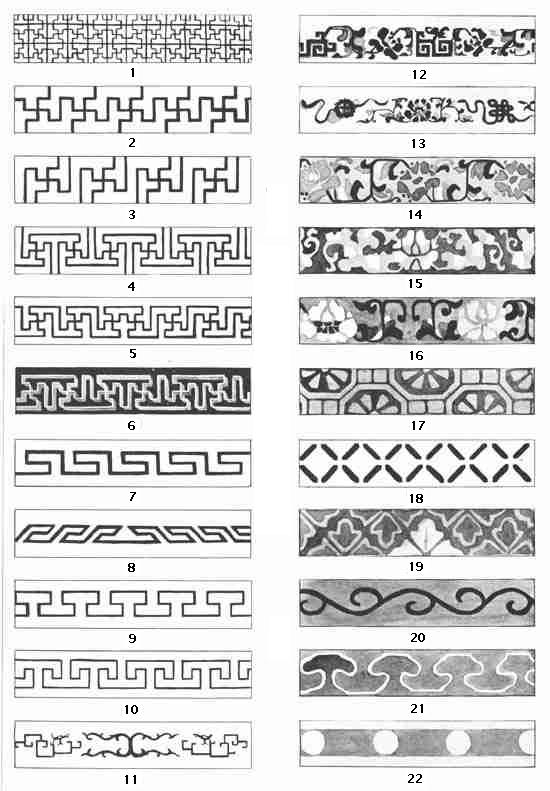
Plate N. Primary and
Secondary Border-Stripes of Chinese Rugs
The tendency to use more ornate forms in the Keen-lung and
later rugs is shown in Plate N, Figs. 14, 15,
and 16, which illustrate three stripes that with slight
modifications are found in large numbers of Chinese rugs of the
last half of the XVIII and the XIX Centuries.
The stripe illustrated in Plate N, Fig. 17,
on which are represented halves of octagonal discs containing
conventional flower forms, is found in some rugs woven as early
as the first part of the XVIII Century, as well as in more
subsequent pieces. The central fields of some rugs in which it is
found have geometric Ming patterns, and others have floral
conceits that suggest Persian influences.
In Figs. 18, 19, 20, and 21, of Plate N, are
represented simple stripes found in XVIII Century rugs. The last
of these, which is found in Keen-lung porcelain, shows a marked
resemblance to the reciprocal trefoil so common in Persian
pieces.
The simple dotted stripe (Plate N, Fig. 22)
was rarely employed before the middle of the XVIII Century, but
has been constantly used since then.
 ILIMS have a special interest apart from their
beauty and utility, as some of them undoubtedly resemble the
early fabrics of the Egyptians and Babylonians from which were
evolved the more durable pile carpets. The different links in
this evolution can only be conjectured. Yet it is not unlikely
that such pieces as the nomadic kilims, which occasionally have
little tufts of wool attached for ornament or loose threads of
weft hanging from one side, first suggested the greater
durability and warmth that would be derived from a woven fabric
completely covered with tufts of yarn.
ILIMS have a special interest apart from their
beauty and utility, as some of them undoubtedly resemble the
early fabrics of the Egyptians and Babylonians from which were
evolved the more durable pile carpets. The different links in
this evolution can only be conjectured. Yet it is not unlikely
that such pieces as the nomadic kilims, which occasionally have
little tufts of wool attached for ornament or loose threads of
weft hanging from one side, first suggested the greater
durability and warmth that would be derived from a woven fabric
completely covered with tufts of yarn.
It is also certain that the most delicately woven kilims have
likewise been evolved from cruder forms. In fact, the different
steps in this evolution correspond to three separate styles of
weaving still in vogue. The earliest products which were made
subsequent to the primitive weaving of uncoloured warp and weft
were doubtless similar to the simple fabrics now used to line the
under side of saddle bags, and consisted of a warp and weft of
uniformly coloured threads. A much more advanced style, induced
by a desire for ornamentation, was the representation of patterns
which required the use of different coloured threads of weft. As
these threads were never carried beyond the edges of each
pattern, their loose ends were at first allowed to hang at the
back, giving an appearance somewhat similar to what is seen in
Soumaks. The third and most finished style, representing much
higher workmanship, was produced by deftly disposing of the ends
of threads of weft so that they should be concealed and thus
permit each surface of the kilim to be exactly the same.
Each of these kinds of weaving is constantly seen in the East.
The first not only is used as a lining for saddle bags, but is
frequently substituted for them. It is also sometimes used as the
only floor covering, or again is laid as a
protection beneath valuable carpets. It often replaces the
heavier felt for tents, and indeed is utilised for all purposes
requiring a strong material like canvas. The second is found
among nomadic weavers, especially those of Asia Minor; who
naturally waste no unnecessary labour in weaving kilims with a
delicate finish, which would be quickly marred by the rough usage
that they receive. The third, which is the more elegant product,
is invariably not only of excellent finish but of carefully drawn
patterns. In this country, the last two are used principally for
portieres and couch coverings; but in the Orient they still
serve, as they have from the remotest times, for floor coverings;
and because of the custom of removing the shoes when entering a
house, last for a great many years.
Though these three styles represent the principal variations
in kilim weaving, there are a few pieces with embroidered
pattern; and embroidered stitches are sometimes added to
represent some simple design, or as is frequently the case in
Shirvans, to make more prominent the separate horizontal
compartments.
When weaving a kilim, the threads of warp are strung as in
piled rugs, and number from six to eighteen to the inch according
to the texture. There are generally about twenty threads of weft
to the inch, measured at the front or back; but in pieces of the
finest workmanship, there may be as many as fifty, and in the
crudest only eight or nine. At the sides of the kilim, the
threads of weft encircle the last thread of warp as at the sides
of any pattern; but at the ends, the threads of warp are braided
about a heavier added cord, or else are tied in knots, from which
their loose ends are permitted to hang like tassels.
The patterns are usually geometric; and even when an attempt
is made to copy floral figures, the drawing inclines to the
rectilinear. If a straight line representing the side of a figure
is horizontal, or in the direction of the weft, it will often be
several inches in length; but a straight perpendicular line never
exceeds an inch in length. This is because the threads of weft
are never carried from one pattern to another or to the adjoining
field, but are turned back at its defining edges, so that an
opening is left, which would impair the strength of the fabric if
it were of much length. Accordingly, if it is desired to
represent a pattern with perpendicular sides, it is necessary
that the edges be slightly uneven. But here necessity is turned
to advantage, as this unevenness or fringing softens
lines that otherwise would be harsh. Defining
the outlines of many figures is yarn of different colours, which
either may be woven like other threads of weft, or when it serves
the purpose of closing the space between adjacent threads of
warp, may be attached by stitches. Borders find slight favour
with kilim weavers, and in most pieces they are entirely wanting
or only present at one end. Even when they completely surround
the field, there is generally some difference in design or colour
between the stripes of side and end. Prayer arches are found in
some of the kilims, but their outlines rarely correspond closely
with those of piled rugs.
The colours, by which alone the patterns are distinguished,
are largely responsible for the character of the kilim. Threads
of weft of every hue that is seen in piled rugs are employed in
these pieces; yet the colouring never appears the same, since
there are lacking the lustre and deep wealth of tones due to the
length of pile, in which appears an almost imperceptible
gradation from the ends that are exposed to the light and have
incurred the mellowing influence of the elements to the part
which retains more of the original colours and seems darker,
because it is more concealed. Indeed, on account of the lack of
pile, the colours and patterns would seem harsh were it not for
the irregularities of perpendicular and diagonal lines, the
devices of latch-hooks, and other peculiarities that convey to
the eye an impression of blending. Moreover when the designs are
large, the effect of the colour is always severe; but when the
field is covered with innumerable small figures, it is greatly
softened.
As kilims are much less durable than rugs that have a pile to
protect the warp and weft, it is not surprising that few of great
age remain. The oldest piece of which we have any knowledge is a
fragment obtained by Dr. M. A. Stein, the archæological
explorer, from the ruins near Khotan, in Eastern Turkestan, of an
ancient settlement, which was buried by sand drifts about the
fourth or fifth century anno domini. The weave is almost
identical with that of modern kilims, and has about fourteen
threads of warp and sixteen threads of weft to the inch. The
pattern consists of narrow stripes of blue, green, brownish
yellow, and red, containing very small geometric designs. With
this one exception, so peculiarly preserved, there are probably
very few over a century old.
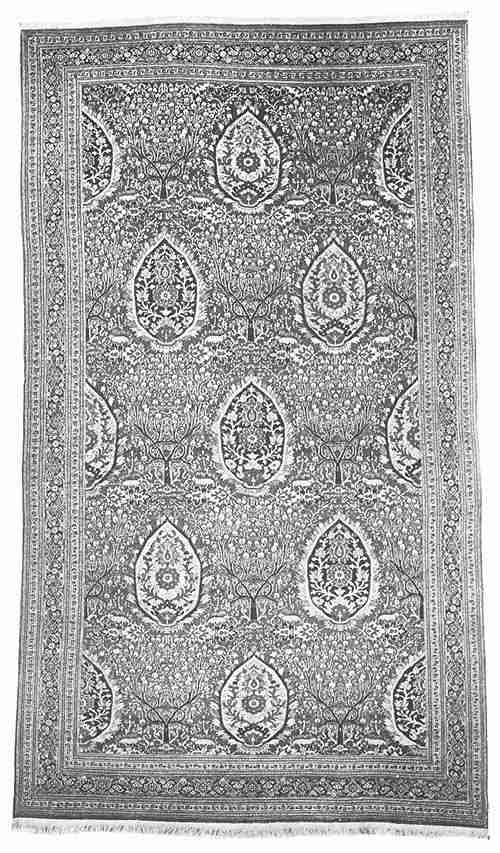
Plate 62. Srinagar
Rug
Though kilims are now made in most of the districts where
piled carpets are woven, very few classes are recognised. This
is because it is difficult to
distinguish between most of them, and such differences as exist
are with few exceptions unimportant. The best known classes are
the Sehna, Shirvan, Karaman, Kurdish, Turkish, and Merv.
The Sehna kilims are usually of small size, and rarely exceed
a breadth of four and a half feet and a length of seven. They are
far superior to all others in the delicacy of colour, daintiness
of design, quality of material, and character of workmanship.
Their patterns, including border, are identical with those of the
piled rugs; and the colours, to which at a short distance the
small figures of the Herati design give the effect of blending,
are the same. As is not the case with other kilims, the warp is
of cotton or linen and there are generally from fourteen to
sixteen threads to the inch. The weft is of wool, and to an inch
there are often nearly fifty threads encircling a thread of warp
as they cross and recross. The old pieces, like the rugs of which
they are true copies, are rapidly becoming scarce. They resemble
tapestries and are unfit for hard usage.
A large percentage of the kilims now sold in this country are
Shirvans. Their fields are divided into a number of parallel
horizontal compartments or bands a foot or more in width
separated by narrower bands. Not infrequently the principal
figures of the wide bands are hexagons surrounding smaller
geometric figures; and through the more narrow bands runs a
waving line or a parti-coloured cord. Another peculiarity,
occasionally seen, are the ray-like projections of uniform colour
fringing the edges of the sides. As a rule, there are no borders,
but at each end are two or more narrow bands that give the effect
of a border. In some pieces webs of plain colour extend beyond
the bands; and the ends are fringed with loose threads of warp.
The colours are always pronounced, because of lack of shading,
and consist mostly of red, blue, and ivory. Yellow and green are
also used. These kilims are much heavier than the Sehnas, and
also larger, as the average size is about five by nine feet; and
some are even seven by twelve feet.
From the district of Karaman in Southern Asia Minor, such a
large number of kilims were formerly imported into Europe that
the general name of Karamani was applied to all kilims. They are
still made there by many of the tribes of Turkish or Turkoman
origin, who wander over the Taurus mountains, and like all their
fabrics are stoutly woven. Their average size is about four and a
half by eight feet. In colours and patterns,
they resemble many of the Kurdish kilims from the districts
farther to the east.
A distinction similar to what exists in the piled rugs of the
Kurds, and dependent on the district in which they are made, is
observable in their kilims, as those which come from the Persian
border have carefully drawn designs, that are generally lacking
in others woven in the mountainous watershed of the Tigris and
the Euphrates. Many of these are coarsely woven, and from the
back hang the loose ends of threads of weft, that in more
artistic pieces, are removed. Moreover, in modern pieces the
colours are often crude or even garish. Some of the kilims have
large diamond-shaped figures containing small designs; others
have horizontal bands in which are woven embroidered devices
suggestive of the so-called Bagdad portieres; in many are wide
spaces without designs; but whatever the pattern, there is
usually a parti-coloured cord running through the web at the
end.
In many parts of Asia Minor are made kilims that are usually
classed as Turkish. They are of large size, and since they are
used mostly for portieres or curtains, are divided
perpendicularly into equal halves, that at times are united by
stitches. The tribes that make them also make large numbers of
smaller prayer kilims with pointed arches suggesting the Ghiordes
design. Some of them are beautifully woven, yet the finest
workmanship is shown in pieces known as “Kis-kilims”
or girl’s kilims. These are made with the utmost care,
since they are intended as a bride’s gift to her husband;
and a sentiment of romance, and the hope that her skill may weigh
favourably in the estimation of her accomplishments, contribute
to influence the weaver. Sometimes even a lock of hair is added
as a charm, or coloured beads as a talisman.
The Christians who live permanently about Oushak, and are,
accordingly, not under the necessity of making such small pieces
as can conveniently be carried by wandering tribes, weave some of
the largest kilims. Most of them are at least six feet in width
and many are much wider.
The best known kilims from the Central Asiatic group are known
as “Merv Kilims,” since they are woven by Turkoman
tribes who inhabit the desert near the old capital of Merv. The
brilliant colours found in the products of more Western tribes
are entirely wanting, and in their place are the few subdued,
rich tones so characteristic of all Turkoman weavings. These
pieces are stoutly woven, and since the pattern is
represented by diagonal lines, there is no open work. The designs
are largely of diamond-shape, and are arranged in parallel
horizontal lines on a field that is usually surrounded by a
border profusely ornamented with carefully drawn latch-hooks. A
heavy embroidered selvage, from which hang loose threads of warp,
often occurs at the ends. These kilims are noted for their
durability, and are usually of large size.
In the city of Dera Ghazi Khan, four miles from the Indus
river, are woven kilims in which warp and weft are of wool, as is
not the case with almost all the rugs of India. They are made by
the women in their own homes and display an individuality which
also is rare in Indian textile fabrics. In a monograph on
“Carpet Weaving in the Punjab,” Mr. C. Latimer says:
“The Dera Ghazi Khan rug, which belongs really to the kind
of fabrics known as kilims, is woven in stripes, with designs
between them, and it is interesting to notice that the patterns
employed were by local tradition originally copied from the robes
of the Pharaohs of Egypt.”
Though all such Oriental weavings lack the precision of
drawing and the delicacy of minutely varied colour so frequently
found in piled rugs; though they never display high, artistic
perception or poetic instinct, nevertheless some of the oldest
pieces with designs suggestive of the workings of a primitive
imagination untrammelled by the conventions of art, and with a
chaste simplicity of colour that lends an atmosphere of dignity,
possess a subtle charm that awakens an intense interest.
HE owner of an Oriental rug will find the
pleasure to be derived from it will be greater if he knows where
and by whom it was made. This is particularly true if it is one
of those pieces of which the charm depends more on its
individuality than on the masterly handling of line and colour.
The study of classification, therefore, will well repay the
effort; though unfortunately it is often discouraging, since it
involves a consideration of the characteristics of a hundred
different classes, almost all of which are found to have
exceptions to the best known types. To add to the difficulty, the
opinions of dealers in regard to the less known classes are very
often erroneous; and detailed descriptions, even at the best, are
unsatisfactory. Without a long personal experience in handling
rugs, combined with careful study, it is impossible to become
expert; but familiarity with one class makes it easier by
comparison and a process of elimination to distinguish
others.
The beginner should first learn to identify each of the six
groups. Of these the Chinese can readily be distinguished by
their well-known patterns, which are found in no other part of
the Orient except in the rugs known as Samarkands, Yarkands, and
Kashgars; and the Indian may generally be recognised by the
realism and formal arrangement of their floral patterns.
Relatively few of either group are found in the United States;
and as about ninety per cent of the rugs belong to the other four
groups, they alone will be considered in detail. Leaving out of
consideration, then, the Chinese and Indian rugs, it should be
remembered:
(a) That, as a rule, rugs from Persia
have floral patterns; and rugs from Asia Minor, Caucasia, and
Central Asia have geometric.
(b) That figures with latch-hooks
belong principally to rugs of the Caucasian group and, to a
limited extent, to the rugs of the Asia Minor group.
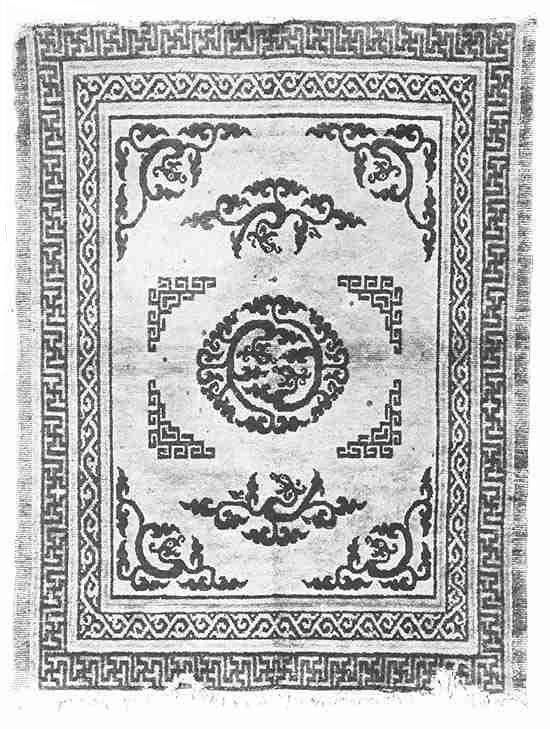
Plate 63. XVIII Century
Chinese Rug
(c) That fields covered with designs of
octagonal or diamond shape belong to rugs of the Central Asian
group.
(d) That about two thirds of the
Persian group have cotton warp; and the remaining third, as well
as the Asia Minor and almost all the Caucasian and Central Asian
group have woollen warp.
(e) That about one third of the Persian
group have one of the two threads of warp encircled by a knot
doubled under the other so as to be hidden at the back; and that
this is not the case with the remaining two thirds nor with
almost all classes of other groups.
(f) That, with few exceptions, the
Persian rugs have a side finish of overcasting; and the other
groups have both overcasting and selvage.
(g) That the rugs from Persia and
Central Asia have both light and dark colours which, though rich,
are subdued and harmonious; that the rugs of Asia Minor and
Caucasia have colours that are often gaudy and inharmonious; and
that the rugs of the Central Asian group have dark tones of red,
blue, and brown.
(h) That all of the rugs of Asia Minor
and Caucasia have the Ghiordes knot; that the rugs of Central
Asia, with rare exceptions, have the Sehna knot; that the rugs of
Persia with woollen warp have the Ghiordes knot; and that those
with cotton warp have either the Ghiordes or the Sehna knot.
(i) That the few classes of rugs which
have very long end-webs belong to the Central Asian group. Of the
classes with moderately long end-webs, several belong to the
Central Asian and the Asia Minor groups, only two belong to the
Persian group, and none belongs to the Caucasian group.
Excluding the Indian and Chinese rugs, it follows from the
above statements that:
(1) A rug is from Persia or Central
Asia,— |
If it has a Sehna knot. |
(2) A rug is probably Persian,— |
If the pattern is distincly floral |
If the warp is cotton; |
If one of the two threads of warp encircled by a knot is doubled
under the other. |
(3) A rug is probably from Asia Minor,
Caucasia, or Central Asia,— |
If the pattern is geometric; |
If the sides are selvaged. |
(4) A rug is probably from Asia Minor or
Caucasia,— |
If the colours are gaudy or inharmonious. |
(5) A rug is probably from
Caucasia,— |
If the designs are largely fringed with latch-hooks. |
(6) A rug is probably from Central
Asia,— |
If the field is covered with octagons or diamond-shaped designs,
and has dark tones of red, blue or brown; |
If it has long webs at the ends. |
Of these four groups the Persian has the largest number of
classes, some of which can only with difficulty be distinguished
from one another. They may, however, conveniently be divided into
the following sub-groups, depending on the technical
peculiarities of the weaving and the material of the warp, so
that the task of learning the class of a particular rug will be
greatly facilitated by first determining to which of these
sub-groups it belongs, and then eliminating the others from
consideration.
| Cotton Warp |
|
One thread of warp to each
knot doubled under and hidden at back. |
|
Sehna Knot (A) |
|
Kashan
Kermanshah
Khorassan
Kirman
Meshed
Mir Sarabend
Sarouk. |
| Ghiordes Knot (B) |
|
Gorevan
Herat
Herez
Serapi
Tabriz |
| Each thread of warp equally
prominentat back or one slightly depressed. |
|
Sehna Knot (C) |
|
Feraghan
Mahal
Muskabad
Royal Sarabend |
| Ghiordes Knot (D) |
|
Gulistan
Iran
Joshaghan
Luristan
Sultanabad |
| quincunx effect of weft at
back. |
|
Sehna Knot (E) |
|
Sehna
|
| Ghiordes Knot (F) |
|
Hamadan
Ispahan (modern) |
It should be remembered, when studying
the foregoing table, that all classes of rugs are subject to
occasional variations in the technicalities of their weave, as
for instance, the Herats may have woollen warp and Sehna knots;
the Tabriz very often have linen warp; some of the Feraghans,
Mahals, Muskabads, and Sehnas have the Ghiordes knot and some of
the Sultanabads have the Sehna knot; the Joshaghans may have
woollen warp; and in modern Ispahans the weft sometimes crosses
twice between two rows of knots.
|
|
|
|
|
|
|
Woolen Warp,
Ghiordes Knot. |
|
One thread of warp to each
knot doubled under at back |
(G) |
|
Bijar.
Niris37 |
| Each of the two threads of
warp to a knot equally prominent at back, or one slightly
depressed |
(H) |
|
Karadagh.
Suj-Bulak.
Kurdistan.
Afshar.
Mosul.
Shiraz.38 |
| Quincunx effect of weft at
back |
(I) |
|
Karaje.39 |
With reference to size, these rugs may conveniently be divided
as follows:
|
|
|
|
|
| Rugs invariably of carpet size |
|
Gorevan.
Mahal.
Muskabad.
Serapi.
Sultanabad |
| Rugs frequently, but not
always, of carpet size |
|
Bijar.
Herat.
Kermanshah.
Khorassan.
Meshed.
Sarabend.
Tabriz. |
| Rugs frequently seen as
runners |
|
Hamadan.
Karaje.
Kurdistan.
Mosul. |
Of the sub-groups represented on Page 284, “A”
includes those that have the closest and finest woven texture. In
this respect the Kashans, Sarouks, and Kirmans are, in the order
named, superior to the others; and the Kermanshahs are the
coarsest and the least evenly woven. In sub-group “B”
the Tabriz are the best woven and have the shortest nap. The
Gorevans and Serapis have several concentric medallions, in which
are designs of archaically drawn leaves, and have generally
the so-called turtle border. The Herats have the typical Herati
border. Of the classes of sub-group “C,” the Royal
Sarabends are the closest woven. The Feraghans are slightly
coarser and the Mahals and Muskabads are much coarser and have
longer nap. The Luristans, Joshaghans, and Gulistans are the best
woven of sub-group “D.” At the back of Luristans each
half knot is distinct from the other like a separate bead; and in
a few Joshaghans each half knot is almost as distinct. Both Irans
and Sultanabads are coarsely woven. Comparing sub-groups
“E” and “F,” the weave of Sehnas presents
a file-like appearance at the back; and in Hamadans the weft is
of much coarser diameter than in the other two classes. The
Bijars of sub-group “G” are much stouter than the
Niris and have one of the two threads of weft to each knot more
completely doubled under the other. The webs at the ends of the
Niris are very much longer than those of Bijars. Sub-group
“H” contains the Kurdistans, Suj-Bulaks and Mosuls,
all of which are woven in territory where for generations the
Kurds have held sway, and show Kurdish characteristics. The
Western Kurdistans may easily be distinguished by their brown
colours, nomadic character, and coarse warp and weft. The Persian
Kurdistans are very stoutly and firmly woven, and usually have
one of the two threads of warp encircled by a knot depressed
below the other. The Mosuls have each of the two threads of warp
encircled by a knot equally prominent at the back; and a
characteristic feature is the coloured, crudely spun yarn of
weft, which on account of the size of its diameter stands up as
high as the yarn of the knots at the back. In a typical Suj-Bulak
the alignment of knots at the back appears uneven or serrated.
The Karadaghs have Caucasian characteristics; the Afshars have
coarse, wiry wool for the weft, and threads of warp strung so
that each half knot is distinct.
Although the technicalities of weaving are the most reliable
evidence for determining the class to which a rug belongs, the
patterns are important guides. It will be well, therefore, to
remember that:
A Persian rug is probably a Shiraz, Karadagh, Karaje, Mosul,
Kurdistan, or Afshar, if the pattern is partly geometric.
If the field has concentric medallions, the rug may be a
Kermanshah, Sarouk, Kashan, Sehna, Gorevan, Herez, Tabriz, Mahal,
Muskabad, or Sultanabad.
If the field is covered with pear designs, the rug may be a
Sarabend, Burujird, Khorassan, Shiraz, Niris, Iran, Joshaghan, or
Luristan.
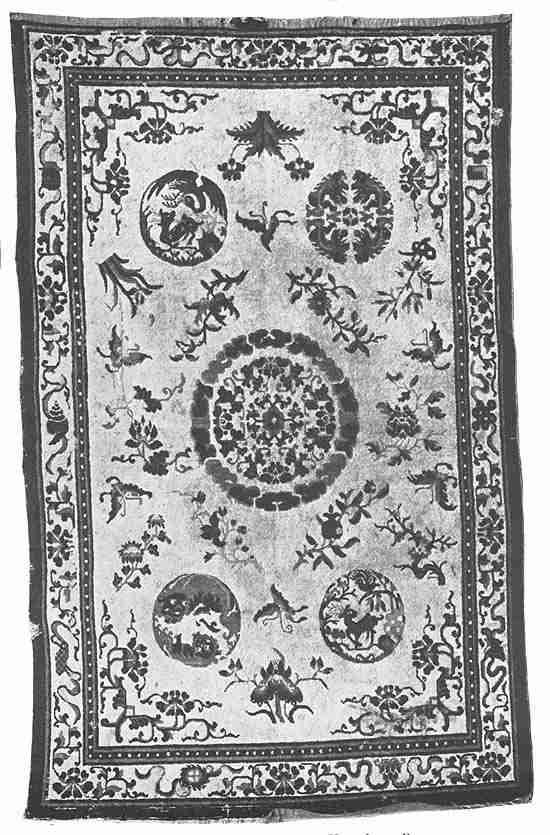
Plate 64. Chinese Rug of
the Keen-Lung Period
If the field is covered with small Herati designs, the rug may
be a Feraghan, Sehna, or an Iran.
If the field is covered with small designs of the Guli Hinnai
plant, the rug may be a Feraghan.
If the field is covered with the Mina Khani pattern, the rug
may be a Persian Kurdistan.
A Persian rug is usually a Shiraz, Niris, Mosul, or Kurdistan
if the nap is long.
It is almost invariably either a Shiraz or a Niris if the webs
of the ends are long, and the overcasting of the sides has a
barber-pole design or has short lengths of different colours. The
Niris resembles the Shiraz; but one thread of warp to each knot
is more depressed, the ends generally have longer webs, and the
field is more frequently covered with large pear designs. It is a
Shiraz if short tassels or tufts project at regular intervals
from the ends; and it is probably a Niris if it has a long
end-web of different coloured stripes.
It is probably a Karadagh, Gorevan, Serapi, Herez, or Tabriz
if the sides are finished with a selvage.
Many of these classes have features by which they can be
distinguished at once from all others. For instance:
The Sarabend has a field completely covered with pear designs
of moderate size facing in opposite directions in alternate
lines; borders of several stripes, of which one or two are ivory
white with an angular vine from which are suspended mechanically
drawn pear designs, and one or two narrow stripes with reciprocal
trefoils. Only two other classes are similar: the Iran copies,
which are always woven more coarsely and have the Ghiordes knot,
and the Burujirds, which are rarely seen.
Most Feraghans have fields that are completely covered with
small Herati or Guli Hinnai designs, and have the turtle pattern
in the border. The only other rugs that are similar are the Iran
copies, which have the Ghiordes knot and are more coarsely
woven.
Almost all Hamadans may be distinguished at once by the broad
band of camel’s hair surrounding the border, and the coarse
weft crossing only once between two rows of knots so as to give a
quincunx effect at the back.
Gorevans are invariably of carpet size. They have fields
almost covered with central medallions on which are archaically
drawn leaves, and a broad central border stripe with a large
conventionalised turtle pattern. They have usually the same
colour tones, which once seen are not forgotten. The
Serapis are similar to Gorevans but are usually older and of
better colours.
The Kermanshahs have tones of ivory, pink, and light green,
that are softer and lighter than those of almost any other rug.
The fields have concentric medallions with dainty floral forms
that are rarely seen in other classes except the Sarouks and
Kashans; and the borders, that correspond in drawing and
colouring with the field, have an outer edging that is almost
invariably of pink, but sometimes dark blue. The drawing and
colours, which are not easily described but quickly learned, at
once distinguish these pieces from all others.
Some Mesheds resemble Kermanshahs, but the nap is more silky,
uneven, and lustrous. The texture at the back is finer.
The rugs of Tabriz, which are usually made in carpet sizes,
may be distinguished by their linen nap hanging in a short fringe
at the ends. They are not likely to be confused with any classes
but the Mesheds, Khorassans, and Kermanshahs; but the nap is
shorter, and harsher to the touch; the knot is Ghiordes, and the
drawing more formal.
Almost the only Persian rug that has small, geometric,
adventitious designs and latch-hooks is the Shiraz. It is the
only one that has small tufts of wool projecting from the sides;
and with the exception of the Niris is the only one that, as a
rule, has a barber-pole overcasting and a long web at the ends.
It is also one of the most loosely woven.
The Sarouk and Kashan may be distinguished from all others by
their short velvety nap; dark rich colours; fields of graceful
foliated stalks and floral forms resting on concentric
medallions; and the fine, firm, texture of the weave. A carefully
drawn design of the running latch-hook appears in the borders;
and the weft is usually some shade of blue. The Kashans are
almost the same as Sarouks but have closer weave and finer
texture. They very rarely come in large sizes.
Muskabads and Mahals are invariably made in large carpet
sizes. Their texture is firm; they are very coarsely woven; and
there is great irregularity in the size of the knots as shown at
the back. Of the two, the Mahals are the better grade.
A large rug with woollen warp and with one thread of warp to
each knot doubled under the other is almost always a Bijar.
Sehnas are always very thin rugs and of small or moderate
size. With few exceptions the field is covered with Herati or
pear designs. They can be identified by the quincunx
appearance of the fine cotton weft at the back and the file-like
feeling of the weave.
The only Persian rug that has a side selvage and also shows
evidence of Caucasian influence in the geometric drawing of the
patterns is the Karadagh.
The Gozenes may be distinguished from other classes by their
dull colours. In many of them each thread of warp is encircled by
the right half of some knots and the left half of others.
The Asia Minor rugs have so many features in common
that they cannot conveniently be divided into sub-groups. For
instance: almost all have a coloured weft, a coloured web with
fringe at the ends, and a selvage at the sides; all, excepting
the Ghiordes and a few modern pieces, have woollen warp and weft;
and all have the Ghiordes knot. To be sure, a distinction may be
made in the length of the nap, since as a rule the Bergamo,
Rhodian, Karaman, Yuruk, and some of the Anatolians have a long
nap; and the remainder usually have a short nap; and also in the
weaving, as in the Bergamo, Ghiordes, Karaman, Kulah, and Ladik,
one thread of warp to each knot is generally depressed, and in
the remaining classes all threads of warp are equally prominent;
furthermore, Anatolians, Bergamos, Karamans, Rhodians, and
Koniehs, have rarely more than three stripes to the border; and
Kir-Shehrs, Kulahs, Ladiks, and Ghiordes have seldom less than
five; but these features are not always constant and pronounced.
The patterns, therefore, and those smaller designs which
frequently are peculiar to a single class are of considerable
assistance in distinguishing one from the other. The arch of the
namazliks is also an invaluable feature for identification since
its shape is different in each class as will be seen by reference
to Plates C and D (Pages 61 and 63).
Leaving out of consideration modern pieces, made to meet the
demands of exporting companies, the Bergamo and Rhodian have
certain points of resemblance. As a rule, they are almost square,
and have long nap, long webs with coloured bands at the ends, a
side selvage, and coloured weft. The Rhodian may generally be
distinguished by their brighter colours and their panels,
suggesting windows, placed parallel to the length of the rug. The
Bergamos, which are more frequently seen, have rich, deep blue
and red colouring, and more devices to avert the evil eye than
any other Oriental rug.
Two panels, one above the arch and the other below the
field, are almost invariably seen in the
Ghiordes prayer rugs and occasionally in the Kulahs, but rarely
in any other classes. The typical pattern of the central border
stripe of Ghiordes prayer rugs, consisting of most
conventionalised leaf and rosette, is not seen in any other rugs;
nor is the pattern of the broad border stripe of the odjaliks and
sedjadehs, consisting of an undulating band covered with small
flecks and fringed with latch-hooks.
The most characteristic features in the pattern of Kulahs are
the numerous narrow fleck-covered bands that occupy the centre of
the border, and the secondary stripe with design like a Chinese
device represented in Plate H, Fig. 10 (opp.
Page 194).
The pomegranates at the end of the field, and the Rhodian
lilies in the main stripe of the border, distinguish Ladik prayer
rugs from all others. Figures of vandykes, which are seen in some
Anatolians and Mudjars, are also a constant feature of
Ladiks.
A characteristic feature of Koniehs is the row of sprigs with
three triangular-shaped petals that project from the border
against the field.
As a rule, the Kir-Shehrs contain in the field a larger amount
of grass-green colour than any other rug.
The narrow border stripe of thumb-like processes that fit one
another like cogs and the mauve or heliotrope colour are
important aids in distinguishing Melez rugs.
On account of their long pile and their patterns of
latch-hooks and other geometric figures, the Yuruks alone of all
this group resemble the Caucasian rugs. They may also be
distinguished from other Asia Minor rugs by the facts that the
weft is of coarse, wiry wool, and the threads of warp are not
strung closely together, so that at the back each half knot
appears very distinct from the other.
A similarity prevails in the technique of most
Caucasian rugs, as all have the Ghiordes knot, and almost all
have warp and weft of wool, sides that are selvaged, and ends
with a web and loose fringe. Moreover, classes that are in a
measure geographically related show resemblances, as for
instance: the Chichi, Daghestan, Kabistan, and Shirvan, which
have short nap; the Tcherkess, Kazak, and Genghas which have
medium to long nap; and the Soumak, Shemakha, and Kuba, which
have a similar selvage at sides and ends. The only classes in
which one thread of warp to each knot is depressed or doubled
under the other are the Karabagh, Shemakha, and Shusha, from the
southeastern part of Caucasia, and the Lesghian from the northern
part.
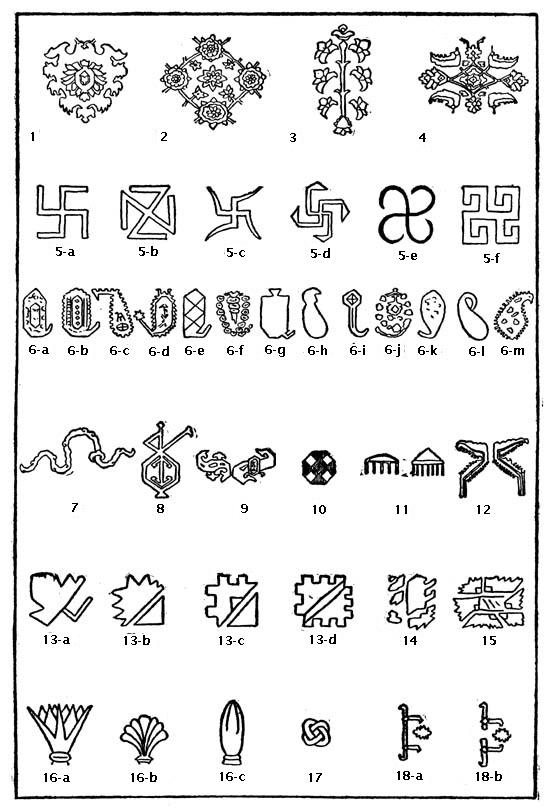
Plate O. No. 1,
Shah Abbas design. No. 2, Mina Khani design. No. 3, Guli Hinnai
design. No. 4, Herati design. Nos. 5-a, b, c, d, e, f,
Swastikas. Nos. 6-a, b. c, d, e, f, g, h, i, j, k, l, m, Pear
designs. No. 7, Cloud-bands. No. 8, Pitcher. No. 9, Motives of
Asia Minor and Armenian rugs. No. 10, Octagonal disc. No. 11,
Combs. No. 12, Motives of Melez rugs. Nos. 13-a, b, c, d, 14,
15, conventionalised leaf-forms in Asia Minor rugs. Nos. 16-a,
b, c, The lotus. No. 17, Knot of destiny. Nos. 18-a, b, Motives
of Daghestans and Kabistans.
The Soumak with its flat stitch and with
ends of yarn hanging loose at the back is unlike all other rugs.
At the sides is a carefully woven selvage, and next to the nap at
the end is a narrow selvage of fine spun threads. The rugs of
Shemakha, woven by some of the same tribes who dwell nearer the
mountains, have similar selvages at the sides of blue or bluish
green, similar ends of a narrow web of “herring-bone”
weave and one or more rows of knots, and a medium long nap of
rich blues, reds, yellows, browns, and greens. The Kuba rugs are
almost identical with them, except that each thread of warp is
equally prominent at the back, whereas in the Shemakhas one
thread to each knot is depressed. When once these selvages, the
narrow end-webs of “herring-bone” weave, and the
particular tones of colour characteristic of these rugs have been
carefully observed, they are not forgotten. The well-known
Georgian stripe (Plate J, Fig. 9, opp. Page
228) is rarely found in any but these three classes.
The Baku rug may be distinguished by its geometric-shaped pear
designs, and stiffly drawn birds. If modern, the tones are
dull.
Long, shaggy nap, strong colours, of which red and green are
almost invariably present, and large designs surrounded by
numerous small nomadic figures are the general features of a
Kazak. The Tcherkess has a striking resemblance to it, so that
they are constantly mistaken for one another; but the Tcherkess
is generally better woven and the pattern usually consists of
what is known as the “Sunburst” resting on a field of
dull red or a tawny shade. The border is almost invariably of
three stripes, of which the central has the tarantula design, and
the two guards have a reciprocal sawtooth design.
The field of the typical Chichi has an all-over pattern of
small geometric design; and its main border stripe has rosettes
separated by diagonal ribbon-like bars, as shown in Plate
I, Fig. 6 (opp. Page 226).
Rugs from the Karabagh district may frequently be recognised
by the Persian influence in the drawing of their patterns.
Genghas may readily be distinguished from other classes of
this group by the fact that the weft crosses more than twice and
frequently many times, between every two rows of knots, which are
not appressed, so that the weft, as it encircles the warp,
appears at the back like a narrow beaded surface.
Daghestans, Kabistans, and Shirvans have so many different
patterns that it is not always easy to distinguish the classes;
but it will be some assistance to remember that the border design
of wine cup and serrated leaf (Plate I, Fig. 1,
opp. Page 226) is found in about one half of the Shirvans, and
that the bracket design (Plate J, Fig. 19, opp. Page 228) is
peculiar to Daghestans and Kabistans.
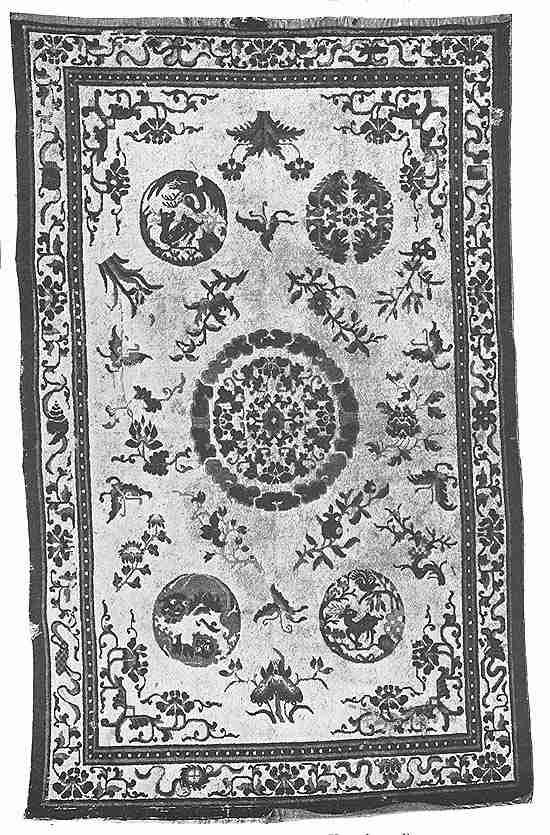
Plate 65.
Chinese Rug of the Keen-Lung
Period
The small Central Asiatic group is not only unlike
other groups, but may naturally be divided into three sub-groups,
which are also distinct from one another and contain well-defined
classes, viz.:
(a) Afghan, Royal Bokhara, Princess
Bokhara, Tekke, Khiva, Yomud, and Beshire.
(b) Samarkand, Kashgar, and
Yarkand.
(c) Beluchistan.
In the first sub-group the prevailing colours are dark reds
and browns with minor quantities of blue, green, and ivory. The
Afghans are almost always of large size, and may be recognised at
once by the broad web of the ends and the large octagonal shaped
figures placed in contact in perpendicular rows. The Royal
Bokharas are smaller, the end webs are not so wide, the octagons
are never in contact and are separated diagonally by
diamond-shaped figures. The Princess Bokharas and many Tekkes
have the Katchli pattern. The Yomuds resemble the other classes
of this sub-group in colour; but in the fields, diamond designs
have entirely replaced the octagons.
The rugs of sub-group “b” almost always have
cotton warp; whereas the rugs of sub-groups “a” and
“c” invariably have woollen or goat’s hair
warp.
The Samarkands are somewhat similar in colours and patterns to
Chinese rugs, but may be distinguished by the fact that they
almost invariably have three border stripes, whereas the Chinese
usually have only one or two. The Kashgar and Yarkand also show
Chinese influence.
The Beluchistans with brown, blue, green, and claret colours
may be identified at once by their long embroidered webs at each
end.
In the determination of the class to which a rug belongs, the
pattern first of all attracts attention; and if it be one
peculiar to a single class, it is an important guide. But in the
great majority of cases, this will not be sufficient. It is,
therefore, desirable to observe if the designs be floral or
geometric, if the colours be subdued or obtrusive, if the knot be
Sehna or Ghiordes, if the warp be cotton or
wool. The variations in finish of sides and ends are also an
index of the class. The pattern and these few technical details
are the only characteristics by which most dealers attempt to
determine the different kinds of rugs. But in the case of half of
them, such evidence is far from conclusive. The back should be
even more carefully examined than the front; because here are
shown those subtle, but nevertheless positive distinctions,
relating to the manner of tying the knot and the treatment of
warp and weft, which are the most permanent tribal
characteristics of Oriental weaving. It should be noticed, then,
if each thread of warp encircled by the yarn that forms the knot
lies in the same plane parallel with the surface and is equally
prominent; or if one to each knot be depressed below the other,
or if it be doubled under the other so as to be concealed. It
should also be noticed if the weft be coloured or uncoloured, of
fine or of coarse diameter; and if a thread of weft crosses only
once or two or more times from side to side between every two
rows of knots. Furthermore, the knots themselves should be
carefully scrutinised to see if each row of them is firmly
pressed down upon the weft, if each knot has a length equal or
exceeding its width, if the yarn of which they are formed is
drawn tight against the warp, and if it is loosely or closely
spun. Only by consideration of all these different points, and
sometimes even more, such as the nature of the colours, the
character of wool, and the manner in which it is spun, is it
possible to determine doubtful cases of identification.
S those who have expert knowledge of the value
of Oriental rugs are exceedingly few, compared with those who
admire and wish to own them, the object of this chapter is to
make suggestions regarding a proper selection, when purchasing,
and to point out some of the pitfalls that beset the
inexperienced.
In estimating the value of any rug, three distinct qualities
are to be considered: rarity, artistic beauty, and utility.
Rarity may depend on the age of a rug, the locality where it
was woven, or its type. In determining the age, which as a rule
is greatly exaggerated, a number of facts should be considered.
One is the condition resulting from wear; though at times this is
misleading, since of two pieces, one may have been handled with
almost religious solicitude and the other exposed to the elements
and to hard usage. Moreover, an artificial appearance of natural
wear is sometimes counterfeited. Another is the pattern, since,
as has been shown in the case of antique carpets, the character
of drawing changed with succeeding periods. Even when the
patterns of old carpets are copied in modern pieces, a
distinction is usually discernible to a careful observer. The
colours, too, play an important part in determining age; for not
only are some characteristic of different periods, as particular
shades of yellow and green of Chinese rugs and the blue of
Persian; but the mellowing influences of time, acting through the
agencies of exposure and wear, cause effects that cannot be
produced by any artificial process.
Occasionally the time when a rug is made is recorded in Arabic
numbers woven above a word denoting “year.” If they
are indistinct on account of the length of the nap, they may be
more clearly read in reverse order at the back. In the following
lines, each of them is represented below the one in
our own notation, to which it corresponds.
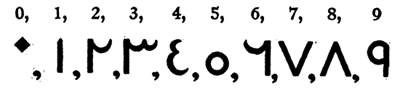
These numbers represent not the Christian but the Mohammedan
year, which, dating from the time of the Hegira, began about the
middle of July 622, or a little before the actual flight from
Medina. It should also be remembered that the lunar and not the
solar year is considered in Moslem chronology; which, according
to our reckoning, gains about one year in every thirty-three and
seven tenths years. To calculate, then, the year of our time
corresponding with the year expressed in the rug, from the number
should be subtracted one thirty-three and seven tenths part of
itself, and then should be added six hundred and twenty-two.
Thus, if the year 1247 was woven in the rug, our corresponding
year would be a. d. 1247 less 37 (or
1210) plus 622, or 1832. When such dates appear in old rugs, they
are generally to be depended on, but in modern ones they are more
likely to be antedated to give the effect of greater age.
With reference to the time when woven, rugs may conveniently
be divided into three broad classes; Antique rugs or carpets made
over two centuries ago; old rugs made fifty or more years ago;
and modern rugs made since the introduction of aniline dyes, or
within the last fifty years.
The number of antique carpets that exist is undetermined, as
it is impossible to estimate how many remain in Oriental mosques
and palaces. Nor has any complete catalogue been made of those
that are owned in Europe and America. They consist principally of
the products of Persia, Asia Minor, Armenia, and China. Many
belong to the museums and the remainder to sovereigns and wealthy
collectors. Like rare porcelains and old paintings, their value
increases with each passing year; and the prices received for
them range according to the fancy and caprice of the purchaser.
They are the most valued and the most costly of all rugs.
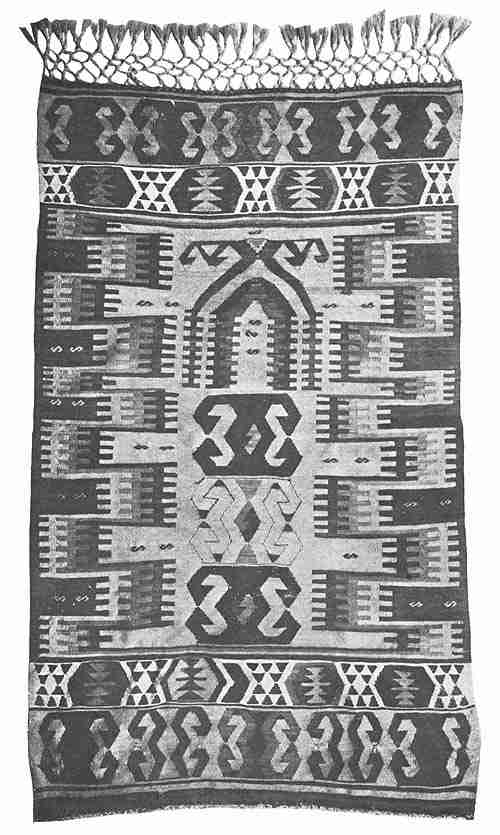
Plate 66. Kurdish Prayer
Kilim
The number of rugs over fifty years of age, but not belonging
to the previous class, is very large. A few are sufficiently
prized to be placed in art museums, some belong to
collectors, large numbers embellish the halls and drawing rooms
of people of refinement, and others are yearly brought from the
Orient; but dealers and the public already realise that their
numbers are limited. Even now they are searched for in the
remotest corners of every rug-producing country; and in a few
years the last, now cherished as family heirlooms, will have been
exchanged for western gold. Almost all are well woven, though
some are too much worn to be trodden longer under foot. None are
treated with aniline dyes, but the colours mellowed by time are
exceptionally good and frequently contain rare tones
characteristic of the first class. Moreover, large numbers
contain emblems of a symbolism still shrouded in mysteries that
increase their fascination. On the whole, this is the choicest
stock from which to choose elegant carpetings for luxurious
homes. When it is considered that rugs of this class are
beginning to disappear from the market, the prices at which they
may be purchased are moderate compared with the prices of more
modern pieces.
The great majority of existing Oriental rugs have been woven
within the last fifty years. A few of them, including many of the
newest, have colours that compare favourably with those of older
pieces; but a large number show the effect of aniline dyes. Some
woven by nomads or dwellers in remote villages, without thought
of sale, have designs and workmanship such as have characterised
the fabrics of these people for past generations; but others,
which are the products of the work-house system, though well
woven as a rule, lack the charm of spontaneous individuality. Age
alone has little influence in determining the value of these
modern rugs, since they have not yet become rare; yet even in
them the wear of time affects their other qualities. Other things
being equal, they cost less than the old and the antique
rugs.
The locality where a rug was woven is also to be considered in
determining its rarity and therefore its value. Of the countless
carpets that once existed in Egypt, of the very early rugs of
Caucasia and Turkestan, not a piece remains; but if one were to
be found it would be almost priceless. The antique carpets of
Syria, or of Kirman, Shiraz, and Tabriz, woven over three
centuries ago, are more valuable than others of equally good
workmanship, of which relatively large numbers remain. So, too,
of the rugs classed as old, but falling short of the venerable
age of the real antiques, those which are now difficult to be
obtained on account of their scarcity, are more valuable than
those which are being produced in larger numbers. Rugs such as
the Joshaghan, Tiflis, and many others of sixty or more years of
age, are no longer woven. Modern products from the same districts
may adopt the old names, but they are not the same. Accordingly,
it will be only a short time when they too will disappear from
the market. Good examples of such pieces should therefore receive
more careful consideration on the part of purchasers and
collectors, as their value is increasing with each passing
year.
Furthermore, the rarity of an old rug is often independent of
its age or the locality where it was made, and is due to its
peculiar type. For instance, the Ming Rugs of China with silver
threads and the so-called Garden Carpets of Iran represent types
rather than localities. Likewise the Hunting Carpets of Persia,
the Holbein Carpets of Asia Minor, and the Dragon Carpets of
Armenia, represent, as far as we know, the textile craft of no
well-defined district of limited area, as is the case of modern
rugs, but rather rare types. Such pieces are valuable, not alone
on account of their age, but also because they represent these
rare types.
A rug is also valued for its artistic beauty. The innumerable
rugs which centuries ago were in daily use soon disappeared, and
only those intended for palaces or temples have been preserved.
It is but natural, then, that the antique carpets representing
the highest art of their time should be not only rare but also
beautiful. Yet even in them is often a distinction that affects
their value. Fortunately, very many of the larger number of rugs
of less age, but classed as old, likewise possess artistic
beauty. This chiefly depends on the drawing and the
colouring.
It will be noticed that almost without exception careful
drawing accompanies workmanship of a high class. This is partly
due to the facts that the more excellent the weave the easier it
is to clearly define patterns; and that on shortness of nap,
which as a rule is found in closely woven rugs, depends accuracy
of delineation. The charm of rugs often depends, also, on the
graceful flow of lines, the careful balance of different parts of
patterns, and the proper co-ordination between border and field.
Careful attention should accordingly be given to the drawing when
selecting a rug.
The artistic beauty of Oriental rugs depends still more on
the colouring, since, as has been elsewhere
expressed, drawing, which is intellectual, finds its highest
development in the Occident, and colouring, which is sensuous,
finds its highest development in the Orient. It at once suggests
sumptuous luxury. In all of the antique carpets that remain and
in very many rugs over fifty years of age, all the colours
employed in a single piece are in tones of perfect harmony, and
are so placed with reference to one another that the effect is
most agreeable. But in some of the modern pieces, such as are
produced in parts of Asia Minor and Caucasia, are colours which,
like discordant notes of music, grate harshly on the senses. The
most pleasing effect is when colours of border and field are
complementary, yet so in harmony as to accentuate the qualities
of each.
There are also colours which, independent of their
association, are in themselves good or bad. The best are found in
the antique carpets woven when the art of the dyer was an
honourable profession. The colours are also very good in still
later pieces; but for a century now some of the finest have not
been used, and even the secret of producing them has been lost.
Here and there dyers and weavers cling to early traditions, so
that among modern rugs are many examples of good colouring; but
the most recent pieces, excepting when softened by artificial
processes, often display harsh and garish colours. This
distinction is in a measure due to the fact that old colours were
largely produced by vegetable dyes and the modern are too often
produced by aniline. Not infrequently both vegetable and aniline
colours are used in the same piece, and sometimes the quantity of
aniline colour is so small that it is scarcely objectionable; but
as a rule it is best never to purchase a rug that is so
tainted.
One objection to the use of aniline dyes is that by removing
some of the natural oil of the wool they are apt to make it
brittle, so that it is less able to stand wear. Another is that
in time some of the dyes, which have been applied collectively to
produce a single colour, will fade or even disappear, so that the
final colour may be a most undesirable shade not in harmony with
those that surround it. If the fibres are brittle and become
harsher to the touch when wet with water, it is an indication
that aniline dyes have been used. Another test is the application
of weak vegetable acids, which will make the colour spread if
produced by aniline dyes, but are not likely to affect it if
produced by vegetable dyes. Many native weavers can
distinguish by placing the wool in their mouths, when they
experience a sweet or bitter taste, according as vegetable or
aniline dyes have been used. It is a mistake, however, to assume
that the dyes are aniline because the wool has a brighter colour
at the surface of the nap than at the foundation; or because the
colour spreads when wet with water; since in time even some of
the vegetable colours will fade; and when fresh they will run
during the first washing in water, but afterwards they are little
affected either by water or weak acids.
Even when the same colours and the same kind of dyes were
used, there is a marked distinction in the appearance of old and
of recently woven rugs, which is due to wear as well as exposure
to sun and weather. The effect of time, imperceptible at first,
is shown in rich tones of remarkable softness and beauty, that
add greatly to the value of a rug. It accordingly happens that
artificial processes are adopted to create as far as possible the
same results without the lapse of time. Some of these are as
novel as were the efforts of the distinguished viceroy of King-te
Chin, in the reign of Kang-hi, to produce antique
porcelains.40 Henry Savage Landor
says41 that “to manufacture
‘Antique Carpets’ is one of the most lucrative
branches of modern Persian carpet making. The new carpets are
spread in the bazar in the middle of the street, where it is most
crowded, and trampled upon for days or weeks, according to the
days required, foot passengers and their donkeys, mules and
camels making a point of treading on them in order to ‘add
to age’ in the manufacturer’s goods. When
sufficiently worn down the carpet is removed, brushed, and
ordinarily sold for double or treble the actual price, owing to
its antiquity.”
This large Chinese carpet represents some of the best
workmanship of the Keen-lung period. In it are shown the graceful
drawing of leaf, fruit, flower, and butterfly, and the dainty
colouring of blue, yellow, brown, and apricot on a field of ivory
that are so characteristic of this time. The usual balance of
designs throughout the field is maintained with precision; but,
as is not always the case, different motives occupy corresponding
positions. Thus a cluster of leaves and fruit may be balanced
with a cluster of leaves and flowers. The conventional drawing of
the corners and the somewhat formal panel that surrounds the
central medallion give to the pattern strength of character while
they detract nothing from its beauty.
Loaned by Mr. Nathan Bentz
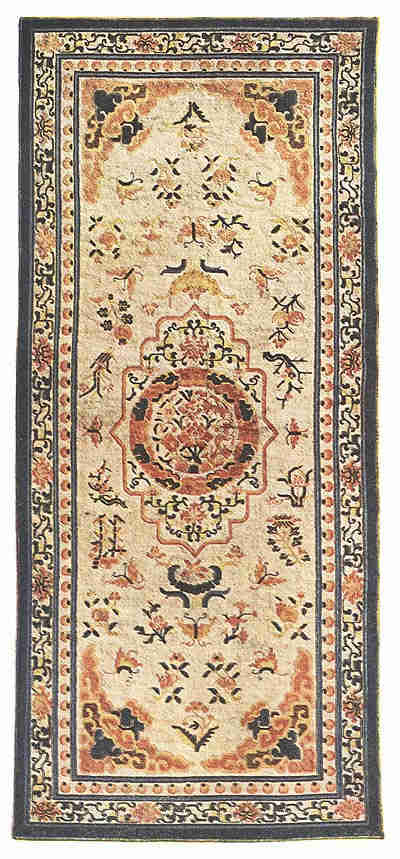
Whatever may be their character, the methods employed to give
softened effects to the colours are known as
“washing.” Most of those in vogue in the Orient, such
as washing with lime water, do little real injury. In this
country to artificially mellow the colours has become a regular
business of firms, who guard the secret of their different
methods. Some use ammonia, borax, and soap, which
also do very little injury to the rug. Others use chloride of
lime, boracic acid, vinegar, or oxalic acid, that remove some of
the natural oils of the wool and accordingly impair its qualities
for wear. In fact, pieces are occasionally injured to the extent
that the wool has become brittle and may readily be plucked out.
Nevertheless, it does not necessarily follow that all rugs washed
with an acid solution have been seriously injured; but the
colours never have the same richness as those which have been
softened by natural processes operating for a long period of
years. To be sure, rugs that have been washed are often more
attractive than they were in their raw colours; but the older,
more beautiful rugs with genuine tones mellowed by time are
always to be preferred. Over ninety per cent of the Kermanshahs,
Sarouks, Kashans, Tabriz, Muskabads, Mahals, and Gorevans, and a
large percentage of all other modern rugs sold in this country,
have been treated by some artificial process to soften their
colours or give them the appearance of age. It is generally
necessary, when selecting a large rug for a floor covering, to
accept a washed piece; but when a smaller rug or a runner will
meet the requirements, it is preferable to choose the older
unwashed piece, which, as a rule, is more beautiful and costs but
little more. In the case of most pieces, the tones of colour are
sufficient to enable one who is experienced to distinguish
between those that are artificially aged and those that are not.
In the case of others, a simple test is to rub them thoroughly
with a wet rag; when, if acid or chloride of lime has been used,
it can generally be detected by the odour.
The artistic beauty of a rug also depends somewhat on the
fineness of the nap; as the soft, floccy fibres of some wools
acquire a velvety appearance, or give to the colours a sheen and
a lustre compared with which other rugs look harsh and coarse.
For instance, the rugs of Shiraz and Meshed, the Beluchistans,
and many Bokharas are noted for the lustre of their colours; but
on the other hand many of the rugs of Asia Minor and Caucasia
have colours that are without lustre, and the rugs of India which
are made of dead or “Chunam” wool, seem lifeless.
When selecting any rug, then, the purchaser should carefully
observe if the patterns are well drawn and their different parts
show a proper balance. He should observe if the colour tones are
harmonious with one another, if each colour in itself is good,
and if they have been softened by natural processes acting for a
long time. And he should notice if the wool is
coarse, dead, and lustreless, or if it has a sheen and glint in
the light of day; for these are the qualities that make up the
artistic beauty of a rug.
The utility to be derived from rugs that properly belong to
museums and collectors receives small consideration, though even
with them the more perfect their condition the more valuable they
are. But in case of the great majority of rugs, which are
intended for use as well as for ornament, their utility is an
important consideration to the purchaser. Rugs that have warp and
weft of strong yarn and a close firm texture, will wear better
than others. Also, such rugs as Bijars, in which one thread of
warp to each knot is doubled under the other, will be found to
wear better than such rugs as Mosuls which have each thread of
warp equally prominent at the back. For durability, long nap is
also to be preferred to short, since it protects the foundations
of the knots from wearing and becoming loose.
Before purchasing an old rug, it should be spread on the floor
to see if it lies flat and if its shape is regular. It should be
examined by daylight and not by electric light, which gives a
false impression of colour and sheen. It should be held up with
the back turned to the purchaser, and carefully examined for weak
spots through which the light may pass; since, when so held, many
pieces which seem in good condition when lying on the floor,
resemble a sieve. The foundation threads should also be carefully
inspected, as sometimes they rot and will tear with slight
tension. Moreover, as the selvage or overcasting of the sides and
the webs of the ends are intended primarily not for ornament but
for protection, it should be noted if they are in good condition.
Sometimes the webs of the ends are entirely gone, so that
continual fraying of the nap is prevented with difficulty.
Sometimes the selvage or overcasting of the sides is broken and
some of the threads of warp are injured. Or the sides may be well
protected by a stout overcasting; but on examination it will be
seen that it is not the original finishing, and that some of the
border has disappeared. Again, it may have been overcast too
tightly, so that the sides curl and turn under, and thus expose
the border to injury when trodden on. Careful examination will
often reveal surprises. In many old rugs the field is full of
rents, that have been sewn together; in others entire pieces have
been removed, so that they are no longer of their original
length; or parts of the border are gone, or even the whole of it
has been replaced by the border of another rug;
yet all so deftly done that the changes are scarcely
noticeable.
Nevertheless, old pieces, if otherwise meritorious, are not to
be discarded on account of a few imperfections, since what can be
accomplished in the hands of a careful repairer is remarkable.
Broken threads of warp and weft can be mended; missing knots can
be replaced with others of similar yarn; crooked pieces can be
straightened by loosening here and stretching there; borders that
curl can be flattened by removing the yarn and overcasting again
more carefully. In fact, if the nap be not so worn that the
foundation of warp and weft is exposed, it is far better to
choose an old rug with some rents than a new one with garish
aniline dyes. Nor should a piece be slighted, because the
brownish black areas of wool dyed with iron pyrites are worn low;
since often the most beautiful effects are obtained by a surface
of brighter colours standing out in relief, on account of the
worn blackish nap that surrounds it. Now and then a bargain can
be had by buying a rug which, because of some imperfection that
is not serious, has been passed by; and now and then a piece
reeking with dirt has proved, when properly cleansed, to be a
gem.
The foundation, consisting of the warp and weft, receives but
little consideration from purchasers; yet it is one of the most
important indices of the quality of a rug, and its strength is
one of the most necessary conditions for utility. The warp is
best observed at the ends. In most Chinese and Indian rugs and in
some of the Persian, it is of cotton; in others it is of wool or
goat’s hair. In the Chinese rugs the diameter of the
threads of warp is much smaller than the diameter of the threads
of the weft, and has little strength, but in almost all other
rugs it is at least as large and as stout. The weft may readily
be observed at the back. In very many of the best rugs, it
consists of fine spun wool; but in many modern ones, it is of
coarse wool or cotton. The number of knots to the square inch
does not of itself demonstrate the quality of texture, since a
rug may have only a few knots of coarse diameter and be firmly
woven, or it may have many knots of fine diameter and be loosely
woven; but in the same class the better rug has generally more
knots than a poorer one. When selecting a rug, then, the back
should be most carefully observed; for here may be seen if the
yarn that forms the knots is well spun, if the knots themselves
are drawn tight and well pressed down, and if the
threads of weft are carefully inserted and have
a texture that indicates fine workmanship. Almost invariably it
will be found that if the back of a rug shows good material, and
has an appearance of firmness and skilful, painstaking weaving,
the front will correspond with good colours and careful
drawing.
The value of antique carpets, which depends to some extent on
their size, and to a much greater extent on their rarity and
character, is constantly increasing; for the reason that their
number is limited and each year they are more highly appreciated.
It is, therefore, impossible to affix even approximate prices;
but the sums paid at the Yerkes sale in 1910, when some thirty
pieces were sold at auction for an average of about $9,400, will
serve as a guide. The following are some of the pieces sold and
the prices realised:
|
Carpet, size 7 feet 4 inches by 5 feet 4
inches, attributed to Western Persia, at end of XVI
Century, and purchased by the Metropolitan Museum of Art,
N. Y.
|
$5,600 |
|
Persian carpet, XVI Century, described on
page 86
|
5,600 |
|
Polish silk carpet, XVI Century, size 6
feet 6 inches by 4 feet 7 inches
|
4,700 |
|
Polish silk carpet, XVI Century, size 6
feet 6 inches by 4 feet 7 inches
|
3,500 |
|
Polish silk carpet, XVI Century, size 6
feet 11 inches by 4 feet 10 inches
|
12,300 |
|
Silk carpet, XVI Century, size 7 feet
2½ inches by 6 feet 5 inches, stated to have
belonged to the Ardebil Mosque
|
35,500 |
|
Moorish carpet, XVI Century, size 10 feet
11 inches by 5 feet 10 inches, stated to have belonged to
the Ardebil Mosque and purchased by the Metropolitan Museum
of Art, N. Y.
|
15,200 |
|
Hispano Moresque Mosque carpet, size 34
feet 5 inches by 16 feet 8 inches, flat stitch
|
8,600 |
|
Carpet attributed to Western Iran, size
16 feet 4 inches by 11 feet 2 inches, and purchased by the
Metropolitan Museum of Art, N. Y.
|
19,600 |
|
Carpet similar to the Mosque carpet of
Ardebil, XVI Century, size 23 feet 11 inches by 13 feet 5
inches
|
27,000 |
The value of rugs over fifty years of age but not sufficiently
old to belong to the antique class also depends as much on the
technique of weave, drawing, colouring, and rarity as on the
size; yet even this must be taken into consideration. In
proportion to their size the most expensive of these rugs are the
Kirmans, Sehnas, and Niris from Persia; the Ghiordes and Ladiks
from Asia Minor; the Daghestans and Kabistans from Caucasia; and
the Royal Bokharas and Yomuds from Central Asia. Considering both
utility and attractiveness the least expensive are probably the
Sarabends and Mosuls from the Persian group, the Yuruks from Asia
Minor, Kazaks and Tcherkess from Caucasia, and Afghans
and Beluchistans from Central Asia. As is
the case with antique carpets, the prices of all old rugs in good
condition are steadily advancing.
There is likewise a tendency for the prices of modern rugs to
increase with each year, since on account of the gradual opening
of Oriental countries to the markets of the world, and the
greater demand for rugs, the wages of weavers are increasing.
Some of them, as the Tabriz, Gorevans, Kermanshahs, Muskabads,
Mahals, Sarouks, and Kashans, are now made almost exclusively
under the direction of the work-house system, and are sold at
prices that fluctuate but slightly. But in a short time the
prices of all of them will doubtless be higher.
When a rug of carpet size is required, the Kermanshahs are
generally preferred on account of their soft colouring and
refined patterns, that harmonise with the furnishings of most
reception rooms. Less expensive and more showy are the Gorevans,
which are suitable for halls or dining rooms. In the Afghans,
which are splendid rugs for a den, are combined durability with a
moderate price. Within recent years some of the Indian rugs, as
the Amritsars and Lahores, have been growing in favour, as they
not only have good colours, artistic patterns, and exceedingly
good texture, but are reasonable in price. Of smaller rugs
required both for ornament and use, the Shiraz, Feraghan, Mosul,
Bergamo, Tcherkess, Bokhara, and Beluchistan are desirable.
As is the case with other works of art, so much deception can
be practised in the sale of rugs that a purchaser cannot use too
much circumspection. Sometimes through ignorance or with
intention, a dealer will declare that the wool of a rug which has
been coloured with aniline dyes has been coloured with vegetable
dyes only; that a rug washed with acid has matured naturally;
that a new rug which has been artificially worn almost to the
knot is an antique; or that a particular rug belongs to the class
desired, as where a Shirvan is offered for a Shiraz or a Bijar
for a Bergamo, which ordinarily are worth much more. It is,
accordingly, discreet to buy only of such firms as have a
reputation which is above reproach; and if for any reason it is
difficult to learn the standing of a firm, the purchaser would do
well to make an effort to test its reliability by inquiring about
the qualities of some class of rugs with which he is familiar
before purchasing others; and if there appears to be any
intention to deceive, he should at once look elsewhere. In any
event, he should take a guarantee that the rug
purchased is as represented. Firms that have gained an honourable
reputation by honest dealing deserve the patronage of the public,
and will always be found ready to make restitution if any mistake
has been made.
At times, the best rugs may be bought at auctions and at the
fairest prices. Auctions such as the Yerkes, where estates are
being closed or where firms are dissolved, occasionally occur,
when every opportunity is given the purchaser to thoroughly
examine in advance pieces which are sold without reservation to
the highest bidder. On such occasions, rare pieces are sometimes
bought at very moderate prices. But as a rule, unless the
purchaser is a good judge and has previously carefully examined a
coveted piece in broad daylight, it is better not to buy at
auctions. During the sale it is impossible to properly examine a
rug. The glare of electric light thrown upon it gives a too
favourable impression of its beauty. The competitive bids of
other real or fictitious purchasers and the words of the
auctioneer too often lead beyond the dictates of good judgment.
At such times one would do well to remember the old words
caveat emptor.
- A
- Abbas, Shah, 88,
89, 169, 211;
- pattern named after, 105;
- sent artisans to India, 111;
- rug industry declined after death of, 112.
- Abraham, 23, 31.
- Acacia used as a dye, 40, 41.
- Accadians, 23.
- Adighies, 209.
- Afghan rugs, 293, 304, 305;
- geometric designs of, 62;
- technicalities in weave of, 51,
53, 56,
57, 235.
- Rugs described, 243, 244, 245;
- border stripes, 251.
- Afghan tribes, 90.
- Afghanistan, 41, 103, 233, 243, 244;
- Afshar rugs, 100, 286;
- technicalities in weave of, 51.
- Rugs described, 155.
- Aga Mohammed Khan pillaged Kirman, 113.
- Agamemnon, 166.
- Agra, 255, 257.
- Agra rugs described, 257.
- Akbar, Shah, 28;
- received assistance from Shah Abbas, 29;
- established rug weaving at Lahore, 94;
- imported Persian weavers, 253;
- carpet factory of, 256.
- Ak-Hissar, 175.
- Ak-Hissar rugs, 101.
- Ak-kal, oasis of, 238.
- Albana, 204.
- Alexander the Great, 169,
181, 246;
- destroyed Shiraz, 115;
- built walls at Derbend, 204.
- Alhambra, 25.
- Ali Riza, Imam, 110.
- Allahabad, 258.
- Allahabad rugs described, 258.
- Altai Mts., 29;
- original home of the Turks, 26.
- Altman, Benjamin, 85.
- Alum, used as a mordant, 40,
41.
- Amritsar, 255, 258.
- Amritsar rugs, 101, 257, 305.
- Amu Daria. _See_ Oxus river.
- Anatolia, 163,
182;
- the “Land of the Rising Sun,” 187.
- Anatolian rugs, 101, 176, 190, 289, 290;
- illustration of prayer arch of, 63.
- Rugs described, 187, 188, 189;
- border stripes, 195.
- Angora, 27, 185, 187;
- Anilines. _See_ Dyes.
- Animal carpets, 86, 87.
- Anjuman Industrial Art School, 259.
- Anoschar, 76.
- Anti-Taurus Mts., 140, 187, 190.
- Arabia, 24, 29, 32.
- Arabic features in rugs, 85;
- notation, 296;
- symbolism in Western Kurdistan rugs, 141.
- Arabs, in Persia, 103;
- Ararat, Mt., 103, 219.
- Aras river, 151, 157, 224.
- Ardebil, Persian capital under Ismael,
28;
- Ardebil carpet, 15;
- described, 83, 84.
- Ardelan district, 100, 129, 133, 153.
- Armenia, 209;
- origin of some Caucasian border stripes of, 226, 228, 229.
- Armenian rugs, 91, 170, 209, 220;
- Armenians in Persia, 103;
- Artaxerxes, 103.
- Aryan races, in India, 28;
- in Persia, 103;
- in Caucasia, 197;
- in Turkestan, 234;
- floral ornamentation employed by, 62.
- Asburg used as a dye, 41.
- Astrabad, 241.
- Astrakan, market for Bokharas, 235;
- for caravans from Khiva, 240.
- Auctions, 306.
- Ayyampet, 259.
- Azerbijan province, 26, 145, 147, 148, 149, 153.
-
- B
- Baber, Shah, 28.
- Babylon, 23, 24, 74, 102, 103.
- Bagdad, 81, 138, 152;
- carpets covering the floors of, 25;
- captured by Tartars, 27.
- by Solyman the Magnificent, 28.
- Bajazet, defeated by Tamerlane, 27;
- Bakshis rugs described, 148.
- Baku, 210, 214.
- Baku rugs, 101, 292;
- Bangalore, 259, 261.
- Bangalore rugs, 101, 259.
- Barbarossa, Frederic, 181.
- Bardini, Stefano, 85.
- Bastard teak used as a dye, 39.
- Bedouins, 103.
- Belshazzar, 24.
- Beluches, in Kirman, 113;
- Beluchistan, 233.
- Beluchistan rugs, 205, 234, 239, 301, 305;
- technicalities in weave of, 53,
56, 57;
- illustration of prayer arch of, 61;
- geometric designs in, 62;
- S design in, 64;
- zigzag line in, 66;
- reciprocal trefoil in, 160,
230.
- Rugs described, 248, 249;
- border stripes, 251.
- Beni-Hassan, tombs of, 74.
- Bergamo rugs, 101, 289, 305;
- technicalities in weave of, 50,
52, 53,
54, 57;
- illustration of prayer arch of, 63;
- prevailing colour tone of, 178.
- Rugs described, 166, 167, 168;
- border stripes, 193.
- Berlin gallery, 92.
- Beshire rugs, 101, 233, 293;
- illustration of prayer arch of, 61;
- S design in, 65;
- zigzag line in, 66.
- Rugs described, 243;
- border stripes, 251.
- Bibikabad, town of, 154.
- Bibikabad rugs described, 155.
- Bijar, 129, 136.
- Bijar rugs, 100, 153, 256, 286, 288, 302, 305;
- technicalities in weave of, 51,
52;
- compared with Persian-Kurdistans and Mosuls, 143.
- Rugs described, 136, 137;
- border stripes, 157, 159, 160.
- Birbul’s blue used as a dye, 40.
- Bird figures in rugs. _See_ Designs.
- Birdwood, Sir George, cited, 62,
70, 94, 122, 138;
- Birjand, 108.
- Bishop, Mrs. I. B., quoted, 138.
- Bode, Dr. Wm., cited, 79, 227, 228.
- Bogolubow, A., cited, 233.
- Böhler, J., cited, 79.
- Bokhara, 100,
110, 245;
- captured by Genghis Khan, 26;
- the “Noble,” 236.
- Bokhara rugs, 100, 243, 305;
- goat’s hair in, 32;
- technicalities in weave of, 50,
52, 53.
- Bokhara, Princess, rugs, 101,
233, 235,
293;
- illustration of prayer arch of, 61.
- Rugs described, 237, 238;
- border stripes, 250, 251.
- Bokhara, Royal, rugs, 101,
103, 233,
241, 242,
243, 244,
293, 304;
- compared with Princess, 237;
- the arch compared with that of Tekkes, 239.
- Rugs described, 235, 236;
- border stripes, 250, 251.
- Border stripes, defined, 59;
- Persian, described, 156,
157, 158,
159, 160;
- Asia Minor, described, 192,
193, 194,
195;
- Caucasian, described, 225,
226, 227,
228, 229,
230, 231;
- Central Asiatic, described, 250, 251;
- Chinese, described, 273,
274, 275.
- Boston Museum of Fine Arts, 94.
- Brahoes, 248.
- British Museum, 82.
- Broussa, 181.
- Buckthorns used as a dye, 39.
- Buddhism, influence on Asiatic art, 16;
- on symbolism, 58;
- the lotus an emblem of, 69.
- Buddhist emblems, 271, 274.
- Burujird, 131.
- Burujird rugs described, 131.
- Butea fondosa used as a dye, 39.
- Butti lac used as a dye, 39.
-
- C
- Cæsarea. _See_ Kaisariyeh.
- Caïcus valley, 166.
- Cairo, Caliphs in, 25;
- Caliphate, 20, 76.
- Caliphs, 24, 25, 77, 90, 91, 115;
- prayer rugs in time of, 85;
- Ispahan under, 111;
- Kirman rugs in palaces of, 113;
- Tabriz rugs known in days of, 145.
- Caliph Hisham, carpet of, 76.
- Camel’s hair. _See_ Wool.
- Carduchis, 140.
- Caria. _See_ Melez.
- Chaldees, 23;
- symbolism derived from, 66.
- Chardin cited, 113.
- Charles Martel, 25.
- Chehel Sutoon, enormous carpet of, 112.
- Che-Hwang-te, 26.
- Chichi rugs, 100, 290, 292;
- illustration of prayer arch of, 61;
- Kazaks contrasted with, 220.
- Rugs described, 207, 208;
- border stripes, 226, 231.
- Chinese fret, 67, 165;
- Chosroes I, “Spring of Chosroes” carpet made
for, 76.
- Chunam wool, 261, 301.
- Churchill, Sidney, A. T., quoted, 131.
- Cinnabar used as a dye, 40, 41.
- Circassians. _See_ Tcherkess.
- Clark, Sir Purdon, cited, 112.
- Clotilde Clam-Gallas, Countess, cited, 80.
- Coccus cacti used as a dye, 38.
- Coccus ilicus used as a dye, 38.
- Coccus lacca used as a dye, 38.
- Cochineal used as a dye, 38.
- Cochran, Wm. Alexander Smith, 86.
- Coconada, 259.
- Colour, the artistic value of, 18;
- the symbolism of, 59, 72.
- Cone design. _See_ Designs.
- Constantinople, 27, 98, 99, 118, 181, 197, 209;
- Persian weavers taken to, 28;
- silk carpets sent to Sultan of, 87.
- Conventions in art, 16.
- Cordova, 25.
- Cossacks, 218, 219.
- Cotton, used in weaving 30;
- Cow’s hair used in weaving, 30, 33.
- Crocus used as a dye, 39.
- Crœsus, 163.
- Crown jewel design. _See_ Designs.
- Ctesiphon, 76, 102, 103.
- Cufic lettering, in Altman carpet, 85;
- in borders of Asia Minor and Caucasian rugs, 92, 166, 202, 229;
- reputed inventor of, 183.
- Cupressus sempervirens used as a dye, 41.
- Curcuma used as a dye, 38.
- Cyrus, 24, 115, 181;
- Turkestan overrun by, 234.
-
- D
- Daghestan, 198, 206, 214.
- Daghestan rugs, 205, 212, 213, 216, 290, 292, 293, 304;
- technicalities in weave of, 51,
54;
- illustration of prayer arch of, 61;
- effulgent stars in, 91;
- Cufic borders of, 92;
- Bergamo prayer arch compared with that of, 167;
- weave of Kabistans compared with that of, 201;
- designs in, 211;
- colour scheme of Shirvans compared with that of,
214;
- mosaic drawing of, 220.
- Rugs described, 198, 199, 200;
- border stripes, 226, 227, 228, 229, 230.
- Daghestan, Royal, 216.
- Damascus, 17;
- antique carpets of, 95;
- Mecca rugs sold in, 118.
- Dari, 211, 257.
- Darius, 215.
- Dekkan, rugs woven in interior of, 259.
- Delhi, 28, 110.
- Demirdji, 164, 176.
- Demirdji rugs described, 176.
- Deodorus, 74.
- Dera Ghazi Khan, 280; Kilims, 281.
- Derbend, 199, 204.
- Derbend rugs described, 204,
205;
- Designs, geometric, 62, 64, 185;
- floral, 62, 64, 68, 185;
- almond, 70;
- animal, 89, 83, 91, 112, 114, 126, 137, 165, 200, 211, 213, 225, 248;
- antilope, 72;
- arabesques, 71, 79, 81, 83, 94, 104, 156, 175;
- barber-pole, 117, 118, 119, 153, 182, 200, 215, 229, 242, 246, 251;
- bat, 71, 266;
- birds, 71, 87, 91, 119, 114, 137, 165, 229, 246, 270, 292;
- bird of paradise, 71;
- butterfly, 71, 246, 266, 269, 270;
- camel, 72;
- chessboard, 271;
- chrysanthemum, 271;
- cloud-band, 67, 90, 106, 265, 274;
- cocos, 114;
- comb, 67, 208, 213, 221;
- conch, 274;
- cone, 70;
- crab, 71;
- cross, 67, 92, 236, 237;
- crown jewel, 70, 112;
- daisy, 64, 69;
- diamond, 91, 141, 145, 177, 200, 203, 212, 223;
- djinni, 72;
- dog, 72, 213;
- dragon, 71, 246, 266, 268, 273, 274;
- dragon and phoenix, 92;
- duck, 71, 81, 87;
- eagle, 71;
- Euphrates flower, 69, 189;
- fish, 165, 246;
- fung-kwang, 266;
- fungus, 269;
- gazelle, 95;
- goat, 72;
- Joo-e, 265, 274;
- key-pattern, 27, 267, 274;
- knot of destiny, 274;
- ky-lin, 265;
- lamp, 165, 170, 182;
- latch-hook, 67, 74, 117, 145, 155, 167, 169, 180, 182, 183, 184, 186, 187,
189, 200,
202, 203,
212, 215,
220, 223,
225, 227,
228, 231,
242, 249,
250, 251,
278, 282,
288;
- lily, 167, 170, 172, 184, 193, 230;
- lion, 72, 95;
- lion-dog, 266;
- lotus, 64, 68, 69, 89, 199;
- lozenge, 62, 91, 123, 141, 206, 220, 225, 249;
- lyre, 271;
- mango, 70;
- medallion, 60, 86, 87, 104, 106, 108, 109, 110, 121, 123, 126, 134, 138, 139, 145, 149, 169, 183, 189, 200, 212, 214, 215, 220, 267, 269, 271, 272, 273;
- moon, 65, 69;
- octagonal disc, 66, 92, 180, 200, 206, 213, 220, 275;
- palm, 70;
- palmette, 70, 71, 89, 90, 94, 106, 121, 177;
- peacock, 71;
- pear, 70, 106, 109, 110, 116, 129, 142, 145, 153, 165, 191, 200, 201, 207, 218, 219;
- peony, 104, 270;
- phœnix, 72;
- pole-medallion, 117, 152, 179;
- pomegranate, 69, 167;
- reciprocal sawtooth, 78,
121, 130,
209, 221,
231;
- reciprocal trefoil, 121,
130, 160,
165, 208,
215, 221,
249;
- river loop, 70;
- rose, 62, 69, 139, 193;
- rosette, 70, 94, 104, 121, 188, 193, 201, 207, 208, 221, 226, 230, 290, 292;
- running latch-hook, 67, 242;
- sacred mountain, 265;
- scorpion, 71;
- S design, 64, 91, 92, 170, 195, 206, 208, 211, 213, 220;
- serpent, 71;
- serrated leaf and wine cup, 64;
- shield of David, 66;
- Shou, 266, 272;
- star, 62, 65, 71, 93, 112, 183, 200, 203;
- effulgent star, 201, 211;
- eight-pointed star, 177,
179, 180,
182, 187,
193, 206,
207, 208,
210, 213,
220, 236,
244, 246,
250;
- stork, 71, 266;
- sun, 65, 66, 69;
- sunburst, 209, 220, 292;
- sunflower, 69, 271;
- swastika, 64, 65, 194, 229, 246, 248, 271, 273;
- tarantula, 71, 209, 220, 221;
- tiger, 95;
- tree, 137;
- tree of life, 60, 68, 182, 186, 189, 219, 237;
- tri-cleft leaf, 78, 91, 184, 199, 208, 211, 215, 226;
- turtle, 71;
- vandyke, 179, 183, 184, 187, 189, 290;
- wheel of law, 266;
- zigzag line, 66, 67.
- Diaper pattern, 102, 263.
- Diarbekr, 141.
- Die Persische NadelmalereiSusandschird, 76.
- Distaff, 36.
- Dix, Stewart, quoted, 16.
- Djinni. _See_ Designs.
- Djushaghan. _See_ Joshaghan.
- Domenico di Bartolo, painting of, 92.
- Dragon and Phoenix carpet, 65,
231.
- Dragon carpets, 91, 298.
- Dravidians, 28.
- Dyeing, 37; process of, 42, 43.
- Dyes, 30;
- of Sultanabad, 131;
- of Oushak, 174;
- of Amritsar rugs, 256;
- Aniline dyes introduced into India, 254;
- into China, 265;
- objection to, 299;
- how to distinguish, 299,
300.
-
- E
- East India Company, 254.
- Ecbatana, 103, 122.
- Elburz Mts., 103.
- Eleanor, Queen, Spanish rugs sent to, 25.
- Elizabeth, Queen, 29.
- Elizabethpol, 224.
- Ellore, 259, 260.
- Ellore rugs described, 260.
- El Mirz li alla, Caliph, 77.
- Elwund Mt., 120, 122, 129.
- Encyclopedia Britannica quoted, 140.
- Ends, finish of, 57.
- Esther, Queen, 122.
- Evil eye, superstition of, 59,
168.
-
- F
- Fairs, Oriental, 99.
- Farsistan, wool of, 31;
- antique carpets from Shiraz, capital of, 115.
- Fatimid Caliphs, 90.
- Feraghan district, 125, 129, 131.
- Feraghan rugs, 100, 132, 133, 142, 147, 153, 156, 285, 305;
- technicalities in weave of, 51,
55;
- small designs in, 60;
- illustration of prayer arch of, 61;
- turtle border of, 79;
- Guli Hinnai pattern of, 105;
- pattern of Herat rugs compared with that of, 106.
- Rugs described, 120, 121, 122;
- border stripes, 157, 159.
- Filling, 52.
- Firdousi, 110.
- Fish pattern. _See_ Designs.
- Flame design. _See_ Designs.
- Flax used in weaving, 30, 33.
- Floral design. _See_ Designs.
- Friedhofteppiche, 172.
-
- G
- Gall nuts used as a dye, 39.
- Ganges river, 17, 258.
- Ganja. _See_ Gengha.
- Gehrous district, 136.
- Gengha, 224.
- Gengha rugs, 101, 290, 292;
- technicalities in weave of, 52,
53, 54.
- Rugs described, 224, 225;
- border stripes, 227.
- Genghis Khan, 26, 78, 198, 234.
- Geok Teppe, 238.
- Geometric pattern. _See_ Designs.
- Georgian pattern, 213, 215, 228, 230, 292.
- Ghiordes, 164, 168, 175, 176, 206.
- Ghiordes rugs, 65, 101, 183, 184, 191, 289, 289, 290, 304;
- illustration of prayer arch of, 63;
- Karabaghs compared with, 225.
- Rugs described, 168, 169, 170, 171;
- border stripes, 192, 193, 194, 195.
- Gibbon cited, 25.
- Gilan, cloud-band in antique carpets of, 67.
- Girdler’s Company, India carpet presented to,
94, 256.
- Goat’s hair. _See_ Wool.
- Gobi desert, 21, 26, 29.
- Goodyear, Prof., cited, 69.
- Gorevan rugs, 100, 285, 286, 287, 301, 305;
- technicalities in weave of, 51;
- turtle border of, 79;
- patterns of Muskabads resembling those of, 131;
- relation of Bakshis rugs to, 148;
- relation of Herez rugs to, 149.
- Rugs described, 146, 147, 148;
- border stripes, 157, 158.
- Gotcha lake, 224.
- Gozene, 156.
- Gozene rugs, 100, 154, 289;
- technicalities in weave of, 54.
- Rugs described, 54.
- “Grain of rice” pattern in Chinese rugs,
271.
- Granada, 25.
- Guebres, in Kirman, 113;
- Guli Hinnai pattern, 104,
120, 121;
- Gulistan rugs, 100, 154, 286;
- Gulistan treaty, 203.
- Gyze, Georg, 92.
-
- H
- Hafiz, 115.
- Hair, of cow, 30, 33;
- Hamadan, 122, 129, 136, 143, 155.
- Hamadan rugs, 100, 286, 287;
- technicalities in weave of, 52,
53, 54,
55;
- similarity of some Irans to, 125;
- similarity of Karajes to, 144;
- similarity of weave of Kara-Geuz rugs to, 155.
- Rugs described, 122, 123, 124;
- border stripes, 157, 159, 160.
- Hang Chow, 266.
- Harris, Henry T., quoted, 40,
260.
- Havell, E. B., cited, 260.
- Hegira, 296.
- Hemp used in weaving, 30, 33, 261, 263.
- Herat, 105, 110, 244, 285;
- captured by Nadir Shah, 29;
- so-called Ispahans probably made at, 89, 112.
- Herat rugs, 69,
89, 100;
- technicalities in weave of, 54,
55;
- cloud-band in antique rugs of, 67;
- ground colour of, 95;
- influence on Indian weaving of, 255.
- Rugs described, 105, 106;
- border stripes, 156.
- Herati pattern, 89, 94, 104, 106, 108, 109, 112, 120, 121, 129, 132, 134, 142, 152, 153, 157,
165, 170,
201;
- Hereke, 181.
- Hereke rugs described, 181.
- Herez, 149.
- Herez rugs, 101, 286, 287;
- technicalities in weave of, 55.
- Rugs described, 149, 150;
- border stripes, 157.
- Herodotus, 74.
- Herring bone weave, described, 47;
- Himalayas, 41.
- Hindu Koosh Mts., 244.
- Hoa, 183.
- Holbein, Hans, 92, 93.
- Holbein rugs, 298;
- octagonal disc in, 66.
- Rugs described, 92, 93.
- Homer, 69, 74, 110, 163.
- Hulaku Khan, conquered Persia, 26;
- Mongolian capital established in Persia by, 78.
- Hunting carpets, 298;
- symbolism in, 72.
- Carpets described, 82.
- Hurst, Dr. John, quoted, 257.
- Hyderabad, 259, 262.
- Hyderabad rugs described, 262.
- Hyder Ali, 261.
-
- I
- Ibn Batutah, Meshed visited by, 110.
- Iconium, 181.
- Imari ware, 17.
- Imeritia, 218.
- India Museum, 122.
- Indigo used as a dye, 38, 40.
- Indigofera used as a dye, 38.
- Indus river, 17, 24, 29.
- Irak-Ajemi, 124, 127, 129.
- Iran rugs, 100;
- similarity in some rugs of the Kara-Geuz district to,
155.
- Rugs described, 124, 125;
- border stripes, 157.
- Irtish river, 26.
- Isbarta, 178.
- Iskenderoon gulf, 163.
- Ismael, Shah, established capital at Ardebil, 82;
- Ardebil Mosque carpet made during reign of, 84;
- carpets made at Herat during reign of, 89;
- Ardebil Mosque carpet made by order of, 127.
- Ispahan, sacked by Tamerlane, 27;
- Shah Abbas transferred his court to, 29;
- probability that some of the so-called Ispahans were
made at, 89;
- description of city, 111.
- Ispahan blue, 42.
- Ispahan rugs, lotus design in, 69;
- made at Ispahan, 89;
- sombre tones of, 90;
- red fields of, 95;
- blues and reds of the antique, 127;
- palmettes of the antique, 145.
- Modern rugs described, 111,
112, 113.
-
- J
- Jahan, Shah, 28; builder of Taj Mahal, 94;
- Indian rug-weaving declined after death of, 253.
- Jail system of India, 254.
- Jaipur, 255, 259.
- Jaipur rugs described, 259.
- Japan, 17.
- Jhelum river, suggested as origin of pear design,
70;
- Joshaghan district, 132.
- Joshaghan rugs, 100, 286, 298;
- technicalities in weave of, 50.
- Rugs described, 132, 133;
- border stripes, 157.
- Jubbulpur, 255, 258.
- Jubbulpur rugs described, 258,
259.
- Jute, used in weaving, 30,
33;
- in Kulahs, 174;
- in Vellore rugs, 261;
- in Bangalore rugs, 262.
-
- K
- Kaaba, 117.
- Kabistan, 199.
- Kabistan rugs, 101, 204, 290, 292, 293, 304;
- technicalities in weave of, 54;
- illustration of prayer arch of, 61;
- effulgent stars of, 91;
- Cufic borders of, 92;
- patterns of some Shirvans similar to those of, 213.
- Rugs described, 200, 201, 202;
- border stripes, 226, 228, 229.
- Kain, 108.
- Kaisariyeh, 190.
- Kaisariyeh rugs described, 190,
191.
- Kaiser Friedrich Museum, 79,
92.
- Kang-hi rugs, 78, 101.
- Rugs described, 268, 269;
- border stripes, 274;
- medallions, 273.
- Karabacek, Dr., quoted, 74.
- Karabagh district, 222, 224.
- Karabagh rugs, 101, 290, 292;
- technicalities in weave of, 51,
53;
- illustration of prayer arch of, 61;
- Karadaghs compared with, 151;
- Shushas compared with, 224.
- Rugs described, 222, 223.
- Karadagh district, 151.
- Karadagh rugs, 100, 286, 289.
- Rugs described; border stripes, 157, 158.
- Kara-Geuz district, 155.
- Kara-Geuz rugs, 100, 154.
- Karaje rugs, 100, 286;
- technicalities in weave of, 53.
- Rugs described, 143, 144.
- Kara Kum desert, 241.
- Karaman, 188.
- Karaman rugs, 101, 289.
- Kashan, 115, 127, 155.
- Kashan rugs, 100, 285, 286, 288, 301, 305;
- technicalities in weave of, 35,
51, 55;
- illustration of prayer arch of, 61;
- pattern of Sarouks like that of, 134;
- correspondence of some rugs of Tabriz with, 145.
- Rugs described, 127, 128, 129;
- border stripes, 160.
- Kashgar, 247.
- Kashgar rugs, 101, 234, 282, 292.
- Kashmir, 70, 255;
- Katchli, derivation of, 237;
- pattern used in Tekkes, 239,
293.
- Kazak rugs, 101, 290, 292, 304;
- technicalities in weave of, 51,
53;
- illustration of prayer arch of, 61;
- Western Kurdistans compared with, 141;
- Afshars compared with, 155;
- Yuruks compared with, 191;
- Tcherkess compared with, 209;
- Kutais compared with, 222;
- Genghas compared with, 224.
- Rugs described, 219, 220, 221, 222;
- border stripes, 226, 227, 228, 229.
- Kazakje, 220.
- Kea-king dynasty, 272.
- Keen-lung dynasty. Rugs described, 270, 271, 272;
- Kenares defined, 97.
- Kerim, Khan, 115;
- royal patronage of weaving at Shiraz under, 116.
- Kermanshah, 83, 129, 138.
- Kermanshah rugs, 134, 137, 147, 160, 285, 288, 301, 305;
- technicalities in weave of, 52;
- illustration of prayer arch of, 61;
- corners of Khorassans compared with those of, 109;
- Tabriz rugs compared with, 145,
146;
- Amritsars mistaken for, 256.
- Rugs described, 138, 139, 140;
- border stripes, 38.
- Kermes used as a dye, 38.
- Key pattern, 27.
- Khali defined, 97.
- Khibitkas, defined, 238;
- rugs made for doors of, 239.
- Khiva, 110, 240, 241, 244.
- Khiva rugs, 100, 233, 235, 242, 293;
- illustration of prayer arch of, 61.
- Rugs described, 240, 241;
- border stripes, 250, 251.
- Khorassan, 107, 115, 127;
- wool of, 31;
- Herats made in, 106;
- Kurdistans in, 141;
- Yomuds in, 241.
- Khorassan rugs, 60, 100, 117, 288;
- left-hand knots in, 48;
- technicalities in weave of, 54,
55;
- illustration of prayer arch of, 61;
- resemblance of Mesheds to, 110.
- Rugs described, 107, 108, 109, 110;
- border stripes, 156.
- Khotan, 278.
- Kidderminster, 260.
- Kilims, earliest rugs similar to, 75;
- King-te Chin, 300.
- Kirghiz, steppes, 235;
- Kirman, 113, 115, 203, 206, 248;
- wool of, 31;
- carpets made during Caliphate at, 90;
- early weavers taken to Asia Minor from, 181.
- Kirman rugs, 100, 285, 297, 304;
- technicalities in weave of, 50,
51, 53;
- resemblance of Kermanshahs to, 138;
- flowers in Tabriz rugs compared with those of, 145;
- some old Bergamos as valuable as, 167.
- Rugs described, 113, 114, 115;
- border stripes, 158.
- Kirmans, Turkish, 174.
- Kir-Shehr, 185.
- Kir-Shehr rugs, 101, 289, 290;
- illustration of prayer arch of, 63;
- prayer arches of Bergamos compared with those of,
167;
- prayer arches of Ladiks compared with those of,
183;
- often called Anatolian, 187;
- prayer arches of Mudjars compared with those of,
189;
- prayer arches of Tuzlas compared with those of,
190.
- Rugs described, 185, 186;
- border stripes, 193.
- Kis-kilims, 280.
- Kizil Arvat, 241.
- Kizil Irmak river, 185, 189.
- Kizil Kum, “desert of red sands,” 235.
- Knights of St. John, 28, 179.
- Knots, Ghiordes, 48;
- Sehna, 48;
- right-hand, 48;
- left-hand, 48;
- peculiarities of, 48;
- illustrated, 49.
- Konieh, 188, 190.
- Konieh rugs, 101, 289, 290;
- technicalities in weave of, 55;
- illustration of prayer arch of, 63;
- resemblance in pattern of Kir-Shehrs to that of,
186;
- prayer arches of Anatolians compared with those of,
187.
- Rugs described, 181, 182, 183;
- border stripes, 193, 195.
- Koran, 72.
- Kuba, 199, 202.
- Kuba rugs, 101, 290, 292.
- Kublai Khan, 266.
- Kulah, 164, 171, 174.
- Kulah rugs, 101, 289, 290;
- technicalities in weave of, 51,
52, 53,
54;
- illustration of prayer arch of, 64;
- lily pattern in, 167;
- Ghiordes rugs adopting border of, 171;
- geometric leaf of, 180;
- prayer arch of Koniehs compared with those of, 186.
- Rugs described, 171, 172, 173, 174;
- border stripes, 193, 194.
- Kur valley, 207, 214.
- Kurdistan, Persian, rugs, 100,
286, 287;
- technicalities in weave of, 51;
- Mina Khani pattern characteristic of, 105;
- Western Kurdistans compared with, 141.
- Rugs described, 142, 143;
- border stripes, 157, 159.
- Kurdistan rugs, 286;
- technicalities in weave of, 51,
53, 57;
- Karajes compared with, 143;
- ground colour of some Mosuls similar to that of,
154;
- some Kara-Geuz rugs similar to, 155.
- Kurdistan, Western, rugs, 100,
286;
- Kurds, 134, 136, 138, 140, 141, 145, 187, 191;
- located at Ak-kal by Shah of Persia, 238.
- Kutais, 218.
- Kutais rugs, technicalities in weave of, 53.
- Kutayah, 176.
- Kutayah rugs described, 176.
-
- L
- Lacquer, 17.
- Ladik rugs, 101, 167, 289, 290, 304;
- illustration of prayer arch of, 63;
- pomegranate design in, 70;
- border stripe of Melez rugs similar to that of,
177;
- vandykes of Rhodian rugs resembling those of, 179;
- nap of, 186;
- Kir-Shehr panels compared with those of, 187;
- vandykes in Mudjars borrowed from, 189.
- Rugs described, 183, 184;
- border stripes, 193, 194.
- Lahore, 255, 256;
- Lahore rugs, 101, 305.
- Landor, Henry Savage, quoted, 300.
- Laristan border stripe, 157.
- Latch-hooks. _See_ Designs.
- Latimer, C., quoted, 281.
- Lattice-work pattern, 119, 121, 133, 134, 137, 204.
- Lemons used as a mordant, 40.
- Lesghian rugs, 101, 199, 290.
- Lesghian tribes, 206, 207.
- Limes used as a mordant, 40.
- Linen, in Sehnas, 135;
- in Tabriz, 146;
- in Ghiordes, 171;
- in Sarouks, 127;
- in Kashans, 128.
- Loom, described, 44;
- Lotus. _See_ Designs.
- Luristan rugs, 286;
- technicalities in weave of, 55.
-
- M
- Madder used as a dye, 38.
- Madras, 259.
- Madras rugs described, 259,
260.
- Mahal rugs, 286, 288, 301, 305;
- similar to Muskabads, 131,
132.
- Maharajah, 259.
- Makimonos, 180.
- Makri rugs, 180.
- Maksoud, 84, 127, 128.
- Malek Shah made Ispahan the capital of Persia, 26.
- Malgaran, 246.
- Manchoos, 268.
- Mangishlar peninsula, 238.
- Marco Polo, referred to Armenian carpets, 91;
- referred to Kirman weavings, 113;
- visited Kashgar, 247.
- Marsulipatam, 259, 260.
- Marsulipatam rugs described, 260.
- Martin, Dr. F. R., quoted and cited, 74, 77, 79, 81, 82, 89, 90, 116, 227.
- Maya ruins, swastika on, 65.
- Mecca, 77, 98;
- pilgrimages to, 99;
- bit of earth from, 221,
223.
- Mecca rugs, 117, 118.
- Medallions. _See_ Designs.
- Medes, 23, 24, 66, 234.
- Medina, 77, 296.
- Melez rugs, 101, 290;
- technicalities in weave of, 51;
- illustration of prayer arch of, 63;
- sometimes called Anatolians, 187.
- Rugs described, 176, 177, 178;
- border stripes, 193, 195.
- Mersherski, 88.
- Merv Kilims, 280, 281.
- Meshed, pilgrimages to, 99, 108.
- Meshed rugs, 100, 147, 217, 288, 301.
- Rugs described, 110, 111;
- border stripes, 158.
- Metropolitan Museum of Art, New York; rugs exhibited in,
78, 79, 80, 82, 85, 86, 91, 93.
- Michelangelo, 16.
- Mina Khan, 105.
- Mina Khani pattern, 105, 142, 152, 249;
- Ming dynasty, 78, 81, 266, 268;
- Ming rugs, 101, 298.
- Mirabad, 130.
- Mirror backs in Chinese rugs, 267,
272, 273.
- Mir-Sarabend. _See_ Sarabend.
- Mirzapur, 255, 258.
- Mirzapur rugs described, 258.
- Mohair, 174.
- Mohammed, 24;
- epithet applied to Guli Hinnaiby, 104.
- Mohammedans, 98, 103, 113, 237, 257;
- dominant in Southwestern Asia, 25;
- invaded India, 28;
- Meshed sacred to, 110;
- prejudice against depicting animals by Sunnite,
165;
- Caucasia invaded by, 198;
- influence on weaving by, 58,
270.
- Mongols, captured Bagdad, 26;
- gained foothold in India, 28;
- in Persia, 62;
- in Caucasia, 198;
- overran Turkestan, 234.
- Mordants, 40.
- Mordecai, 122.
- Moslems, 70;
- preserved art treasures, 76;
- green sacred to, 85.
- Mosul district, 152.
- Mosul rugs, 101, 286, 287, 302, 304, 305;
- technicalities in weave of, 51,
52;
- Western Kurdistans confused with, 141;
- Persian Kurdistan and Bijar rugs compared with,
143;
- resemblance of weave of some Gozene rugs with that of,
156.
- Rugs described, 152, 153, 154;
- border stripes, 157, 158, 159.
- Mt. Ararat, 103, 219.
- Mt. Ida, 163.
- Mt. Kazbek, 206.
- Mt. Olympus, 181, 191.
- Mudjar, 189.
- Mudjar rugs, 101, 290;
- illustration of prayer arch of, 63;
- frequently classed as Anatolians, 187.
- Rugs described, 189, 190;
- border stripes, 193.
- Multan, 255.
- Multan rugs described, 257.
- Mumford, John Kimberly, cited, v, 67.
- Musée des Arts Decoratifs, 79.
- Muskabad district, 131.
- Muskabad rugs, 100, 286, 288, 301, 305;
- turtle border in, 71.
- Rugs described, 131, 132;
- border stripes, 157, 159.
-
- N
- Nadir Shah, Afghans defeated by, 29;
- influence of, 103;
- art decadence following capture of Herat by, 106;
- destruction of Herat by, 110;
- weavers removed to Northern Persia by, 113, 132;
- Shemakha almost destroyed by, 214;
- Shusha built by, 224;
- overthrow of Mogul dominion by, 254.
- Namads, 115, 122.
- Namazlik, 98, 150.
- Netsukés, 17.
- Nigde, 190.
- Nigde rugs, 101; classed as Anatolians, 187187.
- Nijni Novgorod, 235.
- Nimrod, 23.
- Nineveh, 23, 102;
- drawings on walls of, 74;
- Mosul near ruins of, 152.
- Niris lake, wool obtained near, 31.
- Niris rugs, 100, 204, 286, 287, 304.
- Nizami manuscript determining age of Hunting Carpets,
82.
- Nomadic influence, 106;
- characteristics in rugs, 134; rugs, 58, 153.
-
- O
- Oak gall, used as a dye, 40.
- Odjalik, 97.
- Omar Khayyam, 108, 110.
- Onosma echioides used as a dye, 41.
- Orenburg, 235, 240.
- Oriental art, 16.
- Ottoman Turks, 27, 28.
- Oushak, city and district, 164,
176.
- Oushak rugs, type of modern, 94;
- evidences of Persian treatment in, 166.
- Rugs described, 174, 175.
- Outer edging in Kirmans, 114;
- in Hamadans, 123;
- in Sarouks, 126;
- in Bijars, 137;
- in Kermanshahs, 139;
- in Mosuls, 153.
- Overcasting of sides; weft overcasting described,
55, 56;
- illustrated, 49;
- double overcasting described, 55, 56;
- illustrated, 49.
- Oxus river (Amu Daria), 23, 24, 235, 238, 240, 243, 244.
-
- P
- Palais de Commerce at Lyons, 80.
- Palm design. _See_ Designs.
- Pamir plateau, sheep of, 31;
- Paropamisus Mts., 235.
- Parsees, 103;
- symbolism derived from fire worship of, 58, 71;
- at Baku, 211.
- Parthians, 24.
- Patna rugs, 101.
- Paul, St., 166, 181.
- Pear design. _See_ Designs.
- Pergamus, 166, 168.
- Persepolis, 103.
- Phasis river, 197.
- Pile of rugs, 47.
- Pliny, 74.
- Polish silk carpets, reciprocal trefoils in, 65;
- Chinese cloud-bands in, 67;
- lotus in, 69.
- Carpets described, 88;
- bright hues of, 90.
- Polonaise carpets. _See_ Polish silk.
- Pomegranate. _See_ Designs.
- Pomegranate rind used as a mordant, 40.
- Porter, Sir Robert Kerr, quoted, 106, 138.
- Prayer arches, 60, 62;
- Prayer rugs. _See_ Namazlik.
- Priam, 166.
- Prometheus, 197.
- Punjab, 255, 256, 257.
-
- R
- Ratanjot used as a dye, 16.
- Rembrandt, 16.
- Rhodes, Isle of, 28, 178.
- Rhodian rugs, 101, 289.
- Rion river, 218.
- River loop. _See_ Designs.
- Robinson, Vincent, cited, 80,
81, 86, 88, 254, 258, 259.
- Rubens, 16.
- Rubia cordifolia used as a dye, 41.
- Rubia tinctorum used as a dye, 38.
- Runners, 97.
- Ruskin, John, quoted, 18.
-
- S
- Saadi, 115.
- Saddle-bags, 117, 135, 249.
- Safavid dynasty, 29, 81, 83, 84, 85, 89, 103.
- Saffron used as a dye, 39.
- Salors, 233.
- Samarkand, capital of Tamerlane, 27;
- the “Mirror of the World,” 245.
- Samarkand rugs, 101, 233, 265, 282, 293;
- technicalities in weave of, 50;
- swastika in, 65.
- Rugs described, 245, 246, 247;
- border stripes, 251.
- Samo-Kien, 246.
- Sarabend rugs, 285, 304;
- technicalities in weave of, 51;
- pear design of, 70, 116, 119, 144, 153;
- turtle border in, 71;
- pile of, 133.
- Rugs described, 129, 130;
- border stripes, 158, 160.
- Mir-Sarabends, 130.
- Royal Sarabends, 130.
- Saracenic art, 21;
- Saracens, carpet weaving introduced into India by,
94;
- Persia under dominion of, 103;
- Baku in possession of, 210.
- Saraks, town of, 136, 238.
- Sarawan district, 129, 131.
- Sarouk, 125.
- Sarouk rugs, 134, 285, 286, 288, 301, 305;
- technicalities in weave of, 51,
52, 53,
55;
- illustration of prayer arch of, 61;
- animal carpet with weave similar to that of, 86;
- corners of Khorassans compared with those of, 109;
- patterns of Bijars compared with those of, 137.
- Tabriz rugs compared with, 145,
146.
- Rugs described, 125, 126, 127;
- border stripes, 160.
- Sassanides, Kingdom of, 24;
- elaborate carpets made during rule of, 74;
- capture of capital of, 75.
- Savalans, 131.
- Sedjadeh, 97.
- Sehna, 48, 129, 133.
- Sehna rugs, 100, 286, 304;
- technicalities in weave of, 51,
54;
- medallions of, 60;
- turtle border in, 71.
- Herati design in Persian Kurdistans borrowed from,
142.
- Rugs described, 133, 134, 135;
- Sehna kilims, 278.
- Seljukian Turks, effect on art, 26;
- powerful in Asia Minor, 27;
- overthrow by Genghis Khan, 78;
- invasion of Southern Persia by, 90;
- monuments in Armenia of, 91;
- dominion in Persia of, 103;
- Konieh surrendered to, 181.
- Selvage, weft selvage described, 55,
56;
- illustrated, 49;
- double selvage described, 55,
56;
- illustrated, 49;
- mixed selvage described, 56.
- Serapi rugs, 285;
- turtle border in, 71.
- Rugs described, 148, 149;
- border stripes, 157.
- Shah Abbas pattern, 198, 206.
- Shemakha, city of, 214.
- Shemakha rugs, 101, 290, 292.
- Rugs described,
216, 217;
- border-stripes, 228.
- Shield of David. _See_ Designs.
- Shiites, 58;
- animal designs permitted by, 72;
- Meshed sacred to, 110.
- Shiraz, wool of, 31;
- Shiraz rugs, 100, 286, 288, 297, 301, 305;
- technicalities in weave of, 51;
- illustration of prayer arch of, 61;
- latch-hooks in, 67;
- resemblance of Niris rugs to, 119;
- pear design of Kabistans similar to those of, 201;
- wool of Tiflis rugs suggests that of, 217.
- Rugs described, 115, 116, 117, 118;
- border stripes, 158;
- saddle-bags, 117.
- Shirvan district conquered by Solyman the Magnificent,
28.
- Shirvan rugs, 101, 290, 292, 293, 305;
- technicalities in weave of, 54;
- illustration of prayer arch of, 61;
- design of Shiraz rugs similar to that of, 117;
- weave of Kabistans compared with that of, 201;
- pattern of Chichis resembling that of, 207;
- geometric design of Bakus seen in, 211;
- some patterns of Genghas similar to those of, 225.
- Rugs described, 212, 213, 214;
- border stripes, 226, 227, 228, 229, 231.
- Kilims, 278.
- Shusha, 224.
- Shusha rugs, 101, 290.
- Rugs described, 224.
- Sides, finish of, 55; illustrated, 49.
- Silk, used for weaving, 33;
- indigenous to Asia, 33;
- cultivated at Kashgar and Yarkand, 247;
- used in Kirmans, 114;
- in Yezd rugs, 115;
- in Hamadans, 122;
- in Kashans, 128;
- in Sehnas, 134, 135;
- in Ghiordes, 178;
- in Hereke rugs, 181;
- in Kaisariyeh rugs, 190;
- in Royal Bokharas, 236.
- Silk carpets, sent to Sultan of Constantinople, 87;
- Sindh, 255, 259.
- Sindh rugs described, 259.
- Sirab, village of, 148.
- Sivas, Seljukian gate at, 170;
- Sivas rugs described, 188, 189.
- Smyrna, 164, 175, 176;
- Smyrna rugs, 101;
- Broussa rugs compared with those of, 181;
- Indian rugs compared with those of, 254.
- Rugs described, 176.
- Solyman, King, the ring of, 66;
- pomegranates cultivated in days of, 69;
- his emblem of an eight-pointed star, 158.
- Solyman the Magnificent, Iran threatened by, 28;
- weavers taken to Asia Minor by, 94, 175.
- Soumak rugs, 290, 292;
- weave of, 47;
- designs of cross in, 67;
- tri-cleft leaf in, 91, 209;
- Kubas and Shemakhas compared with, 203;
- patterns of Shirvans compared with those of, 213.
- Rugs described, 214, 215, 216;
- border stripes, 228, 230.
- Sousa, reciprocal sawtooth on monuments of, 231.
- South Kensington Museum, 15,
83, 259.
- Spanish rugs sent to Queen Eleanor, 25.
- Sparta rugs. _See_ Isbarta.
- Spindle, 34, 35.
- Spinning, 34, 35.
- Spring of Chosroes carpet described, 76.
- Srinagar, 70, 255.
- Srinagar rugs described, 255.
- Stebbing, Edward, cited, 82;
- St. Sophia, 19, 28.
- Star design. _See_ Designs.
- Stein, Dr. M. A., cited, 278.
- Strabo, 74.
- Stripes. _See_ Border.
- Suj-Bulak, town of, 150.
- Suj-Bulak rugs, 286.
- Sulphate of iron used as a mordant, 40.
- Sulphate of tin used as a mordant, 40.
- Sultanabad, 129, 131, 132.
- Sultanabad rugs, 286;
- Indian rugs compared with those of, 254, 256.
- Rugs described, 131.
- Sumach used as a dye, 38.
- Sumerians, 23.
- Sung dynasty, 266.
- Sunnites opposed to depicting animal figures, 58, 72, 91, 99, 165, 254.
- Swastika. Illustrated, 291. _See_ Designs.
- Symbols in colours and designs, 18,
19, 20, 58, 59, 72.
-
- T
- Tabriz, 136, 145, 148, 151, 227;
- captured by Solyman the Magnificent, 28, 94;
- dyers from, 40;
- an important art centre, 89;
- a mart for rugs, 99;
- Herat carpets in hall of governor at, 106.
- Tabriz rugs, 286, 287, 288, 297, 301, 305;
- technicalities in weave of, 53,
55;
- Chinese cloud-band in, 67;
- medallions of Herez rugs similar to those of, 149.
- Rugs described, 145, 146.
- Taj Mahal, 94, 257.
- Tak-i-Bostan, rock-carved sculptures of, 83.
- Tamara, Queen, 197, 198.
- Tamarind used as a mordant, 40.
- Tamasp, Shah, 28, 82, 169;
- Ardebil carpet finished during reign of, 84;
- silk rugs made during reign of, 87;
- Herat an important art centre during time of, 89;
- Tabriz carpets woven during reign of, 145.
- Tamerlane, 172, 254;
- Mongols united by, 27;
- Ispahan sacked by, 111;
- artists gathered at Samarkand by, 234;
- Samarkand made capital by, 246;
- Multan captured by, 257.
- Tang dynasty, 266.
- Tanjore district, 259.
- Taoist symbols, 271.
- Tao-Kwang, 272. Rugs described, 272.
- “Tapis de l’Asie Centrale” quoted,
233.
- Tartars, 26, 220;
- Turkestan conquered by, 234.
- Tartary, 31, 32.
- Tchechen. _See_ Chichi.
- Tcherkess (Circassian) rugs, 290,
292, 304,
305;
- technicalities in weave of, 54;
- tri-cleft leaf in, 91;
- long nap of Western Kurdistans similar to that of,
141;
- sunburst pattern of Kazaks similar to that of, 220.
- Rugs described, 208, 209, 210;
- border stripes, 227.
- Tcherkess tribes, 209.
- Teheran, 138;
- caravans to Meshed from, 110.
- Teheran rugs described, 154,
155.
- Tekke, derivation of name, 238.
- Tekke rugs, 101, 233, 293;
- illustration of prayer arch of, 61;
- S design in, 65;
- selvage at sides of Beluchistans similar to that of,
235;
- similarity in colours of Yomuds and those of, 242;
- designs in Afghans and Yomuds similar to those of,
244.
- Rugs described, 238, 239, 240;
- border stripes, 250, 251.
- Terek valley, 207, 208.
- Terminalia citrina used as a dye, 40.
- Tiflis, overrun by Seljukian Turks, 26;
- mart for rugs, 99;
- caravans from Tabriz to, 145;
- capital of Georgia, 217.
- Tiflis rugs, 298;
- technicalities in weave of, 53;
- resemblance between weave of Kutais and that of,
219.
- Rugs described, 217, 218;
- border stripes, 227.
- Tiger skin pattern, 267.
- Timurids, invasion of, 103,
136;
- Titian, 16.
- Toledo, 17.
- Toon, 108.
- Trebizond, 145, 163.
- Turanian races, geometric designs among, 62.
- Turkish Kilims, 280.
- Turmeric used as a dye, 41.
- Turtle border, 121, 132, 157;
- probable origin of, 71, 79.
- Tuz Gul, lake, 187, 190.
- Tuzla rugs sometimes classed as Anatolians, 187.
- Type characteristics, not invariable, v;
-
- U
- Urumiah lake, 150, 155, 224.
- Uzbeck Tartars, care of sheep by, 31.
-
- V
- Valonia used as a mordant, 40.
- Value of antique carpets, 15,
16, 304.
- Vambery, Prof., cited, 241.
- Van lake, 141, 152, 224.
- Vandykes. _See_ Designs.
- Vellore, 259, 261.
- Vellore rugs described, 261.
- Victoria and Albert Museum, 93.
- Vienna publication of Oriental carpets, 80, 259.
-
- W
- Warangal, 259, 262.
- Warangal rugs described, 262.
- Warp, arrangement on loom, 46;
- characteristics of, 51, 52;
- illustrated, 49.
- Washing, materials for weaving, 33,
34, 36;
- Weaving described, 46, 47;
- “Wedding of the Foundling,” 92.
- Weft, arrangement of, 47;
- technical characteristics of, 52, 53, 54, 55.
- Whirling Dervishes, at Konieh, 181.
- Williams, C. F., 78, 79, 93.
- Whistler cited, 17.
- Wise men of the East, 127.
- Wool, of the camel, 30, 32, 124, 153, 249;
- of the goat, 30, 31, 142, 241, 245, 249;
- of sheep, 30, 31;
- of the yak, 30, 33;
- spinning, 33;
- washing, 33, 36.
-
- X
- Xenophon, 99, 140, 181.
- Xerxes, 115.
-
- Y
- Yak’s hair. _See_ Wool.
- Yaprak, 175.
- Yarkand, 247.
- Yarkand rugs, 234, 265, 282, 293.
- Rugs described, 247, 248;
- border stripes, 251.
- Yarn, 35.
- Yerkes sale, 15, 82, 86, 304, 306.
- Yezd, 110, 115, 222.
- Yezd rugs described, 115.
- Yomud rugs, 205, 233, 235, 293, 304;
- colour scheme of Beshires similar to that of, 243.
- Rugs described, 241, 242;
- border stripes, 250, 251;
- saddle-bags, 242.
- Yomud tribes, 235;
- robbed of their land by Tekkes, 231, 241.
- Yuan dynasty, 266.
- Yung-ching, 269.
- Yung-ching rugs described, 269,
270;
- border stripes, 274;
- medallions, 273.
- Yuruk rugs, 289, 290, 304;
- technicalities in weave of, 51.
- Rugs described, 191, 192;
- border stripes, 194.
- Yuruk tribes, 155, 163, 191, 220.
-
- Z
- Zabalpur rugs, 101.
- Zagros Mts., 21, 103, 140.
- Zarafshan river, 245.
- Zoroaster, 18, 58, 210.
- Zoroastrians, 69.

 INCE the appearance, in 1900, of the excellent work of Mr.
John Kimberly Mumford on Oriental Rugs, the public interest in
these fabrics has so largely increased that the author feels
warranted in offering this monograph, which aims to treat the
subject in a way that will not only appeal to the general reader
but be of value to the student.
INCE the appearance, in 1900, of the excellent work of Mr.
John Kimberly Mumford on Oriental Rugs, the public interest in
these fabrics has so largely increased that the author feels
warranted in offering this monograph, which aims to treat the
subject in a way that will not only appeal to the general reader
but be of value to the student.