Possibly this chapter is out of place in a
book of motor travel on the Pacific Coast, for it
has somewhat to do with journeyings by railway
train and shifts the scene of action to the barren
hills and green valleys of Arizona—the land of
mystery and contrast without peer among its
sister states. In our goings back and forth to
California over the Santa Fe Trail, we had often
laid plans to stop at the Petrified Forests near
Adamana and to visit Phoenix and the great
Roosevelt Dam, which waters the green and
fruitful Salt River Valley. It is hard, however,
to wrench oneself from a Pullman car before the
journey’s end when one has become comfortably
located, and so our plans were usually deferred
until some indefinite “next time.” Had we taken
trouble to ascertain how easily and quickly such
plans can be realized, we should no doubt have
carried them out much sooner.
Leaving Los Angeles in the afternoon in a
through sleeper, we awoke the following morning
to see the vivid green of the Salt River alfalfa
fields all about us, reaching Phoenix in time for
a late breakfast. We were not posted on the
hotels of the town, but went to the Jefferson because
it was nearest, finding it a modern, fireproof
building with well-appointed, comfortable
rooms. There was no meal service, however, and
we were directed to a restaurant farther down
the street. We also inquired about hiring a car
to take us to the Roosevelt Dam and the clerk
replied that he would have a driver connected
with the hotel call on us shortly. This party
appeared while we were at breakfast and expressed
his willingness to serve us.
“Of course you mean to spend the night at
the dam,” he said, “returning tomorrow.”
We assured him that we didn’t mean anything
of the sort—that our time in Phoenix was
limited to two days and that only one of them
could be devoted to the Roosevelt Dam. “They
tell us that it is only seventy-five miles distant,”
I asserted. “Surely one hundred and fifty miles
isn’t much of a drive if we get away by 9:30.”
“You may think differently after you’ve
made the trip,” he replied, “but I reckon it can
be done if you feel that you can stand it.”
We thought we knew something of bad
roads and rough going and felt sure that the
trip couldn’t be much worse than many other
one-hundred-and-fifty-mile jaunts we had done
in a day, and, to get down to business, asked,
“What kind of a car have you, and what will
you charge us for the drive?”
“I’ve a Dodge,” he replied, “and the regular
price for the trip is forty dollars.”
The lady of the expedition had not said
much so far but the latter part of the remark
aroused her interest and slightly excited her ire.
“Forty dollars for one hundred and fifty miles—a
six or seven-hour trip!” she exclaimed. “We
don’t wish to buy your car, thank you.”
We declined to negotiate farther with a
party who was such a palpable would-be robber
and on coming out into the street I approached
a jovial-looking old fellow in a Ford labeled “for
hire,” thinking more of getting a little information
than of any likelihood of doing business
with him.
“Yes, I can take you to the dam,” he said.
“Drive you up to-day and bring you back tomorrow;
forty dollars for the round trip.”
“But we want to get back this evening,” we
replied, ignoring the unpleasant confirmation of
the Dodge driver’s “regular fare.”
“Waal, couldn’t do it in the Ford, but my
son has a new Buick six and he can make it all
right—but he’d have to charge you fifty dollars.”
We had gotten over the first shock given us
by auto rates to Roosevelt Dam and heard this
with fairly steady nerves—we were bound to
make the trip and a few dollars one way or the
other were not to deter us. The young man was
hunted up and after some dickering he consented
to pilot the new Buick six, the pride of his heart,
on her maiden trip to the dam for the regular
price, but declared it would be well after dark
before he could get us back.
“Do you mean to tell me,” I exclaimed,
“that a machine like that will require twelve
hours to do one hundred and fifty miles?”
“You’ll know more about it,” he replied,
“when you’ve been over the road; besides, we’ll
have to stop for lunch and of course you’ll want
a little time at the dam.” To all of which we
assented—and I may anticipate here enough to
say that I do know more about it since I have
been over the road and that while forty dollars
seems pretty high auto hire for a one-hundred
and-fifty-mile trip, I am convinced that it would
have taken all of that out of my own car and
tires had we made the run in it.
A few preliminaries detained us until nearly
ten o’clock, but when we got under way our
driver quickly cleared the streets of the town and
we were soon skimming merrily along a fine,
level road skirting a broad, tree-bordered irrigation
canal. This is one of the main arteries carrying
the water which gives the valley its green
prosperity—an unruffled emerald river eighty feet
broad and eight feet deep. We crossed
a fine bridge over the Salt River at Tempe,
nine miles from Phoenix, and about as
far beyond this town we entered Mesa,
the second city of the valley. So far we
found the road level and good, some of it having
been surfaced and otherwise improved.
Beyond Mesa we came quickly out of the
cultivated part of the valley, pursuing a good
dirt road leading through a sandy stretch of
desert, toward the rugged hill range which rears
its serrated crests against the silvery horizon.
Seen from Phoenix, the mountains that encircle
the verdant valley are shrouded in the intensest
blue—far away hills of mystery that suggest
some fairyland beyond—but as we drew nearer
to them the blue shadows vanished and the bald,
harsh outlines of mighty wall and towering crag
seemingly barred our way. The prevailing
colors were dull browns and reds and the slopes
were almost devoid of vegetation. Great
boulder-like hills are tumbled about as though
some giant had flung them in wild confusion to
bar the ingress of human trespassers. The road,
however, finds a crevice by which to enter the
mighty barrier and about midway between Phoenix
and the dam it begins its conquest of these
forbidding hills. Somewhere we had read that
the government had built a “boulevard” through
these mountains to the dam and our preconceived
notions were of a fair mountain road. We had,
therefore, no mental preparation to assist us in
enduring one of the crookedest, roughest, rockiest
trails we ever bumped over in all our experience.
The route we followed was known as
the “Apache Trail” in pioneer days and frequently
afforded a secure retreat for these troublesome
savages when pursued by the U. S. troopers.
In converting it into a thoroughfare for
vehicles, it would seem that little has been done
except to widen the old trail—a real highway to
Roosevelt Dam is yet to be built.
The climb begins at the foot of Superstition
Mountain, leaving the river some miles to the
left. Much of the road is natural granite rock,
almost untouched by the hand of man; again it
is blasted in the edge of a cliff, though little has
been done to finish the surface to any degree of
smoothness. We scrambled through the Devil’s
Kitchen—a wild array of fantastic, multi-colored
rocks—pink, yellow green—withal a beautiful
spot spoiled by a senseless name.
We followed the edge of sheer cliffs or
skirted sloping hillsides overlooking charming
little valleys. From one point we had a far-away
glimpse of the vexed river—we crossed the inevitable
“hogback” and the grandest panorama
of the whole trip burst suddenly upon our astonished
vision. It is a vast, oval basin more than
a thousand feet in depth, surrounded by parti-colored
hills—though golden yellow seems the
predominating color—on every side save for the
narrow chasm by which the stream makes its
escape from the canyon. But from our point of
view the creek seemed a silver thread and the
pines on the valley floor shrunk to mere shrubs.
Our driver pointed out the ranch house where
we were to have lunch, though we located it with
difficulty, for it seemed no larger than an ordinary
dry-goods box. The road here—the only
especially creditable piece of engineering on the
route—descends the mighty hillside in long,
swinging loops and with only moderate grades.
It offers many wonderful panoramas of giant
crags and towering pinnacles; at times great
cliffs rise far above it and again sheer precipices
fall away at its side. This wonderful vale of
beauty and grandeur goes by the very unpoetical
title of Fish Creek Canyon, which again reminds
us how unfortunate the pioneers often were in
their nomenclature. What a pity that the sense
of fitness which clung to the old Indian or
Spanish names in the Southwest or the romantic
propriety that gave the oriental titles to the
palaces of the Grand Canyon was not more
common.
At Fish Creek Station, we paused at a plain,
rustic roadhouse, where a substantial dinner was
served after considerable delay, for the landlady
and her daughter appeared to be sole attendants
upon ourselves and a dozen or more people who
came by the stage. While awaiting the dinner
call, we amused ourselves in watching the antics
of a pair of young mountain lions confined in a
wire cage. They were graceful, playful beasts,
somewhat larger than a big cat, and about six
months old, our driver said. They were caught
in the vicinity, which is noted for big game, and
the very rare mountain sheep can be seen on the
surrounding cliffs at almost any time. The rocks
assume many fantastic shapes against the skyline
around the valley and by exercising a little
imagination we finally could see the “Lion” and
the “Cross” on the distant heights. Leaving the
station, the road follows the boisterous creek for
some distance, winding among trees and boulders
which skirt its banks. Then we again climbed
rugged granite hills almost devoid of vegetation,
save many queer cacti, often gorgeous with
blooms, and finally approached the river, which
we followed at no great distance for the rest
of the run. We saw it from the heights, whence
it appeared like a green, fluttering ribbon, as it
dashed over its stony bed. As we proceeded
the road dipped down in the valley and finally
came to the very banks of the stream, which it
closely followed for several miles. It is a broad,
beautifully clear river, plunging over the stones
in foaming rapids or lying still and deep in emerald
green pools. The road had been washed
out for some distance by a spring flood and the
new work was excruciatingly rough and strewn
with razor-edged stones which wrought havoc
on the smooth new tires. The scene at this
point, however, is one of wild and entrancing
beauty. Far above us rose the rocky walls,
splashed with reds and yellows; below us the
river banks were lined with cottonwoods, aspens,
and willows beneath which were green meadows,
with prosperous-looking cattle grazing upon
them.
The road swings away from the river for
some distance and we again entered the hills;
we crawled up narrow, steep grades and around
the corners of stupendous cliffs. Ere long a deep-voiced
roar announced that the object of our pilgrimage
was near at hand. As we came out
upon a promontory, we got a full view of the
mighty arc of stone that shuts the vast wall of
water in the heart of the blue hill range before
us. Torrents were pouring from the spillways
and a rainbow arched the clouds of mist and foam
that rose at the base of the three-hundred-foot
fall. We paused in wonder and admiration to
contemplate the scene—for once the works of
man rival the phenomena of nature in beauty and
grandeur, though we must confess that the natural
background is a very helpful accessory to
the wonderful view. Back of the dam the shining
blue lake, twenty-five square miles in area,
stretches away between the granite hills, which
show little traces of vegetation save scattered
scrub pines and cedars. Near at hand the reddish-brown
volcanic rocks stand out in bold, bare
outlines, but gradually softened by the blue
mists of the distance, they take on the semblance
of fairy towers and domes. Substantial iron
bridges two hundred feet long span the spillways
on either side of the dam and afford access to a
sixteen-foot roadway along the top of the mighty
structure.
From the road one gets the most adequate
idea of the gigantic dimensions and great solidity
of the dam; a few figures illustrating these may
be admissable here. The height from lowest
foundation is 284 feet; thickness at base, 168 feet;
at crest, 20 feet; total length, including spillways,
1080 feet. The cost of the entire work was nine
million dollars, of which three and a half millions
were spent on the dam alone. Five and one-half
years were required to complete the job and formal
dedication occurred on the eighteenth of
March, 1911, with the redoubtable Teddy himself
as master of ceremonies. It was not until nearly
four years later that the reservoir was entirely
filled. There is enough water in reserve to supply
all lands now under the system with sufficient
moisture for three years, putting any
chance of crop failure from shortage out of the
question. About three and a half feet of water
annually is required to produce crops in the Salt
River Valley and this, with the warm sunshine
and fertile soil, brings forth a yield that is amazing
to farmers in rain-watered sections. A valuable
by-product of the system is the water power
available at the dam and at various points on
the river. The aggregate will exceed twenty-five
thousand horse power, which will ultimately pay
for the maintenance of the system, giving the
land-owner his water service free.
Crossing the dam, we followed the road for
a mile or two to Webb Lodge, a comfortable-looking
rustic inn built on a point of land extending
well into the lake. A good many Phoenix
people come here to spend the week-end and enjoy
the excellent fishing. A number of stage
tourists also stop at the Lodge for the night,
completing the trip to Globe, forty-five miles
farther, on the following day. We may confess
that the thought of a pause for the night here appealed
mightily to us, but our plans did not admit
of such a stop, and after a half hour’s rest
in the big chairs on the Lodge veranda we signified
our readiness for the return trip.
The prospect of immediately retracing our
way over the cruel road which we had just
covered was not at all alluring and we would
recommend to would-be visitors to make arrangements
for a through trip to Globe by auto-stage,
resuming the railroad there. Our return trip
was not entirely without its reward, for we saw
many weirdly beautiful effects as the sun went
down over the giant hills and the blue shadows
veiled the mysterious deeps of the savage ravines.
Besides, the viewpoints were so vastly
different that it was often hard to believe we
were pursuing the road which we followed in
coming. The sky was perfectly clear and the
western horizon was a vast, burning expanse as
the sun disappeared, though there was but little
afterglow.
But we were hardly in form to appreciate
the weird gradations of light and color and the
almost terrifying beauty of the twilight mountains
about us. The terrible road had worn the
lady of the party to the limit of endurance and
our anxiety to get out of the fearful hills constantly
increased. It seemed an age before we
rounded the black bulk of Superstition Mountains
and saw the moonlit Mesa glimmering
before us. Even the motor seemed to give a sigh
of relief as the car reached the level plain and
settled down to a swift, steady pace after the
strenuous work in the hills. Mesa and Tempe
were quickly passed and we reached the well-lighted
streets of Phoenix a little after nine
o’clock. The lady was so thoroughly fagged out
that she declared there was no possible hope that
she would be able to leave the hotel the next
day. A night’s rest in a comfortable bed, however,
worked wonders and, though there was
considerable complaint about sore joints and
muscles in the morning, she declared herself
ready, after a late breakfast, to carry out our
plan to explore the vicinity of Phoenix during
the day.
We soon struck a bargain with the old man
whose son had piloted us to the dam, to show us,
with the assistance of his trusty Ford, what he
considered worth while in and about the city.
He proved an excellent guide, for he apparently
knew every foot of the country by heart, though
perhaps he was a little too much of a “booster”
to impart unprejudiced information about Phoenix.
We found it quite impossible to disabuse
him of the idea that we were seeking investments
in the valley—he evidently couldn’t conceive of
any other reason for the interest we were evincing
in the country. He first descanted upon the
climate—the practice of every loyal westerner—and
we had learned the futility of disputing the
asseverations made in such cases.
“I lived in Missouri several years ago and
my wife suffered so terribly from rheumatism
and other ills that we decided on a change of
climate. We moved to Los Angeles and lived
there for three years, but there wasn’t much improvement
and on the advice of a friend we came
to Phoenix a few years ago. My wife is perfectly
well now and I feel that I’ve added years to my
life. It’s the warm, dry climate that does the
business; California is too wet in the winter
months. Pretty hot in summer?—Well, yes, but
we don’t feel it like you do back east. I stay
here the year round and enjoy the weather all
the time. The records prove that the sun shines
eighty-four per cent of the possible time and
there is an average of only thirty-seven rainy
days in the year. Yes, it’s good enough for me,
and you’ll like it, too, if you decide to come here.”
We first drove about the town and noted
the handsome public and private buildings, the
wide, well-paved streets, and the many comfortable
residences with their pretty grounds. Not
many of these could be classed as pretentious,
though there are several fine homes on the broad
avenue leading to the Government Indian School.
The State Capitol, a small but handsome building
of classic design, surrounded by ample
grounds, is situated in the center of the town.
Tucson has given up the claim which it once
pressed for the capitol, and no doubt a more adequate
structure will be built before many years.
There are several imposing public school buildings,
classic lines prevailing in the architecture
of nearly all of them. A beautiful Y. M. C. A.
building with the mission motif predominating,
fronts a pretty little park. I have already mentioned
the hotels, which of course greatly outclass
anything one would be likely to find in an
eastern town two or three times as large as
Phoenix. Near the city is the Ingleside Country
Club, with a handsome club house where winter
visitors are made welcome. Nor did our guide
permit us to overlook the Insane Asylum adjoining
the city and assured us that the big addition
then building was made necessary by prohibition,
recently adopted in Arizona—leaving
us to draw any conclusions we might see fit.
Leaving the town we pursued the broad avenue
leading to the Indian school—a splendid
road running straight away to the blue mountains,
sixty miles distant. It seems to me that I
never saw elsewhere mountains so intensely blue
as those which surround this Arcadian valley.
Perhaps the universal greenness accentuates all
colors. Surely it was an earthly Paradise on the
day of which I am writing—a bright, fresh day
with a light breeze laden with the odors of orange
blossoms and new-mown alfalfa. The Indian
school is small and the buildings old, but the
surroundings seem ideal for teaching the rising
generation of red men the ways of civilization.
From the Indian school we drove to some
orange groves not far distant and made no attempt
to dispute our guide’s emphatic claim that
they were quite the equal of the best groves about
Riverside or Azusa.
“They can grow any fruit here that can be
grown in California,” he declared, “and some
that can’t be matured there—dates, for instance.
We have frosts sometimes, but I’ve seen worse
ones about Los Angeles. Our main crops never
fail, though; we can always count on a full yield
of grain, alfalfa, sugar beets, or a dozen other
staples. And I want to ask you if you ever saw
finer cattle than those right before your eyes.”
We followed a road along one of the canals
which spread like a network over the valley and
furnish unlimited water for the 182,000 acres now
under irrigation. About 30,000 additional acres
can be reclaimed by pumping water to a slightly
higher level and this will comprise about all the
available land in the valley. None of it remains
in possession of the government and prices of
improved land now range from $100 to $500 per
acre—very low, our enthusiastic informant asserted,
when you consider that a single year’s
crop will often pay twenty-five to fifty per cent
of the original cost of the land. And this did
not seem unreasonable when we saw the enormous
crops of wheat and alfalfa which are being
harvested—and the latter yields two to six cuttings
per year. Of course, there may be another
side to the story of Salt River Valley’s prosperity—as
there is to nearly everything on this mundane
sphere—but our interest was too casual to
spur us to any careful investigation.
We were back to our hotel in the early afternoon,
after having covered a large part of the
roads, good, bad, and indifferent, in the immediate
vicinity of the town. If we had time to go
farther afield, we were assured that there is much
of interest within a radius of one hundred and
fifty miles about Phoenix. Tucson, one hundred
and twenty miles to the southeast, has the State
University and one of the oldest and most picturesque
of Spanish missions in the Southwest—that
of San Xavier Del Bac, still in charge of
the Franciscan monks. Granite Reef Diversion
Dam is thirty miles to the northeast and just
beyond that are the ruins of old Fort McDowell,
established in the days of the Apache wars.
About it is an Indian reservation where the sons
and daughters of these fierce red warriors now
pursue the arts of peace—they are famous basket-makers
and some of them are prosperous farmers
and cattle raisers. The Gila Indian Reservation
is seventeen miles to the southwest and is remarkable
for its excellent buildings, which were
erected by the Indians themselves. One tribe,
the Pimas, is noted for its pottery, and its proudest
boast is that it has never been at war with
the whites.
All of these points may be reached by motor
over roads ranging from fair to bad—but whatever
their condition, constantly improving, for
Arizona, despite her limited population as compared
with her vast areas, is making every effort
to improve her highways. Our old driver left
us at the hotel with the earnest plea that we
give the merits of Phoenix as a place to live our
careful consideration and we assured him that
if we did not become citizens of the town it would
not be his fault.
Our plans were already made for a stop at
the Petrified Forests of Arizona—for these are
in Arizona, though it takes a night’s run on the
Santa Fe to reach them in this land of magnificent
distances. We were met at the little goods-box
station of Adamana by a short, swarthy
individual who seized our grips and piloted us
to the bungalow-like inn across the track, where
the proprietor, Mr. Chester B. Campbell, welcomed
us and assured us that in response to our
telegram he had reserved “the best in the house
for us.” We found the best to be had in
the Campbell Hotel quite primitive enough to
suit the taste of the most ardent advocate of the
simple life; bath-rooms and running water were
taboo and telephone and call bells minus in
rooms. But things were clean and one is hardly
entitled to Waldorf-Astoria accommodations for
two-fifty per day—“American plan.”
We barely paused to deposit our baggage
in the room assigned to us before signifying to
Mr. Campbell our desire to visit the wonders
which had brought us to Adamana and we were
assured that nearly everything worth while could
be done in a day—since Fords had superseded
horses and spring wagons. And I suppose it
was fortunate for me that this shift in transportation
methods had been made; otherwise what
excuse could I have found for including the story
of our experiences in a chronicle of the motor
car? And there was no time lost in “hitching
up.” Almost immediately we heard the familiar
growl of the Ford engine and were told that our
car was ready. We found the swart, stocky individual
who met us at the station in charge of
the steering wheel and he proved an encyclopaedia
of information, useful and otherwise, as
well as an artist in piloting the little machine
over the sandy wastes.
“We’ll take in the North Sigillaria first,”
he declared, “and there’ll be plenty of time after
dinner to do the others.”
It was the last of May—a clear, fresh day
with a rather stiff breeze, and the desert sand
along our route was starred with many beautiful
blooms which elicited exclamations of admiration
from the ladies of the party. They must
needs pause to gather a few of the flowers and
inquired as they climbed back into the car,
“Are there any rattlesnakes in this country?”
“Plenty of ’em,” responded our pilot. “I
just shipped a big fellow east yesterday.”
“Do you make a business of catching
snakes?” I asked.
“Not much—but a young lady who was
here said she’d like to have one and I promised
to send it,” he replied with the air of a man
whose promise is always equal to performance,
and went on to regale us with other weird stories
of adventure with deadly reptiles.
“Any mountain lions in this section?” I
asked, thinking to afford him subject-matter for
further stories of his experiences.
“Never heard of any,” he promptly answered.
“Roosevelt in his new book tells about hunting
them near the Grand Canyon,” I began, but
he interrupted me with a snort of disgust.
“Roosevelt is the biggest —— faker in
the whole country. You can bet your life he
never hunted mountain lions in Arizona.”
“But I read it yesterday in his new book,”
I insisted.
“Mebbe you did—he may write about it, all
right, but I’ll gamble this Ford agin a copper
cent that he never did it.”
I saw there was no use trying to defend the
veracity of our strenuous ex-president to a man
with such a righteous horror of a faker and therefore
desisted.
In the meanwhile the Ford had scrambled up
a short incline to the verge of a gigantic chasm
and paused. From the gorgeous colorings—the
vivid dashes of red, yellow, purple, orange, and
all the gamut of the mingling of these—we might
have fancied before us a section of the Grand
Canyon in miniature, save that the floor of the
great depression was comparatively level. Looking
westward down this weird prismatic valley,
our view was unobstructed for twenty-five miles
or more and the vivid color belts gradually
melted into a lavender haze which formed the
horizon.
“That’s a corner of the Painted Desert,”
said our guide, “and those black stumps and
blocks you see down yonder, a mile or so, are
pieces of the petrified trees. There’s a trail so
you can walk down if you want to.” Nobody
exhibited any keen anxiety to hit the trail and
the driver confirmed the general disinclination
by saying that the trip was hardly worth while;
we should see the other forests, far larger and
more interesting, at close range. So, after due
contemplation of the scene—for this stretch of
the Painted Desert is far more worth while than
the forest at this point—we gave word for the
return.
On the way the driver pointed out the line
of the original Santa Fe Trail which we crossed
and I made some remark about the improvement
in roads and transportation methods which enabled
a transcontinental driver only a week before
to complete the ocean-to-ocean trip in a little
over seven days. Our driver had not heard of
this feat and as the purport of my remark percolated
to his brain he burst out,
“Don’t believe it; clean impossible for a
single driver to do it. He’d have to average five
hundred miles a day.”
I assured him, however, that it had been
done; that the Los Angeles papers were full of
it when we left that city.
“Don’t care if they were; there’s a fake of
some sort about it,” and he expressed his disapproval
of fakes in general by urging the Ford
at a vicious rate over the sandy trail.
As we came near the hotel we saw signs
of great activity in the stable yard—the girls
mounting saddle horses and cowboys dashing
hither and thither in the valley beyond.
“Big cattle round-up to-day,” said our driver,
and we were seized with a desire to see as much
as possible of said round-up. Mr. Campbell assured
us that we still had time before dinner to
visit the scene of the round-up and that our driver
could take the Ford anywhere a mustang could
go. So we struck out across the broad, sandy
wash of the Rio Puerco in face of stinging gusts
of sand, for the wind had been steadily rising
all morning. We pursued our way across the
desert toward the scene of activity, jumping over
hummocks, plunging in and out of little ravines,
and crawling through the sagebrush, but making
progress all the time at an astonishing rate.
Our driver in the meanwhile was regaling
us with blood-curdling tales of his experiences
as a cowpuncher—stories of thrilling fights
with Indians, of how he was lost for days in a
blizzard to be rescued in last extremity, and
similar harrowing adventures. He was interrupted
by a cowboy who rode up to us, touching
his sombrero to the ladies. “Hello, Gulliver,”
he cried, “How’s the Ford for rounding ’em up?”
Our pilot now had little to say, but the newcomer
was very courteous in answering our
queries and explaining the maneuvers of the
round-up.
They were now coming in from every side,
bringing about a thousand cattle in all—the object
being to separate—“cut out”—the cows with
young calves for branding and the merchantable
steers for shipment to the east. The herd was
assembled in a level plain near a corral and the
cowboys, some three or four dozen in number,
dashed furiously about, dexterously singling out
the proper animals and turning them into the
corrals. Sometimes a calf, bawling wildly, would
bolt for the hills, followed by his terrified mama.
It was astonishing how fast and how far the
little beast’s spindling legs could carry him, but
his pursuer soon had him lassoed and dragged
him, in spite of his stiff legs, to the corral. Poor
fellow, if he could have realized the fate awaiting
him, he would probably have increased his desperate
struggles for freedom; a little later he was
thrown to the ground and his owner’s brand imprinted
on his smooth hide with a red-hot iron.
One of the ladies of our party had a kodak
and, being anxious to have a few snaps at closer
range, asked one of the cowboys to take the
camera and ride nearer the herd.
“I’m afraid I don’t know how to work the
machine. Say, Gulliver, you take my horse and
try it,” which Gulliver did with sublime assurance.
In the meanwhile perhaps a dozen girls
from the hotel and vicinity came cantering to
the scene and were the recipients of most respectful
attention on part of the cowboys. A couple
of heavy covered wagons came lumbering on the
scene a little later and paused beside a pond filled
by windmills on the opposite side of the herd.
“Them’s the grub wagons,” said Gulliver,
“Shall we drive round and see them get dinner?”
To which proposal we readily assented. The
two cooks had some difficulty in getting a fire
started on account of the wind, which had increased
to a veritable gale, driving the sand in
stinging gusts. One of the cooks dipped a bucket
of water from the pool and poured a quantity of
the murky liquid into a dishpan of flour which
he vigorously stirred with his hands. He soon
had some biscuits which looked quite good and
his compeer was busy frying steak in huge pans.
Canned vegetables and fruits were produced
from the wagons and a very passable meal was
soon ready for serving on wooden picnic plates.
True, everything was liberally sprinkled with the
sand which constantly filled the air, but it was
clear from the husky boys flocking in to the repast
that Arizona sand isn’t deleterious to the
constitution. We were invited to join in the repast,
but the ladies decided it was time to return
to the hotel and we departed with profuse thanks
to our would-be hosts.
We did not fare any too well at the hotel—the
help had gone almost en masse to the
round-up, leaving most of the work to be done
by the proprietor and his wife.
“A round-up means a holiday to almost
everyone in Adamana,” explained Mr. Campbell.
“It’s no easy matter to keep help at the very best,
and when anything occurs to break the monotony
of our life, we have to let our people make the
most of it.”
We agreed that a chance to see the round-up
ourselves more than compensated for any inconvenience
we experienced on account of it, and
everybody took it good-naturedly.
Gulliver, however, expressed contempt for
the round-up; it was hopelessly tame and civilized
compared with those of old days, in which
he had participated, when every man wore a
big gun and cartridge belt and shootings were
delightfully common. He was ready after lunch
with his Ford to pilot us to the forests lying
south of Adamana. Had not our time been
limited, we should have demurred; the wind had
risen to a perfect gale, clouds of sand obstructed
our view, and gave a faint yellow tinge to the
sky. Crossing the river wash, the Ford stalled
in a fresh sand drift and Gulliver requested us to
dismount and “give her a lift.” A little sagebrush
thrown under the wheels, an energetic
push by the passengers, some vigorous growling,
and more or less snorting and scrambling on part
of the car brought it out of the drift and we went
on our way rejoicing. A wide waste of sand-blown
desert stretched before us; not a tree was
visible save a few small cottonwoods along the
Rio Puerco, which, being interpreted, means
“river of mud”—though sand would be more
appropriate just now. In the rainy season it
often becomes a raging torrent, cutting off access
for the time to the southern forests, but Mr.
Campbell hoped to have a bridge before long.
For six miles we followed the desert trail, often
nearly obliterated by the drifting sand. No human
habitations were in sight, only rocks and
sagebrush-studded sand with fragments of a pre-historic
Indian village or two.
The first forest is not of great extent, but
is interesting for its famous natural log bridge,
sixty feet long, spanning a deep, tree-fringed
chasm. The great trunk is four or five feet in
diameter and despite earnest protests from the
female contingent I walked across it in face of
the gale, which was, of course, the only element
of danger.
The second forest is larger, comprising
about two thousand acres. It has many huge
trunks almost intact, including the “Twin Sisters,”
the most distinguishing feature of this
forest. Gulliver assured us, however, that the
third forest, six or seven miles farther, was the
one most deserving of our attention and if, when
we had done this, we still hankered for petrified
forests, we could stop again at the first two on
our return. He took occasion to regale us with
additional chapters from his personal experiences—some
of which might indeed have fitted very
appropriately in the career of his namesake. I
suggested that he ought to wear goggles to protect
his eyes from the sand—one of them was
badly blood-shot.
“The sand hain’t got nothing to do with
that eye,” he said. “One time when I was on the
range I got into a little dispute with another
cow-puncher and he shoved his gun in my face.
I knocked it to one side but the bullet grazed
my cheek, and I got a bad powder burn in the
eye.”
“Well, I suppose you didn’t do a thing to
that fellow,” I ventured.
“Just took his gun away from him and told
him to be more keerful next time—but here’s the
third forest. We’ll just leave the Ford and take
a little round on foot.”
And, indeed, we soon agreed that one who
wishes to see the real wonder and beauty of the
petrified forests may well devote most of his
time to the third, or Rainbow Forest, as it is
known locally. Here are hundreds of huge stone
trunks, many five or six feet in diameter, and
over two hundred feet long, lying as they fell,
but broken by some mighty convulsion into sections
a few feet in length. Every detail of the
bark is preserved, in some cases in apparently
its original colors, so that except for the fractures
one might imagine before him a great redwood
log of comparatively recent date. But the
great marvel of color is seen in fractures—every
tint of the prism, with blood-red and golden
yellow predominating, combine to astonish and
delight the beholder. The grain and annual rings
of growth are plainly marked on many of the
gigantic blocks, enabling scientists to judge
pretty accurately of the age of the trees when
destruction overtook them—and some of them
had surely attained their millennium. Everywhere
on the sands were scattered millions of
jewel-like fragments, glittering in the sun and
exciting our cupidity to possess specimens of
these curious prismatic gems. We picked up
what seemed the most beautiful specimens only
to discard them for others that happened to
strike our fancy more forcibly, and in the end
we had stowed away several pounds of the
wonderful stone-wood in Gulliver’s Ford. Of
course we knew that only the smallest fraction—a
few glistening chips—could be taken with
us, but Sinbad the Sailor in the valley of diamonds
must have experienced much the same
feelings as ourselves amidst these exhaustless
jewels. For there is no danger of the tourists
depleting the supply. Millions of tons, covering
square miles in area, are scattered about on the
surface and perhaps as much more is buried just
beneath it. Commercial exploitation of the wood
was prohibited since December 1906, when the
forests were made a national monument and the
preservation of these wonderful deposits is thus
assured for all time to come.
Many solutions have been offered to the
question, How did natural forces operate to produce
this almost incredible spectacle which our
eyes behold? “The wise guys say that these
trees grew hundreds of miles from the place,”
said Gulliver, “and some big flood washed them
here and buried them under a half mile of sand.
There they laid a million years or so, changing
into stone, and then along comes another flood
and washes the sand off from ’em.”
There are other explanations in the books,
but perhaps this is as good as any; it all must
have happened before the advent of the human
race upon earth and before the surface of the
earth had assumed the definite shape which now
confronts us. Some declare that a great inland
sea overwhelmed this prehistoric forest and the
petrification took place beneath its waters, which
deposited deep layers of rock and sand over the
trees. But however it occurred, the great marvel
is before our eyes, acres and acres, profusely
covered with chalcedony, agate, onyx, cornelian,
and amethyst, for all of these are here in color
if not in actual composition. Though no habitation
now greets the eye—the only structure being
a covered platform on a little eminence affording
a view of a wide area of this strange
prostrate forest—human beings once lived
among these weirdly-colored stone trees. Skeletons
and rare old potteries are often unearthed
and ruins of Aztec villages are found in this
vicinity. How these primitive men subsisted
here is hard to conjecture, for it would be difficult
to imagine a land more inhospitable for the
support of animal life.
When we were preparing to return, I asked
Gulliver if it were not possible to visit the Blue
Forest, to complete our round of the wonders.
“The Blue Forest,” he snorted in disgust,
“that’s one of John Muir’s fakes. Nothing there
worth seeing and would take you another day;
have to make the trip with a team.”
The latter assertion was sufficient to quench
our desire to visit the Blue Forest and the question
whether it was one of John Muir’s fakes or
not became a matter of indifference.
“There’ll still be time for you to visit the
hieroglyphics after you get back if you want to,”
said Gulliver, “but that’s another trip that even
a Ford can’t make; it’s only a four-mile round,
though, and the team can do it in an hour. No,
I don’t drive the team myself; I just officiate as
chauffeur. Alkali Ike will do it about right,
though, and he knows more about them hieroglyphics
than the fellers that scratched them on
the rocks. They’re mighty curious, and you’ll
miss it if you don’t see them.”
We didn’t propose to miss it and a small
charabanc was ordered forthwith on our return
to the hotel, as several others proposed to join
our party. The wind was raging stronger than
ever and the whole river wash was hidden in
clouds of driven sand. Through this we had to
pass at a snail’s pace, for it was heavy going.
We could scarcely see a foot ahead and the stinging
sand filled our eyes and hair and when anyone
tried to speak he got a mouthful of it. The
driver bowed his head and let the horses wallow
along at their own pace until they finally
scrambled up the opposite bank.
A few rods beyond the river the driver asked
us to dismount and led us among the huge sandstone
ledges which overlook the valley. He first
conducted us to the prehistoric ruins of an Aztec
community house, where walls of rough stone
about a foot in height laid in mortar mark the
outlines of numerous dwellings which fronted a
plaza one hundred and thirty feet wide by two
hundred and ten feet long. Near the center of
this court has been found a small “kiva” or underground
ceremonial chamber similar to those
of the pueblos to-day, and the flagstone pavement
is still in good preservation.
Near this ruin the hieroglyphics may be
seen; they are cut in the stones of the cliffs along
the river for the distance of more than a mile.
The “cutting,” however, of the smooth sandstone
has been done with some hard substance,
probably bits of petrified wood, rather than any
metal instrument. Some of the carvings are
probably symbolical, and the meaning is not
easy to decipher. Others, however, tell their
story plainly enough. The most ambitious effort
is supposed to represent a royal wedding. The
figures indicate dancing and rejoicing and the
priest may be distinguished by the symbolic
“bird of wisdom” which he holds in his hand.
There are also representations of flocks and
herds and many individual birds and animals,
some quite cleverly done. There is a long-legged
stork, and what he holds in his bill is evidently
intended for a frog, though it might pass for a
baby by a stretch of the imagination. Altogether,
these strange carvings are as interesting
as they are mysterious. Their age can only be
guessed at, but few authorities put it at less than
a thousand years. No history exists of the people
whose lives are represented here; even tradition
is silent.
After inspecting the ruins and the hieroglyphics
in the immediate vicinity, we were driven
for a mile or so beneath the mighty cliffs along
the river. At intervals additional carvings were
to be seen, often high up on the rocks. Returning,
we passed near the scene of the round-up,
where a few cowboys were still engaged in branding
the calves—a scene which none of the ladies
of the party wished to linger over. It was nearly
dark when we recrossed the river—if we may
use the name for the wide strip of sand where
the Puerco rages at rare intervals. The wind
had slightly subsided, though the sand was still
disagreeable enough.
We were quite ready for a substantial dinner,
but things were still badly disarranged at
the hotel. A dance always follows a round-up
and of course none of the hotel girls were willing
to miss such an event. Even the cook had disappeared
and the guests had to be satisfied with
the efforts of Mr. Campbell and wife, who rose
to the occasion in a very creditable manner.
After dinner the guests lounged about the
comfortable lobby of the hotel; there was little
to attract one to the rooms until he was ready
to go to bed. I don’t know whether it was a
representative petrified-forest crowd or not, but
it was certainly cosmopolitan. There was a
Dutch doctor and his wife from Java—exceedingly
non-committal on the subject of the
European War; a middle-aged English lady,
professing to be an invalid but doing the hardest
“stunts” everywhere—she even ate the cowboy
dinner at the round-up—accompanied by a very
intelligent Danish lady as a companion and
manager; and several plain American citizens
like ourselves from widely scattered sections of
the country. The conversation, as may be imagined,
was varied and generally interesting.
The proprietor, who joined us later, told many
entertaining anecdotes of his experiences in the
Indian country to which he made frequent visits
to purchase blankets for his store. He said that
he made it a rule never to decline the hospitality
of the Indians or traders, no matter how filthy
they might be, since they were sure to resent
any squeamishness on part of a visitor.
“I was invited to eat in one shack,” he said,
“where conditions beggared description (I fancy
the principal dish was dog); and where the table
was simply black with flies, but I joined in as if
it had been a repast at the Waldorf-Astoria.
That’s the only way to get the confidence and
the genuine friendship of these people. Of
course, I was situated differently from the ordinary
tourist, for I have regular dealings with
both the Indians and the traders.”
The guests generally joined in expressing
the hope that circumstances might not arise to
put their good manners to such a test.
Mr. Campbell has occasionally outfitted and
conducted parties to the various Indian reservations
and particularly to the Moki Snake Dance.
On his last excursion to Moki-land he conducted
a party of some thirty people at a round rate of
two hundred and fifty dollars per head, and the
general impression prevailed among them that
he was coining money a la Rockefeller. The
fact was, he assured us, that so great were the
difficulties in securing supplies and especially
forage for the horses, that his profits on the trip
were negligible.
The round trip to the Navajo country can
be made via Ford in two days and Gulliver had
orders to be ready to take the “invalid” English
lady and her companion on this excursion the
following day, but it was deferred on account of
the wind storm which raged in even greater fury
than the day before.
Campbell is an expert on Navajo blankets,
of which he has a very large collection in the
little store which he runs in connection with his
hotel. There are blankets of all degrees, ranging
up to three hundred dollars in price. During
the holidays he does a considerable mail-order
business in all parts of the country by means of
a magazine advertising campaign.
At breakfast we found the serving girls
again on the job, looking a little blase after the
dissipation of the round-up and dance. They declared
the latter a disappointment; it was too
tame and uneventful. “Why, there wasn’t even
a fight,” said a blonde-haired German damsel
who brought our coffee and hot cakes. To elucidate
her remark, Mr. Campbell explained that
while “gun toting” in Arizona is entirely obsolete
and bloodshed quite as uncommon and unpopular
as in any part of the country, few dances
in Adamana end without a fist-fight between
some of the cowboys. Naturally, the men greatly
outnumber the maidens and contests for favors
are almost sure to result in warlike demonstrations.
The ladies have doubtless come to consider
these collisions between rivals as in some
degree a tribute to the popularity of the female
sex and when a dance passes off too peaceably
they feel as if their charms have not been adequately
appreciated.
We boarded the California Limited about
noon to resume our eastward journey. We
agreed that the Petrified Forests are well worth
while; we are sure that if the traveling public
was generally aware how easily these strange
stone trees can be reached and how well visitors
are taken care of by Mr. Campbell and his helpers—not
forgetting the efficient and entertaining
Gulliver—a far greater number of passengers
would “drop off” for a day or two at Adamana.
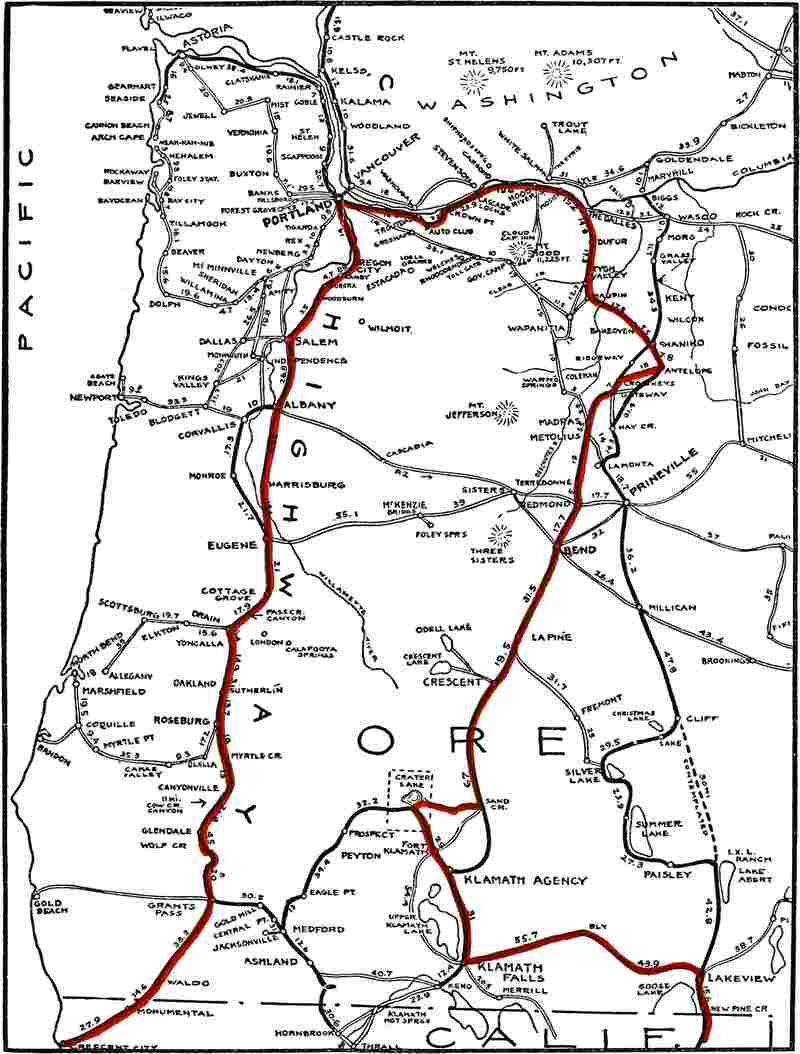
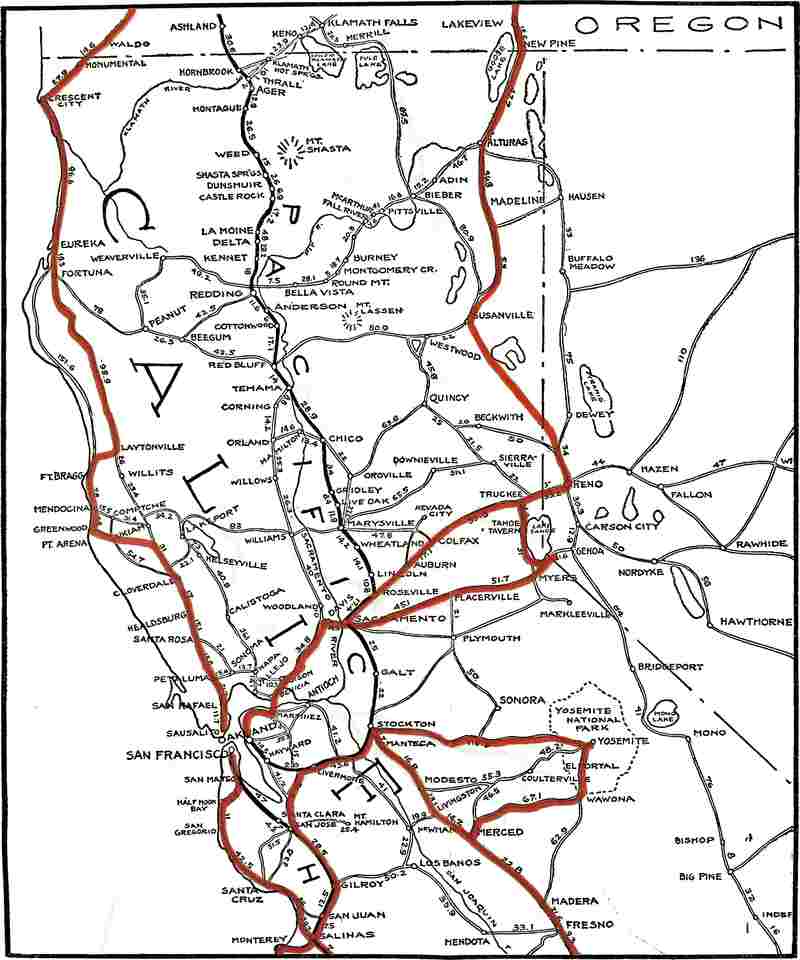
Map Showing Author’s Route in California
Oregon Map on Reverse of Sheet
By Courtesy of
THE OREGON JOURNAL
Portland, Oregon