Beauty of plot and great music are to an opera what fair features and a
noble soul are to woman. "Madame Butterfly" possesses these attributes,
and has consequently won that instant success which only true beauty, in
either art or nature, calls forth.
Very seldom is the story of an opera so intensely thrilling that the
original author is borne in mind; but it may be stated as a fact that no
one applauds Giacomo Puccini's splendid music without also thinking "All
Hail!" to John Luther Long, who wrote this strangely tender tragedy.
Distinctly unique as a grand opera setting is the Land of
Cherry-blossoms. Never before have the higher harmonies been blended in
with embroidered kimonas and chrysanthemum screens. The innovation is
delightful, however; refreshing, uplifting, enlarging. By means of great
music we are enabled to understand great emotion in the Little Land.
In this opera the hero is the villain, if one may so express it. He is
also an American; a lieutenant in the U. S. Navy, and from first to last
he seems blandly unconscious of his villainy. This is distressing
morally, but musically one could wish it no different. As the
rainbow-mist rises out of the whirlpool, so the beautiful in art is most
often evolved from a maelstrom of sin and tragedy.
A flowered veranda to a tiny house, a lilac-garden that overlooks a far,
fair view of Nagasaki, the bright blue bay and azure sky—this is the
opening scene of Puccini's opera.
The brief orchestral prelude is a pretty piece of fugue work,
four-voiced and accurately constructed. A fugue is unusual in grand
opera, but Puccini has a purpose in everything, and his music is
essentially descriptive. The opening conversation in this opera concerns
the construction of the tiny villa, and as a fugue is the one music-form
suggestive of rules and measurements—a secure foundation and precise
superstructure—it is clear that this bit of musical masonry, with its
themes overlapping but carefully joined, is intended to represent the
house.
On the stage the dainty dwelling is glowingly described by Goro, a
Japanese marriage-broker; very obsequious in manners, but characterized
in the orchestra by a most energetic, business-like theme that follows
him around like a shadow.
A wedding of his arranging is soon to take place, and this house has
been rented for the honeymoon. The bridegroom, Lieutenant Pinkerton, of
the U. S. Navy, is viewing the abode for the first time. He wears a
handsome uniform, and serves the opera as tenor, hero, lover,
villain—all in one.
Goro makes him acquainted also with the house-servant, Susuki, a
solemn-faced, saffron-colored maiden, whose name means
"Gentle-breeze-of-the-morning." Pinkerton prefers to call her
"Scare-crow."
The first invited guest to arrive is the U. S. Consul. A sympathetic and
genuinely tender theme announces this character's approach. Always
listen to the orchestra if you would know the real nature of these
people of the play. In grand opera, as in real life, words very often
conceal thought; but by the power of music the listener is endowed with
a temporary sense of omniscience; he can read the hearts and motives of
the creatures he observes.
It being still early, Pinkerton and the Consul seat themselves while the
hero explains this marriage he is entering upon. But first he orders a
"whisky and soda."
There is apparently no translation for this barroom barbarism, so the
English words are used, and their effect is noticeably jarring. No
critic has failed to remark this surprising debut of fire-water on the
lyric stage! There is charm and poetry in the Italian wine-glass, and we
have grown accustomed to see that mingled with melody—but the American
whisky-bottle stands remote from music as a pig from Paradise. Puccini
seems to realize this, for he accompanies the obnoxious word with a
discord!
There is nothing discordant, however, in Pinkerton's description of his
bride—the lovely lady Butterfly—"dainty in stature—quaint little
figure—seems to have stepped down, straight from a screen."
The music here is delicate and frail, like an exquisite tracery of gold
lacquer.
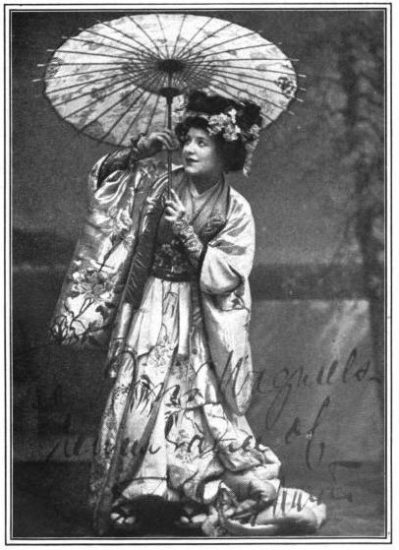
Copyright by Aimé Dupont.
Miss Farrar as "Madame Butterfly"
He intends to marry this Japanese bride in Japanese fashion, thereby
making the tie unbinding in America—a slip-knot adjustment that she,
poor thing, is unaware of.
The Consul remonstrates with Pinkerton over his "easy-going gospel" of
free love, but this light-hearted villain will not listen. He holds up
his glass instead, and to a buried accompaniment of the "Star-spangled
Banner," he proposes a toast to America—and also to the day on which he
shall wed in real marriage a real wife of his own nationality.
With this atrocious toast scarcely uttered, poor little trusting
Butterfly is heard in the distance with her bridesmaids, singing as they
approach. A delirium of joy breathes through this song, which is a weird
succession of Oriental intervals, strange as an opium dream. As the
harmonies grow firmer, Butterfly's voice rings out above the others,
while in the orchestra the conductor with his baton slowly unearths,
like a buried diamond, the great love-theme of the opera. It beams forth
in sultry splendor, a cluster of chords with imprisoned tones that flash
forth unlooked-for harmonies.
At last she enters—this Japanese heroine, her brilliant draperies as
bright as her name. Her maidens all carry huge paper parasols and
fluttering fans—a merry group of girls, filled with varied emotions of
timidity, envy, curiosity, and fun. They courtesy, and smile, and sing,
and sigh, and lower their eyes with knowing charm.
Throughout this scene it is interesting to note the different themes and
their consistent use. A phrase of the opening fugue invariably appears
whenever the house is mentioned; still another architectural motif
protrudes into prominence every time the town Nagasaki is referred to.
Susuki has a theme of her own; so has the Consul. When the relations of
the bride troop in, we recognize the fact that they, too, have a theme;
we learned it when Goro, some time back, was enumerating the expected
guests.
This theme now asserts itself in the orchestra as the grotesque company
assembles. There is nothing great about this melody: it is a mincing,
thin-bodied affair, but disports itself with much confidence during its
little hour of importance; it shoves out every other theme from the
orchestra and demands undivided attention. But at last the director's
stick chases it out of the enclosure.
The guests in the meantime have been gossiping among themselves,
disparaging the bride, criticizing the groom—and partaking of his
refreshments.
All flats and sharps and accidentals are suddenly dropt from the score
when the official registrar reads in monotone voice, and plain C major,
the simple marriage form.
The ceremony is soon over, but the guests linger on. Pinkerton plies
them with wine, but makes little headway in hurrying the festivities to
an end. He has grown heartily tired of these new relations, and longs to
see them go, but, instead of any one leaving, another one suddenly
arrives, an absent uncle, who plunges amongst them in a frenzy of wrath
and excitement. He has learned at the American Mission that Butterfly,
without telling her family, has changed her religion and cast off the
faith of her fathers.
Cries of horror, moans, and execrations follow this announcement.
Butterfly is denounced by her family—abjured and disowned. She cowers
before them, distressed, but not utterly crushed, for love remains to
console her.
The tragic theme of the opera; a gruesome sequence of minor thirds,
takes this opportunity to stalk into the orchestra and reconnoiter, like
an undertaker looking over the premises before he is really needed. This
theme has active work to do later on, but as yet does not seem very
terrifying.
When the relations and guests are gone, Butterfly is soon persuaded to
forget the "stupid tribe."
Evening has come; there is a twilight tinge to the music; it is
"dolce," "expressione," and "rallentando."
Puccini is a master of modulations. He employs large, full harmonies,
soul-asserting, all-engulfing chords, that feel their way from one key
to another, and burst forth in new glory with every transition. This
persistent progress through varying keys has an effect of leading the
listener through different rooms in some palatial edifice. In the hands
of a great composer, each key of the scale unlocks a new vista in the
enchanted palace of music.
Behind a screen on the veranda, Butterfly changes her chromatic kimona
to one of white silk. She emerges with garments all soft and fluttering,
like the trembling white wings of a night-moth.
Pinkerton leads her into the garden, and there, under the spell of the
silent stars, they sing of love and of the glorious mystic night, with
its gentle breeze that passes like a benediction over the bending
lilacs. Fire-flies (cleverly imitated) hover in the air and flicker
faintly, like candles in a distant chancel. The conductor waving his
wand, like a priest the swinging censor, evokes a wreathing mist of
music that enwraps the lovers in a drapery of dreams.
Melodies and harmonies rise into being and pass away like phantoms
floating by, until at last the great love-theme of the opera once again
is flashed upon us. The diamond, scarce revealed before, is now in its
proper setting. It is displayed in solemn glory by the dignitary at the
desk, who, with upraised, swaying hands, holds aloft this precious
theme, as a priest does the sacred emblem.
Act II. pictures the interior of Butterfly's house.
There is desolation in the home; the orchestra tells us this, for the
tragic theme possesses the instruments, creeping around among them,
serpent-like, and enfolding them in its coils.
The rising curtain reveals Susuki kneeling before a shrine; she is
praying that Pinkerton may return.
Three times have the dragon-kites swelled in the breeze and the peach
trees flushed into bloom since the day he sailed away.
Her prayer abounds in strange and uncouth harmonies that wail themselves
into silence. When the incantation is finished, an orchestral phrase of
keen despair and tortured hope accompanies Butterfly as she asks: "How
soon shall we be starving?"
Susuki counts over the few remaining yen, and expresses doubt about
Pinkerton's return. Again that same theme of anguish pierces the air
like a knife as Butterfly shrieks out: "Silence!" She will not listen to
doubt. She insists that he will return, and she fondly adds, "he will
call me again his tiny child-wife, his little Butterfly!"
With this memory there is a momentary return of the great Love-theme in
the orchestra; tender and fleeting, like a smile on the face of the
dying.
Butterfly sings of the radiant hour, some day, when they shall see "in
the distance a little thread of smoke," and then "a trim, white vessel,"
flying the American flag!
The music of this aria has a confident ring and a forward swing, like a
great ship nearing shore. Large and splendid is the final climax:
"He will return—I know!"
A familiar theme in the orchestra heralds the approach of the U. S.
Consul. He brings a letter from Pinkerton which he wishes Butterfly to
hear, but Japanese politeness interferes for some time. He must first
accept tea and wine, a pipe to smoke, and a cushion to sit on. He is
questioned about his health and the health of his honorable ancestors.
His own "Augustness" is profusely welcomed.
Scarcely have these formalities been accomplished when another visitor
arrives—a pompous personage, accompanied by servants who bring presents
and flowers. He comes to persuade Madame Butterfly that her husband's
absence amounts to a divorce, and that he, Prince Yamadori, should be
accepted as Pinkerton's successor.
This energetic wooer, lemon-faced and almond-eyed, imparts to the music
a spicy flavor, grotesque and Japanese. His brief, breezy phrases have a
turn and tang that belongs entirely to the Land of Nippon; staccato
suggestions of chop-sticks and Oolong.
The hostess politely declines to listen to her elaborate suitor.
She busies herself pouring tea, while in the orchestra a delightfully
tender, untroubled waltz-theme reflects her tranquil spirit, which is
like some quiet mountain pool in the path of a coming avalanche.
Impending disaster is near. Pinkerton's letter contains news that will
bring devastation to the little Japanese home. He is coming back—but
not to see Butterfly; a new wife comes with him.
The Consul waits until Yamadori has gone, then bravely tries to read the
letter, but his eager listener is too excited to hear to the end.
"He is coming!" That is enough! Her joy is unbounded. She speeds from
the room and in a moment returns with a sunny-haired child on her
shoulders—her "baby-boy!"—her "noble little American!"—to whom she
tells the glad news that his father soon will return.
The distressed Consul has not the heart to enlighten her further. He
leaves rather abruptly.
A moment later a signal gun is heard in the distance.
Susuki plunges in, breathless;—"The harbor cannon!" Both women rush to
the window. They can see the ship! A man-of-war! The Stars and Stripes!
Oh, the pain of this joy! The audience, knowing all, is torn and racked
with emotion as the orchestra reiterates Butterfly's recent song of
confidence about "his sure return."
Now is her "hour of triumph!" She proclaims it to high heaven—to
Susuki—and to all "the eight hundred thousand gods and goddesses of
Japan."
All the world had told her he would forget and never return—but she
knew!—she knew! Now, at last, her faith triumphs—he is here!
Superb is the crescendo now sweeping upward on the crest of America's
martial theme. The Star-Spangled Banner is bugled by the instruments,
while Butterfly's voice, in high and jubilant accord, sings again the
glad words: "He is here!—he loves me!"
In the orchestra the love-theme—the great theme—arises slowly and
passes by like a spirit of the past, a soul long dead, a memory faded.
Now follows a poetic scene unsurpassed for picturesque charm and grace.
In accordance with Japanese custom, the two women sprinkle the room with
flowers, in honor of his home-coming.
Great baskets full of blossoms are brought in by Susuki, while
Butterfly, always singing, showers the room with petals. She sways with
the rhythm of joy and music, flinging the flowers in reckless profusion,
her voice seeming to follow their flight—up in the air—and down
again.
Susuki, too, scatters rainbow-clouds of jasmine, peach-blooms, and
violets; her contralto voice at the same time giving depth of color to
the music. In the orchestra dainty, fluttering phrases are lightly
tossed about, as tho shaken from the instruments by a passing breeze.
Full of strange involutions and harmonies, the music of this
"flower-duet" possesses the essential quality of all that is lasting and
classic—hidden beauty beneath the obvious. With the choicest "mixing"
of harmony, orchestra and voice, Puccini has brewed a "blend" most rare,
and sugared it with melody.
When the baskets are emptied and the last flower fallen, a few final
notes of the refrain still left in the orchestra are hurriedly brushed
out by the conductor's baton.
On the stage, as the daylight melts into dusk, Butterfly, all in a
flurry, is decking herself in her wedding gown, while the orchestra
calls up memories of the lilac-garden and the fire-flies.
When all is ready, Butterfly, Susuki, and the little one take positions
at the window.
Long and patiently they watch and wait.
The orchestra plays a soft, unchanging staccato accompaniment. The
moonlight finds its way into the room.
At last the maid and the child fall asleep. Not so with Butterfly; rigid
and still she stands at the window, her eyes on the distant
harbor-lights.
A sound of far-away voices softly humming a sad, weird refrain, fills
the scene with mystery, suggesting the moan of guardian spirits. All
this while the gentle staccato harmonies in the orchestra continue to
flit back and forth, like the changing lights of swinging lanterns.
Butterfly does not move. The curtain slowly descends.
The prelude to the last act opens with a theme that crashes and tears
its way into prominence: a pitiless, gruesome group of notes, that
sounds vaguely familiar, tho it has never been emphasized like the
tragic-theme and others gone before. In the first act this dire phrase
was heard for a moment, buried softly among the harmonies that
accompanied Butterfly's first entrance song. She was happy then, but,
nevertheless, this germ of agony was lurking near, as tho to suggest
that we, each one, carry within our own temperament the weakness or
fault that will eventually lead us to grief.
The orchestra is kept very active during this prelude or intermission.
The past is presented in flashes of old themes, and the coming day is
presaged by new phrases of potent meaning. Sounds of the harbor life
beginning to stir, distant voices of sailors chanting, are heard even
before the curtain rises. When this is lifted, behold poor Butterfly
still at her post! All night she has watched and waited, never moving,
never doubting.
Now the dawn, cruel, cold-eyed and leering, begins to peer through the
window. The pale, frail figure in her wedding gown still does not move;
she still hopes on, counting the stars as they disappear; measuring each
moment by her heart's wild beating.
The dawn grows rosy, the music in the orchestra tells of the world's
awakening. The sun's glad welcome is proclaimed in a resounding pean of
harmonies, pierced with sharp, bright strokes from the triangle.
But all this brilliant daybreak music fails to modify the tragedy of the
dawn.
Susuki awakens to despair, but poor little Butterfly still asserts,
"He'll come! he'll come!"
When urged by the maid to rest, she takes the little one up in her arms,
soothing him gently with a quiet song as she mounts the stairs to her
sleeping-room.
Scarcely has she gone, when Susuki is startled by a knock at the door.
Pinkerton has come—and the Consul with him, but they tell the maid not
to summon her mistress—not yet.
The music of the flower-duet fills the air like a faint perfume as
Pinkerton observes the withered blossoms, and Susuki explains the
decorations and tells of Butterfly's weary vigil. A moment later she
sees through the window a lady waiting in the garden.
It is Pinkerton's wife.
"Hallowed souls of our fathers! The world is plunged in gloom!"
Susuki falls prostrate on her knees.
The ensuing trio is a magnificent musical unfoldment of sympathy from
the Consul, remorse from Pinkerton, and consternation from Susuki. It is
a splendid mingling of emotion and melody.
The two men are left alone as the maid goes out to speak with the new
wife. Pinkerton acts properly distressed over the situation, and his
friend, being only human, cannot refrain from saying, "I told you so,"
whereupon the music of his warning remonstrance in the first act is
plainly marked in the orchestra, like an underscoring to written words.
Pinkerton sighs over the room and its associations, sheds a few tears,
and then decides the strain is too great for him. As he leaves the
house, his wife and Susuki walk into view at the window.
At this moment Butterfly comes rushing down the stairs; she has heard
voices—"he is here!"
Susuki tries to ward off the evil moment, but the hour has struck. The
tragic theme rises up supreme—revealing itself in unclothed
hideousness: all the other themes have fallen away; they were as mere
empty masks over the face of truth—behind life is always death—back of
the smile is a skeleton.
Through the open window Butterfly sees the "other woman."
"Who are you?" Mechanically her lips frame the words, as she stands
there, paralyzed—stunned. But the question was perfunctory; the
explanations that follow only confirm what she knew at first sight.
Very gently the American wife proposes to Butterfly to adopt her child
and bring him up as her own.
The Japanese mother listens dumbly—then slowly realizes that unless she
consents to this plan her boy will have no name.
Butterfly says very little—but she accedes. She asks, however, that Mr.
Pinkerton himself shall come for the child. "Come in half an hour—in
half an hour."
Agreed to this, the Consul and the American lady go away.
Susuki is now quietly ordered to leave the room. She protests, but her
mistress is firm; she wishes to be alone.
When the weeping maid has gone, Butterfly lights a lamp at the little
shrine and bows before it. Then she takes from the wall a dagger, but
drops this as the baby suddenly enters, shoved in by Susuki—faithful
slave! who, forbidden to enter herself, thus blindly tries to frustrate
Butterfly's ominous wish to be alone.
The child rushes to its mother's arms, and Butterfly clasps it wildly,
calling it all the extravagant love-names Japanese fancy can devise.
"'Tis for you, my love, that I am dying!"
She holds him at arm's-length and bids him look long and well upon her
face. The baby tosses his head and laughs; he little recks what she is
saying:
"Take one last look on your mother's face, that the memory may
linger."
The tragic theme attains a grandeur now that makes it seem the
apotheosis of human heartache. Through the alembic of the composer's art
this gruesome theme emerges ablaze with a terrible glory. It sweeps
apast like a fiery chariot, bearing poor little Butterfly's soul to
heaven.
There is little more to record; the moment of death seems already gone
through in bidding the child good-bye. What follows is done very
quietly; every movement is lifeless and spiritless. She ties a bandage
about the little one's eyes, and she puts in his hand an American flag;
the Japanese mother's token of surrender.
Then Butterfly picks up the dagger. The deed is soon done; she totters
to the floor, and with her last breath tries to reach for her baby's
hand.
The Palace of Danger
A Story of La Pompadour
By MABEL WAGNALLS
A story possessing the five essential qualities that constitute
greatness in a novel:—a plot "keenly dramatic" (Review of Reviews);
"a wealth of charm of style," (N. Y. Press); such sustained interest
that it has "not a dull line from beginning to end." (Pioneer Press,
St. Paul); a pervading spirituality which makes it "clean and sweet"
(Unity, Chicago); and an irrefutable accuracy of historic information
whereby "the book has value" (Republican, Denver).
"It is many a long day since such an engaging little French heroine
of fiction has been presented to the public as the reader finds in
Destine, ... an innocent convent-bred girl who attends Pompadour as
one of her ladies-in-waiting."—Sun, Baltimore.
"A splendid picture of that magnificent court.... It is made very
real by the author."—Globe-Democrat, St. Louis.
"Rapid action, ... truthful and interesting pictures of the
times."—Times, N. Y.
"It is not often in these piping times of publishing that the tired
reader comes to such a delightful stopping-place on the
book-littered path of fiction as 'The Palace of
Danger.'"—Bulletin, San Francisco.
12mo, 311 pages. Four splendid illustrations by John Ward Dunsmore.
Price, $1.50.
FUNK & WAGNALLS COMPANY, Pubs., New York
JUST RE-PUBLISHED
MISERERE
By MABEL WAGNALLS
Author of "Stars of the Opera," &c.
A brief, but beautiful romance in which the discovery of a rich and
powerful voice leads ultimately to a climax as thrilling as the death
scene in "Romeo and Juliet." The story is told with simple grace and
directness, and is singularly pathetic and forceful.
"It is perfectly delightful. The theme is new and
interesting."—Ella Wheeler Wilcox.
"It is a story of tender and pathetic interest—the story of a
woman with a wonderfully beautiful voice. A dainty and fascinating
romance which will appeal to music lovers."—Chicago News.
"It vibrates with musical sentiment. There is a good deal of
artistic skill displayed in its description."—Boston Watchman.
"A story unique in theme, delightfully told with many delicate
touches."—The Arena, Boston.
Small 12mo, Cloth. Illustrated. 40 Cents, net
FUNK & WAGNALLS COMPANY, Pubs., New York
Selma, the Soprano
By MABEL WAGNALLS
Forms one of the chapters in the book entitled "One of Those
Coincidences." It is the tragical story of a journalist and his talented
sweetheart and wife, who are at first separated, and then reunited by
strange fortunes. The story is filled with music and feeling, and holds
the reader's intense interest to the very end.
OTHER ENTERTAINING STORIES BOUND IN THE SAME VOLUME
| One of Those Coincidences | Jacob City |
| By Julian Hawthorne | By A. Stewart Clarke |
| The Taper | At the End of His Rope |
| By Count Leo Tolstoi | By Florence M. Kingsley |
| How Viardeau Obeyed the Black Abbe | The Strange Case of Esther Atkins |
| By Charles G. D. Roberts | By Mrs. L. E. L. Hardenbrook |
| John Merril's Experiments in Palmistry | The Easter of La Mercedes |
| By Florence M. Kingsley | By Mary C. Francis |
| Francisco | The Romance of a Tin Roof and a Fire Escape |
| By Walcott Le Clear Beard | By Myra L. Avery |
ONE OF THOSE COINCIDENCES
12mo, Cloth. Profusely Illustrated. Price, $1.00
FUNK & WAGNALLS COMPANY, Pubs., New York


