This monograph was prepared by Clarence E. Bonnett, under the direction of
Charles H. Winslow, Chief of the Research Division of the Federal Board for
Vocational Education. Acknowledgment is due to Percy R. Todd, General Manager,
Bangor & Aroostook Railroad, Bangor, Me., and to Dr. John Cummings of
the Research Division for editorial assistance.
In transportation men are concerned with the moving of persons and goods
from one place to another. Transportation requires, however, many other operations
than simply loading, hauling, and unloading passengers and freight.
Charges must be determined and collected, records must be kept, movements of
trains, cars, boats, and other vehicles must be directed, repairs to equipment must
be made, and numerous other matters must be handled. These numerous operations
call for hundreds of thousands of employees in many different trades and occupations.
Thus in transportation there are so many different sorts of occupations that
nearly any individual who likes responsibility can become interested in some part
of the great field. There are occupations in which responsibility rests upon the
employee for insuring the safety of property, and this responsibility is not by
any means inconsiderable. In other occupations employees are responsible for
lives as well as property, and risk their own lives in the service. There is office
work for those who like it and plenty of traveling for those who enjoy that. If
a life out of doors appeals to you, transportation can give you a job of that sort.
In short, if you have a liking for responsibility you can find a job in transportation
service that will suit you.
If you were engaged in transportation before you were disabled, you are
probably still interested in this work, and would return to it if you did not feel that
your disabilities unfitted you for your old job. If you wish to go back into
transportation and can not take up your old job or a new one in that field without
retraining, you want to know how to get retraining and how retraining will help
you. Retraining and devices may help you to get your old job again. Retraining
ought to do more than simply this. It ought to get you a better job than you had
before. It is to help you to analyze and see your own possibilities as they are
related to the various transportation occupations that this booklet is written.
In general, transportation is performed by steam railroads, by street railways,
by wagons and automobiles, and by boats. Of these agencies, steam railroads
employ the largest number of men in so far as regular occupations are concerned.
We shall, therefore, consider first the occupations and trades connected with the
operation of steam railroads.
Railroading in the United States is a gigantic enterprise. In 1916, a prewar
year, our railroads possessed about 65,000 locomotives, 2,342,000 freight cars,
55,000 passenger cars, and 98,000 company service cars. There were 259,000
miles of single track and enough of double track to raise this figure to 293,000
miles of main track. In addition there were 102,000 miles of sidings. Employees
of railroads numbered 1,654,000 and were paid $1,403,968,000 as their compensation
for the year 1916. Obviously, among so large a number of employees operating
so varied an equipment are found many different trades and occupations.
Railroading is attended with personal risk for many of the employees, but
only in a small number of cases is a man who is disabled in the service of a railroad
rendered unfit for further service. Many of the older railroad men have suffered
injuries of some sort, since the use of safety devices is relatively recent. Quite
a number of injured men have in the past been given office, clerical, or watchmen’s
work, since there is a vast amount of such work to be done, and it involves comparatively
little personal risk.
For the man who lacks a technical or college education there is almost a dead
line to promotion into the higher offices. For instance, the wide-awake section hand
can become a section foreman, then a construction gang foreman, a supervisor,
and perhaps a roadmaster. But he can hardly ever hope to become an engineer
of maintenance of way unless he acquires in the meanwhile an extended knowledge
of civil engineering especially as applied to railroading. The disabled soldier or
sailor, if unfitted to pursue his old occupation, can secure this very desirable training
through the Federal Board for Vocational Education. He can thus secure an
advancement that he might not otherwise have obtained.
There have been three conflicting forces governing promotions in railroading—favoritism,
seniority, and efficiency. At one time favoritism was so strong that
graft and toadyism gave inexperienced men promotion over men with long experience.
The seniority rule was introduced by the labor organizations to offset the old
evil, and for two men of equal intelligence and native ability selection by seniority
is a fair method of giving promotion. In such a case seniority coincides with
efficiency. But seniority of itself does not necessarily in all cases give the higher
position to the man best fitted for it, since long years in the service will not train
the thoughtless, careless man as well as a few years will the alert man. Railroad
employees in all branches of the service strongly contend as a group for their
seniority rights. This means that an outsider usually has a long waiting period
for advancement into the best positions. Efficiency is becoming more the rule,
but the old influences still prevail in some departments, partly because standards
of efficiency are rather indeterminate, largely because changes in a widespread
system can not be wrought in a day. If favoritism could be abolished employees
would not insist so strenuously upon their seniority rights.
Since the railroads have been subjected to public regulation they have appreciated
the value of courteous treatment of the public. Accordingly they reward
the courteous employees by promotion, and no longer tolerate a grossly uncivil one
as they did in the early days.
Loyalty to the railroad organization is regarded to-day by railroad officials
as the foremost requisite for those wishing promotion—a loyalty that places the
railroad organization first, whether it be a question of public regulation or of
labor unionization. Fairfax Harrison, president of the Southern Railway Co., has
thus stated the case:
“There are three requisites for advancement in railroad service—loyalty,
efficiency in your present job, and preparedness for larger responsibilities. Efficiency
and preparedness for higher place go together, for that man will be most
efficient in his present job who is not content with mere mechanical performance
of his duties, but who has an intelligent understanding of them in their relation
to the service as a whole and who has qualified to take over the duties and responsibilities
of his immediate superior on a moment’s notice.”
It is however, a generally known fact among railroaders that few men in the
lower positions have the chance to learn efficiently all the duties required of them
in the next higher position. For example, a track workman rarely has the opportunity
to make out reports and payrolls, or even to do alignment sighting, unless
he is favored by his foreman. By taking the training provided by the Federal
Board he can learn to do this and other highly skilled work, and thus have an
unusual opportunity for advancement. He could study civil engineering and become
an engineer-maintenance-of-way.
There are various ways of classifying railroad employees, but we shall use
here a grouping suited to our purposes, based largely on physical and mental
requirements and the training involved. We are not so much concerned with the
several administrative departments—accounting, operating, traffic, etc.—as with
the work done in different occupations. There is obviously a marked difference
between the physical requirements for an office position and those for a position as
railroad brakeman. On a basis of the requirements made upon the employee,
railroad occupations may be grouped as follows:
1. Office or clerical work.
2. Shop work—repairing equipment.
3. Track work—repairing track and structures.
4. Train work—operating the trains.
5. Work conducing directly to train operation.
In railroad office and clerical work the requirements upon the employee are
mainly mental. In this group we find the general and divisional officers—financial,
legal, surgical, engineering, managing—telegraphers, train dispatchers and train
directors, telephone operators, station agents, passengers and freight agents, station
masters, and all sorts of clerks—accountants, rate clerks, traffic clerks, etc.
For these positions a man may qualify although he may have suffered from
considerable physical disabilities, providing he is mentally alert and has some
knowledge of railroading. The knowledge that a man should acquire or the
training that he should take will, of course, depend upon the particular position
he wishes to fill.
Let us consider some of the principal office and clerical occupations, so that
you may be able to select the one that appeals to you. We may well begin with the
telegraph operator.
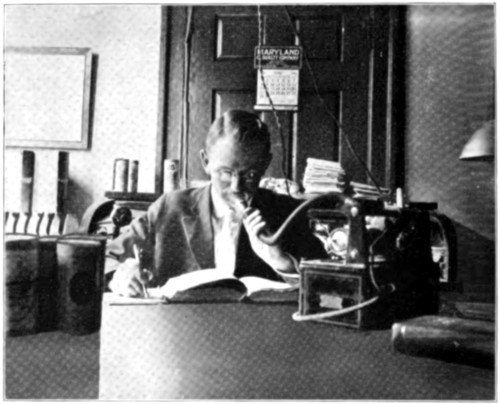
Few physical disabilities will debar an intelligent man from becoming a telegraph
operator. Poor hearing, the loss of both arms or of both eyes are handicaps
that can not be overcome, but nearly any other disability can be overcome. The
occupation rarely subjects a man to exposure to bad weather. Telegrapher’s
cramp and electric shocks are the chief occupational hazards to be guarded against.
The position of the operator is stimulating, even at a small station on a
through line, since much of the important news of the day goes over the wires.
Of course, he is bound to keep secret all such news, and there are through wires
on which he can not listen in.
Telegraphic Apparatus
The instruments used consist of a key for sending messages and a relay or
sounder for receiving messages. To install an outfit is a simple matter for anyone
who is at all familiar with the action of an electric current, for the principle of
operation is merely that of breaking up the flow of current into dots and dashes
in various combinations.
Training for Telegraphy
However, facility in transferring letters into dots and dashes and translating
dots and dashes into letters is not so easily acquired. Only after much practice
does the beginner form the habit of doing this readily. He must of course
memorize the Morse alphabet, but, further than that, he must become so familiar
with the dots and dashes that when he hears them in combination he thinks that he
is actually hearing a word, not a certain number of dots and dashes. He must
form the habit of thinking words in dots and dashes without thinking of the clicks,
just as one reads a page without thinking of the separate printed letters that go
to make up the words.
The operator needs further to acquire a rapid legible handwriting, so that
he can write down rapidly the message as he receives it and never get very far
behind the sender. Since, however, it is difficult for one to write as fast as an
experienced sender can send, the operator must learn to retain in mind a number
of words and phrases, so that when he is receiving messages sent rapidly he can
copy behind the sender and catch up at breaks for new sentences and paragraphs,
or at the end. Some operators have learned to receive messages, writing them
out on the typewriter as they come over the wire. This is an accomplishment worth
striving to attain, especially if one can not write legibly and at the same time
rapidly.
The Telegrapher Must Learn More Than Mere Telegraphy
There are a number of other things that the telegraph operator needs to
learn, especially if he holds a position at a small station. He must learn a large
number of abbreviations, so that he knows immediately what they mean. Some of
these abbreviations are made up of the main consonants in the word, while others
are simply arbitrary numbers. Sometimes these numbers refer to a printed form
which he must use repeatedly. A knowledge of switchboards and cut-outs, of
installation and renewal of batteries, and of care and adjustment of instruments
is highly desirable and usually necessary. All operators must know the rules
and regulations of the company and govern themselves accordingly, and they must
be fully acquainted with signaling systems and appliances.
If the operator is located at a small station, he probably has part or all the
work of the station agent to perform at some time. If he is located at a large station,
there are emergencies when he may be called upon to do such work, so that he
should become familiar with the work of the station agent. This, of course, means
that he must become familiar with rates, both freight and passenger, must sell
tickets, make out freight bills, and do railroad bookkeeping. The complaint most
frequently made against schools teaching telegraphy is that the student is taught
telegraphy and nothing else, so that when he takes employment he has to learn at
once nearly everything connected with station work.
Hours and Wages of Telegraphers
Hours are generally eight per day, and wages are good, averaging around
$1,100 or $1,200 per year for all operators, which means that the efficient employee
who works regularly gets much more than $1,200. Employment is regular throughout
the year. Rarely does an operator send or receive for a long period of time
without a break to rest. Most messages are ten-word ones, which means the transmission
of probably not over twenty words, including names, addresses, and
office data.
Will Telegraphers be Needed?
As to the permanency of the occupation, there is only the telephone that in
any way threatens to make the telegrapher unnecessary. The limitations of the
telephone are such, however, as to make that instrument supplemental to the
telegraph. The telephone is, for example, more liable to get out of order, because
the apparatus is more complicated, and when out of order it can not easily be
put in commission again by the average operator. The telegraph lends itself
readily to codes and a written record is usually made of messages sent by telegraph,
while the telephone lends itself readily to conversation. Thus each has its own
proper uses. The wireless seems to be better adapted to telegraph instruments than
to the telephone, especially for long distances. There has been no practical device
invented for relaying messages mechanically with the telephone, as can be done with
the telegraph. Although the telephone has proved to be satisfactory in the direction
of trains, and is being installed on the railroads rather generally, it is hardly
probable that it will entirely displace the telegraph. However, it is to be noted that
there is some possibility that the service may be flooded with telegraphers only
partially qualified to do their work. Radio operators trained in the war can readily
become telegraph operators and during the war many women have learned
telegraphy. A disabled soldier or sailor entering this occupation should take
supplementary training for the position of station agent, so that he may in some
measure avoid the competition of radio and women operators.
Disabled Soldiers Who Have Learned Telegraphy
By way of illustration a few cases may be cited of disabled Canadian soldiers
who have taken training as telegraphers and entered successfully into this work.
Returned soldiers whose former occupations had been that of farmer or farm hand
have taken the training courses offered them by their Government, and have thus
fitted themselves for this, to them, entirely new line of work. One farm hand, for
example, disabled by stiffness of the left elbow, studied telegraphy and secured
a position as assistant agent on the Grand Trunk Railway. Another disabled
soldier, a former farmer, suffering from leg trouble, studied telegraphy and now
holds a position as a railroad telegrapher at a salary of $95 per month. (Salaries
paid telegraphers in the United States are considerably higher than in Canada.)
Another farmer so disabled in the army that he had but little use of his left leg
took a course in telegraphy and now holds a position as an operator paying $82.50
per month, with house, light, and heat free. Still another farmer, who lost his
left arm in the army, after studying telegraphy secured a position as a wireless
operator at $85 per month and board. If you have not lost your mental equipment
and ambition, you can do as well as or better than these disabled Canadians have
done.
Other disabled soldiers have taken training for telegraphy to enable them to
get into an employment paying more than their former occupation and giving more
regular employment. A waiter afflicted with heart trouble, for example, a bricklayer
who lost three fingers on his left hand and had wrist injured, a rubber-shoe maker
afflicted with stiffness of the left elbow joint, each studied telegraphy, and each
has secured a position on Canadian railways.
Old railroad men whose disabilities prevented them from returning to their
former occupations have taken training for telegraphy, in which branch of railroading
working conditions were better than in their old jobs. A locomotive fireman who
had sustained a gunshot wound and lost the vision of his right eye and a finger from
his left hand studied telegraphy and secured a position as a station agent. A
lineman whose legs were too weak for his old position took both the commercial and
telegraphy courses and now has a position as an operator at $88 per month. If
you have had practical experience as a railroad man, the courses offered you by
your Government will give you the training necessary to enable you to secure that
higher position which you have often hoped you could get. Why do you not make
your disability your opportunity for advancement? Now is the time to take the
training and secure that promotion.
Line of Promotion for Telegraphers
An operator may be promoted to a position as train dispatcher, or as station
agent, depending upon his interest and abilities and upon the available opportunities.
Opportunities to become station agents are more frequent, because the number of
station agents employed is much larger, and promotion in this line may be continued
by transfer from a small to a larger station. Before passing to a consideration of
the occupation of the station agent, we shall note briefly the position of the train
dispatcher.
The train dispatcher must be an expert operator and must have other
qualifications which he may have acquired while working as an operator. He must
understand the workings of the operating department; he must know the location of
sidings and telegraph offices, the distances, grades, and track conditions between
sidings and offices, and something of engineers, engines, and train loads. He
must have a clear head and must not get confused nor trust to memory or guess
as to location of trains. He must keep a record of the progress of all trains and
refer to it constantly. He must have the ability to direct men in person or at a
distance, since the operators are subject to his orders. It is absolutely necessary
that he know thoroughly all the operating rules and regulations of the road. The
position is one of great responsibility, especially on roads with heavy traffic on a
single-track system. Since he must direct all trains on his division, the mental strain
at times is considerable. But the hours are usually short, and the wages paid are
high—the annual average being nearly twice that for operators.
The train dispatcher may advance to the position of chief dispatcher, whose
duties include supervision of train dispatchers, and general operation of all trains.
In emergencies his duties and responsibilities are especially exacting.
In no one other position probably are working conditions so varied as in that
of the station agent. He may be located at a small village on a branch line where
he meets perhaps two trains a day and performs all the work around the office from
telegraphing to caring for the United States mail. Or he may be located in a large
city, where his work is that of supervising a small army of employees. But whether
he is in the smallest position or in the largest, he must understand the railroad’s
business as it relates to his work. He must understand rates, both passenger and
freight; must know how to keep records and accounts correctly; how to make out
freight bills and coupon tickets, even although he himself may not have to do this
work; and he must know how to handle men. It is through him that the public
comes most closely in contact with the railroad, and he can make or lose traffic
for the railroad by the manner in which he meets customers or would-be customers.
Courtesy in station agents is being prized more and more by railroad administrators.
A popular agent is an asset, an uncivil one, a liability. The agent at a small
station can obtain much business for the company through a knowledge of through
rates and routes, although he must allow the shipper to choose the route. All station
agents must be experienced operators on lines where the telephone is not used. They
must be thoroughly familiar with railroad signals and with traffic rules and regulations.
Even in a small place, the agent comes more in contact with the outside world
than most of the other inhabitants of the village. His position is one of financial
responsibility, since he handles large sums of money. Upon him devolves largely
responsibility also for the safety of travelers and freight, since he plays a part
in the directing of trains. He can save the railroad from losses in claims for lost
and damaged goods, by seeing that names and addresses are marked clearly on
packages, that goods are packed properly for shipment, and that packages are
handled carefully.
At the larger stations, the work of the station agent is that of supervising
a large number of clerks, baggagemen, and other workers.
Among these clerks are ticket sellers whose duties are to calculate rates and fill
out coupon tickets with correct routings, and to sell local and excursion tickets. They
must be very careful to make correct charge for the tickets sold. They make out
detailed reports of the tickets sold and money received.
The head baggageman and his assistants receive and forward all baggage left
with them, determine if there is any excess and collect the charges for excess. They
issue duplicate checks for baggage left with them when the passenger presents
his ticket and asks for the checks. They also give out baggage arriving at the
station on presentation of the duplicate check issued at another office. The head
baggageman must be able to handle men and direct them so as to avoid making
mistakes, but he must usually be physically able himself to handle baggage.
In the freight department are rate clerks, who give information as to rates
and classifications; billing clerks, who bill freight, enter weights, etc.; and
other clerks, who attend to accounts, records, correspondence, and claims.
Disabled soldiers or sailors with good common-school education could, after
short periods of training, fill any of these positions. Salaries average slightly
less than $1,000 per year. For ticket sellers comparatively few disabilities are
serious handicaps, except such as may be repellant to the traveling public, which
does not usually like to be reminded of accidents. Freight clerks have not even this
condition to meet, and if they are not called upon to handle freight they will not be
seriously handicapped by physical disabilities which would bar them from many
occupations.
At important freight centers a considerable number of employees are directly
engaged in handling freight, under the supervision of a freight-house foreman.
This foreman has charge of the freight house, directs the placing of cars at the
warehouse and the loading and unloading of freight, and is responsible for keeping
records so that freight may be readily found. He must be able to handle men, and
must know how freight should be packed and stored, both in the freight house and in
the cars. He must be able to classify freight and to file properly all records
relating to freight. He has usually been promoted from a position as checker, warehouseman,
or trucker. Any disabled man who has held such jobs, if he is intelligent
and can handle men, could with some training become a freight-house foreman.
Poor sight or hearing would, however, usually be serious handicaps.
The freight checker has a position that pays better than that of the trucker—who
is rated as an unskilled laborer. The freight checker checks the freight into
and out of the freight house, warehouse, or car. He must be able to check consignments
accurately, and should know the classes of freight.
At transfer points, a transfer agent performs duties similar to those performed
in the positions just considered. He sees that shipments are properly transferred.
He makes the necessary notations on waybills, and keeps a complete record of the
transfer and of the cost incurred. He must understand loading and unloading
freight and must be able to handle laborers. Not infrequently he has been promoted
from a position as agent at a small station. A disabled man with good sight and
hearing, who can write, might be trained for this position.
At division points on the railroads, there are a number of station and yard
employees whose duties are supervisory. Among these employees are the station
master with his assistant, the supervising agent, the yardmaster, with his assistant,
and the train director.
The station master directs the making up and dispatching of local passenger
trains, receives and dispatches through passenger trains, and looks after the
necessary shifting of cars in such trains. He sees that all these trains are provided
with crews ready to take prompt charge of the train. He has general supervision
over all employees about the station, and reports on neglect of duty by any of these.
The assistant station master has the same general duties as the station master
and must have the same qualifications. The assistant works when the station master
is off duty, or in the larger stations relieves the station master of part of his work.
These men must be courteous to the traveling public, and must have had
experience in the operation of trains in the yards, so as to be able to direct train
movements efficiently. They must have the ability to handle men and to make sound
decisions quickly. The physical requirements are good health, sight, and hearing.
Disabilities which would not prevent quick movement from place to place would
not be serious handicaps to well qualified men.
The supervising agent has general charge of passenger, baggage, freight,
and scale agents. He employs and supervises the employees who take care of the
station grounds and buildings. He must possess executive ability, and must have
had experience in the positions he supervises, to enable him to select properly
qualified men, and to direct their work intelligently.
The yardmaster has immediate supervision over yard employees and yard
operation. On some railroads he has also supervision over the calling of train
crews and the train seniority list. He is aided in his work by assistant yardmasters
and by yard clerks. The assistant yardmasters’ duties and qualifications are of
the same general character as those of the yardmaster.
These men must see that cars are not unnecessarily delayed in passing through
their yard. They must receive the waybills for cars arriving, and deliver these to
the conductors taking charge of the cars when they depart. They must make
records of all the transactions and fill out reports. They must be thoroughly
familiar with the rules governing train operation and defining the duties of employees
connected with train service. The yardmaster must see that all orders are
properly given and executed. He must have good color eyesight and hearing, and
be able to stand exposure to weather. He would not be seriously handicapped by
the loss of limbs, provided he could write out reports and make records and move
quickly from place to place. A disabled trainman could take training for the
position of assistant yardmaster and thus be in line for promotion to the
position of yardmaster, although the seniority rule might prevent him from getting
this promotion quickly.
The duties of the train director are to receive and transmit train orders for
the movement of trains, from the train dispatcher to the train crews. Accordingly
he must be an expert telegrapher or telephoner, have good color eyesight and
good hearing, and be thoroughly familiar with the rules and regulations relating
to the movement and signaling of trains.
Under the station masters, yardmasters, and supervisors are a number of minor
clerks, attendants, and laborers. But little skill is required of the laborers, whose
work is largely physical and the wages paid them are the usual wages for unskilled
labor. The duties of minor clerks vary so from station to station and so overlap
that any detailed account of their services would be confusing. Some of these
clerical positions might be suitable for some disabled men, and the training
necessary is usually short. It must in fact generally be taken in the position itself
for the special duties assigned in the given case.
A disabled man with a good voice and memory might become a train caller at
a large station. A disabled passenger conductor might become a ticket examiner,
since his knowledge of tickets and of the various stations would be the sort of
information required for this position; but the pay would probably be lower
than that of conductors.
In the divisional or general offices the reports, accounts, and similar matters
that come in from station agents are handled. There is the accounting division
concerned with receipts and expenditures, most of which are for small amounts, and
all of which must be totaled in various ways—a considerable task of itself.
Expenditures must frequently be analyzed according to different regulations, and
reports must be compiled for State and Federal commissions. Because of these
requirements the railroad accountant must learn many things about railroad
systems and the public regulation of railroads that another accountant does not
need to know.
In the divisional and general offices a great deal of statistical work must be
done. A number of clerks are employed in preparing exhibits for the rate or wage
hearings, of which there are usually one or more in progress in some part of the
country. Much of this statistical work is done in the traffic department.
The traffic department is the rate-making and traffic-getting department
of the railroad. In this department much correspondence is carried on; many
letters are received, answered, and filed, especially in obtaining traffic. The answering
of inquiries of all sorts is in itself a big task. The traffic department considers
the revision of old rates and classifications and the issue of new rates or special
rates. Here is where individual rates, rate structures, and classifications are
first formulated. The change of a rate structure is usually made only after an
extended study of traffic conditions and of the probable effect of the proposed rate
structure. The traffic department presents such matters to the various classification
committees for action, and jointly with the traffic departments of other railroads in
the territory covered it forms the traffic association and classification committees.
It thus operates to affect rates on other railroads and it presents new rates and
classifications to the Interstate Commerce Commission or to State commissions for
approval. It must frequently prepare for hearings upon changes in rates and
classifications. It draws upon the auditing and operating departments for much of
the information upon which new rates are formulated.
There are two divisions to the traffic department, namely, the freight and the
passenger divisions. The freight division makes studies of the commodities to be
moved, of the competition the railroad has to meet, and of the charges that the
traffic will bear without being diverted to other lines or routes. It adjusts claims
for lost or damaged freight. It solicits business by keeping in touch with the
shipping interests along its line or those who could be induced to use its line
in connection with another road. For this purpose traveling freight agents are
employed. These men must know rates, routes, commodities, and men. Their
employment depends upon their knowledge of their business and their ability to meet
and convince, for instance, the manufacturer that he should ship over their line.
In other words, they are salesmen of railroad service.
Who are Eligible for Traffic Department Service
Former railroad conductors or brakemen of a high degree of intelligence, who
have been disabled in the war, may in some cases wisely elect to take training
for service in the traffic department. Much of the information that a conductor
or brakeman has learned in his old position will be of value to him. In the traffic
department both officers and clerks must know how properly to bill freight, how
to calculate both local and through freight rates, and how to route through freight
over connecting lines. They must know the junctions where cars can be transferred
and where they can not, and where less-than-car load shipments can be transferred
without drayage. They must be familiar with the seasonal movement of freight
and must know what commodities come from certain districts and with what regularity,
in order to anticipate heavy freight movements, and have cars at points where
they are most needed. The intelligent conductor or brakeman has already acquired
much of this information. Freight conductors are well qualified for training as
traffic men, traveling freight agents, terminal traffic men, assistant traffic managers,
or even traffic managers. Former clerks in the traffic department also could take
training and qualify for better positions.
The passenger division of the traffic department attempts to obtain extensive
travel over its lines. Conventions, circuses, and all such attractions for crowds are
noted and excursions provided whenever they seem to promise to be profitable. Such
excursions must be advertised, and this demands an advertising man in the department.
In large cities where many competing railroads center, city ticket offices
are maintained from which solicitors are sent out to induce persons known to be
planning a trip to travel on their respective lines. A disabled passenger conductor
might qualify by training for a position in this division, and find that his past
experience would be very helpful in the new position.
Those formerly in purely clerical positions, who have been disabled, may
advantageously take courses in rates and rate making, and thus qualify for higher
positions.
Previous Experience of Value for Other Office and Clerical Work
In other departments of railroad service, there are a large number of positions
that former train, station, or track men who have been disabled could advantageously
fill, utilizing their railroading experience, and taking training for the new positions.
These disabled men would have to be men of intelligence and not too old to take
up a somewhat different line of work.
Such men could, for example, learn accounting and would find their knowledge
of train matters, track affairs, and station duties of value in helping them to
understanding certain accounts. Auditors could do their work more efficiently if
they understood more of the work in the various branches of railroad service.
Again, top-heavy engines would not be placed on tracks made up largely of
curves, in the hope that the high drivers would give greater speed than could be
developed from lower-wheeled engines, had the responsible officials or their advisers
understood more of track maintenance, especially in cuts in rainy weather. In one
instance when high-wheeled engines were placed in service on a road the track men
complained immediately, but it took a series of wrecks on curves to induce a change
to safer engines.
The claim department could utilize men who have been “out on the road.”
Actual railroad experience would be of value to a young man about to enter the
legal department of a railroad. A young railroad man inclined to legal affairs
could take the training provided by the Federal Board, and thus make his disability
a means of advancement to one of the highest paid positions on railroads.
The purchasing agent and his assistants could undoubtedly gain in efficiency by
having in their offices men who have had actual experience in handling the materials
that these agents must purchase. When to insist upon strict compliance with all
specifications, and when in the case of certain specifications to make concessions, are
matters that may involve large sums of money and in such matters the advice of
men with actual experience in using the materials would be very helpful.
Percy R. Todd, Assistant to District Director and General Manager, Bangor
& Aroostook Railroad, Bangor, Me., says:
“There always has been, and, in my judgment, always will be a demand in
excess of the supply for the following classes of employees, particularly relating to
office work, viz.:
“Stenographers.
“Tariff clerks (trained in the framing and publication of freight and
passenger tariffs in accordance with Interstate Commerce Commission rules).
“Freight claim clerks (trained in the handling of both overcharge and loss
and damage freight claims).
“Waybill clerks (there has always been great difficulty in obtaining trained
men to make waybills at stations).
“Telegraph operators.
“Expert railroad accountants.
“Clerks trained in valuation of railroads.
“In all of the above-mentioned lines, so far as my personal experience goes,
there has always been a shortage and probably always will be.
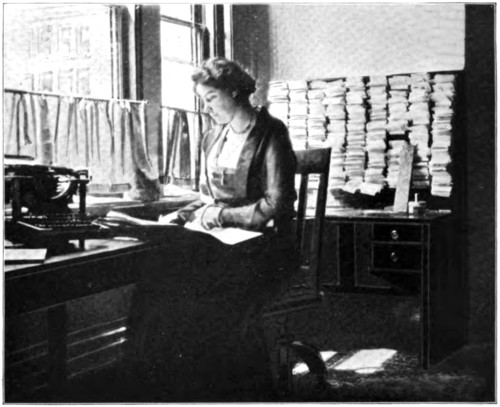
“As to stenography, I consider it the very best medium through which any
young man can make progress on a railroad, as it lifts him at once above the mass
of clerks and gives him an individuality and a touch with executive officers which
almost invariably leads to his promotion.
“In this connection I might add that the traffic manager of the New York
Central Railroad, * * *, was at one time my stenographer when I was connected
with the New York Central System, and rose from that position to be traffic manager
of all their lines; the president of the Chicago, Burlington & Quincy Railroad, who
died three or four years ago, started as a stenographer with the Michigan Central
Railroad at Chicago.
“The general manager to-day of one of the New England railroads started as a
stenographer with the same company, and I could give a great many more instances
of what stenography has done for men who had the brains to back it up.”
For the second group of employments designated, shopwork, the physical
requirements are higher than for office and clerical work, since shopwork generally
calls for at least ordinary strength and eyesight. Shopworkers include general
foremen, gang and other foremen, machinists, boiler makers, blacksmiths, carpenters,
painters, upholsterers, electricians, air brake men, car inspectors, car
repairmen, mechanics helpers, and apprentices. A number of men now employed in
these occupations have suffered injuries to hands or feet, or have defective
hearing. Foremen can perform their duties under disabilities that would be serious
handicaps for workmen, but a foreman needs good eyesight.
Skill Required for Shopwork
Practically all of these occupations require considerable skill and general
knowledge of railroad equipment. While the workmen have machines with which
to perform many operations in the shop, still much handwork must be done. This
is the case because repair work is varied, and the work must usually be done partly
on the car or engine, sometimes out on the road. The machinist’s work is
generally heavy and greasy. Some of the carpentering and paint work is rough,
as is that on box cars, while some, such as the cabinet making and varnishing of
passenger coaches, is highly skilled.
Training
A skilled machinist or mechanic can learn to do railroad work very quickly
after he gets on the job. Others must spend a period of apprenticeship to learn
the trade. Quite a number of railroads have regular apprenticeship courses.
Wood-working and metal-trade schools also give much of the training required for
railroad shop work. We give below a description of the occupations to suggest to
the disabled soldier the training he will probably need, and to enable him to decide
whether the occupations are suited to his disabilities.
Great Demand for Shopworkers
For the disabled soldier or sailor who is mechanically inclined, the railroad
shop offers an opportunity for good wages and advancement. The depreciation of
the great amount of mechanical equipment of a modern railroad is very large and
railroads have not had in the shops for a number of years sufficient men to keep the
rolling stock in good condition. The number of bad-order cars and locomotives has
been large, and they have not moved out of the shops as rapidly as they should.
The automobile industry has undoubtedly been a strong competitor for the mechanics
who otherwise might have gone into railroad shops. Some railroads have attempted
to provide themselves with sufficient machinists by training apprentices in considerable
numbers.
The master mechanic has charge of the machine shop and the employees
therein. Under him, are usually, shop foremen, roundhouse foremen, road foremen,
and sometimes other supervisors. He may himself be under a superintendent of
motive power, or directly under the division superintendent.
Usually on a par with the master mechanic is the superintendent of the car
department, sometimes called a master carpenter, who has charge of car builders
and painters, repairmen and inspectors, cleaners and oilers.
The work of the two departments is not clearly differentiated to-day, since the
introduction of the steel car has required mechanics for its upkeep rather than
carpenters. Previously, the line was drawn at the wood and metal parts. The
two departments attempt to keep the railroad equipment in running order.
In these departments are found also clerks who keep records and help in
making reports and in correspondence. The storekeeper and his assistants are
usually under the supervision of the master mechanic. Since none of the positions
are essentially manual ones, they could be filled by disabled men having the
necessary ability, training and experience. Experience in the lower positions is
required to fit for any of the higher ones. For executive positions ability to
handle men as well as the other qualifications are essential. For clerical positions
the qualifications are chiefly educational.
In the railroad shops we find generally the following skilled workmen:
Machinists, blacksmiths, boilermakers, sheet metal mechanics, pipe fitters, electricians,
molders, and inspectors.
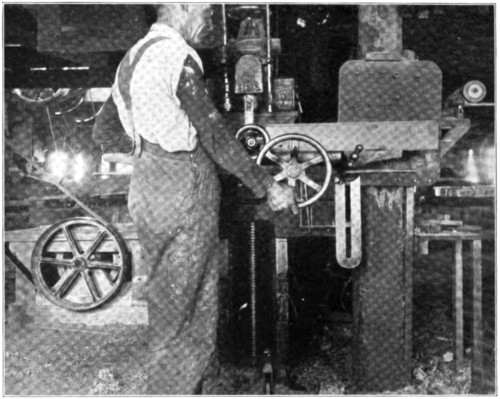
Railroad machinists in small shops do all sorts of repair work, but in large
shops they are frequently assigned to special work. A machinist may, for instance,
work only at a large lathe truing up “flat” wheels or journals. Since power cranes
are now used to set the work in place in the lathe, no heavy lifting is required. A
disabled man can do the work if he knows how to adjust the lathe so that the
wheels or journals are machined properly. If he has good eyesight in one eye,
one good hand, and can stand at the machine during working hours, his disabilities
will not seriously handicap him. Another machinist may work on engine parts—for
example, on cylinders, pistons, or cut-off valves. Use of power cranes for placing
most of this work has reduced greatly the need for great physical strength on the
part of the railroad machinist. However, those who are sent out on the road to help
clear up wrecks must occasionally do heavy lifting.
The air-brake man is a mechanic who installs and repairs the air-brake
equipment of locomotives and cars. Much of his work consists in removing defective
parts and replacing them with new properly fitted parts. As he must frequently
work under cars and do a certain amount of rather heavy lifting, he needs both
arms, good eyesight, and good hearing. He must also have good health. The loss
of a leg would be a considerable handicap for installation work. A disabled air-brake
man could easily train himself to become an air-brake test-room inspector.
In such a position his knowledge and skill would count more than his physical
condition. For this position he must be thoroughly familiar with all the parts and
functions of the air brake; and be able to adjust valves and other parts quickly.
The railroad blacksmith must forge or weld light and heavy pieces for all
sorts of railroad equipment. He may forge a steeple bolt for a hand car, cut and
fit the parts for a crossing frog, set the steel tires on the drive wheels of a locomotive,
or straighten a bent driving rod. He must be able to read blue prints, and to take old,
worn, and broken pieces as a guide to construct a new piece. He must be able also
to do all sorts of welding and to heat large pieces properly. He must understand
how to temper steel for the use to which it is to be put. His work thus requires
technical knowledge and manipulative skill. But since power hammers and cranes
are used on heavy pieces his work is not so heavy as formerly. The loss of one or
two fingers, or of a leg, or of the sight of one eye, would not handicap a well-trained
man. Poor hearing would not ordinarily be a serious handicap.
The boilermaker keeps in repair the locomotive and stationary boilers of the
railroad. He must be able to retube, patch, overhaul, and construct boilers.
Ordinarily his heaviest duties are to remove old leaky tubes from boilers and place in
new ones, and to patch up or even renew the fireboxes. However, wrecks frequently
cause him to take boilers apart and put in new pieces, so that he almost reconstructs
the boiler. He must be able to read blue prints and use templates in laying off
plates and angles. He must know how to punch, shear, and rivet the parts, and
calk the boilers, and how to weld or cut pieces with an oxy-acetylene torch. The
work is heavy and dirty, but good hearing is not essential and the loss of an eye is
not a serious handicap. The boilermaker must, however, have strength and the use
of both hands, although he may have lost a finger or two from either hand.
The work and qualifications of the steel-car repairer are not radically different
from those of the boiler maker. The metal-car repair man also must be able to
drill or punch holes, to cut out broken parts of metal, replace them with new ones,
and rivet them in, but his work is not so technical as that of the boiler-maker.
With the installation of electric headlights and electrically lighted passenger
cars the electrician’s duties in repair shops have increased greatly in recent years.
He must keep in repair the dynamos on locomotives and the dynamos and storage
batteries on passenger cars. The growing use of the electric locomotive means
that the demand for railway electricians is sure to increase. Repair of motors for
these as well as for electric cranes used in a number of shops calls for armature
winders in increasing numbers. Both technical knowledge and manipulative skill
are required, but ordinarily the work is not heavy. Disabled men with good eyesight
in one eye, with two arms and one good hand, who are able to move about easily,
could do the work.
Inspectors of boilers and of other parts of locomotives, and of the metal parts
of cars, must know thoroughly the parts to be inspected. Usually they have had
considerable experience in the repair of these parts. Frequently they must help to
make the repair or must supervise the work when they find a minor defect in railway
equipment at a location not convenient to the shop.
Repairing or rebuilding of wooden cars is done by car builders or repairmen
and painters. It is largely carpenter work. These men must be able to remove
any broken or damaged piece of a car, replace it with a new piece, and paint or
varnish it. The builders or repairmen must be thoroughly skilled in the use of all
hand carpentry tools and be able to use readily any of the woodworking machinery
necessary to produce car parts. On passenger-car work, the repaired part must
be finished nicely, and the whole painted or varnished so that the repair is not
obvious. No such care is required for work on freight cars.
In addition to the men who work regularly in the shop, there are a number of
men who must travel over the road and keep mechanical or electrical equipment in
working order. These men must all have mechanical ability. Ordinarily, they
must be physically sound, since they are exposed to weather and to danger from
trains. Among these men are signal and interlocking maintainers, and signal
inspectors. They must have both mechanical and electrical knowledge.
In the third group of employments, included under the heading track work,
a man needs physical strength and agility, good health, good eyesight, and good
hearing. Without these, he is constantly in danger himself and may endanger
the lives of others. Only the foremen may have physical disabilities, such as
the loss of a hand or arm. All must have good health, since they are exposed
regularly to all sorts of weather. All must have good eyesight, in order that they
may do their work properly and avoid danger. Poor hearing would continually
subject the man to danger from passing trains, from falling objects, or other
sources of danger, since one who has poor hearing would not generally hear or
would misunderstand warnings of danger. A man on the track must be agile in
order to avoid danger.
Work Requires Skill
Men in this group are frequently classed as unskilled, largely because railroads
have employed for the work unskilled foreign laborers, but to do the work properly
considerable skill is nevertheless required. Poorly tamped ties, “goosenecks,” maul
dents on the rails, and similar defects are evidences that may be found on many
roads of unskilled work. Ability to drive a spike properly, so that the rail is
held securely to the ties, is not quickly acquired.
Fence work, bridge work, cement work, and similar work, often performed
by special gangs, require skill to be done rapidly and well.
Occupations
The main occupations in this group are track laborers, foremen and supervisors,
bridge carpenters and foremen, fence-gang men and foremen, and other
extra gang men and foremen, linemen and repairers, painters of sign posts and
structures, structural iron workers and foremen, and concrete workers and foremen.
Conditions of Employment Unsuited to Disabled Men
In track work, only the positions of foremen or supervisors pay good wages,
and only these could be suitably undertaken by disabled men.
The track laborer in the eastern and northern section of the country has to
compete with the immigrant from Europe, in the South with the Negro, in the
West with the Mexican, and in the far West with the Oriental. Only a few workers
on construction gangs do not have to meet this competition directly, because their
work requires a skill that the foreigner does not acquire easily. But such work
is very seasonal, being done for the most part during the summer and early fall.
Wages are not high and working conditions usually are poor if not bad. Extra
gang work, in this respect, is very little different. Section work, while allowing the
men to have home life and thus have better living conditions, usually is seasonal and
pays lower wages than is paid to other gangs upon track construction work.
Bridge construction or repair work requires some skill and the wages are good, but
the danger is considerable for even a physically strong and sound man. The
painters of structures receive good wages, but their work requires climbing into
dangerous positions. The lineman must frequently do climbing to repair wires,
or to cut away limbs of trees thrown upon the wires by storms. Evidently, these
positions are not suitable for the disabled soldier from three standpoints, namely,
the seasonal character of the work, the danger to which it subjects him, and the
relatively low wages paid on the average for the year. The position of timekeeper
for large extra gangs is, of course, mainly clerical, but is undesirable since it
is very seasonal. All track occupations are hazardous and accidents are frequent.
The duties of the track foreman are to supervise workmen, to teach green
hands how to do the various sorts of work, and to make out reports on various
matters ranging from the pay roll to a report of live stock killed by a train. He
must be familiar with the time of all trains at various points on his section, with the
signals, with the degree of curves and the needed elevation, and with the use of the
various appliances and tools used on a modern railroad. The section gang uses a
large number of tools, and these must be kept in proper condition. Railway
appliances are numerous, and the section foreman has supervision over these.
Introduction of the motor car to take the place of the old hand car, has called for
more mechanical skill on the part of the foreman. A disabled man could perform
the usual duties of a foreman, if his disabilities did not affect his eyesight, hearing
or health, but loss of an arm or a leg might increase the accident hazard, as, for
example, in case an extra train caught the gang in a cut or out on a high dump
with the hand or motor car.
The track supervisor usually supervises a number of section foremen. He
must be an able trackman, so that he can recognize immediately the nature of
a defect in the track as he rides over it on a train. He issues orders to track
foremen for changes in location or character of work, handles reports from foremen
on certain subjects, and himself makes out various reports. He portions out
supplies and materials for the track under his supervision, and is held responsible
for the condition of this track by the engineer of the maintenance of way. A
disabled section foreman could with training qualify himself for a position as
supervisor, but the vacancies in this position are not numerous, and railroads
usually give preference to the physically sound men.
The occupations in group four—train work—are engineers, firemen, baggagemen,
porters, brakemen, conductors, hostlers, switchmen, and motormen. For
this fourth group there are many limitations upon disabilities which a man may have
suffered and undertake work without endangering himself and others. In none of
these jobs can a man’s hearing or eyesight, or nerves, or heart be defective, and no
one who is color blind can hold any of them. The loss of an arm would usually
debar a man—even passenger conductors who have lost an arm are now infrequent.
There are a few firemen and engineers successfully holding their jobs who have lost
a leg, but a freight brakeman could hardly do his work if he were thus disabled.
The loss of a hand generally unfits a man to be brakeman, fireman, or engineer.
The Occupations
There are three classes of engineers, firemen, brakemen, and conductors
namely, those working in the yards, those on freight trains, and those on passenger
trains. A yard engineer, fireman, or conductor may have suffered disabilities that
the men in the freight and passenger service can not have without being handicapped
in competition with normal men. In none of the positions do the duties permit of
a large number of disabilities, or of very serious ones. All must pass rigid
physical examinations—eyes are tested for color blindness as well as for other
defects, and hearing must be excellent. All must pass a rigid examination in the
rules and regulations, signals, schedules, and the road conditions.
The duties of an engineer are exacting. He drives his engine over the track
where there are curves, crossings, switches, and signals that he must constantly
watch. He must recognize instantly the color of the numerous signals displayed at
various points along the line. He must sound the whistle as he approaches crossings
and other points. He must also note the running condition of his engine—for
instance, whether the bearings are becoming too hot. When the engine stops for
water he usually oils certain bearings. He must learn to apply the steam and
adjust the reverse lever so as to give the maximum pulling power to the engine at
one time, and to attain considerable speed at another time, in either case with due
regard to the load he is pulling and the track he is running upon. He must,
accordingly, learn where the track is good and he can make speed and where it
is bad, so that he must slow down. In emergencies he must be able to close the
throttle and apply the air almost instantly, or to reverse the engine. For this he
needs both hands. His eyesight must be excellent and his arms, heart, and nerves
good. Wages paid to engineers are high, averaging $2,000 a year, but the position
is one of great responsibility, and it is one that few disabled men would be allowed
to undertake.
The fireman must be physically strong. He must shovel coal into the firebox
so that the steam pressure will be sufficient at all times for the pulling power
of the engine, and yet not be “blowing off” frequently. He must watch the water
level in the boiler and see that it does not get low. He must climb back over the
tender when the engine takes water. He takes on coal at the coal chutes. On
occasions he has to go forward to flag to protect the train from in front. Where
automatic bell ringers are not installed he usually keeps the bell ringing when
the engine is doing work in yards near a crossing or where other men may be
endangered by the engine. When the engine is running and he is not busy shoveling
coal he is watching the track along with the engineer, but on the other side of the
cab. He must especially watch when his side of the cab is on the inside of a
curve. Since the fireman may in an emergency be called upon to perform the duties
of an engineer, he is under the same limitations as regards disabilities as the
engineer. The accident rate among firemen is high.
The brakeman has various duties, somewhat depending upon the sort of a train
on which he works. On a passenger train he calls stations, helps passengers on
and off the trains, regulates the heating and lighting of cars, and sets switches.
Sometimes this work is done by a porter. As a crippled brakeman would tend to
give timid passengers a concrete example of what might result from a wreck or an
accident upon the road, railroads have not wished to have disabled men fill this
position. How they might deal with the disabled soldier is uncertain.
The through-freight brakeman sets switches when his train goes on a siding for
another train, or his train picks up a car at a junction point, or sets out one. In
such a case, he uncouples the train, air brakes, etc., throws the switches, and after
the car has been picked up or set out, couples up the train, makes the air brake
connections, and tests them. He watches the train for hot boxes, and transmits
signals from the conductor to the engineer. He must climb on and over freight
cars, cross bridges, tracks, and switches. He needs to be sound physically.
The brakeman on a local-freight train has no end of switching to do, or
loading and unloading less-than-carload freight at small stations along the entire
run. The physical demands made upon him are even greater than those made upon
a through-freight brakeman. Disabled men should not undertake this job.
The duties of the freight conductor, while lighter from the physical standpoint
than those of the freight brakemen, are nevertheless so heavy that a disabled man is
not usually wanted by railroads. At certain times he must do the same work as the
brakeman does. He must walk over trains or tracks to get orders, or confer with
the engineer. He must direct the picking up and the setting out of cars. He
must keep a record of the cars in his train, of the ones set out, and of those
picked up. He carries the way bills for the freight in his train. He must read
and sign for all orders received for his train. His duties, while requiring more
mental work than those of the brakeman, are still so heavy and dangerous that
any physical disability would be a handicap to him.
The passenger conductor collects fares and supervises the passengers and
train. He is responsible for the train orders as is the freight conductor. The
physical requirements made upon him are normally light, but in emergencies, he
needs to be physically sound. Formerly, passenger conductors who had lost fingers
or even an arm or leg were frequent, but in recent years railroads have not
wanted disabled men for this service, since they remind passengers of accidents.
The passenger conductor needs to have a knowledge of trains and their time at
meeting or crossing points, of the various sorts of tickets and script. He must
make out various reports. If the railroads would place disabled men in this
position, providing they were old railroad men who had been wounded in the war,
this would be the best of all the positions in train work for an intelligent disabled
soldier.
The train work in the yards consists of switching. The work of the yard
fireman or engineer is perhaps somewhat less exacting than that of a fireman or
engineer out on the line, but for the brakeman it is more exacting. The hostler
is usually what might well be called an apprentice fireman, and so he must be as
physically sound as the fireman or engineer. Yard conditions are so dangerous
that disabled men would usually find their disabilities a handicap.
The baggageman on trains needs to be physically strong, since he has to
handle heavy trunks. He could sustain the loss of a leg or have too poor eyesight
or hearing to qualify for other train work, if in emergencies he were not called
upon to do the other train work. Since he is so called upon he must be physically
as sound as a brakeman. He has some clerical work to do. Sometimes he is a
mail clerk, express messenger, and extra brakeman. Little knowledge or training
is required to fill this position—a strong man of ordinary intelligence could learn
to fill the position in a few days. He must know the stations and transfer points.
Wages are about the same as for brakeman.
Work Conducing to Train Operation
In the fifth group of employments, including those conducing directly to
train operation, are found the pumpman, the men on the coal chutes, the freight
handlers, the crossing guardmen, and similar workmen. In this group, the requirements
are good health, a fair degree of strength, and knowledge of the occupation.
The pumpman may have defective hearing, but must then have excellent
eyesight, since he should notice engine trouble quickly if he can not hear it well.
If his eyesight is poor, he should have good hearing. The pumpman needs to have
some knowledge of boilers and steam pumps, but ordinarily his work is not heavy,
even when he has to shovel all the coal for the boiler.
For men on the coal chutes, either poor eyesight or poor hearing, one or
the other singly, is not a serious handicap, but good health is necessary as well
as ability to climb over the sides of cars. The freight handlers need strong backs
and good eyesight to read names of boxes, etc. When motor trucks are used, the
truckman ought to have some mechanical ability. The crossing guardman needs
both good eyesight and hearing, but may have suffered the loss of an arm or a leg,
even of both an arm and a leg. On the whole, the range of permissible disabilities
for men in this group is greater than for those in groups three and four.
Training Required
Of all the jobs in this field practically the only one requiring any considerable
knowledge or skill is that of the pumpman, and even for this position an ordinary
man can learn all that he usually needs to know in a month on the job.
With exception of freight handling, work in these employments has been
given largely to men disabled in railroad service. For instance, a disabled brakeman
is offered the job of switchman or crossing watchman; a fireman, that of
stationary fireman, or engine watchman; conductors, that of flagman; and so on.
Crew callers and lamp-room attendants are frequently disabled men. So generally
has this policy been followed that the crossing watchmen, flagmen, and engine
watchmen are commonly men who have been disabled. The positions are, however,
not such as will appeal to the intelligent ambitious disabled soldier or sailor.
Street railway operation furnishes rather regular employment to men on
the regular force. From this standpoint it is desirable for the disabled soldier
or sailor. It is not seasonal to any marked degree, nor is it greatly affected by
industrial depressions; and bad weather only increases the need for employees
instead of lessening it as in many out-of-doors occupations. Few of the street
railway employees are exposed to bad weather conditions, although the work is
not so protected as in an indoor occupation. They are, however, exposed to dust
from the streets and contagious diseases. All of the positions on street railways
carry with them a high degree of responsibility, but the position of motorman is
probably the one of greatest responsibility.
The occupation of the street car motorman is one that can be taken up by
disabled soldiers and sailors. Those who have suffered merely the loss of part of
the fingers on one or both hands, or of a leg, can operate a street car. A car can
be operated by those who are physically unfit for heavy work, especially if the
car is equipped with air brakes and the working hours are not too long. But
those who have defective eyesight, poor hearing, or are subject to nervous trouble
should not undertake this work. Those who have suffered from shell shock should
not attempt to operate a car until they have fully recovered.
The work is light, but requires constant attention, especially under conditions
of heavy traffic. The motorman must constantly watch the track to prevent collisions
with automobiles or other vehicles whose drivers take hazardous chances in
crossing the track. Men, women and children must likewise be watched and
warned. The motorman must acquire skill in operating the controller so that he
can start the car off rapidly without causing the circuit breaker to break the
current. He must learn to apply the air gradually so the car will not stop with
a jerk or the wheels slide on the track. He must learn to estimate distances so
that he can stop his car at the proper point. He must form the habit of never
starting without a signal from the conductor.
The working conditions are suitable for disabled men. Stools are usually
provided for the motorman, which he can use outside the congested district.
Most of the cars have closed vestibules for bad weather. The working hours are
irregular, but usually not over 10 in 24. Usually there are two work periods in
a day, with a rest period of two or three hours between—the work periods come
with the morning and evening rush of people to and from their work.
The conductor’s position makes fewer physical requirements upon him than
that of the motorman. His position is, however, one of responsibility, and
honesty is a prime essential. His duty is to collect fares, give proper change to
passengers, and issue transfers. All his receipts must be turned over to the
company. He must see that passengers are not endangered in any way, especially
by the car starting too soon or the passenger attempting to alight before the car
has stopped. Accordingly the conductor must have good eyesight and hearing.
He may, however, have suffered some dismemberments, and he need not be physically
strong. Courteous conductors are much in demand by street railways.
Training
The training for the position either of motorman or conductor is generally
conducted on the job. New men are placed on a car with an experienced
motorman and operate the car under his direction until they are able to operate
a car independently. The period of training is usually short—a week to two
weeks. Men so learning rarely receive pay. A number of companies make charges
for the training, but refund amounts paid if the employee remains with the company
a certain length of time.
Wages
Wages for motormen and conductors are approximately the same, and in
1917 ranged from 15 to 45 cents per hour, with average between 25 and 30 cents
for the entire country.[20]
Advances in the past year have probably raised this
average to 30 cents or above.
Promotion
Men are usually promoted from the ranks of motormen and conductors to
be inspectors or supervisors. They must have a thorough knowledge of operating
conditions in the city, a knowledge that can be acquired only by considerable
experience on the job as motorman or conductor making all routes in the city.
In electric street-railway operation, there are various other occupations, some
of which require skilled workmen. The skilled workers include machinists, electrical
workers, armature winders, carpenters, car repairers, linemen, track foremen,
and inspectors. Since the other occupations are filled with men who are unskilled,
or who are taught on the job, we are not concerned with them, as the training is
not such as the Federal Board could easily give. With exception of inspectors,
the work of these men does not differ materially from that of the shop men and
track men on steam railroads. These have already been described above. In the
shop work there is opportunity for the disabled soldier or sailor who has defective
hearing, as well as for those who have lost a hand or leg. The work is usually
lighter than on steam railroads, but wages are generally somewhat lower; the
greater number of employees receive from 24 to 29 cents an hour.
In road and street transportation the main occupations are those of chauffeurs;
proprietors and managers of taxicab concerns, livery stables, and transfer companies;
foremen of livery and transfer companies; draymen; teamsters and
expressmen; carriage and hack drivers; hostlers; and stable hands. The automobile
is rapidly supplanting the horse and to such a degree as to affect the
demand for labor in these several occupations, the demand declining in those
dealing with the horse and increasing in those concerned with the automobile.
Work in these occupations is not markedly seasonal, but is affected adversely by
industrial depressions.
If a person is in business for himself, his outlay for equipment ranges from
$500 upward, but if he is an employee the equipment is furnished by the employer.
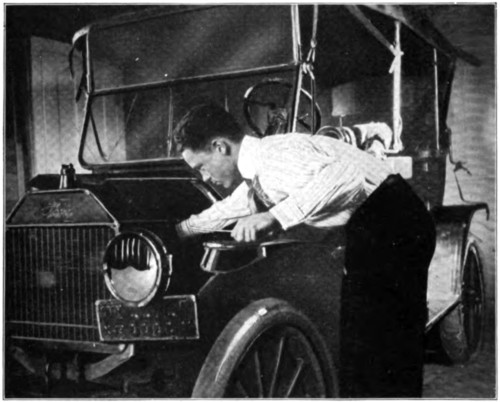
A chauffeur may drive a taxicab, a truck, or a car for a private family. He
needs good eyesight and hearing, and must not have nervous troubles. Loss of
fingers or of a foot might not handicap a man for this work. It does not usually
require much physical strength. Men who have suffered from chest trouble are
frequently auto drivers in the Rocky Mountain States. This occupation gives
them out-of-doors work that is light, and in a good climate in fair weather is
highly beneficial and desirable for such persons.
Training
Auto drivers should have some mechanical training and aptitude so that they
may be able to make adjustments and repair minor defects in their machines.
They should learn the roads and routes in their territory and allow a good margin
of safety either in loads or speed. No great amount of training is required, and
the work is largely manipulative. There are a number of schools in which this
occupation is taught. Hours, wages, and working conditions are far from being
standardized the country over. If you are interested in this work, you should find
out what conditions prevail in the locality in which you wish to work.
Managers of taxicab companies must know the automobile thoroughly as well
as the neighborhood from which they draw their trade. Only in a small concern
does the keeper or manager need to be able to drive a car. It will, however, be
advantageous at times if he can drive or repair a car. The greatest qualifications
for success in this undertaking are ability and skill in handling men and money.
Although the rate of profit is usually large in the business, there are many
“leaks”
to guard against. The manager must know how to keep accounts accurately, or
at least understand them and be able to see that they are properly kept. The
work requires business ability rather than physical activity, and so can be done
by disabled soldiers or sailors who have this ability. Courtesy is a valuable asset,
since the manager must come in contact with the public. It is this contact that
makes deafness a handicap, particularly where much business is done over the
telephone.
Practically the same thing may be said of proprietors and managers of
livery and transfer companies. The proprietors and managers must have business
ability and know how to manage men. Disabled men with these qualifications
can undertake this business if none of their disabilities will interfere with business
dealings. The field for auto delivery is developing rapidly, and will give a permanent
occupation to the man who has the necessary qualifications for success.
Foremen of livery and transfer companies must have ability to handle men
under conditions where immediate supervision is possible only a small part of the
time. Accordingly, they must be able to judge what allowances should be made
for loads, roads, horses, and equipment, or automobile in supervising drivers.
Since the foremen must occasionally do the work of drivers, they must usually not
be seriously disabled by loss of limbs, and since they must sometimes do the work
of the manager they must not suffer from deafness.
Wages and hours are good on the average, but vary greatly in the different
localities.
Draymen or expressmen may be either teamsters or auto drivers. In either
case, ordinarily they have a considerable amount of heavy lifting to do. The loss
of an eye, or of fingers, or of a foot need not prevent anyone from doing this
work if he is otherwise physically strong. Very little training is required for
the teamster. He must learn the streets and business houses, and how to manage
horses that are usually well broken. All of this is best learned on the job. Wages
are a little above those of unskilled labor. For the auto driver training may be
acquired largely in a school. Wages are higher than those paid to teamsters.
Carriage and hack drivers must have good eyesight and hearing. The work
is rather unskilled, although the handling of spirited horses does require some
special skill. Courtesy is a distinct asset. It should be noted that the demand for
carriage and hack drivers is declining rapidly, and accordingly the disabled soldier
should not elect this occupation unless he has the assurance of permanent employment
from some responsible employer.
Hostlers and stable hands are usually classed and paid as unskilled laborers,
and for most disabled men the work is unsuitable. A disabled man should not
work around vicious horses, and in large stables there are always some vicious
horses.
Water transportation may be considered from two standpoints, terminal and
interterminal. Terminal transportation does not differ materially from transportation
upon the rivers and canals. Interterminal transportation, whether on
the Great Lakes or on the sea, is practically the same. In this place we shall,
accordingly, deal with only terminal and ocean transportation.
Terminal transportation has to do with the loading and unloading of cargoes,
and is usually heavy work that requires men with strong backs and little training.
The men who supervise the laborers on the boats must have executive ability
and a knowledge of boats, equipment, and harbors. The chief qualification of
a captain of a barge, a scow, a lighter, or a covered barge, is ability to
direct other men at the work of loading and unloading the vessel, of handling
lines, and of shifting the boat, and ability to make minor repairs. On lighters and
covered barges the captain tallies and signs up for the cargo received. The
master steers the boat, gives orders to the crew, and signals the engineer for
movement of the boat. He is responsible for the safety of the passengers and
the crew. He must have keen eyesight and the ability to act quickly and efficiently
in an emergency. He must be thoroughly familiar with the harbor and with
harbor conditions. He supervises the pilot, if one is carried on the boat. On
smaller boats, the pilot acts as master, and then his duties are the same as the
master’s. The wheelsman is an assistant to the master, and performs part of the
latter’s duties. Deckhands sometimes act as wheelsmen, and may advance to that
position, or higher—to pilot, captain, or master. The engineer is usually a man
of considerable skill and experience and possesses a thorough knowledge of the
machinery of the boat. He sees that the engine is properly cared for, oiled and
kept in good working condition. He directs the work of his assistant, of the oiler
who oils the machinery, and of the firemen. He receives his orders for the movement
of the boat from the master.
Disabilities
Of these men, only those who supervise other men could have sustained
serious injuries. None of them may have either defective eyesight or hearing.
The loss of an arm would usually be a serious handicap, and also the loss of a
leg would be such an inconvenience for most men in climbing on and about the boat
as to be a serious handicap. In these occupations good opportunities for men
seriously disabled are comparatively few.
Ocean Transportation
On board a large ocean liner is to be found a complete organization of
officers, supervisors, clerks, and skilled and unskilled laborers. As a general rule,
all of these men must be physically sound, and about the only disabilities allowable
are the loss of fingers, of a foot, and perhaps of one eye if the remaining
eye is very good. For men so disabled there is some slight opportunity for
advancement. Only the clerical positions such as the purser, assistant purser,
or freight clerk, can be filled by men who have lost a hand or leg, or who are
otherwise physically unfit for climbing about on slippery decks in a rolling sea.
Wages paid during the war have been abnormally high.
Ocean Vessels Vary Greatly
There are two general classes of ocean vessels—sail and steam, steam vessels
being in many instances equipped for sailing. In these two general classes there
are, however, all sorts and types of boats and ships.
The crew of a steam vessel has three departments—deck, engineer’s, and
steward’s.[22]
The deck crew of a steamer depends upon the size and type of the vessel,
and ranges from as low as nine on a small steamer to 972 on the Olympic, officers
included. The average number of able seamen is about seven for ocean-carrying
vessels. The others are officers, ordinary seamen, deck boys, etc. It has been
charged that boats frequently ship without any able seamen, and depend upon
ordinary seamen and deck boys in emergencies.
Deck duty is varied and crowded with emergencies. “The sailor’s daily work
in all kinds of vessels and weather, at the wheel, on the lookout, and on deck,
teaches him to know the sea and how to work with it. His work with tackles,
lines, and cables, in hoisting and lowering, trains his judgment of strains and
distances.”[23]
“The amount of gear and equipment used in the deck department
on different classes of steamships varies greatly, but the difference is one of
degree rather than of the kind.”[24]
The crew and the work done on a merchant vessel are so different from those
on a naval vessel that the disabled sailor would have much to learn in going from
a naval vessel to a merchant vessel. One fundamental difference is this: The
merchant vessel carries generally only about one-third the crew—ton for ton—that
the naval vessel does. On a naval vessel the men work in groups; on a merchant
vessel the man works as an individual and not in a group.
The crew of a large merchant vessel consists more or less of the following
officers, seamen, and attendants: Master, chief mate, second mate, third officer,
fourth officer, senior quartermaster, quartermaster, master-at-arms, chief steward,
chief second-class steward, chief third-class steward, chief engineer, first assistant
engineer, second assistant engineer, third assistant engineer, junior engineer, deck
engineer, leading fireman, oiler, electrician, carpenter, boatswain, able seamen,
ordinary seamen, deck boy, water tender, lookout, purser, assistant purser, freight
clerk, and bakers, chefs, cooks, buglers, butchers, cadets, storekeeper, and watchman.
The master has general supervision over the vessel, crew, and passengers.
He has complete charge of the vessel at all times, but during a severe storm or
other emergency he stands on the watch continuously day and night and issues
the necessary orders. He is responsible for the safe navigation of his vessel.
His responsibility extends to the management of the various departments as well
as to the vessel and its care as a whole—for the safety of the lives of passengers
and crew, and for the safe storage, carriage, and unloading of cargo. He must
have a thorough knowledge of navigation, which subject he must have studied
thoroughly, and in which he must have passed a rigid examination before he
received his license as a master. He must likewise possess a legal knowledge of
the laws governing right upon the sea and determining his duties as regards the
ship and its passengers, crew, and cargo. Among his other duties are to keep
the log properly and to inspect the ship regularly as to ventilation, warmth, and
cleanliness. He must be the last man to leave the ship in case of disaster, and
must do everything within his power for the safety of the passengers and crew.
He must have received much of his training in lower positions upon the sea, but
he must also have studied navigation in some school or under some able master.
He must have executive ability of a high order and be able to act efficiently in an
emergency.
Next to the master in authority and responsibility comes the chief mate. He
shares with the master responsibility for safe and proper navigation of the ship.
He is the chief executive officer and must organize and supervise the routine work
of keeping order throughout the ship. He is held responsible for discipline.
Under him is the master-at-arms, the ship’s policeman, who keeps order among
the crew and steerage passengers. His knowledge of the vessel, its equipment,
stores, and complement of men must be thorough. He supervises the preparation
and care of the holds, and the loading, stowing, and unloading of cargo. This
is done under his personal direction or under another officer to whom he has
delegated the duty. He sees that the cargo-handling gear is kept in proper working
condition. It is his duty to inspect the lifeboats and have them kept properly
equipped and in working order, and to hold regular lifeboat drills. The firefighting
equipment is likewise in his care, and he must also hold fire drills regularly.
His training and knowledge is very similar to that required of the master.
Ordinarily he takes his turn with the third and fourth officers at a watch on the
bridge.
The second mate stands his watch on the bridge, takes various observations,
and gives orders to the quartermasters. On large liners he has complete charge
of the navigating equipment, and is known as the navigating officer. When the
vessel docks he supervises matters at the after end of the boat. In general, he has
charge of the after holds, the after cargo, and the after gears. Only in experience
and degree of training do his qualifications differ from those of the chief mate.
The third and fourth officers are watch officers. The fourth officer is frequently
left in charge of the bridge in fair weather and under good conditions,
and like the third officer takes observations, and gives orders to the quartermaster.
The third officer has general charge of the forward holds, under the supervision
of the chief mate. On some vessels, he is the signal officer and has charge of
the care and use of the signal flag and other signaling equipment. Frequently
he supervises the placing of the gangway and the embarkation of the passengers
when the vessel docks. Both of these officers must have had instruction in navigation,
and must be alert and attentive to duty.
The chief engineer, the assistant engineers, the junior engineers, the deck
engineers, the firemen, oilers, and electricians care for all machinery of the ship.
The chief engineer stands no watch, but the assistant engineers do, and are
responsible for all that takes place in the engine room and fireroom during their
watch at sea. Under these assistant engineers are the junior engineers, one of
whom is in direct charge during each watch of each of the firerooms, the engine
room, and the auxiliaries. In port the junior engineers help the other engineers,
the firemen, and the oilers in the repair, packing and overhauling of the machinery.
The chief engineer is held responsible for the proper functioning of the engines
and boilers, the deck machinery, the electrical, refrigerating and sanitary equipment,
and for all steam connections on the ship. He must see that the regulations
of his department are carried out, that the engine and fireroom crews are qualified
and conduct themselves with sobriety. At the end of each voyage he reports on
these matters, and on the working of the machinery—its breakdowns and repairs,
especially any exceptional one made away from port—the miles traveled, temperatures,
and consumption of fuel. It is his duty to have the steamer properly
coaled, both as to quality and quantity of coal. He must possess executive
ability, and must have studied engineering in a nautical school or under a competent
engineer for a period of years. The first assistant engineer has as his
special duty the general charge of all boilers and machinery in the engine department.
The second assistant engineer usually employs the fireroom crew and
reports to the chief engineer on their qualifications and conduct. He has charge
of the repairs and overhauling of the main engines and auxiliaries on the starboard
side. The deck engineer supervises and keeps in repair the deck machinery,
the steering gear, windlass engine, capstans, and the sanitary systems. The
leading fireman has supervision over the firing of the boilers, the keeping of water
in the boilers, and over the firemen, coal passers and water tenders. He personally
tends a set of fires. On some boats he acts as interpreter of the orders of superior
officers to the firemen who are foreigners and can not understand the orders in
English. The oiler must keep all the engines clean and well oiled, and see that
they are running smoothly and without undue heat. The electrician supervises
and keeps in repair the dynamo engines, the electric motors, and other electrical
apparatus on the ship. The work of keeping the ship in working condition is
usually done by the engineering department. There is, however, some work of
repairing that is done by the carpenter, whose duties depend greatly upon the
character of the ship. He is generally charged with the upkeep of masts and booms,
the repair of wooden decks, and the opening and covering of the hatches.
The boatswain, under the supervision of the chief mate, has active charge
of the deck crew, and works the seamen at washing, repairing, and painting decks.
Since all officers must have served as able seamen, the required duties of the
able seamen are worth noting in detail. “While on board ship in port, the able
seaman is occupied with cleaning, painting, repairing, and overhauling. When
the vessel is at sea, the able seaman washes decks and the outside of deckhouses,
slacks off exposed gear when shrinking too tight in damp weather, and tightens
it again when it becomes too lose in dry weather. When a storm comes on the
able seaman closes all open hatches, ports, etc., and lashes down all movables
on deck or stows them away.” The ordinary seaman does the same work as the
able seaman, so far as his training and ability will permit. The deck boy is
simply an apprentice seaman.
“The man who expects to be known as an able seaman on a steamship must
know the use of rigging screws, fids, marlinspikes, serving mallets, the palm and
needle, calking tools, and most of the carpenter tools; the mixing of paints and
colors; how to obtain strong leverages with bars, ropes, tackles; how to brace with
wedges and shores; besides knowing the various knots and splices; and to worm,
parcel, serve, and seize, with rope and wire; and must be able to hold up his end
of a job when it comes to climbing and working in places where both armhold
and foothold is difficult. He must know the lead line, not only its marks but how
to use it to get correct sounding when the ship is in close quarters, the night dark,
and the sea heavy, whether he stands in a smother of sea on a low freighter or far
up the side of an immense liner. The compass, of course, is a familiar object to
him, but he must know how to use it, how to steer the ship under all conditions,
what to expect and how to meet it when he is steering across a current as well
as with it or against it, through the swift rush of a narrows, passing at close
quarters in and out of the suction of another heavy ship under speed, with the
wind light or strong from any direction, heading into a heavy sea, taking it on
either bow or quarter or abeam, under check or full speed, rolling and pitching
heavily, or running before it, when a blunder may mean total loss of ship with
lives and cargo. The man at the wheel must know his work, what to expect and
how to meet it instantly, in calm or storm, daylight or dark, in clear weather or
in fog. The man who learns to be a reasonably good helmsman in even three
years is an exception, because, regardless of the aptitude of the individual, the
personal knowledge of varying conditions, different ships and how they act under
differing circumstances, familiarity with the various steering gears, can only be
gained through experience necessarily covering a good deal of time. The steam
steering gear, rendering less physical strength necessary and making possible
the handling of larger ships, requires greater skill than the old hand method,
which permitted the man at the wheel to feel the increasing or decreasing rudder
pressure and thus warned him of just how the ship was acting.
“Prepared paint is seldom brought on board ship. The raw material is
put on board and is mixed according to needs by the able seaman. Graining,
filling, varnishing, and lettering is done as well as ordinary flat painting. Sailors
become sufficiently skilled at this work to qualify as journeymen painters on
shore. The deck crew cleans all outside parts of the ship, except the funnel,
from the masts and booms to the deck houses, decks, and sides of the
ship.”[25]
Hours of Labor
The hours of labor for workmen are: On deck, two shifts (watch and watch)
12 hours each; in the engine room three shifts of 8 hours each. In emergencies
the hours are greatly lengthened.
Wages
Following is the wage scale which has been established during the war. In
1915 wages were about half the amounts here given:
Sailors and firemen, $60 per month; coal passers, $50 per month; oilers and
water tenders, $65 per month; boatswain, $70 per month; carpenters, $75 per
month; overtime pay for cargo work 50 cents per hour, and for ship work 40 cents
per hour. The bonus for going into the war zone was 50 per cent of the wages,
the wages and bonus to continue until crew arrive back in the United States; $100
compensation was paid for loss of effects caused by war conditions. Board and
quarters are of course provided in addition to the wages.[26]
Training
Seamen are required to have three years’ experience at sea to receive able
seamen’s certificates. Vessels differ greatly to-day and conditions and duties
abroad are so radically different, while the voyages to various parts of the globe
subject seamen to so many varied emergencies, that a long training at sea is
necessary to make an able seamen. It is the rule for seaman to change from
ship to ship.
There are training schools for seamen. During the war the school at Boston
gave intensified training for six to eight weeks, then placed the learner on a boat
at sea, and after about six weeks he qualified as an ordinary seaman. For a man
to get his “sea legs” requires this long a period. “It takes some time for a man
to get himself so accustomed to the sea he can walk along the deck without
holding himself fast to something when the vessel is rolling and pitching.”
Safety
The seaman is exposed to bad weather conditions, accidents, and disease.
The mortality rate among seamen is very high—much higher than among some
occupations commonly thought to be extra hazardous to life and health. English
mortality statistics show that the death rate among seamen is far greater than
among miners and railroad trainmen. Since it is a dangerous calling for men
sound in limb and body, it is, accordingly, very undesirable in general for disabled
men.
The lookout has a position of responsibility. Stationed in the crow’s nest
or on the forecastle, he watches for everything that comes in sight, and especially
for things that might damage the ship, such as derelicts, icebergs, submarines,
and on-coming steamships. When he sights anything, he reports it immediately to
the bridge, either by shouting, speaking tube, telephone, or telegraph. He must
have keen eyesight and attend strictly to duty. A disabled soldier or sailor with
these qualifications, and whose disabilities do not prevent his climbing readily,
or holding himself in position in stormy weather might qualify for this position.
A far better position for the disabled man is that of the purser, or assistant
purser. The purser is a treasurer, accountant, and chief clerk on the ship. Money
and valuables may be deposited with him by the passengers for safety. He acts
as a sort of cashier for the passengers and crew in changing money and cashing
traveler’s checks, etc. He keeps the wages account of the crew, and is present
when the crew is paid off. He collects or supervises the collection of all tickets,
and checks these against the passenger list as soon as practicable after the vessel
has sailed. He is responsible for the manifests, bills of health, clearance papers,
and cargo. He should know everything about the passengers and cargo. Although
the master must record in his log any death aboard, the purser must get the
details for his own report and for the master’s log. He supplies information
and encourages entertainments among the passengers. He should be able to speak
the languages of the countries at which his ship comes to port. He should possess
tact and be courteous to the passengers.
The freight clerk has a position, that for the freight is somewhat similar
to that of the assistant purser for the passengers.
Chief stewards have positions corresponding closely to those of a large hotel,
sanitarium or similar institution. They must have business and executive ability,
and are held responsible for the comfort and service of passengers in matters of
sleeping quarters, food, heat, and ventilation. Under them are the chef, cooks,
and numerous other attendants. Each of these occupations has the characteristics
of the same occupation as followed on the land. Upon chief stewards devolves
the further duty of purchasing in advance of a voyage in proper quantities the
supplies needed.
It should be added that if a disabled soldier or sailor is qualified for any
of these positions, he will generally find work on land preferable to work on
board a ship.
Other Positions in Water Transportation
A large number of office positions corresponding to those in railway service
exist at the leading ports. Disabled sailors could qualify for these and find their
former experience of value.