One Hundered Years a Republic. Our Show; a Humorous Account of the International Exposition in Honor of the Centennial Anniversary of American Independence, from Inception to Completion
Whole book · 13 sections
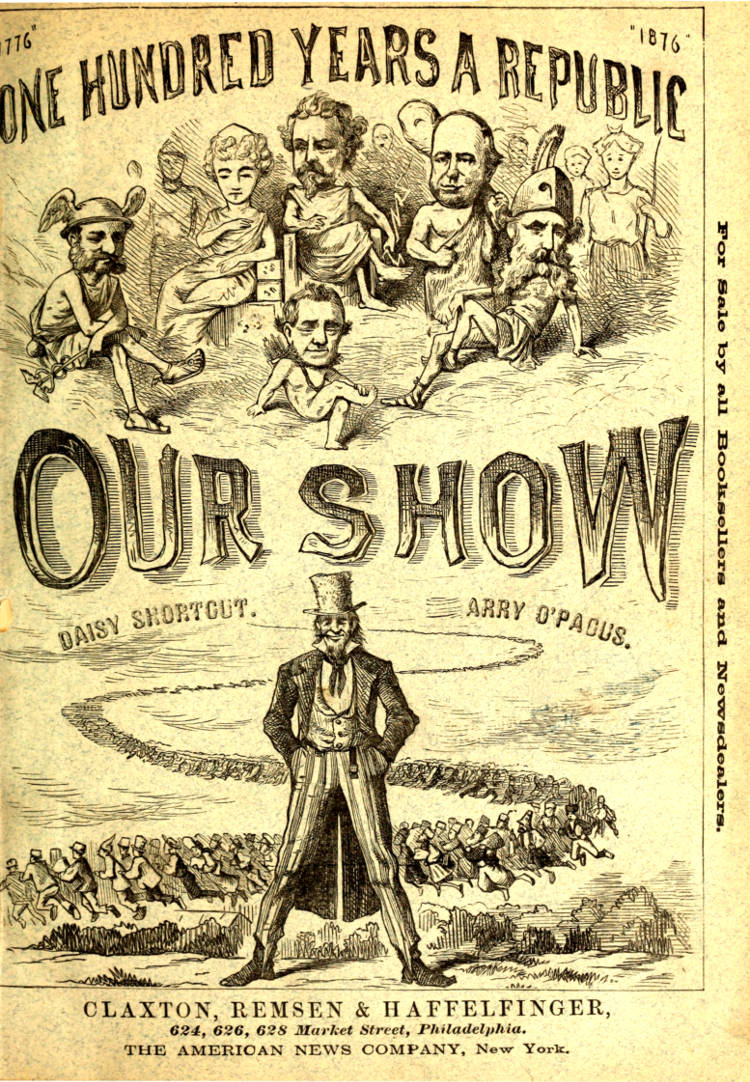
ONE HUNDRED YEARS A REPUBLIC. OUR SHOW ; A HUMOROUS ACCOUNT OF THE INTERNATIONAL EXPOSITION IN HONOR OF THE CENTENNIAL ANNIVERSARY OF AMERICAN INDEPENDENCE, FROM INCEPTION TO COMPLETION, INCLUDING DESCRIPTION OF BUILDINGS—BIOGRAPHIES OF MANAGERS—RECEPTIONS OF FOREIGN DIGNITARIES—OPENING CEREMONIES—POEM—ORATION—AMUSING SURVEY OF ALL DEPARTMENTS, INCIDENTS, ETC. ETC. — DEDICATION .
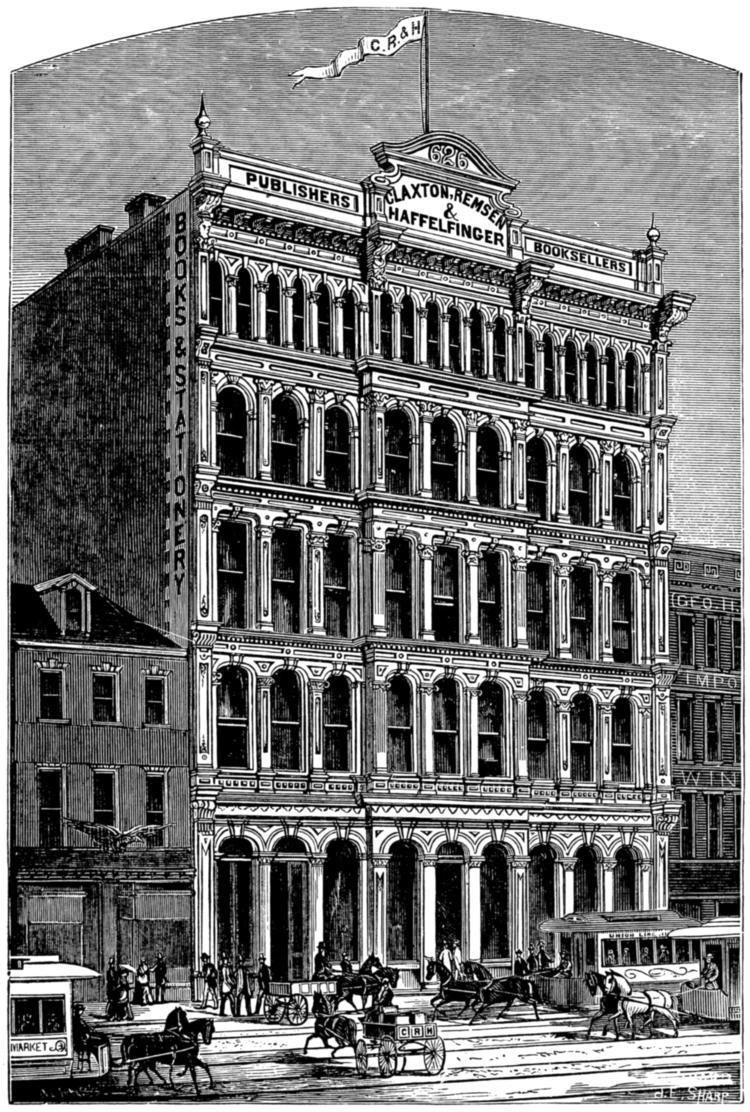
CLAXTON, REMSEN & HAFFELFINGER, 624, 626, 628 Market Street, Philadelphia.
THE AMERICAN NEWS COMPANY, New York.
OPINIONS OF THE PRESS
From several thousand “opinions,” carefully prepared for the use of the press,
we select the following. We shall be happy to give the remainder in similar
instalments in the future editions of “Our Show.”
[Special dispatch to the New York Herald.]
“Have just discovered the book on my editorial table—the fun I am still looking for; ’tis
harder to find than Livingtone was. The African jungles were tame compared to the general
wildness of these pages.—Stanley.”
[From the San Francisco Tribune.]
“No library is complete without it—in the waste basket.”
[From the London Times.]
“We admit that the volume puzzles us. We should be inclined to doubt some of the assertions
contained within it, even to consider them preposterous, had we not long ago given up
any attempt to account for events or circumstances occurring in America.”
[From Galignani’s Messenger, Paris.]
“We have not read this production in the original, but the French translation assures us that
it is a work of grave import. Beneath the simple words there is a depth of meaning and a quiet,
dignified tone of determination, which the friends of Liberty would do well to heed. It is a
book to be pondered over. The illustrations are by Mons. Jacques Frost, an artist of warm
imagination.”
[From the Berlin Freie Presse.]
“It is the only book of the kind we have ever seen—thank Heaven!”
[From the Vienna Court Journal.]
“The Emperor has not been seen in public for several days. We learn from reliable sources
that he has been closeted in his study, translating, altering, and localizing an American volume
called ‘Our Show,’ to make it appear the official record of our late International Exposition.”
[From the Pekin Argus.]
“The Authors are evidently insane.”
[From the St. Petersburg Daily News.]
“This, with Sherman’s ‘Memoirs,’ Motley’s ‘Dutch Republic,’ and Mrs. Lee Hentz’s ‘Wooed,
not Won,’ presents a living argument against those who are in the habit of sneering at American
literature. If this work fails to give America a first place in the rank of letters, it will keep
her not far from the tail.”
[From the Constantinople Leader.]
“It is the joint production of two geniuses. We doubt whether one genius could have written
it and survived.”
[From the Copenhagen Sentinel.]
“Copenhagen is shaken to its centre. Is Sweden dead? Is the land of the immortal
Yywxtlmp sleeping? Has the American Exposition become a thing of the past whilst we are
yet preparing for it? or are the authors of this book endeavoring, under the guise of an historical
novel, to lay the foundation for poisoning the world in the future with the doctrines of
Spiritualism? Philadelphia exchanges call it a ‘third term pamphlet.’ We have looked
through its pages, and though failing to discover what this means, we found one term for which
we thank the authors—the termination.”
[From the Hong Kong Examiner.]
“Americans should receive a book like this with fervor—once every hundred years.”
1776. FUN. HUMOR. BURLESQUE. 1876.
BY DAISY SHORTCUT AND ARRY O’PAGUS. PROFUSELY ILLUSTRATED BY A. B. FROST.
PHILADELPHIA:
CLAXTON, REMSEN & HAFFELFINGER, 624, 626, and 628 Market Street. THE AMERICAN NEWS COMPANY, NEW YORK. 1876.
Entered according to Act of Congress, in the year 1875, by
CLAXTON, REMSEN, & HAFFELFINGER,
in the Office of the Librarian of Congress, at Washington. All rights reserved.
PHILADELPHIA: COLLINS, PRINTER, 705 Jayne Street.
After forty days and forty nights of unceasing meditation,
we have completed this important contribution to
AMERICAN LITERATURE.
It was especially designed for dedication to Mrs. Victoria
Guelph, the representative of our mother country, as a pleasing,
though tardy equivalent for the real estate confiscated by the
boys who ran away
ONE HUNDRED YEARS AGO.
But, our far-sighted Secretary of State, an official of the first
water, has pointed out to us the impropriety of especially distinguishing
one, of the many countries interested in “Our Show;”
an action likely to give birth to those bickerings and petty
jealousies among the nations which are so apt to lead to grave
results.
We desire, above all things, the general good. Under no circumstances
would we insist upon anything apt to disturb the peace
and harmony of the world; therefore, we select for the honor of
a dedication, the private parties we think most deserving,
OURSELVES.
Daisy Shortcut respectfully dedicates his portion of this work
to his friend and bottle-holder Arry O’Pagus, and Mr. O’Pagus
returns the compliment, by dedicating the outpourings of his
colossal intellect to Daisy Shortcut, and, joining hands, they sign
themselves,
The Purchaser’s
Most Obedient Servants.
Parlor C, Continental Hotel, Philadelphia, December 1st, 1875.
CHAPTER I. “THE SPARK.” ... How it all came about. — THE MAIN EXHIBITION HALL. — MEMORIAL HALL. — MACHINERY HALL — HORTICULTURAL HALL, — AGRICULTURAL HALL, — UNITED STATES GOVERNMENT
OUR SHOW.
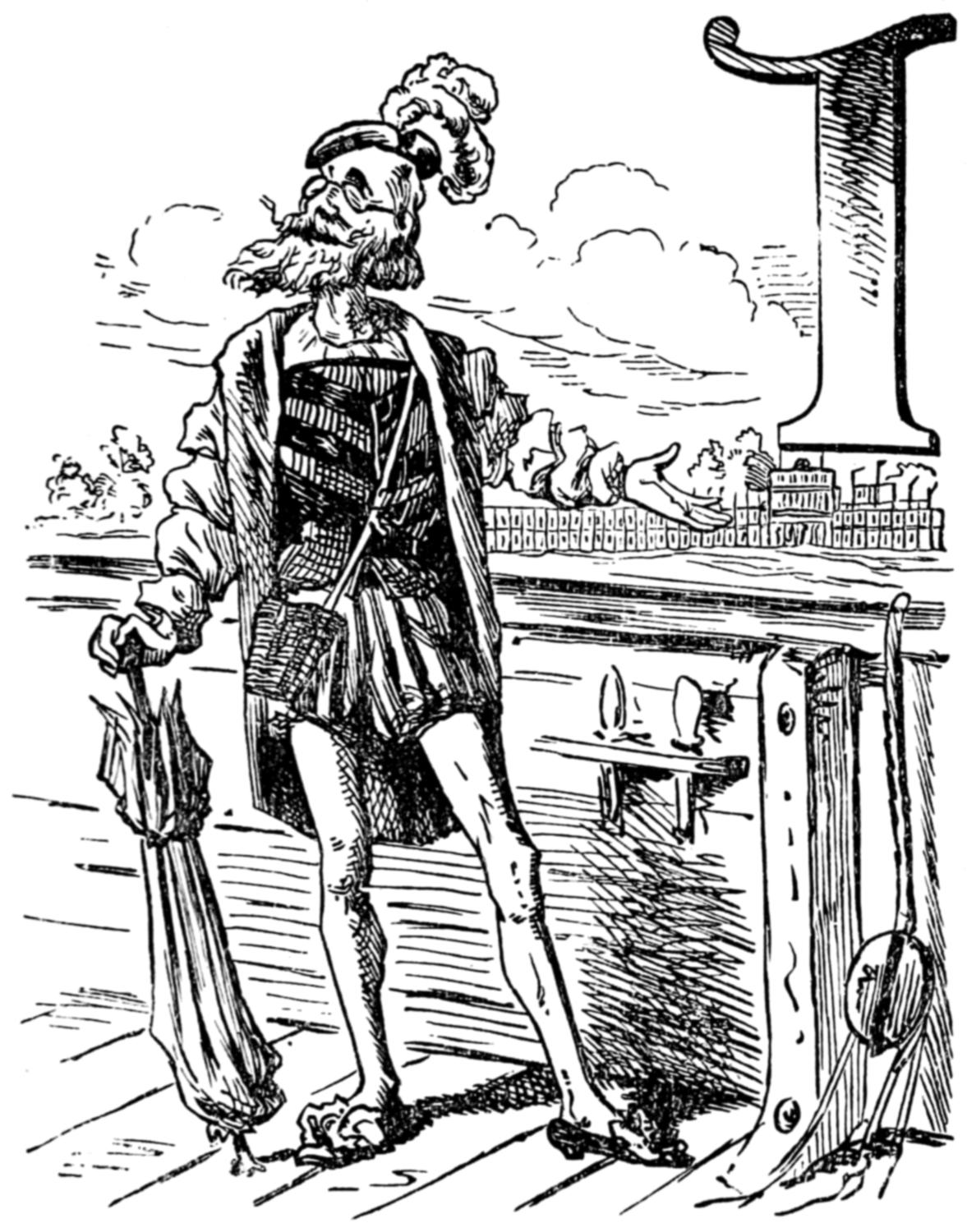
If the late Christopher Columbus,
Esq., could have foreseen,
as an indirect result of his
little excursion in the spring
of 1492, the infliction of the
following pages upon posterity,
Mr. Columbus, very likely,
would have stayed at home.
Think kindly, therefore, of
the dead; let no blame attach
to him. Perhaps a few remarks
concerning the ancient
mariner may prove instructive
to the reader. Being
both happy and able to impart
useful and interesting
information, we cheerfully devote
a paragraph to the defunct
navigator.
The capitalists of our country
are familiar with Christopher,
principally through a cut of that nautical gentleman which an
artistic government has placed upon the reverse side of its five-dollar
bills. The elevated cross in the hands of the piratical-looking monk
kneeling beside him, has given rise to a wide-spread belief that Mr. Columbus
was a bishop or a cardinal. It is our duty to dispel this grievous
misconception. He was simply a Brazilian sea captain, who believed
there were two sides to every question, even to such a serious question
as the world. Having taught Queen Isabella of Spain, who had not then
abdicated, how to make an egg stand and drink an egg-flip, she gave him,
under the influence of the latter, command of the steamer “Mayflower,”
with permission to row out and see what he could find. He
landed at Plymouth Rock; discovered the city of Boston, first, by special
request, being presented with the freedom of The Common by the
grateful inhabitants, and welcomed
in a neat speech by Mrs. Harriet
Byron Stowe.
Shortly after this, George III. of
England commanded that all the
male children born in the Colonies
should be cast into the Atlantic
ocean. He also advanced the price
of postage stamps. These injustices
were more than the people could
stand; they met in Concord, and
drove the British out of Lexington.
This alarmed George, who immediately
passed the famous “stamp
act,” and telegraphed to Benjamin
Franklin, then postmaster at Philadelphia,
authorizing him to distribute
free rations of postage stamps
three times a day. But the wires
clicked back the touching refrain—
“Too late! Too late! Of all sad
words of tongue or pen, the saddest
are these ‘too late.’
Yours, Ben.”
Benjamin then convened a job lot
of patriots at Philadelphia, and they
resolved that these United States
were, and of right ought to be, free
and easy. Commodore John Hancock,
of the Schuylkill Navy, was
chairman of the convention. On
motion of Robert Morrissey (whose
nephew John, late M. C. from New
York, inherits his uncle’s statesmanlike
and financial abilities), a bell
to proclaim liberty was purchased
for the State-House steeple. They
practised economy in those brave
days, and bought a cracked one,
because they got it at half price.
It is still in Independence Hall, a
monument of our veracity.
The world knows well what followed,
and ’tis well for the world
that it does. General Cornwallis
finally surrendered to General Scott
at the Germantown Intersection.
The “Junction” depot now marks
the spot. So, dismissing our historical
reminiscences, we would respectfully
request both the gentle
and the savage reader, to imagine,
after the manner of the modern
drama, the lapse of one hundred
years, ere we proceed with the
second act.
This century being buried in that
popular mausoleum, the vast ocean
of eternity, a universally expressed
desire to celebrate the nation’s centennial
birthday in a style befitting
its present power and importance,
gradually assumed the form of an
International Exposition, to be held
during six months of the year 1876.
Philadelphia was selected as the
site, partly on account of historical
associations and the proprietorship
of the cracked bell, but principally
to gratify the inhabitants of the
adjoining Dutch settlement, New
York.
Congress was naturally appealed
to for countenance and assistance.
Unfortunately, however, Congress,
having bestowed all its material aid
upon railroad and steamship subsidies,
had nothing but its moral support
to offer. Having a large stock
of this commodity, it was tendered
with the usual CONGRESSIONAL MODESTY.
modesty and circumspection
which marks the action of
that body in national affairs. The
President was authorized to invite
the world to the Exposition—without
expense to Congress. Philadelphia
was granted permission to hold
the Exposition—without expense to
Congress; each State was allowed
the privilege of appointing a commission—without
expense to Congress;
and, to be brief, the economic
representatives of the people resolved
that these United States might go
in and have a good time generally—without
expense to Congress.
Jubilant with this encouragement,
the State Commissioners organized
an Executive Committee, which appointed
a Board of Finance, and
auxiliary committees upon everything
and anything, including mining,
manufactures, calisthenics, art,
science, primogeniture, horticulture,
pisciculture, agriculture, infanticulture,
and hydrostatics. City committees
were constituted. These were
jobbed out to wards, and again sublet
to precincts, through which domestic
juntas were established in
every household. Thus the voice
of the people woke the echoes of the
capitol, and reverberated to the furthermost
corners of the universe.
The Building Committee immediately
contracted with GEE UP DOBBINS!Mr. Richard
J. Dobbins (the inventor of Dobbins’
electric soap) for the construction of
He agreed to furnish the very first
quality of soapstone for the masonry,
and to use Castile only, for the
girders. The following were the
chief points of the contract:—
1st. The building to form a parallelopipedon,
in order to secure the
choicest location to each exhibitor.
2d. To be thoroughly waterproof.
Dr. McFadden of the Aqua Fontana
department, and several other eminent
surgeons, to fill it up to the
ceiling as a test previous to the
opening. The contractors to take it
back if the test proved unsatisfactory.
3d. The walls to be of gutta percha;
to be distributed after the
closing of the exhibition to the
pupils of the public schools for
chewing and erasing purposes.
4th. A transcript to meander
through the centre of the building,
with a knave to right and left. Cucumber
pumps of the Louis Quatorze
pattern on the east and west detours,
alternating with eight green cellar
doors, to give the same effect and
finish which marked the tout ensemble
of the Vienna buildings. A
main curricle on the right to be
flanked by iron decades, with arched
approaches for bipeds, tripods, and
quadrilaterals.
5th. The general appearance of
the exterior to favor the Polynesian
style, which is replete with architectural
beauties. Fac similes of
the Tower of Babel, Tower of London,
Leaning Tower of Pisa, and
Tower Hall, to adorn the four corners.
The trusses and bandages supporting
the roof, to be of purple and
fine linen, with brass mountings.
The roof itself to be perpetually
covered with wet towels, to guard
against sunstroke.
6th. The centre aisle to be covered
with canton flannel matting,
with the grass sloping up to the
back door. Nineteen hotel candles
to illuminate the ground floor, with
a citrate of magnesia light in the
attic window.
This extraordinary structure was
completed according to agreement,
and upon being weighed at the corner
grocery, kicked the beam at
1234567890 pounds, 19 shillings and
sixpence.
Mr. Dobbins was also entrusted
with the erection of
This is a permanent building, so
adapted that it may be used hereafter
as an Art Gallery or a Station-house.
The foundation is not only
cemented with Spalding’s glue, but
the iron posterns run through to
China, and are tied on the other
side with the back hair of coolies,
detailed for the service through the
courtesy of the Pekin government.
Notwithstanding Mr. Dobbins’
immense labors in completing these
two buildings, he still found time
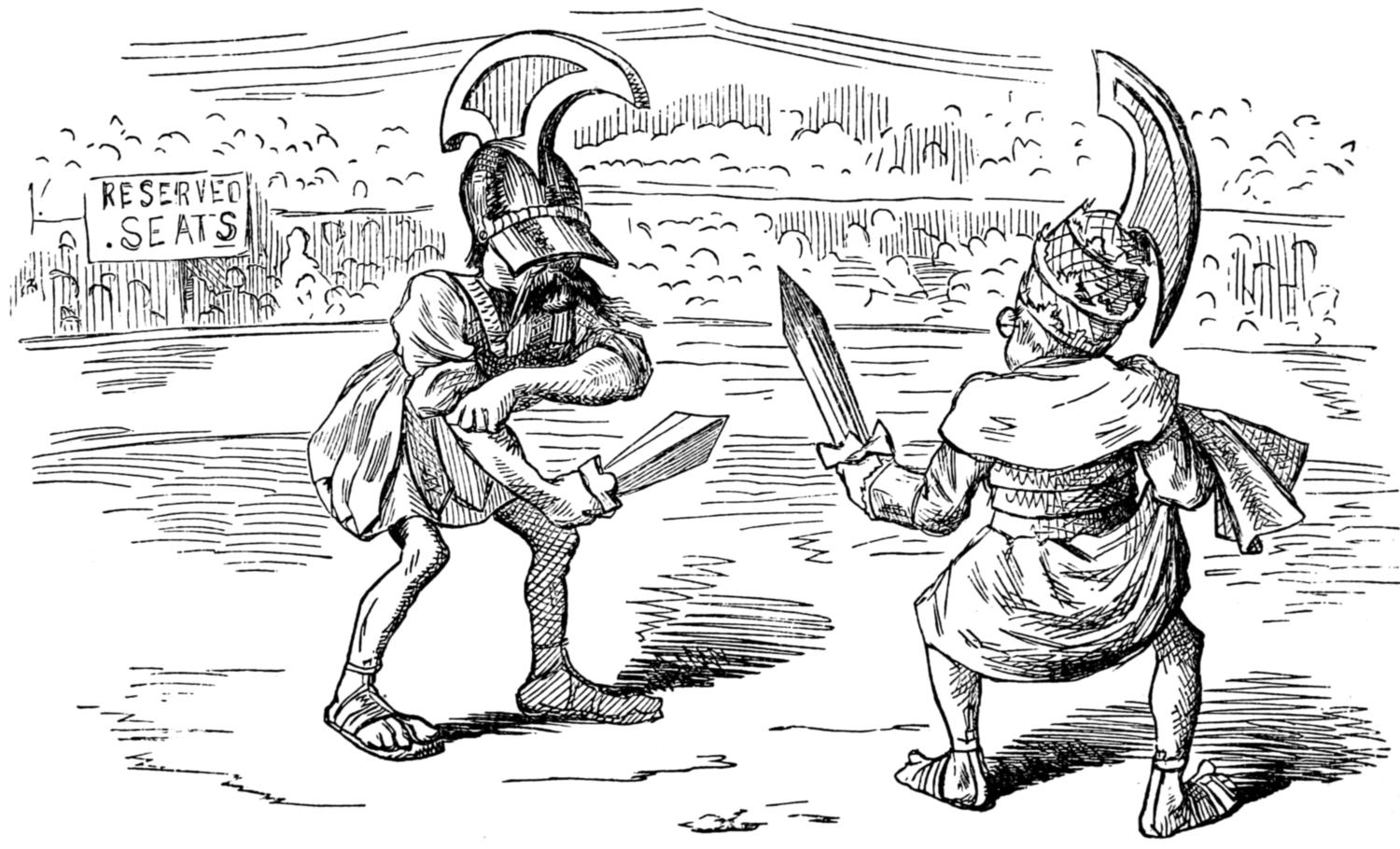
to run over to Rome and MORITURI SALUTAMUS.purchase
the Colosseum. He brought it home
with him for the purpose of exhibiting
Prince Bismarck and the
Pope in gladiatorial contests during
the exhibition months.
The contract for
was awarded to Mr. Philip Quigley,
of Wilmington, Delaware. When
it grew too big for his State, he removed
it to and finished it upon the
ground it occupied. The machinery
exhibited was worked by forty horse-power,
and a neat stable was attached
to the rear for the care and
accommodation of the forty horses,
the contribution of the city passenger
railway companies.
All the shaftings were of sandal
wood, and the belting of Russia
leather, supplied by the family of
the Czar himself. An “hydraulic
annex” was also tacked on to the
building. It contained a tank 60
by 180 feet, with 10 feet depth of
water for fishing and bathing purposes.
A portion was fenced off for
the preservation and display of “The
Falls,” which the hotel keepers and
hackmen of Niagara kindly loaned
for the occasion. The hydraulic
rams and other live stock were
watered here every morning, and
at stated intervals during the day
hydrodynamic and hydrostatic performances
were given in the tank
by the pupils of the “Girls’ Normal
School.” The former were very
unique.
The consideration for the construction
of this building, as per Commissioners’
report, was $542,300, including
drainage, water-pipe, plumbing,
and silver-plated door knobs,
but exclusive of interior white-washing.
This, however, was performed
gratuitously by Professor
Johnson of the African Commission.
Mr. John Rice, a healthful and
nutritious builder, was selected to
erect the beautiful
which remains a permanent ornament
to our park, and an attractive
target for the shots of the young
idea visiting the locality. The immense
expanse of glass will doubtless
provide innocent amusement to
many generations of young America.
May they ever appreciate the
kind consideration which placed the
building convenient to a line of soft
rocks, supplying ready-made boulders
of all sizes. We believe, however,
that the building is taken in
at nights; we know its visitors are
taken in during the day. Some
idea of its vastness may be given by
stating that more than 7000 acres of
land are situated around it.
being of papier maché, inlaid with
mother-in-law of pearl, was cut out
by steam, and work was not commenced
upon it until September,
1875. The pens for live stock adjoining
the building were of steel
(a favorite material in public edifices),
and were a part of the contract.
They were fashioned after
the manner of the famous floating
palace, “Adelaide Neilson,” of the
Noah family. The plans were furnished
by the Shemitic commission
from rough drafts now in possession
of the descendants of Admiral Noah.
At a late date the
decided to erect a few buildings, including
a hospital. They thought
the latter might come handy in
Washington after the exhibition, for
resigning officials. When we first
learned that the United States had
obtained 100,000 feet for their buildings,
we thought it another display
of persevering frugality. We imagined
they desired to save a hardware
bill by using the nails accompanying
the material. We discovered
that the feet merely meant
the ground for the buildings to stand
on.
As the Grecian government had
expressed itself too poor to take part
in the Exposition, Mr. Windrim, the
architect, was instructed to design
these buildings in the shape of a
Greek cross. Through this delicate
A COMPLIMENT TO SAPPHO.compliment, the land where Sappho
lived and sung, was represented after
all.
These, with the offices for managers,
gas men, stage carpenters, etc.
etc., and some national, state, and
special buildings, which may claim
our attention further on, complete
the list of structures erected upon
the Centennial grounds for exhibition
purposes. Men of all nationalities
vied for the privilege of
taking part in the glorious work.
The Teuton and Celt underbid the
native American; the co-patriots of
Garibaldi did still better, only to be
put to shame in their turn by a Chinese
colony. Ignoring all natural
partiality and national prejudice, the
contractors, in a spirit of true republicanism,
gave the most work to
those who labored for the least
money.
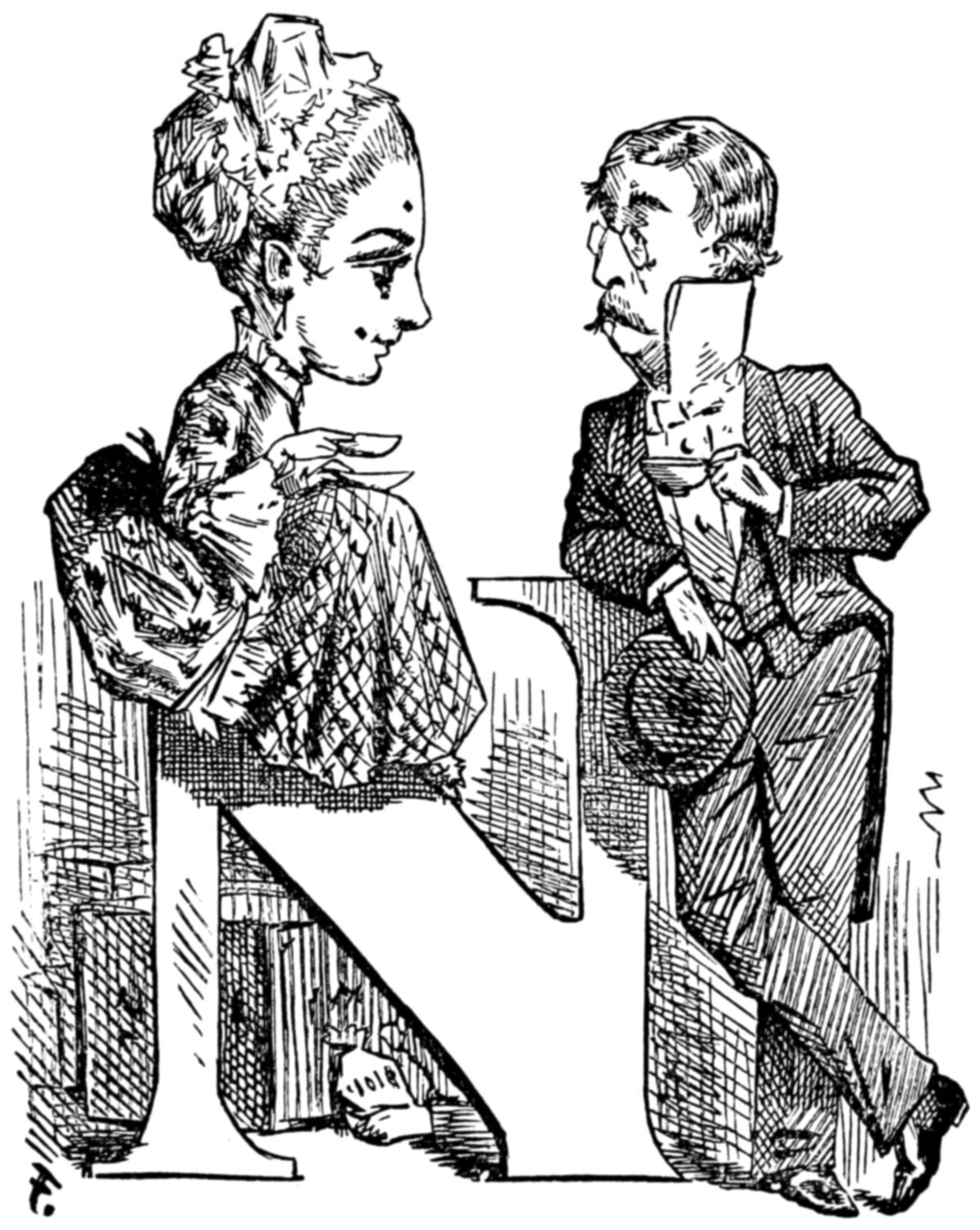
CHAPTER II. “THE FUEL.”... What the women did. — A POOR YOUNG MAN. — THE NATIONAL OR MARTHA WASHINGTON TEA PARTY. — THE INTERNATIONAL TEA PARTY. — THE PATENT LOAN OFFICE EXHIBITION
Nature always provides for
emergencies. The world required
steamboats and locomotives,
and, lo! a Fulton and
a Stephenson appeared to supply
the demand. We craved
a means of rapid intercommunication,
and Mr. Morse sat
down and invented his telegraph.
We experienced a
soaring desire to sail through
the air, and George Francis
Train stepped forward to inflate
our balloons. So, when
a lady competent to organize
and superintend the workings
of her sisters, became requisite
to the success of the Centennial
project, nature did not
desert us. Uprose, as the poet
sweetly remarks,LOVELY WOMAN.
“A perfect woman, nobly planned To boss an army or a peanut stand,”
and grasping the banner, Mrs. Emma D.E.N. Gillespie became the special
partner of the Board of Finance.
Were we about writing a work in twenty quarto volumes, the kind
we have been in the habit of producing, we might faintly hope to do
justice to the prodigies accomplished by the noble women of America, and
especially by our own Philadelphia ladies. What we do write, however,
is the result of personal observation. Blessed with female relatives
in esse and in posse, who have been active members of ward committees
since the first trumpet tone, we write advisedly; having been
snubbed, sacrificed, and made secondary
to centennial enthusiasm for
three long years, we write with a
proper appreciation of the solemn
duty in hand.
The dear creatures travelled up
to the State-House steeple; they
glanced around upon the situation;
they rolled up their sleeves, metaphorically,
and swooped down upon
the city. They canvassed stores and
factories from turret to foundation
stone; they invaded dingy counting-houses,
and sauntered like sunbeams
into dusty offices, collecting subscriptions
to centennial stock, peddling
centennial medals, and doing irreparable
damage to the peace of simpering
clerks, blushing salesmen, and
susceptible employers. A single case
will serve for illustration. Listen
to the story of
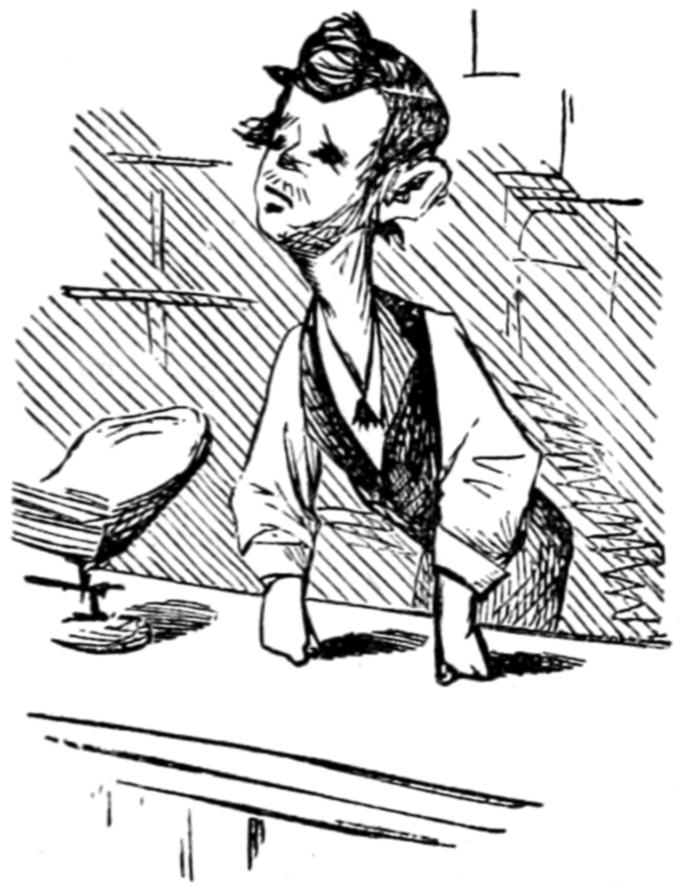
“NOT WISELY BUT TOO WELL.”He was an innocent youth, undergoing
initiation into the mysteries
of compounding and weighing out
sugars, teas, and spices at a West-End
grocery. A Spruce Street damsel
did the cruel deed. She visited
the establishment several times in
reference to some shares of stock,
and her passing glance sank into his
soul. His deep, poetic nature demanded
an outlet for the sacred fire.
Ætna will burst; Vesuvius will explode.
Ætna and Vesuvius were
but parlor matches compared to him.
The evening succeeding the lady’s
third visit to the grocery, a package,
neatly done up in brown paper, was
left at her residence by a youth who
vanished upon the instant. The
lady untied the bundle, and discovered
an A. No. 1 salted codfish. The
following lines, on pink initial note
(slightly greased), were fastened to
its tail by a blue ribbon:—
“My love is boundless as the ocean, Deep as its waters my devotion.
This cod, sweet maid, is salt— Salt is the ocean too; By logical analogy, therefore, this fish will prove Type of my love for you.”
Next evening, about the same
time, another package arrived, with
another poetic sentiment in the same
handwriting:—
“I send a can of salmon soused, ’Tis sweetness in the sour; O, would your smile the salmon was, In my forlorn soused hour!”
The lady was somewhat puzzled,
though gratified. Her father was
somewhat puzzled, though not gratified.
Their quandary was not lessened
upon receiving a third delicate
present the next evening.
“I offer my love two pounds of chipped beef, ’Twill be nice for her breakfast or sup; O the love in my heart’s not at all like the beef— For, sweet maid, that can never dry up!”
“Can’t never dry up, eh?” said
the old man the following evening,
as he pulled on his thickest boots,
and took up a commanding position
on the front-door step. “Can’t never
dry up, eh?—we’ll see.”
But the mysterious messenger
flanked him by ringing at the back
gate.
“Sweet maid, sweet maid, O pray accept This jar of pickled onions; They’ll tell thee of the tears I’ve wept, And sighs vent by the ton-ions.
They’re round, too, like the planet Earth; Like earth, my love’s complete; May this to sweetest thoughts give birth, When of them you shall eat.”
Another evening came; the old
gentleman was again upon the step;
the family butcher was sauntering
carelessly by the back gate. Alas!
in place of the youth, ’twas the
grocer himself who called. The
butcher did not know him; he obeyed
instructions. On the day of the
unfortunate man’s funeral these lines
were read; they were found in his
pocket, and explain the cause of his
inopportune visit:—
“Sweet maid, sweet maid, I had a clerk, A taking youth was he; I’ve sent him up to Cherry Hill, The bill—I bring to thee.”
We will dwell no longer upon this
mournful episode, but return to our
main subject.
The ladies of the various ward
committees did not confine their
efforts to canvassing. They worked
afghans that nobody wanted, and
slippers that nobody could use; purchased
desks that wouldn’t open,
and pocket-books that wouldn’t
shut, and raffled them off at prices
as fancy as the goods themselves.
They appeared in amateur theatricals
and variety shows. Every ward
had its ROMEO AND JULIET.Romeo and its Juliet; every
precinct its Lady Macbeth and Wellington
De Boots. Their acting was
wonderful and awe-inspiring. Audiences
gazed upon them in public
with dumb amaze, and wept in private,
they knew not why. People
began to look upon tickets for amateur
performances as Japanese officials
regard a polite invitation to
“Hari Kari.” Call-boys and scene-shifters
at regular theatres set up
for luminaries. The demoralization
of the drama was complete.
But all these things were mere
side dishes, to be mentioned incidentally
in connection with the
combined efforts, viz.:—
“The Great National Tea Party,”
“The Greater International Tea
Party,” and
“The Greatest Patent Loan Office
Exhibition.”
It is with a feeling of profound
diffidence that we allude to them.
TOAST AND TEA.Under the supervision of their revered
sovereign and her executive
star chamber cabinet, the ladies
transformed the Academy of Music
and Horticultural Hall into one
grand coffee house and sandwich
caravansary. To save the expense
of attendants, the aids themselves
dispensed tea and coffee, smiles and
gingerbread, bewitching glances and
ham sandwiches to the thousands
crowding the vast saloons. They attired
themselves in old-time fashion
to look like so many Mrs. Washingtons.
Many a family cheerfully
sacrificed its furniture covers to array
its daughters in the style of costume
made sacred by Martha. They
stuck little blotches of black court
plaster upon their chins, cheeks, and
the tips of their noses, to imitate
her venerated pimples, and dipped
their heads into the family flour
barrel to make their hair look like
to hers.
Each ward represented one of the
States of our Union, and the rivalry
between their tables, though good-natured,
was intense. At one table
they sold tea made in Martha’s china
tea pot; at another table they dispensed
slices from a pie having its
edges scalloped by her false teeth;
while a third overtopped all competition
and did an immense business,
regaling customers with sausage
manufactured from the remains of
her pet poodle. The aids who dealt
out this luxury seemed conscious of
the sacred trust. Tears of patriotism
dimmed the lustre of their lovely eyes.
They sold nosegays at the price of
small conservatories, but pinned
them on coat lappels without extra
charge. They did more. With
apparent cheerfulness, they accompanied
male friends to the hall below,
where the band played, and
with them hopped and skipped, and
glided and dipped, as if they were
really enjoying themselves, and not
sacrificing comfort to love of country.
The pecuniary result of this affair
was most gratifying. The Finance
Committee kindly acknowledged
this fact to its special partner, requesting
her to do so some more and
keep the ball rolling. Yet still
its grandeur was eclipsed, totally
eclipsed, by the next great effort.
Between the two tea drinkings,
however, a Fête Champêtre was held
at Belmont, near the Centennial
grounds. We wrote to France,
Mrs. Gillespie’s native land, to find
out what a fête champêtre meant.
THIERS ON MOONSHINE.Our respected friend Thiers replied.
“You go out,” he wrote, “to some
nice quiet spot. In the evening you
hang a few lanterns on the trees, and
leaving the other folks to dance, you
yourself wander off with some ‘nearer
and dearer one yet than all others,’
to explore the surrounding country,
its shadowed nooks and moonlit
glens.” Of course we went. But
somehow everybody else was leaving
the others to dance and seeking
moonshine. Never before was there
such a demand for nooks and glens
since nooks and glens were first invented.
The fête was a perfect success as
far as moonshine was concerned, but
not pecuniarily. The caterer of the
evening is wearing away his days
in an insane asylum. Who cares
for Champagne when they can have
nearer and dearer ones? Who cares
for lobster salad when they can have
nooks and glens?
A second tea party, to retrieve the
reputation of the cabinet, was decided
upon. This time, however,
instead of representing only our
States, all the nations of the earth
were to be typified.
“No pent up Utica contracts our powers; The world’s four boundless continents are ours.
Emma R.”
were the suggestive lines with which
“General orders 197” terminated.
The aids appeared in the costumes
which long theatrical usage has established
as nationally characteristic.
For three successive evenings, a thing
of beauty and a joy for Emma enchanted
and astounded throngs of
visitors, and would have been continued
longer had not everybody
unfortunately run out of small
change.
Each table was adorned by what
the ladies fondly believed to be an
unmistakable designating peculiarity.
One ward went into business
with a few yards of glazed paper
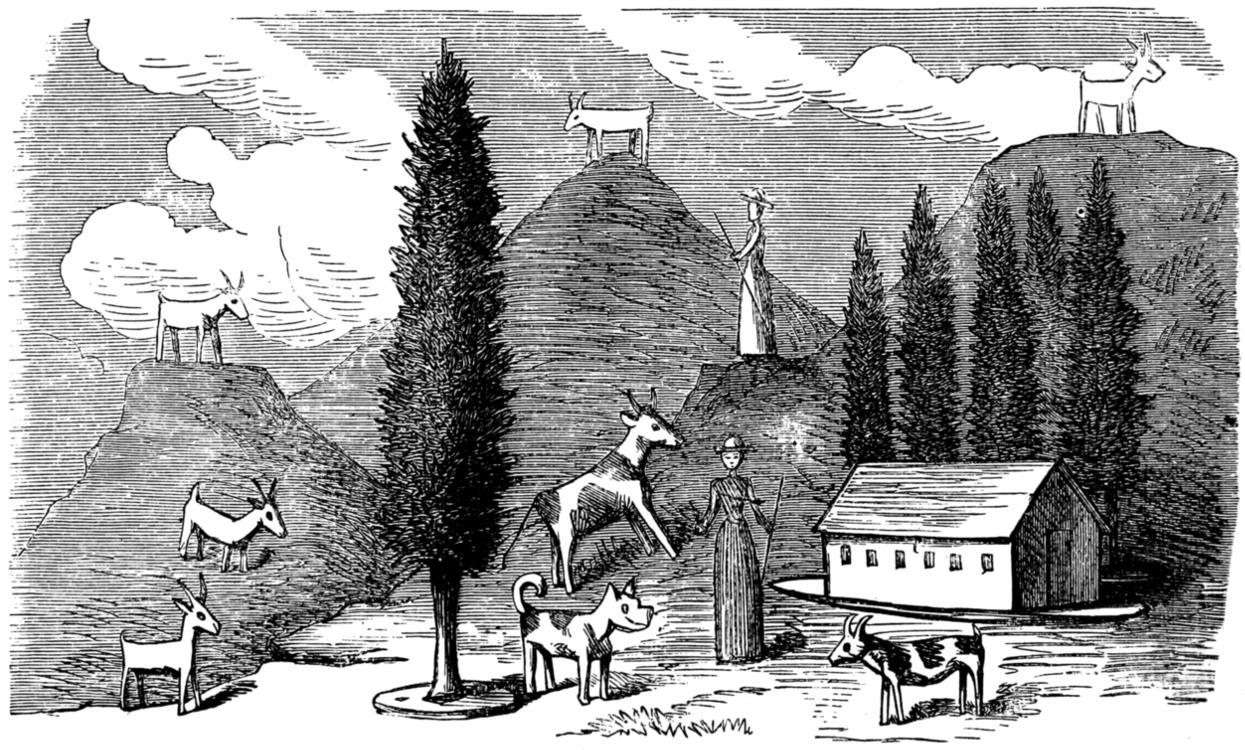
and a Noah’s Ark, and reared upYE MIGHTY ALPS.
the mighty Alps. Shem, Ham, and
Japhet stared blankly into futurity
from the storied peaks; old Noah
and his wife looked around in a bewildered
manner as though wondering
what the genesis they were doing
in that locality, while their sheep,
goats, cows, elephants, tigers, crocodiles,
and whales jumped indiscriminately
from crag to crag.
An odor of Swiss cheese, from the
sandwiches, made the illusion perfect.
The ladies of another ward had
ingeniously built a polar bear with
an inner structure of rags covered
by variegated cat skins. He was a
little lop-sided, but didn’t seem to
mind it. He stood serenely upon a
looking glass glacier, with tail erect,
and the Russian flag between his
teeth. The 8th ward (Republic of
Lima) made a splendid display of
Lima beans, boiled and in soup. The
aids were not afraid to say “beans”
to anybody.
But the 21st ward (Isle of Man)
carried off the prize. This committee
had secured, at enormous
expense, a live specimen of the
native. He was quite docile and
harmless; yellow whiskers, and wore
eye-glasses. This table was the
Mecca to which all the aids flocked
when off duty.
Talk about your heroines of revolutionary
times! Bah! Do you suppose
that Moll Pitcher would have
donned striped leggings, a gauze
flounce, and a sash around the shoulders,
and wandered around like the
Amazons in the “Black Crook,” as
did Mrs. Vowl of the 20th ward?
Would Mrs. John Adams, the wife
and mother of presidents, pattern of
patriotism as she was—would she
have put on spangled breeches and a
turban of red, green, and yellow with
a turkey’s feather in front, and
trotted up and down the Foyer of
the Academy with a bucket of
lemon peel and water, calling it
“sherbet,” and pretending not to
notice the excruciating look which
distorted the countenances of the
unfortunates inveigled into investing
in a glass and then feeling compelled
to empty it? To these questions
there can be but one response. You
shall make it.
The result of this festival was
also satisfactory to the Finance
Committee and to all concerned.
The ladies were encouraged to renewed
efforts. They racked their
brains searching for a novel idea,
and when did women rack in vain?
They invented a style of exhibition
which produced an effect such as
the world had not witnessed since
the Israelites emptied out Egypt.
The war trump sounded: “Gillespie”
was the cry. Special orders
774 were promulgated, and that
stupendous conception
astonished and frightened the land.
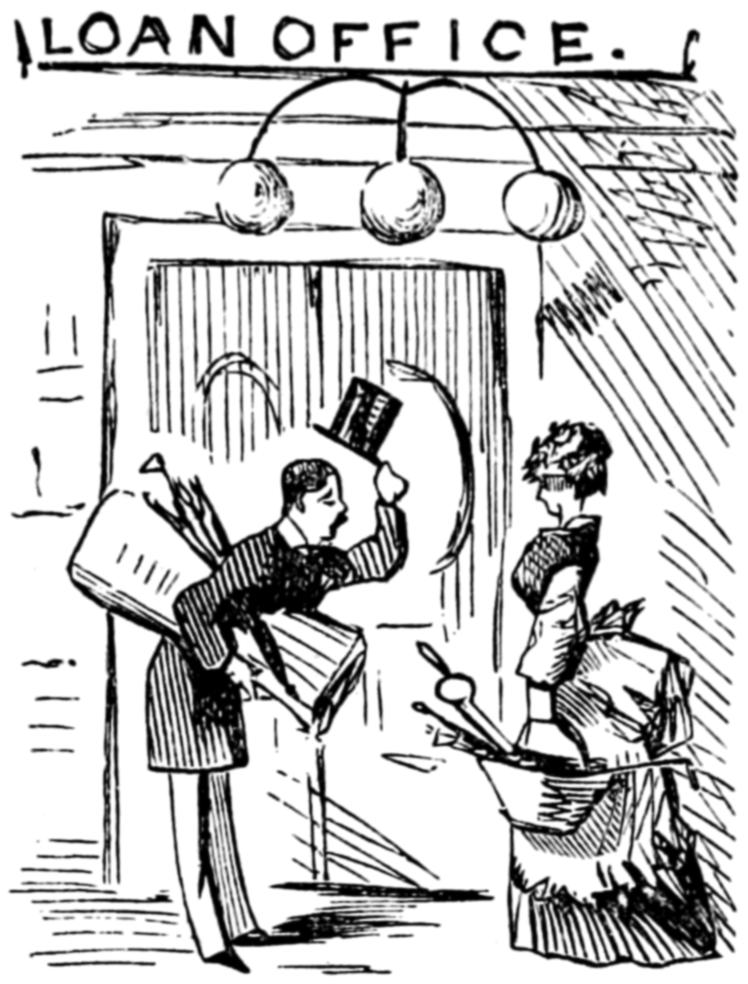
Everything was to be borrowed;A LOAN— AND FROM HOME.
nothing bought and still less paid
for. The idea was attractive. A
wide field was opened for feminine
ingenuity. Each aid immediately
locked her own umbrella carefully
away, and called upon her friends
when the weather was cloudy.
The Franciscan Monastery, on Rittenhouse
Square, was the largest
article loaned to the Committee,
they having declined the offer of a
Frankford brickyard; and in this
building the exhibition was held.
Three beautiful gilded balls were extended
from the attic window, and on
them the neighboring residents gazed
in silent rapture. A great demand
was created for articles one hundred
years old and upwards. Old pots,
pans, and dishes were suddenly
endowed with incalculable value.
We ourselves worked industriously
to produce relics. Our aforementioned
relations in esse and in posse,
acknowledged the loan of an old
brick into which we had pounded
a new bullet, with a fervor which
more than repaid our disinterested
patriotism. The sweet smile and
kindly glance with which they accepted
a pair of old army breeches,
which we had purchased for seventy
cents and riddled with augur holes,
haunts us still. Nay, when we attended
the exhibition, and saw an
old lady reverently kiss a yellow
handkerchief, which we had borrowed
from an hostler of our acquaintance,
and labelled “Lafayette,”
we retired to a side apartment
and wept tears of joy. We had afforded
that old lady a gratifying
reminiscence for the remainder of
her existence.
The Washington family came out
particularly strong. In a pavilion in
the garden, seventeen aged females
were seated. They had nursed little
George in his baby days. With
undisguised emotion they exhibitedGEORGE’S INDIVIDUAL CONTRIBUTION.
21 cradles, 66 gum rings, 423
hatchets, and half a bottle of soothing
syrup, all of which, they asserted,
had been the property of the
father of his country during his infantile
years. They also possessed
among them an aggregate of 34,621
buttons, which they had purloined
at different times from the dear
child’s vestment.
This was considered as George’s
individual contribution.
The remainder of the family were
not behindhand. They sent a few
of their plates, spoons, forks, ladles,
etc.; not many, only about enough
to start a first-class hotel. As for
family Bibles, they must have had a
sufficient quantity to have allowed
each member of the family a new
one every day of the week and two
on Sundays. There were chairs
and sofas enough to seat the entire
continental army, and about five
wagon loads of miscellaneous furniture
and chattels. Heavens, what
an establishment those Washingtons
must have kept!
It would be useless to attempt an
enumeration of the wonders on hand
and made to order for this occasion.
Suffice it to say the ladies borrowed
everything they could borrow, and
what they couldn’t borrow they—didn’t
have.
Two rooms were set apart for
broken and unbroken china, which
(again in compliment to Mrs. Gillespie’s
native tongue) were called
Bric a brac apartments.
The exhibition was open to the
public for six weeks with a table
à la carte in the dining-room. The
net profit was close on to seventy-five
dollars.
And after all this work, after
obtaining from them all these
ducats, what did the centennial
magnates say to the ladies?
“Ladies,” said they, “we have
taken your money; we have urged
you to labor; we have induced
you, in the person of our special
partner, to travel to sister cities
to persuade the daughters of our
land to make a proper exhibition
of their importance and standing in
this home of equal rights; but, ah,
unfortunately, we shall not be able
to allow you any space in our
buildings; the old women of China,
the aged females of Timbuctoo claim
it, and if you want to display that
standing and importance we have
mentioned, why—ah—here are plans
for a building; take them, get up
a side show for yourselves, pay for
it yourselves, and be—happy.”
CHAPTER III. “THE COOKS.” ... Who fed the flames. — GENERAL JOSEPH NAPOLEON HAWLEY, — THE HON. ORESTUS CLEVELAND, — MRS. EMMA D. E. N. GILLESPIE, — GOVERNOR BIGLER, — MR. DANIEL J. MORRELL, — THE HON. ALFRED TIMOTHY GOSHORN,
Our record would be incomplete
if we failed to insert a few brief
biographical sketches of some of
the personages prominently connected
with the conduct of the
Centennial celebration. We regret
being obliged to limit the
list to a very few of the many
deserving of the honor. The
facts which we relate in regard
to them, have been industriously
gathered from many sources
probably unknown even to the
parties themselves. Should we
succeed in awakening one soul
to pure aspiring action—should
we be the means of placing one
pair of feet into those “footprints
on the sands of time” which lead to honored greatness—our labor has not
been in vain.
the President of the Centennial Commission, was born principally in the
State of Rhode Island, but grew so rapidly that his parents soon found it
necessary to have him hauled over entirely into Connecticut. Here he
flourished and grew fat among the healthy wooden nutmeg groves. He
early displayed unmistakable evidences of genius. At the age of seven,
he invented a tin lightning rod, and a schoolboy’s improved blowpipe of
the same material. For this latter, his teachers passed him a vote of thanks
through the medium of a ruler, and graduated him from the scholastic
establishment. Shortly afterwards he originated the business of manufacturing
paper shell almonds, but sold out advantageously to a near-sighted
relative and entered the Artillery school at Brienne, from whence
he soon meandered to the military academy at Paris. He instituted the
“legion of honor,” won the battles of Marengo, Jena, Austerlitz, Eylau,
Wagram, and some few others, and then retired to the monastery at St.
Helena. Here he took the veil and several other articles, and leaving,
one
cloudy night, worked his passage to
London. At this metropolis he
mixed freely with the heads of the
nobility, opening a hat store and
being appointed “hatter extraordinary”
to the Queen. He pined, however,
for the breezes of his native
land, and when Columbia called
upon her sons to lend a hand to the
Centennial structure, he returned to
America and was elected President
of the commission.
His bravery and prowess are
equalled only by his genial nature
and the style of his moustache and
imperial. Of him the poet Horace
(Greeley) has said,
“Though always ready to smile with a friend, He never was known to re-treat.”
Some of his enemies recently nominated
him for Congress. Their sinister
designs failed, however, and he
will happily remain for some time
longer an ornament to society and
a credit to his country.
OH REST US.Vice President of the commission,
was born, when quite an infant, in
the State of Ohio. He gave such
promise of future greatness that his
native city was named after him.
He was the eighteenth child of
his parents, and was, therefore, called
Orestus. The name was suggested
by the friends who had been acting
as godparents for the family. He
must not be confounded with the
Orestes who murdered his ma and
was afterwards killed by the bite of
an Arcadian serpent; he is quite a
different sort of an Orestes.
Through life he has been noted
for his culture and refinement.
These qualities he owes to his father’s
care. The old gentleman made a
point of polishing him off regularly
twice a week during his youth.
He always displayed a remarkable
fondness for school. He could often
be found there an hour after all the
rest of the pupils had gone home.
His teacher was especially fond of
him. “Frequently,” said she to us,
with tears in her eyes, “frequently
did I lay him across my knee to
more readily display the affection
with which I regarded him.”
When he was not at school he
was engaged in the noble work of
repairing and paying for the window
panes his companions had
smashed; in replacing fruit upon
the trees from which they had stolen
it, and in going to church and praying
for their regeneration.
His manners always continued engaging.
Unimpressible police officers
have been known to form an
attachment for him, the more remarkable
as he never encouraged
their sociability.
After essaying many learned professions,
he finally concluded that
his forte lay in the profession of being
a rich man. He bought a farm near
Camden, planted Kelley’s patent inflation
bill, and raised money in that
primitive fashion. After passing
the meridian of life in honor and
righteousness, the devil put evil
thoughts in his mind, and he embraced
the legal profession, to which
he is still united.
His front elevation is very imposing.
His face is somewhat in the
Corregio style, with Roman nasal
appendage and Grecian earwings,
doing much credit to the architect
who designed him. He is finished
with a double action expanding
chest, with corrugated windpipes,
and he stands on two seventeen inch
pedestals cased in patent leather.
He was on exhibition during the
entire continuance of the exposition.
Of the early days of
but little is accurately known.
Though historians agree upon essential
points, there are many of those
conflicting side issues which always
arise from a multiplicity of traditions.
We know, however, that at her
birth she was taken under the especial
patronage of the Fairy “Bookotheopera,”
who endowed her with
all the virtues in that fairy’s repertoire,
and presented her with a beautiful
purple pincushion with
“Welcome, Little Stranger,”
blazing in the brass heads of the
pins which it contained. It is still
in her possession.
CENTENNIAL MYTHOLOGY.She has performed many noteworthy
deeds in addition to those
connected with the Centennial. ’Tis
true, she never fooled with asps or
indulged in pearl cock-tails like
Cleopatra; nor did she act as a spy
during the war like Major Charlotte
Cushman, but her quarrel with Neptune
concerning the right of giving
a name to Cecropia (Horat. 1, od. 16),
deserves as much attention as either
of the above performances.
The inhabitants of Taurica offer
upon her altars all the strangers
wrecked upon their coasts as a mark
of their appreciation of her efforts
in establishing the American line of
steamers (Apollod. 1, c. 4, etc.), and
though her resentment against Paris
(the son of Mr. Priam) was undoubtedly
the cause of the Trojan
war, yet the myrtle and the dove
have ever been considered her most
sacred emblems. Her ride upon the
white bull is as famous as Sheridan’s
ride to West Chester, and her patronage
has been so extensively
claimed by artists of all sorts, especially
such as painters, carpenters,
white-washers, and tea importers,
that the poets have had occasion to
say—
“Tu nihil invita dices, faciesve Mrs. Gillespiebus.”
To her, more than to any one other
individual, is the success of the celebration
due. We have remarked
her executive ability, and the manner
in which she directed the
nymphs of her train, and it is our
candid opinion, that nobody could
have been found or invented, to fill
more perfectly a position involving
so much annoyance, so much mental
and physical labor, so many petty
anxieties, and so comparatively little
general appreciation. There are
some debts which cannot be paid.
We put that owing to her upon the
list.
the Financial Agent of the Executive
Committee, passed his early
youth among the vine-clad hills of
Bucks County. He was brought up
a sturdy farmer’s lad. Day after
day, in the hot sun of noon, he stood
erect in the centre of the cornfield,
the terror of the devastating crow.
He was not called “governor” at
his birth; his name is SWEET WILLIAM.William; the
former title he acquired later in life
when he married a governess.
Willie was very popular in the
country school which he attended
during the winter evenings. Upon
several occasions his master bestowed
a cane upon him, which token of desert
he received with a few powerful
and eloquent remarks and tears in
his eyes.
His nature was always affectionate.
He would never visit a young
lady the second time unless he could
kiss her “good-bye” the first time
he called.
Artless to a fault, he never knew
the use of wigs until after he married,
and it is said that he never acquired
his second teeth until a few
years back.—He couldn’t have got
them then if he hadn’t paid fifty
dollars for them.
Despite his gentle nature, however,
his physical strength is immense.
His prowess in the amphitheatre,
his speech to his brother
gladiators at Capua, and the able
manner in which he defended the
wire bridge against Mr. Porsena, of
Andalusia, are favorite themes with
every American school-boy.
After the revolution he had his
sword cut down into a set of shoemaker’s
tools, and followed the cobbler’s
peaceful pursuit, until the
Centennial committee demanded his
time and services. For this he gave
up everything. He cheerfully immured
himself for a time in the St.
Nicholas Hotel, New York, living
on rye bread and wheat whiskey,
and enduring all sorts of hardships in
his endeavors to collect subscriptions
from the Dutchmen of Manhattan.
He came home, however, in time to
tack the roof on the main building.
Should he again take to mercantile
life in our midst, we cordially
recommend him to our friends for
“invisible patches.” His name will
ever be high upon the list of the
best beloved sons of the Keystone
State.
As
A SECOND DANIEL COME TO JUDGMENT.the Chairman of the Executive Committee,
was changed while an infant
in his cradle, and the child of his
nurse substituted for him in order to
obtain possession of the chateau and
estates, we were not thoroughly satisfied
that he was entitled to any
biography. We called upon him to
ascertain what he knew about himself,
and were disappointed to find
that he was not very well up upon
the subject.
We found him a man of fine appearance.
He has the eye of a hawk,
the nose of an eagle, the hair of a
raven, and the cheek of a Colossus
of Rhodes—with which he expects
some day to start a museum. We
informed him why we had called,
and at once commenced a list of
questions which we had taken the
precaution to prepare.
“As a youth, sir, were you gentle,
with a sweet disposition?”
“A sugar refinery, gentlemen,
wasn’t a circumstance to me.”
“Were you always gay and cheerful
and generous beyond measure?”
“I was.”
“Were you ever in love?”
“I decline to criminate myself.”
“Well, Schiller loved once, Goethe
many times, which do you consider
the most natural?”
“The latter, decidedly.”
“Were you ever jealous?”
“Once.”
“How did you act towards the
cause of this feeling?”
“Smothered her with a pillow.”
“Oh, then, you could be a
Othello?”
“I could be twenty Othellos; but,
gentlemen, as this style of procedure
is evidently fatiguing to you,
suppose I relate my story without
questioning, eh? James, a bottle
of champagne and a box of those
victorias for the gentlemen.
“Your Money or Your Life.”
“I was born,” he continued, “on
the Island of Borneo. My mother
was a decendant of the noble Italian
family of McLaughlini; my father
was also of noble birth; he never
walked afoot; he always drove a carriage—for
the man who owned it.
Cast upon the world at a tender age,
I went to England and took up my
residence on Hounslow Heath—maybe
you’ve heard of the place.
Always of a playful disposition, I
invented a pretty little game called
‘Your money or your life,’ which
I taught to all the lonely travellers
who passed my neighborhood, to
cheer them on their way. They
generally used to leave me their
pocket books, watches, and whatever
valuables they had about them,
so gratified were they with my attention.
The Royal Family soon
heard of me and despatched a regiment
of guards to conduct me to
London. Naturally modest, I endeavored
to avoid this distinction,
shunning a meeting with the deputation
as long as I possibly could.
At last I found myself compelled,
as it were, to accompany the party.
I was conducted to a grand stone
building of immense proportions
and solidity of design, in which,
apartments had been prepared for
me. From thence I was introduced
at Court, and, upon the suggestion
of the Lord Chief Justice of England,
the apartments in the granite
building were placed at my disposal
for six months, after which time he
desired me, in the name of the government,
to address a public meeting
of citizens and officials from a raised
platform, in Newgate Yard, hinting
that the address would be followed
by my immediate elevation to a
high position. My sensitive nature
shrunk from this display. Not
wishing, however, to offend the
gentlemen delegated to attend me,
I remained quiet as to my plans for
avoiding it until the opportunity I
waited for offered. Then, weaving
my bed clothing into a rope, I let
myself down through the chimney
and hurried home to America, without
saying adieu to them. They
were sorry to lose me, and offered
quite a large reward for my return
if living, or my body, if dead, designing,
no doubt, in the latter case,
to give me a grand funeral. But I
have ever preferred a quiet private
life to the elevation they tendered
me. That is all, gentlemen.”
“We are obliged to you, Daniel;
good morning.”
“Good morning: but recollect,
gentlemen, I am entered according
to the Act of Congress, in the
Eastern District of Pennsylvania,
and any infringement will be punished
according to law; you understand?
Good morning.”
Director General of the Exposition,
was born in the State of New Jersey.
This was, however, without collusion
upon his part, and no one more
sincerely regrets the circumstance
than himself. His father cruised
about the Spanish main, from Burlington
to Gloucester. Some folks
called him a free-booter; he was
only this, however, when young
Alfred misbehaved himself or the
tide ran the wrong way. Our hero
was a very promising lad. He was
ever ready to promise anything. He
was of a domestic turn of mind and
could generally be found in the
vicinity of the kitchen, especially
when cakes and pies were in process
of preparation. After a course of
studies at Yale, Harvard, Princeton,
and Cornell, his parents transferred
him to a public school to acquire
the arts of reading and writing and
the rudiments of arithmetic.
Early in life he joined the temperance
movement, but resigned when
he grew too big to parade with the
cadets. He adopted the profession
of the law, and rose as rapidly as
a schoolmaster from a tack-lined
chair. He was appointed minister
to the court of St. James. He
preached there until the Saint
moved out of the court, and he
then took entire charge of the
Crystal Palace Exhibition of ’44,
after which he swam across the
Hellespont and returned to Philadelphia.
An aunt in Cincinnati died and
left him a large pork sausage manufactory.
After entering into a contract
with the Philadelphia dog-catchers,
he moved West to take
possession of, and run the mill. He
assumed a leading position in the
city’s trade, was made president
of the Commercial Exchange, and
in this capacity was selected as
director of the Cincinnati Industrial
Exhibition.
This double experience made him
of course THE RIGHT MAN.the most available citizen
to take charge of the Centennial
Celebration. The manner in which
he performed the arduous duties of
the office, and their effect upon his
once robust constitution, may be
conceived if the reader will but
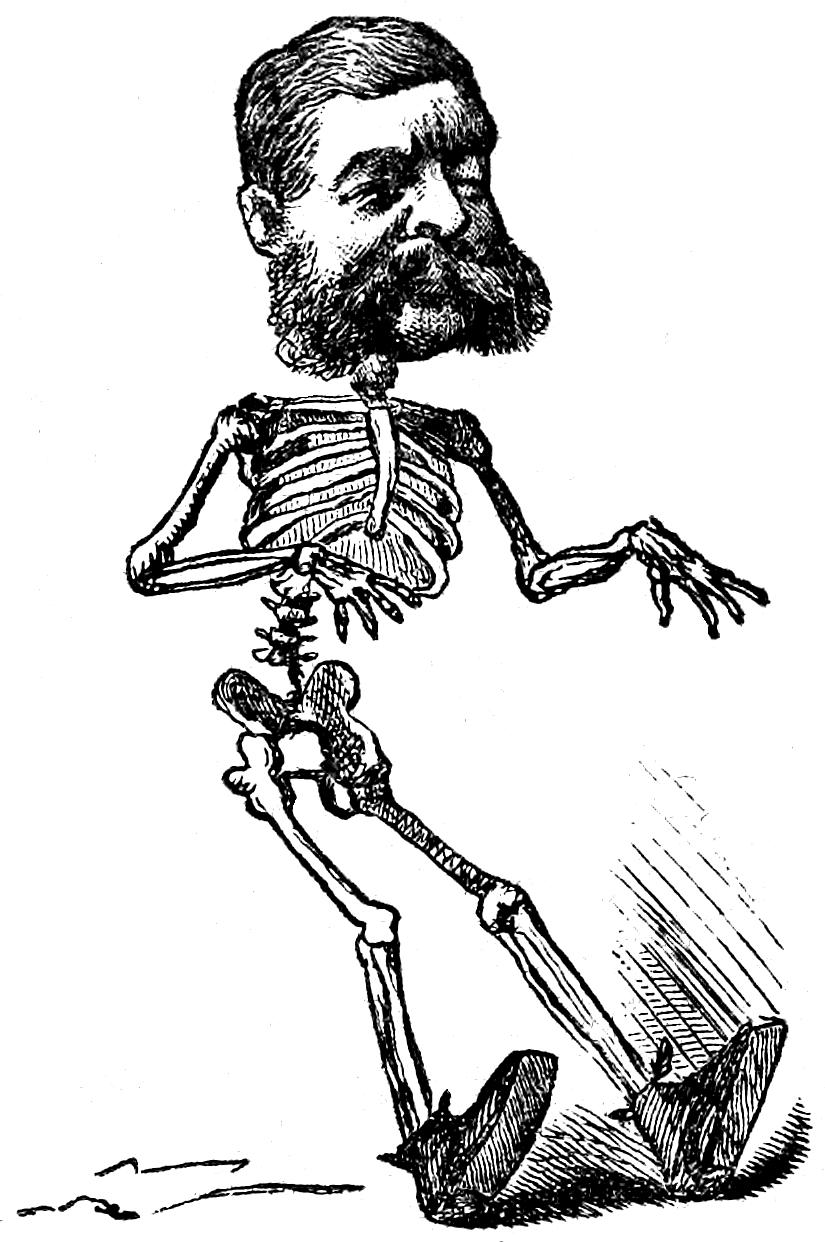
glance at Gutekunst’s latest photograph
of Timothy, which may be
found, full length, upon the back
cover of this volume. He is going
into the sausage business again to
recuperate.
Taken altogether and without
exception, we may feel justly proud
of our countrymen and women who
labored so faithfully for the honor
of our common nationality. We
trust our country may be as blessed
in noble hearts, generous souls and
gifted minds, at her next Centennial
Anniversary, and that we may all
be here to meet them.
CHAPTER IV. “THE LOOKERS ON.” ... Who came to be warmed.
Early in 1876 the actual hard
work of the Commissioners began.WELL DONE, OH RARE OFFICIALS!
During the months of February,
March, and April, they were kept
busy day and night, receiving,
sorting, and arranging the goods
forwarded for exhibition. The
Adams Express Company ran its
wagons directly up to the back
door of the buildings, but as usual
left all the packages on the sidewalk.
It was a goodly, a grandly
beautiful sight, to behold the Director
General carrying huge
packing boxes upon his shoulders
while the dew of honest toil
coursed adown his noble brow, or to look upon the great Orestes heaving
bags and bundles to Willie Bigler, who stood in the doorway and caught
them on the fly. The boys of the District Telegraph Company stood
around watching the exhilarating sight, only finding tongue in their
admiring wonder to encourage the gentlemen with kind remarks and
well-meant advice. Many Foreign Commissioners were also on hand
during this time. To look upon their varied costumes was suggestive of
the grand army in a spectacular drama, with the managers short of uniforms;
to listen to their varied tongues was suggestive of the building of
Babel’s tower.
The daily travel to the Park and
the vicinity of the buildings was immense.
Thousands hurried thither
regularly to see what they could
pick up. Broken china, Japan ware,
German silver, French glass, half
Spanish cigars—nothing came amiss.
The Market Street Passenger Railway
Company reduced fares to five
cents to catch the bulk of the traffic.
Next day the Chestnut and Walnut
Street line lowered their rates to four
cents, carrying bundles free and no
questions asked. The Race and Vine
Street Company, appreciating the
situation, carried passengers for three
cents, presenting each one with a
chromo of the Bridge across the
Delaware. This was but the beginning
of the famous tramway war,
which continued with variations
during the entire Exposition. Before
its close the Market Street line
was paying passengers seven cents
apiece to ride with them, while the
newly established “People’s Line”
presented each patron with four
shares of stock LODGINGS FOR SINGLE GENTLEMEN.and a night’s lodging
in their spacious depot.
But the city, ah, the city! It
really seemed as if everybody who
proposed attending the Exposition
had resolved to be present at its
opening. Every nook and corner,
highway and byway, where a tired
stranger could rest his wearied head,
was engaged, taken up, appropriated;
and those dilatory ones who delayed
securing accommodations (notably
some of the most distinguished
guests) were obliged to pay the
penalty of their procrastination.
Imagine it to be the month of
May. According to a popular fallacy
this is the month of flowers and
gentle zephyrs; according to Jayne’s
almanac it is a first-rate time to take
one of his excellent remedies for invigorating
the system.
On the tenth day of this month
the Exposition is to be opened. The
city has cut entirely loose from its
Quaker traditions. It is clad in
banners, flags, garlands, arches, and
emblems. Many private residences
are painted to represent the American
flag; numerous clothes-lines offer
to the breezes various shaped streamers
of red, white, blue, and orange-colored
flannel. All the lamp-posts
have been silver-plated; every telegraph
pole has been varnished; every
wire enamelled. For weeks the inhabitants
have not gone to bed. An
ingenious invention in the shape of
an inflatable pocket-pillow enables
them to take standing naps against
walls, buildings, and fire-plugs.
The guns at the Navy Yard continually
herald distinguished arrivals.
The streets are thronged with
citizens, tourists, American and foreign
officers and soldiers, the advance
guard of every country to be
represented. ’Tis like an animated
waxwork exhibition. Receptions,
banquets, and serenades are of hourly
occurrence.
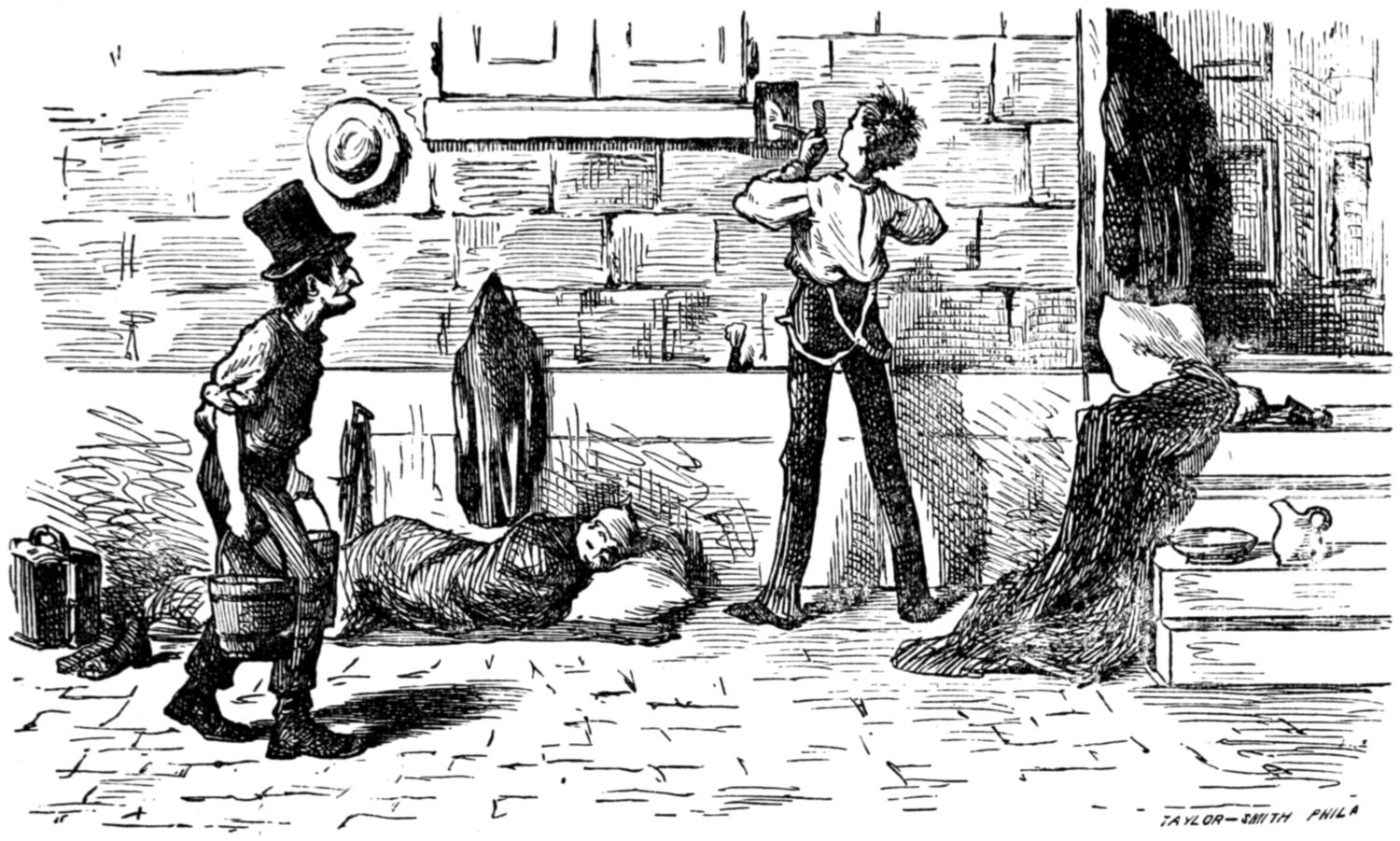
Many side streets are converted
into airy lodgings. Families have
rented out their door-steps, charging
double price when their door-mats
are used. A new industry has arisen,
and hostlers are deserting the stables
to carry shaving water for, and attend
to the visitors thus accommodated.
It is a common thing, on the
way down town in the morning, to
pass an early riser making his toilette
under difficulties, while a lazier companion
snores away complacently
with his head against the alley-gate.
The seventh day of the month was
one to be remembered with pride
forever. Early in the day the Chevalier
De Lafayette arrived with the
gentlemen of the French Commission
and secured quarters at the
“Guy House.” In consideration
of his ancestor’s great services, the
proprietor rated the Chevalier’s
board at six hundred francs per
diem, and as a delicate compliment
to his national feelings, assigned him
an apartment in the French roof.
Before he departed the Chevalier
ascertained to his complete satisfaction
why this hotel was called the
Guy House.
On the evening after their arrival,
a reception was tendered the Chevalier
and his companions by our citizens.
Col. Fitzgerald was selected
to deliver the address of welcome on
account of his Parisian manners, the
elegance of costume which distinguishes
him from his fellows, and
for his general epileptic fitness. We
give a report of his speech copied
from the “City Item” of the succeeding
day. We are, therefore, prepared
to vouch for its correctness.
LA BLESSING DE MON PERE.“Messieurs: God bless you all;
you are noble men; we are all noble
men; a noble man’s the honest work
of God. God bless Paris; God bless
Philadelphia—they are both noble
cities! May He bless the Champs
Elysées; may He bless the Column
Vendome; may He bless the Hotel
de Ville, and, entre nous, while we
are upon this subject, God bless the
Abattoir. (Great applause.)
“Parlez vous, Messieurs (laughter),
I greet you all. I stand before you
a relic of the past—of a noble past—of
a gigantic past—of a—a—sacre a
la pain et fromage (increased laughter)—God
bless the past! (Cheers.)
“Ate fif tesix five: General Grant
is a great man; he is a good man;
he is a noble man. In his name I
bid you welcome. God bless General
Grant, our noble President, our Chief
Executive. (Cheers and applause of
five minutes’ duration.)
“The press, Messieurs, the press!
I represent that gigantic instrument
of civilization. I have a family devoted
to the press. Should supplies
of printers’ ink give out, they would
spill their dearest blood to keep it
running. Je suis, pardon me, Messieurs,
if I pause to bless them (cries
of ‘do,’ ‘do’). God bless them all!
Ate fif tesix five. (Immense applause.)
“I greet you as brothers, eau de
vie. I have been to Paris. I have
visited the Pont Neuf. I have stood
on that bridge at midnight, I have
gazed at the flowing tide, with the
shining stars above me and my
family by my side. (Cheers.)
“I have walked along the Champs
Elysées:—
“Noble walk!
“Glorious promenade!
“I have looked upon the Column
Vendome:—
“Magnificent monument!
“Sublime creation!
“I have examined the exterior of
the Hotel de Ville:—
“In short, Messieurs, I have been
to Paris; ’tis no more than just that
you should come to Philadelphia.
(Laughter and applause.)
“Philadelphia and Paris! (Cheers.)
“Paris and Philadelphia! (Cheers.)
“Noble cities!
“God bless you all. Ate fif tesix
five. (Paroxysmal applause.)”
The Chevalier responded in very
fair French. He was attired in his
national costume. He wore a Lyons
velvet coat trimmed with Valenciennes
lace, a white Marseilles vest, and
French papeterie knee-breeches; his
hair was powdered with Paris white.
Later in the evening the Commission
was serenaded by the German Singing
Societies. They executed the
Marseillaise with great spirit and
effect.
The same day the junk of Prince
Kung, the Regent of the Orphan of
the Sun, the Child Emperor of China,
arrived in the Delaware.DIE WACHT AM DELAWARE. The vessel
was brilliantly illuminated with
Chinese lanterns, and a band of native
musicians discoursed sweet
music from the forward poop upon
their wooden accordeons and pipes
of reed. The Prince was a lantern-jawed
sort of an individual with a
candle-wicked eye. He and his suite
were met by a delegation of laundrymen
at Poplar Street wharf. Sam
Wing, Esq., extended them an invitation
to attend an opium banquet
next day at the hall of the Bedford
Street Mission.
While this reception was in progress
up town, the firing of guns and
ringing of bells announced the arrival
of the Imperial German Commission.
Fifty thousand German citizens
lined Walnut Street dock and the
floating palaces in the vicinity, and
no sooner had Prince Bismarck and
his comrades touched land, than
they were lifted bodily into several
of Bergner & Engel’s beer wagons,
which were in waiting. The crowd,
removing the horses from the wagons
and the bungs from the kegs provided,
proceeded to draw both the
wagons and the beer. Previous to
starting, however, Alderman McMullin,
who had been delegated for the
pleasing duty by the German Society,
spoke briefly as follows:—
“Respected Dutchmen: The proudest
occasion of my eventful career is
the present—to be permitted to welcome
to this new world, this republic
of an hundred years, the flower
of the great German Empire under
auspices so favorable and inspiring.
Not even when marshalling the once
famous ‘Moya’ to do battle with the
devouring element, consuming in its
fury the massive storehouse, the
busy factory, the domestic hearth—aye,
and life, dear life itself—not
even when the bullet of the assassin
found a resting-place within my
weakened frame, did I experience
the thrill of sublime pride, the glorious
impulse of friendship and common
humanity, which now animates
my being. For know there is between
us a bond of sympathy which
the boundless intervening ocean
cannot sever. William is my name,
and it is likewise the name of my
respected friend, your honored sovereign.
Like me, he is simple in his
tastes; like me, he is renowned for
his courage and determination.
“I desire that you should carry
home with you a high opinion of
our manners and institutions, and
many, very many, pleasant reminiscences
of your visit. I trust we
shall meet frequently and become
quite sociable during your stay. I
invite you all to dine with me to-morrow.”
Prof. Max Müller responded, with
the accent of a Latin grammar.
“Mr. Mickmullion, and gentlemen,”
said he, “I thank you for
this welcome in the name of the
Emperor, his Highness Prince Bismarck,
my colleagues, and myself.
For years have I desired to visit
this country for the purpose of making
a geological examination. During
your eloquent remarks I have
taken the opportunity of analyzing
a handful of the soil. To my intense
gratification I find it to average
a conglomeration or semi-crystalline
gneissoid of dark brown
hematite, or, perhaps, a combination
of barytes manganese with carbonate
of strontia. You will frequently
notice that the debituminization
of these silicious formations will
degenerate in quality—at times ferruginous
layers of volatile diorite
form component parts. I have no
doubt that you, Mr. Mucksquillion,
have frequently arrived at similar
conclusions.
“So, again thanking you for your
kind reception, I assure you I appreciated
the finish of your remarks.”
Prince Bismarck was then taken
in charge by Archbishop Wood,
who had a hammock swung for him
in the Cathedral.OUR BOYS— FRITZ
AND WALES. “Unser Fritz,” the
Emperor, and the commissioners
were driven to the German Hospital.
They declined communication of
any kind, save an underground
communication with Bergner and
Engel’s Brewery. In the evening,
however, they were serenaded by the
Société Française. “Die Wacht am
Rhein” was sung with much feeling.
On this eventful day the Hon. Morton
McMichael presided professionally
at four banquets.
The day following this is also
one to be looked back to with gratification.
The Irish Rifle Team
arrived with the dawn, and was
greeted with a beautiful sunrise,
very cleverly arranged by Professor
Jackson. The team acted as escort
to the Prince of Wales and suite.
Since his return from India, the
Prince had been in rather reduced
circumstances. Although scrupulously
clean, his coat was somewhat
threadbare, and his beaver gave
evidence of frequent brushing.
His Highness and suite were
quartered at the house of the
Spring Garden Soup Society; the
team secured accommodations at a
first-class livery stable.
These distinguished guests were
received by General Franz Sigel,
who remarked that he was glad to
see them looking so fresh and green;
that he liked fresh and green folks
to come to this country. He advised
them all to come back when
they went home and get naturalized.
He said that the ladder of Fame
was waiting for Irishmen, and all
they had to do was to come and
climb. He wanted them to carry
home a good opinion and leave as a
remembrance the contents of their
wallets. His remarks were received
with hearty cheers.
Wales suffered considerably during
the trip over. He says the
company of the riflemen completely
demoralized him. He might say he
was half shot when he was half seas
over.
About noon the Spanish delegation
arrived in Jersey city. They
landed from the ferry boat in high
good humor. The commission, composed
of the elite of Spanish chivalry,
included the following distinguished
names:—
Senor Concha Maduro.
Don Felix Estra-Maduro (cousin
of the above).
Count Flor Del Fumar.
His Highness Reina De Victoria,
and
Don Regalia De la Palma.
These gentlemen proceeded quietly
and unostentatiously to their rooms
on the seventh floor of the Colonnade
Hotel. They were waited upon by
the leading cigar dealers of the city,
who offered their spacious establishment
as headquarters.
Towards night the Duke of
Gloucester and Red Bank arrived
at South Street wharf. He had an
apartment reserved for him on top
of the Christian Street Shot Tower,
to which he repaired at once.
Pere Hyacinth came on the same
vessel, and was taken in charge by
the Horticultural Society. They
lodged him cosily in the southeast
corner of the State-house steeple.
He says he liked his lodgings very
much, but the rarefaction of the air
was such that he could hear his
watch ticking all night long.
The Emperor of Brazil arrived at
a very late hour and bunked temporarily
back of the main chimney of
the Girard House.
THE “ALMS HOUSE” REGISTER.The following guests registered at
the Alms House.
Victor Emanuel of Italy, wife,
three masters and three misses
Emanuel.
Mr. Khedive, of Egypt, with
seven Madames Khedive. Family
left at home.
Professor Tyndale,—London.
Joseph II. of Austria, wife and
mother-in-law.
General Von Moltke, Prussian
Army. (He had unfortunately
missed the train which had brought
his copatriots, and was very warm
upon his arrival.)
Mr. McMichael presided at seven
banquets this day, at one of which
he read a telegram from Queen Victoria,
accepting with thanks the
apartments kindly tendered her by
Engine No. 10.
Next day, the 9th inst., the city’s
pulsometer was at fever heat.
Brigham Young and family arrived
from Utah per Centennial R. R.
special train, forty-four cars. Brigham
said he wanted to give the
little ones an excursion. They were
located under sheds at Point Breeze
Park.
On this evening, too, a most remarkable
event occurred. During
the day the City Solicitor of Philadelphia,
who is also a military commander
of renown, in addressing a
meeting of some of his contemporary
warriors, including Bismarck, Von
Moltke, MacMahon, and others, remarked
that he would meet them
upon the morrow at Memorial Hall,
during the opening ceremonies. Immediately
a special meeting of city
councils was convened, and the following
preamble and resolutions
presented and unanimously adopted.
“Whereas, An International Exposition
was held at Vienna, in the
year 1873; and WHEREAS, upon the
day the City Solicitor of Philadelphia
carried into effect his predeclared
intention of visiting said
Exposition the roof of the buildings
fell in, doing great damage and causing
great excitement; and WHEREAS,
the same City Solicitor has announced
his purpose of visiting our
Centennial buildings to-morrow;
and WHEREAS, it is our bounden
duty to provide against the occurrence
of any like disaster to our
International Exposition, and especially
from the same cause which
affected the Vienna affair, be it
hereby
“Resolved, That the interests of
the Exhibition demand the incarceration
of the individual above
alluded to.
“Resolved, That he be immediately
placed in irons and confined
in the vaults of the Knickerbocker
Ice CompanyON ICE. until the close of the
Exposition.
“Resolved, That every attention
be paid to him in his confinement,
and that the Knickerbocker Ice
Company be allowed $93.77 per
diem for his support and the ice required
to keep him cool.
“Resolved, That he be produced
for one hour each Wednesday morning
at the Supreme Court Rooms, to
deliver opinions on municipal affairs,
that the city may suffer no more
than necessary from this unavoidable
action.
“Resolved, That he be supplied
with the ‘Times’ newspaper daily,
and be allowed unlimited rations of
lemons, sugar, and whatever liquid
he may desire, to mix with his
ice.”
At four o’clock in the morning,
the subject of these resolutions was
awakened from his innocent slumbers
and hurried into a Knickerbocker
ice wagon by detectives,
with black masks over their faces.
He struggled bravely, but—pro bono
publico—principiis obsta.
CHAPTER V. “THE CRACKLING.” ... Preparations for the blaze. — THE PROCESSION,
The morning smiled bright, and the
mist rose on high, and the lark whistled
“Hail Columbia” in the clear
sky, on the tenth day of May, 1876,
the day set apart for, and consecrated
to, the opening of the Centennial Exposition.
Old Probabilities himself was in
the city, with his weather eye open.
Early in the morning he fixed the
barometer in front of McAllister’s at
“set fair,” arranged the thermometer
at 65°, and engaged a refreshing southern
breeze to be around lively during
the entire day. After this he ate his
breakfast, enjoying a quiet conscience
and a correspondingly good appetite.
Shortly before daylight a very curious incident occurred—fortunately it
ended happily.
OH SHAH, WHAT A FUSS!The Shah of Persia, his son John, and the Sultan of Turkey, arrived
together at Broad and Prime Street Depot. The city being weary of
receiving dignitaries, no official and but little private notice was taken
of their arrival. They jumped into a Union Line car. Unthinkingly, the
Sultan put a dollar bill into the “Slawson box,” and then demanded his
change from the conductor. Of course, the conductor was unable to open
the box, and refused to give it to him, telling him he deserved to lose it
for his stupidity. The Sultan became furious.
“My change,” he cried; “I want my change, and I’m going to have it;
seven cents for me, seven cents for the Shah, and four cents for little Shah,
that’s eighteen cents; give me eighty-two cents change. You can’t cheat
me, you swindling Americans!”
Again the conductor refused and remonstrated; the Sultan was perfectly
wild with rage; he drew his scimetar, and caught that conductor
by the throat, and there would certainly have been an immediate vacancy
for a conductor on the Union Line, had not Mr. McMichael been just
then returning from a late banquet. Mr. McMichael, being a sportsman,
was thoroughly conversant with wild turkey gobble; he smoothed matters
over. He refunded the eighty-two cents from his own pocket, took
the
Eastern monarchs home with him,
and afterwards secured them a bed
in the coal cellar of the House of
Correction, apologizing to them because
they were obliged to share it
with Mr. Carlyle, the English essayist.
The Egyptian Sphynx, kindly
loaned by the Khedive, also arrived
in the morning, and was at once
placed in position on Belmont Avenue.
We regret being obliged to
record the disgraceful fact, that it
was entirely carried away in small
bits by relic fiends before night.
The Khedive immediately presented
a bill of damages to the President,
and levied on the Exhibition buildings
in toto, the Capitol at Washington,
and Mayor Stokley’s house on
Broad Street. Happily the matter
was amicably settled. The President
promised the Khedive that
Congress should have a new Sphynx
made for him, a much better one
than that destroyed, of bronze, and
with all modern improvements. The
order was subsequently given to
Messrs. Robt. Wood & Co., of Philadelphia,
and before the close of the
Exposition they shipped to Cairo a
bronze Sphynx, which will certainly
add greatly to the attractions of
the desert. We doubt not that the
Messrs. Wood will receive orders for
bronze Pyramids, provided they will
take the old ones in part payment.
THE MODERN SPHYNX.
The proprietor of the Public
Ledger was so pleased with the
Sphynx which our Philadelphia firm
turned out, that he immediately
ordered a duplicate for his back
garden. He also composed the following
touching linesAND HIS RHYME, IT WAS CHIL-DLIKE AND BLAND. for the poet’s
corner of his journal. A copy of
them, translated into Egyptian characters,
was sent to the Eastern potentate
with the Sphynx:—
“Egypt had a little Sphynx, It was her pride and wonder, She sent it to Amerikay, Where it was knocked to thunder.
This ’ffliction sore, poor Egypt bore, Her grief seemed all in vain, Till one as good was made by Wood, And Egypt smiled again.
Gone to take the place of the Original One.”
The great feature of the day was
the march from Independence Square
to the Exposition grounds. We
shall endeavor, in brief style, not to
do justice to, but to give some slight
account of the grandest pageant
which any nation has yet witnessed
in its midst.
The immense body, consisting of
representative military from every
nation under the sun and in the
shade, was divided into two hundred
and forty divisions, each with
a commanding general and aids.BENJAMIN’S COAT.
General Joseph E. Johnston, of
Georgia, was to have been Grand
Marshal. His uncle Andrew being
dead, unfortunately, he was obliged
to have his only military coat repaired
by a tailor who was not
punctual, and who failed to express
it to him in time. General Butler,
of Massachusetts, however, who
happened to have two coats with
him, very kindly loaned one to
Johnston, who appeared in the
afternoon. Attached to the back
of the loaned garment was a neat
show-card, bearing this inscription—
ANOTHER BRIDGE ACROSS THE BLOODY CHASM. THE TRIBUTE OF
MASSACHUSETTS TO
GEORGIA.
The General was lustily cheered
wherever he went, and General Butler
was the subject of more praise
during this day, than during any
portion of his life subsequent to his
occupation of New Orleans.
The position of honor, the First
Division, was given to the Philadelphia
regiments by a unanimous vote
of the generals of divisions.
Col. Hill and Dale Benson led off
with his command, which appeared
for the first time in its new uniform.
The immense black fur muffs,
which the members borrowed from
their sisters and wore upon their
heads, gave them a very ferocious
appearance, though most of their
noses were completely hidden from
view. Company “C” attracted particular
attention. It had adopted a
new “hop” for marching, which was
both graceful and unique, though
evidently fatiguing.
The “State Fencibles” turned out
in fine style. With their accustomed
liberality they presented arms
to all the pretty girls they met on the
way. The “City Troop” brought
up the rear of the division. These
warriors were arrayed in all their
awful panoply of war—white ties
and white kid gloves, with gold
vinaigrettes, containing salts and extracts,
dangling from their belts.
Their horses were also supplied with
vinaigrettes, which they sniffed occasionally
in lieu of their usual odor—the
smoke of battle. The Troop
carried a magnificent banner, inscribed—
First in Peace—First in War—
and
First in the Hearts of their Countrywomen.
And, on the reverse side—
PRESENTED TO THE
CITY TROOP OF PHILADELPHIA BY THEIR LADY FRIENDS AND ADMIRERS, AT THEIR FIRST ANNUAL PICNIC, Schuylkill Falls Park, July 1, 1872.
The Pennsylvania Veterans, G.
A. R., marched in the centre of the
Second Division, and a moving incident
occurred as they passed by
the Mint near Broad Street.
The first distinguished warrior to
appear was Colonel Mann, the hero
of ~0007 fights, mounted upon the
gallant steed which had borne him
safely through them all. Along the
route, his iron front proudly erect,
his bronzed and battered features
flushed with the nobility of a natural
pride, he was greeted by the enthusiastic
cheers of the assembled
thousands. Maidens from beyond
the seas—officers (no mean heroes
themselves) from the armies of the
old world, joined in the gracious
tumult. One bald-headed veteran
(a Marshal of the Windsor Castle
Guards, who had left a leg at Balaklava,
an arm at Waterloo, an eye
in the Crimea, and who expected to
distribute the rest of himself upon
various other battle-fields before he
died) turned to the Chevalier De
Lafayette, who with Senator Sam
Josephs occupied the barouche with
him, and asked—
“Who is passing, Chevalier, that
the people appear so excited?”
“Quely vous motre dio, do you really
not know?” exclaimed the Chevalier,
“Zat is, graciosa poverisi, zat is
ze Kunel Mann, pardieu, ze great
Kunel Mann.”
“What!” shouted the veteran, and
pulling from his coat the diamond
order of “St. George and the Dragon
fly” which blazed among an hundred
others upon his breast, he rose
in his coach and flung it gracefully
to the Colonel, who caught it quite
as gracefully upon the fly. At this
moment a great shout arose. The
populace imagined that a shot had
been fired at the Colonel, that an
attempt had been made to assassinate
their pet hero.THE PET OF THE
POPULACE. The mob rushed
for the carriage which contained the
veteran, with cries of “kill him,”
etc. etc. The Colonel took in the
situation at a glance. Rising in his
stirrups he spread wide his arms to
show he was uninjured.
“Hold,” he shouted, in that same
voice of loud and deep toned beauty
which oft had brought the briny
tears to eyes of hardened criminals
in the dock, “Hold; he is my friend:
he has given me this badge (‘Cape
May diamonds,’ he added sotto voce);
who touches a hair of his bald
head, dies like a dog—march on,”
he said.
The cries for vengeance changed
to wild cheers of joy, and the procession
moved on.
The Foreign Divisions followed
the Pennsylvanians in rotation
adopted by lot. The Caledonian
club was a marked feature of the
English Division among which it
was numbered, being the only representation
from Scotland. The members
appeared in full Highland costume,
kilt, sash, and checker-board
stockings. The chiefs danced the
Highland Fling all along the route
to the inspiring strains of the regimental
bagpipes. The company of
Orangemen with their Lemon aids
was also a part of this division; they
were commanded by Col. Terrence
McDougall.
The brigade of French Chasseurs
in the Fifth Division, commanded
by Marshal Benzine, presented a
splendid appearance, and wore the
strings of doughnuts which were
thrown around their shoulders with
a truly fascinating French abandon.
The “French Lancers,” in the
same division, danced the quadrille
named after them at each lamp-post
along the line.
A number of survivors of the late
French war were carried along in
Sedan chairs. This must have been
a sad sight for Frenchmen. We are
not Frenchmen.
The German Landsturm soldiers
were artistically decorated with
pretzels and oranges. Their division
was preceded by the Emperor William
and his family, drawn in one
of the ambulances of the German
Hospital, the horses being appropriately
decorated with German and
American bunting.
The Austrian Grenadiers (division
seventy), carried a miniature hydrant,
emblematic of temperance;
also an open Bible on a velvet cushion.
The Centennial managers were
somewhat annoyed by the appearance
in line of a commission from
the African interior, which insisted
on taking part in the procession, or
eating the Director General. They
marched along in their native costume,
consisting of a skewer through
their back hair.
Of course they were not aware of
anything out of the way in their get
up, but Mr. Goshorn said that rather
than have the thing occur again, GOSHORN’S NOBLE
RESOLVE.he
would sacrifice himself on the altar
of propriety, and be eaten. His
brother commissioners encouraged
him in this resolve.
Immediately after the Foreign Divisions,
came the “National Centennial
Guards,” formed of companies
from the thirteen original States.
They were headed by Generals
Grant, Sherman, Butler, and Hartranft,
and were followed by the Centennial
Commissioners in barouches.
The Commissioners were paired
off with foreign civil dignitaries
and potentates. The Prince of
Wales was inveigled into a carriage
with two of our city officials: he
left for home next day. Queen Victoria
(his mother) enjoyed the society
of the Chief of the Fire Department:
she remained until the close
of the Exposition.
One carriage was cheered vociferously.
It contained Vice-President
Wilson, Mr. Jefferson Davis, Simon
Cameron, and Robert Toombs.
The American divisions, which
included companies and regiments
from every State and city in the
Union, succeeded the barouches. A
great many of these organizations
brought their own bands with them,
or as the saying is, “blew their own
horns,” but many others depended
upon the well-known musical resources
of Philadelphia. They discovered
that delays were dangerous.
They had to do the best they could.
The “Duquesne Greyhounds,” of
Pittsburgh, were preceded by Signor
Maccaroni’s band—two harps and a
female violinist, while the “Charleston
Fusileers” were obliged to fusileer
to the strains of seven jews-harps,
kindly volunteered by juvenile
American talent.
A noticeable company was the
“Palmetto Guards,” of South Carolina,
dressed in dusters and straw
hats, and bearing palm-leaf fans.
The “Ancient Artillery,” of Boston,
thorough sons of guns, every man of
them, also attracted much attention.
Their step was the Boston glide.
The “Norfolk Blues” and the
“Virginia Carbuncles” entered upon
the march with highly polished rifles
and well filled canteens. Their rifles
were still highly polished when the
march was over.
The “Seventh Regiment,” of New
York, composed entirely of officers,
was much applauded. Its discipline
was apparent in its style of marching
and the waxed moustaches of
its members.
The brigade of American Indians
was under the command of General
Sheridan. The warriors were conveniently
and economically uniformed
in blankets. Each chief had
his initials plainly visible upon the
corner of his blanket. By a strange
coincidence, almost a fatality, the
initials of the name of every man
in the brigade were the same letters—U
and S.
The “West Point Cadets” were
also in line. They made a peaceful
and pleasing show with their little
tin swords and wooden guns. They
looked very neat too, clean faces and
well-brushed hair showing that they
were tenderly cared for. Their jackets
were buttoned tight up to their
necks. The ladies were charmed
with them, and “little dears,”THE “LITTLE
DEARS.”
“sweet, ain’t they?” were the expressions
heard on all sides. Much
sympathy was expressed for them on
account of the great length of the
route—entirely too long for children
to traverse. The cadets were to
have remained during two weeks of
the Exposition, but they got to eating
unripe cherries from the trees in the
Park, and falling into the Schuylkill
River, so the Commissioners were
compelled to send them home.
The “Naval Cadets” were marshalled
under Secretary Robeson.
This old salt was arrayed as Neptune,
with a trident in his hand, and
a crown of real sea-shells upon his
aged, weather-beaten brow. The
cadets were taken care of during
their stay by a file of marines.
The procession started at 10
o’clock, and by two P. M. one-half
of the main body having passed the
Continental Hotel, the head of the
procession reached Memorial Hall,
while the tail was wagging here,
there and everywhere, about the sacred
shadows of Independence Hall.
At Memorial Hall, amid the
salvos of artillery, the pealings of
bells, and music of the band; the
hymns of the singers, and the cheering
of the vast, innumerable multitude,
the
CHAPLAIN OF THE UNITED STATES
SENATE
ascended the decorated pulpit.
Mayor Stokley stepped forward.
Tear-drops glistened in his translucent
orbs. He raised his arm; his
hand, so used to threaten and command,
implored silence.SILENCE. In a single
moment the firing ceased, the bells
pealed no more; the last echoes of
the hymns were carried heavenward
upon the gentle breeze; the people
ceased shouting, and a holy, solemn
silence reigned supreme.
CHAPTER VI. “THE FIRE.” ... Who flared and how they did it.
Amid this profound silence the
Chaplain proceeded to inform the
Lord for what purpose that great
concourse of people was assembled.
He intimated that as “the earth
was the Lord’s and the fulness
thereof, and as the United States
of America formed a part of the
earth, and its citizens frequently
gave evidence of the fulness thereof,
it was eminently proper that
He should not be kept in ignorance
of its doings.”
He quoted freely from Scripture
to convince his hearers that man
was not all-powerful, but that,
sooner or later, he must needs
leave country, home, greenbacks, office, and corner lots behind him.
Alluding to the nations of olden time, he aired his classical learning.
He informed his hearers that Greece and Rome were not now exactly
what they had been, and mentioned likewise that Romulus and Mr. Julius
Cæsar had both been dead for some time.
He also remarked upon several interesting historical facts of more
modern date, which he seemed to think might possibly have slipped the
memory of the angels,—namely: that a number of European countries
were governed by potentates; that some of these had not been all that
virtuous, peace-loving men could have wished them; that an assembly of
individuals had pronounced freedom to be the prerogative of all mankind;—then,
after commending Mr. Grant and his cabinet, Mr. Stokley and his
city council, Mr. Goshorn and his associates, to the good graces of the
heavenly host, he complimented
that body on having the truest republic
yet organized, and retired
gracefully from the pulpit.
The orchestra of ten thousand
selected musicians then executed
Haydn’s magnificent “Oratorio of
the Creation,” after which Mr.
Ulysses S. Grant, who as President
of the United States was chairman
of the meeting, arose and made one
of his powerful and eloquent addresses:—“Ladies
and Gentlemen,”
said he, “I hope I see you well. I
am glad to see so many of you
around me on this occasion. It is a
very pleasant occasion. Like the
century plant, it blooms but once in
a hundred years. A good many of
you, who I see around me on this
occasion, will not be around when
it comes around again. I thank
you, ladies and gentlemen, for the
manner in which you have received
me, and I will make room for a
longer winded man than me. I
hope you will listen to him with
attention. I thank you again, and
hope you will all enjoy the exhibition.
Allow me to introduce to you
the orator of the day, selected by the
Centennial Executive Committee.”
The building shook with the applause
of the assembled multitude,
and when the clamor had subsided,
the orator began his address in a
stirring appeal to
The Genius of Liberty.
“Ring out, ye bells, ye harbingers
of liberty, ring out! The world is
hushed to listen to your joyful pealings,—the
heavens open and swallow
up your golden sounds! From where
the sun first breaks upon Columbia’s
slopes to where the rain-drops thunder
in supernal night,—where eagles
screamTHE EAGLE SHRIEKS. and dash their pinions ’gainst
the crags and peaks which blaze in
midday splendor,—where, rushing
through the crimson sky, they swell
the notes which drown the shrieking
gale, and flashing arrows of electric
light, piercing the groaning
depths of chaos, echo beyond the
shadow of eternal hills the cry of
nature’s soul, the thrilling anthem—Liberty!
“It is our throne—the pedestal on
which our building rests! a century
agone its bed was hollowed out by
pithy arms, now resting in the dust.
Oh sturdy hearts! Oh honest hands!
Beyond the boundaries of space and
time, where Nature’s seedlings bud,
and waters gather in a mighty deep,
to thee, to thee we look through
tears we dare not hide, and glimmering
in the phosphorescent radiance
of a holy past, we cry aloud, and
loud the answer comes. The waves
dash high, the breakers roar, the
bright bow spans the clouds above,
when lo, forth springs in brilliant
splendor, our flag—the emblem of
our dearest hopes,—our pride, forth
springs in glorious purity, our flag,—the
stars and stripes,—the flag of
Adams and his son John Quincy.”
At this stage of the proceedings,
four hundred ladies uttered a simultaneous
scream and fainted. The
gallant orator, descending from the
rostrum, helped to carry and lay
them upon the greensward without,
where members of the Fire Department
promptly saturated them with
a portion of the Schuylkill River.
Then, taking a hasty draught of
Bowers’ Centennial Mead, the orator
re-entered the hall and resumed his
address. Not one of the audience
had left—during the interim they
had been nicely entertained by the
Director General (always prepared
for emergencies), who gave them a
comic song and dance.
In resuming, the orator alluded
to the Garden of Eden. He explained
how the “S” became added
to the name of Adam, and drew a
pleasant word picture of the illustrious
founder of his family in his
fig-tree suit. He spoke for two
hours in an interesting manner, and
concluded.
The chorus then joined in the
national anthem, “Pop goes the
Weasel,” after which the
Poet of the Occasion,
LONGFELLOW.America’s sweetest singer, who
touches with his gentle hand the
heart-strings of the world, waking
them to musical response as pure
and truthful as his own blessed
soul, stepped forward, and read his
original poem, which will live forever,
a mile-stone of the nation.
The people listened with rapt attention
to the words of the honored
bard. He seemed inspired; his voice
was full, and each syllable he uttered
reached every corner of the immense
building. We caught the words and
pinned them to our note-book in
phonographic characters as they were
given birth, and we reproduce them
here complete and unabridged.
A Song in Two Voices.FOREVER AND
FOREVER.
First Voice.
The silent horologe of time, which varies never, Hath swept into the bosom of that sea Pulsating ’gainst the rock “Eternity,” The life-blood of an hundred years, Forever and forever!
But crimson blood upon the Ocean’s wavelets, never Content beneath the surface smooth to hide, Will traces leave enrubying the tide, Till earth in chaos disappears, Forever and forever!
We gaze upon a restless sea, which quiets never, And read as on a changing, moving scroll, The nation’s living, cryptogamic soul, Which Death’s dark lantern lights and clears, Forever and forever!
They are our own, these dead we look upon, though never Have we full guessed the good which passed away; To know what we were losing day by day, Would be, methinks, to live in tears, Forever and forever!
Then listen, brothers, for my failing voice may never, Be heard again throughout our fatherland; And e’en the pen drops from my feeble hand, As my long journey swiftly nears, Forever and forever!
List while I read to you the graven tale, which never May be all told by these poor lips of mine, For coming ages still add line to line, Till earth no longer heeds nor hears, Forever and forever!
Second Voice.
Speak, speak, thou dismal guest, With gloomy thoughts oppressed, Speak quick and give a rest, To those who hear thee:
Much pleased we’ve read the lays, Writ in thy youthful days, Giving no stint of praise, Aiming to cheer thee.
Proud of thy fame are we; Therefore most graciously, For what it’s worth will thee, “Our poet” christen:
Long, long will live thy verse, As will, too, much that’s worse, And if thou wilt be terse, Brother, we’ll listen.
First Voice.
In the old colony days in London, the chief town of England, In the cellar which runs to and fro ’neath the Parliament building, With a pipe in his mouth and a match in his hand, made of sulphur, On a keg of dry powder was seated Mr. Guy Fawkes awaiting the signal. Above was King George with a sword in his hand at a table, Drinking green tea, which he always had made “with a stick,” While up by the urn, stood a beautiful Puritan maiden, With sweet, smiling eyes like the bloom of the bluebells in summer, Who opened her mouth, and with laughing lips uttered this question,— “My liege, would you like just a little bit more of gunpowder?” Guy Fawkes was discovered and hung, and his body was cast in the Tiber, King George wasn’t blown up just then—but not many years after, His tea was the match which ignited the spark, and gave him some few more gunpowder.
Second Voice.
Tell us not in furlong numbers, What we know as well as you, Though you’ve got things mixed up “somewurs.” King George wasn’t Cromwell too.
Life is short and time is fleeting, And we fear, if you intend To go on old tales repeating, We shall never reach an end.
First Voice.ABORIGINAL POETRY
Kajo, kajo, mudjekewiss, Jeebi ishkoodah jossakeed, Shinghé, shingebis shah shuh gah; Chibiabo bukadawin, Wahonowin! Wahonowin! Totem totem ahkosewin, Minehaha, haha, haha, Ha ha, ha ha, ha ha, ha ha.
Second Voice.
Thank you, sir.
First Voice.
Nation of our hopes and prayers, Time steals by us unawares, Gravestones seal our joys and cares.
We must leave thee whilst thou’rt young, Whilst the bell for freedom rung, Echoes still from heart to tongue:
Standing on Oppression’s tomb, In thy youthful beauty’s bloom, Monument of tyrants’ doom;
Gazing with a lofty pride O’er thy hearthstone, boundless, wide,— Oceans washing either side;
Towns and cities, hills and vales; Earth with joy thy Queenship hails, Seas and rivers bear thy sails!
FAIR COLUMBIA.
Fair Columbia, we must go, Far beyond thy oceans’ flow, Far beyond thy mountains’ snow;
Other sons will ’bout thee rise, Love thy blue and starlit eyes, Love the white thy life flow dyes:
May their hearts’ love never leave thee, May they dream no thoughts to grieve thee, Never of a star bereave thee;
May the olive in thy hand Spread until its branches grand Shelter safely all thy land;
And as days and years are told, May thy brilliant flag enfold Strength which never groweth old.
May the world beneath the sun, In the freedom thou hast won, See a boon denied to none.
For a gift from God thou art, Missioned bravely to impart Sunshine to the sunless heart.
This poem was telegraphed, word
for word as spoken, to the “New
York Herald,” appearing in that
sheet next morning. From its columns
it was copied, the week after,
into the Philadelphia journals.
After the poem, Messrs. Arbuckle
and Levy, the cornetists, played
“Old Hundred.” It proved a great
success, as it had never before been
attempted—in a horn.
The Massachusetts gentleman selected
for the honor, then read an
essay by Thomas Jefferson, entitled
The Declaration of Independence.
This production was replete with
witty sayings and wise aphorisms,
doubtless very applicable to the time
in which it was written, but somewhat
obsolete and wanting in point
at present. The soda-water fountain
was much patronized during
this portion of the ceremonies.
AN APPRECIATIVE PRESIDENT.General Grant sat it out, however,
and mentioned afterwards that he
considered it one of the finest things
he had ever listened to. He inquired
particularly concerning the author,
and seemed disappointed when informed
that he was dead. He would
doubtless have enjoyed making
Thomas a revenue inspector or an
Indian commissioner.
Again the combined orchestra and
chorus howled forth. This time it
was “Paddle your own Canoe.”
Mr. L.Q.C. Lamar, of Mississippi,
Orator of the Day No. 2,
stepped forward. He remarked that
as it was growing late he should not
detain them long. At this, those
favored ones to take part in the banquet
concluding the ceremonies,
brightened up wonderfully.
The orator then proceeded to say
that this was the first centennial
celebration in which he had taken
part; he therefore hoped that any
shortcoming might be overlooked in
consideration of his quick going.
He remarked that he came from
where the Mississippi wound her
silvery length through rich green
fields, by thriving towns and mighty
cities; that he was a native of the
Sunny South, those happy realms
where nightingales tuned harmonious
song and alligators sported in
their lukewarm baths. He mentioned
that this was a great country,
that the sun rose in the East and set
in the West, and that while the
snow-flakes fell and whitened all
the northern plains, the orange
bloomed and gentle breezes blessed
the southern groves.
“We are but travellers here,” said
he, pathetically, “and while we
breathe the air and walk upon the
earth, we have two duties which
should command the energies of our
minds, the strength of our arms, and
the honor of our souls;—one, to our
fathers, those who have gone before—the
other to our children, those
who have already come and those
yet to come after.” Mr. Lamar did
not exempt bachelors from the latter
of these duties, but in eloquent language
urged upon all the great mission
of an American citizen.
The orator continued for three
hours, and ’twas only when darkness
fell and the chambermaid came in
to light the gas, that he concluded;
telling his spell-bound listeners, that,
although he had much more to say,
he would remember his promise to
be brief, and postpone the remainder
of his address until the next centennial,
hoping that in the mean time
they would ponder well upon the
truths which he had uttered.
General Sherman here nudged the
President, who had fallen into a
gentle spell-bound doze, and who,
awakening with a start, rose and
said:—
“And now, by virtue of authority
in me vested, I, Ulysses S. Grant,
President of the United States of
America, do declare this Exhibition
open for the transaction of all such
business as may be legally brought
before it.—Amen.”
The musical fraction ended up
with Beethoven’s Twelfth Mass, and
“Little Brown Jug” for encore, and
thus was the
International Exposition
inaugurated.
Through the courtesy of the Centennial
Managers, we were supplied
with copies of several odes, poems,
essays, etc., forwarded to the committee
by various distinguished
authors of this and other countries,
and rejected for reasons best known
to the committee. Of these we cannot
refrain from inserting a contribution
from Lord Alfred Tennyson.
It is in the shape of a two-act drama,
entitled
“George W. Washington.”
It has been pronounced by competent
judges to be equal to much
that Shakspeare did not write. It
has been translated into the celestial
tongue, and will be produced during
the next century at the Theatre
Royal, Hong Kong. We understand
that CLARA’S NEXT
ROLE.Miss Clara Morris is
studying the role of G. W. Washington.
ACT FIRST.
SCENE—Winter Quarters at Valley Forge.The American Army
sleeping on the left side of the stage. Delaware River flowing in the rear.
Seven 42-pounders pointed towards the audience (to be discharged if they
leave before the curtain falls). A full regiment of cavalry ready to issue
R. I. E. Practicable window in flat.
Thomas Jones, a farmer, and Sambo, Washington’s servant, discovered.
Sambo.
You may not enter—the General snores in sleep;
Sweet sleep, that balm in heaven distilled,
Has fallen on his eyelids.
(Sings)
Low, galoot; speak low, galoot, or you may wake him—
Low, galoot, low!
Farmer Jones.
Yet listen, gentle knave; a farming man am I
From Jersey. Should’st open now my heart,
Lo, thou would’st find but two words graven on it—
Trenton and whiskey!
THE PLOT THICKENS.
Sambo.
(Sings)
Low, galoot; speak low, galoot, or you may wake him—
Low, galoot, low!
Farmer Jones.
The keystone of our government is shattered,
The Hessians are in Trenton!
Sambo.
Methinks some traitor spoke. ’Tis not yet lost.
Send out, send out the constables,
And have them all
Arrested. Egg Harbor is not taken yet?
Farmer Jones.
(Joyously)
Egg Harbor is not taken yet!
Sambo.
Then there is hope. But, hush!—he’s here!
(Washington enters through window and listens.)
Farmer Jones.
Who?
Sambo.
Our General—great George Washington!
Farmer Jones.
Oh!!
[All exit. Curtain falls.
ACT SECOND.
SCENE—State-House at Philadelphia.Continental Congress in session,
John Hancock in the chair; representatives ground around; large concourse
of citizens in the hall; the back window open, through which a view
of Independence Square in flat. Procession passing with flags and banners,
and band of music. A political meeting in the Square; also a few
Indians lassooing buffalo. Eagle screams as curtain rises.
John Hancock. Ah!
Robert Morris.Indeed!!
Thomas Jefferson.Possible!!!
John Adams.Very remarkable!!!!
[Exit all the representatives exceptBenjamin Franklin.
GRAND DENOUEMENT.
First Citizen. Shall we go too?
Second Citizen. Go to!
Third Citizen. For which we should be thankful.
[Exit all the citizens.Franklinalone.
Benjamin Franklin.
From Jersey, New York, Delaware, and Pennsylvania,
Virginia, Massachusetts, and both the Carolinas,
These men have come who have but just gone out.
There’s Hopkinson, and Middleton, and Harrison,
And William Ellery, George Taylor, and Josiah Bartlett;
Morton, Walton, Joe Hewes, and Willie Hooper,
And many more; and I am left alone—
No!—here come Roger Sherman, Gerry, and George Whytte.
(Milkman sings without.)
“Bully for you, Susie, Bully for you now, To go and milk the water pump, ’Stead of the cow. Chalk is very cheap, Milk is quite a heap, Healthier when diluted than it came from the cow.”
(Shouts again) [many voices]. “Three cheers for Washington!”
Gerry.
Who knows?
Benjamin Franklin.
Let us pray.
(They all kneel, and the orchestra strikes up “Yankee Doodle” as the
curtain drops.)
CHAPTER VII. “THE REFLECTIONS.” ... Shadows, shapes, and those who made them.
“
You are standing, sir, directly
upon the equator.” Our country
cousin jumped aside in terror;
his face grew white, his knees
trembled, his hair stood on end.
It was our first visit to the Main
Exhibition Building after its
opening, and he had accompanied
us.
“Great Heaven!” he gasped,
“why did they leave it around
here—is it dangerous?” and he
backed into an Italian brigand
who was strolling leisurely along,
“it oughter be in the zoological
department,” he added, and peered
around for a glimpse of the animal.
We smiled pityingly.
“The equator, our dear cousin,” said we, “is that broad chalk line
marked across the floor of the building. It represents the centre of the
earth. Here, take the glasses;—now observe,—that main mast or telegraph
pole, painted white and decked with ribbons, which you see at the
extreme end of the avenue, is a very complete fac-simile of THE NORTH POLE
REACHED AT LAST.the North Pole.
Now, turn around;—that clothes prop (kindly loaned by Mrs. Forney)
represents the South Pole. At one end, to speak poetically, we have
Greenland’s Icy Mountain, at the other, Mrs. Forney’s Coral Strand. Let
us take a cursory glance of what lies between.”
We do not propose to give more than the merest superficial account of
the wonders and glories of the great display. Everywhere the eye rested
it was dazzled with jewels, silver, splendor, and—and—so forth. Striped
gauzes, magnificent bronzes, burnished armor, superb laces, fine inlaid
work, unique carvings, rich and rare fancy goods, musical instruments,
books, acres of useful articles, miles of ornamental productions, food,
clothing, and—and—more so forth.
Perhaps it would be best for the intelligent reader to imagine himself,
or, more happily, herself, in our pleasant company, cousin and all. But
first a word of warning to the intelligent
reader. After many sleepless
days, the managers had decided to
arrange the nations in geographical
order, as far as possible—and to
leave the rest to Providence.
Therefore the intelligent readers
will do well to follow the example
of the intelligent authors, and forgetting
any geographical knowledge
they may happen to possess,
leave their rest to Providence
also. They will spare themselves
many sudden shocks and annoying
perplexities. Such, for instance, as
this: taking one avenue straight
along and passing consecutively
through Austria, South Sea Islands,
Manayunk, Siam, China, Morocco,
Beverly, Egypt, Darby, France,
Switzerland, and Tipperary, ending
up with Turkey and the Sultan
ready, soap and towel in hand, to
give the visitor a specimen of his
luxurious patent bath. Or, coming
back on the other side, to find in
one long line, Germany, Sweden,
Norway, England, Iceland, Doylestown,
Ireland, British America,
Media, and in the corner Japan,
where a Mandarin and a Womandarin
perform “Hari Kari” every day
to illustrate the custom of the
country,—the same parties, however,
only appearing once in the
same performance.
Naturally, our own country claims
our first and best attention. From
Maine to Florida, from Boston to
San Francisco, State after State, city
after city, makes its display. In
addition to the separate and peculiar
exhibits of the States, clusters
of identical interests from North,
South, East, and West, attest the
resources and development of our
land. Let us pause for a moment
and examine the display of the
American Bankers’ and Brokers’
Association,POPULAR TABLEAUX.
which will serve for an example of
these latter.
We find the credit system very
cleverly demonstrated. A working
man enters into a banking house
with his month’s earnings nicely
tied up in the corner of his handkerchief:
a blandly smiling clerk, with
well pared nails and laundried linen,
receives it and notes the amount in
the depositor’s account book;—the
workingman departs. Then the
proprietor enters, gives a portion of
the money to his clerk and puts
the remainder carefully away—in
his pocket. In another apartment,
the projectors of a railway company
offer a graceful financier one-half of
their beautifully printed stock certificates,
on condition that he floats
the other half. A widow, with the
money which she has just received
as insurance upon her husband’s life,
comes upon the scene. She makes
known to the banker her anxiety to
invest this money securely for the
benefit of her helpless family. He
magnanimously spares her a portion
of the railroad stock, charging her
but a small commission for his services.
With the balance of his
stock as collateral, he borrows
money from a national bank and
makes a corner in flour. Through
the window of this apartment there
is a beautifully arranged vista, showing
the banker building a magnificent
villa and settling it upon his
wife. A third compartment contains
the closing tableaux:—a meeting
of assignees declaring a dividend
of nothing, payable in twelve, twenty-four,
and thirty-six months, and the
banker stepping on board of an A, 1,
steamer, to pass the remainder of his
life in ease and luxury among the
wonders and beauties of the old
world. In this department also, we
find a collection of the coins of our
country, at which its people look in
amazement. A father is endeavoring
to explain to his son, a boy of
twelve, what these gold and silver
pieces were once used for. It is an
interesting study in ancient history
for the lad, but he is doubting as
youth is apt to be, and does not appear
thoroughly satisfied that they
were ever current money.
We push our way rapidly through
the States. Maine has her liquor
law, charmingly framed—but we
find her Commissioners in Kentucky
drinking Kentucky lemonade. Vermont
exhibits a green mountain
boy; the look in his eye belies his
color. Massachusetts presents her
genealogical tree. Rhode Island is
represented by an immense specimen
of inflated bullfrog. New York
has on hand her canal ring, blazing
with diamonds. Pennsylvania has
her Switchback. Delaware another
kind of switchback—her whipping
post, and here we delay our progress
to admire hers. Great bodies move
slowly, and the Delawareans have
great bodies—but mighty little
souls. Their “stocks” are up, however,
and they don’t seem to care.
We suggest that the Governor of
the State and the members of the
Legislature be thrashed alternately
every hour, to give a general idea
of the modus operandi to foreigners.
Our suggestion is not received in the
spirit in which it is offered.
But we do not succeed in completing
our trip through the Union this
day. Our country cousin brings us
to a stoppage by his absurd conduct.
MISTAKEN HOSPITALITY.One exhibitor offered him half a
pound of mince meat: he devoured
it. A Connecticut woman presented
him with a small cheese, her own
manufacture: it followed the footsteps
of the meat. In Massachusetts
he received a package of corn starch:
he put it serenely where he kept his
cheese. We looked upon him in
amaze, but said nothing. A New
York merchant handed him a small
cake of transparent shaving soap.
“My golly!” he remarked, “this beats
a lunch route,” and he swallowed it
whole. A New Jersey farmer offered
him a string of dried apples: they
went the way of his preceding receipts.
A Pennsylvania matron
begged him to try a draught of her
buttermilk: he complied, and we saw
him swell visibly before our eyes.
Two ounces of Virginia Baking
Powder was the next tribute: he
winced a little at this, but—down it
went. We tried to stop him, but
too late—he just chewed a small
stick of South Carolina stove polish,
and then the baking powder accomplished
its fatal mission. He mentioned
that he did not feel very well.
We expressed surprise and sympathy.
He said he felt worse, and then he
tried to smile, but alas, the apples
lay heavy on his soul—he couldn’t.
He asked if it wasn’t time to go
home—he said it was a splendid
show, but he thought he’d seen
enough of it.
“Come home,” said he, “its dinner
time.”
“Why,” we replied, “you’re not
hungry, are you?”
He didn’t answer; he turned a
reproachful glance upon us. We
were now in Georgia, and a colored
man held out to him a sweet potato
pudding. Savagely he turned upon
that negro, his eyes rolled wildly,
he labored under intense emotions,
mingled emotions of cheese, soap,
and baking powder, he uttered one
long despairing yell and sank down
upon the floor. A crowd gathered
about him in a second; two or three
officials pushed their way through
the assemblage and grabbed hold of
him. “The first case,” they cried
triumphantly; “carry him to the
Hospital.” They bore our poor
cousin to the
Grand International Hospital,
east of the Main Building, and we
followed in tears.
A Turkish physician ran to meet
us as we approached the structure.
The Turks believe in radical cures—this
one wanted to smother our
relative between two feather beds.
We objected. Two Chinese doctors
stopped us at the doorway. One
wanted our cousin to swallow three
green lizards, the other recommended
the immediate extraction of all his
front teeth. An Indian medicine
man here commenced dancing around
us, yelling at the top of his voice,
and banging an old tambourine with
the shin-bone of an ass.
This was nothing! When we
entered the building the international
surgeons came down upon us
like—like—like “a wolf on the fold.”
This was the first case, and they
were spoiling for a job. Our cousin
looked in their eager and varied
faces, he gazed upon the assortment
of cutlery flashing around him—his
lip quivered—he closed his eyes—and
fainted. In less than two
seconds that
Unfortunate Countryman
would have been dissected, and the
doctors engaged in mortal strife
above his severed limbs, had not a
most diabolical uproar outside suddenly
distracted their attention.
We all rushed to the grounds, and
a blood-freezing scene of terror met
our eyes.
“LONE SHIRT” ON THE CHINESE QUESTION.
Mr. Lone Shirt, Mr. Full o’ the
Rye, and Man with the Seven Big
Bunions, Esq., the Chiefs of the
Indian encampment, had been illustrating
their native customs by a
sudden
Raid on the Chinese Laundry.
They had attired themselves in
the napkins, towels, and nightcaps
there contained, painted themselves
with the washing blue, burnt down
the building, and were just about
finishing up things by scalping the
startled celestials when we burst out
upon them. The Chinese doctors
took one glance at affairs, swallowed
their lizards, and jumped into the
lake north of Machinery Hall.
The Exhibition Military, led by
the Marine Cavalry, hurried towards
the fearful scene. Would they be
in time? The tomahawks of the
Indians were raised, their hands
grasped firmly the pigtails of their
victims—when suddenly—behold!—The
savages grew rigid as though
turned to stone, motionless they
stood with tomahawks still elevated,
their hands still pigtailentwisted—Oh
providential chance!—They had
swallowed the starch contained
in the laundry, and this stiffening
was the fortuitous result.
The managers released the half
dead Chinamen, and pointed out
to Messrs. Lone Shirt, Full o’ the
Rye, and Man with the Seven
Big Bunions, the impropriety of
their conduct. When the chieftains
thawed limber, they promised
solemnly not to repeat anything of
the kind, and smoked the liberty
bell pipe with the laundrymen.
This incident saved our cousin’s
life. When we returned to the
hospital, he had vanished, much to
the sorrow and chagrin of the disappointed
M.D.’s.
We did not feel like returning to
the Main Hall immediately after
this. We thought a stroll through
Memorial Hall might be soothing to
our system, and so we took it.
Philadelphians familiar with that
Chamber of Horrors
in old Fairmount Park, which
the Park Commissioners persist in
styling an Art Gallery, have been
bred up to a proper appreciation of
the “pageant which rose like an exhalation”
before our admiring eyes;
upon others, especially foreigners,
the effect must have been tremendous.
It is not our intention to criticize
the pictures separately, or to draw
invidious comparisons between the
work of our own and other artists.
Courtesy to our late visitors forbids
it; and besides, the national peace
must be preserved at any cost. We
must admit, however, that it struck
us that a number of the paintings
might have been improved by a
liberal paring at the nails from
which they were suspended. Some
of the Italian sketches looked to us
as though they had been painted
with raspberry jam. The chiara oscura
effect, so to speak, was visibly
heightened by the tone of the
sombre shades, and the clever intermixture
of the mediæval style with
the ante-Raphaelite touches—the
extreme fulness of the light and
motion, and the mellowness of tint,
produced, as it were, in the minds
of connoisseurs like ourselves, the
comparison which we have made.
Artists, like fishes, go in schools.
Masters, pupils, janitors, scrapers
out, and pot boilers. They were all
well represented, Flemish, Dutch,
Italian, French, and American
schools making the most extensive
report. We will mention a few of
the biggest paintings in the handsomest
frames.
“MURILLO AND RUBENS—
PAINTING AND GLAZING.”Mr. Murillo, a Spanish painter
and glazier, sent—in addition to his
famous “Madonna”—“The Parable
of the Seven fat and Seven lean
Cows.” This was a six-foot-square
job. The seven fats were done in
oil—the leans in water-colors.
Rubens was represented by a
magnificent head of “Vasco De
Gama;”—his feet were too large to
frame. The likeness was excellent.
Even a stranger, unacquainted with
Mr. De Gama, could have recognized
it at once—by the name in the corner.
A fine painting of Marat, executed
by Miss Corday, was the biggest
little gem in the French collection.
France also sent some sacred
paintings, among them “St. Anthony’s
Temptation” and “St. Vitus’
Dance.”
Great Britain also had two sacred
companion pieces—“Christ before the
Priest” and “Christ after the Priest.”
In the American Department, a
superb work entitled “The Salary,”
appealed most directly to our feelings.
It could not have been drawn with
more ease by a Vandyke or Paganini.
“Wm. Penn treating the Indians”
occupied a prominent corner.
“The Empty Jug” was a pathetic
masterpiece, a subject which came
directly home to the hearts of many
who looked upon it.
For square inches and lavish extravagance
in paint, “The Norsemen
landing at Vineland, New Jersey,”
deserved a prize.
Scores of virgins of all styles and
sizes adorned the walls. Virgins
clad in every costume worth mentioning,
and a great many not worth
mentioning. They were consigned
by the Angelo Factory at Rome.
The sign and fence painters of the
United States school made a very
fine display.
Rothermel had his patent “S. T.
1860 X.” beautifully done in white-wash
on the south wall of the building,
and Moran, who pays more attention
to marine work, had “Sea-weed
Tonic” tenderly drawn in blue
and gold. Bierstadt, the architect,
sent a plan for a model brewery.
We felt so completely soothed
after seeing this much that we
didn’t enter the statuary department.
We left that for another day,
and jumping on a horse-car we made
our way over to
Machinery Hall.
Imagine all the machinery the
world contains in motion at the
same time, and add about five million
more machines to that. This
will bring you as near the truth as
this volume ventures to approach.
Fire, smoke, sweat, and labor;
whirring and whizzing, banging
and clanging, pounding and puffing,
tinkling and jingling. One would
think there were seventy thousand
horses at work instead of the forty
we have mentioned. Everything is
being manufactured here—from a
tooth-brush to a locomotive; from a
latch-key to a wash-boiler. Each
workman at a machine is attended
by another man placed there expressly
to answer questions and be
interrogated by visitors. These latter
men are carried away and revived
every hour.
The famous individual who took
a prize at the Paris Exposition, is
here with his wonderful machine.
You give him a live rabbit, and in
fifty minutes he returns you a felt
hat and a Welsh stew.
Keeley’s Motor was set up here a
few days previous to the opening of
the Exhibition, but somehow the
machine got loose and knocked
things into splinters.THE UNDERLAND ROUTE. It dashed
through the main entrance, got on
the track of the Market Street cars,
rushed clean down to the foot of
Market Street, destroying everything
in its way, and plunged into
the Delaware River just eight seconds
after leaving Machinery Hall.
Workmen were put at dredging for
it immediately, and before they gave
up hope of recovering it, a telegram
was received from Pekin, saying
that it had passed through the Emperor’s
palace, carrying the roof
with it, and vanishing into space.
From the hour telegraphed as the
time of this occurrence, it was calculated
that the machine landed in
China just nineteen minutes after
it left Elm Avenue. Mr. Keeley ascribed
the cause of this freak to one
drop of water too much, being in
the reservoir.
There was another sort of motor
on exhibition, however, which
seemed especially attractive and
novel to the boys. It consisted of
nine strips of leather attached to a
wooden handle.
The improved hotel front-tooth-picker
was an object of attention in
the American department, as was
also the automatic hen for laying
egg plants.
The patent American awning post
rest, a neat pair of extended arms to
support a reclining form, was much
remarked; and a patent range, “warranted
to save half the coal,” was
very well spoken of: you buy two
of them and you require no fuel
at all.
Herring’s Hay Making Machine,
for making hay in cloudy weather,
and Rollin’s improved Iron Pump,
for the use of newspaper reporters,
also deserve mention.
In naming this pump to be used
by interviewers, we must not forget
an ingenious little instrument invented
expressly for the protection
of the parties interviewed.THE INVENTION OF THE AGE. It is a
silver-plated contrivance, which may
be readily fastened to the bottom of
any chair. The interviewer is invited
to take a seat. At his first
impertinent remark, a little knob is
touched and a flat implement shaped
like a No. 22 foot, begins bouncing
up and down at the rate of seventy
bumps a minute, and before the reporter
knows what has happened,
the top of his head is interviewing
the ceiling of the room.
When he comes down to see what’s
the matter, this implement follows
him to the door, accelerates his progress
down stairs, and giving him a
parting bump on the sidewalk, shuts
the front door and hops up stairs
again. The papers pooh-poohed this
contrivance, but it gained a first
prize nevertheless.
A French apparatus for winding
silk out of cocoons was also truly
wonderful. While the cocoons are
serenely enjoying their dinner or
dreaming of the pains and pleasures
of the world, a huge bobbin is
quietly unravelling their interior
department. They don’t know
what has been going on till they
turn around and see the silk dress
which has been stolen from them.
We stopped for a moment before
a condensed baker, and saw crackers
and biscuit baked, buttered, and eaten
by steam. This made us think of
lunch. We selected the American
Restaurant from the many within
the inclosure, and entered.
We were politely handed chairs
and a bill of fare. The chairs were
low,—the bill must have been made
out on the top of Sawyer’s Observatory,
there was no other way to get
it so high. The list was printed in
three languages, and the customer
was expected to pay in half a dozen
languages, though only allowed to
eat in an a b c. We drank a cup
of tea, ate a biscuit, looked at the
Beefsteak à la mode de Paris, and the
Potatoes fricasse haute nouveate,
sighed, and left our watches in
pledge, while we sallied out to try
to raise the amount of our bill on
our life insurance.
After completing this negotiation
at the International Insurance Bureau,
we started for the Horticultural
Building, but the
Model Cemetery
which we were obliged to pass,
suited the state of our feelings so
well that we paused to examine it.—We
soliloquized:—
“In the midst of death we are in
life,” said we originally,—“oh death,
sweet death, in the midst of all this
life are we reminded of thee;—in the
excitement and the turmoil thy
quietness is here. Lo, the labor of
man’s hand and the production of
man’s mind we find about us,—we
look, we wonder, we admire, but
what, what are these hands and
minds to thee? Nothing; nothing
save the dust which in thy mill——”
We were interrupted by a THE UNDERTAKER’S DRUMMER—A DEAD BEAT.gentleman
who approached us and invited us
to invest in one of his patent coffins.
He had any number of testimonials
from parties who had used them,
stating that under no consideration
would they use any other. He said
we might try one, and if we didn’t
like it we needn’t feel compelled to
keep it. He seemed very anxious
to discover whether we had any
sickly relatives. He took us through
the undertaker’s department; showed
us shrouds, sombre trappings, gold
and silver trimmings, rosewood caskets,
all the paraphernalia for a pleasant
and comfortable send off. He
escorted us through the marble yard,
mentioned what kind of a tombstone
he thought would best suit our condition,
quoted verses of poetry which
he thought would make suitable inscriptions,
and was really so attentive
and persistent that the truth
dawned upon us at last;—he was
placed there to talk visitors to death
and brisken up business for the exhibitors.
He earned his salary,
whatever it was. He explained the
system of cremation, and told us if
we had any old aunts or grandmothers
about the house to bring
them down and he would take
pleasure in demonstrating its beauties
practically. He induced us to
purchase three or four little coffins
made from the wood in Independence
Hall, to be worn as watch charms;—“very
sensible mementos
of the occasion,” said he.
It was by an almost superhuman
effort that we broke from him at
last,—we barely saved our lives,—that
is all—we walked off a few
yards and then—oh, intelligent reader,
let us draw the veil!—we ourselves
were carried to the Hospital.
CHAPTER VIII. “THE GLOW.” ... Who helped and who enjoyed it.
We remained in the hospital three
days. We did not die. Unfortunately
for the purchasers of this
work and our friend of the model
cemetery, we would not die in
Spring time. We were discharged
on account of the crowded state of
the institution. Visitors were
beginning to discover that free
board might be obtained, by stratagem,
at the hospital, and the result
was that a large proportion of
our foreign guests found this climate
very unhealthy. The doctors
were cutting, dosing, and
blistering, to their hearts’ content.
We re-entered the grounds with
the intention of resuming our inspection
where we had discontinued it, but we were subjected to a severe
nervous shock the very morning of our reappearance.
The bones of two waiters from one of the restaurants, had been discovered
in the bath-room of the Sandwich Island Commissioners, picked
clean.HOKEE POKEE WINKEE FUM.
The gentlemen of the legation had entrapped these unsuspecting
servitors, plunged them into hot water, boiled them red as lobsters, and
then made a little feast of them, a reminder of their national banquets.
After feeding upon the poor unfortunates, they strewed their bones about
the apartment without the slightest regard for neatness or decency.
Grief-stricken
relatives recognized the remains
by two false teeth and a glass
eye which had not been consumed,
and two weeping widows gathered
up the bones, while five sobbing
orphans scrubbed the floor clean.
Our government immediately informed
the court at Hawaii of this
indiscretion on the part of its representatives,
hinting that any repetition
in the same quarter would be
considered a gross breach of international
etiquette.
This incident so affected us that
we at once applied for readmission
to the hospital. It was refused us,
and we were obliged to lay off for
two days at our boarding house.
When we started out again we proceeded
at once to
Agricultural Hall.
Our early progenitors having been
tillers of the soil, the agricultural
display brought to mind the days of
our youth and “the old tabby cat
that we threw in the well.” The
turnips reminded us of the warm
pressure of a parent’s hand; the early
apples caused our thoughts to wander
to the big peppermint bottle in the
kitchen cupboard; in looking upon
the luscious ox-heart cherries, we
could imagine the bark of our neighbor’s
dog; the parsnips brought to
mind the face of our ancient school-mistress,
the beets recalled to us her
blessed ratan, and the sight of the
onions finished up things by bringing
tears to our eyes.
In addition to productions of the
soil, this department contained much
of the field machinery for which
America is so justly famous—agricultural
implements, from an oyster
knife to a haywagon; farm stock,
from a potato bug to a prize ox;
kitchen garden preparations, from a
rhubarb pie to a paregoric dumpling.
DOING THE TROPICS.The building was divided into
tropics. At one end the tropic of
Cancer, named in honor of an American
disease; at the other, the tropic
of Capricorn, a cereal indigenous to
our soil. The other seven tropics
were sprinkled between, at regular
intervals. The live stock exhibit,
belonging to this portion of the Exposition,
was most interesting. Little
piggy-wiggies with their tails
neatly tied in red, white, and blue
ribbon; representatives of turkey
and shanghai amicably sharing the
same Indian meal; horses eating out
of silver plated fodder boxes; colts
chewing at rosewood hitching posts;
animated mutton chops and undevilled
kidneys calculated to make an
epicure’s mouth water; goats, cows,
calves, heifers, and most rare of all,
real, genuine, spring chickens, the
very sort which the poet has so
touchingly described in his sweet
lines
“You may fricassee, roast them, or stew, as you will, But the scent of the egg shell will cling round them still.”
There was also connected with
this department an aviary, containing
specimens of agricultural birds,
from a bee to an ostrich.
A little corner given up to old
women and their herbs was so suggestive
as to be painful; we steered
clear of it and endeavored to rid our
olfactories of the remembrance of
catnip and senna, by hieing us to
the birds, flowers, perfumes, and
fountains of Horticultural Hall. On
our way thither we passed
The Women’s Department.
We became aware of our approach
to this sacred locality, by the Sabbath-like
stillness which marked
the vicinity. Into the pavilions no
male foot was allowed to tread. The
sides were of glass, and tickets merely
conferred the privilege of looking
through the transparent surface.
We hinted in the preceding pages
at some trouble concerning the erection
of this building, and the ladies
in a spirit of refined sarcasm, had
made it a monument of man’s
tyranny by building the wooden
and iron work of broken broom handles,
twisted pokers, and ruptured
fire shovels.UNWARRANTED LIBERTIES. The cement was mixed
with handfuls of short human hair
of variegated colors and various degrees
of fineness.
Women from all parts of the
world were here on exhibition. All
colors, nationalities, styles, and complexions,
were properly classified
and arranged within their respective
departments. Each woman was
ticketed with a fancy label, on which
was inscribed her name, age, nativity,
weight, prominent qualities and
general record. With a few exceptions
in the Asiatic and African
avenues, the women were ticketed
“These Goods Not For Sale.”
In the American District, there
were some few notices such as
“Applying for a Divorce,
“Four months’ Widow,”
“Open for Negotiations.”
The greatest order and most systematic
detail was everywhere observable.
Each age, from eighteen
to eighty years, had a separate district.
Those exceeding the latter
age were carefully packed away in
the sub-cellar.
Electric wires being attached to
each department, General Hawley
sat comfortably in his office, and as
he touched the springs, the women
smiled, frowned, wept, and laughed
in concert.
We remained gazing upon this interesting
exhibit, until we felt the
temptation to break through the
glass growing too strong for us,
when we continued our way and
entered the building sacred to Flora
and Pomona, or in other words
Horticultural Hall.
Pansies and violets! Sunflowers
and forget-me-nots!! Rhododendrons
and daffodils!!! Buttercups
and dahlias!!!! Never, never, never,
had such a thing been seen before.
Every plant and every flower was
labelled with its name and peculiarity,
just like the women we had left.
In some cases this did very well, in
others it did very ill. Take, for
instance, a single section—nay, but
a small portion of the section, the
hyacinth department, and see what
hurt our feelings.
“Amy; dazzling carmine, large
spike.”
“Duchess of Richmond; rose color;
fine truss.”
“Mr. Macaulay; light green, thin,
large truss, watery.”
“Maria Theresa; striped; perfect
form.”
“Madame De Talleyrand; pure,
large compact truss, extra fine bell.”
“Mrs. Beecher Stowe; very
showy spike.”
“Anna Paulowna; deep; pure
white eye, large truss,” and so on.
We know nothing whatever about
either spike or truss, but we did not
like this publicity of description
one bit. Now, “Diebitsch Sabalkansky;
brilliant carmine, late,”
nobody cares about. It makes no
difference to anybody save his wife,
whether Mr. Sabalkansky is early or
late in his habits; but to have the
heroines of our dreams, like Mrs.
Beecher Stowe and Anna Paulowna,
ticketed so slightingly, was more
than we could bear with equanimity.
We wandered for hours among
the grand Victoria Regias, the sweet-scented
Heparusa longifolios, the superb
Gloxianas, the tiny Hopdedoodle
calaboosas, and the stately Acacias.
Fountains of rose-water splashed
their sparkling drops among the
dense and brilliant foliage; cataracts
of soda-water scattered misty
bicarbonate sprays upon the ornamental
verdure. There were walks
of shady palms, groves of graceful
maples, African cedars, and South
American vines. The hall, like the
waist of Athen’s maid, was zone
encircled. We paused for an instant
beneath an India-rubber tree and
gave full stretch to our imagination.
We wondered what this world would
be without flowers—a body without
a soul. If the soul of man is God’s
breath, the flowers are His smile.
“Love flowers,” we said, imaginatively,
to the people around us; “the
promises of Heaven are written on
their leaves. At births and marriages
they are symbols of death, for
with the fading sunlight they too
fade; but white and pure upon the
breast of the silent sleeper, ’tis life
they typify, the life which knows no
night—love flowers and teach your
children to love them.”
Thinking of flowers and children
brought to mind the
Swedish Nursery and Kindergarten
erected upon the grounds, and we
resolved to visit it before nightfall.
We arrived there just in time to
witness a good old-time spanking in
the Swedish style, which is the Norway
of doing it also. Both the
delight and labor afforded the two
participants in the operation seemed
very unequally divided. We heard
the schoolboy yell in Swedish, however,
and learned how Swedish nightingales
were made. The Swedish
scholar is evidently not a model,
though his school-house may be.
But we must admit that the American
youth surpasses all others in
mischievous precocity. This fact
was made painfully apparent just
previous to the opening of the exhibition,
in the trial of a little boy four
years of age, son of one of the Park
Guards, for larceny. Judge Finletter
occupied the bench. We will insert
The Case.
The Park Commissioners furnish
a certain quantity of old horse shoes,
nails, and scraps of iron, semi-weekly,
for the purpose of keeping the fountain
of iron water in the Park up to
the proper medicinal standard. This
material is placed in the charge of
one of the guards, YOUTHFUL DEPRAVITY.and the lad had
been in the habit of abstracting
quantities of the metal and disposing
of it, it was alleged, to the
Phœnix Iron Works. This latter
allegation is not yet proven. Should
such be the fact, we must deploringly
conclude that a large quantity of the
iron used in the construction of the
Girard Avenue Bridge was obtained
from this source. We shall suspend
judgment, however, and continue
using the bridge as usual until the
firm is heard from and the matter
settled. The boy was hanged.
We obtained permission from the
Superintendent of the Kindergarten
to relate this little incident to young
Sweden. We warned him against
having Park guards for fathers, and
demonstrated the pettiness of such
a business as selling old iron, when
the very highest price to be realized
therefrom, under the most favorable
circumstances and general state of
commerce, is half a cent a pound.
The children rose in a body when
we had concluded and passed us a
vote of thanks, so we left the establishment
in the consciousness of
duty well performed, and resolved
to send our children of the future
to Sweden to be kindergartened.
Next morning we started out very
early, with the determination of proceeding
at once to the Main Building
to make a tour among the foreign
exhibitors, but our progress was arrested
by the most remarkable occurrence
ever happening in a civilized
country.
The day previous, Alderman Carpenter,
of the Central Station, had
invited
Prince Hadjee Sadi Curryhotte,
cousin of the Rajah of India, to drive
with him through the Park. The
Alderman having been the recipient
of much attention from crowned
heads during his recent visit to the
old world, desired to reciprocate,
hence the invitation. Most unfortunately,
however, on approaching
the Zoological Gardens, a train of
cars rattled suddenly over the Pennsylvania
Railroad Bridge. The
horses became frightened, Carpenter
lost control of the animals, the carriage
was overturned, and Curryhotte,
falling upon his head, was
killed instantly. Of course this occurrence
caused no surprise to Philadelphians.
Upsets and “accidental
deaths” in the Park from the same
cause are looked for and expected at
least three times a week; the trouble
arose from the fact that the Prince
had his wife in this country with
him. As soon as she ascertained
that she was a widow, she resolved
upon a A BURNING SHAME.suttee. She called her relatives
and friends together and bade
them get the funeral pile in readiness
upon the
“Grand Plaza,”
where the fireworks are usually exhibited.
The gentleman in charge
of the model cemetery, already mentioned
in these annals, was the only
Caucasian informed of her intention,
and he cheerfully colored his face,
donned the flowing robes of a Brahmin,
and accepted the appointment
of Master of Ceremonies.
Imagine our astonishment at coming
upon this scene. The fire was
crackling merrily away, the corpse
was frizzling a beautiful brown, and
the assembled participants were singing
Hindoo hymns. The Master of
Ceremonies was standing at the head
of the flames with the widow in his
arms. He was waiting till her husband
should be nearly gone before
he chucked her on, in order to keep
up the fun as long as possible.
“Stop! hold!!” we shouted, as
soon as we could control enough
breath to utter the sounds; “stop!
We cannot allow any such proceedings—drop
that woman.”
The Master of Ceremonies turned
upon us fiercely—
“WHOSE FUNERAL IS THIS?”“Whose funeral is this?” he asked
ironically, and there was a wicked
gleam in his eye which plainly indicated
that he wasn’t going to be
defrauded of his job without a
struggle. “Go on with the music,”
he added, turning to the Hindoos,
who had ceased singing at the interruption,
and he raised the widow in
his arms ready for the throw. Our
bosoms swelled; we were about to
annihilate him, when chance intervened
to save his life. Some rumor
of the contemplated ceremony had
reached the ears of the Park Commissioners.
Naturally indignant
that any such thing should take
place in the Park, without their
permission being first asked and
obtained, they now came rushing
upon the ground with their little
fire engine, closely followed by the
Insurance Patrol. In less time than
it takes to record it, the widow was
wrapped up in oil skin blankets, the
natives were howling other than
hymn tunes, and the fire and Master
of Ceremonies were both put out by
well-directed streams of water. The
latter threatened vengeance. He
was the most disappointed man we
have ever seen.
Whether war with India will be
the result of this interference in a
national and religious custom, the
future alone can tell. We proceeded
upon our way, and entering the
Centennial precincts, the world
within the palings, we passed a
week in inspecting the
Foreign Departments.
The foreign display within the
Main Building was grand, that outside
was grander still. Had our
minds been one whit less strong, we
should have been bewildered by the
conglomeration.
Turkish kiosks, Chinese pagodas,
Japanese pavilions, Arabian tents,
Persian bazaars, Egyptian temples,
Mohammedan mosques, Gypsy encampments,
and American drinks,
enough to confuse any one. Then
monuments, booths, fountains, and
cigar stands innumerable. We will
give one day as an example of our
travels.
We enter an Egyptian structure
and behold an oriental barber shaving
one of his countrymen. Egypt
cannot teach us anything about shaving
our countrymen; we do not linger
here. As we leave the building a
Russian britzska, a carriage invented
especially for the use of spelling bees,
dashes by us drawn by the very
cream of Tartar steeds. We catch
on behind until we reach a Persian
bazaar. We gaze upon the long
bearded native men, and the white
shrouded native women, busily engaged
in their national occupation
of going to sleep, and become
wrapped up in the shawls of imagination.
We are aroused by a wailing
outside, cries of grief mingled
with curses and lamentations in
choice Persian and gum Arabic.
The cause of this wailing was soon
made evident.
Little Johnny Shah,
heir-apparent to the throne of Persia,
in a laudable thirst for knowledge,
offered a piece of cake to one
of the young lions in the Zoological
Gardens. He wished to find out
how old he was, by his teeth. The
experiment will not affect the scientific
world as much as it did the
young Persian. That lion may still
be seen picking finger-nails out of
his teeth, and as all loyal subjects
in Persia are expected to do as their
sovereign does, a dispatch sent to
Teheran announced the pleasing intelligence,
that under the next Shah
it would be the fashion to wear but
half a finger and a thumb on the
left hand. We remain awhile to
share the grief of the stricken father
and seventeen mothers, and then
resume our pilgrimage.
We pause for a moment before
the French restaurant, enraptured,
looking at the pretty girls and
other dainties served up there. We
decline the invitation of a Chinese
drummer, hanging around to inveigle
parties into the restaurant
established by his country, with a
long rigmarole about “kittens fried
in castor oil,” and enter the Main
Hall.
We land in the desert of Sahara,
but desert Sahara and step over to
Spain. We look for bright-eyed
señoritas, with black lace veils and
stringless guitars; we have been educated
to expect this in Spain, by the
ladies of the “International Tea
Party.” WE SEE NO SEÑORITAS.We are disappointed; we
find a few men who look as if they
had walked all the way from Madrid,
selling wine, fruit, and olive
oil. We pass through Portugal;
more wine, fruit, and olive oil. We
hop through Japan, change a ten
cent note for a bushel of their “hard
money,” and sachey on. We linger
for hours in fair France, principally
in the Paris department. We saunter
through Austria, stopping to speak
a word of complimentary encouragement
to the Emperor, who looks a
little down-hearted, evidently thinking
of Vienna; then through Germany
and Switzerland, until we
reach Great Britain.
She is gay and festive. She exhibits
models of all her public
buildings, among the most interesting
being the tower in which Anna
Bowlegs was decapitated. The
order of this lady’s garter too is very
curious, and is exhibited, together
with her marriage certificate. The
only article sold in this department is
Windsor Soap,
put up in neat boxes, fac similes of
the castle in which its peculiar
properties were first discovered.
Victoria and the girls are faithful
attendants at the table. They are
assisted by Mr. John Bright, the
eminent proprietor of a popular kidney
disease, and also by the Chief of
our Fire Department, who is suspiciously
attentive to the oldest of the
ladies. We end up our day’s travels
in Russia. The tardy participation
of this power was attributed in
some quarters to the exertions of
a Mrs. Catacrazy, who was offended
by a Washington lady, and took
this means, it is said, of “getting
even.” Such is not the fact. The
cause was, briefly, as follows:—
Prince Gortschakoff
visited this country incognitoA STATE SECRET. a short
time ago, and of course passed a few
days in Philadelphia. One day,
leisurely walking through East
Park, with his clay pipe in his
mouth and his shillalah in his hand,
he carelessly broke a small spray of
green from a bush by the wayside
and stuck it in his hat. A careful
Park guard saw him and arrested
him at once, on a charge of malicious
mischief. The Prince remonstrated
in choice Russian. The guard, pretending
not to understand him, answered
in Chaldaic, and dragged him
before Magistrate Smith. He was
fined five dollars for destroying the
shrubbery and ten dollars for speaking
disrespectfully to a Park guard.
When it was discovered who the
offender was, Mr. Wm. M. Bunn, in
his capacity as Guardian of the Poor,
at once paid the fine. Mr. Bunn
explained to the Prince what a
valuable country this was, when a
foreigner is obliged to pay five dollars
for a single green sprig.
Gortschakoff gratefully presented
Mr. Bunn with the order of the
“Golden Fleece,” and regretted that
he hadn’t another to bestow upon
the magistrate.
This and this alone was the cause,
and we tell it confidentially to our
countrymen.
The tardiness, however, did not
materially affect either the exhibit
of Russia or the success of the Exposition.
Indeed, the French visitors
freely asserted that the Exhibition
far surpassed the Vienna fair of ’72,
and the German guests boldly declared,
with a unanimous voice, its
superiority to the Paris Exhibition
of ’67.
CHAPTER IX. “THE FLICKERING.” ... How it dimmed and how it brightened.
Father Time seemed to be the
only Philadelphian who did not
deviate from his ordinary course
of life during the Exhibition
months. He continued sowing
and reaping as usual; cutting the
blooming flowers from the stem
of the year, and counting the
sands which carried with them
into oblivion, gradually but surely,
exhibition, visitors, commissioners,
and restaurant keepers. But
though his children were unable
to prolong a single passing moment,
they managed to crowd into
each day as much novelty and
excitement as would ordinarily
suffice for a twelvemonth, and
they got the better of the old man in this way.
To attempt a record of one tithe of the many occurrences deserving
immortalization at our hands, would be to meet with failure as complete
as that which attended the experiment of Mr. Charles Airy, of Georgia,
with his flying-machine, upon the third day of June, 1876.
This young man had communicated with that eminent scientist, Mayor
Stokley, about a year previous to the attempt. The Mayor, who delights
in encouraging genius of all kinds, promised his countenance to a trial trip
of the machine at Philadelphia during the Centennial year.
“I will go with you,” he promised, “I, myself, will ascend with you
into the illimitable ether; together will we make the attempt, together
will we share the glory.”
This fact becoming known, Messrs. Daniel Dougherty and George
Francis Childs, anxious to imitate so noble an example, entered their
names, too, upon the ship’s books for the voyage. Airy was happy, and
his happiness became delirious joy when, a week previous to the date of
departure, he received another application worded as follows:—
SOARING GENIUS.“I long to soar above this world
of trials. False outwardness weighs
upon my heart; the scent of earth
smothers the zephyrean impulses of
my soul. Take me with you. Yon,
yon, into that blissful atmospheric
belt where hay-fevers are unknown.
“Confidingly yours, “H. W. B.”
The report of the coming trial of
this air-ship spread rapidly throughout
the land. Scientific men, railroad
agents, and rapid transit speculators
arrived in flocks and examined
and re-examined the various rods,
wires, screws, governors, pistons,
cogs, gauges, and cranks. The newspapers,
too, were lavish with preparatory
puffs. Fate willed, however,
that they should not be strong
enough to blow success.
The machine was constructed in
the shape of an American eagle with
outstretched wings. A neat little
boudoir was fitted up for passengers
between the ribs, and a refrigerator
for provisions was suspended from
the beak.
The eventful morning arrived and
saw an immense concourse of people
at the foot of Sawyer’s Observatory,
from the summit of which the experimental
flight was to be made at
10 o’clock precisely. At that hour
the inventor was on hand, attired
in pink tights and spangles. A note
was handed to him by Mr. Sawyer;
he read it aloud to the assemblage—
HE COMETH NOT.“My
Dear Airy: I am unable to
rise even from my bed, so of course
can’t go up with you to-day. The
doctor has just examined my silvery
tongue, and bids me stay at home.
He thinks I have been high enough
this week, and says, jocosely, having
been on a lark I had better ‘shoot
the eagle.’ I lie here as I write you
this note. Better luck next time.
“Dougherty.”
Airy was disappointed, and his
countenance grew longer when a
second note quickly followed the
first:—
“Sad and broken are my spirits.
I am out of heart to-day, for my
hope of flying with you has itself
just flown away. My young man
has left the office, gone to meet his
brother Jim, I must take the advertisements,
hitherto received by him.
Were I not tied to my Ledger—free
upon my native wilds, naught but
death could keep me from you.
“Ever yours,
“George Francis Childs.”
“Never mind,” sighed Airy, “as
long as Stokley sticks by me, I
don’t care.” But alas, the hour
for starting came and passed, and
Stokley put in no appearance.
Another hour winged its silent
flight, and the people below grew
impatient. Thirty minutes more,
and the Mayor was still among the
wanting. Twelve o’clock pealed
simultaneously from the restaurant
clocks, always half an hour fast, and
the inventor had sadly made up his
mind to start alone, when a figure
waving a red handkerchief appeared
upon the brow of George’s Hill.
“Ah,” shouted Airy, “Stokley at
last—I knew he’d come.”
The figure hurried on, but soon
those upon the Observatory could
see that it was not the Mayor.
’Twas a more ponderous form, bare-headed,
with a wealth of silver
locks floating in the wind.
“Wait for me,” it cried, “oh
wait for me, I pray!” and ten minutes
later the great Plymouth
preacher stood grasping Airy by
the hand.
“Let smiles, like summer buds,
adorn the pastures of thy face—I’m
here!”
There was a bustle in the crowd,
and the people cheered and cheered
again, when it became evident that
the wonderful machine was soon to
move. The passenger was handed
into the boudoir, and the inventor,
getting astride of the metallic bird,
tucked his coat tails beneath its
sacred wings. The excitement below
was intense.
“I will wait five minutes more for
Stokley,” said Mr. Airy; “he will be
so disappointed if he finds I have
started without him.”
Suddenly the telegraphic wires
attached to the bird’s tail began to
work;—a message from Stokley at
last.
“Can’t come; wife won’t let me—bon
voyage—Bill.”
“Let go the ropes,” shouted
Airy.
The strings were cut from the
eagle’s talons, and the great machine
with a rush and a flutter, rose majestically
five hundred feet in the
air, and—majestically staid there.
Then the intrepid rider began hunting
for the screw designed to effect
a downward motion, and the passenger
in the boudoir began to look
pale and anxious. The crowd below
saw a little man frantically jerking
at wires and springs, turning screws
and varying gauges, and a metallic
eagle stationery in the air above
them.
The inventor’s exertions were in
vain; the machine wouldn’t go up
and wouldn’t come down. There
hung the noble bird with its noble
freight, like Mahomet’s coffin,
’twixt earth and heaven. Night
fell and the eagle didn’t. The pale
moon rose up slowly and calmly,
she looked down, and her man
seemed to be laughing at the unfortunate
aeronauts. A week passed,
and the refrigerator being empty, it
was dropped from the bird’s beak in
the hope of effecting a change of
position;—but all in vain. That
machine became an object of exclusive
interest, and hundreds of plans
were devised for reaching it, but
without avail. YE GALLANT TAR AND HIS MORTAR.Mortars were
brought from the Navy Yard and
provisions were shot up to the inventor,
and bouquets and slippers to
his companion. A loaf of rye bread
hit the proud American eagle in the
eye, and a veal cutlet knocked out
the passenger’s front teeth. On the
twelfth day of their elevation, a
rope two miles long, manufactured
expressly for the purpose, was tied
around the body of a young porker.
Piggy was then shot up from a
mortar aimed by Mr. A. E. Borie,
whose experience as Secretary of
the Navy made him best fitted for
the delicate and important task.
The choice was well made; the porker
landed in the passenger’s lap
and was clasped to his bosom in a
convulsive embrace. Then a discussion
arose in the air ship as to
which of the twain should be first
lowered. A penny was tossed, and
of course the passenger won. The
haggard inventor sighed and submitted
to the decree of fate. But
the moment the great preacher was
out of the machine, while he yet
dangled in air, it collapsed, and
before the pitying and astounded
crowd could utter the cry which
rose to its lips, the wonderful aerial
ship was a ton of old metal and
straps, strewed about the Centennial
grounds. The passenger came down,
as he does all things, gracefully, and
was caught in the outstretched arms
of a delegation of his flock. Mr.
Airy was shipped back to Georgia
in sunburnt sections, just as he was
found, a leg to-day, a thumb to-morrow,
and a nose next week.
They were still receiving small consignments
of him at headquarters at
last accounts. Coroner’s verdict:—“Too
much gas in the balloon to
allow it to come down, and not
enough to carry it up higher.”
This failure cast a gloom over the
exhibition, which was not dispelled
until the 21st day of the month,
when the great “cricket match”
was inaugurated.
This was an interesting occasion,
long anticipated in sporting circles.
The celebrated “Newhall Eleven”
was to be pitted against the “All
Comers Eleven,” for the championship
of America, a silver belt and a
tin water vessel in the shape of a
pocket flask.
The game was called at five
o’clock in the morning, upon the
International cricket ground in the
rear of Horticultural Hall. The
“Newhall Eleven” was sent to the
bat, Hen and Bill having charge of
the wickets, with Herb Meade and
Pop Beer attending to the bowls.
Henry began by drawing his leg
for one, and continued this surgical
operation by drawing his arm for
another one, which made two.
Bill started off and lost his stump,
which was picked up by Pop Beer,
who regretted to find it out. Pete
Newhall then came in. By a hit to
square leg he made four, and by a
miss to round leg, six. The game
now became exciting. Three leg
bails and two leg byes were scored
on Herb Meade, who after following
with two wides and one narrow,
was relieved by Joe Large. He
began with a maiden who brought
in a SINGLES, DOUBLES, AND
TRIPLETS.single, double, and triplets in
quick succession. Hen Newhall was
caught out by Beer, and his brother
Tim came to the scratch confident
and fresh as a daisy. He gave evidence
of careful training, and got in
a good cut with his pocket knife.
He followed this with a drive
through the park, after which
several more maidens were gallantly
picked up by Messrs. Outerbridge
and Wirebridge, when, the crowd
being asleep, the continuation of the
game was postponed until the next
day.
Tim Newhall retired gracefully
on a squirmer, and Ike came in on a
check, opening with a splendid hit
under the ropes beyond the bottle
holder, scoring four. Joe Large
here burnt his fingers on a hot liner,
and Ike, by a hit between long leg
and short leg, scored another two.
The bowlers were then changed for
Messrs. Caldwell and Calledill, and
the game proceeded.
The Newhall Eleven continued
gallivanting among maidens and
wides and byes, until they had
scored 202, when the selected eleven
went in. They could do nothing,
however, against the heavy Newhall
bowling. Large, Small, and Medium
went out in one, two, three, order.
Caldwell caught a ball between his
teeth and held it there while he
made twenty-three runs, winning
the tin flask for the best individual
score, but beyond this the play was
weak.
We shall not attempt a chemical
analysis of the bowling, but merely
give the following record of runs,
which contains all that is historical—the
result.
“Newhall Eleven.”
Runs.
George Newhall
20
Sam. Newhall
19
Hen Newhall
18
Bill Newhall
17
Ike Newhall
18
Tim Newhall
19
Pete Newhall
18
Bob Newhall
19
Dave Newhall
17
Ed. Newhall
17
Oldhall himself
20
Total
202
“Selected Eleven.”
Runs.
Joseph Large
0
Ephraim Small
0
Manassah Medium
0
John Outerbridge
15
Jim Innerbridge
14
Fred Wirebridge
13
Herb Meade
5
Pop Beer
4
Jake Caldwell
23
Moe Calledill
11
Abe Rooster
2
Total
87
In compliance with the request of
the Executive Committee, this was
the only inning played. Too many
foreign visitors lost their fortunes
in betting to admit of a continuance.
The day after this match things
looked gloomy again. The Philadelphia
Rifle Club, designing to
take part in the International
Shooting Match in September, went
out to the Park to practise, taking
the shield-like boards containing
the Park Regulations for targets.
In seven minutes four little children
were shot dead. ’Tis true they were
very little children, and their parents
had plenty more of the same
kind at home; still the occurrence
was unpleasant. Fortunately the
Park Commissioners interfered with
this mode of practising before any
of the sign-boards had been injured.
An American Camp Meeting and
a Mock Battle were the other principal
novelties which filled out the
programme of the week. We stayed
away from the camp-meeting on
principle—they kept perpetually
passing the contribution box, so of
course we know nothing of it, and
were not benefited by it. THE DIN OF WAR.The mock
battle, however, was entirely in our
line. We come from old Revolutionary
stock. The powder box is
among our earliest recollections, and
we cut our first teeth on bullets.
A really first-class mock battle
thrills us to the core. We are ready
to look on at any time.
The militia encamped in the
vicinity of Belmont, and formed
during some months of the Exposition,
a most attractive feature.
The boys, in neat white tents, with
carpeted floors, walnut furniture, and
spring-chicken breakfasts, endured
all the luxuries of real camp-life.
They were compelled to rise at eight
o’clock every morning, black their
boots, brush their hair, and prepare
to meet their lady friends. At 2
P. M. the roll was called, and every
man was required to report for
dinner; after which, the army drove
around the Park in carriages supplied
by the Commissioners. Foreign
commanders of all grades and
nationalities pronounced them the
cleanest, neatest, jauntiest lot of
heroes they had ever seen. Small
wonder that the boys wanted a
fight!
The battle was to be followed by
a hop. Special invitations by Dreka,
on tinted paper adorned with suitable
monograms, were sent to the
lady acquaintances of the warriors
taking part. The ground was well
sprinkled with saw-dust for the
convenience and protection of the
dying and the dead.
At eight A. M., the boys having
risen an hour earlier than usual,
Col. R. Dale Benson entered the
ring and rode around it three times
at break-neck speed, amid the tremendous
plaudits of a tremendous
crowd. In one hand he carried the
stars and stripes; in the other, his
unsheathed sword. His horse’s
bridle he held between his teeth.
With a final “Houp La,” he vanished
behind the screen. General
Wagner, who commanded the opposing
party, then rode in, bowed
to the audience, and placed a chip of
wood on his left shoulder. Benson
returned, minus the flag, and boldly
knocked the chip off. THE COMBAT DEEPENS— ON,
YE BRAVES!This was the
signal for the fray. Drums were
beat, trumpets sounded; the crowd
applauded, children shrieked, women
fainted, and amid all the din,—
“Forth from the canvas tent, Marched the First Regiment,”
while from the opposite side of the
field, the Second Regiment and the
Jersey Blues approached, preceded
by the West Point Drum Corps.
Around from the left wing, cautiously
moving forward, came the
Keystone Battery, each swarthy gunner
with a camelia in his button-hole,
while the City Troop, bouncing
upon their martial steeds, came
gaily from the right. Suddenly their
captain, Rogers, rushed to the centre
of the arena. He waved his
sword on high.
“Forward, the Light Brigade—Charge
for the guns,” he said; and,
quick as thought, the swarthy gunners
were flying like chaff before
the wind.
And now broke out the dread roll
of musketry, and the air was obscured
by the terrible smoke of war.
The First Regiment fired four volleys
in quick succession, to make
the smoke thick, and then fell flat
to the ground. Meantime, the Jersey
Blues dashed forward with fixed
bayonets to recapture the battery
and return it to the swarthy gunners,
who were now distributed
around various parts of the Park.
The nervous excitement among the
lookers-on became almost too great
to bear. Don Carlos of Spain, who
was on the grand stand, pulled off
his coat and was only restrained
from jumping into the ring through
the exertions of General Grant,
whose own pulse was beating high.
The smoke cleared away, and then
leapt into the mêlée the star of the
entertainment, General Philip Sheridan,
standing erect upon his bare-backed
steed. Shout upon shout
greeted his appearance, and it was
fully five minutes before the audience
would allow the battle to proceed.
The City Troop stood immovable
before the gleaming bayonets of
their assailants; the First and Second
Regiments popped away at
each other with blank cartridges,
and General Sheridan, alone in the
centre of the field, uttered the wild
blood-curdling WHOOP!whoop which he had
learned from the savages, and which
stands him in such good service in
his married life. Few women could
brave a whoop like that.
Such was the position of the field,
and victory seemed doubtful upon
which banner to perch.
“Surrender!” shouted the Captain
of the Jersey Blues.
“Never!” thundered Rogers of the
Troop.
“Whoop! whoop!” came thrillingly
from the lungs of Sheridan.
“Advance in solid square and
flank them on both ends,” commanded
Benson of the doughty
First.
“Open ranks, trap them into your
centre and then close about them,”
ordered Col. Neff, of the Invincible
Second.
“Whoop! whoop! whoop!” yelled
Little Phil.
“Hold one moment,” sounded a
deep full voice above all the rest,
the voice of Sherman, the umpire;
“who’s to win this battle? It’s past
lunch time and I should like the
thing decided.”
At the word “lunch,” a change
came o’er the scene.
“We surrender,” remarked Rogers.
“Whoop!” shouted Sheridan for
the last time, and Col. Benson,
mounting one of the guns, crowed
lustily. The warriors, covered with
sawdust and glory, then mingled
with the crowd; and when we left
the ladies were busily engaged brushing
the former from the uniforms of
their favorites, who were modestly
receiving the latter in the congratulations
of all around them.
We didn’t wait for the hop, but
learned that it was as satisfactory as
the military display.
And so passed the time until that
day of days, the Fourth of July,
1876. One hundred thousand Americans,
who had not taken part in
their country’s first birth-day celebration,
resolved to atone for that
neglect upon this occasion. Statues
were to be unveiled, fountains dedicated,
salutes fired, and fireworks
exploded. An enthusiastic astronomer
predicted that the sun would
rise an hour earlier than the regulation
time for the season upon this
great day and his augury proved
correct.
At four o’clock A. M. the Mayor of
the city, who, with the members of
Councils, had slept upon the grounds,
entered the Main Exhibition Hall,
read a few chapters of the Bible
from the top of the southeastern
tower, and finished up with his
usual proclamation forbidding the
firing of guns and pistols other than
those specially ordered for the salutes.
A selected choir of mysterious
pilgrims then sang a choice
collection of hymns.
At the conclusion of this religious
exercise, free lunch and forty thousand
loaves of bread were distributed
from the steps of Memorial Hall. It
was an imposing sight to behold the
long line of visitors, who were living
here on the European plan, with
their tin-pails and baskets, waiting
for the loaves and soup.
At seven o’clock the Liquor Dealers’
Protective Union proceeded to
the Catholic Temperance Fountain,
and dedicated the same with appropriate
ceremonies. The president of
the T. A. B.’s turned on the cock,
and for the first half hour the magnificent
fountain spouted sparkling
streams of golden whisky,A GOOD TURN. generously
supplied as a pleasant surprise by the
Protective Union.
The statue of Christopher Columbus,
the jolly salt previously mentioned
in this history, was next to
be unveiled. It was serenaded by
an orchestra of eighty hand-organs,
after which the Italian societies and
citizens were addressed in their native
tongue by the Italian Minister
to the United States. He commenced,
naturally, with a glowing
eulogy upon his immortal countryman—
“Sono rare e fugaci le occasioni
grandi, ed è pudenza e magnanimita,
quando si offeriscono, l’accettarle,”
said he, “and the noble man, whose
statue reared by loving hands now
stands beneath that veil, took his
tide at its flood. Ill mondo è un bel
libro, ma poco serve a chi non lo sa
leggere, but ’twas a book which was
plain to him, a book which he had
read, an open page which he had
studied.
“Ill sangue nobile è un accidente
della fortuna; le azioni nobili carratterizzano
il grande. No title greeted
his coming to the world, but he left
at his exit a name which still lives
freshly on every tongue, while hundreds
of potentates and their titles
are forever buried in oblivion. Raise,
raise the veil and let his features
smile upon us.”
Amid cheers and vivas, the veil
was raised; when lo—the committee
had made a mistake, and instead of
Columbus, the statue of Religious
Liberty erected by the Jewish order
of B’nai B’rith was exposed to view.
The Italian minister was disgusted,
and so were the Jewish lodges when
they arrived and found their statue
already unveiled. They arranged
matters amicably, however, and
started off with the sons of sunny
Italy to discover the great discoverer
and let off their speeches at
the base of his monument. At ten
o’clock there was a grand military
review, of which we will spare our
readers the account, and at twelve
precisely the International Concert
in the open air was inaugurated
with a symphony by twenty thousand
string instruments. Most of
the people thought the musicians
were just tuning up, so of course the
symphony was a success. At its
conclusion an awful and unexpected
sound startled the assemblage. The
earth trembled, and the towering
trees bent their haughty heads to
earth. The Messrs. Krupp of Prussia,
had fired off their mammoth
gun. As soon as the report reached
police headquarters, a posse under
command of Chief Jones started
for the grounds and arrested the
Messrs. Krupp, their engineers and
firemen, for violating the Mayor’s
proclamation. They passed the remainder
of the day in the cells at
Fifth and Chestnut Streets. After
the excitement caused by this proceeding
had subsided, the concert
was continued.
The national hymn of each country
was rendered by its native artists
in appropriate costumes, all at the
same time. The Mukdeesha Warblers
from the Eastern shore of
Africa, made the most noise; and
the English singers in their affecting
anthem “God shave the Queen,”
made the most music.
It was four o’clock P. M. before
the last howl died on the summer
air, and then the crowds began moving
towards the “Grand Plaza.”
Here the display of FIREWORKS— HEREDITARY
TALENT.fireworks was
to take place under the direction of
Professor Jackson, son of the Professor
Jackson who directed the
famous fireworks at New Orleans
some years previously. One large
piece was erected in honor of each
State in the Union, and one in
honor of each Nation represented
in the Exposition. We make a few
extracts from the programme (printed
on white satin) which was handed
to each attendant at the “Plaza,”
young and old, rich and poor.
21. The City of Philadelphia:—A
large Quaker with broad-brimmed
hat in blue and gold. His feet represent,
respectively, Philadelphia and
West Philadelphia, with the Schuylkill
River, at white heat, flowing
between. The tip of his hat typifies
the State House steeple, and Seybert’s
bell will ring inside while the
piece is burning.
40. The Exhibition Buildings:—Gold,
silver, and currency flames,
with violet lights in relief. The
commissioners in red, white, and blue,
with stars darting from their eyes,
distributed judiciously through the
piece.
54. The Lion and the Eagle
lying down together:—Symbolic of
the peace ’twixt England and America.
N.B. The Eagle is inside of
the Lion.
72. Pearls beyond Price:—A
golden oyster opens and emits in
order the coats of arms of the thirteen
original States.
84. A good Puff:—A mammoth
cigar, which, shedding its outer
wrapper, will reveal the form and
features of General Grant in blue
blazes.
GETTING HOME.At 5.15 o’clock, Professor Jackson
thanked the Lord that all his preparations
were completed; at 5.20 the
Lord responded with the heaviest
shower of rain witnessed since the
deluge. It exceeded Mr. Jackson’s
usual showers, in the same proportion
as this spectacular effort was to
have exceeded his former pyrotechnic
exhibitions. The fire-works were
turned to water-works, and the
crowd sadly and slowly worked its
passage home.
CHAPTER X. “THE SMOKE.” ... How it went up. — Transcriber’s Notes
Sere and yellow grows the leaf
in these closing pages of our volume,
and in now recording the
last doings in connection with
the Exposition, we would have
such a splendid opportunity for
enlarging upon the mutability of
mundane affairs, that we regret
having neither the space nor contract
for moralizing. We feel that
we could say something striking,
something original, something to
be remembered on the reader’s
deathbed, as a balm and consolation—but
alas, prosaic publishers
forbid; they will not allow us to
inscribe words which might make
death appear desirable.
On the tenth day of September the charge for admission to the Exposition
was reduced one-half for the time of its continuance. This action
occasioned a great influx of European nobility and gentry, parties who
had been waiting for the reduction, and the extreme capacity of the
various steamship lines was taxed for their accommodation. Baron
Rothschild, Baroness Burdett Coutts, and the Marquis of Lorne were
among those who gave a new spurt of brilliancy to the affair. The poor
Greeks came too, during these months, and their eminent countryman
A. T. Stewart also made his first appearance upon the grounds.
By this time most of the potentates had departed. We had become so
used to affecting farewells, that the tears started voluntarily to our
eyes
whenever we chanced to hear a
steamboat bell or a locomotive
whistle. Only one of the potentates
left without paying his hotel
bill, a most gratifying fact. We
refrain from mentioning his name
out of consideration for his family.
Things in general, out upon the
grounds and in the buildings, began
to look seedy, and the combined
action of the Chinese and Japanese
Commissioners, in summarily shutting
up their portion of the show
and going home, was productive of
a general feeling of listlessness, a
sort of forewarning of the end. We
are sure that everything was done
that could be done to please these
pigtailed and pig-headed Celestials,
but the fact is, the old boy himself
couldn’t satisfy them. We have
no desire to record anything harsh,
but we deem it our plain duty to
state clearly, for the vindication of
our beloved country in the eyes of
posterity, what really occasioned
this sudden move.
Every candid reader will admit
that it could by no possibility prove
an easy task to supply, for the many
varieties of visitors of such different
tastes and habits, a full and
liberal allowance of palatable food,
such as that to which they had
been accustomed. After the episode
of the Sandwich Island Commission
which we have noted, the
gentlemen of this delegation were
given free run of the anatomical departments
of Jefferson Medical College
and the University, and the
Executive Committee congratulated
itself that they, at least, were
provided for. And so they were.
No more waiters were missed
during the entire time of their
stay. But suddenly, there was a
revolution at the “Globe Hotel”
and a mutiny at the “Transcontinental.”
Day after day had the stewards
of these hotels scoured the Callowhill
Street, the Spring Garden Street,
the Girard Avenue, and all the city
markets with terrier dogs and shotguns,
hunting ratsGIVE ’EM RATS! to be served to
the Celestials at their establishments.
Traps, too, were placed
under each stall; in short every
luxury the markets afforded in this
line was prepared for them, and the
products of thousands of private
traps were generously donated by
patriotic citizens, and yet the supply
was not equal to the demand.
Our visitors found a peculiar fascinating
flavor in the American rat,
and it became absolutely impossible
to satisfy them. Then, too, the
candles at these hostelries disappeared
in a rapid and mysterious
manner. Mysterious until one fatal
Wednesday evening, when a Mandarin
of the first rank, who was entitled
to wear six swords and able
to swallow the half dozen at once,
and who consequently ought to have
known better, was discovered with
a box of penny dips under his flowing
robes, making his way stealthily
up the cellar steps at the “Globe.”
The very same evening a great commotion
was raised at the “Transcontinental”
by the discovery of Gail
Hamilton’s lapdog, stewed in kerosene
oil, in the private chamber of
the Secretary of the Chinese delegation.
As might be expected, the
visitors joined cause, braved the
thing out, and declared that they
were being starved, and were forced
to this action to sustain life. Then,
packing up their goods, they left indignantly
in a body.
Reunions and conclaves, however,
and meetings of national and international,
social, philanthropic, medical
and scientific bodies, kept things
tolerably lively, and the month of
October was really brilliant. There
was a horse show, a cattle show, a
dog show, and a poultry show. There
was to have been a baby show too.
In fact, it was announced and arranged,
but was broken up on the
very day of opening by a terrible
battle among the mothers.THE BATTLE OF THE
MOTHERS.
This battle was consequent upon
the arrival of a
MRS. McDUFF,
with a red-headed and cross-eyed
infant.
“Begurra, what are ye doin’ here?
go home wid ye,” was her greeting
to the fond mammas seated in the
live-stock yard of the Pennsylvania
R. R. Co. with their babies in their
arms. “What’s the good o’ ye a
sittin’ here, compating wid me
Mickey?—arrah, luk at the child
and tell me where’s his ekul—sure
there’s nary one among ye has a
baby fit to go ’longside o’ him, wid
his beautiful awburn hair and the
shwate smile atwixt his eyes—go
home wid ye, go home!”
And, rolling up her sleeves she
improvised a war dance.
After four buckets of gore had
been spilled, the managers adjourned
the exhibition, giving every survivor,
without exception, a gold
medal. Under the circumstances
this was their wisest possible action.
Of all the live-stock exhibitions
the dog show was the most successful.
The International Exposition
would have been sadly wanting in
completeness if the faithful companion
of man had been denied a place
and recognition within its hallowed
precincts. He had a place. The
R. R. Drove Yards were arranged
in tiers, after the style of La Scala
at Milan, only, instead of accommodating
but thirty-six hundred spectators,
the drove yards accommodated,
easily, as many thousands.
We know of nothing to which this
show can be likened save the dog
pound in August. Wherever the
lorgnette or opera glass was directed,
spaniels, poodles, bloodhounds, terriers,
pointers, setters, and bone-crunchers
of every species, from the
board yard mongrel who never
earned an honest meal, to the noble
St. Bernard who saves a life every
morning before breakfast; from the
lady’s pet with his golden collar, to
the pugilist’s bull-dog with his iron
chain, met the gaze and bewildered
the senses. Every dog had his day
with him, tied up in tissue paper,
and it was a pleasing sight to notice—at
a distance—the wistful eye
with which many of the canines
followed the forms of plump visitors,
and the broad grin with which they
greeted a well-developed thigh.
The International Regatta
was the last affair of prominence,
save the distribution of prizes,
directly connected with the Exposition.
During the entire Spring and
Summer our local boat clubs had
been in active training, sitting on
the ornamental balconies of their
houses, smoking good cigars and
telling bad jokes; but they generously
vied with one another in the
attention bestowed upon visiting
clubs, sustaining well the reputation
for hospitality usually accorded to
jolly watermen.
The 12th day of the month was
the great day of the Regatta, the
sports opening with a single scull
race between the commodores of the
leading American navies.
Early in the morning Commodore
Ferguson, of the Schuylkill Navy,
might have been seen cruising up
and down the river, in his flag-ship,
the old frigate “Constitution.” In
one hand he held a long stick with
a hook at the end, which he used
for fishing old boots, hats, and other
obstructions from the stream; in the
other he held a pair of opera glasses.
These he raised now and then to his
weatherbeaten eye, inspecting ratline,
spar, spike, mast, shroud, windlass,
and jib-boom of the fleet under
his command. The fish from the
river had been removed temporarily
to the aquaria in the Zoological
Gardens, and the Turbine wheels
were reversed to pump water into
the river from the reservoir, so that
the boats might not run aground too
easily. Both sides of the river, along
the entire course, from the Steamboat
landing to Rockland, were actually
lined with spectators. Ensigns,
pennants, signal flags, and streamers
were flying from every available
point, and old Sol smiled down
graciously from above, with his time
honored face newly burnished for
the occasion, and reflecting its own
happiness in the splashing water-drops
below.
First in position was James Gordon
Bennett of New York, stripped
to the waist, with only a scarf of
Scotch plaid thrown negligently
about his editorial form. This poor
young man makes his living by rowing
and walking matches, literally
the sweat of his brow, and the sympathies
of the crowd were with him.
He was in a paper boat, made of old
“Heralds” and weighing just nine
pounds. On his left was Mr. Lorillard,
in a skiff made of pressed
tobacco leaves. Occasionally he
leaned over to the edge of his boat
and bit a piece out. Commodore
Forbes of Boston, was seated in the
identical boat used by Paul Revere
when he rowed from Lexington to
Boston to give that alarm Mr. Longfellow
wrote about, and Commodore
Kingsland had a silver boat. His
colors were blue, and he looked his
colors all over when he glanced towards
Bennett. Commodore Dickinson
of Brooklyn, was accompanied
by his sister, Anna E., as coxswain;
this being required of him on account
of the family light weight; his colors
were green.
At precisely half past ten, Commodore
Ferguson fired a brick into the
riverWHO FIRED THAT
BRICK?, which was the signal agreed
upon, and the half score of contestants,
after the usual salute, dipped
their oars and made such a splendid
start that it was vociferously encored.
Secretary Robeson took the lead,
closely followed by Bennett, the latter
being hotly pressed by Forbes of
Boston. Then McGinnis of St.
Louis, made a spurt, got alongside
of the “Herald,” which was soaking
up water like a sponge. The race
was now bow to bow for a few seconds,
when O’Brien of Chicago, got
rapidly forward. Robeson would
still have had a good lead if the
boats had been on the return trip.
Opposite the Girard Bridge Commodore
O’Shaughnessy of Baltimore,
fouled Commodore Riley of New
Orleans, and the other contestants
being in the rear, the race narrowed
down to Bennett, Lorillard, Forbes,
and McGinnis. Near the Columbia
Bridge, McGinnis ran his penknife
through Forbes of Boston’s tub, and
though Lorillard promptly tendered
a plug from his vessel to stop the
leak, this delayed all but the irrepressible
Bennett, who won the race
in 23 minutes 33½ seconds. This,
strangely enough, was the same result
which had been published in
the “N. Y. Herald” that same
morning, five hours before the race
began.
There remains now but little more
to record. “Screw up your courage
to the sticking point” (sticking
things into the fire), for we shall
soon part, mayhap to meet no more
in print. We are happily permitted,
however, before concluding, to add
weight to the oft-repeated assertion
that HISTORY REPEATS ITSELF. Let
sceptics reading what follows, change
the current of their unbelieving
thoughts.
Now the end of the days of the Exposition
was drawing nigh, and it came to pass that
the chief of all the city’s people dreamed a
dream.
And lo, in this dream he beheld a man sitting
lonely upon a lump of frozen water; his
features were set and stern in mould, and icicles
dangled from the tips of his fingers and
his nose.
AND THE VOICE SAID
“WOE!”And it seemed to the chief that he heard
in his dream a voice, and the voice said,
“Woe!”
Yea, “woe to those who have done this
thing, who have placed me here in this
frigid spot and forgotten my existence.”
“When they die may their noses long for
icicles and long in vain, may their parched
tongues cleave into the gum roofing of their
mouths, and in their misery may they think
of me.”
And the chief man rose up early in the
morning and summoned before him, Mr. Sansom,
the interpreter of the court, and related
to him his dream.
But the interpreter shrugged his shoulders,
and muttering, “nix firstay,” he retired to his
studies of the mystic and the profound.
But it happened that when the city’s organs
published the dream, the minds of men reverted
to their solicitor in the vaults of the
Knickerbocker Ice Co., and the interpretation
of the dream was clear.
And the hearts of men were moved to pity
and impulses of compassion, and they desired
that the incarcerated man might view the
fading glories, which in their brilliancy, had
gladdened his fellow-citizens.
And the chief called his counsellors together,
and Bardsley the son of his father
rose up and spoke. “Listen, ye pilgrims, to
the words of wisdom which fall like wild
honey and locusts of the wilderness from my
lips!”
“Behold, the days of the Exposition are not
yet quite done; it is still unsafe to risk this
man’s attendance thereat; but lo, I would
suggest a plan whereby we may display in
safety our compassion.
“Let him ascend to the top of Sawyer’s Observatory,
and from thence look down upon
the grounds, even as Moses of old looked
down from Nebo’s Height upon the Holy
Land.”
Yes, reader, it seems almost beyond
belief that the lion-hearted
solicitor should have been forgotten.
That the city managed to worry
along for six months without his
supervision, is one of those mysterious
chances which may only be explained
when the light of history
and careful, unprejudiced investigation
shall, in the far distant future,
illuminate the cobwebbed darkness
of ages long then past.
As Bardsley suggested, so was it
done. A committee was appointed
with power to act, and at high noon
one clear, bright day, while special
thanksgiving services were being
chanted in all the churches, the General’s
congealed form was hauled
out of a wagon, with golden ice
nippers, and landed safely on the flag
pavement of Independence Hall. A
gentle fire of rosewood shavings and
sweet cacia wood was built around
him, and he was gradually and tenderly
thawed out. The coat of ice
melted away; the stern features relaxed,
the water dripped from all
portions of the herculean frame, the
fog, mist, and steam generated by
the process cleared away, and
Charlie was himself again.
While he was still receiving the
congratulations of his friends, the
contractors who were required to
remove the buildings approached,
and publicly offered him one hundred
thousand dollars to remain in
his own dwelling until the close of
the exhibition and then go out to the
grounds and cause a final crash.
This, of course, would save them
immense time, labor, and expenditure.
With the dignity of THE CÆSAR OF THE AGE.Cæsar on
the Lupercal, he drew his form to its
full height, and casting one look of
disdain upon the contractors, who
instantaneously disappeared beneath
the flagging to rise no more, he
walked slowly up Chestnut Street,
followed by the plaudits of an enthusiastic
mob.
The Awards of the Judges,
though of immense importance, are
of especial interest only to the exhibitors.
Others desirous of posting
themselves on this point, are referred
to the musty, fusty rows of figures
and statistics which will soon flood
the American rag market. Two
cents a pound is not an exorbitant
price for information which is at all
desirable. From the list of nine
hundred and eight foreign and
domestic judges, we will merely
select the following familiar names:—Ludlow,
Thayer, Biddle, Dwight,
Paxson, Hackett, Cardoza, and Finletter;
Dr. Mary Walker, Prof.
Proctor, Stephen Pearl Andrews,
Bret Harte, Lydia Thompson, Wm.
Gladstone, Elwood Rowan, Gen.
Garibaldi, Susan B. Anthony, and
the Marquis of Lorne.
As the style of report was similar
in all cases, an example will give a
general idea of the plan adopted.
The scriptural quotations were altered
to suit each instance.
“He giveth his beloved sleep.”
No. 1724. “Persian Roach Powder.”
“There is death in the pot.”
No. in class.
Rank in class.
Atten- dance.
Punctu- ality.
Liber- ality.
Mis- conduct marks.
Marks of appre- ciation of Judges’ services.
Grand Total.
427
426
10
10
$12.75
5
12 boxes.
2165
—Three Gold Medals—
Parent or Guardian will sign here ............................
“Lorne”—Judge of Roach Powder and Mother-in-Law Departments.
The only squabble among the
judges was concerning the report
on American fried oysters. Councilman
Rowan and Premier Gladstone
indulged in some marked personalities.
They might have come
to blows but for the prompt intervention
of Miss Lydia Thompson
and her little cowhide. She cornered
the belligerents. Mr. Gladstone
apologized to our distinguished
councilman over a dish of the matter
in dispute, and they compromised
on two gold medals and an honorable
mention.
And now—AN END TO EVERYTHING.
When the hands of Nature began
stripping the foliage from the trees,
the hands of man began stripping
the decorations from the gay palace-like
structures which had been the
theatre of the world’s interest for
six memorable months. Like the
possessions of that happy but mythical
“family declining housekeeping,”
the hope and mainstay of the cheerful,
chirping auctioneer, little by
little, piece by piece, the furniture
and contents of the great buildings
were going—going—gone!
The white beard of Winter covers
our beautiful Park; he has laid his
icy hand upon the quiet stream
which dances happily in the Summer
days between its green fringed
banks; the tall trees stand bare, looking
into the gray-faced sky, and the
jingle of sleigh-bells dies away in
the hollows, and rings out sharply
o’er the frozen roads. The busy
noise of Machinery Hall is hushed
and forgotten; if you wish to hear
the humming and the buzzing of
a few weeks back, you must e’en
apply to a humming-bird or a buzz-saw.
The cries of the different animals
from the vicinity of Agricultural
Hall no longer reach the ear,
no matter how long the ear may be,
and the scent of a million flowers
from Horticultural Hall no longer
steals the senses. The stealing is
all over; the visitors have all gone
home.
Our country has had her holiday,
and, donning her honest homespun
suit, she goes quietly, surely, and
confidently to work upon her second
century. ’Tis but her babyhood
which has passed into years gone,
and yet—she has proved herself a
man.
Let us not endeavor to lift the veil
which marks the boundary of the
present. Blessed are the eyes which
have seen these glories past, for
many anticipating eyes grew closed
and dulled before the fire blazed.
Dear reader, as its smoke is carried
upward and beyond, reluctantly we
say—FAREWELL.
“Farewell!”
JOHN STILZ & SON, The Popular Clothiers OF PHILADELPHIA, S. E. cor. Seventh and Market Sts., FINEST READY-MADE CLOTHING, CONSISTING OF Elegant Spring, Fall, and Winter Overcoats,
FINE DRESS SUITS,
FINE BUSINESS SUITS,
Alpaca and Drap d’Ete Coats,
Linen Ulsters and Dusters,
In immense variety, and at the lowest cash prices.
No. 46 N. Tenth St., Philadelphia. (Formerly 729 Market Street.)
OurGranules of Podophyllin Comp. have become so popular a remedy,
that we are encouraged to bring them more prominently before the public. They
are invaluable for
Affections of the Liver,
CONSTIPATION, DYSPEPSIA, HEADACHE, &c.
They are purely vegetable,
and form a complete substitute for Calomel and
Blue Mass, without any of their injurious effects. They make a safe, efficient,
and convenient family remedy, and, being small in size, are more readily swallowed
than a pill.
Directions.—For ordinary Headache or Liver Affections, take from 4 to 6,
or a sufficient number on retiring to evacuate the bowels once or twice the following
day, and in severe cases repeat the dose for two or three consecutive nights,
and, if necessary, resume the above course in two or three days. To produce a
cathartic effect take 8 or more at a dose.
Price 30 cents per Vial, by Mail, 35 cents.
WE ARE ALSO OFFERING
Granules of Santonine Comp.
which are particularly adapted for the expulsion of Worms in children. Unlike
many worm nostrums of the day, they are entirely harmless, and, being small in
size, they make a safe remedy that is readily administered.
Dose.—2 to 4 twice daily.
Price 30 cents per Vial, by Mail, 35 cents.
We are paying exclusive attention to the manufacture of the above, with a
full line of FLUID EXTRACTS.
DRUGGISTS and PHYSICIANS are solicited to give them a trial. We
confidently assert their superiority to any in the market.
PARTICULAR ATTENTION GIVEN TO ORDERS
FROM ARCHITECTS AND OTHERS
FOR BUILDERS, MACHINISTS, AND RAILROADS.
FOR HARDWARE SUITABLE FOR ALL KINDS OF BUILDINGS.
ALWAYS IN STOCK A FULL LINE OF
MASTER KEY.
Set of 6 to 100 Locks.
No two sets alike, unless so
ordered.
Sash Pulleys, with Composition Pins, FOR HEAVY SASH, Of our own Manufacture. DOOR LOCKS, Over Two Hundred Styles.
Including MALLORY, WHEELER & CO.’S New
Four-Tumbler Mortice and Rim Locks, with Master
Keys. Put up in sets for Hotels and Private Residences.
LOCK TRIMMINGS IN PURE SOLID
BRONZE, SILVER AND NICKEL PLATED, with
Butt Hinges to match.
Every variety of TRIMMINGS for Sash, and
Inside Shutters.
NAILS, Sash-Weights, and Cord.
Key belonging to a set of
6 to 100 Locks.
No two in the set alike.
J. Dickson & Co., ENGRAVERS BY Dickson’s Patent Process. OFFICE: North-East Corner Fourth and Walnut Sts., PHILADELPHIA, PA. These Engravings possess the following Advantages over Wood Cuts:
They are made of a material that is SUPERIOR to either metal
or wood.
They are not affected by DAMPNESS or any corroding agents,
and will not WARP or SPLIT.
They do not get BLURRED when a large number of impressions
are printed from them; and they are furnished at One-Half the
Cost.
Electrotypes and Stereotypes can be made from these Engravings
in the usual manner.
These Engravings are mounted on blocks type high, ready for use
on any printing press.
Proofs furnished when required, and Engravings guaranteed to
equal proof in all respects.
Engravings made for all sorts of Illustrations for Catalogues, Circulars,
Books and Newspapers, etc.
Printers, Publishers, Manufacturers and others, desiring first-class
work at reasonable prices, should give us a trial.
By this process all styles of Engraving may be imitated; thus
enabling type printers to do work formerly done by Lithography
and other methods.
Accurate, Fine, and Effective Work, also Illustrated Catalogues, a
Specialty.
Estimates Furnished.
The Engravings made by our method have not the broken and
blurred appearance so peculiar in photo-engravings, zinc etchings,
and other kindred processes; besides being furnished in a very short
time, and at half the price of wood cuts.
ENGRAVINGS MADE FROM PHOTOGRAPHS, SKETCHES, REPRINTS, &c., &c.
Watchmaker and Jeweler, 1206 Pine Street, PHILADELPHIA, DEALER IN Watches, Jewelry, Wedding Rings, etc. MANUFACTURER OF Masonic Marks, Society Emblems, etc. ALSO SPECIAL AGENT FOR THE CENTENNIAL WATCH, AND THE CELEBRATED “56” CHARM.
The most complete thing of its kind ever invented. Folded, it is a perfect
imitation of a wardrobe; unfolded, a complete bedstead; is folded with the bed
ready to occupy, and requires but a moment to fold and unfold.
Made in every
Style, from the
Plainest to the
most elaborate.
The best article
of furniture
offered for use
during the Centennial
Year.
CLOSED.OPENING.OPEN.
Prices to suit all classes, running from $33 upwards.
HALE’S FLEXIBLE TOP SPRING BED. CLEAN, NEAT, NOISELESS, COMFORTABLE, DURABLE, CHEAP.
HALE’S FLEXIBLE SEAT CHAIRS, STOOLS, etc. etc. Superior in every respect to any other wood or cane seat.
Give perfect satisfaction. Send for descriptive
circular and price list.
ALSO, GENERAL MANUFACTURERS OF Walnut Picture and Looking-glass Frames, Mouldings, Pedestals,
Music Stands, etc. etc.
BRANCH STORE, 613 Broadway, New York.
SALESROOM, 48 & 50 N. Sixth St., Philadelphia, Pa.
The language of the source document has been retained, including (deliberate or accidental)
inconsistencies and misspellings (e.g. Livingtone in the Opinions of the Press,
CHIL-DLIKE on page 35, ~0007 on page 37), except as mentioned below.
Depending on the hard- and software used to read this text and their settings, not all elements may display as intended.
Texts in a dotted box under illustrations have been transcribed from the illustration for
the sake of legibility. The advertisements in the last pages have been transcribed as well and are followed by
facsimile images.
Changes made
Page headers from the source document have been transcribed in dashed boxes in the margin and moved to where they would
appear to fit best.
Some obvious minor punctuation and typographical errors have been corrected silently.
Page 79: Forbes of Boston’s hub changed to Forbes of Boston’s tub.