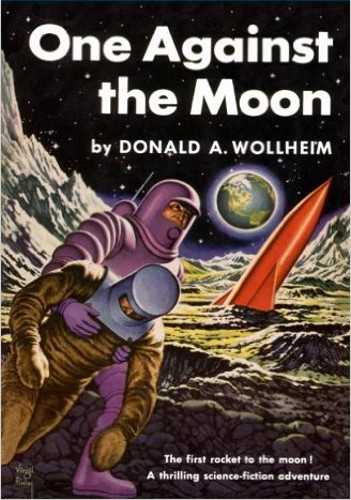
The bus roared on through the night, its cargo of men now mainly
silent, dozing as their vehicle jolted along. The moon, which was full,
shed a pale glow over the desolate landscape through which the road ran
straight as an arrow. The vehicle had departed from the main highway
fairly soon after leaving town, and had gone along another leading out
into the wastes which was the government reserve. Robin had caught
a momentary glimpse of floodlighted signs warning casual motorists
against the use of the road, warning all that it was U.S. property.
The men in the bus talked little. Most of them tired, and some a little
the worse for a night's revels, were sleeping. Two or three snored
away, unmindful of the hard seats and the jolting along the road.
Seated in the back, shoulder to shoulder with several others, Robin
kept quiet, watching the scene through the open windows and seeing
what could be seen of the terrain without making his observations too
obvious.
Thus far the landscape was the familiar desert of New Mexico, desolate
and arid flatland with which Robin had become familiar on the trip
down. On the horizon he could see the humps of mountains, the peaks
that bordered the vast proving grounds.
Near him, a couple of soldiers were conversing in low tones and Robin
caught snatches of their conversation. At first it was mainly talk of
what they had seen and done that night, their girl friends, and so on.
By and by they began to talk a bit about their work. Robin strained his
ears.
"I was thinking of asking for a transfer back to White Sands," said one
of the men slowly. "Some of that new fuel they're bringing in makes me
real uneasy."
"Ahh," said the other, "you're just letting that extra security talk
give you nerves. Sure, it's supposed to be atomic stuff, new, maybe
even untested as far as I know, but, nuts, you can't get blown up any
worse than you can handling that liquid oxygen and peroxide they got at
White Sands. In fact, I understand that this stuff isn't half as tricky
to pour as the old stuff."
"Yeah, I know. I seen some of it being poured yesterday into that new
big fellow they're lining up for tomorrow. But the point is that even
if it's easier to pour—none of that fizzing and spitting you get when
you leak a drop or two—it's atomic. That's the thing, atomic. What
would happen if a White Sands rocket blew ... it'd be a big bang, sure
enough, but it wouldn't blow the whole countryside to bits. But take
this new stuff ... whew ... we'd all be one Bikini if it went off all
at once."
The other soldier was silent a moment. "Well," he said finally, "could
be. On the other hand, I heard them say that it is really not half
as explosive as the old stuff. That loxygen they use in the original
Vikings is really dangerous, will go off quick at any spark. But this
new stuff, it won't actually go off until it's touched off after the
rocket has gone up a few miles. It's actually hard to blast—and then I
understand they ain't sure it'll work."
The other one nodded. "Uh uh, so they say, but you notice where they
moved our outfit, didn't you? They don't want to blow the main fields
out of existence by accident, just in case they might be a little
wrong. So they invented this Red Sands layout. I don't even like the
name."
The soldiers fell silent awhile. Robin turned these words over
carefully. He had read nothing of any Red Sands operation, and
he remembered nothing of any talk about atomic fuels. In fact
he'd understood that the problem was still one they had failed to
solve—though the idea was intriguing.
Chemical fuels, he knew, had definitely limited drive capacities. The
most powerful chemical fuels possible even theoretically were those
already in use, and were basically merely liquid oxygen and liquid
hydrogen. And he knew that the main obstacle that always had to be
faced by rocket engineers was the tremendous quantities and weights of
the fuels to be burned in order to lift even a single pound of cargo.
Atomic power, if liberated, had on the other hand almost unlimited
possibilities as fuel. A mere pound or so of atomically liberated
material could probably drive a spaceship a million miles with a full
pay load too. But how to combine atomic explosions with controlled
rocket fire? The problem had never been answered—at least not in the
magazine and newspaper stories he had ever read.
He thought about it awhile. Then the bus honked its horn. Robin
craned his neck, looked forward. He saw they were paralleling a high
wire fence and coming to a lighted area. A large sign on a wide road
entrance branching off caught his eye and he read the magic words,
White Sands.
For a moment he thought the bus was going to enter as the driver slowed
down. They came abreast of the gateway but the driver merely honked
and waved and passed it by, Robin catching a glimpse of whitewashed
barracks and low hangarlike structures beyond the gate. Then they
roared on into the moonlit night, on toward the empty reaches of the
desert where the mountains loomed dark in the horizon.
Where was Red Sands? How far? Robin speculated on it. He had evidently
hit on something more than he'd reckoned. This was a development
unknown to the public. This was something that must have combined the
special nature of the Los Alamos atomic testing grounds with the rocket
grounds. And it was obviously tucked far away from them all.
Suppose they caught him there, would he get off as lightly as he
might at White Sands? Where atomics was concerned, secrecy was
still enforced, despite the release of much information due to the
installation of peaceful atomic plants in various parts of the world.
But everyone knew that the world was still merely at the threshold of
atomic glories and the nations were still anxiously vying with each
other for leadership.
He supposed that perhaps he might be sent to jail. He might perhaps be
confined to the Red Sands grounds until such time as what he was to
learn had become public property. That might take years! Robin squirmed
a little as he thought over this possibility. It didn't appeal to him.
Yet, the die was cast and there was now little he could do about it.
He could, he thought, surrender now to the men in the bus. In that
way, he'd be stopped from entering the forbidden area at all and might
then merely get a bawling out and be released. But something in him
absolutely rebelled at the thought. This far he had gone, this far he
had moved toward the realization of a dream that had held him from
childhood. He would go on, and if he were to pay the penalties for
trespassing, he would at least see what he was paying for. Maybe,
maybe, he would yet see a rocket go off.
What was it the soldier had said, "that big fellow ... for tomorrow."
Then Robin would be in time.
The bus roared on for what seemed at least another hour. Finally it
approached another fenced-in area, slowed down, and came to a halt
briefly before a guarded gateway. The men stirred in their seats, the
sleepers were nudged awake, everyone started to squirm around. The
driver exchanged a few words with the guards, the bus shifted gears,
rolled slowly through the gate, and came to a stop. Stiffly the men
began to climb out.
Robin waited until about half the men had preceded him, then, keeping
his head low, followed. As the men jumped down from the bus, they
stepped up to an MP standing by and showed him their passes. He
examined each with a flashlight, took it, and waved the men on.
Robin's feet hit the ground. Carefully keeping close to the man in
front of him, he dug for the pass he'd found in his borrowed jacket.
Holding it out, he stepped up to the guard. The pass was seized,
scrutinized, and with a tap of the hand, Robin was waved on.
The men were striding off in the direction of a group of low, long
buildings of the standard army barracks type. Robin took the same
general direction, casting his eyes about trying to estimate where he
was and what was around.
The moon was high and its light was strong in the clear desert air. A
few dim bulbs showed on posts and one or two lights were flashed in
the windows of the barracks. The men were heading directly for their
beds—and Robin knew he had to head in the same direction if he did
not wish to incur suspicion. It was a ticklish moment, for he did not
dare do anything to arouse the suspicion that he was a stranger here.
It was a long walk across the parade grounds and he allowed as much
space as possible to drag out between himself and the other men. He
came closer to the dark barracks buildings, walked along toward a
dark doorway through which another man had gone. Turning his head he
saw no one near him who might be watching, and Robin stepped into the
dark doorway, then quickly side-stepped, slipped around the side of
the building, and walked silently down the dark space between the two
adjoining barracks.
At the far end of the structures, remaining hidden in the shadow cast
by the moon, he looked outward. He could see, stretching out beyond,
the level ground of the desert. He could make out the structures of
what looked like hangars and machine shops, and he could see a number
of vehicles, trucks, and odd cranes parked around. Far away he caught a
glimpse of something white. Was it a rocket?
He crouched in the shadow and waited. After a while he heard no more
footsteps, he saw the last lights in the barracks flicker out and
silence descend on the station. He glanced at his watch. It was about
two in the morning.
Silently he moved out of the barracks' shadow, walked fast and softly
to the shadow of the nearest truck. Reaching it, he paused, looked
back. Nothing stirred. Proceeding in that fashion, Robin moved from
shadow to shadow, keeping as little in the bright moonlight as he
could. He reached a building, clearly a tool house. He walked along
it, went on beyond, passed through the shadowed side of a long hangar,
found a narrow roadway leading out to where the mysterious white object
rested. He walked alongside it, half stooping, but feeling sure that no
one had seen him. The Red Sands Station was silent.
The white object proved to be a good deal farther away than he'd
thought. He knew that distances in the desert were very deceptive, felt
himself growing tired. Why, this objective might be two or three miles
away, he realized now, but only increased his pace as if in answer to
his tiring frame. The cold, dry desert air was bracing, and nothing
moved save the occasional scurry of some tiny rat or lizard.
What he had seen was indeed a rocket. It was at first a dot of white.
Then it grew into a line of white like a snowy tree. As he neared it
he realized its true dimensions. It was a tall giant rocket, as tall
as an eight-story building, long and slim, towering in the desert
like an obelisk left by some Aztec ruler. It was held by a framework
of metal girders, like that of a newly completed building whose outer
skeleton had not yet been dismantled. Near it stood a truck on high,
thick wheels which bore a long, cranelike apparatus resembling the
tentacles of some weird monster-insect. The rocket stood with its four
wide-flanged fins jutting out near the base.
Robin stopped at its base and stared up. He studied it, saw that it was
apparently segmented, having lines of cleavage that divided it into
four parts, the one at the pointed top being the shortest. This was a
four-step rocket, he recognized, and knew at that moment that here also
was a step beyond what the public knew.
He walked slowly around it, awed and silent. He noticed now that there
was a thin metal ladder running up the standing framework. The crane
in the truck was for loading the top, he knew, but he could use this
ladder himself to climb up without trying to start the truck-driven
lift.
He reached the bottom rung of the skeleton ladder, saw a sign attached
to the framework. He looked at it, saw a number, apparently the code
designation of this rocket. Glancing over it, the moonlight was not
strong enough to allow him to read the words. He looked at the parked
truck with the crane, walked over to it, looked inside. He found a
flashlight in the dashboard compartment, took it. Lying over the seat
was a pea jacket. The air was cold and would become colder. Robin
borrowed it, shrugged into it. He saw a package lying beneath it,
lifted it. A couple of candy bars it was. The driver must have had a
sweet tooth. Robin stuffed the candy into the pocket of the jacket,
which had other things in it as well.
He returned to the rocket, read the work sheet by his flashlight. Most
of it was incomprehensible. He saw that the sheet referred only to the
fueling. Steps two, three, and four were fueled. Step one, the big one
at the base was still empty and he saw that it was marked for fueling
by five that morning. Firing time, he noted, was set for six.
Robin glanced up. Here was a chance to examine the rocket completely.
Glancing around again, he swung up the ladder, started the climb. The
rocket's sides were welded metal, shiny and painted white. The various
fuel sections were numbered in large black letters and the contents
listed. He saw that the first and main fuel chamber occupied half of
the length. The three upper sections, already loaded, he remembered,
were marked in liters. The name of the fuel was meaningless to him. It
must be, he thought, the atomic stuff the soldier had mentioned. This
rocket could be a huge atomic bomb, he thought, chilled for a moment.
But he continued climbing. At the very tip, he saw that two small,
circular doors, like the escape hatches of submarines, were set flush
in the side. One was closed, the upper and larger one was slightly
ajar. He reached it, looked in. He flashed his light, peered around. It
was a narrow, closetlike space, filling a section of the uppermost tip,
just beneath the point of the top. It was padded and empty.
Robin looked out from his perch at the top of the ladder. He looked
away across the desert to the distant buildings of the Red Sands
Station. He started suddenly. Something was blinking in the distance.
He strained his eyes. Two tiny white lights were moving toward him from
far away. He heard the distant purr of a motor. A jeep was coming to
the rocket from the Red Sands Station. Had they seen his flashlight?
Were they coming to investigate?
He glanced desperately downward. The ground seemed so far away. He
could never climb down the ladder in time to escape detection. The
jeep was approaching swiftly. What could he do?
In a flash of inspiration, he saw the open port of the dark
closet-space at the rocket's tip. He climbed into it, swinging out from
the ladder, hovering over the abyss, swinging his legs into the dark,
padded interior. He crammed himself into it, found he fitted it neatly
with very little room to spare and, grasping the circular door, pulled
it toward him. It swung shut on its oiled hinges, clicked tightly into
place.
Robin crouched down, silent.
For a while there was dead silence. Robin wondered if he would be able
to hear anything that went on outside, considering the padding of the
little space. For once he was thankful for being so short. If he'd been
a few inches taller, he'd have found his position very uncomfortable.
It was cramped, but not unbearable.
He strained his ears, finally heard the vibrations of the jeep draw up
to the base of the rocket and stop. He heard faint sounds which must
have been the muffled voices of the jeep's riders. He lay quietly,
hoping he would not be discovered.
Outside, the jeep had come to a stop and the two men in the front seat
stared around suspiciously. "I'd have sworn I saw a light for a moment
out here," said the driver.
The other scratched his head, looked around. "I'd better get out and
look around, just to be certain."
They both descended from the jeep. One went over and looked into the
trucks and carriers, peering under them for possible hideaways. The
other poked around the scaffolding at the base of the rocket. "This is
the one they're firing off tomorrow, isn't it?" he asked when the other
joined him after a moment.
"Yeah," answered his companion, "or rather this morning. In fact in
only a few hours. They've only got to load the main fuel chambers and
they're ready." He shined his flashlight on the operations chart, the
same one that Robin had examined earlier. "I wonder how come they
loaded the other three earlier. That's odd. I thought that stuff
couldn't hang around too long."
"Don't you know," said the other, "this is that big top-secret
experimental job they were working so fast on this week? Something to
do with a new kind of fuel, fairly stable but loaded with radioactive
elements. Some type of new compound which is supposed to add an atomic
disintegration impetus when it goes off. Heard one of the engineers
explain it as something like plutonium particles in suspension which
get touched off atomically as they emerge in the rocket blast. They
don't know for sure it will work."
The other looked up at the towering structure. "I guess that's how come
they're sending it up first with the regular loxygen fuel—so if the
whole thing goes bang at once, it'll be high enough up not to blow the
rest of us to kingdom come." He walked around the base a bit, stopped,
flashed his light down, and picked up something. It was a cardboard
sign that had been lying on the ground. He looked at it a moment.
"Hey, this must have fallen from the cargo chamber," he said, showing
his comrade the sign.
It read: Instruments in place. Do not disturb. He turned it over. On
the back it read: Ready for loading.
"I better put this back where it fell from," he said, adding, "but
which side is correct? Did you say they were firing it at six?"
At his companion's assent, he said, "Well, I guess maybe they must have
loaded the cameras and radio equipment this afternoon. I'll go up, put
this back, and check it."
The man started up the ladder, the same one that Robin had climbed a
short while before. When he had arrived before the section where Robin
lay hidden, he tried the circular door of that section. It was tightly
shut. This signified to him that it was already loaded and without
further thought he carefully attached the little sign reading Do not
disturb to the door.
After a few more minutes' search, the two men climbed back in their
jeep and drove back to the barracks-grounds.
Inside the rocket, Robin had been unable to hear what they had been
saying. Their voices came to him heavily muffled and distorted and he
could not recognize the words. He heard the man come up the scaffolding
ladder and try the door. But it had been tight and it had not budged.
Then he'd gone down and a little later Robin had heard the jeep drive
away.
Robin lay there quietly on the soft padding and wondered how long he
should stay in hiding. They might have left a man on guard or they
might be keeping an eye on the rocket. If he came out right away, they
might spot him. Better wait here a half hour, he said to himself, and
then tried to make himself more comfortable.
The day had been a long one and a tense one. He was more tired than
he'd thought. The tiny, cramped cubby-hole in the nose of the rocket
was pitch-dark, cushioned, and utterly quiet. Robin rested his eyes.
Before he knew it, he was sound asleep. The air was close and became
stale; Robin's slumber slowly became deep and drugged.
The sun rose at five and with it there arrived the men who would load
and launch the rocket—several truckloads in fact, with a couple of
tanks of fuel. The volatile liquids were readied for pouring into the
tanks and chambers of the first and main firing section. The engineers
arrived. They began to check the loads and the preparations.
"The instruments in place?" asked Major Bronck, who was in charge of
this operation. His assistant, a civilian engineer, glanced up the
ladder.
"According to the notice up there, they are. I don't remember seeing
them installed myself, though. May have been done after we left
yesterday."
"Who was in charge of them?" the major asked.
"Jackson, sir," the answer came, "but he hasn't been in camp today.
Must have been left overnight in town."
The major frowned. "Well, I don't see the instruments around so I
guess he loaded them all right. Sloppy way of doing things, though. I
don't like it. In fact, I don't particularly like this whole job. It's
too hasty, too irregular."
The other smiled, shrugged. "Can't help it. Big rush orders from
Washington. They wouldn't even let us put this shot off till Monday.
Had to get a fast test on this atomic fuel. I guess it's another of
those things they think the Russians are up to."
"Ahh, that's always an excuse for rushing. But I still say haste makes
waste. Well, anyway we've got our orders so off it goes this morning.
Trackers on the job?"
"Sure, they're right on it. But we've still got to load the animals.
This is going to be a high flier and the space-medicine people want in
on it. Here's their stuff now."
A light truck rolled up and two men came out carrying a crate. One of
the automatic rolling cranes lifted them all up to the nose of the
rocket. There, just below the instrument compartment, they opened
another port and installed their burden, shutting the compartment again
and sealing it.
The major glanced at his watch, looked around. The main chamber was
loaded, the tank had departed. At his order, the rolling scaffolding
was swiftly detached and driven away. Now the rocket stood alone on its
own fins, pointing skyward into the pink and orange dawn, its side a
dazzling white, its nose a bright red, each section banded in green.
"How far do you think it will go?" the major asked his assistant.
"Anybody's guess," was the reply. "The fuel is untested and
unpredictable. If this trick fuel fails to work, the whole thing will
go up maybe six miles and then drop. If the atomic stuff turns into a
bomb they'll hear the bang in Las Vegas. If it works as they expect,
it might go up several hundred miles, maybe even more. It could make
a better satellite rocket than the ones we've got up already. In fact
that's what they're hoping. They think they may be able to make this
the start of a real space-platform program—for once carrying a pay
load up worth the carrying. But who knows?"
The two climbed into a car and drove to where the concrete dugout was
located. Entering it they nodded to the communications men and other
engineers already gathered. The major took his place at the firing
panel. He looked at his timer, waited a few minutes. Gradually the
small talk ceased and a hush fell over the little guiding post. The
major reached for the firing button.
Back in the rocket, Robin opened his eyes. The first thing he noticed
when his head cleared from the grogginess of his deep sleep was a
slight hissing noise somewhere below him. The air felt different in his
little compartment. Somewhere a thin stream of oxygen was escaping into
the chamber.
He twisted around, felt about with his hands, located it. There was a
thin line of holes along the seam of the padding underneath him. Now
he heard other noises. Below him, a faint chattering, a scolding, the
sound of something scratching. He put his ear down near the hole from
where the air was issuing and listened.
Yes, he thought to himself, animals. Somebody put some animals in the
space just below me. Sounds like monkeys' chattering. Must be where the
air is coming from.
He had a headache. Bad air in here, he thought, and realized that had
it not been for the animals being placed below him, he might have
suffocated in that space. It was then that he fully realized what had
happened—that he'd fallen asleep.
The animals hadn't been there when he had first climbed in. So he must
have slept for several hours at least. He squirmed around, reflecting
on it, still not quite gathering his drugged wits together. That meant
that the men must have arrived and started work on this rocket again.
He thought this over, and a great uneasiness came over him. He strove
to remember something urgent, something he knew he had to bring back to
mind. Something about five o'clock and six o'clock.
Loading time, launching time. Yes! They were firing this rocket at
six! But what time was it now? How long had he slept? He looked at the
luminous dial of his watch but was chagrined to find it had run down
and he'd forgotten to wind it.
He glanced rapidly around his little space, wondering how he could find
out whether it was already day. Several glimpses of light hit his eyes.
He saw that in three or four places there were tiny glass openings no
larger than would admit a thick wire. He tried to look through one, but
all he could see was blue sky. It was morning then.
He strained his ears for outside noises, truck engines, men talking.
But there was not a sound from outside. Only the faint squeakings of
the animals below him. He twisted around again to face the little round
door.
It was padded on the inside, it had no handle there, nothing to get a
grip on. He scrabbled in the padding with his fingers, reached the rim,
and tried to push. There was no give. It was airtight, automatically
sealed.
He pushed against it, wondered what to do. He squirmed around against
the padding, lay back with his head against the cushioning on the
opposite side, his back resting on the floor padding, and put his feet
against the side of the little door. Thus braced he was all set to
shove the strength of his legs against the door in an effort to push it
outward.
He was about to do so when the rocket went off.