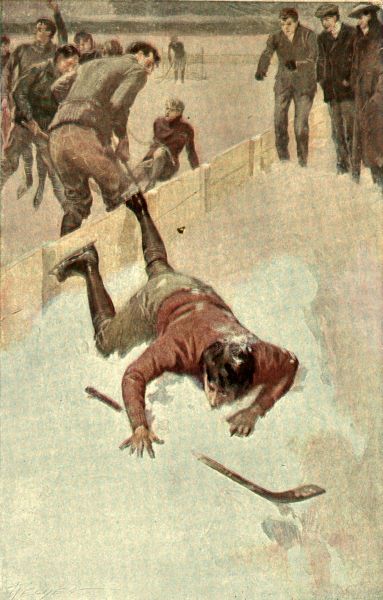
CHAPTER III ON THE CINDERS
On the following Monday, Allan set out after his
three-o’clock recitation for Erskine Field. He stopped
at his room long enough to leave his books and get his
mail—the Sunday letter from home usually put in its
appearance on Monday afternoon—and then went on
out Poplar Street.
It was a fine, mild afternoon, with the sunlight
sifting down through the branches of the giant elms
which line the way, and a suggestion of Indian summer
in the air. If he hadn’t been so busy with his
letter he could have found plenty to interest him on the
walk to the field, but, as it was, he was deeply concerned
with the news from home.
There was talk, his mother wrote, of closing down
the Gold Beetle mine out in Colorado, from which distant
enterprise the greater part of her income had long
been derived in the shape of dividends on a large
amount of stock; the gold-bearing ore had given out
and the directors were to consider the course to pursue
at a meeting in December. Meanwhile, his mother
explained, the work had stopped, and so had the dividends,
and she didn’t like to consider what would happen
if this source of income was shut off for all time.
Allan tried to feel regretful over the matter, since his
mother was clearly worried—more worried than she
was willing to show, had he but known it—but the
Gold Beetle was a long way off, it always had supplied
them with money, and the idea that it was now to
cease doing so seemed something quite preposterous.
The Gold Beetle represented the family fortune, about
all that remained after his father’s affairs had been
settled.
Allan found other news more to his liking: Dorothy
was getting on nicely at her new boarding-school and
had survived the initial period of tragic homesickness;
one of Allan’s friends at Hillton, now a Yale freshman,
had called at the house a few days before; and Edith
Cinnamon had presented the household with a litter
of three lovely kittens. Edith Cinnamon was the cat,
Allan’s particular pet, and the news of the interesting
event remained in his mind after the reprehensible
conduct of the Gold Beetle mine had departed from it.
Mines stand merely for money, but kittens are pets,
and Allan loved pets. A wonderful idea struck him:
why not have his mother send him one of the kittens?
He resolved to confer with Mrs. Purdy on his return;
surely she would have no objections to his obtaining
a room-mate to share the “parlor study” with him!
When he had changed his clothes for a running
costume in the locker house and reached the track he
found fully half a score of fellows before him. There
was Hooker jogging around the back-stretch; nearer
at hand was Harris practising starts; in a group at
the finish of the hurdles he saw Stearns, the track-team
captain, Rindgely, several fellows whose faces he knew
but whose names were unknown to him, and Billy
Kernahan. He drew aside to let a file of runners by
and then approached the group. Rindgely nodded to
him slightly, not with any suggestion of unfriendliness,
but rather in the manner of one who has never been
properly introduced. Billy accompanied his salutation
with a critical survey of the half-clothed figure confronting
him.
“How are you feeling to-day?” he asked.
“Fine, thanks!” answered Allan.
“That’s the boy! We’ll try you at three-quarters
of a mile after a while. You’d better get warmed up,
and then try half a dozen starts.”
While the trainer was speaking, Allan was aware
of the fact that Walter Stearns was observing him
with evident interest. When Billy ceased, Stearns said
something to him in low tones, and the next moment
Allan found himself being introduced to the track-team
captain. Stearns was rather under than above medium
height, with small features and alert eyes of a steel-gray
shade that contrasted oddly with his black hair.
Below his white trunks his legs were thin and muscular,
and under the faded purple sweater his chest proved
itself broad and deep. He spoke rapidly, as though
his tongue had learned the secret of his legs and was
given to dashes rather than to sustained efforts.
“Glad to know you, Ware,” he said, as he shook
hands. “Glad you’re coming out to help us.”
“I don’t believe I’ll be much help,” answered
Allan.
“Oh, yes; bound to. I saw you run in the handicaps.
That was a mighty pretty race you made. By
the way, do you know Mr. Long? And this is Mr.
Monroe. And Mr. Mason. Keep in with Mason. He’s
office-boy on the Purple and writes criticisms of the
track team.”
Allan shook hands with the three, while the group
laughed at Stearns’s fling at the managing editor of
the college weekly. Long was a startlingly tall fellow,
with a crooked nose and twinkling, yellowish eyes, and
Monroe was short and thick-set, and looked ill-tempered.
Mason, Allan recognized as one of a half-dozen
men whom he had seen about college and as to whose
identity he had been curious. Mason was the sort of
fellow that attracts attention: tall, broad-shouldered,
with shrewd, kindly eyes behind glasses and a firm
mouth under a straight and sensitive nose. He looked
very much the gentleman, and Allan was glad to make
his acquaintance. He was in the dark as to what position
Mason really occupied on the Purple, and so the
point of Stearns’s joke was lost on him. But he smiled,
nevertheless, having learned that it is sometimes well
to assume knowledge when one hasn’t it.
“See you again,” said Stearns. The others nodded
with various degrees of friendliness and Allan took
himself off. The track was in good condition to-day
and held the spikes firmly. Allan jogged up and down
the stretch a few times, trying his muscles, which on
Saturday had felt a bit stiff after the mile run, and
lifting his knees high. Then he started around the
track. Half-way around he drew up behind Hooker.
“Hello!” said the latter. “Nice day, isn’t it?”
Allan agreed that it was, and the two went on
together to the turn. There Hooker turned up the
straightaway.
“Going to try starts?” he asked. “Let’s go up
to the end there.”
Allan couldn’t see the necessity for becoming proficient
in the crouching start until Hooker explained
as they returned from a brief dash, in which the
younger lad had been left wofully far behind.
“Sometimes,” said Hooker, “you’ll want the pole
at the start, and if you’re placed two or three places
away from it, you won’t get it from a stand, you see.
But if you use the crouch and get away quick, you
have a pretty good show of getting ahead of the men
who have the inside of you. Let’s try it again. You
give the signal this time.”
After ten minutes of it, Allan picked up his sweater
and followed Hooker down the track to report to Kernahan.
The football men had taken possession of the
gridiron by this time, Long and others were practising
at the high jump, and altogether the field looked very
busy.
“You and Ware try three laps,” said the trainer
to Hooker. “Watch your form, now, and never mind
about your time. I’ll attend to that for you. Take
turn about at the pacing; you take the first lap, Hooker.
Want to get into this, Larry?”
Rindgely nodded and peeled off his sweater. The
others had to trot about for a minute or two while
Rindgely stretched his muscles. Then the three got on
to the mark, Billy gave the word, and they started off
at an easy pace, Hooker in the lead, Allan next, and
Rindgely in the rear. All three hugged the rim of
the track and settled down into their pace. On the
back-stretch they had to slow down once to avoid a group
of football substitutes who were crossing the cinders,
and once Rindgely was forced to leap over a ball that
came bouncing out onto the track, and was much incensed
about it. Hooker’s pace was wonderfully steady,
but Allan thought it rather slow. At the mark Billy
told them to “hit it up a bit now,” and Hooker slowed
down, letting Allan into the lead.
Allan increased the pace considerably. This time
there were no interruptions, and they neared the end
of the second lap fresh and untired. Kernahan glanced
up from his watch as they sped by.
“All right!” he shouted. “Get up there, Larry,
and hold that pace.”
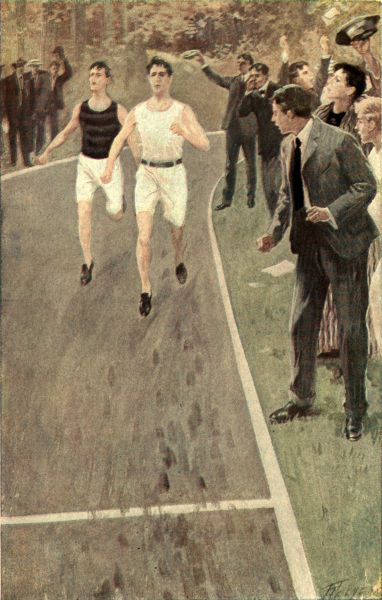
Rindgely took the lead. As they commenced the
turn Allan’s gaze, wandering a second from the front,
lighted upon a tall, wide-shouldered and somewhat uncouth
figure at the edge of the track. Strange to say,
the figure nodded its head at him and waved a hand,
and as Allan went by there came a stentorian cry of
encouragement that might have been heard half across
the field:
“Chase ’em down, Freshman! Give ’em fits!”
Allan bit his lips angrily as he sped on. What
business had that big chump yelling at him like that
when he didn’t even know him? Pretty fresh, that’s
what it was! Allan hadn’t made the acquaintances of
so many fellows but that he could remember them, and
he was quite sure that he had never met the big chap
who had yelled. But at the same time there had been
something familiar about the fellow’s voice—too familiar,
thought Allan with a grudging smile—and he
wondered who he might be and why he had singled
him out for his unwelcome attentions. Then the incident
passed for the time out of his mind, for the last
turn was almost at hand and Rindgely was increasing
the pace.
Allan began to feel it at the turn, and when they
swung into the home-stretch and the pace, instead of
settling down to a steady finish, grew faster and faster,
he came to the unwelcome conclusion that he was not
in the same class with the other two. Rindgely, in
spite of all Allan could do, lengthened the space between
them. Hooker, seeing that Allan was out of it,
passed him fifty yards from the mark and strove to
overhaul the leader. But Rindgely was never headed,
and finished several yards in front of Hooker and at
least thirty ahead of Allan. When they turned and
jogged back to the trainer, the latter was slipping his
watch into his pocket.
“What’s the good of doing that, Larry?” he asked,
disgustedly. “That wasn’t a race.”
“Oh, I just wanted to liven it up a bit,” answered
Rindgely, grinning. “What time did I make, Billy?”
“I didn’t take you,” answered the trainer, shortly.
“That’s enough for to-day.”
Allan turned away with the others, but Billy called
him back.
“What was the matter?” he asked. “Pace too
hot for you?”
“I suppose so; I couldn’t stand that spurt.”
“Well, that was some of Larry’s nonsense; he’d
no business cutting up tricks.” He was silent a moment,
looking across to where the second eleven was
trying vainly to keep the varsity from pushing over her
goal-line. Then, “Ever try the two miles?” he asked.
Allan shook his head.
“I don’t believe I’d be any good at it,” he answered.
“Not that I’m any good at the mile, either,”
he added, somewhat discouraged at the outcome of the
trial.
“What’s the best you ever did at the mile?”
“About four minutes forty-five seconds.”
“You did it inside of forty, Friday.”
“I did?” Allan looked his surprise. “Oh, but
I ran a hundred and twenty yards short.”
“I allowed for that,” answered Billy, quietly.
“Now, look here, Ware; you’ve got it in you all right,
but you don’t make the most of yourself. You let your
feet drag back badly, and you’ve been trying after too
long a stride. You make that shorter by six inches and
you’ll cut off another second after a while. And to-morrow
I’ll show you what I mean about the stride.
There’s plenty of time before the dual meet in the
spring, and by then we’ll have you doing things right.
The only thing is,” he added, thoughtfully, “whether
you wouldn’t do better at the two miles. What do you
think?”
“I really don’t know,” answered Allan, doubtfully,
“but I’d like to try it.”
“Well, there’s lots of time. The indoor meet in
Boston comes along in February; we’ll have you in
shape for that, and you can go in for the mile and
the two miles. Meanwhile, you’d better come out with
the other men while the decent weather lasts.”
“Do you think I can make the team?” Allan asked,
hopefully.
“Easy; but they don’t take new men on till after
the trials in the spring.”
“Oh!” said Allan, a trifle disappointed.
“Don’t let that bother you,” advised the trainer.
“You’re as good as on it now. You make the most
of the fall training, Ware, and keep fit during the
winter. I’d go in for hockey or something. Ever play
hockey?”
“Yes, but I can’t skate well enough.”
“Well, get plenty of outdoor exercise of some sort
this winter; don’t let the weather keep you indoors.”
“All right, I’ll remember.” Allan’s gaze wandered
toward the locker building. Half-way across the field
a big figure was ambling toward the gate, hands in
pockets. Allan turned quickly to the trainer. “Do
you know who that fellow is?” Kernahan’s gaze followed
his. After a moment:
“That’s a freshman named Burley. Know him?”
“No; I just wondered who he was,” Allan replied.
“And I don’t want to know him,” he muttered,
irritably, as he trotted off to the locker house.
But Fate seldom consults our inclinations.
CHAPTER IV HAL HAS AN IDEA
It seemed to Allan during the next few days that
the bulky form of Peter Burley was bent upon haunting
him. On Tuesday morning, in English, he was aware
of Burley’s presence a few rows behind him; when he
looked around, it was to encounter the big fellow’s
smiling regard. There was really nothing offensive in
that smile; it was merely one of intense friendliness,
quite unconventional in its intensity, but it irritated
Allan greatly. Why couldn’t Burley let him alone?
Just because he had kept him from falling and lugged
him to the dressing-tent, he seemed to have an idea
that Allan was his especial property. And then the
cheek of scrawling his silly name on a fellow’s door!
And yelling like a three-ply idiot at the track!
Perhaps the fact that Burley, whoever and whatever
he was, was markedly popular rather increased
Allan’s prejudice. Wherever Burley sat in class there
was invariably a good deal of subdued noise and laughter,
and when he left the hall it was always as the
center of a small circle of fellows, above which Burley
towered head and shoulders. Secretly, Allan envied
Burley’s success with his fellows, but in conversation
with Smiths he dubbed Burley a mountebank. Hal
was visibly impressed with the word and used it unflaggingly
the rest of the year.
Wednesday, Burley was again on the field, but this
time he made no remarks as Allan passed him on the
track; merely smiled and nodded with his offensive
familiarity and then turned his attention to the football
practise. As usual, he was the center of a group,
and after Allan had passed the turn he heard their
laughter and wondered if Burley had selected him as
a butt for his silly jokes. After that Allan saw him
at least once a day until on the following Wednesday
night, when the freshman election took place in Grace
Hall, and Burley leaped into even greater, and to Allan
more offensive, prominence.
There were two leading candidates for the presidency,
and, contrary to the usual custom, the opposing
forces had failed to arrange a compromise and a distribution
of offices. The contest was prolonged and exciting.
On the ninth ballot, Mordaunt, a St. Mathias
fellow, won amidst the howls of the opposition. The
rival candidate was elected secretary, but promptly and
somewhat heatedly declined. New nominations were
called for, and Burley was proposed simultaneously
from two sides of the room. His name met with loud
applause. Burley, sitting unconcernedly near the door,
grinned his appreciation of the joke. Two other names
were offered, and then the balloting began. On the
first ballot, Peter Burley, of Blackwater, Col., was
elected.
Burley tried to get on to his feet to refuse the
honor, but owing to the fact that three companions held
him down while the chairman rapped wildly for order,
he failed to gain recognition. The next moment the
election was made unanimous. Allan grunted his disapproval.
Hal said it didn’t much matter who was
secretary; anybody could be that.
Hal accompanied Allan back to the latter’s room
and stayed until late, talking most of the time about
his chances of making the varsity squad, what he was
going to do if he didn’t, and how he didn’t give a rap
anyway.
“Of course, I can make the freshman team all
right, but what’s that? They have only four outside
games scheduled, and two of those don’t amount to anything;
just high schools. The only game they go away
for is the one with Dexter. And this thing of working
hard for a month to play the Robinson freshmen isn’t
what it’s cracked up to be.”
“Who will win?” asked Allan, suppressing a
yawn.
“That’s the trouble. It’s more’n likely that Robinson
will. We’ve got a lot of good men—fast backs
and a mighty brainy little quarter—but we haven’t got
any support for our center. Cheesman’s a wonder, but
he can’t do much with guards like Murray and Kirk
beside him. Why, Kirk doesn’t weigh a hundred and
seventy, and Murray’s only a hundred and eighty-something.
Poor is going to issue another call for candidates;
he’s going to ask every man of a hundred and
seventy-five or over to come out. Say!”
Hal sat up suddenly in the Morris chair and looked
like a Great Discoverer.
“Say what?” murmured Allan, drowsily.
“What’s the matter with that man Burley?”
“A good deal, I should say, if you ask me,” answered
Allan.
“I mean for a guard,” said Smiths, impatiently.
“He probably never saw a football,” objected
Allan. “They don’t play it out West, do they?”
“Don’t they, though! Look at Michigan and Wisconsin
and—and the rest of them!”
“I refuse.”
“Why, Burley’s just the man! He must weigh
two hundred if he weighs a pound!”
“Looks as though he might weigh a ton. But if
he doesn’t know the game——”
“How do you know he doesn’t?”
“I don’t. But if he did know it, wouldn’t he have
been out before this?”
Smiths was silenced for a moment.
“Well, even if he doesn’t know it, he can be taught,
I guess. And we’ve got a whole lot of science now;
what we need is beef.”
“Burley looks more like an ass than a cow,” said
Allan, disagreeably. Smiths stared.
“Say, what’s he done to you, anyway? You seem
to be beastly sore on him.”
“I’ve told you what he’s done.”
“Oh, that! Besides, he lugged you off the track;
that’s nothing to get mad about, is it?”
“I suppose not; I’m not mad about that—or anything
else. He just—just makes me tired.”
“Well, I’ll bet he’s our man.” Smiths jumped up
and seized his cap. “I’ll run over and tell Poor.”
“What, at this time of night?”
“Pshaw! it’s only eleven-thirty. He’ll be glad to
know about it.”
“He’ll probably pitch you down-stairs, and serve
you right.”
“Not much he won’t. Good night.”
“Good night,” answered Allan. “I’ve got some
surgeon’s plaster, if you need it.”
Hal Smiths slammed the door and took the front
porch in one leap. Then the gate crashed. Allan listened
intently.
“That’s funny!” he muttered. “He must have
missed the lamp-post!”
He took up a book, found a pencil, and opened the
table-drawer in search of a pad. As he did so, his eyes
fell on a folded sheet of lined paper. He read the
penciled words on it—“Peter Burley”—and, refolding
it after a moment of indecision, tucked it back in
a corner of the drawer, frowning deeply the while.
Allan didn’t see Hal the next day; neither was
the objectionable Burley visible on the field in the
afternoon when Allan ran his first practise over the
mile. Kernahan didn’t hold the watch on him, the
distance was unfamiliar to him, and he lost all idea
of his time after the fourth lap, and ended pretty well
tuckered out.
“All right,” said the trainer, when it was over.
“You ran it a bit too fast at the start. But you’ll get
onto it after a while.”
On Friday Allan saw Hal only for an instant and
had no chance to question him as to the result of his
midnight visit to the freshman football captain. Consequently,
it was not until Saturday that he learned
of Burley’s appearance on the field as a candidate for
admission into the freshman team. There was no track
work that afternoon, since the Erskine varsity played
State University. Allan went out to the field alone and
watched the game from the season-ticket holders’ stand,
and cheered quite madly when the Erskine quarter-back,
availing himself for the first time of the new
rules, seemed to pass the ball to a trio of plunging
backs, and after an instant of delay set off almost
alone around State’s left end with the pigskin cuddled
in his arm, and flew down the field for over seventy
yards to a touch-down.
That settled the score for the first half, and the
teams trotted off with honors even. There was a good
deal of dissatisfaction expressed in Allan’s neighborhood
over the playing of the home team, and much
gloomy prophecy was indulged in in regard to the
outcome of the final and most important game of the
season—that with Erskine’s old-time rival, Robinson
University.
About the middle of the intermission, Allan heard
his name called, and looked down to see a small, sandy-haired
fellow waving a note-book at him. Allan waved
back, and the owner of the note-book—the latter his
never-absent badge of office—climbed up the seats and
was duly pummeled and laid hold of on his way.
Tommy Sweet was a Hillton fellow, and considering
that he had been a class ahead of Allan at that school,
the two had been quite friendly there until Sweet had
gone up to Erskine. So far Allan had not seen much
of him, for Tommy was “on the Purple,” as he liked
to put it, and was an extremely busy youth. Tommy’s
friends declared he would find something to do if he
was strapped in bed.
The key-note of Tommy was eagerness. His wide-open
blue eyes were always staring about the world in
search for something to engage his attention, and his
ridiculously small mouth was forever pursed into something
between a grin and an exclamation-point. His
hair was just the color of tow, and the freckles which
covered every available portion of his face were several
shades darker, but harmonized perfectly. He was tireless
in the search for news for the Purple, and when it
came to activity would have made the proverbial ant
or beaver look like a sluggard. Tommy thought sleep
a criminal waste of time, and even begrudged the moments
spent in eating.
Tommy was only perfectly happy when doing four
things at once; less than four left him dull and dissatisfied.
Clarke Mason once said: “I’ll bet some day
Tommy will commit second-degree murder so they’ll
give him hard labor for life.” For the rest he was a
cheerful, likable fellow, aggressively honest and painfully
conscientious.
“What did you think of that run of Cutler’s?” he
asked, breathlessly, as he sank onto the seat at Allan’s
side. “Peach, wasn’t it? It’ll show up great in the
diagram I’m making; see!” He opened his note-book
and exhibited a puzzling maze of lines and dots, figures
and letters. “That’s the first half. Everything’s
there—runs, kicks, plunges, penalties, the whole show.”
“What’s it for?” asked Allan. “Anything to do
with geometry?”
“Why, no; it’s— Oh, quit your kidding! It’s to
go with my report of the game. It shows how the
gains were made and who made ’em. And I’ve introduced
something new in diagrams, too. See these figures
along the edge here—4:17, 4:22, and so on?”
“Well, I see something there, I think,” answered
Allan, cautiously.
“Those signify the time each play was made,” said
Tommy, triumphantly. “That’s never been done before,
you know.”
“I see. But it must keep you pretty busy. Do
you have to write the game up, too?”
“Oh, yes.” Tommy showed three or four pages
of awful-looking scrawls from a fountain-pen. “That’s
done in a sort of shorthand, and I write it out full
length at the office. Say, where did you tell me your
room was? I meant to put it down, but forgot it.
Purdy’s? Oh, yes; I know where that is. I want to
come around some evening, if I can ever find the time.
How are you getting on? Anything I can do for you?
Any fellows you’d like to meet? No? Well, let me
know if I can do anything for you. Very glad to,
you know. That was quite a race you made the other
day. Billy seems to have taken a fancy to you, doesn’t
he? He’s all right, Allan; you shine up to him and—
Hello! there’s a fellow I want to see. Come and see
me, will you? Twenty-two Sesson, you know. So long,
old chap!”
Tommy hurried pell-mell down the stand, shaking
off detaining hands, and disappeared into the throng.
Allan took a long breath; he felt as though a small
hurricane had been playing with him. The teams came
onto the field again and the second half began. It
proved uninteresting, and only the superior weight of
the Erskine eleven won them the game finally by the
close margin of a safety. Allan followed the throng out
of the enclosure and across toward the locker house and
the gate. But half-way there the crowd divided, and
Allan presently found himself looking on at the practise
of the freshman teams. The first team had the
ball on the second’s five-yard line and was trying very
hard to put it over to an accompaniment of command
and entreaty from the coaches.
“Third down and two to go!” some one shouted.
A shrill voice called a jumble of figures and a tandem
slid forward at a tangent, and for an instant confusion
reigned. Then suddenly a roar of laughter went up,
the line of watchers broke forward, and Allan found
himself directly in the path of what at first glance
looked like an avalanche of canvas and leather. Springing
back, he escaped being borne along by the group
of struggling players, in the center of which, rising like
a city sky-scraper out of a huddle of shanties, stood
forth, calm and determined, the countenance of Peter
Burley.
In his arms, struggling but helpless, was the first
eleven’s left half-back, and to his back and legs and,
in short, to every portion of his anatomy, hung the
enemy, for all the world like bees on a nest in swarming
time. Behind them the second eleven pushed and
shoved, and relentlessly the whole mass moved down
the field. And somewhere, drowned by the laughter
of the spectators and the despairing shrieks of “Down!
Down!” from the abducted half-back, sounded feebly
the referee’s whistle.
One by one the impeditive players dropped away,
and Burley’s triumphant advance toward the enemy’s
goal was stopped by the referee and two coaches. Burley
set down the half-back, in whose arms the pigskin
was still clutched, but did not release his grasp until
his obligations were hurriedly but clearly explained to
him. Then he patted the half-back on the shoulder
in a paternal manner and retraced his steps to the enthusiastic
applause of the convulsed throng. The second
team hugged as much of him as they could encompass
and he smiled cheerfully, but was evidently still
somewhat perplexed. The ball went to the second on
her eight yards and the game continued, Burley, at
right guard, looming head and shoulders above his
companions.
Allan watched the game for a few moments longer,
and then continued his journey. Somehow the calm,
inscrutable manner in which the big freshman had
strode down the field in unquestioning obedience to
what he had supposed to be his duty appealed to Allan.
It had been awfully funny, and Allan smiled as he
recalled it. But the incident had held for him something
more than humor, just what he hardly knew; but
whatever it was, and even though he would have found
it difficult to give a name to it, it completely changed
his feeling toward Burley. By the time he had reached
Mrs. Purdy’s front gate, he was wondering whether
Burley still desired his acquaintance.
CHAPTER V “MR. PETER BURLEY, BLACKWATER, COL.”
Hal Smiths dropped in after dinner that evening
and Allan brought the conversation around to the subject
of Burley, whose performance during practise had
been the chief topic at the dinner-table.
“Why, Poor was awfully pleased at my suggestion,”
said Hal, “after I found him. It was after twelve
then, and I’d chased half over college looking for him.
He said he wasn’t very good at persuasion and thought
Burley would require lots of it; so he asked me to see
him. Poor’s a pretty good little chap, so I went. Burley
was awfully decent. Said he had never played and
had never even seen the game until he came here; said
he hadn’t been able to find out what it was all about, but
that if we wanted him to try it, why, of course, he
would. Said he thought it looked like pretty good fun,
and got me to sort of explain it a bit. One thing he
wanted to know,” laughed Hal, “was whether you could
hit a man if he didn’t have the ball.”
“Well, he played it for all it was worth this afternoon,”
said Allan, smiling. “You heard about it,
didn’t you?”
“No; what was it? I sat on the side line all afternoon,
and waited to get a whack at State University.
What did Burley do?”
So Allan told him, and Hal laughed until the tears
came.
“Oh, he’s a genius, he is!” he said.
After a minute of chuckling, he went on:
“Look here, Allan, I think you’d rather like him
if you got to know him. He’s—he’s rather a decent
sort, after all. I didn’t take to him at first, of course,
but—and I don’t say now that he’s the sort of chap
you’d want to ask home and introduce to your people;
he’s kind of free and easy, and you couldn’t be sure
he wouldn’t drink the catsup out of the bottle or slap
your governor on the back—but he’s—well, there’s something
about him you can’t help liking,” he ended, with
an apologetic tone.
“Maybe I would,” answered Allan, pleasantly. Hal
looked surprised.
“He’s given up the class secretaryship, you know,”
he announced.
“Why?”
“I don’t know for sure, but Poor says he told him
it was because he didn’t think he’d be here much after
the holidays.”
“Where’s he going?” asked Allan.
“Don’t know. Funny idea, to come to college for
half a year. Maybe——”
There were footsteps on the porch, the front portal
opened with a crash, and an imperative knock sounded
on the room door. Allan jumped to his feet. Could
it be fire? he wondered, shooting a bewildered glance
at Hal. He hurried to the door just as the hammering
began again, more violently than before. Hal raised
himself uneasily from the Morris chair, prepared for
the worst. Allan called, “Come in!” and the door
was flung open.
Entered Tommy Sweet!
“You thundering idiot!” bawled Hal. “I thought
it was at least the Dean! You can make more—
Hello, Burley! Glad to see you.”
“This is Mr. Burley, Allan,” Tommy was saying.
“Brought him around ’cause I wanted you to know
each other. Mr. Ware—Mr. Burley.”
Allan felt his hand enveloped in something large
and warm and vise-like. He felt his fingers crushed
together, thought he could hear the bones breaking—and
still managed to smile painfully, but politely, the
while. Then Burley had dropped his hand and was
saying:
“I’ve wanted to know you ever since I saw you
win that running race the other day. Came around
here and left a card on you, but I guess you didn’t
find it.”
Allan murmured his appreciation, but remained
silent as to the “card.”
“I told Sweet here that you’d win that race. Offered
to bet him anything he liked. He wouldn’t bet,
though.” Peter Burley took the chair proffered by Hal
and carefully lowered himself into it.
“They told me you carried me over to the tent,”
said Allan. “Much obliged, I’m sure.”
“Welcome,” answered the other, heartily. “You
didn’t weigh anything to mention.”
“Not as heavy as the freshman team, eh?” asked
Tommy. Burley looked apologetically around the
circle.
“I suppose every one’s heard of that fool thing?”
he asked.
“Just about every one, I guess,” laughed Tommy.
“That comes of trying to do something you don’t
know how to do. This fellow Smiths here came around
to my shack the other day and said the class wanted
me to play football because I weigh some. Well, ginger!
I didn’t know anything about the thing, and
I told him so. But he would have it that I must play.
And look what happens! I make a measly show of
myself right out there on the range in front of the
whole outfit!”
“No harm done,” said Hal. “You did what you
tried to.”
“No, I didn’t. There was a little cuss there in a
Derby hat wouldn’t let me. I was going to take that
half-backed fellow down to the other end and throw
him over the line. That’s what I was going to do.
They didn’t tell me I had to slap him on the chest and
butt him with my head.”
“But, you see,” explained Allan, “he called
‘Down’ just when you began to lug him off.”
“That’s what they said. I was supposed to let go
of him when he said that, but I just thought he was
throwing up the sponge and wanted me to let him down.
If I’d known he could have spoiled it by yelling ‘Down,’
I’d have held his mouth shut.”
This summoned laughter, and Burley glanced
around at the others in wide surprise. Allan felt surprise,
too. Was Burley really quite so unsophisticated
as he seemed, he wondered, or— His glance met Burley’s.
The big fellow’s right eyelid dropped slowly in
a portentous wink. Allan smiled. His question was
answered. While the others entered into an explanation
and discussion of the rules and ethics of football,
Allan studied the Westerner.
Peter Burley looked to be, and was, twenty years
of age. In form he was remarkably large; he was an
inch over six feet tall, and weighed 203 pounds. Nowhere
about him was there evidence of unnecessary fat,
but he was deep of chest and wide of shoulder and
hips. His hands and feet were large, and the latter
were encased in enormously heavy shoes.
When it came to features, Burley was undeniably
good-looking in a certain breezy, unconventional way.
(Allan soon found that Burley’s breeziness and absence
of convention were not confined to his looks.) Burley’s
hair was brown, of no particular shade, and his eyes
matched his hair. His nose was big and straight and
his mouth well shaped. His cheeks were deeply tanned,
but showed little color beneath. His usual expression
was one of careless, whimsical good nature, but there
was an earnest and kindly gleam in the brown eyes that
lent character to the face. He talked with a drawl,
and pronounced many words in a way quite novel to
Allan. But—and this Allan discovered later—when
occasion required, he was capable of delivering his remarks
in a sharp, incisive way that made the words
sound like rifle-shots. At the present moment he was
talking with almost exaggerated deliberateness.
“Sweet says you and he went to a preparatory school
together,” he said, turning to Allan. “I wish my old
man had sent me to one of those things. What was
your school like?”
Allan told him of Hillton, and Tommy and Hal
chimed in from time to time and helped him along.
It was a large subject and one they liked, and half an
hour passed before they had finished. Burley listened
with evident interest, and only interrupted occasionally
to ask a question.
“How’d you happen to come to Erskine?” asked
Tommy, when the subject had been exhausted. Burley
took one big knee into his hands and considered the
question for a moment in silence.
“Well, I’ll tell you,” he said at last. “You see, I
had a go at the university over in Boulder; that’s near
Denver,” he explained, parenthetically. “But we
didn’t get on very well together, the faculty and me,
and I was always turning up at the ranch. Well, the
old man got tired of seeing me around so much; said
he’d paid for my keep at the university, and I’d ought
to stay there and get even with the game. But, ginger!
the corral wasn’t big enough. Every time I’d try to
be good, something would come along and happen, and—first
thing I knew, I’d be roaming at large again.
So the old man said he guessed what I needed was
to get far enough away from home so I wouldn’t back-trail
so often; said there wasn’t much doing when I
went to college Monday morning and showed up for
feed Thursday night. First he tried taking my railroad
pass away; but when I couldn’t scare up the money,
I rode home on a freight. I got to know the train
crews on the D. & R. G. pretty well long toward spring.
When vacation came, we all agreed to call it off—the
faculty and the old man and me. So I went up to
Rico and fooled around a mine there all summer.
When——”
“What was the name of the mine?” asked Allan,
eagerly.
“This one was the Indian Girl. There’s lots of
’em thereabouts. The old man——”
“Say, is the ‘old man’ your father?” asked
Tommy.
“Yes; why?”
“Nothing, only I should think he’d lick you if he
heard you calling him that.”
“Oh, he doesn’t mind. Besides, he isn’t really old;
only about forty. He calls me Kid, too,” he added,
smiling broadly. “Well, in the summer he wanted to
know where I’d rather go to college—Yale, Harvard,
Princeton, Pennsylvania; he said he didn’t care so long
as it was far enough away to keep me from diggin’ out
for home every week and presenting myself with vacations
not down on the calendar. Well, there was a
fellow up at the mine named Thompson; he was superintendent.
I was helping him—or thought I was—and
so we got to be pretty good friends. He was a nice
little fellow, about as high as a sage-bush, and as plucky
as a bulldog. Well, he went to college here about ten
years ago, and he used to tell me a good deal about the
place. So, when the old man said, ‘Which is it?’ I
told him Erskine. He said he’d never heard tell of it,
but so long as it was about two thousand miles from
Blackwater he guessed it would do. And that’s how.
Now you talk.”
“That’s the first time I ever heard of choosing a
college because it was a long way from home,” laughed
Hal. “I’d like to meet that father of yours.”
“Better go back with me Christmas,” said Burley.
Hal stared at him doubtfully, undecided whether to
laugh or not. “Of course,” continued Burley, carelessly,
“we haven’t got much out there. It’s pretty
much all alfalfa and sage-bush around Blackwater. But
the hills aren’t far, and there’s good hunting up toward
Routt. You fellows all better come; the old man would
be pleased to have you.”
Hal stared wide-eyed.
“Aren’t you fooling?” he gasped.
“Fooling?” Burley echoed. “Why, no, I ain’t
fooling. What’s wrong?”
“Nothing; but of course we couldn’t do it, you
know; at least, I’m plumb sure I couldn’t.” Hal
looked doubtfully at the others.
“Nor I,” said Allan. “I only wish I could.”
“Same here,” said Tommy, wistfully. “I’d give
a heap to have the chance.”
“Sorry,” answered Burley. “Perhaps in the summer,
or some other time, when you haven’t got anything
better. I suppose your folks want you at home
Christmas?”
“Y-yes,” replied Hal, “but it isn’t altogether that;
there’s the expense, you see.”
“Oh, it wouldn’t cost you anything much,” said
Burley. “It’s all on me. You’d better say you’ll
come.”
Hal’s eyes opened wider than before.
“You mean you’d pay our fares—all our fares—out
to Colorado and back?” he asked.
“Sure. We’d only have about a week out there,
but we could do a lot of damage in a week.”
Hal was silent from amazement. Allan stammered
his thanks. Tommy merely sat and stared at Burley,
as though fascinated. The latter translated silence into
assent.
“Well, we’ll call it fixed, eh?” he asked, heartily.
“Thunder, no!” exploded Hal. “We couldn’t do
that, Burley. We’re awfully much obliged, but, of
course, if we went out there to visit you, we’d pay our
own way. And I don’t believe any of us could do that—this
Christmas, at least.”
“Oh, be good!” said Burley. “Now, look here;
I’d let you do that much for me.”
“But we couldn’t,” said Allan.
“Well, you would if you could, of course; wouldn’t
you, now?”
“Why—er—I suppose we would,” Allan faltered.
“Well, there you are!” said Burley, triumphantly.
“That settles it.”
It took the others some time to prove to him that
it didn’t settle it, and Burley listened with polite, but
disapproving, attention. When the argument was concluded,
he shook his head sorrowfully.
“You’re a lot of Indians!” he said. “You’re not
doing the square thing by me, and I’m going to pull
my freight.” He drew himself out of the chair and
rescued his big felt hat from beneath it. There was
a general pushing back of chairs. “You and Mr. Ware
must come around to my tepee some night soon,” Burley
told Hal, “and we’ll have another pow-wow. Seems
like I’d done all the chinning to-night.” He shook
hands with Allan, who strove to bear the pain with
fortitude and only grimaced once, and said in quite a
matter-of-fact way, “I guess you and I are going to
be partners. Good night.”
Allan muttered that he hoped so, and after the three
visitors had taken their departures he examined his
hand under the light to see if bruises or dislocations
were visible.
“I wonder,” he asked himself, with a rueful smile,
“if he shakes hands very often with his partners?”
CHAPTER VIII PETE’S CLUB TABLE
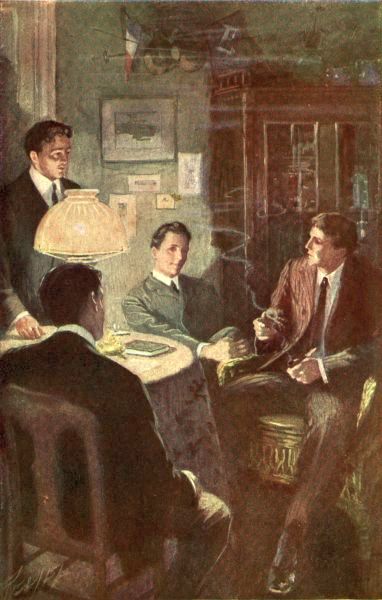
On the Monday night succeeding the Robinson game
the quartet was assembled in Pete’s study. Allan had
the easy chair, Hal and Tommy shared the big table,
and Pete sat on the trunk. The windows were closed,
for the night was cold, and the big hanging lamp diffused
light, warmth, and a strong odor of kerosene
through the apartment. This odor Pete was heroically
striving to mitigate with the fumes of a cob pipe. Hal
had tried the other pipe, but had soon given it up,
avowing discontentedly that Pete ought to keep some
real tobacco on hand for guests who weren’t used to
chopped hay. The bell in College Hall had just struck
nine, and Tommy, for the fourth time, had slid from
the table, pleading press of business, and had been
pulled back by Hal.
“Forget your old business, Tommy,” said Hal.
“Don’t let him sneak,” said Pete. “We’re going
to open a can of corn in a minute.”
“That’s all very well,” Tommy protested, “but
I’ve got things to do. You lazy chaps, who never
study——”
Dismal groans from the opposition.
“Can afford to loaf; but I want to tell you——”
“Of course you do, Tommy,” Allan interrupted,
soothingly, “but we don’t want you to. Be calm,
precious youth; the Purp” (college slang for the
Purple) “will come out just the same, whether you
continue to adorn that desk for another ten minutes
or not.”
“Why don’t you fellows let a couple of weeks go
by without putting out a paper?” asked Pete. “No
one would notice it, and think what a high old time
you could all have being useful for once.”
“Wish we could,” sighed Tommy.
“Tommy, you’re a wicked liar!” said Hal. “You
don’t wish anything of the sort. If you missed an
issue of that old sheet, you’d commit suicide in some
awful manner; maybe you’d come down here and die
of smells.”
“If you’d only put something in it,” said Pete,
“something a fellow could read and enjoy—a murder
now and then, or a lynching. Couldn’t you run a story
with lots of blood? It’s such a dismal paper, Tommy.”
“You fellows might jump into the river,” suggested
Tommy, scathingly. “We’d print your obits.”
“Our which?” Hal asked.
“Obits—obituaries,” he explained in a superior
manner.
“Would you put ’em on the fir?” asked Peter.
“On the fir? What’s the fir?”
“Fir—first page.” Pete mimicked Tommy’s tone.
“No,” said Tommy, when the laughter had stopped,
“not important enough.”
“Crushed and lifeless!” murmured Allan.
“Tommy,” asked Pete, severely, “do you mean
that I’m not enough of a heavy-weight to be dishonored
by having my name on the front page of that old up-country
weekly of yours?”
“The front page is for important news,” said
Tommy, with a wicked smile.
“Such as measles in the grammar school and the
election of Greaves as president of the Chess Club,”
explained Hal.
“Now, I’ll tell you what I’ll do with you, Thomas,”
said Pete. “I’ll bet you anything from an old hat to
a quarter section of land that I can get my name and
a half a column of talkee-talkee on the first page of
the Erskine Purple any time I want to. Now, what
say, Thomas?”
“I’ll bet you can’t,” laughed the other.
“What’ll you bet? Money talks, my son.”
“Oh, most anything. If you want your name on
the front page of the Purple, you’ll have to do some
tall stunts.”
“Of course, that’s what I mean: kill the Dean, or
blow up College Hall, or have a fit in chapel.”
“Or subscribe for the paper,” added Allan.
“Come, Tommy, speak up. What will you bet?”
“Oh, get out, you wild Indian! I’m going home.”
He made another effort to tear himself away.
“Tommy, you’re a coyote: you’re skeered an’
afeared. You know I’d win.”
“Oh, no, I’m not,” said Tommy. “I’ll bet a dinner
for the four of us at the Elm Tree that you can’t get
your name on the front page while I’m on the paper—
Hold on, though; I won’t bet that. I’ll bet you won’t
get it there this year unless it’s merely the name, as a
member of a society, or as having attended a meeting,
or something like that, you know.”
“Thomas, you’re hedging,” said Pete, “but I’ll
take your bet. And just my name isn’t to count; nothing
less than a full paragraph to myself goes. You
fellows are witnesses.”
“We are,” said Allan. “I smell that dinner already.”
“And you see Pete paying the bill,” said Tommy.
“I don’t know who pays, and I don’t care.”
“He cares not who pays for his dinner, so long as
he may eat it,” said Hal. “Wise child, Allan. And,
by the way, talking of eating reminds me. You know
Billy Greb, Allan?”
“I’m going home,” said Tommy.
“(Shut up and sit down, Tommy!) Billy’s getting
up a freshman club table and wants you and me to
join. What do you say?”
“Where’s it going to be?”
“Pearson’s.”
“How much?”
“Six a week.”
“That’s pretty steep, Hal. Besides, I may go to
the track-team table in the spring.”
“I’m going home, you fellows,” announced Tommy
again.
“Will you please shut up?” asked Hal. “Well,
you’d better join until then, Allan; sufficient to the
spring is the evil thereof.”
“Well, I’ll think it over and let you know in a
day or two. When does Greb want to start it?”
“First of the month. If you weren’t a foolish
little sophomore, Tommy, you could come in too.”
“Huh!” answered Tommy, scathingly. “I’ve
seen all I want of freshman club tables. I’m going——”
“How about me, Hal?” asked Pete. “I’d like to
join, if your friend will have me.”
Hal hesitated for an instant.
“Why—er—I’ll speak to him about it. But I think
he’s got his number made up.”
“That’s all right,” answered Pete, quietly.
“But I’ll do my best,” said Hal, hurriedly and
awkwardly. “Maybe——”
“Call it off!” said Pete, with a cavernous yawn.
“If it was my table—” continued Hal, anxious not
to hurt the other’s feelings.
“I know. That’s all right. I can stand it.”
There was the sound of a gently closing door.
“Hello!” Pete exclaimed. “Where’s Tommy?”
The three glanced in surprise around the room.
Then—
“I think,” said Allan, dryly, “I think I heard him
say something about going home.”
The next afternoon Pete found Allan at the gymnasium,
and walked back to Mrs. Purdy’s with him.
He was so quiet that Allan was certain he had something
on his mind. What that something was transpired
when they had reached Allan’s room.
“What sort of a cayuse—meaning gentleman—is
this fellow Greb?” asked Pete.
“I don’t know him very well,” Allan replied, “but
I fancy he thinks himself a bit of a swell. He’s a
Dunlap Hall fellow, and of course you know what that
means.”
“Never heard tell of it,” said Pete. “What is it—a
preparatory school?”
“Yes, it’s— Oh, it’s all right, of course, only
we used to make a good deal of fun of it at Hillton.
You go there when you’re nine or ten, and they give
you a sort of a governess to look after you until you
get old enough to make her life a burden; then they
put you in another house. They’re terribly English,
you know; have forms and fagging; and when you
want a row with a chap, you have to notify the captain
of your form, and it’s all arranged for you like a regular
duel, and you go out back of one of the buildings,
and somebody holds your coat for you and somebody
else mops your face with a sponge, and you try and hit
the other fellow in the eye. It’s like a second edition of
Tom Brown. Think of getting mad with a chap in the
morning and having to wait until afternoon to whack
him! There’s no fun in that. You’d like as not want
to beg his pardon and buy him a ‘Sunday’! But they
think they’re a pretty elegant lot, just the same.”
“Think of that!” sighed Pete. “And I might
have gone there, if I’d known, and had a nurse and
all the scrapping I wanted. So this fellow Greb thinks
he’s the whole thing, does he? Guess that’s the reason
Hal was hunting a hole when I asked myself to join.
I didn’t know you were so mighty choice about who
you ate with. Out there we ask whoever comes along.
I guess you fellows thought I was loco, didn’t
you?”
“Thought you were what?”
“Why, crazy, inviting myself like that.”
“Nonsense, Pete; we all understood. There was
no harm done. It’s just that Greb wants to get up a
table of fellows he knows.”
“Does he know you?”
“Why—er—I’ve met him, of course.”
“And he could have met me if he’d wanted to,
couldn’t he?”
“I suppose he could, but he doesn’t know about
you.”
“Wouldn’t care to, I guess.”
“Oh, nonsense, Pete; you’re making a lot out of
nothing.”
“Dare say he thinks I eat in my shirt-sleeves and
swallow my knife,” continued Pete, gloomily. “Maybe
he thinks I live on horned toads and grasshoppers.”
“But, I tell you, he doesn’t know you.”
“I guess he’s heard of me,” answered Pete.
“Guess he knew you and Hal and I were traveling
together.”
“Look here, Pete; if you want to join a club
table——”
“Oh, that’s all right. Moocha wano club table.”
“Oh, all right,” answered Allan, a bit puzzled.
“I’m going to join a club table on the 1st,” said
Pete.
“Oh!” said Allan, again. “What—that is, whose
is it?”
“Pete Burley’s.”
“What! How—how do you mean?”
“Mean I’m going to run my own grub-wagon. And
I want you to join.”
“But— Look here, Pete, I don’t believe you can
find a decent place to take you. Everything’s full up
already.”
“Where is there a decent place?” asked Pete,
calmly.
“Well, there’s Pearson’s, of course, but you
couldn’t get in there. And——”
“Why couldn’t I?”
“Because she takes training tables chiefly, and is
pretty particular, anyhow.”
“Yes, that’s what she told me,” said Pete.
“Then you went there?”
Pete nodded.
“I could have told you you wouldn’t get in there.
There’s a pretty good place further along——”
“Oh, that’s all right. We start on the 1st.”
“Start where?”
“Mrs. Pearson’s.”
“Pete, you’re lying!” gasped Allan.
“No, straight talk. I engaged the front corner
room on the second floor. It’s a right nice-looking
place: paper on the walls, fireplace, lounge, window-seat——”
“But—but how’d you do it?”
“Oh, that’s all right. We had a little pow-wow.
It’s going to be six a week and no extras.”
“You crazy Westerner!” said Allan, in bewildered
admiration. Then, “But you haven’t got any one to
join, have you?”
“Not yet; but that’ll be all right. It’s going to
be select, you know; eight in all. There’ll be you and
me, that’s two; and Hal——”
“I don’t believe he’ll come,” said Allan, doubtfully.
“You see, Pete, he’s promised Greb.”
“I don’t guess Greb will have a table,” said Pete.
“Why not?”
“Well, where’s he going to put it?”
Allan stared. Then——
“Do you mean that you’ve got Greb’s room?” he
exclaimed.
“’Twa’n’t his,” answered Pete, coolly. “He hadn’t
settled the matter, and so I said I’d take it and put
down a forfeit. And there isn’t another decent place
for a high-toned, pedigreed chap like him to go to.”
“Pete Burley, you’re a wonder!” breathed Allan.
“Think Hal will join?” asked Pete, unmoved by
the tribute. Allan nodded silently.
“That’ll make three, then. Now, of course, I know
lots of fellows who would come in if I asked ’em, but,
as I just said, this thing is going to be select; it’s
going to be the selectest table in town. So you tell
me who are the top of the bunch in our class, and I’ll
go and fetch ’em in if I have to rope ’em and hog-tie
’em.” Pete took out a pencil and began to write on
the back of an envelope.
“Of course, it’s all poppycock,” said Allan, “but—well,
there’s What’s-his-name, the class president,
and Maitland, and Poor——”
“Whoo-ee! I’m glad you thought of Poor.”
“And Armstrong—only he lives at home, I think—and
Mays, and Wolcott, and—and Cooper—Cooper
of St. Eustace, I mean; the other chap’s an awful
duffer—and Van Sciver——”
“Whoa, Bill! That’s eight—eleven, counting us
three; guess I can get enough out of the list. Besides,
I must ask Greb; mustn’t slight Greb.”
“You’re not going to ask him?”
“Ain’t I? Just you keep your eyes peeled and
you’ll see.” He got up and carefully put the list in
the big yellow leather wallet he carried. “Guess I’ll
see a few of ’em this afternoon. Want to come along?”
Allan shook his head vigorously.
“Not me, Pete. I don’t want to have to testify
against you before the faculty. How do I know what
you’ll do to those chaps to make them join?”
“Oh, say, Allan!” Pete turned at the gate. “Remember
those ducks we saw on the river last week?
Well, let’s go after ’em Thursday morning, will you?”
“Shooting, you mean? I haven’t a gun.”
“You take my shot-gun and I’ll use the rifle. I’ve
shot ducks with a rifle before this.”
“All right, Pete, but like as not the silly ducks
won’t be there Thursday.”
“Well, we’ll find something to shoot, all right, if
it’s just squirrels. We’ll have nothing to do Thursday,
and can stay as long as we like; make a day of it.
Maybe we can find some place to have dinner and
won’t have to come back here. I’m getting mighty
tired of commons, Allan. Well, it’ll be considerable
different when we get the table started, won’t it?”
“I suppose so,” answered Allan.
“Say, do you think Hal or Tommy would go
along?”
“Ducking? Tommy might, but Hal’s going to sign
off and go home over Saturday.”
“Lucky chap!” sighed Pete. “Wish I was.” He
looked thoughtfully across the leaf-strewn college yard.
“Suppose I could, but—guess the old man would raise
Cain. Allan!”
“Yep?”
“I’d give a hundred dollars for sight of a mountain.
Well, I must jog along.”
CHAPTER IX THE DUCK HUNT
Thanksgiving Day dawned cloudy and still, with
a hint of snow in the air. Allan slept late, in enjoyment
of holiday privileges, and Pete was banging at
his front window before he had finished dressing.
They reached Brown Hall a bare two minutes before
the doors closed, and hurried through a light breakfast.
Ten o’clock found them walking briskly along
the Morrisville road, some four miles from college, having
crossed the river by the county bridge and turned
to the left through the little town of Kirkplain, which
is opposite Centerport. Allan wore a white sweater,
over which he had pulled an old coat; the pockets of
the latter were bulging with shells. Pete wore a canvas
hunting-coat and carried his cartridges in a belt.
The Winchester was slung over his shoulder, and altogether
he made a formidable appearance. Allan had
the shot-gun. Tommy had refused to accompany them,
pleading, as ever, a press of business; Hal had taken
himself off to the bosom of his family.
So far they had seen nothing to shoot at save a
red squirrel. Allan had impulsively sought to bring
that down, but had failed for the excellent reason that
he had forgotten to load. The squirrel had seemed to
appreciate the humor of the incident and had chattered
in their faces from the bough of a dead maple-tree.
Allan had been glad afterward that the gun hadn’t
gone off.
The blunder reminded Pete of a parallel case in
his own experience, and he had told it so well that
Allan had been forced to sit on a rock in order to
recover from his fit of laughter. This story led to
others. Pete proved a perfect mine of interesting
narratives on hunting adventure, some of them
laughable, some of them so exciting that Allan forgot
how heavy the shot-gun under his arm had
become.
When they struck the cross-roads, some three miles
from Kirkplain, they were in the best of spirits. They
took the road to the left, which leads down to the river
and the ferry to Harwich. At the ferry they left
beaten tracks and followed the river-bank.
The travel was slower now, both because they had
to break their way through underbrush, make detours
around inlets, cross brooks, and climb an occasional
fence, and because they were keeping their eyes open
for game. Allan had never done much hunting, and
he was becoming quite excited at the prospect.
Pete led the way, forcing his big body through the
bushes with scarce a sound, while Allan could make
no progress without causing enough disturbance to
frighten any self-respecting duck a mile distant. Pete
seemed to realize this fact, for he frequently looked
back at Allan with pursed lips and violent shakes of
his head, and then glanced anxiously at the river.
After a half mile of this, Pete stopped in a little clearing
and leaned his rifle against a bush. Allan joined
him, very much out of breath.
“See anything?” he panted, hoarsely. Pete shook
his head.
A few yards away lay the river, sluggish and leaden
under gray sky. At their backs the ground rose gently,
and the reeds and bushes gave place to a thick growth
of trees. A few rods further up-stream was a little
promontory. Everything was very still save for the
chirp of the birds in the woods and the infrequent
screech of a locomotive-whistle from toward Centerport.
Across the river and further down-stream the
little hamlet of Harwich nestled under its leafless elms.
Pete sat down and drew forth his corn-cob pipe.
“Might as well take a rest,” he said. “Smoke?”
“No, thanks.” Allan didn’t possess a pipe of his
own, and wouldn’t have attempted Pete’s for a ten-dollar
bill; the very smell of it frequently made him
faint. Pete stuffed the blackened bowl full of dry
tobacco and lighted it. Then he leaned back on one
elbow and puffed contentedly for a moment. Allan
nibbled the end of a grass-blade and stared across the
empty stream.
“This is about the place where we saw those birds
the other day,” said Pete, finally. “Guess they’ve
pulled their freight. Sorry!”
“What’s the diff?” asked Allan. “We’ve had the
walk. Besides, maybe we’ll find a gray squirrel if we
go back through the woods.”
“Anyhow, I don’t guess there’s any use going farther
up the river. What time is it, I wonder? Did
you bring your watch?”
“Quarter of twelve,” said Allan. “Getting
hungry?”
“I could eat a saddle!” answered Pete. “Supposing
we go back and take the ferry over to Harwich?
Is there any place there we could get a feed?”
“I don’t know, but I should think there ought to
be. Got any money?”
Pete sat up suddenly and searched his pockets.
“Not a red!” he exclaimed. “I forgot to change.”
“Same here,” said Allan, dolefully. Pete picked
his pipe up from where it had fallen and relighted it.
Then he threw himself onto his back, put one leg over
the other knee, and chuckled.
“I don’t think it’s so terribly funny,” said Allan,
aggrievedly. “We can’t get home until three or four
o’clock. Wish we’d had sense enough to bring lunch
with us.”
“Yes; a half dozen sandwiches and a piece of pie
wouldn’t go so bad, would they? Nice thick sandwiches,
with ham or beef inside, and lots of butter
and mustard. And—what kind of pie do you like
best, Allan?”
“Oh, shut up, you!”
“I like pumpkin—or, maybe, apple. Yes, apple’s
pretty hard to beat. We’ll have apple; about three
pieces each.”
Allan groaned and threw a handful of dried grass
into Pete’s face. Pete brushed it aside and went on:
“When we get the table going, we’ll get Mother
Pearson to give us apple-pie every night.”
“Yes, when you do!” growled Allan.
“Oh, that’s all right, my son. Just because the
only fellow I’ve found wouldn’t join, you needn’t think
that table isn’t going to be. Hal’s going to introduce
me to Maitland and Van Something——”
“Van Sciver.”
“If you say so. And Cooper; and I’ll bet you a
bunch of cows I get that table filled up inside of a
week. Want to bet?”
“I don’t bet,” said Allan, aggravatingly. “Besides,
if I were you, I’d go slow on betting until I’d
paid for that dinner.”
“What dinner?”
“The one you wagered with Tommy.”
“Ginger! I’d clean forgotten that. But that’ll
be all right.”
“You’ll lose.”
“Lose nothing! Just you hold your horses and
keep your eye on your Uncle Pete. Let’s think what
we’ll make Tommy order for us at that feed.”
“Let’s go home and get something to eat,” said
Allan, irritably.
“Home? Not a bit of it! We’ll find a house and
beg a Thanksgiving dinner, that’s what we’ll do. Saddle
up and let’s mosey along.” He dropped his pipe
into his pocket and got to his feet. “There’s bound
to be a house somewhere’s about; look at how the woods
have been cleared out here. Shouldn’t wonder if we
found eight courses and a Hinglish butler.”
“One course’ll do me,” groaned Allan, as he got
up, “and I don’t care how coarse it is.”
“We shot a man out in our county for making
a joke like that, and he was a heap homelier than you—
Listen!”
Allan listened. From beyond the little promontory
came the unmistakable quack of a duck. Pete pumped
a cartridge into the barrel of his carbine and tiptoed
toward the shore. Allan seized his shot-gun, fell over
a stone, and followed. Pete waved him back, and then
returned.
“They’re around that point. We’ve got to go
mighty quiet; if we don’t, they’ll fly. Keep low
until you get to the pebbles there, and then get down
and crawl. Come on!”
Allan followed, watching each footstep and trying
not to breathe. A clump of trees came down almost
to the water at the point, and hid what was beyond.
But when Allan had, by painfully wriggling his body,
stomach to earth, reached the little expanse of pebbled
shore and Pete’s side, his heart leaped for joy. Before
them was a little cove, and in it, peacefully moving
about its surface, was a flock of ducks. How many
there were, he couldn’t tell; there seemed dozens at
first. He threw his gun to his shoulder and squinted
along the barrel.
“Hold on!” whispered Pete. “We’ll have to
scare ’em up somehow.”
“What for?” Allan whispered, anxiously.
“You don’t shoot ducks in the water, you idiot!”
answered Pete. “Here, I’ll raise ’em with this stone.
Be ready and take ’em as they rise. Wait till you
get two together, but shoot quick, and let ’em have
both barrels.”
He dug a small stone out of the sand and aiming
at the middle of the flock, let drive. There was a
sensation among the ducks, but not the panic Pete
had looked for. They swam away from the spot where
the stone sank, and made a good deal of fuss, but not
a duck took wing. Pete grunted and threw another
rock. The result was the same. The ducks discussed
the matter volubly among themselves and swam around
in circles, but they didn’t show any intention of flying
away. Pete was disgusted.
“I’m going to knock that old drake’s head off,” he
whispered. “I guess that’ll bring ’em up. All ready?”
Allan nodded, clutching his gun desperately and
still squinting along the barrels. There was a loud
report, then another, and a third. Two ducks floated
quietly on the water. The others, with wild quacks
of dismay, paddled to shore and disappeared into the
bushes.
“Well, of all crazy ducks!” ejaculated Pete, staring
after them.
“They—they didn’t fly!” said Allan, breathlessly.
“Fly! Why, the things are clean locoed! They’re
not ducks, they’re—they’re—I don’t know what they
are!”
Pete stared about him in bewilderment.
“They didn’t fly, and so I shot,” Allan explained.
“And we only got two!” said Pete, disgustedly.
“But they went up there,” said Allan. “Why
can’t we go after them?”
“And shoot ’em on land?” Pete shook his head
slowly. “Allan, I’ve done fool things in my time, but
I never shot ducks on land.”
“I don’t see what difference it makes,” objected
Allan.
“Maybe not; maybe you’re used to crazy ducks.
I’m not. I refuse to have further dealings with such—such
freaks of nature. How we going to get those?”
he asked, nodding at the dead birds.
“We ought to have brought a dog.”
“Or a rowboat. Well, here goes!” He sat down
and took off his shoes and stockings. Then, with his
trousers rolled up as far as they would go, he waded
out into the water. Allan sat down on the bank and
promised to rescue him if he went over his depth. Pete
reached the first bird—it was the drake he had shot,
and it lacked a head—and held it up. He studied it
a moment, shaking his head slowly.
“What’s the matter?” called Allan.
“Oh, nothing; nothing at all. Only I never saw
a duck like this before in my life!”
“Why, what’s the matter with—” began Allan.
Then the words stopped and he jumped to his feet.
“Sorry you don’t approve of them,” said a voice
behind him, “but they’re the best I’ve got!”
CHAPTER X DINNER FOR TWO
The regret, politely expressed though it was, had
the effect of a thunderbolt on both Allan and Pete,
neither of whom had heard or seen anything to suggest
the presence of a third person on the scene. Allan’s
surprise was ludicrous enough, but the picture presented
by Pete—mouth and eyes wide open and the
headless duck held stiffly at arm’s length, his whole
attitude suggesting that the icy water in which he stood
had suddenly frozen him stiff—caused even the newcomer
to smile a little under his mustache.
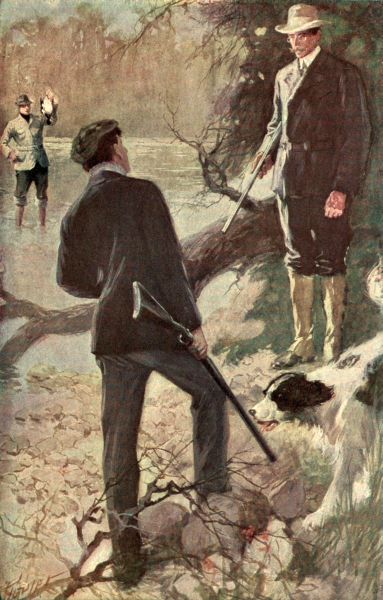
The latter was a rather stout gentleman, of middle
age, with ruddy cheeks, piercing dark eyes, and an
expression of extreme self-possession. He wore a suit
of rough gray tweed and leather leggings and carried
a shot-gun. At his side, exhibiting two rows of very
white teeth, stood a red and white setter. Allan liked
neither the gun nor the dog, and envied Pete his chilly,
but more distant, position. The newcomer glanced
silently from Allan to Pete. It was the latter who
found his voice first.
“Those your ducks?” he asked.
The man nodded. Pete looked again at the drake
in his hand.
“Oh!” he said.
The dog growled and Allan observed that the man’s
gun was cocked and that it was held in a position that
was far from reassuring. Pete regarded the man with
a puzzled expression.
“Look here, partner,” he asked, “are those tame
ducks?”
“They are, sir.”
Pete’s face cleared; a grin overspread his features,
and he chuckled aloud as he waded back to shore.
“You seem amused?” said the man, politely but
with a note of interrogation.
“Well, I’m mighty relieved, as the broncho said
when he bucked the man off. You see, I thought they
were wild ducks, and when they wouldn’t fly, I was
afraid they were degenerating. Of course, as they
were tame ducks, it’s all right.” Pete waded out of
the water and the setter laid back his ears and growled
suspiciously. “Hello, dog!” said Pete, as he went
toward where he had deposited his shoes, stockings, and
rifle.
“Just stay where you are, please!” said the man.
He waved toward Pete’s possessions. The dog trotted
over to them and stood guard, watching their owner
intently. Pete’s grin broadened. He tossed down the
duck he had rescued.
“There’s another out there,” he said. “Guess the
dog could get it, couldn’t he?”
“Where do you gentlemen belong?” asked the man.
The gentlemen exchanged glances. Then—
“Centerport,” answered Allan.
“Students?”
“Yes, sir.”
“Humph!” said the owner of the ducks. “Want
me to believe you thought my ducks were wild ones,
do you?”
“You don’t suppose we’d walk six miles to shoot
tame ones, do you?” asked Pete, scathingly. The man
shrugged his shoulders.
“I suppose you’re ready to pay for the pair you’ve
shot?”
“Glad to,” answered Pete. “How much?”
“Well, I guess a dollar will do. They were both
Pekins.”
“Can’t say I’ve had a dollar’s worth of sport,” said
Pete, “but here’s your money.” He put a hand into
his trouser pocket. Then he stopped short and looked
with dismay at Allan. The owner of the ducks waited
silently.
“Guess you’ll have to trust us, partner,” said Pete.
“We both came away without any money.” Allan,
fearing arrest would follow this announcement, held his
breath. But the man only smiled courteously.
“Very well,” he answered. “There is no hurry.”
“Thanks!” said Pete. He looked inquiringly
toward the dog. “How about my shoes and stockings?
It’s a bit chilly.”
“I fancy your walk back will warm you up,” said
the man. Pete whistled.
“Going to keep ’em for security, eh?” he asked.
The other nodded gravely.
“Couldn’t compromise, I suppose?” Pete insinuated.
“That carbine’s worth a good bit more’n a dollar.
It’s hard walking without any shoes.”
“I dare say,” was the reply. “But maybe if you
stub your toe a few times, it’ll remind you to find out
whether a duck is domestic or wild before you shoot it.”
“Look here, Mr. Whatever-your-name-is,” said
Allan, explosively, “you’ll get your old dollar. We’re
not thieves. But you’ve got to let him have his shoes
and stockings.”
“If I don’t?” asked the man, with a flicker of
appreciation in his eyes.
“Why—we’ll just take them, that’s all.”
“I wonder if you could do it?” said the other,
measuring the two with his eyes. “I almost believe
you could.”
“Well, then—” began Allan.
“But of course you’d get damaged in the process,”
continued the other, cheerfully. “Now, look here;
you’ve killed my ducks, and it’s only right that you
should pay for them. Isn’t that so?”
“Yes; but if we have no money——”
“That’s it,” was the answer. “It doesn’t seem
probable that you two students would come six miles
from college without any money. Where are you going
to get your dinner?”
“There isn’t going to be any dinner,” said Pete.
“You can believe us or not, just as you like, and be
hanged to you! If you’ll put down your gun, I’ll
lick you.”
“That’s an honest offer,” said the man, smiling
outright for the first time, “but it isn’t just practical.
I rather think you could do it, and I don’t see why I
should be licked merely because you have killed my
ducks. Do you?”
“I guess that’s so, partner,” Pete answered. “But
something’s got to be done. I can’t walk home without
any shoes.”
The man received this assertion in silence, glancing
thoughtfully from Pete to the articles in discussion.
The dog looked suspiciously from Pete to Allan. Allan
scowled at the dog’s master. The latter spoke:
“Here, Jack!”
Jack went to him unwillingly. Pete picked up his
shoes and stockings.
“Thanks!” he said. Then he put them on. The
man watched him smilingly. When the last lace was
tied, Pete got up.
“My name’s Burley,” he said. “I’ll come over
with your money to-morrow or next day. Come on,
Allan. Good day, sir.”
“You’re forgetting your rifle,” said the man. Pete
looked puzzled. Then—
“Do I get that, too?” he asked.
“Yes, you might as well take that along, I guess.”
Pete went back and got it. “Where you going now?”
asked the man.
“Home,” said Pete.
“But how about dinner?”
“Well, maybe we’ll beg something to eat on the
way. I guess there ain’t any place around here where
they’d take a Winchester carbine as security for a
Thanksgiving dinner, is there?” asked Pete, with a
smile. The stranger answered the smile.
“Hardly. But I tell you what you do. Strike
straight up through the woods here over the hill till
you come to a lane. Keep along that for a quarter of
a mile until you come to a big brown house standing
back from the lane. You go there and tell ’em you’re
hungry, and you’ll get plenty to eat. Ask for Mr.
Guild. Don’t forget, now; first house you come to.
There isn’t another for a mile further, so you’d better
follow my advice.”
“Thanks!” said Pete. Allan echoed him.
“All right,” said the man, smiling kindly. “Good
morning, gentlemen.”
“Good morning,” they answered. They started off
through the woods in the direction he had indicated,
but after a few yards Allan turned and looked back.
The man, with the setter at heel, was moving along
a path at right angles to them. He glanced up and
waved his hand.
“We’re sorry about the ducks,” called Allan.
“That’s so,” Pete shouted.
The man nodded good-naturedly. Then the trees
hid him.
Allan and Pete walked on in silence for a ways.
Then—
“Say, he wasn’t such a bad sort, was he?” asked
Allan.
“No, he’s all right. I don’t believe he was going
to do any more than scare us, anyway. Guess he was
just having some fun with us.”
“Wasn’t it funny about the ducks being tame
ones?” asked Allan, presently, as they left the woods,
climbed over a stone wall, and struck off up a lane.
“That’s a joke on me,” said Pete, laughing. “Ginger!
How was I to know that folks left their old ducks
floating around loose all over the country here? Out
our way, when you see a duck in a lake or on the
river, it’s a wild duck, and you just naturally go ahead
and shoot it. That’s what bothered me—those fool
ducks sitting there and letting me throw rocks at ’em.
Next time— Say, I guess that’s our ranch over there.”
Allan’s gaze followed the other’s.
A turn in the lane laid bare a broad expanse of
lawn, interspersed with ornamental trees and shrubbery,
beyond which stood a long, rambling house of
brown-shingled walls and numerous red chimneys.
Farther off were stables and barns. From the chimneys
the smoke arose straight into the still air, suggesting
warmth and good cheer. The boys paused and looked
longingly across the lawn.
“Shall we try it?” asked Allan.
“Sure!” Pete said. “I’m so hungry I could eat
cedar bark.”
“But what will they think?” Allan demurred.
“It isn’t as though it were a farmhouse, you know.”
“That’s all right; the sweller the folks the better
the rations. Come on; let’s cut across here.”
“We’ll just ask for some bread and a glass of milk,”
suggested Allan.
“Bread and milk? Ginger! I’ve got to have pie
and hot coffee!”
“But we’ll go to the back door, won’t we?”
“Like tramps? Not a bit of it. We’ll go to the
front. What was the name he told us?”
“Guild.”
“That’s right; Guild. Hello! look there; there’s
another one of those setter dogs. Looks just like the
beast the fellow back there had, doesn’t it?”
But this dog only observed them indifferently from
a respectful distance, and then trotted around the corner
of the house as they mounted the broad steps,
crossed a wide veranda, and pushed the ivory button
beside the big oaken door. Allan strove to appear at
ease, but in reality looked as though he had come to
steal the family silver. A neatly-aproned maid opened
the door.
“Is Mr. Guild in?” asked Pete, with unruffled
composure.
“Yes, sir. Will you please walk in?” They followed
her into a library, in which a wood fire was
crackling merrily in the chimney-place. Allan felt
like an impostor. Pete calmly selected the easiest
chair and lowered himself into it with a deep sigh of
contentment.
“This is something like!” he said. “I’ll bet we’ll
get two or three kinds of pie, Allan.”
But Allan, sitting uncomfortably on the edge of a
straight-backed chair, only smiled distressedly and listened
to the footsteps coming nearer and nearer down
the uncarpeted hall. The footsteps reached the door;
Pete and Allan got to their feet as the door swung
open.
“Mr. Guild—” began Pete. Then he stopped
short.
Before them was the owner of the ducks!
CHAPTER XI THE CAPSIZED BOAT
Allan and Pete didn’t forget that day for a long
time. In retrospect, it was the brightest one between
the beginning of the college year and the Christmas
recess. For long afterward Pete would point with
pride to his performance at table on that day, and
declare that he believed that should he live to be a
hundred he could never eat as much again. Dinner
began at two o’clock and ended, not because of lack
of further viands but because of inability on the part
of the guests, at half-past four.
The family at Hillcrest consisted of Mr. Guild, his
wife, a pleasant-faced and sweet-voiced woman several
years his junior, and a three-year-old son and heir,
who did not make his appearance at table but who was
afterward ceremoniously introduced in the nursery.
Both host and hostess appeared to have no other desire
in life than to make the two guests happy and utterly
ruin their digestions.
Even Pete had had momentary qualms over appearing
at table in the unconventional attire of shooting-coat
and flannel shirt, but their objections had been
politely overruled, and by the time the turkey had made
its appearance they had both lost sight of the fact that
they were not dressed in the mode. It was while carving
the turkey that the morning’s episode was recalled.
“This, Mr. Burley,” said their host, “is only
turkey. Had there been more time, we would have
had a duck prepared for you.”
Allan wondered, while he laughed, whether Mrs.
Guild had heard the story of the duck-hunt. The demure
expression about her mouth led him to suspect
that she had.
After dinner they adjourned to the library again,
and Pete was induced to smoke a cigar, although, as
Allan guessed, he would much rather have used his
corn-cob pipe. Mrs. Guild disappeared for a while,
and Pete and Allan stretched themselves luxuriously
in front of the fire and listened to their host and did
a good deal of talking themselves. Mr. Guild led them
to tell of their college life, and displayed such sympathy
with their views and ambitions that at the end
of an hour the two boys had become his enthusiastic
admirers. He knew the West like a book, and Pete
became quite excited—for Pete—swapping recollections
and stories of “out there.”
After a while Mrs. Guild appeared again, and they
went into the drawing-room and sat silent and happy
in the firelight while she played for them. She apologized
for knowing no college songs, but Pete gallantly
assured her that he preferred “straight music.” Still
later there was a four-handed game of billiards in an
upper hall, in which Mrs. Guild and Allan were badly
defeated by the host and Pete. Then came the visit
to the pink-hung nursery and the formal introductions
to Master Thomas Guild, Junior. And by that time
it was after eight o’clock, and a surrey stood at the
door, waiting to bear them back to Centerport.
“You must come out some afternoon,” said their
host, “and let me show you around. Both Mrs. Guild
and I have enjoyed your visit, and we want you again.
We don’t have so many callers but what a couple more
will be welcome at any time. And when you come, it
must be to stay to dinner with us.”
And Allan and Pete readily agreed, and kept to
their agreement. They each voted Mr. Guild a fine
fellow, and each lost his heart to the hostess. The
dollar was duly paid, and they received a receipt “in
full for two ducks. Trusting to receive a continuance
of your patronage, I remain, Yours faithfully, Thomas
A. Guild.” There was another visit to Hillcrest the
following week, and several more before the occurrence
of the incident which, for a time at least, put thoughts
of visiting out of mind.
On the Monday after Thanksgiving and the duck-hunt,
the story of which was now college property,
Pete stamped into Allan’s room just before dinner,
kicked the snow from his shoes against the chimney,
tossed his sombrero onto the desk, and subsided into
the armchair with a mighty sigh of triumph.
“That’s all right,” he announced, heartily but
vaguely.
“What?” asked Allan, momentarily abandoning
his struggle with Herodotus.
“Club table. I’ve got my eighth man.”
“Not really? Who have you got?”
“Well, there’s”—he took a list from his pocket—“there’s
you, and Hal, and Wolcott, Poor——”
“Pete, you’re lying!”
“—and Cooper, Van Sciver, Maitland, and your
Uncle Pete.”
“But—but how’d you do it, Pete? How’d you
get them to join? Offer to pay half their board, or—or
what?”
“Oh, it just took a little dip-lo-macy, my son; just
a little dip-lo-macy. I started out with you and Hal.
I got Hal to introduce Poor. Then I told Poor I was
getting up a representative table, and got him to promise
to join if I secured Maitland and Van Sciver. He
introduced me to Van Sciver. I told him that you
and Hal and Poor had promised, and he came right
over to the party. You were quite a card, my son.
I had no trouble with Cooper when I told him you
were one of our principal sights. And so it went.
After I’d got Poor and Cooper and Van Sciver cinched,
there was nothing left to do but receive and consider
applications. I could have had twenty, but I set out
to make this table exclusive, and exclusive it’s going
to be, if I have to get the Dean—hang him!” Pete
frowned a moment in silence. Then, “Wolcott was
the last to join; he agreed ten minutes ago; I just
came from his room.”
“Pete, you surely are a lucky dub!” said Allan.
“I don’t believe there’s another fellow in college that
could have got all those chaps together!”
“There wasn’t much luck about it,” said Pete,
calmly. “It just took hard work. Why, I haven’t
studied a lick since Wednesday, and I’ve cut half my
recitations. I guess that’s why the Dean wants to
see me.”
“Have you heard from him?”
“Yes. I had a polite postal card from him yesterday,
and an impolite one to-day.”
“But why——”
“Well, I didn’t have time to call on him yesterday;
I was too busy seeing fellows. It seems to have
made him some angry.”
Allan whistled expressively.
“You ought to have gone, Pete. He’ll raise thunder
with you now; see if he don’t.”
“Oh, that’s all right; he can’t do any worse than
expel me. And I’m getting pretty tired of this shop,
anyway; there isn’t much doing. And now that I’ve
got the table made up, all the excitement’s over with.
I’ve thought all along I wouldn’t be here much after
Christmas.”
“Oh, shut up that! Who’s going to run the table,
if you go and get fired? And what do you suppose
I’m going to do, you idiot?”
“Oh, I guess you wouldn’t care,” said Pete, sheepishly.
But he seemed rather pleased when Allan threw
Fernald’s Selections at his head.
“Well, maybe he’ll let me off easy this time; just
suspend me, perhaps.”
“You’d better go and see him right away. But
you can’t until to-morrow, now.”
“Oh, yes; I guess I’ll call at his house to-night.”
“He doesn’t like you to, they say,” cautioned
Allan. “If I were you, I’d wait until morning.”
“No; better have it over with. I’ll drop around
afterward and tell you about it. Coming to dinner?”
Allan pleaded study, and Pete took himself off.
As it turned out, the Dean was merciful and Pete
was merely placed upon probation—a fact which appeared
to amuse him vastly.
“It’s just like old times,” he explained to Allan
and Hal, the latter having come in to recount the
wonderful things which had happened to him during
his visit home. “Out in Colorado, I was most always
on probation. Used to feel downright lonesome when
I wasn’t.”
“That’s all well enough,” said Hal, “but you want
to be careful, for old Levett’s the very dickens if you
get too gay with him. First thing you know, you won’t
know anything.”
“Don’t now,” answered Pete, promptly and cheerfully.
“But I wouldn’t be surprised if something did
drop. The fact is—” he hesitated, sighed dolefully,
and shook his head, “the fact is, I’ve been feeling lately
that something unpleasant is going to happen to me.
I guess it’s a—a premonition.”
His tone was quite sad, and Allan and Hal stared
at him in silent surprise. Then—
“What’s the matter with you, you idiot?” asked
Allan.
“Nothing; I dare say it’s just foolishness, but
somehow—” He sighed again. “Well, that’s all
right,” he went on, with an evident effort at cheerfulness.
“Have a good time, Hal?”
“You’re off your feed, that’s what’s the matter with
you,” said Hal, severely. “Your liver’s out of whack.
Better see the doctor.”
“What’s probation, anyway?” asked Allan, lightly.
“It’s likely to happen to any one.”
“It isn’t that,” Pete replied, dolefully. “But I
don’t want to talk of my troubles,” he continued, with
martyr-like complacency. “Tell us what you did, Hal.”
“Oh, you’re plumb woozy!” exclaimed the latter.
Nevertheless, he consented to tell again of the remarkable
events which had transpired during his absence,
and Pete’s melancholy disappeared. It was a peculiar
feature of it that during the following week it possessed
him only occasionally. But when it did, he
seemed in the uttermost depths of melancholy—a melancholy
quite as mysterious and remarkable to his
friends as the celerity with which he recovered on each
occasion. Hal declared over and over that he was
“woozy”—a term of doubtful significance, but quite
satisfying to the user—and Tommy hinted at overstudy.
This was among themselves. When Pete was
present, they merely called him a fool, and let it go
at that.
It was the first day of December that witnessed
the advent upon the scene of a new character in our
story. A wagon stopped in front of Mrs. Purdy’s in
the afternoon and an expressman deposited a small
box inside Allan’s door. He found it there when he
returned from his last recitation. It had slats nailed
across the top, and from its dark recesses came strange
sounds. Allan stared. The sounds resolved themselves
into the plaintive mewings of a kitten, and Allan recollected
his request to his mother—a request long since
forgotten by him, but evidently well remembered by
her. He tore off a couple of the slats and lifted out a
six-weeks-old kitten.
It was a pathetic little white object, with two black
spots on its back and weak-looking pale blue eyes which
blinked inquiringly at him. Its mouth opened, and the
appealing cry was repeated. Allan set it down and
raced for the kitchen. When he returned, he carried
a huge bowl of milk.
The kitten was roaming disconsolately about the
floor, but at sight of the milk trotted up, and apparently
strove to commit suicide by overeating—an intention
frustrated by Allan, who removed the bowl
finally and took the kitten into his lap in front of the
fire. It seemed to have suddenly grown to twice its
size, and instead of the heart-rending mews, Allan heard
a faint but enthusiastic purring as the poor little object
curled itself up in his arm and blinked its gratitude.
Presently it went fast asleep and, rather than disturb
it, Allan sat there for almost an hour, with his books
just out of reach.
That evening they named it. Tommy wanted something
patriotic: Erskine, he thought, was just the thing.
Hal showed the possession of an unsuspected streak of
sentiment and clamored for Hortense. Allan, recollecting
the fact that the mother’s name was Edith
Cinnamon, was in favor of calling the offspring Clove
or Nutmeg. But Pete, who had been gravely examining
the kitten at arm’s length, took his pipe from between
his lips, and with the stem tapped the two black
spots on its back.
“Two Spot,” he said, with finality.
Two Spot it was. And a few days later neither
of the others would have changed the name for any
consideration, since, as Tommy sadly expressed it,
“Poor old Pete had named her.”
That first day of December was memorable not only
for the arrival of Two Spot, but for the first gathering
at Pete’s club table. Of those beside our friends who
composed the table, it is not necessary to speak at any
length.
Poor we already know very slightly. Wolcott,
Cooper, Van Sciver, and Maitland were average fellows
who had gained prestige for one reason or another,
among their companions. It was a fact that Pete had
succeeded in gathering together what might have been
called the pick of the freshman class. That he had
been able to do so was partly because of his tact and
powers of persuasion and partly because freshman club
tables were so seldom formed at Erskine that the
project had the flavor of the unusual.
Dinner was the first meal, and it was a very jolly
one. There were one or two introductions to be made,
and these Pete performed with his usual breeziness.
After that the eight members sat down, Pete thumped
the bell commandingly, and the table began its official
existence—an existence which endured for four college
years.
By the time the roast beef and vegetables made their
appearance the ice was very thoroughly broken. When
the cabinet-pudding and fruit came on, good-fellowship
reigned supreme, and long after the last plate had been
pushed aside the members still sat about the table, as
though loath to leave. It is doubtful if there was a
single one of them who did not, mentally at least, thank
Pete Burley for including him in his club table.
One gusty winter afternoon, four days later, Pete
appeared at Allan’s room at about three o’clock. He
wore his thickest sweater and a pair of woolen
gloves.
“I’m going up to see the Guilds. Want to come
along?”
“You know plaguey well I can’t,” said Allan, impatiently.
“I’ve got all this stuff to do.” He indicated
the litter of books and papers hopelessly. Somehow,
of late the Midyears had seemed perilously near.
“Sorry. I’ll tell ’em you said ‘How.’ I think
I’ll take a boat and row up.”
“You’ll what?” gasped Allan. “Why, it’s an easy
three miles by the river.”
“That’s all right; I feel like a little exercise.”
“You’re a chump if you do,” answered the other,
irritably. “How’ll you get the boat back?”
“I’ll let it stay there, maybe. Maybe I’ll come
back in it after dinner. It’s easy enough to get down-stream.”
“Not in the dark. You’ll drown your fool self.”
“Oh, I guess not. Sorry you can’t come along.”
“I’m not,” muttered Allan, as the door closed.
“Pete’s a perfect idiot lately.”
After dinner the wind increased into a very respectable
gale, and Allan fell to wondering whether
Pete would be fool enough to attempt the trip back
in the boat. At nine o’clock his uneasiness drove him
forth. He fought his way down Main Street to Center,
and so around to Pete’s lodgings. Lights in the windows
reassured him, and he had half a mind to go
back to his studies, but after a moment’s indecision he
decided to go up for just a moment and tell Pete again
what an idiot he had been. So he climbed the stairs
and thrust open the door. At the table stood Tommy.
“Oh!” he said, “I thought you were Pete.”
“Isn’t he here?” asked Allan.
“No; I don’t know where he is.”
“I do,” Allan replied. Tommy was plainly uneasy
when he learned of Pete’s trip. The two stayed
until almost eleven. Then, as Pete had not returned,
they went home together.
“He’s probably decided to stay there all night,”
said Allan, hopefully. “Like as not, they wouldn’t
let him come back.”
“I guess that’s it,” answered Tommy. “Pete
wouldn’t be such a fool, anyhow, as to try and come
down the river on a night like this.”
But despite his words, Allan went to sleep feeling
not a little worried, and awoke the next morning with
a feeling of impending misfortune. Pete was not in
the dining-hall, but it was after eleven o’clock before
Allen had an opportunity to make inquiries. When
he did, he could find no news of his friend. No one
had seen him that morning. Allan cut a recitation
and hurried down to Pete’s rooms. The bed had not
been occupied. Allan returned to the yard fighting
against fear.
At three he heard the news from Hal, who, white
of face, was waiting him on the porch.
“It’s—it’s all up with p-poor old Pete,” he announced,
with his mouth working tremulously. “They
found the boat he had a mile down the river. It—it
was capsized!”
Allan felt his own face go pale, but after a moment
he muttered:
“Pete could swim like a fish; you know that.”
Hal shook his head.
“Then why hasn’t he showed up?” he asked, hopelessly.
“No, he’s a goner. You remember what he
said about premonitions and things going to happen
to him? I guess he was right, Allan. Poor old Pete!
They—they found his hat, too, down by the wharves.”
CHAPTER XV IN THE “CORRAL”
While the snow kept piling itself up and the Midyears
were still racking fellows’ brains, the call came
for candidates for the relay team to run against Robinson
at the Boston indoor meeting. And simultaneously
the outdoor track was shoveled free of snow and
fellows whose ambitions pointed toward the winning
of pewter mugs trotted out in the afternoons, when the
mercury was down to zero, and sped around the track
with their bare legs looking very pink and cold. Kernahan
had induced Allan to enter for both the mile
and the two mile, and the latter was one of the most
indefatigable of those who daily risked death by
freezing.
He was glad to be able to stretch his legs again,
was Allan. He had begun to wonder whether the muscles
hadn’t forgotten how to work. He had his first
mile trial a week after the beginning of practise and
a fortnight before the date of the meeting.
The result wasn’t especially satisfactory; 4:56
was not anywhere near record time for that track, while
it was more than twenty seconds slower than what it
must be to give him a chance at winning a place. But
Kernahan seemed in nowise discouraged. Instead, he
told Allan he had done well enough for a starter, and
promised to give him a trial at the two miles a week
later.
Meanwhile the relay candidates were tested and
sifted, the candidates for the field events practised
daily in the gymnasium, and athletic activity seized
upon the college. The baseball cage resounded with
the thump of the balls and the cries of the players, the
rowing-room gave forth strange sounds of an afternoon,
and the basket-ball team, undisputed lords of the gymnasium
floor for two months, were hustled into a corner
and given scant attention.
And yet, in spite of all these hints, Winter was
strangely dense. Instead of folding up his blanket
of snow and taking himself off, he showed no sign of
contemplated departure, but on the contrary tightened
his icy grip on the world, and almost every day sent
a new snow-storm to emphasize the fact that he still
reigned.
Afternoon practise on the track took place in every
sort of weather. Sometimes it snowed so hard that the
runners, as they swept around the far end of the track,
were only indistinct blurs in the white mist. Sometimes
the track was sheeted with a rough skim of ice,
through which the men’s spikes broke imperfectly, and
on such days the spills were numerous and the turns
were things to be carefully negotiated. Sometimes the
sun shone and the wind blew, straight and cold, out
of the northeast; and such times were best, deluding
one for a while, as they did, into thinking that winter’s
sway was drawing to its end. But they were deceitful
moments, and one could fancy old Winter shaking his
lean sides with laughter as he drew the clouds together
again and emptied a new shower of flakes upon the
bleak world.
But matters progressed. The relay team of six
runners was formed, the sprinters and distance men
worked themselves into condition, and the hurdlers,
jumpers, vaulters, and weight men limbered up their
muscles.
A week before the meeting Allan was given a speed
trial for the two miles. The track was in fairly good
condition, and Rindgely and Thatcher made the pace.
With Allan was another two-mile candidate, named
Conroy. Allan took the lead at the start and held it
for the first half mile. Rindgely went in then and
made the pace for the next three-quarters, and then
gave place to Thatcher, a half-miler. Conroy was a
lap behind at the half distance, and at the finish was
entirely out of it. Allan found his sprinting ability
sorely tried in the last two laps when Thatcher let
himself out and Allan tried to keep up with him. But
he finished fairly strong, and Kernahan slipped his
watch into his pocket with a nod of approval.
“Ten, one and an eighth,” he said.
But that seemed slow time to Allan, who had entertained
visions of doing the distance in something like
9:50, and he said so to Billy.
“Well, that’s good enough to give you a chance of
a place,” he answered. “You’ve got three months yet
before the dual meet, and Robinson’s best two-miler
could only do—9:46, I think it was. You’ll get some
experience at the Boston meet, if you don’t bring home
a mug, and experience is what you need. You’ll have
to get into your pace sooner down there or you’ll get
crowded off the track. You try half a dozen starts
Monday and try getting your pace in the first six or
eight strides. You’d better run along now, and don’t
be scarey of the cold water, my boy.”
During that next week the class hockey championship
was decided. The freshmen won handily from
the sophomores by the score of seven goals to three in
the first of the contests, and to Pete went the credit
for four of the seven goals. He played magnificently.
To be sure, as has been said already, he knew little
of the science of the game, but what he lacked there
he made up in vigor and enthusiasm. Thrice he was
put off the ice for short periods, but this only caused
him to work harder when he was allowed to re-enter
the game. In the second half—the first period having
ended with the score three to four in favor of ’07—he
was played up into the forward line, and when he
secured the puck and once got away with it, it was his
until he had shot at the sophomores’ goal. If Pete had
been able to shoot as well as he skated and dodged the
enemy, the score would have been overwhelming.
But Pete’s Waterloo came when the deciding game
was contested with ’04. Pete’s playing was just as
hard and fast as before, but the seniors had two or
three players who, in the language of Tommy, “made
rings around him.” Every time Pete tried one of his
sensational rushes, some one or other of the discourteous
enemy, carefully avoiding his body, stole the puck from
under his nose. Pete endured it for a while untroubled,
then he began to break hockeys. But the supply seemed
unlimited, and the remedy wasn’t successful. Defeat
fell to ’07’s share.
They tried to tease Pete on the afternoon’s performance
that evening, but Pete was invulnerable to
gibes. The four had congregated in the “corral” and
were hugging the stove closely, Pete sitting astride the
stock saddle which, for want of a chair, he had lugged
from its corner.
“Must have cost you something for sticks,” Tommy
suggested.
“Must have cost the other fellows something,”
laughed Hal. “I saw Rindgely lose three. You were
a destructive chap, Pete.”
“Rindgely was plumb crazy,” answered Pete, with
a broad smile. “Every time he got a new stick, I
bust it for him. I don’t just know whether that’s good
hockey, but I know it worked mighty well. But
Rindgely’s got it in for me, all right.”
“He seems to have it in for me too,” said Allan,
thoughtfully. “The other day he didn’t want to make
pace for me when I tried the two miles, and acted nasty
as you like afterward in the locker house.”
“He’s a queer customer,” said Tommy. “A pretty
good fellow to keep away from. I don’t mean that
there’s anything wrong with him, you know, but he’s
awfully uncertain. You never can tell how he’s going
to take a thing. Just after recess I met him one day,
and asked him if he’d taken in the St. Thomas Club
Indoor Meet—he lives in Brooklyn, you know—and
he nearly took my head off; said he wasn’t home Christmas,
and implied that it was none of my business. I
told him I didn’t care a rap where he was.”
“That’s right, Tommy; don’t you let them monkey
with you,” laughed Allan.
“Well, what did he want to jump on me for?”
asked Tommy, warmly. “I didn’t care whether he
went to the old meet or not; I just wanted to be polite.
The reason I mentioned the meet was that he’d told
about going the year before while he was at home, and
I just happened to remember seeing something about
it before Christmas. It’s an open meeting, you know,
and they have a big card—weights, team races, boxing,
and all sorts of stunts.”
“What is he, a miler?” asked Hal.
Tommy nodded.
“Guess that explains his cutting up with you,
Allan; you beat him in the fall, didn’t you?”
“Yes, with a good big handicap.”
“Well, he’s afraid you’re going to cut him out of
a place in the dual meet.”
“There’s no good reason why he should think so.
He can beat me, I’m pretty sure. Besides, if Billy
Kernahan has his way, I’ll be down only for the two
miles at the dual.”
“We’re going to have a dandy article on the indoor
meeting this week,” said Tommy.
“Wrote it yourself, eh?” suggested Hal.
“I suppose it will be like last year’s, though,”
Tommy continued, ruefully. “We had two columns,
with everything figured out finely: who was going to
do what, and which fellows would win places. And then
it came out all wrong.”
“Say, Thomas,” said Pete, when the laughter had
subsided, “I don’t want to hurry you, but I’m getting
the powerful hungers.”
“Yes, Tommy, how about that dinner at the Elm
Tree?” chimed in Hal.
“He’s making money to pay for it,” said Allan.
“No, I’m not,” answered Tommy, sadly. “That’s
the trouble. You’ll have to wait a bit, Pete; I’m dead
broke, honest Injun!”
“All right; just so long as I get that feed. Better
not put it off too long, though; I’m nicely conditioned,
you know, since the Midyears, and there’s no telling
what may happen to me.”
“That’s so,” Allan said. “A fellow that’s been
drowned, suspended, and put on probation, all in two
short months, is a pretty slippery customer.”
“Say, Allan,” said Tommy, reminiscently, “do you
remember the night we waited up here for that duffer
to come home?”
“The night he was drowned?” asked Allan.
“Never’ll forget it. The way the wind howled and
cut up was a caution; made me think of graveyards
and—and corpses.”
“Me, too,” said Tommy. “I went back to the
room and dreamed of Pete floating in my bath-tub,
with his old smelly pipe in his mouth and his face all
white and horrid. Every time he puffed on the pipe
he winked his eye at me, and I woke up yelling like
a good one.” Tommy arose from his seat and stood
gazing into the flames. “It was a beast of a dream.”
“Must have been,” Hal responded, sympathetically.
Pete puffed silently at the afore-mentioned pipe and
grinned heartlessly. Tommy glanced over at him and
commenced an aimless ramble about the room.
“I said then,” he went on, “that if Pete— Say,
it’s getting beastly hot in here. Let’s have the door
open.”
In spite of the protests, he opened the portal into
the narrow hallway, and continued his rambling and
his talk.
“I made up my mind then that if Pete wasn’t
drowned, that if I ever saw his dear, foolish, homely
face again, I’d—I’d——”
“Be a better man,” Hal suggested.
“Learn to write English,” offered Allan.
“Pay your debts,” muttered Pete over his pipe-stem.
“I’d take a fall out of him!” concluded Tommy,
savagely. At the same instant he put a hand under
Pete’s chin, tipped him heels over head backward onto
the floor, smothered his outcries by banging the saddle
down over his face, punched him twice in the ribs—and
flew! His forethought in opening the door saved
him. As he dived through he slammed it behind him
in Pete’s face, and the others heard four wild leaps on
the staircase. Then all was still save for Pete’s
chuckles. But stay! What sound was that from
beneath the window; what doleful wailings broke upon
the night air? They hearkened.
“Cowardy, cowardy, cowardy cat!” shrilled Tommy.
“Dare you to come down, Pete Burley!”
Pete threw up a front window. There was a sound
of hasty footfalls and an exclamation as Tommy collided
with an ash-barrel. Then from far up the street
came a last defiant challenge: “O Fresh!”
CHAPTER XVI THE INDOOR MEETING
Mechanics’ Hall, Boston, was filled from floor
to gallery, from doors to stage. The hum of voices,
the fluttering of programs, the slow bellow of the announcer
as, with megaphone at mouth, he gave the
result of the events, made a strange medley of sound.
From one corner of the floor to another there ran
diagonally a lime-marked lane. Since half past seven
white-trunked figures had rushed, half a dozen at a
time, down this lane at top speed, had flung themselves
panting, with outstretched arms, against the mattresses
at the end, and had turned and trotted back to the
dressing-rooms.
The supply had seemed inexhaustible. Heat after
heat had been run in the Forty Yards Novice, heat
after heat in the Forty Yards Invitation, heat after
heat in the Forty Yards Handicap, and now the hurdles
were in place, the pistol was cracking forth, and
white-clad forms were flying breathlessly over the bars
and breasting the red string at the finish.
At each report of the pistol the center gallery leaped
to its feet, the hurdlers sprang into sight from below
and sped away like arrows across the yellow floor.
Hurdles crashed, the crowd shouted, the racers flung
their arms at the tape and collapsed against the padded
wall at the end of the lane, and the center gallery
sank into its seats again and rustled its programs.
And the announcer lifted his crimson trumpet:
“Forty-five Yards Hurdles—fourth heat won by
No. 390, No. 3 second; time, 6⅖ seconds.”
There were dozens of colleges, schools, and associations
represented there that night, and hundreds of
competitors. There was the blue Y of Yale, the crimson
H of Harvard, the red C of Cornell, the green D
of Dartmouth, the purple E of Erskine, the brown R
of Robinson, and many, many other insignia flaunted
on heaving breasts.
Thirty-odd officials, in immaculate evening clothes,
lent a note of sobriety to the colorful scene, while a
blue-coated policeman, whose duty it was to guard the
long table of mugs and tankards, stood out intensely
against the gleam and glitter of the prizes. On the
big stage, the sloping bank of watchers looked from the
floor like a bed of waving somber-hued flowers. From
a corner of the balcony came the strains of brazen
music.
The jumping standards were set and the competitors
ranged themselves along the edge of the track, their
sweaters and dressing-gowns of all colors thrown loosely
about their bare shoulders. The Clerk of Course could
be heard at the dressing-room door summoning the men
for the next event:
“All out for the two miles!”
The sloping corners of the track rang with the
footsteps of the candidates as they warmed up. There
were fifteen entries, and among them were men from
Harvard, Yale, Cornell, Massachusetts Institute of
Technology, Phillips Exeter Academy, and Erskine
College. Erskine’s representative was rather nervous
as, with his number flapping at his back, he was assigned
the place at the pole in the front line. Beside
him was a Cornell runner whose prowess was well
known, and Allan Ware marveled at his own temerity.
Surely, he had no chance against the Cornell man, nor,
for that matter, against several of the others. Well,
he would run as well as he knew how and take his
beating philosophically.
The fact was, that the intense excitement was unnerving
him. And that was why, when the starter
had cried “Set!” Allan dashed forward, taking half
the line with him. For this misdemeanor he and three
others were promptly relegated to the last row. Then
the command came again and the pistol cracked.
At the first turn Allan had to fight to keep from
being hustled from the track. After the next corner
the runners had settled down to their work, a New
York man making easy pace. Allan was well in front.
The nervousness had left him now and he had no
thought for the cheering spectators, for the blaring
strains from the band, for anything, in short, save the
struggle on hand. Lap after lap was reeled off until
the race was half finished. Allan was still holding
his own, with the consciousness of much power in
reserve. The New York man still kept the lead, while
close on his heels ran one of the Cornell contingent.
Presently a Yale man fought his way up to Allan,
and for half a lap they contested fifth place. Then,
at a turn, the Yale man took the bank and slid into
the lead, and Allan was sixth. He expected changes
ahead. Of course the New York runner would not
attempt to keep the lead much longer. He would drop
back, Allan would overhaul the Yale chap, and in the
last two laps he would call on the reserve power he
was certain he had and fight it out to the finish.
He looked back. The nearest runner was several
yards away and didn’t appear dangerous. The relative
positions remained unchanged for another lap, and then
things began to happen.
The Yale man dropped back, a second Cornell man—Allan
recognized him as the one who had been beside
him at the start—spurted into third place, and Allan
found himself still running fifth. He had lost count
of the laps, but believed there could not be more than
two left.
So he started to crawl up. At the next corner,
that by the dressing-rooms, he passed the Cornell man
who had been second for so long; his duty was done
and he was easing up on his pace. Down the stretch
Allan gained on a Technology runner, but failed to
pass him. Suddenly the gong announcing the last lap
clanged. Allan glanced across the hall. The New
York man was still in the lead, and was increasing
that lead at every stride.
Allan threw back his head and fought for third
place. On the next stretch footsteps sounded behind
him. At the first corner Allan just succeeded in keeping
the lead; on the short stretch, a Yale man passed
him and left him as though standing. It was all up
now; he was fifth, and there was no chance of bettering
his position. The leader, well ahead of the Cornell
man, was taking the last corner. The Yale man who
had just passed Allan was taking third place hand over
fist. The Technology runner was plainly faltering,
and yet, thought Allan savagely, here was he, with all
sorts of power of lung and muscle left, dragging along
behind him!
He clasped his hands tighter and threw himself
forward. Fourth place was better than fifth, he told
himself, and at least he would not be beaten by a man
who was ready to fall. So up he went, working as
hard to beat out the Technology runner as though first
place was at stake. And beat him he did, and turned
off of the track and walked back to the dressing-room
apparently as untired as when he had started.
“You lost that race,” said Kernahan, “when you
lost your place in the first row. But don’t you care;
you’ve learned a thing or two, and one of them’s to
wait for the pistol.”
“But I’m not decently winded,” Allan complained.
“I could run the mile now, and yet those chaps
beat me.”
“Sprinting ability is what you’ve got to learn, my
boy. And with three months before the dual——”
“Hang the dual!” said Allan, petulantly. “I
wanted to win this.”
“Well, there’s the mile yet,” said Billy, soothingly.
But the mile brought Allan scant satisfaction. He
was given a handicap of thirty-five yards, and, although
this time he was careful to wait for the pistol, he came to
the conclusion when half the distance was run that he
might as well drop out of the race. There were almost
fifty entries, and it seemed less a race than a fast-moving
procession. The turns were always filled with fellows
elbowing and fighting, and after the half-distance it
was hard to tell who the leaders were, so close they
were to the tail-enders.
Rindgely and Harris had also entered, and about
the only satisfaction Allan was able to gather was derived
from the fact that he had them beaten from the
start. But the smaller handicaps allowed those youths
had something to do with that. Allan never knew
what number he was at the finish, and didn’t much
care.
In the dressing-room, Harris, Rindgely, Long, and
Monroe—the latter the only Erskine entry who had
won a place—were finding balm in the fact that Robinson
hadn’t showed up in a single event.
“Wait until the team race, though,” said Rindgely,
darkly. “That’s where they’ll get us; you’ll see.”
“Don’t believe it,” said Harris, stoutly. “When
does it come off?”
“After this, I think,” said Long. “Who’s got a
program?”
“That’s right,” said Monroe. “Hello, Ware!
Say, that was a perfect mess, wasn’t it?”
“Yes, it was,” growled Allan. “I never knew
whether I was running this lap or the last one.”
“Or the one ahead,” added Harris.
“Thought you were going to do something,” said
Rindgely. “You had a good chance.”
“Did I?” Allan responded, with intense sarcasm.
“All right, only I didn’t know it.”
“Let’s get out of here and see the Harvard and
Penn race,” Long suggested. “Where’s our team?”
“They’re out there somewhere. Thatcher says
we’re going to get it put all over us,” said Allan.
“Thatcher’s an old raven,” said Harris, as they
crowded out to where they could watch the race. “If
he runs as well as he croaks, we’re all right.”
Harvard secured the race with University of Pennsylvania,
and though the result was not long in doubt,
yet the crimson-clad runners were forced to better the
record by three-fifths of a second. Then the clerk’s
voice was heard at the dressing-room door:
“All out for Erskine-Robinson Team Race! All
out!”
Of Erskine’s relay team, only Thatcher, the captain,
was an experienced runner. The others—Poor,
Gibbons, and Tolmann—had earned the right to represent
the college at the trials, but for all of that were
unknown quantities. They were all of them, Thatcher
included, small men; Poor was little over five feet in
height, and looked as though he had never had enough
to eat. As they trotted around the track, getting
warmed up, Robinson’s candidates overtopped them to
a man. It was a big, long-limbed quartet that Robinson
had sent, and had the result depended on height
and length of leg alone the Brown would have had the
race won at the start.
Allan had secured a place near the front of the
throng at the dressing-room door, and beside him,
noticeable because of the evening clothes which he wore,
was one of the officials, an inspector whose name was
down on the program as “Horace L. Pearson,
N. Y. A. C.” It was while the two teams were still
warming up that Allan heard his name spoken, and
turned to find Mr. Pearson in conversation with
Harris.
“Beg your pardon,” the inspector was saying, “but
the man beyond you there is Ware, of your college,
isn’t he?” But he wasn’t looking in Allan’s direction
at all.
“No, sir,” answered Harris, “that’s Rindgely.”
“Sure of it?”
“Quite, sir,” replied Harris, smiling.
“Hm! I saw he was down on the card as Rindgely,
but I thought maybe it was a mistake. What does the
other man, Ware, look like?”
“He’s here somewhere,” said Harris. And then
his voice dropped and Allan, looking carefully away,
felt the inspector’s gaze upon his face. He wondered
what it might mean and why Rindgely had been mistaken
for him, but his speculation was short-lived, for
at that moment the pistol cracked and two runners,
one with his white shirt crossed with a brown silk
ribbon and the other bearing a purple E on his breast,
sprang forward and fought for the lead at the first
turn. The Erskine man was Thatcher and his opponent
was named Guild. As they reached the other
end of the track and sped past the dressing-room, conflicting
shouts of encouragement from Erskine and
Robinson supporters followed them.
Thatcher had secured the pole at the start and had
leaped into the lead at the turn. He was still ahead,
but Guild was close behind him, his long strides seeming
to be always on the point of taking him past, yet
never doing so. Thatcher’s plan was plainly to hand
over the race to the next runner of his team with a
good, big margin of gain, trusting that, if unable to
increase the advantage, the other Erskine men would
at least hold what they had. But the big gain wasn’t
forthcoming yet.
As he neared the starting-point and the finish of
the first of his two laps he strove desperately to leave
his opponent, but it was not until the last lap was a
third run that daylight opened up between the two.
The Robinson chap was proving himself a worthy foe.
Half-way around the last lap there was ten feet between
Purple and Brown. From there on down to the
mark, where the next two men stood with eager, outstretched
hands, Thatcher gained and gained; but he
had commenced late, and when Guild touched the hand
of his team-mate and fell over into the arms of the
Robinson trainer he was only fifteen yards to the
bad.
Gibbons, short of leg and rather heavy of build,
was flying over the first turn as though possessed, and
behind him pattered Thorpe of Robinson. Down the
stretch they flew, while the band was drowned by the
shouts of the onlookers. It was a pretty contest that,
even though to discerning ones, at least, the end was
not in doubt. Gibbons looked like a small whirlwind,
and gave every indication of killing himself before the
second lap was finished, but Thorpe, with long and
easy strides, ate up the interval between them foot by
foot, and when the second lap began was in position
to take the lead whenever he wanted to.
Half-way down the side he did so. Gibbons fought
him off desperately for an instant, but at the turn
Robinson led by a yard. Then it was that Gibbons
surprised even his trainer, for, instead of steadily
dropping back, he refused to yield an inch and chased
Thorpe down to the finish like an avenging fate, crossing
the line a bare yard behind him.
That yard of advantage was five yards half through
the next lap, Tolmann failing to prove a match for
Brine of Robinson. Foot after foot and yard after
yard opened up between them, and when the last lap
began the Brown’s runner was an eighth of a lap ahead.
“Well, that’s settled right now,” said Long, who
had jostled his way to Allan’s side. “If we still had
Thatcher we might stand some show, but I guess Poor
can’t cut down that lead enough to make it look even
close.”
“Thatcher’s idea was all right,” said Allan, “but
he didn’t know how good his man was. Robinson’s
next man is her captain, I think, and I suppose he
ought to be the best of the lot.”
“He ought to be, but maybe he isn’t. Poor is a
plucky little chap, and maybe he’ll give Jones a run
for his money. Look at him!”
At the other end of the hall Erskine’s last hope was
leaning over the mark, one slim white arm thrust forward
and one reaching impatiently back toward where
Tolmann, swaying and gasping, was vainly striving to
save the race. Poor looked plucky without a doubt,
and when, after what seemed an age, Tolmann struck
weakly at his hand and staggered off the track, he was
off like a shot, his thin legs twinkling like a salmon-colored
streak as he followed the Robinson captain.
The latter was almost a quarter of a lap ahead and
was running easily, yet keeping a watchful glance upon
his opponent. And, as it proved, that watchful glance
was not thrown away.
The band blared forth a two-step with might and
main, supporters of the rival colleges clapped, shouted,
and shrieked, and the runners’ shoes tap-tapped on the
floor and pounded over the built-up corners.
And then, of a sudden, a roar started among the
audience and gathered volume and swept deafeningly
across the great hall, and Allan, raising himself on
tiptoes, gave a shout of joy. For just an instant or
two after passing the second turn the Robinson captain
had become inattentive to his pursuer, and in that brief
moment Poor had literally eaten up space with his
flying feet until now twenty yards would have spanned
the distance between them. Jones, warned by the applause,
leaped ahead, but Poor refused to yield an inch
he had gained. More than that, he kept on gaining.
The bell clanged the beginning of the last lap of
the race and the Robinson runner swept over the line
fifteen yards ahead of Poor, his long strides making
the latter’s look ridiculously short by comparison.
But if his strides were short, they were also rapid, and
Poor, his little, weazened face screwed into an agony
of effort, chased his opponent down in the next half
lap, and at the second turn was barely two yards behind.
Jones was plainly worried. As he pounded around the
corner his right arm was thrust out in an involuntary
effort to keep his opponent from passing him. But
Poor was not able to do that on the turn, and for the
next stretch their relative positions remained unchanged.
As they dashed by the group at the dressing-room
door, Allan and Long and Harris and the others
shrieked exhortations and encouragement to their runner.
Then the next turn was taken, Jones stumbled,
saved himself, and led the way down the last stretch,
his head back, his mouth wide open, and his speed
lessening at every stride.
But if he was ready to give up, so, too, was Poor,
who had run a quarter of a lap farther than he. And all
the way down that stretch the Robinson captain struggled
and faltered and the Erskine runner dogged his
steps, unable to pass him. And then something happened,
and so quickly that it was all over before the
sight had time to register the meaning of it on the
brain.
Half-way over the turn, and twenty yards from
the finish, Jones swayed, tripped, and rolled over to the
edge of the track, and Poor, less than two yards behind
him, plunged blindly over him, sprawled and rolled
along for three yards, and then, in some strange manner,
found his feet and took up the running again.
So, too, did Jones, but the larger man had fallen more
heavily, and for an instant remained dazed upon the
floor.
That instant decided the race, for although he was
up again almost before the audience had sensed the
catastrophe, yet he had lost the lead. For the last few
yards the two men, giddy, swaying, their heads fallen
almost onto their breasts, strove weakly for the line.
The next moment Poor threw out his arms and sprawled
forward on his face across the chalk-mark and Jones,
stumbling past him, fell, sliding on hands and knees
to the edge of the track.
Down by the dressing-room door Allan and the
others were whooping it up joyfully, for Erskine had
turned defeat into victory and won the relay by a scant
three yards!
CHAPTER XVIII AN ALARM OF FIRE
“Mary had a little dog,
It was a noble pup;
’Twould stand upon its front legs
When you’d hold its hind legs up!”
Thus warbled Tommy as, having kicked the door
shut, he subsided into one of Allan’s chairs by sliding
over the back. Allan pushed his book away, yawned
dismally, and looked over at his visitor mutely questioning:
“Where’s Pete?” Tommy demanded.
“Am I his keeper?” asked Allan.
“You’re his fidus whatyoucallit. Seen him to-night?”
“No; maybe he’s studying.”
“Careless youth,” muttered Tommy. “Say, did
you hear about Pete and Bœotia?”
“No; who’s Bœotia, anyway?”
“Oh, it’s that place in—er—ancient history, you
know. It was at recitation this morning; Professor
Grove asked Pete how Bœotia was situated. Pete
wasn’t prepared, but he thought he’d make a bluff at it.
So he gets up and drawls out in his cheerfully idiotic
way, ‘Oh, he had a pretty good situation, but he
lost it.’”
“What did old Grove say?” laughed Allan.
“Well, I wasn’t there and can’t tell you. I’m
going to settle my debts this week, and we’ll have that
dinner at the Elm Tree Saturday night, if that’s all
right for you fellows.”
“It’s all right for me,” said Allan.
“The funny part of it is,” Tommy went on, smiling,
“that I made just enough to pay for the dinner
out of the reports of Pete’s drowning which I sent to
the Boston paper. I got my account yesterday.”
“Tell that to Pete,” laughed Allan.
“I’m going to. Where’s the angel child?”
“The angel child is probably out in the kitchen.
I can’t keep her at home since vacation; she found out
then where the grub comes from.”
“I think she ought to go to the dinner with us,
don’t you?”
“Well, scarcely. Let’s go down to the ‘Ranch’
and see what Pete’s up to. I can’t study any more
to-night.”
Town Lane was as dark as pitch save at remote
intervals where street lamps flickered half-heartedly,
and to reach Pete’s domicile at night without breaking
a limb was quite a feat. To-night nothing more exciting
occurred than a collision with a stable door which
was swinging open, and the two reached the corner to
find Pete’s windows brightly illumined. Tommy, being
in a musical mood, took up a position underneath and
broke into song.
“Here ’neath thy window, Love, I am waiting,
Waiting thy sweet face to see,”
he declared, strumming the while on an imaginary
guitar. But the verse came to an end without signs
from the window, and so they climbed the stairs. The
“Ranch” was deserted. But even as they assured
themselves of the fact by looking into the bedroom,
soft footfalls sounded on the stairs from the third-story
loft, and a moment after Pete, looking like a conspirator,
crept into the front room and softly closed the door
behind him. Then his eyes fell on Allan and Tommy,
and he grinned mysteriously.
“Where’d you come from?” Allan demanded.
“Up-stairs.”
“What’s doing up there?” asked Tommy, suspiciously.
“Nothing at all.” But the grin remained. Tommy
sniffed.
“I’m going up to see,” he threatened.
Pete sank into a chair, took up his pipe, and spread
his hands apart as if to say, “Please yourself; believe
me or not, as you like.” Then he lighted his pipe.
“What have you done with your coat?” asked
Allan. “And why are you festooned with cobwebs and
decorated with dust?”
“Quien sabe?” answered Pete, shrugging his broad
shoulders.
“Just the same, you’ve been up to something,”
declared Allan, sternly. “And you’d better ’fess up.”
“Huh!” grunted Pete.
“Out with it!” commanded Tommy.
“Huh!” said Pete again.
“Sounds like a blamed old Indian, doesn’t he?”
asked Tommy, disgustedly. “Well, don’t you come
and beg me to intercede with the Dean for you.”
The smile on Pete’s face broadened; he chuckled
enjoyably; but commands and demands failed to move
him to confession, and, after arranging for the dinner
at the Inn, Allan and Tommy took their departure,
Pete, for some reason and contrary to custom, making no
effort to detain them. As they clambered down the
steep stairs, Pete called after them:
“Say, it would be a great night for a fire,
wouldn’t it?”
“Fire?” repeated Allan. “Why?”
“Oh, such a dandy old high wind,” answered Pete.
“Well, adios.”
“Wonder what he meant?” said Allan, on the way
back. “It would be just like him to get into another
mess.”
“About time,” chuckled Tommy. “Good night.”
Allan went to bed soon after eleven, with Two Spot,
according to nightly custom, curled up against the
small of his back. For a while he lay awake listening
to the howling and buffeting of the wind, but presently
sleep came to him.
It seemed hours later, but was in reality scarcely
thirty minutes, when he awoke abruptly with the wild
clanging of a bell in his ears. He sat up and listened.
It was undoubtedly the fire-bell, and had he had any
doubt about it the sound of running footsteps in the
street would have convinced him at once.
For a moment he weighed the prospective excitement
of a conflagration against the comforts of the
warm bed. In the end the fire offered greater inducements,
and he leaped out of bed, lighted the gas, and
tumbled into his clothes. And all the time the fire-bell
clanged and clashed on the March wind. Leaving Two
Spot to the undisputed possession of the bed, Allan left
the house and looked expectantly about him. But there
was no glow in the sky in any quarter; darkness reigned
everywhere save about the infrequent street lamps.
Here and there persons were running toward the fire-house,
and Allan followed their example.
Down Main Street he hurried, entered the yard
back of the library, and cut across in the face of the
buffeting wind to the beginning of Town Lane. When
he reached Elm Street he was part of a steady stream
of excited citizens and students, all hurrying anxiously
toward where, half-way down the narrow thoroughfare,
the brazen alarum was pealing deafeningly forth. And
then, for the first time since he had awoke, Allan recollected
Pete and his mysterious observation regarding
fire. And instantly he knew that Pete and the fire-bell
were in some way working mischief together.
Pete’s rooms were in the building at the corner of
Center Street, and next door stood the fire-house, a
plain two-storied building, surmounted by a twenty-foot
tower, at the top of which hung the bell. When Allan
reached the scene the windows of Pete’s front room
were brilliantly illumined, and from one of them hung
Pete, exchanging lively salutations with friends in the
throng below.
For a moment Allan’s suspicions were deadened.
In front of the fire-house the crowd jostled and craned
their necks as they stared wonderingly upward to where
the tower showed indistinctly against the midnight sky.
On every hand were heard bewildered ejaculations,
while members of the volunteer fire department ran
hither and thither, questioning, suggesting, and plainly
distracted. The big doors were open and inside the
engine and hose-cart, horses in harness, were ready to
sally forth the instant any one discovered where the fire
was or why the bell clanged on and on without apparent
reason. Through a hole in the ceiling a big rope
descended, and at every clang of the bell it rose and
fell again, and the building shook with the jar.
“Hello, Allan! Isn’t this great?” shouted a voice
in his ear, and Allan turned to find Hal, arrayed principally
in a plaid dressing-gown and white duck cricket
hat, grinning from ear to ear.
“But—but what is it?” asked Allan, bewildered.
“Don’t know; nobody knows. There’s the bell and
there’s the rope; no one’s pulling it; must be spooks!
Isn’t it jolly?” And Hal leaped with delight and
thumped Allan on the back.
“But why does the bell ring?” he asked, following
the general example and staring upward at the
tower.
“That’s it! Why does it? Some say it’s the wind,
but that’s poppycock, you know. What I think is that
some one’s got a rope hitched to the bell and is pulling
it from the back of the building somewhere; that’s what
I think.”
“But haven’t they been around there to see?”
“Yes, but they’re so excited and fussed they
wouldn’t know a rope if they fell over it. Some one’s
having a lark, you can bet on that. Isn’t it a picnic?
Just hear the old bell! Wow! Listen to that!”
Allan put his mouth to Hal’s ear and whispered
a single word. Hal started, shot a glance at Pete’s
window and Pete himself, and burst into a gale of
laughter.
“D-d-do you think so?” he gasped. “But—how
could he? Look, there he is at the window. O Pete!”
“Hush up!” whispered Allan. “They’ll get onto
it. Look, they’ve got a ladder! They’ll find out what’s
up now, all right, because the rope will be hanging.
We ought to warn Pete; come on!”
They wormed their way through the crowd, exchanging
shouts of salutation with acquaintances as
they went, until they were under Pete’s window.
There they found Tommy, note-book in hand, looking
very important and excited.
“O Pete!” shouted Allan. “Is your door unlocked?”
“Hello, partner!” returned Pete in a happy
bellow. “Isn’t this great? Here I sit at my parlor
window and watch all the wealth, beauty and fashion
of our charming metropolis. And, say, ain’t the racket
fine? This is more noise than I’ve heard since a dynamite
blast went off behind my back! Why, it’s almost
like living in a city! Say, if you fellows——”
“We want to come up,” shouted Allan. “Unlock
your door.”
Pete shook his head.
“Not on your life, partner; I’ve only got my nightie
on. Want me to freeze to death?”
“Well, put something on,” said Allan anxiously,
“and come down.”
“’Fraid of catching cold. Besides, I must turn in
now; I’m losing my beauty sleep.”
“But—but, Pete, they’re—they’re putting up a
ladder!” blurted Allan.
“Are they?” asked Pete imperturbably. “Well,
I’m not coming down to help ’em. They’ll have to get
on without me, my boy. Hello, Hal, that you? Ain’t
this wano? Such a cheerful——”
Pete’s roar stopped suddenly, as did the noise of the
crowd. Two firemen half-way up the ladder at the
front of the building nearly fell off. For a sudden appalling
silence gave place to the uproar! The bell was
still!
After a moment of startled surprise—for at first
the silence seemed louder than the noise—every one
broke into incoherent laughter and ejaculations. The
men on the ladder paused, undecided, and finally slid
back to earth to hold a consultation.
“Well, ain’t that a shame!” lamented Pete. “Just
when I was beginning to get sleepy! Now I’m all woke
up again. Say, you chaps, wait a bit and I’ll slip something
on and let you up.” He disappeared from the
window and was gone some time. Then the key scraped
in the door at the foot of the stairs and Allan, Hal, and
Tommy slipped through. Pete, standing guard, locked
the portal in the faces of several undesired fellows and
followed them up-stairs.
As Allan entered the room he glanced eagerly around.
Just what he expected to find would have been hard to
say, but whatever it was he didn’t find it. The room
presented its usual appearance, save that articles of
apparel lay scattered widely about just wherever Pete
had happened to be when they came off. Pete locked
the room door, took his pipe from the table and proceeded
to fill it. The others looked about the room, looked at
each other and looked at Pete. Pete scratched a match,
lighted his corn-cob and smiled easily back. Allan sank
into the easy chair.
“How—how did you do it?” he gasped.
“Do it? Do what?” asked Pete, blowing a cloud
of smoke toward the open window. Outside sounds told
of the dispersing of the throng.
“You know what,” said Allan.
Pete went to the window, called good night to an
acquaintance, closed the sash and ambled back, smiling
enjoyably.
“Wasn’t it moocha wano?” he asked. “Just answer
me that, Allan. Did anything ever go off more
beautifully, with more—er—éclat, as we say in Paree?
Is your Uncle Pete the boss, all-star bell-ringer? Did
you get on to the expression, the—the phrasing? Did
you——”
“Shut up, Pete,” said Hal, grinning. “Tell us
about it. Go on, like a good chap.”
“There’s little to tell,” said Pete with becoming
modesty. “Up there”—he pointed toward the ceiling—“is
a loft. Over there is a bell. Bring a rope from
the bell into the back window of the loft, down-stairs
and through that door and—there you are! Quite
simple.”
“But, look here,” piped up Tommy. “You were
at the window when the bell was doing its stunts. How—how
was that?”
“Simple, too,” answered Pete, waving aside a cloud
of smoke. “There was a noose in the end of the rope
and the noose fitted over my knee as I kneeled on the
floor. It was hard work and I guess the hide’s about
wore off, but it was all for the sake of Art.”
The three deluged him with questions simultaneously,
and Pete, sitting nonchalantly on the edge of
the table, answered them as best he could.
“But how about the rope?” asked Allan finally.
“They’ll see it and trace it through the window.”
“Oh, no, they won’t, because, my boy, it isn’t there
any longer. When I said I’d put something on and let
you fellows in, I cut it off at the foot of the tower and
brought my end of it away. They’ll find a rope there,
all right, but they’ll never guess it went through the back
window. Besides, I can prove an alibi,” he ended, with
a generous and virtuous smile.
“That’s so,” answered Tommy. “We saw you at
the window.”
“When the bell was ringing,” added Hal.
“And I saw both his hands,” supplemented Allan.
“Yes, I meant you should,” said Pete. Going to
the trunk he took from behind it the lariat which usually
hung on the wall, and from one end of it detached a few
feet of hemp rope. This he put into the stove. The
lariat he replaced upon the wall.
“Thus we destroy all evidences of guilt,” he said.
CHAPTER XXI SUNSHINE AND SHADOW
I have never found any one with sufficient courage
to defend the winters at Centerport. At the best they
are bearable, at the worst they are beyond description.
Nothing any one might say would be too harsh to apply
to what the residents call “a hard winter.”
In short, from January to April the weather is
everything detestable, and reminds one of a very bad
little boy who has made up his very bad little mind to
be as very bad as he possibly can.
And then—as like as not between a sunset and a
sunrise—spring appears, and it is just as though the
very bad little boy had grown sorry and repentant and
had made up his mind to be very, very good and sweet
and kind, and never do anything to grieve his dear, dear
parents any more. And there is a soft, warm breeze
blowing up the river valley, the grass on the southern
side of the library is unmistakably green, a bluebird, or
maybe a valiant robin, is singing from a branch of the
big elm at the corner of the chapel, and there is a strong,
heartening aroma of moist earth in your nostrils. And
you know that from thenceforth until you leave the old
green town the last of June your lines are cast in pleasant
places and that it is going to be very easy to be happy
and good.
Well, I suppose there are other places where spring
is superlatively pleasant, where the trees and sod are
extravagantly green, and where youth finds life so well
worth living. Only—I have never found them. And
I doubt if there is an old Erskine man the country over
who can recollect the month of May at Centerport without
a little catch of the breath and a sudden lighting of
the eye.
For in those Mays his memory recalls Main Street
and the yard were canopied with a swaying lacework of
whispering elm branches, through which the sunlight
dripped in golden globules and splashed upon the soft,
velvety sod or moist gravel and spread itself in limpid
pools. And the ivy was newly green against the old red
brick buildings, the fence below College Place was lined
with fellows you knew, and the slow-moving old blue
watering-cart trundled by with a soft and pleasant sound
of splashing water. Fellows called gaily to you as you
crossed the yard, the muslin curtains at the windows of
Morris and Sesson were a-flutter in the morning breeze,
and from Elm Street floated the musical and monotonous
chime of the scissor-grinder’s bells. What if the Finals
were close at hand? The sky was blue overhead, the
spring air was kind and—you were young!
I think something of this occurred to Allan when,
at a quarter of ten on a mild, bright morning three days
before the dual meet, he crossed the street from his room,
books under arm, and turned into College Place.
Perched on the fence in front of the chapel were
Clarke Mason, the editor of the Purple, and Stearns,
the track team captain. After exchanging greetings,
Allan dropped his books back of the fence and swung
himself onto the top rail.
The sun was pleasant, the ten o’clock bell would not
ring for several minutes, and there was an invitation in
the way in which Mason edged away from the post.
Allan was a warm admirer of Mason, and the fact that,
as was natural, he seldom had an opportunity to speak
with him made him glad of the present opportunity.
There was but one topic of overwhelming interest at
present, and that was the track and field meet with
Robinson. With two successive defeats against them,
and the added result of the last football game still in
memory, it is not strange that Erskine men had set
their hearts on administering a trouncing to the Brown
and regaining something of their old athletic prestige.
The boat race and the baseball contests were too far
distant for present consideration.
“I don’t know when there’s been so much enthusiasm
over the athletic meet as there is this year,”
said Mason. “And it’s bound to tell, too. I’ve noticed
that when the college as a whole wakes up and wants a
thing it generally comes pretty near getting it.”
“We wanted the football game badly enough,” said
Stearns.
“Yes, just as we want all of them, but there wasn’t
the enthusiasm there has been some years. I think we
expected to win, and so didn’t get much wrought up over
it. But next year—although you and I won’t be here
to see it, Walt—I’ll bet the college will be red-headed
over football; there’ll be mass-meetings and the band
up from Hastings, and Ware here will be marching out
to the field singing ‘Glory, Glory for the Purple’ at the
top of his lungs. And the team will just naturally go
in and win.”
“At that rate,” ventured Allan, “we ought to lick
Robinson on Saturday, for, as you say, the fellows are
all worked up over it.”
“I think we’re going to,” answered Mason, with
quiet conviction. “But, of course, I don’t know so much
about it as Walt here, and he says I’m off my reckoning.”
Allan looked at the captain with surprise. All along
Stearns had displayed a confidence that, in Allan’s case
at least, had been a great incentive to hard work.
Stearns frowned a little as he answered:
“Oh, well, maybe to-morrow I’ll be hopeful again.
A fellow can’t help having a spell of nerves now and
then, you know.”
“Well, if it’s only that, we’ll forgive you,” Mason
replied. “I thought maybe something had happened.
Things have a way of happening, I’ve noticed, just before
a meet; Jones lames his ankle, Brown is put on
probation, Smith is protested, or something else unforeseen
plays havoc.”
“That’s so,” said Stearns, emphatically, “and maybe
one reason I feel uneasy is because nothing has happened;
Robinson hasn’t protested any one and no one
has sprained his ankle or got water on the knee. I
think I’d feel safer if something of the sort had
occurred.”
“Well, I guess you’re safe now,” laughed Mason.
“The men have quit practise and Robinson’s opportunity
for protesting our best men has passed.”
“I don’t know,” said Stearns, doubtfully. “Something
will turn up, you see if it doesn’t.”
“Nonsense! How about you, Ware? Going to win
the two miles?”
“I’m scared to think about it,” answered Allan, uneasily.
“That Robinson crack can do better than I’ve
succeeded in doing yet, and so I guess I’ll have to be
satisfied with second place.”
“Oh, Ware’s all right,” said Stearns, encouragingly.
“He’s going to present us with five points, and we’ll
need ’em!”
This sounded more like the Stearns Allan was
accustomed to.
“They tell me that chum of yours, Burley, is going
to do great things with the shot, Ware,” said Mason,
questioningly.
“I hope so,” Allan answered. “He can, all right;
the only thing is whether he will get fussed and forget
how; he’s funny that way.”
“Well, Billy thinks he’s a wonder, and says that by
next year he’ll be able to give a foot to the best college
man in the country. Well, there’s the bell. I hate to
waste a day like this indoors, but—needs must when
the faculty drives!”
The trio slipped off the fence and went their separate
ways, but before they parted Stearns drew Allan aside.
“I say, Ware,” he said, “don’t say anything to any
one about what—what you’ve heard. There’s no use in
discouraging them, you know, and what I just said
doesn’t amount to anything; I guess I’m feeling a bit
nervous. You understand?”
But Allan, as he crossed the yard to College Hall, in
the tower of which the bell was clanging its imperative
summons, couldn’t help feeling apprehensive and worried.
It was so unlike Stearns to admit even the possibility
of defeat. On the steps Allan ran against Pete,
big, smiling, and serenely satisfied with life.
“How’d you get on yesterday?” asked Allan, as
they went in together.
“Oh, pretty middlin’,” said Pete, cheerfully. “I
got within four inches of that cayuse of a Monroe.”
“But you’ll have to beat him if you expect to win
over Robinson,” said Allan, anxiously.
“Oh, I’m not bothering about Robinson,” answered
Pete. “If I can do up Monroe, that’s all I give a
hang about!”
The next afternoon, Thursday, Stearns appeared at
Allan’s room, looking excessively cheerful.
“Hello!” he said, as he sat down. “How are
things?”
“All right,” answered the other, wondering at the
track captain’s errand. “How about you?”
“Fine as silk,” he said. “Say, Ware, Robinson has
sent a foolish letter, and asks the committee to look up
your record. Of course,” he went on, carelessly and hurriedly,
“it’s all poppycock, but they think they have a
case, and so maybe you’d better walk over with me and
see Nast about it; just explain things so he can write
back to ’em, you know. Are you busy?”
Allan, bewildered and dismayed, looked across at
Stearns with wide eyes and sinking heart. The track
team captain’s forebodings of yesterday flashed into
memory, and it was with a very weak voice that he asked
finally:
“You mean that—that Robinson has protested me?”
Stearns laughed carelessly, but something in the
other’s tone sent a qualm of uneasiness to his heart.
“Oh, there’s no question of a protest,” he answered,
“because the time for protests has gone by. But, of
course, they knew the committee would investigate the
matter, and that if everything wasn’t all right they
wouldn’t allow you to run. But, of course, as I say, it’s
all nonsense. They say you were entered in the mile
run at the St. Thomas Club Meet, in Brooklyn, during
vacation, and came in third. And—and there’s a silly
newspaper clipping with your name in it. But, as I
told Nast, you can explain that all right, I guess. Fact
is, you know,” he continued, with a little annoyed laugh,
“you’ve got to; we can’t afford to lose you, Ware.”
Allan took his cap from the desk.
“Come on,” he said, quietly.
CHAPTER XXII A NEWSPAPER PARAGRAPH
During the short walk across the yard little was said.
Stearns now and then shot puzzled and anxious glances
at Allan’s face, but the latter looked straight ahead of
him, and Stearns learned nothing. In the office Professor
Nast approached the subject at once. The Robinson
authorities, he stated, had written, saying that Ware
had won third prize in the mile event at an indoor meet
of the St. Thomas Club, in Brooklyn, on the evening of
December 26th, and in support of the contention enclosed
a clipping from a newspaper. The clipping was handed
to Allan, and he read, opposite a big blue pencil mark:
“Mile run—Won by E. C. Scheur, N. Y. C. C. A.
(45 yds.); second, T. Webb, St. T. A. A. (45 yds.);
third, A. Ware, E. A. A. (50 yds.). Time—4m. 47s.”
Allan returned the clipping calmly.
“You understand,” said the professor, gently, “that
the mere fact of your having entered this meeting without
permission would not of itself render you ineligible
on Saturday. The trouble is that the meeting”—here
he tapped the newspaper clipping with his pencil—“was
not an amateur affair; the prizes were purses of
money, and, being an ‘open’ meeting, there were, as
you may see, a number of professionals participating.
That—er—is the difficulty.”
“I know nothing about it,” said Allan, quietly.
Stearns sank back in his chair with a long sigh of
relief. “I told you it was all nonsense!” he exclaimed.
The professor himself looked well pleased.
“I did not run in that meeting,” continued Allan.
“I have been in Brooklyn but once, and that was fully
six years ago.”
“I am very glad to hear it,” said the professor,
“very glad. Now, while I am not in duty bound to explain
the matter to the Robinson authorities, yet it is
better for various reasons to do so. And there is one
thing—” He paused and tapped the desk frowningly.
“About this clipping?” he asked. Allan shook his head.
“I’m afraid I can’t explain that. Perhaps there’s
another ‘A. Ware’ and perhaps ‘E. A. A.’ stands for
something else besides Erskine Athletic Association.”
“Stands for lots of things, probably,” said Stearns,
a bit impatiently.
“We might find that out,” mused the professor.
“Where were you, Ware, that evening, the—ah—yes,
the twenty-sixth of December?”
“I was in New York, visiting my aunt on Seventy-third
Street. I was in the house all the evening, except
for about half an hour, when I went out on an errand.”
“Well, you couldn’t have crossed the river to Brooklyn,
run a mile race and returned home in half an hour,”
said the professor, lightly. “Now, will you get your
aunt to write me a letter, stating those facts and assuring
me that you were not and could not have been in Brooklyn?
It is not, you understand, that I doubt your word,
Ware, but I have my duties in these affairs and I must
perform them. Simply a letter, you understand, will
suffice.”
“I will do my best,” Allan replied; “but——”
“Eh?” shouted Stearns.
“But my aunt has left New York city and is
traveling in the West, probably in California now. I
shall have to find her address from my mother first, and
by that time——”
“Now, look here, sir,” interrupted Stearns. “Surely
Ware’s word of honor is enough in a case of this sort?
It’s only a—a coincidence of names, sir.”
“For my own satisfaction Mr. Ware’s word is sufficient,”
replied the chairman, with dignity, “but the
rules require evidence, and I must have it. I only ask
Mr. Ware to supply me with a statement from some
person who knows of his whereabouts on the evening in
question. Perhaps there is some other person who will
do as well?” But Allan shook his head.
“No, sir, I’m afraid not. My aunt lives alone except
for the servants, and I saw no one I knew that
evening. I will telegraph to my mother at once, and
perhaps I will be able to get a letter from my aunt
before Saturday. But it’s a pretty short time.”
“Produce your evidence any time before the two-mile
race is called,” said the chairman, kindly, “and it
will be all right. And, by the way, a telegram will
answer as well as a letter, if your—er—aunt is in the
West. I am anxious to help you in every way possible,
and I regret that the duties of my office require me to
be or—er—seem exacting. Another thing, Ware; the
Athletic Association will incur all the expenses of telegraphing
in this affair; and you need not—ah—spare
money. Good morning.”
“Oh, it will be all right,” said Stearns, cheerfully,
as they hurried together to the telegraph office. But
Allan shook his head despondently.
“No, I’ve felt ever since yesterday that something
would happen to ball things up. And now it’s happened.
And I don’t believe I’ll hear from my aunt in
time. However, I wouldn’t have got better than second
place, anyway. But I did want to run,” he ended,
dolorously.
“Nonsense! Cheer up! We’ll make the wires hum.
We’ve got pretty near two whole days, and we can telegraph
around the world fifty times in two days.”
The telegram asking for his aunt’s address was duly
despatched to his mother in New Haven, and after that
there was nothing left to do save wait her reply. Allan
parted from Stearns and went dejectedly back to his
room. There he found Pete engaged in a carouse with
Two Spot. They wouldn’t let Pete practise with the
shot to-day, or again before the meet, and he was feeling
quite lost in consequence. Allan wanted some one to
unfold his tale of woe to, and he was glad to find Pete
awaiting him. Pete, as the story was told, grew very
indignant, and offered to punch Professor Nast’s head.
But Allan finally convinced him that the chairman of
the Athletic Committee wasn’t at all to blame.
“It’s a beastly way to have things end, after you’ve
been practising hard all spring,” he said, as he arose
impatiently from his chair and strolled to the desk. A
Latin book was lying on the blotter, with a slip of paper
marking the page where Allan had been at work when
Stearns appeared. Now he opened the book, crumpled
the marker into a ball and tossed it disgustedly onto the
floor. Then he drew up a chair and plainly hinted that
he desired to study. Pete, however, refused to heed
the hint.
“It’s a mighty foolish business,” he said, thoughtfully.
Allan grunted.
Two Spot had discovered the little ball of paper and
was making believe that it was a mouse. She rolled it
from under the couch with playful pawings and frantic
rushes, and finally tossing it in the air, so that it fell
at Pete’s feet, she stopped, blinked at it and suddenly
fell to washing her feet, as though too dignified to do
aught else. Pete stooped absent-mindedly and picked
up the bit of paper, unfolding it slowly and smoothing
it across one huge knee.
“Seems to me,” he said presently, “you chaps have
forgotten one thing.”
“What’s that?” Allan asked, ungraciously.
“To wire the St. Thomas Club people and ask them
if you ran in their old meeting.”
“Well, that’s so,” said Allan, hopefully. “But,
then, there was probably some one there named ‘A.
Ware,’ and they’d just answer ‘yes.’”
“Ask ’em if Allan Ware, of Erskine, ran in the
meeting, and, if he didn’t, who the dickens the ‘A. Ware’
was who did run. Tell you’ve got to know in a hurry,
and that it’s blamed important.”
“By Jove!” exclaimed Allan, “that’s a good idea.
Funny we didn’t think of it, wasn’t it?”
For answer Pete grunted, as though he didn’t think
it at all funny.
“Hello, who’s ‘Horace L. Pearson, N. Y. A. C.’?”
asked Pete, holding up the scrap of paper rescued from
Two Spot, and which now proved to be torn from the
program of the Boston indoor meeting.
“I don’t know; why?” asked Allan.
“I used to know a fellow of that name out in Colorado.
He was sort of studying mining. What does
‘N. Y. A. C.’ mean?”
“New York Athletic Club. It’s probably the same
fellow. I remember him now. He was the chap that
thought Rindgely was me.”
“Eh?” asked Pete. “How was that?”
So Allan told him, and Pete grew very thoughtful
as the short narrative progressed. When Allan had finished
he asked:
“I suppose these fellows that do stunts at the Boston
meet go to pretty near all of them, don’t they?”
“Oh, I don’t know; a good many, I guess. Why?”
“Just wondering,” answered Pete. “Come on and
send that telegram. If you address it to the president
or treasurer or something, it will do, won’t it?”
“I’ll send it to the chairman of the Athletic Committee,”
said Allan, seizing his hat. “I’m glad you
thought of it, Pete. You’re some good in the world,
after all, aren’t you?”
“Sure. See you this evening. I want to see
Tommy. Where do you suppose I’ll find him?”
“Oh, come on down to the telegraph office.”
“Can’t; I want Tommy.”
“Well, try the Purple office; maybe he’s there.
Don’t forget to come around to-night. I may get an
answer from my mother by that time.”
Pete was successful. To be sure, Tommy wasn’t in
the office of the Purple, but Pete hadn’t supposed he
would be; Tommy wasn’t so easily caught. But by
tracing him from one place to another, Pete at last came
up with him in the library, where he was eagerly securing
data for an article on rowing which he was preparing
for a Boston Sunday paper.
“You see,” he explained, hurriedly, “I don’t know
very much about rowing, but it wouldn’t do to say so,
and so I come here and consult these gentlemen.” He
indicated the half-dozen volumes by which he was surrounded.
“If I only wrote what I knew, you see, I’d
never make any money.”
“Well, that’s the first time I ever heard you
acknowledge you didn’t know it all, from throwing to
tying,” said Pete.
“Oh, a fellow has to keep up a front,” said Tommy,
shrewdly, with a grin.
Pete slipped into the next chair, and for the next
quarter of an hour they whispered fast and furiously.
When Pete got up, he said:
“This isn’t for publication in your old paper,
Tommy, you know. And don’t say anything about it
to any one, will you?”
And Tommy pledged himself to secrecy, adding:
“And I think you’ve got it, Pete. Are you going to
see him to-night?”
“As soon as I can find him in his room,” Pete
replied.
“Then I’ll come around to Allan’s to-night and
hear what’s happened.”
“Maybe I won’t tell Allan,” answered Pete. “Anyhow,
not unless I have to. I’ll see what the coyote has
to say for himself.”
“Rindgely? Oh, he’ll have plenty to say, all right.
He’ll talk himself blue in the face if you let him.”
“Maybe I won’t let him,” answered Pete, grimly.
CHAPTER XXIII THE FRESHMAN GAME
“Your aunt was in Los Angeles California Monday
expected stay week address Mission House. Is
anything wrong? Mother.”
This message Allan found awaiting him when he
hurried home from dinner that evening. So far so
good, he reflected. But Monday was three days gone,
and if his aunt had changed her mind and gone on!—well,
he didn’t like to consider that contingency. Seating
himself at his desk, he composed two messages, one
to his aunt and one to the manager of the Mission
House. In the latter he requested that his message to
Miss Mary G. Merrill be forwarded to her, in case she
had left the hotel. In the other message he finally expressed,
at the expense of thirty-four words, what he
wanted his aunt to do. Then he hurried again to the
telegraph office and begged the emotionless operator to
get both messages off at once. The operator nodded
silently.
“You haven’t received any other message for me,
have you?” asked Allan. The operator as silently
shook his head. Allan wandered back to his room.
Studying was a task this evening, and he was glad when
Tommy demanded admittance. A few minutes later
Pete, too, arrived, looking very satisfied with life.
Allan did not notice the exchange of glances between
the last comer and Tommy, and if he had he would not
have understood them, nor would he have connected
them with the matter uppermost in his thoughts.
Tommy raised his eyebrows inquiringly and Pete
nodded with a smile and mysteriously tapped the breast
of his coat.
Allan was full of his quandary and found much
relief in telling everything to Tommy and exhibiting
the telegrams received and copies of those sent. Pete,
strange to say, and somewhat to Allan’s disappointment,
did not display the amount of interest in the subject
which Allan thought he should have; and even Tommy
seemed soon to tire of the matter. Allan fell into
silence, reflecting pessimistically on the readiness of
your friends to abandon your troubles. Pete and
Tommy left early—Tommy had been on the point of
leaving ever since his arrival—and with their parting
injunctions to “cheer up” and “don’t let it bother
you” in his ears, Allan went sorrowfully to bed.
The next day was Friday, and it dawned cloudy
and chill. May has its moods, even in Centerport, but
it was unfortunate that it should have displayed the
fact to-day, for the gloominess of the weather increased
Allan’s despondency until Two Spot, blinking inquiringly
from the Morris chair, saw that the world was
awry and decided to go to sleep until things were
righted again. And the answer to his St. Thomas Club
message, which came just before noon, did not tend to
lighten Allan’s spirits.
“Ware of Erskine,” it ran, “won third in mile
run December twenty-sixth.”
Allan, as he tossed the sheet of buff paper angrily
aside, wondered whether, after all, he had not taken
part in the meeting while temporarily unbalanced; he
had heard of such things, he thought. Or perhaps he
had fallen asleep and—but no, his imagination couldn’t
conceive of any one running a mile race and negotiating
inclined corners without waking up! It was a strange
and maddening mystery, and the more he puzzled over
it the stranger it seemed and the more exasperated he
became.
Stearns called after lunch and listened to an account
of the developments with perfunctory interest. He
had given up hope of having Allan enter the meet, and
had decided that it didn’t much matter. For it was
evident that Allan was worried and nervous, and the
chances that he would give a good account of himself, if
he ran, were slim. Stearns was sympathetic, but Allan
could see that he, like Pete and Tommy, wasn’t inclined
to let the matter trouble him overmuch.
After the track captain had left, Allan fell into still
deeper despondency and mooned about his room—which
was the last thing he should have done—until four
o’clock, when a half-hour of jogging on the track took
him out. No reply from Aunt Mary had reached him
by dinner time, and although he stayed awake until
eleven, in violation of training orders, listening eagerly
for the opening of the gate which should announce the
advent of the messenger, he was at last forced to go to
sleep without the message. You may be certain his
sleep did him little good. He dreamed all night, or so
it seemed, and morning found him tired and haggard.
His first look was toward the door-sill, but no buff envelope
rewarded it.
“That settles it,” he muttered, bitterly; “I’m not
going to hope any longer.”
Having reached this decision, he threw back his
shoulders and walked to breakfast whistling a tune. To
be sure, the tune wasn’t always tuneful, and sometimes
it died out entirely, but it was a brave effort. Breakfast
at the training table was an uncomfortable meal for
him. The others were in the best of spirits, and there
was present a half-suppressed excitement that showed
itself on the countenances and in the bearing of the
fellows.
None there save Stearns and Pete knew of Allan’s
trouble, and they gave no sign. Pete even seemed to
Allan to be indecently happy, and his attempts at conversation
met with scant encouragement. Half-way
through the meal Rindgely’s absence was discovered,
and Kernahan was despatched to hunt him up. He
had not returned when Allan left the house. Every one
was cautioned to spend the forenoon out-of-doors and
report promptly at eleven-thirty for lunch.
The town soon took on a gala appearance. The
sidewalks were thronged by ten o’clock, and none
seemed to have anything to do save discuss the outcome
of the afternoon’s performances. Erskine banners hung
from the shop windows and fluttered over front doors.
Pete wanted Allan to go out to the field with him and
see the Erskine-Robinson freshman game, but Allan had
no heart for it, and refused to leave his room. He had
no recitations, for the professors had very generally
given cuts. He wrote a letter to his mother—a very
dismal production it was, too—and then sat at the window
with Two Spot in his lap and watched the crowds
pass on their way to the game.
The college band, followed by a mob of singing,
cheering freshmen, went by in a cloud of dust, and
presently a barge containing the home nine passed, and
Allan had a glimpse of Hal’s gray-clad shoulders. The
Robinson youngsters had already gone out. The steady
stream of townfolk and students became broken;
groups of three and four passed at intervals; now and
then a couple of students, laughing and chatting, or a
solitary mortal hurried by the house. Then, quite suddenly,
as it seemed, all traffic ceased, and Poplar Street
resumed its wonted quiet.
Half an hour later Allan’s eyes, roaming from the
magazine which he was striving to read, sighted a faded
blue coat across the little park, and his heart leaped into
his throat. A messenger boy, whistling a blithe tune,
toiled slowly along, as though his shoulders bore the
weight of a great sorrow. Once, when almost at the
corner, he stopped, leaned against the fence and seemed
on the point of going to sleep. Then he roused himself
and came on. Allan restrained an impulse to dart out
into the road and waited on the porch, with his heart
beating like a trip-hammer. The boy reached the corner,
glanced with mild interest at Allan—and went on
up Main Street.
After the first moment of blank and sickening dismay,
Allan went to the end of the porch and looked after
him. Perhaps, after all, he was mistaken, and would
discover the fact and turn back. But eventually the lad
sauntered across the street and disappeared around the
corner of McLean. Allan went back to his chair, his
heart like lead and a lump in his throat that wouldn’t
be swallowed.
Out at Erskine Field great things were happening.
The purple-lettered youngsters were more than holding
their own against the far-heralded team of Robinson.
It was the sixth inning, and the score stood 9 to 5 in
Erskine’s favor. Hal had played a magnificent game at
second and already had a double-play to his credit, and
had, besides, succeeded beyond all of his team-mates at
hitting the redoubtable brown-stockinged pitcher. Side
by side on the warm turf back of third-base, Tommy
and Pete were sitting cross-legged, having passed the
ropes by virtue of Tommy’s ever-present note-book, with
its staring inscription, “Erskine Purple,” on the
cover. The last man of the Erskine side went out, the
teams changed places, the seventh inning began with
Robinson’s tail-enders coming to the plate, and Pete
resumed his narrative, which had been interrupted by
Hal’s hard drive to left-field.
“He didn’t have any idea what I had come for,”
Pete said, “and was going to be very nice and polite;
he can be when he likes, you know. But I wasn’t there
to pass compliments or swap stories, so I got right down
out of the saddle and talked business. ‘Rindgely, I
know that you ran in the St. Thomas Club meet in
Brooklyn the night after Christmas, under the name
of A. Ware, and won fifteen dollars,’ I said, ‘and you’ve
got to come out in the open and say so.’ Of course, it
was a rank bluff; I was pretty certain about it after I’d
talked with you, but I didn’t know absolutely, and
couldn’t prove anything. If he had kept his nerve and
told me to go to thunder, it would have been all off on
the spot, and I’d had to crawl off with my tail between
my legs. But it took him so sudden that he just
gasped and got pale around the gills. Then I knew I
had him roped. So I just waded in and gave it to him
hot and heavy. Told him he was a horse-thief and an
all-round galoot; that he ought to be ashamed of himself,
and a lot more. When I got through he was a pretty
sick steer. I had him hog-tied and branded. Then he
began to play fair.—Ginger! look at that hit! Good
work! That’s two out, ain’t it? Only one? Well, it
ought to be two.”
“And then what?” asked Tommy, making strange
marks in the score-book on his knee.
“Well, I got kind of sorry for the poor old jack-rabbit.
He told me all about it, and swore up and down
he hadn’t meant any harm; that he wanted to try what
he could do against some good men at the mile, and
hadn’t cared a hang about the money. ‘But what did
you use Ware’s name for?’ says I. ‘Wasn’t your own
bad enough?’ ‘Because,’ says he, ‘I didn’t want my
folks to know about it; they live there in Brooklyn, and
might have seen my name in the paper next day. I
didn’t think about making myself ineligible,’ says he,
‘and I didn’t think I was doing Ware any harm.’ Well,
that may be a lie, but he was sure in the dumps, and so
I agreed to make things easy for him. ‘You write it
all out in black and white and sign your name to it,’
says I, ‘and if I can I’ll keep dark about it. If Allan
gets a message from his aunt, all right; if he doesn’t, I
show your document to Nast. I’ll wait till the two-mile
is called.’ Bully for you, Hal! That’s three, ain’t it?
Sure! Hit it out, Seven!”
“You see,” he went on, after the nines had changed
places and the Erskine captain had seized his bat, “you
see, I didn’t want to be any harder on Rindgely than I
had to. He said if the faculty got hold of it they’d be
sure to either bounce him bodily or hold up his diploma.
Well, I guess they would, all right, eh?”
“Sure to,” answered Tommy, promptly, as he
marked the first man out at first, scored an assist to the
credit of the opposing pitcher and a put-out to that of
the Brown’s first-baseman.
“So that’s the way we fixed it up. And I hope
Allan gets word from auntie, for I’m blessed if I want
Rindgely to get kicked out without graduating. It
would be hard luck for a chap to do four years at hard
labor here and then slip up just when he was going to
grab the prize, wouldn’t it?”
“Hardest kind of luck,” said Tommy. “Hope you
don’t have to show the confession.”
Erskine went out in one, two, three order and the
eighth inning commenced. The band was doing gallant
work and Pete found conversation beyond his powers
until the last strains of a lively two-step had died away.
By that time the Brown’s second man had been retired,
and Robinson’s hopes were dwindling fast.
“Is he going to run this afternoon?” asked Tommy.
Pete shook his head.
“No; you see, I couldn’t let him do that; it would
be against the law; if Allan couldn’t run he couldn’t,
and that’s certain.”
“No, he hasn’t any right to,” said Tommy, thoughtfully.
“He’s plainly ineligible because he ran for
money; and then, there would be other reasons.”
“Well, that’s the way I figured it out,” said Pete,
with a note of relief in his voice. He was glad to have
his decision supported by some one who knew more about
such things. “But he saw himself that it was all up
with him as a runner. He said he’d be sick to-day, and,
as he wasn’t at breakfast, I guess he is. I’ll bet Dr.
Prentiss will have a hard time finding out what’s wrong
with him.” And Pete chuckled wickedly.
“All out,” said Tommy. “Say, Hal! Oh, Hal!
Give us a home run, Hal! Get out! Of course you
can. We want some more runs.”
“I guess we don’t stand much show of winning this
afternoon,” went on Pete. “With Rindgely out of it
and Allan all balled up, I can see Robinson getting a
few points.”
“They’ll win first in the mile, all right,” answered
Tommy. “Hooker’s not in the same class with Rindgely
this spring, and Harris isn’t a bit better; though maybe
he’ll manage to get placed. As for Allan, he never has
had any too good a chance at the two miles, and now,
after all this rumpus, it’s a fair bet he’ll be out of it
entirely. It’s a mean shame the way things have gone,
and when you think that it’s all Rindgely’s fault, expulsion
doesn’t seem a bit too bad for him.”
“Maybe,” said Pete, doubtfully, “but I don’t want
to be the feller to get him bounced; that’s all. If Allan’s
confounded old relative doesn’t come to time I’ll—well,
I guess I’ll give Rindgely’s statement to you and let
you attend to things.”
“You’ve got another guess, Pete,” said Tommy. “I
don’t want anything to do with it. Besides, you worked
the racket and ought to see it out.”
Pete sighed dolefully.
“I suppose I’ll have to,” he murmured.
Again the inning closed without a tally, and Robinson
came in for her last turn at bat. Her players looked
very determined, and it seemed not impossible that they
would go in and make up the four runs that threatened
to defeat them. And the band played again. Pete and
Tommy were driven from their places by the crowd,
which had left the stands and were invading the field,
and they allowed themselves to be pushed forward to
the foul-line.
“I suppose Allan thinks I’m a brute,” said Pete,
dismally. “I didn’t go near him last night. But I just
couldn’t stand seeing him so miserable, and not blurting
out everything I knew. So I fought shy. I just hope it
ends all right.”
Whether that ended all right another chapter will
have to tell, but there was no doubt about the game
ending that way. Robinson went down before superb
pitching, and with the score still 9 to 5, the spectators
flooded over the field and their cheers drowned even
the band.
CHAPTER XXIV “ON YOUR MARK!”
Once more the crowds were moving out to Erskine
Field. It was after one o’clock, and experienced persons
knew that there were no reserved seats and that “first
come first served” was the rule. The midday sun
shone warmly and only enthusiasts looked forward with
pleasure to sitting on the unshaded stands for the next
three hours. Robinson’s athletes went out William
Street in two barges, their paraphernalia following them
in a tumble-down express wagon drawn by a limping
sorrel nag, whose bridle was draped with brown and
white.
The contents of the barges were viewed with polite
interest, but the wagon awakened amusement on the part
of sober citizens and ribald mirth on the part of undignified
undergraduates. Nearing the field, the eyes
caught sight above the tree-tops of the great purple banner,
with its snowy E, which fluttered lazily at the top
of the tall staff. At half after one the stands were
thickly sprinkled with spectators, and the flutter of
programs—used in lieu of fans—was visible across the
field; with a little imagination one could have likened
the ladies, in their bright and many-colored gowns and
hats, to flowers, and thought the fluttering programs
lighter petals stirred in a breeze.
On the track, runners and sprinters were jogging to
and fro and on the edge of the field the officials were
gathering, their purple and gold badges glowing bravely
in the sunlight. Two big tents had been erected at the
end of the oval nearest the gates, and about them white-garbed
contestants lay or sat on outspread dressing-gowns,
while rubbers and trainers came and went
among them like anxious hens among their broods.
In front of the Erskine dressing-tent sat Allan. He
had been up and down the straightaway three times and
was still breathing heavily as a result. He had no
hope now of being allowed to enter his event, and even
if he were, he reflected, he would stand small show of
winning, since it was evident that he was in poor shape.
Physically he seemed fit enough, but he was aware all
the time of a feeling of nervousness and depression that
was ill-calculated to help him in a grueling two miles.
Word had been left at the telegraph office that if a
message came for him it was to be rushed out to the
field as fast as possible, and to this end a horse and buggy
from Pike’s stable was already standing in front of the
door. Stearns was taking no chances, for now that
Rindgely had been declared too ill to enter the contest,
another five points were almost certain to go to Robinson,
and if it was possible for Allan to enter the two
miles and make a fight for a place, he must do it.
Stearns was worried and down-hearted.
Even the most optimistic calculators could not figure
a victory for Erskine with first places in both the long-distance
events conceded to her rival. As a last resort,
Stearns had secured the postponement of the two miles
to the tag end of the afternoon. He had thrown himself
on the generosity of the Robinson captain and explained
the predicament.
And the Robinson captain, who was Brooks, their
crack hurdler, had consented, a piece of sportsmanship
which met with the condemnation of his trainer and
many of the team. But the expedient promised to work
little good, for it was plain that if Allan’s telegram to
his aunt had reached her she would have replied not
later than yesterday. But Stearns was in desperate
straits and no chance was too slight for him to seize upon.
At a few minutes after two o’clock the pistol was
heard from the far end of the straightaway, and Erskine
took the first honors of the meet, Stearns securing first
place and Leroy second in the 100 yards dash, and
earning 8 points for the Purple.
To chronicle the afternoon’s proceedings in detail
would be a tiresome as well as an unnecessary task. In
the 120 yards hurdles, which followed the first dash,
and in the 220 yards hurdles, which came later on the
program, Robinson had things pretty much her own
way, Brooks, her captain, taking first place handily in
each. Robinson won 12 points in these events, and
Erskine 6. Stearns again showed his mettle in the 220
dash, and Robinson got second and third; 5 points for
Erskine and 4 points for her adversary. In the quarter-mile
the best the home team could do was to secure third
place, and that by the narrowest margin, though the
time, 50⅖ seconds, was absurdly slow. When the
mile was called, the 220 yards hurdles had not been run
and the score on Professor Nast’s sheet stood: Erskine,
18; Robinson, 18. So far things were happening in a
way that brought joy to the professor’s heart, but the
field events were still undecided and the long distances
were yet to run.
The mile event worked the audience up to the highest
stage of excitement, and for a long while, in fact until
the three-quarters had been passed, the race was most
anybody’s. But after that Coolbroth of Robinson
sprang into the lead, closely pursued by Harris of
Erskine, and Patterson of Robinson. The finish was
made in that order, Harris and Patterson fighting for
second honors all the way around the last lap, and Harris
finally winning his 3 points by a bare two yards. The
hammer throw was decided about this time, and Robinson
was credited with first and third, Monroe winning
second for Erskine. The score now was not so satisfactory
to the supporters of the Purple, since it stood:
Erskine, 24; Robinson, 30.
The Purple exceeded expectations in the broad
jump, allowing her rival but 1 point. In the high
jump, however, she didn’t show up so well; Robinson
took first and third places. After the 220 yards hurdles,
which, as has been already told, were won by Brooks,
Erskine securing but 1 point, the score was heavily in
the Brown’s favor, 45 to 36. By this time the afternoon
had worn well toward sunset. Only the shot-put, the
880 yards run, the pole-vault and the two miles remained.
Of these, Robinson was conceded 8 points in
the pole-vault, 5 in the shot-put and 1 in the 880. It
was difficult to see how Erskine could pull out of the
meet ahead. In fact, it was evident that she couldn’t.
Even Tommy, normally optimistic, had lost hope. While
the competitors in the hurdles were trotting off to the
tents he hurried across to where the shot-putters were at
work. As he approached, six of the nine candidates
were donning their dressing-gowns, and he knew that the
trials were over and that the six were out of it. Then
he pursed his lips and whistled softly. Of the three
competitors remaining for the finals, two were Erskine
men, Monroe and—yes, the other was Pete! The Robinson
candidate was Tiernan, who had won first in the
hammer throw. Pete hailed Tommy and drew him
aside.
“Have you got that paper safe?” he asked.
“Yes.” Tommy reassured him by allowing a corner
of it to peep forth from his inside pocket. Pete nodded
and glanced toward the tent.
“For goodness’ sake, don’t lose it,” he said. “And
keep a watch for the two miles. We’re not through here
yet and I don’t want the scheme to slip up.”
“All right. And say, Pete!”
“Yep?”
“Do your best, old man, won’t you?” begged
Tommy. “They’re ’way ahead of us, but if we get
first and third out of this we may have a fighting
chance.”
“Well, we’ll see,” said Pete, untroubled. “I’ve got
Monroe dead to rights, anyway.”
“Yes, but beat Tiernan, Pete; we’ve got to win!”
“Well, just as you say, Tommy,” answered Pete,
smiling at the other’s look of tragedy. “For your sake,
Tommy, I’ll do my best.”
“Burley!” called the field judge, and Pete drew
his sweater off and stepped into the ring. There were
three competitors remaining, and each was allowed
three tries, the best of which was to count. Pete picked
up the shot, took up his position at the rear of the circle,
placed the weight in his broad right hand, threw his left
arm out to balance him, raised his left foot from the
ground, and then, with a motion that was neither hop
nor glide, reached the front of the circle, brought his
right shoulder smartly round and sent the weight flying.
The measurer started to lay the end of the tape where
the shot had struck, but stopped at judge’s announcement.
“Foul,” said the latter. “You overstepped,
Burley.”
Pete nodded carelessly and donned his sweater
again. Kernahan, who had approached during the try,
beckoned to him, and they stepped aside.
“That won’t do, Pete,” said Billy. “Keep that
elbow in to the body; you had it spread way out that
time. And mind the stop. Take all the time you want,
you know; there’s no hurry.”
Pete grinned.
“That’s all right,” he said. “Don’t worry about
me, Billy. I’ll get it away all right next time.”
Monroe followed with a put of 43 feet 6 inches, and
Tiernan bettered this by half a foot. Again Pete peeled
his sweater off and took up the shot. As he stood there,
balancing himself, he looked, with a careless, good-natured
smile on his face, like a giant who, for his
amusement, had entered the sports of pigmies. He
was taller than Tiernan and bigger everywhere than
Monroe; the judge came barely to his shoulder. The
muscles of his arms were like great ropes under the
clear skin. Once more he crossed the ring, and once
more the leaden ball was hurled forward. From the
stands came a chorus of applause. Tommy’s face
lighted, and even Billy gave an appreciative nod. The
Robinson trainer, standing across the circle, shot a
quick glance at Pete as he stepped out and took his
sweater from the turf.
“Forty-four feet seven inches,” announced the
judge, as he held the tape to the edge of the stop-board.
Tommy clapped Pete on the shoulder and whispered
his delight. Pete smiled good-humoredly.
“All out for the 880!” cried a voice across the oval.
“Hurry up, half-milers!”
Monroe made his second try, and the tape said 44
feet 1 inch. He turned away in disgust. Pete smiled.
Robinson’s champion took plenty of time at his next
try, and made a splendid put. He had exceeded Pete’s
best attempt and there was a breathless silence around
the ring as the tape was adjusted. Then,
“Forty-five feet two inches,” said the judge.
The Robinson trainer, who had looked anxious a
moment since, smiled demurely. Over on the starting
line the half-milers were being placed. Along the
length of the stands the spectators were leaving their
seats here and there. Pete stepped into the seven-foot
circle for his last try. Tommy, a few feet away,
watched him eagerly. With the shot in his right hand,
Pete looked across and dropped his left eyelid in a
portentous wink.
Tommy’s heart sank. If Pete would only stop his
fooling for a minute, he thought, and really put his
heart into it! And while the thought came to him, Pete
was hopping across the ring and poising himself for an
instant at the front edge. Then his body swung around,
his right arm shot out like a steel spring, and the shot
went arching over the ground. Tommy’s heart leaped
into his throat and then thumped wildly. From the
stands whose occupants were near enough to be able to
follow the shot-putting came a great roar of applause.
Tommy, with his eyes fixed intently on the tape, felt
a hand seize his arm and pull him around.
“Come along,” said Pete, “and find Nast.”
“Wait! Wait till we find out——”
“Find out nothing,” said Pete. “Monroe can’t
touch that put!”
But even as Tommy hung back the judge looked up
from the tape with a smile on his face.
“Forty-five feet eleven inches!” he said.
“Oh, bully!” cried Tommy. “But Tiernan——”
“Huh!” said Pete.
From across the field came the sharp report of the
pistol sending the half-milers away, and as Pete and
Tommy hurried to the tents the white-clad runners
swept by in a bunch on the first of their two laps, Poor
and Tolmann side by side in the lead, and Thatcher,
Erskine’s main hope, running warily well toward the
rear. Around the turns they went and entered the
back-stretch, hundreds of voices urging them on.
Allan, a depressed-looking figure in his dragging
drab gown, met them as they crossed the track. There
was no use asking him whether he had received the
longed-for message; one glance at his face was sufficient.
Pete took him aside out of the throng.
“You’re going to run, Allan,” he said, in low tones,
“so get warmed up. Now, don’t ask any questions, for
I can’t answer ’em yet. Just do as I tell you. It’s all
right; you’re going to run, and if you don’t win out I’ll—I’ll
lick you!”
The expression of hope which had at first leaped
into Allan’s face died out again, but a look of curiosity
remained.
“What—what do you mean?” he asked, wonderingly.
“Just what I say. You’re going to run, and if you
want to do anything in the race get your muscles
stretched. Let go of me; I’m in a hurry. Have you
seen Nast?”
“I’ve found him,” said Tommy, hurrying up.
“He’s gone over to the finish. Here come the half-milers.
Track, there!”
Once more the runners sped past, but now they were
no longer bunched together. In front, leading by half
a dozen yards, ran Poor. Next came Thatcher, then a
Robinson man, then Tolmann. Behind Tolmann the
rest of the field pegged away, already out of the reckoning,
barring accidents.
“All out for the two miles!” bawled the clerk.
Pete shot a glance at Tommy and the latter nodded.
Together they turned away.
“Get a move on, Allan,” cried Pete. “Don’t stand
there like a wooden Indian!” Allan, his face expressing
wonder and returning hope, slipped quickly out of
his dressing-gown.
“I guess you’re joking, Pete,” he said, “but——”
“Is Mr. Ware here?” piped a shrill voice, and the
blue-coated messenger boy pushed his way through the
throng about the tents. “Telegram for Mr. Ware!”
With a cry Allan turned and seized the envelope
from the boy’s hands and tore it open. Under the gaze
of dozens of curious eyes, he read the words on the still
damp sheet of yellow paper and turned with exultant
eyes to Pete and Tommy, who had paused at the edge of
the track.
“It’s all right!” he cried. “Where’s Nast?” And
he sped off around the track. Tommy and Pete followed,
and the latter, as he went, took a folded sheet of
foolscap from his pocket and tore it into tiny pieces.
“Hurry up for the two miles!” bawled the clerk
again.
When Allan reached the finish he was unable for a
moment to reach Professor Nast, for the half-milers
were tearing down the home-stretch and the crowd was
thick about the tape. Shouts of triumph, roars of applause,
arose. Down the cinders, their straining forms
throwing long wavering shadows before them, came
Thatcher, Tolmann, and a Robinson runner, the first
two almost side by side, the third man four or five yards
behind. Then, in an instant more, the red string fluttered
away and Thatcher raced over the line, a winner
by a bare yard over his team-mate.
“Eight more points!” cried Tommy, gleefully.
“Who knows how the shot-put came out?”
“We got first and third,” answered Hal, turning.
“Hello, Tommy, is that you?” But Tommy was too
busy casting up figures on his score to do more than
nod.
“Was Pete first?” he asked in a moment.
“First! Gosh, he was first by almost a foot. Tiernan
fouled on his last try, and——”
“How about Monroe?” asked Pete, worming his
way forward.
“Hello, you old brick!” cried Hal, seizing his
hand. “Why, Monroe did something like forty-four
feet two, I think.”
“That’s all right,” said Pete.
By this time Allan had found Professor Nast, and
the latter was reading the message. It ran:
“Allan was at my house New York evening December
twenty-sixth except between eight and eight-thirty
o’clock when he went errand for me Thirty-ninth street.
Could not have gone to Brooklyn and did not if he
says so. Mary G. Merrill.”
The professor handed back the sheet of paper and
put his hand on Allan’s shoulder.
“Good,” he said, with satisfaction. “Go in and
win, Ware.”
He pushed him toward where the long-distance men
were assembling at the start. Allan waited for no more,
but darted down the track. As he reached the group,
his name was called and he answered as he slipped into
the second line of runners. The next instant Stearns
was pulling him aside, his eyes wide with eagerness.
“Is it all right?” he whispered. “Did you get
word?”
“Yes, a minute ago. I’ve seen Nast.”
Stearns gave him a hug that left him almost breathless.
“Thank goodness!” he said, softly. “The meet’s
tied at 54 points. The whole thing depends on this, and
we’ve got to have first place, Ware, we’ve got to! Watch
that man Burns over there; the tall chap with the tow
hair; he’s dangerous. And— Say, Billy,” turning to
the trainer, who had slipped across the track to them,
“Ware’s in it, after all. I was telling him to——”
“Get the lead at the start, or as soon as you can,
and just simply hold it, if you have to break a leg,” said
Billy, quietly. “How are you feeling?”
“I—I don’t know,” answered Allan. “But—I
guess I’m all right.”
“Good. See that light-haired Robinson man over
there at the pole? Well, play for him, Ware. And
don’t let him head you for a minute. All right now.”
“All ready, there?” called the starter, as he dropped
back and glanced at the pistol in his hand. There was
an instant of silence. Then,
“On your mark!” he cried.
CHAPTER XXVI “VALE”
Allan and Pete sat on the steps of McLean Hall.
The yard was a fairyland of glowing lanterns and moving
colors. Near at hand, in a bough-screened stand,
the band was playing. Above their heads the old elms
of Erskine rustled their leaves and whispered among
themselves, comparing, perhaps, this class-day with the
many that had gone before. On the gravel paths matrons
and maids, in light gowns, accompanied by robed
seniors or dress-suited undergraduates, passed and repassed.
The scene was as fair a one as ever Allan had
witnessed, while even Pete was forced to grudging
admiration.
“You’ll come out in August, then,” Pete was saying.
“Yes,” answered Allan, “and don’t you be afraid I
won’t turn up, for this is the biggest excursion I ever
took. So far I’ve never been farther away from home
than this, and Colorado seems like the other side of the
world.”
Pete smiled in the half-light.
“Hope you’ll like us, Allan. We may seem rather
a rough and unpolished lot at first, but we’re not so bad
when you cotton to our way of life.”
“Of course I’ll like you,” said Allan, vehemently.
“If it wasn’t for you and your father, Pete, where’d
we be now?”
“Where you are, I guess,” laughed Pete. “Let me
tell you something, Allan. When you get out to Blackwater,
don’t you go to speaking pieces at the old man,
and thanking him; that’s a line of talk he can’t stand.”
“But I’ve got to thank him,” objected Allan.
“No you haven’t; your mother’s done that already
in her letter. Besides, there isn’t anything to make a
fuss about. I gave the tip to dad, and he bought up
enough stock in the Gold Beetle to get control. Then
he called a meeting, voted to go ahead with the mine,
and—did it. And he found a whole bunch of ore, just
as I knew he would. He don’t need any thanks. Why,
ginger, the old mine will make him richer than it will
you folks!”
“Well, then, I’ll thank you again,” said Allan.
“If you do, I’ll punch you! Look, there’s Rindgely
with his folks. Nice-looking woman, that mother of
his. Say, maybe I ain’t glad I didn’t have to show that
confession of him!”
“So’m I,” said Allan, heartily. “It would have
been a shame to prevent him from graduating. After
all, I don’t suppose he realized what he was doing.”
“Well, I don’t know about that,” answered Pete.
“Anyhow, I’m glad we caught on to him in time. And
it was all Two Spot’s doing, too; did you ever think of
that? If she hadn’t rolled that ball of paper to my
feet I’d never have seen that chap’s name and asked
about him. It was that that put me onto the game. I
remembered Tommy’s telling about Rindgely and the
St. Thomas Club. By the way, it’s time those fellows
showed up.”
“Tommy and Hal? They’re always late. Have
you heard Tommy’s voice? He cheered so hard at the
ball game this afternoon that he can’t talk above a
whisper. Hal’s trying to induce him to sing with the
glee club.”
“There’s Hooker and Long. What sort of a captain
do you suppose Long will make?”
“First rate, I should think. The fellows like him
and he’s a hard-working, earnest sort of a fellow.”
“Well, just as long as they didn’t light on Monroe,”
said Pete. “That man will be the death of me, he puts
on so many airs. Next fall, when I get back, I’m going
to start right in and learn how to throw the hammer,
and keep at it until I can beat him at that, too.”
“You’ll be busy at football,” suggested Allan.
“Football? Oh—well, maybe; football isn’t a bad
game, after all. But— Here they are. O Tommy!
Tommy Sweet!”
Tommy and Hal, attracted by Pete’s bellow, turned
and joined them.
“Thought we’d never get here,” said Tommy,
hoarsely. “Hal got mixed up with an ice-cream freezer
and ate six saucerfuls before I could drag him away.”
“That’s so,” Hal confessed. “That’s the trouble
with breaking training; things taste so good and it’s so
jolly nice to be able to eat all you want to. I expect to
be fine and sick to-night.”
“You have every right to,” said Allan. “When a
little old freshman gets taken onto the varsity and
makes a home run in the ninth inning, just when it’s
needed, and lets in three men——”
“Oh, shut up! And come on up to the room and
eat. We can hear the music finely from the windows.
I’ve got some nice cold ginger ale up there, and Mr. and
Mrs. Guild ought to be along about now. Come on.”
“Well, I never took much of a shine to ginger ale,”
said Pete, drawing his big form erect; “the fizzy stuff
always goes up my nose. But I’ll have some, for it sure
is hot to-night.”
“We’ll drink Tommy’s health,” said Hal, as they
moved across the turf under the swaying lanterns, “and
we’ll get him to sing us ‘A Health to King Charles’ in
his nice new voice.”
“Toast yourselves,” growled Tommy, hoarsely.
“We will!” cried Allan. “We’ll toast ourselves,
and we’ll drink to next year, when we’ll all be jolly
sophomores—except you, Tommy dear, who’ll be a
disgustingly serious and dignified junior.”
Laughing, they crossed the yard, under the glow of
the lanterns, and passed out of sight into the shadows of
Elm Street. Against the front of College Hall appeared
in sputtering purple flames the word
“VALE.”
BY RALPH HENRY BARBOUR.
The Spirit of the School.
The story of a boy who works his way through school. Illustrated
in Colors. Cloth, $1.50.
Four Afloat.
Four Afoot.
Four in Camp.
A series of books relating the adventures of four boy companions.
Illustrated in Colors, $1.50 each.
On Your Mark!
A Story of College Life and Athletics. Illustrated in Colors by
C. M. Relyea. 12mo. Cloth, $1.50.
No other author has caught so truly the spirit of school and college life.
The Arrival of Jimpson.
Illustrated. 12mo. Cloth, $1.50.
Stories of college pranks, baseball, football, hockey, and college life.
The Book of School and College Sports.
Fully illustrated. 12mo. Cloth, $1.75 net; postage additional.
Weatherby’s Inning.
A Story of College Life and Baseball. Illustrated in Colors by
C. M. Relyea. 12mo. Cloth, $1.50.
In this recent book Mr. Barbour tells a story of college life and sport.
Behind the Line.
A Story of School and Football. Illustrated by C. M. Relyea.
12mo. Cloth, $1.50.
Captain of the Crew.
Illustrated by C. M. Relyea. 12mo. Cloth, $1.50.
A fresh, graphic, delightful story that appeals to all healthy boys and girls.
For the Honor of the School.
A Story of School Life and Interscholastic Sport. Illustrated by
C. M. Relyea. 12mo. Cloth, $1.50.
The Half-Back.
Illustrated by B. West Clinedinst. 12mo. Cloth, $1.50.
“It is in every sense an out-and-out boys’ book.”—Boston Herald.
D. APPLETON AND COMPANY, NEW YORK.
By C. C. HOTCHKISS.
The Land Hero of 1812.
Illustrated by B. West Clinedinst. 12mo. Cloth,
$1.25.
Mr. Hotchkiss, who is well known through his stories for grown-ups, has
chosen as the subject of his first book for boys the life of Andrew Jackson.
While the facts of history are presented, the author adroitly constructed his
story upon the most picturesque incidents of Jackson’s varied career. The
book is therefore instructive as well as interesting.
By KIRK MUNROE.
The Outcast Warrior.
Illustrated. 12mo. Ornamental Cloth, $1.50.
This is a boys’ story of a white man turned Indian and his adventures in
the Western wilderness. He distinguishes himself as a warrior and is known
as Wicasta, the Man Chief of the Aricarees. He marries Koda, a Sioux
captive, and becomes the father of Hanana (Morning Light).
By OTTILIE A. LILJENCRANTZ.
The Vinland Champions.
Illustrated by the Kinneys. 12mo. Cloth, $1.50.
A rousing good boys’ book with plenty of dash and go and a glimpse of
the wild, free life of the Vikings in it. Every school-boy has heard of the
vague rumor that the Norsemen discovered America before Christopher Columbus.
The story tells of the party of one hundred Icelanders who went and
dwelt there and called it the “Peace Land.”
By JULIE M. LIPPMANN.
Every-Day Girls.
Illustrated in colors. 12mo. Cloth, $1.50.
The best book for girls that has appeared in years; it has all the charm
and sweetness that is contained in “Little Women.” It is not merely a
chronicle of events, however, but teaches a valuable lesson. The girls are
sweet and lovely and quarrelsome and impulsive, just as every-day girls are.
They have a hard and exciting time, and they fight a battle and win it. It is
a charming, wholesome book.
D. APPLETON AND COMPANY, NEW YORK.
BY WILLIAM O. STODDARD.
Each Illustrated. 12mo. Cloth, $1.50.
The Boy Lincoln.
This is an absorbing fanciful account of the early days of Abraham Lincoln when
he was a boy living on the frontier.
The Fight for the Valley.
Colored Frontispiece and other Illustrations.
A narrative of the brave defense of Fort Schuyler and the battle of Oriskany.
The Spy of Yorktown.
Colored Frontispiece.
A story of the Yorktown campaign and Benedict Arnold.
With the Black Prince.
A Story of Adventure in the Fourteenth Century.
The absorbing interest of this stirring historical romance will appeal to all young
readers.
Success Against Odds; or, How an American Boy Made his
Way.
In this spirited and interesting story Mr. Stoddard tells the adventures of a plucky
boy who fought his own battles and made his way upward from poverty in a Long
Island seashore town. It is a tale of pluck and self-reliance capitally told.
The Red Patriot.
A Story of the American Revolution.
The Windfall; or, After the Flood.
Illustrated by B. West Clinedinst.
Chris, the Model-Maker.
A Story of New York. With 6 full-page Illustrations by B. West
Clinedinst.
On the Old Frontier.
With 10 full-page Illustrations.
The Battle of New York.
With 11 full-page Illustrations and colored Frontispiece.
Little Smoke.
A Story of the Sioux Indians. With 12 full-page Illustrations by F. S Dellenbaugh,
portraits of Sitting Bull, Red Cloud, and other chiefs, and 72 head and tail
pieces representing the various implements and surroundings of Indian life.
Crowded Out o’ Crofield.
With 23 Illustrations by C. T. Hill.
The story of a country boy who fought his way to success in the metropolis.
D. APPLETON AND COMPANY, NEW YORK.
BOOKS BY J. A. ALTSHELER.
The Young Trailers.
Illustrated. 12mo. Ornamental cloth, $1.50.
A boys’ story, telling of the first settlers in Kentucky. Their pleasures and
hardships, their means of protection, methods of obtaining food and ammunition
are described in a way that makes the reader live with them. The life led
by the young hero—his fights with Indians and his captivity among them—is
vividly pictured.
The Wilderness Road.
A Romance of St. Clair’s Defeat and Wayne’s Victory. 12mo. Cloth,
$1.50.
“That Mr. Altsheler has caught the wild, free spirit of the life which he depicts
is evident on every page, and nowhere more so than in one of his final
chapters, ‘The Meeting of the Chiefs,’ where he vitalizes the life-and-death
struggle of a friendly and a hostile Indian.”—New York Mail and Express.
In Circling Camps.
A Romance of the American Civil War. 12mo. Cloth, $1.50.
“We do not often get as fine a picture as that which Mr. Altsheler paints.
The tale covers the period from the election and inauguration of Lincoln until
the surrender of Lee and the entrance of the Northern army into Richmond....
Every good American who enjoys the smell of powder and the crack of
the rifle will appreciate the chapters that describe the battle of Gettysburg.”—The
Bookman.
A Herald of the West.
An American Story of 1811-1815. 12mo. Cloth, $1.50.
“A rattling good story, and unrivalled in fiction for its presentation of the
American feeling toward England during our second conflict.”—Boston Herald.
A Soldier of Manhattan.
And his Adventures at Ticonderoga and Quebec. 12mo. Ornamental
cloth, $1.50.
“The story is told in such a simple, direct way that it holds the reader’s
interest to the end, and gives a most accurate picture of the times.”—Boston
Transcript.
The Sun of Saratoga.
A Romance of Burgoyne’s Surrender. 12mo. Ornamental cloth,
$1.50.
“Taken altogether, ‘The Sun of Saratoga’ is the best historical novel of
American origin that has been written for years, if not, indeed, in a fresh,
simple, unpretending, unlabored, manly way, that we have ever read.”—New
York Mail and Express.
D. APPLETON AND COMPANY, NEW YORK.
COLUMBUS AND WASHINGTON.
The Story of Columbus.
By Elizabeth Eggleston Seelye. Edited by Dr.
Edward Eggleston. With 100 Illustrations by Allegra
Eggleston. Delights of History Series. 12mo. Cloth,
$1.75.
“This is no ordinary work. It is preeminently a work of the present time and
of the future as well.”—Boston Traveler.
“Mrs. Seelye’s book is pleasing in its general effect, and reveals the results of
painstaking and conscientious study.”—New York Tribune.
“A very just account is given of Columbus, his failings being neither concealed
nor magnified, but his real greatness being made plain.”—New York Examiner.
“The illustrations are particularly well chosen and neatly executed, and they
add to the general excellence of the volume.”—New York Times.
“A brief, popular, interesting, and yet critical volume, just such as we should
wish to place in the hands of a young reader. The authors of this volume have
done their best to keep it on a high plane of accuracy and conscientious work without
losing sight of their readers.”—New York Independent.
The Story of Washington.
By Elizabeth Eggleston Seelye. Edited by Dr.
Edward Eggleston. With over 100 Illustrations by
Allegra Eggleston. Delights of History Series. 12mo.
Cloth, $1.75.
“One of the best accounts of the incidents of Washington’s life for young
people.”—New York Observer.
“The Washington described is not that of the demigod or hero of the first half
of this century, but the man Washington, with his defects as well as his virtues, his
unattractive traits as well as his pleasing ones.... There is greater freedom
from errors than in more pretentious lives.”—Chicago Tribune.
“The illustrations are numerous, and actually illustrate, including portraits and
views, with an occasional map and minor pictures suggestive of the habits and customs
of the period. It is altogether an attractive and useful book, and one that
should find many readers among American boys and girls.”—Philadelphia Times.
“Will be read with interest by young and old. It is told with good taste and
accuracy, and if the first President loses some of his mythical goodness in this story,
the real greatness of his natural character stands out distinctly, and his example will
be all the more helpful to the boys and girls of this generation.”—New York
Churchman.
D. APPLETON AND COMPANY, NEW YORK.
BY HEZEKIAH BUTTERWORTH.
The Young McKinley.
Illustrated. 12mo. Ornamental Cloth, $1.50.
Mr. Butterworth portrays the future President at school, where, after a bitter disappointment,
the crusty old school-teacher, who has a good heart beneath his severe
exterior, says to him: “Never mind, you may be President yet.” He traces President
McKinley’s career through his army days to the time when he was preparing for that
great political career which made the blow that struck him down at the height of his
glory a blow to the whole United States.
Brother Jonathan; or, The Alarm Post in the Cedars.
A Tale of Early Connecticut. Illustrated. 12mo. Cloth, $1.50.
In the Days of Audubon.
A Tale of the “Protector of Birds.” Illustrated by B. West Clinedinst
and others. 12mo. Cloth, $1.50.
In the Days of Jefferson; or, The Six Golden Horseshoes.
A Tale of Republican Simplicity. Illustrated by F. T. Merrill. $1.50.
The Story of Magellan.
A Tale of the Discovery of the Philippines. Illustrated by F. T. Merrill
and others. $1.50.
The Treasure Ship.
A Story of Sir William Phipps and the Inter-Charter Period in Massachusetts.
Illustrated by B. West Clinedinst and others. $1.50.
The Pilot of the Mayflower.
Illustrated by H. Winthrop Peirce and others. $1.50.
True to His Home.
A Tale of the Boyhood of Franklin. Illustrated by H. Winthrop Peirce.
$1.50.
The Wampum Belt; or, The Fairest Page of History.
A Tale of William Penn’s Treaty with the Indians. With 6 full-page
Illustrations. $1.50.
The Knight of Liberty.
A Tale of the Fortunes of Lafayette. With 6 full-page Illustrations. $1.50.
The Patriot Schoolmaster.
A Tale of the Minutemen and the Sons of Liberty. With 6 full-page
Illustrations by H. Winthrop Peirce. $1.50.
In the Boyhood of Lincoln.
A Story of the Black Hawk War and the Tunker Schoolmaster. With
12 Illustrations and colored Frontispiece. $1.50.
The Boys of Greenway Court.
A Story of the Early Years of Washington. With 10 full-page Illustrations.
$1.50.
The Log School-House on the Columbia.
With 13 full-page Illustrations by J. Carter Beard, E. J. Austen, and
others. $1.50.
D. APPLETON AND COMPANY, NEW YORK.
YOUNG HEROES OF OUR NAVY.
NEW VOLUME.
With the Flag in the Channel.
The Adventures of Captain Gustavus Conyngham. By James
Barnes. Illustrated. 12mo. Cloth, $1.00.
OTHER VOLUMES IN THE SERIES.
Illustrated. 12mo. Each, $1.00.
Reuben James.
A Hero of the Forecastle. By Cyrus Townsend Brady, Author
of “Paul Jones.” Illustrated by George Gibbs and others.
The Hero of Manila.
Dewey on the Mississippi and the Pacific. By Rossiter Johnson.
Illustrated by B. West Clinedinst and others.
The Hero of Erie (Commodore Perry).
By James Barnes, Author of “Midshipman Farragut,” “Commodore
Bainbridge,” etc. With 10 full-page Illustrations.
Commodore Bainbridge.
From the Gunroom to the Quarter-deck. By James Barnes.
Illustrated by George Gibbs and others.
Midshipman Farragut.
By James Barnes. Illustrated by Carlton F. Chapman.
Decatur and Somers.
By Molly Elliot Seawell. With 6 full-page Illustrations by
J. O. Davidson and others.
Paul Jones.
By Molly Elliot Seawell. With 8 full-page Illustrations.
Midshipman Paulding.
A True Story of the War of 1812. By Molly Elliot Seawell.
With 6 full-page Illustrations.
Little Jarvis.
The Story of the Heroic Midshipman of the Frigate Constellation.
By Molly Elliot Seawell. With 6 full-page Illustrations.
D. APPLETON AND COMPANY, NEW YORK.
A UNIQUE BOOK.
“For children, parents, teachers, and all who are interested
in the psychology of childhood.”
The Book of Knight and Barbara.
By David Starr Jordan. Illustrated. 12mo.
Cloth, $1.50.
The curious and fascinating tales and pictures of this unique
book are introduced by Dr. Jordan with the following preface:
“The only apology the author can make in this case is that he
never meant to do it. He had told his own children many
stories of many kinds, some original, some imitative, some travesties
of the work of real story-tellers. Two students of the department
of education in the Stanford University—Mrs. Louise
Maitland, of San Jose, and Miss Harriet Hawley, of Boston—asked
him to repeat these stories before other children. Miss
Hawley, as a stenographer, took them down for future reference,
and while the author was absent on the Bering Sea Commission
of 1896 she wrote them out in full, thus forming the material
of this book. Copies of the stories were placed by Mrs. Maitland
in the hands of hundreds of children. These drew illustrative
pictures, after their fashion; and from the multitude
offered, Mrs. Maitland chose those which are here reproduced.
The scenes in the stories were also subjected to the criticisms
of the children, and in many cases amended to meet their suggestions.
These pictures made by the children have been found
to interest deeply other children, a fact which gives them a
definite value as original documents in the study of the workings
of the child-mind. At the end of the volume are added a few
true stories of birds and of beasts, told to a different audience.
With these are a few drawings by university students, which are
intended to assist the imagination of child-readers.”
D. APPLETON AND COMPANY, NEW YORK.
ILLUSTRATED JUVENILE STORIES.
Fifty-two Stories for Girls.
Edited by Alfred H. Miles. Illustrated. 12mo.
Ornamental Cloth, $1.50.
A story for every week in the year. The very best present a girl
could have. A constant reminder of the giver. Fifty-two stories by
the best English writers, inculcating the love of honor, truth, and loyalty.
These are such stories as it will do little girls good to read. They teach
the love of home and many lovable qualities. Among the contributors
are Margaret Watson, Jennie Chapman, Lucy Hardy, Alfred H. Miles,
Lucie E. Jackson, and Thomas Archer.
Fifty-two Stories for Boys.
Edited by Alfred H. Miles. Illustrated. 12mo.
Ornamental Cloth, $1.50.
A story for every week in the year. The very best present a boy
could have. A constant reminder of the giver. Fifty-two stories by the
best English writers, inculcating the love of honor, manhood, truth, and
patriotism. These are stories which stir the imagination and stimulate
the reader to try to become a great man himself. Among the contributors
are Alfred H. Miles, Robert Overton, Lieut.-Col. A. J. Macpherson,
G. A. Henty, F. M. Holmes, and Grace Stebbing.
Fifty-two More Stories for Boys.
Fifty-two More Stories for Girls.
Edited by Alfred H. Miles. Illustrated. 12mo.
Each $1.50.
These two volumes are companions to the two “Fifty-two Stories”
books published last fall. Each book will contain a story for every week
in the year, particularly suited to the tastes of young boys and girls.
The stories are by the best writers and cover a wide range of subjects.
D. APPLETON AND COMPANY, NEW YORK.
APPLETONS’ SUPPLEMENTARY READERS.
Uncle Robert’s Geography.
By the late Francis W. Parker and Nellie
L. Helm. A Series of Geographical Readers
for Supplementary Use. Four volumes. Illustrated.
12mo. Cloth.
| 1. Playtime and Seedtime | 32 | cents. |
| 2. On the Farm | 42 | ” |
| 3. Uncle Robert’s Visit | 50 | ” |
| 4. A River Journey | 60 | ” |
Uncle Robert teaches children how to read aright the great book
of Nature. He makes study a pleasure. He teaches geography in the
right way. He makes rural life and occupations attractive. He has a
deep and loving sympathy with child-life. He believes in the education
that strengthens the body as well as the mind. He tells children
instructive stories to arouse their imaginations and stimulate their
observing powers. He believes that every normal child may be made
useful in the world. He has a boundless faith in human progress, and
finds his greatest hopes in childhood and its possibilities.
These extraordinarily suggestive little books by the late
Colonel Parker—one of the most far-sighted students of
child-life of our day—have approved themselves to thousands
of primary teachers. They form one of the few successful
attempts to incorporate that which is close by nature to
child perception into the very warp and woof of the child
mind. They give an intelligible meaning and vitality to
the round of experiences that come to all normal children in
our land.
D. APPLETON AND COMPANY, NEW YORK.
Transcriber’s Notes:
Except for the frontispiece, illustrations have been moved to
follow the text that they illustrate, so the page number of the
illustration may not match the page number in the List of
Illustrations.
Printer, punctuation and spelling inaccuracies were silently
corrected.
Archaic and variable spelling has been preserved.
Variations in hyphenation and compound words have been preserved.
The Author’s em-dash and long dash styles have been retained.