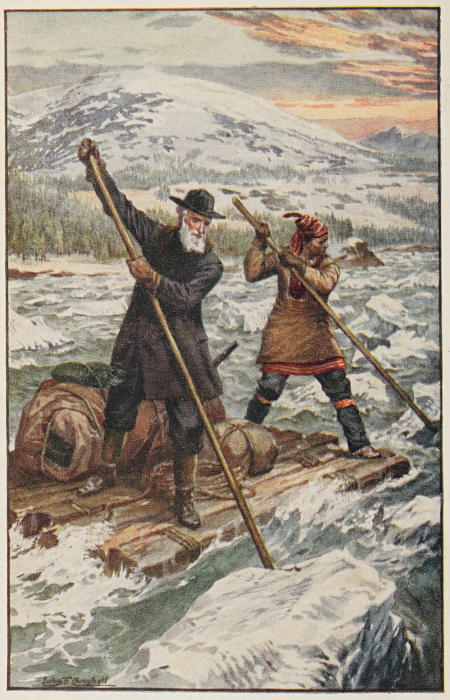
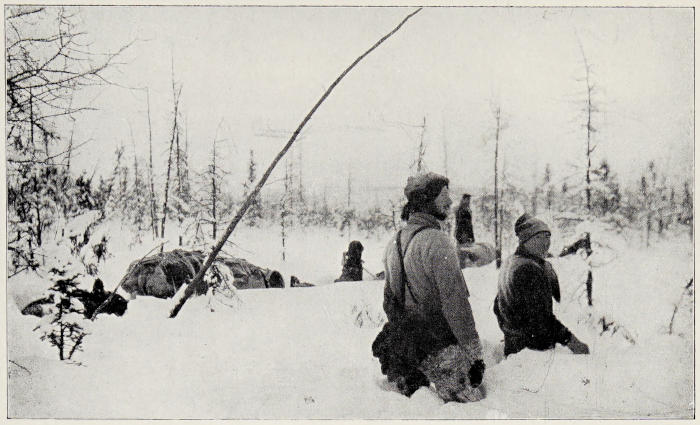
The river was full of floating ice, the water turbulent, and the craft
a crazy collection of logs and boards. For days the undaunted Bishop and
his one companion, an Indian, plied the poles, chilled to the bone but
never giving up, until at length an icy barrier formed across the river,
and they were compelled to abandon the raft.
ON TRAIL AND RAPID
BY DOG-SLED & CANOE
THE STORY OF
BISHOP BOMPAS’S LIFE AMONGST
THE RED INDIANS AND ESKIMO
TOLD FOR BOYS AND GIRLS
BY THE
REV. H. A. CODY, M.A. AUTHOR OF “AN APOSTLE OF THE NORTH”
WITH TWENTY-SEVEN ILLUSTRATIONS
SECOND EDITION
TORONTO
THE MUSSON BOOK COMPANY
LIMITED 1912
PREFACE
I have been asked to write this narrative of the life of
Bishop Bompas for boys and girls. The scenes among which
his strenuous course was run—the lands of the Red Indians
and Eskimo—have always appealed to the imagination of
the young; and the endurance which he showed in his
amazing journeys, and the dauntless courage with which he
faced innumerable perils for his Master’s sake, give to his
labours a character of heroism which they will be sure to
recognize.
I have been able to add some new matter to that which
appeared in “An Apostle of the North.” Part of the
chapter on “How the Bishop got his Mail” has been taken
from an article of mine which appeared in the Pacific
Monthly Magazine in 1908, and which the publishers have
kindly given permission to use.
I am indebted to Miss Agnes C. Laut for extracts from
her most interesting book, “Pathfinders of the West.”
This work was begun at Whitehorse when the thermometer
stood at 60° below zero. It was continued a few weeks later
among the roses and orange groves of sunny California, and
is now completed in far Eastern Canada, at St. John, the
grey old loyalist city by the sea.
I hope and trust that it may kindle in the hearts of some
of those who read it a longing to follow in the footsteps of
Bishop Bompas, and to volunteer, like him, for service in
these distant outposts of Christ’s Church militant here in
earth.
(Written by the author of this book, when he first saw Bishop Bompas
arrive at Whitehorse, in June, 1904.)
We saw him come—there was no loud acclaim:
He stood among the crowd, so frail and spare;
His humble garb marked his still humbler mien,
Whilst gently waved his scanty, silvery hair.
He stood alone, as stands some ancient pine
Amidst a stirring land and busy mart,
And strove to grasp the new and unknown ways,
Which were so strange to his intrepid heart.
But as I gazed upon that trembling form,
And marked the lisping words which slowly fell,
A vision rose before me, grand and clear,
Which thrilled my soul like some sweet vesper bell.
I saw a lonely region, cold and drear,
I saw the sad wild natives of the North
Pass slow before me, Christless, base, forlorn.
And as I thus beheld there passed straightforth
A lonely man—ay, more than common man—
’Twas one of God’s great heroes, brave and strong,
Who gave up home and friends and comforts all,
And for Christ’s sake passed forth to conquer wrong;
In lonely wilds, in wigwams foul and drear,
Midst sickness, famine, plague, and sore distress,
He pressed straight on, true soldier of the Cross,
His only aim to comfort and to bless.
And so he stands as stood his Master, Christ;
Brave leader he, no matter what the cost;
True teacher he, whose every word was love;
Good Shepherd of God’s children strayed and lost.
And this we know, when broken lies the bowl,
The after-glow of his devoted life
Will lead men on to do and dare for Christ,
And win for Him through darkness, pain, and strife.
ON TRAIL AND RAPID BY DOG-SLED AND CANOE — CHAPTER I ROMANCE OF EXPLORATION
The progress of civilization and Christianity in the Canadian
North-West, as in many other parts of the world, is due in
a large measure to great fur-trading companies. With a
wonderful devotion to the cause in hand, they pushed beyond
the bounds of civilization and entered regions never before
trodden by white man. They built forts, gained the respect
of savage tribes, and ruled them with a firm hand. By their
boats missionaries travelled over the noble streams into the
wilderness, ministered to the natives who gathered round the
forts, and received supplies from the companies’ stores.
As friction between bodies produces heat, fire, and light,
so, by the rivalry of fur-trading companies, the northland of
Canada was opened up, and a new era ushered in. Eager to
outstrip one another, they were ever pushing farther and
farther into the country, and, as has been well said, “the
great explorers of the period (1763-1812) were all connected
with the fur trade.”
Away to the north stretched a region, a land of wonder
and strange stories. Indians told of a “great river” in the
far North-West, and showed specimens of copper found along
its banks. The Hudson’s Bay Company, acting upon these
reports, decided to make a thorough investigation, with the
object of solving the problem of the North-West Passage by
land, to ascertain what mines were near the mouth of the
Great River, “to smoke the calumet of peace with the
Indians, and to take accurate astronomical observations.”
The man chosen for this work, Samuel Hearne, the
“Mungo Park of Canada,” was a trustworthy servant of the
Company, who, on November 6, 1769, started on his voyage
of exploration from Prince of Wales Fort, on the shore of
Hudson’s Bay. Owing to the desertion of over half his men,
the attempt proved a failure, and he was forced to turn back.
Two months later he started again, and followed a northwesterly
course over streams, lakes, and then inland across
the “Barren Grounds.” Food was very scarce, and they were
reduced to great straits. “For a whole week cranberries,
scraps of leather, and burnt bones were their only food.” To
add to their troubles, when 500 miles had been made, their
only quadrant was blown over and broken. So again Hearne
was forced to retrace his weary steps to the Bay.
Nothing daunted by these failures, this noble-hearted
explorer once more started on his northward quest. This
time he was more successful. With a strong band of Indians
who were waging war against the Eskimo, he floated down-stream,
and ere long gained the sea, the first white man to
reach the Arctic Ocean from the interior.
“The most unpleasant part of Mr. Hearne’s story,” wrote
Bishop Bompas in his book on the “Diocese of Mackenzie
River,” “is that the party of Indians with whom he travelled,
entirely without his sanction, made an unprovoked attack on
a number of Eskimo encamped on the Coppermine River,
and in the night barbarously massacred the whole body of men,
women, and children, and spoiled their tents. The site of
the massacre became known afterwards as the ‘Bloody Falls.’”
Miss Agnes C. Laut, in her most interesting book, “Pathfinders
of the West,” speaking about this incident, says:
“The conduct of Hearne’s rascally companions could no
longer be misunderstood. Hunters came in with game; but
when the hungry slaves would have lighted a moss fire to
cook the meat, the forbidding hand of a chief went up. No
fires were to be lighted. The Indians advanced with whispers,
dodging from stone to stone like raiders in ambush. Spies
went forward on tiptoe. Then far down-stream below the
cataracts Hearne descried the domed tent-tops of an Eskimo
band sound asleep; for it was midnight, though the sun was
at high noon. When Hearne looked back to his companions,
he found himself deserted. The Indians were already wading
the river for the west bank, where the Eskimo had camped.
Hearne overtook his guides stripping themselves of everything
that might impede flight or give hand-hold to an
enemy, and daubing their skin with war-paint. Hearne
begged Matonabbee to restrain the murderous warriors. The
great chief smiled with silent contempt. He was too true
a disciple of a doctrine which Indians practised hundreds of
years before white men had avowed it—the survival of the fit,
the extermination of the weak—for any qualms of pity towards
a victim whose death would contribute profit. Wearing only
moccasins and bucklers of hardened hide, armed with muskets,
lances, and tomahawks, the Indians jostled Hearne out of
their way, stole forward from stone to stone to within a gun-length
of the Eskimo, then, with a wild war-shout, flung
themselves on the unsuspecting sleepers.
“The Eskimo were taken unprepared. They staggered
from their tents, still dazed in sleep, to be mowed down by
a crashing of fire-arms which they had never before heard.
The poor creatures fled in frantic terror, to be met only by
lance-point and gun-butt. A young girl fell coiling at
Hearne’s feet like a wounded snake. A well-aimed lance had
pinioned the living form to earth. She caught Hearne round
the knees, imploring him with dumb entreaty; but the white
man was pushed back with jeers. Sobbing with horror,
Hearne begged the Indians to put their victim out of pain.
The rocks rang with the mockery of the torturers. She was
speared to death before Hearne’s eyes. On that scene of
indescribable horror the white man could no longer bear to
look. He turned toward the river, and there was a spectacle
like a nightmare. Some of the Eskimo were escaping by
leaping to their hide boats, and with lightning strokes of the
double-bladed paddles dashing down the current to the far
bank of the river; but sitting motionless as stone was an old,
old woman—probably a witch of the tribe—red-eyed as if
she were blind, deaf to all the noise about her, unconscious
of all her danger, fishing for salmon below the falls. There was
a shout from the raiders; the old woman did not even look up
to face her fate; and she, too, fell a victim to that thirst for
blood which is as insatiable in the redskin as in the wolf-pack.”
“It is remarkable,” says Bishop Bompas, “that there is a
bird in those parts which the Indians there call the ‘alarm
bird,’ or ‘bird of warning’—a sort of owl which hovers over
the heads of strangers and precedes them in the direction
they go. If these birds see other moving objects, they flit
alternately from one party to the other with screaming noise,
so that the Indians place great confidence in the alarm bird
to apprise them of the approach of strangers, or to conduct
them to herds of deer or musk oxen.
“Mr. Hearne remarks that all the time the Indians lay in
ambush, preparatory to the above-mentioned horrid massacre,
a large flock of these birds were continually flying about
and hovering alternately over the Indian and Eskimo tents,
making a noise to awake any man out of the soundest sleep.
The Eskimo, unhappily, have a great objection to being
disturbed from sleep, and will not be awakened—an obstinacy
which seems to have cost that band their lives.”
Hearne, like Columbus, was not to have the honour of
giving his name to the great river he discovered. This was
reserved for another intrepid explorer, Alexander Mackenzie,
of the North-West Company. In 1789 he started from Fort
Chipewyan, on Lake Athabasca, in search of the “Western
Sea.” He, too, was confronted with great difficulties. Wild
Indians told “of demon-haunted caves and impassable falls.”
Terrified by these tales, his Indians refused to go farther.
With infinite patience Mackenzie induced them to continue
seven days longer, and if in that time they did not discover
the sea, he promised to turn back. Before the end of the
week the mouth of the river was reached, and the explorer
knew it was the Arctic Ocean he had gained instead of the
Western Sea.
“It is hard,” says Bishop Bompas, “to overpraise the intrepid
courage, cool prudence, and inquiring intelligence of
that noble traveller.... Sir Alexander Mackenzie took
the greatest pains to conciliate all Indians whom he met by
presents and promises of peaceful trade, and he energetically
restrained all attempts at murder or rapine made by the
Indians who accompanied him. He did not meet with
Eskimo, and it is little wonder that these and the Mackenzie
River Indians were shy of him, as it was then customary for
the Athabasca Indians to make annual war expeditions down
the Mackenzie for purposes of plunder, massacre, and rapine,
as well as for the kidnapping of women and slaves.”
In after-years many eminent explorers, such as Franklin,
Richardson, Simpson, and Rae, entered the country, the
accounts of whose journeys and thrilling adventures may be
read elsewhere.
Several years after the discovery of the Mackenzie River
trading-posts were established at various places along this
stream and its tributaries. To these the Indians brought
their furs, and a thriving business was carried on. For a
time there was a keen rivalry between the Hudson’s Bay
Company and the North-West Company, but at length a
union was effected under the name of the former.
Not satisfied with the great advance which had thus been
made, these “lords of the forest and lakes” turned their
attention in another direction. Ever before their vision rose
the majestic peaks of the Rocky Mountains; beyond these
barriers were unknown regions. What possibilities lay in
that terra incognita they could only conjecture. News reached
them of a great river flowing to the west, the estuary of
which had been explored by the Russians several years before,
and named by them the “Quickpak.” This stream they
knew must drain a large territory, which might prove
valuable for fur-trading purposes.
There was a man in the Company’s service especially fitted
for the task of pathfinder into the new region. This was
Robert Campbell, a Scotchman by birth, over six feet of
upstanding flesh, bone, muscle, and iron nerve, as dauntless
a pioneer as ever shot a swirling rapid or faced a howling
blizzard. To him, therefore, the task was consigned in the
spring of 1840 by Sir George Simpson, Governor of the
Company.
At once he began the undertaking, and after a hard and
dangerous voyage up the Liard River, over lakes and portages,
a stream was reached, which Campbell named the Pelly, in
honour of Sir H. Pelly. A raft was hurriedly made, on
which they floated several miles down the river to view the
country. Considering they had gone far enough from their
base of supplies, they abandoned the raft, but not before
Campbell had cast into the stream a sealed tin can with
notice of his discovery, the date, and other information.
The discovery of the Pelly River only served to increase
the interest of the Company, and it was resolved to push
forward the investigation. In 1842 birch-bark in sufficient
quantity for the building of a canoe was sent up to the Pelly
River, and the same year the construction of a fur-trading
post was begun, and named Fort Pelly Banks. Early in
June, 1843, Mr. Campbell started down the stream in the
canoe which had been built, accompanied by two French
Canadians and an Indian interpreter.
Concerning this exciting journey Mr. Campbell has given
us a vivid description which should be of great interest to all.
“As we advanced,” he says, “the river increased in size,
and the scenery formed a succession of picturesque landscapes.
About twenty-five miles from Pelly Banks we encountered a
bad rapid—‘Hooles’—where we were forced to disembark
everything, but elsewhere we had a nice flowing current.
Ranges of mountains flanked us on both sides. On the right
hand the mountains were generally covered with wood; the
left range was more open, with patches of poplar running up
the valleys and barnsides, reminding one of the green brae-face
of the Highland glens. We frequently saw moose-deer
and bears as we passed along; and at points where the precipice
rose abrupt from the water’s edge, the wild sheep—‘big-horn’—were
often seen on the shelving rocks. They
were very keen-sighted, and when once alarmed they file
swiftly and gracefully over the mountains. When we chanced
to get one we found it splendid eating, delicate enough for
an epicure.
“In this manner we travelled on for several days. We saw
only one family of Indians—‘Knife’ Indians—till we reached
the junction of the Pelly with a tributary, which I named
the ‘Lewes.’ Here we found a large camp of Indians—the
‘Wood’ Indians. We took them by no ordinary surprise, as
they had never seen a white man before, and they looked
upon us with some awe as well as curiosity. Two of their
chiefs, father and son, were very tall, stout, handsome men.
We smoked the pipe of peace together, and I distributed
some presents. They spoke in loud tones, as do all the
Indians in their natural state, but they seemed kind and
peaceable. When we explained to them as best we could
that we were going down-stream, they all raised their voices
against it. Among other dangers, they indicated that inhabitating
the lower river were many tribes of ‘bad’ Indians—‘numerous
as the sand’—who would not only kill us, but
eat us; we should never get back alive, and friends coming
to look after us would unjustly blame them for our death.
All this frightened our men to such a degree that I had
reluctantly to consent to our return, which, under the circumstances,
was the only alternative. I learned afterwards
that it would have been madness in us to have made any
further advance, unprepared as we were for such an enterprise.
“Much depressed, we that afternoon retraced our course
up-stream; but before doing so I launched on the river a
sealed can containing memoranda of our trip, etc. I was so
dejected at the unexpected turn of affairs that I was perfectly
heedless of what was passing; but on the third day of our
upward progress I noticed, on both sides of the river, fires
burning on the hill-tops far and near. This awoke me to a
sense of our situation. I conjectured that, as in Scotland in
the olden time, these were signal fires, and that they summoned
the Indians to surround and intercept us. Thus
aroused, we made the best use of paddles and ‘tracking-line’
to get up-stream and ahead of the Indian signals. On the
fourth morning we came to a party of Indians on the further
bank of the river. They made signs to us to cross over,
which we did. They were very hostile, watching us with bows
bent and arrows in hand, and would not come down from the
top of the high bank to the water’s edge to meet us. I sent
up a man with some tobacco, the emblem of peace, to reassure
them, but at first they would hardly remove their hands from
their bows to receive it. We ascended the bank to them, and
had a most friendly interview, carried on by words and signs.
It required, however, some finesse and adroitness to get away
from them. Once in the canoe, we quickly pushed out and
struck obliquely for the opposite bank, so as to be out of
range of their arrows, and I faced about, gun in hand, to
observe their actions. The river was there too broad either
for ball or arrow. We worked hard during the rest of the
day, and until late; the men were tired out, and I made them
all sleep in my tent while I kept watch. At that season the
night is so clear that one can read or write throughout.
Our camp lay on the bank of the river, at the base of a
steep declivity, which had large trees here and there up its
grassy slope. In the branches of one of these trees I passed
the greater part of the anxious night, reading Hervey’s
‘Meditations’ and keeping a vigilant lookout. Occasionally
I descended and walked to the river-bank, but all was
still. Two years afterwards, when friendly relations had been
established with the Indians in the district, I learned, to my
no small astonishment, that the hostile tribe encountered
down the river had dogged us all day, and, when we halted
for the night, had encamped behind the crest of the hill, and
from this retreat had watched my every movement. With the
exactitude of detail characteristic of Indians, they described
me sitting in the tree, holding ‘something white’ (the book)
in my hand, and often raising my eyes to make a survey of
the neighbourhood; then descending to the river-bank, taking
my horn cup from my belt, and, even while I drank, glancing
up and down the river and towards the hill. They confessed
that, had I knelt down to drink, they would have rushed
upon me and drowned me in the swift current, and, after
thus despatching me, would have massacred the sleeping
inmates of my tent. How often, without knowing it, are we
protected from danger by the merciful hand of Providence!
Next morning we were early in motion, and were glad to
observe that we had outwitted the Indians and outstripped
their signal fires.”
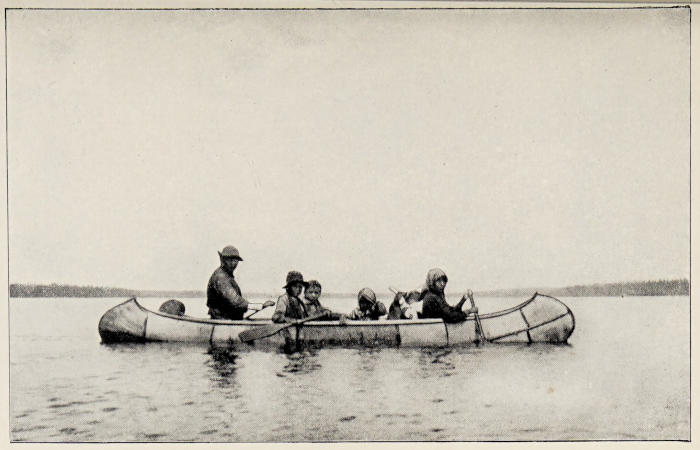
Canoe-Travelling in North-West Canada
The canoes are made of birch-bark over a light framework, and are
consequently very frail. They are, however, light and portable, a
great advantage when navigating rivers with falls or rapids. Those
places where the canoe must be carried from one navigable piece
of water to another are known as portages.
In the spring of 1848 Campbell once more returned, and
erected a post for trading purposes at the confluence of the
Lewes and Pelly Rivers. This place was called Fort Selkirk,
and occupied a dangerous position, owing to the animosity of
a tribe of Indians, known as the Chilcats, along the Pacific
Coast. From time immemorial they had kept the natives of
the interior in abject submission, having defeated them in a
great battle. They refused to allow them to cross the mountains
to trade with the white men on the coast, as they
themselves did a thriving business as “middlemen.” When
they beheld the hated white race establishing a post in what
they considered their rightful domain, and drawing away the
principal part of the trade, their anger knew no bounds.
Crossing the mountains, they floated down the river, and,
without a word of warning, attacked the fort and razed it to
the ground. Campbell was not present at the destruction of
his trading-post, as, two years after its erection, he had started
down the river to see, at any cost, what lay beyond.
In the meantime another entry had been made into the
Yukon region away to the north. In 1842, Mr. J. Bell, in
the employ of the Hudson’s Bay Company, crossed the Rocky
Mountains, and descended the Porcupine River for three days’
journey. In 1846 he returned, and moved down the river to
its mouth till he reached a great stream, which the Indians
told him was the Yukon. Believing this to be in British
territory, Mr. A. H. Murray established a trading-post at
this spot the following year, and called it Fort Yukon. It
was here that the first missionary work was carried on by
the Church Missionary Society, the scene of Archdeacon
McDonald’s wonderful labours for the Master.
In this brief outline of the discovery of the Mackenzie and
the Yukon Rivers we have seen the brave efforts of these
noble pioneers. We shall see now how they were followed
by the great King’s messengers with the glorious Gospel of
salvation.
CHAPTER II EARLY DAYS
We all like to read about heroes, whether on sea or land.
How real they become to us as we picture them in our minds,
and eagerly follow their adventures! We wonder what they
did when boys, and if they performed wonderful things then.
Nothing is too small to be of importance when once we have
a real, noble hero.
William Carpenter Bompas was a hero in the true sense of
the word—not one who gained his laurels by fighting on the
sea, or rushing forward, even to the bayonet’s point, in some
great charge. His glory was gained in a far different manner,
when he enlisted in the service of the great King of kings,
and carried the banner of the Cross over great Arctic regions
and grim, snow-capped mountains, to rescue wandering Indians
and Eskimo, and lead them to the Master’s feet.
There was very little in his early life to show that he contained
the stuff of which heroes are made. He was a shy boy,
fond of retirement and study. But there was good blood in
his veins, and blood will tell. The family, on his mother’s
side, was partly Royalist and partly Puritan. One member
is known to have been private secretary to Henrietta Maria,
and was hung by the Parliamentarians for aiding Charles I.;
while another at one time was secretary to Hampden. We
shall see how the characteristics of these two great parties
were in later years remarkably united in William Bompas.
The Bompas family is of French extraction, and there is an
interesting tradition which tells how the name was first given.
It was on the field of Crecy that an ancestor performed a
deed of great valour in the fight, and was knighted by
Edward the Black Prince. A bystander remarked: “C’est
un bon pas.” And the Knight replied that he would take
that for his motto.
How often young William Bompas must have listened with
intense eagerness to that story of his valiant ancestor, and
longed to do some great deed himself! Little did he then
think that he would be called upon to do more than all
before him, and the step that he was destined to take would
be the best of all.
His father, Charles Carpenter Bompas, was a Serjeant-at-law,
and one of the most eminent advocates of his day. It is
said that the famous Charles Dickens had him in his mind
when he wrote about Serjeant Buzfuz in the “Pickwick
Papers.” When William was only ten years old, his father
died very suddenly, leaving a widow and eight children—five
sons and three daughters.
William, in early youth, showed most plainly those
characteristics which marked his whole life. He was a quiet
boy, owing partly, no doubt, to private tuition at home,
which deprived him to a large extent of the society of other
boys. Cricket, football, and such games, he did not play, his
chief pleasure being walking, and sketching churches and
other buildings that he encountered in his rambles. Gardening
he was fond of, and the knowledge thus gained stood him
in good stead years later when planning for the mission-farms
in his northern diocese.
The influence of a religious home made a deep and lasting
impression upon him. His parents were earnest Christians,
belonging to the Baptist denomination. Sunday was strictly
observed, the father making it a firm rule never to read briefs
or hold consultations on the Day of Rest. Bible-reading,
too, was carefully observed. Serjeant Bompas was a man of
liberal views, allowing his children to indulge in harmless
amusements, and occasionally permitting them to attend the
theatre and to play cards, if not for money.
William from childhood was of a deeply religious turn of
mind, and at the age of sixteen was baptized by immersion,
on a profession of his faith, by the Hon. and Rev. Baptist
Noel. This step caused his mother great joy, and after her
death the following was found among her many papers:
“July 7, 1850.—This day I would record the mercy which
has rendered it one of peculiar blessing and happiness. The
favour and presence of God has been manifested to us again
during the past week, and I have enjoyed the best earthly
happiness in seeing my dear and dutiful son W. devote
himself unreservedly to the service of his Saviour. Having
conscientiously decided on baptism by immersion, he was
publicly baptized on the 5th by Mr. Baptist Noel, at his
chapel in John Street, and was at the same time admitted as
member of Mr. Stratten’s church, and to-day I have had the
privilege of partaking with him of that ordinance which I
trust will be most profitable to us both.”
At this time William was attending a small day-school,
and the master, Mr. Elliott, wrote of him:
“I never had a pupil who made such acquisitions of knowledge
in so short a time; his attainments in mathematics
and classics are far beyond the majority of youths at his
age, and would warrant anyone conversant with the state of
education in the Universities in predicting a brilliant career
for him, should he ever have that path open to him. I think,
however, that the development of his mind is still more
remarkable than the amount of his knowledge.”
But a University career was not practicable, and William
was therefore articled in 1852 to the same firm of solicitors
with whom his brother George was working. At the expiration
of his five years of service he transferred himself to
another city firm, Messrs. Ashurst, Morris and Company,
with whom he remained about two years. While here a
catastrophe occurred in the failure of a great company,
involving ruin to unnumbered families. The harrowing
spectacle of the poorer shareholders who brought their claims
into court, having lost their all without remedy, was a terrible
strain upon the young man’s nervous system, which had been
weakened by a severe illness but a short time before. This,
together with strenuous labour, brought on a second breakdown,
and early in 1858 he was forced to give up work
altogether. He declared that it took him three months to
learn to do nothing. During his year of inaction the Greek
Testament was his constant companion. Change of scene
became necessary, and he spent some time at his mother’s
home, Broughton, Hants, and later with his sister visited the
Normandy coast.
“The summer after his illness,” writes his brother, Judge
Bompas, “we went on a walking tour to Scotland; and one
evening it got dark before we had reached our destination,
and we had to sleep out in the mountains with no shelter,
and amidst frequent showers of rain. William, though in
his weak health, was perfectly fearless and in great spirits,
repeating part of Macaulay’s ‘Lays’ and other poems for
much of the night.”
As his strength returned, his mind turned more and more
to his early desire of entering the ministry. Leaving the
communion of his early associations, he decided to seek
ordination in the Church of England, and in 1858 was confirmed
by the Bishop of London at St. Mary’s, Bryanston
Square. His remarkable linguistic ability enabled him soon
to add by private study a good knowledge of Hebrew to that
of Latin and Greek, which he already possessed.
In 1859 he was accepted by Dr. Jackson, the Bishop of
Lincoln, as a literate candidate for Holy Orders, and was
ordained deacon by him at the Advent ordination the same
year, and appointed curate to the Rev. H. Owen, Rector of
Trusthorpe and Sutton-in-the-Marsh.
The first charge was a trying experience. The parish of
Sutton was a wild district, with a rough and primitive
population, and most of the men had been smugglers in
former times. No school was established, and there had
been no resident clergyman since the time of the Reformation.
Mr. Bompas at once began a great work among the
children, gathering them into his own house, and teaching
them, at first by himself, and later with the help of his
sister and a girl from a neighbouring village. By his care
for the children, and by the unfailing sympathy shown in his
visits to his parishioners, he succeeded in winning their
gratitude and confidence. His plan for the erection of a
school was at first strongly opposed by some of the farmers,
who were unwilling to give land for the purpose. But
Mr. Bompas, with that tact and gentleness which marked all
his dealings, at length overcame opposition, and when he left at
the end of two years the building was completed and opened.
“I can well remember,” writes one, in reference to the
young curate’s work at Sutton, “as quite a little child, how
he won my heart by carrying my poor pet-cat, that had been
hurt by a heavy piece of wood falling on it, into a place of
safety, and doing all he could to ease its pain. Also, about
the same time, in a heavy gale of wind, he was going out to
dinner at Mablethorpe, and, passing through Trusthorpe,
found a little girl blown into the thick black mud at the
side of a big drain, and unable to free herself. He not only
went to the rescue, but carried her to her home at the far
end of Sutton, regardless of dinner! The once,” continues
the same writer, “that he revisited Sutton and preached
there, the people lined the path from church to gate, and
stood waiting for him to leave the church, that they might
get a word as he passed—a very unusual demonstration from
our true but undemonstrative Lincolnshire folk of those days.”
While at Sutton, in the second year of his clerical life, a
great sorrow came to Mr. Bompas in the death of his mother,
to whose bedside he was summoned in January, 1861. He
was devotedly attached to her, and was able to take part,
with the rest of his family, in ministering comfort to her
during her last days.
In the midst of early discouragements, Mr. Bompas found
a valuable friend and helper in Mrs. Loft, of Trusthorpe Hall.
He was always sure of a hearty welcome at her house, and in
after-years she followed his course with the wannest interest,
and corresponded with him to the end of her life.
In 1862 he accepted the curacy of New Radford, Nottingham,
a poor and crowded parish, populated largely by lace-workers.
The number of souls, about 10,000, within the small triangle
of New Radford was about the same as the population of the
vast diocese of 900,000 square miles of which he was later to
have episcopal supervision. To this circumstance he referred
when preaching in the parish on his return to England for
consecration in 1874.
From Nottingham, Mr. Bompas went for a short time as
curate to Holy Trinity, South Lincolnshire, returning in 1864
to his former neighbourhood as curate to the Rev. H. Oldrid
at Alford, Lincolnshire. As the earnest curate passed from
house to house in his daily work, his parishioners little thought
what a bright fire of enthusiasm was burning in his heart.
He had been much stirred by the stories told by missionaries
of heathen dying without the knowledge of Christ in far-away
lands, and he longed to go abroad and bear the message
of salvation. His mind turned to China and India, with
their seething millions; but as he was a little over thirty
years of age at that time, the Church Missionary Society
thought him rather old to grapple with the difficulties of the
Eastern languages. But when one door closes, another opens,
and at the right moment Bishop Anderson arrived from
Rupert’s Land, and made his great appeal for a volunteer to
relieve the Rev. Robert McDonald at Fort Yukon.
It was on May 1, 1865, that this missionary Bishop was
touching the hearts of a large crowd at St. Bride’s, London,
England. He had travelled a long way to attend the anniversary
of the Church Missionary Society, and was preaching
the sermon which was destined to bear so much fruit. Bishop
Anderson was the bearer of a great message to the Church in
England. He had much to tell of the vastness of Canada,
and the great regions where the children of the wild lived and
died without the knowledge of Christ. He told of a lonely
mission-station on the mighty Yukon River, where a soldier
of the cross, the Rev. Robert McDonald, with health fast
failing, was standing bravely at his post of duty till someone
should relieve him. What thoughts must have surged through
his mind as he looked on the many upturned faces before him!
Who was there among those listeners willing to consecrate his
life to the Master’s work? Lifting up his voice, the Bishop
uttered these words, which have become so memorable:
“Shall no one come forward to take up the standard of the
Lord as it falls from his hands, and to occupy the ground?”
The service ended, the clergy retired, and the congregation
began to disperse. But there was one whose heart had been
deeply touched by the speaker’s words, and, walking at once
into the vestry, William Bompas, the Lincolnshire curate,
offered to go to Canada to relieve the missionary at Fort
Yukon.
He was at once accepted by the Church Missionary Society,
and ordained to the priesthood by Bishop, afterwards Archbishop,
Machray, who had just been consecrated as successor
to Bishop Anderson.
How little did those who attended that ordination service
realize the important part those two men would take in
Christ’s great work, or that among the heroes of the Church
in Canada in years to come no names would be held in greater
reverence than those of Machray and Bompas!
Only three weeks did Mr. Bompas have in which to prepare
for his long journey; but they were sufficient, as he was
anxious to be on his way. So complete was his consecration
to the work before him that “he decided,” so his brother
tells us, “to take nothing with him that might lead back his
thoughts to home, and he gave away all his books and other
tokens of remembrance, even the paragraph Bible which he
had always used.”
CHAPTER III FORWARD TO THE FRONT
Shortly after Mr. Bompas was accepted by the Church
Missionary Society, he went to Salisbury Square and inquired
how far it was to his mission-field, and the length of time
required for the journey. When told it was about 8,000
miles, and that he was hardly likely to reach it that year, a
smile passed over his face as he replied, “I see I must start
with a small bag.”
After he learned more about the country, a longing entered
into his heart to start as soon as possible, and reach Fort
Simpson, on the Mackenzie River, by Christmas Day. Was
such a thing possible? No one before had ever done it in
winter, and was it likely that the young, ardent missionary
would be the first to accomplish the task? With this determination,
Mr. Bompas was not long in making preparations
for his journey, and on June 30, 1865, he left London for
Liverpool, where he boarded the steamer Persia, bound for
New York.
Mr. Bompas was surprised that this steamer burnt 100
tons of coal daily; but now the Cunard liner Mauretania
burns 1,000 tons each day in 192 furnaces.
He travelled in company with the Rev. J. P. and Mrs.
Gardiner and family and Miss M. M. Smith, who were going
to the Red River. There were many passengers, mostly
Americans, and for these an effort was made to hold service
the first Sunday, but the captain refused to give his permission.
On the following Sunday, however, they were more successful,
and service was held in the saloon, attended by crew and
passengers. Tracts were also distributed among the sailors,
“accompanied by religious conversation.”
Reaching New York on July 12, two days were spent at
the Astor House Hotel, where they had the exciting experience
of viewing a disastrous fire right across the street, when
a large block of buildings, including Barnum’s Museum, was
destroyed. From New York they proceeded to Niagara by
the Hudson River and New York Central Railway. On the
way Mr. Bompas spent one night at Rochester to see Captain
Palmer, of the American Telegraph Company.
“He informed me,” wrote Mr. Bompas, “that a party of
explorers were already on their way to Fort Yukon from
Sidkar,[1] on the Pacific coast, with the view of carrying out
the Company’s contract entered into with the Russian Government
for laying a telegraph-line through Siberia and across
Behring’s Strait, to join existing lines in America. Should
the Atlantic cable prove successful, the Yukon line would, I
suppose, complete the circuit of the globe.”
Mr. Bompas considered the American railways rather noisy
and jostling, and the large saloon carriages, holding about
sixty people, less pleasant than the English style. At the
same time, he thought the general arrangements were “good
and expeditious,” and admired the system of communication
throughout the train and the “booking through luggage by
duplicate ‘cheques’ or metal badges.”
Leaving Niagara, they reached Chicago by way of Detroit.
Here were seen “many soldiers returning from the war, some
of them wounded, and most looking pale and sickly, reminding
one too plainly of the many who never returned.” From
Chicago they went by rail to La Crosse, and thence by steamer
to St. Paul. Here Dr. Schultz, a Red River merchant, and
afterwards Sir John Schultz, Lieutenant-Governor of Manitoba,
was met, who conveyed their heavy luggage across the
plains in his ox-train, and proved in many ways of great
assistance.
At St. Cloud the first difficulty presented itself. Since the
fearful Sioux massacre of 1862, people were in great dread all
over the country, and they found it impossible to get anyone
to convey them on towards Red River. After much trouble
and delay, they were forced to procure a conveyance for
themselves. Before leaving St. Cloud, they were told time
and time again to beware of the Indians, who were always
prowling around. “But,” said one informant, “they will
respect the English flag, and I advise you to take one along.”
Such a thing the party did not possess. But Mr. Bompas
was equal to the occasion; so, procuring some red and white
cotton, he soon formed quite a respectable banner, which was
fastened to a small flagstaff erected on the cart.
Dr. Schultz had been overtaken some distance out on the
prairie, and when they had gone some way farther mounted
Indians appeared in sight, and, like the wind, one warrior
swept down to view the small cavalcade. Beholding the flag
of the clustered crosses, he gazed for a time upon the little
band, and, moving away, he left them unmolested.
“On the whole, however,” said Mr. Bompas, “we travelled
without special discomfort, Dr. Schultz acting as guide. The
charge of the horses, making fires, cooking, encamping, driving,
etc., of course threw much work upon us, being without a
servant.”
Reaching the Red River in safety, Mr. Bompas was much
pleased with the whole general appearance of the place.
“The houses,” he wrote, “are cleanly and cheerful, and
new ones are being built. The settlement extends altogether
about twenty-five miles down the banks of the river. In this
distance there are five churches. The three which I saw are
well built and spacious. The schoolrooms, also, and parsonages
are of good size. Mr. Cowley was just removing into a
new house of a very substantial character.”
Here Mr. Bompas had not long to wait, for the boats of
the great Hudson’s Bay Company were ready to start on their
long northern journey, and he was to go with them. There
were four boats, called a “brigade,” each rowed by seven or
eight men, “mostly Salteaux Indians, heathen, and unable to
speak English—a tribe much averse to Christianity.”
Then northward fled that fleet of boats, across great inland
lakes, over hard portages where the freight had to be carried,
past the company’s posts, mission stations, and Indian encampments,
where services were held when possible.
But winter was rapidly closing in upon them and threatening
the daring voyagers. Sixty-three days had they been out
from the Red River Settlement when Portage la Roche was
reached on October 12, and there they found they were too
late to meet any boat going farther north. Here was a
difficult situation, but Mr. Bompas was not to be defeated.
Engaging a canoe and two French half-breeds, he pushed
bravely forward. The journey was a hard one. In some
places they had to battle with drifting ice, and the water
froze to their canoe and paddles. Still they pressed on, all
day long contending with running ice, and the bleak, cold
wind whistling around them and freezing the water upon
their clothes. At night there was the lonely shore, the
camp-fire, the scanty meal, and the cold ground covered with
brush for a bed. The next day up and on again—the same
weary work, the same hard fight. Such was the struggle for
eight long days, till Fort Chipewyan, on Lake Athabasca,
was reached.
Here Mr. Christie, the officer in charge of the post, gave
him a hearty welcome; here the warm stove sent out its
cheerful glow, and here, too, were to be found many comforts
for the winter months, if he would only stay and rest. But
no; it was ever up and on. Never before had such a man
stood within the fort. Who could conquer that northern
stream at such a season? But the missionary only smiled,
and asked for canoe and men. He was given a large craft and
three Indian lads.
And once more that dauntless herald of the Cross sped
northward. For several days the trim canoe cut the water,
driven by determined arms. Then winter swept down in all
its fury; the river became full of floating ice, jamming, tearing,
and impeding their canoe. Axes were brought to bear;
they would cleave a passage. The missionary must not be
stopped. How they did work! The ice-chips flew; the spray
dashed and drenched them, and then encased their bodies
with an icy armour. Colder and colder it grew, and the river
became a solid mass from bank to bank. The canoe was
dragged ashore, and placed en cache on the bank with their
baggage. All around was the pitiless wild. It was a dreary
sight to this intrepid traveller, with winter upon him, the
bleak wilderness surrounding him, and very little food. The
enthusiasm of a less ardent spirit would have been completely
damped; but Mr. Bompas was made of sterner stuff, and
without delay he and his companions pushed forward through
the forest. On and on they travelled by a circuitous route,
through brushwood and thickets, with clothes torn, hands
and faces scratched and bleeding, and uncertain where they
were. Night shut down and wrapped them in its gloomy
mantle. All the next day they struggled forward, without
food, and again night overtook them. Still they staggered
on, and just when they were wearied to the point of exhaustion
the lights of Fort Resolution, on Great Slave Lake,
gleamed their welcome through the darkness.
It was necessary for the traveller to remain here until the
ice in the lake became firm enough to cross with dogs and
snow-shoes. Mr. Lockhart, the Company’s officer, offered his
hospitality, and during the delay Mr. Bompas continued busy
“in the preparation,” as he tells us, “of letters for the winter
express, which is despatched hence to the south in December,
and also in practising walking with snow-shoes, in preparation
for my journey forward.”
After he had remained at Fort Resolution about a month,
“Mr. Lockhart kindly despatched him across the lake on
snow-shoes, with two men and a sledge of dogs.” Ice was
found drifting in the open lake, and they were obliged to
lengthen their course by following the shore very closely.
“However, by God’s help,” wrote Mr. Bompas, “we arrived
safely at the next post (Big Island) in five days, when I
was again hospitably entertained by the officer in charge,
Mr. Bird.”
Here again he waited anxiously for the men from Fort
Simpson with the winter packet of mail. They arrived on
December 13, and four days later they started for Fort
Simpson, and the missionary with them. Could they make
the fort by Christmas Day? that was the question. Only a
short time remained in which to do it. Day after day they
sped forward. Saturday came, and still they were on the
trail, and the next would be Christmas Day. One hundred
and seventy-seven days had passed since leaving London, and
was he to lose after all, and so very near his destination?
But still the dogs raced forward, nearer and nearer, till, oh
joy! on Christmas morning the fort hove into sight. There
was the flag floating from its tall staff; there were the men
crowding around to give their welcome, and among them
stood that dauntless pioneer, the Rev. W. W. Kirkby, with
great surprise on his face, as Mr. Bompas rushed forward and
seized him by the hand.
Great was Mr. Bompas’s delight in having accomplished
the journey, and reached the fort on that blessed day in time
for the morning service, and thankfully he wrote:
“As I had especially wished to arrive by Christmas, I
could not but acknowledge a remarkable token that our
lives are indeed in God’s hand. It is hardly needful to say
how warm a welcome I received from Mr. Kirkby. When I
heard what a trying time he had passed through last fall in
consequence of the epidemic sickness among the Indians, I
felt very glad to have persevered in my efforts to reach him
this winter.”
No less enthusiastically did Mr. Kirkby write to the
Church Missionary Society on June 3, 1886:
“You will imagine, better than I can tell, what a delight
and surprise the unexpected arrival of Mr. Bompas was to us.
He reached us in health and safety on Christmas morning,
making the day too doubly happy by his presence and glad
tidings that he brought. He was a Christmas-box indeed,
and one for which we thank God with a full heart. The
entire unexpectedness of his coming caused us to see in it
more of the loving-kindness of our God. Such a thing as an
arrival here in winter is never thought of, nor had it ever
before occurred. After the boats leave here in the fall we
have no visitors from without the district until now, when
the waters are open again. Our dear brother deserves the
greatest credit for the way in which he persevered in getting
to us, and the accomplishment of his journey speaks much
for his energy and determination. A more auspicious day,
too, he could not have had for his arrival. He was just in
time for morning service, so that we had at once the happiness
of partaking of the Holy Communion together. Then
followed the Indian service, in which he expressed much
delight; and in the evening, like good Samuel Marsden of
old, he began his work by preaching from St. Luke xi. 10.
He remained with us until Easter, and then went on with the
packet-men to Great Bear Lake, where I trust God is doubly
blessing him.
“Fancy, it is not yet a year since he left England, and in
that short time he has travelled so far, entered upon his
work, and acquired enough of the language to be able to tell
to the Indians in their own tongue the wonderful works of
God. I admire that way of doing things exceedingly, and
would accord all honour to him who thus performs his
Master’s work.”
CHAPTER IV IN DANGER AMONG THE ESKIMO
People get very much excited over the North Pole explorations.
They praise, too, the few men of the Royal North-West
Mounted Police, who in these days patrol the Arctic coast
at the mouth of the Mackenzie River. But how few know
about the missionary heroes who have advanced into those
desolate regions, facing hardships and even death to bear the
Gospel message to the Eskimo living in those places. It
was Mr. Bompas who first went as a missionary to the Arctic
coast at the mouth of the Mackenzie River, and the story of
his experiences and narrow escape from death is one of the
most thrilling in missionary annals.
On a journey to Fort Yukon he had met a number of
Eskimo at Fort McPherson, who requested him to go with
them down to the coast. He could not get these poor
creatures out of his mind, so in the spring he went back over
the mountains for the purpose of visiting them. These
natives, with their strange, uncouth manners, strongly appealed
to his noble nature, and he expressed his feelings for such in
the following beautiful words:
“At the funeral of the great Duke of Wellington, it was
considered to be a mark of solemn respect that the obsequies
should be attended by one soldier from every part and
regiment of the British army; and it is a part of the Saviour’s
glory that one jewel be gathered to His crown from every
tribe of the lost human race. It is an honour to seek to
secure for our Lord one such jewel from even the remotest
tribe.”
Leaving Fort McPherson on April 18, 1870, Mr. Bompas
started down the river in company with two Eskimo, hauling
a small sled with blankets and provisions. On the way he
received a message from the Chief of the Eskimo telling him
to go back, as the natives “were starving and quarrelling, and
one had just been stabbed and killed in a dispute about some
tobacco.” But this message had no effect upon the missionary;
he was busy in his Master’s service, and he knew
that same Master would take care of His servant, and undaunted,
he pressed bravely forward.
For three days they continued to travel without any
difficulty, camping at night on the river-bank, and making
a small fire of broken boughs. But the glare of the spring
sun was very severe, and Mr. Bompas was stricken with snow-blindness.
This affliction is one common in the North, and
only those who have themselves suffered on the trail can
fully realize what it means.
“As the sun rises higher,” wrote Mr. Bompas, “and has
more power in the months of March and April, to walk long
over the snow in the sunlight becomes distressing to the eyes
from the dazzling brightness. This is especially the case in
traversing a wide lake or in descending a broad river, where
there are no near forests of dark pines to relieve the gaze,
but an unbroken expanse of snow.
“The effect of this is to produce, after a time, acute inflammation
of the eyes. These, in the end, may be so entirely
closed as to involve a temporary blindness, accompanied by
much smarting pain.... The voyager feels very helpless
during the acute stage of snow-blindness, and, like Elymas
the sorcerer, or St. Paul himself, he ‘seeks some one to lead
him by the hand.’”
For three days in awful darkness he was led by the hand
of the native boy, making about twenty-five miles a day, till
the first Eskimo camp was reached. It was only a snow-house,
and to enter it with closed eyes, stumbling at every
step, was a most disagreeable introduction.
A description of what a snow-house is like is given by the
Rev. Mr. Whittaker, who years afterwards lived among the
Eskimo at Herschel Island.
“I remained,” he says, “at the village [Kitligagzooit] just
two weeks, and a most uncomfortable time it was, principally
on account of the cold. They are all in snow-houses now,
and the temperature required to preserve a snow-house will
not conduce to a white man’s comfort. I suffered constantly
and almost unremittingly with cold hands and feet, and no
amount of clothing would keep them warm. My blood
appeared to stagnate and afford me no heat. The intense
cold made me ravenously hungry, and although deer meat
was plentiful, I craved fat, and at length was tempted to try
some of the white whale that had lain in the ground since
summer. It was strong, even burning my throat, but after a
little I ate it with relish. It is eaten about half-frozen—raw,
of course.
“In the house where I stayed were two Huskie families,
seven of them and myself all in one room about the size of
an ordinary bedroom. There we ate, drank, slept, and lived
the daily round. The houses are just such as you may see in
any pictures of Arctic scenes. There is no fire in them
except the big seal-oil lamp, over which they do much of
their cooking.”
And yet such sufferings were little considered by Mr. Bompas.
“They are delights,” he once said. “The first footprint on
earth made by our risen Saviour was the nail-mark of suffering,
and for the spread of the Gospel I, too, am prepared to
suffer.”
After one day of rest in the snow-house, he recovered his
sight, and then, moving forward, reached another camp. His
appearance at each place, so he tells us, “excited a great
deal of observation and curiosity, as they had never had a
European among them in the same way before.”
In this camp he was disturbed “by yelling and dancing”
on the very spot where he was lying. This was caused by an
old woman “making medicine—that is, conjuring in order to
cure a man who was, or was thought to be, sick.” Mr. Bompas,
unable to stand the terrible confusion, tried to stop them by
saying that medicine-making was all a wicked lie, whereupon
the old woman threw herself upon the missionary, and in no
gentle manner vented upon him her wrath. After this he
left the place and betook himself to another camp, where he
lay down and “enjoyed a good night’s rest.” Next morning,
seeing the man who was the cause of all the trouble, Mr. Bompas
found he was suffering from a sore head, for which he gave
him a “small piece of soap and a few grains of alum to rub
it with.” When he saw the man some time later, he was
told that his conjuring was very strong.
What a forlorn hope lay before this missionary in trying
to uplift and save such wild, uncouth creatures, who were
ever around him! Yet there were many things which
appealed to him. He looked deeper than the mere surface,
and, studying them very carefully, saw there was much cause
for encouragement. He noticed how ingenious the Eskimo
was in the formation of implements “out of any old iron
which he is able to obtain, such as files, saws, etc., from which
he will forge variously shaped knives, gimlets, and other
tools, with which he constructs his boats and canoes, as well
as arrows, bows, spears, fishing-hooks, nets and tackle, sledges,
and all other implements for the chase, as well as furniture
for his tent.”
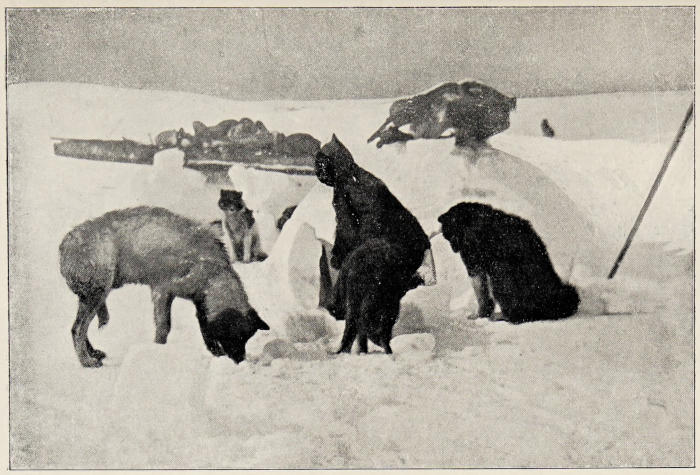
Then he watched his skill in building the snow-house,
which he could “compare to nothing but the skill of the bee
in making its honeycomb.... The snowy material is so
beautiful that the work proceeds as if by magic. The blocks
of frozen snow are cut out of the mass with large knives, and
built into solid masonry, which freezes together as the work
proceeds, without the aid of mortar. Being arched over, a
dome-shaped house is formed, with a piece of clear ice for
a window, and a hole, through which you creep on all-fours,
for a door or entrance. One-half of the interior is raised
about two feet, and strewn with deer-skins as beds and sofas,
on which the long nights are passed in sleep, for which an
Eskimo seems to have an insatiable capability and relish.”
People who were so clever and artistic, he well knew, must
have a love for the beautiful, and were capable of higher
things.
He studied their religious instincts, and found they were
very low. They were addicted to lying, stealing, and even
stabbing. “They practised heathen dances, songs, and conjuring,
and placed much dependence upon spells and charms.”
And yet, sifting all this, he found they believed in two spirits:
one “an evil, named Atti, which seems to symbolize cold
and death, and which they seek to exorcise or appease by
their charms and spells; the other, a dim idea of a good
spirit connected with the sun, as the source of warmth and
life.” Their faint idea of heaven was that of a “perpetual
spring, and the name they give to ministers who bring them
tidings of the world above is ‘Children of the Sun.’” He
also learned that they possessed a tradition of the Creation,
and of the descent of mankind from a single pair.
Though he found them at times very treacherous, yet there
was a spirit of true hospitality still existing, which he felt
could be fanned into a flame, and which would work a great
change. His own difficulty was the language, and he maintained
that the best hope would be to bring a Christian
Eskimo from Labrador, as the Moravian missionaries there
and in Greenland had mastered the language in the course of
many years’ labour.
Though the language was a great obstacle, still Mr. Bompas
determined to do the best he could. He collected many
Eskimo words, and, with his remarkable linguistic ability,
made fair progress in a short time. He found they expressed
great willingness to be taught, and he says:
“They have received the little instruction I have been able
to give them with great thankfulness. At the same time,
their ignorance and carelessness are so great that they seem
quite unable at present to apprehend the solemnities of
religion. The chief idea they have in seeing my books is to
wish that they could be metamorphosed into tobacco, and,
indeed, at present smoking seems to be the sole object of
their lives.”
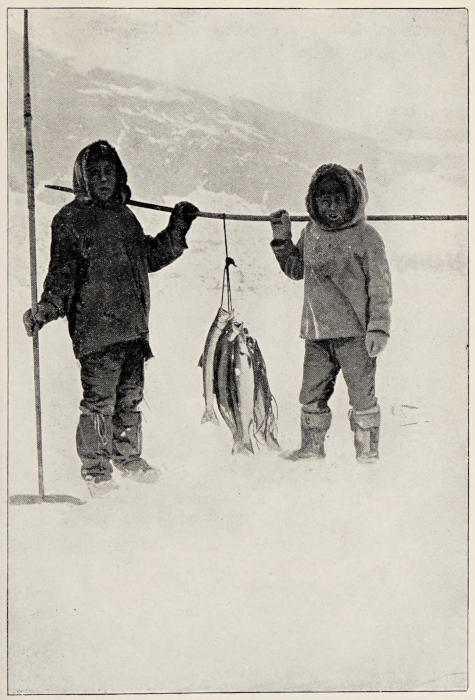
He accompanied them on their various hunting and fishing
journeys, and lost no opportunity of studying them and
winning their affection. He stood by their side as they fished
for hours through holes in the ice, and, observing their great
patience, he himself became strengthened in the greater task
of fishing for souls, and expresses the thought in the following
words:
“We may admire the patience of an Eskimo fishing for
hours over the blow-hole for a seal; and such should be the
perseverance of a watcher for souls. ‘Lord, we have toiled
all night, and have taken nothing; nevertheless, at Thy word
I will let down the net.’”
During the cold weather Mr. Bompas slept with the
Eskimo in their small, crowded houses, and the inconvenience
he suffered must have been great, as the following words will
show:
“The Eskimo sleep in their tents between their deer-skins,
all together in a row extending the whole breadth of the
tent; and if there are more than enough for one row, they
commence a second at the foot of the bed, with the head
turned the other way. For myself, I always took care to
commence the second row, keeping to the extremity of the
tent, and thus generally rested without inconvenience, except,
perhaps, a foot thrust occasionally into my side. At the same
time, it must be confessed that the Eskimo are rather noisy,
often talking and singing a great part of the night, especially
the boys; and if any extra visitors arrive, so that the tent is
overfull, it is not exactly agreeable.”
When the warmer weather arrived, Mr. Bompas began to
camp by himself outside, and found it much better. The
days became so long that he found it difficult to tell what
time of the day or night it was, as he “thought it most
prudent” not to carry his watch with him. Seldom did the
missionary speak of his hardships; but, reading between the
lines of the few words he utters, one can see they were of no
ordinary nature.
In a letter to Mrs. Loft, in England, Mr. Bompas gave a
vivid description of these Eskimo.
“It would be easy for you to realize,” he wrote, “and even
experience, the whole thing if so minded. First go and sleep
a night in the first gipsy camp you can find along some road-side,
and that is precisely like life with the Indians. From
thence go to the nearest well-to-do farmer and spend a night
in his pig-sty (with the pigs, of course), and this is exactly
life with the Eskimo. As this comprises the whole thing in
a nutshell, I think I need give you no further description.
The difficulty you would have in crawling or wriggling into
the sty through a hole only large enough for a pig was
exactly my case with the Eskimo houses. As to the habits
of your companions, the advantage would be probably on
the side of the pigs, and the safety of the position decidedly
so. As you will not believe in the truth of this little simile,
how much less would you believe if I gave you all particulars!
So I prefer silence to exposing myself to your incredulity;
but if I had to visit them again, I should liken it rather to
taking lodgings in the den of a polar bear. The first time,
in God’s good providence, he did not show his claws.
“Harness yourself to a wheelbarrow or a garden-roller,
and then, having blindfolded yourself, you will be able to
fancy me arriving, snow-blind and hauling my sledge, at the
Eskimo camp, which is a white beehive about six feet across,
with the way a little larger than that for the bees....
As to one’s costume, you cannot manage that, except that a
blanket is always a good cloak for us; but take a large
butcher’s knife in your hand, and that of itself will make you
an Eskimo without further additions.
“If you will swallow a chimneyful of smoke, or take a few
whiffs of the fumes of charcoal, you will know something of
the Eskimo’s mode of intoxicating themselves with tobacco,
and a tanyard will give you some idea of the sweetness of
their camps. Fat, raw bacon, you will find, tastes much like
whale blubber, and lamp oil, sweetened somewhat, might pass
for seal fat. Rats you will doubtless find equally good to
eat at home as here, though without the musk flavour; but
you must get some raw fish, a little rotten, to enjoy a good
Eskimo dinner.
“Fold a large black horse’s tail on the top of your head,
and another on each side of your face, and you will adopt
exactly the Arctic lady’s head-gear; then thrust a knife
through the centre of each cheek, and leave the end of the
knife-handle permanently in the hole, and you will experience
the agreeable comfort of the Arctic cheek ornament. After
this, get a dozen railway trucks tackled together, and load
them with large and small tow-boats, scaffold-poles, a marquee,
three or four dead oxen, the contents of a fishmonger’s
stall and of a small rag-shop, and then harness all your
family, and draw the trucks on the rails from Alford to
Boston, with a few dogs to help, and thus you will have a
very close resemblance to an Eskimo family travelling in
winter with their effects over the frozen ice. As I have
formed one of the haulers on such an expedition, I speak
from personal experience.”
Writing to his brother George, he says:
“Do you know that the Eskimo took me for a son of Cain,
probably Mahujael, for they said on my visit that in the first
family in the world two brothers quarrelled, and the one
killed the other, and the murderer had to wander away, and
they concluded that the white men who now came to meet
them were probably sons of the murderer.”
Several years later, referring to these Eskimo, he wrote:
“Both the Rev. Mr. Canham and myself often showed the
Eskimo the Illustrated London News, when, on meeting with
an elephant, they would recognize it, apparently by its trunk,
exclaiming ‘Kaleh!’ as an exclamation of surprise. The
interpreter, an Eskimo, who speaks English well, told me
that they knew the animal, because, though not now alive in
their country, they thought it was not long since it was so
from finding its body or skeleton. As elephant bodies are
known to have been found on the Siberian coasts, it is still
less strange that they should be found near the Mackenzie,
for the current sets eastward from Behring’s Strait. The
bodies might, however, lie embedded in the ice for thousands
of years without decomposition, and may have been floated
hither at the time of the flood.”
Mr. Bompas gives an amusing account of the food he ate,
but from the description, how disagreeable it must have been!
Bishop Reeve made a visit in 1892 to a tribe of Eskimo, known
as Huskies, eastward along the shore of the Mackenzie River.
“The men were all out hunting whales,” he wrote, “but
the women and children soon came around and gazed at the
strange white man. In the evening the men came in. They
had had a successful day’s hunt, and hauled home many
whales. The whales they catch here are white whales,
averaging from eight to fifteen feet in length, and very stout.
These they cut up into about six pieces. Then they skin
these pieces, and put the fat or blubber into bags, and hang
up the meat to dry, first cutting it into slices. This is the
work of the women. The fins and tails seem to be considered
delicacies, and are eaten raw. Some of the fat and meat is
stowed away in caches for winter use. These caches are small
holes in the ground, about five feet deep, sometimes lined with
logs, but generally without any lining except the frost. The
whale meat becomes very strong after being in these a while
in the summer, and then it is ready to eat. One day, sitting
in one of the tents, while the Huskies were having one of their
many meals, I was given a delicious piece of fin—at least, by
the way the natives were devouring it, I thought it must be
delicious. I cut off a very small piece and put it into my
mouth. The Huskies were watching to see how I would like
it. I slipped the rest into my pocket, and after a while
slyly got that piece out of my mouth. I suppose they thought
I had eaten some, but I had not, and I nearly lost my dinner
in the bargain. The thought of that delicious whale-fin
haunted me for days; but then it was raw, and had not been
pickled in a cache for several days.”
For a time things went very well with Mr. Bompas, and
he was allowed to move from place to place and teach the
simple truths of the Gospel as far as he was able. But the
cruel conjurers, or medicine-men, were watching him with
suspicious eyes. They did not like the man to be in their
midst with the new teaching, and they therefore determined
to get rid of him. Now the Eskimo have a great dread of
evil spirits. So one day the conjurers made the startling
announcement that evil spirits were in the camp, and that
the white man was the cause of them. They determined,
therefore, to drive them out, and also to drive out the
missionary from their midst. Mr. Bompas was trying to
sleep in one of the houses when the medicine-men began to
dance and conjure about him. Finding it impossible to get
any rest, Mr. Bompas went outside, and there rolled himself
up in his blanket. The conjurers followed him, and continued
their diabolical noise. “Only those,” says Bishop Stringer,
“who have seen the Eskimo conjuring dance can realize
how wild and savage it is, and how desolate a feeling it
brings to one not accustomed to it.”
For a while they continued the noise, and several times
they jumped upon the missionary in order to enforce their
meaning, but the Heavenly Father was watching, and delivered
His faithful servant. After a while the medicine-men said
they had accomplished their purpose, and would let the white
man live.
But Mr. Bompas did not put much dependence on these
words, and knew that at any time they might turn upon him
and tear him to pieces. This they attempted to do not long
after. It happened, when the ice had gone out of the
Mackenzie River, the Eskimo began to move up-stream to
trade with the Hudson’s Bay Company at Fort McPherson,
taking the missionary with them. It was a voyage of
250 miles, and much ice was encountered. For days they
made slow progress, and laboured hard. Then they became
angry with one another, and, stirred by the jealous medicine-men,
also cast threatening glances upon the white man in
their midst. They imagined that in some way he was the
cause of all their trouble, and angry glances were followed
by threatening gestures, and Mr. Bompas realized the situation
was most critical. One night, after a day of unusually
hard work—when little progress had been made—the natives
became so hostile that Mr. Bompas feared they would take
his life ere morning. But, notwithstanding the impending
danger, the faithful servant committed himself to the Father’s
keeping, and, wearied out, soon fell asleep.
His great friend among the Eskimo was the old chief,
Shipataitook by name, who had at the first invited him to
visit them, offered the missionary the use of his camp, and
entertained and fed him with the greatest kindness and
cordiality. He had taken such a fancy to the brave young
white man that he could not see him murdered without
making an effort to save him. He had heard the threatening
words, and when the plotters were about to fall upon their
victim, he told them to wait, as he had something to tell
them before they proceeded farther. Then he began a
strange story which, falling upon the ears of the naturally
superstitious natives, had a great effect. He told them he
had a remarkable dream the night before. They had moved
up the river, and were almost at Fort McPherson; and as
they approached they saw the banks lined with the Hudson’s
Bay Company’s men and Indians, all armed ready to shoot
them down in the boats if they did not have the white man
with them. When this story was told, all plotting ceased;
and in the morning, when Mr. Bompas awoke, he found no
longer angry glances cast upon him, but the natives were
attentive in their care.
On June 14 the ice left them, and the river became clear,
and without more detention they continued on their way,
“and arrived safely, by God’s help,” says Mr. Bompas, “at
Peel’s River Fort on June 18, about midnight.”
Here a most hearty welcome was given him by Mr. Andrew
Flett, the officer in charge of the Fur Company’s post, and
of him Mr. Bompas wrote in the following words:
“His influence over the Eskimo, as well as the Indians,
has been very beneficial, for the whole time of his residence
among them—now nearly ten years—and by consistent and
honourable conduct, as well as by his attention to the duties
of religion, he has done much to assist the work of the
missionary. Of his personal kindness to myself I have had
much experience during the past twelve months.”
In this beautiful heart-felt testimony to the work and
kindness of one man we see how the missionary was cheered
in his great labour by earnest words of sympathy and an
ever-open door of hospitality, where he could rest from his
great journeys. To Mrs. Flett also Mr. Bompas was greatly
indebted, for in the study of the Louchieux language she
gave him much material aid. Upon the lay members of the
Church of Christ devolves a noble work in cheering the hearts
and upholding the hands of their leaders in their strenuous
battle against the powers of darkness.
Never again was Mr. Bompas able to visit that band of
Eskimo along the Mackenzie River, but he ever held them
in mind, and often his heart went out to them, and he
declared that “there was nothing warmer than the grasp of
a Husky’s hand.”
His visit had not been in vain. He had lived among them,
shared their humble camps, and, though they could not
understand him, nor fully comprehend his message, yet they
could understand his love for them, and long years after they
spoke of him in the highest terms.
CHAPTER V ESKIMO LIFE
“Squatted on a polar-bear skin, with a deer-skin for a desk,”
was the way in which Mr. Bompas wrote the following
interesting description of the Eskimo he visited. It was
written by the camp-fire, under the open sky, with the
Eskimo all sitting around, working at their canoes, nets,
fishing-lines, bows and arrows. Often they would thrust
their inquisitive faces over his paper, asking over and over
again what he was writing about.
“This race of Eskimo inhabit the coast of the Arctic Sea
at the north of the great River Mackenzie. In spring and
fall they ascend the river in their skin boats for about 200
miles, and trade fox and bear skins for tobacco and iron
kettles, etc., at the nearest post of the Hudson’s Bay Company
on Peel’s River.
“In person and stature the race is a fine one. The men
are, many of them, tall and powerful, some more than six feet,
the average stature exceeding, I should say, that in England.
The women are smaller, probably of about the same average
stature as English women. The complexion and features are
not unlike the English. Several of the Eskimo, both men
and women, had I met them at home in European costume, I
should hardly have taken for foreigners. Others, again, have
a more distinguishing cast of countenance. The men’s hair is
cut short across the forehead. The face is square, forehead
prominent, eyebrows horizontal, nose straight, mouth large.
Some have a short beard, but most are without it. They
have a circular tonsure on the top of the head, similar to
that of Romish priests, and the men wear bones through
their cheeks, intended for ornament. A hole is bored through
each cheek near the lower lip as soon as a youth approaches
manhood, and through this is thrust a large button of ivory
(walrus tusk), and the ambition of an Eskimo is to have fixed
to this white button half a blue bead of the size of a man’s
finger-end. To possess one of these glass beads, which I
suppose could be had in England for a penny, they are willing
to give two black fox-skins, each of which might sell in
England for £50. To drive this advantageous bargain, however,
they are obliged to convey their furs many hundred
miles along the coast westward towards Behring’s Straits,
where other tribes of Eskimo are visited by American trading-vessels
from the Pacific. This cheek ornament (called totuk)
is, of course, a great disfigurement. It enlarges the mouth,
and causes inconvenience to the wearer both in speaking and
eating. Such, however, are the demands of Eskimo fashion.
“The women have also a peculiar custom of wearing large
bundles of hair on the top and sides of their head. It perhaps
can hardly be properly called false hair, as it probably once
had connection with the head which carries it. But the
present want of continuity is manifest, as the large bundles
are often laid aside for a time at night. I presume that all
the hair which ever grew on the head is carefully preserved
and added to the stock, as it seems to increase with the age
of the wearer. This is also an inconvenient and disfiguring
custom, but probably the Eskimo women would consider some
of our home fashions more absurd.
“The dress of the Eskimo is handsome. It consists of
shirt, coat, and trousers, usually of deer-skin, and fringed
with the long hair of the wolf and wolverine. Their favourite
head-dress is the skin of a wolverine’s head, surrounded with
blue beads, over which is worn the hood of the coat, with a
wide fringe of wolf or wolverine hair. Their boots are of
otter and seal skin. The sheep and musk-rat also occasionally
contribute their skins towards the clothing of an Eskimo.
The clothes are, of course, made by the women, and not without
considerable taste, ornamented with blue beads, of which
they are very fond, and strips of the white hair of the deer
being sewn into the brown by way of braiding. The coat is
shaped like a shirt. Sometimes the hair is turned inside
towards the skin of the wearer, and this affords greater
warmth. The animal’s skin which is thus turned outside is
then dressed so as to be quite white, and, when well beaded,
makes a showy appearance.
“The dress of the women is very similar to that of the
men, the coat and trousers of the same material, the chief
difference being in the shape of the hood, which, in the case
of the women, is made larger, to enclose their extra store of
hair, and thus better protect their face. The women also
wear no boots, but the trousers and shoes are all in one.
“The Eskimo is seldom seen without a large butcher’s knife
in his hand, which, in case of a quarrel, he unhappily uses too
often to stab his neighbour. His weapon for hunting on land
is the bow, as guns have not yet come into much use among
them. On the water fish-spears of various construction are
his constant companions.
“The Eskimo bow is very strong, and its elasticity is increased
by being backed with lines of twisted sinew. The
arrows are well made and feathered, headed with bone or iron
according to the game intended to be shot. The fish-hooks
are generally of bone, and sometimes baited as at home. But
for some fish no bait at all is used. The shank of the hook
of white bone is carved into the shape of a small fish, and is
thus mistaken for a bait. It is armed with a small iron barb
which secures the prey. The fish-spears are pointed with iron,
and lie on the outside of their canoes. One spear with three
prongs, like a hay-fork or trident, is used for hunting musk-rats
in the river, and is thrown from the canoe out of a
wooden handle or rest. The fishing-lines, and even nets, are
made often of whalebone, as also are partridge-snares, etc.
In fact, whalebone is used chiefly for tying and fastening the
canoe frames, spear-heads, etc.; the only other kind of line
they have, made of twisted sinew, being not well fitted for use
in the water. Whalebone seems a strange material to form
into fishing-nets, but it is split thin and cleverly netted to the
length of several yards, and about one yard in width. The
other lines, made of sinew, are very neatly plaited to the
length of 100 yards or more, forming a very strong fine cord,
used for fishing-nets, bow-springs, and various purposes.
“The construction of boats or canoes is part of an Eskimo’s
employment in spring. The boat or canoe frame is first
made out of a log of drift-wood, split up by means of bone
wedges into the required lengths. Each is carefully shaped,
smoothed, and finished by what are called in this country
crooked knives—that is, a knife with a blade slightly bent,
and used for shaving wood instead of a smoothing-plane.
The canoe is then covered with otter-skin and the boat with
seal-skin. The shape of an Eskimo canoe is well known. It is
about twelve feet long, and is entirely covered with otter-skin,
except the small hole in the centre in which the Eskimo sits
with his double and single paddles, and spears laid carefully
in ivory fittings on the outside of the canoe.
“The boat is from twenty to thirty feet long, and covered
with seal-skin, which is very strong, and forms a most serviceable
vessel. The wooden framework on which the skin is
stretched appears slight, but is securely fastened. This is
an open boat propelled by two oars, and, when the wind is
favourable, by a sail. As the men travel generally in their
canoes for the sake of hunting, it is chiefly the women and
children who remain in the boat, which conveys the tents,
furniture, utensils, etc. As the women row but very leisurely,
the progress made is rather slow; but the men are employed
in hunting, and time is not often of much importance to an
Eskimo.
“The dwellings of the Eskimo consist in winter of snow-houses
built on the ice, in summer of deer-skin tents, and in
the autumn, or fall, of wooden huts, partly underground, and
covered with earth. The chief home of the Eskimo is on the
ice. Here he passes at least half the year, and it is to this
that his habits are chiefly adapted. In building his snow-house
he shows a wonderful readiness, which I can compare
to nothing but the skill of a bee in making its honeycomb.
In the Eskimo country the fallen snow on the wide river-mouths,
after being driven by the wind, becomes caked or
frozen so as to have considerable tenacity, and at the same
time to be readily cut with the knife. The Eskimo then,
with his large butcher’s knife, cuts out square blocks of this
frozen snow as it lies on the face of the river, of the size of
ordinary blocks of stone masonry, and with these he builds
the house perfectly circular, of the shape of a beehive. With
no tool but the knife, which is used as a trowel, he works
with surprising rapidity, and the whole is arched over without
any support from beneath, except perhaps a single pole
during the construction. Any architect or mason at home
would, I suppose, be astonished to witness the work, and
might fail in imitating it, for without line or plummet and
square, or measurement, the circular span and arch are exactly
preserved, and the whole is finished in the space of a single
hour. The work proceeds as if by magic, the snow forming
stone and mortar both in one, for each block, when laid to its
neighbour, adheres and freezes to it so as to form one solid
mass, while the least touch of the knife shapes it and removes
any superfluous juttings. The weight of a single building
block is just such as a man can readily lift. In building the
walls of the house the work is simple, but in arching over the
roof it would seem impossible to proceed without support or
framework below. In fact, however, a single staff only is
placed under a block added to the roof just until the next
block is placed in juxtaposition. The adherence of the two
blocks is then sufficient to prevent any danger of falling, the
staff is removed, and the same thing repeated with the ensuing
block, until the whole is completed by working the tiers of
snow spirally.
A Snow-House made on the March
These houses have the advantage of costing nothing but time and labour
to make. The “bricks” are large slabs of frozen snow cut in such a shape
that they converge until they form a perfect dome. A hole large enough
for a man to crawl in on his stomach is left as a doorway. The dogs are
the draught animals of the frozen North; they are hard and untiring
workers, but of very irritable temper. Their usual fare is fish.
“An Eskimo in winter travelling builds a small snow-house
every night for his lodging, but when encamped for any length
of time he makes one of considerable dimensions. One in
which I lodged was about twelve or fourteen feet in diameter,
and about nine feet high in the centre from the level of the ice.
Half of the interior is occupied by the bed, which is raised
about three feet from the ice on snow covered with boards, on
which are laid ample deer-skin rugs for bedding; over these
are again deer-skin blankets for covering.
“Opposite the bed is the small, low entrance, shaped like
that into a dog-kennel, through which you have to creep on
all-fours. This at night is covered up with a block of snow.
On each side of the entrance (inside) is a shelf of snow, of the
same height as the bed, on which is placed a large black
wooden dish or trough forming the lamp. A little moss along
the side of this dish forms the lamp-wick, fed by grease, which
is constantly replenished from small lumps of fat hung over
the flame, and which drop grease into the dish.
“It seems a strange anomaly, that the coldest inhabited
country should be that in which fires are considered superfluous.
The heat given out by the lamps is certainly considerable, but
still, the camps are cold. The temperature must of course be
constantly below freezing-point, or the snow would melt. The
Eskimo, however, do not feel the cold as we do. Their hands
and faces are of a more plump and fleshy form than ours, and
the circulation of their blood is warmer, for their hands felt
quite hot to the touch while sitting without exercise in their
freezing camps. An Eskimo’s chief resource against the cold
is the amount of fuel he consumes internally in the form of
whale and seal fat used as food; and the provision of these
large animals in the polar sea for the use of these few scattered
savages is a remarkable proof of God’s providential care over
the meanest of His creatures....
“The Eskimo generally cooks meat or fish twice a day—once
about noon, and again the last thing before sleeping at
night. If hungry at other times, he will eat a fish or piece
of meat raw—that is, frozen; and this is not so disgusting as
you might suppose, for the effect of freezing meat or fish is
something the same as cooking it—that is, to harden the fibre
and dry up the superfluous moisture. Even Europeans in
this country sometimes eat a piece of frozen fish uncooked,
and find it good and wholesome.
“When an Eskimo visits a neighbour’s house, before he
has been sitting long food is always offered him—generally a
frozen fish, which he evidently eats with much relish. Sometimes
it is a small piece of frozen deer’s meat, or, as a great
delicacy, a lump of whale or seal fat. If he happens to come
in at the time of cooking, a portion of what is cooked is set
before him. This seems to be the rule of Eskimo hospitality.
“As soon as the spring thaw sets in, about the middle of
May, the Eskimo exchanges his snow-house for a deer-skin tent
or lodge, with which he soon after removes to the river-bank,
where he lives by fishing or hunting deer before proceeding to
the sea for the seal and whale fishery. In the autumn, or
fall of the year, the cold sets in early, and the deer-skin tent
becomes uncomfortable before the ice and snow are thick and
hard enough for building snow-houses. At this time the
Eskimo build, or rather excavate, huts in the river-bank,
which they ceil and cover with logs and earth. They close up
at night the small entrance with skins, and rely for light and
warmth chiefly on their lamps. A small window of thin skin
or parchment is made in the roof; but as the short days of
December approach the sun hardly shows itself, and daylight
is but scanty. In the snow-house a block of clear ice inserted
in the front forms a beautiful window, and as spring approaches,
and the daylight is perpetual, a cheerful contrast is presented
to the constant gloom and darkness of an Arctic winter.
“This is a country of contrast. In winter the gloom is
such that daylight seems a passing stranger. In spring the
glare is so great that the eye is sore and inflamed, if not
blinded by it. In winter the thermometer will stand about
100 degrees below freezing-point, and in summer, in the sun,
at least about 100 degrees above it.
“An Eskimo travelling with his family and effects in winter
affords quite an exciting display. About a dozen sledges or
trucks are harnessed together, and on these are laid a very
miscellaneous assortment of property and provision. Boat-frame,
canoes, tents, tent-poles, and boards, deer-skin bedding
and blankets, several whole deers’ carcasses, some hundreds of
frozen fish pressed into a solid mass, tent furniture, utensils,
clothes, fishing-nets and implements, with many other seemingly
needless stores, are all laden promiscuously on the train,
which is propelled by men, women, and dogs, all hauling by
lines along the sides of the sledges, and assisted, when the
wind is favourable, by a sail.
“The arrival of a large number of such sledge-trains at
camp one after another is like so many railway-trains coming
in, for the runnels of the sledges are covered first with bone,
and this is again carefully coated with ice, so that the sledges
run on the frozen snows like trucks on a railway. The sledge-train
which I assisted in drawing myself consisted, I believe,
of fourteen trucks, hauled by four men and boys, three women,
and five dogs. More than a dozen such trains reached the
camp at which I was staying. In spring the sledges are all
stowed away on the river-bank, and the boat forms the means
of conveying the Eskimo’s effects during the summer months....
“Considering the smallness of the number of the Eskimo
band we have been describing, and that no others are to be
found within about 100 miles, a wonderful provision has
indeed been made by God’s good providence for their sustenance.
This bounty seems intended on purpose to banish the
thought that these distant wanderers, condemned to such
severity of climate, are outcasts from the Divine care.
“In fact, both the power and goodness of God are in some
respect shown in this country more especially than in others;
for while sometimes we are constrained to say, in seeing the
vast expanse of snow and the thickness of the ice, ‘Who can
stand before His cold?’ yet the greater is the marvel when
‘He sendeth forth His word and melteth them; He causeth
His wind to blow, and the waters flow.’ The Eskimo know
not to thank their Heavenly Father who gives them their
daily supply of food, and though they have heard with gladness
and thankfulness the short story of Gospel truth which
alone I have been able as yet to communicate to them, yet it
requires the same mighty Power which melts their Arctic
snows and thaws their frozen ocean to turn them from darkness
to light, and from the power of Satan unto God.
“With respect to the character and habits of the Eskimo,
it is best to speak reservedly. They are certainly kind and
hospitable, civil and obliging, skilful and clever in handicraft.
I fear it must be added that they are liable to fits of passion
and sulkiness, that they are lazy and sleepy, and addicted to
lying, stealing, and even stabbing. Over their other shortcomings
it is best to draw a veil.
“They practise heathen dances, songs, and conjuring, and
this seems to be the greater part of their religion. Their
dance, however, is a mere shuffling of the feet, their song is
but a monotonous yell, and their conjuring consists only in
yelling and beating the tambourine, and throwing the body
into various distortions and attitudes. They possess also,
most of them, in a bag, a collection of small, miscellaneous
articles, which are intended, I suppose, beneficially to influence
their hunting by way of spells and charms. Beyond this I
cannot find that they have much religion remaining among
them. They know of an evil spirit, named Atti, which seems
to symbolize cold and death, and which they seek to exorcise
or appease by their charms and spells.
“Their only idea of a good spirit is connected with the
sun, as the source of warmth and life; and, considering the
severity of their climate, it is not wonderful that their natural
religion should symbolize the powers of good and evil by
warmth and cold. If they have any idea of heaven, it is that
of a perpetual spring, and the name they give to the ministers
who bring them tidings of the world above is ‘Children of
the Sun.’ I have not found that they have knowledge of a
future life. They say the old Eskimo used to know these
things, but the young ones have forgotten them. They
possess, however, a tradition of the Creation, and of the
descent of mankind from a single pair.”
CHAPTER VI OUT OF THE NORTH
One day when Mr. Bompas was walking along the Yukon
River, he returned to Fort Yukon, and found there a letter
awaiting him. It was from England from the Church
Missionary Society, asking him to go all the way to London
to be made Bishop of the vast northern Diocese of Athabasca,
which was to be formed. Mr. Bompas did not want to be a
Bishop. He preferred to live the life of a humble missionary
among the Indians whom he so dearly loved.
In July, 1873, he set his face homewards with the express
purpose of turning the Church Missionary Society from the
idea. It was a long journey that lay ahead of him, fraught
with many dangers and difficulties. The clerk at Fort Yukon,
in charge of the American Fur Company’s post, kindly
supplied him with provisions and with two Indian lads, who
had volunteered for the trip. Soon all was ready, and then
the start was made up the Porcupine River; and after two
weeks of hard and persevering labour, he reached the Rocky
Mountains. Here the Indians left him to return to Fort
Yukon, and alone and on foot the missionary began his
journey across the mountains. Three days was he in accomplishing
the task, and in a furious snowstorm, “which rendered
the mountains almost as white as in winter,” reached Fort
McPherson, Peel River, on August 6.
What it means to cross these mountains may be learned
from the terrible experience of Bishop Stringer during the
fall of 1909. It is best given in the words of Rev. C. E.
Whittaker, stationed at Fort McPherson:
“After the Bishop’s return from his Eskimo visitation, he
outfitted for crossing the mountains by the well-known Rat
River and McDougall’s Pass route with Mr. Johnson, who is
on his way to Chicago, after eleven years’ service in the north.
They had a sufficient crew, leaving here September 1, and a
good Peterborough canoe; but on the fifth day one of their
Indian men was taken dangerously ill, and he had to be sent
home and more help procured. By this nearly a week was
lost, and the weather becoming colder, the water got very low
in the mountain streams. However, on September 20 they
crossed the Divide. The two men attacked an unknown
proposition alone. The battle with ice began the first day,
but, hoping to find more and clearer water in Bell River, they
kept on. The upper reaches of the Bell were easily navigated,
but once through the mountains, the current became very
slack, and the ice again hindered them. They cut heavy
birch clubs to smash the ice, hoping to reach the Porcupine
about forty-five miles from the summit. They were stalled,
and had to cache their canoe and baggage. What was to be
done now? La Pierre’s house was close by, but abandoned.
There was not a known Indian camp within 100 miles. Old
Crow or Rampart House might be reached in time if they
had supplies, but with only three days’ rations it was unthinkable.
Their starting-point, Fort McPherson, lay beyond
the mountains, and the snow was already deep, and neither
of them knew the trail. This last only seemed not impossible,
and they decided to undertake it. Continuing down the Bell
on foot, through the rough willows and deep snow, they
struck the mouth of the La Chute River and followed it up-stream
for several days, killing here and there a few ducks
and spruce grouse to eke out their scanty fare. At Fool’s
River, coming in from the north, they missed the trail, and
spent a whole week wallowing through deep snow and deeper
fog in this river and on the mountains near it. Returning
to the mouth, they spent three days making snow-shoes and
cutting up moccasins for webbing. Again ascending the
La Chute, they climbed the Height of Land, and, working by
compass, they crossed three distinct Divides before reaching
an east-flowing stream. They saw one sheep, and once some
caribou, but at too great a distance, and going fast. They
were now living on one meal a day, and that meal was less
than one quarter of an average meal. For instance, at one
time four red squirrels and a spoonful each of flour and rice
fed them three days; another day they had a leg of ptarmigan
each. They tried eating moccasin leather, and ended on
messinke boots or muckalucks, which are made of raw seal-skin.
These are found very nourishing. Food being so
scarce, their strength failed and their progress was slow. At
times the fog was so dense that they could scarcely see a step
ahead, and more than once they trod on the verge of a precipice.
Then they had to make long detours, and so they
continued day after day, some nights sleeping on the mountains
without fire, but generally in some creek-bed with a few
willows, sleeping from very weariness and exhaustion. Once
the Bishop said to Mr. Johnson: ‘It is curious, but there is
ever rising up in my mind the words, “Go, labour on, ’tis
not for naught.”’ And Mr. Johnson replied: ‘It is curious
indeed, for in my mind there constantly repeats itself that
other hymn, “To the work, to the work! ye are servants of
God.”’ And so, though famished, and worn, and fog-bound,
and never knowing how far they had yet to go to safety,
they were ever buoyed up with a strong hope of ultimate
escape. When they finally descended an eastern slope, and
knew that they were at least past the maze of fog, a thrill
of assurance gave them renewed energy, and they followed
the bed of a small river until they came into the Peel,
twenty miles above this post. Here they saw snow-shoe
tracks, the first signs of any human habitation, an Indian
having lately passed by that way trapping. Early next
morning they reached an encampment, and they afterwards
declared it was worth coming back to see the kindness and
hospitality with which they were received.”
Starting again by canoe, Mr. Bompas, with two other
Indian lads, reached Fort Simpson, a distance of 800 miles,
on September 2, “after three weeks of fatiguing towing.”
Pushing on his way, after a difficult journey, contending with
the cold and swift stream, he reached Portage la Loche on
October 8, having travelled 2,600 miles since July, “and all,
except about 300 to 400 miles, against a strong current.”
Owing to the cold weather he was forced to remain at the
Portage for ten days, and when the swamps were sufficiently
frozen, he “started on foot through the woods to Buffalo
Lake in company with two servants of the Hudson’s Bay
Company.” Reaching the lake, he travelled with some difficulty
on the fresh ice around the margin, and at the farther
end found a camp of Indians, who guided him to Isle à la
Crosse. Here a detention of ten days was made, and then
he left with dogs and sledge for Green Lake, with three
employés of the Hudson’s Bay Company. The weather
becoming milder, they were forced “to cross one of the
intervening rivers on a raft.”
From Green Lake they entered “on the plain country of
Saskatchewan,” and after a walk of five days reached Fort
Carlton. While here Mr. Bompas visited the Prince Albert
Settlement on the banks of the North Saskatchewan, and
says: “This settlement is the first that has been formed by
the immigrants in that neighbourhood, and it bears every
sign of increasing prosperity and success.”
From Carlton House, Touchwood Hills was reached with
a horse and sledge. Here, through the kindness of the postmaster,
he was furnished with a carriole and dogs, and, after
a journey of 400 or 500 miles, reached the Red River Settlement.
“I enjoyed the kind hospitality of the Bishop of Rupert’s
Land and Archdeacon Cowley,” wrote Mr. Bompas, “and
was much interested in seeing the progress of the mission
work in the colony. I reached, by God’s good providence,
the first houses of the settlement on the last evening of the
old year, and after nearly six months’ travel in the wilds, I
awoke on New Year’s morning to a new life of civilization
and society.”
It is said that when Mr. Bompas reached the episcopal
residence and inquired for Bishop Machray, the servant
mistook him for a tramp (in his rough travelling clothes),
and told him his master was very busy, and could not be
disturbed. So insistent was the stranger that the servant
went to the Bishop’s study and told him a tramp was at the
door determined to see him.
“He is hungry, no doubt,” replied the Bishop; “take him
into the kitchen and give him something to eat.”
Accordingly Mr. Bompas was ushered in, and was soon
calmly enjoying a plateful of soup, at the same time urging
that he might see the master of the house. Hearing the
talking, and wondering who the insistent stranger could be,
the Bishop appeared in the doorway, and great was his
astonishment to see before him the veteran missionary.
“Bompas!” he cried, as he rushed forward, “is it you?”
We can well realize how Mr. Bompas must have enjoyed
this little scene, and the surprise of the good and noble
Bishop of Rupert’s Land.
We will let Mr. Bompas describe the rest of the journey:
“From Manitoba the dog-train was exchanged for the
stage-coach for Moorhead, the terminus of the American
railway towards the north-west. In this the cold was piercing
and freezing, even though the travellers were wrapped in
buffalo-skins. The poor horses were utterly exhausted in
drawing the vehicle about fifteen miles through the snow,
and though they were changed thus often, yet at last the
journey had to be suspended during a storm, and in the end
the horses, though changed every stage, occupied a week in
performing the same distance as that travelled by the dogs in
four days, more easily and pleasantly—that is, 160 miles.
“The journey was next continued by railway, but from the
fires not being lighted in the cars the cold was intense, and
the train was shortly brought to a standstill in a snow-drift.
Though two locomotives were tugging at it, no progress could
be made till the guards with shovels disengaged the carriage-wheels
from the snow which entangled them.
“In Canada the journey by stage-coach was resumed. This
was shortly after overturned into a ditch by the wayside
while scaling a snow-drift. The outside passengers were
deposited in an adjoining field, where, to be sure, the snow
provided them with a sufficiently soft bed to fall on. The
inside passengers had a more uncomfortable shaking.
“The journey was next proceeded with by train to Montreal,
before approaching which the cars left the rails, causing some
apprehension and delay, which might have been increased had
not the guard been provided with a powerful winch for the
purpose of replacing the carriages on the track.
“From Montreal, following the Grand Trunk Railway to
Portland, I embarked in the steamship Scandinavian, of the
Allan line. At starting, the masts, yards, and deck of the
steamer presented a woeful appearance, from being thickly
coated and hung with ice, yet 200 miles were made the first
day. By the constantly increasing head-wind, however, the
daily speed was decreased down to 100 miles per day, at
which rate the captain thought it prudent to shut off half
the steam, and diminish the speed to a minimum, for fear
that something should give way in the plunging vessel.
After thirteen days, under the careful seamanship of Captain
Smith, Liverpool was reached on February 13, in the safe-keeping
of a protecting Providence.”
This account is given to show some of the difficulties the
traveller experienced in the early days in his trips to and
from England. Mr. Bompas, after this journey, decided in
favour of the dog-team.
“On the whole,” he said, “the dogs may be counted to
hold their own in competing with horse-flesh or steam,
whether on land or water.”
At last the soldier was home from the front, the hero
among his friends, and after the years of hardships he might
have enjoyed a well-earned rest. But his thoughts were far
away across the ocean in his vast field of labour, and the voice
of the children of the wild was ever urging him to make haste.
The restraints, conventionalities, and luxuries of civilized life
worried him; the narrowness of the streets was unbearable,
and he longed for the smell of the camp-fire, the free, fresh
air of the North, the great untamed streams, the snow-capped
mountains, and his dusky flock.
During his stay in England, Mr. Bompas had many commissions
to fulfil, which occupied much of his time. There
were purchases to make for people in North-West Canada, including
six gold watches for as many female residents, and a
pair of corsets for another. Obtaining the latter caused much
worry to the missionary. But he was never known to back
down, and finally the purchase was made. Is it any wonder
that he preferred the life among the Indians, who worried so
little concerning the wherewithal they should be clothed?
Winter Travelling. A Missionary’s Indian Helper
This picture shows a sled loaded up, with the dogs harnessed, and the
Indian driver standing by them.
Mr. Bompas was unsuccessful in dissuading the Church
Missionary Society from carrying out their plan, and on May 3
he and John McLean were elevated to the Episcopate. The
consecration took place in the parish church of St. Mary’s,
Lambeth, Dr. Tait, Archbishop of Canterbury, being assisted
by Bishop Jackson of London, Bishop Hughes of St. Asaph,
and Bishop Anderson, late of Rupert’s Land. The sermon
was preached by the last-named prelate, who referred to the
two new dioceses of Saskatchewan and Athabasca:
“To-day the noble plan will be consummated by the consecration
of two more Bishops. One will preside over the
Church in the western portion of the land, labouring among
the Indians of the plains, and along the valley of that river
whose source is in the Rocky Mountains, the River Saskatchewan.
The other will have the northern diocese as his own,
along yet mightier lakes, and with rivers which roll down an
immense volume and discharge themselves into the Arctic
Ocean.”
After some words addressed to Bishop McLean, the charge
which was given to Bishop Bompas concluded thus:
“You have been there for more than eight years, in labours
abundant, and your love has not lessened nor your zeal
slackened. You have brought home, as the fruit of your
labour, portions of Scripture, prayers and hymns, in seven
different dialects or tongues. You are ready to take the
precious treasure out with you—the translations printed and
prepared by the Society for Promoting Christian Knowledge.
You have also one complete Gospel, that of St. Mark, which
the British and Foreign Bible Society has enabled you to
carry through the press.
“But you left good treasure behind, in souls warmed with
the love of Christ and softened by the spirit of grace. You
have the hearts of the Indians and the Eskimo.”
CHAPTER VII BACK TO THE WILDERNESS
Bishop Bompas was not to return alone to his great work, for
a few days after his consecration, May 7, he was united in
marriage to Miss Charlotte Selina Cox by Bishop Anderson,
assisted by the Rev. John Robins, Vicar of St. Peter’s,
Netting Hill, and the Rev. Henry Gordon, Rector of Harting.
Mrs. Bompas was a woman of much refinement and devotion
to the mission cause. Her father, Joseph Cox, M.D., of
Montague Square, London, was ordered to Naples for his
health. During this trip, in which he was accompanied by
his family, his daughter, afterwards Mrs. Bompas, acquired
that love for the Italian language which ever after continued
to be a great source of pleasure to her. No matter where
she went in the northern wilds of Canada, she carried her
Dante with her, which she studied, with much delight, in the
original.
During her stay at Naples she attended her first ball, given
by the British Ambassador, and met the King of Naples (the
notorious King “Bomba”), and always afterwards remembered
his remark in Italian, “What have you done to amuse yourself
at the carnival?”
When quite young, Mrs. Bompas had little interest in
missions, and says: “My brother, who was Vicar of Bishop’s
Tawton, Devonshire, used to hold missionary meetings at the
Vicarage, and I remember thinking them the dullest affairs,
and the clergymen who addressed us, and whom my brother,
perhaps, would introduce as the distinguished missionary from
Japan or Honolulu, I looked upon as the most dismal old
slow coaches it was anyone’s unhappy fate to attend to.”
Her interest at length became aroused, and later, when
the martyrdom of Bishop Patteson startled the Christian
world, she became much excited, and reached, as she tells us,
“the enthusiastic stage when we resolve to become missionaries
ourselves, and are all impatient to be off anywhere—to
China, Japan, or to the Indians of the Mackenzie River.”
It was at this period she cast in her lot with the Bishop of
Athabasca, and became “consecrated to mission work.”
The Bishop and Mrs. Bompas, on May 12, 1874, set their
faces towards their great field of labour. Friends and loved
ones came to bid them farewell, among whom was Bishop
Anderson, late of Rupert’s Land, who presented the Bishop
with a beautiful paten for his cathedral in the new Diocese of
Athabasca. The good steamship China, of the Cunard Line,
received them, and soon she was cutting her way through the
water bound for New York. Consecrated, married, and
sailed all in one week! Such was the record of the Bishop,
who declared it was the hardest week he ever experienced.
Never again was he to look upon the shores of his native land,
or visit the scenes of childhood; the northern wilds of Canada
needed him, and there he remained till the last.
Ahead of them lay the long journey of two months by open
boat to Fort Simpson. At Winnipeg they missed the boats
of the Hudson’s Bay Company, and after some difficulty
another was obtained, in the hope of overtaking the former.
It was a “brilliant, cloudless” June morning when they crossed
the prairie towards St. John’s Cathedral, and sighted the
“river, looking still and silvery in the morning light,” and
found the boat, their home for weeks to come, “moored just
below St. John’s College.” Farewells were said, the boat
pushed off, and they moved on their way, leaving the Bishop
of Rupert’s Land waving his hand from the bank of the
stream.
It was a tedious journey, as day after day they glided
forward. Not only was the heat intense, but the swarms of
mosquitoes proved a great annoyance.
“I had come prepared for intense cold,” wrote Mrs. Bompas,
“and we were destined to endure tropical heat. All up the
Saskatchewan, Stanley, and English Rivers the banks slope
down like a funnel, and the July and August sun scorches
with vertical rays the heads of the travellers. We were seated
in open boats, each with a crew of ten or twelve men, who
spread our sails when the wind was fair, and took them in
when the wind failed us. Eighty-six was, some of those days,
our average temperature, and I had come provided with the
thickest of serge dresses, as none of my friends had realized
the possibility of anything but frost and cold in these northern
regions. Besides this, we had to encounter swarms of
mosquitoes, crowding thick around us, penetrating our boots
and stockings, and invading our Robabou soup and pemmican,
etc. I remember the bliss it was in those days in camping-time
to escape from the rest of the party, and, getting rid of
boots and stockings, to sit with my feet and legs in the cool
water of the river, to soothe the intolerable irritation of the
mosquito-bites.”
But in the midst of all this there were times of refreshing,
and at various places hearty were the greetings that awaited
them. One morning they reached St. Andrews, on Red
River, and there before them appeared a pretty stone church,
with wide, square tower, and a comfortable-looking parsonage-house,
with a nice veranda, and a few scattered cottages
around. It was a pleasant home scene, and there they found
the Vicar, the Rev. John Grisdale (afterwards Bishop of
Qu’Appelle), and about sixty others, who had been waiting
all the morning to receive them. After luncheon had been
served a little service was held on the veranda, and as they
left, the bell of the church rang out a peal of farewell, and
all on shore gave a hearty cheer.
All along the way Indians were encountered camped on the
bank, and at times a halt was made while the Bishop spoke
a few words to them. One night they stopped near a number
of natives, and service was held. Among the party was a poor
woman totally blind. The Bishop knelt by her side and told
her of the blind man in the Gospel story, and repeated to her
several passages of Scripture, to which the woman listened
with much eagerness, and seemed greatly pleased.
The many long, hard portages formed a great impediment
to their progress, and through the scorching heat, fighting
myriads of mosquitoes, the provisions had to be carried overland
and the boat dragged up the rapids. The Bishop
willingly took his share of the labour, and though of great
strength, overtaxed himself in lifting a heavy box, and
sprained his back, or, rather, re-sprained it, as he had been
injured some weeks before in hauling at the boat. He
suffered much agony from the sprain, which troubled him
somewhat during the rest of his life.
An incident happened on this trip which serves to show
the Bishop’s forgetfulness of self when others were to be considered.
A young Indian lost his hat overboard, and, being
unable to obtain it, suffered much from the heat as he toiled
at the oar. The Bishop, seeing his discomfort, at once placed
his own hat upon the Indian’s head, and insisted that he
should wear it. The sight of the native with the flat, broad-brimmed
episcopal head-gear caused great amusement to the
entire company.
There were times of excitement, too, as they moved on their
way. We shall let Mrs. Bompas tell of one in her own
graphic style:
“It was about 6 o’clock p.m., the sun still high, but a
fresh breeze had set in, and was filling the sail of our boat,
and giving us comfort and refreshment after a sultry day.
We were beginning to discuss our landing, wondering where
our steersman intended us to encamp that night, as all the
details are left to his control and management.
“Suddenly, as we were quietly sailing on, an exclamation
was made by one of our sailors, and as suddenly all eyes were
directed towards a line of thick wood which encircled a bay
on our right. It would be impossible to give any idea of the
intense eagerness which marked the gaze of our ten men.
You must know something of the Indian’s intensity of
character, and his love of sport, to be able to understand
and appreciate it.
“Our fore-oar man, ‘Charley,’ especially attracted my
attention. Such a strange, tawny, heavy face as his was
when passive, with long black hair hanging on each side his
face, and a disordered attempt at whiskers and moustache;
one hand clutching nervously at his oar, and the other shading
his eyes; every sinew, almost every nerve, in a state of
tension. We longed to ask what object they saw, but scarcely
ventured to do so, for silence had overspread our crew, and
though apparently much was being discussed, and important
matters decided upon, yet it was all done by signs, or in low-whispered
accents. At last some conclusion was evidently
arrived at. The sail was lowered, and our course altered in
the direction of the wood in question. At the same time the
Bishop ascertained from one of the men, and whispered to me,
the cause of all this excitement—namely, ‘a black bear’!
An Indian Encampment
From a photograph by Mr. J. M. Lowndes, Calgary
“It needed the quick eye and ear of a Red Indian to detect
the bear, if such it was, at the distance we then found ourselves
from the wood, and amid the countless shadows of those
great Norway pines, or the grotesque forms of aged stumps
and stones which edged the wood. For some moments I felt
convinced that it was all a mistake, and that our bear would
turn out no more than a ‘bare idea’! However, the men had
full faith in their hero, though I had none, and so, still in
dead silence, we moved steadily on, making for the wood at
the exact point where the dark object had at first been visible.
“It was really very striking, the way in which we drew up
to shore, and lowered our sail, all with no more sound than
would have awakened a sleeping infant. And now two of the
men slipped ashore, having first possessed themselves of loaded
guns. Others followed, with soft, stealthy footsteps, and all
soon disappeared in the mazes of the thick forest.
“One thing I could observe for myself, which laid to rest
my doubts as to the fact of the bear having actually been seen—great,
spreading paw-prints on the sand. Yes, he had an
existence then, poor old Bruin! and had been quietly disporting
himself upon the sand that evening, perhaps in
pursuit of a little fish for his supper, little thinking, poor
beast, of the sumptuous repast for ten hungry men which he
was destined to form that very night.
“The part left for us to play at this time was certainly less
exciting and less interesting than that of our men. Close into
the shore at that time of the evening mosquitoes invariably
abound. This evening they positively swarmed, and in addition
to them were a number of sand-flies, so small that no
veil could keep them out, and almost as vicious as their great-aunts,
the mosquitoes. So there we sat, poor, helpless beings!
tapping our foreheads and hands to get quit of our buzzing
enemies, and thinking longingly of our tents and supper.
“Suddenly there was the sound of a gun fired, which
roused our interest, and made us feel as if the game were in
earnest. First one, then another report was heard, and after
a few moments’ interval there arose shouts of triumph, and
cries or screams, such as only those Indians can give.
“Our party in the meantime, being weary of the mosquitoes,
and naturally by this time somewhat excited by the
matter in hand, had left the boat and gone ashore. Sticks
and faggots were collected, and in a few moments a splendid
fire was kindled. Around it we closely gathered, thankful
for the temporary relief from the buzzing enemies, for no
mosquitoes dare invade the region of smoke or fire.
“Soon was heard the sound of approaching footsteps.
Tramp, tramp, tramp, as of men marching under some heavy
burden, accompanied by the sound of many voices, and soon
the party appeared in sight. The two foremost carried a
stout pole, to which, with his legs tied together, hung the
body of poor Bruin! The men brought up their trophy and
laid him down among the ferns, and bluebells, and pretty
golden tansy for us to examine. A splendid bear he was,
about two years old, very fat, and with hair as sleek and
glossy as if—forgive me, Bruin!—he had been accustomed to
the use of ‘bear’s grease.’
“Our young French-Canadian, who had shot him, said he
had tracked the beast for some distance, and then stood still.
In a few moments he heard the rustle of leaves and breaking
twigs, and the slow tread of the four paws. Soon he came
in sight, when one shot made him fall, and a second bullet
despatched him wholly.
“That night—that very night, over our camp-fire, a huge
cauldron was suspended, and joints of bear were cooked,
eaten, and I presume enjoyed, by our men. We ourselves
were, I was thankful to feel, excused from sharing in the
repast that evening. But a dish of delicate bear steaks was
presented to us next morning for breakfast; and having with
difficulty conquered a certain feeling of great repugnance in
tasting them, we could not but pronounce them excellent.
“I do not think it is at all fair to name a person who is
uncouth and ill-mannered ‘bearish.’ My experience of Bruin
shows that he is remarkable for a sedate yet good-tempered
expression, and his tastes are certainly not ungentlemanly, as
he seems to live entirely on fish and the wild berries of these
noble Canadian forests. I understand that a bear once was
heard to tell his cub, who ate voraciously, and showed temper
to his brothers and sisters, that he was most ‘mannish’ in his
behaviour. I thought the epithet not wholly inappropriate.”
Fort Simpson was reached on September 24, and much excitement
took place. The red flag of welcome was soon hoisted,
and Mr. Hardisty, the chief officer, and the whole settlement
came to the shore to meet them. So hearty was the reception
that they did not perceive the shadow—the grim shadow
of starvation—that was hanging over the fort and land.
There was only one week’s provisions in the Company’s store,
and game was very scarce. At this point the new party
arrived, bringing six extra mouths to be fed, besides the
boat’s crew, and yet the Company’s officers received them with
the utmost courtesy and good temper, and did their best to
look and speak cheerfully. Most of the men around the fort
had to be sent away, and there was difficulty in collecting
dried scraps of meat for the wives and children. At length
there came a time when there was not another meal left.
The poor dogs hung around the houses, “day by day growing
thinner and thinner, their poor bones almost through their
skins; their sad, wistful look when anyone appeared. Even
a dry biscuit could not be thrown to them.” But just when
matters reached the worst, two Indians arrived, bringing
fresh meat, and the great tension slackened.
“From that moment,” says Mrs. Bompas, “the supplies
have never failed. As surely as the provisions got low, so
surely, too, would two or three sledges appear unexpectedly,
bringing fresh supplies.”
CHAPTER VIII A TERRIBLE JOURNEY IN WINTER
The Bishop had to be ever on the move to cover even a small
portion of his huge diocese. He had no comfortable railway
cars in which to travel, and no horses to draw him speedily
along; only dogs, faithful little animals, to carry his food
and camping outfit, while he and his companions walked.
Fort Simpson was chosen by the Bishop as his abode at
first. It is situated at the confluence of the Mackenzie and
Liard Rivers, and formed the most central and convenient
point for managing the vast diocese. This position had been
occupied years before by the Hudson’s Bay Company, and
here, in 1859, Mr. Kirkby built the church and mission-house.
All around stretched the huge diocese of one million square
miles—and such a diocese! It has been well described by the
Bishop himself in the following words:
“No shepherd there his flock to fold,
No harvest waves its tresses gold;
No city with its thronging crowd,
No market with its clamour loud;
No magistrates dispense the laws,
No advocate to plead the cause;
No sounding bugle calls to arms,
No bandits rouse to dread alarms;
No courser scours the grassy plain,
No lion shakes his tawny mane;
No carriages for weary feet,
No waggons jostle in the street;
No well-tilled farms, no fencèd field,
No orchard with its welcome yield;
No luscious fruit to engage the taste,
No dainties to prolong the feast;
No steaming car its weighty load
Drags with swift wheel o’er iron road;
No distant messages of fire
Flash, lightning-like, through endless wire;
No church with tower or tapering spire,
No organ note, no chanting choir.”
Writing of the extent of his diocese, the Bishop says:
“To represent the length and tediousness of travel in this
diocese, it may be compared to a voyage in a row-boat from
the Gulf of St. Lawrence to Fort William, on Lake Superior,
or a European may compare it to a voyage in a canal barge
from England to Turkey. Both the length and breadth of
this diocese equal the distance from London to Constantinople.
“If all the populations between London and Constantinople
were to disappear, except a few bands of Indians or
gipsies, and all the cities and towns were obliterated, except
a few log-huts on the sites of the capital cities—such is the
solitary desolation of this land. Again, if all the diversity
of landscape and variety of harvest-field and meadow were
exchanged for an unbroken line of willow and pine trees—such
is this country.”
In this region the Bishop and his devoted wife began their
great work together. At once an Indian school was started,
carried on at first principally by the Bishop himself. Mrs.
Bompas says:
“My ears often grew weary of the perpetual ‘ba, be, bo, bu;
cha, che, cho, chu.’ These, with a few hymns translated into
their own language, and a little counting, were the first
studies mastered by our Simpson scholars.”
Three hundred miles from Fort Simpson was another post
of the Hudson’s Bay Company, Fort Rae. Here was a band
of Indians who needed the message of the Gospel, and the
Bishop decided to go to them. Together with several men
from Fort Rae he set out, having with his sled Allen Hardisty,
an Indian who was being trained as a catechist.
“It was a clear, beautiful morning,” says Mrs. Bompas,
“November 27, 1874. The great frozen river glittered in
the sunshine. Not a smooth, glassy surface, but all covered
with huge boulders of ice, and these again all thickly strewn
with snow.... Here are our ‘trippers,’ as they are called,
and all ready to start, and my Bishop in his fur cap and
warm wraps which I have made for him. His large mittens,
formed of deer-skin and fur, are suspended from the neck, as
is the custom here. Allen, the catechist, packed the sledges
last evening with their bags of clothing and provisions for
the way—blankets, cooking implements, etc. There are
three sledges, and the dogs ready harnessed. I am rather
proud of my ‘tapis,’ which, amid sundry difficulties, I contrived
to get finished, with some help, in time. Now comes
the word, ‘Off! all ready!’ Our farewells are said, the drivers
smack their whips, the dogs cry out and start in full scamper,
the trippers running by the side of their sledges at such a
pace that they are soon out of sight.”
It is certainly an interesting thing to watch a dog-team
start on a long journey. The harness is decorated in gay
trappings with ribbons, beads, coloured cloth, and many
jingling bells. The dogs enter into the spirit of the undertaking,
and lift up their voices in wild yelps and barks.
A good dog-team in the North costs from $100 to $200,
averaging about $25 a dog. Some of the best in the country
are bred by the natives, nearly every grown-up Indian having
his own dog-team and sledge or toboggan. The Indians
make their own sledges and harness, the former being made
of birch-wood, and the latter of moose-skin.
Dog-Sled in North-West Canada
A couple married at Whitehorse by Bishop Stringer started in November
with this team of dogs, and, after a journey of 1,200 miles, arrived
at Fairbanks in the spring.
Though the Bishop and his companions started off bravely
and in high spirits, they little realized what difficulties were
ahead. The snow was deep and the cold intense. The dogs
suffered much. The sharp crust and ice cut their feet and
blood-marked every foot of the trail. This is by no means
uncommon in Northern travel. The snow gathers in lumps
between the dogs’ toes, and often the poor brutes will stop
and tear savagely at the pieces with their teeth. Often the
driver does this work of mercy, and the dog will lie on his
side or back, looking up piteously into his master’s face.
Sometimes little moose-skin moccasins are made, in shape
like a miner’s gold-poke, with a drawing-string at the top.
These, fastened securely upon the dogs’ feet, give them much
relief, though it is hard for them to draw heavy loads, as the
moccasins prevent their toes from gripping the trail. The
lash, too, adds to the dogs’ suffering. To a person who has
never been on the trail, or in common parlance “mushed
dogs,” it may seem an unnecessary cruelty; but the truth is,
they will not work at all unless the whip is used to a certain
extent. There is a great difference, of course, between urging
on the animals now and then with a sharp cut of the whip
and ill-treating them as some drivers do. It is no uncommon
thing for a brutal master to pound his dogs with a heavy
stick, beating them until they are almost insensible. The
curses of some men are terrible to listen to, and many contend
that dogs will not travel without a string of oaths being
hurled at them.
A missionary some years ago in the Yukon held a service,
at which only miners and prospectors were present. His
subject was swearing, and he spoke about dog-driving. He
appealed to them, and asked if it were not possible to drive
dogs without cursing at them. At this a hardy, husky miner
rose to his feet, and looking calmly at the missionary, replied:
“Your Reverence, it can’t be done.” Now this is all nonsense.
It can be done, and dogs which are properly trained will
travel just as well to the words, “Mush on,” and “Hike
on, there,” as to all the choicest oaths in the English
language.
The Bishop would never allow the dogs to be ill-treated in
his presence; neither would he permit his men to swear at
them. It was his usual custom to go ahead, on his long,
springing snow-shoes, which sometimes are called “Northern
slippers,” and break down the trail. He was a man of great
endurance, and day after day he kept the lead, sometimes till
long after dark. “The ground is generally rough, and to
walk in some places may be compared to what it would be to
walk over the heads and shoulders of a crowd.”
“Snow-shoe walking,” says the Bishop, “requires care to
avoid trouble. If the snow-shoe lashings, or any other bands,
are too tight on the limbs, or if the feet are held too stiffly, a
very painful affliction of the muscles supervenes, known as the
snow-shoe sickness. This sickness sometimes causes the legs
to swell like those of an elephant, and renders them so powerless
that the feet may have to be lifted with the hand by lines
attached to the front of the snow-shoes.”
Day by day the dark forms moved on. All around was
the pitiless waste. The terrible cold chilled to the bone.
No sound broke the silence but the crunch, crunch of the
snow-shoes, or the shouts of the drivers, the cracks of the
whips, and the yelps of the dogs. At times they had to contend
with driving storms, and only those who have been on
the Northern trails can fully realize what they mean. Bishop
Stringer, who spent many hard years within the Arctic Circle,
vividly describes such an experience. He was travelling over
a desolate region, away to the east, where the foot of white
men had never before trod.
“It may appear,” he says, “quite novel to travel over lands
where no white man has ever been. The novelty wears off
quickly, though, when one has to face the storms and isolation
of those desolate wilds. I had as a guide a boy (the
only one I could obtain from one of the villages) who was
both deaf and stupid, and somewhat lazy. We had, of
course, to carry our wood from the sea-coast, or do without
any. We had a cotton tent that had seen many winters’
rough usage, and a small stove made out of an old stove-pipe.
By means of this we were able to keep warm while the wood
lasted. When on the return trip our wood gave out, and we
had to travel in the face of a blinding snowstorm, or freeze in
the tent, and for part of the night we were hopelessly lost,
and without any means of camping or getting ourselves warm,
except by running. The boy gave out early, and while he
sat on the sled, I had to run before the dogs, in the face of
the storm, without track or guide of any kind. By keeping
right into the wind I judged we were not far astray. I was
quite glad, when the daybreak came, to find ourselves not far
from the village.”
It was always a great joy when Bishop Bompas and the
men dragged their weary bodies into camp. Sometimes they
had to travel over a barren stretch of country, and how eagerly
they would watch ahead for a clump of trees in which to
spend the night! But when camping-time arrived, there was
no warm house or steaming supper awaiting them—nothing
but the silent trees, grim and desolate, surrounding them.
Having chosen a suitable spot with plenty of dry wood
near, the snow was scraped away with a snow-shoe for a shovel.
This place was then thickly covered with fir, spruce, or pine
branches, and a fire started from the shavings of dry wood or
a piece of birch bark.
“If there are no pine,” wrote the Bishop, “a fire can be
made with dry willows. If these are lacking, evergreen
willows are supposed to burn, when once ignited. Should
there be none of these, there may probably be no fire, unless,
as a last resort, a sledge can be chopped up for the purpose.
There may be inconvenience also in the lack of materials for
starting a fire. In the absence of sulphur matches, fire is
commonly made with flint and steel and a piece of country
touch-wood, which consists of a fungoid growth or excrescence
on the bark of the birch or poplar. A small particle of this
touch-wood is kindled to a spark with flint and steel, the
touch-wood is then placed on a handful of shavings cut from
dry wood, and the whole is waved together in the air until it
bursts into a flame. When a steel is missing, a knife may
be at hand, or fire may be obtained by snapping a gun.
An Indian chief has told of his life being saved at a last
emergency by obtaining fire from a piece of greenstone,
carried for a whetstone, and an iron buckle from his dog-harness.”
After the fire was started, snow was melted in the kettles,
for it is almost impossible to obtain water in any other way
on the trail. The dogs are not fed until the end of the day.
This may seem cruel; but if fed before, they are lazy, and will
do very little work.
Once I was travelling in the Yukon, and in the morning,
seeing the dogs looking wistfully at us as we ate our breakfast,
I urged my Indian guide to feed them. He did so under
strong protest. Then I found my mistake. We made very
little progress that day, and were forced to camp unusually
early. The dogs would go a short distance, stop, squat down
upon the trail, and look back at us. The whip had little or no
effect. The food in the morning had spoiled them, and they
were not anxious to reach the camp at night.
After supper was over, and the dogs fed, the moccasins and
socks were hung up to dry, for they are always wet after a
day’s travel. Then the Bishop, sitting there, would bring out
his little Bible, read a word of comfort, and offer up a few
prayers to the great Father; then, rolling themselves up in
their blankets on the yielding boughs, close to the fire, they
would take their well-earned rest. Sometimes they would
awake to find the fire out and themselves covered with a soft
white mantle of snow. Shortly after midnight they would
arise, and prepare for another long day’s march. Such was
their daily experience, and all the time the trail was getting
more difficult.
Feeding the Dogs
The usual fare of these useful animals is fish.
The worst was yet to come. Much snow had fallen, and
their progress was slower, and food running low. They were
still a long distance from Fort Rae, and had therefore to
place themselves on short allowance. Steadily their small
supply of provisions diminished, until only a little was left;
then a mouthful apiece for hungry men and ravenous dogs.
The latter did some hunting on their own account when the
day’s work was over, and fortunate were they to find a timid
rabbit lurking near. Their keenness of scent is marvellous,
especially when starving. I remember once, when our dog-food
was all gone, that Yukon, my noble leader, dug through
the snow on the shore of Lake Laberge and found a sack
containing several dried fish, which had been left there the
previous fall by some lone fisherman.
At length the food was all gone, and the tired, starving men
looked at one another. What were they to do? The Bishop
straightened himself up, drew the girdle tighter about his
waist, and pointed forward. He even smiled, for he could ever
do that, even when his face was drawn and haggard. It was
not the smile of scorn, but of trust. He well knew that, as
the Lord stood with the great veteran St. Paul, he would stand
by him there in the great northland. He must have experienced
a certain joy that he was suffering for the Master’s
sake. Ah! he was being trained in a stern school for the
great work which still lay before him. It was but one of the
thousands of sufferings he endured, of which he would seldom
speak. It was the Venerable Archdeacon Canham who once
found the Bishop in a lonely place with nothing to eat but a
few tallow candles. Upon these he subsisted until he obtained
proper food.
There was now nothing to do but drag on their weary steps.
It was necessary, too, to assist the dogs, for the poor creatures
were so weak that they could do but little. So on they
pressed, and crunch, swish, sounded the snow-shoes. What a
pitiful little procession wound its way through that white,
cruel desolation! The keen frost whitened their beards and
eyebrows, singeing their faces, and chilling their hearts.
And then the desolate camp at night, with nothing to eat!
But there was hope, and what will not men endure when
they have even a spark of hope in their hearts? They were
drawing near to Fort Rae. At last the buildings hove into
sight, and slowly and painfully they struggled in, faint and
weary to the point of collapse. The dogs must have scented
the settlement long before the men saw the place. They
would smell the smoke in the air and take courage.
I was travelling to Dalton Post during the spring of 1905
with three dogs and an Indian. One day we had a terrible
march, and were forced to abandon tent and supplies owing
to a flooded stream. From three o’clock in the morning until
eight at night we plodded on, in some places wading to our
knees in water, and again facing a furious snowstorm on a
large lake. On the little Klukshu Lake the dogs stopped.
They were tired out, and refused to advance. The shore was
desolate, and we had very little to camp with. What were we
to do? Suddenly Yukon, the leader, pricked up his ears and
started on a run, and it was all we could do to keep pace with
him. Not for an instant did he stop until we swung into an
Indian lodge about a mile away. He had scented the camp
the whole of that distance. When I related this incident
afterwards to one well accustomed to Indians and their ways
of living, astonishment was expressed that the dog had not
scented the camp long before. And it certainly was a wonder,
for the place was most foul. But how welcome for all that
to weary travellers!
Great was the Bishop’s pleasure at reaching Fort Rae. It
was joy after the battle. He had suffered, but what did it
matter? Sitting around the camp-fire, all difficulties of the
way were forgotten, as he explained to the Indians the message
he had come to bring of the loving Saviour.
Meanwhile, at the Fort, Mrs. Bompas was anxiously awaiting
the Bishop’s return. Mr. Reeve took charge of the settlement,
while Mr. Hodgson conducted the Indian school. It
was a weary time—a time of darkness, for grease had given
out, and there were few candles, as the deer were very thin.
Never before had there been such a scarcity. Every particle was
saved with jealous care, and doled out with the greatest caution.
But, notwithstanding the darkness, a cheerful time was spent
at Christmas, when Mrs. Bompas brought in twelve old Indian
wives and gave them a Christmas dinner. They tried their
best to use the knives and forks, but at last gave up in despair,
and had to “take to Nature’s implements.”
Then a Christmas-tree—a grand affair—was given for the
Indian and the white children of the officers of the fort. The
presents were made by hand, and Mrs. Bompas wrote:
“Years ago, in my childhood, when my busy fingers accomplished
things of this kind, my dear mother used to tell me I
should one day be the head of a toy-shop. How little did she
then dream in what way her words would be fulfilled! I
actually made a lamb—‘Mackenzie River breed’—all horned
and woolly, with sparkling black eyes.”
Many were the wonderful things made for that tree, and
great was the delight of those little dark-skinned Indians as
they looked upon their first Christmas-tree.
After the excitement had subsided dreary days of waiting
followed, when, one Sunday morning, bells were heard, and a
dog-team swung into the fort, and there, to the astonishment
of all, appeared the Bishop “with white, snowy beard fringed
with icicles, in a deer-skin coat and beaver hat and mittens—a
present from Fort Rae.” What rejoicing there was! and
more rejoicing still when he poured into Mrs. Bompas’s lap
the long-looked-for home letters, which had been eight months
reaching her. “Dear, precious letters,” says the faithful recorder
of these early days, “for which I had so longed and
prayed and wept for eight months past! The long silence was
broken, the electric chain laid down between England, Darmstadt,
and Fort Simpson.”
The Bishop’s experience on this trip by no means prevented
him from taking others. Shortly after his return from Fort
Rae an incident happened which almost deprived the Church
of its heroic missionary. He wished to visit Fort Norman,
some 200 miles north of Fort Simpson, and made ready to
travel in the dead of winter with several of the Hudson’s Bay
Company’s men, who were going that way. On the morning
of the departure, Mrs. Bompas went to the Indian camp and
asked the natives, who were to accompany the travellers, to
look after the Bishop. “Are we not men?” said one of them,
Natsatt by name. “Is he not our Bishop? Koka” (i.e.,
That’s enough.)
And so they started. But on this occasion the Bishop did
not go ahead, as was his custom. He lagged behind the sled,
travelling slower and slower all the time. Natsatt kept looking
back, and when at length the Bishop disappeared from
sight, he became alarmed. “Me no feel easy,” he presently
remarked; “me not comfortable.” Leaving the rest of the
party, who swung on their way, he went back to look for the
Bishop. Soon he found him, helpless, in the middle of the
trail, bent double, with hands on his knees, trying to walk.
He had been seized with fearful cramps, which were rendering
him powerless. Natsatt made a fire as quickly as possible,
and rubbed the Bishop thoroughly, and after the suffering
man was well warmed, with a great effort succeeded in getting
him back to the fort. The day was extremely cold—40 degrees
below zero. A few minutes more, and the Bishop would
have perished on the trail.
CHAPTER IX THE LITTLE ONES OF THE FLOCK
The Bishop loved the little ones of his dusky flock, and never
was he so happy as when they were gathered around him.
For long years he was their patient teacher, and gladly did
he give up some of his time each day for their sake. Indian
children are full of fun and mischief, and many were the
pranks they would play upon their venerable teacher.
Shrewd, too, were they to watch the effect of their capers.
They knew they could go so far and no farther. When they
saw the Bishop running his fingers through his hair they
knew a storm was brewing, and silence would ensue.
As he looked upon their little faces a deep love would
come into his heart, for he knew the life-history of each.
That bright-faced little lad had been rescued from a cruel
father, or that little girl had been saved from a life of
degradation. During his long years in the North, over such
a vast sweep of country, he had relieved and saved many a
little waif. He could not bear to see them suffer, and sometimes
his eyes were blinded to their imperfections. Once,
hearing the sobs of a child who was being chastised, he
marched to the schoolroom door and sought admittance.
This not being complied with immediately, with a mighty
push he drove open the door, seized the child from the
teacher’s grasp, and, placing it upon his knee, soothed it with
parental affection.
The story of poor old Martha is a touching one. Her
daughter’s child, little Tommy, a miserable, misshapen
creature, was very sick. They sent for the Bishop, who did
all in his power, but in vain. The child soon passed away.
Through his tender care he won their hearts, and not long
after the child’s death Martha came to him one cold, dark
night, and begged the Bishop “to give her some medicine to
do her heart good; she had pain there ever since Tommy
died.” And there, in the quietness of the mission-house, the
noble teacher talked with her, telling her of the great Physician
of souls, and sending her away comforted.
The story of Jennie de Nord is one of much beauty and
pathos, in which we see the Bishop risking his own life to
save a little child. Old De Nord was a chief among the Fort
Simpson Indians. He was a noted hunter and trapper,
strong and stalwart, and a loving father to his four motherless
children. Jennie was the only girl of the family, a
regular little vixen, with sparkling black eyes and a merry,
roguish laugh. She was utterly fearless, and her power of
will and body were often the cause of wonder even to her
own people. She would face the wild, husky dogs of her
tribe, or launch a small canoe and paddle herself to visit her
father’s fish-nets. She admired her father’s gun very much,
but it was too big for her to handle. One day a white man
came to the camp, and as he showed his fine pistol, Jennie
became much excited. She watched him closely, and stood
in breathless wonder when he fired it off for the entertainment
of the Indians. The next morning, when the white
man awoke, his pistol was gone. Somebody had stolen it!
All became alert to find the thief. Then Jennie, with her
face all flushed, came forward with the weapon. She had
taken it from beneath the white man’s blanket while he slept,
and hugged it fondly throughout the night.
The Mission School at Carcross
At the Bishop’s left stands Miss Mary Ellis, who for years worked among
the Indians in the Yukon, and who was really the first teacher at
Carcross.
For the first few years of her life Jennie was tended by an
aunt, who lavished much affection upon the child. Jennie
was then given to the care of another aunt, Takatse-mo
by name, who was rather a stern woman, and had several
children of her own to care for. She did not act kindly
towards her new charge, and made her do very hard work,
such as hauling water from the river, chopping wood for the
camp-fire, and many other chores about the place. Besides
this, Jennie was poorly fed. The little round cheeks grew
thin, and a forlorn look appeared upon her usually merry
face. While her relatives and neighbours were talking about
this, and wondering what to do, Jennie took the matter
into her own hands, and one day suddenly disappeared from
the camp. Her aunt did not worry herself at all about the
girl’s departure. She said she would come back when she
felt hungry; but Jennie did not come back. She had taken
no food with her except a piece of hard, dried deer’s meat;
neither did she have any outer covering beyond her small
blanket, which had served her in early years, and was rather
threadbare. The day after Jennie’s flight the neighbours,
and even the aunt, became much alarmed about her. The
snow was deep around Fort Simpson, and starving wolves
prowled about the woods. Their howls were often heard at
night, and were responded to by the camp dogs. At last it
was resolved to consult the Bishop. “We must go after the
child at once,” was the reply, as soon as he heard the story;
and he immediately prepared to head the expedition. Snow-shoes
and cloth leggings were made ready; stout moccasins,
and blankets, socks, fur cap, and other things necessary for
the journey. Just a little more than half an hour after the
news of Jennie’s departure reached the mission-house, the
Bishop and two Indians started off after the strayed waif.
They found it difficult to trace her, as the previous night had
been windy, and Jennie’s tiny footprints were covered up.
They imagined she had gone in search of her father, who was
camped some distance away. Travelling in this direction,
they had much difficulty in making their way through
the tangled brushwood, and often they had to follow the
river in order to make any progress at all. Here they
met the piercing north-east wind, which cut their faces,
and formed icicles on beard and eyelashes. For ten miles
they continued on their way without discovering any sign
of Jennie. The Bishop felt much discouraged, and was
thinking of returning to the Fort to try some other route.
Suddenly one of the Indians uttered an exclamation, and
pointed upwards to a faint column of smoke slowly rising
among the dark fir-trees. New hope filled their hearts, and
quickly climbing the banks of the stream, they made straight
for the fire. Presently they caught sight of the clustered
poles, which had been a wigwam, and there they found a
little huddled form lying in one corner, clutching closely
about her body the one poor frayed blanket. Opening her
eyes, and seeing the Bishop bending over her, she uttered the
pitiful word, “Ti-tin-tie” (I am hungry). Jennie had walked
more than ten miles, and reaching at last De Nord’s halting-place,
her strength had given out. Here she found her father’s
gun, which had been left in a cache loaded. This the girl
had eagerly seized, and by firing it off obtained a spark which
started the fire. By this she had crouched, trying to keep
life in her body, when found by the rescuers. At once a
roaring fire was blazing up. Water was brought, a cup of
tea made for Jennie, and after a few hours’ rest the party set
out on their return trip to Fort Simpson. Jennie had to be
carried most of the way, for she was not only much exhausted,
but her shoes were almost worn out. In his strong arms the
Bishop carried her part of the way, and how his heart must
have rejoiced at finding the lost lamb! But the trip cost him
much. His clothes were wet, for in places he had been forced
to wade through overflowing water. He could hardly reach
Fort Simpson, so great were the cramps which seized him,
and for days he endured great suffering. But what did it
matter? Jennie was safe, and none the worse for her experience.
Four years later the Bishop was called upon to lay poor
Jennie to rest. Her father made her work harder than she
was able to do. One day she started with the dogs and sleds
for the woods to bring in a deer her father had killed. The
journey was a long one, and when she returned to the camp
tired out, she complained of not feeling well, and lying down
on her bed of brushwood, died the next day.
Such a scene as this wrung the Bishop’s heart, and he did
all in his power to bring the little ones into the mission-schools,
where they could receive proper care. An interesting
sight it was to see this shepherd returning from some long
trip, bringing with him several wild, dirty little natives for
his school.
Not only did the Bishop bring the children into the mission-school,
but time and time again he and Mrs. Bompas received
some poor little waif as their own. A few years after his
consecration, little Jennie, a mere babe, was thus taken to
their hearts. She came to them, so Mrs. Bompas tells us,
“At holy Christmas-tide,
When winter o’er our Northern home
Its lusty arms spread wide;
When snow-drifts gathered thick and deep,
Winds moaned in sad unrest,
My little Indian baby sought
A shelter at my breast.”
Upon this child they bestowed their affection; but alas!
notwithstanding the greatest care, it gradually wasted away,
and passed to the great Father above.
Some time later another was received into their home and
hearts. This was Owindia (The Weeping One), who was
baptized Lucy May. A terrible tragedy had been enacted
at one of the Indian camps, from which the babe had been
marvellously rescued. Her mother had been cruelly murdered
by an angry husband, and as there was no one to care for her,
the Bishop and Mrs. Bompas took the motherless child. Great
was the joy they received from the little one, and with much
pride she was taken to England several years later, where,
after some time, she died. Mrs. Bompas beautifully tells the
story of this waif in her little book, “Owindia.”
The Indian boys are great little hunters and trappers. The
forest is their home, and they read the world of Nature like
an open book. They have their numerous sports, too, paddling
along the shore of some lake in the summer-time, or coasting
down a steep hill in the winter. The bank in front of the
Indian village, just across the river from Whitehorse, at times
is worn smooth from numerous little moccasined feet. Approaching
the place, one has to be careful not to be suddenly
upset by a crouching figure, sweeping down the hill, balancing
himself with much skill upon one foot. This little fellow in
the picture was caught one bright day enjoying his favourite
sport.
Dogs are their constant companions, and they love them
dearly. It is interesting to watch Indian boys playing with
these faithful animals. Though savage and vicious to strangers,
they obey the slightest command of their little dusky masters.
In the winter-time it is no uncommon thing to see a lad
speeding along the trail drawn by two or three lank huskies.
In the summer-time a rude waggon is often made, and seated
upon a soap-box, the boy will drive his patient dog with
much pride.
These are the bright, active lads who are brought into
the mission-school, taught to read and write, and to receive
the knowledge of the loving Saviour. To see the little
fellows in the wild, rude state in the forest, and then behold
them several months after they have entered the school,
you would hardly know they were the same children.
They are not naturally quick at learning from the printed
page, and the Bishop at times became much discouraged at
their slowness, and said it was “like writing in the sand
instead of graving in the rock.”
An Indian Boy sliding Downhill at Whitehorse
The Dogs resting after a Hard Day’s Work
Brush of fir-trees is laid upon the snow, and upon this the dogs huddle through
the long cold nights.
Several years ago I had a class of bright-eyed, dusky children
at Whitehorse. Day after day they were instructed in the
mysteries of A, B, and C. Then a list of simple words was carefully
studied, such as “cat,” “dog,” “pig,” “cow” and “boy.”
At last, thinking they all knew the words well, I asked the
brightest boy in the room to repeat them once more for the
benefit of the whole class. Bravely and proudly he started,
“C—a—t, cat; d—o—g, dog.” Thus far he had no trouble.
The next word was puzzling. Slowly and carefully he spelled
it out, “p—i—g.” He tried hard to remember its meaning,
and a breathless silence ensued. Suddenly his face cleared,
and proudly he spelt it again, “p—i—g, boy.” There was
a roar of laughter from his companions, and I do not think
the young speller knows to this day what they laughed at.
Indian children are fond of music, and they have very sweet
voices. At the Carcross Mission it is an interesting sight to
see several rows of well-dressed boys and girls, with books in
their hands, singing lustily some favourite hymn. Two of
these little lads were recently brought to the Whitehorse
Hospital for a painful treatment. Visiting them the next
day, I saw a hymn-book lying by Johnny Black’s side. “Have
you been reading in this?” I inquired. “We have been singing,
sir,” was the reply. “And will you sing some to me?” I asked.
Immediately the book was opened, and in a quavering voice
the little fellow sang the hymn beginning with the following
verse:
“Great God, and wilt Thou condescend
To be my Father and my Friend;
I a poor child, and Thou so high,
The Lord of earth, and air, and sky!”
Occasionally Tony, in the adjoining bed, would join in;
but he was rather weak, so he could not sing much. Listening
to these two little lads, I thought what a good work was being
done—a work started in this diocese by Bishop Bompas—in
bringing such as these to the Saviour’s feet in love and faith.
These were the two little boys who at the Carcross Church
took up the collection regularly every Sunday.
CHAPTER X A RACE WITH WINTER
If you wish to cross the Rocky Mountains to-day westward to
the Pacific coast, there are the cars of the Canadian-Pacific
Railway, in which you can travel in luxurious comfort and
ease. As the train winds its way up to the summit, and
crosses the Great Divide, and then creeps down, down the
western slope, wonders without number are presented to view.
Majestic snow-capped mountains surround you on every side;
streams rush, leaping and foaming, like white threads far
below, as the train hangs from some dizzy height, crawling
around a jagged precipice. As you look down, and then
shrink back, at the wild scene below, you marvel at the skill
of the engineers who could build a railroad in such a place.
Then your mind turns to the men who first penetrated these
wilds, and who were forced to cross the mountains before the
railroad was built. What hardships they endured, what
perils, and how many lives were lost in the undertaking!
Hundreds of miles farther north Bishop Bompas performed
this task years before the railroad was built, and at a season
of the year when travelling over the mountains was very
difficult.
While Bishop Bompas was carrying on his steady work
along the great inland streams, a storm was brewing in an
active mission centre on the Pacific coast. Mr. Duncan, who
had been sent out by the Church Missionary Society, was
working among the Indians at Metlakahtla with good results.
Bishop Hills, of Columbia Diocese, several times visited the
settlement and baptized a large number of converts. But
Mr. Duncan objected to the Indian Christians being prepared
for Confirmation, thinking they would make a fetish of it.
Time and time again the Church Missionary Society sent out
ordained men to Metlakahtla, but Mr. Duncan would not
listen to them, and remained most headstrong in his views.
Matters thus reached a climax. Bishop Hills well knew if he
visited Metlakahtla it would only add fuel to the flames, as
Mr. Duncan, for certain reasons, had taken a dislike to him.
He therefore acted a wise part, and wrote to Bishop Bompas
asking him to go to Metlakahtla as arbitrator.
It was late in the season ere the letter reached the Bishop,
but without delay he prepared for the trip. At any season
it was a great undertaking, but at that time of the year the
difficulty was very much increased. In a direct line the
journey was a long one, but to reach the coast the distance
was lengthened by a circuitous route over rivers, lakes,
portages, and mountain summits.
Then winter was upon them.
“All the latter part of September,” wrote the Bishop,
“the frost and snow had been more severe than I had ever
known it before at the same season, so the winter had
decidedly the first start in our race.”
It was a cold, frosty day, that 8th of October, 1877, when
the Bishop left Dunvegan in a stout canoe, with several
Indians, on his long race to the coast against stern Winter.
For five days they moved up the river, contending with drifting
ice, which met them coming out of “tributary streams,”
and on the 13th Fort St. John’s was reached, where they
“were kindly entertained for the Sunday by the officer in
charge” of the Hudson’s Bay post. From this point they left
winter “behind for a fortnight, and were fairly ahead in the
race.” But every day they expected to be overtaken by their
competitor, and arose from their “couches anxiously every
morning, foreboding signs of ice or snow.”
Rocky Mountain House was reached on the 17th, where a
large band of Indians was found assembled. The Bishop lost
no opportunity of speaking a word to the natives wherever
he met them, and the seed thus sown bore much fruit in
after years. For the first time he found no sickness in the
camps, which fact he attributed “to their unusually liberal
use of soap and water, as compared with the tribes farther
north.”
Ahead of them was the Peace River Canyon, and, after
making a land portage of twelve miles to overcome this
dangerous spot, they again proceeded by canoe. But the
work was becoming harder all the time. The current was very
swift, and the canoe had to be poled all the way. In trying
to ascend the Parle Pas Rapids, the current was so “strong
that their canoe turned on them, and was swept down the
stream, but, being a large one, descended safely.”
“Most of the time that we were passing through the gorge
of the Rocky Mountains the weather was foggy, but when the
mist cleared we saw the bold crags and hilly heights closely
overhanging the river in snowy grandeur. The mountain
terraces and picturesque scenery on this route have been described
by Canadian explorers.”
“On the very morning that we left Parsnip River,” wrote
the Bishop, “the ice began again to drift thickly to meet us,
and had we been only a few hours later, we might have been
inconvenienced by it, showing us that stern Winter was still
on our track.”
For eleven days the Bishop and his men poled their craft
against the stream, and, with many dangers passed, reached
McLeod’s Lake Fort on October 29. Here they were hospitably
received by Mr. McKenzie, the officer in charge, and an
opportunity was given to see the Indians who were at the fort.
A rest of two days was made here, and then they started
across the lake. This was a difficult task, as the ice was beginning
to stretch from shore to shore, and they had to force
their way as best they could around the corner of the solid
mass.
From Lake McLeod a long portage of eighty miles was made
over frozen ground to the beautiful sheet of water known as
Stuart Lake, on the shore of which the officer at Fort
St. James gave them a hearty welcome. Here the Bishop
was on historic ground. Seventy-one years before those famous
explorers, Simon Fraser and John Stuart, discovered the lake
which took the name of the latter. Fort St. James, which
was erected on its banks “long before Victoria and New Westminster
had been called into existence,” was the regular capital
of British Columbia, “where a representative of our own race
ruled over reds and whites.”
A stay of four days was made at this place, during which
time heavy snowstorms raged over the land, and ice began to
form in the lake, which threatened to bar further progress.
This body of water, which is about fifty miles in length, had
to be traversed, and the Indians refused to make the long
journey at that season and in such weather. During the
delay the Bishop was invited to hold Divine service at the fort
on Sunday. Never before had the place “been visited by a
Protestant missionary, the Roman Catholics only having
laboured in the region, and Mr. Hamilton, the Hudson’s Bay
Company’s chief officer there, brought up a family of ten
children without having, for more than twenty years, any
opportunity of seeing a Protestant minister.”
After much difficulty the Indians were persuaded to go
forward, and, leaving Fort St. James on November 7, started
out upon their perilous journey. Safely crossing Lake Stuart,
they made a portage of seven miles and a half to Lake Babine.
This is a body of water eighty-seven miles long and from one-half
to five or six miles wide. The canoes here were poor
affairs, owing to the lack of large cedar-trees, from which such
crafts are made on the Pacific coast. They were common
dug-outs, formed from the cotton-wood trees—small, narrow,
slab-sided, and as a rule much warped and out of shape.
This was all the Bishop could obtain to make the voyage,
but he was used to anything, even a raft, so, launching the frail
craft, they again started forward. When they had gone part
of the way a furious snowstorm swept down upon them, blotting
out the landscape, while the white-capped waves
threatened every instant to engulf them. Creeping along the
lee-side of the lake, they pressed steadily on, for the Bishop
must reach the coast before the winter locked everything tight.
After days of hard paddling and battling with wind and waves,
their hearts were gladdened by the sight of Fort Babine. The
Indians here, who, by the way, were Roman Catholics, were
naturally suspicious of a Church of England missionary.
“However,” remarked the Bishop, “they treated us well.”
These Indians were called “Babines” from the custom
they had of wearing a wooden lip-piece on the lower lip.
In 1812, when Harmon, the explorer, first pushed his way
into this region, they were wild and war-like, brandishing
their weapons in a threatening manner as the explorer drew
near. Then they numbered about 2,000. Now they have
dwindled to 250 since the arrival of the whites—a sad comment
upon the influence of so-called civilized people. Their
principal business was salmon-fishing in the fine lake which
stretched away to the south-east.
From Fort Babine they started on the land-trail over the
mountains to Skeena Forks. This was a difficult undertaking,
and winter overtook them once again. Beginning the portage,
the snow was several inches deep, and as they ascended the
mountain it deepened continually, till they were forced to dig
out their camps, “to sleep in a foot and a half of snow, and
without snow-shoes the walking was heavy. We were invading
Winter’s own domain,” continued the Bishop, “and it
was little wonder if he was severe with us.”
As they descended the western slope the next morning, the
snow diminished rapidly, and they “camped at night in the
grass without a vestige of snow remaining, and only saw stern
Winter frowning down from the heights behind.”
On reaching the Skeena Forks they were given a hearty
welcome by Mr. Hankin, a trader who lived here, who informed
the Bishop that, till the previous year, the Skeena
River had never been known to continue open so late, being
generally frozen the first week in November, and now it was
the 17th. The next day the descent of the Skeena was begun
by canoe in fear and trembling, lest the ice might “drift down
from behind.” And the race began in earnest, for a heavy
snowstorm swept over the land, and Winter once more made a
last effort to block them. But through the tempest sped the
determined missionary, through rapids and canyons, over bars,
whirling eddies, and dangers without number. At last, to his
joy, he found that, on nearing the coast, the mild breezes of
the Pacific were too much for grim Winter, and he steadily
retreated, leaving the little party unscathed.
At Port Essington, the little town at the mouth of the
Skeena, Mr. Morrison, the missionary in charge, one day,
November 23, saw a stranger approaching in a canoe. His
clothes were torn and ragged, his face bronzed from wind
and sun, while his long, uncombed beard swept his breast.
So travel-worn was the man that Mr. Morrison mistook him
for a miner as he disembarked. “Well,” said he, “what
success have you had?” The Bishop replied that he had
been fairly successful, evidently relishing the joke. Just then
Mr. Morrison saw the remains of the episcopal apron, and,
remembering that he had heard that a Bishop was expected
at Metlakahtla from inland, exclaimed: “Perhaps you are
the Bishop who I heard was expected?” “Yes,” was the
reply, “I am all that is left of him.”
After spending one night with Mr. Morrison, the Bishop
proceeded twenty-five miles by canoe along the coast northward
to Metlakahtla, which he reached on the 24th, “this
being the tenth canoe,” he remarks, “that we sat in since
leaving Dunvegan.”
The venerable Archdeacon Collison, of the Diocese of
Caledonia, wrote from Kincolith Naas Mission of the visit of
Bishop Bompas to the Pacific coast:
“He remained at Metlakahtla that winter, where he succeeded
in confirming a large number of candidates. By the
first steamer in spring he came over to me on Queen Charlotte’s
Island, at Massett. I had a little bedroom specially prepared
for him in the new mission-house, but he preferred lying
down on the floor, as he said he was not accustomed to sleeping
in rooms. He was about to lie down just across the doorway,
when I begged him to take another position, as he might be
disturbed by someone entering late or early.
“I returned with him to the mainland on the steamer.
We went together to the Naas River by canoe—a voyage of
some fifty miles—to Kincolith. The owner of the canoe,
who was a chief, was steering, and I was seated near him
towards the stern, whilst the Bishop was seated forward.
As the Bishop raised his arms in paddling, in which we were
all engaged, it revealed a long tear in the side of his shirt.
Suddenly the chief asked me in a low tone, in Tsimshean:
‘Why is the chief’s shirt so torn?’ I replied: ‘He has been
a long time travelling through the forest.’ He was dressed
very roughly, and wore a pair of moccasins. When we
reached Kincolith, he purchased a coarse pair of brogans in
the little Indian store there. He was in the habit of sitting,
after the others had finished their meal, eating a small piece
of dry yeast-powder bread, baked by Mrs. Tomlinson or one
of her Indian girl boarders, and he would exclaim: ‘How
sweet this bread is to my taste after roughing it so long on
the trails!’ He informed us of the privations both missionaries
and Indians had endured owing to scarcity of food
during certain seasons, on more than one occasion having had
to boil and eat the skins of the animals that had been caught
in the hunt for their furs. I ventured to suggest to him that
this might be avoided if they could only grow potatoes and
pit them securely. We had taught our Indians to do this.
The Bishop feared they would not mature in his diocese, but
promised to remember it. Afterwards I was informed he
had introduced the potato with success.
“The Rev. R. Tomlinson and I accompanied the Bishop
when he started to return to the head of canoe navigation on
the Naas River, and some distance on the trail. We had a
prayer-meeting at the point where we separated in the forest,
in which we joined in prayer for needful blessings—the Bishop
for us and God’s work in our hands, and we for him in his
journey and labours for the Lord. He gave away his great-coat
and a pot to the Indians, and started on the second stage
of his return journey accompanied by one young Indian.”
While on the coast it was but natural that the Bishop’s
thoughts should wander to his native land.
“From the Pacific coast,” he wrote, “a few weeks would
have taken me to England or any part of the civilized world;
but I preferred to return north without even visiting the
haunts of civilization (except so far as the Indians are cultivated
at our missions), on the ground that such a visit renders
the mind unsettled or disinclined for a life in the wilds.”
Brave soldier of the Cross, how willing he was to sacrifice
anything for the Master’s cause! Leaving the coast, he
started in the spring up the Skeena River, and once again
plunged into the wilderness among his dusky flock.
CHAPTER XI TIMES OF FAMINE
Life in the northland is hard and lonely enough at the best;
but when food gives out, and starvation stares people in the
face, it is too horrible even to imagine. And yet it is a
common thing during the long winters, when game is scarce,
when no fish are to be caught, and even the little rabbits die,
for famine to stalk through the land, bringing misery and
death to hundreds of men, women, and children.
“In India and elsewhere,” says Mrs. Bompas, “as soon as
such a calamity is made known, subscriptions are raised, and
supplies are sent off as soon as possible. But it must be
months and months before the tidings of the misery here
could even reach our friends in England, and in the meantime
to what terrible straits might we not be reduced. One
shudders to think of what men are driven to by the pangs of
hunger.”
Both whites and Indians suffer at such times. How hard
it must be for parents to see their little children crying out
for food, and to be unable to give them any! In 1878, the
Bishop returned from his visit to the Pacific coast. When
he reached his diocese, sad stories were told him of the fearful
famine which had ravaged his flock the previous winter.
Food was scarce, owing to the extreme mildness of the season,
interfering with the chase, and the mission supplies having
failed to reach them in the fall. He gives a graphic picture
of the sufferings endured in the diocese:
“Horses were killed for food, and furs eaten at several of
the posts. The Indians had to eat a good many of their
beaver-skins. Imagine an English lady taking her supper off
her muff! The gentleman now here with me supported his
family for a while on bear-skins—those you see at home
mostly in the form of Grenadier caps. Can you fancy giving
a little girl, a year or two old, a piece of Grenadier’s cap,
carefully singed, boiled and toasted, to eat? Mr. McAulay’s
little girl has not yet recovered from the almost fatal sickness
that resulted. The scarcity brings out the strange contrast between
this country and others. Elsewhere money ‘answereth
all things,’ and among India’s millions half a million sterling
will relieve a famine; but send it here, and though a great
sum among our scattered individuals, who can be counted by
tens, yet it would do us no good, as for digestion we must
find it ‘hard cash’ indeed!”
It was not only at one place or one season that the famine
came. It was a common occurrence. Once, in 1886, the
Bishop held his Synod at Fort Simpson. There was a
scarcity of food, the beginning of the great famine which
ensued, and all were placed on short allowance. One day the
dinner consisted of barley and a few potatoes, but it is said
that the Bishop was equal to the occasion, commending the
scanty fare by repeating Prov. xv. 17: “Better is a dinner of
herbs where love is than a stalled ox and hatred therewith.”
The winter that followed the meeting of the clergy was a
terrible one. The famine increased. Game was scarce, few
moose were to be obtained, the rabbits all died, and the fish
nearly all left the river. The Indians asserted that the
scarcity of the finny prey was caused by the propeller of the
new steamer Wrigley, which first churned the head-waters of
the great river the preceding fall, but was unable to reach the
northern posts owing to the ice; hence the lack of supplies.
But any excuse would serve the Indians, as, on a previous
occasion when fish were scarce (so Mrs. Bompas tells us), the
natives said it was due to the white women bathing in the
river. Such a radical change as cleanliness was evidently as
much disliked by the fish as by the Indians.
Through the weary days of famine sad reports reached the
Bishop of Indians dying for lack of food.
“Forty starving Indians,” so he wrote, “are said to have
been eating each other on Peace River, and 200 dead there
of measles, and a like number at Isle à la Crosse.”
“We have been living for some days,” says Mrs. Bompas,
“on barley soup and potatoes twice a day. We are four in
family, and William gives us all the giant’s share, and takes
so little himself. One hopes and prays for help. One hears
terrible accounts of the Indians, all about, all starving; no
rabbits or anything for them to fall back upon. Here many
of them hunt for rotten potatoes thrown away last fall. Oh,
it is truly heart-rending!”
Well has Longfellow in his “Hiawatha” described the
desolation of such a scene as is only too common in the North:
“O the long and dreary winter!
O the cold and cruel winter!
Ever thicker, thicker, thicker
Froze the ice on lake and river.
Ever deeper, deeper, deeper
Fell the snow o’er all the landscape;
Fell the covering snow and drifted
Through the forest round the village....
“O the wasting of the famine!
O the wailing of the children!
O the anguish of the women!
All the earth was sick and famished;
Hungry was the air around them;
Hungry was the sky above them;
And the hungry stars above them
Like the eyes of wolves glared at them.”
The mission party were placed on half rations, and earnest
prayers were offered up to the great Father above for deliverance.
Starving wolves were seen prowling around, ready to
snatch up anything, carrying off little children if they ventured
near. “We are just hanging on by our eyelashes,” quaintly
wrote Mrs. Bompas.
The Bishop starved himself to feed his household, and
daily he became thinner and more haggard. At last the
provisions were so reduced that the Bishop, to lessen the
number at the Fort, left for another place. He seldom
thought of himself, but only of those dependent upon him.
He could live anywhere, even in a snow-bank, with a few
scraps for food. Truly his wants were few.
“An iron cup, plate, or knife,” writes Mr. Spendlove,
“with one or two kettles, form his culinary equipment. A
hole in the snow, a corner of a boat, wigwam, or log-hut,
provided space, six feet by two feet, for sleeping accommodation.
Imagine him seated on a box in a twelve-foot room,
without furniture, and there cooking, teaching, studying,
early and late, always at work, never at ease, never known to
take a holiday.”
Mrs. Bompas tells us that the Bishop was a very self-contained
man. During the years when he was itinerating
among the Indians and Eskimo he had lived so much alone
in tent or cabin that he had learnt to be wholly independent
of external aid. Moreover, he had trained himself to endure
hardness as a good soldier of the Cross. His diet was at all
times abstemious, almost severely so. To the last he never
allowed himself milk or cream in tea or coffee. He was a
fairly good cook and bread-maker, and loved to produce a
good and savoury dish for his friends, although eschewing all
such dainties himself.
Trout-Spearers bringing Supplies for a Mission Station
From a photograph taken during a heavy fall of snow.
One day, when they knew not where to-morrow’s food
would come from, Mr. Spendlove and several Indians came,
bringing moose-meat. They told a terrible story of suffering
below. All at Fort Wrigley were starving, absolutely no
food was to be obtained, and a number of Indians died.
Mr. Spendlove and his fellow-travellers were pitifully thin.
Several of the poor dogs had died off, and those which
survived were too weak to draw the sled, and had to be
hauled themselves. By a special mercy they came upon two
moose, which had just been killed by wolves. This meat
helped them out, and probably saved their lives.
“All the Indians were just on the verge of starvation,”
wrote Mr. Garten of Fort Rae. “All kinds of shifts were
made to preserve life; they were obliged to eat some of the
parchment of the fur which they caught; and even old
leather dresses which had been worn by the Indian women
were eaten up. The children fared very badly, not being
able to eat the leather. Of course, there were the usual
miseries accompanying such a state of things: such as men
falling down from exhaustion, stealing what little they could
from each other, etc., but happily no crimes were committed,
as far as I know; only two Indians died from starvation.
Things would not have been so bad had there been rabbits
and partridges, but unhappily these also were wanting.”
At such times terrible stories were related of what happened
away from the Fort. Husbands driven mad from the pangs
of hunger were said to have eaten their wives and little
ones.
“There is an old Indian,” says Mrs. Bompas, “even now
pointed out here, who is said to have eaten his wife and
children.”
“Such a dreadful thing occurred on Friday,” she wrote at
another time, “which has saddened us all. The poor Indian
Cachie was seen crossing the river, wading through the water
and over the ice at the peril of his life. He got to the shore
at last in a most distressing state. His wife and three
children all died from starvation. There are rumours more
ugly still concerning him, though we hope they are but
rumours. Even at the best it is a sad, ghastly story. The
poor man has been living on berries and squirrels.”
Not only did the wives and little children suffer most at
such seasons, but the aged, especially the old women. Bishop
Stringer, much farther north, several years later, gives an
instance of what it means to these people in times of want:
“In March a man came staggering in, and it required only
a glance to tell that he was starving—he looked more like a
skeleton than a man of flesh and blood. We gave him some
food, little by little at first, and then he told his story. He
and his aged mother spent the winter about fifty miles to the
westward. Game became scarce, and their supply of food
became exhausted. Being camped beside an old decayed
whale carcass, they lived on this for a time; but they soon
became so weak, and the snow so deep, that they were not
able to procure it any longer. The man caught some foxes,
and they ate them; then even foxes failed. Their only two
dogs were sacrificed to appease their appetites. When almost
on the point of starvation, they started for here without
blanket or tent. The mother was nearly blind, and when
about thirty miles from this place the son had to leave her in
a snow-house. He himself was so weak that it took three
days to come a distance that is considered one day’s fair
travelling. He told us he thought his mother would be dead,
and all the other natives seemed to think the same, and so
they did not think it important to start out at once to bury
her. After some little trouble, I got one native to go with
me, and, taking my dog-team, reached there early the next
day. My companion expected to find her a corpse, but
when we reached her snow-house she called from within:
‘Inooaloon kaivet?’ (My son, have you come back?). We
found her crouched in the middle of a snow-house about
three feet high, the door of which was partly open, with snow
drifting in. Here she had been for three days without blanket
or any covering but her clothing, and without fire, drink, or
food. She was very thirsty, and we soon made a fire, melted
snow, and gave her some water. I asked her if she were
hungry, and she said only a little, but someone had come to
her each night and had given her some fresh deer-meat.
(This, no doubt, was a dream or a vision; but it had the
effect of keeping her courage up, which is a great deal with
an Eskimo.) I asked her if she had slept, and she said she
had slept every night. She was not the least bit frozen,
although the temperature was down below zero. She said
also that she had asked the Good Spirit to help her, and
that He had heard her, and she had not been afraid. Poor
body! she had very little knowledge of higher things, but
her faith seemed to be great. We put her on the sled, and
came back to Herschel Island without camping—a continuous
trip of about fifty or sixty miles. My dogs were good, or we
could not have done it. The old woman’s eyesight was after
a time restored, and of course they were both very thankful
for the help they received. The man was in our house to-day,
and he says that his mother is quite hearty and strong.”
Though many of these people, in the midst of such trouble,
sank lower than brutes, yet it is pleasing to know that the
knowledge of Christ filled some hearts, lifted them to a higher
level, and kept them from doing horrible things. Listen to
the words of two Indian Christians, which were told to the
Rev. W. Spendlove:
“I have had a hard life,” said one; “seen many deaths from
starvation—thirty one winter. I have seen much wickedness,
too: have known men to eat human flesh; kill the old folks
by a blow with an axe; pitch the new-born child in the snow
to die. Yes, greedy men go to other men’s wives; blows to
women instead of words; children beaten like pounding the
drum. I heard the Good News; I took it in my heart, and
kept it there. I kept from all this evil, but I am an old
sinner. My heart has been black as your ink; God has made
it feel like raw flesh. He took away lots of my children.
I rebelled; I called the Great Spirit hard names. I said:
‘God is not wise; He must be unpitiful to want my children
when I need them so badly.’ Stop! I am a foolish Indian;
my black heart makes me talk that way. Those evil things
are not done now. Who stopped them? What shamed us
Redmen of our black, dirty ways? I see it clear now. God’s
Spirit pricked holes in our hearts and minds. His Word has
entered and stopped the fire of sin. It cannot burn now.
“I have drunk animals’ blood, eaten raw flesh, and the
bad, dirty insides of all wild animals. Nothing can change
that heart. But I tell you there is another heart grown out
of the old one; now I have two. The new one is made by
faith in the blood of Jesus. I take the holy bread and wine.
I am happy; my soul is free and clean. Now I cook my food,
keep myself clean, wear white men’s clothes, and pray daily
to my Saviour. With these words I shake hands with you
big praying-men.”
And another is:
“I am a poor Red Indian wife, not supposed to speak first
to white people. I speak with my back turned, my head
down, and a shawl over my face. Why do this now? My
heart is full—running over. I know who is my Master; His
name is sweet and strong in my ears. He now keeps my
heart steady with His words. I travel about the woods, and
over mountains; I carry heavy burdens, but my step is light,
my heart is strong, the light is white in my eyes now, because
my sin-burden is laid on Jesus.”
To add to the misery of famine, there was always the
horror of darkness; for candles became very scarce, owing to
lack or thinness of deer, from which grease is obtained. Over
and over again Mrs. Bompas laments the want. And what a
joy it was even to obtain a “bladder of grease”!
“How you would smile,” she once wrote, “to see my
jealous care of every particle of grease; how I save every
small piece from my own candlestick and keep it in a little
box, so at the end of several days I have just enough to place
in a saucer, and with a piece of wick form my ‘wax candle’
for dressing!”
These, then, are some of the hardships the missionaries
have to undergo in that far-off land, in order to carry the
Gospel message to the natives of the North. Much do they
need our prayers and sympathy in their great loneliness, that
they may not faint, but carry forward the banner of the
Master.
CHAPTER XII MID DRIFTING ICE
We have seen the Bishop travelling over the great Northern
waterways in trim canoes in the summer, and on snow-shoes
over the white trails in the winter. We will now watch him
battling and struggling forward on a rude raft mid surging,
drifting ice.
In May, 1881, he began those marvellous trips which only
a giant constitution could have endured. From the Peace
River district he made a voyage far north to visit the Tukudh
Indians. Here he was given a hearty welcome, and rejoiced
to find that the natives had begun to teach one another to
read from the books which had been printed for their benefit.
An Indian from the far-off Yukon came all the way to see
him at this place, and urged him to go again and visit his
tribe. The Bishop was standing by a smouldering camp-fire
listening to the native pleading for his people. Suddenly the
Indian pointed downwards to the dying coals at their feet.
“That,” he said, “is how you have left us. You kindled the
fire of the Gospel among us, and left it untended to die out
again. Why have you done this?”
The Bishop was much moved. He longed to go to them,
or to send someone in his place, but his men were very few,
and he himself was needed farther south. So, after spending
the summer among these noble Tukudhs, travelling from
May to August 2,500 miles, he returned to Great Slave
Lake to meet an incoming mission party from England.
After that he went up the turbulent Liard River from Fort
Simpson to visit two forts there—Liard and Nelson.
Winter was close upon him when he once again got back
to Fort Simpson. Mrs. Bompas was at Fort Norman, 200
miles away, and he must reach that place as soon as possible,
to relieve her of the responsibility of the mission-work.
Arriving at Fort Simpson, he found the river full of floating
ice, and no canoe could navigate that cruel stream in such
a condition. He was urged to remain there where it was
comfortable; it would be madness to go forward. But no,
that was not the Bishop’s way; he would go, no matter how
great the difficulties.
A raft was therefore hurriedly built. This was a poor
affair—only a few logs placed side by side, and several poles
or boards across the top to hold them together. Even the
sturdy Vikings of olden days would have shrunk from venturing
forth on such a craft; but the Bishop was greater
than they. He had not only the courage of the Vikings, but
the holy enthusiasm of St. Paul, and these two virtues formed
a combination which could accomplish almost any undertaking.
With one Indian he started from Fort Simpson upon his
shaky craft. With long poles in their hands they steered
their way down the stream. The floating ice jammed around
them, threatening to crush their tiny craft and engulf them
in a watery grave. At times they were standing in water
half-way to the knees, owing to the pressure of some heavy
blocks of ice. Then, as they handled their long poles, the
water ran down their sleeves and drenched their bodies. The
cold wind whistled about them, and froze the water upon
their clothes till they were covered with an icy armour. The
mittens on their hands became wet, then stiff and frozen,
while ice formed on the poles, making them heavy and
slippery. At night there was the camp-fire upon the shore,
the brief rest, and then up and on again, for they must rush
through before the river became solid from bank to bank.
Thus every day they battled on, chilled to the bone, and
ever in danger, yet never giving up. But stern Winter knew
no mercy. Colder and colder it grew, until at last the icy
bridge was formed, to remain during long, dreary months.
Then they were forced to abandon the raft, and fortunate
were they to find shelter at a place on the side of the stream,
known as La Violdete’s House. Here the Bishop remained
for ten days, until the ice in the river was strong enough to
travel upon. At the end of that time he and four Indians
started on foot for Fort Norman. They hoped to reach it in
six days, and took just enough food to last them for that
period. One of the Indians, seeing the tracks of a bear, went
off in pursuit, and lost sight of the others entirely.
The Bishop and his three remaining companions pushed
steadily forward. But, alas! they missed the right trail, and
by the time they should have reached Fort Norman it was
still six days’ journey off. When they at length found out
their mistake their food was very low, and they were forced
to place themselves on short allowance. Wearily they plodded
onward, beating their way through tangled bushes and
tramping through the snow. Their feet, too, became sore,
for the rough ground, covered with sharp stones and snags,
tore their moccasins, and caused them to stumble and sometimes
to fall.
At length they ate their last scrap of food—a fish and one
small barley-cake between four starving men. Fort Norman
was still two days’ hard travelling ahead, and they must make
it, or perish there in the wilderness. The Bishop was
becoming very weak and footsore. His continual travelling
and hardships since May were telling upon him. How he
longed to stop, to just lie down under some tree, and rest,
rest! But no, that would be fatal! His flock needed him,
and he must not give up. So with firmly-compressed lips,
and face drawn and haggard, he stumbled on, trying to keep
pace with his more sturdy companions.
But even the Bishop’s splendid will could not conquer his
worn body. His feet refused to move, and he sank exhausted
upon the snow. “Leave me here,” he said to the Indians;
“I can go no farther. You push on and send me back some
food.” There was nothing else to do, for men in desperate
circumstances cannot stand upon ceremony. So, building
a fire under one of the trees, and spreading some fir boughs
on the ground, the Indians once again started forward.
And there in the lone wilderness the faithful Bishop was
left, perhaps to die. Suppose the Indians, too, should give
out ere they reached the Fort! What then? Or suppose
prowling, hungry wolves should find him. Then, in either
case, another name would be added to the long list of noble
men and women who had given their lives for the Master’s
sake.
Meanwhile, at Fort Norman, Mrs. Bompas was enduring
an agony of suspense. Where was the Bishop? Why was
he so delayed? Had something terrible happened to him?
Besides this, there was the responsibility of the mission-work,
with the many demands of the ever imperative Indians. A
white woman of high culture, away in the great North, living
in a rude log-house, shut off from all communication with the
outside world, and her husband lost somewhere in the wilds!
The loneliness and dreariness of this place has been vividly
described by that earnest missionary, the Rev. W. Spendlove.
“We reside,” he said, “in the northern confines of British
territory, on the Arctic slopes of this continent, not far from
the Arctic Circle and Great Bear Lake, amid wild, mountainous
scenery. Either the wild fury of the storm rages or dead
calm with intense cold prevails, interchanged with bright sun,
and cheerless ice and snow landscape for eight months of the
year. Ice-blocked and snow-bound, dark forest covers the
banks of the Mackenzie River, and beyond, a trackless desert
of beautiful, perfectly dry snow. Distance, 8,000 miles from
England, upwards of 1,500 miles beyond the out-limit of
Canadian frontier border of civilization, and our nearest
missionary brother fifteen days’ journey. Cut off from white
people, shut up among Red Indian savages! Oh, what vast
solitudes! What extreme loneliness! The effort to obtain
sufficient food and fuel for these regions is no easy task.
Other conditions of life are most disadvantageous. Nothing
in nature to smile upon us for eight months. No sight or
sound of civilization. No European Christian to mingle
with, or fellow-worker to shake the hand, join in mutual
sympathetic intercourse, and say, ‘Go on, brother, I believe
in you and your work.’”
If such conditions were so trying and terrible to a man,
what must they have been to a woman with a body by no
means of the strongest, accustomed for years to a life of
comfort and the refined atmosphere of London drawing-rooms?
To make matters worse, “these Indians,” so Mrs. Bompas tells
us, “like all savage tribes, despise women. They call them
among themselves ‘the creatures,’ and will not submit to a
woman’s sway.”
One night towards the middle of November, Mrs. Bompas
was aroused from sleep and much startled by loud knockings
upon the door. Trembling, and fearing for the Bishop, she
demanded who was there. “We bring you tidings of the
Bishop,” came the reply. “He is starving.”
It did not take Mrs. Bompas long to spring from her bed,
and examine the two Indians as to the truth of their report.
When she heard of her husband’s pitiable condition her heart
sank very low. At the same time there came the thought
and firm belief that the Arms which had shielded him through
so many dangers would befriend him still.
She well knew there was no time to lose, and her first effort
was to induce one of the men, Whu-tale by name, to take
relief to the Bishop. Though this Indian was not one of the
starving party, he had learned the story from the three who
had straggled, half-starved, into the Fort, and had hurried
off with another to carry the tale to the mission-house.
Mrs. Bompas knew he could be trusted to go in search of
the Bishop, and with Indian sagacity would find the place.
“Whu-tale,” she said, “Bishop is starving in the woods.
I send him meat. Chiddi, chiddi!” (Quick, quick!). “You
take it to him, eh?” But Whu-tale did not like the idea of
starting out at that time of the night on such a long errand,
and doubtfully he shook his head. “Maybe to-morrow,” he
replied, with true Indian passiveness.
“No, Whu-tale,” urged the anxious woman. “To-morrow
the Bishop must be here. He cannot stand until he has
eaten meat. I want you to take it now, and go to him like
the wind. If you go directly and bring Bishop safe, I will
give you a fine flannel shirt.”
At this Whu-tale grew interested. Though the Bishop’s
sufferings did not appeal to him, the offer of the flannel shirt
moved him, and a little more briskly he remarked: “Then,
it would not be hard for me to go, and perhaps like the wind.”
Having accomplished this much, Mrs. Bompas had still
stern work ahead. Wrapped in a deer-skin robe, she emerged
from the house, and climbed the hill to the Fort, and aroused
the Hudson’s Bay Company’s officer from a sound sleep to
obtain a supply of moose-meat. The thermometer was
nearly 80 degrees below zero, and starving wolves had been
recently seen lurking near the fort. She thought of neither
one nor the other, but only of her husband, out alone in the
night.
At last Whu-tale was ready, and much rejoiced was she to
see him start off on his errand of mercy. All the next day
Mrs. Bompas waited and watched in great suspense. The
hours dragged slowly by. Daylight came and went. Whu-tale
had not returned. Darkness came, and just when
Mrs. Bompas was about to give up in despair, the travellers
returned, the Bishop hardly able to stand, and his beard
fringed with icicles. The Lord had indeed preserved him
from the many and great dangers, and thankful hearts offered
up fervent prayers to Him that night in the little mission-house.
Here the Bishop stayed all the winter, and, notwithstanding
his last fearful experience, left again in the spring, among
the drift-ice, for the purpose of visiting Archdeacon McDonald
at Peel River, whose health was not good. Of the risk the
Bishop ran in this journey down-stream with the drifting ice
the following description in his own words will give some
idea:
“The breaking-up of the ice in spring in the large rivers,
like the Mackenzie, is sometimes a fine sight. The ice may
pile in masses along the banks to the height of forty feet, or
be carried far into the woods. When any check occurs to
this drifting of the broken ice, so as to back the stream, the
ice may suddenly rise to the height of fifty feet or more and
flood the country.
“The rivers and lakes freeze in winter to a depth of from
six to ten feet, and the force and impetus of large masses of
ice of this thickness, when hurled along the rapid current of
a mighty river, are enormous. Few exhibitions of the power
of the great Creator are more imposing than when ‘He
causeth His wind to blow and the waters flow.’”
CHAPTER XIII INDIAN WAYS
I tried once to take a snapshot of a group of friendly Indians
gathered around a camp-fire. It was a picturesque scene—the
rude brush lodge, the dusky-faced Indians squatted on
boughs and robes, the lean dogs lying around, and the bright
fire blazing up in the centre. What a fine picture it would
make! But, alas! when the negative was developed, how
great the disappointment! Instead of the bright blaze, there
was a hideous blur, almost blotting out the figures grouped
around. The beauty of the scene was gone; it could not be
captured.
This is something like an attempt to describe the Indians
of the North. To visit them in their camps, watch their
quaint ways, and talk with them, is one thing; to paint
them in words which will be real, picturesque, and living is
quite another matter. There is as much difference as between
the bright, sparkling blaze and the blur upon the negative.
A few men have succeeded in a wonderful manner in
describing the life of the Indians, such as Longfellow in his
“Hiawatha,” and Fenimore Cooper in his “Leatherstocking
Tales.” If Bishop Bompas had so wished, what marvellous
stories he could have told of his forty-one years among this
interesting people! He did describe some of their manners
and customs in two little books, “Northern Lights on the
Bible,” and a “History of the Diocese of Mackenzie River.”
But he has told us all too little. In this chapter it is, of
course, impossible to tell all about the ways of the Indians
in the vast field over which he travelled, for that field of
work comprised 1,000,000 square miles; but we will suppose
ourselves in a very fast and successful flying-machine, which
will take us from place to place, and give us brief glimpses of
these dusky children, scattered away up North over countless
leagues of forest, mountain, and plain.
Indians are ever on the move, and well have they been
called “People of the Wandering Foot.” They do not stay
long in one place, and for this reason their houses are made
of skins of the deer or moose, stretched over slender poles in
the shape of beehives or haystacks. When they wish to
break up camp, they take the skins and leave the poles. In
some places, especially in the Yukon, to-day they live in log-houses,
and have regular villages in the fashion of white
people.
To see a band of Indians breaking up camp is an interesting
sight. Everything is bustle and confusion. The women do
most of the work, and great is the chattering and scolding
which goes on. The dogs lie around, and even the smallest
dog has its pack to carry of the household effects, according
to its strength. They have no furniture to move, for the
ground is bed, chair, and table combined. The women do
not have to trouble about their dishes and silverware, as a
few tin cups and kettles are all they have, and fingers take
the place of forks.
“When the Indians shift camp, which they often do every
week or two, the men-folk start first, unencumbered but with
their guns; and after making a track for ten or twelve miles,
they mark out a spot for the next encampment, and then
proceed on the chase till evening. The women, with their
families and dog-sleds, loaded with tent, bedding, and
utensils, trudge slowly after, and on arriving at the intended
camp, after clearing the snow, they strew the space with pine-branches
and erect the tent. After arranging this by disburdening
the sleds of their loads, they proceed to collect
fuel for firing, and have all ready for a repast by evening,
when the husbands return, bearing the produce of their hunt.
If a large animal has been killed, the wives walk to the spot
the next day to carry home the meat and hide. The men,
however, now more than formerly take a share in the camp
duties.”
An Indian Summer Camp at Peel River.
From a photograph by the Rev. C. E. Whittaker
The writer once, seeing a strange band of Indians thus
getting ready to depart, brought his camera to bear upon
the interesting scene, but so great was the indignation
displayed by the Indians that he was glad to beat a hasty
retreat. They have a superstitious dread of the little black
box with the mysterious click, which accounted for their
anger.
As white men go among the Indians, the old-time dress
gradually disappears, and instead the men wear fine, factory-made
clothes, and the women are gaily adorned in gaudy
dress material and many-coloured ribbons, of which they are
very proud. They are exceedingly fond, too, of perfume, and
some will spend almost their last cent upon the sweet-scented
stuff. But, get the Indian away in the wild, his real home,
and there you will find him the most picturesque of beings.
Clothed in a suit made of fur, deer-skin, or dressed leather,
with a skin blanket, and with moccasins on his feet, you have
the typical Indian of whom we love to read.
“The women’s dress,” so Bishop Bompas tells us, “mostly
consists of a long leather coat trimmed with cloth or beads,
and sometimes a cloth hood for the head. The women’s faces
were, till recently, often slightly tattooed with dark lines on
the chin, formed by drawing a thread loaded with gunpowder
or colouring-matter under the skin. The men were formerly
much addicted to painting their faces with vermilion, but
this has fallen into disuse among the tribes in contact with
Europeans. The Eskimo young men stripe their faces with
vermilion as a distinguishing mark when they have killed an
enemy.”
In olden days the Indians wove baskets of roots close
enough together to hold water. This water was heated for
cooking purposes by plunging into it several hot stones.
Meat was baked by being buried in the earth and a fire made
over it. Now the boiling is done in iron or copper kettles,
and the roasting on wooden spits or skewers before the fire.
Their food generally consists of meat and fish, but they
are coming more and more to use the delicacies of the white
man. Tea and tobacco they love, and the effects are often
none too good. In times of famine they will drink a large
amount of tea, and then complain of “sore heart.”
“An idle Indian,” says Bishop Bompas, “may be more
inclined to allay the pangs of hunger with his pipe than to
brave the cold of winter in hastening to the chase. Many of
the Indians complain of pains in the chest, which may arise
from their incautiously imbibing the caustic ashes with which
they often load their empty pipes in lighting these at their
fire embers.”
Before the arrival of Christianity the lot of the Indian
woman was very hard. A man multiplied his wives as one
would his cattle. They were only useful for hauling and
chopping wood; they were slaves in the hardest sense of the
term. Often mothers, knowing what their little girl-babies
would have to suffer when they were grown up, destroyed
them. One woman confessed to the first missionary among
them that she had killed thirteen. But since the Gospel has
reached them changes have taken place. Although women
yet have much of the work to do, they are treated far better,
and regarded with more affection.
“In Indian marriages it seems to be a part of the etiquette
that the bride should show great reluctance to be wedded, till
she has at times to be forcibly dragged from her camp. Her
friends also may exhibit great opposition to the intended
match; and yet this is, in fact, only a part of the ceremony.
Among some Indians it is understood to be absolutely forbidden
to a mother-in-law to look her son-in-law in the face
at least until the birth of his first child. This does not seem
to be enforced among the more northern Indians, but a son-in-law
is looked upon as a sort of hunter for his wife’s parents.
Their daughter does not leave her parents’ camp, and even
after marriage appears to be more under their control than
that of her husband.
“As soon as a child is born, its parents usually drop their
own name and assume that of the child; and this is continued
a good deal even in the case of baptized Indians; so that you
may hear John’s father or Jane’s mother so spoken of in preference
to their own name. A wife, instead of speaking of her
husband, will prefer to speak of her boy’s father. Polygamy
was practised among the non-Christian Indians chiefly by the
chiefs and leading men, and with the excuse that more than
one wife was required by them to dress their furs and skins,
and carry their meat and effects, and do other camp duties.
“The infant Indians are, as is well known, enveloped in
bags of moss, which, in this severe climate, are admirable preservatives
against cold and exposure. In these bags the infant
is tightly laced up, confining the limbs, and leaving only the
head exposed. This process of mummification does not seem
to weaken the limbs, nor to give discomfort to the patient.
The swing is the usual accompaniment of the moss-bag, where
the swaddled infant is lulled to rest. Slung over her shoulder,
this moss-bag is the constant burden of the mother’s travels.
“In sickness the Indians are very pitiful. They soon lose
heart, and seem to die more from despondency than disease.
Their need is often not so much medicine as good nourishment
and nursing; but this is hard to obtain. Food is often
scarce even for those in health to seek it, and for a sick Indian
it may be hard to find a friend in need. The constant removals
are trying to the weak and infirm, and in times of
distress those who cannot follow the band are left behind to
perish. Indians have been known to devour their own children
in cases of absolute starvation; but such instances are rare, and
may, perhaps, be attributed to a temporary mania. Those
who are believed to have perpetrated such an act are feared
and shunned.
“The dying are often hastily wrapped up and laid aside,
even before the last sigh has escaped, for there is a reluctance
to handle the dead. There is no fear of the resuscitation of
the corpse, which is, for the most part, stiffly frozen as soon
as removed from the camp-fire. Chocolate is a favourite
beverage with the sick where it can be obtained, and it is
looked upon as a medicine. The Indians universally give it
the name of ‘ox-blood,’ because it was mistaken by them for
the blood of the musk-ox when first they saw it used by the
whites. Rice, which is called ‘white barley,’ is another luxury
coveted by the sick. Flour is known by the Tukudh Indians
as ‘ashes from the end of heaven.’ Tobacco is ‘warmth’ or
‘comfort,’ and the pipe the ‘comforting stone.’”
The aged are at times left on the trail to die. When they
are too feeble to keep up with the others, they are given some
food, and generally a rifle and cartridges. For a while they
struggle on, but after a time they give up the attempt and
are heard of no more, unless a prospecter, missionary, or
mounted policeman happens along.
An Old Indian Deserted by his People
This native was brought into Whitehorse by the Mounted Police. He had
been left by his people alone on the trail. This is not
uncommon among some of the natives in certain places.
This has long been the custom among these Northern
Indians, but only now prevails where the influence of the Gospel
has not been felt. During the fall of 1771, when Samuel
Hearne, the great explorer, was retreating from the Arctic
coast with a band of Indians, one of the wives of the native
men, in the last stages of consumption, could go no farther.
“For a band short of food to halt on the march meant death
to all. The Northern wilderness has its grim, unwritten law,
inexorable and merciless as death. For those who fall by the
way there is no pity. A whole tribe may not be exposed to
death for the sake of one person. Giving the squaw food and
a tent, the Indians left her to meet her last enemy, whether
death came by starvation, or cold, or the wolf-pack. Again
and again the abandoned squaw came up with the marchers,
weeping and begging their pity, only to fall from weakness.
But the wilderness has no pity; and so they left her.”[2]
“The Indians were formerly accustomed, instead of burying
their dead, to place them on high scaffolds above ground;
but this habit was probably owing to the ground being for
many months in the year frozen too hard to dig it. The
raising on scaffolds was also a safer preservative than burying
under ground from the ravages of animals of prey. Since
mingling with the whites, however, the Indians conform to
European habits of burial. It was also formerly a superstitious
custom to place with the deceased his bow, arrows,
and other necessaries; and even in later times a gun, ammunition,
tobacco, fire-bag, and other articles, have been buried
in the grave of a dead Indian. Such a superstition it is hard
to eradicate; and perhaps it needs some care not to quench
too roughly the idea of a life continued after death, until the
knowledge of a spiritual immortality and a final resurrection
can be instilled to supplant the instinctive notion of a continued
mundane life.
“The Indians had formerly much superstitious dread of
using any clothing or other articles belonging to a person
deceased. In case of a death, all the clothing and effects of
the departed were thrown away or destroyed; and even the
relatives would destroy their tents, guns, and other property,
either out of grief, or from dread of using again anything
that the deceased had come in contact with. These inconvenient
customs are being gradually relinquished.”
Little white tents are placed over graves on high hills. In
some places the spots are well tended, and adorned with neat
palings and quaint coverings. Often flags are erected on
long poles. In olden days, in Southern Yukon, the Indians
burned their dead, and placed the ashes in boxes, over which
they built rude structures. During the Klondyke rush, in
some places, these boxes were disturbed by the gold-seekers,
which angered the Indians exceedingly.
The natives live by the chase, and for this reason, if for no
other, they must be ever on the move to obtain a living.
When game is plentiful the Indians live well, and, having
enough for to-day, seldom take thought for the morrow. All
kinds of game abound, from the lordly moose and the savage
grizzly bear to the timid rabbit and the jaunty ptarmigan.
To visit a fur-trader’s store and watch the various skins
brought in for barter is an interesting sight. You will see
the skin of the lynx, beaver, wolverine, bear, martin, ermine,
wolf, and the different kinds of fox, from the common red fox
to the costly cross or black fox. For this latter the Indians
are ever on the watch, as it is worth very much. One black
fox is a fortune. The animal is quite rare, and when one is
sighted weeks and months are often spent in obtaining the
prize. A few years ago an Indian started after one which he
had seen the day before. It was drawing towards spring,
when the tops of the foothills were losing their covering of
snow, owing to the hot rays of the sun. Noticing Mr. Reynard
on one of these bare places anxiously searching for mice, the
Indian dressed himself in a suit of white cotton, made for the
occasion, and crept cautiously to the edge of a bunch of trees
near by. Then he began to squeak like a mouse. Soon the
fox pricked up his ears and trotted off towards the woods,
hoping for a nice morsel. As he drew near the Indian levelled
his rifle, and shot the poor brute right through the head.
This fox-skin was an excellent one, and the fur-trader who
purchased it valued it at from 2,000 to 3,000 dollars.
Many are the risks the native runs in his various wanderings
after the daily food. At times an angry moose threatens
to impale him with his great antlers, or a wounded bear hurls
himself upon the hunter. A few years ago an Indian, standing
by his lodge, saw a huge bear coming towards him.
Slipping back, he seized a small rifle and fired a shot at the
brute. It was enough to anger the monster, and with a
terrific roar he rushed upon the man. The Indian fought
hard, but he was as a child in the fearful grip. His clothes
and flesh were ripped and torn in a most frightful manner,
and but for the timely arrival of several Indians the man
would have been torn to pieces. As it was his life was
despaired of, and it was all the police doctor from Whitehorse
could do to cure him. When the bear had been killed
the Indians cut him all to pieces, and threw the portions to
the four winds of heaven. This is an old custom, and unless
this be done it is believed the injured man cannot get well.
As he did recover, however, the credit was given to their
prompt action in scattering the bear’s body, and not to the
skilful attention of the “white man’s doctor.”
A sad incident happened about 100 miles back of Whitehorse.
An Indian was out hunting with his little boy,
about twelve years old. One day, seeing the fresh tracks of
a moose, which circled around the camp, he told the lad to
remain in the lodge while he started in pursuit. As the
hunter crept stealthily along on his noiseless snow-shoes, he
saw the bushes move in front of him. Thinking it was the
moose quietly browsing, he fired right at the spot, and then
rushed forward. What were his feelings to find, instead of
the lordly animal, his own little son lying bleeding on the
snow, dead. The poor boy, disobeying his father’s command,
had started off to do some hunting on his own account, and
was thus struck by the fatal bullet.
In many places the power of the wily medicine-man is still
strong among the Indians. This is especially so where the
Gospel message has not taken firm root. The natives still
believe that the conjurer has influence over things in the
heavens above and the earth beneath, and to gain his favour
various are the gifts which are slipped into his hands. One
of the most interesting superstitions is called “fox medicine.”
The Indian, wishing to have success with his season’s hunting,
before he departs will give the medicine-man money or furs;
he then thinks the foxes will be urged to come to his traps.
At Little Salmon, on the Yukon River, a fur-trader suggested
to the Indians that they should pay the conjurer after
the season’s hunt, according to the animals they had caught.
This they did, though the medicine-man did not like it at all,
for he received very few gifts from some of his people.
The same trader was once travelling with an Indian on a
long trail. When pitching camp for the night, a branch fell
and struck the native a heavy blow on the head. He imagined
he was seriously injured, and sat for some time over the fire
in a most despondent attitude. At length he looked intently
into the trader’s face.
“You got ’um paper?” he remarked.
“Yes,” was the reply; and a leaf torn from a small note-book
was handed to him.
“You got ’um pencil?” was the next request. This, too,
was given; and then the Indian slowly and laboriously traced
the figure of a cross upon the leaf. When this had been
accomplished to his satisfaction, he threw it into the fire, at
the same time blowing vigorously with his breath. Watching
the flames catch the paper and carry it aloft, he gave a sigh
of contentment, while a new expression came into his
face.
“What did you do that for?” asked the trader, much
interested in the proceeding.
“Oh, medicine-man say when me leave on dis trip, if anything
matter, me make all same cross on paper, and put ’um
in fire; him get word dat way, and make me all same well
Injun. Me better now;” and, suiting the action to the
word, he leaped to his feet as if nothing had happened.
What the cross had to do with it is hard to say. Perhaps
it was some faint glimmering of the power of the Cross of
Christ which had come to the medicine-man, and this he used
to further his own plans.
In some places the conjurer is of a very jealous nature,
and it is dangerous for anyone to interfere with him. Mrs.
Bompas, years ago, at Fort Simpson, on the Mackenzie
River, had a thrilling experience, which might have proved
quite fatal.
“On going down to the camp one evening,” so she tells us,
“we were attracted to one of the leather tents or lodges, where
a low, droning sound announced the medicine-man’s presence.
‘Do let us go and see it!’ exclaimed Maggie; and I, hardly
reflecting on the prudence of the step, turned toward the spot
whence the sounds proceeded. It was in Mineha’s tent, and
here I discovered my little pet widow. Her hand had been
poisoned in some way, and she was suffering great pain. She
was lying down, with her hand extended, and beside her
crouched a young Trout Lake Indian, lately come in, a
deserter from one of the portage boats. Fancy the scene!
The woman moaning, with closed eyes; the Indian bending
over her and singing a low, monotonous song, which is a kind
of conjuring the Indians call ‘making medicine.’ Beside her
lay a small bark vessel with a few spoonfuls of blood, which
the young man drank from time to time, and then proceeded
with his operations. There was a deep silence in the camp,
except for these two sounds, when suddenly I appeared before
them, and exclaimed, partly in Indian, at the absurdity of
their doings. I knelt down by Mineha, and, taking her hand
out of that of the man’s, began to examine it. Then I pushed
back my conjurer, which made his hat fall off, and evidently
distressed his sense of dignity.
“By this time all the women of the other camps came
gathering round the door. My hero persisted in his droning
song, and I in my remonstrances and assurance that it was all
rubbish, and displeasing to God. When at last the man gave
over, he retired to the back of the tent, where I suddenly became
aware of his gun, which the Indians usually kept loaded.
For a moment I thought it was all up with me, and Maggie
says I exclaimed: ‘Do it, then!’ However, he contented
himself with bending towards me three times, with eyes almost
on fire with passion, and uttering each time a word which
was anything but a blessing! Well, the game was stopped,
and so he quitted the tent. The man seemed fallen back in
a state of exhaustion, and was trembling all over. The fact
is, this medicine-making seems to be a kind of possession,
which they give themselves up to. His condition then was
pitiable to behold. However, there was nothing more to be
done, as the feeling was so strong against me that Mineha
would not let me prescribe for her poor hand; so we came
away, rather thankful to escape safe and sound. I hear the
poor woman is still suffering agonies from her hand, in spite
of her having had medicine made over it again, during the
whole of one night, by another man!”
Several years ago Bishop Holmes gave an interesting description
of the medicine-man in the Diocese of Athabasca.
“Their faith in,” he says, “and fear of medicine-men was
unshaken; their love for heathen feasts and practices was as
strong as ever. Nearly all sickness, accidents, and misfortunes
were attributed to the use of muche muskeke (bad medicine),
directly or indirectly, by the medicine-men. They supposed
that the medicine-man obtained himself, or employed some
other to obtain, a hair from the head of his intended victim,
and that the hair was put into the bad medicine, and the
effect was according to the medicine-man’s intention. They
believed that the antidote could be obtained from the Indian
doctor, but it meant a good round sum in blankets, horses,
tobacco, etc. They believed that their medicine-men had
direct intercourse with the muche manito (evil spirit), through
whose assistance they were able to perform most wonderful
feats. Insanity was attributed to the direct possession of an
evil spirit. An insane person was called a wetigo (cannibal).
When any person—man or woman—manifested symptoms of
‘wetigoism,’ the old Indian doctors were called in to practise
all their incantations and exorcise the evil spirit, which in
very few cases was successful. The first symptoms of cannibalism
manifest themselves in dreams and insomnia. The
evil spirit is said to appear in a vision with a plate of human
flesh, about which there is an awful and irresistible fascination.
The wetigo is strictly guarded by the medicine-men, who,
with the noise of their drums and rattles in order to frighten
the evil spirit away, would drive any sane man out of his
mind. The last and most dangerous stage is when the wetigo
has accepted from the evil spirit the meal of human flesh,
after which he is securely tied with cords. He refuses any
kind of food, and has an intense craving for human flesh. In
this stage they suppose that ice forms in the breast of the
wetigo, and they firmly believe that they have seen the wetigo
vomit ice. The last remedy applied is the axe. Within the
nineteen years I have been at Lesser Slave Lake three wetigos
have been killed with axes, like animals, by their own friends.
“Another heathen custom was the cruel neglect of the
aged and infirm. Starvation was the means employed among
the Indians of getting rid of them.
“Such a description of the ‘noble red man,’ without a
reference to his good points, might lead people to think that
there is a good deal of truth in the saying that ‘the only good
Indian is a dead Indian.’ But in the character of all Indians
there are three redeeming features. First, their belief in the
Kesa Manito (the Great Spirit), and, I might add, their strong
belief in the personality of the Devil. Secondly, their generous
hospitality. They have all things in common, and would
give any traveller, be he Indian or white man, their last
morsel, even if they had no prospect of another meal themselves
for the next week. Thirdly, their passionate love for
children. I could trust my children with them under any
circumstances, for I should know that so long as there was a
meal left the children would get the best of it.”
Indians, as a rule, are shrewder and more intelligent than
many people suppose. Someone has said that they are
“instincts on legs,” but this is wrong. They make splendid
guides, and can find their way through a mazy forest or a
desolate wilderness when white men fail entirely. The early
explorers owed much to the Indians in guiding them on their
long journeys.
They read the whites and understand their ways far better
than many suppose. As they sit about the camp-fires, the
pale-faces are all carefully discussed. Each man is known by
some peculiarity. One is a fox, wolf, or bear, according to
some characteristic which the Indians have noted.
They are humorists, too, and at times quick at repartee.
A trader, Taylor by name, made a visit some time ago to a
band of Indians at Big Salmon. He carried with him a dress
which had been ordered for “Mrs. Charlie.” Reaching the
place, he inquired for the latter. Then the question was which
Charlie’s wife was meant. Was it Big Salmon Charlie, Little
Salmon Charlie, or some other Charlie? Much puzzled, the
trader exclaimed, “Too much Charlie!” Quick as a flash an
Indian turned to him and replied:
“Taylor, heem keep road-house; Taylor, heem cut wood
down trail; you Taylor; too moche Taylor!”
Not long ago, when on a visit to England, Bishop Stringer
spoke in a most interesting way about these Indians.
“A few years ago,” he said, “those Indians were degraded,
superstitious, and ignorant, without any written language at
all; but God’s Word was given to them through Archdeacon
McDonald, and the complete Bible was translated, and there
was found a people zealous to learn to read that Word. It
was the ABC of a written language to them, and it is the
only book, outside one or two others connected with our
Church, and it remains to-day the classic of all those Northern
tribes on the Yukon side, as well as the Mackenzie River.
Archdeacon McDonald tells of men who in those early days
in three days learned sufficient to go off to their Indian camps
and acquire enough knowledge themselves unaided to read
God’s Word. We thank God that that was the case. He
tells of men who came long distances, some of them fifty years
of age, and who learned to read in those early days. There
was one man he speaks of who came 600 miles in order to
learn to read God’s Word.
“I want to tell you of one man, a good friend of mine who
has passed away, an Indian who was ordained a deacon a few
years ago, a blot out of the superstitious darkness of that
Northern land. I had the pleasure of going with him from
one camp to another across those barren forests, sometimes
on barren grounds and sometimes in the shelter of the forest.
From God’s Word he would teach his people, gathering them
together, night after night, holding little services, reading
God’s Word, and explaining it to them. After years of
work amongst his people he passed away. As he was crossing
the Divide to the Yukon side to reach a distant tribe of
Indians, one man accompanied him—a young man named
Amos—who had hitherto been quite careless about religious
matters. The name of the deacon was the Rev. John Ttssietla.
Ttssietla means, by the way, ‘He laughs at a mosquito.’
There are mosquitoes in that country, and I suppose that
when he was a child he did not mind the mosquitoes, and he
was called ‘He laughs at a mosquito.’ John was his Christian
name. This time he was starving. There was no food in the
land; game was scarce; and he felt that the last days were
come for him unless he could get food. As he lay dying out
on the top of one of the mountains, he said to Amos, ‘Amos,
I am about to leave you, but I want to give you this Book—God’s
Word—and I want you to read it. I want you to
teach it to my people.’ A few hours afterwards he passed
away, and Amos, who had been hitherto careless, began to
read that Word alone on the mountains as he lay to rest his
friend, John Ttssietla. Then he began to teach the children
to read, and then he began to teach others, and last year,
when I saw him down in the Yukon Valley, I found that he
was so much advanced that I hope in a year or two, after
passing a few examinations, he will be able to take the place
of his friend, John Ttssietla, in the work.
“I have not time to tell you very much about that Northern
land, but I want to tell you this. As you go down the
Mackenzie River from Edmonton the two thousand odd miles
to reach the Arctic Ocean, every two or three hundred miles you
find a place called a Hudson’s Bay Company’s post. There
is usually a mission in connection with it. You will find
around the old Hudson’s Bay Company’s post, if you watch
closely, things like stumps which have been cut off level with
the ground almost. What does that mean? They extend
right round the fort. It means that forty-five years ago the
Hudson’s Bay Company people had to have a stockade all
round those posts to protect their lives and their property.
Now they have been cut down and used for firewood. What
has caused that? The light of the Gospel truth which has
gone into that land. We thank God for what has been done
in connection with that, and for the influence of God’s Word
in that Northern region.
“The Bible is, as I have said, the standard book; and the
language into which the Bible has been translated—it had to
be translated into one particular dialect—is becoming the
classic of many of the tribes in that Northern land, the central
language, used by the people more and more. Other tribes
learned to use it, and learned the meanings of words which
they do not use in their own dialect. There is a great deal
of difficulty, of course, in getting words when translating the
Bible into those Northern languages. The name for God
even is not known; and Archdeacon McDonald, I think very
wisely, adopted one word, ‘Vittekwichanchyo,’ which means
‘I am.’ That word is now known all through that land in
connection with the great Creator of the universe.
“The last speaker has told you that there are numerous
snakes in South America. If we had a few snakes in that
Northern land we should not be forced to translate some
passages that refer to snakes in a roundabout way, calling a
snake ‘a creeping thing,’ or something else of that kind.
The sentence, ‘Wise as a serpent and harmless as a dove,’ is
translated in one of the Eskimo languages—I think, in
Greenland—by ‘Wise as an ermine, a weasel’ (because that is
the wisest in the country), ‘and as harmless as a seal-pup.’ It
seems amusing, but it is quite as expressive.
“As God’s Word is sent out to that country, the Bibles
are sold to the Indians. Nobody ever gets a Bible for
nothing. The Indians are quite willing to pay for them.
They pay for them, not in money, as you do here, but in
kind. They sometimes bring in dried meat or fish, or something
else of that kind. I have a little piece of dried meat
here, and I think I had better show it to you as a part of the
coin of that country. This is a very small piece, but I may
tell you that this is the kind of meat which we like to use on
our long trips. You can throw it around, and you can do
anything you like with it. That piece is five or six years
old now, and it has not changed at all, and it is quite as
palatable as it was five or six years ago. It is very convenient
for travelling in that country. An Indian will bring
in a piece of that about a foot wide and about two feet long,
and he will trade it for an Indian New Testament, and about
four times as much as that for a Bible. That means a great
deal for this people. Sometimes they bring in a piece of
deer-skin, or something of that kind, and sometimes they
bring in about ten big fish, and the missionary is able to
turn them into money and send it to the Bible Society. In
that way these people are taught to pay for the Word of
God, and, of course, they appreciate it all the more. The
price of a New Testament in the country is one skin. You
cannot understand what that means. Its market value
corresponds to about 2s. A whole Bible is worth three or
four skins. These Indians sometimes receive a Bible in debt,
and go off to their hunting-grounds; but the very first thing
they always do, when they come in on the next trip, if they
have anything, is to pay for the Bible which they have
received. And how reverently they will use the Bible!
They wrap it in deer-skin or something like that; and they
bring back all the old Bibles again. I have had piles of old
dirty Bibles. They revere them so much that they do not
want to destroy them, and I have had to destroy them quietly
after the piles became too large. It shows the reverence
that they have for God’s Word. These Bibles are carried
with them, although they are heavy. Here is one. This is
not one with the thin kind of paper, and it is very heavy;
and one can realize what it means for an Indian having one
of these books on a long journey where every pound counts
so much. But you will understand how he appreciates it
when I tell you that every family in that land which I have
ever seen has had some part of God’s Word in its camp, no
matter where it went on its journeys.”
We have seen in a previous chapter how when Mr. Bompas
was consecrated Bishop of the Diocese of Athabasca, he had
charge of a vast region of one million square miles. In 1883,
finding the field too large, he had it divided, the northern
portion being called Mackenzie River, which the Bishop took
as his own. Here he carried on the work east and west of
the Rocky Mountains for several years. But finding the
task too great for one man—owing partly to the influx of
miners along the Yukon River—he again had a division
made in 1890, the region west of the mountains thus becoming
the Diocese of Selkirk (now Yukon). Archdeacon
Reeve became Bishop of the Mackenzie River Diocese, while
Bishop Bompas decided to go into the regions beyond across
the mountains.
CHAPTER XIV STIRRING DAYS AT FORTY MILE
A grand picture rises before the mind as we think of Bishop
Bompas far away in the Northland, worn by years of toil,
and yet pressing on to new work. If I were an artist, I
would sketch him standing at Fort Norman in front of the
rude mission-house. He is looking away to the west,
towards the Rocky Mountains, with his left hand to his ear,
as if listening to voices from the great Yukon River. In his
right hand he clutches two letters, one urging him to come
to Manitoba to rest, the other pleading with him to return to
England to spend the rest of his life in peace. Which call
will he heed? That is the question, as we see him standing
there in the “Valley of Decision.” His own terse words give
the answer, which might well be placed below the picture.
“I find,” he wrote, “the needle points west rather than east,
and north rather than south.”
Yes, that was always his idea, to be going farther to
reclaim the sheep of the wilderness. He shrank from the
thought of going back to England. He had been now
twenty-five years in the North, and loved the wild.
“To life in England,” he wrote, “and to my relatives
there, I feel so long dead and buried that I cannot think a
short visit home, as if from the grave, would be of much use.
If over fifteen years ago, when I was at home, I felt like
Samuel’s ghost, how should I feel now?”
Leaving Fort Norman, he went again across the Rocky
Mountains, and spent the winter of 1891-92 at the lonely
rampart-house. He did not mind the loneliness, for he
spent the time at his beloved studies. In the spring, when
the snow had disappeared from the land, he would walk
through the woods drinking in the beautiful things of Nature.
“I find,” he said, “a few flowers even in this Arctic clime,
such as the pretty wild-rose, the lupin and bluebell. There
are also berry blossoms, and plenty of the white blossoms of
what we call ‘marsh tea.’ These blossoms really make rather
pleasant and aromatic tea. The leaves, when used for the
same purpose, are rather bitter. Raspberry-shoots, birch-buds,
and some other berry-trees are also at times used to
make tea in the absence of the genuine article, but they are
rather medicinal. The west side of the mountains is, on the
whole, more flowery than the east side.”
In the spring, after the ice had gone out, he went down
the Porcupine River to the Yukon. It was here he met
Mrs. Bompas, who was returning from England. They had
not met since 1887, and Mrs. Bompas vividly describes this
meeting. After speaking about the trip up the river from
St. Michael’s, she mentions the great excitement which ensued
on July 26, when “two Indians came on board, bringing news
of the Bishop, who is at the next village, ‘Showman.’ But a
delay took place owing to the boiler being cleaned, and it
was not until midnight that ‘two bells’ sounded, a signal for
the boat to stop. I pricked up my ears, and then another
bell, which meant, ‘Stop her.’ It must be for wood, of course;
but I sprang from my berth, and looked out of my small
window to see a pretty Indian camp, and—my husband on
the beach, grey and weather-beaten, but in health better
than I had expected!”
From here they went up the river to Forty Mile, where
there was a large camp of miners and Indians. In the log-house,
which had been built by poor Ellington, the Bishop
and his faithful wife took up their new burden among complete
strangers. Their special work was among the Indians,
and for the children a school was at once started. There
was much to do about the place—repairs of all kinds to be
made, and the Bishop was kept very busy.
From time to time we catch brief glimpses of the life in
the mission-house. Occasionally Mrs. Bompas lets in a little
light, which is most interesting. We see the Bishop turning
from the cares of the diocese to provide for some Indian child,
or do necessary work around the house. She tells how the
Bishop “has been busy carpentering and devising a number
of things for our comfort—a beautiful cupboard to hold the
girls’ clothes, shelves and brackets, new bench for dining-room,
bedsteads mended, a new door for our little dining-room,
frames for double windows, new dining-table, and old one
repaired. This, with his self-imposed duty of waiting upon
everyone, superintending the kitchen, and doctoring any sick
members, has filled up his time the last few weeks. I feel
thankful when for a short time in the evening he retires to
his study and takes up his beloved Syriac.”
But, alas for “the beautiful cupboard and shelves” which
the Bishop had so carefully made! Boards were very scarce—not
enough even to make coffins in which to bury the dead,
and the shelves had to be taken down to make a coffin for an
Indian who had been brought in from the distant hunting-grounds.
Mrs. Bompas, who relates this incident, tells most
pathetically of the trials they had in connection with burying
the dead on the Mackenzie River. The Indians would beg
packing-boxes from the Hudson’s Bay Company’s officers, and
as these were generally too small, arms and legs would often
be seen hanging out of the box as it was lowered into the
grave.
Whenever the Indians arrived from their hunting-grounds,
the Bishop was kept busy almost night and day attending to
their wants, and instructing them in the faith, if only for a
few days. This teaching was by no means lost, for out on
the hills and mountains the Indians had their daily services,
when appointed leaders would instruct the others.
Many were the wants the good Bishop relieved. He always
kept a store of medicine in the house, and became quite expert
in his knowledge of Indian troubles. To them he was doctor
as well as teacher, and they always turned to him in time of
trouble. He was tireless even to the last in his attendance
upon sick persons. Sometimes he even performed surgical
operations. With nothing but a pocket-knife he has been
known to sever a diseased toe or thumb of some member of
his dusky flock. Once he cut off a man’s leg with a common
hand-saw, and the man is living and able to work to-day.
One spring, east of the mountains, he was public vaccinator.
Smallpox was raging, and the previous summer over two
thousand Indians are said to have died. The Bishop found
at times much trouble in persuading the natives to submit to
the operation, but, in spite of difficulties, he vaccinated about
five hundred.
He had himself suffered from snow-blindness, and knew
how painful it was. When he saw many of his flock thus
afflicted, his heart was moved, and he did his best to relieve
them. He had never studied at a medical college, but his
keen powers of observation and the study of some of the
standard medical books that he had always at hand stood
him in good stead on many an occasion. He had witnessed
so often the sufferings endured by his flock owing to snow-blindness
in the spring that, when he returned home for
consecration, he took advantage of the visit to attend several
lectures at an eye hospital, and was henceforth able to treat
the patients who came to him with splendid success. Great
was the faith the Indians had in the Bishop’s healing powers.
Only a few years ago an Indian along the Yukon River, who
had been treated by the police doctor for some time, was
heard to say, “P’lice doctor no good;” and then with
animation continued, “Ah! Beeshop heem moche good!”
So now at Forty Mile the Indians came to him with all
kinds of troubles. One day a young woman arrived with her
hand in a pitiable condition, and asked the Bishop to give
medicine to make it well. She had had a quarrel with one
of her neighbours, words led to blows, and then a rough-and-tumble
fight ensued, and even hair-pulling. During the
affair the woman’s hand was badly bitten and lacerated by
the sharp teeth of her opponent.
On another occasion a woman was brought prostrate and
disfigured from a fight with her “man.” (They never say
husband here.) She was bleeding from mouth and ears, and
must have received hard usage. We are not permitted to
know the cause of their troubles, but no doubt they happened
quite often, and the good missionary was quite accustomed
to them.
But his patients were not all like these. There were other
cases which touched his heart most deeply. A little boy,
named Andrew, was one day brought into the mission-house
with a broken leg. Carefully the Bishop set it, and this
gave the child much relief. He became quite contented with
his new home, and “sang and whistled in his bed so prettily,”
Mrs. Bompas tells us. It was difficult to keep the little
fellow still, so the Bishop slept in his room every night so as
to be near. Then, when the boy was well enough, the Bishop
lifted him in his strong arms and carried him out on the
platform. Andrew’s face was radiant with joy, and how
beautiful a sight it was to see his noble protector gazing
fondly down upon him!
Not only did the women and children need his attention,
but the men of the flock as well. Though many were
quiet, and gave little or no trouble, there were always others
of a turbulent nature. Of these the Bishop had no fear.
He never hesitated to speak the word of rebuke, or to
interfere in order to stop a fight.
One day two Indians became engaged in a serious fight
close by the mission. One, Roderick by name, was determined
to kill the other, and was making desperate thrusts with
a long, sharp knife. The Bishop, observing the encounter,
made for the contestants, and taking Roderick by the collar,
quietly said, “Come.” But the Indian still fought and
slashed with his knife, the Bishop all the time retaining his
hold, and saying, “Come, come with me.” After much
effort he succeeded in separating them, and half leading, half
dragging, drew Roderick to the mission-house. Then the
Indian, completely exhausted, sank upon a large stone near
by. Ere long he began to realize how he had been saved
from committing murder, and reaching out his hand, seized
that of the Bishop to thank him for what he had done.
As the miners continued to arrive, the Bishop became
much worried over the change that took place among his
Indians, and sadly he wrote:
“Nothing could be of greater contrast than the squalid
poverty and want of all things in which the Indians here
lived thirty years ago and the lavish luxury and extravagance
with which they now squander hundreds of dollars on
needless food and dress, if not in a still more questionable
manner. The Indians now place such high price on any
meat or fuel, or other things which they supply to the
whites, such as leather or shoes, that it is hard for your
missionaries to live with economy among them, and the worst
of all is that the younger Indians are only too apt to imitate
the careless whites in irreligion and debauchery.”
Then the white men exerted a baneful influence upon his
Indians, demoralizing them through drink and in many
other unlawful ways. He had to contend with the same
difficulties as other missionaries in like circumstances. It
was Hans Egede, the great apostle to Greenland, who, in 1730,
said that while able in perfect security to sleep in the tents of
the natives, he had to keep a watch and fire-arms by his bed
as a protection against his fellow-Christians. Bishop Bompas
remarked, after several years’ sad experience with the whites
among his little flock, that “the advent of white population
strengthens the call for missions to the natives. While they
are in the minority in population, they are not so in Church
attendance. At Dawson, with a population of 4,000 or
5,000, no weekday services can be maintained, while at
Moosehide, Klondyke, with only 500 inhabitants, frequently
50 attend daily evening prayers.”
In January, 1895, the Bishop gave a description of this
Northern settlement: “A town is laid down at Forty Mile,
and they have two doctors, library, reading-room, debating
society, theatre, eating-houses, and plenty of ‘saloons,’ as
public-houses are called in the West, besides two stores or
shops, and a few tradesmen. One debate was as to which has
caused the most misery in the past century, war or whisky.
It was decided to give the enviable preference to whisky.
This was truly appropriate in a mining camp.”
Though the miners, for the most part, were a hard-working,
well-meaning class of men, there were a few who were bent on
mischief and playing practical jokes. Some of these latter, at
times, proved more serious than they anticipated, as it was in
Ellington’s case. Observing the venerable Bishop moving
steadily about his daily work, with his thoughts on higher
things, they imagined it would be a fine idea to spring upon
him a practical joke. So one day a man with a very serious
face came to the mission-house and asked the Bishop to bury
a certain miner who had recently died. This the Bishop
agreed to do at the appointed hour. When the man had
departed, Mr. Totty, who was at Forty Mile, remarked that
it was strange that they had not heard of the man’s illness.
At this the Bishop became suspicious, so, going to the white
settlement, he asked a store-keeper there when the man had
died. “He is not dead,” was the reply. “Some of the boys
wanted to have a little fun and watch you read the Burial
Service over an empty box.”
Though, fortunately, the attempt upon the Bishop failed,
this trick had imposed upon Mr. Ellington some years before.
He, in all sincerity, stood by the open grave, and read most
feelingly the beautiful Burial Service from beginning to end,
only to find out at last it was all a farce.
Notwithstanding certain jokes of this kind, the miners had
the profoundest respect for the Bishop and his devoted wife.
Though many of them were indifferent to all things spiritual,
still, they could admire nobleness when they beheld it, as
they did every day in the two faithful soldiers of the Cross in
their midst. As a token of their esteem, on Christmas Day,
1892, a splendid nugget of gold was presented to Mrs. Bompas,
with the following address, signed by fifty-three miners:
“It is proposed to make a Christmas present to Mrs. Bompas,
the wife of the Rev. Bishop Bompas (for which purpose a
collection will be taken up amongst those who are willing to
contribute), and that the present shall be in the form of a
Forty Mile nugget, as most appropriate to the occasion, as a
mark of respect and esteem from the miners of Forty Mile,
irrespective of creeds or religions; and, further, that it be
distinctly understood to be a personal present to the first
white lady who has wintered amongst us.”
CHAPTER XV FLOODED OUT
Several years ago it was my privilege to take service for
Bishop Bompas at Carcross during his absence at various
stations down the river. I slept in the mission-house, and
that evening spent some very pleasant hours looking over the
Bishop’s library. As book after book was examined, I
noticed how many bore marks of hard usage—not only worn
from constant packing and repacking, but they were soiled
by water. How had it happened? I wondered. Had they
been spilled from a canoe in one of his long voyages, or had
they been exposed to a drenching rain? These thoughts
came to my mind, but not the right one. Not until years
later did I learn the story of how these books became soiled.
It was at Forty Mile, in the lonely days before the words
“Klondyke” and “Yukon” thrilled the whole world, when
the noble Bishop was caring for his little flock at this far
northern mission station. The winter had been a long,
trying one, and eagerly all were awaiting the coming of
spring, when the snow would melt from the land, the birds
fill the air with their music, and the ice in the great river
would rush roaring down to the sea.
Day after day they watched and waited. When would the
ice go? The eager little dusky faces of the mission children
were often pressed against the panes, waiting to catch the
first glimpse of the movement. Occasionally the Bishop rose
from his rude desk, strode to the door, and stood looking
anxiously up-stream. He knew better than the little ones
what the going out of the ice might mean to them. They
were on an island cut off from the mainland by a small creek,
or what is called in this country a “slough.” He had heard
stories from the Indians of bygone days when the ice had
jammed below and flooded the whole island, while huge
blocks of ice rushed along, sweeping down everything before
them. At times they became stranded, and remained there
long after the waters had subsided, grim witnesses of the
terrible time.
Thus all day long they watched and waited. Towards
evening a shout was raised: “The ice is going! The ice is
going!” and all rushed to see a wonder which, once beheld,
can never fade from the memory.
“It was,” to use Mrs. Bompas’s own words, “as if a commanding
officer had issued orders to march, and the whole
regiment obeyed. The great mass swept by in a frantic rush,
completely beyond the power of the pen to describe. Huge
blocks of every shape and size, carried along at a rapid speed,
ground and tore one another, while many monsters were forced
upon the bank by the fearful pressure. Seven hundred miles
of ice, five or six feet thick, were crowded down that stream,
at this place about 650 yards wide.”
“Huge blocks,” says an eye-witness, “would get squeezed
up by the pressure of still larger ones coming down behind
them. Then the block in front would dart swiftly forward,
like a greyhound slipped from the leash, and the great, tearing
mass behind would sink and disappear, to come rolling up
again half a mile farther down. On they went, tumbling
over one another in their haste and gladness to be free: down
to the bottom; up again into the air, grinding the sponge-ice
to powder; blocked up for a moment, then whirled on
again, until they were themselves pulverized, or hurled on to
the bank, or reached a clear space where they might for a
few hundred yards float onward more peacefully.”
Having watched the grand sight for some time, and feeling
the danger of a flood was now over, the Bishop and his household
retired to rest, after commending themselves to the great
Father’s keeping. But little were they aware that down
where the Forty Mile River flows into the Yukon a jam was
being formed; and the ice and water thus impeded began to
rise and overflow the banks. Unconscious of the danger, those
in the mission-house slept on. Presently they were awakened
by the terrible sound of water sweeping around them, and
rushing through the house. The Bishop sprang from his bed,
lighted a candle, and moved downstairs. Here he found the
floor covered with water, which was steadily rising. Thinking
not of himself, nor of his books, but only of the helpless little
ones upstairs, he waded through the icy water, and seizing
what provisions he could lay his hands upon, carried them
upstairs. He did not know how long they might be kept
there, and the children must not starve.
Rapidly the water rose, flooding all the furniture downstairs,
the little organ, and the books which were on the
lower shelves.
There was now nothing else to do but to remain upstairs
and see what would happen. The children huddled around,
trembling with fear, and listening to the roaring outside, and
the water rushing through the house. The Bishop, strong
and calm, tried to soothe their fears, speaking words of kindness
and comfort. He could trust when the little ones feared,
for had he not often been in the midst of so many great
dangers? and the Master had delivered him out of them all.
No doubt he thought of his peril upon the raft on the
Mackenzie River amid drifting ice, his danger among the
Eskimo, and his many other wonderful escapes, of which he
seldom spoke. He would think, too, of the time his canoe
was wrecked, and he and his companions were saved as by a
miracle, the details of which he never told. Yes, after all
these mercies in the past, he could feel sure that the same
One who had stilled the stormy winds and waves of the far-off
Galilean lake was able still to save.
Higher and higher rose the water. It crept up the stairs,
inch by inch, step by step. Oh, what a cold, cruel monster
it was, reaching up its icy fingers to clutch the little band
above! How much higher would it come? Would it reach
the upper floor? If so, what then? Besides the water, there
was the danger of the floating ice. At any instant a huge
block might surge against the building and sweep it away
like a toy house of cards.
While the little band huddled there, anxious eyes were
peering through the darkness. A few members of the
mounted police were pacing up and down the shore, listening
to the roaring flood, and thinking of those in danger on the
island. As the water steadily rose, they hesitated no longer,
but, launching their two stout canoes, started to the rescue.
Moving up the narrow creek or slough, which was somewhat
protected from the ice, they reached a position directly
opposite the back of the mission-house, several hundred yards
away. But now their work began in real earnest, for across
that rushing flood, mid blocks of ice, and through the darkness,
it was necessary to guide their craft. It needed courage
and muscles of steel to accomplish the task, but when once
these sturdy guardians make up their mind to do a thing,
there is no turning back; whether it be fire, frost, or flood,
they press straight forward. So now, in the face of these
difficulties, they moved on foot by foot, sometimes feeling the
keels grinding on a piece of floating ice, or again being swept
back by a whirling eddy. But advance they did, and at length
reached the house. It was impossible to gain admittance by
the door; the water was too high for that. They shouted,
and from a window upstairs came the Bishop’s glad response.
Swinging the canoes to this side of the house, they held them
close; the children were all lowered one by one out of the
window, to be received by the strong arms below. Then
came the Bishop, the last to leave.
Swept onward with the current, they were all borne safely
across the waters and landed upon the mainland. Full of joy
and gratitude was the Bishop’s heart at the rescue which had
been made.
When morning broke over the land the waters had subsided,
and the river was clear of ice. The mission-house was
still standing, but all around huge blocks of ice lay stranded,
where they remained for many days. The mission-house was
in a lamentable condition. Everything was soaked, but what
did it signify so long as all were saved?
This was not the only time when a flood arose and drove
out the missionaries. In the spring of 1901, when the Rev.
John Hawksley and family were stationed here, a flood swept
upon them, and they were compelled to flee to the hills.
“For a time,” says Mr. Hawksley, “we were in some
danger from large floes of ice floating round the buildings,
threatening us with destruction. Owing to the pluck of one
Mr. Royal, a white man, and Angus, a native member of our
Church, we were taken over the broken ice and landed safely
on the hills after five hours’ suspense, most of which time was
spent in an open boat, exposed to the biting wind blowing
at the time. We had to pass the night on the hills. We
had neither food nor blankets, but the Indians at once set
about making us comfortable, two of them actually venturing
back to fetch a tent to shelter us, and the others willingly
sharing their blankets and food with us. You will be pleased
to learn that none of us were any the worse for our adventure.
The church had four feet of water in it, and the house somewhat
less. Our losses were rather heavy.”
CHAPTER XVI HOW THE BISHOP GOT HIS MAIL
A number of years ago Rudyard Kipling wrote in a most
interesting way about the foot-service mail to the hills in
India. He drew a picture of the land where the robber
lurks, the tiger stalks unseen, and lonely “exiles are waiting
for letters from home.” The hero in this story is a humble
carrier of the overland mail, with bags tucked in his waist-belt,
fording swollen rivers, climbing steep cliffs, facing tempests,
stopping at nothing, ever moving on:
“From level to upland—from upland to crest,
Fly the soft sandalled feet, strains the brawny chest.”
But had Kipling turned his attention from India to the
cold, desolate region of North America, along the great
Mackenzie and Yukon Rivers, what subjects he might have
had for his facile pen and vivid imagination!
Here are regions, portions of which lie girdled by the
Arctic Circle, ice-locked from seven to eight long dreary
months. More than this, huge, almost impassable, mountains
lift their hoary heads as great barriers. These peaks, snow-capped
and majestic, glow with unrivalled splendour when
touched by the rising or setting sun, as if bidding defiance to
any bold enough to intrude into their domain.
Cooped up in this desolate place were a few exiles, thousands
of miles from home or any town; their companions the wild
beasts of the forests, straggling bands of uncouth Indians,
and the faithful dogs.
During the brief summer months the mail and supplies
were taken into the country by open boats or small steamers,
which plied on those great Northern waterways; but in winter
all these routes were closed, and for eight months nothing
happened to break the monotony or the silence which reigned
supreme. No stranger appeared with tidings of the world
beyond; no newspaper or magazine beguiled the weary hours,
and no letters from loved ones cheered the loneliness of the
great darkness. They were like men buried alive.
Bishop Bompas faced all this for thirty-five years, and only
at the close of his life did he have a railroad at his door and
mails two or three times a week.
When he first entered the country in 1865 he found it
somewhat hard to wait for things to reach him from England.
Seldom did he speak about this hardship, and then only
because he was thinking of his dusky flock.
“You can have little idea,” he once wrote, “of the way in
which we count here by years what you would count by days.
You would say, ‘I will get it to-morrow.’ We say, ‘It has
not come this year; perhaps it will come next.’ Or, ‘I must
order such a book from home. If no mishap occur, in three
or four years I may hope to see it.’ A bit of white chalk
would, I think, have been of more use to me the last twelve
months than fifty sovereigns; and I have often thought I
would barter everything I brought out, except the Bible, for
one or two Sunday-school primers.... But I hope I can
say I am learning, in whatever state I am, therewith to be
content, and to rely on the promise that ‘my God shall
supply all your needs according to His riches in glory by
Jesus Christ.’”
When Mrs. Bompas first went to the Mackenzie River as a
bride, she had to wait eight long, dreary months without
receiving one letter from her friends at home. Great was her
joy when one day the Bishop came from a trip and poured
the long-looked-for letters into her lap.
Taking the Mail into Dawson in Spring when the Stage
cannot run
Weeks after the ice in the Yukon River has gone out, Lake Le Berge,
about twenty-five miles below Whitehorse, holds firm. It is, therefore,
necessary to transport freight and mail over the ice to the steamers
which are waiting at the foot of the lake.
People in a settled country, even though they live miles
from towns or cities, can usually get many little things they
need by mail for a few cents, but up here in the North it is
different.
“There is no use,” says Mrs. Bompas, “in fretting and
exclaiming that you cannot possibly go without soap or
candles, or pins and needles; that your stationery department
is at its lowest; that your knives and forks are reduced to
one blunt scalping-knife and two or three one-pronged forks.
To nearly such predicaments as these we have ourselves been
reduced. One year our mission-house at Slave Lake lacked
putty to fasten in our small window-panes. We tried flour-paste
and several other experiments, but the flour froze, and
we had to resort to pins, which my Indian babies used to
delight in pulling out. One year I had hardly any soap.
To confess the honest truth, I believe that was the only
privation I ever wept over like a child. We might have
made some soap without difficulty, but, alas! one of the
necessary ingredients in soap is salt, and salt had not come
among that fall’s supplies. One year, again, I lacked hair-pins.
The Bishop, who is endless in his resources, undertook
to manufacture me a few out of some wire for netting which
was in our mission-store. The articles turned out capital to
all intents and purposes, albeit somewhat blunt at the point,
lacking a file to sharpen them.”
The bringing in of the mails in the winter-time was a
Herculean task. Bishop Stringer, who spent so many years
in the North, relates some thrilling stories of the difficulty of
the undertaking.
“Our mails,” he says, “used to come to us twice a year.
The winter post had to be brought from Edmonton, 2,200
miles to the south, by sledge and dogs. The year before we
came away there was deep snow on the road, and the mail
was so delayed that the mail-men’s provisions gave out, and
all their dogs died except one. The two Indians who were
in charge of the mail unfastened the bundles, and discarded
all the small packets, thinking the larger ones must be of
more value. With this lighter load they struggled on.
They found a moose-skin frozen, and kept life together by
boiling pieces of it and eating them. They took two or
three weeks to travel the last 250 miles. They came in completely
worn out. One man harnessed himself to the sledge
in front of the solitary remaining dog, and the other pushed
behind. They travelled three days like that. One of them had
taken his baby boy with him, but, in spite of their own
privations, the men contrived to keep the child plump and
well.”
Much delighted were the missionaries to see the couriers,
and eagerly they seized the precious mail, but, alas! nearly
all the letters had been left far behind in the smaller packages,
and all they brought were a few advertisements. Sadly disappointed,
they had to wait several months longer until the
next mail-man arrived.
As a rule, the letters were much soiled and worn from
frequent handling at the various posts, and at times Bishop
Bompas complained of the thinness of the envelopes, which
was not conducive to secrecy.
An amusing incident happened on one occasion, when the
courier was hurrying forward with the mail. In some
manner he broke through the ice, and dogs, man, and letters
were thoroughly soaked. It was a cold day, so, heading for
the shore, the Indian made a good fire, dried his clothes, and
then gazed sadly upon the wet letters. At length a thought
occurred to him, and taking the soiled epistles out of the
envelopes, he stacked them around the fire, near enough to
dry, but not to burn. When this was completed to his
satisfaction, he began to replace them. But, alas! though
well-versed in woodland lore, he had never acquired the
gentle art of reading, so that the letters went back helter-skelter.
Into envelopes addressed to the Bishop went important
missives meant only for the Company’s officers, or the
tender sighings of some fair maiden for a Northern lover,
while the Bishop’s letters were disposed of in a similar
manner. Thinking he had accomplished a very clever feat,
the courier pushed on his way, and, reaching the Fort, was
much astonished at the exclamations and excitement of all.
Not until the whole matter was explained by the puzzled
courier was its humorous side seen, and then a good laugh
ensued.
When Bishop Bompas crossed the mountains and lived
along the Yukon River, for a number of years, in winter he
was more than ever cut off from the outside world. There
were no regular mail-carriers, and from the time the river
closed early in the fall until it opened late in the spring he
could not expect to receive one letter. So intolerable did
such a life become, that at last efforts were made to obtain
one mail at least during the winter.
The man who made this trip was an Indian of the great
Thlinkit tribe, of more than ordinary grit, endurance, and
muscle. He was well known as a famous traveller and courier,
having made several wonderful trips through the Cassiar
country carrying mail and gold-dust. To him, therefore,
was entrusted the responsibility of conveying the mail to the
waiting exiles along the Yukon River. For the trip he was
to receive $700, and a tax of $1 on each letter, to be
collected when delivered to the owner, these missives being
from five hundred to seven hundred in number.
Starting from Juneau (now the capital of Alaska) by
canoe, with two Indian youths, a dog-team, and supplies,
Jackson reached the mouth of the Stickeen River. Up this
stream he paddled to the head of canoe navigation, then
through a dense forest for seventy-five miles to Atlin Lake.
Out upon this lake they moved, and were making good time,
when a storm, swift and sudden as the rush of doom, swept
down upon them, snow and hail, mingled with the on-rushing
wind, blotting out everything from view. The cold was
intense, unbearable. The dogs added their pitiful cries to
the howling storm. The leader—noble animal that he was—bravely
faced the tempest, but the wheel-dog refused to
move; he held back, crouched, and then dropped in the
snow. The keen, stinging lash had no effect upon the fallen
brute. Whipping out his knife, Jackson severed the traces,
pushed him aside, and pressed on with the remaining dogs.
Not far had they gone before another refused to work, and
dropped in his tracks. He too was abandoned to share the
fate of his companion. With the team thus reduced it was
impossible to take forward the load of provisions, which were
therefore stacked on the ice, and a stick erected to mark the
spot. With little left to hinder their progress they sped on,
and after a terrible struggle reached some friendly trees.
Without the storm raged with fierce violence, covering the
land and their scanty provisions upon the lake deep with
snow. The next day the tempest abated, and once more
Jackson and his companions continued their long journey.
Only one who has travelled in the winter along the Yukon
River can realize what it means. The ice does not form
smooth and level, as in many streams. It freezes at the
bottom, and this, rising to the surface, fills the river with a
floating mass of crushing, surging blocks of ice. As the
current is swift and strong, this body moves along for miles,
until a sharp bend on one side and a projecting point on the
other combine to form a narrow channel, where the ice jams.
The on-rushing mass, driven against this, piles up in wild
confusion, huge cakes at times being lifted ten to fifteen feet,
and held as in a mighty vice. For miles in places the river
is thus packed, and as far as the eye can view nothing is to
be seen but a grim, icy field wedged between steep banks,
lined with dense, scrubby trees.
Pack-Horse Supplies in 1898
As the only way of travelling over the mountains was a trail, horses
were loaded with provisions, etc. These are called “packs,” and it is
only a skilled hand which can bind the load on the animal’s back, and
tie what is known as the “diamond hitch.” Pack-horses are still used
in the Yukon, where the trails are unfit for carts or waggons.
Over this the traveller has to make his devious way.
There is no other course, and as the dogs creep on, many are
the yells of agony which split the stinging air. The sled
becomes wedged, and the poor brutes strain in vain to free
the load. Or at times it topples upon them, burying their
bruised bodies in the snow. To add to the misery of cold and
the cruel lash, their feet become raw from the sharp ice, and
drops of blood mark every foot of the trail.
Such was the ordeal that Jackson and his dogs had to
undergo at frequent intervals in their long 800 miles from
Atlin to Circle City. Day after day they pressed on, down
through the Golden Horn, across Marsh Lake, by the
dreaded Whitehorse Canyon and rapids, over the desolate
and wind-swept Lake La Berge, and along the Thirty Mile
River, avoiding with extreme caution the river’s fearful
breathing-places, the watery grave of many a poor musher.
To add to their difficulties, food at length ran low, and
when thirty miles from Fort Selkirk, only a handful of flour
remained. With nothing for the dogs, and only a mouthful
for the Indians, and wearied to the point of exhaustion, they
reached the settlement. Here provisions were obtained, and
when a rest had been made, they pushed forward. After a
further hard struggle, with the thermometer from 50 to
60 degrees below zero, their destination was reached and the
mail delivered. Precious were these letters to the lonely
exiles, but how great had been the suffering of Jackson and
his little party in their long, terrible journey!
After a time, when thousands of people were flocking into
the country, a better winter mail service was established.
This was by means of the famous Mounted Police, of whom
we shall hear more in another chapter. From the White Pass
Summit to Dawson, a distance of over five hundred miles,
men were stationed at twenty different posts. To them,
therefore, the post-offices and the carrying of the mail were
entrusted. From point to point the bags were carried by
teams of strong, well-fed dogs, drawing 500 to 700 pounds
of precious letters. They travelled almost with the speed of
fleet horses, at times day and night, accompanied generally
by two men.
Such trips, however, were not made without the spice of
excitement. Many are the stories told of those stirring days:
the rivalry of dog-teams, the betting, and the more serious
incidents from the dangers of the ever-uncertain river, which
was always a menace to the traveller. No one could tell
when the ice beneath his feet would give way and engulf him
in a watery grave below.
A corporal and a dog-driver were hurrying the mail forward
on the last day of November, 1898. Splendid progress was made
until eight miles from the mouth of the Hootalinqua River.
Suddenly the ice began to move, breaking up at the same
time into large and small blocks. Unable to gain the shore,
men and dogs were swept down the river. It was a serious
situation, with the vast field of ice heaving and grinding,
bearing them on to apparent destruction. Fortunately the
block which was bearing them surged for an instant near the
shore, and passed beneath an overhanging tree. With cat-like
agility they sprang and caught a large limb, and thus
drew themselves up to a place of safety. Though every effort
was made, it was impossible to save the mail, and it was
swept down the stream, carrying, no doubt, the Bishop’s
long-looked-for letters.
But steadily the mail service improved. This was due to
the building of the White Pass Railroad from Skagway to
Whitehorse, a distance of 110 miles. From this latter place
the mail was taken down-river by steamers. But when the
Yukon was locked in its winter sleep, much of the old difficulty
remained. To overcome this the famous stage-road
was constructed—320 miles—from Whitehorse to Dawson.
For the service splendidly equipped sleighs were provided,
capable of holding passengers as well. These, drawn by six,
and at times eight, fleet horses, made the journey in a few
days in all kinds of weather.
Though this road winds its long way through a dreary
wilderness, the natural abode of highwaymen and robbers,
yet never once has there been a hold-up, or the mails intercepted.
This is due in a large measure to the magnificent
service of the Royal North-West Mounted Police, who are
stationed at regular intervals along the trail during the
winter months. Ever alert, they strike terror into the hearts
of desperadoes, who turn to other fields.
The principal trouble with this service is in the opening
and closing of the river during spring and fall. When the
stage cannot travel, and the ice is floating in the river, the
mail is run down by canoes, which are hauled over any solid
ice by dog-sleds.
The outbound couriers have the hardest time of all at
such seasons. During November, 1901, three men, with three
teams of dogs each, left Dawson for Whitehorse with about
two thousand pounds of first-class mail. The ice was running
in the river, though solid in places along the shore. At times
they were wading to their waists in the ice-cold water, with
the thermometer degrees below zero, or creeping on hands and
knees along some slippery, shelving edge, when at any instant
there was danger of being hurled into the surging mass in the
dark water below. In places even this precarious trail was
denied them, and they were compelled to force their way
through dense thickets of bushes and over tangled masses of
dead timber. The cold was intense, and fearful were their
sufferings. Thus for days these picked men of the Royal
Mail Service fought their way up that crooked river against
almost insurmountable difficulties, but win out they did, and
at length reached Whitehorse, and delivered the mail in
perfect condition.
Little did people in city, town, or country realize, when
they received letters from friends in the far North, what a
sacrifice had been made for their sake by these stout-hearted
heroes in the simple path of duty.
During the time the police carried the mail, there was
always the period in the spring, when the ice was bad, that
the people at Dawson and other places received no letters.
Then, when the river did open, and the first steamer arrived,
with tons of all kinds of mail, great was the rush and excitement.
The police at Dawson had charge of the post-office,
and they had only a small building in which to serve those
thousands of people who were anxious to receive their letters.
They did the best they could, however, under the circumstances.
People stood in a long black line waiting their turn.
Some of these would stand there all day and all night, waiting
for the precious letters. Men have even been known to take
their blankets, roll themselves up in these, and sleep right by
the door to be ready when the office opened the next day.
Women were always served first, and some of these did a
thriving business, as men would pay them so much to obtain
their letters for them. Since then a great change has taken
place, and now at Dawson there is a fine post-office, with a
competent staff of workers to serve the people.
Thus an outline has been given of the way Bishop Bompas
received his mail as he wore out thirty-five years of his noble
life there in the vast wilderness.
CHAPTER XVII THE GOLDEN KLONDYKE
Seldom did any man have such an excited throng thrust upon
him in so short a time as did Bishop Bompas. While he was
steadily and quietly carrying on his Master’s work at Forty
Mile, a stir which was to thrill the whole world was taking
place in a certain portion of his diocese.
Gold had been discovered by a white man, George Carmack,
and his Indian companions. It was on a little creek, a branch
of the Klondyke, that the precious metal was found. When
word reached the outside world, months later, a wild stampede
took place. Merchants gave up their business, clerks left
their desks, farmers their ploughs, blacksmiths their anvils,
and rushed northwards to make their fortunes.
They knew nothing of the difficulties they would have to
face, and many, becoming discouraged, soon turned back;
others of a more determined character pushed forward. They
climbed the rugged Chilcoot and White Pass summits, facing
terrible obstacles. Cities of tents sprang into existence on
the shores of Lake Bennett and other places, where men and
women watched for the Yukon River to open. Some moved
down over the ice, and many were the strange scenes to be
noticed—a team of goats hauling a sled, or a woman driving
a young heifer, which pulled her load! In the spring thousands
of rude craft followed the ice down the river. All along the
Yukon to-day may be seen little mounds, some with rude
crosses over them, which tell their own sad tales of poor
fellows who perished in the waters far away from their homes.
Boats were dashed to pieces, or, cut in two, were left stranded
in some desolate place. The full story of the rush will never
be told, but the little that is known fills us with wonder at
what these people endured for the golden treasure.
They poured into the Klondyke, and here, where this little
stream joins the Yukon, they built the city of Dawson.
Some distance back were the rich creeks, and here the surging,
excited gold-seekers dug with feverish haste into the yielding
gravel. Many had more money than they knew what to do
with. Men staked their claims, and worked them with
windlass and buckets. Numerous are the marvellous stories
told of those stirring days.
One man, who had been a bar-tender at Forty Mile, inquired
how far it was to the main creek, where he wished to stake a
claim. When told the distance, he was too lazy to go on,
and staked in a little tributary creek, known as a “pup.” As
a result of his laziness, in the spring he carried with him out
of the country $132,000 in gold-dust, which he had taken
out of his “pup” stake. And this, remember, represented
only a fraction of what the claim was worth.
One man was in the habit of washing out some of his
gravel every night, and used to fill his gold-pan from his
dump, and take it into his shack for the purpose. He soon
found that he was obtaining $70 to the pan, and the amount
was steadily increasing. This regular increase, and the man’s
excitement over his evening’s work, soon became so well known
that many of his neighbours met at his place every night,
and watched the proceedings with interest, and, at times,
with envy. The fortunate digger was always very jubilant,
especially when the amount reached $120 to the pan—and a
panful is only a very small fraction of the day’s dump.
Goat-Team with Sled on the Trail, 1898
All kinds of teams were used on the trail in the days of the great rush
to the Klondyke. Anything that would draw a pound was forced into service,
even goats and heifers.
One night the neighbours trooped in as usual, but instead
of seeing him bright as of old, found him sitting down with
a very long face. For a time he would only shake his head
when asked what was wrong, and look wistfully at the pan.
Finally he told his tale, and in a deep, melancholy voice
exclaimed: “I’m off the pay-streak, boys; I only got $57
(£11 4s.) to the pan to-day.”
He was really still in the heart of a very rich pay-streak,
but he was so accustomed to large results that when a falling-off
appeared, he became discouraged, and imagined his claim
was exhausted. And yet that same man, a few months
before, would have looked upon $57 to the pan as something
wonderful.
Amusing, too, are some of the stories told; and the
following, if not strictly true, may serve to show that, even
in the midst of the wild scramble, the humorous side was
not forgotten.
One man, so it is related, possessed a very long pair of
whiskers. He had been working hard in his drift all the
winter, and during that time had neither washed nor shaved.
In the spring he cut off his whiskers, washed them out in his
gold-pan, and obtained $27 as the result.
There was gold everywhere; it was little thought of. It
was stored away in anything that happened to be convenient.
Gum boots, filled with precious nuggets, were thrown carelessly
aside. Cabins were never locked, and there was strong
feeling among the miners in reference to the stealing of gold.
A sneak thief or a sluice-box robber was considered the most
contemptible of beings, and was hounded out of the place.
But though gold was plentiful, it was not everything.
Just think of men staring at their millions and having little
or nothing to eat! Prices were very high, and on several
occasions provisions ran short. Eggs sold for $1 apiece,
and common candles brought fabulous prices. A man who
had brought in some potatoes on a venture sold the 200
pounds for $150 out on one of the creeks. At Bennett,
where goods were packed on mules to be carried over the
summit, horseshoe nails one day ran out. One man had a
small supply. A rush accordingly took place for the coveted
article, and the fortunate owner easily sold his nails for $1
each (i.e., 4s.). In fact, a volume could be written of the
tales told—some true, some untrue—of the prices paid for
the most common things. We shall, however, mention but
one more, which has its humorous side as well.
A man who had recently arrived wished to do some
mending. Making his way to the nearest store, he asked for
a needle. “It will be fifty cents, please,” remarked the
store-keeper, as he delivered the article. “Fifty cents for a needle!”
exclaimed the customer in astonishment. “Are you not
mistaken?” “Oh no!” blandly replied the dealer. “You
see, the freight is so high we have to charge big prices.”
Imagine freight being high on a needle, when a whole
package could come by mail for two cents! And yet this is
the cry in the Yukon to-day. Prices, though nothing compared
to what they were in the early days, in many cases are
exorbitant, and the excuse is as of old—the cost of bringing
things into the country.
Formerly nearly everything was paid for in gold. Nuggets
and gold-dust were used instead of coins. It is said that a
certain public-house was torn down lately in Dawson, and
when the floor was taken up the earth beneath was panned
out, and gold-dust and nuggets to the value of $3,000 were
obtained. To-day it is different, and the ordinary money is
used. In Dawson twenty-five cents is the smallest coin in use,
and in Whitehorse the five-cent piece, though you have to put
several of them together if you wish to purchase anything.
It takes one some time to get accustomed to the various
terms used in the Yukon. A twenty-five-cent piece is called
“two bits”; fifty-cent piece, “four bits”; and seventy-five
cents, “six bits.” They are so commonly used that it is
hard after a time to say anything else. A person who first
enters the country is called a “cheechacho.” After living in
the land for two or three years, or having seen the Yukon
River close and open, one is dubbed a “sourdough.” This
name is taken from the lump of sour dough a prospector or
miner carries with him to start his bread. Travelling with
dogs, the ordinary words used are “Mush on!” and “Hike on!”
“Hit” is another common term. Instead of saying, “He
started on the trail,” it is always, “He hit the trail.” The
word is used in another way. Several years ago, when
Whitehorse was in its infancy, a number of gambling men
came to church. When the plate was passed around, one of
the men gave the collector a ten-dollar bill.
“Take the change out of that,” he said.
“How much?” asked the collector.
“Oh, hit me for five,” was the reply.
He was accordingly handed back five dollars, for it was well
understood what he meant.
The guard-room is commonly known as the “skookum
house.” “Skookum” is an Indian coast word meaning
“strong.” An insane asylum is known as the “bug-house”;
and a person who is crazy is said to be “bugs,” or “bug-house.”
How these terms came to be used is rather a
mystery. “Up against it” is applied to one who has had
bad luck. “A wad of dough” is simply the money a man
has made, and has nothing to do with pastry. These and
many more are common expressions in the Yukon, and it is
marvellous how soon one gets accustomed to them.
Through all this excitement Bishop Bompas was living
quietly at Forty Mile. He watched the living stream of
eager gold-seekers hurrying by through the summer and
winter. Many were the wants he supplied, and the weary
men he assisted with food and clothing. But the gold fever
did not possess him. Sometimes we hear about the greediness
of missionaries, and that it is money they are after. But here
in the North, at a time when millions were to be made, the
missionaries stood aside. They joined in no stampede, and
they staked no claims. They were there to carry the Gospel
message, and not to dig for gold. It is most interesting to
read the Bishop’s letters to his brother George in England at
this time, and a few extracts will give a vivid picture of what
was going on:
“Buxton Mission, Upper Yukon River, “April 15, 1897.
“I think I will put on paper for you a few notes about the
sudden change that is taking place in the course of a striking
Providence in this region. From being a poor, desolate, and
neglected country, it is suddenly becoming a rich and populous
one. This is the effect of the new and very valuable gold-mines
discovered last year about fifty miles south of us, at a
place now called Klondyke and Dawson City. These new
mines are said to be as rich as any yet known for their size,
which is at present very limited. Only about 100 claims
are yet found that are very profitable....
“At the new mines last autumn any claim could be bought
for a few hundred dollars. Now we hear that some have
already changed hands for $50,000, and some are estimated
to be worth $500,000. The owners of the richest claims are
said to be leaving the country in spring, having already as
much gold as they can carry, and being as rich as they care
to be; and they will sell their claims at a high price to others.
“The miners of Circle City, about 300 miles below us, have
been coming up all winter, hauling their sleds of provisions,
to the number of about 500, till the Yukon has become like
a thronged thoroughfare. They have paid, I think, as much
as $250 for an Indian dog to help haul their sleds.
“Flour and meal have both been selling during the winter
at from $½ to $1 per pound; and the Indians here loan out
their dogs at $1 per day. The Indians, too, get somewhat
rich, but, of course, they squander their money.
“The temperature has been most singular. The winter
set in very early, being severe in October, and partly so in
November. Then three months, December, January, and
February, were so mild that it was not like winter at all. This
seems quite a providential favour to the numerous travellers.
“For myself, during the past winter I have enjoyed more
ease and leisure than usual, from having more helpers around
me, and I have devoted my days to digging the mines of
God’s holy Word, and have found, in my own estimation,
richer prizes than the nuggets of Klondyke.”
The Golden Lure: a Seven Thousand Clean-up on
Livingstone Creek during the Summer of 1906. The Large Nugget in
the Pan is Worth $470, or nearly £100
A miner’s gold-pan, containing $7,000 of the precious metal. The large
nugget is worth $470, or nearly £100. This amount of gold was obtained
from a “clean-up” on Livingstone Creek in the summer of 1906. The mining
had been done during winter and spring, and when the water came the whole
was washed out.
Photograph by E. F. Harnacher.
May 28, 1897.—“I hear now that the creeks are so winding
as to make the gold streak extend 200 or 300 miles. I
am told £4,000 was washed from the earth of one claim in
one day. Another bought a claim for £10,000, and paid it
all off out of the ground in two or three months. The richest
claims are thought to be worth £100,000 or £200,000. (A
claim is 600 feet of the creek, which each miner is allowed to
pick for himself at the start.) ... From $1 to $2 per pan
is reported to be a common rate there. This is something
like taking your washing-basin, filling it with earth from your
garden, and then, after washing away the earth with a little
water, finding a silver crown or half a sovereign at the bottom.
I suppose, in such a case, you might go again, and so do the
miners. They next proceed to work with sluice-boxes, which is
only a similar process on a larger scale. The earth is thrown
into wooden boxes or troughs with a corrugated or uneven
bottom, so as to retain the gold when the earth is washed out.
“An Irishman who was here yesterday is said to do his
work so badly that his wife used to make from $4 to $20 a
day by picking up his leavings. She is now gone on a visit
home with her earnings.”
During this mad rush the Bishop was not idle. He was
planning how the Church might be brought to these miners.
He himself was not accustomed to work among white people,
and did not feel equal to the task. But there was a man
upon whom he could depend at this critical time. This was
the Rev. R. J. Bowen, who had recently arrived from England.
To him, therefore, the Bishop stated his plans, and as soon as
possible Mr. Bowen started up the river to plant the standard
of Christ in that excited camp of gold-seekers. It must have
seemed a forlorn hope to the young missionary as he drew
near the new town. Almost two years before he had visited
that place, and on the very site where his camp had then been
pitched large buildings were now erected, and a hurrying
crowd thronged the streets. The great cry was gold; for that
the people had come, and not for religion. Yet among them
Mr. Bowen began to work, and through his earnestness won
the hearts of the miners, and induced many of them to
attend service.
These men were not miners in the ordinary sense of the
word. Many had never handled a pick or shovel, but had
been reared in ease in comfortable homes, sons of noble
families, who had joined the mad rush to win a fortune in a
short time. Such men were not slow to see the efforts the
mother-Church was making for their spiritual welfare in the
great Northland. They saw the earnest missionary valiantly
standing in their midst, pleading the Master’s cause. Their
hearts were touched, and around him they rallied.
A log church was at first built, and called “St. Paul’s.”
When Dawson grew to be a large city, this was replaced by a
new frame church which cost $14,000. It is now used by
Bishop Stringer as the cathedral of his diocese.
Prospectors and Miners on the Trail
Horses and dogs are expensive in the North, so when prospectors wish
to take provisions over the trails they must do much of the work
themselves. It is no uncommon sight to see men harnessed up wearily
drawing their load day after day. At times a sail is hoisted to catch
any favourable breeze. This is of much service on crossing an inland
lake, or a low, flat region.
When the Church work was well under way at Dawson, the
Bishop for a while relieved Mr. Bowen, who returned to Forty
Mile, and was united in marriage to Miss Mellet, who had
been labouring in the diocese for some time as schoolmistress.
At Dawson the Bishop was out of his element. So long had
he laboured among the Indians that work among the whites
was very hard. In his letters of that time he draws a pathetic
picture of the condition of affairs—the dwindling of the congregations,
and the frank acknowledgment of his own inability
to do much among the miners. “But Christ reigns,”
he wrote, “and the work is His, not mine, and let us trust
and hope.”
This worry, together with improper food, brought on a
severe attack of scurvy, and when he went back to Forty Mile
in April, he was in a very weak condition. Yet, notwithstanding
his illness, he persisted in conducting the Indian
school and attending to his correspondence.
“I cannot move,” he wrote, “without losing my breath, nor
walk a few steps without great pain. If I can hold on till I
obtain green vegetables, they may benefit me.”
After a time “green vegetables” reached him from Dawson,
and at once an improvement took place. To these the Bishop
declared his recovery was almost entirely due.
Mrs. Bompas, during this trying season, was at Fort Yukon,
unable to reach the Bishop. She had been summoned to
England, to the bedside of her sister, who was dangerously
ill. On her return to San Francisco, after a few months’
absence, she found that wild excitement reigned, owing to
the Klondyke gold discovery.
“The whole of the great city,” so she writes, “was gathered
on the wharf to witness the departure of the first steamer for
Klondyke. On the boat itself the crowd was no less conspicuous.
Men and women seemed locked together in frantic
excitement. Shouts and cries were heard on all sides. Parting
gifts were thrown on board, hats and handkerchiefs waved
with enthusiasm, and in a few instances with wild sobs of pain.
Then the anchor was raised, and the vessel started for
St. Michael. Such a motley crowd is not often seen gathered
together in one vessel. The Company did its best to accommodate
all, but the attempt was but partially successful.
Seven men were often the occupiers of one state-room, and the
chief number of passengers were of the roughest kind of miners.
On reaching St. Michael, the same number of passengers were
moved on to the smaller steamer. Here our discomforts were
considerably increased.”
After a tedious voyage up the river, Fort Yukon was reached.
It was a memorable day on which they arrived at this place.
“The miners,” continues Mrs. Bompas, “were looking
eagerly forward to the gold-mines of the Klondyke, when the
whole load of passengers were set ashore, and the captain
announced that he was not going a step farther. Prayers,
entreaties, and remonstrances were unavailing. He gave no
excuse for his conduct but that he was going back immediately
to St. Michael—it was supposed, to lay in a cargo of
whisky.”
And at Fort Yukon Mrs. Bompas was stranded for eight
long months, thirty miles within the Arctic Circle. Fortunately,
the Rev. John Hawksley and family were stationed
here, who did what they could for her comfort. But to the
Bishop at Forty Mile, in feeble health, disturbing news
arrived of the riotous times among the miners at Fort Yukon,
and their desperate efforts to overpower the American soldiers.
Such information caused him much anxiety, and most thankful
was he when at length the ice ran out of the river, and Mrs.
Bompas was able to continue her way after the long delay.
The Rush to the Klondyke. One of Many Strange Craft
“From one point on Lake Bennett,” wrote Colonel Steele, Superintendent
of the North-West Mounted Police, “I counted on an eight-mile stretch
of water over eight hundred boats under full sail; and, for forty-five
miles, at no point were the boats more than two hundred yards apart.”
The following summer the Bishop turned his attention to
the southern part of his diocese. Word had reached him of
stirring towns on Lake Bennett and Lake Atlin. Thinking
them to be in his jurisdiction, he made the long and difficult
journey up-stream to view the land. Reaching Bennett
during the summer of 1899, he was astonished to see a
flourishing city containing thousands of people. But greater
still was his surprise to find that Bennett and Atlin were in
British Columbia, and that he had gone several miles beyond
his diocese. His stay was very brief at Bennett, and on his
return trip down the river he spent two days among the
Indians at Tagish, gaining much information concerning
these natives and their language. One week later Bishop
Ridley arrived at Bennett, and, writing of the visit of his
brother-Bishop, he says:
“Dr. Bompas has the full tide of civilization forced upon
him to his sorrow.... A week before my arrival he stood
where I now write. Would that he had waited the few days,
that I might have had the honour of welcoming him to my
diocese. He thought Bennett and Atlin were within his, and
therefore ventured so far. Arriving here, he found that he
had trespassed beyond his jurisdiction no less than fourteen
miles. The newspaper-man who reported an interview with
him states that he hurried northwards and buried himself
once more in the frozen north, that no other man loves but
for the sake of its gold. This report, copied into an American
paper, added striking glosses to the account. What would
the dear Bishop think if he saw himself described as the most
devoted of Catholic (meaning Roman Catholic) Bishops in
the wide world? This gloss was evidently by a Roman newsman,
who covertly hit at the snug and comfortable lives of
Protestants who assumed episcopal authority. Bishop Bompas,
says the paper, was so modest that he would not talk of the
countless hairbreadth escapes from awful peril and death,
treating them as phases of everyday life, not to be counted
worthy of notice.”
The following winter Bishop Bompas remained at the
Indian village of Moosehide, and, amidst school labours and
diocesan cares, formed plans for important extension of the
mission-work.
CHAPTER XVIII THE MOUNTED POLICE
Who has not heard of the Royal North-West Mounted
Police, that devoted little band of men, about one thousand
strong, who guard an empire? What magic lies in the title!
What visions rise before the mind of lonely detachments,
long, bleak trails, deeds of heroism, constant watchfulness,
unswerving devotion and loyalty to the Sovereign of the
Realm!
We have seen in former chapters how helpful they were to
the Bishop in bringing in mails in the early days, and of their
rescue of him and his household from the flood at Forty Mile.
It therefore seems right that some account should be given
here of these noble men, who patrol these great Northern
regions, and how they have aided not only the miners and
frontiersmen, but the missionaries as well.
There was a time in the history of Canada when the great
North-West Territory belonged to the Hudson’s Bay Company.
At length the British Government purchased the land
from them for a large sum of money. Settlers began to pour
into the country. All kinds came, bad as well as good, took
up land, brought their families, and built homes, many of
them out in lonely places. Liquor-dealers, horse-thieves, and
desperadoes began to flock into the new country, thinking it
a good place to carry on their illegal business. The Indians,
inflamed by whisky or hatred of the new-comers, were always
a source of trouble. It was never known at what instant an
uprising would take place, when thousands of dusky warriors
would sweep over the land, carrying destruction and death in
their train.
Breaking Trail: the Mounted Police taking the
Mail from Dawson to Fort McPherson
It is a most trying task breaking down the trail for the dogs to bring
along the sleds, loaded with provisions and camping outfit. The snow is
generally light, and even after the snow-shoes have crushed it down the
sleds draw hard, and the poor dogs make slow progress.
It was at this critical time, 1873, that a little body of
men, known as the North-West Mounted Police, entered the
country to preserve law and order. What could a mere handful
of men do in such a vast country, against such a host of
redskins and evil white men? It was like the stripling David
going forth to meet the giant Goliath. But as David had
right on his side, and a mighty Power behind him, so had
these few dauntless men who took up their gigantic task.
Every man, as he went forth to make an arrest or settle some
dispute, knew that he had the power of a great Empire
behind his back. The renegade white men knew it, and the
Indians soon knew it, too. They were well aware that if they
shot down one of these prairie riders, thrust a sword through
his breast, or injured him in any way, they would have to
face the wrath of the whole British Empire.
Going, therefore, to his work clad with such an authority,
one man, even a stripling, was a match for a horde. The
lifting of his gauntleted hand was sufficient to quell a mob;
the appearance of a red coat in a drinking and gambling
house, where six-shooters were lying all around, was as if an
army had appeared at the door; and a mere speck on the
prairie caused the lone frontiersman and his wife to breathe
more freely, for they knew a rider of the plains was on his
long patrol of watchfulness.
They became the sleuth-hounds of the trails, and the
watch-dogs of life and property. Woe to the man who had
committed any crime! there was no region or country which
could free him from the grip of the alert Reds. There was
only one door of escape, and that was death. On snow-shoes
and with dog-teams, through vast forests, over sweeping
prairies, across barren grounds, they would track their man
until they found him, either dead or alive.
No more thrilling instance is given of their coolness and
courage than during the building of the Canadian-Pacific
Railway right across Canada from the Atlantic to the Pacific.
It was in 1883 that out on the prairies the work of construction
was being rushed ahead. At one place a wily
Indian chief, Pie-a-pot by name, and his numerous tribe had
pitched their tents, and refused to allow the work to go on.
Pie-a-pot had hundreds of well-armed braves, anxious for a
fight, and only waiting for an opportunity to begin their
deadly work. Here at last was the time, and their hearts
beat high at the thought of sweeping away the pale-faces
who had invaded their country.
The Mounted Police never considered numbers. When
word reached them of what the Indians were doing, two
smart members of the force, a sergeant and a constable, rode
into Pie-a-pot’s camp. Just think of it—two against so
many! It seemed like the sheerest piece of madness. The
sergeant at once ordered the Indians to leave. This command
was received with shouts of laughter. The braves gave
vent to savage threats, and the women made the air resound
with their shouts of derision. Then the sergeant calmly
pulled out his watch, and told Pie-a-pot he would give him
just one-quarter of an hour to obey his order and strike
camp. At this the excitement became more intense. The
braves jeered, discharged their rifles under the horses’ noses,
and jostled the riders; but the two policemen remained as
calm as if nothing unusual was going on.
The Royal North-West Mounted Police
When a strike is made in a new region, and the prospectors and miners
rush to the place, the Mounted Police at once pitch their tents there.
If the strike prove of importance, and the camp is likely to be permanent,
the Police erect good log-houses for themselves.
From a photograph by Muirhead.
At the end of the fifteen minutes the sergeant placed the
watch in his pocket, threw the reins to his companion, and
walked deliberately over to Pie-a-pot’s tent. The coverings
of the tent are spread over a number of poles, tied together
near the top. These poles are so arranged that the removal
of a particular one, called the “key-pole,” brings the whole
structure down.
The sergeant did not say a word, but very quietly, so as
to impress the Indians, kicked out the key-pole of Pie-a-pot’s
tent, and brought the whole affair down upon the old man’s
head. Howls of rage went up at this insult to the chief, and
all rushed for their arms.
It was a critical moment. The least sign of weakness on
the policemen’s part, or a motion from Pie-a-pot, would have
been fatal to the two brave men; but they were as cool as
ever. The sergeant then walked around, and kicked out all
the key-poles of the other tents.
“Pie-a-pot,” says W. A. Fraser, the Canadian author,
writing about this, “had either got to kill the sergeant—stick
his knife into the whole British nation by the murder of this
unruffled soldier—or give up and move away. He chose the
latter course, for Pie-a-pot had brains.”
At this time the Mounted Police had not advanced into
the Yukon territory; but as the miners began to arrive,
Bishop Bompas longed for some authority to protect his
dusky flock, and to quell the disturbances which sometimes
took place. It was partly due to him that at last a body of
these men were sent to Forty Mile. Just across the little
Forty Mile River they built their post, at a place known as
Cudahy. From here they patrolled the creeks, and settled
any turbulent spirits who were bent on making trouble.
One night a man and a woman came to the Bishop’s house
and asked him to marry them. This he at once did, never
suspecting anything wrong. Just at the conclusion of the
service a knock sounded upon the outer door. There the
Bishop found a policeman, who at once asked to see the man
he believed to be in the house.
“But he is engaged,” remarked the Bishop, “and cannot
very well see you just now.” When, however, he heard that
he was needed for some mischief he had been doing, the good
missionary became very uneasy. He took the policeman into
his study, where the newly-married man was standing with
his back to the door. The policeman noticed that a revolver
was sticking out of the man’s hip-pocket, and knew he would
have to act without delay. Quickly crossing the room to
where the man was standing, he seized the murderous weapon
in one hand, and clapping the other on his shoulder, told him
that he was a prisoner.
This sudden arrest surprised him, and he turned angrily
upon the Bishop, thinking he had informed upon him. But
the policeman soon explained everything, and that the woman
standing there was the wife of another man living at Forty
Mile. “In that case,” said the Bishop, sternly looking
toward the prisoner, “the marriage I have just celebrated is
null and void.” Then the humour of the situation seemed
to strike him, and he added, with a merry twinkle in his eye,
“And I have got the fees!”
The policeman then took the prisoner away, and driving a
log into the ground in the centre of the largest of the shacks,
handcuffed the man, and fastened him to the log with a trace-chain.
They gave him several blankets, in which he rolled
himself up and went to sleep. Finally, the man was expelled
from Forty Mile. He was packed into a boat in the middle
of the next night, given a piece of bacon, and pushed out into
the current, with strict orders never to return. He was
never heard of again—or the woman he had married—or the
fees!
The Mounted Police Cooking a Meal
On the trail the mid-day meal is eaten in the open, in some sheltered
place if possible, where there is sufficient fuel for a fire. The dogs
remain in harness, and are not fed until their day’s work is done. It
is a very trying experience to light a fire and prepare a meal on a
cold day.
When, several years later, so much gold was found on the
Klondyke River, and thousands of men poured into the
country, many more men of the Mounted Police were sent to
the Yukon. If you were to go to-day to a little place called
Tagish, on the head-waters of this great Northern river, you
would see a number of tumble-down log-buildings; and
going farther still down that stream, other deserted houses in
lonely places would be seen. These ruins once throbbed with
life and energy. The Yukon River was the great highway of
traffic, and as the living stream moved by, summer and
winter, ever-watchful eyes from some detachment noted the
procession; willing hands were ready to uphold some weary
wayfarer, and chafe his poor, numb body; active feet were
always in readiness to track the miscreant to earth and bring
him to justice. Only on the final day of account will it be
known how many lives were saved, how many bands of lawless
men held in check, and how much good done by that little
body of men.
That was several years ago, and since then changes have
taken place. Now there are two great nerve-centres, Dawson
and Whitehorse. As the telegraph operator feels the beat of
a city’s pulse many miles away, so the commanding officer
knows what is taking place in the most remote portion of his
huge district. Now, all along the trail which leads from
Whitehorse to Dawson, a distance of 320 miles, policemen are
stationed at regular intervals. A hold-up is an unknown
event, and one travels as safely as along some quiet village in
Eastern Canada.
If you go to the barracks at Whitehorse, you will see a
pile of old registers, with thousands of names recorded there.
Every man who goes down the river in an open boat must
give his name, and have his boat registered. Sometimes
three or four men go together. Then, upon reaching Dawson,
if any are missing, the police at once begin to inquire. They
know who were in the boat, and they at once ask what has
happened to the others. In this way criminals have been
found out and punished. Many are the stories those old
registers could tell of the early, stirring days.
The writer has travelled 1,000 miles by dog-team in the
Yukon, and everywhere he went he met members of the force,
no matter how desolate the region. One Saturday night he
and his Indian arrived, cold and tired, at a police post. Here
they were kindly sheltered and fed. The next day being
Sunday, the police-team was harnessed to a sled, and a drive
made to a road house some distance away. Here service was
held. No one could sing, but a big gramophone served
instead, and rolled off several old, familiar tunes.
Everywhere the missionary goes he is sure to find a hearty
welcome and assistance from these men. Living in the
shadow of the big log barracks for about five years, the
writer has seen much of these men. Many of them are from
England, Ireland, and Scotland. They are, as a rule, a gentlemanly
class of fellows, some having been bred in homes of
comfort and luxury. Here they are all equal, unless they
obtain the much-coveted stripes on the sleeves which lift
them to the rank of corporal or staff-sergeant. Their scarlet
uniforms, with the well-polished buttons, are often seen on
the streets. They have their own skating-rink, near the
barracks, toboggan-slide, and a fine library and recreation
room. It is certainly pleasant to hear all through the day
the sweet bugle-calls, summoning the men to their various
duties. The present bugler, who is the son of an English
clergyman, has kindly supplied the notes and words of some
of the bugle-calls.
MEN’S MEAL: SECOND CALL.
Pick, pick ’em up, pick ’em up, hot po-ta-toes,
hot po-ta-toes; pick ’em up, pick ’em up, hot po-ta-toes, oh!
Music Transcriber's Note: The
triplet in the second bar is printed using quarter notes (crotchets).
In the transcription, these have been changed to eighth notes (quavers)
to fit in the bar, and after comparison with other sources.
It was mentioned in another chapter how the police carried
the mails along the river with dog-teams before the stage-road
was built from Dawson to Whitehorse. They still do
much work in this line, carrying mails to lonely outlying
creeks. But the great task is that of carrying the mail over
the Rocky Mountains to Fort McPherson, 475 miles from
Dawson. Away up there in that desolate region, at Herschel
Island and other places, are Hudson’s Bay Company’s men, as
well as missionaries, hunters, and trappers, eagerly longing
for news from the outside world. About Christmas-time a
patrol starts from Dawson to carry the mail to these people
afar off.
The Dawson—Fort McPherson Mail Route
The dogs used by the Mounted Police, in harness and on the trail, are
the best that can be obtained, and even then some of them give out
beneath the fearful hardships of the trail.
It is a Herculean task to break trail through a desolate
wilderness and over the wind-swept Rocky Mountains. Only
the hardiest men and dogs are chosen for this task. Usually
there are about four policemen and two Indian guides, with
five dog-teams and toboggans. If you look into a police
report, you will read there the events which happen day after
day, for it takes about three months to make the round trip
of 950 miles in all. How careful is the man in charge not to
tell too much about what that march means! But anyone
who has been on the trail can easily read between the lines,
and he sees hardships endured and difficulties overcome of
which Arctic explorers might well be proud.
Suppose we pick out a few of these matter-of-fact entries
of the trip of 1905:
“January 1, 1906.—Roads very heavy. Distance travelled,
twenty miles. Snowing all day. Thirty-five degrees below
zero.”
“January 8.—Followed McQuesten Lake to the end, and
then followed the edge of the hills for about seven miles.
Weather, 48 below. Strong wind all day.”
“January 9.—Four men went ahead to break trail.”
“January 10.—Weather very windy, and 61 below.”
“January 16.—Snow very deep, with water on ice.
Weather 18 below in a.m., and 38 below in p.m.”
“January 18.—Had a very hard day on the dogs, and
they just played out. Braine Creek is nearly all glacier.
Nearly all of the party got wet, and we had a narrow escape
from freezing. Distance travelled, eighteen miles. Weather,
54 below.”
“January 26.—Left camp at 8 a.m., with a blizzard
blowing.”
“January 27.—Dog John had to be turned loose on
account of frozen feet.”
“February 1.—Had to turn dog Ping loose, and neither
he nor John turned up at night.”
“February 2.—Dogs did not turn up, and I reckon their
feet are too bad for them to travel.”
“February 8.—The mountain we crossed is a very bald
one, and we could not see much of it on account of storm.”
“February 14.—Left camp at 7.30 a.m., and followed the
portage two miles to Peel River, and then seventeen miles
down the Peel to a native cabin, and camped there at 8 p.m.
We had eaten the last bite of food for breakfast, but fortunately
came to an Indian camp, where we obtained twenty-four
rabbits, and gave the dogs each half a rabbit. Distance
travelled, nineteen miles. Weather, 52 below.”
“February 15.—Followed the Peel River down to Fort
McPherson, where we arrived at 4.30 p.m. On our arrival
all of our dogs were just about played out; in fact, one of
them, Sandy, dropped about a mile above the fort.”
And so His Majesty’s mail was carried over that desolate
waste. The bare words, “dog’s feet frozen,” “broke trail,”
“52 below zero,” “wind blowing,” “snow very deep,” and
such-like—what pictures rise before the mind as we read
these laconic words! They are typical of the North, where
men shrink from enlarging on their hardships, lest they
should seem like boasters. It was the same with Bishop
Bompas. Read the accounts of his journeys, and you will
find them, as a rule, long, dry statements of his many
journeys.
These pictures of the carrying of the mail from Dawson to
Fort McPherson will prove interesting. They were given to
the writer last summer by one of the men who made the long
journey. As far as is known, they have never yet been given
to the public.
And so far up in this Northern region these noble men
carry on their great work. Well it was that King Edward
lately bestowed upon them the additional regal name, and
now they are known as the Royal North-West Mounted
Police. Their motto is, Maintien le droit. And well do
they follow it out. One more closing incident is typical of
them all:
A young man was sent to hunt up some horses that had
strayed. It was winter, and a blizzard struck him. He
never returned, but the next spring, in a cut-off coulée, an
officer on patrol found a uniform by the side of a skeleton.
A piece of paper arrested his attention. Picking it up, he
read the pathetic words which had been scrawled there by the
young man, on a leaf torn from a pocket-diary, the winter
before: “Lost. Horse dead. Am trying to push ahead.
Have done my best.”
CHAPTER XIX “FAINT, YET PURSUING”
When on a visit to one of his mission-stations during his
later years, the Bishop was asked to write a few lines in an
autograph album. He at once complied with the request,
and wrote the words, which he felt applied to him as they
did to Gideon and his 300, “Faint, yet pursuing.”
Years of strenuous work were telling upon his gigantic
constitution, and he began to realize that ere long he must
lay down the staff of office. For some time he had his
attention turned towards the southern portion of the diocese,
to the Indians who were gathered at Caribou Crossing, which
had become quite an important railway centre. In August,
1901, he and Mrs. Bompas bade farewell to all at Forty
Mile, and started on their journey up the river. Whitehorse
was only in its infancy, and the Rev. R. J. and Mrs. Bowen
had just returned from England to take charge of the Church
work. In their little tent they received the venerable couple,
and did all in their power to minister to their comfort.
The welcome at Caribou Crossing was most meagre. A tent
which belonged to Bishop Ridley gave them shelter for a few
hours, when, hearing of a bunk-house across the river, they
at once rented it, and afterwards purchased it for $150. It
was dirty and uncomfortable, but the Bishop placed a rug
and blanket on the big table for Mrs. Bompas to rest while
he went to explore. The house was infested with gophers,
which ran along the rafters, causing great annoyance. But,
notwithstanding the toil of the day, evening prayer was held
in Bishop Ridley’s tent. Here services were conducted till
the fall, when the weather grew so cold that Mrs. Bompas’s
fingers became numb as she played at the little harmonium
which she brought with her. After that, services, morning
and evening, were held at the mission-house, “which,” as
Mrs. Bompas tells us, “had been used as a road-house and
post-office, and possessed one good-sized room, over the door
of which there still exists the ominous word ‘Bar-room’
(now hidden behind a picture); and in this room we had to
gather—Indians and white people—for Sunday and weekday
services, for baptisms, marriages, and funerals, for school-children
and adult classes, etc.”
In 1903, Bishop Ridley, of Caledonia, paid a visit to
Caribou Crossing on his way to Atlin. The description he
gives of the episcopal residence and the life of the venerable
occupants is most interesting, a few extracts of which must
be given here:
“There on the platform stands the straight and venerable
hero of the North, Dr. Bompas, the Bishop of Selkirk. I
jumped from the train and, though I had never met him
before, I grasped his hand and exclaimed, ‘At last! at last!’
We knew each other well by letter only. He was as placid
as the mountains and the lakes they embosom.”
Then a glimpse is given of the “Bishop’s house, built of
logs, on the sand. The flooring-boards were half an inch
apart; so shrunken were they that it would be easy to rip
them up and lay them down close together. Then the roof:
it was papered, with battens across the paper. I was anxious
to see inside less of the light of heaven through the rents.
Ventilation is carried to excess. Everything around is as
simple as indifference to creature comforts can make it,
excepting the books, which are numerous, up-to-date, and as
choice as any two excellent scholars could wish.
“The question that has often sprung from my heart has
been this: if this poor thirty-pound affair is by comparison
delightful, what of the contrivances that have sheltered them
in the past forty years?
“Never in my life did I value hospitality so much, or feel
so honoured, as here, under the roof of these grand apostles
of God. Two septuagenarians of grace and broad culture,
whose years have been spent nobly in God’s eyes, have
deliberately chosen an austere type of service, not for
austerity’s sake, but for Christ’s sake, under circumstances
the average citizen of the Empire would feel to be past
endurance. They are as happy as heroic. She, accomplished
far beyond the standard one meets with in London drawing-rooms,
unless among the most cultured circles; he, a fine
scholar, steeped in Hebrew and Syriac lore, as well as in the
commoner studies of the clergy, live on, love on, labour on in
this vast expanse, little trodden but by the Indians for whom
they live and will die.
“If such lives fail in Christ’s cause, that cause is doomed.
Let those who criticize cease their cackling, and try to
imitate by self-sacrifice such lives as those I have just touched
on; and they, too, may have some share in the betterment
of mankind—the expansion of Christ’s kingdom and the
eternal welfare of humanity.”
Anxious days followed the Bishop’s removal to this place.
The diocese was scarce of clergy, and when Mr. Bowen left
Whitehorse earnest appeals were sent “outside” for men.
Then it was, upon the Bishop’s earnest request, that the
Rev. I. O. Stringer arrived in November, 1903, to take up
the work laid down by Mr. Bowen. Much pleased was the
Bishop to have Mr. Stringer so near, and at once marked
him as his successor.
Then followed the death of his old friend Archbishop
Machray, and as senior Bishop of the province of Rupert’s
Land, he was summoned to Winnipeg. A message reached
him from Mr. John Machray, nephew of the late Primate,
telling him of the Archbishop’s death, with the addition:
“As senior Bishop, it is important that you should attend a
conference of Bishops in Winnipeg to select a successor.”
Though the Bishop shrank much from leaving the North to
mingle with the bustling world, yet, after a few minutes’
thought, he sent back the following answer:
“I will try to be with you by Easter.”
And on Easter Eve, April, 1904, with Mrs. Bompas and
Susie, a little deaf and dumb girl,[3] he was met by several of
the clergy at Winnipeg, and was present at St. John’s
Cathedral on Easter Day, though only as one of the congregation,
being too much overcome by the crowd and bustle
of the city to take any active part in the service. What
thoughts must have surged through his mind as he looked
upon the great prairie city, which had changed so much
since last he saw it thirty long years before!
On the following Sunday he was able to preach in
St. John’s Cathedral. “His sermon,” so Mrs. Bompas tells
us, “was in his usual earnest and unembellished style, referring
to the last time he had officiated in that church, nearly
thirty years before, alluding with pathos to the many who
had left the busy whirl of life during that period, and
expressing his great pleasure that, among the many changes
that were taking place in the Church, the services of
St. John’s Cathedral still retained something of their old,
almost austere, simplicity.”
The Bishop’s time was fully occupied during his stay in
Winnipeg. There were old friends calling upon him, reporters
seeking interviews, meetings to attend, and addresses to
deliver, which wearied him very much. His voice was feeble,
and could not be distinctly heard at the gatherings where he
told of his Northern diocese. But what did that matter?
The people thought more of the man—the man of whom they
had heard such wonderful things—and cheered him heartily.
The Archbishop of Rupert’s Land, in an address at the
107th Anniversary of the Church Missionary Society, at
Exeter Hall, London, April, 1907, thus referred to the visit
of Bishop Bompas to Winnipeg:
“Dr. Bompas, that splendid veteran missionary, who came
down at the time of my election—he was as humble as a little
child—when he stood on the platform at a great missionary
meeting, and when I, introducing him, spoke of the hardships
he had gone through, corrected me thus when he started to
speak. He said: ‘It is you men at the centre, with your
telephones and your telegrams, who have the hardships. We
have a soft time in the North. Nobody ever worries us.’
That is all that he said about his hardships. Then he told
the story of his work in a simple, childlike way.”
The city life did not agree with him. He longed for his
Northern flock and the quietness of his little log-house at
Caribou Crossing. A doctor was consulted, who strongly
advised him not to return to his diocese for some time.
Before this the Bishop was uncertain when he would return;
but after the doctor’s verdict had been given, he hesitated
no longer, but fixed a date for his departure. Only three
weeks did he stay in Winnipeg, and then started northward.
Acts of kindness were showered upon him on every hand.
All delighted to honour the noble missionary in their midst.
As he stood on the platform before leaving Winnipeg, an
unknown friend, knowing that the Bishop would not afford
himself the luxury of a good berth, slipped into his hand a
ticket for one in the Pullman car.
When once again in his own diocese, the longing grew
stronger for rest, and he became impatient for the time when
his successor would be appointed. Then, the delay in the
election of the new Archbishop gave him much concern. He
felt it was his duty to go once more to Winnipeg to hasten
matters, and many were the letters written and received
before everything was finally arranged. His annual trip
down the river to visit the various mission stations became
more and more of a burden, and he wished to stay quietly
in one place to carry on his desired work.
And that desired work filled him with gladness. “The
daily round, the common task” was all that he asked for.
Praise might go to others; he wished for none for himself.
The Indian school occupied much of his time, and part of
each morning was given up to it. The building over the
river, which at first had been used for the school, was
exchanged for the log police-barracks, quite close to the
mission-house. It was an interesting sight to observe the
venerable, grey-haired teacher among a number of stirring
young Indian pupils. Gladly did he leave his beloved translations
to be awhile the teacher.
“Freely the sage, though wrapped in musings high,
Assumed the teacher’s part.”
Though the Bishop used to say that to teach Indians was
a very difficult task, “like writing in the sand, instead of
graving in the rock,” yet he never gave up, but went bravely
on till the last.
A portion of his time was devoted to letter-writing and
translation work. He was always an early riser, and his letters
were written in the early morning in the quietness of his study.
Letter-writing he seemed to love, and seldom did he pen less
than six or seven missives a day. It was in this manner he
could express himself most freely, and sometimes, when wishing
to convey a message to a member of his household, he would
do so by letter, at times leaving it at the post-office to be
delivered later in the day.
An Indian Boy at Play
When the Indians come into town the dusky lads are
fond of imitating the ways of the white people. Too often
they copy the worse side. But this little fellow is certainly
engaged in innocent sport.
An Indian Boy at Work
Indians on the Yukon dislike work. Around the towns
they will beg for food and clothing. At the Whitehorse
Rectory a pile of unsplit wood was kept ready, and the
able-bodied natives were made to earn their food and
clothing.
Rarely did he miss meeting the train on its arrival at the
settlement, that he might be at hand to receive his mail as
soon as possible. His tall, erect figure, with the leather
travelling-bag[4] slung across his shoulder, walking up and
down the platform, was a most familiar sight. Strangers
would gaze with curiosity upon the veteran of the North, of
whom they had heard so much, and often snapshots were
taken, to be reproduced in books, magazines, or newspaper
articles. This latter the Bishop bore with good-natured
tolerance, considering it a necessary evil, and one of the discomforts
of modern civilization. He told one of his clergy—him
who now wields the episcopal staff—who was busy taking
a number of pictures of the Bishop and his Indian school,
that he did not wish to see him go, but he would like to see
the camera make a hasty departure.
For some time the Bishop wished to change the name of
Caribou Crossing, as his letters often went to other places of
a similar name, and thus caused much delay and confusion.
After careful consideration, he chose the name of “Carcross.”
Many objected to the change, and strongly-worded articles
were written in the local paper condemning the “mongrel
name of Carcross.” The Bishop remained silent, replying to
none of these attacks. At length a letter appeared, addressed
to the Bishop, from the Secretary of the Geographic Board
of Canada, stating that at a meeting of the Board “the name
‘Carcross’ was approved instead of ‘Caribou’ or ‘Caribou
Crossing.’” The Bishop smiled, but said nothing. Since
then the new name has steadily won its way.
Notwithstanding the school-work and study, ample time
was found for other duties which devolved upon him. There
were Indians calling at most unseasonable hours for advice
over some perplexing question. The advice thus freely given
was often interpreted in most unexpected ways. On one
occasion he had a long talk with an Indian who had taken a
young woman as his second wife, having wearied of the first.
The Bishop told him it was wrong to have two wives, and
that he should only have one. The Indian seemed much
surprised with these words, and promised to obey; but, to
the astonishment of all, he put away his old, faithful wife
and kept the younger.
Once, at a wedding of two Indians, the Bishop repeated
very carefully the words, “for better for worse, for richer for
poorer, in sickness and in health,” etc., and told the groom to
repeat them after him. The Indian was much puzzled. He
could not repeat the words, neither could he understand their
meaning, and looked vacantly around. After a time a light
illumined his face, and, turning to his passive, dusky bride,
he said: “Me sick, you take care me; you sick, me take care
you—eh?”
The building of the new church at Carcross was a great
comfort to the Bishop. Services had been held in the mission-house,
which was too small to accommodate all who attended.
The cost of the building was met almost entirely by kind
friends outside the diocese. In 1904 Mrs. Bompas visited
Eastern Canada, and addressed the Women’s Association at
Montreal, Toronto, Ottawa, and Quebec on mission-work in
the North. Great was her surprise when, at the annual
meeting of this noble handmaid of the Church at the
Cathedral in Toronto, she was presented with the generous
gift of $800 towards the church building fund for St.
Saviour’s, Carcross. Other gifts came steadily in, and the
success of the church was complete.
In the erection of this little building the Bishop was most
active, not only superintending the work, but doing much
manual labour himself. With his own hands he made a little
gate for the church-door, to keep out the numerous Indian
dogs which were always prowling around during service.
This specimen of the Bishop’s handiwork remained for some
time after his death, a curiosity to all who looked upon it,
especially to tourists.
It was a happy day when at last the church was opened
for service. It was consecrated on August 8, 1904, after
Mrs. Bompas’s return to the diocese. The services were of a
very simple nature, for the Bishop seemed to have an almost
complete disregard for external things. Seldom did he wear
his episcopal robes—not even when visiting the different
mission stations in his diocese—being content to use the long
white surplice with the black stole, minus his Doctor’s hood.
This was a cause of worry to Mrs. Bompas, who rejoiced to
see all things done “decently and in order.” Once, on the
Mackenzie River, when starting to hold a Confirmation service
some distance away, he was urged by Mrs. Bompas to
take his episcopal robes. He refused to do so, saying that
the surplice was sufficient. On that trip his boat was swamped,
and everything was lost, and only with difficulty were he and
his companions saved.
Anxiously the Bishop awaited Bishop Stringer’s return
from Winnipeg to take charge of the diocese. No jealousy
came into his heart at the thought of handing over the work
to another. It was his own wish, for he knew a younger and
stronger man was needed. For himself, he did not wish to
leave the Yukon or to retire. He resolved to still carry on
his Master’s work as a humble missionary much farther down
the river. He was eager to be away among his dusky flock,
free from all the cares of the huge diocese, which were
becoming a great burden.
At length Bishop Stringer arrived, and at once he handed
over the affairs to him, and discussed his own plans with the
enthusiasm of youth, little thinking that the Master of Life
was about to call him to a higher service.
CHAPTER XX LIGHT AT EVENTIDE
In a famous picture an old warrior, scarred in many a fierce
battle, is seen hanging up his sword; his work ended, he
could afford to rest. But not so with Bishop Bompas, the
faithful soldier of the Cross. No thought of ease entered his
mind, but only more work for the Master. As St. Paul of
old handed on his commission to his son Timothy, so did
this veteran apostle of a later day pass on the torch to a
younger son in the faith, that he might be free for other
work. Then came the end, the last scene in the life of
this noble man, for “God’s finger touched him, and he
slept.”
Far away in dear old England, 7,000 miles from a quiet
grave in the great Canadian northland, the following
account of those last days has been beautifully written as
a loving tribute by her, the faithful wife, who for long
years bore with the devoted Bishop the burden and heat of
the day:
“The storms on Lake Bennett, on the shores of which
Carcross is situated, are at times pretty severe. The winds
blow in gusts down the steep mountain gullies, and toss into
fury the waters of the lake. The depth of that lake between
Carcross and Bennett is very great. It has often been sounded,
and no bottom reached. Many a hastily run-up scow, full of
brave, enterprising miners, has been wrecked on these waters,
and many a nameless grave in the white man’s territory
marks the resting-place of some poor fellow who was strong
to venture, but had not learnt to realize the many dangers
and vicissitudes of a miner’s life. But the lake has its periods
of calm no less than those of turmoil and unrest. Mark it
on some evening of summer, when scarcely a ripple stirs its
surface. The reflection of the mountains on the water is so
clear and vivid that one is tempted to doubt which is the
reality and which is the shadow.
On the Trail
The writer’s last trip into Livingstone Creek, seventy miles from
Whitehorse. The scene is on a large mountain lake, with towering
rocks on every side. The Indian, Jimmy Jackson, is at the rear of
the sled.
“Such a calm, such a change from turmoil into peace,
marked the evening of the life we have been considering. We
believe that God’s servants have been given a premonition of
the approach of death. The Bishop had laid his plans some
months ahead, and made necessary preparations for a winter
down the river. He had always been remarkable for physical
strength and energy. For his winter travelling he was always
seen running, with the jaunty pace of the Northern tripper,
ahead of his sledge. He was ever ready to help the men
hauling up a boat at some of the portages, or in pushing it
down the bank into the river. Among our party it was
always the Bishop who insisted on charging himself with the
heaviest articles, and it was only within the last two years
that he abstained from hauling water from the lake for the
whole of our household. But symptoms of some diminution
of strength and vigour in this strong man were beginning to
show themselves. The eyes that had pored so long with imperfect
light over the pages of Hebrew and Syriac, in which
he so delighted, were failing, and had to be strengthened by
glasses stronger and yet stronger still. Since his last attack
of scurvy he had lost all sense of smell or taste. No one
could be with the Bishop many hours without observing an
expression of weariness and dejection in his countenance,
which was as intense as pathetic. He was often heard
whispering, ‘Courage, courage!’ To more than one of his
friends he had given his impression that he had not long to
live. To his brother he wrote just a year before his death:
‘For myself, I am most thankful to be in this happy retirement.
When the time comes, I hope for as tranquil an
earthly ending as that of our brother George, though
perhaps mine may be more sudden, and possibly not even
in my bed.’
“The Bishop’s burden of responsibility had of late years
been greatly increased by the advent of the white men. The
population of the diocese had increased sevenfold and at rapid
strides. The problem of providing for the spiritual needs of
these people, and especially of keeping the Indians from the
allurements of the whisky traffic and the snares of the
gambling-table, was weighing heavily upon him. But the
darkest hour is the hour before the dawn; the labourer’s task
was nearly accomplished. The Rev. I. O. Stringer had been
nominated by the Bishop and approved by the Church
Missionary Society and the Canadian Board of Missions as
successor to Bishop Bompas in the See of Selkirk (now called
the See of Yukon). He was a good man and an earnest
Churchman, and had had some years’ experience of mission-work
among the Indians of Peel River and the Eskimo of
Herschel Island, at the mouth of the Mackenzie. Mr. Stringer
was consecrated Bishop in St. John’s Cathedral, Winnipeg,
December 17, 1905, and his arrival in Selkirk Diocese was
ardently looked for. With him was expected the Rev. A. E.
O’Meara, of Toronto, to be placed in charge of the newly-started
mission at Conrad, twelve miles from Carcross, the
centre of a new mining camp.
“And so, with the mission staff a little better equipped,
with the work of the diocese passing into younger and less
toil-worn hands, our Bishop could now turn his thoughts to
his own plans for the coming months. The Church Missionary
Society had suggested to him a retiring pension, but this
he declined to accept, unless he continued in some department
of the work of the mission. His great desire now, and
one which had for a long time past occupied his thoughts,
was to start a new mission on Little Salmon River, where
there are often congregated together 200 Indians who have
seldom come within sound of the Gospel. But Bishop
Stringer and others dissuaded him from the new venture,
thinking that the work of starting a new mission, with the
prospect of having to build a house and get in supplies for
the coming winter, was one for which neither the Bishop
himself nor his wife, at their advanced age, were fitted. Accepting
this disappointment as God’s will, Bishop Bompas
prepared to go down the river to Forty Mile, below Dawson.
Now was there bustle and unrest on the mission premises at
Carcross preparatory to the departure.
“A passage for the Bishop and Mrs. Bompas and two
Indian girls had been secured on one of the river steamers to
sail on Monday. This was Saturday, June 9, a day calm and
bright, as our summer days in the far North mostly are. The
Bishop was as active as ever on that day. Twice he had
walked across the long railway bridge, and his quick elastic
step had been commented on as that of a young man. Later
on he had been up to the school, and on to the Indian camp
to visit some sick Indians. Then he went home, and remained
for some time in conversation with Bishop Stringer, into
whose hands he had already committed all the affairs of the
diocese. Then the mission party dined together, and at eight
o’clock they all reassembled for prayers. After prayers the
Bishop retired to his study and shut the door.
“Was there, we wonder, any intimation of the coming rest
in the breast of that stalwart warrior, whose end of life was
now so near as to be reckoned, not by hours, but by minutes
only? Was there any consciousness of having fought a good
fight, and finished his course? We know not. Sitting on a
box, as was his custom, he began the sermon which proved to
be his last. Presently the pen stopped; the hand that so
often had guided it was to do so no more. Near him was one
of his flock, an Indian girl, who needed some attention, and
as he arose he leaned his elbow on a pile of boxes. And
while standing there the great call came: the hand of God
touched him, and the body which had endured so much fell
forward. When Bishop Stringer reached his side a few
minutes later, the Indian girl was holding his head in her
lap. Nothing could be done, and without a struggle, without
one word of farewell, the brave soul passed forth to a
higher life.
“And so the tale is told, the chapter ended, of that life
begun seventy-two years since. A suffering, uneventful life,
and yet, we hope, not all unfruitful of God’s glory, and of
souls won for the fold of the Good Shepherd. Most aptly
do the words of the poet apply to him:
“O good grey head which all men knew,
O voice from which their omens all men drew,
O iron nerve to true occasion true,
O fallen at length that tower of strength,
Which stood four-square to all the winds that blew.
Such was he whom we deplore.
The long self-sacrifice of life is o’er.”
“The awe and silence which overspread the camp, and
school, and mission that night and the following day were
very striking. By the morning of Sunday tidings of the
Bishop’s death had been flashed to Ottawa, and London, and
all down the river. On Tuesday morning notices of the
Bishop’s life and work were in many American and Canadian
newspapers, with his portrait.
The Body of Bishop Bompas taken in a Boat from
the Church to the Graveyard
Mrs. Bompas and Mrs. Cody are sitting in the back part of the boat.
As there was no team available on the Mission side of the river, the
boat was the only means of conveyance.
“The funeral had to be on Monday, June 11, Festival of
St. Barnabas (the Son of Consolation). Messages came from
the Indians down the river, as well as from friends elsewhere,
expressing deepest sympathy with Mrs. Bompas in the terrible
shock she had sustained. The Indians heard with extreme
satisfaction that their friend and Bishop had once expressed
a wish to be buried among them. Two of them came and
offered to dig his grave, adding, ‘You no pay me.’ In the
Indian cemetery, therefore, beautifully situated less than a
mile from Carcross, was the grave made ready. The mountains,
clad with their dark pine-woods, looked down grave
and solemn on the Indians’ burial-ground. There were not
many graves, but they were well and carefully kept and
tended, for they were all friends who lay there, and we knew
the life and history of each one. Below the cemetery were
the waters of the lake, in summer ever studded with swift
canoes, or white man’s row-boats, or the steamer Gleamer and
smaller vessels. But on this day there was no movement on
the lake. All vessels had their flags half-mast high, and
deferred their sailing that their captains and men might
attend the funeral. It took place at five o’clock. On account
of the distance, only two of the Bishop’s clergy were able to
take part in the solemn service, Mr. O’Meara, of Conrad, and
Mr. Cody, of Whitehorse.
“The little church of St. Saviour’s was now filled with all
the white population of Carcross and all the Indians who had
come to do honour to the great man who had fallen in their
midst. The two hymns chosen from the Hymnal Companion
were most appropriate. One, ‘For all the Saints,’ telling of
the triumph of the saints of God after earth’s hard fight;
the other, ‘Jesus lives,’ breathing forth the blessed hope of
victory over the grave and a glorious resurrection. The
service was conducted by Bishop Stringer, assisted by the two
clergymen; and then the dear Bishop’s body was lifted into
a boat waiting at the foot of the bank, and rowed by two
natives over water as smooth as glass to the cemetery. Three
white men and three Indians carried the body from the shore
to the grave; and after the beautiful service had been read,
the children of the Indian mission-school came one by one
and dropped into the grave their little offerings of wild
flowers, which had been gathered for the occasion.
“There is a humble grave in one of the loveliest and most
secluded spots in the Yukon territory. Dark pine-forests
guard that grave. During the winter months pure, untrodden
snow covers it. It is enclosed by a rough fence made of fir-wood,
which an Indian woodman cut down and trimmed,
leaving the bark on, and then fixed strong and stable around
the grave. But none will disturb that spot: no foot of man
or beast will dishonour it; the sweet notes of the Canadian
robin and the merry chirp of the snow-bird are almost the
only sounds which break the silence of that sacred place.
The Indians love that grave; the mission children visit it at
times with soft steps and hushed voices to lay some cross of
wild flowers or evergreens upon it. There is a grey granite
headstone with the words, ‘In the peace of Christ,’ and the
name and age of him who rests beneath. It is the grave of
Bishop Bompas.”
“On the night of the Bishop’s death,” says Bishop Stringer,
“one group of Indians after another came to the Bishop’s
house with sorrow depicted on each face as they asked at first
if the sad news were true, and then other questions, showing
their deep concern. In the morning they came one by one
to look for the last time on the face of him who was always
their friend. Never more could he listen patiently to all
their troubles; never again would he get up from the midst
of his work and tramp off half a mile to their camps to see a
sick person, and give all the relief possible in medicine, food,
and clothing, and, above all, advice in their many adversities
and, oftentimes, complicated troubles.
“The day after the funeral an Indian and his wife arrived
on foot from Skagway. As Mrs. Bompas went out to shake
hands with them as old friends, she said, ‘Bishop has gone.’
The woman looked interested, thinking she meant he had
gone to visit some of the other missions. Mrs. Bompas tried
to explain. ‘Bishop dead three days,’ she said. Then the
truth seemed to dawn on the Indian woman, and she repeated,
with rising inflection, ‘Bishop dead? Bishop dead? Bishop
dead?’ at the same time giving vent to such a wail as I
scarcely ever heard from a human being. I then realized
more than ever how much the loss of our dear Bishop meant
to his own people, the Indians.”
All men had a profound respect for Bishop Bompas,
especially the hardy prospectors. They had endured so
much on the lonely trails that they looked upon the Bishop
as one of themselves, who had not spent his life in ease
and luxury, but struggling with Nature at her sternest.
In speaking of the late Bishop, a prospector at Carcross
said:
“I feel as if I had lost my best friend. Sometimes some
of us were hard up—no funds and no food; but we always
felt we could turn to the Bishop for help. We knew that to
knock at his door and ask him if there was any odd job we
could do meant always, and especially if the Bishop knew we
were hard up, that he would find something for us to do—now
some wood to get, or, again, some stove-pipe to fix, or a
few nails to drive for Mrs. Bompas, or some other work that
would give him the opportunity to pay us sufficient to keep
body and soul together.”
Bishop Stringer, who records this conversation, also mentions
that on the Mackenzie River he once met a miner who
had been in Dawson in the early days. “When asked if he
knew Bishop Bompas, he said he thought he had seen him.
When he was described as a pioneer in the land, he suddenly
exclaimed: ‘Oh yes; that’s the man who wrote the book.
I have often seen him and spoken to him. Many of us have
read his book. The miners know him as “the man who
wrote the book.”’ He referred to the ‘History of the
Mackenzie River Diocese,’ which contains much matter of
interest to the miner about the North.”
The letters received by Mrs. Bompas were full of the
sincerest sympathy. Some were from the men of the “Old
Brigade,” who had stood shoulder to shoulder with the
Bishop in his great fight against the powers of darkness.
Beautiful as well as pathetic are the words of the Venerable
Archdeacon McDonald, from Winnipeg:
“He was a man dear to me, and I thank God for the
abundant grace that was bestowed upon him, enabling him
to labour patiently and persistently among the natives, for
whose sake he became a missionary. I cannot forget that it
was to replace me he first came to the North, when, as it
was thought, my earthly course was nearly run, and I would
have to lay down the Banner of the Cross. Nobly has he
borne the standard; he has fought the fight of faith, he has
finished his course, and has gone to receive, with the Apostle
Paul, and all who love the appearing of our sweet Saviour
Christ, the crown of righteousness which shall be bestowed
upon them.... Thus another landmark has gone. Bishop
Bompas achieved a great reputation for devotedness and
saintliness and the most heroic courage. Like our great
pattern, he constantly went about doing good. He counted
not his life dear unto him, but exposed it many times in his
great Master’s cause. He has left a splendid record and
example for all Bishops and clergy. You and the Bishop
have done a magnificent work in that Northern region—a
work that has blessed not only the Indians, but, in an indirect
way, the entire Church of God.”
Thus lived and died this noble missionary in the great
Northland, among his dusky flock. Though he is dead, the
results of his noble life cannot perish. With him will always
be associated thoughts of mighty rivers and great inland
lakes, snow-capped mountains and sweeping plains; thoughts
of heroism and devotion to duty; but, above all, thoughts of
gratitude for countless unknown natives of the North, on
river, mountain, and plain, who have been lifted out of darkness
and brought close to the Great Shepherd’s side, through
the light of the Gospel carried by a faithful herald of
salvation—this noble Apostle of the North.