Fifteen Volumes. Cloth. Illustrated. Price per volume $0.75.
DEFENDING HIS FLAG. Price $1.50.
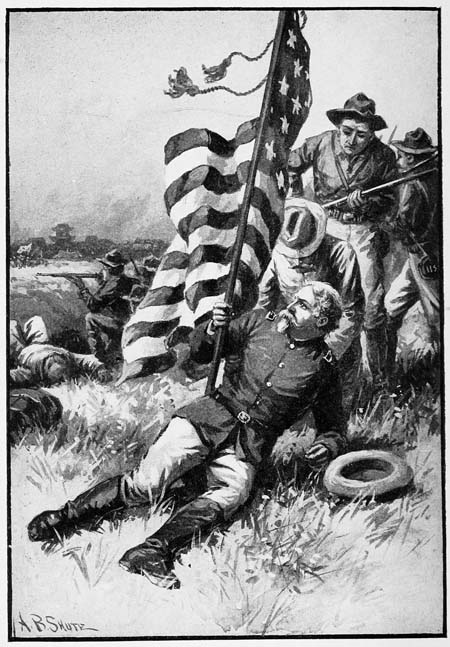
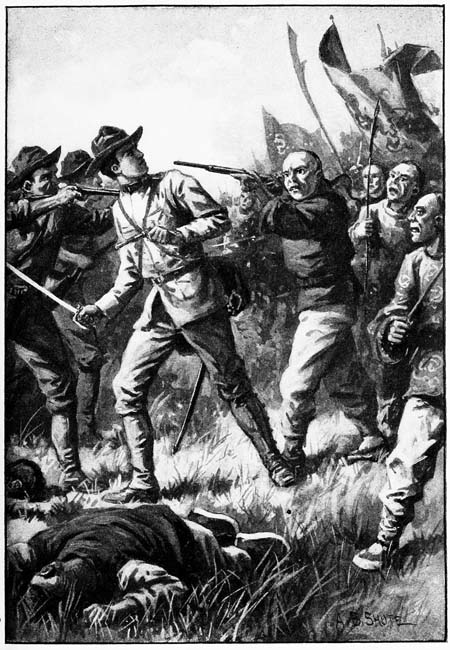
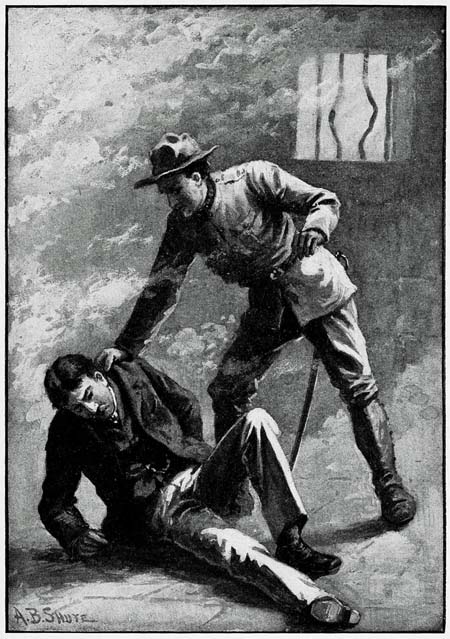
Then Colonel Liscum fell to rise no more.
ON TO PEKIN
OR
Old Glory in China
BY EDWARD STRATEMEYER
AUTHOR OF “UNDER DEWEY AT MANILA,” “A YOUNG VOLUNTEER IN
CUBA,” “FIGHTING IN CUBAN WATERS,” “UNDER OTIS IN THE
PHILIPPINES,” “THE CAMPAIGN OF THE JUNGLE,” “SHIP
AND SHORE SERIES,” “BOUND TO SUCCEED SERIES,”
“BETWEEN BOER AND BRITON,” ETC.
ILLUSTRATED BY A. B. SHUTE
BOSTON
LOTHROP, LEE & SHEPARD CO.
Copyright, 1900, by Lee and Shepard.
All Rights Reserved.
On to Pekin.
PREFACE
“On to Pekin” relates the adventures of a young
lieutenant of the regulars, who is sent from Manila
to Taku, China, to participate in the campaign of the
allied forces of the United States, England, France,
Germany, Austria, Italy, Russia, and Japan against
the Chinese order of the Boxers and those government
troops of the Province of Shantung who aided
in the great rebellion against all foreigners.
In the story are related, first, the bombardment of
the Taku forts and the capturing of Taku and
Tongku; next the history of the ill-fated expedition
under Vice-Admiral Seymour, R.N., to relieve Pekin,
and the bombardment and capture of Tien-Tsin; and,
lastly, that bold dash of the Internationals for Pekin
and the relief of the consuls, missionaries, and other
foreigners who had been besieged for fifty-six days.
It may be that some of my readers will think Gilbert
Pennington an unusually clever officer, and one
quite young to be occupying the position of lieutenant
of the regulars. But it must be remembered that
Gilbert had served in Cuba with the Rough Riders,
and in the Philippines under General MacArthur and
General Lawton, and that he took to army service as
naturally as a duck takes to water. He was one of
those soldiers of whom Grant declared, “They are
born, those fellows, not made.”
The campaign in China has been as short as it was
brilliant; and, with Earl Li Hung Chang and others
empowered to treat for peace upon almost any terms,
it is to be hoped that a permanent settlement will be
made, which will insure both foreigners and China
against all further trouble. War, at its best, is a terrible
thing; and the less our country has of it, the
better it will be for our people.
Once more thanking my young friends for the interest
they have shown in my previous stories, I place
this volume in their hands, trusting they will find its
perusal both pleasurable and full of profit.
“I say, Lieutenant Pennington, have you heard
the news?”
“That depends upon what the news is, major.
Do you mean that we are ordered back to Manila?”
“I mean a good deal more than that, lieutenant.
We are ordered to China.”
“China!” And Lieutenant Gilbert Pennington,
formerly of the volunteers and now of the regulars
stationed on the island of Luzon, leaped up from the
camp stool upon which he had been sitting, and
gazed at his old friend, Major Morris, as if he had
not heard aright. “Who told you such a fairy tale
as that?”
“It’s the truth, Pennington. I got it direct from
the colonel. We are to proceed to Manila without
delay, and there take the Logan or some other transport
direct for China.”
“And what are we going to do in China? Has
Uncle Sam declared war on the heathen?”
“Hardly that, I imagine. But you know the missionaries
and other foreigners are having a lot of
trouble with the Boxers, as they are called; and I
reckon our government wants some soldiers on hand
in case matters get worse.”
“Yes, I’ve heard about the Boxers, although I
don’t exactly know what they are.”
“They call themselves a band of Patriots, but in
reality they are a secret society having for its object
the extermination of all foreigners in the Celestial
Kingdom. They are the worst cut-throats in China,
so I have been told.”
“Well, this is certainly news,” mused Gilbert
Pennington. “I had an idea that my fighting days
were about over for the present. I never dreamed I
should be sent away from the Philippines excepting
it would be back to the States.”
“I hope the prospect doesn’t displease you,” went
on Major Morris, earnestly. “For myself I am thoroughly
delighted. I am getting tired of hanging
around Tarlac. We haven’t had a brush with the
Filipino guerillas for three weeks, and that last engagement
didn’t amount to anything.”
“Major, you are a fighting man through and
through!” laughed the young lieutenant. “I believe
you would rather fight than eat.”
“Hardly that, Pennington; but I must confess
to a weakness for an occasional engagement.” The
major of the first battalion twisted his mustache
meditatively. “Between you and me, privately
speaking, I think we have a long, hard campaign before
us.”
“I can’t understand it. If the Chinese government
isn’t in with the Boxers, why doesn’t it suppress
the society, and protect our citizens and the citizens
of other nations?”
“That’s the conundrum, lieutenant. I was talking
to the colonel about it; and he says his opinion is
that the Chinese government, instead of suppressing
the Boxers, is secretly aiding them. The Chinese
don’t want any foreigners in China, and this outbreak
was bound to come sooner or later.”
“If they don’t want any foreigners, why did they
allow them in the country in the first place?”
“I presume they didn’t imagine the foreigners
would pour in so rapidly, or that they would advocate
so many changes in business, religion, and other
things. You see, the Chinaman sticks to ancient
things, and wants to do just as his father, his grandfather,
and his great-grandfather did.”
“Has there been any fighting there yet?”
“I can’t say as to that. But the other nations
are hurrying troops to the scene; and, when we
get there, we are to form part of an Allied Army,
composed of English, German, French, Japanese, and
other nations.”
“Then it will be China against the world.”
“That’s about the size of it. If we fight side by
side with the other nations, it will be rather a new
experience for our troops.”
“Right you are, major.” The young lieutenant
gazed doubtfully at his dirty and ragged khaki
uniform and the shoes which had been patched until
there was hardly any of the original leather left.
“But we ought to have new outfits before we go.”
“No doubt General MacArthur will see that we
get them. He will want Uncle Sam’s boys to look
as well as the soldiers of any other nation.”
“Are any of the volunteers going?”
“Not for the present. But there is no telling how
many of the troops will have to go before the trouble
in China is over,” concluded Major Morris, as he
walked on, to spread the news among his other
brother officers.
Gilbert Pennington was a young man of Southern
blood who had drifted into the army more because of
his intense patriotism than for any desire to become
a fighter of men. He was from Richmond, Virginia;
and, upon the death of his parents and several near
relatives, he had wandered around from one place to
another, made a trip to the West Indies, and then
gone to New York to settle down in business as
a book-keeper.
While in New York, the War with Spain broke
out; and along with his intimate friend, Ben
Russell, Gilbert joined the volunteer service, and
served in Cuba as one of Roosevelt’s Rough Riders,
as related in one of my previous books, entitled “A
Young Volunteer in Cuba.”
Shortly after his return from Cuba the troubles in
the Philippines broke out; and once again Gilbert enlisted,
this time in the infantry, and, accompanied
by Ben Russell and his brother Larry, journeyed
to Luzon, there to serve under Generals Otis and
MacArthur and the much-lamented General Lawton.
Many of his adventures of those stirring times
will be found set forth in “Under Otis in the Philippines”
and later volumes of my “Old Glory Series.”
But the rebellion in the Philippines was now
practically over, and all the soldiers had to do was
to guard against the wandering bands of insurgents
who carried on a sort of guerilla warfare whenever
the opportunity offered. The season had been a
very rainy one, and roads and fields were so covered
with water and liquid mud that passage from one
district to another was well-nigh impossible. The
tiny mountain streams were swollen to rushing torrents,
and in many places to bridge them over
seemed impossible.
Gilbert had been mustered into the regular service
several months before; and, for bravery performed in
the capture of the Filipino leader, General Adoz, he
had been promoted to the rank of first lieutenant of
Company A, of the first battalion. Major Morris had
come into the regulars at the same time, and now
commanded the battalion, although really holding the
rank of captain. To my young readers let me explain
that this meant that, while he commanded as a
major, he received as yet only the pay of a captain.
The news that his regiment was going to China
filled Gilbert with interest, and for several reasons.
In the first place, he was rather tired of the Philippines,
and had thought more than once that he had
made a mistake by joining the regulars instead of
embarking for home, as many of his fellow-soldiers
had done. He had campaigned in intense heat until
ready to faint with exhaustion, and the heavy rains
of the wet season had found the camp literally
drowned out more than once. He had been shot,
and had lain in the hospital for weeks, so it was
small wonder that he occasionally sighed for a bit of
ordinary life again. Following the flag is not all
glory.
But now something new was promised. He was
to visit a strange country, and perhaps fight side by
side with soldiers from other parts of the world.
More than this, he might have a chance to find Mr.
Amos Bartlett.
Years previous to the opening of this story, Mr.
Amos Bartlett had been in business with Jefferson
Pennington, Gilbert’s father. The two had owned
several extensive tobacco warehouses in Richmond,
and later on had branched out into the tea and
coffee trade. The business had grown to such proportions
that it was formed into a stock concern
called the Richmond Importing Company. At the
time the company had been formed, Mr. Pennington
had died; and shortly after this Mr. Amos Bartlett
had gone to Tien-Tsin, China, to live, taking with
him his wife and his little daughter, Jennie.
When it came to a settlement of Jefferson Pennington’s
affairs, no satisfactory accounting could be
obtained from the Richmond Importing Company,
and a lawsuit instituted by Gilbert’s mother fell
through for the lack of evidence. Amos Bartlett
had been written to, but was down with the fever
in Tien-Tsin, and could give no evidence. The men
at the head of the newly formed company were
sharpers from New Orleans; and in the end Mrs.
Pennington had received only two thousand dollars
in cash for her stock, while she was fully satisfied in
her own mind that the amount due her husband’s
estate had been twenty to thirty thousand dollars.
She had no other money than that received from the
company, and this was not enough to support her for
long; and she died two years later, poor and broken-hearted,
leaving Gilbert, then a lad of twelve, to the
care of an aged aunt, with whom he lived for four
years, when he left home to strike out for himself.
Gilbert had often thought to hunt up Mr. Amos
Bartlett, and see if something could not be done
toward getting the balance of the money due his
father’s estate. But China was a long way off; and
from some friends he learned that Mr. Bartlett had
left Tien-Tsin, and gone into the interior, and that his
present whereabouts was unknown. Moreover, the
war in Cuba and in the Philippines had driven
everything else out of his head, and he had taken
matters as they had come.
“But, if I get the chance, I’m going to hunt him
up,” said the young lieutenant to himself. “And, if
I find him, I’ll make him tell me all about the doings
of the Richmond Importing Company or else know
the reason why. I’m bound to have that money, if
there is any of it coming to me.”
CHAPTER II CLOSE QUARTERS IN THE JUNGLE
“Boys, we leave to-day for Manila.”
It was Captain Banner of Gilbert’s company who
spoke, addressing a dozen or more of his command,
who were squatting around a camp-fire built near
the shelter of an overhanging cliff. Close to the
camp-fire were half a dozen rude shacks which the
regulars had erected for comfort while stopping in
the neighborhood, they preferring the rude huts to
their own torn and dilapidated tents.
“Und how soon vos ve goin’ py China, captain?”
asked Carl Stummer, a German volunteer who had
enlisted in Company A soon after his old friend Gilbert
had become lieutenant.
“Just as soon as orders come from headquarters,
Stummer. Are you anxious to get on new fighting
ground?”
“Vell, captain, I ton’t vos barticularly anxious for
new fightin’ ground; but I vos anxious for ground
vot ain’t vet a foot deep all der dime,” answered
Stummer, with a broad grin. “Last night I dream
me I vos in Noah’s ark, und der ark got sunk, und I
vent overboard. Ven I vake up, I vos on mine pack
in vater most a foot teep.”
“I hope you swam for your life, Carl,” put in Gilbert,
while a laugh went up.
“He can’t swim, bedad,” added Dan Casey, an
Irish soldier, who had been a friend to Stummer for
years. “Don’t ye remimber how Captain Ben
Russell—he was only a common sodger thin—hauled
him out av the waters av New York Bay, an’
was arristed fer doin’ it, bekase the colonel thought
he was afther tryin’ to desert whin he jumped overboard.”
“I vos learn me how to schwim since den,” replied
Stummer, gravely. “Of I didn’t learn, I vos
drown more as fifty dimes ofer here alretty.” And
again a laugh went up.
Tents were to be struck at noon, sharp; and soon
the camp was a busy place, as the soldier boys began
to gather together their few belongings. Although
it was raining lightly, guns had to be cleaned,
swords polished, and uniforms brushed up as much
as possible.
The news had travelled swiftly that the regiment
was ordered to China; and many of the officers and
men of other commands close by came in to verify
the report, and to say good-by to their friends.
Several came to see Gilbert and wish him the best
of luck, for he had always been popular.
“I thrust we’ll be afther seein’ Captain Russell in
Manila,” said Dan Casey to the young lieutenant.
“I wouldn’t loike to go away widout sayin’ him farewell.”
Casey and Stummer had both been members
of Ben Russell’s company of volunteers before joining
the regulars.
“Yes, I hope we do see him, and Larry, too,” answered
Gilbert. “I would give a good deal to have
the Russells go along.” But this was not to be, as
the duty of the Russell boys lay elsewhere.
The colonel of the command was a stickler for
military discipline; and promptly at twelve the
regiment moved, or at least the two battalions
which were located in that neighborhood. The
third battalion had gone up in the mountains to
the southward, and a special message had been sent
to it to rejoin the main command at the earliest
opportunity.
The light rain soon gave way to a steady downpour,
which threatened to become a deluge before
nightfall; and in many spots the soldiers had to
leave the road and take to the paddy fields, the thin
crust of ground and growth of the one being preferable
to the oozy, sticky mud of the other. The
caribao carts, piled high with the camping outfit,
lumbered along with difficulty; and at every quarter
of a mile one or another got stuck, and had to be
helped out of its difficulty.
“This is hardly a march to victory, lieutenant,”
observed Captain Banner, as he ranged alongside of
his second in command.
“I don’t believe any of us will want a bath for
a month after this rain stops,” returned Gilbert
grimly, “at least, not from the knees up.”
“It is well you qualified your first remark,” said
the captain, who was a West Point graduate, a well-read
officer, and a first-rate fellow. “From my knees
down I feel as if I had been wandering around in an
ocean of filthy pitch. It seems to me the natives
ought to be able to make bricks of this sticky mud
without half trying.”
“We are going to have some fun when we reach
the river a mile below here,” put in Major Morris,
who had also come up. “Captain Anderson came
over last night, and he said it was running at a fearful
rate then.”
“And what about that new bridge we worked so
hard to put up?” asked the young lieutenant.
“It’s completely swept away. The captain thought
the storm had done it, but I think the guerillas
helped matters along. They hate us worse than they
hate poison.”
“I suppose they reckon we have kept them from a
good deal of booty,” said Gilbert. “Well, we have,
for a fact.”
The storm now became so violent that conversation
could be carried on only with difficulty, and
presently the party relapsed into silence. The route
step had been ordered at the very start; and all of
the regulars were marching to suit themselves, although
keeping something of a semblance to a
column of fours.
At last the river was gained, and a halt was ordered,—an
unnecessary command, since none of the troops
could go forward. The stream was running two feet
deep over its ordinary banks, and swirling along with
the rapidity of a mill-race. It was fully sixty feet
wide, and just deep enough in the middle to be dangerous.
As the bridge was gone, it was determined to look
for a suitable fording-place, and Gilbert was placed
in command of a detachment to ascend the river-bank
for that purpose. The course of the soldiers, six in
number, lay over a series of rough rocks, and then
through a small jungle opening upon an abandoned
rice field.
“If the guerillas destroyed that bridge, we want to
keep our eyes open,” was Gilbert’s comment to his
men, as they scrambled over the rocks, in Indian file.
“They don’t travel far in the rain, and they may be
close at hand.”
“I dink I see me somepoddy chust ahead!” exclaimed
Carl Stummer, in a low voice. He was in the
lead of the privates, and carried his rifle, ready for
use. “Look!” he cried suddenly.
Gilbert gazed in the direction, and made out several
forms; but all disappeared before he could get a good
view of them.
“Thim was th’ Dagoes!” cried Dan Casey, using
the common soldier’s term for Filipinos. “I wisht I’d
got a bead on ’em! I’d a-laid wan of thim low, I’ll
bet me nixt wages!”
“To cover!” shouted Gilbert, and pointed to the
nearest bit of jungle. The little party ran at once in
the direction, but before the shelter of the brush was
gained several shots rang out, the bullets clipping the
branches of the nearest trees.
The attack came as a surprise; but the young lieutenant
was not sorry that the volley had been fired,
since it would notify his comrades in arms that something
was wrong. Scarcely had the volley ended
when Dan Casey fired in return; but, if he hit any
one, the enemy gave no sign.
The jungle gained,—it was a small patch less than
an acre in extent, facing the river,—Gilbert ordered
his men to lie down and keep strict watch on all
sides, while he himself moved close to the water’s
edge. A sudden idea had popped into his head, and
he wished to learn if his surmise was correct.
In order to obtain a clear view of the river, he had
to wade into the water overrunning the bank to the
depth of a foot and more, in the mean time breaking
his way through vines and creepers, which formed a
perfect network amid the tropical trees. He advanced
as cautiously as he could, and, reaching an opening at
last, peeped forth with care.
He had been right in his guess. The Filipino guerillas,
some twenty in number, had encamped in
another patch of jungle a hundred yards further up
the river; and now several of the party were crossing
the stream in two cascoes, as the native small boats
are named. A rope was stretched from shore to
shore, and a man in each casco was hauling his craft
along this by hand.
“If only I had the whole company here!” thought
the young lieutenant. He felt that, if this were so, he
could readily “bag” every one of the insurgents.
The thought had scarcely crossed his mind when
two more rifle-shots rang out, followed by a cry from
Stummer.
“Der repels vos running py der rifer!” came from
the German soldier. “Shall ve go after dem, lieutenant?”
“No, wait!” ordered Gilbert. He turned to Dan
Casey. “Go back as fast as you can, and report a
body of twenty guerillas about to cross the river in
two boats. We can round them up if we are re-enforced
immediately.”
“I’ll run wid might an’ main,” answered the
Irish soldier, and set off with leaps and bounds over
the rocks in the direction whence he had come. The
Filipinos saw him, and opened fire on him; but he got
out of range uninjured.
As soon as Casey was gone, Gilbert called his detachment
to his side, and pointed out the cascoes.
“Those men must not be allowed to reach the
other river-bank,” he said.
“And they won’t reach it, hear me!” cried one of
the regulars, a tall Westerner; and, taking aim at
the man at the rope in the leading boat, he fired.
As the report rang out, the man fell, shot through
the shoulder; and the casco began to drift rapidly
down stream.
The other regulars also opened fire; and soon the
ropeman of the second casco was likewise laid low,
and that boat began to drift after the other. But
the craft was still close to shore; and, as soon as
their leader was shot down, the other two occupants
leaped into the water and mud, and struck out for
the jungle which now concealed the rest of the
guerillas, who had lost no time in disappearing after
the first volley from the Americans.
Left to its own devices, the first boat came down
the river rapidly, sometimes swinging to one side
and then to the other, and once turning around completely
in the strong current. It held two uninjured
rebels, who for the time being seemed to be bewildered
by the turn of affairs.
As the casco approached the spot where Gilbert
stood, a sudden turn of the river current forced it to
shore. It swept under some overhanging trees; and
one of the insurgents immediately grasped some
vines, and pulled the craft still further to land.
“Leap for your life, Garro!” shouted one of the
pair, in Spanish; and an instant later both sprang
out on the river-bank in water up to their knees, and
directly in front of the young lieutenant. One held
a gun in his hand, and the other a pistol; and in
a trice both weapons were levelled at Gilbert’s head.
CHAPTER III SOMETHING ABOUT THE PEOPLE OF CHINA
Gilbert Pennington had been in many close
quarters before, and these had taught him the valuable
lesson of being on his guard at all times.
Consequently, when the two rebels faced him, they
found him with pistol drawn, and, before either of
the enemy could fire, the young lieutenant blazed
away. He shot to kill, knowing only too well that
his life hung in the balance; and the rebel with the
pistol went down, with a bullet in his breast, seriously,
if not mortally, wounded. The Filipino’s
weapon went off as he fell, but the bullet spent itself
in the air above the little jungle.
Meanwhile, however, the second rebel was not
idle; and, though Gilbert leaped to one side to avoid
being made a target of, he received a ball from the
gun in his shoulder,—a flesh wound, painful, but of
not much consequence.
The shot in the magazine rifle was evidently the
last one; for, having fired it, the Filipino closed in by
aiming a blow at Gilbert’s head with the stock of his
weapon. The blow did not land as intended; but it
struck the young lieutenant’s arm, and his pistol was
knocked skyward just as he was on the point of pulling
the trigger a second time.
All of these movements had taken but a few
seconds of time to execute; and none of Gilbert’s
men knew what was occurring until they followed
the sounds of the shots, and found the young lieutenant
in a hand-to-hand encounter with the rebel
over the possession of the Mauser rifle. The rebel
was a powerful fellow, much older than Gilbert, and
heavier; and he was rapidly getting the better of
the encounter, when Carl Stummer came up on the
run.
“Drop dot!” roared the German soldier; and,
taking aim, he fired on the Filipino, hitting him in
the knee. At once the man sank down, moaning
with pain; and the gun came into Gilbert’s possession.
A moment later a shouting was heard from down
the river; and two companies of the regulars came up
the bank through the water and mud, and over the
rocks, as speedily as the state of the situation permitted.
They soon caught sight of the insurgents,
and opened a well-directed fire, at which the enemy
took to their heels with all possible speed.
“I owe you one for that, Stummer,” said Gilbert,
as soon as he saw that the man before him was out
of the contest for good. “You came up in the nick
of time.”
“Dot’s all right,” answered the private, modestly.
“But say! ton’t ve besser safe dot poat?”
“To be sure, we’ll save the boat,” cried Gilbert;
and, leaping out into the stream, he secured it, and
tied it fast to one of the trees.
The rain was now coming down harder than ever,
and this rendered the pursuit of the rebels very
difficult; yet it was felt that they must not be allowed
to get away, and the whole of the first battalion
were sent after them, leaving the second
battalion to cross the stream in four cascoes which
the insurgents had possessed.
Being wounded, Gilbert was not called upon to
take part in the pursuit of the fleeing guerillas; for
such they properly were, having no regular military
organization. He walked around until he found the
surgeon of the regiment, who bound up the wound,
after washing and probing it.
“It was a narrow shave for you, lieutenant,” said
Surgeon Gilson. “A little lower, and you would
have been a dead man.”
“Well, they say a miss is as good as a mile,”
responded Gilbert, with a faint smile. “But I am
thankful to God that I escaped,” he added earnestly.
It was nightfall before the second battalion was
landed over the river; and then the other regular
companies came in, bringing with them nine prisoners,
including two that were wounded. The battalion
had had several men wounded, but none seriously.
“I fancy this is our last round-up in Luzon,” said
Major Morris to Captain Banner and Gilbert. “If
all goes well, we ought to reach Manila by to-morrow
evening.”
The night was spent in the village of Giguenen,
where there was a small garrison of American volunteers;
and here the prisoners were lodged in the
local jail, until the authorities at Manila should
decide what was to be done with them.
The storm cleared away during the night; and
travelling the next day was, consequently, a little
better, although the roads were still almost impassable.
In some spots the carts could not get through
with their loads; and the men had to “ferry” the
goods across, the turnouts coming over empty.
“I believe the Philippines want good roads more
than anything else,” observed Gilbert. “In all the
time I’ve been here I’ve hardly seen a decent highway
outside of Manila.”
“We are bound for a country where the roads
are still worse,” returned Captain Banner. “I’ve
been reading up on China lately, and I’ve learned
that there is hardly a respectable highway in the
whole Celestial Kingdom. Even the streets of
Pekin, the great capital, are out of repair, and have
been for centuries.”
“And yet Chinese labor costs next to nothing.
I can’t understand it.”
“The common people don’t want to pay out a
single cash for public improvements, that’s the reason.
Besides that, there comes up the old Chinese saying
that ‘what was good enough for my father and
grandfather is good enough for me.’”
“They must be a terribly backward nation.”
“Backward doesn’t express it, lieutenant. They
are so out of date that they are actually musty.
And the worst of it is, because their history dates
back so much further than ours,—several thousand
years before Christ,—they imagine they know it all
and are really a superior people.”
“I am almost ashamed to confess it, but I am very
backward on the geography of China,” went on
Gilbert. “I know it’s a mighty big country and
swarming with millions of people, and that is about
all I do know.”
“Yes, it is a big country; for its area is about five
millions of square miles, although its original eighteen
provinces are only about two millions of square
miles in extent,—some geographers say a million
and a half. The population of the provinces is
reckoned at a hundred and seventy-five million.
But this is mere guess-work, for China has never
taken a census.”
“With so many people, there ought to be many
large cities.”
“No, the large cities are but few in number. The
largest, of course, is Pekin, the capital, on the Pei-Ho,
which contains probably a million and a half to two
million inhabitants; and the next is Shanghai, the
great sea-port town. Pekin cannot be reached by
large boats; and its sea-port, so to speak, is Tien-Tsin,
which is also on the Pei-Ho, not many miles from the
Gulf of Pechili.”
“Then, if there are not many large cities, there
must be a host of small ones.”
“China, so I have read, is a country of villages;
and there are vast territories where these villages,
each containing a hundred or two hundred inhabitants,
are less than half a mile apart. You see the
Chinese farmer doesn’t live on his farm excepting
during the time he has to watch his crops, to keep
them from being stolen. He lives in the village,
along with all of his neighboring farmers; and all of
them go out to work every morning, taking all their
tools with them, and even the bucket and windlass
for the well, and return at nightfall.”
“I think I should rather live on the farm. We
always lived on our plantation in Virginia, before
we moved to Richmond.”
“And so did my folks live on their farm in the
Mohawk Valley, New York State, Pennington. But
you must remember that, with so many people to
feed, farming lands in China are valuable; and so
they can’t afford land for farm-houses or out-buildings
or even for fences. Many a farm is not over half an
acre in extent, and that has to support a family of
six or eight.”
“Phew! We had over two hundred acres in
Virginia!”
“And we had a hundred and twenty at home; and
father said he sometimes felt cramped up, because he
didn’t own right to the top of the mountain. If
it wasn’t that John Chinaman can live on next to
nothing, he would starve to death.”
“But certainly all the people are not so poor.”
“There are some rich people in the cities, but the
majority merely live from hand to mouth. The
richest man of all is Earl Li Hung Chang, one of the
viceroys, who visited the United States some years
ago. He is a millionaire many times over, and
a very powerful political leader in the bargain.
They say he is the only viceroy who enjoys the
confidence of the dowager empress and the young
emperor.”
“It’s a wonder he doesn’t make a move to enlighten
his people, and get them to take up Western
ideas.”
“There is too much of religion and superstition
in the way. The Chinamen all believe in geomancy,
as it is called. According to that, no street in a
village must be straight for fear the Evil Spirit may
sweep through too easily, and no door in a house can
be directly opposite to another for the same reason.
The cities and towns are all laid out according to the
rules of geomancy, as expounded by the so-styled
learned men who make the mysterious art a life
study. Even the grave of a rich man is not located
until the geomancer has been well paid in order to
locate a spot where wind and weather cannot disturb
the spirit of the departed one.”
“Such superstition is almost beyond belief.”
“That is only the beginning of it. They believe
in all sorts of signs and omens, and won’t even cook
a meal at a fireplace unless the latter is located near
a door or window, so that the evil spirits in the food
can find an easy way out of doors.”
“Humph! I wonder what they would say to some
of our up-to-date inventions,—the telephone, for instance?”
“I don’t know about the telephone; but they do
say that in the interior the people believe the telegraph
wires are bewitched, and they won’t walk
under them excepting with their eyes closed and
while holding their breath, or else while repeating
some verse from Confucius. For many years they
wouldn’t allow a railroad to go through, because such
a road would disturb the graves that are scattered
here, there, and everywhere instead of being in regular
cemeteries, as in our own country.”
“I reckon the people in the interior are even more
ignorant than those on the seacoast.”
“They are, if the books I have read are to be
believed. One writer says that some Chinamen were
surprised to learn that he, as a ‘foreign devil,’ did
not have three legs and a horn, and that others
thought he had a hole through his breast through
which a pole could be thrust whenever he wanted to
be carried from place to place. Another writer says
he was also asked about the hole, and that the natives
were surprised to learn that he could bend his knees,
having heard that no ‘foreign devils’ could bend
their knees to their gods. This writer had a camera
with him, and came close to having his head cut off
through trying to take some snap-shots in the village.
He added that numerous Chinamen think that photographs
must be made out of babies’ eyes; and, as very
few of the poor natives of the interior have any use
for a girl baby, they sometimes offer to sell such a
baby to be sacrificed, so that the eyes can be made up
into photographs!”
CHAPTER IV CAPTAIN PONSBERRY HAS HIS SAY
“Hurrah! Here come the boys who are bound
for China!”
“Good luck to you, boys! Wish I was going
with you!”
“Don’t let the Chinks get the best of you! Stick
up for Uncle Sam and Old Glory every time!”
Such were some of the cries as the command to
which Gilbert was attached swung across the bridge
which spanned the river Pasig, and marched through
the streets of old Manila to the barracks assigned to
them previous to their departure for China.
It was a warm, pleasant evening, and the thoroughfares
were alive with people,—Americans, natives,
Spaniards, Englishmen, and likewise a good sprinkling
of Chinamen. But the latter had already heard of
the sending of troops to their native land, and they
took good care to keep in the background for fear of
a riot in which they might come off second-best. All
was gayety, with scarcely a thought of the terrible
struggles which had occurred in that vicinity but a
few months before.
The barracks were gained, and, while the band was
playing one of the popular airs of the day, the companies
were dismissed to seek their quarters and
make themselves as comfortable as circumstances
permitted.
“Gilbert! I was hoping I should find you!”
The exclamation came from a tall, handsome young
fellow wearing the uniform of a captain of volunteers;
and, as the young lieutenant turned, he found his
hand tightly clasped by his old chum, Ben Russell.
“Ben!” cried Gilbert. “I am ever so glad to meet
you. I was afraid I should have to leave Luzon
without seeing you. How have you been?”
“First-rate, Gilbert. And you?”
“Oh, I’m all right except for a slight wound in the
shoulder. We had a final brush with the guerillas
yesterday, and bagged nine of them. But what are
you doing here?”
“I came down on a special mission for the general.
Larry is with me, as a member of my company. Here
he comes now.”
As Larry Russell came up, more hand-shaking followed;
and then the Russells plied Gilbert with questions,
all of which he answered as well as he could.
“I wish you were going with us,” said the young
lieutenant. “We might have some fine times together.”
“That’s true,” put in Larry Russell. “But I guess
we’ve got to stay here until we are mustered out.”
“Perhaps we’ll be sent to China later on,” said
Ben Russell. Then he turned, as he felt a pluck at
his sleeve. “Hullo, Stummer! And you, too, Casey!
How are you getting along? It’s too bad that you
left me to join the regulars, but I suppose it’s all for
the best.”
“I dink you besser choin, too,” replied the German
soldier. “Uncle Sam vill need you in China, sure.”
“Perhaps, Carl, but not now.”
“To lave you is the wan sorrow of me partin’ wid
Manila,” said Casey. “Sure, an’ we was loike
brothers, barrin’ ye was captain an’ I was a corporal.
I hope we mate ag’in, so I do.” And his honest eyes
looked suspiciously moist. He had served with Ben
all through the Cuban and Philippine campaigns.
The conversation now became general; and presently
Casey and Stummer went off, leaving Gilbert
and the Russells to themselves. From one thing the
talk drifted to another, and finally came around to
Mr. Amos Bartlett and the fortune Jefferson Pennington
had sunk in the Richmond Importing Company.
“The Richmond Importing Company!” cried
Larry. “Why, I know a party who is now working
for that concern.”
“You do!” exclaimed Gilbert. “And who is it?”
“Captain Ponsberry, of the three-masted schooner
Columbia, the vessel I shipped in from Honolulu,
with Luke Striker.”
“You mean the ship you were serving on at the
time you went overboard and was picked up by Admiral
Dewey’s flagship just before the battle of
Manila?”
“The same. Captain Ponsberry wasn’t carrying
for the Richmond Importing Company then, but he
is now. He told me so himself yesterday.”
“Yesterday? Then his ship must be here.”
“She is.”
“I should like to see this Captain Ponsberry, to
find out how the company stands at present.”
“Then you had better get around to-night or early
to-morrow. He sails at noon.”
“I’ll go at once if you’ll show the way,” concluded
Gilbert.
Larry was willing; and soon the three were on
their way to new Manila, as it is designated, across the
Pasig, and down to where the numerous wharves were
lined with huge warehouses containing all sorts of
merchandise from nearly every quarter of the globe.
The Columbia lay deep in the water opposite the
wharf from which she had loaded, for she was laden
with a cargo for China. At the wharf they found a
small boat tied up, in charge of a sailor named Hobson,
whom Larry Russell knew very well.
“Hullo, Larry, what brings you?” demanded Hobson,
in surprise; for he had not expected to see the
young soldier-sailor.
“My friend wishes to see Captain Ponsberry, Hobson.
Is he ashore?”
“No, I’m waiting for Tom Grandon, the mate.
The cap’n is on board.”
“Will you take us over?”
“Certainly. Jump in.”
The two entered the row-boat, and Gilbert was introduced
to Hobson, who had been Larry’s messmate
for several months. Soon the side of the schooner
was gained, and Larry clambered to the deck with
the agility of a monkey, leaving Gilbert to follow.
“Hullo, Larry! back again?” came from Captain
Nat Ponsberry, a whole-souled skipper of the old
New England school. “I had hardly expected to
see you again afore I sailed.”
“My friend here wishes to have a talk with you,
captain,” answered Larry. “He is Lieutenant Gilbert
Pennington now of the regulars, but formerly of
the volunteers. He served with my brother Ben.”
“Oh, yes! reckon as how I’ve heard tell of ye,”
said Captain Ponsberry, as he extended a horny
hand, as hard as it was honest. “Glad to know ye
personally.”
“Perhaps you’ll think it strange I should come to
you for information, captain,” said the young lieutenant.
“But Larry tells me you are carrying for
the Richmond Importing Company now.”
“Exactly.” And the skipper of the Columbia gazed
questioningly at the speaker. “But this is my first
trip; and I don’t know but that it may be my last,
too.”
“And may I ask why you say it may be your
last?”
“You may, since I’ve nothing to conceal on the
p’int, lieutenant. Their price ain’t my price, thet’s
all. I can make more money on my own hook.”
“The reason I have come to you is this: Years
ago my father owned stock in the company. He
died, and when my mother tried to get a settlement—well,
they didn’t give her near as much as she expected.”
“I see.” Captain Ponsberry paused. “Well?”
“That was when I was only ten years old,—rather
a long time ago. I’ve never had a chance to
look into the claim, but I intend to do so now; and I
want to know how the company stands, if you don’t
mind telling me.”
“As I said afore, I have nothing to conceal. So
far as I know, the standin’ of the concern is good, and
it is wuth nigh on to two hundred thousand dollars.”
“And who is its head?”
“Mr. Ramsey Polk, a banker, who does business
in Richmond and in New Orleans.”
“He must be the same Polk who took hold at the
time my father died. I remember the name well.”
“More’n likely, lieutenant; an’, if he is, I’ll allow
you have a tough customer to deal with,” added the
skipper of the Columbia, with a peculiar smile.
“Then you found him hard to deal with?”
“I did.”
“Do you know if there is a Mr. Amos Bartlett
still connected with the company?”
“Yes, there is; but I’ve got it putty straight that
the Polks, father an’ son,—an’ the son, Nuggy, is
wuss nor his dad,—are doin’ their best to squeeze
him out of it.”
“And where is Mr. Bartlett, now?”
“In Tien-Tsin, China, or else at Shanghai.”
“And how are they going to squeeze him out?”
“If you’ll tell me, I’ll tell you,” laughed Captain
Ponsberry. “I guess the Polks have a way all their
own. But they’ll do it, for I’ve heard that they
have squeezed out others. Nuggy Polk is on his
way now to China, to see what he can do toward
ousting Bartlett out of the concern. The Polks
know they have a good thing, an’ I guess they want
to keep it right in the family.”
“You say he is on his way to China. Is he
here?”
“He was here a few days ago. I think he sailed
for Hong Kong yesterday.”
“I wish I had seen him. Perhaps he could have
given me some information.”
“Not he—if he thought you were after some
money due your father,” returned Captain Ponsberry,
with a sharp shake of his head. “The Polks are
close-fisted to the last degree. You won’t get a cent
from them unless you wring it by main force.”
“Then I’ll wring it by main force—if I find that
some money is really due me,” answered Gilbert,
with determination.
Captain Ponsberry now invited the pair to his
cabin; and the three went below, and discussed the
situation for the best part of an hour. During this
talk, Gilbert learned that the affairs of the Importing
Company were almost entirely in the hands
of the Polks, who had forced out a man named Redmund
and an old widow named Van Vechen, both of
Richmond. Amos Bartlett was now the only outsider
holding stock, and it was the captain’s opinion
that Nuggy Polk’s sole reason for going to China
was to get the old merchant to sell out his holding.
“An’, if he won’t sell out, he’ll be squeezed out,”
added the captain. “But I guess the Polks will get
him to sell out by showin’ him papers an’ statements
to prove thet the company ain’t making any money
an’ is in debt.”
“But you say they are doing well?”
“So they are, too. I had a search made afore I
agreed to carry for ’em.”
“Then a statement to the contrary would be a
fraud,” put in Larry.
“Exactly. But what could Bartlett prove if the
hull thing was done in secret?”
“It won’t be done in secret—not if I can help it,”
said Gilbert; and there the conversation came to an
end.
CHAPTER V GILBERT MEETS NUGGY POLK
The two transports which were to take the soldiers
from Manila to China lay in the harbor off the
Anda Monument; but several days were still to
elapse before the first of them should set sail on her
momentous voyage to Nagasaki, Japan, the first stopping-place.
Where the transport was to go after
that, none of the under officers or privates knew.
The duty of the American soldier is to obey orders,
and not ask questions.
There was much to do,—new uniforms and shoes
to be fitted, guns to be inspected, ammunition to be
dealt out, camping outfits to be cared for,—so that
the hours flew by swiftly for Gilbert and all the
others; and he had no time in which to ascertain
whether or not Nuggy Polk—whose real first name
was Nuglich—was still in Manila or if he had set
sail for the Celestial Empire.
The transport was to sail on Tuesday; and by
Monday night the preparations for departure—so
far as they affected the young lieutenant—were
complete. This being so, he asked for leave of absence
for several hours, which was readily granted;
and off he went to hunt up Nuggy Polk.
Captain Ponsberry had described the young man
as tall and thin, with a short, stubby mustache and
eyes which shifted continually. He was said to
have stopped at the Hotel for American Gentlemen,
as one of the native resorts had lately been pompously
rechristened.
Gilbert found the hostelry without much difficulty,
and on inquiry at the desk learned that
Nuggy Polk had left the place that morning.
“He was not sure if he would be back,” said the
clerk. “He wanted to visit the soldiers’ encampment
up at the water-works. Perhaps you will find
him there.”
The water-works are several miles to the eastward
of Manila, at a spot where a few months before
some severe fighting had taken place between the
Americans and the insurgents. Gilbert decided to
journey thither, and hired a pony for that purpose.
The young lieutenant had been over this ground
before,—indeed, some of his first fighting in the
Philippines had been done in that neighborhood;
and he found his way, without difficulty, along a
highway lined with palms and other tropical trees.
As he moved along, he kept his eyes open for anybody
who might bear a resemblance to the young
man he desired to interview. It was growing dark
rapidly; yet the night promised to be clear, and he
could still see without much difficulty.
The camping grounds of the soldiers at the water-works
were almost gained, when, on reaching a turn
of the road, the young lieutenant beheld coming
toward him a high native fancy cart, drawn by two
stout ponies. On the seat of the cart sat two young
men; and, from the description which had been given
to him, he recognized the driver of the turnout as
Nuggy Polk.
As soon as he made his discovery that the man
he was seeking was before him, Gilbert also learned
something else, which was that both young men had
been drinking far more than was good for them, and,
if they were not intoxicated, they were pretty close
to it. The driver was swaying from side to side,
jerking the reins in a way to completely bewilder his
steeds; and his companion was expostulating, and
trying to get the lines in his own possession.
“I tell you, Nuggy, you ain’t in no condition to
drive,” the second young man was saying. “Give
me the lines, an’ I’ll show you how to make ’em trot.”
“Give you nothing!” retorted Nuggy Polk, savagely.
“I can drive as well as anybody, Jerry
Nickerson; and I want you to know it.”
“You’re steerin’ ’em into the rocks,” went on
Jerry Nickerson. “You’ll smash us up in another
minit!” And he clutched Polk’s arm to keep himself
from rolling off the high seat to the ground.
“Lemme go!” screamed the would-be driver, and
tried to shake his companion off; but Jerry Nickerson
made another clutch for the reins, and a fierce
struggle ensued, in the midst of which the ponies
took fright, and began to tear down the highway at
their best speed.
Gilbert could do nothing to stop the runaway
team; and, as the high cart bounced past, he fully
expected to see the two young men thrown out and
killed. The reins fell upon the ponies’ heels, and
then Jerry Nickerson clutched the seat for safety.
Nuggy Polk was thrown over backward, into the
rear of the cart, and came to the ground with a
splash just as the turnout went through a mud
puddle six inches deep.
“Help! save me!” roared the young man, bellowing
like a bull. “Don’t let the hosses kick me to
death!”
He continued to bellow and splash around in the
mud until Gilbert, dismounting, went to his assistance.
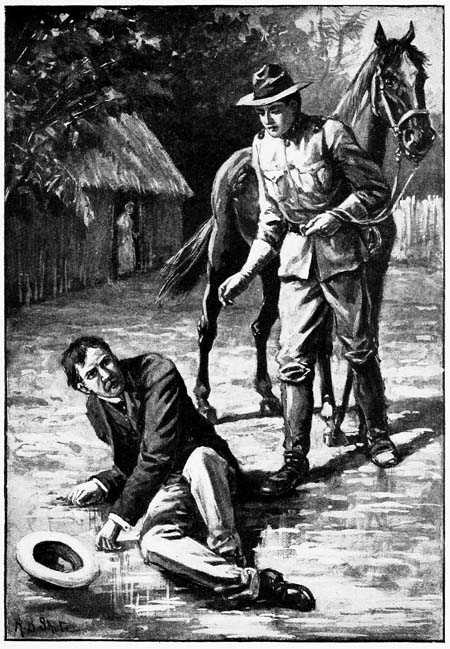
“You’ll be all right if you’ll only stand up,”
said the young lieutenant.
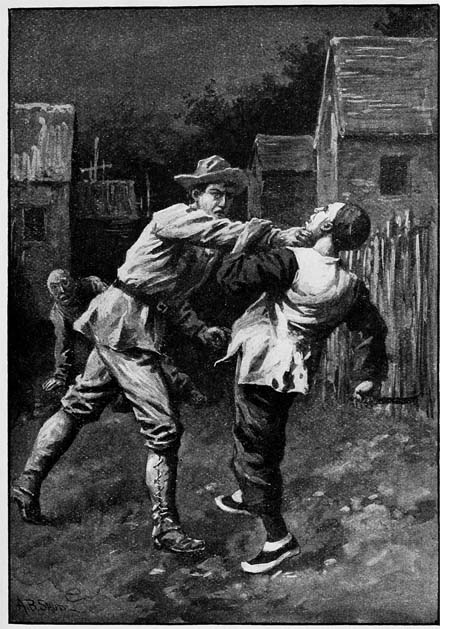
“You’ll be all right if you’ll only stand up.”
“All right? Do I want to be kicked to death?”
demanded Nuggy Polk, as he sat up, and dug the
mud from his eyes.
“You’ll not be kicked to death. You landed in a
soft spot, so I reckon there are no bones broken.”
“But the hosses—”
“Your ponies and cart are half a mile from here
by this time. They went off like a streak of lightning.”
“Humph!” Nuggy Polk arose to his feet with
difficulty, and dragged himself to where Gilbert
stood. “Where’s Jerry?” he demanded.
“Your companion was clinging to the cart seat
the last I saw of him.”
“Humph! He’ll be killed as sure as you’re born.
But it serves him right. He had no business to try
to take the reins out of my hands. I know how to
drive—used to drive the finest high-steppers in
Richmond. He don’t know the first thing about
hosses.”
“Well, I hope he isn’t killed.”
“Oh, he’ll be all right—you couldn’t kill Jerry
Nickerson if you tried. Say, but I’m in a pickle,
ain’t I?” And Nuggy Polk surveyed himself dismally.
He was arrayed in a white linen suit, with a
fancy silk dress shirt; and the outfit had suffered
much from the contact with mud and water. “I
can’t go back to Manila looking like this.”
Gilbert could offer nothing but his handkerchief;
and this Polk accepted, and washed his face and
hands at a near-by pool. He was very unsteady on
his legs, and his speech was thick. He declared that
he did not care what became of Jerry Nickerson.
“He’s my friend, but in a case of this kind he
must take care of himself,” he muttered. “I suppose
those ponies won’t run on forever.”
“If you got them from a stable in Manila, they
will probably go straight home,” answered Gilbert.
“By the way, do you belong in Manila?” he went
on, determined to “pump” Polk without making
himself known.
“Me belong to Manila?” cried the young man.
“Not much. You couldn’t hire me to live in such a
back-number town. No, I’m from Richmond, Virginia.”
“Then you are a good way from home. But I, too,
come from Virginia,” continued Gilbert. “I was
born in Powhatan Court House,” which was the exact
truth.
“Is that so? Glad to know you. You’re a lieutenant,
I reckon, by the uniform.”
“I am, Mr.—”
“Nuglich Polk is my handle. Generally called
Nuggy by my friends. And you are?—”
“My name is Gilbert.”
“Proud to know you!” The young man tried to
look sober for a second, then burst out into a fit of
unreasonable laughter. “Say, but I cut a figure,
didn’t I, when I went into the mud?”
“I didn’t see very clearly. I was watching your
team.”
“Oh, don’t smooth it over, lieutenant. It’s all
right! So we are both from Virginia? Good
enough! Ever been to Richmond?”
“Yes, years ago.”
“I and my father run the Richmond Importing
Company there. Perhaps you’ve heard of the concern.
We ship goods all over the world,—China,
Japan, South Africa, everywhere. Got a vessel here
now, bound for China, the Columbia. Had to look
after her, and that’s what brought me to the Philippines.”
“Then you are going back to the States soon?”
went on Gilbert. “You’re lucky. Lots of the boys
would like to go, too.”
“No, I’m booked straight through to China.”
Nuggy Polk gave something closely resembling a
hiccough, and then felt in a rear pocket of his
trousers. “Have a drink?” he went on, producing
a whiskey flask.
“Thanks, but I’m not a drinking man,” answered
Gilbert.
“What! Don’t drink? Well, I never! I’ll
drink for you. Here’s your health.”
The whiskey flask was elevated to Polk’s lips, and
a long low gurgle followed. The action disgusted
the young lieutenant; but he felt powerless to remonstrate,
even had he felt so inclined.
“Ah! now I feel better!” said the young man,
more unsteadily than ever; and then, finding the
flask empty, he threw it to one side of the road.
“Yes, I’m from Richmond; and I don’t care who
knows it. We are the people! Ain’t that so?”
And he tried to brace up proudly.
“We are certainly some of the people,” answered
Gilbert; and he felt like adding that Polk was the
most disgusting specimen he had yet encountered.
“If you and your father run the Richmond Importing
Company, you must be doing a large business.”
“Large doesn’t express it, lieutenant. It’s growing
every day.”
“A stock concern, I reckon?”
“Humph! It’s our concern,—belongs to father
and me. We used to have some outside people in it,
but we froze ’em out,—had to do it, it was such a
good thing, don’t you see?”
“That was rather hard on the other fellows, I
should imagine.”
“Oh, we paid ’em to get out; but not too much,
understand? We’re shrewd, me and father, when it
comes to real business.” Nuggy Polk gave a lurch
which landed him on the grass of the roadside.
“Say, but that tumble made me weak in the legs!”
he declared.
“Better rest here, and see if your friend comes
back,” suggested Gilbert. “I’ll stay with you; and,
if he doesn’t return, I’ll see to it that you get back
to Manila in safety.”
“Will you? That’s mighty kind, lieutenant, and
I’ll stay; and I’ll pay you for all you do for me.”
And the young man pulled from his pocket a roll of
bank bills. “I reckon bills go with you, even if the
confounded natives won’t accept ’em.”
“I don’t want your money—”
“Don’t grow offended, lieutenant. I’m all right,
and you’re all right. We understand each other,
don’t we?”
“I hope we shall, if not now, then later on,” replied
Gilbert, with an emphasis which was entirely
lost on the befuddled young man to whom the words
were addressed.
CHAPTER IV OFF FOR CHINA
The young lieutenant felt utterly disgusted over
the speech and actions of the young man before him;
yet he did not feel inclined just yet to part company
with Nuggy Polk. There is an old saying that,
“when the wine is in, the wit is out”; and Gilbert
felt certain that by judicious “pumping” he could
learn a good deal concerning the Richmond Importing
Company and the Polks’ peculiar method of
transacting business.
Gilbert could readily see that Nuggy Polk was a
“high-flyer,” or, in other words, a fast young man,
and one who was inclined to spend his father’s
money much faster than the parent had made it.
Yet the young man did not look like a hard drinker;
and his present condition, Gilbert concluded, was an
unusual one.
“May I ask if you have been in Richmond
lately?” said Gilbert, after a pause, during which
Nuggy Polk had closed his eyes, as if on the point
of going to sleep.
“Came from Richmond to ’Frisco, an’ from ’Frisco
here,” was the unsteady answer. “’Bout four
months ago—came on mail steamer. Going to
China—do the country in ’bout six weeks, and then
go home again. This don’t suit at all. Richmond
is good enough for me.”
“I suppose you’ll have a good deal of work to do
in China for your company.”
“A little, lieutenant. You see, I don’t believe in
killing myself with labor.” Nuggy Polk tried to
laugh, but the effort only ended in a hiccough.
“Main object is to find a man named Bartlett, a fellow
who owns a little block of stock in our concern.”
“Going to buy him out?”
“You’ve struck the head on the nail—I mean—er—the
nail on the nai—no, the nail on the—the
head—yes, the head. Don’t want Bartlett in the
company any more. He’ll make too much money if
he stays in.” And Nuggy Polk gave a chuckle.
“Supposing this Bartlett won’t sell out?”
“He’s got to, or we’ll—er—we’ll squeeze him,
same as we did the others.”
“Bound to hold on to a good thing, I see,” commented
Gilbert, speaking as carelessly as possible.
“I suppose you and your father organized the company
in the first place.”
“Not exactly, although it was father’s idea.
There was a fellow named Jefferson Pennington
used to do quite a business in tobacco and cotton,
and some tea and coffee; and the company started
out of his trade.”
“Oh! then this Pennington is at the top of the
concern.”
“No, not a bit of it! He’s dead years ago.”
“And I suppose you scooped his share, too. You
must be a smart set.”
“Thanks for the compliment, lieutenant. Reckon
we are smart; but then, you see, it runs in the blood.
Both of my grandfathers were bankers and brokers,
and knew how to turn things to the best advantage.”
“It’s a wonder Pennington and these others didn’t
kick at being squeezed.”
“They did kick; but it didn’t do ’em no good, not
a bit. We had the whip hand, an’ we kept it. Pennington’s
widow raised a big row, so father has told
me; but it ended in smoke.”
“You held the evidence and kept it.”
“You hit the nail on the head ag’in lieutenant.
We are smart, and we are the people.” Nuggy Polk
gave a long, drunken yawn. “This looks as if Jerry
wasn’t coming back. Say, I’ve an idea.”
“Well?”
“Can’t you carry me back to Manila on your
hoss?”
“I don’t believe the pony will carry the weight.”
“Lemme try him.”
Only with the greatest of difficulty did Nuggy
Polk manage to rise to his feet. Then he lurched
up against Gilbert, took a plunge, and hit the pony in
the ribs. The animal turned, bumped roughly against
the young man, and Polk measured his length on the
ground.
“Whoa, you rascal!” spluttered the fallen one.
“Lieutenant, he’s worse than the team. I can’t ride
him nohow.”
At this juncture a rumble of cart wheels was heard,
and soon a native turnout hove in sight, drawn by a
pair of caribaos. A sleepy Tagal sat on the seat.
Stopping the cart, Gilbert inquired if the Tagal
was bound for Manila.
“Si, señor,” answered the man, in Spanish.
“Take me along then,” put in Nuggy Polk. “I’ll
pay you well.” And he jingled some coin in his
pocket.
The native assented, and, leaping to the ground, he
assisted the young man to a seat in the rear of the
cart. Here there was some straw, upon which rested
several bunches of plantains; and on this straw
Nuggy Polk stretched himself, and in a moment more
was sound asleep.
“You can take him to the Hotel for American
Gentlemen,” said Gilbert. “Do you know the
place?”
“Yees, mistair. He has drank much, not so?”
“Yes. They know him at the hotel, though; and I
reckon it will be all right. I’ll ride behind.”
No more was said, and soon the cart was on its way
to the capital. Hardly a mile was covered when they
came upon Jerry Nickerson, sitting on the wreck of
the fancy cart, the picture of misery and despair.
Broken bits of harness lay on the ground, and the
ponies were nowhere in sight. Nickerson had had
his left hand cut, and had the member bound up in
his handkerchief.
“They tried to take a stone wall, hang ’em!” he
explained to Gilbert. “The cart’s a wreck, and so’m
I. Where’s Nuggy?”
“Safe,” answered the young lieutenant. “If you
don’t want to stay here all night, you had better hop
up behind.”
“But the busted cart—?”
“You had better attend to the cart and the ponies
in the morning.”
Nickerson wished, in drunken style, to argue the
matter; but the young lieutenant was in no humor to
listen to such a beast, and ordered the Tagal to drive
on. Seeing this, Nickerson scrambled up behind,
threw himself beside Nuggy Polk, and was soon
snoring lustily.
The Hotel for American Gentlemen was reached
without further incident; and, having had the Tagal
drive into the court-yard, Gilbert interviewed the
clerk, and had the two sleeping ones transferred
to the rooms they had previously occupied.
“Can you tell me who this Jerry Nickerson is?”
asked the young lieutenant of the clerk at the desk.
“I cannot, excepting that he seems to be a close
friend to Mr. Polk,” was the reply.
“How long have the pair been at the hotel?”
“About ten days.”
“And what vessel are they going to take for
China?”
“The Orient. But she sails at nine o’clock to-morrow
morning, and I doubt if they awake in time
to go on board,” concluded the clerk. As far as he
was concerned, he did not wish the two guests to
catch the steamship. They had paid well for their
accommodations, and he felt inclined to have them
remain with him as long as possible.
Having seen to it that the Tagal owning the cart
had been paid for bringing the two young men to
Manila, Gilbert took his pony back to the livery
stable, and then made his way to the barracks.
He had not learned a great deal concerning the
Richmond Importing Company, yet he had gathered
sufficient information to set him to thinking deeply.
“Those Polks are rascals beyond a doubt,” he said
to himself. “But there is a big difference between
knowing a thing and being able to prove it. I hope,
when I get to China, that I shall have a chance to
hunt up Mr. Bartlett and to watch what Nuggy Polk
does.”
It was late when the young lieutenant turned in;
and, as the pony ride had made him tired, he slept
soundly, and did not awaken until the roll of the
drum aroused him. Dressing hastily, he stepped out
to the parade ground in front of the barracks.
The scene was an animated one, for a crowd had
gathered to see the regulars off. As soon as the
companies could be formed, they were marched to
the wharf at the Anda Monument; and here numerous
cascoes began to take men and equipments off to
the Logan and the other transport which were to
carry the soldiers on their journey up the China and
Yellow Seas.
“Off at last, eh!” cried a voice in Gilbert’s ear;
and, turning, he saw Ben Russell at his elbow. Ben
had but a few minutes to spare, and a short but
lively conversation ensued. Then the old chums
shook hands; and Gilbert stepped into the casco
which was to take him to the transport. The
friends were destined not to see each other again
for a long, long time.
A band was playing on the Lunetta, the great
pleasure ground of Manila, as Gilbert went on
board the transport. Many had preceded him, and
soon the boat was comfortably filled, although not
crowded.
Besides the soldiers, there were a regimental band,
a hospital corps, a number of officers’ families, and
half a dozen newspaper correspondents. There were
also others on board whose presence were to surprise
the young lieutenant greatly.
“Well, lieutenant, how do you feel?” asked
Major Morris, as he met Gilbert in one of the gangways.
“First-rate, major, but rather sorry to leave the
Philippines, after all.”
“Precisely my case. We had many a lively campaign
there, didn’t we?”
So the talk ran on until night shut out a view of
the city, leaving only the electric and other lights to
twinkle in the darkness. There was but little sleep
on board. At sunrise all were astir, and a little
while later the steamship turned her head for the
entrance to Manila Bay. Two hours sufficed to pass
Corregidor Island; and then it could be said that the
voyage to China was fairly begun.
CHAPTER VII WHAT CAUSED THE WAR
In this tale of a young soldier’s experiences during
the American army’s first campaign in China, it
is not my intention to go into the details of all that
led up to the terrible outbreak in the Celestial
Empire,—an outbreak which will probably be known
as the Boxers’ Uprising of 1900. Yet it will be well
for us to glance over some of the events which had
occurred immediately before the sailing of the troops
from Manila, in order to understand the situation as
Gilbert and his fellow-soldiers found it, on their
arrival at Taku.
The real trouble dated back to years before, when
China and Japan went to war, the result of which
was that China lost her ancient dependency of
Korea; and a general “mix up” resulted in Japan
taking the island of Formosa, and Russia taking
Manchuria, Port Arthur, and other strategic points.
This was followed by England’s occupation of Wei-Hai-Wei,
and Germany’s seizure of Kaio-Chau.
And then these powers and others went even further,
by establishing what were known as Spheres
of Influence throughout the Celestial Kingdom.
In the past China had lost ground only in her outlying
districts or territories. Now one of her original
eighteen provinces was opened to the foreigners;
and probably the Chinese felt as Americans might
have felt had somebody tampered with the rights of
the citizens living in one of our thirteen original
States. Railroads were built against the Chinese
will; and, because of resistance to the workers on
the roads, two whole Chinese villages were razed,
and the inhabitants driven forth, homeless.
The anti-foreign feeling had been strong; and now,
as the Chinese saw the Europeans gradually closing
down upon them, with here and there a number of
Americans as well, the feeling against the “foreign
devils”—as all people of white skin are called—grew
hotter and hotter.
The missionaries were the first to feel the pressure
brought to bear by the Boxers, who, in secret conclave,
determined that all foreigners must either
be driven from the country or slain. Notices were
posted on the churches and houses, ordering the missionaries
to depart within a week or a moon or three
moons, under penalty of death; and all merchants,
traders, and travellers were also warned to leave.
A few paid heed to these warnings; but the majority
decided that they had a right to stay, and remained.
They had been guaranteed protection by
the Chinese government, under treaties made with
their home governments; and the missionaries were
also promised protection by the Chinamen they had
converted. But, when the storm broke, the converted
Chinamen suffered as much as did those who
had converted them.
What led to the first fight of 1900 it would be hard
to say; but the troubles began early in the year, when
Dr. Brooks, who had sheltered the German engineer
for whom the Chinese were searching in his house,
was murdered on January 2. This act was quickly
followed by the slaying of a number of other missionaries
and of foreigners generally, until by May the
whole civilized world woke up to the fact that no
white people in China would be safe unless they
were defended by their own countrymen. The
Chinese government could not suppress the Boxer
movement, even if it felt so inclined, which was
doubtful.
The greatest uprising was in the provinces of
Pechili and Shantung, situated in the extreme east
of the empire, on the Yellow Sea and the Gulf of
Pechili. Here the Pei-Ho (Ho means river) empties
into the gulf, with the forts of Taku on one side and
the village of Tongku on the other. Back of the
Taku forts is Taku village, and twenty-seven miles
up the stream lies the important city of Tien-Tsin.
From Tien-Tsin to Pekin is about eighty miles, but
navigation on the river does not extend the entire
distance.
Finding that they could not hold their own in the
villages in which they were located, missionaries and
other foreigners in and around Pekin and Tien-Tsin
gradually congregated in the cities named, under the
protection of their home consuls, until the various
American, English, German, French, Italian, and
other foreign legations became crowded with people
all clamoring for aid, with Boxers on the outside
howling that they be driven out or slain. By
June 1 matters had reached an acute stage; and
the outside powers felt that something must be done,
or China would witness one of the most barbarous
slaughters in the annals of history. No war was
declared on China; but the government was given
to understand that each outside nation intended to
rescue its own people, no matter at what cost.
The first movement of the foreign nations, or the
Allies, as they were termed, was from Tien-Tsin. All
the nations had sent warships up to the Gulf of
Pechili, and from these were landed a force of twenty-five
hundred marines and soldiers, under the general
command of Admiral Seymour of the British Navy,
he being the highest in rank of any of the officers
present. With this force were one hundred marines
from the United States cruiser Newark, under the
command of Captain McCalla.
News had come that the legations at Pekin were in
a state of siege, and that all the foreign ministers
were either murdered or about to be slain, and that
hundreds of foreigners were already dead; and the
object of the expedition was to relieve those at the
capital. But the force was altogether too small for
the purpose in view. It was stopped long before
Pekin was in sight, and escaped total annihilation
only by what seemed almost a miracle.
On June 15 it was decided by several of the
European powers that it would be necessary to take
possession of the railroad station at Tongku, so that
communications could be opened with the advancing
army by rail. In the mean time a strong force of
Boxers and Chinese troops had taken possession of
the Taku forts. As this was a menace to the warships
in the harbor, orders were served that the
Chinese must vacate the forts, or they would be
bombarded. The Chinese paid no attention to the
orders.
The American warships had no authority to attack
at that time, so the bombardment of the forts was conducted
by the European gunboats, the cruisers finding
the water too shallow for them. Three Russian, one
British, one French, and one German craft took part
in the engagement. One of the Russian boats was
badly disabled, and the Allies lost twenty men killed
and had over sixty wounded. The Chinese loss
was over four hundred, and after seven hours’ fighting
the forts were stormed by the sailors and the
Celestials fled. During the engagement the American
vessel Monocacy was struck, but the shot did
little damage.
The taking of the Taku forts aroused the Chinese
as never before; and a retreat was ordered to the
Chinese quarter of Tien-Tsin, and from this territory
began an active bombardment of the foreign
quarter of the city. The fighting was now on in
earnest, and where it would end no man or nation
could tell.
From Nagasaki the transport was to proceed to
Taku, but further than that no one on board knew;
for the future movements of the troops would depend
entirely upon circumstances.
“We are out for some hot fighting, I am certain
of that,” said Major Morris to Gilbert, as the pair sat
on the deck late on the afternoon of the second day
out from Manila. It was cloudy, and there was a
breeze blowing, which made it quite comfortable, considering
they were in the tropics.
“I believe you, major; and I’ve been wondering if
it wouldn’t be a good plan to put the boys through
some drilling. They have been going it rather as
they pleased up at Tarlac.”
“The colonel says he will begin drilling to-morrow.
He wishes the boys to get their sea legs first.”
“I’ve been wondering how the Chinese are armed.
Are they as backward in that as in some other
things?”
“Hardly. You see the war with Japan opened
their eyes; and since that time they have been drilling
their soldiers under the directions of European
officers, and supplying them with the best rifles in
the market. I understand, too, that their forts are
supplied with Krupp guns.”
“Then we won’t have a walk-over.”
“By no means, and for two reasons. First they
are well armed, and in the second place there are so
many of them that they may overpower the Allies by
mere force of numbers. Nothing is known of Admiral
Seymour’s relief party, and I shouldn’t be surprised
if he and brave Captain McCalla’s men had
been annihilated.”
“Do you think we are bound for Tien-Tsin?”
“I think we are bound for the Pei-Ho. The government
intends to get into Pekin, and save Minister
Conger and his legation, as well as the other Americans.
We may have a long fight to get there,
though.”
“Somebody said there had been a good deal of
fighting around Tien-Tsin already.”
“I don’t doubt it; but you can’t believe all that is
reported, for the Chinese hold a good many lines
of communication.”
“It looks to me as if China was defying the whole
civilized world.”
“They don’t want our religion or our people, and
they don’t want us to come over there and show
them how to do things and to make improvements.
They want to be left severely alone.”
“But we have lots of Chinamen in our country.”
“True enough; but the stay-at-home Celestial believes
that his neighbor ought to stay at home, too.
The average Chinaman, so I’ve heard, doesn’t believe
in moving about; and millions of them have never
been fifty miles from home in their lives. They
know absolutely nothing of the outside world, and
our civilization is a closed book to them.”
“Do you know how many troops the government
intends to send to China?”
“I’ve heard that it is to be upward of ten thousand.
General Chaffee is to leave San Francisco
with some troops soon,—or he has left already,—and,
when he arrives, he is to take command of
the American forces on land.”
“Why, I met General Chaffee in Cuba!” cried Gilbert.
“He was one of the leaders in the Santiago
campaign.”
“Yes, and he is an old and experienced army officer
to boot. I think he will prove the right man in
the right place.”
“He’s all right, I reckon,” put in a voice behind
Gilbert at this juncture. “Lieutenant, you didn’t
expect to meet me as a fellow-passenger, did you?”
The young lieutenant turned swiftly, for the voice
had a familiar sound. He was almost struck dumb
to find himself face to face with Nuggy Polk and his
boon companion, Jerry Nickerson.
CHAPTER VIII A DISCOVERY ON SHIPBOARD
“What! you?” stammered Gilbert. For the
moment he did not know what to say.
A brief glance told him that Nuggy Polk had
entirely recovered from his spree of three days
before; and so, also, had Jerry Nickerson. Both
were freshly shaven, and dressed in clean outing
suits of the latest pattern; and they looked as bright
young Americans as are to be found anywhere.
“Yes, lieutenant,” went on Nuggy Polk, with a
good-natured laugh. “As I said before, you didn’t
expect to see me, did you?”
“Hardly,” answered Gilbert, slowly. He was trying
to determine how he should treat this fellow,
who was in reality his enemy. “How did you manage
to obtain passage on this transport?”
“Oh, I had to use a bit of diplomacy in order to
get myself and my friend Jerry aboard; and it
wouldn’t be just right to expose how it was done.
You see, our little outing to the military camp up at
the Manila water-works made us miss the regular
steamer. But I was bound to get to China, anyway,
and as soon as possible; and here we are.”
“Perhaps you intend to join the army?” suggested
Gilbert.
“Hardly.” Nuggy Polk glanced at Major Morris.
“Won’t you introduce your friend? I know precious
few fellows on board, and I should like to get
acquainted.”
The major was introduced; and then Nuggy Polk
introduced “his one particular friend,” Jerry Nickerson.
“Sorry I can’t invite you down to the bar,” said
Polk. “But the government isn’t up to date on
those things.” And he gave a light laugh.
“And a good thing,” answered Major Morris.
“We want to keep all our soldiers sober.” He
spoke pointedly; for Gilbert had told him of the
first meeting with the sporty young man, and also of
his family affairs, so far as they concerned the doings
of the Richmond Importing Company.
Nuggy Polk’s face grew red, and he looked on the
point of saying something bitter; but this passed off,
and he changed the subject by remarking that he
hoped the trip to China would prove a pleasant one.
“I understand Nagasaki is the first stop,” put in
Nickerson. “How long do you suppose it will take
to reach that Japanese port?”
“Five or six days, most likely,” answered Gilbert.
“It will depend somewhat on the weather. These
waters are full of islands and reefs, and a ship has to
be mighty careful how she runs in foul weather.”
“I hope we reach China in time to see the first
real fighting,” was Major Morris’s comment; and
then he was called away, and Gilbert was left alone
with his new acquaintances.
“Lieutenant, I owe you something for what you
did for us the other night,” said Nuggy Polk, confidentially.
“I don’t know how I should have got
back to Manila if it hadn’t been for you.”
“I am glad I was of service to you,” answered Gilbert,
coolly.
“But I owe you something, and I want to pay
you,” insisted the young man from Richmond, as he
drew his ever-present roll of bills from his pocket.
“I want no pay for what I did at Manila,” answered
the young lieutenant, decidedly.
“But you put yourself out a good deal.”
“If I did, it’s all right.”
“You acted as if you were my bosom friend.”
“Thank you for the compliment.”
“Don’t you think I mean it?”
“Certainly I do, Mr. Polk.”
“Don’t Mister me, lieutenant. Call me Nuggy.
I’m not proud, even if I have money to spend.”
“Then, Nuggy, let me tell you that it is all right,
and that I don’t wish a cent of your money.”
“But you might as well have it.”
“Oh, don’t offend the lieutenant,” put in Nickerson,
as Gilbert remained silent. “If he doesn’t want
your money, put it up.”
“I don’t wish to offend anybody, and I will put it
up,” said Nuggy Polk, stiffly. “But, if he wants ten
or twenty dollars, he is welcome to it.”
“Thanks, but you can’t hire me to take it,”
laughed Gilbert. “Let us talk about something
else. Tell me about Richmond. I am always interested
in news from Virginia. You told me, I believe,
that you are in the importing trade.”
“Yes, my father and I run the Richmond Importing
Company. We export as well as import.”
“And you have some trade in China, so you said.”
“Yes, a large trade,—with Shanghai and Tien-Tsin.”
“I am afraid that your trade is going to suffer on
account of this war.”
“That depends upon how you look at it. My belief
is that this war won’t amount to shucks.”
“Exactly my idea,” broke in Jerry Nickerson.
“The soldiers will go there and relieve the ministers,
and that will be the end of it. No foreign
power will dare to make war on China because of
the other powers.”
“I am of the opinion that the war is already
on around Taku and Tien-Tsin,” answered Gilbert.
“The forts at the mouth of the Pei-Ho have been
taken, and that will probably madden the Chinese beyond
endurance.”
“Humph! A good deal of that is all talk,” said
Nuggy Polk. “When I reach Tien-Tsin, I expect to
have no trouble whatever in landing and in transacting
business.”
“You are going to do business in Tien-Tsin?”
“I am, if I can find a man I am after,—a certain
Amos Bartlett.”
“You speak as if you had a bone to pick with
him,” said Gilbert, more to draw Nuggy Polk out
than because he thought this was so.
“I have, and a big one,” answered the young man,
frowning. “Bartlett is getting too big for his boots.
He has either got to get out of the company or there
will be trouble.”
“If the company is making money, perhaps he
won’t want to get out.”
“We’ll force him out. He is a bother, and in the
way.”
“It is not always so easy to force a man out of
a thing,—especially if he knows what a good thing
it is.”
“I will do the trick,” said Nuggy Polk, with a
wink. “Trust me to work any deal that is to my
advantage.”
At this moment came an order from Captain Banner
for company drill, and Gilbert had to leave the
pair. No sooner had he gone than Jerry Nickerson
said in a low tone, “Nuggy, I wouldn’t be so free
about talking over private affairs with an outsider.”
“Oh, he’s only a common soldier, Jerry. What
harm can it do?”
“Never mind. I would be more close-mouthed if I
were you.”
“You get scared when there is absolutely nothing
to scare you.”
“I think it pays to be cautious.”
“I am cautious—when there is need for it.”
“No, you are not. Before you get through, you
will tell everybody that you are going to do Amos
Bartlett out of his shares in the Richmond Importing
Company.”
“Bosh!”
“All right. I know you.”
“See here, Jerry Nickerson, who is running this
affair?” cried Nuggy Polk, angrily. “You talk as if
I were a child in apron-strings.”
“I am only trying to give you a bit of sound
advice; but you won’t take it, and perhaps you’ll
have to suffer.”
“Rats!” was the sporty young man’s characteristic
response, and he stalked off to watch the drill.
In the confined space on the transport but little
marching could be done, yet one company after
another went through the manual of arms, including
the acts of loading, aiming, and firing at an imaginary
foe; and there were such commands as “right face,”
“left wheel,” and the like, all of which interested the
few spectators at hand. The regimental band on
board played from time to time, to make the hours
pass more pleasantly and keep the men from feeling
homesick.
Although Nuggy Polk did not care to admit it,
Nickerson’s words made him feel somewhat anxious
concerning his talks with Gilbert. In a dim way he
remembered something of what he had said on the
road outside of Manila, and he wondered if he had
told more than was desirable.
“I was a fool to get drunk,” he muttered to himself.
“I’ll take good care not to get that way again.”
But this mental promise amounted to nothing, for
such promises had been made and broken a dozen
times before. What Nuggy Polk needed was a
thorough reformation, and this could not come too
soon.
While the company of which Gilbert was first
lieutenant was drilling, Nuggy Polk drew close to a
group of soldiers from another command who were
watching the manœuvres, and entered into conversation
with one of the number.
“They seem to do first-rate,” said he. “I reckon
they have a first-class captain.”
“Yes, Captain Banner is all right,” answered the
private addressed. “He is an old officer, and went
through the fights in Cuba before he came to the
Philippines.”
“And Lieutenant Gilbert seems to know his business,
too,” went on the young man.
“You mean Lieutenant Pennington,” corrected the
soldier.
“Pennington!” exclaimed Nuggy Polk. “I mean
that officer there.” And he pointed with his hand.
“That is Lieutenant Pennington.”
“His full name is Gilbert Pennington,” put in a
soldier standing by, who had overheard the conversation.
“Humph! He told me it was Gilbert. I wonder
why—by George!” And of a sudden Nuggy Polk’s
face grew dark.
“What did you say?” asked the soldier the young
man had first addressed.
“Nothing,—that is, I was under the impression
the lieutenant’s last name was Gilbert. Where does
he come from, do you know?”
“He’s a Southerner.”
“You don’t know anything about him further than
that?”
The soldier shook his head. “I might find out for
you,” he added.
“Thanks, but it won’t be necessary,” replied
Nuggy Polk, and walked away, his mind filled with
sudden and strange forebodings.
CHAPTER IX GILBERT REACHES A CONCLUSION
“If that fellow has been playing me for a fool, he
had better look out for himself!”
Such was the conclusion which Nuggy Polk
reached, after thinking over what he had learned and
what had taken place between himself and Gilbert
since the two had met on the road outside of Manila.
The young man was thoroughly out of humor, and
was aching to “pitch into” the young lieutenant.
“Well, Nuggy, you look as black as a thunder-cloud,”
said Jerry Nickerson, as he strolled up.
“Don’t take what I said so much to heart. I only
wanted to give you a friendly bit of advice.”
“I know you did; and it’s too bad that you didn’t
give it to me before,” answered the young man,
bitterly, and before he had a chance to think twice.
“Why, what do you mean? Has something happened?”
“It has and it hasn’t. That lieutenant’s name is
Pennington—Gilbert Pennington—instead of just
Gilbert. He deceived me when he introduced himself.”
“Perhaps you didn’t catch his full name.”
“I am sure I caught what he said. Don’t you
suppose, if he had said Pennington, I should have
remembered it?”
“Possibly not. A fellow doesn’t remember all the
names he hears.”
“But this case is different, Jerry. The name
Pennington is one I shall remember, no matter where
I hear it.”
Jerry Nickerson looked puzzled for a moment, and
then emitted a low whistle. “By Jove! I had forgotten.
It was a Jefferson Pennington who started
the Richmond Importing Company, and whose widow
gave your father so much trouble.”
“Exactly; and, for all I know, this lieutenant may
be some relative of that man. He comes from
Virginia.”
“That is rather far-fetched. Still, it may be; and,
if I were you, I’d be for finding out.”
“I will find out—and pretty quick, too.”
“Hold on! You mustn’t let him know you are
suspicious, Nuggy. Go to somebody else, and find
out.”
“I am not afraid of him; and, if he has been
playing the sneak, I’ll give him a bit of my mind, I
can tell you that.”
“You must remember that he is an officer, and
that his colonel is in control here. If you do anything
rash, the young officer may have you put in the
brig for it.”
“Do you think they would dare to go as far as
that?” questioned Nuggy, looking much disturbed.
“They would dare do almost anything. On an
expedition like this, private citizens are counted as
being in the way, at the best.”
“Then, of course, I’ll have to pull in my horns,
Jerry. But it makes me mad to think he may have
been imposing on me.”
“If I were you, I’d try to find out something about
him from the other soldiers; and, if he really is a relative
to Jefferson Pennington, and is trying to pump
you in order to get money out of your father, then
I’d run a game up his back.”
“How?”
“I wouldn’t let him know what I had learned, and
I’d continue to treat him as a friend; and at the
same time I’d let drop that I was doing things on
the square, and that the Penningtons had got all that
was coming to them out of the Importing Company.”
This advice seemed to strike Nuggy Polk’s fancy,
and he said that he would follow it. For the
rest of the day he avoided Gilbert, and spent the
time in trying to find somebody who could give him
something of the young lieutenant’s history.
By chance he struck Carl Stummer, whom he had
seen in conversation with Gilbert a number of times.
Stummer had taken greatly to the young lieutenant
ever since the pair had been thrown together, and
knew a good deal of the young officer’s past.
“Your first lieutenant seems to be a popular
man,” said Nuggy Polk, by way of an opening.
“Lieutenant Pennington vos von goot fellow,” answered
Stummer. “Of all dere officers vos so goot,
der army vould been a baradise, almost.”
“I understand he is a Southerner, like myself.”
“Dot vos so; but he vos in New York ven he got
der var fever, und enlisted mit der Rough Riders for
Cuba. You neffer enlisted, eh?”
“No. I—er—couldn’t get away from business.”
“Vot you vos do on der dransport, den? Maype
you vos von newsbaber man?”
“That’s a little in my line. Here, have a cigar.”
Nuggy Polk passed over a weed. “I am interested
in the lieutenant. Did you ever hear of what business
he was in?”
“I dink he vos a pook-keeper ven der var proke
out.”
“I used to know some Penningtons down South,”
went on Nuggy Polk, boldly. “They were in an
importing company at Richmond.”
“Der lieutenant’s fadder vos vonce in an imborting
company in Richmond. I heard him tell mine
friend Captain Russell so von tay.”
“Indeed!” Nuggy Polk paused a moment.
“Well, it doesn’t matter particularly,” he went on;
and then asked Carl Stummer about his life in the
army, and spoke of what might be expected in
China, thus trying to put the German soldier “off
the track,” as he afterward told Nickerson.
Nuggy Polk had learned enough to convince him
that Gilbert was either the son of Jefferson Pennington
or closely related to the dead man; and the
news disturbed him a good deal.
“For all I know, he may have been spying on me
in Manila,” he said to Nickerson.
“I don’t see how he can possibly hurt you,” was
the reply. “Perhaps he knows little or nothing of
the past.”
“Then what was his object in introducing himself
as Lieutenant Gilbert? I half believe he followed
us from Manila. The clerk at the hotel said something
about his being there earlier in the day, although
I didn’t pay any attention to it at the time.”
“As an officer in the army, he has got to attend to
his official duties. If I were you, I’d leave him severely
alone; and I believe the whole thing will drop
then and there. Even if he is Jefferson Pennington’s
son, he can’t rake up that old claim, can he?”
“I don’t know but that he can. Your father was
the lawyer who passed on the papers in the case, and
you have had all his records since he died. You
ought to know more about it than I do.”
At this, Jerry Nickerson’s face took on a cunning
look. “I do know a good deal, and don’t deny it.
But I reckon your father is safe—if he keeps his
mouth shut.”
“This Pennington may combine with Amos Bartlett.
I was foolish enough to name Bartlett to
him.”
“Yes, that was a bad move, Nuggy. After this
you must be as mum as an oyster.”
Nuggy Polk agreed to this, yet he felt very much
as if he was locking the stable door after the horse
was stolen. It is said that “a guilty conscience is its
own accuser,” and it was largely so in the present
instance.
On the third day out, the island of Formosa was
sighted far in the west; and the course was now
north-north-east, past numerous small islands and
rocks, straight for Nagasaki, which lies, as many of
my young readers must know, close to the entrance
to the Yellow Sea. The weather continued to be all
that was desired, and many a soldier, tired out with
his campaigning in the Philippines, wished that the
voyage might last a long time.
“Sure, an’ it almost makes me wisht I was a
sailor,” observed Dan Casey. “A loife on the rollin’
dape seems jest to suit me.”
“You have your sea legs now, Dan,” replied Gilbert,
who stood by. “But you didn’t have them
when we came to the Philippines.”
“Mine cracious, dot’s so!” laughed Carl Stummer.
“Ton’t you rememper how ve rolled und
pitched around like ve vos rupper palls?” he
added to Casey.
“Sure, an’ I do that,” responded the Irishman.
“An’ do yez remimber the hurricane, an’ how it
thundered an’ lightninged?”
“Excuse me, put I ton’t vont no sthorm,” said
Carl. “Dot vos enough to last a whole life und two
veeks more, py chiminy!” And he shook his head
gravely.
A moment later he saw Nuggy Polk pass, in company
with Nickerson, and called Gilbert’s attention
to the pair.
“Dot man on der outside vos ask me apout you,
lieutenant,” he said. “He seemed to pe anxious to
know you.”
“Indeed?” said Gilbert. “What did he ask
you?”
As well as he could, Stummer repeated the conversation
he had had with Nuggy Polk. The reader
can well imagine that the young lieutenant listened
with interest.
“I am much obliged, Carl,” he said at the conclusion.
“I’ll have a talk with the fellow later on.”
And then he walked away, to think the matter over.
He was much perplexed, and hardly knew what to
do next. Would it be possible to corner Polk, and,
if so, would the game be worth the candle?
“The thing happened so many years ago, and at
the best the matter would drag through the courts,
perhaps for years,” he reasoned. “And to prosecute
the Polks would take a lot of money, which I haven’t
got. It looks like a wild-goose chase.”
Major Morris found him seated on a camp-chair in
a corner of the deck, deep in thought. The sun had
set far over the land in the west; and the stars were
peeping forth one by one, dotting the flowing and
rolling ocean with innumerable tiny lights. At the
bow of the transport a dozen soldiers were singing,—one
old favorite of home after another,—and at the
stern somebody was strumming a banjo, and two privates
were doing a “buck and wing” dance to the
delight of the onlookers.
“You look serious, lieutenant,” observed the
major, as he dropped in a chair beside Gilbert.
“I feel a bit serious,” was the answer, with a quiet
smile. “Major, I should like your advice.”
“You are welcome to it. Do you want to know
what I think of that young man you pointed out
to me?”
“Yes.”
“I think he is an equal compound of conceit and
slyness,—a fellow who is to be trusted as far as you
can see him, and no more.”
“He has taken the pains to find out who I am.”
“I don’t wonder at it. I am surprised he didn’t
do so before.”
“As he now knows who I am, he must know that
I am interested in the case which my mother brought
against the Richmond Importing Company.”
“Undoubtedly, and he will do all he can to
head you off—providing you make any movement
he thinks detrimental to his or his father’s interests.”
“That is what I have been thinking, and I’m wondering
if it would be worth while to fight the thing.”
“Not unless you can get direct evidence against
the elder Polk. If I were you, I’d try to hunt
up this Amos Bartlett the first chance I got.”
“I’ll do that.”
“He may know something, or be able to put you
on the track of something.”
“I hope he proves a friend.”
“Perhaps it wouldn’t be a bad plan to write to
some first-class lawyer in Richmond, asking him
to look the matter up for you. Very often you can
get a lawyer to take up a case on shares, if he thinks
there is money in it.”
“That’s an idea!” cried Gilbert. “I know a lawyer,
a good fellow, named Branders, whom I met in
Cuba. He was from Richmond, and I know he’ll do
all he can for me.”
“Then write to him by all means, stating your
case in detail, and tell him that you are going to
hunt up Amos Bartlett, if you can.”
“I suppose I can mail the letter at Nagasaki.”
“To be sure, and it will go quicker than if you
had mailed it at Manila.”
“This Polk seems to be very thick with Nickerson.
I wonder if they have talked me over between
them.”
“If they talk your case over, it is a pity that you
can’t hear what is said,” returned the major, pointedly.
“I believe I would watch every move they make, so
far as was in my power.”
“I will.”
“Polk is no doubt your enemy; and you have a
perfect right to get the better of him, if you can.”
By this time others were coming up, Captain Banner
and two under officers; and the talk became general,
the coming campaign in China being, however,
the chief topic of conversation.
Gilbert was sitting with his back to a window
opening into the upper cabin of the transport. As
the topic of conversation shifted, a form arose from a
settee standing in the cabin, close to the window, the
sash of which had been lowered to let in the air.
The form was that of Jerry Nickerson, and the young
man had taken in all that had been said.
“So he is going to write to Ralph Branders, eh?”
he muttered, as he strode off. “And he is going to
sound Amos Bartlett, too. I reckon this will make
interesting news for Nuggy. I’ll have to hunt him
up at once, and see what he has to say about it.”
CHAPTER X ABOUT AN IMPORTANT LETTER
Jerry Nickerson found Nuggy Polk in another
portion of the cabin, reading one of the books belonging
to the ship’s library.
“Come to our state-room,” he said. “I have something
important to tell you.”
“What about?”
“About Gilbert Pennington.”
Nuggy arose at once, and followed his companion
to the state-room which had been assigned to them.
The quarters were cramped; but they were much
better than those occupied by the soldiers, who slept
in long rows of canvas cots, suspended between
uprights of “gas-piping,” as the supports were commonly
called. Only the colonel and the majors had
private compartments: even the captains slept with
their men.
When Nuggy heard what his chum had to tell, his
face grew dark and full of bitter hatred.
“That makes it certain he is in a game against me
and my father,” he said. “Unless I take good care
of myself, he will prove a regular snake in the grass.
I wish I could pitch him overboard.”
“You will have to be extra careful of what you
say after this, Nuggy. If I were you, I wouldn’t
mention the Importing Company in his presence
again.”
“I won’t.”
“If he brings up the subject, treat it in an off-handed
way, and try to convince him that everything
is all right, and that you were fooling when you
spoke about squeezing out those other people.”
“Trust me to smooth it over—if I get the chance,”
responded Nuggy. “But I wish I could get hold of
that letter he intends to send.”
The next day slipped by without the young lieutenant
and Polk coming into contact with each other.
Gilbert had several important duties to attend to, and
only saw Nuggy from a distance. In the evening
Gilbert sat down in the cabin to write the letter to
Ralph Branders.
It was no easy task to compose the epistle, for the
young lieutenant hardly knew how to introduce the
subject. But he had met Branders on the field of
San Juan, and felt that he could trust the young and
rising lawyer thoroughly; and he ended by relating
his case from start to finish. He asked Branders to
investigate, and promised to remunerate the lawyer
as far as was within his means.
Nuggy saw Gilbert penning the letter, and watched
him very much as a cat watches a mouse.
“I’d give a hundred dollars to get that letter from
him,” the young man said to himself. But how this
could be accomplished without the young lieutenant
being the wiser was a difficult problem to solve.
The letter finished, Gilbert placed it in the inner
pocket of his coat, a garment which he wore at all
times when on duty. Polk had hoped to see him
place it in some corner or in the general mail-basket
in the cabin, and was much disappointed.
The transport continued on her course until, late
one afternoon, a small island to the eastward was
sighted. It proved to be Ujise, about one hundred
and ten miles directly south of Nagasaki.
“We’ll reach Nagasaki to-morrow,” said Captain
Banner to Gilbert. “And I must say that I shall not
be sorry to finish that much of the voyage.”
“You are not much of a sea-dog, captain.”
“It isn’t that, Pennington: I am anxious to get
into the fight,—if there is any fighting.”
“Oh, so am I,” replied Gilbert quickly. “I am
curious to learn the latest news. I wonder if the
Allies have moved on Tien-Tsin yet?”
“More than likely, since that lies between Taku
and Pekin.”
The day was cloudy, and toward midnight the
wind came up strongly. As the course of the transport
was now along numerous islands and between
dangerous reefs, she had to proceed slowly and with
caution.
For some reason Gilbert had a headache, and
retired early. As was usual, he slipped off only
his coat and shoes, placing the former under his
pillow.
Although he did not know it, his movements were
closely watched by Nuggy Polk, who had made up
his mind that he must obtain possession of the letter,
were such a thing possible. As the hour was early,
there were but few soldiers below. So the coast was
comparatively clear.
Almost holding his breath, for fear of awakening
the sleeper, Nuggy approached Gilbert on tiptoe, and
made certain that the young lieutenant was in the
land of slumber. Slowly he pulled the coat from
under the pillow, and inserted his hand in the
pocket.
The letter was there, along with several unimportant
papers, and with a skill worthy of a better cause
the young man brought them forth and thrust them
into his own pocket. This done, he left the berth
deck silently and swiftly, and made his way to his
state-room.
“By Jove! Nuggy, you look scared,” cried Jerry
Nickerson, as he entered. “What has happened?”
“Hush!” Nuggy held up his hand warningly.
“I just got that letter away from Pennington.” And
in a whisper he related how the deed had been accomplished.
“That was slick. But I’m afraid, when Pennington
finds his letter missing, he’ll write another in its
place.”
“He won’t find anything missing,” answered
Nuggy, with a grin.
“Do you mean to say you are going to put the letter
back?” demanded Nickerson, in astonishment.
“I’m going to put the envelope back—after I
have refilled it with several sheets of blank paper.”
“By Jove! Nuggy, you are getting slicker every
day.”
“Ralph Branders won’t know where the blank
paper came from, and of course he won’t do anything.
In the mean time I will send the letter to my
father, with the full particulars of all I have learned;
and, when Pennington makes his next move, we’ll be
more than ready for him.”
With great care Nuggy Polk opened the letter
addressed to the Richmond lawyer, being cautious
not to tear the envelope. Once open, the closely
written pages inside were abstracted; and then the
envelope was refilled with pages from a blank writing
pad, after which it was sealed up once more as
before.
When Nuggy revisited the berth deck, he found
Gilbert sleeping as sound as ever. Hurrying up,
he began to place the letter in the young lieutenant’s
coat.
As mentioned before, the wind was rising. Consequently,
the transport was not riding as easily as
earlier on the trip. Just as Nuggy placed his hand
in the coat, a lurch of the vessel sent him with a
bump into one of the uprights supporting Gilbert’s
cot, and then landed him flat on his back in the
passageway.
“Oh!” cried the young man, and scrambled to his
feet as quickly as possible. But the rolling of the
ship and the noise made by Nuggy awoke Gilbert on
the instant.
“What’s the matter?” cried the young lieutenant,
and sat up, staring around him. Before he could get
to his feet, Nuggy Polk was making off down the
dim passageway, which was illuminated by only a
few incandescent lights.
Nuggy Polk was making off down the dim passageway.
“Phwat’s the matter, lieutenant?” came from Dan
Casey, who was dozing on the edge of his cot, not
far off.
“That man—what was he doing here?” demanded
Gilbert.
“Sure, an’ I dunno. Stop there!” cried Casey.
But Nuggy only ran the faster, and in a few seconds
disappeared from view.
“I believe he was at my coat,” went on Gilbert, as
he picked the garment from the floor. Under the
coat lay the documents and the sealed envelope.
“Well, if he was after anything, he didn’t get it,” he
added, as he placed the things in the pocket and put
the coat under his pillow again. “I wonder who it
was?”
“Sames to me it was the feller that was talkin’ to
Stummer the other day,—that sport av a young
man.”
“You mean Mr. Polk?” demanded Gilbert.
“I don’t know his handle, but the feller as was
askin’ about you.”
“That is the man I mean.” Gilbert’s brow grew
clouded. “If that was the man, he was up to no
good.”
“Is he down on you, lieutenant?”
“I have every reason to believe he is, although I
don’t care to talk about it.”
“Do ye suppose he was afther stalin’ somethin’?”
“I can’t say what he was after, Dan. But I wish
he would keep his distance after this.”
“Perhaps ye had better be afther reportin’ him.”
“No, I’ll keep my eyes open; and I reckon that
will be enough.”
Gilbert sank back to rest again, but it was a long
while before he fell asleep. He wondered if Nuggy
Polk had been after the letter. “If he was, he didn’t
get it,” he told himself; “and I’ll take good care that
he doesn’t get another chance at it.”
When Nuggy Polk reached his state-room, he was
almost out of breath and as white as a sheet. Coming
inside, he locked the door, and began to pull off
his clothing with all possible speed.
“What’s up now?” questioned Nickerson.
“The roll of the boat upset me, and I woke the
lieutenant up,” was the low answer. “I don’t know
but that they are after me. Keep quiet; and, if they
come here, we’ll pretend we are asleep, and have been
for over an hour.”
Nuggy soon had his shoes and clothing off; and,
still trembling with excitement, he crept into his
bunk, and lay there in silence, listening for a knock
on the door. But the minutes went by, and nobody
came; and at last he breathed easier.
“They didn’t spot me, after all,” he chuckled. “I
reckon I was too quick for them.”
“Did you return the bogus letter?” asked his
companion.
“Yes.”
“Then you are safe on the writing question?”
“Sure. Pennington won’t suspect a thing, and of
course Branders won’t know where the blank sheet
came from. The first move in this game is entirely
in my favor,” concluded Nuggy; and, much satisfied
with himself, he rolled over, and was soon in the land
of dreams.
CHAPTER XI THE RELIEF OF ADMIRAL SEYMOUR’S PARTY
The transport carrying the regiment to which Gilbert
was attached arrived at Nagasaki on July 2.
She dropped anchor in the place assigned to her by
the harbor-master, and her chief officer went ashore
at once for despatches.
The sights to be seen in the large harbor of the
Japanese sea-port interested Gilbert greatly. Strange
craft were floating there,—curiously carved junks
with their huge, awkward sails, broad merchantmen,
and cascoes filled with fruits and fish and other commodities,
all offered for sale to whoever might buy.
Not far from the transport lay the British torpedo-boat
destroyer Whiting, having on board a number of
veteran soldiers from Ladysmith, South Africa, men
who had gone all through the terrible campaign
against the Boers. Russian, French, German, and
Italian warships were also in evidence; and the number
of national flags floating there were a spectacle
in themselves.
“We have struck the Allies at last,” was Captain
Banner’s comment. “I have already counted ten
different flags, not to mention the banners belonging
to the Japanese shipping.”
“Or the Banner we are carrying,” put in Major
Morris, by way of a joke.
“Don’t, major! That pun on my name is old
enough to vote,” answered the captain of Company
A.
“Then it is time it was buried,” said the major,
promptly. “I’ll never pun on your name again.”
And he never did.
All the soldiers were anxious for news from
shore; and this was not long in coming, in the shape
of newspapers, letters, and cablegrams.
“General Chaffee has left San Francisco with the
first American troops for China, on the transport
Grant,” said one of the captains, spreading the news.
“He is coming direct to Nagasaki; and he will be
followed by four or five thousand other men, from
Cuba, New York, and elsewhere.”
The Grant carried the Sixth United States Cavalry,
eight hundred strong, and about three hundred
sailors and marines.
The news from the front was most conflicting.
Admiral Seymour, in command of the expedition
which had gone to the relief of Pekin, was rumored
to be somewhere beyond Tien-Tsin, and surrounded
by the enemy. The foreign quarter of Tien-Tsin
had been bombarded by the Boxers and Chinese government
troops for over a week after the taking of
the Taku forts, and the sufferings of the Americans
and others had been almost beyond belief. During
the bombardment, women and children had been shut
up in Gordon Hall, and shot and shell had rained
down on all sides. At this time there was an American
circus in the city; and the men of the show took
up rifles, buckled on cartridge belts, and went to the
walls with the few troops in the place, to hold the
enemy in check.
The relief of Tien-Tsin was largely due to the
efforts of one man to get word of what was going on
to the allied powers having warships and soldiers in
the Gulf of Pechili. When the bombardment of the
foreign quarter of the city was at its height, nine
men from the various legations took a boat and
started for Taku for help. This boat was attacked
by the Chinese; and those in it had to run the craft
ashore and take to the bushes and woods, in order to
escape with their lives.
In Tien-Tsin it was rumored that the nine men had
been killed, and that it would prove certain death to
anybody undertaking to get through the Chinese
lines. Yet the task was undertaken by James
Watts, a youth of twenty-two, the son of a Taku
pilot.
“I’ll get through, if it costs me everything but
my life,” said young Watts. “I’ve outwitted the
Chinks before, and I can do it again.” He left
Tien-Tsin at nightfall on the swiftest horse the city
possessed.
The ride was one long to be remembered; for
it covered a distance of forty to forty-five miles,
through a territory thick with Boxers and other Chinese,
all anxious to take his life at sight. He left
the city with caution, but, once on the outskirts, rode
with a dash and daring that overcame many of
the enemy with fright and surprise. Shots innumerable
were fired at him; but only one struck him, in
the arm. He was stopped six times, but in each instance
literally rode over those who sought to capture
him.
When he arrived at Taku, he was ready to drop
from exhaustion. But, without waiting to obtain
even necessary refreshments, he secured a row-boat,
and had some sailors take him out to the flagship of
Admiral Kempff of the United States Navy, to whom
he told his story in detail.
Our admiral was quick to act on the information
received, and word was at once passed to the
other warships and to the allied forces in and
around Taku and Tongku. A relief force was immediately
organized, consisting of four hundred Russian
and one hundred American troops, the latter
under Major Waller.
The march of the relief force was steady, up the
bank of the Pei-Ho, but, as Tien-Tsin was neared, the
resistance of the Chinese became stronger; and on
the second day out it looked as if the allied forces
would be surrounded and annihilated. But a force
of one thousand British troops came up soon after
this, and after a hard fight the relief guard entered
the foreign quarter of Tien-Tsin.
This was as much as was known at Nagasaki
when Gilbert arrived there; but other movements
of great importance had taken place, and some of
these were not yet finished. Arriving in Tien-Tsin,
the relief column discovered that Admiral
Seymour’s command had only gotten to within forty
miles of Pekin, and had then had to retreat. Many
of the number would have been cut to pieces, had
it not been for the bravery of the American commander,
Captain McCalla, and his fighting marines
from the Newark.
As soon after the entrance to Tien-Tsin had been
made as possible, another relief force went out from
that city to look for Admiral Seymour, this command
being composed of some of the troops which had just
entered the city and some that had just come up
from Taku. It was reported that the Seymour party
was intrenched nine miles from Tien-Tsin. The relief
force was less than two miles from Tien-Tsin, when
the Boxers hove in sight; and a desperate hand-to-hand
encounter ensued, in which many Russians and
Japanese, as well as some Americans and English,
were killed. The Boxers were beaten, and fell back
up the river, where they were re-enforced by the
Chinese regulars, and another battle ensued. But
the Allies were protected by the high railroad embankment,
and soon put the Chinese troops to flight
by the accuracy of their fire. After the contest,
hundreds of lifeless Celestials were found floating in
the river.
The onward march of the relief column was now
toward a large arsenal, which, it was rumored, was
filled with guns and ammunition. On sighting the
arsenal, it was discovered to be in the possession of
the troops under Admiral Seymour, who had taken
it from the Chinese some days before. The Celestials
were doing their best to retake the buildings,
nine in number, when the relief column came up with
a rush; and the upholders of the Dragon were forced
to withdraw, with another heavy loss.
The new-comers were hailed with joy by those in
the arsenal, who had considered their position well-nigh
hopeless, they having been continually surrounded
by large bodies of Chinese troops since the
start from Taku two weeks before. It was decided to
abandon the arsenal at once, and return to Tien-Tsin;
and this was done, the building being set on fire.
Later on the Chinese tried to put out the fire, and
many were injured by the explosions of powder and
dynamite which occurred.
“Do you know anything about the Chinese army,—I
mean how it is composed?” asked Gilbert of
Captain Banner, as they continued to watch the
shipping in Nagasaki Harbor.
“I do, because that is another play on my name,”
replied the commander of Company A. “The
Chinese army is made up of eight divisions, called
the Three Superior Banners and the Five Inferior
Banners, and number from two hundred thousand to
three hundred thousand men. Each Banner has ten
army corps; and these are divided into Lyanza, of
about two hundred and fifty men each.”
“Then we have a pretty big crowd to whip,” was
Gilbert’s comment.
“That is the Chinese army on paper. In reality,
the standing army is much smaller; for each viceroy
of a province keeps as many troops as suits him.
The army is made up of the very scum of China, and
a soldier is an object of ridicule to the ordinary merchant
or artisan.”
“I’ve heard that many Chinese officers go to war
in their robes.”
“They do more than that,” put in an officer standing
near. “They take their big umbrellas as well,
and on many a battlefield the head officers have sat
in the rear having tea served to them while the
fighting was going on. You see, there are so many
of the pig-tails that the slaughter of a few thousand
of them now and then doesn’t disturb those in
authority in the least.”
“Sure, an’ that’s not encouragin’ fer us,” observed
Dan Casey, who stood by, drinking in the conversation
with much interest.
“No; but I’ll tell you one thing, and that’s true,”
said Captain Banner. “I have it from a number of
officers who have served in China. The majority of
the Chinamen rely on the signs they wear on their
breasts to protect them from the ‘foreign devils.’
When they see their comrades shot down, regardless
of these signs, nine out of ten throw down their guns
and take to their heels.”
“How many warships do you suppose are in these
waters now?” said Gilbert.
“Probably a hundred or more. I understand we
have about fifteen, Russia the same number, and
England almost twice as many, while Germany and
France have a dozen or more, and Japan nearly half
a hundred,” answered Major Morris.
“And how many soldiers are there?”
“There is no telling. We have probably four or
five thousand, here and on the way; and England has
twice as many. The majority of troops are, of
course, Russian and Japanese, since they were close
at hand when the trouble broke out,” concluded the
major of the first battalion.
CHAPTER XII A STORM AND A QUARREL
“The mail is going ashore, lieutenant. So hand
over your letters, if you have any.”
It was the adjutant’s assistant, who was making
the round of the transport, previous to his departure
for the Nagasaki post-office. He already had
one bag full of letters, and was now picking up a
second.
“All right. I’ll have a letter for you in a few
minutes,” responded Gilbert. “I just want to make
sure that I put everything in this that I wanted.”
“Writing to your best girl, eh?” laughed the
other officer. “Well, send her lots of kisses.”
“I haven’t got that far yet, Peters,” responded the
young lieutenant, with a laugh equally hearty. “This
is a strictly business letter.”
“Is that so? Seems to me we are pretty far
away from home to do any business except that of
fighting.”
“That is true, and yet—” Gilbert broke off
short. “Hullo! What in the world does this
mean?”
He had torn open the envelope addressed to Ralph
Branders, and was now staring in amazement at the
blank sheets of paper it had contained.
“Blank sheets, eh? Well, you must have been
asleep when you put them into the envelope,” was
the comment of the adjutant’s assistant. “Or else
somebody has been putting up a joke on you,” he
added.
Gilbert did not reply, for the reason that he was
just then doing some rapid thinking. He remembered
how he had been aroused by Nuggy Polk and how
he had found the sealed envelope on the passageway
floor.
“I believe he tampered with that letter,” he said
to himself. “He took out my written sheets, and
substituted these blanks. He is shrewder than I
thought him to be.”
“Well, lieutenant, what are you going to do about
it?” asked the adjutant’s assistant. “I’ve got to be
going inside of ten minutes.”
“I’ll hunt up my letter—if I can,” burst out
Gilbert; and, thrusting the empty envelope in his
pocket, he hurried off.
He was thoroughly angry, and bent on hunting up
Nuggy Polk and having it out with the young man.
He had seen Nuggy at the stern of the transport,
smoking, and had no doubt that he would still find
the young man there.
But, half-way on his rapid walk toward the stern,
Gilbert came to a sudden halt. What if Polk should
deny everything, and what if the rascal had destroyed
the written pages? He could not prove the young
man guilty, and such an action would only let Polk
know that he had discovered the deception. Would
it not be better to let the fellow imagine that his plan
to outwit his opponent had proved successful?
“I’ll let him rest, and write another letter in secret—and
take good care that that goes,” said Gilbert to
himself. “And in the second letter I’ll tell Branders
how the first letter was stolen, and that he must be
on his guard against the Polks and anybody who
represents them.”
With Gilbert to think was to act, in this case; and,
without losing a second more, he rushed off to one of
the desks in the ship’s library, secured several sheets
of paper and a pen, and dashed off a second letter to
Ralph Branders with all speed. It was easy work,
for he remembered exactly what he had said in the
first letter; and the young lieutenant had always
been a rapid penman. He added to the epistle his
suspicions concerning Nuggy Polk, and wound up
by assuring Branders that he was certain there was
a good deal of money coming to him, if only the truth
of the matter could be unearthed.
The letter was finished not a second too soon; for
Gilbert had barely time in which to hand it to the
adjutant’s assistant when the latter was off, to catch
the United States mail from Nagasaki.
“Made quick work of it, I see,” remarked Peters,
as he stuffed the letter into one of his bags.
“I had to,” answered Gilbert. “I wouldn’t have
missed this mail for a good deal.”
The young lieutenant hurried away, not wishing
to be seen by Nuggy Polk. His duties soon took
him to the stern; and there he found the young man,
still smoking, in company with Jerry Nickerson.
“Ah! lieutenant,” cried Nuggy, as he drew closer.
“We were just wondering how long it would be before
we would start for Taku. Have you any idea?”
“The commander is waiting only for some additional
despatches,” answered Gilbert, coldly.
“Then we are to leave Nagasaki as soon as he
gets them?”
“So I have been informed.”
“I am glad of it. I don’t like this hot hole at
all,” growled Nickerson. “It’s worse than Manila.”
“I reckon you’ll find China hotter still,” said Gilbert.
“I hope not.”
“By the way, we made a curious mistake in your
name,” went on Nuggy, looking straight out to sea
as he spoke. “We thought it was Lieutenant Gilbert,
while we’ve learned since that it is Lieutenant
Gilbert Pennington. You’ll pardon us, I’m sure.”
“Of course,” said Gilbert, and looked pointedly at
Nuggy and then at Nickerson, both of whom avoided
his gaze. “It doesn’t amount to anything, anyway.”
“I’m glad you look at in that light, lieutenant.
Some people are awfully particular about names, you
know,” continued Nuggy.
He wished to say more,—to bring around the
statement that he had known the Penningtons years
before, in Richmond; but he could not see his way
clear without making an awkward break, and that he
wished to avoid. Gilbert passed on, and there the
matter rested for the time being.
The run from Nagasaki to Taku is, in round
figures, eight hundred miles, the course being past
Quelpart Island, up the Yellow Sea, and around the
Shantung Peninsula into the Gulf of Pechili. Part
of the run was along the south-western coast of
Korea; but, in the haze that covered the sea, nothing
could be seen of that territory.
The weather continued to be all that was desired
until the transport gained the vicinity of the Shantung
Peninsula, upon which the British port of Wei-Hai-Wei
is situated, when a violent storm came up late in
the afternoon. It had been extremely hot, but now
the temperature went down as if by magic.
“We are in for it,” remarked Major Morris, as he
watched the sky grow black. “Just listen to that
wind coming up!”
“I am glad we are not in a sailing vessel,” responded
Gilbert. “It looks as if it was going to blow
great guns, as the jackies say.”
Gilbert was right; for, soon after the sun was hidden
behind the dense clouds, the wind came up with a
rush, whistling through the windows and ports of the
ship and banging many an unlatched door. Some of
the soldiers were not looking for such a gust; and
one lost his hat overboard, and another a precious
bundle of newspapers obtained in Nagasaki at the
cost of three Mexican dollars.
“We are up against it fer kapes!” cried Dan
Casey, as he vainly tried to keep his feet. “Sure, an’
I’m goin’ below to kape from fallin’ all over meself!”
And he lost no time in literally sliding out of sight,
for to keep erect on the companionway was impossible.
Some of the soldiers were at mess when the storm
came up; and, as pea soup happened to be on the bill
of fare, my readers can imagine how the contents of
the tin soup plates were slopped around, much to the
ire of the owners of the soup and the anger of those
who happened to get the boiling hot liquid over
them.
Nuggy Polk and Jerry Nickerson had just finished
their repast when the first heavy blow struck the
transport, sending the craft almost on her beams’ end.
Both had eaten heartily of a great variety of food, for
they had had the quartermaster lay in an extra supply
for them at Nagasaki.
“Gracious! what’s struck us?” cried Jerry, in
alarm.
“Feels to me as if we were going to upset,” replied
Nuggy, his face growing pale. “Just listen to the
wind whistle!”
“I hope we don’t go to the bottom,” went on
Nickerson.
He did not like the ocean, and had come along on
the trip only at the earnest solicitation of Nuggy,
who hated to travel alone. He was no sailor, but so
far the mildness of the weather had kept him from
becoming seasick.
Both of the young men felt that they must go on
deck, and started for the companionway side by side.
They had just reached the foot of the steps, when
a dark object loomed up before them. It was a
soldier, who was actually rolling down the companionway.
The man plumped with such force into Jerry
Nickerson that the latter was sent sprawling.
“Hi! what do you mean by knocking me down?”
spluttered Nickerson, as soon as he could get wind
enough to speak.
“Vot’s der matter mit you?” was the return.
“Vy didn’t you git out of der vay, ven you see me
coming, hey?” The speaker was Carl Stummer, and
he was in no humor for wasting words.
“You Dutch idiot!” roared Nickerson. “You
bumped into me on purpose!”
“That’s what he did,” put in Nuggy, who had not
liked Carl since the day they had had the talk concerning
Gilbert. “Jerry, you ought to teach him a
lesson for that.”
“I will,” answered Jerry; and, as the German
soldier arose to his feet, Nickerson strode forward,
and gave him a blow in the chest which knocked
him up against a near-by railing. “That will teach
you to behave yourself in the future.”
In his school-days Nickerson had been a good deal
of a bully, and this at times cropped out, upon
the slightest provocation. As Carl staggered back,
Nuggy gave a low laugh.
“Good for you, Jerry! He deserved it,” he
said.
Carl’s face grew as red as a beet; and his eyes—those
eyes which were sky-blue, and generally as
mild as those of a lamb—flashed fire.
“So I vos von Dutch idiot, hey?” he demanded
angrily. “And you vos teach me von lesson, not
so? Meppe I vos teach dot lesson, hey? How you
like dot, hey? und dot?”
He hauled off suddenly; and two blows straight
from the shoulder made Jerry see stars, and sent
him staggering into Nuggy. A third blow followed,
which loosened one of Nickerson’s front teeth, and
made him drop upon a near-by settee, dazed and bewildered.
“Haf you got enough?” demanded Carl, as he
followed his opponent with fists clenched for another
blow.
“Don’t! Don’t!” cried Nickerson.
“Hi! let my friend alone!” came from Nuggy, in
alarm. He was afraid Nickerson would be killed.
“Let him alone, I say, you clown!”
“Ton’t call me a klown!” roared Carl. “Of you
do, I’ll gif you a lickin’, too!” And he squared off
at Nuggy in a manner which caused that unworthy
one to fall back in dismay.
By this time the attention of a number of soldiers
who were near was attracted, and they gathered
around. “A fight, boys!” cried one. “The Dutchman
is going to polish off one of the newspaper
men!”
“Go for him, Carl, and show him how we licked
the Tagals!”
“Make them fight one at a time, Dutchy! Two
to one isn’t fair.”
“Form a ring, boys, and let ’em have it out to a
finish.”
So the talk ran on, and soon the crowd grew
larger. Then Jerry Nickerson tried to hit Carl
again. The German dodged, struck out swiftly and
surely, and in an instant Nickerson measured his
length on the deck, and lay there like a log.
CHAPTER XIII THE LANDING AT TONGKU
“Stummer has knocked his man out! My, but
that was a dandy blow!”
“The Dutchman ought to go into the prize ring.
He would make his fortune at it.”
“He has finished his first man. Now let the second
come on, if he dares.”
So the cries continued; for there is nothing that
so delights the heart of a sailor or a soldier as
a “scrap,” either on land or at sea. Among sailors
especially, boxing is a constant pastime; and
the “best man” is always considered something of a
leader.
The crowd looked to Nuggy Polk to continue the
fight; but that young man had no desire to do so, for
he could plainly see that his chum had suffered
heavy punishment.
“You have killed him!” he said in a shaking
voice. “Somebody run for a doctor.”
“Oh, he’ll come around all right,” put in one of
the sailors. “Carl rapped him a bit hard, that’s all.
So you ain’t up against it, are you?” he added
dryly.
“He’s afraid,” came from a voice in the rear of
the crowd. “He’s one of the sports that fights with
his mouth only.”
At this instant the crowd was compelled to part,
as the lieutenant-colonel of the regiment pushed his
way to the front. His quick eye turned from Nickerson
to Carl, and he faced the German soldier
sternly.
“What’s the meaning of this?” he demanded.
“He called me a Dutch idiot, und he vos hit me
here,” answered Carl, as he saluted, and then pointed
to his breast.
“It’s not so,” interposed Nuggy. “He started a
quarrel, and he has nearly killed my friend.”
“He vos hit me first,” insisted Carl.
“It’s false. He knocked Mr. Nickerson down before
he said a word.”
“I vos slip on der steps, und I rolled into him,”
explained Carl. “Den he calls me names, und hits
me so hard as he can. Of he vos act like a chentlemans,
I vos abologise for rollin’ into him. But he
calls me an idiot und a klown, und I vos no stand
dot from anypody.” And the German soldier shook
his head determinedly.
“That’s the truth of it,” came from a corporal
standing near. “I saw and overheard the whole
transaction, colonel.”
By this time Jerry was coming to his senses. He
blinked his eyes, and, sitting up, stared around him.
“Keep off!” he muttered. “Don’t hit me
again!”
“You’re all right now,” said the lieutenant-colonel.
“I am sorry to see you having a row with one of our
men, though.”
“He started the row,” answered Nickerson,
bound to save himself from trouble, if possible.
“It isn’t so,” came from several in the crowd.
“He struck the first blow, just as Stummer says.”
“But he knocked me down first, and he did it on
purpose.”
“Dot ain’t so. I vos coming der stairs town, ven
I slip, because der poat vos so unsteady,” explained
Carl; and then he went into the details of the encounter
from start to finish. Several times Jerry
Nickerson tried to interrupt him, but the lieutenant-colonel
would not allow it. Carl’s story was corroborated
by several others besides the corporal who
had first spoken up.
“It seems you are to blame,” said the lieutenant-colonel,
after listening to Nickerson’s lame recital.
“In the future I think you had better leave our
soldiers alone. And now I want this crowd to disperse,”
he concluded, with a wave of his hand.
The soldiers sauntered off, alone and in pairs; and
Carl went with them. Nickerson said nothing more,
but his black looks bode the German regular no
good.
“He’ll down ye if he can,” said Dan Casey to
Carl, on hearing of the affair. “Ye want to be afther
watchin’ him as a hen turkey watches a hawk.”
“I vos keep mine eye skvare on him,” answered
Carl.
But this was hardly necessary, at least for the
next few days; for, as the storm increased, both Nickerson
and Nuggy Polk became violently seasick, and
had to keep to their state-room, both moaning and
groaning in a fashion that was truly pitiable.
Nickerson laid his sickness to the violent handling
received from Stummer, but Nuggy had no such
excuse.
The sight that greeted our soldiers when the transport
dropped anchor off Taku was truly an inspiring
one. At Nagasaki they had seen many vessels of
various nationalities; but never before had they witnessed
such a collection of noble-looking warships,
each cleared for action and each flying the flag of the
nation to which it belonged as well as its own naval
ensign. Here were armored cruisers, battleships,
ironclads, torpedo boats, and despatch steamers innumerable;
while still closer to the various landings
lay transports, coal, and supply vessels, all busy loading
or unloading, and many teeming with soldiers.
“What a collection!” said Gilbert, as he and
Captain Banner surveyed the scene through a field-glass.
“Just look at those Japanese soldiers. I
don’t believe one of them is over five feet six inches
in height.”
“No, but I understand they make good fighters,”
answered the captain. “The Frenchmen, unloading
next to them, are not much larger.”
“There are some soldiers we have never seen before,”
put in Major Morris, who was also at the rail.
“They are Sikhs from India, and belong to the
British contingent. How strong and sturdy they
look!”
“There go a lot of camels,” went on Gilbert. “I
suppose the East Indians use those instead of
horses.”
“Yes; and the Russians use them, too,” answered
the major. “Yonder, back of the dock, is a long
string of oxen with carts. I guess anything goes
here, in the way of transportation. The main thing
is to get there, and as soon as possible.”
The transport was heading slowly for land, and, as
the ship drew closer, those on board could make out
the outer forts of Taku,—those forts which had been
captured at the beginning of the trouble with China.
Gilbert had expected to see modern enclosures of
heavy stone. He was much disappointed to behold
nothing but long, low-lying banks of earth, with here
and there an opening, the banks lying on either side
of the sluggish Pei-Ho, which looked as muddy and
uninviting as any stream he had ever seen. On all
the sun blazed down with the fury of a fiery furnace.
Suddenly Gilbert felt his arm grasped by Captain
Banner. “No picnic this, lieutenant,” came in a low
voice. “We’re going to be thrown in among all sorts;
and we’ve got to take what comes, and say nothing.”
“What gets me is, how is an international army
to be commanded, when we can’t understand some
of the foreigners’ talk and they can’t understand
ours?”
“That’s a problem for our superiors to solve. At
the start, I guess each nationality will have to move
on its own hook. We are here to rescue the Americans
who are in danger in Pekin and elsewhere, and
that is what we must fight for until further orders
from headquarters.”
It was not until early the next morning that Gilbert’s
company went ashore, at Tongku, the majority
of the regiment landing at Taku. Some supplies
were arriving from Shanghai; and part of these were
placed in care of Captain Banner’s command, while
the rest went on board of the Monocacy, then lying
at the Tongku dock.
“She’s an old boat,” said Captain Banner, referring
to the Monocacy. “Her guns date back to 1865,
and I understand that she has been laid up in
Chinese waters for over fifteen years. Dewey
wouldn’t take her to Manila when he sailed to wipe
out the Spanish fleet. But one of her men told
me that she makes a first-class hospital and relief
ship.”
There was not much to do, excepting to watch
where the supplies were placed and to keep tab on
them, so that some Italian soldiers in the vicinity
would not walk away with the things; and Gilbert
took it easy under a big shed built of logs and split
bamboo. Presently, much to his astonishment, a
Chinaman appeared, wearing the uniform of a British
soldier.
“Please you slay where him Cap’n Wilbur land,”
said the Chinaman, after saluting in true military
fashion.
“What’s that?” asked Gilbert, who found it hard
to understand the Celestial.
“Me lookee for him, Cap’n Wilbur,—Englees
officer. You know where him land?”
“The English are landing something down the
stream a bit. You may find him there.”
“Thlankee, lieutenant.” And the Chinaman saluted
again.
“Hold on!” cried Gilbert, curiously. “Are you a
British soldier?”
“Yees, lieutenant. Me ’list at Wei-Hai-Wei.
Many Chinamen ’list lare. Me Chlistian solyer.”
“And you are ready to fight your own countrymen?”
“Certee, lieutenant. Da no Chlistians—me
Chlistian—me fight alle samee, rescue Chlistians at
legations in Pekin.” And with a merry nod the Chinaman
bobbed away. Gilbert could not help but gaze
at him in wonder.
“I don’t believe he’ll fight his own people, Christian
or no Christian,” he mused. But for once the
young lieutenant was mistaken. When it came to
the test, the Chinese troops marching under the
Union Jack fought as well as any Celestials in the
war.
When leaving the transport, Gilbert had lost sight
of Nuggy Polk and Jerry Nickerson; and he felt that
it might be many a day before he would again encounter
the pair.
“Perhaps we shall never meet again,” he thought.
“I’ve got a hard campaign before me; and who knows
but that I may lay down my life in the struggle?
Somebody is bound to die, and this trip it may be my
turn.”
From the soldiers who were coming and going Gilbert
learned that fighting in and around Tien-Tsin
was of daily occurrence. “The Chinks are not beaten
yet,” said one old marine. “We hold Taku, Tongku,
a part of Tien-Tsin, and about fifteen miles of this
Tongku-Pekin railway; and that is all we do hold.”
“Is the railroad to Pekin in order still?”
“Bless you! no, lieutenant. The Boxers tore up
the rails long ago, and threw them into the river.
And, worse than that, I’ve been told that they have
cut up the roads, too, so that, if we march on Pekin,
we’ll do lots of travelling through ditches filled with
water and mud.”
CHAPTER XIV A FIRST BATTLE ON CHINESE SOIL
The distance from the Gulf of Pechili to Tien-Tsin
by the Pei-Ho is all of seventy miles; for the river,
broad and very shallow except during the annual
high tides, winds its way along in serpent fashion
through marshland and reeds, with here and there
an embankment thrown up to resist the encroachments
of the sea. Fortunately, the bottom of the
river is nothing more dangerous than slimy mud, so
that steamers getting stuck suffer little or nothing
save the time and expense of getting afloat again.
The native city and the foreign concessions lie on
the southern bank of the Pei-Ho; while opposite are
the railroad station, docks, and, just east of these,
the arsenal. The distance from here to Tongku by
railroad, a direct line, is but twenty-seven miles, with
but one station of importance between, Chung-Liang-Cheng.
To the west of the native quarter is the
Grand Canal, on the opposite bank of which are
located the cathedral and the private grounds and
palace of the viceroy of Shantung, Earl Li Hung
Chang.
The native city of Tien-Tsin is surrounded by
a high stone wall; and there is another wall still
further out, around all of the settlements. The latter
was erected during the war of 1860, when China was
fighting the French and English. The wall would
have made an excellent defence; but it was never
manned, the Chinese soldiers contenting themselves
with shooting off a vast amount of fire-crackers,
in order to scare the enemy, and then running for
their lives.
Tien-Tsin, new and old, covers a good many miles
of territory; for, while the houses and huts of brick,
mud, wood, and bamboo are often huddled close together,
yet there are numerous wide market-places
and low spots often covered with water during a
heavy rain. The streets are narrow, crooked, and
dirty to the last degree. Paving, as we know it, is
unknown, and so are sewers; and the consequence
is that each street, or rather lane, soon becomes
something of an open ditch, breeding disease and
death.
What struck Gilbert as peculiar on his first trip
beyond Tongku were the numerous mounds which
greeted his eyes, rearing their heads like so many ant-hills
at every turn. He soon learned, however, that
these were the well-known graves of China, scattered
broadcast. In some cases these graves are deeply
dug; but in others the dead are placed along the
roadside, and covered only with a handful of earth or
a bit of coarse matting.
The young lieutenant’s duties at Tongku kept him
close to the river front; and from time to time he saw
floating on the stream the lifeless bodies of Chinese
soldiers and Boxers, the latter easily to be identified
by the curious symbols on their breasts, painted on
their garments as a guard against all evils! Once he
saw three Celestials floating together, each in the
death-grip of the others; and the sight made him
shudder more than anything he had witnessed in the
Philippines.
“Poor fellows! it’s a good deal of a pity to fight
them,” he murmured. “They really don’t know
what they are doing. I suppose, in their way, they
imagine they are quite in the right.” Then he drew
a long breath, and the soldier spirit came back to him.
“But they have got to leave the missionaries and our
representatives alone, and that is all there is to it.”
The Brooklyn and the Oregon, the two warships
which had given such good accounts of themselves at
the battle of Santiago Harbor, had not yet arrived at
Taku, but were expected at any hour. The Oregon
had met with a slight mishap, and was in consequence
undergoing some temporary repairs. General
Chaffee was also expected very soon, with his
troops from San Francisco.
It was on Independence Day that Gilbert found
himself on the firing line for the first time. The
Allies were trying to keep open the line of communication
along the railroad to Tien-Tsin; but twelve
miles from Tongku the rails were completely gone,
the road-bed crossed by newly-made ditches, and the
Boxers were on the constant lookout, hoping to entrap
any “foreign devils” who might show themselves.
In the mean time Tien-Tsin was being furiously
bombarded by Boxers and Shantung government
troops combined, who had brought to the scene a
number of powerful Krupp siege guns.
“Lieutenant, we are ordered out up the railroad,”
said Captain Banner early on the morning of the
Fourth of July. “The whole battalion is going, and
Major Morris agrees with me that we are likely to
celebrate the day by firing a good many shots.”
“All right, captain. I am ready any time the major
sets,” answered Gilbert, with a grim smile. “I came
to China to fight; and I believe fighting is a good
bit like swimming,—the sooner you get into trim for
it and plunge in, the better off you are. It won’t do
for a swimmer to stand on the bank and shiver, as he
looks at the cold water; and it won’t do for a soldier
to get the ‘yellow shakes,’ as our Western boys term
it, listening to the guns from a distance.”
At this homely view of things, Captain Banner
laughed. “I don’t believe you will get the shakes,”
he said. “You have been through the mill too
often.”
“But I may get them, nevertheless. I have heard
tell that the best of officers get shaky at times.
There is no such thing as utter nervelessness, if
you’ll allow me to coin the word.”
Orders were soon going the rounds; and, after a
hasty breakfast, blanket rolls were packed, guns inspected,
and additional ammunition passed around.
In an hour more the battalion was on the march,
those left behind wishing the members of the four
companies the best of luck.
“Don’t stop until you have gone straight through
to Pekin!” cried one of the men left behind. “Show
the foreigners what Yankee blood and pluck can
do!” And a cheer went up, which lasted until the
battalion had left Tongku behind.
The weather was warm and muggy; and, had some
of the soldiers had their way, blanket rolls would
have been pitched aside, to be picked up by the cart
train following. But this was not allowed, for there
was no telling where the battalion would rest during
the coming night or if the train would get through
in safety.
“I have often wondered if the folks at home fully
realize the life a soldier leads,” remarked Captain
Banner, as he walked along near Gilbert. “They
hear of victories or defeats, and read the death lists
and all that; but do they realize the knocking around
a soldier does,—how he has to tramp miles and miles,
be it hot or cold, dry or wet, with a heavy gun and
a heavier load, eating when he can and whatever he
manages to get, and sleeping very often in the open
air and occasionally in a soaking rain?”
“I don’t believe folks do realize it,” answered
Gilbert. “If they did, so many of them wouldn’t be
for talking of the glories of a soldier’s life and the
pride of conquest. Of course there is lots of excitement,
when a real campaign is on; but such waits
as we had in the Philippines, especially during the
wet seasons, are awful.”
“Everything depends upon what you get used to,”
put in Major Morris, who was near. “Now look at
Captain Cannon, for example. He has been in both
the army and the navy, and he virtually knows
nothing else. He would rather fight than eat, and
nothing would suit him better than for the United
States to start out on a world-conquering tour. He
told me yesterday that he hoped we should keep on
fighting in China for at least a year.”
“A year!” cried Gilbert. “Well, I don’t agree
with him. I trust we have only one or two good
battles, and that the Chinese then come to terms. I
am afraid it would make me sick to fight the pig-tails
for a whole year. I was heartily tired of fighting
the Filipinos when I left Manila.”
By noon the battalion had gone along the railroad
line for a considerable distance, and from ahead came
the booming of a cannon in the direction of Chung-Liang-Cheng.
There was a wide paddy field to
cross; and beyond was a small wood, flanked on the
right by a mud embankment and a ditch.
“Some Russian troops ahead,” announced Major
Morris, after surveying the situation with his field-glasses.
He turned to Gilbert. “Lieutenant Pennington,
take two men with you over to yonder embankment,
and find out what is going on.”
“I will do so, Major Morris,” answered the young
lieutenant, and saluted. The major next issued a
command for the battalion to halt, and the four
companies came to a rest at the edge of the rice
field.
Gilbert knew that he could trust no men more
than Stummer and Casey, and soon had them at his
side. The trio hurried across the field, but with
caution, and soon entered the wood previously mentioned.
From a distance the cracking of rifles continued,
but the sounds showed that both the enemy
and the Russians were shifting their positions.
“We’ll be nixt to it very soon now,” muttered
Dan Casey, as he clutched his gun in such a manner
that he might use it at the slightest warning. “It
sames to me I’m afther hearing thim Chinks yell
already.”
“I dink dem vos Roossins you vos hear,” answered
Stummer. “Da vos firin’ by— Here da come
now!”
There was a rushing of many feet and a yelling in
a tongue that was foreign to Gilbert, and the next
instant a body of Cossacks burst into view. Whether
they were making a flank movement or retreating,
the young lieutenant could not tell. As they swept
along, a captain of the command saw the three, and
ran toward them.
“Who are you? Where come you from?” he
asked in the Russian tongue, and then, noting the
uniforms, added, “Americans?”
“Yes,” answered Gilbert. “Do you speak English?”
The Russian captain shook his head. “Do you
speak Russian?” he asked in his own tongue.
It was now Gilbert’s turn to shake his head. This
made him smile, and the Russian seemed also to enjoy
the grim humor of the situation.
“If we can’t understand each other, we’re stuck,”
muttered the young lieutenant. Then a sudden
thought struck him, and he turned to Stummer.
“Carl, try him in German.”
Saluting, Stummer did so; and at this the Russian
looked relieved. He could speak sufficient German
to make himself understood; and, through the private,
Gilbert learned that the Russian body at the wood
numbered about three hundred. Over two thousand
Boxers were in front of the Russians, and the latter
were on their way to use the embankment as a cover.
“We have over four hundred men,” answered
Gilbert, through Carl. “I will inform my superior
of the state of affairs, and he will most likely come
to your aid. Will you hold the embankment if we
skirt the wood and come up on the other side?”
“We will,” answered the Russian.
By this time the foreign officer had to move along
with the last of his command,—fierce-looking fellows,
whose uniforms were covered with dust, dirt,
and blood. The young lieutenant lost no time in
returning to Major Morris and reporting.
“We will skirt the wood, as you intimated to the
Russian captain,” said the major, promptly. “Battalion,
attention! Forward march! Double-quick!”
And away went the command, Company A leading,
with Captain Banner and Gilbert at either end of the
long line.
It must be confessed that Gilbert’s heart beat
quickly, for the Chinese could be seen at a distance,
shouting and screaming and waving innumerable
banners; for to the Celestials banners seem almost
as necessary as guns. Then came a sudden cracking
of rifles, and a volley of bullets passed over the
Americans’ heads.
“Take aim! Fire!” came the order; and the long
line of rifles flashed forth and many a Boxer was
seen to topple over, to rise no more. Each regular
was a trained marksman, and shot to kill. Then the
Americans swept on, and in a few seconds more
Gilbert was in the very midst of his first battle on
Chinese soil.
CHAPTER XV FIGHTING ALONG THE PEI-HO
“Give it to ’em hot-like, boys! Show ’em what
American regulars can do!”
“Make every round tell. We haven’t any ammunition
to waste.”
“The colonel expects us to give a good account of
ourselves. Don’t disappoint him.”
So the cries ran on, while the regulars were advancing.
But, as they drew closer to the enemy, a
strange silence fell; for all realized that what was
before them was no child’s play.
The Boxers facing the American troops numbered
at least a thousand, the others having pursued the
Russians at the embankment. They were well
armed; and a second volley from their first rank
brought down two of the Americans, both seriously
wounded. The Celestials were making a tremendous
din, and the combined noise was deafening, while the
wild waving of banners was well calculated to destroy
a marksman’s aim.
But the command was again to go forward, coupled
with the order to fire at will; and soon Gilbert found
himself almost face to face with a crowd of Celestials.
He fired his pistol, and saw his man tumble backward;
and then, as if by magic, four or five of the
Boxers hurled themselves at him.
The fury of that onslaught cannot be described.
The young lieutenant had been in several hand-to-hand
encounters in Luzon; but no attack by Filipinos
could equal this frenzied rush by fanatics, who
thought by annihilating the “foreign devils” they
would gain for themselves a superior place in the
Hereafter.
“Cheri-chi-chi!” was the battle-cry, as it sounded
in Gilbert’s ears. “Kill! kill! kill!” was the word
the Boxers used the most, repeated in several dialects.
The yellow man was on the point of blazing away at
Gilbert’s ear.
Gilbert felt that he must fight as he had never
fought before. His sword was in one hand and
his pistol in the other. Crack! crack! went the
smaller weapon; and then the larger was thrust
forward, to find the shoulder of a Celestial beside
him. The yellow man, his eyes almost staring from
his head with excitement, was on the point of blazing
away at Gilbert’s ear with his gun, when a bullet
from the rear rank of the Americans killed him on
the spot. Then the young lieutenant leaped over
a dead body before him, hurling a little Asiatic flat,
and reached a breathing-spot, where he might catch
his second wind.
The Boxers had been carefully trained in their
peculiar military tactics; but the average Chinaman
loses his head easily, and soon the officers of the
Celestials could no longer control them. Some continued
to advance, while the majority retreated, and
the din became even greater than before.
“Form a square!” was the command from Major
Morris, as soon as he realized that the Boxers were
bewildered and running around on all sides. The
order was quickly obeyed, and then each of the four
companies composing the sides of the hollow square
was ordered to advance. They fired as rapidly as
their guns permitted, and in less than ten minutes
the Celestials were all in retreat.
In the mean time another pitched battle had been
going on at the embankment, and here honors were
about equally divided between the Chinese and the
Russians. The latter had been fighting hard the day
before; and the heat had all but exhausted them, for
each man was heavily equipped.
As one division of the Celestials was fleeing from
the Americans, they, or at least a larger portion of
them, plumped straight into the others near the embankment,
utterly demoralizing them. “The Americans
are coming! They number thousands!” was
the cry, in Chinese; and then began a retreat such as
Gilbert had never before seen, the Boxers tumbling
over each other in their haste, tearing their flowing
uniforms, throwing down guns and swords, and all
the while waving their beloved banners and shrieking
as if to arouse the dead.
The Russians saw the turn of affairs, and were
quick to take advantage of the move. In a twinkling
they leaped over the embankment, and poured a
hot fire into the retreating enemy. Soon they were
beside the Americans, and then they did all in their
power to outstrip them. The only time a Russian
soldier would pause was when he saw some wounded
Chinaman trying to escape, when the wretched fellow
would immediately be despatched with a bayonet.
“That’s too much for me,” cried Gilbert, as he
watched one of these performances. “Those poor
fellows are out of the fight. Why not leave them
alone?”
“I’m afraid you’ll see worse than that before we
get through,” answered Captain Banner. “Some
foreign soldiers are pretty brutal, I can tell you that;
and even some of our own men can’t be held back at
times.”
There was no time to say more, for all were after
the Boxers on the double-quick. Gradually the
Celestials separated into three parties. At this the
Russians followed one, the Americans another, while
the third party escaped in the direction of Shan-Hai-Kwan,
a town to the north of Tongku.
In the struggle near the wood the Americans had
left the vicinity of the railroad; but now the Boxers
they were after ran for the road-bed and came out at
a spot between that and the Pei-Ho. They appeared
to know the marshland perfectly, and soon the larger
portion of them disappeared among the tall reeds.
Gilbert’s company ran as far as possible into the
marshland, and were then ordered to halt by Captain
Banner. Soon after this Major Morris ordered the
entire battalion back to the road-bed of the railroad,
and fighting for the time being came to an end.
The respite was a welcome for the men, for the
hot sun had caused them great suffering. A hasty
meal was had, and a constant watch was kept for the
Boxers; but they did not reappear, and just before
nightfall the battalion pushed on once more in the
direction of Tien-Tsin.
“Phew! but that was hot while it lasted!”
exclaimed Gilbert, as he sank on a hillock to rest.
“We pitched right in from the word go!”
“So we did,” answered Captain Banner. “I
wonder what became of that Russian detachment?”
“They are on the other side of the tracks somewhere.
Hark! You can hear the firing. But what
is that booming to the south?”
“That’s a storm,” put in another officer. “We
are going to catch it heavily, mark my words.”
The officer was right. A quarter of an hour later
the first drops began to fall, and in less than an hour
the downpour became a perfect deluge. Close beside
the railroad some of the soldiers had found a quantity
of driftwood, and of this they proceeded to make
shelters to keep off the water.
It looked as if the battalion was in for a bad night
of it, but how bad no one yet knew. Darkness had
scarcely settled down when a staff officer dashed up
on a horse covered with foam.
“Is that Major Morris’s command?” came to the
picket from out of the gloom and the rain.
“Yes.”
“Tell him I have a message from the colonel.”
Word was passed, and the major went out to meet
the messenger.
“You must proceed to Tien-Tsin without delay,
Major Morris,” said the staff officer. “The foreign
section is suffering an extra heavy bombardment. A
force of Japanese and French will soon be along this
way, and orders are for you to attach yourself to
that body.”
“I will do all I can, Captain Drake,” answered
the major. And, knowing the staff officer well, he
continued, “What does this mean, anyway?”
“It means that the Old Harry is to pay at Tien-Tsin.
All told, the Allies have but twelve thousand
men there; while the attacking force is said to number
twenty to thirty thousand, and is being constantly
increased. The Chinese regulars have joined the
Boxers.”
“And how many men have we on the road?”
“The Allies had four thousand; but some extra
Japanese and German troops have just arrived, and
they are to be pushed forward to-night, if possible.
But I must be going. If I am not mistaken, here
come the Japanese and French I mentioned now.”
A steady tramping through the rain and darkness
could be heard, and soon came a cry from the picket
line. The major rode forward to investigate in
person, and soon found himself confronted by a
Japanese officer of a rank equal to his own. The
Japanese officer was uniformed most gorgeously, and
rode a black steed that the major easily saw was a
thoroughbred.
“Yes, we shall march straight to Tien-Tsin,” said
the Japanese, in excellent English. “I was told of
your command, and shall be pleased to have your
company. I shall keep to the right of the railroad so
long as the enemy remains under cover. The French
are going to keep to the left.”
“Then we will continue close to the river,”
answered Major Morris; and, saluting, he rode off.
Necessary orders were at once issued; and again
Gilbert found himself on the march.
The forward movement continued until long after
midnight, when, too tired out to go another step,
the battalion was stopped by the commander. The
French detachment, consisting of six hundred men,
likewise halted. But the Japanese would not stop,
and went off with their steady, tripping step, in a
manner to astonish everybody.
“By Jove, I believe they could march for a week
without stopping,” was Captain Banner’s comment.
“They seem to be all bone and muscle.”
“And they live on little but rice, too,” added Gilbert.
“It certainly is wonderful what they can
endure.”
The Frenchmen were glad enough to have the
Americans at hand, and the two camps were pitched
side by side. The foreigners were from the south of
France, and were mostly the sons of farmers or grape-growers.
“We are bound to meet all kinds of people here,”
said Gilbert. He was much interested in the Frenchmen,
and was sorry he could not converse with them.
Here and there a conversation was held, but it was
soon discovered that the supply of French on one
side and of English on the other was decidedly
limited.
Gilbert had become accustomed to sleeping on the
battlefield; and, seeking the most sheltered spot he
could find, he was soon in the land of dreams. He
slept until daybreak, and was just turning over for
another nap when one of the sergeants aroused him.
“Up quick, lieutenant!” was the cry. “The
Chinese are coming along the river. We are in for
another scrap, sure, and a big one!”
CHAPTER XVI ENTERING TIEN-TSIN UNDER DIFFICULTIES
It did not take Gilbert long to rouse up and reach
for his weapons. His pistol and sword secured, he
ran to where his company was already forming, under
the directions of Second Lieutenant Bruff. A shooting
in the direction of the Pei-Ho told him that hostilities
had already started.
“The Chinese are moving in the direction of Tien-Tsin,”
announced Major Morris. “We must follow
them up. The French detachment will support us.”
But little more was said, and five minutes later the
battalion of American regulars were moving along
silently. It was still raining, but it could be seen
that the storm was coming to an end.
Presently there came a loud shouting out of the
darkness, followed by more shots.
“Don’t let them get into the boat! For the love
of heaven, push her from shore!”
“Some Americans or English in a boat, and in
trouble!” cried Captain Banner, and gazed at the
major inquiringly.
“Company A will march directly to the river
shore,” said Major Morris, promptly. “If those
people in the boat need assistance, give them all you
can.”
The rain had soaked the marshland thoroughly,
and soon the members of Company A found themselves
in water over their ankles. The shouting
from the river continued; and at length they made
out a small lighter, usually used to transport goods
from the steamboats in Taku Harbor to Tien-Tsin.
The lighter was filled with refugees from Tien-Tsin,—men,
women, and children,—who were trying to
escape the furies of the Chinese bombardment. The
craft had become stuck in the mud, and was being
fired upon by a party of Boxers, numbering at least
two hundred and fifty.
As soon as he realized the situation, Captain Banner
did not hesitate as to what to do. Bringing his
company to a halt, he ordered the men to fire low, so
as not to hit anybody in the boat.
The first round was very effective, six Boxers
being killed and as many more wounded. The attack
came largely as a surprise, for the Celestials had
been so intent upon killing those in the boat that they
had paid no attention to what might come behind
them. At once yells and shrieks arose; and, when
Company A poured in a second and a third round,
the Boxers scattered, some running up the shore,
and the others down. They fired only a handful of
shots, and these did little damage.
By this time both the American and French soldiers
were ranging along the Pei-Ho, and the scattering
of the Boxers brought on their doom. One detachment
fell into the hands of the Frenchmen, and
were killed almost to a man; while the other—by
far the larger detachment—ran into the arms of the
other companies of Major Morris’s battalion. A
fierce rough-and-tumble fight ensued, the most of it
on the American side falling to Company C; and
then the Boxers leaped into the stream to swim for
the other shore. At least twenty were laid low on
land, and as many more killed or wounded in the
water.
It was soon learned that the lighter had started
from Tien-Tsin on the evening of the day before, in
the midst of the heavy downpour of rain. It carried
twenty-eight people, mostly English and German,
although there was one American and his wife and
little girl.
“The bombardment at Tien-Tsin is something
awful,” said the American, whose name was Margoss.
“At first the Chinese couldn’t get our range; but
now they have it, and they pour shot and shell into
almost any place they select. My partner in business,
Mr. Mackley, was sitting on the front porch of
his residence when a shot struck the top of the
porch, killing him instantly. Most of the stores are
in ruins, and the people have all they can do to keep
the fires that start from spreading.”
“What are our soldiers doing?”
“I know nothing of any but the marines under
Captain McCalla, and they can do but little outside
of holding their own. Some of the sharpshooters are
out every day, picking off every pig-tail who shows
himself. But that is only a drop in the bucket; for
the government troops of China have united with
the Boxers, and combined they number thousands
to our hundreds. If the Chinks could fight as the
foreign troops fight, we should be wiped out in no
time.”
“The barbarities are something dreadful,” put in
Mrs. Margoss. “The Chinese are very brutal, literally
hacking women and children to death; and this
has so angered some of the Japanese and Russians
that they can’t be held in check, and consequently
they are taking no prisoners, but putting all the
enemy to the sword or bayonet. In some cases
women and children are treated like the men, for
the Japanese and Russians say they are not to be
trusted.”
This version of affairs was corroborated by all the
others in the boat. The refugees were very bitter,
for many of them had lost everything but the clothes
on their backs. Two in the craft had been wounded,
and two had leaped overboard and disappeared.
A consultation was held; and it was decided that
the lighter should be used to ferry the American and
French soldiers over the river, that they might have
more of a chance to get into Tien-Tsin. On a pinch
the craft could carry several hundred men, so it did
not take long to complete the movement. This done,
the lighter was again turned over to the refugees.
With the latter went all the Americans and French
who had been wounded, under an escort of eight
Frenchmen,—clever shots, who could do a good deal
in the way of protection if the lighter got into another
tight corner.
By the time the battalion was ready to continue
its march toward Tien-Tsin it was broad daylight.
As the soldiers came closer to the foreign quarter of
the city, they kept closer together; and a vidette was
sent ahead, that they might not fall into a trap.
The evidences of a bombardment were now to be
seen on every hand. The Pei-Ho was full of the
dead bodies of Boxers, some washed up on the shore
by the tide and others floating aimlessly hither and
thither. Here and there a savage “chow” (Chinese
wolf dog) was feeding on the corpses. Where the
road was not torn up, it was strewn with household
effects, soldier equipments, and the like. At one
point there was a hasty breastworks built of a pile of
salt.
Suddenly, just as Tien-Tsin was sighted, there
came a number of shots from across the river, and
one of the French soldiers was struck in the arm.
A body of Chinese troops had sighted the oncoming
troops, and in a few minutes a small field-gun was
trained upon them.
“Double-quick!” came the order from Major
Morris; for he realized that they could do nothing
against an enemy who lay across the stream and who
had a piece of artillery at his command.
The order was obeyed as quickly as given. The
Frenchmen were in the lead; and they soon reached
the wall of the foreign quarter, where of a sudden
they received a cheer from their own countrymen, who
were guarding the outer defences in that vicinity.
“Right wheel!” came the order for the American
battalion; and they moved off in the direction of a
row of huts, but still keeping close to the wall.
They were still some distance from one of the arsenals,
when a volley from an embankment to their left
made them stop.
That the entire foreign quarter of Tien-Tsin was
suffering a heavy bombardment there could be no
doubt; for the booming of cannon was continuous,
and from a distance came that whining of shells
which, when once heard, is never forgotten.
“Hurrah! I see an American flag!” cried Gilbert,
after looking through a pair of field-glasses.
“Hurrah for Old Glory!” was the cry. “See,
there is an opening for us, at yonder gate!”
Major Morris had already seen the opening, and
the battalion was immediately urged onward once
more. Once some Chinese troops showed themselves
in the long grass to the westward, and the four companies
of Americans opened fire on them. Then
the embankment was gained, and the troops slipped
through the gate mentioned, just as a Chinese field-gun
sent a twelve-pound shot after them. The shot
took off the top of a near-by flagstaff, but otherwise
did no damage.
Once inside of the outer wall of Tien-Tsin, the battalion
felt fairly safe for the time being. Still, they
were but a short distance from the Chinese quarter;
and it was soon learned that the Celestials had from
ten to twenty thousand troops on hand, with many
more pouring into the neighborhood every day.
What the outcome of the fighting at Tien-Tsin
would be, no one cared to predict. It was felt that
the Allies needed re-enforcements very much.
“What a mixture of troops!” such was Gilbert’s
comment when first he saw the camp of the Allies.
English, French, German, Italian, Russian, and Japanese
were represented; and of these troops there
were numerous branches, such as the Chinese-English,
the East Indian English, and the Japanese-German
and Chinese-French. It was a conglomeration
as startling as it was interesting. Some few of the
troops were on ponies and horses, but the majority
were afoot. All were armed in the latest fashion,
however; and the general appearance presented was
formidable.
“China must think it has the world against it,”
observed Gilbert, after the company had come to a
halt and Major Morris had gone off to report to his
superior.
“And so it has,” answered Captain Banner. “Civilization
is going to move on; and China must move,
too, or take the consequences.”
The battalion was too tired out to do anything but
rest; and a cool, shady spot was found for it not
far from the English legation, for it was but natural
that the Americans and the English should stick together,
speaking the same language. Gilbert was
glad enough to throw himself down, and was soon
half asleep.
“They tell me the Chinese have four mounted
guns in the native quarter,” remarked Captain Banner,
on returning from a short walk.
“But we have heard more than four cannon,” said
Gilbert.
“Oh, they have others, on the outside. They are
directing a good part of their fire over to the railroad
station, and an English officer just told me that the
round-house is in ruins.”
“What are we to do?”
“Nothing for the present. I suppose they will
put us on the outer defences to-morrow.”
“Then we’ll see some more real fighting very
soon.”
“We shall.”
CHAPTER XVII GILBERT MEETS AMOS BARTLETT
Despite the fighting which he had done during
the past few days, Gilbert had not forgotten about
Mr. Amos Bartlett; and as soon as he found time he
started out to learn, if possible, what had become of
the tea-merchant.
It was with difficulty that he found the street
upon which was located Amos Bartlett’s house and
likewise the place where the merchant did business.
It was usually a busy quarter, but now it was all
but deserted.
The streets were filled with rubbish and filth, and
household effects were scattered everywhere. More
than one house or store showed signs of the bombardment,
in the way of great holes or falling walls;
and at certain points the very roadway was ploughed
up.
At last the young lieutenant stood before Amos
Bartlett’s warehouse, a low, rambling affair of wood.
It seemed to be locked up; and he was about to go
on to the house beyond, when a cry in an English
voice arrested him.
“Let those goods alone! They belong to me, and
you shall not touch them!”
The voice was high-pitched and trembling, as if
that of an elderly man, and appeared to come from
the rear of the warehouse. Curious to know what
was going on, Gilbert hurried to the rear, and here
found an elderly American gentleman and three
Russian soldiers. The Russian soldiers were trying
to walk off with a big box of tea, and the elderly
man was endeavoring to stop them. The foreigners
were talking in their native tongue, and of course
Gilbert could not understand a word of what was
said.
“What’s the trouble?” asked the young lieutenant.
The brutal looks on the faces of the three Russians
did not please him.
“They wish to rob me of my tea, and I refuse to
let them have it,” answered the elderly gentleman;
and then, glancing at Gilbert’s uniform, he added,
“Are you an American officer?”
“I am.”
“Then let me tell you that I am an American
citizen. These are my own private goods, and I place
myself under your protection.”
Gilbert was startled, and naturally; for he immediately
felt the delicacy of his position. Yet it was
not in him to shirk his duty; and, facing the three
Russians, he ordered them to drop the box they
had picked up.
At once all three began to talk at a rapid rate,
every word being utterly unintelligible to the young
lieutenant. All he could do was to point to the box
with his sword and then point to the floor. But the
Russians either did not or would not understand, and
they started for the door with their burden.
But Gilbert was not to be circumvented; and, rushing
to the doorway, he placed himself in the very
centre of it, holding his sword straight in front of
him.
“Can you speak Russian?” he asked of the
elderly man.
“Just a little.”
“Then tell them that you have placed the goods
in care of the American soldiers.”
As well as he was able, the elderly man did as
requested. At once the Russians began to answer,
speaking as rapidly as before.
“They say they have orders from one of their
officers to take the tea,” said the elderly man. “But
I don’t believe them. Some of those Russians have
stolen my tea before this. They are all great
drinkers of tea, you know.”
“Tell them they must produce a written order for
tea, properly signed,” went on Gilbert. “Then, if
they take it, you can charge it up to the Russian
government.”
When Gilbert’s words were translated the three
Russians scowled. As a matter of fact, they had not
been sent out at all, but were on a private looting
expedition, and had expected to obtain a rich prize in
the chest of tea, which weighed at least a hundred
pounds. One of the number looked as if he wished
to fight the young lieutenant, but the determined
look in Gilbert’s eyes held him in check.
“Be it so. We will get an order,” said the ring-leader,
in Russian; and he sullenly withdrew, followed
by his comrades. Once outside, they lost no time in
hurrying for the Russian camp, fearful of being followed
and reported.
“That is the sixth time they have attempted to
loot this warehouse,” said the elderly man, drawing a
long sigh of relief on finding the intruders gone. “If
I didn’t keep watch day and night, I shouldn’t have a
cash’s worth of goods left.”
“I am glad I was of service to you,” answered
Gilbert; and then he added curiously, “Can this be
Mr. Amos Bartlett?”
“That is my name, lieutenant. But you have the
advantage of me.” And Amos Bartlett looked at
Gilbert carefully.
“We have never met, Mr. Bartlett; but I have
often heard of you, and you knew my father and my
mother quite well. My name is Gilbert Pennington,
and my father was Jefferson Pennington.”
“Jefferson Pennington’s son! Is it possible?”
The elderly gentleman held out his hand. “I am
more than delighted to meet you.” And he wrung
Gilbert’s hand warmly. The heartiness of the grasp
was one Gilbert never forgot; and, as he looked into
Amos Bartlett’s eyes, he realized that he had met one
who could be trusted and who would be his friend.
“Perhaps you will think it queer, but I have been
thinking of you a good deal lately,” said the young
lieutenant. “And it was partly to try to find you
that I was anxious for this campaign in China.”
“Yes? You excite my curiosity. But come into
my house, and I will introduce you to my wife and
daughter. I wished to send them to Taku for safety,
but neither would leave me.”
Trembling with excitement over what had just
occurred, Amos Bartlett led the way out of the
warehouse, the door of which he bolted and locked,
and then took Gilbert to the house next door, a comfortable
residence, built in the form of a hollow
square, and two stories high. In the centre was
a tastefully laid out garden; and here, resting in
hammocks, were Mrs. Bartlett, a lady nearly as old
as her husband, and Jennie, her daughter, a girl of
fifteen.
Mrs. Bartlett had known the late Mrs. Pennington
well, and was greatly pleased to meet Gilbert; and
the daughter was also interested. They soon made
the young lieutenant feel at home, and the lady of
the house had a faithful Chinese servant prepare
some refreshments.
“Of course we are all upset,” said Mrs. Bartlett;
“for we do not know what minute the Chinese may
turn their guns in this direction again. I want my
husband to go to Taku with us, but he insists upon
remaining here and guarding his property to the last;
and I cannot bear to think of separating from him,
for we have been together ever since we came to
China.”
“You spoke about coming particularly to see me,”
put in Amos Bartlett.
“I did wish to see you very much, Mr. Bartlett,”
answered Gilbert. “But, before I go further, let me
ask, has Mr. Ramsey Polk’s son Nuggy called upon
you yet?”
“Ramsey Polk’s son?” repeated the tea-merchant.
“Why, no. I did not know that he was in China.”
“He came over from Manila with our regiment,
although he is not a soldier.”
“I have seen or heard nothing of him. I remember
him as a boy, but that is all.”
“He is on his way here to buy out your interest
in the Richmond Importing Company.”
“Indeed! I was informed by letter that the Importing
Company’s affairs were in bad shape.” And
Amos Bartlett smiled in a peculiar way.
“Who wrote you that?”
“Ramsey Polk. He told me I had better sell
out.”
“According to my notion, he has misinformed you;
and the company is in a highly prosperous condition.”
“So I have already learned through a lawyer I
hired to investigate. Is this what you wish to see
me about?”
“I wanted to see you about the claim my father
had on the company at the time of his death. If you
will remember, my mother got only about two thousand
dollars—”
“But Ramsey Polk paid her twenty-six thousand
dollars later on,” interposed the old tea-merchant.
“Twenty-six thousand dollars! He didn’t pay
her a cent more than the law compelled him to pay.”
“But he wrote to me that he had paid it to her,”
insisted Amos Bartlett.
“Then he wrote that which was not true. Did
you know that there was twenty-six thousand dollars
coming to her?”
“I did. Your father turned over the certificates
of stock to Polk just before he died. I wrote to
Polk about it, and he wrote back as I have told you.
So neither you nor your mother ever got the money?
This looks like a deliberate swindle. Well, I am not
surprised—after the game Polk tried to work upon
me. He is a bad egg.” And Amos Bartlett shook
his head sadly.
“I met Nuggy Polk by accident in Manila,” continued
Gilbert, and related the particulars of the
affair. “If he turns up here, he will get the better
of you if he can. But probably he will be too scared
to come to Tien-Tsin just now.”
“I don’t believe he can harm me—since I have
learned the truth of matters in Richmond and since
you have warned me. As soon as the present war
is over, I shall go to work to bring Ramsey Polk to
a strict accounting.”
“And will you aid me in my suit against him?”
asked Gilbert, anxiously.
“Certainly I will, lieutenant. Your father and I
were great friends, and I will do all in my power to
see that justice is done you.”
Amos Bartlett extended his hand, and Gilbert took
it again. By this time the refreshments were ready
to be served, and the whole party moved to a piazza
of the residence where it was more shady.
The move was a providential one; for hardly were
the party seated around the table which the Chinese
servant had spread when there came a low and
sudden whine, as of something in deadly pain, and a
shell burst directly in the top of a tree growing in
the centre of the garden. The report was followed
by a shower of small branches and leaves, and then
it was seen that the tree had been split in twain
almost from top to bottom.
“Creation! but that was close!” cried Gilbert;
while Jennie Bartlett shrieked from fright. Then
the young lieutenant looked at the split tree. “Get
out of the way!” he ejaculated hoarsely. “It’s
coming down on top of us!”
CHAPTER XVIII THE SPY IN THE RIVER
Gilbert had been sitting next to Jennie Bartlett;
and, as he uttered the words recorded in the last
chapter, he caught the young lady by the arm.
There was a window of the house handy,—a long
affair, reaching to the piazza floor,—and through this
he sprang, taking the frightened miss with him.
Bang! crash! One side of the tree struck the
piazza fairly and squarely; and in a twinkling the
roof was completely shattered, the table with its
dishes crushed flat, and Amos Bartlett was caught
and pinned to the ground, with his wife beside him.
There was a cloud of dust and splinters, followed by
a yell from the Chinese servant, who was of the
opinion that the whole building was doomed, and
who fled out of the house and up the street at his
best speed.
“Oh!” came from Jennie Bartlett. “Father and
mother!”
“It is over now,” said Gilbert, as the crashing
stopped and the dust began to settle. “You were
not touched, were you?”
“No; but poor father and mother—” She could
say no more.
Leaving the girl in the house, Gilbert stepped outside
once more. A glance showed him that the tree
had settled as far as possible, so danger from this
source was now over. He ran to the side of the
elder Bartletts, to find Mrs. Bartlett trying to regain
her feet. The lady had a slight bruise on the
shoulder, but was otherwise uninjured.
“My husband! He is dead!” she panted. “Oh,
poor Amos! What shall I do now?”
“He isn’t dead. He is only unconscious,” said
Gilbert, as he knelt by the tea-merchant’s side, and
applied his ear to the elderly man’s breast. “His
heart still beats. See, he has been struck in the back
of the head.” And he pointed out the wound, from
which the blood was trickling.
“What shall I do?” repeated Mrs. Bartlett, wringing
her hands. The disaster had completely unnerved
her.
“Get a little water and a towel, and we will
bind up his head. Is there a doctor anywhere
about?”
“There is a doctor on the street behind ours,—Dr.
Fairchild.”
The water and a bandage were brought; and Amos
Bartlett was raised up, taken into the house, and
placed on a couch. By this time he was regaining
his senses, and he slowly opened his eyes.
“Oh!” he murmured, and looked around him.
“My wife and Jennie, where are they?”
“We are safe, Amos,” answered his wife; “but
you have been hurt.” And the tears sprang to her
eyes. “Oh, how I wish we had all gone to Taku!”
“Yes, perhaps it would have been best. Oh, my
head and my back! I feel as if I should never be
able to walk again!”
“O papa, do not say that!” burst out Jennie.
“Does your back hurt you very much?”
“It feels numb, as if it was paralyzed.” Amos
Bartlett gave a groan he could not suppress. “The
weight of the—the tree was more than I—I—could
stand!” He gave a gasp, and then fainted
away.
More alarmed than ever, Mrs. Bartlett begged
Gilbert to go for the doctor she had mentioned;
and, receiving directions as to where the medical
man lived, the young lieutenant hurried off,
through a lane to the rear of the warehouse. As
he ran along, he heard several shells whistling
through the air; but none came down in that immediate
vicinity.
Reaching the doctor’s residence, his message was
quickly delivered; and Dr. Fairchild returned with
him to Amos Bartlett’s home. It was found that
the tea-merchant had again recovered consciousness;
but he was now in a fever, and talked wildly.
“This is a bad case,” whispered the doctor to
Gilbert. “He may be paralyzed, and that blow on
the head may affect his brain. I will do my best
for him, but you know as well as I that his age is
greatly against him.”
“Yes, do your best by all means,” answered the
young officer. “I hope he recovers entirely, for the
sake of his wife and daughter.”
Gilbert remained with the family for an hour
longer; and during that time the Chinese servant
came sneaking back, and began to put the house in
order. “Welly muchee flightened me,” said the servant
to Gilbert. “Shung Sing flink whole house
clom down on head.”
“Well, you are frank about it,” was Gilbert’s
comment. “Don’t you run away again! Your mistress
needs you.” And the Chinaman promised to
stay, but Gilbert knew that his word amounted to
nothing. Shung Sing was honest and a hard
worker; but he thought more of his own skin than
of anything else in the world, and was prepared to
run at the least alarm.
When Gilbert returned to camp, he found an
earnest consultation going on among the officers. A
guard was needed at a certain point along the river,
where a pontoon bridge was to be put down; and it
was finally decided that the guard should consist of a
company of Americans and a company of British infantry.
Captain Banner’s command was called out;
and by nightfall Gilbert found himself stationed
along the Pei-Ho once more, near a row of deserted
huts of bamboo and mud. There was a small road
running down to the stream at this point; and the
Americans guarded one side of the highway, while
the English detachment guarded the other.
It was felt that the utmost caution must be exercised,
especially during the night; and, after going
the rounds himself, Captain Banner, on turning in,
requested Gilbert to keep his eye on the corporal
of the guard and the pickets.
“There is a rumor out that several Chinese spies
are around,” said the commander of Company A.
“If it is true, we don’t want any of them slipping
through our lines.”
“I’ll caution the boys myself,” said Gilbert.
It must be confessed that, though tired, the young
lieutenant did not feel in the humor for sleeping.
His mind was filled with what Amos Bartlett had
told him, and he could not help but wonder if the
tea-merchant would recover.
“If he doesn’t recover, his evidence against Ramsey
Polk will be lost,” thought Gilbert, dismally. “I
believe I ought to take what he has to say down in
writing, get him to sign it, and then have it witnessed.”
The more he thought of this, the more
necessary did it seem to become; and, at last, he resolved
to have the evidence put on paper at the first
opportunity.
The night was dark, and it looked as if it might
rain at any moment. A hot air was blowing from up
the river, carrying with it a smell that was far from
pleasant. The picket line stretched a distance of
two hundred yards; and at one point there was
a truck garden, now deserted, containing potatoes,
onions, and a few vegetables peculiar to this district
of China.
As Gilbert went the rounds, he came upon Carl
Stummer, who was stationed where there was an
inlet surrounded by a fringe of tall reeds. He
found the German soldier peering intently into the
reeds.
“See anything unusual?” he asked in a low voice.
“See anything unusual?” he asked.
“Hush!” came in a whisper. “I dink a Chink
vos schwimmin’ out dare!”
At once Gilbert became silent, and felt of his
pistol to see if the weapon was ready for use.
A few minutes passed,—just then the time seemed
much longer,—and Carl pointed to a spot just beyond
the reeds. “See dot?” he asked lowly. “Is
dot a log of vood?”
Gilbert did not reply immediately, for he was
straining his eyes to pierce the semi-darkness. He
felt certain that what the German soldier saw was
a log of wood; but it was moving along in an uncertain
fashion, as if the tide was sending it one way
and some unknown agency another.
“Something is under or behind it,” he answered
at last, in a voice which Carl could scarcely hear.
“Perhaps the log is hollow.”
“Chust vot I vos dinkin’,” replied the regular.
“Und I vos dink der vos von Chink under dot log,
hey?”
“I shouldn’t be much surprised. Have you a bit
of rope handy?”
“Rope?”
“Yes; a piece about thirty feet long?”
“Yes, dare vos a rope up der stream, vere da
stharted to but town dot pondoon pridge.”
“I will get it, and we’ll soon see if that is only a
log or not.”
Running to where the engineering corps had been
at work, the young lieutenant quickly procured the
rope Carl had described, and also a bit of an iron bar
with a ring at one end. Through the ring Gilbert
shoved an end of the rope, and made it fast.
“Here goes,” he said, as he rejoined Carl. “If
that is nothing but a log, it will come in easily
enough.”
Holding fast to one end of the rope, he let fly with
the other, that containing the bit of iron. His aim
was true; and with a splash the iron landed in the
water on the outer side of the log. Then Gilbert
began to pull in.
No sooner was this movement commenced than
an extraordinary thing occurred. The log gave
a sudden wobble, and seemed about to turn over,
when up came a yellow hand and arm, and hauled
it back. Although he was not positive, Gilbert
imagined that he also saw the top of a yellow man’s
head.
“He’s there, sure enough,” said the young lieutenant.
“Shall I schoot at him?” asked Carl, raising his
rifle.
“Not yet.” Gilbert raised his voice. “Come in
here!” he called out.
To this there was no reply, and he gave a sudden
yank on the rope. Over came the log, in spite of the
efforts of the yellow man under it. Then came a
splash, and the two on shore saw a Chinaman swimming
away for his very life.
“Stop, or we’ll fire at you!” cried Gilbert.
But the Celestial would not stop; and, raising his
pistol, the young lieutenant blazed away. At the
same instant Carl’s gun spoke up; and both reports
were followed by a scream of pain, for the shots had
entered the fellow’s shoulder.
“I think he would rather die than be captured,”
said Gilbert. “But we must take him if we can.
He may prove to be an important capture. No ordinary
Chinaman or Chinese soldier would be swimming
around here this time of night.”
“Of I vos a first-class schwimmer, I vos chump in
for him,” replied the German. “Put he might grab
me und drown me, hey?”
By this time the corporal of the guard was hurrying
to the spot, wanting to know what the two shots
meant. He was a tall, powerful fellow from South
Dakota, and was perfectly willing to leap into the
stream and bring in the “pig-tail” by his hair, as he
expressed it, although he ‘allowed as how it would
be dead easy to plug him fer keeps.’
“I don’t wish him killed,” answered Gilbert.
“Bring him in if you can, but beware that he doesn’t
knife you.”
“I’ll have my eyes open, lieutenant,” said the
corporal “I’ve been in the mines where the Chinks
worked, and I know ’em all around.”
The corporal was soon in the water, and his
powerful strokes speedily took him to where the
Chinaman was making for the other side of the
Pei-Ho. Although wounded, there was still a good
deal of fight left in the yellow man; and it was not
until the corporal hauled off, and hit him in the back
of the neck, that he became limp and next to helpless.
Then he was dragged ashore, and made a
prisoner.
The Chinaman was well dressed, and had on even
his elaborately decorated wooden shoes. He would
not speak, although it was afterward learned that he
understood English very well.
At Captain Banner’s tent the prisoner was submitted
to a thorough search. On the inner side of
one of his garments a little pocket was discovered,
containing several sheets of rice paper, very thin and
folded into the smallest possible space. The prisoner
tried to throw these sheets away, but Gilbert saw
and prevented the movement.
On the sheets of paper was a message, written in
Chinese, which no one in the camp could decipher.
“We’ll have to take it to the colonel,” said Captain
Banner.
The matter was talked over; and a little later Gilbert
was sent off on the mission, and with him went
Dan Casey and a private named Hunter, as a guard.
In the mean time the prisoner’s wounds were attended
to, and then he was tied up in the guard-tent.
The colonel was stopping at a deserted Chinese
residence, nearly half a mile from the river. He had
with him the third battalion, who were guarding a
line of communication leading to the Taku road.
Fortunately, the way to the residence was already
known to Gilbert; otherwise the party of three must
have been lost on the road, which wound in and out
over the marshland, with here and there a dangerous
ditch to cross, where the Boxers had torn up the sods,
so that no artillery or cart train might pass. Occasionally
there would come to their ears the dismal
croak of a night bird, feeding upon some corpse in the
vicinity. On every hand were those mounds of the
dead, previously mentioned. But Gilbert was growing
used to them now, and he scarcely noticed them.
“Who goes there?”
It was a cry from out of the darkness; and, standing
along the roadway, the young lieutenant saw a
picket from the third battalion, with gun levelled,
ready to shoot.
“Friends!” shouted Gilbert.
“Advance, one friend, and give the countersign,”
went on the picket, still keeping his rifle levelled;
but, when he caught sight of Gilbert, he lowered
the weapon. “Oh, it’s you, lieutenant.”
“Yes, my man.” Gilbert gave the countersign,
which was Manila. “Can you tell me if the colonel
is up at the house?”
“He was an hour ago.”
Gilbert passed on, and his guard with him. At the
entrance to the house another picket challenged him;
but he soon went in, and the colonel was aroused.
The Chinese message puzzled the commander as
much as it had Captain Banner. “I must find some
Chinese scholar for this,” he said, and proceeded to
hunt up a missionary without delay. When translated,
the message ran as follows:—
“All is ready to blow up the Cross Mission. The
powder train leads from Chow Fun’s house. Will
fire at signal of three rockets.
“Ching Wo.”
CHAPTER XIX SAVING THE MISSION HOUSE
“The rascals!” burst from the colonel’s lips.
“It is lucky you caught that spy.”
Gilbert read the translation of the message with
as much interest as any one. “It makes a close
shave for those at the Mission House,” was his comment.
“I think—” He stopped short.
“What do you think, Lieutenant Pennington?
Don’t be afraid to talk in a crisis like this.”
“You’ll excuse me then, colonel; but of course
you’ll inform those at the mission—”
“At once,” finished the commander of the regiment.
“But I was thinking of what it says about
Chow Fun’s house. I wonder if that place is known
to the consul?”
“More than likely, for it cannot be very far from
the consulate and the Mission House.”
“The consulate is full of people. Captain McCalla
is there, and several other officers, and one or
two missionaries and their families.”
“Shall I carry the message?”
The colonel thought for a moment. “You may
as well, for there is no staff officer at hand. Tell
them they must catch this Chow Fun if they can, and
any accomplices he may have.”
“I will,” replied Gilbert.
“You may ride the distance, in order to save time.
There are plenty of horses, so your companions can
ride, too.”
Five minutes later the party of three were off in
the midnight darkness. Dan Casey had been to the
consulate twice on errands for his superiors, so he
knew the road fairly well; and on they flew at the
top of their horses’ speed.
“They may not wait for the rocket signal,” said
Gilbert. “If they suspect anything is wrong, they
may fire that powder at any moment.”
“An’ thin the Mission House would be blown sky-high,”
returned Casey. “Say, but thim Chinks is
vipers now, ain’t they?”
“We just want to catch that Chow Fun,” put in
Hunter. “I’ll wager he’s a bad one,—and a daring
one, too,—or he wouldn’t hang so close around the
enemy.”
“It’s a bad plan to trust all of the so-styled Christian
Chinese,” said Gilbert. “They are no more
religious than their heathen brothers, and they will
all stab us in the back if they can. I don’t believe
one in ten is, at heart, a real out-and-out Christian.”
There was little chance to say more, for the plunging
of the horses rendered conversation difficult.
The road was better than close to the river, but still
full of holes; and once Casey was thrown, and Gilbert
was afraid the Irishman had broken his neck.
“Are you hurt, Dan?” he cried.
“The—the wind is out av—av me!” gasped Dan.
“But there’s nothin’ busted but me—me timper.
Bad cess to ye, you villain!” And, rising to his feet,
he belabored his steed so earnestly that the horse
pranced in all directions.
“Don’t do that, Dan,” went on Gilbert. “It will
do no good. The horse didn’t go into the hole for
fun. It’s a wonder he didn’t break a leg.”
“He’s got no sinse, lieutenant,” growled the Irishman.
“Sure, an’ why didn’t he look where he’s
afther goin’?” He leaped again into the saddle, and
held a close rein, and the remainder of the journey
was passed without any further trouble.
At the consulate all was dark save for a light on
the porch of the rather pretty building. A guard
was out, who informed them that the consul and his
guests were all asleep.
“You must have the consul aroused at once,”
said Gilbert. “Tell him I have a message for him
of great importance.” And then he added in a lower
tone, “Has he any Chinese around?”
“Not just now.”
“All right. If any Chinamen do turn up, arrest
them on the spot.”
A second guard was summoned, and presently the
consul appeared, in his dressing-gown. He read the
message with keen interest.
“The Cross Mission to be blown up!” he ejaculated.
“This is awful! I must get the folks out of
the building at once.”
“Let us investigate first,” said Gilbert. “Is there
a cellar under the building?”
“Yes, a small one.”
The consul led the way to the mission, which was
close by, followed by Gilbert and several others. A
well-covered lantern was taken along, and a minute
inspection began of the cellar. In one corner was
found a large, square box of powder; and running
into this was a fuse enclosed in a small copper tubing.
Without hesitation, Gilbert pulled the fuse
from the box; and all danger of having the mission
blown up was over.
“Phew! but that was an escape!” said one of
the party, wiping the cold sweat from his forehead.
“If that had gone off, all of us would have been
blown to Kingdom Come.”
The box of powder was removed to a safe place;
and then the party went upstairs, told the mission
folks of what was going on, and returned to the consulate.
“And now, if you let me know something about
this Chow Fun, we’ll try to bag him,” said the young
lieutenant, who believed in the old saying, “Make
hay while the sun shines.”
“The house is on the next block,—the small
white place behind the stone wall,” replied the consul.
“There are two brothers, Chow Fun and
Chow Ching. Up to now I had thought them very
friendly.”
Taking two of Captain McCalla’s marines and his
own men with him, Gilbert set off for the house of
Chow Fun, followed by several private people who
had been lodging at the mission. Everybody was
armed, and all made the visit on foot.
At the Chinaman’s home all was dark, and the iron
gate was found barred and locked.
“We’ll scale that wall,” said Gilbert, and detailed
one of the marines to keep watch on the outside,
along with the two citizens who happened to be
armed with guns.
At that moment a dog inside of the Chinese compound,
as an enclosure there is sometimes called,
began to bark. Undaunted by this, however, Gilbert
scrambled over the wall; and with him went Dan
Casey and the others. The house lay just beyond,
and it was found that the dog was tied up beside the
front door. The building was of stone, and presented
the appearance of a miniature fortress; for the
Chinese rarely have windows on the street side of a
home.
“Go around to the back, Dan,” ordered Gilbert.
And, subduing the dog, he rapped loudly on the
door with his sword.
For fully a minute there was no sound from
within. Then came light footsteps, first to the front
door and then to the back. A low murmur of voices
followed.
“Open that door, I tell you,” went on Gilbert,
rapping again. “If you won’t, we’ll batter it
down.”
“What you Amelicans wantee?” came a voice
from the top of the door; and Gilbert saw that a
small wicket had been opened.
“We want to see Chow Fun.”
“Chow Fun no here. Chow Fun go to Taku.”
“Where is Chow Ching?”
“He all go way, too.”
“Then let us in, anyway,” went on Gilbert, impatiently.
“Be quick about it, too.”
“No can come in. We alle right. We no makee
Amelicans no trouble, not muchee,” went on the
Celestial, and closed the little wooden shutter in
Gilbert’s face.
“You won’t open, eh?” muttered the young lieutenant.
“Come, Hunter, let us see what we can
do.”
The dog now began to grow savage again, at
which one of the citizens who had come along
clubbed him over the head with his gun, silencing
him forever. Then soldiers and citizens put
their shoulders to the door, and it went down with
a crash.
A yell in Chinese followed. “No clome in here,
no shootee!” A scurry of footsteps came after in
the inky darkness of the abode, and all was as silent
as the grave.
A match was struck, and a lamp lit; and, hardly
had this been done, when there came a shot from the
rear of the dwelling, followed by a cry from Dan
Casey. “Take that, ye haythin!” exclaimed the
Irish regular. “Lieutenant, they are after tryin’ to
git out av a hole in the cellar!”
Light in hand, Gilbert ran through the house.
Another shot rang out; and a bullet hit the lamp,
knocking it from his hand and scattering the oil in
every direction. Gilbert’s arm caught fire, but the
flame was quickly extinguished. Most of the oil
flew upon a large rush curtain hanging between two
rooms, and in a trice the curtain was blazing lively
and filling the residence with smoke.
“We’ll have to get out of here,” cried Hunter,
who was just behind Gilbert. “If we don’t, we’ll be
burnt up like rats in a trap.”
“What became of that Chinaman we were talking
to?”
“He ran to the back,” said the citizen who had
followed the soldiers up.
They had barely time to regain the garden, when
the flames shot through the house from top to bottom;
for it was flimsily built inside and as dry as
tinder.
Another shot now came from the rear; and, rushing
in that direction, Gilbert found Casey on the ground,
in a desperate struggle with two Chinamen, one of
whom was trying to knife the soldier.
“Let up! Hilp!” yelled Dan. “That fer ye! an
that!” And he rolled over, and struck out heavily.
In this manner one Chinaman was disposed of; but
the other, the fellow with the knife, let drive, and the
blade struck the Irishman in the calf of the leg.
Gilbert saw how desperate was the encounter; and,
leaping to one side, he fired at the Celestial with the
knife, hitting him in the arm. As the fellow sprang
up to run, the citizen also fired; and then the yellow
man dropped like a lump of lead, with a bullet
through his brain.
“Good fer you!” gasped Casey, and got up. The
second Chinaman was too dazed to move just yet,
and he was quickly made a prisoner.
In the mean time Hunter was having his hands
full on the outside of the wall; for two other Chinamen
had tried to escape from the building and
grounds by a side way, leading to a lane between
several warehouses. Hunter had hold of one Celestial,
and the other was fighting the two marines.
Presently the two Celestials managed to get together,
and they ran down the lane for dear life. The crowd
followed, and one Chinaman was shot dead. The
other, however, managed to escape.
By this time a crowd was collecting, and the house
was burning so fiercely that to save any of the contents
was impossible. It was allowed to burn to the
ground, the fire department merely taking care that
the conflagration did not spread.
After the excitement was over, it was found that
the two Chinamen who had been killed were Chow
Fun, the owner of the building, and Ching Wo, the
rascal who had plotted the destruction of the consulate
and who had sent off the spy captured by
Gilbert, Stummer, and the corporal of the guard.
The man who had been captured was a relative of
Ching Wo and an officer in the Chinese army under
Prince Tuan. The man who had escaped, it was
later on learned, was Chow Ching, the younger
brother to Chow Fun, and the fellow who had
answered Gilbert’s summons at the door. Gilbert
never expected to see this rascal again, but in this
surmise the young lieutenant was mistaken.
CHAPTER XX THE BOMBARDMENT OF TIEN-TSIN
The first half of the month of July was a busy
time for all the allied forces operating in and around
the foreign section of Tien-Tsin.
In round figures the Allies did not number on
July 10 more than sixteen thousand effective men.
How many Boxers and Chinese government troops
there were to oppose them will probably never be
known, but they certainly footed up to forty or fifty
thousand.
The enemy were located in the walled native city,
where they had over fifteen thousand troops and four
heavy guns; across the Pei-Ho, where they had
several field-pieces, with more coming up every day;
and on the great plain to the west of Tien-Tsin,
where it was feared that an army was forming so
vast that the Allies would be swept out of existence
by the mere force of numbers.
The bombardment of the foreigners continued almost
night and day; and property to the value of
millions of dollars was destroyed, including many
ancient and beautiful buildings which can never be
replaced. The regular railroad bridge over the
Pei-Ho was already gone, and the pontoon bridges
erected were subjected to such a constant and accurate
fire that to cross any of them involved a
great risk. On one of these bridges a Hong Kong
English detachment was caught, and almost cut to
pieces.
The bombardment called for many deeds of daring;
for communications with Taku were kept open only
with the utmost difficulty, and the re-enforcements
coming up had literally to fight their way through
miles of hostile country to reach the real battlefield.
All telegraph wires had been cut, and the engineering
corps could not repair them until the fall of the
native quarter of Tien-Tsin was almost assured.
There was a great rivalry between the English,
Russians, and Germans over the control of the railroad;
and many were the trials made for opening the
line to Tongku, the Chinese ripping up the rails
almost as fast as they were put down. Two locomotives
were stationed near the battered round-house,
and one day some Russian troops went out to man
them. The detachment divided into two parts; and,
while one engaged the attention of the enemy, the
other leaped aboard the engines and several box cars,
and went off at the best rate of speed of which the
old locomotives were capable. As soon as the
Chinese discovered what was up, they trained their
guns on the locomotives, and nearly knocked one off
the track. Nevertheless, the rolling stock was saved;
and to-day the engines are running on the Taku-Tien-Tsin
line as before the war.
During the first days of the bombardment the
Allies suffered greatly for the want of siege guns.
The majority of the troops had come from the Gulf
in the notion that they were to march directly upon
Pekin, with the guns to follow later on. Only the
Japanese had a few small pieces, which could not
reach the larger pieces of the Chinese.
But all this was changed with the coming of some
British artillery, guns which had done duty in South
Africa against the onslaughts of the plucky Boers,
and which were appropriately labelled, “From Ladysmith
to Pekin.” These guns were stationed close
to the west wall, where the Chinese artillerists could
not see them; and they were aimed by the aid of flag
signals from the top of Gordon Hall.
On the morning of July 9 it was felt that the position
regarding communications with Taku was growing
critical. The Chinese were well planted with
their guns on the north bank of the Pei-Ho; and
their troops on the western plain were gradually circling
southward and to the east, in order to reach the
other bank of the stream, thus cutting off the Allies’
connection with the outside world.
“Something is up to-day, sure,” remarked Captain
Banner to Gilbert. “The Chinese are enfilading our
twelve-pounders, and the British gunners can’t hold
their position unless relief is given.”
“I see that our marines are getting ready to move,”
replied the young lieutenant. “I wish we were
going with them. I am tired of doing nothing but
guard duty.”
“Don’t fret. We have still plenty of fighting
before us,” was the captain’s reassuring answer.
Early that morning a detachment of the Allies, including
a hundred American marines, with two thousand
Japanese, English, and Russians, marched to the
Taku gate of the outer city, and then down the bank
of the Pei-Ho. They soon came in sight of the
Chinese force on the plain; and a battle at long range
started, lasting for several hours. Gradually the
Chinese were forced around to the West Arsenal, and
then they fled. They were pursued by the cavalry;
and a party of six hundred Boxers were cut to pieces
almost to a man, the Japanese horsemen riding over
them rough-shod. In this fight the arsenal was captured,
also four field-pieces, and over a score of
Chinese banners, including the dreaded head-spear
flag of the Boxers. A head-spear flag is one of black,
mounted on a bamboo pole, topped with a human
skull.
Gilbert’s company was stationed close to the river
still, and was under more or less fire all the time.
The pickets often indulged in “sniping,” as it is
termed; and many a Boxer who exposed himself was
laid low most unexpectedly. But the Chinese also
did some sharpshooting; and the soldiers soon found
it expedient to keep out of sight of the enemy, even
at long range.
The weather was most disagreeable. When it was
not raining, the sun shone down with the fury of a
fiery furnace; and, during the middle of the day,
working at anything was out of the question for all
but the Japanese, who never seemed to mind the heat
in the least. What these little men from the Mikado’s
domain could do and endure was a constant
source of wonder and astonishment to the rest of the
Allies. “They are the backbone of this whole movement,”
said Gilbert; and Major Morris agreed with
him.
“They used to jeer at the Japanese, just as they
jeer at the Chinese,” said the major. “But Mr. Jap
is all there every time.”
It was not until several days later that Gilbert
managed to get away, in order to call again upon
Amos Bartlett and his family. He had heard of a
serious fire in that neighborhood, and wondered if it
had reached the tea-merchant’s residence.
He found the house untouched, although in much
disorder, with the wreck of the back porch and the
fallen tree still littering the enclosed garden. The
fire had found the huge warehouse; and a back addition
had been consumed, while the contents of the
main building had suffered much from smoke and
water.
“I am glad to see you, lieutenant,” said Mrs. Bartlett,
as she shook him by the hand. “You said you
would do what you could for us, and now I wish you
to do me a favor.”
“Anything I can do, I’ll do willingly,” was Gilbert’s
prompt reply. “But how is your husband?”
At once the smile that had come into Mrs. Bartlett’s
face for a moment faded away. “He is not
doing so well,” she said lowly. “He does not seem
to be able to get back to his right mind. And the
fire has set him back, too.”
“What does the doctor say?”
“He says it is a peculiar case, and that my husband
must have rest as much as medicine. But how
can he have rest here?” And the woman wrung her
hands.
Jennie Bartlett now appeared, and also shook
hands. She said her father had heard Gilbert’s
voice, and wished the young officer to come to
him.
“Be careful of what you say to him,” whispered
Mrs. Bartlett. “He is easily excited, and excitement
is the worst possible thing for him.”
“I will be careful,” answered Gilbert, and followed
her into the sick-chamber. He found Amos
Bartlett lying on a wide bed in the centre of the
room, and the Chinese servant was fanning him.
The sufferer looked years older than when Gilbert
had seen him before.
“So it is you, Pennington?” said Amos Bartlett,
in a strangely unnatural voice. “I am glad to see
you. I have been wanting to talk over that Importing
Company’s affair with you. We have millions
at stake, and—”
“Amos, please do not speak of that now,” interposed
Mrs. Bartlett, soothingly. “I am sure Lieutenant
Pennington will wait until you are better.”
“Yes; but, Viola, Ramsey Polk is a black-hearted
swindler. He would ruin us all, sweep away our
millions, and leave us beggars. And the fire, too!
We shall be penniless, starving in the streets! Pennington
can save us. I have thought it all over.
He must fight a duel with Polk; and, being a soldier,
he can easily run his man through. And then—ah,
then we will be saved! Is it not an easy
plan, Pennington?” And the sufferer turned his
white and haggard face to the young Southerner.
Gilbert started, for he had not anticipated such
a turn of affairs. Clearly, Amos Bartlett was out of
his head, perhaps on the verge of insanity. What
should he do? He looked at the sorrowful faces of
the wife and the daughter, and that decided him.
“Mr. Bartlett, everything is all right,” he said, as
he took the sick man’s hand and held it. “Ramsey
Polk will be brought to justice without my staining
my hands with his blood. He cannot touch what
belongs to you, and what is coming to me will soon
be in my possession. So you can afford to take it
easy, and not bother your head about these matters.”
At these words Amos Bartlett stared again at
Gilbert. Then his eyes fell. “You are sure of this?
Sure he cannot make me a beggar?” he muttered.
“Yes, I am sure.”
“And that fire? The warehouse was full of valuable
tea. They will not let me get up to see how
much damage was done.”
“The main warehouse was not touched, so your
loss will not be heavy. Just take it easy for a week
or so, and everything will straighten itself out. I
have got Polk where I want him, and I know what I
am doing.”
“Thank you, Pennington. You are a wonderful
young man. And we shall not be beggars! I am so
thankful, for the sake of my wife and Jennie!” And
here the sufferer fell back exhausted, closed his eyes,
and went off into a doze.
Mrs. Bartlett motioned Gilbert out of the room;
and he followed her, on tiptoes. “Is it not awful?”
she burst out, when the door was closed behind them.
“What shall I do? What can I do?”
“I don’t know of anything, excepting to keep him
quiet. Has he been this way long?”
“Ever since the fire. Every shot near the house
seems to affect him.”
“Then he ought to be removed from Tien-Tsin.”
“But would that be safe? I understand every
boat coming or going on the river is under fire.”
“That is true. But I think this bombardment
will soon come to an end. More of our troops are
arriving, and we will soon make an attack on the
native city in force. Once we have cleaned out that
section, I think the whole Chinese army will retreat
toward Pekin.”
“I trust the relief comes soon,” put in Jennie.
“This cannon-firing day after day is enough to drive
one mad! And to have poor papa down sick—”
Her throat choked up, and she could not go on.
Gilbert was affected, but did not dare to show it.
“I am sorry. I will do what I can for you,” he
murmured, and gave her a look which meant a good
deal. Then he turned to the mother. “What favor
did you wish of me?”
“I wanted you to ask at the consulate for a
marine or two to guard the warehouse. Ever since
the fire the looters have been out in force, and I am
afraid that what was not burned will be stolen.”
“I will do what I can in the matter. And is that
all?”
“I wished to find out about getting to Taku. If
the bombardment grows worse, we cannot remain
here.”
“Would you care to remove to Gordon Hall?”
“If my husband was not sick, I would go. But
that would be no place for him; and the hospital
would be still worse. If we could get him down the
river in secret, that would be best of all.”
“Then I will find out for you when the next large
boat goes down to Taku, and what the chances will
be of getting through without harm.”
“If you will do that, lieutenant, I shall be very
glad,” said Mrs. Bartlett. And then she added in a
lower voice, “I am sorry that you, too, are disappointed.”
“How do you know I am disappointed?”
“You were in hopes that my husband was better,
and could give you more information about Ramsey
Polk. Is that not so?”
“To tell the truth, it is. But—well, we will
drop that now, and hope everything comes out right
in the end.”
The Bartletts wished Gilbert to wait and have
some refreshments; but his time was limited, and he
soon took his departure. As he hurried back to
camp, he fell into a brown study.
“Matters don’t look as bright as they did,” he
soliloquized. “Even if Mr. Bartlett gets well physically,
his mind may be affected; and in that case his
evidence in my favor won’t count. And, if he gets
down to Taku and Nuggy Polk finds him, that rascal
will probably do all he can to worry the poor man to
death.”
CHAPTER XXI CHARGING UPON THE NATIVE QUARTER
“We are out for a fight to-day, lieutenant, and a
hot one, if I know anything about it.”
It was Captain Banner who spoke, on the day
following Gilbert’s visit to the Bartletts. The
young lieutenant had succeeded in getting a guard
of one for the tea warehouse, but had been unable to
learn anything concerning the boats on the Pei-Ho.
Troops were coming in rapidly; and shipping arrangements
were, consequently, much confused.
“All right. I am ready for the biggest engagement
of the campaign,” laughed Gilbert.
“An’ dot vos me,” put in Carl Stummer. “I ton’t
vont to got rusty on dot bicket line no more.”
The whole company were hard at work cleaning up
their uniforms and weapons, for the outward movement
was to begin promptly at noon. Soldiers were
everywhere in evidence. The Russians and Germans
were encamped between the Chinese city and the
river; while on the opposite side of the native quarter
were the French, English, Japanese, and American,
in the order named.
The opening movement was made by the Russians,
and some Germans, who swung to the northward to
take the river forts and prevent, if possible, any
Celestial troops from coming across the Pei-Ho to
re-enforce those in the native city.
In the mean time the Japanese commander, General
Fukushina, started for the moat before the great
south gate of the inner city. All the cannon in
that vicinity were to clear the way for the Japanese,
who were then to rush in, and blow up the gate
with dynamite, so that the allied infantry might
enter.
The various movements were well planned, but
hard to execute; for all the Allies communicated
with each other only with the greatest difficulty.
The Russians reached the first forts with ease; but
then the fire of the other forts was turned upon
them, also a fire from across the Pei-Ho, and they
lost heavily.
Meanwhile the British and Japanese cannon-fire
was directed toward the great south gate; and
the Japanese rushed forward, followed by the
English troops, with the American marines on
the extreme left. The Ninth United States Infantry
were ordered to get in further down the
road, which meant in an open space not far from
the mud wall.
As the Allies neared the south gate, they found
that the bridge had been destroyed, and the fields
flooded with water. On they went, however, through
the liquid mud, almost up to the great gate. But
the aim of the Chinese was deadly, and scores of
soldiers dropped in a very few minutes. The Allies
could not keep the ground they had gained, and fell
back to the intrenchments which had first given
them shelter.
The sun was blazing down hotly; and, when that
first rush was over, Gilbert was almost ready to drop
with exhaustion. But there was no rest for anybody,
for the various commanders realized that it was “now
or never”; for, if the native city was not taken, the
Chinese troops on the western plain would pour in on
them, and they would be cut off from all help.
Colonel Liscum of the Ninth United States Infantry
was everywhere along the line, cheering and
encouraging his men. “We must win out,” he is reported
to have said. “They cannot stand up against
us much longer.”
The ground was very uncertain, and the whistling
of the bullets incessant. The Americans were still
in full view of the enemy, and men were dropping on
every side. Some distance from the mud wall were
a number of native houses; and from these came a
galling cross-fire, which presently laid the color-bearer
low.
“The flag is down!” was the cry from several
throats; but, in a moment, Colonel Liscum ran forward
and picked it up. Flag in hand, he started to
look for a suitable ford over the canal which ran
through the marshland.
“Better get down, or they’ll hit you!” shouted one
of the under officers.
“I guess not,” was the brave colonel’s answer;
and at that instant a Chinese bullet struck him in
the abdomen.
“Are you hit?” asked an officer, who saw him
stagger back.
“I’ve got it,” was the feeble reply; and then
Colonel Liscum fell, to rise no more. A score of
soldiers rushed to his aid. But nothing could be
done for the sufferer; and with these words, “Don’t
retreat, boys. Keep on firing,” he breathed his
last.
Several other officers were also shot down and
many wounded, while the dead privates lay everywhere.
Yet the battle waged on, until the men
became almost too tired to move. All were thirsting
for something to drink; but the only water at hand
was that of the marshes, salty and filled with the
corpses of the slain. The doctors could not attend
to the wounded, for they were shot as soon as they
exposed themselves.
“This is certainly the worst yet,” was Gilbert’s
comment to Captain Banner. The young lieutenant
was soaked to the skin, both with water and with
perspiration; and his face was covered with the grime
of battle. He had been in two advances, and there
were bullet-holes through his coat-sleeve and his
leggins. “I never saw anything like it in the Philippines.”
“Keep down,” cried the captain. “We can’t
afford to lose any more officers. Bruff is dead, over
yonder.” And he pointed to a stretch of grass where
the second lieutenant lay, with wide-open eyes, staring
up at the blazing sky. Poor Bruff had been
killed in the first advance.
Slowly the afternoon wore away. The air was
heavy with smoke, yet the battalion to which Gilbert
was attached did not dare to shift its position for fear
of being cut to pieces. In the mean time the Japanese
had made a great breach in the south wall of the
native city, and were pouring in, unbeknown to any
of the other commands.
“We are hemmed in,” said Captain Banner.
“Unless we get out under cover of night, it will go
hard with us.”
Gilbert did not answer, for he was tying up a flesh
wound in Dan Casey’s arm. The brave Irishman
was suffering intense pain, and the young lieutenant
pitied him from the bottom of his heart.
As the afternoon wore on, the fire of the Chinese
became hotter; for they feared a night attack, and
wished to make the Allies retreat before that time
should come. The native city was on fire in half a
dozen places, and inside it was as if pandemonium
had broken loose.
At last night settled down, and then Gilbert’s battalion
began slowly to shift its position. The loss of
Colonel Liscum had cast a gloom over all the Americans.
He had been a sturdy fighter, and beloved by
all who knew him.
The situation was reported to General Dorward,
and an effort was made to combine the American
forces and those fighting under the Union Jack. By
midnight this juncture was made; and then Americans,
English, French, and Germans pressed for the
great south gate, and, following the Japanese, entered
the native city at four o’clock in the morning of July
14, 1900. This was the first substantial victory for
the American, in conjunction with other flags, on
Chinese soil.
On entering the native town, a scene was presented
which baffles description. The shots and shells from
the Allies had done frightful execution; and dead
Chinese lay at every hand, in some places two and
three deep. Houses were smashed to kindling wood,
and the very streets showed holes four and five feet
deep. In one place a powder magazine had gone up,
leaving nothing behind it but a burnt and blackened
space with a fringe of battered buildings and dismembered
human victims.
The sights made Gilbert sick at heart; and he was
glad enough to go back to the wall with his command
and stand such guard as was necessary, which
was not saying much, since all of the Chinese were
fleeing for their lives. I have said all. That is not
so, strictly speaking; for some few remained, proclaiming
themselves Christians and friends, while a
considerable number of others committed suicide.
To commit suicide in the Chinese army is not uncommon.
For the Celestial soldier believes that, if
he is captured, he will be subjected to some awful
torture; and he, consequently, much prefers to end
his own life.
With one-half of Company A, Gilbert found himself
the next day half a mile from the great south
gate, where the American flag was flying at half-mast,
out of respect for the dead colonel of the Ninth
Infantry. Gilbert’s duty was to keep watch over
several squares of the city, for the looters were now
out in force. Close at hand was a Chinese joss
house, filled with idols of iron, silver, and gold.
Over this an elderly Buddhist priest was presiding,
fearful that some of the soldiers would carry off the
idols. Those of the war god of the Chinese were
already missing, the Celestial troops having carried
them off themselves.
Gilbert was eating his dinner when there came to
him a message from the Buddhist priest, asking him
to come to the joss house at once, and alone.
“What does the priest want of me?” asked the
young lieutenant, curiously.
“He wants advice,” was the slow answer. “He
is much troubled, and wishes advice in secret.”
Thinking he would be safe with a man of such
standing as a Buddhist priest, Gilbert agreed to
accompany the messenger, who at once led the way
to a lane behind the joss house. At the foot of the
lane was a small iron door entering into the house of
worship. This was ajar, and inside of an entry Gilbert
saw some joss sticks burning over a round table
set with a platter of meat and another of rice.
“You will go inside, and the good Li Gow will
speedily join you,” said the messenger, and pointed
the way. With some hesitation, Gilbert pushed back
the iron door, and entered the apartment where the
joss sticks were blazing.
On the instant the door was banged shut and
bolted from the outside. The sudden rush of air
caused the joss sticks to go out, leaving the young
lieutenant in utter darkness. A shrill, mocking
laugh reached his ears; and then all became as silent
as a tomb.
CHAPTER XXII AN ADVENTURE IN A JOSS HOUSE
“Trapped, as sure as fate!”
Such were the words which came to Gilbert’s lips
as he found himself in darkness, with the heavy door
of the joss house locked behind him. He felt that
he had been badly duped, and that his life was in
grave peril.
His first movement was to feel for his pistol,
which so far had rested in his belt. Drawing the
weapon, he cocked it, and then backed up against the
stout door, feeling that an attack could not come
from that direction so long as the iron barrier was
bolted.
He strained his ears, but all remained silent in the
house of idol worship. From a distance came the
hum of voices; for the sacking of Tien-Tsin still
continued, although those in authority were now
making some efforts to stop it. Less than a block
from the joss house was a pawnbroker’s establishment;
and into this soldiers and Chinese beggars had
broken, and were wrangling over the possession of
everything brought to light.
The gummy joss sticks gave forth a strong odor,
which in the confined space was sickening; and
presently Gilbert began to cough. The sound echoed
dismally throughout the joss house proper, showing
that the edifice was almost empty.
“I suppose that old Buddhist is somewhere about,”
thought the young lieutenant. “I’ll venture to say
he’s none too good to run me through with a sword,
if he gets the chance.”
He began to speculate upon how to move, feeling
that he could not remain in the narrow entry forever,
when a faint sound reached his ears, as of somebody
approaching in bare feet. He immediately raised
his pistol, and tried harder than ever to pierce the
gloom which confronted him. But the darkness
was absolute, for the windows of the house of worship
had been boarded up just before the fall of
the city.
The footsteps came closer and closer, until Gilbert
judged that the on-comer was less than ten feet away.
Then he heard the faint swish of a robe, as it brushed
one end of the table upon which the meal to the
dead was spread.
“Stop, or I’ll fire!” cried Gilbert, in a determined
voice. Instantly the sounds ceased directly in front
of him. But from a distance came a low voice, asking
some question in Chinese. What this was,
Gilbert did not know; nor did he hear any answer
to it.
The young lieutenant felt that he was now face to
face with a deadly enemy, and it must be confessed
that the cold perspiration stood out on his forehead.
It is one thing to face an enemy in the open: it is
quite another to face the same enemy in the dark.
Gilbert had heard of bad Western men sometimes
fighting a duel to the death with knives in a pitch-dark
room, and he felt now that he wanted nothing
to do with anything so terrible.
Suddenly he heard a slight noise close to his
left side. He was about to turn in the direction,
when several grains of rice fell upon his extended
hand.
He did not know what to make of this. Had the
rice been thrown by some one? and, if so, for what
purpose? He knew that to touch the food of the
dead is considered by many Chinamen a bad thing
to do.
Soon, however, he concluded that the rice had
been thrown merely to detract his attention from the
person in front of him. The sounds from those bare
feet reached him again, but now they were going
away instead of approaching.
The enemy was perhaps calculating to attack him
in another way, and he could not help but wonder
what the next movement would be. Bitterly he regretted
having come to the spot without a companion
or two. “If I am killed in here, nobody will ever
know what became of me,” he reasoned, soberly.
His nerves were at the topmost tension, and his
ears strained as never before. Consequently, when
there came a faint noise from under the table before
him, he noted it at once, although it was so slight
that an ordinary ear would never have detected it.
Gilbert now remained silent. He had given the
enemy fair warning; and he was resolved from now
on to “shoot first and talk afterward.” He was in
the enemy’s territory, and he must consider every
stranger an enemy until he proved himself a friend.
The table was moving, and so was a portion of the
floor. At first the table was shifted but the fraction
of an inch. Then of a sudden it appeared to drop
into space, as a trap-door opened to let it down. The
disappearance of the feast table is a common thing in
many Chinese houses of worship. So to have this
trap-door there was nothing out of the ordinary.
Had Gilbert been leaning on the table, as his
unseen enemy had likely thought was the case, he
must have been pitched headlong into the hole. But,
as the table moved, the young lieutenant leaped back,
and then to one side. So he still remained on the
flooring above, although standing on a space scarcely
a foot in width.
As the table shot downward, Gilbert glanced into
the hole, and by a faint light coming from a blue
lantern, made out the ghost-like form of the Buddhist
priest dressed in a combination of yellow and black,
and carrying in one hand a long, curved sword. The
face was not a crafty one, but, on the contrary, rather
holy-looking; and this look kept the young officer
from firing. The next instant the trap-door closed
again, and all became as dark and silent as before.
The look on the Buddhist’s face haunted Gilbert,
and he could not get it out of his mind. Why
should such a man wish to take his life? Surely,
nature could not make a villain with such a countenance
as that.
“He must be a religious fanatic, and imagine that
the sacrifice of my life is necessary,” he thought.
And this was the exact truth. The old priest had
been attached to the joss house for sixty years; and
he believed that, if he could only mark the walls of
the edifice with the blood of a military enemy slain
in the building, before the idol of the god of construction,
the building would be saved.
Gilbert now resolved upon a bold movement, which
was none other than to feel his way into the joss
house proper. He felt that his position in the entry
was known, and that a bullet from some unknown
source might finish his life at any moment. He knew
he was running a risk; but, on the whole, it looked
safer to move than to remain where he was.
With pistol in one hand and sword in the other,
Gilbert passed from the entry to a wide archway,
leading to a broad stone flooring. Here he came
upon a series of seven steps, and his arm touched
a large stone idol. There was something on the
floor in front of the idol; and, as his foot pressed
upon this, a tiny bell at a distance commenced to
ring.
The ringing of the bell was followed by a cry of
alarm, and then a yell of rage. He heard the footsteps
of the old Buddhist priest approaching.
“Let lem alone, dog!” was the cry, in very bad
English. “Do not tlouch lem, dog!” The cries continued,
and the priest came closer. But, instead of
falling directly upon Gilbert, he came up on the opposite
side of the idol. He tried to reach the young
lieutenant from behind, and his curved sword nipped
Gilbert in the back.
Without hesitation the young lieutenant let drive
with his pistol. The report and the echo were followed
by the falling of a piece of the idol to the floor,
and a mad yell from the priest, who now flung himself
bodily upon Gilbert. Sword met sword in the
darkness; and then the pair clinched and rolled over,
down the steps to a cleared space below. The priest
was a heavy man, fully six feet tall; and it was he
who came down on top.
“Get off!” gasped Gilbert. “Get off, or I will
fire!” And he brought around his pistol; but, as it
was discharged, his wrist was twisted around, and
the bullet crashed into the roof far above, bringing
down dust and splinters upon their heads.
The priest continued to call out; and soon a light
appeared, and with it two men, one being the messenger
who had come for Gilbert. Both were
armed with daggers of the Malay pattern. In a trice
Gilbert had the pair at his side, both trying to drag
him away, and thus save the old priest from harm.
“Capture him alive! Do not kill him!” screamed
the Buddhist priest, in Chinese. “I must have him
for a sacrifice.”
“We will do our best,” answered one of his followers.
“But he looks like a mighty fighter.”
“So much the better. It is what our good god
needs,” returned the old Buddhist.
He leaped up, and reached for the lantern, to place
it where it would be more to his followers’ advantage.
Meanwhile the two new-comers were hauling away
at Gilbert, one at one arm and the other at the
other.
Gilbert could not use his sword, but the pistol was
available; and, watching his opportunity, he blazed
away, and brought one of the men down with a
serious wound in the abdomen. Then he turned
upon the second fellow, and fired once more. But
the man dropped his hold and fell flat, and the bullet
passed over his head.
The second shot had scarcely left the pistol when
Gilbert struggled to his feet. The lantern was a
fairly bright one; and by its rays he made out a door
at the far end of the joss house, and started to run
for it.
“Stop him!” roared the priest, in Chinese; and
then, as he saw Gilbert nearing the door, he leaped
toward an idol standing to one side of the building.
Behind the idol was a knob, attached to a long iron
chain. The Buddhist waited until Gilbert had
reached a certain spot in the floor, then he pulled
upon the huge knob with all his might.
A scraping and a creaking followed; and, of a
sudden, the floor beneath the young lieutenant’s feet
gave way, and he shot down into space. He tried
to save himself, but his descent was too sudden. He
struck upon a muddy surface, and his head came into
contact with a brick wall. Then, for the time being,
he knew no more.
CHAPTER XXIII GILBERT’S NARROW ESCAPE
When Gilbert regained his senses, he found himself
bound hands and feet, and lying upon a pallet of
straw. The place was a stone cell, and in a niche
of the wall a dim lantern was burning.
He wondered how he had come there, and at last
concluded that the old priest had had him made a
prisoner and carried hither. His head hurt him not a
little, and there was a painful sore on his left elbow.
“I suppose I am worse off than I was before,” was
his dismal conclusion. “That priest will never let
me go, now that I have shot one of his followers.”
As weak as he was, he endeavored to release himself
from his bonds; but the effort proved a failure.
His captors had done their work well, and he merely
succeeded in cutting his wrists and ankles until the
blood came.
His movements created some noise; and presently
a door to the cell opened, and the man who had tackled
him and who had escaped the second shot came in.
He grinned savagely when he saw that Gilbert’s eyes
were open, and addressed the prisoner in Chinese.
Not understanding a word, Gilbert made no reply,
at which the Boxer—for such the fellow was—gave
a growl, and kicked the prostrate officer in the side.
The Boxer kicked the prostrate officer in the side.
“You’re a cheerful brute!” gasped Gilbert, as
soon as he could get back the wind of which he had
been deprived. “I thought some of our soldiers
were unnecessarily cruel; but I reckon you fellows
deserve all you are getting, and more.”
The Boxer did not understand, but he guessed that
the young lieutenant was finding fault; and he kicked
Gilbert again. Then, with another growl, he took
down the lantern and went out, leaving his prisoner
in darkness.
If the young lieutenant had felt downhearted
before, he was now even more discouraged. He was
alone, and it was doubtful if any but his enemies
were aware of his situation.
“If the boys knew of this, they would come to the
rescue,” he reasoned. “But they don’t know, and it’s
likely they won’t find out. For once I have put my
head into the lion’s mouth.”
Gilbert wondered how long he had been unconscious,
but had no means of finding out. His
weapons were gone, also the money he had had in
his pocket. The latter had been taken by the priest’s
follower, not by the Buddhist himself.
An hour went by, and the young lieutenant realized
that he was both hungry and thirsty. Then came a
noise which was far from welcome.
A number of rats had discovered his presence, and
they came out of a hole in the wall to sniff at his
hands and legs. He hissed them off, and they
scampered out of sight. But soon they came back,
re-enforced by others; and, when he hissed again, they
merely retreated to the side of the cell, evidently
realizing that he could not come after them. At last
one old rat, probably the father of the colony, advanced,
and proceeded to sample the flesh of one of
Gilbert’s lower limbs.
The yell the young lieutenant gave echoed and
re-echoed throughout the cell; and for the minute
every rat disappeared, but only for the minute.
Then they came back, in greater numbers than ever,
and ran all over Gilbert’s body.
Try his best, the young officer could not fight off
the rodents; and he was just beginning to think that
he might be eaten up alive, when the cell door
opened, and the Buddhist priest appeared, along
with his follower. The pair saw at once the cause
of the disturbance, and quickly chased the rats out of
sight, slaying none of them; for to the Buddhists
animal life is sacred.
The rats having been disposed of, a short talk followed
between the priest and his man; and then the
latter caught Gilbert up in his arms, and threw the
lieutenant over his shoulder as if he were a bag
of flour. Leaving the cell, they ascended a long
flight of stone steps, and soon reached the floor of the
joss house.
The scene that greeted Gilbert surprised him
greatly. In one corner of the gloomy building
was a large idol, having one arm up and another
down and three eyes, the third being set in the
middle of the forehead. In front of this idol rested
seven burning joss sticks and three platters of cornmeal,
all in a semicircle. In the centre of the semicircle
rested a square block of wood, and beside this
an axe.
The edge of the axe and the top of the block were
besmeared with what looked like human blood; and, as
he gazed at these implements of the Chinese executioner’s
trade, he could not help but shiver. At this
the priest’s follower laughed softly; but, turning, the
Buddhist struck the man on the mouth, upon which
he relapsed into immediate silence.
Reaching the block, the priest motioned his helper
to put Gilbert down; and at the same time the holy
man began a low chant, which at the opening sounded
like a hive of bees when about to swarm. Gradually,
the chanting became louder; and the priest then
walked around the idol a dozen times or more, hitting
it in various places and pounding his forehead and
his hips repeatedly. At the end of the chant he
threw himself flat, and remained in this position for
fully five minutes.
The whole ceremony was so curious that Gilbert
would have been deeply interested had he not felt
that it was but the forerunner of some attack upon
himself.
On rising, the Buddhist priest motioned to his
helper to take up the axe; and he himself came forward
to feel if the edge of the implement was sharp
enough for the work at hand. Satisfied on this
point, the holy man caught Gilbert around the body,
and raised him to his feet.
The young lieutenant now felt that he must either
do or die, and he resolved to put up the best fight
possible. “I’d rather die fighting than be beheaded,”
he muttered; and, exerting all his strength, he hit the
old Buddhist in the stomach with his elbow, and
knocked the priest flat.
At once the follower, who had the axe, leaped
forward; and for the moment it looked as if Gilbert
would be slain where he stood. But, as the
blade descended, the young Southerner sprang to
one side, and the axe struck the stone flooring.
At the same moment came a call from outside.
“Help! help!” cried Gilbert, at the top of his
voice. “I am in the joss house! Help!”
“Sto—stop him!” gasped the old priest, as he
sat up, out of wind. “Stop him!” And he continued
to call out in Chinese.
But now came a crash on one of the windows of
the joss house, followed by a rapid succession of
blows; and two of the boards were sent flying over
one of the idols. Then a soldier appeared in the
opening. A gun was levelled, and a report followed.
The man with the axe dropped the weapon, and sank
down, fatally shot through the chest.
“Dan Casey!” burst out Gilbert. “Quick, cover
the priest!”
“Is it indade you?” came from Dan Casey.
“Sure, an’ phwat were the haythins up to now, tell
me that?”
“They were going to behead me! The priest—quick,
Dan!”
Gilbert broke off short; for the Buddhist had
leaped upon him, and now had him by the throat.
The turn of affairs had rendered the holy man
frantic; and he was foaming at the mouth, while his
eyes shone like twin stars.
The lights around the idol lit up the scene well,
and Dan Casey did not hesitate over what to do.
Again his rifle came up; and, as it spoke out, the
old Buddhist tottered back, shot through the hip.
Once he got up again, but Gilbert easily leaped
from his reach. Then he rolled over to the foot of
the idol, and lay still.
By this time Casey was coming through the window.
Making a leap, he landed on the shoulder of
the nearest idol, and from there reached the floor.
He was followed by two other soldiers of Gilbert’s
company, and all three ran forward to their commander’s
assistance.
“Oh, how thankful I am that you have come!”
murmured Gilbert, when released from his bonds.
“A little longer, and it would have been all up with
me.”
“Sure, an’ we have been huntin’ fer ye fer the best
part av six hours,” answered Dan Casey. “How in
the worruld did ye git here, I don’t know.”
“I received a message, and very foolishly came
alone. But how did you happen to come to the joss
house?”
“I met an English marine, who said he had seen
an American lieutenant go into the back dure wid
one av thim haythins; an’ I put it down for you.
Are any more of the Chinks around?”
“No. There were three, but I put one of them
out of the fight some time ago. How long is it since
I left our headquarters? I have lost track of time.”
“Ye left at noon yesterday. It’s now tin o’clock
in the marnin’.”
“Then I was overcome all night by a tumble I
took through a trap-door. Casey, I owe you a good
deal for this—and you other men, too,” added the
young Southerner.
“That’s all right, lieutenant,” said one of the men.
“We are glad we reached you as we did. The
troops ought to take possession of this place after
this.”
“They shall, Netwood,—and keep a strict guard
for underhanded work, too. That old priest—Gracious!
What is he up to now?”
Gilbert took a step forward, and so did the others.
Then all came to a stop, fascinated by the scene being
enacted before them.
Wounded as he was, the old Buddhist had struggled
to his feet, and tottered to another idol, one holding
a bird and a dog in its hand. Before this idol the
priest was waving his hands, and chanting in the same
monotonous tone he had before employed. In his
right fingers he clutched a dagger, with which he was
making circles before the idol’s face.
“Looks as if he was going to carve the idol up,”
whispered Netwood.
“Hush!” replied Gilbert. “Look at him! Isn’t
it enough to make one’s blood run cold?”
“Hadn’t we better make him a prisoner?” put in
the third soldier of the party. “He may become very
dangerous when he’s worked up. His eyes—”
The soldier stopped short. The Buddhist priest
had turned to look at the Americans. Now he made
a horrible face,—like that of a snarling wolf,—and
spat at them. Then, turning swiftly, he placed his
dagger to his breast, and, looking up at the idol, let
himself fall upon the point of the blade.
“He has killed himself!” burst out Gilbert, and
leaped forward, followed by his men. But he was
too late. When they turned the old priest over, he
was stone-dead. Rather than become a prisoner of
the enemy, he had taken his own life.
As they gathered around the old man, they noted
that the wolf-like expression of the face was gone,
and something like a smile had taken its place. Nobody
could speak for several seconds, and Gilbert felt
a curious lump rise in his throat.
“He’s dead!” he murmured hoarsely. “He wanted
to take my life, but I don’t bear him any grudge.
He thought he was in the right, and he lived according
to his light. I wish this war was over.”
And just then every man who heard those words
wished the same.
CHAPTER XXIV NUGGY POLK’s SET-BACK
Laying the dead body of the Buddhist priest in
the court-yard of the joss house, Gilbert and his men
covered it with a matting and some loose stones, that
the dogs might not get at it, and then hurried back
to the headquarters of the first battalion.
Both Major Morris and Captain Banner were delighted
to see the young lieutenant back safe and
sound, and all were eager to learn the particulars of
his thrilling experience.
“You have had a narrow escape, Pennington,”
said the major. “You must be more careful of yourself
in the future. We have already lost officers
enough.”
“Rest assured I’ll be more careful,” answered Gilbert.
“I’ll venture into no more such lions’ dens.”
It had been reported to the major that Gilbert
had gone off to do some private looting, but this the
commander of the first battalion would not believe.
“He’s too much of an American to do that,” said
the major. Looting still went on by some of the
foreign troops; but the American soldiers were kept
in constant check, and two men who would not obey
the rules were placed under arrest.
For several days after the adventure at the
Chinese house of worship, Gilbert was kept busy attending
to his duties as an officer; and, consequently,
he got no opportunity to call upon the Bartletts.
And during that time he heard nothing as to how
Amos Bartlett was faring.
The days to follow the capture of Tien-Tsin were,
on the whole, quiet; for the Boxers and the Chinese
government troops had fled to parts unknown, and
the Allies were as yet in no condition to hunt them
up. The cry of “On to Pekin!” was frequently
heard; but it was felt by all that the troops in Tien-Tsin
must be re-enforced before a proper advance
could be made.
Troops, however, were arriving daily at Taku and
other ports; and the repairs to the railroad between
Tien-Tsin and Tongku were pushed forward with all
speed. In the past the different nationalities had
acted largely on their individual responsibility. It
was now felt that all must act in concert, or a further
advance into the enemy’s country might be attended
with a severe set-back.
During the days spent at Tien-Tsin came news
from Pekin which was both cheering and alarming.
It was to the effect that so far all of the ministers
but the German were safe. Several of the legations
had been burnt down, and the various foreigners
in Pekin had retreated to the English compound.
They were being bombarded almost daily by the
Chinese; and, whereas the Boxers had started the
crusade against them, they were now being besieged
by the government troops as well. They hoped to
hold out until relief came, but both rations and ammunition
were alarmingly low.
This news stirred each of the foreign nations as
they had never been stirred before. “Pekin must
be relieved at any cost,” was what every one said.
“Our ministers and our people must be saved.”
Then the preparations for the advance were hurried
more than ever.
One afternoon, when all was quiet, Gilbert
obtained leave of absence for a few hours, and lost
no time in hurrying to that section of the foreign
quarter where the Bartletts resided. The walk was
one not easily to be forgotten; for the dead Chinese
still lay everywhere, the corpses being continually
turned over by the savage “chow” dogs, who would
growl fiercely at the approach of man. There was
small use in trying to kill these dogs, for they numbered
into the thousands.
Arriving in the neighborhood for which he had
been bound, the first thing that caught Gilbert’s eye
was the ruins of the great warehouse which had before
been damaged by fire. It was now burnt to the
ground, and the broken tea-boxes lay in all directions
with the tea stamped in the mud of the roadway.
The tea-merchant’s residence had also suffered
some; but, luckily, at the time of the conflagration
the wind was in the opposite direction, and only a
piazza was burnt off and the side of the building
badly scorched.
“That fire must have been an awful shock to Mr.
Bartlett,” thought Gilbert, and quickened his steps
to the side entrance opposite to where the fire had
occurred.
As he stood ready to knock on the door, the sound
of a familiar voice broke upon his ear. Nuggy Polk
was inside, talking to Mrs. Bartlett and Jennie.
“I think it’s foolishness that you won’t let me
talk to Mr. Bartlett,” Nuggy was saying. “I have
travelled all the way from the United States for that
purpose.”
“I am sorry, but my husband is very low,” answered
the lady of the house. “That last fire completely
unnerved him; and our doctor says, if he is
not kept perfectly quiet, he may go out of his mind
completely.”
“I won’t excite him, Mrs. Bartlett. In fact, I
think what I have to say will make him feel better.”
“I presume you came to see about his shares in
the Richmond Importing Company.”
“That’s it. I came to offer him a fair price for
his stock. He knows the company is about on its
last legs, and that the stock is hardly worth a pinch
of salt. But my father wants to push things and
build the company up again, and he is willing to give
an old shareholder like Mr. Bartlett a fair price for
his holdings.”
“I don’t think my husband wishes to sell out.”
At this Nuggy Polk’s face grew dark. “He’ll
make the mistake of his life, if he doesn’t sell out,”
he returned. “For, if my father can’t get hold of
the stock, he intends to drop the whole thing; and
then the company will be bankrupt inside of three
months, and the stock won’t be worth the paper it’s
printed on. If you are wise, you’ll get him to sell
out, and without delay.”
“I shan’t bother him now.”
“But I’ve just said it won’t bother him,” persisted
the young man from Richmond.
“I am the best judge of that, Mr. Polk,” returned
the lady, coldly.
“You had better call next week,” put in Jennie.
And she added in a whisper to her mother, “Papa
may hear him talking, and that will make trouble.”
“Yes, Mr. Polk, you can call next week,” went
on Mrs. Bartlett. “Then, if my husband improves,
perhaps you can see him.”
“You seem to be in an awful hurry to get rid of
me,” grumbled the visitor.
“We do not wish you to disturb a very sick man.”
“I am not disturbing anybody.”
“He may hear you, and any loud talking excites
him. I wish you would go away now.”
“I’ll go away quick enough,” said Nuggy Polk, in
as loud a voice as ever. “But you don’t seem to
know what is for Mr. Bartlett’s good.”
At that moment came a voice from a bed-chamber
close at hand. “Viola, who is that? Who is talking
about me?” The tone was weak and wild, as if
the sick one was suffering from fever.
“Hush! you have already disturbed him!” cried
Mrs. Bartlett. “Please go away, please do!” And
she motioned Nuggy Polk to the door.
But the young man had no notion of departing
just yet, and he held his ground.
“I’m disturbing nobody,” he said as loudly as
before. “You are standing in your own light. If
you’ll let me talk to Mr. Bartlett—”
“Hush! do hush!” cried Jennie, in a low voice.
“My poor father has a heavy fever, and—”
“Yes, but look here, Miss Bartlett. I offer— Who
is this? Pennington, by Jove! Lieutenant,
how did you get here?”
“We’ll talk about that when we are outside, Polk,”
answered Gilbert, sternly. “Come out with me.”
“Why, I—I don’t understand you,” stammered
Nuggy.
“I told you to come outside. Are you going to
obey orders?”
“Orders?”
“Yes, orders. This city is under martial law, and
I am a lieutenant in the United States service. Now,
then, will you come out, or must I have you placed
under arrest?”
For the moment the young man from Richmond
was struck speechless. This was an entirely new
turn of affairs, and he knew not what to say. As for
Gilbert, the young lieutenant did not know if he was
doing exactly right; but for the sake of Mrs. Bartlett
and Jennie he was willing to risk it.
“You—you will ar—arrest me?”
“Yes, unless you march out of here immediately.”
And now Gilbert caught the intruder by the arm.
“Not another word!” and his face grew so stern that
Nuggy collapsed completely. Still keeping hold of
his man, Gilbert led the way out of the house and
around the corner of the street.
“Lieutenant Pennington, this is an—an outrage!”
burst out Nuggy, as soon as he could collect himself.
“It is not half as much of an outrage as it was for
you to disturb the household of a man who is almost
on his death-bed.”
“I was there for the man’s own good.”
“I don’t think so; and I am pretty certain Mrs.
Bartlett doesn’t think so, either.”
“You talk as if you knew the Bartletts pretty
well,” sneered the angry young man.
“I have become fairly well acquainted with them
since my arrival in Tien-Tsin.”
“I suppose you—that is—you overheard some
of my talk,” continued Nuggy, showing that he was
much disturbed.
“I did overhear all I wanted to.”
“See here, Pennington, perhaps we had better
come to an understanding. I know what you are
up to.”
“And I know what you are up to, Polk.”
“What am I up to?”
“You are going to try to cheat Mr. Bartlett out of
his shares in the Richmond Importing Company, just
as your father cheated my mother out of the most of
what was coming to her after my father died.”
“It’s not so. I—I am trying to save Mr. Bartlett’s
money for him.”
“You are the last person in the world to do any
such thing, Polk. You know how to spend money,
but there is nothing charitable in your make-up.”
“You think you have got a case against my
father, and now you are trying to make out a case
against me.”
“You are making out the case against yourself.
Why don’t you leave the Bartletts alone?”
“I haven’t hurt them.”
“Mr. Bartlett is very sick, and must not be disturbed.”
“I came thousands of miles to see him.”
“That makes no difference. You have got to
leave him alone, so long as Mrs. Bartlett wishes it.”
“Is that another of your orders?”
“It is. And, let me add, I am going to see that it
is enforced. If you are caught around that house
again without the lady’s permission, I will have you
placed under arrest, and stowed away in the Tien-Tsin
prison. That prison is about the worst hole I
have yet seen; and, if you know when you are well
off, you’ll do your best to keep out of it.”
“You think you are big because you are a lieutenant,”
blustered Nuggy.
“I am big enough to handle you, Polk. Now you
go about your business, and”—Gilbert put a peculiar
emphasis to the words—“don’t try to steal any
more letters. They are easily duplicated, and such
work may land you in prison.”
For the instant Nuggy Polk glared at the young
lieutenant. Then he turned on his heel, and made
down the roadway at a rapid walk. At a far corner
Jerry Nickerson was waiting for him, and the pair
soon passed out of sight.
CHAPTER XXV “ON TO PEKIN”
“I am very glad you came when you did,” exclaimed
Mrs. Bartlett, when Gilbert reappeared at
the house. “If you had not come, I do not know
what I should have done.”
She spoke in a whisper, so that her husband might
not be disturbed again. Jennie had gone to the
sufferer, and administered a quieting draught; and
he was now in a fitful doze.
“Had Polk been here long before I came?” asked
the young lieutenant, in an equally low voice.
“At least half an hour. We tried by all means in
our power to get rid of him; but he would not go,
and at one time almost pushed his way into my husband’s
bed-chamber.”
“I do not believe he will bother you again, at
least not right away.” And Gilbert told how he
had threatened Nuggy Polk. “I imagine he is a
coward at heart.”
Mrs. Bartlett led the way to a side room; and, sitting
down here, Gilbert listened to what she had to
tell concerning the second fire at the warehouse.
“I believe some Russian soldiers started it, possibly
the fellows you warned away. It is a great loss;
but, fortunately, we have a little insurance, if it can
be collected. The fire was a great set-back for Mr.
Bartlett; and, although he was getting better after
you left, he is now as bad as he was before.”
“Do you still wish to go to Taku?”
“I think not. The bombardment is over, and all
is now as quiet as one would wish. I understand
you have driven the Chinese out entirely.”
“We have driven all the soldiers and Boxers out,
and the others are as meek as lambs. But the looting
goes on, in spite of what has been done to stop it.”
“I presume you will now press on to Pekin.”
“I don’t believe we’ll do anything for a week or
so. We are awaiting the arrival of more troops, both
from Manila and from the United States. And we
need boats for the river and horses for the cavalry.”
“And what is the news from Pekin?”
“All our people are shut up, and suffering a terrible
bombardment. A mine was discovered under
the American legation, but it was cut off before
the Chinese could explode it. They say most of
the dwellings of the foreigners are wrecked. Many
of the missionaries outside of Pekin have been slain,
and their bodies mutilated.”
Mrs. Bartlett shuddered. “War is horrible, lieutenant.
I want no more of it. And I want no more
of the Chinese. If my husband gets better, I am
going to persuade him to sell out his interest here,
and go back to the States.”
Soon after this Jennie came back; and then Gilbert
was invited to tiffin on the back piazza, which
had been repaired since the fall of the tree. As Mrs.
Bartlett was a motherly lady and Jennie a lovely
and engaging young miss, it can readily be imagined
that Gilbert enjoyed the repast thoroughly. He
lingered as long as he dared, and then hurried off to
the office of the provost marshal of the district, to
caution the guard against allowing the Bartletts
to be disturbed by either Nuggy Polk or Jerry
Nickerson.
When the young lieutenant arrived at headquarters,
he found that some mail had just come in from
the States and from the Philippines. There was
one letter for him from Manila, and written by Larry
Russell, that interested him very much. This ran
as follows:—
“Dear Gilbert,—I suppose by the time this reaches
you, you will be in the hottest of the fighting, and
will be covering yourself with glory. Well, go in
and win, and don’t come out of the struggle with
less than a colonel’s commission.
“All still remains somewhat quiet here, and we
boys expect to move very soon; but whether to
China or to the United States nobody can tell. The
rebels are lying low in the mountains, and Ben says
he may get another go at them; but I don’t think so.
“By the way, there is an old friend of mine in
China, a missionary named Martin Wells, who sailed
with me on the Columbia. You’ll remember my telling
you about him. He was stationed at Hong
Kong at first, but later on went to Pekin; and I’ve
read in a newspaper that he was trying to escape
from the Boxers. If you can do anything for him, I
wish you would. Have you seen or heard anything
of the old Columbia? She must be somewhere
around the Gulf of Pechili, unless the Chinese
pirates have captured her. I hear that those rascals
are taking advantage of the war. I must hurry, as
the mail is closing.
“Ever your friend,
“Larry Russell.”
“Dear Larry!” murmured Gilbert. “I don’t
wonder Ben and Walter love him. Yes, I remember
hearing about the Rev. Mr. Wells; and I’ll do all I
can for him if we chance to meet.”
Gilbert had looked for a few days’ rest, but in this
he was mistaken. It was true there was no fighting;
but preparations were continued for the advance on
Pekin, and this gave him plenty of work to do.
General Chaffee was now in command of all the
American forces in Tien-Tsin and on the way; and
these numbered in round figures five thousand men.
The British troops numbered about the same, and
the French and German about half as many. Of
Russians there were at least ten thousand, and twice
that many Japanese. Of course, all of these could
not participate in the forward movement; and the
actual army which struck out for the Chinese capital
numbered only sixteen thousand men.
Before the Allies left Tien-Tsin there were numerous
heavy rains; and these caused the Pei-Ho to
overflow its banks, and rush through the broken
dikes the Chinese had left behind them. As a consequence,
the marshlands were covered with water
and mud for miles around, rendering the advance of
the soldiers exceedingly slow and difficult. The
rains continued; and, when it was not raining, the sun
shone down so fiercely that many a man was prostrate
by the heat. The water was so impure as to
be unfit to drink, and the whole territory abounded
in fever and malaria for the foreigners.
By the last day of July all was in readiness for
the advance; and the first movement was made by the
Russian contingent, which advanced up the river a
distance of several miles, and, after a slight resistance,
captured some additional mud forts. This movement
up the muddy stream was followed by the
starting of the transports, which had to be poled
along, for fear of running into the junks the Chinese
had sunk in the channel. A few of the craft were
towed by Chinese coolies, but their progress was not
satisfactory.
Following the advance of the Russians came that
of the French, and these two commands went up the
Pei-Ho between the river and the railroad. The
Americans, English, Japanese, and other commands
advanced along the west bank of the Pei-Ho, the
Americans being two thousand strong, including a
battery.
The Chinese were strongly intrenched at Peitsang,
in a position ten to twelve miles north of Tien-Tsin.
They had over twenty thousand troops on the firing
line, and half as many more in reserve; and several of
their batteries held excellent positions for defence.
The main portion of Peitsang is on the left side of
the Pei-Ho. It is a town of considerable importance,
containing many thousands of inhabitants and a long
wharfage. Back of the town is a long lake, connecting
with the river by canals. These canals had all
been cut, and the roads beside them ploughed up.
The going out of the Allies from Tien-Tsin proper
was like the moving of some immense caravan, or
what many a boy in America knows as a “Wild
West” show. The troops were arrayed in a dozen
different uniforms, and marched as pleased them;
and behind them came the quartermasters’ turnouts,
horses and wagons, cows and carts, little donkeys
with loads which almost placed them out of sight,
and huge, awkward camels with their burdens towering
skyward. There were also Chinese coolies with
packs, and with rickshaws—that is, carriages meant
to be pulled by human hands. Everything that
could “go” was pressed into service.
“It’s on to Pekin now, sure!” exclaimed Captain
Banner, as he trudged once more beside Gilbert.
“And, in my opinion, we are going to have our hands
full.”
“I am ready to take what comes,” answered Gilbert.
“I was getting tired of hanging around Tien-Tsin.”
“Sure, an’ this marchin’ is worse nor the bogs av
ould Ireland,” broke out Dan Casey, as he splashed
through water up to his ankles. “Iviry shtep I take
I think I’ll go into a hole up to me waist.”
“Dot’s all right, so long as you ton’t vos go in
ofer your head, Tan,” replied Stummer. “How dis
mud does stick to mine poots! Feels like it vos
goin’ to bull ’em off, hey?”
“You ought to be used to such travelling by this
time,” laughed Gilbert. “You have had lots of experience
in the Philippines.”
On and on went the soldiers through the water
and mud. Each was heavily loaded, and the suffering
was great. Yet but few complaints were heard,
for each nation was vying with the others to get
ahead.
As soon as the first detachment of the Allies
appeared, the Chinese batteries began to thunder
forth their shot and shell with deadly effect. The
guns were well managed, and to silence them seemed
at first impossible.
“Major Morris, you will take your battalion around
to the road on the left,” said the lieutenant-colonel,
as he dashed up on horseback. “Yonder gun must
be silenced. Do you think your boys can do the
work?”
“We can try,” answered the major, as he saluted.
Then he turned to the four companies behind him.
“Boys, we are ordered to storm yonder position and
take that gun. We must do it.”
“We will! We will!” was the reply. “Hurrah
for Old Glory!”
“I know I can depend upon you. Forward,
double-quick! Left oblique!”
Away went Company A, with the others close
behind. As soon as the road mentioned was gained,
the major brought the second half of the battalion up
on the side of the first. Then came the order to
advance in a skirmish line; and away went the three
hundred and fifty odd regulars on the double-quick,
firing at will as they advanced.
CHAPTER XXVI THE BATTLE OF PEITSANG
Gilbert felt his heart beat rapidly as he advanced
at the head of the second division of Company A.
It was no slight thing to rush to the firing line at
any time, and he felt that the present movement was
to be hotly resisted.
The gun before them was situated on an elevation
of ten feet above the marsh, with a bank on the right
and the left. In front of the gun was a deep ditch,
all of fifteen feet wide. But at one end of the ditch
was a small pile of dirt, which, in their haste, the
Chinese had been unable to remove.
Boom! the gun belched forth just as the battalion
was crossing the marsh, cutting down three of the
soldiers and causing a momentary check in Company
B.
“Forward!” shouted the major. “Don’t hang
back, boys. We’ll soon have the hill!”
“Forward it is!” shouted an old regular. “Who’s
afraid of the Chinks? I’m not!” And he went on
ahead.
So far, Gilbert had not fired; but now he saw a
good chance, and, aiming at one of the Celestial gunners,
he discharged his pistol, and the gunner immediately
tumbled out of sight. But there were a
dozen to take his place; and soon the field-piece was
loaded and fired again.
When the pile of mud in the ditch was reached, it
was found almost too soft for the soldiers to step
upon; and the foremost men hesitated, not knowing
whether to go on or retreat.
“Down with your rolls!” shouted Gilbert, who
was the nearest officer; and at once a score of
blanket rolls went down in the mud. More followed;
and these formed a temporary bridge, over
which the soldiers leaped in safety.
The ditch crossed, there came a wild yell from the
top of the embankment in front; and immediately a
perfect horde of Chinese soldiers appeared, waving
their fantastic banners and discharging their guns
and pistols. But the Celestials were too excited to
shoot very straight; and most of their ammunition,
consequently, went to waste.
“Come on up the hill!” cried Gilbert, as he started
to lead the way. He had seen a small opening, and
was quick to take advantage of it. The way was
slippery, and the situation a critical one; but he
knew that a quick dash is worth a dozen common
advances. In a minute he was at the top of the
slope, and half a company came upon his heels.
Gilbert now found himself confronted by two
Chinese soldiers, each of whom took aim at him as
soon as he showed himself. Before the men could
fire, one was knocked over by a bullet from the rear.
The second, however, pulled trigger directly on Gilbert’s
breast; and the bullet scraped the young lieutenant’s
ribs so deeply that the blood flowed through
his shirt.
“You are shot!” cried Captain Banner. “Better
go to the rear.”
“Not yet!” was Gilbert’s answer. “Come on,
boys! The gun will soon be ours!” And again he
led the way.
But the Chinese did not intend to give up their
field-piece thus easily; and soon a fierce hand-to-hand
encounter was on, both sides first emptying their
weapons and then using their gun-stocks for clubs.
Finding they could not save the gun, the Chinese
loaded it to the very muzzle with a triple charge of
powder and two shells, intending to blow it up.
“They are going to blow up the gun!” was the
cry. And, seeing the movement, the majority of the
Americans hurled themselves flat, to avoid the force
of the explosion. But, before the gunners could
touch off the piece, several sharpshooters picked
them off; and the gun was saved.
The Americans on the embankment were confronting
at least ten times their own number; and, as the
tide of battle swept on, it looked as if they would be
wiped out by such a horde. They had been fighting
since five o’clock in the morning, and it was now
half-past seven. More than two-thirds of their
ammunition had been spent.
The gun was the centre of attraction, and soon the
whole battalion was massed behind it. Some gunners
tried to use the piece, but failed in their efforts to
clean it out.
At this juncture a strong force of Japanese were
seen to be approaching from the westward,—a force
which had succeeded in turning the enemy’s right
wing. Seeing the Americans in front of the Chinese,
they came up in the rear; and thus the Celestials
were caught between two fires.
For a few minutes it was as if pandemonium had
broken loose; for both the Chinese and the Japanese
yelled like madmen, in the mean while firing as
rapidly as possible. Banner after banner of the
upholders of the Dragon went under, and then the
Chinese turned to break through the American
ranks.
Major Morris had anticipated the shock; and, when
it came, it found our regulars standing shoulder to
shoulder, and two deep all along the fine. A solid
volley was poured into the enemy; and scores of
Chinese went down, to rise no more. This terrific
slaughter had its desired effect; and the Chinese
turned again, and scattered through the Japanese,
who cut them down on every side. But the Chinese
could not be stopped; and, terror-stricken, they
fled through Peitsang toward Yangtsun, still further
up the river.
All told, the battle of Peitsang lasted from three
o’clock, Sunday morning, the 5th of August, until
well toward noon. The principal troops engaged
were the Russian and Japanese, and the total loss to
the Allies was twelve hundred killed and wounded.
How many the Chinese lost will probably never be
known, but they certainly numbered into the thousands.
The capture of Peitsang was important, and many
supposed that the Allies would rest there. But this
was not to be; for that would have given the Chinese
time to throw up intrenchments at Yangtsun, seven
miles distant.
“We must go right after them!” said more than
one soldier. And go after them they did, early on
Monday; and by Tuesday Yangtsun had fallen, and
the Chinese were retreating in the direction of Ho-Si-Wu
and Matow.
The awful heat told fearfully upon Captain Banner’s
company; and most of the soldiers were glad
enough to rest at Yangtsun for half a day, to await
rations and some necessary equipments. The only
troops who would not rest were the Japanese. Those
little fighters were on the go night and day, and did
not seem to know what exhaustion meant.
“They beat me,” declared Captain Banner. “I
have seen Indians keep it up pretty well, but never
like these sons of Japan. I believe they’ll go right
straight through to Pekin without sleeping.” And
the captain was about right.
At Yangtsun, Gilbert was placed in charge of a
detachment stationed not far from the river, where
there were a number of large warehouses filled with
rice and other produce. These warehouses were
owned by Americans, and it was the young lieutenant’s
duty to see that they were not destroyed.
The night was a gloomy one, as if rain was coming.
It was Gilbert’s time off, yet he felt too stirred up to
sleep. Besides this, the wound over his breast, while
it did not hurt outright, itched considerably, adding
to his wakefulness.
Unconscious of danger, he walked slowly down the
street upon which the warehouses were located. He
met a number of Chinese; but all were unarmed, and
appeared to be friendly.
At the end of the block was a sort of hotel, which
was now almost deserted. But there was one Chinaman
standing at the front door; and, as Gilbert
passed, this fellow eyed the young lieutenant narrowly.
“It is the same!” he exclaimed in Chinese. “The
very same!” And he clenched his fists in rage.
“Did you speak?” asked a second Chinaman,
standing within the front room of the hotel.
“I did, Tung,” was the answer. “Do you see
yonder American officer?” And the man at the
doorway pointed with his long bony finger.
“And what of that soldier?”
“It was he who caused my brother Fun’s house to
be burnt down, and caused Fun and Ching Wo to
be killed.”
“Ah! You are sure of that?”
“I am positive.” Chow Ching grated his yellow
teeth. “Would that I could lay him low!”
“Would that we could lay all the foreign devils
low!” answered the one called Tung.
“We will do that in time. But this man,—he
helped to kill my brother!”
“Then you shall kill him.”
“I will. And will you aid me?”
“I will, if we can do the deed under cover of the
darkness. But we dare not shoot him. The alarm
would bring a hundred soldiers around us with the
speed of the wind.”
“Let us follow him, and see where he goes. We
may be able to get him into a corner.”
“You have your dagger?”
“Yes”
“And I have mine; and they are better than firearms,
for they raise no alarm.”
“The American may have some money on his
person.”
“If so, we can divide it between us. Come, before
he gets out of our sight.”
A moment later the two Celestials left the hotel,
and, like two shadows, slunk after Gilbert in the fast-gathering
darkness.
CHAPTER XXVII A RAINY MARCH TO TUNG-CHOW
All unconscious that he was being followed, by
two Chinamen who wished to take his life, Gilbert
walked along slowly until the end of the street was
reached. Then he turned down a side road, which
led to an encampment of British cavalry. He had
become acquainted with some of these men, and he
was curious to see how they conducted themselves
when off duty.
As mentioned before in this story, many streets in
China become in time little better than ditches; and
this was true of the road Gilbert was pursuing. It
was not over fifteen feet in width; and at the bottom
lay loose stones, weeds, and not a little garbage. All
the houses along the road appeared to be dark and
locked up.
Half the distance to the British encampment was
gained, when the young lieutenant imagined that he
heard footsteps behind him. He turned quickly, and
made out two forms approaching. As soon as discovered,
the two forms sank out of sight behind a
pile of stones.
“I don’t like this,” said Gilbert to himself, and instinctively
felt for his pistol.
He was still three hundred yards from the British
encampment, and not even an outpost was near him.
The sky was now blacker than ever, and the road became
so dark he could not see over a score of feet
in any direction.
Suddenly a stone whizzed past his head, coming
from where he had seen the two forms disappear.
The first missile was followed by a second, which
took him in the shoulder.
“Stop, or I’ll fire!” he called out, and raised his
weapon, but saw nothing to aim at. Then came two
more stones, one of which hit him in the side of the
head, half stunning him. He staggered forward, and
then fell flat.
“We have brought him down!” whispered one of
the Chinamen, the brother to the one that had been
killed. “Come!” And he ran toward Gilbert,
closely followed by his companion.
The Celestials were still a few feet away, when
Gilbert turned around, and managed to get to his
knees. He felt that his assailants meant to take his
life, if they could; and he was determined to resist
to the last.
He had no time to take a good aim with his pistol,
but fired as rapidly as he could; and the bullet
pierced the ankle of one of the Celestials, causing
him to drop down with a roar of pain. Then the
other, Chow Ching, leaped upon him, dagger in hand.
To this day Gilbert cannot explain how he escaped
the deadly blow which was aimed straight for his
heart. But escape it he did, the keen blade merely
burying itself in his clothing. Then the young lieutenant
fired a second time, but this shot took no
effect.
It was now a hand-to-hand contest; and, leaping
up, Gilbert caught the Chinaman by the throat, at
the same time trying to catch the man’s wrist with
his other hand. On his part the Celestial aimed
blow after blow at the young lieutenant, one striking
Gilbert in the hip. But this was of small consequence,
and at last Gilbert had the wrist secured;
and he gave it such a powerful twist that the dagger
dropped to the ground.
It was now a hand-to-hand contest.
“Help me!” cried Chow Ching to his companion.
“Help me, Tung, before it is too late!”
“I cannot. I am wounded,” groaned Tung.
The talk being in Chinese, Gilbert could not understand
a word of it. But he realized that the
second Celestial would take a part if he could; and,
consequently, he began to drag Chow Ching up the
road, away from the fallen Tung.
But Chow Ching, if not extra strong, was wiry;
and presently he gave a twist, and freed himself.
Then he leaped back to where the dagger had fallen,
and secured the blade. Gilbert’s pistol was not far
away, but in the darkness the Celestial did not see it.
Footsteps were now heard approaching; and presently
two tall English cavalrymen hove into appearance,
each with a drawn sabre.
“What’s the row ’ere, Hi want to know,” demanded
the one in advance.
“Help me!” answered Gilbert. “I have been attacked
by two Chinese assassins.”
“Give yourselves hup!” roared the second cavalryman.
“Hif you don’t, Hi’ll fire!”
But Chow Ching had no intention of giving himself
up; and, dagger in hand, he made for the nearest
building. Instantly both cavalrymen fired their pistols
at him; but, if he was hit, he gave no sign. He disappeared
behind the building; and, though Gilbert
and the Englishmen hunted for him half an hour, he
could not be found. It may be as well to add here
that the young lieutenant never saw Chow Ching
again.
While the hunt was going on, the soldiers had kept
their eyes on Tung, who still lay groaning in the
roadway. The search over, a guard was called, and
the Celestial was made a prisoner. When examined,
he said that Chow Ching had told him that Gilbert
was the murderer of Chow Fun. He was sent to the
rear, and later on placed in the prison at Tien-Tsin.
The adventure had given Gilbert all he wanted of
roaming around in the dark alone; and, after that, he
stuck close to camp, excepting when duty called him
elsewhere.
“You must be careful,” said Captain Banner again.
“We’ve lost officers enough already. At this rate,
there won’t be a handful of us left by the time we
reach Pekin.”
Although the night had looked like rain, the sun
came up clear and strong on the following morning;
and by ten o’clock the heat was almost unbearable.
The march was resumed, the Japanese and Russians
having gone on ahead.
“Where to now?” asked Gilbert.
“To Ho-Si-Wu, and from there to Matow,” answered
Captain Banner.
“And how far is that from Pekin?”
“About twenty-eight miles. But I understand we
have still the worst end of the road to travel.”
“To move ahead in this heat is well-nigh impossible,”
went on Gilbert, as he stroked the perspiration
from his brow with the side of his finger. “Poor
Kelson is knocked out, and Ramsey says his head
feels as if it had fireworks inside of it.”
“Then Ramsey had better go to the rear, or he’ll
be knocked out, too. That will leave us with but
seventy-nine men. I must say I feel rather queer
myself,” continued Captain Banner. “My stomach
is very weak.”
“You had better take it easy yourself, captain,”
was Gilbert’s sober comment. “I must say you look
as if you were fixing for a fever.” And in this surmise
Gilbert was correct; for Captain Banner was
struck with tropical fever on the arrival of the troops
at Ho-Si-Wu, and had to be sent back to the hospital
at Taku by boat.
This left Gilbert in command of Company A,—a
position he was proud to assume, although regretting
exceedingly that his fellow-officer was not to participate
in the assault on the Chinese capital. The
young lieutenant took command in his own quiet
way, which at once won the respect of all under him.
“Sure, an’ ye desarve the position,” said Dan
Casey. “None of the b’ys has fought harder nor
you.”
“I think you have done your share of fighting,
Dan,” replied Gilbert. “If you keep on, you’ll come
out a sergeant at least, and perhaps a lieutenant.”
“Well, I wouldn’t mind being a sergeant, captain;
but, as fer a lieutenancy in the rigulars, I’m afraid it’s
beyant me. If it was the volunteers, it might be
different. I’m not from West P’int, ye know.”
“And neither am I, Dan. And there is always
room at the top,” concluded the acting captain of
Company A.
Ho-Si-Wu having been occupied without serious
opposition, the Allies marched straight for Matow,
and from that unimportant town through Ching-Chia-Wan
to the walled city of Tung-Chow, popularly
known as the gateway to Pekin.
The opposition on the way was much less than
anticipated. As before, the Japanese and Russians
kept in advance, with the other troops on the right
and the left. At various points the Chinese had
thrown up strong intrenchments, and all their fortifications
were ready for use; yet they generally fled
after firing one or two rounds from rifles and cannon.
On the last two days of the march the long-threatened
rain came down in torrents, covering the already
muddy roads to the depth of six inches with water
and slime. In this storm some of the transportation
wagons lost their way; and for two nights Major
Morris’s battalion slept out in the field without covering
of any kind. Of the transportation wagons which
became lost, three took a side road running directly
into the Chinese camp; and these would have been
captured by the enemy, had not some sharpshooters of
the Russians discovered them, and turned the drivers
back.
It must be confessed that some of the soldiers
were much disheartened, for the wearisome march
was beginning to tell upon them. They could
scarcely drag one tired leg after the other, and had to
be urged forward constantly by their officers. They
were willing—nay, eager,—to fight; but to drag
along mile after mile through rain and mud, with
the thermometer standing at a hundred degrees in
the shade, was something for which nobody had
bargained.
And yet all felt that the advance upon Pekin
must be made as soon as possible. The foreigners
congregated in the compound of the British legation
were being subjected to a constant bombardment by
the Boxers and Chinese troops; and, if the legation
fell, it was certain that every man, woman, and child
would be killed, and perhaps horribly tortured. Four
hundred and fifteen people were pent up in the compound;
and it was being defended by three hundred
and four marines and eighty-five volunteers, all under
the general command of Captain Poole, of the British
army. Every entrance to the compound was strongly
guarded; and barricades of sand and salt bags, boxes,
casks, and dirt, were everywhere in evidence.
In the mean time the attack on the foreigners had
lasted for many weeks, and the greater part of the
foreign settlement in the Tartar City of Pekin was in
ruins. This embraced the legations of the various
nations, schools, hospitals, hotels, and some very
costly residences. Looting went on by day and
night, and the torch was applied on every hand.
With the foreigners, provisions ran low; but all they
could get from outside were a few melons. Yet, to a
man, they resolved to die rather than to give up.
With the missionaries in the compound was the
Rev. Mr. Wells, the gentleman mentioned in Larry
Russell’s letter, a devout man who had spent much of
his life among the Chinese. In an early fight at the
American legation the missionary had been struck by
a bullet in the left arm, and he now carried that
member in a sling. But he was just as enthusiastic
as the rest about holding out, although praying night
and day that relief might be no longer delayed.
CHAPTER XXVIII THE FIGHT BEFORE PEKIN
Pekin, a very ancient city of China, is in extent
about the size of Manhattan Island, upon which the
city of New York is situated. It is located thirteen
miles north-west of the Pei-Ho, with which it is connected
by the Grand Canal and other watercourses.
The city as a whole is divided into two parts.
On the north is the Tartar City, containing between
fifteen and sixteen square miles of territory, surrounded
by a wall fifty to sixty feet in height and
twenty to fifty feet broad. In the centre of the Tartar
City is the Imperial City, surrounded by another
wall, where live the princes, nobles, and others of
high degree; and inside of this is the Forbidden
City, where the Emperor and Dowager Empress
live and where are located the sacred temples.
The Tartar City is full of fine buildings, including
the public offices, National and Medical Colleges,
Observatory, and Examination Hall, the latter containing
ten thousand cells to be occupied by those
who come to Pekin to be examined as to their qualifications
for public office-holding. Many of the
streets of the Tartar City are broad, but unpaved,
and lined with one-story shops, huddled one against
another and painted in almost all the colors of the
rainbow.
To the south of the Tartar City, and joining it by
three large gateways, is the Chinese City, about half
as large as the other, and enclosed by a wall thirty
feet high and fifteen to twenty feet broad. This is
the heart of the real Chinese trade, and here are also
located the theatres and the public execution grounds.
The streets literally swarm with people, and are in
activity day and night. Nothing is ever cleaned up;
and to the babble of noise, which is nerve-wrecking,
is added a smell which to a new-comer’s nose is almost
unbearable. Beyond the walls of Pekin as a whole
are many suburbs, of more or less importance, chiefly
devoted to agriculture.
The American, British, and other legations in Pekin
are located closely together, on Legation Street, midway
between the southern wall of the Forbidden and
Imperial City and the northern wall of the Chinese
City. Each legation occupied from an acre to five
acres of ground, and was surrounded by a wall with
watch-gates. During the bombardment nearly all
these walls were demolished, only those around the
British legation remaining intact. Everything was
ripped up by shot or shell, and rifle bullets peppered
the buildings by the thousands. It is said that one
door of the German legation contained sixty-three
bullet-holes, and that another at the American legation
was literally splintered into toothpicks.
Being short of ammunition, those in the British legation
did their best to make every shot tell; and, as
the bombardment went on, the streets outside were
filled with Chinese dead to the number of hundreds.
Silver candlesticks were melted up, and made into
bullets, and an old cannon, which had not seen service
for twenty years, was repaired by several army engineers,
and made to do excellent work against the
enemy.
Among those who believed in holding out to the
last was Rev. Mr. Wells. “I am willing to live
upon next to nothing,” he declared. “And I will
take a soldier’s place, when called upon. We must
hold them at bay until relieved.” He had with him
on coming into the compound thirty-six pieces of
silver; and these he promptly handed over, to be cast
into bullets. This was paying back the Chinese in
their own coin with a vengeance.
As the siege went on, it was curious to see how
those of different nationalities became attached to
each other. It was natural for the Americans and
the English to stick together from the start, but not
so for the Germans, French, Japanese, and others.
But soon, when the peril grew greater, racial differences
were forgotten; and each man stood shoulder
to shoulder with his neighbor, ready to do or die, as
the case might require. If any were more determined
than the others, they were the Germans; for they
could not forget nor forgive the foul murder of their
consul, Baron von Ketteler, who had been shot down
while making an official visit to the Tsung-li-Yamen.
As the Allies approached the capital, the bombardment
of the British legation became more fierce than
ever; and placards were posted throughout the Tartar
City, proclaiming that all the foreigners must be
exterminated within five days. A reward was offered
for each foreign head taken; and it was only
the timidity of the common Chinese soldiers which
kept them from rushing in by the thousands to
obtain these rewards.
This state of affairs was guessed at by those
marching so swiftly to the relief; yet nothing was
definitely known, and it was feared that all those
pent up in the British compound would be killed
before their friends could get to them.
It was raining furiously when Tung-Chow, a
suburb of Pekin, was gained by the battalion to
which Gilbert belonged. The road beside the canal
was knee-deep in water and mud; and everybody
was low in spirits, and almost ready to drop with
exhaustion.
“It’s the worst campaign I’ve ever seen,” said one
English officer to the acting captain of Company A.
“We hadn’t anything in South Africa to compare
with it, or anything in Egypt, either,” he added.
“We are at a disadvantage here,” answered Gilbert.
“Only a few of our transports have arrived,
and we lack both men and supplies.”
“Never mind. What there are of the Americans
are doing nobly,” answered the Englishman. “I
saw you fight at Tien-Tsin, and it was grand. And,
when it came to punishment, you took it like men.”
The Japanese and Russians came first upon the
Chinese intrenched just beyond Tung-Chow; and a
sharp skirmish occurred, lasting the best part of two
hours. But, as soon as the Japanese tried to turn
the left flank of the enemy, the Celestials fled straight
for the Chinese City of Pekin, leaving the battle
ground to the foreigners.
A conference of officers was now held; and it was
decided that Pekin should be attacked on the eastern
side, first by the artillery, and then by the infantry.
The Japanese and Russians were to attack north of
the canal, and the Americans, English, and others
south of that watercourse. The attack was to have
begun on the 15th of August; but, by some misunderstanding,
it started early on the day before, while
the American and English troops were not yet in
position. This caused the Americans a forced march
of twelve miles from Tung-Chow in a heat which
was fairly blistering.
The attack by the Japanese and Russian artillery
was terrific, lasting from three o’clock in the morning
until five in the afternoon. The eastern gate of the
city, north of the Tung-Chow canal, was completely
demolished; and then the Russians, led by General
Wasilewski, rushed through and up to the top of the
great wall, where the flag of Russia was planted,
speedily followed by the banner of Japan. But the
fight was not yet over. It lasted far into the night,
and the loss upon both sides was very heavy.
In the mean time the English troops attacked the
south-east gate of the Chinese City; and, not being
expected there, they met with but slight resistance.
Some East Indian troops led the way, breaking down
the gate with battering-rams. The troops were led
by Brigadier-general Sir Alfred Gaselee; and, as soon
as they were inside the city, they seized the Temple
of Heaven and its extensive grounds, and then
pushed forward through the torn-up streets toward
the legations. At three in the afternoon they
reached the canal opposite the water-gate, and signalled
to those within the British compound. A
reply was speedily forthcoming for them to enter
through the water-gate, and this they did.
But during all this time our friends were not idle,
and what they did will be told in the chapter to
follow.
CHAPTER XXIX HOW THE BESIEGED WERE RELIEVED
“We are up for more fighting to-day, Pennington.”
The words came from Major Morris, who had just
reached Gilbert’s side. Both were tired out, yet
urging the soldiers under them to move along with
all possible speed.
“It seems to me we are doing more walking than
fighting,” answered the acting captain of Company A,
with a grim smile. “A pitched battle would be
something of a relief.”
“It’s a pity the attack has already started,” went
on the major, earnestly. “Those Japs and Russians
are bound to get ahead, it seems.”
“What has become of the English troops, major?
I’ve missed them for the last half-hour.”
“They are somewhere on the road. They are
bound to get ahead of us, too, if they can. I believe
they got word to move before we did.”
“And the French and the Germans?”
“Somewhere on the road, too, so I heard General
Chaffee say. This appears to be a sort of go-as-you-please
campaign. Yet it is wonderful to think that
none of the Allies have had a falling out. Even the
French and Germans get along well together, and
they are usually pretty bitter.”
“Where are we to attack?”
“Somewhere along the south-east wall, so I understand.
If we can get through, we are to proceed
straight for the legations. To my way of thinking,
we are going to have our worst fighting after we get
into Pekin,” concluded the major.
The companies were swinging along doggedly,
keeping a sharp lookout for the possible appearance
of the enemy. Once a body of fifty Chinese did
appear, but they speedily proved themselves Christians
and friends. They had been sent back by the
Germans for supplies.
“I don’t see how they can fight their own countrymen,”
observed Gilbert to the officer who was acting
as his first lieutenant. “It seems unnatural.”
“Well, the Chinese are not all of one race, you
know,” was the answer. “Some of them are as
different as our people are from the Canadians or
Mexicans. They speak different languages, and all
their social customs are different. One old traveller
was telling me that some Chinamen don’t dare to
travel in the districts inhabited by other Chinamen,
and such a thing as emigrating from one province to
another is almost unknown. You see, all that makes
a big difference.”
As the troops neared Pekin, the booming of the
artillery could be heard distinctly; and Major Morris’s
battalion was yet a mile away from the great wall of
the Chinese City, when there came the whining of a
shell overhead. The shell, however, burst far in
their rear, doing no damage.
“Forward on the double-quick!” was the order
issued; and, as tired as they were, the troops started
to obey. In the command was a young bugler named
Calvin Titus, an enthusiastic fellow who had served
in the Vermont volunteers during the war with
Spain. Regardless of all danger, he went on ahead,
and, reaching the wall of the city, was the first to
gain the top and lower a rope for the assistance of
his comrades.
“The British are just ahead of us!” was the cry
which presently reached Gilbert’s ears; and then
came an order to Major Morris, directing that the
battalion be taken to the left, where a company of
Chinese sharpshooters, located in a watch tower on
the wall, were trying to pick off the troops’ officers.
“Forward, boys!” shouted the major, waving his
sword. “Do your best for the honor of Old
Glory!”
“Forward!” repeated Gilbert, leading his company
in the rush. “Give it to ’em, and make every bullet
tell! We can’t afford to lose our ammunition.”
His last words were drowned out by the cracking
of rifles, followed by the roar of some artillery placed
not far distant. Soon the air was filled with smoke
and dust. As the command got closer to the wall,
they heard plainly the yelling of the Chinese.
Within the city the din was terrific.
“Here is a way up,” came from Major Morris, who
was close to Gilbert. He had espied a breach in the
wall, made by some artillery hours before. The
breach formed something of a series of steps; and up
these went the men of Company A, with Gilbert
still leading them. The sharpshooters in the tower
saw them approaching, and turned a galling fire in
the direction, laying several low.
“The watch tower!” yelled Gilbert, in order to
make himself heard above the noise and confusion.
“The watch tower, boys! We must root ’em out.”
“We will!” came in a wild cry. “Down with
the Chinks! Come on! All together!”
And away went what was left of the company, up
to the very top of the wall, and then around to the
entrance of the watch tower. The sharpshooters
saw them come, and felt that they must soon be surrounded
and cut off from support. Down they
dropped from floor to floor of the tower with the
agility of acrobats, and started to run down the slope
leading into the Chinese City.
“Company halt!” commanded Gilbert. “Take
aim! Fire!” And a solid volley was poured into
the fleeing Celestials, bringing fully one-half of them
to earth. The others were speedily swallowed up in
the street below.
From his commanding position on the top of the
wall, Gilbert could now see a sight the like of which
he had never before witnessed, and which, he felt, he
should never see again. As far as eye could reach,
the streets below, crooked, narrow, and filthy, were
filled with Chinese soldiers and citizens, women and
children, rushing hither and thither, shouting, crying,
and pushing each other out of the way. Many men
and women carried their household effects on their
backs; and they tramped heartlessly over those who
had gone down, wounded or killed. The discharge
of artillery had set fire to scores of buildings, and the
swirling smoke and the crackling of the flames added
to the horror of the spectacle. Over by the Temple
of Heaven some British cavalry and Punjab infantry
were scattering the crowds which had come there
hoping to find a place of safety, the cavalry literally
riding over the masses when they refused to move.
Further on was another British detachment, making
for the water-gate opposite to the legations in the
Tartar City.
But now was no time to view even such a fascinating
sight; and, leaving the wall, Gilbert ordered his
company to rejoin the remainder of the battalion,
which was following the British troops through the
gate. Soon the grounds of the Temple of Heaven
were gained; and the company stopped for a brief
rest, the Chinese having in the mean while fled in
all directions.
The English, followed by the Americans, were now
making for the central gate of the Tartar City, the
gate nearest to the legations; for from the wall here
the Celestials could command both the legations and
the forces of the approaching Allies.
But this attack was anticipated by the Americans
and the Russians in the British compound; and a daring
rush by the American marines, followed by the
soldiers of the Czar, speedily put the Chinese to
flight, with the loss of many men. Some of the
flying Chinese were confronted by Major Morris’s
command, and another skirmish resulted; but this
was of short duration. As soon as the gate had
fallen, two field-pieces were brought in, and taken to
the British compound. Other field-pieces were taken
to the grounds of the Temple of Heaven, which
afterward became a camping-spot for the British
and for some of the Americans.
Arriving at the Tartar wall opposite the legations,
the American troops were told to follow the British
through the canal gate, and were soon at the entrance
to the compound. Here men, women, and children
ran out to greet them, some fairly embracing the
soldiers who had suffered so much in order to get to
their relief.
“We have waited for you for fifty-six days,” exclaimed
the Rev. Mr. Wells. “God be thanked that
you have come!”
“Americans, cheer your flag!” shouted Mr. Tewksbury,
the missionary; and then came a loud hurrah,
in which not only the Americans, but many others
joined. Then came more cheering, for the English,
French, Germans, and others; and, as night drew on,
camp-fires were lit in honor of the occasion, and the
missionaries and others gathered around and sang the
Doxology, and praised God that the long and perilous
siege was a thing of the past.
But the work for the troops was not yet over, and
Gilbert was allowed to remain at the compound only
a short time. Yet he managed to hunt up the Rev.
Mr. Wells.
“Larry Russell wrote to me about you,” he said.
“I am glad that you are well.”
“I am thankful to have you come to our aid,” replied
the missionary. “It is a glorious victory.
What are you going to do next?”
“We are ordered to the gate of the Imperial City.
We shan’t stop until we have gained the Forbidden
City, and brought the Chinese thoroughly to terms.”
“I see. Well, that is right, I presume; yet war
is an awful thing.” The missionary paused. “It
was kind of Larry Russell to think of me. He is a
fine lad.”
“He is all right, and so are all of the Russells,”
replied Gilbert. Then he shook hands with Rev.
Mr. Wells, and hurried off.
The artillery was already smashing the yellow
roofs of the Imperial City when he again reached the
firing line; and this continued until night closed
down on the scene of carnage.
In the morning the attack was renewed with vigor,
a battery of the Fifth United States Artillery sending
shell after shell into the south gate of the Imperial
City. A Gatling gun, also, did excellent work; and
by noon the Americans, including the Fourteenth Regiment
and the Ninth Mounted Infantry, had penetrated
through four gates into the Forbidden City,
and were at the doors of the Purple Palace. The fighting
was very severe; and a number of Americans
were killed, including Captain Reilly of Battery F.
By this onslaught the Chinese were utterly demoralized,
and fled in all directions, the guards of the
inner palace throwing themselves upon the mercy of
their conquerors. Late in the afternoon a conference
of generals was held, at which it was decided that
the object of the mission had been accomplished,
and the Chinese had been punished enough; and
then the Americans returned to their camp outside
of the Tartar City.
CHAPTER XXX THE BURNING OF THE PRISON
For several days after the Americans had attacked
the Forbidden City, Gilbert’s command had little to
do but to guard one of the palaces.
In the mean time the Japanese and the Russians
were after the Emperor and Dowager Empress, who
were said to have fled first to one city and then
another. But the royal family had taken time by
the forelock, and could not be overtaken.
Looting had already begun in Pekin, and but
little could be done to stop it while the fighting
still continued. The scenes which had been enacted
at Tien-Tsin were here repeated on a larger
scale; and acres of buildings were first emptied
of everything valuable, and then given over to the
flames.
As nearly the whole of China was now anxious
for peace, it was thought at first to leave the Forbidden
City alone. But this the Celestials would
have taken as a sign of weakness upon the part of
the Allies; and it was later on decided to open the
great palace, and allow a detachment from each
foreign nation to march through it, as a sign that
the foreigners were absolute masters of the situation.
This was done, after which the palace was locked up,
and the grounds closely guarded against all vandalism.
It was less than two weeks after the fall of Pekin
when Gilbert received a letter which filled him with
interest. It was from Mrs. Bartlett, and ran as
follows:—
“Dear Lieutenant,—You will be surprised to hear
from me, but I feel that I must let you know what
has happened since your absence.
“A few days after you left Tien-Tsin, the guard
at our house was disturbed by a midnight intruder,
who was at my husband’s desk, ransacking his private
papers. The guard called upon the man to surrender,
and with bad grace the intruder did so; and
he proved to be—would you believe it possible?—Nuglich
Polk!
“Mr. Polk was at my husband’s papers, trying to
steal the stock certificates of the Richmond Importing
Company. He begged to be let go, but I would
not listen to it; and he is now in the jail here, awaiting
trial.
“When Mr. Polk was searched, we found upon
his person a number of papers, also some letters from
his father, which prove conclusively that father and
son were trying to defraud my husband out of what
is rightfully coming to him from the company.
Among the letters there was also one from Taku,
written by a Jerry Nickerson, and speaking of your
case against the Polks. I think this communication
makes it clear that the Polks are becoming afraid of
you; and that must mean that Ramsey Polk defrauded
your father, just as you supposed was the
case.
“When Nuglich Polk was captured, he claimed to
be suffering from a fever. Whether this is so or not,
I cannot say; but it is certainly a fact that life in
prison is doing him no good.
“When you get the time, I shall be pleased to have
you call upon us; and I will then show you the
letters I have mentioned, and which Major Gilson has
kindly allowed me to retain. It may be to your
interest to call upon Nuglich Polk. You will find
him in Ward 8 of the prison.
“My husband is doing very well, and hopes to be
around again in the course of a few weeks. We are
glad to learn that Pekin has fallen, and hope that a
permanent peace will soon follow.”
“They have cornered him at last!” murmured Gilbert,
after reading the communication carefully. “I
wish I could get to Tien-Tsin and see that letter.”
His wish to get to Tien-Tsin was gratified the
very next day. A detachment of troops was going
down the river, and Gilbert was placed in charge.
Although the country was still filled with Chinese,
the trip was made without special incident; and the
acting captain of Company A found himself in Tien-Tsin
at nightfall the next day, and not many blocks
distant from the prison Mrs. Bartlett had mentioned.
Looting had long ago stopped in the city, and
all was comparatively quiet. Yet, as Gilbert walked
in the direction of the prison (being half of a mind
to visit Nuggy Polk before calling upon the Bartletts,
who lived a good mile away), he noticed several
soldiers and citizens running in excitement.
“What’s the matter?” he asked of one of the
soldiers, a slim little Frenchman.
“Zare ees a fire down zat way,” answered the
Frenchman, pointing with his hand. “Ze guard say
it ees ze prison zat is burning.”
“The prison!” exclaimed Gilbert.
“So ze guard say. I run, and I see for my own
eyes.” And the little Frenchman ran off as fast as
his legs would carry him.
“Well, I guess I’ll see for ‘my own eyes,’ too,”
muttered Gilbert, and also put on a burst of speed,
which speedily took him past the man who had given
him the information. By the time the second square
was passed, the young lieutenant saw the prison
building quite plainly, and saw that it was blazing
fiercely at one end and in the front.
A strong wind was blowing; and, unless this
shifted, it was easy to see that the entire structure
would be doomed. The thick black smoke was
curling from every window; and the very street was
so full that the fire brigade could do little or
nothing.
“Have they got the prisoners out?” asked Gilbert
of one of the firemen.
“Got some of ’em out,” was the answer. “We
couldn’t get at the others: the smoke was too
thick.”
“Where are the prisoners?”
“Under guard, in the compound in the rear.”
Without the loss of a moment, Gilbert ran around
to the compound. At least sixty prisoners were
there, some of the wounded lying upon the ground
and improvised couches. He looked them all over,
but saw nothing of Nuggy Polk.
“I am looking for a man who was in Ward 8,” he
said to one of the prison guards. “His name was
Nuglich Polk, and he was an American.”
“We couldn’t get anybody out of Ward 8,” was
the answer, after a glance at Gilbert’s uniform.
“That ward is up there, and the smoke kept us
out.”
The young lieutenant made out the corner of the
building to which the guard alluded. An outside
stairway led to that section of the structure, a stairway
which but a moment before had been surrounded
by smoke. But now came a puff of wind, and the
smoke was sent flying in the opposite direction.
“Give me a key—I am going to look for that
man!” cried Gilbert. “It’s a shame to let anybody
die like a rat in a trap.”
“That’s so, lieutenant. But the danger—”
“I’ll risk it. Give me the key.”
“I’ll go with you,” returned the guard. “I see
the wind is shifting.”
“Then come!” And away went Gilbert for the
stairs. Some few who saw the action cheered, but
others shook their heads.
“It’s foolhardy,” said the head-keeper. “If the
wind drives back, he’ll be lost, sure. Grimes, better
stay here.”
“I said I’ll go, and I will,” answered Grimes, the
assistant. He had been in charge of Ward 8, and
felt he must do what he could for the unfortunates
who were locked up.
It took Gilbert but a few seconds to reach the second
floor of the prison. The door at the top of the
outside staircase was open, and he plunged into the
corridor beyond. Here the smoke was still thick,
and he had to pause to locate his surroundings.
“To the left!” shouted Grimes. “The prisoners
are in the last two rooms. Better bend down—the
smoke won’t affect you so much.”
To find his way through the narrow corridor was
no easy matter, and Gilbert was soon suffering for
the want of pure air. He, however, gained the first
of the two rooms mentioned in safety; and on his
heels came Grimes.
“Help! help! Let us out!” came in the voices
of two men, a Russian and a German; and the door
was quickly unlocked. The men leaped out like
wild beasts, hurling Grimes flat in their eagerness
to escape.
“Now the other door!” said Gilbert, in a hoarse
whisper, so thick was the smoke in his throat; but
Grimes was too dazed to answer, and, rising, the
keeper ran after the pair who had just been liberated.
Gilbert was going after him, when his foot touched
something and sent it spinning against a side wall.
It was a prison key, the one Grimes had dropped.
Hurriedly he picked it up, and ran for the last room
at the end of the corrider.
Here were three men fighting madly to pull down
the iron barrier with their bare hands, while a fourth
was at the window bars. “Let us out!” cried one,
in broken English. “Do not let us roast to death!”
“I will open the door,” answered Gilbert. “Stand
back!” And he thrust the key into the lock. It did
not fit very well, and all the time he was trying to
turn it the men continued to shriek and dance
around like maniacs. At last the bolt slipped back;
and out came the men pell-mell, the fellow from the
window following the three others.
“Is Nuggy Polk here?” cried Gilbert; but none
of the men answered him, and an instant later he
found himself alone in the corridor, which was again
filling with smoke as the wind shifted once more.
Gilbert was on the point of abandoning the search,
when it came to his mind to take one look into the
ward before leaving it. Quickly he sprang past the
door, and his eyes swept over the couches and the
corners of the apartment. Nobody was there; and
then his eyes travelled to a small side window, opening
upon what was a small balcony. But this balcony
was now barred from use.
A cry of horror escaped the young lieutenant. At
the window was Nuggy Polk. The young man had
tried to escape by crowding between two of the bars.
His neck had been caught in the opening; and, with
his head on one side and his body on the other, he
was a close prisoner.
CHAPTER XXXI GILBERT RETURNS GOOD FOR EVIL
“Nuggy Polk!” gasped Gilbert; and for an instant
he could say no more.
“Sa—save me!” panted the prisoner. “Don’t
let me bu—burn up!”
“I will do what I can for you,” answered the
young lieutenant.
He leaped to the window, and took hold of the
bars. They were an inch thick, and resisted every
effort he made to bend them. He examined the
sockets, to find each solidly imbedded in the stones
of the window frame.
Again Gilbert glanced around the apartment. The
smoke was so thick he could see but little, and it
made the tears flow down his cheeks in a stream.
At the opposite end of the prison the flames crackled
fiercely, and they were swiftly coming closer. Whatever
was to be done must be done quickly, or it
would be too late.
His eyes rested on the iron end of a cot; and as
quickly as possible he smashed the bed apart, and
caught up one of the side pieces. Using this as a
lever, he pried upon one of the bars of the window,
and after great effort succeeded in bending it several
inches.
“Now try to pull in your head, Polk,” he said,
and helped the young man. Even yet it was a tight
squeeze, but the deed was accomplished with no
further harm to the young man than a badly
scratched ear.
But just as Nuggy was freed there came a strong
rush of wind and a cloud of smoke which enveloped
both like a sheet. The fire was coming up the corridor,
and had already reached the stairway by which
Gilbert had ascended to the ward.
“Wha—what shall we do next?” groaned Nuggy.
“We are lost! Oh, Heaven help us!” And, too
weak to stand longer, he sank on his knees, and then
went into a heap on the floor.
“Come, this won’t do!” cried Gilbert, and caught
the young man by the arm. “We must get out—we
simply must!” But Nuggy did not hear him,
for he had fainted.
Leaving the young man on the floor, Gilbert ran
toward the corridor. A glance told him that escape
at the further end was cut off completely. He
looked at the ward opposite, a door of which stood
wide open. Beyond was a window opening upon a
narrow court-yard, a spot the fire had not yet touched.
Gilbert ran to the window, to find a number of the
bars gone. In the court-yard he saw several firemen.
“Get a ladder!” he called out. “A ladder,
quick! There are two of us up here!”
His words were not understood by the natives, but
they were understood by a German in the crowd;
and he quickly translated them, and a rush was made
for a bamboo ladder.
In the mean time Gilbert had crawled back to
where he had left Nuggy. He could scarcely
breathe, and was afraid that each moment might
prove his last.
“Come!” he said to the young man, who had
opened his eyes in a dazed way. “Be quick! It is
our only chance.”
“We are doomed,” moaned Nuggy. “Oh, why
did I ever come to China! This comes of doing
wrong. Heaven forgive me!” And again he sank
back, too weak and terror-stricken to do anything
for himself.
The position was so full of peril Gilbert hardly
knew what to do. The flames were close at hand,
and in a minute more escape would be impossible.
For one brief instant he thought to leave Nuggy
Polk to his fate. Then he grated his teeth.
“I’ll save him, anyway,” he thought grimly; and,
unable to lift the limp form, he caught Nuggy by the
collar, and literally dragged him over the floor and
into the corridor. Here a hot blast came up, and
made him stagger. The sparks, flying in all directions,
burnt his neck and hands. But still he did
not let go; and the next moment he was at the window
of the opposite ward with Nuggy in his arms.
“I’ll save him anyway,” he thought.
A ladder was coming, but it was not yet there;
and the few seconds to follow were trying in the extreme.
The smoke poured toward the window, and
the flames came licking in at the door.
“Hurry up!” gasped Gilbert. “Hurry! The
flames are right behind us.”
Then the ladder came, and a dozen men hoisted it
up to the window. How he got outside with Nuggy
in his arms, Gilbert could never tell afterward. He
tried to descend, but his head swam around like a
top; and all he could do was to hold on where he
was.
“We’re coming. Don’t move!” said a voice
below him; and in a second his burden was taken
from him. Then, as he felt his senses going, he
slipped down the ladder, struck among a crowd of
people, and for the moment knew no more.
When Gilbert recovered, he found himself sitting
on a bench in the rear of the prison yard, and several
American soldiers in attendance upon him.
“Lieutenant, you had a close call,” said one of the
soldiers. “Another minute, and it would have been
all over with you.”
“Yes, I know it,” answered Gilbert, as he drew a
deep breath. “I—I feel rather queer yet.”
“I should think so! Better take it easy for a
while.”
“I’ll have to, sergeant. What of that man I
brought out?”
“He’s in a bad way, lieutenant. Reckon he was
sick, wasn’t he?”
“So I believe. But he’ll pull through, won’t
he?”
“Yes, he’ll pull through,” put in another voice,
and a surgeon strode up. “Can I do anything for
you, lieutenant?”
“I don’t know that you can. I think after I have
had a wash-up I’ll feel better.”
The surgeon wished, however, to do all he could,
and gave Gilbert a dose of medicine to counteract
the effect of the smoke which the young lieutenant
had inhaled. Inside of half an hour Gilbert felt
quite like himself once more, though somewhat
shaky in the lower limbs.
Nuggy Polk had been taken to a neighboring
building, which had been transformed into a temporary
hospital for such of the prisoners as were sick.
When Gilbert got there, he found the young man
in a doze; and he was advised not to disturb him.
“He has been sick, and this affair has made him
worse,” said the prison doctor, in broken English.
“Better let him rest.” And Gilbert agreed.
An hour later found the acting captain of Company
A at the home of the Bartletts, where a warm
welcome awaited him. He found Amos Bartlett in
an easy-chair, propped up by hair pillows. The old
tea-merchant was glad to see him.
“I am much better, thank you,” he said in answer
to Gilbert’s query. “I seem to have come out of a
bad dream.”
“I am glad to see it,” returned the young lieutenant.
“You must take it easy for a while, though,
both in body and in mind.”
“My mind is easy, thanks to what the insurance
companies have promised to do and what my wife
has found out about the Richmond Importing Company.
I presume she has told you of what Nuglich
Polk tried to do.”
“I will tell him later on, Amos,” put in the wife.
“But now you must rest.” And she beckoned Gilbert
from the room.
A long talk between Mrs. Bartlett, Jennie, and
Gilbert followed; and the young lieutenant was
shown the papers taken from Nuggy Polk, which he
perused with keen interest. Then he told of the
affair at the prison, but modestly refused to relate
how much of a hero he had been.
“Somehow, I think Nuggy Polk will be a better
fellow after this,” he concluded. “He has been
brought face to face with death, and that often
makes a difference in a man.”
“I hope he does turn over a new leaf,” answered
Mrs. Bartlett.
The young lieutenant was invited to remain at the
Bartletts’ home over night, but could not do so, as it
was his duty to return to the troops he had accompanied
from Pekin. He had no time off again for
two days, when he got a leave of absence for three
hours, and went over to the new prison to see how
Nuggy Polk was faring.
A change had indeed come over the young man,—a
change so startling that Gilbert was almost dumfounded.
Nuggy’s face was pinched and white, and
there was a look in his eyes which gave him the
appearance of being haunted. He stared wildly at
the young lieutenant.
“So it was you who saved me?” he said in a
strangely unnatural voice. “I can’t believe it!”
“And why not, Polk?” asked Gilbert, as he sat
down beside the bed.
“Why not? Why should you save me—after all
I did against you?”
“I wasn’t thinking of that. I was thinking of
saving a fellow-being who couldn’t save himself.
Not to have done as I did would have been
inhuman.”
“You risked your life for mine!”
“Perhaps I did. But let us pass that over, and
talk of something else. How do you feel now?”
“I am sick—I was sick before the fire. This
climate has knocked out my stomach.”
Gilbert was on the point of asking if liquor had
not had as much to do with it as the climate, but
wisely refrained. “You want to take care of yourself
in the future,” he remarked. “Be very careful
of what you eat and drink.”
“I shall be careful. I’m not going to drink any
more,—at least, not as I’ve been in the habit of
drinking. But, Pennington, I want to talk to you.
As I said before, I can’t understand why you risked
your life for mine.”
“Then don’t try to understand it. It is past now.”
“You are a better fellow than I am,—a good deal
better,” persisted Nuggy. “I don’t believe I would
have tried to save you under the same circumstances.”
“Then it is a good thing that I am myself and
you are yourself,” said Gilbert, not knowing how
else to reply.
“You are a true Christian, Pennington,—a real,
practical Christian.”
“Thank you. I have tried to be so—even though
I am a soldier.”
“Ninety-nine men out of a hundred would have
let me burn up,” continued Nuggy, with a deep
shudder. “I know just how tight I was at that window.
I couldn’t budge, and I was suffering the tortures
of the infernal region. I was sure my end had
come, when you released me.”
“There was certainly no time to spare.”
“Pennington, after this I am going to be a different
man—I swear it. This thing has opened my
eyes. It doesn’t pay to—to—well, to cheat others,
as I’ve been trying to do. I was going to try to get
the best of you and the Bartletts, but I shan’t try
any more. It’s a bad business.”
“I agree with you on that point, Polk. The man
who tries to do wrong is bound to come to grief
sooner or later.”
“Have you seen the Bartletts?”
“Yes.”
“Then you know why I am here.”
“I do.”
“I am glad of it, for it will make it easier for me
to speak of what is in my mind. I suppose you have
read the letters that were taken from me.”
“I have.”
“We were going to get old Bartlett to sell out for
a song—if we could. I was to prove to him that
the Importing Company was about to go bankrupt.”
“I have suspected that for some time.”
“The Importing Company is in first-class condition
and making money,” went on Nuggy, quickly, as
if afraid to keep back the information for fear of not
being able to free his mind later.
“You told me that at Manila.”
“And the Bartlett stock is worth two hundred
cents on the dollar.”
“And what of the Pennington stock?” put in
Gilbert, quickly.
“The Pennington stock is worth just as much—and
there is at least sixteen thousand dollars’ worth
of it,” was the answer, which made the young lieutenant’s
heart bound. “There, the cat is out of the
bag—and I am glad of it. That secret has lain like
a lump of lead on my soul ever since you saved my
life.”
“Sixteen thousand dollars’ worth of stock?”
“Yes, and worth thirty-two thousand dollars in the
money market. Pennington, you shall have what is
due you, even if I have to force my father into giving
it to you.”
“That is the stock my father placed in his hands
just before his death?”
“Yes.”
“How did you learn of this? Did your father
tell you?”
Nuggy Polk hung his head for a moment. “No,
he didn’t tell me. I was at his private safe at home
one day, and I found the missing certificates. I had
had a row with father over some money matters; and,
when he came home, I threatened to expose him if he
didn’t give me what I wanted. Ever since that time
we have worked hand in glove together, and he has
allowed me all the spending money I wanted. But
that is past now. I am going to lead a straight life,
and I am going to try to get father to do the same.”
CHAPTER XXXII BACK TO TAKU—CONCLUSION
Now that he had confessed so much, Nuggy Polk
seemed anxious to relate all the particulars; and it
was a good hour before Gilbert could get away from
the sick man. By that time Nuggy was very weak,
and the doctor forbade him to talk longer.
Gilbert returned to the encampment with a heart
that was as light as a feather. He now knew exactly
how matters stood with the Richmond Importing
Company; and he felt certain that sooner or
later he should come into every dollar which had
belonged to his father’s estate.
Nuggy had agreed to put everything into writing;
and this document was drawn up two days later, in
the presence of Gilbert, Mrs. Bartlett, and one of the
prison doctors. At this time Nuggy was feeling
fairly well, and the doctor said that it was likely he
would be as well as ever in the course of a month or
six weeks. The charge made against him by the
Bartletts was dropped.
While calling upon Nuggy, Gilbert asked him
about Jerry Nickerson, and was told that Nickerson
had gone back to Taku, to take the first ship he
could get for home. “He is sick of affairs here,”
said Nuggy; “and as soon as I got to feeling bad he
deserted me. I never want to see him again.”
Shortly after Gilbert and the Bartletts had
obtained Nuggy Polk’s confession, the young lieutenant
was ordered to Taku, to take charge of some
goods which were arriving by transport. He journeyed
by rail from Tien-Tsin to Tongku, and was
glad to note that the country was now free from
Boxers and Chinese troops, and that the natives were
going to work again, almost as if nothing out of the
ordinary had happened.
“This campaign is about over,” he reasoned. “The
Chinese have been taught a lesson; and they’ll be
only too glad to negotiate, through Li Hung Chang,
for peace.” And this surmise was correct.
Arriving at Taku, almost the first man Gilbert
met was Captain Ponsberry of the Columbia. The
captain was as hale and hearty as ever, but rather
doubtful concerning the disposition of the cargo he
had on board of his vessel.
“We had a mighty reesky time a-gittin’ here,”
said the captain. “Run up agin’ two Chinese junks
full o’ pirates; but we showed ’em a clean pair o’
heels.”
Gilbert told him of the condition of affairs at Tien-Tsin,
and of how he could find Amos Bartlett and
Nuggy Polk. The next day the captain journeyed
to Tien-Tsin, and spent two days with the Bartletts,
paying a visit to Nuggy Polk each day. What was
said and done never reached Gilbert’s ears in detail;
but later on he found out that the whole matter had
been turned over to Amos Bartlett for adjustment,
and that Nuggy had written a long letter to his
father concerning the state of affairs. This letter
came as a thunderbolt to Ramsey Polk; and reaching
him as it did, immediately after an interview
with the lawyer Gilbert had appointed to take up
his case, he found himself so hedged in that he was
compelled to bow to the inevitable.
“There has been a great mistake made,” he wrote
back. “I am willing to do what is right, and both
Mr. Bartlett and Lieutenant Pennington shall have
all that is coming to them. I hope you will not
make the whole affair public. If necessary, I will
resign from the company.” And this he did; and
other men, who were strictly honest, came to the
head of the concern.
“We owe you a great deal, Lieutenant Pennington,”
said Amos Bartlett one day, when Gilbert was
calling at the home in Tien-Tsin. “You are a smart
young man.”
“And a good soldier, too,” put in Mrs. Bartlett.
“Yes, and the best of it is that he is one of our
American soldiers,” put in Jennie. “I believe all
our American soldiers are brave.”
At this Gilbert felt compelled to smile. “If they
are not, they ought to be,” he answered. “It’s an
honor to fight for Uncle Sam.”
“It’s a pity Mr. Polk didn’t become a soldier,”
observed Mrs. Bartlett.
“He has already told me that he is going to join
the army just as soon as he is well enough,” answered
Gilbert.
“I am glad to hear it,” came from Amos Bartlett.
“It will probably be the making of him.”
Here let us draw to a close this tale of adventures
in China. We have been with Gilbert during an exciting
time in Manila, along on an interesting journey
to Nagasaki and Taku; and we have followed
the young lieutenant’s stirring adventures while the
Boxers and Chinese troops were being driven first
from Tien-Tsin, then from Peitsang, Ho-Si-Wu, and
Tung-Chow, and lastly from Pekin and the Imperial
City itself. He had had no easy time of it; and now,
when Pekin was in the hands of the Allies, and the
diplomats of the various nations were trying to
arrange for permanent peace, he was perfectly
willing to rest, and to attend to the personal affairs
which had cropped up so unexpectedly. Many
adventures were still in store for him, which will
be related in another volume, entitled: “Under
the Mikado’s Flag; or, Young Soldiers of Fortune.”
In this tale we shall also meet many other old
friends, including the Russell brothers and those
faithful comrades in arms, Carl Stummer and Dan
Casey.
Gilbert did not forget that Captain Banner was on
a sick-bed; and he went to see his superior officer
often, and also the other men of Company A who
had dropped out of the ranks for one reason or another.
He was glad to find the captain improving,
although it was doubtful if the officer would assume
his position for a long time to come.
“But never mind,” said the captain to Gilbert one
day. “I know my company is in good hands. The
boys tell me you led them splendidly.”
“I only did my duty,” answered the young lieutenant.
“I came here to fight, not to sit still and
think about it. But I am glad we have captured
Pekin.”
“Yes, so am I. It will be a lesson that China
will never forget. After this, foreign flags will
have a new meaning to the Celestials; and our
ministers and missionaries will come and go without
molestation.”
At the end of the week Gilbert was ordered back
to Pekin. The great capital was now comparatively
quiet, and the shops were beginning to open once
more for business.
“I don’t believe we’ll have to remain in China
much longer,” said Major Morris to Gilbert. “The
war is over.”
“Let us hope so,” answered Gilbert. “But, even
if it isn’t, I don’t believe we’ll have any more lively
times than we had when the cry was: On to Pekin!”
SOLDIERS OF FORTUNE SERIES
By EDWARD STRATEMEYER
VOLUME ONE
ON TO PEKIN Or Old Glory in China
Cloth 330 pages Illustrated by A. B. Shute $1.25
THE hero, Gilbert Pennington, goes from the Philippines with the
Ninth Regiment to take part in the rescue of the beleaguered British
Embassy at Pekin by the international forces. Mr. Stratemeyer has
risen to the occasion by giving, in addition to one of his very best stories,
a store of information concerning China and the Chinese, conveyed in a
natural and entertaining manner.
The demands of boy readers are peculiar, and the author who can satisfy
them, not once or twice, but uniformly, must possess rare ability in
an extremely difficult field. Such an author is Edward Stratemeyer.—Sunday
News, Newark, N. J.
VOLUME TWO
UNDER THE MIKADO’S FLAG Or Young Soldiers of Fortune
320 pages Cloth Illustrated by A. B. Shute Price $1.25
“UNDER the Mikado’s Flag” relates the adventures of two young
Americans in Korea and Manchuria during the outbreak of the
great war between Russia and Japan, one of the leading characters being
Gilbert Pennington, the hero of “On to Pekin,” and the other, Ben
Russell, who with his brothers, Larry and Walter, is so well known to the
thousands of readers of the famous “Old Glory Series.” It closes with
the great Battle of Liao-Yang, and is as valuable for the information
conveyed as it is interesting as a story.
Mr. Stratemeyer is undoubtedly improving very greatly on the average
book for boys.—Star, St. Louis, Mo.
He knows how to attract and hold boy readers.—Evening Standard,
New Bedford, Mass.
VOLUME THREE
AT THE FALL OF PORT ARTHUR Or A Young American in the Japanese Navy
300 pages Illustrated by A. B. Shute Price $1.25
THIS story relates, primarily, the adventures of Larry Russell,
who is on board his old ship, the Columbia, which is carrying
a cargo for the Japanese government. The young sailor joins
the Japanese navy, and under Admiral Togo assists at the bombardment
of Port Arthur. Life in the Japanese navy is described in
detail, and also life in Port Arthur during the siege and bombardment,
which has few parallels in history.
“At the Fall of Port Arthur” is very well told.—Chronicle, San Francisco.
A rattling good story for boys.—Republican, Denver, Col.
VOLUME FOUR
UNDER TOGO FOR JAPAN Or Three Young Americans on Land and Sea
310 pages Illustrated by A. B. Shute 12mo Cloth, 1.25
THE “Soldiers of Fortune Series” is a continuation of the famous
“Old Glory Series,” and enjoys equal popularity. The principal
characters are Ben and Larry Russell, Gilbert Pennington,
and the fine old gunner, Luke Striker, all of whom are well known
to thousands of readers. The climax of the book naturally deals
with the battle of the Sea of Japan and Admiral Togo’s wonderful
victory, in which Larry and Luke Striker bear an honorable part.
The fortunes of Ben and Gilbert Pennington on land also furnish
much that is of interest.
The youth who finds a good story of war adventure on the sea to his liking will gain
his heart’s desire in “Under Togo for Japan.”—Philadelphia Press.
Young readers will find the volume entertaining from first to last.—News, Baltimore,
Md.
Will undoubtedly prove a favorite with the boys.—Advertiser, Newark, N.J.
No more popular book for boys could be imagined just at this time.—Christian Endeavor
World.
DAVE PORTER SERIES
By EDWARD STRATEMEYER
12mo Cloth Illustrated $1.25 per volume
Mr. Stratemeyer has seldom introduced a more
popular hero than Dave Porter. He is a typical boy,
manly, brave, always ready for a good time if it can be
obtained in an honorable way.—Wisconsin, Milwaukee,
Wis.
“Edward Stratemeyer’s ‘Dave Porter’ has become
exceedingly popular.”—Boston Globe.
“Dave and his friends are nice, manly chaps.”—Times-Democrat,
New Orleans.
DAVE PORTER AT OAK HALL Or the Schooldays of an American Boy
DAVE PORTER IN THE SOUTH SEAS Or The Strange Cruise of the Stormy Petrel
DAVE PORTER’S RETURN TO SCHOOL Or Winning the Medal of Honor
DAVE PORTER IN THE FAR NORTH Or The Pluck of an American Schoolboy
DAVE PORTER AND HIS CLASSMATES Or For the Honor of Oak Hall
DAVE PORTER AT STAR RANCH Or The Cowboy’s Secret
DAVE PORTER AND HIS RIVALS Or the Chums and Foes of Oak Hall
LOTHROP, LEE & SHEPARD CO., Publishers, Boston
THE LAKEPORT SERIES
By EDWARD STRATEMEYER
12mo Cloth Illustrated $1.25 per volume
“The author of the Lakeport Series, Mr. Edward
Stratemeyer, is well known for his delightful boys’
stories.”—Philadelphia Ledger.
“The Lakeport Series, by Edward Stratemeyer, is
the lineal descendant of the better class of boys’ books
of a generation ago.”—Christian Advocate, New
York.
“The Lakeport Series will be fully as popular as
the author’s Dave Porter Series.”—San Francisco
Call.
THE GUN CLUB BOYS OF LAKEPORT Or The Island Camp
THE BASEBALL BOYS OF LAKEPORT Or The Winning Run
THE BOAT CLUB BOYS OF LAKEPORT Or The Water Champions
THE FOOTBALL BOYS OF LAKEPORT Or More Goals Than One
THE AUTOMOBILE BOYS OF LAKEPORT Or A Run for Fun and Fame
LOTHROP, LEE & SHEPARD CO., Publishers, Boston
TRANSCRIBER’S NOTES:
Obvious typographical errors have been corrected.
Inconsistencies in hyphenation have been standardized.