Arica—The South Sea cruise
On 23rd April 1680, "that day being dedicated to St
George, our Patron of England," the canoas arrived
off Panama. "We came," says Ringrose, "before sunrise
within view of the city of Panama, which makes a pleasant
show to the vessels that are at sea." They were within
sight of the old cathedral church, "the beautiful building
whereof" made a landmark for them, reminding one of
the buccaneers "of St Paul's in London," a church at that
time little more than a ruin. The new city was not quite
finished, but the walls of it were built, and there were
several splendid churches, with scaffolding about
them,
rising high, here and there, over the roofs of the
houses.
The townspeople were in a state of panic at the news
of the pirates' coming. Many of them had fled into the
savannahs; for it chanced that, at that time, many of
the troops in garrison, were up the country, at war with
a tribe of Indians. The best of the citizens, under Don
Jacinto de Baronha, the admiral of those seas, had
manned the ships in the bay. Old Don Peralta, who
had saved the golden galleon ten years before, had 'listed
a number of negroes, and manned one or two barques with
them. With the troops still in barracks, and these
volunteers and pressed men, they had manned, in all
"five great ships, and three pretty big barks." Their
force may have numbered 280 men. One account gives
the number, definitely, as 228. The buccaneer force
has been variously stated, but it appears certain that
the canoas, and periaguas, which took part in the fight,
contained only sixty-eight of their company. Sharp, as
we have seen, had gone with his company to the Pearl Islands.
The remaining 117 men were probably becalmed,
in their barques and canoas, some miles from the vanguard.
When the buccaneers caught sight of Panama, they
were probably between that city and the islands of
Perico and Tobagilla. They were in great disorder, and
the men were utterly weary with the long night of rowing
in the rain, with the wind ahead. They were strung out
over several miles of sea, with five light canoas, containing
six or seven men apiece, a mile or two in advance.
After these came two lumbering periaguas, with sixteen
men in each. King Golden Cap was in one of these
latter. Dampier and Wafer were probably not engaged
in this action. Ringrose was in the vanguard, in a small
canoa.
A few minutes after they had sighted the roofs of
Panama, they made out the ships at anchor off the Isle
of Perico. There were "five great ships and three pretty
big barks," manned, as we have said, by soldiers, negroes,
and citizens. The men aboard this fleet were in the rigging
of their ships, keeping a strict lookout. As they
caught sight of the pirates the three barques "instantly
weighed anchor," and bore down to engage, under all
the sail they could crowd. The great ships had not
sufficient men to fight their guns. They remained at
anchor; but their crews went aboard the barques, so that
the decks of the three men-of-war must have been inconveniently
crowded. The Spaniards were dead to
windwind
of the pirates, so that they merely squared their
yards, and ran down the wind "designedly to show their
valour." They had intended to run down the canoas,
and to sail over them, for their captains had orders to
give no quarter to the pirates, but to kill them, every
man. "Such bloody commands as these," adds Ringrose
piously, "do seldom or never prosper."
It was now a little after sunrise. The wind was light
but steady; the sea calm. As the Spaniards drew within
range, the pirates rowed up into the wind's eye, and got
to windward of them. Their pistols and muskets had
not been wetted in the rain, for each buccaneer had provided
himself with an oiled cover for his firearms, the
mouth of which he stopped with wax whenever it rained.
The Spanish ships ran past the three leading canoas, exchanging
volleys at long range. They were formed in line
of battle ahead, with a ship manned by mulattoes, or
"Tawnymores," in the van. This ship ran between the
fourth canoa, in which Ringrose was, and the fifth (to
leeward of her) commanded by Sawkins. As she ran
between the boats she fired two thundering broadsides,
one from each battery, which wounded five buccaneers.
"But he paid dear for his passage"; because the buccaneers
gave her a volley which killed half her sail
trimmers, so that she was long in wearing round to
repeat her fire. At this moment the two periaguas came
into action, and got to windward with the rest of the
pirates' fleet.
While Ringrose's company were ramming the bullets
down their gun muzzles, the Spanish admiral (in the
second ship) engaged, "scarce giving us time to charge."
She was a fleet ship, and had a good way on her, and her
design was to pass between two canoas, and give to each
a roaring hot broadside. As she ran down, so near that
the buccaneers could look right into her, one of the pirates
fired his musket at her helmsman, and shot him through
the heart as he steered. The ship at once "broached-to,"
and lay with her sails flat aback, stopped dead. The five
canoas, and one of the periaguas, got under her stern, and
so plied her with shot that her decks were like shambles,
running with blood and brains, five minutes after she came
to the wind. Meanwhile Richard Sawkins ran his canoa—which
was a mere sieve of cedar wood, owing to the broadside—alongside
the second periagua, and took her steering
oar. He ordered his men to give way heartily, for the
third Spanish ship, under old Don Peralta, was now bearing
down to relieve the admiral. Before she got near
enough to blow the canoas out of water, Captain Sawkins
ran her on board, and so swept her decks with shot that
she went no farther. But "between him and Captain
Sawkins, the dispute, or fight, was very hot, lying board
on board together, and both giving and receiving death
unto each other as fast as they could charge." Indeed,
the fight, at this juncture, was extremely fierce. The two
Spanish ships in action were surrounded with smoke and
fire, the men "giving and receiving death" most gallantly.
The third ship, with her sail trimmers dead, was to leeward,
trying to get upon the other tack.
After a time her sailors got her round, and reached to
windward, to help the admiral, who was now being sorely
battered. Ringrose, and Captain Springer, a famous
pirate, "stood off to meet him," in two canoas, as "he
made up directly towards the Admiral." Don Jacinto,
they noticed, as they shoved off from his flagship, was
standing on his quarter-deck, waving "with a handkerchief,"
to the captain of the Tawnymores' ship. He was
signalling him to scatter the canoas astern of the flagship.
It was a dangerous moment, and Ringrose plainly saw
"how hard it would go with us if we should be beaten
from the Admiral's stern." With the two canoas he ran
down to engage, pouring in such fearful volleys of bullets
that they covered the Spaniard's decks with corpses and
dying men. "We killed so many of them, that the vessel
had scarce men enough left alive, or unwounded, to carry
her off. Had he not given us the helm, and made away
from us, we had certainly been on board him." Her decks
were littered with corpses, and she was literally running
blood. The wind was now blowing fresh, and she contrived
to put before it, and so ran out of action, a terrible
sight for the Panama women.
Having thus put the Tawnymores out of action, Ringrose
and Springer hauled to the wind, and "came about
again upon the Admiral, and all together gave a loud
halloo." The cheer was answered by Sawkins' men, from
the periagua, as they fired into the frigate's ports. Ringrose
ran alongside the admiral, and crept "so close"
under the vessel's stern, "that we wedged up the rudder."
The admiral was shot, and killed, a moment later, as he
brought aft a few musketeers to fire out of the stern ports.
The ship's pilot, or sailing master, was killed by the same
volley. As for the crew, the "stout Biscayners," "they
were almost quite disabled and disheartened likewise,
seeing what a bloody massacre we had made among
them with our shot." Two-thirds of the crew were killed,
"and many others wounded." The survivors cried out for
quarter, which had been offered to them several times
before, "and as stoutly denied until then." Captain
Coxon thereupon swarmed up her sides, with a gang of
pirates, helping up after him the valorous Peter Harris
"who had been shot through both his legs, as he boldly
adventured up along the side of the ship." The Biscayners
were driven from their guns, disarmed, and thrust down
on to the ballast, under a guard. All the wounded pirates
were helped up to the deck and made comfortable. Then,
in all haste, the unhurt men manned two canoas, and
rowed off to help Captain Sawkins, "who now had been
three times beaten from on board by Peralta."
A very obstinate and bloody fight had been raging
round the third man-of-war. Her sides were splintered
with musket-balls. She was oozing blood from her
scuppers, yet "the old and stout Spaniard" in command,
was cheerily giving shot for shot. "Indeed, to give our
enemies their due, no men in the world did ever act more
bravely than these Spaniards."
Ringrose's canoa was the first to second Captain
Sawkins. She ran close in, "under Peralta's side," and
poured in a blasting full volley through her after gun-ports.
A scrap of blazing wad fell among the red-clay
powder jars in the after magazine. Before she could fire
a shot in answer, she blew up abaft. Ringrose from the
canoa "saw his men blown up, that were abaft the mast,
some of them falling on the deck, and others into the sea."
But even this disaster did not daunt old Peralta. Like a
gallant sea-captain, he slung a bowline round his waist, and
went over the side, burnt as he was, to pick up the men
who had been blown overboard. The pirates fired at him
in the water, but the bullets missed him. He regained
his ship, and the fight went on. While the old man was
cheering the wounded to their guns, "another jar of
powder took fire forward," blowing the gun's crews
which were on the fo'c's'le into the sea. The forward
half of the ship caught fire, and poured forth a volume
of black smoke, in the midst of which Richard Sawkins
boarded, and "took the ship." A few minutes later, Basil
Ringrose went on board, to give what aid he could to the
hurt. "And indeed," he says, "such a miserable sight I
never saw in my life, for not one man there was found,
but was either killed, desperately wounded, or horribly
burnt with powder, insomuch that their black skins [the
ship was manned with negroes] were turned white in
several places, the powder having torn it from their flesh
and bones." But if Peralta's ship was a charnel-house,
the admiral's flagship was a reeking slaughter-pen. Of
her eighty-six sailors, sixty-one had been killed. Of the
remaining twenty-five, "only eight were able to bear
arms, all the rest being desperately wounded, and by their
wounds totally disabled to make any resistance, or defend
themselves. Their blood ran down the decks in whole
streams, and scarce one place in the ship was found that
was free from blood." The loss on the Tawnymores' ship
was never known, but there had been such "bloody
massacre" aboard her, that two other barques, in Panama
Roads, had been too scared to join battle, though they
had got under sail to engage. According to Ringrose,
the pirates lost eighteen men killed, and twenty-two men
wounded, several of them severely. Sharp, who was not
in the fight, gives the numbers as eleven killed, and thirty-four
wounded. The battle began "about half an hour
after sunrise." The last of the Spanish fire ceased a little
before noon.
Having taken the men-of-war, Captain Sawkins asked
his prisoners how many men were aboard the galleons, in
the Perico anchorage. Don Peralta, who was on deck,
"much burnt in both his hands," and "sadly scalded," at
once replied that "in the biggest alone there were three
hundred and fifty men," while the others were manned in
proportion to their tonnage. But one of his men "who
lay a-dying upon the deck, contradicted him as he was
speaking, and told Captain Sawkins there was not one
man on board any of those ships that were in view."
"This relation" was believed, "as proceeding from a
dying man," and a few moments later it was proved to
be true. The greatest of the galleons, "the Most Blessed
Trinity," perhaps the very ship in which Peralta had saved
the treasures of the cathedral church, was found to be
empty. Her lading of "wine, sugar, and sweetmeats,
skins and soap" (or hides and tallow) was still in the hold,
but the Spaniards had deserted her, after they had set her
on fire, "made a hole in her, and loosened [perhaps cut
adrift] her foresail." The pirates quenched the fire,
stopped the leak, and placed their wounded men aboard
her, "and thus constituted her for the time being our
hospital." They lay at anchor, at Perico, for the rest
of that day. On the 24th of April they seem to have
been joined by a large company of those who had been
to leeward at the time of the battle. Reinforced by these,
to the strength of nearly 200 men, they weighed their
anchors, set two of the prize galleons on fire with their
freights of flour and iron, and removed their fleet to the
roads of Panama. They anchored near the city, just
out of heavy gunshot, in plain view of the citizens. They
could see the famous stone walls, which had cost so much
gold that the Spanish King, in his palace at Madrid, had
asked his minister whether they could be seen from the
palace windows. They marked the stately, great churches
which were building. They saw the tower of St Anastasius
in the distance, white and stately, like a blossom above
the greenwood. They may even have seen the terrified
people in the streets, following the banners of the church,
and the priests in their black robes, to celebrate a solemn
Mass and invocation. Very far away, in the green savannahs,
they saw the herds of cattle straying between the
clumps of trees.
Late that night, long after it was dark, Captain Bartholomew
Sharp joined company. He had been to
Chepillo to look for them, and had found their fire "not
yet out," and a few dead Spaniards, whom the Indians
had killed, lying about the embers. He had been much
concerned for the safety of the expedition, and was therefore
very pleased to find that "through the Divine Assistance"
the buccaneers had triumphed. At supper that
night he talked with Don Peralta, who told him of some
comets, "two strange Comets," which had perplexed the
Quito merchants the year before. There was "good
Store of Wine" aboard the Trinity galleon, with which
all hands "cheered up their Hearts for a While." Then,
having set sentinels, they turned in for the night.
The next day they buried Captain Peter Harris, "a
brave and stout Soldier, and a valiant Englishman, born
in the county of Kent, whose death [from gunshot wounds]
we very much lamented." With him they buried another
buccaneer who had been hurt in the fight. The other
wounded men recovered. They would probably have
landed to sack the town on this day, had not a quarrel
broken out between some of the company and Captain
Coxon. The question had been brought forward, whether
the buccaneers should go cruising in the South Sea, in
their prizes, or return, overland, to their ships at Golden
Island. It was probably suggested, as another alternative,
that they should land to sack the town. All the captains
with one exception were for staying in the Pacific "to try
their Fortunes." Captain Coxon, however, was for returning
to Golden Island. He had been dissatisfied ever since
the fight at Santa Maria. He had not distinguished himself
particularly in the fight off Perico, and no doubt he
felt jealous that the honours of that battle should have
been won by Sawkins. Sawkins' men taunted him with
"backwardness" in that engagement, and "stickled not to
defame, or brand him with the note of cowardice." To
this he answered that he would be very glad to leave that
association, and that he would take one of the prizes, a
ship of fifty tons, and a periagua, to carry his men up the
Santa Maria River. Those who stayed, he added, might
heal his wounded. That night he drew off his company,
with several other men, in all about seventy hands. With
them he carried "the best of our Doctors and Medicines,"
and the hearty ill will of the other buccaneers. Old King
Golden Cap accompanied these deserters, leaving behind
him his son and a nephew, desiring them to be "not less
vigorous" than he had been in harrying the Spanish.
Just before Coxon set sail, he asked Bartholomew Sharp
to accompany him. But that proven soul "could not hear
of so dirty and inhuman an Action without detestation."
So Coxon sailed without ally, "which will not much
redound to his Honour," leaving all his wounded on the
deck of the captured galleon. The fleet, it may be added,
had by this time returned to the anchorage at Perico.
They lay there ten days in all, "debating what were
best to be done." In that time they took a frigate laden
with fowls. They took the poultry for their own use, and
dismissed some of "the meanest of the prisoners" in the
empty ship. They then shifted their anchorage to the
island of Taboga, where there were a few houses, which
some drunken pirates set on fire. While they lay at this
island the merchants of Panama came off to them "and
sold us what commodities we needed, buying also of us
much of the goods we had taken in their own vessels."
The pirates also sold them a number of negroes they had
captured, receiving "two hundred pieces of eight for each
negro we could spare." "And here we took likewise
several barks that were laden with fowls." After Coxon's
defection, Richard Sawkins was re-elected admiral, and
continued in that command till his death some days later.
Before they left Taboga, Captain Sharp went cruising
to an island some miles distant to pick up some straggling
drunkards who belonged to his ship. While he lay at
anchor, in a dead calm, waiting for a breeze to blow, a
great Spanish merchant ship hove in sight, bound from
Lima (or Truxillo) to Panama. Sharp ran his canoas
alongside, and bade her dowse her colours, at the same
time sending a gang of pirates over her rail, to throw the
crew under hatches. "He had no Arms to defend himself
with, save only Rapiers," so her captain made no battle,
but struck incontinently. She proved to be a very splendid
prize, for in her hold were nearly 2000 jars of wine and
brandy, 100 jars of good vinegar, and a quantity of powder
and shot, "which came very luckily." In addition to these
goods there were 51,000 pieces of eight, "247 pieces of
eight a man," a pile of silver sent to pay the Panama
soldiery; and a store of sweetmeats, such as Peru is still
famous for. And there were "other Things," says Sharp,
"that were very grateful to our dis-satisfied Minds."
Some of the wine and brandy were sold to the Panama
merchants a few days later, "to the value of three thousand
Pieces of Eight." A day or two after this they snapped up
two flour ships, from Paita. One of these was a pretty
ship of a fine model, of about 100 tons. Sharp fitted her
for himself, "for I liked her very well." The other flour
ship was taken very gallantly, under a furious gunfire
from Panama Castle. The buccaneers rowed in, with
the cannon-balls flying over their heads. They got
close alongside "under her Guns," and then towed her
out of cannon-shot.
They continued several days at Taboga, waiting for a
Lima treasure ship, aboard which, the Spaniards told
them, were £2500 in silver dollars. While they waited
for this ship the Governor at Panama wrote to ask them
why they had come into those seas. Captain Sawkins
answered that they had come to help King Golden Cap,
the King of Darien, the true lord of those lands, and
that, since they had come so far, "there was no reason
but that they should have some satisfaction." If the
Governor would send them 500 pieces of eight for each
man, and double that sum for each captain, and, further,
undertake "not any farther to annoy the Indians," why,
then, the pirates would leave those seas, "and go away
peaceably. If the Governor would not agree to these
terms, he might look to suffer." A day or two later,
Sawkins heard that the Bishop of Panama had been
Bishop at Santa Martha (a little city on the Main), some
years before, when he (Sawkins) helped to sack the place.
He remembered the cleric favourably, and sent him "two
loaves of sugar," as a sort of keepsake, or love-offering.
"For a retaliation," the Bishop sent him a gold ring;
which was very Christian in the Bishop, who must have
lost on the exchange. The bearer of the gold ring, brought
also an answer from the Governor, who desired to know
who had signed the pirates' commissions. To this message
Captain Sawkins sent back for answer: "That as yet all
his company were not come together, but that when they
were come up, we would come and visit him at Panama,
and bring our commissions on the muzzles of our guns,
at which time he should read them as plain as the flame
of gunpowder could make them."
With this thrasonical challenge the pirates set sail for
Otoque, another of the islands in the bay; for Taboga,
though it was "an exceeding pleasant island," was by
this time bare of meat. Before they left the place a
Frenchman deserted from them, and gave a detailed
account of their plans to the Spanish Governor. It blew
very hard while they were at sea, and two barques parted
company in the storm. One of them drove away to the
eastward, and overtook John Coxon's company. The
other was taken by the Spaniards.
About the 20th or 21st of May, after several days
of coasting, the ships dropped anchor on the north coast
of the island of Quibo. From here some sixty men,
under Captain Sawkins, set sail in Edmund Cook's ship,
to attack Pueblo Nuevo, the New Town, situated on the
banks of a river. At the river's mouth, which was broad,
with sandy beaches, they embarked in canoas, and rowed
upstream, under the pilotage of a negro, from dark till
dawn. The French deserter had told the Spaniards of
the intended attack, so that the canoas found great
difficulty in getting upstream. Trees had been felled so
as to fall across the river, and Indian spies had been
placed here and there along the river-bank to warn the
townsmen of the approach of the boats. A mile below
the town the river had been made impassable, so here
the pirates went ashore to wait till daybreak. When it
grew light they marched forward, to attack the strong
wooden breastworks which the Spaniards had built.
Captain Sawkins was in advance, with about a dozen
pirates. Captain Sharp followed at a little distance with
some thirty more. As soon as Sawkins saw the stockades
he fired his gun, and ran forward gallantly, to take
the place by storm, in the face of a fierce fire. "Being a
man that nothing upon Earth could terrifie" he actually
reached the breastwork, and was shot dead there, as he
hacked at the pales. Two other pirates were killed at
his side, and five of the brave forlorn were badly hurt.
"The remainder drew off, still skirmishing," and contrived
to reach the canoas "in pretty good order," though they
were followed by Spanish sharpshooters for some distance.
Sharp took command of the boats and brought them off
safely to the river's mouth, where they took a barque full
of maize, before they arrived at their ship.
Sawkins was "as valiant and courageous as any could
be," "a valiant and generous-spirited man, and beloved
above any other we ever had among us, which he well
deserved." His death left the company without a captain,
and many of the buccaneers, who had truly loved Richard
Sawkins, were averse to serving under another commander.
They were particularly averse to serving under Sharp,
who took the chief command from the moment of Sawkins'
death. At Quibo, where they lay at anchor, "their
Mutiny" grew very high, nor did they stick at mere
mutiny. They clamoured for a tarpaulin muster, or "full
Councel," at which the question of "who should be chief"
might be put to the vote. At the council, Sharp was
elected "by a few hands," but many of the pirates refused
to follow him on the cruise. He swore, indeed, that he
would take them such a voyage as should bring them
£1000 a man; but the oaths of Sharp were not good
security, and the mutiny was not abated. Many of the
buccaneers would have gone home with Coxon had it
not been for Sawkins. These now clamoured to go so
vehemently that Sharp was constrained to give them a
ship with as much provision "as would serve for treble
the number." The mutineers who left on this occasion
were in number sixty-three. Twelve Indians, the last
who remained among the pirates, went with them, to
guide them over the isthmus. 146 men remained with
Sharp. It is probable that many of these would have
returned at this time, had it not been that "the Rains were
now already up, and it would be hard passing so many
Gullies, which of necessity would then be full of water."
Ringrose, Wafer and Dampier remained among the
faithful, but rather on this account, than for any love
they bore their leader. The mutineers had hardly set
sail, before Captain Cook came "a-Board" Sharp's flagship,
finding "himselfe a-grieved." His company had kicked
him out of his ship, swearing that they would not sail
with such a one, so that he had determined "to rule
over such unruly folk no longer." Sharp gave his command
to a pirate named Cox, a New Englander, "who
forced kindred, as was thought, upon Captain Sharp, out
of old acquaintance, in this conjuncture of time, only to
advance himself." Cox took with him Don Peralta, the
stout old Andalusian, for the pirates were plying the
captain "of the Money-Ship we took," to induce him to
pilot them to Guayaquil "where we might lay down our
Silver, and lade our vessels with Gold." They feared that
an honest man, such as Peralta, "would hinder the endeavours"
of this Captain Juan, and corrupt his kindly
disposition.
With these mutinies, quarrels, intrigues, and cabals did
the buccaneers beguile their time. They stayed at Quibo
until 6th June, filling their water casks, quarrelling, cutting
wood, and eating turtle and red deer. They also ate
huge oysters, so large "that we were forced to cut them
into four pieces, each quarter being a large mouthful."
On the 6th of June they set sail for the isle of Gorgona,
off what is now Columbia, where they careened the Trinity,
and took "down our Round House Coach and all the high
carved work belonging to the stern of the ship; for when
we took her from the Spaniards she was high as any
Third Rate Ship in England." While they were at work
upon her, Sharp changed his design of going for Guayaquil,
as one of their prisoners, an old Moor, "who had long
time sailed among the Spaniards," told him that there
was gold at Arica, in such plenty that they would get
there "£2000 a man." He did not hurry to leave his
careenage, though he must have known that each day
he stayed there lessened his chance of booty. It was
nearly August when he left Gorgona, and "from this
Time forward to the 17th of October there was Nothing
occurr'd but bare Sailing." Now and then they ran short
of water, or of food. One or two of their men died of
fever, or of rum, or of sunstroke. Two or three were
killed in capturing a small Spanish ship. The only other
events recorded, are the falls of rain, the direction of the
wind, the sight of "watersnakes of divers colours," and
the joyful meeting with Captain Cox, whom they had lost
sight of, while close in shore one evening. They called
at "Sir Francis Drake's isle" to strike a few tortoises,
and to shoot some goats. Captain Sharp we read, here
"showed himself very ingenious" in spearing turtle, "he
performing it as well as the tortoise strikers themselves."
It was very hot at this little island. Many years before
Drake had gone ashore there to make a dividend, and had
emptied bowls of gold coins into the hats of his men,
after the capture of the Cacafuego. Some of the pirates
sounded the little anchorage with a greasy lead, in the
hopes of bringing up the golden pieces which Drake had
been unable to carry home, and had hove into the sea
there. They got no gold, but the sun shone "so hot that
it burnt the skin off the necks of our men," as they craned
over the rail at their fishery.
At the end of October they landed at the town of Hilo
to fill fresh water. They took the town, and sacked its
sugar refineries, which they burnt. They pillaged its
pleasant orange groves, and carried away many sacks of
limes and green figs "with many other fruits agreeable to
the palate." Fruit, sugar, and excellent olive oil were
the goods which Hilo yielded. They tried to force the
Spaniards to bring them beef, but as the beef did not
come, they wrecked the oil and sugar works, and set them
blazing, and so marched down to their ships, skirmishing
with the Spanish horse as they fell back. Among the
spoil was the carcass of a mule (which made "a very good
meal"), and a box of chocolate "so that now we had
each morning a dish of that pleasant liquor," such as the
grand English ladies drank.
The next town attacked was La Serena, a town five
miles from the present Coquimbo. They took the town,
and found a little silver, but the citizens had had time
to hide their gold. The pirates made a great feast of
strawberries "as big as walnuts," in the "orchards of
fruit" at this place, so that one of their company wrote
that "'tis very delightful Living here." They could not
get a ransom for the town, so they set it on fire. The
Spaniards, in revenge, sent out an Indian, on an inflated
horse hide, to the pirates' ship the Trinity. This Indian
thrust some oakum and brimstone between the rudder
and the sternpost, and "fired it with a match." The
sternpost caught fire and sent up a prodigious black
smoke, which warned the pirates that their ship was
ablaze. They did not discover the trick for a few minutes,
but by good fortune they found it out in time to save
the vessel. They landed their prisoners shortly after
the fire had been quenched "because we feared lest by
the example of this stratagem they should plot our
destruction in earnest." Old Don Peralta, who had lately
been "very frantic," "through too much hardship and
melancholy," was there set on shore, after his long captivity.
Don Juan, the captain of the "Money-Ship," was
landed with him. Perhaps the two fought together, on
the point of honour, as soon as they had returned to
swords and civilisation.
From Coquimbo the pirates sailed for Juan Fernandez.
On the way thither they buried William Cammock, one
of their men, who had drunk too hard at La Serena
"which produced in him a calenture or malignant fever,
and a hiccough." "In the evening when the pale Magellan
Clouds were showing we buried him in the sea, according
to the usual custom of mariners, giving him three French
vollies for his funeral."
On Christmas Day they were beating up to moorings,
with boats ahead, sounding out a channel for the ship.
They did not neglect to keep the day holy, for "we gave
in the morning early three vollies of shot for solemnization
of that great festival." At dusk they anchored "in a
stately bay that we found there," a bay of intensely blue
water, through which the whiskered seals swam. The
pirates filled fresh water, and killed a number of goats,
with which the island swarmed. They also captured
many goats alive, and tethered them about the decks of
the Trinity, to the annoyance of all hands, a day or two
later, when some flurries of wind drove them to sea, to
search out a new anchorage.
Shortly after New Year's Day 1681, "our unhappy
Divisions, which had been long on Foot, began now to
come to an Head to some Purpose." The men had been
working at the caulking of their ship, with design to take
her through the Straits of Magellan, and so home to the
Indies. Many of the men wished to cruise the South
Seas a little longer, while nearly all were averse to plying
caulking irons, under a burning sun, for several hours a
day. There was also a good deal of bitterness against
Captain Sharp, who had made but a poor successor to
brave Richard Sawkins. He had brought them none of the
gold and silver he had promised them, and few of the
men were "satisfied, either with his Courage or Behaviour."
On the 6th January a gang of pirates "got privately
ashoar together," and held a fo'c's'le council under the
greenwood. They "held a Consult," says Sharp, "about
turning me presently out, and put another in my Room."
John Cox, the "true-hearted dissembling New-England
Man," whom Sharp "meerly for old Acquaintance-sake"
had promoted to be captain, was "the Main Promoter
of their Design." When the consult was over, the
pirates came on board, clapped Mr Sharp in irons,
put him down on the ballast, and voted an old
pirate named John Watling, "a stout seaman," to
be captain in his stead. One buccaneer says that
"the true occasion of the grudge against Sharp was,
that he had got by these adventures almost a thousand
pounds, whereas many of our men were not worth a groat,"
having "lost all their money to their fellow Buccaneers
at dice."
Captain Edmund Cook, who had been turned out of
his ship by his men, was this day put in irons on the
confession of a shameless servant. The curious will find
the details of the case on page 121, of the 1684 edition
of Ringrose's journal.
John Watling began his captaincy in very godly sort,
by ordering his disciples to keep holy the Sabbath day.
Sunday, "January the ninth, was the first Sunday that
ever we kept by command and common consent, since
the loss and death of our valiant Commander Captain
Sawkins." Sawkins had been strict in religious matters,
and had once thrown the ship's dice overboard "finding
them in use on the said day." Since Sawkins' death
the company had grown notoriously lax, but it is pleasant
to notice how soon they returned to their natural piety,
under a godly leader. With Edmund Cook down on
the ballast in irons, and William Cook talking of salvation
in the galley, and old John Watling expounding the
Gospel in the cabin, the galleon, "the Most Holy Trinity"
must have seemed a foretaste of the New Jerusalem.
The fiddler ceased such "prophane strophes" as "Abel
Brown," "The Red-haired Man's Wife," and "Valentinian."
He tuned his devout strings to songs of Zion. Nay
the very boatswain could not pipe the cutter up but to
a phrase of the Psalms.
In this blessed state they washed their clothes in the
brooks, hunted goats across the island, and burnt and
tallowed their ship the Trinity. But on the 12th of
January, one of their boats, which had been along the
coast with some hunters, came rowing furiously into the
harbour, "firing of Guns." They had espied three Spanish
men-of-war some three or four miles to leeward, beating
up to the island under a press of sail. The pirates were
in great confusion, for most of them were ashore, "washing
their clothes," or felling timber. Those on board,
hove up one of their anchors, fired guns to call the rest
aboard, hoisted their boats in, and slipped their second
cable. They then stood to sea, hauling as close to the
wind as she would lie. One of the Mosquito Indians, "one
William," was left behind on the island, "at this sudden
departure," and remained hidden there, living on fish and
fruit, for many weary days. He was not the first man
to be marooned there; nor was he to be the last.
The three Spanish men-of-war were ships of good size,
mounting some thirty guns among them. As the pirate
ship beat out of the harbour, sheeting home her topgallant-sails,
they "put out their bloody flags," which the
pirates imitated, "to shew them that we were not as yet
daunted." They kept too close together for the pirates
to run them aboard, but towards sunset their flagship had
drawn ahead of the squadron. The pirates at once tacked
about so as to engage her, intending to sweep her decks
with bullets, and carry her by boarding. John Watling
was not very willing to come to handystrokes, nor were
the Spaniards anxious to give him the opportunity. No
guns were fired, for the Spanish admiral wore ship, and
so sailed away to the island, when he brought his squadron
to anchor. The pirates called a council, and decided to
give them the slip, having "outbraved them," and done
as much as honour called for. They were not very
pleased with John Watling, and many were clamouring
for the cruise to end. It was decided that they should
not attack the Spanish ships, but go off for the Main,
to sack the town of Arica, where there was gold enough,
so they had heard, to buy them each "a coach and
horses." They therefore hauled to the wind again, and
stood to the east, in very angry and mutinous spirit,
until the 26th of January.
On that day they landed at Yqueque, a mud-flat, or
guano island, off a line of yellow sand-hills. They found
a few Indian huts there, with scaffolds for the drying
of fish, and many split and rotting mackerel waiting to
be carried inland. There was a dirty stone chapel in
the place, "stuck full of hides and sealskins." There was
a great surf, green and mighty, bursting about the island
with a continual roaring. There were pelicans fishing
there, and a few Indians curing fish, and an abominable
smell, and a boat, with a cask in her bows, which brought
fresh water thither from thirty miles to the north. The
teeth of the Indians were dyed a bright green by their
chewing of the coca leaf, the drug which made their
"beast-like" lives endurable. There was a silver mine
on the mainland, near this fishing village, but the pirates
did not land to plunder it. They merely took a few
old Indian men, and some Spaniards, and carried them
aboard the Trinity, where the godly John Watling examined
them.
The next day the examination continued; and the
answers of one of the old men, "a Mestizo Indian," were
judged to be false. "Finding him in many lies, as we
thought, concerning Arica, our commander ordered him
to be shot to death, which was accordingly done." This
cold-blooded murder was committed much against the
will of Captain Sharp, who "opposed it as much as he
could." Indeed, when he found that his protests were
useless, he took a basin of water (of which the ship was
in sore need) and washed his hands, like a modern Pilate.
"Gentlemen," he said, "I am clear of the blood of this
old man; and I will warrant you a hot day for this
piece of cruelty, whenever we come to fight at Arica."
This proved to be "a true and certain prophesy." Sharp
was an astrologer, and a believer in portents; but he
does not tell us whether he had "erected any Figure,"
to discover what was to chance in the Arica raid.
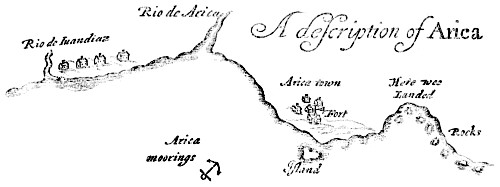
Arica, the most northern port in Chile, has still a
considerable importance. It is a pleasant town, fairly
well watered, and therefore more green and cheerful than
the nitrate ports. It is built at the foot of a hill (a
famous battlefield) called the Morro. Low, yellow sand-hills
ring it in, shutting it from the vast blue crags of
the Andes, which rise up, splintered and snowy, to the
east. The air there is of an intense clearness, and those
who live there can see the Tacna churches, forty miles
away. It is no longer the port it was, but it does a
fair trade in salt and sulphur, and supplies the nitrate
towns with fruit. When the pirates landed there it was
a rich and prosperous city. It had a strong fort, mounting
twelve brass guns, defended by four companies of
troops from Lima. The city had a town guard of 300
soldiers. There was also an arsenal full of firearms for
the use of householders in the event of an attack. It
was not exactly a walled town, like new Panama, but
a light wooden palisade ran round it, while other palisades
crossed each street. These defences had been thrown up
when news had arrived of the pirates being in those seas.
All the "plate, gold and jewels" of the townsfolk had
been carefully hidden, and the place was in such a state
of military vigilance and readiness that the pirates had
no possible chance of taking it, or at least of holding
it. When the pirates came upon it there were several
ships in the bay, laden with commodities from the south
of Chile.
 A description of Arica
On the 28th of January, John Watling picked 100
men, and put off for the shore in boats and canoas, to
attack the town. By the next day they had got close
in shore, under the rocks by the San Vitor River's mouth.
There they lay concealed till the night. At dawn of the
30th January 1681, "the Martyrdom of our glorious
King Charles the First," they were dipping off some rocks
four miles to the south of Arica. Here ninety-two of
the buccaneers landed, leaving a small boat guard, with
strict instructions how to act. They were told that if
the main body "made one smoke from the town," as
by firing a heap of powder, one canoa was to put in to
Arica; but that, if two smokes were fired, all the boats
were to put in at once. Basil Ringrose was one of those
who landed to take part in the fight. Dampier, it is
almost certain, remained on board the Trinity, becalmed
some miles from the shore. Wafer was in the canoas,
with the boat guard, preparing salves for those wounded
in the fight. The day seems to have been hot and sunny—it
could scarcely have been otherwise—but those out
at sea, on the galleon, could see the streamers of cloud
wreathing about the Andes.
At sunrise the buccaneers got ashore, amongst the
rocks, and scrambled up a hill which gave them a sight
of the city. From the summit they could look right
down upon the streets, little more than a mile from them.
It was too early for folk to be stirring, and the streets
were deserted, save for the yellow pariahs, and one or
two carrion birds. It was so still, in that little town,
that the pirates thought they would surprise the place,
as Drake had surprised Nombre de Dios. But while
they were marching downhill, they saw three horsemen
watching them from a lookout place, and presently the
horsemen galloped off to raise the inhabitants. As
they galloped away, John Watling chose out forty of
the ninety-two, to attack the fort or castle which defended
the city. This band of forty, among whom were Sharp
and Ringrose, carried ten hand-grenades, in addition to
their pistols and guns. The fort was on a hill above the
town, and thither the storming party marched, while
Watling's company pressed on into the streets. The
action began a few minutes later with the guns of the
fort firing on the storming party. Down in the town,
almost at the same moment, the musketry opened in a
long roaring roll which never slackened. Ringrose's
party waited for no further signal, but at once engaged,
running in under the guns and hurling their firepots
through the embrasures. The grenades were damp, or
badly filled, or had been too long charged. They did
not burst or burn as they should have done, while the
garrison inside the fort kept up so hot a fire, at close
range, that nothing could be done there. The storming
party fell back, without loss, and rallied for a fresh attack.
They noticed then that Watling's men were getting no
farther towards the town. They were halted in line, with
their knees on the ground, firing on the breastworks, and
receiving a terrible fire from the Spaniards. Five of the
fifty-two men were down (three of them killed) and the
case was growing serious. The storming party left
the fort, and doubled downhill into the firing line, where
they poured in volley after blasting volley, killing a
Spaniard at each shot, making "a very desperate battle"
of it, "our rage increasing with our wounds." No troops
could stand such file-firing. The battle became "mere
bloody massacre," and the Spaniards were beaten from
their posts. Volley after volley shook them, for the
pirates "filled every street in the city with dead bodies";
and at last ran in upon them, and clubbed them and
cut them down, and penned them in as prisoners. But
as the Spaniards under arms were at least twenty times
as many as the pirates, there was no taking the city
from them. They were beaten from post to post fighting
like devils, but the pirates no sooner left a post they
had taken, "than they came another way, and manned
it again, with new forces and fresh men." The streets
were heaped with corpses, yet the Spaniards came on,
and came on again, till the sand of the roads was like
red mud. At last they were fairly beaten from the
chief parts of the town, and numbers of them were
penned up as prisoners; more, in fact, than the pirates
could guard. The battle paused for a while at this stage,
and the pirates took advantage of the lull to get their
wounded (perhaps a dozen men), into one of the churches
to have their wounds dressed. As the doctors of the
party began their work, John Watling sent a message
to the fort, charging the garrison to surrender. The
soldiers returned no answer, but continued to load their
guns, being helped by the armed townsfolk, who now
flocked to them in scores. The fort was full of musketeers
when the pirates made their second attack a little after
noon.
At the second attack, John Watling took 100 of his
prisoners, placed them in front of his storming party, and
forced them forward, as a screen to his men, when he
made his charge. The garrison shot down friend and
foe indiscriminately, and repulsed the attack, and repulsed
a second attack which followed a few minutes later.
There was no taking the fort by storm, and the pirates
had no great guns with which to batter it. They found,
however, that one of the flat-roofed houses in the town,
near the fort's outworks, commanded the interior. "We
got upon the top of the house," says Ringrose, "and from
there fired down into the fort, killing many of their men
and wounding them at our ease and pleasure." While
they were doing this, a number of the Lima soldiers joined
the citizens, and fell, with great fury, upon the prisoners'
guards in the town. They easily beat back the few
guards, and retook the city. As soon as they had taken
the town, they came swarming out to cut off the pirates
from their retreat, and to hem them in between the fort
and the sea. They were in such numbers that they were
able to surround the pirates, who now began to lose men
at every volley, and to look about them a little anxiously
as they bit their cartridges. From every street in the
town came Spanish musketeers at the double, swarm after
swarm of them, perhaps a couple of thousand. The
pirates left the fort, and turned to the main army, at the
same time edging away towards the south, to the hospital,
or church, where their wounded men were being dressed.
As they moved away from the battlefield, firing as they
retreated, old John Watling was shot in the liver with
a bullet, and fell dead there, to go buccaneering no more.
A moment later "both our quartermasters" fell, with
half-a-dozen others, including the boatswain. All this
time the cannon of the fort were pounding over them,
and the round-shot were striking the ground all about,
flinging the sand into their faces. What with the dust
and the heat and the trouble of helping the many hurt,
their condition was desperate. "So that now the enemy
rallying against us, and beating us from place to place,
we were in a very distracted condition, and in more likelihood
to perish every man than escape the bloodiness of
that day. Now we found the words of Captain Sharp
to bear a true prophecy, being all very sensible that we
had had a day too hot for us, after that cruel heat in
killing and murdering in cold blood the old Mestizo
Indian whom we had taken prisoner at Yqueque." In
fact they were beaten and broken, and the fear of death
was on them, and the Spaniards were ringing them round,
and the firing was roaring from every point. They were
a bloody, dusty, choking gang of desperates, "in great
disorder," black with powder, their tongues hanging out
with thirst. As they stood grouped together, cursing and
firing, some of them asked Captain Sharp to take command,
and get them out of that, seeing that Watling
was dead, and no one there could give an order. To
this request Sharp at last consented, and a retreat was
begun, under cover of a fighting rear-guard, "and I hope,"
says Sharp, "it will not be esteemed a Vanity in me to
say, that I was mighty Helpful to facilitate this Retreat."
In the midst of a fearful racket of musketry, he fought
the pirates through the soldiers to the church where the
wounded lay. There was no time, nor was there any
conveyance, for the wounded, and they were left lying
there, all desperately hurt. The two surgeons could have
been saved "but that they had been drinking while we
assaulted the fort, and thus would not come with us
when they were called." There was no time for a second
call, for the Spaniards were closing in on them, and the
firing was as fierce as ever. The men were so faint with
hunger and thirst, the heat of battle, and the long day's
marching, that Sharp feared he would never get them
to the boats. A fierce rush of Spaniards beat them away
from the hospital, and drove them out of the town "into
the Savannas or open fields." The Spaniards gave a
cheer and charged in to end the battle, but the pirates
were a dogged lot, and not yet at the end of their strength.
They got into a clump or cluster, with a few wounded men
in the centre, to load the muskets, "resolving to die one
by another" rather than to run. They stood firm, cursing
and damning the Spaniards, telling them to come on, and
calling them a lot of cowards. There were not fifty buccaneers
fit to carry a musket, but the forty odd, unhurt
men stood steadily, and poured in such withering volleys
of shot, with such terrible precision, that the Spanish
charge went to pieces. As the charge broke, the pirates
plied them again, and made a "bloody massacre" of
them, so that they ran to shelter like so many frightened
rabbits. The forty-seven had beaten off twenty or thirty
times their number, and had won themselves a passage
home.
There was no question of trying to retake the town.
The men were in such misery that the march back to
the boats taxed their strength to the breaking point. They
set off over the savannah, in as good order as they could,
with a wounded man, or two, in every rank of them. As
they set forward, a company of horsemen rode out, and
got upon their flanks "and fired at us all the way, though
they would not come within reach of our guns; for their
own reached farther than ours, and out-shot us more than
one third." There was great danger of these horsemen
cutting in, and destroying them, on the long open rolls
of savannah, so Sharp gave the word, and the force
shogged westward to the seashore, along which they
trudged to the boats. The beach to the south of Arica
runs along the coast, in a narrow strip, under cliffs and
rocky ground, for several miles. The sand is strewn with
boulders, so that the horsemen, though they followed the
pirates, could make no concerted charge upon them. Some
of them rode ahead of them and got above them on the
cliff tops, from which they rolled down "great stones and
whole rocks to destroy us." None of these stones did any
harm to the pirates, for the cliffs were so rough and broken
that the skipping boulders always flew wide of the mark.
But though the pirates "escaped their malice for that
time," they were yet to run a terrible danger before getting
clear away to sea. The Spaniards had been examining,
or torturing, the wounded pirates, and the two drunken
surgeons, left behind in the town. "These gave them
our signs that we had left to our boats [i.e. revealed the
signals by which the boats were to be called] so that
they immediately blew up two smokes, which were perceived
by the canoas." Had the pirates "not come at
the instant" to the seaside, within hail of the boats, they
would have been gone. Indeed they were already under
sail, and beating slowly up to the northward, in answer
to the signal. Thus, by a lucky chance, the whole company
escaped destruction. They lost no time in putting
from the shore, where they had met with "so very bad
Entertainment." They "got on board about ten a Clock
at night; having been involved in a continual and bloody
fight ... all that day long." Of the ninety-two, who had
landed that morning, twenty-eight had been left ashore,
either dead, or as prisoners. Of the sixty-four who got
to the canoas, eighteen were desperately wounded, and
barely able to walk. Most of the others were slightly
hurt, while all were too weary to do anything, save sleep
or drink. Of the men left behind in the hospital the
Spaniards spared the doctors only; "they being able to
do them good service in that country." "But as to the
wounded men," says Ringrose, "they were all knocked
on the head," and so ended their roving, and came to
port where drunken doctors could torture them no longer.
The Ylo men denied this; and said that the seven pirates
who did not die of their wounds were kept as slaves.
The Spanish loss is not known, but it was certainly
terrible. The Hilo, or Ylo people, some weeks later,
said that seventy Spaniards had been killed and about
200 wounded.
All the next day the pirates "plied to and fro in sight
of the port," hoping that the Spaniards would man the
ships in the bay, and come out to fight. They reinstated
Sharp in his command, for they had now "recollected a
better Temper," though none of them, it seems, wished
for any longer stay in the South Sea. The Arica fight
had sickened them of the South Sea, while several of
them (including Ringrose) became very ill from the exposure
and toil of the battle. They beat to windward,
cruising, when they found that the Spaniards would not
put to sea to fight them. They met with dirty weather
when they had reached the thirtieth parallel, and the foul
weather, and their bad fortune made them resolve to leave
those seas. At a
fo'c's'le
council held on the 3rd of March,
they determined to put the helm up, and to return to
the North Sea. They were short of water and short
of food, "having only one cake of bread a day," or
perhaps half-a-pound of "doughboy," for their "whack"
or allowance. After a few days' running before the wind
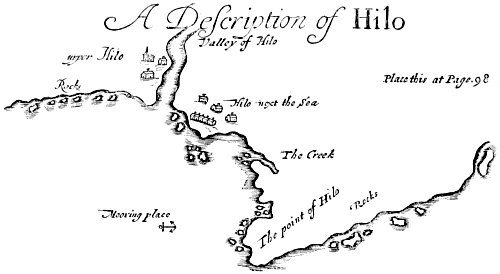
they came to "the port of Guasco," now Huasco, between
Coquimbo and Caldera, a little town of sixty or eighty
houses, with copper smeltries, a church, a river, and some
sheep-runs. Sixty of the buccaneers went ashore here,
that same evening, to get provisions, "and anything else
that we could purchase." They passed the night in the
church, or "in a churchyard," and in the morning took
"120 sheep and fourscore goats," about 200 bushels of
corn "ready ground," some fowls, a fat hog, any quantity
of fruit, peas, beans, etc., and a small stock of wine.
These goods they conveyed aboard as being "fit for
our Turn." The inhabitants had removed their gold and
silver while the ship came to her anchor, "so that our
booty here, besides provisions, was inconsiderable." They
found the fat hog "very like our English pork," thereby
illustrating the futility of travel; and so sailed away
again "to seek greater matters." Before they left, they
contrived to fill their water jars in the river, a piece of
work which they found troublesome, owing to the height
of the banks.
 A Description of Hilo
From Huasco, where the famous white raisins grow,
they sailed to Ylo, where they heard of their mates at
Arica, and secured some wine, figs, sugar, and molasses,
and some "fruits just ripe and fit for eating," including
"extraordinary good Oranges of the China sort" They
then coasted slowly northward, till by Saturday, 16th
April, they arrived off the island of Plate. Here their
old bickerings broke out again, for many of the pirates
were disgusted with Sharp, and eager to go home. Many
of the others had recovered their spirits since the affair
at Arica, and wished to stay in the South Seas, to cruise
a little longer. Those who had fought at Arica would
not allow Sharp to be deposed a second time, while those
who had been shipkeepers on that occasion, were angry
that he should have been re-elected. The two parties
refused to be reconciled. They quarrelled angrily whenever
they came on deck together, and the party spirit ran
so high that the company of shipkeepers, the anti-Sharp
faction, "the abler and more experienced men," at last
refused to cruise any longer under Sharp's command. The
fo'c's'le council decided that a poll should be taken, and
"that which party soever, upon polling, should be found
to have the majority, should keep the ship." The other
party was to take the long boat and the canoas. The
division was made, and "Captain Sharp's Party carried
it." The night was spent in preparing the long boat and
the canoas, and the next morning the boats set sail.


