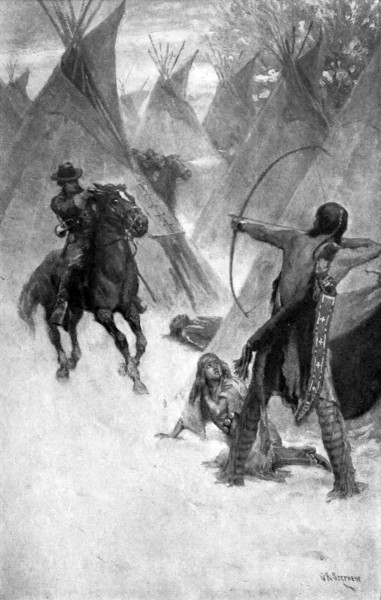
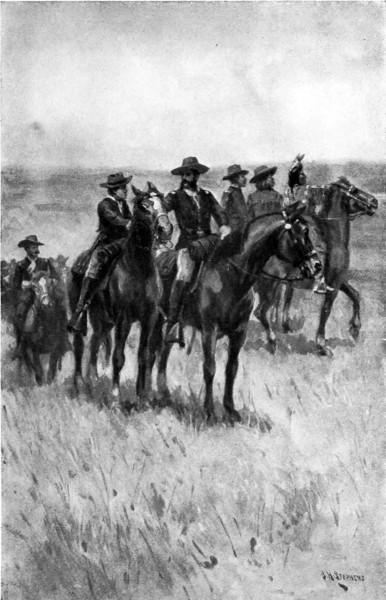
Saluting, around wheeled Ned. He had one
glimpse of the general’s face. The blue eyes were
blazing, the broad-brimmed hat was being swung to
the column urging forward at a trot.
“We’ve caught ’em asleep, boys!” cheered the
general’s high, clear voice. “Now for a charge!”
Down along the column Ned went thundering, for
the back trail. Familiar faces, dusty and sweaty, but
resolute all, grinned at him; a hand or two waved.
From the murk at the rear of the eager ranks he looked
behind him. The column had topped the ridge.
Headed by the general and the adjutant and young
“Autie,” the stars and stripes and the headquarters or
“general’s own” flag close following, with the cavalry
guidons of red and white streaming in the sun to mark
each troop, horses at hard trot, men leaning forward,
hat-brims flaring, bridle-hands forward, carbines and
pistols not yet drawn, rank by rank, guidon by guidon
they dipped over, into a hollow, and disappeared.
They were gone: but they left a cheer behind.
Ned did not look again. He had his duty to perform.
He was not certain as to where he would find
Major Benteen; but it would be somewhere toward
the river; the branching of the trails would guide.
“Go on! Go on!” he urged, into the pricked ears
of his horse, another “Buckie.”
“Thud-ity thud! Thud-ity thud! Thud-ity
thud!” The brush and the rocks reeled dizzily past,
the brown trail of many hoofs flowed under. He extracted
the message from his blouse, to read it and to
be sure of it in case it was lost. Yes, that was it in
Adjutant Cook’s hasty scrawl:
Benteen, come on. Big
Village. Be quick.
Bring packs.
Cook, adj’t.
P. S. Bring packs.
“Cl’k!” clucked Ned to Buckie; and pricked him
again with the spurs. They must make it. The
general would be depending upon them. Adjutant
Cook had repeated the words “Bring packs,” which
showed how important was the matter.
“Thud-ity thud! Thud-ity thud! Thud-ity
thud!” The lather was white where the bridle reins
rubbed Buckie’s wet neck; his breath whistled, occasionally
he snorted to blow from his straining nostrils
the dust and moisture; but he never faltered. Good
horse!
Far and faint from the right were heard a spattering
of rifle-shots, like a skirmish fire; and then cheers!
That must be Major Reno, or Captain Benteen; and
off there would lie the river.
Gallop, gallop, up the back trail, with the rounded
slopes, sagey and hot, girding the long, long way.
Where was Captain Benteen? Where was the pack-train?
Ah, here came somebody—a rider also galloping
hard. Out whipped Ned’s revolver; but soon the
speck resolved into a man in white-man’s garb.
Looked like a soldier. It was “Bos!” “Bos”
Custer, forage-master.
He saw Ned, and waved. Ned drew rein barely
for a moment, as they met.
“Where you been?”
“Back to get a fresh horse.”
“Where’s Captain Benteen? Seen him?”
“Just left him. Straight on. Keep the trail.
A fight, isn’t it?”
“You bet.” And Ned was away, in the one
direction; “Bos” galloped on to join his big brother.
Five of the Custer family were to be together in that
battle: three brothers, a brother-in-law, and a nephew.
Ned kept watch ahead for any token of the Benteen
column. Hurrah! There they were—a long
mass of dusty blue, moving at a trot, down the trail,
Captain Benteen and his aide leading. The pack-train
was not in sight. On galloped Ned (revolver stowed
again in holster), and met Captain Benteen, who had
been watching his approach.
“A dispatch from headquarters, sir,” panted Ned,
holding it out.
As he rode, Captain Benteen rapidly read it. Ned
held himself prepared at a word to whirl and carry
the order on to the packs. But as the captain read,
the spattering of shots in the distance before suddenly
swelled to a continuous clamor. The captain raised
his head, listening, gazing. Louder, and louder, rang
the gun-fire, as if the battle was approaching. The
Indians were being driven this way? What——?
But the captain’s order rang smartly.
“B’tall-yun, draw—pistols! Gallop—march!”
With a cheer they lunged ahead, pistols held high,
eyes alert, ready to meet the fleeing Sioux and turn
them back again.
The valley widened; in this direction had ridden
the Major Reno battalion, recalled Ned, as he, too,
galloped, pistol high.
“Right and left into line—march!” shouted Captain
Benteen, to cover the ground with battle front.
Then, as all were galloping, forming the line, the
draw opened upon a wide cross valley, and there was
the battle field—a brushy, broken arena, cut by the
willow-bordered crooked stream, hazy with smoke
of burning grass and powder through which echoed
shot and shout and chant, and through which dimly
could be seen horsemen careering in all directions, as
if attacking a common object in their midst. Upon
a bluff to the right was another battle—soldiers above,
Indians below.
The gallop quickly ceased. Now where to go, or
what to do, first?
“Look out! Here come some!”
The cry and the murmur swept from man to man.
A confused mass was rapidly bearing up the valley,
toward them.
“No, that’s all right. They’ve signaled. They’re
Crows, with a pony herd.”
So they were. As they wildly scampered past,
driving off their spoils, Indian-fashion, voices hailed
them, inquiring where was Reno, where was Custer.
One of the Crows waved his hand at the bluff.
“Soldiers there,” he said.
“Right oblique, trot—march!” ordered Captain
Benteen. And for the bluff they made.
The men upon the bluff proved to be Major Reno
and his battalion. They were dismounted, and were
firing at long range down the slopes. The fighting
below had been by the rear guard, in the retreat to the
bluff. Major Reno wore a handkerchief tied about
his head. Ned thought that he had been wounded,
but he had only lost his hat. He had lost his revolver,
too. He greeted Major Benteen feverishly.
“Where’s Custer? Have you seen Custer?”
“No.”
“Neither have I. He promised to support me. It
was too hot in there for us. We were driven out.
Five to one.” The major appeared almost beside
himself. “Why, I tell you we’re fighting all the
Sioux nation, and all the outlaws and half-breeds east
of the Rocky Mountains. Dismount your men, captain,
and deploy them as skirmishers along that hill
on the south.”
Yes, Major Reno and his 200 men had started in
to charge the village, across the river; but it had
looked as if they were being drawn on into an ambush;
when they had halted, to survey, out had
swarmed the Sioux, thicker and thicker. Afoot they
came, and ahorse. “Hi-yih hi-yih yip-yip-yip!” had
they cried, frightfully. The Rees, on the left flank,
had fled pell-mell. The major had dismounted his men
in some timber; but no Custer was in sight, the Indians
were surrounding, and he had ordered a retreat to the
bluff on this side.
That had been a close call. In the retreat Lieutenant
Don McIntosh and Lieutenant Benny Hodgson
the acting adjutant had been killed, and so had
Doctor DeWolf, and “Lonesome” Charley Reynolds,
and black Isaiah. Faithful Bloody Knife, too, had
fallen; struck down, said somebody, at Major Reno’s
side. Twenty-nine other men also were dead. A score
were missing. The bodies of most of the killed were
down there still.
The battalion might have done better had they
stayed in the timber by the village and fought dismounted.
But where was Custer? Where was the
general?
The bugles shrilled.
“Cease firing, men! Cease firing!” bade the
sergeants, along the skirmish line of kneeling men,
protecting the bluff.
Now might all pause from squinting over hot
carbine barrels, and wipe foreheads. The Indians in
the valley were galloping away, along the hills and
stream, toward the north.
What was the matter there? Oh! Listen! Custer
must be in action. His carbines were rattling fast
and faster. Why doesn’t he send some word, though?
Why was the battalion kept here? Why didn’t the
major order an advance?
Listen now! Crash! Volley firing! And again
“Crash!” Another. Surely “Old Curly” was giving
it to them heavy. Who was that coming? Ah,
McDougall and the packs. Good! The general had
sent word for the packs; wasn’t it time to push ahead
in force and join him, or help him out by attack?
Water was needed; but when soldiers tried to get
it from the river below they were promptly fired upon.
The shooting in the direction where the general was
died away to a fitful clatter; few Indians were to be
seen; and at last Major Reno did order a movement
north on the bluffs, toward the general. Then the
Indians gathered fast and furious, and the command
was driven back to the first bluff. The general’s battalion
had been in sight, two miles distant, on a hill.
At least, over there was an eddy of riding and irregular
firing. From the place many Indians suddenly
came hurrying to attack the other white soldiers. So
it looked as if the general had been defeated and his
rear-guard had been defending his retreat.
But why didn’t he send a courier through or make
signals, to inform the rest of the regiment?
The bluff was a lively spot. Thicker and thicker
the Sioux and the Cheyennes were besieging it. From
every side, from above as well as from below, shrieked
their taunts, whined their bullets. The day was
almost spent. As the sun sank into the desolate hills
the red foe yelped the louder, fired the faster; every
bunch of sage and every rock seemed to harbor an
Indian; down by the willow-bordered stream the
squaws sang vengefully in the village still standing
and triumphant.
Even at twilight the Indians did not dare to charge.
Steadily and desperately the soldiers replied to their
bullets. Officer and man shot as one; and Ned among
them. His stubby cavalry carbine repeatedly jammed
on him. It wouldn’t extract the shell. On right and
left he heard his mates complaining of their carbines
also. They must stop and use their knife-blades, to
pry loose the shells.
The twilight faded; the dusk settled; and the
Indians quit. The reports of rifle and carbine ceased;
and for an instant quiet blessed the valley. Ned was
glad to rise and stretch his cramped legs and back,
and look about.
“Hark!” again cautioned somebody. “I hear
commands! Troops are coming! Hurrah for Crook!”
“Don’t you see them over there? Right over
there against the sky-line! Ah—now they’ve disappeared.
But they’re coming—Terry or Crook or
Custer! Hurrah!”
“Hurrah!” welled the cheers, from this hill and
all along the bluff, where the Reno men also were
stirred.
“Sound stables, Fletcher,” bade Captain Benteen,
of Ned. “Loud as you can, to reach them and
guide them.”
With parched and cracked lips Ned did his best,
pealing from his battered trumpet the rollicking,
familiar tune:
Come off to the stable all ye who are able,
And give your horses some oats and some corn;
For if you don’t do it your colonel will know it,
And then you will rue it as sure as you’re born.
“Now listen!”
It did seem as though answering bugle call floated
in through the dusk. But after shots had been fired,
and more calls had been sounded, officers and men
must agree that their hopes deceived them. Nobody
was coming. So where was Custer?
Barricades of boxes and horse carcasses were being
piled up, and the order went forth to scoop out rifle
pits, for the next day’s fight. The darkness gradually
settled. There was no water for coffee, and every
mouth was too dry to chew bread. The bluff was
miserable, but the village below was gay. Great fires
flared redly; and about them the Indians were prancing
and yelping in a tremendous scalp dance. With
flames and shrieks and hoots and firing of guns and
beating of tom-toms the dances lasted all night. But
the Indians were not unmindful of the watchers on
the bluff; for when Major Reno sent out scouts to
find an open way they speedily crept back, with word
that they had encountered nothing but Sioux, Sioux,
Sioux, everywhere.
No matter; Custer would come, in the morning;
and soon would come Terry and Gibbon, and Crook
the Gray Fox.
The digging of the little rifle-pits took most of the
night. Ned had been helping one of the squads. They
had finished their pit, and he had closed his eyes, for
a moment (he was so tired!), when he wakened with
a jump. Two rifle-shots echoed in his ears. To the
signal up-swelled a hideous clamor again, of whoops
and rapid reports; the bullets pelted in, ringing upon
the rocks and cutting the dry earth and the brittle
sage. There was no need for “Assembly”; into the
pits dived the men.
The east was barely pink. Dawn scarce had
arrived. The hour must be very early. But for white
and red the day had begun.
“Give it to ’em, men; give it to ’em, but be careful
how you shoot. Make every bullet tell.” The sharp
words of Captain Benteen and Lieutenant Gibson, as
they walked up and down behind Troop H, steadied
the nerves of all.
How fast the bullets rained in! They struck from
before and from behind. As the dawn brightened,
the feathered chiefs could be seen gesturing and commanding,
while hither-thither ran their naked warriors,
to occupy better positions. There were swarms
of them; swarms!
“For the love o’ Saint Patrick, but they’re all
sharp-shooters!” gasped Private McDermott, at Ned’s
elbow. “An’ half o’ them are out o’ range of us, wid
these sawed-off carbines.”
So they were—all sharp-shooters. Fast and true
their lead picked, picked, at the rifle-pits and barricades;
searched the hollow where were herded the
pack-mules and the extra horses. Along the line of
H company men were being killed, some by bullets
from behind. Mules and horses screamed with
wounds. Powder reek filled the still air. One’s head
ached with the noise, one’s throat smarted with the
smoke.
Major Reno, in his position to the north, must lie
low; must lie low Captain Benteen and every other
officer. The Indians were creeping closer. By little
dashes and rushes they stole up, through the brush.
With whish and patter arrows began to eke out the
hail of bullets.
“Must be short o’ ammunition,” muttered Private
McDermott.
“Wait! I’ll get one of those red beggars,” exclaimed
Private Burns. From his place he crawled
forward, hugging the brush, for better aim. On he
went, peering; but see! Half-up he sprang, and fell,
crumpled into a lax heap.
With exultant whoop a painted, glistening coppery
figure darted toward him, speeding like a deer, coupstick,
ten feet long, out-stretched to touch his body
and claim a scalp. But half a dozen carbines spoke
together, and the painted, glistening coppery figure
collapsed to a dully red mass.
Bold? Yes. There between the lines lay soldier
and Sioux, while over them passed and repassed bullet
and arrow, shout and groan. Truly, the fight was
growing more desperate.
“That won’t do,” spoke Captain Benteen. Major
Reno had come over. “We’ll have to act quick, or
they’ll be running into our lines. We must drive them
back, major; drive them back.”
“Get your men ready for a charge, then,” directed
the major.
“All ready, men,” called the captain, briskly.
“Now’s your time. Hip, hip, here we go! Give it
to ’em! Give it to ’em!”
“Hurrah!” cheered Lieutenant Gibson.
Out from shelter and down the sagey slope surged
the blue-shirted line. Ned took no time to blow the
“Charge”; he was shooting. Lead and not brass
was needed. The carbines roared, the men shouted
fiercely, and for the river broke the Indians.
“Back, men! Get back!” ordered Major Reno,
following with the other officers, close behind.
So it was into the rifle-pits again.
Noon was near; either the Indians were out of
ammunition, or else they were exhausted, for the firing
by them slackened. Acting Adjutant Hare came
hastening to Captain Benteen.
“The major’s compliments, and will you advance
your skirmish line to cover volunteers getting water.”
The water-getters were making way, by hollow and
ravine, toward the river in front. They carried camp-kettles
and bunches of canteens. Dangerous work was
this, and some of them were wounded; but they filled
the canteens. These were handed along the lines.
Ah, but it was good, to have a drink at last!
The sun had traveled from east across to the west.
The afternoon waxed and waned: sometimes the
Indians shot angrily; sometimes they seemed to be
resting. What was to occur next? What were they
scheming? The officers walked about, bidding the
men be ready and not afraid.
“Sure, but looks to me as if the beggars were
leavin’,” mused Private McDermott, gazing puzzled.
Then, toward sunset and the close of this the
second day of fighting, from the bluff arose a murmur
and a cry. The Indians were quitting, and riding off!
’Twas too good to be true; but nevertheless tipis were
falling, as the squaws labored hard to pack the village.
Soon billows of fresh smoke rolled up. The grass
had again been fired; figures could be seen behind it,
fanning it with blankets.
Officers and men stared. In the cool glow of
twilight the whole village—or what looked to be the
whole village—emerged from the concealing smoke
and moved away across the bare plateau which had
been the pony pasture.
An enormous, regular mass they made; no wonder
that the Seventh Cavalry battalions had not whipped
all this people.
“They’re as large as a brigade of the Army of the
Potomac, and in as fine order,” pronounced Major
Reno, watching from amidst his officers.
However, the Indians might be planning a trap.
Eighteen dead and fifty-two wounded was the report
of Doctor Porter, the surgeon on the bluff. Major
Reno did not dare to venture far, but he moved the
companies nearer to the river, for the water. Thus
night descended upon Monday, June 26, 1876, by
the Little Big Horn.
Tuesday the third day dawned clear and peaceful.
Before, the only moving objects were a few Indian
ponies grazing in the bottoms; not an Indian lodge-fire
was to be sighted. Now where was Custer?
Where was Crook? When could Terry and Gibbon
be expected?
After breakfast the men might sit about, wary
but at ease, except the wounded. The sun floated
higher, and the sage shimmered with heat. Scarcely
a sound broke the aftermath of battle noise, save as
magpies croaked hoarsely. Upon a knoll were sitting
also Major Reno and Acting Adjutant Hare and Captain
Benteen, and other officers—Ned and his fellow
orderlies close at hand.
The talk was much upon Custer, and why he did
not send word. Some of the officers were impatient
with him. But suddenly talk ceased. Major Reno
was peering intently through his glass, at the northward.
What was that? From the lounging men uprose
again a murmur. They were springing to their
feet—as sprang to their feet Major Reno and all.
“Sound the assembly, trumpeter! To your
posts, gentlemen!” ordered the major.
Against the mountain-tops far down the course
of the crooked, half-hidden river was another spume
of dust like a brownish cloud. To the hurrying notes
of the “Assembly” by bugle after bugle the men
hastened from the river below, seized carbines and
crouched again in line. The Indians were coming
back!
No! The dust did not approach fast enough for
Indian riders. It was more like the dust of a cavalry
or an infantry march. And yet—if Indians it was,
could the bluff hold out against them, another day?
Ned felt his heart sink with dread. Evidently
Major Reno was doubtful. He pondered, a moment;
and wrote rapidly an order.
“I want three men to carry this message through,”
he said, to Acting Adjutant Hare. “They’re to go
as close as possible to that approaching column, and
see what it is. If it’s Indians, they’re to pass on and
take this word through to Terry at the Big Horn, so
that he’ll hurry. If it’s a white column, they are to
turn back at once and let us know. You can ask for
volunteers from the ranks. Our Indians are no good.
I can’t depend on them.”
Following the line of bluffs had ridden away the
three brave couriers. The two battalions must wait.
“That may be Terry, don’t you think, major?”
queried Adjutant Hare.
“No. If cavalry, they must be Custer. Terry
would hardly have had time to get in this far.”
“Look for the gray horse troop, then,” suggested
Captain Benteen. “Troop E; Smith’s. That will
tell the story.”
An hour passed; and hurrah, here came the three
couriers, hastening along the ridge! With them was
a fourth rider. The dust also was nearing; soon the
men under it would be in sight.
The squad of four arrived panting with their haste.
The extra man was a scout, by his rig. He was
weary and travel-worn.
“’Tis an army column; cavalry and infantry both,
sir,” reported the corporal of the three couriers; and
the strange scout handed to Major Reno a soiled note.
The major read it—read it twice, and passed it to
the next officer.
“What do you make of it, gentlemen?” he asked,
anxiously. “You say that’s Terry yonder?” he
queried of the scout:
The scout nodded, and out of drawn face answered.
“Yes, sir.”
“And Custer isn’t with him?”
“No, sir.”
“This note is addressed to General Custer,” said
Lieutenant Hare; “from General Terry.” And he
read it aloud: “General: A Crow scout has just come
into camp, saying you’ve been whipped. I don’t believe
it, but I’m coming with medical aid.”
“Tried to get into your lines last night,” informed
the white scout, “but the blamed Sioux were so thick
they held me back. I s’posed you were Custer. Where
is Custer, might I ask?”
Whitening face turned to whitening face. Ned
knew himself grown pale and shaky with a great fear.
“If Custer didn’t meet Terry——”
“And hasn’t communicated with us——”
“Or with him——”
“We must hope for the best, gentlemen,” faltered
Captain Benteen.
Sped like lightning through the rifle-pits the rumor
that the Custer battalion had met a great disaster.
Little exclamations of wonder and pity were succeeded
by an expectant silence.
But here along the valley, right where had stood
the proud Sioux village, appeared the head of the
column; appeared cavalry and infantry, under guidon
and banner. Hooray for Terry and Gibbon! Hooray
for comrades in blue! Hats were swung, grimy hand
gripped grimy hand.
On came the column, to the cheering lines. General
Terry, leading, was grave. Evidently he bore very
bad news. Sober were all the officers with him, sober
were the men; and sober grew the awed camp.
“Custer! What about Custer?”
Heads were shaken.
“Don’t know yet, for sure. But some command
has been killed off, every man, apparently, yonder on
those hills. We passed about two hundred stripped
bodies.”
Ned glimpsed a familiar face. It was that of
Curly, the Crow scout. He rushed to Curly.
“Where’s the general, Curly? Where’s the Long
Hair?”
Curly shook his head, as other heads were being
shaken.
“Long Hair dead,” he said, gutturally. “All
dead. Me only one left. Let hair down like Sioux,
put on Sioux paint, an’ ride out. Nearly all killed,
then.”
So Curly had been with Custer in the fight.
Acting Adjutant Hare’s voice was choked, he
scarcely could speak, when in due time seeking out
Captain Benteen he said:
“The major has the permission of General Terry
to send out a company to inspect the battle-field where
the bodies were seen. He therefore directs that you
take your company, and return as soon as practicable
with a report.”
Soberly Captain Benteen acknowledged the salute;
and soberly rode away with him his men of Company
H, including Ned, cavalry trumpeter.
Yes, there they lay, on slope and ridge, two miles
from Reno Hill. There they lay: 212 by count, the
fighting men of the great white chief Long Hair,
overwhelmed by the 2000 fighting men of the great
red chiefs Gall and Crazy Horse, and the medicine of
Sitting Bull.
Company by company, in retreat from position to
position, they could be recognized not by guidon but
by officers and men. Here was fair Calhoun and his
line; here was dark Captain Keogh and his; here were
the Yates men and the Smith men and Tom Custer’s,
backed by their officers. Here was “Queen’s Own”
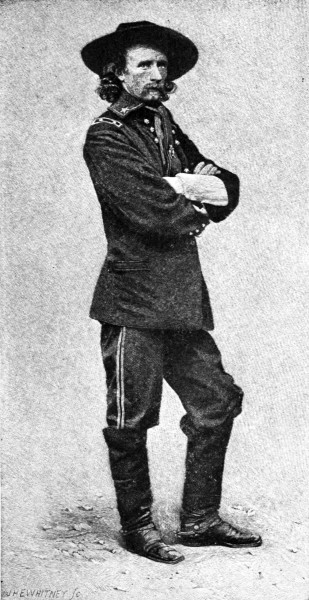
Cook; and “Bos” and little “Autie”; and in the
circle of the brave was the general.
Scalps had been taken, hatchet and club had been
at work; but General Custer lay calm and at ease, with
two wounds only, and looking much as Ned had seen
him look a thousand times before. Even the knife of
Rain-in-the-Face had passed him by. Said the Sioux:
“Of all the brave men we ever fought, the Long Hair
was the bravest.”
Two hundred and sixty-five killed, fifty-two
wounded, was the roll-call of the Seventh Cavalry,
after this battle of the Little Big Horn, June 25 and
26, 1876. The Sioux fled, Crazy Horse to the east,
Sitting Bull to the west. Pursuit was long. Band
after band must yield to cavalry and to infantry.
American Horse was killed; Iron Dog surrendered;
Dull Knife the Cheyenne was defeated; Lame Deer
was killed; Two Moons and Hump surrendered;
Crazy Horse was defeated, and must surrender; Sitting
Bull was twice defeated, and through snow and
cold must lead into Canada the few of his people left.
Five years after the great battle by the Greasy Grass
he, too, surrendered. The United States had bought
the Black Hills. But the Chief with the Long Yellow
Hair and nigh three hundred of his Seventh Cavalry
rode never again.
LIPPINCOTT’S
POPULAR BOOKS FOR BOYS
12mo. Illustrated. Cloth, ornamental,
$1.00 per volume.
| THE LOST GOLD OF THE MONTEZUMAS. |
By W. O. Stoddard. |
| TROOPER ROSS, AND SIGNAL BUTTE. |
By General Charles King, U.S.A. |
| CAPTAIN CHAP. |
By Frank R. Stockton. |
| CHARLIE LUCKEN. |
By H. C. Adams. |
| THE YOUNG CASTELLAN. |
By George Manville Fenn. |
| THE BLACK TOR. |
By George Manville Fenn. |
| THE MYSTERY OF THE ISLAND. |
By Henry Kingsley. |
| CHUMLEY’S POST. |
By W. O. Stoddard. |
| THE ORACLE OF BAAL. |
By I. Provand Webster. |
| AN ANTARCTIC MYSTERY. |
By Jules Verne. |
| RANALD BANNERMAN’S BOYHOOD. |
By George Macdonald. |
| THE YOUNG MASTER OF HYSON HALL. |
By Frank R. Stockton. |
| FROM SCHOOL TO BATTLE-FIELD. |
By General Charles King, U.S.A. |
| THE BRAHMIN’S TREASURE. |
By George A. Henty. |
J. B. LIPPINCOTT COMPANY, PHILADELPHIA
THE TRAIL BLAZERS SERIES
With Carson and Frémont
By EDWIN L. SABIN
The daily life of these men who worked together to break the hostile
spirit of the Western wilderness was one filled with adventure and
danger, and this chronicle, written for boys, is almost a first-hand
story of the West in the early days. Mr. Sabin holds closely to facts, and
while writing an entertaining story has still presented an inspiring
episode in American history.
Illustrated. 12mo. Cloth, $1.25 net. Postpaid, $1.37
David Crocket: Scout
By CHARLES FLETCHER ALLEN
This volume sets forth all Davy’s versatility and recounts his many
exploits in the East and in the new Southwest. It tells of him as
Indian fighter, bear hunter, statesman and defender of the Alamo.
Davy had a keen sense of humor and a lovable nature, which at once
endear him to the reader.
Colored frontispiece and three illustrations in black and white by Frank McKernan.
12mo. Cloth, $1.50.
Daniel Boone: Backwoodsman
By C. H. FORBES-LINDSAY
“Historical fact is made the basis of convincing fiction, and a better book of its
kind could not be placed in the hands of any American boy. Boone stands out as a
splendid figure of pioneer manhood, who performed a work of incalculable importance
in the settlement of Kentucky by white men. True narrative impulse enters into the
story.”—Philadelphia Press.
Frontispiece in color and three illustrations. 12mo. Cloth, $1.50.
Captain John Smith
By C. H. FORBES-LINDSAY
“It’s as exciting as if it were a tale of sword-and-mantle fiction by a writer of the
Stanley Weyman school. There’s fighting galore on its pages; wild adventurings;
ups and downs; and all shot through with an unconquerable spirit. All of it is true
and is stirring. It’s good history, good biography and mighty good reading.”—Cleveland
Leader.
Four illustrations in color, 12mo. Decorated cloth, $1.50.
J. B. LIPPINCOTT COMPANY
PUBLISHERS PHILADELPHIA
FOR EVERY BOY AND GIRL
Three Hundred Things a Bright
Boy Can Do
By MANY HANDS
This work covers a wide field of sport and pastime, both recreative
and instructive, and cannot fail to engage the interest of every intelligent
boy, however varied or limited his tastes may be. The necessary
details of each sport or pastime are written in a simple but exhaustive
manner, and the lucid explanation given will be understood by the
youngest.
The book, although written specially for boys, will not fail to have
its use as a work of reference to all those who still find pleasure in
rejuvenating occupations.
To keep a boy happily engaged during the winter evenings, and
to help him to perfect himself for the activities of the field in summer,
no better present could be given him than a copy of this volume.
With many illustrations and diagrams. Large crown 8vo. Decorated
cloth; $2.00 net.
Three Hundred and One Things
a Bright Girl Can Do
By MANY HANDS
The hundreds of games and pastimes described in this book, both
indoor and out, amusing and instructive, cannot fail to interest every
girl, no matter how varied her tastes may be.
With many illustrations and diagrams. 440 pages. 8vo. Decorated
cloth, $2.00 net.
J. B. LIPPINCOTT COMPANY
PUBLISHERS PHILADELPHIA
BOOKS FOR BOYS
“PEWEE” CLINTON—PLEBE
By PROF. W. O. STEVENS.
This is a rattling good tale of the adventures of a “Plebe” at the
United States Naval Academy. The author, through his connection
with the Academy, understands thoroughly the intimate life of the
middies. He describes vividly the humorous incidents, scrapes and
escapades that enliven the duties of these embryo commodores.
Illustrated by Herbert Pullinger. 12mo. Cloth, $1.25, net. Postpaid, $1.37.
THE BOY SCOUTS
OF BIRCH-BARK ISLAND
By RUPERT SARGENT HOLLAND
This book tells the adventures of a troop of twenty-five Boy Scouts
who leave New York about the middle of June and camp on an island in
the Connecticut River. The Scouts pitch their tents, explore the island,
draw maps of what they discover, lay out baseball field, hold water-sports,
and go on scouting “hikes” across the island and along the mainland.
With colored frontispiece and five illustrations in black and white by
Herbert Pullinger. 12mo. Decorated cloth, $1.25 net. Postpaid, $1.37.
THE LONGSHORE BOYS
By WILLIAM O. STODDARD, Jr.
An unusually fine tale of the adventures of three boys on a cruise on
the Great South Bay, on the south side of Long Island. The book will
surely appeal to the live boy, and afford him much solid enjoyment.
Illustrated in color by Herbert Pullinger. 12mo. Cloth, $1.50.
With Fighting Jack Barry
By JOHN T. McINTYRE.
With the Revolution of 1776 as a back-ground, and the fortunes of a
couple of young lads, hardy and courageous, to follow, the author has
little difficulty in treating one daring escapade after another.
“This rattling story should be especially attractive to the youthful reader.”—Chicago Evening Post.
Four illustrations in color. 12mo. Pictorial cover. Cloth, $1.50.
J. B. LIPPINCOTT COMPANY
PUBLISHERS PHILADELPHIA
INSTRUCTIVE AND ENTERTAINING BOOKS
The Boy Electricians as Detectives
By EDWIN J. HOUSTON
Few boys could acquire more knowledge of electricity
from text-books than from this story of the adventures
of three boys who formed a club to amuse themselves
in learning the use of electricity. Novel experiments
are described, including the making and operation of a
small wireless telegraph. The boys are of that jolly, active,
self-reliant type, and every wide-awake boy will find this
a fascinating and instructive story.
Six illustrations in wash by Frank McKernan. 12mo. Cloth, $1.25 net.
Postpaid, $1.37.
BY THE SAME AUTHOR
The Boy Electrician
or The Secret Society of the Jolly Philosophers
“The author has succeeded admirably in blending entertainment with
instruction, and the book is bound to awaken a scientific interest in the
young reader.”—Philadelphia Press.
Illustrated by Frank McKernan. 12mo. Cloth, $1.50.
The Boy Mineral Collectors
By JAY G. KELLEY, M.E.
A story full of the good times and adventures of two
boys on a three months’ vacation at their uncle’s
Western home. Their uncle, a miner and mineralogist,
takes them along in his work, and under his direction
they learn much and have splendid times making a
collection of minerals.
Colored frontispiece. 12mo. Cloth, $1.50.
J. B. LIPPINCOTT COMPANY
PUBLISHERS PHILADELPHIA
The “True” Biographies
and Histories
The aim of this unique series of biographies and histories
is to present in entertaining form, free from
glamour, some of the greatest characters and epochs in our
national history, and with as close fidelity to the truth as
can be gleaned from the conflicting record of events.
The True George Washington
By Paul Leicester Ford
The True Benjamin Franklin
By Sydney George Fisher
The True Patrick Henry
By George Morgan
The True Thomas Jefferson
By William Eleroy Curtis
The True History of the American Revolution
By Sydney George Fisher
The True William Penn
By Sydney George Fisher
The True Abraham Lincoln
By William Eleroy Curtis
The True Andrew Jackson
By Cyrus Townsend Brady
The True Henry Clay
By Joseph M. Rogers
The True History of the Civil War
By Guy Carleton Lee
The True Daniel Webster
By Sydney George Fisher
With twenty-four full-page illustrations in each volume
Crown 8vo. Per volume: Cloth, $2.00, net; half levant, $5.00, net
J. B. LIPPINCOTT COMPANY
PUBLISHERS PHILADELPHIA
Transcriber’s Notes:
Punctuation and spelling inaccuracies were silently corrected.
Archaic and variable spelling has been preserved.
Variations in hyphenation and compound words have been preserved.