ON THE MODE OF COMMUNICATION OF CHOLERA.
1
The existence of Asiatic Cholera cannot be distinctly
traced back further than the year 1769. Previous to that
time the greater part of India was unknown to European
medical men; and this is probably the reason why the
history of cholera does not extend to a more remote period.
It has been proved by various documents, quoted by Mr.
Scot,[1] that cholera was prevalent at Madras in the year
above mentioned, and that it carried off many thousands
of persons in the peninsula of India from that time to
1790. From this period we have very little account of
the disease till 1814, although, of course, it might exist in
many parts of Asia without coming under the notice of
Europeans.
In June 1814, the cholera appeared with great severity
in the 1st bat. 9th regt. N.I., on its march from Jaulnah
to Trichinopoly; while another battalion, which accompanied
it, did not suffer, although it had been exposed to
exactly the same circumstances, with one exception. Mr.
Cruikshanks, who attended the cases, made a report, which
will be alluded to further on.
ON THE MODE OF COMMUNICATION OF CHOLERA.
In 1817, the cholera prevailed with unusual virulence
at several places in the Delta of the Ganges; and, as it
2had not been previously seen by the medical men practising
in that part of India, it was thought by them to be a
new disease. At this time the cholera began to spread to
an extent not before known; and, in the course of seven
years, it reached, eastward, to China and the Philippine
Islands; southward, to the Mauritius and Bourbon; and
to the north-west, as far as Persia and Turkey. Its approach
towards our own country, after it entered Europe,
was watched with more intense anxiety than its progress
in other directions. It would occupy a long time to give
an account of the progress of cholera over different parts
of the world, with the devastation it has caused in some
places, whilst it has passed lightly over others, or left them
untouched; and unless this account could be accompanied
with a description of the physical condition of the places,
and the habits of the people, which I am unable to give,
it would be of little use.
There are certain circumstances, however, connected
with the progress of cholera, which may be stated in a
general way. It travels along the great tracks of human
intercourse, never going faster than people travel, and
generally much more slowly. In extending to a fresh
island or continent, it always appears first at a sea-port.
It never attacks the crews of ships going from a country
free from cholera, to one where the disease is prevailing,
till they have entered a port, or had intercourse with the
shore. Its exact progress from town to town cannot always
be traced; but it has never appeared except where there
has been ample opportunity for it to be conveyed by human
intercourse.
There are also innumerable instances which prove the
communication of cholera, by individual cases of the disease,
in the most convincing manner. Instances such as
the following seem free from every source of fallacy.
I called lately to inquire respecting the death of Mrs.
3Gore, the wife of a labourer, from cholera, at New Leigham
Road, Streatham. I found that a son of the deceased had
been living and working at Chelsea. He came home ill
with a bowel complaint, of which he died in a day or two.
His death took place on August 18th. His mother, who
attended on him, was taken ill on the next day, and died
the day following (August 20th). There were no other
deaths from cholera registered in any of the metropolitan
districts, down to the 26th August, within two or three
miles of the above place; the nearest being at Brixton,
Norwood, or Lower Tooting.
The first case of decided Asiatic cholera in London, in
the autumn of 1848, was that of a seaman named John
Harnold, who had newly arrived by the Elbe steamer from
Hamburgh, where the disease was prevailing. He left
the vessel, and went to live at No. 8, New Lane, Gainsford
Street, Horsleydown. He was seized with cholera on the
22nd of September, and died in a few hours. Dr. Parkes,
who made an inquiry into the early cases of cholera, on
behalf of the then Board of Health, considered this as the
first undoubted case of cholera.
Now the next case of cholera, in London, occurred in
the very room in which the above patient died. A man
named Blenkinsopp came to lodge in the same room. He
was attacked with cholera on the 30th September, and
was attended by Mr. Russell of Thornton Street, Horsleydown,
who had attended John Harnold. Mr. Russell
informed me that, in the case of Blenkinsopp, there were
rice-water evacuations; and, amongst other decided symptoms
of cholera, complete suppression of urine from Saturday
till Tuesday morning; and after this the patient had
consecutive fever. Mr. Russell had seen a great deal of
cholera in 1832, and considered this a genuine case of the
disease; and the history of it leaves no room for doubt.
4The following instances are quoted from an interesting
work by Dr. Simpson of York, entitled “Observations on
Asiatic Cholera”:—“The first cases in the series occurred
at Moor Monkton, a healthy agricultural village, situated
to the north-west of York, and distant six miles from that
place. At the time when the first case occurred, the malady
was not known to be prevailing anywhere in the
neighbourhood, nor, indeed, at any place within a distance
of thirty miles.
“John Barnes, aged 39, an agricultural labourer,
became severely indisposed on the 28th of December
1832; he had been suffering from diarrhœa and cramps
for two days previously. He was visited by Mr. George
Hopps, a respectable surgeon at Redhouse, who, finding
him sinking into collapse, requested an interview with
his brother, Mr. J. Hopps, of York. This experienced
practitioner at once recognised the case as one of Asiatic
cholera; and, having bestowed considerable attention on
the investigation of that disease, immediately enquired for
some probable source of contagion, but in vain: no such
source could be discovered. When he repeated his visit
on the day following, the patient was dead; but Mrs.
Barnes (the wife), Matthew Metcalfe, and Benjamin Muscroft,
two persons who had visited Barnes on the preceding
day, were all labouring under the disease, but recovered.
John Foster, Ann Dunn, and widow Creyke, all
of whom had communicated with the patients above
named, were attacked by premonitory indisposition, which
was however arrested. Whilst the surgeons were vainly
endeavouring to discover whence the disease could possibly
have arisen, the mystery was all at once, and most
unexpectedly, unravelled by the arrival in the village of
the son of the deceased John Barnes. This young man
was apprentice to his uncle, a shoemaker, living at Leeds.
5He informed the surgeons that his uncle’s wife (his
father’s sister) had died of cholera a fortnight before that
time, and that, as she had no children, her wearing apparel
had been sent to Monkton by a common carrier.
The clothes had not been washed; Barnes had opened the
box in the evening; on the next day he had fallen sick of
the disease.
“During the illness of Mrs. Barnes, her mother, who
was living at Tockwith, a healthy village five miles distant
from Moor Monkton, was requested to attend her.
She went to Monkton accordingly, remained with her
daughter for two days, washed hey daughter’s linen, and
set out on her return home, apparently in good health.
Whilst in the act of walking home she was seized with the
malady, and fell down in collapse on the road. She was
conveyed home to her cottage, and placed by the side of
her bedridden husband. He, and also the daughter who
resided with them, took the malady. All the three died
within two days. Only one other case occurred in the
village of Tockwith, and it was not a fatal case.” (p. 136.)
“A man came from Hull (where cholera was prevailing),
by trade a painter; his name and age are unknown.
He lodged at the house of Samuel Wride, at Pocklington;
was attacked on his arrival on the 8th of September, and
died on the 9th. Samuel Wride himself was attacked on
the 11th of September, and died shortly afterwards. These
comprise the first cases.
“The next was that of a person named Kneeshaw, who
had been at Wride’s house. But as this forms one of a
series connected with the former, furnished by Dr. Laycock,
who has very obligingly taken the trouble to verify
the dates and facts of the latter part of the series, it will
be best to give the notes of these cases in that gentleman’s
own words.
6“‘My dear Dr. Simpson,—Mrs. Kneeshaw was attacked
with cholera on Monday, September 9th, and her son
William on the 10th. He died on Saturday the 15th;
she lived three weeks; they lived at Pocklington. On
Sunday, September 16th, Mr. and Mrs. Flint, and Mr.
and Mrs. Giles Kneeshaw, and two children, went to
Pocklington to see Mrs. Kneeshaw. Mrs. Flint was her
daughter. They all returned the same day, except Mr.
M. G. Kneeshaw, who stayed at Pocklington, until Monday,
September 24th, when he returned to York. At
three o’clock on the same day, he was attacked with cholera,
and died Tuesday, September 25th, at three o’clock
in the morning. [There had been no cholera in York for
some time.] On Thursday, September 27th, Mrs. Flint
was attacked, but recovered. On Saturday, September
29th, her sister, Mrs. Stead, came from Pocklington to
York, to attend upon her; was attacked on Monday, October
the 1st, and died October the 6th.
“‘Mrs. Hardcastle, of No. 10, Lord Mayor’s Walk,
York, was attacked with cholera on October 3rd, and died
the same day. Miss Agar, residing with her, died of
cholera on October 7th. Miss Robinson, who had come
from Hull to take care of the house, after the death of
Mrs. Hardcastle and Miss Agar, was attacked, and died
on October 11th. Mr. C. Agar, of Stonegate, York, went
to see Mrs. Hardcastle on October 3rd, was attacked next
day, and died October 6th, early in the morning. On
Monday, October 8th, Mrs. Agar, the mother of Mr. C.
Agar, was attacked, and on the same day, one of the servants;
both recovered. They had lived with Mr. Agar.
All the above dates and facts I have verified.
“‘I am, dear Dr. Simpson, yours very truly,
“‘T. Laycock.
“‘Lendal, December 1st, 1849.’” (p.
160.)
7Several other instances of the communication of cholera,
quite as striking as the above, are related in Dr. Simpson’s
work.
The following account of the propagation of cholera has
been published, along with several other histories of the
same kind, in a pamphlet by Dr. Bryson.[2]
“Mr. Greene, of Fraserburgh, gives the following account
of the introduction of cholera into two villages in
Scotland. Two boats, one belonging to Cairnbulgh and
the other to Inveralochy, met at Montrose, and their
crews on several occasions strolled through the town in
company, although aware that it was at that time infected
with cholera. On their passage homeward, they were
obliged to put into Gourdon, where one man belonging
to the Cairnbulgh boat died on the 22nd of September,
after an illness of fourteen hours, with all the symptoms of
cholera. Several of the men of both boats were at the
same time attacked with serous diarrhœa, of which three
of them had not recovered when they reached their respective
homes; nor indeed until the first cases of the
epidemic broke out in the villages.
“In Inveralochy the first case appeared on the 28th of
September, three or four days after the arrival of the
boat; the sufferer, the father of one of the crew, had
been engaged in removing the cargo along with other
members of his family. Two other cases occurred in this
family; one on the 30th of September, and one on the
1st of October.
“In Cairnbulgh, the first cases appeared on the 29th
and 30th of September respectively, and both patients had
also been engaged in removing the cargo of the boat
(shell-fish) belonging to that village. No other cases
appeared until the 3rd of October; so that from the 28th
8of September to the 3rd of October none were attacked in
either village, but those who had come in contact with the
suspected boats, or their crews.
“The subsequent cases were chiefly among relatives of
those first attacked; and the order of their propagation
was as follows. In Inveralochy, the first case was the
father of a family; the second, his wife; the third, a
daughter living with her parents; the fourth, a daughter
who was married and lived in a different house, but who
attended her father and mother during their illness; the
fifth, the husband of the latter; and the sixth, his mother.
Other cases occurred at the same time, although they were
not known to have communicated with the former. One
of them was the father of a family; the second his son,
who was seized the day after his father, and a daughter
the next day.”
The following instances of communication of cholera
are taken from amongst many others in the “Report on
Epidemic Cholera to the Royal College of Physicians”,
by Dr. Baly.
“Stockport. (Dr. Rayner and Mr. J. Rayner, reporters).
Sarah Dixon went to Liverpool, September 1st, to
bury her sister, who had died of cholera there; returned
to Stockport on September 3rd; was attacked with cholera
on the 4th; was taken home by her mother to her mother’s
house, a quarter of a mile distant; was in collapse, but
recovered. Her mother was attacked on the 11th, and
died. The brother, James Dixon, came from High Water
to see his mother, and was attacked on the 14th.
“Liverpool. (Mr. Henry Taylor, reporter.) A nurse
attended a patient in Great Howard Street (at the lower
part of the town), and on her return home, near Everton
(the higher part of the town), was seized, and died. The
nurse who attended her was also seized, and died. No
9other case had occurred previously in that neighbourhood,
and none followed for about a fortnight.
“Hedon. (Dr. Sandwith, reporter.) Mrs. N. went
from Paul, a village close to the Humber, to Hedon, two
miles off, to nurse her brother in cholera; the next day,
after his death, went to nurse Mrs. B., also at Hedon;
within two days was attacked herself; was removed to a
lodging-house; the son of the lodging-house keeper was
attacked the next day, and died. Mrs. N.’s son removed
her back to Paul; was himself attacked two days afterwards,
and died.”
It would be easy, by going through the medical journals
and works which have been published on cholera, to
quote as many cases similar to the above as would fill a
large volume. But the above instances are quite sufficient
to show that cholera can be communicated from the
sick to the healthy; for it is quite impossible that even a
tenth part of these cases of consecutive illness could have
followed each other by mere coincidence, without being
connected as cause and effect.
Besides the facts above mentioned, which prove that
cholera is communicated from person to person, there are
others which show, first, that being present in the same
room with a patient, and attending on him, do not necessarily
expose a person to the morbid poison; and, secondly,
that it is not always requisite that a person should
be very near a cholera patient in order to take the disease,
as the morbid matter producing it may be transmitted
to a distance. It used to be generally assumed,
that if cholera were a catching or communicable disease,
it must spread by effluvia given off from the patient into
the surrounding air, and inhaled by others into the lungs.
This assumption led to very conflicting opinions respecting
the disease. A little reflection shews, however, that
10we have no right thus to limit the way in which a disease
may be propagated, for the communicable diseases of
which we have a correct knowledge spread in very different
manners. The itch, and certain other diseases of
the skin, are propagated in one way; syphilis, in another
way; and intestinal worms in a third way, quite distinct
from either of the others.
A consideration of the pathology of cholera is capable
of indicating to us the manner in which the disease is
communicated. If it were ushered in by fever, or any
other general constitutional disorder, then we should be
furnished with no clue to the way in which the morbid
poison enters the system; whether, for instance, by the
alimentary canal, by the lungs, or in some other manner,
but should be left to determine this point by circumstances
unconnected with the pathology of the disease.
But from all that I have been able to learn of cholera,
both from my own observations and the descriptions of
others, I conclude that cholera invariably commences with
the affection of the alimentary canal. The disease often
proceeds with so little feeling of general illness, that the
patient does not consider himself in danger, or even apply
for advice, till the malady is far advanced. In a few
cases, indeed, there are dizziness, faintness, and a feeling
of sinking, before discharges from the stomach or bowels
actually take place; but there can be no doubt that these
symptoms depend on the exudation from the mucous
membrane, which is soon afterwards copiously evacuated.
This is only what occurs in certain cases of hæmorrhage
into the alimentary canal, where all the symptoms of loss
of blood are present before that fluid shows itself in the
evacuations. In those rare cases, called “cholera sicca,” in
which no purging takes place, the intestines have been
found distended with the excretion peculiar to the disease,
11whenever an examination of the body has taken
place after death. In all the cases of cholera that I have
attended, the loss of fluid from the stomach and bowels
has been sufficient to account for the collapse, when the
previous condition of the patient was taken into account,
together with the suddenness of the loss, and the circumstance
that the process of absorption appears to be suspended.
The symptoms which follow the affection of the alimentary
canal in cholera are exactly those which this affection
is adequate, and, indeed, could not fail to produce. The
analyses which have been made of the blood of cholera
patients, show that the watery fluid effused into the stomach
and bowels is not replaced by absorption, or is replaced
only to a small extent. The analyses of Dr. O’Shaughnessy
and others, during the cholera of 1831–32, show
that the amount of water in the blood was very much
diminished in proportion to the solid constituents, and
that the salts of the blood were also diminished. The
analyses of Dr. Garrod and Dr. Parkes, in the spring
of 1849, were more numerous and exact.[3] The amount
of water in the blood of healthy persons is on the average
785 parts in 1000; whereas, in the average of the analyses
performed by Drs. Garrod and Parkes, it was only 733
parts, while the amount of solid constituents of the blood,
relatively to the water, was increased from 215—the
healthy standard—to 267. The globules, together with
the albumen and other organic constituents of the serum,
amount in the healthy state to 208 parts in 1000, while in
the blood of cholera patients they amounted to 256 parts.
The saline constituents in 1000 parts of blood are somewhat
increased, on account of the great diminution of
water; but, when estimated in relation to the other solid
12ingredients, or to the whole quantity existing in the healthy
body, the amount is diminished. Dr. Garrod is of the opinion
that a chemical analysis will determine whether or not a
specimen of blood has been derived from a cholera patient.
The stools and vomited matters in cholera consist of
water, containing a small quantity of the salts of the
blood, and a very little albuminous substance. The
change in the blood is precisely that which the loss by
the alimentary canal ought to produce; and, indeed, it is
physically impossible that the alteration in the blood can
be caused in any other way. The sweating which takes
place in an advanced stage of the disease may increase the
density of the blood to a trifling extent; but it does not
come on till the blood is already altered, and it is only a
consequence of the diminished force of the circulation,
like the sweating met with in collapse from hæmorrhage
or severe injuries, and in faintness from venesection.
The loss of water from the blood causes it to assume
the thick tarry appearance, so well known to all who have
opened a vein in cholera. The diminished volume of the
blood causes many of the symptoms of a true hæmorrhage,
as debility, faintness, and coldness; while these effects are
much increased by its thick and tenacious condition, which
impedes its passage through the pulmonary capillaries,
thereby reducing the contents of the arteries throughout
the system to the smallest possible amount, as indicated
by the small thready pulse. The interruption to the
pulmonary circulation occasioned by the want of fluidity
of the blood, is the cause of the distressing feeling of want
of breath. Proofs of the obstructed circulation through
the lungs generally remain after death, in the distended
state of the pulmonary arteries and right cavities of the
heart. The deficient supply of blood to the various
organs, and its unfitness to pass through the capillaries,
13are the cause of the suppression of the renal, biliary, and
other secretions. The cramps appear to consist chiefly
of reflex action, caused by the irritation, and probably
the distension, of the bowels.
If any further proof were wanting than those above
stated, that all the symptoms attending cholera, except
those connected with the alimentary canal, depend simply
on the physical alteration of the blood, and not on any
cholera poison circulating in the system, it would only be
necessary to allude to the effects of a weak saline solution
injected into the veins in the stage of collapse. The
shrunken skin becomes filled out, and loses its coldness
and lividity; the countenance assumes a natural aspect;
the patient is able to sit up, and for a time seems well.
If the symptoms were caused by a poison circulating in
the blood, and depressing the action of the heart, it is
impossible that they should thus be suspended by an injection
of warm water, holding a little carbonate of soda
in solution.
It has often been contended that the collapse of cholera
cannot be the mere result of the purging and vomiting,
because, in some of the most rapid and malignant cases,
the amount of the stools and vomited fluid is less than in
milder and more protracted ones, or even in some cases in
which the patients recover. But, in the most rapid and
malignant cases, there is sufficient loss of aqueous fluid by
the alimentary canal to alter the blood into the thick
tenacious state peculiar to this disease; and the fact of
more purging occurring in other cases which are more
protracted, only proves that, in these latter, absorption
from the stomach and intestines has not been altogether
arrested, or that the stools have been diluted with fluids
drank by the patient. The loss of fluid in every case of
fully developed cholera must be sufficient to cause the
14thickened state of the blood, which is the cause of the
algide symptoms; and the amount of malignancy of the
case must depend chiefly on the extent to which the function
of absorption is impaired.
If absorption were altogether arrested in every case of
cholera from the beginning, the amount of discharge from
the alimentary canal would not equal that of a fatal hæmorrhage,
for the thickened blood which remains is certainly
not able to maintain life so well as the same quantity of
healthy blood. Indeed, it is easy to calculate the amount
of fluid separated from the blood, by means of the analyses
previously quoted, and others which have been made
of the cholera stools. In some analyses of these evacuations
made by Dr. Parkes,[4] the average composition in
1,000 parts was found to be 982.4 water and 17.6 solids;
consequently, the problem is merely to find how much of
such a fluid requires to be subtracted from blood consisting
of water 785 and solids 215, in 1000 parts, in order
to reduce it to blood consisting of water 733 and solids
267. The answer to this problem is that 208.5 parts
would require to be subtracted from 1000 parts of blood.
M. Valentin has estimated the average amount of blood in
the human adult at thirty pounds; and, therefore, the
whole quantity of fluid that requires to be effused into the
stomach and bowels, in order to reduce the blood of a
healthy adult individual to the condition in which it is
met with in the collapse of cholera is, on the average, 100
ounces, or five imperial pints. This calculation may be
useful as indicating the amount of fluid which ought not
to be exceeded in the injection of the blood vessels.
Diseases which are communicated from person to person
are caused by some material which passes from the sick to
15the healthy, and which has the property of increasing and
multiplying in the systems of the persons it attacks. In
syphilis, small-pox, and vaccinia, we have physical proof
of the increase of the morbid material, and in other communicable
diseases the evidence of this increase, derived
from the fact of their extension, is equally conclusive. As
cholera commences with an affection of the alimentary
canal, and as we have seen that the blood is not under the
influence of any poison in the early stages of this disease,[5]
it follows that the morbid material producing cholera must
be introduced into the alimentary canal—must, in fact, be
swallowed accidentally, for persons would not take it intentionally;
and the increase of the morbid material, or
cholera poison, must take place in the interior of the stomach
and bowels. It would seem that the cholera poison,
when reproduced in sufficient quantity, acts as an irritant
on the surface of the stomach and intestines, or, what is
still more probable, it withdraws fluid from the blood circulating
in the capillaries, by a power analogous to that
by which the epithelial cells of the various organs abstract
the different secretions in the healthy body. For the
morbid matter of cholera having the property of reproducing
its own kind, must necessarily have some sort of
structure, most likely that of a cell. It is no objection to
this view that the structure of the cholera poison cannot
be recognised by the microscope, for the matter of small-pox
and of chancre can only be recognised by their effects,
and not by their physical properties.
The period which intervenes between the time when a
morbid poison enters the system, and the commencement
of the illness which follows, is called the period of incubation.
It is, in reality, a period of reproduction, as regards
16the morbid matter; and the disease is due to the crop or
progeny resulting from the small quantity of poison first
introduced. In cholera, this period of incubation or reproduction
is much shorter than in most other epidemic or
communicable diseases. From the cases previously detailed,
it is shown to be in general only from twenty-four
to forty-eight hours. It is owing to this shortness of the
period of incubation, and to the quantity of the morbid
poison thrown off in the evacuations, that cholera sometimes
spreads with a rapidity unknown in other diseases.
The mode of communication of cholera might have
been the same as it is, even if it had been a disease of the
blood; for there is a good deal of evidence to show that
plague, typhoid fever, and yellow fever, diseases in which
the blood is affected, are propagated in the same way as
cholera. There is sufficient evidence also, I believe, in
the following pages, to prove the mode of communication
of cholera here explained, independently of the pathology
of the disease; but it was from considerations of its pathology
that the mode of communication was first explained,
and, if the views here propounded are correct, we had a
knowledge of cholera, before it had been twenty years in
Europe, more correct than that of most of the older epidemics;
a knowledge which, indeed, promises to throw
much light on the mode of propagation of many diseases
which have been present here for centuries.
The instances in which minute quantities of the ejections
and dejections of cholera patients must be swallowed
are sufficiently numerous to account for the spread of the
disease; and on examination it is found to spread most
where the facilities for this mode of communication are
greatest. Nothing has been found to favour the extension
of cholera more than want of personal cleanliness, whether
arising from habit or scarcity of water, although the
17circumstance till lately remained unexplained. The bed
linen nearly always becomes wetted by the cholera evacuations,
and as these are devoid of the usual colour and
odour, the hands of persons waiting on the patient become
soiled without their knowing it; and unless these persons
are scrupulously cleanly in their habits, and wash their
hands before taking food, they must accidentally swallow
some of the excretion, and leave some on the food they
handle or prepare, which has to be eaten by the rest of
the family, who, amongst the working classes, often have
to take their meals in the sick room: hence the thousands
of instances in which, amongst this class of the population,
a case of cholera in one member of the family is followed
by other cases; whilst medical men and others, who
merely visit the patients, generally escape. The post
mortem inspection of the bodies of cholera patients has
hardly ever been followed by the disease that I am aware,
this being a duty that is necessarily followed by careful
washing of the hands; and it is not the habit of medical
men to be taking food on such an occasion. On the other
hand, the duties performed about the body, such as laying
it out, when done by women of the working class, who
make the occasion one of eating and drinking, are often
followed by an attack of cholera; and persons who merely
attend the funeral, and have no connexion with the body,
frequently contract the disease, in consequence, apparently,
of partaking of food which has been prepared or
handled by those having duties about the cholera patient,
or his linen and bedding.
PREVALENCE OF CHOLERA IN THE MINING DISTRICTS.
Deficiency of light is a great obstacle to cleanliness, as
it prevents dirt from being seen, and it must aid very
much the contamination of the food with the cholera
evacuations. Now the want of light, in some of the
dwellings of the poor, in large towns, is one of the circumstances
18that has often been commented on as increasing
the prevalence of cholera.
The involuntary passage of the evacuations in most bad
cases of cholera, must also aid in spreading the disease.
Mr. Baker, of Staines, who attended two hundred and
sixty cases of cholera and diarrhœa in 1849, chiefly among
the poor, informed me, in a letter with which he favoured
me in December of that year, that “when the patients
passed their stools involuntarily the disease evidently
spread.” It is amongst the poor, where a whole family
live, sleep, cook, eat, and wash in a single room, that
cholera has been found to spread when once introduced,
and still more in those places termed common lodging-houses,
in which several families were crowded into
a single room. It was amongst the vagrant class, who
lived in this crowded state, that cholera was most fatal in
1832; but the Act of Parliament for the regulation of
common lodging-houses, has caused the disease to be much
less fatal amongst these people in the late epidemics.
When, on the other hand, cholera is introduced into the
better kind of houses, as it often is, by means that will
be afterwards pointed out, it hardly ever spreads from
one member of the family to another. The constant use
of the hand-basin and towel, and the fact of the apartments
for cooking and eating being distinct from the sick
room, are the cause of this.
The great prevalence of cholera in institutions for pauper
children and pauper lunatics, whenever it has gained
access to these buildings, meets with a satisfactory explanation
according to the principles here laid down. In
the asylum for pauper children at Tooting, one hundred
and forty deaths from cholera occurred amongst a thousand
inmates, and the disease did not cease till the remaining
children had been removed. The children were
19placed two or three in a bed, and vomited over each other
when they had the cholera. Under these circumstances,
and when it is remembered that children get their hands
into everything, and are constantly putting their fingers
in their mouths, it is not surprising that the malady spread
in this manner, although I believe as much attention was
paid to cleanliness as is possible in a building crowded
with children. Pauper lunatics are generally a good deal
crowded together, especially in their sleeping wards, and
as the greater number of them are in a state of imbecility,
they are no more careful than children in the use of their
hands. It is with the greatest difficulty that they can be
kept even moderately clean. As might be expected, according
to the views here explained, the lunatic patients
generally suffered in a much greater proportion than the
keepers and other attendants.
The mining population of Great Britain has suffered
more from cholera than persons in any other occupation,—a
circumstance which I believe can only be explained
by the mode of communication of the malady above
pointed out. Pitmen are differently situated from every
other class of workmen in many important particulars.
There are no privies in the coal-pits, or, as I believe, in
other mines. The workmen stay so long in the mines
that they are obliged to take a supply of food with them,
which they eat invariably with unwashed hands, and without
knife and fork. The following is a reply which I received
from a relative of mine connected with a colliery
near Leeds, in answer to an inquiry I made:—
“Our colliers descend at five o’clock in the morning, to
be ready for work at six, and leave the pit from one to
half-past three. The average time spent in the pit is eight
to nine hours. The pitmen all take down with them a
supply of food, which consists of cake, with the addition,
20in some cases, of meat; and all have a bottle, containing
about a quart of ‘drink’. I fear that our colliers are no
better than others as regards cleanliness. The pit is one
huge privy, and of course the men always take their victuals
with unwashed hands.”
It is very evident that, when a pitman is attacked with
cholera whilst at work, the disease has facilities for spreading
among his fellow-labourers such as occur in no other
occupation. That the men are occasionally attacked whilst
at work I know, from having seen them brought up from
some of the coal-pits in Northumberland, in the winter
of 1831–2, after having had profuse discharges from the
stomach and bowels, and when fast approaching to a state
of collapse.
Dr. Baly, who has done me the honour of giving a very
full and impartial account of my views in his “Report on
Cholera to the College of Physicians”, makes the objection
to what I have said about the colliers, that the women
and children who do not work in the mines, were attacked
in as large numbers as the men. I believe, however, that
this is only what ought to occur from the propagation of
the cholera in the crowded dwellings of the pitmen, in the
manner previously explained. The only effect of its communication
in the pits would be, that the men and boys
in a family would have the cholera a day or two earlier
than the women and children; and if a special inquiry
were made on this point, this would probably be found
to be the case. It has often been said that, if cholera
were a communicable disease, women ought to suffer in
much greater numbers than the men, as they are employed
in nursing the sick. I leave this objection and Dr. Baly’s
to combat each other.
It is very probable that, when cholera occurs amongst
people who are employed in the preparation or vending
21of provisions, the disease may be spread by this means,
although from the nature of the subject it is hardly to be
expected that the fact would be discovered. The following
cases, perhaps, afford as decisive proof of this variety
of communication of cholera as can be expected. In the
beginning of 1850, a letter appeared in the Provincial
Medical and Surgical Journal, from Mr. John C. Bloxam,
in the Isle of Wight, being an answer to the inquiry on
cholera by Mr. Hunt. Among other interesting information,
Mr. Bloxam stated, that the only cases of cholera
that occurred in the village of Carisbrook, happened in
persons who ate of some stale cow-heels, which had been
the property of a man who died in Newport, after a short
and violent attack of cholera. Mr. Bloxam kindly made
additional personal inquiries into the case, in consequence
of questions I put to him, and the following is a summary
of the information contained in his letter:—
COMMUNICATION OF CHOLERA BY POLLUTED WATER.
The man from whose house the cow-heels were sent for
sale died on Monday, the 20th of August. It was the
custom in the house to boil these articles on Monday,
Wednesday, and Friday; and the cow-heels under consideration
were taken to Carisbrook, which is a mile from
Newport, ready boiled, on Tuesday the 21st. Eleven
persons in all partook of this food, seven of whom ate it
without any additional cooking. Six of these were taken
ill within twenty-four hours after eating it, five of whom
died, and one recovered. The seventh individual, a child,
who ate but a small quantity of the cow-heels, was unaffected
by it. Four persons partook of the food after additional
cooking. In one case the cow-heels were fried, and
the person who ate them was taken ill of cholera within
twenty-four hours afterwards, and died. Some of the food
was made into broth, of which three persons partook while
it was warm; two of them remained well, but the third
22person partook again of the broth next day, when cold,
and, within twenty-four hours after this latter meal, she
was taken ill with cholera, of which she died. It may be
proper to mention, although it is no unusual circumstance
for animal food to be eaten in hot weather when not quite
fresh, that some of the persons perceived the cow-heels to
be not so fresh as they ought to have been at the time
they were eaten, and part of them had to be thrown away
a day or two afterwards, in consequence of being quite
putrid.
It is not unlikely that some of the cases of cholera
which spring up without any apparent connection with
previous cases, may be communicated through articles of
diet. It is the practice of the poor people, who gain a
living by selling fruit and other articles in the streets, to
keep their stock in the very crowded rooms in which they
live, and, when visiting the out-patients of a medical charity
a few years ago, I often saw baskets of fruit pushed
under the beds of sick patients, in close proximity with
the chamber utensils. I need hardly say that if cases of
disease were propagated in this way, it would be quite
impossible to trace them.
If the cholera had no other means of communication
than those which we have been considering, it would be
constrained to confine itself chiefly to the crowded dwellings
of the poor, and would be continually liable to die
out accidentally in a place, for want of the opportunity to
reach fresh victims; but there is often a way open for it
to extend itself more widely, and to reach the well-to-do
classes of the community; I allude to the mixture of the
cholera evacuations with the water used for drinking and
23culinary purposes, either by permeating the ground, and
getting into wells, or by running along channels and
sewers into the rivers from which entire towns are sometimes
supplied with water.
In 1849 there were in Thomas Street, Horsleydown,
two courts close together, consisting of a number of small
houses or cottages, inhabited by poor people. The houses
occupied one side of each court or alley—the south side of
Trusscott’s Court, and the north side of the other, which
was called Surrey Buildings, being placed back to back,
with an intervening space, divided into small back areas,
in which were situated the privies of both the courts,
communicating with the same drain, and there was an
open sewer which passed the further end of both courts.
Now, in Surrey Buildings the cholera committed fearful
devastation, whilst in the adjoining court there was but
one fatal case, and another case that ended in recovery.
In the former court, the slops of dirty water, poured down
by the inhabitants into a channel in front of the houses,
got into the well from which they obtained their water;
this being the only difference that Mr. Grant, the Assistant-Surveyor
for the Commissioners of Sewers, could
find between the circumstances of the two courts, as he
stated in a report that he made to the Commissioners.
The well in question was supplied from the pipes of the
Southwark and Vauxhall Waterworks, and was covered
in on a level with the adjoining ground; and the inhabitants
obtained the water by a pump placed over the
well. The channel mentioned above commenced close by
the pump. Owing to something being out of order, the
water had for some time occasionally burst out at the top
of the well, and overflowed into the gutter or channel,
afterwards flowing back again mixed with the impurities;
and crevices were left in the ground or pavement, allowing
24part of the contents of the gutter to flow at all times
into the well; and when it was afterwards emptied, a large
quantity of black and highly offensive deposit was found.
The first case of cholera in this court occurred on July
20th, in a little girl, who had been labouring under diarrhœa
for four days. This case ended favourably. On the
21st July, the next day, an elderly female was attacked
with the disease, and was in a state of collapse at ten
o’clock the same night. This patient partially recovered,
but died of some consecutive affection on August 1. Mr.
Vinen, of Tooley Street, who attended these cases, states
that the evacuations were passed into the beds, and that
the water in which the foul linen was washed would inevitably
be emptied into the channel mentioned above.
Mr. Russell, of Thornton Street, Horsleydown, who attended
many of the subsequent cases in the court, and
who, along with another medical gentleman, was the first
to call the attention of the authorities to the state of the
well, says that such water was invariably emptied there,
and the people admit the circumstance. About a week
after the above two cases commenced, a number of patients
were taken ill nearly together: four on Saturday, July
28th, seven or eight on the 29th, and several on the day
following. The deaths in the cases that were fatal took
place as follows:—one on the 29th, four on the 30th, and
one on the 31st July; two on August 1st, and one on
August the 2nd, 5th, and 10th respectively, making eleven
in all. They occurred in seven out of the fourteen small
houses situated in the court.
The two first cases on the 20th and 21st were probably
caused by the cholera evacuations contained in the Thames
water, as it came from the waterworks, and they may be
considered to represent about the average amount of cases
for the neighbourhood, there having been just that number
25in the adjoining court, about the same time. But in a few
days, when the dejections of these patients must have
become mixed with the water the people drank, a number
of additional cases commenced nearly together. The patients
were all women and children, the men living in the
court not having been attacked; they may have been out
at work all day and not have drank the water, but as the
surviving inhabitants nearly all left the place immediately
after the above mortality occurred, I was not able to ascertain
whether this was so or not.
In Albion Terrace, Wandsworth Road, there was an
extraordinary mortality from cholera in 1849, which was
the more striking as there were no other cases at the time
in the immediate neighbourhood; the houses opposite to,
behind, and in the same line, at each end of those in which
the disease prevailed, having been free from it. The row
of houses in which the cholera prevailed to an extent probably
at that time quite unprecedented in this country,
constituted the genteel suburban dwellings of a number of
professional and tradespeople, and are most of them detached
a few feet from each other. They were supplied
with water on the same plan. In this instance the water
got contaminated by the contents of the house-drains and
cesspools. The cholera extended to nearly all the houses
in which the water was thus tainted, and to no others.
THE OUTBREAK OF CHOLERA AT ALBION TERRACE.
These houses were numbered from 1 to 17, in Albion
Terrace, and were supplied with water from a copious
spring in the road in front of the terrace, the water of
which was conducted, by a brick barrel-drain between
Nos. 7 and 8, to the back of the houses, and then flowed
right and left, to supply tanks in the ground behind each
house, the tanks being made of brickwork and cement,
covered with a flat stone, and connected with each other
by stoneware pipes six inches in diameter. A leaden pipe
26conveyed water from each tank to a pump situated in the
back kitchen. There was a cesspool behind each house,
under the privy, and situated four feet from the water-tank.
The ground was opened behind the houses No. 1
and No. 7, and the drains examined under the superintendence
of Mr. Grant, the Assistant-Surveyor to the Commissioners
of Sewers. The cesspools at both these places
were quite full, and the overflow-drain from that at No. 1
choked up. At this house the respective levels of the cesspool
and the water-tank were measured, and the top of
the overflow-drain from the cesspool was found to be fifteen
inches above the top of the tank, and the intervening
ground was very wet. The overflow-drain mentioned
above had no bottom, or one so soft that it could be penetrated
with a stick; and it crossed, at right angles, above
the earthenware pipe of the water-tank, the joints of which
were leaky, and allowed the water to escape. Behind No. 7,
Mr. Grant found a pipe for bringing surplus water from
the tanks, communicating with a drain from the cesspool;
and he found a flat brick drain laid over the barrel-drain
before mentioned, which brought the water from the
spring. It appears, from a plan of the property, that this
drain, which was continued in a direction towards the
sewer in Battersea Fields, brought surface-drainage from
the road, and received the drains from the cesspools, the
house-drains from the sinks in the back kitchens, and the
surplus water, or some of it, from the tanks. There was
every reason to believe that this drain was stopped up,
but that was not ascertained: at all events it was unable
to convey the water flowing into it during the storm on
July 26th, as it burst near the house No. 8, and inundated
the lower premises of that and the adjoining house, No. 9,
with fœtid water; and it was from this time that the water,
which had occasionally been complained of before, was
27found by most of the people in these seventeen houses to
be more or less impure or disagreeable. The water broke
out of the drain again at No. 8, and overflowed the
kitchens, during a heavy rain on August 2nd. It should be
particularly remarked, that the tanks were placed on the
same level, so that pumping from one would draw water
from the others, and that any impurity getting into one
tank would consequently be imparted to the rest.
The first case of cholera occurred at No. 13, on July
28th (two days after the bursting of the drain), in a lady
who had had premonitory symptoms for three or four
days. It was fatal in fourteen hours. There was an accumulation
of rubbish in the cellar of this house, which was
said to be offensive by the person who removed it; but
the proprietor of the house denied this. A lady at No. 8
was attacked with choleraic diarrhœa on July 30th: she
recovered. On August 1st, a lady, aged eighty-one, at
No. 6, who had had some diarrhœa eight or ten days
before, which had yielded to her own treatment, was
attacked with cholera: she died on the 4th with congested
brain. Diarrhœa commenced on August 1st in a lady
aged 60, at No. 3; collapse took place on the 5th, and
death on the 6th. On August 3rd, there were three or
four cases, in different parts of the row of houses, and two
of them terminated fatally on the same day. The attacks
were numerous during the following three or four days,
and after that time they diminished in number. More
than half the inhabitants of the part of the terrace in which
the cholera prevailed, were attacked with it, and upwards
of half the cases were fatal. The deaths occurred as follows;
but as some of the patients lingered a few days, and
died in the consecutive fever, the deaths are less closely
grouped than the seizures. There was one death on July
28th, two on August 3rd, four on the 4th, two on the 6th,
28two on the 7th, four on the 8th, three on the 9th, one on
the 11th, and one on the 13th. These make twenty fatal
cases; and there were four or five deaths besides amongst
those who were attacked after flying from the place.
The fatal cases were distributed over ten out of the
seventeen houses; and Mr. Mimpriss of Wandsworth
Road, who attended many of the cases, and to whose kindness
I am indebted for several of these particulars, stated
that cases occurred in the other seven houses, with the
exception of one or two that were empty, or nearly so.
There were five deaths in the house No. 6; and one of a
gentleman the day after he left it, and went to Hampstead
Heath. The entire household, consisting of seven individuals,
had the cholera, and six of them died.
There is no data for showing how the disease was communicated
to the first patient, at No. 13, on July 28th;
but it was two or three days afterwards, when the evacuations
from this patient must have entered the drains having
a communication with the water supplied to all the
houses, that other persons were attacked, and in two days
more the disease prevailed to an alarming extent.
I had an opportunity of examining some of the water
removed by Mr. Grant from the tanks behind the houses
No. 1 and No. 7, and also some of the deposit which lay
in the tanks to the depth of from six to nine inches. The
water was offensive, and the deposit possessed the odour
of privy soil very distinctly. I found in it various substances
which had passed through the alimentary canal,
having escaped digestion, as the stones and husks of currants
and grapes, and portions of the thin epidermis of
other fruits and vegetables.
Many of the patients attributed their illness to the water.
This is here mentioned to show that they had drank of it,
and at the same time found that it was impure. As
29explaining how persons might drink of such water before
finding out its impurity, it may be stated that the grosser
part of the material from drains and cesspools has a tendency,
when mixed with water, to settle rapidly to the
bottom. The only houses supplied with the same water,
after passing the tanks in Albion Terrace, were four in
Albion Street; but three of these had been empty for
months, and the fourth was inhabited by a gentleman who
always suspected the water, and would not drink it. There
were two or three persons attacked with cholera amongst
those who came to nurse the patients after the water was
condemned, and who, consequently, did not drink it; but
these persons were liable, in waiting on the patient, to get
a small portion of the evacuations into the stomach in the
way first pointed out; and there might be food in the
houses, previously prepared with the tainted water. It is
not here implied that every one of the cases in Albion
Terrace was communicated by the water, but that far the
greater portion of them were; that, in short, it was the
circumstance of the cholera evacuations getting into the
water, which caused the disease to spread so much beyond
its ordinary extent.
IRRUPTIONS OF CHOLERA IN ROTHERHITHE.
The mortality in Albion Terrace was attributed by Dr.
Milroy, in a published report to the General Board of
Health, chiefly to three causes: first, to an open sewer in
Battersea Fields, which is four hundred feet to the north
of the terrace, and from which the inhabitants perceived
a disagreeable odour when the wind was in certain directions;
secondly, to a disagreeable odour from the sinks in
the back kitchens of the houses, which was worse after
the storm of July 26; and lastly, to the accumulation in
the house No. 13, before alluded to. With respect to the
open sewer, there are several streets and lines of houses
as much exposed to any emanations there might be from
30it, as those in which the cholera prevailed; and yet they
were quite free from the malady, as were also nineteen
houses situated between the sewer and Albion Terrace.
As regards the bad smells from the sinks in the kitchen,
their existence is of such every day and almost universal
prevalence, that they do not help to explain an irruption
of cholera like that under consideration; indeed, offensive
odours were created in thousands of houses in London by
the same storm of rain on July 26th; and the two houses
in which the offensive smell was greatest, viz. Nos. 8 and
9—those which were flooded with the contents of the
drain—were less severely visited with cholera than the
rest; the inhabitants having only had diarrhœa, or mild
attacks of cholera. The accumulation in the house No.
13 could not affect the houses at a distance from it. It
remains evident then, that the only special and peculiar
cause connected with the great calamity which befel the
inhabitants of these houses, was the state of the water,
which was followed by the cholera in almost every house
to which it extended, whilst all the surrounding houses
were quite free from the disease. Indeed, the General
Board of Health attributed the mortality at this place to
the contamination of the water, in a manifesto which they
published not long after Dr. Milroy’s report.[6]
Dr. Lloyd mentioned some instances of the effects of
impure water at the South London Medical Society, on
August 30th, 1849.[7] In Silver Street, Rotherhithe, there
were eighty cases, and thirty-eight deaths, in the course
of a fortnight early in July of that year, at a time when
there was very little cholera in any other part of Rotherhithe.
The contents of all the privies in this street ran
into a drain which had once had a communication with the
31Thames; and the people got their supply of water from a
well situated very near the end of the drain, with the
contents of which the water got contaminated. Dr. Lloyd
informed me that the fetid water from the drain could be
seen dribbling through the side of the well, above the
surface of the water. Amongst other sanitary measures
recommended by Dr. Lloyd was the filling up of the well;
and the cholera ceased in Silver Street as soon as the
people gave over using the water. Another instance alluded
to by Dr. Lloyd, was Charlotte Place, in Rotherhithe,
consisting of seven houses, the inhabitants of which,
excepting those of one house, obtained their water from a
ditch communicating with the Thames, and receiving the
contents of the privies of all the seven houses. In these
houses there were twenty-five cases of cholera, and fourteen
deaths; one of the houses had a pump railed off, to
which the inhabitants of the other houses had no access,
and there was but one case in that house.
The following instance, as well as some others of a similar
kind, is related in the “Report of the General Board
of Health on the Cholera of 1848 and 1849.”
“In Manchester, a sudden and violent outbreak of
cholera occurred in Hope Street, Salford. The inhabitants
used water from a particular pump-well. This well
had been repaired, and a sewer which passes within nine
inches of the edge of it became accidentally stopped up,
and leaked into the well. The inhabitants of thirty houses
used the water from this well; among them there occurred
nineteen cases of diarrhœa, twenty-six cases of cholera,
and twenty-five deaths. The inhabitants of sixty houses
in the same immediate neighbourhood used other water;
among these there occurred eleven cases of diarrhœa, but
not a single case of cholera, nor one death. It is remarkable,
that, in this instance, out of the twenty-six persons
32attacked with cholera, the whole perished except one.”—Page
62.
THE OUTBREAK OF CHOLERA AT NEWBURN, ON THE TYNE.
Dr. Thomas King Chambers informed me, that at Ilford,
in Essex, in the summer of 1849, the cholera prevailed
very severely in a row of houses a little way from
the main part of the town. It had visited every house in
the row but one. The refuse which overflowed from the
privies and a pigsty could be seen running into the well
over the surface of the ground, and the water was very
fetid; yet it was used by the people in all the houses
except that which had escaped cholera. That house was
inhabited by a woman who took linen to wash, and she,
finding that the water gave the linen an offensive smell,
paid a person to fetch water for her from the pump in the
town, and this water she used for culinary purposes, as
well as for washing.
The following circumstance was related to me, at the
time it occurred, by a gentleman well acquainted with all
the particulars. The drainage from the cesspools found
its way into the well attached to some houses at Locksbrook,
near Bath, and the cholera making its appearance
there in the autumn of 1849, became very fatal. The
people complained of the water to the gentleman belonging
to the property, who lived at Weston, in Bath, and
he sent a surveyor, who reported that nothing was the
matter. The tenants still complaining, the owner went
himself, and on looking at the water and smelling it, he
said that he could perceive nothing the matter with it.
He was asked if he would taste it, and he drank a glass of
it. This occurred on a Wednesday; he went home, was
taken ill with the cholera, and died on the Saturday following,
there being no cholera in his own neighbourhood
at the time.
There is no spot in this country in which the cholera
33was more fatal during the epidemic of 1832 than the village
of Newburn, near Newcastle-upon-Tyne. We are
informed, in an excellent paper on the subject by Dr.
David Craigie,[8] that exactly one-tenth of the population
died. The number of the inhabitants was five hundred
and fifty; of these, three hundred and twenty suffered
from the epidemic, either in the form of diarrhœa or the
more confirmed disease, and the deaths amounted to fifty-five.
Being aware of this mortality, I wrote, about the
beginning of the year 1849, to a friend in Newcastle—Dr.
Embleton—to make inquiries respecting the water
used at Newburn, and he kindly procured me some information
from the Rev. John Reed, of Newburn Vicarage,
which I received in February, as well as an answer
from Mr. Davison, surgeon, of Newburn, to whom I had
written in the meantime. I learnt from these communications
that the people were supplied with water in 1832,
as they still were, from three wells, two of which were
very little used, and that the water in the third well was
derived from the workings of an old coal-mine near the
village. The water of this well, as I was informed, although
generally good when first drawn, became putrid
after being kept two days. It was considered that the
evacuations of the people could not get into any of the
wells; but the vicar thought that the water of a little brook
which runs past the village, and falls into the Tyne immediately
afterwards, might find its way into that well
which is chiefly resorted to. Putrefaction, on being kept
a day or two, is so much the character of water containing
animal matter, that, after receiving confirmation of my
views respecting the communication of cholera by water
from many other places, I wrote to Mr. Davison again on
the subject, and he kindly took a great deal of trouble to
34investigate the matter further. He informed me that the
brook was principally formed by water which was constantly
pumped from coal-pits in the neighbourhood.
About half a mile before reaching Newburn it received
the refuse of a small village, and between that village and
Newburn it ran through a privy used by the workmen of
a steel factory. In Newburn this brook received the contents
of the open drains or gutters from the houses. The
drain which conveyed water from a coal mine or drift not
worked for a great number of years, to the well mentioned
above, passed underneath the brook at one part of its
course, and from that point ran alongside of the brook to
the well,—a distance of about three hundred yards. Mr.
Davison said that it was disputed whether there was any
communication between the drain and the brook, but that
it was highly probable that there might be; and that an
occurrence which took place a few months previously
seemed to prove that there was. Some gas-water from
the steel manufactory mentioned above got by accident
into the brook, and some of the people affirmed that the
water in the well was strongly impregnated with it.
The first case of cholera in Newburn was that of a
young man living close to the brook, about a hundred
yards above the place at which it passes the well. He
was taken ill on the 29th December, 1831, and died, in
the stage of consecutive fever, on January 4th, 1832.
There were some cases of diarrhœa in the village, but no
new cases of cholera till the night of January the 9th,
during which night and the following morning thirteen
persons were taken ill. During the night of the 12th
four persons were attacked; by the 15th there were fourteen
new cases, and on this day the late vicar died—the
Rev. John Edmonston. By the next day at noon there
were at least fifty new cases. A few days after this the
35disease began to subside, and by the 2nd of February had
almost disappeared. As several days elapsed between the
first case of cholera and the great outbreak, it is probable
that the water in which the soiled linen must have been
washed, and which would necessarily run into the brook,
was the means of communicating the disease to the thirteen
persons taken ill on the night between the 9th and
10th of January; unless, indeed, the intermediate cases
of diarrhœa could transmit the disease.
The following passage is from the report of Mr. Cruikshanks
on the outbreak of cholera in 1814, previously
alluded to as occurring in a battalion on its march from
Jaulnah to Trichinopoly.
“It was the belief of the natives, strenuously fostered
and inculcated by their spiritual guides, that the epidemic
was the immediate consequence of the wrath of Heaven,
outraged and insulted by the pollution of certain sacred
tanks, situated at the village of Cunnatore, in which
sepoys of low caste and camp followers had indiscriminately
bathed. Such we may not regard as affording a
very satisfactory solution of the difficulty; yet it leads, I
think, directly to the true point of inquiry. At Cunnatore,
the force was so encamped, that while the 5th Native
Infantry on the right had their supplies of water from
wells, the puckallies of the 9th Native Infantry procured
water for that battalion from tanks situated on low ground
on the left of the line. The fact, that the disease first
broke forth in a day or two after passing Cunnatore; the
prevailing opinion of the natives, that it originated there,
and that somehow it was connected with the tanks; a desire
to discover some one cause confined in its influence
and operation to one out of the two battalions; lastly, the
difficulty or impossibility of lighting on any other; all
these led to inquiry, and to ascertaining with a considerable
36degree of certainty, that each battalion was supplied
with water from a source distinct from the other.”[9] The
cholera was said not to be at Cunnatore at the time the
infantry were encamped there, but this was probably a
mistake.
CHOLERA IN THE BLACK SEA FLEET.
The following quotation is from a letter by a medical
officer in the Black Sea fleet, dated Baljik, August 23,
1854, and published in the Medical Times and Gazette of
September 30th.
“A week after the return of the fleet to Baljik, on the
7th of August, about four thousand French troops encamped
on the heights abreast our anchorage. These were
part of the first division of the army that had marched to
Kostenje, about ten days before. By it the first blood
had been drawn on the part of the allied army. The loss
in battle was small, but they had encountered an enemy
more terrible than the Russians. The cholera had broken
out among them, and attacking four hundred on the first
night had destroyed sixty. The total loss had been something
incredible. It was said, that out of eleven thousand
men, not less than five thousand had perished in a few
days. This dreadful calamity was attributed to drinking
water from wells that had been poisoned by throwing in
putrid carcases.
“Putting aside the question of intentional poisoning,
which always presents itself as the most ready way of
accounting for such destruction, perhaps some support to
the theory, that water is the medium by which cholera
poison is conveyed, may be found in this circumstance,
and in another of which I was witness. These soldiers,
wearied by marching from a focus of cholera infection,
were seen, many of them, washing their persons and
clothing in the stream from which all the French ships of
37war, and the majority of the English fleet, obtained their
supply of water. This was going on on the 7th and 8th,
and, on the nights of the 9th and 10th, the disease burst
out with great violence among the crews of several ships.
“Some English ships were the first to suffer, on the
night of the 9th, and they proceeded to sea next morning.
On the night of the 10th, other English ships, and
some of the French, began to suffer; and the latter in an
almost unparalleled manner.
“The two admirals’ ships, Montebello and Ville de Paris,
were terribly affected. On the previous day they had
been in as healthy a state as usual; and in the night the
cholera attacked, in the former, two hundred men, of
whom forty lay dead in the morning; and in the Ville de
Paris there were also many deaths. The French fleet
sailed on the afternoon of the 11th; and the following
morning saw the English ships also at sea.
“On this day (the 14th), about noon, the Britannia,
which had left port in a favourable condition, was attacked
suddenly, and in twenty hours upwards of fifty of her crew
had expired. We knew nothing of the calamity that had
overwhelmed our leader until the following morning, when
‘reports of the sick’ were sent from each ship to the admiral.
By this time (the evening of the 16th), eighty had
died, and more than two hundred remained in greater or
less danger.
“The night of the 16th must have been one of great
consternation on board her. The epidemic went on with
unchecked violence; the officers were voluntarily attending
on the sick; and the very few of the crew who had
not been attacked, or who were not assisting their unfortunate
messmates, were found quite insufficient to perform
the duties of a ship when under sail; and the admiral,
38therefore, determined to return to Baljik, taking with him
the Trafalgar and Albion, also badly affected.
“The crew of the Britannia were at once sent away
from the ship, in small parties, into the numerous transports
that remained idle; and it appears that, by this procedure,
the epidemic influences operating among them
have been greatly moderated, if not extirpated.”
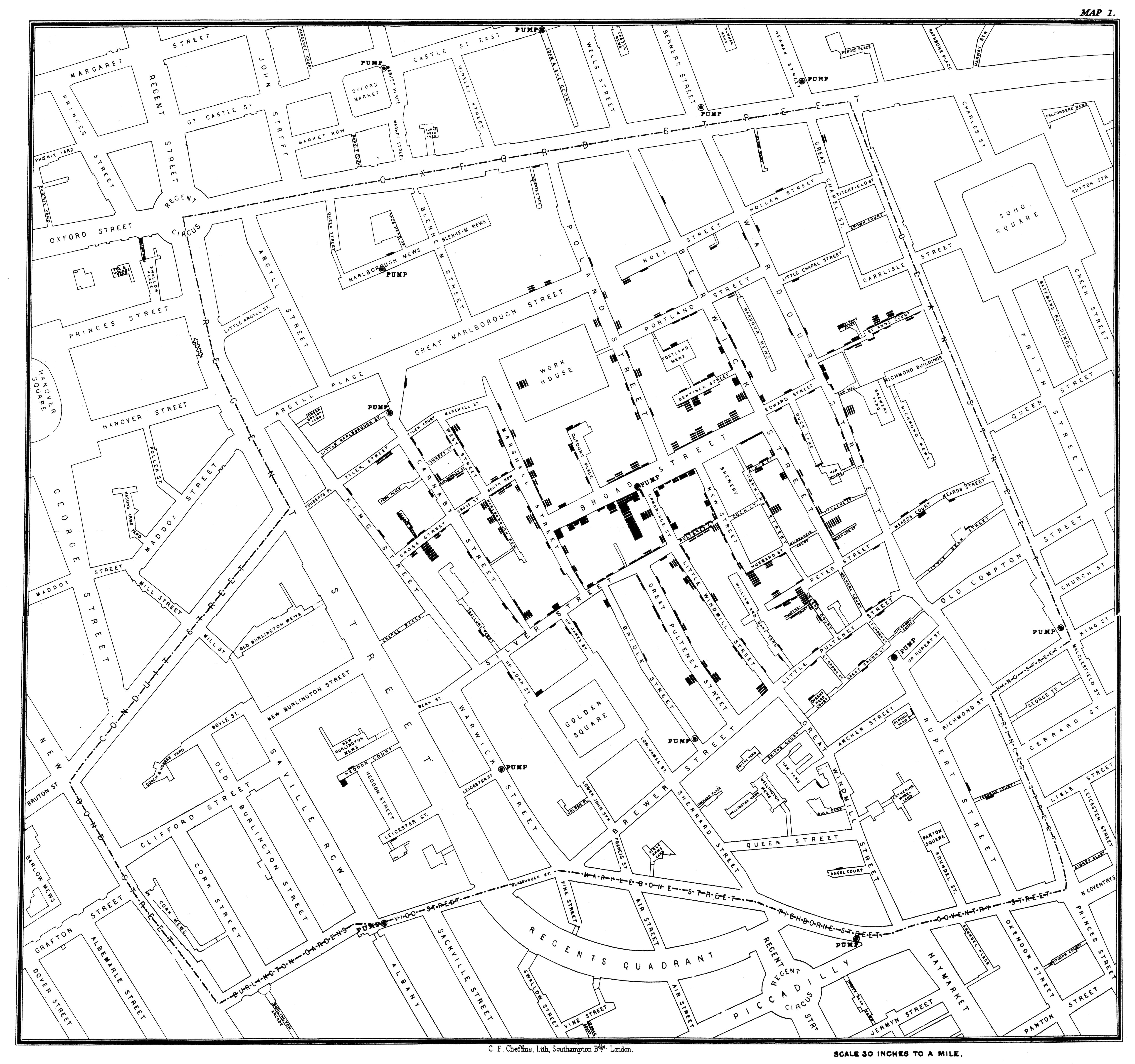
THE CHOLERA NEAR GOLDEN SQUARE.
The most terrible outbreak of cholera which ever occurred
in this kingdom, is probably that which took place in
Broad Street, Golden Square, and the adjoining streets, a
few weeks ago. Within two hundred and fifty yards of
the spot where Cambridge Street joins Broad Street, there
were upwards of five hundred fatal attacks of cholera in
ten days. The mortality in this limited area probably
equals any that was ever caused in this country, even by
the plague; and it was much more sudden, as the greater
number of cases terminated in a few hours. The mortality
would undoubtedly have been much greater had it not
been for the flight of the population. Persons in furnished
lodgings left first, then other lodgers went away, leaving
their furniture to be sent for when they could meet with
a place to put it in. Many houses were closed altogether,
owing to the death of the proprietors; and, in a great
number of instances, the tradesmen who remained had
sent away their families: so that in less than six days from
the commencement of the outbreak, the most afflicted
streets were deserted by more than three-quarters of their
inhabitants.
There were a few cases of cholera in the neighbourhood
of Broad Street, Golden Square, in the latter part of
August; and the so-called outbreak, which commenced in
the night between the 31st August and the 1st September,
was, as in all similar instances, only a violent increase of
the malady. As soon as I became acquainted with the
39situation and extent of this irruption of cholera, I suspected
some contamination of the water of the much-frequented
street pump in Broad Street, near the end of
Cambridge Street; but on examining the water, on the
evening of the 3rd September, I found so little impurity
in it of an organic nature, that I hesitated to come to a
conclusion. Further inquiry, however, showed me that
there was no other circumstance or agent common to the
circumscribed locality in which this sudden increase of
cholera occurred, and not extending beyond it, except the
water of the above mentioned pump. I found, moreover,
that the water varied, during the next two days, in the
amount of organic impurity, visible to the naked eye, on
close inspection, in the form of small white, flocculent particles;
and I concluded that, at the commencement of the
outbreak, it might possibly have been still more impure.
I requested permission, therefore, to take a list, at the
General Register Office, of the deaths from cholera, registered
during the week ending 2nd September, in the sub-districts
of Golden Square, Berwick Street, and St. Ann’s,
Soho, which was kindly granted. Eighty-nine deaths
from cholera were registered, during the week, in the three
sub-districts. Of these, only six occurred in the four first
days of the week; four occurred on Thursday, the 31st
August; and the remaining seventy-nine on Friday and
Saturday. I considered, therefore, that the outbreak commenced
on the Thursday; and I made inquiry, in detail,
respecting the eighty-three deaths registered as having
taken place during the last three days of the week.
On proceeding to the spot, I found that nearly all the
deaths had taken place within a short distance of the
pump. There were only ten deaths in houses situated
decidedly nearer to another street pump. In five of these
cases the families of the deceased persons informed me
40that they always sent to the pump in Broad Street, as
they preferred the water to that of the pump which was
nearer. In three other cases, the deceased were children
who went to school near the pump in Broad Street. Two
of them were known to drink the water; and the parents
of the third think it probable that it did so. The other
two deaths, beyond the district which this pump supplies,
represent only the amount of mortality from cholera that
was occurring before the irruption took place.
With regard to the deaths occurring in the locality belonging
to the pump, there were sixty-one instances in
which I was informed that the deceased persons used to
drink the pump-water from Broad Street, either constantly
or occasionally. In six instances I could get no information,
owing to the death or departure of every one connected
with the deceased individuals; and in six cases I
was informed that the deceased persons did not drink the
pump-water before their illness.
The result of the inquiry then was, that there had been
no particular outbreak or increase of cholera, in this
part of London, except among the persons who were in
the habit of drinking the water of the above-mentioned
pump-well.
I had an interview with the Board of Guardians of St.
James’s parish, on the evening of Thursday, 7th September,
and represented the above circumstances to them. In
consequence of what I said, the handle of the pump was
removed on the following day.
Besides the eighty-three deaths mentioned above as
occurring on the three last days of the week ending September
2nd, and being registered during that week in
the sub-districts in which the attacks occurred, a number
of persons died in Middlesex and other hospitals,
and a great number of deaths which took place in the
41locality during the last two days of the week, were not
registered till the week following. The deaths altogether,
on the 1st and 2nd of September, which have been ascertained
to belong to this outbreak of cholera, were one
hundred and ninety-seven; and many persons who were
attacked about the same time as these, died afterwards.
I should have been glad to inquire respecting the use of
the water from Broad Street pump in all these instances,
but was engaged at the time in an inquiry in the south
districts of London, which will be alluded to afterwards;
and when I began to make fresh inquiries in the neighbourhood
of Golden Square, after two or three weeks had
elapsed, I found that there had been such a distribution
of the remaining population that it would be impossible
to arrive at a complete account of the circumstances.
There is no reason to suppose, however, that a more extended
inquiry would have yielded a different result from
that which was obtained respecting the eighty-three deaths
which happened to be registered within the district of
the outbreak before the end of the week in which it
occurred.
The additional facts that I have been able to ascertain
are in accordance with those above related; and as regards
the small number of those attacked, who were believed
not to have drank the water from Broad Street pump, it
must be obvious that there are various ways in which the
deceased persons may have taken it without the knowledge
of their friends. The water was used for mixing
with spirits in all the public houses around. It was used
likewise at dining-rooms and coffee-shops. The keeper
of a coffee-shop in the neighbourhood, which was frequented
by mechanics, and where the pump-water was
supplied at dinner time, informed me (on 6th September)
that she was already aware of nine of her customers who
42were dead. The pump-water was also sold in various
little shops, with a teaspoonful of effervescing powder in
it, under the name of sherbet; and it may have been distributed
in various other ways with which I am unacquainted.
The pump was frequented much more than is
usual, even for a London pump in a populous neighbourhood.
There are certain circumstances bearing on the subject
of this outbreak of cholera which require to be mentioned.
The Workhouse in Poland Street is more than three-fourths
surrounded by houses in which deaths from cholera
occurred, yet out of five hundred and thirty-five inmates
only five died of cholera, the other deaths which took
place being those of persons admitted after they were
attacked. The workhouse has a pump-well on the premises,
in addition to the supply from the Grand Junction
Water Works, and the inmates never sent to Broad Street
for water. If the mortality in the workhouse had been
equal to that in the streets immediately surrounding it on
three sides, upwards of one hundred persons would have
died.
There is a Brewery in Broad Street, near to the pump,
and on perceiving that no brewer’s men were registered
as having died of cholera, I called on Mr. Huggins, the
proprietor. He informed me that there were above seventy
workmen employed in the brewery, and that none of them
had suffered from cholera,—at least in a severe form,—only
two having been indisposed, and that not seriously,
at the time the disease prevailed. The men are allowed a
certain quantity of malt liquor, and Mr. Huggins believes
they do not drink water at all; and he is quite certain
that the workmen never obtained water from the pump in
the street. There is a deep well in the brewery, in addition
to the New River water.
43At the percussion-cap manufactory, 37 Broad Street,
where, I understand, about two hundred workpeople were
employed, two tubs were kept on the premises always
supplied with water from the pump in the street, for those
to drink who wished; and eighteen of these workpeople
died of cholera at their own homes, sixteen men and two
women.
Mr. Marshall, surgeon, of Greek Street, was kind
enough to inquire respecting seven workmen who had
been employed in the manufactory of dentists’ materials,
at Nos. 8 and 9 Broad Street, and who died at their own
homes. He learned that they were all in the habit of
drinking water from the pump, generally drinking about
half-a-pint once or twice a day; while two persons who
reside constantly on the premises, but do not drink the
pump-water, only had diarrhœa. Mr. Marshall also informed
me of the case of an officer in the army, who lived
at St. John’s Wood, but came to dine in Wardour Street,
where he drank the water from Broad Street pump at his
dinner. He was attacked with cholera, and died in a few
hours.
I am indebted to Mr. Marshall for the following cases,
which are interesting as showing the period of incubation,
which in these three cases was from thirty-six to forty-eight
hours. Mrs. ——, of 13 Bentinck Street, Berwick
Street, aged 28, in the eighth month of pregnancy, went
herself (although they were not usually water drinkers),
on Sunday, 3rd September, to Broad Street pump for
water. The family removed to Gravesend on the following
day; and she was attacked with cholera on Tuesday
morning at seven o’clock, and died of consecutive fever
on 15th September, having been delivered. Two of her
children drank also of the water, and were attacked on the
same day as the mother, but recovered.
44Dr. Fraser, of Oakley Square, kindly informed me of
the following circumstance. A gentleman in delicate
health was sent for from Brighton to see his brother at
6 Poland Street, who was attacked with cholera and died
in twelve hours, on 1st September. The gentleman
arrived after his brother’s death, and did not see the body.
He only stayed about twenty minutes in the house, where
he took a hasty and scanty luncheon of rumpsteak, taking
with it a small tumbler of brandy and water, the water
being from Broad Street pump. He went to Pentonville,
and was attacked with cholera on the evening of the following
day, 2nd September, and died the next evening.
Dr. Fraser also first called my attention to the following
circumstances, which are perhaps the most conclusive of
all in proving the connexion between the Broad Street
pump and the outbreak of cholera. In the “Weekly
Return of Births and Deaths” of September 9th, the following
death is recorded as occurring in the Hampstead
district: “At West End, on 2nd September, the widow
of a percussion-cap maker, aged 59 years, diarrhœa two
hours, cholera epidemica sixteen hours.”
I was informed by this lady’s son that she had not been
in the neighbourhood of Broad Street for many months.
A cart went from Broad Street to West End every day,
and it was the custom to take out a large bottle of the
water from the pump in Broad Street, as she preferred it.
The water was taken on Thursday, 31st August, and she
drank of it in the evening, and also on Friday. She was
seized with cholera on the evening of the latter day, and
died on Saturday, as the above quotation from the register
shows. A niece, who was on a visit to this lady, also
drank of the water; she returned to her residence, in a
high and healthy part of Islington, was attacked with
cholera, and died also. There was no cholera at the time,
either at West End or in the neighbourhood where the
niece died. Besides these two persons, only one servant
partook of the water at Hampstead West End, and she
did not suffer, or, at least, not severely. There were many
persons who drank the water from Broad Street pump
about the time of the outbreak, without being attacked
with cholera; but this does not diminish the evidence
respecting the influence of the water, for reasons that will
be fully stated in another part of this work.
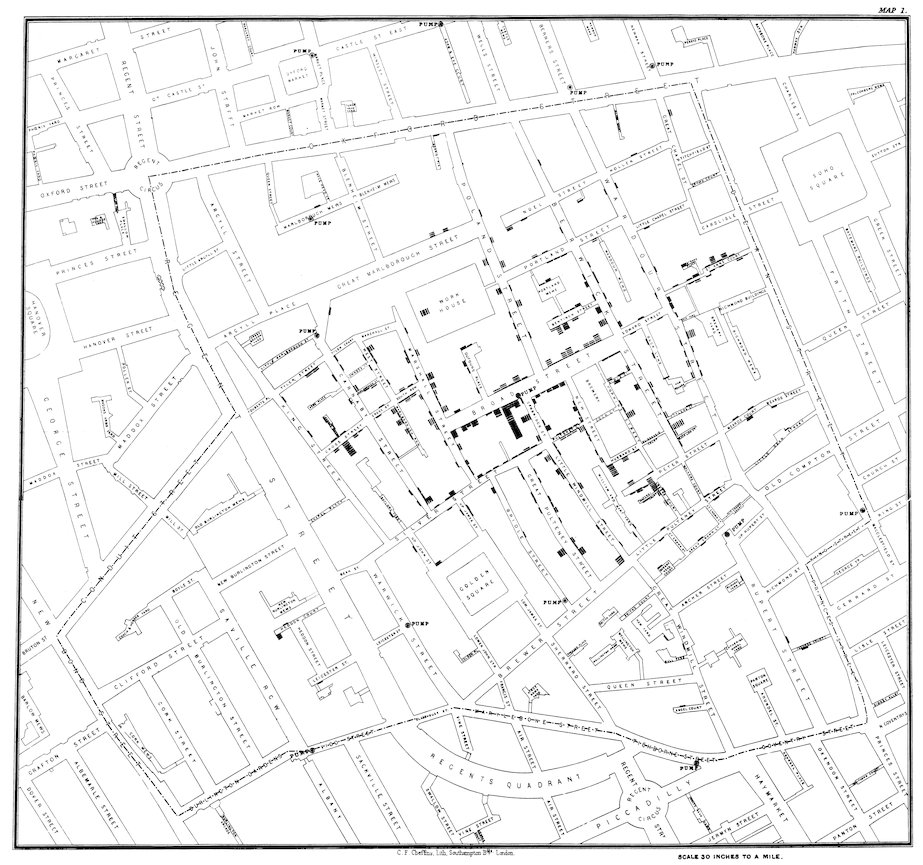
45The deaths which occurred during this fatal outbreak
of cholera are indicated in the accompanying map, as far
as I could ascertain them. There are necessarily some
deficiencies, for in a few of the instances of persons who
died in the hospitals after their removal from the neighbourhood
of Broad Street, the number of the house from
which they had been removed was not registered. The
address of those who died after their removal to St. James’s
Workhouse was not registered; and I was only able to
obtain it, in a part of the cases, on application at the
Master’s Office, for many of the persons were too ill, when
admitted, to give any account of themselves. In the case
also of some of the workpeople and others who contracted
the cholera in this neighbourhood, and died in different
parts of London, the precise house from which they had
removed is not stated in the return of deaths. I have
heard of some persons who died in the country shortly
after removing from the neighbourhood of Broad Street;
and there must, no doubt, be several cases of this kind
that I have not heard of. Indeed, the full extent of the
calamity will probably never be known. The deficiencies
I have mentioned, however, probably do not detract from
the correctness of the map as a diagram of the topography
of the outbreak; for, if the locality of the few additional
cases could be ascertained, they would probably be distributed
46over the district of the outbreak in the same proportion
as the large number which are known.
The dotted line on the map surrounds the sub-districts
of Golden Square, St. James’s, and Berwick Street, St.
James’s, together with the adjoining portion of the sub-district
of St. Anne, Soho, extending from Wardour Street
to Dean Street, and a small part of the sub-district of St.
James’s Square enclosed by Marylebone Street, Titchfield
Street, Great Windmill Street, and Brewer Street. All
the deaths from cholera which were registered in the six
weeks from 19th August to 30th September within this
locality, as well as those of persons removed into Middlesex
Hospital, are shown in the map[10] by a black line in
the situation of the house in which it occurred, or in
which the fatal attack was contracted.
In addition to these the deaths of persons removed to
University College Hospital, to Charing Cross Hospital, and
to various parts of London, are indicated in the map, where
the exact address was given in the “Weekly Return of
Deaths,” or, when I could learn it by private inquiry.
The pump in Broad Street is indicated on the map, as
well as all the surrounding pumps to which the public
had access at the time. It requires to be stated that the
water of the pump in Marlborough Street, at the end of
Carnaby Street, was so impure that many people avoided
using it. And I found that the persons who died near
this pump in the beginning of September, had water from
the Broad Street pump. With regard to the pump in Rupert
Street, it will be noticed that some streets which are
near to it on the map, are in fact a good way removed, on
47account of the circuitous road to it. These circumstances
being taken into account, it will be observed that the
deaths either very much diminished, or ceased altogether,
at every point where it becomes decidedly nearer to send
to another pump than to the one in Broad Street. It may
also be noticed that the deaths are most numerous near to
the pump where the water could be more readily obtained.
The wide open street in which the pump is situated
suffered most, and next the streets branching from
it, and especially those parts of them which are nearest to
Broad Street. If there have been fewer deaths in the
south half of Poland Street than in some other streets
leading from Broad Street, it is no doubt because this
street is less densely inhabited.
In some of the instances, where the deaths are scattered
a little further from the rest on the map, the malady was
probably contracted at a nearer point to the pump. A
cabinet-maker, who was removed from Philip’s Court,
Noel Street, to Middlesex Hospital, worked in Broad
Street. A boy also who died in Noel Street, went to the
National school at the end of Broad Street, and having to
pass the pump, probably drank of the water. A tailor,
who died at 6, Heddon Court, Regent Street, spent most
of his time in Broad Street. A woman, removed to the
hospital from 10, Heddon Court, had been nursing a
person who died of cholera in Marshall Street. A little
girl, who died in Ham Yard, and another who died in
Angel Court, Great Windmill Street, went to the school in
Dufour’s Place, Broad Street, and were in the habit of
drinking the pump-water, as were also a child from
Naylor’s Yard, and several others, who went to this and
other schools near the pump in Broad Street. A woman
who died at 2, Great Chapel Street, Oxford Street, had
been occupied for two days preceding her illness at the
48public washhouses near the pump, and used to drink a
good deal of water whilst at her work; the water drank
there being sometimes from the pump and sometimes from
the cistern.
The limited district in which this outbreak of cholera
occurred, contains a great variety in the quality of the
streets and houses; Poland Street and Great Pulteney
Street consisting in a great measure of private houses
occupied by one family, whilst Husband Street and Peter
Street are occupied chiefly by the poor Irish. The remaining
streets are intermediate in point of respectability.
The mortality appears to have fallen pretty
equally amongst all classes, in proportion to their numbers.
Masters are not distinguished from journeymen in
the registration returns of this district, but, judging from
my own observation, I consider that out of rather more
than six hundred deaths, there were about one hundred
in the families of tradesmen and other resident householders.
One hundred and five persons who had been
removed from this district died in Middlesex, University
College, and other hospitals, and two hundred and six
persons were buried at the expense of St. James’s parish;
the latter number includes many of those who died in the
hospitals, and a great number who were far from being
paupers, and would on any other occasion have been
buried by their friends, who, at this time, were either not
aware of the calamity or were themselves overwhelmed
by it. The greatest portion of the persons who died were
tailors and other operatives, who worked for the shops
about Bond Street and Regent Street, and the wives and
children of these operatives. They were living chiefly in
rooms which they rented by the week.
The following table exhibits the chronological features
of this terrible outbreak of cholera.
| Date. |
No. of Fatal Attacks. |
Deaths. |
| August |
19 |
1 |
1 |
| „ |
20 |
1 |
0 |
| „ |
21 |
1 |
2 |
| „ |
22 |
0 |
0 |
| „ |
23 |
1 |
0 |
| „ |
24 |
1 |
2 |
| „ |
25 |
0 |
0 |
| „ |
26 |
1 |
0 |
| „ |
27 |
1 |
1 |
| „ |
28 |
1 |
0 |
| „ |
29 |
1 |
1 |
| „ |
30 |
8 |
2 |
| „ |
31 |
56 |
3 |
| September |
1 |
143 |
70 |
| „ |
2 |
116 |
127 |
| „ |
3 |
54 |
76 |
| „ |
4 |
46 |
71 |
| „ |
5 |
36 |
45 |
| „ |
6 |
20 |
37 |
| „ |
7 |
28 |
32 |
| „ |
8 |
12 |
30 |
| „ |
9 |
11 |
24 |
| „ |
10 |
5 |
18 |
| „ |
11 |
5 |
15 |
| „ |
12 |
1 |
6 |
| „ |
13 |
3 |
13 |
| „ |
14 |
0 |
6 |
| „ |
15 |
1 |
8 |
| „ |
16 |
4 |
6 |
| „ |
17 |
2 |
5 |
| „ |
18 |
3 |
2 |
| „ |
19 |
0 |
3 |
| „ |
20 |
0 |
0 |
| „ |
21 |
2 |
0 |
| „ |
22 |
1 |
2 |
| „ |
23 |
1 |
3 |
| „ |
24 |
1 |
0 |
| „ |
25 |
1 |
0 |
| „ |
26 |
1 |
2 |
| „ |
27 |
1 |
0 |
| „ |
28 |
0 |
2 |
| „ |
29 |
0 |
1 |
| „ |
30 |
0 |
0 |
| Date unknown |
45 |
0 |
| |
|
|
|
| Total |
616 |
616 |
50The deaths in the above table are compiled from the
sources mentioned above in describing the map; but
some deaths which were omitted from the map on account
of the number of the house not being known, are
included in the table. As regards the date of attack, I
was able to obtain it with great precision, through the
kindness of Mr. Sibley, in upwards of eighty deaths
which occurred in Middlesex Hospital; for the hour of
admission was entered in the hospital books, as well as
the previous duration of the illness. In a few other cases
also I had exact information of the hour of attack, and in
the remainder I have calculated it by subtracting the
duration of the illness from the date of death. Where
the illness did not exceed twelve hours, the attack was
considered to have commenced the same day; where the
illness exceeded twelve, and did not exceed thirty-six
hours, the attack was put down to the previous day, and
so on. Where the illness exceeded forty-eight hours, its
duration is generally given in days, which were subtracted
from the date of the attack. Although this plan
does not always give the precise date of attack, it reaches
within a few hours of it, and is as valuable perhaps as if
the exact day were given, unless the hour as well as the
day could be introduced into the table. Where premonitory
diarrhœa is stated to have existed, the period of
its duration is deducted from the date of death, and, in
fact, the time of attack is fixed at the first commencement
of indisposition, except in two or three instances in which
the patient was labouring under another disease, as
phthisis or typhus fever. There are forty-five cases in
which the duration of the illness was not certified, or
entered in the books of the registrars, and the time of
attack in these cases is consequently unknown. These
persons nearly all died in the first days of September, in
51the height of the calamity, and it is almost certain that
they were cut off very quickly, like the others who died
at this time.
It is pretty certain that very few of the fifty-six attacks
placed in the table to the 31st August occurred till late
in the evening of that day. The irruption was extremely
sudden, as I learn from the medical men living in the
midst of the district, and commenced in the night between
the 31st August and 1st September. There was hardly
any premonitory diarrhœa in the cases which occurred
during the first three days of the outbreak; and I have
been informed by several medical men, that very few of
the cases which they attended on those days ended in
recovery.
The greatest number of attacks in any one day occurred
on the 1st of September, immediately after the outbreak
commenced. The following day the attacks fell from one
hundred and forty-three to one hundred and sixteen, and
the day afterwards to fifty-four. A glance at the above
table will show that the fresh attacks continued to become
less numerous every day. On September the 8th—the
day when the handle of the pump was removed—there
were twelve attacks; on the 9th, eleven; on the 10th, five;
on the 11th, five; on the 12th, only one; and after this
time, there were never more than four attacks on one day.
During the decline of the epidemic the deaths were more
numerous than the attacks, owing to the decease of many
persons who had lingered for several days in consecutive
fever.
THE PUMP-WELL IN BROAD STREET, GOLDEN SQUARE.
There is no doubt that the mortality was much diminished,
as I said before, by the flight of the population,
which commenced soon after the outbreak; but the attacks
had so far diminished before the use of the water was
stopped, that it is impossible to decide whether the well
52still contained the cholera poison in an active state, or
whether, from some cause, the water had become free
from it. The pump-well has been opened, and I was informed
by Mr. Farrell, the superintendent of the works,
that there was no hole or crevice in the brickwork of the
well, by which any impurity might enter; consequently
in this respect the contamination of the water is not made
out by the kind of physical evidence detailed in some of
the instances previously related. I understand that the
well is from twenty-eight to thirty feet in depth, and goes
through the gravel to the surface of the clay beneath.
The sewer, which passes within a few yards of the well,
is twenty-two feet below the surface. The water at the
time of the cholera contained impurities of an organic
nature, in the form of minute whitish flocculi, visible on
close inspection to the naked eye, as I before stated. Dr.
Hassall, who was good enough to examine some of this
water with the microscope, informed me that these particles
had no organised structure, and that he thought
they probably resulted from decomposition of other matter.
He found a great number of very minute oval animalcules
in the water, which are of no importance, except as an
additional proof that the water contained organic matter
on which they lived. The water also contained a large
quantity of chlorides, indicating, no doubt, the impure
sources from which the spring is supplied. Mr. Eley, the
percussion-cap manufacturer of 37 Broad Street, informed
me that he had long noticed that the water became offensive,
both to the smell and taste, after it had been kept
about two days. This, as I noticed before, is a character of
water contaminated with sewage. Another person had
noticed for months that a film formed on the surface of
the water when it had been kept a few hours.
I inquired of many persons whether they had observed
53any change in the character of the water, about the time
of the outbreak of cholera, and was answered in the negative.
I afterwards, however, met with the following important
information on this point. Mr. Gould, the eminent
ornithologist, lives near the pump in Broad Street, and
was in the habit of drinking the water. He was out of
town at the commencement of the outbreak of cholera, but
came home on Saturday morning, 2nd September, and
sent for some of the water almost immediately, when he
was much surprised to find that it had an offensive smell,
although perfectly transparent and fresh from the pump.
He did not drink any of it. Mr. Gould’s assistant, Mr.
Prince, had his attention drawn to the water, and perceived
its offensive smell. A servant of Mr. Gould who drank
the pump-water daily, and drank a good deal of it on
August 31st, was seized with cholera at an early hour on
September 1st. She ultimately recovered.
Whether the impurities of the water were derived from
the sewers, the drains, or the cesspools, of which latter
there are a number in the neighbourhood, I cannot tell.
I have been informed by an eminent engineer, that whilst
a cesspool in a clay soil requires to be emptied every six
or eight months, one sunk in the gravel will often go for
twenty years without being emptied, owing to the soluble
matters passing away into the land-springs by percolation.
As there had been deaths from cholera just before the
great outbreak not far from this pump-well, and in a situation
elevated a few feet above it, the evacuations from
the patients might of course be amongst the impurities
finding their way into the water, and judging the matter
by the light derived from other facts and considerations
previously detailed, we must conclude that such was the
case. A very important point in respect to this pump-well
is that the water passed with almost everybody as being
54perfectly pure, and it did in fact contain a less quantity of
impurity than the water of some other pumps in the same
parish, which had no share in the propagation of cholera.
We must conclude from this outbreak that the quantity
of morbid matter which is sufficient to produce cholera is
inconceivably small, and that the shallow pump-wells in a
town cannot be looked on with too much suspicion, whatever
their local reputation may be.
PUMP-WELL, BROAD ST., GOLDEN SQ.
Whilst the presumed contamination of the water of the
Broad Street pump with the evacuations of cholera patients,
affords an exact explanation of the fearful outbreak of
cholera in St. James’s parish, there is no other circumstance
which offers any explanation at all, whatever hypothesis
of the nature and cause of the malady be adopted.
Many persons were inclined to attribute the severity of
the malady in this locality to the very circumstance to
which some people attribute the comparative immunity of
the city of London from the same disease, viz., to the
drains in the neighbourhood having been disturbed and
put in order about half a year previously. Mr. Bazelgette,
however, pointed out, in a report to the commissioners,
that the streets in which the new sewers had been made
suffered less than the others; and a reference to the
map will show that this is correct, for I recollect that the
streets in which the sewers were repaired about February
last, were Brewer Street, Little Pulteney Street, and Dean
Street, Soho. Many of the non-medical public were disposed
to attribute the outbreak of cholera to the supposed
existence of a pit in which persons dying of the plague
had been buried about two centuries ago; and, if the
alleged plague-pit had been nearer to Broad Street, they
would no doubt still cling to the idea. The situation of the
supposed pit is, however, said to be Little Marlborough
Street, just out of the area in which the chief mortality
55occurred. With regard to effluvia from the sewers passing
into the streets and houses, that is a fault common to most
parts of London and other towns. There is nothing peculiar
in the sewers or drainage of the limited spot in which
this outbreak occurred; and Saffron Hill and other localities,
which suffer much more from ill odours, have been
very lightly visited by cholera.
IRRUPTION OF CHOLERA AT DEPTFORD.
Just at the time when the great outbreak of cholera
occurred in the neighbourhood of Broad Street, Golden
Square, there was an equally violent irruption in Deptford,
but of a more limited extent. About ninety deaths
took place in a few days, amongst two or three score of
small houses, in the north end of New Street and an adjoining
row called French’s Fields. Deptford is supplied
with very good water from the river Ravensbourne by the
Kent Water Works, and until this outbreak there was
but little cholera in the town, except amongst some poor
people, who had no water except what they got by pailsful
from Deptford Creek—an inlet of the Thames. There
had, however, been a few cases in and near New Street,
just before the great outbreak. On going to the spot on
September 12th and making inquiry, I found that the
houses in which the deaths had occurred were supplied
by the Kent Water Works, and the inhabitants never
used any other water. The people informed me, however,
that for some few weeks the water had been extremely
offensive when first turned on; they said it smelt
like a cesspool, and frothed like soap suds. They were
in the habit of throwing away a few pailsful of that which
first came in, and collecting some for use after it became
clear. On inquiring in the surrounding streets, to which
this outbreak of cholera did not extend, viz., Wellington
Street, Old King Street, and Hughes’s Fields, I found
that there had been no alteration in the water. I concluded,
56therefore, that a leakage had taken place into the
pipes supplying the places where the outbreak occurred,
during the intervals when the water was not turned on.
Gas is known to get into the water-pipes occasionally in
this manner, when they are partially empty, and to impart
its taste to the water. There are no sewers in New
Street or French’s Fields, and the refuse of all kinds
consequently saturates the ground in which the pipes are
laid. I found that the water collected by the people,
after throwing away the first portion, still contained more
organic matter than that supplied to the adjoining streets.
On adding nitrate of silver and exposing the specimens
to the light, a deeper tint of brown was developed in the
former than in the latter.
All the instances of communication of cholera through
the medium of water, above related, have resulted from
the contamination of a pump-well, or some other limited
supply of water; and the outbreaks of cholera connected
with the contamination, though sudden and intense, have
been limited also; but when the water of a river becomes
infected with the cholera evacuations emptied from on
board ship, or passing down drains and sewers, the communication
of the disease, though generally less sudden
and violent, is much more widely extended; more especially
when the river water is distributed by the steam
engine and pipes connected with waterworks. Cholera
may linger in the courts and alleys crowded with the
poor, for reasons previously pointed out, but I know of
no instance in which it has been generally spread through
a town or neighbourhood, amongst all classes of the community,
in which the drinking water has not been the
medium of its diffusion. Each epidemic of cholera in
London has borne a strict relation to the nature of the
57water supply of its different districts, being modified only
by poverty, and the crowding and want of cleanliness
which always attend it.
THE EPIDEMIC OF 1832.
The following table shows the number of deaths from
cholera in the various districts of London in 1832, together
with the nature of the water supply at that period.
(See next page.)[11]
This table shows that in the greater part of Southwark,
which was supplied with worse water than any
other part of the metropolis, the mortality from cholera
was also much higher than anywhere else. The other
south districts, supplied with water obtained at points
higher up the Thames, and containing consequently less
impurity, were less affected. On the north of the Thames,
the east districts, supplied, in 1832, with water from the
river Lea, at Old Ford, where it contained the sewage
of a large population, suffered more than other parts on
the north side of London. Whitechapel suffered more
than the other east districts; probably not more from the
poverty and crowded state of the population, than from
the great number of mariners, coalheavers, and others,
living there, who were employed on the Thames, and got
their water, whilst at work, direct from the river. There
were one hundred and thirty-nine deaths from cholera
amongst persons afloat on the Thames. The cholera
passed very lightly over most of the districts supplied by
the New River Company. St. Giles’ was an exception,
owing to the overcrowding of the common lodging-houses
in the part of the parish called the Rookery. The City
of London also suffered severely in 1832. Now when the
engine at Broken Wharf was employed to draw water
from the Thames, this water was supplied more particularly
to the City, and not at all to the higher districts supplied
by the New River Company. This would offer an explanation
of the high mortality from cholera in the City at
that time, supposing the engine were actually used during
1832; but I have not yet been able to ascertain that circumstance
with certainty. I know, however, that it was
still used occasionally some years later.
| Districts. |
Population. |
Deaths from Cholera. |
Deaths from Cholera in 10,000 living. |
Water Supply. |
| St. George the Martyr, Southwark} |
77,796 |
856 |
110 |
|
Southwark Water Works, from Thames at London Bridge. No filter or settling reservoir. |
| St. Olave’s, Southwark} |
|
| St. Saviour’s, Southwark} |
|
| Christchurch, Southwark |
13,705 |
35 |
25} |
|
Chiefly by Lambeth Water Works, from Thames opposite Hungerford Market. No filter or settling reservoir. |
| Lambeth |
87,856 |
337 |
38} |
|
| Newington |
44,526 |
200 |
45} |
|
Chiefly by South London Water Works, from Thames at Vauxhall Bridge. Reservoirs. No filter. |
| Camberwell |
28,231 |
107 |
37} |
|
| Bermondsey |
29,741 |
210 |
70} |
|
South London Water Works, & Tidal Ditches. |
| Rotherhithe |
12,875 |
19 |
14} |
|
| Bethnal Green |
62,018 |
170 |
27} |
42{ |
East London Waterworks, from tidal part of river Lea at Old Ford. |
| St. George-in-the-East |
38,505 |
123 |
31} |
| Poplar |
25,066 |
107 |
42} |
| Stepney |
78,826 |
225 |
28} |
| Whitechapel[12] |
52,848 |
470 |
88} |
| 59Clerkenwell |
47,634 |
65 |
13} |
34{ |
New River Company, from various springs, and river Lea in Hertfordshire; and occasionally from Thames at Broken Wharf, near Blackfriar’s Bridge. |
| St. Giles |
52,907 |
280 |
52} |
| Holborn |
27,334 |
46 |
16} |
| Islington |
37,316 |
39 |
10} |
| London City |
55,798 |
359 |
64} |
| East and West London |
No return. |
|
} |
| St. Luke’s |
46,642 |
118 |
25} |
| Strand |
9,937 |
37 |
37} |
| Hackney |
7,326 |
8 |
10 } |
|
New River and East London Water Companies. |
| Shoreditch |
68,564 |
57 |
8 } |
|
| Westminster |
124,585 |
325 |
26 |
|
Chelsea Water Works, from Thames at Chelsea. Reservoirs and filters. |
| St. George, Hanover Sq. |
58,209 |
74 |
12} |
15{ |
Chelsea Water Works and Grand Junction Water Works, also supplying water from Thames at Chelsea, and having settling reservoirs. |
| Kensington |
75,130 |
134 |
17} |
| St. Marylebone |
122,206 |
224 |
20 |
|
West Middlesex Water Works, from Thames at Hammersmith. Settling reservoirs. |
| St. Pancras |
103,548 |
111 |
10 |
|
West Middlesex, New River, and Hampstead Water Works. |
THE EPIDEMIC OF 1849.
60Westminster suffered more in 1832 than St. George,
Hanover Square, and Kensington, which at that time had
the same water. This arose from the poor and crowded state
of part of its population. The number of cases of cholera
communicated by the water would be the same in one district
as in the other; but in one district the disease would
spread also from person to person more than in the others.
Between 1832 and 1849 many changes took place in
the water supply of London. The Southwark Water
Company united with the South London Water Company,
to form a new Company under the name of the Southwark
and Vauxhall Company. The water works at London
Bridge were abolished, and the united company derived
their supply from the Thames at Battersea Fields, about
half a mile above Vauxhall Bridge. The Lambeth Water
Company continued to obtain their supply opposite to
Hungerford Market; but they had established a small
reservoir at Brixton.
But whilst these changes had been made by the water
companies, changes still greater had taken place in the
river, partly from the increase of population, but much
more from the abolition of cesspools and the almost universal
adoption of waterclosets in their stead. The Thames
in 1849 was more impure at Battersea Fields than it had
been in 1832 at London Bridge. A clause which prevented
the South London Water Company from laying
their pipes within two miles of the Lambeth Water Works
was repealed in 1834, and the two Companies were in
61active competition for many years, the result of which is,
that the pipes of the Lambeth Water Company and those
of the Southwark and Vauxhall Company pass together
down all the streets of several of the south districts. As
the water of both these Companies was nearly equal in
its impurity in 1849, this circumstance was of but little
consequence at that time; but it will be shown further on
that it afterwards led to very important results.
On the north side of the Thames the Water Companies
and their districts remained the same, but some alterations
were made in the sources of supply. The East London
Water Company ceased to obtain water at Old Ford, and
got it from the river Lea, above Lea Bridge, out of the
influence of the tide and free from sewage, except that
from some part of Upper Clapton. The Grand Junction
Company removed their works from Chelsea to Brentford,
where they formed large settling reservoirs. The New
River Company entirely ceased to employ the steam engine
for obtaining water from the Thames. The supply of the
other Water Companies remained the same as in 1832.
The accompanying table (No. 3), shows the mortality
from cholera in the various registration districts of London
in 1849, together with the water supply. The annual
value of house and shop-room for each person is also
shown, as a criterion, to a great extent, of the state of
overcrowding or the reverse. The deaths from cholera
and the value of house room, are taken from the “Report
on the Cholera of 1849,” by Dr. Farr, of the General
Register Office. The water supply is indicated merely
by the name of the Companies. After the explanation
given above of the source of supply, this will be sufficient.
It is only necessary to add, that the Kent Water
Company derive their supply from the river Ravensbourne,
and the Hampstead Company from springs and
reservoirs at Hampstead.
62TABLE III,
Showing the mortality from Cholera, and the Water Supply, in the Districts of London, in 1849. The Districts are arranged in the order of their Mortality from Cholera.
| District. |
Population in the middle of 1849. |
Deaths from Cholera. |
Deaths by Cholera to 10,000 inhabits. |
Annual value of House & Shop room to each person in £. |
Water Supply. |
| Rotherhithe |
17,208 |
352 |
205 |
4.238 |
Southwark and Vauxhall Water Works, Kent Water Works, & Tidal Ditches. |
| St. Olave, Southwark |
19,278 |
349 |
181 |
4.559 |
Southwark and Vauxhall. |
| St. George, Southwark |
50,900 |
836 |
164 |
3.518 |
Southwark and Vauxhall, Lambeth. |
| Bermondsey |
45,500 |
734 |
161 |
3.077 |
Southwark and Vauxhall. |
| St. Saviour, Southwark |
35,227 |
539 |
153 |
5.291 |
Southwark and Vauxhall. |
| Newington |
63,074 |
907 |
144 |
3.788 |
Southwark and Vauxhall, Lambeth. |
| Lambeth |
134,768 |
1618 |
120 |
4.389 |
Southwark and Vauxhall, Lambeth. |
| Wandsworth |
48,446 |
484 |
100 |
4.839 |
Pump-wells, Southwark and Vauxhall, river Wandle. |
| Camberwell |
51,714 |
504 |
97 |
4.508 |
Southwark and Vauxhall, Lambeth. |
| West London |
28,829 |
429 |
96 |
7.454 |
New River. |
| Bethnal Green |
87,263 |
789 |
90 |
1.480 |
East London. |
| Shoreditch |
104,122 |
789 |
76 |
3.103 |
New River, East London. |
| Greenwich |
95,954 |
718 |
75 |
3.379 |
Kent. |
| Poplar |
44,103 |
313 |
71 |
7.360 |
East London. |
| Westminster |
64,109 |
437 |
68 |
4.189 |
Chelsea. |
| Whitechapel |
78,590 |
506 |
64 |
3.388 |
East London. |
| 63St. Giles |
54,062 |
285 |
53 |
5.635 |
New River. |
| Stepney |
106,988 |
501 |
47 |
3.319 |
East London. |
| Chelsea |
53,379 |
247 |
46 |
4.210 |
Chelsea. |
| East London |
43,495 |
182 |
45 |
4.823 |
New River. |
| St. George’s, East |
47,334 |
199 |
42 |
4.753 |
East London. |
| London City |
55,816 |
207 |
38 |
17.676 |
New River. |
| St. Martin |
24,557 |
91 |
37 |
11.844 |
New River. |
| Strand |
44,254 |
156 |
35 |
7.374 |
New River. |
| Holborn |
46,134 |
161 |
35 |
5.883 |
New River. |
| St. Luke |
53,234 |
183 |
34 |
3.731 |
New River. |
| Kensington (except Paddington) |
110,491 |
260 |
33 |
5.070 |
West Middlesex, Chelsea, Grand Junction. |
| Lewisham |
32,299 |
96 |
30 |
4.824 |
Kent. |
| Belgrave |
37,918 |
105 |
28 |
8.875 |
Chelsea. |
| Hackney |
55,152 |
139 |
25 |
4.397 |
New River, East London. |
| Islington |
87,761 |
187 |
22 |
5.494 |
New River. |
| St. Pancras |
160,122 |
360 |
22 |
4.871 |
New River, Hampstead, West Middlesex. |
| Clerkenwell |
63,499 |
121 |
19 |
4.138 |
New River. |
| Marylebone |
153,960 |
261 |
17 |
7.586 |
West Middlesex. |
| St. James, Westminster |
36,426 |
57 |
16 |
12.669 |
Grand Junction, New River. |
| Paddington |
41,267 |
35 |
8 |
9.349 |
Grand Junction. |
| Hampstead |
11,572 |
9 |
8 |
5.804 |
Hampstead, West Middlesex. |
| Hanover Sq. & May Fair |
33,196 |
26 |
8 |
16.754 |
Grand Junction. |
| London |
2,280,282 |
14137 |
62 |
|
|
64A glance at the table shows that in every district to
which the supply of the Southwark and Vauxhall, or the
Lambeth Water Company extends, the cholera was more
fatal than in any other district whatever. The only other
water company deriving a supply from the Thames, in a
situation where it is much contaminated with the contents of
the sewers, was the Chelsea Company. But this company,
which supplies some of the most fashionable parts of London,
took great pains to filter the water before its distribution,
and in so doing no doubt separated, amongst other
matters, the greater portion of that which causes cholera.
On the other hand, although the Southwark and Vauxhall
and the Lambeth Water Companies professed to filter the
water, they supplied it in a most impure condition. Even
in the following year, when Dr. Hassall made an examination
of it, he found in it the hairs of animals and
numerous substances which had passed through the alimentary
canal. Speaking of the water supply of London
generally, Dr. Hassall says:—
“It will be observed, that the water of the companies
on the Surrey side of London, viz., the Southwark, Vauxhall,
and Lambeth, is by far the worst of all those who
take their supply from the Thames.”[13]
In the north districts of London, which suffered much
less from cholera than the south districts, the mortality
was chiefly influenced by the poverty and crowding of the
population. The New River Company having entirely
left off the use of their engine in the city, their water,
being entirely free from sewage, could have had no share
in the propagation of cholera. It is probable also, that
the water of the East London Company, obtained above
Lea Bridge, had no share in propagating the malady; and
65that this is true also of the West Middlesex Company,
obtaining their supply from the Thames at Hammersmith;
and of the Grand Junction Company, obtaining their
supply at Brentford. All these Water Companies have
large settling reservoirs. It is probable also, as I stated
above, that the Chelsea Company in 1849, by careful
filtration and by detaining the water in their reservoirs,
rendered it in a great degree innocuous.
Some parts of London suffered by the contamination of
the pump-wells in 1849, and the cholera in the districts
near the river was increased by the practice, amongst
those who are occupied on the Thames, of obtaining water
to drink by dipping a pail into it. It will be shown further
on, that persons occupied on the river suffered more
from cholera than others. Dr. Baly makes the following
inquiry in his Report to the College of Physicians.[14]
“How did it happen, if the character of the water has
a great influence on the mortality from cholera, that in
the Belgrave district only 28 persons in 10,000 died, and
in the Westminster district, also supplied by the Chelsea
Company, 68 persons in 10,000; and, again, that in the
Wandsworth district the mortality was only 100, and in
the district of St. Olave 181 in 10,000 inhabitants—both
these districts receiving their supply from the Southwark
Company?”
The water of the Chelsea Company has been alluded
to above, but whether this water had any share in the
propagation of cholera or not, it is perfectly in accordance
with the mode of communication of the disease
66which I am advocating, that it should spread more in the
crowded habitations of the poor, in Westminster, than in
the commodious houses of the Belgrave district. In examining
the effect of polluted water as a medium of the
cholera poison, it is necessary to bear constantly in mind
the more direct way in which the poison is also swallowed,
as I explained in the commencement of this work. As
regards St. Olave’s and Wandsworth, Dr. Baly was apparently
not aware that, whilst almost every house in the
first of these districts is supplied by the water company,
and has no other supply, the pipes of the company extend
to only a part of the Wandsworth district, a large part of
it having only pump-wells.
The epidemic of 1849 was a continuance or revival of
that which commenced in the autumn of 1848, and there
are some circumstances connected with the first cases
which are very remarkable, and well worthy of notice.
It has been already stated (page 3) that the first case of
decided Asiatic cholera in London, in the autumn of
1848, was that of a seaman from Hamburgh, and that
the next case occurred in the very room in which the first
patient died. These cases occurred in Horsleydown, close
to the Thames. In the evening of the day on which the
second case occurred in Horsleydown, a man was taken
ill in Lower Fore Street, Lambeth, and died on the following
morning. At the same time that this case occurred
in Lambeth, the first of a series of cases occurred in
White Hart Court, Duke Street, Chelsea, near the river.
A day or two afterwards, there was a case at 3, Harp
Court, Fleet Street. The next case occurred on October
2nd, on board the hulk Justitia, lying off Woolwich; and
the next to this in Lower Fore Street, Lambeth, three
doors from where a previous case had occurred. The
first thirteen cases were all situated in the localities just
67mentioned; and on October 5th there were two cases in
Spitalfields.
Now, the people in Lower Fore Street, Lambeth, obtained
their water by dipping a pail into the Thames,
there being no other supply in the street. In White
Hart Court, Chelsea, the inhabitants obtained water for
all purposes in a similar way. A well was afterwards sunk
in the court; but at the time these cases occurred the
people had no other means of obtaining water, as I ascertained
by inquiry on the spot. The inhabitants of Harp
Court, Fleet Street, were in the habit, at that time, of procuring
water from St. Bride’s pump, which was afterwards
closed on the representation of Mr. Hutchinson, surgeon,
of Farringdon Street, in consequence of its having been
found that the well had a communication with the Fleet
Ditch sewer, up which the tide flows from the Thames.
I was informed by Mr. Dabbs, that the hulk Justitia was
supplied with spring water from the Woolwich Arsenal;
but it is not improbable that water was occasionally taken
from the Thames alongside, as was constantly the practice
in some of the other hulks, and amongst the shipping
generally.
When the epidemic revived again in the summer of 1849,
the first case in the sub-district “Lambeth; Church, 1st
part,” was in Lower Fore Street, on June 27th; and on
the commencement of the epidemic of the present year,
the first case of cholera in any part of Lambeth, and one
of the earliest in London, occurred at 52, Upper Fore
Street, where also the people had no water except what
they obtained from the Thames with a pail, as I ascertained
by calling at the house. Many of the earlier cases
this year occurred in persons employed amongst the shipping
in the river, and the earliest cases in Wandsworth
and Battersea have generally been amongst persons getting
68water direct from the Thames, or from streams up which
the Thames flows with the tide. It is quite in accordance
with what might be expected from the propagation of
cholera through the medium of the Thames water, that it
should generally affect those who draw it directly from
the river somewhat sooner than those who receive it
by the more circuitous route of the pipes of a water
company.
THE EPIDEMIC OF 1853, IN LONDON.
London was without cholera from the latter part of
1849 to August 1853. During this interval an important
change had taken place in the water supply of several of
the south districts of London. The Lambeth Company
removed their water works, in 1852, from opposite Hungerford
Market to Thames Ditton; thus obtaining a supply
of water quite free from the sewage of London. The
districts supplied by the Lambeth Company are, however,
also supplied, to a certain extent, by the Southwark and
Vauxhall Company, the pipes of both companies going
down every street, in the places where the supply is
mixed, as was previously stated. In consequence of this
intermixing of the water supply, the effect of the alteration
made by the Lambeth Company on the progress of
cholera was not so evident, to a cursory observer, as it
would otherwise have been. It attracted the attention,
however, of the Registrar-General, who published a table
in the “Weekly Return of Births and Deaths” for 26th
November 1853, of which the following is an abstract,
containing as much as applies to the south districts of
London.
| Water Companies. |
Sources of Supply. |
Aggregate of Districts supplied chiefly by the respective Companies. |
Deaths in 100,000 inhabitants. |
| Population. |
Deaths by Cholera in 13 wks. ending Nov. 19. |
| (1) Lambeth and (2) Southwark and Vauxhall |
Thames, at Thames Ditton and at Battersea |
346,363 |
211 |
61 |
| |
|
|
|
|
| Southwark and Vauxhall |
Thames, at Battersea |
118,267 |
111 |
94 |
| |
|
|
|
|
| (1) Southwark and Vauxhall, (2) Kent |
Thames, at Battersea; the Ravensbourne, in Kent, & ditches and wells |
17,805 |
19 |
107 |
It thus appears that the districts partially supplied with
the improved water suffered much less than the others,
although, in 1849, when the Lambeth Company obtained
their supply opposite Hungerford Market, these same
districts suffered quite as much as those supplied entirely
by the Southwark and Vauxhall Company, as was shown
in table III, p. 62. The Lambeth water extends to only a
small portion of some of the districts necessarily included
in the group supplied by both Companies; and when the
division is made a little more in detail, by taking sub-districts
instead of districts, the effect of the new water
supply is shown to be greater than appears in the above
table. The Kent Water Company was introduced into
the table by the Registrar-General on account of its supplying
a small part of Rotherhithe. The following interesting
remarks appeared, respecting this portion of
Rotherhithe, in the “Weekly Return” of December 10,
1853:—
THE EPIDEMIC OF 1853.
“London Water Supply.—The following is an extract
70from a letter which the Registrar-General has received
from Mr. Pitt, the Registrar of Rotherhithe:—
“‘I consider Mr. Morris’s description of the part of
the parish through which the pipes of the Kent Water
Company were laid in 1849, is in the main correct; for
though the Company had entered the parish, the water
was but partially taken by the inhabitants up to the time
of the fearful visitation in the above year.
“‘With respect to the deaths in 1849, they were certainly
more numerous in the district now generally supplied
by the Kent Company than in any other part of the
parish. I only need mention Charlotte Row, Ram Alley,
and Silver Street,—places where the scourge fell with
tremendous severity.
“‘Among the recent cases of cholera, not one has
occurred in the district supplied by the Kent Water
Company.
“‘The parish of Rotherhithe has been badly supplied
with water for many ages past. The people drank from
old wells, old pumps, open ditches, and the muddy stream
of the Thames.’
“In 1848–9 the mortality from cholera in Rotherhithe
was higher than it was in any other district of London.
This is quite in conformity with the general rule, that
when cholera prevails, it is most fatal where the waters
are most impure.”
The following table (which, with a little alteration in
the arrangement, is taken from the “Weekly Return of
Births and Deaths” for 31st December 1853) shows the
mortality from cholera, in the epidemic of 1853, down to
a period when the disease had almost disappeared.
The districts are arranged in the order of their mortality
from Cholera.
| Districts. |
Population in 1853 (estim.) |
Deaths by Chol. in 17 wks., Aug. 21 to Dec. 17, 1853. |
Deaths by Cholera to 100,000 living. |
Water Supply. |
| Bermondsey |
48,128 |
73 |
150 |
Southwark & Vauxhall. |
| S. Saviour, Southwark |
35,731 |
52 |
146 |
Southwark and Vauxhall, Lambeth. |
| S. George, Southwark |
51,824 |
74 |
143 |
Southwark and Vauxhall, Lambeth. |
| St. Olave |
19,375 |
26 |
134 |
Southwark & Vauxhall. |
| Rotherhithe |
17,805 |
20 |
112 |
South. & Vaux., Kent. |
| Whitechapel |
79,759 |
78 |
95 |
East London. |
| Newington |
64,816 |
37 |
57 |
Southwark and Vauxhall, Lambeth. |
| Kensington,—except Paddington |
73,699 |
40 |
53 |
West Middlesex, Chelsea, Grand Junction. |
| Wandsworth |
50,764 |
26 |
51 |
South. & Vaux., Pump-wells, River Wandle. |
| St. George (East) |
48,376 |
21 |
43 |
East London. |
| Camberwell |
54,667 |
22 |
40 |
Southwark and Vauxhall, Lambeth. |
| Stepney |
110,775 |
40 |
34 |
East London. |
| Lambeth |
139,325 |
48 |
34 |
Lambeth, Sou. & Vaux. |
| Greenwich |
99,365 |
32 |
31 |
Kent. |
| Marylebone |
157,696 |
48 |
30 |
West Middlesex. |
| Westminster |
65,609 |
19 |
27 |
Chelsea. |
| St. James, Westminster |
36,406 |
9 |
25 |
Grand Junction, New River. |
| Hackney |
58,429 |
13 |
22 |
New Riv., East London. |
| Paddington |
46,305 |
10 |
22 |
Grand Junction. |
| Shoreditch |
109,257 |
23 |
21 |
New Riv., East London. |
| Bethnal Green |
90,193 |
18 |
20 |
East London. |
| Poplar |
47,162 |
9 |
17 |
East London. |
| West London |
28,840 |
4 |
14 |
New River. |
| Hanover Square and May Fair |
33,196 |
5 |
12 |
Grand Junction. |
| Islington |
95,329 |
12 |
12 |
New River. |
| Chelsea |
56,538 |
6 |
11 |
Chelsea. |
| East London |
44,406 |
4 |
9 |
New River. |
| London City |
55,932 |
5 |
9 |
New River. |
| Clerkenwell |
64,778 |
5 |
8 |
New River. |
| Belgrave |
40,034 |
3 |
7 |
Chelsea. |
| St. Martin-in-the-Fields |
24,640 |
1 |
5 |
New River. |
| St. Pancras |
166,956 |
8 |
5 |
New River, Hampstead, West Middlesex. |
| St. Luke |
54,055 |
2 |
4 |
New River. |
| Lewisham |
34,835 |
1 |
3 |
Kent. |
| Holborn |
46,571 |
1 |
2 |
New River. |
| St. Giles |
54,214 |
1 |
2 |
New River. |
| Strand |
44,460 |
|
|
New River. |
| Hampstead |
11,986 |
|
|
Hampst., West Mid’sex. |
| |
2,362,236 |
796 |
|
|
THE EPIDEMIC OF 1853, IN LONDON.
72It will be observed that Lambeth, which is supplied
with water in a great measure by the Lambeth Company,
occupies a lower position in the above table than it did in
the previous table showing the mortality in 1849. Rotherhithe
also has been removed from the first to the fifth
place; owing, no doubt, to the portion of the district
supplied with water from the Kent Water Works, instead
of the ditches, being altogether free from the disease, as
was noticed above.
As the Registrar-General published a list of all the
deaths from cholera which occurred in London in 1853,
from the commencement of the epidemic in August to its
conclusion in January 1854, I have been able to add up
the number which occurred in the various sub-districts on
the south side of the Thames, to which the water supply
of the Southwark and Vauxhall, and the Lambeth Companies,
extends. I have presented them in the table opposite,
arranged in three groups.
| Sub-Districts. |
Population in 1851. |
Deaths from Cholera in 1853. |
Deaths by Cholera in each 100,000 living. |
Water Supply. |
| St. Saviour, Southwark |
19,709 |
45 |
227 |
Southwark and Vauxhall Water Company only. |
| St. Olave |
8,015 |
19 |
237 |
| St. John, Horsleydown |
11,360 |
7 |
61 |
| St. James, Bermondsey |
18,899 |
21 |
111 |
| St. Mary Magdalen |
13,934 |
27 |
193 |
| Leather Market |
15,295 |
23 |
153 |
| Rotherhithe[15] |
17,805 |
20 |
112 |
| Wandsworth |
9,611 |
3 |
31 |
| Battersea |
10,560 |
11 |
104 |
| Putney |
5,280 |
|
|
| Camberwell |
17,742 |
9 |
50 |
| Peckham |
19,444 |
7 |
36 |
| |
|
|
|
|
| Christchurch, Southwk. |
16,022 |
7 |
43 |
Lambeth Water Company, and Southwark and Vauxhall Company |
| Kent Road |
18,126 |
37 |
204 |
| Borough Road |
15,862 |
26 |
163 |
| London Road |
17,836 |
9 |
50 |
| Trinity, Newington |
20,922 |
11 |
52 |
| St. Peter, Walworth |
29,861 |
23 |
77 |
| St. Mary, Newington |
14,033 |
5 |
35 |
| Waterloo (1st part) |
14,088 |
1 |
7 |
| Waterloo (2nd part) |
18,348 |
7 |
38 |
| Lambeth Church (1st part) |
18,409 |
9 |
48 |
| Lambeth Church (2nd part) |
26,784 |
11 |
41 |
| Kennington (1st part) |
24,261 |
12 |
49 |
| Kennington (2nd part) |
18,848 |
6 |
31 |
| Brixton |
14,610 |
2 |
13 |
| Clapham |
16,290 |
10 |
61 |
| St. George, Camberwell |
15,849 |
6 |
37 |
| |
|
|
|
|
| Norwood |
3,977 |
|
|
Lambeth Water Company only. |
| Streatham |
9,023 |
|
|
| Dulwich |
1,632 |
|
|
| First 12 sub-districts |
167,654 |
192 |
114 |
Southwk. & Vaux. |
| Next 16 sub-districts |
301,149 |
182 |
60 |
Both Companies |
| Last 3 sub-districts |
14,632 |
|
|
Lambeth Comp. |
74Besides the general result shown in the table, there are
some particular facts well worthy of consideration. In
1849, when the water of the Lambeth Company was quite
as impure as that of the Southwark and Vauxhall Company,
the parish of Christchurch suffered a rather higher
rate of mortality from cholera than the adjoining parish of
St. Saviour; but in 1853, whilst the mortality in St.
Saviour’s was at the rate of two hundred and twenty-seven
to one hundred thousand living, that of Christchurch
was only at the rate of forty-three. Now St.
Saviour’s is supplied with water entirely by the Southwark
and Vauxhall Company, and Christchurch is chiefly
supplied by the Lambeth Company. The pipes and
other property of the Lambeth Company, in the parish of
Christchurch, are rated at about £316, whilst the property
of the Southwark and Vauxhall Company in this
parish is only rated at about £108. Waterloo Road, 1st
part, suffered almost as much as St. Saviour’s in 1849,
and had but a single death in 1853; it is supplied almost
exclusively by the Lambeth Company. The sub-districts
of Kent Road and Borough Road, which suffered severely
from cholera, are supplied, through a great part of their
extent, exclusively by the Southwark and Vauxhall Company;
the supply of the Lambeth Company being intermingled
with that of the other only in a part of these
districts, as may be seen by consulting the accompanying
map (No. 2). The rural districts of Wandsworth and
Peckham contain a number of pump-wells, and are only
partially supplied by the Water Company; on this account
they suffered a lower mortality than the other sub-districts
supplied with the water from Battersea Fields. In the
three sub-districts to which this water does not extend,
there was no death from cholera in 1853.
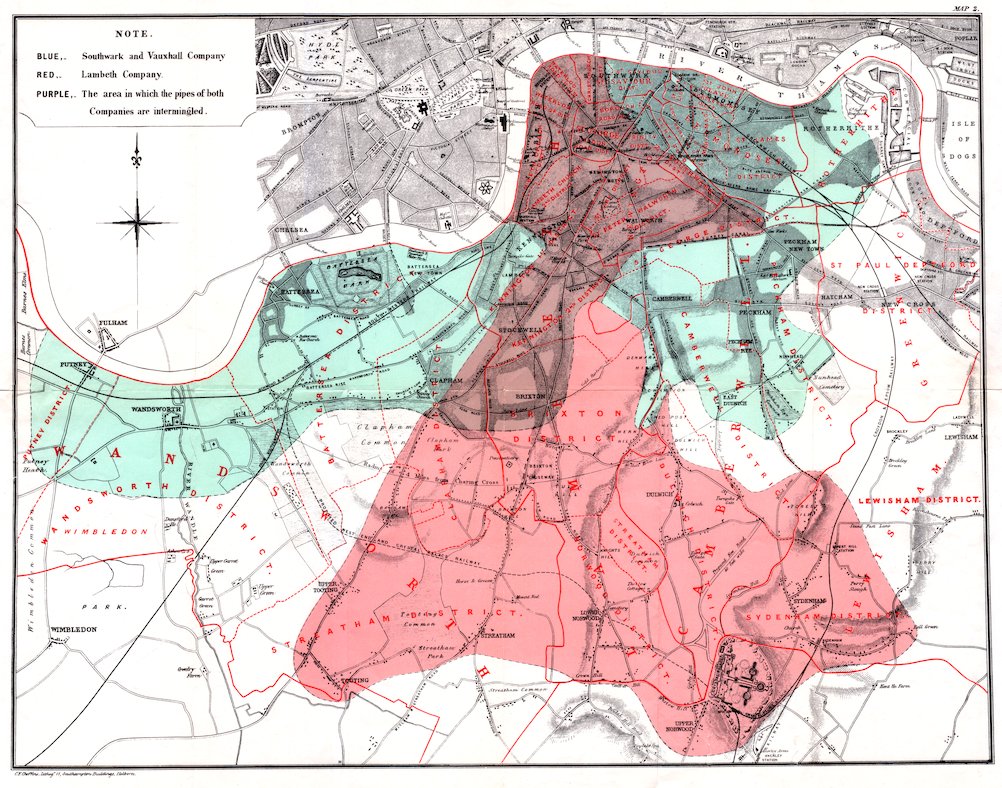
THE NEW WATER SUPPLY OF THE LAMBETH COMPANY.
75Although the facts shown in the above table afford
very strong evidence of the powerful influence which the
drinking of water containing the sewage of a town exerts
over the spread of cholera, when that disease is present,
yet the question does not end here; for the intermixing
of the water supply of the Southwark and Vauxhall Company
with that of the Lambeth Company, over an extensive
part of London, admitted of the subject being sifted
in such a way as to yield the most incontrovertible proof
on one side or the other. In the sub-districts enumerated
in the above table as being supplied by both Companies,
the mixing of the supply is of the most intimate kind.
The pipes of each Company go down all the streets, and
into nearly all the courts and alleys. A few houses are
supplied by one Company and a few by the other, according
to the decision of the owner or occupier at that time
when the Water Companies were in active competition.
In many cases a single house has a supply different from
that on either side. Each Company supplies both rich
and poor, both large houses and small; there is no difference
either in the condition or occupation of the persons
receiving the water of the different Companies. Now it
must be evident that, if the diminution of cholera, in the
districts partly supplied with the improved water, depended
on this supply, the houses receiving it would be
the houses enjoying the whole benefit of the diminution
of the malady, whilst the houses supplied with the water
from Battersea Fields would suffer the same mortality as
they would if the improved supply did not exist at all.
As there is no difference whatever, either in the houses or
the people receiving the supply of the two Water Companies,
or in any of the physical conditions with which
they are surrounded, it is obvious that no experiment
could have been devised which would more thoroughly
test the effect of water supply on the progress of cholera
than this, which circumstances placed ready made before
the observer.
The experiment, too, was on the grandest scale. No
fewer than three hundred thousand people of both sexes,
of every age and occupation, and of every rank and station,
from gentlefolks down to the very poor, were divided into
two groups without their choice, and, in most cases, without
their knowledge; one group being supplied with water
containing the sewage of London, and, amongst it, whatever
might have come from the cholera patients, the other
group having water quite free from such impurity.
EPIDEMIC OF 1854, IN THE SOUTH DISTRICTS OF LONDON.
To turn this grand experiment to account, all that was
required was to learn the supply of water to each individual
house where a fatal attack of cholera might occur.
I regret that, in the short days at the latter part of last
76year, I could not spare the time to make the inquiry; and,
indeed, I was not fully aware, at that time, of the very
intimate mixture of the supply of the two Water Companies,
and the consequently important nature of the desired
inquiry.
When the cholera returned to London in July of the
present year, however, I resolved to spare no exertion
which might be necessary to ascertain the exact effect of
the water supply on the progress of the epidemic, in the
places where all the circumstances were so happily adapted
for the inquiry. I was desirous of making the investigation
myself, in order that I might have the most satisfactory
proof of the truth or fallacy of the doctrine which I
had been advocating for five years. I had no reason to
doubt the correctness of the conclusions I had drawn from
the great number of facts already in my possession, but I
felt that the circumstance of the cholera poison passing
down the sewers into a great river, and being distributed
through miles of pipes, and yet producing its specific
effects, was a fact of so startling a nature, and of so vast
importance to the community, that it could not be too
rigidly examined, or established on too firm a basis.
I accordingly asked permission at the General Register
Office to be supplied with the addresses of persons dying
of cholera, in those districts where the supply of the two
Companies is intermingled in the manner I have stated
above. Some of these addresses were published in the
“Weekly Returns,” and I was kindly permitted to take
a copy of others. I commenced my inquiry about the
middle of August with two sub-districts of Lambeth,
called Kennington, first part, and Kennington, second
part. There were forty-four deaths in these sub-districts
down to 12th August, and I found that thirty-eight of the
houses in which these deaths occurred were supplied with
77water by the Southwark and Vauxhall Company, four
houses were supplied by the Lambeth Company, and two
had pump-wells on the premises and no supply from
either of the Companies.
As soon as I had ascertained these particulars I communicated
them to Dr. Farr, who was much struck with
the result, and at his suggestion the Registrars of all the
south districts of London were requested to make a return
of the water supply of the house in which the attack took
place, in all cases of death from cholera. This order was
to take place after the 26th August, and I resolved to
carry my inquiry down to that date, so that the facts
might be ascertained for the whole course of the epidemic.
I pursued my inquiry over the various other sub-districts
of Lambeth, Southwark, and Newington, where the supply
of the two Water Companies is intermixed, with a result
very similar to that already given, as will be seen further
on. In cases where persons had been removed to a workhouse
or any other place, after the attack of cholera had
commenced, I inquired the water supply of the house
where the individuals were living when the attack took
place.
The inquiry was necessarily attended with a good deal
of trouble. There were very few instances in which I
could at once get the information I required. Even when
the water-rates are paid by the residents, they can seldom
remember the name of the Water Company till they have
looked for the receipt. In the case of working people
who pay weekly rents, the rates are invariably paid by
the landlord or his agent, who often lives at a distance,
and the residents know nothing about the matter. It
would, indeed, have been almost impossible for me to
complete the inquiry, if I had not found that I could distinguish
the water of the two companies with perfect
78certainty by a chemical test. The test I employed was
founded on the great difference in the quantity of chloride
of sodium contained in the two kinds of water, at the time
I made the inquiry. On adding solution of nitrate of
silver to a gallon of the water of the Lambeth Company,
obtained at Thames Ditton, beyond the reach of the
sewage of London, only 2·28 grains of chloride of silver
were obtained, indicating the presence of ·95 grains of
chloride of sodium in the water. On treating the water of
the Southwark and Vauxhall Company in the same manner,
91 grains of chloride of silver were obtained, showing
the presence of 37·9 grains of common salt per gallon.
Indeed, the difference in appearance on adding nitrate of
silver to the two kinds of water was so great, that they
could be at once distinguished without any further trouble.
Therefore when the resident could not give clear
and conclusive evidence about the Water Company, I obtained
some of the water in a small phial, and wrote the
address on the cover, when I could examine it after
coming home. The mere appearance of the water generally
afforded a very good indication of its source, especially
if it was observed as it came in, before it had
entered the water-butt or cistern; and the time of its
coming in also afforded some evidence of the kind of
water, after I had ascertained the hours when the turncocks
of both Companies visited any street. These points
were, however, not relied on, except as corroborating
more decisive proof, such as the chemical test, or the
Company’s receipt for the rates.
A return had been made to Parliament of the entire
number of houses supplied with water by each of the
Water Companies, but as the number of houses which
they supplied in particular districts was not stated, I
found that it would be necessary to carry my inquiry into
79all the districts to which the supply of either Company
extends, in order to show the full bearing of the facts
brought out in those districts where the supply is intermingled.
I inquired myself respecting every death from
cholera in the districts to which the supply of the Lambeth
Company extends, and I was fortunate enough to
obtain the assistance of a medical man, Mr. John Joseph
Whiting, L.A.C., to make inquiry in Bermondsey, Rotherhithe,
Wandsworth, and certain other districts, which
are supplied only by the Southwark and Vauxhall Company.
Mr. Whiting took great pains with his part of the
inquiry, which was to ascertain whether the houses in
which the fatal attacks took place were supplied with the
Company’s water, or from a pump-well, or some other
source.
Mr. Whiting’s part of the investigation extended over
the first four weeks of the epidemic, from 8th July to 5th
August; and as inquiry was made respecting every death
from cholera during this part of the epidemic, in all the
districts to which the supply of either of the Water Companies
extends, it may be well to consider this period first.
There were three hundred and thirty-four deaths from
cholera in these four weeks, in the districts to which the
water supply of the Southwark and Vauxhall and the
Lambeth Company extends. Of these it was ascertained,
that in two hundred and eighty-six cases the house where
the fatal attack of cholera took place was supplied with
water by the Southwark and Vauxhall Company, and in
only fourteen cases was the house supplied with the Lambeth
Company’s water; in twenty-two cases the water
was obtained by dipping a pail directly into the Thames,
in four instances it was obtained from pump-wells, in four
instances from ditches, and in four cases the source of
supply was not ascertained, owing to the person being
80taken ill whilst travelling, or from some similar cause.
The particulars of all the deaths which were caused by
cholera in the first four weeks of the late epidemic, were
published by the Registrar-General in the “Weekly
Returns of Births and Deaths in London,” and I have
had the three hundred and thirty-four above enumerated
reprinted in an appendix to this edition, as a guarantee
that the water supply was inquired into, and to afford any
person who wishes it an opportunity of verifying the result.
Any one who should make the inquiry must be
careful to find the house where the attack took place, for
in many streets there are several houses having the same
number.
According to a return which was made to Parliament,
the Southwark and Vauxhall Company supplied 40,046
houses from January 1st to December 31st, 1853, and the
Lambeth Company supplied 26,107 houses during the
same period; consequently, as 286 fatal attacks of cholera
took place, in the first four weeks of the epidemic, in
houses supplied by the former Company, and only 14
in houses supplied by the latter, the proportion of fatal
attacks to each 10,000 houses was as follows. Southwark
and Vauxhall 71. Lambeth 5. The cholera was therefore
fourteen times as fatal at this period, amongst persons
having the impure water of the Southwark and Vauxhall
Company, as amongst those having the purer water from
Thames Ditton.
It is extremely worthy of remark, that whilst only five
hundred and sixty-three deaths from cholera occurred in
the whole of the metropolis, in the four weeks ending 5th
August, more than one half of them took place amongst
the customers of the Southwark and Vauxhall Company,
and a great portion of the remaining deaths were those of
mariners and persons employed amongst the shipping in
81the Thames, who almost invariably draw their drinking
water direct from the river.
It may, indeed, be confidently asserted, that if the
Southwark and Vauxhall Water Company had been able
to use the same expedition as the Lambeth Company in
completing their new works, and obtaining water free
from the contents of sewers, the late epidemic of cholera
would have been confined in a great measure to persons
employed among the shipping, and to poor people who
get water by pailsful direct from the Thames or tidal
ditches.
The number of houses in London at the time of the last
census was 327,391. If the houses supplied with water
by the Southwark and Vauxhall Company, and the deaths
from cholera occurring in these houses, be deducted, we
shall have in the remainder of London 287,345 houses, in
which 277 deaths from cholera took place in the first four
weeks of the epidemic. This is at the rate of nine deaths
to each 10,000. But the houses supplied with water by
the Lambeth Company only suffered a mortality of five
in each 10,000 at this period; it follows, therefore, that
these houses, although intimately mixed with those of the
Southwark and Vauxhall Company, in which so great a
proportional mortality occurred, did not suffer even so
much as the rest of London which was not so situated.
In the beginning of the late epidemic of cholera in
London, the Thames water seems to have been the great
means of its diffusion, either through the pipes of the
Southwark and Vauxhall Company, or more directly by
dipping a pail in the river. Cholera was prevailing in
the Baltic Fleet in the early part of summer, and the
following passage from the “Weekly Returns” of the
Registrar-General shows that the disease was probably
imported thence to the Thames.
82“Bermondsey, St. James. At 10, Marine Street, on
25th July, a mate mariner, aged 34 years, Asiatic cholera
101 hours, after premonitory diarrhœa 16¹⁄₂ hours. The
medical attendant states: ‘This patient was the chief
mate to a steam-vessel taking stores to and bringing home
invalids from the Baltic Fleet. Three weeks ago he
brought home in his cabin the soiled linen of an officer
who had been ill. The linen was washed and returned.’”
The time when this steam-vessel arrived in the Thames
with the soiled linen on board, was a few days before the
first cases of cholera appeared in London, and these first
cases were chiefly amongst persons connected with the
shipping in the river. It is not improbable therefore that
a few simple precautions, with respect to the communications
with the Baltic Fleet, might have saved London
from the cholera this year, or at all events greatly retarded
its appearance.
As the epidemic advanced, the disproportion between
the number of cases in houses supplied by the Southwark
and Vauxhall Company and those supplied by the Lambeth
Company, became not quite so great, although it
continued very striking. In the beginning of the epidemic
the cases appear to have been almost altogether produced
through the agency of the Thames water obtained
amongst the sewers; and the small number of cases
occurring in houses not so supplied, might be accounted
for by the fact of persons not keeping always at home and
taking all their meals in the houses in which they live;
but as the epidemic advanced it would necessarily spread
amongst the customers of the Lambeth Company, as in
parts of London where the water was not in fault, by all
the usual means of its communication. The two subjoined
tables, VII and VIII, show the number of fatal attacks in
houses supplied respectively by the two Companies, in all
83the sub-districts to which their water extends. The cases
in table VII, are again included in the larger number
which appear in the next table. The sub-districts are
arranged in three groups, as they were in table VI, illustrating
the epidemic of 1853.
In table VIII, showing the mortality in the first seven
weeks of the epidemic, the water supply is the result of
my own personal inquiry, in every case, in all the sub-districts
to which the supply of the Lambeth Company
extends; but in some of the sub-districts supplied only
by the Southwark and Vauxhall Company, the inquiry of
Mr. Whiting having extended only to 5th August, the
water supply of the last three weeks is calculated to have
been in the same proportion by the Company, or by pump
wells, etc., as in the first four weeks,—a calculation which
is perfectly fair, and must be very near the truth. The
sub-districts in which the supply is partly founded on
computation, are marked with an asterisk.
The numbers in table VIII differ a very little from those
of the table I communicated to the Medical Times and
Gazette of 7th October, on account of the water supply
having since been ascertained in some cases in which I
did not then know it. The small number of instances in
which the water supply remains unascertained are chiefly
those of persons taken into a workhouse without their
address being known.
84 TABLE VII.
The mortality from Cholera in the four weeks ending 5th August.
| Sub-Districts. |
Population in 1851. |
Deaths from in the four weeks ending 5th August. |
Water Supply. |
| Southwark & Vauxhall. |
Lambeth. |
Pump-wells. |
River Thames, ditches, etc. |
Unascertained. |
| St. Saviour, Southwark |
19,709 |
26 |
24 |
|
|
2 |
|
| St. Olave, Southwark |
8,015 |
19 |
15 |
|
|
2 |
2 |
| St. John, Horsleydown |
11,360 |
18 |
17 |
|
|
1 |
|
| St. James, Bermondsey |
18,899 |
29 |
23 |
|
|
6 |
|
| St. Mary Magdalen |
13,934 |
20 |
19 |
|
|
1 |
|
| Leather Market |
15,295 |
23 |
23 |
|
|
|
|
| Rotherhithe |
17,805 |
26 |
17 |
|
|
9 |
|
| Battersea |
10,560 |
13 |
10 |
|
1 |
2 |
|
| Wandsworth |
9,611 |
2 |
|
|
|
2 |
|
| Putney |
5,280 |
1 |
|
|
1 |
|
|
| Camberwell |
17,742 |
19 |
19 |
|
|
|
|
| Peckham |
19,444 |
4 |
4 |
|
|
|
|
| |
|
|
|
|
|
|
|
| Christchurch, Southwk. |
16,022 |
3 |
2 |
1 |
|
|
|
| Kent Road |
18,126 |
8 |
7 |
1 |
|
|
|
| Borough Road |
15,862 |
21 |
20 |
1 |
|
|
|
| London Road |
17,836 |
9 |
5 |
4 |
|
|
|
| Trinity, Newington |
20,922 |
14 |
14 |
|
|
|
|
| St. Peter, Walworth |
29,861 |
20 |
20 |
|
|
|
|
| St. Mary, Newington |
14,033 |
5 |
5 |
|
|
|
|
| Waterloo Road (1st) |
14,088 |
5 |
5 |
|
|
|
|
| Waterloo Road (2nd) |
18,348 |
5 |
5 |
|
|
|
|
| Lambeth Church (1st) |
18,409 |
5 |
2 |
1 |
|
1 |
1 |
| Lambeth Church (2nd) |
26,784 |
10 |
7 |
2 |
|
|
1 |
| Kennington (1st) |
24,261 |
11 |
9 |
1 |
1 |
|
|
| Kennington (2nd) |
18,848 |
3 |
3 |
|
|
|
|
| Brixton |
14,610 |
1 |
|
1 |
|
|
|
| Clapham |
16,290 |
5 |
4 |
|
1 |
|
|
| St. George, Camberwell |
15,849 |
9 |
7 |
2 |
|
|
|
| |
|
|
|
|
|
|
|
| Norwood |
3,977 |
|
|
|
|
|
|
| Streatham |
9,023 |
|
|
|
|
|
|
| Dulwich |
1,632 |
|
|
|
|
|
|
| Sydenham |
4,501 |
|
|
|
|
|
|
| |
486,936 |
334 |
286 |
14 |
4 |
26 |
4 |
85 TABLE VIII.
Mortality from Cholera in the seven weeks ending 26th August.
| Sub-Districts. |
Population in 1851. |
Deaths from Cholera in the seven weeks ending 26th August. |
Water Supply. |
| Southwark & Vauxhall. |
Lambeth. |
Pump-wells. |
River Thames, ditches, etc. |
Unascertained. |
| *St. Saviour, Southwark |
19,709 |
125 |
115 |
|
|
10 |
|
| *St. Olave, Southwark |
8,015 |
53 |
43 |
|
|
5 |
5 |
| *St. John, Horsleydown |
11,360 |
51 |
48 |
|
|
3 |
|
| *St. James, Bermondsey |
18,899 |
123 |
102 |
|
|
21 |
|
| *St. Mary Magdalen |
13,934 |
87 |
83 |
|
|
4 |
|
| *Leather Market |
15,295 |
81 |
81 |
|
|
|
|
| *Rotherhithe |
17,805 |
103 |
68 |
|
|
35 |
|
| *Battersea |
10,560 |
54 |
42 |
|
4 |
8 |
|
| Wandsworth |
9,611 |
11 |
1 |
|
2 |
8 |
|
| Putney |
5,280 |
1 |
|
|
1 |
|
|
| *Camberwell |
17,742 |
96 |
96 |
|
|
|
|
| *Peckham |
19,444 |
59 |
59 |
|
|
|
|
| |
|
|
|
|
|
|
|
| Christchurch, Southwk. |
16,022 |
25 |
11 |
13 |
|
|
1 |
| Kent Road |
18,126 |
57 |
52 |
5 |
|
|
|
| Borough Road |
15,862 |
71 |
61 |
7 |
|
|
3 |
| London Road |
17,836 |
29 |
21 |
8 |
|
|
|
| Trinity, Newington |
20,922 |
58 |
52 |
6 |
|
|
|
| St. Peter, Walworth |
29,861 |
90 |
84 |
4 |
|
|
2 |
| St. Mary, Newington |
14,033 |
21 |
19 |
1 |
1 |
|
|
| Waterloo Road (1st) |
14,088 |
10 |
9 |
1 |
|
|
|
| Waterloo Road (2nd) |
18,348 |
36 |
25 |
8 |
1 |
2 |
|
| Lambeth Church (1st) |
18,409 |
18 |
6 |
9 |
|
1 |
2 |
| Lambeth Church (2nd) |
26,748 |
53 |
34 |
13 |
1 |
|
5 |
| Kennington (1st) |
24,261 |
71 |
63 |
5 |
3 |
|
|
| Kennington (2nd) |
18,848 |
38 |
34 |
3 |
1 |
|
|
| Brixton |
14,610 |
9 |
5 |
2 |
|
|
2 |
| *Clapham |
16,290 |
24 |
19 |
|
5 |
|
|
| St. George, Camberwell |
15,849 |
42 |
30 |
9 |
2 |
|
1 |
| |
|
|
|
|
|
|
|
| Norwood |
3,977 |
8 |
|
2 |
1 |
5 |
|
| Streatham |
9,023 |
6 |
|
1 |
5 |
|
|
| Dulwich |
1,632 |
|
|
|
|
|
|
| Sydenham |
4,501 |
4 |
|
1 |
2 |
|
1 |
| |
486,936 |
1514 |
1263 |
98 |
29 |
102 |
22 |
86The following is the proportion of deaths to 10,000
houses, during the first seven weeks of the epidemic, in
the population supplied by the Southwark and Vauxhall
Company, in that supplied by the Lambeth Company, and
in the rest of London.
|
Number of houses. |
Deaths from Cholera. |
Deaths in each 10,000 houses. |
| Southwark and Vauxhall Company |
40,046 |
1,263 |
315 |
| Lambeth Company |
26,107 |
98 |
37 |
| Rest of London |
256,423 |
1,422 |
59 |
The mortality in the houses supplied by the Southwark
and Vauxhall Company was therefore between eight and
nine times as great as in the houses supplied by the Lambeth
Company; and it will be remarked that the customers
of the Lambeth Company continued to enjoy an
immunity from cholera greater than the rest of London
which is not mixed up as they are with the houses supplied
by the Southwark and Vauxhall Company.
As regards the period of the epidemic subsequent to
the 26th August to which my inquiry extended, I have
stated that the Registrar-General requested the District
Registrars to make a return of the water supply of the
house of attack in all cases of death from cholera. Owing
to difficulties such as I explained that I had met with in
the beginning of my inquiry, the Registrars could not
make the return in all cases, and as they could not be
expected to seek out the landlord or his agent, or to apply
chemical tests to the water as I had done, the water
supply remained unascertained in a number of cases, but
87the numbers may undoubtedly be considered to show the
correct proportions as far as they extend, and they agree
entirely with the results of my inquiry respecting the
earlier part of the epidemic given above.
The Registrar-General published the returns of the
water supply, which he had obtained from the District
Registrars, down to 14th October, in a table which is
subjoined. As the whole of the south districts of London
were included in the inquiry of the Registrar-General,
the deaths in the Greenwich and Lewisham districts,
which are supplied by the Kent Water Company, and did
not enter into my inquiry, are included in the table, but
they do not in the least affect the numbers connected with
the other companies.
| Week ending. |
Deaths from Cholera. |
Water Supply. |
| Southwk. and Vauxhall. |
Lambeth. |
Kent Company. |
Pumps, and other sources. |
Not ascertained. |
| September 2. |
670 |
399 |
45 |
38 |
72 |
116 |
| „ 9. |
972 |
580 |
72 |
45 |
62 |
213 |
| „ 16. |
856 |
524 |
66 |
48 |
44 |
174 |
| „ 23. |
724 |
432 |
72 |
28 |
62 |
130 |
| „ 30. |
383 |
228 |
25 |
19 |
24 |
87 |
| October 7. |
200 |
121 |
14 |
10 |
9 |
46 |
| „ 14. |
115 |
69 |
8 |
3 |
6 |
29 |
| |
3920 |
2353 |
302 |
191 |
279 |
795 |
Now 2,353 deaths in 40,046 houses, the number supplied
by the Southwark and Vauxhall Company, are 537
deaths to each 10,000 houses; and 302 deaths to 26,107,
the number of houses supplied by the Lambeth Company,
are 115 deaths to each 10,000 houses; consequently, in
88the second seven weeks of the epidemic, the population
supplied by the Southwark and Vauxhall Company continued
to suffer nearly five times the mortality of that
supplied with water by the Lambeth Company. If the
795 deaths in which the water supply was not ascertained
be distributed equally over the other sources of supply in
the above table (No. X), the deaths in houses supplied by
the Southwark and Vauxhall Company would be 2,830,
and in houses supplied by the Lambeth Company would
be 363. By adding the number of deaths which occurred
in the first seven weeks of the epidemic, we get
the numbers in the subjoined table (No. XI), where the
population of the houses supplied by the two water companies
is that estimated by the Registrar-General.[16]
|
Population in 1851. |
Deaths by Cholera in 14 wks. ending Oct 14. |
Deaths in 10,000 living. |
| London |
2,362,236 |
10,367 |
43 |
| |
|
|
|
| West Districts |
376,427 |
1,992 |
53 |
| North Districts |
490,396 |
735 |
14 |
| Central Districts |
393,256 |
612 |
15 |
| East Districts |
485,522 |
1,461 |
30 |
| South Districts |
616,635 |
5,567 |
90 |
| |
|
|
|
| Houses supplied by Southwark and Vauxhall Company |
266,516 |
4,093 |
153 |
| Houses supplied by Lambeth Company |
173,748 |
461 |
26 |
We see by the above table that the houses supplied
with the water from Thames Ditton, by the Lambeth
89Company, continued throughout the epidemic to enjoy
an immunity from cholera, not only greater than London
at large, but greater than every group of districts, except
the north and central groups.
In the next table (No. XII), the mortality from cholera
in 1849 is shown side by side with that of 1854, in the
various sub-districts to which the supply of the two water
companies with which we are particularly interested extends.
The mortality of 1854 is down to October 21,
and is extracted from a table published in the “Weekly
Return of Births and Deaths” of October 28; that of
1849 is from the “Report on Cholera” by Dr. Farr, previously
quoted. The sub-districts are arranged in three
groups as before, the first group being supplied only by
the Southwark and Vauxhall Company, the second group
by this Company and the Lambeth, and the third group
by the Lambeth Company only. It is necessary to observe,
however, that the supply of the Lambeth Company
has been extended to Streatham, Norwood, and Sydenham,
since 1849, in which year these places were not
supplied by any water company. The situation and
extent of the various sub-districts are shown, together
with the nature of the water supply, in Map 2, which
accompanies this work.
| Sub-Districts. |
Deaths from Cholera in 1849. |
Deaths from Cholera in 1854. |
Water Supply. |
| St. Saviour, Southwark |
283 |
371 |
Southwark & Vauxhall Company only. |
| St. Olave |
157 |
161 |
| St. John, Horsleydown |
192 |
148 |
| St. James, Bermondsey |
249 |
362 |
| St. Mary Magdalen |
259 |
244 |
| Leather Market |
226 |
237 |
| Rotherhithe[17] |
352 |
282 |
| Wandsworth |
97 |
59 |
| Battersea |
111 |
171 |
| Putney |
8 |
9 |
| Camberwell |
235 |
240 |
| Peckham |
92 |
174 |
| |
|
|
|
| Christchurch, Southwark |
256 |
113 |
Lambeth Company, and Southwark and Vauxhall Compy. |
| Kent Road |
267 |
174 |
| Borough Road |
312 |
270 |
| London Road |
257 |
93 |
| Trinity, Newington |
318 |
210 |
| St. Peter, Walworth |
446 |
388 |
| St. Mary, Newington |
143 |
92 |
| Waterloo Road (1st) |
193 |
58 |
| Waterloo Road (2nd) |
243 |
117 |
| Lambeth Church (1st) |
215 |
49 |
| Lambeth Church (2nd) |
544 |
193 |
| Kennington (1st) |
187 |
303 |
| Kennington (2nd) |
153 |
142 |
| Brixton |
81 |
48 |
| Clapham |
114 |
165 |
| St. George, Camberwell |
176 |
132 |
| |
|
|
|
| Norwood |
2 |
10 |
Lambeth Company only. |
| Streatham |
154 |
15 |
| Dulwich |
1 |
|
| Sydenham |
5 |
12 |
| First 12 sub-districts |
2261 |
2458 |
Southwk. & Vauxhall. |
| Next 16 sub-districts |
3905 |
2547 |
Both Companies. |
| Last 4 sub-districts |
162 |
37 |
Lambeth Company. |
THE CHOLERA OF 1849 COMPARED WITH THAT OF 1854.
91The table exhibits an increase of mortality in 1854 as
compared with 1849, in the sub-districts supplied by the
Southwark and Vauxhall Company only, whilst there is a
considerable diminution of mortality in the sub-districts
partly supplied by the Lambeth Company. In certain
sub-districts, where I know that the supply of the Lambeth
Water Company is more general than elsewhere, as
Christchurch, London Road, Waterloo Road 1st, and
Lambeth Church 1st, the decrease of mortality in 1854 as
compared with 1849 is greatest, as might be expected.
Waterloo Road 1st, which suffered but little from cholera
in the present year, is chiefly composed of very dirty
narrow streets, in the neighbourhood of Cornwall Road
and the New Cut, inhabited by very poor people; and
Lambeth Church 1st, which suffered still less, contains a
number of skinyards and other factories, between Lambeth
Palace and Vauxhall Bridge, which have often been
inveighed against as promoting the cholera. The high
mortality of the Streatham district in 1849 was caused by
the outbreak of cholera in Drouett’s Asylum for pauper
children, previously mentioned.
Whilst making inquiries in the south districts of London,
I learned some circumstances with respect to the
workhouses which deserve to be noticed. In Newington
Workhouse, containing 650 inmates, and supplied with
the water from Thames Ditton, there had been but two
deaths from cholera amongst the inmates down to 21st
September, when the epidemic had already greatly declined.
In Lambeth Workhouse, containing, if I remember
rightly, nearly 1,000 inmates, and supplied with
the same water, there had been but one death amongst the
inmates when I was there in the first week of September.
In St. Saviour’s workhouse, which is situated in the
parish of Christchurch, and is supplied with water by the
Lambeth Company, no inmate died of cholera before I
called in the first week of September. On the other hand,
in the workhouse of St. George, Southwark, supplied with
the water of the Southwark and Vauxhall Company, six
inmates died out of about 600 before the 26th August,
when the epidemic had only run one-third of its course.
The mortality was also high amongst the inmates of St.
Olave’s Workhouse, supplied with water by the Southwark
and Vauxhall Company, but I do not know the
number who died. I trust, however, that the Registrar
HORSEMONGER LANE GAOL.
92General, in giving an account of the recent epidemic, will
make a return of the deaths amongst the inmates of the
various workhouses and other institutions on the south
side of the Thames, together with the water supply of the
buildings. Bethlehem Hospital, the Queen’s Prison,
Horsemonger Lane Gaol, and some other institutions,
having deep wells on the premises, scarcely suffered at all
from cholera in 1849, and there was no death in any of
them during the part of the recent epidemic to which my
inquiry extended.
DISTRICT OF CHELSEA WATER COMPANY.
On the north side of the Thames the mortality during
the recent epidemic seems to have been influenced more
by the relative crowding and want of cleanly habits of the
people, and by the accidental contamination of the pump-wells,
than by the supply of the water companies. The
water of the New River Company could have no share in
the propagation of cholera, as I explained when treating
of the epidemic of 1849; and the extensive districts supplied
by this company have been very slightly visited by
the disease, except in certain spots which were influenced
by the causes above mentioned. The water of the East
London Company is also free from the contents of sewers,
unless it be those from the neighbourhood of Upper
Clapton, where there has been very little cholera. The
districts supplied by this company have been lightly
visited, except such as lie near the Thames, and are inhabited
by mariners, coal and ballast-heavers, and others,
who are employed on the river. Even Bethnal Green and
Spitalfields, so notorious for their poverty and squalor,
have suffered a mortality much below the average of the
metropolis. The Grand Junction Company obtain their
supply at Brentford, within the reach of the tide and near
a large population, but they detain the water in large
reservoirs, and their officers tell me they filter it; at all
93events, they supply it in as pure a state as that of the
Lambeth Company obtained at Thames Ditton, and their
districts have suffered very little from cholera except at the
spot where the irruption occurred from the contamination
of the pump-well in Broad Street, Golden Square. The
West Middlesex Company, obtaining their supply from
the Thames at Hammersmith, have also very large reservoirs,
and the districts they supply have suffered but little
from cholera, except the Kensington brick fields, Starch
Green, and certain other spots, crowded with poor people,
chiefly Irish.
CHOLERA IN THE DISTRICT OF THE CHELSEA WATER COMPANY.
The districts supplied by the Chelsea Company have
suffered a much greater mortality, during the recent epidemic,
than the average of the whole metropolis, as the
subjoined table (No. XIII) shows. But the mortality in
these districts is only half as great as in the houses supplied
by the Southwark and Vauxhall Company, who
obtain their supply from the Thames just opposite the
spot where the Chelsea Company obtain theirs. The
latter company, however, by detaining the water in their
reservoirs, and by filtering it, are enabled to distribute it
in a state of comparative purity; but I had ample opportunities
of observing, in August and September last, that
this was far from being the state of the water supplied by
the Southwark and Vauxhall Company. Many of the
people receiving this latter supply were in the habit of
tying a piece of linen or some other fabric over the tap by
which the water entered the butt or cistern, and in two
hours, as the water came in, about a tablespoon of dirt
was collected, all in motion with a variety of water insects,
whilst the strained water was far from being clear. The
contents of the strainer were shown to me in scores of instances.
I do not, of course, attribute the cholera either
to the insects or the visible dirt; but it is extremely probable
that the measures adopted by the Chelsea Company
94to free the water from these repulsive ingredients, either
separated or caused the destruction of the morbid matter
of cholera. It is very likely that the detention of the
water in the company’s reservoirs permitted the decomposition
of the cholera poison, and was more beneficial
than the filtering, for the following reasons. The water
used in Millbank Prison, obtained from the Thames at
Millbank, was filtered through sand and charcoal till it
looked as clear as that of the Chelsea Company; yet, in
every epidemic, the inmates of this prison suffered much
more from cholera than the inhabitants of the neighbouring
streets and those of Tothill Fields Prison, supplied by
that company.[18] In the early part of August last, the use
of the Thames water was entirely discontinued in Millbank
Prison, and water from the Artesian well in Trafalgar
Square was used instead, on the recommendation of Dr.
Baly, the physician to the prison. In three or four days
after this change, the cholera, which was prevailing to an
alarming extent, entirely ceased.
|
Population in 1851. |
Deaths by Cholera |
| In 15 wks. ending October 21. |
To every 10,000 living. |
| Chelsea, south |
19,050 |
122 |
64 |
| Chelsea, north-west |
17,669 |
99 |
56 |
| Chelsea, north-east |
19,819 |
71 |
36 |
| Belgrave |
40,034 |
238 |
59 |
| St. John, Westminster |
34,295 |
173 |
50 |
| St. Margaret, Westminster |
31,314 |
238 |
76 |
| Total of districts supplied by the Chelsea Water Company |
162,181 |
941 |
56 |
| Houses supplied by the Southwark and Vauxhall Company |
266,516 |
2,900 |
108 |
| London |
2,362,236 |
10,530 |
45 |
| London, except the houses supplied by the Chelsea Company, and by the Southwark & Vauxhall Compy. |
1,933,539 |
6,689 |
34 |
95The quantity of impurity in the Thames was greatly
increased during the late autumn, by the long course of
dry weather. From 5th August to 12th September, a
period of more than five weeks, only 0·29 of an inch of
rain fell at Greenwich, as appears by the report of the
Astronomer Royal. The stream of the Thames above the
reach of the tide became so slender, that it was difficult
to navigate barges above Richmond. The Thames in
London is a very large body of water, and if the whole of
it flowed away into the sea every day, the liquid which
flows down the sewers in twelve hours would form but a
very small part of it; but it must be remembered that the
quantity of water which passes out to sea, with the ebb of
every tide, is only equal to that which flows over Teddington
Lock, and from a few small tributary streams. In
hot dry weather this quantity is moreover greatly diminished
by the evaporation taking place from the immense
surface of water exposed between Richmond and Gravesend,
so that the river becomes a kind of prolonged lake,
the same water passing twice a day to and fro through
London, and receiving the excrement of its two millions
and more of inhabitants, which keeps accumulating till
there is a fall of rain. In time of cholera, the evacuations
of the patients keep accumulating in the river along with
the other impurities; and it is probably in this way that
the dry weather with a high barometer aids in promoting
cholera, as it has often been observed to do.
IMPURITY OF THE THAMES.
I thought at first that the quantity of common salt, previously
96mentioned as being present in the water of the
Southwark and Vauxhall Company, consisted entirely of
the salt which had passed down the sewers into the river,
for I had no idea that any admixture of sea water reached
as high as Battersea Fields. Mr. Quick, the engineer of
the above Company, informed me, however, that an impregnation
of salt water does extend as far after a long
course of dry weather. It is obvious that a dry season,
whilst it increases the quantity of impurity in the Thames,
must also cause the sea water to flow further inland than
at other times. I did not examine the water of the
Thames in August or September, but I have done so now,
at the latter part of November, and I am inclined to think
that even yet a slight admixture of sea water may reach
to Battersea Fields with every tide. I found 5·8 grains of
chloride of sodium per gallon in water obtained at Hungerford
Market, at half-flow of the tide, on 19th November,
and 19·1 grains per gallon, in water obtained at the same
place, on 27th November, at an hour and a half before
high water; whilst water obtained at London Bridge, on
28th November, at high water, contained 63·3 grains per
gallon.
A specimen of water obtained on 21st November, from
a house supplied by the Southwark and Vauxhall Company,
contained 28·8 grains of common salt per gallon, or
about three-quarters as much as it contained in September,
when the quantity was 37·9 grains. It is very obvious
from the above analyses, that the Water Company
obtain their supply from the Thames at high water, or
nearly so, although this is the time of the tide when the
water contains the greatest amount of impurity. It is
quite certain that the sea water cannot reach to Thames
Ditton, any more than the contents of the London
sewers, and therefore, whatever may be its source, the
97quantity of chloride of sodium in the water is quite conclusive
as regards the purpose for which I examined into
it, viz., to distinguish between the water of the two Companies.
When the water of the Southwark and Vauxhall Company
was examined by Messrs. Graham, Miller, and
Hofmann, at the latter part of January 1851, it contained
only 1·99 grains of chloride of sodium, or about
one-twentieth as much as it contained last September, and
one-fifteenth as much as on 21st November 1854.[19]
ALLEGED EFFECT OF LEVEL.
Dr. Farr discovered a remarkable coincidence between
the mortality from cholera in the different districts of
London in 1849, and the elevation of the ground; the
connection being of an inverse kind, the higher districts
suffering least, and the lowest suffering most from this
malady. Dr. Farr was inclined to think that the level of
the soil had some direct influence over the prevalence of
cholera, but the fact of the most elevated towns in this
kingdom, as Wolverhampton, Dowlais, Merthyr Tydvil,
and Newcastle-upon-Tyne, having suffered excessively
from this disease on several occasions, is opposed to this
view, as is also the circumstance of Bethlehem Hospital,
the Queen’s Prison, Horsemonger Lane Gaol, and several
other large buildings, which are supplied with water from
deep wells on the premises, having nearly or altogether
escaped cholera, though situated on a very low level, and
surrounded by the disease. The fact of Brixton, at an
elevation fifty-six feet above Trinity high-water mark,
having suffered a mortality of 55 in 10,000, whilst many
districts on the north of the Thames, at less than half the
98elevation, did not suffer one-third as much, also points to
the same conclusion.
I expressed the opinion in 1849,[20] that the increased
prevalence of cholera in the low-lying districts of London
depended entirely on the greater contamination of the
water in these districts, and the comparative immunity
from this disease of the population receiving the improved
water from Thames Ditton, during the epidemics of last
year and the present, as shown in the previous pages,
entirely confirms this view of the subject; for the great
bulk of this population live in the lowest districts of the
metropolis.
The prevalence of cholera has been very much under
the influence of the water supply in other towns besides
London. The cholera has prevailed to a considerable
extent in the crowded habitations of the poor in Liverpool
and some other towns, where the general supply of
water was not in fault, but I know of no instance in which
it has spread through all classes of the community, except
where the general supply of water has been contaminated
with the contents of the drains and sewers; and all the
towns with which I am acquainted that have enjoyed an
almost complete immunity from this disease, have a water
supply quite free from any chance of contamination. Birmingham,
Bath, Cheltenham, and Leicester have nearly
escaped the cholera in every epidemic. The few cases
that have occurred being chiefly those of persons newly
arrived from places where the disease was prevailing, and
a few others who came in communication with them. All
these towns have a supply of water quite free from connection
with the drains and sewers, and the small rivers
which flow through them are so impure that it would be
99impossible to drink the water. Leicester is crowded with
a poor population, and has hardly any physical advantage
except its water supply.
CHOLERA IN EXETER.
The first cases of cholera in Exeter in 1832, were three
in the same day, besides one in St. Thomas’s, a suburb of
Exeter, in a gentleman just arrived from London, where
the disease was prevailing. The other three were a
woman and her two children; the former, with one of
her children, had returned from Plymouth the previous
day, where she had been nursing a child that had died of
the cholera. Within five days from this time, there were
seven fresh cases in as many different parts of the town,
amongst persons having no intercourse with each other or
the first cases. The disease soon became very prevalent,
and in three months there were 1,135 cases, and 345
deaths. Exeter is situated on ground which rises from
the edge of the river to an elevation of one hundred and
fifty feet. In 1832 the inhabitants were chiefly supplied
with river water by water-carriers, who conveyed it in
carts and pails. Dr. Shapter, from whose work[21] the
above particulars are obtained, kindly furnished me with
information concerning the sewers, and with maps of
their position. The water-carriers, by whom Exeter was
very greatly supplied, obtained their water almost exclusively
from certain streams of water, diverted from the
river in order to turn water-mills; and one of the chief
sewers of the town, which receives such sewage as might
come from North Street, in which the first cases of cholera
occurred, empties itself into the branch from the
river which divides into the two mill-streams just mentioned.
It must be remarked that the parish of St. Edmund,
in which these streams of water were situated, had
a lower mortality from cholera than other parts of the
100town like it, densely populated and on low ground near
the river. Dr. Shapter attributes this lower rate of mortality,
and I believe rightly, to St. Edmund’s being freely
intersected by running streams of water. The people
would probably not drink more of the water than in parts
of the town where it was less plentiful, and had to be paid
for, but they would have much better opportunities for
personal cleanliness: so that whilst they would be exposed
to only the same number of scattered cases, they
would be less likely to have the malady spreading through
families, and by personal intercourse. After the cholera
of 1832, measures were taken to afford a better supply of
water to Exeter; not, so far as I can find by Dr. Shapter’s
work, that its impurity was complained of, but because of
its scarcity and cost. Waterworks were established on
the river Exe, two miles above the town, and more than
two miles above the influence of the tide. Exeter has
since been very plentifully supplied with this water, and
Dr. Shapter informed me that in 1849 there were only
about twenty cases of cholera, nearly half of which occurred
in strangers coming into the town, and dying
within two or three days after their arrival. This last
summer there was only one death from cholera in Exeter.
CHOLERA IN HULL.
We will now consider the town of Hull, in which, together
with other sanitary measures adopted since 1832,
there has been a new and more plentiful supply of water,
but with a far different result to that at Exeter. In 1832
Hull was scantily supplied with water conveyed in pipes
from springs at Anlaby, three miles from the town.
About 1844, new waterworks were established to afford a
more plentiful supply. These works were situated on the
river Hull, at Stoneferry, two miles and three quarters
from the confluence of that river with the Humber.
About half the sewage of the town is delivered into the
101river of the same name, the rest being discharged into the
Humber, as appears from information and a map kindly
furnished me in 1849 by Dr. Horner of Hull, who was
making great efforts to have better water obtained for the
town. The tide flows up the river many miles past the
waterworks, carrying up with it the filth from the sewers.
The supply of water was, to be sure, obtained when the
tide was down, but as the banks of the river are clothed
with sedges in many parts, and its bottom deep with mud,
the water can never be free from sewage. Moreover, there
are some parts of the river above Stoneferry much deeper
than the rest, and where the deeper water is, according to
the testimony of boatmen, nearly stagnant; thus allowing
the water carried up by the tide to remain and gradually
mix with that afterwards flowing down. There are also
boats, with families on board, passing up the river to the
extent of five thousand voyages in the year. The water
when taken from the river was allowed to settle in the
reservoir for twenty-four hours, and was then said to be
filtered before being sent to the town. In 1832 the cholera
was confined almost exclusively to the poor, and the
deaths amounted to three hundred.
In 1849 the deaths in Hull (including the suburb of
Sculcoates) were 1834, although 8,000 or 10,000 left the
town, it is said, to avoid the ravages of the disease. Dr.
Horner informed me that the deaths occurred amongst all
classes of the community, and that the town was much
better drained in 1849 than in 1832.
CHOLERA IN YORK.
When the cholera made its appearance at York, about
the middle of July 1849, it was at first chiefly prevalent in
some narrow streets near the river, called the Water
Lanes. The inhabitants of this spot had been in the
habit, from time immemorial, of fetching their water from
the river at a place near which one of the chief sewers of
102the town empties itself; and recently a public necessary
had been built, the contents of which were washed every
morning into the river just above the spot at which they
got the water. In a short time from twenty to thirty
deaths occurred in this locality; but the medical men
considering the impure water injurious, the people were
supplied from the waterworks, with water obtained from
the river at a point some distance above the town, and
the cholera soon ceased nearly altogether in this part of
the city, but continued to spread in some other parts.
The cholera having thus abated in the Water Lanes, the
gratuitous supply of water was cut off, and the people
went to the river as before. There were still cases of
cholera in the town, and it soon broke out again in this
locality, and in the first few days of September eight
deaths occurred among the persons who used water obtained
direct from the river. The tap for general use
was again opened, and the river water interdicted, and
the cholera again ceased, and did not recur. These circumstances
were communicated to me by a friend on
whose accuracy I can rely.
The inhabitants of Dumfries drink the water of the
river Nith, which flows through the town, and into which
the sewers discharge their contents, which float afterwards
to and fro with the tide. In 1832 there were 418
deaths from cholera out of a population of 11,606, being
at the rate of 360 in 10,000, or 1 in every 28 of the inhabitants.
The cholera again visited Dumfries at the
close of 1848, and carried off 431 persons, or 1 in every
32, out of a population now numbering 14,000; so that
the mortality was excessive on both occasions.
Preston and Oldham, in Lancashire, are supplied with
water from surface drainage on the neighbouring hills,
and there was scarcely any cholera at either of these
103places in 1849. The greater part of the town of Paisley
is supplied in a similar way; and I was informed that the
cases of cholera which occurred there in 1849 were confined
to a quarter of the town to which this supply of
water does not extend. Nottingham is supplied with
filtered water obtained from the river Trent, some distance
above the town. In 1832 this supply did not extend
to all the inhabitants, and the cholera was somewhat
prevalent amongst the poor, of whom it carried off 289;
the population of the town being 53,000. After that time
the water was extended copiously to all the inhabitants, and
there were but thirteen deaths from the epidemic in 1849.
The local Sanitary Committee placed the supply of water
amongst the chief causes of this immunity from cholera,
and I believe justly. There were but seven deaths from
cholera in Nottingham last summer.
CHOLERA IN GLASGOW.
Glasgow has been supplied, since the early part of the
present century, with the water of the Clyde, obtained a
little way above the town, but within the influence of the
tide, and consequently mixed with the contents of the
sewers. It is imperfectly filtered through sand. In 1847,
however, the parish of Gorbals, which forms the south
part of Glasgow, was furnished with a supply of water
collected on the neighbouring hills; and Dr. Leech, of
Glasgow, speaks as follows respecting the influence of this
water on the prevalence of cholera: “During the late
cholera there was a remarkable circumstance, which deserves
notice as compared with the epidemic of 1832.
Since the former period, the population of Glasgow, south
of the Clyde, has nearly doubled; and with this exception,
and the introduction of the soft-water supply, the
circumstances might be considered as the same at both
periods. In one district, the parish of Gorbals, the attack
in 1832 was fearful; while Glasgow, north of the Clyde,
104also suffered severely. During the late epidemic [that of
1848–49], Gorbals parish furnished comparatively a small
number of cases; while the epidemic in other parts of
Glasgow was very severe. The unanimous opinion of the
Medical Society was, that this comparative immunity was
to be attributed to the soft-water supply.”[22]
CHOLERA IN NEWCASTLE.
I was informed that when the cholera was prevalent in
Glasgow last winter, the parish of Gorbals again enjoyed
a similar immunity from the disease.
The following passage respecting the water supply of
Paris is from Dr. Farr’s “Report to the Registrar-General
on the Cholera of 1848–49”:—“The supply of Paris is
from various sources, but four-fifths of the water is from
the Canal de l’Ourque, which, by the decision of Napoleon,
was also appropriated to navigation. The water for
some years, and in 1832, when the epidemic was so fatal,
was drawn from the dirty basin in which the boats and
barges of the canals rested; but is now drawn from the
canal before it enters the basin.... The mortality of cholera
in Paris was excessive, and in 1832 varied from 80, of
10,000 inhabitants, in the elegant Chaussée d’Antin and
in Montmartre on the heights, to 530 and 520 in the low
quartiers of the Hôtel de Ville and the Cité.” (p. lxxviii.)
The town of Newcastle-upon-Tyne affords a remarkable
instance of the influence of the water supply on the prevalence
of cholera. In 1831–32 there were no waterworks
at Newcastle; it was supplied, in an insufficient manner,
with spring water, which generally had to be carried some
distance to the houses from “pants” in the streets. The
epidemic was pretty severe at this time. From November
1831 to November 1832 there were 801 deaths from cholera
out of a population of 42,760. The disease prevailed
105chiefly amongst the poor, and was worst in the least elevated
parts of the town, near the river. Subsequently to
1832, waterworks were established on the river Tyne, a
little above the town; but these were abandoned, in 1848,
in favour of a supply from a rivulet and springs at Whittle
Dean, about ten miles distant. In 1849, there were but
295 deaths from cholera in a population then increased to
71,847. In the beginning of July 1853, two months before
the reappearance of cholera in England, the Whittle Dean
Water Company found their proper sources insufficient
for the demands of the population and the various factories,
and they made use of the former waterworks, mentioned
above, to obtain water from the Tyne. The point at which
they obtained water from the river, is scarcely a mile above
Newcastle, and the tide flows for six miles above the town,
carrying the contents of the sewers with it. There are
also villages, containing several thousands of colliers and
ironfounders, on the banks of the Tyne, above the waterworks.
The water from the Tyne was mixed, without
filtration, with that from Whittle Dean, to the extent of
one-third; and the mixed water, so supplied, was discoloured,
and contained the large quantity of 7·1 grains of
organic matter per gallon.
In the autumn of 1853, the cholera was prevailing
extensively at Hamburgh, and in nearly all the ports of
the Baltic, whence a number of ships were arriving every
day in the Tyne. The first cases of cholera commenced,
with diarrhœa, on the 27th and 28th August, at Bell Quay,
on the banks of the Tyne, three miles below Newcastle.
One of the patients from Bell Quay was taken worse whilst
on a visit to her mother at Newcastle: she died on 2nd
September. Her mother was taken ill the same evening,
and died on the following day. Other cases occurred in
Newcastle on the 1st and 2nd of September, having no
106connexion with these. A ship from Bremen was lying at
Bell Quay, opposite the house where the first cases occurred;
but there had been no illness on board this ship, and
the precise way in which the cholera was introduced on
this occasion, is not known.
The disease soon spread to an extent almost unprecedented
in this country: by the 15th of September the
deaths exceeded a hundred a day. In nine weeks there
were 1,533 deaths from cholera in a population of 86,114,
being 178 to each 10,000 inhabitants; but the greater
number of these deaths occurred in a few days, as 1001
took place from the 13th to the 23rd Sept. inclusive.[23]
Gateshead, which is situated opposite to Newcastle, on
the other side of the Tyne, is supplied with the same
water; and in 1849 it shared with that town a comparative
immunity from cholera, whilst in the autumn of 1853,
433 persons died of that disease out of a population of
26,000, or thereabouts, being 166 to each 10,000 inhabitants.
The lowest streets in Newcastle and Gateshead are about
five feet above high-water mark; and only a few streets
are situated at this level, for the banks rise very abruptly,
at a little distance from the river, on both sides. A great
portion of each town is elevated nearly 200 feet above the
river, and some parts are nearly 300 feet high; yet the
Water Company supplies all these districts, and all were
severely visited by the cholera, which on this occasion
spared no class of the community. In the districts which
are most crowded, the mortality was greatest, the deaths
being much more numerous in the parishes which contained
a great number of tenements consisting of a single
room, than in those which consisted chiefly of houses
107occupied by one family.[24] This, however, is quite in accordance
with the principles which I am throughout endeavouring
to explain. A great deal of stress is laid, very
properly, by the Commissioners who have reported respecting
this outbreak, on the ill-arranged buildings, the defective
drainage, and want of privy accommodation, in
Newcastle; but it must be remembered that all these evils
existed in 1849, when Newcastle escaped with less cholera
than most towns,—to a greater extent than they did in
1853, for many improvements had taken place in the meantime.
In consequence of a great outcry on the part of the
public, who naturally connected the great fatality of cholera
in some measure with the turbidity and offensive
smell of the drinking water, the Company entirely ceased
to draw water from the Tyne on the 15th September; and
although the Tyne water was not entirely out of the pipes
for a day or two, the deaths, which had been rapidly
increasing, began to diminish on the 17th, and were lessened
considerably by the 20th. The following is the
course of the mortality in Newcastle, in the most fatal
part of the epidemic; and it began to decline at exactly
the same time in Gateshead:
| September |
12 |
13 |
14 |
15 |
16 |
17 |
18 |
19 |
20 |
21 |
22 |
23 |
| Deaths |
38 |
59 |
90 |
106 |
114 |
103 |
103 |
111 |
85 |
68 |
82 |
60. |
The late General Board of Health directed one of their
medical inspectors, Dr. Waller Lewis, to make minute
inquiry as to the relative effects produced by the use of
pure spring water, and that of the Water Company, during
the epidemic of cholera in Newcastle; and it is much
to be regretted that the inquiry was not carried out. To
have conducted the inquiry through the whole of Newcastle
108and Gateshead would not have entailed a quarter as
much labour as my investigations in Lambeth, Newington,
and the Borough. Dr. Lewis called on Mr. Main, the
secretary of the Water Company, and they made an inquiry
in certain houses, taken at random, through three
streets, and also in Greenhow Terrace, where a severe
outbreak of cholera had occurred, although it was not
supplied by the Company, but had what was reported to
be good spring water. Dr. Lewis gave up the inquiry
because he could not find two places exactly alike in all
their physical conditions,—one place supplied with spring
water, the other by the Company. He made no report of
what he had done; but Mr. Main sent a paper on the
subject of this commenced inquiry to the Pathological
Society of Newcastle, an abstract of which appeared in the
“Medical Times and Gazette”.
By adding Greenhow Terrace to the streets partly supplied
by the Company, and by including cases of cholera,
fatal or otherwise, with those of mere diarrhœa, Mr. Main
was able to show a result apparently in favour of the
Company’s water. He was good enough, however, to send
me a copy of his paper, which contains the details of the
inquiry as far as it extended; and I found, on perusing
it, that, leaving out Greenhow Terrace, which is not supplied
by the Company at all, there was no case of cholera,
either fatal or otherwise, and no case, even of approaching
cholera, in any house which was not supplied with the
Company’s water. All the deaths and all the cholera
occurred in the houses having this water, whilst in the
houses having only pump-water, there was simply diarrhœa.
In the workhouse, supplied by the Water Company,
and having five hundred and forty inmates, there
were twelve cases of cholera, or approaching cholera, and
seven deaths; whilst in the military barracks, supplied from
109wells on the premises, and having five hundred and nineteen
inmates, although there was a good deal of harmless
diarrhæa, there was no cholera, nor any case of approaching
cholera.
CHOLERA AT MOSCOW.
The communication of cholera by means of the water is
well illustrated by the instance of Moscow, which was
severely visited by that disease in 1830; but much less
severely in the second epidemic. Subsequently to 1830
the greater part of the town, which is situated to the north
of the Moscow river, obtained a supply of excellent water,
conducted in pipes from springs at a distance; and the
cholera in 1847 was chiefly confined to those parts of the
town which lie to the south of the river, to which the new
supply of water did not extend, and where the people had
still only impure river water to drink.[25]
The above instances are probably sufficient to illustrate
the widely-spread influence which the pollution of the
drinking water exerts in the propagation of cholera.
DIFFUSION OF THE CHOLERA POISON IN WATER.
After the Registrar-General alluded, in the “Weekly
Return” of 14th October last, to the very conclusive investigation
of the effects of polluted water in the south districts
of London, there was a leading article, in nearly all
the medical periodicals,[26] fully admitting the influence of
the water on the mortality from cholera. It may therefore
be safely concluded that this influence is pretty generally
admitted by the profession. It must not be disguised,
however, that medical men are not yet generally convinced
that the disease is actually communicated from person
to person by the morbid matter being swallowed in
the drinking water, or otherwise. It used to be the custom
of medical authors to speak of three kinds of causes
110of a disease, viz. predisposing, exciting, and proximate
causes. The proximate causes have been given up, as
being the diseases themselves; but authors still divide
causes into predisposing and exciting ones. It may be
remarked, however, that in treating of certain communicable
diseases, the cause of which is thoroughly understood,
as syphilis and the itch, predisposing causes are
never mentioned; and that they are rarely alluded to in
treating of small-pox, measles, and scarlet fever, whilst
they continue to be appealed to in explanation of the
various continued fevers.[27] Now many medical men, whilst
they admit the influence of polluted water on the prevalence
of cholera, believe that it acts by predisposing or
preparing the system to be acted on by some unknown
cause of the disease existing in the atmosphere or elsewhere.
The following amongst other reasons prove, however,
that opinion cannot long halt here, and that, if the
effect of contaminated water be admitted, it must lead to
the conclusion that it acts by containing the true and
specific cause of the malady.
In my inquiries in the south districts of London I met
with several instances in which persons, especially maidservants
and young men, died of cholera within a few days
after coming from the country to a house supplied with
water by the Southwark and Vauxhall Company. The
Registrar of Waterloo Road (2nd) remarked as follows on
this point, on 26th August last:—“This is the third successive
case of fatal cholera, where the patients have
recently come from the country. Similar instances have
frequently attracted the Registrar’s notice.” I found that
the houses in which these cases occurred were supplied by
111the above-named Company. The outbreak of cholera in
the Baltic fleet, related at page 36, occurred within forty-eight
hours after the polluted water had been taken on
board. And lastly, if the contaminated water merely acted
by predisposing or preparing the system to be affected by
some other cause, it would be impossible to explain why
nearly all the persons drinking it should be attacked together,
in cases where a pump-well or some other limited
supply is polluted, while the population around experience
no increase of the malady.
All the evidence proving the communication of cholera
through the medium of water, confirms that with which
I set out, of its communication in the crowded habitations
of the poor, in coal-mines and other places, by the hands
getting soiled with the evacuations of the patients, and by
small quantities of these evacuations being swallowed with
the food, as paint is swallowed by house painters of uncleanly
habits, who contract lead-colic in this way.
There are one or two objections to the mode of communication
of cholera which I am endeavouring to establish, that
deserve to be noticed. Messrs. Pearse and Marston state,
in their account of the cases of cholera treated at the
Newcastle Dispensary in 1853, that one of the dispensers
drank by mistake some rice-water evacuation without
any effect whatever.[28] In rejoinder to this negative incident,
it may be remarked, that several conditions may
be requisite to the communication of cholera with which
we are as yet unacquainted. Certain conditions we know
to be requisite to the communication of other diseases.
Syphilis we know is only communicable in its primary
stage, and vaccine lymph must be removed at a particular
time to produce its proper effects. In the incident above
112mentioned, the large quantity of the evacuation taken
might even prevent its action. It must be remembered
that the effects of a morbid poison are never due to what
first enters the system, but to the crop or progeny produced
from this during a period of reproduction, termed
the period of incubation; and if a whole sack of grain, or
seed of any kind, were put into a hole in the ground, it
is very doubtful whether any crop whatever would be
produced.
EXPERIMENTS OF DR. THIERSCH ANSWERS TO CERTAIN OBJECTIONS.
Dr. Thiersch is of opinion, as appears by a discussion
which has recently taken place at Munich, that the cholera
evacuations are not at first capable of generating the
disease; but that a decomposition takes place in them,
and that in from six to nine days they become in a state
to induce cholera. He founds this opinion on experiments
which he performed by giving small quantities of
the cholera evacuations to white mice. Although it is not
contrary to all analogy that some change or development
should take place in the cholera poison in the interval
between its leaving one person and entering another, it is
most probable that the fatal bowel complaint produced
in white mice by Dr. Thiersch was not a specific disease,
but the ordinary effect of putrifying ingesta. Many of
the best attested instances of the communication of cholera
are those, such as were related at the commencement
of this work, where the patient is attacked in from twenty-four
to forty-eight hours after first being near another
patient, and although an interval of a week or so, often
elapses between one case of the disease and those which
follow, it is extremely probable that, in these instances, the
evacuations remain the greater part of this time in a dry
state on the soiled linen, without undergoing any change.
An objection that has repeatedly been made to the propagation
of cholera through the medium of water, is, that
113every one who drinks of the water ought to have the disease
at once. This objection arises from mistaking the
department of science to which the communication of
cholera belongs, and looking on it as a question of chemistry,
instead of one of natural history, as it undoubtedly
is. It cannot be supposed that a morbid poison, which
has the property, under suitable circumstances, of reproducing
its kind, should be capable of being diluted indefinitely
in water, like a chemical salt; and therefore it is not
to be presumed that the cholera poison would be equally
diffused through every particle of the water. The eggs
of the tape-worm must undoubtedly pass down the sewers
into the Thames, but it by no means follows that everybody
who drinks a glass of the water should swallow one
of the eggs. As regards the morbid matter of cholera,
many other circumstances, besides the quantity of it
which is present in a river at different periods of the
epidemic, must influence the chances of its being swallowed,
such as its remaining in a butt or other vessel till
it is decomposed or devoured by animalcules, or its merely
settling to the bottom and remaining there. In the case
of the pump-well in Broad Street, Golden Square, if the
cholera poison was contained in the minute whitish flocculi,
visible on close inspection to the naked eye, some
persons might drink of the water without taking any, as
they soon settled to the bottom of the vessel.
THEORIES OF THE CAUSE OF CHOLERA.
It is not necessary to oppose any other theories in order
to establish the principles I am endeavouring to explain,
for the field I have entered on was almost unoccupied.
The best attempt at explaining the phenomena of cholera,
which previously existed, was probably that which
supposed that the disease was communicated by effluvia
given off from the patient into the surrounding air, and
inhaled by others into the lungs; but this view required
114its advocates to draw very largely on what is called predisposition,
in order to account for the numbers who approach
near to the patient without being affected, whilst
others acquire the disease without any near approach. It
also failed entirely to account for the sudden and violent
outbreaks of the disease, such as that which occurred in
the neighbourhood of Golden Square.
Another view having a certain number of advocates is,
that cholera depends on an unknown something in the
atmosphere which becomes localized, and has its effects
increased by the gases given off from decomposing animal
and vegetable matters. This hypothesis is, however,
rendered impossible by the motion of the atmosphere,
and, even in the absence of wind, by the laws which
govern the diffusion of aeriform bodies; moreover, the
connection between cholera and offensive effluvia is by
no means such as to indicate cause and effect; even in
London, as was before mentioned, many places where
offensive effluvia are very abundant have been visited
very lightly by cholera, whilst the comparatively open
and cleanly districts of Kennington and Clapham have
suffered severely. If inquiry were made, a far closer
connection would be found to exist between offensive
effluvia and the itch, than between these effluvia and
cholera; yet as the cause of itch is well known, we are
quite aware that this connection is not one of cause and
effect.
Mr. John Lea, of Cincinnati, has advanced what he
calls a geological theory of cholera.[29] He supposes that
the cholera poison, which he believes to exist in the air
about the sick, requires the existence of calcareous or
magnesian salts in the drinking water to give it effect.
This view is not consistent with what we know of cholera,
115but there are certain circumstances related by Mr. Lea
which deserve attention. He says that, in the western
districts of the United States, the cholera passed round
the arenacious, and spent its fury on the calcareous regions;
and that it attacked with deadly effect those who
used the calcareous water, while it passed by those who
used sandstone or soft water. He gives many instances
of towns suffering severely when river water was used,
whilst others, having only soft spring water or rain water,
escaped almost entirely; and he states that there has
been scarcely a case of cholera in families who used only
rain water. The rivers, it is evident, might be contaminated
with the evacuations, whilst it is equally evident
that the rain water could not be so polluted. As
regards sand and all sandstone formations, they are well
known to have the effect of oxidizing and thus destroying
organic matters; whilst the limestone might not have
that effect, although I have no experience on that point.
The connection which Mr. Lea has observed between
cholera and the water is highly interesting, although it
probably admits of a very different explanation from the
one he has given.
DURATION OF CHOLERA IN DIFFERENT PLACES.
There are certain circumstances connected with the
history of cholera which admit of a satisfactory explanation
according to the principles explained above, and
consequently tend to confirm those principles. The first
point I shall notice, viz., the period of duration of the
epidemic in different places, refers merely to the communicability
of the disease, without regard to the mode of
communication. The duration of cholera in a place is
usually in a direct proportion to the number of the population.
The disease remains but two or three weeks in a
village, two or three months in a good-sized town, whilst in
116a great metropolis it often remains a whole year or longer.
I find from an analysis which I made in 1849 of the valuable
table of Dr. Wm. Merriman, of the cholera in England
in 1832,[30] that fifty-two places are enumerated in
which the disease continued less than fifty days, and that
the average population of these places is 6,624. Forty-three
places are likewise down in which the cholera lasted
fifty days, but less than one hundred; the average population
of these is 12,624. And there are, without including
London, thirty-three places in which the epidemic
continued one hundred days and upwards, the average
population of which is 38,123; or if London be included,
thirty-four places, with an average of 78,823. The following
short table will show these figures in a more convenient
form:—
| No. of Places. |
Duration in Days. |
Average Population. |
| 52 |
0 to 50 |
6,624 |
| 43 |
50 to 100000 |
12,624 |
| 33} |
100 and upwards |
{ 38,123 |
| 34} |
{ 78,823 |
There was a similar relation in 1849 between the duration
of the cholera and the population of the places which
it visited; a relation which points clearly to the propagation
of the disease from patient to patient; for if each
case were not connected with a previous one, but depended
on some unknown atmospheric or telluric condition,
there is no reason why the twenty cases which
occur in a village should not be distributed over as long
a period as the twenty hundred cases which occur in a
large town.
Even the duration of the cholera in a street, when compared
to its duration in the individual houses, points to
the same conclusion. A table has been published[31] in the
117report of the late discussion on cholera at Munich, which
shows that whilst the epidemic remained three or four
weeks in a street, it only remained six or seven days in
houses where several people were attacked. Dr. Pettenkofer
remarks, that “if the proximate cause of the disease
had been generally diffused over a certain number of
streets or a certain district, and its invasion had been
opposed by individual disposition alone, one might have
expected that both the cases of disease and the instances
of death would have occurred in single houses, where
many such appeared together, at similar periods of time
throughout the whole street; but, supposing that the
proximate cause of the disease was not general, but local,
then it would act in such a manner that the period of
time within which the disease would show itself in single
houses would be very different from that which was
applicable to the entire street.” The local cause in a
house we know to be the illness of some individual, who,
in many cases, has newly arrived from some place where
the disease was prevailing.
EFFECT OF SEASON ON THE PREVALENCE OF CHOLERA.
Each time when cholera has been introduced into England
in the autumn, it has made but little progress, and
has lingered rather than flourished during the winter and
spring, to increase gradually during the following summer,
reach its climax at the latter part of summer, and decline
somewhat rapidly as the cool days of autumn set in. In
most parts of Scotland, on the contrary, cholera has each
time run through its course in the winter immediately
following its introduction. I have now to offer what I
consider an explanation, to a great extent, of these peculiarities
in the progress of cholera. The English people,
as a general rule, do not drink much unboiled water,
except in warm weather. They generally take tea, coffee,
malt liquor, or some other artificial beverage at their
118meals, and do not require to drink between meals, except
when the weather is warm. In summer, however,
a much greater quantity of drink is required, and it is
much more usual to drink water at that season than in
cold weather. Consequently, whilst the cholera is chiefly
confined in winter to the crowded families of the poor,
and to the mining population, who, as was before explained,
eat each other’s excrement at all times, it gains
access as summer advances to the population of the towns,
where there is a river which receives the sewers and supplies
the drinking water at the same time; and, where
pump-wells and other limited supplies of water happen to
be contaminated with the contents of the drains and cesspools,
there is a greater opportunity for the disease to
spread at a time when unboiled water is more freely
used.
In Scotland, on the other hand, unboiled water is somewhat
freely used at all times to mix with spirits; I am
told that when two or three people enter a tavern in
Scotland and ask for a gill of whiskey, a jug of water and
tumbler-glasses are brought with it. Malt liquors are
only consumed to a limited extent in Scotland, and when
persons drink spirit without water, as they often do, it
occasions thirst and obliges them to drink water afterwards.
There may be other causes besides the above which
tend to assist the propagation of cholera in warm, more
than in cold weather. It is not unlikely that insects,
especially the common house-flies, aid in spreading the
disease. An ingenious friend of mine has informed me that,
when infusion of quassia has been placed in the room for
the purpose of poisoning flies, he has more than once perceived
the taste of it on his bread and butter.
Dr. Farr gives the following very important information
119respecting the sex of persons who died of cholera at
different periods of the epidemic.[32]
“It is worthy of remark, that at the beginning of the
epidemic, the deaths of males exceeded the deaths of
females very considerably; the numbers in the months of
October, November, and December, 1848, were,—males
612, females 493; or in the proportion of 100 to 80....
“As a general rule, when the mortality from cholera
attained a very high rate, the number of deaths among
females exceeded the deaths among males.
“In London a remarkable change was observed in the
proportion of the sexes affected in the course of the epidemic.
In four weeks of October 1848, the deaths of 80
males and of 42 females by cholera were registered; in
the thirteen last weeks of the year the deaths of 258 males
and 210 females were registered; and there was an excess
of males at all ages, but particularly in the ten years of age
15–25. In the quarter ending March 1849, the deaths of
males amounted to 250, of females to 266: at the age of
25 and upwards the excess of deaths among females was
considerable. In June, at the commencement of the great
outbreak, the males again furnished the most numerous
victims. At the close of July the females died in greater
numbers than the males, and continued to do so to the
end. In the week that the mortality was highest, the
deaths of 895 males and of 1131 females were returned.
In the September quarter the deaths of males under the
age of 25 exceeded the deaths of females; but after that
age the proportions were reversed.”
PROPORTION OF THE SEXES WHO DIE OF CHOLERA.
The greater part of the female population remain almost
constantly at home, and take their meals at home, whilst
a considerable number of the men move about in following
their occupations, and take both food and drink at a
120variety of places; consequently, in the early part of an
epidemic, when the disease only exists in a few spots, the
male part of the population is most liable to come within
the operation of the morbid poison; but at a later period
of the epidemic, when the cholera is more generally diffused,
it may reach those who stay at home as readily as
those who move about; and in addition to the risk which
the women share with the men, they have the additional
one of being engaged in attending on the sick.
It is a confirmation of this view of the matter that, when
the cholera poison is distributed through the pipes of a
Water Company, the above rule does not hold good, but
a contrary one prevails, owing, probably, to females being
less in the habit of drinking beer than men, and being
therefore more likely to drink water. Of the 334 deaths
detailed in the Appendix to this work (286 of them
amongst the customers of the Southwark and Vauxhall
Water Company), only 147 were males, whilst 187 were
females. The deaths occurred in the first four weeks of
the recent epidemic. On the other hand, out of the 229
deaths from cholera which occurred in all the rest of
London during this period, 140 were males and only 89
females. When the mortality of the whole of the metropolis
during this period is taken together, there is a slight
preponderance on the part of the males; the numbers
being,—males 287, females 276: total 563.
The deaths from cholera in England in 1849 were
53,293; of those, 14,718, or 27 per cent. of the whole,
occurred in children under 15 years of age. Of the 334
deaths which are recorded in the Appendix to this work,
127, or 38 per cent., are those of children under 15,
whilst of the remaining 229 which occurred in the rest of
London during the first four weeks of the epidemic, only
61, or 26 per cent., took place before the age of 15,—a
121proportion nearly the same as in the whole of England in
1849. The higher proportion of deaths amongst children
in the houses supplied with the impure water from the
Thames at Battersea Fields, probably arose from the circumstance
that children are very fond of drinking water
in warm weather. I often heard such remarks as the following,
in making my inquiries in the south districts of
London:—“My children like water better than tea or
anything else, I cannot keep them away from the water-butt;”
or, “the child that is dead used to drink a great
deal of that water, she was big enough to reach to the
butt herself.”
Dr. Guy, physician to King’s College Hospital, made
a table showing the occupations of 4,312 males, of fifteen
years of age and upwards, who died of cholera in London
in the epidemic of 1848–49; together with the ratio which
the deaths bear to the living, as well as it could be ascertained
from the census of 1841. I have not room for the
whole table, but have selected the occupations which
suffered most, and those which suffered least. The following
abstract of Dr. Guy’s table contains all the occupations
where the deaths from cholera equalled one-fiftieth
of the number living, and all those in which
the deaths did not exceed one in two hundred and fifty
living.
PROPORTION OF DEATHS IN DIFFERENT OCCUPATIONS.
In some of the occupations which show a high relative
mortality, the number of living is too small to allow of
any reliable statistical result, and the relative mortality
is probably due to accidental circumstances quite unconnected
with the occupation. In other cases, however,
the numbers are so considerable as to indicate something
more than accident. The 299 sailors, for instance, constituted
one twenty-fourth of the whole estimated number
in that occupation. The 7 ballast-heavers form just the
122same proportion of the whole in that occupation, and the
53 coalporters and coalheavers constituted one in 32 of
those so employed. Now all those persons lived or were
employed on the river, where it is the habit to drink
water drawn by pailfuls from the side of the ship. The
67 hawkers are one in 22 of the whole number. These
persons are constantly moving about, and are in the habit
of living in crowded lodging-houses, and consequently
must be extremely liable to contract any communicable
disease. Tanners nearly all live in Bermondsey and
Lambeth, supplied in 1849 with none but very impure
water, as was previously explained. The weavers probably
suffered the high rate of mortality from the crowding
of their apartments in Spitalfields, and the uncleanness
of their habits.
The persons who suffered less from cholera than any
other part of the male population, are footmen and men-servants;
and it is impossible to conceive a class less
exposed to the disease. They live in the best parts of
London, and go from home much less than their masters.
The low rate of mortality amongst medical men and undertakers
is worthy of notice. If cholera were propagated
by effluvia given off from the patient, or the dead body,
as used to be the opinion of those who believed in its communicability;
or, if it depended on effluvia lurking about
what are by others called infected localities, in either case
medical men and undertakers would be peculiarly liable
to the disease; but, according to the principles explained
in this treatise, there is no reason why these callings should
particularly expose persons to the malady.
|
No. of Deaths. |
Ratio. |
| Agents |
12 |
1 in 49 |
| Bricklayers and builders |
14 |
1 „ 39 |
| Cowkeepers, dairymen, and milkmen |
8 |
1 „ 20 |
| Egg merchants |
5 |
1 „ 6 |
| Fishmongers |
11 |
1 „ 20 |
| Fruiterers and greengrocers |
12 |
1 „ 28 |
| Jobmasters, livery-stable keepers |
5 |
1 „ 37 |
| Oilmen |
13 |
1 „ 46 |
| Paper-makers |
2 |
1 „ 15 |
| Poulterers |
3 |
1 „ 32 |
| Sail-makers |
2 |
1 „ 30 |
| Turners |
2 |
1 „ 50 |
| Ballast-heavers |
7 |
1 „ 24 |
| Coal-porters and coalheavers |
53 |
1 „ 32 |
| Dustmen and scavengers |
6 |
1 „ 39 |
| Founders |
10 |
1 „ 12 |
| Hawkers, etc. |
67 |
1 „ 22 |
| Lithographers |
3 |
1 „ 48 |
| Modellers |
3 |
1 „ 41 |
| Polishers |
4 |
1 „ 36 |
| Sailors, including Greenwich pensioners |
299 |
1 „ 24 |
| Tanners |
22 |
1 „ 39 |
| Weavers |
102 |
1 „ 36 |
| |
|
|
| Physicians, surgeons, & general practitioners |
16 |
1 „ 265 |
| Magistrates, barristers, conveyancers, and attorneys |
13 |
1 „ 375 |
| Merchants |
11 |
1 „ 348 |
| Auctioneers |
1 |
1 „ 266 |
| Saddlers |
1 |
1 „ 250 |
| Brass-finishers |
3 |
1 „ 318 |
| Coach-makers |
16 |
1 „ 262 |
| Cork-cutters |
2 |
1 „ 279 |
| Footmen and men-servants |
25 |
1 „ 1572 |
| Jewellers, goldsmiths, and silversmiths |
6 |
1 „ 583 |
| Millwrights |
2 |
1 „ 266 |
| Tallow-chandlers |
2 |
1 „ 430 |
| Type-founders |
1 |
1 „ 390 |
| Undertakers |
2 |
1 „ 325 |
| Warehousemen |
8 |
1 „ 472 |
| Watchmakers |
11 |
1 „ 364 |
| Wheelwrights |
8 |
1 „ 294 |
ABSENCE OF DRAINAGE INCREASES CHOLERA.
124There is one remarkable circumstance connected with
Dr. Guy’s table. One master-brewer died of cholera,
being 1 in 160 of the trade; but no brewer’s man or
brewer’s servant is mentioned as having died of this
malady, although these men must constitute a very numerous
body in London. There must be a few thousands of them.
I have, indeed, met with the deaths of two or three of
these persons, in looking over the returns of some of the
most fatal weeks in 1849; but the brewers’ men seem to
have suffered very slightly both in that and the more
recent epidemics. The reason of this probably is, that
they never drink water, and are therefore exempted from
imbibing the cholera poison in that vehicle.
The great prevalence of cholera along the course of
rivers has been well known for a quarter of a century;
and it meets with a satisfactory explanation from the mode
of communication of the disease which I am inculcating.
Rivers always receive the refuse of those living on the
banks, and they nearly always supply, at the same time,
the drinking water of the community so situated. It has
sometimes been objected to the propagation of the disease
by the water of rivers, that the epidemic travels as often
against the stream as with it. The reply to this is, that
people travel both against the stream and with it, and
thus convey the malady from village to village and from
town to town on the banks, whilst the water serves as a
medium to propagate the disease amongst those living at
each spot, and thus prevents it from dying out through
not reaching fresh victims.
The principles I have laid down afford a satisfactory
explanation of the circumstances, that absence of drainage
promotes the prevalence of cholera, and that it flourishes
better on a clay soil than on primitive rocks, sandstone,
or gravel. Without drainage, the refuse of the population
permeates the ground, and gains access to the pump-wells.
Merthyr Tydvil, with 52,863 inhabitants, is entirely without
drainage, and the people derive their supply of water
from pump-wells. This place has suffered severely from
125cholera in every epidemic. In 1849 there were 1,682
deaths from this disease, being 234 to each 10,000 inhabitants,—a
rate of mortality as high as in Hull and certain
of the south districts of London, where the morbid poison
of cholera was distributed by the steam-engines of the
water companies. The primitive rocks, sandstone, and
gravel, generally cause the purification of the water by
the separation or oxidation of organic matters, whilst clay
does not exert this salutary influence to the same extent.
Since the latter part of 1848, when I first arrived at my
present conclusions respecting the mode of communication
of cholera, I have become more and more convinced
that many other diseases are propagated in the same way.
When the plague visited this country, it was most fatal
in London, York, Winchester, and certain other towns
having a river of fresh water passing through them. It
resembled cholera also in being twice as fatal in the districts
on the south of the Thames as in those on the north.
The following passage from Stow’s “Survey”, published
in 1633, shows the way in which Southwark was supplied
with water about the time of the great visitations of plague:
“Southwark useth chiefly the water of the Thames, that
falls into a great pond at St. Mary Overies, that drives a
mill called St. Saviour’s Mill, the owner whereof is one
Mr. Gulston. The revenue thereof is supposed by some
to be worth 1,300l. a year.”
MODE OF PROPAGATION OF THE PLAGUE.
Although some of the lower parts of the City were supplied
with water from the Thames, at the latter part of
the sixteenth and throughout the seventeenth century, yet
the greater part of London north of the Thames was supplied
by fountains and conduits, conveying spring water
from a distance. The following quaint but poetic account
126of the conduits of London cannot fail to be interesting:
“As nature, by veins and arteries, some great and some
small, placed up and down all parts of the body, ministereth
blood to every part thereof; so was that wholesome
water, which was necessary for the good of London, as
blood is for the good and health of the body, conveyed by
pipes, wooden or metalline, as by veins, to every part of
this famous city.... They were lovely streams indeed
that did refresh that noble city, one of which was always
at work pouring out itself when the rest lay still. Methinks
these several conduits of London stood like so many
little but strong forts, to confront and give check to that
great enemy, fire, as occasion should be. There, methinks,
the water was intrenched and in-garrisoned. The several
pipes and vehicles of water that were within these conduits,
all of them charged with water, till by turning of
the cock they were discharged again, were as so many
soldiers within these forts, with their musketry charged,
ready to keep and defend these places. And look how
enemies are wont to deal with these castles, which they
take to be impregnable, and despair of every getting by
them,—that is, by attempting to storm them by a close
siege: so went the fire to work with these little castles of
stone, which were not easy for it to burn down (witness
their standing to this day); spoiled them, or almost spoiled
them, it hath for the present, by cutting off those supplies
of water which had vent to flow to them, melting those
leaden channels by which it had been conveyed, and
thereby, as it were, starving those garrisons which it could
not take by storm. As if the fire had been angry with the
poor old tankard-bearers, both men and women, for propagating
that element which was contrary to it, and carrying
it upon their shoulders, as it were, in state and
triumph, it hath even destroyed their trade, and threatens
127to make them perish by fire who had wont to live by
water.”[33]
Dr. Farr makes the following remarks on the plague, in
his report on the cholera of 1848–9: “It is endemic in
the Delta of the Nile, and periodically decimates the population
of Cairo and Alexandria.... It grows gradually
less fatal up the Nile, and is less frequent and destructive
in Upper than in Lower Egypt, in the high lands and in
the desert, than on the low lands on the shores of the
Mediterranean.” Speaking of Cairo, he says: “Through
the midst of it passes the Great Canal, into which the
sewers are discharged over carrion, excretion, and mud.
At the yearly overflow of the Nile, its waters, filling this
canal, are distributed over the city, and drunk by its
wretched inhabitants.”
The plague resembles cholera in being much promoted
by crowding and want of personal cleanliness. The natives
of Gurhwal, a province in the north-west of British India,
in which the plague has been present for the last thirty
years, believe that it may be transmitted from one place
to another in articles of diet, such as a jar of ghee.[34]
MODE OF PROPAGATION OF YELLOW FEVER.
Yellow fever, which has been clearly proved by Dr.
M’William and others to be a communicable disease,
resembles cholera and the plague in flourishing best, as a
general rule, on low alluvial soil, and also in spreading
greatly where there is a want of personal cleanliness. This
disease has more than once appeared in ships sailing up
the river Plate, before they have had any communication
with the shore. The most probable cause of this circumstance
is, that the fresh water of this river, taken up from
alongside the ship, contained the evacuations of patients
with yellow fever in La Plata or other towns.
128It was long ago observed, that dysentery was apparently
propagated by the drinking of water containing
excrementitious matters.[35] The frequent appearance of this
disease in Millbank prison, when the Thames water was
used, is a confirmation of this; and Dr. Bryson has lately
related a number of instances where both dysentery and
fever seemed to be occasioned by the water of the Yangtse-Kiang,
the Canton river, and other rivers of China.[36]
What very much confirms this view of the case, is, that
nearly all the patients were afflicted with great numbers
of intestinal worms (lumbrici); for it cannot be supposed
that the worms could proceed from malaria, miasmata, or
any of the causes which are frequently believed to occasion
dysentery and fever. The eggs of the lumbrici were no
doubt contained in great numbers in the water of the
densely populated Chinese rivers.
There are many facts which indicate that one at least
of the continued fevers—the typhoid fever with ulceration
of the small intestines—is also propagated in the
same way as cholera. Dr. Jenner called my attention
some time ago to an instance occurring at the village of
North Boston, Erie County, N.Y., in which typhoid fever
was probably communicated to a number of families by
the contamination of the water of a well which they used.[37]
The epidemic which prevailed so extensively at Croydon
two years ago was of this character, as was verified by a
Committee of the Epidemiological Society, of which Drs.
Sankey, Jenner, and A. P. Stewart were members. Mr.
Carpenter, of Croydon, has lately shown very ably that
this epidemic was connected with the pollution of the
129pump-wells of the town, owing to the disturbance of the
ground, and of many old cesspools during the drainage
operations of the Local Board of Health.[38] The Board
had supplied the town with good water from a deep well
in the chalk, but the population had a prejudice against
it and persisted in resorting to the water of the shallow
pump-wells. In the autumn of last year diarrhœa was
very prevalent in Croydon, and Mr. Carpenter found
that this also was caused by the impure water of the
pump-wells. Nine-tenths of the people of Croydon were
drinking the new water supplied by the Board of Health,
but, out of thirty-two patients with diarrhœa who came
under the notice of Mr. Carpenter, twenty-five were
drinking well-water entirely, five drank water from both
sources, and the other two could not decidedly say that
they had not drank well-water.
Intermittent fevers are so fixed to particular places that
they have deservedly obtained the name of endemics.
They spread occasionally, however, much beyond their
ordinary localities, and become epidemic. Intermittent
fevers are undoubtedly often connected with a marshy
state of the soil; for draining the land frequently causes
their disappearance. They sometimes, however, exist as
endemics, where there is no marshy land or stagnant
water within scores of miles. Towards the end of the
seventeenth century, intermittent fevers were, for the first
time, attributed by Lancisi to noxious effluvia arising
from marshes. These supposed effluvia, or marsh miasmata,
as they were afterwards called, were thought to
arise from decomposing vegetable and animal matter;
but, as intermittent fevers have prevailed in many places
where there was no decomposing vegetable or animal
matter, this opinion has been given up in a great measure;
130still the belief in miasmata or malaria of some kind,
as a cause of intermittents, is very general. It must be
acknowledged, however, that there is no direct proof of
the existence of malaria or miasmata, much less of their
nature.
CAUSE OF INTERMITTENT FEVERS.
That preventive of ague, draining the land, must affect
the water of a district quite as much as it affects the air,
and there is direct evidence to prove that intermittent
fever has, at all events in some cases, been caused by
drinking the water of marshes. In the “General Report
of the Poor Law Commissioners on the Sanitary Condition
of Great Britain,”[39] Mr. Wm. Blower, surgeon, of
Bedford, states that typhus and ague, which had long infested
the village of Wootton, near Bedford, had been
much diminished by digging a few wells, and obtaining
good water. He also states that, in the neighbouring
parish of Houghton, almost the only family which escaped
ague, at one time, was that of a respectable farmer who
used well-water, whilst all the other families had only
ditch water.
M. Boudin[40] relates a very marked instance in which
intermittent, and apparently also remittent, fever were
caused by drinking marsh water. It is as follows:—
“In July 1834, 800 soldiers, all in good health, embarked
on the same day in three transports at Bona, in
Algeria, and arrived together at Marseilles; they were
exposed to the same atmospheric influences, and were,
with one essential difference, supplied with the same food,
and subjected to the same discipline. On board one of
the vessels were 120 soldiers: of these, 13 died on the
passage, from a destructive fever, and 98 more were taken
to the military hospital of the lazaretto at Marseilles, presenting
all the pathological characters proper to marshy
131localities. On seeing the physiognomy of these patients,
altogether so unusual for Marseilles, one would have said
that the Gulf of Mexico, the Delta of the Ganges, and the
marshes of Senegal and of Holland, had supplied passengers
to this ship. In short, by the side of a simple intermittent,
there was a pernicious fever. On an inquiry
being instituted, it was ascertained that on board the
affected ship the water supplied for the soldiers, owing
to the haste of the embarkation, had been taken from a
marshy place near Bona; whilst the crew, not one of
whom was attacked, were supplied with wholesome water.
It further appeared that the nine soldiers who had
escaped had purchased water of the crew, and had consequently
not drunk the marsh water. Not a single
soldier or sailor of the other two transports, who were
supplied with pure water, suffered.”
Mr. Grainger, who quotes the above circumstance in
his Appendix to the Report on Cholera, also says:[41] “Dr.
Evans, of Bedford, related to me an equally well-marked
instance. A few years ago, he was staying at Versailles,
with his lady, when they both became affected with the
ague, and, on inquiry, the following facts were disclosed.
The town of Versailles is supplied with water for domestic
purposes from the Seine, at Marli. At the time in
question, a large tank, supplying one particular quarter,
was damaged, and the mayor, without consulting the
medical authorities, provided a supply of water, consisting
of the surface-drainage of the surrounding country,
which is of a marshy character. The regular inhabitants
would not use this polluted water; but Dr. and Mrs.
Evans, who were at an hotel, drank of it unwittingly, and
it was also used by a regiment of cavalry. The result
was, that those who drank the water suffered from intermittent
132fever of so severe a type, that seven or eight of
the soldiers, fine young men, died on one day, Sept. 1,
1845. On a careful investigation it was ascertained that
those only of the troops who had drunk the marsh water
were attacked; all the others, though breathing the same
atmosphere, having escaped, as did also the townspeople.”
In all the instances I have just quoted, the cause of
ague, whatever it may be, was swallowed with the water,
not inhaled with the air; and on questioning two patients,
ill with this complaint, in St. George’s Hospital, after
harvesting in Kent, they told me that they had often been
obliged to drink water from the ditches. The disease of
the liver and spleen, to which persons are subject after
attacks of intermittent fever, also confirms the view that
its material cause enters the system by the alimentary
canal, and not by the lungs; and it is of importance to
remark, that Hippocrates observed, that drinking stagnating
waters caused hard swellings of the spleen.[42]
Whether the unknown cause of ague has been produced
in the system of a previous patient, like the pus of
small-pox and the eggs of tape-worm, or whether it has
been produced externally, there is, at present, no sufficient
evidence to show. In the case first supposed, the
disease would be a communicable one, in the second it
would not.
There is one circumstance which seems to indicate
that the specific cause of intermittent fevers undergoes a
development or multiplication within the system of the
patient,—it is, that a period of dormancy, or incubation,
has been observed, in many cases, between the visit to
the unhealthy locality and the illness which followed; for,
as I have already remarked, every poisonous or injurious
substance causes symptoms as soon as it has been absorbed
in sufficient quantity.
133The communication of ague from person to person has
not been observed, and supposing this disease to be communicable,
it may be so only indirectly, for the materies
morbi eliminated from one patient may require to undergo
a process of development or procreation out of the body
before it enters another patient, like certain flukes infesting
some of the lower animals, and procreating by alternate
generations.
The measures which are required for the prevention of
cholera, and all diseases which are communicated in the
same way as cholera, are of a very simple kind. They
may be divided into those which may be carried out in
the presence of an epidemic, and those which, as they require
time, should be taken beforehand.
The measures which should be adopted during the presence
of cholera may be enumerated as follows:—
1st. The strictest cleanliness should be observed by
those about the sick. There should be a hand-basin,
water, and towel, in every room where there is a cholera
patient, and care should be taken that they are frequently
used by the nurse and other attendants, more particularly
before touching any food.
2nd. The soiled bed linen and body linen of the patient
should be immersed in water as soon as they are removed,
until such time as they can be washed, lest the evacuations
should become dry, and be wafted about as a fine
dust. Articles of bedding and clothing which cannot be
washed, should be exposed for some time to a temperature
of 212° or upwards.
MEASURES REQUIRED FOR THE PREVENTION OF CHOLERA.
3rd. Care should be taken that the water employed for
drinking and preparing food (whether it come from a
pump-well, or be conveyed in pipes) is not contaminated
with the contents of cesspools, house-drains, or sewers;
134or, in the event that water free from suspicion cannot be
obtained, it should be well boiled, and, if possible, also
filtered.
Works are in progress for supplying a great part of
London with water from the Thames, obtained, like that of
the Lambeth Company, above Teddington Lock. Although
this is not the best possible source for supplying a large
town, it is a great improvement on the practice of many
of the water companies; and the water, owing to filtration,
and especially to its detention in large reservoirs, will
probably be quite salubrious: at all events it will be much
safer than that of the shallow pump-wells of London, which
are fed from very polluted sources. It is very desirable
that the handles of nearly all the street-pumps of London
and other large towns should be fastened up, and the water
used only for such purposes as watering the streets. A
proper supply of water for the shipping in the Thames is
much wanted. Water acquires a flat taste by being boiled;
but if it is filtered after it becomes cold, it gets re-aerated,
and the flat or vapid taste is entirely removed.
4th. When cholera prevails very much in the neighbourhood,
all the provisions which are brought into the
house should be well washed with clean water, and exposed
to a temperature of 212° Fahr.; or at least they should
undergo one of these processes, and be purified either by
water or by fire. By being careful to wash the hands, and
taking due precautions with regard to food, I consider
that a person may spend his time amongst cholera patients
without exposing himself to any danger.
5th. When a case of cholera or other communicable disease
appears among persons living in a crowded room, the
healthy should be removed to another apartment, where
it is practicable, leaving only those who are useful to wait
on the sick.
1356th. As it would be impossible to clean out coal-pits,
and establish privies and lavatories in them, or even to
provide the means of eating a meal with anything like
common decency, the time of working should be divided
into periods of four hours instead of eight, so that the pitmen
might go home to their meals, and be prevented from
taking food into the mines.
7th. The communicability of cholera ought not to be
disguised from the people, under the idea that the knowledge
of it would cause a panic, or occasion the sick
to be deserted.
British people would not desert their friends or relatives
in illness, though they should incur danger by attending to
them; but the truth is, that to look on cholera as a “catching”
disease, which one may avoid by a few simple precautions,
is a much less discouraging doctrine than that which
supposes it to depend on some mysterious state of the atmosphere
in which we are all of us immersed and obliged to
breathe.
The measures which can be taken beforehand to provide
against cholera and other epidemic diseases, which are
communicated in a similar way, are—
8th. To effect good and perfect drainage.
9th. To provide an ample supply of water quite free from
contamination with the contents of sewers, cesspools, and
house-drains, or the refuse of people who navigate the rivers.
10th. To provide model lodging-houses for the vagrant
class, and sufficient house room for the poor generally.
The great benefit of the model lodging-houses arises from
the circumstance that the apartments for cooking, eating,
and sleeping, are distinct, and that all the proper offices
which cleanliness and decency require are provided. The
very poor who choose to avail themselves of these institutions,
suffer a rate of mortality as low as that of the most
136opulent classes. The public washhouses, which enable
poor persons to wash the soiled linen of the sick or the
healthy, without doing it in the midst of the plates and
dishes and provisions of the family, are well calculated to
prevent the spread of disease.
11th. To inculcate habits of personal and domestic cleanliness
among the people everywhere.
12th. Some attention should undoubtedly be directed
to persons, and especially ships, arriving from infected
places, in order to segregate the sick from the healthy.
In the instance of cholera, the supervision would generally
not require to be of long duration.
In the autumn of 1853, certain German emigrants, on
their way to America, who had crossed the sea from Hamburgh
and Rotterdam, where cholera was prevailing, to
the port of Hull, and had gone thence, by rail, to Liverpool,
were seized with cholera (some of them fatally) in
the latter town; and it is most likely to the well-regulated
Emigrant’s Home, in which these cases occurred, that the
town of Liverpool owed its freedom from the epidemic at
that time. And a little medical supervision, and the detention
of some of the emigrants for a short time in Liverpool,
before their embarcation, would probably have prevented
the great mortality which occurred in some of the
emigrant ships during their passage to America.
The measures which are intended to prevent disease
should be founded on a correct knowledge of its causes.
For want of this knowledge, the efforts which have been
made to oppose cholera have often had a contrary effect.
In 1849, for instance, the sewers of London were frequently
flushed with water,—a measure which was calculated
to increase the disease in two ways: first, by driving
the cholera evacuations into the river before there was
time for the poison to be rendered inert by decomposition;
and second, by making increased calls on the various companies
137for water to flush the sewers with,—so that the
water which they sent to their customers remained for a
shorter time in the reservoirs before being distributed.
It should be remarked, also, that the contents of the sewers
were driven into the Thames by the flushing, at low water,
and remained flowing up the stream for four or five hours
afterwards. Flushing the sewers was not repeated during
the recent epidemic, but increased quantities of water
were distributed by some of the Companies, and at more
frequent intervals, causing the water-butts to overflow for
hours together into the drains, and producing nearly the
same effect as flushing the sewers; in addition to which,
the water in the butts of the Southwark and Vauxhall
Company’s customers was prevented from settling, as it
might have done if less frequently disturbed.
I feel confident, however, that by attending to the
above-mentioned precautions, which I consider to be
based on a correct knowledge of the cause of cholera,
this disease may be rendered extremely rare, if indeed it
may not be altogether banished from civilized countries.
And the diminution of mortality ought not to stop with
cholera. The deaths registered under the name of typhus
consist chiefly of the typhoid fever mentioned above. Its
victims are composed chiefly of persons of adult age, who
are taken away from their families and connections. In
1847 upwards of 20,000 deaths were registered in England
from typhus, and in 1848 upwards of 30,000 deaths.
It is probable that seven times as many deaths have taken
place from typhus as from cholera, since the latter disease
first visited England in 1831; and there is great reason
to hope that this mortality may in future be prevented by
proper precautions, resulting from a correct knowledge of
the mode of communication of the malady.