This book uses some unusual characters, such as those representing
the constellation Aries (♈) and Libra (♎). These characters may fail
to display correctly if the font you are using does not support them.
Some corrections have been made to the printed text. These
are listed in a second transcriber’s note at the end of the text.
MARY SOMERVILLE J. COOPER Sc.
By MARY SOMERVILLE,
AUTHORESS OF ‘MECHANISM OF THE HEAVENS,’ AND
‘PHYSICAL GEOGRAPHY.’
“No natural phenomenon can be adequately studied in itself alone—but,
to be understood, it must be considered as it stands connected with
all Nature.”—Bacon.
Ninth Edition, completely Revised.
LONDON:
JOHN MURRAY, ALBEMARLE STREET.
1858.
The right of Translation is reserved.
LONDON: PRINTED BY W. CLOWES AND SONS, DUKE STREET, STAMFORD STREET,
Attraction of a Sphere—Form of Celestial Bodies—Terrestrial Gravitation retains the Moon in her Orbit—The Heavenly Bodies move in Conic Sections—Gravitation Proportional to Mass—Gravitation of the Particles of Matter—Figure of the Planets—How it affects the Motions of their Satellites—Rotation and Translation impressed by the same Impulse—Motion of the Sun and Solar System
Elliptical Motion—Mean and True Motion—Equinoctial—Ecliptic—Equinoxes—Mean and True Longitude—Equation of Centre—Inclination of the Orbits of Planets—Celestial Latitude—Nodes—Elements of an Orbit—Undisturbed or Elliptical Orbits—Great Inclination of the Orbits of the New Planets—Universal Gravitation the Cause of Perturbations in the Motions of the Heavenly Bodies—Problem of the Three Bodies—Stability of Solar System depends upon the Primitive Momentum of the Bodies
Perturbations, Periodic and Secular—Disturbing Action equivalent to three Partial Forces—Tangential Force the cause of the Periodic Inequalities in Longitude, and Secular Inequalities in the Form and Position of the Orbit in its own Plane—Radial Force the cause of Variations in the Planet’s Distance from the Sun—It combines with the Tangential Force to produce the Secular Variations in the Form and Position of the Orbit in its own Plane—Perpendicular Force the cause of Periodic Perturbations in Latitude, and Secular Variations in the Position of the Orbit with regard to the Plane of the Ecliptic—Mean Motion and Major Axis Invariable—Stability of System—Effects of a Resisting Medium—Invariable Plane of the Solar System and of the Universe—Great Inequality of Jupiter and Saturn
Theory of Jupiter’s Satellites—Effects of the Figure of Jupiter upon his Satellites—Position of their Orbits—Singular Laws among the Motions of the first Three Satellites—Eclipses of the Satellites—Velocity of Light—Aberration—Ethereal Medium—Satellites of Saturn and Uranus
Lunar Theory—Periodic Perturbations of the Moon—Equation of Centre—Evection—Variation—Annual Equation—Direct and Indirect Action of Planets—The Moon’s Action on the Earth disturbs her own Motion—Excentricity and Inclination of Lunar Orbit invariable—Acceleration—Secular Variation in Nodes and Perigee—Motion of Nodes and Perigee inseparably connected with the Acceleration—Nutation of Lunar Orbit—Form and Internal Structure of the Earth determined from it—Lunar, Solar, and Planetary Eclipses—Occultations and Lunar Distances—Mean Distance of the Sun from the Earth obtained from Lunar Theory—Absolute Distances of the Planets, how found
Form of the Earth and Planets—Figure of a Homogeneous Spheroid in Rotation—Figure of a Spheroid of variable Density—Figure of the Earth, supposing it to be an Ellipsoid of Revolution—Mensuration of a Degree of the Meridian—Compression and Size of the Earth from Degrees of Meridian—Figure of Earth from the Pendulum
Parallax—Lunar Parallax found from Direct Observation—Solar Parallax deduced from the Transit of Venus—Distance of the Sun from the Earth—Annual Parallax—Distance of the Fixed Stars
Masses of Planets that have no Satellites determined from their Perturbations—Masses of the others obtained from the Motions of their Satellites—Masses of the Sun, the Earth, of Jupiter and of the Jovial System—Mass of the Moon—Real Diameters of Planets, how obtained—Size of Sun, Densities of the Heavenly Bodies—Formation of Astronomical Tables—Requisite Data and Means of obtaining them
Rotation of the Sun and Planets—Saturn’s Rings—Periods of the Rotation of the Moon and other Satellites equal to the Periods of their Revolutions—Form of Lunar Spheroid—Libration, Aspect, and Constitution of the Moon—Rotation of Jupiter’s Satellites
Rotation of the Earth invariable—Decrease in the Earth’s mean Temperature—Earth originally in a state of Fusion—Length of Day constant—Decrease of Temperature ascribed by Sir John Herschel to the variation in the Excentricity of the Terrestrial Orbit—Difference in the Temperature of the two Hemispheres erroneously ascribed to the Excess in the Length of Spring and Summer in the Southern Hemisphere; attributed by Sir Charles Lyell to the Operation of existing Causes—Three principal Axes of Rotation—Position of the Axis of Rotation on the Surface of the Earth invariable—Ocean not sufficient to restore the Equilibrium of the Earth if deranged—Its Density and mean Depth—Internal Structure of the Earth
Mean and Apparent Sidereal Time—Mean and Apparent Solar Time—Equation of Time—English and French Subdivisions of Time—Leap Year—Christian Era—Equinoctial Time—Remarkable Eras depending upon the Position of the Solar Perigee—Inequality of the Lengths of the Seasons in the two Hemispheres—Application of Astronomy to Chronology—English and French Standards of Weights and Measures
Tides—Forces that produce them—Origin and Course of Tidal Wave—Its Speed—Three kinds of Oscillations in the Ocean—The Semidiurnal Tides—Equinoctial Tides—Effects of the Declination of the Sun and Moon—Theory insufficient without Observation—Direction of the Tidal Wave—Height of Tides—Mass of Moon obtained from her Action on the Tides—Interference of Undulations—Impossibility of a Universal Inundation—Currents
Molecular Forces—Permanency of the ultimate Particles of Matter—Interstices—Mossotti’s Theory—Rankin’s Theory of Molecular Vortices—Gases reduced to Liquids by Pressure—Gravitation of Particles—Cohesion—Crystallization—Cleavage—Isomorphism—Minuteness of the Particles—Height of Atmosphere—Chemical Affinity—Definite Proportions and Relative Weights of Atoms—Faraday’s Discovery with regard to Affinity—Capillary Attraction
Analysis of the Atmosphere—Its pressure—Law of Decrease in Density—Law of Decrease in Temperature—Measurement of Heights by the Barometer—Extent of the Atmosphere—Barometrical Variations—Oscillations—Trade-Winds—Cloud-Ring—Monsoons—Rotation of Winds—Laws of Hurricanes
Sound—Propagation of Sound illustrated by a Field of Standing Corn—Nature of Waves—Propagation of Sound through the Atmosphere—Intensity—Noises—A Musical Sound—Quality—Pitch—Extent of Human Hearing—Velocity of Sound in Air, Water, and Solids—Causes of the Obstruction of Sound—Law of its Intensity—Reflection of Sound—Echoes—Thunder—Refraction of Sound—Interference of Sounds
Vibration of Musical Strings—Harmonic Sounds—Nodes—Vibration of Air in Wind-Instruments—Vibration of Solids—Vibrating Plates—Bells—Harmony—Sounding Boards—Forced Vibrations—Resonance—Speaking Machines
Refraction—Astronomical Refraction and its Laws—Formation of Tables of Refraction—Terrestrial Refraction—Its Quantity—Instances of Extraordinary Refraction—Reflection—Instances of Extraordinary Reflection—Loss of Light by the Absorbing Power of the Atmosphere—Apparent Magnitude of Sun and Moon in the Horizon
Constitution of Light according to Sir Isaac Newton—Absorption of Light—Colours of Bodies—Constitution of Light according to Sir David Brewster—New Colours—Fraunhofer’s Dark Lines—Dispersion of Light—The Achromatic Telescope—Homogeneous Light—Accidental and Complementary Colours—M. Plateau’s Experiments and Theory of Accidental Colours
Interference of Light—Undulatory Theory of Light—Propagation of Light—Newton’s Rings—Measurement of the Length of the Waves of Light, and of the Frequency of the Vibrations of Ether for each Colour—Newton’s Scale of Colours—Diffraction of Light—Sir John Herschel’s Theory of the Absorption of Light—Refraction and Reflection of Light
Polarization of Light—Defined—Polarization by Refraction—Properties of the Tourmaline—Double Refraction—All doubly Refracted Light is Polarized—Properties of Iceland Spar—Tourmaline absorbs one of the two Refracted Rays—Undulations of Natural Light—Undulations of Polarized Light—The Optic Axes of Crystals—M. Fresnel’s Discoveries on the Rays passing along the Optic Axis—Polarization by Reflection
Phenomena exhibited by the Passage of Polarized Light through Mica and Sulphate of Lime—The Coloured Images produced by Polarized Light passing through Crystals having one and two Optic Axes—Circular Polarization—Elliptical Polarization—Discoveries of MM. Biot, Fresnel, and Professor Airy—Coloured Images produced by the Interference of Polarized Rays—Fluorescence
Objections to the Undulatory Theory, from a difference in the Action of Sound and Light under the same circumstances, removed—The Dispersion of Light according to the Undulatory Theory—Arago’s final proof that the Undulatory Theory is the Law of Nature
Chemical or Photographic Rays of Solar Spectrum—Scheele, Ritter, and Wollaston’s Discoveries—Wedgwood’s and Sir Humphry Davy’s Photographic Pictures—The Calotype—The Daguerreotype—The Chromatype—The Cyanotype—Collodion—Sir John Herschel’s Discoveries in the Chemical Spectrum—M. Becquerel’s Discoveries of Inactive Lines in ditto—Thermic Spectrum—Phosphoric Spectrum—Electrical Properties—Parathermic Rays—Moser and Hunt’s Experiments—General Structure and antagonist Properties of Solar Spectrum—Defracted Spectrum
Size and Constitution of the Sun—The Solar Spots—Intensity of the Sun’s Light and Heat—The Sun’s Atmosphere—His influence on the Planets—Atmospheres of the Planets—The Moon has none—Lunar heat—The Differential Telescope—Temperature of Space—Internal Heat of the Earth—Zone of constant Temperature—Increase of Heat with the Depth—Central Heat—Volcanic Action—Quantity of Heat received from the Sun—Isogeothermal Lines—Line of Perpetual Congelation—Climate—Isothermal Lines—Same quantity of Heat annually received and radiated by the Earth
Influence of Temperature on Vegetation—Vegetation varies with the Latitude and Height above the Sea—Geographical Distribution of Land Plants—Distribution of Marine Plants—Corallines, Shell-fish, Reptiles, Insects, Birds, and Quadrupeds—Varieties of Mankind, yet identity of Species
Terrestrial Heat—Radiation—Transmission—Melloni’s experiments—Heat in Solar Spectrum—Polarization of Heat—Nature of Heat—Absorptions—Dew—Rain—Combustion—Expansion—Compensation Pendulum—Transmission through Crystals—Propagation—Dynamic Theory of Heat—Mechanical equivalent of Heat—Latent Heat is the Force of Expansion—Steam—Work performed by Heat—Conservation of Force—Mechanical Power in the Tides—Dynamical Power of Light—Analogy between Light, Heat, and Sound
Common or Static Electricity, or Electricity of Tension—A Dual Power—Methods of exciting it—Attraction and Repulsion—Conduction—Electrics and Non-electrics—Induction—Dielectrics—Tension—Law of the Electric Force—Distribution—Laws of Distribution—Heat of Electricity—Electrical Light and its Spectrum—Velocity—Atmospheric Electricity—Its cause—Electric Clouds—Violent effects of Lightning—Back Stroke—Electric Glow—Phosphorescence
Voltaic Electricity—The Voltaic Battery—Intensity—Quantity—Static Electricity, and Electricity in Motion—Luminous Effects—Mr. Grove on the Electric Arc and Light—Decomposition of Water—Formation of Crystals by Voltaic Electricity—Photo-galvanic Engraving—Conduction—Heat of Voltaic Electricity—Electric Fish
Discovery of Electro-magnetism—Deflection of the Magnetic Needle by a Current of Electricity—Direction of the Force—Rotatory Motion by Electricity—Rotation of a Wire and a Magnet—Rotation of a Magnet about its Axis—Of Mercury and Water—Electro-Magnetic Cylinder or Helix—Suspension of a Needle in a Helix—Electro-Magnetic Induction—Temporary Magnets—The Galvanometer
Electro-Dynamics—Reciprocal Action of Electric Currents—Identity of Electro-Dynamic Cylinders and Magnets—Differences between the Action of Voltaic Electricity and Electricity of Tension—Effects of a Voltaic Current—Ampère’s Theory—Dr. Faraday’s Experiment of Electrifying and Magnetising a Ray of Light
Magneto-Electricity—Volta-Electric Induction—Magneto-Electric Induction—Identity in the Action of Electricity and Magnetism—Description of a Magneto-Electric Apparatus and its Effects—Identity of Magnetism and Electricity—The Submarine Telegraph
Electricity produced by Rotation—Direction of the Currents—Electricity from the Rotation of a Magnet—M. Arago’s Experiment explained—Rotation of a Plate of Iron between the Poles of a Magnet—Relation of Substances to Magnets of three Kinds—Thermo-Electricity
Magnetism a Dual Power—Antithetic Character of Paramagnetism and Diamagnetism—The Earth Paramagnetic—Properties of Paramagnetic Bodies—Polarity—Induction—Lines of Magnetic Force—Currents of Electricity induced by them—Proved to be Closed Curves—Analogy and Identity of Electricity and Magnetism—Terrestrial Magnetism—Mean Values of the Three Magnetic Elements—Their Variations in Double Progression proved to consist of Two Superposed Variations—Discovery of the Periodicity of the Magnetic Storms—The Decennial Period of the Magnetic Elements the same with that of the Solar Spots—Magnetism of the Atmosphere—Diamagnetism—Action of Electro-Magnetism on Paramagnetic, Diamagnetic Bodies, and on Copper, very different—Proof of Diamagnetic Polarity and Induction—Magnecrystallic Action—Effects of Compression, Heat, and Cleavage on Magnetic Bodies—Mutual Dependence of Light, Heat, Electricity, &c. &c.—The Conservation of Force and the Permanency of Matter Primary Laws of Nature—Definition of Gravity not according to that Law—Gravity only the Residual Force of a Universal Power—Magnetism of the Ethereal Medium
Ethereal Medium—Comets—Do not disturb the Solar System—Their Orbits and Disturbances—M. Faye’s Comet probably the same with Lexel’s—Periods of other three known—Acceleration in the mean Motions of Encke’s and Biela’s Comets—The Shock of a Comet—Disturbing Action of the Earth and Planets on Encke’s and Biela’s Comets—Velocity of Comets—The Comet of 1264—The great Comet of 1343—Physical Constitution—Shine by borrowed Light—Estimation of their Number
The Fixed Stars—Their Number—The Milky Way—Double Stars—Binary Systems—Their Orbits and Periodic Times—Colours of the Stars—Stars that have vanished—Variable Stars—Variation in Sun’s Light—Parallax and Distances of the Fixed Stars—Masses of the Stars—Comparative Light of the Stars—Proper Motions of the Stars—Apparent Motions of the Stars—Motion and Velocity of the Sun and Solar System—The Nebulæ—Their Number—Catalogue of them—Consist of Two Classes—Diffuse Nebulæ—Definitely formed Nebulæ—Globular Clusters—Splendour of Milky Way—Distribution of the Nebulæ—The Magellanic Clouds—Nebulæ round η Argûs—Constitution of Nebulæ, and the Forces that maintain them—Meteorites and Shooting Stars
Diffusion of Matter through Space—Gravitation—Its Velocity—Simplicity of its Laws—Gravitation independent of the Magnitude and Distances of the Bodies—Not impeded by the intervention of any Substance—Its Intensity invariable—General Laws—Recapitulation and Conclusion
Science, regarded as the pursuit of truth, must ever afford
occupation of consummate interest, and subject of elevated meditation.
The contemplation of the works of creation elevates the
mind to the admiration of whatever is great and noble; accomplishing
the object of all study, which, in the eloquent language
of Sir James Mackintosh, “is to inspire the love of truth, of
wisdom, of beauty—especially of goodness, the highest beauty—and
of that supreme and eternal Mind, which contains all truth
and wisdom, all beauty and goodness. By the love or delightful
contemplation and pursuit of these transcendent aims, for their
own sake only, the mind of man is raised from low and perishable
objects, and prepared for those high destinies which are appointed
for all those who are capable of them.”
Astronomy affords the most extensive example of the connection
of the physical sciences. In it are combined the sciences of
number and quantity, of rest and motion. In it we perceive the
operation of a force which is mixed up with everything that
exists in the heavens or on earth; which pervades every atom,
rules the motions of animate and inanimate beings, and is as
sensible in the descent of a rain-drop as in the falls of Niagara;
in the weight of the air, as in the periods of the moon. Gravitation
not only binds satellites to their planet, and planets to the
sun, but it connects sun with sun throughout the wide extent of
creation, and is the cause of the disturbances, as well as of the
order of nature; since every tremor it excites in any one planet
2is immediately transmitted to the farthest limits of the system,
in oscillations which correspond in their periods with the cause
producing them, like sympathetic notes in music, or vibrations
from the deep tones of an organ.
The heavens afford the most sublime subject of study which
can be derived from science. The magnitude and splendour of
the objects, the inconceivable rapidity with which they move,
and the enormous distances between them, impress the mind with
some notion of the energy that maintains them in their motions,
with a durability to which we can see no limit. Equally conspicuous
is the goodness of the great First Cause, in having
endowed man with faculties, by which he can not only appreciate
the magnificence of His works, but trace, with precision, the
operation of His laws, use the globe he inhabits as a base wherewith
to measure the magnitude and distance of the sun and
planets, and make the diameter (Note 1) of the earth’s orbit the
first step of a scale by which he may ascend to the starry firmament.
Such pursuits, while they ennoble the mind, at the same
time inculcate humility, by showing that there is a barrier which
no energy, mental or physical, can ever enable us to pass: that,
however profoundly we may penetrate the depths of space, there
still remain innumerable systems, compared with which, those
apparently so vast must dwindle into insignificance, or even
become invisible; and that not only man, but the globe he inhabits—nay,
the whole system of which it forms so small a part—might
be annihilated, and its extinction be unperceived in the
immensity of creation.
A complete acquaintance with physical astronomy can be attained
by those only who are well versed in the higher branches
of mathematical and mechanical science (N. 2), and they alone
can appreciate the extreme beauty of the results, and of the
means by which these results are obtained. It is nevertheless
true, that a sufficient skill in analysis (N. 3) to follow the general
outline—to see the mutual dependence of the different parts of
the system, and to comprehend by what means the most extraordinary
conclusions have been arrived at,—is within the reach
of many who shrink from the task, appalled by difficulties, not
more formidable than those incident to the study of the elements
of every branch of knowledge. There is a wide distinction
between the degree of mathematical acquirement necessary for
3making discoveries, and that which is requisite for understanding
what others have done.
Our knowledge of external objects is founded upon experience,
which furnishes facts; the comparison of these facts establishes
relations, from which the belief that like causes will produce like
effects leads to general laws. Thus, experience teaches that
bodies fall at the surface of the earth with an accelerated velocity,
and with a force proportional to their masses. By comparison,
Newton proved that the force which occasions the fall of bodies
at the earth’s surface is identical with that which retains the
moon in her orbit; and he concluded, that, as the moon is kept
in her orbit by the attraction of the earth, so the planets might
be retained in their orbits by the attraction of the sun. By such
steps he was led to the discovery of one of those powers with
which the Creator has ordained that matter should reciprocally
act upon matter.
Physical astronomy is the science which compares and identifies
the laws of motion observed on earth with the motions that take
place in the heavens: and which traces, by an uninterrupted
chain of deduction from the great principle that governs the
universe, the revolutions and rotations of the planets, and the
oscillations (N. 4) of the fluids at their surfaces; and which
estimates the changes the system has hitherto undergone, or may
hereafter experience—changes which require millions of years for
their accomplishment.
The accumulated efforts of astronomers, from the earliest dawn
of civilization, have been necessary to establish the mechanical
theory of astronomy. The courses of the planets have been
observed for ages, with a degree of perseverance that is astonishing,
if we consider the imperfection and even the want of instruments.
The real motions of the earth have been separated from
the apparent motions of the planets; the laws of the planetary
revolutions have been discovered; and the discovery of these
laws has led to the knowledge of the gravitation (N. 5) of matter.
On the other hand, descending from the principle of gravitation,
every motion in the solar system has been so completely explained,
that the laws of any astronomical phenomena that may hereafter
occur are already determined.
SECTION I.
4
Attraction of a Sphere—Form of Celestial Bodies—Terrestrial Gravitation
retains the Moon in her Orbit—The Heavenly Bodies move in
Conic Sections—Gravitation Proportional to Mass—Gravitation of
the Particles of Matter—Figure of the Planets—How it affects the
Motions of their Satellites—Rotation and Translation impressed by the
same Impulse—Motion of the Sun and Solar System.
It has been proved by Newton, that a particle of matter (N. 6)
placed without the surface of a hollow sphere (N. 7) is attracted
by it in the same manner as if the mass of the hollow sphere, or
the whole matter it contains, were collected into one dense particle
in its centre. The same is therefore true of a solid sphere, which
may be supposed to consist of an infinite number of concentric
hollow spheres (N. 8). This, however, is not the case with a
spheroid (N. 9); but the celestial bodies are so nearly spherical,
and at such remote distances from one another, that they attract
and are attracted as if each were condensed into a single particle
situate in its centre of gravity (N. 10)—a circumstance which
greatly facilitates the investigation of their motions.
Newton has shown that the force which retains the moon in
her orbit is the same with that which causes heavy substances
to fall at the surface of the earth. If the earth were a sphere, and
at rest, a body would be equally attracted, that is, it would have
the same weight at every point of its surface, because the surface
of a sphere is everywhere equally distant from its centre. But,
as our planet is flattened at the poles (N. 11), and bulges at the
equator, the weight of the same body gradually decreases from
the poles, where it is greatest, to the equator, where it is least.
There is, however, a certain mean (N. 12) latitude (N. 13), or
part of the earth intermediate between the pole and the equator,
where the attraction of the earth on bodies at its surface is the
same as if it were a sphere; and experience shows that bodies
there fall through 16·0697 feet in a second. The mean distance
(N. 14) of the moon from the earth is about sixty times the mean
radius (N. 15) of the earth. When the number 16·0697 is diminished
5in the ratio (N. 16) of 1 to 3600, which is the square
of the moon’s distance (N. 17) from the earth’s centre, estimated
in terrestrial radii, it is found to be exactly the space the moon
would fall through in the first second of her descent to the earth,
were she not prevented by the centrifugal force (N. 18) arising
from the velocity with which she moves in her orbit. The moon
is thus retained in her orbit by a force having the same origin,
and regulated by the same law, with that which causes a stone
to fall at the earth’s surface. The earth may, therefore, be regarded
as the centre of a force which extends to the moon; and, as experience
shows that the action and reaction of matter are equal and
contrary (N. 19), the moon must attract the earth with an equal
and contrary force.
Newton also ascertained that a body projected (N. 20) in space
(N. 21) will move in a conic section (N. 22), if attracted by a
force proceeding from a fixed point, with an intensity inversely
as the square of the distance (N. 23); but that any deviation
from that law will cause it to move in a curve of a different
nature. Kepler found, by direct observation, that the planets
describe ellipses (N. 24), or oval paths, round the sun. Later
observations show that comets also move in conic sections. It
consequently follows that the sun attracts all the planets and
comets inversely as the square of their distances from its centre;
the sun, therefore, is the centre of a force extending indefinitely
in space, and including all the bodies of the system in its action.
Kepler also deduced from observation that the squares of the
periodic times (N. 25) of the planets, or the times of their revolutions
round the sun, are proportional to the cubes of their mean
distances from its centre (N. 26). Hence the intensity of gravitation
of all the bodies towards the sun is the same at equal
distances. Consequently, gravitation is proportional to the masses
(N. 27); for, if the planets and comets were at equal distances
from the sun, and left to the effects of gravity, they would arrive
at his surface at the same time (N. 28). The satellites also gravitate
to their primaries (N. 29) according to the same law that
their primaries do to the sun. Thus, by the law of action and
reaction, each body is itself the centre of an attractive force extending
indefinitely in space, causing all the mutual disturbances
which render the celestial motions so complicated, and their investigation
so difficult.
6The gravitation of matter directed to a centre, and attracting
directly as the mass and inversely as the square of the distance,
does not belong to it when considered in mass only; particle acts
on particle according to the same law when at sensible distances
from each other. If the sun acted on the centre of the earth,
without attracting each of its particles, the tides would be very
much greater than they now are, and would also, in other respects,
be very different. The gravitation of the earth to the sun results
from the gravitation of all its particles, which, in their turn,
attract the sun in the ratio of their respective masses. There is
a reciprocal action likewise between the earth and every particle
at its surface. The earth and a feather mutually attract each
other in the proportion of the mass of the earth to the mass of the
feather. Were this not the case, and were any portion of the
earth, however small, to attract another portion, and not be itself
attracted, the centre of gravity of the earth would be moved in
space by this action, which is impossible.
The forms of the planets result from the reciprocal attraction
of their component particles. A detached fluid mass, if at rest,
would assume the form of a sphere, from the reciprocal attraction
of its particles. But if the mass revolve about an axis, it becomes
flattened at the poles and bulges at the equator (N. 11), in consequence
of the centrifugal force arising from the velocity of rotation
(N. 30); for the centrifugal force diminishes the gravity of
the particles at the equator, and equilibrium can only exist where
these two forces are balanced by an increase of gravity. Therefore,
as the attractive force is the same on all particles at equal
distances from the centre of a sphere, the equatorial particles
would recede from the centre, till their increase in number
balance the centrifugal force by their attraction. Consequently,
the sphere would become an oblate or flattened spheroid, and a
fluid, partially or entirely covering a solid, as the ocean and
atmosphere cover the earth, must assume that form in order to
remain in equilibrio. The surface of the sea is, therefore, spheroidal,
and the surface of the earth only deviates from that figure
where it rises above or sinks below the level of the sea. But the
deviation is so small, that it is unimportant when compared with
the magnitude of the earth; for the mighty chain of the Andes,
and the yet more lofty Himalaya, bear about the same proportion
to the earth that a grain of sand does to a globe three feet in
7diameter. Such is the form of the earth and planets. The compression
(N. 31) or flattening at their poles is, however, so small,
that even Jupiter, whose rotation is the most rapid, and therefore
the most elliptical of the planets, may, from his great
distance, be regarded as spherical. Although the planets attract
each other as if they were spheres, on account of their distances,
yet the satellites (N. 32) are near enough to be sensibly affected
in their motions by the forms of their primaries. The moon, for
example, is so near the earth, that the reciprocal attraction between
each of her particles, and each of the particles in the prominent
mass at the terrestrial equator, occasions considerable disturbances
in the motions of both bodies; for the action of the moon on the
matter at the earth’s equator produces a nutation (N. 33) in the
axis (N. 34) of rotation, and the reaction of that matter on the
moon is the cause of a corresponding nutation in the lunar orbit
(N. 35).
If a sphere at rest in space receive an impulse passing through
its centre of gravity, all its parts will move with an equal velocity
in a straight line; but, if the impulse does not pass through the
centre of gravity, its particles, having unequal velocities, will have
a rotatory or revolving motion, at the same time that it is translated
(N. 36) in space. These motions are independent of one
another; so that a contrary impulse, passing through its centre of
gravity, will impede its progress, without interfering with its
rotation. The sun rotates about an axis, and modern observations
show that an impulse in a contrary direction has not been
given to his centre of gravity, for he moves in space, accompanied
by all those bodies which compose the solar system—a circumstance
which in no way interferes with their relative motions;
for, in consequence of the principle that force is proportional to
velocity (N. 37), the reciprocal attractions of a system remain the
same whether its centre of gravity be at rest, or moving uniformly
in space. It is computed that, had the earth received
its motion from a single impulse, that impulse must have passed
through a point about twenty-five miles from its centre.
Since the motions of rotation and translation of the planets are
independent of each other, though probably communicated by
the same impulse, they form separate subjects of investigation.
SECTION II.
8
Elliptical Motion—Mean and True Motion—Equinoctial—Ecliptic—Equinoxes—Mean
and True Longitude—Equation of Centre—Inclination
of the Orbits of Planets—Celestial Latitude—Nodes—Elements
of an Orbit—Undisturbed or Elliptical Orbits—Great Inclination
of the Orbits of the New Planets—Universal Gravitation the
Cause of Perturbations in the Motions of the Heavenly Bodies—Problem
of the Three Bodies—Stability of Solar System depends upon the Primitive
Momentum of the Bodies.
A planet moves in its elliptical orbit with a velocity varying
every instant, in consequence of two forces, one tending to the
centre of the sun, and the other in the direction of a tangent
(N. 38) to its orbit, arising from the primitive impulse given at
the time when it was launched into space. Should the force in the
tangent cease, the planet would fall to the sun by its gravity.
Were the sun not to attract it, the planet would fly off in the
tangent. Thus, when the planet is at the point of its orbit
farthest from the sun, his action overcomes the planet’s velocity,
and brings it towards him with such an accelerated motion, that
at last it overcomes the sun’s attraction, and, shooting past him,
gradually decreases in velocity until it arrives at the most distant
point, where the sun’s attraction again prevails (N. 39). In this
motion the radii vectores (N. 40), or imaginary lines joining the
centres of the sun and the planets, pass over equal areas or spaces
in equal times (N. 41).
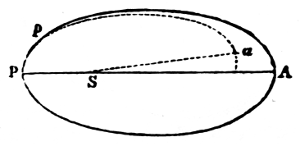
The mean distance of a planet from the sun is equal to half
the major axis (N. 42) of its orbit: if, therefore, the planet described
a circle (N. 43) round the sun at its mean distance, the
motion would be uniform, and the periodic time unaltered, because
the planet would arrive at the extremities of the major
axis at the same instant, and would have the same velocity,
whether it moved in the circular or elliptical orbit, since the
curves coincide in these points. But in every other part the
elliptical, or true motion (N. 44), would either be faster or
9slower than the circular or mean motion (N. 45). As it is necessary
to have some fixed point in the heavens from whence to
estimate these motions, the vernal equinox (N. 46) at a given
epoch has been chosen. The equinoctial, which is a great circle
traced in the starry heavens by the imaginary extension of the
plane of the terrestrial equator, is intersected by the ecliptic, or
apparent path of the sun, in two points diametrically opposite to
one another, called the vernal and autumnal equinoxes. The
vernal equinox is the point through which the sun passes in
going from the southern to the northern hemisphere; and the
autumnal, that in which he crosses from the northern to the
southern. The mean or circular motion of a body, estimated
from the vernal equinox, is its mean longitude; and its elliptical,
or true motion, reckoned from that point, is its true longitude
(N. 47): both being estimated from west to east, the direction
in which the bodies move. The difference between the two is
called the equation of the centre (N. 48); which consequently
vanishes at the apsides (N. 49), or extremities of the major axis,
and is at its maximum ninety degrees (N. 50) distant from these
points, or in quadratures (N. 51), where it measures the excentricity
(N. 52) of the orbit; so that the place of the planet in
its elliptical orbit is obtained by adding or subtracting the equation
of the centre to or from its mean longitude.
The orbits of the principal planets have a very small obliquity
or inclination (N. 53) to the plane of the ecliptic in which the
earth moves; and, on that account, astronomers refer their motions
to this plane at a given epoch as a known and fixed position.
The angular distance of a planet from the plane of the ecliptic is
its latitude (N. 54), which is south or north according as the
planet is south or north of that plane. When the planet is in
the plane of the ecliptic, its latitude is zero; it is then said to be
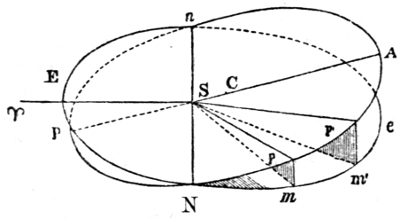
in its nodes (N. 55). The ascending node is that point in the
ecliptic through which the planet passes in going from the
southern to the northern hemisphere. The descending node is
a corresponding point in the plane of the ecliptic diametrically
opposite to the other, through which the planet descends in going
from the northern to the southern hemisphere. The longitude
and latitude of a planet cannot be obtained by direct observation,
but are deduced from observations made at the surface of the
10earth by a very simple computation. These two quantities,
however, will not give the place of a planet in space. Its distance
from the sun (N. 56) must also be known; and, for the
complete determination of its elliptical motion, the nature and
position of its orbit must be ascertained by observation. This
depends upon seven quantities, called the elements of the orbit
(N. 57). These are, the length of the major axis, and the excentricity,
which determine the form of the orbit; the longitude
of the planet when at its least distance from the sun, called the
longitude of the perihelion; the inclination of the orbit to the
plane of the ecliptic, and the longitude of its ascending node:
these give the position of the orbit in space; but the periodic
time, and the longitude of the planet at a given instant, called
the longitude of the epoch, are necessary for finding the place of
the body in its orbit at all times. A perfect knowledge of these
seven elements is requisite for ascertaining all the circumstances
of undisturbed elliptical motion. By such means it is found
that the paths of the planets, when their mutual disturbances are
omitted, are ellipses nearly approaching to circles, whose planes,
slightly inclined to the ecliptic, cut it in straight lines, passing
through the centre of the sun (N. 58). The orbits of the
recently-discovered planets deviate more from the ecliptic than
those of the ancient planets: that of Pallas, for instance, has an
inclination of 34° 42ʹ 29·8ʺ to it; on which account it is more
difficult to determine their motions.
Were the planets attracted by the sun only, they would always
move in ellipses, invariable in form and position; and because
his action is proportional to his mass, which is much larger than
that of all the planets put together, the elliptical is the nearest
approximation to their true motions. The true motions of the
planets are extremely complicated, in consequence of their mutual
attraction, so that they do not move in any known or symmetrical
curve, but in paths now approaching to, now receding from,
the elliptical form; and their radii vectores do not describe areas
or spaces exactly proportional to the time, so that the areas become
a test of disturbing forces.
To determine the motion of each body, when disturbed by all
the rest, is beyond the power of analysis. It is therefore necessary
to estimate the disturbing action of one planet at a time,
11whence the celebrated problem of the three bodies, originally
applied to the moon, the earth, and the sun—namely, the masses
being given of three bodies projected from three given points,
with velocities given both in quantity and direction; and supposing
the bodies to gravitate to one another with forces that are
directly as their masses, and inversely as the squares of the distances,
to find the lines described by these bodies, and their
positions at any given instant; or, in other words, to determine
the path of a celestial body when attracted by a second body,
and disturbed in its motion round the second body by a third—a
problem equally applicable to planets, satellites, and comets.
By this problem the motions of translation of the celestial
bodies are determined. It is an extremely difficult one, and
would be infinitely more so if the disturbing action were not very
small when compared with the central force; that is, if the
action of the planets on one another were not very small when
compared with that of the sun. As the disturbing influence of
each body may be found separately, it is assumed that the action
of the whole system, in disturbing any one planet, is equal to
the sum of all the particular disturbances it experiences, on the
general mechanical principle, that the sum of any number of
small oscillations is nearly equal to their simultaneous and joint
effect.
On account of the reciprocal action of matter, the stability of
the system depends upon the intensity of the primitive momentum
(N. 59) of the planets, and the ratio of their masses to
that of the sun; for the nature of the conic sections in which the
celestial bodies move depends upon the velocity with which they
were first propelled in space. Had that velocity been such as to
make the planets move in orbits of unstable equilibrium (N. 60),
their mutual attractions might have changed them into parabolas,
or even hyperbolas (N. 22); so that the earth and planets might,
ages ago, have been sweeping far from our sun through the
abyss of space. But as the orbits differ very little from circles,
the momentum of the planets, when projected, must have been
exactly sufficient to ensure the permanency and stability of the
system. Besides, the mass of the sun is vastly greater than that of
any planet; and as their inequalities bear the same ratio to their
elliptical motions that their masses do to that of the sun, their
12mutual disturbances only increase or diminish the excentricities
of their orbits by very minute quantities; consequently the
magnitude of the sun’s mass is the principal cause of the stability
of the system. There is not in the physical world a more
splendid example of the adaptation of means to the accomplishment
of an end than is exhibited in the nice adjustment of these
forces, at once the cause of the variety and of the order of
Nature.
SECTION III.
13
Perturbations, Periodic and Secular—Disturbing Action equivalent to
three Partial Forces—Tangential Force the cause of the Periodic Inequalities
in Longitude, and Secular Inequalities in the Form and Position
of the Orbit in its own Plane—Radial Force the cause of Variations in
the Planet’s Distance from the Sun—It combines with the Tangential
Force to produce the Secular Variations in the Form and Position of the
Orbit in its own Plane—Perpendicular Force the cause of Periodic
Perturbations in Latitude, and Secular Variations in the Position of the
Orbit with regard to the Plane of the Ecliptic—Mean Motion and
Major Axis Invariable—Stability of System—Effects of a Resisting
Medium—Invariable Plane of the Solar System and of the Universe—Great
Inequality of Jupiter and Saturn.
The planets are subject to disturbances of two kinds, both
resulting from the constant operation of their reciprocal attraction:
one kind, depending upon their positions with regard to
each other, begins from zero, increases to a maximum, decreases,
and becomes zero again, when the planets return to the same
relative positions. In consequence of these, the disturbed planet
is sometimes drawn away from the sun, sometimes brought
nearer to him: sometimes it is accelerated in its motion, and
sometimes retarded. At one time it is drawn above the plane
of its orbit, at another time below it, according to the position
of the disturbing body. All such changes, being accomplished
in short periods, some in a few months, others in years, or in
hundreds of years, are denominated periodic inequalities. The
inequalities of the other kind, though occasioned likewise by the
disturbing energy of the planets, are entirely independent of
their relative positions. They depend upon the relative positions
of the orbits alone, whose forms and places in space are
altered by very minute quantities, in immense periods of time,
and are therefore called secular inequalities.
The periodical perturbations are compensated when the bodies
return to the same relative positions with regard to one another
and to the sun: the secular inequalities are compensated when
14the orbits return to the same positions relatively to one another
and to the plane of the ecliptic.
Planetary motion, including both these kinds of disturbance,
may be represented by a body revolving in an ellipse, and making
small and transient deviations, now on one side of its path, and
now on the other, whilst the ellipse itself is slowly, but perpetually,
changing both in form and position.
The periodic inequalities are merely transient deviations of a
planet from its path, the most remarkable of which only lasts
about 918 years; but, in consequence of the secular disturbances,
the apsides, or extremities of the major axes of all the orbits,
have a direct but variable motion in space, excepting those of
the orbit of Venus, which are retrograde (N. 61), and the lines
of the nodes move with a variable velocity in a contrary direction.
Besides these, the inclination and excentricity of every orbit are
in a state of perpetual but slow change. These effects result
from the disturbing action of all the planets on each. But, as
it is only necessary to estimate the disturbing influence of one
body at a time, what follows may convey some idea of the
manner in which one planet disturbs the elliptical motion of
another.
Suppose two planets moving in ellipses round the sun; if one
of them attracted the other and the sun with equal intensity,
and in parallel directions (N. 62), it would have no effect in
disturbing the elliptical motion. The inequality of this attraction
is the sole cause of perturbation, and the difference between
the disturbing planet’s action on the sun and on the disturbed
planet constitutes the disturbing force, which consequently varies
in intensity and direction with every change in the relative positions
of the three bodies. Although both the sun and planet
are under the influence of the disturbing force, the motion of the
disturbed planet is referred to the centre of the sun as a fixed
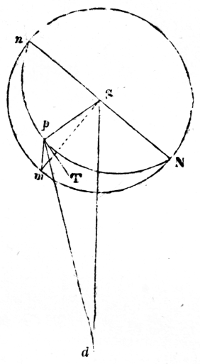
point, for convenience. The whole force (N. 63) which disturbs
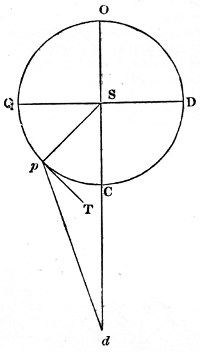
a planet is equivalent to three partial forces. One of these acts
on the disturbed planet, in the direction of a tangent to its orbit,
and is called the tangential force: it occasions secular inequalities
in the form and position of the orbit in its own plane, and is
the sole cause of the periodical perturbations in the planet’s
longitude. Another acts upon the same body in the direction
of its radius vector, that is, in the line joining the centres of
15the sun and planet, and is called the radial force: it produces
periodical changes in the distance of the planet from the sun,
and affects the form and position of the orbit in its own plane.
The third, which may be called the perpendicular force, acts at
right angles to the plane of the orbit, occasions the periodic
inequalities in the planet’s latitude, and affects the position of
the orbit with regard to the plane of the ecliptic.
It has been observed, that the radius vector of a planet,
moving in a perfectly elliptical orbit, passes over equal spaces
or areas in equal times; a circumstance which is independent of
the law of the force, and would be the same whether it varied
inversely as the square of the distance, or not, provided only
that it be directed to the centre of the sun. Hence the tangential
force, not being directed to the centre, occasions an unequable
description of areas, or, what is the same thing, it disturbs the
motion of the planet in longitude. The tangential force sometimes
accelerates the planet’s motion, sometimes retards it, and
occasionally has no effect at all. Were the orbits of both planets
circular, a complete compensation would take place at each revolution
of the two planets, because the arcs in which the accelerations
and retardations take place would be symmetrical on each
side of the disturbing force. For it is clear, that if the motion
be accelerated through a certain space, and then retarded through
as much, the motion at the end of the time will be the same as
if no change had taken place. But, as the orbits of the planets
are ellipses, this symmetry does not hold: for, as the planet
moves unequably in its orbit, it is in some positions more
directly, and for a longer time, under the influence of the disturbing
force than in others. And, although multitudes of
variations do compensate each other in short periods, there are
others, depending on peculiar relations among the periodic times
of the planets, which do not compensate each other till after one,
or even till after many revolutions of both bodies. A periodical
inequality of this kind in the motions of Jupiter and Saturn has
a period of no less than 918 years.
The radial force, or that part of the disturbing force which
acts in the direction of the line joining the centres of the sun
and disturbed planet, has no effect on the areas, but is the cause
of periodical changes of small extent in the distance of the planet
from the sun. It has already been shown, that the force producing
16perfectly elliptical motion varies inversely as the square
of the distance, and that a force following any other law would
cause the body to move in a curve of a very different kind.
Now, the radial disturbing force varies directly as the distance;
and, as it sometimes combines with and increases the intensity
of the sun’s attraction for the disturbed body, and at other times
opposes and consequently diminishes it, in both cases it causes
the sun’s attraction to deviate from the exact law of gravity,
and the whole action of this compound central force on the disturbed
body is either greater or less than what is requisite for
perfectly elliptical motion. When greater, the curvature of the
disturbed planet’s path, on leaving its perihelion (N. 64), or
point nearest the sun, is greater than it would be in the ellipse,
which brings the planet to its aphelion (N. 65), or point farthest
from the sun, before it has passed through 180°, as it would do
if undisturbed. So that in this case the apsides, or extremities
of the major axis, advance in space. When the central force is
less than the law of gravity requires, the curvature of the
planet’s path is less than the curvature of the ellipse. So that
the planet, on leaving its perihelion, would pass through more
than 180° before arriving at its aphelion, which causes the apsides
to recede in space (N. 66). Cases both of advance and recess
occur during a revolution of the two planets; but those in which
the apsides advance preponderate. This, however, is not the
full amount of the motion of the apsides; part arises also from
the tangential force (N. 63), which alternately accelerates and
retards the velocity of the disturbed planet. An increase in the
planet’s tangential velocity diminishes the curvature of its orbit,
and is equivalent to a decrease of central force. On the contrary,
a decrease of the tangential velocity, which increases the curvature
of the orbit, is equivalent to an increase of central force.
These fluctuations, owing to the tangential force, occasion an
alternate recess and advance of the apsides, after the manner
already explained (N. 66). An uncompensated portion of the
direct motion, arising from this cause, conspires with that already
impressed by the radial force, and in some cases even nearly
doubles the direct motion of these points. The motion of the
apsides may be represented by supposing a planet to move in
an ellipse, while the ellipse itself is slowly revolving about the
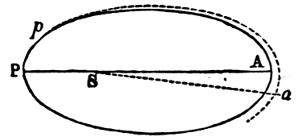
sun in the same plane (N. 67). This motion of the major axis,
17which is direct in all the orbits except that of the planet Venus,
is irregular, and so slow that it requires more than 109,830
years for the major axis of the earth’s orbit to accomplish a
sidereal revolution (N. 68), that is, to return to the same stars;
and 20,984 years to complete its tropical revolution (N. 69), or
to return to the same equinox. The difference between these
two periods arises from a retrograde motion in the equinoctial
point, which meets the advancing axis before it has completed
its revolution with regard to the stars. The major axis of
Jupiter’s orbit requires no less than 200,610 years to perform its
sidereal revolution, and 22,748 years to accomplish its tropical
revolution from the disturbing action of Saturn alone.
A variation in the excentricity of the disturbed planet’s orbit
is an immediate consequence of the deviation from elliptical
curvature, caused by the action of the disturbing force. When
the path of the body, in proceeding from its perihelion to its
aphelion, is more curved than it ought to be from the effect of
the disturbing forces, it falls within the elliptical orbit, the
excentricity is diminished, and the orbit becomes more nearly
circular; when that curvature is less than it ought to be, the
path of the planet falls without its elliptical orbit (N. 66), and
the excentricity is increased; during these changes, the length of
the major axis is not altered, the orbit only bulges out, or
becomes more flat (N. 70). Thus the variation in the excentricity
arises from the same cause that occasions the motion of
the apsides (N. 67). There is an inseparable connection between
these two elements: they vary simultaneously, and have the
same period; so that, whilst the major axis revolves in an immense
period of time, the excentricity increases and decreases by
very small quantities, and at length returns to its original magnitude
at each revolution of the apsides. The terrestrial excentricity
is decreasing at the rate of about 40 miles annually; and,
if it were to decrease equably, it would be 39,861 years before
the earth’s orbit became a circle. The mutual action of Jupiter
and Saturn occasions variations in the excentricity of both orbits,
the greatest excentricity of Jupiter’s orbit corresponding to the
least of Saturn’s. The period in which these vicissitudes are
accomplished is 70,414 years, estimating the action of these two
planets alone; but, if the action of all the planets were estimated,
the cycle would extend to millions of years.
18That part of the disturbing force is now to be considered which
acts perpendicularly to the plane of the orbit, causing periodic
perturbations in latitude, secular variations in the inclination of
the orbit, and a retrograde motion to its nodes on the true plane
of the ecliptic (N. 71). This force tends to pull the disturbed
body above, or push (N. 72) it below, the plane of its orbit,
according to the relative positions of the two planets with regard
to the sun, considered to be fixed. By this action, it sometimes
makes the plane of the orbit of the disturbed body tend to coincide
with the plane of the ecliptic, and sometimes increases its
inclination to that plane. In consequence of which, its nodes
alternately recede or advance on the ecliptic (N. 73). When
the disturbing planet is in the line of the disturbed planet’s nodes
(N. 74), it neither affects these points, the latitude, nor the
inclination, because both planets are then in the same plane.
When it is at right angles to the line of the nodes, and the orbit
symmetrical on each side of the disturbing force, the average
motion of these points, after a revolution of the disturbed body,
is retrograde, and comparatively rapid: but, when the disturbing
planet is so situated that the orbit of the disturbed planet is not
symmetrical on each side of the disturbing force, which is most
frequently the case, every possible variety of action takes place.
Consequently, the nodes are perpetually advancing or receding
with unequal velocity; but, as a compensation is not effected,
their motion is, on the whole, retrograde.
With regard to the variations in the inclination, it is clear,
that, when the orbit is symmetrical on each side of the disturbing
force, all its variations are compensated after a revolution
of the disturbed body, and are merely periodical perturbations
in the planet’s latitude; and no secular change is induced
in the inclination of the orbit. When, on the contrary, that
orbit is not symmetrical on each side of the disturbing force,
although many of the variations in latitude are transient or
periodical, still, after a complete revolution of the disturbed
body, a portion remains uncompensated, which forms a secular
change in the inclination of the orbit to the plane of the ecliptic.
It is true, part of this secular change in the inclination is compensated
by the revolution of the disturbing body, whose motion
has not hitherto been taken into the account, so that perturbation
compensates perturbation; but still a comparatively permanent
19change is effected in the inclination, which is not compensated
till the nodes have accomplished a complete revolution.
The changes in the inclination are extremely minute (N. 75),
compared with the motion of the nodes, and there is the same
kind of inseparable connection between their secular changes
that there is between the variation of the excentricity and the
motion of the major axis. The nodes and inclinations vary
simultaneously; their periods are the same, and very great. The
nodes of Jupiter’s orbit, from the action of Saturn alone, require
36,261 years to accomplish even a tropical revolution. In what
precedes, the influence of only one disturbing body has been
considered; but, when the action and reaction of the whole
system are taken into account, every planet is acted upon, and
does itself act, in this manner, on all the others; and the joint
effect keeps the inclinations and excentricities in a state of perpetual
variation. It makes the major axes of all the orbits continually
revolve, and causes, on an average, a retrograde motion
of the nodes of each orbit upon every other. The ecliptic (N. 71)
itself is in motion from the mutual action of the earth and
planets, so that the whole is a compound phenomenon of great
complexity, extending through unknown ages. At the present
time the inclinations of all the orbits are decreasing, but so
slowly, that the inclination of Jupiter’s orbit is only about six
minutes less than it was in the age of Ptolemy.
But, in the midst of all these vicissitudes, the length of the
major axes and the mean motions of the planets remain permanently
independent of secular changes. They are so connected
by Kepler’s law, of the squares of the periodic times being proportional
to the cubes of the mean distances of the planets from
the sun, that one cannot vary without affecting the other. And
it is proved, that any variations which do take place are transient,
and depend only on the relative positions of the bodies.
It is true that, according to theory, the radial disturbing force
should permanently alter the dimensions of all the orbits, and
the periodic times of all the planets, to a certain degree. For
example, the masses of all the planets revolving within the orbit
of any one, such as Mars, by adding to the interior mass, increase
the attracting force of the sun, which, therefore, must contract
the dimensions of the orbit of that planet, and diminish its
periodic time; whilst the planets exterior to Mars’s orbit must
20have the contrary effect. But the mass of the whole of the
planets and satellites taken together is so small, when compared
with that of the sun, that these effects are quite insensible, and
could only have been discovered by theory. And, as it is certain
that the length of the major axes and the mean motions are
not permanently changed by any other power whatever, it may
be concluded that they are invariable.
With the exception of these two elements, it appears that all
the bodies are in motion, and every orbit in a state of perpetual
change. Minute as these changes are, they might be supposed
to accumulate in the course of ages, sufficiently to derange the
whole order of nature, to alter the relative positions of the planets,
to put an end to the vicissitudes of the seasons, and to bring
about collisions which would involve our whole system, now so
harmonious, in chaotic confusion. It is natural to inquire, what
proof exists that nature will be preserved from such a catastrophe?
Nothing can be known from observation, since the existence of
the human race has occupied comparatively but a point in duration,
while these vicissitudes embrace myriads of ages. The
proof is simple and conclusive. All the variations of the solar
system, secular as well as periodic, are expressed analytically by
the sines and cosines of circular arcs (N. 76), which increase
with the time; and, as a sine or cosine can never exceed the
radius, but must oscillate between zero and unity, however much
the time may increase, it follows that when the variations have
accumulated to a maximum by slow changes, in however long a
time, they decrease, by the same slow degrees, till they arrive at
their smallest value, again to begin a new course; thus for ever
oscillating about a mean value. This circumstance, however,
would be insufficient, were it not for the small excentricities of
the planetary orbits, their minute inclinations to the plane of the
ecliptic, and the revolutions of all the bodies, as well planets as
satellites, in the same direction. These secure the perpetual
stability of the solar system (N. 77). However, at the time
that the stability was proved by La Grange and La Place, the
telescopic planets between Mars and Jupiter had not been discovered;
but La Grange, having investigated the subject under a
very general point of view, showed that, if a planetary system be
composed of very unequal masses, the whole of the larger would
maintain an unalterable stability with regard to the form and
21position of their orbits, while the orbits of the lesser might
undergo unlimited changes. M. Le Verrier has applied this to the
solar system, and has found that the orbits of all the larger
planets will for ever maintain an unalterable stability in form
and position; for, though liable to mutations of very long periods,
they return again exactly to what they originally were, oscillating
between very narrow limits; but he found a zone of instability
between the orbit of Mars, and twice the mean distance of the
earth from the sun,[1] or between 1·5 and 2·00; therefore the position
and form of the orbits of such of the telescopic planets as
revolve within that zone will be subject to unlimited variations.
But the orbits of those more remote from the sun than Flora, or
beyond 2·20, will be stable, so that their excentricities and inclinations
must always have been, and will always remain, very
great, since they must have depended upon the primitive conditions
that prevailed when these planetary atoms were launched
into space. The 51st of these small bodies, which was discovered,
and the elements of its orbit determined, by M. Valz, at Nimes,
has a mean distance of 1·88; so it revolves within the zone
of instability. It has a shorter periodic time than any of
those previously discovered, and a greater excentricity, with the
exception of Nysa. Its orbit cuts that of Mars, and comes
nearer to the earth than the orbits of either Mars or Venus,
a circumstance which would be favourable for correcting
the parallax of the sun, or confirming its accuracy. The
telescopic planets, numerous as they are, have no influence
on the motions of the larger planets, for Jupiter has a diameter
of 90,734 miles, while that of Pallas, his nearest neighbour, is
only 97 miles, little more than the distance from London to
Bath. The diameter of Mars, on the other side of the small
planets, is 4546 miles, and that of the earth
79251⁄2
miles, so that
the telescopic group are too minute to disturb the others. M.
Le Verrier found another zone of instability between Venus and
the sun, on the border of which Mercury is revolving, the inclination
of whose orbit to the plane of the ecliptic is about 7°, which
is more than that of any of the large planets. Neptune’s
22orbit is, no doubt, as stable as that of any other of the
large planets, as the inclination is very small, but he will
have periodical variations of very long duration from the reciprocal
attraction between him and Uranus, one especially of
an enormous duration, similar to those of Jupiter and Saturn,
and, like them, depending on the time of his revolution round the
sun, being nearly twice as long as that of Saturn. Mr. Adams
has computed that Neptune produces a periodical perturbation
in the motion of Uranus, whose duration is about 6800 years.
The equilibrium of the system, however, would be deranged
if the planets moved in a resisting medium (N. 78) sufficiently
dense to diminish their tangential velocity, for then both the
excentricities and the major axes of the orbits would vary with
the time, so that the stability of the system would be ultimately
destroyed. The existence of an ethereal medium is now proved;
and, although it is so extremely rare that hitherto its effects on
the motions of the planets have been altogether insensible, there
can be no doubt that, in the immensity of time, it will modify
the forms of the planetary orbits, and may at last even cause the
destruction of our system, which in itself contains no principle
of decay, unless a rotatory motion from west to east has been
given to this medium by the bodies of the solar system, which
have all been revolving about the sun in that direction for unknown
ages. This rotation, which seems to be highly probable,
may even have been coeval with its creation. Such a vortex
would have no effect on bodies moving with it, but it would
influence the motions of those revolving in a contrary direction.
It is possible that the disturbances experienced by comets, which
have already revealed the existence of this medium, may also, in
time, disclose its rotatory motion.
The form and position of the planetary orbits, and the motion
of the bodies in the same direction, together with the periodicity
of the terms in which the inequalities are expressed, assure us
that the variations of the system are confined within very
narrow limits, and that, although we do not know the extent of
the limits, nor the period of that grand cycle which probably
embraces millions of years, yet they never will exceed what is
requisite for the stability and harmony of the whole; for the
preservation of which every circumstance is so beautifully and
wonderfully adapted.
23The plane of the ecliptic itself, though assumed to be fixed at
a given epoch for the convenience of astronomical computation, is
subject to a minute secular variation of 45ʺ·7, occasioned by the
reciprocal action of the planets. But, as this is also periodical,
and cannot exceed 2° 42ʹ, the terrestrial equator, which is inclined
to it at an angle[2] of 23° 27ʹ 28ʺ·29, will never coincide with the
plane of the ecliptic: so there never can be perpetual spring
(N. 79). The rotation of the earth is uniform; therefore day
and night, summer and winter, will continue their vicissitudes
while the system endures, or is undisturbed by foreign causes.
Yonder starry sphere
Of planets and of fix’d, in all her wheels,
Resembles nearest mazes intricate,
Eccentric, intervolved, yet regular,
Then most, when most irregular they seem.
The stability of our system was established by La Grange:
“a discovery,” says Professor Playfair, “that must render the
name for ever memorable in science, and revered by those who
delight in the contemplation of whatever is excellent and sublime.”
After Newton’s discovery of the mechanical laws of the
elliptical orbits of the planets, that of their periodical inequalities,
by La Grange, is, without doubt, the noblest truth in the
mechanism of the heavens; and, in respect of the doctrine of
final causes, it may be regarded as the greatest of all.
Notwithstanding the permanency of our system, the secular
variations in the planetary orbits would have been extremely
embarrassing to astronomers when it became necessary to compare
observations separated by long periods. The difficulty was
in part obviated, and the principle for accomplishing it established,
by La Place, and has since been extended by M. Poinsot.
It appears that there exists an invariable plane (N. 80), passing
through the centre of gravity of the system, about which the
whole oscillates within very narrow limits, and that this plane
will always remain parallel to itself, whatever changes time may
induce in the orbits of the planets, in the plane of the ecliptic,
or even in the law of gravitation; provided only that our system
remains unconnected with any other. The position of the plane
is determined by this property—that, if each particle in the
system be multiplied by the area described upon this plane in a
24given time, by the projection of its radius vector about the
common centre of gravity of the whole, the sum of all these products
will be a maximum (N. 81). La Place found that the
plane in question is inclined to the ecliptic at an angle of nearly
1° 34ʹ 15ʺ, and that, in passing through the sun, and about
midway between the orbits of Jupiter and Saturn, it may be
regarded as the equator of the solar system, dividing it into two
parts, which balance one another in all their motions. This
plane of greatest inertia, by no means peculiar to the solar system,
but existing in every system of bodies submitted to their
mutual attractions only, always maintains a fixed position,
whence the oscillations of the system may be estimated through
unlimited time. Future astronomers will know, from its immutability
or variation, whether the sun and his attendants are
connected or not with the other systems of the universe. Should
there be no link between them, it may be inferred, from the
rotation of the sun, that the centre of gravity (N. 82) of the
system situate within his mass describes a straight line in this
invariable plane or great equator of the solar system, which,
unaffected by the changes of time, will maintain its stability
through endless ages. But, if the fixed stars, comets, or any
unknown and unseen bodies, affect our sun and planets, the
nodes of this plane will slowly recede on the plane of that immense
orbit which the sun may describe about some most distant
centre, in a period which it transcends the power of man to determine.
There is every reason to believe that this is the case;
for it is more than probable that, remote as the fixed stars are,
they in some degree influence our system, and that even the
invariability of this plane is relative, only appearing fixed to
creatures incapable of estimating its minute and slow changes
during the small extent of time and space granted to the human
race. “The development of such changes,” as M. Poinsot justly
observes, “is similar to an enormous curve, of which we see so
small an arc that we imagine it to be a straight line.” If we
raise our views to the whole extent of the universe, and consider
the stars, together with the sun, to be wandering bodies, revolving
about the common centre of creation, we may then recognise
in the equatorial plane passing through the centre of gravity of
the universe the only instance of absolute and eternal repose.
All the periodic and secular inequalities deduced from the law
25of gravitation are so perfectly confirmed by observation, that
analysis has become one of the most certain means of discovering
the planetary irregularities, either when they are too small, or
too long in their periods, to be detected by other methods.
Jupiter and Saturn, however, exhibit inequalities which for a
long time seemed discordant with that law. All observations,
from those of the Chinese and Arabs down to the present day,
prove that for ages the mean motions of Jupiter and Saturn have
been affected by a great inequality of a very long period, forming
an apparent anomaly in the theory of the planets. It was long
known by observation that five times the mean motion of Saturn
is nearly equal to twice that of Jupiter; a relation which the
sagacity of La Place perceived to be the cause of a periodic
irregularity in the mean motion of each of these planets, which
completes its period in nearly 918 years, the one being retarded
while the other is accelerated; but both the magnitude and
period of these quantities vary, in consequence of the secular
variations in the elements of the orbits. Suppose the two planets
to be on the same side of the sun, and all three in the same
straight line, they are then said to be in conjunction (N. 83).
Now, if they begin to move at the same time, one making exactly
five revolutions in its orbit while the other only accomplishes
two, it is clear that Saturn, the slow-moving body, will only
have got through a part of its orbit during the time that Jupiter
has made one whole revolution and part of another, before they
be again in conjunction. It is found that during this time their
mutual action is such as to produce a great many perturbations
which compensate each other, but that there still remains a portion
outstanding, owing to the length of time during which the forces
act in the same manner; and, if the conjunction always happened
in the same point of the orbit, this uncompensated inequality in
the mean motion would go on increasing till the periodic times
and forms of the orbits were completely and permanently
changed: a case that would actually take place if Jupiter accomplished
exactly five revolutions in the time Saturn performed
two. These revolutions are, however, not exactly commensurable;
the points in which the conjunctions take place are in
advance each time as much as 8°·37; so that the conjunctions
do not happen exactly in the same points of the orbits till after
a period of 850 years; and, in consequence of this small advance,
26the planets are brought into such relative positions, that
the inequality, which seemed to threaten the stability of the
system, is completely compensated, and the bodies, having returned
to the same relative positions with regard to one another
and the sun, begin a new course. The secular variations in the
elements of the orbit increase the period of the inequality to 918
years (N. 84). As any perturbation which affects the mean
motion affects also the major axis, the disturbing forces tend to
diminish the major axis of Jupiter’s orbit, and increase that of
Saturn’s, during one half of the period, and the contrary during
the other half. This inequality is strictly periodical, since it
depends upon the configuration (N. 85) of the two planets; and
theory is confirmed by observation, which shows that, in the
course of twenty centuries, Jupiter’s mean motion has been
accelerated by about 3° 23ʹ, and Saturn’s retarded by 5° 13ʹ.
Several instances of perturbations of this kind occur in the solar
system. One, in the mean motions of the Earth and Venus,
only amounting to a few seconds, has been recently worked out
with immense labour by Professor Airy. It accomplishes its
changes in 240 years, and arises from the circumstance of thirteen
times the periodic time of Venus being nearly equal to eight
times that of the Earth. Small as it is, it is sensible in the
motions of the Earth.
It might be imagined that the reciprocal action of such planets
as have satellites would be different from the influence of those
that have none. But the distances of the satellites from their
primaries are incomparably less than the distances of the planets
from the sun, and from one another. So that the system of a
planet and its satellites moves nearly as if all these bodies were
united in their common centre of gravity. The action of the
sun, however, in some degree disturbs the motion of the satellites
about their primary.
SECTION IV.
27
Theory of Jupiter’s Satellites—Effects of the Figure of Jupiter upon his
Satellites—Position of their Orbits—Singular Laws among the Motions
of the first Three Satellites—Eclipses of the Satellites—Velocity of
Light—Aberration—Ethereal Medium—Satellites of Saturn and
Uranus.
The changes which take place in the planetary system are
exhibited on a smaller scale by Jupiter and his satellites; and,
as the period requisite for the development of the inequalities of
these moons only extends to a few centuries, it may be regarded
as an epitome of that grand cycle which will not be accomplished
by the planets in myriads of ages. The revolutions of the satellites
about Jupiter are precisely similar to those of the planets
about the sun; it is true they are disturbed by the sun, but his
distance is so great, that their motions are nearly the same as if
they were not under his influence. The satellites, like the
planets, were probably projected in elliptical orbits: but, as the
masses of the satellites are nearly 100,000 times less than that
of Jupiter; and as the compression of Jupiter’s spheroid is so
great, in consequence of his rapid rotation, that his equatorial
diameter exceeds his polar diameter by no less than 6000 miles;
the immense quantity of prominent matter at his equator must
soon have given the circular form observed in the orbits of the
first and second satellites, which its superior attraction will always
maintain. The third and fourth satellites, being farther removed
from its influence, revolve in orbits with a very small excentricity.
And, although the first two sensibly move in circles,
their orbits acquire a small ellipticity, from the disturbances they
experience (N. 86).
It has been stated, that the attraction of a sphere on an
exterior body is the same as if its mass were united in one particle
in its centre of gravity, and therefore inversely as the square
of the distance. In a spheroid, however, there is an additional
force arising from the bulging mass at its equator, which, not
following the exact law of gravity, acts as a disturbing force.
28One effect of this disturbing force in the spheroid of Jupiter is to
occasion a direct motion in the greater axes of the orbits of all
his satellites, which is more rapid the nearer the satellite is to
the planet, and very much greater than that part of their motion
which arises from the disturbing action of the sun. The same
cause occasions the orbits of the satellites to remain nearly in the
plane of Jupiter’s equator (N. 87), on account of which the
satellites are always seen nearly in the same line (N. 88); and
the powerful action of that quantity of prominent matter is the
reason why the motions of the nodes of these small bodies are so
much more rapid than those of the planet. The nodes of the
fourth satellite accomplish a tropical revolution in 531 years,
while those of Jupiter’s orbit require no less than 36,261 years;—a
proof of the reciprocal attraction between each particle of
Jupiter’s equator and of the satellites. In fact, if the satellites
moved exactly in the plane of Jupiter’s equator, they would not
be pulled out of that plane, because his attraction would be equal
on both sides of it. But, as their orbits have a small inclination
to the plane of the planet’s equator, there is a want of symmetry,
and the action of the protuberant matter tends to make the nodes
regress by pulling the satellites above or below the planes of
their orbits; an action which is so great on the interior satellites,
that the motions of their nodes are nearly the same as if no
other disturbing force existed.
The orbits of the satellites do not retain a permanent inclination,
either to the plane of Jupiter’s equator, or to that of his
orbit, but to certain planes passing between the two, and through
their intersection. These have a greater inclination to his
equator the farther the satellite is removed, owing to the influence
of Jupiter’s compression; and they have a slow motion
corresponding to secular variations in the planes of Jupiter’s
orbit and equator.
The satellites are not only subject to periodic and secular
inequalities from their mutual attraction, similar to those which
affect the motions and orbits of the planets, but also to others
peculiar to themselves. Of the periodic inequalities arising from
their mutual attraction the most remarkable take place in the
angular motions (N. 89) of the three nearest to Jupiter, the
second of which receives from the first a perturbation similar to
that which it produces in the third; and it experiences from the
29third a perturbation similar to that which it communicates to the
first. In the eclipses these two inequalities are combined into
one, whose period is 437·659 days. The variations peculiar to the
satellites arise from the secular inequalities occasioned by the
action of the planets in the form and position of Jupiter’s orbit,
and from the displacement of his equator. It is obvious that
whatever alters the relative positions of the sun, Jupiter, and his
satellites, must occasion a change in the directions and intensities
of the forces, which will affect the motions and orbits of the
satellites. For this reason the secular variations in the excentricity
of Jupiter’s orbit occasion secular inequalities in the mean
motions of the satellites, and in the motions of the nodes and
apsides of their orbits. The displacement of the orbit of Jupiter,
and the variation in the position of his equator, also affect these
small bodies (N. 90). The plane of Jupiter’s equator is inclined
to the plane of his orbit at an angle of 3° 5ʹ 30ʺ, so that the
action of the sun and of the satellites themselves produces a
nutation and precession (N. 91) in his equator, precisely similar
to that which takes place in the rotation of the earth, from the
action of the sun and moon. Hence the protuberant matter at
Jupiter’s equator is continually changing its position with regard
to the satellites, and produces corresponding mutations in their
motions. And, as the cause must be proportional to the effect,
these inequalities afford the means, not only of ascertaining the
compression of Jupiter’s spheroid, but they prove that his mass
is not homogeneous. Although the apparent diameters of the
satellites are too small to be measured, yet their perturbations
give the values of their masses with considerable accuracy—a
striking proof of the power of analysis.
A singular law obtains among the mean motions and mean
longitudes of the first three satellites. It appears from observation
that the mean motion of the first satellite, plus twice that
of the third, is equal to three times that of the second; and that
the mean longitude of the first satellite, minus three times that
of the second, plus twice that of the third, is always equal to two
right angles. It is proved by theory, that, if these relations had
only been approximate when the satellites were first launched
into space, their mutual attractions would have established and
maintained them, notwithstanding the secular inequalities to
which they are liable. They extend to the synodic motions
30(N. 92) of the satellites; consequently they affect their eclipses,
and have a very great influence on their whole theory. The
satellites move so nearly in the plane of Jupiter’s equator, which
has a very small inclination to his orbit, that the first three are
eclipsed at each revolution by the shadow of the planet, which
is much larger than the shadow of the moon: the fourth satellite
is not eclipsed so frequently as the others. The eclipses take
place close to the disc of Jupiter when he is near opposition
(N. 93); but at times his shadow is so projected with regard to
the earth, that the third and fourth satellites vanish and reappear
on the same side of the disc (N. 94). These eclipses are in all
respects similar to those of the moon: but, occasionally, the
satellites eclipse Jupiter, sometimes passing like obscure spots
across his surface, resembling annular eclipses of the sun, and
sometimes like a bright spot traversing one of his dark belts.
Before opposition, the shadow of the satellite, like a round black
spot, precedes its passage over the disc of the planet; and, after
opposition, the shadow follows the satellite.
In consequence of the relations already mentioned in the mean
motions and mean longitudes of the first three satellites, they
never can be all eclipsed at the same time: for, when the second
and third are in one direction, the first is in the opposite direction;
consequently, when the first is eclipsed, the other two must
be between the sun and Jupiter. The instant of the beginning
or end of an eclipse of a satellite marks the same instant of
absolute time to all the inhabitants of the earth; therefore, the
time of these eclipses observed by a traveller, when compared
with the time of the eclipse computed for Greenwich, or any
other fixed meridian (N. 95), gives the difference of the meridians
in time, and, consequently, the longitude of the place of
observation. The longitude is determined with extreme precision
whenever it is possible to convey the time instantaneously
by means of electricity from one place to another, since it
obviates the errors of clocks and chronometers. The eclipses of
Jupiter’s satellites have been the means of a discovery which,
though not so immediately applicable to the wants of man,
unfolds one of the properties of light—that medium without
whose cheering influence all the beauties of the creation would
have been to us a blank. It is observed, that those eclipses of
the first satellite which happen when Jupiter is near conjunction
31(N. 96), are later by 16ʹ 26ʺ·6 than those which take place when
the planet is in opposition. As Jupiter is nearer to us when in
opposition by the whole breadth of the earth’s orbit than when in
conjunction, this circumstance is to be attributed to the time employed
by the rays of light in crossing the earth’s orbit, a distance
of about 190,000,000 of miles; whence it is estimated that light
travels at the rate of 192,000 miles in one second. Such is its
velocity, that the earth, moving at the rate of nineteen miles in
a second, would take two months to pass through a distance
which a ray of light would dart over in eight minutes. The
subsequent discovery of the aberration of light has fully confirmed
this astonishing result.
Objects appear to be situate in the direction of the rays which
proceed from them. Were light propagated instantaneously,
every object, whether at rest or in motion, would appear in the
direction of these rays; but, as light takes some time to travel,
we see Jupiter in conjunction, by means of rays that left him
16m 26s·6 before; but, during that time, we have changed our
position, in consequence of the motion of the earth in its orbit:
we therefore refer Jupiter to a place in which he is not. His true
position is in the diagonal (N. 97) of the parallelogram, whose
sides are in the ratio of the velocity of light to the velocity of the
earth in its orbit, which is as 192,000 to 19, or nearly as 10,000
to 1. In consequence of the aberration of light, the heavenly
bodies seem to be in places in which they are not. In fact, if
the earth were at rest, rays from a star would pass along the axis
of a telescope directed to it; but, if the earth were to begin to
move in its orbit with its usual velocity, these rays would strike
against the side of the tube; it would, therefore, be necessary to
incline the telescope a little, in order to see the star. The angle
contained between the axis of the telescope and a line drawn to
the true place of the star is its aberration, which varies in
quantity and direction in different parts of the earth’s orbit; but,
as it is only 20ʺ·481, it is insensible in ordinary cases (N. 98).
The velocity of light deduced from the observed aberration of
the fixed stars perfectly corresponds with that given by the
eclipses of the first satellite. The same result, obtained from
sources so different, leaves not a doubt of its truth. Many such
beautiful coincidences, derived from circumstances apparently
the most unpromising and dissimilar, occur in physical astronomy,
32and prove connections which we might otherwise be unable to
trace. The identity of the velocity of light, at the distance of
Jupiter, and on the earth’s surface, shows that its velocity is
uniform; and as light consists in the vibrations of an elastic
medium or ether filling space, the uniformity of its velocity
shows that the density of the medium throughout the whole
extent of the solar system must be proportional to its elasticity
(N. 99). Among the fortunate conjectures which have been
confirmed by subsequent experience, that of Bacon is not the
least remarkable, “It produces in me,” says the restorer of true
philosophy, “a doubt whether the face of the serene and starry
heavens be seen at the instant it really exists, or not till some
time later: and whether there be not, with respect to the
heavenly bodies, a true time and an apparent time, no less than
a true place and an apparent place, as astronomers say, on
account of parallax. For it seems incredible that the species or
rays of the celestial bodies can pass through the immense interval
between them and us in an instant, or that they do not even
require some considerable portion of time.”
Great discoveries generally lead to a variety of conclusions:
the aberration of light affords a direct proof of the motion of the
earth in its orbit; and its rotation is proved by the theory of
falling bodies, since the centrifugal force it induces retards the
oscillations of the pendulum (N. 100) in going from the pole to
the equator. Thus a high degree of scientific knowledge has
been requisite to dispel the errors of the senses (N. 237).
The little that is known of the theories of the satellites of
Saturn and Uranus is, in all respects, similar to that of Jupiter.
Saturn is accompanied by eight satellites. The seventh is about
the size of Mars, and the eighth was simultaneously discovered
by Mr. Bond in America, and that distinguished astronomer Mr.
Lassell, of Liverpool. The orbits of the two last have a sensible
inclination to the plane of the ring; but the great compression
of Saturn occasions the other satellites to move nearly in the
plane of his equator. So many circumstances must concur to
render the two interior satellites visible, that they have very
rarely been seen. They move exactly at the edge of the ring,
and their orbits never deviate from its plane. In 1789 Sir
William Herschel saw them like beads, threading the slender
line of light which the ring is reduced to when seen edgewise
33from the earth. And for a short time he perceived them advancing
off it at each end, when turning round in their orbits. The
eclipses of the exterior satellites only take place when the ring is
in this position. Mr. Lassell, with a powerful telescope, made
by himself, has seen Iapetus, the nearest of the two, on several
occasions, even when the opening of the ring was very wide,
which made it extremely difficult to see so minute an object. Of
the situation of the equator of Uranus we know nothing, nor of
his compression; but the orbits of his satellites are nearly perpendicular
to the plane of the ecliptic; and, by analogy, they
ought to be in the plane of his equator. Uranus is so remote
that he has more the appearance of a planetary nebula than a
planet, which renders it extremely difficult to distinguish the
satellites at all; and quite hopeless without such a telescope as
is rarely to be met with even in observatories. Sir William
Herschel discovered the two that are farthest from the planet,
and ascertained their approximate periods, which his son afterwards
determined to be 13d 11h 7m 12s·6 and 8d 16h 56m 28s·6
respectively. The orbits of both seem to have an inclination of
about 101°·2 to the plane of the ecliptic. The two interior
satellites are so faint and small, and so near the edge of the
planet, that they can with difficulty be seen even under the most
favourable circumstances: however, Mr. Lassell has ascertained
that the more distant of the two revolves about Uranus in 4 days,
and that nearest to the planet in
21⁄2
days, and from a long and
minute examination he is convinced that the system only consists
of four satellites. Soon after Neptune was seen Mr. Lassell
discovered the only satellite known to belong to that planet.
The satellites of Uranus and Neptune, the two planets on the
remotest verge of the solar system, offer the singular and only
instance of a revolution from east to west, while all the planets
and all the other satellites revolve from west to east. Retrograde
motion is occasionally met with in the comets and double stars.
SECTION V.
34
Lunar Theory—Periodic Perturbations of the Moon—Equation of Centre—Evection—Variation—Annual
Equation—Direct and Indirect
Action of Planets—The Moon’s Action on the Earth disturbs her own
Motion—Excentricity and Inclination of Lunar Orbit invariable—Acceleration—Secular
Variation in Nodes and Perigee—Motion
of Nodes and Perigee inseparably connected with the Acceleration—Nutation
of Lunar Orbit—Form and Internal Structure of the Earth
determined from it—Lunar, Solar, and Planetary Eclipses—Occultations
and Lunar Distances—Mean Distance of the Sun from the Earth
obtained from Lunar Theory—Absolute Distances of the Planets, how
found.
Our constant companion, the moon, next claims our attention.
Several circumstances concur to render her motions the most interesting,
and at the same time the most difficult to investigate,
of all the bodies of our system. In the solar system, planet
troubles planet; but, in the lunar theory, the sun is the great
disturbing cause, his vast distance being compensated by his
enormous magnitude, so that the motions of the moon are more
irregular than those of the planets; and, on account of the great
ellipticity of her orbit, and the size of the sun, the approximations
to her motions are tedious and difficult, beyond what those unaccustomed
to such investigations could imagine. The average
distance of the moon from the centre of the earth is only 238,793
miles, so that her motion among the stars is perceptible in a few
hours. She completes a circuit of the heavens in 27d 7h 43m 11s·5,
moving in an orbit whose excentricity is about 12,985 miles.
The moon is about four hundred times nearer to the earth than
the sun. The proximity of the moon to the earth keeps them
together. For so great is the attraction of the sun, that, if the
moon were farther from the earth, she would leave it altogether,
and would revolve as an independent planet about the sun.
The disturbing action (N. 101) of the sun on the moon is
equivalent to three forces. The first, acting in the direction of
the line joining the moon and earth, increases or diminishes her
gravity to the earth. The second, acting in the direction of a
35tangent to her orbit, disturbs her motion in longitude. And the
third, acting perpendicularly to the plane of her orbit, disturbs
her motion in latitude; that is, it brings her nearer to, or removes
her farther from, the plane of the ecliptic than she would otherwise
be. The periodic perturbations in the moon, arising from
these forces, are perfectly similar to the periodic perturbations of
the planets. But they are much greater and more numerous;
because the sun is so large, that many inequalities which are
quite insensible in the motions of the planets, are of great magnitude
in those of the moon. Among the innumerable periodic
inequalities to which the moon’s motion in longitude is liable,
the most remarkable are, the Equation of the Centre, which is the
difference between the moon’s mean and true longitude, the
Evection, the Variation, and the Annual Equation. The disturbing
force which acts in the line joining the moon and earth
produces the Evection: it diminishes the excentricity of the lunar
orbit in conjunction and opposition, thereby making it more
circular, and augments it in quadrature, which consequently
renders it more elliptical. The period of this inequality is less
than thirty-two days. Were the increase and diminution always
the same, the Evection would only depend upon the distance of
the moon from the sun; but its absolute value also varies with
her distance from the perigee (N. 102) of her orbit. Ancient
astronomers, who observed the moon solely with a view to the
prediction of eclipses, which can only happen in conjunction and
opposition, where the excentricity is diminished by the Evection,
assigned too small a value to the ellipticity of her orbit (N. 103).
The Evection was discovered by Ptolemy from observation, about
A.D. 140. The Variation produced by the tangential disturbing
force, which is at its maximum when the moon is 45° distant
from the sun, vanishes when that distance amounts to a quadrant,
and also when the moon is in conjunction and opposition; consequently,
that inequality never could have been discovered from
the eclipses: its period is half a lunar month (N. 104). The
Annual Equation depends upon the sun’s distance from the
earth: it arises from the moon’s motion being accelerated when
that of the earth is retarded, and vice versâ—for, when the earth
is in its perihelion, the lunar orbit is enlarged by the action of
the sun; therefore, the moon requires more time to perform
her revolution. But, as the earth approaches its aphelion, the
36moon’s orbit contracts, and less time is necessary to accomplish
her motion—its period, consequently, depends upon the time of
the year. In the eclipses the Annual Equation combines with the
Equation of the Centre of the terrestrial orbit, so that ancient
astronomers imagined the earth’s orbit to have a greater excentricity
than modern astronomers assign to it.
The planets disturb the motion of the moon both directly and
indirectly; their action on the earth alters its relative position
with regard to the sun and moon, and occasions inequalities in
the moon’s motion, which are more considerable than those
arising from their direct action; for the same reason the moon,
by disturbing the earth, indirectly disturbs her own motion.
Neither the excentricity of the lunar orbit, nor its mean inclination
to the plane of the ecliptic, have experienced any changes
from secular inequalities; for, although the mean action of the
sun on the moon depends upon the inclination of the lunar orbit
to the ecliptic, and the position of the ecliptic is subject to a
secular inequality, yet analysis shows that it does not occasion a
secular variation in the inclination of the lunar orbit, because the
action of the sun constantly brings the moon’s orbit to the same
inclination to the ecliptic. The mean motion, the nodes, and the
perigee, however, are subject to very remarkable variations.
From the eclipse observed at Babylon, on the 19th of March,
seven hundred and twenty-one years before the Christian era,
the place of the moon is known from that of the sun at the
instant of opposition (N. 83), whence her mean longitude may
be found. But the comparison of this mean longitude with
another mean longitude, computed back for the instant of the
eclipse from modern observations, shows that the moon performs
her revolution round the earth more rapidly and in a
shorter time now than she did formerly, and that the acceleration
in her mean motion has been increasing from age to age as
the square of the time (N. 105). All ancient and intermediate
eclipses confirm this result. As the mean motions of the planets
have no secular inequalities, this seemed to be an unaccountable
anomaly. It was at one time attributed to the resistance of an
ethereal medium pervading space, and at another to the successive
transmission of the gravitating force. But, as La Place
proved that neither of these causes, even if they exist, have any
influence on the motions of the lunar perigee (N. 102) or nodes,
37they could not affect the mean motion; a variation in the mean
motion from such causes being inseparably connected with variations
in the motions of the perigee and nodes. That great mathematician,
in studying the theory of Jupiter’s satellites, perceived
that the secular variation in the elements of Jupiter’s orbit, from
the action of the planets, occasions corresponding changes in the
motions of the satellites, which led him to suspect that the
acceleration in the mean motion of the moon might be connected
with the secular variation in the excentricity of the terrestrial
orbit. Analysis has shown that he assigned the true cause of the
acceleration.
It is proved that the greater the excentricity of the terrestrial
orbit, the greater is the disturbing action of the sun on the moon.
Now, as the excentricity has been decreasing for ages, the effect
of the sun in disturbing the moon has been diminishing during
that time. Consequently the attraction of the earth has had a
more and more powerful effect on the moon, and has been continually
diminishing the size of the lunar orbit. So that the
moon’s velocity has been gradually augmenting for many centuries
to balance the increase of the earth’s attraction. This
secular increase in the moon’s velocity is called the Acceleration,
a name peculiarly appropriate at present, and which will continue
to be so for a vast number of ages; because, as long as the earth’s
excentricity diminishes, the moon’s mean motion will be accelerated;
but when the excentricity has passed its minimum, and
begins to increase, the mean motion will be retarded from age to
age. The secular acceleration is now about 11ʺ·9, but its effect
on the moon’s place increases as the square of the time (N. 106).
It is remarkable that the action of the planets, thus reflected by
the sun to the moon, is much more sensible than their direct
action either on the earth or moon. The secular diminution in
the excentricity, which has not altered the equation of the centre
of the sun by eight minutes since the earliest recorded eclipses,
has produced a variation of about 1° 48ʹ in the moon’s longitude,
and of 7° 12ʹ in her mean anomaly (N. 107).
The action of the sun occasions a rapid but variable motion in
the nodes and perigee of the lunar orbit. Though the nodes
recede during the greater part of the moon’s revolution, and
advance during the smaller, they perform their sidereal revolution
in 6793d 9h 23m 9s·3, or about
186⁄10
years; and the
38perigee accomplishes a revolution, called of the moon’s apsides,
in 3232d 13h 48m 29s·6, or a little more than nine years, notwithstanding
its motion is sometimes retrograde and sometimes
direct: but such is the difference between the disturbing energy
of the sun and that of all the planets put together, that it
requires no less than 109,830 years for the greater axis of the
terrestrial orbit to do the same, moving at the rate of 11ʺ·8
annually. The form of the earth has no sensible effect either on
the lunar nodes or apsides. It is evident that the same secular
variation which changes the sun’s distance from the earth, and
occasions the acceleration in the moon’s mean motion, must affect
the nodes and perigee. It consequently appears, from theory as
well as observation, that both these elements are subject to a
secular inequality, arising from the variation in the excentricity
of the earth’s orbit, which connects them with the Acceleration,
so that both are retarded when the mean motion is anticipated.
The secular variations in these three elements are in the ratio of
the numbers 3, 0·735, and 1; whence the three motions of the
moon, with regard to the sun, to her perigee, and to her nodes,
are continually accelerated, and their secular equations are as the
numbers 1, 4·702, and 0·612. A comparison of ancient eclipses
observed by the Arabs, Greeks, and Chaldeans, imperfect as they
are, with modern observations, confirms these results of analysis.
Future ages will develop these great inequalities, which at some
most distant period will amount to many circumferences (N. 108).
They are, indeed, periodic; but who shall tell their period? Millions
of years must elapse before that great cycle is accomplished.
The moon is so near, that the excess of matter at the earth’s
equator occasions periodic variations in her longitude, and also
that remarkable inequality in her latitude, already mentioned as
a nutation in the lunar orbit, which diminishes its inclination to
the ecliptic when the moon’s ascending node coincides with the
equinox of spring, and augments it when that node coincides
with the equinox of autumn. As the cause must be proportional
to the effect, a comparison of these inequalities, computed from
theory, with the same given by observation, shows that the compression
of the terrestrial spheroid, or the ratio of the difference
between the polar and the equatorial diameters, to the diameter
of the equator, is
1⁄305·05.
It is proved analytically, that, if a fluid
mass of homogeneous matter, whose particles attract each other
39inversely as the squares of the distance, were to revolve about an
axis as the earth does, it would assume the form of a spheroid
whose compression is
1⁄230.
Since that is not the case, the earth
cannot be homogeneous, but must decrease in density from its
centre to its circumference. Thus the moon’s eclipses show the
earth to be round; and her inequalities not only determine the
form, but even the internal structure of our planet; results of
analysis which could not have been anticipated. Similar inequalities
in the motions of Jupiter’s satellites prove that his
mass is not homogeneous, and that his compression is
1⁄13·8.
His
equatorial diameter exceeds his polar diameter by about 6000 miles.
The phases (N. 109) of the moon, which vary from a slender
silvery crescent soon after conjunction, to a complete circular disc
of light in opposition, decrease by the same degrees till the moon
is again enveloped in the morning beams of the sun. These
changes regulate the returns of the eclipses. Those of the sun
can only happen in conjunction, when the moon, coming between
the earth and the sun, intercepts his light. Those of the moon
are occasioned by the earth intervening between the sun and
moon when in opposition. As the earth is opaque and nearly
spherical, it throws a conical shadow on the side of the moon
opposite to the sun, the axis of which passes through the centres
of the sun and earth (N. 110). The length of the shadow terminates
at the point where the apparent diameters (N. 111) of the
sun and earth would be the same. When the moon is in opposition,
and at her mean distance, the diameter of the sun would
be seen from her centre under an angle of 1918ʺ·1. That of the
earth would appear under an angle of 6908ʺ·3. So that the
length of the shadow is at least three times and a half greater
than the distance of the moon from the earth, and the breadth of
the shadow, where it is traversed by the moon, is about eight-thirds
of the lunar diameter. Hence the moon would be eclipsed
every time she is in opposition, were it not for the inclination of
her orbit to the plane of the ecliptic, in consequence of which the
moon, when in opposition, is either above or below the cone of
the earth’s shadow, except when in or near her nodes. Her position
with regard to them occasions all the varieties in the lunar
eclipses. Every point of the moon’s surface successively loses
the light of different parts of the sun’s disc before being eclipsed.
Her brightness therefore gradually diminishes before she plunges
40into the earth’s shadow. The breadth of the space occupied by
the penumbra (N. 112) is equal to the apparent diameter of the
sun, as seen from the centre of the moon. The mean duration
of a revolution of the sun, with regard to the node of the lunar
orbit, is to the duration of a synodic revolution (N. 113) of the
moon as 223 to 19. So that, after a period of 223 lunar months,
the sun and moon would return to the same relative position with
regard to the node of the moon’s orbit, and therefore the eclipses
would recur in the same order were not the periods altered by
irregularities in the motions of the sun and moon. In lunar
eclipses, our atmosphere bends the sun’s rays which pass through
it all round into the cone of the earth’s shadow. And as the
horizontal refraction (N. 114) or bending of the rays surpasses
half the sum of the semidiameters of the sun and moon, divided
by their mutual distance, the centre of the lunar disc, supposed
to be in the axis of the shadow, would receive the rays from the
same point of the sun, round all sides of the earth; so that it
would be more illuminated than in full moon, if the greater portion
of the light were not stopped or absorbed by the atmosphere.
Instances are recorded where this feeble light has been entirely
absorbed, so that the moon has altogether disappeared in her
eclipses.
The sun is eclipsed when the moon intercepts his rays
(N. 115). The moon, though incomparably smaller than the sun, is
so much nearer the earth, that her apparent diameter differs but
little from his, but both are liable to such variations that they
alternately surpass one another. Were the eye of a spectator
in the same straight line with the centres of the sun and
moon, he would see the sun eclipsed. If the apparent diameter
of the moon surpassed that of the sun, the eclipse would be
total. If it were less, the observer would see a ring of light
round the disc of the moon, and the eclipse would be annular,
as it was on the 17th of May, 1836, and on the 15th of March,
1858. If the centre of the moon should not be in the straight
line joining the centres of the sun and the eye of the observer,
the moon might only eclipse a part of the sun. The
variation, therefore, in the distances of the sun and moon from
the centre of the earth, and of the moon from her node at the
instant of conjunction, occasions great varieties in the solar
eclipses. Besides, the height of the moon above the horizon
41changes her apparent diameter, and may augment or diminish
the apparent distances of the centres of the sun and moon, so that
an eclipse of the sun may occur to the inhabitants of one country,
and not to those of another. In this respect the solar eclipses
differ from the lunar, which are the same for every part of the
earth where the moon is above the horizon. In solar eclipses,
the light reflected by the atmosphere diminishes the obscurity
they produce. Even in total eclipses the higher part of the
atmosphere is enlightened by a part of the sun’s disc, and reflects
its rays to the earth. The whole disc of the new moon is frequently
visible from atmospheric reflection. During the eclipse
of the 19th of March, 1849, the spots on the lunar disc were distinctly
visible, and during that of 1856 the moon was like a
beautiful rose-coloured ball floating in the ether: the colour is
owing to the refraction of the sun’s light passing through the
earth’s atmosphere.
In total solar eclipses the slender luminous arc that is visible
for a few seconds before the sun vanishes and also before he reappears,
resembles a string of pearls surrounding the dark edge of
the moon; it is occasioned by the sun’s rays passing between the
tops of the lunar mountains: it occurs likewise in annular eclipses.
A phenomenon altogether unprecedented was seen during the
total eclipse of the sun which happened on the 8th of July, 1842.
The moon was like a black patch on the sky surrounded by a faint
whitish light or corona about the eighth of the moon’s diameter
in breadth, which is supposed to be the solar atmosphere rendered
visible by the intervention of the moon. In this whitish
corona there appeared three rose-coloured flames like the teeth of
a saw. Similar flames were also seen in the white corona of
the total eclipse which took place in 1851, and a long rose-coloured
chain of what appeared to be jagged mountains or sierras
united at the base by a red band seemed to be raised into the
corona by mirage; but there is no doubt that the corona and red
phenomena belong to the sun. This red chain was so bright
that Mr. Airy saw it illuminate the northern horizon through an
azimuth of 90° with red light. M. Faye attributes the rose-coloured
protuberances to the constitution of the sun, which, like
Sir William Herschel, he conceives to be an incandescent globe,
consisting of two concentric parts of very unequal density, the
internal part being a dark spherical mass, the external a very
42extensive atmosphere, at a certain height in which there is a
stratum of luminous clouds which constitutes the photosphere of
the sun; above this rises his real atmosphere, so rare as to be
only visible as a white aureola or corona during total and annular
eclipses. M. Faye conceives that from the central mass gaseous
eruptions issue, which form the spots by dissipating and partly
extinguishing the luminous clouds, and then rising into the rare
atmosphere above that they appear as rose-coloured protuberances
during annular eclipses. He estimates that the volume of these
vapours sometimes surpasses that of the earth a thousand or even
two thousand times. Sir William Herschel attributed the spots
to occasional openings in the luminous coating, which seems to
be always in motion; but whatever the cause of the spots may
be, it is certainly periodical. The white corona and beads were
seen during the eclipse of the 15th March, 1858, but there were
no rose-coloured appearances, in England at least; but the sky
was clouded, so that the eclipse was only visible at intervals.
Planets sometimes eclipse one another. On the 17th of May,
1737, Mercury was eclipsed by Venus near their inferior conjunction;
Mars passed over Jupiter on the 9th of January,
1591; and on the 30th of October, 1825, the moon eclipsed
Saturn. These phenomena, however, happen very seldom,
because all the planets, or even a part of them, are very rarely
seen in conjunction at once; that is, in the same part of the
heavens at the same time. More than 2500 years before our
era the five great planets were in conjunction. On the 15th of
September, 1186, a similar assemblage took place between the
constellations of Virgo and Libra; and in 1801 the Moon,
Jupiter, Saturn, and Venus were united in the heart of the Lion.
These conjunctions are so rare, that Lalande has computed that
more than seventeen millions of millions of years separate the
epochs of the contemporaneous conjunctions of the six great
planets.
The motions of the moon have now become of more importance
to the navigator and geographer than those of any other heavenly
body, from the precision with which terrestrial longitude is
determined by occultations of stars, and by lunar distances. In
consequence of the retrograde motion of the nodes of the lunar
orbit, at the rate of 3ʹ 10ʺ·64 daily, these points make a tour of
the heavens in a little more than eighteen years and a half.
43This causes the moon to move round the earth in a kind of
spiral, so that her disc at different times passes over every point
in a zone of the heavens extending rather more than 5° 9ʹ on
each side of the ecliptic. It is therefore evident that at one time
or other she must eclipse every star and planet she meets with in
this space. Therefore the occultation of a star by the moon is a
phenomenon of frequent occurrence. The moon seems to pass
over the star, which almost instantaneously vanishes at one side
of her disc, and after a short time as suddenly reappears on the
other. A lunar distance is the observed distance of the moon
from the sun, or from a particular star or planet, at any instant.
The lunar theory is brought to such perfection, that the times of
these phenomena, observed under any meridian, when compared
with those computed for that of Greenwich, and given in the
Nautical Almanac, furnish the longitude of the observer within a
few miles (N. 95.)
From the lunar theory, the mean distance of the sun from the
earth, and thence the whole dimensions of the solar system, are
known; for the forces which retain the earth and moon in their
orbits are respectively proportional to the radii vectores of the
earth and moon, each being divided by the square of its periodic
time. And, as the lunar theory gives the ratio of the forces, the
ratio of the distances of the sun and moon from the earth is
obtained. Hence it appears that the sun’s mean distance from
the earth is 399·7 or nearly 400 times greater than that of the
moon. The method of finding the absolute distances of the
celestial bodies, in miles, is in fact the same with that employed
in measuring the distances of terrestrial objects. From the extremities
of a known base (N. 116), the angles which the visual
rays from the object form with it are measured; their sum subtracted
from two right angles gives the angle opposite the base;
therefore, by trigonometry, all the angles and sides of the triangle
may be computed—consequently the distance of the object is
found. The angle under which the base of the triangle is seen
from the object is the parallax of that object. It evidently increases
and decreases with the distance. Therefore the base must
be very great indeed to be visible from the celestial bodies. The
globe itself, whose dimensions are obtained by actual admeasurement,
furnishes a standard of measures with which we compare the
distances, masses, densities, and volumes of the sun and planets.
SECTION VI.
44
Form of the Earth and Planets—Figure of a Homogeneous Spheroid in
Rotation—Figure of a Spheroid of variable Density—Figure of the
Earth, supposing it to be an Ellipsoid of Revolution—Mensuration of a
Degree of the Meridian—Compression and Size of the Earth from
Degrees of Meridian—Figure of Earth from the Pendulum.
The theoretical investigation of the figure of the earth and planets
is so complicated, that neither the geometry of Newton, nor the
refined analysis of La Place, has attained more than an approximation.
The solution of that difficult problem has been accomplished
by our distinguished countryman Mr. Ivory. The investigation
has been conducted by successive steps, beginning with a simple
case, and then proceeding to the more difficult. But, in all, the
forces which occasion the revolutions of the earth and planets are
omitted, because, by acting equally upon all the particles, they
do not disturb their mutual relations. A fluid mass of uniform
density, whose particles mutually gravitate to each other, will
assume the form of a sphere when at rest. But, if the sphere
begins to revolve, every particle will describe a circle (N. 117),
having its centre in the axis of revolution. The planes of all
these circles will be parallel to one another and perpendicular to
the axis, and the particles will have a tendency to fly from that
axis in consequence of the centrifugal force arising from the
velocity of rotation. The force of gravity is everywhere perpendicular
to the surface (N. 118), and tends to the interior of the
fluid mass; whereas the centrifugal force acts perpendicularly to
the axis of rotation, and is directed to the exterior. And, as its
intensity diminishes with the distance from the axis of rotation,
it decreases from the equator to the poles, where it ceases. Now
it is clear that these two forces are in direct opposition to each
other in the equator alone, and that gravity is there diminished
by the whole effect of the centrifugal force, whereas, in every
other part of the fluid, the centrifugal force is resolved into two
parts, one of which, being perpendicular to the surface, diminishes
45the force of gravity; but the other, being at a tangent to the surface,
urges the particles towards the equator, where they accumulate
till their numbers compensate the diminution of gravity,
which makes the mass bulge at the equator, and become flattened
at the poles. It appears, then, that the influence of the centrifugal
force is most powerful at the equator, not only because it is
actually greater there than elsewhere, but because its whole effect
is employed in diminishing gravity, whereas, in every other point
of the fluid mass, it is only a part that is so employed. For both
these reasons, it gradually decreases towards the poles, where it
ceases. On the contrary, gravity is least at the equator, because
the particles are farther from the centre of the mass, and increases
towards the poles, where it is greatest. It is evident, therefore,
that, as the centrifugal force is much less than the force of
gravity—gravitation, which is the difference between the two, is
least at the equator, and continually increases towards the poles,
where it is a maximum. On these principles Sir Isaac Newton
proved that a homogeneous fluid (N. 119) mass in rotation
assumes the form of an ellipsoid of revolution (N. 120), whose
compression is
1⁄230.
Such, however, cannot be the form of the
earth, because the strata increase in density towards the centre.
The lunar inequalities also prove the earth to be so constructed;
it was requisite, therefore, to consider the fluid mass to be of
variable density. Including this condition, it has been found
that the mass, when in rotation, would still assume the form of
an ellipsoid of revolution (N. 120); that the particles of equal
density would arrange themselves in concentric elliptical strata
(N. 121), the most dense being in the centre; but that the compression
or flattening would be less than in the case of the
homogeneous fluid. The compression is still less when the mass
is considered to be, as it actually is, a solid nucleus, decreasing
regularly in density from the centre to the surface, and partially
covered by the ocean, because the solid parts, by their cohesion,
nearly destroy that part of the centrifugal force which gives the
particles a tendency to accumulate at the equator, though not
altogether; otherwise the sea, by the superior mobility of its
particles, would flow towards the equator and leave the poles
dry. Besides, it is well known that the continents at the
equator are more elevated than they are in higher latitudes. It
is also necessary for the equilibrium of the ocean that its density
46should be less than the mean density of the earth, otherwise the
continents would be perpetually liable to inundations from storms
and other causes. On the whole, it appears from theory, that a
horizontal line passing round the earth through both poles must
be nearly an ellipse, having its major axis in the plane of the
equator, and its minor axis coincident with the axis of the earth’s
rotation (N. 122). It is easy to show, in a spheroid whose strata
are elliptical, that the increase in the length of the radii (N. 123),
the decrease of gravitation, and the increase in the length of the
arcs of the meridian, corresponding to angles of one degree, from
the poles to the equator, are all proportional to the square of the
cosine of the latitude (N. 124). These quantities are so connected
with the ellipticity of the spheroid, that the total increase
in the length of the radii is equal to the compression or flattening,
and the total diminution in the length of the arcs is equal to the
compression, multiplied by three times the length of an arc of
one degree at the equator. Hence, by measuring the meridian
curvature of the earth, the compression, and consequently its
figure, become known. This, indeed, is assuming the earth to
be an ellipsoid of revolution; but the actual measurement of the
globe will show how far it corresponds with that solid in figure
and constitution.
The courses of the great rivers, which are in general navigable
to a considerable extent, prove that the curvature of the land
differs but little from that of the ocean; and, as the heights of
the mountains and continents are inconsiderable when compared
with the magnitude of the earth, its figure is understood to be
determined by a surface at every point perpendicular to the
direction of gravitation, or of the plumb-line, and is the same
which the sea would have if it were continued all round the
earth beneath the continents. Such is the figure that has been
measured in the following manner:—
A terrestrial meridian is a line passing through both poles, all
the points of which have their noon contemporaneously. Were
the lengths and curvatures of different meridians known, the
figure of the earth might be determined. But the length of one
degree is sufficient to give the figure of the earth, if it be measured
on different meridians, and in a variety of latitudes. For,
if the earth were a sphere, all degrees would be of the same
length; but, if not, the lengths of the degrees would be greater,
47exactly in proportion as the curvature is less. A comparison of
the length of a degree in different parts of the earth’s surface will
therefore determine its size and form.
An arc of the meridian may be measured by determining
the latitude of its extreme points by astronomical observations
(N. 125), and then measuring the distance between them in
feet or fathoms. The distance thus determined on the surface
of the earth, divided by the degrees and parts of a degree
contained in the difference of the latitudes, will give the exact
length of one degree, the difference of the latitudes being
the angle contained between the verticals at the extremities
of the arc. This would be easily accomplished were the distance
unobstructed and on a level with the sea. But, on account
of the innumerable obstacles on the surface of the earth, it is
necessary to connect the extreme points of the arc by a series
of triangles (N. 126), the sides and angles of which are either
measured or computed, so that the length of the arc is ascertained
with much laborious calculation. In consequence of the irregularities
of the surface each triangle is in a different plane.
They must therefore be reduced by computation to what they
would have been had they been measured on the surface of the
sea. And, as the earth may in this case be esteemed spherical,
they require a correction to reduce them to spherical triangles.
The officers who conducted the trigonometrical survey, in measuring
500 feet of a base in Ireland twice over, found that the
difference in the two measurements did not amount to the 800th
part of an inch; and in the General Survey of Great Britain, five
bases were measured from 5 to 7 miles long, and some of them
400 miles apart, yet, when connected by series of triangles, the
measured and computed lengths did not differ by more than
3 inches, an unparalleled degree of accuracy; but such is the
accuracy with which these operations are conducted.
Arcs of the meridian have been measured in a variety of latitudes
in both hemispheres, as well as arcs perpendicular to the
meridian. From these measurements it appears that the length
of the degrees increases from the equator to the poles, nearly in
proportion to the square of the sine of the latitude (N. 127).
Consequently, the convexity of the earth diminishes from the
equator to the poles.
Were the earth an ellipsoid of revolution, the meridians would
be ellipses whose lesser axes would coincide with the axis of
48rotation, and all the degrees measured between the pole and the
equator would give the same compression when combined two
and two. That, however, is far from being the case. Scarcely
any of the measurements give exactly the same results, chiefly
on account of local attractions, which cause the plumb-line to
deviate from the vertical. The vicinity of mountains produces
that effect. One of the most remarkable anomalies of this kind
has been observed in certain localities of northern Italy, where
the action of some dense subterraneous matter causes the plumb-line
to deviate seven or eight times more than it did from
the attraction of Chimborazo, in the observations of Bouguer,
while measuring a degree of the meridian at the equator. In
consequence of this local attraction, the degrees of the meridian
in that part of Italy seem to increase towards the equator through
a small space, instead of decreasing, as if the earth was drawn
out at the poles, instead of being flattened.
Many other discrepancies occur, but from the mean of the five
principal measurements of arcs in Peru, India, France, England,
and Lapland, Mr. Ivory has deduced that the figure which most
nearly follows this law is an ellipsoid of revolution whose equatorial
radius is 3962·824 miles, and the polar radius 3949·585
miles. The difference, or 13·239 miles, divided by the equatorial
radius, is
1⁄299
nearly[3] (N. 128). This fraction is called the compression
of the earth, and does not differ much from that given
by the lunar inequalities. Since the preceding quantities were
determined, arcs of the meridian have been measured in various
parts of the globe, of which the most extensive are the Russian
arc of 25° 20ʹ between the Glacial Sea and the Danube, conducted
under the superintendence of M. Struve, and the Indian arc extended
to 21° 21ʹ, by Colonel Everest. The compression deduced
by Bessel from the sum of ten arcs is
2983⁄4,
the equatorial radius
3962·802, and the polar 3949·554 miles, whilst Mr. Airy arrives
at an almost identical result (3962·824, 3949·585, and
29883⁄100)
from a consideration of all the arcs, measured up to 1831, including
the great Indian and Russian ones. If we assume the
earth to be a sphere, the length of a degree of the meridian is
6914⁄100
English miles. Therefore 360 degrees, or the whole equatorial
49circumference of the globe, is 24,899 English miles.
Eratosthenes, who died 194 years before the Christian era, was
the first to give an approximate value of the earth’s circumference,
by the measurement of an arc between Alexandria and
Syene.
There is another method of finding the figure of the earth,
totally different from the preceding, solely depending upon the
increase of gravitation from the equator to the poles. The force
of gravitation at any place is measured by the descent of a heavy
body during the first second of its fall. And the intensity of the
centrifugal force is measured by the deflection of any point from
the tangent in a second. For, since the centrifugal force balances
the attraction of the earth, it is an exact measure of the gravitating
force. Were the attraction to cease, a body on the surface
of the earth would fly off in the tangent by the centrifugal force,
instead of bending round in the circle of rotation. Therefore,
the deflection of the circle from the tangent in a second measures
the intensity of the earth’s attraction, and is equal to the versed
sine of the arc described during that time, a quantity easily
determined from the known velocity of the earth’s rotation.
Whence it has been found that at the equator the centrifugal
force is equal to the 289th part of gravity. Now, it is proved
by analysis that, whatever the constitution of the earth and
planets may be, if the intensity of gravitation at the equator be
taken equal to unity, the sum of the compression of the ellipsoid,
and the whole increase of gravitation from the equator to the
pole, is equal to five halves of the ratio of the centrifugal force to
gravitation at the equator. This quantity with regard to the
earth is
5⁄2
of
1⁄289
or
1⁄115·2.
Consequently, the compression of the
earth is equal to
1⁄115·2
diminished by the whole increase of gravitation.
So that its form will be known, if the whole increase of
gravitation from the equator to the pole can be determined by
experiment. This has been accomplished by a method founded
upon the following considerations:—If the earth were a homogeneous
sphere without rotation, its attraction on bodies at its surface
would be everywhere the same. If it be elliptical and of variable
density, the force of gravity, theoretically, ought to increase
from the equator to the pole, as unity plus a constant quantity
multiplied into the square of the sine of the latitude (N. 127).
But for a spheroid in rotation the centrifugal force varies, by the
laws of mechanics, as the square of the sine of the latitude, from
50the equator, where it is greatest, to the pole, where it vanishes.
And, as it tends to make bodies fly off the surface, it diminishes
the force of gravity by a small quantity. Hence, by gravitation,
which is the difference of these two forces, the fall of bodies
ought to be accelerated from the equator to the poles proportionably
to the square of the sine of the latitude; and the weight of
the same body ought to increase in that ratio. This is directly
proved by the oscillations of the pendulum (N. 129), which, in
fact, is a falling body; for, if the fall of bodies be accelerated,
the oscillations will be more rapid: in order, therefore, that they
may always be performed in the same time, the length of the
pendulum must be altered. By numerous and careful experiments
it is proved that a pendulum, which oscillates 86,400
times in a mean day at the equator, will do the same at every
point of the earth’s surface, if its length be increased progressively
to the pole, as the square of the sine of the latitude.
From the mean of these it appears that the whole decrease of
gravitation from the poles to the equator is 0·0051449, which,
subtracted from
1⁄115·2,
shows that the compression of the terrestrial
spheroid is about
1⁄285·26.
This value has been deduced by
the late Mr. Baily, president of the Astronomical Society, who
devoted much attention to this subject; at the same time, it may
be observed that no two sets of pendulum experiments give the
same result, probably from local attractions. The compression
obtained by this method does not differ much from that given by
the lunar inequalities, nor from the arcs in the direction of the
meridian, and those perpendicular to it. The near coincidence
of these three values, deduced by methods so entirely independent
of each other, shows that the mutual tendencies of the centres of
the celestial bodies to one another, and the attraction of the earth
for bodies at its surface, result from the reciprocal attraction of
all their particles. Another proof may be added. The nutation
of the earth’s axis and the precession of the equinoxes (N. 146) are
occasioned by the action of the sun and moon on the protuberant
matter at the earth’s equator. And, although these inequalities
do not give the absolute value of the terrestrial compression, they
show that the fraction expressing it is comprised between the
limits
1⁄279
and
1⁄573.
It might be expected that the same compression should result
from each, if the different methods of observation could be made
without error. This, however, is not the case; for after allowance
51has been made for every cause of error, such discrepancies
are found, both in the degrees of the meridian and in the length
of the pendulum, as show that the figure of the earth is very
complicated. But they are so small, when compared with the
general results, that they may be disregarded. The compression
deduced from the mean of the whole appears not to differ much
from
1⁄300;
that given by the lunar theory has the advantage of
being independent of the irregularities of the earth’s surface and
of local attractions. The regularity with which the observed
variation in the length of the pendulum follows the law of the
square of the sine of the latitude proves the strata to be elliptical,
and symmetrically disposed round the centre of gravity of the
earth, which affords a strong presumption in favour of its
original fluidity. It is remarkable how little influence the sea
has on the variation of the lengths of the arcs of the meridian,
or on gravitation; neither does it much affect the lunar inequalities,
from its density being only about a fifth of the mean
density of the earth. For, if the earth were to become fluid,
after being stripped of the ocean, it would assume the form of an
ellipsoid of revolution whose compression is
1⁄304·8,
which differs
very little from that determined by observation, and proves, not
only that the density of the ocean is inconsiderable, but that its
mean depth is very small. There are profound cavities in the
bottom of the sea, but its mean depth probably does not much
exceed the mean height of the continents and islands above its
level. On this account, immense tracts of land may be deserted
or overwhelmed by the ocean, as appears really to have been the
case, without any great change in the form of the terrestrial
spheroid. The variation in the length of the pendulum was first
remarked by Richter in 1672, while observing transits of the
fixed stars across the meridian at Cayenne, about five degrees
north of the equator. He found that his clock lost at the rate of
2m 28s daily, which induced him to determine the length of a
pendulum beating seconds in that latitude; and, repeating the
experiments on his return to Europe, he found the seconds’ pendulum
at Paris to be more than the twelfth of an inch longer than
that at Cayenne. The form and size of the earth being determined,
a standard of measure is furnished with which the dimensions
of the solar system may be compared.
SECTION VII.
52
Parallax—Lunar Parallax found from Direct Observation—Solar Parallax
deduced from the Transit of Venus—Distance of the Sun from the
Earth—Annual Parallax—Distance of the Fixed Stars.
The parallax of a celestial body is the angle under which the
radius of the earth would be seen if viewed from the centre of
that body; it affords the means of ascertaining the distances
of the sun, moon, and planets (N. 130). When the moon is in
the horizon at the instant of rising or setting, suppose lines to
be drawn from her centre to the spectator and to the centre of
the earth: these would form a right-angled triangle with the
terrestrial radius, which is of a known length; and, as the
parallax or angle at the moon can be measured, all the angles
and one side are given; whence the distance of the moon from
the centre of the earth may be computed. The parallax of an
object may be found, if two observers under the same meridian,
but at a very great distance from one another, observe its zenith
distances on the same day at the time of its passage over the
meridian. By such contemporaneous observations at the Cape of
Good Hope and at Berlin, the mean horizontal parallax of the
moon was found to be 3459ʺ, whence the mean distance of the moon
is about sixty times the greatest terrestrial radius, or 237,608 miles
nearly.[4] Since the parallax is equal to the radius of the earth
divided by the distance of the moon, it varies with the distance
of the moon from the earth under the same parallel of latitude,
and proves the ellipticity of the lunar orbit. When the moon
is at her mean distance, it varies with the terrestrial radii, thus
showing that the earth is not a sphere (N. 131).
Although the method described is sufficiently accurate for
finding the parallax of an object as near as the moon, it will not
answer for the sun, which is so remote that the smallest error in
observation would lead to a false result. But that difficulty is
obviated by the transits of Venus. When that planet is in her
nodes (N. 132), or within
11⁄4°
of them, that is, in, or nearly in,
the plane of the ecliptic, she is occasionally seen to pass over the
53sun like a black spot. If we could imagine that the sun and
Venus had no parallax, the line described by the planet on his
disc, and the duration of the transit, would be the same to all
the inhabitants of the earth. But, as the semi-diameter of the
earth has a sensible magnitude when viewed from the centre of
the sun, the line described by the planet in its passage over
his disc appears to be nearer to his centre, or farther from it,
according to the position of the observer; so that the duration of
the transit varies with the different points of the earth’s surface
at which it is observed (N. 133). This difference of time, being
entirely the effect of parallax, furnishes the means of computing
it from the known motions of the earth and Venus, by the same
method as for the eclipses of the sun. In fact, the ratio of the
distances of Venus and the sun from the earth at the time of
the transit is known from the theory of their elliptical motion.
Consequently the ratio of the parallaxes of these two bodies,
being inversely as their distances, is given; and as the transit
gives the difference of the parallaxes, that of the sun is obtained.
In 1769 the parallax of the sun was determined by observations
of a transit of Venus made at Wardhus in Lapland, and at
Tahiti in the South Sea. The latter observation was the object
of Cook’s first voyage. The transit lasted about six hours at
Tahiti, and the difference in duration at these two stations was
eight minutes; whence the sun’s horizontal parallax was found
to be 8ʺ·72. But by other considerations it has been reduced by
Professor Encke to 8ʺ·5776; from which the mean distance of
the sun appears to be about ninety-five millions of miles. This
is confirmed by an inequality in the motion of the moon, which
depends upon the parallax of the sun, and which, when compared
with observation, gives 8ʺ·6 for the sun’s parallax. The transits
of Venus in 1874 and 1882 will be unfavourable for ascertaining
the accuracy of the solar parallax, and no other transit of that
planet will take place till the twenty-first century; but in the
mean time recourse may be had to the oppositions of Mars.
The parallax of Venus is determined by her transits; that of
Mars by direct observation, and it is found to be nearly double
that of the sun, when the planet is in opposition. The distance
of these two planets from the earth is therefore known in terrestrial
radii, consequently their mean distances from the sun
may be computed; and as the ratios of the distances of the
planets from the sun are known by Kepler’s law, of the squares
54of the periodic times of any two planets being as the cubes of
their mean distances from the sun, their absolute distances in
miles are easily found (N. 134). This law is very remarkable,
in thus uniting all the bodies of the system, and extending to
the satellites as well as the planets.
Far as the earth seems to be from the sun, Uranus is no less
than nineteen, and Neptune thirty times farther. Situate on the
verge of the system, the sun must appear from Uranus not much
larger than Venus does to us, and from Neptune as a star of the
fifth magnitude. The earth cannot even be visible as a telescopic
object to a body so remote as either Uranus or Neptune. Yet man,
the inhabitant of the earth, soars beyond the vast dimensions of the
system to which his planet belongs, and assumes the diameter of
its orbit as the base of a triangle whose apex extends to the stars.
Sublime as the idea is, this assumption proves ineffectual,
except in a very few cases; for the apparent places of the fixed
stars are not sensibly changed by the earth’s annual revolution.
With the aid derived from the refinements of modern astronomy,
and of the most perfect instruments, a sensible parallax has been
detected only in a very few of these remote suns. α Centauri
has a parallax of one second of space, therefore it is the nearest
known star, and yet it is more than two hundred thousand times
farther from us than the sun is. At such a distance not only
the terrestrial orbit shrinks to a point, but the whole solar system,
seen in the focus of the most powerful telescope, might be eclipsed
by the thickness of a spider’s thread. Light, flying at the rate of
190,000 miles in a second, would take more than three years to
travel over that space. One of the nearest stars may therefore
have been kindled or extinguished more than three years before
we could have been aware of so mighty an event. But this
distance must be small when compared with that of the most
remote of the bodies which are visible in the heavens. The fixed
stars are undoubtedly luminous like the sun: it is therefore
probable that they are not nearer to one another than the sun is
to the nearest of them. In the milky way and the other starry
nebulæ, some of the stars that seem to us to be close to others
may be far behind them in the boundless depth of space; nay,
may be rationally supposed to be situate many thousand times
farther off. Light would therefore require thousands of years to
come to the earth from those myriads of suns of which our own
is but “the remote companion.”
SECTION VIII.
55
Masses of Planets that have no Satellites determined from their Perturbations—Masses
of the others obtained from the Motions of their Satellites—Masses
of the Sun, the Earth, of Jupiter and of the Jovial
System—Mass of the Moon—Real Diameters of Planets, how obtained—Size
of Sun, Densities of the Heavenly Bodies—Formation of Astronomical
Tables—Requisite Data and Means of obtaining them.
The masses of such planets as have no satellites are known by
comparing the inequalities they produce in the motions of the
earth and of each other, determined theoretically, with the same
inequalities given by observation; for the disturbing cause must
necessarily be proportional to the effect it produces. The masses
of the satellites themselves may also be compared with that of
the sun by their perturbations. Thus, it is found, from the
comparison of a vast number of observations with La Place’s
theory of Jupiter’s satellites, that the mass of the sun is no less
than 65,000,000 times greater than the least of these moons.
But, as the quantities of matter in any two primary planets are
directly as the cubes of the mean distances at which their satellites
revolve, and inversely as the squares of their periodic times
(N. 135), the mass of the sun and of any planets which have
satellites may be compared with the mass of the earth. In this
manner it is computed that the mass of the sun is 354,936 times
that of the earth; whence the great perturbations of the moon,
and the rapid motion of the perigee and nodes of her orbit
(N. 136). Even Jupiter, the largest of the planets, has been
found by Professor Airy to be 1047·871 times less than the sun;
and, indeed, the mass of the whole Jovial system is not more
than the 1054·4th part of that of the sun. So that the mass of
the satellites bears a very small proportion to that of their primary.
The mass of the moon is determined from several sources—from
her action on the terrestrial equator, which occasions the nutation
in the axis of rotation; from her horizontal parallax; from an
inequality she produces in the sun’s longitude; and from her
action on the tides. The three first quantities, computed from
56theory and compared with their observed values, give her mass
respectively equal to the
1⁄71,
1⁄74·2,
and
1⁄69·2,
part of that of the earth,
which do not differ much from each other. Dr. Brinkley has
found it to be
1⁄80
from the constant of lunar nutation: but, from
the moon’s action in raising the tides, her mass appears to be
about the
1⁄75
part of that of the earth—a value that cannot differ
much from the truth.
The apparent diameters of the sun, moon, and planets are
determined by measurement; therefore their real diameters may
be compared with that of the earth; for the real diameter of a
planet is to the real diameter of the earth, or 7926 miles, as the
apparent diameter of the planet to the apparent diameter of the
earth as seen from the planet, that is, to twice the parallax of the
planet. According to Bessel, the mean apparent diameter of
the sun is 1923ʺ·64, and with the solar parallax 8ʺ·5776, it
will be found that the diameter of the sun is about 886,877
miles. Therefore, if the centre of the sun were to coincide with
the centre of the earth, his volume would not only include the
orbit of the moon, but would extend nearly as far again; for the
moon’s mean distance from the earth is about sixty times the
earth’s equatorial radius, or 238,793 miles: so that twice the distance
of the moon is 477,586 miles, which differs but little from
the solar radius; his equatorial radius is probably not much less
than the major axis of the lunar orbit. The diameter of the
moon is only 2160 miles; and Jupiter’s diameter of 88,200 miles
is very much less than that of the sun; the diameter of Pallas
does not much exceed 79 miles, so that an inhabitant of that
planet, in one of our steam carriages, might go round his world
in a few hours. The diameters of Lutetia and Atalanta are only
8 and 4 miles respectively; but the whole of the 55 telescopic
planets are so small, that their united mass is probably not more
than the fifth or sixth part of that of the moon.
The densities of bodies are proportional to their masses, divided
by their volumes. Hence, if the sun and planets be assumed to
be spheres, their volumes will be as the cubes of their diameters.
Now, the apparent diameters of the sun and earth, at their mean
distance, are 1923ʺ·6 and 17ʺ·1552, and the mass of the earth is
the 354,936th part of that of the sun taken as the unit. It
follows, therefore, that the earth is four times as dense as
the sun. But the sun is so large that his attractive force would
57cause bodies to fall through about 334·65 feet in a second.
Consequently, if he were habitable by human beings, they would
be unable to move, since their weight would be thirty times
as great as it is here. A man of moderate size would weigh
about two tons at the surface of the sun; whereas at the surface
of some of the new planets he would be so light that it would be
impossible to stand steady, since he would only weigh a few
pounds. The mean density of the earth has been determined by
the following method. Since a comparison of the action of two
planets upon a third gives the ratio of the masses of these two
planets, it is clear that, if we can compare the effect of the
whole earth with the effect of any part of it, a comparison may
be instituted between the mass of the whole earth and the mass
of that part of it. Now a leaden ball was weighed against the
earth by comparing the effects of each upon a pendulum; the
nearness of the smaller mass making it produce a sensible effect
as compared with that of the larger: for by the laws of attraction
the whole earth must be considered as collected in its centre.
By this method it has been found that the mean density of the
earth is 5·660 times greater than that of water at the temperature
of 62° of Fahrenheit’s thermometer. The late Mr. Baily,
whose accuracy as an experimental philosopher is acknowledged,
was unremittingly occupied nearly four years in accomplishing
this very important object. In order to ascertain the mean
density of the earth still more perfectly, Mr. Airy made a series
of experiments to compare the simultaneous oscillations of two
pendulums, one at the bottom of the Harton coal-pit, 1260 feet
deep, in Northumberland, and the other on the surface of the
earth immediately above it. The oscillations of the pendulums
were compared with an astronomical clock at each station, and
the time was instantaneously transmitted from one to the other
by a telegraphic wire. The oscillations were observed for more
than 100 hours continuously, when it was found that the lower
pendulum made
21⁄2
oscillations more in 24 hours than the upper
one. The experiment was repeated for the same length of time
with the same result; but on this occasion the upper pendulum
was taken to the bottom of the mine and the lower brought to
the surface. From the difference between the oscillations at the
two stations it appears that gravitation at the bottom of the
mine exceeds that at the surface by the
1⁄19190
part, and that the
58mean density of the earth is 6·565, which is greater than that
obtained by Mr. Baily by ·89. While employed on the trigonometrical
survey of Scotland, Colonel James determined the mean
density of the earth to be 5·316, from a deviation of the
plumb-line amounting to 2ʺ, caused by the attraction of Arthur’s
Seat and the heights east of Edinburgh: it agrees more nearly with
the density found by Mr. Baily than with that deduced from Mr.
Airy’s experiments. All the planets and satellites appear to be
of less density than the earth. The motions of Jupiter’s satellites
show that his density increases towards his centre. Were his
mass homogeneous, his equatorial and polar axes would be in the
ratio of 41 to 36, whereas they are observed to be only as 41 to
38. The singular irregularities in the form of Saturn, and the
great compression of Mars, prove the internal structure of these
two planets to be very far from uniform.
Before entering on the theory of rotation, it may not be foreign
to the subject to give some idea of the methods of computing
the places of the planets, and of forming astronomical tables.
Astronomy is now divided into the three distinct departments of
theory, observation, and computation. Since the problem of the
three bodies can only be solved by approximation, the analytical
astronomer determines the position of a planet in space by a
series of corrections. Its place in its circular orbit is first found,
then the addition or subtraction of the equation of the centre
(N. 48) to or from its mean place gives its position in the
ellipse. This again is corrected by the application of the principal
periodic inequalities. But, as these are determined for
some particular position of the three bodies, they require to be
corrected to suit other relative positions. This process is continued
till the corrections become less than the errors of observation,
when it is obviously unnecessary to carry the approximation
further. The true latitude and distance of the planet from the
sun are obtained by methods similar to those employed for the
longitude.
As the earth revolves equably about its axis in 24 hours, at
the rate of 15° in an hour, time becomes a measure of angular
motion, and the principal element in astronomy, where the object
is to determine the exact state of the heavens and the successive
changes it undergoes in all ages, past, present, and to come.
Now, the longitude, latitude, and distance of a planet from the
59sun are given in terms of the time, by general analytical formulæ.
These formulæ will consequently give the exact place of the body
in the heavens, for any time assumed at pleasure, provided they
can be reduced to numbers. But before the calculator begins
his task the observer must furnish the necessary data, which
are, obviously, the forms of the orbits, and their positions with
regard to the plane of the ecliptic (N. 57). It is therefore necessary
to determine by observation, for each planet, the length of
the major axis of its orbit, the excentricity, the inclination of the
orbit to the plane of the ecliptic, the longitudes of its perihelion
and ascending node at a given time, the periodic time of the
planet, and its longitude at any instant arbitrarily assumed, as
an origin from whence all its subsequent and antecedent longitudes
are estimated. Each of these quantities is determined
from that position of the planet on which it has most influence.
For example, the sum of the greatest and least distances of the
planet from the sun is equal to the major axis of the orbit, and
their difference is equal to twice the excentricity. The longitude
of the planet, when at its least distance from the sun, is the
same with the longitude of the perihelion; the greatest latitude
of the planet is equal to the inclination of the orbit: the longitude
of the planet, when in the plane of the ecliptic in passing towards
the north, is the longitude of the ascending node, and the
periodic time is the interval between two consecutive passages of
the planet through the same node, a small correction being made
for the precession of the node during the revolution of the planet
(N. 137). Notwithstanding the excellence of instruments and
the accuracy of modern observers, unavoidable errors of observation
can only be compensated by finding the value of each element
from the mean of a thousand, or even many thousands of
observations. For as it is probable that the errors are not all in
one direction, but that some are in excess and others in defect,
they will compensate each other when combined.
However, the values of the elements determined separately
can only be regarded as approximate, because they are so connected
that the estimation of any one independently will induce
errors in the others. The excentricity depends upon the longitude
of the perihelion, the mean motion depends upon the major
axis, the longitude of the node upon the inclination of the orbit,
and vice versâ. Consequently, the place of a planet computed
60with the approximate data will differ from its observed place.
Then the difficulty is to ascertain what elements are most in
fault, since the difference in question is the error of all; that is
obviated by finding the errors of some thousands of observations,
and combining them, so as to correct the elements simultaneously,
and to make the sum of the squares of the errors a minimum
with regard to each element (N. 138). The method of accomplishing
this depends upon the Theory of Probabilities; a subject
fertile in most important results in the various departments of
science and of civil life, and quite indispensable in the determination
of astronomical data. A series of observations continued
for some years will give approximate values of the secular
and periodic inequalities, which must be corrected from time to
time, till theory and observation agree. And these again will
give values of the masses of the bodies forming the solar system,
which are important data in computing their motions. The
periodic inequalities derived from a great number of observations
are employed for the determination of the values of the masses
till such time as the secular inequalities shall be perfectly
known, which will then give them with all the necessary precision.
When all these quantities are determined in numbers,
the longitude, latitude, and distance of the planet from the sun
are computed for stated intervals, and formed into tables, arranged
according to the time estimated from a given epoch, so
that the place of the body may be determined from them by
inspection alone, at any instant for perhaps a thousand years
before and after that epoch. By this tedious process, tables have
been computed for all the great planets, and several of the
small, besides the moon and the satellites of Jupiter. In
the present state of astronomy the masses and elements of the
orbits are pretty well known, so that the tables only require
to be corrected from time to time as observations become
more accurate. Those containing the motions of Jupiter,
Saturn, and Uranus have already been twice constructed within
the last thirty years, and the tables of Jupiter and Saturn
agree almost perfectly with modern observation. The following
prediction will be found in the sixth edition of this book, published
in the year 1842: “Those of Uranus, however, are already
defective, probably because the discovery of that planet in 1781
is too recent to admit of much precision in the determination of
61its motions, or that possibly it may be subject to disturbances
from some unseen planet revolving about the sun beyond the
present boundaries of our system. If, after a lapse of years, the
tables formed from a combination of numerous observations
should be still inadequate to represent the motions of Uranus,
the discrepancies may reveal the existence, nay, even the mass and
orbit, of a body placed for ever beyond the sphere of vision.”[5]
That prediction has been fulfilled since the seventh edition of
this book was published. Not only the existence of Neptune,
revolving at the distance of three thousand millions of miles from
the sun, has been discovered from his disturbing action on
Uranus, but his mass, the form and position of his orbit in space,
and his periodic time had been determined before the planet had
been seen, and the planet itself was discovered in the very point
of the heavens which had been assigned to it. It had been
noticed for years that the perturbation of Uranus had increased
in an unaccountable manner (N. 139). After the disturbing
action of all the known planets had been determined, it was
found that, between the years 1833 and 1837, the observed and
computed distance of Uranus from the sun differed by 240,000
miles, which is about the mean distance of the moon from the
earth, while, in 1841, the error in the geocentric longitude of the
planet amounted to 96ʺ. These discrepancies were therefore
attributed to the attraction of some unseen and unknown planet,
consequently they gave rise to a case altogether unprecedented
in the history of astronomy. Heretofore it was required to determine
the disturbing action of one known planet upon another.
Whereas the inverse problem had now to be solved, in which it
was required to find the place of an unknown body in the heavens,
at a given time, together with its mass, and the form and position
of its orbit, from the disturbance it produced on the motions
of another. The difficulty was extreme, because all the elements
of the orbit of Uranus were erroneous from the action of Neptune,
and those of Neptune’s orbit were unknown. In this dilemma
it was necessary to form some hypothesis with regard to the
unknown planet; it was therefore assumed, according to Bode’s
empirical law on the mean distances of the planets, that it
was revolving at twice the distance of Uranus from the sun.
62In fact, the periodic time of Uranus is about 84 years, and, as the
discrepancies in his motions increased slowly and regularly, it
was evident that it would require a planet with a much longer
periodic time to produce them—moreover, it was clear that the
new planet must be exterior to Uranus, otherwise it would have
disturbed the motions of Saturn.
Another circumstance tended to lessen the difficulty; the
latitude of Uranus was not much affected, therefore it was concluded
that the inclination of the orbit of the unknown body
must be very small, and, as that of the orbit of Uranus is only
46ʹ 28ʺ·4, both planets were assumed to be moving in the plane
of the ecliptic, and thus the elements of the orbit of the unknown
planet were reduced from six to four. Having thus assumed
that the unknown body was revolving in a circle in the plane
of the ecliptic, the analytical expression of its action on the
motion of Uranus, when in numerous points of its orbit, was
compared with the observed longitude of Uranus, through a
regular series of years, by means of which the faulty elements
of the orbit of Uranus were eliminated, or got rid of, and there
only remained a relation between the mass of the new planet and
three of the elements of its orbit; and it then was necessary to
assume such a value for two of them as would suit the rest.
That was accomplished so dexterously, that the perturbations of
Uranus were perfectly conformable to the motions of Neptune,
moving in the orbit thus found, and the place of the new planet
exactly agreed with observation. Subsequently its orbit and
motions have been determined more accurately.
The honour of this admirable effort of genius is shared by Mr.
Adams and M. Le Verrier, who, independently of each other,
arrived at these wonderful results. Mr. Adams had determined
the mass and apparent diameter of Neptune, with all the circumstances
of its motion, eight months before M. Le Verrier had
terminated his results, and had also pointed out the exact spot
where the planet would be found; but the English observers
neglected to look for it till M. Le Verrier made known his researches,
and communicated its position to Dr. Galle, at Berlin,
who found it the very first night he looked for it, and then it
was evident that it would have been seen in the place Mr. Adams
had assigned to it eight months before had it been looked for. So
closely did the results of these two great mathematicians agree.
63Neptune has a diameter of 39,793 miles, consequently he is
nearly 200 times larger than the earth, and may be seen with a
telescope of moderate power. His motion is retrograde at present,
and six times slower than that of the earth. At so great a
distance from the sun it can only have the
1⁄1300th
part of the light
and heat the earth receives; but having a satellite, the deficiency
of light may in some measure be supplied.
The prediction may now be transferred from Uranus to Neptune,
whose perturbations may reveal the existence of a planet
still further removed, which may for ever remain beyond the
reach of telescopic vision—yet its mass, the form and position of its
orbit, and all the circumstances of its motion may become known,
and the limits of the solar system may still be extended hundreds
of millions of miles.
The mean distance of Neptune from the sun has subsequently
proved to be only 2893 millions of miles, and the period of his
revolution 166 years, so that Baron Bode’s law, of the interval
between the orbits of any two planets being twice as great as the
inferior interval and half of the superior, fails in the case of
Neptune, though it was useful on the first approximation to his
motions; and since Bode’s time it has led to the discovery of fifty-five
telescopic planets revolving between the orbits of Mars and
Jupiter, some by chance, others by a systematic search on the
faith that these minute planets are fragments of a larger body
that has exploded, because their distances from the sun are nearly
the same; the lines of the nodes of some of their orbits terminate
in the same points of the heavens, and the inclinations of their
orbits are such as might have taken place from their mutual
disturbances at the time of the explosion, and while yet they
were near enough for their forms to affect their motions. The
orbits of the more recently discovered asteroids show that this
hypothesis is untenable.
The tables of Mars, Venus, and even those of the sun, have
been greatly improved, and still engage the attention of our
Astronomer Royal, Mr. Airy, and other eminent astronomers. We
are chiefly indebted to the German astronomers for tables of
the four older telescopic planets, Vesta, Juno, Ceres, and Pallas;
the others have only been discovered since the year 1845.
The determination of the path of a planet when disturbed by
all the others, a problem which has employed the talents of the
64greatest astronomers, from Newton to the present day, is only
successfully accomplished with regard to the older planets, which
revolve in nearly circular orbits, but little inclined to the plane
of the ecliptic. When the excentricity and inclination of the
orbits are great, their analysis fails, because the series expressing
the co-ordinates of the bodies become extremely complicated, and
do not converge when applied to comets and the telescopic planets.
This difficulty has been overcome by Sir John Lubbock, and other
mathematicians, who have the honour of having completed the
theory of planetary motion, which becomes every day of more
importance, from the new planets that have been discovered, and
also with regard to comets, many of which return to the sun at
regular intervals, and from whose perturbations the masses of the
planets will be more accurately determined, and the retarding
influence of the ethereal medium better known.
SECTION IX.
65
Rotation of the Sun and Planets—Saturn’s Rings—Periods of the Rotation
of the Moon and other Satellites equal to the Periods of their Revolutions—Form
of Lunar Spheroid—Libration, Aspect, and Constitution
of the Moon—Rotation of Jupiter’s Satellites.
The oblate form of several of the planets indicates rotatory
motion. This has been confirmed in most cases by tracing spots
on their surface, by which their poles and times of rotation have
been determined. The rotation of Mercury is unknown, on
account of his proximity to the sun; that of the new planets has
not yet been ascertained. The sun revolves in twenty-five days
and ten hours about an axis which is directed towards a point half-way
between the pole-star and α of Lyra, the plane of rotation
being inclined by 7° 30ʹ, or a little more than seven degrees, to the
plane of the ecliptic: it may therefore be concluded that the sun’s
mass is a spheroid, flattened at the poles. From the rotation of
the sun, there was every reason to believe that he has a progressive
motion in space, a circumstance which is confirmed by
observation. But, in consequence of the reaction of the planets,
he describes a small irregular orbit about the centre of gravity
of the system, never deviating from his position by more than
twice his own diameter, or a little more than seven times the
distance of the moon from the earth. The sun and all his
attendants rotate from west to east, on axes that remain nearly
parallel to themselves (N. 140) in every point of their orbit,
and with angular velocities that are sensibly uniform (N. 141).
Although the uniformity in the direction of their rotation is a
circumstance hitherto unaccounted for in the economy of nature,
yet, from the design and adaptation of every other part to the
perfection of the whole, a coincidence so remarkable cannot be
accidental. And, as the revolutions of the planets and satellites
are also from west to east, it is evident that both must have
arisen from the primitive cause which determined the planetary
motions.[6] Indeed, La Place has computed the probability to be
66as four millions to one that all the motions of the planets, both
of rotation and revolution, were at once imparted by an original
common cause, but of which we know neither the nature nor
the epoch.
The larger planets rotate in shorter periods than the smaller
planets and the earth. Their compression is consequently greater,
and the action of the sun and of their satellites occasions a
nutation in their axes and a precession of their equinoxes (N. 147)
similar to that which obtains in the terrestrial spheroid, from the
attraction of the sun and moon on the prominent matter at the
equator. Jupiter revolves in less than ten hours round an axis at
right angles to certain dark belts or bands, which always cross his
equator. (See Plate 1.) This rapid rotation occasions a very great
compression in his form. His equatorial axis exceeds his polar axis
by 6000 miles, whereas the difference in the axes of the earth is
only about twenty-six and a half. It is an evident consequence
of Kepler’s law of the squares of the periodic times of the planets
being as the cubes of the major axes of their orbits, that the
heavenly bodies move slower the farther they are from the sun.
In comparing the periods of the revolutions of Jupiter and
Saturn with the times of their rotation, it appears that a year of
Jupiter contains nearly ten thousand of his days, and that of
Saturn about thirty thousand Saturnian days.
The appearance of Saturn is unparalleled in the system of the
world. He is a spheroid nearly 1000 times larger than the earth,
surrounded by a ring even brighter than himself, which always
remains suspended in the plane of his equator: and, viewed with
a very good telescope, it is found to consist of two concentric
rings, divided by a dark band. The exterior ring, as seen
through Mr. Lassell’s great equatorial at Malta, has a dark-striped
band through the centre, and is altogether less bright
than the interior ring, one half of which is extremely brilliant;
while the interior half is shaded in rings like the seats in
an amphitheatre. Mr. Lassell made the remarkable discovery
of a dark transparent ring, whose edge coincides with the inner
edge of the interior ring, and which occupies about half the
space between it and Saturn. He compares it to a band of dark-coloured
crape drawn across a portion of the disc of the planet,
and the part projected upon the blue sky is also transparent. At
the time these observations were made at Malta, Captain Jacob
discovered the transparent ring at Madras. It is conjectured to be
67fluid; even the luminous rings cannot be very dense, since the
density of Saturn himself is known to be less than the eighth
part of that of the earth. A transit of the ring across a star
might reveal something concerning this wonderful object. The
ball of Saturn is striped by belts of different colours. At the
time of these observations the part above the ring was bright
white; at his equator there was a ruddy belt divided in two,
above which were belts of a bluish green alternately dark and
light, while at the pole there was a circular space of a pale colour.
(See Plate 2.) The mean distance of the interior part of the double
ring from the surface of the planet is about 22,240 miles, it is no
less than 33,360 miles broad, but, by the estimation of Sir John
Herschel, its thickness does not much exceed 100 miles, so that
it appears like a plane. By the laws of mechanics, it is impossible
that this body can retain its position by the adhesion of
its particles alone. It must necessarily revolve with a velocity
that will generate a centrifugal force sufficient to balance the
attraction of Saturn. Observation confirms the truth of these
principles, showing that the rings rotate from west to east about
the planet in ten hours and a half, which is nearly the time a
satellite would take to revolve about Saturn at the same distance.
Their plane is inclined to the ecliptic, at an angle of 28° 10ʹ 44ʺ·5;
in consequence of this obliquity of position, they always appear
elliptical to us, but with an excentricity so variable as even to
be occasionally like a straight line drawn across the planet. In
the beginning of October, 1832, the plane of the rings passed
through the centre of the earth; in that position they are only
visible with very superior instruments, and appear like a fine line
across the disc of Saturn. About the middle of December, in the
same year, the rings became invisible, with ordinary instruments,
on account of their plane passing through the sun. In the end
of April, 1833, the rings vanished a second time, and reappeared
in June of that year. Similar phenomena will occur as often as
Saturn has the same longitude with either node of his rings.
Each side of these rings has alternately fifteen years of sunshine
and fifteen years of darkness.
It is a singular result of theory, that the rings could not
maintain their stability of rotation if they were everywhere of
uniform thickness; for the smallest disturbance would destroy
the equilibrium, which would become more and more deranged,
68till, at last, they would be precipitated on the surface of the
planet. The rings of Saturn must therefore be irregular solids,
of unequal breadth in different parts of the circumference, so that
their centres of gravity do not coincide with the centres of their
figures. Professor Struve has also discovered that the centre of
the rings is not concentric with the centre of Saturn. The
interval between the outer edge of the globe of the planet and
the outer edge of the rings on one side is 11ʺ·272, and, on the
other side, the interval is 11ʺ·390, consequently there is an
excentricity of the globe in the rings of 0ʺ·215. If the rings
obeyed different forces, they would not remain in the same plane,
but the powerful attraction of Saturn always maintains them
and his satellites in the plane of his equator. The rings, by their
mutual action, and that of the sun and satellites, must oscillate
about the centre of Saturn, and produce phenomena of light and
shadow whose periods extend to many years. According to
M. Bessel the mass of Saturn’s ring is equal to the
1⁄118
part of
that of the planet.
The periods of rotation of the moon and the other satellites
are equal to the times of their revolutions, consequently these
bodies always turn the same face to their primaries. However,
as the mean motion of the moon is subject to a secular inequality,
which will ultimately amount to many circumferences (N. 108),
if the rotation of the moon were perfectly uniform and not
affected by the same inequalities, it would cease exactly to
counterbalance the motion of revolution; and the moon, in the
course of ages, would successively and gradually discover every
point of her surface to the earth. But theory proves that this
never can happen; for the rotation of the moon, though it does
not partake of the periodic inequalities of her revolution, is
affected by the same secular variations, so that her motions of
rotation and revolution round the earth will always balance each
other, and remain equal. This circumstance arises from the form
of the lunar spheroid, which has three principal axes of different
lengths at right angles to each other.
The moon is flattened at her poles from her centrifugal force,
therefore her polar axis is the least. The other two are in the
plane of her equator, but that directed towards the earth is the
greatest (N. 142). The attraction of the earth, as if it had
drawn out that part of the moon’s equator, constantly brings the
69greatest axis, and consequently the same hemisphere, towards us,
which makes her rotation participate in the secular variations of
her mean motion of revolution. Even if the angular velocities
of rotation and revolution had not been nicely balanced in the
beginning of the moon’s motion, the attraction of the earth
would have recalled the greatest axis to the direction of the line
joining the centres of the moon and earth; so that it would have
vibrated on each side of that line in the same manner as a
pendulum oscillates on each side of the vertical from the influence
of gravitation. No such libration is perceptible; and, as the
smallest disturbance would make it evident, it is clear that, if
the moon has ever been touched by a comet, the mass of the
latter must have been extremely small. If it had been only
the hundred thousandth part of that of the earth, it would have
rendered the libration sensible. According to analysis, a similar
libration exists in the motions of Jupiter’s satellites, which still
remains insensible to observation, and yet the comet of 1770
passed twice through the midst of them.
The moon, it is true, is liable to librations depending upon the
position of the spectator. At her rising, part of the western edge
of her disc is visible, which is invisible at her setting, and the
contrary takes place with regard to her eastern edge. There are
also librations arising from the relative positions of the earth and
moon in their respective orbits; but, as they are only optical
appearances, one hemisphere will be eternally concealed from the
earth. For the same reason the earth, which must be so splendid
an object to one lunar hemisphere, will be for ever veiled from
the other. On account of these circumstances, the remoter
hemisphere of the moon has its day a fortnight long, and a night
of the same duration, not even enlightened by a moon, while the
favoured side is illuminated by the reflection of the earth during
its long night. A planet exhibiting a surface thirteen times
larger than that of the moon, with all the varieties of clouds,
land, and water, coming successively into view, must be a
splendid object to a lunar traveller in a journey to his antipodes.
The great height of the lunar mountains probably has a considerable
influence on the phenomena of her motion, the more so
as her compression is small, and her mass considerable. In the
curve passing through the poles, and that diameter of the moon
which always points to the earth, nature has furnished a permanent
70meridian, to which the different spots on her surface have
been referred, and their positions are determined with as much
accuracy as those of many of the most remarkable places on the
surface of our globe. According to the observations of Professor
Secchi at Rome, the mountains of the moon are mostly volcanic
and of three kinds. The first and oldest have their borders
obliterated, so that they look like deep wells; the second, which
are of an intermediate class, have elevated, and, for the most
part, regular unbroken edges, with the ground around them
raised to a prodigious extent in proportion to the size of the
volcano, with generally an insulated rock in the centre of the
crater. The third, and most recent class, are very small, and
seem to be the last effort of the expiring volcanic force, which is
probably now extinct.
The distance and minuteness of Jupiter’s satellites render it
extremely difficult to ascertain their rotation. It was, however,
accomplished by Sir William Herschel from their relative brightness.
He observed that they alternately exceed each other in
brilliancy, and, by comparing the maxima and minima of their
illumination with their positions relatively to the sun and to their
primary, he found that, like the moon, the time of their rotation
is equal to the period of their revolution about Jupiter. Miraldi
was led to the same conclusion with regard to the fourth satellite,
from the motion of a spot on its surface.
SECTION X.
71
Rotation of the Earth invariable—Decrease in the Earth’s mean Temperature—Earth
originally in a state of Fusion—Length of Day constant—Decrease
of Temperature ascribed by Sir John Herschel to the variation
in the Excentricity of the Terrestrial Orbit—Difference in the
Temperature of the two Hemispheres erroneously ascribed to the Excess
in the Length of Spring and Summer in the Southern Hemisphere; attributed
by Sir Charles Lyell to the Operation of existing Causes—Three
principal Axes of Rotation—Position of the Axis of Rotation on the
Surface of the Earth invariable—Ocean not sufficient to restore the
Equilibrium of the Earth if deranged—Its Density and mean Depth—Internal
Structure of the Earth.
The rotation of the earth, which determines the length of the
day, may be regarded as one of the most important elements in
the system of the world. It serves as a measure of time, and
forms the standard of comparison for the revolutions of the
celestial bodies, which, by their proportional increase or decrease,
would soon disclose any changes it might sustain. Theory and
observation concur in proving that, among the innumerable vicissitudes
which prevail throughout creation, the period of the
earth’s diurnal rotation is immutable. The water of rivers,
falling from a higher to a lower level, carries with it the velocity
due to its revolution with the earth at a greater distance from
the centre; it will therefore accelerate, although to an almost
infinitesimal extent, the earth’s daily rotation. The sum of all
these increments of velocity, arising from the descent of all
the rivers on the earth’s surface, would in time become perceptible,
did not nature, by the process of evaporation, raise the
waters back to their sources, and thus, by again removing matter
to a greater distance from the centre, destroy the velocity generated
by its previous approach; so that the descent of rivers
does not affect the earth’s rotation. Enormous masses projected
by volcanoes from the equator to the poles, and the contrary,
would indeed affect it, but there is no evidence of such convulsions.
The disturbing action of the moon and planets, which has
so powerful an effect on the revolution of the earth, in no way
72influences its rotation. The constant friction of the trade winds
on the mountains and continents between the tropics does not
impede its velocity, which theory even proves to be the same as
if the sea, together with the earth, formed one solid mass. But,
although these circumstances be insufficient, a variation in the
mean temperature would certainly occasion a corresponding
change in the velocity of rotation. In the science of dynamics
it is a principle in a system of bodies or of particles revolving
about a fixed centre, that the momentum or sum of the products
of the mass of each into its angular velocity and distance from
the centre is a constant quantity, if the system be not deranged
by a foreign cause. Now, since the number of particles in the
system is the same whatever its temperature may be, when their
distances from the centre are diminished, their angular velocity
must be increased, in order that the preceding quantity may still
remain constant. It follows, then, that, as the primitive momentum
of rotation with which the earth was projected into
space must necessarily remain the same, the smallest decrease in
heat, by contracting the terrestrial spheroid, would accelerate its
rotation, and consequently diminish the length of the day. Notwithstanding
the constant accession of heat from the sun’s rays,
geologists have been induced to believe, from the fossil remains,
that the mean temperature of the globe is decreasing.
The high temperature of mines, hot springs, and above all the
internal fires which have produced, and do still occasion, such
devastation on our planet, indicate an augmentation of heat
towards its centre. The increase of density corresponding to the
depth and the form of the spheroid, being what theory assigns to
a fluid mass in rotation, concurs to induce the idea that the temperature
of the earth was originally so high as to reduce all the
substances of which it is composed to a state of fusion or of
vapour, and that in the course of ages it has cooled down to its
present state; that it is still becoming colder; and that it will
continue to do so till the whole mass arrives at the temperature
of the medium in which it is placed, or rather at a state of equilibrium
between this temperature, the cooling power of its own
radiation, and the heating effect of the sun’s rays.
Previous to the formation of ice at the poles, the ancient lands
of northern latitudes might, no doubt, have been capable of producing
those tropical plants preserved in the coal-measures, if
73indeed such plants could flourish without the intense light of a
tropical sun. But, even if the decreasing temperature of the
earth be sufficient to produce the observed effects, it must be
extremely slow in its operation; for, in consequence of the
rotation of the earth being a measure of the periods of the celestial
motions, it has been proved that, if the length of the day
had decreased by the three-thousandth part of a second since the
observations of Hipparchus two thousand years ago, it would
have diminished the secular equation of the moon by 44ʺ·4. It
is, therefore, beyond a doubt that the mean temperature of the
earth cannot have sensibly varied during that time. If, then,
the appearances exhibited by the strata are really owing to a
decrease of internal temperature, it either shows the immense
periods requisite to produce geological changes, to which two
thousand years are as nothing, or that the mean temperature of
the earth had arrived at a state of equilibrium before these
observations.
However strong the indications of the primitive fluidity of the
earth, as there is no direct proof of it, the hypothesis can only
be regarded as very probable. But one of the most profound
philosophers and elegant writers of modern times has found in
the secular variation of the excentricity of the terrestrial orbit
an evident cause of decreasing temperature. That accomplished
author, in pointing out the mutual dependencies of phenomena,
says, “It is evident that the mean temperature of the whole
surface of the globe, in so far as it is maintained by the action of
the sun at a higher degree than it would have were the sun extinguished,
must depend on the mean quantity of the sun’s rays
which it receives, or—which comes to the same thing—on the
total quantity received in a given invariable time; and, the
length of the year being unchangeable in all the fluctuations of
the planetary system, it follows that the total amount of solar
radiation will determine, cæteris paribus, the general climate of
the earth. Now, it is not difficult to show that this amount is
inversely proportional to the minor axis of the ellipse described
by the earth about the sun (N. 143), regarded as slowly variable;
and that, therefore, the major axis remaining, as we know
it to be, constant, and the orbit being actually in a state of
approach to a circle, and consequently the minor axis being on
the increase, the mean annual amount of solar radiation received
74by the whole earth must be actually on the decrease. We have,
therefore, an evident real cause to account for the phenomenon.”
The limits of the variation in the excentricity of the earth’s orbit
are unknown. But, if its ellipticity has ever been as great as
that of the orbit of Mercury or Pallas, the mean temperature of
the earth must have been sensibly higher than it is at present.
Whether it was great enough to render our northern climates fit
for the production of tropical plants, and for the residence of the
elephant and other animals now inhabitants of the torrid zone, it
is impossible to say.
Of the decrease in temperature of the northern hemisphere
there is abundant evidence in the fossil plants discovered in
very high latitudes, which could only have existed in a tropical
climate, and which must have grown near the spot where they
are found, from the delicacy of their structure and the perfect
state of their preservation. This change of temperature has been
erroneously ascribed to an excess in the duration of spring and
summer in the northern hemisphere, in consequence of the excentricity
of the solar ellipse. The length of the seasons varies with
the position of the perihelion (N. 64) of the earth’s orbit for two
reasons. On account of the excentricity, small as it is, any line
passing through the centre of the sun divides the terrestrial
ellipse into two unequal parts, and by the laws of elliptical
motion the earth moves through these two portions with unequal
velocities. The perihelion always lies in the smaller portion,
and there the earth’s motion is the most rapid. In the present
position of the perihelion, spring and summer north of the equator
exceed by about eight days the duration of the same seasons
south of it. And 10,492 years ago the southern hemisphere
enjoyed the advantage we now possess from the secular variation
of the perihelion. Yet Sir John Herschel has shown that
by this alternation neither hemisphere acquires any excess of
light or heat above the other; for, although the earth is nearer
to the sun while moving through that part of its orbit in which
the perihelion lies than in the other part, and consequently
receives a greater quantity of light and heat, yet as it moves
faster it is exposed to the heat for a shorter time. In the other
part of the orbit, on the contrary, the earth, being farther from
the sun, receives fewer of his rays; but because its motion is
slower, it is exposed to them for a longer time; and, as in both
75cases the quantity of heat and the angular velocity vary exactly
in the same proportion, a perfect compensation takes place
(N. 144). So that the excentricity of the earth’s orbit has little
or no effect on the temperature corresponding to the difference of
the seasons.
Sir Charles Lyell, in his excellent works on Geology, refers the
increased cold of the northern hemisphere to the operation of
existing causes with more probability than most theories that
have been advanced in solution of this difficult subject. The
loftiest mountains would be represented by a grain of sand on
a globe six feet in diameter, and the depth of the ocean by a
scratch on its surface. Consequently the gradual elevation of a
continent or chain of mountains above the surface of the ocean, or
their depression below it, is no very great event compared with
the magnitude of the earth, and the energy of its subterranean
fires, if the same periods of time be admitted in the progress of
geological as in astronomical phenomena, which the successive
and various races of extinct beings show to have been immense.
Climate is always more intense in the interior of continents than
in islands or sea-coasts. An increase of land within the tropics
would therefore augment the general heat, and an increase in the
temperate and frigid zones would render the cold more severe.
Now it appears that most of the European, North Asiatic, and
North American continents and islands were raised from the
deep after the coal-measures were formed in which the fossil
tropical plants are found; and a variety of geological facts indicate
the existence of an ancient and extensive archipelago
throughout the greater part of the northern hemisphere. Sir
Charles Lyell is therefore of opinion that the climate of these
islands must have been sufficiently mild, in consequence of the surrounding
ocean, to clothe them with tropical plants, and render
them a fit abode for the huge animals whose fossil remains are
so often found; that the arborescent ferns and the palms of
these regions, carried by streams to the bottom of the ocean, were
imbedded in the strata which were by degrees heaved up by
the subterranean fires during a long succession of ages, till the
greater part of the northern hemisphere became dry land as it
now is, and that the consequence has been a continual decrease
of temperature.
It is evident, from the marine shells found on the tops of the
76highest mountains and in almost every part of the globe, that
immense continents have been elevated above the ocean which
must have engulfed others. Such a catastrophe would be occasioned
by a variation in the position of the axis of rotation on
the surface of the earth; for the seas tending to a new equator
would leave some portions of the globe and overwhelm others.
Now, it is found by the laws of mechanics that in every body,
be its form or density what it may, there are at least three axes
at right angles to each other, round any one of which, if the
solid begins to rotate, it will continue to revolve for ever, provided
it be not disturbed by a foreign cause, but that the rotation
about any other axis will only be for an instant, and consequently
the poles or extremities of the instantaneous axis of
rotation would perpetually change their position on the surface
of the body. In an ellipsoid of revolution the polar diameter and
every diameter in the plane of the equator are the only permanent
axes of rotation (N. 145). Hence, if the ellipsoid were to begin
to revolve about any diameter between the pole and the equator,
the motion would be so unstable that the axis of rotation and the
position of the poles would change every instant. Therefore, as
the earth does not differ much from this figure, if it did not turn
round one of its principal axes, the position of the poles would
change daily; the equator, which is 90° distant, would undergo
corresponding variations; and the geographical latitudes of all
places, being estimated from the equator, assumed to be fixed,
would be perpetually changing. A displacement in the position
of the poles of only two hundred miles would be sufficient to
produce these effects, and would immediately be detected. But,
as the latitudes are found to be invariable, it may be concluded
that the terrestrial spheroid must have revolved about the same
axis for ages. The earth and planets differ so little from ellipsoids
of revolution, that in all probability any libration from one
axis to another, produced by the primitive impulse which put
them in motion, must have ceased soon after their creation from
the friction of the fluids at their surface.
Theory also proves that neither nutation, precession, nor any
of the disturbing forces that affect the system, have the smallest
influence on the axis of rotation, which maintains a permanent
position on the surface, if the earth be not disturbed in its rotation
by a foreign cause, as the collision of a comet, which might
77have happened in the immensity of time. But, had that been
the case, its effects would still have been perceptible in the variations
of the geographical latitudes. If we suppose that such an
event had taken place, and that the disturbance had been very
great, equilibrium could then only have been restored with regard
to a new axis of rotation by the rushing of the seas to the new
equator, which they must have continued to do till the surface
was everywhere perpendicular to the direction of gravity. But
it is probable that such an accumulation of the waters would not
be sufficient to restore equilibrium if the derangement had been
great, for the mean density of the sea is only about a fifth part
of the mean density of the earth, and the mean depth of the
Pacific Ocean is supposed not to be more than four or five miles,
whereas the equatorial diameter of the earth exceeds the polar
diameter by about
261⁄2
miles. Consequently the influence of the
sea on the direction of gravity is very small. And, as it thus
appears that a great change in the position of the axis is incompatible
with the law of equilibrium, the geological phenomena
in question must be ascribed to an internal cause. Indeed it is
now demonstrated that the strata containing marine diluvia,
which are in lofty situations, must have been formed at the
bottom of the ocean, and afterwards upheaved by the action of
subterraneous fires. Besides, it is clear, from the mensuration
of the arcs of the meridian and the length of the seconds’ pendulum,
as well as from the lunar theory, that the internal strata
and also the external outline of the globe are elliptical, their
centres being coincident and their axes identical with that of the
surface—a state of things which, according to the distinguished
author lately quoted, is incompatible with a subsequent accommodation
of the surface to a new and different state of rotation
from that which determined the original distribution of the component
matter. Thus, amidst the mighty revolutions which
have swept innumerable races of organized beings from the earth,
which have elevated plains and buried mountains in the ocean,
the rotation of the earth and the position of the axes on its surface
have undergone but slight variations.
The strata of the terrestrial spheroid are not only concentric
and elliptical, but the lunar inequalities show that they increase
in density from the surface of the earth to its centre. This
would certainly have happened if the earth had originally been
78fluid, for the denser parts must have subsided towards the centre
as it approached a state of equilibrium. But the enormous
pressure of the superincumbent mass is a sufficient cause for the
phenomenon. Professor Leslie observes that air compressed into
the fiftieth part of its volume has its elasticity fifty times augmented.
If it continues to contract at that rate, it would, from
its own incumbent weight, acquire the density of water at the
depth of thirty-four miles. But water itself would have its
density doubled at the depth of ninety-three miles, and would
even attain the density of quicksilver at a depth of 362 miles.
Descending therefore towards the centre through nearly 4000
miles, the condensation of ordinary substances would surpass
the utmost powers of conception. Dr. Young says that steel
would be compressed into one-fourth and stone into one-eighth
of its bulk at the earth’s centre. However, we are yet ignorant
of the laws of compression of solid bodies beyond a certain limit;
from the experiments of Mr. Perkins they appear to be capable
of a greater degree of compression than has generally been
imagined.
But a density so extreme is not borne out by astronomical
observation. It might seem to follow therefore that our planet
must have a widely cavernous structure, and that we tread on a
crust or shell whose thickness bears a very small proportion to
the diameter of its sphere. Possibly, too, this great condensation
at the central regions may be counterbalanced by the increased
elasticity due to a very elevated temperature.
SECTION XI.
79
Precession and Nutation—Their Effects on the Apparent Places of the
Fixed Stars.
It has been shown that the axis of rotation is invariable on the
surface of the earth; and observation as well as theory prove
that, were it not for the action of the sun and moon on the matter
at the equator, it would remain exactly parallel to itself in every
point of its orbit.
The attraction of an external body not only draws a spheroid
towards it, but, as the force varies inversely as the square of the
distance, it gives it a motion about its centre of gravity, unless
when the attracting body is situated in the prolongation of one
of the axes of the spheroid. The plane of the equator is inclined
to the plane of the ecliptic at an angle of 23° 27ʹ 28ʺ·29;
and the inclination of the lunar orbit to the same is 5° 8ʹ 47ʺ·9.
Consequently, from the oblate figure of the earth, the sun and
moon, acting obliquely and unequally on the different parts of the
terrestrial spheroid, urge the plane of the equator from its direction,
and force it to move from east to west, so that the equinoctial
points have a slow retrograde motion on the plane of the
ecliptic of 50ʺ·41 annually. The direct tendency of this action
is to make the planes of the equator and ecliptic coincide, but it
is balanced by the tendency of the earth to return to stable rotation
about the polar diameter, which is one of its principal axes
of rotation. Therefore the inclination of the two planes remains
constant, as a top spinning preserves the same inclination to the
plane of the horizon. Were the earth spherical, this effect would
not be produced, and the equinoxes would always correspond
with the same points of the ecliptic, at least as far as this kind
of motion is concerned. But another and totally different cause
which operates on this motion has already been mentioned. The
action of the planets on one another and on the sun occasions a
very slow variation in the position of the plane of the ecliptic,
which affects its inclination to the plane of the equator, and gives
80the equinoctial points a slow but direct motion on the ecliptic of
0ʺ·31 annually, which is entirely independent of the figure of
the earth, and would be the same if it were a sphere. Thus the
sun and moon by moving the plane of the equator cause the
equinoctial points to retrograde on the ecliptic: and the planets
by moving the plane of the ecliptic give them a direct motion,
though much less than the former. Consequently the difference
of the two is the mean precession, which is proved both by
theory and observation to be about 50ʺ·1 annually (N. 146).
As the longitudes of all the fixed stars are increased by this
quantity, the effects of precession are soon detected. It was
accordingly discovered by Hipparchus in the year 128 before
Christ, from a comparison of his own observations with those of
Timocharis 155 years before. In the time of Hipparchus the
entrance of the sun into the constellation Aries was the beginning
of spring; but since that time the equinoctial points have receded
30°, so that the constellations called the signs of the zodiac
are now at a considerable distance from those divisions of the
ecliptic which bear their names. Moving at the rate of 50ʺ·1
annually, the equinoctial points will accomplish a revolution in
25,868 years. But, as the precession varies in different centuries,
the extent of this period will be slightly modified. Since the
motion of the sun is direct, and that of the equinoctial points
retrograde, he takes a shorter time to return to the equator than
to arrive at the same stars; so that the tropical year of 365d 5h
48m 49s·7 must be increased by the time he takes to move
through an arc of 50ʺ·1, in order to have the length of the sidereal
year. The time required is 20m 19s·6, so that the sidereal
year contains 365d 6h 9m 9s·6 mean solar days.
The mean annual precession is subject to a secular variation;
for, although the change in the plane of the ecliptic in which the
orbit of the sun lies be independent of the form of the earth, yet,
by bringing the sun, moon, and earth into different relative positions
from age to age, it alters the direct action of the two first
on the prominent matter at the equator: on this account the
motion of the equinox is greater by 0ʺ·455 now than it was in
the time of Hipparchus. Consequently the actual length of the
tropical year is about 4s·21 shorter than it was at that time.
The utmost change that it can experience from this cause amounts
to 43 seconds.
81Such is the secular motion of the equinoxes. But it is sometimes
increased and sometimes diminished by periodic variations,
whose periods depend upon the relative positions of the sun and
moon with regard to the earth, and which are occasioned by the
direct action of these bodies on the equator. Dr. Bradley discovered
that by this action the moon causes the pole of the
equator to describe a small ellipse in the heavens, the axes of
which are 18ʺ·5 and 13ʺ·674, the longer being directed towards
the pole of the ecliptic. The period of this inequality is about
19 years, the time employed by the nodes of the lunar orbit to
accomplish a revolution. The sun causes a small variation in the
description of this ellipse; it runs through its period in half a
year. Since the whole earth obeys these motions, they affect
the position of its axis of rotation with regard to the starry
heavens, though not with regard to the surface of the earth; for
in consequence of precession alone the pole of the equator moves
in a circle round the pole of the ecliptic in 25,868 years, and by
nutation alone it describes a small ellipse in the heavens every
19 years, on each side of which it deviates every half-year from
the action of the sun. The real curve traced in the starry
heavens by the imaginary prolongation of the earth’s axis is
compounded of these three motions (N. 147). This nutation in
the earth’s axis affects both the precession and obliquity with
small periodic variations. But in consequence of the secular
variation in the position of the terrestrial orbit, which is chiefly
owing to the disturbing energy of Jupiter on the earth, the
obliquity of the ecliptic is annually diminished, according to M.
Bessel, by 0ʺ·457. This variation in the course of ages may
amount to 10 or 11 degrees; but the obliquity of the ecliptic to
the equator can never vary more than 2° 42ʹ or 3°, since the
equator will follow in some measure the motion of the ecliptic.
It is evident that the places of all the celestial bodies are
affected by precession and nutation. Their longitudes estimated
from the equinox are augmented by precession; but, as it affects
all the bodies equally, it makes no change in their relative positions.
Both the celestial latitudes and longitudes are altered to
a small degree by nutation; hence all observations must be
corrected for these inequalities. In consequence of this real
motion in the earth’s axis, the pole-star, forming part of the constellation
82of the Little Bear, which was formerly 12° from the
celestial pole, is now within 1° 24ʹ of it, and will continue to
approach it till it is within
1⁄2°,
after which it will retreat from
the pole for ages; and 12,934 years hence the star α Lyræ will
come within 5° of the celestial pole, and become the polar star
of the northern hemisphere.
SECTION XII.
83
Mean and Apparent Sidereal Time—Mean and Apparent Solar Time—Equation
of Time—English and French Subdivisions of Time—Leap
Year—Christian Era—Equinoctial Time—Remarkable Eras depending
upon the Position of the Solar Perigee—Inequality of the
Lengths of the Seasons in the two Hemispheres—Application of Astronomy
to Chronology—English and French Standards of Weights and
Measures.
Astronomy has been of immediate and essential use in affording
invariable standards for measuring duration, distance, magnitude,
and velocity. The mean sidereal day measured by the time
elapsed between two consecutive transits of any star at the same
meridian (N. 148), and the mean sidereal year which is the time
included between two consecutive returns of the sun to the same
star, are immutable units with which all great periods of time
are compared; the oscillations of the isochronous pendulum
measure its smaller portions. By these invariable standards
alone we can judge of the slow changes that other elements of
the system may have undergone. Apparent sidereal time, which
is measured by the transit of the equinoctial point at the meridian
of any place, is a variable quantity, from the effects of precession
and nutation. Clocks showing apparent sidereal time are
employed for observation, and are so regulated that they indicate
0h 0m 0s at the instant the equinoctial point passes the meridian
of the observatory. And as time is a measure of angular motion,
the clock gives the distances of the heavenly bodies from the
equinox by observing the instant at which each passes the meridian,
and converting the interval into arcs at the rate of 15° to
an hour.
The returns of the sun to the meridian and to the same equinox
or solstice have been universally adopted as the measure of our
civil days and years. The solar or astronomical day is the time
that elapses between two consecutive noons or midnights. It is
consequently longer than the sidereal day, on account of the
proper motion of the sun during a revolution of the celestial
84sphere. But, as the sun moves with greater rapidity at the
winter than at the summer solstice, the astronomical day is more
nearly equal to the sidereal day in summer than in winter. The
obliquity of the ecliptic also affects its duration; for near the
equinoxes the arc of the equator is less than the corresponding
arc of the ecliptic, and in the solstices it is greater (N. 149).
The astronomical day is therefore diminished in the first case,
and increased in the second. If the sun moved uniformly in
the equator at the rate of 59ʹ 8ʺ·33 every day, the solar days
would be all equal. The time therefore which is reckoned by
the arrival of an imaginary sun at the meridian, or of one which
is supposed to move uniformly in the equator, is denominated
mean solar time, and is given by clocks and watches in
common life. When it is reckoned by the arrival of the real
sun at the meridian, it is true or apparent time, and is given
by dials. The difference between the time shown by a clock and
a dial is the equation of time given in the Nautical Almanac,
sometimes amounting to as much as sixteen minutes. The
apparent and mean time coincide four times in the year; when
the sun’s daily motion in right ascension is equal to 59ʹ 8ʺ·33 in
a mean solar day, which happens about the 16th of April, the
16th of June, the 1st of September, and the 25th of December.
The astronomical day begins at noon, but in common reckoning
the day begins at midnight. In England it is divided into
twenty-four hours, which are counted by twelve and twelve;
but in France astronomers, adopting the decimal division, divide
the day into ten hours, the hour into one hundred minutes, and
the minute into a hundred seconds, because of the facility in
computation, and in conformity with their decimal system of
weights and measures. This subdivision is not now used in
common life, nor has it been adopted in any other country; and
although some scientific writers in France still employ that
division of time, the custom is beginning to wear out. At one
period during the French Revolution, the clock in the gardens
of the Tuileries was regulated to show decimal time. The mean
length of the day, though accurately determined, is not sufficient
for the purposes either of astronomy or civil life. The tropical
or civil year of 365d 5h 48m 49s·7, which is the time elapsed
between the consecutive returns of the sun to the mean equinoxes
or solstices, including all the changes of the seasons, is a natural
85cycle peculiarly suited for a measure of duration. It is estimated
from the winter solstice, the middle of the long annual night
under the north pole. But although the length of the civil year
is pointed out by nature as a measure of long periods, the incommensurability
that exists between the length of the day and the
revolution of the sun renders it difficult to adjust the estimation
of both in whole numbers. If the revolution of the sun were
accomplished in 365 days, all the years would be of precisely
the same number of days, and would begin and end with the
sun at the same point of the ecliptic. But as the sun’s revolution
includes the fraction of a day, a civil year and a revolution of
the sun have not the same duration. Since the fraction is nearly
the fourth of a day, in four years it is nearly equal to a revolution
of the sun, so that the addition of a supernumerary day every
fourth year nearly compensates the difference. But in process
of time further correction will be necessary, because the fraction
is less than the fourth of a day. In fact, if a bissextile be suppressed
at the end of three out of four centuries, the year so
determined will only exceed the true year by an extremely small
fraction of a day; and if in addition to this a bissextile be suppressed
every 4000 years, the length of the year will be nearly
equal to that given by observation. Were the fraction neglected,
the beginning of the year would precede that of the tropical year,
so that it would retrograde through the different seasons in a
period of about 1507 years. The Egyptian year began with the
heliacal rising of Sirius (N. 150), and contained only 365 days, by
which they lost one year in every 1461 years, their Sothaic period,
or that cycle in which the heliacal rising of Sirius passes through
the whole year and takes place again on the same day. The
division of the year into months is very old and almost universal.
But the period of seven days, by far the most permanent division
of time, and the most ancient monument of astronomical
knowledge, was used by the Brahmins in India with the same
denominations employed by us, and was alike found in the
calendars of the Jews, Egyptians, Arabs, and Assyrians. It has
survived the fall of empires, and has existed among all successive
generations, a proof of their common origin.
The day of the new moon immediately following the winter
solstice in the 707th year of Rome was made the 1st of January
of the first year of Julius Cæsar. The 25th of December of his
86forty-fifth year is considered as the date of Christ’s nativity;
and the forty-sixth year of the Julian Calendar is assumed to be
the first of our era. The preceding year is called the first year
before Christ by chronologists, but by astronomers it is called
the year 0. The astronomical year begins on the 31st of December
at noon; and the date of an observation expresses the
days and hours which have actually elapsed since that time.
Since solar and sidereal time are estimated from the passage of
the sun and the equinoctial point across the meridian of each
place, the hours are different at different places: while it is one
o’clock at one place, it is two at another, three at another, &c.;
for it is obvious that it is noon at one part of the globe at the
same moment that it is midnight at another diametrically opposite
to it: consequently an event which happens at one and the
same instant of absolute time is recorded at different places as
having happened at different times. Therefore, when observations
made at different places are to be compared, they must be
reduced by computation to what they would have been had they
been made under the same meridian. To obviate this it was
proposed by Sir John Herschel to employ mean equinoctial time,
which is the same for all the world, and independent alike of
local circumstances and inequalities in the sun’s motion. It is
the time elapsed from the instant the mean sun enters the mean
vernal equinox, and is reckoned in mean solar days and parts of
a day.
Some remarkable astronomical eras are determined by the
position of the major axis of the solar ellipse, which depends
upon the direct motion of the perigee (N. 102) and the precession
of the equinoxes conjointly, the annual motion of the one
being 11ʺ·8, and that of the other 50ʺ·1. Hence the axis,
moving at the rate of 61ʺ·9 annually, accomplishes a tropical
revolution in 209·84 years. It coincided with the line of the
equinoxes 4000 or 4089 years before the Christian era, much
about the time chronologists assign for the creation of man. In
6483 the major axis will again coincide with the line of the
equinoxes; but then the solar perigee will coincide with the
equinox of autumn, whereas at the creation of man it coincided
with the vernal equinox. In the year 1246 the major axis was
perpendicular to the line of the equinoxes; then the solar perigee
coincided with the solstice of summer, and the apogee with the
87solstice of winter. According to La Place, who computed these
periods from different data, the last coincidence happened in the
year 1250 of our era, which induced him to propose that year as
a universal epoch, the vernal equinox of the year 1250 to be the
first day of the first year. These eras can only be regarded as
approximate, since ancient observations are too inaccurate, and
modern observations too recent, to afford data for their precise
determination.
The variation in the position of the solar ellipse occasions
corresponding changes in the length of the seasons. In its
present position spring is shorter than summer, and autumn
longer than winter; and while the solar perigee continues as it
now is, between the solstice of winter and the equinox of spring,
the period including spring and summer will be longer than that
including autumn and winter. In this century the difference is
between seven and eight days. The intervals will be equal
towards the year 6483, when the perigee will coincide with the
equinox of spring; but, when it passes that point, the spring and
summer taken together will be shorter than the period including
the autumn and winter (N. 151). These changes will be accomplished
in a tropical revolution of the major axis of the earth’s
orbit, which includes an interval of 20,984 years. Were the
orbit circular, the seasons would be equal; their difference arises
from the excentricity of the orbit, small as it is; but the changes
are so trifling as to be imperceptible in the short span of human
life.
No circumstance in the whole science of astronomy excites a
deeper interest than its application to chronology. “Whole
nations,” says La Place, “have been swept from the earth, with
their languages, arts, and sciences, leaving but confused masses
of ruins to mark the place where mighty cities stood; their history,
with the exception of a few doubtful traditions, has perished;
but the perfection of their astronomical observations marks their
high antiquity, fixes the periods of their existence, and proves
that, even at that early time, they must have made considerable
progress in science.” The ancient state of the heavens may now
be computed with great accuracy; and, by comparing the results
of calculation with ancient observations, the exact period at
which they were made may be verified if true, or, if false, their
error may be detected. If the date be accurate and the observation
88good, it will verify the accuracy of modern tables, and will
show to how many centuries they may be extended without the
fear of error. A few examples will show the importance of the
subject.
At the solstices the sun is at his greatest distance from the
equator; consequently his declination at these times is equal to
the obliquity of the ecliptic (N. 152), which was formerly determined
from the meridian length of the shadow of the stile of a
dial on the day of a solstice. The lengths of the meridian shadow
at the summer and winter solstices are recorded to have been
observed at the city of Layang, in China, 1100 years before the
Christian era. From these the distances of the sun from the
zenith (N. 153) of the city of Layang are known. Half the sum
of these zenith distances determines the latitude, and half their
difference gives the obliquity of the ecliptic at the period of the
observation; and, as the law of the variation of the obliquity is
known, both the time and place of the observations have been
verified by computations from modern tables. Thus the Chinese
had made some advances in the science of astronomy at that
early period. Their whole chronology is founded on the observations
of eclipses, which prove the existence of that empire for
more than 4700 years. The epoch of the lunar tables of the
Indians, supposed by Bailly to be 3000 years before the Christian
era, was proved by La Place, from the acceleration of the
moon, not to be more ancient than the time of Ptolemy, who
lived in the second century after it. The great inequality of
Jupiter and Saturn, whose cycle embraces 918 years, is peculiarly
fitted for marking the civilization of a people. The Indians had
determined the mean motions of these two planets in that part of
their periods when the apparent mean motion of Saturn was at
the slowest, and that of Jupiter the most rapid. The periods in
which that happened were 3102 years before the Christian era,
and the year 1491 after it. The returns of comets to their
perihelia may possibly mark the present state of astronomy to
future ages.
The places of the fixed stars are affected by the precession of
the equinoxes; and, as the law of that variation is known, their
positions at any time may be computed. Now Eudoxus, a contemporary
of Plato, mentions a star situate in the pole of the
equator, and it appears from computation that χ Draconis was
89not very far from that place about 3000 years ago; but, as it is
only about 2150 years since Eudoxus lived, he must have
described an anterior state of the heavens, supposed to be the
same that was mentioned by Chiron about the time of the siege
of Troy. Thus every circumstance concurs in showing that
astronomy was cultivated in the highest ages of antiquity.
It is possible that a knowledge of astronomy may lead to the
interpretation of hieroglyphical characters. Astronomical signs
are often found on the ancient Egyptian monuments, probably
employed by the priests to record dates. The author had
occasion to witness an instance of this most interesting application
of astronomy, in ascertaining the date of a papyrus, sent
from Egypt by Mr. Salt, in the hieroglyphical researches of the
late Dr. Thomas Young, whose profound and varied acquirements
do honour to his country, and to the age in which he lived. The
manuscript was found in a mummy case; it proved to be a
horoscope of the age of Ptolemy, and its date was determined
from the configuration of the heavens at the time of its construction.
The form of the earth furnishes a standard of weights and
measures for the ordinary purposes of life, as well as for the
determination of the masses and distances of the heavenly bodies.
The length of the pendulum vibrating seconds of mean solar
time, in the latitude of London, forms the standard of the
British measure of extension. Its approximate length oscillating
in vacuo at the temperature of 62° of Fahrenheit, and reduced to
the level of the sea (N. 154), was determined by Captain Kater
to be 39·1393 inches. The weight of a cubic inch of water at
the temperature of 62° of Fahrenheit, barometer 30 inches, was
also determined in parts of the imperial troy pound, whence a
standard both of weight and capacity was deduced. The French
have adopted the mètre, equal to 3·2808992 English feet, for their
unit of linear measure, which is the ten-millionth part of the
arc of the meridian which extends from the equator to the pole,
as deduced from the measures of the separate arc extending from
Formentera, the most southern of the Balearic Islands, to Dunkirk.
Should the national standards of the two countries ever
be lost, both may be recovered, since they are derived from
natural and invariable ones. The length of the measure deduced
from that of the pendulum would be found again with more
90facility than the mètre. But, as no measure is mathematically
exact, an error in the original standard may at length become
sensible in measuring a great extent, whereas the error that
must necessarily arise in measuring the quadrant of the meridian
(N. 155) is rendered totally insensible by subdivision in taking its
ten-millionth part. The French have adopted the decimal division,
not only in time, but also in their degrees, weights, and
measures, on account of the very great facility it affords in computation.
It has not been adopted by any other country, though
nothing is more desirable than that all nations should concur
in using the same standards, not only on account of convenience,
but as affording a more definite idea of quantity. It is singular
that the decimal division of the day, of space, weights, and
measures, was employed in China 4000 years ago; and that at
the time Ibn Junis made his observations at Cairo, about the
year 1000 of the Christian era, the Arabs were in the habit of
employing the vibrations of the pendulum in their astronomical
observations as a measure of time.
SECTION XIII.
91
Tides—Forces that produce them—Origin and Course of Tidal Wave—Its
Speed—Three kinds of Oscillations in the Ocean—The Semidiurnal
Tides—Equinoctial Tides—Effects of the Declination of the Sun and
Moon—Theory insufficient without Observation—Direction of the
Tidal Wave—Height of Tides—Mass of Moon obtained from her
Action on the Tides—Interference of Undulations—Impossibility of a
Universal Inundation—Currents.
One of the most immediate and remarkable effects of a gravitating
force external to the earth is the alternate rise and fall
of the surface of the sea twice in the course of a lunar day, or
24h 50m 28s of mean solar time. As it depends upon the action
of the sun and moon, it is classed among astronomical problems,
of which it is by far the most difficult and its explanation the
least satisfactory. The form of the surface of the ocean in equilibrio,
when revolving with the earth round its axis, is an ellipsoid
flattened at the poles; but the action of the sun and moon, especially
of the moon, disturbs the equilibrium of the ocean. If
the moon attracted the centre of gravity of the earth and all its
particles with equal and parallel forces, the whole system of the
earth and the waters that cover it would yield to these forces
with a common motion, and the equilibrium of the seas would
remain undisturbed. The difference of the forces and the inequality
of their directions alone disturb the equilibrium.
The particles of water under the moon are more attracted than
the centre of gravity of the earth, in the inverse ratio of the
square of the distance. Hence they have a tendency to leave
the earth, but are retained by their gravitation, which is diminished
by this tendency. On the contrary, the moon attracts
the centre of the earth more powerfully than she attracts the
particles of water in the hemisphere opposite to her; so that the
earth has a tendency to leave the waters, but is retained by
gravitation, which is again diminished by this tendency. Thus
the waters immediately under the moon are drawn from the
earth, at the same time that the earth is drawn from those
92which are diametrically opposite to her, in both instances producing
an elevation of the ocean of nearly the same height above
the surface of equilibrium; for the diminution of the gravitation
of the particles in each position is almost the same, on account
of the distance of the moon being great in comparison of the
radius of the earth. Were the earth entirely covered by the sea,
the waters thus attracted by the moon would assume the form of
an oblong spheroid whose greater axis would point towards the
moon; since the columns of water under the moon, and in the
direction diametrically opposite to her, are rendered lighter in
consequence of the diminution of their gravitation; and, in
order to preserve the equilibrium, the axes 90° distant would be
shortened. The elevation, on account of the smaller space to
which it is confined, is twice as great as the depression, because
the contents of the spheroid always remain the same. If the
waters were capable of assuming the form of equilibrium instantaneously,
that is, the form of the spheroid, its summit would
always point to the moon notwithstanding the earth’s rotation.
But, on account of their resistance, the rapid motion produced
in them by rotation prevents them from assuming at every
instant the form which the equilibrium of the forces acting upon
them requires. Hence, on account of the inertia of the waters,
if the tides be considered relatively to the whole earth and open
seas, there is a meridian about 30° eastward of the moon, where
it is always high water both in the hemisphere where the moon
is and in that which is opposite. On the west side of this circle
the tide is flowing, on the east it is ebbing, and on every part of
the meridian at 90° distant it is low water. This great wave,
which follows all the motions of the moon as far as the rotation
of the earth will permit, is modified by the action of the sun, the
effects of whose attraction are in every respect like those produced
by the moon, though greatly less in degree. Consequently
a similar wave, but much smaller, raised by the sun, tends to
follow his motions, which at times combines with the lunar
wave, and at others opposes it, according to the relative positions
of the two luminaries; but as the lunar wave is only modified a
little by the solar, the tides must necessarily happen twice in a
day, since the rotation of the earth brings the same point twice
under the meridian of the moon in that time, once under the
superior and once under the inferior meridian.
93The periodic motions of the waters of the ocean, on the hypothesis
of an ellipsoid of revolution, entirely covered by the sea,
are, however, very far from according with observation. This
arises from the great irregularities in the surface of the earth,
which is but partially covered by the sea, from the variety in
the depths of the ocean, the manner in which it is spread out on
the earth, the position and inclination of the shores, the currents,
and the resistance which the waters meet with: causes impossible
to estimate generally, but which modify the oscillations of
the great mass of the ocean. However, amidst all these irregularities,
the ebb and flow of the sea maintain a ratio to the forces
producing them sufficient to indicate their nature, and to verify
the law of the attraction of the sun and moon on the sea. La
Place observes, that the investigation of such relations between
cause and effect is no less useful in natural philosophy than the
direct solution of problems, either to prove the existence of the
causes or to trace the laws of their effects. Like the theory of
probabilities, it is a happy supplement to the ignorance and
weakness of the human mind.
Since the disturbing action of the sun and moon can only
become sensible in a very great extent of deep water, the Antarctic
Ocean is the origin and birthplace of our tides. A succession
of tidal waves from that source follow one another in a
north-westerly direction down the Pacific and Atlantic Oceans,
modified as they proceed by the depth of the water and the
form of the coasts. For when the sun and moon are in the same
meridian, and pass over the mass of waters lying east from Van
Diemen’s Land, New Zealand, and the South Pole, the resulting
force of their combined attraction, penetrating to the abyss of the
deep and boundless circuit of the Southern Ocean, raises a vast
wave or ridge of water, which tends to follow the luminaries to
the north and west, and continues to flow in that direction long
after the bodies cease to act upon it; but it is so retarded by the
rotation of the earth and by the inertia of the water, that it does
not arrive at the different parts of the coasts till after the
moon’s southing (N. 156). When this tidal wave leaves the
Antarctic Ocean and enters the Pacific, it rushes along the
western coast of America to its farthest end, but it is so much
obstructed by the number of islands in the middle of that ocean
that it is hardly perceptible among them; while on the east it
94enters the Indian Ocean, strikes with violence on the coasts of
Hindostan and the shores at the mouths of the Ganges, and
causes the terrific bore in the Hoogly. The part of this tidal
wave that enters the Atlantic passes impetuously along the
coasts of Africa and America, arriving later and later at each
place. It is modified, however, by a tide raised in the Atlantic,
which is deep and free from islands; and this combined tidal
wave, still coming northward, pours its surge into the Gulf of
Fundy to the height of fifty feet; then being deflected by the
coast of America at right angles, it rushes eastward, bringing
high water to the western coasts of Ireland and England. It
then goes round Scotland, brings high water to Aberdeen and
the opposite coasts of Norway and Denmark, and, continuing its
course to the south, arrives at the mouth of the Thames and
fills the channels of that river on the morning of the third day
after leaving the Antarctic Ocean.
Thus the tides in our ports are owing to an impulse from the
waters of the Antarctic seas raised by the action of the sun and
moon. No doubt a similar action raised that tide in the North
Polar Ocean which Dr. Kane saw rolling on the northern coast
of Greenland in 82° N. latitude, but which, in the present state
of the globe, is imprisoned by bars of ice and ice-bound lands.
The tidal wave extends to the bottom of the ocean, and moves
uniformly and with great speed in very deep water, variably and
slow in shallow water; the time of propagation depends upon
the depth of the sea, as well as on the nature and form of the
coasts. It varies inversely as the square of the depth—a law
which theoretically affords the means of ascertaining the proportionate
depth of the sea in different parts. It is one of the great
constants of nature, and is to fluids what the pendulum is to
solids—a connecting link between time and force.
For example: the tidal wave moves across the Southern
Ocean with the velocity of 1000 miles an hour, and in the
Atlantic it is scarcely less on account of the deep trough which
runs through the centre of that ocean; but the sea is so shallow
on the British coast that it takes more time to come from Aberdeen
to London than to travel over an arc of 120°, between 60°
S. lat. and 60° N. lat.
In deep water the tidal wave is merely a rise and fall of the
surface; the water does not advance, though the wave does. Indeed,
95if so heavy a body as water were to move at the rate of
1000 miles an hour, it would cause universal destruction, since
in the most violent hurricanes the velocity of the wind is little
more than 100 miles an hour. Besides, it is evident that no
ship could either sail or steam against it. When the water is
shallow, however, there is a motion of translation in the water
along with the tide.
In the deep ocean the undulating motion consists of two distinct
things—an advancing form and a molecular movement.
The motion of each particle of water is in an ellipse lying wholly
in the vertical plane; so that, after the momentary displacement
during the passage of the wave, they return to their places
again. The resistance of the sea-bed is insensible in deep water;
but when the tidal wave, which extends to the very bottom of
the ocean, comes into shallow water with diminished velocity, the
particles of water moving in vertical ellipses strike the bottom,
and by reaction the wave rises higher; and that being continually
repeated, as the form moves on the wave rises higher and higher,
bends more and more forward, till at last it loses its equilibrium,
and then both form and water roll to the shore, and the elliptical
trajectories of the particles, which in deep water were vertical,
incline more and more, till at length they become horizontal.
The distance from the shore at which the water begins to be
translated depends upon the depth, the nature of the coast, and
the form of the shore. Mr. Scott Russell has demonstrated that
in shallow water the velocity of the wave is equal to that which
a heavy body falling freely by its gravity would acquire in
descending through half the depth of the fluid.
It is proved by daily experience, as well as by strict mathematical
reasoning, that, if a number of waves or oscillations be
excited in a fluid by different forces, each pursues its course and
has its effect independently of the rest. Now, in the tides there
are three kinds of oscillations, depending on different causes, and
producing their effects independently of each other, which may
therefore be estimated separately. The oscillations of the first
kind, which are very small, are independent of the rotation of
the earth, and, as they depend upon the motion of the disturbing
body in its orbit, they are of long periods. The second kind of
oscillations depend upon the rotation of the earth, therefore their
period is nearly a day. The oscillations of the third kind vary
96with an angle equal to twice the angular rotation of the earth,
and consequently happen twice in twenty-four hours (N. 157).
The first afford no particular interest, and are extremely small;
but the difference of two consecutive tides depends upon the
second. At the time of the solstices this difference, which ought
to be very great according to Newton’s theory, is hardly sensible
on our shores. La Place has shown that the discrepancy arises
from the depth of the sea, and that if the depth were uniform
there would be no difference in the consecutive tides but that
which is occasioned by local circumstances. It follows, therefore,
that, as this difference is extremely small, the sea, considered
in a large extent, must be nearly of uniform depth, that is to
say, there is a certain mean depth from which the deviation is
not great. The mean depth of the Pacific Ocean is supposed to
be about four or five miles, that of the Atlantic only three or
four, which, however, is mere conjecture. Possibly the great
extent and uniformly small depth of the Atlantic over the telegraphic
platform may prevent the difference of the oscillations
in question from being perceptible on our shores. From the
formulæ which determine the difference of these consecutive
tides it is proved that the precession of the equinoxes and the
nutation of the earth’s axis are the same as if the sea formed one
solid mass with the earth.
The oscillations of the third kind are the semi-diurnal tides
so remarkable on our coasts. In these there are two phenomena
particularly to be distinguished, one occurring twice in a month,
the other twice in a year.
The first phenomenon is, that the tides are much increased in
the syzygies (N. 158), or at the time of new and full moon: in
both cases the sun and moon are in the same meridian; for when
the moon is new they are in conjunction, and when she is full
they are in opposition. In each of these positions their action is
combined to produce the highest or spring tides under that meridian,
and the lowest in those points that are 90° distant. It is
observed that the higher the sea rises in full tide, the lower it is
in the ebb. The neap tides take place when the moon is in
quadrature. They neither rise so high nor sink so low as the
spring tides. It is evident that the spring tides must happen
twice in a month, since in that time the moon is once new and
once full. Theory proves that each partial tide increases as the
97cube of the parallax or apparent diameter of the body producing
it, for the greater the apparent diameter the nearer the body
and the more intense its action upon the sea; hence the spring
tides are much increased when the moon is in perigee, for then
she is nearest to the earth.
The second phenomenon in the tides is the augmentation
occurring at the time of the equinoxes, when the sun’s declination
is zero (N. 159), which happens twice in every year. The
spring tides which take place at that time are often much increased
by the equinoctial gales, and, on the hypothesis of the
whole earth covered by the ocean, would be the greatest possible
if the line of the moon’s nodes coincided with that of her perigee,
for then the whole action of the luminaries would be in the plane
of the equator. But since the Antarctic Ocean is the source of
the tides, it is evident that the spring tide must be greatest
when the moon is in perigee, and when both luminaries have
their highest southern declination, for then they act most directly
upon the great circuit of the south polar seas.
The sun and moon are continually making the circuit of the
heavens at different distances from the plane of the equator, on
account of the obliquity of the ecliptic and the inclination of the
lunar orbit. The moon takes about
291⁄2
days to vary through all
her declinations, which sometimes extend
283⁄4°
on each side of
the equator, while the sun requires nearly
3651⁄4
days to accomplish
his motions through
231⁄2°
on each side of the same plane,
so that their combined action causes great variations in the tides.
Both the height and time of high water are perpetually changing,
and, although the problem does not admit of a general solution,
it is necessary to analyse the phenomena which ought to arise
from the attraction of the sun and moon, but the result must
be corrected in each particular case for local circumstances, so
that the theory of the tides in each port becomes really a matter
of experiment, and can only be determined by means of a vast
number of observations, including many revolutions of the
moon’s nodes.
The mean height of the tides will be increased by a very small
quantity for ages to come, in consequence of the decrease in the
mean distance of the moon from the earth; the contrary effect
will take place after that period has elapsed, and the moon’s
mean distance begins to increase again, which it will continue to
98do for many ages. Thus the mean distance of the moon and the
consequent minute increase in the height of the tides will oscillate
between fixed limits for ever.
The height to which the tides rise is much greater in narrow
channels than in the open sea, on account of the obstructions they
meet with. The sea is so pent up in the British Channel that
the tides sometimes rise as much as fifty feet at St. Malo, on the
coast of France; whereas on the shores of some of the South Sea
islands, near the centre of the Pacific, they do not exceed one or
two feet. The winds have great influence on the height of the
tides, according as they conspire with or oppose them. But the
actual effect of the wind in exciting the waves of the ocean
extends very little below the surface. Even in the most violent
storms the water is probably calm at the depth of ninety or a
hundred fathoms. The tidal wave of the ocean does not reach
the Mediterranean nor the Baltic, partly from their position and
partly from the narrowness of the Straits of Gibraltar and of the
Categat, but it is very perceptible in the Red Sea and in Hudson’s
Bay. The ebb and flow of the sea are perceptible in rivers to a
very great distance from their estuaries. In the Narrows of Pauxis,
in the river of the Amazons, more than five hundred miles from
the sea, the tides are evident. It requires so many days for the
tide to ascend this mighty stream, that the returning tides meet a
succession of those which are coming up; so that every possible
variety occurs at some part or other of its shores, both as to magnitude
and time. It requires a very wide expanse of water to
accumulate the impulse of the sun and moon, so as to render their
influence sensible; on that account the tides in the Mediterranean
and Black Sea are scarcely perceptible.
These perpetual commotions in the waters are occasioned by
forces that bear a very small proportion to terrestrial gravitation:
the sun’s action in raising the ocean is only the
1⁄38448000
of gravitation
at the earth’s surface, and the action of the moon is little
more than twice as much; these forces being in the ratio of
1 to 2.35333, when the sun and moon are at their mean distances
from the earth. From this ratio the mass of the moon is found
to be only the
1⁄75
part of that of the earth. Had the action of the
sun on the ocean been exactly equal to that of the moon, there
would have been no neap tides, and the spring tides would have
been of twice the height which the action of either the sun or
99moon would have produced separately—a phenomenon depending
upon the interference of the waves or undulations.
A stone plunged into a pool of still water occasions a series of
waves to advance along the surface, though the water itself is
not carried forward, but only rises into heights and sinks into
hollows, each portion of the surface being elevated and depressed
in its turn. Another stone of the same size, thrown into the
water near the first, will occasion a similar set of undulations.
Then, if an equal and similar wave from each stone arrive at the
same spot at the same time, so that the elevation of the one
exactly coincides with the elevation of the other, their united
effect will produce a wave twice the size of either. But, if one
wave precede the other by exactly half an undulation, the elevation
of the one will coincide with the hollow of the other, and the
hollow of the one with the elevation of the other; and the waves
will so entirely obliterate one another, that the surface of the
water will remain smooth and level. Hence, if the length of
each wave be represented by 1, they will destroy one another at
intervals of
1⁄2,
3⁄2,
5⁄2,
&c., and will combine their effects at the intervals
1, 2, 3, &c. It will be found according to this principle,
when still water is disturbed by the fall of two equal stones, that
there are certain lines on its surface of a hyperbolic form, where
the water is smooth in consequence of the waves obliterating each
other, and that the elevation of the water in the adjacent parts
corresponds to both the waves united (N. 160). Now, in the
spring and neap tides arising from the combination of the simple
solilunar waves, the spring tide is the joint result of the combination
when they coincide in time and place; and the neap tide
happens when they succeed each other by half an interval, so as
to leave only the effect of their difference sensible. It is, therefore,
evident that, if the solar and lunar tides were of the same height,
there would be no difference, consequently no neap tides, and the
spring tides would be twice as high as either separately. In the
port of Batsha, in Tonquin, where the tides arrive by two channels
of lengths corresponding to half an interval, there is neither high
nor low water on account of the interference of the waves.
The initial state of the ocean has no influence on the tides; for,
whatever its primitive conditions may have been, they must soon
have vanished by the friction and mobility of the fluid. One of
the most remarkable circumstances in the theory of the tides is
100the assurance that, in consequence of the density of the sea being
only one-fifth of the mean density of the earth, and the earth itself
increasing in density towards the centre, the stability of the equilibrium
of the ocean never can be subverted by any physical cause.
A general inundation arising from the mere instability of the
ocean is therefore impossible. A variety of circumstances, however,
tend to produce partial variations in the equilibrium of the
seas, which is restored by means of currents. Winds and the
periodical melting of the ice at the poles occasion temporary watercourses;
but by far the most important causes are the centrifugal
force induced by the velocity of the earth’s rotation, and variations
in the density of the sea.
The centrifugal force may be resolved into two forces—one
perpendicular, and another tangent to the earth’s surface (N. 161).
The tangential force, though small, is sufficient to make the fluid
particles within the polar circles tend towards the equator, and
the tendency is much increased by the immense evaporation in
the equatorial regions from the heat of the sun, which disturbs
the equilibrium of the ocean. To this may also be added the
superior density of the waters near the poles, from their low temperature.
In consequence of the combination of all these circumstances,
two great currents perpetually set from each pole towards
the equator. But, as they come from latitudes where the rotatory
motion of the surface of the earth is very much less than it is
between the tropics, on account of their inertia, they do not immediately
acquire the velocity with which the solid part of the
earth’s surface is revolving at the equatorial regions; from whence
it follows that, within twenty-five or thirty degrees on each side
of the line, the ocean has a general motion from east to west,
which is much increased by the action of the trade winds. Both
in the Pacific and Atlantic currents of enormous magnitude are
deflected by the continents and islands to the north and south
from this mighty mass of rushing waters, which convey the
warmth of the equator to temper the severity of the polar regions,
while to maintain the equilibrium of the seas counter currents of
cold water are poured from the polar oceans to mingle with the
warm waters at the line, so that a perpetual circulation is maintained.
Icebergs are sometimes drifted as far as the Azores from the
Polar seas, and from the south pole they have come even to the
101Cape of Good Hope. But the ice which encircles the south pole
extends to lower latitudes by 10° than that which surrounds the
north. In consequence of the polar current Sir Edward Parry
was obliged to give up his attempt to reach the north pole in the
year 1827, because the fields of ice were drifting to the south
faster than his party could travel over them to the north.
Kotzebue and Sir James Ross found a stratum of constant temperature
in the ocean at a depth depending upon the latitude: at
the equator it is at the depth of 7200 feet, from whence it gradually
rises till it comes to the surface in both hemispheres about the
latitude of 56° 26ʹ, where the water has the same temperature at
all depths; it then descends to 4500 feet below the surface about
the 70th parallel both in the Arctic and Antarctic Seas. The
temperature of that aqueous zone is about 39°·5 of Fahrenheit.[7]
It divides the surface of the ocean into five great zones of temperature,
namely, a medial region, in which the highest mean
temperature is 82° Fahr., two temperate zones each of 39°·5
Fahr., and two polar basins at the freezing point of salt water.
SECTION XIV.
102
Molecular Forces—Permanency of the ultimate Particles of Matter—Interstices—Mossotti’s
Theory—Rankin’s Theory of Molecular Vortices—Gases
reduced to Liquids by Pressure—Gravitation of Particles—Cohesion—Crystallization—Cleavage—Isomorphism—Minuteness
of the Particles—Height of Atmosphere—Chemical Affinity—Definite
Proportions and Relative Weights of Atoms—Faraday’s Discovery
with regard to Affinity—Capillary Attraction.
The oscillations of the atmosphere, and its action upon the rays
of light coming from the heavenly bodies, connect the science of
astronomy with the equilibrium and movements of fluids and the
laws of molecular attraction. Hitherto that force has been under
consideration which acts upon masses of matter at sensible distances;
but now the effects of such forces are to be considered as
act at inappreciable distances upon the ultimate molecules of
material bodies.
All substances consist of an assemblage of material particles, or
molecules, which are far too small to be visible by any means
human ingenuity has yet been able to devise, and which are much
beyond the limits of our perceptions. They neither can be created
nor destroyed; bodies may be burned, but their particles are not
consumed—they are merely liberated from one combination to
enter into another, nor are their peculiar properties ever changed;
whatever combinations they may enter into, they are ever and
invariably the same.
Since every known substance may be reduced in bulk by pressure,
it follows that the particles of matter are not in actual
contact, but are separated by interstices; and it is evident that the
smaller the interstitial spaces the greater the density. These
spaces appear to be filled with air in some cases, as may be
inferred from certain semi-opaque minerals and other substances
becoming transparent when plunged into water. Sometimes they
may possibly contain some unknown and highly elastic fluid,
such as Sir David Brewster has discovered in the minute cavities
of various minerals, which occasionally causes them to explode
103under the hands of the lapidary; but as it is inconceivable that
the particles of matter should act upon one another without some
means of communication, it is presumed that the interstices of
material substances contain a portion of the ethereal medium with
which the regions of space are filled.
The various hypotheses that have been formed as to the nature
and action of the forces which unite the particles of matter, have
been successively given up as science advanced, and now nothing
decisive has been attained, although Professor Mossotti, of Pisa,
by a very able analysis, has endeavoured to prove the identity of
the cohesive force with gravitation. As the particles of material
bodies are not in actual contact, he supposes that each is surrounded
by an atmosphere of the ethereal medium, which he
conceives to be electricity; moreover he assumes that the atoms
of the medium repel one another, that the particles of matter also
repel one another, but with less intensity, and that there is a
mutual attraction between the particles of matter and the atoms
of the medium, forces which are assumed to vary inversely as the
square of the distance.
Hence, when the material molecules of a body are inappreciably
near to one another, they mutually repel each other with a force
which diminishes rapidly as the infinitely small distance between
the material molecules augments, and at last vanishes. When
the molecules are still farther apart, the force becomes attractive.
At that particular point where the change takes place the forces
of repulsion and attraction balance each other, so that the molecules
of a body are neither disposed to approach nor recede, but
remain in equilibrio. If we try to press them nearer, the repulsive
force resists the attempt; and if we endeavour to break the
body so as to tear the particles asunder, the attractive force predominates
and keeps them together. This is what constitutes the
cohesive force, or force of aggregation, by which the molecules of
all substances are united. The limits of the distance at which
the negative action becomes positive vary according to the temperature
and nature of the molecules, and determine whether the
body which they form be solid, liquid, or aëriform.
Beyond this neutral point the attractive force increases as the
distance between the molecules augments till it attains a maximum;
when the particles are more apart, it diminishes; and, as
soon as they are separated by finite or sensible distances, it varies
104directly as their mass and inversely as the square of the distance,
which is precisely the law of universal gravitation.
Thus, on the hypothesis that the mutual repulsion between the
electric atoms is a little more powerful than the mutual repulsion
between the particles of matter, the ether and the matter attract
each other with unequal intensities, which leaves an excess of
attractive force constituting gravitation. As the gravitating force
is in operation wherever there is matter, the ethereal electric
medium must encompass all the bodies in the universe; and, as
it is utterly incomprehensible that the celestial bodies should
exert a reciprocal attraction through a void, the Professor concludes
that the ethereal electrical medium fills all space.
It is true that this connexion between the molecular forces and
gravitation depends upon hypothesis; but in the greater number
of physical investigations some hypothesis is requisite in the
first instance to aid the imperfection of our senses; and when the
phenomena of nature accord with the assumption, we are justified
in believing it to be a general law.
Mr. Rankin’s theory of molecular vortices, or the molecular
structure of matter, is independent of electricity. According to
his hypothesis, each atom of matter consists of an inappreciably
small nucleus, encompassed by an elastic ethereal atmosphere
which is retained in its position by attractive forces directed
towards the molecule, whilst the molecules attract each other in
the direction of straight lines joining their centres. The nuclei
may either be solid, or a high condensation of the atmospheres
which surround each with decreasing density. When the attraction
between the molecules is such that the elasticity of the atmospheres
is insensible, the body is a perfect solid, the rigidity of
which bears a certain definite proportion to the elasticity of the
volume. When the atmospheres are less condensed and the
attraction of the molecules merely produces a cohesive force
sufficient to balance the atomic elasticity of the atmosphere, the
body is a perfect liquid; and when the attraction of the molecules
is very small compared with the elasticity of their ethereal atmospheres,
the body is a perfect gas. These atmospheres are
supposed to be portions of the ethereal medium which penetrates
into the interstices of every substance, and their elasticity to be
due to the heat generated by the centrifugal force or oscillations
among their atoms, for motion is the cause of heat, the force
105producing the motions varying simply as the density of the
ether.
In aëriform fluids, although the particles are more remote from
each other than in liquids and solids, yet the pressure may be so
great as to reduce an aëriform fluid to a liquid, and a liquid to a
solid. Dr. Faraday has reduced some of the gases to a liquid
state by very great compression; but although atmospheric air
is capable of a diminution of volume to which we do not know a
limit, it has hitherto always retained its gaseous qualities, and
resumes its primitive volume the instant the pressure is removed.
Substances are said to be more or less elastic, according to the
facility with which they regain their bulk or volume when the
pressure is removed; thus liquids resist compression on account
of their elasticity, and in solids the resistance is much greater but
variable, and the effort required to break a substance is a measure
of the cohesive force exerted by its particles. In stone, iron, steel,
and all brittle and hard substances, the cohesion of the particles
is powerful but of small extent; in elastic bodies, on the contrary,
its action is weak, but more extensive. An infinite variety
of conditions may be observed in the fusion of metals and other
substances passing from hardness to toughness, viscidity, and
through all the other stages to perfect fluidity and even to vapour.
Since all bodies expand by heat, the cohesive force is weakened
by increase of temperature. The cohesion of matter or the
strength of substances forms an important branch of study in
engineering.
Every particle of matter, whether it forms a constituent part
of a solid, liquid, or aëriform fluid, is subject to the law of gravitation.
The weight of the atmosphere, of gases and vapour,
shows that they consist of gravitating particles. In liquids the
cohesive force is not sufficiently powerful to resist the action of
gravitation. Therefore, although their component particles still
maintain their connexion, the liquid is scattered by their weight,
unless when it is confined in a vessel or has already descended to
the lowest point possible, and assumed a level surface from the
mobility of its particles and the influence of the gravitating
forces, as in the ocean, or a lake. Solids would also fall to pieces
by the weight of their particles, if the force of cohesion were not
powerful enough to resist the efforts of gravitation.
The phenomena arising from the force of cohesion are innumerable.
106The spherical form of rain-drops; the difficulty of
detaching a plate of glass from the surface of water; the force
with which two plane surfaces adhere when pressed together;
the drops that cling to the window-glass in a shower of rain—are
all effects of cohesion entirely independent of atmospheric
pressure, and are included in the same analytical formula
(N. 162) which expresses all the circumstances accurately,
although the laws according to which the forces of cohesion and
repulsion vary are unknown. It is more than probable that the
spherical form of the sun and planets is due to the force of
cohesion, as they have every appearance of having been at one
period in a state of fusion.
A very remarkable instance has occasionally been observed
in plate-glass manufactories. After the large plates of glass
of which mirrors are to be made have received their last polish,
they are carefully wiped and laid on their edges with their
surfaces resting on one another. In the course of time the
cohesion has sometimes been so powerful, that they could not be
separated without breaking. Instances have occurred where two
or three have been so perfectly united, that they have been cut
and their edges polished as if they had been fused together; and
so great was the force required to make the surfaces slide that
one tore off a portion of the surface of the other.
In liquids and gases the forms of the particles have no influence,
they are so far apart; but the structure of solids varies
according to the sides which the particles present to one another
during their aggregation. Nothing is known of their form further
than the dissimilarity of their different sides in certain cases,
which appears from their reciprocal attractions during crystallisation
being more or less powerful according to the sides
they present to one another. Crystallisation is an effect of
molecular attraction regulated by certain laws, according to
which atoms of the same kind of matter unite in regular forms—a
fact easily proved by dissolving a piece of alum in pure water.
The mutual attraction of the particles is destroyed by the water;
but, if it be evaporated, they unite, and form in uniting eight-sided
figures called octahedrons (N. 163). These however are
not all the same. Some have their angles cut off, others their
edges, and some both, while the remainder take the regular form.
It is quite clear that the same circumstances which cause the
107aggregation of a few particles would, if continued, cause the
addition of more; and the process would go on as long as any
particles remain free round the primitive nucleus, which would
increase in size, but would remain unchanged in form, the figure
of the particles being such as to maintain the regularity and
smoothness of the surfaces of the solid and their mutual inclinations.
A broken crystal will by degrees resume its regular
figure when put back again into the solution of alum, which
shows that the internal and external particles are similar, and
have a similar attraction for the particles held in solution. The
original conditions of aggregation which make the molecules of
the same substance unite in different forms must be very numerous,
since of carbonate of lime alone there are many hundred
varieties; and certain it is, from the motion of polarised light
through rock crystal, that a very different arrangement of
particles is requisite to produce an extremely small change in
external form. A variety of substances in crystallising combine
chemically with a certain portion of water which in a dry state
forms an essential part of their crystals, and, according to the
experiments of MM. Haidinger and Mitscherlich, seems in some
cases to give the peculiar determination to their constituent molecules.
These gentlemen have observed that the same substance
crystallising at different temperatures unites with different quantities
of water and assumes a corresponding variety of forms.
Seleniate of zinc, for example, unites with three different portions
of water, and assumes three different forms, according as its
temperature in the act of crystallising is hot, lukewarm, or cold.
Sulphate of soda also, which crystallises at 90° of Fahrenheit
without water of crystallisation, combines with water at the
ordinary temperature, and takes a different form. Heat appears
to have a great influence on the phenomena of crystallisation, not
only when the particles of matter are free, but even when firmly
united, for it dissolves their union, and gives them another determination.
Professor Mitscherlich found that prismatic crystals
of sulphate of nickel (N. 164), exposed to a summer’s sun in a
close vessel, had their internal structure so completely altered
without any exterior change, that when broken open they were
composed internally of octahedrons with square bases. The
original aggregation of the internal particles had been dissolved,
and a disposition given to arrange themselves in a crystalline
108form. Crystals of sulphate of magnesia and of sulphate of zinc,
gradually heated in alcohol till it boils, lose their transparency
by degrees, and when opened are found to consist of innumerable
minute crystals totally different in form from the whole crystals;
and prismatic crystals of zinc (N. 165) are changed in a few
seconds into octahedrons by the heat of the sun: other instances
might be given of the influence of even moderate degrees of temperature
on molecular attraction in the interior of substances.
It must be observed that these experiments give entirely new
views with regard to the constitution of solid bodies. We are
led from the mobility of fluids to expect great changes in the
relative positions of their molecules, which must be in perpetual
motion even in the stillest water or calmest air; but we were not
prepared to find motion to such an extent in the interior of
solids. That their particles are brought nearer by cold and
pressure, or removed farther from one another by heat, might be
expected; but it could not have been anticipated that their
relative positions could be so entirely changed as to alter their
mode of aggregation. It follows, from the low temperature at
which these changes are effected, that there is probably no portion
of inorganic matter that is not in a state of relative motion.
Professor Mitscherlich’s discoveries with regard to the forms of
crystallised substances, as connected with their chemical character,
have thrown additional light on the constitution of
material bodies. There is a certain set of crystalline forms which
are not susceptible of variation, as the die or cube (N. 166),
which may be small or large, but is invariably a solid bounded
by six square surfaces or planes. Such also is the tetrahedron
(N. 167) or four-sided solid contained by four equal-sided
triangles. Several other solids belong to this class, which is
called the Tessular system of crystallisation. There are other
crystals which, though bounded by the same number of sides,
and having the same form, are yet susceptible of variation; for
instance, the eight-sided figure with a square base, called an
octahedron (N. 168), which is sometimes flat and low, and sometimes
acute and high. It was formerly believed that identity of
form in all crystals not belonging to the Tessular system indicated
identity of chemical composition. Professor Mitscherlich,
however, has shown that substances differing to a certain degree
in chemical composition have the property of assuming the same
109crystalline form. For example, the neutral phosphate of soda
and the arseniate of soda crystallise in the very same form,
contain the same quantities of acid, alkali, and water of crystallisation;
yet they differ so far, that one contains arsenic and the
other an equivalent quantity of phosphorus. Substances having
such properties are said to be isomorphous, that is, equal in form.
Of these there are many groups, each group having the same
form, and similarity though not identity of chemical composition.
For instance, one of the isomorphous groups is that consisting
of certain chemical substances called the protoxides of iron,
copper, zinc, nickel, and manganese, all of which are identical in
form and contain the same quantity of oxygen, but differ in the
respective metals they contain, which are, however, nearly in the
same proportion in each. All these circumstances tend to prove
that substances having the same crystalline form must consist of
ultimate atoms having the same figure and arranged in the very
same order; so that the form of crystals is dependent on their
atomic constitution.
All crystallised bodies have joints called cleavages, at which
they split more easily than in other directions; on this property
the whole art of cutting diamonds depends. Each substance
splits in a manner and in forms peculiar to itself. For example,
all the hundreds of forms of carbonate of lime split into six-sided
figures, called rhombohedrons (N. 169), whose alternate angles
measure 105·55° and 75·05°, however far the division may be
carried; therefore the ultimate particle of carbonate of lime is
presumed to have that form. However this may be, it is certain
that all the various crystals of that mineral may be formed by
building up six-sided solids of the form described, in the same
manner as children build houses with miniature bricks. It may
be imagined that a wide difference may exist between the particles
of an unformed mass and a crystal of the same substance—between
the common shapeless limestone and the pure and
limpid crystal of Iceland spar; yet chemical analysis detects
none; their ultimate atoms are identical, and crystallisation
shows that the difference arises only from the mode of aggregation.
Besides, all substances either crystallise naturally, or may
be made to do so by art. Liquids crystallise in freezing, vapours
by sublimation (N. 170); and hard bodies, when fused, crystallise
in cooling. Hence it may be inferred that all substances are
110composed of atoms, on whose magnitude, density, and form,
their nature and qualities depend; and, as these qualities are
unchangeable, the ultimate particles of matter must be incapable
of wear—the same now as when created.
The size of the ultimate particles of matter must be small in
the extreme. Organised beings, possessing life and all its functions,
have been discovered so small, that a million of them
would occupy less space than a grain of sand. The malleability
of gold, the perfume of musk, the odour of flowers, and many
other instances might be given of the excessive minuteness of the
atoms of matter. Supposing the density of the air at the surface
of the earth to be represented by unity, Sir John Herschel has
shown that, under any hypothesis as to its atoms, it would require
a fraction having at least 1370 figures in its denominator
to express its tenuity in the interplanetary space; yet the
definite proportions of chemical compounds afford a proof that
divisibility of matter has a limit. The cohesive force, which
has been the subject of the preceding considerations, only unites
particles of the same kind of matter; whereas affinity, which
is the cause of chemical compounds, is the mutual attraction
between particles of different kinds of matter, generally
producing a compound which has no sensible property in common
with its component parts except that of their combined gravity,
as, for example, water, which is a compound of oxygen and
hydrogen gases. It is merely a result of the electrical state of
the particles, chemical affinity and electricity being only forms of
the same power. In most cases it produces electricity, as in
the oxidation of metals and combustion, and in every case without
exception heat is evolved by bodies while combining chemically;
and as heat is an expansive force, chemical action is changed
into mechanical expansion, but it is not known in this case why
heat is produced, nor the manner in which the particles act.
It is a permanent and universal law in vast numbers of unorganised
bodies that their composition is definite and invariable,
the same compound always consisting of the same elements
united together in the same proportions. Two substances may
indeed be mixed; but they will not combine to form a third
substance different from both, unless their component particles
unite in definite proportions; that is to say, one part by weight
of one of the substances will unite with one part by weight of the
111other, or with two parts, or three, or four, &c., so as to form a
new substance; but in any other proportions they will only be
mechanically mixed. For example, one part by weight of
hydrogen gas will combine with eight parts by weight of oxygen
gas, and form water; or it will unite with sixteen parts by
weight of oxygen, and form a substance called deutoxide of
hydrogen; but, added to any other weight of oxygen, it will
produce one or both of these compounds mingled with the portion
of oxygen or hydrogen in excess. The law of definite proportion
established by Dr. Dalton, on the principle that every compound
body consists of a combination of the atoms of its constituent
parts, is of universal application, and is in fact one of the most
important discoveries in physical science, furnishing information
previously unhoped for with regard to the most secret and
minute operations of nature, in disclosing the relative weights of
the ultimate atoms of matter. Thus an atom of oxygen uniting
with an atom of hydrogen forms the compound water; but, as
every drop of water however small consists of eight parts by
weight of oxygen and one part by weight of hydrogen, it follows
that an atom of oxygen is eight times heavier than an atom of
hydrogen. In the same manner sulphuretted hydrogen gas
consists of sixteen parts by weight of sulphur and one of hydrogen;
therefore an atom of sulphur is sixteen times heavier than
an atom of hydrogen. Also carbonic oxide is constituted of six
parts by weight of carbon and eight of oxygen; and, as an atom
of oxygen has eight times the weight of an atom of hydrogen, it
follows that an atom of carbon is six times heavier than one of
hydrogen. Since the same definite proportion holds in the
composition of a vast number of substances that have been
examined, it has been concluded that there are great differences
in the weights of the ultimate particles of matter. Although
Dalton’s law is fully established, yet instances have occurred
from which it appears that the atomic theory deduced from it is
not always maintained. M. Gay Lussac discovered that gases
unite together by their bulk or volumes, in such simple and
definite proportions as one to one, one to two, one to three, &c.
For example, one volume or measure of oxygen unites with two
volumes or measures of hydrogen in the formation of water.
Dr. Faraday has proved, by experiments on bodies both in
solution and fusion, that chemical affinity is merely a result of
112the electrical state of the particles of matter. Now it must be
observed that the composition of bodies, as well as their decomposition,
may be accomplished by means of electricity; and Dr.
Faraday has found that this chemical composition and decomposition,
by a given current of electricity, is always accomplished
according to the laws of definite proportions; and that the
quantity of electricity requisite for the decomposition of a substance
is exactly the quantity necessary for its composition.
Thus the quantity of electricity which can decompose a grain
weight of water is exactly equal to the quantity of electricity
which unites the elements of that grain of water together, and is
equivalent to the quantity of atmospheric electricity which is
active in a very powerful flash of lightning. This law is
universal, and of that high and general order which characterises
all great discoveries. Chemical force is extremely powerful. A
pound of the best coal gives when burnt sufficient heat to raise
the temperature of 8086 pounds of water one Centigrade degree,
whence Professor Helmholtz of Bonn has computed that the
magnitude of the chemical force of attraction between the
particles of a pound of coal and the quantity of oxygen that
corresponds to it, is capable of lifting a weight of 100 pounds to
the height of 20 miles.
Dr. Faraday has given a singular instance of cohesive force
inducing chemical combination, by the following experiment,
which seems to be nearly allied to the discovery made by M.
Dœbereiner, in 1823, of the spontaneous combustion of spongy
platinum (N. 171) exposed to a stream of hydrogen gas mixed with
common air. A plate of platinum with extremely clean surfaces,
when plunged into oxygen and hydrogen gas mixed in the proportions
which are found in the constitution of water, causes the
gases to combine and water to be formed, the platinum to become
red-hot, and at last an explosion to take place; the only conditions
necessary for this curious experiment being excessive
purity in the gases and in the surface of the plate. A sufficiently
pure metallic surface can only be obtained by immersing the
platinum in very strong hot sulphuric acid and then washing it in
distilled water, or by making it the positive pole of a galvanic pile
in dilute sulphuric acid. It appears that the force of cohesion, as
well as the force of affinity, exerted by particles of matter, extends
to all the particles within a very minute distance. Hence the
113platinum, while drawing the particles of the two gases towards its
surface by its great cohesive attraction, brings them so near to
one another that they come within the sphere of their mutual
affinity, and a chemical combination takes place. Dr. Faraday
attributes the effect in part also to a diminution in the elasticity of
the gaseous particles on their sides adjacent to the platinum, and
to their perfect mixture or association, as well as to the positive
action of the metal in condensing them against its surface by its
attractive force. The particles when chemically united run off
the surface of the metal in the form of water by their gravitation,
or pass away as aqueous vapour and make way for others.
The oscillations of the atmosphere, and the changes in its
temperature, are measured by variations in the heights of the
barometer and thermometer. But the actual length of the liquid
columns depends not only upon the force of gravitation, but upon
the cohesive force or reciprocal attraction between the molecules
of the liquid and those of the tube containing it. This peculiar
action of the cohesive force is called capillary attraction or capillarity.
If a glass tube of extremely fine bore, such as a small
thermometer tube, be plunged into a cup of water or spirit of
wine, the liquid will immediately rise in the tube above the level
of that in the cup; and the surface of the little column thus
suspended will be a hollow hemisphere, whose diameter is the
interior diameter of the tube. If the same tube be plunged into
a cupful of mercury, the liquid will also rise in the tube, but it
will never attain the level of that in the cup, and its surface will
be a hemisphere whose diameter is also the diameter of the tube
(N. 172). The elevation or depression of the same liquid in
different tubes of the same matter is in the inverse ratio of their
internal diameters (N. 173), and altogether independent of their
thickness; whence it follows that the molecular action is insensible
at sensible distances, and that it is only the thinnest possible
film of the interior surface of the tubes that exerts a sensible
action on the liquid. So much indeed is this the case, that,
when tubes of the same bore are completely wetted with water
throughout their whole extent, mercury will rise to the same
height in all of them, whatever be their thickness or density,
because the minute coating of moisture is sufficient to remove
the internal column of mercury beyond the sphere of attraction
114of the tube, and to supply the place of a tube by its own capillary
attraction. The forces which produce the capillary phenomena
are the reciprocal attraction of the tube and the liquid, and of
the liquid particles on one another; and, in order that the capillary
column may be in equilibrio, the weight of that part of it
which rises above or sinks below the level of the liquid in the
cup must balance these forces.
The estimation of the action of the liquid is a difficult part of
this problem. La Place, Dr. Young, and other mathematicians,
have considered the liquid within the tube to be of uniform
density; but M. Poisson, in one of those masterly productions in
which he elucidates the most abstruse subjects, has proved that
the phenomena of capillary attraction depend upon a rapid
decrease in the density of the liquid column throughout an extremely
small space at its surface. Every indefinitely thin layer
of a liquid is compressed by the liquid above it, and supported
by that below. Its degree of condensation depends upon the
magnitude of the compressive force; and, as this force decreases
rapidly towards the surface, where it vanishes the density of the
liquid decreases also. M. Poisson has shown that, when this
force is omitted, the capillary surface becomes plane, and that
the liquid in the tube will neither rise above nor sink below the
level of that in the cup. In estimating the forces, it is also
necessary to include the variation in the density of the capillary
surface round the edges from the attraction of the tube.
The direction of the resulting force determines the curvature
of the surface of the capillary column. In order that a liquid
may be in equilibrio, the force resulting from all the forces acting
upon it must be perpendicular to the surface. Now it appears
that, as glass is more dense than water or alcohol, the resulting
force will be inclined towards the interior side of the tube; therefore
the surface of the liquid must be more elevated at the sides
of the tube than in the centre in order to be perpendicular to it,
so that it will be concave as in the thermometer. But, as glass
is less dense than mercury, the resulting force will be inclined
from the interior side of the tube (N. 174), so that the surface
of the capillary column must be more depressed at the sides of
the tube than in the centre, in order to be perpendicular to the
resulting force, and is consequently convex, as may be perceived
115in the mercury of the barometer when rising. The absorption of
moisture by sponges, sugar, salt, &c., are familiar examples of
capillary attraction. Indeed the pores of sugar are so minute,
that there seems to be no limit to the ascent of the liquid.
Wine is drawn up in a curve on the interior surface of a glass;
tea rises above its level on the side of a cup; but, if the glass
or cup be too full, the edges attract the liquid downwards, and
give it a rounded form. A column of liquid will rise above or
sink below its level between two plane parallel surfaces when
near to one another, according to the relative densities of the
plates and the liquid (N. 175); and the phenomena will be exactly
the same as in a cylindrical tube whose diameter is double
the distance of the plates from each other. If the two surfaces
be very near to one another, and touch each other at one of their
upright edges, the liquid will rise highest at the edges that are
in contact, and will gradually diminish in height as the surfaces
become more separated. The whole outline of the liquid column
will have the form of a hyperbola. Indeed, so universal is the
action of capillarity, that solids and liquids cannot touch one
another without producing a change in the form of the surface of
the liquid.
The attractions and repulsions arising from capillarity present
many curious phenomena. If two plates of glass or metal, both
of which are either dry or wet, be partly immersed in a liquid
parallel to one another, the liquid will be raised or depressed
close to their surfaces, but will maintain its level through the
rest of the space that separates them. At such a distance they
neither attract nor repel one another; but the instant they are
brought so near as to make the level part of the liquid disappear,
and the two curved parts of it meet, the two plates will rush
towards each other and remain pressed together (N. 176). If
one of the surfaces be wet and the other dry, they will repel one
another when so near as to have a curved surface of liquid
between them; but, if forced to approach a little nearer, the repulsion
will be overcome, and they will attract each other as if
they were both wet or both dry. Two balls of pith or wood
floating in water, or two balls of tin floating in mercury, attract
one another as soon as they are so near that the surface of the
liquid is curved between them. Two ships in the ocean may be
116brought into collision by this principle. But two balls, one of
which is wet and the other dry, repel one another as soon as the
liquid which separates them is curved at its surface. A bit of
tea-leaf is attracted by the edge of the cup if wet, and repelled
when dry, provided it be not too far from the edge and the cup
moderately full; if too full, the contrary takes place. It is
probable that the rise of the sap in vegetables is in some degree
owing to capillarity.
SECTION XV.
117
Analysis of the Atmosphere—Its Pressure—Law of Decrease in Density—Law
of Decrease in Temperature—Measurement of Heights by the
Barometer—Extent of the Atmosphere—Barometrical Variations—Oscillations—Trade-Winds—Cloud-Ring—Monsoons—Rotation of
Winds—Laws of Hurricanes.
The atmosphere is not homogeneous. It appears from analysis
that, of 100 parts, 99·5 consist of nitrogen and oxygen gases
mixed in the proportions of 79 to 21 of volume, the remainder
consists of 0·05 parts of carbonic acid and on an average 0·45 of
aqueous vapour. These proportions are found to be the same at
all heights hitherto attained by man. The air is an elastic fluid,
resisting pressure in every direction, and is subject to the law of
gravitation. As the space in the top of the tube of a barometer
is a vacuum, the column of mercury suspended by the pressure
of the atmosphere on the surface of that in the cistern is a
measure of its weight. Consequently every variation in the
density occasions a corresponding rise or fall in the barometrical
column. At the level of the sea in latitude 42°, and at the
temperature of melting ice, the mean height of the barometer is
29·922 or 30 inches nearly. The pressure of the atmosphere is
about fifteen pounds on every square inch; so that the surface
of the whole globe sustains a weight of 11,671,000,000 hundreds
of millions of pounds. Shell-fish, which have the power of
producing a vacuum, adhere to the rocks by a pressure of fifteen
pounds upon every square inch of contact.
The atmosphere when in equilibrio is an ellipsoid flattened at
the poles from its rotation with the earth. In that state its
strata are of uniform density at equal heights above the level of
the sea; but since the air is both heavy and elastic, its density
necessarily diminishes in ascending above the surface of the
earth; for each stratum of air is compressed only by the weight
above it. Therefore the upper strata are less dense because they
are less compressed than those below them. Whence it is easy
to show, supposing the temperature to be constant, that if the
118heights above the earth be taken in increasing arithmetical
progression, that is, if they increase by equal quantities, as by a
foot or a mile, the densities of the strata of air, or the heights of
the barometer which are proportionate to them, will decrease in
geometrical progression. For example, at the level of the sea if
the mean height of the barometer be 29·922 inches, at the height
of 18,000 feet it will be 14·961 inches, or one half as great; at
the height of 36,000 feet it will be one-fourth as great; at 54,000
feet it will be one-eighth, and so on. Sir John Herschel has shown
that the actual decrease is much more rapid, and that, in any hypothesis
that has been formed with regard to the divisibility of the
aërial atoms, a vacuum exists at the height of 80 or 90 miles above
the earth’s surface, inconceivably more perfect than any that can be
produced in the best air-pumps. Indeed the decrease in density is
so rapid that three-fourths of all the air contained in the atmosphere
is within four miles of the earth; and, as its superficial extent is
200 millions of square miles, its relative thickness is less than
that of a sheet of paper when compared with its breadth. The air
even on mountain tops is sufficiently rare to diminish the intensity
of sound, to affect respiration, and to occasion a loss of muscular
strength. The blood burst from the lips and ears of M. de
Humboldt as he ascended the Andes; and he experienced the
same difficulty in kindling and maintaining a fire at great heights
which Marco Polo, the Venetian, felt on the mountains of
Central Asia. M. Gay-Lussac ascended in a balloon to the
height of 4·36 miles, and he suffered greatly from the rarity of
the air. It is true that at the height of thirty-seven miles the
atmosphere is still dense enough to reflect the rays of the sun when
18° below the horizon; but the tails of comets show that extremely
attenuated matter is capable of reflecting light. And although,
at the height of fifty miles, the bursting of the meteor of 1783
was heard on earth like the report of a cannon, it only proves
the immensity of the explosion of a mass half a mile in diameter,
which could produce a sound capable of penetrating air three
thousand times more rare than that we breathe. But even these
heights are extremely small when compared with the radius of
the earth.
The density of the air is modified by various circumstances,
chiefly by changes of temperature, because heat dilates the air
and cold contracts it, varying
1⁄480
of the whole bulk when at 32°
119for every degree of Fahrenheit’s thermometer. Experience shows
that the heat of the air decreases as the height above the surface
of the earth increases. It appears that the mean temperature of
space is 226° below the zero point of Fahrenheit by the theories
of Fourier and Pouillet, but Sir John Herschel has computed it
to be -239° Fahr. from observations made during the ascent in
balloons. Such would probably be the temperature of the surface
of the earth also, were it not for the non-conducting power of
the air, whence it is enabled to retain the heat of the sun’s rays,
which the earth imbibes and radiates in all directions. The
decrease in heat is very irregular; each authority gives a
different estimate, because it varies with latitude and local
circumstances, but from the mean of five different statements it
seems to be about one degree for every 334 feet; the mean of
observations made in balloons is 400 feet, which is probably
nearer the truth. This is the cause of the severe cold and perpetual
snow on the summits of the alpine chains. In the year 1852 four
ascents in a balloon took place from the meteorological observatory
at Kew, in which the greatest height attained was 22,370 feet.
The observations then made by Mr. Welsh furnished Sir John
Herschel with data for computing that the temperature of space
is minus 239°, that is 239° below the zero point of Fahrenheit,
that the limiting temperature of the atmosphere is probably
771⁄2
degrees below that point at the equator, and
1191⁄2
below it at the
poles, with a range of temperature from the surface of
1611⁄2°
in
the former case, and
1191⁄2°
in the latter. During these ascents it
was found that the temperature of the air decreases uniformly
up to a certain point, where it is arrested and remains constant,
or increases through a depth of 2000 or 3000 feet, after which it
decreases again according to the same law as before. Throughout
this zone of constant temperature it either rains, or there is a
great fall in the dew point; in short, it is the region of clouds,
and the increase of temperature is owing to the latent or absorbed
heat set free by the condensation of the aqueous vapour. In the
latitude of Kew the cloud region begins at altitudes varying
between 2000 and 6500 feet, according to the state of the
weather.
Were it not for the effects of temperature on the density of the
air, the heights of mountains might be determined by the
barometer alone; but as the thermometer must also be consulted,
120the determination becomes more complicated. Mr. Ivory’s
method of computing heights from barometrical measurements
has the advantage of combining accuracy with the greatest
simplicity. Indeed the accuracy with which the heights of
mountains can be obtained by this method is very remarkable.
Admiral Smyth, R.N., and Sir John Herschel measured the
height of Etna by the barometer, without any communication
and in different years; Admiral Smyth made it 10,874 feet, and
Sir John Herschel 10,873, the difference being only one foot. In
consequence of the diminished pressure of the atmosphere water
boils at a lower temperature on mountain tops than in the
valleys, which induced Fahrenheit to propose this mode of
observation as a method of ascertaining their heights. It is very
simple, as Professor Forbes ascertained that the temperature of
the boiling point varies in arithmetical proportion with the
height, or 5495 feet for every degree of Fahrenheit, so that the
calculation of height becomes one of arithmetic only, without the
use of any table.
The mean pressure of the atmosphere is not the same all over
the globe. It is less by 0·24 of an inch at the equator than at
the tropics or in the higher latitudes, in consequence of the
ascent of heated air and vapour from the surface of the ocean. It
is less also on the shores of the Baltic Sea than it is in France,
and it was observed by Sir James C. Ross that throughout the
whole of the Antarctic Ocean, from 68° to 74° S. latitude, and
from 8° to 7° W. longitude, there is a depression of the barometer
amounting to an inch and upwards, which is equivalent to an
elevation above the sea level of 800 feet. A similar depression
was observed by M. Erman in the sea of Ochotzk, and in the
adjacent continent of eastern Siberia. Sir John Herschel assigns
as the cause of these singular anomalies the great system of
circulation of the trade and antetrade winds, in both hemispheres,
reacting upon the general mass of the continents as
obstacles in their path, which is modified by the configuration of
the land.
There are various periodic oscillations in the atmosphere, which,
rising and falling like waves in the sea, occasion corresponding
changes in the height of the barometer, but they differ as much
from the trade-winds, monsoons, and other currents, as the tides
of the sea do from the Gulf-stream and other oceanic rivers.
121The sun and moon disturb the equilibrium of the atmosphere by
their attraction, and produce annual undulations which have
their maximum altitudes at the equinoxes, and their minima at
the solstices. There are also lunar tides, which ebb and flow
twice in the course of a lunation. The diurnal tides, which
accomplish their rise and fall in six hours, are greatly modified
by the heat of the sun. Between the tropics the barometer
attains its maximum height about nine in the morning, then
sinks till three or four in the afternoon; it again rises and
attains a second maximum about nine in the evening, and then
it begins to fall, and reaches a second minimum at three in
the morning, again to pursue the same course. According to
M. Bouvard, the amount of the oscillations at the equator is
proportional to the temperature, and in other parallels it varies
as the temperature and the square of the cosine of the latitude
conjointly; consequently it decreases from the equator to the
poles, but it is somewhat greater in the day than in the night.
Besides these small undulations, there are vast waves perpetually
moving over the continents and oceans in separate and
independent systems, being confined to local, yet very extensive
districts, probably occasioned by long-continued rains or dry
weather over large tracts of country. By numerous barometrical
observations made simultaneously in both hemispheres, the
courses of several have been traced, some of which occupy
twenty-four, and others thirty-six, hours to accomplish their
rise and fall. One especially of these vast barometric waves,
many hundreds of miles in breadth, has been traced over the
greater part of Europe; and not its breadth only, but also the
direction of its front and its velocity, have been clearly ascertained.
Although, like all other waves, these are but moving
forms, yet winds arise dependent on them like tide streams in
the ocean. Mr. Birt has determined the periods of other waves
of still greater extent and duration, two of which required
seventeen days to rise and fall; and another which takes fourteen
days to complete its undulation, called by Mr. Birt the November
wave, passes annually over the British Islands, probably over
the whole of Europe and the seas on its northern coasts. Its
crest, which appears to be 6000 miles in extent, moves from
N.W. to S.E. at the rate of about 19 miles an hour; while the
extent of its barometrical elevation from its trough to its crest is
122seldom less than an inch, sometimes double that quantity. The
great crest is preceded and followed at about five days’ interval
by two lower ones, and the beginning and end are marked by
deep depressions. The researches of M. Leverrier leave no doubt
that the great Crimean storm of the 14th November, 1854, was
part of this phenomenon,[8] for even a very small difference of
atmospheric pressure is sufficient to raise a considerable wind.
Since each oscillation has its perfect effect independently of the
others, each one is marked by a change in the barometer, and
this is beautifully illustrated by curves constructed from a series
of observations. The general form of the curve shows the course
of the principal wave, while small undulations in its outline
mark the maxima and minima of the minor oscillations.
The trade-winds, which are the principal currents in the
atmosphere, are only a particular case of those very general
laws which regulate the motion of the winds depending on the
rarefaction of the air combined with the rotation of the earth on
its axis. They are permanent currents of wind between the
tropics, blowing to the N.E. on the N. side of the equator,
and to the S.E. on the S. side.
If currents of air come from the poles, it is clear that equilibrium
must be restored by counter-currents from the equator;
moreover, winds coming from the poles, where there is no rotation,
to the equator, which revolves from W. to E. at the rate
of 1000 miles an hour, must of necessity move in a direction
resulting from their own progressive motion and that of rotation;
hence, in blowing towards the equator the bias is to the
E., and in blowing from it the bias is to the W. Thus as N.
and S. winds from the poles blow along the surface from the
tropics to the equator, in consequence of this composition of
motions that from the N. becomes the N.E. trade-wind, and
that from the S. the S.E. trade-wind. Now these winds being
in contrary directions cross at the equator, balance each other
through about 6 degrees of latitude, and produce a belt of calms
of that breadth encircling the globe, known as the calms of the
equator, or the Variables of seamen. The heat of the sun
rarefies the air so much, that the trade-winds, after crossing at
the equator, ascend into the higher regions of the atmosphere,
where that from the N. goes to the tropic of Capricorn, and
123that from the S. to the tropic of Cancer. But while travelling
in these lofty regions they become cold and heavy, and, sinking
to the surface at the tropics, each proceeds to the opposite pole
from which it set out. Now, however, they have a greater rotatory
motion than the places they successively arrive at, so the
bias is to the W., and they become the N.W. and S.W. extra-tropical
winds.
If on arriving at the poles the air were to accumulate there,
the circulation of the winds would cease; but currents rise into
the upper regions, and flow back again to the tropics, where
they sink down to fill the vacuum caused by the great precipitation
of vapour in these regions, and then flow to the equator as
trade-winds (N. 177). So the currents of air cross again at
the tropics and produce two belts of calms which surround
the globe, named by Lieutenant Maury the Calms of Cancer
and the Calms of Capricorn, but generally known to sailors as
the Doldrums. Thus the winds go from pole to pole and back
again, alternately as under and upper currents. In their
circuits the winds cross each other five times, producing regions
of calms at the poles, the tropics, and equator. The trade-winds
generally extend for about 28° on each side of the equator, but,
on account of the greater quantity of land in the northern hemisphere,
the N.E. trade-wind is narrower than the S.E.
The sun is perpetually raising enormous quantities of vapour
from the ocean which the trade-winds carry to the equator:
it is condensed when it rises with the air into the higher
strata, and forms a ring of clouds along the southern side of the
belt of equatorial calms that surrounds the earth, which, during
the day, is perpetually pouring down torrents of rain, while the
sun continually beating upon its upper surface dissolves the clouds
into invisible vapour which is carried by the winds and condensed
into rain on the extra-tropical regions. The whole system of
trade-winds, equatorial and tropical calms, with the cloud ring,
follow the sun in declination; consequently in its journeys back
and forwards it annually travels over 1000 miles of latitude, and
regulates the dry and rainy season in the tropical parts of the
earth.
The monsoons, which are periodic winds in the Indian Ocean,
in part depend upon this movement. For when the sun is in the
northern hemisphere the trade-winds come northward with him;
124and when his intense heat expands the air over the Great Gobi
and other arid Asiatic deserts, it ascends; the N.E. trade-wind is
drawn in to fill the vacuum and ascends with it; then the S.E.
trade-wind, being no longer met and balanced by the N.E. trade,
passes into the northern hemisphere, and as it proceeds northward
from the equator it is deflected to the west by the rotation
of the earth, combined with the indraught over the heated
deserts, and becomes the S.W. monsoon, which blows while the
sun is north of the equator, but as soon as he goes south, and no
longer rarefies the air over the Indian deserts, the S.E. trade-wind
resumes its usual course, and is then known as the S.E.
monsoon. The influence of the heated deserts is perceptible to
the distance of 1000 miles from the shore; the monsoons prevail
with great steadiness over the Arabian Gulf, the Indian Ocean,
and part of the China Sea. At the change, torrents of rain and
violent thunderstorms accompany the conflict between the contending
winds.
The Sahara desert in North Africa, and those of Utah, Texas,
and New Mexico, occasion the monsoons which prevail in the
North Atlantic and on both sides of Central America, and the
monsoons which blow to the north of Australia show the sterility
of the interior, even if other proofs were wanting. From the
powerful effect of the land in drawing off the winds from their
course, it may be seen why the N.E. trade-winds are narrower
than the S.E. trades.
In the extra-tropical winds in the North Atlantic, which blow
from the 40th parallel to the pole, the north-westerly are to the
easterly as 2 to 1: hence there would be an accumulation of air at
the pole at the expense of the equator, did not a current rise at
the pole and return to the equator through the high regions of
the atmosphere, which confirms the theory of the rotation of the
wind.
There are many proofs of the existence of the counter-currents
above the trade-winds. On the Peak of Teneriffe the prevailing
winds are from the west. Light clouds have frequently been seen
moving rapidly from west to east at a very great height above
the trade-winds, which were sweeping along the surface of the
ocean in a contrary direction. Rains, clouds, and nearly all the
other atmospheric phenomena, occur below the height of 18,000
feet, and generally much nearer to the surface of the earth.
125They are owing to currents of air running upon each other in
horizontal strata, differing in their electric state, in temperature
and moisture, as well as in velocity and direction.
When north and south winds blow alternately, the wind at
any place will veer in one uniform direction through every point
of the compass, provided the one begins before the other has
ceased. In the northern hemisphere a north wind sets out with
a smaller degree of rotatory motion than the places have at which
it successively arrives, consequently it passes through all the
points of the compass from N. to N.E. and E. A current from
the south, on the contrary, sets out with a greater rotatory
velocity than the places have at which it successively arrives, so
by the rotation of the earth it is deflected from S. to S.W. and W.
Now, if the vane at any place should have veered from the N.
through N.E. to E., and a south wind should spring up, it would
combine its motion with the former and cause the vane to turn
successively from the E. to S.E. and S. But by the earth’s rotation
this south wind will veer to the S.W. and W., and, if a
north wind should now arise, it would combine its motion with
that of the west, and cause it to veer to the N.W. and N. Thus
two alternations of north and south wind will cause the vane at
any place to go completely round the compass, from N. to E.,
S., W., and N. again. At the Royal Observatory at Greenwich
the wind accomplishes five circuits in that direction in the course
of a year. When circumstances combine to produce alternate
north and south winds in the southern hemisphere, the gyration
is in the contrary direction. Although the general tendency of
the wind may be rotatory, and is so in many instances, at least
for part of the year, yet it is so often counteracted by local circumstances,
that the winds are in general very irregular, every
disturbance in atmospheric equilibrium from heat or any other
cause producing a corresponding wind. The most prevalent winds
in Europe are the N.E. and S.W.; the former arises from the
north polar current, and the latter from causes already mentioned.
The law of the wind’s rotation was first described by Dr. Dalton,
but has been developed by Professor Dove, of Berlin.
Hurricanes are those storms of wind in which the portion of
the atmosphere that forms them revolves in a horizontal circuit
round a vertical or somewhat inclined axis of rotation, while the
axis itself, and consequently the whole storm, is carried forward
126along the surface of the globe, so that the direction in which the
storm is advancing is quite different from the direction in which
the rotatory current may be blowing at any point. In the West
Indies, where hurricanes are frequent and destructive, they
generally originate in the tropical regions near the inner boundary
of the trade-winds, and are caused by the vertical ascent of a
column of rarefied air, whose place is supplied by a rush of wind
from the surrounding regions, set into gyration by the rotation of
the earth. By far the greater number of Atlantic hurricanes
have begun eastward of the lesser Antilles or Caribbean Islands.
In every case the axis of the storm moves in an elliptical or
parabolic curve, having its vertex in or near the tropic of Cancer,
which marks the external limit of the trade-winds north of the
equator. As the motion before it reaches the tropic is in a
straight line from S.E. to N.W., and after it has passed it from
S.W. to N.E., the bend of the curve is turned towards Florida
and the Carolinas. In the southern hemisphere the body of the
storm moves in exactly the opposite direction. The hurricanes
which originate south of the equator, and whose initial path is
from N.E. to S.W., bend round at the tropic of Capricorn, and
then move from N.W. to S.E.
The extent and velocity of these storms are great; for instance,
the hurricane that took place on the 12th of August, 1830,
was traced from eastward of the Caribbee Islands, along the
Gulf Stream, to the bank of Newfoundland, a distance of more
than 3000 miles, which it passed over in six days. Although
the hurricane of the 1st of September, 1821, was not so extensive,
its velocity was greater, as it moved at the rate of 30 miles
an hour: small storms are generally more rapid than those of
greater dimensions.
The action of these storms seems to be at first confined to the
stratum of air nearest the earth, and then they seldom appear to
be more than a mile high, though sometimes they are raised
higher; or even divided by a mountain into two separate storms,
each of which continues its new path and gyrations with increased
violence. This occurred in the gale of the 25th of December,
1821, in the Mediterranean, when the Spanish mountains and
the Maritime Alps became new centres of motion.
By the friction of the earth the axis of the storm bends a little
forward. This causes a continual intermixture of the lower and
127warmer strata of air with those that are higher and colder, producing
torrents of rain and violent electric explosions.
The breadth of the whirlwind is greatly augmented when the
path of the storm changes on crossing the tropic. The vortex
of a storm has covered an extent of the surface of the globe 500
miles in diameter.
The revolving motion accounts for the sudden and violent
changes observed during hurricanes. In consequence of the
rotation of the air, the wind blows in opposite directions on each
side of the axis of the storm, and the violence of the blast
increases from the circumference towards the centre of gyration,
but in the centre itself the air is in repose: hence, when the
body of the storm passes over a place, the wind begins to blow
moderately, and increases to a hurricane as the centre of the
whirlwind approaches; then, in a moment, a dead and awful
calm succeeds, suddenly followed by a renewal of the storm in
all its violence, but now blowing in a direction diametrically
opposite to its former course. This happened at the Island of
St. Thomas on the 2nd of August, 1837, where the hurricane
increased in violence till half-past seven in the morning, when
perfect stillness took place for forty minutes, after which the
storm recommenced in a contrary direction.
The sudden fall of the mercury in the barometer in the regions
habitually visited by hurricanes is a certain indication of a coming
tempest. In consequence of the centrifugal force of these
rotatory storms the air becomes rarefied, and, as the atmosphere
is disturbed to some distance beyond the actual circle of gyration
or limits of the storm, the barometer often sinks some hours
before its arrival, from the original cause of the rotatory disturbance.
It continues sinking under the first half of the hurricane,
is at a maximum sometimes of two inches in the centre of
gyration, and again rises during the passage of the latter half,
though it does not attain its greatest height till the storm is over.
The diminution of atmospheric pressure is greater and extends
over a wider area in the temperate zones than in the torrid, on
account of the sudden expansion of the circle of rotation when
the gale crosses the tropic.
As the fall of the barometer gives warning of the approach of
a hurricane, so the laws of the storm’s motion afford the seaman
knowledge to guide him in avoiding it. In the northern
128temperate zone, if the gale begins from the S.E. and veers by S.
to W., the ship should steer to the S.E.; but, if the gale begins
from the N.E., and changes through N. to N.W., the vessel
should go to the N.W. In the northern part of the torrid zone,
if the storm begin from the N.E., and veer through E. to S.E.,
the ship should steer to the N.E.; but, if it begin from the N.W.,
and veer by W. to S.W., the ship should steer to the S.W.,
because she is in the south-western side of the storm. Since the
laws of storms are reversed in the southern hemisphere, the rules
for steering vessels are necessarily reversed also. A heavy swell
is peculiarly characteristic of these storms. In the open sea the
swell often extends many leagues beyond the range of the gale
which produced it.
Waterspouts are occasioned by small whirlwinds, which always
have their origin at a great distance from that part of the sea
from which the spout begins to rise, where it is generally calm.
The whirl is produced by two currents of air, which, running in
opposite directions, compress one another by their impetus, so
that they rise in spiral eddies to the clouds. They move slowly
along the surface of the sea, sometimes in vertical, and sometimes
in twisted spirals, putting the sea into violent agitation as
they pass, and carrying the water aloft by the force of gyration.
Occasionally the eddies begin in the clouds and dip down to
the sea.
SECTION XVI.
129
Sound—Propagation of Sound illustrated by a Field of Standing Corn—Nature
of Waves—Propagation of Sound through the Atmosphere—Intensity—Noises—A
Musical Sound—Quality—Pitch—Extent of
Human Hearing—Velocity of Sound in Air, Water, and Solids—Causes
of the Obstruction of Sound—Law of its Intensity—Reflection
of Sound—Echoes—Thunder—Refraction of Sound—Interference
of Sounds.
One of the most important uses of the atmosphere is the conveyance
of sound. Without the air, deathlike silence would
prevail through nature, for in common with all substances it has
a tendency to impart vibrations to bodies in contact with it.
Therefore undulations received by the air, whether it be from
a sudden impulse, such as an explosion or the vibrations of a
musical chord, are propagated in every direction, and produce
the sensation of sound upon the auditory nerves. A bell rung
under the exhausted receiver of an air-pump is inaudible, which
shows that the atmosphere is really the medium of sound. In
the small undulations of deep water in a calm, the vibrations of
the liquid particles are made in the vertical plane, that is, up and
down, or at right angles to the direction of the transmission of
the waves. But the vibrations of the particles of air which
produce sound differ from these, being performed in the same
direction in which the waves of sound travel. The propagation
of sound has been illustrated by a field of corn agitated by the
wind. However irregular the motion of the corn may seem on a
superficial view, it will be found, if the velocity of the wind be
constant, that the waves are all precisely similar and equal,
and that all are separated by equal intervals and move in equal
times.
A sudden blast depresses each ear equally and successively in
the direction of the wind, but, in consequence of the elasticity of
the stalks and the force of the impulse, each ear not only rises
again as soon as the pressure is removed, but bends back nearly
as much in the contrary direction, and then continues to oscillate
130backwards and forwards in equal times, like a pendulum, to a
less and less extent, till the resistance of the air puts a stop to
the motion. These vibrations are the same for every individual
ear of corn. Yet, as their oscillations do not all commence at
the same time, but successively, the ears will have a variety of
positions at any one instant. Some of the advancing ears will
meet others in their returning vibrations, and, as the times of
oscillation are equal for all, they will be crowded together at
regular intervals. Between these there will occur equal spaces
where the ears will be few, in consequence of being bent in
opposite directions; and at other equal intervals they will be in
their natural upright positions. So that over the whole field
there will be a regular series of condensations and rarefactions
among the ears of corn, separated by equal intervals, where they
will be in their natural state of density. In consequence of these
changes the field will be marked by an alternation of bright and
dark bands. Thus the successive waves which fly over the corn
with the speed of the wind are totally distinct from, and entirely
independent of the extent of the oscillations of each individual
ear, though both take place in the same direction. The length of
a wave is equal to the space between two ears precisely in the
same state of motion, or which are moving similarly, and the
time of the vibration of each ear is equal to that which elapses
between the arrival of two successive waves at the same point.
The only difference between the undulations of a corn-field and
those of the air which produce sound is, that each ear of corn is
set in motion by an external cause, and is uninfluenced by the
motion of the rest; whereas in air, which is a compressible and
elastic fluid, when one particle begins to oscillate, it communicates
its vibrations to the surrounding particles, which transmit
them to those adjacent, and so on continually. Hence from the
successive vibrations of the particles of air the same regular
condensations and rarefactions take place as in the field of corn,
producing waves throughout the whole mass of air, though each
molecule like each individual ear of corn never moves far from its
state of rest. The small waves of a liquid, and the undulations
of the air, like waves in the corn, are evidently not real masses
moving in the direction in which they are advancing, but merely
outlines, motions, or forms passing along, and comprehending
all the particles of an undulating fluid which are at once in a
131vibratory state. It is thus that an impulse given to any one
point of the atmosphere is successively propagated in all directions,
in a wave diverging as from the centre of a sphere to
greater and greater distances, but with decreasing intensity, in
consequence of the increasing number of particles of inert matter
which the force has to move; like the waves formed in still
water by a falling stone, which are propagated circularly all
around the centre of disturbance (N. 160).
The intensity of sound depends upon the violence and extent
of the initial vibrations of air; but, whatever they may be, each
undulation when once formed can only be transmitted straight
forwards, and never returns back again unless when reflected by
an opposing obstacle. The vibrations of the aërial molecules are
always extremely small, whereas the waves of sound vary from a
few inches to several feet. The various musical instruments,
the human voice and that of animals, the singing of birds, the
hum of insects, the roar of the cataract, the whistling of the wind,
and the other nameless peculiarities of sound, show at once
an infinite variety in the modes of aërial vibration, and the
astonishing acuteness and delicacy of the ear, thus capable of
appreciating the minutest differences in the laws of molecular
oscillation.
All mere noises are occasioned by irregular impulses communicated
to the ear; and, if they be short, sudden, and repeated
beyond a certain degree of quickness, the ear loses the intervals
of silence, and the sound appears continuous. Still such sounds
will be mere noise: in order to produce a musical sound, the
impulses, and consequently the undulations of the air, must be
all exactly similar in duration and intensity, and must recur
after exactly equal intervals of time. If a blow be given to the
nearest of a series of broad, flat, and equidistant palisades, set
edgewise in a line direct from the ear, each palisade will repeat
or echo the sound; and these echoes, returning to the ear at
successive equal intervals of time, will produce a musical note.
The quality of a musical note depends upon the abruptness, and
its intensity upon the violence and extent of the original impulse.
In the theory of harmony the only property of sound taken into
consideration is the pitch, which varies with the rapidity of the
vibrations. The grave or low tones are produced by very slow
vibrations, which increase in frequency as the note becomes more
132acute. The lowest man’s voice makes 396 vibrations in a second,
whilst the highest woman’s voice makes 2112. Very deep tones
are not heard by all alike, and Dr. Wollaston, who made a variety
of experiments on the sense of hearing, found that many people,
though not at all deaf, are quite insensible to the cry of the bat
or the cricket, while to others it is painfully shrill. From his
experiments he concluded that human hearing is limited to about
nine octaves, extending from the lowest note of the organ to the
highest known cry of insects; and he observes with his usual
originality that, “as there is nothing in the nature of the atmosphere
to prevent the existence of vibrations incomparably more
frequent than any of which we are conscious, we may imagine
that animals like the Grylli, whose powers appear to commence
nearly where ours terminate, may have the faculty of hearing
still sharper sounds which we do not know to exist, and that
there may be other insects hearing nothing in common with
us, but endowed with a power of exciting, and a sense which
perceives vibrations, of the same nature indeed as those which
constitute our ordinary sounds, but so remote that the animals
which perceive them may be said to possess another sense, agreeing
with our own solely in the medium by which it is excited.”
M. Savart, so well known for the number and beauty of his
researches in acoustics, has proved that a high note of a given
intensity, being heard by some ears and not by others, must not
be attributed to its pitch, but to its feebleness. His experiments,
and those more recently made by Professor Wheatstone, show
that, if the pulses could be rendered sufficiently powerful, it
would be difficult to fix a limit to human hearing at either end
of the scale. M. Savart had a wheel made about nine inches in
diameter with 360 teeth set at equal distances round its rim, so
that while in motion each tooth successively hit on a piece of
card. The tone increased in pitch with the rapidity of the
rotation, and was very pure when the number of strokes did not
exceed three or four thousand in a second, but beyond that it
became feeble and indistinct. With a wheel of a larger size a
much higher tone could be obtained, because, the teeth being
wider apart, the blows were more intense and more separated
from one another. With 720 teeth on a wheel thirty-two inches
in diameter, the sound produced by 12,000 strokes in a second
was audible, which corresponds to 24,000 vibrations of a musical
133chord. So that the human ear can appreciate a sound which
only lasts the 24,000th part of a second. This note was distinctly
heard by M. Savart and by several people who were
present, which convinced him that with another apparatus still
more acute sounds might be rendered audible.
For the deep tones M. Savart employed a bar of iron, two feet
eight inches long, about two inches broad, and half an inch in
thickness, which revolved about its centre as if its arms were the
spokes of a wheel. When such a machine rotates, it impresses a
motion on the air similar to its own, and, when a thin board or
card is brought close to its extremities, the current of air is
momentarily interrupted at the instant each arm of the bar
passes before the card; it is compressed above the card and
dilated below; but the instant the spoke has passed a rush of air
to restore equilibrium makes a kind of explosion, and, when these
succeed each other rapidly, a musical note is produced of a pitch
proportional to the velocity of the revolution. When M. Savart
turned this bar slowly, a succession of single beats was heard;
as the velocity became greater, the sound was only a rattle; but,
as soon as it was sufficient to give eight beats in a second, a very
deep musical note was distinctly audible corresponding to sixteen
single vibrations in a second, which is the lowest that has hitherto
been produced. When the velocity of the bar was much increased,
the intensity of the sound was hardly bearable. The spokes of
a revolving wheel produce the sensation of sound, on the very
same principle that a burning stick whirled round gives the
impression of a luminous circle. The vibrations excited in the
organ of hearing by one beat have not ceased before another
impulse is given. Indeed it is indispensable that the impressions
made upon the auditory nerves should encroach upon each other
in order to produce a full and continued note. On the whole,
M. Savart has come to the conclusion, that the most acute sounds
would be heard with as much ease as those of a lower pitch, if
the duration of the sensation produced by each pulse could be
diminished proportionally to the augmentation of the number of
pulses in a given time: and on the contrary, if the duration
of the sensation produced by each pulse could be increased in
proportion to their number in a given time, that the deepest
tones would be as audible as any of the others.
The velocity of sound is uniform and independent of the
134nature, extent, and intensity of the primitive disturbance. Consequently
sounds of every quality and pitch travel with equal
speed. The smallest difference in their velocity is incompatible
either with harmony or melody, for notes of different pitches and
intensities, sounded together at a little distance, would arrive at
the ear in different times. A rapid succession of notes would in
this case produce confusion and discord. But, as the rapidity
with which sound is transmitted depends upon the elasticity of
the medium through which it has to pass, whatever tends to
increase the elasticity of the air must also accelerate the motion
of sound. On that account its velocity is greater in warm than
in cold weather, supposing the pressure of the atmosphere constant.
In dry air, at the freezing temperature, sound travels at
the rate of 1090 feet in a second, and for any higher temperature
one foot must be added for every degree of the thermometer
above 32°: hence at 62° of Fahrenheit its speed in a second is
1120 feet, or 765 miles an hour, which is about three-fourths
of the diurnal velocity of the earth’s equator. Since all the
phenomena of the transmission of sound are simple consequences
of the physical properties of the air, they have been predicted
and computed rigorously by the laws of mechanics. It was
found, however, that the velocity of sound, determined by observation,
exceeded what it ought to have been theoretically by
173 feet, or about one-sixth of the whole amount. La Place
suggested that this discrepancy might arise from the increased
elasticity of the air in consequence of a development of latent or
absorbed heat (N. 178) during the undulations of sound, and
calculation confirmed the accuracy of his views. The aërial
molecules being suddenly compressed give out their absorbed
heat; and, as air is too bad a conductor to carry it rapidly off,
it occasions a momentary and local rise of temperature, which,
increasing the elasticity of the air without at the same time
increasing its inertia, causes the movement to be propagated
more rapidly. Analysis gives the true velocity of sound in terms
of the elevation of temperature that a mass of air is capable of
communicating to itself, by the disengagement of its own absorbed
heat when suddenly compressed in a given ratio. This change
of temperature however could not be obtained directly by any
experiments which had been made at that epoch; but by inverting
the problem, and assuming the velocity of sound as given by
135experiment, it was computed that the temperature of a mass of
air is raised nine-tenths of a degree when the compression is
equal to
1⁄116
of its volume.
Probably all liquids are elastic, though considerable force is
required to compress them. Water suffers a condensation of
nearly 0·0000496 for every atmosphere of pressure, and is consequently
capable of conveying sound even more rapidly than
air, the velocity in the former being 4708 feet in a second. A
person under water hears sounds made in air feebly, but those
produced in water very distinctly. According to the experiments
of M. Colladon, the sound of a bell was conveyed under
water through the Lake of Geneva to the distance of about nine
miles. He also perceived that the progress of sound through
water is greatly impeded by the interposition of any object,
such as a projecting wall; consequently sound under water resembles
light in having a distinct shadow. It has much less in
air, being transmitted all round buildings or other obstacles, so
as to be heard in every direction, though often with a considerable
diminution of intensity, as when a carriage turns the corner of
a street.
The velocity of sound in passing through solids is in proportion
to their hardness, and is much greater than in air or water.
A sound which takes some time in travelling through the air
passes almost instantaneously along a wire six hundred feet long;
consequently it is heard twice—first as communicated by the
wire, and afterwards through the medium of the air. The
facility with which the vibrations of sound are transmitted along
the grain of a log of wood is well known. Indeed they pass
through iron, glass, and some kinds of wood, at the rate of
18,530 feet in a second. The velocity of sound is obstructed by
a variety of circumstances, such as falling snow, fog, rain, or any
other cause which disturbs the homogeneity of the medium
through which it has to pass. M. de Humboldt says that it is
on account of the greater homogeneity of the atmosphere during
the night that sounds are then better heard than during the day,
when its density is perpetually changing from partial variations
of temperature. His attention was called to this subject on the
plain surrounding the Mission of the Apures by the rushing noise
of the great cataracts of the Orinoco, which seemed to be three
times as loud by night as by day. This he illustrated by experiment.
136A tall glass half full of champagne cannot be made
to ring as long as the effervescence lasts. In order to produce a
musical note, the glass together with the liquid it contains must
vibrate in unison as a system, which it cannot do in consequence
of the fixed air rising through the wine and disturbing its homogeneity,
because, the vibrations of the gas being much slower
than those of the liquid, the velocity of the sound is perpetually
interrupted. For the same reason the transmission of sound as
well as light is impeded in passing through an atmosphere of
variable density. Sir John Herschel, in his admirable Treatise
on Sound, thus explains the phenomenon:—“It is obvious,” he
says, “that sound as well as light must be obstructed, stifled,
and dissipated from its original direction by the mixture of air
of different temperatures, and consequently elasticities; and
thus the same cause which produces that extreme transparency
of the air at night, which astronomers alone fully appreciate,
renders it also more favourable to sound. There is no doubt,
however, that the universal and dead silence generally prevalent
at night renders our auditory nerves sensible to impressions
which would otherwise escape notice. The analogy between
sound and light is perfect in this as in so many other respects.
In the general light of day the stars disappear. In the continual
hum of voices, which is always going on by day, and
which reach us from all quarters, and never leave the ear time
to attain complete tranquillity, those feeble sounds which catch
our attention at night make no impression. The ear, like the
eye, requires long and perfect repose to attain its utmost sensibility.”
Many instances may be brought in proof of the strength and
clearness with which sound passes over the surface of water or
ice. Lieutenant Forster was able to carry on a conversation
across Port Bowen Harbour, when frozen, a distance of a mile
and a half.
The intensity of sound depends upon the extent of the excursions
of the fluid molecules, on the energy of the transient condensations
and dilatations, and on the greater or less number of
particles which experience these effects. We estimate that intensity
by the impetus of these fluid molecules on our organs,
which is consequently as the square of the velocity, and not by
their inertia, which is as the simple velocity. Were the latter
137the case, there would be no sound, because the inertia of the
receding waves of air would destroy the equal and opposite
inertia of those advancing; whence it may be concluded that the
intensity of sound diminishes inversely as the square of the distance
from its origin. In a tube, however, the force of sound
does not decay as in open air, unless perhaps by friction against
the sides. M. Biot found, from a number of highly-interesting
experiments made on the pipes of the aqueducts in Paris, that a
continued conversation could be carried on in the lowest possible
whisper through a cylindrical tube about 3120 feet long, the
time of transmission through that space being 2·79 seconds. In
most cases sound diverges in all directions so as to occupy at
any one time a spherical surface; but Dr. Young has shown
that there are exceptions, as, for example, when a flat surface
vibrates only in one direction. The sound is then most intense
when the ear is at right angles to the surface, whereas it is
scarcely audible in a direction precisely perpendicular to its edge.
In this case it is impossible that the whole of the surrounding
air can be affected in the same manner, since the particles behind
the sounding surface must be moving towards it whenever the
particles before it are retreating. Hence in one half of the surrounding
sphere of air its motions are retrograde, while in the
other half they are direct; consequently, at the edges where
these two portions meet, the motions of the air will neither be
retrograde nor direct, and therefore it must be at rest.
It appears, from theory as well as daily experience, that sound
is capable of reflection from surfaces (N. 179) according to the
same laws as light. Indeed any one who has observed the reflection
of the waves from a wall on the side of a river, after the
passage of a steam-boat, will have a perfect idea of the reflection
of sound and of light. As every substance in nature is more or
less elastic, it may be agitated according to its own law by the
impulse of a mass of undulating air; and reciprocally the surface
by its reaction will communicate its undulations back again
into the air. Such reflections produce echoes; and as a series of
them may take place between two or more obstacles, each will
cause an echo of the original sound, growing fainter and fainter
till it dies away; because sound, like light, is weakened by reflection.
Should the reflecting surface be concave towards a
person, the sound will converge towards him with increased intensity,
138which will be greater still if the surface be spherical and
concentric with him. Undulations of sound diverging from one
focus of an elliptical shell (N. 180) converge in the other after
reflection. Consequently a sound from the one will be heard in
the other as if it were close to the ear. The rolling noise of
thunder has been attributed to reverberation between different
clouds, which may possibly be the case to a certain extent. Sir
John Herschel is of opinion that an intensely prolonged peal is
probably owing to a combination of sounds, because, the velocity
of electricity being incomparably greater than that of sound, the
thunder may be regarded as originating in every point of a flash
of lightning at the same instant. The sound from the nearest
point will arrive first; and if the flash run in a direct line from
a person, the noise will come later and later from the remote
points of its path in a continued roar. Should the direction of
the flash be inclined, the succession of sounds will be more rapid
and intense: and if the lightning describe a circular curve round
a person, the sound will arrive from every point at the same
instant with a stunning crash. In like manner the subterranean
noises heard during earthquakes like distant thunder may arise
from the consecutive arrival at the ear of undulations propagated
at the same instant from nearer and more remote points; or if
they originate in the same point, the sound may come by different
routes through strata of different densities.
Sounds under water are heard very distinctly in the air immediately
above; but the intensity decays with great rapidity as
the observer goes farther off, and is altogether inaudible at the
distance of two or three hundred yards. So that waves of sound,
like those of light, in passing from a dense to a rare medium,
are not only refracted, but suffer total reflection at very oblique
incidences (N. 189).
The laws of interference extend also to sound. It is clear that
two equal and similar musical strings will be in unison if they
communicate the same number of vibrations to the air in the
same time. But if two such strings be so nearly in unison that
one performs a hundred vibrations in a second, and the other a
hundred and one in the same period—during the first few vibrations
the two resulting sounds will combine to form one of
double the intensity of either, because the aërial waves will sensibly
coincide in time and place; but one will gradually gain
139on the other till at the fiftieth vibration it will be half an oscillation
in advance. Then the waves of air which produce the
sound being sensibly equal, but the receding part of the one
coinciding with the advancing part of the other, they will destroy
one another, and occasion an instant of silence. The sound will
be renewed immediately after, and will gradually increase till
the hundredth vibration, when the two waves will combine to
produce a sound double the intensity of either. These intervals of
silence and greatest intensity, called beats, will recur every
second; but if the notes differ much from one another, the alternations
will resemble a rattle; and if the strings be in perfect
unison, there will be no beats, since there will be no interference.
Thus by interference is meant the co-existence of two undulations
in which the lengths of the waves are the same. And as
the magnitude of an undulation may be diminished by the addition
of another transmitted in the same direction, it follows that
one undulation may be absolutely destroyed by another when
waves of the same length are transmitted in the same direction,
provided that the maxima of the undulations are equal, and that
one follows the other by half the length of a wave. A tuning-fork
affords a good example of interference. When that instrument
vibrates, its two branches alternately recede from and
approach one another; each communicates its vibrations to the
air, and a musical note is the consequence. If the fork be held
upright about a foot from the ear, and turned round its axis
while vibrating, at every quarter revolution the sound will
scarcely be heard, while at the intermediate points it will be
strong and clear. This phenomenon arises from the interference
of the undulations of air coming from the two branches of the
fork. When the two branches coincide, or when they are at
equal distances from the ear, the waves of air combine to reinforce
each other; but at the quadrants, where the two branches
are at unequal distances from the ear, the lengths of the waves
differ by half an undulation, and consequently destroy one
another.
SECTION XVII.
140
Vibration of Musical Strings—Harmonic Sounds—Nodes—Vibration of
Air in Wind-Instruments—Vibration of Solids—Vibrating Plates—Bells—Harmony—Sounding
Boards—Forced Vibrations—Resonance—Speaking Machines.
When the particles of elastic bodies are suddenly disturbed by
an impulse, they return to their natural position by a series of
isochronous vibrations, whose rapidity, force, and permanency
depend upon the elasticity, the form, and the mode of aggregation
which unites the particles of the body. These oscillations
are communicated to the air, and on account of its elasticity they
excite alternate condensations and dilatations in the strata of the
fluid nearest to the vibrating body; from thence they are propagated
to a distance. A string or wire stretched between two
pins, when drawn aside and suddenly let go, will vibrate till its
own rigidity and the resistance of the air reduce it to rest. These
oscillations may be rotatory, in every plane, or confined to one
plane according as the motion is communicated. In the piano-forte,
where the strings are struck by a hammer at one extremity,
the vibrations probably consist of a bulge running to and fro
from end to end. Different modes of vibration may be obtained
from the same sonorous body. Suppose a vibrating string to
give the lowest C of the pianoforte which is the fundamental
note of the string; if it be lightly touched exactly in the middle,
so as to retain that point at rest, each half will then vibrate twice
as fast as the whole, but in opposite directions; the ventral or
bulging segments will be alternately above and below the natural
position of the string, and the resulting note will be the octave
above C. When a point at a third of the length of the string is
kept at rest, the vibrations will be three times as fast as those of
the whole string, and will give the twelfth above C. When the
point of rest is one-fourth of the whole, the oscillations will be
four times as fast as those of the fundamental note, and will give
the double octave; and so on. These acute sounds are called
141the harmonics of the fundamental note. It is clear, from what
has been stated, that the string thus vibrating could not give
these harmonics spontaneously unless it divided itself at its
aliquot parts into two, three, four, or more segments in opposite
states of vibration separated by points actually at rest. In proof
of this, pieces of paper placed on the string at the half, third,
fourth, or other aliquot points, according to the corresponding
harmonic sound, will remain on it during its vibration, but will
instantly fly off from any of the intermediate points. The points
of rest, called the nodal points of the string, are a mere consequence
of the law of interferences; for, if a rope fastened at one
end be moved to and fro at the other extremity so as to transmit
a succession of equal waves along it, they will be successively
reflected when they arrive at the other end of the rope by the
fixed point, and in returning they will occasionally interfere with
the advancing waves; and, as these opposite undulations will at
certain points destroy one another, the point of the rope in which
this happens will remain at rest. Thus a series of nodes and
ventral segments will be produced whose number will depend
upon the tension and the frequency of the alternate motions communicated
to the moveable end. So, when a string fixed at
both ends is put in motion by a sudden blow at any point of it,
the primitive impulse divides itself into two pulses running
opposite ways, which are each totally reflected at the extremities,
and, running back again along the whole length, are again reflected
at the other ends. And thus they will continue to run
backwards and forwards, crossing one another at each traverse,
and occasionally interfering, so as to produce nodes; so that the
motion of a string fastened at both ends consists of a wave or
pulse continually doubled back on itself by reflection at the fixed
extremities.
Harmonics generally co-exist with the fundamental sound in
the same vibrating body. If one of the lowest strings of the
pianoforte be struck, an attentive ear will not only hear the
fundamental note, but will detect all the others sounding along
with it, though with less and less intensity as their pitch becomes
higher. According to the law of co-existing undulations, the
whole string and each of its aliquot parts are in different and
independent states of vibration at the same time; and as all the
resulting notes are heard simultaneously, not only the air, but
142the ear also, vibrates in unison with each at the same instant
(N. 181).
Harmony consists in an agreeable combination of sounds.
When two chords perform their vibrations in the same time,
they are in unison; but, when their vibrations are so related as
to have a common period, after a few oscillations they produce
concord. Thus, when the vibrations of two strings bear a very
simple relation to each other, as where one of them makes two,
three, four, &c., vibrations in the time the other makes one; or,
if it accomplishes three, four, &c., vibrations while the other
makes two, the result is a concord which is the more perfect the
shorter the common period. In discords, on the contrary, the
beats are distinctly audible, which produces a disagreeable and
harsh effect, because the vibrations do not bear a simple relation
to one another, as where one of two strings makes eight vibrations
while the other accomplishes fifteen. The pleasure afforded
by harmony is attributed by Dr. Young to the love of order, and
to a predilection for a regular repetition of sensations natural to
the human mind, which is gratified by the perfect regularity
and rapid recurrence of the vibrations. The love of poetry and
dancing he conceives to arise in some degree from the rhythm of
the one and the regularity of the motions in the other.
A blast of air passing over the open end of a tube, as over the
reeds in Pan’s pipes; over a hole in one side, as in the flute; or
through the aperture called a reed, with a flexible tongue, as in
the clarinet, puts the internal column of air into longitudinal
vibrations by the alternate condensations and rarefactions of its
particles. At the same time the column spontaneously divides
itself into nodes, between which the air also vibrates longitudinally,
but with a rapidity inversely proportional to the length of
the divisions, giving the fundamental note or one of its harmonics.
The nodes are produced on the principle of interferences
by the reflection of the longitudinal undulations of the air at the
ends of the pipe, as in the musical string, only that in one case
the undulations are longitudinal, and in the other transverse.
A pipe, either open or shut at both ends, when sounded,
vibrates entire, or divides itself spontaneously into two, three,
four, &c., segments separated by nodes. The whole column
gives the fundamental note by waves or vibrations of the same
length with the pipe. The first harmonic is produced by waves
143half as long as the tube, the second harmonic by waves a third
as long, and so on. The harmonic segments in an open and
shut pipe are the same in number, but differently placed. In a
shut pipe the two ends are nodes, but in an open pipe there is
half a segment at each extremity, because the air at these points
is neither rarefied nor condensed, being in contact with that
which is external. If one of the ends of the open pipe be closed,
its fundamental note will be an octave lower: the air will now
divide itself into three, five, seven, &c., segments; and the wave
producing its fundamental note will be twice as long as the pipe,
so that it will be doubled back (N. 182). All these notes may
be produced separately by varying the intensity of the blast.
Blowing steadily and gently, the fundamental note will sound;
when the force of the blast is increased the note will all at once
start up an octave; when the intensity of the wind is augmented
the twelfth will be heard; and, by continuing to increase the
force of the blast, the other harmonics may be obtained, but no
force of wind will produce a note intermediate between these.
The harmonics of a flute may be obtained in this manner, from
the lowest C or D upwards, without altering the fingering,
merely by increasing the intensity of the blast and altering the
form of the lips. Pipes of the same dimensions, whether of lead,
glass, or wood, give the same tone as to pitch under the same
circumstances, which shows that the air alone produces the
sound.
Metal springs fastened at one end, when forcibly bent, endeavour
to return to rest by a series of vibrations, which give very
pleasing tones, as in musical boxes. Various musical instruments
have been constructed, consisting of metallic springs thrown
into vibration by a current of air. Among the most perfect of
these are Mr. Wheatstone’s Symphonion, Concertina, and Æolian
Organ, instruments of different effects and capabilities, but all
possessing considerable execution and expression.
The Syren is an ingenious instrument, devised by M. Cagniard
de la Tour, for ascertaining the number of pulsations in a second,
corresponding to each pitch: the notes are produced by jets of
air passing through small apertures, arranged at regular distances
in a circle on the side of a box, before which a disc revolves
pierced with the same number of holes. During a revolution of
the disc the currents are alternately intercepted and allowed to
144pass as many times as there are apertures in it, and a sound is
produced whose pitch depends on the velocity of rotation.
A glass or metallic rod, when struck at one end, or rubbed in
the direction of its length with a wet finger, vibrates longitudinally,
like a column of air, by the alternate condensation and
expansion of its constituent particles, producing a clear and
beautiful musical note of a high pitch, on account of the rapidity
with which these substances transmit sound. Rods, surfaces,
and, in general, all undulating bodies, resolve themselves into
nodes. But in surfaces the parts which remain at rest during
their vibrations are lines which are curved or plane according to
the substance, its form, and the mode of vibration. If a little
fine dry sand be strewed over the surface of a plate of glass or
metal, and if undulations be excited by drawing the bow of a
violin across its edge, it will emit a musical sound, and the sand
will immediately arrange itself in the nodal lines, where alone it
will accumulate and remain at rest, because the segments of the
surface on each side will be in different states of vibration, the
one being elevated while the other is depressed; and, as these
two motions meet in the nodal lines, they neutralise one another.
These lines vary in form and position with the part where the
bow is drawn across, and the point by which the plate is held.
The motion of the sand shows in what direction the vibrations
take place. If they be perpendicular to the surface, the sand
will be violently tossed up and down till it finds the points of
rest. If they be tangential, the sand will only creep along the
surface to the nodal lines. Sometimes the undulations are
oblique, or compounded of both the preceding. If a bow be
drawn across one of the angles of a square plate of glass or metal
held firmly by the centre, the sand will arrange itself in two
straight lines parallel to the sides of the plate, and crossing in
the centre so as to divide it into four equal squares, whose
motions will be contrary to each other. Two of the diagonal
squares will make their excursions on one side of the plate, while
the other two make their vibrations on the other side of it. This
mode of vibration produces the lowest tone of the plate (N. 183).
If the plate be still held by the centre, and the bow applied to
the middle of one of the sides, the vibrations will be more rapid,
and the tone will be a fifth higher than in the preceding case:
now the sand will arrange itself from corner to corner, and will
145divide the plate into four equal triangles, each pair of which will
make their excursions on opposite sides of the plate. The nodal
lines and pitch vary not only with the point where the bow is
applied, but with the point by which the plate is held, which
being at rest necessarily determines the direction of one of the
quiescent lines. The forms assumed by the sand in square
plates are very numerous, corresponding to all the various modes
of vibration. The lines in circular plates are even more remarkable
for their symmetry, and upon them the forms assumed by
the sand may be classed in three systems. The first is the diametrical
system, in which the figures consist of diameters dividing
the circumference of the plate into equal parts, each of which is
in a different state of vibration from those adjacent. Two diameters,
for example, crossing at right angles, divide the circumference
into four equal parts; three diameters divide it into six
equal parts; four divide it into eight, and so on. In a metallic
plate, these divisions may amount to thirty-six or forty. The
next is the concentric system, where the sand arranges itself in
circles, having the same centre with the plate; and the third is
the compound system, where the figures assumed by the sand
are compounded of the other two, producing very complicated
and beautiful forms. Galileo seems to have been the first to
notice the points of rest and motion in the sounding-board of a
musical instrument; but to Chladni is due the whole discovery
of the symmetrical forms of the nodal lines in vibrating plates
(N. 184). Professor Wheatstone has shown, in a paper read
before the Royal Society in 1833, that all Chladni’s figures, and
indeed all the nodal figures of vibrating surfaces, result from
very simple modes of vibration oscillating isochronously, and
superposed upon each other; the resulting figure varying with
the component modes of vibration, the number of the superpositions,
and the angles at which they are superposed. For
example, if a square plate be vibrating so as to make the sand
arrange itself in straight lines parallel to one side of the plate,
and if, in addition to this, such vibrations be excited as would
have caused the sand to form in lines perpendicular to the first
had the plate been at rest, the combined vibrations will make
the sand form in lines from corner to corner (N. 185).
M. Savart’s experiments on the vibrations of flat glass rulers
are highly interesting. Let a lamina of glass 27in·56 long, 0·59
146of an inch broad, and 0·06 of an inch in thickness, be held by
the edges in the middle, with its flat surface horizontal. If this
surface be strewed with sand, and set in longitudinal vibration
by rubbing its under surface with a wet cloth, the sand on the
upper surface will arrange itself in lines parallel to the ends of
the lamina, always in one or other of two systems (N. 186).
Although the same one of the two systems will always be produced
by the same plate of glass, yet among different plates of
the preceding dimensions, even though cut from the same sheet
side by side, one will invariably exhibit one system, and the
other the other, without any visible reason for the difference.
Now, if the positions of these quiescent lines be marked on the
upper surface, and if the plate be turned so that the lower surface
becomes the upper one, the sand being strewed, and vibrations
excited as before, the nodal lines will still be parallel to the ends
of the lamina, but their positions will be intermediate between
those of the upper surface (N. 187). Thus it appears that all
the motions of one half of the thickness of the lamina, or ruler,
are exactly contrary to those of the corresponding points of the
other half. If the thickness of the lamina be increased, the
other dimensions remaining the same, the sound will not vary,
but the number of nodal lines will be less. When the breadth
of the lamina exceeds the 0·6 of an inch, the nodal lines become
curved, and are different on the two surfaces. A great variety
of forms are produced by increasing the breadth and changing
the form of the surface; but in all it appears that the motions
in one half of the thickness are opposed to those in the other
half.
M. Savart also found, by placing small paper rings round a
cylindrical tube or rod, so as to rest upon it at one point only,
that, when the tube or rod is continually turned on its axis in
the same direction, the rings slide along during the vibrations,
till they come to a quiescent point, where they rest. By tracing
these nodal lines he discovered that they twist in a spiral or
corkscrew round rods and cylinders, making one or more turns
according to the length; but at certain points, varying in number
according to the mode of vibration of the rod, the screw stops,
and recommences on the other side, though it is turned in a
contrary direction; that is, on one side it is a right-handed
screw, on the other a left (N. 188). The nodal lines in the
147interior surface of the tube are perfectly similar to those in the
exterior, but they occupy intermediate positions. If a small
ivory ball be put within the tube, it will follow these nodal lines
when the tube is made to revolve on its axis.
All solids which ring when struck, such as bells, drinking
glasses, gongs, &c., have their shape momentarily and forcibly
changed by the blow, and from their elasticity, or tendency to
resume their natural form, a series of undulations take place,
owing to the alternate condensations and rarefactions of the
particles of solid matter. These have also their harmonic tones,
and consequently nodes. Indeed, generally, when a rigid system
of any form whatever vibrates either transversely or longitudinally,
it divides itself into a certain number of parts which perform
their vibrations without disturbing one another. These
parts are at every instant in alternate states of undulation; and,
as the points or lines where they join partake of both, they
remain at rest, because the opposing motions destroy one
another.
The air, notwithstanding its rarity, is capable of transmitting
its undulations when in contact with a body susceptible of
admitting and exciting them. It is thus that sympathetic undulations
are excited by a body vibrating near insulated tended
strings, capable of following its undulations, either by vibrating
entire, or by separating themselves into their harmonic divisions.
If two chords equally stretched, of which one is twice or
three times longer than the other, be placed side by side, and if
the shorter be sounded, its vibrations will be communicated by
the air to the other, which will be thrown into such a state of
vibration that it will be spontaneously divided into segments
equal in length to the shorter string. When a tuning-fork
receives a blow and is made to rest upon a piano-forte during its
vibration, every string which, either by its natural length or by
its spontaneous subdivisions, is capable of executing corresponding
vibrations, responds in a sympathetic note. The same effect
will be produced by the stroke of a bell near a piano or harp.
Some one or other of the notes of an organ are generally in
unison with one of the panes or with the whole sash of a window,
which consequently resounds when those notes are sounded. A
peal of thunder has frequently the same effect. The sound of
very large organ-pipes is generally inaudible till the air be set in
148motion by the undulations of some of the superior accords, and
then the sound becomes extremely energetic. Recurring vibrations
occasionally influence each other’s periods. For example,
two adjacent organ-pipes nearly in unison may force themselves
into concord; and two clocks, whose rates differed considerably
when separate, have been known to beat together when fixed to
the same wall, and one clock has forced the pendulum of another
into motion, when merely standing on the same stone pavement.
These forced oscillations, which correspond in their periods with
those of the exciting cause, are to be traced in every department
of physical science. Several instances of them have already
occurred in this work. Such are the tides, which follow the
sun and moon in all their motions and periods. The nutation
of the earth’s axis also, which corresponds with the period, and
represents the motion of the nodes of the moon, is again reflected
back to the moon, and may be traced in the nutation of
the lunar orbit. And, lastly, the acceleration of the moon’s
mean motion represents the action of the planets on the earth
reflected by the sun to the moon.
In consequence of the facility with which the air communicates
undulations, all the phenomena of vibrating plates may be exhibited
by sand strewed on paper or parchment, stretched over
a harmonica glass or large bell-shaped tumbler. In order to
give due tension to the paper or vellum, it must be wetted,
stretched over the glass, gummed round the edges, allowed to
dry, and varnished over, to prevent changes in its tension from
the humidity of the atmosphere. If a circular disc of glass be
held concentrically over this apparatus, with its plane parallel to
the surface of the paper, and set in vibration by drawing a bow
across its edge, so as to make sand on its surface take any of
Chladni’s figures, the sand on the paper will assume the very
same form, in consequence of the vibrations of the disc being
communicated to the paper by the air. When the disc is removed
slowly in a horizontal direction, the forms on the paper
will correspond with those on the disc, till the distance is too
great for the air to convey the vibrations. If the disc while
vibrating be gradually more and more inclined to the horizon,
the figures on the paper will vary by degrees; and, when the
vibrating disc is perpendicular to the horizon, the sand on the
paper will form into straight lines parallel to the surface of the
149disc, by creeping along it instead of dancing up and down. If
the disc be made to turn round its vertical diameter while vibrating,
the nodal lines on the paper will revolve, and exactly follow
the motion of the disc. It appears, from this experiment, that
the motions of the aërial molecules in every part of a spherical
wave, propagated from a vibrating body as a centre, are parallel
to each other, and not divergent like the radii of a circle. When
a slow air is played on a flute near this apparatus, each note calls
up a particular form in the sand, which the next note effaces, to
establish its own. The motion of the sand will even detect
sounds that are inaudible. By the vibrations of sand on a drum-head
the besieged have discovered the direction in which a
counter-mine was working. M. Savart, who made these beautiful
experiments, employed this apparatus to discover nodal lines
in masses of air. He found that the air of a room, when thrown
into undulations by the continued sound of an organ-pipe, or by
any other means, divides itself into masses separated by nodal
curves of double curvature, such as spirals, on each side of
which the air is in opposite states of vibration. He even traced
these quiescent lines going out at an open window, and for a
considerable distance in the open air. The sand is violently
agitated where the undulations of the air are greatest, and remains
at rest in the nodal lines. M. Savart observed, that when
he moved his head away from a quiescent line towards the right
the sound appeared to come from the right, and when he moved
it towards the left the sound seemed to come from the left,
because the molecules of air are in different states of motion
on each side of the quiescent line.
A musical string gives a very feeble sound when vibrating
alone, on account of the small quantity of air set in motion;
but when attached to a sounding-board, as in the harp and piano-forte,
it communicates its undulations to that surface, and from
thence to every part of the instrument; so that the whole system
vibrates isochronously, and by exposing an extensive undulating
surface, which transmits its undulations to a great mass of air,
the sound is much reinforced. The intensity is greatest when
the vibrations of the string or sounding body are perpendicular
to the sounding-board, and least when they are in the same
plane with it. The sounding-board of the piano-forte is better
disposed than that of any other stringed instrument, because the
150hammers strike the strings so as to make them vibrate at right
angles to it. In the guitar, on the contrary, they are struck
obliquely, which renders the tone feeble, unless when the sides,
which also act as a sounding-board, are deep. It is evident that
the sounding-board and the whole instrument are agitated at once
by all the superposed vibrations excited by the simultaneous or
consecutive notes that are sounded, each having its perfect effect
independently of the rest. A sounding-board not only reciprocates
the different degrees of pitch, but all the nameless qualities
of tone. This has been beautifully illustrated by Professor
Wheatstone in a series of experiments on the transmission
through solid conductors of musical performances, from the
harp, piano, violin, clarinet, &c. He found that all the varieties
of pitch, quality, and intensity are perfectly transmitted with
their relative gradations, and may be communicated, through
conducting wires or rods of very considerable length, to a properly
disposed sounding-board in a distant apartment. The
sounds of an entire orchestra may be transmitted and reciprocated
by connecting one end of a metallic rod with a sounding-board
near the orchestra, so placed as to resound to all the instruments,
and the other end with the sounding-board of a harp, piano, or
guitar, in a remote apartment. Professor Wheatstone observes,
“The effect of this experiment is very pleasing; the sounds,
indeed, have so little intensity as scarcely to be heard at a distance
from the reciprocating instrument; but, on placing the ear
close to it, a diminutive band is heard in which all the instruments
preserve their distinctive qualities, and the pianos and
fortes, the crescendos and diminuendos, their relative contrasts.
Compared with an ordinary band heard at a distance through
the air, the effect is as a landscape seen in miniature beauty
through a concave lens, compared with the same scene viewed
by ordinary vision through a murky atmosphere.”
Every one is aware of the reinforcement of sound by the
resonance of cavities. When singing or speaking near the aperture
of a wide-mouthed vessel, the intensity of some one note in
unison with the air in the cavity is often augmented to a great
degree. Any vessel will resound if a body vibrating the natural
note of the cavity be placed opposite to its orifice, and be large
enough to cover it, or at least to set a large portion of the
adjacent air in motion. For the sound will be alternately reflected
151by the bottom of the cavity and the undulating body at
its mouth. The first impulse of the undulating substance will
be reflected by the bottom of the cavity, and then by the undulating
body, in time to combine with the second new impulse.
This reinforced sound will also be twice reflected in time to conspire
with the third new impulse; and, as the same process will
be repeated on every new impulse, each will combine with all
its echoes to reinforce the sound prodigiously. Professor Wheatstone,
to whose ingenuity we are indebted for so much new and
valuable information on the theory of sound, has given some
very striking instances of resonance. If one of the branches of
a vibrating tuning-fork be brought near the embouchure of a
flute, the lateral apertures of which are stopped so as to render
it capable of producing the same sound as the fork, the feeble
and scarcely audible sound of the fork will be augmented by the
rich resonance of the column of air within the flute, and the tone
will be full and clear. The sound will be found greatly to
decrease by closing or opening another aperture; for the alteration
in the length of the column of air renders it no longer fit
perfectly to reciprocate the sound of the fork. This experiment
may be made on a concert flute with a C tuning-fork. But
Professor Wheatstone observes, that in this case it is generally
necessary to finger the flute for B, because, when blown into
with the mouth, the under-lip partly covers the embouchure,
which renders the sound about a semitone flatter than it would
be were the embouchure entirely uncovered. He has also shown,
by the following experiment, that any one among several simultaneous
sounds may be rendered separately audible. If two
bottles be selected, and tuned by filling them with such a quantity
of water as will render them unisonant with two tuning-forks
which differ in pitch, on bringing both of the vibrating tuning-forks
to the mouth of each bottle alternately, in each case that
sound only will be heard which is reciprocated by the unisonant
bottle.
Several attempts have been made to imitate the articulation
of the letters of the alphabet. About the year 1779, MM. Kratzenstein
of St. Petersburg, and Kempelen of Vienna, constructed
instruments which articulated many letters, words, and even
sentences. Mr. Willis of Cambridge has adapted cylindrical
tubes to a reed, whose length can be varied at pleasure by sliding
152joints. Upon drawing out a tube while a column of air from the
bellows of an organ is passing through it, the vowels are pronounced
in the order, i, e, a, o, u. On extending the tube, they
are repeated after a certain interval, in the inverted order,
u, o, a, e, i. After another interval they are again obtained in
the direct order, and so on. When the pitch of the reed is very
high, it is impossible to sound some of the vowels, which is in
perfect correspondence with the human voice, female singers
being unable to pronounce u and o in their high notes. From
the singular discoveries of M. Savart on the nature of the
human voice, and the investigations of Mr. Willis on the mechanism
of the larynx, it may be presumed that ultimately the
utterance or pronunciation of modern languages will be conveyed,
not only to the eye, but also to the ear of posterity. Had the
ancients possessed the means of transmitting such definite sounds,
the civilised world would still have responded in sympathetic
notes at the distance of many ages.
SECTION XVIII.
153
Refraction—Astronomical Refraction and its Laws—Formation of Tables
of Refraction—Terrestrial Refraction—Its Quantity—Instances of
extraordinary Refraction—Reflection—Instances of extraordinary Reflection—Loss
of Light by the Absorbing Power of the Atmosphere—Apparent
Magnitude of Sun and Moon in the Horizon.
Not only everything we hear but all we see is through the
medium of the atmosphere. Without some knowledge of its
action upon light, it would be impossible to ascertain the position
of the heavenly bodies, or even to determine the exact place
of very distant objects upon the surface of the earth; for, in
consequence of the refractive power of the air, no distant object
is seen in its true position.
All the celestial bodies appear to be more elevated than they
really are; because the rays of light, instead of moving through
the atmosphere in straight lines, are continually inflected towards
the earth. Light passing obliquely out of a rare into a denser
medium, as from vacuum into air, or from air into water, is bent
or refracted from its course towards a perpendicular to that point
of the denser surface where the light enters it (N. 189). In the
same medium, the sine of the angle contained between the incident
ray and the perpendicular is in a constant ratio to
the sine of the angle contained by the refracted ray and the
same perpendicular; but this ratio varies with the refracting
medium. The denser the medium, the more the ray is bent.
The barometer shows that the density of the atmosphere decreases
as the height above the earth increases. Direct experiments
prove that the refractive power of the air increases with
its density. It follows therefore that, if the temperature be
uniform, the refractive power of the air is greatest at the earth’s
surface, and diminishes upwards.
A ray of light from a celestial object falling obliquely on this
variable atmosphere, instead of being refracted at once from its
course, is gradually more and more bent during its passage
through it so as to move in a vertical curved line, in the same
154manner as if the atmosphere consisted of an infinite number of
strata of different densities. The object is seen in the direction
of a tangent to that part of the curve which meets the eye; consequently
the apparent altitude (N. 190) of the heavenly bodies
is always greater than their true altitude. Owing to this circumstance,
the stars are seen above the horizon after they are
set, and the day is lengthened from a part of the sun being
visible, though he really is behind the rotundity of the earth.
It would be easy to determine the direction of a ray of light
through the atmosphere if the law of the density were known;
but, as this law is perpetually varying with the temperature,
the case is very complicated. When rays pass perpendicularly
from one medium into another, they are not bent; and experience
shows, that in the same surface, though the sines of
the angles of incidence and refraction retain the same ratio,
the refraction increases with the obliquity of incidence
(N. 189). Hence it appears that the refraction is greatest at the
horizon, and at the zenith there is none. But it is proved
that, at all heights above ten degrees, refraction varies nearly
as the tangent of the angular distance of the object from the
zenith, and wholly depends upon the heights of the barometer
and thermometer. For the quantity of refraction at the same
distance from the zenith varies nearly as the height of the barometer,
the temperature being constant; and the effect of the
variation of temperature is to diminish the quantity of refraction
by about its 480th part for every degree in the rise of Fahrenheit’s
thermometer. Not much reliance can be placed on celestial
observations, within less than ten or twelve degrees of the horizon,
on account of irregular variations in the density of the air near
the surface of the earth, which are sometimes the cause of very
singular phenomena. The humidity of the air produces no sensible
effect on its refractive power; and it has been proved that
the amount of refraction is the same whatever be the velocity of
the incident light, that is whether the light comes from a star in
that part of the heavens towards which the earth is going, or
from one in that part of the sky whence it is receding.
Bodies, whether luminous or not, are only visible by the rays
which proceed from them. As the rays must pass through strata
of different densities in coming to us, it follows that, with the
exception of stars in the zenith, no object either in or beyond our
155atmosphere is seen in its true place. But the deviation is so
small in ordinary cases that it causes no inconvenience, though
in astronomical and trigonometrical observations due allowance
must be made for the effects of refraction. Dr. Bradley’s tables
of refraction were formed by observing the zenith distances of
the sun at his greatest declinations, and the zenith distances of
the pole-star above and below the pole. The sum of these four
quantities is equal to 180°, diminished by the sum of the four
refractions, whence the sum of the four refractions was obtained;
and, from the law of the variation of refraction determined by
theory, he assigned the quantity due to each altitude (N. 191).
The mean horizontal refraction is about 35ʹ 6ʺ, and at the height
of forty-five degrees it is 58ʺ·36. The effect of refraction upon
the same star above and below the pole was noticed by Alhazen,
a Saracen astronomer of Spain, in the ninth century; but its
existence was known to Ptolemy in the second, though he was
ignorant of its quantity.
The refraction of a terrestrial object is estimated differently
from that of a celestial body. It is measured by the angle contained
between the tangent to the curvilineal path of the ray
where it meets the eye, and the straight line joining the eye and
the object (N. 192). Near the earth’s surface the path of the
ray may be supposed to be circular; and the angle at the centre
of the earth corresponding to this path is called the horizontal
angle. The quantity of terrestrial refraction is obtained by
measuring contemporaneously the elevation of the top of a mountain
above a point in the plain at its base, and the depression of
that point below the top of the mountain. The distance between
these two stations is the chord of the horizontal angle; and it is
easy to prove that double the refraction is equal to the horizontal
angle, increased by the difference between the apparent elevation
and the apparent depression. Whence it appears that, in the
mean state of the atmosphere, the refraction is about the fourteenth
part of the horizontal angle.
Some very singular appearances occur from the accidental
expansion or condensation of the strata of the atmosphere contiguous
to the surface of the earth, by which distant objects,
instead of being elevated, are depressed. Sometimes, being at
once both elevated and depressed, they appear double, one of the
images being direct, and the other inverted. In consequence of
156the upper edges of the sun and moon being less refracted than
the lower, they often appear to be oval when near the horizon.
The looming also or elevation of coasts, mountains, and ships,
when viewed across the sea, arises from unusual refraction. A
friend of the author’s, while standing on the plains of Hindostan,
saw the whole upper chain of the Himalaya Mountains start into
view, from a sudden change in the density of the air, occasioned
by a heavy shower after a very long course of dry and hot
weather. Single and double images of objects at sea, arising
from sudden changes of temperature which are not so soon communicated
to the water on account of its density as to the air,
occur more rarely and are of shorter duration than similar
appearances on land. In 1818 Captain Scoresby, whose observations
on the phenomena of the polar seas are so valuable, recognised
his father’s ship by its inverted image in the air, although
the vessel itself was below the horizon. He afterwards found
that she was seventeen miles beyond the horizon, and thirty
miles distant. Two images are sometimes seen suspended in the
air over a ship, one direct and the other inverted, with their topmasts
or their hulls meeting, according as the inverted image is
above or below the direct image (N. 193). Dr. Wollaston has
proved that these appearances are owing to the refraction of the
rays through media of different densities, by the very simple
experiment of looking along a red-hot poker at a distant object.
Two images are seen, one direct and another inverted, in consequence
of the change induced by the heat in the density of
the adjacent air. He produced the same effect by a saline or
saccharine solution with water and spirit of wine floating upon
it (N. 194).
Many of the phenomena that have been ascribed to extraordinary
refraction seem to be occasioned by a partial or total
reflection of the rays of light at the surfaces of strata of different
densities (N. 189). It is well known that, when light falls
obliquely upon the external surface of a transparent medium, as
on a plate of glass or a stratum of air, one portion is reflected
and the other transmitted. But, when light falls very obliquely
upon the internal surface, the whole is reflected, and not a ray is
transmitted. In all cases the angles made by the incident and
reflected rays with a perpendicular to the surface being equal,
as the brightness of the reflected image depends on the quantity
157of light, those arising from total reflection must be by far the
most vivid. The delusive appearance of water, so well known
to African travellers and to the Arab of the desert as the Lake
of the Gazelles, is ascribed to the reflection which takes place
between strata of air of different densities, owing to radiation of
heat from the arid sandy plains. The mirage described by Captain
Mundy in his Journal of a Tour in India probably arises
from this cause. “A deep precipitous valley below us, at the
bottom of which I had seen one or two miserable villages in the
morning, bore in the evening a complete resemblance to a
beautiful lake; the vapour which played the part of water ascending
nearly half way up the sides of the vale, and on its
bright surface trees and rocks being distinctly reflected. I had
not been long contemplating this phenomenon, before a sudden
storm came on and dropped a curtain of clouds over the scene.”
An occurrence which happened on the 18th of November,
1804, was probably produced by reflection. Dr. Buchan, while
watching the rising sun from the cliff about a mile to the east of
Brighton, at the instant the solar disc emerged from the surface
of the ocean, saw the cliff on which he was standing, a windmill,
his own figure and that of a friend, depicted immediately opposite
to him on the sea. This appearance lasted about ten
minutes, till the sun had risen nearly his own diameter above
the surface of the waves. The whole then seemed to be elevated
into the air, and successively vanished. The rays of the sun
fell upon the cliff at an incidence of 73° from the perpendicular,
and the sea was covered with a dense fog many yards in height,
which gradually receded before the rising sun. When extraordinary
refraction takes place laterally, the strata of variable
density are perpendicular to the horizon, and, if combined with
vertical refraction, the objects are magnified as when seen through
a telescope. From this cause, on the 26th of July, 1798, the
cliffs of France, fifty miles off, were seen as distinctly from Hastings
as if they had been close at hand; and even Dieppe was
said to have been visible in the afternoon.
The stratum of air in the horizon is so much thicker and more
dense than the stratum in the vertical, that the sun’s light is
diminished 1300 times in passing through it, which enables us
to look at him when setting without being dazzled. The loss of
light, and consequently of heat, by the absorbing power of the
158atmosphere, increases with the obliquity of incidence. Of ten
thousand rays falling on its surface, 8123 arrive at a given point
of the earth if they fall perpendicularly; 7024 arrive if the angle
of direction be fifty degrees; 2831, if it be seven degrees; and
only five rays will arrive through a horizontal stratum. Since
so great a quantity of light is lost in passing through the atmosphere,
many celestial objects are altogether invisible from
the plain, which may be seen from elevated situations. Diminished
splendour, and the false estimate we make of distance from
the number of intervening objects, lead us to suppose the sun
and moon to be much larger when in the horizon than at any
other altitude, though their apparent diameters are then somewhat
less. Instead of the sudden transitions of light and darkness,
the reflective power of the air adorns nature with the rosy
and golden hues of the Aurora and twilight. Even when the
sun is eighteen degrees below the horizon, a sufficient portion of
light remains to show that at the height of thirty miles it is
still dense enough to reflect light. The atmosphere scatters the
sun’s rays, and gives all the beautiful tints and cheerfulness of
day. It transmits the blue light in greatest abundance; the
higher we ascend, the sky assumes a deeper hue; but, in the
expanse of space, the sun and stars must appear like brilliant
specks in profound blackness.
SECTION XIX.
159
Constitution of Light according to Sir Isaac Newton—Absorption of Light—Colours
of Bodies—Constitution of Light according to Sir David
Brewster—New Colours—Fraunhofer’s Dark Lines—Dispersion of
Light—The Achromatic Telescope—Homogeneous Light—Accidental
and Complementary Colours—M. Plateau’s Experiments and Theory
of Accidental Colours.
It is impossible thus to trace the path of a sunbeam through our
atmosphere without feeling a desire to know its nature, by what
power it traverses the immensity of space, and the various modifications
it undergoes at the surfaces and in the interior of terrestrial
substances.
Sir Isaac Newton proved the compound nature of white light,
as emitted from the sun, by passing a sunbeam through a glass
prism (N. 195), which, separating the rays by refraction, formed
a spectrum or oblong image of the sun, consisting of seven colours,
red, orange, yellow, green, blue, indigo, and violet—of which the
red is the least refrangible, and the violet the most. But, when
he reunited these seven rays by means of a lens, the compound
beam became pure white as before. He insulated each coloured
ray, and, finding that it was no longer capable of decomposition
by refraction, concluded that white light consists of seven kinds
of homogeneous light, and that to the same colour the same refrangibility
ever belongs, and to the same refrangibility the same
colour. Since the discovery of absorbent media, however, it
appears that this is not the constitution of the solar spectrum.
We know of no substance that is either perfectly opaque or
perfectly transparent. Even gold may be beaten so thin as to be
pervious to light. On the contrary, the clearest crystal, the
purest air or water, stops or absorbs its rays when transmitted,
and gradually extinguishes them as they penetrate to greater
depths. On this account objects cannot be seen at the bottom of
very deep water, and many more stars are visible to the naked
eye from the tops of mountains than from the valleys. The
quantity of light that is incident on any transparent substance is
160always greater than the sum of the reflected and refracted rays.
A small quantity is irregularly reflected in all directions by the
imperfections of the polish by which we are enabled to see the
surface; but a much greater portion is absorbed by the body.
Bodies that reflect all the rays appear white, those that absorb
them all seem black; but most substances, after decomposing the
white light which falls upon them, reflect some colours and
absorb the rest. A violet reflects the violet rays alone and
absorbs the others. Scarlet cloth absorbs almost all the colours
except red. Yellow cloth reflects the yellow rays most abundantly,
and blue cloth those that are blue. Consequently colour
is not a property of matter, but arises from the action of matter
upon light. In fact, the law of action and reaction obtains in
light as in every other department of nature, so that light cannot
be reflected, refracted, much less absorbed, by any medium
without being reacted upon by it. Thus a white riband reflects
all the rays, but, when dyed red, the particles of the silk acquire
the property of reflecting the red rays most abundantly and of
absorbing the others. Upon this property of unequal absorption
the colours of transparent media depend; for they also receive
their colour from their power of stopping or absorbing some of
the colours of white light, and transmitting others. As, for
example, black and red inks, though equally homogeneous, absorb
different kinds of rays; and, when exposed to the sun, they
become heated in different degrees; while pure water seems to
transmit all rays equally, and is not sensibly heated by the passing
light of the sun. The rich dark light transmitted by a smalt-blue
finger-glass is not a homogeneous colour like the blue or indigo
of the spectrum, but is a mixture of all the colours of white light
which the glass has not absorbed. The colours absorbed are such
as mixed with the blue tint would form white light. When the
spectrum of seven colours is viewed through a thin plate of this
glass, they are all visible; and, when the plate is very thick,
every colour is absorbed between the extreme red and the extreme
violet, the interval being perfectly black; but, if the spectrum be
viewed through a certain thickness of the glass intermediate
between the two, it will be found that the middle of the red
space, the whole of the orange, a great part of the green, a considerable
part of the blue, a little of the indigo, and a very little
of the violet, vanish, being absorbed by the blue glass; and that
161the yellow rays occupy a larger space, covering part of that formerly
occupied by the orange on one side and by the green on the
other: so that the blue glass absorbs the red light, which when
mixed with the yellow constitutes orange; and also absorbs the
blue light, which when mixed with the yellow forms the part of
the green space next to the yellow. Hence, by absorption, green
light is decomposed into yellow and blue, and orange light into
yellow and red: consequently the orange and green rays, though
incapable of decomposition by refraction, can be resolved by
absorption, and actually consist of two different colours possessing
the same degree of refrangibility. Difference of colour, therefore,
is not a test of difference of refrangibility, and the conclusion
deduced by Newton is no longer admissible as a general truth.
By this analysis of the spectrum, not only with blue glass but
with a variety of coloured media, Sir David Brewster, so justly
celebrated for his optical discoveries, is of opinion that the solar
spectrum consists of three primary colours, red, yellow, and blue,
each of which exists throughout its whole extent, but with different
degrees of intensity in different parts; and that the superposition
of these three produces all the seven hues according as
each primary colour is in excess or defect. That since a certain
portion of red, yellow, and blue rays constitute white light, the
colour of any point of the spectrum may be considered as consisting
of the predominating colour at that point mixed with
white light. Consequently, “by absorbing the excess of any
colour at any point of the spectrum above what is necessary to
form white light, such white light will appear at that point as
never mortal eye looked upon before this experiment, since it
possesses the remarkable property of remaining the same after
any number of refractions, and of being capable of decomposition
by absorption alone.” This analysis of light has been called in
question by Professor Challis, of Cambridge, who does not admit
of any resolution by absorbing media different from that by the
prism, though he admits that a mixture of blue and yellow solar
light produces green. Professor Stokes, on the contrary, does not
allow that a mixture of blue and yellow solar light produces
green, although that mixture produces green when the light is
from other sources, for he found the gradation from sunlight to
pass from yellow through diluted yellow, white, diluted blue to
blue; so he does not admit of Sir David Brewster’s analysis of
162the spectrum; however, there appears to be still a doubt as to
the real character of the phenomena presented by certain absorbing
substances.
In addition to the seven colours of the Newtonian spectrum,
Sir John Herschel has discovered a set of very dark red rays
beyond the red extremity of the spectrum which can only be seen
when the eye is defended from the glare of the other colours by a
dark blue cobalt glass. He has also found that beyond the
extreme violet there are visible rays of a lavender gray colour,
which may be seen by throwing the spectrum on a sheet of paper
moistened by the carbonate of soda. The illuminating power of
the different rays of the spectrum varies with the colour. The
most intense light is in the mean yellow ray, or, according to M.
Fraunhofer, at the boundary of the orange and yellow.
When the prism is very perfect and the sunbeam small, so
that the spectrum may be received on a sheet of white paper in
its utmost state of purity, it presents the appearance of a riband
shaded with all the prismatic colours, having its breadth irregularly
striped or subdivided by an indefinite number of dark, and
sometimes black lines. The greater number of these rayless lines
are so extremely narrow that it is impossible to see them in ordinary
circumstances. The best method is to receive the spectrum
on the object-glass of a telescope, so as to magnify them sufficiently
to render them visible. This experiment may also be
made, but in an imperfect manner, by viewing a narrow slit
between two nearly closed window-shutters through a very excellent
glass prism held close to the eye, with its refracting angle
parallel to the line of light. The rayless lines in the red portion
of the spectrum become most visible as the sun approaches the
horizon, while those in the blue extremity are most obvious in
the middle of the day. When the spectrum is formed by the
sun’s rays, either direct or indirect—as from the sky, clouds,
rainbow, moon, or planets—the black bands are always found to
be in the same parts of the spectrum, and under all circumstances
to maintain the same relative positions. Similar dark lines are
also seen in the light of the stars, in the electric light, and in the
flame of combustible substances, though differently arranged,
each star and each flame having a system of dark lines peculiar
to itself. Dr. Wollaston and M. Fraunhofer, of Munich, discovered
these lines deficient of rays independently of each other.
163M. Fraunhofer found that their number extends to nearly six
hundred, but they are much more numerous. There are bright
lines in the solar spectrum which also maintain a fixed position.
Among the dark lines, M. Fraunhofer selected seven of the most
remarkable, and determined their distances so accurately, that
they now form standard and invariable points of reference for
measuring the refractive powers of different media on the rays of
light, which renders this department of optics as exact as any of
the physical sciences. These lines are designated by the letters
of the alphabet, beginning with B, which is in the red near the
end of the spectrum; C is farther advanced in the red; D is in the
orange; E in the green; F in the blue; G in the indigo; and H in
the violet. By means of these fixed points, M. Fraunhofer has
ascertained from prismatic observation the refrangibility of seven
of the principal rays in each of ten different substances solid and
liquid. The refraction increased in all from the red to the violet
end of the spectrum. The rays that are wanting in the solar
spectrum, which occasion the dark lines, were supposed to be
absorbed by the atmosphere of the sun. But the annular eclipse
which happened on the 15th of May, 1836, afforded Professor
Forbes the means of proving that the dark lines in question cannot
be attributed to the absorption of the solar atmosphere; they were
neither broader nor more numerous in the spectrum formed during
that phenomenon than at any other time, though the rays came
only from the circumference of the sun’s disc, and consequently
had to traverse a greater depth of his atmosphere.
Sir David Brewster found that in certain states of the atmosphere
the obscure lines become much broader, and some of
them deeply black; and he observed also, that, at the time the
sun was setting in a veil of red light, part of the luminous
spectrum was absorbed, whence he concluded that the earth’s
atmosphere had absorbed the rays of light which occupied the
dark bands. By direct experiments also the atmosphere was
observed to act powerfully upon the rayless lines.
When a lens is used along with a prism, longitudinal dark
lines of different breadths are seen to cross the bands, already
described, at right angles; these M. Ragona-Scina and M.
Babinet believe to be lines of interference which exist in light
that has passed through a convex lens.
The lines are different both in kind and number in the spectra
164of gases and flames. In a highly-magnified spectrum from light
passed through nitrous acid gas, Sir David Brewster counted
2000 dark bands. In the spectrum of a lamp, and generally of
all white flames, none of the defective lines are found; so all
such flames contain rays which do not exist in the light of the
sun or stars. Brilliant red lines appear in the spectrum produced
by the combustion of nitre upon charcoal; and in all
artificial flames dark and bright bands exist, sometimes corresponding
in position with those in the solar spectrum, and
sometimes not.
A sunbeam received on a screen, after passing through a small
round hole in a window-shutter, appears like a round white spot;
but when a prism is interposed, the beam no longer occupies the
same space. It is separated into the prismatic colours, and
spread over a line of considerable length, while its breadth remains
the same with that of the white spot. The act of spreading
or separation is called the dispersion of the coloured rays.
Dispersion always takes place in the plane of refraction, and is
greater as the angle of incidence is greater. It varies inversely
as the length of a wave of light, and directly as its velocity:
hence towards the blue end of the spectrum, where the undulations
of the rays are least, the dispersion is greatest. Substances
have very different dispersive powers; that is to say, the spectra
formed by two equal prisms of different substances, under precisely
the same circumstances, are of different lengths. Thus,
if a prism of flint-glass and one of crown-glass of equal refracting
angles be presented to two rays of white light at equal angles,
it will be found that the space over which the coloured rays are
dispersed by the flint-glass is much greater than the space occupied
by that produced by the crown-glass: and as the quantity
of dispersion depends upon the refracting angle of the prism, the
angles of the two prisms may be made such that, when the
prisms are placed close together with their edges turned opposite
ways, they will exactly oppose each other’s action, and will
refract the coloured rays equally, but in contrary directions, so
that an exact compensation will be effected, and the light will
be refracted without colour (N. 195). The achromatic telescope
is constructed on this principle. It consists of a tube with an
object-glass or lens at one end to bring the rays to a focus, and
form an image of the distant object, and a magnifying-glass at
165the other end to view the image thus formed. Now it is found
that the object-glass, instead of making the rays converge to
one point, disperses them, and gives a confused and coloured
image: but by constructing it of two lenses in contact, one of
flint and the other of crown-glass of certain forms and proportions,
the dispersion is counteracted, and a perfectly well-defined
and colourless image of the object is formed (N. 196). It was
thought to be impossible to produce refraction without colour,
till Mr. Hall, a gentleman of Worcestershire, constructed a telescope
on this principle in the year 1733; and twenty-five years
afterwards the achromatic telescope was brought to perfection by
Mr. Dollond, a celebrated optician in London.
By means of Mr. Fraunhofer’s determination of the refraction
of the principal rays in substances, their dispersive powers may
be found (N. 197).
A perfectly homogeneous colour is very rarely to be found;
but the tints of all substances are most brilliant when viewed in
light of their own colour. The red of a wafer is much more
vivid in red than in white light; whereas, if placed in homogeneous
yellow light, it can no longer appear red, because there is
not a ray of red in the yellow light. Were it not that the wafer,
like all other bodies, whether coloured or not, reflects white light
at its outer surface, it would appear absolutely black when
placed in yellow light.
After looking steadily for a short time at a coloured object,
such as a red wafer, on turning the eyes to a white substance, a
green image of the wafer appears, which is called the accidental
colour of red. All tints have their accidental colours: thus the
accidental colour of orange is blue; that of yellow is indigo;
of green, reddish white; of blue, orange-red; of violet, yellow;
and of white, black; and vice versâ. When the direct and
accidental colours are of the same intensity, the accidental
is then called the complementary colour, because any two
colours are said to be complementary to one another which produce
white when combined.
From experiments by M. Plateau of Brussels, it appears that
two complementary colours from direct impression, which would
produce white when combined, produce black, or extinguish one
another, by their union, when accidental; and also that the combination
of all the tints of the solar spectrum produces white
166light if they be from a direct impression on the eye, whereas
blackness results from a union of the same tints if they be accidental;
and in every case where the real colours produce white
by their combination, the accidental colours of the same tints
produce black. When the image of an object is impressed on
the retina only for a few moments, the picture left is exactly of
the same colour with the object, but in an extremely short time
the picture is succeeded by the accidental image. M. Plateau
attributes this phenomenon to a reaction of the retina after being
excited by direct vision, so that the accidental impression is of
an opposite nature to the corresponding direct impression. He
conceives that when the eye is excited by being fixed for a time
on a coloured object, and then withdrawn from the excitement,
it endeavours to return to its state of repose; but in so
doing, that it passes this point, and spontaneously assumes an
opposite condition, like a spring which, bent in one direction,
in returning to its state of rest bends as much the contrary way.
The accidental image thus results from a particular modification
of the organ of sight, in virtue of which it spontaneously gives
us a new sensation after it has been excited by direct vision.
If the prevailing impression be a very strong white light, its
accidental image is not black, but a variety of colours in succession.
According to M. Plateau, the retina offers a resistance to
the action of light, which increases with the duration of this
action; whence, after looking intently at an object for a long
time, it appears to decrease in brilliancy. The imagination has
a powerful influence on our optical impressions, and has been
known to revive the images of highly luminous objects months,
and even years, afterwards.
SECTION XX.
167
Interference of Light—Undulatory Theory of Light—Propagation of
Light—Newton’s Rings—Measurement of the Length of the Waves of
Light, and of the Frequency of the Vibrations of Ether for each Colour—Newton’s
Scale of Colours—Diffraction of Light—Sir John Herschel’s
Theory of the Absorption of Light—Refraction and Reflection of
Light.
Newton and most of his immediate successors imagined light
to be a material substance, emitted by all self-luminous bodies
in extremely minute particles, moving in straight lines with prodigious
velocity, which, by impinging upon the optic nerves,
produce the sensation of light. Many of the observed phenomena
have been explained by this theory; it is, however, totally
inadequate to account for the following circumstances.
When two equal rays of red light, proceeding from two luminous
points, fall upon a sheet of white paper in a dark room,
they produce a red spot on it which will be twice as bright as
either ray would produce singly, provided the difference in the
lengths of the two beams, from the luminous points to the red
spot on the paper, be exactly the 0·0000258th part of an inch.
The same effect will take place if the difference in the lengths
be twice, three times, four times, &c., that quantity. But
if the difference in the lengths of the two rays be equal
to one-half of the 0·0000258th part of an inch, or to its
11⁄2,
21⁄2,
31⁄2,
&c., part, the one light will entirely extinguish
the other, and will produce absolute darkness on the paper
where the united beams fall. If the difference in the
lengths of their paths be equal to the
11⁄4,
21⁄4,
31⁄4,
&c., of the
0·0000258th part of an inch, the red spot arising from the combined
beams will be of the same intensity which one alone would
produce. If violet light be employed, the difference in the
lengths of the two beams must be equal to the 0·0000157th
part of an inch, in order to produce the same phenomena; and
for the other colours, the difference must be intermediate between
the 0·0000258th and the 0·0000157th part of an inch.
168Similar phenomena may be seen by viewing the flame of a
candle through two very fine slits in a card extremely near to
one another (N. 198); or by admitting the sun’s light into a
dark room through a pin-hole about the fortieth of an inch in
diameter, receiving the image on a sheet of white paper, and
holding a slender wire in the light. Its shadow will be found
to consist of a bright white bar or stripe in the middle, with a
series of alternate black and brightly-coloured stripes on each
side. The rays which bend round the wire in two streams are
of equal lengths in the middle stripe; it is consequently doubly
bright from their combined effect; but the rays which fall on
the paper on each side of the bright stripe, being of such unequal
lengths as to destroy one another, form black lines. On each
side of these black lines the rays are again of such lengths as to
combine to form bright stripes, and so on alternately till the
light is too faint to be visible. When any homogeneous light is
used, such as red, the alternations are only black and red; but
on account of the heterogeneous nature of white light, the black
lines alternate with vivid stripes or fringes of prismatic colours,
arising from the superposition of systems of alternate black lines
and lines of each homogeneous colour. That the alternation of
black lines and coloured fringes actually does arise from the
mixture of the two streams of light which flow round the wire,
is proved by their vanishing the instant one of the streams is
interrupted. It may therefore be concluded, as often as these
stripes of light and darkness occur, that they are owing to the
rays combining at certain intervals to produce a joint effect, and
at others to extinguish one another. Now it is contrary to all
our ideas of matter to suppose that two particles of it should
annihilate one another under any circumstances whatever; while,
on the contrary, two opposing motions may; and it is impossible
not to be struck with the perfect similarity between the
interferences of small undulations of air or of water and the preceding
phenomena. The analogy is indeed so perfect, that
philosophers of the highest authority concur in the belief that
the celestial regions are filled with an extremely rare and highly
elastic medium or ether, whose particles are capable of receiving
the vibrations communicated to them by self-luminous bodies,
and of transmitting them to the optic nerves, so as to produce
the sensation of light. The acceleration in the mean motion of
169Encke’s comet, as well as of the comet discovered by M. Biela,
renders the existence of such a medium certain. It is clear
that, in this hypothesis, the alternate stripes of light and darkness
are entirely the effect of the interference of the undulations;
for, by actual measurement, the length of a wave of the mean
red rays of the solar spectrum is equal to the 0·0000258th part
of an inch; consequently, when the elevations of the waves
combine, they produce double the intensity of light that each
would do singly; and when half a wave combines with a whole—that
is, when the hollow of one wave is filled up by the elevation
of another—darkness is the result. At intermediate
points between these extremes, the intensity of the light corresponds
to intermediate differences in the lengths of the rays.
The theory of interferences is a particular case of the general
mechanical law of the superposition of small motions; whence it
appears that the disturbance of a particle of an elastic medium,
produced by two co-existent undulations, is the sum of the disturbances
which each undulation would produce separately;
consequently, the particle will move in the diagonal of a parallelogram,
whose sides are the two undulations. If, therefore,
the two undulations agree in direction, or nearly so, the resulting
motion will be very nearly equal to their sum, and in the same
direction; if they nearly oppose one another, the resulting motion
will be nearly equal to their difference; and, if the undulations
be equal and opposite, the resultant will be zero, and the particle
will remain at rest.
The preceding experiments, and the inferences deduced from
them, which have led to the establishment of the doctrine of the
undulations of light, are the most splendid memorials of our
illustrious countryman Dr. Thomas Young, though Huygens
was the first to originate the idea.
It is supposed that the particles of luminous bodies are in a
state of perpetual agitation, and that they possess the property
of exciting regular vibrations in the molecules of the ethereal
medium, corresponding to the vibrations of their own molecules;
and that, on account of its elastic nature, one particle of the
ether when set in motion communicates its vibrations to those
adjacent, which in succession transmit them to those farther off;
so that the primitive impulse is transferred from particle to particle,
and the undulating motion darts through ether like a wave
170in water; so that light is motion, and therefore subject to the
laws of dynamics and mathematical analysis. Although the
progressive motion of light is known by experience to be uniform
and in a straight line, the vibrations of the particles are always
at right angles to the direction of the ray. The propagation of
light is like the spreading of waves in water; but, if one ray
alone be considered, its motion may be conceived by supposing a
rope of indefinite length stretched horizontally, one end of which
is held in the hand. If it be agitated to and fro at regular
intervals, with a motion perpendicular to its length, a series of
similar and equal tremors or waves will be propagated along it;
and if the regular impulses be given in a variety of planes, as up
and down, from right to left, and also in oblique directions, the
successive undulations will take place in every possible plane.
An analogous motion in the ether, when communicated to the
optic nerves, would produce the sensation of common light. It
is evident that the waves which flow from end to end of the cord
in a serpentine form are altogether different from the perpendicular
vibratory motion of each particle of the rope, which never
deviates far from a state of rest. So, in ether, each particle
vibrates perpendicularly to the direction of the ray; but these
vibrations are totally different from and independent of the undulations
which are transmitted through it, in the same manner
as the vibrations of each particular ear of corn are independent of
the waves that rush from end to end of a harvest-field when
agitated by the wind.
The intensity of light depends upon the amplitude or extent
of the vibrations of the particles of ether, while its colour depends
upon their frequency. The time of the vibration of a particle of
ether is, by theory, as the length of a wave directly, and inversely
as its velocity. Now, as the velocity of light is known
to be 190,000 miles in a second, if the lengths of the waves of
the different coloured rays could be measured, the number of
vibrations in a second corresponding to each could be computed.
That has been accomplished as follows:—All transparent substances
of a certain thickness, with parallel surfaces, reflect and
transmit white light; but, if they be extremely thin, both the
reflected and transmitted light is coloured. The vivid hues on
soap-bubbles, the iridescent colours produced by heat on polished
steel and copper, the fringes of colour between the laminæ of
171Iceland spar and sulphate of lime, all consist of a succession of
hues disposed in the same order, totally independent of the
colour of the substance, and determined solely by its greater or
less thickness—a circumstance which affords the means of ascertaining
the length of the waves of each coloured ray, and the
frequency of the vibrations of the particles producing them. If
a plate of glass be laid upon a lens of almost imperceptible
curvature, before an open window, when they are pressed together
a black spot will be seen in the point of contact, surrounded
by seven rings of vivid colours, all differing from one another
(N. 199). In the first ring, estimated from the black spot, the
colours succeed each other in the following order:—black, very
faint blue, brilliant white, yellow, orange, and red. They are
quite different in the other rings, and in the seventh the only
colours are pale bluish green and very pale pink. That these
rings are formed between the two surfaces in apparent contact
may be proved by laying a prism on the lens instead of the
plate of glass, and viewing the rings through the inclined side of
it that is next to the eye, which arrangement prevents the light
reflected from the upper surface mixing with that from the surfaces
in contact, so that the intervals between the rings appear
perfectly black—one of the strongest circumstances in favour of
the undulatory theory; for, although the phenomena of the
rings can be explained by either hypothesis, there is this material
difference, that, according to the undulatory theory, the intervals
between the rings ought to be absolutely black, which is confirmed
by experiment; whereas, by the doctrine of emanation,
they ought to be half illuminated, which is not found to be the
case. M. Fresnel, whose opinion is of the first authority, thought
this test conclusive. It may therefore be concluded that the
rings arise entirely from the interference of the rays: the light
reflected from each of the surfaces in apparent contact reaches
the eye by paths of different lengths, and produces coloured and
dark rings alternately, according as the reflected waves coincide
or destroy one another. The breadths of the rings are unequal;
they decrease in width, and the colours become more crowded,
as they recede from the centre. Coloured rings are also produced
by transmitting light through the same apparatus; but the
colours are less vivid, and are complementary to those reflected,
consequently the central spot is white.
172The size of the rings increases with the obliquity of the incident
light, the same colour requiring a greater thickness or space
between the glasses to produce it than when the light falls perpendicularly
upon them. Now, if the apparatus be placed in
homogeneous instead of white light, the rings will all be of the
same colour with that of the light employed, that is to say, if
the light be red, the rings will be red, divided by black intervals.
The size of the rings varies with the colour of the light. They
are largest in red, and decrease in magnitude with the succeeding
prismatic colours, being smallest in violet light.
Since one of the glasses is plane and the other spherical, it is
evident that from the point of contact the space between them
gradually increases in thickness all round, so that a certain
thickness of air corresponds to each colour, which in the undulatory
system measures the length of the wave producing it
(N. 200). By actual measurement Sir Isaac Newton found that
the squares of the diameters of the brightest part of each ring
are as the odd numbers, 1, 3, 5, 7, &c.; and that the squares of
the diameters of the darkest parts are as the even numbers,
0, 2, 4, 6, &c. Consequently, the intervals between the glasses
at these points are in the same proportion. If, then, the thickness
of the air corresponding to any one colour could be found,
its thickness for all the others would be known. Now, as Sir
Isaac Newton knew the radius of curvature of the lens, and the
actual breadth of the rings in parts of an inch, it was easy to
compute that the thickness of air at the darkest part of the first
ring is the
1⁄89000
part of an inch, whence all the others have been
deduced. As these intervals determine the length of the waves
on the undulatory hypothesis, it appears that the length of a
wave of the extreme red of the solar spectrum is equal to the
0·0000266th part of an inch; that the length of a wave of the
extreme violet is equal to the 0·0000167th part of an inch; and,
as the time of a vibration of a particle of ether producing any
particular colour is directly as the length of a wave of that
colour, and inversely as the velocity of light, it follows that the
molecules of ether producing the extreme red of the solar spectrum
perform 458 millions of millions of vibrations in a second;
and that those producing the extreme violet accomplish 727
millions of millions of vibrations in the same time. The lengths
of the waves of the intermediate colours, and the number of their
vibrations, being intermediate between these two, white light,
173which consists of all the colours, is consequently a mixture of
waves of all lengths between the limits of the extreme red and
violet. The determination of these minute portions of time and
space, both of which have a real existence, being the actual
results of measurement, do as much honour to the genius of
Newton as that of the law of gravitation.
The number of advancing waves of light in an inch is known
to be from 37,600 to 59,880, and the number of lateral vibrations
is from 458 to 727 billions in a second, but the extent of these
lateral vibrations of the particles of the ethereal medium is not
known, though both their extent and velocity are probably very
small compared with the length of the advancing waves and the
velocity of propagation. Colour is identified with the number of
vibrations; but whether reflection, refraction, absorption, &c.,
have any relations to the lateral vibrations, or whether they are
dependent in part upon some physical action of the ethereal
medium unknown and unsuspected, are points as yet undetermined.
To ascertain these circumstances, Dr. Faraday instituted
a series of the most refined experiments upon the relation of the
minute particles of metals to the vibrations of light.
Gold acts powerfully on light, and possesses a real transparency,
transmitting green rays when very thin; and being capable of
extreme division by solvents without losing its metallic character,
its particles transmit rays of various colours according to
their size; those that transmit the rose-colour in Bohemian glass
are of inconceivable minuteness. The progressive waves of the
ether are so long compared with the dimensions of the molecules
to which gold can be reduced, that it seemed probable to Dr.
Faraday when the latter were placed in a sunbeam that some
effective relation might be discovered between them and the
smaller vibrations of the ethereal medium; in which case, if
reflection, refraction, &c., depended upon such relations, there
was reason to expect that these functions would change sensibly
by the substitution of different sized particles of the gold for one
another. At one time Dr. Faraday hoped he had changed one
colour into another by means of gold, which would have been
equivalent to a change in the number of vibrations; but although
he has not yet confirmed that result, his researches are of the
greatest interest.[9]
174The phenomenon of the coloured rings takes place in vacuo as
well as in air, which proves that it is the distance between the
lenses alone, and not the air, which produces the colours. However,
if water or oil be put between them, the rings contract, but
no other change ensues; and Newton found that the thickness
of different media at which a given tint is seen is in the inverse
ratio of their refractive indices, so that the thickness of laminæ
which could not otherwise be measured may be known by their
colour; and, as the position of the colours in the rings is invariable,
they form a fixed standard of comparison, well known as
Newton’s scale of colours; each tint being estimated according
to the ring to which it belongs from the central spot inclusively.
Not only the periodical colours which have been described, but
the colours seen in thick plates of transparent substances, the
variable hues of feathers, of insects’ wings, mother-of-pearl, and
of striated substances, all depend upon the same principle. To
these may be added the coloured fringes surrounding the shadows
of all bodies held in an extremely small beam of light, and the
coloured rings surrounding the small beam itself when received
on a screen.
When a very slender sunbeam, passing through a small pin-hole
into a dark room, is received on a white screen, or plate of
ground-glass, at the distance of a little more than six feet, the
spot of light on the screen is larger than the pin-hole: and,
instead of being bounded by shadow, it is surrounded by a series
of coloured rings separated by obscure intervals. The rings are
more distinct in proportion to the smallness of the beam (N. 201).
When the light is white there are seven rings, which dilate or
contract with the distance of the screen from the hole. As the
distance of the screen diminishes, the white central spot contracts
to a point and vanishes; and, on approaching still nearer, the
rings gradually close in upon it, so that the centre assumes successively
the most intense and vivid hues. When the light is
homogeneous—red, for example—the rings are alternately red
and black, and more numerous; and their breadth varies with
the colour, being broadest in red light and narrowest in violet.
The tints of the coloured fringes from white light, and their obliteration
after the seventh ring, arise from the superposition of
the different sets of fringes of all the coloured rays. The shadows
of objects are also bordered by coloured fringes when held in this
175slender beam of light. If the edge of a knife or hair, for example,
be held in it, the rays, instead of proceeding in straight lines
past its edge, are bent when quite close to it, and proceed from
thence to the screen in curved lines called hyperbolas; so that
the shadow of the object is enlarged, and, instead of being at
once bounded by light, is surrounded or edged with coloured
fringes alternating with black bands, which are more distinct
the smaller the pin-hole (N. 202). The fringes are altogether
independent of the form or density of the object, being the same
when it is round or pointed, when of glass or platinum. When
the rays which form the fringes arrive at the screen, they are of
different lengths, in consequence of the curved path they follow
after passing the edge of the object. The waves are therefore in
different phases or states of vibration, and either conspire to
form coloured fringes or destroy one another in the obscure intervals.
The coloured fringes bordering the shadows of objects
were first described by Grimaldi in 1665; but, besides these, he
noticed that there are others within the shadows of slender
bodies exposed to a small sunbeam, a phenomenon which has
already been mentioned to have afforded Dr. Young the means
of proving, beyond all controversy, that coloured rings are produced
by the interference of light.
It may be concluded that material substances derive their
colours from two different causes: some from the law of interference,
such as iridescent metals, peacocks’ feathers, &c.; others
from the unequal absorption of the rays of white light, such as
vermilion, ultramarine, blue, or green cloth, flowers, and the
greater number of coloured bodies. The latter phenomena have
been considered extremely difficult to reconcile with the undulatory
theory of light, and much discussion has arisen as to what
becomes of the absorbed rays. But that embarrassing question
has been ably answered by Sir John Herschel in a most profound
paper on the Absorption of Light by coloured Media, and cannot
be better given than in his own words. It must, however,
be premised, that, as all transparent bodies are traversed by
light, they are presumed to be permeable to the ether. He
says,—“Now, as regards only the general fact of the obstruction
and ultimate extinction of light in its passage through gross
media, if we compare the corpuscular and undulatory theories,
we shall find that the former appeals to our ignorance, the latter
176to our knowledge, for its explanation of the absorptive phenomena.
In attempting to explain the extinction of light on the
corpuscular doctrine, we have to account for the light so extinguished
as a material body, which we must not suppose annihilated.
It may, however, be transformed; and among the imponderable
agents, heat, electricity, &c., it may be that we are to
search for the light which has become thus comparatively stagnant.
The heating power of the solar rays gives a primâ facie
plausibility to the idea of the transformation of light into heat
by absorption. But, when we come to examine the matter more
nearly, we find it encumbered on all sides with difficulties. How
is it, for instance, that the most luminous rays are not the most
calorific, but that, on the contrary, the calorific energy accompanies,
in its greatest intensity, rays which possess comparatively
feeble illuminating powers? These and other questions of a
similar nature may perhaps admit of answer in a more advanced
state of our knowledge; but at present there is none obvious.
It is not without reason, therefore, that the question, ‘What
becomes of light?’ which appears to have been agitated among
the photologists of the last century, has been regarded as one of
considerable importance as well as obscurity by the corpuscular
philosophers. On the other hand, the answer to this question,
afforded by the undulatory theory of light, is simple and distinct.
The question, ‘What becomes of light?’ merges in the
more general one, ‘What becomes of motion?’ And the
answer, on dynamical principles, is, that it continues for ever.
No motion is, strictly speaking, annihilated; but it may be
divided, and the divided parts made to oppose and in effect
destroy one another. A body struck, however perfectly elastic,
vibrates for a time, and then appears to sink into its original
repose. But this apparent rest (even abstracting from the inquiry
that part of the motion which may be conveyed away by the
ambient air) is nothing else than a state of subdivided and
mutually destroying motion, in which every molecule continues
to be agitated by an indefinite multitude of internally reflected
waves, propagated through it in every possible direction, from
every point in its surface on which they successively impinge.
The superposition of such waves will, it is easily seen, at length
operate their mutual destruction, which will be the more complete
the more irregular the figure of the body, and the greater
177the number of internal reflections.” Thus Sir John Herschel,
by referring the absorption of light to the subdivision and mutual
destruction of the vibrations of ether in the interior of bodies,
brings another class of phenomena under the laws of the undulatory
theory.
According to Mr. Rankin’s hypothesis of Molecular Vortices[10]
the absorption of light and radiant heat consists in the transference
of motion from the molecules to their atmospheres, and
conversely the emission of light and radiant heat is the transmission
of motion from the atmospheres to the molecules. The
great velocity of light and heat is a natural consequence of this
hypothesis, according to which the vibratory masses must be extremely
small compared with the forces exerted by them.
The ethereal medium pervading space is supposed to penetrate
all material substances, occupying the interstices between their
molecules; but in the interior of refracting media it exists in a
state of less elasticity compared with its density in vacuo; and,
the more refractive the medium, the less the elasticity of the
ether within it. Hence the waves of light are transmitted with
less velocity in such media as glass and water than in the external
ether. As soon as a ray of light reaches the surface of a
diaphanous reflecting substance, for example a plate of glass, it
communicates its undulations to the ether next in contact with
the surface, which thus becomes a new centre of motion, and two
hemispherical waves are propagated from each point of this
surface; one of which proceeds forward into the interior of the
glass, with a less velocity than the incident waves; and the
other is transmitted back into the air, with a velocity equal to
that with which it came (N. 203). Thus, when refracted, the
light moves with a different velocity without and within the
glass; when reflected, the ray comes and goes with the same
velocity. The particles of ether without the glass, which communicate
their motions to the particles of the dense and less
elastic ether within it, are analogous to small elastic balls striking
large ones; for some of the motion will be communicated to the
large balls, and the small ones will be reflected. The first would
cause the refracted wave, and the last the reflected. Conversely,
when the light passes from glass to air, the action is
similar to large balls striking small ones. The small balls
178receive a motion which would cause the refracted ray, and the
part of the motion retained by the large ones would occasion the
reflected wave; so that, when light passes through a plate of
glass or of any other medium differing in density from the air,
there is a reflection at both surfaces; but this difference exists
between the two reflections, that one is caused by a vibration in
the same direction with that of the incident ray, and the other by
a vibration in the opposite direction.
A single wave of air or ether would not produce the sensation
of sound or light. In order to excite vision, the vibrations of
the molecules of ether must be regular, periodical, and very often
repeated: and, as the ear continues to be agitated for a short
time after the impulse by which alone a sound becomes continuous,
so also the fibres of the retina, according to M. d’Arcet,
continue to vibrate for about the eighth part of a second after
the exciting cause has ceased. The interval of time during which
the impression lasts is longer for the blue than for red or white
light: it must not be less than 0ʺ·34. Every one must have
observed, when a strong impression is made by a bright light,
that an object remains visible for a short time after shutting the
eyes, which is supposed to be in consequence of the continued
vibrations of the fibres of the retina. Occasionally the retina
becomes insensible to feebly illuminated objects when continuously
presented. If the eye be turned aside for a moment, the
object becomes again visible. It is probably on this account that
the owl makes so peculiar a motion with its head when looking
at objects in the twilight. It is quite possible that many vibrations
may be excited in the ethereal medium incapable of producing
undulations in the fibres of the human retina, which yet
have a powerful effect on those of other animals or of insects.
Such may receive luminous impressions of which we are totally
unconscious, and at the same time they may be insensible to the
light and colours which affect our eyes, their perceptions beginning
where ours end.
SECTION XXI.
179
Polarization of Light—Defined—Polarization by Refraction—Properties
of the Tourmaline—Double Refraction—All doubly Refracted Light is
Polarized—Properties of Iceland Spar—Tourmaline absorbs one of the
two Refracted Rays—Undulations of Natural Light—Undulations of
Polarized Light—The Optic Axes of Crystals—M. Fresnel’s Discoveries
on the Rays passing along the Optic Axis—Polarization by Reflection.
In giving a sketch of the constitution of light, it is impossible to
omit the extraordinary property of its polarization, “the phenomena
of which,” Sir John Herschel says, “are so singular and
various, that to one who has only studied the common branches
of physical optics it is like entering into a new world, so splendid
as to render it one of the most delightful branches of experimental
inquiry, and so fertile in the views it lays open of the
constitution of natural bodies, and the minuter mechanism of the
universe, as to place it in the very first rank of the physico-mathematical
sciences, which it maintains by the rigorous application
of geometrical reasoning its nature admits and requires.”
Light is said to be polarized, which, by being once reflected or
refracted, is rendered incapable of being again reflected or refracted
at certain angles. In general, when a ray of light is
reflected from a pane of plate-glass, or any other substance, it
may be reflected a second time from another surface, and it will
also pass freely through transparent bodies. But, if a ray of
light be reflected from a pane of plate-glass at an angle of 57°,
it is rendered totally incapable of reflection at the surface of
another pane of glass in certain definite positions, but it will be
completely reflected by the second pane in other positions. It
likewise loses the property of penetrating transparent bodies in
particular positions, whilst it is freely transmitted by them in
others. Light, so modified as to be incapable of reflection and
transmission in certain directions, is said to be polarized.
Light may be polarized by reflection from any polished surface,
and the same property is also imparted by refraction. It is proposed
to explain these methods of polarizing light, to give a short
180account of its most remarkable properties, and to endeavour to
describe a few of the splendid phenomena it exhibits.
If a brown tourmaline, which is a mineral generally crystallized
in the form of a long prism, be cut longitudinally, that is,
parallel to the axis of the prism, into plates about the thirtieth
of an inch in thickness, and the surfaces polished, luminous
objects may be seen through them, as through plates of coloured
glass. The axis of each plate is in its longitudinal section parallel
to the axis of the prism whence it was cut (N. 204). If one of
these plates be held perpendicularly between the eye and a
candle, and turned slowly round in its own plane, no change will
take place in the image of the candle. But if the plate be held
in a fixed position, with its axis or longitudinal section vertical,
when a second plate of tourmaline is interposed between it and
the eye, parallel to the first, and turned slowly round in its own
plane, a remarkable change will be found to have taken place in
the nature of the light. For the image of the candle will vanish
and appear alternately at every quarter revolution of the plate,
varying through all degrees of brightness down to total or almost
total evanescence, and then increasing again by the same degrees
as it had before decreased. These changes depend upon the relative
positions of the plates. When the longitudinal sections of
the two plates are parallel, the brightness of the image is at its
maximum; and, when the axes of the sections cross at right
angles, the image of the candle vanishes. Thus the light, in
passing through the first plate of tourmaline, has acquired a
property totally different from the direct light of the candle.
The direct light would have penetrated the second plate equally
well in all directions, whereas the refracted ray will only pass
through it in particular positions, and is altogether incapable of
penetrating it in others. The refracted ray is polarized in its
passage through the first tourmaline, and experience shows that
it never loses that property, unless when acted upon by a new
substance. Thus, one of the properties of polarized light is the
incapability of passing through a plate of tourmaline perpendicular
to it, in certain positions, and its ready transmission in other
positions at right angles to the former.
Many other substances have the property of polarizing light.
If a ray of light falls upon a transparent medium, which has the
same temperature, density, and structure throughout every part,
181as fluids, gases, glass, &c., and a few regularly crystallized
minerals, it is refracted into a single pencil of light by the laws
of ordinary refraction, according to which the ray, passing through
the refracting surface from the object to the eye, never quits a
plane perpendicular to that surface. Almost all other bodies,
such as the greater number of crystallized minerals, animal and
vegetable substances, gums, resins, jellies, and all solid bodies
having unequal tensions, whether from unequal temperature or
pressure, possess the property of doubling the image or appearance
of an object seen through them in certain directions;
because a ray of natural light falling upon them is refracted into
two pencils which move with different velocities, and are more or
less separated, according to the nature of the body and the direction
of the incident ray. Whenever a ray of natural light is thus
divided into two pencils in its passage through a substance, both
of the transmitted rays are polarized. Iceland spar, a carbonate
of lime, which by its natural cleavage may be split into the
form of a rhombohedron, possesses the property of double refraction
in an eminent degree, as may be seen by pasting a piece of
paper, with a large pin-hole in it, on the side of the spar farthest
from the eye. The hole will appear double when held to the
light (N. 205). One of these pencils is refracted according to the
same law as in glass or water, never quitting the plane perpendicular
to the refracting surface, and is therefore called the ordinary
ray. But the other does quit the plane, being refracted
according to a different and much more complicated law, and on
that account is called the extraordinary ray. For the same
reason one image is called the ordinary, and the other the extraordinary
image. When the spar is turned round in the same
plane, the extraordinary image of the hole revolves about the
ordinary image, which remains fixed, both being equally bright.
But if the spar be kept in one position, and viewed through a
plate of tourmaline, it will be found that, as the tourmaline
revolves, the images vary in their relative brightness—one increases
in intensity till it arrives at a maximum, at the same
time that the other diminishes till it vanishes, and so on alternately
at each quarter revolution, proving both rays to be
polarized. For in one position the tourmaline transmits the
ordinary ray, and reflects the extraordinary; and, after revolving
90°, the extraordinary ray is transmitted, and the ordinary ray is
182reflected. Thus another property of polarized light is, that it
cannot be divided into two equal pencils by double refraction, in
positions of the doubly refracting bodies in which a ray of common
light would be so divided.
Were tourmaline like other doubly refracting bodies, each of
the transmitted rays would be double; but that mineral, when of
a certain thickness, after separating the light into two polarized
pencils, absorbs that which undergoes ordinary refraction, and
consequently shows only one image of an object. On this account
tourmaline is peculiarly fitted for analyzing polarized light, which
shows nothing remarkable till viewed through it or something
equivalent.
The pencils of light, on leaving a double refracting substance,
are parallel; and it is clear, from the preceding experiments,
that they are polarized in planes at right angles to each other
(N. 206). But that will be better understood by considering the
change produced in common light by the action of the polarizing
body. It has been shown that the undulations of ether, which
produce the sensation of common light, are performed in every
possible plane, at right angles to the direction in which the ray
is moving. But the case is very different after the ray has passed
through a doubly refracting substance, like Iceland spar. The
light then proceeds in two parallel pencils, whose undulations
are still indeed transverse to the direction of the rays, but they
are accomplished in planes at right angles to one another, analogous
to two parallel stretched cords, one of which performs its
undulations only in a horizontal plane, and the other in a vertical
or upright plane (N. 206). Thus the polarizing action of Iceland
spar and of all doubly refracting substances is to separate a ray
of common light, whose waves or undulations are in every plane,
into two parallel rays, whose waves or undulations lie in planes
at right angles to each other. By a simple mechanical law each
vibratory motion of the first is resolved into two vibratory
motions at right angles to one another. The ray of common
light may be assimilated to a round rod, whereas the two polarized
rays are like two parallel long flat rulers, one of which is
laid horizontally on its broad surface, and the other horizontally
on its edge. The alternate transmission and obstruction of one
of these flattened beams by the tourmaline is similar to the
facility with which a card may be passed between the bars of a
183grating or wires of a cage, if presented edgeways, and the impossibility
of its passing in a transverse direction.
Although it generally happens that a ray of light, in passing
through Iceland spar, is separated into two polarized rays, yet
there is one direction along which it is refracted in one ray only,
and that according to the ordinary law. This direction is called
the optic axis (N. 207). Many crystals and other substances
have two optic axes, inclined to each other, along which a ray of
light is transmitted in one pencil by the law of ordinary refraction.
The extraordinary ray is sometimes refracted towards the
optic axis, as in quartz, zircon, ice, &c., which are therefore said
to be positive crystals; but when it is bent from the optic axis,
as in Iceland spar, tourmaline, emerald, beryl, &c., the crystals
are negative, which is the most numerous class. The ordinary
ray moves with uniform velocity within a doubly refracting substance,
but the velocity of the extraordinary ray varies with the
position of the ray relatively to the optic axis, being a maximum
when its motion within the crystal is at right angles to the
optic axis, and a minimum when parallel to it. Between these
extremes its velocity varies according to a determinate law.
It had been inferred, from the action of Iceland spar on light,
that in all doubly refracting substances one only of two rays is
turned aside from the plane of ordinary refraction, while the
other follows the ordinary law; and the great difficulty of
observing the phenomena tended to confirm that opinion. M.
Fresnel, however, proved by a most profound mathematical
inquiry, à priori, that the extraordinary ray must be wanting in
glass and other uncrystallized substances, and that it must
necessarily exist in carbonate of lime, quartz, and other bodies
having one optic axis, but that in a numerous class of substances,
which possess two optic axes, both rays must undergo extraordinary
refraction, and consequently that both must deviate from
their original plane; and these results have been perfectly confirmed
by subsequent experiments. This theory of refraction,
which for generalization is perhaps only inferior to the law of
gravitation, has enrolled the name of Fresnel among those which
pass not away, and makes his early loss a subject of deep regret
to all who take an interest in the higher paths of scientific
research.
When a beam of common light is partly reflected at, and
184partly transmitted through a transparent surface, the reflected
and refracted pencils contain equal quantities of polarized light,
and their planes of polarization are at right angles to one
another: hence, a pile of panes of glass will give a polarized
beam by refraction. For, if a ray of common light pass through
them, part of it will be polarized by the first plate, the second
plate will polarize a part of what passes through it, and the rest
will do the same in succession, till the whole beam is polarized,
except what is lost by reflection at the different surfaces, or by
absorption. This beam is polarized in a plane at right angles to
the plane of reflection, that is, at right angles to the plane passing
through the incident and reflected ray (N. 208).
By far the most convenient way of polarizing light is by
reflection. A plane of plate-glass laid upon a piece of black
cloth, on a table at an open window, will appear of a uniform
brightness from the reflection of the sky or clouds. But if it be
viewed through a plate of tourmaline, having its axis vertical,
instead of being illuminated as before, it will be obscured by a
large cloudy spot, having its centre quite dark, which will
readily be found by elevating or depressing the eye, and will
only be visible when the angle of incidence is 57°, that is, when
the line from the eye to the centre of the black spot makes an
angle of 33° with the surface of the reflector (N. 209). When
the tourmaline is turned round in its own plane, the dark cloud
will diminish, and entirely vanish when the axis of the tourmaline
is horizontal, and then every part of the surface of the glass
will be equally illuminated. As the tourmaline revolves, the
cloudy spot will appear and vanish alternately at every quarter
revolution. Thus, when a ray of light is incident on a pane of
plate-glass at an angle of 57°, the reflected ray is rendered
incapable of penetrating a plate of tourmaline whose axis is in
the plane of incidence. Consequently it has acquired the same
character as if it had been polarized by transmission through a
plate of tourmaline, with its axis at right angles to the plane of
reflection. It is found by experience that this polarized ray is
incapable of a second reflection at certain angles and in certain
positions of the incident plane. For if another pane of plate-glass,
having one surface blackened, be so placed as to make an
angle of 33° with the reflected ray, the image of the first pane
will be reflected in its surface, and will be alternately illuminated
185and obscured at every quarter revolution of the blackened pane,
according as the plane of reflection is parallel or perpendicular to
the plane of polarization. Since this happens by whatever means
the light has been polarized, it evinces another general property
of polarized light, which is, that it is incapable of reflection in a
plane at right angles to the plane of polarization.
All reflecting surfaces are capable of polarizing light, but the
angle of incidence at which it is completely polarized is different
in each substance (N. 210). It appears that the angle for plate-glass
is 57°; in crown-glass it is 56° 55ʹ, and no ray will be
completely polarized by water unless the angle of incidence be
53° 11ʹ. The angles at which different substances polarize light
are determined by a very simple and elegant law, discovered by
Sir David Brewster, “That the tangent of the polarizing angle
for any medium is equal to the sine of the angle of incidence
divided by the sine of the angle of refraction of that medium.”
Whence also the refractive power even of an opaque body is
known when its polarizing angle has been determined.
If a ray, polarized by refraction or by reflection from any
substance not metallic, be viewed through a piece of Iceland
spar, each image will alternately vanish and reappear at every
quarter revolution of the spar, whether it revolves from right to
left or from left to right; which shows that the properties of
the polarized ray are symmetrical on each side of the plane of
polarization.
Although there be only one angle in each substance at which
light is completely polarized by one reflection, yet it may be
polarized at any angle of incidence by a sufficient number of
reflections. For, if a ray falls upon the upper surface of a pile of
plates of glass at an angle greater or less than a polarizing angle,
a part only of the reflected ray will be polarized, but a part of
what is transmitted will be polarized by reflection at the surface
of the second plate, part at the third, and so on till the whole is
polarized. This is the best apparatus; but one plate of glass
having its inferior surface blackened, or even a polished table,
will answer the purpose.
SECTION XXII.
186
Phenomena exhibited by the Passage of Polarized Light through Mica and
Sulphate of Lime—The Coloured Images produced by Polarized Light
passing through Crystals having one and two Optic Axes—Circular
Polarization—Elliptical Polarization—Discoveries of MM. Biot, Fresnel,
and Professor Airy—Coloured Images produced by the Interference of
Polarized Rays—Fluorescence.
Such is the nature of polarized light and of the laws it follows.
But it is hardly possible to convey an idea of the splendour of the
phenomena it exhibits under circumstances which an attempt
will now be made to describe.
If light polarized by reflection from a pane of glass be viewed
through a plate of tourmaline, with its longitudinal section
vertical, an obscure cloud, with its centre totally dark, will be
seen on the glass. Now, let a plate of mica, uniformly about the
thirtieth of an inch in thickness, be interposed between the
tourmaline and the glass; the dark spot will instantly vanish,
and, instead of it, a succession of the most gorgeous colours will
appear, varying with every inclination of the mica, from the
richest reds, to the most vivid greens, blues, and purples
(N. 211). That they may be seen in perfection, the mica must
revolve at right angles to its own plane. When the mica is
turned round in a plane perpendicular to the polarized ray, it
will be found that there are two lines in it where the colours
entirely vanish. These are the optic axes of the mica, which is
a doubly refracting substance, with two optic axes, along which
light is refracted in one pencil.
No colours are visible in the mica, whatever its position may
be with regard to the polarized light, without the aid of the
tourmaline, which separates the transmitted ray into two
pencils of coloured light complementary to one another, that is,
which taken together would make white light. One of these
it absorbs, and transmits the other; it is therefore called the
analyzing plate. The truth of this will appear more readily if a
film of sulphate of lime, between the twentieth and sixtieth of
187an inch thick, be used instead of the mica. When the film is
of uniform thickness, only one colour will be seen when it is
placed between the analyzing plate and the reflecting glass; as,
for example, red. But, when the tourmaline revolves, the red
will vanish by degrees till the film is colourless; then it will
assume a green hue, which will increase and arrive at its maximum
when the tourmaline has turned through ninety degrees;
after that, the green will vanish and the red will reappear,
alternating at each quadrant. Thus the tourmaline separates the
light which has passed through the film into a red and a green
pencil; in one position it absorbs the green and lets the red pass,
and in another it absorbs the red and transmits the green. This
is proved by analyzing the ray with Iceland spar instead of
tourmaline; for, since the spar does not absorb the light, two
images of the sulphate of lime will be seen, one red and the
other green; and these exchange colours every quarter revolution
of the spar, the red becoming green, and the green red; and,
where the images overlap, the colour is white, proving the red
and green to be complementary to each other. The tint depends
on the thickness of the film. Films of sulphate of lime, the
0·00124 and 0·01818 of an inch respectively, give white light in
whatever position they may be held, provided they be perpendicular
to the polarized ray; but films of intermediate thickness
will give all colours. Consequently, a wedge of sulphate of lime,
varying in thickness between the 0·00124 and the 0·01818 of an
inch, will appear to be striped with all colours when polarized
light is transmitted through it. A change in the inclination of
the film, whether of mica or sulphate of lime, is evidently equivalent
to a variation in thickness.
When a plate of mica, held as close to the eye as possible, at
such an inclination as to transmit the polarized ray along one of
its optic axes, is viewed through the tourmaline with its axis
vertical, a most splendid appearance is presented. The cloudy
spot in the direction of the optic axis is seen surrounded by a set
of vividly coloured rings of an oval form, divided into two
unequal parts by a black curved band passing through the cloudy
spot about which the rings are formed. The other optic axis of
the mica exhibits a similar image (N. 212).
When the two optic axes of a crystal make a small angle with
one another, as in nitre, the two sets of rings touch externally;
188and, if the plate of nitre be turned round in its own plane, the
black transverse bands undergo a variety of changes, till, at last,
the whole richly coloured image assumes the form of the figure 8,
traversed by a black cross (N. 213). Substances with one optic
axis have but one set of coloured circular rings, with a broad
black cross passing through its centre, dividing the rings into
four equal parts. When the analyzing plate revolves, this figure
recurs at every quarter revolution; but in the intermediate positions
it assumes the complementary colours, the black cross
becoming white.
It is in vain to attempt to describe the beautiful phenomena
exhibited by innumerable bodies which undergo periodic changes
in form and colour when the analyzing plate revolves, but not
one of them shows a trace of colour without the aid of tourmaline,
or something equivalent, to analyze the light, and as it were to
call these beautiful phantoms into existence. Tourmaline has
the disadvantage of being itself a coloured substance; but that
inconvenience may be obviated by employing a reflecting surface
as an analyzing plate. When polarized light is reflected by a
plate of glass at the polarizing angle, it will be separated into two
coloured pencils; and, when the analyzing plate is turned round
in its own plane, it will alternately reflect each ray at every
quarter revolution, so that all the phenomena that have been
described will be seen by reflection on its surface.
Coloured rings are produced by analyzing polarized light
transmitted through glass melted and suddenly or unequally
cooled; also through thin plates of glass bent with the hand, jelly
indurated or compressed, &c. &c. In short, all the phenomena
of coloured rings may be produced, either permanently or transiently,
in a variety of substances, by heat and cold, rapid cooling,
compression, dilatation, and induration; and so little apparatus
is necessary for performing the experiments, that, as Sir John
Herschel says, a piece of window glass or a polished table to
polarize the light, a sheet of clear ice to produce the rings, and a
broken fragment of plate-glass placed near the eye to analyze the
light, are alone requisite to produce one of the most splendid of
optical exhibitions.
Pressure produces remarkable changes in the optical properties
of crystals. Compression, perpendicular to the axis, transforms
a crystal with one optic axis into one with two. A slice of
189quartz and one of beryl, both cut perpendicularly to their axis,
were compressed thus by MM. Moignot and Soleil. They
found that the single system in the quartz, which is a positive
crystal, was doubled in the direction of the compression, while
in the beryl, which is a negative crystal, the duplication was
perpendicular to the compression. In the quartz the axis of the
double system coincided with the line of pressure, but in the
tourmaline, which is a negative crystal, the line which joins the
centres of the rings was perpendicular to the pressure.
If a positive crystal be compressed in the direction of its axis
the tint of the rings descends, and that of a negative crystal
rises. But if the crystals be dilated in the direction of their
optic axis, the tints in positive crystals rise, and negative
descend.
It has been observed, that when a ray of light, polarized by
reflection from any surface not metallic, is analyzed by a doubly
refracting substance, it exhibits properties which are symmetrical
both to the right and left of the plane of reflection, and the ray
is then said to be polarized according to that plane. This symmetry
is not destroyed when the ray, before being analyzed,
traverses the optic axis of a crystal having but one optic axis, as
evidently appears from the circular forms of the coloured rings
already described. Regularly crystallized quartz, however, forms
an exception. In it, even though the rays should pass through
the optic axis itself, where there is no double refraction, the
primitive symmetry of the ray is destroyed, and the plane of
primitive polarization deviates either to the right or left of the
observer, by an angle proportional to the thickness of the plate
of quartz. This angular motion, or true rotation of the plane of
polarization, which is called circular polarization, is clearly
proved by the phenomena. The coloured rings produced by all
crystals having but one optic axis are circular, and traversed by
a black cross concentric with the rings; so that the light entirely
vanishes throughout the space enclosed by the interior ring,
because there is neither double refraction nor polarization along
the optic axis. But in the system of rings produced by a plate
of quartz, whose surfaces are perpendicular to the axis of the
crystal, the part within the interior ring, instead of being void of
light, is occupied by a uniform tint of red, green, or blue,
according to the thickness of the plate (N. 214). Suppose the
190plate of quartz to be
1⁄25
of an inch thick, which will give the red
tint to the space within the interior ring; when the analyzing
plate is turned, in its own plane through an angle of
171⁄2°,
the
red hue vanishes. If a plate of rock crystal
2⁄25
of an inch thick
be used, the analyzing plate must revolve through 35° before
the red tint vanishes, and so on, every additional 25th of an inch
in thickness requiring an additional rotation of
171⁄2°;
whence it
is manifest that the plane of polarization revolves in the direction
of a spiral within the rock crystal. It is remarkable that, in some
crystals of quartz, the plane of polarization revolves from right to
left, and in others from left to right, although the crystals themselves
differ apparently only by a very slight, almost imperceptible,
variety in form. In these phenomena the rotation to
the right is accomplished according to the same laws, and with
the same energy, as that to the left. But if two plates of quartz
be interposed, which possess different affections, the second plate
undoes, either wholly or partly, the rotatory motion which the
first had produced, according as the plates are of equal or unequal
thickness. When the plates are of unequal thickness, the deviation
is in the direction of the strongest, and exactly the same
with that which a third plate would produce equal in thickness
to the difference of the two.
M. Biot has discovered the same properties in a variety of
liquids. Oil of turpentine, and an essential oil of laurel, cause
the plane of polarization to turn to the left, whereas the syrup
of sugar-cane, and a solution of natural camphor, by alcohol, turn
it to the right. A compensation is effected by the superposition
or mixture of two liquids which possess these opposite properties,
provided no chemical action takes place. A remarkable difference
was also observed by M. Biot between the action of the
particles of the same substances when in a liquid or solid state.
The syrup of grapes, for example, turns the plane of polarization
to the left as long as it remains liquid; but, as soon as it
acquires the solid form of sugar, it causes the plane of polarization
to revolve towards the right, a property which it retains
even when again dissolved. Instances occur also in which these
circumstances are reversed.
A ray of light passing through a liquid possessing the power
of circular polarization is not affected by mixing other fluids
with the liquid—such as water, ether, alcohol, &c.—which
191do not possess circular polarization themselves, the angle of
deviation remaining exactly the same as before the mixture.
Whence M. Biot infers that the action exercised by the liquids
in question does not depend upon their mass, but that it is a
molecular action exercised by the ultimate particles of matter,
which depends solely upon the individual constitution, and is
entirely independent of the positions and mutual distances of
the particles with regard to each other. These important discoveries
show that circular polarization surpasses the power of
chemical analysis in giving certain and direct evidence of the
similarity or difference existing in the molecular constitution of
bodies, as well as of the permanency of that constitution, or of
the fluctuations to which it may be liable. For example, no
chemical difference has been discovered between syrup from the
sugar-cane and syrup from grapes. Yet the first causes the
plane of polarization to revolve to the right, and the other to
the left; therefore some essential difference must exist in the
nature of their ultimate molecules. The same difference is to
be traced between the juices of such plants as give sugar similar
to that from the cane, and those which give sugar like that
obtained from grapes.
If chlorate of soda be dissolved in water, the liquid has no
circular polarization; but if the solution be allowed to crystallize,
some of the crystals turn the light to the right and others to the
left. Now, if all those of one kind be gathered together and
dissolved a second time, the liquid will have no circular polarization;
but if crystals be allowed to form, some will turn the light
to the right and others to the left, although only one kind was
dissolved.[11]
It is a fact established by M. Biot, that in circular polarization
the laws of rotation followed by the different simple rays of
light are dissimilar in different substances. Whence he infers
that the deviation of the simple rays from one another ought
not to result from a special property of the luminous principle
only, but that the proper action of the molecules must also concur
in modifying the deviations of the simple rays differently in
different substances.
One of the many brilliant discoveries of M. Fresnel is the production
192of circular and elliptical polarization by the internal
reflection of light from plate-glass. He has shown that, if light
polarized by any of the usual methods be twice reflected within
a glass rhomb (N. 169) of a given form, the vibrations of the
ether that are perpendicular to the plane of incidence will be
retarded a quarter of a vibration, which causes the vibrating
particles to describe circles, and the succession of such vibrating
particles throughout the extent of a wave to form altogether a
circular helix, or curve like a corkscrew. However, that only
happens when the plane of polarization is inclined at an angle of
45° to the plane of incidence. When these two planes form an
angle either greater or less, the succession of vibrating particles
forms an elliptical helix, which curve may be represented by
twisting a thread in a spiral about an oval rod. These curves
will turn to the right or left, according to the position of the
incident plane.
The motion of the ethereal medium in elliptical and circular
polarization may be represented by the analogy of a stretched
cord; for, if the extremity of such a cord be agitated at equal
and regular intervals by a vibratory motion entirely confined to
one plane, the cord will be thrown into an undulating curve
lying wholly in that plane. If to this motion there be superadded
another similar and equal, but perpendicular to the first,
the cord will assume the form of an elliptical helix; its extremity
will describe an ellipse, and every molecule throughout
its length will successively do the same. But, if the second
system of vibrations commence exactly a quarter of an undulation
later than the first, the cord will take the form of a circular
helix or corkscrew, the extremity will move uniformly in a
circle, and every molecule throughout the cord will do the same
in succession. It appears, therefore, that both circular and elliptical
polarization may be produced by the composition of the
motions of two rays in which the particles of ether vibrate in
planes at right angles to one another.
Professor Airy, in a very profound and able paper published
in the Cambridge Transactions, has proved that all the different
kinds of polarized light are obtained from rock crystal. When
polarized light is transmitted through the axis of a crystal of
quartz, in the emergent ray the particles of ether move in a
circular helix; and when it is transmitted obliquely so as to
193form an angle with the axis of the prism, the particles of ether
move in an elliptical helix, the ellipticity increasing with the
obliquity of the incident ray; so that, when the incident ray
falls perpendicularly to the axis, the particles of ether move in a
straight line. Thus quartz exhibits every variety of elliptical
polarization, even including the extreme cases where the excentricity
is zero, or equal to the greater axis of the ellipse (N. 215).
In many crystals the two rays are so little separated, that it is
only from the nature of the transmitted light that they are known
to have the property of double refraction. M. Fresnel discovered,
by experiments on the properties of light passing through the axis
of quartz, that it consists of two superposed rays, moving with
different velocities; and Professor Airy has shown that in these
two rays the molecules of ether vibrate in similar ellipses at
right angles to each other, but in different directions; that their
ellipticity varies with the angle which the incident ray makes
with the axis; and that, by the composition of their motions,
they produce all the phenomena of polarized light observed in
quartz.
It appears, from what has been said, that the molecules of
ether always perform their vibrations at right angles to the
direction of the ray, but very differently in the various kinds of
light. In natural light the vibrations are rectilinear, and in
every plane. In ordinary polarized light they are rectilinear,
but confined to one plane; in circular polarization the vibrations
are circular; and in elliptical polarization the molecules vibrate
in ellipses. These vibrations are communicated from molecule
to molecule, in straight lines when they are rectilinear, in a
circular helix when they are circular, and in an oval or elliptical
helix when elliptical.
Some fluids possess the property of circular polarization naturally,
as oil of turpentine, the essential oils of laurel and lemon,
sugar of grapes, and various liquids.
Elliptical polarization is produced by reflection from metallic
surfaces. Mr. Baden Powell discovered it also in the light reflected
from China ink, chromate of lead, plumbago, &c. Mr.
Airy observed that the light reflected from the diamond is elliptically
polarized; and Mr. Jamin has shown that this kind of
polarization is generally produced by reflection from almost all
transparent bodies, whatever their refractive power may be,
194especially from glass at angles very little different from the law
of the tangents.
Water polarizes light circularly when between the points of
maximum density and solidification; hence it becomes crystalline.
The coloured images from polarized light arise from the interference
of the rays (N. 216). MM. Fresnel and Arago found
that two rays of polarized light interfere and produce coloured
fringes if they be polarized in the same plane, but that they do
not interfere when polarized in different planes. In all intermediate
positions, fringes of intermediate brightness are produced.
The analogy of a stretched cord will show how this happens.
Suppose the cord to be moved backwards and forwards horizontally
at equal intervals; it will be thrown into an undulating
curve lying all in one plane. If to this motion there be superadded
another similar and equal, commencing exactly half an
undulation later than the first, it is evident that the direct motion
every molecule will assume, in consequence of the first system
of waves, will at every instant be exactly neutralized by the
retrograde motion it would take in virtue of the second; and the
cord itself will be quiescent in consequence of the interference.
But, if the second system of waves be in a plane perpendicular
to the first, the effect would only be to twist the rope, so that no
interference would take place. Rays polarized at right angles
to each other may subsequently be brought into the same plane
without acquiring the property of producing coloured fringes;
but, if they belong to a pencil the whole of which was originally
polarized in the same plane, they will interfere.
The manner in which the coloured images are formed may
be conceived by considering that, when polarized light passes
through the optic axis of a doubly refracting substance,—as
mica, for example,—it is divided into two pencils by the analyzing
tourmaline; and, as one ray is absorbed, there can be no
interference. But, when polarized light passes through the mica
in any other direction, it is separated into two white rays, and
these are again divided into four pencils by the tourmaline,
which absorbs two of them; and the other two, being transmitted
in the same plane with different velocities, interfere and
produce the coloured phenomena. If the analysis be made with
Iceland spar, the single ray passing through the optic axis of the
mica will be refracted into two rays, polarized in different planes,
195and no interference will happen. But, when two rays are transmitted
by the mica, they will be separated into four by the spar,
two of which will interfere to form one image, and the other two,
by their interference, will produce the complementary colours of
the other image when the spar has revolved through 90°; because,
in such positions of the spar as produce the coloured
images, only two rays are visible at a time, the other two being
reflected. When the analysis is accomplished by reflection, if
two rays are transmitted by the mica, they are polarized in
planes at right angles to each other. And, if the plane of reflection
of either of these rays be at right angles to the plane of
polarization, only one of them will be reflected, and therefore no
interference can take place; but in all other positions of the
analyzing plate both rays will be reflected in the same plane, and
consequently will produce coloured rings by their interference.
It is evident that a great deal of the light we see must be
polarized, since most bodies which have the power of reflecting
or refracting light also have the power of polarizing it. The
blue light of the sky is completely polarized at an angle of 74°
from the sun in a plane passing through his centre.
A constellation of talent almost unrivalled at any period in
the history of science has contributed to the theory of polarization,
though the original discovery of that property of light was
accidental, and arose from an occurrence which, like thousands
of others, would have passed unnoticed had it not happened to
one of those rare minds capable of drawing the most important
inferences from circumstances apparently trifling. In 1808,
while M. Malus was accidentally viewing with a doubly-refracting
prism a brilliant sunset reflected from the windows of
the Luxembourg Palace in Paris, on turning the prism slowly
round, he was surprised to see a very great difference in the intensity
of the two images, the most refracted alternately changing
from brightness to obscurity at each quadrant of revolution. A
phenomenon so unlooked for induced him to investigate its
cause, whence sprung one of the most elegant and refined
branches of physical optics.
Fluorescence, or the internal dispersion of light, though far from
possessing the beauty or extensive consequences of polarized light,
is scarcely less wonderful. A variety of substances, such as
canary-glass, a solution of sulphate of quinine, fluor-spar, and
196a great number of organic substances, have the property of
diminishing the refrangibility of light by internal dispersion,
consequently of increasing the length of the waves, and lowering
the colour in the prismatic scale; it is therefore called degraded
light, or fluorescence, because first discovered in fluor-spar.
If a piece of glass coloured by cobalt be fixed in a hole in a
window-shutter of a dark room, a slab of white porcelain placed
near it will appear blue; but if the slab be viewed through a
yellow glass coloured by silver, it will appear to be almost quite
black, because the yellow glass absorbs all the rays transmitted
by the blue glass. If, however, a piece of canary-glass be laid
on the slab while it is dark, every part of the canary-glass will
shine as if it were self-luminous, and with so bright a light that
anything written on the slab that was invisible before may now
be distinctly read. Such is the singular phenomenon of internal
dispersion, degraded light, or fluorescence. The brightness is
by no means due to phosphorescence, because the canary-glass
only shines when under the influence of the active or blue rays,
whereas phosphorescent bodies shine by their own light—the
latter has independent, the former dependent, emission; it is
possible, however, that a connexion may hereafter be traced between
them.
It appears from the analytical investigation of this phenomenon
that the vibrations of the fluorescent substance are analogous
to those of a sonorous body, as a bell or musical cord,
which give the fundamental note and its harmonics. Now since
there is a reciprocal action between the molecules of matter and
light, when the light of the sun is absorbed by a substance
capable of fluorescence, it puts the whole of its molecules into
vibrations the same as its own, analogous to the fundamental
note, while at the same time a certain number of molecules take
more rapid vibrations exactly like the harmonics. The latter
form new centres of light throughout the substance, which
impart their vibrations to the ethereal medium around, and constitute
fluorescence or degraded light. For example, in the
experiment that has been described, the blue light imparted its
own vibrations to all the molecules of the canary-glass, and also
more rapid vibrations to a certain number of them. All of the
blue rays were excluded by the yellow glass held before the eye;
but it was pervious to the rays emanating in more rapid vibrations
197from the smaller number of molecules, which thus became
really new centres of light, different from the sun’s light, though
owing to it; the one celestial, the other terrestrial; and the latter
vibrations being more rapid than those of the blue light, their refrangibility
was less, and therefore their colour lower in the prismatic
scale. Mr. Power computed from his formulæ, that fluorescent
light is produced by undulations which are a major or
minor third below the pitch of the general vibration of the
medium—that is to say, below the vibrations which the whole
molecules of the body most readily assume.
Professor Stokes, of Cambridge, who made the preceding experiment,
found that the chemical rays from a point in the
solar spectrum produced, in a solution of the sulphate of quinine,
light of a sky-blue colour, which emanates in all directions
from the liquid, and that this blue fluorescent light contains,
when analysed, all the rays of the spectrum; hence he inferred
that the dispersive power or fluorescence had lowered the refrangibility
of the chemical rays, so as to make them visible:
and Sir David Brewster observes that the new spectrum, of all
colours into which they were transformed, must possess the
extraordinary property of being a luminous spectrum, either
without chemical rays or full of them. The dispersion in the
quinine solution is greatest near the surface, but the blue emanation
proceeds from every part of the liquid; and Sir John
Herschel, who discovered the fluorescent property in this liquid,
and gave it the name of epipolic light, found that the remainder
of the beam, when it issued from the solution, though not
apparently different from the incident white light, is yet so
much changed in passing through the liquid, that it is no longer
capable of producing fluorescence, though still capable of common
dispersion. The blue light from the solution of quinine, when
examined, consisted of rays extending over a great part of the
spectrum.
By passing a sunbeam through a bluish kind of fluor-spar,
Sir David Brewster perceived that the blue colour is not superficial,
as it appears to be, but that some veins in the interior of
the crystal disperse blue light, others pink, and even white
light; in short, he met with fluorescence in such a variety of
substances, that he concludes it may prevail more or less in the
greater number of solids and liquids.
198Professor Draper, of New York, proved that the result is the
same whether the incident light be polarized or not, and that
the dispersed or degraded light is never polarized, but that it
emanates in all directions, as if the substance were self-luminous;
he made experiments with light from all parts of the solar
spectrum, and with various substances, and always found that
the refrangibility of the incident ray was diminished by internal
dispersion, and that the colour was changed to suit the new refrangibility.
Professor Draper has also shown that the law of
action and reaction prevails in all the phenomena of the sunbeam,
as in every other department of nature; so that a beam cannot
be reflected, refracted, much less absorbed, without producing
some change upon the recipient medium; and Mr. Power proved
analytically that the solar rays can exercise no action upon any
medium through which they are transmitted, without being
accompanied by a diminution of refraction. He says, “The
new light emanating from the fluorescent media is just like any
other light of the same prismatic composition. In its physical
properties it retains no trace of its parentage; it is of terrestrial
origin, and its colour depends simply on its new refrangibility,
having nothing to do with that of the producing rays, nor to the
circumstance of their belonging to the visible or invisible part
of the spectrum.” These phenomena can only be explained by
the undulatory theory of light.
SECTION XXIII.
199
Objections to the Undulatory Theory, from a difference in the Action of
Sound and Light under the same circumstances, removed—The Dispersion
of Light according to the Undulatory Theory—Arago’s final proof
that the Undulatory Theory is the Law of Nature.
The numerous phenomena of periodical colours arising from the
interference of light, which do not admit of satisfactory explanation
on any other principle than the undulatory theory, are the
strongest arguments in favour of that hypothesis; and even
cases which at one time seemed unfavourable to that doctrine
have proved upon investigation to proceed from it alone. Such
is the erroneous objection which has been made, in consequence
of a difference in the mode of action of light and sound, under
the same circumstances, in one particular instance. When a
ray of light from a luminous point, and a diverging sound, are
both transmitted through a very small hole into a dark room,
the light goes straight forward and illuminates a small spot on
the opposite wall, leaving the rest in darkness; whereas the
sound on entering diverges in all directions, and is heard in
every part of the room. These phenomena, however, instead of
being at variance with the undulatory theory, are direct consequences
of it, arising from the very great difference between the
magnitude of the undulations of sound and those of light. The
undulations of light are incomparably less than the minute
aperture, while those of sound are much greater. Therefore
when light, diverging from a luminous point, enters the hole,
the rays round its edges are oblique, and consequently of different
lengths, while those in the centre are direct, and nearly
or altogether of the same lengths. So that the small undulations
between the centre and the edges are in different phases,
that is, in different states of undulation. Therefore the greater
number of them interfere, and by destroying one another produce
darkness all around the edges of the aperture; whereas the
central rays, having the same phases, combine, and produce a
spot of bright light on a wall or screen directly opposite the hole.
200The waves of air producing sound, on the contrary, being very
large compared with the hole, do not sensibly diverge in passing
through it, and are therefore all so nearly of the same length,
and consequently in the same phase or state of undulation, that
none of them interfere sufficiently to destroy one another.
Hence all the particles of air in the room are set into a state of
vibration, so that the intensity of the sound is very nearly
everywhere the same. Strong as the preceding cases may be,
the following experiment, made by M. Arago, seems to be decisive
in favour of the undulatory doctrine. Suppose a plano-convex
lens of very great radius to be placed upon a plate of
very highly polished metal. When a ray of polarized light
falls upon this apparatus at a very great angle of incidence,
Newton’s rings are seen at the point of contact. But as the
polarizing angle of glass differs from that of metal, when the
light falls on the lens at the polarizing angle of glass, the black
spot and the system of rings vanish. For although light in
abundance continues to be reflected from the surface of the
metal, not a ray is reflected from the surface of the glass that
is in contact with it, consequently no interference can take
place; which proves beyond a doubt that Newton’s rings result
from the interference of the light reflected from both the surfaces
apparently in contact (N. 199).
Notwithstanding the successful adaptation of the undulatory
system to phenomena, the dispersion of light for a long time
offered a formidable objection to that theory, which has been
removed by Professor Powell of Oxford.
A sunbeam falling on a prism, instead of being refracted to a
single point of white light, is separated into its component
colours, which are dispersed or scattered unequally over a considerable
space, of which the portion occupied by the red rays is
the least, and that over which the violet rays are dispersed is the
greatest. Thus the rays of the coloured spectrum, whose waves
are of different lengths, have different degrees of refrangibility,
and consequently move with different velocities, either in the
medium which conveys the light from the sun, or in the refracting
medium, or in both; whereas rays of all colours come from
the sun to the earth with the same velocity. If, indeed,
the velocities of the various rays were different in space, the
aberration of the fixed stars, which is inversely as the velocity,
201would be different for different colours, and every star would
appear as a spectrum whose length would be parallel to the
direction of the earth’s motion, which is not found to agree
with observation. Besides, there is no such difference in the
velocities of the long and short waves of air in the analogous
case of sound, since notes of the lowest and highest pitch are
heard in the order in which they are struck. In fact, when the
sunbeam passes from air into the prism, its velocity is diminished;
and, as its refraction, and consequently its dispersion,
depend solely upon the diminished velocity of the transmission
of its waves, they ought to be the same for waves of all lengths,
unless a connexion exists between the length of a wave and the
velocity with which it is propagated. Now, this connexion
between the length of a wave of any colour, and its velocity or
refrangibility in a given medium, has been deduced by Professor
Powell from M. Cauchy’s investigations of the properties of light
on a peculiar modification of the undulatory hypothesis. Hence
the refrangibility of the various coloured rays, computed from
this relation for any given medium, when compared with their
refrangibility in the same medium determined by actual observation,
will show whether the dispersion of light comes under
the laws of that theory. But, in order to accomplish this, it is
clear that the length of the waves should be found independently
of refraction, and a very beautiful discovery of M. Fraunhofer
furnishes the means of doing so.
That philosopher obtained a perfectly pure and complete
coloured spectrum, with all its dark and bright lines, by the
interference of light alone, from a sunbeam passing through a
series of fine parallel wires covering the object glass of a telescope.
In this spectrum, formed independently of prismatic refraction,
the positions of the coloured rays depend only on the lengths of
their waves, and M. Fraunhofer found that the intervals between
them are precisely proportional to the differences of these lengths.
He measured the lengths of the waves of the different colours at
seven fixed points, determined by seven of the principal dark
and bright lines. Professor Powell, availing himself of these
measures, has made the requisite computations, and has found
that the coincidence of theory with observation is perfect for ten
substances whose refrangibility had been previously determined
by the direct measurements of M. Fraunhofer, and for ten others
202whose refrangibility has more recently been ascertained by M.
Rudberg. Thus, in the case of seven rays in each of twenty
different substances, solid and fluid, the dispersion of light takes
place according to the laws of the undulatory theory: and there
can hardly be a doubt that dispersion in all other bodies will be
found to follow the same law. It is, however, an express condition
of the connexion between the velocity of light and the
length of its undulations, that the intervals between the vibrating
molecules of the ethereal fluid should bear a sensible relation to
the length of an undulation. The coincidence of the computed
with the observed refractions shows that this condition is fulfilled
within the refracting media; but the aberration of the fixed stars
leads to the inference that it does not hold in the ethereal regions,
where the velocities of the rays of all colours are the same.
Strong as all that precedes is in favour of the undulatory theory,
the relative velocity of light in air and water is the final and
decisive proof. By the Newtonian theory the velocity is greater
in water than in air, by the undulatory theory it is less; hence if
a comparison could be made it would decide which is the law of
nature. The difficulty consisted in comparing the velocity of
light passing through a small extent of water with the velocity
of light in air, which is 10,000 times greater than the velocity of
the earth in its orbit. This delicate and difficult experiment
was made by means of an instrument invented by Professor
Wheatstone for measuring the velocity of electricity. It consists
of a small mirror which revolves in its own plane like a coin
spinning on its edge. When it revolves very rapidly the reflected
image of an object changes its place perceptibly in an
inconceivably small fraction of a second. The mirrors used in
the experiment were made to revolve more than 1000 times in
a second, by which means the places of the two images—one
from light passing through air, and the other from light passing
through an equal length of water—were found to be such as to
prove that the velocity of light in air and in water is as 4 to 3,
while by the Newtonian theory it is as 3 to 4. By this final
and decisive proof the undulatory theory may from henceforth
be regarded as the law of nature. This experiment was accomplished
by M. Fizeau and M. Léon-Faucault, at the suggestion
of M. Arago, whose eyesight did not permit him to undertake it
himself.
SECTION XXIV.
203
Chemical or Photographic Rays of Solar Spectrum—Scheele, Ritter, and
Wollaston’s Discoveries—Wedgwood’s and Sir Humphry Davy’s Photographic
Pictures—The Calotype—The Daguerreotype—The Chromatype—The
Cyanotype—Collodion—Sir John Herschel’s Discoveries in
the Chemical Spectrum—M. Becquerel’s Discoveries of Inactive Lines in
ditto—Thermic Spectrum—Phosphoric Spectrum—Electrical Properties—Parathermic
Rays—Moser and Hunt’s Experiments—General
Structure and antagonist Properties of Solar Spectrum—Defracted
Spectrum.
The Solar Spectrum exercises an energetic action on matter,
producing the most wonderful and mysterious changes on the
organised and unorganised creation.
All bodies are probably affected by light, but it acts with
greatest energy on such as are of weak chemical affinity, imparting
properties to them which they did not possess before. Collodion
and metallic salts, especially those of silver, whose molecules
are held together by an unstable equilibrium, are of all bodies the
most susceptible of its influence; the effects, however, vary with
the substances employed, and with the different rays of the
solar spectrum, the chemical properties of which are by no
means alike. As early as 1772 M. Scheele showed that the
pure white colour of chloride of silver was rapidly darkened by
the blue rays of the solar spectrum, while the red rays had no
effect upon it: and in 1801 M. Ritter discovered that invisible
rays beyond the violet extremity have the property of blackening
argentine salts, that this property diminishes towards the
less refrangible part of the spectrum, and that the red rays have
an opposite quality, that of restoring the blackened salt of silver
to its original purity; from which he inferred that the most
refrangible extremity of the spectrum has an oxygenising power,
and the other that of deoxygenating. Dr. Wollaston found that
gum guaiacum acquires a green colour in the violet and blue
rays, and resumes its original tint in the red. No attempt had
been made to trace natural objects by means of light reflected
from them, till Mr. Wedgwood, together with Sir Humphry
204Davy, took up the subject: they produced profiles and tracings
of objects on surfaces prepared with nitrate and chloride of silver,
but they did not succeed in rendering their pictures permanent.
This difficulty was overcome in 1814 by M. Niepcé, who produced
a permanent picture of surrounding objects by placing
in the focus of a camera-obscura a metallic plate covered with
a film of asphalt dissolved in oil of lavender.
Mr. Fox Talbot, without any knowledge of M. Niepcé’s experiments,
had been engaged in the same pursuit, and must be
regarded as an independent inventor of photography, one of the
most beautiful arts of modern times: he was the first who succeeded
in using paper chemically prepared for receiving impressions
from natural objects; and he also discovered a method of
fixing permanently the impressions—that is, of rendering the
paper insensible to any further action of light. In the calotype,
one of Mr. Talbot’s applications of the art, the photographic
surface is prepared by washing smooth writing-paper, first with
a solution of nitrate of silver, then with bromide of potassium,
and again with nitrate of silver, drying it at a fire after each
washing; the paper is thus rendered so sensitive to light that
even the passage of a thin cloud is perceptible on it, consequently
it must be prepared by candle-light. Portraits, buildings,
insects, leaves of plants—in short, every object is accurately
delineated in a few seconds; and in the focus of a camera-obscura
the most minute objects are so exactly depicted that the microscope
reveals new beauties.
Since the effect of the chemical agency of light is to destroy
the affinity between the salt and the silver, Mr. Talbot found
that, in order to render these impressions permanent on paper,
it was only necessary to wash it with salt and water, or with
a solution of iodide of potassium. For these liquids the liquid
hyposulphites have been advantageously substituted, which are
the most efficacious in dissolving and removing the unchanged
salt, leaving the reduced silver on the paper. The calotype
picture is negative, that is, the lights and shadows are the reverse
of what they are in nature, and the right-hand side in nature
is the left in the picture; but if it be placed with its face pressed
against photographic paper, between a board and a plate of glass,
and exposed to the sun a short time, a positive and direct picture,
as it is in nature, is formed: engravings may be exactly copied
205by this simple process, and a direct picture may be produced at
once by using photographic paper already made brown by exposure
to light.
While Mr. Fox Talbot was engaged in these very elegant
discoveries in England, M. Daguerre had brought to perfection
and made public that admirable process by which he has compelled
Nature permanently to engrave her own works; and thus
the talents of France and England have been combined in bringing
to perfection this useful art. Copper, plated with silver,
was successfully employed by M. Daguerre for copying nature
by the agency of light. The surface of the plate is converted
into an iodide of silver, by placing it horizontally with its face
downwards in a covered box, in the bottom of which there is a
small quantity of iodine which evaporates spontaneously. In
three or four minutes the surface acquires a yellow tint, and
then, screening it carefully from light, it must be placed in the
focus of a camera obscura, where an invisible image of external
objects will be impressed on it in a few minutes. When taken
out, the plate must be exposed in another box to the action of
mercurial vapour, which attaches itself to those parts of the
plate which had been exposed to light, but does not adhere to
such parts as had been in shadow; and as the quantity of
mercury over the other parts is in exact proportion to the
degree of illumination, the shading of the picture is perfect.
The image is fixed, first by removing the iodine from the plate
by plunging it into hyposulphite of soda, and then washing it
in distilled water; by this process the yellow colour is destroyed,
and in order to render the mercury permanent, the plate must
be exposed a few minutes to nitric vapour, then placed in nitric
acid containing copper or silver in solution at a temperature of
611⁄4°
of Fahrenheit for a short time, and lastly polished with
chalk. This final part of the process is due to Dr. Berre, of
Vienna.
Nothing can be more beautiful than the shading of these chiaroscuro
pictures when objects are at rest, but the least motion
destroys the effect; the method therefore is more applicable to
buildings than landscape. Colour is wanting; but the researches
of Sir John Herschel give reason to believe that even this will
ultimately be attained.
The most perfect impressions of seaweeds, leaves of plants,
206feathers, &c., may be formed by bringing the object into close
contact with a sheet of photographic paper, between a board and
plate of glass; then exposing the whole to the sun for a short time,
and afterwards fixing it by the process described. The colours
of the pictures vary with the preparation of the paper, by which
almost any tint may be produced.
In the chromatype, a peculiar photograph discovered by Mr.
Hunt, chromate of copper is used, on which a dark brown negative
image is first formed, but by the continued action of light it is
changed to a positive yellow picture on a white ground; the
farther effect of light is checked by washing the picture in pure
water.
In cyanotypes, a class of photographs discovered by Sir John
Herschel, in which cyanogen in its combinations with iron forms
the ground, the pictures are Prussian blue and white. In the
chrysotype of the same eminent philosopher, the image is first
received on paper prepared with the ammonia-citrate of iron, and
afterwards washed with a neutral solution of gold. It is fixed
by water acidulated with sulphuric acid, and lastly by hydriodate
of potash, from which a white and purple photograph results.
It is vain to attempt to describe the various beautiful effects
which Sir John Herschel obtained from chemical compounds, and
from the juices of plants; the juice of the red poppy gives a
positive bluish purple image, that of the ten-week stock a fine
rose colour on a pale straw-coloured ground.
Pictures may be made by exposure to sunshine, on all compound
substances having a weak chemical affinity; but the
image is often invisible, as in the Daguerreotype, till brought out
by washing in some chemical preparation. Water is frequently
sufficient; indeed Sir John Herschel brought out dormant photographs
by breathing on them, and some substances are insensible
to the action of light till moistened, as for example, gum
guaiacum. Argentine papers, however, are little subject to the
influence of moisture. The power of the solar rays is augmented
in certain cases by placing a plate of glass in close contact over
the sensitive surface.
All these various experiments, though highly interesting, have
now been superseded. It was found that paper did not always
answer for photography, on account of imperfections in its
structure; silver plates were too expensive; and glass was
207found to be unimpressable. Nevertheless, M. Niepcé de Victor
obtained beautiful results upon glass coated with albumen mixed
with sensitive substances, which suggested the medium by means
of which the art has been brought to its present perfection, and
that final step is due to Mr. Scott Archer. He coated a plate
of glass thinly with collodion, that is, gun-cotton dissolved in
ether and alcohol, which dries into a delicate transparent film
of extreme adhesiveness, and of such intense sensibility that the
action of light upon it is so instantaneous that it arrests a stormy
sea or a fleeting cloud before they have time to change. Now
landscapes in chiaroscuro are produced of great beauty, which
by the slower methods were mere masses of deep shade and
broad light. Architecture is even more perfectly obtained,
but it fails to give a pleasing representation of the human
countenance.
Chemical action always accompanies the sun’s light, but the
analysis of the solar spectrum has partly disclosed the wonderful
nature of the emanation. In the research, properties most important
and unexpected have been discovered by Sir John
Herschel, who imprints the stamp of genius on all he touches—his
eloquent papers can alone convey an adequate idea of their
value in opening a field of inquiry vast and untrodden. The
following brief and imperfect account of his experiments is all
that can be attempted here:—
A certain degree of chemical energy is distributed through
every part of the solar spectrum, and also to a considerable
extent through the dark spaces at each extremity. This distribution
does not depend on the refrangibility of the rays
alone, but also on the nature of the rays themselves, and on
the physical properties of the analyzing medium on which the
rays are received, whose changes indicate and measure their
action. The length of the photographic image of the same solar
spectrum varies with the physical qualities of the surface on
which it is impressed. When the solar spectrum is received on
paper prepared with bromide of silver, the chemical spectrum,
as indicated merely by the length of the darkened part, includes
within its limits the whole luminous spectrum, extending in
one direction far beyond the extreme violet and lavender rays,
and in the other down to the extremest red: with tartrate of
silver the darkening occupies not only all the space under the
208most refrangible rays, but reaches much beyond the extreme red.
On paper prepared with formobenzoate of silver the chemical
spectrum is cut off at the orange rays, with phosphate of silver
in the yellow, and with chloride of gold it terminates with the
green, with carbonate of mercury it ends in the blue, and on
paper prepared with the percyanide of gold, ammonia, and
nitrate of silver, the darkening lies entirely beyond the visible
spectrum at its most refrangible extremity, and is only half its
length, whereas in some cases chemical action occupies a space
more than twice the length of the luminous image.
The point of maximum energy of chemical action varies as
much for different preparations as the scale of action. In the
greater number of cases the point of deepest blackening lies
about the lower edge of the indigo rays, though in no two cases
is it exactly the same, and in many substances it is widely
different. On paper prepared with the juice of the ten-week
stock (Mathiola annua) there are two maxima, one in the mean
yellow and a weaker in the violet; and on a preparation of
tartrate of silver Sir John Herschel found three, one in the least
refrangible blue, one in the indigo, and a third beyond the visible
violet. The decrease in photographic energy is seldom perfectly
alike on both sides of the maximum. Thus at the most refrangible
end of the solar spectrum the greatest chemical power
is exerted in most instances where there is least light and heat,
and even in the space where both sensibly cease.
Not only the intensity but the kind of action is different in
the different points of the solar spectrum, as evidently appears
from the various colours that are frequently impressed on the
same analyzing surface, each ray having a tendency to impart
its own colour. Sir John Herschel obtained a coloured image
of the solar spectrum on paper prepared according to Mr. Talbot’s
principle, from a sunbeam refracted by a glass prism and then
highly condensed by a lens. The photographic image was
rapidly formed and very intense, and, when withdrawn from
the spectrum and viewed in common daylight, it was found to
be coloured with sombre but unequivocal tints imitating the
prismatic colours, which varied gradually from red through
green and blue to a purplish black. After washing the surface
in water, the tints became more decided by being kept a few
days in the dark—a phenomenon, Sir John observes, of constant
209occurrence, whatever be the preparation of the paper, provided
colours are produced at all. He also obtained a coloured image
on nitrate of silver, the part under the blue rays becoming a blue
brown, while that under the violet had a pinkish shade, and
sometimes green appeared at the point corresponding to the least
refrangible blue. Mr. Hunt found on a paper prepared with
fluoride of silver that a yellow line was impressed on the space
occupied by the yellow rays, a green band on the space under
the green rays, an intense blue throughout the space on which
the blue and indigo rays fell, and under the violet rays a ruddy
brown appeared; these colours remained clear and distinct after
being kept two months.
Notwithstanding the great variety in the scale of action of
the solar spectrum, the darkening or deoxydizing principle that
prevails in the more refrangible part rarely surpasses or even
attains the mean yellow ray which is the point of maximum
illumination; it is generally cut off abruptly at that point
which seems to form a limit between the opposing powers which
prevail at the two ends of the spectrum. The bleaching or
oxydizing effect of the red rays on blackened muriate of silver
discovered by M. Ritter of Jena, and the restoration by the
same rays of discoloured gum guaiacum to its original tint by Dr.
Wollaston, have already been mentioned as giving the first indications
of that difference in the mode of action of the chemical rays at
the two ends of the visible spectrum, now placed beyond a doubt.
The action exerted by the less refrangible rays beyond and
at the red extremity of the solar spectrum, in most instances,
so far from blackening metallic salts, protects them from the
action of the diffused daylight: but, if the prepared surface has
already been blackened by exposure to the sun, they possess the
remarkable property of bleaching it in some cases, and under
other circumstances of changing the black surface into a fiery red.
Sir John Herschel, to whom we owe most of our knowledge
of the properties of the chemical spectrum, prepared a sheet of
paper by washing it with muriate of ammonia, and then with
two coats of nitrate of silver; on this surface he obtained an
impression of the solar spectrum exhibiting a range of colours
very nearly corresponding with its natural hues. But a very
remarkable phenomenon occurred at the end of least refrangibility;
the red rays exerted a protecting influence which preserved
210the paper from the change which it would otherwise have
undergone from the deoxydizing influence of the dispersed light
which always surrounds the solar spectrum, and this maintained
its whiteness. Sir John met with another instance on paper
prepared with bromide of silver, on which the whole of the space
occupied by the visible spectrum was darkened down to the very
extremity of the red rays, but an oxydizing action commenced
beyond the extreme red, which maintained the whiteness of the
paper to a considerable distance beyond the last traceable limit
of the visible rays, thus evincing decidedly the existence of
some chemical power over a considerable space beyond the least
refrangible end of the spectrum. Mr. Hunt also found that on
the Daguerreotype plate a powerful protecting influence is exercised
by the extreme red rays. In these cases the red and those
dark rays beyond them exert an action of an opposite nature to
that of the violet and lavender rays.
The least refrangible part of the solar spectrum possesses also,
under certain circumstances, a bleaching property, by which the
metallic salts are restored to their original whiteness after being
blackened by exposure to common daylight, or to the most
refrangible rays of the solar spectrum.
Paper prepared with iodide of silver, when washed over with
ferrocyanite of potash, blackens rapidly when exposed to the
solar spectrum. It begins in the violet rays and extends over
all the space occupied by the dark chemical rays, and over the
whole visible spectrum down to the extreme red rays. This
image is coloured, the red rays giving a reddish tint and the
blue a blueish. In a short time a bleaching process begins
under the red rays, and extends upwards to the green, but the
space occupied by the extreme red is maintained perfectly dark.
Mr. Hunt found that a similar bleaching power is exerted by
the red rays on paper prepared with protocyanide of potassium
and gold with a wash of nitrate of silver.
The application of a moderately strong hydriodate of potash
to darkened photographic paper renders it peculiarly susceptible
of being whitened by further exposure to light. If paper prepared
with bromide of silver be washed with ferrocyanate of
potash while under the influence of the solar spectrum, it is
immediately darkened throughout the part exposed to the visible
rays down to the end of the red, some slight interference being
211perceptible about the region of the orange and yellow. After
this a bleaching action begins over the part occupied by the red
rays, which extends to the green. By longer exposure an oval
spot begins again to darken about the centre of the bleached
space; but, if the paper receive another wash of the hydriodate
of potash, the bleaching action extends up from the green, over
the region occupied by the most refrangible rays and considerably
beyond them, thus inducing a negative action in the most
refrangible part of the spectrum.
In certain circumstances the red rays, instead of restoring
darkened photographic paper to its original whiteness, produce
a deep red colour. When Sir John Herschel received the spectrum
on paper somewhat discoloured by exposure to direct
sunshine, instead of whiteness, a red border was formed extending
from the space occupied by the orange, and nearly covering
that on which the red fell. When, instead of exposing the
paper in the first instance to direct sunshine, it was blackened
by the violet rays of a prismatic spectrum, or by a sunbeam that
had undergone the absorptive action of a solution of ammonia-sulphate
of copper, the red rays of the condensed spectrum produced
on it, not whiteness, but a full and fiery red, which
occupied the whole space on which any of the visible red rays
had fallen; and this red remained unchanged, however long the
paper remained exposed to the least refrangible rays.
Sunlight transmitted through red glass produces the same
effect as the red rays of the spectrum in the foregoing experiment.
Sir John Herschel placed an engraving over a paper
blackened by exposure to sunshine, covering the whole with a
dark red-brown glass previously ascertained to absorb every ray
beyond the orange: in this way a photographic copy was obtained
in which the shades were black, as in the original
engraving; but the lights, instead of being white, were of the
red colour of venous blood, and no other colour could be obtained
by exposure to light, however long. Sir John ascertained that
every part of the spectrum impressed by the more refrangible
rays is equally reddened, or nearly so, by the subsequent action
of the less refrangible; thus the red rays have the very remarkable
property of assimilating to their own colour the blackness
already impressed on photographic paper.
That there is a deoxydating property in the more refrangible
212rays, and an oxydating action in the less refrangible part of the
spectrum, is manifest from the blackening of one and the
bleaching effect of the other; but the peculiar action of the red
rays in the experiments mentioned shows that some other principle
exists different from contrariety of action. These opposite
qualities are balanced or neutralized in the region of the mean
yellow ray. But, although this is the general character of the
photographic spectrum, under certain circumstances even the red
rays have a deoxydating power, while the blue and violet exert
a contrary influence; but these are rare exceptions.
The photographic action of the two portions of the solar spectrum
being so different, Sir John Herschel tried the effect of
their united action by superposing the less refrangible part of
the spectrum over the more refrangible portion by means of two
prisms; and he thus discovered that two rays of different refrangibility,
and therefore of different lengths of undulation, acting
simultaneously, produce an effect which neither, acting separately,
can do.
Some circumstances that occurred during the analysis of the
chemical spectrum seem to indicate an absorptive action in the
sun’s atmosphere. The spectral image impressed on paper prepared
with nitrate of silver and Rochelle salt commenced at, or
very little below, the mean yellow ray, of a delicate lead colour;
and when the action was arrested, such was the character of the
whole photographic spectrum. But, when the light of the solar
spectrum was allowed to continue its action, there was observed
to come on suddenly a new and much more intense impression of
darkness, confined in length to the blue and violet rays; and,
what is most remarkable, confined also in breadth to the middle
of the sun’s image, so far at least as to leave a border of the
lead-coloured spectrum traceable, not only round the clear and
well-defined convexity of the dark interior spectrum at the less
refrangible end, but also laterally along both its edges; and this
border was the more easily traced, and less liable to be mistaken,
from its striking contrast of colour with the interior spectrum,
the former being lead gray, the latter an extremely rich deep
velvety brown. The less refrangible end of this interior brown
spectrum presented a sharply terminated and regularly elliptical
contour, the more refrangible a less decided one. “It may
seem too hazardous,” Sir John continues, “to look for the cause
213of this very singular phenomenon in a real difference between the
chemical agencies of those rays which issue from the central portion
of the sun’s disc, and those which, emanating from its
borders, have undergone the absorptive action of a much greater
depth of its atmosphere; and yet I confess myself somewhat at
a loss what other cause to assign for it. It must suffice, however,
to have thrown out the hint, remarking only, that I have other,
and I am disposed to think decisive, evidence of the existence of
an absorptive solar atmosphere extending beyond the luminous
one.” M. Arago observed that the rays from the centre of the
sun have a greater photographic power than those from the edges,
and the photographic images of the sun, taken on glass by M.
Niepcé, were blood-red, much deeper in the centre, and on one
occasion the image was surrounded by an auriol. Several circumstances
concur in showing that there are influences also
concerned in the transmission of the photographic action which
have not yet been explained, as, for example, the influence which
the time of the day exercises on the rapidity with which photographic
impressions are made, the sun being much less effective
two hours after passing the meridian than two hours before.
There is also reason to suspect that the effect in some way depends
on the latitude, since a much longer time is required to obtain an
image under the bright skies of the tropics than in England; and
it is even probable that there is a difference in the sun’s light
in high and low latitudes, because an image of the solar spectrum,
obtained on a Daguerreotype plate in Virginia, by Dr.
Draper, differed from a spectral image obtained by Mr. Hunt on
a similar plate in England. The inactive spaces discovered in
the photographic spectrum by M. E. Becquerel, similar to those
in the luminous spectrum, and coinciding with them, is also a
phenomenon of which no explanation has yet been given; possibly
the chemical rays may be absorbed by the atmosphere with
those of light. Although chemical action extends over the whole
luminous spectrum, and much beyond it, in gradations of more
or less intensity, it is found by careful investigation to be by no
means continuous; numerous inactive lines cross it, coinciding
with those in the luminous image as far as it extends; besides, a
very great number exist in the portions that are obscure, and
which overlap the visible part. There are three extraspectral
lines beyond the red, and some strongly marked groups on the
214obscure part beyond the violet; but the whole number of those
inactive lines, especially in the dark spaces, is so great that it is
impossible to count them.
Notwithstanding this coincidence in the inactive lines of the
two spectra, photographic energy is independent of both light and
heat, since it exerts the most powerful influence in those rays
where they are least, and also in spaces where neither sensibly
exist; but the transmission of the sun’s light through coloured
media makes that independence quite evident. Heat and light
pass abundantly through yellow glass, or a solution of chromate
of potash; but the greater part of the chemical rays are excluded,
and chlorine gas diluted with common air, though highly pervious
to the luminous and calorific principles, has the same effect. Sir
John Herschel found that a slight degree of yellow London fog
had a similar effect with that of pale yellow media: he also remarked
that a weak solution of azolitmine in potash, which
admits a great quantity of green light, excludes chemical action;
and some years ago the author, while making experiments on the
transmission of chemical rays, observed that green glass, coloured
by oxide of copper about the 20th of an inch thick, excludes the
photographic rays; and, as M. Melloni has shown that substance
to be impervious to the most refrangible calorific rays, it has the
property of excluding the whole of the most refrangible part of
the solar spectrum, visible and invisible. Green mica, if not too
thin, has also the same effect, whereas amethyst, deep blue, and
violet-coloured glasses, though they transmit a very little light,
allow the chemical rays to pass freely. Thus light and photographic
energy may be regarded as distinct parts of the solar
beam, and both being propagated by vibrations of the etherial
medium they are merely motion. Excellent images have been
obtained of the moon in its different phases by Professor Secchi,
at Rome; candlelight is nearly deficient of the chemical rays.
How far they may influence crystallization and other molecular
arrangements is unknown, but their power is universal wherever
the solar beam falls, although their effect only becomes evident
in cases of unstable molecular equilibrium.
It is not by vision alone that a knowledge of the sun’s rays is
acquired: touch proves that they have the power of raising the
temperature of substances exposed to their action. Sir William
Herschel discovered that rays which produce the sensation of heat
215exist in the solar spectrum independent of those of light; when
he used a prism of flint glass, he found that the warm rays are
most abundant in the dark space a little beyond the red extremity
of the spectrum, that from thence they decrease towards the
violet, beyond which they are insensible. It may be concluded
therefore, that the calorific rays vary in refrangibility, and that
those beyond the extreme red are less refrangible than any rays
of light. Since Sir William Herschel’s time it has been discovered
that the calorific spectrum exceeds the luminous one in
length in the ratio of 42 to 25, but the most singular phenomenon
is its want of continuity. Sir John Herschel blackened the
under side of a sheet of very thin white paper by the smoke of a
lamp, and, having exposed the white side to the solar spectrum,
he drew a brush dipped in spirit of wine over it, by which the
paper assumed a black hue when sufficiently saturated. The
heat in the spectrum evaporated the spirit first on those parts of
the paper where it fell with greatest intensity, thereby restoring
their white colour, and he thus discovered that the heat increases
uniformly and gradually throughout the luminous spectrum, and
that it comes to a maximum and forms a spot at a considerable
distance beyond the extreme red. It then decreases, but again
increasing it forms a second maximum spot, after which it ceases
altogether through a short space, but is again renewed and forms
two more insulated spots, and even a fifth may be traced at a
little distance from the latter. These circumstances are probably
owing to the absorbing action of the atmospheres of the sun and
earth. “The effect of the former,” says Sir John, “is beyond our
control, unless we could carry our experiments to such a point of
delicacy as to operate separately on rays emanating from the
centre and borders of the sun’s disc; that of the earth’s, though
it cannot be eliminated any more than in the case of the sun’s,
may yet be varied to a considerable extent by experiments made
at great elevations, under a vertical sun, and compared with
others where the sun is more oblique, the situation lower, and
the atmospheric pressure of a temporarily high amount. Should
it be found that this cause is in reality concerned in the production
of the spots, we should see reason to believe that a large
portion of solar heat never reaches the earth’s surface, and that
what is incident on the summits of lofty mountains differs not
only in quantity but also in quality from what the plains receive.”
216A remarkable phosphorescent property was discovered by M. E.
Becquerel in the solar spectrum. Two luminous bands separated
by a dark one are excited by the solar spectrum on paper covered
with a solution of gum arabic, and strewed with powdered sulphuret
of calcium or Canton’s phosphorus. One of the luminous
bands occupies the space under the least refrangible violet rays,
and the other that beyond the lavender rays, so that the dark
band lies under the extreme violet and lavender rays. When the
action of the light is continued, the whole surface beyond the
least refrangible violet shines, the luminous bands already mentioned
brightest; but all the space from the least refrangible
violet to the extreme red remains dark. If the surface, prepared
either with the sulphuret of calcium or Bologna stone, be exposed
to the sun’s light for a little time, it becomes luminous all over;
but when, in this state, a solar spectrum is thrown upon it, the
whole remains luminous except the part from the least refrangible
violet to the extreme red, on which space the light is extinguished;
and when the temperature of the surface is raised by a lamp, the
bright parts become more luminous and the dark parts remain
dark. Glass stained by the protoxide of copper, which transmits only
the red and orange rays, has the same effect with the less refrangible
part of the spectrum; hence there can be no doubt that the most refrangible
and obscure rays of the spectrum excite phosphorescence,
while all the less refrangible rays of light and heat extinguish it.
Paper prepared with the sulphuret of barium, when under the
solar spectrum, shows only one space of maximum luminous intensity,
and the destroying rays are the same as in the sulphuret
of calcium. Thus the obscure rays beyond the extreme violet
produce light, while the luminous rays extinguish it.
The phosphoric spectrum has inactive lines which coincide with
those in the luminous and chemical spectra, at least as far as it
extends; but in order to be seen the spectrum must be received
for a few seconds upon the prepared surface through an aperture
in a dark room, then the aperture must be closed, and the temperature
of the surface raised two or three hundred degrees; the
phosphorescent parts then shine brilliantly and the dark lines
appear black. Since the parts of similar refrangibility in different
spectra are traversed by the same dark lines, rays of the same
refrangibility are probably absorbed at the same time by the different
media through which they pass.
217It appears from the experiments of MM. Becquerel and Biot,
that electrical disturbances produce these phosphorescent effects.
There is thus a mysterious connexion between the most refrangible
rays and electricity which the experiments of M. E. Becquerel
confirm, showing that electricity is developed during chemical
action by the violet rays, that it is feebly developed by the
blue and indigo, but that none is excited by the less refrangible
part of the spectrum.
A series of experiments by Sir John Herschel have disclosed
a new set of obscure rays in the solar spectrum, which seem to
bear the same relation to those of heat that the photographic or
chemical rays bear to the luminous. They are situate in that
part of the spectrum which is occupied by the less refrangible
visible colours, and have been named by their discoverer Parathermic
rays. It must be held in remembrance that the region
of greatest heat in the solar spectrum lies in the dark space
beyond the visible red. Now, Sir John Herschel found that in
experiments with a solution of gum guaiacum in soda, which
gives the paper a green colour, the green, yellow, orange, and
red rays of the spectrum invariably discharged the colour, while
no effect was produced by the extra-spectral rays of heat, which
ought to have had the greatest effect had heat been the cause of
the phenomenon. When an aqueous solution of chlorine was
poured over a slip of paper prepared with gum guaiacum dissolved
in soda, a colour varying from a deep somewhat greenish
hue to a fine celestial blue was given to it; and, when the solar
spectrum was thrown on the paper while moist, the colour was
discharged from all the space under the less refrangible luminous
rays, at the same time that the more distant thermic rays beyond
the spectrum evaporated the moisture from the space on which
they fell; so that the heat spots became apparent. But the
spots disappeared as the paper dried, leaving the surface unchanged;
while the photographic impression within the visible
spectrum increased in intensity; the non-luminous thermic rays,
though evidently active as to heat, were yet incapable of effecting
that peculiar chemical change which other rays of much less
heating power were all the time producing. Sir John having
ascertained that an artificial heat from 180° to 280° of Fahrenheit
changed the green tint of gum guaiacum to its original yellow
hue when moist, but that it had no effect when dry, he therefore
218tried whether heat from a hot iron applied to the back of
the paper used in the last-mentioned experiment while under
the influence of the solar spectrum might not assist the action
of the calorific rays; but, instead of doing so, it greatly accelerated
the discoloration over the spaces occupied by the less
refrangible rays, but had no effect on the extra-spectral region
of maximum heat. Obscure terrestrial heat, therefore, is capable
of assisting and being assisted in effecting this peculiar change
by those rays of the spectrum, whether luminous or thermic,
which occupy its red, yellow, and green regions; while, on the
other hand, it receives no such assistance from the purely
thermic rays beyond the spectrum acting under similar circumstances
and in an equal state of condensation.
The conclusions drawn from these experiments are confirmed
by that which follows: a photographic picture formed on paper
prepared with a mixture of the solutions of ammonia-citrate of
iron and ferro-sesquicyanite of potash in equal parts, then thrown
into water and afterwards dried, will be blue and negative, that
is to say, the lights and shadows will be the reverse of what
they are in nature. If in this state the paper be washed with a
solution of proto-nitrate of mercury, the picture will be discharged;
but if it be well washed and dried, and a hot smoothing-iron
passed over it, the picture instantly reappears, not blue, but
brown; if kept some weeks in this state in perfect darkness
between the leaves of a portfolio, it fades, and almost entirely
vanishes, but a fresh application of heat restores it to its full
original intensity. This curious change is not the effect of light, at
least not of light alone. A certain temperature must be attained,
and that suffices in total darkness; yet, on exposing to a very concentrated
spectrum a slip of the paper used in the last experiment,
after the uniform blue colour has been discharged and a white
ground left, this whiteness is changed to brown over the whole region
of the red and orange rays, but not beyond the luminous spectrum.
Sir John thence concludes:—1st. That it is the heat of these
rays, not their light, which operates the change; 2ndly. That
this heat possesses a peculiar chemical quality which is not possessed
by the purely calorific rays outside of the visible spectrum,
though far more intense; and, 3rdly. That the heat radiated
from obscurely hot iron abounds especially in rays analogous to
those of the region of the spectrum above indicated.
219Another instance of these singular transformations may be
noticed. The pictures formed on cyanotype paper rendered more
sensitive by the addition of corrosive sublimate are blue on a
white ground and positive, that is, the lights and shadows are
the same as in nature, but, by the application of heat, the colour
is changed from blue to brown, from positive to negative; even
by keeping in darkness the blue colour is restored, as well as the
positive character. Sir John attributes this, as in the former
instance, to certain rays, which, regarded as rays of heat or light,
or of some influence sui generis accompanying the red and orange
rays of the spectrum, are also copiously emitted by bodies heated
short of redness. He thinks it probable that these invisible parathermic
rays are the rays which radiate from molecule to molecule
in the interior of bodies, that they determine the discharge
of vegetable colours at the boiling temperature, and also the
innumerable atomic transformations of organic bodies which take
place at the temperature below redness, that they are distinct from
those of pure heat, and that they are sufficiently identified by
these characters to become legitimate objects of scientific discussion.
The calorific and parathermic rays appear to be intimately
connected with the discoveries of Messrs. Draper and Moser.
Daguerre has shown that the action of light on the iodide of
silver renders it capable of condensing the vapour of mercury
which adheres to the parts affected by it. Professor Moser of
Königsberg has proved that the same effect is produced by the
simple contact of bodies, and even by their very near juxtaposition,
and that in total darkness as well as in light. This
discovery he announced in the following words:—“If a surface
has been touched in any particular parts by any body, it acquires
the property of precipitating all vapours, and these adhere to it
or combine chemically with it on these spots differently from what
they do on the untouched parts.” If we write on a plate of glass
or any smooth surface whatever with blotting-paper, a brush, or
anything else, and then clean it, the characters always reappear
if the plate or surface be breathed upon, and the same effect may
be produced even on the surface of mercury; nor is absolute contact
necessary. If a screen cut in a pattern be held over a polished
metallic surface at a small distance, and the whole breathed on,
after the vapour has evaporated so that no trace is left on the
surface, the pattern comes out when it is breathed on again.
220Professor Moser proved that bodies exert a very decided influence
upon each other, by placing coins, cut stones, pieces of horn,
and other substances, for a short time on a warm metallic plate:
when the substance was removed, no impression appeared on the
plate till it was breathed upon or exposed to the vapour of mercury,
and then these vapours adhered only to the parts where the
substance had been placed, making distinct images, which in
some cases were permanent after the vapour was removed.
Similar impressions were obtained on glass and other substances
even when the bodies were not in contact, and the results were
the same whether the experiments were performed in light or in
darkness.
Mr. Grove found, when plates of zinc and copper were closely
approximated, but not in contact, and suddenly separated, that
one was positively and the other negatively electric; whence he
inferred that the intervening medium was either polarised, or
that a radiation analogous, if not identical, with that which produces
Moser’s images takes place from plate to plate.
Mr. Hunt has shown that many of these phenomena depend
on difference of temperature, and that, in order to obtain good
impressions, dissimilar metals must be used. For example, gold,
silver, bronze, and copper coins were placed on a plate of copper
too hot to be touched, and allowed to remain till the plate
cooled: all the coins had made an impression, the distinctness
and intensity of which were in the order of the metals named.
When the plate was exposed to the vapour of mercury the result
was the same, but, when the vapour was wiped off, the gold and
silver coins only had left permanent images on the copper.
These impressions are often minutely perfect, whether the coins
are in actual contact with the plate or one-eighth of an inch
above it. The mass of the metal has a material influence on the
result; a large copper coin makes a better impression on a copper
plate than a small silver coin. When coins of different metals
are placed on the same plate they interfere with each other.
When, instead of being heated, the copper plate was cooled by
a freezing mixture, and bad conductors of heat laid upon it, as
wood, paper, glass, &c., the result was similar.
Mr. Hunt, observing that a black substance leaves a stronger
impression on a metallic surface than a white, applied the property
to the art of copying prints, woodcuts, writing, and
221printing, on copper amalgamated on one surface and highly
polished, merely by placing the object to be copied smoothly on
the metal, and pressing it into close contact by a plate of glass:
after some hours the plate is subjected to the vapour of mercury,
and afterwards to that of iodine, when a black and accurate impression
of the object comes out on a grey ground. Effects
similar to those attributed to heat may also be produced by electricity.
Mr. Karsten, by placing a glass plate upon one of
metal, and on the glass plate a medal subjected to discharges of
electricity, found a perfect image of the medal impressed on the
glass, which could be brought into evidence by either mercury
or iodine; and, when several plates of glass were interposed
between the medal and the metallic plate, each plate of glass
received an image on its upper surface after the passage of electrical
discharges. These discharges have the remarkable power
of restoring impressions that have been long obliterated from
plates by polishing—a proof that the disturbances upon which
these phenomena depend are not confined to the surface of the
metals, but that a very decided molecular change has taken place
to a considerable depth. Mr. Hunt’s experiments prove that the
electro-negative metals make the most decided images upon
electro-negative plates, and vice versâ. M. Matteucci has shown
that a discharge of electricity does not visibly affect a polished
silver plate, but that it produces an alteration which renders it
capable of condensing vapour.
The impression of an engraving was made by laying it face
downwards on a silver plate iodized, and placing an amalgamated
copper plate upon it; it was left in darkness fifteen hours, during
which time an impression of the engraving had been made on the
amalgamated plate through the paper.
An iodized silver plate was placed in darkness with a coil of
string laid on it, and with a polished silver plate suspended one-eighth
of an inch above it: after four hours they were exposed
to the vapours of mercury, which became uniformly deposited on
the iodized plate, but on the silver one there was a sharp image
of the string, so that this image was formed in the dark, and
even without contact. Coins or other objects leave their impressions
in the same manner with perfect sharpness and accuracy,
when brought out by vapour without contact, in darkness, and
on simple metals.
222Red and orange coloured media, smoked glass, and all bodies
that transmit or absorb the hot rays freely, leave strong impressions
on a plate of copper, whether they be in contact or one-eighth
of an inch above it. Heat must be concerned in this, for
a solar spectrum concentrated by a lens was thrown on a polished
plate of copper, and kept on the same spot by a heliostat for two
or three hours: when exposed to mercurial vapour, a film of the
vapour covered the plate where the diffused light which always
accompanies the solar spectrum had fallen. On the obscure
space occupied by the maximum heating power of Sir William
Herschel, and also on the great heat spot in the thermic spectrum
of Sir John Herschel, the condensation of the mercury was so
thick that it stood out a distinct white spot on the plate, while
over the whole space that had been under the visible spectrum
the quantity of vapour was much less than that which covered
the other parts, affording distinct evidence of a negative effect in
the luminous spectrum and of the power of the hot rays, which
is not always confined to the surface of the metal, since in many
instances the impressions penetrated to a considerable depth
below it, and consequently were permanent.
Several of these singular effects appear to be owing to the
mutual action of molecules in contact while in a different state,
whether of electricity or temperature: others clearly point at
some unknown influence exerted between surfaces at a distance,
and affecting their molecular structure: possibly it may be the
parathermic rays, which have a peculiar chemical action even in
total darkness. In the last experiment the effect is certainly
produced by the positive portion of one of those remarkable
antagonist principles which characterise the solar spectrum.
Thus it appears that the prism resolves the pure white sunbeam
into three superposed spectra, each varying in refrangibility and
intensity throughout its whole length; the visible part is overlapped
at one end by the chemical or photographic rays, and at
the other by the thermic, but the two latter so much exceed the
visible part, that the linear dimensions of the three—the luminous,
thermic, and photographic—are in proportion to the numbers
25, 42·10, and 55·10, so that the whole solar spectrum is twice
as long as its visible part. The two extremities exert a decided
antagonist energy. The least refrangible luminous rays
obliterate the action of the photographic rays, while the latter
223produce phosphorescent light, which is extinguished by the
least refrangible luminous rays. According to Mr. Hunt’s experiment,
the hot rays condense mercurial vapour on a polished
metallic plate, while the luminous rays prevent its formation.
Electricity is excited by the chemical rays, while the parathermic
are found in the less refrangible rays alone. Each of the spectra
is crossed by coloured and rayless lines peculiar to itself, and
these are traversed at right angles by innumerable dark lines of
various breadths, the whole forming an inexpressibly wonderful
and glorious creation.
The arrangement varies a little according to the material of
the prism and the manner of producing the spectrum, as in that
obtained by Professor Draper from diffracted light. It was
formed by a beam diffracted by passing through a netting of
fine wire, or by reflection from a polished surface of steel, having
fine parallel lines drawn on it. This diffracted spectrum is
divided into two equal parts in the centre of the yellow; and
as in the prismatic spectrum, one half is antagonist to the other
half, the red or negative end undoing what the positive or
violet end has done. The centre of the yellow is the hottest
part, and the heat decreases to both extremities. A line of cold
is supposed to exist on this spectrum answering to Fraunhofer’s
dark line H.
The undulations of the ethereal medium which constitute a
sunbeam must be infinitely varied, each influence having a
vibration peculiar to itself. Those of light are certainly transverse
to the direction of the ray; while Professor Draper believes
that those of heat are normal, that is, in the direction of the ray,
like those of sound. A doubt exists whether the vibrations of
polarised light are perpendicular to the plane of polarisation or
in that plane. Professor Stokes of Cambridge has come to the
conclusion, both from the diffracted spectrum and theory, that
they are perpendicular to the plane of polarisation, but M. Holtzmann
is of opinion that they are in that plane, so the subject
is still open to discussion.
SECTION XXV.
224
Size and Constitution of the Sun—The Solar Spots—Intensity of the
Sun’s Light and Heat—The Sun’s Atmosphere—His influence on the
Planets—Atmospheres of the Planets—The Moon has none—Lunar
heat—The Differential Telescope—Temperature of Space—Internal
Heat of the Earth—Zone of constant Temperature—Increase of Heat
With the Depth—Central Heat—Volcanic Action—Quantity of Heat
received from the Sun—Isogeothermal Lines—Line of perpetual Congelation—Climate—Isothermal
Lines—Same quantity of Heat annually
received and radiated by the Earth.
The sun is a globe 880,000 miles in diameter: what his body may
be it is impossible to conjecture, but it seems to be a dark mass
surrounded by an extensive atmosphere at a certain height in
which there is a stratum of luminous clouds which constitutes
the photosphere of the sun. Above it rises the true solar
atmosphere, visible as an aureola or corona during annular and
total eclipses, and probably the cause of the peculiar phenomena
in the photographic image of the sun already mentioned.
Through occasional openings in the photosphere or mottled
ocean of flame, the dark nucleus appears like black spots, often
of enormous size. These spots are almost always comprised
within a zone of the sun’s surface, whose breadth measured on
a solar meridian does not extend beyond
301⁄2°
on each side of
his equator, though they have been seen at a distance of
391⁄2°.
The dark central part of the spots is surrounded by a succession
of obscure cloudy envelopes increasing in brightness up to a
penumbra, sometimes there are three or more shades, but it
requires a good telescope to distinguish the intermediate ones.
The spots gradually increase in size and number from year
to year to a maximum, and then as gradually decrease to a
minimum, accomplishing regular vicissitudes in periods of about
eleven years, and are singularly connected with the cycles of
terrestrial magnetism. From their extensive and rapid changes,
there is every reason to believe that the exterior and incandescent
part of the sun is gaseous.
Doubts have arisen as to the uniformity of the quantity of
225heat emitted by the sun. Sir William Herschel was the first to
suspect that it was affected by the quantity and magnitude of
the spots on his surface; Professor Secchi has observed that the
spots are less hot than the luminous part; and now Professor
Wolf has perceived that the amount of heat emitted by the sun
varies periodically with the spots every 11·11 years, or nearly
nine times in a century, beginning at the commencement of the
present one. He has discovered a sub-period in that of the
spots, which no doubt has an effect on the quantity of solar heat.
So the unaccountable vicissitudes in the temperature of different
years may ultimately be found to depend upon the constitution
of the sun himself.
The intensity of the sun’s light diminishes from the centre to
the circumference of the solar disc. His direct light has been
estimated to be equal to that of 5563 wax candles of moderate
size placed at the distance of one foot from an object; that of the
moon is probably only equal to the light of one candle at the
distance of 12 feet: consequently the light of the sun is more
than three hundred thousand times greater than that of the
moon. According to Professor Secchi’s experiments at Rome,
the heat of the solar image is almost twice as great at the centre
as at the edge. The maximum heat, however, is not in the
centre, but in the solar equator, and the spots are less hot than
the rest of the surface.
The oceans of light and heat probably arising from electric or
chemical processes of immense energy that continually take place
at the sun’s surface (N. 217) are transmitted in undulations by
the ethereal medium in all directions; but notwithstanding the
sun’s magnitude and the inconceivable intensity of light and heat
that must exist at his surface, as the intensity of both diminishes as
the square of the distance increases, his kindly influence can hardly
be felt at the boundaries of our system. In Uranus the sun
must be seen like a small brilliant star not above the hundred
and fiftieth part as bright as he appears to us, but that is 2000
times brighter than our moon, so that he is really a sun to
Uranus, and may impart some degree of warmth. But if we
consider that water would not remain fluid in any part of Mars,
even at his equator, and that, in the temperate zones of the same
planet, even alcohol and quicksilver would freeze, we may form
some idea of the cold that must reign in Uranus and Neptune.
226The climate of Venus more nearly resembles that of the earth,
though, excepting at her poles, much too hot for animal and
vegetable life such as they exist here, for she receives seven times
as much light and heat as the earth does; but in Mercury the
mean heat from the intensity of the sun’s rays must be above
that of boiling quicksilver, and water would boil even at his
poles. Thus the planets, though kindred with the earth in
motion and form, are, according to our experience, totally unfit
for the habitation of such a being as man, unless indeed their
temperature should be modified by circumstances of which we
are not aware, and which may increase or diminish the sensible
heat so as to render them habitable. In our utter ignorance it
may be observed, that the earth, if visible at all from Neptune,
can only be a minute telescopic object; that from the nearest fixed
star the sun must dwindle to a mere point of light; that the
whole solar system would there be hid by a spider’s thread; and
that the starry firmament itself is only the first series of starry
systems, the numbers of which are bounded alone by the imperfection
of our space-penetrating instruments. In this overwhelming
majesty of creation, it seems rash to affirm that the earth
alone is inhabited by intelligent beings, and thus to limit the
Omnipotent, who has made nothing in vain.
Several of the planets have extensive and dense atmospheres:
according to Schroëter the atmosphere of Ceres is more than 668
miles high, and that of Pallas has an elevation of 465 miles, but
not a trace of an atmosphere can be perceived round Vesta. The
attraction of the earth has probably deprived the moon of hers,
for the refractive power of the air at the surface of the earth is at
least a thousand times as great as at the surface of the moon: the
lunar atmosphere must therefore be of a greater degree of rarity
than can be produced by our best air-pumps. This is confirmed
by Arago’s observations during a solar eclipse, when no trace of a
lunar atmosphere could be seen. Since then, however, some
indications of air have been perceived in the lunar valleys. In
taking photographic images of the moon and Jupiter at Rome,
Professor Secchi found that the light of the full moon is to that
of the quarter moon as 3 to 1. Jupiter gives a photographic
image as bright and vigorous as the brightest part of the moon;
but although the light of Jupiter is less than that of the moon,
he is nearly five times farther from the sun; and as light
227diminishes as the square of the distance increases, the light of
Jupiter is proportionally greater than that of the moon, consequently
Jupiter’s atmosphere reflects more light than the dark
volcanic soil of the moon; thus Professor Secchi observes photography
may in time reveal the quality of the materials of which
the celestial bodies are formed.
The effect of the earth’s atmosphere on lunar heat is remarkable.
Professor Forbes proved that the direct light of the full moon is
incapable of raising a thermometer the one three thousandth part
of a Centigrade degree, at least in England; but at an elevation of
8870 feet on the Peak of Teneriffe, Mr. Piazzi Smyth found a
very sensible heat from the moon, although she was then 19°
south of the equator; so it is no doubt absorbed by our atmosphere
at lower levels.
Some exceedingly interesting experiments might be made by
means of a telescope having a prism attached to its objective
extremity, and furnished with a micrometer, because by it the
difference of the illumination of objects might be determined
with extreme accuracy—as for example, the comparative intensity
between the bright and dark parts of the moon, the comparative
intensity of the solar light reflected by the moon, and
the lumière cendré, or the light of the earth reflected on the moon,
whence a comparison might be made between the light of the sun
and that of the earth. Hence also it might be known whether
the terrestrial hemispheres successively visible from the moon are
more or less luminous, according as they contain more land or
water, and at the same time it might be possible to appreciate
the more or less cloudy or clear state of our atmosphere, so that
in time we might ultimately find in the lumière cendré of the
moon data upon the mean diaphaneity of different terrestrial
hemispheres which are of different temperatures.
It is found by experience that heat is developed in opaque and
translucent substances by their absorption of solar light, but
that the sun’s rays do not sensibly alter the temperature of
perfectly transparent bodies through which they pass. As the
temperature of the pellucid planetary space can be but little
affected by the passage of the sun’s light and heat, neither can
it be sensibly raised by the heat now radiated from the earth.
Doubtless the radiation of all the bodies in the universe maintains
the ethereal medium at a higher temperature than it would
228otherwise have, and must eventually increase it, but by a
quantity so evanescent that it is hardly possible to conceive a
time when a change will become perceptible.
The temperature of space being so low as -239° Fahrenheit,
it becomes a matter of no small interest to ascertain whether the
earth may not be ultimately reduced by radiation to the temperature
of the surrounding medium; what the sources of heat are;
and whether they be sufficient to compensate the loss, and to
maintain the earth in a state fit for the support of animal and
vegetable life in time to come. All observations that have been
made under the surface of the ground concur in proving that there
is a stratum at the depth of from 40 to 100 feet throughout the
whole earth where the temperature is invariable at all times and
seasons, and which differs but little from the mean annual temperature
of the country above. According to M. Boussingault,
that stratum at the equator is at the depth of little more than
a foot in places sheltered from the direct rays of the sun; but
in our climates it is at a much greater depth. In the course of
more than half a century the temperature of the earth at the depth
of 90 feet, in the cellars of the Observatory at Paris, has never
been above or below 53° of Fahrenheit’s thermometer, which is
only 2° above the mean annual temperature at Paris. This
zone, unaffected by the sun’s rays from above, or by the internal
heat from below, serves as an origin whence the effects of the
external heat are estimated on one side, and the internal temperature
of the globe on the other.
As early as the year 1740 M. Gensanne discovered in the lead-mines
of Giromagny, in the Vosges mountains, three leagues from
Béfort, that the heat of the ground increases with the depth below
the zone of constant temperature. A vast number of observations
have been made since that time, in the mines of Europe and
America, by MM. Saussure, Daubuisson, Humboldt, Cordier, Fox,
Reich, and others, which agree, without an exception, in proving
that the temperature of the earth becomes higher in descending
towards its centre. The greatest depth that has been attained is
in the silver-mine of Guanaxato, in Mexico, where M. de Humboldt
found a temperature of 98° at the depth of 285 fathoms, the
mean annual temperature of the country being only 61°. Next
to that is the Dalcoath copper-mine, in Cornwall, where Mr.
Fox’s thermometer stood at 68° in a hole in the rock at the
229depth of 230 fathoms, and at 82° in water at the depth of 240
fathoms, the mean annual temperature at the surface being about
50°. But it is needless to multiply examples, all of which concur
in showing that there is a very great difference between the
temperature in the interior of the earth and at its surface. Mr.
Fox’s observations on the temperature of springs which rise at
profound depths in mines afford the strongest testimony. He
found considerable streams flowing into some of the Cornish
mines at the temperature of 80° or 90°, which is about 30° or
40° above that of the surface, and also ascertained that nearly
2,000,000 gallons of water are daily pumped from the bottom
of the Poldice mine, which is 176 fathoms deep at 90° or 100°.
As this is higher than the warmth of the human body, Mr. Fox
justly observes that it amounts to a proof that the increased
temperature cannot proceed from the persons of the workmen
employed in the mines. Neither can the warmth of mines be
attributed to the condensation of the currents of air which ventilate
them. Mr. Fox, whose opinion is of high authority in
these matters, states that, even in the deepest mines, the condensation
of the air would not raise the temperature more than
5° or 6°; and that, if the heat could be attributed to this cause,
the seasons would sensibly affect the temperature of mines,
which it appears they do not where the depth is great. Besides,
the Cornish mines are generally ventilated by numerous shafts
opening into the galleries from the surface or from a higher
level. The air circulates freely in these, descending in some
shafts and ascending in others. In all cases Mr. Fox found that
the upward currents are of a higher temperature than the descending
currents; so much so, that in winter the moisture is
often frozen in the latter to a considerable depth; the circulation
of air, therefore, tends to cool the mine instead of increasing
the heat. Mr. Fox has also removed the objections arising from
the comparatively low temperature of the water in the shafts of
abandoned mines, by showing that observations in them, from
a variety of circumstances which he enumerates, are too discordant
to furnish any conclusion as to the actual heat of the
earth. The high temperature of mines might be attributed to
the effects of the fires, candles, and gunpowder used by the
miners, did not a similar increase obtain in deep wells, and in
borings to great depths in search of water, where no such causes
230of disturbance occur. In a well dug with a view to discover
salt in the canton of Berne, and long deserted, M. de Saussure
had the most complete evidence of increasing heat. The same
has been confirmed by the temperature of many wells, both in
France and England, especially by the Artesian wells, so named
from a peculiar method of raising water first resorted to in
Artois, and since become very general. An Artesian well consists
of a shaft a few inches in diameter, bored into the earth
till a spring is found. To prevent the water being carried off
by the adjacent strata, a tube is let down which exactly fills the
bore from top to bottom, in which the water rises pure to the
surface. It is clear the water could not rise unless it had previously
descended from high ground through the interior of the
earth to the bottom of the well. It partakes of the temperature
of the strata through which it passes, and in every instance
has been warmer in proportion to the depth of the well; but it
is evident that the law of increase cannot be obtained in this
manner. Perhaps the most satisfactory experiments on record
are those made by MM. Auguste de la Rive and F. Marcet
during the year 1833, in a boring for water about a league from
Geneva, at a place 318 feet above the level of the lake. The
depth of the bore was 727 feet, and the diameter only between
four and five inches. No spring was ever found; but the shaft
filled with mud, from the moisture of the ground mixing with
the earth displaced in boring, which was peculiarly favourable
for the experiments, as the temperature at each depth may be
considered to be that of the particular stratum. In this case,
where none of the ordinary causes of disturbance could exist, and
where every precaution was employed by scientific and experienced
observers, the temperature was found to increase regularly
and uniformly with the depth at the rate of about 1° of
Fahrenheit for every 52 feet. Professor Reich of Freyberg has
found that the mean of a great number of observations both in
mines and wells is 1° of Fahrenheit for every 55 feet of depth;
and from M. Arago’s observations in the Grenelle Artesian well at
Paris, the increase is 1° of Fahrenheit for every 45 feet. Though
there can be no doubt as to the increase of temperature in penetrating
the crust of the earth, there is still much uncertainty as
to the law of increase, which varies with the nature of the soil
and other local circumstances; but, on an average, it has been
231estimated at the rate of 1° for every 50 or 60 feet, which corresponds
with the observations of MM. Marcet and De la Rive.
In consequence of the rapid increase of internal heat, thermal
springs, or such as are independent of volcanic action, rising
from a great depth, must necessarily be very rare and of a high
temperature; and it is actually found that none are so low as
68° of Fahrenheit; that of Chaudes Aigues, in Auvergne, is
about 136°. In many places warm water from Artesian wells
will probably come into use for domestic purposes, and it is
even now employed in manufactories near Stutgardt, in
Alsace, &c.
It is hardly to be expected that at present any information
with regard to the actual internal temperature of the earth
should be obtained from that of the ocean, on account of the
mobility of fluids, by which the colder masses sink downwards,
while those that are warmer rise to the surface. Nevertheless,
it may be stated that the temperature of the sea decreases with
the depth between the tropics; while, on the contrary, all our
northern navigators found that the temperature increases with
the depth in the polar seas. The change takes place about the
70th parallel of latitude. Some ages hence, however, it may be
known whether the earth has arrived at a permanent state as to
heat, by comparing secular observations of the temperature of
the ocean if made at a great distance from the land.
Should the earth’s temperature increase at the rate of 1° for
every 50 feet, it is clear that at the depth of 200 miles the
hardest substances must be in a state of fusion, and our globe
must in that case either be encompassed by a stratum of melted
lava at that depth, or it must be a ball of liquid fire 7600 miles
in diameter, enclosed in a thin coating of solid matter; for 200
miles are nothing when compared with the size of the earth.
No doubt the form of the earth, as determined by the pendulum
and arcs of the meridian, as well as by the motions of the
moon, indicates original fluidity and subsequent consolidation
and reduction of temperature by radiation; but whether the law
of increasing temperature is uniform at still greater depths than
those already attained by man, it is impossible to say. At all
events, internal fluidity is not inconsistent with the present
state of the earth’s surface, since earthy matter is as bad a
conductor of heat as lava, which often retains its heat at a very
232little depth for years after its surface is cool. Whatever the
radiation of the earth might have been in former times, certain
it is that it goes on very slowly in our days; for M. Fourier
has computed that the central heat is decreasing from radiation
by only about the
1⁄30000th
part of a degree in a century. If so,
there can be no doubt that it will ultimately be dissipated; but
as far as regards animal and vegetable life, it is of very little
consequence whether the centre of our planet be liquid fire or
ice, since its condition in either case could have no sensible effect
on the climate at its surface. The internal fire does not even
impart heat enough to melt the snow at the poles, though
nearer to the centre than any other part of the globe.
The immense extent of active volcanic fire is one of the causes
of heat which must not be overlooked.
The range of the Andes from Chile to the north of Mexico,
probably from Cape Horn to Behring Straits, is one vast district
of igneous action, including the Caribbean and the West
Indian Islands on one hand; and stretching quite across the
Pacific Ocean, through the Polynesian Archipelago, the New
Hebrides, the Georgian and Friendly Islands, on the other.
Another chain begins with the Aleutian Islands, extends to
Kamtschatka, and from thence passes through the Kurile,
Japanese, and Philippine Islands, to the Moluccas, whence it
spreads with terrific violence through the Indian Archipelago,
even to the Bay of Bengal. Volcanic action may again be
followed from the entrance of the Persian Gulf to Madagascar,
Bourbon, the Canaries, and Azores. Thence a continuous
igneous region extends through about 1000 geographical miles
to the Caspian Sea, including the Mediterranean, and extending
north and south between the 35th and 40th parallels of latitude;
and in central Asia a volcanic region occupies 2500 square geographical
miles. The volcanic fires are developed in Iceland in
tremendous force; and the antarctic land discovered by Sir
James Ross is an igneous formation of the boldest structure,
where a volcano in high activity rises 12,000 feet above the
perpetual ice of these polar deserts, and within
191⁄2°
of the
south pole. Throughout this vast portion of the world the subterraneous
fire is often intensely active, producing such violent
earthquakes and eruptions that their effects, accumulated during
millions of years, may account for many of the great geological
233changes of igneous origin that have already taken place in the
earth, and may occasion others not less remarkable, should time—that
essential element in the vicissitudes of the globe—be
granted, and their energy last.
Sir Charles Lyell, who has shown the power of existing causes
with great ingenuity, estimates that on an average twenty eruptions
take place annually in different parts of the world; and many
must occur or have happened, even on the most extensive and
awful scale, among people equally incapable of estimating their
effects and of recording them. We should never have known
the extent of the fearful eruption which took place in the island
of Sumbawa, in 1815, but for the accident of Sir Stamford
Raffles having been governor of Java at the time. It began on
the 5th of April, and did not entirely cease till July. The
ground was shaken through an area of 1000 miles in circumference;
the tremors were felt in Java, the Moluccas, a great
part of Celebes, Sumatra, and Borneo. The detonations were
heard in Sumatra, at the distance of 970 geographical miles in a
straight line; and at Ternate, 720 miles in the opposite direction.
The most dreadful whirlwinds carried men and cattle into the
air; and with the exception of 26 persons, the whole population
of the island perished to the amount of 12,000. Ashes were
carried 300 miles to Java in such quantities that the darkness
during the day was more profound than ever had been witnessed
in the most obscure night. The face of the country was changed
by the streams of lava, and by the upheaving and sinking of the
soil. The town of Tomboro was submerged, and water stood to
the depth of 18 feet in places which had been dry land. Ships
grounded where they had previously anchored, and others could
hardly penetrate the mass of cinders which floated on the surface
of the sea for several miles to the depth of two feet. A catastrophe
similar to this, though of less magnitude, took place in
the island of Bali in 1808, which was not heard of in Europe
till years afterwards. The eruption of Coseguina in the Bay of
Fonseca, which began on the 19th of January, 1835, and lasted
many days, was even more dreadful and extensive in its effects
than that of Sumbawa. The ashes during this eruption were
carried by the upper current of the atmosphere as far north as
Chiassa, which is upwards of 400 leagues to the windward of
that volcano. Many volcanoes supposed to be extinct have all
234at once burst out with inconceivable violence. Witness Vesuvius,
on historical record; and the volcano in the island of St.
Vincent in our own days, whose crater was lined with large
trees, and which had not been active in the memory of man.
Vast tracts are of volcanic origin where volcanoes have ceased to
exist for ages. Whence it may be inferred that in some places
the subterraneous fires are in the highest state of activity, in
some they are inert, and in others they appear to be extinct.
Yet there are few countries that are not subject to earthquakes
of greater or less intensity; the tremors are propagated like a
sonorous undulation to such distances that it is impossible to
say in what point they originate. In some recent instances
their power must have been tremendous. In South America,
so lately as 1822, an area of 100,000 square miles, which is
equal in extent to the half of France, was raised several feet
above its present level—a most able account of which is given
in the ‘Transactions of the Geological Society,’ by an esteemed
friend of the author’s, the late Mrs. Graham, who was present
during the whole time of that formidable earthquake, which
recurred at short intervals for more than two months, and
who possessed talents to appreciate, and had opportunities of
observing, its effects under the most favourable circumstances
at Valparaiso, and for miles along the coast where it was most
intense. A considerable elevation of the land has again taken
place along the coast of Chile, in consequence of the violent
earthquake which happened on the 20th of February, 1835.
In 1819 a ridge of land stretching for 50 miles across the
delta of the Indus, 16 feet broad, was raised 10 feet above the
plain. The reader is referred to Sir Charles Lyell’s excellent
‘Principles of Geology,’ already mentioned, for most interesting
details of the phenomena and extensive effects of volcanoes
and earthquakes, too numerous to find a place here.
It may however be mentioned that innumerable earthquakes
are from time to time shaking the solid crust of the globe,
and carrying destruction to distant regions, progressively
though slowly accomplishing the great work of change. A
most disastrous instance took place on the 15th of December,
1857, in the Neapolitan provinces of La Basilicata and Principato
Citeriore, where the destruction was extensive and terrible;
the number of victims, according to the official accounts, being
235returned at upwards of ten thousand. These terrible engines
of ruin, fitful and uncertain as they may seem, must, like all
durable phenomena, have a law which may in time be discovered
by long-continued and accurate observations.
The shell of volcanic fire that girds the globe at a small depth
below our feet has been attributed to different causes. By some
it is supposed to originate in an ocean of incandescent matter,
still existing in the central abyss of the earth. Some conceive
it to be superficial, and due to chemical action, in strata at no
very great depth when compared with the size of the globe. The
more so as matter on a most extensive scale is passing from old
into new combinations, which, if rapidly effected, are capable of
producing the most intense heat. According to others, electricity,
which is so universally diffused in all its forms throughout the
earth, if not the immediate cause of the volcanic phenomena, at
least determines the chemical affinities that produce them. It
is clear that a subject so involved in mystery must give rise to
much speculation, in which every hypothesis is attended with
difficulties that observation alone can remove.
But the views of Mr. Babbage and Sir John Herschel on the
general cause of volcanic action, and the changes in the equilibrium
of the internal heat of the globe, accord more with the
laws of mechanics and radiant heat than any that have been proposed.
The theory of these distinguished philosophers, formed
independently of each other, is equally consistent with observed
phenomena, whether the earth be a solid crust encompassing a
nucleus of liquid lava, or that there is merely a vast reservoir or
stratum of melted matter at a moderate depth below the superficial
crust. The author is indebted to the kindness of Sir
Charles Lyell for the perusal of a most interesting letter from Sir
John Herschel, in which he states his views on the subject.
Supposing that the globe is merely a solid crust, resting upon
fluid or semi-fluid matter, whether extending to the centre or
not, the transfer of pressure from one part of its surface to
another by the degradation of existing continents, and the formation
of new ones, would be sufficient to subvert the equilibrium
of heat in the interior, and occasion volcanic eruptions. For,
since the internal heat of the earth is transmitted outwards by
radiation, an accession of new matter on any part of the surface,
like an addition of clothing, by keeping it in, would raise the
236temperature of the strata below, and in the course of ages would
even reduce those at a great depth to a state of fusion. Some of
the substances might be converted into gases; and should the
accumulation of new matter take place at the bottom of the sea,
as is generally the case, this lava would be mixed with water in
a state of ignition in consequence of the enormous pressure of
the ocean, and of the newly superimposed matter which would
prevent it from expanding into steam. Now Sir Charles Lyell has
shown, with his usual talent, that the quantity of matter carried
down by rivers from the surface of the continents is comparatively
trifling, and that the great transfer to the bottom of the
ocean is produced at the coast-line by the action of the sea;
hence, says Sir John Herschel, “the greatest accumulation of
local pressure is in the central area of the deep sea, while the
greatest local relief takes place along the abraded coast-lines.
Here then should occur the chief volcanic vents.” As the crust
of the earth is much weaker on the coasts than elsewhere, it is
more easily ruptured, and, as Mr. Babbage observes, immense
rents might be produced there by its contraction in cooling down
after being deprived of a portion of its original thickness. The
pressure on the bottom of the ocean would force a column of
lava mixed with ignited water and gas to rise through an opening
thus formed, and, says Sir John Herschel, “when the column
attains such a height that the ignited water can become steam,
the joint specific gravity of the column is suddenly diminished,
and up comes a jet of mixed steam and lava, till so much has
escaped that the matter deposited at the bottom of the ocean
takes a fresh bearing, when the evacuation ceases and the crack
becomes sealed up.”
This theory perfectly accords with the phenomena of nature,
since there are very few active volcanoes at a distance from the
sea, and the exceptions that do occur are generally near lakes, or
they are connected with volcanoes on the maritime coasts. Many
break out even in the bottom of the ocean, probably owing to
some of the supports of the superficial crust giving way, so that
the steam and lava are forced up through the fissures.
Finally, Mr. Babbage observes that, “in consequence of
changes continually going on, by the destruction of forests, the
filling up of seas, the wearing down of elevated lands, the heat
radiated from the earth’s surface varies considerably at different
237periods. In consequence of this variation, and also in consequence
of the covering up of the bottom of the sea by the detritus
of the land, the surfaces of equal temperature within the earth
are continually changing their form, and exposing thick beds
near the exterior to alterations of temperature. The expansion
and contraction of these strata may form rents and veins, produce
earthquakes, determine volcanic eruptions, elevate continents,
and, possibly, raise mountain chains.”
The numerous vents for the internal heat formed by volcanoes,
hot springs, and the emission of steam, so frequent in volcanic
regions, no doubt maintain the tranquillity of the interior fluid
mass, which seems to be perfectly inert unless when put in
motion by unequal pressure.
But, to whatever cause the increasing heat of the earth and
the subterranean fires may ultimately be referred, it is certain
that, except in some local instances, they have no sensible effect
on the temperature of its surface. It may therefore be concluded
that the heat of the earth, above the zone of uniform
temperature, is entirely owing to the sun.
The power of the solar rays depends much upon the manner
in which they fall, as we readily perceive from the different
climates on our globe. Although the sun is about three millions
of miles nearer to the earth in winter than in summer, his rays
strike the atmosphere in the northern hemisphere so obliquely
that it absorbs a much greater quantity of heat than when they
are more direct (N. 217). Indeed it is so great that, when the
sun has an altitude of 30°, one half of his heat is absorbed by the
atmosphere, and it increases very rapidly as he sinks towards the
horizon. However, that heat is not lost: it is most beneficial to
the earth, being really the heat which supplies the greatest part
of that which is radiated into space during the absence of the sun.
Professor Dove has shown, by taking at all seasons the mean of
the temperatures of points on the earth’s surface diametrically
opposite to each other, that the average temperature of the whole
earth’s surface in June, when we are farthest from the sun, considerably
exceeds that in December, when we are nearest to him,
owing to the excess of water in the southern hemisphere, and
that of land in the northern, which gives a general insular
climate to the former, and a continental climate to the latter.
The observations of the north polar navigators, and those of
238Sir John Herschel at the Cape of Good Hope, show that the
direct heating influence of the solar rays is greatest at the equator,
and that it diminishes gradually as the latitude increases. At
the equator the maximum is
483⁄4°,
while in Europe it has never
exceeded
291⁄2°.
M. Pouillet has estimated with singular ingenuity, from a
series of observations made by himself, that the whole quantity
of heat which the earth receives annually from the sun is such as
would be sufficient to melt a stratum of ice covering the whole
globe 46 feet deep. Part of this heat is radiated back into space;
but by far the greater part descends into the earth during the
summer, towards the zone of uniform temperature, whence it
returns to the surface in the course of the winter, and tempers
the cold of the ground and the atmosphere in its passage to the
ethereal regions, where it is lost, or rather where it combines
with the radiation from the other bodies of the universe in maintaining
the temperature of space. The sun’s power being
greatest between the tropics, the heat sinks deeper there than
elsewhere, and the depth gradually diminishes towards the poles;
but the heat is also transmitted laterally from the warmer to the
colder strata north and south of the equator, and aids in tempering
the severity of the polar regions.
The mean heat of the earth, above the stratum of constant
temperature, is determined from that of springs; and, if the
spring be on elevated ground, the temperature is reduced by
computation to what it would be at the level of the sea, assuming
that the heat of the soil varies according to the same law as the
heat of the atmosphere, which is about 1° of Fahrenheit’s thermometer
for every 333·7 feet. From a comparison of the temperature
of numerous springs with that of the air, Sir David
Brewster concludes that there is a particular line passing nearly
through Berlin, at which the temperature of springs and that of
the atmosphere coincide; that in approaching the arctic circle
the temperature of springs is always higher than that of the air,
while, proceeding towards the equator, it is lower.
Since the warmth of the superficial strata of the earth decreases
from the equator to the poles, there are many places in
both hemispheres where the ground has the same mean temperature.
If lines were drawn through all those points in the upper
strata of the globe which have the same mean annual temperature,
239they would be nearly parallel to the equator between the
tropics, and would become more and more irregular and sinuous
towards the poles. These are called isogeothermal lines. A
variety of local circumstances disturb their parallelism, even
between the tropics.
The temperature of the ground at the equator is lower on the
coasts and islands than in the interior of continents; the warmest
part is in the interior of Africa; but it is obviously affected by
the nature of the soil, especially if it be volcanic.
Much has been done to ascertain the manner in which heat
is distributed over the surface of our planet, and the variations
of climate, which, in a general view, mean every change
of the atmosphere, such as of temperature, humidity, variations
of barometric pressure, purity of air, the serenity of the
heavens, the effects of winds, and electric tension. Temperature
depends upon the property which all bodies possess,
more or less, of perpetually absorbing and emitting or radiating
heat. When the interchange is equal, the temperature of a body
remains the same; but, when the radiation exceeds the absorption,
it becomes colder, and vice versâ. In order to determine
the distribution of heat over the surface of the earth, it is necessary
to find a standard by which the temperature in different
latitudes may be compared. For that purpose it is requisite to
ascertain, by experiment, the mean temperature of the day, of
the month, and of the year, at as many places as possible throughout
the earth. The annual average temperature may be found
by adding the mean temperatures of all the months in the year,
and dividing the sum by twelve. The average of ten or fifteen
years will give it approximately; for, although the temperature
in any place maybe subject to very great variations, yet it never
deviates more than a few degrees from its mean state, which consequently
offers a good standard of comparison. As a standard,
however, much greater accuracy is required.
If climate depended solely upon the heat of the sun, all places
having the same latitude would have the same mean annual
temperature. The motion of the sun in the ecliptic, indeed,
occasions perpetual variations in the length of the day, and in the
direction of the rays with regard to the earth; yet, as the cause
is periodic, the mean annual temperature from the sun’s motion
alone must be constant in each parallel of latitude; for it is
240evident that the accumulation of heat in the long days of summer,
which is but little diminished by radiation during the short
nights, is balanced by the small quantity of heat received during
the short days in winter, and its radiation in the long, frosty,
and clear nights. In fact, if the globe were everywhere on a
level with the surface of the sea, and of uniform substance, so as
to absorb and radiate heat equally, the mean heat of the sun
would be regularly distributed over its surface in zones of equal
annual temperature parallel to the equator, from which it would
decrease to each pole as the square of the cosine of the latitude;
and its quantity would only depend upon the altitude of the sun
and atmospheric currents. The distribution of heat, however, in
the same parallel, is very irregular in all latitudes except between
the tropics, where the isothermal lines, or the lines passing
through places of equal mean annual temperature, are more
nearly parallel to the equator. The causes of disturbance are
very numerous; but such as have the greatest influence, according
to M. de Humboldt, to whom we are indebted for the greater
part of what is known on the subject, are the elevation of the
continents, the distribution of land and water over the surface of
the globe exposing different absorbing and radiating powers; the
variations in the surface of the land, as forests, sandy deserts,
verdant plains, rocks, &c.; mountain-chains covered with
masses of snow, which diminish the temperature; the reverberation
of the sun’s rays in the valleys, which increases it; and the
interchange of currents, both of air and water, which mitigates
the rigour of climates; the warm currents from the equator
softening the severity of the polar frosts, and the cold currents
from the poles tempering the intense heat of the equatorial
regions. To these may be added cultivation, though its influence
extends over but a small portion of the globe, only a fourth part
of the land being inhabited.
Temperature decreases with the height above the level of the
sea, as well as with the latitude. The air in the higher regions of
the atmosphere is much cooler than that below, because the warm
air expands as it rises, by which its capacity for heat is increased,
a great proportion becomes latent or absorbed, and less of it
sensible. A portion of air at the surface of the earth whose temperature
is 70° of Fahrenheit, if carried to the height of two
miles and a half, would expand so much that its temperature
241would be reduced 50°; and in the ethereal regions the temperature
is 239° below the zero point of Fahrenheit.
The height at which snow lies perpetually decreases from the
equator to the poles, and is higher in summer than in winter;
but it varies from many circumstances. Snow rarely falls when
the cold is intense and the atmosphere dry. Extensive forests
produce moisture by their evaporation; and high table-lands, on
the contrary, dry and warm the air, because the air at great elevations
is too rare to absorb much of the sun’s heat. In the
Cordilleras of the Andes, plains of only twenty-five square
leagues from their extent raise the temperature as much as 3°
or 4° above what is found at the same altitude on the rapid declivity
of a mountain, consequently the line of perpetual snow
varies according as one or other of these causes prevails. Aspect
in general has also a great influence; yet the line of perpetual
snow is much higher on the northern than on the southern side
of the Himalaya, partly because the air is nearly deprived of its
moisture by precipitation before it arrives at the northern side of
the mountains. On the whole, it appears that the mean height
between the tropics at which the snow lies perpetually is about
15,207 feet above the level of the sea; whereas snow does not
cover the ground continually at the level of the ocean till near the
north pole. In the southern hemisphere, however, the cold is
greater than in the northern. In Sandwich Land, between the
54th and 58th degrees of latitude, perpetual snow and ice extend
to the sea-level; and in the island of S. Georgia, in the 53rd
degree of south latitude, which corresponds with the latitude of
the central counties of England, perpetual snow descends even to
the level of the ocean. It has been shown that this excess of cold
in the southern hemisphere cannot be attributed to the winter
being longer than ours by
73⁄4
days. It is probably owing to the
open sea surrounding the south pole, which permits the icebergs
to descend to a lower latitude by 10° than they do in the northern
hemisphere, on account of the numerous obstructions opposed to
them by the islands and continents about the north pole. Icebergs
from the Arctic seas seldom float farther to the south than
the Azores; whereas those that come from the south pole descend
to as low a latitude as that of the Cape of Good Hope.
The influence of mountain-chains does not wholly depend upon
the line of perpetual congelation. They attract and condense
242the vapours floating in the air, and send them down in torrents
of rain. They radiate heat into the atmosphere at a lower elevation,
and increase the temperature of the valleys by the reflection
of the sun’s rays, and by the shelter they afford against prevailing
winds. But, on the contrary, one of the most general and
powerful causes of cold arising from the vicinity of mountains
is the freezing currents of wind which rush from their lofty
peaks along the rapid declivities, chilling the surrounding
valleys: such is the cutting north wind called the bise in
Switzerland.
Next to elevation, the difference in the radiating and absorbing
powers of the sea and land has the greatest influence in disturbing
the regular distribution of heat. The extent of the dry
land is not above the fourth part of that of the ocean; so that
the general temperature of the atmosphere, regarded as the result
of the partial temperatures of the whole surface of the globe, is
most powerfully modified by the sea. Besides, the ocean acts
more uniformly on the atmosphere than the diversified surface
of the solid mass does, both by the equality of its curvature and
its homogeneity. In opaque substances the accumulation of
heat is confined to the stratum nearest the surface. The seas
become less heated at their surface than the land, because the
solar rays, before being extinguished, penetrate the transparent
liquid to a greater depth and in greater numbers than in the
opaque masses. On the other hand, water has a considerable
radiating power, which, together with evaporation, would reduce
the surface of the ocean to a very low temperature, if the cold
particles did not sink to the bottom on account of their superior
density. The seas preserve a considerable portion of the heat
they receive in summer, and from their saltness do not freeze
so soon as fresh water. So that, in consequence of all these circumstances,
the ocean is not subject to such variations of heat
as the land, and, by imparting its temperature to the winds and
by its currents, it diminishes the rigour of climate on the coasts
and in the islands, which are never subject to such extremes of
heat and cold as are experienced in the interior of continents,
though they are liable to fogs and rain from the evaporation of
the adjacent seas. On each side of the equator to the 48th degree
of latitude, the surface of the ocean is in general warmer
than the air above it. The mean of the difference of the temperature
243at noon and midnight is about 1°·37, the greatest deviation
never exceeding from 0°·36 to 2°·16, which is much
cooler than the air over the land.
On land the temperature depends upon the nature of the soil
and its products, its habitual moisture or dryness. From the
eastern extremity of the Sahara desert quite across Africa, the soil
is almost entirely barren sand; and the Sahara desert itself extends
over an area of 194,000 square leagues, equal to twice the area
of the Mediterranean Sea, and raises the temperature of the air by
radiation from 90° to 100°, which must have a most extensive
influence. On the contrary, vegetation cools the air by evaporation
and the apparent radiation of cold from the leaves of plants, because
they absorb more caloric than they give out. The graminiferous
plains of South America cover an extent ten times greater than
France, occupying no less than about 50,000 square leagues,
which is more than the whole chain of the Andes, and all the
scattered mountain-groups of Brazil. These, together with the
plains of North America and the steppes of Europe and Asia,
must have an extensive cooling effect on the atmosphere if it be
considered that in calm and serene nights they cause the thermometer
to descend 12° or 14°, and that in the meadows and
heaths in England the absorption of heat by the grass is sufficient
to cause the temperature to sink to the point of congelation
during the night for ten months in the year. Forests cool the air
also by shading the ground from the rays of the sun, and by evaporation
from the boughs. Hales found that the leaves of a single
plant of helianthus three feet high exposed nearly forty feet of
surface; and, if it be considered that the woody regions of the river
Amazons, and the higher part of the Orinoco, occupy an area of
260,000 square leagues, some idea may be formed of the torrents
of vapour which rise from the leaves of the forests all over the
globe. However, the frigorific effects of their evaporation are
counteracted in some measure by the perfect calm which reigns
in the tropical wildernesses. The innumerable rivers, lakes,
pools, and marshes interspersed through the continents absorb
caloric, and cool the air by evaporation; but, on account of the
chilled and dense particles sinking to the bottom, deep water
diminishes the cold of winter, so long as ice is not formed.
In consequence of the difference in the radiating and absorbing
powers of the sea and land, their configuration greatly modifies
244the distribution of heat over the surface of the globe. Under
the equator only one-sixth part of the circumference is land;
and the superficial extent of land in the northern and southern
hemispheres is in the proportion of three to one. The
effect of this unequal division is greater in the temperate
than in the torrid zones, for the area of land in the northern
temperate zone is to that in the southern as thirteen to one,
whereas the proportion of land between the equator and each
tropic is as five to four. It is a curious fact, noticed by Mr.
Gardner, that only one twenty-seventh part of the land of the
globe has land diametrically opposite to it. This disproportionate
arrangement of the solid part of the globe has a powerful
influence on the temperature of the southern hemisphere. But,
besides these greater modifications, the peninsulas, promontories,
and capes, running out into the ocean, together with bays and
internal seas, all affect temperature. To these may be added the
position of continental masses with regard to the cardinal points.
All these diversities of land and water influence temperature by the
agency of the winds. On this account the temperature is lower
on the eastern coasts both of the New and Old World than on
the western; for, considering Europe as an island, the general
temperature is mild in proportion as the aspect is open to the
Atlantic Ocean, the superficial temperature of which, as far north
as the 45th and 50th degrees of latitude, does not fall below 48°
or 51° of Fahrenheit, even in the middle of winter. On the contrary,
the cold of Russia arises from its exposure to the northern
and eastern winds. But the European part of that empire has a
less rigorous climate than the Asiatic, because it does not extend
to so high a latitude.
The interposition of the atmosphere modifies all the effects
of the sun’s heat. The earth communicates its temperature so
slowly, that M. Arago has occasionally found as much as from
14° to 18° of difference between the heat of the soil and that of
the air two or three inches above it.
The circumstances which have been enumerated, and many
more, concur in disturbing the regular distribution of heat over
the globe, and occasion numberless local irregularities. Nevertheless
the mean annual temperature becomes gradually lower
from the equator to the poles. But the diminution of mean heat
is most rapid between the 40th and 45th degrees of latitude both
245in Europe and America, which accords perfectly with theory;
whence it appears that the variation in the square of the cosine
of the latitude (N. 127), which expresses the law of the change
of temperature, is a maximum towards the 45th degree of latitude.
The mean annual temperature under the equator in America
is about
811⁄2°
of Fahrenheit: in Africa it is said to be nearly 83°.
The difference probably arises from the winds of Siberia and
Canada, whose chilly influence is sensibly felt in Asia and America,
even within 18° of the equator.
The isothermal lines are nearly parallel to the equator, till
about the 22nd degree of latitude on each side of it, where they
begin to lose their parallelism, and continue to do so more
and more as the latitude augments. With regard to the
northern hemisphere, the isothermal line of 59° of Fahrenheit
passes between Rome and Florence in latitude 43°; and near
Raleigh in North Carolina, latitude 36°: that of 50° of equal
annual temperature runs through the Netherlands, latitude 51°;
and near Boston in the United States, latitude
421⁄2°.
that of 41°
passes near Stockholm, latitude
591⁄2°;
and St. George’s Bay,
Newfoundland, latitude 48°: and lastly, the line of 32°, the
freezing point of water, passes between Ulea in Lapland, latitude
66°, and Table Bay, on the coast of Labrador, latitude 54°.
Thus it appears that the isothermal lines, which are nearly
parallel to the equator for about 22°, afterwards deviate more
and more. From observations made during the numerous
voyages in the Arctic Seas, it is found that the isothermal lines
of Europe and America entirely separate in the high latitudes,
and surround two poles of maximum cold: one, in 79° N. lat.
and 120° E. long., has a mean temperature of 2° Fahrenheit;
and the other, whose temperature was determined by Sir David
Brewster to be
31⁄2°
Fahrenheit, from the observations of Sir
Edward Parry is near Melville Island. The pole of the earth’s
rotation, whose mean temperature is probably not below 15°
Fahrenheit, is nearly midway between the two; and the line
which joins these points of maximum cold is almost coincident
with that diameter of the polar basin which bisects it, and passes
through its two great outlets into the Pacific and Atlantic
Oceans, a most remarkable feature, and strongly indicative of
the absence of land, and of the prevalence of a materially milder
246climate in the polar Ocean, probably not under 15° Fahrenheit.[12]
It is believed that two corresponding poles of maximum cold
exist in the southern hemisphere, though observations are wanting
to trace the course of the southern isothermal lines with the
same accuracy as the northern.
The isothermal lines, or such as pass through places where
the mean annual temperature of the air is the same, do not
always coincide with the isogeothermal lines, which are those
passing through places where the mean temperature of the
ground is the same. Sir David Brewster, in discussing this subject,
finds that the isogeothermal lines are always parallel to the
isothermal lines; consequently the same general formula will
serve to determine both, since the difference is a constant quantity
obtained by observation, and depending upon the distance
of the place from the neutral isothermal line. These results are
confirmed by the observations of M. Kupffer of Kasan during
his excursions to the north, which show that the European and
the American portions of the isogeothermal line of 32° of Fahrenheit
actually separate, and go round the two poles of maximum
cold. This traveller remarked, also, that the temperature both
of the air and of the soil decreases most rapidly towards the 45th
degree of latitude.
It is evident that places may have the same mean annual
temperature, and yet differ materially in climate. In one, the
winters may be mild and the summers cool; whereas another
may experience the extremes of heat and cold. Lines passing
through places having the same mean summer or winter temperature
are neither parallel to the isothermal, the geothermal lines,
nor to one another, and they differ still more from the parallels
of latitude. In Europe, the latitude of two places which have
the same annual heat never differs more than 8° or 9°; whereas
the difference in the latitude of those having the same mean
winter temperature is sometimes as much as 18° or 19°. At
Kasan, in the interior of Russia, in latitude 55°·48, nearly the
same with that of Edinburgh, the mean annual temperature is
about 37°·6; at Edinburgh it is 47°·84. At Kasan the mean
summer temperature is 64°·84, and that of winter 2°·12; whereas
247at Edinburgh the mean summer temperature is 58°·28, and that
of winter 38°·66. Whence it appears that the difference of
winter temperature is much greater than that of summer. At
Quebec the summers are as warm as those in Paris, and grapes
sometimes ripen in the open air: whereas the winters are as severe
as in Petersburgh; the snow lies five feet deep for several months,
wheel carriages cannot be used, the ice is too hard for skating,
travelling is performed in sledges, and frequently on the ice of
the river St. Lawrence. The cold at Melville Island on the 15th
of January, 1820, according to Sir Edward Parry, was 55° below
the zero of Fahrenheit’s thermometer; and when Dr. Kane was
on the northern coast of Greenland it was 70° below that point;
yet the summer heat during the day in these high latitudes is
insupportable.
Observations tend to prove that all the climates of the earth
are stable, and that their vicissitudes are only periods or oscillations
of more or less extent, which vanish in the mean annual
temperature of a sufficient number of years. This constancy of
the mean annual temperature of the different places on the surface
of the globe shows that the same quantity of heat which is
annually received by the earth is annually radiated into space;
and that would be the case even if the quantity of heat emitted
by the sun should vary with his spots, for, if more were received,
more would be radiated. Nevertheless, a variety of causes may
disturb the climate of a place; cultivation may make it warmer;
but it is at the expense of some other place, which becomes
colder in the same proportion. There may be a succession of
cold summers and mild winters, but in some other country the
contrary takes place to effect the compensation; wind, rain,
snow, fog, and the other meteoric phenomena, are the ministers
employed to accomplish the changes. The distribution of heat
may vary with a variety of circumstances; but the absolute
quantity lost and gained by the whole earth in the course of a
year, if not invariably the same, is at least periodical.
SECTION XXVI.
248
Influence of Temperature on Vegetation—Vegetation varies with the Latitude
and Height above the Sea—Geographical Distribution of Land
Plants—Distribution of Marine Plants—Corallines, Shell-fish, Reptiles,
Insects, Birds, and Quadrupeds—Varieties of Mankind, yet identity of
Species.
The gradual decrease of temperature in the air and in the earth,
from the equator to the poles, is clearly indicated by its influence
on vegetation. In the valleys of the torrid zone, where the mean
annual temperature is very high, and where there is abundance
of light and moisture, nature adorns the soil with all the luxuriance
of perpetual summer. The palm, the bombax ceiba, and a
variety of magnificent trees, tower to the height of 150 or 200
feet above the banana, the bamboo, the arborescent fern, and
numberless other tropical productions, so interlaced by creeping
and parasitical plants, as often to present an impenetrable barrier.
But the richness of vegetation gradually diminishes with the
temperature; the splendour of the tropical forest is succeeded by
the regions of the vine and olive; these again yield to the verdant
meadows of more temperate climes; then follow the birch and
the pine, which probably owe their existence in very high latitudes
more to the warmth of the soil than to that of the air.
But even these enduring plants become dwarfish shrubs, till a
verdant carpet of mosses and lichens, enamelled with flowers,
exhibits the last sign of vegetable life during the short but fervid
summers at the polar regions. Such is the effect of cold and
diminished light on the vegetable kingdom, that the number of
species growing under the equator and in the northern latitudes
of 45° and 68° are in the proportion of the numbers 12, 4, and 1.
Notwithstanding the remarkable difference between a tropical
and polar flora, light and moisture seem to be almost the only
requisites for vegetation, since neither heat, cold, nor even comparative
darkness, absolutely destroy the fertility of nature. In
salt plains and sandy deserts alone hopeless barrenness prevails.
249Plants grow on the borders of hot springs: they form the oases
wherever moisture exists among the burning sands of Africa;
they are found in caverns almost void of light, though generally
blanched and feeble. The ocean teems with vegetation. The
snow itself not only produces a red lichen, discovered by Saussure
in the frozen declivities of the Alps, found in abundance by the
author crossing the Col de Bonhomme from Savoy to Piedmont,
and by the polar navigators in the Arctic regions, but it affords
shelter to the productions of these inhospitable climes against the
piercing winds that sweep over fields of everlasting ice. Those
undaunted mariners narrate that under this cold defence plants
spring up, dissolve the snow a few inches round, and the part
above, being again quickly frozen into a transparent sheet of ice,
admits the sun’s rays, which warm and cherish the plants in
this natural hothouse, till the returning summer renders such
protection unnecessary.
The chemical action of light is, however, absolutely requisite
for the growth of plants which derive their principal nourishment
from the atmosphere. They consume the carbonic acid gas,
nitrogen, aqueous vapour, and ammonia it contains; but it is the
chemical agency of light that enables them to absorb, decompose,
and consolidate these substances into wood, leaves, flowers, and
fruit. The atmosphere would soon be deprived of these elements
of vegetable life were they not perpetually supplied by the
animal creation; while, in return, plants decompose the moisture
they imbibe, and, having assimilated the carbonic acid gas, they
exhale oxygen for the maintenance of the animated creation, and
thus preserve a just equilibrium. Hence it is the combined and
powerful influences of the whole solar beams that give such
brilliancy to the tropical forests, while, with their decreasing
energy in the higher latitudes, vegetation becomes less vigorous.
On that account it is vain to expect that the fruit and flowers
raised in our hothouses can ever have the flavour, perfume, or
colouring equal to that which they acquire from the vivid light
of their native skies.
By far the greater number of the known species of plants are
indigenous in equinoctial America; Europe contains about half
the number; Asia, with its islands, somewhat less than Europe;
Australia, with the islands in the Pacific, still less; and in
Africa there are fewer known vegetable productions than in any
250part of the globe of equal extent, for that rich and luxuriant
region discovered by Dr. Livingstone has yet to be explored
botanically. Very few social plants, such as grasses and heaths
that cover large tracts of land, are to be found between the
tropics, except on the sea-coasts and elevated plains. Some
exceptions to this, however, are to be met with in the jungles of
the Deccan, &c. In the equatorial regions, where the heat is
always great, the distribution of plants depends upon the mean
annual temperature; whereas in temperate zones the distribution
is regulated in some degree by the summer heat. Some plants
require a gentle heat of long continuance, others flourish most
where the extremes of heat and cold are greater. The range of
wheat is very great; it may be cultivated as far north as the
60th degree of latitude; but in the torrid zone it will seldom
form an ear below an elevation of 4500 feet above the level of
the sea from exuberance of vegetation; nor will it ripen generally
above the height of 12,000 feet; in Tibet it ripens at a
still greater elevation. Colonel Sykes states that in the Deccan
wheat thrives as low as 1800 feet above the sea. The best wines
are produced between the 30th and 45th degrees of north latitude.
With regard to the vegetable kingdom, elevation is equivalent
to latitude as far as temperature is concerned. In
ascending the mountains of the torrid zone, the richness of the
tropical vegetation diminishes with the height; a succession of
plants similar to, though not identical with, those found in latitudes
of corresponding mean temperature takes place; the lofty
forests by degrees lose their splendour; stunted shrubs succeed;
till at last the progress of the lichen is checked by perpetual
snow. On the volcano of Teneriffe there are five successive
zones, each producing distinct families of plants. The first is the
region of vines, the next that of laurels; these are followed by
the region of pines, of Ericas or heaths, of grass; the whole
covering the declivity of the peak through an extent of 11,200
feet of perpendicular height.
Near the equator oaks flourish at the height of 9200 feet
above the sea; and, on the lofty range of the Himalaya, the
primula, the convallaria, and the veronica flower, but not the
primrose, the lily of the valley, or the veronica, which adorn our
meadows; for, although the herbarium collected by Moorcroft,
on his route from Neetee to Daba and Gartope in Chinese Tartary,
251at elevations as high or even higher than Mont Blanc,
abound in Alpine and European genera, the species are universally
different, with the single exception of the Rhodiola rosea,
which is identical with the species that blooms in Scotland. It
is not in this instance alone that similarity of climate obtains
without identity of productions; throughout the whole globe a
certain analogy both of structure and appearance is frequently
discovered between plants under corresponding circumstances
which are yet specifically different. It is even said that a difference
of 25° of latitude occasions a total change, not only of
vegetable productions, but of organised beings. Certain it is
that each separate region both of land and water, from the
frozen shores of the polar circles to the burning regions of the
torrid zone, possesses a flora peculiarly its own. The whole
globe has been divided by physical geographers into various
botanical districts, differing almost entirely in their specific vegetable
productions, the limits of which are most decided when
they are separated by a wide expanse of ocean, mountain chains,
sandy deserts, salt plains, or internal seas. A considerable
number of plants are common to the northern regions of Asia,
Europe, and America, where the continents almost unite; but,
in approaching the south, the floras of these three great divisions
of the globe differ more and more even in the same parallels of
latitude, which shows that temperature alone is not the cause of
the almost complete diversity of species that everywhere prevails.
The floras of China, Siberia, Tartary, of the European district
including central Europe and the coast of the Mediterranean,
and the Oriental region comprising the countries round the
Black and Caspian Seas, all differ in specific character. Only
twenty-four species were found by MM. Humboldt and Bonpland
in Equinoctial America identical with those of the Old World;
and Dr. Robert Brown not only found that a peculiar vegetation
exists in Australia between the 33rd and 35th parallels of
south latitude, but that at the eastern and western extremities of
these parallels not one species is common to both, and that certain
genera also are almost entirely confined to these spots. The
number of species common to Australia and Europe are only 166
out of 4100, and probably some of these have been conveyed
thither by the colonists; but the greater part of that continent
is still unexplored. However, this proportion exceeds what has
252hitherto been observed in southern Africa, and, from what has
been already stated, the proportion of European species in Equinoctial
America is still less.
Islands partake of the vegetation of the nearest continents;
but, when very remote from land, their floras are altogether
peculiar. The Aleutian Islands, extending between Asia and
America, partake of the vegetation of the northern parts of both
continents, and may have served as a chain of communication.
In Madeira and Teneriffe, the plants of Portugal, Spain, the
Azores, and of the northern coast of Africa, are found; and the
Canaries contain a great number of plants belonging to the
African coast. But each of these islands possesses a flora that
exists nowhere else; and St. Helena, standing alone in the midst
of the Atlantic Ocean, produces only two or three species of
plants recognised as belonging to any other part of the world.
It appears from the investigations of M. de Humboldt that
between the tropics the plants, such as grasses and palms, which
have only one seed-lobe, are to the tribe which have two seed-lobes,
like most of the European species, in the proportion of one
to four; in the temperate zones they are as one to six; and in
the Arctic regions, where mosses and lichens, which form the
lowest order of the vegetable creation, abound, the proportion is
as one to two. Annuals with one and two seed-lobes, in the
temperate zones, amount to one-sixth of the whole, omitting the
cryptogamia (N. 218); in the torrid zone they scarcely form
one-twentieth, and in Lapland one-thirtieth part. In approaching
the equator the ligneous exceed the number of herbaceous plants;
in America there are 120 different species of forest trees, whereas
in the same latitudes in Europe only 34 are to be found.
Similar laws regulate the distribution of marine plants. Groups
of algæ, or marine plants, affect particular temperatures or zones
of latitude and different depths, though some few genera prevail
throughout the ocean. The polar Atlantic basin to the 40th
degree of north latitude presents a well-defined vegetation. The
West India seas, including the Gulf of Mexico, the eastern coast
of South America, the Indian Ocean and its gulfs, the shores of
New Holland, and the neighbouring islands, have each their distinct
species. The Mediterranean possesses a vegetation peculiar
to itself, extending to the Black Sea; and the species of marine
plants on the coast of Syria and in the port of Alexandria differ
253almost entirely from those of Suez and the Red Sea. It is observed
that shallow seas have a different set of plants from such
as are deeper and colder; and, unlike terrestrial vegetation, the
algæ are more numerous in the mean latitudes than either
towards the equator or the poles. They vary also with the
depth: completely different kinds affect different depths, their
seeds being of such specific gravity as to remain and germinate
where the parent plant grew. The quantity of algæ in that
accumulation known as the sargassa or grassy sea is so great,
that the early navigators, Columbus and Lerius, compared it
to extensively inundated meadows: it impeded their ships, and
alarmed their sailors. It is in the North Atlantic, a little to the
west of the meridian of Fayal, one of the Azores, between the
25th and 36th parallels of latitude. A smaller bank lies between
the 22nd and 26th degrees of north latitude, about 80 leagues
west of the meridian of the Bahama Islands. These masses
chiefly consist of one or two species of sargassa, the most extensive
genus of the order Fucoideæ.
Some of the seaweeds grow to enormous lengths, and all are
highly coloured, though many of them must grow in deep water.
Light, however, may not be the only principle on which the
colour of vegetables depends, since Baron Humboldt met with
green plants growing in complete darkness in one of the mines
at Freyberg.
In the dark and tranquil caves of the ocean, on the shores
alternately covered and deserted by the restless waves, on the
lofty mountain and extended plain, in the chilly regions of the
north, and in the genial warmth of the south, specific diversity is
a general law of the vegetable kingdom, which cannot be accounted
for by diversity of climate; and yet the similarity,
though not identity, of species is such, under the same isothermal
lines, that if the number of species belonging to one of the great
families of plants be known in any part of the globe, the whole
number of the flowering or more perfect plants, and also the
number of species composing the other vegetable families, may
be estimated with considerable accuracy.
Various opinions have been formed on the original or primitive
distribution of plants over the face of the globe; but, since
botanical geography has become a science, the phenomena observed
254have led to the conclusion that vegetable creation must
have taken place in a number of distinctly different centres, as
the islands and continents rose above the ocean, each of which
was the original seat of a certain number of peculiar species
which at first grew there and nowhere else. Heaths are exclusively
confined to the Old World; and no indigenous rose-tree
has ever been seen in the New, the whole southern hemisphere
being destitute of that beautiful and fragrant plant. But this is
still more confirmed by multitudes of particular plants, having
an entirely local and insulated existence, growing spontaneously
in some particular spot, and in no other place: for example, the
cedar of Lebanon, which grows indigenously on that mountain,
and in no other part of the world. On the other hand, as there
can be no doubt that many races of plants have been extinguished,
Sir John Herschel thinks it possible that these solitary
instances may be the last surviving remnants of the same group
universally disseminated, but in course of extinction, or that
perhaps two processes may be going on at the same time:—“Some
groups may be spreading from their foci, others retreating
to their last holds.”
The same laws obtain in the distribution of the animal creation.
Even the microscopic existences, which seem to be the
most widely spread, have their specific localities; and the
zoophyte (N. 219), occupying the next lowest place in animated
nature, is widely scattered through the seas of the torrid zone,
each species being confined to the district and depth best suited
to its wants. Mollusks, or the animals of shells, decrease in
size and beauty with their distance from the equator; and not
only each sea and every basin of the ocean, but each depth, is
inhabited by its peculiar tribe of fish. Indeed, MM. Peron and
Le Sueur assert that, among the many thousands of marine
animals which they had examined, there is not a single animal
of the southern regions which is not distinguishable by essential
characters from the analogous species in the northern seas.
Reptiles are not exempt from the general law. The saurian
(N. 220) tribes of the four quarters of the globe differ in
species; and, although warm countries abound in venomous
snakes, they are specifically different in different localities, and
decrease both in numbers and in the virulence of their poison
255with decrease of temperature. The dispersion of insects necessarily
follows that of the vegetables which supply their food;
and in general it is observed that each kind of plant is peopled
by its peculiar inhabitants. Each species of bird has its peculiar
haunt, notwithstanding the locomotive powers of the winged
tribes. The emu is confined to Australia, the condor to the
Andes and their declivities, and the bearded vulture or lemmergeyer
to the Alps. Some birds, like the common sparrow, have
a wide range; but those met with in every country are few
in number. Quadrupeds are distributed in the same manner
wherever man has not interfered. Such as are indigenous in one
country are not the same with their congeners in another; and,
with the exception of some kind of bats, no mammiferous animal
is indigenous in the Polynesian Archipelago, nor in any of the
islands on the borders of the central part of the Pacific.
In reviewing the infinite variety of organised beings that
people the surface of the globe, nothing is more remarkable than
the distinctions which characterise the different tribes of mankind,
from the ebony skin of the torrid zone to the fair and
ruddy complexion of the Scandinavian—a difference which
existed in the earliest recorded times, since the African is represented
in the sacred writings to have been as black as he is at
the present day, and the most ancient Egyptian paintings confirm
that truth; yet it appears, from a comparison of the principal
circumstances relating to the animal economy or physical
character of the various tribes of mankind, that the different
races are identical in species. Many attempts have been made
to trace the various tribes back to a common origin, by collating
the numerous languages which are or have been spoken. Some
classes of these have few or no words in common, yet exhibit a
remarkable analogy in the laws of their grammatical construction.
The languages spoken by the native American nations
afford examples of these; indeed, the refinement in the grammatical
construction of the tongues of the American savages
leads to the belief that they must originally have been spoken
by a much more civilised class of mankind. Some tongues have
little or no resemblance in structure, though they correspond
extensively in their vocabularies, as the Syrian dialects. In all
these cases it may be inferred that the nations speaking the languages
256in question descended from the same stock; but the probability
of a common origin is much greater in the Indo-European
nations, whose languages, such as the Sanscrit, Greek, Latin,
German, &c., have an affinity both in structure and correspondence
of vocables. In many tongues not the smallest resemblance
can be traced; length of time, however, may have obliterated
original identity; but so many ages have passed before the subject
became a study, and so many languages have worn out of
use, that it may be doubted whether any satisfactory result
will ever be arrived at with regard to the original speech of
mankind.
SECTION XXVII.
257
Terrestrial Heat—Radiation—Transmission—Melloni’s experiments—Heat
in Solar Spectrum—Polarization of Heat—Nature of Heat—Absorptions—Dew—Rain—Combustion—Expansion—Compensation Pendulum—Transmission
through Crystals—Propagation—Dynamic
Theory of Heat—Mechanical equivalent of Heat—Latent Heat is the
Force of Expansion—Steam—Work performed by Heat—Conservation
of Force—Mechanical Power in the Tides—Dynamical Power of
Light—Analogy between Light, Heat, and Sound.
That heat producing rays exist independently of those of light
is a matter of constant experience in the abundant emission of
them from boiling water. They dart in divergent straight lines
from flame and from each point in the surfaces of hot bodies, in
the same manner as diverging rays of light proceed from every
point of those that are luminous. According to the experiments
of Sir John Leslie, radiation proceeds not only from the surface
of substances, but also from the particles at a minute depth
below it. He found that the emission is most abundant in a
direction perpendicular to the radiating surface, and that it is
more rapid from a rough than from a polished surface: radiation,
however, can only take place in air and in vacuo; it is altogether
imperceptible when the hot body is enclosed in a solid or liquid.
Heated substances, when exposed to the open air, continue to
radiate heat till they become nearly of the temperature of the
surrounding medium. The radiation is very rapid at first, but
diminishes according to a known law with the temperature of the
heated body. It appears, also, that the radiating power of a surface
is inversely as its reflecting power; and bodies that are most
impermeable to heat radiate least. Substances, however, have
an elective power, only reflecting heat of a certain refrangibility.
Mr. Grove gives paper, snow, and lime as instances, which,
although all white, radiate heat of different refrangibilities, while
metals, whatever their colour may be, radiate all kinds alike.
Rays of heat, whether they proceed from the sun, from flame,
or other terrestrial sources, luminous or non-luminous, are instantaneously
258transmitted through solid and liquid substances,
there being no appreciable difference in the time they take to
pass through layers of any nature or thickness whatever. They
pass also with the same facility whether the media be agitated or
at rest; and in these respects the analogy between light and heat
is perfect. Radiant heat passes through the gases with the same
facility as light; but a remarkable difference obtains in the
transmission of light and heat through most solid and liquid substances,
the same body being often perfectly permeable to the
luminous, and altogether impermeable to the calorific rays.
For example, thin and perfectly transparent plates of alum and
citric acid sensibly transmit all the rays of light from an argand
lamp, but stop eight or nine tenths of the concomitant heat;
whilst a large piece of brown rock-crystal gives a free passage to
the radiant heat, but intercepts almost all the light. Alum
united to green glass is also capable of transmitting the brightest
light, but it gives not the slightest indication of heat; while rock-salt
covered thickly over with soot, so as to be perfectly opaque
to light, transmits a considerable quantity of heat. M. Melloni
has established the general law in uncrystallized substances such
as glass and liquids, that the property of instantaneously transmitting
heat is in proportion to their refractive powers. The
law, however, is entirely at fault in bodies of a crystalline texture.
Carbonate of lead, for instance, which is colourless, and
possesses a very high refractive power with regard to light,
transmits less radiant heat than Iceland spar or rock-crystal,
which are very inferior to it in the order of refrangibility;
whilst rock-salt, which has the same transparency and refractive
power with alum and citric acid, transmits six or eight times as
much heat. This remarkable difference in the transmissive power
of substances having the same appearance is attributed by M.
Melloni to their crystalline form, and not to the chemical composition
of their molecules, as the following experiments prove.
A block of common salt cut into plates entirely excludes calorific
radiation; yet, when dissolved in water, it increases the transmissive
power of that liquid: moreover, the transmissive power of
water is increased in nearly the same degree, whether salt or
alum be dissolved in it; yet these two substances transmit very
different quantities of heat in their solid state. Notwithstanding
the influence of crystallization on the transmissive power of
259bodies, no relation has been traced between that power and the
crystalline form.
The transmission of radiant heat is analogous to that of light
through coloured media. When common white light passes
through a red liquid, almost all the more refrangible rays, and a
few of the red, are intercepted by the first layer of the fluid; fewer
are intercepted by the second, still less by the third, and so on:
till at last the losses become very small and invariable, and those
rays alone are transmitted which give the red colour to the liquid.
In a similar manner, when plates of the same thickness of any
substance, such as glass, are exposed to an argand lamp, a considerable
portion of the radiant heat is arrested by the first plate,
a less portion by the second, still less by the third, and so on, the
quantity of lost heat decreasing till at last the loss becomes a
constant quantity. The transmission of radiant heat through a
solid mass follows the same law. The losses are very considerable
on first entering it, but they rapidly diminish in proportion
as the heat penetrates deeper, and become constant at a certain
depth. Indeed, the only difference between the transmission of
radiant heat through a solid mass, or through the same mass
when cut into plates of equal thickness, arises from the small
quantity of heat that is reflected at the surface of the plates.
It is evident, therefore, that the heat gradually lost is not intercepted
at the surface, but absorbed in the interior of the substance,
and that heat which has passed through one stratum of
air experiences a less absorption in each of the succeeding strata,
and may therefore be propagated to a greater distance before it
is extinguished. The experiments of M. de Laroche show that
glass, however thin, totally intercepts the obscure rays of heat
when they flow from a body whose temperature is lower than
that of boiling water; that, as the temperature increases, the
calorific rays are transmitted more and more abundantly; and,
when the body becomes highly luminous, that they penetrate the
glass with perfect ease. The extreme brilliancy of the sun is
probably the reason why his heat, when brought to a focus by a
lens, is more intense than any that has been produced artificially.
It is owing to the same cause that glass screens, which
entirely exclude the heat of a common fire, are permeable by the
solar heat.
The results obtained by M. de Laroche have been confirmed
260by the experiments of M. Melloni on heat radiated from sources
of different temperatures, whence it appears that the calorific
rays pass less abundantly not only through glass, but through
rock-crystal, Iceland spar, and other diaphanous bodies, both
solid and liquid, according as the temperature of their origin
is diminished, and that they are altogether intercepted when the
temperature is about that of boiling water.
In fact, he has proved that the heat emanating from the sun
or from a bright flame consists of rays which differ from each
other as much as the coloured rays do which constitute white
light. This explains the reason of the loss of heat as it penetrates
deeper and deeper into a solid mass, or in passing through
a series of plates; for, of the different kinds of rays which
dart from a vivid flame, all are successively extinguished by
the absorbing nature of the substance through which they pass,
till those homogeneous rays alone remain which have the greatest
facility in passing through that particular substance; exactly
as in a red liquid the violet, blue, green, orange, and yellow
rays are extinguished, and the red are transmitted.
M. Melloni employed four sources of heat, two of which were
luminous and two obscure; namely, an oil-lamp without a glass,
incandescent platina, copper heated to 696°, and a copper vessel
filled with water at the temperature of
1781⁄2°
of Fahrenheit.
Rock-salt transmitted heat in the proportion of 92 rays out of
100 from each of these sources; but all other substances pervious
to radiant heat, whether solid or liquid, transmitted more heat
from sources of high temperature than from such as are low.
For instance, limpid and colourless fluate of lime transmitted in
the proportion of 78 rays out of 100 from the lamp, 69 from the
platina, 42 from the copper, and 33 from the hot water; while
transparent rock-crystal transmitted 38 rays in 100 from the
lamp, 28 from the platina, 6 from the copper, and 9 from the
hot water. Pure ice transmitted only in the proportion of 6 rays
in the 100 from the lamp, and entirely excluded those from the
other three sources. Out of 39 different substances, 34 were
pervious to the calorific rays from hot water, 14 excluded those
from the hot copper, and 4 did not transmit those from the
platinum.
Thus it appears that heat proceeding from these four sources
is of different kinds: this difference in the nature of the calorific
261rays is also proved by another experiment, which will be more
easily understood from the analogy of light. Red light, emanating
from red glass, will pass in abundance through another piece
of red glass, but it will be absorbed by green glass; green rays will
more readily pass through a green medium than through one of
any other colour. This holds with regard to all colours; so in
heat. Rays of heat of the same intensity, which have passed
through different substances, are transmitted in different quantities
by the same piece of alum, and are sometimes stopped
altogether; showing that rays which emanate from different substances
possess different qualities. It appears that a bright flame
furnishes rays of heat of all kinds, in the same manner as it
gives light of all colours; and, as coloured media transmit some
coloured rays and absorb the rest, so bodies transmit some rays of
heat and exclude the others. Rock-salt alone resembles colourless
transparent media in transmitting all kinds of heat, even
that of the hand, just as they transmit white light, consisting of
rays of all colours. Radiant heat is unequally refracted by a
prism of rock-salt like light, and the rays of heat thus dispersed
are found to possess properties analogous to the rays of the
coloured spectrum.
The property of transmitting the calorific rays diminishes to a
certain degree with the thickness of the body they have to
traverse, but not so much as might be expected. A piece of
very transparent alum transmitted three or four times less
radiant heat from the flame of a lamp than a piece of nearly
opaque quartz about a hundred times as thick. However, the
influence of thickness upon the phenomena of transmission increases
with the decrease of temperature in the origin of the rays,
and becomes very great when that temperature is low. This is
a circumstance intimately connected with the law established by
M. de Laroche; for M. Melloni observed that the difference
between the quantities of heat transmitted by the same plate of
glass, exposed successively to several sources of heat, diminished
with the thinness of the plate, and vanished altogether at a
certain limit; and that a film of mica transmitted the same
quantity of heat, whether it was exposed to incandescent platinum
or to a mass of iron heated to 360°.
Coloured glasses transmit rays of light of certain degrees of
refrangibility, and absorb those of other degrees. For example,
262red glass absorbs the more refrangible rays, and transmits the
red, which are the least refrangible. On the contrary, violet
glass absorbs the least refrangible, and transmits the violet,
which are the most refrangible. Now M. Melloni has found,
that, although the colouring matter of glass diminishes its power
of transmitting heat, yet red, orange, yellow, blue, violet, and
white glass transmit calorific rays of all degrees of refrangibility;
whereas green glass possesses the peculiar property of transmitting
the least refrangible calorific rays, and stopping those that
are most refrangible. It has therefore the same elective action
for heat that coloured glass has for light, and its action on heat
is analogous to that of red glass on light. Alum and sulphate of
lime are exactly opposed to green glass in their action on heat,
by transmitting the most refrangible rays with the greatest
facility.
The heat which has already passed through green or opaque
black glass will not pass through alum, whilst that which has
been transmitted through glasses of other colours traverses it
readily.
By reversing the experiment, and exposing different substances
to heat that had already passed through alum, M. Melloni found
that the heat emerging from alum is almost totally intercepted
by opaque substances, and is abundantly transmitted by all such
as are transparent and colourless, and that it suffers no appreciable
loss when the thickness of the plate is varied within certain
limits. The properties of the heat therefore which issues from
alum nearly approach to those of light and solar heat.
Radiant heat in traversing various media is not only rendered
more or less capable of being transmitted a second time, but,
according to the experiments of Professor Powell, it becomes
more or less susceptible of being absorbed in different quantities
by black or white surfaces.
M. Melloni has proved that solar heat contains rays which are
affected by different substances in the same way as if the heat
proceeded from a terrestrial source; whence he concludes that
the difference observed between the transmission of terrestrial
and solar heat arises from the circumstance of solar heat containing
all kinds of heat, whilst in other sources some of the
kinds are wanting.
Radiant heat, from sources of any temperature whatever, is
263subject to the same laws of reflection and refraction as rays of
light. The index of refraction from a prism of rock-salt, determined
experimentally, is nearly the same for light and heat.
Liquids, the various kinds of glass, and probably all substances,
whether solid or liquid, that do not crystallize regularly,
are more pervious to the calorific rays according as they possess
a greater refractive power. For example, the chloride of sulphur,
which has a high refractive power, transmits more of the calorific
rays than the oils, which have a less refractive power: oils
transmit more radiant heat than the acids; the acids more than
aqueous solutions; and the latter more than pure water, which
of all the series has the least refractive power, and is the least
pervious to heat. M. Melloni observed also that each ray of the
solar spectrum follows the same law of action with that of terrestrial
rays having their origin in sources of different temperatures;
so that the very refrangible rays may be compared to the
heat emanating from a focus of high temperature, and the least
refrangible to the heat which comes from a source of low temperature.
Thus, if the calorific rays emerging from a prism be
made to pass through a layer of water contained between two
plates of glass, it will be found that these rays suffer a loss in
passing through the liquid as much greater as their refrangibility
is less. The rays of heat that are mixed with the blue or violet
light pass in great abundance, while those in the obscure part
which follows the red light are almost totally intercepted. The
first, therefore, act like the heat of a lamp, and the last like that
of boiling water.
These circumstances explain the phenomena observed by
several philosophers with regard to the point of greatest heat in
the solar spectrum, which varies with the substance of the prism.
Sir William Herschel, who employed a prism of flint glass, found
that point to be a little beyond the red extremity of the spectrum;
but, according to M. Seebeck, it is found to be upon the
yellow, upon the orange, on the red, or at the dark limit of
the red, according as the prism consists of water, sulphuric acid,
crown or flint glass. If it be recollected that, in the spectrum
from crown glass, the maximum heat is in the red part, and that
the solar rays, in traversing a mass of water, suffer losses
inversely as their refrangibility, it will be easy to understand the
reason of the phenomenon in question. The solar heat which
264comes to the anterior face of the prism of water consists of rays
of all degrees of refrangibility. Now, the rays possessing the
same index of refraction with the red light suffer a greater loss
in passing through the prism than the rays possessing the
refrangibility of the orange light, and the latter lose less in their
passage than the heat of the yellow. Thus the losses, being
inversely proportional to the degree of refrangibility of each ray,
cause the point of maximum heat to tend from the red towards
the violet, and therefore it rests upon the yellow part. The
prism of sulphuric acid, acting similarly, but with less energy
than that of water, throws the point of greatest heat on the
orange; for the same reason, the crown and flint glass prisms
transfer that point respectively to the red and to its limit. M.
Melloni, observing that the maximum point of heat is transferred
farther and farther towards the red end of the spectrum, according
as the substance of the prism is more and more permeable to
heat, inferred that a prism of rock-salt, which possesses a greater
power of transmitting the calorific rays than any known body,
ought to throw the point of greatest heat to a considerable distance
beyond the visible part of the spectrum,—an anticipation
which experiment fully confirmed, by placing it as much beyond
the dark limits of the red rays as the red part is distant from the
blueish green band of the spectrum.
In all these experiments M. Melloni employed a thermomultiplier,—an
instrument that measures the intensity of the transmitted
heat with an accuracy far beyond what any thermometer
ever attained. It is a very elegant application of M. Seebeck’s
discovery of thermo-electricity; but the description of this
instrument is reserved for a future occasion, because the principle
on which it is constructed has not yet been explained.
In the beginning of the present century, not long after M.
Malus had discovered the polarization of light, he and M. Berard
proved that the heat which accompanies the sun’s light is capable
of being polarized; but their attempts totally failed with heat
derived from terrestrial, and especially from non-luminous
sources. M. Berard, indeed, imagined that he had succeeded;
but, when his experiments were repeated by Mr. Lloyd and
Professor Powell, no satisfactory result could be obtained. M.
Melloni resumed the subject, and endeavoured to effect the
polarization of heat by tourmaline, as in the case of light. It was
265already shown that two slices of tourmaline, cut parallel to the
axis of the crystal, transmit a great portion of the incident light
when looked through with their axes parallel, and almost
entirely exclude it when they are perpendicular to one another.
Should radiant heat be capable of polarization, the quantity
transmitted by the slices of tourmaline in their former position
ought greatly to exceed that which passes through them in the
latter, yet M. Melloni found that the quantity of heat was the
same in both cases: whence he inferred that heat from a terrestrial
source is incapable of being polarized. Professor Forbes of
Edinburgh, who prosecuted this subject with great acuteness
and success, came to the same conclusion in the first instance;
but it occurred to him, that, as the pieces of tourmaline became
heated by being very near the lamp, the secondary radiation
from them rendered the very small difference in the heat that
was transmitted in the two positions of the pieces of tourmaline
imperceptible. Nevertheless he succeeded in proving, by numerous
observations, that heat from various sources is polarized by
the tourmaline; but that the effect with non-luminous heat is
very minute and difficult to perceive, on account of the secondary
radiation. Though light is almost entirely excluded in one position
of the pieces of tourmaline, and transmitted in the other,
a vast quantity of radiant heat passes through them in all positions.
Eighty-four per cent. of the heat from an argand lamp
passed through them in the case where light was altogether
stopped. It is only the difference in the quantity of transmitted
heat that gives evidence of its polarization. The second slice of
tourmaline, when perpendicular to the first, stops all the light,
but transmits a great proportion of heat; alum, on the contrary,
stops almost all the heat, and transmits the light; whence it
may be concluded that heat, though intimately partaking the
nature of light, and accompanying it under certain circumstances,
as in reflection and refraction, is capable of almost complete
separation from it under others. The separation has since been
perfectly effected by M. Melloni, by passing a beam of light
through a combination of water and green glass, coloured by the
oxide of copper. Even when the transmitted light was concentrated
by lenses, so as to render it almost as brilliant as the
direct light of the sun, it showed no sensible heat.
Professor Forbes next employed two bundles of laminæ of
266mica, placed at the polarizing angle, and so cut that the plane
of incidence of the heat corresponded with one of the optic axes
of this mineral. The heat transmitted through this apparatus
was polarized from a source whose temperature was even as low
as 200°; heat was also polarized by reflection; but the experiments,
though perfectly successful, are more difficult to
conduct.
It appears, from the various experiments of M. Melloni and
Professor Forbes, that all the calorific rays emanating from the
sun and terrestrial sources are equally capable of being polarized
by reflection and by refraction, whether double or single, and
that they are also capable of circular polarization by all the
methods employed in the circular polarization of light. Plates
of quartz cut at right angles to the axis of the prism possess the
property of turning the calorific rays in one direction, while other
plates of the same substance from a differently modified prism
cause the rays to rotate in the contrary direction; and two plates
combined, when of different affection, and of equal thickness,
counteract each other’s effects as in the case of light. Tourmaline
separates the heat into two parts, one of which it absorbs,
while it transmits the other; in short, the transmission of radiant
heat is precisely similar to that of light.
Since heat is polarized in the same manner as light, it may be
expected that polarized heat transmitted through doubly refracting
substances should be separated into two pencils, polarized in
planes at right angles to each other; and that when received on
an analyzing plate they should interfere and produce invisible
phenomena, perfectly analogous to those described in
Section XXII. with regard to light (N. 221).
It was shown, in the same section, that if light polarized by
reflection from a pane of glass be viewed through a plate of tourmaline,
with its longitudinal section vertical, an obscure cloud,
with its centre wholly dark, is seen on the glass. When, however,
a plate of mica uniformly about the thirteenth of an inch
in thickness is interposed between the tourmaline and the glass,
the dark spot vanishes, and a succession of very splendid colours
are seen; and, as the mica is turned round in a plane perpendicular
to the polarized ray, the light is stopped when the plane
containing the optic axis of the mica is parallel or perpendicular
to the plane of polarization. Now, instead of light, if heat from
267a non-luminous source be polarized in the manner described, it
ought to be transmitted and stopped by the interposed mica
under the same circumstances under which polarized light would
be transmitted or stopped. Professor Forbes found that this is
really the case, whether he employed heat from luminous or non-luminous
sources: and he had evidence, also, of circular and
elliptical polarization of heat. It therefore follows, that if heat
were visible, under similar circumstances we should see figures
perfectly similar to those given in Note 213, and those following;
and, as these figures are formed by the interference of undulations
of light, it may be inferred that heat, like light, is propagated
by undulations of the ethereal medium, which interfere under
certain conditions, and produce figures analogous to those of
light. It appears also, from Mr. Forbes’s experiments, that the
undulations of heat are longer than the undulations of light; and
it has already been mentioned that Professor Draper considers
them to be normal, like those of sound.
That light and heat are both vibrations of the ethereal medium
is not the less true on account of the rays of heat being unseen,
for the condition of visibility or invisibility may only depend
upon the construction of our eyes, and not upon the nature of
the motion which produces these sensations in us. The sense of
seeing may be confined within certain limits. The chemical
rays beyond the violet end of the spectrum may be too rapid, or
not sufficiently excursive, in their vibrations, to be visible to the
human eye; and the calorific rays beyond the other end of the
spectrum may not be sufficiently rapid, or too extensive, in their
undulations, to affect our optic nerves, though both may be
visible to certain animals or insects. We are altogether ignorant
of the perceptions which direct the carrier-pigeon to his home,
or of those in the antennæ of insects which warn them of the
approach of danger; nor can we understand the telescopic vision
which directs the vulture to his prey before he himself is visible
even as a speck in the heavens. So, likewise, beings may
exist on earth, in the air, or in the waters, which hear sounds
our ears are incapable of hearing, and which see rays of light
and heat of which we are unconscious. Our perceptions and
faculties are limited to a very small portion of that immense
chain of existence which extends from the Creator to evanescence.
The identity of action under similar circumstances is one of
268the strongest arguments in favour of the common nature of the
chemical, visible, and calorific rays. They are all capable of
reflection from polished surfaces, of refraction through diaphanous
substances, of polarization by reflection and by doubly refracting
crystals; their velocity is prodigious; they may be concentrated
and dispersed by convex and concave mirrors; they pass with
equal facility through rock-salt and are capable of radiation; and
they are subject to the same law of interference with those of
light: hence there can be no doubt that the whole assemblage of
rays visible and invisible which constitute a solar beam are propagated
by the undulations of the ethereal medium, and consequently
as motions they come under the same laws of analysis.
When radiant heat falls upon a surface, part of it is reflected
and part of it is absorbed; consequently, the best reflectors
possess the least absorbing powers. The temperature of very
transparent fluids is not raised by the passage of the sun’s rays,
because they do not absorb any of them; and, as his heat is very
intense, transparent solids arrest a very small portion of it. The
absorption of the sun’s rays is the cause both of the colour and
temperature of solid bodies. A black substance absorbs all the
rays of light, and reflects none; and since it absorbs, at the same
time, all the calorific rays, it becomes sooner warm, and rises to
a higher temperature, than bodies of any other colour. Blue
bodies come next to black in their power of absorption. And,
since substances of a blue tint absorb all the other colours of the
spectrum, they absorb by far the greatest part of the calorific
rays, and reflect the blue where they are least abundant. Next
in order come the green, yellow, red, and, last of all, white bodies,
which reflect nearly all the rays both of light and heat. However,
there are certain limpid and colourless media, which in
some cases intercept calorific radiations and become heated, while
in other cases they transmit them and undergo no change of
temperature.
All substances may be considered to radiate heat, whatever
their temperature may be, though with different intensities,
according to their nature, the state of their surfaces, and the
temperature of the medium into which they are brought. But
every surface absorbs as well as radiates heat; and the power of
absorption is always equal to that of radiation; for, under the
same circumstances, matter which becomes soon warm also cools
269rapidly. There is a constant tendency to an equal diffusion of
heat, since every body in nature is giving and receiving it at the
same instant; each will be of uniform temperature when the
quantities of heat given and received during the same time are
equal—that is, when a perfect compensation takes place between
each and all the rest. Our sensations only measure comparative
degrees of heat: when a body, such as ice, appears to be cold, it
imparts fewer calorific rays than it receives; and when a substance
seems to be warm—for example, a fire—it gives more
heat than it takes. The phenomena of dew and hoar-frost are
owing to this inequality of exchange; the heat radiated during
the night by substances on the surface of the earth, into a clear
expanse of sky, is lost to us, and no return is made from the blue
vault, so that their temperature sinks below that of the air,
whence they abstract a part of that heat which holds the atmospheric
humidity in solution, and a deposition of dew takes place.
If the radiation be great, the dew is frozen and becomes hoar-frost,
which is the ice of dew. Cloudy weather is unfavourable
to the formation of dew, by preventing the free radiation of heat;
and actual contact is requisite for its deposition, since it is never
suspended in the air like fog. Plants derive a great part of their
nourishment from this source; and, as each possesses a power of
radiation peculiar to itself, they are capable of procuring a sufficient
supply for their wants. The action of the chemical rays
imparts to all substances more or less the power of condensing
vapour on those parts on which they fall, and must therefore
have a considerable influence on the deposition of dew. There
may be a low degree of humidity in the air which may yet
contain a great quantity of aqueous vapour, for vapour while it
exists as gas is dry. The temperature at which the atmosphere
can contain no more vapour without precipitation is called the
dew point, and is measured by the hygrometer. In foretelling
the changes of weather it is scarcely inferior to the barometer.
Steam is formed throughout the whole mass of a boiling
liquid, whereas evaporation takes place only at the free surface
of liquids, and that under the ordinary temperature and pressure
of the atmosphere. There is a constant evaporation from the
land and water all over the earth. The rapidity of the formation
does not depend altogether on the dryness of the air; according
to Dr. Dalton’s experiments, it depends also on the difference
270between the tension of the vapour which is forming, and that
which is already in the atmosphere. In calm weather vapour
accumulates in the stratum of air immediately above the evaporating
surface, and retards the formation of more; whereas a
strong wind accelerates the process by carrying off the vapour as
soon as it rises, and making way for a succeeding portion of dry
air.
Rain is formed by the mixing of two masses of air of different
temperatures; the colder part, by abstracting from the other
the heat which holds it in solution, occasions the particles to
approach each other and form drops of water, which, becoming
too heavy to be sustained by the atmosphere, sink to the earth
by gravitation in the form of rain. The contact of two strata
of air of different temperatures, moving rapidly in opposite
directions, occasions an abundant precipitation of rain. When
the masses of air differ very much in temperature, and meet
suddenly, hail is formed. This happens frequently in hot plains
near a ridge of mountains, as in the south of France, from the
sudden descent of an intensely cold current of wind into a mass
of air nearly saturated with vapour. Such also is the cause of
the severe hail-storms which occasionally take place on extensive
plains within the tropics.
An accumulation of heat invariably produces light: with the
exception of the gases, all bodies which can endure the requisite
degree of heat without decomposition begin to emit light at the
same temperature; but, when the quantity of heat is so great
as to render the affinity of their component particles less than
their affinity for the oxygen of the atmosphere, a chemical combination
takes place with the oxygen, light and heat are evolved,
and fire is produced. Combustion—so essential for our comfort,
and even existence—takes place very easily from the small
affinity between the component parts of atmospheric air, the
oxygen being nearly in a free state; but, as the cohesive force
of the particles of different substances is very variable, different
degrees of heat are requisite to produce their combustion. The
tendency of heat to a state of equal diffusion or equilibrium,
either by radiation or contact, makes it necessary that the
chemical combination which occasions combustion should take
place instantaneously; for, if the heat were developed progressively,
it would be dissipated by degrees, and would never
271accumulate sufficiently to produce a temperature high enough
for the evolution of flame.
It is a general law that all bodies expand by heat and contract
by cold. The expansive force of heat has a constant
tendency to overcome the attraction of cohesion, and to separate
the constituent particles of solids and fluids; by this separation
the attraction of aggregation is more and more weakened, till at
last it is entirely overcome, or even changed into repulsion. By
the continual addition of heat, solids may be made to pass into
liquids, and from liquids to the aëriform state, the dilatation
increasing with the temperature; and every substance expands
according to a law of its own. Gases expand more than liquids,
and liquids more than solids. The expansion of air is more
than eight times that of water, and the increase in the bulk of
water is at least forty-five times greater than that of iron.
Metals dilate uniformly from the freezing to the boiling points
of the thermometer; the uniform expansion of the gases extends
between still wider limits; but, as liquidity is a state of transition
from the solid to the aëriform condition, the equable dilatation
of liquids has not so extensive a range. This change of
bulk, corresponding to the variation of heat, is one of the most
important of its effects, since it furnishes the means of measuring
relative temperature by the thermometer and pyrometer. The
rate of expansion of solids varies at their transition to liquidity,
and that of liquidity is no longer equable near their change to
an aëriform state. There are exceptions, however, to the general
laws of expansion; some liquids have a maximum density corresponding
to a certain temperature, and dilate whether that
temperature be increased or diminished. For example—water
expands whether it be heated above or cooled below 40°. The
solidification of some liquids, and especially their crystallization,
is always accompanied by an increase of bulk. Water dilates
rapidly when converted into ice, and with a force sufficient to
split the hardest substances. The formation of ice is therefore
a powerful agent in the disintegration and decomposition of
rocks, operating as one of the most efficient causes of local
changes in the structure of the crust of the earth; of which we
have experience in the tremendous éboulemens of mountains in
Switzerland. But Professor W. Thomson has proved experimentally
that it requires a lower temperature to freeze water
under pressure than when free.
272The dilatation of substances by heat, and their contraction
by cold, occasion such irregularities in the rate of clocks and
watches as would render them unfit for astronomical or nautical
purposes, were it not for a very beautiful application of the
laws of unequal expansion. The oscillations of a pendulum are
the same as if its whole mass were united in one dense particle,
in a certain point of its length, called the centre of oscillation.
If the distance of this point from the point by which the
pendulum is suspended were invariable, the rate of the clock
would be invariable also. The difficulty is to neutralize the
effects of temperature, which is perpetually increasing or diminishing
its length. Among many contrivances, Graham’s compensation
pendulum is the most simple. He employed a glass
tube containing mercury. When the tube expands from the
effects of heat, the mercury expands much more; so that its
surface rises a little more than the end of the pendulum is
depressed, and the centre of oscillation remains stationary.
Harrison invented a pendulum which consists of seven bars of
steel and of brass, joined in the shape of a gridiron, in such a
manner that, if by change of temperature the bars of brass raise
the weight at the end of the pendulum, the bars of steel depress
it as much. In general, only five bars are used; three being of
steel, and two a mixture of silver and zinc. The effects of
temperature are neutralized in chronometers upon the same
principle; and to such perfection are they brought, that the
loss or gain of one second in twenty-four hours for two days
running would render one unfit for use. Accuracy in surveying
depends upon the compensation rods employed in measuring
bases. Thus, the laws of the unequal expansion of matter judiciously
applied have an immediate influence upon our estimation
of time; of the motions of bodies in the heavens, and of
their fall upon the earth; on our determination of the figure of
the globe, and on our system of weights and measures; on our
commerce abroad, and the mensuration of our lands at home.
The expansion of the crystalline substances takes place under
very different circumstances from the dilatation of such as are
not crystallized. The latter become both longer and thicker by
an accession of heat, whereas M. Mitscherlich has found that the
former expand differently in different directions; and, in a particular
instance, extension in one direction is accompanied by
contraction in another: for example, Iceland spar is dilated
273in the direction of its axis of double refraction (N. 205), but
at right angles to that axis it is contracted, which brings
the crystal nearer to the form of the cube and diminishes its
double refractive power. When heat is applied to crystals of
sulphate of lime, the two optical axes (N. 207) gradually approach,
and at last coincide; when the heat is increased, the axes open
again, but in a direction at right angles to their former position.
By experiment M. Senarmont has concluded, that in media constituted
like crystals of the rhomboidal (N. 169) system the
conducting power varies in such a manner, that, supposing a
centre of heat to exist within them, and the medium to be indefinitely
extended in all directions, the isothermal surfaces are
concentric ellipsoids of revolution round the axes of symmetry,
or at least surfaces differing but little from them. The internal
structure of crystallized matter must be very peculiar thus to
modify the expansive power of heat.
Heat applied to the surface of a fluid is propagated downwards
very slowly, the warmer, and consequently lighter strata, always
remaining at the top. This is the reason why the water at the
bottom of lakes fed from Alpine chains is so cold; for the heat
of the sun is transfused but a little way below the surface.
When the heat is applied below a liquid, the particles continually
rise as they become specifically lighter, and diffuse the
heat through the mass, their place being perpetually supplied by
those that are more dense. The power of conducting heat varies
materially in different liquids. Mercury conducts twice as fast
as an equal bulk of water, and therefore it appears to be very
cold. A hot body diffuses its heat in the air by a double
process: the air in contact with it becoming lighter ascends and
scatters its heat by transmission, while at the same time
another portion is discharged in straight lines by the radiating
power of the surface. Hence a substance cools more rapidly
in air than in vacuo, because in the latter case the process is
carried on by radiation alone. It is probable that the earth
having been originally of very high temperature has become
cooler by radiation alone, the ethereal medium being too rare to
carry off much heat by contact.
Heat is propagated with more or less rapidity through all
bodies; air is the worst conductor, and consequently mitigates
the severity of cold climates by preserving the heat imparted
274to the earth by the sun. On the contrary, dense bodies,
especially metals, possess the power of conduction in the
greatest degree, but the transmission requires time. If a bar of
iron twenty inches long be heated at one extremity, the heat
takes four minutes in passing to the other. The particle of
the metal that is first heated communicates the heat to the
second, and the second to the third: so that the temperature of
the intermediate molecule at any instant is increased by the
excess of the temperature of the first above its own, and
diminished by the excess of its own temperature above that of
the third. That however will not be the temperature indicated
by the thermometer, because as soon as the particle is more
heated than the surrounding atmosphere it loses its heat by
radiation, in proportion to the excess of its actual temperature
above that of the air. The velocity of the discharge is directly
proportional to the temperature, and inversely as the length of
the bar. As there are perpetual variations in the temperature
of all terrestrial substances, and of the atmosphere, from the
rotation of the earth, and its revolution round the sun, from
combustion, friction, fermentation, electricity, and an infinity
of other causes, the tendency to restore the equability of
temperature by the transmission of heat must maintain all the
particles of matter in a state of perpetual oscillation, which
will be more or less rapid according to the conducting powers of
the substances. From the motion of the heavenly bodies about
their axes, and also round the sun, exposing them to perpetual
changes of temperature, it may be inferred that similar causes
will produce like effects in them too. The revolutions of the
double stars show that they are not at rest; and although we
are totally ignorant of the changes that may be going on in the
nebulæ and millions of other remote bodies, it is hardly possible
that they should be in absolute repose; so that, as far as our
knowledge extends, motion is a law of the universe and the
immediate cause of heat, as in the sunbeam so also in all
terrestrial phenomena.
This is by no means hypothetical, but founded upon fact and
experiment. Heat is produced by motion and is equivalent to it,
for we measure heat by motion in the thermometer. The heat
evolved by percussion is proportional to the force of the blow;
by repeated blows iron becomes red hot; and the quantity of
275heat produced by friction, whether the matter be solid or fluid,
is always in proportion to the force employed: in cold weather
we rub our hands to make them warm, and the harder we rub
the warmer they become. The warmth of the sea after a storm
is in proportion to the force of the wind; and in Sir Humphry
Davy’s experiment of melting ice by friction in the receiver of
an air-pump kept at the freezing point, the heat which melted
the ice was exactly proportional to the force of friction. This
experiment proves the immateriality of heat, since the capacity
of ice for heat is less than that of water. Thus mechanical
action and heat are equivalent to one another. Mr. Joule of
Manchester[13] has proved that the quantity of heat requisite to
raise the temperature of a pound of water one degree of Fahrenheit’s
thermometer, is equivalent to the mechanical force developed
by the fall of a body weighing 772·69 pounds through
the perpendicular height of one foot. This quantity is the
mechanical equivalent of heat. Thus heat is motion, and it is
measured by force. In fact, for every unit of force expended in
friction or percussion, a definite quantity of heat is generated;
and conversely, when work is performed by the consumption of
heat, for each unit of force gained, a unit of heat disappears. For
since heat is a dynamical force of mechanical effect, there must
be an equivalent between mechanical work and heat as between
cause and effect. (N. 222.)
Besides the temperature indicated by the thermometer, bodies
absorb heat, and their capacity for heat is so various that
very different quantities of heat are required to raise different
substances to the same sensible temperature. It is evident,
therefore, that much of the heat is absorbed and becomes
insensible to the thermometer. That portion of heat requisite
to raise a body to a given temperature is its specific heat,
but the latent or absorbed heat is an expansive force or
energy, which, acting upon the ether surrounding the ultimate
particles of bodies, changes them from solid to liquid, and from
liquid to vapour or gas. According to the law of absorption,
the transfer of heat from a warm body to one that is cold is a
276mere transfer of force, in which the force of compression is
exactly proportional to the force of expansion. Ice remains at
the temperature of 32° Fahrenheit till it has absorbed 140° of
heat, and then it melts, but without raising the temperature of
the water above 32°. On the contrary, when a liquid is converted
into a solid, a quantity of heat leaves it without any
diminution of temperature. Thus water at 32° must part with
140° of heat before it freezes. The slowness with which water
freezes or ice thaws, is a consequence of the time required for
the ethereal atmospheres round the particles of the water to
contract or expand with a force equivalent to 140° of heat. A
considerable degree of cold is felt during a thaw, because the
ice in its transition from a solid to a liquid state absorbs
sensible heat from the atmosphere and surrounding objects. The
heat absorbed and evolved by the rarefaction and condensation
of air is exactly proportional to the force evolved and absorbed
in these operations. In fact, the changes of temperature produced
by these rarefactions and condensations of air show that
the heat of elastic fluids is the mechanical force possessed by
them; and since the temperature of a gas determines its elastic
force, it follows that the elastic force or pressure must be the
effect of the motion of the constituent particles in any gas.
Sir Humphry Davy, who first demonstrated the immateriality of
heat, assumed the hypothesis that the motion we call heat is a
rotation or vibration among the particles of the fluid, which, according
to Mr. Joule, agrees perfectly with the observed phenomena,
but he prefers the more simple view of Mr. Herapath, that
the elastic force or pressure is due to the impact of the particles
against any surface presented to them. Absorbed or latent heat
may be regarded as a quiescent energy ready to be restored to the
form of sensible heat when called forth: its vibrations as heat
are extinguished for the time by being transferred to the internal
expansive force, and are restored by compression. The absorbed
heat of air and all elastic fluids may be forced out by sudden
compression like squeezing water out of a sponge. The quantity
of heat brought into action in this way is well illustrated by the
experiment of igniting tinder by the sudden compression of air
by a piston thrust into a cylinder closed at one end. The
development of heat on a stupendous scale is exhibited in
lightning: it is proportional to the square of the quantity
277of electricity discharged, and is due to its excessive velocity
and the violent compression of the air in its transit through
the atmosphere. Prodigious quantities of heat are constantly
absorbed or disengaged by the changes to which substances are
liable in passing from the solid to the liquid and from the
liquid to the gaseous form and the contrary, causing endless
vicissitudes of temperature over the globe, and endless expansions
and contractions, which are correlative terms for heat
and cold, while radiation of heat is merely a transfer of motion
from the particles on the surface of bodies to the adjacent
particles of the atmosphere.
By the continual application of heat, that is of the expansive
force, liquids are converted into steam or vapour, which is
invisible and highly elastic. Under the mean pressure of the
atmosphere, that is when the barometer stands at 30 inches,
water in a boiler absorbs heat continually till it attains the
temperature of the boiling point, which is 212° Fahrenheit.
After that it ceases to show any increase of sensible heat; but
when it has absorbed an additional 1000° of heat or expansive
energy, that energy converts it into steam, and a condensing
force equivalent to 1000° of heat reduces it again to water.
Water boils at different temperatures under different degrees of
pressure. It boils at a lower temperature on the top of a
mountain than on the plain below, because the weight of the
atmosphere is less at the higher station. There is no limit to
the temperature to which water might be raised: it might even
be made red hot, could a vessel be found strong enough to resist
the pressure, for the intensity of the expansive force prevented
from having effect by the extreme pressure of the boiler would
be converted into sensible heat which might eventually render
the water red hot. Thus, since the force of steam is in proportion
to the temperature at which the water boils, or to the
pressure, it is under control, and, perhaps with the exception of
electricity, it is the greatest power that has been made subservient
to the wants of man.
It is found that the absolute quantity of heat consumed in
the process of converting water into steam is the same at
whatever temperature water may boil, but that the absolute heat
of the steam is greater exactly in proportion as its sensible heat
is less. Thus, steam raised at 212° Fahrenheit under the mean
278pressure of the atmosphere, and steam raised at 180° under half
the pressure, contain the same quantity of heat, with this
difference, that the one has more absorbed heat and less sensible
heat than the other. It is evident that, as the same quantity of
heat is requisite for converting a given weight of water into
steam, at whatever temperature or under whatever pressure the
water may be boiled, therefore, in the steam engine, equal
weights of steam at a high pressure and a low pressure are produced
by the same quantity of fuel; and whatever the pressure
of the steam may be, the consumption of fuel is proportional to
the quantity of water converted into vapour. Steam of whatever
tension expands on being set free, but the expansion of high
pressure steam at the expense of its sensible heat is so great,
that the hand may be plunged into it without injury the instant
it issues from the orifice of a boiler. The steam becomes hotter
by friction in issuing through the orifice which maintains it in its
dry form, for there is no doubt that high-pressure steam is dry.
The elasticity or tension of steam, like that of common air,
varies inversely as its volume—that is, when the space it occupies
is doubled, its elastic force is reduced to one half. The
expansion of steam is indefinite; the smallest quantity of water
expanded into vapour will occupy many millions of cubic feet;
a wonderful illustration of the minuteness of the ultimate particles
of matter.
The force of steam, tremendous as the lightning itself when
uncontrolled, is merely the result of chemical affinity: it is the
chemical attraction between the particles of carbon, of coal or
wood, and the oxygen of the atmosphere. Mr. Joule has ascertained
that a pound of the best coal when burnt gives sufficient
heat to raise the temperature of 8086 pounds of water one degree
of the Centigrade thermometer, whence it has been computed by
M. Helmholtz that the chemical force arising from the combustion
of that pound of coal is capable of lifting a body of one
hundred pounds weight to the height of twenty miles. That is
the work performed by the heat arising from the combustion of
a pound of coal. In all cases where work is produced by heat, a
quantity of heat proportional to the work done is expended; and
conversely, by the expenditure of a like quantity of work, the
same amount of heat may be produced. The equivalence of heat
and work is a law of nature. The mechanical force exerted by
279the steam engine for example is exactly proportional to the consumption
of heat, nor more nor less; if we could produce a greater
quantity than its equivalent we should have perpetual motion,
which is impossible. Mechanical engines generate no force. We
cannot create force; we can only avail ourselves of the inexhaustible
stores of nature, the lightning, fire, water, wind, chemical
action, &c. The quantity of mechanical power in nature is ever
the same; it is never increased, it is never diminished, throughout
the whole circuit of natural powers. The conservation of force
is as permanent and unchangeable as matter. It may be dormant
for a time, but it ever exists. We are unconscious of the enormous
dynamic power that is either active or latent throughout
the globe, because we do not attend to it. By the ebb and flow
of the tide alone a power is exerted by which 25,000 cubic miles
of water is moved over a quarter of the globe every twelve hours;
and Professor W. Thomson has computed, by means of Pouillet’s
data of solar radiation and Mr. Joule’s mechanical equivalent of
heat, that the mechanical value of the whole energy active and
potential of the disturbances kept up in the ethereal medium by
the vibrations of the solar light within a cubic mile of our atmosphere
is equal to 12,050 times the unit of mechanical force, that
is to say, 12,050 times the force that would raise a pound of
matter to the height of one foot, whence some idea may be formed
of the vast amount of force exerted by the sun’s light within the
limits of the whole terrestrial atmosphere. (N. 223.)
The dynamic energy of the undulations of the solar light gives
the leaves of plants the power of decomposing carbonic acid, and
of separating the particles of carbon and hydrogen from the
oxygen for which they have so strong an affinity. In this operation
the undulations of the sunbeam are extinguished as light and heat,
and Professor W. Thomson has proved that the quantity of these
undulations thus extinguished is precisely equal to the potential
or quiescent energy thus created, and that precisely that very
quantity of light and heat is restored when the plants are burned,
whatever state they may be in; and that thus, as Mr. George
Stephenson[14] has truly and beautifully observed, our coal fires
280and gas lamps restore to our use the light and heat of the sun of
the early geological epochs which have rested as dormant powers
under the seas and mountains for unnumbered ages. The sun
is therefore the source of the mechanical energy of all the heat
and motion of inanimate things, of all the motions of the heat
and light of fires and artificial flames, and of the heat of all
living creatures. For animal heat, and weights raised or resistance
overcome, are mechanical effects of the chemical combination
of food with oxygen; and food is either directly or
indirectly vegetable, consequently dependent upon the sun.
Professor Helmholtz of Bonn has put in a strong point of view
the enormous store of force possessed by our system by comparing
it with its equivalent of heat. The force with which the
earth moves in its orbit is such, that if brought to rest by a
sudden shock, a quantity of heat would be generated by the blow
equal to that produced by the combustion of fourteen such earths
of solid coal; and supposing the capacity of the earth for heat as
low as that of water, the globe would be heated to 11,200° Cent.
It would be quite fused and for the most part reduced to vapour.
If it should fall to the sun, which it would certainly do, the
quantity of heat developed by the shock would be four hundred
times as great.
The application of heat to the various branches of the mechanical
and chemical arts has within the present century effected a
greater change in the condition of man than had been accomplished
in any equal period of his existence. Armed by the expansion
and condensation of fluids with a power equal to that of the
lightning itself, conquering time and space, he flies over plains,
and travels on paths cut by human industry even through mountains
with a velocity and smoothness more like planetary than
terrestrial motion; he crosses the deep in opposition to wind
and tide; by releasing the strain on the cable, he rides at
anchor fearless of the storm; he makes the lightning his messenger;
and like a magician he raises from the gloomy abyss of
the mine the sunbeam of former ages to dispel the midnight
darkness.
The principal phenomena of heat may be illustrated by a
comparison with those of sound. Their excitation is not only
similar but identical, as in friction and percussion; they are both
communicated by contact and radiation; and Dr. Young observes
that the effect of radiant heat in raising the temperature of a
281body upon which it falls, resembles the sympathetic agitation of
a string when the sound of another string which is in unison with
it is transmitted through the air. Light, heat, sound, and the
waves of fluids are all subject to the same laws; their undulatory
theories are perfectly similar: hence the interference of two
hot rays must produce cold, that is, they must extinguish one
another: darkness results from the interference of two undulations
of light, silence ensues from the interference of two undulations
of sound, and still water or no tide is the consequence
of the interference of two tides. The propagation of sound,
however, requires a much denser medium than that of light and
heat; its intensity diminishes as the rarity of the air increases:
so that, at a very small height above the surface of the earth,
the noise of the tempest ceases, and the thunder is heard no
more in those boundless regions where the heavenly bodies
accomplish their periods in eternal and sublime silence.
A consciousness of the fallacy of our senses is one of the most
important consequences of the study of nature. This study
teaches us that no object is seen by us in its true place, owing to
aberration; that the colours of substances are solely the effects of
the action of matter upon light; and that light itself as well as
heat and sound are not real beings, but mere motions communicated
to our perceptions by the nerves. The human frame may
therefore be regarded as an elastic system, the different parts of
which are capable of receiving the tremors of elastic media, and
of vibrating in unison with any number of superimposed undulations,
all of which have their perfect and independent effect.
Here our knowledge ends: the mysterious influence of matter on
mind will in all probability be for ever hid from man.
SECTION XXVIII.
282
Common or Static Electricity, or Electricity of Tension—A Dual Power—Methods
of exciting it—Attraction and Repulsion—Conduction—Electrics
and Non-electrics—Induction—Dielectrics—Tension—Law
of the Electric Force—Distribution—Laws of Distribution—Heat of
Electricity—Electrical Light and its Spectrum—Velocity—Atmospheric
Electricity—Its cause—Electric Clouds—Violent effects of
Lightning—Back Stroke—Electric Glow—Phosphorescence.
Electricity is a dual power which gives no visible sign of its
existence when in equilibrio, but when elicited forces are developed
capable of producing the most sudden, violent, and destructive
effects in some cases, while in others their action, though
generally less energetic, is of indefinite and uninterrupted continuance.
These modifications of the electric forces, incidentally
depending upon the manner in which they are excited, present
phenomena of great diversity, but yet so connected as to justify
the conclusion that they originate in a common principle. The
hypothesis of electricity being a fluid is untenable in the present
advanced state of the science; we only know that it is a force
whose action is twofold; that bodies in one electric state attract,
and in another repel each other; in the former the electricity is
said to be positive, in the latter negative; and thus regarding it
as a force, its modes of action come under the laws of mechanics
and mathematical analysis.
Electricity may be called into activity by the friction of heterogeneous
substances, as in the common electrifying machine, by
mechanical power, heat, chemical action, and the influence of
magnetism. We are totally ignorant why it is roused from its
neutral state by these means, or of the manner of its existence
in bodies; but when excited it seems to produce a molecular
polarity or chemical change in the ultimate particles of matter.
The science is divided into various branches, of which static
or common electricity comes first under consideration, including
that of the atmosphere. Substances in a neutral state neither
attract nor repel. There is a numerous class called electrics in
283which the electric equilibrium is destroyed by friction; then the
positive and negative electricities are called into action or separated;
the positive is impelled in one direction, and the negative
in another. Electricities of the same kind repel, whereas those
of different kinds attract each other. The attractive power is
exactly equal to the repulsive power at equal distances, and when
not opposed they coalesce with great rapidity and violence, producing
the electric flash, explosion, and shock; then the equilibrium
is restored. One kind of electricity cannot be evolved
without the evolution of an equal quantity of the opposite kind.
Thus when a glass rod is rubbed with a piece of silk, as much
positive electricity is elicited in the glass as there is negative in
the silk. The kind of electricity depends more upon the mechanical
condition than on the nature of the surface; for when
two plates of glass, one polished and the other rough, are rubbed
against each other, the polished surface acquires positive and the
rough negative electricity. The manner in which friction is
performed also alters the kind of electricity. Equal lengths of
black and white ribbon applied longitudinally to one another,
and drawn between the finger and thumb so as to rub their
surfaces together, become electric. When separated the white
ribbon is found to have acquired positive electricity, and the
black negative; but if the whole length of the black ribbon be
drawn across the breadth of the white, the black will be positively
and the white negatively electric when separated. The
friction of the rubber on the glass plate of the electrifying
machine produces abundance of static electricity. The friction
of the steam on the valve of an insulated locomotive steam-engine
produces seven times the quantity of electricity that an
electrifying machine would do with a plate three feet in diameter,
worked at the rate of 70 revolutions in a minute. Pressure
is a source of electricity which M. Becquerel has found to be
common to all bodies; but it is necessary to separate them to
prevent the reunion of the electricities. When two substances
of any kind whatever are insulated and pressed together they
assume different electric states, but they only show contrary
electricities when one of them is a good conductor. When both
are good conductors they must be separated with extreme
rapidity to prevent a return to equilibrium. When the separation
is very sudden the tension of the two electricities may be
284great enough to produce light. M. Becquerel attributes the light
produced by the collision of icebergs to this cause. Iceland
spar is made electric by the smallest pressure between the finger
and the thumb, and retains it for a long time. All these circumstances
are modified by the temperature of the substances,
the state of their surfaces and that of the atmosphere. Several
crystalline bodies become electric when heated, especially tourmaline,
one end of which acquires positive, and the other negative
electricity, while the intermediate part is neutral. If the
tourmaline be broken through the middle, each fragment is found
to possess positive electricity at one end and negative at the
other. Electricity is evolved by substances passing from a liquid
to a solid state, and by chemical action during the production and
condensation of vapour, which is a great source of atmospheric
electricity. In short, it may be generally stated, that when any
cause whatever tends to destroy molecular attraction there is a
development of electricity; if, however, the substances be not
immediately separated, there will be an instantaneous restoration
of equilibrium.
Electricity may be transferred from one body to another in the
same manner as heat is communicated, and like it too the body
loses by the transmission.
Although no substance is altogether impervious to electricity,
nor is there any that does not offer some resistance to its passage,
yet it moves with more facility through a certain class of substances
called conductors, such as metals, water, the human
body, &c., than through atmospheric air, glass, silk, &c., which
are therefore called non-conductors. The conducting power is
affected both by temperature and moisture. The terrestrial
globe is a conductor on account of its moisture, though dry
earth is not. Though metals are the best conductors of electricity,
it affects their molecular structure, for the heat which accompanies
its passage acts as a transverse expansive force, which
increases their breadth by diminishing their length, as may be
seen by passing electricity through a platinum wire sufficiently
thick to resist fusion. Through air the force is disruptive on
account of its non-conducting quality, and it seems to act chemically
on the oxygen, producing the substance known as ozone
during its passage through the atmosphere. If a conductor be
good and of sufficient size the electricity passes imperceptibly
285but it is shivered to pieces in an instant if it be a bad conductor
or too small to carry off the charge. In that case the physical
change is generally a separation of the particles, or expansion
from the heat, as in trees, where it turns the moisture into
steam, but all these effects are in proportion to the obstacles
opposed to the freedom of its course.
Bodies surrounded by non-conductors are said to be insulated,
because when charged the electricity cannot escape. When that
is not the case, the electricity is conveyed to the earth: consequently
it is impossible to accumulate electricity in a conducting
substance that is not insulated. There are a great many substances
called non-electrics in which electricity is not sensibly
developed by friction unless they be insulated, because it is
carried off by their conducting power as soon as elicited. Metals,
for example, which are said to be non-electrics can be excited,
but being conductors they cannot retain this state if in communication
with the earth. It is probable that no bodies exist which
are either perfect non-electrics or perfect non-conductors. But
it is evident that electrics must be non-conductors to a certain
degree, otherwise they could not retain their electric state.
A body charged with electricity, although perfectly insulated,
so that all escape of electricity is prevented, tends to produce an
electric state of the opposite kind in all bodies in its vicinity.
Positive electricity tends to produce negative electricity in a body
near to it, and vice versâ, the effect being greater as the distance
diminishes. This power which electricity possesses of causing an
opposite electrical state in its vicinity is called induction. A
Leyden jar, for example, or glass jar coated half way up both
outside and in with tin foil, when charged with positive electricity,
immediately induces negative electricity on the tin foil
outside. Notwithstanding their strong mutual attraction they
are prevented from coalescing by the glass, which is a non-conductor;
but if the tin inside and out be connected by a conducting
wire they instantly unite. When a body in either electric
state is presented to a neutral one, its tendency in consequence
of the law of induction is to disturb the condition of the neutral
body by inducing electricity contrary to its own in the adjacent
side, and therefore an electrical state similar to its own in the
remote part. Hence the neutrality of the second body is destroyed
by the action of the first, and the adjacent parts of the
286two, having now opposite electricities, will attract each other.
The attraction between electrified and unelectrified substances is
a consequence of the altered state of their molecules. Induction
depends upon the facility with which the equilibrium of the
neutral body can be overcome, a facility which is proportional to
its conducting power. Consequently the attraction exerted by
an electrified substance upon another substance previously
neutral will be much more energetic if the latter be a conductor
than if it be a non-conductor.
It is clear that one body cannot act upon another at a
distance without some means of communication. Dr. Faraday
has proved that the intervening non-conducting substance or
dielectric has a great influence upon induction. Thus the
inductive force is greater when sulphur is interposed between
the two bodies than when shellac is the dielectric, and greater
when shellac is the dielectric than glass, &c. Professor Matteucci
has proved by the following experiment that the intervening substance
is itself polarized by induction. A number of plates of
mica in contact were placed between two plates of metal, one
of which was electrified, so that the whole was charged like a
Leyden jar. On separating the plates with insulating handles,
each plate of mica was electrified; one side of it was positive and
the other negative, showing decidedly a polarization by induction
throughout the whole intervening non-conducting substance; and
thus, although the interposed substance or dielectric is incapable
of conducting the electrical force from one body to the other,
it becomes by induction capable of transmitting it. In the
atmosphere induction is transmitted by that of the intervening
strata of air. It is true that induction takes place through
the most perfect vacuum we can make, but there always remains
some highly elastic air; and even if air could be altogether
excluded, the ethereal medium cannot, and it must be capable of
induction, since, however attenuated, it must consist of material
atoms, otherwise it would be a nonentity.
The law of electrical attraction and repulsion has been
determined by suspending a needle of gum-lac horizontally by a
silk fibre, the needle carrying at one end a piece of electrified
gold leaf. A globe in the same or opposite electrical state when
presented to the gold leaf will repel or attract it, and will therefore
cause the needle to vibrate more or less rapidly according
287to the distance of the globe. A comparison of the number of
oscillations performed in a given time at different distances will
determine the law of the variation of the electrical intensity, in
the same manner that the force of gravitation is measured by
the oscillations of the pendulum. Coulomb invented an instrument
which balances the forces in question by the force of the
torsion of a thread, which consequently measures the intensity;
and Sir William Snow Harris has constructed an instrument
with which he has measured the intensity of the electrical
force in terms of the weight requisite to balance it. By
these methods it has been found that the intensity of electrical
attraction and repulsion varies inversely as the square of the
distance. However, the law of repulsive force is liable to great
disturbances from inductive action, which Sir William Snow
Harris has found to exist not only between a charged and
neutral body, but also between bodies similarly charged; and
that, in the latter case, the inductive process may be indefinitely
modified by the various circumstances of the quantity and
intensity of the electricity and the distance between the charged
bodies.
The quantity of electricity bodies are capable of receiving
does not follow the proportion of their bulk, but depends
principally upon the form and extent of their surface. It
appears from the experiments of Sir W. S. Harris that a
given quantity of electricity, divided between two perfectly
equal and similar bodies, exerts upon external bodies only one
fourth of the attractive force apparent when disposed upon one
of them; and if it be distributed among three equal and similar
bodies, the force is one ninth of that apparent when it is
disposed on one of them. Hence, if the quantity of electricity
be the same, the force varies inversely as the square of the
surface on which it is disposed; and if the surface be the same,
the force varies directly as the square of the quantity of
electricity. These laws however do not hold when the form of
the surface is changed. A given quantity of electricity disposed
on a given surface has the greatest intensity when the surface
has a circular form, and the least intensity when the surface is
expanded into an indefinite straight line. The decrease of
intensity seems to arise from some peculiar arrangement of the
electricity depending on the extension of the surface. It is
288quite independent of the extent of the edge, the area being the
same; for Sir W. S. Harris found that the electrical intensity
of a charged sphere is the same with that of a plane circular
area of the same superficial extent, and that of a charged
cylinder the same as if it were cut open and expanded into a
plane surface.
The same able electrician has shown that the attractive force
between an electrified and a neutral uninsulated body is the
same whatever be the forms of their unopposed parts. Thus
two hemispheres attract each other with precisely the same
force as if they were spheres; and as the force is as the number
of attracting points in operation directly, and as the squares of
the respective distances inversely, it follows that the attraction
between a mere ring and a circular area is no greater than that
between two similar rings, and the force between a sphere and
an opposed spherical segment of the same curvature is no greater
than that of two similar segments, each equal to the given
segment.
Electricity may be accumulated to a great extent in insulated
bodies, and so long as it is quiescent it occasions no sensible
change in their properties. When restrained by the non-conducting
power of the atmosphere, its tension or the pressure it
exerts is proportional to the coercive force of the air. If the
pressure be less than the coercive force, the electricity is
retained; but the instant it exceeds that force in any one point
it escapes, and that more readily when the air is attenuated or
saturated with moisture, for the resistance of the air is proportional
to the square of its density, but the inductive action
of electricity on distant bodies is independent of atmospheric
pressure. The power of retaining electricity depends also on
the shape of the charged body. It is most easily retained by a
sphere, next to that by a spheroid, but it readily escapes from a
point, and a pointed object receives it with most facility.
The heat produced by the electric shock is proportional to
the square of the quantity of electricity discharged, and is so
intense that it fuses metals and volatilizes substances, but its
intensity is not felt to its full extent on account of the shortness
of its duration. It is only accompanied by light when the
electricity is obstructed in its passage through substance.
Electrical light when analysed by a prism differs very much
289from solar light. Fraunhofer found that, instead of the fixed dark
lines, the spectrum of an electric spark is crossed by numerous
bright lines; and Professor Wheatstone has observed that the
number and position of the lines differ with the metal from
which the spark is taken, and believes the spark itself results
from the ignition and volatilization of the matter of the conductor.
According to the experiments of Sir Humphry Davy, the
density of the air has an influence on the colour. He passed the
electric spark through a vacuum over mercury, which from green
became successively sea-green, blue, and purple, on admitting
different quantities of air. When the vacuum was made over
a fusible alloy of tin and bismuth, the spark was yellowish and
extremely pale. Sir Humphry thence concluded that electrical
light principally depends upon some properties belonging to the
ponderable matter through which it passes, and that space is
capable of exhibiting luminous appearances, though it does not
contain an appreciable quantity of matter. He thought that the
superficial particles of bodies which form vapour, when detached
by the repulsive power of heat, might be equally separated by
the electric forces, and produce luminous appearances in vacuo
by the destruction of their opposite electric states.
The velocity of electricity is so great that the most rapid
motion which can be produced by art appears to be actual rest
when compared with it. A wheel revolving with celerity sufficient
to render its spokes invisible, when illuminated by a flash
of lightning, is seen for an instant with all its spokes distinct, as
if it were in a state of absolute repose; because, however rapid
the rotation may be, the light has come and already ceased before
the wheel has had time to turn through a sensible space. This
beautiful experiment is due to Professor Wheatstone, as well as
the following variation of it, which is not less striking: If a
circular piece of pasteboard be divided into three sectors, one of
which is painted blue, another yellow, and a third red, it will
appear to be white when revolving quickly, because of the
rapidity with which the impressions of the colours succeed each
other on the retina. But, the instant it is illuminated by an
electric spark, it seems to stand still, and each colour is as distinct
as if it were at rest. This transcendent speed of electricity has
290been ingeniously measured, as follows, by Professor Wheatstone,
who has ascertained that it much surpasses the velocity of
light.
In the horizontal diameter of a small disc, fixed on the wall
of a darkened room, are disposed six small brass balls, well insulated
from each other. An insulated copper wire, half a mile
long, is disjointed in its middle, and also near its two extremities;
the six ends thus obtained are connected with the six-balls on the
disc. When an electric discharge is sent through the wire by
connecting its two extremities, one with the positive, and the
other with the negative coating of a Leyden jar, three sparks are
seen on the disc, apparently at the same instant. At the distance
of about ten feet a small revolving mirror is placed so as
to reflect these three sparks during its revolution. From the
extreme velocity of the electricity, it is clear that, if the three
sparks be simultaneous, they will be reflected, and will vanish
before the mirror has sensibly changed its position, however rapid
its rotation may be, and they will be seen in a straight line.
But if the three sparks be not simultaneously transmitted to the
disc—if one, for example, be later than the other two—the mirror
will have time to revolve through an indefinitely small arc in
the interval between the reflection of the two sparks and that of
the single one. However, the only indication of this small
motion of the mirror will be, that the single spark will not be
reflected in the same straight line with the other two, but a little
above or below it, for the reflection of all three will still be
apparently simultaneous, the time intervening being much too
short to be appreciated.
Since the number of revolutions which the revolving mirror
makes in a second is known, and the angular deviation of the
reflection of the single spark from the reflection of the other two
can be measured, the time elapsed between their consecutive reflections
can be ascertained. And, as the length of that part of
the wire through which the electricity has passed is given, its
velocity may be found.
The number of pulses in a second, requisite to produce a musical
note of any pitch, are known; hence the number of revolutions
accomplished by the mirror in a given time may be determined
from the musical note produced by a tooth or peg, in its axis of
291rotation, striking against a card, or from the notes of a siren
attached to the axis. It was thus that Professor Wheatstone
found the mirror which he employed in his experiments made
800 revolutions in a second; and, as the angular velocity of the
reflected image in a revolving mirror is double that of the mirror
itself, an angular deviation of one degree in the appearance of
the two sparks would indicate an interval of the 576,000th of a
second; the deviation of half a degree would, therefore, indicate
more than the millionth of a second. The use of sound as a
measure of velocity is a happy illustration of the connexion of
the physical sciences.
The earth possesses a powerful electrical tension, and the atmosphere
when clear is almost always positively electric. Its electricity
is stronger in winter than in summer, during the day
than in the night. The intensity increases for two or three
hours from the time of sunrise, comes to a maximum between
seven and eight, then decreases towards the middle of the day,
arrives at its minimum between one and two, and again augments
as the sun declines till about the time of sunset, after which it
diminishes and continues feeble during the night. The mere
condensation of vapour is a source of atmospheric electricity; but
although it is also produced by the vapour that rises from the
surface of the earth, it is not under all circumstances. M. Pouillet
found that electricity is only developed when accompanied by
chemical action: for example, when the water whence the vapour
proceeds contains lime, chalk, or any solid alkali, negative electricity
is produced; and when it holds in solution either gas, acid,
or some of the salts, the vapour is positively electric. Besides, the
contact of earth with salt and fresh water generates positive electricity,
and the contact of fresh and salt currents of water
negative, so that the ocean must afford a great supply to the
atmosphere; hence thunderstorms are most frequent near the
coasts: but as electricity of one kind or another is developed
whenever the molecules of matter are deranged from their natural
state of equilibrium, there must be many partial variations in the
electric state of the air. When the invisible vapour rises charged
with electricity into the cold regions of the atmosphere, it is
condensed into cloud, in which the tension is increased because
the electricity is confined to a smaller space; and if the condensation
292be sufficient to produce drops of rain, they carry the
electricity to the ground, so that in general a shower is a conductor
between the clouds and the earth. When two clouds
charged with opposite kinds, but of equal tension, approach within
a certain distance, the intensity increases on the sides of the clouds
that are nearest to one another; and when the tension is great
enough to overcome the coercive pressure of the atmosphere, a
discharge takes place which causes a flash of lightning, the stroke
being given either by the cloud or the rain. The actual quantity
of electricity in any part of a cloud is extremely small. The
intensity of the flash arises from the great extent of surface
over which it is spread, so that clouds may be compared to
enormous Leyden jars thinly coated with electricity, which only
acquires its intensity by its instantaneous condensation. The
rapid and irregular motions of thunder clouds are probably more
owing to strong electrical attractions and repulsions among themselves
than to currents of air, though both are no doubt concerned
in these hostile movements. The atmosphere becomes
intensely electric on the approach of rain, hail, snow, sleet, and
wind; but it varies afterwards, and the transitions are very rapid
on the approach of a thunderstorm.
Since air is a non-conductor, it does not convey the electricity
from the clouds to the earth, but it acquires from them an opposite
kind, and when the tension is very great the force of the
electricity becomes irresistible, and an interchange takes place
between the clouds and the earth; but so rapid is the motion of
lightning, that it is difficult to ascertain whether it goes from the
clouds to the earth or shoots upwards from the earth to the
clouds, though there can be no doubt that it does both. In a
storm that occurred at Manchester in June 1835, the lightning
was observed to issue from various points of a road, attended by
explosions as if pistols had been fired out of the ground, and a
man seems to have been killed by one of these explosions taking
place under his foot. M. Gay Lussac ascertained that a flash of
lightning sometimes darts more than three miles in a straight
line. A person may be killed by lightning, although the explosion
takes place at a distance of twenty miles, by what is called
the back stroke. Suppose that the two extremities of a highly
charged cloud hang down towards the earth, they will repel the
293electricity from the earth’s surface if it be of the same kind with
their own, and will attract the other kind; and if a discharge
should suddenly take place at one end of the cloud, the equilibrium
will be instantly restored by a flash at that point of the
earth which is under the other. Though the back stroke is often
sufficiently powerful to destroy life, it is never so terrible in its
effects as the direct stroke, which is often of inconceivable intensity.
Instances have occurred when large masses of iron and stone,
and even many feet of a stone wall, have been carried to a considerable
distance by a stroke of lightning. Rocks and the tops
of mountains often bear the marks of fusion from its intense
heat; and occasionally vitreous tubes descending many feet into
banks of sand mark its path. Dr. Fiedler exhibited several of
these fulgorites in London of considerable length, which had been
dug out of the sandy plains of Silesia and Eastern Prussia. One
found at Paderborn was forty feet long. Their ramifications
generally terminate in pools or springs of water below the sand,
which are supposed to determine the course of the lightning.
No doubt the soil and substrata must influence its direction, since
it is found by experience that places which have been once struck
by lightning are often struck again. An insulated conductor on
the approach of a storm gives out such quantities of sparks that
it is dangerous to approach it, as was fatally experienced by
Professor Richman at Petersburg, who was struck dead by a
globe of fire from the extremity of a conductor, while making
experiments on atmospheric electricity. Copper conductors afford
the best protection, especially if they expose a broad surface,
since electricity is conveyed along the surface of bodies. There
is no instance of an electric cloud of high tension being dispelled
by a conductor, yet those invented by Sir William Snow Harris,
and universally employed in the navy, afford a complete protection
in the most imminent danger. The Shannon, a 50-gun
frigate, commanded by the brave and lamented Sir William Peel,
was enveloped in a thunder-storm when about 90 miles to the
north-west of Java. It began at fifty minutes past four in the
afternoon; the ship was driven before the storm, in a high sea,
amid streams of vivid lightning, deafening thunder, hail, and
rain. At five o’clock an immense ball of fire covered the maintopgallant
mast, ran up the royal pole, and exploded in the air
with a terrific concussion, covering all the surrounding space
294with sparks of electric light, which were driven rapidly to leeward
by the wind. Fifteen minutes later an immense mass of
lightning struck the mainmast, attended by a violent gust of
wind; and another heavy discharge fell on it a quarter of an
hour afterwards. From that time till six o’clock the ship was
continually encompassed by sharp forked lightning, accompanied
by incessant peals of thunder. Though actually enveloped in
electricity, and struck three times, neither the hull nor the
rigging sustained the slightest injury.
When the air is rarefied by heat, its coercive power is diminished,
so that the electricity escapes from the clouds in those
lambent diffuse flashes without thunder so frequent in warm
summer evenings; and when the atmosphere is highly charged with
electricity, it not unfrequently happens that electric light, in
the form of a star, is seen on the topmasts and yard-arms of ships.
In 1831 the French officers at Algiers were surprised to see
brushes of light on the heads of their comrades, and at the points
of their fingers when they held up their hands. This phenomenon
was well known to the ancients, who reckoned it a lucky omen.
Many substances, in decaying, emit light, which is attributed
to electricity, such as fish and rotten wood. Oyster-shells, and
a variety of minerals, become phosphorescent at certain temperatures
when exposed to electric shocks or friction: indeed, most
of the causes which disturb molecular equilibrium give rise to
phosphoric phenomena. The minerals possessing this property
are generally coloured or imperfectly transparent; and, though
the colour of this light varies in different substances, it has no
fixed relation to the colour of the mineral. An intense heat
entirely destroys this property, and the phosphorescent light developed
by heat has no connexion with light produced by friction;
for Sir David Brewster observed that bodies deprived of
the faculty of emitting the one are still capable of giving out the
other. Among the bodies which generally become phosphorescent
when exposed to heat, there are some specimens which do
not possess this property; wherefore phosphorescence cannot be
regarded as an essential character of the minerals possessing it.
Sulphuret of calcium, known as Canton’s phosphorus, and the
sulphuret of barium, or Bologna stone, possess the phosphorescent
property in an eminent degree.
Multitudes of fish are endowed with the power of emitting
295light at pleasure, no doubt to enable them to pursue their prey
at depths where the sunbeams cannot penetrate. Flashes of light
are frequently seen to dart along a shoal of herrings or pilchards;
and the Medusa tribes are noted for their phosphorescent brilliancy,
many of which are extremely small, and so numerous as
to make the wake of a vessel look like a stream of silver.
Nevertheless, the luminous appearance which is frequently observed
in the sea during the summer months cannot always be
attributed to marine animalculæ, as the following narrative will
show:—
Captain Bonnycastle, coming up the Gulf of St. Lawrence
on the 7th of September, 1826, was roused by the mate of the
vessel in great alarm from an unusual appearance. It was
a starlight night, when suddenly the sky became overcast in
the direction of the high land, and an instantaneous and intensely
vivid light, resembling the aurora, shot out of the
hitherto gloomy and dark sea on the lee bow, which was so brilliant
that it lighted everything distinctly even to the mast-head.
The light spread over the whole sea between the two shores, and
the waves, which before had been tranquil, now began to be agitated.
Captain Bonnycastle describes the scene as that of a
blazing sheet of awful and most brilliant light. A long and
vivid line of light, superior in brightness to the parts of the sea
not immediately near the vessel, showed the base of the high,
frowning, and dark land abreast; the sky became lowering and
more intensely obscure. Long tortuous lines of light showed
immense numbers of very large fish darting about as if in consternation.
The sprit-sail yard and mizen-boom were lighted
by the glare, as if gaslights had been burning directly below
them; and until just before daybreak, at four o’clock, the most
minute objects were distinctly visible. Day broke very slowly,
and the sun rose of a fiery and threatening aspect. Rain followed.
Captain Bonnycastle caused a bucket of this fiery water
to be drawn up; it was one mass of light when stirred by the
hand, and not in sparks as usual, but in actual coruscations. A
portion of the water preserved its luminosity for seven nights.
On the third night, the scintillations of the sea reappeared; the
sun went down very singularly, exhibiting in its descent a
double sun; and, when only a few degrees high, its spherical
figure changed into that of a long cylinder, which reached the
296horizon. In the night the sea became nearly as luminous as
before, but on the fifth night the appearance entirely ceased.
Captain Bonnycastle did not think it proceeded from animalculæ,
but imagined it might be some compound of phosphorus, suddenly
evolved and disposed over the surface of the sea. It
had probably been that peculiar form of electricity known as the
glow discharge, of which the author once saw a very remarkable
instance.
M. E. Becquerel assures us that almost all substances are
phosphorescent after being exposed to the sun if instantly withdrawn
into darkness, and that it depends upon the arrangement
of the particles and not upon chemical action. The salts of
uranium give the same kind of phosphorescent light as that produced
by the violet rays of the solar spectrum. A solution of the
bisulphate of quinine emits a yellow phosphorescent light, whereas
the fluorescent light of that liquid is blue. The colours of these
two kinds of light are generally complementary to one another.
Phosphorescence is probably more or less concerned in some, at
least, of a series of very curious experiments made by M. Niepcé
de Saint-Victor, on what he calls the saturation of substances with
light. It has long been known that, if a person in an intensely
dark room should expose his arm to the sun through a hole in a
window-shutter, it will shine on being drawn into the darkness.
Now, M. de Saint-Victor found that if an engraving be exposed
for a certain time to the sun, and instantly brought into darkness,
it will make a photographic impression on a collodion or argentine
surface, and that anything written or drawn with tartaric
acid, or a solution of the salts of uranium, in large characters, is
reproduced even at a small distance from a sensitive surface. It
may be presumed that the light communicates its vibrations to
the surfaces exposed to it with sufficient force to enable them to
disturb the unstable equilibrium of such sensitive substances as
collodion or the argentine salts. M. de Saint-Victor has shown
that tartaric acid, which is readily impressed by sunlight, is
neither fluorescent nor phosphorescent, whence he concludes that
his experiments are independent of both of these modes of action.
Uranium appears to have very peculiar properties: its salts are
strongly luminous when exposed to the sun; they are very fluorescent;
and the crystallized azitote of uranium becomes phosphorescent
by percussion.
SECTION XXIX.
297
Voltaic Electricity—The Voltaic Battery—Intensity—Quantity—Static
Electricity, and Electricity in Motion—Luminous Effects—Mr.
Grove on the Electric Arc and Light—Decomposition of Water—Formation
of Crystals by Voltaic Electricity—Photo-galvanic Engraving—Conduction—Heat
of Voltaic Electricity—Electric Fish.
Voltaic or Dynamic electricity is elicited by the force of chemical
action. It is connected with some of the most brilliant
periods of British science, from the splendid discoveries to which
it led Sir Humphry Davy and Dr. Faraday.
In 1790, while Galvani, Professor of Anatomy in Bologna, was
making experiments on electricity, he was surprised to see convulsive
motions in the limbs of a dead frog accidentally lying
near the machine during an electrical discharge. Though a
similar action had been noticed long before his time, he was so
much struck with this singular phenomenon, that he examined all
the circumstances carefully, and at length found that convulsions
take place when the nerve and muscle of a frog are connected by
a metallic conductor. This excited the attention of all Europe;
and it was not long before Volta, Professor at Pavia, showed that
the mere contact of different bodies is sufficient to disturb electrical
equilibrium, and that a current of electricity flows in one
direction through a circuit of three conducting substances. From
this he was led, by acute reasoning and experiment, to the construction
of the Voltaic pile, which, in its early form, consisted
of alternate discs of zinc and copper, separated by pieces of wet
cloth, the extremities being connected by wires. This simple
apparatus, perhaps the most wonderful instrument that has been
invented by the ingenuity of man, by divesting electricity of its
sudden and uncontrollable violence, and giving in a continued
stream a greater quantity at a diminished intensity, has exhibited
that force under a new and manageable form, possessing powers
the most astonishing and unexpected. The expression current has
no relation to a fluid, which is now considered to be as inconsistent
with the phenomena of dynamic as with static electricity.
298It was shown by Grotthus that the transmission of Voltaic electricity
through liquids consists of a series of chemical affinities
acting in definite directions; and Mr. Grove, from an examination
of its action on the various kinds of matter, has come to the same
conclusion. Indeed it is now the generally received opinion that
a current of electricity is merely a continuous transmission of
chemical affinity from particle to particle of the substance through
which it is passing, and consequently that it is a continuous
transmission of force. As the Voltaic battery has become one of
the most important engines of physical research, some account
of its present condition may not be out of place.
The disturbance of electric equilibrium, and a development of
electricity, invariably accompany the chemical action of a fluid on
metallic substances, and the electricity is most plentiful when
that action occasions oxidation. Metals vary in the quantity of
electricity afforded by their combination with oxygen. But the
greatest abundance is developed by the oxidation of zinc by weak
sulphuric acid. And, in conformity with the law that one kind of
electricity cannot be evolved without an equal quantity of the
other being brought into activity, it is found that the acid is
positively, and the zinc negatively electric. It has not yet been
ascertained why equilibrium is not restored by the contact of
these two substances, which are both conductors, and in opposite
electrical states. However, the electrical and chemical changes
are so connected, that, unless equilibrium be restored, the action
of the acid will go on languidly, or stop as soon as a certain
quantity of electricity is accumulated in it. Equilibrium, nevertheless,
will be restored, and the action of the acid will be continuous,
if a plate of copper be placed in contact with the zinc,
both being immersed in the fluid; for the copper, not being
acted upon by the acid, will serve as a conductor to convey the
positive electricity from the acid to the zinc, and will at every
instant restore the equilibrium, and then the oxidation of the
zinc will go on rapidly. Thus three substances are concerned in
forming a Voltaic circuit, but it is indispensable that one of them
should be a fluid. The electricity so obtained will be very
feeble in overcoming resistances offered by imperfect conductors
interposed in the circuit, or by very long wires, but it may be
augmented by increasing the number of plates. In the common
Voltaic battery, the electricity which the fluid has acquired from
299the first plate of zinc exposed to its action is taken up by the
copper plate belonging to the second pair, and transferred to the
second zinc plate, with which it is connected. The second plate
of zinc, possessing equal powers, and acting in conformity with
the first, having thus acquired a larger portion of electricity than
its natural share, communicates a larger quantity to the fluid in
the second cell. This increased quantity is again transferred to
the next pair of plates; and thus every succeeding alternation is
productive of a further increase in the quantity of the electricity
developed. This action, however, would stop unless a vent were
given to the accumulated electricity, by establishing a communication
between the positive and negative poles of the battery by
means of wires attached to the extreme plate at each end. When
the wires are brought into contact, the Voltaic circuit is completed,
the electricities meet and neutralize each other, producing
the shock and other electrical phenomena; and then the electric
current continues to flow uninterruptedly in the circuit, as long
as the chemical action lasts. The stream of positive electricity
flows from the zinc to the copper. The construction and power
of the Voltaic battery have been much improved of late years, but
the most valuable improvement is the constant battery of Professor
Daniell. In all batteries of the ordinary construction,
the power, however energetic at first, rapidly diminishes, and
ultimately becomes very feeble. Professor Daniell found that
this diminution of power is occasioned by the adhesion of the
evolved hydrogen to the surface of the copper, and by the precipitation
of the sulphate formed by the action of the acid on the
zinc. He prevents the latter by interposing between the copper
and the zinc, in the cell containing the liquid, a membrane which,
without impeding the electric current, prevents the transfer of
the salt; and the former, by placing between the copper and the
membrane solution of sulphate of copper, which being reduced
by the hydrogen prevents the adhesion of this gas to the metallic
surface. Each element of the battery consists of a hollow cylinder
of copper, in the axis of which is placed a cylindrical rod of zinc;
between the zinc and the copper a membranous bag is placed,
which divides the cell into two portions, the inner of which is
filled with dilute acid, and the one nearer the copper is supplied
with crystals of the sulphate of that metal. The battery consists
of several of these elementary cells connected together by metallic
wires, the zinc rod of one with the copper cylinder of that
300next to it. The zinc rods are amalgamated, so that local action,
which, in ordinary cases, is so destructive of the zinc, does not
take place, and no chemical action is manifested unless the
circuit be completed. The rods are easily detached, and others
substituted for them when worn out. This battery, which possesses
considerable power, and is constant in its effects for a very
long time, is greatly superior to all former arrangements, either
as an instrument of research, or for exhibiting the ordinary phenomena
of Voltaic electricity.
A battery charged with water alone, instead of acid, is constant
in its action, but the quantity of electricity it develops is comparatively
very small. Mr. Cross, of Broomfield in Somersetshire,
kept a battery of this kind in full force during twelve
months. M. Becquerel had invented an instrument for comparing
the intensities of the different kinds of electricity by means
of weights; but, as it is impossible to make the comparison with
Voltaic electricity produced by the ordinary batteries, on account
of the perpetual variation to which the intensity of the current is
liable, he has constructed a battery which affords a continued
stream of electricity of uniform power, but it is also of very
feeble force. The current is produced by the chemical combination
of an acid with an alkali.
Metallic contact is not necessary for the production of Voltaic
electricity, which is entirely due to chemical action. The intensity
of the Voltaic electricity is in proportion to the intensity of
the affinities concerned in its production, and the quantity
produced is in proportion to the quantity of matter which has
been chemically active during its evolution. Dr. Faraday considers
this definite production to be one of the strongest proofs
that electricity is of chemical origin.
Galvanic or Voltaic electricity is manifested by two continuous
forces or currents passing in opposite directions through the
circuit: the zinc is the positive end or pole of the battery, and
the copper the negative.
Voltaic electricity is distinguished by two marked characters.
Its intensity increases with the number of plates, its quantity
with the extent of their surfaces. The most intense concentration
of force is displayed by a numerous series of large plates: light
and heat are copiously evolved, and chemical decomposition is
accomplished with extraordinary energy; whereas the electricity
from one pair of plates, whatever their size may be, is so feeble
301that it gives no sign either of attraction or repulsion. Common
or static electricity is of greater intensity and has a greater
power of overcoming resistance than Voltaic electricity, but it
acts upon a smaller quantity of matter. However, by diminishing
the size of the plates, and increasing their number, the intensity
of a battery may be increased till it becomes equal to that
of the electrical machine.
The action of Voltaic electricity differs in some respects
materially from that of the ordinary kind. When a quantity of
common electricity is accumulated, the restoration of equilibrium
is attended by an instantaneous violent explosion, accompanied
by the development of light, heat, and sound. The concentrated
power of the electricity forces its way through every obstacle, disrupting
and destroying the cohesion of the particles of the bodies
through which it passes, and occasionally increasing its destructive
effects by the conversion of fluids into steam from the intensity
of the momentary heat, as when trees are torn to pieces by a
stroke of lightning. Even the vivid light which marks the path
of the electricity is probably owing in part to the sudden compression
of the air and the rapidity of its passage. But the
instant equilibrium is restored by this energetic action the whole
is at an end. On the contrary, when an accumulation takes
place in a Voltaic battery, equilibrium is restored the moment
the circuit is completed. But so far is the electric stream from
being exhausted, that it continues to flow silently and invisibly
in an uninterrupted current supplied by a perpetual reproduction.
And, although its action on bodies is neither so sudden nor so
intense as that of common electricity, yet it acquires such power
from constant accumulation and continued action, that it ultimately
surpasses the energy of the other. The two kinds of
electricity differ in no circumstance more than in the development
of heat. Instead of a momentary evolution, the circulation of
the Voltaic electricity is accompanied by a continued development
of heat, lasting as long as the circuit is complete, without
producing either light or sound. Its intensity from a very powerful
battery is greater than that of any heat that can be obtained
by artificial means, so that it fuses substances which resist
the action of the most powerful furnaces. The temperature
of every part of a Voltaic battery itself is raised during its
activity. With the greater number of metals Mr. Grove
302found that the positive terminal or pole is hotter than the
negative.
According to Mr. Joule, the quantity of heat generated in a
unit of time is proportional to the strength of the current, and
when a galvanic current is employed in chemical analysis, the
heat in the entire circuit generated in a unit of time is equal to
the work expended in producing it, minus that employed in the
analysis. In fact, a current of electricity cannot pass through a
homogeneous conductor without generating heat in overcoming
resistance, an effect proved by Mr. Joule to be proportional to
the square of the force of the current, and the same in whatever
direction the current may be flowing. Any other thermal action
that can take place must depend upon the heterogeneousness of
the circuit, and must be reversible with the current. For example,
if a semicircle of bismuth be joined to a semicircle of antimony,
an electric current in passing through it produces cold
where it passes from the bismuth to the antimony by absorption,
and heat where it passes from the antimony to the bismuth.
The transit of the electricity from pole to pole is accompanied
by light, and in consequence of the continuous current sparks
occur every time the contact of the wires is either broken or renewed;
but considerable intensity is requisite to enable the
electricity to force its way through atmospheric air or gas. Both
its length and colour are affected by the density of the medium
through which it passes. If the medium be gradually rarefied
the discharge increases from a spark to a luminous glow, differing
in colour in different gases, but white in air. When very
much attenuated a discharge may be made to pass across 6 or 7
feet of space, while in air of the ordinary density it will not pass
through an inch. In rarefied gas it resembles the Aurora by its
continuous flashes. When the battery is powerful the luminous
effects are very brilliant.
The most splendid artificial light known is produced by
fixing pencils of charcoal at the extremities of the wires, and
bringing them into contact. This light is the more remarkable
as it is independent of combustion, since the charcoal
suffers no apparent change, and, likewise, because it is
equally vivid in such gases as do not contain oxygen. It
depends upon the molecular arrangement of the charcoal; for
Mr. Grove observes that “carbon in a transparent crystalline
303state, as diamond, is as perfect a non-conductor as we know, while
in an opaque amorphous state, as graphite or charcoal, it is one
of the best conductors: thus in one state it transmits light and
stops electricity, in the other it transmits electricity and stops
light. It is a circumstance worthy of remark, that the arrangement
of molecules which renders a solid body capable of transmitting
light is most unfavourable to the transmission of electricity,
transparent solids being very imperfect conductors of
electricity; so all gases readily transmit light, but are amongst
the worst conductors of electricity, if indeed they can be said to
conduct it at all. The fact that the molecular structure or
arrangement of a body influences, indeed I may say determines,
its conducting power, is by no means explained by the theory of
a fluid; but if electricity be only a transmission of force or
motion, the influence of the molecular state is just what would
be expected.”
Professor Wheatstone, by fixing metallic points at the extremities
of the wires or poles, has found that the appearance of the
spectrum of the voltaic arc or vivid flame that is seen between
the terminals of a battery, depends, as in static electricity, upon
the metal from whence it is taken. The spectrum of that from
mercury consists of seven definite rays, separated from each other
by dark intervals; these visible rays are two orange lines close
together, a bright green line, two blueish-green lines near each
other, a very bright purple line, and, lastly, a blue line. It is
the same when it passes through carbonic acid gas, oxygen gas,
air, or vacuum. The light from zinc, cadmium, tin, bismuth,
and lead, in a melted state, gives similar results; but the number,
position, and colour of the lines vary so much in each case, and the
appearances are so different, that the metals may easily be distinguished
from one another by this mode of investigation. The
electric spark is considered by M. Angström to be the overlapping
of two spectra, one of which belongs to the metal, and the other
to the gas through which the spark passes, and that the bright
lines vary with the gas as well as with the metal. In an oxygen
spectrum the greatest number of bright lines occur in the blue
and violet, in nitrogen in the green and yellow, and in hydrogen
in the red. These effects must necessarily be connected with
the chemical and thermal properties of the gases.
Mr. Grove considers that the colour of the voltaic arc, or flame,
304which appears between the poles of a very powerful battery,
depends upon the substance of the metal from whence it proceeds
and on the medium through which it passes. The spark from
zinc is blue, from silver it is green, from iron it is red and scintillating—precisely
the colours afforded by these metals in their
ordinary combustion. But the colour varies also with the
medium through which the light passes, for when the medium is
changed a change takes place in the colour, showing an affection
of the intervening matter. A portion of the metal terminals or
poles is actually transmitted with every electrical or Voltaic discharge,
whence Mr. Grove concludes that the electrical discharge
arises, at least in part, from an actual repulsion and severance of
the electrified matter itself, which flies off at the points of least
resistance. He observes that “the phenomena attending the
electric spark or Voltaic arc tends to modify considerably our
previous idea of the nature of the electric force as a producer of
ignition and combustion. The Voltaic arc is perhaps, strictly
speaking, neither ignition nor combustion. It is not simply
ignition; because the matter of the terminals is not merely
brought to a state of incandescence, but is physically separated,
and partially transferred from one terminal to another,
much of it being dissipated in a vaporous state. It is not combustion;
for the phenomena will take place independently of
atmospheric air, oxygen gas, or any of the bodies usually called
supporters of combustion; combustion being in fact chemical
union attended with heat and light. In the Voltaic arc we may
have no chemical union, for if the experiment be performed in an
exhausted receiver, or in nitrogen, the substance forming the
terminals is condensed and precipitated upon the interior of the
vessel, in, chemically speaking, an unaltered state. Thus, to
take a very striking example, if the Voltaic discharge be taken
between zinc terminals in an exhausted receiver, a fine black
powder of zinc is deposited on the sides of the receiver; this can
be collected, and takes fire readily in air by being touched with
a match, or ignited wire, instantly burning into white oxide of
zinc. To an ordinary observer the zinc would appear to be burned
twice—first in the receiver, where the phenomenon presents all
the appearance of combustion, and, secondly, in the real combustion
in air. With iron the experiment is equally instructive. Iron
is volatilized by the Voltaic arc in nitrogen, or in an exhausted
305receiver; and when a scarcely perceptible film has lined the
receiver, if it be washed with an acid, it then gives, with
ferrocyanide of potassium, the Prussian-blue precipitate. In this
case we readily distil iron, a metal by ordinary means fusible
only at a very high temperature.”
Another strong evidence that the Voltaic discharge consists of
the material itself of which the terminals are composed, is the
peculiar rotation which is observed in the light when iron is
employed, the magnetic character of this metal causing its particles
to rotate by the influence of the Voltaic current. In short,
Mr. Grove concludes that, although it would be hasty to assert
that the electrical disruptive discharge can in no case take place
without the terminals being affected, yet he had met with no
instance of such a result, provided the discharge had been sufficiently
prolonged, and the terminals in such a state as could be
expected to render manifest slight changes![15]
Some years ago Mr. Grove discovered that the electrical discharge
possesses certain phases or fits of an alternate character,
forming rings of alternate oxidation and deoxidation on metallic
surfaces. A highly polished silver plate in an air-pump was
connected with the pole of a powerful inductive battery, while a
fine metallic wire, or even a common sewing needle, was fixed at
the other pole, and so arranged as to be perpendicular to the
silver plate, and very near, but not touching it. By means of
this apparatus the electrical discharge could be sent through any
kind of rarefied media. In some of the experiments a series of
concentric coloured rings of oxide alternating with rings of
polished or unoxidated silver were formed on the plate under the
point of the needle or wire. When the plate was previously
coated with a film of oxide, the oxide was removed in concentric
spaces by the discharge, and increased on the alternate ones,
showing an alternate positive and negative electricity, or electricity
of an opposite character in the same discharge.
When the silver plate was polished the centre of the rings
formed on it was yellow-green surrounded by blue-green; then a
ring of polished silver, followed by a crimson ring with a slight
orange tint on the inner side and deep purple on the outer;
306lastly the indication of a polished one. When the air-pump was
filled with attenuated olefiant gas the rings were precisely the
same with those seen in thin plates; hence the effect is the same
as that produced by the interference of light. In these experiments
the luminous appearance extended from three quarters of
an inch to an inch round the point of the needle or wire.
When the silver plate was connected with the negative pole of
the battery a polished point appeared upon it opposite the needle,
surrounded by a dusky ill-defined areola of a brown colour tinged
with purple when viewed in one direction, and greenish-white
when seen in another.
In the present year Mr. Gassiot, Vice-President of the Royal
Society, has shown that the stratified character of the electric
discharge is remarkably developed in the Torricellian vacuum.
Among the various experiments made by that gentleman two
may be selected as strongly illustrative of this new and singular
property of electrical light.
In a closed glass tube about an inch internal diameter and 38
inches long, in which a vacuum had been made, two platinum
wires were hermetically sealed, 32 inches apart, and connected
with the poles of an inductive battery. The luminous appearance
at the two poles was very different when electricity passed
through the wires. A glow surrounded the negative pole, and in
close approximation to the glow a well-defined dark space appeared,
while from the positive pole or wire the light proceeded in a
stream; but unless the charge be great or the tube short, the
stream will not extend to the black band, which is totally different
from the intervening space. When discharges of electricity
were sent through this vacuum tube a series of bands or
stratifications were formed which were concave towards the positive
pole; and as in the changes in making and breaking the
circuit the electricity emanates from the different terminals or
wires, their concavities were in opposite directions.
When instead of platinum wires narrow tinfoil coatings were
placed round the exterior of the glass tube and connected with
the wires of the battery, brilliant stratifications filled the interior
of the tube between the foil coatings, but no dark band appeared.
At present Mr. Gassiot is inclined to believe that the dark band is
due to interference; but that the stratifications arise from pulsations
or impulses of a force acting in a highly attenuated but
307resisting medium, for even with the best air-pumps it is impossible
to make a perfect void; he is still occupied with experiments on
this new subject, and no doubt will obtain very remarkable
results, of which none can be more extraordinary than his discovery
of the powerful influence of the magnet on this electric
light. The stratifications are formed in rapid succession in the
tube with platinum wires and are turned different ways, but they
can be separated at any part of the tube by the pole of a magnet
round which the whole stratifications have a tendency to revolve.
In the second experiment, where the tinfoil was used, the discharge
was divided in two by the pole of a magnet, and the two parts had
a tendency to rotate round the magnet in opposite directions.
Voltaic electricity is a powerful agent in chemical analysis.
When transmitted through conducting fluids, it separates them
into their constituent parts, which it conveys in an invisible
state through a considerable space or quantity of liquid to the
poles, where they come into evidence. Numerous instances
might be given, but the decomposition of water is perhaps the
most simple and elegant. Suppose a glass tube filled with water,
and corked at both ends; if one of the wires of an active Voltaic
battery be made to pass through one cork, and the other through
the other cork, into the water, so that the extremities of the two
wires shall be opposite and about a quarter of an inch asunder,
chemical action will immediately take place, and gas will continue
to rise from the extremities of both wires till the water has
vanished. If an electric spark be then sent through the tube,
the water will reappear. By arranging the experiment so as to
have the gas given out by each wire separately, it is found that
water consists of two volumes of hydrogen and one of oxygen.
The hydrogen is given out at the positive wire of the battery,
and the oxygen at the negative. The oxides are also decomposed;
the oxygen appears at the positive pole, and the metal at the
negative. The decomposition of the alkalies and earths by Sir
Humphry Davy formed a remarkable era in the history of science.
Soda, potash, lime, magnesia, and other substances heretofore
considered to be simple bodies incapable of decomposition, were
resolved by electric agency into their constituent parts, and
proved to be metallic oxides, by that illustrious philosopher. All
chemical changes produced by electricity are accomplished on
the same principle; and it appears that, in general, combustible
308substances, metals, and alkalies go to the negative wire, while
acids and oxygen are evolved at the positive. The transfer of
these substances to the poles is not the least wonderful effect of
the Voltaic battery. Though the poles be at a considerable distance
from one another, nay, even in separate vessels, if a communication
be only established by a quantity of wet thread, as
the decomposition proceeds the component parts pass through
the thread in an invisible state, and arrange themselves at their
respective poles. According to Dr. Faraday, electro-chemical
decomposition is simply a case of the preponderance of one set
of chemical affinities more powerful in their nature over another
set which are less powerful. And in electro-chemical action of
any kind produced by a continuous current, the amount of action
in a given time is nearly, if not rigorously, proportional to the
strength of the current. The great efficacy of Voltaic electricity
in chemical decomposition arises not from its tension, but from
the quantity set in motion and the continuance of its action. Its
agency appears to be most exerted on fluids and substances
which by conveying the electricity partially and imperfectly
impede its progress. But it is now proved to be as efficacious
in the composition as in the decomposition or analysis of bodies.
It had been observed that, when metallic solutions are subjected
to galvanic action, a deposition of metal, sometimes in the
form of minute crystals, takes place on the negative wire. By
extending this principle, and employing a very feeble Voltaic
action, M. Becquerel has succeeded in forming crystals of a great
proportion of the mineral substances, precisely similar to those
produced by nature. The electric state of metallic veins makes
it possible that many natural crystals may have taken their form
from the action of electricity bringing their ultimate particles,
when in solution, within the narrow sphere of molecular attraction.
Both light and motion favour crystallization. Crystals
which form in different liquids are generally more abundant on
the side of the jar exposed to the light; and it is well known
that still water, cooled below 32°, starts into crystals of ice the
instant it is agitated. A feeble action is alone necessary, provided
it be continued for a sufficient time. Crystals formed
rapidly are generally imperfect and soft, and M. Becquerel found
that even years of constant Voltaic action were necessary for the
309crystallization of some of the hard substances. If this law be
general, how many ages may be required for the formation of a
diamond!
The deposition of metal from a metallic solution by galvanic
electricity has been most successfully applied to the arts of plating
and gilding, as well as to the more delicate process of copying
medals and copper plates. Indeed, not medals only, but any
object of art or nature, may be coated with precipitated metal,
provided it be first covered with the thinnest film of plumbago,
which renders a non-conductor sufficiently conducting to receive
the metal. Photo-galvanic engraving depends upon this. Gelatine
mixed with bichromate of potash, nitrate of silver, and iodide of
potassium, is spread over a plate of glass, and when dry a positive
print is laid upon it with its face downwards, which, when exposed
to the sun, leaves its impression. When soaked in water the
gelatine swells around all those parts where the light had fallen,
thus forming an intaglio, a cast of which is taken in gutta-percha,
which is then coated with copper by the electro process, whence a
copper plate in relief is obtained.
Static electricity, on account of its high tension, passes through
water and other liquids as soon as it is formed, whatever the
length of its course may be. Voltaic electricity, on the contrary,
is weakened by the distance it has to traverse. Pure water is a
very bad conductor; but ice absolutely stops a current of Voltaic
electricity altogether, whatever be the power of the battery,
although static or common electricity has sufficient power to
overcome its resistance. Dr. Faraday has discovered that this
property is not peculiar to ice; that, with a few exceptions,
bodies which do not conduct electricity when solid acquire that
property, and are immediately decomposed, when they become
fluid, and, in general, that decomposition takes place as soon as
the solution acquires the capacity of conduction, which has led
him to suspect that the power of conduction may be only a consequence
of decomposition.
Heat increases the conducting power of some substances for
Voltaic electricity, and of the gases for both kinds. Dr. Faraday
has given a new proof of the connexion between heat and electricity,
by showing that, in general, when a solid, which is not a
metal, becomes fluid, it almost entirely loses its power of conducting
310heat, while it acquires a capacity for conducting electricity
in a high degree. M. Becquerel regards the production
of heat and that of electricity to be concomitant; their dependence
being such, that when one is increased the other diminishes,
and vice versâ, so that one may altogether disappear with the
increase of the other. For instance, when electricity circulates
in a metallic wire, the greater the heat produced, the less the
quantity of electricity which passes, and the contrary, so that
the affair proceeds as if electricity were converted into heat, and
heat into electricity. Again, in a closed galvanic circuit the
sum of the heat produced in the chemical action of the acidulated
water upon the zinc and in the conducting wire is constant, so
that the quantity of heat disengaged in the reaction is greater in
proportion as less electricity passes through the wire. These,
and other circumstances, prove such an intimate connexion between
the production of heat and electricity, that in the change
of condition of substances the electrical effects might disappear
or be annulled by the calorific effects.
The galvanic current affects all the senses: nothing can be
more disagreeable than the shock, which may even be fatal if the
battery be very powerful. A bright flash of light is perceived
with the eyes shut, when one of the wires touches the face, and
the other the hand. By touching the ear with one wire, and
holding the other, strange noises are heard; and an acid taste is
perceived when the positive wire is applied to the tip of the
tongue, and the negative wire touches some other part of it.
By reversing the poles the taste becomes alkaline. It renders
the pale light of the glow-worm more intense. Dead animals
are roused by it, as if they started again into life, and it may
ultimately prove to be the cause of muscular action in the
living.
Several fish possess the faculty of producing electrical effects.
The most remarkable are the gymnotus electricus, found in South
America; and the torpedo, a genus of ray, frequent in the
Mediterranean. The electrical action of the torpedo depends
upon an apparatus apparently analogous to the Voltaic pile,
which the animal has the power of charging at will, consisting of
membranous columns filled throughout with laminæ, separated
from one another by a fluid. The absolute quantity of electricity
brought into circulation by the torpedo is so great, that it effects
311the decomposition of water, has power sufficient to make magnets,
gives very severe shocks and the electric spark. It is identical
in kind with that of the galvanic battery, the electricity of the
under surface of the fish being the same with the negative pole,
and that in the upper surface the same with the positive pole.
Its manner of action is, however, somewhat different; for,
although the evolution of the electricity is continued for a sensible
time, it is interrupted, being communicated by a succession
of discharges.
SECTION XXX.
312
Discovery of Electro-magnetism—Deflection of the Magnetic Needle by a
Current of Electricity—Direction of the Force—Rotatory Motion by
Electricity—Rotation of a Wire and a Magnet—Rotation of a Magnet
about its Axis—Of Mercury and Water—Electro-Magnetic Cylinder
or Helix—Suspension of a Needle in a Helix—Electro-Magnetic Induction—Temporary
Magnets—The Galvanometer.
The disturbing effects of the aurora and lightning on the mariner’s
compass had been long known. In the year 1819 M. Oersted,
Professor of Natural Philosophy at Copenhagen, discovered that
a current of Voltaic electricity exerts a powerful influence on a
magnetized needle. This observation has given rise to the theory
of electro-magnetism—one of the most interesting sciences of
modern times, whether it be considered as leading us a step farther
in generalization, by identifying two agencies hitherto referred to
different causes, or as developing a new force, unparalleled in the
system of the world, which, overcoming the retardation from
friction, and the obstacle of a resisting medium, maintains a
perpetual motion as long as the action of a Voltaic battery is
continued.
When the two poles of a Voltaic battery are connected by a
metallic wire, so as to complete a circuit, the electricity flows
without ceasing. If a straight portion of that wire be placed
parallel to, and horizontally above, a magnetized needle at rest in
the magnetic meridian, but freely poised like the mariner’s compass,
the action of the electric current flowing through the wire
will instantly cause the needle to change its position. Its
extremity will deviate from the north towards the east or west,
according to the direction in which the current is flowing; and,
on reversing the direction of the current, the motion of the needle
will be reversed also. The numerous experiments that have been
made on magnetism and electricity, as well as those on the
various relative motions of a magnetic needle under the influence
of galvanic electricity, arising from all possible positions of the
conducting wire, and every direction of the Voltaic current,
together with all the other phenomena of electro-magnetism, are
313explained by Dr. Roget in some excellent articles on these subjects
in the Library of Useful Knowledge.
All experiments tend to prove that the force emanating from
the electric current, which produces such effects on the magnetic
needle, acts at right angles to the current. The action of an
electrical current upon either pole of a magnet has no tendency
to cause the pole to approach or recede, but to rotate about it. If
the stream of electricity be supposed to pass through the centre of
a circle whose plane is perpendicular to the current, the direction of
the force exerted by the electricity will always be in the tangent to
the circle, or at right angles to its radius (N. 223). Consequently,
the tangential force of the electricity has a tendency to make the
pole of a magnet move in a circle round the wire of the battery.
Rotatory motion was suggested by Dr. Wollaston. Dr. Faraday
was the first who actually succeeded in making the pole of a
magnet rotate about a vertical conducting wire. In order to
limit the action of the electricity to one pole, about two-thirds of
a small magnet were immersed in mercury, the lower end being
fastened by a thread to the bottom of the vessel containing the
mercury. When the magnet was thus floating almost vertically
with its north pole above the surface, a current of positive electricity
was made to descend perpendicularly through a wire
touching the mercury, and immediately the magnet began to
rotate from left to right about the wire. The force being uniform,
the rotation was accelerated till the tangential force was
balanced by the resistance of the mercury, when it became constant.
Under the same circumstances the south pole of the
magnet rotates from right to left. It is evident, from this experiment,
that the wire may also be made to perform a rotation
round the magnet, since the action of the current of electricity
on the pole of the magnet must necessarily be accompanied by a
corresponding reaction of the pole of the magnet on the electricity
in the wire. This experiment has been accomplished by a vast
number of contrivances, and even a small battery, consisting of
two plates, has performed the rotation. Dr. Faraday produced
both motions at the same time in a vessel containing mercury;
the wire and the magnet revolved in one direction about a
common centre of motion, each following the other.
The next step was to make a magnet, and also a cylinder, revolve
about their own axes, which they do with great rapidity.
314Mercury has been made to rotate by means of Voltaic electricity,
and Professor Ritchie exhibited in the Royal Institution the singular
spectacle of the rotation of water by the same means, while
the vessel containing it remained stationary. The water was in
a hollow double cylinder of glass, and, on being made the conductor
of electricity, was observed to revolve in a regular vortex,
changing its direction as the poles of the battery were alternately
reversed. Professor Ritchie found that all the different conductors
hitherto tried by him, such as water, charcoal, &c., give
the same electro-magnetic results when transmitting the same
quantity of electricity, and that they deflect the magnetic needle
in an equal degree when their respective axes of conduction are
at the same distance from it. But one of the most extraordinary
effects of this force is exhibited by coiling a copper wire, so as
to form a helix or corkscrew, and connecting the extremities of
the wire with the poles of a galvanic battery. If a magnetized
steel bar or needle be placed within the screw, so as to rest upon
the lower part, the instant a current of electricity is sent through
the wire of the helix, the steel bar starts up by the influence of
this invisible power, and remains suspended in the air in opposition
to the force of gravitation (N. 224). The effect of the
electro-magnetic power exerted by each turn of the wire is to
urge the north pole of the magnet in one direction, and the south
pole in the other. The force thus exerted is multiplied in degree
and increased in extent by each repetition of the turns of the
wire, and in consequence of these opposing forces the bar remains
suspended. This helix has all the properties of a magnet
while the electrical current is flowing through it, and may be
substituted for one in almost every experiment. It acts as if it
had a north pole at one extremity and a south pole at the other,
and is attracted and repelled by the poles of a magnet exactly as
if it were one itself. All these results depend upon the course of
the electricity; that is, on the direction of the turns of the screw,
according as it is from right to left, or from left to right, being
contrary in the two cases.
The action of Voltaic electricity on a magnet is not only precisely
the same with the action of two magnets on one another,
but its influence in producing temporary magnetism in iron and
steel is also the same with magnetic induction. The term induction,
when applied to electric currents, expresses the power
315which these currents possess of inducing a particular state upon
matter in their immediate neighbourhood, otherwise neutral or
indifferent. For example, the connecting wire of a galvanic
battery holds iron filings suspended like a magnet as long as the
current continues to flow through it: the iron becomes magnetic
by the induction of the current. The most powerful temporary
magnets are obtained by bending a thick cylinder of soft iron into
the form of a horseshoe, and surrounding it with a coil of thick
copper wire covered with silk to prevent communication between
its coils. When this wire forms part of a galvanic circuit
the iron becomes so highly magnetic by the induction of
the current flowing through the wire that a temporary magnet
of this kind made by Professor Henry of the Albany Academy
in the United States sustained a weight of nearly a ton. Another
by Mr. Gage has been applied with considerable success as a
moving power: its spark is a bright flash, and the snap as loud as
a pistol. But the most powerful known is that employed by Mr.
Joule in his experiments, which sustains a weight of 2080 lbs. The
iron loses its magnetism the instant the electricity ceases to flow, and
acquires it again as instantaneously when the circuit is renewed.
The action of an electric current causes a deviation of the
compass from the plane of the magnetic meridian. In proportion
as the needle recedes from the meridian, the intensity of the force
of terrestrial magnetism increases, while at the same time the
electro-magnetic force diminishes; the number of degrees at
which the needle stops, showing where the equilibrium between
these two forces takes place, will indicate the intensity of the
galvanic current. The galvanometer, constructed upon this principle,
is employed to measure the intensity of galvanic currents
collected and conveyed to it by wires. This instrument is rendered
much more sensible by neutralizing the effects of the earth’s magnetism
on the needle, which is accomplished by placing a second
magnetised needle so as to counteract the action of the earth on the
first—a precaution requisite in all delicate magnetical experiments.
It has been ascertained by means of this instrument that the
action of an electrical current upon a magnet is inversely as
the square of the distance, and the energy with which an electro
magnet acts is directly as the power of the galvanic battery and
the number of coils round the core, and inversely as the resistance
of the wire.
SECTION XXXI.
316
Electro-Dynamics—Reciprocal Action of Electric Currents—Identity of
Electro-Dynamic Cylinders and Magnets—Differences between the Action
of Voltaic Electricity and Electricity of Tension—Effects of a Voltaic
Current—Ampère’s Theory—Dr. Faraday’s Experiment of Electrifying
and Magnetising a Ray of Light.
The science of electro-magnetism, which must render the name
of M. Oersted ever memorable, relates to the reciprocal action of
electrical and magnetic currents: M. Ampère, by discovering the
mutual action of electrical currents on one another, has added a
new branch to the subject, to which he has given the name of
electro-dynamics.
When electric currents are passing through two conducting
wires, so suspended or supported as to be capable of moving both
towards and from one another, they show mutual attraction or
repulsion, according as the currents are flowing in the same or in
contrary directions; the phenomena varying with the relative
inclinations and positions of the streams of electricity. The
mutual action of such currents, whether they flow in the same or
in contrary directions, whether they be parallel, perpendicular,
diverging, converging, circular, or heliacal, all produce different
kinds of motion in a conducting wire, both rectilineal and circular,
and also the rotation of a wire helix, such as that described,
now called an electro-dynamic cylinder on account of some improvements
in its construction (N. 225). And, as the hypothesis
of a force varying inversely as the square of the distance accords
perfectly with all the observed phenomena, these motions come
under the same laws of dynamics and analysis as any other
branch of physics.
Electro-dynamic cylinders act on each other precisely as if
they were magnets during the time the electricity is flowing
through them. All the experiments that can be performed with
the cylinder might be accomplished with a magnet. That end of
the cylinder in which the current of positive electricity is moving
in a direction similar to the motion of the hands of a watch, acts
317as the south pole of a magnet, and the other end, in which the
current is flowing in a contrary direction, exhibits northern
polarity.
The phenomena mark a very decided difference between the
action of electricity in motion or at rest, that is, between Voltaic
and static electricity; the laws they follow are in many respects
of an entirely different nature, though the electricities themselves
are identical. Since Voltaic electricity flows perpetually, it
cannot be accumulated, and consequently has no tension, or
tendency to escape from the wires which conduct it. Nor do
these wires either attract or repel light bodies in their vicinity,
whereas static or ordinary electricity can be accumulated in insulated
bodies to a great degree, and in that state of rest the
tendency to escape is proportional to the quantity accumulated
and the resistance it meets with. In ordinary electricity, the
law of action is, that dissimilar electricities attract and similar
electricities repel one another. In Voltaic electricity, on the
contrary, similar currents, or such as are moving in the same
direction, attract one another, while a mutual repulsion is exerted
between dissimilar currents, or such as flow in opposite directions.
Common electricity escapes when the pressure of the atmosphere
is removed, but the electro-dynamical effects are the same whether
the conductors be in air or in vacuo.
The effects produced by a current of electricity depend upon
the celerity of its motion through a conducting wire. Yet we
are ignorant whether the motion be uniform or varied, but the
method of transmission has a marked influence on the results;
for, when it flows without intermission, it occasions a deviation
in the magnetic needle, but it has no effect whatever when its
motion is discontinuous or interrupted, like the current produced
by the common electrical machine when a communication is
made between the positive and negative conductors.
M. Ampère has established a theory of electro-magnetism
suggested by the analogy between electro-dynamic cylinders and
magnets, founded upon the reciprocal attraction of electro-currents,
to which he reduces all the phenomena of magnetism and
electro-magnetism, by assuming that the magnetic properties
which bodies possess derive these properties from currents of
electricity, circulating about every part in one uniform direction.
Although every particle of a magnet possesses like properties
318with the whole, yet the general effect is the same as if the magnetic
properties were confined to the surface. Consequently,
Ampère concludes that the internal electro-currents must compensate
one another, and that the magnetism of a body must
therefore arise from a superficial current of electricity constantly
circulating in a direction perpendicular to the axis of the magnet;
so that the reciprocal action of magnets and all the phenomena
of electro-magnetism are reduced to the action and reaction of
superficial currents of electricity, acting at right angles to their
direction.
Notwithstanding the experiments made by Ampère to elucidate
the subject, there is still an uncertainty in the theory of the
induction of magnetism by an electric current in a body near it.
It does not appear whether electric currents which did not
previously exist are actually produced by induction, or if its
effect be only to give one uniform direction to the infinite number
of electric currents previously existing in the particles of the
body, and thus rendering them capable of exhibiting magnetic
phenomena, in the same manner as polarization reduces the
undulations of light to one plane, which had previously been
performed in every plane. Possibly both may be combined in
producing the effect; for the action of the electric current may
not only give a common direction to those already existing, but
may also increase their intensity. However that may be, by
assuming that the attractions and repulsions of the elementary
portions of electric currents vary inversely as the square of the
distance, the actions being at right angles to the direction of the
current, it is found that the attraction and repulsion of a current
of indefinite length on the elementary portion of a parallel current
at any distance from it are in the simple ratio of the shortest
distance between them: consequently, the reciprocal action of
electric currents is reduced to the composition and resolution of
forces, so that the phenomena of electro-magnetism are brought
under the laws of mechanics by the theory of Ampère. It
appears that Dr. Faraday’s very remarkable experiment of electrifying
and magnetising a ray of polarized light may possibly
afford a demonstration of the reality of Ampère’s explanation of
the ultimate nature of magnetism.
In this experiment a copper wire 501 feet long was arranged
in four concentric spirals, the extremities of which were connected
319with the poles of a powerful galvanic battery, and a polished
prism of heavy glass, or silicated borate of lead, was placed in the
axis of the spiral as a core, through the length or axis of which
a ray of polarized light was sent. This ray, viewed through a
piece of tourmaline or a Nichol’s eye-piece, vanished and reappeared
as usual at each quarter revolution of the eye-piece; but when a
current of electricity was sent through the spiral at the time the
ray had vanished, it instantly reappeared, and remained as long as
the electric current continued to flow; but the instant the electricity
ceased the light vanished, and as often as the electric current
flowed through the spiral, or was interrupted, so often did the
polarized ray appear and vanish.
The character of the force thus impressed on the heavy glass
is that of rotation, for the stopping and renewing of the electric
current had the same effect as the revolving motion of the eye-piece
in making the light alternately appear and vanish. Accordingly,
Dr. Faraday found that, when the electricity flowed
through the spiral in one direction, the rotation of the plane of
polarization was right-handed; and when it flowed in the other
direction, the rotation of the plane of polarization was left-handed,
the rotation increasing with the length of the prism and the
intensity of the electricity. The same phenomena were produced
by a very powerful magnet when a ray of polarized light was
sent through the heavy glass parallel to the line of magnetic
force.
Heavy glass or silico-borate of lead has the property more than
any other substance of making light rotate under electric and
magnetic influence; but many substances have the property
more or less, as flint and crown glass, rock salt, all the fixed and
essential oils, water, and many other liquids, but none of the
gases possess it. In those substances that have the power of
circular polarization naturally, the magnetic and electric influences
increase or diminish the rotation according to its direction.
Polarized heat is made to revolve in the same manner, when
the medium through which it passes is subject to magnetic
influence.
Mr. Grove observes that if light and heat be merely modes of
force, which there is every reason to believe that they are, it
may be fairly stated that in these experiments magnetism affects
these forces directly; for light and heat being, in that view,
320motions of ordinary matter, magnetism in affecting these movements
affects the forces which occasion them. If, however, this
effect of magnetism be a molecular change of the matter transmitting
the light and heat, then it follows that the light and heat
are indirectly affected by the electricity or magnetism. Dr.
Faraday says that the magnetic forces do not act on the ray
of light directly, without the intervention of matter, but
through the mediation of the substance in which they and the
ray have a simultaneous existence; the substances and the forces
giving to and receiving from each other the power of acting on
the light. Dr. Thomson has shown, by a mathematical investigation
of the subject, that Dr. Faraday’s discovery seems to prove
the truth of Ampère’s explanation of the ultimate nature of
magnetism. However, in Ampère’s theory, the current of electricity
flowing round the iron makes it a permanent magnet, but
it does not make the heavy glass or the other bodies, which have
the same property, either temporary magnets when the light is
rotating within them, or permanent magnets when the inductive
action of the current of electricity ceases. Hence the molecular
condition of the substances, when the light is rotating in them,
must be specifically distinct from that of magnetised iron: it
must therefore be a new magnetic condition, and the force which
the matter in this state possesses must be a new magnetic force.
After describing his admirable experiment, Dr. Faraday observes
that “it has established for the first time a true, direct
relation and dependence between light and the magnetic and
electric forces; and thus a great addition is made to the facts
and considerations which tend to prove that all natural forces are
tied together, and have one common origin. It is no doubt difficult,
in the present state of our knowledge, to express our expectations
in exact terms; and though I have said that another of
the powers of nature is in these experiments directly related to the
rest, I ought perhaps rather to say that another form of the
great power is distinctly and directly related to the other forms;
or that the great power manifested by particular phenomena in
particular forms is here further identified and recognised by the
direct relation of its form of light to its forms of electricity and
magnetism. The relation existing between polarized light and
magnetism and electricity is even more interesting than if it had
been shown to exist with common light only. It cannot but
321extend to common light; and, as it belongs to light made in a
certain respect more precise in its character and properties by
polarization, it collates and connects it with these powers in that
duality of character which they possess, and yields an opening,
which before was wanting to us, for the appliances of these to the
investigation of the nature of this and other radiant agencies.”
Thus Dr. Faraday’s experiment not only shows the increasing
connexion between the sciences, but the tendency of all the
forces of nature to merge in one great and universal power.
In the action of a magnet upon the stratifications of an electrical
discharge Mr. Gassiot has discovered a new instance of the
connexion between magnetism and light.
SECTION XXXII.
322
Magneto-Electricity—Volta-Electric Induction—Magneto-Electric Induction—Identity
in the Action of Electricity and Magnetism—Description
of a Magneto-Electric Apparatus and its Effects—Identity of
Magnetism and Electricity—The Submarine Telegraph.
From the law of action and reaction being equal and contrary,
it might be expected that, as electricity powerfully affects
magnets, so, conversely, magnetism ought to produce electrical
phenomena. By proving this very important fact from the following
series of interesting and ingenious experiments, Dr. Faraday
has added another branch to the science which he has named
magneto-electricity. A great quantity of copper wire was coiled
in the form of a helix round one half of a ring of soft iron, and
connected with a galvanic battery; while a similar helix connected
with a galvanometer was wound round the other half of the
ring, but not touching the first helix. As soon as contact was made
with the battery, the needle of the galvanometer was deflected.
But the action was transitory; for, when the contact was continued,
the needle returned to its usual position, and was not
affected by the continual flow of the electricity through the wire
connected with the battery. As soon, however, as the contact
was broken, the needle of the galvanometer was again deflected,
but in the contrary direction. Similar effects were produced by
an apparatus consisting of two helices of copper wire coiled
round a block of wood, instead of iron, from which Dr. Faraday
infers that the electric current passing from the battery through
one wire induces a similar current through the other wire, but
only at the instant of contact, and that a momentary current is
induced in a contrary direction when the passage of the electricity
is suddenly interrupted. These brief currents or waves of electricity
were found to be capable of magnetizing needles, of passing
through a small extent of fluid, and, when charcoal points
were interposed in the current of the induced helix, a minute
spark was perceived as often as the contacts were made or
323broken, but neither chemical action nor any other electric effects
were obtained. A deviation of the needle of the galvanometer
took place when common magnets were employed instead of the
Voltaic current; so that the magnetic and electric forces are
identical in their effects in this experiment. Again, when a
helix formed of 220 feet of copper wire, into which a cylinder of
soft iron was introduced, was placed between the north and south
poles of two bar magnets, and connected with the galvanometer
by means of wires from each extremity, as often as the magnets
were brought into contact with the iron cylinder it became magnetic
by induction, and produced a deflection in the needle of the
galvanometer. On continuing the contact the needle resumed
its natural position, and, when the contact was broken, deflection
took place in the opposite direction; when the magnetic contacts
were reversed, the deflection was reversed also. With strong
magnets, so powerful was the action, that the needle of the galvanometer
whirled round several times successively; and similar
effects were produced by the mere approximation or removal of
the helix to the poles of the magnets. Thus it was proved that
magnets produce the very same effects on the galvanometer that
electricity does. Though at that time no chemical decomposition
was effected by these momentary currents which emanate
from the magnets, they agitated the limbs of a frog; and Dr.
Faraday justly observes, that “an agent which is conducted
along metallic wires in the manner described, which, whilst so
passing, possesses the peculiar magnetic actions and force of a
current of electricity, which can agitate and convulse the limbs
of a frog, and which finally can produce a spark by its discharge
through charcoal, can only be electricity.” Soon after he completely
established the identity of the two powers by producing
the spark, heating metallic wires, and accomplishing chemical
decomposition. Hence it appears that electrical currents are
evolved by magnets, which produce the same phenomena with
the electrical currents from the Voltaic battery: they, however,
differ materially in this respect—that time is required for the
exercise of the magnetico-electric induction, whereas Volta-electric
induction is instantaneous.
Thus the effect of induction or the influence of the spiral wire
in increasing the electric and magnetic power is very great
indeed, and to that we are indebted for the electric telegraph, for
324Voltaic electricity alone is too feeble to overcome the resistance
of a long wire.
Electric currents, whatever their tension may be, produce the
phenomena of induction; these again induce other currents in bodies
capable of induction, and so on indefinitely; the first and second
flow in the same direction, the others alternately opposite and
direct. They all give the shock and can decompose water, but
with Volta-electric currents the elevation of temperature as well
as their physiological and magnetic effects are produced by instantaneous
actions, which only depend upon the quantity and
tension of the current, and by no means on its duration, for induced
currents only exist for a moment when the circuit of the
battery is broken. The most energetic physiological effects are
produced by a small quantity of electricity moving with great
velocity. The apparatus first employed by Dr. Faraday is in
effect a battery, where the agent is the magnetic instead of
the Voltaic force, or, in other words, electricity, and is thus
constructed:—
A very powerful horseshoe magnet, formed of twelve steel
plates in close approximation, is placed in a horizontal position.
An armature, consisting of a bar of the purest soft iron, has
each of its ends bent at right angles, so that the faces of those
ends may be brought directly opposite and close to the poles of
the magnet when required. Ten copper wires—covered with
silk, in order to insulate them—are wound round one half of the
bar of soft iron, as a compound helix: ten other wires, also insulated,
are wound round the other half of the bar. The extremities
of the first set of wires are in metallic connexion with a
circular disc, which dips into a cup of mercury, while the ends
of the other ten wires in the opposite direction are soldered to a
projecting screw-piece, which carries a slip of copper with two
opposite points. The steel magnet is stationary; but when the
armature, together with its appendages, is made to rotate vertically,
the edge of the disc always remains immersed in the
mercury, while the points of the copper slip alternately dip in it
and rise above it. By the ordinary laws of induction, the armature
becomes a temporary magnet while its bent ends are opposite
the poles of the steel magnet, and ceases to be magnetic when
they are at right angles to them. It imparts its temporary magnetism
to the helices which concentrate it; and, while one set
325conveys a current to the disc, the other set conducts the opposite
current to the copper slip. As the edge of the revolving disc is
always immersed in the mercury, one set of wires is constantly
maintained in contact with it, and the circuit is only completed
when a point of the copper slip dips in the mercury also; but
the circuit is broken the moment that point rises above it. Thus,
by the rotation of the armature, the circuit is alternately broken
and renewed; and as it is only at these moments that electric
action is manifested, a brilliant spark takes place every time the
copper point leaves the surface of the mercury. Platinum wire
is ignited, shocks smart enough to be disagreeable are given, and
water is decomposed with astonishing rapidity, by the same
means; which proves, beyond a doubt, the identity of the magnetic
and electric agencies, and places Dr. Faraday, whose experiments
established the principle, in the first rank of experimental
philosophers.
A magneto-electric machine has been recently constructed by
Mr. Henley, of enormous power. It consists of two permanent
magnets, from which the induction is obtained; each of these is
formed of thirty horseshoe steel magnets, two feet and a half
long, and from four to five inches broad, and each is surrounded
by a coil of wire six miles long, coated with silk to insulate the
coils. A shock from these wires would be instantaneous death.
This apparatus will ultimately be employed to send a stream of
electricity through long submarine and subterraneous wires; but
a Volta-electric machine has hitherto been used, in which the
electricity is generated by a galvanic battery instead of magnets.
Induction, or the effect of the spiral wires in augmenting the
power of Voltaic electricity, is admirably illustrated in the
Atlantic telegraph.
Wires that are to convey electricity under ground, or through
water, must be defended from injury and insulated to prevent
the lateral escape of the electricity. For that purpose the cable
that is laid at the bottom of the Atlantic, from near Valentia in
Ireland to Trinity Bay in Newfoundland, is formed of seven fine
copper wires which convey the electricity, bound together by a
coating of gutta percha, over which there are layers of cloth
dipped in pitch, and then the whole is covered by steel wires
twisted together in strands and twined round in long close spirals,
forming a cord or cable not more than an inch and a quarter in
326diameter, and 2100 miles long. The use of the gutta percha is
to insulate the wires; the other coatings are merely for protection.
The Voltaic battery which generates the electricity consists
of 40 cells, the plates of which are alternately of zinc and
platinized silver, each about nine inches square, the exciting fluid
being dilute sulphuric acid. Although the force developed by
this battery is so great that a piece of iron three inches long and
three eighths of an inch in diameter placed in contact with the
poles may be consumed in a few minutes, it is absolutely incapable
of sending a current of electricity through wires 2500 miles
long, on account of their resistance, without the aid of Dr. Faraday’s
inductive action. It is only the primary agent for inducing
a current of sufficient strength.
To accomplish that, many thousand yards of fine copper wire
coated with silk are wound round a hollow soft iron cylinder; the
whole is then coated by gutta percha, and the end of the wire is
joined to the wires in the cable so as to form a continuous line
from Valentia to Newfoundland. A second copper wire, shorter
but thicker than the preceding, and also insulated by a coating of
silk, is wound round the cylinder above the gutta percha: when
the ends of this thick wire are brought into contact with the
poles of the battery, currents of electricity flow through it,
between pole and pole, and in their passage temporarily convert
the hollow iron cylinder into a powerful electro-magnet, which
by its reaction induces a current of electricity in the fine wire of
sufficient power to cross the Atlantic. The efficiency of the
electric telegraph depends upon the power we possess of breaking
and renewing the current at pleasure, since by that means distinct
and successive signals are made from station to station.
In the Atlantic cable positive and negative electricity are transmitted
alternately; the electricity is sent to America from alternate
poles, and the current returns again through the water,
which completes the circuit.
The passage of electricity through a cable or telegraphic wire
in air is sensibly instantaneous; that through a cable, whether
extended in water or under ground, requires time on account
of lateral induction through the gutta percha; for the electricity,
in passing through the wires, induces the opposite electricity on
the surface of the water or moist earth in contact with the cable,
and in that respect it is precisely like a Leyden jar, the gutta
327percha representing the glass. As the power of induction is proportional
to the tension of the electricity, and as the tension is
continually diminished by the resistance of the wires, the induction
is continually diminished and requires a longer time. Electricity
took two seconds to pass through a cable 768 miles long,
laid under ground from London to Manchester, and back again
twice; while in air it was all but instantaneous, because the inductive
capacity of air is very much less than that of water or moist
earth. In the experiment with the cable under ground it took two-thirds
of a second to overcome the resistance of the wires, and
then the velocity of the electricity was 1000 miles in a second,
and it was the same whatever the intensity of the electricity.
It has already been mentioned that the efficiency of the electric
telegraph depends upon the breaking and renewing the current
of electricity by means of which a succession of waves of electricity
are sent through the conducting wires. Now it has been
ascertained that three electric waves may travel simultaneously
through the wires of the Atlantic telegraph with sufficient intervals
between them to record the indications they are intended to
convey; that is, three signals can be intelligibly and practically
transmitted in two seconds.
The original design, structure, and difficulty of depositing the
cable are only equalled by the talent and perseverance with
which it has been done. The 5th of August, 1858, will be
memorable for the accomplishment of the boldest enterprise that
ever was undertaken by man, and which is only the beginning
of a vast submarine communication that will ultimately encircle
the globe. It has been granted to British genius thus to annihilate
time and space, in order to connect all mankind into one
great family for their moral and religious advancement; and,
whatever may be the fate of the British Islands in the course of
ages, to their energetic race the glory will remain of having
been the chief instruments in the hands of Providence for the
civilization of the world—a civilization which will extend with
the development of their numerous colonies into great independent
Christian states, like those of the Union in North
America. The thunderbolt snatched from heaven by Franklin
now passes through the depths of the Atlantic as a messenger of
peace between the kindred nations.[16]
328In telegraphs on land the intensity of the battery or magnets
is increased by induction on the same principle. It is by intensity
that the electric current is enabled to pass through the wires, and
that is augmented by increasing the number of coils round the
cylinder: however, it is only advantageous when the distance
between the stations is great, for then the resistance in the additional
coils bears a small proportion to the resistance offered by
very long wires, but a very great proportion to that opposed in
very short ones. The nice adjustment for each case has been
determined by the experiments of eminent electricians, and all
the arrangements have been brought to great perfection in this
wonderful triumph of science, which is due to Volta, who called
into existence the fiery stream, and to Faraday, who has given it
the energy of the lightning.
When the length of the wire in the helices of an electro-magnet
is very great, it offers increasing resistance to the passage of the
electricity, so that the cessation of magnetism is not instantaneous
when the contact with the Voltaic battery is broken. To remedy
that defect an instrument has been invented which instantaneously
deprives the apparatus of the remaining electricity. A
great length of fine wire gives the severest shocks, while a shorter
and thicker wire gives the longest sparks and ignites the greatest
quantity of platinum wire.
Ruhmkorff’s electro-inductive apparatus has either been improved,
or new machines constructed, by Messrs. Grove, Gassiot,
and Joule, of intense energy. Indeed, so great is the energy of
electro-induction, that hopes were entertained of its superseding
steam as a motive power. For the current of electricity from an
electro-magnet can be made to flow in opposite directions, so as
to produce alternate attractions and repulsions, and consequently
a continued motion, which might be applied as a motive force
to machinery. However, Mr. Joule has proved that the power
developed by one pound of coal in combustion is to that produced
by one pound of zinc consumed in Mr. Grove’s powerful electro-magnetic
apparatus as nine to one, so that, even if zinc were as
cheap as coal, and a Voltaic battery as easily kept in order as an
engine-furnace, electricity will not supersede steam as a motive
power.
A current of electricity traversing a conductor gives out a
quantity of heat determined by fixed laws, the amount of which
is invariable as long as the machine to which it is applied remains
329at rest; but the instant the machine is set in motion a reaction
takes place in the intensity of the current, causing a diminution
in the quantity of heat, because the heat that disappears is converted
into the mechanical force exerted by the engine.
Mr. Joule’s experiments prove that, whenever a current of
electricity is generated by a magneto-electric machine, the quantity
of heat evolved by that current has a constant relation to the
power required to work the machine; and on the other hand,
whenever an engine is worked by a Voltaic battery, that the
power developed is at the expense of the calorific force of the
battery for a given consumption of zinc, the mechanical effect
produced having a fixed relation to the heat lost in the Voltaic
current. The obvious conclusion Mr. Joule draws from these
experiments is, that heat and mechanical power are convertible
into one another, and it becomes evident, therefore, that heat is
either the vis viva or living force of ponderable particles, or a
state of attraction and repulsion capable of generating vis viva
(N. 222).
SECTION XXXIII.
330
Electricity produced by Rotation—Direction of the Currents—Electricity
from the Rotation of a Magnet—M. Arago’s Experiment explained—Rotation
of a Plate of Iron between the Poles of a Magnet—Relation of
Substances to Magnets of three Kinds—Thermo-Electricity.
M. Arago discovered a source of magnetism in rotatory motion.
If a circular plate of copper be made to revolve immediately
above or below a magnetic needle or magnet, suspended in such
a manner that it may rotate in a plane parallel to that of
the copper plate, the magnet tends to follow the circumvolution
of the plate; or, if the magnet revolves, the plate tends to
follow its motion; so powerful is the effect, that magnets and
plates of many pounds weight have been carried round. This is
quite independent of the motion of the air, since it is the same
when a pane of glass is interposed between the magnet and the
copper. When the magnet and the plate are at rest, not the
smallest effect, attractive, repulsive, or of any kind, can be perceived
between them. In describing this phenomenon, M. Arago
states that it takes place not only with metals, but with all substances,
solids, liquids, and even gases, although the intensity
depends upon the kind of substance in motion. Experiments
made by Dr. Faraday explain this singular action. He found
that, if a piece of metal or a metallic wire forming a circuit of any
form be moved from right to left across the lines of force proceeding
from the pole of a bar magnet, these lines of force induce
a current of electricity flowing in one direction; and when the
motion of the metal or wire is reversed, the direction of the
current is reversed also: the rotation of the magnet about its axis
has no effect on these results, and no current is induced when the
metal or wire is at rest. A plate of copper, twelve inches in
diameter and one fifth of an inch thick, was placed between the
poles of a powerful horseshoe magnet, consequently crossing the
magnetic lines of force at right angles, and connected at certain
points with a galvanometer by copper wires. When the plate
was at rest no effect was produced; but as soon as the plate was
331made to revolve rapidly the galvanometer needle was deflected
sometimes as much as 90°, and by a uniform rotation the deflection
was constantly maintained at 45°. When the motion of the
copper plate was reversed, the needle was deflected in the contrary
direction, and thus a permanent current of electricity was
evolved by an ordinary magnet. The intensity of the electricity
collected by the wires, and conveyed by them to the galvanometer,
varied with the position of the plate relatively to the poles of the
magnet.
The motion of the electricity in the copper plate may be conceived
by considering that, merely by moving a single wire, like
the spoke of a wheel, before a magnetic pole, a current of electricity
tends to flow through it from one end to the other.
Hence, if a wheel be constructed of a great many such spokes,
and revolved near the pole of a magnet in the manner of the
copper disc, each radius or spoke will tend to have a current produced
in it as it passes the pole. Now, as the circular plate is
nothing more than an infinite number of radii or spokes in contact,
the currents will flow in the direction of the radii if a
channel be open for their return; and, in a continuous plate,
that channel is afforded by the lateral portions on each side of
the particular radius close to the magnetic pole. This hypothesis
is confirmed by observation; for the currents of positive electricity
set from the centre to the circumference, and the negative
from the circumference to the centre, and vice versâ, according to
the position of the magnetic poles and the direction of rotation;
so that a collecting wire at the centre of the copper plate conveys
positive electricity to the galvanometer in one case, and negative
in another; that collected by a conducting wire in contact with
the circumference of the plate is always the opposite of the electricity
conveyed from the centre. It is evident that, when the
plate and magnet are both at rest, no effect takes place, since the
electric currents which cause the deflection of the galvanometer
are only induced by motion across the magnetic lines of force.
When the plate is placed edgewise so as to be parallel to these
lines of force, no revolution of it with the most powerful magnet
produces the slightest signs of a current at the galvanometer.
The same phenomena may be produced by electro-magnets. The
effects are similar when the magnet rotates and the plate remains
at rest. When the magnet revolves uniformly about its own
332axis, electricity of the same kind is collected at its poles, and the
opposite electricity at its equator.
The phenomena which take place in M. Arago’s experiments
may be explained on this principle. When both the copper
plate and the magnet are revolving, the action of the induced
electric current tends continually to diminish their relative
motion, and to bring the moving bodies into a state of relative
rest; so that, if one be made to revolve by an extraneous force,
the other will tend to revolve about it in the same direction, and
with the same velocity.
When a plate of iron, or of any substance capable of being
made either a temporary or permanent magnet, revolves between
the poles of a magnet, it is found that dissimilar poles on opposite
sides of the plate neutralize each other’s effects, so that no
electricity is evolved; while similar poles on each side of the
revolving plate increase the quantity of electricity, and a single
pole end-on is sufficient. But when copper, and substances not
sensible to ordinary magnetic impressions, revolve, similar poles
on opposite sides of the plate neutralize each other; dissimilar
poles on each side exalt the action; and a single pole at the edge
of the revolving plate, or end-on, does nothing. This forms a
test for distinguishing the ordinary magnetic force from that produced
by rotation. If unlike poles, that is, a north and south
pole, produce more effect than one pole, the force will be due to
electric currents; if similar poles produce more effect than one,
then the power is not electric. These investigations show that
there are really very few bodies magnetic in the manner of iron.
Dr. Faraday therefore arranges substances in three classes, with
regard to their relation to magnets:—those affected by the magnet
when at rest, like iron, steel, and nickel, which possess ordinary
magnetic properties; those affected when in motion, in
which electric currents are evolved by the inductive force of the
magnet, such as copper; and, lastly, those which are perfectly
indifferent to the magnet, whether at rest or in motion.
It has already been observed that three bodies are requisite to
form a galvanic circuit, one of which must be fluid. But, in
1822, Professor Seebeck, of Berlin, discovered that electric currents
may be produced by the partial application of heat to a circuit
formed of two solid conductors. For example, when a semicircle
of bismuth, joined to a semicircle of antimony, so as to form a
333ring, is heated at one of the junctions by a lamp, a current of
electricity flows through the circuit from the antimony to the
bismuth; and such thermo-electric currents produce all the electro-magnetic
effects. A compass needle, placed either within or
without the circuit, and at a small distance from it, is deflected
from its natural position, in a direction corresponding to the way
in which the electricity is flowing. If such a ring be suspended
so as to move easily in any direction, it will obey the action of
a magnet brought near it, and may even be made to revolve.
According to the researches of M. Seebeck, the same substance,
unequally heated, exhibits electrical currents; and M. Nobili
observed, that in all metals, except zinc, iron, and antimony, the
electricity flows from the hot part towards that which is cold.
That philosopher attributes terrestrial magnetism to a difference
in the action of heat on the various substances of which the crust
of the earth is composed; and, in confirmation of his views, he
has produced electrical currents by the contact of two pieces of
moist clay, of which one was hotter than the other.
M. Becquerel constructed a thermo-electric battery of one
kind of metal, by which he has determined the relation between
the heat employed and the intensity of the resulting electricity.
He found that, in most metals, the intensity of the current increases
with the heat to a certain limit, but that this law extends
much farther in metals that are difficult to fuse, and which do
not rust. The experiments of Professor Cumming show that
the mutual action of a magnet and a thermo-electric current is
subject to the same laws as those of magnets and galvanic
currents; consequently all the phenomena of repulsion, attraction,
and rotation may be exhibited by a thermo-electric current.
M. Botto, of Turin, has decomposed water and some solutions by
thermo-electricity; and the Cav. Antinori of Florence succeeded
in obtaining a brilliant spark with the aid of an electro-dynamic
coil.
The principle of thermo-electricity has been employed by MM.
Nobili and Melloni for measuring extremely minute quantities
of heat in their experiments on the instantaneous transmission of
radiant heat. The thermo-multiplier, which they constructed
for that purpose, consists of a series of alternate bars, or rather
fine wires of bismuth and antimony, placed side by side, and the
extremities alternately soldered together. When heat is applied
334to one end of this apparatus, the other remaining at its natural
temperature, currents of electricity flow through each pair of
bars, which are conveyed by wires to a delicate galvanometer, the
needle of which points out the intensity of the electricity conveyed,
and consequently that of the heat employed. This instrument
is so delicate that the comparative warmth of different
insects has been ascertained by means of it.
The conservation of force is strictly maintained throughout the
whole science and different forms of electricity. In static electricity
the positive and negative forces exactly balance one
another; they are always simultaneous, and related often by
curved lines of force; there is no defect or surplus, and the existence
of one kind without the other is utterly impossible—it is
absolutely a dual force. The very same may be said of electric
currents, whether produced by the Voltaic battery or in any other
way—the current in one part of the circuit is absolutely the same
in amount and dual character as the other; and in the insulated
Voltaic battery, where the sustaining power is internal, not the
slightest development of the forces of either of these can occur
till the circuit is completed or induction allowed at the extremities;
for if when there is no circuit the induction be prevented,
not merely no current, but no quantity of electricity at the poles
ready to produce a current, can be evolved in the slightest
degree.[17]
SECTION XXXIV.
335
Magnetism a Dual Power—Antithetic Character of Paramagnetism and
Diamagnetism—The Earth Paramagnetic—Properties of Paramagnetic
Bodies—Polarity—Induction—Lines of Magnetic Force—Currents
of Electricity induced by them—Proved to be Closed Curves—Analogy
and Identity of Electricity and Magnetism—Terrestrial Magnetism—Mean
Values of the Three Magnetic Elements—Their Variations in
Double Progression proved to consist of Two Superposed Variations—Discovery
of the Periodicity of the Magnetic Storms—The Decennial
Period of the Magnetic Elements the same with that of the Solar Spots—Magnetism
of the Atmosphere—Diamagnetism—Action of Electro-Magnetism
on Paramagnetic, Diamagnetic Bodies, and on Copper, very
different—Proof of Diamagnetic Polarity and Induction—Magnecrystallic
Action—Effects of Compression, Heat, and Cleavage on Magnetic
Bodies—Mutual Dependence of Light, Heat, Electricity, &c. &c.—The
Conservation of Force and the Permanency of Matter Primary
Laws of Nature—Definition of Gravity not according to that Law—Gravity
only the Residual Force of a Universal Power—Magnetism of
the Ethereal Medium.
Magnetism may be regarded as a new science in consequence
of the profound researches and admirable discoveries of Dr. Faraday.
Since the magnetism of matter is only known by the
action of a magnet or of electricity upon it, by using an extremely
energetic magnet or electro-magnet he has proved that
all known substances, whether solid, liquid, or aëriform, are more
or less magnetic, but that the magnetism is very different in
different substances. For example, if a bar of iron be freely suspended
between the poles of a very powerful magnet or electro-magnet,
it will be attracted by both poles, and will set or rest
in the direction of a straight line joining them; but if a similar
bar of bismuth be freely suspended in the same manner, it will
rest in a direction at right angles to that which the iron bar
assumed. Thus the direction in which the iron sets is axial or
in the line of force, while that which the bismuth assumes is
equatorial or perpendicular to the line of force. Substances that
are magnetic after the manner of iron are said to be paramagnetic,
those that are magnetic after the manner of bismuth are
diamagnetic. As far as we know, all matter comes under one or
336other of these laws. Many bodies are paramagnetic besides iron,
as the loadstone, which consists of the peroxide and protoxide of
iron mixed with small portions of silica and alumina; also some
of the gems and metals, as cobalt, nickel, &c. A substance is
often paramagnetic if it contains only the 130,000th part of its
weight of iron; but by far the greater number are diamagnetic, as
all animal and vegetable matter, acids, oils, sugar, starch, bread,
&c., and all the gases except oxygen, which is highly paramagnetic;
and its force increases with its density: but notwithstanding
the predominance of diamagnetic matter at the surface, the
terrestrial globe is paramagnetic—in fact it is a powerful magnet.
Besides the substances which are paramagnetic naturally, that
property may be imparted by a variety of methods, as by friction
with magnets or even juxtaposition with them; and a bar of hard
steel held at the angle of the dip will become a magnet on receiving
a few strokes with a hammer on its upper end.
Polarity is one of the most distinguishing characters of magnetism:
it is the property which a magnet possesses when freely
suspended of resting spontaneously in the magnetic meridian, or
nearly north and south, and always returning to that position
when disturbed in consequence of the mean magnetic attraction
of the earth; yet the magnet has no tendency to move to the
north or south even when floating on water, because the same
pole that attracts one end repels the other. Both poles of a
magnet attract iron, which in return attracts either pole of the
magnet with an equal and contrary force. The action of a magnet
on unmagnetised iron is confined to attraction, whereas the reciprocal
agency of magnets is characterised by a repulsive as well as
by an attractive force; for a north pole repels a north pole, and a
south pole repels a south pole; but a north and south pole mutually
attract one another—which proves that paramagnetism is a
dual power in which the conservation of force is perfectly maintained,
for the force of attraction is exactly equal to the force of
repulsion. One kind of polarity cannot exist without the other:
they are absolutely simultaneous, dependent, and of equal intensity.
Induction is the power which a magnet possesses of exciting
temporary or permanent paramagnetism in such bodies in its
vicinity as are capable of receiving it. By this property the
mere approach of a magnet renders iron and steel paramagnetic,
337the more powerfully the less the distance, but the induced force
is always exactly equal to the force which produces it. When
the north end of a magnet is brought near to, and in the line
with, an unmagnetised iron bar, the bar acquires all the properties
of a perfect magnet; the end next the north pole of the
magnet becomes a south pole, while the remote end becomes a
north pole. Exactly the reverse takes place when the south end
is presented to the bar, so that each pole of a magnet induces the
opposite polarity in the adjacent end of the bar, and the same
polarity in the remote extremity; consequently the nearest extremity
of the bar is attracted, and the farther repelled; but as
the action is greater on the adjacent than on the distant part, the
resulting force is that of attraction. By induction the iron bar
not only acquires polarity, but the power of inducing paramagnetism
in a third body; and although all these properties vanish
from the iron as soon as the magnet is removed, a lasting increase
of intensity is generally imparted to the magnet itself by the reaction
of the temporary paramagnetism of the iron. Iron acquires
the inductive force more rapidly than steel, yet it loses it as
quickly on the removal of the magnet, whereas the steel is impressed
with a lasting polarity.
A certain time is requisite for induction, and it may be accelerated
by anything that excites a vibratory motion in the particles
of the steel; such as the smart stroke of a hammer, or heat succeeded
by sudden cold. A steel bar may be converted into a
magnet by the transmission of an electric discharge through it;
and as its efficacy is the same in whatever direction the electricity
passes, the effect arises from its mechanical operation exciting
a vibration among the particles of the steel. It has been
observed that the particles of iron easily resume their neutral
state after induction, while those of steel resist the restoration of
equilibrium, or a return to the neutral state: it is therefore evident
that any cause which removes or diminishes the resistance
of the particles will tend to destroy the paramagnetism of the
steel; consequently the same mechanical means which develop
the power will also destroy it. On that account a steel bar may
lose its paramagnetism by any mechanical concussion, such as by
falling on a hard substance, a blow with a hammer, and heating
to redness, which makes the steel soft. The circumstances which
determine whether it shall gain or lose are its position with
338respect to the magnetic equator, and the higher or lower intensity
of its previous magnetic state.
A comparison of the number of vibrations accomplished by the
same magnetised needle during the same time at different distances
from a magnet gives the law of paramagnetic intensity,
which follows the inverse ratio of the square of the distance—a
law that is not affected by the intervention of any substance
whatever between the magnet and the needle, provided the substance
be not itself susceptible of magnetism. Induction and the
reciprocal action of magnets are therefore subject to the laws of
mechanics; but the composition and resolution of the forces are
complicated in consequence of four forces being constantly in activity,
two in each magnet. Mr. Were Fox discovered that the
law of the paramagnetic force changes from the inverse square of
the distance to the simple inverse ratio when the distance between
two magnets is as small as from the fourth to the eighth of an
inch, or even as much as half an inch when the magnets are
large; and in the case of repulsion, that the change takes place
at a still greater distance, especially when the two magnets differ
materially in intensity.
Without assuming any hypothesis of what magnetism is, or how
that force is originated or sustained, Dr. Faraday regards a
magnet as a source of power surrounded by curved lines of force
which are not only representants of the magnetic power in
quality and direction, but also in quantity—an hypothesis which
accords perfectly with experiment, and with the action both of
electricity and magnetism. The nature and form of these lines
may be seen by placing a bar magnet upon a table, spreading a
sheet of stiff paper over it so as to be perfectly level and free
from creases, and then sifting very clean iron filings through
a fine sieve equably over it. The filings will instantly assume
the form of the curved lines represented by fig. 1, plate 7, in
consequence of the action of the magnet. These lines are the
true representatives of the magnetic forces, and being related to
a polar power, they have opposite qualities in opposite directions.
When a magnet is broken across the middle, each part is at once
converted into a perfect magnet; the part that originally had a
south pole acquires a north pole at the fractured end; the part
that had originally a north pole gets a south pole; and as far as
mechanical division can be carried, it is found that each fragment
339is a perfect magnet. Fig. 2, plate 7, shows the lines of force in
a fractured magnet when the ends are not yet separated; fig. 3
shows them when they are.
Currents of electricity are produced in conducting bodies moved
across these lines of magnetic force. If a copper wire at a little
distance above the north pole of a bar magnet be moved from
left to right, at any angle across the lines of magnetic force, they
will induce a current of electricity in the wire flowing from
right to left; if the wire be moved with the same velocity in the
contrary direction, the induced current will be of equal intensity,
but it will flow from left to right. Similar results are obtained
from the south pole, and the phenomena are the same when the
magnet is moved and the wire is at rest; in both cases the
intensity is greater the swifter the motion. It appears that the
quantity of electricity induced is directly as the amount of the
magnetic curves intersected, and when a wire is moving uniformly
in a field of equal magnetic force, the current of electricity
generated is proportional to the time, and also to the velocity of
motion; for when a metallic disc is made to revolve through the
lines of force, the current induced is strongest near the edge where
the velocity is greatest; and in different substances moving across
the lines of force the intensity of the induced current is directly
as the conducting power of the substance. Thus bodies moved
near a magnet have an electrical current developed in them, and
conversely bodies affected by an electric current are definitely
moved by a magnet near them.
By the preceding experiments it appears that magnetic polarity
is manifested in two ways; in the magnetised needle, by attraction
and repulsion, and in a wire moving across lines of magnetic
force it is shown by the opposite directions in which the induced
current flows according as the body is moved from the right to
the left, or left to right. Hence polarity consists in the opposite
and antithetical actions manifested at the opposite ends or opposite
sides of a limited or unlimited line of force. Antithesis is
the true and most general character of magnetism, whatever may
be its mode of action.
It was by the induction of electric currents in copper wires
moving across the lines of magnetic force that Dr. Faraday
proved that the lines of force issuing from a magnet are closed
curves which return again and pass through the interior of the
340magnet. He placed two bar magnets of the same length, size,
and intensity with their similar poles together, so that they might
act as one magnet. A copper wire was then passed between
their axes, which after extending through half their length was
bent up equatorially and turned back along the outside, so that
the whole wire formed a loop, the two ends being connected with
a galvanometer. When the whole wire was made to revolve, no
effect was produced, although it crossed the lines of magnetic
force; but when it was cut in two, so as to separate the external
from the internal part, electrical currents of equal intensity, but
in contrary directions, were induced in each portion of the wire as
they were made separately to cross the lines of force, for the
apparatus was so constructed that that could be done. The exterior
wire crossed the lines of force which issued from the
magnets at right angles to their axes, while the equatorial part
of the interior wire traversed the returning lines of force. It is
evident that these forces neutralized each other when the whole
wire revolved: consequently the internal and external lines of
force must have been of equal intensity and opposite in direction,
so as to balance one another. By this and a very great number
of other experiments Dr. Faraday has proved that the magnetic
lines of force are continuous closed curves alike in shape, size,
and power. They extend indefinitely beyond the magnet, and
undergo no change by distance.
Thus the magnetic force pervades the interior of the mass; if
electricity does the same, a compensation must either take place,
or it also must move in lines of force, sensible only at the surface.
Electricity has a perpetual tendency to escape, and does
escape, when not prevented by the coercive power of the air, and
other non-conducting substances. Such a tendency does not
exist in magnetism, which never leaves the substance containing
it under any circumstances whatever. There must be some
coercive force, analogous to friction, which arrests the magnetic
forces, so as first to oppose their separation, and then to prevent
their reunion. In soft iron the coercive force is either wanting
or extremely feeble, since iron is easily rendered paramagnetic by
induction, and as easily loses that quality; whereas in steel the
coercive force is extremely energetic, because it prevents the steel
from acquiring the paramagnetic properties rapidly, and entirely
hinders it from losing them when acquired. The feebleness of
341the coercive force in iron, and its energy in steel, with regard to
the paramagnetic force, is perfectly analogous to the facility of
transmission afforded to electricity by non-electrics, and the
resistance it experiences in electrics. At every step the analogy
between electricity and magnetism becomes more striking. The
agency of attraction and repulsion is common to both; the positive
and negative electricities are similar to the northern and
southern polarities, and are governed by the same laws—namely,
that between like powers there is repulsion, and between unlike
powers there is attraction. Each of these four forces is capable
of acting most energetically when alone; but as the electric
equilibrium is restored by the union of the two electric states,
and magnetic neutrality by the combination of the two polarities,
they respectively neutralise each other when joined. All these
forces vary inversely as the square of the distance, and consequently
come under the same mechanical laws.
A like analogy extends to magnetic and electric induction.
Iron and steel are in a state of equilibrium when neutral; but
this equilibrium is immediately disturbed on the approach of the
pole of a magnet, which by induction transfers one kind of
polarity to one end of an iron or steel bar, and the opposite kind
to the other—effects exactly similar to electrical induction.
There is even a correspondence between the fracture of a magnet
and that of an electric conductor; for if an oblong conductor be
electrified by induction, its two extremities will have opposite
electricities; and if in that state it be divided across the middle,
the two portions, when removed to a distance from one another,
will each retain the electricity that has been induced upon it.
The analogy, however, does not extend to transference. A body
may transfer a redundant quantity of positive electricity to
another, or deprive another of its electricity—the one gaining at
the expense of the other; but a body cannot possess only one
kind of polarity. With that exception, there is such perfect correspondence
between the theories of magnetic attractions and
repulsions, and electric forces in conducting bodies, that they not
only are the same in principle, but are determined by the same
formulæ. Experiment concurs with theory in proving the
identity of these two influences. Hence, if the electrical phenomena
be due to a modification of the ethereal medium, the magnetic
phenomena must be owing to an analogous cause.
Curved lines of magnetic force issue from every point of the
342earth’s surface where there is sensible dip, and bending round
enter the earth again at the magnetic equator. They induce
electric currents in conducting-wires, moving across them exactly
the same as in artificial magnets; and when a hollow helix, or
coil of copper wire, whose extremities are connected with a galvanometer,
is placed in the magnetic dip, and suddenly moved
across the lines of force, the needle of the galvanometer will
vibrate through an arc of 80° or 90°, in consequence of the
electric current induced by these lines of magnetic force in the
wire, and the action is greater when a core of soft iron is placed
in the helix, which becomes a temporary magnet by induction.
Again, if a copper plate be connected with a galvanometer by two
copper wires, one from the centre, and another from the circumference,
in order to collect and convey the electricity, it is
found that, when the plate is made to revolve in a plane passing
through the line of the dip, the galvanometer is not affected.
But as soon as the plate is inclined to that plane, electricity
begins to be developed by its motion across the lines of magnetic
force; it becomes more powerful as the inclination increases, and
arrives at a maximum when the plate revolves at right angles to
the line of dip. When the revolution is in the same direction
with that of the hands of a watch, the current of electricity flows
from its centre to the circumference; and when the rotation is
in a contrary direction, the current sets the opposite way. Thus
a copper plate, revolving at right angles to the line of the dip,
becomes a new electrical machine, differing from the common
plate-glass machine by the copper being the most perfect conductor,
whereas glass is the most perfect non-conductor; besides
insulation, which is essential to the glass machine, is fatal to the
copper one. The quantity of electricity evolved by the metal
does not appear to be inferior to that devolved by the glass,
though very different in intensity. Even a ship crossing the
lines of force must have electric currents running through her.
Dr. Faraday observes that such is the facility with which electricity
is generated by the magnetic lines of force, that scarcely
any piece of metal can be moved without a development of it;
consequently, among the arrangements of steam-engines and
metallic machinery, curious electro-magnetic combinations probably
exist which have never yet been noticed. Thus magnetic
lines of force certainly issue from the surface of the globe.
No doubt the earth is a magnet on a vast scale, but it differs
343from all others in having four poles of maximum magnetic force
of different intensities, the two in the northern hemisphere
having a secular motion in a contrary direction from the two in
the southern. They are not even symmetrically placed; hence
the magnetic intensity varies so much in the different points on
the earth’s surface, that the dynamic equator, or line passing
through all the points of least intensity, is a very irregular curve
surrounding the globe, but by no means coinciding with the terrestrial
equator. In consequence of the mean action of these
four forces, the north end of a magnetised needle, arranged so as
to revolve in a vertical plane, dips or inclines beneath the
horizon in the northern hemisphere, and the south end in the
southern. The two hemispheres are separated by a line encircling
the earth, called the magnetic equator, or line of no dip,
in which the dipping or inclination needle is horizontal. On
each side of this line the inclination increases till at last the
needle becomes perpendicular to the horizon in two points, or
rather small spaces, in each hemisphere, known as the magnetic
poles, which are quite different from the poles of the earth’s
rotation. The mean action of the four poles of magnetic intensity
causes the mariner’s compass, or a magnetic needle suspended
so as to revolve in a horizontal plane, to remain at rest when
pointing to the two magnetic poles. It is then in the magnetic
meridian of the place of observation, which is thus determined
by the mean action of all the four magnetic forces.
These mean values of the three magnetic elements, namely,
the declination, inclination or dip, and magnetic intensity, are
well known to be subject to secular, annual, and diurnal variations.
The secular only become sensible after some years, but
the annual and diurnal variations have a double progression—that
is to say, two maximum and two minimum values in
their respective periods of a year and twenty-four hours; for
example, the declination needle makes two deviations to the west
and two to the east in the course of twenty-four hours, and that
with great regularity. Now General Sabine discovered that the
double progression arises from two combined or superposed variations
having different hours of maxima and minima, and that
they are due to two distinctly different causes—the one being
the difference in the sun’s position relatively to the place of
observation at the different seasons of the year, and hours of the
344day and night; the other being a mean annual and diurnal
variation proved by General Sabine to exist in those great magnetic
storms or casual disturbances which affect the magnetic
elements simultaneously over enormously extensive tracts of the
globe.
Moreover the General discovered that, besides these annual
and diurnal variations, the magnetic storms have a variation
which accomplishes its vicissitudes in ten or more nearly eleven
years, the increase from year to year being gradual, till its
maximum becomes twice as great as its minimum value. In
consequence of this inequality in the storms or casual disturbances,
each of the magnetic elements has a variation of similar
period and similar maxima and minima. Now the number and
magnitude of the spots on the sun had been observed by M.
Schwabe, of Dessau, to increase to a maximum, and decrease
again to a minimum, regularly in the very same period of between
ten and eleven years; and General Sabine found that this
variation in the solar spots, and that in the magnetic elements,
not only have the same periods of maxima and minima, but
that they correspond in all their minutest vicissitudes. Thus a
very remarkable and unexpected connexion exists between terrestrial
and solar magnetism. The dual and antagonist principle
is perfectly maintained in the earth’s magnetism, all the phenomena
and their variations being in opposite directions in the
two hemispheres. (N. 226.)
No doubt the magnetic lines of force in the earth are closed
curves, as in artificial magnets; but in their circuitous courses
they may extend to any distance in space, or rather in the
ethereal medium, even to thousands or tens of thousands of
miles; for the ethereal medium is permeable to lines of magnetic
force, or rather transmits them, otherwise the solar spots could
not affect the variations of terrestrial magnetism; besides, they
pass through the Torricellian vacuum, which is nearly a void
with respect to air, but not to the ethereal medium.
The atmosphere which surrounds the earth to the height of
about fifty miles with sensible density, consists of three and a
half parts by weight of nitrogen gas and one part of oxygen,
uniformly mixed. The nitrogen is neutral whether dense or
rare, hot or cold, while the oxygen is highly paramagnetic; but
it loses a great part of its force when rarefied by heat; consequently
345the magnetic force of the atmosphere must increase from
the equator to the poles of maximum cold; it must vary summer
and winter, night and day. Its effect upon terrestrial magnetism
is unknown; but it can hardly be without some influence. M.
E. Becquerel observes—“If we reflect that the earth is encompassed
by a mass of air equivalent in weight to a layer of mercury
of 30 inches, we may inquire whether such a mass of
magnetic gas, continually agitated, and submitted to the regular
and irregular variations of pressure and temperature, does not
intervene in some of the phenomena dependent upon terrestrial
magnetism. If we calculate, in fact, what is the magnetic force
of this fluid mass, we find that it is equivalent to an immense
plate of iron, of a thickness little more than
1⁄250
of an inch,
which covers the whole surface of the globe.” Both the
conducting power of the air and its density are increased
by cold; and as the sum of the magnetic forces which issue
from the earth on one side of the line of no dip is equal to their
sum on the other side, the intensity and concentration in our
winter are coincident with a diffusion and feebleness in the opposite
hemisphere, so that the line of no dip will move annually
from north to south and back again. The same holds with
regard to day and night. Thus the law of the conservation of
force is rigorously maintained; and it is equally so in the effect
of the atmosphere on the magnetic lines of force, which refracts
them as they pass through it, in one direction in summer, and in
the opposite direction in winter—in one direction in the enlightened
hemisphere, in the other in that which is dark. The whole
of the magnetic lines about the earth are held by their mutual
tension in one connected, sensitive system, which feels in every
part, even to the antipodes, a change in any particular place.
It may be mentioned as a well-known fact, that apparent
anomalies have been found in the diurnal variation of the declination
in the high magnetic latitudes of the northern hemisphere
when compared with their great regularity in other parts of the
same hemisphere, and that the magnetic storms are of much
greater magnitude there than in lower latitudes. Moreover,
although Captain Maguire’s observations at Cape Barrow, in
the North Polar Ocean, show that the annual and diurnal variations
of the casual disturbances or magnetic storms, as well as
those of the decennial period, are maintained, yet it appears that
346at certain hours of the day the disturbance in the declination
may be easterly at Point Barrow, and westerly at the Magnetic
Observatory at Toronto, in Upper Canada, and vice versâ: in fact,
the magnetic storms are simultaneous at these two stations, but
in opposite directions—a circumstance not yet accounted for, and
may possibly be due to the increased magnetism of the air in
these cold regions. The heat of the sun has no effect upon
terrestrial magnetism unless possibly by its indirect action on the
oxygen of the atmosphere; but hitherto it has been imperceptible.
It is hardly possible that the aurora can be independent
of the magnetic character of the air, since it occurs in the high
latitudes, where the atmospheric magnetism is most powerful.
Captain Maguire remarked that it frequently appeared at Point
Barrow when the magnetic storms were at a maximum.
We are totally ignorant of the cause of terrestrial magnetism,
though the powerful influence of the solar spots renders it highly
probable that it will ultimately be found to originate in the sun
himself. Mr. Barlow’s theory of electric currents revolving round
the globe is borne out by Mr. Fox’s observations in the Cornish
mines, which show that electro-magnetism is extremely active in
metallic veins; that not only the nature of the metalliferous
deposits must have been determined by their relative electrical
conditions, but that the direction of the metallic veins must have
been influenced by the direction of the magnetic meridians, and
in fact almost all the metallic deposits in the world tend from
east to west, or from north-east to south-west. However, these
currents of electricity may be regarded as magnetic lines of force,
and are more likely to be the effect than the cause of terrestrial
magnetism. They are found to have a powerful inductive effect
on the Atlantic telegraph, disturbing the needles and galvanometers
at each end of the line to a considerable degree, and on
the night of the 6th of September, 1858, a magnetic storm passed
over the cable, which violently agitated the reflecting galvanometer
in connection with the telegraphic wires.
We are equally ignorant of the cause of the secular magnetic
variations, but we have no reason to believe that the earth is
alone magnetic; on the contrary, the planets are probably
magnets, and we know that the sun and moon are magnetic;
hence, as the magnetic, like the gravitating force, is transmitted
through the ethereal medium, the induction of the sun, moon,
347and planets, in all their secular and periodic changes, may cause
perpetual variations in terrestrial magnetism, and it may not be
beyond the delicacy of modern observation to ascertain whether
a planet, when nearest to the earth, has any sensible magnetism.
Diamagnetism is also a dual power, but in complete antithesis
to paramagnetism under the same circumstances. Dr. Faraday
first discovered this property in heavy glass, or silico-borate of
lead, a piece of which was repelled by the pole of a powerful
electro-magnet, and an elongated prism of the same heavy glass,
when freely suspended between the poles, set equatorially. He
then found that so great a number of substances followed the
same law, that it established the very remarkable fact of a
hitherto unknown force having acted upon the substances submitted
to its influence, a discovery which he subsequently confirmed
by many experiments, all of which proved the antithesis
between the two modes of magnetic action. He also discovered
that magnetic bodies differ exceedingly in their magnetic power:
of paramagnetic bodies iron is the most powerful; then follow
nickel, cobalt, and a long gradation down to osmium and a
vacuum. The body that seems to have the lowest diamagnetic
power is arsenic, and the series ascends to heavy glass, antimony,
phosphorus, and bismuth; so iron and bismuth are the most
powerful in their respective classes, and both have a small conducting
power for electricity. It may be presumed that many
remarkable instances of diamagnetism are to be met with in
nature; among others, Dr. Faraday has suggested the idea that
Saturn’s ring, from its position, may be diamagnetic with regard
to the planet.
With very powerful magnets or electro-magnets, which are
absolutely necessary for all these experiments, it is found that no
simple substance is neutral, but that such may be compounded
by mixing in due proportion a diamagnetic and paramagnetic
liquid, as water and protosulphate of iron.
Professor Tyndall proved diamagnetic polarity by placing two
bismuth bars within two vertical coils or spirals of insulated
copper wire, through which electric currents were transmitted
from a galvanic battery, and caused to act upon a steel magnet
freely suspended without the spirals. Now, when the excited
magnetism is merely by induction, the electric current, being
momentary, only causes a shock or momentary deviation in the
348magnet, which returns to its original position when the current
ceases. When, on the contrary, the magnetism is permanent,
the suspended magnet does not return to its original position
when the current ceases. In Professor Tyndall’s experiment the
deviation was permanent, and it was equally so when a bismuth
bar was freely suspended and the cores within the spirals were
steel magnets. Had the effect been from currents induced in the
mass of the bar of bismuth, division of the bar would have stopped
them, but the result was the same with powdered bismuth as
with the solid mass. Moreover, since the strength of induced
currents depends upon the conducting power of the substance,
and as the conducting power of copper is forty times as great as
that of bismuth, had the polarity been induced and not real, the
effect ought to have been forty times greater when copper instead
of bismuth cores were put in the spirals, whereas it was scarcely
sensible. Besides these proofs, Dr. Tyndall made experiments
with eleven different diamagnetic substances, of which water was
one, with similar results. He then determined the polarity of
twelve paramagnetic bodies by the same method, whence it
appeared that the same action which produced a north pole in
the paramagnetic bodies produced a south pole in those that
were diamagnetic, and vice versâ, whence he concludes that diamagnetic
polarity is one of the most firmly established truths of
science. It follows from this that, when a man is standing, his
head is a north pole and his feet a south, and the top of an iron
railing on which he may be leaning is a south pole and the lower
end a north. Diamagnetic bodies thus possess a polarity, the
same in kind but opposite in direction to that possessed by paramagnetic
ones.[18] They are both dual powers, and the two diamagnetic
forces like the two paramagnetic being coexistent,
simultaneous, and mutually dependent, there can be no doubt
that the diamagnetic forces also are represented, or rather consist
of curved and closed lines of force passing through the interior
of the substance. Dr. Tyndall has proved that the attraction
of iron, and the repulsion of bismuth, are as the square of the
electro-magnetic current producing them, and that diamagnetic
substances are capable of induction.
349The molecular structure of substances freely suspended between
the poles of a magnet has a decided effect upon the position they
assume.
It has already been mentioned that the optic axis is a symmetrical
line in a doubly refracting crystal in which there is no
double refraction, and that in some crystals there are two such
symmetrical lines. Now, Professor Plücker of Bonn discovered,
when such crystals are submitted to powerful magnetic influence,
that the single optic axis in the one, and the resultant or mean
line between the double optic axes in the other, set diametrically
or at right angles to the line of magnetic force; and so powerful
did the Professor find the action of magnetism on crystalline
form, that the mineral cyanite, when suspended, arranges itself
so definitely with regard to terrestrial magnetism, that it might
be used as a compass needle.
Dr. Faraday afterwards observed that amorphous substances,
cut in the form of a sphere, have no tendency to set or be
attracted or repelled in one direction in preference to any other;
but if the sphere be formed of a crystallized substance, it is a
general fact that, whether it be paramagnetic or diamagnetic, it
is more powerfully attracted or repelled in one direction than in
any other—a property named by Dr. Faraday magnecrystallic
action. For example, a sphere of calcareous spar, which is a
diamagnetic crystal, is most strongly repelled in the direction of
its principal optic axis, and least strongly in the direction of its
least axis. In a sphere of carbonate of iron, which has exactly
the same crystalline form and is highly paramagnetic, the line
which in carbonate of lime sets equatorially, in this case sets
axially, and more strongly in that direction than in any other.
The law according to which the attraction of the carbonate of iron
increases from the least to its greatest or principal optic axis, is
precisely the same as that according to which the repulsion of the
calcareous spar increases from the least to the principal optic axis.
These relations are not altered by the immersion of the spheres
in liquids of either magnetism. Dr. Faraday observed that a
line at right angles to the planes of principal cleavage in crystals
takes the axial position, and on that account he called it the
magnecrystallic axis. Its position was proved by MM. Tyndall
and Knoblauch to depend upon the general fact, that the mass is
most strongly repelled in the direction of the planes of principal
350cleavage, and that the elective position of crystals depends more
upon the direction of these planes with respect to the electric
force, than upon the optic axis. The planes of principal cleavage
set themselves equatorially in diamagnetic, and axially in paramagnetic
substances: it was thence inferred that the phenomena
offered by crystals in the magnetic field is a particular case of the
general law, that the superior action of magnets upon matter in
a particular direction is due to the particles of the body being
closer together in that direction than in any other: in short,
the line of maximum density; the force exerted being attractive
or repulsive according as the particles are paramagnetic or diamagnetic.
It appears, however, that the set of crystals with regard to the
line of magnetic force does not depend solely upon their density
in particular directions. Professor Matteucci, of Pisa, has proved
that the diamagnetic force is inversely as the conducting power
of substances for electricity, that the conducting power is a
maximum in the planes of principal cleavage, and that a needle
of crystallized bismuth, in which the planes of cleavage are
parallel to its length, places itself equatorially with more force
when these planes are vertical, or at right angles to the force,
than when they are horizontal or parallel to it. Experiments had
hitherto been made only with diamagnetic or slightly paramagnetic
bodies, which induced M. le Roux to try the effect of magnetism
on pulverized iron compressed by the hydraulic press,
which reduced the grains of iron to lamellæ equivalent to planes
of cleavage. Cubes of this substance, suspended by a thread over
a horseshoe magnet, oscillated for a longer time when the lamellæ
were perpendicular than when they were horizontal; that is, the
force was stronger when the lamellæ were equatorial than when
they were axial, exactly the same result as in Professor Matteucci’s
experiment with the needle of bismuth. Thus the vertical
position of the cleavages, which increases the diamagnetism
of the bismuth, increases also the paramagnetism of the iron.
M. le Roux observes that these results are independent of the
influence of the currents of electricity induced in the oscillating
body, for the fundamental character of the phenomena of Arago’s
discovery of rotation by induction is, that the oscillations diminish
rapidly in extent without any sensible diminution in their duration,
while in his experiments the time of the oscillations varied.
351He concludes that the arrangement of the molecules must be intimately
connected with paramagnetism or diamagnetism itself,
since the effect of that arrangement is equally sensible in bismuth
and iron, although the diamagnetism of the former is 25,000
times weaker than the paramagnetism of the latter.
The diamagnetism of conducting substances and metals, such as
gold, silver, and copper, is augmented by division. Compression
has also a great effect on magnetic action. For example, a bar
of soft iron sets with its longest dimensions from pole to pole of
a magnet, but a bar of compressed carbonate of iron-dust, whose
shortest dimensions coincide with the line of pressure, sets
equatorially. A bar of bismuth whose plane of principal cleavage
is parallel to its length sets equatorially, but a bar of compressed
bismuth dust, whose shortest dimensions coincide with the line
of pressure, or a bar of bismuth whose principal planes of cleavage
are transverse to its length, sets with its length axially. The
antithesis is perfect whether the bars are under the influence of
a magnet or electro-magnet. For since the diamagnetic force is
inversely as the conducting power of a body for electricity, and
that the latter is a maximum in the direction of the planes of
principal cleavage, therefore when these planes are parallel to
the axis of the bismuth bar it sets equatorially; but as the conducting
power is augmented when the bismuth dust is compressed
in the direction of the force, the diamagnetic power is
diminished, and the bar sets axially. Again, since the paramagnetic
force augments with the conducting power, the action
of the magnet on the iron is antithetic to that on the bismuth.
The action of an electro-magnet on copper is strongly contrasted
with that which it exerts on iron or bismuth. For when
a copper bar suspended by a thread revolves before its pole, it is
brought to a dead halt as soon as the electric current acts upon it,
and maintains its position with considerable tenacity, for it does
not return when pushed out of it, but keeps its new place with
stiffness; however, as soon as the electric current ceases, there is
a strong revulsion, the bar revolving the contrary way. Even
when swinging with considerable force it may be caught and
retained in any position at pleasure, but there is no revulsion
when it is arrested either in the axial or equatorial position; at
any angle between these two, but especially midway, the electricity
will make it move towards the axis, but it is arrested
352before it comes to it. The action depends much on the form
and dimensions of the bar and the magnetic pole, which ought
to be flat. The phenomena are due to the high electro-conducting
power of the copper, and are met with in some of the
other pure metals, though in a far inferior degree.
Great magnetic power is requisite for all these experiments.
Dr. Faraday employed a magnet that could sustain a weight of
450 lbs. at each pole, and the poles were either pointed or flat
surfaces at pleasure, as the kind of experiment required.
Heat strongly affects the magnetic properties of bodies. Dr.
Faraday found that, when the temperature of nickel is increased,
its magnetic force diminishes; when that of iron is increased its
magnetic force remains the same, while that of cobalt increases;
which seems to indicate that there is a temperature at which the
magnetic force is a maximum, above and below which it diminishes.
Nickel loses its magnetism at the temperature of
boiling oil, iron at a red heat, and cobalt near the temperature at
which copper melts. Calcareous spar retains its magnetic character
at a very high temperature; but the same substance when
it contains iron, and also oxide of iron, loses it entirely at a dull
red heat. A crystal of the ferrocarbonate of lime was absolutely
reversed by change of temperature, for at a low heat the optic
axis pointed axially, and at a high temperature equatorially.
With the exception of these substances, magnecrystals, whether
paramagnetic or diamagnetic, are generally all affected alike by
heat. The difference between the forces in any two different
directions, as for instance the greatest and least principal axes,
diminishes as the temperature is raised, increases as the temperature
is lowered, and is constant for a given temperature. No
unmixed or pure substance has as yet passed by heat from the
paramagnetic to the diamagnetic state. No simple magnecrystal
has shown any inversion of this kind, nor have any of the chief
axes of power changed their characters or relations to one
another.
It appears that, as the molecules of crystals and compressed
bodies affect magnetism, so magnetism acts upon the molecules of
matter, for torsion diminishes the magnetic force, and the elasticity
of iron and steel is altered by magnetism. M. Matteucci has
found that the mechanical compression of glass alters the rotatory
power of a polarized ray of light transmitted through it, and that
353a change takes place in the temper of glass under the influence of
powerful magnetism.
Even from the limited view of the powers of nature which precedes,
it is evident that the progress of science based upon experiment
tends to show that the various forces of light, heat, motion,
chemical affinity, electricity, and magnetism will ultimately be
traced to one common origin; that they are so directly related, and
mutually dependent, that they are convertible, motion producing
heat, and heat motion; chemical affinity producing electricity,
and electricity chemical action, &c., each mediately or immediately
producing the other. These forces are transmitted through
substances; they act upon matter, causing changes in the molecular
structure of bodies either momentary or permanent, and
reciprocally the changes indicate the action of these forces. Matter
and force are only known to us as manifestations of Almighty
power: we are assured that we can neither create nor destroy
them—that their amount is the same now as in the beginning.
In chemical attraction the powers with which a molecule of
matter is endowed, and which give rise to various qualities,
never change; even when passing through a thousand combinations,
the molecule and its power are ever the same.
Machinery does not create force; it only enables us to turn the
forces of nature to the best advantage; it is by the force of wind
or falling water that our corn is ground, and the steam engine
owes its power to the force of heat and chemical action. As
force cannot be created, neither can it be annihilated. It may
be dispersed in various directions, and subdivided so as to become
evanescent to our perceptions; it may be balanced so as
to be in abeyance, or become potential as in static electricity; but
the instant the impediment is removed the force is manifested by
motion; it may also be turned into heat by friction, but it is
never lost. Every motion we make, every breath, every word we
utter, is a force that produces pulsations which are communicated
to continually increasing particles of air, and conveyed through
countless channels so as to become indeed imperceptible to our
senses, yet they are demonstrated to exist as witnesses of the
words we have spoken or the actions we have performed, by
analysis, that all-powerful instrument of human reason.[19]
354A body acquires heat in the exact proportion that the adjacent
substances become cold, and when heat is absorbed by a body it
becomes an expansive force at the expense of those around that
contract, but it is not lost. In chemical action at a distance the
principle of the conservation of force is maintained, for a chemical
action may be produced miles away from an electro-magnet, perfectly
equivalent to the dominant chemical action in the battery.
The two electricities are developed in equal proportions, which
may be combined so as to produce many changes in their respective
relations, yet the sum of the force of one kind can never be
made in the smallest degree either to exceed or to come short of
the sum of the other. Experimental research proves that the conservation
of force is an unalterable law of nature—“a principle
in physics as large and sure as that of the indestructibility of
matter or the invariability of gravity. No hypothesis should be
admitted, nor any assertion of a fact credited, that denies this
principle. No view should be inconsistent or incompatible with
it. Many of our hypotheses in the present state of science may
not comprehend it, and may be unable to suggest its consequences,
but none should oppose or contradict it.”
Having thus expressed his conviction of the truth of this great
principle, Dr. Faraday considers the case of gravity, and concludes
that “the definition of gravity as an attractive force between
the particles of matter varying inversely as the square of
the distance, while it stands as a full definition of the power, is
inconsistent with the principle of the conservation of force.”
For while in this definition the principle is maintained of the
constancy of the force at the same distance, it implies a creation
of force to an enormous amount when the distance is diminished,
and an equal amount annihilated when the distance is increased,—“an
effect,” he says, “which is equal in its infinity and its
consequences with creation, and only within the power of Him
who creates.” He continues, “It will not be imagined for a
moment that I am opposed to what may be called the law of
gravitating action, that is, the law by which all the known
effects of gravity are governed; what I am considering is the
definition of the force of gravitation. That the result of one
exercise of a power may be inversely as the square of the distance,
I believe and admit; and I know that it is so in the case
of gravity, and has been verified to an extent that could hardly
355have been within the conception of Newton himself when he
gave utterance to the law; but that the totality of a force can
be employed according to that law I do not believe either in
relation to gravitation, or electricity, or magnetism, or any other
supposed form of power. That there should be a power of
gravitation existing by itself, having no relation to the other
natural powers, and no respect to the law of the conservation of
force, is as little likely as that there should be a principle of
levity as well as gravity. Gravity may be only the residual part
of the other forces of nature, as Mossotti has tried to show; but
that it should fall out from the law of all other forces, and should
be outside the reach either of farther experiment or philosophical
conclusions, is not probable. So we must strive to learn more of
this outstanding power, and endeavour to avoid any definition
of it which is incompatible with the principles of force generally,
for all the phenomena of nature lead us to believe that the great
and governing law is one. Thus gravitation can only be considered
as part of a more general force whose law has yet to be
discovered.”
The definition of the gravitating force immediately suggests
the question of how it is transmitted; the full force of that
question was felt by Newton himself when, in his third letter to
Bentley, he wrote, “That gravity should be innate, inherent,
and essential to matter, so that one body may act upon another
at a distance, through a vacuum, without the mediation of anything
else by and through which their action and force may be
conveyed from one to another, is to me so great an absurdity
that I believe no man who has in philosophic matters a competent
faculty of thinking can ever fall into it. Gravity must be caused
by an agent, acting constantly according to certain laws; but
whether this agent be material or immaterial I have left to the
consideration of my readers.”
Since Newton’s time the continual decrease in the periodic
times of the comets belonging to our system, and the undulatory
theory of light and heat, have proved the existence of an extremely
rare elastic medium filling space even to the most distant regions
of which we are cognizant. But, rare as it may be, it has inertia
enough to resist the motion of comets, and therefore must be
material, whether considered to be ether or, according to Mr.
Grove, the highly attenuated atmospheres of the celestial bodies.
356Professor William Thomson of Glasgow has computed that in the
space traversed by the earth in its annual revolution, a cube
whose side is 1000 miles would contain not less than a pound
weight of the ethereal medium, and that the earth, in moving
through it, would not displace the ·250th part of that pound of
matter. Yet that is enormously more dense than the continuation
of the earth’s atmosphere would be in interplanetary
space, if rarefied according to Bayle’s law. But whatever be
the density or nature of the ether, there is every reason to believe
that it is the medium which transmits the gravitating force
from one celestial object to another, or possibly it may possess
a higher attribute with regard to gravity than its mere transmission.
Dr. Faraday, who discovered the magnetism of the atmosphere,
is led to believe that the ethereal medium too is magnetic by the
following experiment. Three solutions of the protosulphate of
iron, l, m, n, the first of which contained 4 grains of the salt
dissolved in a cubic inch of water, the second 8 grains, and the
third 16 grains—these were respectively enclosed in three glass
globules, all of which were attracted by the pole of a magnet.
A quantity of the mean solution m was then put into a vessel,
and the globule containing the strongest solution n was immersed
in it, which was attracted as before, but the globule l, containing
the weakest solution, was repelled when plunged into the same
liquid. Here there was a diamagnetic phenomenon, although
the glass globules and the liquid in which they were immersed
contained iron. The effect was evidently differential, for when
the liquid was less attracted than the globule, the globule approached
the pole, and when the liquid was more attracted than
the globule, the latter appeared to recede from the pole. In
fact, the effect is the same as that of gravity on a body immersed
in water; if it be more forcibly attracted than the water, it
sinks; if less forcibly attracted, it rises, the effect being the same
as if it were repelled by the earth. Hence the question, are all
magnetic phenomena the result of a differential action of this
kind, and is the ethereal medium less strongly attracted than
soft iron, and more strongly attracted than bismuth, thus permitting
the approach of the iron, but causing the bismuth to
recede from the pole of a magnet? If such a medium exist, that
is, if the ethereal medium be magnetic, then diamagnetism is
357the same with paramagnetism, and the polarity of the magnetic
force in iron and bismuth is one and the same.
The ethereal medium may be presumed to transmit the gravitating
force; it transmits the magnetism of the solar spots, its
undulations constitute light, heat, and all the influences bound
up in the solar beam; and the most perfect vacuum we can make
is capable of transmitting mechanical energy in enormous quantities,
some of which differ but little from that of air or oxygen
at an ordinary barometric pressure; and why not thus admit, says
Mr. Thomson, the magnetic property, of which we know so little
that we have no right to pronounce a negative?
Mr. Waterstone is also of opinion that it would be taking too
narrow a view if we limited the function of the luminiferous
ether to the conveying of physical pulses only. The atmosphere
also conveys physical pulses, but that is the least important of
its functions in the economy of nature. There is nothing that
should hinder us attributing to the media concerned in the
radiation of light and heat the higher functions of electrical
polarity and gravitation. The special dynamic arrangements
by which this is effected may ever elude our research; but as
there is no limit to the vis viva (N. 222) which such media
may conserve in their minutest parts, so there is no physical
impossibility in that vis viva being suddenly transferred to the
molecules of ordinary matter in the proportion and sequence
required to carry out the order and system of nature.
The fundamental principle of action in such media must be
in accordance with elastic impact, for upon that the dynamic
theory of heat and conservation of force rests as a foundation.
The statical and dynamical characteristics of gravitation and
transfusion of force conform to it, so that all the forces that
hold the molecules of bodies together must also be in subjection
to it.[20]
SECTION XXXV.
358
Ethereal Medium—Comets—Do not disturb the Solar System—Their
Orbits and Disturbances—M. Faye’s Comet probably the same with
Lexel’s—Periods of other three known—Acceleration in the mean
Motions of Encke’s and Biela’s Comets—The Shock of a Comet—Disturbing
Action of the Earth and Planets on Encke’s and Biela’s Comets—Velocity
of Comets—The Comet of 1264—The great Comet of
1343—Physical Constitution—Shine by borrowed Light—Estimation
of their Number.
In considering the constitution of the earth, and the fluids which
surround it, various subjects have presented themselves to our
notice, of which some, for aught we know, are confined to the
planet we inhabit; some are common to it and to the other bodies
of our system. But an all-pervading ether must fill the whole
visible creation, since it conveys, in the form of light, tremors
which may have been excited in the deepest recesses of the
universe thousands of years before we were called into being.
The existence of such a medium, though at first hypothetical, is
proved by the undulatory theory of light, and rendered certain
by the motion of comets, and by its action upon the vapours of
which they are chiefly composed. It has often been imagined
that the tails of comets have infused new substances into our
atmosphere. Possibly the earth may attract some of that
nebulous matter, since the vapours raised by the sun’s heat,
when the comets are in perihelio, and which form their tails, are
scattered through space in their passage to their aphelion; but it
has hitherto produced no effect, nor have the seasons ever been
influenced by these bodies. The light of the comet of the year
1811, which was so brilliant, did not impart any heat even when
condensed on the bulb of a thermometer of a structure so delicate
that it would have made the hundredth part of a degree evident.
In all probability, the tails of comets may have passed over the
earth without its inhabitants being conscious of their presence;
and there is reason to believe that the tail of the great comet of
1843 did so. M. Valz observed that the light of a brilliant
359comet was eclipsed as it passed over a star of the 7th magnitude,
whence M. Babinet computed that the light of the comet must
have been sixty times less than that of the star, and that
matter so attenuated could not penetrate the earth’s atmosphere,
but the constitution of these bodies is still a matter of conjecture.
The passage of comets has never sensibly disturbed the stability
of the solar system; their nucleus, being in general only a mass of
vapour, is so rare, and their transit so rapid, even when they had
a solid part, that the time has not been long enough to admit of a
sufficient accumulation of impetus to produce a perceptible action.
Indeed, M. Dusejour has shown that, under the most favourable
circumstances, a comet cannot remain longer than two hours and
a half at a less distance from the earth than 10,500 leagues. The
comet of 1770 passed within about six times the distance of the
moon from the earth, without even affecting our tides. According
to La Place, the action of the earth on the comet of 1770 augmented
the period of its revolution by more than two days; and,
if comets had any perceptible disturbing energy, the reaction of
the comet ought to have increased the length of our year. Had the
mass of that comet been equal to the mass of the earth, its disturbing
action would have increased the length of the sidereal year by
2h 53m; but, as Delambre’s computations from the Greenwich
observations of the sun show that the length of the year has not
been increased by the fraction of a second, its mass could not
have been equal to the
1⁄5000th
part of that of the earth. This
accounts for the same comet having twice swept through the
system of Jupiter’s satellites without deranging the motion of
these moons. M. Dusejour has computed that a comet, equal in
mass to the earth, passing at the distance of 12,150 leagues from
our planet, would increase the length of the year to 367d 16h 5m,
and the obliquity of the ecliptic as much as 2°. So the principal
action of comets would be to alter the calendar, even if they were
dense enough to affect the earth.
Comets traverse all parts of the heavens; their paths have
every possible inclination to the plane of the ecliptic, and, unlike
the planets, the motion of more than half of those that have
appeared has been retrograde, that is, from east to west. They
are only visible when near their perihelia; then their velocity is
such, that its square is twice as great as that of a body moving
in a circle at the same distance: they consequently remain but a
360very short time within the planetary orbits. And, as all the
conic sections of the same focal distance sensibly coincide, through
a small arc, on each side of the extremity of their axis, it is difficult
to ascertain in which of these curves the comets move, from
observations made, as they necessarily must be, near their perihelia
(N. 227). Probably they all move in extremely excentric
ellipses; although, in most cases, the parabolic curve coincides
most nearly with their observed motions. Some few seem to
describe hyperbolas; such, being once visible to us, would vanish
for ever, to wander through boundless space, to the remote
systems of the universe. If a planet be supposed to revolve in a
circular orbit, whose radius is equal to the perihelion distance of
a comet moving in a parabola, the areas described by these two
bodies in the same time will be as unity to the square root of
two, which forms such a connexion between the motion of comets
and planets, that, by Kepler’s law, the ratio of the areas described
during the same time by the comet and the earth may be found;
so that the place of a comet may be computed at any time in its
parabolic orbit, estimated from the instant of its passage at the
perihelion. It is a problem of very great difficulty to determine
all the other elements of parabolic motion—namely, the comet’s
perihelion distance, or shortest distance from the sun, estimated
in parts of the mean distance of the earth from the sun; the
longitude of the perihelion; the inclination of the orbit on the
plane of the ecliptic; and the longitude of the ascending node.
Three observed longitudes and latitudes of a comet are sufficient
for computing the approximate values of these quantities; but
an accurate estimation of them can only be obtained by successive
corrections, from a number of observations, distant from one
another. When the motion of a comet is retrograde, the place of
the ascending node is exactly opposite to what it is when the
motion is direct. Hence the place of the ascending node, together
with the direction of the comet’s motion, show whether the
inclination of the orbit is on the north or south side of the plane
of the ecliptic. If the motion be direct, the inclination is on the
north side; if retrograde, it is on the south side.
The identity of the elements is the only proof of the return of
a comet to our system. Should the elements of a new comet be
the same, or nearly the same, with those of any one previously
known, the probability of the identity of the two bodies is very
361great, since the similarity extends to no less than four elements,
every one of which is capable of an infinity of variations. But,
even if the orbit be determined with all the accuracy the case
admits of, it may be difficult, or even impossible, to recognize a
comet on its return, because its orbit would be very much
changed if it passed near any of the large planets of this or of
any other system, in consequence of their disturbing energy,
which would be very great on bodies of so rare a nature.
By far the most curious and interesting instance of the disturbing
action of the great bodies of our system is found in the comet
of 1770. The elements of its orbit, determined by Messier, did
not agree with those of any comet that had hitherto been computed,
yet Lexel ascertained that it described an ellipse about
the sun, whose major axis was only equal to three times the
length of the diameter of the terrestrial orbit, and consequently
that it must return to the sun at intervals of five years and a half.
This result was confirmed by numerous observations, as the comet
was visible through an arc of 170°; yet this comet had never
been observed before the year 1770, nor has it ever again been
seen till 1843, though very brilliant. The disturbing action of
the larger planets affords a solution of this anomaly, as Lexel
ascertained that in 1767 the comet must have passed Jupiter at
a distance less than the fifty-eighth part of its distance from the
sun, and that in 1779 it would be 500 times nearer Jupiter than
the sun; consequently the action of the sun on the comet would
not be the fiftieth part of what it would experience from Jupiter,
so that Jupiter became the primum mobile. Assuming the orbit
to be such as Lexel had determined in 1770, La Place found that
the action of Jupiter, previous to the year 1770, had so completely
changed the form of it, that the comet which had been invisible
to us before 1770 was then brought into view, and that the
action of the same planet, producing a contrary effect, has subsequently
to that year removed it from our sight, since it was
computed to be revolving in an orbit whose perihelion was
beyond the orbit of Ceres. However, the action of Jupiter during
the summer of 1840 must have been so great, from his proximity
to that singular body, that he seems to have brought it back to
its former path as he had done in 1767, for the elements of the
orbit of a comet which was discovered in November 1843, by M.
Faye, agree so nearly with those of the orbit of Lexel’s comet
362that the two bodies were supposed to be identical; by the subsequent
computation of M. le Verrier, it appears, however, that
they are not the same, that they were both brought to our system
by Jupiter’s attraction, and that they have been in it more than a
century, and have frequently come near the earth without having
been seen. From the smallness of the excentricity of Lexel’s
comet, the orbit resembles those of the planets, but this comet is
liable to greater perturbations than any other body in the system,
because it comes very near the orbit of Mars when in perihelion,
and very near that of Jupiter when in aphelion; besides, it passes
within a comparatively small distance of the orbits of the minor
planets; and as it will continue to cross the orbit of Jupiter at each
revolution till the two bodies meet, its periodic time, now about
seven years, will again be changed, but in the mean time it ought
to have returned to its perihelion in the year 1851. This comet
might have been seen from the earth in 1776, had its light not
been eclipsed by that of the sun. There is still so much doubt
with regard to Lexel’s comet that during the present year, 1858,
M. le Verrier has constructed a table of all the orbits in which
the comet may have moved after leaving Jupiter in 1770, which
will enable astronomers to recognise the comet even should the
elements of its orbit be much altered. He thinks it possible
that its path may have become hyperbolic, but that it is more
likely an augmentation of its periodic time may have taken place.
It is quite possible that comets frequenting our system may be
turned away, or others brought to the sun, by the attraction of
planets revolving beyond the orbit of Neptune, or by bodies still
farther removed from the solar influence.
Other comets, liable to less disturbance, return to the sun
at stated intervals. Halley computed the elements of the orbit
of a comet that appeared in the year 1682, which agreed so
nearly with those of the comets of 1607 and 1531, that he concluded
it to be the same body returning to the sun at intervals
of about seventy-five years. He consequently predicted its
reappearance in the year 1758, or in the beginning of 1759.
Science was not sufficiently advanced in the time of Halley to
enable him to determine the perturbations this comet might
experience; but Clairaut computed that, in consequence of the
attraction of Jupiter and Saturn, its periodic time would be so
much shorter than during its revolution between 1607 and 1682,
363that it would pass its perihelion on the 18th of April, 1759. The
comet did arrive at that point of its orbit on the 12th of March,
which was thirty-seven days before the time assigned. Clairaut
subsequently reduced the error to twenty-three days; and La
Place has since shown that it would only have been thirteen days
if the mass of Saturn had been as well known as it is now. It
appears, from this, that the path of the comet was not quite
known at that period; and, although many observations were
then made, they were far from attaining the accuracy of those of
the present day. Besides, since the year 1759, the orbit of the
comet has been altered by the attraction of Jupiter in one
direction, and that of Saturn, Uranus, and Neptune in the other;
yet, notwithstanding these sources of uncertainty, and our ignorance
of all the possible causes of derangement from unknown
bodies on the confines of our system, or in the regions beyond it,
the comet appeared exactly at the time, and not far from the
place assigned to it by astronomers; and its actual arrival at
its perihelion a little before noon on the 16th of November, 1835,
only differed from the computed time by a very few days, which
was probably owing to the attraction of Neptune.
The fulfilment of this astronomical prediction is truly wonderful,
if it be considered that the comet is seen only for a few
weeks during its passage through our system, and that it wanders
from the sun for seventy-five years to twice the distance of
Uranus. This enormous orbit is four times longer than it is
broad; its length is about 3420 millions of miles, or about
thirty-six times the mean distance of the earth from the sun.
At its perihelion the comet comes within nearly fifty-seven
millions of miles of the sun, and at its aphelion it is sixty times
more distant. On account of this extensive range it must experience
3600 times more light and heat when nearest to the sun
than in the most remote point of its orbit. In the one position
the sun will seem to be four times larger than he appears to us,
and at the other he will not be apparently larger than a star
(N. 228.)
On the first appearance of Halley’s comet, early in August
1835, it seemed to be merely a globular mass of dim vapour,
without a tail. A concentration of light, a little on one side of
the centre, increased as the comet approached the sun and earth,
and latterly looked so like the disc of a small planet, that it
364might have been mistaken for a solid nucleus. M. Struve, however,
saw a central occultation of a star of the ninth magnitude
by the comet, at Dorpat, on the 29th of September. The star
remained constantly visible, without any considerable diminution
of light; and, instead of being eclipsed, the nucleus of the comet
disappeared at the moment of conjunction from the brilliancy of
the star. The tail increased as the comet approached its perihelion,
and shortly before it was lost in the sun’s rays it was
between thirty and forty degrees in length.
According to the observations of M. Valz, the nebulosity
increased in magnitude as it approached the sun; but no
other comet on record has exhibited such sudden and unaccountable
changes of aspect. It was invisible for two months
when near its perihelion passage, and when it reappeared on
the 24th of January, 1836, its aspect was completely changed;
it had no tail, and to the naked eye was like a hazy star; but
with a powerful telescope it presented a small, round, planetary-looking
nucleus 2ʺ in diameter, surrounded by an extensive
coma, and in the centre it had a small, bright, solid part. The
nucleus, clear and well defined, like the disc of a planet, was
observed on one occasion to become obscure and enlarged in the
course of a few hours. But by far the most remarkable circumstance
was the sudden appearance of certain luminous brushes
or sectors, diverging from the centre of the nucleus through the
nebulosity. M. Struve describes the nucleus of the comet, in the
beginning of October, as elliptical, and like a burning coal, out of
which there issued, in a direction nearly opposite to the tail, a
divergent flame, varying in intensity, form, and direction, appearing
occasionally even double, and suggesting the idea of luminous
gas bursting from the nucleus. On one occasion M. Arago saw
three of these divergent flames on the side opposite the tail, rising
through the nebulosity, which they greatly exceeded in brilliancy:
after the comet had passed its perihelion, it acquired another of
these luminous fans, which was observed by Sir John Herschel
at the Cape of Good Hope. Hevelius describes an appearance
precisely similar, which he had witnessed in this comet at its
approach to the sun in the year 1682, and something of the kind
seems to have been noticed in the comet of 1744. Possibly the
second tail of the comet of 1724, which was directed towards the
sun, may have been of this nature.
365The influence of the ethereal medium on the motions of Halley’s
comet will be known after another revolution, and future astronomers
will learn, by the accuracy of its returns, whether it
has met with any unknown cause of disturbance in its distant
journey. Undiscovered planets, beyond the visible boundary of
our system, may change its path and the period of its revolution,
and thus may indirectly reveal to us their existence, and even
their physical nature and orbit. The secrets of the yet more
distant heavens may be disclosed to future generations by comets
which penetrate still farther into space, such as that of 1763,
which, if any faith may be placed in the computation, goes nearly
forty-three times farther from the sun than Halley’s does, and
shows that the sun’s attraction is powerful enough, at the enormous
distance of 15,500 millions of miles, to recall the comet
to its perihelion. The periods of some comets are said to be of
many thousand years, and even the average time of the revolution
of comets generally is about a thousand years; which proves
that the sun’s gravitating force extends very far. La Place
estimates that the solar attraction is felt throughout a sphere
whose radius is a hundred millions of times greater than the distance
of the earth from the sun.
Authentic records of Halley’s comet do not extend beyond the
year 1456, yet it may be traced, with some degree of probability,
even to a period preceding the Christian era. But as the evidence
only rests upon coincidences of its periodic time, which
may vary as much as eighteen months from the disturbing action
of the planets, its identity with comets of such remote times must
be regarded as extremely doubtful.
This is the first comet whose periodicity has been established.
It is also the first whose elements have been determined from
observations made in Europe; for, although the comets which
appeared in the years 240, 539, 565, and 837, are the most ancient
of those whose orbits have been traced, their elements were
computed from Chinese observations.
Besides Halley’s and Lexel’s comets, ten or twelve others are
now known to form part of the solar system; that is to say, they
return to the sun at stated periods. Six of them have periods of
less than eight years. That generally called Encke’s comet, or
the comet of the short period, was first seen by MM. Messier and
Mechain in 1786, again by Miss Herschel in 1805, and its returns,
366in the years 1805 and 1819, were observed by other astronomers,
under the impression that all four were different bodies. However,
Professor Encke not only proved their identity, but determined
the circumstances of the comet’s motion. Its reappearance in the
years 1825, 1828, and 1832, accorded with the orbit assigned by
M. Encke, who thus established the length of its period to be
1204 days, nearly. This comet is very small, of feeble light,
and invisible to the naked eye, except under very favourable
circumstances, and in particular positions. It has no tail, it
revolves in an ellipse of great excentricity inclined at an angle of
13° 22ʹ to the plane of the ecliptic, and is subject to considerable
perturbations from the attraction of the planets, which occasion
variations in its periodic time. Among the many perturbations
to which the planets are liable, their mean motions, and therefore
the major axes of their orbits, experience no change; while, on
the contrary, the mean motion of the moon is accelerated from
age to age—a circumstance at first attributed to the resistance of
an ethereal medium pervading space, but subsequently proved to
arise from the secular diminution of the excentricity of the terrestrial
orbit. Although the resistance of such a medium has
not hitherto been perceived in the motions of such dense bodies
as the planets and satellites, its effects on the revolutions of the
comets leave no doubt of its existence. From the numerous
observations that have been made on each return of the comet of
the short period, the elements have been computed with great
accuracy on the hypothesis of its moving in vacuo. Its perturbations
occasioned by the disturbing action of the planets
have been determined; and, after everything that could influence
its motion had been duly considered, M. Encke found that an
acceleration of about two days in each revolution has taken place
in its mean motion, precisely similar to that which would be
occasioned by the resistance of an ethereal medium. And, as it
cannot be attributed to a cause like that which produces the
acceleration of the moon, it must be concluded that the celestial
bodies do not perform their revolutions in an absolute void, and
that, although the medium be too rare to have a sensible effect
on the masses of the planets and satellites, it nevertheless has a
considerable influence on so rare a body as a comet. Contradictory
as it may seem that the motion of a body should be
accelerated by the resistance of an ethereal medium, the truth
367becomes evident if it be considered that both planets and comets
are retained in their orbits by two forces which exactly balance
one another; namely, the centrifugal force producing the velocity
in the tangent, and the attraction of the gravitating force directed
to the centre of the sun. If one of these forces be diminished by
any cause, the other will be proportionally increased. Now, the
necessary effect of a resisting medium is to diminish the tangential
velocity, so that the balance is destroyed, gravity preponderates,
the body descends towards the sun till equilibrium
is again restored between the two forces; and, as it then describes
a smaller orbit, it moves with increased velocity. Thus, the
resistance of an ethereal medium actually accelerates the motion
of a body; but, as the resisting force is confined to the plane of
the orbit, it has no influence whatever on the inclination of the
orbit, or on the place of the nodes. In computing its effect, M.
Encke assumed the increase to be inversely as the square of the
distance, and that its resistance acts as a tangential force proportional
to the squares of the comet’s actual velocity in each
point of its orbit. Another comet belonging to our system,
which returns to its perihelion after a period of
63⁄4
years, has
been accelerated in its motion by a whole day during one revolution,
which puts the existence of ether beyond a doubt, and confirms
the undulatory theory of light. Since this comet, which
revolves nearly between the orbits of the earth and Jupiter, is
only accelerated one day at each revolution, while Encke’s,
revolving nearly between the orbits of Mercury and Pallas, is
accelerated two, the ethereal medium must increase in density
towards the sun. The comet in question was discovered by M.
Biela at Josephstadt on the 27th of February, 1826, and ten
days afterwards it was seen by M. Gambart at Marseilles, who
computed its parabolic elements, and found that they agreed
with those of the comets which had appeared in the years 1789
and 1795, whence he concluded them to be the same body moving
in an ellipse, and accomplishing its revolution in 2460 days.
The perturbations of this comet were computed by M. Damoiseau,
who predicted that it would cross the plane of the ecliptic on the
29th of October, 1832, a little before midnight, at a point nearly
18,484 miles within the earth’s orbit; and as M. Olbers of Bremen,
in 1805, had determined the radius of the comet’s head to be
about 21,136 miles, it was evident that its nebulosity would
368envelop a portion of the earth’s orbit,—a circumstance which
caused some alarm in France, from the notion that, if any disturbing
cause had delayed the arrival of the comet for one month,
the earth must have passed through its head. M. Arago dispelled
these fears by his excellent treatise on comets, in the
Annuaire of 1832, where he proves that, as the earth would
never be nearer the comet than 18,000,000 British leagues, there
could be no danger of collision. The earth is in more danger
from these two small comets than from any other. Encke’s
crosses the terrestrial orbit sixty times in a century, and may
ultimately come into collision, but both are so extremely rare,
that little injury is to be apprehended.
The earth would fall to the sun in
641⁄2
days, if it were struck
by a comet with sufficient impetus to destroy its centrifugal
force. What the earth’s primitive velocity may have been it is
impossible to say. Therefore a comet may have given it a shock
without changing the axis of rotation, but only destroying part
of its tangential velocity, so as to diminish the size of the orbit—a
thing by no means impossible, though highly improbable. At
all events, there is no proof of this having occurred; and it is
manifest that the axis of the earth’s rotation has not been changed,
because, as the ether offers no sensible resistance to so dense a
body as the earth, the libration would to this day be evident in
the variation it must have occasioned in the terrestrial latitudes.
Supposing the nucleus of a comet to have a diameter only equal
to the fourth part of that of the earth, and that its perihelion is
nearer to the sun than we are ourselves, its orbit being otherwise
unknown, M. Arago has computed that the probability of the
earth receiving a shock from it is only one in 281 millions, and
that the chance of our coming in contact with its nebulosity is
about ten or twelve times greater. Only comets with retrograde
motions can come into direct collision with the earth, and if the
momentum were great the event might be fatal; but in general
the substance of comets is so rare, that it is likely they would
not do much harm if they were to impinge; and even then the
mischief would probably be local, and the equilibrium soon restored,
provided the nucleus were gaseous, or very small. It is,
however, more probable that the earth would only be deflected a
little from its course by the approach of a comet, without being
touched by it. The comets that have come nearest to the earth
369were that of the year 837, which remained four days within less
than 1,240,000 leagues from our orbit: that of 1770, which
approached within about six times the distance of the moon.
The celebrated comet of 1680 also came very near to us; and
the comet whose period is
63⁄4
years was ten times nearer the earth
in 1805 than in 1832, when it caused so much alarm.
Encke’s and Biela’s comets are at present far removed from
the influence of Jupiter, but they will not always remain so,
because, the aphelia and nodes of the orbits of these two
comets being the points which approach nearest to the orbit
of Jupiter at each meeting of the planet and comets, the
major axis of Encke’s comet will be increased and that of
Biela’s diminished, till in the course of time, when the proximity
has increased sufficiently, the orbits will be completely
changed, as that of Lexel’s was in 1770. Every twenty-third
year, or after seven revolutions of Encke’s comet, its greatest
proximity to Jupiter takes place, and at that time his attraction
increases the period of its revolution by nine days—a circumstance
which took place in the end of the years 1820 and 1843.
But from the position of the bodies there is a diminution of three
days in the six following revolutions, which reduces the increase
to six days in seven revolutions. Thus, before the year 1819,
the periodic time of Encke’s comet was 1204 days, and it was
1219 days in accomplishing the revolution that ended in 1845.
By this progressive increase the orbit of the comet will reach
that of Jupiter in seven or eight centuries, and then by the
very near approach of the two bodies it will be completely
changed.
At present the Earth and Mercury have the most powerful
influence on the motions of Encke’s and Biela’s comets; and
have had for so long a time that, according to the computation
of Mr. Airy, the present orbit of the latter was formed by the
attraction of the Earth, and that of Encke’s by the action of
Mercury. With regard to the latter comet, that event must
have taken place in February 1776. In 1786 Encke’s comet
had both a tail and a nucleus, now it has neither; a singular
instance of the possibility of their disappearance. It was in
perihelio in 1855.
In 1846 Biela’s comet was divided into two distinct bodies,
by what strange accident is altogether a mystery. The nuclei
370of the two comets were separated by about 150,000 miles, and
they travelled together with their tails parallel, and an arch of
light over their heads. Till that time Biela’s comet never had
been seen with a tail. The new head was dull at first, but increased
in size and brightness till it surpassed its companion in
both; besides, it had a bright flashing diamond-like point in its
centre—gradually it resumed its dull appearance, and its period
was computed to be eight days longer than that of the original
head. They had separated to a greater distance from one
another in 1853, but were still travelling together, one having
become smaller than the other.
A comet discovered by M. Brorsen of Kiel, on the 26th of
February, 1846, came, on the 20th of April following, nearly as
close to Jupiter as his fourth satellite, when Jupiter’s attraction
must have been ten times greater than that of the sun; so there
is every reason to believe that the comet’s orbit will be as much
altered as that of Lexel’s; and another discovered by Padre de
Vico at Rome, on the 22nd of August, will, in all probability, be
as much disturbed by the same cause. One of the comets found
by that astronomer has a period which varies, according to
different computations, from 55 to 99 years; it certainly has
an elliptical orbit. That discovered at Naples by Mr. Peters
revolves about the sun in 16 years; but Olbers’s comet of
1815 must go nearly the same distance into space with Halley’s,
since its period is 74 years. Two discovered by M. Brorsen have
periods, one of 500 and the other of 28 years; but of the latter
there is some uncertainty.
The comet which appeared in 1596 and 1845 has a period of
249 years; and should M. Argelander’s computation be accurate,
the orbit which has hitherto been assigned to the great comet of
1811 must be erroneous, since he has ascertained its period to
be 3066 years.
The great comet of 1264, which had a tail that extended over
100° of the celestial vault, was observed and recorded by the
Chinese, and was ascertained to be the same that had appeared
in 1556, and of whose motions observations were taken at
Vienna in the reign of the Emperor Charles V., but it was then
less brilliant. In consequence of the discovery of the original
observations of the comet of 1556, by Fabricius at Vienna, and
by Heller at Nuremburg, Mr. Hind was induced to compute its
371orbit for that year; but after much labour, aided by all the
improved methods of calculation, he found Heller’s observations
so confused, and even erroneous, that he could not determine the
curve described by the comet at that time with any precision,
and therefore could only predict that the epoch of its return
would be some time between 1848 and 1861. Before comets
reach the sun they are rarely conspicuous; but if after passing
their perihelion they come near the earth, then they have tails,
and become brilliant in consequence of the sun’s action upon the
matter of which they are formed. Now if the comet in question
should pass its perihelion between the months of March and
October, it possibly may be as remarkable as ever; but should
it come nearest to the sun in winter, such is the position of its
orbit with regard to the earth, that it may pass unnoticed—which
is very unlikely, as search is being made for it at almost
all the observatories in Europe and in the United States. Nearly
the whole of its orbit lies below the plane of the ecliptic, and
far from the paths of the larger planets, but it extends into space
more than twice the distance of Neptune, or nearly six thousand
millions of miles from the sun.
Comets in or near their perihelion move with prodigious velocity.
That of 1680 appears to have gone half round the sun in
ten hours and a half, moving at the rate of 880,000 miles an
hour. If its enormous centrifugal force had ceased when passing
its perihelion, it would have fallen to the sun in about three
minutes, as it was then less than 147,000 miles from his surface.
So near the sun, it would be exposed to a heat 27,500
times greater than that received by the earth; and as the sun’s
heat is supposed to be in proportion to the intensity of his light,
it is probable that a degree of heat so intense would be sufficient
to convert into vapour every terrestrial substance with which
we are acquainted. At the perihelion distance the sun’s diameter
would be seen from the comet under an angle of 73°, so that the
sun, viewed from the comet, would nearly cover the whole extent
of the heavens from the horizon to the zenith. As this comet is
presumed to have a period of 575 years, the major axis of its orbit
must be so great, that at the aphelion the sun’s diameter would only
subtend an angle of about fourteen seconds, which is not so great
by half as the diameter of Mars appears to us when in opposition.
The sun would consequently impart no heat, so that the comet
372would then be exposed to the temperature of the ethereal regions,
which is 239° below the zero point of Fahrenheit. A body of
such tenuity as the comet, moving with such velocity, must
have met with great resistance from the dense atmosphere of the
sun, while passing so near his surface at its perihelion. The
centrifugal force must consequently have been diminished, and
the sun’s attraction proportionally augmented, so that it must
have come nearer to the sun in 1680 than in its preceding revolution,
and would subsequently describe a smaller orbit. As
this diminution of its orbit will be repeated at each revolution,
the comet will infallibly end by falling on the surface of the sun,
unless its course be changed by the disturbing influence of some
large body in the unknown expanse of creation. Our ignorance
of the actual density of the sun’s atmosphere, of the density of
the comet, and of the period of its revolution, renders it impossible
to form any idea of the number of centuries which must
elapse before this event takes place.
The same cause may affect the motions of the planets, and
ultimately be the means of destroying the solar system. But, as
Sir John Herschel observes, they could hardly all revolve in the
same direction round the sun for so many ages without impressing
a corresponding motion on the ethereal medium, which may
preserve them from the accumulated effects of its resistance.
Should this material medium revolve about the sun like a vortex,
it will accelerate the revolutions of such comets as have direct
motions, and retard those that have retrograde motions.
The comet which appeared unexpectedly in the beginning of
the year 1843 was one of the most splendid that ever visited the
solar system. It was in the constellation of Antinous in the
end of January, at a distance of 115 millions of miles from the
earth, and it passed through its perihelion on the 27th of February,
when it was lost in the sun’s rays; but it began to be
visible about the 3rd of March, at which time it was near the
star Iota Cetæ, and its tail extended towards the Hare. Before the
passage at the perihelion it had no tail; but at that epoch the tail
suddenly darted out, and extended to a distance of 1826 millions of
miles in about an hour and a half—a most inexplicable speed of
development, which indicates some powerful repulsive force at the
moment of the greatest proximity to the sun, at which time the
tails are formed. The brightness of the comet and the length
373of its tail continued to increase till the latter stretched far beyond
the constellation of the Hare towards a point above Sirius.
Stars were distinctly seen through it, and when near perihelion
the comet was so bright that it was seen in clear sunshine, in
the United States, like a white cloud. The motion was retrograde,
and on leaving the solar system it retreated so rapidly at
once from the sun and earth that it was soon lost sight of for
want of light. On the 1st of April it was between the sun and the
earth, and only 40 millions of miles from the latter; and as its
tail was at least 60 millions of miles long, and 20 millions of
miles broad, we probably passed through it without being aware
of it. There is some discrepancy in the different computations
of the elements of the orbit, but in the greater number of cases
the perihelion distance was found to be less than the semidiameter
of the sun, so that the comet must have grazed his surface, if it
did not actually impinge obliquely on him.
The perihelion distance of this comet differs little from that
of the great comet of 1668, which came so near the sun. The
motion of both was retrograde, and a certain resemblance in the
two orbits makes it probable that they are the same body performing
a revolution in 175 years.
Though already so well acquainted with the motions of comets,
we know nothing of their physical constitution. A vast number,
especially of telescopic comets, are only like clouds or masses of
vapour, often without tails. The head commonly consists of
a concentrated mass of light, like a planet, surrounded by a
very transparent atmosphere, and the whole, viewed with a
telescope, is so diaphanous, that the smallest star may be seen
even through the densest part of the nucleus; in general their
solid parts, when they have any, are so minute, that they have no
sensible diameter, like that of the comet of 1811, which appeared
to Sir William Herschel like a luminous point in the middle of
the nebulous matter. The nuclei, which seem to be formed of
the denser strata of that nebulous matter in successive coatings,
are sometimes of great magnitude. Those comets which
came to the sun in the years 1799 and 1807 had nuclei whose
diameters measured 180 and 275 leagues respectively, and the
second comet of 1811 had a nucleus 1350 leagues in diameter.
It must, however, be stated that, as comets are generally at
prodigious distances from the earth, the solid parts of the nuclei
374appear like mere points of light, so minute that it is impossible
to measure them with any kind of accuracy, so that the best
astronomers often differ in the estimation of their size by one-half
of the whole diameter. The transit of a comet across the
sun would afford the best information with regard to the nature
of the nuclei. It was computed that such an event was to take
place in the year 1827; unfortunately the sun was hid by clouds
from the British astronomers, but it was examined at Viviers and
at Marseilles at the time the comet must have been projected on
its disc, but no spot or cloud was to be seen, so that it must have
had no solid part whatever. The nuclei of many comets which
seemed solid and brilliant to the naked eye have been resolved
into mere vapour by telescopes of high powers; in Halley’s comet
there was no solid part at all.
The nebulosity immediately round the nucleus is so diaphanous,
that it gives little light; but at a small distance the nebulous
matter becomes suddenly brilliant, so as to look like a bright
ring round the body. Sometimes there are two or three of these
luminous concentric rings separated by dark intervals, but they
are generally incomplete on the part next the tail.
These annular appearances are an optical effect, arising from a
succession of envelopes of the nebulous matter with intervals
between them, of which the first is sometimes in contact with
the nucleus and sometimes not. The thickness of these bright
diaphanous coatings in the comets of 1799 and 1807 was about
7000 and 10,000 leagues respectively; and in the first comet of
1811 the luminous ring was 8000 leagues thick, and the distance
between its interior surface and the centre of the head was 10,000
leagues. The latter comet was by much the most brilliant that
has been seen in modern times; it was first discovered in this
country by Mr. James Vietch of Inchbonny, and was observed in
all its changes by Sir William Herschel and M. Olbers. To the
naked eye, the head had the appearance of an ill-defined round
mass of light, which was resolved into several distinct parts when
viewed with a telescope. A very brilliant interior circular mass
of nebulous matter was surrounded by a black space having a
parabolic form, very distinct from the dark blue of the sky.
This dark space was of a very appreciable breadth. Exterior to
the black interval there was a luminous parabolic contour of
considerable thickness, which was prolonged on each side in two
375diverging branches, which formed the bifid tail of the comet. Sir
William Herschel found that the brilliant interior circular mass
lost the distinctness of its outline as he increased the magnifying
power of the telescope, and presented the appearance of a more
and more diffuse mass of greenish or blueish green light, whose
intensity decreased gradually, not from the centre, but from an
eccentric brilliant speck, supposed to be the truly solid part of the
comet. The luminous envelope was of a decided yellow, which
contrasted strongly with the greenish tint of the interior nebulous
mass. Stars were nearly veiled by the luminous envelope,
whilst, on the contrary, Sir William Herschel saw three extremely
small stars shining clearly in the black space, which was
singularly transparent. As the envelopes were formed in succession
as the comet approached the sun, Sir William Herschel conceived
them to be vapours raised by his heat at the surface of the
nucleus, and suspended round it like a vault or dome by the
elastic force of an extensive and highly transparent atmosphere.
In coming to the sun, the coatings began to form when the comet
was as distant as the orbit of Jupiter, and in its return they very
soon entirely vanished; but a new one was formed after it had
retreated as far as the orbit of Mars, which lasted for a few days.
Indeed, comets in general are subject to sudden and violent convulsions
in their interior, even when far from the sun, which
produce changes that are visible at enormous distances, and baffle
all attempts at explanation—probably arising from electricity, or
even causes with which we are unacquainted. The envelopes
surrounding the nucleus of the comet on the side next to the
sun diverge on the opposite side, where they are prolonged into
the form of a hollow cone, which is the tail. Two repulsive
forces seem to be concerned in producing this effect; one from
the comet and another from the sun, the latter being the most
powerful. The envelopes are nearer the centre of the comet on
the side next to the sun, where these forces are opposed to one
another; but on the other side the forces conspire to form the
tail, conveying the nebulous particles to enormous distances.
The lateral edges of the tail reflect more light than the central
part, because the line of vision passes through a greater depth of
nebulous matter, which produces the effect of two streams somewhat
like the aurora. Stars shine with undiminished lustre
through the central part of the tail, because their rays traverse it
376perpendicularly to its thickness; but, though distinctly seen
through its edges, their light is weakened by its oblique transmission.
The tail of the great comet of 1811 was of wonderful
tenuity; stars which would have been entirely concealed by the
slightest fog were seen through 64,000 leagues of nebulous matter
without the smallest refraction. Possibly some part of the
changes in the appearance of the tails arises from rotation.
Several comets have been observed to rotate about an axis passing
through the centre of the tail. That of 1825 performed its
rotation in
201⁄2
hours, and the rapid changes in the luminous
sectors which issued from the nucleus of Halley’s comet in all
probability were owing to rotatory motion.
The two streams of light which form the edges of the tail in
most cases unite at a greater or less distance from the nucleus,
and are generally situate in the plane of the orbit. The tails
follow comets in their descent towards the sun, but precede them
in their return, with a small degree of curvature; their apparent
extent and form vary according to the positions of the orbits with
regard to the ecliptic. In some cases the tail has been at right
angles to the line joining the sun and comet. The curvature is
in part owing to the resistance of the ether, and partly to the
velocity of the comet being greater than that of the particles at
the extremity of its tail, which lag behind. The tails are generally
of enormous lengths; the comet of 1811 had one no less
than a hundred millions of miles in length, and those which
appeared in the years 1618, 1680, and 1769, had tails which extended
respectively over 104, 90, and 97 degrees of space. Consequently,
when the heads of these comets were set, a portion of
the extremity of their tails was still in the zenith. Sometimes
the tail is divided into several branches, like the comet of 1744,
which had six, separated by dark intervals, each of them about
4° broad, and from 30° to 44° long. They were probably formed
by three hollow cones of the nebulous matter proceeding from the
different envelopes, and enclosing one another, with intervals
between; the lateral edges of these cones would give the appearance
of six streams of light. The tails do not attain their full
magnitude till the comet has left the sun. When comets first
appear, they resemble round films of vapour, with little or no
tail. As they approach the sun, they increase in brilliancy, and
their tail in length, till they are lost in his rays; and it is not
377till they emerge from the sun’s more vivid light that they assume
their full splendour. They then gradually decrease, their tails
diminish, and they disappear, nearly or altogether, before they
are beyond the sphere of telescopic vision. Many comets have
no tails, as, for example, Encke’s comet. Those which appeared
in the years 1585, 1763, and 1682, were also without tails,
though the latter is recorded to have been as bright as Jupiter.
The matter of the tail must be extremely buoyant to precede
a body moving with such velocity: indeed, the rapidity of
its ascent cannot be accounted for. It has been attributed to
that power in the sun which produces those vibrations of ether
which constitute light; but as this theory will not account for
the comet of 1824, which is said to have had two tails, one
directed towards the sun, and a very short one diametrically
opposite to it, our ignorance on this subject must be confessed.
In this case the repelling power of the comet seems to
have been greater than that of the sun. Whatever that unknown
power may be, there are instances in which its effects are enormous;
for, immediately after the great comet of 1680 had passed
its perihelion, its tail was 100,000,000 miles in length, and was
projected from the comet’s head in the short space of two days.
A body of such extreme tenuity as a comet is most likely incapable
of an attraction powerful enough to recall matter sent to
such an enormous distance; it is therefore, in all probability,
scattered in space or absorbed by the zodiacal light or nebula
that surrounds the sun, which may account for the rapid decrease
observed in the tails of comets every time they return to their
perihelia. Should the great comet of 1843 prove to be the same
with that of 1668, its tail must have diminished considerably.
It is remarkable that, although the tails of comets increase in
length as they approach their perihelia, there is reason to believe
that the real diameter of the head contracts on coming near the
sun, and expands rapidly on leaving him. Hevelius first observed
this phenomenon, which Encke’s comet has exhibited in a
very extraordinary degree. On the 28th of October, 1828, this
comet was about three times as far from the sun as it was on the
24th of December; yet at the first date its apparent diameter
was twenty-five times greater than at the second, the decrease
being progressive. M. Valz attributes the circumstance to a real
condensation of volume from the pressure of the ethereal medium,
378which increases most rapidly in density towards the surface of
the sun, and forms an extensive atmosphere around him. It
did not occur to M. Valz, however, that the ethereal fluid would
penetrate the nebulous matter instead of compressing it. Sir
John Herschel, on the contrary, conjectures that it may be owing
to the alternate conversion of evaporable materials in the upper
regions of the transparent atmosphere of comets into the states
of visible cloud and invisible gas by the effects of heat and cold;
or that some of the external nebulous envelopes may come into
view when the comet arrives at a darker part of the sky, which
were overpowered by the superior light of the sun while in his
vicinity. The first of these hypotheses he considers to be perfectly
confirmed by his observations on Halley’s comet, made at
the Cape of Good Hope, after its return from the sun. He
thinks that, in all probability, the whole comet, except the
densest part of its head, vanished, and was reduced to a transparent
and invisible state during its passage at its perihelion: for
when it first came into view, after leaving the sun, it had no tail,
and its aspect was completely changed. A parabolic envelope
soon began to appear, and increased so much and so rapidly that
its augmentation was visible to the eye. This increase continued
till it became so large and so faint, that at last it vanished
entirely, leaving only the nucleus and a tail, which it had again
acquired, but which also vanished; so that at last the nucleus
alone remained. Not only the tails, but the nebulous part of
comets, diminishes every time they return to their perihelia; after
frequent returns they ought to lose it altogether, and present the
appearance of a fixed nucleus: this ought to happen sooner to
comets of short periods. M. de la Place supposes that the comet
of 1682 must be approaching rapidly to that state. Should the
substances be altogether, or even to a great degree, evaporated,
the comet would disappear for ever. Possibly comets may have
vanished from our view sooner than they would otherwise have
done from this cause.
The comet discovered at Florence by Signore Donati, on the
2nd of June, 1858, was one of the most beautiful that has
been seen from our planet for many years, whether for the
brightness of the nucleus, or the length and graceful form of the
coma; when first discovered it was near the star λ in the constellation
of the Lion, being then at a distance of 288,000,000
379miles from the earth; during the month of August its nucleus
assumed an almost planetary aspect from the concentration of its
light; on the 27th of September the head appeared almost as
bright as Mercury, but smaller; when near its perihelion passage,
on September 30th, its diameter, as ascertained by Signore
Donati, was 3ʺ; during the early part of October it continued
to increase in brilliancy, the tail becoming more elongated, and
describing a beautiful arc in the heavens, occupying a space of
nearly 40°, or a length of 40,000,000 miles in the solar system.
On the evening of the 5th of October it was seen from most parts
of Britain, within 20ʹ of Arcturus, the brightest star in the
northern heavens, across which the densest part nearly of
the tail passed, and through which notwithstanding the star
shone with undiminished brilliancy. On the 30th of October,
when in perihelio, the comet was only 55,000,000 miles from
the sun; on the 10th it approached nearest to the earth, from
which it was then distant 51,000,000 miles; and on the 15th
of the same month near to Venus, being at that time less than
one-tenth the distance of the earth from the Sun; if the comet
had reached its perihelion a few days earlier, Venus might have
passed through its nucleus, the consequences of which to the
planet it would be very difficult to imagine. The motion of
Donati’s comet is what astronomer’s call retrograde, or from east
to west. It ceased to be visible in our northern latitudes in
the last week in October, having passed into the southern
heavens, where it will traverse the constellations of Sagittarius,
Telescopium, and Indus, approaching the large star of Toucan;
after which it will disappear until it has nearly completed its
revolution round the sun. The observed orbit of this remarkable
comet coincides more nearly with an ellipse than a parabola;
the longer diameter of the ellipse being 184 times that of
the earth’s orbit, or the immense distance of 35,100,000,000
miles—a space which, however great, is less than the thousandth
of the distance of the nearest fixed star. According to the calculations
of M. Loewy, and adopting an elliptic orbit, Donati’s
comet will not return to the same places in the heavens for
2495 years, being 500 less than the period of revolution of the
great comet of 1811.
Signore Donati observed that between the 25th and 30th September
two concentric, luminous, semicircular envelopes, with a
380dark space between them, were formed in the head. From the
extremities of these the cone of the tail extended, and a non-luminous
or dark space stretched for 20° from the nucleus into
the tail. On the 1st October the two envelopes were combined
into one. This comet, like Halley’s, has shown some singular
irregularities, supposed to arise from the action of the sun when
near its perihelion. At different periods of its apparition a
violent agitation was observed in its nucleus, with luminous jets,
spiral offshoots, &c., as in the great comets of 1680, 1744, 1811.
A ray of light was thrown out from one side of the nucleus
towards the sun, while a gas-like jet proceeded from the other
side, which appeared to form the origin of a second tail within the
great tail, and which was traced for half a degree by Mr. Hind
on the 19th September. He observed decided spiral convolutions
in the tail, which show that this comet has a rotatory
motion about an axis passing through the tail.
If comets shine by borrowed light, they ought, in certain positions,
to exhibit phases like the moon; but no such appearance
has been detected, except in one instance, when they are said to
have been observed by Hevelius and La Hire, in the year 1682.
In general, the light of comets is dull—that of the comet of 1811
was only equal to the tenth part of the light of the full moon—yet
some have been brilliant enough to be visible in full daylight,
especially the comet of 1744, which was seen without a telescope
at one o’clock in the afternoon, while the sun was shining.
Hence it may be inferred that, although some comets may be
altogether diaphanous, others seem to possess a solid mass resembling
a planet. But whether they shine by their own or by
reflected light has never been satisfactorily made out till now.
Even if the light of a comet were polarized, it would not afford a
decisive test, since a body is capable of reflecting light, though it
shines by its own. M. Arago, however, has, with great ingenuity,
discovered a method of ascertaining this point, independent
both of phases and polarization.
Since the rays of light diverge from a luminous point, they
will be scattered over a greater space as the distance increases, so
that the intensity of the light on a screen two feet from the
object is four times less than at the distance of one foot; three
feet from the object it is nine times less; and so on, decreasing
in intensity as the square of the distance increases. As a self-luminous
381surface consists of an infinite number of luminous
points, it is clear that, the greater the extent of surface, the more
intense will be the light; whence it may be concluded that the
illuminating power of such a surface is proportional to its extent,
and decreases inversely as the square of the distance. Notwithstanding
this, a self-luminous surface, plane or curved, viewed
through a hole in a plate of metal, is of the same brilliancy at all
possible distances as long as it subtends a sensible angle, because,
as the distance increases, a greater portion comes into view; and,
as the augmentation of surface is as the square of the diameter of
the part seen through the whole, it increases as the square of the
distance. Hence, though the number of rays from any one point
of the surface which pass through the hole decreases inversely as
the square of the distance, yet, as the extent of surface which
comes into view increases also in that ratio, the brightness of the
object is the same to the eye as long as it has a sensible diameter.
For example—Uranus is about nineteen times farther from the
sun than we are, so that the sun, seen from that planet, must
appear like a star with a diameter of a hundred seconds, and
must have the same brilliancy to the inhabitants that he would
have to us if viewed through a small circular hole having a
diameter of a hundred seconds. For it is obvious that light
comes from every point of the sun’s surface to Uranus, whereas a
very small portion of his disc is visible through the hole; so
that extent of surface exactly compensates distance. Since, then,
the visibility of a self-luminous object does not depend upon the
angle it subtends as long as it is of sensible magnitude, if a comet
shines by its own light, it should retain its brilliancy as long as
its diameter is of a sensible magnitude; and, even after it has
lost an apparent diameter, it ought to be visible, like the fixed
stars, and should only vanish in consequence of extreme remoteness.
That, however, is far from being the case—comets gradually
become dim as their distance increases, and vanish merely
from loss of light, while they still retain a sensible diameter,
which is proved by observations made the evening before they
disappear. It may therefore be concluded that comets shine by
reflecting the sun’s light. The most brilliant comets have
hitherto ceased to be visible when about five times as far from
the sun as we are. Most of the comets that have been visible
from the earth have their perihelia within the orbit of Mars,
382because they are invisible when as distant as the orbit of Saturn:
on that account there is not one on record whose perihelion is
situate beyond the orbit of Jupiter. Indeed, the comet of 1756,
after its last appearance, remained five whole years within the
ellipse described by Saturn without being once seen. More than
a hundred and forty comets have appeared within the earth’s
orbit during the last century that have not again been seen. If
a thousand years be allowed as the average period of each, it may
be computed, by the theory of probabilities, that the whole
number which range within the earth’s orbit must be 1400; but,
Uranus being about nineteen times more distant, there may be
no less than 11,200,000 comets that come within the orbit of
Uranus. M. Arago makes a different estimate; he considers that,
as thirty comets are known to have their perihelion distance
within the orbit of Mercury, if it be assumed that comets are
uniformly distributed in space, the number having their perihelion
within the orbit of Uranus must be to thirty as the cube of
the radius of the orbit of Uranus to the cube of the radius of the
orbit of Mercury, which makes the number of comets amount to
3,529,470. But that number may be doubled, if it be considered
that, in consequence of daylight, fogs, and great southern declination,
one comet out of two must be hid from us. According
to M. Arago, more than seven millions of comets come within
the orbit of Uranus.
The different degrees of velocity with which the planets and
comets were originally propelled in space is the sole cause of the
diversity in the form of their orbits, which depends only upon
the mutual relation between the projectile force and the sun’s
attraction.
When the two forces are exactly equal to one another, circular
motion is produced; when the ratio of the projectile to the
central force is exactly that of 1 to the square root of 2, the
motion is parabolic; any ratio between these two will cause a
body to move in an ellipse, and any ratio greater than that of 1
to the square root of 2 will produce hyperbolic motion (N. 229).
The celestial bodies might move in any one of these four curves
by the law of gravitation: but, as one particular velocity is
necessary to produce either circular or parabolic motion, such
motions can hardly be supposed to exist in the solar system,
where the bodies are liable to such mutual disturbances as would
383infallibly change the ratio of the forces, and cause them to move
in ellipses in the first case, and hyperbolas in the other. On the
contrary, since every ratio between equality and that of 1 to the
square root of 2 will produce elliptical motion, it is found in the
solar system in all its varieties, from that which is nearly circular
to such as borders on the parabolic from excessive ellipticity. On
this depends the stability of the system; the mutual disturbances
only cause the orbits to become more or less excentric without
changing their nature.
For the same reason the bodies of the solar system might have
moved in an infinite variety of hyperbolas, since any ratio of the
forces, greater than that which causes parabolic motion, will
make a body move in one of these curves. Hyperbolic motion is
however very rare; only two comets appear to move in orbits of
that nature, those of 1771 and 1824; probably all such comets
have already come to their perihelia, and consequently will never
return.
The ratio of the forces which fixed the nature of the celestial
orbits is thus easily explained; but the circumstances which
determined these ratios, which caused some bodies to move nearly
in circles and others to wander towards the limits of the solar
attraction, and which made all the heavenly bodies to rotate and
revolve in the same direction, must have had their origin in the
primeval state of things; but as it pleases the Supreme Intelligence
to employ gravitation alone in the maintenance of this fair
system, it may be presumed to have presided at its creation.
SECTION XXXVI.
384
The Fixed Stars—Their Number—The Milky Way—Double Stars—Binary
Systems—Their Orbits and Periodic Times—Colours of the
Stars—Stars that have vanished—Variable Stars—Variation in Sun’s
Light—Parallax and Distances of the Fixed Stars—Masses of the Stars—Comparative
Light of the Stars—Proper Motions of the Stars—Apparent
Motions of the Stars—Motion and Velocity of the Sun and
Solar System—The Nebulæ—Their Number—Catalogue of them—Consist
of Two Classes—Diffuse Nebulæ—Definitely formed Nebulæ—Globular
Clusters—Splendour of Milky Way—Distribution of the
Nebulæ—The Magellanic Clouds—Nebulæ round η Argûs—Constitution
of Nebulæ, and the Forces that maintain them—Meteorites and
Shooting Stars.
Great as the number of comets appears to be, it is absolutely
nothing in comparison of the multitude of the fixed stars. About
2000 only are visible to the naked eye; but when the heavens
are viewed through a telescope, their number seems to be limited
only by the imperfection of the instrument. The number registered
amounts to 200,000; their places are determined with
great precision, and they are formed into a catalogue, not only
for the purpose of ascertaining geographical positions by the
occultations of the brightest among them, but also to serve as
points of reference for marking the places of comets and other
celestial phenomena. Sirius, α Centauri, and Arcturus are the
brightest stars in the heavens; the others are classed according
to their apparent lustre, from the first to the seventeenth magnitudes.
Capella, α Lyræ, Procyon, and twenty or twenty-one
more, are of the first magnitude; α Persei, γ Orionis, α Cygni,
and in all fifty or sixty, are of the second; and of the third there
are about 200, such as η Bootis and η Draconis, the numbers
increasing as the magnitude diminishes. Those of the eighth
magnitude are scarcely visible to the naked eye, and it requires
a very good telescope to see stars of the seventeenth. This
sequence is perfectly arbitrary; but Sir John Herschel has ascertained
by actual measurement the comparative lustre of a great
many—for example, he found that the light of a star of the sixth
385magnitude is 100 times less than that of one of the first magnitude,
and that Sirius would make between three and four
hundred of such little stars. Were the photometric scale completed,
it would be of the greatest importance with regard to the
variable stars.
The three or four brightest classes of stars are scattered pretty
equably over the sky, with the exception of a zone or belt following
the course of the great circle passing through ε Orionis
and α Crucis, where they are very numerous, especially in the
southern hemisphere. The stars of all magnitudes visible to
the naked eye increase in numbers towards the borders of the
Milky Way, which derives its lustre and name from the diffused
light of myriads of stars; so numerous are they in some parts
of it that more than 50,000 passed through the field of Sir
William Herschel’s telescope in the course of an hour, in a zone
only two degrees broad; in many places they are numerous
beyond estimation, and most of them are extremely small on
account of their enormous distances.
The Milky Way, which forms so conspicuous a part of the
firmament, is a vast and somewhat flattened stratum or congeries
of stars, encircling the heavens in a broad band, split
through one part of its circumference into two streams of stars,
bearing a strong resemblance to fig. 5, plate 5. It is contorted
and broken in some places, and occasionally lengthened into
branches stretching far into space. Its thickness is small compared
with its length and breadth; yet in some places it is unfathomable
even with the best telescopes; in others there is
reason to believe that it is possible to see through it, and even
beyond it, in its own plane. There is a gradual but rapid increase
in the crowding of the stars on each side of the flat stratum
towards the centre.
The solar system is deeply though excentrically plunged into
this mass of stars, near that point where the circular stratum
splits into two streams. Sir John Herschel’s description of the
stars of the southern hemisphere shows that the Milky Way is
a most magnificent object there. “The general aspect of the
southern circumpolar regions (including in that expression 60°
or 70° of south polar distance) is in a high degree rich and magnificent,
owing to the superior brilliancy and large development
of the Milky Way, which, from the constellation of Orion to
386that of Antinous, is a blaze of light, strangely interrupted, however,
with vacant and entirely starless patches, especially in
Scorpio, near α Centauri and the Cross, while to the north it
fades away pale and dim, and is in comparison hardly traceable.
I think it is impossible to view this splendid zone, with the
astonishingly rich and evenly distributed fringe of stars of the
3rd and 4th magnitude, which forms a broad skirt to its southern
border like a vast curtain, without an impression amounting
almost to conviction, that the Milky Way is not a mere stratum,
but annular, or at least that our system is placed within one of
the poorer or almost vacant parts of its general mass, and that
eccentrically, so as to be much nearer to the region about the
Cross than to that diametrically opposite to it.”
Those dark vacuities called “Coal Sacks” by the ancient
navigators, which are so numerous between α Centauri and
α Antaris, are among the most extraordinary phenomena in the
southern hemisphere; they are of intense blackness, though by
no means void of extremely small telescopic stars; the darkness
arises from the contrast these nearly vacant spaces form with
the excessive brilliancy of the surrounding part of the Milky
Way, and the sudden sharp transition from light to darkness.
The largest and most conspicuous of them is a pear-shaped
vacuity close to the Southern Cross. That portion of the Milky
Way that is split longitudinally through its centre lies between
α Centauri and the constellation of Cygnus: the two bands are
joined here and there by narrow bridges of condensed stars,
stretching across the darker space between them. In Scorpio
and Sagittarius Sir John Herschel describes the Milky Way as
composed of definite clouds of light running into clusters of
extremely minute stars like sand, not strewed evenly as with a
sieve, but as if thrown down by handfuls, and by both hands at
once, leaving dark intervals. In this astonishing profusion the
stars are of all sizes, from the 14th to the 20th magnitude, and
even down to nebulosity. After an interval the same profusion
is renewed, the stars being inconceivably minute and numerous
beyond description—they are in millions and millions. Thus
there is great irregularity in their diffusion as well as magnitude—in
some places intensely crowded, in others the deep blackness
of the sky, over which they are thinly scattered, irresistibly led
to believe that in these regions the power of our telescopes fairly
387penetrates through the starry stratum, and beyond it. Sometimes
we look through a sheet of stars nearly of the same size, of no
great thickness compared with their distance from us, and not
unfrequently there is a double stratum, one of large stars spread
over another of very small ones.
The most southerly of the two streams of stars which form
the Milky Way in this part of the firmament maintains an
unbroken course of extreme brilliancy, containing some of the
finest clusters of stars in the heavens. One round γ Sagittarii
is an intense aggregate of stars, in some parts of which
they are so crowded as to exceed enumeration; at a very moderate
estimate Sir John Herschel thinks this group cannot contain
fewer than a hundred thousand stars. Other two groups between
the constellations of the Shield and Ophiuchus stand out
like promontories of intense brilliancy in the dark space that
separates the starry streams of the Milky Way.
The distance of the fixed stars is too great to admit of their
exhibiting a sensible disc, but they must be spherical if gravitation
pervades all space, as there is every reason to believe it does.
With a powerful telescope the stars are like points of light: their
occultations by the moon are therefore instantaneous. Their
twinkling arises from sudden changes in the refractive power of
the air, which would not be sensible if they had discs like planets.
Thus nothing can be known of their distance from us or from
one another by their apparent diameters. Although from the
appearance of the stars no inference can be drawn as to their
distance, yet among the multitudes in the heavens a few are
found near enough to exhibit distinct parallactic motions arising
from the revolution of the earth in its orbit, from whence their
distance from the sun has been computed: α Centauri, the
brightest star in the southern hemisphere, is a very remarkable
instance. Professor Henderson at the Cape of Good Hope determined
its parallax to be 1ʺ by a series of observations on its position
at opposite periods of the year, that is, from opposite points
in the earth’s orbit. The result was afterwards confirmed by Mr.
Maclear, who found the amount to be 0ʺ·913. The difference
between the two is wonderfully small, considering the many unavoidable
sources of error in the determination of such minute
quantities (N. 230).
Since no star in the northern hemisphere has so great an amount
388of parallax, an arc of 1ʺ is assumed as the parallactic unit. Now
radius is to the sine of 1ʺ as 206,265 is to 1; hence, α Centauri
is 206,265 times more distant from the sun than the sun is
from the earth. Light flying at the rate of 192,000 miles in a
second must take 3 years and 83 days to come to us from that
star.
One or two tenths of a second becomes a very great error when
the maximum amount of parallax is only 1ʺ, and on that account,
with the exception of α Centauri, it has been found impracticable
to determine the annual changes in the apparent motions of
single stars affected by precession, nutation, aberration, and the
variations of temperature of the instruments used in observing.
However, as two stars in juxtaposition are equally affected by all
of these; the difference in their motions is independent of them.
Of two stars apparently in close approximation, one may be far
behind the other in space. They may seem near to one another
when viewed from the earth in one part of its orbit, but may
separate widely when seen from the earth in another position, just
as two terrestrial objects appear to be one when viewed in the
same straight line, but separate as the observer changes his position.
In this case the stars would not have real, but only apparent
motion. One of them would seem to oscillate annually to and
fro in a straight line on each side of the other, a motion that
could not be mistaken for that of a binary system where one star
describes an ellipse about the other; or if the edge of the orbit
be turned towards the earth, where the oscillations require years
for their accomplishment. The only circumstances that can
affect the stars unequally, and which must be eliminated, are the
proper motion of the stars in space, and specific aberration, a very
minute quantity arising from peculiarities in the star’s light.
This method of finding the distances of the fixed stars was proposed
by Galileo and attempted by Dr. Long without success.
Sir William Herschel afterwards applied it to some of the binary
groups; and although he did not find the thing he sought for, it
led to the discovery of the orbital motions of the double stars.
M. Struve was the first to apply this method, and that in a
very difficult case. He perceived that a very small star is close
to α Lyræ, and by a series of most accurate differential measurements
from 1835 to 1838 he found that α Lyræ has a parallax of
0ʺ·261, which was afterwards corroborated by the observations of
389M. Peters; hence α Lyræ is 789,600 times more distant from the
sun than the earth is.
It was natural to suppose that in general the large stars are
nearer to the earth than the small ones; but there is now reason
to believe that some stars, though by no means brilliant, are nearer
to us than others which shine with greater splendour. This is
inferred from the comparative velocity of their proper motions;
all the stars have a general motion of translation, which tends
ultimately to mix those of the different constellations; but none
that we know of moves so rapidly as 61 Cygni, and on that
account it was reckoned to be nearer to us than any other,
for an object seems to move more quickly the nearer it is. Now
M. Bessel saw that two minute and probably very remote stars
are very near 61 Cygni, their directions from that star being at
right angles to one another; so that, during the revolution of the
earth, one of these distances was a maximum and the other a
minimum alternately every three months. This alternation,
although it indicated a parallax or difference of parallaxes of
only 0ʺ·348, was maintained with such perfect regularity every
three months, that it leaves not a doubt of its accuracy, which
was afterwards confirmed by the observations of M. Peters at
Polkova. It follows from that small parallax that 61 Cygni
must be 592,700 times farther from the earth than the sun is—a
distance that light would not pass over in less than nine years
and three months.
Mr. Henderson found the parallax of Sirius, the brightest of
all the stars, to be only 0ʺ·230; it is consequently more distant
than 61 Cygni, though the latter is but of the 6th magnitude.
M. Argelander has calculated that the apparent magnitude of
the stars depends upon their distance. Supposing them all to
be of the same size, the smallest visible in Sir William Herschel’s
20 feet reflecting telescope, namely those of the 17th magnitude,
would be 228 times farther off than those of the first magnitude;
and M. Peters of Polkova from the annual parallax of thirty-five,
seven of which are now very accurately determined, has ascertained
the distance of the nearest of them to be such, that light
flying at the rate of 95 millions of miles in a second would take
15 years and a half to come from them to the earth, and that a
star of the 17th magnitude might be extinguished for 3541 years
before we should be aware of it. (N. 231.)
390The great gulfs that separate the stars from the sun, and
probably from one another, no doubt maintain the stability of
the stellar system, in the same manner that in the solar system
the distances of the planets from the sun and the satellites from
their primaries are so arranged as to preserve their mutual disturbances
within due limits. The stars supposed to be nearest
the sun are probably in a great zone which crosses the Milky
Way between η Argûs and α Crucis. It comprises the bright
stars of the constellations Orion, Canis Major, the Southern Cross,
Centaur, Lupus, and Scorpio. The axis of the zone is inclined
at an angle of 20° to the medial line, or circle, passing through
the centre of the Milky Way.
A very great number of stars undergo periodical changes of
lustre, varying in some cases from complete extinction to their
original brilliancy, strongly suggesting the idea that they are
temporarily obscured, and sometimes completely hid, by opaque
bodies revolving round them in regular periodic times, as the
planets do about the sun.
The star Mira, or ω Ceti, which was first noticed to be periodical
by Fabricius, in 1596, appears about twelve times in eleven
years, or in periods of 331d 8h 4m 16s; it remains at its greatest
brightness about a fortnight, being then on some occasions equal
to a large star of the second magnitude; then it decreases during
about three months, till it becomes completely invisible to the
naked eye, in which state it remains about five months; after
that it continues increasing during the remainder of its period.
Such is the general course of its changes; but it does not always
return to the same degree of brightness, nor increase and diminish
by the same gradations, neither are the successive intervals
of its maxima equal. From the observations and investigations
of M. Argelander, the mean period given is subject to fluctuation,
embracing 88 such periods, and having the effect of gradually
lengthening and shortening alternately those intervals to the
extent of 25 days one way and the other. The irregularities in
the degree of brightness attained at the maximum are probably
also periodical. For four years previous to 1676 it did not
appear at all; and on October 5, 1839, it exceeded α Ceti, and
equalled β Aurigæ, in lustre. These irregularities may be occasioned
by periodical perturbations among opaque bodies revolving
about the star. Algol, or β Persei, is another very remarkable
391instance of a variable star. It has the size of a star of the second
magnitude for two days and thirteen and a half hours, and then
suddenly begins to diminish in splendour, till, in about three hours
and a half, it is reduced to the size of a star of the fourth magnitude;
it then begins again to increase, and in three hours and
a half more regains its brightness, going through all these vicissitudes
in 2d 20h 48m 54s·7. Sir John Herschel and Mr. Goodricke,
by whom the variable nature of this star was discovered in 1782,
considered this to be a case strongly indicative of the revolution
of an opaque body, which, coming between us and Algol, cuts
off a large portion of the light. This star has been constantly
observed, and the more recent observations, compared with the
ancient ones, indicated a diminution in the periodic time. It is
even proved that this decrease is not uniformly progressive, but
is actually proceeding with accelerated rapidity, which, however,
will probably not continue, but will by degrees relax, and then be
changed into increase, according to the laws of periodicity, which,
as well as their causes, remain to be discovered. The first minimum
of this star, in 1844, happened on January 3rd, at 4h 14m
Greenwich time. γ Hydræ also vanishes and reappears every 494
days. β Lyræ was discovered to be variable, in 1784, by Mr.
Goodricke, and its period was ascertained by Argelander to be
12d 21h 53m 10s, in which time a double maximum and minimum
takes place, the two maxima being nearly equal, but the
two minima unequal; besides these semi-periods, there is a slow
aberration of period, which appears to be periodical itself: from
its discovery to 1840 the time was continually lengthening, but
more and more slowly, till, in 1840, it ceased to increase, and has
since been slowly on the decrease.
The stars δ Cephei and η Aquilæ, or Antinoi, were discovered
to be variable in 1784; their respective periods, being 5d 8h 47m 39s
and 7d 4h 13m 53s, have since been accurately determined. Besides
these, the variations of between 30 and 40 have been approximately
ascertained, and a great many more among the smaller stars have
been discovered to be variable by Mr. Hind, who has remarked
that many of those stars which continue visible at their minimum
appear hazy and indistinct, as though some cloudy or nebulous
medium intervened. Some of the variable stars are red, and
others present successive changes through blue, yellow, and red.
When the brightness is increasing the star has a blueish tinge,
392when it is past its maximum lustre it assumes a yellow tint, and
while on its decrease it becomes ruddy with flashes of bright
red light. These changes are very marked in a small star near
the star 77, at the extremity of the south wing of Virgo.
Sir John Herschel, after having described the glory of the
starry heavens, asks, “For what purpose are we to suppose such
magnificent bodies scattered through the abyss of space? Surely
not to illuminate our nights, which an additional moon of the
thousandth part the size of our own would do much better, nor
to sparkle as a pageant void of meaning and reality, and bewilder
us with vain conjectures. Useful, it is true, they are to man
as points of exact and permanent reference; but he must have
studied astronomy to little purpose who can suppose man to be
the only object of his Creator’s care, or who does not see in the
vast and wonderful apparatus around us provision for other races
of animated beings. The planets, we have seen, derive their
light from the sun, but that cannot be the case with the stars.
These doubtless then are themselves suns, and may perhaps,
each in its sphere, be the presiding centre round which other
planets or bodies, of which we can form no conception from any
analogy offered by our own system, may be circulating.”
Another circumstance shows how probable it is that dark
bodies are revolving among the stars. The proper motion of
Sirius is very irregular—sometimes it is rapid, and at other times
slow; the cause is ascribed by MM. Bessel and Peters to a dark
companion which revolves with Sirius about their common centre
of gravity, and by its attraction disturbs the equable motion of
the star.
Sometimes stars have all at once appeared, shone with a bright
light, and vanished. Several instances of these temporary stars
are on record. A remarkable one occurred in the year 125,
which is said to have induced Hipparchus to form the first catalogue
of stars. Another star appeared suddenly near α Aquilæ
in the year 389, which vanished after remaining for three weeks
as bright as Venus. On the 10th of October, 1604, a brilliant
star burst forth in the constellation of Serpentarius, which continued
visible for a year; and on the 11th of November, 1572, a
star all at once shone forth in Cassiopeia, which rapidly increased
in brightness till it surpassed that of Jupiter so much as
to be visible at midday. It began to decrease in December of
393the same year, and, in March, 1574, it had entirely disappeared,
having exhibited a variety of tints. It is suspected, however,
that this star is periodically variable and identical with stars
which appeared in the years 945 and 1264. A more recent case
occurred in the year 1670, when a new star was discovered in
the head of the Swan, which, after becoming invisible, reappeared,
and, having undergone many variations in light, vanished after
two years, and has never since been seen. On the 28th of April,
1848, Mr. Hind discovered a star of the 5th magnitude in the
constellation Ophiuchus, which was very conspicuous to the
naked eye, and where he was certain no star even so bright as
the 9th magnitude had ever existed, nor was there any record
of such a star. From the time of its discovery it continued to
diminish till it became extinct. Its colour was ruddy, and was
thought to undergo remarkable changes, probably an effect of its
low position, as its polar distance was 102° 39ʹ 14ʺ.
Sir John Herschel discovered very singular variations in the
star η of the constellation Argo. It is surrounded by a wonderful
nebula, and between the years 1677 and 1826 it varied twice
from the 4th to the 2nd magnitude; but in the beginning of
1838 it suddenly increased in lustre, so as to be nearly as bright
as α Centauri. Thence it diminished, but not below the first
magnitude till April 1843, when it had again increased, so as to
surpass Canopus, and nearly equal Sirius in splendour. With
regard to this singular phenomenon, Sir John Herschel observes,
that “Temporary stars heretofore recorded have all become totally
extinct. Variable stars, as far as they have been carefully attended
to, have exhibited periodical and regular alternations (in
some degree at least) of splendour and comparative obscurity;
but here we have a star fitfully variable to an astonishing extent,
and whose fluctuations are spread over centuries, apparently in no
settled period, and in no regular progression. What origin can we
ascribe to these sudden flashes and relapses? What conclusions
are we to draw as to the comfort or habitability of a system depending
for its supply of light and heat on so variable a source?
Its future career will be a subject of high physical interest. To
this account I will only add, that in the beginning of 1838 the
brightness of this star was so great as materially to interfere
with the observations of that part of the nebula surrounding it.”
Sir John has also discovered that α Orionis is variable, a circumstance
394the more remarkable as it is one of the conspicuous stars
of our hemisphere, and yet its changes had never been remarked.
The inferences Sir John draws from the phenomena of variable
stars are too interesting not to be given in his own words. “A
periodic change existing to so great an extent in so large and
brilliant a star as α Orionis cannot fail to awaken attention to the
subject, and to revive the consideration of those speculations
respecting the possibility of a change in the lustre of our sun
itself, which were first put forth by my father. If there be really
a community of nature between the sun and the fixed stars,
every proof that we obtain of the extensive prevalence of such
periodical changes in those remote bodies adds to the probability
of finding something of the kind nearer home. If our sun were
ever intrinsically much brighter than at present, the mean temperature
of the surface of our globe would of course be proportionally
greater. I speak now not of periodical, but secular
changes. But the argument is complicated with the consideration
of the possible imperfect transparency of space, which may be
due to material non-luminous particles, diffused irregularly in
patches analogous to nebulæ, but of great extent—to cosmical
clouds, in short, of whose existence we have, I think, some indication
in the singular and apparently capricious phenomena of
temporary stars, and perhaps in the recent extraordinary increase,
and hardly less sudden diminution, of η Argûs.” Mr. Hind has
come to the same conclusion with Goodricke and Sir John
Herschel, that the changes in the variable stars are owing to
opaque bodies revolving round them; indeed there are strong
reasons to believe that there are solar systems analogous to our
own in the remote regions of space. Our sun requires nine
times the period of Algol to perform a revolution on its axis,
while, on the other hand, the periodic time of an opaque revolving
body, sufficiently large to produce a similar temporary obscuration
of the sun seen from a fixed star, would be less than fourteen
hours.
It is possible that the decrease of light in some of the variable
stars may arise from large spots on their surface, like those occasionally
seen in the radiant fluid masses on the surface of the
sun. One of these spots which was measured by Sir John Herschel
on the 20th of March, 1836, with its penumbra, occupied an
area of 3780 millions of square miles; and the black central part of
395a spot that appeared on the 25th of May following would have
allowed the globe of the earth to drop through it, leaving a thousand
miles clear of contact all around this tremendous abyss.
All the variable stars on record of which the places are distinctly
indicated have occurred without exception in, or close upon, the
borders of the Milky Way, and that only within the following
semicircle, the preceding having offered no example of the kind.
Many stars have actually disappeared from the heavens.
42 Virginis seems to be of the number, having been missed
by Sir John Herschel on the 9th of May, 1828, and not again
found, though he frequently had occasion to observe that part of
the sky. Mr. Cooper, of the Markree Observatory, has given a list
of fifty stars that are missing since the publication of his list of
stars in 1847. Comparing the present state of the heavens with
more ancient catalogues, a much greater number have disappeared.
Thousands of stars that seem to be only brilliant points of
light, when carefully examined are found to be in reality systems
of two or more suns, many of which are known to revolve about
one another. These binary and multiple systems are very
remote, requiring powerful telescopes to show the stars separately.
They are divided into eight classes, according to the
proximity of the two stars. The first class comprises only such
as are less than 1ʺ of space apart; those of the second class are
more apart than 1ʺ and less than 2ʺ, &c. &c. Sometimes the
two stars are of equal magnitude, but more frequently a conspicuous
star is accompanied by a smaller companion. In some
cases the conspicuous star itself is double, as in ζ Cancri, ξ Scorpio,
11 Monocerotis, and 12 Lyncis, which are triple stars. Each of
the two stars of ε Lyræ is a beautiful and close double star; so
that which in a common telescope appears merely to be a double
star, is found to be quadruple with a very excellent instrument.
The multiple system of θ Orionis is one of the most remarkable
objects in our hemisphere. To the naked eye and with an ordinary
telescope it seems to be a single star, but it really consists of
four brilliant stars forming a trapezium, and accompanied by two
excessively minute and very close companions, to perceive both
of which is the severest test of a telescope.
The first catalogue of double stars in which their places and
relative positions are given was accomplished by the talent and
industry of Sir William Herschel, who made so many great discoveries,
396and with whom the idea of their combination in binary
and multiple systems originated; and that important fact he
established by the discovery of a revolving motion in 50 or 60,
and by the determination of the revolution of one star about the
other of Castor or α Geminorum, the largest and finest double
star in the northern hemisphere. He even assigned the approximate
periodic times of this and of several other binary systems.
More than 100 stars are now known to be stellar systems.
The positions of many hundreds were measured by Sir John
Herschel and Sir James South; and the catalogue of the double
stars in the northern hemisphere, which have been micrometrically
measured, has been increased to more than 6000 by MM. Bessel,
Struve, and British astronomers.
Extensive catalogues of double stars in the southern hemisphere
have been published by the astronomers in our colonial
establishments. To these Sir John Herschel added 1081 during
his residence at the Cape of Good Hope: the angles of position
and distances of the stars from one another he measured,
and found that many of them have very rapid orbital motions.
The elliptical elements of the orbits and periodic times of fifteen
have been determined by the most eminent astronomers with
wonderful accuracy, considering the enormous distances and the
extreme delicacy and difficulty of the subject. M. Savary has
the merit of having first determined the elements of the orbit of
a double star from observation. The difficulty of doing so is
great, because the nearest fixed star is 211,000 times farther
from the sun than the earth is, and the orbit itself is only visible
with the best telescopes; consequently a very small error in
observation occasions an enormous error in the determination
of quantities at that distance.
In observing the relative position of the stars of a binary
system, the distance between them, and also the angle of position,
that is, the angle which the meridian, or a parallel to the
equator, makes with the line joining the two stars, are measured.
The different values of the angle of position show whether the revolving
star moves from east to west, or the contrary; whether
the motion be uniform or variable, and at what points it is greatest
or least. The measures of the distances show whether the
two stars approach or recede from one another. From these the
form and nature of the orbit are determined. Were observations
397perfectly accurate, four values of the angle of position, and of
the corresponding distances at given epochs, would be sufficient
to assign the form and position of the curve described by the
revolving star; this, however, scarcely ever happens. The accuracy
of each result depends upon taking the mean of a great
number of the best observations, and eliminating error by mutual
comparison. The distances between the stars are so minute that
they cannot be measured with the same accuracy as the angles
of position; therefore, in order to determine the orbit of a star
independently of the distance, it is necessary to assume, as the
most probable hypothesis, that the stars are subject to the law of
gravitation, and consequently that one of the two stars revolves
in an ellipse about the other, supposed to be at rest, though not
necessarily in the focus. A curve is thus constructed graphically
by means of the angles of position and the corresponding times of
observation. The angular velocities of the stars are obtained by
drawing tangents to this curve at stated intervals, whence the
apparent distances, or radii vectores of the revolving star, become
known for each angle of position, because, by the laws of elliptical
motion, they are equal to the square roots of the apparent angular
velocities. Now that the angles of position estimated from
a given line, and the corresponding distances of the two stars, are
known, another curve may be drawn, which will represent on
paper the actual orbit of the star projected on the visible surface
of the heavens; so that the elliptical elements of the true orbit,
and its position in space, may be determined by a combined
system of measurements and computation. But, as this orbit has
been obtained on the hypothesis that gravitation prevails in these
distant regions, which could not be known à priori, it must be
compared with as many observations as can be obtained, to ascertain
how far the computed ellipse agrees with the curve actually
described by the star.
γ Virginis consists of two stars of nearly the same magnitude;
they were so far apart in the beginning and middle of last century,
that they were mentioned by Bradley, and marked in Mayer’s
catalogue, as two distinct stars. Since that time they have been
continually approaching each other, till in January, 1836, one
star was seen to eclipse the other, by Admiral Smyth at his Observatory
at Bedford, and by Sir John Herschel at the Cape of
Good Hope. A series of observations since the beginning of the
398present century has enabled Sir John to determine the form and
position of the elliptical orbit of the revolving star with extraordinary
truth by the preceding method. According to his calculation,
it came to its perihelion on the 18th of August of the year
1834. Its previous velocity was so great that the revolving star
described an angle of 68° in one year. By the laws of elliptical
motion its angular velocity must diminish till it arrives at its
aphelion. The accuracy with which the motions of the binary
systems are measured, and the skill employed in the deduction of
the elliptical elements, are now so great, that the periodic time of
γ Virginis, determined by Sir John Herschel and Admiral Smyth
from their respective observatories, combined with those of Sir
William Herschel, only differ by two years, Sir John having
obtained a period of 182 years, Admiral Smyth that of 180. By
the aid of more numerous observations Mr. Fletcher has found
that the true period is 184·53 years, and that the revolving star
passed its perihelion in 1837. It is by such successive steps that
astronomy is brought to perfection (N. 232).
Some of the double stars have very long periods, such as ς
Coronæ, where the revolving star takes 737 years nearly to accomplish
a circuit. Others again have very short periods, as η Coronæ,
ζ Cancri, and ξ Ursæ Majoris, whose periodic times are 42·500,
58·91, and 58·26 years respectively: therefore each of these has
performed more than one entire revolution since their motions
were observed. ζ Herculis, whose periodic time is only about
301⁄4
years, has accomplished two complete circuits, the lesser star
having been eclipsed by the greater each time. The first of these
two truly wonderful events, of one sun eclipsing another sun, was
seen by Sir William Herschel in 1782.
The orbits and periodic times of so many of these binary systems
having been determined proves beyond a doubt that sun revolves
about sun in the starry firmament by the same law of gravitation
that makes the earth and planets revolve about the sun (N. 232).
Since the parallax of 61 Cygni and that of α Centauri have
been determined, Sir John Herschel has made the following approximation
to the dimensions of their orbits and masses. The
distance between the two stars of 61 Cygni, that is the radius
vector of the revolving star, has hardly varied from 15ʺ·5 ever
since the earliest observations; while in that time the star has
moved through 50°; it is evident therefore that the orbit must be
399nearly circular. It is at right angles to the visual ray, and the
periodic time is 514 years. The parallax or radius of the earth’s
orbit as seen from the star is 0ʺ·348, while the radius of the star’s
orbit as seen from the earth is 15ʺ·5; hence the radius of the
star’s orbit is to that of the earth’s orbit as 15ʺ·5 to 0ʺ·348, or
nearly as 45 to 1. So the orbit described by the two stars of
61 Cygni about one another greatly exceeds that which Neptune
describes about the sun. Since the mean distance of the
stars and their periodic time are given, the sum of the masses
of the two stars is computed to be 0·3529, that of the sun being
1. Thus our sun is not vastly greater nor vastly less than the
stars composing 61 Cygni, which is a small inconspicuous star to
the naked eye, not exceeding the 6th magnitude.
Of all the double stars α Centauri is the most beautiful: it is
the brightest star in the southern hemisphere, equal, if not superior,
to Arcturus in lustre. The distance between the two stars
has been decreasing at the rate of half a second annually since
the year 1822, while the angular motion has undergone very little
change, which shows that the plane of the orbit passes through
the earth like the orbits of 44 Boötes, and π Serpentarii; that is to
say, the edge of the orbit in these three stellar systems is presented
to the earth, so that the revolving star seems to move in a
straight line, and to oscillate on each side of its primary. Were
this libration owing to parallax, it would be annual from the
revolution of the earth about the sun; but as years elapse before
it amounts to a sensible quantity, it can only arise from a real
orbital motion seen obliquely. In this case five observations are
sufficient for the determination of the orbit, provided they be
exact; but the quantities to be measured are so minute, that it is
only by a very long series of observations that accuracy can be
attained. In 1834 Captain Jacob determined the periodic time of
the revolving star of α Centauri to be 77 years, and the distance
between the two to be 17ʺ·5; and since the decrease is half a
second annually, the distance or radius vector of the revolving star
was 12ʺ·5 in the year 1822; and as Mr. Henderson had determined
the parallax or radius of the earth’s orbit as seen from the star
to be ·913, it follows that the real semi-axis of the revolving star’s
orbit is
131⁄2
times greater than the semi-axis of the earth’s orbit
as a minimum. The real dimensions of the ellipse therefore
cannot be so small as the orbit of Saturn, and may possibly
400exceed that of Uranus. It is very probable that an occultation of
one of the suns by the other will take place in 1867, or a very
close appulse of the two stars.
Singular anomalies have appeared in the motions of 70 Ophiuchi,
which was discovered to be a binary system by Sir William
Herschel in 1779, and which has since nearly accomplished a revolution.
Various orbits have been computed: those which best
represent the angles of position fail with regard to the distances of
the stars from one another, and vice versâ. But it is a very remarkable
fact that the errors are periodical, being for considerable
periods of time alternately in excess and defect. Captain W. S.
Jacob, who determined the periodic time of the revolving star to
be 93 years, attributes this anomaly to the disturbing action of
an opaque body revolving round the lesser star. Assuming that
to be the case, and computing, he found that the errors were considerably
diminished both in the angle of position and distance.
It is a subject of the highest interest, and well worthy of the
attention of such astronomers as have the means of making the
necessary observations. Among the triple systems, as ζ Cancri,
two of the stars revolve about one another in 58·9 years; but
the motion of the third and most distant is so slow, that it has
only accomplished a tenth part of its revolution about the other
two since the system was discovered.
It appears from the calculations of Mr. Dunlop that ς Eridani
accomplishes a revolution in little more than 30 years. The
motion of Mercury is more rapid than that of any of the planets,
being at the rate of 107,000 miles an hour. The perihelion
velocity of the comet of 1680 was 880,000 miles an hour; but, if
the two stars of ς Eridani, or of ξ Ursæ Majoris, be as remote
from one another as the nearest fixed star is from the sun, the
velocity of the revolving star must exceed the power of imagination
to conceive. The elliptical motion of the double stars shows
that gravitation is not confined to the planetary motions, but that
systems of suns in the far distant regions of the universe are also
obedient to its laws. The stellar systems present a kind of
sidereal chronometer, by which the chronology of the heavens
will be marked out to future ages by epochs of their own, liable
to no fluctuations from such disturbances as take place in our
system. Some stars are apparently double, though altogether
unconnected, one being far behind the other in space, as α Lyræ,
401which apparently consists of two stars, one of the first, the other
of the eleventh magnitude. Aldebaran, α Aquilæ, and Pollux are
remarkable instances of these optically double stars. It has been
shown how favourable that circumstance is for ascertaining the
parallax of the nearest of the two. (N. 232.)
The double stars are of various hues: sometimes both stars
are of the same colour, as in α Centauri and 61 Cygni, where the
larger stars are of a bright orange and the smaller ones a deeper
tint of the same, but they most frequently exhibit the contrasted
colours. The large star is generally yellow, orange, or red; and
the small star blue, purple, or green. Sometimes a white star is
combined with a blue or a purple, and more rarely a red and
white are united. In many cases these appearances are due to
the influence of contrast on our judgment of colours. For
example, in observing a double star, where the large one is a full
ruby red, or almost blood colour, and the small one a fine green,
the latter loses its colour when the former is hid by the cross
wires of the telescope. That is the case with γ Andromedæ,
which is a triple star, the small one, which appears green,
being closely double. ι Cancri is an instance of a large yellow
star and a small one which appears blue by contrast. Still there
are a vast number where the colours are decidedly different, and
suggest the curious idea of two suns, a red and a green, or a
yellow and a blue, so that a planet circulating round one of them
may have the variety of a red day and a green day, a yellow day
and a blue day. Sir John Herschel observes, in one of his papers
in the Philosophical Transactions, as a very remarkable fact,
that, although red stars are common enough, no example of a
solitary blue, green, or purple star has yet been produced.
Sirius is the only star on record whose colour has changed. In
the time of Ptolemy it was red; now it is one of the whitest stars
in the heavens.
M. Struve has found that, out of 596 bright double stars, 375
pairs have the same intensity of light and colour; 101 pairs
have different intensity, but the same colour; and 120 pairs
have the colours of the two stars decidedly different.
Certain rays, which exist in the sun’s light, are wanting in the
spectra of every coloured star, and probably never existed in the
light of these stars, as there is no reason to believe that they
are absorbed by the stars’ atmosphere, though they may be by
402the earth’s. There are no defective rays in the white light of
Sirius, Procyon, and others; but Sir David Brewster found in
the spectrum of the orange-coloured light of ζ Herculis a defective
band in the red space, and two or more in the blue; consequently,
the orange colour of the star is owing to a want of blue rays; for
flames in which certain rays are wanting take the colour of the
predominating rays. If the black rays in the solar spectrum
were owing to the absorption of the sun’s atmosphere, the light
from the margin of his disc, having to pass through a greater
thickness of it, would exhibit deeper lines than that which comes
from his centre; but, as no difference is perceptible, it may be
inferred that the analogous bands in the light of the coloured
stars are not due to the absorption of their atmospheres, but that
they arise from the different kinds of combustion by which these
bodies are lighted up.
All the ordinary methods fail for finding the parallax when the
distances of the stars are very great. An angle even of one or
two seconds, viewed in the focus of our largest telescopes, does
not equal the thickness of a spider’s thread, which makes it
impossible to measure such minute quantities with any degree of
accuracy. In some cases, however, the binary systems of stars
furnish a method of estimating an angle of even the tenth of a
second, which is thirty times more accurate than by any other
means. From them the actual distances of some of the more
remote stars will ultimately be known.
Suppose that one star revolves round another in an orbit which
is so obliquely seen from the earth as to look like an ellipse in a
horizontal position, then it is clear that one-half of the orbit will
be nearer to us than the other half. Now, in consequence of the
time which light takes to travel, we always see the satellite star
in a place which it has already left. Hence, when that star sets
out from the point of its orbit which is nearest to us, its light
will take more and more time to come to us in proportion as the
star moves round to the most distant point in its orbit. On that
account the star will appear to us to take more time in moving
through that half of its orbit than it really does. Exactly the
contrary takes place on the other half; for the light will take
less and less time to arrive at the earth in proportion as the star
approaches nearer to us; and therefore it will seem to move
through this half of its orbit in less time than it really does.
403This circumstance furnishes the means of finding the absolute
breadth of the orbit in miles, and from that the true distance of
the star from the earth. For, since the greatest and least distances
of the satellite star from the earth differ by the breadth of
its orbit, the time which the star takes to move from the nearest
to the remotest point of its orbit is greater than it ought to be by
the whole time its light takes to cross the orbit, and the period
of moving through the other half is exactly as much less. Hence
the difference between the observed times of these two semi-revolutions
of the star is equal to twice the time that its light
employs to cross its orbit; and, as we know the velocity of light,
the diameter of the orbit may be found in miles, and from that
its whole dimensions; for the position of the orbit with regard
to us is known by observation, as well as the place, inclination,
and apparent magnitude of its major axis, or, which is the same
thing, the angle under which it is seen from the earth. Since,
then, three things are known in this great triangle, namely, the
base or major axis of the orbit in miles, the angle opposite to it
at the earth, and the angle it makes with the visual ray, the distance
of the satellite star from the earth may be found by the
most simple of calculations. The merit of having first proposed
this very ingenious method of finding the distance of the stars is
due to M. Savary; but, unfortunately, it is not of general application,
as it depends upon the position of the orbit, and a long
time must elapse before observation can furnish data, since the
shortest period of any revolving star that we know of is 30 years.
Still the distances of a vast number of stars may ultimately be
made out in this way; and, as one important discovery almost
always leads to another, their masses may thus be weighed against
that of the earth or sun.
The only data employed for finding the mass of the earth, as
compared with that of the sun, are, the angular motion of our
globe round the sun in a second of time, and the distance of the
earth from the sun in miles (N. 233). Now, by observations of
the binary systems, we know the angular velocity of the small
star round the great one; and, when we know the distance
between the two stars in miles, it will be easy to compute how
many miles the small star would fall through by the attraction
of the great one in a second of time. A comparison of this space
with the space through which the earth would descend towards
404the sun in a second will give the ratio of the mass of the great
star to that of the sun or earth. According to M. Bessel, the
weight of the two stars of 61 Cygni is equal to half the weight of
the sun. Little as we know of the absolute magnitude of the
fixed stars, the quantity of light emitted by many of them shows
that they must be much larger than the sun. Dr. Wollaston
determined the approximate ratio which the light of a wax candle
bears to that of the sun, moon, and stars, by comparing their
respective images reflected from small glass globes filled with
mercury, whence a comparison was established between the
quantities of light emitted by the celestial bodies themselves. By
this method he found that the light of α Lyræ is five and a half
times greater than that of the sun. Sir John Herschel reflected
the moon’s light totally by a prism, which, concentrated by a
lens, was compared directly with that of α Centauri. After
making allowance for the quantity of the moon’s light lost in
passing through the lens and prism, he found that the mean
quantity of light sent to the earth by a full moon exceeds that
sent by α Centauri in the proportion of 27,408 to 1. Now,
Dr. Wollaston found the proportion of the sun’s light to that of
the full moon to be that of 801,072 to 1. Hence, the light sent
to us by the sun is to that sent by α Centauri as about twenty-two
thousand millions to one. But, as the parallax of α Centauri
is 1ʺ, it really is two and a half times brighter than the sun.
The light of Sirius is four times that of α Centauri, but its
parallax is only 0ʺ·230: hence it has an intrinsic splendour 63·02
times that of our luminary. It is therefore estimated to be a
hundred times as large; so that, were Sirius in the earth’s place,
its surface would extend 150 times as far as the orbit of the
moon. The light of Sirius, according to the observations of
Sir John Herschel, is 324 times greater than that of a star of the
sixth magnitude; if we suppose the two to be really of the same
size, their distances from us must be in the ratio of 57·3 to 1,
because light diminishes as the square of the distance of the
luminous body increases.
So many of the stars have proper motions altogether independent
of the annual rotation of the earth in its orbit, that it may
be doubted whether there be such a thing as a fixed star.
Groombridge is the most rapid known: it has a proper motion of
7ʺ of arc annually; α Centauri moves at the rate of 3ʺ·58 annually,
405and 61 Cygni describes a line in space of 5ʺ·12 in the same
time. These motions are probably in curves, but at the distance
of the earth they will appear to be rectilineal for ages to come.
The motion of little more than five seconds of space, which 61
Cygni describes annually, seems to us to be extremely small;
but at the distance of that star an angle of one second corresponds
to twenty-four millions of millions of miles; consequently the
annual motion of 61 Cygni is 120 millions of millions of miles,
and yet, as M. Arago observes, we call it a fixed star. From the
same cause it is evident that the crowding of the stars in the
Milky Way may be apparent only, and that the stars may be at
vast distances from one another, and no doubt are.
Were the solar system and the whole of the stars visible to
us carried forward in space by a motion common to all, like ships
drifting in a current, it would be impossible for us, moving with
the rest, to ascertain its direction. Sir William Herschel perceived
that a great part of the motions of the stars is only
apparent, arising from a real motion of the sun in a contrary
direction. Among many discrepancies he found that the stars in
the northern hemisphere have a general tendency to move towards
a point diametrically opposite to λ Herculis, which he attributed
to a motion of the solar system in a contrary direction. For it
was evident to him, that the stars, from the effects of perspective
alone, would seem to diverge in the direction to which the solar
system was going, and would converge towards the space it had
left, and that there would be a regularity in these apparent
motions which would hereafter be detected. Since Sir William
Herschel’s time the proper motions of the stars have been determined
with much greater accuracy, and many have been added
to the list by comparing the ancient and modern tables of their
places; his views have been established by four of the greatest
astronomers of the age, MM. Lundahles, Argelander, Otto
Struve, and Peters, who have clearly proved the motion of the
sun from that of the stars in the northern hemisphere, and Mr.
Galloway has come to the same conclusion from the motions of
the stars in the southern hemisphere (N. 234). The result is,
that the sun, accompanied by all his attendant planets, is moving
at the rate of 422,424 miles—or over a space nearly equal to his
own diameter—in the course of a day, and that the motion is
406directed towards a point in a line joining the two stars μ and
π Herculis at a quarter of the apparent distance of these two
stars, reckoning from π Herculis. This investigation was founded
upon no law assumed or observed, such as the circulation of all
the stars of our firmament about a common centre, though
philosophers have speculated as to the probability of such a
motion in the sun and stars in the plane of the Milky Way.
Should the sun and his stellar companions be moving in a nearly
circular orbit, the centre of motion would be in the plane passing
through the sun perpendicular to the direction of his motion.
The constellations through which that great circle would pass
are Pisces, Australis, Pegasus, Andromeda, Perseus, &c. M.
Argelander is of opinion that the sun’s orbit is nearly in the plane
of the Milky Way, and, therefore, that its centre must probably be
in Perseus, while M. Mädler places it in the Pleiades, which seems
to be inadmissible; but the data are too uncertain at present to
admit of any absolute conclusion as to the sun’s orbit and the
general motion of the stellar firmament: for though the stars in
every region of the sky tend towards a point in Hercules, it is not
yet known whether their motions are uniform or variable, whether
the sun’s motion be gradually changing, and whether the stars
form different independent systems, each having its own centre
of attraction, or if all obey one powerful controlling force which
pervades the whole universe. Accurate observations of the places
of a select number of stars of all dimensions in the Milky Way
continued for a series of years would no doubt decide this point.
The proper motion of a star combined with the progressive
velocity of light alters the apparent periodic time of the revolving
star of a binary system. If the orbit of a double star be at right
angles to the visual ray, and both the sun and the star at rest, the
periodic time of the revolving star, say of 10,000 days, would
always be the same. But if the centre of gravity of the star
were to recede in a direct line from the sun with the velocity of
one tenth of the radius of the earth’s orbit in a day, then at the
end of 10,000 days it would be more remote from us by 1000 of
such radii—a space light would take 57 days to traverse:
hence, although the periodic time of the star would really be the
same, the completion of its period would only be known to us 57
days after it had taken place, so that the periodic time would
407appear to us to be 10,057 days instead of 10,000. Were the star
to approach to the sun by the same quantity instead of receding,
the apparent periodic time would be diminished by 57 days.
As the sun is only a unit in the stellar system, so the Milky
Way, and all the stars that adorn the firmament of both hemispheres,
constitute a group which is but a unit among the infinite
numbers of starry clusters and nebulæ that are profusely scattered
throughout the universe.
By the aid of a good telescope there may be seen on the clear
vault of heaven, between the stars of our own stellar system, and
far in the depths of space, an immense multitude of objects like
comets or clouds of white vapour of all forms and sizes. Some
are mixed with stars, others are entirely formed of them. Many
appear as if they were stellar, but required a telescope of higher
power to resolve them, and vast numbers appear to be matter
rarefied in the highest possible degree, giving no indication of a
stellar nature; and these are in every state of condensation, from
a vague film hardly to be discerned to such as have actually
arrived at a solid nucleus of stars. The cloudy appearance is
merely the blending of the rays of innumerable stars which are
themselves invisible from their extreme distance, like parts of the
Milky Way. Sir William Herschel was at first of that opinion,
and the nebulæ that have been resolved by Lord Rosse’s telescope
have led astronomers to believe that such is the case. Yet the
tails of comets, the zodiacal light, and the extensive luminous
atmospheres which encompass many of the stars, show that, in
all probability, a self-luminous phosphorescent material substance
in a highly diluted or gaseous form exists in vast abundance.
The number of the nebulæ, like that of the stars, is only limited
by the imperfection of our instruments, for each improvement in
the telescope only enables us to penetrate a little farther into the
infinity of space—to see a few more of these shadowy existences
in the far distance, and to resolve a few more of those that are
comparatively near. Sir William Herschel examined the nature
and determined the position of 2500 nebulæ in the northern
hemisphere whose places were computed from his observations,
reduced to a common epoch, and arranged into a catalogue, in
order of right ascension, by his sister, Miss Caroline Herschel,
who added lustre to the name she bore by her eminence in astronomical
knowledge and discovery. Sir John Herschel revised
408his father’s observations, and added 800 nebulæ to the catalogue
before he went to the Cape of Good Hope, in order to complete
the survey of the heavens. On his return he published a catalogue
of 2049 nebulæ of the southern hemisphere, of which 500
were previously unknown, with their position in the heavens.
In a work unparalleled for elegance of style, depth of knowledge,
and originality of views, he has given engravings from his drawings
of the most remarkable objects, so that whatever changes
may take place in their form, place, or condensation, will be
known by astronomers of future ages.
Though infinite in variety, the nebulæ are of two distinct
classes; one consists of patches of great dimensions, capriciously
irregular, assuming all the fantastic forms of clouds, now bright,
now obscure; sometimes like vapour flying before the wind;
sometimes stretching long arms into space. Many present an
ill-defined surface, in which it is difficult to say where the centre
of the greatest brightness is. Large portions are resolvable into
stars; many have a granulated appearance, as if they were resolvable;
and others probably are not so merely from the smallness
and closeness of the stars, and possibly from their remoteness,
indicating the complex and irregular form the Milky Way
would present if seen from a distance. A wonderful nebula of
this kind is visible to the naked eye in the constellation of Orion;
it is of vast extent, sending branches even into the southern
hemisphere; and, although Lord Rosse’s telescope has resolved
much that had hitherto resisted others, there are parts that still
maintain their nebulous appearance from extreme remoteness,
presenting a kind of mottled aspect, like flocks or wisps of wool,
or mackerel sky. There can be no doubt of its being an unfathomable
congeries of stars, which there is reason to believe has
changed its form in some parts within the last fifty years. Vast
multitudes of nebulæ of this kind are so faint as to be with difficulty
discerned at all till they have been for some time in the
field of the telescope, or are just about to quit it. Occasionally
they are so vague, that the eye is conscious of something being
present, without being able to define what it is; but the unchangeableness
of its position convinces the mind that it is a real
object—“an image was before mine eyes, but I could not discern
the form thereof.”
No drawing can give an idea of the boundaries of such nebulæ
409as that of Orion; even with Lord Rosse’s telescope the edges either
fade into a luminous mist, which becomes more rare till it is imperceptible,
or end in a tissue of faintish flocculi, or in filaments
which become finer and more scattered till they cease to be
visible, showing that the real boundaries have not been seen.
The other class of nebulæ, vastly inferior in size, of definite
forms and great variety of character, are scattered through the
remote heavens, or congregated in a great nebulous district far
from the Milky Way. Many cling to stars like wisps of clouds,
others are exactly like comets with comæ and tails; but the most
definite forms are annular and lenticular nebulæ, nebulous stars,
planetary and elliptical nebulæ, and starry clusters. However,
there are two in the northern hemisphere differing from all of
these, which are described by Sir John Herschel as amazing
objects. One in Vulpecula is like an hourglass or dumb bell of
bright matter, surrounded by a thin hazy atmosphere so as to
give the whole an oval form, or the appearance of an oblate
spheroid; with a higher optical power its form is much the same,
but the brighter part is resolved into stars, and the hazy part,
though still nebulous, assumes that mottled appearance which
shows that the whole is a stellar system of the most peculiar
structure: it is a phenomenon that bears no resemblance to any
known object. (Fig. 3, plate 8, and fig. 3, plate 9). The other
is indeed most wonderful, and its history shows the gradual
increase in the space-penetrating power of telescopes. To Messier
it appeared merely to be a double nebula with stars; with Sir
William Herschel’s telescope it presented the appearance of a
bright round nebula encompassed at a little distance by a halo
or glory, and accompanied by a companion; while in Sir John
Herschel’s 20 feet reflector it appeared to “consist of a bright
round nucleus, surrounded at a distance by a nebulous ring split
through half its circumference, and having the split portions
separated at an angle of 45 degrees each to the plane of the
other.” (Fig. 1, plate 10.) This nebula appeared to Sir John to
“bear a strong similitude to the Milky Way, suggesting the idea
of a brother system bearing a real physical resemblance and
strong analogy of structure to our own.”
This object, which disclosed to Lord Rosse the astonishing
phenomenon of spiral nebulæ seen in his telescope, presents
the appearance of the fig. 1 in plate 10, in which the partial
410division of the limb of the ring into two branches is at once
recognised in the bright convolutions of the spiral. The outlying
nebula is connected by a narrow curved band of light with
the ring; the whole is either resolved into stars, or evidently
might be with a still higher optical power. With regard to the
marvellous nebula in question Lord Rosse observes, that “with
each increase of optical power the structure has become more
complicated, and more unlike anything that could result from
any form of a dynamical law of which we find a counterpart in
our system. The connection of the companion with this great
nebula, of which there is not the least doubt, adds to the difficulty
of forming any hypothesis. It is impossible that such a system
could exist without internal movement, to which may be added
a resisting medium; but it cannot be regarded as a case of mere
static equilibrium.” This is by no means the only instance of a
spiral nebula; Lord Rosse has discovered several others: some are
easily seen—others require the highest powers of his telescope.
From the numerous offsets that branch from the Milky Way and
run far into space, it may possibly partake also of the spiral form.
There are seven annular nebulæ in the northern hemisphere,
since Lord Rosse has discovered that five of the planetary nebulæ
belong to this class. One of the finest examples of an annular
nebula is to be seen midway between β and γ Lyræ (fig. 2, plate 9).
According to Sir John Herschel, it is elliptical in the ratio of 4 to
5, and is sharply defined—the internal opening occupying about
half the diameter. This opening is not entirely dark, but filled
with a faint hazy light like fine gauze stretched over a hoop. Its
diameter, if it is as far from us as 61 Cygni, must be 1300 times
greater than the diameter of the earth’s orbit—dimensions that
are most astounding. Lord Rosse’s telescope resolves this object
into stars of extreme minuteness, with filaments of stars adhering
to its edges and a pretty bright star in its interior. These rings
are like hollow shells whose borders seem brighter because the
nebulous substance, whatever it may be, is more condensed to
appearance than the central part. The other annular nebula in
the northern hemisphere described by Sir John Herschel is a
small faint object, and more easily resolvable into stars. One of
the annular nebulæ seen by Lord Rosse is surrounded by a faint
external flat ring; another has ansæ, as if an annular nebulous
ring encompassed it and was foreshortened. Two annular nebulæ
411have perforations as if the black sky was seen through openings
in the interior haze, for in no instance is the central opening
quite dark.
Some nebulæ are like very elliptical annular systems seen
obliquely. If they be elliptical flat rings, the dark centre may be
a real opening; but should the systems be a series of very long
elliptical concentric shells surrounding a hollow, the dark axis
may be merely a line of comparative darkness.
The connection of the elliptical nebulæ with double stars is
mentioned as very remarkable. In one elliptical nebula whose
longer axis is 50ʺ there are two individuals of a double star each
of the 10th magnitude symmetrically placed rather nearer the
vertex of the ellipse than the foci; in another the stars are unequal,
but placed exactly at the extremities of the major axis,
as in plate 8: besides these there are several other instances.
Double nebulæ are not unfrequent in both hemispheres, exhibiting
all the varieties of distance, position, and relative brightness,
with their counterparts the double stars. The rarity of
single nebulæ as large, faint, and as little condensed in the centre
as these, makes it extremely improbable that two such bodies
should be accidentally so near as to touch, and often in part to overlap
each other, as these do. It is much more likely that they
constitute systems; and, if so, it will form an interesting object
of future inquiry to discover whether they possess orbital motion.
Nebulous stars are beautiful objects, quite different from all
the preceding. They are round or oval, increasing in density
towards the centre. Sometimes the central matter is so vividly
and sharply condensed and defined that the nebula might be
taken for a bright star surrounded by a thin atmosphere. One
is a star of the 8th magnitude exactly in the centre of a round
bright atmosphere 25ʺ in diameter; the star is quite stellar, and
not a nucleus: it has not the smallest appearance of being resolvable.
Another nebulous star is ι Orionis, which has a broad atmosphere
in which is a dark cavity not symmetrical with the star,
and a small double star with a similar opening on the edge of the
atmosphere. Lord Rosse observes that these openings appear to
be of the same nature with that within the bright stars in the
trapezium of Orion, the stars being at its edge; and he is convinced
that the stars are not only connected with the nebula, but
that they are equidistant with it; hence, if their parallax can be
412found, the distance of this nebula would be determined. The
zodiacal light or lenticular shaped luminous haze surrounding the
sun which may be seen extending beyond the orbits of Mercury
and Venus soon after sunset in the months of April and May, or
before dawn in November and December, seems to place our
luminary in the class of nebulous stars. The extensive and
delicate atmosphere of these nebulous stars assumes all degrees of
ellipticity, from the circular to the spindle-shaped ray, or almost
the right line.
Planetary nebulæ have exactly the appearance of planets with
round or oval discs, sometimes sharply terminated, at other times
hazy and ill-defined. Their surface, which is blue or blueish
white, is equable or slightly mottled, and their light occasionally
rivals that of the planets in vividness. They are generally
attended by minute stars, which give the idea of accompanying
satellites. These nebulæ are of enormous dimensions. One near
γ Aquarii has a sensible diameter of about twenty seconds, and
another presents a diameter of twelve. Sir John Herschel has
computed that, if these objects be as far from us as the stars,
their real magnitude, on the lowest estimation, must be such as
would fill the orbit of Uranus. He concludes that, if they be
solid bodies of a solar nature, their intrinsic splendour must be far
inferior to that of the sun, because a circular portion of the sun’s
disc subtending an angle of twenty seconds would give a light
equal to that of a hundred full moons; while, on the contrary,
the objects in question are hardly, if at all, visible to the naked
eye. From the uniformity of the discs of these planetary nebulæ,
and their apparent want of condensation, he presumes that they
may be hollow shells emitting light from their surface only.
The southern hemisphere is very rich in them, where twenty-eight
or twenty-nine have been discovered, some in the midst of
a cluster of stars, with which they form a beautiful contrast.
Three are of a decided blue colour, one Prussian blue, or verditer
green, the other two of a bright sky blue, of great beauty and
delicacy. One seems to belong to the class of double nebulæ or
double stellar nebulæ of the utmost remoteness. Since Lord
Rosse’s telescope has shown that five of the planetary nebulæ are
annular, some of those in the southern hemisphere may ultimately
be found to belong to the same class.
Probably nine tenths at least of the nebulous contents of the
413heavens consist of spherical or elliptical forms presenting every
variety of elongation and central condensation. Of these a great
number have been resolved into stars, and a great many present
that mottled appearance which renders it certain that an increase
of optical power would decompose them. Those which resist do
so on account of the smallness and closeness of the stars of which
they consist.
Elliptical nebulæ are very common; by much the finest may
be seen near the star υ in the girdle of Andromeda. It is visible
to the naked eye, and has frequently been taken for a comet.
With a low optical power it has the spindle-shaped form of fig. 6,
plate 5, the brightness being at first gradually and then rapidly
condensed towards the centre, so that it has been compared to a
star shining through horn, but had never appeared resolvable even
with high optical powers till Mr. Bond examined it at the observatory
of Cambridge in the United States. He found that its
brightness extends over
21⁄2
degrees in length, and more than a
degree in breadth, including two small adjacent nebulæ, so that it
is oval. It is strongly and rapidly condensed into a nucleus on
its northern side; and although it was not all resolved, it was
seen to be strewed over with star dust, or extremely minute visible
stars, which leaves not a doubt of its being a starry system. The
most remarkable part of Mr. Bond’s discovery are two very
narrow dark lines which extend along one side of the oval parallel
to its major axis. These black streaks, difficult to distinguish,
indicate a stratified structure, and are not the only instance of
that arrangement in nebulæ. Fig. 1, in plate 9, is from Mr.
Bond’s drawing of this nebula.
Multitudes of nebulæ appear to the unassisted eye, or are seen
with ordinary telescopes, like round comets without tails; but
when viewed with powerful instruments they convey the idea of
a globular space, insulated in the heavens and full of stars, constituting
a family or society apart from the rest, subject only to
its own internal laws. To attempt to count the stars in one of
these globular clusters, Sir John Herschel says, would be a vain
task; they are not to be reckoned by hundreds. On a rough
computation, it appears that many clusters of this description
must contain ten or twenty thousand stars compacted and wedged
together in a round space, whose apparent area is not more than
a tenth part of that covered by the moon; so that its centre,
414where the stars are seen projected on each other, is one blaze of
light. If each of these stars be a sun, and if they be separated by
intervals equal to that which separates our sun from the nearest
fixed star, the distance which renders the whole cluster barely
visible to the naked eye must be so great, that the existence of
such a splendid assemblage can only be known to us by light
which must have left it at least a thousand years ago. These
magnificent globular or spheroidal aggregates of stars are so
arranged that the interior strata are more crowded and become
more nearly spherical as they approach the centre. A most
splendid object of this nature may be seen in the constellation
Hercules (N. 235).
Of 131 of these magnificent objects in the southern hemisphere,
two of them are pre-eminently splendid. The globular cluster of
α Centauri is beyond comparison the finest of its kind: it is perfectly
spherical, and occupies a quarter of a square degree; the
stars in it are literally innumerable, crowding and densely aggregated
towards the centre; and, as its light is not more to the
naked eye than that of a star of the 4th or 5th magnitude, their
minuteness is extreme. It has a dark hole in its centre, with a
bridge of stars across,—a circumstance peculiar to this cluster.
Lacaille’s globular cluster, or 47 Toucani, is completely insulated
in a very dark part of the sky not far from the lesser of the
Magellanic clouds. The stars, which are of the 14th magnitude,
immensely numerous, compressed and white, form three distinct
stages round a centre, where they suddenly change in hue, and
form a blaze of rose-coloured light. One cluster consists of large
ruddy stars and small white ones; another of greater beauty consists
of shells or coats of stars of the 11th and 15th magnitude.
There are thirty globular clusters of extreme beauty collected
within a circular space of not more than eighteen degrees radius,
which lies in the part of the sky occupied by the constellations
Corona Australis, the body and head of Sagittarius, the tail of
Scorpio, part of Telescopium and Ara. The Milky Way passes
diametrically across the circular area in question, which gives
prodigious brilliancy to this part of the sky. For besides these
globular clusters, which all lie in the starry part, and not in the
dark spaces, there are the only two annular nebulæ known to
exist in the southern hemisphere. No part of the heavens is
fuller of objects beautiful and remarkable in themselves, and rendered
415still more so by their mode of association, and by the peculiar
features assumed by the Milky Way, which are without a parallel
for richness and magnificence in any other part of the sky. Some
of the globular clusters are so remote that the stars are scarcely
discernible—mere star dust. There is a double globular cluster
in the southern hemisphere of very small dimensions, separated
by a minute interval,—a combination which suggests the idea of
a globular cluster revolving about a very oblate spheroidal one in
the plane of the equator, and in an orbit which is circular, and
seen obliquely like the central nebula itself, with a diameter
somewhat more than four times the latter,—a stupendous system
doubtless, but of which the reality can hardly be supposed
improbable.
There appears to be some connexion between ellipticity of form
and difficulty of resolution, for spherical clusters are in general
easily resolved into their component stars, while there is scarcely
an instance of an elliptical cluster yielding except to a very high
optical power. Vast masses of the nebulæ have never been resolved.
Lord Rosse’s great telescope has resolved parts of the
nebula of Orion, and various others which had not yielded to instruments
of less power; it enables the astronomer to penetrate
farther into space, and shows objects with greater clearness, than
any other. But, excellent as this instrument is, thousands of
nebulæ are not to be resolved even by it. Those who imagine that
any work of man can resolve all the nebulous matter in the
heavens must have a very limited idea of the extent and sublimity
of creation.
Innumerable nebulæ in both hemispheres take the form of
clusters of stars, but are totally different from the globular clusters,
inasmuch as they are of irregular form and follow no uniform
law of condensation. The Pleiades is an instance in our own
stellar system; for although only 7 or 8 stars are visible to the
naked eye, telescopes show that more than 200 belong to the
group. In the constellation Cancer there is a luminous spot called
the Præsepe or Beehive, which a very low power resolves into
stars; and the constellation Coma Berenices is another stellar
group. Many are of exquisite beauty, as that round α Crucis,
which, though consisting of only a hundred and ten stars, is like
a piece of fancy jewellery, from the colours of the stars, which are
greenish white, green, blueish green, and red. Many of these
416clusters contain thousands of stars, and are frequently in the
poorer parts of the sky, as if in the course of ages the stars had
been attracted towards a centre.
The existence of every degree of ellipticity in the nebulæ—from
long lenticular rays to the exact circular form—and of every
shade of central condensation, from the slightest increase of
density to apparently a solid nucleus—may be accounted for
by supposing the general constitutions of those nebulæ to be
that of oblate spheroidal masses of every degree of flatness from
the sphere to the disc, and of every variety in their density and
ellipticity towards the centre. It would be erroneous, however,
to imagine that the forms of these systems are maintained by
forces identical with those already described, which determine the
form of a fluid mass in rotation; because, if the nebulæ be only
clusters of separate stars, as in the greater number of cases there
is every reason to believe them to be, no pressure can be propagated
through them. Consequently, since no general rotation of
such a system as one mass can be supposed, it may be conceived
to be a quiescent form, comprising within its limits an indefinite
number of stars, each of which may be moving in an orbit about
the common centre of the whole, in virtue of a law of internal
gravitation resulting from the compound gravitation of all its
parts. Sir John Herschel has proved that the existence of such
a system is not inconsistent with the law of gravitation under
certain conditions.
The distribution of the nebulæ over the heavens is even more
irregular than that of the stars. In some places they are so
crowded together as scarcely to allow one to pass through the field
of the telescope before another appears, while in other parts hours
elapse without a single nebula occurring. They are in general
only to be seen with the best telescopes, and are most abundant
in a zone whose general direction is not far from the hour circles
0h and 12h, and which crosses the Milky Way nearly at right
angles. Where that nebulous zone passes over the constellations
Virgo, Coma Berenices, and the Great Bear, they are to be found
in multitudes.
The nebulous system is nearly divided into two parts by the
Milky Way. One-third of the whole visible nebulous contents of
the heavens forms a broad irregular mass, interspersed with
vacant intervals, which fills about an eighth of the surface of the
417northern hemisphere. It occupies the constellations Leo, Leo
Minor, the body, tail, and hind legs of Ursa Major, the nose of
Camelopard, the point of the tail of Draco, Canis Venatica, Coma
Berenices, the preceding leg of Boötes, and the head, wings, and
shoulder of Virgo, which is the richest part. There is a lesser
nebulous region in this hemisphere, but entirely separated from
the preceding, which occupies the chest and wing of Pegasus, the
constellations Pisces and Andromeda. If we could imagine the
ring or zone of the Milky Way to encircle or coincide with the
horizon, the great nebulous mass would form a canopy over head,
descending down to a considerable distance on all sides, chiefly
towards the north pole; and the richest part, which is in Virgo,
would then be directly over head in the north pole of the Milky
Way, that is in 12h 47m right ascension, and 64° north polar
distance.
With the exception of the Magellanic clouds, there is a much
greater uniformity in the distribution of the nebulæ in the southern
hemisphere than in the northern. They are separated by
spaces of vacuity of greater or less dimensions. One of these
barren regions extends for nearly fifteen degrees all around the
south pole, and close on its border; the lesser of the Magellanic
clouds occurs completely insulated; while the greater Magellanic
cloud is in connexion with something approaching to a zone of
connected nebulous patches which extends along the back of
Doradus, through a portion of Horologium and Eridanus, part of
Fornix, and over the paws of Cetus to the equator, where it
unites with the nebulous regions of Pisces.
The Magellanic clouds form two of the most striking features
in the southern hemisphere; both of these nebulæ are visible to
the unassisted eye, being nearly of the same intensity as the
brighter portions of the Milky Way; but the smaller is entirely
effaced by moonlight, and the larger nearly so. They are altogether
unconnected with the Milky Way and with one another.
The Nubecula Major is far superior to the Nubecula Minor in
every respect, though they are similar in internal structure.
The former consists of large tracts and ill-defined patches of irresolvable
nebulæ, and nebulosity in every stage of resolution, up
to perfectly resolved stars like the Milky Way; and also of regular
and irregular nebulæ, properly so called; of globular clusters
in every stage of resolvability; and of clustering groups sufficiently
418insulated and condensed to come under the designation of
clusters of stars. Of these the nebula known as Lacaille’s 30
Doradus is too remarkable to be passed over. It is very large,
situate within the Nubecula Major, and consists of an assemblage
of nearly circular loops uniting in a centre, in or near which
there is a circular black hole. In short, for the number and
variety of the objects, there is nothing like this cloud. Within
an area of only forty-two square degrees, Sir John Herschel has
determined the places, and registered 278 nebulæ and clusters of
stars, with fifty or sixty in outlying members immediately adjacent.
Even the most crowded parts of the stratum of Virgo, in
the wing of that constellation, or in Coma Berenices, offer nothing
approaching to it. It is evident, from the intermixture of stars
and unresolved nebulosity, which probably might be resolved
with a higher optical power, that the nubeculæ are to be regarded
as systems sui generis, to which there is nothing analogous in
our hemisphere.
Next to the Magellanic clouds the great nebula round η Argûs
is one of the most wonderful objects of the southern sky. It is
situate in that part of the Milky Way which lies between the
Centaur and the body of Argus, in the midst of one of those rich
and brilliant masses, a succession of which is so curiously contrasted
with the profoundly dark adjacent spaces, and surrounded
by one of the most beautiful parts of the southern heavens. Sir
John Herschel says: “It would be impossible, by verbal description,
to give any just idea of the capricious forms and irregular
gradations of light affected by the different branches and appendages
of this nebula. Nor is it easy for language to convey a full
impression of the beauty and sublimity of the spectacle it offers
when viewed in a sweep, ushered in as it is by so glorious and
innumerable a procession of stars, to which it forms a sort of
climax, justifying expressions which, though I find them written
in my journal in the excitement of the moment, would be
thought extravagant if transferred to these pages. In fact, it is
impossible for any one, with the least spark of astronomical enthusiasm
about him, to pass soberly in review with a powerful
telescope, and on a fine night, that portion of the southern sky
which is comprised between the 6th and 13th degrees of right
ascension, and from 146° to 149° of north polar distance; such
are the variety and interest of the objects he will encounter, and
419such the dazzling richness of the starry ground on which they
are represented to his gaze.” In that portion of the sky there
are many fine double stars—rich starry clusters; the elegant
cluster of variously coloured stars round κ Crucis; a large
planetary nebula with a satellite star; another of a bright blue
colour, exquisitely beautiful and unique; and, lastly, η Argûs
itself, the most extraordinary instance of a variable star in astronomical
history.
It frequently occurred, during Sir John Herschel’s survey of
the southern heavens, that some parts of the sky were noted for
deeper blackness than others, and no stars could be seen; it
frequently happened that far from the Milky Way, or any large
nebula or cluster of stars, there were some indications of very
remote branches of the Milky Way, or of an independent sidereal
system or systems, bearing a resemblance to such branches.
These were indicated by an exceedingly delicate and uniform
dotting or stippling of the sky by points of light too small to
admit of any one of them being steadily and fixedly viewed, and
too numerous to be counted even if possible to view them. The
truth of this existence was felt at the moment of observation;
but the conviction, though often renewed, was not permanent.
The places where these appearances occurred are given, in order
that those who wish to verify them may have it in their power.
Such is a brief account of a very few of the discoveries contained
in Sir John Herschel’s great work on the Nebulæ and
other Phenomena of the Southern Hemisphere,—a work which
will rise in estimation with the lapse of years. No doubt the
form and internal structure of many of these nebulæ will be
changed by telescopes of higher power; but as the places of the
leading phenomena have been determined, the date of that great
work may be regarded as the epoch of nebular time whence the
relative changes that take place in the most distant regions of the
universe will be estimated for ages to come; and in the inimitable
writings of the highly gifted father and son the reader will
find these subjects treated of in a style worthy of it and of them.
Of late years the excellence of the instruments, and still more of
the astronomers, in the foreign observatories, have aided the progress
of sidereal astronomy immensely. Nor has it been cultivated
with less success in our home and colonial establishments:
certainly one of the most remarkable features of the times is the
420number of private observatories, built and furnished with the
best instruments by private gentlemen, whose zeal has been
rewarded by eminent success in all departments of the science.
(N. 236.)
So numerous are the objects which meet our view in the
heavens, that we cannot imagine a point of space where some
light would not strike the eye;—innumerable stars, thousands of
double and multiple systems, clusters in one blaze with their
tens of thousands of stars, and the nebulæ amazing us by the
strangeness of their forms and the incomprehensibility of their
nature, till at last, from the limit of our senses, even these thin
and airy phantoms vanish in the distance. If such remote bodies
shone by reflected light, we should be unconscious of their existence.
Each star must then be a sun, and may be presumed
to have its system of planets, satellites, and comets, like our
own; and, for aught we know, myriads of bodies may be wandering
in space unseen by us, of whose nature we can form no idea,
and still less of the part they perform in the economy of the universe.
Even in our own system, or at its farthest limits, minute
bodies may be revolving like the telescopic planets, which are
so small that their masses have hitherto been inappreciable, and
there may be many still smaller. Nor is this an unwarranted
presumption; many such do come within the sphere of the earth’s
attraction, are ignited by the velocity with which they pass
through the atmosphere, but leave no residuum. These, which
are known as falling stars and meteors, are periodical; but that is
by no means the case with aërolites, which are also ignited by the
sudden condensation of the air on entering our atmosphere, and
are precipitated in solid masses with such violence on the earth’s
surface that they are often deeply buried in the ground.
The fall of meteoric stones is much more frequent than is generally
believed. Hardly a year passes without some instances
occurring; and, if it be considered that only a small part of the
earth is inhabited, it may be presumed that numbers fall in the
ocean, or on the uninhabited part of the land, unseen by man.
They are sometimes of great magnitude; the volume of several
has exceeded that of the planet Ceres, which is about 70 miles in
diameter. One which passed within 25 miles of us was estimated to
weigh about 600,000 tons, and to move with a velocity of about
20 miles in a second; a fragment of it alone reached the earth.
421The obliquity of the descent of meteorites, the peculiar substances
they are composed of, and the explosion accompanying their fall,
show that they are foreign to our system; but whence derived is
still a mystery.
Shooting stars and meteors burst from the clear azure sky, and,
darting along the heavens, are extinguished without leaving any
residuum except a vapour-like smoke, and generally without
noise. Their parallax shows them to be very high in the atmosphere,
sometimes even beyond its supposed limit, and the direction
of their motion is for the most part diametrically opposite to
the motion of the earth in its orbit. The astonishing multitudes
of shooting stars and fire-balls that have appeared at stated
periods over different parts of the globe, warrant the conclusion
that there is either a nebula or that there are myriads of bodies
revolving in groups round the sun which only become visible
when inflamed by entering our atmosphere.
One of these nebulæ or groups seems to meet the earth in its
annual revolution on the 12th and 13th of November.
On the morning of the 12th of November, 1799, thousands of
shooting stars, mixed with large meteors, illuminated the heavens
for many hours over the whole continent of America, from Brazil
to Labrador: it extended to Greenland, and even Germany.
Meteoric showers were seen off the coast of Spain, and in the
Ohio country, on the morning of the 13th of November, 1831;
and during many hours on the morning of the 13th November,
1832, prodigious multitudes of shooting stars and meteors fell at
Mocha on the Red Sea, in the Atlantic, in Switzerland, and at
many places in England. But by much the most splendid
meteoric shower on record began at nine o’clock in the evening
of the 12th of November, 1833, and lasted till sunrise next
morning. It extended from Niagara and the northern lakes of
America to the south of Jamaica, and from 61° of longitude in
the Atlantic to 100° of longitude in central Mexico. Shooting
stars and meteors, of the apparent size of Jupiter, Venus, and
even the full moon, darted in myriads towards the horizon, as if
every star in the heavens had started from their spheres. They
are described as having been frequent as flakes of snow in a snow-storm,
and to have been seen with equal brilliancy over the
greater part of the continent of North America.
Those who witnessed this grand spectacle were surprised to
422see that every one of the luminous bodies, without exception,
moved in lines which converged in one point in the heavens:
none of them started from that point; but their paths, when
traced backwards, met in it like rays in a focus, and the manner
of their fall showed that they descended from it in nearly parallel
straight lines towards the earth.
By far the most extraordinary part of the whole phenomenon
is, that this radiant point was observed to remain stationary near
the star γ Leonis for more than two hours and a half, which
proved the source of the meteoric shower to be altogether independent
of the earth’s rotation, and its parallax showed it to be
far above the atmosphere.
As a body could not be actually at rest in that position, the
group or nebula must either have been moving round the earth
or the sun. Had it been moving about the earth, the course of
the meteors would have been tangential to its surface; whereas
they fell almost perpendicularly, so that the earth in its annual
revolution must have met with the group. The bodies or the
parts of the nebula that were nearest must have been attracted
towards the earth by its gravity, and, as they were estimated to
move at the rate of fourteen miles in a second, they must have
taken fire on entering our atmosphere, and been consumed in
their passage through it.
As all the circumstances of the phenomena were similar on the
same day and during the same hours in 1832, and as extraordinary
flights of shooting stars were seen at many places both
in Europe and America on the 13th of November, 1834, 1835,
and 1836, tending also from a fixed point in the constellation
Leo, it has been conjectured, with much apparent probability,
that this nebula or group of bodies performs its revolution round
the sun in a period of about 182 days, in an elliptical orbit, whose
major axis is 119 millions of miles; and that its aphelion distance,
where it comes in contact with the earth’s atmosphere, is
about 95 millions of miles, or nearly the same with the mean
distance of the earth from the sun. This body must have met
with disturbances after 1799, which prevented it from encountering
the earth for 32 years, and it may again deviate from its path
from the same cause.
It is now well ascertained that great showers of shooting stars
occur also on the 12th of August, whose point of divergence is
423β Camelopardali, so that the earth’s atmosphere comes into contact
with a zone of these small bodies twice in the year. By a
systematic series of observations, MM. Benzenberg and Brand
have clearly made out that the heights at which the falling stars
appear and vanish vary from 16 miles to 140, and their velocities
from 18 to 36 miles in a second, velocities so great as certainly to
indicate a planetary revolution round the sun. As shooting stars
are seen almost every night when the sky is clear, Sir John
Lubbock has thought it probable that some of these bodies may
have come so near, that the attraction of the earth has overcome
that of the sun, and caused them to revolve as satellites round it.
Should that be the case, they might shine by the reflected light
of the sun, and suddenly cease to be visible on entering the
earth’s shadow. The splitting of the falling stars like a rocket,
and the trains of light, may be accounted for by supposing the
stars to graze the surface of the shadow before being eclipsed;
and the disappearance would be more or less rapid according to
the breadth of the penumbra traversed. The calculations of M.
Petit, Director of the Observatory of Toulouse, not only render
probable the existence of small satellites, but tend to establish
the identity of a body revolving round the earth in three hours
and twenty minutes, at a distance of 5000 miles above its surface.
It is evident that in this case the same satellite would be seen
very often, and a very few would be sufficient to account for their
nightly appearance. It is possible, however, that some shooting
stars may belong to one class, and some to the other, since one
group may be revolving about the sun, and another round the
earth. In the case of a satellite shooting star, geometry furnishes
the means of ascertaining its exact distance from the spectator, or
from the centre of the earth, if the time and place of its disappearance
be known with regard to the neighbouring stars. Since
the falling stars are consumed in the atmosphere, their masses
must be small, but it is possible that occasionally one may be
large enough to arrive at the surface of the earth as an aërolite.
SECTION XXXVII.
424
Diffusion of Matter through Space—Gravitation—Its Velocity—Simplicity
of its Laws—Gravitation independent of the Magnitude and
Distances of the Bodies—Not impeded by the intervention of any
Substance—Its Intensity invariable—General Laws—Recapitulation
and Conclusion.
The known quantity of matter bears a very small proportion to
the immensity of space. Large as the bodies are, the distances
which separate them are immeasurably greater; but, as design
is manifest in every part of creation, it is probable that, if the
various systems in the universe had been nearer to one another,
their mutual disturbances would have been inconsistent with the
harmony and stability of the whole. It is clear that space is not
pervaded by atmospheric air of such density as that we breathe,
since its resistance would long ere this have arrested the motion
of the planets: it certainly is not a void, but replete with a medium
possibly in itself electric or magnetic, but at all events capable of
transmitting light, heat, magnetism, gravity, and probably influences
of which we can form no idea.
Whatever the laws may be that obtain in the more distant
regions of creation, we are assured that one alone regulates the
motions, not only of our own system, but also of the binary
systems of the fixed stars; and, as general laws form the ultimate
object of philosophical research, we cannot conclude these remarks
without considering the nature of gravitation—that extraordinary
power whose effects we have been endeavouring to trace through
some of their mazes. It was at one time imagined that the
acceleration in the moon’s mean motion was occasioned by the
successive transmission of the gravitating force. It has been
proved that, in order to produce this effect, its velocity must be
about fifty millions of times greater than that of light, which
flies at the rate of 192,000 miles in a second. Its action, even
at the distance of the sun, may therefore be regarded as instantaneous;
yet, remote as the fixed stars are, the solar gravitation
425must have some influence on the nearest of them, as, for example,
α Centauri, which is only 20,602 times the radius of the earth’s
orbit from the sun, while La Place has computed that the solar
gravitation extends a hundred millions of times farther than the
semidiameter of the terrestrial orbit. Possibly the star dust in
the Milky Way may be beyond, or on the verge of, that enormous
limit; yet it is very unlikely that either the sun, or any of the stars
which form the great cluster to which we belong, should be
unconnected bodies.
The curves in which the celestial bodies move by the force of
gravitation are only lines of the second order. The attraction of
spheroids, according to any other law of force than that of gravitation,
would be much more complicated; and, as it is easy to
prove that matter might have been moved according to an infinite
variety of laws, it may be concluded that gravitation must have
been selected by Divine Wisdom out of an infinity of others, as
being the most simple, and that which gives the greatest stability
to the celestial motions.
It is a singular result of the simplicity of the laws of nature,
which admit only of the observation and comparison of ratios,
that the gravitation and theory of the motions of the celestial
bodies are independent of their absolute magnitudes and distances.
Consequently, if all the bodies of the solar system, their mutual
distances, and their velocities, were to diminish proportionally,
they would describe curves in all respects similar to those in
which they now move; and the system might be successively
reduced to the smallest sensible dimensions, and still exhibit the
same appearances.
The action of the gravitating force is not impeded by the intervention
even of the densest substances. If the attraction of the
sun for the centre of the earth, and of the hemisphere diametrically
opposite to him, were diminished by a difficulty in penetrating
the interposed matter, the tides would be more obviously
affected. Its attraction is the same also, whatever the substances
of the celestial bodies may be; for, if the action of the sun upon
the earth differed by a millionth part from his action upon the
moon, the difference would occasion a periodical variation in the
moon’s parallax, whose maximum would be the
1⁄15
of a second,
and also a variation in her longitude amounting to several seconds—a
supposition proved to be impossible by the agreement of
426theory with observation. Thus all matter is pervious to gravitation,
and is equally attracted by it.
Gravitation is a feeble force, vastly inferior to electric action,
chemical affinity, and cohesion; yet, as far as human knowledge
extends, the intensity of gravitation has never varied within the
limits of the solar system; nor does even analogy lead us to
expect that it should: on the contrary, there is every reason to
be assured that the great laws of the universe are immutable, like
their Author. Nor can we suppose the structure of the globe
alone to be exempt from the universal fiat of general laws, though
ages may pass before the changes it has undergone, or that are
now in progress, can be referred to existing causes with the same
certainty with which the motions of the planets, and all their
periodic and secular variations, are referable to the law of gravitation.
The traces of extreme antiquity perpetually occurring to
the geologist give that information, as to the origin of things, in
vain looked for in the other parts of the universe. They date the
beginning of time with regard to our system, since there is ground
to believe that the formation of the earth was contemporaneous
with that of the rest of the planets; but they show that creation
is the work of Him with whom “a thousand years are as one
day, and one day as a thousand years.”
In the work now brought to a conclusion, it has been necessary
to select from the whole circle of the sciences a few of the most
obvious of those proximate links which connect them together,
and to pass over innumerable cases both of evident and occult
alliance. Any one branch traced through its ramifications would
alone have occupied a volume; it is hoped, nevertheless, that
the view here given will suffice to show the extent to which a
consideration of the reciprocal influence of even a few of these
subjects may ultimately lead. It thus appears that the theory
of dynamics, founded upon terrestrial phenomena, is indispensable
for acquiring a knowledge of the revolutions of the celestial
bodies and their reciprocal influences. The motions of the
satellites are affected by the forms of their primaries, and the
figures of the planets themselves depend upon their rotations.
The symmetry of their internal structure proves the stability of
these rotatory motions, and the immutability of the length of the
day, which furnishes an invariable standard of time; and the
actual size of the terrestrial spheroid affords the means of ascertaining
427the dimensions of the solar system, and provides an
invariable foundation for a system of weights and measures. The
mutual attraction of the celestial bodies disturbs the fluids at
their surfaces, whence the theory of the tides and of the oscillations
of the atmosphere. The density and elasticity of the air,
varying with every alternation of temperature, lead to the consideration
of barometrical changes, the measurement of heights,
and capillary attraction; and the doctrine of sound, including the
theory of music, is to be referred to the small undulations of the
aërial medium. A knowledge of the action of matter upon light
is requisite for tracing the curved path of its rays through the
atmosphere, by which the true places of distant objects are determined,
whether in the heavens or on the earth. By this we learn
the nature and properties of the sunbeam, the mode of its propagation
through the ethereal medium, or in the interior of material
bodies, and the origin of colour. By the eclipses of Jupiter’s
satellites the velocity of light is ascertained; and that velocity,
in the aberration of the fixed stars, furnishes a direct proof of
the real motion of the earth (N. 237). The effects of the invisible
rays of the spectrum are immediately connected with chemical
action; and heat, forming a part of the solar ray, so essential to
animated and inanimated existence, is too important an agent in
the economy of creation not to hold a principal place in the connexion
of physical sciences; whence follows its distribution in
the interior and over the surface of the globe, its power on the
geological convulsions of our planet, its influence on the atmosphere
and on climate, and its effects on vegetable and animal life,
evinced in the localities of organized beings on the earth, in the
waters, and in the air. The correlation between molecular and
chemical action, light, heat, electricity, and magnetism, is continually
becoming more perfect, and there is every reason to
believe that these different modes of force, as well as gravity
itself, will ultimately be found to merge in one great and universal
power. Many more instances might be given in illustration of
the immediate connexion of the physical sciences, most of which
are united still more closely by the common bond of analysis,
which is daily extending its empire, and will ultimately embrace
almost every subject in nature in its formulæ.
These formulæ, emblematic of Omniscience, condense into a
428few symbols the immutable laws of the universe. This mighty
instrument of human power itself originates in the primitive
constitution of the human mind, and rests upon a few fundamental
axioms, which have eternally existed in Him who
implanted them in the breast of man when He created him after
His own image.
NOTES.
429
Note 1, page 2. Diameter. A straight line passing through the centre,
and terminated both ways by the sides or surface of a figure, such as of
a circle or sphere. In fig. 1, q Q, N S, are diameters.
Note 2, p. 2. Mathematical and mechanical sciences. Mathematics
teach the laws of number and quantity; mechanics treat of the equilibrium
and motion of bodies.
Note 3, p. 2. Analysis is a series of reasoning conducted by signs or
symbols of the quantities whose relations form the subject of inquiry.
Note 4, p. 3. Oscillations are movements to and fro, like the swinging
of the pendulum of a clock, or waves in water. The tides are oscillations
of the sea.
Note 5, p. 3. Gravitation.Gravity is the reciprocal attraction of
matter on matter; gravitation is the difference between gravity and the
centrifugal force induced by the velocity of rotation or revolution. Sensible
gravity, or weight, is a particular instance of gravitation. It is the force
which causes substances to fall to the surface of the earth, and which
retains the celestial bodies in their orbits. Its intensity increases as the
squares of the distance decrease.
Note 6, p. 4. Particles of matter are the indefinitely small or ultimate
atoms into which matter is believed to be divisible. Their form is
unknown; but, though too small to be visible, they must have magnitude.
Note 7, p. 4. A hollow sphere. A hollow ball, like a bomb-shell.
A sphere is a ball or solid body, such, that all lines drawn from its centre
to its surface are equal. They are called radii, and every line passing
through the centre and terminated both ways by the surface is a diameter,
which is consequently equal to twice the radius. In fig. 3, Q q or N S
is a diameter, and C Q,
C N are radii. A great
circle of the sphere has
the same centre with the
sphere as the circles Q E
q d and Q N q S. The
circle A B is a lesser circle
of the sphere.
Note 8, p. 4. Concentric
hollow spheres.
Shells, or hollow spheres,
having the same centre,
like the coats of an onion.
Fig. 1.
Note 9, p. 4. Spheroid.
A solid body, which
sometimes has the shape
of an orange, as in fig. 1;
430it is then called an oblate spheroid, because it is flattened at the poles
N and S. Such is the form of the earth and planets. When, on the contrary,
it is drawn out at the poles like an
egg, as in fig. 2, it is called a prolate spheroid.
It is evident that in both these solids
the radii C q, C a, C N, &c., are generally
unequal; whereas in the sphere they are
all equal.
Fig. 2.
Note 10, p. 4. Centre of gravity. A
point in every body, which if supported,
the body will remain at rest in whatever
position it may be placed. About that point
all the parts exactly balance one another.
The celestial bodies attract each other as if
each were condensed into a single particle
situate in the centre of gravity, or the particle
situate in the centre of gravity of each
may be regarded as possessing the resultant
power of the innumerable oblique forces which constitute the whole attraction
of the body.
Note 11, pp. 4, 6. Poles and equator. Let fig. 1 or 3 represent the
earth, C its centre, N C S the axis of rotation, or the imaginary line about
which it performs its daily revolution. Then N and S are the north and
south poles, and the great circle q E Q, which divides the earth into two
equal parts, is the equator. The earth is flattened at the poles, fig. 1,
the equatorial diameter, q Q, exceeding
the polar diameter, N S, by about
261⁄2
miles. Lesser circles, A B G,
which are parallel to the equator, are
circles or parallels of latitude, which
is estimated in degrees, minutes, and
seconds, north and south of the
equator, every place in the same
parallel having the same latitude.
Greenwich is in the parallel of
51° 28ʹ 40ʺ. Thus terrestrial latitude
is the angular distance between
the direction of a plumb-line at any
place and the plane of the equator.
Lines such as N Q S, N G E S, fig. 3,
are called meridians; all the places in any one of these lines have noon at
the same instant. The meridian of Greenwich has been chosen by the
British as the origin of terrestrial longitude, which is estimated in degrees,
minutes, and seconds, east and west of that line. If N G E S be the
meridian of Greenwich, the position of any place, B, is determined, when
its latitude, Q C B, and its longitude, E C Q, are known.
Fig. 3.
Note 12, p. 4. Mean quantities are such as are intermediate between
others that are greater and less. The mean of any number of unequal
quantities is equal to their sum divided by their number. For instance,
the mean between two unequal quantities is equal to half their sum.
431Note 13, p. 4. A certain mean latitude. The attraction of a sphere
on an external body is the same as if its mass were collected into one
heavy particle in its centre of gravity, and the intensity of its attraction
diminishes as the square of its distance from the external body increases.
But the attraction of a spheroid, fig. 1, on an external body at m in the
plane of its equator, E Q, is greater, and its attraction on the same body
when at mʹ in the axis N S less, than if it were a sphere. Therefore, in
both cases, the force deviates from the exact law of gravity. This deviation
arises from the protuberant matter at the equator; and, as it
diminishes towards the poles, so does the attractive force of the spheroid.
But there is one mean latitude, where the attraction of a spheroid is the
same as if it were a sphere. It is a part of the spheroid intermediate
between the equator and the pole. In that latitude the square of the sine
is equal to
1⁄3
of the equatorial radius.
Note 14, p. 4. Mean distance. The mean distance of a planet from
the centre of the sun, or of a satellite from the centre of its planet, is
equal to half the sum of its greatest and least distances, and, consequently,
is equal to half the major axis of its orbit. For example, let P Q A D,
fig. 6, be the orbit or path of the moon or of a planet; then P A is the
major axis, C the centre, and C S is equal to C F. Now, since the earth
or the sun is supposed to be in the point S according as P D A Q is
regarded as the orbit of the moon or that of a planet, S A, S P are the
greatest and least distances. But half the sum of S A and S P is equal to
half of A P, the major axis of the orbit. When the body is at Q or D, it
is at its mean distance from S, for S Q, S D, are each equal to C P, half
the major axis by the nature of the curve.
Note 15, p. 4. Mean radius of the earth. The distance from the
centre to the surface of the earth, regarded as a sphere. It is intermediate
between the distances of the centre of the earth from the pole and from
the equator.
Note 16, p. 5. Ratio. The relation which one quantity bears to
another.
Note 17, p. 5. Square of moon’s
distance. In order to avoid large
numbers, the mean radius of the earth
is taken for unity: then the mean
distance of the moon is expressed by
60; and the square of that number
is 3600, or 60 times 60.
Fig. 4
Note 18, p. 5. Centrifugal force.
The force with which a revolving
body tends to fly from the centre of
motion: a sling tends to fly from the
hand in consequence of the centrifugal
force. A tangent is a straight
line touching a curved line in one
point without cutting it, as m T,
fig. 4. The direction of the centrifugal force is in the tangent to the
curved line or path in which the body revolves, and its intensity increases
with the angular swing of the body, and with its distance from the
432centre of motion. As the orbit of the moon does not differ much from
a circle, let it be represented by m d g h, fig. 4, the earth being in C.
The centrifugal force arising from the velocity of the moon in her orbit
balances the attraction of the earth. By their joint action, the moon
moves through the arc m n during the time that she would fly off in the
tangent m T by the action of the centrifugal force alone, or fall through
m p by the earth’s attraction alone. T n, the deflection from the tangent,
is parallel and equal to m p, the versed sine of the arc m n, supposed to
be moved over by the moon in a second, and therefore so very small that
it may be regarded as a straight line. T n, or m p, is the space the moon
would fall through in the first second of her descent to the earth, were
she not retained in her orbit by her centrifugal force.
Note 19, p. 5. Action and reaction. When motion is communicated
by collision or pressure, the action of the body which strikes is returned
with equal force by the body which receives the blow. The pressure of a
hand on a table is resisted with an equal and contrary force. This necessarily
follows from the impenetrability of matter, a property by which no
two particles of matter can occupy the same identical portion of space at
the same time. When motion is communicated without apparent contact,
as in gravitation, attraction, and repulsion, the quantity of motion gained
by the one body is exactly equal to that lost by the other, but in a contrary
direction; a circumstance known by experience only.
Note 20, p. 5. Projected. A body is projected when it is thrown:
a ball fired from a gun is projected; it is therefore called a projectile.
But the word has also another meaning. A line, surface, or solid body,
is said to be projected upon a plane, when parallel straight lines are
drawn from every point of it to the plane. The figure so traced upon a
plane is a projection. The projection of a terrestrial object is therefore its
daylight shadow, since the sun’s rays are sensibly parallel.
Note 21, p. 5. Space. The boundless region which contains all
creation.
Fig. 5.
Fig. 6.
Note 22, pp. 5, 11. Conic sections. Lines formed by any plane cutting
a cone. A cone is a solid figure, like a sugar-loaf, fig. 5, of which A is
the apex, A D the axis, and the plane B E C F the base. The axis may or
may not be perpendicular to the base, and the base may be a circle, or
433any other curved line. When the axis is perpendicular to the base, the
solid is a right cone. If a right cone with a circular base be cut at right
angles to the base by a plane passing through the apex, the section will
be a triangle. If the cone be cut through both sides by a plane parallel
to the base, the section will be a circle. If the cone be cut slanting quite
through both sides, the section will be an ellipse, fig. 6. If the cone be
cut parallel to one of the sloping sides as A B, the section will be a parabola,
fig. 7. And if the plane cut only one side of the cone, and be not
parallel to the other, the section will be a hyperbola, fig. 8. Thus there
are five conic sections.
Fig. 7.
Fig. 8.
Note 23, p. 5. Inverse square of distance. The attraction of one
body for another at the distance of two miles is four times less than at
the distance of one mile; at three miles, it is nine times less than at one;
at four miles, it is sixteen times less, and so on. That is, the gravitating
force decreases in intensity as the squares of the distance increase.
Note 24, p. 5. Ellipse. One of the conic sections, fig. 6. An
ellipse may be drawn by fixing the ends of a string to two points, S and F,
in a sheet of paper, and then carrying the point of a pencil round in the
loop of the string kept stretched, the length of the string being greater
than the distance between the two points. The points S and F are called
the foci, C the centre, S C or C F the excentricity, A P the major axis,
Q D the minor axis, and P S the focal distance. It is evident that, the
less the excentricity C S, the nearer does the ellipse approach to a circle;
and from the construction it is clear that the length of the string S m F is
equal to the major axis P A. If T t be a tangent to the ellipse at m, then
the angle T m S is equal to the angle t m F; and, as this is true for every
point in the ellipse, it follows that, in an elliptical reflecting surface, rays
of light or sound coming from one focus S will be reflected by the surface
to the other focus F, since the angle of incidence is equal to the angle of
reflection by the theories of light and sound.
Note 25, p. 5. Periodic time. The time in which a planet or comet
performs a revolution round the sun, or a satellite about its planet.
434Note 26, p. 5. Kepler discovered three laws in the planetary motions
by which the principle of gravitation is established:—1st law, That the
radii vectores of the planets and comets
describe areas proportional to the time.—Let
fig. 9 be the orbit of a planet; then,
supposing the spaces or areas P S p, p S a,
a S b, &c., equal to one another, the radius
vector S P, which is the line joining the
centres of the sun and planet, passes over
these equal spaces in equal times; that is, if
the line S P passes to S p in one day, it will
come to S a in two days, to S b in three
days, and so on. 2nd law, That the orbits
or paths of the planets and comets are conic sections, having the sun in
one of their foci. The orbits of the planets and satellites are curves like
fig. 6 or 9, called ellipses, having the sun in the focus S. Several comets
are known to move in ellipses; but the greater part seem to move in
parabolas, fig. 7, having the sun in S, though it is probable that they
really move in very long flat ellipses; others appear to move in hyperbolas,
like fig. 8. The third law is, that the squares of the periodic times
of the planets are proportional to the cubes of their mean distances from
the sun. The square of a number is that number multiplied by itself,
and the cube of a number is that number twice multiplied by itself. For
example, the squares of the numbers 2, 3, 4, &c., are 4, 9, 16, &c., but
their cubes are 8, 27, 64, &c. Then the squares of the numbers representing
the periodic times of two planets are to one another as the cubes
of the numbers representing their mean distances from the sun. So that,
three of these quantities being known, the other may be found by the rule
of three. The mean distances are measured in miles or terrestrial radii,
and the periodic times are estimated in years, days, and parts of a day.
Kepler’s laws extend to the satellites.
Fig. 9.
Note 27, p. 5. Mass. The quantity of matter in a given bulk. It
is proportional to the density and volume or bulk conjointly.
Note 28, p. 5. Gravitation proportional to mass. But for the resistance
of the air, all bodies would fall to the ground in equal times. In
fact, a hundred equal particles of matter at equal distances from the surface
of the earth would fall to the ground in parallel straight lines with
equal rapidity, and no change whatever would take place in the circumstances
of their descent, if 99 of them were united in one solid mass; for
the solid mass and the single particle would touch the ground at the same
instant, were it not for the resistance of the air.
Note 29, p. 5. Primary signifies, in astronomy, the planet about
which a satellite revolves. The earth is primary to the moon.
Note 30, p. 6. Rotation. Motion round an axis, real or imaginary.
Note 31, p. 7. Compression of a spheroid. The flattening at the
poles. It is equal to the difference between the greatest and least diameters,
divided by the greatest, these quantities being expressed in some
standard measure, as miles.
435Note 32, p. 7. Satellites. Small bodies revolving about some of the
planets. The moon is a satellite to the earth.
Note 33, p. 7. Nutation. A nodding motion in the earth’s axis while
in rotation, similar to that observed in the spinning of a top. It is produced
by the attraction of the sun and moon on the protuberant matter at
the terrestrial equator.
Note 34, p. 7. Axis of rotation. The line, real or imaginary, about
which a body revolves. The axis of the earth’s rotation is that diameter,
or imaginary line, passing through the centre and both poles. Fig. 1
being the earth, N S is the axis of rotation.
Note 35, p. 7. Nutation of lunar orbit. The action of the bulging
matter at the earth’s equator on the moon occasions a variation in the inclination
of the lunar orbit to the plane of the ecliptic. Suppose the plane
N p n, fig. 13, to be the orbit of the moon, and N m n the plane of the
ecliptic, the earth’s action on the moon causes the angle p N m to become
less or greater than its mean state. The nutation in the lunar orbit is the
reaction of the nutation in the earth’s axis.
Note 36, p. 7. Translated. Carried forward in space.
Note 37, p. 7. Force proportional to velocity. Since a force is measured
by its effect, the motions of the bodies of the solar system among
themselves would be the same whether the system be at rest or not. The
real motion of a person walking the deck of a ship at sea is compounded
of his own motion and that of the ship, yet each takes place independently
of the other. We walk about as if the earth were at rest, though it has
the double motion of rotation on its axis and revolution round the sun.
Note 38, p. 8. Tangent. A straight line which touches a curved
line in one point without cutting it. In fig. 4, m T is tangent to the
curve in the point m. In a circle the tangent is at right angles to the
radius, C m.
Note 39, p. 8. Motion in an elliptical orbit. A planet m, fig. 6,
moves round the sun at S in an ellipse P D A Q, in consequence of two
forces, one urging it in the direction of the tangent m T, and another
pulling it towards the sun in the direction m S. Its velocity, which is
greatest at P, decreases throughout the arc to P D A to A, where it is
least, and increases continually as it moves along the arc A Q P till it
comes to P again. The whole force producing the elliptical motion varies
inversely as the square of the distance. See note 23.
Note 40, p. 8. Radii vectores. Imaginary lines adjoining the centre
of the sun and the centre of a planet or comet, or the centres of a planet
and its satellite. In the circle, the radii are all equal; but in an ellipse,
fig. 6, the radius vector S A is greater, and S P less than all the others.
The radii vectores S Q, S D, are equal to C A or C P, half the major
axis P A, and consequently equal to the mean distance. A planet is at its
mean distance from the sun when in the points Q and D.
Note 41, p. 8. Equal areas in equal times. See Kepler’s 1st law,
in note 26, p. 5.
Note 42, p. 8. Major axis. The line P A, fig. 6 or 10.
436Note 43, p. 8. If the planet described a circle, &c. The motion of
a planet about the sun, in a circle A B P, fig. 10, whose radius C A is equal
to the planet’s mean distance from
him, would be equable, that is, its
velocity, or speed, would always be
the same. Whereas, if it moved in
the ellipse A Q P, its speed would be
continually varying, by note 39; but
its motion is such, that the time
elapsing between its departure from
P and its return to that point again
would be the same whether it moved
in the circle or in the ellipse; for
these curves coincide in the points P
and A.
Note 44, p. 8. True motion.
The motion of a body in its real orbit
P D A Q, fig. 10.
Fig. 10.
Note 45, p. 9. Mean motion. Equable motion in a circle P E A B,
fig. 10, at the mean distance C P or C m, in the time that the body
would accomplish a revolution in its elliptical orbit P D A Q.
Note 46, p. 9. The equinox.
Fig. 11 represents the celestial
sphere, and C its centre, where the
earth is supposed to be. q ♈ Q ♎
is the equinoctial or great circle,
traced in the starry heavens by an
imaginary extension of the plane
of the terrestrial equator, and
E ♈ e ♎ is the ecliptic, or apparent
path of the sun round the
earth. ♈ ♎, the intersection of
these two planes, is the line of the
equinoxes; ♈ is the vernal equinox,
and ♎ the autumnal. When
the sun is in these points, the days
and nights are equal. They are
distant from one another by a semicircle,
or two right angles. The
points E and e are the solstices, where the sun is at his greatest distance
from the equinoctial. The equinoctial is everywhere ninety degrees distant
from its poles N and S, which are two points diametrically opposite to one
another, where the axis of the earth’s rotation, if prolonged, would meet the
heavens. The northern celestial pole N is within 1° 24ʹ of the pole star.
As the latitude of any place on the surface of the earth is equal to the
height of the pole above the horizon, it is easily determined by observation.
The ecliptic E ♈ e ♎ is also everywhere ninety degrees distant
from its poles P and p. The angle P C N, between the poles P and N of
the equinoctial and ecliptic, is equal to the angle e C Q, called the obliquity
of the ecliptic.
Fig. 11.
437Note 47, p. 9. Longitude. The vernal equinox, ♈, fig. 11, is the
zero point in the heavens whence celestial longitudes, or the angular
motions of the celestial bodies, are estimated from west to east, the direction
in which they all revolve. The vernal equinox is generally called the
first point of Aries, though these two points have not coincided since the
early ages of astronomy, about 2233 years ago, on account of a motion in
the equinoctial points, to be explained hereafter. If S ♈, fig. 10, be the
line of the equinoxes, and ♈ the vernal equinox, the true longitude of a
planet p is the angle ♈ S p, and its mean longitude is the angle ♈ C m,
the sun being in S. Celestial longitude is the angular distance of a
heavenly body from the vernal equinox; whereas terrestrial longitude is
the angular distance of a place on the surface of the earth from a meridian
arbitrarily chosen, as that of Greenwich.
Note 48, pp. 9, 58. Equation of the centre. The difference between
♈ C m and ♈ S p, fig. 10; that is, the difference between the true and
mean longitudes of a planet or satellite. The true and mean places only
coincide in the points P and A; in every other point of the orbit, the true
place is either before or behind the mean place. In moving from A
through the arc A Q P, the true place p is behind the mean place m; and
through the arc P D A the true place is before the mean place. At its
maximum, the equation of the centre measures C S, the excentricity of the
orbit, since it is the difference between the motion of a body in an ellipse
and in a circle whose diameter A P is the major axis of the ellipse.
Note 49, p. 9. Apsides. The points P and A, fig. 10, at the extremities
of the major axis of an orbit. P is commonly called the perihelion,
a Greek term signifying round the sun; and the point A is called the
aphelion, a Greek term signifying at a distance from the sun.
Note 50, p. 9. Ninety degrees. A circle is divided into 360 equal
parts, or degrees; each degree into 60 equal parts, called minutes; and
each minute into 60 equal parts, called seconds. It is usual to write these
quantities thus, 15° 16ʹ 10ʺ, which means fifteen degrees, sixteen minutes,
and ten seconds. It is clear that an arc m n, fig. 4, measures the angle m
C n; hence we may say, an arc of so many degrees, or an angle of so
many degrees; for, if there be ten degrees in the angle m C n, there will
be ten degrees in the arc m n. It is evident that there are 90° in a right
angle, m C d, or quadrant, since it is the fourth part of 360°.
Note 51, p. 9. Quadratures. A celestial body is said to be in quadrature
when it is 90 degrees distant from the sun. For example, in fig.
14, if d be the sun, S the earth, and p the moon, then the moon is said to
be in quadrature when she is in either of the points Q or D, because the
angles Q S d and D S d, which measure her apparent distance from the
sun, are right angles.
Note 52, p. 9. Excentricity. Deviation from circular form. In fig.
6, C S is the excentricity of the orbit P Q A D. The less C S, the more
nearly does the orbit or ellipse approach the circular form; and, when C S
is zero, the ellipse becomes a circle.
Note 53, p. 9. Inclination of an orbit. Let S, fig. 12, be the centre
of the sun, P N A n the orbit of a planet moving from west to east in the
438direction N p. Let E N m e n be the shadow or projection of the orbit on
the plane of the ecliptic, then N S n is the intersection of these two planes,
for the orbit rises above the
plane of the ecliptic towards
N p, and sinks below it at N P.
The angle p N m, which these
two planes make with one another,
is the inclination of the
orbit P N p A to the plane of
the ecliptic.
Note 54, p. 9. Latitude
of a planet. The angle p S m,
fig. 12, or the height of the
planet p above the ecliptic E N m.
In this case the latitude is north. Thus, celestial latitude is the angular
distance of a celestial body from the plane of the ecliptic, whereas terrestrial
latitude is the angular distance of a place on the surface of the earth from
the equator.
Fig. 12.
Note 55, p. 9. Nodes. The two points N and n, fig. 12, in which the
orbit N A n P of a planet or comet intersects the plane of the ecliptic e N
E n. The part N A n of the orbit lies above the plane of the ecliptic, and
the part n P N below it. The ascending node N is the point through
which the body passes in rising above the plane of the ecliptic, and the
descending node n is the point in which the body sinks below it. The nodes
of a satellite’s orbit are the points in which it intersects the plane of the
orbit of the planet.
Note 56, p. 10. Distance from the sun. S p in fig. 12. If ♈ be the
vernal equinox, then ♈ S p is the longitude of the planet p, m S p is its
latitude, and S p its distance from the sun. When these three quantities
are known, the place of the planet p is determined in space.
Note 57, pp. 10, 59. Elements of an orbit. Of these there are seven.
Let P N A n, fig. 12, be the elliptical orbit of a planet, C its centre, S the
sun in one of the foci, ♈ the point of Aries, and E N e n the plane of the
ecliptic. The elements are—the major axis A P; the excentricity C S;
the periodic time, that is, the time of a complete revolution of the body in
its orbit; and the fourth is the longitude of the body at any given instant—for
example, that at which it passes through the perihelion P, the point of
its orbit nearest to the sun. That instant is assumed as the origin of time,
whence all preceding and succeeding periods are estimated. These four
quantities are sufficient to determine the form of the orbit, and the motion
of the body in it. Three other elements are requisite for determining the
position of the orbit in space. These are, the angle ♈ S P, the longitude
of the perihelion; the angle A N e, which is the inclination of the orbit to
the plane of the ecliptic; and, lastly, the angle ♈ S N, the longitude of
N the ascending node.
Note 58, p. 10. Whose planes, &c. The planes of the orbits, as
P N A n, fig. 12, in which the planets move, are inclined or make small
angles e N A with the plane of the ecliptic E N e n, and cut it in straight
lines, N S n passing through S, the centre of the sun.
439Note 59, p. 11. Momentum. Force measured by the weight of a body
and its speed, or simple velocity, conjointly. The primitive momentum
of the planets is, therefore, the quantity of motion which was impressed
upon them when they were first thrown into space.
Note 60, p. 11. Unstable equilibrium. A body is said to be in equilibrium
when it is so balanced as to remain at rest. But there are two kinds
of equilibrium, stable and unstable. If a body balanced in stable equilibrium
be slightly disturbed, it will endeavour to return to rest by a number
of movements to and fro, which will continually decrease till they cease
altogether, and then the body will be restored to its original state of repose.
But, if the equilibrium be unstable, these movements to and fro, or oscillations,
will become greater and greater till the equilibrium is destroyed.
Note 61, p. 14. Retrograde. Going backwards, as from east to west,
contrary to the motion of the planets.
Note 62, p. 14. Parallel directions. Such as never meet, though
prolonged ever so far.
Fig. 13.
Fig. 14.
Note 63, pp. 14, 16. The whole force, &c. Let S, fig. 13, be the sun,
N m n the plane of the ecliptic, p the disturbed planet moving in its orbit
n p N, and d the disturbing planet. Now, d attracts the sun and the
planet p with different intensities in the directions d S, d p: the difference
only of these forces disturbs the motion of p; it is therefore called the disturbing
force. But this whole disturbing force may be regarded as equivalent
to three forces, acting in the directions p S, p T, and p m. The force
acting in the radius vector p S, joining the centres of the sun and planet,
is called the radial force. It sometimes draws the disturbed planet p from
the sun, and sometimes brings it nearer to him. The force which acts in
440the direction of the tangent p T is called the tangential force. It disturbs
the motion of p in longitude, that is, it accelerates its motion in some
parts of its orbit and retards it in others, so that the radius vector S p
does not move over equal areas in equal times. (See note 26.) For example,
in the position of the bodies in fig. 14, it is evident that, in consequence
of the attraction of d, the planet p will have its motion accelerated
from Q to C, retarded from C to D, again accelerated from D to O, and
lastly retarded from O to Q. The disturbing body is here supposed to be
at rest, and the orbit circular; but, as both bodies are perpetually moving
with different velocities in ellipses, the perturbations or changes in the
motions of p are very numerous. Lastly, that part of the disturbing force
which acts in the direction of a line p m, fig. 13, at right angles to the
plane of the orbit N p n, may be called the perpendicular force. It sometimes
causes the body to approach nearer, and sometimes to recede farther
from, the plane of the ecliptic N m n, than it would otherwise do. The
action of the disturbing forces is admirably explained in a work on gravitation,
by Mr. Airy, the Astronomer Royal.
Note 64, pp. 16, 74. Perihelion. Fig. 10, P, the point of an orbit
nearest the sun.
Note 65, p. 16. Aphelion. Fig. 10, A, the point of an orbit farthest
from the sun.
Note 66, pp. 16, 17. In fig. 15 the central force is greater than
the exact law of gravity; therefore the curvature P p a is greater than
P p A the real ellipse; hence the planet p comes to the point a, called the
aphelion, sooner than if it moved in the orbit P p A, which makes the line
P S A advance to a. In fig. 16, on the contrary, the curvature P p a is
less than in the true ellipse, so that the planet p must move through more
than the arc P p A, or 180°, before it comes
to the aphelion a, which causes the greater
axis P S A to recede to a.
Fig. 15.
Fig. 16.
Note 67, pp. 16, 17. Motion of apsides.
Let P S A, fig. 17, be the position
of the elliptical orbit of a planet, at any
time; then, by the action of the disturbing
forces, it successively takes the position
Pʹ S Aʹ, Pʺ S Aʺ, &c., till by this direct
motion it has accomplished a revolution,
and then it begins again; so that the motion
is perpetual.
Fig. 17.
Note 68, p. 17. Sidereal revolution.
The consecutive return of an object to the same star.
441Note 69, p. 17. Tropical revolution. The consecutive return of an
object to the same tropic or equinox.
Note 70, p. 17. The orbit only bulges,
&c. In fig. 18 the effect of the variation
in the excentricity is shown where P p A
is the elliptical orbit at any given instant;
after a time it will take the form P pʹ A, in
consequence of the decrease in the excentricity
C S; then the forms P pʺ A, P pʹʹʹ A,
&c., consecutively from the same cause;
and, as the major axis P A always retains
the same length, the orbit approaches more
and more nearly to the circular form. But,
after this has gone on for some thousands of
years, the orbit contracts again, and becomes
more and more elliptical.
Fig. 18.
Note 71, pp. 18, 19. The ecliptic is the apparent path of the sun in
the heavens. See note 46.
Note 72, p. 18. This force tends to pull, &c. The force in question,
acting in the direction p m, fig. 13, pulls the planet p towards the plane
N m n, or pushes it farther above it, giving the planet a tendency to move
in an orbit above or below its undisturbed orbit N p n, which alters the
angle p N m, and makes the node N and the line of nodes N n change their
positions.
Fig. 19.
Note 73, p. 18. Motion of the nodes. Let S, fig. 19, be the sun;
S N n the plane of the ecliptic; P the disturbing body; and p a planet
moving in its orbit p n, of which p n is so small a part that it is represented
as a straight line. The plane S n p of this orbit cuts the plane of the
ecliptic in the straight line S n. Suppose the disturbing force begins to act
on p, so as to draw the planet into the arc p pʹ; then, instead of moving in
the orbit p n, it will tend to move in the orbit p pʹ nʹ, whose plane cuts the
ecliptic in the straight line S nʹ. If the disturbing force acts again upon
the body when at pʹ, so as to draw it into the arc pʹ pʺ, the planet will now
442tend to move in the orbit pʹ pʺ nʺ, whose plane cuts the ecliptic in the
straight line S nʺ. The action of the disturbing force on the planet when
at pʺ will bring the node to nʹʹʹ, and so on. In this manner the node goes
backwards through the successive points n, nʹ, nʺ, nʹʹʹ, &c., and the line of
nodes S n has a perpetual retrograde motion about S, the centre of the sun.
The disturbing force has been represented as acting at intervals for the sake
of illustration: in nature it is continuous, so that the motion of the node
is continuous also; though it is sometimes rapid and sometimes slow,
now retrograde and now direct; but, on the whole, the motion is slowly
retrograde.
Note 74, p. 18. When the disturbing planet is anywhere in the line
S N, fig. 19, or in its prolongation, it is in the same plane with the disturbed
planet; and, however much it may affect its motions in that plane,
it can have no tendency to draw it out of it. But when the disturbing
planet is in P, at right angles to the line S N, and not in the plane of the
orbit, it has a powerful effect on the motion of the nodes: between these
two positions there is great variety of action.
Note 75, p. 19. The changes in the inclination are extremely minute
when compared with the motion of the node, as evidently appears from
fig. 19, where the angles n p nʹ, nʹ pʹ nʺ, &c., are much smaller than the
corresponding angles n S nʹ, S nʺ, &c.
Note 76, p. 20. Sines and cosines. Figure 4 is a circle; n p is the
sine, and C p is the cosine of an arc m n. Suppose the radius C m to
begin to revolve at m, in the direction m n a; then at the point m the
sine is zero, and the cosine is equal to the radius C m. As the line C m
revolves and takes the successive positions C n, C a, C b, &c., the sines
n p, a q, b r, &c., of the arcs m n, m a, m h, &c., increase, while the
corresponding cosines C p, C q, C r, &c., decrease; and when the revolving
radius takes the position C d, at right angles to the diameter g m, the sine
becomes equal to the radius C d, and the cosine is zero. After passing the
point d, the contrary happens; for the sines e K, l V, &c., diminish, and
the cosines C K, C V, &c., go on increasing, till at g the sine is zero, and
the cosine is equal to the radius C g. The same alternation takes place
through the remaining parts g h, h m, of the circle, so that a sine or cosine
never can exceed the radius. As the rotation of the earth is invariable,
each point of its surface passes through a complete circle, or 360 degrees,
in twenty-four hours, at a rate of 15 degrees in an hour. Time, therefore,
becomes a measure of angular motion, and vice versâ, the arcs of a
circle a measure of time, since these two quantities vary simultaneously
and equably; and, as the sines and cosines of the arcs are expressed in
terms of the time, they vary with it. Therefore, however long the time
may be, and how often soever the radius may revolve round the circle,
the sines and cosines never can exceed the radius; and, as the radius is
assumed to be equal to unity, their values oscillate between unity
and zero.
Note 77, p. 20. The small excentricities and inclinations of the
planetary orbits, and the revolutions of all the bodies in the same direction,
were proved by Euler, La Grange, and La Place, to be conditions necessary
for the stability of the solar system. Subsequently, however, the
periodicity of the terms of the series expressing the perturbations was
443supposed to be sufficient alone, but M. Poisson has shown that to be a
mistake; that these three conditions are requisite for the necessary convergence
of the series, and that therefore the stability of the system
depends on them conjointly with the periodicity of the sines and cosines of
each term. The author is aware that this note can only be intelligible to
the analyst, but she is desirous of correcting an error, and the more so as
the conditions of stability afford one of the most striking instances of
design in the original construction of our system, and of the foresight and
supreme wisdom of the Divine Architect.
Note 78, p. 22. Resisting medium. A fluid which resists the motions
of bodies, such as atmospheric air, or the highly elastic fluid called ether,
with which space is filled.
Note 79, p. 23. Obliquity of the ecliptic. The angle e ♈ q, fig. 11,
between the plane of the terrestrial equator q ♈ Q, and the plane of the
ecliptic E ♈ e. The obliquity is variable.
Note 80, p. 23. Invariable plane. In the earth the equator is the
invariable plane which nearly maintains a parallel position with regard to
itself while revolving about the sun, as in fig. 20, where E Q represents
it. The two hemispheres
balance one
another on each side
of this plane, and
would still do so if
all the particles of
which they consist
were moveable
among themselves,
provided the earth
were not disturbed
by the action of the
sun and moon, which
alters the parallelism
of the equator
by the small variation
called nutation,
to be explained hereafter.
Fig. 20.
Fig. 21.
Note 81, p. 24. If each particle, &c. Let P, Pʹ, Pʺ, &c., fig. 21,
be planets moving in
their orbits about the
centre of gravity of the
system. Let P S M,
Pʹ S Mʹ, &c., be portions
of these orbits moved
over by the radii vectores
S P, S Pʹ, &c., in
a given time, and let
p S m, pʹ S mʹ, &c., be
their shadows or projections
on the invariable
plane. Then, if the
numbers which represent
444the masses of the planets P, Pʹ, &c., be respectively multiplied by the numbers
representing the areas or spaces p S m, pʹ S mʹ, &c., the sum of the
whole will be greater for the invariable plane than it would be for any
plane that could pass through S, the centre of gravity of the system.
Note 82, p. 24. The centre of gravity of the solar system lies within
the body of the sun, because his mass is much greater than the masses of
all the planets and satellites added together.
Note 83, pp. 25, 36. Conjunction. A planet is said to be in conjunction
when it has the same longitude with the sun, and in opposition
when its longitude differs from that of the sun by 180 degrees. Thus
two bodies are said to be in conjunction when they are seen exactly in the
same part of the heavens, and in opposition when diametrically opposite to
one another. Mercury and Venus, which are nearer to the sun than the
earth, are called inferior planets; while all the others, being farther from
the sun than the earth, are said to be superior planets. Suppose the earth
to be at E, fig. 24; then a superior planet will be in conjunction with the
sun at C, and in opposition to him when at O. Again, suppose the earth
to be in O, then an inferior planet will be in conjunction when at E, and
in opposition when at F.
Note 84, p. 26. The periodic inequalities are computed for a given
time; and consequently for a given form and position of the orbits of the
disturbed and disturbing bodies. Although the elements of the orbits
vary so slowly that no sensible effect is produced on inequalities of a short
period, yet, in the course of time, the secular variations of the elements
change the forms and relative positions of the orbits so much, that Jupiter
and Saturn, which would have come to the same relative positions with
regard to the sun and to one another after 850 years, do not arrive at the
same relative positions till after 918 years.
Note 85, p. 26. Configuration. The relative position of the planets
with regard to one another, to the sun, and to the plane of the ecliptic.
Note 86, p. 27. In the same manner that the excentricity of an
elliptical orbit may be increased or diminished by the action of the disturbing
forces, so a circular orbit may acquire less or more ellipticity from
the same cause. It is thus that the forms of the orbits of the first and
second satellites of Jupiter oscillate between circles and ellipses differing
very little from circles.
Fig. 22.
Note 87, p. 28. The plane of Jupiter’s equator is the imaginary plane
passing through his centre
at right angles to his axis
of rotation, and corresponds
to the plane q E Q e, in
fig. 1. The satellites move
very nearly in the plane of
Jupiter’s equator; for, if J
be Jupiter, fig. 22, P p his
axis of rotation, e Q his
equatorial diameter, which
is 6000 miles longer than P p, and if J O and J E be the planes of his orbit
445and equator seen edgewise, then the orbits of his four satellites seen edgewise
will have the positions J1, J2, J3, J4. These are extremely near
to one another, for the angle E J O is only 3° 5ʹ 30ʺ.
Note 88, p. 28. In consequence of the satellites moving so nearly in
the plane of Jupiter’s equator, when seen from the earth, they appear to
be always very nearly in a straight line, however much they may change
their positions with regard to one another and to their primary. For
example, on the evenings of the 3rd, 4th, 5th, and 6th of January, 1835,
the satellites had the configurations given in fig. 23, where O is Jupiter,
and 1, 2, 3, 4, are the first, second, third, and fourth satellites. The
satellite is supposed to be moving in a direction from the figure towards
the point. On the sixth evening the second satellite was seen on the disc
of the planet.
Fig. 23.
Note 89, p. 28. Angular motion or velocity is the swiftness with
which a body revolves—a sling, for example; or the speed with which the
surface of the earth performs its daily rotation about its axis.
Note 90, p. 29. Displacement of Jupiter’s orbit. The action of the
planets occasions secular variations in the position of Jupiter’s orbit J O,
fig. 22, without affecting the plane of his equator J E. Again, the sun
and satellites themselves, by attracting the protuberant matter at Jupiter’s
equator, change the position of the plane J E without affecting J O. Both
of these cause perturbations in the motions of the satellites.
Note 91, p. 29. Precession, with regard to Jupiter, is a retrograde
motion of the point where the lines J O, J E, intersect fig. 22.
Note 92, p. 30. Synodic motion
of a satellite. Its motion during the
interval between two of its consecutive
eclipses.
Fig. 24.
Note 93, p. 30. Opposition. A
body is said to be in opposition when
its longitude differs from that of the
sun by 180°. If S, fig. 24, be the sun,
and E the earth, then Jupiter is in
opposition when at O, and in conjunction
when at C. In these positions the
three bodies are in the same straight
line.
Note 94, p. 30. Eclipses of the
446satellites. Let S, fig. 25, be the sun, J Jupiter, and a B b his shadow.
Let the earth be moving in its orbit, in the direction E A R T H, and the
third satellite in the direction a b m n.
When the earth is at E, the satellite, in
moving through the arc a b, will vanish
at a, and reappear at b, on the same side
of Jupiter. If the earth be in R, Jupiter
will be in opposition; and then the satellite,
in moving through the arc a b, will
vanish close to the disc of the planet,
and will reappear on the other side of it.
But, if the satellite be moving through
the arc m n, it will appear to pass over
the disc, and eclipse the planet.
Fig. 25.
Note 95, pp. 30, 43. Meridian. A
terrestrial meridian is a line passing
round the earth and through both poles.
In every part of it noon happens at the
same instant. In figures 1 and 3, the
lines N Q S and N G S are meridians, C
being the centre of the earth, and N S
its axis of rotation. The meridian passing
through the Observatory at Greenwich
is assumed by the British as a fixed
origin from whence terrestrial longitudes
are measured. And as each point
on the surface of the earth passes through
360°, or a complete circle, in twenty-four
hours, at the rate of 15° in an hour,
time becomes a representative of angular
motion. Hence, if the eclipse of a satellite happens at any place at eight
o’clock in the evening, and the Nautical Almanac shows that the same
phenomenon will take place at Greenwich at nine, the place of observation
will be in the 15° of west longitude.
Note 96, p. 31. Conjunction. Let S be the sun, fig. 24, E the earth,
and J O Jʹ Cʹ the orbit of Jupiter. Then the eclipses
which happen when Jupiter is in O are seen 16m 26s
sooner than those which take place when the planet is
in C. Jupiter is in conjunction when at C, and in
opposition when in O.
Fig. 26.
Note 97, p. 31. In the diagonal, &c. Were the
line A S, fig. 26, 100,000 times longer than A B,
Jupiter’s true place would be in the direction A Sʹ,
the diagonal of the figure A B Sʹ S, which is, of
course, out of proportion.
Note 98, p. 31. Aberration of light. The celestial
bodies are so distant that the rays of light
coming from them may be reckoned parallel. Therefore,
let S A, Sʹ B, fig. 26, be two rays of light
447coming from the sun, or a planet, to the earth moving in its orbit in the
direction A B. If a telescope be held in the direction A S, the ray S A,
instead of going down the tube, will impinge on its side, and be lost in
consequence of the telescope being carried with the earth in the direction
A B. But, if the tube be held in the position A E, so that A B is to A S
as the velocity of the earth to the velocity of light, the ray will pass
through Sʹ E A. The star appears to be in the direction A Sʹ, when it
really is in the direction A S; hence the angle S A Sʹ is the angle of
aberration.
Note 99, p. 32. Density proportional to elasticity. The more a
fluid, such as atmospheric air, is reduced in dimensions by pressure, the
more it resists the pressure.
Note 100, p. 32. Oscillations of pendulum retarded. If a clock be
carried from the pole to the equator, its rate will be gradually diminished,
that is, it will go slower and slower: because the centrifugal force, which
increases from the pole to the equator, diminishes the force of gravity.
Note 101, p. 34. Disturbing action. The disturbing force acts here
in the very same manner as in note 63; only that the disturbing body d,
fig. 14, is the sun, S the earth, and p the moon.
Note 102, pp. 35, 36, 86. Perigee. A Greek word, signifying round
the earth. The perigee of the lunar orbit is the point P, fig. 6, where
the moon is nearest to the earth. It corresponds to the perihelion of a
planet. Sometimes the word is used to denote the point where the sun is
nearest to the earth.
Note 103, p. 35. Evection. The evection is produced by the action
of the radial force in the direction S p, fig. 14, which sometimes increases
and sometimes diminishes the earth’s attraction to the moon. It produces
a corresponding temporary change in the excentricity, which varies
with the position of the major axis of the lunar orbit in respect of the line
S d, joining the centres of the earth and sun.
Note 104, p. 35. Variation. The lunar perturbation called the
variation is the alternate acceleration and retardation of the moon in longitude,
from the action of the tangential force. She is accelerated in going
from quadratures in Q and D, fig. 14, to the points C and O, called
syzygies, and is retarded in going from the syzygies C and O to Q and
D again.
Note 105, p. 36. Square of time. If the times increase at the rate
of 1, 2, 3, 4, &c., years or hundreds of years, the squares of the times
will be 1, 4, 9, 16, &c., years or hundreds of years.
Note 106, p. 37. In all investigations hitherto made with regard to
the acceleration, it was tacitly assumed that the areas described by the
radius vector of the moon were not permanently altered; that is to say,
that the tangential disturbing force produced no permanent effect. But
Mr. Adams has discovered that, in consequence of the constant decrease in
the excentricity of the earth’s orbit, there is a gradual change in the
central disturbing force which affects the aërial velocity, and consequently
it alters the amount of the acceleration by a very small quantity, as well
as the variation and other periodical inequalities of the moon. On the
448latter, however, it has no permanent effect, because it affects them in
opposite directions in very moderate intervals of time, whereas a very
small error in the amount of the acceleration goes on increasing as long as
the excentricity of the earth’s orbit diminishes, so that it would ultimately
vitiate calculations of the moon’s place for distant periods of time. This
shows how complicated the moon’s motions are, and what rigorous accuracy
is required in their determination.
To give an idea of the labour requisite merely to perfect or correct the
lunar tables, the moon’s place was determined by observation at the Greenwich
Observatory in 6000 different points of her orbit, each of which was
compared with the same points calculated from Baron Plana’s formulæ,
and to do that sixteen computers were constantly employed for eight years.
Since the longitude is determined by the motions of the moon, the lunar
tables are of the greatest importance.
Note 107, p. 37. Mean anomaly. The mean anomaly of a planet is
its angular distance from the perihelion, supposing it to move in a circle.
The true anomaly is its angular distance from the perihelion in its elliptical
orbit. For example, in fig. 10, the mean anomaly is P C m, and the true
anomaly is P S p.
Note 108, pp. 38, 68. Many circumferences. There are 360 degrees
or 1,296,000 seconds in a circumference; and, as the acceleration of the
moon only increases at the rate of eleven seconds in a century, it must be a
prodigious number of ages before it accumulates to many circumferences.
Note 109, p. 39. Phases of the moon. The periodical changes in the
enlightened part of her disc, from a crescent to a circle, depending upon her
position with regard to the sun and earth.
Note 110, p. 39. Lunar eclipse. Let S, fig. 27, be the sun, E the
earth, and m the moon. The space a A b is a section of the shadow, which
has the form of a cone or sugar-loaf, and the spaces A a c, A b d, are the
penumbra. The axis of the cone passes through A, and through E and S,
the centres of the sun and earth, and n m nʹ is the path of the moon through
the shadow.
Fig. 27.
Note 111, p. 39. Apparent diameter. The diameter of a celestial
body as seen from the earth.
Note 112, p. 40. Penumbra. The shadow or imperfect darkness which
precedes and follows an eclipse.
449Note 113, p. 40. Synodic revolution of the moon. The time between
two consecutive new or full moons.
Note 114, p. 40. Horizontal refraction. The light, in coming from a
celestial object, is bent into a curve as soon as it enters our atmosphere;
and that bending is greatest when the object is in the horizon.
Fig. 28.
Note 115, p. 40. Solar eclipse. Let S, fig. 28, be the sun, m the
moon, and E the earth. Then a E b is the moon’s shadow, which sometimes
eclipses a small portion of the earth’s surface at e, and sometimes
falls short of it. To a person at e, in the centre of the shadow, the eclipse
may be total or annular; to a person not in the centre of the shadow a
part of the sun will be eclipsed; and to one at the edge of the shadow
there will be no eclipse at all. The spaces P b E, Pʹ a E, are the
penumbra.
Note 116, p. 43. From the extremities, &c. If the length of the line
a b, fig. 29, be measured, in feet or fathoms, the angles
S b a, S a b, can be measured, and then the angle a S b is
known, whence the length of the line S C may be computed.
a S b is the parallax of the object S; and it is
clear that, the greater the distance of S, the less the base
a b will appear, because the angle a Sʹ b is less than
a S b.
Fig. 29.
Note 117, p. 44. Every particle will describe a circle,
&c. If N S, fig. 3, be the axis about which the body
revolves, then particles at B, Q, &c., will whirl in the
circles B G A a, Q E q d, whose centres are in the axis N S,
and their planes parallel to one another. They are, in
fact, parallels of latitude, Q E q d being the equator.
Note 118, p. 44. The force of gravity, &c. Gravity
at the equator acts in the direction Q C, fig. 30. Whereas
the direction of the centrifugal force is exactly contrary,
being in the direction C Q; hence the difference of the
two is the force called gravitation, which makes bodies
fall to the surface of the earth. At any point, m, not at
the equator, the direction of gravity is m b, perpendicular
to the surface, but the centrifugal force acts perpendicularly
to N S, the axis of rotation. Now the effect of the centrifugal force
450is the same as if it were two forces, one of which acting in the direction
b m, diminishes the force of gravity, and another which, acting in the direction
m t, tangent to the surface
at m, urges the particles
towards Q, and tends to swell
out the earth at the equator.
Fig. 30.
Note 119, p. 45. Homogeneous
mass. A quantity of
matter, everywhere of the
same density.
Note 120, p. 45. Ellipsoid
of revolution. A solid
formed by the revolution of
an ellipse about its axis. If
the ellipse revolve about its
minor axis Q D, fig. 6, the
ellipsoid will be oblate, or
flattened at the poles like an
orange. If the revolution be about the greater axis A P, the ellipsoid
will be prolate, like an egg.
Note 121, p. 45. Concentric elliptical strata. Strata, or layers,
having an elliptical form and the same centre.
Note 122, p. 46. On the whole, &c. The line N Q S q, fig. 1, represents
the ellipse in question, its major axis being Q q, its minor axis N S.
Note 123, p. 46. Increase in the length of the radii, &c. The radii
gradually increase from the polar radius C N, fig. 30, which is least, to the
equatorial radius C Q, which is greatest. There is also an increase in the
lengths of the arcs corresponding to the same number of degrees from the
equator to the poles; for, the angle N C r being equal to q C d, the elliptical
arc N r is less than q d.
Note 124, p. 46. Cosine of latitude. The angles m C a, m C b,
fig. 4, being the latitudes of the points a, b, &c., the cosines are C q,
C r, &c.
Note 125, p. 47. An arc of the meridian. Let N Q S q, fig. 30, be
the meridian, and m n the arc to be measured. Then, if Zʹ m, Z n, be
verticals, or lines perpendicular to the surface of the earth, at the extremities
of the arc m n they will meet in p. Q a n, Q b m, are the latitudes of
the points m and n, and their difference is the angle m p n. Since the latitudes
are equal to the height of the pole of the equinoctial above the
horizon of the places m and n, the angle m p n may be found by observation.
When the distance m n is measured in feet or fathoms, and divided
by the number of degrees and parts of a degree contained in the angle
m p n, the length of an arc of one degree is obtained.
Note 126, p. 47. A series of triangles. Let M Mʹ, fig. 31, be the
meridian of any place. A line A B is measured with rods, on level ground,
of any number of fathoms, C being some point seen from both ends of it.
As two of the angles of the triangle A B C can be measured, the lengths of
the sides A C, B C, can be computed; and if the angle m A B, which the
451base A B makes with the meridian, be measured, the length of the sides
B m, A m, may be obtained by computation, so that A m, a small part of
the meridian, is determined. Again, if D be a point visible from the extremities
of the known line B C, two of the angles of the triangle B C D
may be measured, and the length of the sides C D, B D, computed. Then,
if the angle B m mʹ be measured, all the angles and the side B m of the
triangle B m mʹ are known, whence the length of the line m mʹ may be
computed, so that the portion A mʹ of the meridian is determined, and in
the same manner it may be prolonged indefinitely.
Fig. 31.
Note 127, pp. 47, 49. The square of the sine of the latitude. Q b m,
fig. 30, being the latitude of m, e m is the sine and b e the cosine. Then
the number expressing the length of e m, multiplied by itself, is the square
of the sine of the latitude; and the number expressing the length of b e,
multiplied by itself, is the square of the cosine of the latitude.
Note 128, p. 48. The polar diameter of the earth determined by the
survey of Great Britain is 7900 miles; the equatorial is 7926, which gives
a compression of
1⁄299·33.
Note 129, p. 50. A pendulum is that part of a clock which swings to
and fro.
Fig. 32.
Note 130, p. 52. Parallax. The angle a S b, fig. 29, under which
we view an object a b: it therefore diminishes as the distance increases.
The parallax of a celestial
object is the angle which
the radius of the earth
would be seen under, if
viewed from that object.
Let E, fig. 32, be the
centre of the earth, E H
its radius, and m H O the
horizon of an observer at
H. Then H m E is the
parallax of a body m, the
moon for example. As m
rises higher and higher in
the heavens to the points
mʹ, mʺ, &c., the parallax
H mʹ E, H mʺ E, &c., decreases.
At Z, the zenith,
or point immediately above
the head of the observer, it is zero; and at m, where the body is in
452the horizon, the angle H m E is the greatest possible, and is called the
horizontal parallax. It is clear that with regard to celestial bodies the
whole effect of parallax is in the vertical, or in the direction m mʹ Z;
and as a person at H sees mʹ in the direction H mʹ A, when it really
is in the direction E mʹ B, it makes celestial objects appear to be lower
than they really are. The distance of the moon from the earth has
been determined from her horizontal parallax. The angle E m H can be
measured. E H m is a right angle, and E H, the radius of the earth, is
known in miles; whence the distance of the moon E m is easily found.
Annual parallax is the angle under which the diameter of the earth’s orbit
would be seen if viewed from a star.
Note 131, p. 52. The radiin B, n G, &c., fig. 3, are equal in any
one parallel of latitude, A a B G; therefore a change in the parallax
observed in that parallel can only arise from a change in the moon’s
distance from the earth; and when the moon is at her mean distance,
which is a constant quantity equal to half the major axis of her orbit, a
change in the parallax observed in different latitudes, G and E, must arise
from the difference in the lengths of the radii n G and C E.
Note 132, p. 52. When Venus is in her nodes. She must be in the line
N S n where her orbit P N A n cuts the plane of the ecliptic E N e n, fig. 12.
Note 133, p. 53. The line described, &c. Let E, fig. 33, be the earth,
S the centre of the sun, and V the planet Venus. The real transit of the
planet, seen from E the centre of the earth, would be in the direction A B.
A person at W would see it pass over the sun in the line v a, and a person
at O would see it move across him in the direction vʹ aʹ.
Fig. 33.
Note 134, p. 54. Kepler’s law. Suppose it were required to find the
distance of Jupiter from the sun. The periodic times of Jupiter and Venus
are given by observation, and the mean distance of Venus from the centre
of the sun is known in miles or terrestrial radii; therefore, by the rule of
three, the square root of the periodic time of Venus is to the square root of
the periodic time of Jupiter as the cube root of the mean distance of Venus
from the sun to the cube root of the mean distance of Jupiter from the
sun, which is thus obtained in miles or terrestrial radii. The root of a
number is that number which, once multiplied by itself, gives its square;
twice multiplied by itself, gives its cube, &c. For example, twice 2 are 4,
and twice 4 are 8; 2 is therefore the square root of 4, and the cube root
of 8. In the same manner 3 times 3 are 9, and 3 times 9 are 27; 3 is
therefore the square root of 9, and the cube root of 27.
Note 135, p. 55. Inversely, &c. The quantities of matter in any two
453primary planets are greater in proportion as the cubes of the numbers
representing the mean distances of their satellites are greater, and also in
proportion as the squares of their periodic times are less.
Note 136, p. 55. As hardly anything appears more impossible than
that man should have been able to weigh the sun as it were in scales and
the earth in a balance, the method of doing so may have some interest.
The attraction of the sun is to the attraction of the earth as the quantity
of matter in the sun to the quantity of matter in the earth; and, as the
force of this reciprocal attraction is measured by its effects, the space the
earth would fall through in a second by the sun’s attraction is to
the space which the sun would fall through by the earth’s attraction
as the mass of the sun to the mass of the earth. Hence, as many times
as the fall of the earth to the sun in a second exceeds the fall of the sun
to the earth in the same time, so many times does the mass of the sun
exceed the mass of the earth. Thus the weight of the sun will be known
if the length of these two spaces can be found in miles or parts of a mile.
Nothing can be easier. A heavy body falls through 16·0697 feet in a
second at the surface of the earth by the earth’s attraction; and, as the
force of gravity is inversely as the square of the distance, it is clear that
16·0697 feet are to the space a body would fall through at the distance of
the sun by the earth’s attraction, as the square of the distance of the sun
from the earth to the square of the distance of the centre of the earth from
its surface; that is, as the square of 95,000,000 miles to the square of
4000 miles. And thus, by a simple question in the rule of three, the space
which the sun would fall through in a second by the attraction of the earth
may be found in parts of a mile. The space the earth would fall through
in a second, by the attraction of the sun, must now be found in miles also.
Suppose m n, fig. 4, to be the arc which the earth describes round the sun
in C, in a second of time, by the joint action of the sun and the centrifugal
force. By the centrifugal force alone the earth would move from m to T
in a second, and by the sun’s attraction alone it would fall through T n in
the same time. Hence the length of T n, in miles, is the space the earth
would fall through in a second by the sun’s attraction. Now, as the
earth’s orbit is very nearly a circle, if 360 degrees be divided by the
number of seconds in a sidereal year of
3651⁄4
days, it will give m n, the arc
which the earth moves through in a second, and then the tables will give
the length of the line C T in numbers corresponding to that angle; but, as
the radius C n is assumed to be unity in the tables, if 1 be subtracted from
the number representing C T, the length of T n will be obtained; and,
when multiplied by 95,000,000, to reduce it to miles, the space which the
earth falls through, by the sun’s attraction, will be obtained in miles. By
this simple process it is found that, if the sun were placed in one scale of a
balance, it would require 354,936 earths to form a counterpoise.
Note 137, p. 59. The sum of the greatest and least distances S P, S A,
fig. 12, is equal to P A, the major axis; and their difference is equal to
twice the excentricity C S. The longitude ♈ S P of the planet, when in
the point P, at its least distance from the sun, is the longitude of the
perihelion. The greatest height of the planet above the plane of the
ecliptic E N e n, is equal to the inclination of the orbit P N A n to that
plane. The longitude of the planet, when in the plane of the ecliptic, can
only be the longitude of one of the points N or n; and, when one of these
points is known, the other is given, being 180° distant from it. Lastly,
454the time included between two consecutive passages of the planet through
the same node N or n, is its periodic time, allowance being made for the
recess of the node in the interval.
Note 138, p. 60. Suppose that it were required to find the position of
a point in space, as of a planet, and that one observation places it in n,
fig. 34, another observation places it in nʹ,
another in nʺ, and so on; all the points
n, nʹ, nʺ, nʹʹʹ, &c., being very near to one
another. The true place of the planet P
will not differ much from any of these
positions. It is evident, from this view of
the subject, that P n, P nʹ, P nʺ, &c., are
the errors of observation. The true position
of the planet P is found by this property,
that the squares of the numbers representing
the lines P n, P nʹ, &c., when added together, is the least possible. Each
line P n, P nʹ, &c., being the whole error in the place of the planet, is made up
of the errors of all the elements; and, when compared with the errors obtained
from theory, it affords the means of finding each. The principle of least
squares is of very general application; its demonstration cannot find a place
here; but the reader is referred to Biot’s Astronomy, vol. ii. p. 203.
Fig. 34.
Note 139, p. 61. The true longitude of Uranus was in advance of the
tables previous to 1795, and continued to advance till 1822, after which
it diminished rapidly till 1830-1, when the observed and calculated
longitudes agreed, but then the planet fell behind the calculated place so
rapidly that it was clear the tables could no longer represent its motion.
Note 140, p. 65. An axis that, &c. Fig. 20 represents the earth
revolving in its orbit about the sun in S, the axis of rotation P p being
everywhere parallel to itself.
Note 141, p. 65. Angular velocities that are sensibly uniform. The
earth and planets revolve about their axis with an equable motion, which
is never either faster or slower. For example, the length of the day is
never more nor less than twenty-four hours.
Note 142, p. 68. If fig. 1 be the moon, her polar diameter N S is the
shortest; and of those in the plane of the equator, Q E q, that which points
to the earth is greater than all the others.
Note 143, p. 73. Inversely proportional, &c. That is, the total
amount of solar radiation becomes less as the minor axis C Cʹ, fig. 20,
of the earth’s orbit becomes greater.
Note 144, p. 75. Fig. 35 represents the position of the apparent orbit
of the sun as it is at present, the earth being
in E. The sun is nearer to the earth in
moving through ♎ P ♈ than in moving
through ♈ A ♎, but its motion through
♎ P ♈ is more rapid than its motion
through ♈ A ♎; and, as the swiftness of
the motion and the quantity of heat received
vary in the same proportion, a compensation
takes place.
Fig. 35.
Note 145, p. 76. In an ellipsoid of revolution,
455fig. 1, the polar diameter N S, and every diameter in the equator q E Q e,
are permanent axes of rotation, but the rotation would be unstable about
any other. Were the earth to begin to rotate about C a, the angular distance
from a to the equator at q would no longer be ninety degrees, which would
be immediately detected by the change it would occasion in the latitudes.
Note 146, pp. 50, 80. Let q ♈ Q, and E ♎ e, fig. 11, be the planes
of the equator and ecliptic. The angle e ♈ Q, which separates them,
called the obliquity of the ecliptic, varies in consequence of the action of
the sun and moon upon the protuberant matter at the earth’s equator.
That action brings the point Q towards e, and tends to make the plane
q ♈ Q coincide with the ecliptic E ♈ e, which causes the equinoctial
points ♈ and ♎ to move slowly backwards on the plane e ♈ E, at the
rate of 50ʺ·41 annually. This part of the motion, which depends upon
the form of the earth, is called luni-solar precession. Another part,
totally independent of the form of the earth, arises from the mutual action
of the earth, planets, and sun, which, altering the position of the plane of
the ecliptic e ♈ E, causes the equinoctial points ♈ and ♎ to advance at
the rate of Oʺ·31 annually; but, as this motion is much less than the former,
the equinoctial points recede on the plane of the ecliptic at the rate of
50ʺ·1 annually. This motion is called the precession of the equinoxes.
Note 147, p. 81. Let q ♈ Q, e ♈ E, fig. 36, be the planes of
the equinoctial or celestial equator
and ecliptic, and p, P, their poles.
Then suppose p, the pole of the equator,
to revolve with a tremulous or
wavy motion in the little ellipse
p c d b in about 19 years, both motions
being very small, while the
point a is carried round in the circle
a A B in 25,868 years. The tremulous
motion may represent the half-yearly
variation, the motion in the
ellipse gives an idea of the nutation
discovered by Bradley, and the motion
in the circle a A B arises from
the precession of the equinoxes. The
greater axis p d of the small ellipse
is 18ʺ·5, its minor axis b c is 13ʺ·74.
These motions are so small that they
have very little effect on the parallelism of the axis of the earth’s rotation
during its revolution round the sun, as represented in fig. 20. As the
stars are fixed, this real motion in the pole of the earth must cause an
apparent change in their places.
Fig. 36.
Note 148, p. 83. By means of a transit instrument, which is a telescope
mounted so as to revolve only in the plane of
the meridian, the instant of the transit or passage of
a celestial body across the meridian can be determined.
The transits of the principal stars are used to
ascertain the time, or, which is the same thing, the
amount of the error of clocks. A system of equidistant
wires, as represented in the figure, is placed in the
456focus of the eye-piece, so that the middle wire is perpendicular and at right
angles to the axis of the telescope. It consequently represents a portion of
the celestial meridian; and when a star is seen to cross that wire it then
crosses the celestial meridian of the place of observation. A clock beating
seconds being close at hand, the duty of an observer is to note the exact
second and part of a second at which a star crosses each wire successively
in consequence of the rotation of the earth. Then the mean of all these
observations will give the time at which the star crosses the celestial
meridian of the place of observation to the tenth of a second, provided the
observations are accurate. Now it happens that the simultaneous impression
on the eye and ear is estimated differently by different observers, so
that one person will note the transit of a star, for example, as happening
the fraction of a second sooner or later than another person; and as that is
the case in every observation he makes, it is called his personal equation,
that is to say, it is a correction that must be applied to all the observations
of the individual, and a curious instance of individuality it is. For instance,
M. Otto Struve notes every observation Oʺ·11 too soon, M. Peters Oʺ·13
too late; M. Struve noted every observation one second later than M. Bessel,
and M. Argelander estimated the transit of a star 1ʺ·2 later than M. Bessel.
All these gentlemen were or are first-rate observers; and when the personal
equation is known it is easy to correct the observations. However, to
avoid that inconvenience Mr. Bond has introduced a method in the Observatory
at Cambridge in the United States in which touch is combined
with sight instead of hearing, which is now used also at Greenwich.
The observer at the moment of the observation presses his fingers on a
machine which by means of a galvanic battery conveys the impression to
where time is measured and marked, so that the observation is at once
recorded and the personal equation avoided.
Note 149, p. 84. Let N be the pole, fig. 11, e E the ecliptic, and Q q
the equator. Then, N n m S being a meridian, and at right angles to the
equator, the arc ♈ m is less than the arc ♈ n.
Note 150, p. 85. Heliacal rising of Sirius. When the star appears
in the morning, in the horizon, a little before the rising of the sun.
Note 151, p. 87. Let P ♈ A ♎, fig. 35, be the apparent orbit or
path of the sun, the earth being in E. Its major axis, A P, is at present
situate as in the figure, where the solar perigee P is between the solstice
of winter and the equinox of spring. So that the time of the sun’s
passage through the arc ♈ A ♎ is greater than the time he takes to go
through the arc ♎ P ♈. The major axis A P coincided with ♎ ♈, the
line of the equinoxes, 4000 years before the Christian era; at that time P
was in the point ♈. In 6468 of the Christian era the perigee P will
coincide with ♎. In 1234 A.D. the major axis was perpendicular to ♈ ♎,
and then P was in the winter solstice.
Note 152, p. 88. At the solstices, &c. Since the declination of a
celestial object is its angular distance from the equinoctial, the declination
of the sun at the solstice is equal to the arc Q e, fig. 11, which measures
the obliquity of the ecliptic, or angular distance of the plane ♈ e ♎ from
the plane ♈ Q ♎.
Note 153, p. 88. Zenith distance is the angular distance of a celestial
object from the point immediately over the head of an observer.
457Note 154, p. 89. Reduced to the level of the sea. The force of
gravitation decreases as the square of the height above the surface of the
earth increases, so that a pendulum vibrates slower on high ground; and,
in order to have a standard independent of local circumstances, it is necessary
to reduce it to the length that would exactly make 86,400 vibrations
in a mean solar day at the level of the sea.
Note 155, p. 90. A quadrant of the meridian is a fourth part of a
meridian, or an arc of a meridian containing 90°, as N Q, fig. 11.
Note 156, p. 93. Moon’s southing. The time when the moon is on
the meridian of any place, which happens about forty-eight minutes later
every day.
Note 157, p. 96. The angular velocity of the earth’s rotation is at
the rate of 180° in twelve hours, which is the time included between the
passages of the moon at the upper and under meridian.
Note 158, p. 96. If S be the earth, fig. 14, d the sun, and C Q O D
the orbit of the moon, then C and O are the syzygies. When the moon is
new, she is at C, and when full she is at O; and, as both sun and moon
are then on the same meridian, it occasions the spring-tides, it being high
water at places under C and O, while it is low water at those under Q
and D. The neap-tides happen when the moon is in quadrature at Q or
D, for then she is distant from the sun by the angle d S Q, or d S D, each
of which is 90°.
Note 159, p. 97. Declination. If the earth be in C, fig. 11, and
if q ♈ Q be the equinoctial, and N m S a meridian, then m C n is the
declination of a body at n. Therefore the cosine of that angle is the cosine
of the declination.
Note 160, pp. 99, 131. Fig 37 shows the propagation of waves from
two points C and Cʹ, where
stones are supposed to have
fallen. Those points in which
the waves cross each other
are the places where they
counteract each other’s effects,
so that the water is
smooth there, while it is
agitated in the intermediate
spaces.
Note 161, p. 100. The
centrifugal force may, &c.
The centrifugal force acts in
a direction at right angles to
N S, the axis of rotation,
fig. 30. Its effects are equivalent
to two forces, one of
which is in the direction b m perpendicular to the surface Q m n of the
earth, and diminishes the force of gravity at m. The other acts in the
direction of the tangent m T, which makes the fluid particles tend towards
the equator.
Fig. 37.
458Note 162, p. 106. Analytical formula or expression. A combination
of symbols or signs expressing or representing a series of calculation, and
including every particular case that can arise from a general law.
Note 163, p. 106. Fig. 38 is a perfect octahedron. Sometimes its
angles, A, X, a, a, &c., are truncated, or cut off. Sometimes a slice is cut
off its edges A a, X a, a a, &c. Occasionally both these modifications take
place.
Fig. 38.
Note 164, p. 107. Prismatic crystals of sulphate of nickel are somewhat
like fig. 62, only that they are thin, like a hair.
Note 165, p. 108. Zinc, a metal either found as an ore or mixed with
other metals. It is used in making brass.
Note 166, p. 108. A cube is a solid contained by six plane square
surfaces, as fig. 39.
Fig. 39.
Note 167, p. 108. A tetrahedron is a solid contained
by four triangular surfaces, as fig. 40: of this
solid there are many varieties.
Fig. 40.
Note 168, p. 108. There are many varieties of the
octahedron. In that mentioned in the text, the base
a a a a, fig. 38, is a square, but the base may be a
rhomb; this solid may also be elongated in the direction
of its axis A X, or it may be depressed.
Note 169, pp. 109, 192, 273. A rhombohedron is a solid contained by
six plane surfaces, as in fig. 63, the opposite planes being equal and similar
rhombs parallel to one another; but all the planes are not necessarily equal
or similar, nor are its angles right angles. In carbonate of lime the angle
C A B is 105°·55, and the angle B or C is 75°·05.
Note 170, p. 109. Sublimation. Bodies raised into vapour which
is again condensed into a solid state.
Note 171, p. 112. Platinum. The heaviest of metals; its colour is
between that of silver and lead.
Note 172, p. 113. The surface of a column of water, or spirit of
459wine, in a capillary tube, is hollow; and that of a column of quicksilver
is convex, or rounded, as in fig. 41.
Note 173, p. 113. Inverse ratio, &c. The elevation of the liquid
is greater in proportion as the internal diameter
of the tube is less.
Note 174, p. 114. In fig. 41 the line
c d shows the direction of the resulting force
in the two cases.
Fig. 41.
Note 175, p. 115. When two plates of
glass are brought near to one another in water, the liquid rises between
them; and, if the plates touch each other at one of their upright edges,
the outline of the water will become an hyperbola.
Note 176, p. 115. Let A Aʹ, fig. 42, be two plates, both of which are
wet, and B Bʹ two that are dry. When partly immersed in a liquid, its
surface will be curved close to them, but will be of its usual level for the
rest of the distance. At such a distance they will neither attract nor
repel one another. But, as soon as they are brought near enough to have
the whole of the liquid surface between them curved, as in a aʹ, b bʹ, they
will rush together. If one be wet and another dry, as C Cʹ, they will
repel one another at a certain distance; but, as soon as they are brought
very near, they will rush together, as in the former cases.
Fig. 42.
Note 177, p. 123. In a paper on the atmospheric changes that produce
rain and wind, by Thomas Hopkins, Esq., in the Geographical Journal,
it is shown that, when vapour is condensed and falls in rain, a partial
vacuum is formed, and that heavier air presses in as a current of wind.
Thus the vacuum arising from the great precipitation at the tropics causes
the polar winds to descend from the upper regions of the atmosphere and
blow along the surface to the equator as trade winds to supply the place
of the hot currents that are continually raising them into the higher regions.
This circumstance removes the only difficulty in Lieutenant Maury’s
theory of the winds.
Note 178, p. 134. Latent or absorbed heat. There is a certain
quantity of heat in all bodies, which cannot be detected by the thermometer,
but which may become sensible by compression.
460Note 179, p. 137. Reflected waves. A series of waves of light, sound,
or water, diverge in all directions from their origin I, fig. 43, as from a
centre. When they meet with an obstacle S S, they strike against it, and
are reflected or turned back by it in the same form as if they had proceeded
from the centre C, at an equal distance on the other side of the
surface S S.
Fig. 43.
Note 180, p. 138. Elliptical shell. If fig. 6 be a section of an elliptical
shell, then all sounds coming from the focus S to different points on
the surface, as m, are reflected back to F, because the angle T m S is equal
to t m F. In a spherical hollow shell, a sound diverging from the centre is
reflected back to the centre again.
Note 181, p. 142. Fig. 44 represents musical strings in vibration;
the straight lines are the strings when at rest. The first figure of the four
would give the fundamental note, as, for example, the low C. The second
and third figures would give the first and second harmonics; that is, the
octave and the 12th above C, n n n being the points at rest; the fourth
figure shows the real motion when compounded of all three.
Fig. 44.
461Note 182, p. 143. Fig. 45 represents sections of an open and of a
shut pipe, and of a pipe open at one end. When sounded, the air spontaneously
divides itself into
segments. It remains at rest
in the divisions or nodes n nʹ,
&c., but vibrates between
them in the direction of the
arrow-heads. The undulations
of the whole column of
air give the fundamental note,
while the vibrations of the
divisions give the harmonics.
Fig. 45.
Note 183, p. 144. Fig. 1,
plate 1, shows the vibrating
surface when the sand divides
it into squares, and fig. 2
represents the same when the
nodal lines divide it into triangles. The portions marked a a are in different
states of vibration from those marked b b.
Note 184, p. 145. Plates 1 and 2 contain a few of Chladni’s figures.
The white lines are the forms assumed by the sand, from different modes
of vibration, corresponding to musical notes of different degrees of pitch.
Plate 3 contains six of Chladni’s circular figures.
Note 185, p. 145. Mr. Wheatstone’s principle is, that when vibrations
producing the forms of figs. 1 and 2, plate 3, are united in the same
surface, they make the sand assume the form of fig. 3. In the same
manner, the vibrations which would separately cause the sand to take the
forms of figs. 4 and 5, would make it assume the form in fig. 6 when
united. The figure 9 results from the modes of vibration of 7 and 8 combined.
The parts marked a a are in different states of vibration from
those marked b b. Figs. 1, 2, and 3, plate 4, represent forms which the
sand takes in consequence of simple modes of vibration; 4 and 5 are those
arising from two combined modes of vibration; and the last six figures
arise from four superimposed simple modes of vibration. These complicated
figures are determined by computation independent of experiment.
Note 186, p. 146. The long cross-lines of fig. 46 show the two
systems of nodal lines given
by M. Savart’s laminæ.
Fig. 46.
Note 187, p. 146. The
short lines on fig. 46 show
the positions of the nodal
lines on the other sides of
the same laminæ.
Note 188, p. 146.
Fig. 47 gives the nodal lines on a cylinder, with the paper rings that mark
the quiescent points.
Fig. 47.
462
Fig. 48.
Note 189, pp. 138, 153, 156. Reflection and Refraction. Let
P C p, fig. 48, be perpendicular to a surface of glass or water A B. When
a ray of light, passing through the air,
falls on this surface in any direction I C,
part of it is reflected in the direction
C S, and the other part is bent at C, and
passes through the glass or water in the
direction C R. I C is called the incident
ray, and I C P the angle of incidence;
C S is the reflected ray, and P C S the
angle of reflection; C R is the refracted
ray, and p C R the angle of refraction.
The plane passing through S C and I C
is the plane of reflection, and the plane
passing through I C and C R is the plane
of refraction. In ordinary cases, C I,
C S, C R, are all in the same plane.
We see the surface by means of the reflected light, which would otherwise
be invisible. Whatever the reflecting surface may be, and however
obliquely the light may fall upon it, the angle of reflection is always equal
to the angle of incidence. Thus I C, Iʹ C, being rays incident on the surface
at C, they will be reflected into C S, C Sʹ, so that the angle S C P
will be equal to the angle I C P, and Sʹ C P equal to Iʹ C P. That is by
no means the case with the refracted rays. The incident rays I C, Iʹ C,
are bent at C towards the perpendicular, in the direction C R, C Rʹ; and
the law of refraction is such, that the sine of the angle of incidence has a
constant ratio to the sine of the angle of refraction; that is to say, the
number expressing the length of I m, the sine of I C P, divided by the
number expressing the length of R n, the sine of R C p, is the same for all
the rays of light that can fall upon the surface of any one substance, and
is called its index of refraction. Though the index of refraction be the same
for any one substance, it is not the same for all substances. For water it
is 1·336; for crown-glass it is 1·535; for flint-glass, 1·6; for diamond,
2·487; and for chromate of lead it is 3, which substance has a higher refractive
power than any other known. Light falling perpendicularly on a
surface passes through it without being refracted. If the light be now
supposed to pass from a dense into a rare medium, as from glass or water
into air, then R C, Rʹ C, become the incident rays; and in this case the
refracted rays, C I, C Iʹ, are bent from the perpendicular instead of towards
it. When the incidence is very oblique, as r C, the light never passes into
the air at all, but it is totally reflected in the direction C rʹ, so that the
angle p C r is equal to p C rʹ; that frequently happens at the second surface
of glass. When a ray I C falls from air upon a piece of glass A B, it
is in general refracted at each surface. At C it is bent towards the perpendicular,
and at R from it, and the ray emerges parallel to I C; but,
when the ray is very oblique to the second surface, it is totally reflected.
An object seen by total reflection is nearly as vivid as when seen by direct
vision, because no part of the light is refracted. When light falls upon a
plate of crown-glass, at an angle of 4° 32ʹ counted from the surface, the
glass reflects 4 times more light than it transmits. At an angle of 7° 1ʹ
the reflected light is double of the transmitted; at an angle of 11° 8ʹ the
light reflected is equal to that transmitted; at 17° 17ʹ the reflected is
463equal to
1⁄2
the transmitted light; at 26° 38ʹ it is equal to
1⁄4,
the variation,
according to Arago, being as the square of the cosine.
Note 189, p. 154. Atmospheric refraction. Let a b, a b, &c., fig. 49,
be strata, or extremely thin layers, of the atmosphere, which increase in
density towards m n, the surface of the earth. A ray coming from a star
meeting the surface of the atmosphere at S would be refracted at the surface
of each layer, and would consequently move in the curved line S v v v A;
and as an object is seen in the direction of the ray that meets the eye, the
star, which really is in the direction A S, would seem to a person at A to
be in s. So that refraction, which always acts in a vertical direction, raises
objects above their true place. For that reason, a body at Sʹ, below the
horizon H A O, would be raised, and would be seen in sʹ. The sun is frequently
visible by refraction after he is set, or before he is risen. There
is no refraction in the zenith at Z. It increases all the way to the horizon,
where it is greatest, the variation being proportional to the tangent of the
angles Z A S, Z A Sʹ, the distances of the bodies S Sʹ from the zenith.
The more obliquely the rays fall, the greater the refraction.
Fig. 49.
Fig. 50.
Note 190, p. 154. Bradley’s method of ascertaining the amount of
refraction. Let Z, fig. 50,
be the zenith or point immediately
above an observer
at A; let H O be his horizon,
and P the pole of the
equinoctial A Q. Hence P A Q
is a right angle. A star as
near to the pole as s would
appear to revolve about it, in
consequence of the rotation of
the earth. At noon, for example,
it would be at s above
the pole, and at midnight it
would be in sʹ below it. The
sum of the true zenith distances,
Z A s, Z A sʹ, is equal
464to twice the angle Z A P. Again, S and Sʹ being the sun at his greatest
distances from the equinoctial A Q when in the solstices, the sum of
his true zenith distances, Z A S, Z A Sʹ, is equal to twice the angle
Z A Q. Consequently, the four true zenith distances, when added
together, are equal to twice the right angle Q A P; that is, they are
equal to 180°. But the observed or apparent zenith distances are less
than the true on account of refraction; therefore the sum of the four
apparent zenith distances is less than 180° by the whole amount of the
four refractions.
Note 191, p. 155. Terrestrial refraction. Let C, fig. 51, be the
centre of the earth, A an observer at its surface, A H his horizon, and B
some distant point, as the top of a
hill. Let the arc B A be the path
of a ray coming from B to A;
E B, E A, tangents to its extremities;
and A G, B F, perpendicular
to C B. However high the hill B
may be, it is nothing when compared
with C A, the radius of the
earth; consequently, A B differs so
little from A D that the angles A E B
and A C B are supplementary to one
another; that is, the two taken together
are equal to 180°. A C B
is called the horizontal angle. Now
B A H is the real height of B, and
E A H its apparent height; hence
refraction raises the object B, by
the angle E A B, above its real
place. Again, the real depression
of A, when viewed from B, is
F B A, whereas its apparent depression
is F B E, so E B A is due
to refraction. The angle F B A is equal to the sum of the angles B A H
and A C B; that is, the true elevation is equal to the true depression and
the horizontal angle. But the true elevation is equal to the apparent
elevation diminished by the refraction; and the true depression is equal
to the apparent depression increased by refraction. Hence twice the refraction
is equal to the horizontal angle augmented by the difference between
the apparent elevation and the apparent depression.
Fig. 51.
Note 192, p. 155. Fig. 52 represents the phenomenon in question.
S P is the real ship, with its inverted and direct images seen in the air.
Were there no refraction, the rays would come from the ship S P to the
eye E in the direction of the straight lines; but, on account of the variable
density of the inferior strata of the atmosphere, the rays are bent in the curved
lines P c E, P d E, S m E, S n E. Since an object is seen in the direction
of the tangent to that point of the ray which meets the eye, the point P of
the real ship is seen at p and pʹ, and the point S seems to be in s and sʹ;
and, as all the other points are transferred in the same manner, direct and
inverted images of the ship are formed in the air above it.
465
Fig. 52.
Note 193, p. 156. Fig. 53 represents the section of a poker, with
the refraction produced by the hot air surrounding it.
Fig. 53.
Note 194, p. 156. The solar spectrum. A ray from the sun at S,
fig. 54, admitted into a dark room, through a small round hole H in a
window-shutter, proceeds in a straight line to a screen D, on which it
forms a bright circular spot of white light, of nearly the same diameter
with the hole H. But when the refracting angle B A C of a glass prism
is interposed, so that the sunbeam falls on A C the first surface of the
prism, and emerges from the second surface A B at equal angles, it causes
the rays to deviate from the straight path S D, and bends them to the
screen M N, where they form a coloured image V R of the sun, of the
same breadth with the diameter of the hole H, but much longer. The
space V R consists of seven colours—violet, indigo, blue, green, yellow,
orange, and red. The violet and red, being the most and least refrangible
rays, are at the extremities, and the green occupy the middle part at G.
The angle D g G is called the mean deviation, and the spreading of the
coloured rays over the angle V g R the dispersion. The deviation and
dispersion vary with the refracting angle B A C of the prism, and with
the substance of which it is made.
Fig. 54.
466Note 195, pp. 159, 164. Under the same circumstances, and where the
refracting angles of the two prisms are equal, the angles D g G and V g R,
fig. 54, are greater for flint-glass than for crown-glass. But, as they vary
with the angle of the prism, it is only necessary to augment the refracting
angle of the crown-glass prism by a certain quantity, to produce nearly
the same deviation and dispersion with the flint-glass prism. Hence, when
the two prisms are placed with their refracting angles in opposite
directions, as in fig. 54, they nearly neutralize each other’s effects, and
refract a beam of light without resolving it into its elementary coloured
rays. Sir David Brewster has come to the conclusion that there may be
refraction without colour by means of two prisms, or two lenses, when
properly adjusted, even though they be made of the same kind of glass.
Note 196, p. 165. The object glass of the achromatic telescope consists
of a convex lens A B, fig. 55, of crown-glass placed on the
outside, towards the object, and of a concave-convex lens C D
of flint-glass, placed towards the eye. The focal length of
a lens is the distance of its centre from the point in which
the rays converge, as F, fig. 60. If, then, the lenses A B
and C D be so constructed that their focal lengths are in the
same proportion as their dispersive powers, they will refract
rays of light without colour.
Fig. 55.
Note 197, p. 165. If the mean refracting angle of the
prism D g G, fig. 54, were the same for all substances, then
the difference D g V - D g R would be the dispersion. But the
angle of the prism being the same, all these angles are different
in each substance, so that in order to obtain the dispersion
of any substance the angle D g V - D g R must be
divided by the angle D g G or its excess above unity, to which
the mean refraction is always proportional. According to
Mr. Fraunhofer the refraction of the extreme violet and red rays in crown-glass
is 1·5466 and 1·5258; so D g V - D g R = 1·5466 - 1·5258 = ·0208,
and half the sum of the excess of each above unity is = ·5362; consequently
(D g V - D g R)/D g G = ·0208/·5362 = 0·03879; for diamond
(D g V - D g R)/D g G = (2·467 - 2·411)/1·439 = 0·0389;
so that the dispersive power of diamond is a little less than that of crown-glass;
hence the splendid refracted colours which distinguish diamond
from every other precious stone are not owing to its high dispersive power,
but to its great mean refraction.—Sir David Brewster.
Note 198, p. 168. When a sunbeam, after having passed through a
coloured glass V Vʹ, fig. 56, enters a dark room by two small slits O Oʹ in
a card, or piece of tin, they produce alternate bright and black bands on a
screen S Sʹ at a little distance. When either one or other of the slits O
or Oʹ is stopped, the dark bands vanish, and the screen is illuminated by a
uniform light, proving that the dark bands are produced by the interference
of the two sets of rays. Again, let H m, fig. 57, be a beam of white light
467passing through a hole at H, made with a fine needle in a piece of lead or
a card, and received on a screen S Sʹ. When a hair, or a small slip of
card h hʹ, about the 30th of an inch in breadth, is held in the beam, the
rays bend round on each side of it, and, arriving at the screen in different
states of vibration, interfere and form a series of coloured fringes on each
side of a central white band m. When a piece of card is interposed at C,
so as to intercept the light which passes on one side of the hair, the
coloured fringes vanish. When homogeneous light is used, the fringes are
broadest in red, and become narrower for each colour of the spectrum progressively
to the violet, which gives the narrowest and most crowded
fringes. These very elegant experiments are due to Dr. Thomas Young.
Fig. 56.
Fig. 57.
Fig. 58.
Note 199, pp. 171, 200. Fig. 58 shows Newton’s rings, of which
there are seven, formed by screwing two lenses of
glass together. Provided the incident light be
white, they always succeed each other in the following
order:—
1st ring, or 1st order of colours: Black, very
faint blue, brilliant white, yellow, orange, red.
2nd ring: Dark purple, or rather violet, blue,
a very imperfect yellow green, vivid yellow,
crimson red.
4th ring: Dull blueish green, pale yellowish pink, red.
4685th ring: Pale blueish green, white, pink.
6th ring: Pale blue green, pale pink.
7th ring: Very pale blueish green, very pale pink.
After the seventh order the colours become too faint to be distinguished.
The rings decrease in breadth, and the colours become more crowded
together, as they recede from the centre. When the light is homogeneous,
the rings are broadest in the red, and decrease in breadth with every
successive colour of the spectrum to the violet.
Note 200, p. 172. The absolute thickness of the film of air between
the glasses is found as follows:—Let A F B C, fig. 59, be the section of a
lens lying on a plane surface or plate of
glass P Pʹ, seen edgewise, and let E C be
the diameter of the sphere of which the
lens is a segment. If A B be the diameter
of any one of Newton’s rings, and
B D parallel to C E, then B D or C F is
the thickness of the air producing it.
E C is a known quantity; and when A B,
the diameter, is measured with compasses,
B D or F C can be computed. Newton
found that the length of B D, corresponding
to the darkest part of the first ring,
is the 98,000th part of an inch when
the rays fall perpendicularly on the lens,
and from this he deduced the thickness
corresponding to each colour in the system of rings. By passing
each colour of the solar spectrum in succession over the lenses, Newton
also determined the thickness of the film of air corresponding to each
colour, from the breadth of the rings, which are always of the same colour
with the homogeneous light.
Fig. 59.
Note 201, p. 174. The focal length or distance of a lens is the
distance from its centre to the point F, fig. 60, in which the refracted
rays meet. Let L Lʹ be a lens of very short focal distance fixed in the
window-shutter of a dark room. A sunbeam S L Lʹ passing through the
lens will be brought to a focus in F, whence it will diverge in lines
F C, F D, and will form a circular image of light on the opposite wall.
Suppose a sheet of lead, having a small pin-hole pierced through it, to be
placed in this beam; when the pin-hole is viewed from behind with a lens
at E, it is surrounded with a series of coloured rings, which vary in
appearance with the relative positions of the pin-hole and eye with regard
to the point F. When the hole is the 30th of an inch in diameter and at
the distance of
61⁄2
feet from F, when viewed at the distance of 24 inches,
there are seven rings of the following colours:—
1st order: White, pale yellow, yellow, orange, dull red.
Note 202, p. 175. Let L Lʹ, fig. 61, be the section of a lens placed in
a window-shutter, through which a very small beam of light S L Lʹ passes
into a dark room, and comes to a focus in F. If the edge of a knife K N
be held in the beam, the rays bend away from it in hyperbolic curves
K r, K rʹ, &c., instead of coming directly to the screen in the straight line
K E, which is the boundary of the shadow. As these bending rays arrive
at the screen in different states of undulation, they interfere, and form a
series of coloured fringes, r rʹ, &c., along the edge of the shadow K E S N of
the knife. The fringes vary in breadth with the relative distances of the
knife-edge and screen from F.
Note 203, p. 177. Fig. 43 represents the phenomena in question,
where S S is the surface, and I the centre of incident waves. The reflected
waves are the dark lines returning towards I, which are the same as if
they had originated in C on the other side of the surface.
Note 204, p. 180. Fig. 62 represents a prismatic crystal of tourmaline,
whose axis is A X. The slices that are used for polarising light
are cut parallel to A X.
Note 205, p. 181. Double refraction. If a pencil of light R r, fig. 63,
falls upon a rhombohedron of Iceland spar A B X C, it is separated into
two equal pencils of light at r, which are refracted in the directions
r O, r E: when these arrive at O and E they are again refracted, and pass
into the air in the directions O o, E o, parallel to one another and to the
470incident ray R r. The ray r O is refracted according to the ordinary law,
which is, that the sines of the angles of incidence and refraction bear a
constant ratio to one another
(see Note 184), and the rays
R r, r O, O o, are all in the
same plane. The pencil r E,
on the contrary, is bent aside
out of that plane, and its refraction
does not follow the
constant ratio of the sines; r E
is therefore called the extraordinary
ray, and r O the ordinary
ray. In consequence of
this bisection of the light, a
spot of ink at O is seen double
at O and E, when viewed from
r I; and when the crystal is
turned round, the image E revolves about O, which remains stationary.
Fig. 63.
Note 206, p. 182. Both of the parallel rays O o and E o, fig. 63, are
polarised on leaving the doubly refracting crystal, and in both the particles
of light make their vibrations at right angles to the lines O o, E o. In the
one, however, these vibrations lie, for example, in the plane of the horizon,
while the vibrations of the other lie in the vertical plane perpendicular to
the horizon.
Note 207, p. 183. If light be made to fall in various directions on
the natural faces of a crystal of Iceland spar, or on faces cut and polished
artificially, one direction A X, fig. 63, will be found, along which the light
passes without being separated into two pencils. A X is the optic axis.
In some substances there are two optic axes forming an angle with each
other. The optic axis is not a fixed line, it only has a fixed direction; for
if a crystal of Iceland spar be divided into smaller crystals, each will have
its optic axis; but if all these pieces be put together again, their optic axes
will be parallel to A X. Every line, therefore, within the crystal parallel
to A X is an optic axis; but as these lines have all the same direction, the
crystal is still said to have but one optic axis.
Note 208, p. 184. If I C, fig. 48, be the incident and C S the reflected
rays, then the particles of polarised light make their vibrations at
right angles to the plane of the paper.
Note 209, p. 184. Let A A, fig. 48, be the surface of the reflector,
I C the incident and C S the reflected rays; then, when the angle S C B is
57°, and consequently the angle P C S equal to 33°, the black spot will
be seen at C by an eye at S.
Note 210, p. 185. Let A B, fig. 48, be a reflecting surface, I C the
incident and C S the reflected rays; then, if the surface be plate-glass, the
angle S C B must be 57°, in order that C S may be polarised. If the
surface be crown-glass or water, the angle S C B must be 56° 55ʹ for
the first, and 53° 11ʹ for the second, in order to give a polarised ray.
Note 211, p. 186. A polarising apparatus is represented in fig. 64,
where R r is a ray of light falling on a piece of glass r at an angle of 57°:
471the reflected ray r s is then polarised, and may be viewed through a piece
of tourmaline in s, or it may be received on another plate of glass, B,
whose surface is at right angles to the surface of r. The ray r s is again
reflected in s, and comes to the eye in the direction s E. The plate of
mica, M I, or of any substance that is to be examined, is placed between
the points r and s.
Fig. 64.
Note 212, p. 187. In order to see these figures, the polarised ray r s,
fig. 64, must pass through the optic axis of the crystal, which must be
held as near as possible to s on one side, and the eye placed as near as
possible to s on the other. Fig. 65 shows the image formed by a crystal
of Iceland spar which has one optic axis. The colours in the rings are
exactly the same with those of Newton’s rings given in Note 199, and the
cross is black. If the spar be turned round its axis, the rings suffer no
change; but if the tourmaline through which it is viewed, or the plate of
glass, B, be turned round, this figure will be seen at the angles 0°, 90°,
180°, and 270° of its revolution. But in the intermediate points, that is,
at the angles 45°, 135°, 225°, and 315°, another system will appear,
such as represented in fig. 66, where all the colours of the rings are complementary
to those of fig. 65, and the cross is white. The two systems
of rings, if superposed, would produce white light.
Fig. 65.
Fig. 66.
Note 213, p. 188. Saltpetre, or nitre, crystallises in six-sided prisms
having two optic axes inclined to one another at an angle of 5°. A slice
of this substance about the 6th or 8th of an inch thick, cut perpendicularly
to the axis of the prism, and placed very near to s, fig. 64, so that the
472polarised ray r s may pass through it, exhibits the system of rings represented
in fig. 67, where the points C and C mark the position of the
optic axes. When the plate B, fig. 64, is turned round, the image changes
successively to those given in figs. 68, 69, and 70. The colours of the
rings are the same with those of thin plates, but they vary with the
thickness of the nitre. Their breadth enlarges or diminishes also with the
colour, when homogeneous light is used.
Fig. 67.
Fig. 68.
Fig. 69.
Fig. 70.
Fig. 71.
Note 214, p. 189. Fig. 71 represents the appearance produced by
473placing a slice of rock crystal in the polarised ray r s, fig. 64. The
uniform colour in the interior of the image depends upon the thickness of
the slice; but whatever that colour may be, it will alternately attain a
maximum brightness and vanish with the revolution of the glass B. It
may be observed, that the two kinds of quartz, or rock crystal, mentioned
in the text, are combined in the amethyst, which consists of alternate
layers of right-handed and left-handed quartz, whose planes are parallel to
the axis of the crystal.
Note 215, p. 193. Suppose the major axis A P of an ellipse, fig. 18,
to be invariable, but the excentricity C S continually to diminish, the
ellipse would bulge more and more; and when C S vanished, it would
become a circle whose diameter is A P. Again, if the excentricity were
continually to increase, the ellipse would be more and more flattened till
C S was equal to C P, when it would become a straight line A P. The
circle and straight line are therefore the limits of the ellipse.
Note 216, p. 194. The coloured rings are produced by the interference
of two polarised rays in different states of undulation, on the principle
explained for common light.
Note 217, p. 225. According to Mr. Joule, that heat is produced
by motion, and that it is equivalent to it, Mr. Thompson of Glasgow
investigates from whence the sun derives his heat, since he shows that
neither combustion nor his primitive heat could have supplied the waste
during 6000 years. He concludes that the solar heat is maintained by
myriads of minute bodies that are revolving at the edge of his dense
nebulosity or atmosphere, some of which are often seen by us as falling
stars. These, vaporized by his heat, and drawn by his attraction, meet
with intense resistance on entering the solar atmosphere as a shower of
meteoric rain; through it they descend in spiral lines to the sun’s surface,
producing enormous heat by friction during their fall, and serving for fuel
on their arrival.
Note 218, p. 252. The class Cryptogamia contains the ferns, mosses,
funguses, and sea-weeds; in all of which the parts of the flowers are in
general too minute to be evident.
Note 219, p. 254. Zoophytes are the animals which form madrepores,
corals, sponges, &c.
Note 220, p. 254. The Saurian tribe are creatures of the crocodile
and lizard kind.
Note 221, p. 266. If heat from a non-luminous source be polarised by
reflection or refraction at r, fig. 64, the polarised ray r s will be stopped
or transmitted by a plate of mica M I, under the same circumstances that
it would stop or transmit light; and if heat were visible, images analogous
to those of figs. 65, 67, &c., would be seen at the point s.
Note 222, pp. 275, 329, 357. The foot-pound, or unit of mechanical
force established by Mr. Joule, is the force that would raise one pound weight
of matter to the height of one foot; or it is the impetus or force generated
by a body of one pound weight falling by its gravitation through the
height of one foot.
474Impetus, vis viva, or living force, is equal to the mass of a body multiplied
by the square of the velocity with which it is moving, and is the
true measure of work or labour. For if a weight be raised 10 feet, it will
require four times the labour to raise an equal weight 40 feet. If both
these weights be allowed to descend freely by their gravitation, at the end
of their fall their velocities will be as 1 to 2; that is, as the square roots
of their heights; but the effect produced will be as their masses multiplied
by 1 and 4; but these are the squares of their velocities: hence the impetus
or vis viva is as the mass into the square of the velocity.
Thus impetus is the true measure of the labour employed to raise the
weights, and of the effect of their descent, and is entirely independent of
time. Now heat is proportional to impetus, and impetus is the true
measure of labour. In percussion the heat evolved is in proportion to the
force of the impetus, and is thus measured by labour.
Travail is a word used in mechanics, to express that work done is equal
to the labouring force employed. The work done may be resistance
overcome or any other effect produced, while the labouring force may be a
horse, a steam-engine, wind, falling water, &c.
Note 223, p. 313. When a stream of positive electricity descends
from P to n, fig. 72, in a vertical wire at right angles to the plane of the
horizontal circle A B, the negative electricity ascends from n to P, and the
force exerted by the current makes the north pole of a magnet revolve
about the wire in the direction of the arrow-heads in the circumference,
and it makes the south pole revolve in the opposite direction. When the
current of positive electricity flows upwards from n to P, these effects are
reversed.
Fig. 72.
Fig. 73.
Note 224, p. 314. Fig. 73 represents a helix or coil of copper wire,
terminated by two cups containing a little quicksilver. When the positive
wire of a Voltaic battery is immersed in the cup p, and the negative wire
in the cup n, the circuit is completed. The quicksilver ensures the connection
between the battery and the helix, by conveying the electricity
from the one to the other. While the electricity flows through the helix,
the magnet S N remains suspended within it, but falls down the moment
475it ceases. The magnet always turns its south pole S towards P, the positive
wire of the battery, and its north pole towards the negative wire.
Note 225, p. 316. A copper wire coiled in the form represented in
fig. 73 was the first and most simple form of the electro-dynamic cylinder.
When its extremities P and n are connected with the positive and negative
poles of a Voltaic battery, it becomes a perfect magnet during the time
that a current of electricity is flowing through it, P and n being its north
and south poles.
Note 226, p. 344. It is to Halley we are indebted for the first declination
chart and the theory of 4 poles of maximum magnetic intensity, since
confirmed by observation, as well as the earliest authentic values of the
magnetic elements in London and St. Helena, where he went on purpose
to make observations on terrestrial magnetism. Since that time M. Gauss
has formed charts of the magnetic lines, and published a theory which very
nearly represents the magnetic state of the globe. The mass of observations
daily making by our cruizers and our Government surveys in every
part of the earth is enormous.
Note 227, p. 360. In fig. 74 the hyperbola H P Y, the parabola
p P R, and the ellipse A E P L, have the focal distance S P, and coincide
through a small space on each side of the perihelion P; and, as a comet is
only visible when near P, it is difficult to ascertain which of the three
curves it moves in.
Fig. 74.
Note 228, p. 363. In fig. 75, E A represents the orbit of Halley’s
comet, E T the orbit of the earth, and S the sun. The proportions are
very nearly exact.
Fig. 75.
476Note 229, p. 382. Fig. 74 represents the curves in question. It is
evident that, for the same focal distance S P, there can be but one circle
and one parabola p P R, but that there may be an infinity of ellipses
between the circle and the parabola, and an infinity of hyperbolas H P Y
exterior to the parabola p P R.
Note 230, p. 387. Let A B, fig. 26, be the diameter of the earth’s orbit,
and suppose a star to be seen in the direction A Sʹ from the earth when at
A. Six months afterwards, the earth, having moved through half of its orbit,
would arrive at B, and then the star would appear in the direction B Sʹ, if
the diameter A B, as seen from Sʹ, had any sensible magnitude. But A B,
which is 190,000,000 of miles, does not appear to be greater than the
thickness of a spider’s thread, as seen from 61 Cygni, supposed to be
the nearest of the fixed stars.
Note 231, p. 389. Stars whose parallax and proper motions are
known.
Name of Star.
Proper Motion.
Parallax.
Observers and Computers.
α Centauri
3ʺ·764
0ʺ·92
Maclear.
„
..
1ʺ
Henderson.
61 Cygni
5ʺ·123
0ʺ·374
Bessel.
α Lyræ
0ʺ·364
0ʺ·207
Peters.
Sirius
1ʺ·234
0ʺ·230
Henderson.
Arcturus
2ʺ·269
0ʺ·127
Peters.
Pole Star
0ʺ·035
0ʺ·106
Peters.
Capella
..
0ʺ·046
Peters.
La Chevre
0ʺ·461
0ʺ·046
Peters.
ι Great Bear
0ʺ·746
0ʺ·133
Peters.
The space run through in one second by these stars is therefore—
α Centauri
5 leagues
Henderson and Maclear.
61 Cygni
10 leagues
Bessel.
α Lyræ
2 leagues
Struve and Peters.
Sirius
6 leagues
Henderson and Maclear.
Arcturus
22 leagues
Peters.
Pole Star
½ league
Lindenau and Struve.
La Chevre
12 leagues
Peters.
ι Great Bear
7 leagues
Peters.
There are three great discrepancies in the parallax of the star Argelander
or 1830 Groombridge. M. Otto Struve makes it 0ʺ·034, which gives it
a velocity of 251 leagues per second, while M. Faye finds the parallax to
be between 0ʺ·03 and 0ʺ·01, which makes its velocity from 30 to 85
leagues per second.
These are all minimum velocities, because we can only determine on the
celestial vault a projection perhaps much foreshortened of the real motions
of the stars.
Note 232, pp. 398, 401. The following are the binary systems whose
orbits have been accurately determined:—
477
Name of Star.
Period in Years.
Perihelion Passage.
By whom Computed.
ζ Herculis
30·216
1831·41
Madler.
η Coronæ
42·500
1807·21
Madler.
ζ Cancri
58·910
1853·37
Madler.
ξ Ursæ Majoris
58·262
1817·25
Savary.
ω Leonis
82·533
1849·76
Villarceaux.
ρ Ophiuchi
73·862
1806·83
Encke.
3062 in Dorpat Catalogue
94·765
1837·41
Madler.
ξ Bootis
117·140
1779·88
Sir J. Herschel.
δ Cygni
178·700
1862·87
Hind.
γ Virginis
182·120
1836·43
Sir J. Herschel.
Castor
252·660
1855·83
Sir J. Herschel.
ς Coronæ
736·880
1826·48
Hind.
γ Virginis
632·270
1699
Hind.
α Centauri
77·000
1851·50
Jacob.
Orbit of γ Virginis.
Perihelion passage
1836·40
Inclination
27° 36ʹ
Position of ascending Node
19 7
Angle between line of Nodes and Apsides
295° 13
Excentricity
0·8794
Period in years
184·53
Orbit of ζ Herculis.
Perihelion passage
1830·56
Inclination
140° 39ʹ
Position of ascending Node
217° 14ʹ
Angle between line of Nodes and Apsides
266·53
Eccentricity
0·4381
Period in years
37·21
Computed by J. Fletcher, Esq., 1853.
Note 233, p. 403. The mass is found in the manner explained in the
text; but the method of computing the distance of the star may be made
more clear by what follows. Though the orbit of the satellite star is really
and apparently elliptical, let it be represented by C D O, fig. 14, for the
sake of illustration, the earth being in d. It is clear that, when the star
moves through C D O, its light will take longer in coming to the earth from
O than from C, by the whole time it employs in passing through O C,
the breadth of its orbit. When that time is known by observation, reduced
to seconds, and multiplied by 190,000, which is the number of miles light
darts through in a second, the product will be the breadth of the orbit in
miles. From this the dimensions of the ellipse will be obtained by the aid
of observation; the length and position of any diameter as S p may be found;
and as all the angles of the triangle d S p can be determined by observation,
the distance of the star from the earth may be computed.
Note 234, p. 405. The mean results of MM. Argelander, Otto Struve,
and Luhndahl for stars in the northern hemisphere and the epoch 1790,
places the point to which the sun is tending in 259° 5ʹ of right ascension
and 55° 23ʹ of north polar distance. Mr. Gallaway computed from stars
in the southern hemisphere, at the same epoch, the point to have been in
260° 1ʹ right ascension and 55° 37ʹ north polar distance, results nearly
identical, though from very different data.
Note 235, p. 414. One of the globular clusters mentioned in the text is
represented in fig. 1, plate 8. The stars are gradually condensed towards
478the centre, where they run together in a blaze. The more condensed part
is projected on a ground of irregularly scattered stars, which fills the whole
field of the telescope. There are few stars near this cluster.
Note 236, p. 420. Plate 8 shows five nebulæ as seen in Sir John
Herschel’s 20-feet telescope.
1. An enormous ring seen obliquely with a dark centre and a small star
at each extremity.
2. The ring in the constellation Lyra.
3. The dumb-bell nebula in Vulpicula.
4. The spiral nebula or brother system in the 20-feet telescope.
5. A spindle-shaped nebula.
Plate 9 represents some of the same objects as seen by Lord Rosse.
1. Nebula in the girdle of Andromeda.
2. The circular nebula of Lyra.
3. The dumb-bell nebula in Vulpicula.
The spiral nebulæ of 51 Messier, as seen by Lord Rosse, 1 in plate 10,
represents fig. 4 of plate 8; and fig. 2 in the same plate is part of the
great nebula in Orion, for the whole has never been seen, on account of
extreme remoteness.
Note 237, pp. 32, 427. The motion of the earth is visibly proved by
M. Foucault’s experiments. If a pendulum be left to oscillate quite freely,
the forces producing the oscillations being in the vertical plane, there is no
cause that can produce an absolute change in its position with regard to
space; but the motion of the earth changes the position of a spectator with
respect to the vertical plane, and he refers his own motion to it, which
seems gradually to turn away from its position, precisely as a person in a
boat refers his own motion to that of the land, and thus the motion of the
earth is truly and visibly proved.
LONDON: PRINTED BY W. CLOWES AND SONS, STAMFORD STREET,
AND CHARING CROSS.
Plate 1.
Plate 2.
Plate 3.
Plate 4.
Plate 5.
Plate 6.
Plate 7.
These correspond to No. 1, 6, and 7 of Faraday’s plate in his 29th
Series of Experimental Researches in Electricity.
Plate 8.
Plate 9.
Plate 10.
Fig. 1.
Spiral nebulæ of 51 Messier, as seen by Lord Rosse.
Fig. 2.
Great nebula of Orion.
Footnotes
1. The mean distance of the earth from the sun is 95,000,000 miles,
but to avoid the inconvenience of large numbers, it is assumed to be the
unit of distance; hence the mean distance of Mars is 1·52369, or 1·5
nearly, that of the earth being = 1.
2. The obliquity given in the text is for the year 1858.
3. Sir John Herschel remarks that there are just as many thousands of
feet in a degree of the meridian in our latitude as there are days in the
year, viz. 365,000.
The Greenwich Observatory is in N. lat. 51° 28ʹ40ʺ.
4. Or more correctly 3422ʺ·325 and 238,793 miles, as deduced from
Mr. Adams’ more accurate calculations.
13. This theory of heat and motion originated with Mr. Joule, of Manchester,
who has maintained it with the greatest talent, both by experiment
and analysis; and it has had an able advocate in Professor W. Thomson, of
Glasgow.
14. To this remarkable man the world is indebted for the locomotive railway
system, which is rapidly advancing the civilization of mankind.
Britain may well be proud of its working classes, which can produce such
men; and Mr. George Stephenson is not the only one; there are many others;
but no man has ever had greater influence by his labours and discoveries on
human affairs.
15. ‘Correlation of the Physical Forces, by W. R. Grove, Esq.,’ one of the
most remarkable and talented works that has appeared, to which the author
with pleasure acknowledges her obligations.
16. “Eripuit fulmen Cœlo, sceptrumque tyrannis,” is the inscription on a
medal struck in honour of Franklin.
Some corrections were made to the original text. In particular,
punctuation was corrected without further note. Inconsistent
spelling and hyphenation was retained unless noted otherwise.
There were two Notes 189 in the original; this was retained
as printed.
Spelling of Index entries was changed to reflect the body
text where inconsistencies were found. Index page numbers were corrected
where errors were found. Further corrections are noted below: