The short advertisement section was separately paginated. A leading
‘a’ has been added for uniqueness.
The single footnote has been moved to follow the paragraphs in which it
was referenced, and is linked for ease of reference.
Minor errors, attributable to the printer, have been corrected. Please
see the transcriber’s note at the end of this text
for details regarding the handling of any textual issues encountered
during its preparation.
Any corrections are indicated using an underline
highlight. Placing the cursor over the correction will produce the
original text in a small popup.
Any corrections are indicated as hyperlinks, which will navigate the
reader to the corresponding entry in the corrections table in the
note at the end of the text.
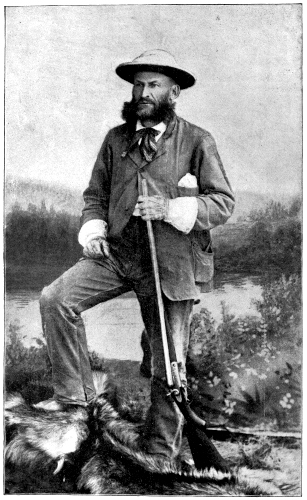
GENERAL GEORGE CROOK.
BY
JOHN G. BOURKE
CAPTAIN THIRD CAVALRY, U. S. A.
ILLUSTRATED
NEW YORK
CHARLES SCRIBNER’S SONS
1891
Copyright, 1891, by
CHARLES SCRIBNER’S SONS
Press of J. J. Little & Co.
Astor Place, New York
ITO FRANCIS PARKMAN,
whose learned and graceful pen has illustrated the History,
Traditions, Wonders and Resources of the Great West, this
volume,—descriptive of the trials and tribulations, hopes and
fears of brave officers and enlisted men of the regular Army,
who did so much to conquer and develop the empire beyond the
Missouri,—is affectionately inscribed by his admirer and friend,
JOHN G. BOURKE.
Omaha, Nebraska,
August 12, 1891.
PREFACE.
v
There is an old saw in the army which teaches that you can
never know a man until after having made a scout with him in
bad weather. All the good qualities and bad in the human makeup
force their way to the surface under the stimulus of privation
and danger, and it not infrequently happens that the comrade
who at the military post was most popular, by reason of charm of
manner and geniality, returns from this trial sadly lowered in the
estimation of his fellows, and that he who in the garrison was
most retiring, self-composed, and least anxious to make a display
of glittering uniform, has swept all before him by the evidence
he has given of fortitude, equanimity, courage, coolness, and good
judgment under circumstances of danger and distress. But,
whether the maxim be true or false, it is hardly too much for me
to claim a hearing while I recall all that I know of a man with
whom for more than fifteen years, it was my fortune to be intimately
associated in all the changing vicissitudes which constituted
service on the “border” of yesterday, which has vanished
never to return.
It is not my purpose to write a biography of my late friend
and commander—such a task I leave for others to whom it may
be more congenial; speaking for myself, I am compelled to say
that it is always difficult for me to peruse biography of any kind,
especially military, and that which I do not care to read I do not
care to ask others to read. In the present volume, there will be
found collected descriptions of the regions in which the major
viportion of General Crook’s Indian work was carried on; the people,
both red and white, with whom he was brought into contact; the
difficulties with which he had to contend, and the manner in
which he overcame them; and a short sketch of the principles
guiding him in his justly famous intercourse with the various
tribes—from British America to Mexico, from the Missouri River
to the Pacific Ocean—subjugated by him and afterwards placed
under his charge.
A military service of nearly forty consecutive years—all of
which, excepting the portion spent in the civil war, had been face
to face with the most difficult problems of the Indian question,
and with the fiercest and most astute of all the tribes of savages
encountered by the Caucasian in his conquering advance across
the continent—made General Crook in every way worthy of the
eulogy pronounced upon him by the grizzled old veteran, General
William T. Sherman, upon hearing of his death, that he was the
greatest Indian-fighter and manager the army of the United
States ever had.
In all the campaigns which made the name of George Crook a
beacon of hope to the settler and a terror to the tribes in hostility,
as well as in all the efforts which he so successfully made for the
elevation of the red man in the path of civilization and which
showed that Crook was not a brutal soldier with no instincts save
those for slaughter, but possessed of wonderful tenderness and
commiseration for the vanquished as well as a most intelligent
appreciation of the needs and capabilities of the aborigines, I was
by his side, a member of his military staff, and thus obtained an
insight into the charms and powers of a character which equalled
that of any of the noble sons of whom our country is so justly
proud.
CONTENTS.
vii
CHAPTER I.
PAGE
OLD CAMP GRANT ON THE RIO SAN PEDRO—DAILY ROUTINE OF LIFE—ARCHITECTURE OF THE GILA—SOLDIERS AS LABORERS—THE MESCAL AND ITS USES—DRINK AND GAMBLING—RATTLESNAKE BITES AND THE GOLONDRINA WEED—SODA LAKE AND THE DEATH VALLEY—FELMER AND HIS RANCH.
STRANGE VISITORS—SOME APACHE CUSTOMS—MEXICAN CAPTIVES—SPEEDY AND THE GHOST—THE ATTACK UPON KENNEDY AND ISRAEL’S TRAIN—FINDING THE BODIES—THE DEAD APACHE—A FRONTIER BURIAL—HOW LIEUTENANT YEATON RECEIVED HIS DEATH WOUND—ON THE TRAIL WITH LIEUTENANT CUSHING—REVENGE IS SWEET.
THE RETURN TO CAMP GRANT—LANCED TO DEATH BY APACHES—THE KILLING OF MILLER AND TAPPAN—COMPANY QUARTERS—APACHE CAPTIVES—THE CLOUD-BURST—APACHE CORN-FIELDS—MEETING COLONEL SANFORD—ENTRAPPED IN AN APACHE AMBUSCADE—AN OLD-TIMER’S REMINISCENCES OF TUCSON—FUNERAL CROSSES ON THE ROADSIDE—PADRE EUSEBIO KINO—FIRST VIEW OF TUCSON—THE “SHOO FLY” RESTAURANT.
SOME OF THE FRIENDS MET IN OLD TUCSON—JACK LONG—HIS DIVORCE—MARSHAL DUFFIELD AND “WACO BILL”—“THEM ’ERE’S MEE VISITIN’ KEE-YARD”—JUDGE TITUS AND CHARLES O. BROWN—HOW DUFFIELD WAS KILLED—UNCLE BILLY N—— AND HIS THREE GLASS EYES—AL. GARRETT—DOCTOR SEMIG AND LIEUTENANT SHERWOOD—DON ESTEVAN OCHOA—BISHOP SALPOINTE—PETE KITCHEN AND HIS RANCH.
THE DIVERSIONS OF TUCSON—THE GAMBLING SALOONS—BOB CRANDALL AND HIS DIAMOND—“SLAP-JACK BILLY”—TIGHT-ROPE WALKERS—THE THEATRE—THE DUEÑAS—BAILES—THE NEWSPAPERS—STAGE-DRIVERS.
TUCSON INCIDENTS—THE “FIESTAS”—THE RUINED MISSION CHURCH OF SAN XAVIER DEL BAC—GOVERNOR SAFFORD—ARIZONA MINES—APACHE RAIDS—CAMP GRANT MASSACRE—THE KILLING OF LIEUTENANT CUSHING.
GENERAL CROOK AND THE APACHES—CROOK’S PERSONAL APPEARANCE AND CHARACTERISTICS—POINTS IN THE HISTORY OF THE APACHES—THEIR SKILL IN WAR—FOODS AND MODES OF COOKING—MEDICINE MEN—THEIR POWER AND INFLUENCE.
CROOK’S FIRST MOVEMENTS AGAINST THE APACHES—THE SCOUTS—MIRAGES—THE FLORAL WEALTH OF ARIZONA—RUNNING IN UPON THE HOSTILE APACHES—AN ADVENTURE WITH BEARS—CROOK’S TALK WITH THE APACHES—THE GREAT MOGOLLON PLATEAU—THE TONTO BASIN—MONTEZUMA’S WELL—CLIFF DWELLINGS—THE PACK TRAINS.
THE PICTURESQUE TOWN OF PRESCOTT—THE APACHES ACTIVE NEAR PRESCOTT—“TOMMY” BYRNE AND THE HUALPAIS—THIEVING INDIAN AGENTS—THE MOJAVES, PI-UTES AND AVA-SUPAIS—THE TRAVELS OF FATHERS ESCALANTE AND GARCES—THE GODS OF THE HUALPAIS—THE LORING MASSACRE—HOW PHIL DWYER DIED AND WAS BURIED—THE INDIAN MURDERERS AT CAMP DATE CREEK PLAN TO KILL CROOK—MASON JUMPS THE RENEGADES AT THE “MUCHOS CAÑONES”—DELT-CHE AND CHA-LIPUN GIVE TROUBLE—THE KILLING OF BOB WHITNEY.
CROOK BEGINS HIS CAMPAIGN—THE WINTER MARCH ACROSS THE MOGOLLON PLATEAU—THE GREAT PINE BELT—BOBBY-DOKLINNY, THE MEDICINE MAN—COOLEY AND HIS APACHE WIFE—THE APACHE CHIEF ESQUINOS-QUIZN—THE APACHE GUIDE NANAAJE—THE FEAST OF DEAD-MULE MEAT—THE FIGHT IN THE CAVE IN THE SALT RIVER CAÑON—THE DEATH-CHANT—THE CHARGE—THE DYING MEDICINE MAN—THE SCENE IN THE CAVE.
ixTHE CAMPAIGN RESUMED—EFFICIENCY OF APACHE SCOUTS—JACK LONG BREAKS DOWN—A BAND OF APACHES SURRENDER IN THE MOUNTAINS—THE EPIZOOTIC—THE TAYLOR MASSACRE AND ITS AVENGING—THE ARIZONA ROLL OF HONOR, OFFICERS, MEN, SURGEONS, SCOUTS, GUIDES, AND PACKERS—THE STRANGE RUIN IN THE VERDE VALLEY—DEATH OF PRESILIANO MONJE—THE APACHES SURRENDER UNCONDITIONALLY TO CROOK AT CAMP VERDE.
THE PROBLEM OF CIVILIZING THE APACHES—THE WORK PERFORMED BY MASON, SCHUYLER, RANDALL, RICE, AND BABCOCK—TUCSON RING INFLUENCE AT WASHINGTON—THE WOUNDING OF LIEUTENANT CHARLES KING—THE KILLING OF LIEUTENANT JACOB ALMY—THE SEVEN APACHE HEADS LAID ON THE SAN CARLOS PARADE GROUND—CROOK’S CASH MARKET FOR THE FRUITS OF APACHE INDUSTRY—HIS METHOD OF DEALING WITH INDIANS.
THE CLOSING DAYS OF CROOK’S FIRST TOUR IN ARIZONA—VISIT TO THE MOQUI VILLAGES—THE PAINTED DESERT—THE PETRIFIED FORESTS—THE GRAND CAÑON—THE CATARACT CAÑONCAÑON—THE CATARACT CAÑON—BUILDING THE TELEGRAPH LINE—THE APACHES USING THE TELEGRAPH LINE—MAPPING ARIZONA—AN HONEST INDIAN AGENT—THE CHIRICAHUA APACHE CHIEF, COCHEIS—THE “HANGING” IN TUCSON—A FRONTIER DANIEL—CROOK’S DEPARTURE FROM ARIZONA—DEATH VALLEY—THE FAIRY LAND OF LOS ANGELES—ARRIVAL AT OMAHA.
THE DEPARTMENT OF THE PLATTE—THE BLACK HILLS DIFFICULTY—THE ALLISON COMMISSION—CRAZY HORSE AND SITTING BULL—THE FIRST WINTER CAMPAIGN—CLOTHING WORN BY THE TROOPS—THE START FOR THE BIG HORN—FRANK GRUARD, LOUIS RICHAUD, BIG BAT, LOUIS CHANGRAU, AND OTHER GUIDES.
MOVING INTO THE BIG HORN COUNTRY IN WINTER—THE HERD STAMPEDED—A NIGHT ATTACK—“JEFF’S” OOZING COURAGE—THE GRAVE-YARD AT OLD FORT RENO—IN A MONTANA BLIZZARD—THE MERCURY FROZEN IN THE BULB—KILLING BUFFALO—INDIAN GRAVES—HOW CROOK LOOKED WHILE ON THIS CAMPAIGN—FINDING A DEAD INDIAN’S ARM—INDIAN PICTURES.
xTHE ATTACK UPON CRAZY HORSE’S VILLAGE—THE BLEAK NIGHT MARCH ACROSS THE MOUNTAINS—EGAN’S CHARGE THROUGH THE VILLAGE—STANTON AND MILLS AND SIBLEY TO THE RESCUE—THE BURNING LODGES—MEN FROZEN—THE WEALTH OF THE VILLAGE—RETREATING TO LODGE POLE CREEK—CROOK REJOINS US—CUTTING THE THROATS OF CAPTURED PONIES.
THE SUMMER CAMPAIGN OF 1876—THE SIOUX AND CHEYENNES GETTING UGLY—RAIDING THE SETTLEMENTS—ATTEMPT TO AMBUSCADE CROOK—KILLING THE MAIL-RIDER—THE STORY OF THE FETTERMAN MASSACRE—LAKE DE SMET—OUR FIRST THUNDERSTORM—A SOLDIER’S BURIAL—THE SIOUX ATTACK OUR CAMP—TROUT-FISHING—BEAR-HUNTING—CALAMITY JANE—THE CROW AND SHOSHONE ALLIES JOIN THE COMMAND—THE WAR DANCE AND MEDICINE SONG.
THE COLUMN IN MOTION—RUNNING INTO A GREAT HERD OF BUFFALOES—THE SIGNAL CRY OF THE SCOUTS—THE FIGHT ON THE ROSEBUD—HOW THE KILLED WERE BURIED—SCALP DANCE—BUTCHERING A CHEYENNE—LIEUTENANT SCHUYLER ARRIVES—SENDING BACK THE WOUNDED.
KILLING DULL CARE IN CAMP—EXPLORING THE SNOW-CRESTED BIG HORN MOUNTAINS—FINERTY KILLS HIS FIRST BUFFALO—THE SWIMMING POOLS—A BIG TROUT—SIBLEY’S SCOUT—A NARROW ESCAPE—NEWS OF THE CUSTER MASSACRE—THE SIOUX TRY TO BURN US OUT—THE THREE MESSENGERS FROM TERRY—WASHAKIE DRILLS HIS SHOSHONES—KELLY THE COURIER STARTS TO FIND TERRY—CROW INDIANS BEARING DESPATCHES—THE SIGN-LANGUAGE—A PONY RACE—INDIAN SERENADES—HOW THE SHOSHONES FISHED—A FIRE IN CAMP—THE UTES JOIN US.
THE JUNCTION WITH MERRITT AND THE MARCH TO MEET TERRY—THE COUNTRY ON FIRE—MERRITT AND HIS COMMAND—MR. “GRAPHIC”—STANTON AND HIS “IRREGULARS”—“UTE JOHN”—THE SITE OF THE HOSTILE CAMP—A SIOUX CEMETERY—MEETING TERRY’S COMMAND—FINDING TWO SKELETONS—IN THE BAD LANDS—LANCING RATTLESNAKES—BATHING IN THE YELLOWSTONE—MACKINAW BOATS AND “BULL” BOATS—THE REES HAVE A PONY DANCE—SOME TERRIBLE STORMS—LIEUTENANT WILLIAM P. CLARKE.
xiCROOK AND TERRY SEPARATE—THE PICTURESQUE LITTLE MISSOURI—THE “HORSE MEAT MARCH” FROM THE HEAD OF THE HEART RIVER TO DEADWOOD—ON THE SIOUX TRAIL—MAKING COFFEE UNDER DIFFICULTIES—SLAUGHTERING WORN-OUT CAVALRY HORSES FOR FOOD—THE FIGHT AT SLIM BUTTES—LIEUTENANT VON LEUTTEWITZ LOSES A LEG—THE DYING CHIEF, AMERICAN HORSE, SURRENDERS—RELICS OF THE CUSTER MASSACRE—CRAZY HORSE ATTACKS OUR LINES—SUNSHINE AND RATIONS.
TO AND THROUGH THE BLACK HILLS—HOW DEADWOOD LOOKED IN 1876—THE DEADWOOD “ACADEMY OF MUSIC”—THE SECOND WINTER CAMPAIGN—THE NAMES OF THE INDIAN SCOUTS—WIPING OUT THE CHEYENNE VILLAGE—LIEUTENANT MCKINNEY KILLED—FOURTEEN CHEYENNE BABIES FROZEN TO DEATH IN THEIR MOTHERS’ ARMS—THE CUSTER MASSACRE AGAIN—THE TERRIBLE EXPERIENCE OF RANDALL AND THE CROW SCOUTS.
STRANGE MESS-MATES—THE JOURNEY TO THE AGENCIES—GENERAL SHERIDAN’S VISIT—SPOTTED TAIL—THE STORY OF HIS DEAD DAUGHTER’S BONES—WHITE THUNDER—RED CLOUD—DULL KNIFE—BIG WOLF—THE NECKLACE OF HUMAN FINGERS—THE MEDICINE MAN AND THE ELECTRIC BATTERY—WASHINGTON—FRIDAY—INDIAN BROTHERS—SORREL HORSE—THREE BEARS—YOUNG MAN AFRAID OF HIS HORSES—ROCKY BEAR—RED CLOUD’S LETTER—INDIAN DANCES—THE BAD LANDS—HOW THE CHEYENNES FIRST GOT HORSES.
THE SURRENDER OF CRAZY HORSE—SELLING AMMUNITION TO HOSTILE INDIANS—PLUNDERING UNARMED, PEACEABLE INDIANS—SUPPER WITH CRAZY HORSE—CHARACTER OF THIS CHIEF—HIS BRAVERY AND GENEROSITY—THE STORY OF THE CUSTER MASSACRE AS TOLD BY HORNY HORSE—LIEUTENANT REILLY’S RING—THE DEATH OF CRAZY HORSE—LITTLE BIG MAN.
xiiTHE MANAGEMENT OF THE INDIAN AGENCIES—AGENT MACGILLICUDDY’S WONDERFUL WORK—CROOK’S REMAINING DAYS IN THE DEPARTMENT OF THE PLATTE—THE BANNOCK, UTE, NEZ PERCÉ, AND CHEYENNE OUTBREAKS—THE KILLING OF MAJOR THORNBURGH AND CAPTAIN WEIR—MERRITT’S FAMOUS MARCH AGAINST TIME—HOW THE DEAD CAME TO LIFE AND WALKED—THE CASE OF THE PONCAS—CROOK’S HUNTS AND EXPLORATIONS; NEARLY FROZEN TO DEATH IN A BLIZZARD—A NARROW ESCAPE FROM AN ANGRY SHE-BEAR—CATCHING NEBRASKA HORSE-THIEVES—“DOC” MIDDLETON’S GANG.
CROOK RE-ASSIGNED TO THE DEPARTMENT OF ARIZONA—ALL THE APACHES ON THE WAR-PATH—LIEUTENANTS MORGAN AND CONVERSE WOUNDED—CAPTAIN HENTIG KILLED—CROOK GOES ALONE TO SEE THE HOSTILES—CONFERENCES WITH THE APACHES—WHAT THE ARIZONA GRAND JURY SAID OF AN INDIAN AGENT—CONDITION OF AFFAIRS AT THE SAN CARLOS AGENCY—WHISKEY SOLD TO THE CHIRICAHUA APACHES—APACHE TRIALS BY JURY—ARIZONA IN 1882—PHŒNIX, PRESCOTT, AND TUCSON—INDIAN SCHOOLS.
THE SIERRA MADRE CAMPAIGN AND THE CHIRICAHUAS—CHATO’S RAID—CROOK’S EXPEDITION OF FORTY-SIX WHITE MEN AND ONE HUNDRED AND NINETY-THREE INDIAN SCOUTS—THE SURPRISE OF THE APACHE STRONGHOLD—THE “TOMBSTONE TOUGHS”—THE MANAGEMENT OF THE CHIRICAHUAS—HOW INDIANS WILL WORK IF ENCOURAGED—GIVING THE FRANCHISE TO INDIANS; CROOK’S VIEWS—THE CRAWFORD COURT OF INQUIRY—KA-E-TEN-NA’S ARREST ORDERED BY MAJOR BARBER —TROUBLE ARISES BETWEEN THE WAR AND INTERIOR DEPARTMENTS—CROOK ASKS TO BE RELIEVED FROM THE RESPONSIBILITY FOR INDIAN AFFAIRS—SOME OF THE CHIRICAHUAS RETURN TO THE WAR-PATH.
THE CAMPAIGN AGAINST GERONIMO—THE CROPS RAISED BY THE APACHES—THE PURSUIT OF THE HOSTILES—THE HARD WORK OF THE TROOPS—EFFICIENT AND FAITHFUL SERVICE OF THE CHIRICAHUA SCOUTS—WAR DANCES AND SPIRIT DANCES—CAPTAIN CRAWFORD KILLED—A VISIT TO THE HOSTILE STRONGHOLD—A “NERVY” PHOTOGRAPHER—A WHITE BOY CAPTIVE AMONG THE APACHES—ALCHISE’S AND KA-E-TEN-NA’S GOOD WORK—GERONIMO SURRENDERS TO CROOK.
THE EFFECTS OF BAD WHISKEY UPON SAVAGE INDIANS—THE WRETCH TRIBOLLET—SOME OF THE CHIRICAHUAS SLIP AWAY FROM MAUS DURING A RAINY NIGHT—THE BURIAL OF CAPTAIN CRAWFORD—CROOK’S TERMS DISAPPROVED IN WASHINGTON—CROOK ASKS TO BE RELIEVED FROM COMMAND IN ARIZONA—GERONIMO INDUCED TO COME IN BY THE CHIRICAHUA AMBASSADORS, KI-E-TA AND MARTINEZ—TREACHERY SHOWN IN THE TREATMENT OF THE WELL-BEHAVED MEMBERS OF THE CHIRICAHUA APACHE BAND.
CROOK’S CLOSING YEARS—HE AVERTS A WAR WITH THE UTES—A MEMBER OF THE COMMISSION WHICH SECURED A CESSION OF ELEVEN MILLIONS OF ACRES FROM THE SIOUX—HIS INTEREST IN GAME LAWS—HIS DEATH—WHAT THE APACHES DID—WHAT RED CLOUD SAID—HIS FUNERAL IN CHICAGO—BURIAL IN OAKLAND, MARYLAND—RE-INTERMENT IN ARLINGTON CEMETERY, VIRGINIA.
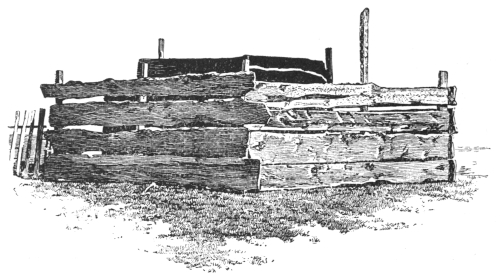
GRAVE OF CRAZY HORSE—“THE EBB-TIDE OF OUR INDIAN WARS.”
1ON THE BORDER WITH CROOK
CHAPTER I.
OLD CAMP GRANT ON THE RIO SAN PEDRO—DAILY ROUTINE OF
LIFE—ARCHITECTURE OF THE GILA—SOLDIERS AS LABORERS—THE
MESCAL AND ITS USES—DRINK AND GAMBLING—RATTLESNAKE
BITES AND THE GOLONDRINA WEED—SODA
LAKE AND THE DEATH VALLEY—FELMER AND HIS
RANCH.
Dante Alighieri, it has always seemed to me, made
the mistake of his life in dying when he did in the picturesque
capital of the Exarchate five hundred and fifty years
ago. Had he held on to this mortal coil until after Uncle Sam
had perfected the “Gadsden Purchase,” he would have found
full scope for his genius in the description of a region in which
not only purgatory and hell, but heaven likewise, had combined
to produce a bewildering kaleidoscope of all that was wonderful,
weird, terrible, and awe-inspiring, with not a little that was
beautiful and romantic.
The vast region in the southwest corner of the United States,
known on the maps as the Territories of Arizona and New Mexico,
may, with perfect frankness, be claimed as the wonder-land
of the northern part of America, with the exception, perhaps, of
the Republic of Mexico, of which it was once a fragment, and to
which, ethnographically, it has never ceased to belong.
In no other section can there be found such extensive areas of
desert crossed in every direction by the most asperous mountains,
whose profound cañons are the wonder of the world, whose
parched flanks are matted with the thorny and leafless vegetation
2of the tropics, and whose lofty summits are black with the
foliage of pines whose graceful branches bend in the welcome
breezes from the temperate zone. Here one stumbles at almost
every step upon the traces of former populations, of whom so
little is known, or sees repeated from peak to peak the signal
smokes of the fierce Apaches, whose hostility to the white man
dates back to the time of Cortés.
I will begin my narrative by a brief reference to the condition
of affairs in Arizona prior to the arrival of General Crook, as by
no other means can the arduous nature of the work he accomplished
be understood and appreciated. It was a cold and cheerless
day—March 10, 1870—when our little troop, “F” of the
Third Cavalry, than which a better never bore guidon, marched
down the vertical-walled cañon of the Santa Catalina, crossed
the insignificant sand-bed of the San Pedro, and came front into
line on the parade-ground of Old Camp Grant, at the mouth of
the Aravaypa. The sun was shining brightly, and where there
was shelter to be found in the foliage of mesquite or cottonwood,
there was the merry chatter of birds; but in the open spaces the
fierce breath of the norther, laden with dust and discomfort,
made the new-comers imagine that an old-fashioned home winter
had pursued them into foreign latitudes. A few military
formalities hastily concluded, a few words of kindly greeting
between ourselves and the members of the First Cavalry whom
we met there, and ranks were broken, horses led to the stables,
and men filed off to quarters. We had become part and parcel
of the garrison of Old Camp Grant, the memory of which is still
fragrant as that of the most forlorn parody upon a military garrison
in that most woe-begone of military departments, Arizona.
Of our march over from the Rio Grande it is not worth while
to speak; as the reader advances in this book he will find references
to other military movements which may compensate for
the omission, even when it is admitted that our line of travel
from Fort Craig lay through a region but little known to people
in the East, and but seldom described. For those who may be
sufficiently interested to follow our course, I will say that we
started from Craig, marched to the tumble-down village of
“Paraje de San Cristobal,” at the head of the “Jornada del
Muerto” (The Day’s Journey of the Dead Man), which is the
Sahara of New Mexico, then across to the long-since abandoned
3camp at what was called Fort MacRae, where we forded the
river to the west, and then kept along the eastern rim of the
timber-clad Mimbres Mountains, through Cow Springs to Fort
Cummings, and thence due west to Camp Bowie, situated in the
“Apache Pass” of the Chiricahua Mountains in Southeastern
Arizona, a total distance of some one hundred and seventy miles
as we marched.
There were stretches of country picturesque to look upon and
capable of cultivation, especially with irrigation; and other expanses
not a bit more fertile than so many brick-yards, where all
was desolation, the home of the cactus and the coyote. Arizona
was in those days separated from “God’s country” by a space of
more than fifteen hundred miles, without a railroad, and the
officer or soldier who once got out there rarely returned for years.
Our battalion slowly crawled from camp to camp, with no incident
to break the dull monotony beyond the ever-recurring signal
smokes of the Apaches, to show that our progress was duly
watched from the peaks on each flank; or the occasional breaking
down of some of the wagons and the accompanying despair of the
quartermaster, with whose afflictions I sympathized sincerely, as
that quartermaster was myself.
I used to think that there never had been such a wagon-train,
and that there never could again be assembled by the Government
mules of whose achievements more could be written—whose
necks seemed to be ever slipping through their collars, and whose
heels never remained on terra firma while there was anything in
sight at which to kick. Increasing years and added experience
have made me more conservative, and I am now free to admit
that there have been other mules as thoroughly saturated with
depravity as “Blinky Jim,” the lop-eared dun “wheeler” in the
water-wagon team; other artists whose attainments in profanity
would put the blush upon the expletives which waked the echoes
of the mirage-haunted San Simon, and other drivers who could
get as quickly, unmistakably, emphatically, and undeniably drunk
as Mullan, who was down on the official papers as the driver of
the leading ambulance, but, instead of driving, was generally
driven.
There would be very little use in attempting to describe Old
Fort Grant, Arizona, partly because there was really no fort to
describe, and partly because few of my readers would be sufficiently
4interested in the matter to follow me to the end. It was,
as I have already said, recognized from the tide-waters of the
Hudson to those of the Columbia as the most thoroughly Godforsaken
post of all those supposed to be included in the annual
Congressional appropriations. Beauty of situation or of construction
it had none; its site was the supposed junction of the sand-bed
of the Aravaypa with the sand-bed of the San Pedro, which
complacently figured on the topographical charts of the time as
creek and river respectively, but generally were dry as a lime-burner’s
hat excepting during the “rainy season.” Let the
reader figure to himself a rectangle whose four sides were the row
of officers’ “quarters,” the adjutant’s office, post bakery, and
guard house, the commissary and quartermaster’s storehouses,
and the men’s quarters and sutler’s store, and the “plan,” if
there was any “plan,” can be at once understood. Back of the
quartermaster’s and commissary storehouses, some little distance,
were the blacksmith’s forge, the butcher’s “corral,” and the cavalry
stables, while in the rear of the men’s quarters, on the banks
of the San Pedro, and not far from the traces of the ruins of a
prehistoric village or pueblo of stone, was the loose, sandy spot
upon which the bucking “bronco” horses were broken to the saddle.
Such squealing and struggling and biting and kicking, and
rolling in the dust and getting up again, only to introduce some
entirely original combination of a hop, skip, and jump, and a
double back somersault, never could be seen outside of a herd
of California “broncos.” The animal was first thrown, blindfolded,
and then the bridle and saddle were put on, the latter
girthed so tightly that the horse’s eyes would start from their
sockets. Then, armed with a pair of spurs of the diameter of a
soup-plate and a mesquite club big enough to fell an ox, the
Mexican “vaquero” would get into the saddle, the blinds would
be cast off, and the circus begin. There would be one moment of
sweet doubt as to what the “bronco” was going to do, and now
and then there would be aroused expectancy that a really mild-mannered
steed had been sent to the post by some mistake of the
quartermaster’s department. But this doubt never lasted very
long; the genuine “bronco” can always be known from the
spurious one by the fact that when he makes up his mind to
“buck” he sets out upon his work without delay, and with a
vim that means business. If there were many horses arriving in
5a “bunch,” there would be lots of fun and no little danger and
excitement. The men would mount, and amid the encouraging
comments of the on-lookers begin the task of subjugation. The
bronco, as I have said, or should have said, nearly always looked
around and up at his rider with an expression of countenance
that was really benignant, and then he would roach his back, get
his four feet bunched together, and await developments. These
always came in a way productive of the best results; if the rider
foolishly listened to the suggestions of his critics, he would
almost always mistake this temporary paroxysm of docility for
fear or lack of spirit.
And then would come the counsel, inspired by the Evil One
himself: “Arrah, thin, shtick yer sphurs int’ him, Moriarty.”
This was just the kind of advice that best suited the “bronco’s”
feelings, because no sooner would the rowels strike his flanks than
the air would seem to be filled with a mass of mane and tail rapidly
revolving, and of hoofs flying out in defiance of all the laws
of gravity, while a descendant of the kings of Ireland, describing
a parabolic orbit through space, would shoot like a meteor into
the sand, and plough it up with his chin and the usual elocutionary
effects to be looked for under such circumstances.
Yes, those were happy, happy days—for the “broncos” and
the by-standers.
There were three kinds of quarters at Old Camp Grant, and he
who was reckless enough to make a choice of one passed the rest
of his existence while at the post in growling at the better luck
of the comrades who had selected either one of the others.
There was the adobe house, built originally for the kitchens of
the post at the date of its first establishment, some time in 1857;
there were the “jacal” sheds, built of upright logs, chinked
with mud and roofed with smaller branches and more mud; and
the tents, long since “condemned” and forgotten by the quartermaster
to whom they had originally been invoiced. Each and
all of these examples of the Renaissance style of architecture, as
it found expression in the valley of the Gila, was provided with a
“ramada” in front, which, at a small expenditure of labor in
erecting a few additional upright saplings and cross-pieces, and a
covering of cottonwood foliage, secured a modicum of shelter
from the fierce shafts of a sun which shone not to warm and
enlighten, but to enervate and kill.
6The occupants of the ragged tentage found solace in the pure
air which merrily tossed the flaps and flies, even if it brought
with it rather more than a fair share of heat and alkali dust from
the deserts of Sonora. Furthermore, there were few insects to
bother, a pleasing contrast to the fate of those living in the
houses, which were veritable museums of entomology, with the
choicest specimens of centipedes, scorpions, “vinagrones,” and,
occasionally, tarantulas, which the Southwest could produce.
On the other hand, the denizens of the adobe and the “jacal
outfits” became inured to insect pests and felicitated themselves
as best they could upon being free from the merciless glare of the
sun and wind, which latter, with its hot breath, seemed to take
delight in peeling the skin from the necks and faces of all upon
whom it could exert its nefarious powers. My assignment was to
one of the rooms in the adobe house, an apartment some fourteen
by nine feet in area, by seven and a half or eight in height.
There was not enough furniture to occasion any anxiety in case
of fire: nothing but a single cot, one rocking-chair—visitors,
when they came, generally sat on the side of the cot—a trunk, a
shelf of books, a small pine wash-stand, over which hung a mirror
of greenish hue, sold to me by the post trader with the assurance
that it was French plate. I found out afterward that the
trader could not always be relied upon, but I’ll speak of him at
another time. There were two window-curtains, both of chintz;
one concealed the dust and fly specks on the only window, and
the other covered the row of pegs upon which hung sabre, forage
cap, and uniform.
In that part of Arizona fires were needed only at intervals, and,
as a consequence, the fireplaces were of insignificant dimensions,
although they were placed, in the American fashion, on the side
of the rooms, and not, as among the Mexicans, in the corners.
There was one important article of furniture connected with
the fireplace of which I must make mention—the long iron
poker with which, on occasion, I was wont to stir up the embers,
and also to stir up the Mexican boy Esperidion, to whom, in the
wilder freaks of my imagination, I was in the habit of alluding
as my “valet.”
The quartermaster had recently received permission to expend
“a reasonable amount” of paint upon the officers’ quarters, provided
the same could be done “by the labor of the troops.”
7This “labor of the troops” was a great thing. It made the
poor wretch who enlisted under the vague notion that his admiring
country needed his services to quell hostile Indians, suddenly
find himself a brevet architect, carrying a hod and doing
odd jobs of plastering and kalsomining. It was an idea which
never fully commended itself to my mind, and I have always
thought that the Government might have been better served had
such work, and all other not strictly military and necessary for
the proper police and cleanliness of the posts, been assigned to
civilians just as soon as representatives of the different trades
could be attracted to the frontier. It would have cost a little
more in the beginning, but it would have had the effect of helping
to settle up our waste land on the frontier, and that, I believe,
was the principal reason why we had a standing army at all.
The soldier felt discontented because no mention had been
made in the recruiting officer’s posters, or in the contract of
enlistment, that he was to do such work, and he not unusually
solved the problem by “skipping out” the first pay-day that
found him with enough money ahead to risk the venture. It
goes without saying that the work was never any too well done,
and in the present case there seemed to be more paint scattered
round about my room than would have given it another coat.
But the floor was of rammed earth and not to be spoiled, and the
general effect was certainly in the line of improvement. Colonel
Dubois, our commanding officer, at least thought so, and warmly
congratulated me upon the snug look of everything, and added
a very acceptable present of a picture—one of Prang’s framed
chromos, a view of the Hudson near the mouth of Esopus Creek—which
gave a luxurious finish to the whole business. Later on,
after I had added an Apache bow and quiver, with its complement
of arrows, one or two of the bright, cheery Navajo rugs, a
row of bottles filled with select specimens of tarantulas, spiders,
scorpions, rattlesnakes, and others of the fauna of the country,
and hung upon the walls a suit of armor which had belonged to
some Spanish foot-soldier of the sixteenth century, there was a
sybaritic suggestiveness which made all that has been related of
the splendors of Solomon and Sardanapalus seem commonplace.
Of that suit of armor I should like to say a word: it was found
by Surgeon Steyer, of the army, enclosing the bones of a man, in
the arid country between the waters of the Rio Grande and the
8Pecos, in the extreme southwestern corner of the State of Texas,
more than twenty years ago. Various conjectures were advanced
and all sorts of theories advocated as to its exact age, some people
thinking that it belonged originally to Coronado’s expedition,
which entered New Mexico in 1541. My personal belief is that
it belonged to the expedition of Don Antonio Espejo, or that of
Don Juan de Oñate, both of whom came into New Mexico about
the same date—1581-1592—and travelled down the Concho to its
confluence with the Rio Grande, which would have been just on
the line where the skeleton in armor was discovered. There is
no authentic report to show that Coronado swung so far to the
south; his line of operations took in the country farther to the
north and east, and there are the best of reasons for believing
that he was the first white man to enter the fertile valley of the
Platte, not far from Plum Creek, Nebraska.
But, be that as it may, the suit of armor—breast and back plates,
gorget and helmet—nicely painted and varnished, and with every
tiny brass button duly cleaned and polished with acid and ashes,
added not a little to the looks of a den which without them would
have been much more dismal.
For such of my readers as may not be up in these matters, I
may say that iron armor was abandoned very soon after the Conquest,
as the Spaniards found the heat of these dry regions too
great to admit of their wearing anything so heavy; and they also
found that the light cotton-batting “escaupiles” of the Aztecs
served every purpose as a protection against the arrows of the
naked savages by whom they were now surrounded.
There was not much to do in the post itself, although there
was a sufficiency of good, healthy exercise to be counted upon at
all times outside of it. I may be pardoned for dwelling upon
trivial matters such as were those entering into the sum total of
our lives in the post, but, under the hope that it and all in the
remotest degree like it have disappeared from the face of the
earth never to return, I will say a few words.
In the first place, Camp Grant was a hot-bed of the worst kind
of fever and ague, the disease which made many portions of
Southern Arizona almost uninhabitable during the summer and
fall months of the year. There was nothing whatever to do except
scout after hostile Apaches, who were very bold and kept
9the garrison fully occupied. What with sickness, heat, bad
water, flies, sand-storms, and utter isolation, life would have been
dreary and dismal were it not for the novelty which helped out
the determination to make the best of everything. First of all,
there was the vegetation, different from anything to be seen
east of the Missouri: the statuesque “pitahayas,” with luscious
fruit; the massive biznagas, whose juice is made into very palatable
candy by the Mexicans; the bear’s grass, or palmilla; the
Spanish bayonet, the palo verde, the various varieties of cactus,
principal among them being the nopal, or plate, and the cholla,
or nodular, which possesses the decidedly objectionable quality
of separating upon the slightest provocation, and sticking to
whatever may be nearest; the mesquite, with palatable gum and
nourishing beans; the mescal, beautiful to look upon and grateful
to the Apaches, of whom it is the main food-supply; the
scrub oak, the juniper, cottonwood, ash, sycamore, and, lastly,
the pine growing on the higher points of the environing mountains,
were all noted, examined, and studied, so far as opportunity
would admit.
And so with the animal life: the deer, of the strange variety
called “the mule”; the coyotes, badgers, pole-cats, rabbits,
gophers—but not the prairie-dog, which, for some reason never
understood by me, does not cross into Arizona; or, to be more
accurate, does just cross over the New Mexican boundary at Fort
Bowie in the southeast, and at Tom Keam’s ranch in the Moqui
country in the extreme northeast.
Strangest of all was the uncouth, horrible “escorpion,” or
“Gila monster,” which here found its favorite habitat and attained
its greatest dimensions. We used to have them not less
than three feet long, black, venomous, and deadly, if half the stories
told were true. The Mexicans time and time again asserted that
the escorpion would kill chickens, and that it would eject a poisonous
venom upon them, but, in my own experience, I have to say
that the old hen which we tied in front of one for a whole day was
not molested, and that no harm of any sort came to her beyond
being scared out of a year’s growth. Scientists were wont to ridicule
the idea of the Gila monster being venomous, upon what
ground I do not now remember, beyond the fact that it was a
lizard, and all lizards were harmless. But I believe it is now well
established that the monster is not to be handled with impunity
10although, like many other animals, it may lie torpid and inoffensive
for weeks, and even months, at a time. It is a noteworthy fact
that the Gila monster is the only reptile on earth to-day that exactly
fills the description of the basilisk or cockatrice of mediæval
fable, which, being familiar to the first-comers among the Castilians,
could hardly have added much to its popularity among them.
It may not be amiss to say of the vegetation that the mescal
was to the aborigines of that region much what the palm is to
the nomads of Syria. Baked in ovens of hot stone covered with
earth, it supplied a sweet, delicious, and nutritive food; its juice
could be fermented into an alcoholic drink very acceptable to
the palate, even if it threw into the shade the best record ever
made by “Jersey lightning” as a stimulant. Tear out one of
the thorns and the adhering filament, and you had a very fair
article of needle and thread; if a lance staff was needed, the sapling
mescal stood ready at hand to be so utilized; the stalk, cut
into sections of proper length, and provided with strings of sinew,
became the Apache fiddle—I do not care to be interrupted by
questions as to the quality of the music emitted by these fiddles,
as I am now trying to give my readers some notion of the economic
value of the several plants of the Territory, and am not
ready to enter into a disquisition upon melody and such matters,
in which, perhaps, the poor little Apache fiddle would cut but a
slim figure—and in various other ways this strange, thorny-leafed
plant seemed anxious to show its friendship for man. And
I for one am not at all surprised that the Aztecs reverenced it as
one of their gods, under the name of Quetzalcoatl.[A]
A. Quetzalcoatl is identified with the maguey in Kingsborough, vol. vi., 107.
The “mesquite” is a member of the acacia family, and from
its bark annually, each October, exudes a gum equal to the best
Arabic that ever descended the Nile from Khartoum. There are
three varieties of the plant, two of them edible and one not.
One of the edible kinds—the “tornillo,” or screw—grows luxuriantly
in the hot, sandy valley of the Colorado, and forms the
main vegetable food of the Mojave Indians; the other, with pods
shaped much like those of the string-bean of our own markets,
is equally good, and has a sweet and pleasantly acidulated taste.
The squaws take these beans, put them in mortars, and pound
them into meal, of which bread is made, in shape and size and
11weight not unlike the elongated projectiles of the three-inch rifled
cannon.
Alarcon, who ascended the Colorado River in 1541, describes
such bread as in use among the tribes along its banks; and
Cabeza de Vaca and his wretched companions, sole survivors of
the doomed expedition of Panfilo de Narvaez, which went to
pieces near the mouth of the Suwanee River, in Florida, found
this bread in use among the natives along the western part of
their line of march, after they had succeeded in escaping from
the Indians who had made them slaves, and had, in the guise of
medicine-men, tramped across the continent until they struck
the Spanish settlements near Culiacan, on the Pacific coast, in
1536. But Vaca calls it “mizquiquiz.” Castaneda relates that
in his day (1541) the people of Sonora (which then included
Arizona) made a bread of the mesquite, shaping it like a cheese;
it had the property of keeping for a whole year.
There was so little hunting in the immediate vicinity of the
post, and so much danger attending the visits of small parties to
the higher hills a few miles off, in which deer, and even bear,
were to be encountered, that nothing in that line was attempted
except when on scout; all our recreation had to be sought within
the limits of the garrison, and evolved from our own personal resources.
The deficiency of hunting did not imply that there was
any lack of shooting about the post; all that any one could desire
could be had for the asking, and that, too, without moving from
under the “ramadas” back of the quarters. Many and many a
good line shot we used to make at the coyotes and skunks which
with the going down of the sun made their appearance in the
garbage piles in the ravines to the north of us.
There was considerable to be done in the ordinary troop duties,
which began at reveille with the “stables,” lasting half an hour,
after which the horses and mules not needed for the current tasks
of the day were sent out to seek such nibbles of pasturage as they
might find under the shade of the mesquite. A strong guard,
mounted and fully armed, accompanied the herd, and a number
of horses, saddled but loosely cinched, remained behind under
the grooming-sheds, ready to be pushed out after any raiding
party of Apaches which might take a notion to sneak up and
stampede the herd at pasture.
12Guard mounting took place either before or after breakfast,
according to season, and then followed the routine of the day:
inspecting the men’s mess at breakfast, dinner, and supper; a
small amount of drill, afternoon stables, dress or undress parade
at retreat or sundown, and such other occupation as might suggest
itself in the usual visit to the herd to see that the pasturage
selected was good, and that the guards were vigilant; some absorption
in the recording of the proceedings of garrison courts-martial
and boards of survey, and then general ennui, unless the
individual possessed enough force to make work for himself.
This, however, was more often the case than many of my readers
would imagine, and I can certify to no inconsiderable amount
of reading and study of Spanish language and literature, of mineralogy,
of botany, of history, of constitutional or of international
law, and of the belles-lettres, by officers of the army with
whom I became acquainted at Old Camp Grant; Fort Craig, New
Mexico, and other dismal holes—more than I have ever known
among gentlemen of leisure anywhere else. It was no easy matter
to study with ink drying into gum almost as soon as dipped out
by the pen, and paper cracking at the edges when folded or bent.
The newspapers of the day were eagerly perused—when they
came; but those from San Francisco were always from ten to fifteen
days old, those from New York about five to six weeks, and
other cities any intermediate age you please. The mail at first
came every second Tuesday, but this was increased soon to a
weekly service, and on occasion, when chance visitors reported
some happening of importance, the commanding officer would
send a courier party to Tucson with instructions to the postmaster
there to deliver.
The temptations to drink and to gamble were indeed great,
and those who yielded and fell by the way-side numbered many
of the most promising youngsters in the army. Many a brilliant
and noble fellow has succumbed to the ennui and gone down,
wrecking a life full of promise for himself and the service. It
was hard for a man to study night and day with the thermometer
rarely under the nineties even in winter at noon, and often
climbing up to and over the 120 notch on the Fahrenheit scale
before the meridian of days between April 1st and October 15th;
it was hard to organize riding or hunting parties when all the
horses had just returned worn out by some rough scouting in
13the Pinal or Sierra Ancha. There in the trader’s store was a
pleasant, cool room, with a minimum of flies, the latest papers,
perfect quiet, genial companionship, cool water in “ollas” swinging
from the rafters, and covered by boards upon which, in a
thin layer of soil, grew a picturesque mantle of green barley, and,
on a table conveniently near, cans of lemon-sugar, tumblers and
spoons, and one or two packs of cards. My readers must not
expect me to mention ice or fruits. I am not describing Delmonico’s;
I am writing of Old Camp Grant, and I am painting
the old hole in the most rosy colors I can employ. Ice was
unheard of, and no matter how high the mercury climbed or
how stifling might be the sirocco from Sonora, the best we could
do was to cool water by evaporation in “ollas” of earthenware,
manufactured by the Papago Indians living at the ruined mission
of San Xavier, above Tucson.
To revert to the matter of drinking and gambling. There is
scarcely any of either at the present day in the regular army.
Many things have combined to bring about such a desirable
change, the principal, in my opinion, being the railroads which
have penetrated and transformed the great American continent,
placing comforts and luxuries within reach of officers and men,
and absorbing more of their pay as well as bringing them
within touch of civilization and its attendant restraints. Of
the two vices, drunkenness was by all odds the preferable one.
For a drunkard, one can have some pity, because he is his own
worst enemy, and, at the worst, there is hope for his regeneration,
while there is absolutely none for the gambler, who lives
upon the misfortunes and lack of shrewdness of his comrades.
There are many who believe, or affect to believe, in gaming
for the excitement of the thing and not for the money involved.
There may be such a thing, but I do not credit its existence.
However, the greatest danger in gambling lay in the waste of
time rather than in the loss of money, which loss rarely amounted
to very great sums, although officers could not well afford to
lose anything.
I well remember one great game, played by a party of my
friends—but at Fort Laramie, Wyoming, and not in Arizona—which
illustrates this better than I can describe. It was an all-night
game—ten cents to come in and a quarter limit—and there
was no small amount of engineering skill shown before the first
14call for reveille separated the party. “Fellows,” said one of
the quartette, in speaking of it some days afterward, “I tell
you it was a struggle of the giants, and when the smoke of battle
cleared away, I found I’d lost two dollars and seventy-five cents.”
As it presents itself to my recollection now, our life wasn’t so
very monotonous; there was always something going on to
interest and instruct, even if it didn’t amuse or enliven.
“Corporal Dile’s har-r-r-se’s bit by a ratthler ’n th’ aff hind
leg”; and, of course, everybody turns out and gets down to the
stables as fast as possible, each with his own prescription, which
are one and all discarded for the great Mexican panacea of a poultice
of the “golondrina” weed. Several times I have seen this
used, successfully and unsuccessfully, and I do not believe in its
vaunted efficacy by any means.
“Oscar Hutton’s bin kicked ’n th’ jaw by a mewel.” Hutton
was one of the post guides, a very good and brave man. His jaw
was hopelessly crushed by a blow from the lightning hoofs of a
miserable “bronco” mule, and poor Hutton never recovered from
the shock. He died not long after, and, in my opinion, quite as
much from chagrin at being outwitted as from the injury inflicted.
Hutton had had a wonderful experience in the meanest parts
of our great country—and be it known that Uncle Sam can hold
his own with any prince or potentate on God’s footstool in the
matter of mean desert land. All over the great interior basin
west of the Rockies Hutton had wandered in the employ of the
United States with some of the Government surveying parties.
Now he was at the mouth of the Virgin, where there is a salt mine
with slabs two and three feet thick, as clear as crystal; next he
was a wanderer in the dreaded “Death Valley,” below the sea-level,
where there is no sign of animal life save the quickly darting
lizard, or the vagrant duck whose flesh is bitter from the
water of “soda” lakes, which offer to the wanderer all the comforts
of a Chinese laundry, but not one of those of a home. At
that time I only knew of these dismal places from the relation
of Hutton, to which I listened open-mouthed, but since then I
have had some personal acquaintance, and can aver that in naught
did he overlap the truth. The ground is covered for miles with
pure baking-soda—I decline to specify what brand, as I am not
15writing this as an advertisement, and my readers can consult
individual preference if they feel so disposed—which rises in a
cloud of dry, irritating dust above the horse’s houghs, and if
agitated by the hot winds, excoriates the eyes, throat, nostrils,
and ears of the unfortunate who may find himself there. Now
and then one discerns in the dim distance such a deceiving body
of water as the “Soda Lake,” which tastes like soapsuds, and
nourishes no living thing save the worthless ducks spoken of,
whose flesh is uneatable except to save one from starvation.
Hutton had seen so much hardship that it was natural to
expect him to be meek and modest in his ideas and demeanor,
but he was, on the contrary, decidedly vain and conceited, and
upon such a small matter that it ought not really to count
against him. He had six toes on each foot, a fact to which he
adverted with pride. “Bee gosh,” he would say, “there hain’t
ennuther man ’n th’ hull dog-goned outfit’s got ez menny toes’s
me.”
Then there was the excitement at Felmer’s ranch, three miles
above the post. Felmer was the post blacksmith, and lived in a
little ranch in the fertile “bottom” of the San Pedro, where he
raised a “patch” of barley and garden-truck for sale to the garrison.
He was a Russian or a Polynesian or a Turk or a Theosophist
or something—he had lived in so many portions of the
world’s surface that I never could keep track of him. I distinctly
remember that he was born in Germany, had lived in Russia or
in the German provinces close to Poland, and had thence travelled
everywhere. He had married an Apache squaw, and from
her learned the language of her people. She was now dead,
but Joe was quite proud of his ability to cope with all the
Apaches in Arizona, and in being a match for them in every wile.
One hot day—all the days were comfortably warm, but this
was a “scorcher”—there was a sale of condemned Government
stock, and Joe bought a mule, which the auctioneer facetiously
suggested should be called “Lazarus,” he had so many sores all
over his body. But Joe bought him, perfectly indifferent to the
scoffs and sneers of the by-standers. “Don’t you think the
Apaches may get him?” I ventured to inquire. “That’s jest
what I’m keeping him fur; bait—unnerstan’? ’N Apache ’ll
come down ’n my alfalfy field ’n git thet mewel, ’n fust thing you
know thar’ll be a joke on somebody.”
16Felmer was a first-class shot, and we naturally supposed that
the joke would be on the deluded savage who might sneak down
to ride away with such a crow-bait, and would become the mark
for an unerring rifle. But it was not so to be. The wretched
quadruped had his shoes pulled off, and was then turned loose in
alfalfa and young barley, to his evident enjoyment and benefit.
Some time had passed, and we had almost forgotten to twit
Felmer about his bargain. It’s a very thin joke that cannot
be made to last five or six weeks in such a secluded spot as
Old Camp Grant, and, for that reason, at least a month must
have elapsed when, one bright Sunday afternoon, Felmer was
rudely aroused from his siesta by the noise of guns and the voices
of his Mexican herders crying: “Apaches! Apaches!” And
there they were, sure enough, and on top of that sick, broken-down
cast-off of the quartermaster’s department—three of them,
each as big as the side of a house, and poor Joe so dazed that for
several minutes he couldn’t fire a shot.
The two bucks in front were kicking their heels into the mule’s
ribs, and the man in rear had passed a hair lariat under the
mule’s tail, and was sawing away for dear life. And the mule?
Well, the mule wasn’t idle by any means, but putting in his best
licks in getting over the ground, jumping “arroyos” and rocks,
charging into and over nopals and chollas and mesquite, and
fast leaving behind him the valley of the San Pedro, and getting
into the foot-hills of the Pinaleno Range.
CHAPTER II.
17
STRANGE VISITORS—SOME APACHE CUSTOMS—MEXICAN CAPTIVES—SPEEDY
AND THE GHOST—THE ATTACK UPON KENNEDY
AND ISRAEL’S TRAIN—FINDING THE BODIES—THE DEAD
APACHE—A FRONTIER BURIAL—HOW LIEUTENANT YEATON
RECEIVED HIS DEATH WOUND—ON THE TRAIL WITH LIEUTENANT
CUSHING—REVENGE IS SWEET.
We had all sorts of visitors from the adjacent country. The
first I remember was a squaw whose nose had been cut
off by a brutal and jealous husband. The woman was not at all
bad looking, and there was not a man at the post who did not
feel sorry for the unfortunate who, for some dereliction, real or
imagined, had been so savagely disfigured.
This shocking mode of punishment, in which, by the way, the
Apache resembled some of the nations of antiquity, prevailed in
full vigor until after General Crook had subjected this fierce tribe
to law and discipline, and the first, or, at least, among the very
first, regulations he laid down for their guidance was that the
women of the tribe must be treated just as kindly as the men,
and each and every infraction of the rule was threatened with
the severest punishment the whole military force could inflict.
Since then the practice has wholly died out among both the
Apaches and the Hualpais.
Then there came an old withered crone, leading a woman somewhat
younger, but still shrivelled with the life of care and drudgery
which falls to the lot of the Apache matron, and a third
member of this interesting party, a boy ten or twelve years old,
who was suffering from the bite of a rattlesnake, which had
caused his right leg to shrink and decay. The medicine-men of
their band had sung vigorously and applied such medicine as
they thought best suited to the case, but it proved to be beyond
their skill, and they had advised this journey to Camp Grant,
to see what the white man’s medicine could do for the sufferer.
18Still another interesting picture framed in my memory is that
of the bent old dotard who wished to surrender on account of
frankly confessed impotency to remain longer on the war-path.
Battles were for young men only; as people grew older they got
more sense, and all should live as brothers. This world was
large enough for everybody, and there should be enough to eat
for the Indians and the white men, too. There were men whose
hearts were hard and who would not listen to reason; they
wished to fight, but as for himself, his legs could not climb
the mountains any longer, and the thorns were bad when they
scratched his skin. His heart was good, and so long as this stone
which he placed on the ground should last he wanted to let the
Great Father know that he meant to be his friend. Had his
brother, the post commander, any tobacco?
Many an hour did I sit by the side of our friend and brother,
watching him chip out arrow-heads from fragments of beer bottles,
or admiring the dexterity with which he rubbed two sticks
together to produce flame. Matches were his greatest treasure,
and he was never tired begging for them, and as soon as obtained,
he would wrap them up carefully in a piece of buckskin to screen
from the weather. But we never gave him reason to suspect that
our generosity was running away with our judgment. We were
careful not to give him any after we found out that he could
make fire so speedily and in a manner so strange, and which we
were never tired of seeing.
These members of the tribe were all kept as prisoners, more to
prevent communication with the enemy than from any suspected
intention of attempting an escape. They were perfectly contented,
were well fed, had no more to do than was absolutely good for
them in the way of exercise, and except that they had to sleep
under the eyes of the sentinels at night, were as free as any one
else in the garrison. Once or twice Indian couriers came over
from Camp Apache—or Thomas, as it was then called—in the
Sierra Blanca. Those whom I first saw were almost naked,
their only clothing being a muslin loin-cloth, a pair of pointed-toed
moccasins, and a hat of hawk feathers. They had no arms
but lances and bows and arrows. One of them bore a small round
shield of raw-hide decked with eagle plumage, another had a
pretty fiddle made of a joint of the bamboo-like stalk of the
century plant, and a third had a pack of monte cards, cut out
19of dried pony skin and painted to represent rudely the figures
in the four suits.
Their lank, long black hair, held back from the eyes by bands
of red flannel; their superb chests, expanded by constant exercise
in the lofty mountains, and their strongly muscled legs confirmed
all that I had already learned of their powers of endurance
from the half-breed Mexicans and the tame Apaches at the
post—people like Manuel Duran, Nicolas, and Francisco, who
were what were then known as tame Apaches, and who had never
lived with the others in the hills, but belonged to a section
which had made peace with the whites many years previously and
had never broken it; or escaped captives like José Maria, José
de Leon, Victor Ruiz, or Antonio Besias, who had been torn away
from their homes in Sonora at an early age, and had lived so
long with the savages that they had become thoroughly conversant
with all their ideas and customs as well as their language.
Nearly all that class of interpreters and guides are now dead.
Each had a wonderful history, well worthy of recital, but I cannot
allow myself to be tempted into a more extended reference to
any of them at this moment.
The fact that the post trader had just received a stock of new
goods meant two things—it meant that he had made a mistake
in his order and received a consignment different from the old
goods which he had hitherto taken so much pride in keeping
upon his shelves, and it meant that the paymaster was about to
pay us a visit, and leave a share of Uncle Sam’s money in the
country.
There were two assistants in the store, Paul and Speedy.
Paul was getting along in years, but Speedy was young and
bright. Paul had at one period in his life possessed some intelligence
and a fair education, but whiskey, cards, and tobacco had
long ago blunted what faculties he could claim, and left him a
poor hulk, working for his board and drinks at such odd jobs as
there were to do about the premises. He had been taught the
trade of cabinet-making in Strassburg, and when in good humor,
and not too drunk, would join and polish, carve and inlay boxes,
made of the wood of the mesquite, madroño, manzanita, ash, and
walnut, which would delight the eyes of the most critical.
Speedy was the most active man about the post. He was one
20of our best runners, and by all odds the best swimmer in the cool,
deep pools which the San Pedro formed where it came up out of
the sands a short distance below the officers’ quarters, and where
we often bathed in the early evening hours, with some one of the
party on guard, because the lurking Apaches were always a standing
menace in that part of Arizona.
I do not know what has become of Speedy. He was an exceptionally
good man in many ways, and if not well educated, made
up in native intelligence what others more fortunate get from
books. From a Yankee father he inherited the Maine shrewdness
in money matters and a keenness in seeing the best points
in a bargain. A Spanish mother endowed him with a fund of
gentle politeness and good manners.
When he came to bid me good-by and tell me that he had
opened a “Monte Pio,” or pawnbroker’s shop, in Tucson, I ventured
to give him a little good advice.
“You must be careful of your money, Speedy. Pawnbroking
is a risky business. You’ll be likely to have a great deal of unsalable
stuff left on your hands, and it don’t look to me as if five
per cent. was enough interest to charge. The laws of New York,
I believe, allow one to charge twenty per cent. per annum.”
“Cap., what’s per annum?”
“Why, every year, of course.”
“Oh, but you see mine is five per cent. a week.”
Speedy was the only man I ever knew who had really seen a
ghost. As he described it to us, it had much the appearance of
a “human,” and was mounted on a pretty good specimen of a
Sonora plug, and was arrayed in a suit of white canvas, with
white helmet, green veil, blue goggles, and red side whiskers. It
didn’t say a word to my friend, but gave him a decidedly cold
stare, which was all that Speedy cared to wait for before he
broke for the brush. A hundred yards or so in rear there was
a train of pack mules, laden with cot frames, bath-tubs, hat
boxes, and other trumpery, which may or may not have had
something to do with the ghost in advance. Speedy and his
mule were too agitated to stop to ask questions, and continued
on into Hermosillo.
Information received about this time from Sonora reported
that an English “lud” was “roughing it” in and about the
Yaqui country, and it is just possible that he could have given
21much information about the apparition had it been demanded;
but Speedy persisted in his belief that he had had a “call” from
the other world, and was sorely depressed for several weeks.
Speedy rendered valuable help in our self-imposed task of
digging in the “ruins” alongside of our quarters—vestiges of an
occupancy by a pre-historic race, allied to the Pueblos of the Rio
Grande or to the Pimas and Papagoes.
Broken pottery, painted and unpainted, a flint knife or two,
some arrow-heads, three or four stone hatchets, and more of the
same sort, were our sole reward for much hard work. The great
question which wrought us up to fever heat was, Who were these
inhabitants? Felmer promptly decided that they were Phœnicians—upon
what grounds I do not know, and it is very doubtful
if Felmer knew either—but Oscar Hutton “’lowed they mout
’a’ bin some o’ them Egyptian niggers as built the pyramids in
th’ Bible.”
The paymaster had come and gone; the soldiers had spent
their last dollar; the last “pay-day drunk” had been rounded
up and was now on his way to the guard-house, muttering a
maudlin defiance to Erin’s foes; the sun was shining with scorching
heat down upon the bed of pebbles which formed the
parade-ground; the flag hung limp and listless from the pudgy
staff; the horses were out on herd; the scarlet-shouldered black-birds,
the cardinals, the sinsontes, and the jays had sought the
deepest shadows; there was no sound to drown the insistent
buzz of the aggravating flies or the voice of the Recorder of the
Garrison Court just assembled, which was trying Privates A. and
B. and C. and D. and others, names and rank now forgotten, for
having “then and there,” “on or about,” and “at or near” the
post of Camp Grant, Arizona, committed sundry and divers
crimes against the law and regulations—when, straight across
the parade, with the swiftness of a frightened deer, there ran a
half or three-quarters naked Mexican, straight to the door of the
“comandante’s” quarters.
He was almost barefooted, the shoes he had on being in
splinters. His trousers had been scratched so by the thorns
and briars that only rags were now pendent from his waist.
His hat had been dropped in his terrified flight from some
unexplained danger, which the wan face, almost concealed by
matted locks, and the shirt covered with blood still flowing
22freely from a wound in the chest, conclusively showed to have
been an Apache ambuscade.
With faltering voice and in broken accents the sufferer explained
that he was one of a party of more than thirty Mexicans
coming up from Tucson to work on the ranch of Kennedy
and Israel, who lived about a mile from our post down the San
Pedro. There were a number of women and several children
with the train, and not a soul had the slightest suspicion of
danger, when suddenly, on the head of the slope leading up
to the long “mesa” just this side of the Cañon del Oro, they
had found themselves surrounded on three sides by a party of
Apaches, whose strength was variously put at from thirty to fifty
warriors.
The Americans and Mexicans made the best fight possible,
and succeeded in keeping back the savages until the women and
children had reached a place of comparative safety; but both
Kennedy and Israel were killed, and a number of others killed
or wounded, our informant being one of the latter, with a severe
cut in the left breast, where a bullet had ploughed round his
ribs without doing very serious damage. The Apaches fell to
plundering the wagons, which were loaded with the general
supplies that ranchmen were in those days compelled to keep in
stock, for feeding the numbers of employees whom they had to
retain to cultivate their fields, as well as to guard them, and the
Mexicans, seeing this, made off as fast as their legs could carry
them, under the guidance of such of their party as were familiar
with the trails leading across the Santa Catalina range to the
San Pedro and Camp Grant. One of these trails ran by way of
Apache Springs at the northern extremity of the range, and was
easy of travel, so that most of the people were safe, but we were
strongly urged to lose no time in getting round by the longer
road, along which the Apaches were believed to have pursued a
few men.
The Mexican, Domingo, had seen Sergeants Warfield and
Mott, two old veterans, on his way through the post, and they,
without waiting for orders, had the herd run in and saddles got
out in anticipation of what their experience taught them was
sure to come. Every man who could be put on horseback was
mounted at once, without regard to his company or regiment,
and in less than twenty minutes the first detachment was crossing
23the San Pedro and entering the long defile known as the Santa
Catalina Cañon—not very well equipped for a prolonged campaign,
perhaps, as some of the men had no water in canteens and
others had only a handful of crackers for rations, but that made
no difference. Our business was to rescue women and children
surrounded by savages, and to do it with the least delay possible.
At least, that was the way Colonel Dubois reasoned on the
subject, and we had only our duty to do—obey orders.
A second detachment would follow after us, with a wagon
containing water in kegs, rations for ten days, medical supplies,
blankets, and every other essential for making such a scout as
might become necessary.
Forward! was the word, and every heel struck flank and every
horse pressed upon the bit. Do our best, we couldn’t make very
rapid progress through the cañon, which for its total length of
twelve miles was heavy with shifting sand.
Wherever there was a stretch of hard pan, no matter how
short, we got the best time out of it that was possible. The distance
seemed interminable, but we pressed on, passing the Four-mile
Walnut, on past the Cottonwood, slipping along without a
word under the lofty walls which screened us from the rays of the
sun, although the afternoon was still young. But in much less
time than we had a right to expect we had reached the end of the
bad road, and halted for a minute to have all loose cinches retightened
and everything made ready for rapid travelling on to
the Cañon del Oro.
In front of us stretched a broken, hilly country, bounded on
the east and west by the Tortolita and the Sierra Santa Catalina
respectively. The summer was upon us, but the glories of the
springtime had not yet faded from the face of the desert, which
still displayed the splendors of millions of golden crocuses, with
countless odorless verbenas of varied tints, and acres upon acres
of nutritious grasses, at which our horses nibbled every time we
halted for a moment. The cañon of the Santa Catalina for more
than four miles of its length is no wider than an ordinary street
in a city, and is enclosed by walls rising one thousand feet above
the trail. Wherever a foothold could be found, there the thorny-branched
giant cactus stood sentinel, or the prickly plates of the
nopal matted the face of the escarpment. High up on the wall
of the cañon, one of the most prominent of the pitahayas or
24giant cacti had been transfixed by the true aim of an Apache
arrow, buried up to the feathers.
For the beauties or eccentricities of nature we had no eyes. All
that we cared to know was how long it would take to put us
where the train had been ambushed and destroyed. So, on we
pushed, taking a very brisk gait, and covering the ground with
rapidity.
The sun was going down in a blaze of scarlet and gold behind
the Tortolita Range, the Cañon del Oro was yet several miles
away, and still no signs of the party of which we were in such
anxious search. “They must have been nearer the Cañon del
Oro than the Mexican thought,” was the general idea, for we had
by this time gained the long mesa upon which we had been led
to believe we should see the ruins of the wagons.
We were now moving at a fast walk, in line, with carbines at an
“advance,” and everything ready for a fight to begin on either
flank or in front, as the case might be; but there was no enemy
in sight. We deployed as skirmishers, so as to cover as much
ground as possible, and pick up any dead body that might be
lying behind the mesquite or the palo verde which lined the road.
A sense of gloom spread over the little command, which had been
hoping against hope to find the survivors alive and the savages
still at bay. But, though the coyote yelped to the moon, and
flocks of quail whirred through the air when raised from their
seclusion in the bushes, and funereal crows, perched upon the
tops of the pitahayas, croaked dismal salutations, there was no
sound of the human voices we longed to hear.
But don’t be too sure. Is that a coyote’s cry or the wail of a
fellow-creature in distress? A coyote, of course. Yes, it is, and
no, it isn’t. Every one had his own belief, and would tolerate no
dissent. “Hel-lup! Hel-lup! My God, hel-lup!” “This way,
Mott! Keep the rest of the men back there on the road.” In less
than ten seconds we had reached a small arroyo, not very deep, running
parallel to the road and not twenty yards from it, and there,
weak and faint and covered with his own blood, was our poor,
unfortunate friend, Kennedy. He was in the full possession of
his faculties and able to recognize every one whom he knew and
to tell a coherent story. As to the first part of the attack, he
concurred with Domingo, but he furnished the additional information
that as soon as the Apaches saw that the greater number
25of the party had withdrawn with the women and children, of
whom there were more than thirty all told, they made a bold
charge to sweep down the little rear-guard which had taken its
stand behind the wagons. Kennedy was sure that the Apaches
had suffered severely, and told me where to look for the body of
the warrior who had killed his partner, Israel. Israel had received
a death-wound in the head which brought him to his
knees, but before he gave up the ghost his rifle, already in position
at his shoulder, was discharged and killed the tall, muscular
young savage who appeared to be leading the attack.
Kennedy kept up the unequal fight as long as he could, in spite
of the loss of the thumb of his left hand, shot off at the first
volley; but when the Mexicans at each side of him fell, he drew
his knife, cut the harness of the “wheeler” mule nearest him,
sprang into the saddle, and charged right through the Apaches
advancing a second time. His boldness disconcerted their aim,
but they managed to plant an arrow in his breast and another
in the ribs of his mule, which needed no further urging to break
into a mad gallop over every rock and thorn in its front. Kennedy
could not hold the bridle with his left hand, and the pain
in his lung was excruciating—“Jes’ like ’s if I’d swallowed a
coal o’ fire, boys,” he managed to gasp, half inarticulately. But
he had run the mule several hundreds of yards, and was beginning
to have a faint hope of escaping, when a bullet from his pursuers
struck its hind-quarters and pained and frightened it so much
that it bucked him over its head and plunged off to one side
among the cactus and mesquite, to be seen no more. Kennedy,
by great effort, reached the little arroyo in which we found him,
and where he had lain, dreading each sound and expecting each
moment to hear the Apaches coming to torture him to death.
His fears were unfounded. As it turned out, fortunately for all
concerned, the Apaches could not resist the temptation to plunder,
and at once began the work of breaking open and pilfering
every box and bundle the wagons contained, forgetting all about
the Mexicans who had made their escape to the foot-hills, and
Kennedy, who lay so very, very near them.
Half a dozen good men were left under command of a sergeant
to take care of Kennedy, while the rest hurried forward to see
what was to be seen farther to the front.
It was a ghastly sight, one which in its details I should like to
26spare my readers. There were the hot embers of the new wagons,
the scattered fragments of broken boxes, barrels, and packages of
all sorts; copper shells, arrows, bows, one or two broken rifles,
torn and burned clothing. There lay all that was mortal of
poor Israel, stripped of clothing, a small piece cut from the crown
of the head, but thrown back upon the corpse—the Apaches do
not care much for scalping—his heart cut out, but also thrown back
near the corpse, which had been dragged to the fire of the burning
wagons and had been partly consumed; a lance wound in the
back, one or two arrow wounds—they may have been lance wounds,
too, but were more likely arrow wounds, the arrows which made
them having been burned out; there were plenty of arrows lying
around—a severe contusion under the left eye, where he had been
hit perhaps with the stock of a rifle or carbine, and the death
wound from ear to ear, through which the brain had oozed.
The face was as calm and resolute in death as Israel had been
in life. He belonged to a class of frontiersmen of which few
representatives now remain—the same class to which belonged
men like Pete Kitchen, the Duncans, of the San Pedro; Darrel
Duppa and Jack Townsend, of the Agua Fria; men whose lives
were a romance of adventure and danger, unwritten because they
never frequented the towns, where the tenderfoot correspondent
would be more likely to fall in with some border Munchausen,
whose tales of privation and peril would be in the direct ratio of
the correspondent’s receptivity and credulity.
It was now too dark to do anything more, so we brought up
Kennedy, who seemed in such good spirits that we were certain he
would pull through, as we could not realize that he had been hit
by an arrow at all, but tried to console him with the notion that
the small round hole in his chest, from which little if any blood
had flown, had been made by a buck-shot or something like it.
But Kennedy knew better. “No, boys,” he said sadly, shaking
his head, “it’s all up with me. I’m a goner. I know it was an
arrow, ’cause I broke the feather end off. I’m goin’ to die.”
Sentinels were posted behind the bushes, and the whole command
sat down to keep silent watch for the coming of the
morrow. The Apaches might double back—there was no knowing
what they might do—and it was best to be on our guard.
The old rule of the frontier, as I learned it from men like Joe
Felmer, Oscar Hutton, and Manuel Duran, amounted to this:
27“When you see Apache ‘sign,’ be keerful; ’n’ when you don’ see
nary sign, be more keerful.”
The stars shone out in their grandest effulgence, and the
feeble rays of the moon were no added help to vision. There is
only one region in the whole world, Arizona, where the full
majesty can be comprehended of that text of Holy Writ which
teaches: “The Heavens declare the glory of God, and the firmament
showeth His handiwork.” Midnight had almost come, when
the rumble of wheels, the rattle of harness, and the cracking of
whips heralded the approach of wagons and ambulance and the
second detachment of cavalry. They brought orders from Colonel
Dubois to return to the post as soon as the animals had
had enough rest, and then as fast as possible, to enable all to
start in pursuit of the Apaches, whose trail had been “cut” a
mile or two above Felmer’s, showing that they had crossed the
Santa Catalina Range, and were making for the precipitous country
close to the head of the Aravaypa.
The coming day found our party astir and hard at work.
First, we hunted up the body of the Apache who had shot
Israel. Lieutenant George Bacon, First Cavalry, found it on a
shelf of rock, in a ravine not a hundred yards from where the
white enemy lay, shot, as Israel was, through the head. We did
not disturb it, but as much cannot be averred of the hungry
and expectant coyotes and the raw-necked buzzards, which had
already begun to draw near.
The trail of the savages led straight toward the Santa Catalina,
and a hurried examination disclosed a very curious fact,
which later on was of great importance to the troops in pursuit.
There had been a case of patent medicine in the wagons, and
the Apaches had drunk the contents of the bottles, under the
impression that they contained whiskey. The result was that, as
the signs showed, there were several of the Indians seriously
incapacitated from alcoholic stimulant of some kind, which had
served as the menstruum for the drugs of the nostrum. They
had staggered from cactus to cactus, falling into mesquite, in
contempt of the thorns on the branches, and had lain sprawled
at full length in the sand, oblivious of the danger incurred. It
would have been a curious experience for the raiders could we
have arrived twenty-four hours sooner.
Fully an hour was consumed in getting the horses and mules
28down to the water in the Cañon del Oro, and in making a cup of
coffee, for which there was the water brought along in the kegs
in the wagons. Everything and everybody was all right, excepting
Kennedy, who was beginning to act and talk strangely; first
exhilarated and then excited, petulant and despondent. His sufferings
were beginning to tell upon him, and he manifested a
strange aversion to being put in the same vehicle with a dead man.
We made the best arrangement possible for the comfort of our
wounded friend, for whom it seemed that the ambulance would
be the proper place. But the jolting and the upright position he
was compelled to take proved too much for him, and he begged
to be allowed to recline at full length in one of the wagons.
His request was granted at once; only, as it happened, he was
lifted into the wagon in which the stiff, stark corpse of Israel
was glaring stonily at the sky. A canvas ’paulin was stretched
over the corpse, half a dozen blankets spread out to make as soft
a couch as could be expected, and then Kennedy was lifted in,
and the homeward march resumed with rapid gait. Animals
and men were equally anxious to leave far in the rear a scene
of such horror, and without whip or spur we rolled rapidly over
the gravelly “mesa,” until we got to the head of the Santa
Catalina Cañon, and even there we progressed satisfactorily, as,
notwithstanding the deep sand, it was all down grade into the
post.
In crossing the San Pedro, the wagon in which Kennedy was
riding gave a lurch, throwing him to one side; to keep himself
from being bumped against the side, he grasped the first thing
within reach, and this happened to be the cold, clammy ankle
of the corpse. One low moan, or, rather, a groan, was all that
showed Kennedy’s consciousness of the undesirable companionship
of his ride. The incident didn’t really make very much difference,
however, as his last hours were fast drawing near, and
Death had already summoned him. He breathed his last in the
post hospital before midnight. An autopsy revealed the presence
of a piece of headless arrow, four or five inches long, lodged in
the left lung.
The funeral ceremonies did not take much time. There was
no lumber in that section of country for making coffins. Packing
boxes, cracker boxes, anything that could be utilized, were
made to serve the purpose, and generally none were used. The
29whole garrison turned out. A few words from the Book of
Common Prayer—“Man that is born of woman,” etc.; a few
clods of earth rattling down; then a layer of heavy rocks and
spiny cactus, to keep the coyotes from digging up the bones;
more earth; and all was over, excepting the getting ready for
the pursuit.
This was to be prosecuted by Lieutenant Howard B. Cushing,
an officer of wonderful experience in Indian warfare, who with
his troop, “F” of the Third Cavalry, had killed more savages of
the Apache tribe than any other officer or troop of the United
States Army has done before or since. During the latter days
of the preceding fall, 1869, he had struck a crushing blow at
the courage of the Apaches infesting the country close to the
Guadalupe Range in southwestern Texas, and had killed and
wounded many of the adults, and captured a number of children
and a herd of ponies.
But Lieutenant Franklin Yeaton, a brave and exceedingly
able officer, just out of West Point, was fatally wounded on our
side, and the more Cushing brooded over the matter, the hotter
flamed his anger, until he could stand it no longer, but resolved
to slip back across country and try his luck over again. He had
hauled Yeaton and the rest of the wounded for four marches on
rudely improvised “travois” across the snow, which lay unusually
deep that winter, until he found a sheltered camping-place
near the Peñasco, a branch of the Pecos, where he left his impedimenta
under a strong guard, and with the freshest horses and men
turned back, rightly surmising that the hostiles would have given
up following him, and would be gathered in their ruined camp,
bewailing the loss of kindred.
He had guessed rightly, and at the earliest sign of morning in
the east was once again leading his men to the attack upon the
Apaches, who, not knowing what to make of such an utterly unexpected
onslaught, fled in abject terror, leaving many dead on the
ground behind them.
All this did not exactly compensate for the loss of Yeaton, but
it served to let out some of Cushing’s superfluous wrath, and keep
him from exploding.
Cushing belonged to a family which won deserved renown during
the War of the Rebellion. One brother blew up the ram Albemarle;
another died most heroically at his post of duty on the
30battle-field of Gettysburg; there was still another in the navy
who died in service, I do not remember where; and the one of
whom I am speaking, who was soon to die at the hands of the
Apaches, and deserves more than a passing word.
He was about five feet seven in height, spare, sinewy, active
as a cat; slightly stoop-shouldered, sandy complexioned, keen
gray or bluish-gray eyes, which looked you through when he
spoke and gave a slight hint of the determination, coolness, and
energy which had made his name famous all over the southwestern
border. There is an alley named after him in Tucson, and there
is, or was, when last I saw it, a tumble-down, worm-eaten board
to mark his grave, and that was all to show where the great
American nation had deposited the remains of one of its bravest.
But I am anticipating altogether too much, and should be getting
ready to follow the trail of the marauders. Cushing didn’t
seem to be in any particular hurry about starting, and I soon
learned that he intended taking his ease about it, as he wanted
to let the Indians be thrown off their guard completely and imagine
that the whites were not following their trail. Let them
once suspect that a party was in pursuit, and they would surely
break up their trail and scatter like quail, and no one then could
hope to do anything with them.
Every hoof was carefully looked at, and every shoe tacked on
tight; a few extra shoes for the fore-feet were taken along in the
pack train, with fifteen days’ rations of coffee, hard tack, and
bacon, and one hundred rounds of ammunition.
All that could be extracted from the Mexicans in the way of
information was pondered over, and submitted to the consideration
of Felmer and Manuel Duran, the guides who were to conduct
the column. Some of the Mexican men were composed and
fully recovered from the effects of their terrible experience, and
those who were wounded were doing well; but the women still
trembled at the mere name of an Apache, and several of them
did nothing but tell their beads in gratitude to Heaven for the
miracle of their escape.
In Arizona, New Mexico, and southwestern Texas it has been
remarked that one has to ascend the bed of a stream in order to
get water. This rule is especially true of the Aravaypa. There is
not a drop, as a usual thing, at its mouth, but if you ascend the
cañon five or six miles, the current trickles above the sand, and
31a mile or two more will bring you to a stream of very respectable
dimensions, flowing over rocky boulders of good size, between
towering walls which screen from the sun, and amid scenery which
is picturesque, romantic, and awe-inspiring. The raiders left the
cañon of the Aravaypa at its most precipitous part, not far from
the gypsum out-crop, and made a straight shoot for the mouth of
the San Carlos. This, however, was only a blind, and inside of
three miles there was no trail left, certainly not going in the direction
of Mount Turnbull.
Manuel Duran was not at all worried; he was an Apache himself,
and none of the tricks of the trade had the slightest effect
upon his equanimity. He looked over the ground carefully. Ah!
here is a stone which has been overturned in its place, and here
some one has cut that branch of mesquite; and here—look! we
have it, the shod-hoof track of one of Israel’s mules! There is
nothing the matter at all. The Apaches have merely scattered
and turned, and instead of going toward the junction of the Gila
and the San Carlos, have bent to the west and started straight for
the mouth of the San Pedro, going down by the head of Deer
Creek, and over to the Rock Creek, which rises in the “Dos
Narices” Mountain, not twelve miles from Grant itself. Patient
search, watching every blade of grass, every stone or bush, and
marching constantly, took the command to the mouth of the San
Pedro, across the Gila, up to the head of the Disappointment
Creek, in the Mescal Mountains, and over into the foot-hills of
the Pinal—and not into the foot-hills merely, but right across
the range at its highest point.
The Apaches were evidently a trifle nervous, and wanted to
make as big a circuit as possible to bewilder pursuers; but all
their dodges were vain. From the top of the Pinal a smoke was
detected rising in the valley to the north and east, and shortly
afterward the evidence that a party of squaws and children,
laden with steamed mescal, had joined the raiders, and no doubt
were to remain with them until they got home, if they were not
already home.
Cushing would hardly wait till the sun had hidden behind the
Superstition Mountains or the Matitzal before he gave the order
to move on. Manuel was more prudent, and not inclined to
risk anything by undue haste.
He would wait all night before he would risk disappointment in
32an attack upon an enemy whom he had followed so far. Manuel
wouldn’t allow any of the Americans to come near while he
made his preparations for peeping over the crest of the “divide.”
Tying a large wisp of palmilla or bear’s grass about his head, he
crawled or wriggled on hands and knees to the position giving
the best view down the valley, and made all the observations desired.
The night was long and cold and dark, and the men had been
at least an hour in position overlooking the smouldering fires of
the enemy, and ready to begin the attack the moment that it
should be light enough to see one’s hand in front of him, when
an accidental occurrence precipitated an engagement.
One of the old men—one of the party of mescal gatherers who
had joined the returning war-party—felt cold and arose from his
couch to stir the embers into a blaze. The light played fitfully
upon his sharp features and gaunt form, disclosing every muscle.
To get some additional fuel, he advanced toward the spot
where Cushing crouched down awaiting the favorable moment for
giving the signal to fire. The savage suspects something, peers
ahead a little, and is satisfied that there is danger close by. He
turns to escape, crying out that the Americans have come, and
awakening all in the camp.
The soldiers raised a terrific yell and poured in a volley which
laid low a number of the Apaches; the latter scarcely tried to
fight in the place where they stood, as the light of the fire made
their presence perfectly plain to the attacking party. So their
first idea was to seek a shelter in the rocks from which to
pick off the advancing skirmishers. In this they were unsuccessful,
and death and ruin rained down upon them. They
made the best fight they could, but they could do nothing.
Manuel saw something curious rushing past him in the gloom.
He brought rifle to shoulder and fired, and, as it turned out,
killed two at one shot—a great strong warrior, and the little
boy of five or six years old whom he had seized, and was trying
to hurry to a place of safety, perched upon his shoulders.
It was a ghastly spectacle, a field of blood won with but slight
loss to ourselves. But I do not care to dilate upon the scene, as
it is my intention to give only a meagre outline description of
what Arizona was like prior to the assignment of General Crook
to the command. The captured women and boys stated they
33were a band of Pinals who had just returned from a raid down
into Sonora before making the attack upon the wagons of Kennedy
and Israel. Some of their bravest warriors were along, and
they would have made a determined fight had they not all been
more or less under the influence of the stuff they had swallowed
out of the bottles captured with the train. Many had been very
drunk, and all had been sickened, and were not in condition to
look out for surprise as they ordinarily did. They had thought
that by doubling across the country from point to point, any
Americans who might try to follow would surely be put off the
scent; they did not know that there were Apaches with the
soldiers.
CHAPTER III.
34
THE RETURN TO CAMP GRANT—LANCED TO DEATH BY APACHES—THE
KILLING OF MILLER AND TAPPAN—COMPANY QUARTERS—APACHE
CAPTIVES—THE CLOUD-BURST—APACHE
CORN-FIELDS—MEETING COLONEL SANFORD—ENTRAPPED IN
AN APACHE AMBUSCADE—AN OLD-TIMER’S REMINISCENCES
OF TUCSON—FUNERAL CROSSES ON THE ROADSIDE—PADRE
EUSEBIO KINO—FIRST VIEW OF TUCSON—THE “SHOO FLY”
RESTAURANT.
Of the return march very little need be said. The story
would become too long, and there would be needless repetition
if an attempt were to be made to describe each scout in
detail. There are others to come of much more importance, and
covering the same region, so that the reader will lose nothing by
the omission.
There was the usual amount of rough mountain climbing,
wearing out shoes and patience and nerve strength all at one and
the same time; there was the usual deprivation of water to be
expected in the arid wastes of southern Arizona, where springs
are few and far between; there were the usual tricks for getting
along without much to drink, such as putting a pebble or twig in
the mouth to induce a more copious flow of saliva; and when
camp was made and the water was found to be not all that it
might be, there were other tricks for cleaning it, or, at least, causing
a deposition of the earthy matter held in suspension, by cutting
up a few plates of the nopal and letting them remain in the
kettle for a short time, until their mucilaginous juice had precipitated
everything. But a still better plan was to improve the
good springs, which was a labor of love with officers and men,
and many a fine water hole in Arizona has been the scene of
much hard work in digging out, building up with cracker boxes
or something to hold the water and keep it from soaking into
the earth.
35Camp Grant was reached at last, and the prisoners turned over
to the care of the guard, and Lieutenant Cushing, his first duty
in the Territory accomplished with so much credit to himself and
his men, made ready to start out on another and a longer trip
just as soon as the signal should be given by the post commander.
Our troop was peculiarly situated. It had a second mount of
ponies, captured from the Apaches against whom Cushing had
done such good service in southwestern Texas. Orders came
down in due time from San Francisco to turn them in and have
them sold by the quartermaster; but until these orders came—and
owing to the slowness of mail communications in those days,
they did not come for several months—we had the advantage of
being able to do nearly twice as much work as troops less fortunately
placed.
The humdrum life of any post in Arizona in those days was
enough to drive one crazy. The heat in most of them became
simply unendurable, although here the great dryness of the atmosphere
proved a benefit. Had the air been humid, very few
of our garrison would now be alive to tell of temperatures of one
hundred and twenty and over, and of days during the whole
twenty-four hours of which the thermometer did not register
below the one hundred notch.
There was a story current that the heat had one time become
so excessive that two thermometers had to be strapped together
to let the mercury have room to climb. That was before my
arrival, and is something for which I do not care to vouch. I
give the story as it was given to me by my friend, Jack Long,
of whom I am soon to speak.
In every description of Arizona that I have ever seen, and I
claim to be familiar with most if not all that has appeared in
print, there occurs the story of the soldier who came back to Fort
Yuma after his blankets, finding the next world too cold to suit
him. I make reference to the story because many worthy people
would find it hard to believe that a man had been in Arizona who
did not tell this story in his first chapter, but it has grown to be
such a mouldy military chestnut that I may be pardoned for omitting
it.
There were all kinds of methods of killing the hours. One
that interested everybody for a while was the battles which we
stirred up between the nests of red and black ants, which could
36be found in plenty and of great size close to the post. I have
seen the nests in question three or four feet high, and not less
than six feet long, crowded with industrious population. The
way to start the battle was to make a hole in each nest and
insert cans which had lately been emptied of peaches or other
sweets.
These would soon fill with the battalions of the two colors,
and could then be poured into a basin, where the combat à
outrance never failed to begin at once. The red ants were
much the braver, and one of that color would tackle two, and
even three, of the black. If the rumpus lasted for any length of
time, queens would appear, as if to superintend what was going
on. At least, that was our impression when we saw the large-bodied,
yellow-plush insects sallying from the depths of the
nests.
We had not been back in the post a week before we had something
to talk about. A Mexican who was doing some work for
the Government came up to confer with the commanding officer
as to details. He left the adjutant’s office before mid-day, and
had not gone one thousand yards—less, indeed, than rifle-shot—from
the door, when an Apache, lurking in ambush behind a
clump of palmilla, pierced him through and through with a
lance, and left him dead, weltering in his own blood. To attempt
pursuit was worse than useless, and all we could do was to bury
the victim.
It was this peculiarity of the Apaches that made them such a
terror to all who came in contact with them, and had compelled
the King of Spain to maintain a force of four thousand dragoons
to keep in check a tribe of naked savages, who scorned to wear
any protection against the bullets of the Castilians, who would
not fight when pursued, but scattered like their own crested
mountain quail, and then hovered on the flanks of the whites,
and were far more formidable when dispersed than when they
were moving in compact bodies. This was simply the best military
policy for the Apaches to adopt—wear out the enemy by
vexatious tactics, and by having the pursuit degenerate into a
will-o’-th’-wisp chase. The Apaches could find food on every hillside,
and the water-holes, springs, and flowing streams far up in
the mountains were perfectly well known to them.
The Caucasian troops, of whatever nationality, would wander
37about, half-crazed with thirst, and maddened by the heat of the
day or chilled by the cold winds of night in the mountains, and
unable to tell which plants were of value as food and which
were not.
The Apache was in no sense a coward. He knew his business,
and played his cards to suit himself. He never lost a shot, and
never lost a warrior in a fight where a brisk run across the
nearest ridge would save his life and exhaust the heavily clad
soldier who endeavored to catch him. Apaches in groups of two
and three, and even individual Apaches, were wont to steal in
close to the military posts and ranchos, and hide behind some
sheltering rock, or upon the summit of some conveniently situated
hill, and there remain for days, scanning the movements
of the Americans below, and waiting for a chance to stampede
a herd, or kill a herder or two, or “jump” a wagon-train.
They knew how to disguise themselves so thoroughly that one
might almost step upon a warrior thus occupied before he could
detect his presence. Stripped naked, with head and shoulders
wrapped up in a bundle of yucca shoots or “sacaton” grass, and
with body rubbed over with the clay or sand along which it
wriggled as sinuously and as venomously as the rattler itself, the
Apache could and did approach to within ear-shot of the whites,
and even entered the enclosures of the military camps, as at Grant
and Crittenden, where we on several occasions discovered his
foot-prints alongside the “ollas,” or water-jars.
On such occasions he preferred to employ his lance or bow,
because these made no sound, and half or even a whole day might
elapse before the stiffened and bloody corpse of the herder or
wagoner would be found, and the presence of Indians in the
vicinity become known. At least twenty such examples could be
given from my own knowledge, occurring at Prescott, Tucson,
Camp Grant, Camp Crittenden, Tres Alamos, Florence, Williamson’s
Valley, and elsewhere. They were regarded as the natural
features of the country, and every settler rather expected them as
a matter of course. Well did Torquemada, the Spanish writer
(A.D. 1709), deplore the inability of the Spaniards to make headway
against this tribe of naked savages.
Californians old enough to remember the days when San
Francisco had a Mining Stock Exchange, may recall the names of
38Lent and Harpending, who were two of the most prominent of the
members. An expedition, equipped at the expense of these gentlemen,
made its way into Arizona to examine the mining “prospects”
discovered in the vicinity of Fort Bowie. They had to
come overland, of course, as there were no railroads, and wagons
had to be taken from Los Angeles, the terminal point of steamer
navigation, unless people preferred to keep on down to San
Diego, and then cross the desert, via Fort Yuma, and on up the
dusty valley of the Gila River to Tucson or Florence. The
party of which I am now speaking was under the command of
two gentlemen, one named Gatchell and the other Curtis, from
the Comstock Mines in Nevada, and had reached and passed the
picturesque little adobe town of Florence, on the Gila, and was
progressing finely on the road toward Tucson, when “Cocheis,”
the bold leader of the Chiricahuas, on his march up from Sonora
to trade stolen horses and have a talk with the Pinals, swooped
down upon them. It was the old, old Arizona story. No one
suspected danger, because there had been no signs of Indians on
the trip since leaving the villages of the peaceful Pimas, on the
Gila, near Maricopa Wells.
It was a perfect duplication of the Kennedy-Israel affair,
almost to the slightest details. Mr. Curtis received a bad wound
in the lungs. Mr. Gatchell was also wounded, but how severely
I cannot remember, for the very good reason that there was so
much of that kind of thing going on during the period of my
stay at Camp Grant that it is really impossible to avoid mixing
up some of the minor details of the different incidents so closely
resembling one another.
When this party reached the post of Camp Grant they could
easily have demanded the first prize at a tramp show; they were
not clothed in rags—they were not clothed in anything. When
they escaped from the wagon-train they were wearing nothing
but underclothing, on account of the excessive heat of the day;
when they got into Camp Grant most of the underwear had
disappeared, torn off by the cactus, palo verde, mesquite, mescal,
and other thorny vegetation run against in their flight. Their
feet evidenced the rough, stony nature of the ground over which
they had tramped and bumped, and thorns stuck in their legs,
feet, and arms. There was not much done for these poor
wretches, all of whom seemed to be gentlemen of education and
39refinement. We shared the misery of the post with them, which
was about all we could pretend to do. Vacant rooms were found
for them in the Israel ranch, and there they stayed for a few days,
just long enough for every one to catch the fever.
Before we start out in pursuit of the attacking Apaches, let me
relate the story told all over southern Arizona about the spot
where this Gatchell-Curtis train had been surprised. It was
known as the scene of the ambuscade of the Miller-Tappan detail,
and frontier tale-tellers used to while away the sultry hours immediately
after the setting of the sun in relating how the soldiers
under Carroll had been ambushed and scattered by the onslaught
of the Apaches, their commander, Lieutenant Carroll, killed at
the first fire. One of the survivors became separated from his
comrades in their headlong flight into Camp Grant. What became
of him was never fully known, but he had been seen to
fall wounded in the head or face, and the soldiers and Mexicans
seemed to be of but one opinion as to the direction in which he
had strayed; so there was no difficulty in getting a band of expert
trailers to go out with the troops from the camp, and after burying
the dead, make search for the missing man. His foot-prints
were plainly discernible for quite a distance in the hard sand
and gravel, until they led to a spring or “water-hole,” where
one could plainly read the “sign” that the wounded man had
stopped, knelt down, drunk, washed his wound, torn off a small
piece of his blouse, perhaps as a bandage, and written his name
on a rock in his own blood.
So far, so good; the Mexicans who had been in the searching
party did not object to telling that much, but anything beyond
was told by a shrug of the shoulders and a “Quien sabe?”
One day it happened that José Maria was in a communicative
mood, and I induced him to relate what he knew. His story
amounted to just this: After leaving the “water-hole,” the
wounded man had wandered aimlessly in different directions,
and soon began to stagger from bush to bush; his strength was
nearly gone, and with frequency he had taken a seat on the hard
gravel under such shade as the mesquites afforded.
After a while other tracks came in on the trail alongside of
those of the man—they were the tracks of an enormous mountain
lion! The beast had run up and down along the trail for a short
distance, and then bounded on in the direction taken by the
40wanderer. The last few bounds measured twenty-two feet, and
then there were signs of a struggle, and of SOMETHING having
been dragged off through the chapparal and over the rocks, and
that was all.
Our men were ready for the scout, and so were those of the detachment
of “K” Troop, First Cavalry, who were to form part
of our expedition—a gallant troop and a fine regiment.
The quarters were all in bustle and confusion, and even at their
best would have looked primitive and uncouth. They were made
of unhewn logs set upright into the ground and chinked with
mud, and roofed in the same early English style, with the addition
of a ceiling of old pieces of canvas to keep the centipedes
from dropping down.
On the walls were a couple of banjos, and there were intimations
that the service of the troop had been of a decidedly active
nature, in the spoils of Apache villages clustered against the cottonwood
saplings. There were lances with tips of obsidian, and
others armed with the blades of old cavalry sabres; quivers of
coyote and mountain lion skin filled with arrows, said by the
Mexican guides to be poisonous; and other relics of aboriginal
ownership in raw-hide playing-cards, shields, and one or two of
the century-plant fiddles.
The gloom of the long sleeping room was relieved by the bright
colors of a few Navajo blankets, and there hung from the rafters
large earthenware jars, called “ollas,” the manufacture of the
peaceful Papagoes, in which gallons of water cooled by rapid
evaporation.
There were no tin wash-basins, but a good substitute was found
in the pretty Apache baskets, woven so tightly of grasses and roots
that water could no more leak through them than it could through
the better sort of the Navajo blankets. A half a dozen, maybe
more, of the newspaper illustrations and cartoons of the day were
pasted in spots where they would be most effective, and over in
the coolest corner was the wicker cage of a pet mocking-bird.
There were other pets by this time in the Apache children captured
in the skirmishes already had with the natives. The two
oldest of the lot—“Sunday” and “Dandy Jim”—were never
given any dinner until they had each first shot an arrow into the
neck of an olive-bottle inserted into one of the adobe walls of the
41quartermaster’s corral. The ease with which these youngsters not
over nine or ten years old did this used to surprise me, but it
seemed to make them regard the Americans as a very peculiar
people for demanding such a slight task.
Out on the trail again, down the San Pedro and over the Gila,
but keeping well to the west until we neared the Mineral Creek
country; then up across the lofty Pinal Range, on whose summits
the cool breezes were fragrant with the balsamic odors of the
tall, straight pines, over into the beautiful little nook known as
Mason’s Valley, in which there was refreshing grass for the animals
and a trickling stream of pure water to slake their thirst.
Then back to the eastward until we struck the waters of the
Pinal Creek, and had followed it down to the “Wheat Fields,”
and still no signs of Indians. The rainy season had set in, and
every track was obliterated almost as soon as made.
One night we bivouacked at a spot not far from where the
mining town of Globe now stands, and at a ledge of rocks which
run across the valley of Pinal Creek, but part for a few feet to
permit the feeble current to flow through. The sky was comparatively
clear, a few clouds only flitting across the zenith.
Back of us, hanging like a shroud over the tops of the Pinal,
were heavy, black masses, from whose pendulous edges flashed
the lightning, and from whose cavernous depths roared and
growled the thunder.
“That looks very much like a cloud-burst coming,” said
Cushing; “better be on the safe side, anyhow.” So he gave orders
to move all the bedding and all the supplies of the pack-train
higher up the side of the hill. The latter part of the order
was obeyed first, and almost if not quite all the ammunition,
bacon, coffee, and sugar had been carried out of reach of possible
danger, and most of the blankets and carbines had been shifted—everything,
in fact, but the hard tack—when we noticed that the
volume of water in the creek had unaccountably increased, and
the next moment came the warning cry: “Look out! Here she
comes!” A solid wall of water—I do not care to say how many
feet high—was rushing down the cañon, sweeping all before it,
and crushing a path for itself over the line along which our
blankets had been spread so short a time previously.
The water didn’t make very much noise. There was no sound
42but a SISH! That meant more than my pen can say. All that
we had carried to the higher slopes of the cañon side was saved.
All that we had not been able to move was swept away, but there
was nothing of value to any one excepting a mule belonging to
one of the guides, which was drowned, and a lot of harness or
rigging from the pack-train, which, with the hard tack, found a
watery grave.
Cushing, too, would have been swept off in the current had he
not been seized in the strong grasp of Sergeant Warfield and
“Big Dan Miller,” two of the most powerful men in the troop.
The rain soaked through us all night, and we had to make the
best of it until dawn, when we discovered to our great surprise
and satisfaction that the stream, which had been gorged between
the rocks at our camp, widened below, and this had allowed the
current to expand and to slacken, dropping here and there in the
valley most of the plunder which was of consequence to us, especially
the hard bread.
All this meant an exasperating delay of twenty-four hours to
dry our blankets upon the rocks, and to spread out our sodden
food, and save as much of it as we could from mildew.
From there we made a detour over to Pinto Creek, where I
may inform those of my readers who take an interest in such
things, there are one or two exceptionally well-preserved cliff-dwellings,
which we examined with much curiosity.
Not far from there we came upon the corn-fields of a band of
Apaches, and destroyed them, eating as many of the roasting ears
as we could, and feeding the rest to our stock.
Such were the military instructions of twenty and twenty-five
years ago. As soldiers we had to obey, even if we could feel that
these orders must have been issued under a misconception of the
Indian character. The more the savage is attached to the soil by
the ties of a remunerative husbandry, the more is he weaned
from the evil impulses which idleness engenders. This proposition
seems just as clear as that two and two make four, but some
people learn quickly, and others learn slowly, and preachers,
school-teachers, and military people most slowly of all.
Our presence was discovered by the Apache look-outs before
we were able to effect a surprise, or, to be candid, we stumbled in
upon the nook, or series of nooks, in which this planting was
going on, and beyond exchanging a few shots and wounding, as
43we learned afterward, a couple of the young men, did not do
much at that moment; but we did catch two squaws, from whom
some information was extracted.
They agreed to lead us to where there was another “rancheria”
a few miles off, in another cañon over toward Tonto Creek.
We found the enemy, sure enough, but in such an inaccessible
position, up among lofty hills covered with a dense jungle of
scrub oak, that we could do nothing beyond firing shots in reply
to those directed against us, and were so unfortunate as to lose
our prisoners, who darted like jack-rabbits into the brush, and
were out of sight in a flash. Why did we not catch them again?
Oh, well, that is something that no one could do but the gentle
reader. The gentle reader generally is able to do more than the
actors on the ground, and he may as well be allowed a monopoly
in the present case.
We growled and grumbled a good deal at our hard luck, and
made our way to the Mesquite Springs, where the ranch of Archie
MacIntoshMacIntosh has since been erected, and there went into camp
for the night. Early the next morning we crossed the Salt River
and ascended the Tonto Creek for a short distance, passing
through a fertile valley, once well settled by a tribe whose stone
houses now in ruins dotted the course of the stream, and whose
pottery, stone axes, and other vestiges, in a condition more or less
perfect, could be picked up in any quantity. We turned back,
recrossed the Salt or Salado, and made a long march into the
higher parts of the Sierra Apache, striking a fresh trail, and following
it energetically until we had run it into the camp of a
scouting party of the First Cavalry, from Camp MacDowell, under
Colonel George B. Sanford, who had had a fight with these same
Indians the previous day, and killed or captured most of them.
Sanford and his command treated us most kindly, and made us
feel at home with them. They did not have much to offer beyond
bacon and beans; but a generous, hospitable gentleman can
offer these in a way that will make them taste like canvas-back
and terrapin. When we left Sanford, we kept on in the direction
of the Sombrero Butte and the mouth of Cherry Creek, to
the east, and then headed for the extreme sources of the San
Carlos River, a trifle to the south.
Here we had the good luck to come upon a village of Apaches,
who abandoned all they possessed and fled to the rocks as soon
44as our rapid advance was announced in the shrill cries of their
vedettes perched upon the higher peaks.
In this place the “medicine-men” had been engaged in some
of their rites, and had drawn upon the ground half-completed figures
of circles, crosses, and other lines which we had no time to
examine. We looked through the village, whose “jacales” were
of unusually large size, and while interested in this work the
enemy began to gather in the higher hills, ready to pick off all
who might become exposed to their aim. They had soon crawled
down within very close proximity, and showed great daring in
coming up to us. I may be pardoned for describing in something
of detail what happened to the little party which stood with me
looking down, or trying to look down, into a low valley or collection
of swales beneath us. Absolutely nothing could be seen but
the red clay soil, tufted here and there with the Spanish bayonet
or the tremulous yucca. So well satisfied were we all that no
Apaches were in the valley that I had already given the order to
dismount and descend the steep flanks of the hill to the lower
ground, but had hardly done so before there was a puff, a noise,
and a tzit!—all at once, from the nearest clump of sacaton or
yucca, not more than a hundred yards in front. The bullet
whizzed ominously between our heads and struck my horse in the
neck, ploughing a deep but not dangerous wound.
Our horses, being fresh “broncos,” became disturbed, and it
was all we could do to keep them from breaking away. When
we had quieted them a little, we saw two of the Apaches—stark
naked, their heads bound up with yucca, and their bodies red
with the clay along which they had crawled in order to fire the
shot—scampering for their lives down the valley.
We got down the hill, leading our horses, and then took after
the fugitives, all the time yelling to those of our comrades whom
we could see in advance to head the Indians off. One of the savages,
who seemed to be the younger of the two, doubled up a side
ravine, but the other, either because he was run down or because
he thought he could inflict some damage upon us and then escape,
remained hidden behind a large mesquite. Our men made the
grievous mistake of supposing that the Indian’s gun was not
loaded. Only one gun had been seen in the possession of the two
whom we had pursued, and this having been discharged, we were
certain that the savage had not had time to reload it.
45It is quite likely that each of the pair had had a rifle, and that
the young boy, previous to running up the cañon to the left, had
given his weapon to his elder, who had probably left his own on
the ground after once firing it.
Be this as it may, we were greeted with another shot, which
killed the blacksmith of “K” Troop, First Cavalry, and right
behind the shot came the big Indian himself, using his rifle as a
shillelah, beating Corporal Costello over the head with it and
knocking him senseless, and then turning upon Sergeant Harrington
and a soldier of the First Cavalry named Wolf, dealing
each a blow on the skull, which would have ended them had not
his strength begun to ebb away with his life-blood, now flowing
freely from the death-wound through the body which we had
succeeded in inflicting.
One horse laid up, three men knocked out, and another man
killed was a pretty steep price to pay for the killing of this
one Indian, but we consoled ourselves with the thought that the
Apaches had met with a great loss in the death of so valiant a
warrior. We had had other losses on that day, and the hostiles
had left other dead; our pack-train was beginning to show signs
of wear and tear from the fatigue of climbing up and down these
stony, brush-covered, arid mountain-sides. One of the mules had
broken its neck or broken its back by slipping off a steep trail,
and all needed some rest and recuperation.
From every peak now curled the ominous signal smoke of the
enemy, and no further surprises would be possible. Not all of the
smokes were to be taken as signals; many of them might be signs
of death, as the Apaches at that time adhered to the old custom
of abandoning a village and setting it on fire the moment one
of their number died, and as soon as this smoke was seen the
adjacent villages would send up answers of sympathy.
Cushing thought that, under all the circumstances, it would
be good policy to move over to some eligible position where we
could hold our own against any concentration the enemy might be
tempted to make against us, and there stay until the excitement
occasioned by our presence in the country had abated.
The spring near the eastern base of the Pinal Mountains, where
the “killing” of the early spring had taken place, suggested
itself, and thither we marched as fast as our animals could make
the trip. But we had counted without our host; the waters
46were so polluted with dead bodies, there were so many skulls in
the spring itself, that no animal, much less man, would imbibe of
the fluid. The ground was strewn with bones—ribs and arms
and vertebræ—dragged about by the coyotes, and the smell was
so vile that, tired as all were, no one felt any emotion but one
of delight when Cushing gave the order to move on.
The Apaches had been there to bury their kinsfolk and bewail
their loss, and in token of grief and rage had set fire to all the
grass for several miles, and consequently it was to the direct benefit
of all our command, two-footed or four-footed, to keep moving
until we might find a better site for a bivouac.
We did not halt until we had struck the San Carlos, some
thirty-five miles to the east, and about twelve or fourteen miles
above its junction with the Gila. Here we made camp, intending
to remain several days. A rope was stretched from one to the
other of two stout sycamores, and to this each horse and mule
was attached by its halter. Pickets were thrown out upon the
neighboring eminences, and a detail from the old guard was
promptly working at bringing in water and wood for the camp-fires.
The grooming began, and ended almost as soon as the
welcome cry of “Supper!” resounded. The coffee was boiling
hot; the same could be said of the bacon; the hard tack had
mildewed a little during the wet weather to which it had been
exposed, but there was enough roasted mescal from the Indian
villages to eke out our supplies.
The hoofs and back of every animal had been examined and
cared for, and then blankets were spread out and all hands made
ready to turn in. There were no tents, as no shelter was needed,
but each veteran was wise enough to scratch a little semicircle
in the ground around his head, to turn the rain should any fall
during the night, and to erect a wind-brake to screen him from
the chill breezes which sometimes blew about midnight.
Although there was not much danger of a night-attack from
the Apaches, who almost invariably made their onset with the
first twinkle of the coming dawn in the east, yet a careful watch
was always kept, to frustrate their favorite game of crawling on
hands and feet up to the horses, and sending an arrow into the
herd or the sentinel, as might happen to be most convenient.
Not far from this camp I saw, for the first time, a fight between
a tarantula and a “tarantula hawk.” Manuel Duran had
47always insisted that the gray tarantula could whip the black one,
and that there was something that flew about in the evening that
could and would make the quarrelsome gray tarantula seek safety
in abject flight. It was what we used to call in my school-boy
days “the devil’s darning-needle” which made its appearance,
and seemed to worry the great spider very much. The tarantula
stood up on its hind legs, and did its best to ward off impending
fate, but it was no use. The “hawk” hit the tarantula in the
back and apparently paralyzed him, and then seemed to be pulling
at one of the hind legs. I have since been informed that
there is some kind of a fluid injected into the back of the tarantula
which acts as a stupefier, and at the same time the “hawk”
deposits its eggs there, which, hatching, feed upon the spider.
For all this I cannot vouch, as I did not care to venture too
near those venomous reptiles and insects of that region, at least
not until after I had acquired more confidence from greater familiarity
with them.
We saw no more Indian “sign” on that trip, which had not
been, however, devoid of all incident.
And no sooner had we arrived at Camp Grant than we were out
again, this time guided by an Apache squaw, who had come into
the post during our absence, and given to the commanding officer
a very consistent story of ill-treatment at the hands of her
people. She said that her husband was dead, killed in a fight
with the troops, and that she and her baby had not been treated
with the kindness which they had a right to expect. I do not
remember in what this ill-treatment consisted, but most likely
none of the brothers of the deceased had offered to marry the
widow and care for her and her little one, as is the general custom,
in which the Apaches resemble the Hebrews of ancient
times. If the troops would follow her, she would guide them
into a very bad country, where there was a “rancheria” which
could be attacked and destroyed very readily.
So back we went, this time on foot, carrying our rations on
our backs, crossing the Piñaleno to the south of the Aravaypa,
and ascending until we reached the pine forest upon its summit;
then down into the valley at the extreme head of the Aravaypa,
and over into the broken country on the other side of the Gabilan,
or Hawk Cañon.
48Everything had happened exactly as the squaw had predicted
it would, and she showed that she was familiar with the slightest
details of the topography, and thus increased our confidence in
what we had to expect to such an extent that she was put in the
lead, and we followed on closely, obeying all her directions and
instructions. Our men refrained from whistling, from talking—almost,
I might say, from breathing—because she insisted
upon such perfect silence while on the march. There were
few instructions given, and these were passed from mouth to
mouth in whispers. No one dared strike a match, lest the flash
should alarm some of the enemy’s pickets. We had no pack-train,
and that great source of noise—the shouting of packers
to straying mules—was done away with. All our rations were
on our own backs, and with the exception of one led mule,
loaded with a couple of thousand rounds of extra ammunition,
we had absolutely nothing to impede the most rapid march.
We walked slowly over the high mountains, and down into deep
ravines, passing through a country which seemed well adapted
for the home of Indians. There were groves of acorn-bearing
oaks, a considerable amount of mescal, Spanish bayonet, some
mesquite, and a plenty of grasses whose seeds could be gathered
by the squaws in their long, conical baskets, and then ground
between two oblong, half-round stones into a meal which would
make a pretty good mush.
It was very dark and quite chilly as dawn drew nigh, and
every one was shivering with cold and hunger and general nervous
excitement. The squaw whispered that we were close upon
the site of the “rancheria,” which was in a little grassy amphitheatre
a short distance in front. Slowly we drew nearer and
nearer to the doomed village, and traversed the smooth, open
place whereon the young bucks had been playing their great
game of “mushka,” in which they roll a hoop and then throw
lance staves to fall to the ground as the hoop ceases to roll. Very
near this was a slippery-faced rock—either slate or basalt, the
darkness did not permit a close examination—down which the
children had been sliding to the grass, and, just within biscuit-throw,
the “jacales” of saplings and branches.
AN APACHE RANCHERIA.
Two of our party crawled up to the village, which preserved an
ominous silence. There were no barking dogs, no signs of fire,
no wail of babes to testify to the presence of human or animal
49life—in one word, the Apaches had taken the alarm and abandoned
their habitation. But they did not leave us shivering long
in doubt as to where they had gone, but at once opened from the
peaks with rifles, and at the first fire wounded two of our men.
It was entirely too dark for them to do much harm, and utterly
beyond our power to do anything against them. Their position
was an impregnable one on the crest of the surrounding ridges,
and protected by a heavy natural cheval de frise of the scrub oak
and other thorny vegetation of the region.
Cushing ordered the command to fall back on the trail and
take up position on the hill in the pass overlooking the site of
the “rancheria.” This we did without difficulty and without
loss. The Apaches continued their firing, and would have made
us pay dear for our rashness in coming into their home had not
our withdrawal been covered by a heavy fog, which screened the
flanks of the mountains until quite a late hour in the morning,
something very unusual in Arizona, which is remarkably free
from mists at all seasons.
Indignation converged upon the wretched squaw who had induced
us to come into what had all the appearance of a set ambuscade.
The men had bound her securely, and a rope was now
brought out—a lariat—and cries were heard on all sides to “hang
her, hang her!” It is easy to see now that she may have been
perfectly innocent in her intentions, and that it was not through
collusion with the people in the village, but rather on account of
her running away from them, that the Apaches had been on the
look-out for an advance from the nearest military post; but on
that cold, frosty morning, when all were cross and tired and
vexed with disappointment, it looked rather ominous for the
woman for a few minutes.
She was given the benefit of the doubt, and to do the men
justice, they were more desirous of scaring than of killing her
for her supposed treachery. She stuck to her story; she was
dissatisfied with her people on account of bad treatment, and
wanted to lead us to a surprise of their home. She did not pretend
to say how it came about that they were ready for us, but
said that some of their young men out hunting, or squaws out
cutting and burning mescal, might have seen us coming up the
mountain, or “cut” our trail the night previous, and given the
alarm. She would stay with us as long as we chose to remain in
50those hills, but her opinion was that nothing could now be done
with the people of that “rancheria,” because the whole country
would be alarmed with signal smokes, and every mountain would
have a picket on the look-out for us. Better return to the camp
and wait until everything had quieted down, and then slip out
again.
There was still a good deal of growling going on, and not all
of the men were satisfied with her talk. They shot angry glances
at her, and freely expressed their desire to do her bodily harm,
which threats she could perfectly understand without needing
the slightest knowledge of our language. To keep her from
slipping off as the two other squaws had done a fortnight previously,
she was wrapped from head to feet with rope, so that it
was all she could do to breathe, much less think of escaping.
Another rope fastened her to a palo verde close to the little fire
at which our coffee was made, and alongside whose flickering
embers the sentinel paced as night began to draw its curtains
near. She lay like a log, making not the slightest noise or movement,
but to all appearances perfectly reconciled to the situation,
and, after a while, fell off into a profound sleep.
We had what was known as “a running guard,” which means
that every man in the camp takes his turn at the duty of sentinel
during the night. This made the men on post have about
half to three-quarters of an hour’s duty each. Each of those
posted near the prisoner gave a careful look at her as he began to
pace up and down near her, and each found that she was sleeping
calmly and soundly, until about eleven o’clock, or maybe a few
minutes nearer midnight, a recruit, who had just taken his turn
on post, felt his elbows pinioned fast behind him and his carbine
almost wrenched from his grasp. He was very muscular, and
made a good fight to retain his weapon and use it, but it fell to
the ground, and the naked woman plunged down the side of the
hill straight through the chapparal into the darkness profound.
Bang! bang! sounded his carbine just as soon as he could
pick it up from the ground where it lay, and bang! bang!
sounded others, as men half-asleep awakened to the belief that
there was a night attack. This firing promptly ceased upon
Cushing’s orders. There was not the slightest possible use in
wasting ammunition, and in besides running the risk of hitting
some of our own people. The squaw had escaped, and that was
51enough. There lay her clothing, and the cocoon-like bundle of
rope which had bound her. She had wriggled out of her fastenings,
and sprung upon the sentinel, who was no doubt the least
vigilant of all whom she had observed, and had tried to snatch
his weapon from him and thus prevent an alarm being given
until she had reached the bottom of the hill. All the clothing
she had on at the moment when she made her rush upon the sentinel
was an old and threadbare cavalry cape which hardly covered
her shoulders.
Cold and damp and weary, we started on our homeward trip,
feeling as spiritless as a brood of half-drowned chickens. Even
the Irish had become glum, and could see nothing ridiculous in
our mishap—a very bad sign.
“Blessed are they that expect nothing.” We didn’t expect
and we didn’t receive any mercy from our comrades upon getting
back to the mess, and the sharp tongue of raillery lost none of
its power when the squaw came in close upon our heels, saying
that she could not leave her baby, that her breast cried for it.
She had told the truth. If we did not believe her story, we
could kill her, but let her see her baby again. Her desire was
gratified, and no harm came to her. The ordinary stagnation of
the post had been interrupted during our absence by the advent
of an addition to the little circle of captives, and there was
much curiosity to get a good look at the little black-eyed mite
which lay cuddled up in the arms of its dusky mother.
I have purposely withheld mention of the only lady who
shared the life of Camp Grant with us—Mrs. Dodds, the wife of
Doctor Dodds, our post surgeon, or one of them, because we had
two medical officers. She was of a very sweet, gentle disposition,
and never once murmured or complained, but exerted herself to
make the life of her husband as comfortable as possible.
Their quarters had a very cosey look, and one would find it hard
to believe that those comfortable chairs were nothing but barrels
sawed out to shape and cushioned and covered with chintz.
That lounge was merely a few packing boxes concealed under
blankets and mattresses. Everything else in the apartment was
on the same scale and made of corresponding materials. There
was a manifest determination to do much with little, and much
had been done.
Mrs. Dodds wore her honors as the belle of the garrison with
52becoming graciousness and humility. She received in the kindest
spirit the efforts made by all of the rougher sex to render her
stay among them pleasant and, if possible, interesting. Not a
day passed that did not find her the recipient of some token of
regard. It might not always be the most appropriate sort of a
thing, but that really made very little difference. She accepted
everything and tried to look as if each gift had been the one for
which she had been longing during her whole life. She had a rattlesnake
belt, made from one of the biggest and most vicious reptiles
ever seen in the vicinity. She had Apache baskets, war-clubs,
playing-cards, flutes, fiddles, and enough truck of the same kind
to load an army-wagon. The largest Gila monsters would have
been laid at her feet had she not distinctly and emphatically
drawn the line at Gila monsters. Tarantulas and centipedes, if
properly bottled, were not objectionable, but the Gila monster
was more than she could stand, and she so informed intending
donors. She has been dead a number of years, but it is hardly
likely that she ever forgot until she drew her last breath the
days and weeks and months of her existence at Camp Grant.
Our own stay at the delightful summer resort had come to an
end. Orders received from department headquarters transferred
our troop to Tucson, as being a more central location and nearer
supplies. Lieutenant Cushing was ordered to take the field and
keep it until further orders, which meant that he was to be free
to roam as he pleased over any and all sections of the territory
infested by the Apaches, and to do the best he could against them.
To a soldier of Cushing’s temperament this meant a great deal,
and it is needless to say that no better selection for such a duty
could have been made.
We were packed up and out of the post in such quick time that
I do not remember whether it was twelve hours or twenty-four.
To be sure, we did not have an immense amount of plunder to
pack. None the less did we work briskly to carry out orders and
get away in the shortest time possible.
We had to leave one of our men in the hospital; he had accidentally
shot himself in the leg, and was now convalescing from
the amputation. But the rest were in the saddle and out on the
road through the Santa Catalina Cañon before you could say
Jack Robinson.
And not altogether without regret. There was a bright side
53to the old rookery, which shone all the more lustrously now that
we were saying farewell.
We had never felt lonesome by any means. There was always
something going on, always something to do, always something
to see.
The sunrises were gorgeous to look upon at the hour for morning
stables, when a golden and rosy flush bathed the purple peaks
of the Pinaleño, and at eventide there were great banks of crimson
and purple and golden clouds in the western horizon which
no painter would have dared depict upon canvas.
There were opportunities for learning something about mineralogy
in the “wash” of the cañons, botany on the hill-sides, and
insect life and reptile life everywhere. Spanish could be picked
up from Mexican guides and packers, and much that was quaint
and interesting in savage life learned from an observation of the
manners of the captives—representatives of that race which the
Americans have so frequently fought, so generally mismanaged,
and so completely failed to understand.
There was much rough work under the hardest of conditions,
and the best school for learning how to care for men and animals
in presence of a sleepless enemy, which no amount of “book
l’arnin’” could supply.
The distance from Old Camp Grant to Tucson, Arizona, over
the wagon-road, was fifty-five measured miles. The first half of
the journey, the first day’s march—as far as the Cañon del Oro—has
already been described. From the gloomy walls of the
shady cañon, in which tradition says gold was found in abundance
in the earliest days of occupation by the Caucasians, the
wagons rolled rapidly over the Eight-mile Mesa, over some
slightly hilly and sandy country, until after passing the Riito,
when Tucson came in sight and the road became firmer. All
the way, on both sides of the road, and as far as eye could reach,
we had in sight the stately mescal, loaded with lovely velvety
flowers; the white-plumed Spanish bayonet, the sickly green
palo verde, without a leaf; the cholla, the nopal, the mesquite,
whose “beans” were rapidly ripening in the sultry sun, and the
majestic “pitahaya,” or candelabrum cactus, whose ruby fruit
had long since been raided upon and carried off by flocks of
bright-winged humming-birds, than which no fairer or more
alert can be seen this side of Brazil. The “pitahaya” attains a
54great height in the vicinity of Grant, Tucson, and MacDowell,
and one which we measured by its shadow was not far from fifty-five
to sixty feet above the ground.
On this march the curious rider could see much to be remembered
all the days of his life. Piles of loose stones heaped up by
loving hands proclaimed where the Apaches had murdered their
white enemies. The projection of a rude cross of mescal or
Spanish bayonet stalks was evidence that the victim was a Mexican,
and a son of Holy Mother Church. Its absence was no
index of religious belief, but simply of the nationality being
American.
Of the weird, blood-chilling tales that were narrated as each
of these was passed I shall insert only one. It was the story,
briefly told, of two young men whose train had been attacked,
whose comrades had been put to flight, and who stood their
ground resolutely until the arrows and bullets of the foe had
ended the struggle. When found, one of the bodies was pierced
with sixteen wounds, the other with fourteen.
On the left flank, or eastern side, the view was hemmed in
for the whole distance by the lofty, pine-clad Sierra Santa Catalina;
but to the north one could catch glimpses of the summit
of the black Pinal; to the west there was a view over the low-lying
Tortolita clear to the dim, azure outlines which, in the
neighborhood of the Gila Bend, preserved in commemorative
mesa-top the grim features of Montezuma, as Mexican myth
fondly averred.
A little this side was the site of the “Casa Grande,” the old
pile of adobe, which has been quite as curious a ruin in the contemplation
of the irrepressible Yankee of modern days as it was
to Coronado and his followers when they approached it under
the name of “Chichilticale” more than three centuries and a
half ago.
Still nearer was the “Picacho,” marking the line of the Great
Southern Mail road; at its base the ranch of Charlie Shibell,
where the stages changed teams and travellers stopped to take
supper, the scene of as many encounters with the Apaches as any
other spot in the whole Southwest. Follow along a little more to
the left, and there comes the Santa Teresa Range, just back of
Tucson, and credited by rumors as reliable as any ever brought
by contraband during the war with being the repository of fabulous
55wealth in the precious metals; but no one has yet had the
Aladdin’s lamp to rub and summon the obedient genii who
would disclose the secret of its location.
Far off to the south rises the glistening cone of the Baboquivari,
the sacred mountain in the centre of the country of the
gentle Papagoes, and on the east, as we get down nearer to the
Riito, the more massive outlines of the Santa Rita peak overshadowing
the town of Tucson, and the white, glaring roof of the
beautiful mission ruin of San Xavier del Bac.
Within this space marched the columns of the Coronado expedition,
armed to the teeth in all the panoply of grim war, and
bent on destruction and conquest; and here, too, plodded meek
friar and learned priest, the sons of Francis or of Loyola, armed
with the irresistible weapons of the Cross, the Rosary, and the
Sacred Text, and likewise bent upon destruction and conquest—the
destruction of idols and the conquest of souls.
These were no ordinary mortals, whom the imagination may
depict as droning over breviary or mumbling over beads. They
were men who had, in several cases at least, been eminent in civil
pursuits before the whispers of conscience bade them listen to the
Divine command, “Give up all and follow Me.” Eusebio Kino
was professor of mathematics in the University of Ingoldstadt,
and had already made a reputation among the scholars of Europe,
when he relinquished his titles and position to become a member
of the order of Jesuits and seek a place in their missionary ranks
on the wildest of frontiers, where he, with his companions,
preached the word of God to tribes whose names even were unknown
in the Court of Madrid.
Of these men and their labors, if space allow, we may have
something to learn a chapter or two farther on. Just now I find
that all my powers of persuasion must be exerted to convince
the readers who are still with me that the sand “wash” in
which we are floundering is in truth a river, or rather a little
river—the “Riito”—the largest confluent of the Santa Cruz.
Could you only arrange to be with me, you unbelieving Thomases,
when the deluging rains of the summer solstice rush madly
down the rugged face of the Santa Catalina and swell this dry
sand-bed to the dimensions of a young Missouri, all tales would
be more easy for you to swallow.
But here we are. That fringe of emerald green in the “bottom”
56is the barley land surrounding Tucson; those gently waving
cottonwoods outline the shrivelled course of the Santa Cruz;
those trees with the dark, waxy-green foliage are the pomegranates
behind Juan Fernandez’s corral. There is the massive
wall of the church of San Antonio now; we see streets and
houses, singly or in clusters, buried in shade or unsheltered from
the vertical glare of the most merciless of suns. Here are pigs
staked out to wallow in congenial mire—that is one of the
charming customs of the Spanish Southwest; and these—ah, yes,
these are dogs, unchained and running amuck after the heels of
the horses, another most charming custom of the country.
Here are “burros” browsing upon tin cans—still another institution
of the country—and here are the hens and chickens, and
the houses of mud, of one story, flat, cheerless, and monotonous
were it not for the crimson “rastras” of chile which, like mediæval
banners, are flung to the outer wall. And women, young
and old, wrapped up in “rebosos” and “tapalos,” which conceal
all the countenance but the left eye; and men enfolded in cheap
poll-parrotty blankets of cotton, busy in leaning against the
door-posts and holding up the weight of “sombreros,” as large in
diameter as cart-wheels and surrounded by snakes of silver bullion
weighing almost as much as the wearers.
The horses are moving rapidly down the narrow street without
prick of spur. The wagons are creaking merrily, pulled by
energetic mules, whose efforts need not the urging of rifle-cracking
whip in the hands of skilful drivers. It is only because the
drivers are glad to get to Tucson that they explode the long,
deadly black snakes, with which they can cut a welt out of the
flank or brush a fly from the belly of any animal in their team.
All the men are whistling or have broken out in glad carol.
Each heart is gay, for we have at last reached Tucson, the
commercial entrepôt of Arizona and the remoter Southwest—Tucson,
the Mecca of the dragoon, the Naples of the desert,
which one was to see and die; Tucson, whose alkali pits yielded
water sweeter than Well of Zemzen, whose maidens were more
charming, whose society was more hospitable, merchants more
progressive, magazines better stocked, climate more dreamy,
than any town from Santa Fé to Los Angeles; from Hermosillo,
in Sonora, to the gloomy chasm of the Grand Cañon—with one
exception only: its great rival, the thoroughly American town
57of Prescott, in the bosom of the pine forests, amid the granite
crags of the foot-hills of the Mogollon.
Camp Lowell, as the military post was styled, was located on
the eastern edge of the town itself. In more recent years it has
been moved seven or eight miles out to where the Riito is a flowing
stream. We took up position close to the quartermaster’s
corral, erected such tents as could be obtained, and did much
solid work in the construction of “ramadas” and other conveniences
of branches. As a matter of comfort, all the unmarried
officers boarded in the town, of which I shall endeavor to give a
succinct but perfectly fair description as it impressed itself upon
me during the months of our sojourn in the intervals between
scouts against the enemy, who kept our hands full.
My eyes and ears were open to the strange scenes and sounds
which met them on every side. Tucson was as foreign a town as
if it were in Hayti instead of within our own boundaries. The
language, dress, funeral processions, religious ceremonies, feasts,
dances, games, joys, perils, griefs, and tribulations of its population
were something not to be looked for in the region east of
the Missouri River. I noted them all as well as I knew how,
kept my own counsel, and give now the résumé of my notes of
the time.
The “Shoo Fly” restaurant, which offered the comforts of a
home to the weary wayfarer in Tucson, Arizona, circa 1869, was
named on the principle of “lucus à non lucendo”—the flies
wouldn’t shoo worth a cent. Like the poor, they remained always
with us. But though they might bedim the legend, “All meals
payable in advance,” they could not destroy the spirit of the
legend, which was the principle upon which our most charming
of landladies, Mrs. Wallen, did business.
Mrs. Wallen deserves more than the hasty reference she is
receiving in these pages. She was a most attentive and well-meaning
soul, understood the mysteries, or some of the mysteries,
of the culinary art, was anxious to please, had never seen better
days, and did not so much as pretend to have seen any, not even
through a telescope.
She was not a widow, as the proprieties demanded under the
circumstances—all landladies that I’ve ever read or heard of have
been widows—but the circumstance that there was a male attached
to the name of Wallen did not cut much of a figure in the case,
58as it was a well-understood fact that Mrs. Wallen was a woman
of nerve and bound to have her own way in all things. Consequently,
the bifurcated shadow which flitted about in the corral
feeding the chickens, or made its appearance from time to time
in the kitchen among the tomato peelings, did not make a very
lasting impression upon either the regulars or the “mealers,”
the two classes of patrons upon whose dollars our good hostess
depended for the support of her establishment.
One line only will be needed to lay before the reader the interior
view of the “Shoo Fly.” It was a long, narrow, low-ceiled
room of adobe, whose walls were washed in a neutral yellowish
tint, whose floor was of rammed earth and ceiling of white muslin.
Place here and there, in convenient positions, eight or ten
tables of different sizes; cover them with cheap cloths, cheap
china and glass—I use the term “cheap” in regard to quality
only, and not in regard to the price, which had been dear enough,
as everything was in those days of freighting with mule and
“bull” teams from Leavenworth and Kit Carson. Place in the
centre of each table a lead castor with the obsolete yellow glass
bottles; put one large, cheap mirror on the wall facing the main
entrance, and not far from it a wooden clock, which probably
served some mysterious purpose other than time-keeping, because
it was never wound up. Have pine benches, and home-made
chairs, with raw-hide bottoms fastened with strings of the same
material to the framework. Make the place look decidedly neat
and clean, notwithstanding the flies and the hot alkali dust which
penetrated upon the slightest excuse. Bring in two bright, pleasant-mannered
Mexican boys, whose dark complexions were well
set off by neat white cotton jackets and loose white cotton trousers,
with sometimes a colored sash about the waist. Give each
of these young men a fly-flapper as a badge of office, and the
“Shoo Fly” is open for the reception of guests.
Napkins designated the seats of the regular boarders. “Mealers”
were not entitled to such distinction and never seemed to
expect it. There was no bill of fare. None was needed.
Boarders always knew what they were going to get—same old
thing. There never was any change during all the time of my
acquaintance with the establishment, which, after all is said and
done, certainly contrived to secure for its patrons all that the
limited market facilities of the day afforded. Beef was not
59always easy to procure, but there was no lack of bacon, chicken,
mutton, and kid meat. Potatoes ranked as luxuries of the
first class, and never sold for less than ten cents a pound, and
often could not be had for love or money. The soil of Arizona
south of the Gila did not seem to suit their growth, but
now that the Apaches have for nearly twenty years been docile
in northern Arizona, and left its people free from terror and
anxiety, they have succeeded in raising the finest “Murphies” in
the world in the damp lava soil of the swales upon the summit
of the great Mogollon Plateau.
There was plenty of “jerked” beef, savory and palatable
enough in stews and hashes; eggs, and the sweet, toothsome black
“frijoles” of Mexico; tomatoes equal to those of any part of
our country, and lettuce always crisp, dainty, and delicious.
For fresh fruit, our main reliance was upon the “burro” trains
coming up from the charming oasis of Hermosillo, the capital
of Sonora—a veritable garden of the Hesperides, in which
Nature was most lavish with her gifts of honey-juiced oranges,
sweet limes, lemons, edible quinces, and luscious apricots; but
the apple, the plum, and the cherry were unknown to us, and
the strawberry only occasionally seen.
Very frequently the presence of Apaches along the road would
cause a panic in trains coming up from the south, and then
there would be a fruit famine, during which our sole reliance
would be upon the mainstay of boarding-house prosperity—stewed
peaches and prunes. There were two other articles of
food which could be relied upon with reasonable certainty—the
red beet, which in the “alkali” lands attains a great size, and
the black fig of Mexico, which, packed in ceroons of cow’s hide,
often was carried about for sale.
Chile Colorado entered into the composition of every dish, and
great, velvety-skinned, delicately flavored onions as large as dinner
plates ended the list—that is to say, the regular list. On
some special occasion there would be honey brought in from the
Tia Juana Ranch in Lower California, three or four hundred
miles westward, and dried shrimps from the harbor of Guaymas.
In the harbor of Guaymas there are oysters, too, and they are not
bad, although small and a trifle coppery to the taste of those who
try them for the first time. Why we never had any of them was,
I suppose, on account of the difficulty of getting them through
60in good condition without ice, so we had to be content with the
canned article, which was never any too good. From the Rio
Grande in the neighborhood of El Paso there came the “pasas,”
or half-dried grape, in whose praise too much could not be said.
The tables were of pine, of the simplest possible construction.
All were bad enough, but some were a trifle more rickety than
others. The one which wobbled the least was placed close to the
north side of the banqueting-hall, where the windows gave the
best “view.”
Around this Belshazzarian board assembled people of such consideration
as Governor Safford, Lieutenant-Governor Bashford,
Chief-Justice John Titus, Attorney-General MacCaffrey, the genial
Joe Wasson, Tom Ewing, and several others. I was on a
number of occasions honored with a seat among them, and enjoyed
at one and the same moment their conversation and the
“view” of which I have spoken.
There was a foreground of old tin tomato cans, and a middle
distance of chicken feathers and chile peppers, with a couple of
“burros” in the dim perspective, and the requisite flitting of
lights and shadows in the foliage of one stunted mesquite-bush,
which sheltered from the vertical rays of the sun the crouching
form of old Juanita, who was energetically pounding between
smooth stones the week’s washing of the household, and supplying
in the gaudy stripes of her bright “serape” the amount of
color which old-school critics used to maintain was indispensable
to every landscape.
Juanita was old and discreet, but her thoughts were not altogether
on the world to come. Her face was ordinarily plastered
with flour-paste, the cosmetic of the Southwest. Why this attention
to her toilet, the wisest failed to tell; Often did I assure
her that nothing could improve her complexion—a statement not
to be controverted—and never did she fail to rebuke me with her
most bewitching smile, and the words, “Ah! Don Juan, you’re
such a flatterer.”
The gentlemen whose names I have just given are nearly all
dead or so well advanced in years and dignity that what I have
to say now will not sound like flattery. They had each and all
travelled over a great deal of the earth’s surface, and several of
them were scholars of ripe learning. I was much younger then
than I am now, and of course the attainments of men so much
61older than myself made a deep impression upon me, but even to
this day I would place the names of Titus and Bashford in the
list of scholars of erudition whom I have known, and very high
up in the list, too.
The remainder of the patrons seemed to be about evenly divided
between the cynical grumblers who, having paid their score
with regularity, arrogated to themselves the right to asperse the
viands; and the eulogists who, owing to temporary financial embarrassments,
were unable to produce receipts, and sought to
appease their not by any means too hard-hearted landlady by the
most fulsome adulation of the table and its belongings.
Like the brokers of Wall Street who are bulls to-day and bears
to-morrow, it not infrequently happened among the “Shoo
Fly’s” patrons that the most obdurate growler of last week
changed front and assumed position as the Advocatus Diaboli of
this.
But, take them for all in all, they were a good-hearted, whole-souled
lot of men, who had roughed it and smoothed it in all
parts of the world, who had basked in the smiles of Fortune
and had not winced at her frown; a trifle too quick on the trigger,
perhaps, some of them, to be perfectly well qualified to act as
Sunday-school superintendents, yet generous to the comrade in
distress and polite to all who came near them. The Western man—the
Pacific Sloper especially—is much more urbane and courteous
under such circumstances than his neighbor who has grown
up on the banks of the Delaware or Hudson. There was bitter
rivalry between Mrs. Wallen and Mr. Neugass, the proprietor of
the “Palace”—a rivalry which diffused itself among their respective
adherents.
I make the statement simply to preserve the record of the
times, that the patrons of the “Shoo Fly” never let go an opportunity
to insinuate that the people to be met at the “Palace”
were, to a large extent, composed of the “nouveaux riches.”
There was not the slightest foundation for this, as I can testify,
because I afterward sat at Neugass’s tables, when Mrs. Wallen
had retired from business and gone into California, and can recall
no difference at all in the character of the guests.
Tucson enjoyed the singular felicity of not possessing anything
in the shape of a hotel. Travellers coming to town, and
not provided with letters which would secure them the hospitality
62of private houses, craved the privilege of “making down”
their blankets in the most convenient corral, and slept till early
morn, undisturbed save by the barking of dogs, which never
ceased all through the night, or the crowing of loud-voiced
chanticleers, which began ere yet the dawn had signalled with
its first rosy flush from the peak of the Santa Rita. It was the
customary thing for wagon trains to halt and go into camp in
the middle of the plaza in front of the cathedral church of San
Antonio, and after the oxen or mules had been tied to the wheels,
the drivers would calmly proceed to stretch out tired limbs in the
beautiful moonlight.
I never could see the advantage of such a state of affairs, and
felt that it belittled the importance of the town, which really did
a very large business with the surrounding country for hundreds
of miles. There are always two and even three different ways of
looking at the same proposition, and to Bob Crandall and Vet
Mowry this manner of camping “à la belle étoile” was the one
thing “to which they pointed with pride.” It was proof of the
glorious climate enjoyed by Tucson. Where else in the whole
world, sir, could a man camp out night after night all the year
round? Was it in Senegambia? No, sir. In Nova Zembla?
No, sir. In Hong Kong? No, sir. In Ireland?—but by this
time one could cut off the button, if necessary, and break away.
So there were only three places in which people could get
acquainted with one another—in the “Shoo Fly” or “Palace”
restaurants; in the gambling resorts, which never closed, night or
day, Sunday or Monday; and at the post-office, in the long line
of Mexicans and Americans slowly approaching the little square
window to ask for letters.
For the convenience of my readers and myself, I will take the
liberty of presenting some of my dead and gone friends in the
“Shoo Fly,” where we can have seats upon which to rest, and
tables upon which to place our elbows, if we so desire.
But first a word or two more about Tucson itself.
It was in those days the capital of the Territory of Arizona,
and the place of residence of most of the Federal officials. Its
geographical situation was on the right bank of the pretty little
stream called the Santa Cruz, a mile or more above where it ran
into the sands. In round figures, it was on the 32d degree of
north latitude, and not far from the 112th degree west from
63Greenwich. The valley of the Santa Cruz, although not much
over a mile and a half wide, is wonderfully fertile, and will yield
bountifully of all cereals, as well as of the fruits of the south
temperate or north tropical climes, and could easily have supported
a much larger population, but on account of the bitter
and unrelenting hostilities waged by the Apaches, not more than
3,200 souls could be claimed, although enthusiasts often deluded
themselves into a belief in much higher figures, owing to the
almost constant presence of trains of wagons hauled by patient
oxen or quick-moving mules, or “carretas” drawn by the philosophical
donkey or “burro” from Sonora. The great prairie-schooners
all the way from the Missouri River made a very
imposing appearance, as, linked two, and even three, together,
they rolled along with their heavy burdens, to unload at the
warehouses of the great merchants, Lord & Williams, Tully,
Ochoa & De Long, the Zeckendorfs, Fish & Collingwood, Leopoldo
Carrillo, or other of the men of those days whose transactions
ran each year into the hundreds of thousands of dollars.
Streets and pavements there were none; lamps were unheard
of; drainage was not deemed necessary, and water, when not
bought from the old Mexican who hauled it in barrels in a dilapidated
cart from the cool spring on the bishop’s farm, was
obtained from wells, which were good and sweet in the first months
of their career, but generally became so impregnated with “alkali”
that they had to be abandoned; and as lumber was worth twenty-five
cents a foot, and therefore too costly to be used in covering
them, they were left to dry up of their own accord, and remain a
menace to the lives and limbs of belated pedestrians. There was
no hint in history or tradition of a sweeping of the streets, which
were every bit as filthy as those of New York.
The age of the garbage piles was distinctly defined by geological
strata. In the lowest portion of all one could often find arrowheads
and stone axes, indicative of a pre-Columbian origin; super-imposed
conformably over these, as the geologists used to say, were
skins of chile Colorado, great pieces of rusty spurs, and other reliquiæ
of the “Conquistadores,” while high above all, stray cards,
tomato cans, beer bottles, and similar evidences of a higher and
nobler civilization told just how long the Anglo-Saxon had called
the territory his own.
This filthy condition of the streets gave rise to a weird system
64of topographical designation. “You want to find the Governor’s?
Wa’al, podner, jest keep right down this yere street past the Palace
s’loon, till yer gets ter the second manure-pile on yer right;
then keep to yer left past the post-office, ’n’ yer’ll see a dead burro
in th’ middle of th’ road, ’n’ a mesquite tree ’n yer lef’, near a
Mexican ‘tendajon’ (small store), ’n’ jes’ beyond that’s the
Gov.’s outfit. Can’t miss it. Look out fur th’ dawg down ter
Muñoz’s corral; he’s a salviated son ov a gun.”
It took some time for the ears of the “tenderfoot” just out
from the States to become habituated to the chronology of that
portion of our vast domain. One rarely heard months, days, or
weeks mentioned. The narrator of a story had a far more convenient
method of referring back to dates in which his auditory
might be interested. “Jes’ about th’ time Pete Kitchen’s ranch
was jumped”—which wasn’t very satisfactory, as Pete Kitchen’s
ranch was always getting “jumped.” “Th’ night afore th’ Maricopa
stage war tuck in.” “A week or two arter Winters made
his last ’killin’’ in th’ Dragoons.” “Th’ last fight down to th’
Picach.” “Th’ year th’ Injuns run off Tully, Ochoa ’n’ DeLong
bull teams.”
Or, under other aspects of the daily life of the place, there
would be such references as, “Th’ night after Duffield drawed his
gun on Jedge Titus”—a rather uncertain reference, since Duffield
was always “drawin’ his gun” on somebody. “Th’ time of th’
feast (i.e., of Saint Augustine, the patron saint of the town),
when Bob Crandall broke th’ ‘Chusas’ game fur six hundred
dollars,” and other expressions of similar tenor, which replaced
the recollections of “mowing time,” and “harvest,” and “sheep-shearing”
of older communities.
Another strain upon the unduly excitable brain lay in the impossibility
of learning exactly how many miles it was to a given
point. It wasn’t “fifty miles,” or “sixty miles,” or “just a trifle
beyond the Cienaga, and that’s twenty-five miles,” but rather,
“Jes’ on th’ rise of the mesa as you git to th’ place whar Samaniego’s
train stood off th’ Apaches;” or, “A little yan way from
whar they took in Colonel Stone’s stage;” or, “Jes’ whar th’ big
‘killin’’ tuk place on th’ long mesa,” and much more of the
same sort.
There were watches and clocks in the town, and some Americans
went through the motions of consulting them at intervals.
65So far as influence upon the community went, they might just as
well have been in the bottom of the Red Sea. The divisions of the
day were regulated and determined by the bells which periodically
clanged in front of the cathedral church. When they rang
out their wild peal for early Mass, the little world by the Santa
Cruz rubbed its eyes, threw off the slight covering of the night,
and made ready for the labors of the day. The alarm clock of the
Gringo might have been sounding for two hours earlier, but not
one man, woman, or child would have paid the slightest attention
to the cursed invention of Satan. When the Angelus tolled at
meridian, all made ready for the noon-day meal and the post-prandial
siesta; and when the hour of vespers sounded, adobes
dropped from the palsied hands of listless workmen, and docile
Papagoes, wrapping themselves in their pieces of “manta” or
old “rebosos,” turned their faces southward, mindful of the
curfew signal learned from the early missionaries.
They were a singular people, the Papagoes; honest, laborious,
docile, sober, and pure—not an improper character among them.
Only one white man had ever been allowed to marry into the tribe—Buckskin
Aleck Stevens, of Cambridge, Mass., and that had
to be a marriage with bell, book, and candle and every formality
to protect the bride.
I do not know anything about the Papagoes of to-day, and am
prepared to hear that they have sadly degenerated. The Americans
have had twenty years in which to corrupt them, and the intimacy
can hardly have been to the advantage of the red man.
CHAPTER IV.
66
SOME OF THE FRIENDS MET IN OLD TUCSON—JACK LONG—HIS
DIVORCE—MARSHAL DUFFIELD AND “WACO BILL”—“THEM
’ERE’S MEE VISITIN’ KEE-YARD”—JUDGE TITUS
AND CHARLES O. BROWN—HOW DUFFIELD WAS KILLED—UNCLE
BILLY N—— AND HIS THREE GLASS EYES—AL.
GARRETT—DOCTOR SEMIG AND LIEUTENANT SHERWOOD—DON
ESTEVAN OCHOA—BISHOP SALPOINTE—PETE KITCHEN
AND HIS RANCH.
“See yar, muchacho, move roun’ lively now, ’n’ git me a
Jinny Lin’ steak.” It was a strong, hearty voice which
sounded in my ears from the table just behind me in the “Shoo
Fly,” and made me mechanically turn about, almost as much
perplexed as was the waiter-boy, Miguel, by the strange request.
“Would you have any objection, sir, to letting me know what
you mean by a Jenny Lind steak?”
“A Jinny Lin’ steak, mee son, ’s a steak cut from off a hoss’s
upper lip. I makes it a rule allers to git what I orders; ’n’ ez
far’s I kin see, I’ll get a Jinny Lin’ steak anyhow in this yere
outfit, so I’m kinder takin’ time by the fetlock, ’n’ orderin’ jes’
what I want. My name’s Jack Long; what mout your’n be?”
It was apparent, at half a glance, that Jack Long was not
“in sassiety,” unless it might be a “sassiety” decidedly addicted
to tobacco, given to the use of flannel instead of “b’iled” shirts,
never without six-shooter on hip, and indulging in profanity by
the wholesale.
A better acquaintance with old Jack showed that, like the
chestnut, his roughest part was on the outside. Courage, tenderness,
truth, and other manly attributes peered out from under
roughness of garb and speech. He was one of Gray’s “gems of
purest ray serene,” born in “the dark, unfathomed caves” of
frontier isolation.
Jack Long had not always been “Jack” Long. Once, way
67back in the early fifties, he and his “podners” had struck it rich
on some “placer” diggings which they had preëmpted on the
Yuba, and in less than no time my friend was heralded to the
mountain communities as “Jedge” Long. This title had never
been sought, and, in justice to the recipient, it should be made
known that he discarded it at once, and would none of it. The
title “Jedge” on the frontier does not always imply respect, and
Jack would tolerate nothing ambiguous.
He was bound to be a gentleman or nothing. Before the week
was half over he was arrayed, not exactly like Solomon, but much
more conspicuously, in the whitest of “b’iled” shirts, in the
bosom of which glistened the most brilliant diamond cluster pin
that money could procure from Sacramento. On the warty red
fingers of his right hand sparkled its mate, and pendent from
his waist a liberal handful of the old-fashioned seals and keys of
the time attracted attention to the ponderous gold chain encircling
his neck, and securing the biggest specimen of a watch
known to fact or fiction since the days of Captain Cuttle.
Carelessly strolling up to the bar of the “Quartz Rock,” the
“Hanging Wall,” or the “Golden West,” he would say, in the
cheeriest way:
“Gents, what’ll yer all hev? It’s mine this time, barkeep.”
And, spurning the change obsequiously tendered by the officiating
genius of the gilded slaughter-house of morality, Jack would
push back the twenty-dollar gold piece with which he usually
began his evenings with “the boys,” and ask, in a tone of injured
pride: “Is there any use in insultin’ a man when he wants to
treat his friends?” And barkeeper and all in the den would
voice the sentiment that a “gent” who was as liberal with his
double eagles as Colonel Long was a gent indeed, and a man
anybody could afford to tie to.
It was the local paper which gave Jack his military title, and
alluded to the growing demand that the colonel should accept
the nomination for Congress. And to Congress he would have
gone, too, had not fickle Fortune turned her back upon her
whilom favorite.
Jack had the bad luck to fall in love and to be married—not
for the first time, as he had had previous experience in the same
direction, his first wife being the youngest daughter of the great
Indian chief “Cut-Mouth John,” of the Rogue River tribe, who
68ran away from Jack and took to the mountains when her people
went on the war-path. The then wife was a white woman
from Missouri, and, from all I can learn, a very good mate for
Jack, excepting that prosperity turned her head and made her
very extravagant. So long as Jack’s mine was panning out
freely Jack didn’t mind much what she spent, but when it
petered, and economy became necessary, dissensions soon arose
between them, and it was agreed that they were not compatible.
“If you don’t like me,” said Mrs. Long one day, “give me
a divorce and one-half of what you have, and I’ll leave you.”
“’Nuff sed,” was Jack’s reply, “’n’ here goes.”
The sum total in the Long exchequer was not quite $200. Of
this, Jack laid to one side a double eagle, for a purpose soon to
be explained. The remainder was divided into two even piles,
one of which was handed over to his spouse. The doors of the
wardrobe stood open, disclosing all of Jack’s regal raiment. He
seized a pair of trousers, tore them leg from leg, and then served
in much the same way every coat, waistcoat, or undergarment he
owned. One pile of remnants was assigned to the stupefied
woman, who ten minutes previously had been demanding a separation.
Before another ten had passed her own choicest treasures had
shared the same fate, and her ex-liege lord was devoting his
attention to breaking the cooking stove, with its superstructure of
pots and pans and kettles, into two little hillocks of battered
fragments; and no sooner through with that than at work sawing
the tables and chairs in half and knocking the solitary mirror
into smithereens.
“Thar yer are,” said Jack. “Ye ’v’ got half th’ money, ’n’ yer
kin now tek yer pick o’ what’s left.”
The stage had come along on its way down to Sacramento, and
Jack hailed the driver. “Mrs. Long’s goin’ down th’ road a bit
ter see some o’ her kin, ’n’ ter get a breath o’ fresh air. Tek her
ez fur ez this ’ll pay fur, ’n’ then she’ll tell whar else she wants
ter go.”
And that was Jack Long’s divorce and the reason why he left
the mining regions of California and wandered far and near,
beginning the battle of life anew as packer and prospector, and
drifting down into the drainage of the Gila and into the “Shoo
Fly” restaurant, where we have just met him.
69There shall be many other opportunities of meeting and conversing
with old Jack before the campaigning against the
Apaches is half through, so we need not urge him to remain now
that he has finished his meal and is ready to sally forth. We
return heartily the very cheery greeting tendered by the gentleman
who enters the dining-room in his place. It is ex-Marshal
Duffield, a very peculiar sort of a man, who stands credited in
public opinion with having killed thirteen persons. How much
of this is truth and how much is pure gossip, as meaningless as
the chatter of the “pechotas” which gather along the walls of
the corral every evening the moment the grain of the horses is
dealt out to them, I cannot say; but if the reader desire to learn
of a unique character in our frontier history he will kindly permit
me to tell something of the only man in the Territory of
Arizona, and I may say of New Mexico and western Texas as
well, who dared wear a plug hat. There was nothing so obnoxious
in the sight of people living along the border as the black
silk tile. The ordinary man assuming such an addition to his
attire would have done so at the risk of his life, but Duffield
was no ordinary individual. He wore clothes to suit himself,
and woe to the man who might fancy otherwise.
Who Duffield was before coming out to Arizona I never could
learn to my own satisfaction. Indeed, I do not remember ever
having any but the most languid interest in that part of his
career, because he kept us so fully occupied in keeping track of
his escapades in Arizona that there was very little time left for
investigations into his earlier movements. Yet I do recall the
whispered story that he had been one of President Lincoln’s
discoveries, and that the reason for his appointment lay in the
courage Duffield had displayed in the New York riots during the
war. It seems—and I tell the tale with many misgivings, as my
memory does not retain all the circumstances—that Duffield was
passing along one of the streets in which the rioters were having
things their own way, and there he saw a poor devil of a colored
man fleeing from some drunken pursuers, who were bent on
hanging him to the nearest lamp-post. Duffield allowed the
black man to pass him, and then, as the mob approached on a hot
scent, he levelled his pistol—his constant companion—and blew
out the brains of the one in advance, and, as the story goes, hit
two others, as fast as he could draw bead on them, for I must
70take care to let my readers know that my friend was one of the
crack shots of America, and was wont while he lived in Tucson
to drive a ten-penny nail into an adobe wall every day before he
would go into the house to eat his evening meal. At the present
moment he was living at the “Shoo Fly,” and was one of the
most highly respected members of the mess that gathered there.
He stood not less than six feet three in his stockings, was extremely
broad-shouldered, powerful, muscular, and finely knit;
dark complexion, black hair, eyes keen as briars and black as jet,
fists as big as any two fists to be seen in the course of a day; disputatious,
somewhat quarrelsome, but not without very amiable
qualities. His bravery, at least, was never called in question. He
was no longer United States marshal, but was holding the position
of Mail Inspector, and the manner in which he discharged his
delicate and dangerous duties was always commendable and very
often amusing.
“You see, it ’s jest like this,” he once remarked to the postmaster
of one of the smallest stations in his jurisdiction, and in
speaking the inspector’s voice did not show the slightest sign of
anger or excitement—“you see, the postmaster-general is growling
at me because there is so much thieving going on along this
line, so that I’m gittin’ kind o’ tired ’n’ must git th’ whole bizz off
mee mind; ’n’ ez I’ve looked into the whole thing and feel satisfied
that you’re the thief, I think you’d better be pilin’ out o’
here without any more nonsense.”
The postmaster was gone inside of twelve hours, and there was
no more stealing on that line while Duffield held his position.
Either the rest of the twelve dollars per annum postmasters were
an extremely honest set, or else they were scared by the mere presence
of Duffield. He used to be very fond of showing his powerful
muscle, and would often seize one of the heavy oak chairs in
the “Congress Hall” bar-room in one hand, and lift it out at
arm’s length; or take some of the people who stood near him and
lift them up, catching hold of the feet only.
How well I remember the excitement which arose in Tucson
the day that “Waco Bill” arrived in town with a wagon train on
its way to Los Angeles. Mr. “Waco Bill” was a “tough” in the
truest sense of the term, and being from half to three-quarters
full of the worst liquor to be found in Tucson—and I hope I am
violating no confidence when I say that some of the vilest coffin
71varnish on the mundane sphere was to be found there by those
who tried diligently—was anxious to meet and subdue this Duffield,
of whom such exaggerated praise was sounding in his ears.
“Whar’s Duffer?” he cried, or hiccoughed, as he approached
the little group of which Duffield was the central figure. “I want
Duffer (hic); he ’s my meat. Whoop!”
The words had hardly left his mouth before something shot out
from Duffield’s right shoulder. It was that awful fist, which could,
upon emergency, have felled an ox, and down went our Texan
sprawling upon the ground. No sooner had he touched Mother
Earth than, true to his Texan instincts, his hand sought his revolver,
and partly drew it out of holster. Duffield retained his
preternatural calmness, and did not raise his voice above a whisper
the whole time that his drunken opponent was hurling all
kinds of anathemas at him; but now he saw that something must
be done. In Arizona it was not customary to pull a pistol upon a
man; that was regarded as an act both unchristian-like and wasteful
of time—Arizonanas nearly always shot out of the pocket
without drawing their weapons at all, and into Mr. “Waco Bill’s”
groin went the sure bullet of the man who, local wits used to say,
wore crape upon his hat in memory of his departed virtues.
The bullet struck, and Duffield bent over with a most Chesterfieldian
bow and wave of the hand: “My name’s Duffield, sir,”
he said, “and them ’ere ’s mee visitin’ card.”
If there was one man in the world who despised another it was
Chief-Justice John Titus in his scorn for the ex-marshal, which
found open expression on every occasion. Titus was a gentleman
of the old school, educated in the City of Brotherly Love, and
anxious to put down the least semblance of lawlessness and disorder;
yet here was an officer of the Government whose quarrels
were notorious and of every-day occurrence.
Persuasion, kindly remonstrance, earnest warning were alike
ineffectual, and in time the relations between the two men became
of the most formal, not to say rancorous, character. Judge Titus
at last made up his mind that the very first excuse for so doing he
would have Duffield hauled up for carrying deadly weapons, and
an occasion arose much sooner than he imagined.
There was a “baile” given that same week, and Duffield was
present with many others. People usually went on a peace footing
to these assemblies—that is to say, all the heavy armament was left
72at home, and nothing taken along but a few Derringers, which
would come handy in case of accident.
There were some five or six of us—all friends of Duffield—sitting
in a little back room away from the long saloon in which
the dance was going on, and we had Duffield in such good humor
that he consented to produce some if not all of the weapons with
which he was loaded. He drew them from the arm-holes of his
waistcoat, from his boot-legs, from his hip-pockets, from the back
of his neck, and there they all were—eleven lethal weapons,
mostly small Derringers, with one knife. Comment was useless;
for my own part, I did not feel called upon to criticise
my friend’s eccentricities or amiable weaknesses, whatever they
might be, so I kept my mouth shut, and the others followed my
example. I suppose that on a war-footing nothing less than a
couple of Gatling guns would have served to round out the armament
to be brought into play.
Whether it was a true alarm or a false one I couldn’t tell, but
the next day Judge Titus imagined that a movement of Duffield’s
hand was intended to bring to bear upon himself a portion
of the Duffield ordnance, and he had the old man arrested and
brought before him on the charge of carrying concealed deadly
weapons.
The court-room was packed with a very orderly crowd, listening
attentively to a long exordium from the lips of the judge upon
the enormity and the uselessness of carrying concealed deadly
weapons. The judge forgot that men would carry arms so long as
danger real or imaginary encompassed them, and that the opinions
prevailing upon that subject in older communities could not be
expected to obtain in the wilder regions.
In Arizona, the reader should know, all the officers of the law
were Americans. In New Mexico, on the contrary, they were
almost without exception Mexicans, and the legal practice was
entirely different from our own, as were the usages and customs
of various kinds. For example, one could go before one of those
Rio Grande alcaldes in Socorro, San Antonio, or Sabinal, and
wear just what clothes he pleased, or not wear any if he didn’t
please; it would be all right. He might wear a hat, or go in his
shirt sleeves, or go barefoot, or roll himself a cigarrito, and it
would be all right. But let him dare enter with spurs, and the
ushers would throw him out, and it was a matter of great good
73luck if he did not find himself in the calaboose to boot, for contempt
of court.
“Call the first witness; call Charles O. Brown.”
Mr. Charles O. Brown, under oath, stated his name, residence,
and occupation, and was then directed to show to the judge and
jury how the prisoner—Duffield—had drawn his revolver the day
previous.
“Well, jedge, the way he drawed her was jest this.” And suiting
the action to the word, Mr. Charles O. Brown, the main witness
for the prosecution, drew a six-shooter, fully cocked, from the
holster on his hip. There was a ripple of laughter in the courtroom,
as every one saw at once the absurdity of trying to hold
one man responsible for the misdemeanor of which a whole community
was guilty, and in a few minutes the matter was nolle
prossed.
I will end up the career of the marshal in this chapter, as we
shall have no further cause to introduce him in these pages. His
courage was soon put to the severest sort of a test when a party
of desperadoes from Sonora, who had been plundering in their own
country until driven across the line, began their operations in
Arizona. At the dead of night they entered Duffield’s house, and
made a most desperate assault upon him while asleep in his bed.
By some sort of luck the blow aimed with a hatchet failed to hit
him on head or neck—probably his assailants were too drunk to
see what they were doing—and chopped out a frightful gash in the
shoulder, which would have killed the general run of men. Duffield,
as has been shown, was a giant in strength, and awakened
by the pain, and at once realizing what had happened, he sprang
from his couch and grappled with the nearest of the gang of
burglars, choked him, and proceeded to use him as a weapon
with which to sweep out of the premises the rest of the party,
who, seeing that the household had been alarmed, made good their
escape.
Duffield was too much exhausted from loss of blood to retain
his hold upon the rascal whom he had first seized, so that Justice
did not succeed in laying her hands upon any of the band.
When Duffield recovered sufficiently to be able to reappear on
the streets, he did not seem to be the same man. He no longer
took pleasure in rows, but acted like one who had had enough
of battles, and was willing to live at peace with his fellow-men.
74Unfortunately, if one acquire the reputation of being “a bad
man” on the frontier, it will stick to him for a generation after
he has sown his wild oats, and is trying to bring about a rotation
of crops.
Duffield was killed at Tombstone ten years since, not far from
the Contention Mine, by a young man named Holmes, who had
taken up a claim in which Duffield asserted an interest. The
moment he saw Duffield approaching he levelled a shot-gun upon
him, and warned him not to move a foot, and upon Duffield’s
still advancing a few paces he filled him full of buckshot, and
the coroner’s jury, without leaving their seats, returned a verdict
of justifiable homicide, because the old, old Duffield, who was
“on the shoot,” was still remembered, and the new man, who had
turned over a new leaf and was trying to lead a new life, was still
a stranger in the land.
Peace to his ashes!
There were military as well as non-military men in Tucson,
and although the following incident did not occur under my personal
observation, and was one of those stories that “leak out,”
I tell it as filling in a gap in the description of life as it was in
Arizona twenty and twenty-five years ago. All the persons concerned
were boarders at the “Shoo Fly,” and all are now dead,
or out of service years and years ago.
The first was the old field officer whom, for want of a better
name, every one called “Old Uncle Billy N——.” He had met
with a grievous misfortune, and lost one of his eyes, but bore his
trouble with stoicism and without complaint. During a brief
visit to Boston, he had arranged with an oculist and optician to
have made for him three glass eyes. “But I don’t clearly understand
what you want with so many,” said the Boston man.
“Well, I’ll tell you,” replied the son of Mars. “You see, I
want one for use when I’m sober, one when I’m drunk, and one
when I’m p—— d—— drunk.”
The glass eyes were soon ready to meet the varying conditions
of the colonel’s life, and gave the old man the liveliest satisfaction.
Not long after his return to the bracing climate of Tucson
he made the round of the gaming-tables at the Feast of
Saint Augustine, which was then in full blast, and happened to
“copper” the ace, when he should have bet “straight,” and bet
on the queen when that fickle lady was refusing the smile of her
75countenance to all her admirers. It was a gloomy day for the
colonel when he awaked to find himself almost without a dollar,
and no paymaster to be expected from San Francisco for a couple
of months. A brilliant thought struck him; he would economize
by sending back to Boston two of his stock of glass eyes, which
he did not really need, as the “sober” and “tolerably drunk”
ones had never been used, and ought to fetch something of a
price at second-hand.
The Boston dealer, however, curtly refused to negotiate a sale,
saying that he did not do business in that way, and, as if to add
insult to injury, enclosed the two eyes in a loose sheet of paper,
which was inscribed with a pathetic story about “The Drunkard
Saved.” It took at least a dozen rounds of drinks before the colonel
could drown his wrath, and satisfy the inquiries of condoling
friends who had learned of the brutal treatment to which he had
been subjected.
A great friend of the colonel’s was Al. Garrett, who in stature
was his elder’s antithesis, being as short and wiry as the
colonel was large and heavy. Garrett was an extremely good-hearted
youngster, and one of the best horsemen in the whole
army. His admirers used to claim that he could ride anything
with four legs to it, from a tarantula to a megatherium. Semig,
the third of the trio, was a Viennese, a very cultivated man, a
graduate in medicine, an excellent musician, a graceful dancer, well
versed in modern languages, and well educated in every respect.
He was the post surgeon at Camp Crittenden, sixty miles to
the south of Tucson, but was temporarily at the latter place.
He and Garrett and Uncle Billy were making the best of their
way home from supper at the “Shoo Fly” late one evening, and
had started to cut across lots after passing the “Plaza.”
There were no fences, no covers—nothing at all to prevent
pedestrians from falling into some one of the innumerable abandoned
wells which were to be met with in every block, and it need
surprise no one to be told that in the heat of argument about
some trivial matter the worthy medical officer, who was walking
in the middle, fell down plump some fifteen or twenty feet, landing
in a more or less bruised condition upon a pile of adobes and
pieces of rock at the bottom.
Garrett and his elderly companion lurched against each other
and continued the discussion, oblivious of the withdrawal of
76their companion, who from his station at the bottom of the pit,
like another Joseph, was bawling for his heartless brothers to
return and take him out. After his voice failed he bethought
him of his revolver, which he drew from hip, and with which
he blazed away, attracting the attention of a party of Mexicans
returning from a dance, who too hastily concluded that Semig
was a “Gringo” spoiling for a fight, whereupon they gave him
their best services in rolling down upon him great pieces of adobe,
which imparted renewed vigor to Semig’s vocalization and finally
awakened the Mexicans to a suspicion of the true state of the
case.
The poor doctor never heard the last of his mishap, and very
likely was glad to receive the order which transferred him to the
Modoc War, wherein he received the wounds of which he afterward
died. He showed wonderful coolness in the Lava Beds,
and even after the Indians had wounded him in the shoulder
and he had been ordered off the field, he refused to leave the
wounded under fire until a second shot broke his leg and knocked
him senseless.
Associated with Semig in my recollection is the name of young
Sherwood, a First Lieutenant in the Twenty-first Infantry, who
met his death in the same campaign. He was a man of the best
impulses, bright, brave, and generous, and a general favorite.
This rather undersized gentleman coming down the street is a
man with a history—perhaps it might be perfectly correct to say
with two or three histories. He is Don Estevan Ochoa, one of
the most enterprising merchants, as he is admitted to be one of
the coolest and bravest men, in all the southwestern country. He
has a handsome face, a keen black eye, a quick, business-like air,
with very polished and courteous manners.
During the war the Southern leaders thought they would establish
a chain of posts across the continent from Texas to California,
and one of their first movements was to send a brigade of
Texans to occupy Tucson. The commanding general—Turner
by name—sent for Don Estevan and told him that he had been
informed that he was an outspoken sympathizer with the cause
of the Union, but he hoped that Ochoa would see that the
Union was a thing of the past, and reconcile himself to the new
state of affairs, and take the oath to the Confederacy, and thus
relieve the new commander from the disagreeable responsibility
77of confiscating his property and setting him adrift outside his
lines.
Don Estevan never hesitated a moment. He was not that
kind of a man. His reply was perfectly courteous, as I am told
all the talk on the part of the Confederate officer had been.
Ochoa owed all he had in the world to the Government of the
United States, and it would be impossible for him to take an
oath of fidelity to any hostile power or party. When would General
Turner wish him to leave?
He was allowed to select one of his many horses, and to take
a pair of saddle-bags filled with such clothing and food as he
could get together on short notice, and then, with a rifle and
twenty rounds of ammunition, was led outside the lines and
started for the Rio Grande. How he ever made his way across
those two hundred and fifty miles of desert and mountains which
intervened between the town of Tucson and the Union outposts
nearer to the Rio Grande, I do not know—nobody knows. The
country was infested by the Apaches, and no one of those upon
whom he turned his back expected to hear of his getting through
alive. But he did succeed, and here he is, a proof of devotion
to the cause of the nation for which it would be hard to find a
parallel. When the Union troops reoccupied Tucson Don Estevan
resumed business and was soon wealthy again, in spite of the
tribute levied by the raiding Apaches, who once ran off every
head of draught oxen the firm of Tully, Ochoa & De Long possessed,
and never stopped until they had crossed the Rio Salado,
or Salt River, where they killed and “jerked” the meat on the
slope of that high mesa which to this day bears the name of
“Jerked Beef Butte.”
Another important factor in the formative period of Arizona’s
growth is this figure walking briskly by, clad in the cassock of
an ecclesiastic. It is Bishop Salpointe, a man of learning, great
administrative capacity, and devoted to the interests of his people.
He preaches little, but practises much. In many ways unknown
to his flock he is busy with plans for their spiritual and worldly
advancement, and the work he accomplishes in establishing
schools, both in Tucson and in the Papago village of San Xavier,
is something which should not soon be forgotten by the people
benefited. He is very poor. All that one can see in his house is
a crucifix and a volume of precious manuscript notes upon the
78Apaches and Papagoes. He seems to be always cheerful. His
poverty he freely shares with his flock, and I have often thought
that if he ever had any wealth he would share that too.
This one whom we meet upon the street as we leave to visit
one of the gambling saloons is Pete Kitchen. We shall be in luck
if he invite us to visit him at his “ranch,” which has all the airs
of a feudal castle in the days of chivalry. Peter Kitchen has
probably had more contests with Indians than any other settler
in America. He comes from the same stock which sent out from
the lovely vales and swales in the Tennessee Mountains the contingent
of riflemen who were to cut such a conspicuous figure
at the battle of New Orleans, and Peter finds just as steady
employment for his trusty rifle as ever was essential in the
Delta.
Approaching Pete Kitchen’s ranch, one finds himself in a fertile
valley, with a small hillock near one extremity. Upon the
summit of this has been built the house from which no effort of
the Apaches has ever succeeded in driving our friend. There
is a sentinel posted on the roof, there is another out in the
“cienaga” with the stock, and the men ploughing in the bottom
are obliged to carry rifles, cocked and loaded, swung to the
plough handle. Every man and boy is armed with one or two
revolvers on hip. There are revolvers and rifles and shotguns
along the walls and in every corner. Everything speaks of a
land of warfare and bloodshed. The title of “Dark and Bloody
Ground” never fairly belonged to Kentucky. Kentucky never
was anything except a Sunday-school convention in comparison
with Arizona, every mile of whose surface could tell its tale of
horror were the stones and gravel, the sage-brush and mescal,
the mesquite and the yucca, only endowed with speech for one
brief hour.
Within the hospitable walls of the Kitchen home the traveller
was made to feel perfectly at ease. If food were not already on
the fire, some of the women set about the preparation of the
savory and spicy stews for which the Mexicans are deservedly
famous, and others kneaded the dough and patted into shape the
paper-like tortillas with which to eat the juicy frijoles or dip up
the tempting chile colorado. There were women carding, spinning,
sewing—doing the thousand and one duties of domestic
life in a great ranch, which had its own blacksmith, saddler, and
79wagonmaker, and all other officials needed to keep the machinery
running smoothly.
Between Pete Kitchen and the Apaches a ceaseless war was
waged, with the advantages not all on the side of Kitchen. His
employees were killed and wounded, his stock driven away, his
pigs filled with arrows, making the suffering quadrupeds look like
perambulating pin-cushions—everything that could be thought
of to drive him away; but there he stayed, unconquered and unconquerable.
Men like Estevan Ochoa and Pete Kitchen merit a volume by
themselves. Arizona and New Mexico were full of such people, not
all as determined and resolute as Pete; not all, nor nearly all, so
patriotic and self-denying as Don Estevan, but all with histories
full of romance and excitement. Few of them yet remain, and
their deeds of heroism will soon be forgotten, or, worse luck yet,
some of the people who never dreamed of going down there until
they could do so in a Pullman car will be setting themselves up
as heroes, and having their puny biographies written for the
benefit of the coming generations.
Strangest recollection of all that I have of those persons is the
quietness of their manner and the low tone in which they usually
spoke to their neighbors. They were quiet in dress, in speech,
and in conduct—a marked difference from the more thoroughly
dramatized border characters of later days.
CHAPTER V.
80
THE DIVERSIONS OF TUCSON—THE GAMBLING SALOONS—BOB
CRANDALL AND HIS DIAMOND—“SLAP-JACK BILLY”—TIGHT-ROPE
WALKERS—THE THEATRE—THE DUEÑAS—BAILES—THE
NEWSPAPERS—STAGE-DRIVERS.
It has been shown that Tucson had no hotels. She did not
need any at the time of which I am writing, as her floating
population found all the ease and comfort it desired in the flare
and glare of the gambling hells, which were bright with the
lustre of smoking oil lamps and gay with the varicolored raiment
of moving crowds, and the music of harp and Pan’s pipes. In
them could be found nearly every man in the town at some
hour of the day or night, and many used them as the Romans
did their “Thermæ”—as a place of residence.
All nationalities, all races were represented, and nearly all
conditions of life. There were cadaverous-faced Americans, and
Americans whose faces were plump; men in shirt sleeves, and
men who wore their coats as they would have done in other places;
there were Mexicans wrapped in the red, yellow, and black striped
cheap “serapes,” smoking the inevitable cigarrito, made on the
spot by rolling a pinch of tobacco in a piece of corn shuck; and
there were other Mexicans more thoroughly Americanized, who
were clad in the garb of the people of the North. Of Chinese and
negroes there were only a few—they had not yet made acquaintance
to any extent with that section of our country; but their
place was occupied by civilized Indians, Opatas, Yaquis, and
others, who had come up with “bull” teams and pack trains
from Sonora. The best of order prevailed, there being no noise
save the hum of conversation or the click of the chips on the
different tables. Tobacco smoke ascended from cigarritos, pipes,
and the vilest of cigars, filling all the rooms with the foulest of
odors. The bright light from the lamps did not equal the steely
glint in the eyes of the “bankers,” who ceaselessly and imperturbably
81dealt out the cards from faro boxes, or set in motion the
balls in roulette.
There used to be in great favor among the Mexicans, and the
Americans, too, for that matter, a modification of roulette called
“chusas,” which never failed to draw a cluster of earnest players,
who would remain by the tables until the first suggestion of daylight.
High above the squeak of Pan’s pipes or the plinkety-plink-plunk
of the harps sounded the voice of the “banker:” “Make
yer little bets, gents; make yer little bets; all’s set, the game’s
made, ’n’ th’ ball’s a-rollin’.” Blue chips, red chips, white chips
would be stacked high upon cards or numbers, as the case might
be, but all eventually seemed to gravitate into the maw of the
bank, and when, for any reason, the “game” flagged in energy,
there would be a tap upon the bell by the dealer’s side, and
“drinks all round” be ordered at the expense of the house.
It was a curious exhibit of one of the saddest passions of
human nature, and a curious jumble of types which would never
press against each other elsewhere. Over by the faro bank, in
the corner, stood Bob Crandall, a faithful wooer of the fickle
goddess Chance. He was one of the handsomest men in the
Southwest, and really endowed with many fine qualities; he had
drifted away from the restraints of home life years ago, and was
then in Tucson making such a livelihood as he could pick up
as a gambler, wasting brain and attainments which, if better
applied, would have been a credit to himself and his country.
The beautiful diamond glistening upon Bob Crandall’s breast
had a romantic history. I give it as I remember it:
During the months that Maximilian remained in Mexico there
was a French brigade stationed at the two towns of Hermosillo
and Magdalena, in Sonora. Desertions were not rare, and, naturally
enough, the fugitives made their way when they could across
the boundary into the United States, which maintained a by no
means dubious attitude in regard to the foreign occupation.
One of these deserters approached Crandall on the street, and
asked him for assistance to enable him to get to San Francisco.
He had a stone which he believed was of great value, which was
part of the plunder coming to him when he and some comrades
had looted the hacienda of an affluent Mexican planter. He would
sell this for four hundred francs—eighty dollars.
Crandall was no judge of gems, but there was something so
82brilliant about the bauble offered to him that he closed the bargain
and paid over the sum demanded by the stranger, who took his
departure and was seen no more. Four or five years afterward
Crandall was making some purchases in a jewellery store in San
Francisco, when the owner, happening to see the diamond he was
wearing, inquired whether he would be willing to sell it, and
offered fifteen hundred dollars cash for the gem which had been
so lightly regarded. Nothing further was ever learned of its
early ownership, and it is likely enough that its seizure was only
one incident among scores that might be related of the French
occupation—not seizures by the foreigners altogether, but those
made also by the bandits with whom the western side of the
republic swarmed for a time.
There was one poor wretch who could always be seen about the
tables; he never played, never talked to any one, and seemed to
take no particular interest in anything or anybody. What his
name was no one knew or cared; all treated him kindly, and
anything he wished for was supplied by the charity or the generosity
of the frequenters of the gaming-tables. He was a trifle
“off,” but perfectly harmless; he had lost all the brain he ever
had through fright in an Apache ambuscade, and had never
recovered his right mind. The party to which he belonged had
been attacked not far from Davidson’s Springs, but he was one
of those who had escaped, or at least he thought he had until he
heard the “swish” and felt the pull of the noose of a lariat
which a young Apache hiding behind a sage-brush had dexterously
thrown across his shoulders. The Mexican drew his ever-ready
knife, slashed the raw-hide rope in two, and away he flew on the
road to Tucson, never ceasing to spur his mule until both of them
arrived, trembling, covered with dust and lather, and scared out
of their wits, and half-dead, within sight of the green cottonwoods
on the banks of the Santa Cruz.
Then one was always sure to meet men like old Jack Dunn, who
had wandered about in all parts of the world, and has since done
such excellent work as a scout against the Chiricahua Apaches.
I think that Jack is living yet, but am not certain. If he is, it
will pay some enterprising journalist to hunt him up and get a
few of his stories out of him; they’ll make the best kind of reading
for people who care to hear of the wildest days on the wildest
of frontiers. And there were others—men who have passed away,
83men like James Toole, one of the first mayors of Tucson, who
dropped in, much as I myself did, to see what was to be seen. Opposed
as I am to gambling, no matter what protean guise it may
assume, I should do the gamblers of Tucson the justice to say
that they were as progressive an element as the town had. They
always had plank floors, where every other place was content with
the bare earth rammed hard, or with the curious mixture of river
sand, bullock’s blood, and cactus juice which hardened like cement
and was used by some of the more opulent. But with the exception
of the large wholesale firms, and there were not over half a
dozen of them all told, the house of the governor, and a few—a
very few—private residences of people like the Carillos, Sam
Hughes, Hiram Stevens, and Aldrich, who desired comfort, there
were no wooden floors to be seen in that country.
The gaming establishments were also well supplied with the
latest newspapers from San Francisco, Sacramento, and New York,
and to these all who entered, whether they played or not, were
heartily welcome. Sometimes, but not very often, there would
be served up about midnight a very acceptable lunch of “frijoles,”
coffee, or chocolate, “chile con carne,”“enchiladas,” and
other dishes, all hot and savory, and all thoroughly Mexican.
The flare of the lamps was undimmed, the plinkety-plunk of
the harps was unchecked, and the voice of the dealer was abroad
in the land from the setting of the sun until the rising of the
same, and until that tired luminary had again sunk to rest behind
the purple caps of the Santa Teresa, and had again risen rejuvenated
to gladden a reawakened earth with his brightest beams.
Sunday or Monday, night or day, it made no difference—the
game went on; one dealer taking the place of another with the
regularity, the precision, and the stolidity of a sentinel.
“Isn’t it ra-a-a-ther late for you to be open?” asked the tenderfoot
arrival from the East, as he descended from the El Paso stage
about four o’clock one morning, and dragged himself to the bar
to get something to wash the dust out of his throat.
“Wa-a-al, it is kinder late fur th’ night afore last,” genially
replied the bartender; “but ’s jest ’n th’ shank o’ th’ evenin’ fur
t’-night.”
It was often a matter of astonishment to me that there were so
few troubles and rows in the gambling establishments of Tucson.
They did occur from time to time, just as they might happen anywhere
84else, but not with sufficient frequency to make a feature of
the life of the place.
Once what threatened to open up as a most serious affair had
a very ridiculous termination. A wild-eyed youth, thoroughly
saturated with “sheep-herder’s delight” and other choice vintages
of the country, made his appearance in the bar of “Congress
Hall,” and announcing himself as “Slap-jack Billy, the Pride of
the Pan-handle,” went on to inform a doubting world that he
could whip his weight in “b’ar-meat”—
“Fur ber-lud’s mee color,
I kerries mee corfin on mee back,
’N’ th’ hummin’ o’ pistol-balls, bee jingo,
Is me-e-e-u-u-sic in mee ears.” (Blank, blank, blank.)
Thump! sounded the brawny fist of “Shorty” Henderson,
and down went Ajax struck by the offended lightning. When
he came to, the “Pride of the Pan-handle” had something of a
job in rubbing down the lump about as big as a goose-egg which
had suddenly and spontaneously grown under his left jaw; but
he bore no malice and so expressed himself.
“Podners (blank, blank, blank), this ’ere’s the most sociablest
crowd I ever struck; let’s all hev a drink.”
If the reader do not care for such scenes, he can find others
perhaps more to his liking in the various amusements which,
under one pretext or another, extracted all the loose change of
the town. The first, in popular estimation, were the “maromas,”
or tight-rope walkers and general acrobats, who performed many
feats well deserving of the praise lavished upon them by the audience.
Ever since the days of Cortés the Mexicans have been
noted for gymnastic dexterity; it is a matter of history that
Cortés, upon returning to Europe, took with him several of the
artists in this line, whose agility and cunning surprised those
who saw them perform in Spain and Italy.
There were trained dogs and men who knew how to make a
barrel roll up or down an inclined plane. All these received a
due share of the homage of their fellow-citizens, but nothing to
compare to the enthusiasm which greeted the advent of the genuine
“teatro.” That was the time when all Tucson turned out
to do honor to the wearers of the buskin. If there was a man,
woman, or child in the old pueblo who wasn’t seated on one of
85the cottonwood saplings which, braced upon other saplings, did
duty as benches in the corral near the quartermaster’s, it was
because that man, woman, or child was sick, or in jail. It is
astonishing how much enjoyment can be gotten out of life when
people set about the task in dead earnest.
There were gross violations of all the possibilities, of all the
congruities, of all the unities in the play, “Elena y Jorge,”
presented to an appreciative public the first evening I saw the
Mexican strolling heavy-tragedy company in its glory. But what
cared we? The scene was lighted by bon-fires, by great torches
of wood, and by the row of smoking foot-lights running along
the front of the little stage.
The admission was regulated according to a peculiar plan:
for Mexicans it was fifty cents, but for Americans, one dollar,
because the Americans had more money. Another unique feature
was the concentration of all the small boys in the first row,
closest to the actors, and the clowns who were constantly running
about, falling head over heels over the youngsters, and in other
ways managing to keep the audience in the best of humor during
the rather long intervals between the acts.
The old ladies who sat bunched up on the seats a little farther
in rear seemed to be more deeply moved by the trials of the heroine
than the men or boys, who continued placidly to puff cigarettes
or munch sweet quinces, as their ages and tastes dictated.
It was a most harrowing, sanguinary play. The plot needs very
few words. Elena, young, beautiful, rich, patriotic; old uncle,
miser, traitor, mercenary, anxious to sell lovely heiress to French
officer for gold; French officer, coward, liar, poltroon, steeped
in every crime known to man, anxious to wed lovely heiress for
her money alone; Jorge, young, beautiful, brave, conscientious,
an expert in the art of war, in love with heiress for her own
sweet sake, but kept from her side by the wicked uncle and
his own desire to drive the last cursed despot from the fair land
of his fathers.
(Dirge, by the orchestra; cries of “Muere!” (i.e., May he die!
or, Let him die!) from the semi-circle of boys, who ceased work
upon their quinces “for this occasion only.”)
I despised that French officer, and couldn’t for the life of
me understand how any nation, no matter how depraved, could
afford to keep such a creature upon its military rolls. I don’t
86think I ever heard any one utter in the same space of time more
thoroughly villainous sentiments than did that man, and I was
compelled, as a matter of principle, to join with the “muchachos”
in their chorus of “Muere!”
As for Doña Elena, the way she let that miserable old uncle
see that his schemes were understood, and that never, never,
would she consent to become the bride of a traitor and an invader,
was enough to make Sarah Bernhardt turn green with envy.
And Jorge—well, Jorge was not idle. There he was all the
time, concealed behind a barrel or some other very inadequate
cover, listening to every word uttered by the wicked old uncle,
the mercenary French officer, and the dauntless Helen. He
was continually on the go, jumping out from his concealment,
taking the hand of his adored one, telling her his love, but
always interrupted by the sudden return of the avuncular villain
or the foe of his bleeding country. It is all over at last; the
curtain rings down, and the baffled Gaul has been put to flight;
the guards are dragging the wretched uncle off to the calaboose,
and Jorge and his best girl entwine themselves in each other’s
arms amid thunders of applause.
Then the payazo, or clown, comes to the front, waving the red,
white, and green colors of the Mexican republic, and chanting a
song in which the doings of the invaders are held up to obloquy
and derision.
Everybody would be very hungry by this time, and the old
crones who made a living by selling hot suppers to theatre-goers
reaped their harvest. The wrinkled dames whose faces had been
all tears only a moment ago over the woes of Elena were calm,
happy, and voracious. Plate after plate of steaming hot “enchiladas”
would disappear down their throats, washed down by
cups of boiling coffee or chocolate; or perhaps appetite demanded
“tamales” and “tortillas,” with plates of “frijoles” and “chile
con carne.”
“Enchiladas” and “tamales” are dishes of Aztec origin,
much in vogue on the south side of the Rio Grande and Gila.
The former may be described as corn batter cakes, dipped in a
stew of red chile, with tomato, cheese, and onions chopped fine.
“Tamales” are chopped meat—beef, pork, or chicken, or a
mixture of all three—combined with corn-meal and rolled up in
husks and boiled or baked. Practically, they are croquettes.
87These dishes are delicious, and merit an introduction to American
tables. No one can deny that when a Mexican agrees to
furnish a hot supper, the hot supper will be forthcoming. What
caloric cannot be supplied by fuel is derived from chile, red
pepper, with white pepper, green, and a trifle of black, merely to
show that the cook has no prejudices on account of color.
The banquet may not have been any too grand, out in the open
air, but the gratitude of the bright-eyed, sweet-voiced young señoritas
who shared it made it taste delicious. Tucson etiquette in
some things was ridiculously strict, and the occasions when young
ladies could go, even in parties, with representatives of the opposite
sex were few and far between—and all the more appreciated
when they did come.
If ever there was created a disagreeable feature upon the fair
face of nature, it was the Spanish dueña. All that were to be met
in those days in southern Arizona seemed to be possessed of an
unaccountable aversion to the mounted service. No flattery would
put them in good humor, no cajolery would blind them, intimidation
was thrown away. There they would sit, keeping strict,
dragon-like watch over the dear little creatures who responded
to the names of Anita, Victoria, Concepcion, Guadalupe, or Mercedes,
and preventing conversation upon any subject excepting
the weather, in which we became so expert that it is a wonder
the science of meteorology hasn’t made greater advances than it
has during the past two decades.
The bull fight did not get farther west than El Paso. Tucson
never had one that I have heard of, and very little in the way of
out-door “sport” beyond chicken fights, which were often savage
and bloody. The rapture with which the feminine heart welcomed
the news that a “baile” was to be given in Tucson equalled
the pleasure of the ladies of Murray Hill or Beacon Street upon
the corresponding occasions in their localities. To be sure, the
ceremony of the Tucson affairs was of the meagrest. The rooms
were wanting in splendor, perhaps in comfort—but the music was
on hand, and so were the ladies, young and old, and their cavaliers,
and all hands would manage to have the best sort of a time.
The ball-room was one long apartment, with earthen floor, having
around its sides low benches, and upon its walls a few cheap
mirrors and half a dozen candles stuck to the adobe by melted
tallow, a bit of moist clay, or else held in tin sconces, from which
88they emitted the sickliest light upon the heads and forms of the
highly colored saints whose pictures were to be seen in the most
eligible places. If the weather happened to be chilly enough in
the winter season, a petty fire would be allowed to blaze in one of
the corners, but, as a general thing, this was not essential.
The summer climate of Tucson is sultry, and the heat will often
run up as high as 120° Fahr.; the fall months are dangerous
from malaria, and the springs disagreeable from sand storms, but
the winters are incomparable. Neither Italy nor Spain can compare
with southern Arizona in balminess of winter climate, and
I know of no place in the whole world superior to Tucson as a
sanitarium for nervous and pulmonary diseases, from November
to March, when the patient can avoid the malaria-breeding fall
months and the disagreeable sand storms of the early spring.
The nights in Tucson during the greater part of the year are
so cool that blankets are agreeable covering for sleepers. There
are times in Tucson, as during the summer of 1870, when for
more than a week the thermometer never indicates lower than
98° by day or night. And there are localities, like forts or camps—as
they were then styled—Grant, MacDowell, Mojave, Yuma,
Beale’s Springs, Verde, and Date Creek, where this rule of excessive
and prolonged heat never seemed to break. The winter
nights of Tucson are cold and bracing, but it is a dry cold, without
the slightest suggestion of humidity, and rarely does the temperature
fall much below the freezing-point.
The moment you passed the threshold of the ball-room in
Tucson you had broken over your head an egg-shell filled either
with cologne of the most dubious reputation or else with finely
cut gold and silver paper. This custom, preserved in this out-of-the-way
place, dates back to the “Carnestolends” or Shrove-Tuesday
pranks of Spain and Portugal, when the egg was really
broken over the head of the unfortunate wight and the pasty
mass covered over with flour.
Once within the ball-room there was no need of being presented
to any one. The etiquette of the Spaniards is very elastic,
and is based upon common sense. Every man who is good enough
to be invited to enter the house of a Mexican gentleman is good
enough to enter into conversation with all the company he may
meet there.
Our American etiquette is based upon the etiquette of the
89English. Ever since King James, the mild-mannered lunatic,
sold his orders of nobility to any cad who possessed the necessary
six thousand pounds to pay for an entrance into good
society, the aristocracy of England has been going down-hill, and
what passes with it for manners is the code of the promoted plutocrat,
whose ideas would find no place with the Spaniards, who
believe in “sangre azul” or nothing. There was very little
conversation between the ladies and the gentlemen, because the
ladies preferred to cluster together and discuss the neighbors who
hadn’t been able to come, or explain the details of dresses just
made or to be made.
Gentlemen invited whom they pleased to dance, and in the
intervals between the figures there might be some very weak
attempt at conversation, but that was all, except the marching of
the gentle female up to the counter and buying her a handkerchief
full of raisins or candies, which she carefully wrapped up
and carried home with her, in accordance with a custom which
obtained among the Aztecs and also among their Spanish conquerors,
and really had a strong foothold in good old England itself,
from which latter island it did not disappear until A.D. 1765.
While the language of conversation was entirely Spanish, the
figures were called off in English, or what passed for English in
those days in Arizona: “Ally man let ’n’ all shassay;” “Bal’nce
t’ yer podners ’n’ all han’s roun’;” “Dozydozy-chaat ’n’ swing.”
What lovely times we used to have! What enchanting music
from the Pan’s pipes, the flute, the harp, the bass-drum, and the
bull-fiddle all going at once! How lovely the young ladies were!
How bright the rooms were with their greasy lamps or their candles
flickering from the walls! It can hardly be possible that
twenty years and more have passed away, yet there are the figures
in the almanac which cannot lie.
After the “baile” was over, the rule was for the younger participants
to take the music and march along the streets to the
houses of the young ladies who had been prevented from attending,
and there, under the window, or, rather, in front of the window—because
all the houses were of one story, and a man could
not get under the windows unless he crawled on hands and knees—pour
forth their souls in a serenade.
The Spanish serenader, to judge him by his songs, is a curious
blending of woe and despair, paying court to a damsel whose
90heart is colder than the crystalline ice that forms in the mountains.
The worst of it all is, the young woman, whose charms of
person are equalled by the charms of her mind, does not seem to
care a rush what becomes of the despairing songster, who threatens
to go away forever, to sail on unknown seas, to face the
nameless perils of the desert, if his suit be not at once recognized
by at least one frosty smile. But at the first indication of relenting
on the part of the adored one, the suitor suddenly recollects
that he cannot possibly stand the fervor of her glance, which
rivals the splendor of the sun, and, accordingly, he begs her not
to look upon him with those beautiful orbs, as he has concluded
to depart forever and sing his woes in distant lands. Having
discharged this sad duty at the windows of Doña Anita Fulana,
the serenaders solemnly progress to the lattice of Doña Mercedes
de Zutana, and there repeat the same heart-rending tale of disappointed
affection.
It was always the same round of music, taken in the same
series—“La Paloma,”“Golondrina,” and the rest. I made a
collection of some twenty of these ditties or madrigals, and was
impressed with the poetic fervor and the absolute lack of common
sense shown in them all, which is the best evidence that as
love songs they will bear comparison with any that have ever been
written. The music in many cases was excellent, although the
execution was with very primitive instruments. I do not
remember a single instance where the fair one made the least
sign of approval or pleasure on account of such serenades, and
I suppose that the Mexican idea is that she should not, because
if there is a polite creature in the world it is the Mexican woman,
no matter of what degree.
The most tender strains evoked no response, and the young
man, or men, as the case might be, could have held on until
morning and sung himself or themselves into pneumonia for all
the young lady seemed to care.
91But it is morning now, and the bells are clanging for first mass,
and we had better home and to bed. Did we so desire we could
enter the church, but as there is much to be said in regard to
the different feasts, which occurred at different seasons and
most acceptably divided the year, we can leave that duty
unfulfilled for the present and give a few brief sentences to the
christenings and funerals, which were celebrated under our observation.
The Mexicans used to attach a great deal of importance to the
naming of their children, and when the day for the christening
had arrived, invitations scattered far and near brought together
all the relatives and friends of the family, who most lavishly
eulogized the youngster, and then partook of a hearty collation,
which was the main feature of the entertainment.
Funerals, especially of children, were generally without coffins,
owing to the great scarcity of lumber, and nearly always
with music at the head of the procession, which slowly wended
its way to the church to the measure of plaintive melody.
Birthdays were not observed, but in their stead were kept the
days of the saints of the same name. For example, all the young
girls named Anita would observe Saint Ann’s day, without regard
to the date of their own birth, and so with the Guadalupes and
Francescas and others.
I should not omit to state that there were whole blocks of
houses in Tucson which did not have a single nail in them, but
had been constructed entirely of adobes, with all parts of the
wooden framework held together by strips of raw-hide.
Yet in these comfortless abodes, which did not possess ten dollars’
worth of furniture, one met with charming courtesy from
old and young. “Ah! happy the eyes that gaze upon thee,” was
the form of salutation to friends who had been absent for a space—“Dichosos
los ojos que ven a V.” “Go thou with God,” was
the gentle mode of saying farewell, to which the American guest
would respond, as he shifted the revolvers on his hip and adjusted
the quid of tobacco in his mouth: “Wa-al, I reckon I’ll git.”
But the Mexican would arrange the folds of his serape, bow most
politely, and say: “Ladies, I throw myself at your feet”—“À
los pies de VV., señoritas.”
Thus far there has been no mention of that great lever of public
opinion—the newspaper. There was one of which I will now
92say a word, and a few months later, in the spring of 1870, the
town saw a second established, of which a word shall be said in
its turn. The Weekly Arizonian was a great public journal, an
organ of public opinion, managed by Mr. P. W. Dooner, a very
able editor.
It was the custom in those days to order the acts and resolutions
of Congress to be published in the press of the remoter
Territories, thus enabling the settlers on the frontier to keep
abreast of legislation, especially such as more immediately affected
their interests. Ordinarily the management of the paper
went no farther than the supervision of the publication of such
acts, bills, etc.; and the amount of outside information finding
an outlet in the scattered settlements of Arizona and New Mexico
was extremely small, and by no means recent. With a few exceptions,
all the journals of those days were printed either in Spanish
alone, or half in Spanish and half in English, the exceptions
being sheets like the Miner, of Prescott, Arizona, which from
the outset maintained the principle that our southwestern territories
should be thoroughly Americanized, and that by no surer
method could this be effected than by a thoroughly American
press. Mr. John H. Marion was the enunciator of this seemingly
simple and common-sense proposition, and although the Miner
has long since passed into other hands, he has, in the columns of
the Courier, owned and edited by him, advocated and championed
it to the present day.
There may have been other matter in the Weekly Arizonian
besides the copies of legislative and executive documents referred
to, but if so I never was fortunate enough to see it, excepting
possibly once, on the occasion of my first visit to the town, when
I saw announced in bold black and white that “Colonel” Bourke
was paying a brief visit to his friend, Señor So-and-so. If there
is one weak spot in the armor of a recently-graduated lieutenant,
it is the desire to be called colonel before he dies, and here was
the ambition of my youth gratified almost before the first lustre
had faded from my shoulder-straps. It would serve no good purpose
to tell how many hundred copies of that week’s issue found
their way into the earliest outgoing mail, addressed to friends
back in the States. I may be pardoned for alluding to the
reckless profanity of the stage-driver upon observing the great
bulk of the load his poor horses were to carry. The stage-drivers
93were an exceptionally profane set, and this one, Frank
Francis, was an adept in the business. He has long since gone
to his reward in the skies, killed, if I have not made a great
mistake, by the Apaches in Sonora, in 1881. He was a good,
“square” man, as I can aver from an acquaintance and friendship
cemented in later days, when I had to take many and many
a lonesome and dangerous ride with him in various sections and
on various routes in that then savage-infested region. It was
Frank’s boast that no “Injuns” should ever get either him or
the mail under his care. “All you’ve got to do with ’n Injun ’s
to be smarter nor he is. Now, f’r instance, ’n Injun ’ll allers lie
in wait ’longside the road, tryin’ to ketch th’ mail. Wa’al, I never
don’ go ’long no derned road, savey? I jest cut right ’cross lots,
’n’ dern my skin ef all th’ Injuns this side o’ Bitter Creek kin tell
whar to lay fur me.” This and similar bits of wisdom often
served to soothe the frightened fancy of the weary “tenderfoot”
making his first trip into that wild region, especially if the trip
was to be by night, as it generally was.
Whipping up his team, Frank would take a shoot off to one side
or the other of the road, and never return to it until the faint
tinge of light in the east, or the gladsome crow of chanticleer
announced that the dawn was at hand and Tucson in sight.
How long they had both been in coming! How the chilling
air of night had depressed the spirits and lengthened the hours
into eternities! How grand the sky was with its masses of worlds
peeping out from depths of blue, unsounded by the telescopes of
less favored climes! How often, as the stars rose behind some
distant hill-top, did they appear to the fancy as the signal lights
of distant Apache raiding parties, and freeze the blood, already
coagulated, by suddenly coming upon the gaunt, blackened frame
of some dead giant cactus stretching out its warning arms behind
a sharp turn in the line of travel!
To this feeling of disquietude the yelping of the coyote added
no new horrors; the nervous system was already strained to its
utmost tension, and any and all sounds not immediately along
the trail were a pleasant relief. They gave something of which to
think and a little of which to talk besides the ever-present topic
of “Injuns, Injuns.” But far different was the sensation as the
morning drew near, and fluttering coveys of quail rose with a
whirr from their concealment under the mesquite, or pink-eared
94jack-rabbits scurried from under the horses’ feet. Then it was
that driver and passenger alike, scared from a fretful doze, would
nervously grasp the ever-ready rifle or revolver, and look in vain
for the flight of arrows or await the lance-thrust of skulking foes.
Through it all, however, Frank remained the same kind, entertaining
host; he always seemed to consider it part of his duties
to entertain each one who travelled with him, and there was no
lack of conversation, such as it was. “Never knowed Six-toed
Petey Donaldson? Wa’al, I sw’ar! Look like enough to be
Petey’s own brother. Thought mebbe you mout ’a’ bin comin’ out
ter administer on th’ estate. Not thet Petey hed enny t’ leave, but
then it’s kind o’ consolin’ t’ a feller to know thet his relatives hev
come out ter see about him. How did Petey die? Injuns. Th’
Apaches got him jest this side o’ the Senneky (Cienaga); we’ll
see it jest’s soon ’s we rise th’ hill yander.” By the time that
the buckboard drew up in front of the post-office, what with cold
and hunger and thirst and terror, and bumping over rocks and
against giant cactus, and every other kind of cactus, and having
had one or two runaways when the animals had struck against
the adhering thorns of the pestiferous “cholla,” the traveller was
always in a suitable frame of mind to invite Frank to “take
suthin’,” and Frank was too much of a gentleman to think of
refusing.
“Now, lemme give yer good advice, podner,” Frank would
say in his most gracious way, “’n’ doan’t drink none o’ this yere
’Merican whiskey; it’s no good. Jes’ stick to mescal; that’s the
stuff. Yer see, the alkali water ’n’ sand hereabouts ’ll combine
with mescal, but they p’isens a man when he tries to mix ’em
with whiskey, ’specially this yere Kansas whiskey” (the “tenderfoot”
had most likely just come over from Kansas); “’n’ ef he
doan’ get killed deader nor a door-nail, why, his system’s all
chock full o’ p’isen, ’n’ there you are.”
The establishment of the rival paper, the Citizen, was the
signal for a war of words, waxing in bitterness from week to
week, and ceasing only with the death of the Arizonian, which
took place not long after. One of the editors of the Citizen was
Joe Wasson, a very capable journalist, with whom I was afterward
associated intimately in the Black Hills and Yellowstone
country during the troubles with the Sioux and Cheyennes. He
was a well-informed man, who had travelled much and seen life
95in many phases. He was conscientious in his ideas of duty, and
full of the energy and “snap” supposed to be typically American.
He approached every duty with the alertness and earnestness
of a Scotch terrier. The telegraph was still unknown to
Arizona, and for that reason the Citizen contained an unusually
large amount of editorial matter upon affairs purely local. Almost
the very first columns of the paper demanded the sweeping
away of garbage-piles, the lighting of the streets by night, the
establishment of schools, and the imposition of a tax upon the
gin-mills and gambling-saloons.
Devout Mexicans crossed themselves as they passed this fanatic,
whom nothing would seem to satisfy but the subversion of every
ancient institution. Even the more progressive among the
Americans realized that Joe was going a trifle too far, and felt
that it was time to put the brakes upon a visionary theorist whose
war-cry was “Reform!” But no remonstrance availed, and editorial
succeeded editorial, each more pungent and aggressive than
its predecessors. What was that dead burro doing on the main
street? Why did not the town authorities remove it?
“Valgame! What is the matter with the man? and why does
he make such a fuss over Pablo Martinez’s dead burro, which has
been there for more than two months and nobody bothering about
it? Why, it was only last week that Ramon Romualdo and I
were talking about it, and we both agreed that it ought to be
removed some time very soon. Bah! I will light another cigarette.
These Americans make me sick—always in a hurry, as if
the devil were after them.”
In the face of such antagonism as this the feeble light of the
Arizonian flickered out, and that great luminary was, after the
lapse of a few years, succeeded by the Star, whose editor and
owner arrived in the Territory in the latter part of the year 1873,
after the Apaches had been subdued and placed upon reservations.
CHAPTER VI.
96
TUCSON INCIDENTS—THE “FIESTAS”—THE RUINED MISSION
CHURCH OF SAN XAVIER DEL BAC—GOVERNOR SAFFORD—ARIZONA
MINES—APACHE RAIDS—CAMP GRANT MASSACRE—THE
KILLING OF LIEUTENANT CUSHING.
The Feast of San Juan brought out some very curious customs.
The Mexican gallants, mounted on the fieriest
steeds they could procure, would call at the homes of their “dulcineas,”
place the ladies on the saddle in front, and ride up and
down the streets, while disappointed rivals threw fire-crackers
under the horses’ feet. There would be not a little superb
equestrianism displayed; the secret of the whole performance
seeming to consist in the nearness one could attain to breaking his
neck without doing so.
There is another sport of the Mexicans which has almost if not
quite died out in the vicinity of Tucson, but is still maintained
in full vigor on the Rio Grande: running the chicken—“correr
el gallo.” In this fascinating sport, as it looked to be for the
horsemen, there is or was an old hen buried to the neck in the
sand, and made the target for each rushing rider as he swoops
down and endeavors to seize the crouching fowl. If he succeed,
he has to ride off at the fastest kind of a run to avoid the pursuit
of his comrades, who follow and endeavor to wrest the prize
from his hands, and the result, of course, is that the poor hen is
pulled to pieces.
Nothing would give me greater pleasure than to describe for
the benefit of my readers the scenes presenting themselves during
the “Funccion of San Agostin” in Tucson, or that of San Francisco
in the Mexican town of Madalena, a hundred and twenty-five
miles, more or less, to the south; the music, the dancing,
the gambling, the raffles, the drinking of all sorts of beverages
strange to the palate of the American of the North; the dishes,
hot and cold, of the Mexican cuisine, the trading going on in all
97kinds of truck brought from remote parts of the country, the
religious ceremonial brilliant with lights and sweet with music
and redolent with incense.
SPOTTED TAIL.
For one solid week these “funcciones lasted,” and during the
whole time, from early morn till dewy eve, the thump, thump of
the drum, the plinky, plink, plink of the harp, and the fluky-fluke
of the flute accented the shuffling feet of the unwearied
dancers. These and events like them deserve a volume by themselves.
I hope that what has already been written may be taken
as a series of views, but not the complete series of those upon
which we looked from day to day. No perfect picture of early
times in Arizona and New Mexico could be delineated upon my
narrow canvas; the sight was distracted by strange scenes, the
ears by strange sounds, many of each horrible beyond the wildest
dreams. There was the ever-dreadful Apache on the one hand
to terrify and torment, and the beautiful ruin of San Xavier on
the other to bewilder and amaze.
Of all the mission churches within the present limits of the
United States, stretching in the long line from San Antonio,
Texas, to the presidio of San Francisco, and embracing such examples
as San Gabriel, outside of Los Angeles, and the mission
of San Diego, there is not one superior, and there are few equal,
to San Xavier del Bac, the church of the Papago Indians, nine
miles above Tucson, on the Santa Cruz. It needs to be seen to
be appreciated, as no literal description, certainly none of which
I am capable, can do justice to its merits and beauty. What I
have written here is an epitome of the experience and knowledge
acquired during years of service there and of familiarity with
its people and the conditions in which they lived.
My readers should bear in mind that during the whole period
of our stay in or near Tucson we were on the go constantly, moving
from point to point, scouting after an enemy who had no
rival on the continent in coolness, daring, and subtlety. To
save repetition, I will say that the country covered by our movements
comprehended the region between the Rio Azul in New
Mexico, on the east, to Camp MacDowell, on the west; and
from Camp Apache, on the north, to the Mexican pueblos of
Santa Cruz and Madalena, far to the south. Of all this I wish
to say the least possible, my intention being to give a clear
98picture of Arizona as it was before the arrival of General Crook,
and not to enter into unnecessary details, in which undue reference
must necessarily be had to my own experiences.
But I do wish to say that we were for a number of weeks
accompanied by Governor Safford, at the head of a contingent of
Mexican volunteers, who did very good service in the mountains
on the international boundary, the Huachuca, and others. We
made camp one night within rifle-shot of what has since been the
flourishing, and is now the decayed, mining town of Tombstone.
On still another evening, one of our Mexican guides—old Victor
Ruiz, one of the best men that ever lived on the border—said
that he was anxious to ascertain whether or not his grandfather’s
memory was at fault in the description given of an abandoned
silver mine, which Ruiz was certain could not be very far from
where we were sitting. Naturally enough, we all volunteered to
go with him in his search, and in less than ten minutes we had
reached the spot where, under a mass of earth and stone, was
hidden the shaft of which our guide had spoken.
The stories that have always circulated in Arizona about the
fabulous wealth of her mineral leads as known to the Spaniards
have been of such a character as to turn the brain of the most
conservative. The Plancha de la Plata, where a lump of virgin
silver weighing over two thousand pounds was exhumed; the
“Thorn Mine,” or the “Lost Cabin Mine,” in the Tonto Basin;
the “Salero,” where the padre in charge, wishing to entertain
his bishop in proper style, and finding that he had no
salt-cellars ready, ordered certain of the Indians to dig out
enough ore to make a solid silver basin, which was placed in
all its crudity before the superior—all these were ringing in
our ears, and made our task of moving the rocks and débris a
very light one.
Disappointment attended our discovery; the assays of the ore
forwarded to San Francisco were not such as to stimulate the
work of development; the rock was not worth more than seventeen
dollars a ton, which in those years would not half pay the
cost of reduction of silver.
We were among the very first to come upon the rich ledges of
copper which have since furnished the mainstay to the prosperity
of the town of Clifton, on the border of New Mexico, and we
knocked off pieces of pure metal, and brought them back to
99Tucson to show to the people there, on returning from our scouts
in the upper Gila.
On one occasion the Apaches ran off the herd of sheep belonging
to Tully, Ochoa & DeLong, which were grazing in the foot-hills
of the Santa Teresa not two miles from town. The young Mexican
who was on duty as “pastor” kept his ears open for the
tinkle of the bell, and every now and then would rouse himself
from his doze to look around the mesquite under which he sat,
to ascertain that his flock was all right. Gradually, the heat of
the day became more and more oppressive, and the poor boy, still
hearing the tintinnabulation, was in a delightful day-dream,
thinking of his supper, perhaps, when he half-opened his eyes,
and saw leering at him a full-grown Apache, who had all the
while been gently shaking the bell taken an hour or two before
from the neck of the wether which, with the rest of the flock, was
a good long distance out of sight behind the hills, near the
“Punta del Agua.” The boy, frightened out of his wits, screamed
lustily, and the Apache, delighted by his terror, flung the bell
at his head, and then set off at a run to gain the hills where
his comrades were. The alarm soon reached town, and the
sheep were recovered before midnight, and by dawn the next
day were back on their old pasturage, excepting the foot-sore
and the weary, too weak to travel.
Our scouting had its share of incidents grave, gay, melancholy,
ludicrous; men killed and wounded; Apaches ditto; and
the usual amount of hard climbing by day, or marching by night
upon trails which sometimes led us upon the enemy, and very
often did not.
There was one very good man, Moore, if I remember his name
correctly, who died of the “fever”—malaria—and was carried
from the “Grassy Plain” into old Camp Goodwin, on the Gila,
near the Warm Spring. No sooner had we arrived at Goodwin
than one of the men—soldier or civilian employee, I do not know
now—attempted to commit suicide, driven to despair by the utter
isolation of his position; and two of our own company—Sergeant
John Mott and one other, both excellent men—dropped
down, broken up with the “fever,” which would yield to nothing
but the most heroic treatment with quinine.
In a skirmish with the Apaches near the head of Deer Creek,
100one of our men, named Shire, was struck by a rifle ball in the
knee-cap, the ball ranging downward, and lodging in the lower
leg near the ankle bone. We were sore distressed. There was no
doctor with the little command, a criminal neglect for which
Cushing was not responsible, and there was no guide, as Manuel
Duran, who generally went out with us, was lying in Tucson
seriously ill. No one was hurt badly enough to excite apprehension
excepting Shire, whose wound was not bleeding at all, the
hemorrhage being on the inside.
Sergeant Warfield, Cushing, and I stayed up all night talking
over the situation, and doing so in a low tone, lest Shire should
suspect that we had not been telling the truth when we persuaded
him to believe that he had been hit by a glancing bullet, which
had benumbed the whole leg but had not inflicted a very serious
wound.
Our Mexican packers were called into consultation, and the
result was that by four in the morning, as soon as a cup of
coffee could be made, I was on my way over to the Aravaypa
Cañon at the head of a small detachment in charge of the
wounded man, who was firmly strapped to his saddle. We
got along very well so long as we were on the high hills and
mountains, where the horse of the sufferer could be led, and
he himself supported by friendly hands on each side. To get
down into the chasm of the Aravaypa was a horse of altogether
a different color. The trail was extremely steep, stony, and
slippery, and the soldier, heroic as he was, could not repress a
groan as his horse jarred him by slipping under his weight on
the wretched path. At the foot of the descent it was evident
that something else in the way of transportation would have
to be provided, as the man’s strength was failing rapidly and he
could no longer sit up.
Lieutenant Cushing’s orders were for me to leave the party
just as soon as I thought I could do so safely, and then ride as
fast as the trail would permit to Camp Grant, and there get all
the aid possible. It seemed to me that there could be no better
time for hurrying to the post than the present, which found the
detachment at a point where it could defend itself from the
attack of any roving party of the enemy, and supplied with grass
for the animals and fuel and water for the men.
Shire had fainted as I mounted and started with one of the
101men, Corporal Harrington, for the post, some twelve miles away.
We did not have much more of the cañon to bother us, and made
good speed all the way down the Aravaypa and into the post,
where I hurriedly explained the situation and had an ambulance
start up the cañon with blankets and other comforts, while in
the post itself everything was made ready for the amputation in
the hospital, which all knew to be a foregone conclusion, and a
mounted party was sent to Tucson to summon Dr. Durant to
assist in the operation.
Having done all this, I started back up the cañon and came
upon my own detachment slowly making its way down. In another
hour the ambulance had rolled up to the door of the hospital,
and the wounded man was on a cot under the influence of
anæsthetics. The amputation was made at the upper third of the
thigh, and resulted happily, and the patient in due time recovered,
although he had a close call for his life.
The winter of 1870 and the spring of 1871 saw no let up in the
amount of scouting which was conducted against the Apaches.
The enemy resorted to a system of tactics which had often been
tried in the past and always with success. A number of simultaneous
attacks were made at points widely separated, thus confusing
both troops and settlers, spreading a vague sense of
fear over all the territory infested, and imposing upon the soldiery
an exceptional amount of work of the hardest conceivable
kind.
Attacks were made in southern Arizona upon the stage stations
at the San Pedro, and the Cienaga, as well as the one near the
Picacho, and upon the ranchos in the Barbacomori valley, and in
the San Pedro, near Tres Alamos. Then came the news of a fight
at Pete Kitchen’s, and finally, growing bolder, the enemy drove
off a herd of cattle from Tucson itself, some of them beeves, and
others work-oxen belonging to a wagon-train from Texas. Lastly
came the killing of the stage mail-rider, between the town and
the Mission church of San Xavier, and the massacre of the party
of Mexicans going down to Sonora, which occurred not far from
the Sonoita.
One of the members of this last party was a beautiful young
Mexican lady—Doña Trinidad Aguirre—who belonged to a very
respectable family in the Mexican Republic, and was on her way
back from a visit to relatives in Tucson.
102That one so young, so beautiful and bright, should have been
snatched away by a most cruel death at the hands of savages,
aroused the people of all the country south of the Gila, and
nothing was talked of, nothing was thought of, but vengeance
upon the Apaches.
Cushing all this time had kept our troop moving without
respite. There were fights, and ambuscades, and attacks upon
“rancherias,” and night-marches without number, several resulting
in the greatest success. I am not going to waste any space
upon these, because there is much of the same sort to come,
and I am afraid of tiring out the patience of my readers before
reaching portions of this book where there are to be found
descriptions of very spirited engagements.
The trail of the raiders upon the ranch at the “Cienaga”
(now called “Pantano” by the Southern Pacific Railroad people)
took down into the “Mestinez,” or Mustang Mountains, so called
from the fact that a herd of wild ponies were to be found there
or not far off. They did not number more than sixty all told
when I last saw them in 1870, and were in all probability the last
herd of wild horses within the limits of the United States. In
this range, called also the “Whetstone” Mountains, because
there exists a deposit or ledge of the rock known as “novaculite”
or whetstone of the finest quality, we came upon the half
calcined bones of two men burned to death by the Apaches;
and after marching out into the open valley of the San Pedro, and
crossing a broad expanse covered with yucca and sage-brush, we
came to a secluded spot close to the San José range, where the
savages had been tearing up the letters contained in one of Uncle
Sam’s mail-bags, parts of which lay scattered about.
When the work-oxen of the Texans were run off, the Apaches
took them over the steepest, highest and rockiest part of the Sierra
Santa Catalina, where one would not believe that a bird would
dare to fly. We followed closely, guided by Manuel Duran and
others, but progress was difficult and slow, on account of the
nature of the trail. As we picked our way, foot by foot, we
could discern the faintest sort of a mark, showing that a trail
had run across there and had lately been used by the Apaches.
But all the good done by that hard march was the getting back
of the meat of the stock which the Apaches killed just the moment
they reached the cañons under the Trumbull Peak. Two
103or three of the oxen were still alive, but so nearly run to death
that we killed them as an act of mercy.
Three of our party were hurt in the mêlée, and we scored
three hits, one a beautiful shot by Manuel, who killed his man
the moment he exposed himself to his aim, and two wounded,
how seriously we could not tell, as by the time we had made our
way to the top of the rocks the enemy had gone with their
wounded, leaving only two pools of blood to show where the
bullets had taken effect.
The trail leading to the place where the Apaches had taken
refuge was so narrow that one of our pack-mules lost his footing
and fell down the precipice, landing upon the top of a tree
below and staying there for a full minute, when the branches
broke under him and let him have another fall, breaking his
back and making it necessary to blow his brains out as soon as
the action was over and we could take time to breathe.
Then followed the fearful scene of bloodshed known as the
“Camp Grant Massacre,” which can only be referred to—a full
description would require a volume of its own. A small party of
Apaches had presented themselves at Camp Grant, and made
known to the commanding officer that they and their friends
up in the Aravaypa Cañon were willing and anxious to make
peace and to stay near the post, provided they could get food
and clothing. They were told to return with their whole tribe,
which they soon did, and there is no good reason for supposing
that the greater portion of them were not honest in their professions
and purposes. The blame of what was to follow could not
be laid at the doors of the local military authorities, who exerted
themselves in every way to convey information of what had happened
to the Department headquarters, then at Los Angeles. As
previously stated, there was no mode of communication in Arizona
save the stage, which took five days to make the trip from
Tucson to Los Angeles, and as many more for a return trip, there
being no telegraph in existence.
Weeks and weeks were frittered away in making reports which
should have reached headquarters at once and should have been
acted upon without the delay of a second. The story was circulated
and generally believed, that the first report was returned
to the officer sending it, with instructions to return it to Department
headquarters “properly briefed,” that is, with a synopsis
104of its contents properly written on the outer flap of the communication
when folded. There was no effort made, as there
should have been made, to separate the peaceably disposed
Indians from those who still preferred to remain out on the warpath,
and as a direct consequence of this neglect ensued one of the
worst blots in the history of American civilization, the “Camp
Grant Massacre.”
A party of more than one hundred Papago Indians, from the
village of San Xavier, led by a small detachment of whites and
half-breed Mexicans from Tucson, took up the trail of one of the
parties of raiders which had lately attacked the settlers and the
peaceable Indians in the valley of the Santa Cruz. What followed
is matter of history. The pursuing party claimed that the trails
led straight to the place occupied by the Apaches who had surrendered
at Camp Grant, and it is likely that this is so, since one
of the main trails leading to the country of the Aravaypa and
Gila bands passed under the Sierra Pinaleno, near the point in
question. It was claimed further that a horse belonging to Don
Leopoldo Carrillo was found in the possession of one of the young
boys coming out of the village, and that some of the clothing of
Doña Trinidad Aguirre was also found.
These stories may be true, and they may be after-thoughts to
cover up and extenuate the ferocity of the massacre which spared
neither age nor sex in its wrath, but filled the valley of the Aravaypa
with dead and dying. The incident, one of the saddest and
most terrible in our annals, is one over which I would gladly draw
a veil. To my mind it indicated the weak spot in all our dealings
with the aborigines, a defective point never repaired and
never likely to be. According to our system of settling up the
public lands, there are no such things as colonies properly so
called. Each settler is free to go where he pleases, to take up
such area as the law permits, and to protect himself as best he
can. The army has always been too small to afford all the
protection the frontier needed, and affairs have been permitted
to drift along in a happy-go-lucky sort of a way indicative
rather of a sublime faith in divine providence than of common
sense and good judgment.
The settlers, in all sections of the West, have been representative
of the best elements of the older States from which they set
forth, but it is a well-known fact that among them have been a
105fair, possibly more than a fair, share of the reckless, the idle and
the dissolute. On the other hand, among the savages, there
have been as many young bloods anxious to win renown in battle
as there have been old wise-heads desirous of preserving the best
feeling with the new neighbors. The worst members of the two
races are brought into contact, and the usual results follow;
trouble springs up, and it is not the bad who suffer, but the
peaceably disposed on each side.
On the 5th day of May, 1871, Lieutenant Howard B. Cushing,
Third Cavalry, with several civilians and three soldiers, was killed
by the Chiricahua Apaches, under their famous chief “Cocheis,”
at the Bear Springs, in the Whetstone Mountains, about thirty-five
miles from Tucson and about the same distance to the east
of old Camp Crittenden. Cushing’s whole force numbered
twenty-two men, the larger part of whom were led into an
ambuscade in the cañon containing the spring. The fight was
a desperate one, and fought with courage and great skill on both
sides. Our forces were surrounded before a shot had been fired;
and it was while Cushing was endeavoring to lead his men back
that he received the wounds which killed him. Had it not been
for the courage and good judgment displayed by Sergeant John
Mott, who had seen a great amount of service against the Apaches,
not one of the command would have escaped alive out of the
cañon.
Mott was in command of the rear-guard, and, in coming up to
the assistance of Lieutenant Cushing, detected the Apaches moving
behind a low range of hills to gain Cushing’s rear. He sent
word ahead, and that induced Lieutenant Cushing to fall back.
After Cushing dropped, the Apaches made a determined charge
and came upon our men hand to hand. The little detachment
could save only those horses and mules which were ridden at the
moment the enemy made the attack, because the men who had
dismounted to fight on foot were unable to remount, such was the
impetuosity of the rush made by the Chiricahuas. There were
enough animals to “ride and tie,” and Mott, by keeping up on
the backbone of the hills running along the Barbacomori Valley,
was enabled to reach Camp Crittenden without being surrounded
or ambuscaded.
Inside of forty-eight hours there were three troops of cavalry
en route to Crittenden, and in pursuit of the Apaches, but no
106good could be effected. Major William J. Ross, at that time in
command of Camp Crittenden, was most energetic in getting
word to the various military commands in the southern part of
the country, as well as in extending every aid and kindness to
the wounded brought in by Mott.
When the combined force had arrived at Bear Spring, there
was to be seen every evidence of a most bloody struggle. The
bodies of Lieutenant Cushing and comrades lay where they had
fallen, stripped of clothing, which the Apaches always carried
off from their victims. In all parts of the narrow little cañon
were the carcasses of ponies and horses half-eaten by the coyotes
and buzzards; broken saddles, saddle-bags, canteens with bullet-holes
in them, pieces of harness and shreds of clothing scattered
about, charred to a crisp in the flames which the savages had
ignited in the grass to conceal their line of retreat.
Of how many Apaches had been killed, there was not the remotest
suggestion to be obtained. That there had been a heavy
loss among the Indians could be suspected from the signs of
bodies having been dragged to certain points, and there, apparently,
put on pony-back.
The Chiricahuas seemed to have ascended the cañon until
they had attained the crest of the range in a fringe of pine timber;
but no sooner did they pass over into the northern foot-hills
than they broke in every direction, and did not re-unite until
near our boundary line with Mexico, where their trail was struck
and followed for several days by Major Gerald Russell of the
Third Cavalry. They never halted until they had regained the
depths of the Sierra Madre, their chosen haunt, and towards
which Russell followed them so long as his broken-down animals
could travel.
Of the distinguished services rendered to Arizona by Lieutenant
Cushing, a book might well be written. It is not intended
to disparage anybody when I say that he had performed herculean
and more notable work, perhaps, than had been performed
by any other officer of corresponding rank either before or since.
Southern Arizona owed much to the gallant officers who wore
out strength and freely risked life and limb in her defence—men
of the stamp of Devin, C. C. Carr, Sanford, Gerald Russell,
Winters, Harris, Almy, Carroll, McCleave, Kelly, and many
others. They were all good men and true; but if there were any
107choice among them I am sure that the verdict, if left to those
soldiers themselves, would be in favor of Cushing.
Standing on the summit of the Whetstone Range, which has
no great height, one can see the places, or the hills overlooking
them, where several other officers met their death at the hands
of the same foe. To the west is Davidson’s Cañon, where the
Apaches ambushed and killed Lieutenant Reid T. Stewart and
Corporal Black; on the north, the cone of Trumbull overlooks
the San Carlos Agency, where the brave Almy fell; to the northwest
are the Tortolita hills, near which Miller and Tappan were
killed in ambuscade, as already narrated; and to the east are the
Chiricahua Mountains, in whose bosom rests Fort Bowie with its
grewsome graveyard filled with such inscriptions as “Killed by
the Apaches,” “Met his death at the hands of the Apaches,”
“Died of wounds inflicted by Apache Indians,” and at times
“Tortured and killed by Apaches.” One visit to that cemetery
was warranted to furnish the most callous with nightmares for a
month.
CHAPTER VII.
108
GENERAL CROOK AND THE APACHES—CROOK’S PERSONAL APPEARANCE
AND CHARACTERISTICS—POINTS IN THE HISTORY OF
THE APACHES—THEIR SKILL IN WAR—FOODS AND MODES
OF COOKING—MEDICINE MEN—THEIR POWER AND INFLUENCE.
When General Crook received orders to go out to Arizona
and assume command of that savage-infested Department,
he at once obeyed the order, and reached his new post of duty
without baggage and without fuss.
All the baggage he had would not make as much compass as
a Remington type-writer. The only thing with him which could
in any sense be classed as superfluous was a shotgun, but without
this or a rifle he never travelled anywhere.
He came, as I say, without the slightest pomp or parade, and
without any one in San Francisco, except his immediate superiors,
knowing of his departure, and without a soul in Tucson, not even
the driver of the stage which had carried him and his baggage,
knowing of his arrival. There were no railroads, there were no
telegraphs in Arizona, and Crook was the last man in the world
to seek notoriety had they existed. His whole idea of life was
to do each duty well, and to let his work speak for itself.
He arrived in the morning, went up to the residence of his old
friend, Governor Safford, with whom he lunched, and before sundown
every officer within the limits of what was then called the
southern district of Arizona was under summons to report to him;
that is, if the orders had not reached them they were on the way.
From each he soon extracted all he knew about the country,
the lines of travel, the trails across the various mountains, the
fords where any were required for the streams, the nature of
the soil, especially its products, such as grasses, character of the
climate, the condition of the pack-mules, and all pertaining to
them, and every other item of interest a commander could possibly
109want to have determined. But in reply not one word, not one
glance, not one hint, as to what he was going to do or what he
would like to do.
This was the point in Crook’s character which made the
strongest impression upon every one coming in contact with him—his
ability to learn all that his informant had to supply, without
yielding in return the slightest suggestion of his own plans and
purposes. He refused himself to no one, no matter how humble,
but was possessed of a certain dignity which repressed any approach
to undue familiarity. He was singularly averse to the
least semblance of notoriety, and was as retiring as a girl. He
never consulted with any one; made his own plans after the
most studious deliberation, and kept them to himself with a
taciturnity which at times must have been exasperating to his
subordinates. Although taciturn, reticent, and secretive, moroseness
formed no part of his nature, which was genial and sunny.
He took great delight in conversation, especially in that wherein
he did not have to join if indisposed.
He was always interested in the career and progress of the
young officers under him, and glad to listen to their plans and
learn their aspirations. No man can say that in him the subaltern
did not have the brightest of exemplars, since Crook was a
man who never indulged in stimulant of any kind—not so much
as tea or coffee—never used tobacco, was never heard to employ
a profane or obscene word, and was ever and always an officer to
do, and do without pomp or ceremony, all that was required of
him, and much more.
No officer could claim that he was ever ordered to do a duty
when the Department commander was present, which the latter
would not in person lead. No officer of the same rank, at least
in our service, issued so few orders. According to his creed, officers
did not need to be devilled with orders and instructions
and memoranda; all that they required was to obtain an insight
into what was desired of them, and there was no better way to
inculcate this than by personal example.
Therefore, whenever there was a trouble of any magnitude under
Crook’s jurisdiction he started at once to the point nearest the
skirmish line, and stayed there so long as the danger existed; but
he did it all so quietly, and with so little parade, that half the
time no one would suspect that there was any hostility threatened
110until after the whole matter had blown over or been stamped out,
and the General back at his headquarters.
This aversion to display was carried to an extreme; he never
liked to put on uniform when it could be avoided; never allowed
an orderly to follow him about a post, and in every manner possible
manifested a nature of unusual modesty, and totally devoid
of affectation. He had one great passion—hunting, or better say,
hunting and fishing. Often he would stray away for days with
no companion but his dog and the horse or mule he rode, and
remain absent until a full load of game—deer, wild turkey, quail,
or whatever it might happen to be—rewarded his energy and
patience. From this practice he diverged slightly as he grew
older, yielding to the expostulations of his staff, who impressed
upon him that it was nothing but the merest prudence to be
accompanied by an Indian guide, who could in case of necessity
break back for the command or the post according to circumstances.
In personal appearance General Crook was manly and strong;
he was a little over six feet in height, straight as a lance, broad
and square-shouldered, full-chested, and with an elasticity and
sinewiness of limb which betrayed the latent muscular power
gained by years of constant exercise in the hills and mountains of
the remoter West.
In his more youthful days, soon after being graduated from
the Military Academy, he was assigned to duty with one of the
companies of the Fourth Infantry, then serving in the Oregon
Territory. It was the period of the gold-mining craze on the
Pacific coast, and prices were simply prohibitory for all the comforts
of life. Crook took a mule, a frying-pan, a bag of salt and
one of flour, a rifle and shotgun, and sallied out into the wilderness.
By his energy and skill he kept the mess fully supplied with
every kind of wild meat—venison, quail, duck, and others—and at
the end of the first month, after paying all the expenses on account
of ammunition, was enabled from the funds realized by selling
the surplus meat to miners and others, to declare a dividend of
respectable proportions, to the great delight of his messmates.
His love for hunting and fishing, which received its greatest
impetus in those days of his service in Oregon and Northern
California, increased rather than diminished as the years passed
by. He became not only an exceptionally good shot, but acquired
111a familiarity with the habits of wild animals possessed
by but few naturalists. Little by little he was induced to read
upon the subject, until the views of the most eminent ornithologists
and naturalists were known to him, and from this followed
in due sequence a development of his taste for taxidermy,
which enabled him to pass many a lonesome hour in the congenial
task of preserving and mounting his constantly increasing collection
of birds and pelts.
There were few, if any, of the birds or beasts of the Rocky
Mountains and the country west of them to the waters of the
Pacific, which had not at some time furnished tribute to General
Crook’s collection. In the pursuit of the wilder animals he
cared nothing for fatigue, hunger, or the perils of the cliffs, or
those of being seized in the jaws of an angry bear or mountain
lion.
He used to take great, and, in my opinion, reprehensible risks
in his encounters with grizzlies and brown bears, many of whose
pelts decorated his quarters. Many times I can recall in Arizona,
Wyoming, and Montana, where he had left the command, taking
with him only one Indian guide as a companion, and had struck
out to one flank or the other, following some “sign,” until an
hour or two later a slender signal smoke warned the pack-train
that he had a prize of bear-meat or venison waiting for the arrival
of the animals which were to carry it back to camp.
Such constant exercise toughened muscle and sinew to the
rigidity of steel and the elasticity of rubber, while association
with the natives enabled him constantly to learn their habits and
ideas, and in time to become almost one of themselves.
If night overtook him at a distance from camp, he would
picket his animal to a bush convenient to the best grass, take out
his heavy hunting-knife and cut down a pile of the smaller
branches of the pine, cedar, or sage-brush, as the case might be,
and with them make a couch upon which, wrapped in his overcoat
and saddle-blanket, he would sleep composedly till the rise
of the morning star, when he would light his fire, broil a slice
of venison, give his horse some water, saddle up and be off to
look for the trail of his people.
His senses became highly educated; his keen, blue-gray eyes
would detect in a second and at a wonderful distance the slightest
movement across the horizon; the slightest sound aroused
112his curiosity, the faintest odor awakened his suspicions. He
noted the smallest depression in the sand, the least deflection
in the twigs or branches; no stone could be moved from its
position in the trail without appealing at once to his perceptions.
He became skilled in the language of “signs” and trails, and
so perfectly conversant with all that is concealed in the great
book of Nature that, in the mountains at least, he might readily
take rank as being fully as much an Indian as the Indian
himself.
There never was an officer in our military service so completely
in accord with all the ideas, views, and opinions of the savages
whom he had to fight or control as was General Crook. In time
of campaign this knowledge placed him, as it were, in the secret
councils of the enemy; in time of peace it enabled him all the
more completely to appreciate the doubts and misgivings of the
Indians at the outset of a new life, and to devise plans by which
they could all the more readily be brought to see that civilization
was something which all could embrace without danger of
extinction.
But while General Crook was admitted, even by the Indians, to
be more of an Indian than the Indian himself, it must in no wise
be understood that he ever occupied any other relation than that
of the older and more experienced brother who was always ready
to hold out a helping hand to the younger just learning to walk
and to climb. Crook never ceased to be a gentleman. Much as
he might live among savages, he never lost the right to claim
for himself the best that civilization and enlightenment had to
bestow. He kept up with the current of thought on the more
important questions of the day, although never a student in the
stricter meaning of the term. His manners were always extremely
courteous, and without a trace of the austerity with
which small minds seek to hedge themselves in from the approach
of inferiors or strangers. His voice was always low, his
conversation easy, and his general bearing one of quiet dignity.
He reminded me more of Daniel Boone than any other character,
with this difference, that Crook, as might be expected, had
the advantages of the better education of his day and generation.
But he certainly recalled Boone in many particulars; there was
the same perfect indifference to peril of any kind, the same
coolness, an equal fertility of resources, the same inner knowledge
113of the wiles and tricks of the enemy, the same modesty
and disinclination to parade as a hero or a great military genius,
or to obtrude upon public notice the deeds performed in obedience
to the promptings of duty.
Such was Arizona, and such was General George Crook when
he was assigned to the task of freeing her from the yoke of the
shrewdest and most ferocious of all the tribes encountered by
the white man within the present limits of the United States.
A condensed account of the Apaches themselves would seem
not to be out of place at this point, since it will enable the reader
all the more readily to comprehend the exact nature of the operations
undertaken against them, and what difficulties, if any, were
to be encountered in their subjugation and in their elevation to a
higher plane of civilization.
With a stupidity strictly consistent with the whole history of
our contact with the aborigines, the people of the United States
have maintained a bitter and an unrelenting warfare against a
people whose name was unknown to them. The Apache is not
the Apache; the name “Apache” does not occur in the language
of the “Tinneh,” by which name, or some of its variants as
“Inde,” “Dinde,” or something similar, our Indian prefers to
designate himself “The Man;” he knows nothing, or did not
know anything until after being put upon the Reservations, of the
new-fangled title “Apache,” which has come down to us from
the Mexicans, who borrowed it from the Maricopas and others, in
whose language it occurs with the signification of “enemy.”
It was through the country of the tribes to the south that the
Spaniards first were brought face to face with the “Tinneh” of
Arizona, and it was from these Maricopas and others that the
name was learned of the desperate fighters who lived in the higher
ranges with the deer, the elk, the bear, and the coyote.
And as the Spaniards have always insisted upon the use of a
name which the Apaches have as persistently repudiated; and as
the Americans have followed blindly in the footsteps of the Castilian,
we must accept the inevitable and describe this tribe under
the name of the Apaches of Arizona, although it is much like
invading England by way of Ireland, and writing of the Anglo-Saxons
under the Celtic designation of the “Sassenach.”
The Apache is the southernmost member of the great Tinneh
family, which stretches across the circumpolar portion of the
114American Continent, from the shores of the Pacific to the western
line of Hudson’s Bay. In the frozen habitat of their hyperborean
ancestors, the Tinneh, as all accounts agree, are perfectly
good-natured, lively, and not at all hard to get along with.
But once forced out from the northern limits of the lake region
of British America—the Great Slave, the Great Bear, and others—whether
by over-population, failure of food, or other cause, the
Tinneh appears upon the stage as a conqueror, and as a diplomatist
of the first class; he shows an unusual astuteness even for an
Indian, and a daring which secures for him at once and forever
an ascendency over all the tribes within reach of him. This remark
will apply with equal force to the Rogue Rivers of Oregon,
the Umpquas of northern California, the Hoopas of the same
State, and the Navajoes and Apaches of New Mexico, Chihuahua
and Sonora, all of whom are members of this great Tinneh
family.
In the Apache the Spaniard, whether as soldier or priest, found
a foe whom no artifice could terrify into submission, whom no
eloquence could wean from the superstitions of his ancestors.
Indifferent to the bullets of the arquebuses in the hands of
soldiers in armor clad, serenely insensible to the arguments of the
friars and priests who claimed spiritual dominion over all other
tribes, the naked Apache, with no weapons save his bow and
arrows, lance, war-club, knife and shield, roamed over a vast
empire, the lord of the soil—fiercer than the fiercest of tigers,
wilder than the wild coyote he called his brother.
For years I have collected the data and have contemplated
the project of writing the history of this people, based not only
upon the accounts transmitted to us from the Spaniards and their
descendants, the Mexicans, but upon the Apache’s own story as
conserved in his myths and traditions; but I have lacked both
the leisure and the inclination to put the project into execution.
It would require a man with the even-handed sense of justice
possessed by a Guizot, and the keen, critical, analytical powers
of a Gibbon, to deal fairly with a question in which the ferocity of
the savage Red-man has been more than equalled by the ferocity
of the Christian Caucasian; in which the occasional treachery of
the aborigines has found its best excuse in the unvarying Punic
faith of the Caucasian invader; in which promises on each side
have been made only to deceive and to be broken; in which the
115red hand of war has rested most heavily upon shrieking mother
and wailing babe.
If from this history the Caucasian can extract any cause of
self-laudation I am glad of it: speaking as a censor who has read
the evidence with as much impartiality as could be expected from
one who started in with the sincere conviction that the only good
Indian was a dead Indian, and that the only use to make of him
was that of a fertilizer, and who, from studying the documents
in the case, and listening little by little to the savage’s own story,
has arrived at the conclusion that perhaps Pope Paul III. was
right when he solemnly declared that the natives of the New
World had souls and must be treated as human beings, and admitted
to the sacraments when found ready to receive them, I
feel it to be my duty to say that the Apache has found himself
in the very best of company when he committed any atrocity, it
matters not how vile, and that his complete history, if it could
be written by himself, would not be any special cause of self-complacency
to such white men as believe in a just God, who
will visit the sins of parents upon their children even to the
third and the fourth generation.
We have become so thoroughly Pecksniffian in our self-laudation,
in our exaltation of our own virtues, that we have become
grounded in the error of imagining that the American savage
is more cruel in his war customs than other nations of the earth
have been; this, as I have already intimated, is a misconception,
and statistics, for such as care to dig them out, will prove that I
am right. The Assyrians cut their conquered foes limb from
limb; the Israelites spared neither parent nor child; the Romans
crucified head downward the gladiators who revolted under Spartacus;
even in the civilized England of the past century, the
wretch convicted of treason was executed under circumstances of
cruelty which would have been too much for the nerves of the
fiercest of the Apaches or Sioux. Instances in support of what I
here assert crop up all over the page of history; the trouble is not
to discover them, but to keep them from blinding the memory to
matters more pleasant to remember. Certainly, the American
aborigine is not indebted to his pale-faced brother, no matter of
what nation or race he may be, for lessons in tenderness and
humanity.
Premising the few remarks which I will allow myself to make
116upon this subject, by stating that the territory over which the
Apache roamed a conqueror, or a bold and scarcely resisted raider,
comprehended the whole of the present Territories of Arizona and
New Mexico, one half of the State of Texas—the half west of San
Antonio—and the Mexican states of Sonora and Chihuahua, with
frequent raids which extended as far as Durango, Jalisco, and
even on occasion the environs of Zacatecas, I can readily make
the reader understand that an area greater than that of the whole
German Empire and France combined was laid prostrate under
the heel of a foe as subtle, as swift, as deadly, and as uncertain as
the rattle-snake or the mountain lion whose homes he shared.
From the moment the Castilian landed on the coast of the
present Mexican Republic, there was no such thing thought of
as justice for the American Indian until the authorities of the
Church took the matter in hand, and compelled an outward regard
for the rights which even animals have conceded to them.
Christopher Columbus, whom some very worthy people are
thinking of having elevated to the dignity of a saint, made use of
bloodhounds for running down the inhabitants of Hispaniola.
The expedition of D’Ayllon to the coast of Chicora, now known
as South Carolina, repaid the kind reception accorded by the
natives by the basest treachery; two ship-loads of the unfortunates
enticed on board were carried off to work in the mines of
the invaders.
Girolamo Benzoni, one of the earliest authors, describes the
very delightful way the Spaniards had of making slaves of all
the savages they could capture, and branding them with a red-hot
iron on the hip or cheek, so that their new owners could
recognize them the more readily.
Cabeza de Vaca and his wretched companions carried no arms,
but met with nothing but an ovation from the simple-minded
and grateful natives, whose ailments they endeavored to cure by
prayer and the sign of the cross.
Yet, Vaca tells us, that as they drew near the settlements of
their own countrymen they found the whole country in a tumult,
due to the efforts the Castilians were making to enslave the populace,
and drive them by fire and sword to the plantations newly
established. Humboldt is authority for the statement that the
Apaches resolved upon a war of extermination upon the Spaniards,
when they learned that all their people taken captive by the
117king’s forces had been driven off, to die a lingering death upon
the sugar plantations of Cuba or in the mines of Guanaxuato.
Drawing nearer to our own days, we read the fact set down in
the clearest and coldest black and white, that the state governments
of Sonora and Chihuahua had offered and paid rewards
of three hundred dollars for each scalp of an Apache that should
be presented at certain designated headquarters, and we read
without a tremor of horror that individuals, clad in the human
form—men like the Englishman Johnson, or the Irishman Glanton—entered
into contracts with the governor of Chihuahua to
do such bloody work.
Johnson was “a man of honor.” He kept his word faithfully,
and invited a large band of the Apaches in to see him and have
a feast at the old Santa Rita mine in New Mexico—I have been
on the spot and seen the exact site—and while they were eating
bread and meat, suddenly opened upon them with a light fieldpiece
loaded to the muzzle with nails, bullets, and scrap-iron, and
filled the court-yard with dead.
Johnson, I say, was “a gentleman,” and abided by the terms
of his contract; but Glanton was a blackguard, and set out to
kill anything and everything in human form, whether Indian
or Mexican. His first “victory” was gained over a band of
Apaches with whom he set about arranging a peace in northern
Chihuahua, not far from El Paso. The bleeding scalps were
torn from the heads of the slain, and carried in triumph to the
city of Chihuahua, outside of whose limits the “conquerors”
were met by a procession of the governor, all the leading state
dignitaries and the clergy, and escorted back to the city limits,
where—as we are told by Ruxton, the English officer who travelled
across Chihuahua on horse-back in 1835-1837—the scalps
were nailed with frantic joy to the portals of the grand cathedral,
for whose erection the silver mines had been taxed so outrageously.
Glanton, having had his appetite for blood excited, passed
westward across Arizona until he reached the Colorado River,
near where Fort Yuma now stands. There he attempted to
cross to the California or western bank, but the Yuma Indians,
who had learned of his pleasant eccentricities of killing every one,
without distinction of age, sex, or race, who happened to be out
on the trail alone, let Glanton and his comrades get a few yards
118into the river, and then opened on them from an ambush in the
reeds and killed the last one.
And then there have been “Pinole Treaties,” in which the
Apaches have been invited to sit down and eat repasts seasoned
with the exhilarating strychnine. So that, take it for all in all,
the honors have been easy so far as treachery, brutality, cruelty,
and lust have been concerned. The one great difference has
been that the Apache could not read or write and hand down to
posterity the story of his wrongs as he, and he alone, knew them.
When the Americans entered the territory occupied or infested
by the Apaches, all accounts agree that the Apaches were friendly.
The statements of Bartlett, the commissioner appointed to run
the new boundary line between the United States and Mexico,
are explicit upon this point. Indeed, one of the principal chiefs
of the Apaches was anxious to aid the new-comers in advancing
farther to the south, and in occupying more of the territory of
the Mexicans than was ceded by the Gadsden purchase. One of
Bartlett’s teamsters—a Mexican teamster named Jesus Vasquez—causelessly
and in the coldest blood drew bead upon a prominent
Apache warrior and shot him through the head. The Apaches
did nothing beyond laying the whole matter before the
new commissioner, whose decision they awaited hopefully. Bartlett
thought that the sum of thirty dollars, deducted from the
teamster’s pay in monthly instalments, was about all that the
young man’s life was worth. The Apaches failed to concur in
this estimate, and took to the war-path; and, to quote the words
of Bartlett, in less than forty-eight hours had the whole country
for hundreds of miles in every direction on fire, and all the
settlers that were not killed fleeing for their lives to the towns
on the Rio Grande. A better understanding was reached a
few years after, through the exertions of officers of the stamp of
Ewell, who were bold in war but tender in peace, and who obtained
great influence over a simple race which could respect men
whose word was not written in sand.
At the outbreak of the war of the Rebellion, affairs in Arizona
and New Mexico became greatly tangled. The troops were withdrawn,
and the Apaches got the notion into their heads that the
country was to be left to them and their long-time enemies,
the Mexicans, to fight for the mastery.
Rafael Pumpelly, who at that time was living in Arizona, gives
119a vivid but horrifying description of the chaotic condition in
which affairs were left by the sudden withdrawal of the troops,
leaving the mines, which, in each case, were provided with
stores or warehouses filled with goods, a prey to the Apaches who
swarmed down from the mountains and the Mexican bandits
who poured in from Sonora.
There was scarcely any choice between them, and occasionally
it happened, when the mining superintendent had an unusual
streak of good luck, that he would have them both to fight at
once, as in Pumpelly’s own case.
Not very long previous to this, Arizona had received a most
liberal contingent of the toughs and scalawags banished from
San Francisco by the efforts of its Vigilance Committee, and
until these last had shot each other to death, or until they had
been poisoned by Tucson whiskey or been killed by the Apaches,
Arizona’s chalice was filled to the brim, and the most mendacious
real-estate boomer would have been unable to recommend her
as a suitable place for an investment of capital.
It is among the possibilities that the Apaches could have been
kept in a state of friendliness toward the Americans during these
troublous days, had it not been for one of those accidents which
will occur to disturb the most harmonious relations, and destroy
the effect of years of good work. The Chiricahua Apaches, living
close to what is now Fort Bowie, were especially well behaved, and
old-timers have often told me that the great chief, Cocheis, had
the wood contract for supplying the “station” of the Southern
Overland Mail Company at that point with fuel. The Pinals
and the other bands still raided upon the villages of northern
Mexico; in fact, some of the Apaches have made their home in
the Sierra Madre, in Mexico; and until General Crook in person
led a small expedition down there, and pulled the last one of
them out, it was always understood that there was the habitat
and the abiding place of a very respectable contingent—so far as
numbers were concerned—of the tribe.
A party of the Pinal Apaches had engaged in trade with a party
of Mexicans close to Fort Bowie—and it should be understood
that there was both trade and war with the Castilian, and, worst
of all, what was stolen from one Mexican found ready sale to
another, the plunder from Sonora finding its way into the hands
of the settlers in Chihuahua, or, if taken up into our country, selling
120without trouble to the Mexicans living along the Rio Grande—and
during the trade had drunk more whiskey, or mescal,
than was good for them; that is to say, they had drunk more
than one drop, and had then stolen or led away with them a little
boy, the child of an Irish father and a Mexican mother, whom
the Mexicans demanded back.
The commanding officer, a lieutenant of no great experience,
sent for the brother of Cocheis, and demanded the return of the
babe; the reply was made, and, in the light of years elapsed,
the reply is known to have been truthful, that the Chiricahuas
knew nothing of the kidnapped youngster and therefore could
not restore him. The upshot of the affair was that Cocheis’s
brother was killed “while resisting arrest.” In Broadway, if a
man “resist arrest,” he is in danger of having his head cracked
by a policeman’s club; but in the remoter West, he is in great
good luck, sometimes, if he don’t find himself riddled with
bullets.
It is an excellent method of impressing an Indian with the
dignity of being arrested; but the cost of the treatment is generally
too great to make it one that can fairly be recommended for
continuous use. In the present instance, Cocheis, who had also
been arrested, but had cut his way out of the back of the tent in
which he was confined, went on the war-path, and for the next
ten years made Arizona and New Mexico—at least the southern
half of them—and the northern portions of Sonora and Chihuahua,
about the liveliest places on God’s footstool.
The account, if put down by a Treasury expert, would read
something like this:
Dr.
“The United States to Cocheis,
“For one brother, killed ‘while resisting arrest.’”
Cr.
“By ten thousand (10,000) men, women, and children killed,
wounded, or tortured to death, scared out of their senses or
driven out of the country, their wagon and pack-trains run
off and destroyed, ranchos ruined, and all industrial development
stopped.”
If any man thinks that I am drawing a fancy sketch, let him
write to John H. Marion, Pete Kitchen, or any other old pioneer
121whose residence in either Arizona or New Mexico has been sufficiently
long to include the major portion of the time that the
whole force of the Apache nation was in hostilities.
I have said that the exertions of the missionaries of the Roman
Catholic Church, ordinarily so successful with the aborigines of
our Continent, were nugatory with the Apaches of Arizona; I
repeat this, at the same time taking care to say that unremitting
effort was maintained to open up communication with the various
bands nearest to the pueblos which, from the year 1580, or thereabout,
had been brought more or less completely under the sway
of the Franciscans.
With some of these pueblos, as at Picuris, the Apaches had
intermarried, and with others still, as at Pecos, they carried on
constant trade, and thus afforded the necessary loop-hole for
the entrance of zealous missionaries. The word of God was
preached to them, and in several instances bands were coaxed to
abandon their nomadic and predatory life, and settle down in
permanent villages. The pages of writers, like John Gilmary
Shea, fairly glow with the recital of the deeds of heroism performed
in this work; and it must be admitted that perceptible
traces of it are still to be found among the Navajo branch of
the Apache family, which had acquired the peach and the apricot,
the sheep and the goat, the cow, the donkey and the horse,
either from the Franciscans direct, or else from the pueblo
refugees who took shelter with them in 1680 at the time of the
Great Rebellion, in which the pueblos of New Mexico arose en
masse and threw off the yoke of Spain and the Church, all for
twelve years of freedom, and the Moquis threw it off forever.
Arizona—the Apache portion of it—remained a sealed book to the
friars, and even the Jesuits, in the full tide of their career as
successful winners of souls, were held at arm’s length.
There is one point in the mental make-up of the Apache
especially worthy of attention, and that is the quickness with
which he seizes upon the salient features of a strategeticalstrategetical combination,
and derives from them all that can possibly be made to
inure to his own advantage. For generations before the invasion
by the Castilians—that is to say, by the handful of Spaniards,
and the colony of Tlascaltec natives and mulattoes, whom Espejo
and Onate led into the valley of the Rio Grande between 1580
and 1590—the Apache had been the unrelenting foe of the
122Pueblo tribes; but the moment that the latter determined to
throw off the galling yoke which had been placed upon their
necks, the Apache became their warm friend, and received the
fugitives in the recesses of the mountains, where he could bid
defiance to the world. Therefore, we can always depend upon
finding in the records of the settlements in the Rio Grande
valley, and in Sonora and Chihuahua, that every revolt or attempted
revolt, of the Pueblos or sedentary tribes meant a corresponding
increase in the intensity of the hostilities prosecuted
by the Apache nomads.
In the revolts of 1680, as well as those of 1745 and 1750, the
Apache swept the country far to the south. The great revolt of
the Pueblos was the one of 1680, during which they succeeded
in driving the governor and the surviving Spanish colonists
from Santa Fé down to the present town of Juarez (formerly El
Paso del Norte), several hundred miles nearer Mexico. At that
place Otermin made a stand, but it was fully twelve years before
the Spanish power was re-established through the efforts of
Vargas and Cruzate. The other two attempts at insurrection
failed miserably, the second being merely a local one among the
Papagoes of Arizona. It may be stated, in round terms, that
from the year 1700 until they were expelled from the territory of
Mexico, the exertions of the representatives of the Spanish power
in “New Spain” were mainly in the direction of reducing the
naked Apache, who drove them into a frenzy of rage and despair
by his uniform success.
The Tarahumaris, living in the Sierra Madre south of the
present international boundary, were also for a time a thorn in
the side of the European; but they submitted finally to the
instructions of the missionaries who penetrated into their country,
and who, on one occasion at least, brought them in from the
war-path before they had fired a shot.
The first reference to the Apaches by name is in the account
of Espejo’s expedition—1581—where they will be found described
as the “Apichi,” and from that time down the Spaniards
vie with each other in enumerating the crimes and the
atrocities of which these fierce Tinneh have been guilty. Torquemada
grows eloquent and styles them the Pharaohs (“Faraones”)
who have persecuted the chosen people of Israel
(meaning the settlers on the Rio Grande).
123Yet all the while that this black cloud hung over the fair face
of nature—raiding, killing, robbing, carrying women and children
into captivity—Jesuit and Franciscan vied with each other
in schemes for getting these savages under their control.
Father Eusebio Kino, of whom I have already spoken, formulated
a plan in or about 1710 for establishing, or re-establishing,
a mission in the villages of the Moquis, from which the Franciscans
had been driven in the great revolt and to which they had
never permanently returned. Questions of ecclesiastical jurisdiction
seem to have had something to do with delaying the
execution of the plan, which was really one for the spiritual and
temporal conquest of the Apache, by moving out against him
from all sides, and which would doubtless have met with good
results had not Kino died at the mission of Madalena a few
months after. Father Sotomayor, another Jesuit, one of Kino’s
companions, advanced from the “Pimeria,” or country of the
Pimas, in which Tucson has since grown up, to and across the
Salt River on the north, in an unsuccessful attempt to begin
negotiations with the Apaches.
The overthrow of the Spanish power afforded another opportunity
to the Apache to play his cards for all they were worth;
and for fully fifty years he was undisputed master of Northwestern
Mexico—the disturbed condition of public affairs south
of the Rio Grande, the war between the United States and the
Mexican Republic, and our own Civil War, being additional
factors in the equation from which the Apache reaped the fullest
possible benefit.
It is difficult to give a fair description of the personal appearance
of the Apaches, because there is no uniform type to which
reference can be made; both in physique and in facial lineaments
there seem to be two distinct classes among them. Many of the
tribes are scarcely above medium size, although they look to be
still smaller from their great girth of chest and width of shoulders.
Many others are tall, well-made, and straight as arrows.
There are long-headed men, with fine brows, aquiline noses, well-chiselled
lips and chins, and flashing eyes; and there are others
with the flat occiput, flat nose, open nostrils, thin, everted lips,
and projecting chins.
One general rule may be laid down: the Apache, to whichever
124type he may belong, is strongly built, straight, sinewy, well-muscled,
extremely strong in the lower limbs, provided with a
round barrel chest, showing good lung power, keen, intelligent-looking
eyes, good head, and a mouth showing determination,
decision, and cruelty. He can be made a firm friend, but no
mercy need be expected from him as an enemy.
He is a good talker, can argue well from his own standpoint,
cannot be hoodwinked by sophistry or plausible stories, keeps his
word very faithfully, and is extremely honest in protecting property
or anything placed under his care. No instance can be
adduced of an Apache sentinel having stolen any of the government
or other property he was appointed to guard. The Chiricahua
and other Apache scouts, who were enlisted to carry on
General Crook’s campaign against “Geronimo,” remained for
nearly one week at Fort Bowie, and during that time made
numbers of purchases from the post-trader, Mr. Sydney R.
De Long. These were all on credit, as the scouts were about
leaving with the gallant and lamented Crawford on the expedition
which led to his death. Some months after, as I wished to
learn something definite in regard to the honesty of this much-maligned
people, I went to Mr. De Long and asked him to tell
me what percentage of bad debts he had found among the
Apaches. He examined his books, and said slowly: “They
have bought seventeen hundred and eighty dollars’ worth, and
they have paid me back every single cent.”
“And what percentage of bad debts do you find among your
white customers?”
A cynical smile and a pitying glance were all the reply vouchsafed.
Around his own camp-fire the Apache is talkative, witty, fond
of telling stories, and indulging in much harmless raillery. He
is kind to children, and I have yet to see the first Indian child
struck for any cause by either parent or relative. The children
are well provided with games of different kinds, and the buckskin
doll-babies for the little girls are often very artistic in
make-up. The boys have fiddles, flutes, and many sorts of diversion.
but at a very early age are given bows and arrows, and
amuse themselves as best they can with hunting for birds and
small animals. They have sham-fights, wrestling matches, footraces,
games of shinny and “muskha,” the last really a series of
125lance-throws along the ground, teaching the youngster steadiness
of aim and keeping every muscle fully exercised. They learn at
a very early age the names and attributes of all the animals and
plants about them; the whole natural kingdom, in fact, is understood
as far as their range of knowledge in such matters extends.
They are inured to great fatigue and suffering, to deprivation
of water, and to going without food for long periods.
Unlike the Indians of the Plains, east of the Rocky Mountains,
they rarely become good horsemen, trusting rather to their own
muscles for advancing upon or escaping from an enemy in the
mountainous and desert country with which they, the Apaches,
are so perfectly familiar. Horses, mules, and donkeys, when
captured, were rarely held longer than the time when they were
needed to be eaten; the Apache preferred the meat of these animals
to that of the cow, sheep, or goat, although all the last-named
were eaten. Pork and fish were objects of the deepest
repugnance to both men and women; within the past twenty
years—since the Apaches have been enrolled as scouts and police
at the agencies—this aversion to bacon at least has been to a
great extent overcome; but no Apache would touch fish until
Geronimo and the men with him were incarcerated at Fort Pickens.
Florida, when they were persuaded to eat the pompano and
other delicious fishes to be found in Pensacola Bay.
When we first became apprised of this peculiarity of the Apache
appetite, we derived all the benefit from it that we could in driving
away the small boys who used to hang around our mess-canvas
in the hope of getting a handful of sugar, or a piece of cracker,
of which all hands, young and old, were passionately fond. All
we had to do was to set a can of salmon or lobster in the middle
of the canvas, and the sight of that alone would drive away
the bravest Apache boy that ever lived; he would regard as uncanny
the mortals who would eat such vile stuff. They could not
understand what was the meaning of the red-garmented Mephistophelian
figure on the can of devilled ham, and called that dish
“Chidin-bitzi” (ghost meat), because they fancied a resemblance
to their delineations of their gods or spirits or ghosts.
The expertness of the Apache in all that relates to tracking
either man or beast over the rocky heights, or across the interminable
sandy wastes of the region in which he makes his home,
has been an occasion of astonishment to all Caucasians who have
126had the slightest acquaintance with him. He will follow through
grass, over sand or rock, or through the chapparal of scrub oak,
up and down the flanks of the steepest ridges, traces so faint that
to the keenest-eyed American they do not appear at all.
Conversely, he is fiendishly dexterous in the skill with which
he conceals his own line of march when a pursuing enemy is to be
thrown off the track. No serpent can surpass him in cunning;
he will dodge and twist and bend in all directions, boxing the
compass, doubling like a fox, scattering his party the moment a
piece of rocky ground is reached over which it would, under the
best circumstances, be difficult to follow. Instead of moving in
file, his party will here break into skirmishing order, covering a
broad space and diverging at the most unexpected moment from
the primitive direction, and not perhaps reuniting for miles.
Pursuit is retarded and very frequently baffled. The pursuers
must hold on to the trail, or all is lost. There must be no guesswork.
Following a trail is like being on a ship: so long as one is
on shipboard, he is all right; but if he once go overboard, he
is all wrong. So with a trail: to be a mile away from it is fully as
bad as being fifty, if it be not found again. In the meantime
the Apache raiders, who know full well that the pursuit must
slacken for a while, have reunited at some designated hill, or
near some spring or water “tank,” and are pushing across the
high mountains as fast as legs harder than leather can carry
them. If there be squaws with the party, they carry all plunder
on their backs in long, conical baskets of their own make, unless
they have made a haul of ponies, in which case they sometimes
ride, and at all times use the animals to pack.
At the summit of each ridge, concealed behind rocks or trees,
a few picked men, generally not more than two or three, will
remain waiting for the approach of pursuit; when the tired
cavalry draw near, and begin, dismounted, the ascent of the
mountain, there are always good chances for the Apaches to let
them have half a dozen well-aimed shots—just enough to check
the onward movement, and compel them to halt and close up,
and, while all this is going on, the Apache rear-guard, whether
in the saddle or on foot, is up and away, as hard to catch as the
timid quail huddling in the mesquite.
Or it may so happen the Apache prefers, for reasons best
known to himself, to await the coming of night, when he will
127sneak in upon the herd and stampede it, and set the soldiery on
foot, or drive a few arrows against the sentinels, if he can discern
where they may be moving in the gloom.
All sorts of signals are made for the information of other
parties of Apaches. At times, it is an inscription or pictograph
incised in the smooth bark of a sycamore; at others, a tracing
upon a smooth-faced rock under a ledge which will protect it
from the elements; or it may be a knot tied in the tall sacaton
or in the filaments of the yucca; or one or more stones placed in
the crotch of a limb, or a sapling laid against another tree, or a
piece of buckskin carelessly laid over a branch. All these, placed
as agreed upon, afford signals to members of their own band, and
only Apaches or savages with perceptions as keen would detect
their presence.
When information of some important happening is to be communicated
to a distance and at once, and the party is situated
upon the summit of a mountain chain or in other secure position,
a fire is lighted of the cones of the resinous pine, and the smoke
is instantaneously making its way far above the tracery of the
foliage. A similar method is employed when they desire to
apprise kinsfolk of the death of relatives; in the latter case the
brush “jacal” of the deceased—the whole village, in fact—is set
on fire and reduced to ashes.
The Apache was a hard foe to subdue, not because he was full
of wiles and tricks and experienced in all that pertains to the art
of war, but because he had so few artificial wants and depended
almost absolutely upon what his great mother—Nature—stood
ready to supply. Starting out upon the war-path, he wore
scarcely any clothing save a pair of buckskin moccasins reaching
to mid-thigh and held to the waist by a string of the same material;
a piece of muslin encircling the loins and dangling down
behind about to the calves of the legs, a war-hat of buckskin surmounted
by hawk and eagle plumage, a rifle (the necessary ammunition
in belt) or a bow, with the quiver filled with arrows reputed
to be poisonous, a blanket thrown over the shoulders, a watertight
wicker jug to serve as a canteen, and perhaps a small
amount of “jerked” meat, or else of “pinole” or parched corn-meal.
That is all, excepting his sacred relics and “medicine,” for now
is the time when the Apache is going to risk no failure by neglecting
128the precaution needed to get all his ghosts and gods on his
side. He will have sacred cords of buckskin and shells, sacred
sashes ornamented with the figures of the powers invoked to
secure him success; possibly, if he be very opulent, he may have
bought from a “medicine man” a sacred shirt, which differs from
the sash merely in being bigger and in having more figures; and
a perfect menagerie of amulets and talismans and relics of all
kinds, medicine arrows, pieces of crystal, petrified wood, little
bags of the sacred meal called “hoddentin,” fragments of wood
which has been struck by lightning, and any and all kinds of
trash which his fancy or his fears have taught him are endowed
with power over the future and the supernatural. Like the
Roman he is not content with paying respect to his own gods;
he adopts those of all the enemies who yield to his power. In
many and many an instance I have seen dangling from the
neck, belt or wrist of an Apache warrior the cross, the medals,
the Agnus Dei or the rosary of the Mexican victims whom his
rifle or arrow had deprived of life.
To his captives the Apache was cruel, brutal, merciless; if of
full age, he wasted no time with them, unless on those rare occasions
when he wanted to extract some information about what his
pursuers were doing or contemplated doing, in which case death
might be deferred for a few brief hours. Where the captive was
of tender years, unable to get along without a mother’s care, it
was promptly put out of its misery by having its brains dashed
against a convenient rock or tree; but where it happened that the
raiders had secured boys or girls sufficiently old to withstand
the hardships of the new life, they were accepted into the band
and treated as kindly as if Apache to the manner-born.
It was often a matter of interest to me to note the great amount
of real, earnest, affectionate good-will that had grown up between
the Mexican captives and the other members of the tribe; there
were not a few of these captives who, upon finding a chance, made
their escape back to their own people, but in nearly all cases they
have admitted to me that their life among the savages was one of
great kindness, after they had learned enough of the language to
understand and be understood.
Many of these captives have risen to positions of influence
among the Apaches. There are men and women like “Severiano,”
“Concepcion,” “Antonio,” “Jesus Maria,” “Victor,”
129“Francesca,” “Maria,” and others I could name, who have
amassed property and gained influence among the people who
led them into slavery.
A brief account of the more prominent of foods entering into
the dietary of the Apache may not be out of place, as it will
serve to emphasize my remarks concerning his ability to practically
snap his fingers at any attempts to reduce him to starvation
by the ordinary methods. The same remarks, in a minor degree,
apply to all our wilder tribes. Our Government had never been
able to starve any of them until it had them placed on a reservation.
The Apache was not so well provided with meat as he
might have been, because the general area of Arizona was so arid
and barren that it could not be classed as a game country; nevertheless,
in the higher elevations of the Sierra Mogollon and the
San Francisco, there were to be found plenty of deer, some elk,
and, in places like the Grand Cañon of the Colorado, the Cañon
of the Rio Salado, and others, there were some Rocky Mountain
sheep; down on the plains or deserts, called in the Spanish
idiom “playas” or “beaches,” there were quite large herds of
antelope, and bears were encountered in all the high and rocky
places.
Wild turkeys flock in the timbered ranges, while on the lower
levels, in the thickets of sage-brush and mesquite, quail are
numerous enough to feed Moses and all the Israelites were they
to come back to life again. The jack-rabbit is caught by being
“rounded up,” and the field-rat adds something to the meat
supply. The latter used to be caught in a very peculiar way.
The rat burrowed under a mesquite or other bush, and cast up
in a mound all the earth excavated from the spot selected for
its dwelling; and down through this cut or bored five or six
entrances, so that any intruder, such as a snake, would be unable
to bar the retreat of the inmates, who could seek safety through
some channel other than the one seized upon by the invader.
The Apache was perfectly well acquainted with all this, and
laid his plans accordingly. Three or four boys would surround
each habitation, and, while one took station at the main entrance
and laid the curved end of his “rat-stick” across its mouth, the
others devoted themselves to prodding down with their sticks
into the other channels. The rats, of course, seeing one hole
undisturbed, would dart up that, and, when each had reached
130the opening, he would rest for a moment, with his body just half
out, while he scanned the horizon to see where the enemy was.
That was the supreme moment for both rat and Apache, and,
with scarcely any percentage of errors worth mentioning, the
Apache was nearly always successful. He would quickly and
powerfully draw the stick towards him and break the back of
the poor rodent, and in another second have it dangling from
his belt. One gash of the knife would eviscerate the little animal,
and then it was thrown upon a bed of hot coals, which speedily
burned off all the hair and cooked it as well.
The above completed the list of meats of which use was made,
unless we include the horses, cows, oxen, donkeys, sheep, and
mules driven off from Mexicans and Americans, which were all
eaten as great delicacies. Some few of the meats prepared by
the Apache cooks are palatable, and I especially remember their
method of baking a deer’s head surrounded and covered by hot
embers. They roast a side of venison to perfection over a bed of
embers, and broil liver and steak in a savory manner; but their
bonne bouche, when they can get it, is an unborn fawn, which
they believe to be far more delicious than mule meat.
The mainstay of the Apache larder was always the mescal, or
agave—the American aloe—a species of the so-called century
plant. This was cut down by the squaws and baked in “mescal-pits,”
made for all the world like a clam-bake. There would
be first laid down a course of stones, then one of wet grass, if
procurable, then the mescal, then another covering of grass, and
lastly one of earth. All over Arizona old “mescal-pits” are to
be found, as the plant was always cooked as close as possible
to the spot where it was cut, thus saving the women unnecessary
labor.
Three days are required to bake mescal properly, and, when
done, it has a taste very much like that of old-fashioned molasses
candy, although its first effects are those of all the aloe family.
The central stalk is the best portion, as the broad, thorny
leaves, although yielding a sweet mass, are so filled with filament
that it is impossible to chew them, and they must be sucked.
The fruit of the Spanish bayonet, when dried, has a very
pleasant taste, not unlike that of a fig. It can also be eaten in
the raw or pulpy state, but will then, so the Apaches tell me,
often bring on fever.
131Of the bread made from mesquite beans, as of the use made
of the fruit of the giant cactus, mention has already been made
in the beginning of this work. Sweet acorns are also used freely.
The “nopal,” or Indian fig, supplies a fruit which is very
good, and is much liked by the squaws and children, but it is so
covered with a beard of spines, that until I had seen some of the
squaws gathering it, I could not see how it could be so generally
employed as an article of food. They would take in one hand a
small wooden fork made for the purpose, and with that seize the
fruit of the plant; with the other hand, a brush made of the
stiff filaments of the sacaton was passed rapidly over the spines,
knocking them all off much sooner than it has taken to write
this paragraph on the typewriter. It requires no time at all to
fill a basket with them, and either fresh or dried they are good
food.
The seeds of the sunflower are parched and ground up with
corn-meal or mesquite beans to make a rich cake.
There are several varieties of seed-bearing grasses of importance
to the Apache. The squaws show considerable dexterity
in collecting these; they place their conical baskets under the
tops of the stalks, draw these down until they incline over
the baskets, and then hit them a rap with a small stick, which
causes all the seed to fall into the receptacle provided.
In damp, elevated swales the wild potatoes grow plentifully.
These are eaten by both Apaches and Navajoes, who use with
them a pinch of clay to correct acridity. A small black walnut
is eaten, and so is a wild cherry. The wild strawberry is too rare
to be noticed in this treatise, but is known to the Apaches.
Corn was planted in small areas by the Sierra Blanca band whenever
undisturbed by the scouting parties of their enemies. After
General Crook had conquered the whole nation and placed the
various bands upon reservations, he insisted upon careful attention
being paid to the planting of either corn or barley, and immense
quantities of each were raised and sold to the United
States Government for the use of its horses and mules. Of this
a full description will follow in due time.
The Apaches have a very strict code of etiquette, as well as
morals, viewed from their own standpoint. It is considered very
impolite for a stranger to ask an Apache his name, and an
Apache will never give it, but will allow the friend at his side
132to reply for him; the names of the dead are never referred to,
and it is an insult to speak of them by name. Yet, after a good
long while has elapsed, the name of a warrior killed in battle or
distinguished in any way may be conferred upon his grandchild
or some other relative.
No Apache, no matter what his standing may be in society,
will speak to or of his mother-in-law—a courtesy which the old
lady reciprocates. One of the funniest incidents I can remember
was seeing a very desperate Chiricahua Apache, named “Ka-e-tennay,”
who was regarded as one of the boldest and bravest men
in the whole nation, trying to avoid running face to face against
his mother-in-law; he hung on to stones, from which had he
fallen he would have been dashed to pieces or certainly broken
several of his limbs. There are times at the Agencies when
Indians have to be counted for rations—even then the rule is
not relaxed. The mother-in-law will take a seat with her son-in-law
and the rest of the family; but a few paces removed, and
with her back turned to them all; references to her are by signs
only—she is never mentioned otherwise.
When an Apache young man begins to feel the first promptings
of love for any particular young damsel, he makes known the
depth and sincerity of his affection by presenting the young
woman with a calico skirt, cut and sewed by his own fair fingers.
The Apache men are good sewers, and the Navajo men do all the
knitting for their tribe, and the same may be said of the men of
the Zunis.
Only ill-bred Americans or Europeans, who have never had any
“raising,” would think of speaking of the Bear, the Snake, the
Lightning or the Mule, without employing the reverential prefix
“Ostin,” meaning “Old Man,” and equivalent to the Roman title
“Senator.” But you can’t teach politeness to Americans, and
the Apache knows it and wastes no time or vain regrets on the
defects of their training.
“You must stop talking about bear,” said a chief to me one
night at the camp-fire, “or we’ll not have a good hunt.”
In the same manner no good will come from talking about
owls, whose hooting, especially if on top of a “jacal,” or in the
branches of a tree under which people are seated or sleeping,
means certain death. I have known of one case where our bravest
scouts ran away from a place where an owl had perched and
133begun its lugubrious ditty, and at another time the scouts, as we
were about entering the main range of the Sierra Madre, made a
great fuss and would not be pacified until one of the whites of
our command had released a little owl which he had captured.
This same superstition obtained with equal force among the
Romans, and, indeed, there are few if any spots in the world,
where the owl has not been regarded as the messenger of death
or misfortune.
When an Apache starts out on the war-path for the first four
times, he will refrain from letting water touch his lips; he will
suck it through a small reed or cane which he carries for the
purpose. Similarly, he will not scratch his head with the naked
fingers, but resorts to a small wooden scratcher carried with the
drinking-tube. Traces of these two superstitions can also be
found in other parts of the globe. There are all kinds of superstitions
upon every conceivable kind of subject, but there are too
many of them to be told in extenso in a book treating of military
campaigning.
As might be inferred, the “medicine men” wield an amount
of influence which cannot be understood by civilized people who
have not been brought into intimate relations with the aborigines
in a wild state. The study of the religious life and thought of
our savage tribes has always been to me of the greatest interest
and of supreme importance; nothing has been so neglected by
the Americans as an examination into the mental processes
by which an Indian arrives at his conclusions, the omens, auguries,
hopes and fears by which he is controlled and led to one
extreme or the other in all he does, or a study of the leaders who
keep him under control from the cradle to the grave. Certainly,
if we are in earnest in our protestations of a desire to elevate and
enlighten the aborigine—which I for one most sincerely doubt—then
we cannot begin too soon to investigate all that pertains to
him mentally as well as physically. Looking at the subject in
the strictest and most completely practical light, we should save
millions of dollars in expenditure, and many valuable lives, and
not be making ourselves a holy show and a laughing-stock for the
rest of the world by massing troops and munitions of war from
the four corners of the country every time an Indian medicine
man or spirit doctor announces that he can raise the dead. Until
we provide something better, the savage will rely upon his own
134religious practices to help him through all difficulties, and his
medicine man will be called upon to furnish the singing, drumming
and dancing that may be requisite to cure the sick or avert
disease of any kind.
The “cures” of the medicine men are effected generally by
incantations, the sprinkling of hoddentin or sacred powder, sweat-baths,
and at times by suction of the arm, back or shoulder in
which pain may have taken up its abode. If they fail, as they
very often do, then they cast about and pretty soon have indicated
some poor old crone as the maleficent obstacle to the success
of their ministrations, and the miserable bag is very soon
burnt or stoned to death.
The influence quietly exerted upon tribal councils by the women
of the Apache and Navajo tribes has been noted by many
observers.
I will curtail my remarks upon the manners and customs of
the Apaches at this point, as there will necessarily be many other
allusions to them before this narrative shall be completed. One
thing more is all I care to say. The endurance of their warriors
while on raids was something which extorted expressions
of wonder from all white men who ever had anything to do with
their subjugation. Seventy-five miles a day was nothing at all
unusual for them to march when pursued, their tactics being to
make three or four such marches, in the certainty of being able to
wear out or throw off the track the most energetic and the most
intelligent opponents.
Their vision is so keen that they can discern movements of
troops or the approach of wagon-trains for a distance of thirty
miles, and so inured are they to the torrid heats of the burning
sands of Arizona south of the Gila and Northern Mexico, that
they seem to care nothing for temperatures under which the
American soldier droops and dies. The Apache, as a matter of
fact, would strip himself of everything and travel naked, which
the civilized man would not do; but the amount of clothing
retained by the soldiers was too small to be considered a very
important factor.
If necessary, the Apache will go without water for as long a
time almost as a camel. A small stone or a twig inserted in
the mouth will cause a more abundant flow of saliva and assuage
his thirst. He travels with fewer “impedimenta” than any
135other tribe of men in the world, not even excepting the Australians,
but sometimes he allows himself the luxury or comfort
of a pack of cards, imitated from those of the Mexicans, and
made out of horse-hide, or a set of the small painted sticks with
which to play the game of “Tze-chis,” or, on occasions when an
unusually large number of Apaches happen to be travelling
together, some one of the party will be loaded with the hoops
and poles of the “mushka;” for, be it known, that the Apache,
like savages everywhere, and not a few civilized men, too, for that
matter, is so addicted to gambling that he will play away the
little he owns of clothing and all else he possesses in the world.
Perhaps no instance could afford a better idea of the degree of
ruggedness the Apaches attain than the one coming under my
personal observation in the post hospital of Fort Bowie, in 1886,
where one of our Apache scouts was under treatment for a gunshot
wound in the thigh. The moment Mr. Charles Lummis
and myself approached the bedside of the young man, he asked
for a “tobacco-shmoke,” which he received in the form of a
bunch of cigarettes. One of these he placed in his mouth, and,
drawing a match, coolly proceeded to strike a light on his foot,
which, in its horny, callous appearance, closely resembled the
back of a mud tortoise.
CHAPTER VIII.
136
CROOK’S FIRST MOVEMENTS AGAINST THE APACHES—THE SCOUTS—MIRAGES—THE
FLORAL WEALTH OF ARIZONA—RUNNING IN
UPON THE HOSTILE APACHES—AN ADVENTURE WITH BEARS—CROOK’S
TALK WITH THE APACHES—THE GREAT MOGOLLON
PLATEAU—THE TONTO BASIN—MONTEZUMA’S WELL—CLIFF
DWELLINGS—THE PACK TRAINS.
How it all came about I never knew; no one ever knew.
There were no railroads and no telegraphs in those days,
and there were no messages flashed across the country telling just
what was going to be done and when and how. But be all that as it
may, before any officer or man knew what had happened, and while
the good people in Tucson were still asking each other whether
the new commander had a “policy” or not—he had not, but
that’s neither here nor there—we were out on the road, five full
companies of cavalry, and a command of scouts and trailers
gathered together from the best available sources, and the campaign
had begun.
Rumors had reached Tucson—from what source no one could
tell—that the Government would not permit Crook to carry on
offensive operations against the Apaches, and there were officers
in the Department, some even in our own command, who were
inclined to lend an ear to them. They were enthusiasts, however,
who based their views upon the fact that “Loco” and
“Victorio,” prominent chiefs of the Warm Springs band over in
New Mexico, had been ever since September of the year 1869, a
period of not quite two years, encamped within sight of old Fort
Craig, New Mexico, on the Rio Grande, waiting to hear from
the Great Father in regard to having a Reservation established
for them where they and their children could live at peace.
The more conservative sadly shook their heads. They knew
that there had not been time for the various documents and
reports in the case to make the round of the various bureaus in
137Washington, and lead to the formulation of any scheme in the
premises. It used to take from four to six months for such a
simple thing as a requisition for rations or clothing to produce
any effect, and, of course, it would seem that the caring for a
large body would consume still longer time for deliberation.
But, no matter what Washington officialism might do or not do,
General Crook was not the man to delay at his end of the line.
We were on our way to Fort Bowie, in the eastern section of
Arizona, leaving Tucson at six o’clock in the morning of July 11,
1871, and filing out on the mail road where the heat before ten
o’clock attained 110° Fahrenheit in the shade, as we learned
from the party left behind in Tucson to bring up the mail.
As it happened, Crook’s first movement was stopped; but not
until it had almost ended and been, what it was intended to be,
a “practice march” of the best kind, in which officers and men
could get acquainted with each other and with the country in
which at a later moment they should have to work in earnest.
Our line of travel lay due east one hundred and ten miles to
old Fort Bowie, thence north through the mountains to Camp
Apache, thence across an unmapped region over and at the base
of the great Mogollon range to Camp Verde and Prescott on the
west. In all, some six hundred and seventy-five miles were travelled,
and most of it being in the presence of a tireless enemy,
made it the best kind of a school of instruction. The first man
up in the morning, the first to be saddled, the first ready for the
road, was our indefatigable commander, who, in a suit of canvas,
and seated upon a good strong mule, with his rifle carried across
the pommel of his saddle, led the way.
With the exception of Colonel Guy V. Henry, Captain W. W.
Robinson of the Seventh Cavalry, and myself, none of the officers
of that scout are left in the army. Major Ross, our capable
quartermaster, is still alive and is now a citizen of Tucson.
Crook, Stanwood, Smith, Meinhold, Mullan, and Brent are dead,
and Henry has had such a close call for his life (at the Rosebud,
June 17, 1876) that I am almost tempted to include him in the
list.
The detachment of scouts made a curious ethnographical collection.
There were Navajoes, Apaches, Opatas, Yaquis, Pueblos,
Mexicans, Americans, and half-breeds of any tribe one could
name. It was an omnium gatherum—the best that could be
138summoned together at the time; some were good, and others
were good for nothing. They were a fair sample of the social
driftwood of the Southwest, and several of them had been concerned
in every revolution or counter-revolution in northwestern
Mexico since the day that Maximilian landed. Manuel Duran,
the old Apache, whom by this time I knew very intimately,
couldn’t quite make it all out. He had never seen so many
troops together before without something being in the wind, and
what it meant he set about unravelling. He approached, the
morning we arrived at Sulphur Springs, and in the most confidential
manner asked me to ride off to one side of the road with
him, which I, of course, did.
“You are a friend of the new Comandante,” he said, “and I
am a friend of yours. You must tell me all.”
“But, Manuel, I do not fully understand what you are driving
at.”
“Ah, mi teniente, you cannot fool me. I am too old; I know
all about such things.”
“But, tell me, Manuel, what is this great mystery you wish
to know?”
Manuel’s right eyelid dropped just a trifle, just enough to be
called a wink, and he pointed with his thumb at General Crook
in advance. His voice sank to a whisper, but it was still perfectly
clear and plain, as he asked: “When is the new Comandante
going to pronounce?”
I didn’t explode nor roll out of the saddle, although it was
with the greatest difficulty I kept from doing either; but the
idea of General Crook, with five companies of cavalry and one
of scouts, revolting against the general Government and issuing
a “pronunciamiento,” was too much for my gravity, and I
yelled. Often in succeeding years I have thought of that talk
with poor Manuel, and never without a chuckle.
We learned to know each other, we learned to know Crook, we
learned to know the scouts and guides, and tell which of them
were to be relied upon, and which were not worth their salt; we
learned to know a great deal about packers, pack-mules and packing,
which to my great surprise I found to be a science and such
a science that as great a soldier as General Crook had not thought
it beneath his genius to study it; and, applying the principles
of military discipline to the organization of trains, make them
139as nearly perfect as they ever have been or can be in our army
history. Last, but not least, we learned the country—the general
direction of the rivers, mountains, passes, where was to be found
the best grazing, where the most fuel, where the securest shelter.
Some of the command had had a little experience of the same
kind previously, but now we were all in attendance at a perambulating
academy, and had to answer such questions as the
general commanding might wish to propound on the spot.
Side scouts were kept out constantly, and each officer, upon his
return, was made to tell all he had learned of the topography and
of Indian “sign.” There was a great plenty of the latter, but
none of it very fresh; in the dim distance, on the blue mountain-tops,
we could discern at frequent intervals the smoke sent up in
signals by the Apaches; often, we were at a loss to tell whether
it was smoke or the swift-whirling “trebillon” of dust, carrying
off in its uncanny embrace the spirit of some mighty chief. While
we slowly marched over “playas” of sand, without one drop of
water for miles, we were tantalized by the sight of cool, pellucid
lakelets from which issued water whose gurgle and ripple could
almost be heard, but the illusion dissipated as we drew nearer
and saw that the mirage-fiend had been mocking our thirst with
spectral waters.
Our commanding general showed himself to be a man who
took the deepest interest in everything we had to tell, whether it
was of peccaries chased off on one side of the road, of quail flushed
in great numbers, of the swift-walking, long-tailed road-runner—the
“paisano” or “chapparal cock,” of which the Mexicans relate
that it will imprison the deadly rattler by constructing around
its sleeping coils a fence of cactus spines; of tarantulas and centipedes
and snakes—possibly, some of the snake-stories of Arizona
may have been a trifle exaggerated, but then we had no fish, and
a man must have something upon which to let his imagination
have full swing; of badgers run to their holes; of coyotes raced
to death; of jackass-rabbits surrounded and captured; and all
the lore of plant and animal life in which the Mexican border
is so rich. Nothing was too insignificant to be noted, nothing
too trivial to be treasured up in our memories; such was the
lesson taught during our moments of conversation with General
Crook. The guides and trailers soon found that although they
who had been born and brought up in that vast region could tell
140Crook much, they could never tell him anything twice, while as
for reading signs on the trail there was none of them his superior.
At times we would march for miles through a country in which
grew only the white-plumed yucca with trembling, serrated leaves;
again, mescal would fill the hillsides so thickly that one could
almost imagine that it had been planted purposely; or we passed
along between masses of the dust-laden, ghostly sage-brush, or
close to the foul-smelling joints of the “hediondilla.” The floral
wealth of Arizona astonished us the moment we had gained the
higher elevations of the Mogollon and the other ranges. Arizona
will hold a high place in any list that may be prepared in this
connection; there are as many as twenty and thirty different
varieties of very lovely flowers and blossoms to be plucked within
a stone’s-throw of one’s saddle after reaching camp of an evening,—phloxes,
marguerites, chrysanthemums, verbenas, golden-rod,
sumach, columbines, delicate ferns, forget-me-nots, and many
others for which my very limited knowledge of botany furnishes
no name. The flowers of Arizona are delightful in color, but they
yield no perfume, probably on account of the great dryness of
the atmosphere.
As for grasses one has only to say what kind he wants, and lo!
it is at his feet—from the coarse sacaton which is deadly to animals
except when it is very green and tender; the dainty mesquite,
the bunch, and the white and black grama, succulent and nutritious.
But I am speaking of the situations where we would make
camp, because, as already stated, there are miles and miles of land
purely desert, and clothed only with thorny cacti and others of
that ilk. I must say, too, that the wild grasses of Arizona always
seemed to me to have but slight root in the soil, and my observation
is that the presence of herds of cattle soon tears them up and
leaves the land bare.
If the marching over the deserts had its unpleasant features,
certainly the compensation offered by the camping places in the
cañons, by limpid streams of rippling water, close to the grateful
foliage of cottonwood, sycamore, ash, or walnut; or, in the mountains,
the pine and juniper, and sheltered from the sun by walls
of solid granite, porphyry or basalt, was a most delightful antithesis,
and one well worthy of the sacrifices undergone to attain
it. Strong pickets were invariably posted, as no risks could be
run in that region; we were fortunate to have just enough evidence
141of the close proximity of the Apaches to stimulate all to
keep both eyes open.
“F” troop of the Third Cavalry, to which I belonged, had
the misfortune to give the alarm to a large band of Chiricahua
Apaches coming down the Sulphur Springs Valley from Sonora,
with a herd of ponies or cattle; we did not have the remotest idea
that there were Indians in the country, not having seen the
faintest sign, when all of a sudden at the close of a night march,
very near where the new post of Camp Grant has since been
erected on the flank of the noble Sierra Bonita or Mount Graham,
we came upon their fires with the freshly slaughtered beeves undivided,
and the blood still warm; but our advance had alarmed
the enemy, and they had moved off, scattering as they departed.
Similarly, Robinson I think it was, came so close upon the
heels of a party of raiders that they dropped a herd of fifteen
or twenty “burros” with which they had just come up from
the Mexican border. Our pack-trains ran in upon a band of
seven bears in the Aravaypa cañon which scared the mules almost
out of their senses, but the packers soon laid five of the ursines
low and wounded the other two which, however, escaped over the
rough, dangerous rocks.
There were sections of country passed over which fairly reeked
with the baleful malaria, like the junction of the San Carlos and
the Gila. There were others along which for miles and miles
could be seen nothing but lava, either in solid waves, or worse
yet, in “nigger-head” lumps of all sizes. There were mountain
ranges with flanks hidden under a solid matting of the scrub-oak,
and others upon whose summits grew dense forests of graceful
pines, whose branches, redolent with balsamic odors, screened
from the too fierce glow of the noonday sun. There were broad
stretches of desert, where the slightest movement raised clouds of
dust which would almost stifle both men and beasts; and gloomy
ravines and startling cañons, in whose depths flowed waters as
swift and clear and cool as any that have ever rippled along the
pages of poetry.
Camp Apache was reached after a march and scout of all the
intermediate country and a complete familiarization with the
course of all the streams passed over en route. Nature had been
more than liberal in her apportionment of attractions at this
point, and there are truly few fairer scenes in the length and
142breadth of our territory. The post, still in the rawest possible
state and not half-constructed, was situated upon a gently sloping
mesa, surrounded by higher hills running back to the plateaux
which formed the first line of the Mogollon range. Grass was to
be had in plenty, while, as for timber, the flanks of every elevation,
as well as the summits of the mountains themselves, were
covered with lofty pine, cedar, and oak, with a sprinkling of the
“madroño,” or mountain mahogany.
Two branches of the Sierra Blanca River unite almost in front
of the camp, and supply all the water needed for any purpose,
besides being stocked fairly well with trout, a fish which is rare
in other sections of the Territory. Hunting was very good, and
the sportsman could find, with very slight trouble, deer, bear, elk,
and other varieties of four-footed animals, with wild turkey and
quail in abundance. In the vicinity of this lovely site lived a
large number of the Apaches, under chiefs who were peaceably
disposed towards the whites—men like the old Miguel, Eskitistsla,
Pedro, Pitone, Alchise, and others, who expressed themselves
as friendly, and showed by their actions the sincerity of
their avowals. They planted small farms with corn, gathered
the wild seeds, hunted, and were happy as savages are when
unmolested. Colonel John Green, of the First Cavalry, was in
command, with two troops of his own regiment and two companies
of the Twenty-third Infantry. Good feeling existed between
the military and the Indians, and the latter seemed anxious to
put themselves in “the white man’s road.”
General Crook had several interviews with Miguel and the
others who came in to see him, and to them he explained his
views. To my surprise he didn’t have any “policy,” in which
respect he differed from every other man I have met, as all seem
to have “policies” about the management of Indians, and the
less they know the more “policy” they seem to keep in stock.
Crook’s talk was very plain; a child could have understood
every word he said. He told the circle of listening Indians that
he had not come to make war, but to avoid it if possible. Peace
was the best condition in which to live, and he hoped that those
who were around him would see that peace was not only preferable,
but essential, and not for themselves alone, but for the rest
of their people as well. The white people were crowding in all
over the Western country, and soon it would be impossible for
143any one to live upon game; it would be driven away or killed off.
Far better for every one to make up his mind to plant and to
raise horses, cows, and sheep, and make his living in that way;
his animals would thrive and increase while he slept, and in less
than no time the Apache would be wealthier than the Mexican.
So long as the Apache behaved himself he should receive the
fullest protection from the troops, and no white man should be
allowed to do him harm; but so long as any fragment of the tribe
kept out on the war-path, it would be impossible to afford all the
protection to the well-disposed that they were entitled to receive,
as bad men could say that it was not easy to discriminate between
those who were good and those who were bad. Therefore, he
wished to ascertain for himself just who were disposed to remain
at peace permanently and who preferred to continue in hostility.
He had no desire to punish any man or woman for any acts of
the past. He would blot them all out and begin over again. It
was no use to try to explain how the war with the whites had
begun. All that he cared to say was, that it must end, and end
at once. He would send out to all the bands still in the mountains,
and tell them just the same thing. He did not intend to
tell one story to one band and another to another; but to all the
same words, and it would be well for all to listen with both ears.
If every one came in without necessitating a resort to bloodshed
he should be very glad; but, if any refused, then he should
expect the good men to aid him in running down the bad ones.
That was the way the white people did; if there were bad men
in a certain neighborhood, all the law-abiding citizens turned out
to assist the officers of the law in arresting and punishing those
who would not behave themselves. He hoped that the Apaches
would see that it was their duty to do the same. He hoped to be
able to find work for them all. It was by work, and by work
only, that they could hope to advance and become rich.
He wanted them always to tell him the exact truth, as he
should never say anything to them which was not true; and he
hoped that as they became better acquainted, they would always
feel that his word could be relied on. He would do all in his
power for them, but would never make them a promise he could
not carry out. There was no good in such a manner of doing,
and bad feeling often grew up between good friends through
misunderstandings in regard to promises not kept. He would
144make no such promises; and as the way in which they might
remember a thing might happen to be different from the way in
which he remembered it, he would do all he could to prevent
misunderstandings, by having every word he said to them put
down in black and white on paper, of which, if they so desired,
they could keep a copy. When men were afraid to put their
words on paper, it looked as if they did not mean half what they
said. He wanted to treat the Apache just the same as he would
treat any other man—as a man. He did not believe in one kind
of treatment for the white and another for the Indian. All
should fare alike; but so long as the Indian remained ignorant
of our laws and language it was for his own good that the troops
remained with him, and he must keep within the limits of the
Reservations set apart for him. He hoped the time would soon
come when the children of the Apaches would be going to school,
learning all the white men had to teach to their own children,
and all of them, young or old, free to travel as they pleased all
over the country, able to work anywhere, and not in fear of the
white men or the white men of them. Finally, he repeated his
urgent request that every effort should be made to spread these
views among all the others who might still be out in the mountains,
and to convince them that the safest and best course for all
to adopt was that of peace with all mankind. After a reasonable
time had been given for all to come in, he intended to start out
in person and see to it that the last man returned to the Reservations
or died in the mountains.
To all this the Apaches listened with deep attention, at intervals
expressing approbation after their manner by heavy grunts
and the utterance of the monosyllable “Inju” (good).
The Apaches living in the vicinity of Camp Apache are of
purer Tinneh blood than those bands which occupied the western
crest of the long Mogollon plateau, or the summits of the lofty
Matitzal. The latter have very appreciably intermixed with the
conquered people of the same stock as the Mojaves and Yumas of
the Colorado valley, and the consequence is that the two languages
are, in many cases, spoken interchangeably, and not a few of
the chiefs and head men possess two names—one in the Apache,
the other in the Mojave tongue.
After leaving Camp Apache, the command was greatly reduced
by the departure of three of the companies in as many directions;
145one of these—Guy V. Henry’s—ran in on a party of hostile
Apaches and exchanged shots, killing one warrior whose body
fell into our hands. The course of those who were to accompany
General Crook was nearly due west, along the rim of what is
called the Mogollon Mountain or plateau, a range of very large
size and great elevation, covered on its summits with a forest
of large pine-trees. It is a strange upheaval, a strange freak
of nature, a mountain canted up on one side; one rides along the
edge and looks down two and three thousand feet into what is
termed the “Tonto Basin,” a weird scene of grandeur and rugged
beauty. The “Basin” is a basin only in the sense that it is all
lower than the ranges enclosing it—the Mogollon, the Matitzal
and the Sierra Ancha—but its whole triangular area is so cut up
by ravines, arroyos, small stream beds and hills of very good
height, that it may safely be pronounced one of the roughest spots
on the globe. It is plentifully watered by the affluents of the
Rio Verde and its East Fork, and by the Tonto and the Little
Tonto; since the subjugation of the Apaches it has produced
abundantly of peaches and strawberries, and potatoes have done
wonderfully on the summit of the Mogollon itself in the sheltered
swales in the pine forest. At the date of our march all this
section of Arizona was still unmapped, and we had to depend
upon Apache guides to conduct us until within sight of the
Matitzal range, four or five days out from Camp Apache.
The most singular thing to note about the Mogollon was the
fact that the streams which flowed upon its surface in almost
every case made their way to the north and east into Shevlon’s
Fork, even where they had their origin in springs almost upon
the crest itself. One exception is the spring named after General
Crook (General’s Springs), which he discovered, and near which
he had such a narrow escape from being killed by Apaches—that
makes into the East Fork of the Verde. It is an awe-inspiring
sensation to be able to sit or stand upon the edge of such a precipice
and look down upon a broad expanse mantled with juicy
grasses, the paradise of live stock. There is no finer grazing
section anywhere than the Tonto Basin, and cattle, sheep, and
horses all now do well in it. It is from its ruggedness eminently
suited for the purpose, and in this respect differs from the Sulphur
Springs valley which has been occupied by cattlemen to the
exclusion of the farmer, despite the fact that all along its length
146one can find water by digging a few feet beneath the surface.
Such land as the Sulphur Springs valley would be more profitably
employed in the cultivation of the grape and cereals than as a
range for a few thousand head of cattle as is now the case.
The Tonto Basin was well supplied with deer and other wild
animals, as well as with mescal, Spanish bayonet, acorn-bearing
oak, walnuts, and other favorite foods of the Apaches, while the
higher levels of the Mogollon and the other ranges were at one
and the same time pleasant abiding-places during the heats of
summer, and ramparts of protection against the sudden incursion
of an enemy. I have already spoken of the wealth of flowers to
be seen in these high places; I can only add that throughout
our march across the Mogollon range—some eleven days in time—we
saw spread out before us a carpet of colors which would rival
the best examples of the looms of Turkey or Persia.
Approaching the western edge of the plateau, we entered the
country occupied by the Tonto Apaches, the fiercest band of this
wild and apparently incorrigible family. We were riding along
in a very lovely stretch of pine forest one sunny afternoon, admiring
the wealth of timber which would one day be made tributary
to the world’s commerce, looking down upon the ever-varying
colors of the wild flowers which spangled the ground for leagues
(because in these forests upon the summits of all of Arizona’s great
mountain ranges there is never any underbrush, as is the case in
countries where there is a greater amount of humidity in the
atmosphere), and ever and anon exchanging expressions of pleasure
and wonder at the vista spread out beneath us in the immense
Basin to the left and front, bounded by the lofty ridges of the
Sierra Ancha and the Matitzal; each one was talking pleasantly
to his neighbor, and as it happened the road we were pursuing—to
call it road where human being had never before passed—was
so even and clear that we were riding five and six abreast, General
Crook, Lieutenant Ross, Captain Brent, Mr. Thomas Moore, and
myself a short distance in advance of the cavalry, and the pack-train
whose tinkling bells sounded lazily among the trees—and
were all delighted to be able to go into camp in such a romantic
spot—when “whiz! whiz!” sounded the arrows of a small party
of Tontos who had been watching our advance and determined to
try the effects of a brisk attack, not knowing that we were
merely the advance of a larger command.
147The Apaches could not, in so dense a forest, see any distance
ahead; but did not hesitate to do the best they could to stampede
us, and consequently attacked boldly with arrows which made
no noise to arouse the suspicions of the white men in rear. The
arrows were discharged with such force that one of them entered
a pine-tree as far as the feathers, and another not quite so far,
but still too far to allow of its extraction. There was a trifle of
excitement until we could get our bearings and see just what was
the matter, and in the mean time every man had found his tree
without waiting for any command. The Apaches—of the Tonto
band—did not number more than fifteen or twenty at most and
were already in retreat, as they saw the companies coming up at
a brisk trot, the commanders having noticed the confusion in the
advance. Two of the Apaches were cut off from their comrades,
and as we supposed were certain to fall into our hands as prisoners.
This would have been exactly what General Crook desired,
because he could then have the means of opening communication
with the band in question, which had refused to respond to any
and all overtures for the cessation of hostilities.
There they stood; almost entirely concealed behind great boulders
on the very edge of the precipice, their bows drawn to a semi-circle,
eyes gleaming with a snaky black fire, long unkempt hair
flowing down over their shoulders, bodies almost completely naked,
faces streaked with the juice of the baked mescal and the blood
of the deer or antelope—a most repulsive picture and yet one in
which there was not the slightest suggestion of cowardice. They
seemed to know their doom, but not to fear it in the slightest
degree. The tinkling of the pack-train bells showed that all our
command had arrived, and then the Apaches, realizing that it was
useless to delay further, fired their arrows more in bravado
than with the hope of inflicting injury, as our men were all well
covered by the trees, and then over the precipice they went, as we
supposed, to certain death and destruction. We were all so horrified
at the sight, that for a moment or more it did not occur to
any one to look over the crest, but when we did it was seen that
the two savages were rapidly following down the merest thread of a
trail outlined in the vertical face of the basalt, and jumping from
rock to rock like mountain sheep. General Crook drew bead,
aimed quickly and fired; the arm of one of the fugitives hung
limp by his side, and the red stream gushing out showed that he
148had been badly hurt; but he did not relax his speed a particle,
but kept up with his comrade in a headlong dash down the precipice,
and escaped into the scrub-oak on the lower flanks although
the evening air resounded with the noise of carbines reverberating
from peak to peak. It was so hard to believe that any human
beings could escape down such a terrible place, that every one
was rather in expectation of seeing the Apaches dashed to pieces,
and for that reason no one could do his best shooting.
At this time we had neither the detachment of scouts with
which we had left Tucson—they had been discharged at Camp
Apache the moment that General Crook received word that the
authorities in Washington were about to make the trial of sending
commissioners to treat with the Apaches—nor the small
party of five Apaches who had conducted us out from Camp
Apache until we had reached the centre of the Mogollon; and,
as the country was unmapped and unknown, we had to depend
upon ourselves for reaching Camp Verde, which no one in the
party had ever visited.
We had reached the eastern extremity of the plateau, and could
see the Bradshaw and other ranges to the west and south, and
the sky-piercing cone of the San Francisco to the northwest, but
were afraid to trust ourselves in the dark and forbidding mass of
brakes and cañons of great depth which filled the country immediately
in our front. It was the vicinity of the Fossil Creek
cañon, some fifteen hundred to two thousand feet deep, which
we deemed it best to avoid, although had we known it we
might have crossed in safety by an excellent, although precipitous,
trail. Our only guide was Archie Macintosh, who belonged
up in the Hudson’s Bay Company’s territory, and was totally
unacquainted with Arizona, but a wonderful man in any country.
He and General Crook and Tom Moore conferred together,
and concluded it was best to strike due north and head all the
cañons spoken of. This we did, but the result was no improvement,
as we got into the Clear Creek cañon, which is one of the
deepest and most beautiful to look upon in all the Southwest, but
one very hard upon all who must descend and ascend. When we
descended we found plenty of cold, clear water, and the banks of
the stream lined with the wild hop, which loaded the atmosphere
with a heavy perfume of lupulin.
Still heading due north, we struck the cañon of Beaver Creek,
149and were compelled to march along its vertical walls of basalt,
unable to reach the water in the tiny, entrancing rivulet below,
but at last ran in upon the wagon-road from the Little Colorado
to Camp Verde. We were getting rapidly down from the summit
of the Mogollon, and entering a country exactly similar to
that of the major portion of Southern Arizona. There was the
same vegetation of yucca, mescal, nopal, Spanish bayonet, giant
cactus, palo verde, hediondilla, mesquite, and sage-brush, laden
with the dust of summer, but there was also a considerable
sprinkling of the cedar, scrub-pine, scrub-oak, madroño, or
mountain mahogany, and some little mulberry.
Near this trail there are to be seen several archæological curiosities
worthy of a visit from the students of any part of the
world. There is the wonderful “Montezuma’s Well,” a lakelet
of eighty or ninety feet in depth, situated in the centre of a
subsidence of rock, in which is a cave once inhabited by a prehistoric
people, while around the circumference of the pool itself
are the cliff-dwellings, of which so many examples are to be
encountered in the vicinity. One of these cliff-dwellings, in
excellent preservation when I last visited it, is the six-story
house of stone on the Beaver Creek, which issues from the cave
at Montezuma’s Wells, and flows into the Verde River, near the
post of the same name. We came upon the trails of scouting
parties descending the Mogollon, and learned soon after that
they had been made by the commands of Lieutenants Crawford
and Morton, both of whom had been doing excellent and arduous
work against the hostile bands during the previous summer.
I have already remarked that during this practice march all
the members of our command learned General Crook, but of far
greater consequence than that was the fact that he learned his
officers and men. He was the most untiring and indefatigable
man I ever met; and, whether climbing up or down the rugged
face of some rocky cañon, facing sun or rain, never appeared to
be in the slightest degree distressed or annoyed. No matter
what happened in the camp, or on the march, he knew it; he
was always awake and on his feet the moment the cook of the
pack-train was aroused to prepare the morning meal, which was
frequently as early as two o’clock, and remained on his feet
during the remainder of the day. I am unable to explain
exactly how he did it, but I can assure my readers that Crook
150learned, while on that march, the name of every plant, animal,
and mineral passed near the trail, as well as the uses to which
the natives put them, each and all; likewise the habits of the
birds, reptiles, and animals, and the course and general character
of all the streams, little or big. The Indians evinced an awe for
him from the first moment of their meeting; they did not seem
to understand how it was that a white man could so quickly
absorb all that they had to teach.
In the character of General Crook there appeared a very remarkable
tenderness for all those for whose care he in any manner
became responsible; this tenderness manifested itself in a way
peculiar to himself, and, as usual with him, was never made the
occasion or excuse for parade. He was at all times anxious to
secure for his men while on campaign all the necessaries of life,
and to do that he knew from his very wide experience that there
was nothing to compare to a thoroughly organized and well-equipped
pack-train, which could follow a command by night or by
day, and into every locality, no matter how rocky, how thickly
wooded, or how hopelessly desert. He made the study of pack-trains
the great study of his life, and had always the satisfaction of
knowing that the trains in the department under his control were
in such admirable condition, that the moment trouble was threatened
in other sections, his pack-trains were selected as being best
suited for the most arduous work. He found the nucleus ready
to hand in the system of pack-transportation which the exigencies
of the mining communities on the Pacific coast had caused to be
brought up from Chili, Peru, and the western States of the Mexican
Republic.
The fault with these trains was that they were run as money-making
concerns, and the men, as well as the animals belonging
to them, were in nearly every case employed as temporary makeshifts,
and as soon as the emergency had ended were discharged.
The idea upon which Crook worked, and which he successfully
carried out, was to select trains under the pack-masters who had
enjoyed the widest experience, and were by nature best adapted
to the important duties they would be called upon to perform.
Those who were too much addicted to alcoholic stimulants, or were
for other cause unsuited, were as opportunity presented replaced
by better material. As with the men, so with the animals; the ill-assorted
collections of bony giants and undersized Sonora “rats,”
151whose withers were always a mass of sores and whose hoofs were
always broken and out of sorts, were as speedily as possible sold off
or transferred to other uses, and in their places we saw trains of
animals which in weight, size and build, were of the type which
experience had shown to be most appropriate.
The “aparejos,” or pack-cushions, formerly issued by the quartermaster’s
department, had been burlesques, and killed more mules
than they helped in carrying their loads. Crook insisted upon
having each mule provided with an “aparejo” made especially for
him, saying that it was just as ridiculous to expect a mule to carry
a burden with an ill-fitting “aparejo” as it would be to expect a
soldier to march comfortably with a knapsack which did not fit
squarely to his back and shoulders. Every article used in these
pack-trains had to be of the best materials, for the very excellent
reason that while out on scout, it was impossible to replace anything
broken, and a column might be embarrassed by the failure
of a train to arrive with ammunition or rations—therefore, on the
score of economy, it was better to have all the very best make in
the first place.
According to the nomenclature then in vogue in pack-trains,
there were to be placed upon each mule in due order of sequence
a small cloth extending from the withers to the loins, and called
from the office it was intended to perform, the “suadera,” or
sweat-cloth. Then came, according to the needs of the case, two or
three saddle blankets, then the “aparejo” itself—a large mattress,
we may say, stuffed with hay or straw—weighing between fifty-five
and sixty-five pounds, and of such dimensions as to receive and
distribute to best advantage all over the mule’s back the burden
to be carried which was known by the Spanish term of “cargo.”
Over the “aparego,” the “corona,” and over that the “suvrinhammer,”
and then the load or “cargo” evenly divided so as to
balance on the two sides. In practice, the “corona” is not now
used, except to cover the “aparejo” after reaching camp, but
there was a time way back in Andalusia and in the Chilean Andes
when the heart of the “arriero” or muleteer, or “packer,” as he
is called in the dreadfully prosy language of the quartermaster’s
department, took the greatest delight in devising the pattern,
quaint or horrible, but always gaudy and in the gayest of colors,
which should decorate and protect his favorite mules. I do not
know how true it is, but “Chileno John” and others told me that
152the main service expected of the “corona” was to enable the
“arriero” who couldn’t read or write to tell just where his own
“aparejos” were, but of this I am unable to say anything positively.
The philological outrage which I have written phonetically as
“suvrin-hammer” would set devout Mohammedans crazy were
they to know of its existence; it is a base corruption of the old
Hispano-Moresque term “sobre-en-jalma,”—over the jalma,—the
Arabic word for pack-saddle, which has wandered far away, far
from the date-palms of the Sahara, and the rippling fountains
of Granada, to gladden the hearts and break the tongues of Cape
Cod Yankees in the Gila Valley. In the same boat with it is
the Zuni word “Tinka” for the flux to be used in working silver;
it is a travelled word, and first saw the light in the gloomy
mountain ranges of far-off Thibet, where it was pronounced
“Tincal” or “Atincal,” and meant borax; thence, it made its
way with caravans to and through Arabia and Spain to the Spanish
settlements in the land of the West. Everything about a pack-train
was Spanish or Arabic in origin, as I have taken care to
apprise my readers in another work, but it may be proper to repeat
here that the first, as it was the largest organized pack-train in
history, was that of fifteen thousand mules which Isabella the
Catholic called into the service of the Crown of Castile and Leon
at the time she established the city of Santa Fé in the “Vega,”
and began in good earnest the siege of Granada.
One could pick up not a little good Spanish in a pack-train in
the times of which I speak—twenty-one years ago—and there were
many expressions in general use which preserved all the flavor of
other lands and other ideas. Thus the train itself was generally
known as the “atajo;” the pack-master was called the “patron;”
his principal assistant, whose functions were to attend to everything
pertaining to the loads, was styled “cargador;” the cook
was designated the “cencero,” from the fact that he rode the bell-mare,
usually a white animal, from the superstition prevailing
among Spanish packers that mules liked the color white better
than any other.
Packers were always careful not to let any stray colts in among
the mules, because they would set the mules crazy. This idea is
not an absurd one, as I can testify from my personal observation.
The mules are so anxious to play with young colts that they will
153do nothing else; and, being stronger than the youngster, will
often injure it by crowding up against it. The old mules of a
train know their business perfectly well. They need no one to
show them where their place is when the evening’s “feed” is to
be apportioned on the canvas, and in every way deport themselves
as sedate, prim, well-behaved members of society, from
whom all vestiges of the frivolities of youth have been eradicated.
They never wander far from the sound of the bell, and give no
trouble to the packers “on herd.”
But a far different story must be told of the inexperienced,
skittish young mule, fresh from the blue grass of Missouri or
Nebraska. He is the source of more profanity than he is worth,
and were it not that the Recording Angel understands the aggravation
in the case, he would have his hands full in entering all
the “cuss words” to which the green pack-mule has given rise.
He will not mind the bell, will wander away from his comrades
on herd, and in sundry and divers ways demonstrates the perversity
of his nature. To contravene his maliciousness, it is
necessary to mark him in such a manner that every packer will
see at a glance that he is a new arrival, and thereupon set to
work to drive him back to his proper place in his own herd. The
most certain, as it is the most convenient way to effect this, is by
neatly roaching his mane and shaving his tail so that nothing is
left but a pencil or tassel of hair at the extreme end. He is now
known as a “shave-tail,” and everybody can recognize him at
first sight. His sedate and well-trained comrade is called a
“bell-sharp.”
These terms, in frontier sarcasm, have been transferred to officers
of the army, who, in the parlance of the packers, are known
as “bell-sharps” and “shave-tails” respectively; the former being
the old captain or field-officer of many “fogies,” who knows
too much to be wasting his energies in needless excursions about
the country, and the latter, the youngster fresh from his studies
on the Hudson, who fondly imagines he knows it all, and is not
above having people know that he does. He is a “shave-tail”—all
elegance of uniform, spick-span new, well groomed, and without
sense enough to come in for “feed” when the bell rings.
On the plains these two classes of very excellent gentlemen used
to be termed “coffee-coolers” and “goslings.”
There are few more animated sights than a pack-train at the
154moment of feeding and grooming the mules. The care shown
equals almost that given to the average baby, and the dumb
animals seem to respond to all attentions. General Crook kept
himself posted as to what was done to every mule, and, as a
result, had the satisfaction of seeing his trains carrying a net
average of three hundred and twenty pounds to the mule, while
a pamphlet issued by the Government had explicitly stated that
the highest average should not exceed one hundred and seventy-five.
So that, viewed in the most sordid light, the care which
General Crook bestowed upon his trains yielded wonderful results.
Not a day passed that General Crook did not pass from
one to two hours in personal inspection of the workings of his
trains, and he has often since told me that he felt then the great
responsibility of having his transportation in the most perfect
order, because so much was to be demanded of it.
The packers themselves were an interesting study, drawn as
they were from the four corners of the earth, although the major
portion, as was to be expected, was of Spanish-American origin.
Not an evening passed on this trip across the mountains of the
Mogollon Range that Crook did not quietly take a seat close to
the camp-fire of some of the packers, and listen intently to their
“reminiscences” of early mining days in California or “up on
the Frazer in British Columbia.” “Hank ’n Yank,” Tom
Moore, Jim O’Neill, Charlie Hopkins, Jack Long, Long Jim
Cook, and others, were “forty-niners,” and well able to discuss
the most exciting times known to the new Pactolus, with its
accompanying trying days of the vigilance committee and other
episodes of equal interest. These were “men” in the truest
sense of the term; they had faced all perils, endured all privations,
and conquered in a manly way, which is the one unfailing
test of greatness in human nature. Some of the narratives were
mirth-provoking beyond my powers of repetition, and for General
Crook they formed an unfailing source of quiet amusement whenever
a chance offered to listen to them as told by the packers.
One of our men—I have forgotten to mention him sooner—was
Johnnie Hart, a very quiet and reserved person, with a great
amount of force, to be shown when needed. There was little of
either the United States or Mexico over which he had not wandered
as a mining “prospector,” delving for metals, precious or
non-precious. Bad luck overtook him in Sonora just about when
155that country was the scene of the liveliest kind of a time between
the French and the native Mexicans, and while the hostile factions
of the Gandaras and the Pesquieras were doing their best
to destroy what little the rapacity of the Gallic invaders left
intact. Johnnie was rudely awakened one night by a loud rapping
at the door of the hut in which he had taken shelter, and
learned, to his great surprise, that he was needed as a “voluntario,”
which meant, as nearly as he could understand, that he was
to put on handcuffs and march with the squad to division headquarters,
and there be assigned to a company. In vain he
explained, or thought he was explaining, that he was an American
citizen and not subject to conscription. All the satisfaction
he got was to be told that every morning and evening he was to
cheer “for our noble Constitution and for General Pesquiera.”
After all, it was not such a very hard life. The marches were
short, and the country well filled with chickens, eggs, and goats.
What more could a soldier want? So, our friend did not complain,
and went about his few duties with cheerfulness, and was
making rapid progress in the shibboleth of “Long live our noble
Constitution and General Pesquiera,”—when, one evening, the
first sergeant of his company hit him a violent slap on the side of
the head, and said: “You idiot, do you not know enough to
cheer for General Gandara?” And then it was that poor Johnnie
learned for the first time—he had been absent for several days on
a foraging expedition and had just returned—that the general
commanding had sold out the whole division to General Gandara
the previous day for a dollar and six bits a head.
This was the last straw. Johnnie Hart was willing to fight, and
it made very little difference to him on which side; but he could
not put up with such a sudden swinging of the pendulum, and
as he expressed it, “made up his mind to skip the hull outfit ’n
punch the breeze fur Maz’tlan.”
All the packers were sociable, and inclined to be friendly to
every one. The Spaniards, like “Chileno John,” José de Leon,
Lauriano Gomez, and others, were never more happy—work completed—than
in explaining their language to such Americans as
evinced a desire to learn it. Gomez was well posted in Spanish
literature, especially poetry, and would often recite for us with
much animation and expression the verses of his native tongue.
He preferred the madrigals and love ditties of all kinds; and was
156never more pleased than when he had organized a quartette and
had begun to awaken the echoes of the grand old cañons or forests
with the deliciously plaintive notes of “La Golondrina,” “Adios
de Guaymas,” or other songs in minor key, decidedly nasalized.
I may say that at a later date I have listened to a recitation by a
packer named Hale, of Espronceda’s lines—“The Bandit Chief”—in
a very creditable style in the balsam-breathing forests of the
Sierra Madre.
The experiences of old Sam Wisser, in the more remote portions
of Sonora and Sinaloa, never failed to “bring down the house,”
when related in his homely Pennsylvania-German brogue. I will
condense the story for the benefit of those who may care to listen.
Sam’s previous business had been “prospecting” for mines, and,
in pursuit of his calling, he had travelled far and near, generally
so intent upon the search for wealth at a distance that he failed
to secure any of that which often lay at his feet. Equipped with
the traditional pack-mule, pick, spade, frying-pan, and blankets,
he started out on his mission having as a companion a man who
did not pretend to be much of a “prospector,” but was travelling
for his health, or what was left of it. They had not reached the
Eldorado of their hopes; but were far down in Sinaloa when
the comrade died, and it became Sam’s sad duty to administer
upon the “estate.” The mule wasn’t worth much and was indeed
almost as badly worn out as its defunct master. The dead man’s
clothing was buried with him, and his revolver went a good ways
in paying the expenses of interment. There remained nothing
but a very modest-looking valise nearly filled with bottles, pillboxes,
and pots of various medicinal preparations warranted to
cure all the ills that flesh is heir to. An ordinary man would have
thrown all this away as so much rubbish, but our friend was
a genius—he carefully examined each and every package, and
learned exactly what they were all worth according to the advertisements.
Nothing escaped his scrutiny, from the picture of the
wretch “before taking,” to that of the rubicund, aldermanic, smiling
athlete “after taking six bottles.” All the testimonials from
shining lights of pulpit and bar were read through from date to
signature, and the result of it all was that Sam came to the very
logical conclusion that if he had in his possession panaceas for all
ailments, why should he not practise the healing art? The next
morning dawned upon a new Esculapius, and lighted up the legend
157“Medico” tacked upon the frame of the door of Sam’s hovel. It
made no difference to the budding practitioner what the disorder
was; he had the appropriate remedy at hand, and was most liberal
in the amount of dosing to be given to his patients, which went
far to increase their confidence in a man who seemed so willing
to give them the full worth of their money. The only trouble
was that Sam never gave the same dose twice to the same patient;
this was because he had no memorandum books, and could not
keep in mind all the circumstances of each case. The man who
had Croton-oil pills in the morning received a tablespoonful of
somebody’s “Siberian Solvent” at night, and there was such a
crowd that poor Sam was kept much more busy than he at first
supposed he should be, because the people were not disposed to let
go by an opportunity of ridding themselves of all infirmities, when
the same could be eradicated by a physician who accepted in payment
anything from a two-bit-piece to a string of chile colorado.
Sam’s practice was not confined to any one locality. It reached
from the southern end of the Mexican State of Sinaloa to the
international boundary. Sam, in other words, had become a travelling
doctor—he kept travelling—but as his mule had had a good
rest and some feed in the beginning of its master’s new career, the
pursuers were never able to quite catch up with the Gringo quack
whose nostrums were depopulating the country.
From the valley of the Verde to the town of Prescott, according
to the steep roads and trails connecting them in 1871, was something
over fifty-five miles, the first part of the journey extremely
rough and precipitous, the latter half within sight of hills clad
with graceful pines and cooled by the breezes from the higher
ranges. The country was well grassed; there was a very pleasing
absence of the cactus vegetation to be seen farther to the south,
adobe houses were replaced by comfortable-looking dwellings and
barns of plank or stone; the water in the wells was cold and pure,
and the lofty peaks, the San Francisco and the Black Range and
the Bradshaw, were for months in the year buried in snow.
CHAPTER IX.
158
THE PICTURESQUE TOWN OF PRESCOTT—THE APACHES ACTIVE
NEAR PRESCOTT—“TOMMY” BYRNE AND THE HUALPAIS—THIEVING
INDIAN AGENTS—THE MOJAVES, PI-UTES AND
AVA-SUPAIS—THE TRAVELS OF FATHERS ESCALANTE AND
GARCES—THE GODS OF THE HUALPAIS—THE LORING MASSACRE—HOW
PHIL DWYER DIED AND WAS BURIED—THE
INDIAN MURDERERS AT CAMP DATE CREEK PLAN TO KILL
CROOK—MASON JUMPS THE RENEGADES AT THE “MUCHOS
CAÑONES”—DELT-CHE AND CHA-LIPUN GIVE TROUBLE—THE
KILLING OF BOB WHITNEY.
A few words should be spoken in praise of a community
which of all those on the southwestern frontier preserved
the distinction of being thoroughly American. Prescott was not
merely picturesque in location and dainty in appearance, with
all its houses neatly painted and surrounded with paling fences
and supplied with windows after the American style—it was a
village transplanted bodily from the centre of the Delaware, the
Mohawk, or the Connecticut valley. Its inhabitants were Americans;
American men had brought American wives out with them
from their old homes in the far East, and these American wives
had not forgotten the lessons of elegance and thrift learned in
childhood. Everything about the houses recalled the scenes
familiar to the dweller in the country near Pittsburgh or other
busy community. The houses were built in American style; the
doors were American doors and fastened with American bolts and
locks, opened by American knobs, and not closed by letting
a heavy cottonwood log fall against them.
The furniture was the neat cottage furniture with which all
must be familiar who have ever had the privilege of entering an
American country home; there were carpets, mirrors, rocking-chairs,
tables, lamps, and all other appurtenances, just as one
might expect to find them in any part of our country excepting
159Arizona and New Mexico. There were American books, American
newspapers, American magazines—the last intelligently read.
The language was American, and nothing else—the man who
hoped to acquire a correct knowledge of Castilian in Prescott
would surely be disappointed. Not even so much as a Spanish
advertisement could be found in the columns of The Miner,
in which, week after week, John H. Marion fought out the battle
of “America for the Americans.” The stores were American
stores, selling nothing but American goods. In one word, the
transition from Tucson to Prescott was as sudden and as radical
as that between Madrid and Manchester.
In one respect only was there the slightest resemblance: in
Prescott, as in Tucson, the gambling saloons were never closed.
Sunday or Monday, night or morning, the “game” went, and
the voice of the “dealer” was heard in the land. Prescott was
essentially a mining town deriving its business from the wants of
the various “claims” on the Agua Fria, the Big Bug and Lynx
Creek on the east, and others in the west as far as Cerbat and
Mineral Park. There was an air of comfort about it which indicated
intelligence and refinement rather than wealth which its
people did not as yet enjoy.
At this time, in obedience to orders received from the Secretary
of War, I was assigned to duty as aide-de-camp, and in that position
had the best possible opportunity for becoming acquainted
with the country, the Indians and white people in it, and to
absorb a knowledge of all that was to be done and that was done.
General Crook’s first move was to bring the department headquarters
to Prescott; they had been for a long while at Los
Angeles, California, some five hundred miles across the desert,
to the west, and in the complete absence of railroad and telegraph
facilities they might just as well have been in Alaska. His next
duty was to perfect the knowledge already gained of the enormous
area placed under his charge, and this necessitated an
incredible amount of travelling on mule-back, in ambulance and
buckboard, over roads, or rather trails, which eclipsed any of the
horrors portrayed by the pencil of Doré. There was great danger
in all this, but Crook travelled without escort, except on very
special occasions, as he did not wish to break down his men by
overwork.
The Apaches had been fully as active in the neighborhood of
160Prescott as they had been in that of Tucson, and to this day such
names as “The Burnt Ranch”—a point four miles to the northwest
of the town—commemorate attacks and massacres by the aborigines.
The mail-rider had several times been “corraled” at the
Point of Rocks, very close to the town, and all of this portion of
Arizona had groaned under the depredations not of the Apaches
alone but of the Navajos, Hualpais, and Apache-Mojaves, and
now and then of the Sevinches, a small band of thieves of Pi-Ute
stock, living in the Grand Cañon of the Colorado on the northern
boundary of the territory. I have still preserved as relics of
those days copies of The Miner of Prescott and of The Citizen of
Tucson, in every column of which are to be found references to
Indian depredations.
There should still be in Washington a copy of the petition forwarded
by the inhabitants pleading for more adequate protection,
in which are given the names of over four hundred American
citizens killed in encounters with the savages within an extremely
limited period—two or three years—and the dates and localities
of the occurrences.
Fort Whipple, the name of the military post within one mile
of the town, was a ramshackle, tumble-down palisade of unbarked
pine logs hewn from the adjacent slopes; it was supposed
to “command” something, exactly what, I do not remember, as
it was so dilapidated that every time the wind rose we were
afraid that the palisade was doomed. The quarters for both
officers and men were also log houses, with the exception of one
single-room shanty on the apex of the hill nearest to town, which
was constructed of unseasoned, unpainted pine planks, and which
served as General Crook’s “Headquarters,” and, at night, as the
place wherein he stretched his limbs in slumber. He foresaw
that the negotiations which Mr. Vincent Collyer had been commissioned
to carry on with the roving bands of the Apaches
would result in naught, because the distrust of the savages for
the white man, and all he said and did, had become so confirmed
that it would take more than one or two pleasant talks full of
glowing promises to eradicate it. Therefore, General Crook felt
that it would be prudent for him to keep himself in the best
physical trim, to be the better able to undergo the fatigues of
the campaigns which were sure to come, and come very soon.
The Apaches are not the only tribe in Arizona; there are several
161others, which have in the past been a source of trouble to
the settlers and of expense to the authorities. One of these was
the Hualpais, whose place of abode was in the Grand Cañon, and
who were both brave and crafty in war; they were then at Camp
Beale Springs in northwestern Arizona, forty-five miles from
the Colorado River, and under the care of an officer long since
dead—Captain Thomas Byrne, Twelfth Infantry, who was a
genius in his way. “Old Tommy,” as he was affectionately
called by every one in the service or out of it, had a “deludherin’
tongue,” which he used freely in the cause of peace, knowing as
he did that if this small tribe of resolute people should ever
return to the war-path, it would take half a dozen regiments to
dislodge them from the dizzy cliffs of the “Music,” the “Sunup,”
the “Wickyty-wizz,” and the “Diamond.”
So Tommy relied solely upon his native eloquence, seconded
by the scantiest allowance of rations from the subsistence stores
of the camp. He acquired an ascendancy over the minds of the
chiefs and head men—“Sharum,” “Levy-Levy,” “Sequonya,”
“Enyacue-yusa,” “Ahcula-watta,” “Colorow,” and “Hualpai
Charlie”—which was little short of miraculous. He was an old
bachelor, but seemed to have a warm spot in his heart for all the
little naked and half-naked youngsters in and around his camp,
to whom he gave most liberally of the indigestible candy and
sweet cakes of the trader’s store.
The squaws were allowed all the hard-tack they could eat, but
only on the most solemn occasions could they gratify their taste
for castor oil—the condition of the medical supplies would not
warrant the issue of all they demanded. I have read that certain
of the tribes of Africa use castor oil in cooking, but I know of
no other tribe of American Indians so greedy for this medicine.
But taste is at best something which cannot be explained or accounted
for; I recall that the trader at the San Carlos Agency
once made a bad investment of money in buying cheap candies;
they were nearly all hoarhound and peppermint, which the
Apaches would not buy or accept as a gift.
Tommy had succeeded in impressing upon the minds of his
savage wards the importance of letting him know the moment
anything like an outbreak, no matter how slight it might be,
should be threatened. There was to be no fighting, no firing of
guns and pistols, and no seeking redress for injuries excepting
162through the commanding officer, who was the court of last
appeal. One day “Hualpai Charlie” came running in like an
antelope, all out of breath, his eyes blazing with excitement:
“Cappy Byrne—get yo’ sogy—heap quick. White man over da
Min’nul Pa’k, all bloke out.” An investigation was made, and
developed the cause of “Charlie’s” apprehensions: the recently
established mining town of “Mineral Park” in the Cerbat range
had “struck it rich,” and was celebrating the event in appropriate
style; bands of miners, more or less sober, were staggering about
in the one street, painting the town red. There was the usual
amount of shooting at themselves and at the few lamps in the
two saloons, and “Charlie,” who had not yet learned that one
of the inalienable rights of the Caucasian is to make a fool of
himself now and then, took fright, and ran in the whole fourteen
miles to communicate the first advices of the “outbreak” to his
commanding officer and friend.
Captain Byrne was most conscientious in all his dealings with
these wild, suspicious people, and gained their affection to an
extent not to be credited in these days, when there seems to be
a recurrence to the ante-bellum theory that the only good Indian—be
it buck, squaw, or puling babe—is the dead one. I have
seen the old man coax sulking warriors back into good humor,
and persuade them that the best thing in the world for them all
was the good-will of the Great Father. “Come now, Sharum,”
I have heard him say, “shure phat is de matther wid yiz? Have
yiz ivir axed me for anythin’ that oi didn’t promise it to yiz?”
Poor Tommy was cut off too soon in life to redeem all his
pledges, and I fear that there is still a balance of unpaid promises,
comprehending mouth organs, hoop skirts, velocipedes,
anything that struck the fancy of a chief and for which he made
instant demand upon his military patron. To carry matters forward
a little, I wish to say that Tommy remained the “frind,”
as he pronounced the term, of the Hualpais to the very last, and
even after he had been superseded by the civil agent, or acting
agent, he remained at the post respected and regarded by all the
tribe as their brother and adviser.
Like a flash of lightning out of a clear sky, the Hualpais went
on the war-path, and fired into the agency buildings before leaving
for their old strongholds in the Cañon of the Colorado. No
one knew why they had so suddenly shown this treacherous
163nature, and the territorial press (there was a telegraph line in
operation by this time) was filled with gloomy forebodings on
account of the “well-known treachery of the Indian character.”
Tommy Byrne realized full well how much it would cost Uncle
Sam in blood and treasure if this outbreak were not stopped in
its incipiency, and without waiting for his spirited little horse
to be saddled—he was a superb rider—threw himself across its
back and took out into the hills after the fugitives. When the
Hualpais saw the cloud of dust coming out on the road, they
blazed into it, but the kind Providence, which is said to look out
for the Irish under all circumstances, took pity on the brave old
man, and spared him even after he had dashed up—his horse
white with foam—to the knot of chiefs who stood on the brow of
a lava mesa.
At first the Hualpais were sullen, but soon they melted enough
to tell the story of their grievances, and especially the grievance
they had against Captain Byrne himself. The new agent had
been robbing them in the most bare-faced manner, and in their
ignorance they imagined that it was Tommy Byrne’s duty to
regulate all affairs at his camp. They did not want to hurt him,
and would let him go safely back, but for them there was nothing
but the war-path and plenty of it.
Tommy said gently, “Come back with me, and I’ll see that
you are righted.” Back they went, following after the one, unarmed
man. Straight to the beef scales went the now thoroughly
aroused officer, and in less time than it takes to relate, he had
detected the manner in which false weights had been secured by
a tampering with the poise. A two-year-old Texas steer, which,
horns and all, would not weigh eight hundred pounds, would
mark seventeen hundred, and other things in the same ratio.
Nearly the whole amount of the salt and flour supply had been
sold to the miners in the Cerbat range, and the poor Hualpais,
who had been such valiant and efficient allies, had been swindled
out of everything but their breath, and but a small part of that
was left.
Tommy seized upon the agency and took charge; the Hualpais
were perfectly satisfied, but the agent left that night for
California and never came back. A great hubbub was raised
about the matter, but nothing came of it, and a bitter war was
averted by the prompt, decisive action of a plain, unlettered
164officer, who had no ideas about managing savages beyond treating
them with kindness and justice.
General Crook not only saw to the condition of the Hualpais,
but of their relatives, the Mojaves, on the river, and kept them
both in good temper towards the whites; not only this, but more
than this—he sent up among the Pi-Utes of Nevada and Southern
Utah and explained the situation to them and secured the promise
of a contingent of one hundred of their warriors for service against
the Apaches, should the latter decline to listen to the propositions
of the commissioner sent to treat with them. When hostilities
did break out, the Pi-Utes sent down the promised auxiliaries,
under their chief, “Captain Tom,” and, like the Hualpais, they
rendered faithful service.
What has become of the Pi-Utes I cannot say, but of the Hualpais
I am sorry to have to relate that the moment hostilities
ended, the Great Father began to ignore and neglect them, until
finally their condition became so deplorable that certain fashionable
ladies of New York, who were doing a great deal of good
unknown to the world at large, sent money to General Crook to
be used in keeping them from starving to death.
Liquor is freely given to the women, who have become fearfully
demoralized, and I can assert of my own knowledge that
five years since several photographers made large sales along the
Atlantic and Pacific railroad of the pictures of nude women of
this once dreaded band, which had committed no other offence
than that of trusting in the faith of the Government of the
United States.
In the desolate, romantic country of the Hualpais and their
brothers, the Ava-Supais, amid the Cyclopean monoliths which
line the cañons of Cataract Creek, the Little Colorado, the Grand
Cañon or the Diamond, one may sit and listen, as I have often
listened, to the simple tales and myths of a wild, untutored race.
There are stories to be heard of the prowess of “Mustamho”
and “Matyavela,” of “Pathrax-sapa” and “Pathrax-carrawee,”
of the goddess “Cuathenya,” and a multiplicity of deities—animal
and human—which have served to beguile the time after the
day’s march had ended and night was at hand. All the elements
of nature are actual, visible entities for these simple children—the
stars are possessed of the same powers as man, all the chief
animals have the faculty of speech, and the coyote is the one
165who is man’s good friend and has brought him the great boon of
fire. The gods of the Hualpais are different in name though not
in functions or peculiarities from those of the Apaches and Navajos,
but are almost identical with those of the Mojaves.
As with the Apaches, so with the Hualpais, the “medicine
men” wield an unknown and an immeasurable influence, and
claim power over the forces of nature, which is from time to
time renewed by rubbing the body against certain sacred stones
not far from Beale Springs. The Hualpai medicine men also
indulge in a sacred intoxication by breaking up the leaves, twigs,
and root of the stramonium or “jimson weed,” and making a
beverage which, when drunk, induces an exhilaration, in the
course of which the drunkard utters prophecies.
While the colonies along the Atlantic coast were formulating
their grievances against the English crown and preparing to
throw off all allegiance to the throne of Great Britain, two priests
of the Roman Catholic Church were engaged in exploring these
desolate wilds, and in making an effort to win the Hualpais and
their brothers to Christianity.
Father Escalante started out from Santa Fé, New Mexico, in
the year 1776, and travelling northwest through Utah finally
reached the Great Salt Lake, which he designated as the Lake of
the Timpanagos. This name is perfectly intelligible to those
who happen to know of the existence down to the present day of
the band of Utes called the TimpanoagsTimpanoags, who inhabit the cañons
close to the present city of Salt Lake. Travelling on foot southward,
Escalante passed down through Utah and crossed the
Grand Cañon of the Colorado, either at what is now known as
Lee’s Ferry, or the mouth of the Kanab Wash, or the mouth of
the Diamond; thence east through the Moqui and the Zuni villages
back to Santa Fé. Escalante expected to be joined near
the Grand Cañon by Father Garces, who had travelled from the
mission of San Gabriel, near Los Angeles, and crossed the Colorado
in the country inhabited by the Mojaves; but, although
each performed the part assigned to him, the proposed meeting
did not take place.
It is impossible to avoid reference to these matters, which will
obtrude themselves upon the mind of any one travelling through
Arizona. There is an ever-present suggestion of the past and unknown,
that has a fascination all its own for those who yield to
166it. Thus, at Bowers’ Ranch on the Agua Fria, eighteen miles
northeast from Prescott, one sits down to his supper in a room
which once formed part of a prehistoric dwelling; and the same
thing may be said of Wales Arnold’s, over near Montezuma’s
Wells, where many of the stones used in the masonry came from
the pueblo ruins close at hand.
Having visited the northern line of his department, General
Crook gave all his attention to the question of supplies; everything
consumed in the department, at that date, had to be
freighted at great expense from San Francisco, first by steamship
around Cape San Lucas to the mouth of the Rio Colorado, then
up the river in small steamers as far as Ehrenburg and Fort
Mojave, and the remainder of the distance—two hundred miles—by
heavy teams. To a very considerable extent, these supplies
were distributed from post to post by pack-trains, a proceeding
which evoked the liveliest remonstrances from the contractors
interested in the business of hauling freight, but their complaints
availed them nothing. Crook foresaw the demands that the
near future would surely make upon his pack-trains, which he
could by no surer method keep in the highest discipline and
efficiency than by having them constantly on the move from post
to post carrying supplies. The mules became hardened, the
packers made more skilful in the use of all the “hitches”—the
“Diamond” and others—constituting the mysteries of their calling,
and the detachments sent along as escorts were constantly
learning something new about the country as well as how to care
for themselves and animals.
Sixty-two miles from Prescott to the southwest lay the sickly
and dismal post of Camp Date creek, on the creek of the same
name. Here were congregated about one thousand of the band
known as the Apache-Yumas, with a sprinkling of Apache-Mojaves,
tribes allied to the Mojaves on the Colorado, and to
the Hualpais, but differing from them in disposition, as the Date
Creek people were not all anxious for peace, but would now and
then send small parties of their young men to raid and steal from
the puny settlements like Wickenburg. The culmination of
the series was the “Loring” or “Wickenburg” massacre, so-called
from the talented young scientist, Loring, a member of
the Wheeler surveying expedition, who, with his companions—a
stage-load—was brutally murdered not far from Wickenburg;
167of the party only two escaped, one a woman named Shephard,
and the other a man named Kruger, both badly wounded.
General Crook was soon satisfied that this terrible outrage had
been committed by a portion of the irreconcilable element at the
Date Creek Agency, but how to single them out as individuals and
inflict the punishment their crime deserved, without entailing disaster
upon well-meaning men, women, and babies who had not
been implicated, was for a long while a most serious problem.
There were many of the tribe satisfied to cultivate peaceful relations
with the whites, but none so favorably disposed as to impart
the smallest particle of information in regard to the murder, as
it was no part of their purpose to surrender any of their relatives
for punishment.
It would take too much time to narrate in detail the “patient
search and vigil long” attending the ferreting out of the individuals
concerned in the Loring massacre; it was a matter of
days and weeks and months, but Crook knew that he had the
right clew, and, although many times baffled, he returned to the
scent with renewed energy and determination. The culprits, who
included in their ranks, or at least among their sympathizers,
some very influential men of the tribe, had also begun, on their
side, to suspect that all was not right; one of them, I understood,
escaped to Southern California, and there found work in
some of the Mexican settlements, which he could do readily as
he spoke Spanish fluently, and once having donned the raiment
of civilization, there would be nothing whatever to distinguish
him from the average of people about him.
Word reached General Crook, through the Hualpais, that
when next he visited Camp Date Creek, he was to be murdered
with all those who might accompany him. He was warned to
be on the look-out, and told that the plan of the conspirators was
this: They would appear in front of the house in which he
should take up his quarters, and say that they had come for a
talk upon some tribal matter of importance; when the General
made his appearance, the Indians were to sit down in a semicircle
in front of the door, each with his carbine hidden under
his blanket, or carelessly exposed on his lap. The conversation
was to be decidedly harmonious, and there was to be nothing said
that was not perfectly agreeable to the whites. After the “talk”
had progressed a few minutes, the leading conspirator would
168remark that they would all be the better for a little smoke, and
as soon as the tobacco was handed out to them, the chief conspirator
was to take some and begin rolling a cigarette. (The
Indians of the southwest do not ordinarily use the pipe.) When
the first puff was taken from the cigarette, the man next to the
chief was to suddenly level his weapon and kill General Crook,
the others at the very same moment taking the lives of the whites
closest to them. The whole tribe would then be made to break
away from the reserve and take to the inaccessible cliffs and cañons
at the head of the Santa Maria fork of the Bill Williams. The
plan would have succeeded perfectly, had it not been for the
warning received, and also for the fact that the expected visit
had to be made much sooner than was anticipated, and thus
prevented all the gang from getting together.
Captain Philip Dwyer, Fifth Cavalry, the officer in command
of the camp, suddenly died, and this took me down post-haste to
assume command. Dwyer was a very brave, handsome, and intelligent
soldier, much beloved by all his comrades. He was the
only officer left at Date Creek—all the others and most of the
garrison were absent on detached service of one kind and another—and
there was no one to look after the dead man but Mr. Wilbur
Hugus, the post trader, and myself. The surroundings were
most dismal and squalid; all the furniture in the room in which
the corpse lay was two or three plain wooden chairs, the bed
occupied as described, and a pine table upon which stood a candlestick,
with the candle melted and burned in the socket. Dwyer
had been “ailing” for several days, but no one could tell exactly
what was the matter with him; and, of course, no one suspected
that one so strong and athletic could be in danger of death.
One of the enlisted men of his company, a bright young
trumpeter, was sitting up with him, and about the hour of
midnight, Dwyer became a trifle uneasy and asked: “Can you
sing that new song, ‘Put me under the daisies’?”
“Oh, yes, Captain,” replied the trumpeter; “I have often
sung it, and will gladly sing it now.”
So he began to sing, very sweetly, the ditty, which seemed to
calm the nervousness of his superior officer. But the candle had
burned down in the socket, and when the young soldier went to
replace it, he could find neither candle nor match, and he saw
in the flickering light and shadow that the face of the Captain
169was strangely set, and of a ghastly purplish hue. The trumpeter
ran swiftly to the nearest house to get another light, and to call
for help, but upon returning found the Captain dead.
Many strange sights have I seen, but none that produced a
stranger or more pathetic appeal to my emotions than the funeral
of Phil Dwyer; we got together just as good an apology for a
coffin as that timberless country would furnish, and then wrapped
our dead friend in his regimentals, and all hands were then ready
to start for the cemetery.
At the head marched Mr. Hugus, Doctor Williams (the
Indian agent), myself, and Lieutenant Hay, of the Twenty-third
Infantry, who arrived at the post early in the morning; then
came the troop of cavalry, dismounted, and all the civilians living
in and around the camp; and lastly every Indian—man,
woman, or child—able to walk or toddle, for all of them, young
or old, good or bad, loved Phil Dwyer. The soldiers and civilians
formed in one line at the head of the grave, and the
Apache-Yumas in two long lines at right angles to them, and
on each side. The few short, expressive, and tender sentences of
the burial service were read, then the bugles sang taps, and
three volleys were fired across the hills, the clods rattled down
on the breast of the dead, and the ceremony was over.
As soon as General Crook learned of the death of Dwyer, he
hurried to Date Creek, now left without any officer of its proper
garrison, and informed the Indians that he intended having a
talk with them on the morrow, at a place designated by himself.
The conspirators thought that their scheme could be carried out
without trouble, especially since they saw no signs of suspicion
on the part of the whites. General Crook came to the place
appointed, without any escort of troops, but carelessly strolling
forward were a dozen or more of the packers, who had been engaged
in all kinds of mêlées since the days of early California
mining. Each of these was armed to the teeth, and every
revolver was on the full cock, and every knife ready for instant
use. The talk was very agreeable, and not an unpleasant word
had been uttered on either side, when all of a sudden the Indian
in the centre asked for a little tobacco, and, when it was handed
to him, began rolling a cigarette; before the first puff of smoke
had rolled away from his lips one of the warriors alongside of him
levelled his carbine full at General Crook, and fired. Lieutenant
170Ross, aide-de-camp to the General, was waiting for the movement,
and struck the arm of the murderer so that the bullet was
deflected upwards, and the life of the General was saved. The
scrimmage became a perfect Kilkenny fight in another second or
two, and every man made for the man nearest to him, the Indian
who had given the signal being grasped in the vise-like grip of
Hank Hewitt, with whom he struggled vainly. Hewitt was a man
of great power and able to master most men other than professional
athletes or prize-fighters; the Indian was not going to
submit so long as life lasted, and struggled, bit, and kicked to
free himself, but all in vain, as Hank had caught him from the
back of the head, and the red man was at a total disadvantage.
Hewitt started to drag his captive to the guard-house, but
changed his mind, and seizing the Apache-Mojave by both ears
pulled his head down violently against the rocks, and either
broke his skull or brought on concussion of the brain, as the
Indian died that night in the guard-house.
Others of the party were killed and wounded, and still others,
with the ferocity of tigers, fought their way out through our feeble
lines, and made their way to the point of rendezvous at the head
of the Santa Maria. Word was at once sent to them by members
of their own tribe that they must come in and surrender at once,
or else the whole party must expect to be punished for what was
originally the crime of a few. No answer was received, and
their punishment was arranged for; they were led to suppose that
the advance was to be made from Date Creek, but, after letting
them alone for several weeks—just long enough to allay to some
extent their suspicions—Crook pushed out a column of the
Fifth Cavalry under command of Colonel Julius W. Mason, and
by forced marches under the guidance of a strong detachment of
Hualpai scouts, the encampment of the hostiles was located just
where the Hualpais said it would be, at the “Muchos Cañones,”
a point where five cañons united to form the Santa Maria; and
there the troops and the scouts attacked suddenly and with spirit,
and in less than no time everything was in our hands, and the
enemy had to record a loss of more than forty. It was a terrible
blow, struck at the beginning of winter and upon a band which
had causelessly slaughtered a stageful of our best people, not as
an act of war, which would have been excusable, but as an act
of highway robbery, by sneaking off the reservation where the
171Government was allowing them rations and clothing in quantity
sufficient to eke out their own supplies of wild food. This action
of the “Muchos Cañones” had a very beneficial effect upon the
campaign which began against the Apaches in the Tonto Basin a
few weeks later. It humbled the pride of those of the Apache-Yumas
who had never been in earnest in their professions of
peace, and strengthened the hands of the chiefs like “Jam-aspi,”
“Ochacama,” “Hoch-a-chi-waca,” “Quaca-thew-ya,” and
“Tom,” who were sincerely anxious to accept the new condition
of things. There was a third element in this tribe, led by a
chief of ability, “Chimahuevi-Sal,” which did not want to fight,
if fighting could be avoided, but did not care much for the
new white neighbors whom they saw crowding in upon them.
“Chimahuevi-Sal” made his escape from the reservation with
about one hundred and fifty of his followers, intending to go
down on the south side of the Mexican line and find an asylum
among the Cocopahs. They were pursued and brought back
without bloodshed by Captain James Burns, a brave and humane
officer of the Fifth Cavalry, who died sixteen years ago worn out
by the hard work demanded in Arizona.
It does not seem just, at first sight, to deny to Indians the
right to domicile themselves in another country if they so desire,
and if a peaceful life can be assured them; but, in the end, it
will be found that constant visiting will spring up between the
people living in the old home and the new, and all sorts of
complications are sure to result. The Apache-Mojaves and the
Apache-Tontos, living in the Tonto Basin, misapprehending the
reasons for the cessation of scouting against them, had become
emboldened to make a series of annoying and destructive attacks
upon the ranchos in the Agua Fria Valley, upon those near
Wickenburg, and those near what is now the prosperous town
of Phœnix, in the Salt River Valley. Their chiefs “Delt-che”
(The Red Ant) and “Cha-lipun” (The Buckskin-colored Hat)
were brave, bold, able, and enterprising, and rightfully regarded
as among the worst enemies the white men ever had. The owners
of two of the ranchos attacked were very peculiar persons.
One of them, Townsend, of the Dripping Springs in the Middle
Agua Fria, was supposed to be a half-breed Cherokee from the
Indian Nation; he certainly had all the looks—the snapping
black eyes, the coal-black, long, lank hair, and the swarthy skin—of
172the full-blooded aborigine, with all the cunning, shrewdness,
contempt for privation and danger, and ability to read “sign,”
that distinguish the red men. It was his wont at the appearance
of the new moon, when raiding parties of Apaches might be
expected, to leave his house, make a wide circuit in the mountains
and return, hoping to be able to “cut” the trail of some
prowlers; if he did, he would carefully secrete himself in the
rocks on the high hills overlooking his home, and wait until the
Apaches would make some movement to let him discover where
they were and what they intended doing.
He was a dead shot, cunning as a snake, wily and brave, and
modest at the same time, and the general belief was that he had
sent twenty-seven Apaches to the Happy Hunting Grounds.
Townsend and Boggs, his next-door neighbor who lived a mile or
two from him, had made up their minds that they would “farm”
in the fertile bottom lands of the Agua Fria; the Apaches had
made up their minds that they should not; hence it goes without
saying that neither Townsend nor Boggs, nor any of their
hired men, ever felt really lonesome in the seclusion of their
lovely valley. The sequel to this story is the sequel to all such
stories about early Arizona: the Apaches “got him” at last,
and my friend Townsend has long been sleeping his last sleep
under the shadow of a huge bowlder within a hundred yards of
his home at the “Dripping Springs.”
The antipodes of Townsend’s rancho, as its proprietor was the
antipodes of Townsend himself, was the “station” of Darrel
Duppa at the “sink” of the same Agua Fria, some fifty miles
below. Darrel Duppa was one of the queerest specimens of
humanity, as his ranch was one of the queerest examples to be
found in Arizona, and I might add in New Mexico and Sonora
as well. There was nothing superfluous about Duppa in the way
of flesh, neither was there anything about the “station” that
could be regarded as superfluous, either in furniture or ornament.
Duppa was credited with being the wild, harum-scarum son of
an English family of respectability, his father having occupied a
position in the diplomatic or consular service of Great Britain,
and the son having been born in Marseilles. Rumor had it that
Duppa spoke several languages—French, Spanish, Italian, German—that
he understood the classics, and that, when sober, he
used faultless English. I can certify to his employment of excellent
173French and Spanish, and what had to my ears the sound
of pretty good Italian, and I know too that he was hospitable to
a fault, and not afraid of man or devil. Three bullet wounds,
received in three different fights with the Apaches, attested his
grit, although they might not be accepted as equally conclusive
evidence of good judgment. The site of his “location” was
in the midst of the most uncompromising piece of desert in a
region which boasts of possessing more desert land than any
other territory in the Union. The surrounding hills and mesas
yielded a perennial crop of cactus, and little of anything else.
The dwelling itself was nothing but a “ramada,” a term which
has already been defined as a roof of branches; the walls were of
rough, unplastered wattle work, of the thorny branches of the
ironwood, no thicker than a man’s finger, which were lashed by
thongs of raw-hide to horizontal slats of cottonwood; the floor
of the bare earth, of course—that almost went without saying in
those days—and the furniture rather too simple and meagre even
for Carthusians. As I recall the place to mind, there appears
the long, unpainted table of pine, which served for meals or
gambling, or the rare occasions when any one took into his head
the notion to write a letter. This room constituted the ranch
in its entirety. Along the sides were scattered piles of blankets,
which about midnight were spread out as couches for tired
laborers or travellers. At one extremity, a meagre array of
Dutch ovens, flat-irons, and frying-pans revealed the “kitchen,”
presided over by a hirsute, husky-voiced gnome, half Vulcan,
half Centaur, who, immersed for most of the day in the mysteries
of the larder, at stated intervals broke the stillness with
the hoarse command: “Hash pile! Come a’ runnin’!” There
is hardly any use to describe the rifles, pistols, belts of ammunition,
saddles, spurs, and whips, which lined the walls, and covered
the joists and cross-beams; they were just as much part
and parcel of the establishment as the dogs and ponies were. To
keep out the sand-laden wind, which blew fiercely down from
the north when it wasn’t blowing down with equal fierceness from
the south, or the west, or the east, strips of canvas or gunny-sacking
were tacked on the inner side of the cactus branches.
My first visit to this Elysium was made about midnight, and I
remember that the meal served up was unique if not absolutely
paralyzing on the score of originality. There was a great plenty
174of Mexican figs in raw-hide sacks, fairly good tea, which had the
one great merit of hotness, and lots and lots of whiskey; but
there was no bread, as the supply of flour had run short, and, on
account of the appearance of Apaches during the past few days,
it had not been considered wise to send a party over to Phœnix
for a replenishment. A wounded Mexican, lying down in one
corner, was proof that the story was well founded. All the light
in the ranch was afforded by a single stable lantern, by the
flickering flames from the cook’s fire, and the glinting stars. In
our saddle-bags we had several slices of bacon and some biscuits,
so we did not fare half so badly as we might have done. What
caused me most wonder was why Duppa had ever concluded to
live in such a forlorn spot; the best answer I could get to my
queries was that the Apaches had attacked him at the moment
he was approaching the banks of the Agua Fria at this point,
and after he had repulsed them he thought he would stay there
merely to let them know he could do it. This explanation was
satisfactory to every one else, and I had to accept it.
We should, before going farther, cast a retrospective glance
upon the southern part of the territory, where the Apaches were
doing some energetic work in be-devilling the settlers; there were
raids upon Montgomery’s at “Tres Alamos,” the “Cienaga,”
and other places not very remote from Tucson, and the Chiricahuas
apparently had come up from Sonora bent upon a mission
of destruction. They paid particular attention to the country
about Fort Bowie and the San Simon, and had several brushes
with Captain Gerald Russell’s Troop “K” of the Third Cavalry.
While watering his horses in the narrow, high, rock-walled defile
in the Dragoon Mountains, known on the frontier at that time
as “Cocheis’s Stronghold,” Russell was unexpectedly assailed by
Cocheis and his band, the first intimation of the presence of the
Chiricahuas being the firing of the shot, which, striking the
guide, Bob Whitney, in the head, splashed his brains out upon
Russell’s face. Poor Bob Whitney was an unusually handsome
fellow, of great courage and extended service against the Apaches;
he had been wounded scores of times, I came near saying, but to
be exact, he had been wounded at least half a dozen times by
both bullets and arrows. He and Maria Jilda Grijalva, an
escaped Mexican prisoner, who knew every foot of the southern
175Apache country, had been guides for the commands of Winters
and Russell, and had seen about as much hard work as men care
to see in a whole generation.
So far as the army was concerned, the most distressing of all
these skirmishes and ambuscades was that in which Lieutenant
Reid T. Steward lost his life in company with Corporal Black,
of his regiment, the Fifth Cavalry. They were ambushed near
the spring in the Davidson Cañon, twenty-five or thirty miles
from Tucson, and both were killed at the same moment.
CHAPTER X.
176
CROOK BEGINS HIS CAMPAIGN—THE WINTER MARCH ACROSS
THE MOGOLLON PLATEAU—THE GREAT PINE BELT—BOBBY-DOKLINNY,
THE MEDICINE MAN—COOLEY AND HIS APACHE
WIFE—THE APACHE CHIEF ESQUINOSQUIZN—THE APACHE
GUIDE NANAAJE—THE FEAST OF DEAD-MULE MEAT—THE
FIGHT IN THE CAVE IN THE SALT RIVER CAÑON—THE
DEATH-CHANT—THE CHARGE—THE DYING MEDICINE MAN—THE
SCENE IN THE CAVE.
So long as the representative of the Government, Mr. Vincent
Collyer, remained in Arizona; so long as there flickered
the feeblest ray of light and hope that hostilities might be averted
and peace secured, Crook persisted in keeping his troops ready
to defend the exposed ranchos and settlements as fully as possible,
but no offensive movements were permitted, lest the Apaches
should have reason to believe that our people meant treachery,
and were cloaking military operations under the mask of peace
negotiations. These conferences, or attempts at conferences,
came to naught, and at last, about the date of the attack made
upon General Crook and his party at Camp Date Creek, orders
were received to drive the Apaches upon the reservations assigned
them and to keep them there.
The time fixed by General Crook for the beginning of his
campaign against the Apaches had been the 15th of November,
1872—a date which would have marked the beginning of winter
and made the retreat of the different bands to the higher elevations
of the mountain ranges a source of great discomfort, not
to say of suffering to them, as their almost total want of clothing
would cause them to feel the fullest effects of the colder temperature,
and also there would be increased danger of detection by
the troops, to whose eyes, or those of the Indian scouts accompanying
them, all smokes from camp-fires would be visible.
The incident just related as happening at Camp Date Creek
177precipitated matters somewhat, but not to a very appreciable
extent, since Mason’s attack upon the bands of Apache-Mojaves
and Apache-Yumas in the “Muchos Cañones” did not
take place until the last days of the month of September, and
those bands having but slender relations with the other portions
of the Apache family over in the Tonto Basin, the latter would
not be too much on their guard. Crook started out from his
headquarters at Fort Whipple on the day set, and marched as
fast as his animals would carry him by way of Camp Verde and
the Colorado Chiquito to Camp Apache, a distance, as the roads
and trails then measured, of about two hundred and fifty miles.
Upon the summit of the Colorado plateau, which in places attains
an elevation of more than ten thousand feet, the cold was intense,
and we found every spring and creek frozen solid, thus making
the task of watering our stock one of great difficulty.
Our line of march led through the immense pine forests,
and to the right of the lofty snow-mantled peak of San Francisco,
one of the most beautiful mountains in America. It seems to have
been, at some period not very remote, a focus of volcanic disturbance,
pouring out lava in inconceivable quantities, covering the
earth for one hundred miles square, and to a depth in places of five
hundred feet. This depth can be ascertained by any geologist
who will take the trail out from the station of Ash Fork, on the
present Atlantic and Pacific Railroad, and go north-northeast, to
the Cataract Cañon, to the village of the Ava-Supais. In beginning
the descent towards the Cataract Cañon, at the “Black
Tanks,” the enormous depth of the “flow” can be seen at a glance.
What was the “forest primeval” at that time on the Mogollon
has since been raided by the rapacious forces of commerce, and at
one point—Flagstaff, favorably located in the timber belt—has
since been established the great Ayers-Riordan saw and planing
mill, equipped with every modern appliance for the destruction
of the old giants whose heads had nodded in the breezes of centuries.
Man’s inhumanity to man is an awful thing. His inhumanity
to God’s beautiful trees is scarcely inferior to it. Trees
are nearly human; they used to console man with their oracles,
and I must confess my regret that the Christian dispensation has
so changed the opinions of the world that the soughing of the
evening wind through their branches is no longer a message of
178hope or a solace to sorrow. Reflection tells me that without the
use of this great belt of timber the construction of the railroad
from El Paso to the City of Mexico would have been attended
with increased expense and enhanced difficulty—perhaps postponed
for a generation—but, for all that, I cannot repress a sentiment
of regret that the demands of civilization have caused the
denudation of so many square miles of our forests in all parts of
the timbered West.
Our camp was aroused every morning at two o’clock, and we
were out on the road by four, making long marches and not halting
until late in the afternoon. Camp Apache was reached by the
time expected, and the work of getting together a force of scouts
begun at once. One of the first young men to respond to the call
for scouts to enlist in the work of ferreting out and subjugating
the hostiles was “Na-kay-do-klunni,” called afterwards by the
soldiers “Bobby Doklinny.” I have still in my possession, among
other papers, the scrap of manuscript upon which is traced in
lead pencil the name of this Apache, whom I enrolled among the
very first at Camp Apache on this occasion. The work of enlistment
was afterwards turned over to Lieutenant Alexander O.
Brodie, of the First Cavalry, as I was obliged to leave with General
Crook for the south. “Bobby,” to adopt the soldiers’
name, became in his maturity a great “medicine man” among
his people, and began a dance in which he used to raise the
spirits of his ancestors. Of course, he scared the people of the
United States out of their senses, and instead of offering him a
bonus for all the ghosts he could bring back to life, the troops
were hurried hither and thither, and there was an “outbreak,”
as is always bound to be the case under such circumstances.
“Bobby Doklinny” was killed, and with him a number of his
tribe, while on our side there was grief for the death of brave
officers and gallant men.
One of the white men met at Camp Apache was Corydon E.
Cooley, who had married a woman of the Sierra Blanca band,
and had acquired a very decided influence over them. Cooley’s
efforts were consistently in the direction of bringing about a
better understanding between the two races, and so far as
“Pedro’s” and “Miguel’s” people were concerned, his exertions
bore good fruit. But it is of Mrs. Cooley I wish to speak
179at this moment. She was, and I hope still is, because I trust
that she is still alive, a woman of extraordinary character, anxious
to advance and to have her children receive all the benefits
of education. She tried hard to learn, and was ever on the alert
to imitate the housekeeping of the few ladies who followed their
husbands down to Camp Apache, all of whom took a great and
womanly interest in the advancement of their swarthy sister. On
my way back from the snake dance of the Moquis I once dined
at Cooley’s ranch in company with Mr. Peter Moran, the artist,
and can assure my readers that the little home we entered was
as clean as homes generally are, and that the dinner served was
as good as any to be obtained in Delmonico’s.
For those readers who care to learn of such things I insert a
brief description of “Cooley’s Ranch” as we found it in that year,
1881, of course many years after the Apaches had been subdued.
The ranch was on the summit of the Mogollon plateau, at its
eastern extremity, near the head of Show Low Creek, one of the
affluents of the Shevlons Fork of the Colorado Chiquito. The
contour of the plateau is here a charming series of gentle hills
and dales, the hills carpeted with juicy black “grama,” and
spangled with flowers growing at the feet of graceful pines and
majestic oaks; and the dales, watered by babbling brooks flowing
through fields of ripening corn and potatoes. In the centre
of a small but exquisitely beautiful park, studded with pine trees
without undergrowth, stood the frame house and the outbuildings
of the ranch we were seeking. Cooley was well provided
with every creature comfort to be looked for in the most prosperous
farming community in the older States. His fields and
garden patches were yielding bountifully of corn, pumpkins,
cucumbers, wheat, peas, beans, cabbage, potatoes, barley, oats,
strawberries, gooseberries, horse-radish, and musk-melons. He
had set out an orchard of apple, crab, dwarf pear, peach, apricot,
quince, plum, and cherry trees, and could supply any reasonable
demand for butter, cream, milk, eggs, or fresh meat from his
poultry yard or herd of cows and drove of sheep. There was an
ice-house well filled, two deep wells, and several springs of pure
water. The house was comfortably furnished, lumber being
plenty and at hand from the saw-mill running on the property.
Four decidedly pretty gipsy-like little girls assisted their
mother in gracefully doing the honors to the strangers, and conducted
180us to a table upon which smoked a perfectly cooked meal
of Irish stew of mutton, home-made bread, boiled and stewed
mushrooms—plucked since our arrival—fresh home-made butter,
buttermilk, peas and beans from the garden, and aromatic
coffee. The table itself was neatly spread, and everything was
well served. If one Apache woman can teach herself all this, it
does not seem to be hoping for too much when I express the
belief that in a few years others may be encouraged to imitate
her example. I have inherited from General Crook a strong
belief in this phase of the Indian problem. Let the main work
be done with the young women, in teaching them how to cook,
and what to cook, and how to become good housekeepers, and
the work will be more than half finished. In all tribes the influence
of the women, although silent, is most potent. Upon the
squaws falls the most grievous part of the burden of war, and if
they can be made to taste the luxuries of civilized life, and to
regard them as necessaries, the idea of resuming hostilities will
year by year be combated with more vigor. It was upon this
principle that the work of missionary effort was carried on among
the Canadian tribes, and we see how, after one or two generations
of women had been educated, all trouble disappeared, and
the best of feeling between the two races was developed and
maintained for all time.
From Camp Apache to old Camp Grant was by the trail a trifle
over one hundred miles, but over a country so cut up with cañons,
and so rocky, that the distance seemed very much greater. The
cañon of the Prieto or Black River, the passage of the Apache
range, the descent of the Aravaypa, were all considered and with
justice to be specially severe upon the muscles and nerves of
travellers, not only because of depth and steepness, but also
because the trail was filled with loose stones which rolled from
under the careless tread, and wrenched the feet and ankles of
the unwary.
Of the general character of the approaches to old Camp Grant,
enough has already been written in the earlier chapters. I wish
to add that the marches were still exceptionally long and severe,
as General Crook was determined to arrive on time, as promised
to the chiefs who were expecting him. On account of getting
entangled in the cañons back of the Picacho San Carlos, it took
us more than twenty-four hours to pass over the distance between
181the Black River and the mouth of the San Carlos, the start being
made at six o’clock one day, and ending at eight o’clock the next
morning, a total of twenty-six hours of marching and climbing.
Every one in the command was pretty well tired out, and glad to
throw himself down with head on saddle, just as soon as horses
and mules could be lariated on grass and pickets established, but
General Crook took his shot-gun and followed up the Gila a mile
or two, and got a fine mess of reed birds for our breakfast. It
was this insensibility to fatigue, coupled with a contempt for
danger, or rather with a skill in evading all traps that might be
set for him, which won for Crook the admiration of all who
served with him; there was no private soldier, no packer, no
teamster, who could “down the ole man” in any work, or outlast
him on a march or a climb over the rugged peaks of Arizona; they
knew that, and they also knew that in the hour of danger Crook
would be found on the skirmish line, and not in the telegraph office.
At old Camp Grant, the operations of the campaign began in
earnest; in two or three days the troops at that post were ready to
move out under command of Major Brown, of the Fifth Cavalry,
and the general plan of the campaign unfolded itself. It was to
make a clean sweep of the Tonto Basin, the region in which the
hostiles had always been so successful in eluding and defying the
troops, and this sweep was to be made by a number of converging
columns, each able to look out for itself, each provided with a
force of Indian scouts, each followed by a pack-train with all
needful supplies, and each led by officers physically able to go
almost anywhere. After the centre of the Basin had been reached,
if there should be no decisive action in the meantime, these commands
were to turn back and break out in different directions,
scouring the country, so that no nook or corner should be left
unexamined. The posts were stripped of the last available officer
and man, the expectation being that, by closely pursuing the
enemy, but little leisure would be left him for making raids upon
our settlements, either military or civil, and that the constant
movements of the various detachments would always bring some
within helping distance of beleaguered stations.
General Crook kept at the front, moving from point to point,
along the whole periphery, and exercising complete personal
supervision of the details, but leaving the movements from each
post under the control of the officers selected for the work.
182Major George M. Randall, Twenty-third Infantry, managed
affairs at Camp Apache, having under him as chief of scouts,
Mr. C. E. Cooley, of whom mention has just been made. Major
George F. Price, Fifth Cavalry, commanded from Date Creek.
Major Alexander MacGregor, First Cavalry, had the superintendence
of the troops to move out from Fort Whipple; Colonel
Julius W. Mason, Fifth Cavalry, of those to work down from
Camp Hualpai, while those of the post of Camp MacDowell were
commanded by Captain James Burns, Fifth Cavalry. Colonel C.
C. C. Carr, First Cavalry, led those from Verde. All these
officers were experienced, and of great discretion and good judgment.
Each and all did excellent work and struck blow after
blow upon the savages.
Before starting out, General Crook’s instructions were communicated
to both Indian scouts and soldiers at Camp Grant; as
they were of the same tenor as those already given at other posts,
I have not thought it necessary to repeat them for each post.
Briefly, they directed that the Indians should be induced to surrender
in all cases where possible; where they preferred to fight,
they were to get all the fighting they wanted, and in one good
dose instead of in a number of petty engagements, but in either
case were to be hunted down until the last one in hostility had
been killed or captured. Every effort should be made to avoid
the killing of women and children. Prisoners of either sex
should be guarded from ill-treatment of any kind. When prisoners
could be induced to enlist as scouts, they should be so
enlisted, because the wilder the Apache was, the more he was
likely to know of the wiles and stratagems of those still out in the
mountains, their hiding-places and intentions. No excuse was
to be accepted for leaving a trail; if horses played out, the enemy
must be followed on foot, and no sacrifice should be left untried
to make the campaign short, sharp, and decisive.
Lieutenant and Brevet Major William J. Ross, Twenty-first
Infantry, and myself were attached to the command of Major
Brown, to operate from Camp Grant, through the Mescal, Pinal,
Superstition, and Matitzal ranges, over to Camp MacDowell and
there receive further instructions. Before leaving the post, I had
to record a very singular affair which goes to show how thoroughly
self-satisfied and stupid officialism can always become if properly
encouraged. There was a Roman Catholic priest dining at our
183mess—Father Antonio Jouvenceau—who had been sent out from
Tucson to try and establish a mission among the bands living in
the vicinity of Camp Apache. There wasn’t anything in the
shape of supplies in the country outside of the army stores, and
of these the missionary desired permission to buy enough to keep
himself alive until he could make other arrangements, or become
accustomed to the wild food of such friends as he might make
among the savages. Every request he made was refused on the
ground that there was no precedent. I know that there was “no
precedent” for doing anything to bring savages to a condition of
peace, but I have never ceased to regret that there was not, because
I feel sure that had the slightest encouragement been given to
Father Antonio or to a handful of men like him, the wildest of
the Apaches might have been induced to listen to reason, and
there would have been no such expensive wars. A missionary
could not well be expected to load himself down with supplies
and carry them on his own back while he was hunting favorable
specimens of the Indians upon whom to make an impression.
There were numbers of Mexican prisoners among the Apaches
who retained enough respect for the religion of their childhood
to be from first acquaintance the firm and devoted friends of the
new-comer, and once set on a good basis in the Apache villages,
the rest would have been easy. This, however, is merely conjecture
on my part.
The new recruits from among the Apaches were under the
command of a chief responding to the name of “Esquinosquizn,”
meaning “Bocon” or Big Mouth. He was crafty, cruel, daring,
and ambitious; he indulged whenever he could in the intoxicant
“Tizwin,” made of fermented corn and really nothing but a
sour beer which will not intoxicate unless the drinker subject
himself, as the Apache does, to a preliminary fast of from two to
four days. This indulgence led to his death at San Carlos some
months later. The personnel of Brown’s command was excellent;
it represented soldiers of considerable experience and inured to
all the climatic variations to be expected in Arizona, and nowhere
else in greater degree. There were two companies of the Fifth
Cavalry, and a detachment of thirty Apache scouts, that being
as many as could be apportioned to each command in the initial
stages of the campaign. Captain Alfred B. Taylor, Lieutenant
Jacob Almy, Lieutenant William J. Ross, and myself constituted
184the commissioned list, until, at a point in the Superstition Mountains,
we were joined by Captain James Burns and First Lieutenant
Earl D. Thomas, Fifth Cavalry, with Company G of
that regiment, and a large body—not quite one hundred—of
Pima Indians. In addition to the above we had Archie Macintosh,
Joe Felmer, and Antonio Besias as guides and interpreters
to take charge of the scouts. Mr. James Dailey, a civilian volunteer,
was also with the command. The pack train carried
along rations for thirty days, and there was no lack of flour,
bacon, beans, coffee, with a little chile colorado for the packers,
and a small quantity of dried peaches and chocolate, of which
many persons in that country made use in preference to coffee.
We were all cut down to the lowest notch in the matter of clothing,
a deprivation of which no one complained, since the loss was
not severely felt amid such surroundings.
It was now that the great amount of information which General
Crook had personally absorbed in regard to Arizona came of the
best service. He had been in constant conference with the
Apache scouts and interpreters concerning all that was to be
done and all that was positively known of the whereabouts of the
hostiles; especially did he desire to find the “rancheria” of the
chief “Chuntz,” who had recently murdered in cold blood, at
Camp Grant, a Mexican boy too young to have been a cause of
rancor to any one. It may be said in one word that the smallest
details of this expedition were arranged by General Crook in
person before we started down the San Pedro. He had learned
from “Esquinosquizn” of the site of the rancheria supposed to
be occupied by “Deltchay” in the lofty range called the “Four
Peaks” or the “Matitzal,” the latter by the Indians and the former
by the Americans, on account of there being the distinctive
feature of four peaks of great elevation overlooking the country
for hundreds of miles in all directions. One of the most important
duties confided to our force was the destruction of this
rancheria if we could find it. These points were not generally
known at the time we left Grant, neither was it known that one
of our Apache guides, “Nantaje,” christened “Joe” by the
soldiers, had been raised in that very stronghold, and deputed to
conduct us to it. First, we were to look up “Chuntz,” if we
could, and wipe him out, and then do our best to clean up the
stronghold of “Deltchay.”
185I will avoid details of this march because it followed quite
closely the line of the first and second scouts made by Lieutenant
Cushing, the preceding year, which have been already outlined.
We followed down the dusty bottom of the San Pedro, through
a jungle of mesquite and sage brush, which always seem to grow
on land which with irrigation will yield bountifully of wheat,
and crossed over to the feeble streamlet marked on the maps as
Deer Creek. We crossed the Gila at a point where the Mescal
and Pinal ranges seemed to come together, but the country was
so broken that it was hard to tell to which range the hills belonged.
The trails were rough, and the rocks were largely granites,
porphyry, and pudding stones, often of rare beauty. There was
an abundance of mescal, cholla cactus, manzanita, Spanish bayonet,
pitahaya, and scrub oak so long as we remained in the foothills,
but upon gaining the higher levels of the Pinal range, we
found first juniper, and then pine of good dimensions and in
great quantity. The scenery upon the summit of the Pinal was
exhilarating and picturesque, but the winds were bitter and the
ground deep with snow, so that we made no complaint when the
line of march led us to a camp on the northwest extremity, where
we found water trickling down the flanks of the range into a
beautiful narrow cañon, whose steep walls hid us from the prying
gaze of the enemy’s spies, and also protected from the wind; the
slopes were green with juicy grama grass, and dotted with oaks
which gracefully arranged themselves in clusters of twos and
threes, giving grateful shade to men and animals. Far above us
waved the branches of tall pines and cedars, and at their feet
could be seen the banks of snow, but in our own position the
weather was rather that of the south temperate or the northern
part of the torrid zone.
This rapid change of climate made scouting in Arizona very
trying. During this campaign we were often obliged to leave
the warm valleys in the morning and climb to the higher altitudes
and go into bivouac upon summits where the snow was hip deep,
as on the Matitzal, the Mogollon plateau, and the Sierra Ancha.
To add to the discomfort, the pine was so thoroughly soaked
through with snow and rain that it would not burn, and unless
cedar could be found, the command was in bad luck. Our
Apache scouts, under Macintosh, Felmer, and Besias, were kept
from twelve to twenty-four hours in advance of the main body,
186but always in communication, the intention being to make use of
them to determine the whereabouts of the hostiles, but to let the
soldiers do the work of cleaning them out. It was difficult to
restrain the scouts, who were too fond of war to let slip any good
excuse for a fight, and consequently Macintosh had two or three
skirmishes of no great consequence, but which showed that his
scouts could be depended upon both as trailers and as a fighting
force. In one of these, the village or “rancheria” of “Chuntz,”
consisting of twelve “jacales,” was destroyed with a very full
winter stock of food, but only one of the party was wounded, and
all escaped, going in the direction of the Cañon of the Rio Salado
or Salt River. The advance of the scouts had been discovered
by a squaw, who gave the alarm and enabled the whole party to
escape.
A day or two after this, the scouts again struck the trail
of the enemy, and had a sharp brush with them, killing several
and capturing three. The Apaches had been making ready to
plant during the coming spring, had dug irrigating ditches, and
had also accumulated a great store of all kinds of provisions
suited to their needs, among others a full supply of baked mescal,
as well as of the various seeds of grass, sunflower, and the beans
of mesquite which form so important a part of their food. As
well as could be determined, this was on or near the head of the
little stream marked on the maps as Raccoon Creek, on the south
slope of the Sierra Ancha. Close by was a prehistoric ruin, whose
wall of rubble stone was still three feet high. On the other
(the south) side of the Salt River we passed under a well-preserved
cliff-dwelling in the cañon of Pinto Creek, a place which I have
since examined carefully, digging out sandals of the “palmilla”
fibre, dried mescal, corn husks and other foods, and some small
pieces of textile fabrics, with one or two axes and hammers of
stone, arrows, and the usual débris to be expected in such cases.
We worked our way over into the edge of the Superstition
Mountains. There was very little to do, and it was evident that
whether through fear of our own and the other commands which
must have been seen, or from a desire to concentrate during the
cold weather, the Apaches had nearly all abandoned that section
of country, and sought refuge somewhere else.
The Apache scouts, however, insisted that we were to find a
“heap” of Indians “poco tiempo” (very soon). By their advice,
187most of our officers and men had provided themselves with moccasins
which would make no noise in clambering over the rocks
or down the slippery trails where rolling stones might arouse the
sleeping enemy. The Apaches, I noticed, stuffed their moccasins
with dry hay, and it was also apparent that they knew all the
minute points about making themselves comfortable with small
means. Just as soon as they reached camp, those who were not
posted as pickets or detailed to go off on side scouts in small
parties of five and six, would devote their attention to getting
their bed ready for the night; the grass in the vicinity would be
plucked in handfuls, and spread out over the smoothed surface
upon which two or three of the scouts purposed sleeping together;
a semicircle of good-sized pieces of rock made a wind break, and
then one or two blankets would be spread out, and upon that the
three would recline, huddling close together, each wrapped up
in his own blanket. Whenever fires were allowed, the Apaches
would kindle small ones, and lie down close to them with feet
towards the flame. According to the theory of the Indian, the
white man makes so great a conflagration that, besides alarming
the whole country, he makes it so hot that no one can draw near,
whereas the Apache, with better sense, contents himself with a
small collection of embers, over which he can if necessary crouch
and keep warm.
The fine condition of our pack-trains awakened continued
interest, and evoked constant praise; the mules had followed us
over some of the worst trails in Arizona, and were still as fresh
as when they left Grant, and all in condition for the most arduous
service with the exception of two, one of which ate, or was
supposed to have eaten, of the insect known as the “Compra
mucho” or the “Niña de la Tierra,” which is extremely poisonous
to those animals which swallow it in the grass to which it
clings. This mule died. Another was bitten on the lip by a
rattlesnake, and though by the prompt application of a poultice
of the weed called the “golondrina” we managed to save its life
for a few days, it too died. On Christmas Day we were joined
by Captain James Burns, Fifth Cavalry, with Lieutenant Earl D.
Thomas, of the same regiment, and a command consisting of
forty enlisted men of Company G, and a body of not quite one
hundred Pima Indians. They had been out from MacDowell for
six days, and had crossed over the highest point of the Matitzal
188range, and had destroyed a “rancheria,” killing six and capturing
two; one, a squaw, sent in to MacDowell, and the other, a
small but very bright and active boy, whom the men had promptly
adopted, and upon whom had been bestowed the name “Mike”
Burns, which he has retained to this day. This boy, then not
more than six or seven years old, was already an expert in the
use of the bow and arrow, and, what suited Captain Burns much
better, he could knock down quail with stones, and add much to
the pleasures of a very meagre mess, as no shooting was allowed.
During the past twenty years, Mike Burns has, through the
interposition of General Crook, been sent to Carlisle, and there
received the rudiments of an education; we have met at the San
Carlos Agency, and talked over old times, and I have learned
what was not then known, that in Burns’s fight with the band on
the summit of the Four Peaks, seven of the latter were killed,
and the men and women who escaped, under the leadership of
Mike’s own father, hurried to the stronghold in the cañon of the
Salt River, where they were all killed by our command a few days
later. On the evening of the 27th of December, 1872, we were
bivouacked in a narrow cañon called the Cottonwood Creek,
flowing into the Salado at the eastern base of the Matitzal, when
Major Brown announced to his officers that the object for which
General Crook had sent out this particular detachment was almost
attained; that he had been in conference with “Nantaje,” one
of our Apache scouts, who had been brought up in the cave in
the cañon of the Salt River, and that he had expressed a desire
to lead us there, provided we made up our minds to make the
journey before day-dawn, as the position of the enemy was such
that if we should be discovered on the trail, not one of our party
would return alive. The Apaches are familiar with the stars,
and “Nantaje” had said that if we were to go, he wanted to start
out with the first appearance above the eastern horizon of a certain
star with which he was acquainted.
Brown gave orders that every officer and man who was not in
the best condition for making a severe march and climb over
rugged mountains, should stay with the pack-trains and be on
the watch for any prowling band of the enemy. First, there was
made a pile of the aparejos and supplies which could serve in
emergency as a breastwork for those to remain behind; then a
picket line was stretched, to which the mules and horses could be
189tied, and kept under shelter from fire; and lastly, every officer
and man looked carefully to his weapons and ammunition, for we
were to start out on foot and climb through the rough promontory
of the Matitzal into the Salt River Cañon, and on to the
place in which we were to come upon the cave inhabited by
the hostiles of whom we were in search. Every belt was filled
with cartridges, and twenty extra were laid away in the blanket
which each wore slung across his shoulders, and in which were
placed the meagre allowance of bread, bacon, and coffee taken as
provision, with the canteen of water. The Apache scouts had
asked the privilege of cooking and eating the mule which had
died during the morning, and as the sky had clouded and the
light of small fires could not well be seen, Major Brown consented,
and they stuffed themselves to their hearts’ content, in a meal
which had not a few points of resemblance to the “Festins à
manger tout,” mentioned by Father Lafitau, Parkman, and other
writers. Before eight o’clock, we were on our way, “Nantaje”
in the van, and all marching briskly towards the summit of the
high mesas which enclosed the cañon.
The night became extremely cold, and we were only too glad
of the opportunity of pushing ahead with vigor, and regretted
very much to hear the whispered command to halt and lie down
until the last of the rear-guard could be heard from. The
Apache scouts in front had detected lights in advance, and assured
Major Brown that they must be from the fires of the Indians of
whom we were in quest. While they went ahead to search and
determine exactly what was the matter, the rest of us were compelled
to lie prone to the ground, so as to afford the least chance
to the enemy to detect any signs of life among us; no one spoke
beyond a whisper, and even when the cold compelled any of the
party to cough, it was done with the head wrapped up closely in
a blanket or cape. “Nantaje,” “Bocon,” and others were occupied
with the examination of the track into which the first-named
had stepped, as he and Brown were walking ahead; it seemed to
the Indian to be the footprint of a man, but when all had nestled
down close to the earth, covered heads over with blankets, and
struck a match, it proved to be the track of a great bear, which
closely resembles that of a human being. Within a few moments,
Felmer, Archie, and the others, sent on to discover the cause of
the fires seen ahead, returned with the intelligence that the
190Apaches had just been raiding upon the white and Pima Indian
settlements in the valley of the Gila, and had driven off fifteen
horses and mules, which, being barefoot and sore from climbing
the rocky trail up the face of the mountain, had been abandoned
in a little nook where there was a slight amount of grass and a
little water. Worst news of all, there had been four large
“wickyups” in the same place which had just been vacated, and
whether on account of discovering our approach or not it was
hard to say.
We were becoming rather nervous by this time, as we still had
in mind what “Nantaje” had said the previous evening about
killing the last of the enemy, or being compelled to fight our own
way back. “Nantaje” was thoroughly composed, and smiled
when some of the party insinuated a doubt about the existence of
any large “rancheria” in the neighborhood. “Wait and see,”
was all the reply he would vouchsafe.
By advice of “Nantaje,” Major Brown ordered Lieutenant
William J. Ross to proceed forward on the trail with twelve or
fifteen of the best shots among the soldiers, and such of the
packers as had obtained permission to accompany the command.
“Nantaje” led them down the slippery, rocky, dangerous trail in
the wall of the gloomy cañon, which in the cold gray light of the
slowly creeping dawn, and under the gloom of our surroundings,
made us think of the Valley of the Shadow of Death. “They
ought to be very near here,” said Major Brown. “Good Heavens!
what is all that?” It was a noise equal to that of a full battery
of six-pounders going off at once. Brown knew that something
of the greatest consequence had happened, and he wasn’t the man
to wait for the arrival of messengers; he ordered me to take
command of the first forty men in the advance, without waiting
to see whether they were white or red, soldiers or packers, and
go down the side of the cañon on the run, until I had joined
Ross, and taken up a position as close to the enemy as it was possible
for me to get without bringing on a fight; meantime, he
would gather up all the rest of the command, and follow me as
fast as he could, and relieve me. There was no trouble at all in
getting down that cañon; the difficulty was to hold on to the
trail; had any man lost his footing, he would not have stopped
until he had struck the current of the Salado, hundreds of feet
below. In spite of everything, we clambered down, and by great
191good luck broke no necks. As we turned a sudden angle in the
wall, we saw the condition of affairs most completely. The precipice
forming that side of the cañon was hundreds of feet in
height, but at a point some four or five hundred feet below the
crest had fallen back in a shelf upon which was a cave of no great
depth. In front of the cave great blocks of stone furnished a
natural rampart behind which the garrison could bid defiance to
the assaults of almost any enemy; in this eyrie, the band of
“Nanni-chaddi” felt a security such as only the eagle or the vulture
can feel in the seclusion of the ice-covered dizzy pinnacles of
the Andes; from the shelf upon which they lived these savages,
who seem to me to have been the last of the cliff-dwellers within
our borders, had on several occasions watched the commands of
Sanford and Carr struggling to make their way up the stream in
the cañon below. The existence of one, or perhaps two, rancherias
somewhere within this gloomy cañon had long been suspected,
but never demonstrated until the present moment. When
we joined Ross we heard his story told in few words: he and
his small band of twelve had followed Felmer and Macintosh
down the face of the cliff until they had reached the small open
space in front of the cave; there they saw within a very few yards
of them the party of raiders just returned from the Gila settlements,
who had left at pasture the band of fifteen ponies which
we had seen. These warriors were dancing, either to keep themselves
warm or as a portion of some religious ceremonial, as is
generally the case with the tribes in the southwest. Close by
them crouched half a dozen squaws, aroused from slumber to prepare
food for the hungry braves. The flames of the fire, small as
it was, reflected back from the high walls, gave a weird illumination
to the features of the circle, and enabled the whites to take
better aim upon their unsuspecting victims. Ross and “Nantaje”
consulted in whispers, and immediately it was decided that each
man should with the least noise possible cock his piece and aim at
one of the group without reference to what his next-door neighbor
might be doing. Had not the Apaches been interested in their
own singing, they might surely have heard the low whisper: ready!
aim! fire! but it would have been too late; the die was cast, and
their hour had come.
The fearful noise which we had heard, reverberating from peak
to peak and from crag to crag, was the volley poured in by Ross
192and his comrades, which had sent six souls to their last account,
and sounded the death-knell of a powerful band. The surprise
and terror of the savages were so complete that they thought only
of the safety which the interior of the cave afforded, and as a consequence,
when my party arrived on the scene, although there were
a number of arrows thrown at us as we descended the path and
rounded the angle, yet no attempt was made at a counter-assault,
and before the Apaches could recover from their astonishment
the two parties united, numbering more than fifty, nearer sixty,
men, had secured position within thirty yards of one flank of the
cave, and within forty yards of the other, and each man posted
behind rocks in such a manner that he might just as well be in
a rifle pit. My instructions were not to make any fight, but to
keep the Apaches occupied, in case they tried to break out of the
trap, and to order all men to shelter themselves to the utmost.
Major Brown was down with the remainder of the command
almost before a shot could be exchanged with the enemy, although
there were two more killed either a moment before his arrival or
very soon after. One of these was a Pima, one of our own allies,
who persisted in disregarding orders, and exposed himself to the
enemy’s fire, and was shot through the body and died before he
ever knew what had struck him. The other was one of the
Apaches who had sneaked down along our right flank, and was
making his way out to try to open up communication with another
village and get its people to attack us in rear. He counted
without his host, and died a victim to his own carelessness; he
had climbed to the top of a high rock some distance down the
cañon, and there fancied himself safe from our shots, and turned
to give a yell of defiance. His figure outlined against the sky
was an excellent mark, and there was an excellent shot among
us to take full advantage of it. Blacksmith John Cahill had his
rifle in position like a flash, and shot the Indian through the
body. At the time of the fight, we did not know that the savage
had been killed, although Cahill insisted that he had shot him
as described, and as those nearest him believed. The corpse could
not be found in the rocks before we left, and therefore was not
counted, but the squaws at San Carlos have long since told me
that their relative was killed there, and that his remains were
found after we had left the neighborhood.
SHARP NOSE.
Brown’s first work was to see that the whole line was impregnable
193to assault from the beleaguered garrison of the cave, and then
he directed his interpreters to summon all to an unconditional
surrender. The only answer was a shriek of hatred and defiance,
threats of what we had to expect, yells of exultation at the
thought that not one of us should ever see the light of another
day, but should furnish a banquet for the crows and buzzards,
and some scattering shots fired in pure bravado. Brown again summoned
all to surrender, and when jeers were once more his sole response,
he called upon the Apaches to allow their women and children
to come out, and assured them kind treatment. To this the
answer was the same as before, the jeers and taunts of the garrison
assuring our people that they were in dead earnest in saying
that they intended to fight till they died. For some moments
the Apaches resorted to the old tactics of enticing some of our
unwary soldiers to expose themselves above the wall of rocks
behind which Major Brown ordered all to crouch; a hat or a war
bonnet would be set up on the end of a bow, and held in such a
way as to make-believe that there was a warrior behind it, and
induce some one proud of his marksmanship to “lay” for the red
man and brother, who would, in his turn, be “laying” for the
white man in some coign of vantage close to where his squaw
was holding the head-gear. But such tricks were entirely too
transparent to deceive many, and after a short time the Apaches
themselves grew tired of them, and began to try new methods.
They seemed to be abundantly provided with arrows and lances,
and of the former they made no saving, but would send them
flying high in air in the hope that upon coming back to earth
they might hit those of our rearguard who were not taking such
good care of themselves as were their brothers at the front on the
skirmish line.
There was a lull of a few minutes; each side was measuring
its own strength and that of its opponent. It was apparent
that any attempt to escalade without ladders would result in
the loss of more than half our command; the great rock wall
in front of the cave was not an inch less than ten feet in height
at its lowest point, and smooth as the palm of the hand; it
would be madness to attempt to climb it, because the moment
the assailants reached the top, the lances of the invested force
could push them back to the ground wounded to death. Three
or four of our picked shots were posted in eligible positions overlooking
194the places where the Apaches had been seen to expose
themselves; this, in the hope that any recurrence of such fool-hardiness
would afford an opportunity for the sharpshooters to
show their skill. Of the main body, one-half was in reserve fifty
yards behind the skirmish line—to call it such where the whole
business was a skirmish line—with carbines loaded and cocked,
and a handful of cartridges on the clean rocks in front, and every
man on the lookout to prevent the escape of a single warrior,
should any be fortunate enough to sneak or break through the
first line. The men on the first line had orders to fire as rapidly
as they chose, directing aim against the roof of the cave, with the
view to having the bullets glance down among the Apache men,
who had massed immediately back of the rock rampart.
This plan worked admirably, and, so far as we could judge, our
shots were telling upon the Apaches, and irritating them to that
degree that they no longer sought shelter, but boldly faced our
fire and returned it with energy, the weapons of the men being
reloaded by the women, who shared their dangers. A wail from
a squaw, and the feeble cry of a little babe, were proof that the
missiles of death were not seeking men alone. Brown ordered
our fire to cease, and for the last time summoned the Apaches to
surrender, or to let their women and children come out unmolested.
On their side, the Apaches also ceased all hostile demonstration,
and it seemed to some of us Americans that they must
be making ready to yield, and were discussing the matter among
themselves. Our Indian guides and interpreters raised the cry,
“Look out! There goes the death song; they are going to
charge!” It was a weird chant, one not at all easy to describe;
half wail and half exultation—the frenzy of despair and the wild
cry for revenge. Now the petulant, querulous treble of the
squaws kept time with the shuffling feet, and again the deeper
growl of the savage bull-dogs, who represented manhood in
that cave, was flung back from the cold pitiless brown of the
cliffs.
“Look out! Here they come!” Over the rampart, guided by
one impulse, moving as if they were all part of the one body,
jumped and ran twenty of the warriors—superb-looking fellows
all of them; each carried upon his back a quiver filled with the
long reed arrows of the tribe, each held in his hand a bow and a
rifle, the latter at full cock. Half of the party stood upon the
195rampart, which gave them some chance to sight our men behind
the smaller rocks in front, and blazed away for all they were
worth—they were trying to make a demonstration to engage our
attention, while the other part suddenly slipped down and around
our right flank, and out through the rocks which had so effectively
sheltered the retreat of the one who had so nearly succeeded
in getting away earlier in the morning. Their motives were
divined, and the move was frustrated; our men rushed to the
attack like furies, each seeming to be anxious to engage the
enemy at close quarters. Six or seven of the enemy were killed
in a space not twenty-five feet square, and the rest driven back
within the cave, more or less wounded.
Although there was a fearful din from the yells, groans, wails of
the squaws within the fortress, and the re-echoing of volleys from
the walls of the cañon, our command behaved admirably, and
obeyed its orders to the letter. The second line never budged
from its place, and well it was that it had stayed just there. One
of the charging party, seeing that so much attention was converged
upon our right, had slipped down unnoticed from the rampart, and
made his way to the space between our two lines, and had sprung to
the top of a huge boulder, and there had begun his war-whoop, as
a token of encouragement to those still behind. I imagine that he
was not aware of our second line, and thought that once in our
rear, ensconced in a convenient nook in the rocks, he could keep
us busy by picking us off at his leisure. His chant was never
finished; it was at once his song of glory and his death song; he
had broken through our line of fire only to meet a far more cruel
death. Twenty carbines were gleaming in the sunlight just
flushing the cliffs; forty eyes were sighting along the barrels.
The Apache looked into the eyes of his enemies, and in not one
did he see the slightest sign of mercy; he tried to say something;
what it was we never could tell. “No! No! soldados!” in
broken Spanish, was all we could make out before the resounding
volley had released another soul from its earthly casket, and let
the bleeding corpse fall to the ground as limp as a wet moccasin.
He was really a handsome warrior; tall, well-proportioned,
finely muscled, and with a bold, manly countenance; “shot to
death” was the verdict of all who paused to look upon him, but
that didn’t half express the state of the case; I have never seen
a man more thoroughly shot to pieces than was this one; every
196bullet seemed to have struck, and not less than eight or ten had
inflicted mortal wounds.
The savages in the cave, with death now staring them in the
face, did not seem to lose their courage—or, shall we say despair?
They resumed their chant, and sang with vigor and boldness,
until Brown determined that the battle or siege must end. Our
two lines were now massed in one, and every officer and man told
to get ready a package of cartridges; then as fast as the breech-block
of the carbine could be opened and lowered, we were to fire
into the mouth of the cave, hoping to inflict the greatest damage
by glancing bullets, and then charge in by the entrance on our
right flank, back of the rock rampart which had served as the
means of exit for the hostiles when they made their attack. The
din and tumult increased twenty-fold beyond the last time; lead
poured in by the bucketful, but, strangely enough, there was a
lull for a moment or two, and without orders. A little Apache
boy, not over four years old, if so old, ran out from within the
cave, and stood, with thumb in mouth, looking in speechless
wonder and indignation at the belching barrels. He was not in
much danger, because all the carbines were aiming upwards at the
roof, nevertheless a bullet—whether from our lines direct, or
hurled down from the rocky ceiling—struck the youngster on the
skull, and ploughed a path for itself around to the back of his
neck, leaving a welt as big as one’s finger. The youngster was
knocked off his feet, and added the tribute of his howls to the roars
and echoes of the conflict. “Nantaje” sprang like a deer to
where the boy lay, and grasped him by one arm, and ran with
him behind a great stone. Our men spontaneously ceased firing
for one minute to cheer “Nantaje” and the “kid;” the fight
was then resumed with greater vigor. The Apaches did not relax
their fire, but, from the increasing groans of the women, we
knew that our shots were telling either upon the women in the
cave, or upon their relatives among the men for whom they were
sorrowing.
It was exactly like fighting with wild animals in a trap: the
Apaches had made up their minds to die if relief did not reach
them from some of the other “rancherias” supposed to be close
by. Ever since early morning nothing had been seen of Burns
and Thomas, and the men of Company G. With a detachment
of Pima guides, they had been sent off to follow the trail of
197the fifteen ponies found at day-dawn; Brown was under the impression
that the raiding party belonging to the cave might have
split into two or three parties, and that some of the latter ones
might be trapped and ambuscaded while ascending the mountain.
This was before Ross and “Nantaje” and Felmer had discovered
the cave and forced the fight. This part of our forces had
marched a long distance down the mountain, and was returning
to rejoin us, when the roar of the carbines apprised them that the
worst kind of a fight was going on, and that their help would be
needed badly; they came back on the double, and as soon as they
reached the summit of the precipice were halted to let the men
get their breath. It was a most fortunate thing that they did so,
and at that particular spot. Burns and several others went to the
crest and leaned over to see what all the frightful hubbub was
about. They saw the conflict going on beneath them, and in
spite of the smoke could make out that the Apaches were nestling
up close to the rock rampart, so as to avoid as much as possible
the projectiles which were raining down from the roof of
their eyrie home.
It didn’t take Burns five seconds to decide what should be
done; he had two of his men harnessed with the suspenders of their
comrades, and made them lean well over the precipice, while the
harness was used to hold them in place; these men were to fire
with their revolvers at the enemy beneath, and for a volley or so
they did very effective work, but their Irish blood got the better
of their reason, and in their excitement they began to throw their
revolvers at the enemy; this kind of ammunition was rather too
costly, but it suggested a novel method of annihilating the enemy.
Burns ordered his men to get together and roll several of the huge
boulders, which covered the surface of the mountain, and drop
them over on the unsuspecting foe. The noise was frightful;
the destruction sickening. Our volleys were still directed against
the inner faces of the cave and the roof, and the Apaches seemed
to realize that their only safety lay in crouching close to the great
stone heap in front; but even this precarious shelter was now
taken away; the air was filled with the bounding, plunging fragments
of stone, breaking into thousands of pieces, with other
thousands behind, crashing down with the momentum gained in
a descent of hundreds of feet. No human voice could be heard
in such a cyclone of wrath; the volume of dust was so dense that
198no eye could pierce it, but over on our left it seemed that for some
reason we could still discern several figures guarding that extremity
of the enemy’s line—the old “Medicine Man,” who, decked
in all the panoply of his office, with feathers on head, decorated
shirt on back, and all the sacred insignia known to his people,
had defied the approach of death, and kept his place, firing coolly
at everything that moved on our side that he could see, his rifle
reloaded and handed back by his assistants—either squaws or
young men—it was impossible to tell which, as only the arms
could be noted in the air. Major Brown signalled up to Burns
to stop pouring down his boulders, and at the same time our men
were directed to cease firing, and to make ready to charge; the
fire of the Apaches had ceased, and their chant of defiance was
hushed. There was a feeling in the command as if we were
about to rush through the gates of a cemetery, and that we
should find a ghastly spectacle within, but, at the same time, it
might be that the Apaches had retreated to some recesses in the
innermost depths of the cavern, unknown to us, and be prepared to
assail all who ventured to cross the wall in front.
Precisely at noon we advanced, Corporal Hanlon, of Company
G, Fifth Cavalry, being the first man to surmount the parapet.
I hope that my readers will be satisfied with the meagrest
description of the awful sight that met our eyes: there were men
and women dead or withing in the agonies of death, and with
them several babies, killed by our glancing bullets, or by the
storm of rocks and stones that had descended from above. While
one portion of the command worked at extricating the bodies from
beneath the pile of débris, another stood guard with cocked
revolvers or carbines, ready to blow out the brains of the first
wounded savage who might in his desperation attempt to kill one
of our people. But this precaution was entirely useless. All
idea of resistance had been completely knocked out of the heads
of the survivors, of whom, to our astonishment, there were over
thirty.
How any of the garrison had ever escaped such a storm of missiles
was at first a mystery to us, as the cave was scarcely a cave
at all, but rather a cliff dwelling, and of no extended depth.
However, there were many large slabs of flat thin stone within
the enclosure, either left there by Nature or carried in by the
squaws, to be employed in various domestic purposes. Behind
199and under these many of the squaws had crept, and others had piled
up the dead to screen themselves and their children from the fury
of our assault. Thirty-five, if I remember aright, were still living,
but in the number are included all who were still breathing; many
were already dying, and nearly one-half were dead before we started
out of that dreadful place. None of the warriors were conscious
except one old man, who serenely awaited the last summons; he
had received five or six wounds, and was practically dead when
we sprang over the entrance wall. There was a general sentiment
of sorrow for the old “Medicine Man” who had stood up so
fiercely on the left of the Apache line; we found his still warm
corpse, crushed out of all semblance to humanity, beneath a huge
mass of rock, which had also extinguished at one fell stroke the
light of the life of the squaw and the young man who had remained
by his side. The amount of plunder and supplies of all kinds
was extremely great, and the band inhabiting these cliffs must
have lived with some comfort. There was a great amount of
food—roasted mescal, seeds of all kinds, jerked mule or pony
meat, and all else that these savages were wont to store for the
winter; bows and arrows in any quantity, lances, war clubs, guns of
various kinds, with ammunition fixed and loose; a perfect stronghold
well supplied. So much of the mescal and other food as
our scouts wished to pack off on their own backs was allowed
them, and everything else was given to the flames. No attempt
was made to bury the dead, who, with the exception of our own
Pima, were left where they fell.
Brown was anxious to get back out of the cañon, as the captive
squaws told him that there was another “rancheria” in the
Superstition Mountains on the south side of the cañon, and it was
probable that the Indians belonging to it would come up just as
soon as they heard the news of the fight, and attack our column
in rear as it tried to make its way back to the top of the precipice.
The men who were found dancing by Ross had, just that moment,
returned from a raid upon the Pima villages and the outskirts of
Florence, in the Gila valley, where they had been successful in
getting the ponies we recovered, as well as in killing some of the
whites and friendly Indians living there. We had not wiped out
all the band belonging to the cave; there were six or seven of the
young women who had escaped and made their way down to the
foot of the precipice, and on into the current of the Salado; they
200would be sure to push on to the other “rancheria,” of which we
had been told. How they came to escape was this: at the very
first streak of light, or perhaps a short time before, they had been
sent—six young girls and an old woman—to examine a great
“mescal pit” down in the cañon, and determine whether the food
was yet ready for use. The Apaches always preferred to let their
mescal cook for three days, and at the end of that time would pull
out a plug made of the stalk of the plant, which should always be
put into the “pit” or oven, and if the end of that plug is cooked,
the whole mass is cooked. We had smelt the savory odors arising
from the “pit” as we climbed down the face of the cliff, early in
the day. John de Laet describes a mescal heap, or a furnace of
earth covered with hot rocks, upon which the Chichimecs (the
name by which the Spaniards in early times designated all the
wild tribes in the northern part of their dominions in North
America) placed their corn-paste or venison, then other hot
rocks, and finally earth again. This mode of cooking, he says,
was imitated by the Spaniards in New Mexico. (Lib. 7, cap. 3.)
The Apache-Mojave squaws at the San Carlos Agency still periodically
mourn for the death of seventy-six of their people in this
cave, and when I was last among them, they told a strange story
of how one man escaped from our scrutiny, after we had gained
possession of the stronghold.
He had been badly wounded by a bullet in the calf of the left
leg, in the very beginning of the fight, and had lain down behind
one of the great slabs of stone which were resting against the walls;
as the fight grew hotter and hotter, other wounded Indians sought
shelter close to the same spot, and after a while the corpses of the
slain were piled up there as a sort of a breastwork. When we
removed the dead, it never occurred to any of us to look behind the
stone slabs, and to this fact the Indian owed his salvation. He
could hear the scouts talking, and he knew that we were going to
make a rapid march to reunite with our pack-train and with other
scouting parties. He waited until after we had started out on
the trail, and then made for himself a support for his injured
limb out of a broken lance-staff, and a pair of crutches out of two
others. He crawled or climbed up the wall of the cañon, and
then made his way along the trail to the Tonto Creek, to meet
and to turn back a large band of his tribe who were coming down
to join “Nanni-chaddi.” He saved them from Major Brown,
201but it was a case of jumping out of the frying-pan into the fire.
They took refuge on the summit of “Turret Butte,” a place
deemed second only to the Salt River cave in impregnability, and
supposed to be endowed with peculiar “medicine” qualities,
which would prevent an enemy from gaining possession of it.
But here they were surprised by the command of Major George
M. Randall, Twenty-third Infantry, and completely wiped out,
as will be told on another page.
We got away from the cañon with eighteen captives, women
and children, some of them badly wounded; we might have saved
a larger percentage of the whole number found, living in the
cave at the moment of assault, but we were not provided with
medical supplies, bandages, or anything for the care of the sick
and wounded. This one item will show how thoroughly out of
the world the Department of Arizona was at that time; it was
difficult to get medical officers out there, and the resulting condition
of affairs was such an injustice to both officers and men
that General Crook left no stone unturned until he had rectified
it. The captives were seated upon the Pima ponies left back
upon the top of the mountain; these animals were almost played
out; their feet had been knocked to pieces coming up the rocky
pathway, during the darkness of night; and the cholla cactus still
sticking in their legs, showed that they had been driven with
such speed, and in such darkness, that they had been unable to
pick their way. But they wore better than nothing, and were
kept in use for the rest of that day. Runners were despatched
across the hills to the pack-train, and were told to conduct it to
a small spring, well known to our guides, high up on the nose of
the Matitzal, where we were all to unite and go into camp.
It was a rest and refreshment sorely needed, after the scrambling,
slipping, and sliding over and down loose rocks which had
been dignified with the name of marching, during the preceding
two days. Our captives were the recipients of every attention
that we could give, and appeared to be improving rapidly, and
to have regained the good spirits which are normally theirs.
Mounted couriers were sent in advance to Camp MacDowell, to
let it be known that we were coming in with wounded, and the
next morning, early, we set out for that post, following down the
course of what was known as Sycamore Creek to the Verde
River, which latter we crossed in front of the post.
CHAPTER XI.
202
THE CAMPAIGN RESUMED—EFFICIENCY OF APACHE SCOUTS—JACK
LONG BREAKS DOWN—A BAND OF APACHES SURRENDER
IN THE MOUNTAINS—THE EPIZOOTIC—THE TAYLOR MASSACRE
AND ITS AVENGING—THE ARIZONA ROLL OF HONOR,
OFFICERS, MEN, SURGEONS, SCOUTS, GUIDES, AND PACKERS—THE
STRANGE RUIN IN THE VERDE VALLEY—DEATH OF
PRESILIANO MONJE—THE APACHES SURRENDER UNCONDITIONALLY
TO CROOK AT CAMP VERDE.
The wounded squaws were forwarded to old Camp Grant,
just as soon as able to travel, and our command remained
for several days in the camp, until joined by other detachments,
when we returned to the Superstition range, this time in considerable
strength, the whole force consisting of the companies of
Adams, Montgomery, Hamilton, Taylor, Burns, and Almy—all of
the Fifth Cavalry, with the following additional officers: Lieutenants
Rockwell, Schuyler, and Keyes, of the Fifth; Ross, of the
Twenty-third Infantry; Bourke, of the Third Cavalry; and Mr.
James Daily, General Crook’s brother-in-law, as volunteer. The
guides, as before, were Macintosh, Felmer, and Besias, with thirty
Apache scouts, under the leadership of “Esquinosquizn.” This
march was simply a repetition of the former; there was the same
careful attention to details—no fires allowed except when the
light could not be discerned by the lynx-eyed enemy; no shouting,
singing, whistling, lighting of matches, or anything else
which might attract attention. There was the same amount of
night-marching, side scouting to either flank or in advance, the
same careful scrutiny of the minutest sign on the trail. The
presence of the Indian scouts saved the white soldiers a great
deal of extra fatigue, for the performance of which the Apaches
were better qualified. It was one of the fundamental principles
upon which General Crook conducted all his operations, to enlist
as many of the Indians as could be induced to serve as scouts,
203because by this means he not only subtracted a considerable element
from those in hostility and received hostages, as it were,
for the better behavior of his scouts’ kinsmen, but he removed
from the shoulders of his men an immense amount of arduous
and disagreeable work, and kept them fresh for any emergency
that might arise. The Apaches were kept constantly out on the
flanks, under the white guides, and swept the country of all
hostile bands. The white troops followed upon the heels of the
Indians, but at a short distance in the rear, as the native scouts
were better acquainted with all the tricks of their calling, and
familiar with every square acre of the territory. The longer we
knew the Apache scouts, the better we liked them. They were
wilder and more suspicious than the Pimas and Maricopas, but
far more reliable, and endowed with a greater amount of courage
and daring. I have never known an officer whose experience
entitled his opinion to the slightest consideration, who did not
believe as I do on this subject. On this scout Captain Hamilton
was compelled to send back his Maricopas as worthless; this was
before he joined Brown at MacDowell.
All savages have to undergo certain ceremonies of lustration
after returning from the war-path where any of the enemy have
been killed. With the Apaches these are baths in the sweat-lodge,
accompanied with singing and other rites. With the
Pimas and Maricopas these ceremonies are more elaborate, and
necessitate a seclusion from the rest of the tribe for many days,
fasting, bathing, and singing. The Apache “bunches” all his
religious duties at these times, and defers his bathing until he
gets home, but the Pima and Maricopa are more punctilious, and
resort to the rites of religion the moment a single one, either of
their own numbers or of the enemy, has been laid low. For this
reason Brown started out from MacDowell with Apaches only.
It was noticed with some concern by all his friends that old Jack
Long was beginning to break; the fatigue and exertion which
the more juvenile members of the expedition looked upon as
normal to the occasion, the night marches, the exposure to the
cold and wind and rain and snow, the climbing up and down
steep precipices, the excitement, the going without food or water
for long periods, were telling visibly upon the representative of
an older generation. Hank ’n Yank, Chenoweth, Frank Monach,
204and Joe Felmer “’lowed th’ ole man was off his feed,” but it was,
in truth, only the summons sent him by Dame Nature that he
had overdrawn his account, and was to be in the future bankrupt
in health and strength. There was an unaccountable irritability
about Jack, a fretfulness at the end of each day’s climbing, which
spoke more than words could of enfeebled strength and nervous
prostration. He found fault with his cook, formerly his pride
and boast. “Be-gosh,” he remarked one evening, “seems t’ me
yer a-burnin’ everything; next I know, ye’ll be a-burnin’ water.”
There were sarcastic references to the lack of “horse sense”
shown by certain unnamed “shave-tail leftenants” in the command—shafts
which rebounded unnoticed from the armor of
Schuyler and myself, but which did not make us feel any too
comfortable while the old veteran was around. Day by day, meal
after meal, his cook grew worse, or poor Jack grew no better.
Nothing spread upon the canvas would tempt Jack’s appetite;
he blamed it all on the culinary artist, never dreaming that he
alone was at fault, and that his digestion was a thing of the
past, and beyond the skill of cook or condiment to revive.
“He ain’t a pastry cook,” growled Jack, “nor yet a hasty
cook, nor a tasty cook, but fur a dog-goned nasty cook, I’ll back
’m agin th’ hull Pacific Slope.” When he heard some of the
packers inveighing against Tucson whiskey, Jack’s rage rose
beyond bounds. “Many a time ’n oft,” he said, “Arizona whiskey ’s
bin plenty good enough fur th’ likes o’ me; it ’s good ’s a
hoss liniment, ’n it ’s good ’s a beverage, ’n I’ve tried it both ways,
’n I know; ’n thet’s more ’n kin be said for this yere dude whiskey
they gits in Dilmonico’s.” There wasn’t a drop of stimulant as
such, with the whole command, that I knew of, but in my own
blankets there was a pint flask filled with rather better stuff than
was ordinarily to be obtained, which I had been keeping in case
of snake bites or other accidents. It occurred to me to present a
good drink of this to Jack, but as I did not like to do this with
so many standing around the fire, I approached the blankets
upon which Jack was reclining, and asked: “See here, Jack, I
want you to try this water; there’s something very peculiar
about it.”
“Thet ’s allers th’ way with these yere shave-tail leftenants
they ’s gittin’ in th’ army now-a-days; allers complainin’ about
su’thin; water! Lor’! yer orter bin with me when I was minin’ up
205on th’ Frazer. Then ye’d a’ known what water was * * * Water,
be-gosh! why, Major, I’ll never forget yer’s long’s I live”—and
in the exuberance of his gratitude, the old man brevetted me two
or three grades.
From that on Jack and I were sworn friends; he never levelled
the shafts of his sarcasm either at me or my faithful mule, “Malaria.”
“Malaria” had been born a first-class mule, but a fairy
godmother, or some other mysterious cause, had carried the good
mule away, and left in its place a lop-eared, mangy specimen,
which enjoyed the proud distinction of being considered, without
dissent, the meanest mule in the whole Department of Arizona.
Not many weeks after that poor old Jack died; he was in camp
with one of the commands on the San Carlos, and broke down
entirely; in his delirium he saw the beautiful green pastures of
the Other Side, shaded by branching oaks; he heard the rippling
of pellucid waters, and listened to the gladsome song of merry
birds. “Fellers,” he said, “it is beautiful over thar; the grass
is so green, and the water so cool; I am tired of marchin’, ’n I
reckon I’ll cross over ’n go in camp ”—so poor old Jack crossed
over to come back no more.
All through the Superstition Mountains, we worked as carefully
as we had worked in the more northern portion on our trip
to MacDowell, but we met with less success than we had anticipated;
on the morning of the 15th of January, after a toilsome
night-climb over rough mesas and mountains, we succeeded in
crawling upon a small rancheria ere the first rays of the sun had
surmounted the eastern horizon; but the occupants were too
smart for us and escaped, leaving three dead in our hands and
thirteen captives—women and children; we also captured the
old chief of the band, who, like his people, seemed to be extremely
poor. Three days later we heard loud shouting from a high
mountain to the left of the trail we were following. Thinking
at first that it was from some hostile parties, Major Brown sent
out a detachment of the scouts to run them off. In about half
an hour or less a young boy not more than eight years old came
down to see the commanding officer, who had halted the column
until he could learn what was wanted. The youngster was very
much agitated, and trembled violently; he said that he had been
sent down to say that his people did not want any more war, but
were desirous of making peace. He was given something to eat
206and tobacco to smoke, and afterwards one of the pack-mules was
led up and its “cargo” unloaded so that the cook might give
the ambassador a good stomachful of beans always kept cooked
in a train. The Apache was very grateful, and after talking with
the scouts was much more at his ease. He was presented with
an old blouse by one of the officers, and then Major Brown told
him that he was too young to represent anybody, but not too
young to see for himself that we did not want to harm any people
who were willing to behave themselves. He could return in
safety to his own people up on the hill, and tell them that they
need not be afraid to send in any one they wished to talk for
them, but to send in some grown persons. The boy darted up
the flanks of the mountain with the agility of a jack rabbit, and
was soon lost to view in the undergrowth of scrub oak; by the
time we had ascended the next steep grade there was more
shouting, and this time the boy returned with a wrinkled squaw,
who was at once ordered back—after the usual feed—one of our
people going with her to tell the men of the band that we were
not women or babies, and that we could talk business with men
only.
This summons brought back a very decrepit antique, who supported
his palsied limbs upon one of the long walking-canes so
much in use among the Apaches. He too was the recipient of
every kindness, but was told firmly that the time for fooling had
long since gone by, and that to-day was a much better time for
surrendering than to-morrow; our command would not harm
them if they wanted to make peace, but the country was full of
scouting parties and at any moment one of these was likely to
run in upon them and kill a great many; the best thing, the
safest thing, for them to do was to surrender at once and come
with us into Camp Grant. The old chief replied that it was not
possible for him to surrender just then and there, because his
band had scattered upon learning of our approach, but if we
would march straight for Grant he would send out for all his
people, gather them together, and catch up with us at the junction
of the Gila and San Pedro, and then accompany us to Camp
Grant or other point to be agreed upon.
We moved slowly across the mountains, getting to the place of
meeting on the day assigned, but there were no Indians, and we
all felt that we had been outwitted. The scouts however said,
207“Wait and see!” and sure enough, that evening, the old chief and
a small party of his men arrived and had another talk and smoke
with Major Brown, who told them that the only thing to do was
to see General Crook whose word would determine all questions.
Every man in the column was anxious to get back, and long
before reveille most of them were up and ready for the word for
breakfast and for boots and saddles. There was a feeling that so
far as the country south of the Salt River was concerned, the
campaign was over; and though we saw no men, women, or children
other than those captured by us on the way, all felt that
the surrender would surely take place as agreed upon.
When we started up the dusty valley of the San Pedro not one
of the strangers had arrived, but as we drew nigh to the site of
the post, it seemed as if from behind clusters of sage brush,
giant cactus, palo verde or mesquite, along the trail, first one,
then another, then a third Apache would silently join the column
with at most the greeting of “Siquisn” (My brother).
When we reported to Crook again at the post, whither he had
returned from MacDowell, there were one hundred and ten
people with us, and the whole business done so quietly that not
one-half the command ever knew whether any Apaches had
joined us or not. With these Indians General Crook had a long
and satisfactory talk, and twenty-six of them enlisted as scouts.
From this point I was sent by General Crook to accompany
Major Brown in a visit to the celebrated chief of the Chiricahua
Apaches, “Cocheis,” of which visit I will speak at length later on.
We rejoined the command at the foot of Mount Graham, where
General Crook had established the new post of Camp Grant. It
offered many inducements which could not well be disregarded
in that arid section; the Graham Mountain, or Sierra Bonita as
known to the Mexicans, is well timbered with pine and cedar;
has an abundance of pure and cold water, and succulent pasturage;
there is excellent building-stone and adobe clay within
reach, and nothing that could reasonably be expected is lacking.
There were twelve or thirteen companies of cavalry concentrated
at the new camp, and all or nearly all these were, within a few days,
on the march for the Tonto Basin, to give it another overhauling.
I do not wish to describe the remainder of the campaign in
detail; it offered few features not already presented to my
208readers; it was rather more unpleasant than the first part, on
account of being to a greater extent amid the higher elevations
of the Sierra Ancha and the Matitzal and Mogollon, to which
the hostiles had retreated for safety. There was deeper snow
and much more of it, more climbing and greater heights to attain,
severer cold and more discomfort from being unable to find dry
fuel. There was still another source of discomfort which should
not be overlooked. At that time the peculiar disease known as
the epizoötic made its appearance in the United States, and
reached Arizona, crippling the resources of the Department in
horses and mules; we had to abandon our animals, and take our
rations and blankets upon our own backs, and do the best we
could. In a very few weeks the good results became manifest,
and the enemy showed signs of weakening. The best element in
this campaign was the fact that on so many different occasions
the Apaches were caught in the very act of raiding, plundering,
and killing, and followed up with such fearful retribution.
Crook had his forces so disposed that no matter what the Apaches
might do or not do, the troops were after them at once, and,
guided as we were by scouts from among their own people, escape
was impossible. For example, a large band struck the settlements
near the town of Wickenburg, and there surprised a small
party of young men, named Taylor, recently arrived from England
or Wales. All in the party fell victims to the merciless aim
of the assailants, who tied two of them to cactus, and proceeded
deliberately to fill them with arrows. One of the poor wretches
rolled and writhed in agony, breaking off the feathered ends of
the arrows, but each time he turned his body, exposing a space
not yet wounded, the Apaches shot in another barb. The
Indians then robbed the ranchos, stole or killed all the cattle
and horses, and struck out across the ragged edge of the great
Bradshaw Mountain, then over into the Tonto Basin. Having
twenty-four hours the start of the troops, they felt safe in their
expedition, but they were followed by Wesendorf, of the First
Cavalry; by Rice, of the Twenty-third Infantry; by Almy, Watts,
and myself; by Woodson, of the Fifth; and lastly by Randall, of
the Twenty-third, who was successful in running them to earth
in the stronghold on the summit of Turret Butte, where they
fancied that no enemy would dare follow.
Randall made his men crawl up the face of the mountain on
209hands and feet, to avoid all danger of making noise by the rattling
of stones, and shortly after midnight had the satisfaction
of seeing the glimmer of fires amid the rocks scattered about on
the summit. He waited patiently until dawn, and then led the
charge, the Apaches being so panic-stricken that numbers of the
warriors jumped down the precipice and were dashed to death.
This and the action in the cave in the Salt River Cañon were
the two affairs which broke the spirit of the Apache nation; they
resembled each other in catching raiders just in from attacks
upon the white settlements or those of friendly tribes, in surprising
bands in strongholds which for generations had been invested
with the attribute of impregnability, and in inflicting great loss
with comparatively small waste of blood to ourselves.
In singling out these two incidents I, of course, do not wish
in the slightest degree to seem to disparage the gallant work performed
by the other officers engaged, each and all of whom are
entitled to as much credit as either Randall or Brown for earnest,
intelligent service, gallantry in trying situations, and cheerful
acceptance of the most annoying discomforts. No army in the
world ever accomplished more with the same resources than did
the little brigade which solved the Apache problem under Crook
in the early seventies. There were no supplies of food beyond
the simplest components of the ration and an occasional can of
some such luxury as tomatoes or peaches; no Pullman cars to
transport officers in ease and comfort to the scene of hostilities; no
telegraph to herald to the world the achievements of each day.
There was the satisfaction of duty well performed, and of knowing
that a fierce, indomitable people who had been a scourge in the history
of two great nations had been humbled, made to sue for peace,
and adopt to a very considerable extent the ways of civilization.
The old settlers in both northern and southern Arizona still
speak in terms of cordial appreciation of the services of officers
like Hall, Taylor, Burns, Almy, Thomas, Rockwell, Price, Parkhurst,
Michler, Adam, Woodson, Hamilton, Babcock, Schuyler,
and Watts, all of the Fifth Cavalry; Ross, Reilley, Sherwood,
Theller and Major Miles, of the Twenty-first Infantry; Garvey,
Bomus, Carr, Grant, Bernard, Brodie, Vail, Wessendorf,
McGregor, Hein, Winters, Harris, Sanford, and others, of the
First Cavalry; Randall, Manning, Rice, and others, of the
Twenty-third Infantry; Gerald Russell, Morton, Crawford,
210 Cushing, Cradlebaugh, of the Third Cavalry; Byrne, of the
Twelfth Infantry, and many others who during this campaign,
or immediately preceding it, had rendered themselves conspicuous
by most efficient service. The army of the United States has
no reason to be ashamed of the men who wore its uniform during
the dark and troubled period of Arizona’s history; they were
grand men; they had their faults as many other people have,
but they never flinched from danger or privation. I do not mean
to say that I have given a complete list; it is probable that many
very distinguished names have been omitted, for which I apologise
now by saying that I am not writing a history, but rather
a series of reminiscences of those old border days. I would not
intentionally fail in paying tribute to any brave and deserving
comrade, but find it beyond my power to enumerate all.
There was one class of officers who were entitled to all the praise
they received and much more besides, and that class was the surgeons,
who never flagged in their attentions to sick and wounded,
whether soldier or officer, American, Mexican, or Apache captive,
by night or by day. Among these the names of Stirling,
Porter, Matthews, Girard, O’Brien, Warren E. Day, Steiger,
Charles Smart, and Calvin Dewitt will naturally present themselves
to the mind of any one familiar with the work then going on,
and with them should be associated those of the guides, both red
and white, to whose fidelity, courage, and skill we owed so much.
The names of Mason McCoy, Edward Clark, Archie MacIntosh,
Al Spears, C. E. Cooley, Joe Felmer, Al Seiber, Dan O’Leary,
Lew Elliott, Antonio Besias, Jose De Leon, Maria Jilda Grijalba,
Victor Ruiz, Manuel Duran, Frank Cahill, Willard Rice,
Oscar Hutton, Bob Whitney, John B. Townsend, Tom Moore,
Jim O’Neal, Jack Long, Hank ’n Yank (Hewitt and Bartlett),
Frank Monach, Harry Hawes, Charlie Hopkins, and many other
scouts, guides, and packers of that onerous, dangerous, and
crushing campaign, should be inscribed on the brightest page in
the annals of Arizona, and locked up in her archives that future
generations might do them honor. The great value of the services
rendered by the Apache scouts “Alchesay,” “Jim,” “Elsatsoosn,”
“Machol,” “Blanquet,” “Chiquito,” “Kelsay,”
“Kasoha,” “Nantaje,” “Nannasaddi,” was fittingly acknowledged
by General Crook in the orders issued at the time of the
surrender of the Apaches, which took place soon after.
211Many enlisted men rendered service of a most important and
efficient character, which was also acknowledged at the same time
and by the same medium; but, on account of lack of space, it is
impossible for me to mention them all; conspicuous in the list are
the names of Buford, Turpin, Von Medern, Allen, Barrett, Heineman,
Stanley, Orr, Lanahan, Stauffer, Hyde, and Hooker.
In the first week of April, a deputation from the hostile bands
reached Camp Verde, and expressed a desire to make peace; they
were told to return for the head chiefs, with whom General Crook
would talk at that point. Signal fires were at once set on all the
hills, scouts sent to all places where they would be likely to
meet with any of the detachments in the Tonto Basin or the
Mogollon, and all possible measures taken to prevent any further
hostilities, until it should be seen whether or not the enemy
were in earnest in professions of peace.
Lieutenant Jacob Almy, Fifth Cavalry, with whose command
I was on duty, scoured the northwest portion of the Tonto Basin,
and met with about the same experiences as the other detachments;
but I wish to tell that at one of our camping-places, on
the upper Verde, we found a ruined building of limestone, laid in
adobe, which had once been of two or three stories in height, the
corner still standing being not less than twenty-five feet above
the ground, with portions of rafters of cottonwood, badly decayed,
still in place. It was the opinion of both Almy and myself, after
a careful examination, that it was of Spanish and not of Indian
origin, and that it had served as a depot for some of the early
expeditions entering this country; it would have been in the line
of advance of Coronado upon Cibola, and I then thought and
still think that it was most probably connected with his great
expedition which passed across Arizona in 1541. All this is
conjecture, but not a very violent one; Coronado is known to have
gone to “Chichilticale,” supposed to have been the “Casa
Grande” on the Gila; if so, his safest, easiest, best supplied, and
most natural line of march would have been up the valley of the
Verde near the head of which this ruin stands.
Another incident was the death of one of our packers, Presiliano
Monje, a very amiable man, who had made friends of all our
party. He had caught a bad cold in the deep snows on the summit
of the Matitzal Range, and this developed into an attack of
212pneumonia; there was no medical officer with our small command,
and all we could do was based upon ignorance and inexperience,
no matter how much we might desire to help him. Almy hoped
that upon descending from the high lands into the warm valley
of the Verde, the change would be beneficial to our patient; but
he was either too far gone or too weak to respond, and the only
thing left for us to do was to go into bivouac and try the effect
of rest and quiet. For two days we had carried Monje in a chair
made of mescal stalks strapped to the saddle, but he was by this
time entirely too weak to sit up, and we were all apprehensive of
the worst. It was a trifle after midnight, on the morning of the
23d of March, 1873, that “the change” came, and we saw that
it was a matter of minutes only until we should have a death in
our camp; he died before dawn and was buried immediately
after sunrise, under the shadow of a graceful cottonwood, alongside
of two pretty springs whose babbling waters flowed in unison
with the music of the birds. In Monje’s honor we named the
cañon “Dead Man’s Cañon,” and as such it is known to this
day.
At Camp Verde we found assembled nearly all of Crook’s
command, and a dirtier, greasier, more uncouth-looking set of
officers and men it would be hard to encounter anywhere. Dust,
soot, rain, and grime had made their impress upon the canvas
suits which each had donned, and with hair uncut for months
and beards growing with straggling growth all over the face,
there was not one of the party who would venture to pose as an
Adonis; but all were happy, because the campaign had resulted
in the unconditional surrender of the Apaches and we were now
to see the reward of our hard work. On the 6th of April, 1873,
the Apache-Mojave chief “Cha-lipun” (called “Charley Pan” by
the Americans), with over three hundred of his followers, made
his unconditional submission to General Crook; they represented
twenty-three hundred of the hostiles.
General Crook sat on the porch of Colonel Coppinger’s quarters
and told the interpreters that he was ready to hear what the
Indians had to say, but he did not wish too much talk. “Cha-lipun”
said that he had come in, as the representative of all the
Apaches, to say that they wanted to surrender because General
Crook had “too many cartridges of copper” (“demasiadas
cartuchos de cobre”). They had never been afraid of the Americans
213alone, but now that their own people were fighting against
them they did not know what to do; they could not go to sleep
at night, because they feared to be surrounded before daybreak;
they could not hunt—the noise of their guns would attract the
troops; they could not cook mescal or anything else, because the
flame and smoke would draw down the soldiers; they could not
live in the valleys—there were too many soldiers; they had retreated
to the mountain tops, thinking to hide in the snow until
the soldiers went home, but the scouts found them out and the
soldiers followed them. They wanted to make peace, and to be
at terms of good-will with the whites.
Crook took “Cha-lipun” by the hand, and told him that, if he
would promise to live at peace and stop killing people, he would
be the best friend he ever had. Not one of the Apaches had
been killed except through his own folly; they had refused to
listen to the messengers sent out asking them to come in; and
consequently there had been nothing else to do but to go out
and kill them until they changed their minds. It was of no use to
talk about who began this war; there were bad men among all
peoples; there were bad Mexicans, as there were bad Americans
and bad Apaches; our duty was to end wars and establish peace,
and not to talk about what was past and gone. The Apaches must
make this peace not for a day or a week, but for all time; not
with the Americans alone, but with the Mexicans as well; and
not alone with the Americans and Mexicans, but with all the
other Indian tribes. They must not take upon themselves the
redress of grievances, but report to the military officer upon their
reservation, who would see that their wrongs were righted. They
should remain upon the reservation, and not leave without written
passes; whenever the commanding officer wished to ascertain
the presence of themselves or any of the bands upon the reservation,
they should appear at the place appointed to be counted.
So long as any bad Indians remained out in the mountains, the
reservation Indians should wear tags attached to the neck, or in
some other conspicuous place, upon which tags should be inscribed
their number, letter of band, and other means of identification.
They should not cut off the noses of their wives when they
became jealous of them. They should not be told anything that
was not exactly true. They should be fully protected in all respects
while on the reservation. They should be treated exactly
214as white men were treated; there should be no unjust punishments.
They must work like white men; a market would be
found for all they could raise, and the money should be paid
to themselves and not to middlemen. They should begin work
immediately; idleness was the source of all evils, and work was
the only cure. They should preserve order among themselves;
for this purpose a number would be enlisted as scouts, and made
to do duty in keeping the peace; they should arrest and confine
all drunkards, thieves, and other offenders.
CHAPTER XII.
215
THE PROBLEM OF CIVILIZING THE APACHES—THE WORK PERFORMED
BY MASON, SCHUYLER, RANDALL, RICE, AND BABCOCK—TUCSON
RING INFLUENCE AT WASHINGTON—THE
WOUNDING OF LIEUTENANT CHARLES KING—THE KILLING
OF LIEUTENANT JACOB ALMY—THE SEVEN APACHE HEADS
LAID ON THE SAN CARLOS PARADE GROUND—CROOK’S CASH
MARKET FOR THE FRUITS OF APACHE INDUSTRY—HIS METHOD
OF DEALING WITH INDIANS.
There was no time lost in putting the Apaches to work. As
soon as the rest of the band had come in, which was in less
than a week, the Apaches were compelled to begin getting out an
irrigating ditch, under the superintendence of Colonel Julius W.
Mason, Fifth Cavalry, an officer of much previous experience in
engineering. Their reservation was established some miles above
the post, and the immediate charge of the savages was intrusted
to Lieutenant Walter S. Schuyler, Fifth Cavalry, who manifested
a wonderful aptitude for the delicate duties of his extra-military
position. There were absolutely no tools on hand belonging to
the Indian Bureau, and for that matter no medicines, and only
the scantiest supplies, but Crook was determined that work
should be begun without the delay of a day. He wanted to get
the savages interested in something else besides tales of the war-path,
and to make them feel as soon as possible the pride of ownership,
in which he was a firm believer.
According to his idea, the moment an Indian began to see the
fruits of his industry rising above the ground, and knew that
there was a ready cash market awaiting him for all he had to sell,
he would see that “peace hath her victories no less renowned
than war.” He had been going on the war-path, killing and robbing
the whites, not so much because his forefathers had been
doing it before him, but because it was the road to wealth, to
fame, to prominence and distinction in the tribe. Make the
216Apache or any other Indian see that the moment he went on the
war-path two white men would go out also; and make him see
that patient industry produces wealth, fame, and distinction of
a much more permanent and a securer kind than those derived
from a state of war, and the Indian would acquiesce gladly in the
change. But neither red man nor white would submit peaceably
to any change in his mode of life which was not apparently to his
advantage.
The way the great irrigating ditch at Camp Verde was dug
was this. All the Apaches were made to camp along the line of
the proposed canal, each band under its own chiefs. Everything
in the shape of a tool which could be found at the military post
of Camp Verde or in those of Whipple and Hualpai was sent
down to Mason. There were quantities of old and worn-out
spades, shovels, picks, hatchets, axes, hammers, files, rasps, and
camp kettles awaiting the action of an inspector prior to being
thrown away and dropped from the returns as “worn out in service.”
With these and with sticks hardened in the fire, the
Apaches dug a ditch five miles long, and of an average cross-section
of four feet wide by three deep, although there were
places where the width of the upper line was more than five feet,
and that of the bottom four, with a depth of more than five.
The men did the excavating; the women carried off the earth in
the conical baskets which they make of wicker-work. As soon
as the ditch was ready, General Crook took some of the chiefs up
to his headquarters at Fort Whipple, and there had them meet
deputations from all the other tribes living within the territory
of Arizona, with whom they had been at war—the Pimas, Papagoes,
Maricopas, Yumas, Cocopahs, Hualpais, Mojaves, Chimahuevis—and
with them peace was also formally made.
Mason and Schuyler labored assiduously with the Apaches, and
soon had not less than fifty-seven acres of land planted with
melons and other garden truck, of which the Indians are fond,
and every preparation made for planting corn and barley on a
large scale. A large water-wheel was constructed out of packing-boxes,
and at a cost to the Government, including all labor
and material, of not quite thirty-six dollars. The prospects of
the Apaches looked especially bright, and there was hope that
they might soon be self-sustaining; but it was not to be. A
“ring” of Federal officials, contractors, and others was formed
217in Tucson, which exerted great influence in the national capital,
and succeeded in securing the issue of peremptory orders that the
Apaches should leave at once for the mouth of the sickly San
Carlos, there to be herded with the other tribes. It was an outrageous
proceeding, one for which I should still blush had I not
long since gotten over blushing for anything that the United
States Government did in Indian matters. The Apaches had
been very happy at the Verde, and seemed perfectly satisfied with
their new surroundings. There had been some sickness, occasioned
by their using too freely the highly concentrated foods of
civilization, to which they had never been accustomed; but, aside
from that, they themselves said that their general condition had
never been so good.
The move did not take place until the winter following, when
the Indians flatly refused to follow the special agent sent out by
the Indian Bureau, not being acquainted with him, but did consent
to go with Lieutenant George O. Eaton, Fifth Cavalry, who
has long since resigned from the army, and is now, I think, Surveyor-General
of Montana. At Fort Apache the Indians were
placed under the charge of Major George M. Randall, Twenty-third
Infantry, assisted by Lieutenant Rice, of the same regiment.
This portion of the Apache tribe is of unusual intelligence, and
the progress made was exceptionally rapid. Another large body
had been congregated at the mouth of the San Carlos, representing
those formerly at old Camp Grant, to which, as we have seen,
were added the Apache-Mojaves from the Verde. The Apache-Mojave
and the Apache-Yuma belonged to one stock, and the
Apache or Tinneh to another. They speak different languages,
and although their habits of life are almost identical, there is
sufficient divergence to admit of the entrance of the usual jealousies
and bickerings bound to arise when two strange, illiterate
tribes are brought in enforced contact.
The strong hand and patient will of Major J. B. Babcock
ruled the situation at this point; he was the man for the place,
and performed his duties in a manner remarkable for its delicate
appreciation of the nature of the Indians, tact in allaying their
suspicions, gentle firmness in bringing them to see that the new
way was the better, the only way. The path of the military
officers was not strewn with roses; the Apaches showed a willingness
to conform to the new order of things, but at times
218failed to apprehend all that was required of them, at others
showed an inclination to backslide.
Crook’s plan was laid down in one line in his instructions to
officers in charge of reservations: “Treat them as children in
ignorance, not in innocence.” His great principle of life was,
“The greatest of these is charity.” He did not believe, and he
did not teach, that an Indian could slough off the old skin in a
week or a month; he knew and he indicated that there might
be expected a return of the desire for the old wild life, with its
absolute freedom from all restraint, its old familiar food, and all
its attendant joys, such as they were. To conquer this as much
as possible, he wanted to let the Indians at times cut and roast
mescal, gather grass seeds and other diet of that kind, and, where
it could be done without risk, go out on hunts after antelope and
deer. It could not be expected that all the tribe should wish to
accept the manner of life of the whites; there would surely be
many who would prefer the old order of things, and who would
work covertly for its restitution. Such men were to be singled
out, watched, and their schemes nipped in the bud.
There were outbreaks, attempted outbreaks, and rumors of
outbreaks at Verde, Apache, and at the San Carlos, with all the
attendant excitement and worry. At or near the Verde, in the
“Red Rock country,” and in the difficult brakes of the “Hell”
and “Rattlesnake” cañons issuing out of the San Francisco
Peak, some of the Apache-Mojaves who had slipped back from
the party so peremptorily ordered to the San Carlos had secreted
themselves and begun to give trouble. They were taken in hand
by Schuyler, Seiber, and, at a later date, by Captain Charles
King, the last-named being dangerously wounded by them at
the “Sunset Pass.” At the San Carlos Agency there were disputes
of various kinds springing up among the tribes, and worse
than that a very acrimonious condition of feeling between the
two men who claimed to represent the Interior Department. As
a sequel to this, my dear friend and former commanding officer,
Lieutenant Jacob Almy, lost his life.
Notwithstanding the chastisement inflicted upon the Apaches,
some of the minor chiefs, who had still a record to make, preferred
to seclude themselves in the cañons and cliffs, and defy the powers
of the general government. It was a source of pride to know that
they were talked about by the squaws and children upon the
219reserve, as men whom the whites had not been able to capture or
reduce. Towards these men, Crook was patient to a wonderful
degree, thinking that reason would assert itself after a time, and
that, either of their own motion, or through the persuasion of
friends, they would find their way into the agencies.
The ostensible reason for the absence of these men was their
objection to the system of “tagging” in use at the agencies, which
General Crook had introduced for the better protection of the
Indians, as well as to enable the commanding officers to tell at a
moment’s notice just where each and every one of the males
capable of bearing arms was to be found. These tags were of
various shapes, but all small and convenient in size; there were
crosses, crescents, circles, diamonds, squares, triangles, etc., each
specifying a particular band, and each with the number of its
owner punched upon it. If a scouting party found Apaches
away from the vicinity of the agencies, they would make them
give an account of themselves, and if the pass shown did not correspond
with the tags worn, then there was room for suspicion
that the tags had been obtained from some of the Agency Indians
in gambling—in the games of “Con Quien,” “Tze-chis,” “Mush-ka”—to
which the Apaches were passionately addicted, and in
which they would play away the clothes on their backs when they
had any. Word was sent to the Indians of whom I am writing to
come in and avoid trouble, and influences of all kinds were brought
to bear upon the squaws with them—there were only a few—to
leave the mountains, and return to their relatives at the San Carlos.
The principal chiefs were gradually made to see that they were
responsible for this condition of affairs, and that they should compel
these outlaws to obey the orders which had been issued for the
control of the whole tribe. So long as they killed no one the
troops and Apache scouts would not be sent out against them;
they should be given ample opportunity for deciding; but it
might be well for them to decide quickly, as in case of trouble
arising at San Carlos, the whole tribe would be held responsible
for the acts of these few. One of them was named “Chuntz,”
another “Chaundezi,” and another “Clibicli;” there were more
in the party, but the other names have temporarily escaped my
memory. The meaning of the first word I do not know; the
second means “Long Ear,” and is the Apache term for mule;
the third I do not know, but it has something to do with horse,
220the first syllable meaning horse, and the whole word, I believe,
means “the horse that is tied.” They lived in the cañon of the
Gila, and would often slip in by night to see their relatives at
the agency.
One night there was an awful time at San Carlos; a train of
wagons laden with supplies for Camp Apache had halted there,
and some of the teamsters let the Apaches, among whom were
the bad lot under Chuntz, have a great deal of vile whiskey. All
hands got gloriously drunk, and when the teamsters refused to
let their red-skinned friends have any more of the poisonous stuff
the Apaches killed them. If it could only happen so that every
man who sold whiskey to an Indian should be killed before sundown,
it would be one of the most glorious things for the far
western country. In the present case, innocent people were hurt,
as they always are; and General Crook informed the chiefs that
he looked to them to put a prompt termination to such excesses,
and that if they did not he would take a hand himself. With
that he returned to headquarters. The chiefs sent out spies,
definitely placed the outlaws, who had been in the habit of changing
their lodging or hiding spots with great frequency, and then
arranged for their capture and delivery to the military authorities.
They were surprised, summoned to surrender, refused, and
attempted to fight, but were all killed; and as the Apaches knew
no other mode of proving that they had killed them, and as they
could not carry in the whole body of each one, they cut off the
heads and brought them to San Carlos, in a sack, and dumped
them out on the little parade in front of the commanding officer’s
tent.
The Apaches of Arizona were now a conquered tribe, and, as
Crook well expressed the situation in a General Order, his troops
had terminated a campaign which had lasted from the days of
Cortés. The view entertained of the work performed in Arizona
by those in authority may be summed up in the orders issued by
General Schofield, at that date in command of the Military
Division of the Pacific:
[General Orders No. 7.]
Headquarters Military Division of the Pacific,
San Francisco, Cal., April 28, 1873.
To Brevet Major-General George Crook, commanding the Department of
Arizona, and to his gallant troops, for the extraordinary service they have
221rendered in the late campaign against the Apache Indians, the Division
Commander extends his thanks and his congratulations upon their brilliant
successes. They have merited the gratitude of the nation.
By order of Major-General Schofield.
(Signed) J. C. Kelton,
Assistant Adjutant-General.
Randall and Babcock persevered in their work, and soon a
change had appeared in the demeanor of the wild Apaches; at
San Carlos there grew up a village of neatly made brush huts,
arranged in rectilinear streets, carefully swept each morning,
while the huts themselves were clean as pie-crust, the men and
women no longer sleeping on the bare ground, but in bunks made
of saplings, and elevated a foot or more above the floor; on these,
blankets were neatly piled. The scouts retained in service as a
police force were quietly given to understand that they must be
models of cleanliness and good order as well as of obedience to
law. The squaws were encouraged to pay attention to dress, and
especially to keep their hair clean and brushed. No abuse of a
squaw was allowed, no matter what the excuse might be. One
of the most prominent men of the Hualpai tribe—“Qui-ua-than-yeva”—was
sentenced to a year’s imprisonment because he persisted
in cutting off the nose of one of his wives. This fearful
custom finally yielded, and there are now many people in the
Apache tribe itself who have never seen a poor woman thus disfigured
and humiliated.
Crook’s promise to provide a ready cash market for everything
the Apaches could raise was nobly kept. To begin with, the enlistment
of a force of scouts who were paid the same salary as
white soldiers, and at the same periods with them, introduced
among the Apaches a small, but efficient, working capital. Unaccustomed
to money, the men, after receiving their first pay,
spent much of it foolishly for candy and other trivial things.
Nothing was said about that; they were to be made to understand
that the money paid them was their own to spend or to
save as they pleased, and to supply as much enjoyment as they
could extract from it. But, immediately after pay-day, General
Crook went among the Apaches on the several reservations and
made inquiries of each one of the principal chiefs what results had
come to their wives and families from this new source of wealth.
He explained that money could be made to grow just as an acorn
222would grow into the oak; that by spending it foolishly, the
Apaches treated it just as they did the acorn which they trod
under foot; but by investing their money in California horses
and sheep, they would be gaining more money all the time they
slept, and by the time their children had attained maturity the
hills would be dotted with herds of horses and flocks of sheep.
Then they would be rich like the white men; then they could
travel about and see the world; then they would not be dependent
upon the Great Father for supplies, but would have for
themselves and their families all the food they could eat, and
would have much to sell.
The Apaches did send into Southern California and bought
horses and sheep as suggested, and they would now be self-supporting
had the good management of General Crook not been
ruthlessly sacrificed and destroyed. Why it is that the Apache,
living as he does on a reservation offering all proper facilities for
the purpose, is not raising his own meat, is one of the conundrums
which cannot be answered by any one of common sense. The
influences against it are too strong: once let the Indian be made
self-supporting, and what will become of the gentle contractor?
Some slight advance has been made in this direction during
the past twenty years, but it has been ridiculously slight in comparison
with what it should have been. In an examination which
General Crook made into the matter in 1884 it was found that
there were several herds of cattle among the Indians, one herd
that I saw numbering 384 head. It was cared for and herded in
proper manner; and surely if the Apaches can do that much
in one, or two, or a dozen cases, they can do it in all with anything
like proper encouragement. The proper encouragement of
which I speak is “the ready cash market” promised by General
Crook, and by means of which he effected so much.
In every band of aborigines, as in every community of whites,
or of blacks, or of Chinese, there are to be found men and women
who are desirous of improving the condition of themselves and
families; and alongside of them are others who care for nothing
but their daily bread, and are not particularly careful how they
get that so that they get it. There should be a weeding out of
the progressive from the non-progressive element, and by no
manner of means can it be done so effectually as by buying from
the industrious all that they can sell to the Government for the
223support of their own people. There should be inserted in every
appropriation bill for the support of the army or of the Indians
the provision that anything and everything called for under a
contract for supplies, which the Indians on a reservation or in the
vicinity of a military post can supply, for the use of the troops or
for the consumption of the tribe, under treaty stipulations, shall
be bought of the individual Indians raising it and at a cash price
not less than the price at which the contract has been awarded.
For example, because it is necessary to elucidate the simplest propositions
in regard to the Indians, if the chief “A” has, by industry
and thrift, gathered together a herd of one hundred cattle,
all of the increase that he may wish to sell should be bought from
him; he will at once comprehend that work has its own reward,
and a very prompt and satisfactory one. He has his original
numbers, and he has a snug sum of money too; he buys more
cattle, he sees that he is becoming a person of increased importance,
not only in the eyes of his own people but in that of the
white men too; he encourages his sons and all his relatives to do
the same as he has done, confident that their toil will not go
unrewarded.
Our method has been somewhat different from that. Just as
soon as a few of the more progressive people begin to accumulate
a trifle of property, to raise sheep, to cultivate patches of soil and
raise scanty crops, the agent sends in the usual glowing report of
the occurrence, and to the mind of the average man and woman
in the East it looks as if all the tribe were on the highway to
prosperity, and the first thing that Congress does is to curtail the
appropriations. Next, we hear of “disaffection,” the tribe is
reported as “surly and threatening,” and we are told that the
“Indians are killing their cattle.” But, whether they go to war
or quietly starve on the reservation effects no change in the system;
all supplies are bought of a contractor as before, and the red
man is no better off, or scarcely any better off, after twenty years
of peace, than he was when he surrendered. The amount of beef
contracted for during the present year—1891—for the Apaches
at Camp Apache and San Carlos, according to the Southwestern
Stockman (Wilcox, Arizona), was not quite two million pounds,
divided as follows: eight hundred thousand pounds for the Indians
at San Carlos, on the contract of John H. Norton, and an
additional five hundred thousand pounds for the same people on
224the contract of the Chiricahua Cattle Company; and five hundred
thousand pounds for the Indians at Fort Apache, on the
contract of John H. Norton. Both of the above contracting
parties are known to me as reliable and trustworthy; I am not
finding fault with them for getting a good, fat contract; but I do
find fault with a system which keeps the Indian a savage, and
does not stimulate him to work for his own support.
At one time an epidemic of scarlet fever broke out among
the children on the Apache reservation, and numbers were carried
off. Indians are prone to sacrifice property at the time of
death of relations, and, under the advice of their “Medicine
Men,” slaughtered altogether nearly two thousand sheep, which
they had purchased with their own money or which represented
the increase from the original flock. Crook bought from the
Apaches all the hay they would cut, and had the Quartermaster
pay cash for it; every pound of hay, every stick of wood, and no
small portion of the corn used by the military at Camp Apache
and San Carlos were purchased from the Apaches as individuals,
and not from contractors or from tribes. The contractors had
been in the habit of employing the Apaches to do this work for
them, paying a reduced scale of remuneration and often in store
goods, so that by the Crook method the Indian received from
two to three times as much as under the former system, and this
to the great advantage of Arizona, because the Indian belongs
to the Territory of Arizona, and will stay there and buy what
he needs from her people, but the contractor has gone out to
make money, remains until he accomplishes his object, and then
returns to some congenial spot where his money will do most
good for himself. Of the contractors who made money in
Arizona twenty years ago not one remained there: all went into
San Francisco or some other large city, there to enjoy their
accumulations. I am introducing this subject now because it
will save repetition, and will explain to the average reader why
it was that the man who did so much to reduce to submission the
worst tribes this country has ever known, and who thought of
nothing but the performance of duty and the establishment of a
permanent and honorable peace, based—to quote his own language—“upon
an exact and even-handed justice to red men and
to white alike,” should have been made the target for the malevolence
and the rancor of every man in the slightest degree
225interested in the perpetuation of the contract system and in
keeping the aborigine in bondage.
To sum up in one paragraph, General Crook believed that the
American Indian was a human being, gifted with the same
god-like apprehension as the white man, and like him inspired
by noble impulses, ambition for progress and advancement, but
subject to the same infirmities, beset with the same or even
greater temptations, struggling under the disadvantages of an
inherited ignorance, which had the double effect of making him
doubt his own powers in the struggle for the new life and suspicious
of the truthfulness and honesty of the advocates of all
innovations. The American savage has grown up as a member
of a tribe, or rather of a clan within a tribe; all his actions
have been made to conform to the opinions of his fellows as
enunciated in the clan councils or in those of the tribe.
It is idle to talk of de-tribalizing the Indian until we are
ready to assure him that his new life is the better one. By the
Crook method of dealing with the savage he was, at the outset,
de-tribalized without knowing it; he was individualized and
made the better able to enter into the civilization of the Caucasian,
which is an individualized civilization. As a scout, the
Apache was enlisted as an individual; he was made responsible
individually for all that he did or did not. He was paid as an
individual. If he cut grass, he, and not his tribe or clan, got
the money; if he split fuel, the same rule obtained; and so
with every grain of corn or barley which he planted. If he did
wrong, he was hunted down as an individual until the scouts got
him and put him in the guard-house. If his friends did wrong,
the troops did not rush down upon him and his family and
chastise them for the wrongs of others; he was asked to aid in
the work of ferreting out and apprehending the delinquent; and
after he had been brought in a jury of the Apaches themselves
deliberated upon the case and never failed in judgment, except
on the side of severity.
There were two cases of chance-medley coming under my own
observation, in both of which the punishment awarded by the
Apache juries was much more severe than would have been
given by a white jury. In the first case, the man supposed to
have done the killing was sentenced to ten years’ hard labor; in
the other, to three. A white culprit was at the same time sentenced
226in Tucson for almost the same offence to one year’s
confinement in jail. Indians take to trials by jury as naturally
as ducks take to water. Trial by jury is not a system of
civilized people; it is the survival of the old trial by clan,
the rudimentary justice known to all tribes in the most savage
state.
General Crook believed that the Indian should be made self-supporting,
not by preaching at him the merits of labor and the
grandeur of toiling in the sun, but by making him see that
every drop of honest sweat meant a penny in his pocket. It
was idle to expect that the Indian should understand how to
work intelligently in the very beginning; he represented centuries
of one kind of life, and the Caucasian the slow evolution of
centuries under different conditions and in directions diametrically
opposite. The two races could not, naturally, understand
each other perfectly, and therefore to prevent mistakes and the
doing of very grievous injustice to the inferior, it was the duty
and to the interest of the superior race to examine into and
understand the mental workings of the inferior.
The American Indian, born free as the eagle, would not
tolerate restraint, would not brook injustice; therefore, the restraint
imposed must be manifestly for his benefit, and the government
to which he was subjected must be eminently one of
kindness, mercy, and absolute justice, without necessarily degenerating
into weakness. The American Indian despises a liar.
The American Indian is the most generous of mortals: at all his
dances and feasts the widow and the orphan are the first to be
remembered. Therefore, when he meets with an agent who is “on
the make,” that agent’s influence goes below zero at once; and
when he enters the trader’s store and finds that he is charged
three dollars and a half for a miserable wool hat, which, during
his last trip to Washington, Albuquerque, Omaha, or Santa Fé,
as the case may be, he has seen offered for a quarter, he feels
that there is something wrong, and he does not like it any too
well. For that reason Crook believed that the Indians should
be encouraged to do their own trading and to set up their own
stores. He was not shaken in this conviction when he found
agents interested in the stores on the reservations, a fact well
understood by the Apaches as well as by himself. It was a very
touching matter at the San Carlos, a few years ago, to see the
227then agent counting the proceeds of the weekly sales made by his
son-in-law—the Indian trader.
At the date of the reduction of the Apaches, the success of the
Government schools was not clearly established, so that the subject
of Indian instruction was not then discussed except theoretically.
General Crook was always a firm believer in the education
of the American Indian; not in the education of a handful of
boys and girls sent to remote localities, and there inoculated with
new ideas and deprived of the old ones upon which they would
have to depend for getting a livelihood; but in the education
of the younger generation as a generation. Had the people of
the United States taken the young generation of Sioux and
Cheyennes in 1866, and educated them in accordance with the
terms of the treaty, there would not have been any trouble since.
The children should not be torn away from the parents to whom
they are a joy and a consolation, just as truly as they are to
white parents; they should be educated within the limits of the
reservation so that the old folks from time to time could get to
see them and note their progress. As they advanced in years,
the better qualified could be sent on to Carlisle and Hampton,
and places of that grade. The training of the Indian boy or
girl should be largely industrial, but as much as possible in the
line of previous acquirement and future application. Thus, the
Navajos, who have made such advances as weavers and knitters,
might well be instructed in that line of progress, as might the
Zunis, Moquis, and other Pueblos.
After the Indian had returned to his reservation, it was the
duty of the Government to provide him with work in his trade,
whatever it might be, to the exclusion of the agency hanger-on.
Why should boys be trained as carpenters and painters, and then
see such work done by white men at the agency, while they were
forced to remain idle? This complaint was made by one of the
boys at San Carlos. Why should Apache, Sioux, or Cheyenne
children who have exerted themselves to learn our language,
be left unemployed, while the work of interpretation is done, and
never done any too well, at the agencies by white men? Does it
not seem a matter of justice and common sense to fill all such
positions, as fast as the same can be done without injustice to
faithful incumbents under the present system, by young men
trained in our ideas and affiliated to our ways? Let all watchmen
228and guardians of public stores—all the policemen on the reserves—be
natives; let all hauling of supplies be done by the Indians
themselves, and let them be paid the full contract rate if they
are able to haul no more than a portion of the supplies intended
for their use.
Some of these ideas have already been adopted, in part, by the
Indian Bureau, and with such success that there is more than
a reasonable expectancy that the full series might be considered
and adopted with the best results. Instruct the young women
in the rudiments of housekeeping, as already outlined. Provide
the reservations with saw-mills and grist-mills, and let the Indians
saw their own planks and grind their own meal and flour.
This plan has been urged by the Apaches so persistently during
recent years that it would seem not unreasonable to make the
experiment on some of the reservations. Encourage them to
raise chickens and to sell eggs; it is an industry for which they
are well fitted, and the profits though small would still be profits,
and one drop more in the rivulet of gain to wean them from
idleness, ignorance, and the war-path. Let any man who desires
to leave his reservation and hunt for work, do so; give him a
pass; if he abuses the privilege by getting drunk or begging, do
not give him another. I have known many Indians who have
worked away from their own people and always with the most
decided benefit. They did not always return, but when they
did they did not believe in the prophecies of the “Medicine
Men,” or listen to the boasts of those who still long for the war-path.
The notion that the American Indian will not work is a fallacious
one; he will work just as the white man will—when it is
to his advantage to do so. The adobes in the military post of
Fort Wingate, New Mexico, were all made by Navajo Indians,
the brothers of the Apaches. The same tribe did no small
amount of work on the grading of the Atlantic and Pacific Railroad
where it passes across their country. The American Indian
is a slave to drink where he can get it, and he is rarely without a
supply from white sources; he is a slave to the passion of gaming;
and he is a slave to his superstitions, which make the “Medicine
Men” the power they are in tribal affairs as well as in those
relating more strictly to the clan and family. These are the three
stumbling-blocks in the pathway of the Indian’s advancement;
229how to remove them is a most serious problem. The Indian is
not the only one in our country who stumbles from the same
cause; we must learn to be patient with him, but merciless
toward all malefactors caught selling intoxicating liquors to red
men living in the tribal relation. Gambling and superstition
will be eradicated in time by the same modifying influences
which have wrought changes among the Caucasian nations;
education will afford additional modes of killing time, and be
the means of exposing the puerility of the pretensions of the
prophets.
CHAPTER XIII.
230
THE CLOSING DAYS OF CROOK’S FIRST TOUR IN ARIZONA—VISIT
TO THE MOQUI VILLAGES—THE PAINTED DESERT—THE
PETRIFIED FORESTS—THE GRAND CAÑON—THE CATARACT
CAÑON—BUILDING THE TELEGRAPH LINE—THE APACHES
USING THE TELEGRAPH LINE—MAPPING ARIZONA—AN
HONEST INDIAN AGENT—THE CHIRICAHUA APACHE CHIEF,
COCHEIS—THE “HANGING” IN TUCSON—A FRONTIER DANIEL—CROOK’S
DEPARTURE FROM ARIZONA—DEATH VALLEY—THE
FAIRY LAND OF LOS ANGELES—ARRIVAL AT OMAHA.
In the fall and winter of 1874, General Crook made a final
tour of examination of his department and the Indian tribes
therein. He found a most satisfactory condition of affairs on
the Apache reservation, with the Indians working and in the
best of spirits. On this trip he included the villages of the
Moquis living in houses of rock on perpendicular mesas of sandstone,
surrounded by dunes or “medanos” of sand, on the
northern side of the Colorado Chiquito. The Apaches who had
come in from the war-path had admitted that a great part of
the arms and ammunition coming into their hands had been
obtained in trade with the Moquis, who in turn had purchased
from the Mormons or Utes. Crook passed some eight or ten
days among the Moquis during the season when the peaches
were lusciously ripe and being gathered by the squaws and children.
These peach orchards, with their flocks of sheep and
goats, are evidences of the earnest work among these Moquis
of the Franciscan friars during the last years of the sixteenth
and the earlier ones of the seventeenth centuries. Crook let
the Moquis know that he did not intend to punish them for
what might have been the fault of their ignorance, but he
wished to impress upon them that in future they must in no
manner aid or abet tribes in hostility to the Government of the
United States. This advice the chiefs accepted in very good
231part, and I do not believe that they have since been guilty of any
misdemeanor of the same nature.
Of this trip among the Moquis, and of the Moquis themselves,
volumes might be written. There is no tribe of aborigines on
the face of the earth, there is no region in the world, better deserving
of examination and description than the Moquis and the
country they inhabit. It is unaccountable to me that so many
of our own countrymen seem desirous of taking a flying trip to
Europe when at their feet, as it were, lies a land as full of wonders
as any depicted in the fairy tales of childhood. Here, at
the village of Hualpi, on the middle mesa, is where I saw the
repulsive rite of the Snake Dance, in which the chief “Medicine
Men” prance about among women and children, holding live
and venomous rattlesnakes in their mouths. Here, one sees the
“Painted Desert,” with its fantastic coloring of all varieties of
marls and ochreous earths, equalling the tints so lavishly scattered
about in the Cañon of the Yellowstone. Here, one begins
his journey through the petrified forests, wherein are to be seen
the trunks of giant trees, over one hundred feet long, turned
into precious jasper, carnelian, and banded agate. Here, one is
within stone’s throw of the Grand Cañon of the Colorado and
the equally deep lateral cañons of the Cataract and the Colorado
Chiquito, on whose edge he may stand in perfect security and
gaze upon the rushing torrent of the mighty Colorado, over a
mile beneath. Here is the great Cohonino Forest, through
which one may ride for five days without finding a drop of
water except during the rainy season. Truly, it is a wonderland,
and in the Grand Cañon one can think of nothing but the
Abomination of Desolation.
There is a trail descending the Cataract Cañon so narrow and
dangerous that pack trains rarely get to the bottom without
accidents. When I went down there with General Crook, we
could hear the tinkling of the pack-train bell far up in the
cliffs above us, while the mules looked like mice, then like
rats, then like jack-rabbits, and finally like dogs in size. One
of our mules was pushed off the trail by another mule crowding
up against it, and was hurled over the precipice and dashed
into a pulp on the rocks a thousand feet below. There is
no place in the world at present so accessible, and at the same
time so full of the most romantic interest, as are the territories
232of Arizona and New Mexico: the railroad companies have been
derelict in presenting their attractions to the travelling public,
else I am sure that numbers of tourists would long since have
made explorations and written narratives of the wonders to be
seen.
General Crook did not limit his attentions to the improvement
of the Indians alone. There was a wide field of usefulness open
to him in other directions, and he occupied it and made it his
own. He broke up every one of the old sickly posts, which had
been hotbeds of fever and pestilence, and transferred the garrisons
to elevated situations like Camp Grant, whose beautiful
situation has been alluded to in a previous chapter. He connected
every post in the department with every other post by
first-class roads over which wagons and ambulances of all kinds
could journey without being dashed to pieces. In several cases,
roads were already in existence, but he devoted so much care to
reducing the length and to perfecting the carriage-way that they
became entirely new pathways, as in the case of the new road
between Camps Whipple and Verde. The quarters occupied by
officers and men were made habitable by repairs or replaced by
new and convenient houses. The best possible attention was
given to the important matter of providing good, pure, cool
water at every camp. The military telegraph line was built from
San Diego, California, to Fort Yuma, California, thence to
Maricopa Wells, Arizona, where it bifurcated, one line going on
to Prescott and Fort Whipple, the other continuing eastward to
Tucson, and thence to San Carlos and Camp Apache, or rather to
the crossing of the Gila River, fifteen miles from San Carlos.
For this work, the most important ever undertaken in Arizona
up to that time, Congress appropriated something like the sum
of fifty-seven thousand dollars, upon motion of Hon. Richard C.
McCormick, then Delegate; the work of construction was superintended
by General James J. Dana, Chief Quartermaster of the
Department of Arizona, who managed the matter with such care
and economy that the cost was some ten or eleven thousand dollars
less than the appropriation. The citizens of Arizona living
nearest the line supplied all the poles required at the lowest
possible charge. When it is understood that the total length of
wire stretched was over seven hundred miles, the price paid (less
than forty-seven thousand dollars) will show that there was very
233little room for excessive profit for anybody in a country where
all transportation was by wagon or on the backs of mules across
burning deserts and over lofty mountains. The great task of
building this line was carried out successfully by Major George
F. Price, Fifth Cavalry, since dead, and by Lieutenant John F.
Trout, Twenty-third Infantry.
One of the first messages transmitted over the wire from Prescott
to Camp Apache was sent by an Apache Indian, to apprise
his family that he and the rest of the detachment with him would
reach home on a certain day. To use a Hibernicism, the wire to
Apache did not go to Apache, but stopped at Grant, at the time
of which I am writing. General Crook sent a message to the
commanding officer at Camp Grant, directing him to use every
endeavor to have the message sent by the Apache reach its destination,
carrying it with the official dispatches forwarded by
courier to Camp Apache. The family and friends of the scout
were surprised and bewildered at receiving a communication sent
over the white man’s talking wire (Pesh-bi-yalti), of which they
had lately been hearing so much; but on the day appointed they
all put on their thickest coats of face paint, and donned their best
bibs and tuckers, and sallied out on foot and horseback to meet
the incoming party, who were soon descried descending the flank
of an adjacent steep mountain. That was a great day for Arizona;
it impressed upon the minds of the savages the fact that the
white man’s arts were superior to those which their own “Medicine
Men” pretended to possess, and made them see that it would
be a good thing for their own interests to remain our friends.
The Apaches made frequent use of the wire. A most amusing
thing occurred at Crook’s headquarters, when the Apache chief
“Pitone,” who had just come up from a mission of peace to
the Yumas, on the Colorado, and who had a grievance against
“Pascual,” the chief of the latter tribe, had the operator, Mr.
Strauchon, inform “Pascual” that if he did not do a certain
thing which he had promised to do, the Apaches would go on the
war-path, and fairly wipe the ground with the Yumas. There
couldn’t have been a quainter antithesis of the elements of savagery
and enlightenment than the presence of that chief in the
telegraph office on such a mission. The Apaches learned after a
while how to stop the communication by telegraph, which they
did very adroitly by pulling down the wire, cutting it in two, and
234tying the ends together with a rubber band, completely breaking
the circuit. The linemen would have to keep their eyes open to
detect just where such breaks existed.
General Crook held that it was the height of folly for the troops
of the United States to attempt to carry on an offensive campaign
against an enemy whose habits and usages were a mystery to them,
and whose territory was a sealed book. Therefore, he directed
that each scouting party should map out its own trail, and send
the result on to the headquarters, to be incorporated in the general
map of the territory which was to be made by the engineer
officers in San Francisco. Arizona was previously unknown, and
much of its area had never been mapped. He encouraged his
officers by every means in his power to acquire a knowledge of
the rites and ceremonies, the ideas and feelings, of the Indians
under their charge; he believed, as did the late General P. H.
Sheridan, that the greater part of our troubles with the aborigines
arose from our ignorance of their character and wants, their
aspirations, doubts, and fears. It was much easier and very much
cheaper to stifle and prevent an outbreak than it was to suppress
one which had gained complete headway. These opinions would
not be worthy of note had not Crook and his friend and superior,
Sheridan, been officers of the American army; the English—in
Canada, in New Zealand, in Australia, in India—have found out
the truth of this statement; the French have been led to perceive
it in their relations with the nomadic tribes of Algeria; and the
Spaniards, to a less extent perhaps, have practised the same thing
in America. But to Americans generally, the aborigine is a
nonentity except when he is upon the war-path. The moment he
concludes to live at peace with the whites, that moment all his
troubles begin. Never was there a truer remark than that made
by Crook: “The American Indian commands respect for his
rights only so long as he inspires terror for his rifle.” Finally
Crook was anxious to obtain for Arizona, and set out in the
different military posts, such fruits and vines as might be best
adapted to the climate. This project was never carried out,
as the orders transferring the General to another department
arrived, and prevented, but it is worth while to know that several
of the springs in northern Arizona were planted with watercress
by Mrs. Crook, the General’s wife, who had followed him
to Arizona, and remained there until his transfer to another field.
235Only two clouds, neither bigger than a man’s hand, but each
fraught with mischief to the territory and the whole country,
appeared above Arizona’s horizon—the Indian ring and the
Chiricahuas. The Indian ring was getting in its work, and had
already been remarkably successful in some of its manipulations
of contracts. The Indian Agent, Dr. Williams, in charge
of the Apache-Yumas and Apache-Mojaves, had refused to receive
certain sugar on account of the presence of great boulders in
each sack. Peremptory orders for the immediate receipt of the
sugar were received in due time from Washington. Williams
placed one of these immense lumps of stone on a table in his
office, labelled “Sample of sugar received at this agency under
contract of ——.” Williams was a very honest, high-minded
gentleman, and deserved something better than to be hounded
into an insane asylum, which fate he suffered. I will concede, to
save argument, that an official who really desires to treat Indians
fairly and honestly must be out of his head, but this form of
lunacy is harmless, and does not call for such rigorous measures.
The case of the Chiricahua Apaches was a peculiar one: they
had been specially exempted from General Crook’s jurisdiction,
and in his plans for the reduction of the other bands in hostility
they had not been considered. General O. O. Howard had gone
out on a special mission to see the great chief “Cocheis,” and,
at great personal discomfort and no little personal risk, had
effected his purpose. They were congregated at the “Stronghold,”
in the Dragoon Mountains, at the same spot where they had
had a fight with Gerald Russell a few months previously. Their
chief, “Cocheis,” was no doubt sincere in his determination to
leave the war-path for good, and to eat the bread of peace.
Such, at least, was the opinion I formed when I went in to see
him, as a member of Major Brown’s party, in the month of February,
1873.
“Cocheis” was a tall, stately, finely built Indian, who seemed
to be rather past middle life, but still full of power and vigor,
both physical and mental. He received us urbanely, and showed
us every attention possible. I remember, and it shows what a
deep impression trivial circumstances will sometimes make, that
his right hand was badly burned in two circular holes, and that
he explained to me that they had been made by his younger wife,
who was jealous of the older and had bitten him, and that the
236wounds had been burned out with a kind of “moxa” with which
the savages of this continent are familiar. Trouble arose on
account of this treaty from a combination of causes of no consequence
when taken singly, but of great importance in the aggregate.
The separation of the tribe into two sections, and giving
one kind of treatment to one and another to another, had a very
bad effect: some of the Chiricahuas called their brethren at the
San Carlos “squaws,” because they had to work; on their side,
a great many of the Apaches at the San Carlos and Camp Apache,
feeling that the Chiricahuas deserved a whipping fully as much
as they did, were extremely rancorous towards them, and never
tired of inventing stories to the disparagement of their rivals or
an exaggeration of what was truth. There were no troops stationed
on the Chiricahua reservation to keep the unruly young
bucks in order, or protect the honest and well-meaning savages
from the rapacity of the white vultures who flocked around them,
selling vile whiskey in open day. All the troubles of the Chiricahuas
can be traced to this sale of intoxicating fluids to them by
worthless white men.
Complaints came up without cease from the people of Sonora,
of raids alleged to have been made upon their exposed hamlets
nearest the Sierra Madre; Governor Pesquiera and General Crook
were in correspondence upon this subject, but nothing could be
done by the latter because the Chiricahuas were not under his
jurisdiction. How much of this raiding was fairly attributable
to the Chiricahuas who had come in upon the reservation assigned
them in the Dragoon Mountains, and how much was chargeable
to the account of small parties which still clung to the old fastnesses
in the main range of the Sierra Madre will never be
known; but the fact that the Chiricahuas were not under military
surveillance while all the other bands were, gave point to
the insinuations and emphasis to the stories circulated to their
disparagement.
Shortly after the Apaches had been put upon the various reservations
assigned them, it occurred to the people of Tucson that
they were spending a great deal of money for the trials, re-trials,
and maintenance of murderers who killed whom they pleased,
passed their days pleasantly enough in jail, were defended by
shrewd “Jack lawyers,” as they were called, and under one pretest
237or another escaped scot free. There had never been a judicial
execution in the territory, and, under the technicalities of
law, there did not appear much chance of any being recorded for
at least a generation. It needed no argument to make plain to the
dullest comprehension that that sort of thing would do good to no
one; that it would end in perpetuating a bad name for the town;
and destroy all hope of its becoming prosperous and populous
with the advent of the railroads of which mention was now frequently
made. The more the matter was talked over, the more
did it seem that something must be done to free Tucson from the
stigma of being the refuge of murderers of every degree.
One of the best citizens of the place, a Mexican gentleman
named Fernandez, I think, who kept a monte pio, or pawnbroker’s
shop, in the centre of the town not a block from the
post-office, was found dead in his bed one morning, and alongside
of him his wife and baby, all three with skulls crushed by
the blow of bludgeons or some heavy instrument. All persons—Mexicans
and Americans—joined in the hunt for the assassins,
who were at last run to the ground, and proved to be three Mexicans,
members of a gang of bandits who had terrorized the
northern portions of Sonora for many years. They were tracked
by a most curious chain of circumstances, the clue being given
by a very intelligent Mexican, and after being run down one of
their number confessed the whole affair, and showed where the
stolen jewellery had been buried under a mesquite bush, in plain
sight of, and close to, the house of the Governor. I have already
written a description of this incident, and do not care to reproduce
it here, on account of lack of space, but may say that the
determination to lynch them was at once formed and carried into
effect, under the superintendence of the most prominent citizens,
on the “Plaza” in front of the cathedral. There was another
murderer confined in the jail for killing a Mexican “to see him
wriggle.” This wretch, an American tramp, was led out to his
death along with the others, and in less than ten minutes four
human forms were writhing on the hastily constructed gallows.
Whatever censure might be levelled against this high-handed
proceeding on the score of illegality was rebutted by the citizens
on the ground of necessity and the evident improvement of the
public morals which followed, apparently as a sequence of these
drastic methods.
238Greater authority was conferred upon the worthy Teutonic
apothecary who had been acting as probate judge, or rather much
of the authority which he had been exercising was confirmed,
and the day of evil-doers began to be a hard and dismal one.
The old judge was ordinarily a pharmacist, and did not pretend
to know anything of law, but his character for probity and honesty
was so well established that the people, who were tired of
lawyers, voted to put in place a man who would deal out justice,
regardless of personal consequences. The blind goddess had no
worthier representative than this frontier Hippocrates, in whose
august presence the most hardened delinquents trembled. Blackstone
and Coke and Littleton and Kent were not often quoted in
the dingy halls of justice where the “Jedge” sat, flanked and
backed by shelves of bottles bearing the cabalistic legends, “Syr.
Zarzæ Comp.,” “Tinc. Op. Camphor,” “Syr. Simpl.,”and others
equally inspiring, and faced by the small row of books, frequently
consulted in the knottier and more important cases, which bore
the titles “Materia Medica,” “Household Medicine,” and others
of the same tenor. Testimony was never required unless it would
serve to convict, and then only a small quantity was needed, because
the man who entered within the portals of this abode of
Esculapius and of Justice left all hope behind. Every criminal
arraigned before this tribunal was already convicted; there remained
only the formality of passing sentence, and of determining
just how many weeks to affix as the punishment in the “shane
gang.” An adjustment of his spectacles, an examination of the
“Materia Medica,” and the Judge was ready for business. Pointing
his long finger at the criminal, he would thunder: “Tu eres
vagabundo” (thou art a tramp), and then proceed to sentence the
delinquent on his face to the chain-gang for one week, or two, or
three, as the conditions of his physiognomy demanded.
“Jedge, isn’t thet a r-a-a-ther tough dose to give t’ a poor
fellow what knowed your grandfadder?” asked one American
prisoner who had received an especially gratifying assurance of
the Judge’s opinion of his moral turpitude.
“Ha! you knowed my grandfaddy; vere abouts, mine frient,
you know him?” queried the legal functionary.
“Wa’al, Jedge, it’s jest like this. Th’ las’ time I seed the ole
gent was on th’ Isthmus o’ Panama; he war a-swingin’ by his tail
from th’ limbs of a cocoanut tree, a-gatherin’ o’ cocoanuts, ’n——”
239“Dare; dat vill do, mine frient, dat vill do. I gifs you anodder
two viks mit der shane-gang fur gontembt ov goort; how
you like dat?”
Many sly jokes were cracked at the old judge’s expense, and
many side-splitting stories narrated of his eccentricities and curious
legal interpretations; but it was noticed that the supply of
tramps was steadily diminishing, and the town improving in
every essential. If the Judge ever made a mistake on the side of
mercy I never happened to hear of it, although I do not attempt to
say that he may not, at some time in his legal career, have shown
tenderness unrecorded. He certainly did heroic work for the
advancement of the best interests of Tucson and a good part of
southern Arizona.
The orders of the War Department transferring General Crook
to the command of the Department of the Platte arrived in the
middle of March, and by the 25th of that month, 1875, he, with
his personal staff, had started for the new post of duty. A banquet
and reception were tendered by the citizens of Prescott and
northern Arizona, which were attended by the best people of that
section. The names of the Butlers, Bashfords, Marions, Heads,
Brooks, Marks, Bowers, Buffums, Hendersons, Bigelows, Richards,
and others having charge of the ceremonies, showed how
thoroughly Americanized that part of Arizona had become.
Hundreds walked or rode out to the “Burnt Ranch” to say the
last farewell, or listen to the few heartfelt words of kindness
with which General Kautz, the new commander, wished Crook
godspeed and good luck in his new field of labor. Crook bade
farewell to the people for whom he had done so much, and whom
he always held so warmly in his heart; he looked for the last
time, it might be, upon the snowy peak of the San Francisco,
and then headed westward, leaving behind him the Wonderland
of the Southwest, with its fathomless cañons, its dizzy crags, its
snow-mantled sierras, its vast deserts, its blooming oases—its
vast array of all the contradictions possible in topography. The
self-lacerating Mexican penitente, and the self-asserting American
prospector, were to fade from the sight, perhaps from the memory;
but the acts of kindness received and exchanged between man
and man of whatever rank and whatever condition of life were to
last until memory itself should depart.
The journey from Whipple or Prescott to Los Angeles was in
240those days over five hundred miles in length, and took at least
eleven days under the most favorable conditions; it obliged one
to pass through the territory of the Hualpais and the Mojaves,
to cross the Colorado River at the fort of the same name, and
drive across the extreme southern point of Nevada, and then into
California in the country of the Chimahuevis; to drag along
over the weary expanse of the “Soda Lake,” where for seven
miles the wheels of the wagons cut their way into the purest
baking soda, and the eyes grew weak with gazing out upon a
snowy area of dazzling whiteness, the extreme end of the celebrated
“Death Valley.” After reaching San Bernardino, the
aspect changed completely: the country became a fairyland,
filled with grapes and figs and oranges, merry with the music of
birds, bright with the bloom of flowers. Lowing herds and buzzing
bees attested that this was indeed a land of milk and honey,
beautiful to the eye, gladsome to every sense. The railroad had
not yet reached Los Angeles, so that to get to San Francisco,
travellers who did not care to wait for the weekly steamer were
obliged to secure seats in the “Telegraph” stage line. This
ran to Bakersfield in the San Joaquin Valley, the then terminus
of the Southern Pacific Railroad, and through some of the country
where the Franciscans had wrought such wonderful results
among the savages whom they had induced to live in the
“Missions.” In due course of time Crook arrived at Omaha,
Nebraska, his new headquarters, where the citizens tendered him
a banquet and reception, as had those of the California metropolis—San
Francisco.
GENERAL CROOK AND THE FRIENDLY APACHE, ALCHISAY.
CHAPTER XIV.
241
THE DEPARTMENT OF THE PLATTE—THE BLACK HILLS DIFFICULTY—THE
ALLISON COMMISSION—CRAZY HORSE AND
SITTING BULL—THE FIRST WINTER CAMPAIGN—CLOTHING
WORN BY THE TROOPS—THE START FOR THE BIG HORN—FRANK
GRUARD, LOUIS RICHAUD, BIG BAT, LOUIS CHANGRAU,
AND OTHER GUIDES.
The new command stretched from the Missouri River to the
western shores of the Great Salt Lake, and included the
growing State of Nebraska and the promising territories of
Wyoming, Utah, and part of Idaho. The Indian tribes with
which more or less trouble was to be expected were: the Bannocks
and Shoshones, in Idaho and western Wyoming; the Utes, in
Utah and western Wyoming; the Sioux, Cheyennes, and Arapahoes,
in Dakota and Nebraska; the Otoes, Poncas, Omahas, Winnebagoes,
and Pawnees, in various sections of Nebraska. The
last five bands were perfectly peaceful, and the only trouble they
would occasion would be on account of the raids made upon
them by the hostiles and their counter-raids to steal ponies.
The Pawnees had formerly been the active and daring foe of the
white men, but were now disposed to go out, whenever needed,
to attack the Sioux or Dakotas. The Utes, Bannocks, and Shoshones
claimed to be friendly, as did the Arapahoes, but the
hostile feelings of the Cheyennes and Sioux were scarcely concealed,
and on several occasions manifested in no equivocal manner.
The Utes, Bannocks, and Shoshones were “mountain”
Indians, but were well supplied with stock; they often made
incursions into the territory of the “plains” tribes, their enemies,
of whom the most powerful were the Sioux and Cheyennes,
whose numbers ran into the thousands.
There was much smouldering discontent among the Sioux and
Cheyennes, based upon our failure to observe the stipulations of
the treaty made in 1867, which guaranteed to them an immense
242strip of country, extending, either as a reservation or a hunting
ground, clear to the Big Horn Mountains. By that treaty they
had been promised one school for every thirty children, but no
schools had yet been established under it. Reports of the fabulous
richness of the gold mines in the Black Hills had excited
the cupidity of the whites and the distrust of the red men. The
latter knew only too well, that the moment any mineral should be
found, no matter of what character, their reservation would be cut
down; and they were resolved to prevent this, unless a most liberal
price should be paid for the property. The Sioux had insisted
upon the abandonment of the chain of posts situated along the
line of the Big Horn, and had carried their point; but, in 1874,
after the murder of Lieutenant Robertson, or Robinson, of the
Fourteenth Infantry, while in charge of a wood-chopping party
on Laramie Peak, and their subsequent refusal to let their agent
fly the American flag over the agency, General John E. Smith,
Fourteenth Infantry, at the head of a strong force, marched over
to the White Earth country and established what have since been
designated as Camps Sheridan and Robinson at the agencies of
the great chiefs “Spotted Tail” and “Red Cloud” respectively.
In 1874, General Custer made an examination of the Black Hills,
and reported finding gold “from the grass roots down.” In the
winter of that year a large party of miners, without waiting for
the consent of the Indians to be obtained, settled on the waters of
Frenchman, or French, Creek, built a stockade, and began to work
with rockers. These miners were driven about from point to
point by detachments of troops, but succeeded in maintaining a
foothold until the next year. One of the commands sent to look
them up and drive them out was the company of the Third Cavalry
commanded by Brevet Lieutenant-Colonel Guy V. Henry, which
was caught in a blizzard and nearly destroyed. In the early
months of 1875, a large expedition, well equipped, was sent to
explore and map the Black Hills and the adjacent country. The
main object was the determination of the auriferous character of
the ledges and the value of the country as a mining district; the
duty of examination into these features devolved upon the geologists
and engineers sent out by the Department of the Interior,
namely, Messrs. Janney, McGillicuddy, Newton, Brown, and Tuttle.
The military escort, consisting of six full companies of the
Second and Third Cavalry, two pieces of artillery, and several
243companies of the Ninth and Fourteenth Infantry to guard supply
trains, was employed in furnishing the requisite protection to the
geologists, and in obtaining such additional information in regard
to the topography of the country, the best lines for wagon
roads, and sites for such posts as might be necessary in the future.
This was under the command of Colonel R. I. Dodge, of the
Twenty-third Infantry, and made a very complete search over
the whole of the hills, mapping the streams and the trend of the
ranges, and opening up one of the most picturesque regions on
the face of the globe.
It was never a matter of surprise to me that the Cheyennes,
whose corn-fields were once upon the Belle Fourche, the stream
which runs around the hills on the north side, should have become
frenzied by the report that these lovely valleys were to be taken
from them whether they would or no. In the summer of 1876
the Government sent a commission, of which Senator William B.
Allison, of Iowa, was chairman, and the late Major-General
Alfred H. Terry, a member, to negotiate with the Sioux for the
cession of the Black Hills, but neither Sioux nor Cheyennes were
in the humor to negotiate. There appeared to be a very large
element among the Indians which would sooner have war than
peace; all sorts of failures to observe previous agreements were
brought up, and the advocates of peace were outnumbered. One
day it looked very much as if a general mêlée was about to be
precipitated. The hostile element, led by “Little Big Man,”
shrieked for war, and “Little Big Man” himself was haranguing
his followers that that was as good a moment as any to begin
shooting. The courage and coolness of two excellent officers,
Egan and Crawford, the former of the Second, the latter of the
Third Cavalry, kept the savages from getting too near the Commissioners:
their commands formed line, and with carbines at
an “advance” remained perfectly motionless, ready to charge
in upon the Indians should the latter begin an attack. Egan has
often told me that he was apprehensive lest the accidental discharge
of a carbine or a rifle on one side or the other should
precipitate a conflict in which much blood would surely be shed.
Egan has been many years dead—worn out in service—and poor
Crawford was killed by Mexican irregular troops at the moment
that he had surprised and destroyed the village of the Chiricahua
Apache chief “Geronimo,” in the depths of the Sierra Madre,
244Mexico. Much of our trouble with these tribes could have been
averted, had we shown what would appear to them as a spirit
of justice and fair dealing in this negotiation. It is hard to make
the average savage comprehend why it is that as soon as his
reservation is found to amount to anything he must leave and
give up to the white man. Why should not Indians be permitted
to hold mining or any other kind of land? The whites
could mine on shares or on a royalty, and the Indians would soon
become workers in the bowels of the earth. The right to own
and work mines was conceded to the Indians by the Crown of
Spain, and the result was beneficial to both races. In 1551, the
Spanish Crown directed that “Nadie los impidiese que pudiesem
tomar minas de Oro, i Plata i beneficiarlas como hacian los Castellanos.”—Herrera,
Decade, VIII., lib. 8, cap. 12, p. 159. The
policy of the American people has been to vagabondize the
Indian, and throttle every ambition he may have for his own
elevation; and we need not hug the delusion that the savage
has been any too anxious for work, unless stimulated, encouraged,
and made to see that it meant his immediate benefit and
advancement.
During the closing hours of the year 1875 the miners kept
going into the Black Hills, and the Indians kept annoying
all wagon-trains and small parties found on the roads. There
were some killed and others wounded and a number of wagons
destroyed, but hostilities did not reach a dangerous state, and
were confined almost entirely to the country claimed by the Indians
as their own. It was evident, however, to the most obtuse
that a very serious state of affairs would develop with the coming
of grass in the spring. The Indians were buying all the
arms, ammunition, knives, and other munitions of war from the
traders and every one else who would sell to them. On our side
the posts were filled with supplies, garrisons changed to admit
of the concentration of the largest possible numbers on most
threatened localities, and the efficient pack-trains which had
rendered so valuable a service during the campaign in Arizona
were brought up from the south and congregated at Cheyenne,
Wyoming. The policy of the Government must have seemed to
the Indians extremely vacillating. During the summer of 1876
instructions of a positive character were sent to General Crook,
directing the expulsion from the Black Hills of all unauthorized
245persons there assembled. General Crook went across country
to the stockade erected on French Creek, Dakota, and there had
an interview with the miners, who promised to leave the country,
first having properly recorded their claims, and await the action
of Congress in regard to the opening of that region to settlement.
As winter approached another tone was assumed in our
dealings with the Sioux and Cheyennes: word was sent to the
different bands living at a distance from the agencies that they
must come in to be enrolled or inspected; some obeyed the summons,
some quietly disregarded it, and one band—a small one,
under “Sitting Bull”—flatly refused compliance. The Indians
did not seem to understand that any one had a right to control
their movements so long as they remained within the metes and
bounds assigned them by treaty.
Neither “Crazy Horse” nor “Sitting Bull” paid any attention
to the summons; and when early in the summer (1875)
a message reached them, directing them to come in to Red
Cloud Agency to confer with the Black Hills Commission,
this is the reply which Louis Richaud, the half-breed messenger,
received: “Are you the Great God that made me, or
was it the Great God that made me who sent you? If He
asks me to come see him, I will go, but the Big Chief of the
white men must come see me. I will not go to the reservation.
I have no land to sell. There is plenty of game here for
us. We have enough ammunition. We don’t want any white
men here.” “Sitting Bull” delivered the above in his haughtiest
manner, but “Crazy Horse” had nothing to say. “Crazy
Horse” was the general, the fighter; “Sitting Bull” was a
“Medicine Man” and a fine talker, and rarely let pass an opportunity
for saying something. He was, in that one respect,
very much like old “Shunca luta,” at Red Cloud, who was
always on his feet in council or conference.
Upon the recommendation of Inspector Watkins of the Indian
Bureau, made in the winter of 1875, the War Department
was instructed to take in hand the small band of five hundred
Sioux supposed to be lurking in the country bounded by the Big
Horn Mountains, the Tongue and the Yellowstone rivers. The
inspector expressed the opinion that a regiment of cavalry was
all that was needed to make a quick winter campaign and strike
a heavy and decisive blow. This opinion was not, however,
246borne out by the facts. The number of Indians out in that
country was absolutely unknown to our people, and all guesses as
to their strength were wildly conjectural. The country in which
the coming operations were to be carried on was as different
as different could be from the rugged ranges, the broken mesas,
and the arid deserts of Arizona. Topographically, it might be
styled a great undulating plain, rolling like the waves of ocean—a
sea of grass, over which still roamed great herds of buffalo,
and antelope by the hundred. It is far better watered than
either New Mexico or Arizona, and has a vegetation of an entirely
different type. There is considerable cactus of the plate variety
in certain places, but the general rule is that the face of nature
is covered with bunch and buffalo grass, with a straggling growth
of timber along the water courses—cottonwood, ash, willow, and
now and then a little oak. On the summits of the buttes there
is pine timber in some quantity, and upon the higher elevations
of the ranges like the Big Horn the pine, fir, and other coniferæ
grow very dense; but at the height of eleven thousand feet all
timber ceases and the peaks project perfectly bald and tower upwards
toward the sky, enveloped in clouds and nearly all the
year round wrapped in snow. Coal is to be found in wonderful
abundance and of excellent quality, and it is now asserted that
the State of Wyoming is better supplied with carbon than is the
State of Pennsylvania. Coal oil is also found in the Rattlesnake
basin, but has not yet been made commercially profitable.
Montana, situated to the north of Wyoming, is perhaps a trifle
colder in winter, but both are cold enough; although, strange to
say, few if any of the settlers suffer from the effects of the severe
reduction of temperature—at least few of those whose business
does not compel them to face the blizzards. Stage-drivers, stockmen,
settlers living on isolated ranchos, were the principal sufferers.
Both Wyoming and Montana were fortunate in securing
a fine class of population at the outset, men and women who
would stand by the new country until after all the scapegraces,
scoundrels, and cutthroats who had flocked in with the advent of
the railroads had died off, most of them with their boots on.
The Union Pacific Railroad crossed the Territory from east to
west, making the transportation of supplies a matter of comparative
ease, and keeping the various posts within touch of civilization.
South of the North Platte River the country was held by
247the troops of the United States, and was pretty well understood
and fairly well mapped; north of that stream was a terra incognita,
of which no accurate charts existed, and of which extremely
little information could be obtained. Every half-breed at Red
Cloud or Spotted Tail Agency who could be secured was employed
as a scout, and placed under the command of Colonel
Thaddeus H. Stanton, of the Pay Department, who was announced
as Chief of Scouts.
The Sioux and Cheyennes whom we were soon to face were
“horse” Indians, who marched and fought on horseback; they
kept together in large bodies, and attacked by charging and attempting
to stampede the herds of the troops. They were well
armed with the newest patterns of magazine arms, and were reported
to be possessed of an abundance of metallic cartridges.
Their formidable numbers, estimated by many authorities at as
many as fifty thousand for the entire nation, had given them an
overweening confidence in themselves and a contempt for the
small bodies of troops that could be thrown out against them, and
it was generally believed by those pretending to know that we
should have all the fighting we wanted. These were the points
upon which the pessimists most strongly insisted. The cloud
certainly looked black enough to satisfy any one, but there was
a silver lining to it which was not perceptible at first inspection.
If a single one of these large villages could be surprised and destroyed
in the depth of winter, the resulting loss of property
would be so great that the enemy would suffer for years; their
exposure to the bitter cold of the blizzards would break down
any spirit, no matter how brave; their ponies would be so weak
that they could not escape from an energetic pursuit, and the
advantages would seem to be on the side of the troops.
Crook took up his quarters in Cheyenne for a few days to push
forward the preparations for the departure of the column of
cavalry which was to compose the major part of the contemplated
expedition. Cheyenne was then wild with excitement concerning
the Indian war, which all the old frontiersmen felt was approaching,
and the settlement of the Black Hills, in which gold
in unheard-of sums was alleged to be hidden. No story was too
wild, too absurd, to be swallowed with eagerness and published
as a fact in the papers of the town. Along the streets were
camped long trains of wagons loading for the Black Hills; every
248store advertised a supply of goods suited to the Black Hills’
trade; the hotels were crowded with men on their way to the
new El Dorado; even the stage-drivers, boot-blacks, and bellboys
could talk nothing but Black Hills—Black Hills. So great
was the demand for teams to haul goods to the Black Hills that
it was difficult to obtain the necessary number to carry the rations
and ammunition needed for Crook’s column. Due north of
Cheyenne, and ninety miles from it, lay old Fort Laramie, since
abandoned; ninety-five miles to the northwest of Laramie lay
Fort Fetterman, the point of departure for the expedition. To
reach Fort Laramie we had to cross several small but useful
streamlets—the Lodge Pole, Horse, and Chug—which course
down from the higher elevations and are lost in the current of
the North Platte and Laramie rivers.
The country was well adapted for the grazing of cattle, and
several good ranchos were already established; at “Portuguese”
Phillip’s, at the head of the Chug, and at F. M. Phillips’s, at the
mouth of the same picturesque stream, the traveller was always
sure of hospitable, kind treatment. The march of improvement
has caused these ranchos to disappear, and their owners, for all
I know to the contrary, have been dead for many years, but their
memory will be cherished by numbers of belated wayfarers, in
the army and out of it, who were the recipients of their kind
attentions. The road leading out of Cheyenne through Fort
Laramie to the Black Hills was thronged with pedestrians and
mounted men, with wagons and without—all en route to the
hills which their fancy pictured as stuffed with the precious
metals. Not all were intent upon mining or other hard work:
there was more than a fair contingent of gamblers and people of
that kind, who relieved Cheyenne and Denver and Omaha of
much uneasiness by their departure from those older cities to
grow up with the newer settlements in the Indian Pactolus.
There were other roads leading to the Black Hills from points on
the Missouri River, and from Sidney and North Platte, Nebraska,
but they offered no such inducements as the one from Cheyenne,
because it crossed the North Platte River by a free Government
bridge, constructed under the superintendence of Captain William
S. Stanton, of the Corps of Engineers. By taking this route
all dangers and delays by ferry were eliminated.
Much might be written about old Fort Laramie. It would
249require a volume of itself to describe all that could be learned
regarding it from the days when the hardy French traders from
Saint Louis, under Jules La Ramie, began trading with the Sioux
and Cheyennes and Arapahoes, until the Government of the
United States determined to establish one of its most important
garrisons to protect the overland travel to the gold-fields of California.
Many an old and decrepit officer, now on the retired
list, will revert in fancy to the days when he was young and
athletic, and Fort Laramie was the centre of all the business, and
fashion, and gossip, and mentality of the North Platte country;
the cynic may say that there wasn’t much, and he may be right,
but it represented the best that there was to be had.
Beyond Fort Laramie, separated by ninety-five miles of most
unpromising country, lies the post of Fort Fetterman, on the
right bank of the North Platte. Boulders of gneiss, greenstone,
porphyry, and other rocks from the Laramie Peak lined the bottoms
and sides of the different dry arroyos passed on the march.
Not all the ravines were dry; in a few there was a good supply
of water, and the whole distance out from Fort Laramie presented
no serious objections on that score. In the “Twin Springs,”
“Horse-shoe” Creek, “Cave” Springs, “Elk Horn” Creek,
“Lake Bonté,” “Wagon Hound,” “Bed-tick,” and “Whiskey
Gulch” a supply, greater or less in quantity, dependent upon season,
could generally be found. Much of the soil was a gypsiferous
red clay; in all the gulches and ravines were to be seen stunted
pine and cedar. The scenery was extremely monotonous, destitute
of herbage, except buffalo grass and sage brush. An occasional
buffalo head, bleaching in the sun, gave a still more ghastly tone
to the landscape. Every few minutes a prairie dog projected his
head above the entrance of his domicile and barked at our cortege
passing by. Among the officers and soldiers of the garrison at
Fort Fetterman, as well as among those who were reporting for
duty with the expedition, the topics of conversation were invariably
the probable strength and position of the enemy, the ability
of horses and men to bear the extreme cold to which they were
sure to be subjected, and other matters of a kindred nature which
were certain to suggest themselves.
There, for example, was the story, accepted without question,
that the Sioux had originally shown a very friendly spirit toward
the Americans passing across their country to California, until
250on one occasion a man offered grievous wrong to one of the young
squaws, and that same evening the wagon-train with which he
was travelling was surrounded by a band of determined warriors,
who quietly expressed a desire to have an interview with the
criminal. The Americans gave him up, and the Sioux skinned
him alive; hence the name of “Raw Hide Creek,” the place
where this incident occurred.
Another interesting story was that of the escape of one of the
corporals of Teddy Egan’s company of the Second Cavalry
from the hands of a party of Sioux raiders on Laramie Peak;
several of the corporal’s comrades were killed in their blankets,
as the attack was made in the early hours of morning, but the
corporal sprang out in his bare feet and escaped down to the
ranchos on the La Bonté, but his feet were so filled with fine
cactus thorns and cut up with sharp stones that he was for
months unable to walk.
“Black Coal,” one of the chiefs of the Arapahoes, came in to
see General Crook while at Fetterman, and told him that his
tribe had information that the hostiles were encamped on the
lower Powder, below old Fort Reno, some one hundred and fifty
miles from Fetterman. Telegraphic advices were received from
Fort Laramie to the effect that three hundred lodges of northern
Sioux had just come in at Red Cloud Agency; and the additional
information that the supplies of the Indian Bureau at that agency
were running short, and that no replenishment was possible until
Congress should make another appropriation.
This news was both good and bad, bitter and sweet; we should
have a smaller number of Sioux to drive back to the reservation;
but, on the other hand, if supplies were not soon provided, all
the Indians would surely take to the Black Hills and Big Horn
country, where an abundance of game of all kinds was still to be
found. The mercury still remained down in the bottom of the
bulb, and the ground was covered deep with snow. In Wyoming
the air is so dry that a thermometer marking zero, or even ten
degrees below that point on the Fahrenheit scale, does not indicate
any serious discomfort; the air is bracing, and the cold winters
seem to have a beneficial effect upon the general health of
the inhabitants. We have no sturdier, healthier people in our
country than the settlers in Wyoming and Montana.
Winter campaigning was an entirely different matter; even
251the savages hibernated during the cold months, and sought the
shelter of friendly cliffs and buttes, at whose feet they could pitch
their tepees of buffalo or elk skin, and watch their ponies grazing
upon the pasturage. The ponies of the Indians, the mares and
foals especially, fare poorly during this season; they have no
protection from the keen northern blasts, but must huddle together
in ravines and “draws,” or “coulées,” as the French
half-breeds call them, until the worst is over. They become very
thin and weak, and can hardly haul the “travois” upon which
the family supplies must be packed. Then is assuredly the time
to strike, provided always that the soldiers be not caught and
frozen to death by some furious storm while on the march, or
after being wounded. Crook wanted to have our animals kept
in the best condition, at least in a condition somewhat better than
that of the Indian ponies. He knew that the amount of grass to
be depended upon would be very limited: much of the country
would be burned over by the Indians to prepare for the new
growth; much would lie under deep snow, and not be accessible
to our horses; much would be deadened by wind and storm; so
that the most prudent course would be to move out from Fetterman
with a wagon-train loaded with grain, which could be fed in
small quantities to supplement the pasturage that might be found,
and would keep our mules and horses in strength and health. A
depot would be established at some convenient point, and from
that scouts and explorations into all sections of the surrounding
country could be made by light, swift-moving columns. Officers
and men were informed that so long as with the wagon-train
they would be allowed plenty of warm bedding and a minimum
supply of “A” and “dog” tents, but upon starting out for any
movement across country they would have to do without anything
but the clothing upon their backs. Particular attention
was bestowed upon this subject of clothing; and when I say that
the mercury frequently congeals in the bulb, and that the spirit
thermometers at Fort Fred Steele, Wyoming, that winter registered
as low as 61° below, Fahrenheit, the necessity of precaution
will be apparent. The most elastic interpretation was given to
the word “uniform,” so as to permit individual taste and experience
to have full play in the selection of the garments which were
to protect from bitter cold and fierce wind.
Thinking that such particulars may be of interest to a portion
252of my readers, I will say a few words in regard to the clothing
worn by different members of the expedition. For cavalry,
great care was demanded to protect feet, knees, wrists, and ears;
the foot soldier can stamp his feet or slap his hands and ears,
but the mounted man must hold his reins and sit up straight in
the saddle. Commencing with the feet, first a pair of close-fitting
lamb’s-wool socks was put on, then one of the same size
as those worn by women, so as to come over the knees. Indian
moccasins of buckskin, reaching well up the leg, were generally
preferred to boots, being warmer and lighter; cork soles were
used with them, and an overboot of buffalo hide, made with the
hairy side inward and extending up nearly the whole length of
the leg, and opening down the side and fastened by buckles
something after the style of the breeches worn by Mexican
“vaqueros.” These overboots were soled, heeled, and boxed
with leather, well tanned. Some officers preferred to wear the
leggings separate, and to use the overshoe supplied by the
Quartermaster’s Department. By this method, one could disrobe
more readily after reaching camp and be free to move about
in the performance of duty while the sun might be shining; but
it was open to the objection that, on account of the clumsy make
of the shoes, it was almost impossible to get into the stirrups
with them.
All people of experience concurred in denouncing as pernicious
the practice of wearing tight shoes, or the use of any article of
raiment which would induce too copious a flow of perspiration,
the great danger being that there would be more likelihood of
having the feet, or any other part of the body in which the circulation
might be impeded, frozen during spells of intense cold; or
of having the same sad experience where there would be a sudden
checking of the perspiration, which would almost certainly result
in acute pneumonia. For underwear, individual preferences
were consulted, the general idea being to have at least two kinds
of material used, principally merino and perforated buckskin;
over these was placed a heavy blue flannel shirt, made double-breasted,
and then a blouse, made also double-breasted, of Mission
or Minnesota blanket, with large buttons, or a coat of
Norway kid lined with heavy flannel. When the blizzards blew
nothing in the world would keep out the cold but an overcoat of
buffalo or bearskin or beaver, although for many the overcoats
253made in Saint Paul of canvas, lined with the heaviest blanket,
and strapped and belted tight about the waist, were pronounced
sufficient. The head was protected by a cap of cloth, with fur
border to pull down over the ears; a fur collar enclosed the
neck and screened the mouth and nose from the keen blasts; and
the hands were covered by woollen gloves and over-gauntlets of
beaver or musk-rat fur. For rainy or snowy weather most of
the command had two india-rubber ponchos sewed together,
which covered both rider and horse. This was found very cumbersome
and was generally discarded, but at night it was decidedly
valuable for the exclusion of dampness from either ground
or sky. Our bedding while with the wagon-trains was ample,
and there was no complaint from either officers or men. Everybody
adhered to the one style; buffalo robes were conceded to
be the most suitable covering. First, there would be spread down
upon the ground the strip of canvas in which the blankets or
robes were to be rolled for the march; then the india-rubber
ponchos spoken of; then, for those who had them, a mattress
made of chopped cork, of a total thickness of one inch, sewed in
transverse layers so as to admit of being rolled more compactly;
lastly, the buffalo robes and the blankets or cotton comforters,
according to preference. The old wise-heads provided themselves
with bags of buffalo robe, in which to insert the feet, and
with small canvas cylinders, extending across the bed and not
more than eight inches in diameter, which became a safe receptacle
for extra underwear, socks, handkerchiefs, and any papers
that it might be necessary to carry along. In all cases, where
a man has the choice of making a winter campaign or staying at
home, I would advise him to remember Punch’s advice to those
who were thinking of getting married.
General Crook had had much previous experience in his
campaign against the Pi-Utes and Snakes of Idaho and northern
Nevada in 1866-7, during which time his pack-trains had
been obliged to break their way through snow girth deep, and
his whole command had been able to make but thirty-three
miles in twelve days—a campaign of which little has been written,
but which deserves a glorious page in American history as
resulting in the complete subjugation of a fierce and crafty
tribe, and in being the means of securing safety to the miners
of Nevada while they developed ledges which soon afterwards
254poured into the national treasury four hundred millions of dollars
in dividends and wages.
On the 1st of March, 1876, after a heavy fall of snow the previous
night, and in the face of a cold wind, but with the sun
shining brightly down upon us, we left Fetterman for the Powder
River and Big Horn. Officers and men were in the best of spirits,
and horses champed eagerly upon the bit as if pleased with the
idea of a journey. We had ten full companies of cavalry, equally
divided between the Second and Third Regiments, and two companies
of the Fourth Infantry. The troops were under the immediate
command of Colonel Joseph J. Reynolds, of the Third
Cavalry, Brevet Major-General. His staff officers were Lieutenants
Morton and Drew, both of the Third Cavalry, acting as
adjutant and quartermaster, respectively.
General Reynolds divided his forces into battalions of two
companies each, one pack-train being attached to each of the
mounted battalions, the infantry remaining with the wagons.
These battalions were composed as follows: “M” and “E,”
Third Cavalry, under Captain Anson Mills; “A” and “D,”
Third Cavalry, under Captain William Hawley; “I” and “K,”
Second Cavalry, under Major H. E. Noyes; “A” and “B,”
Second, under Major T. B. Dewees; “F,” Third Cavalry, and
“E,” Second, under Colonel Alex. Moore, of the Third Cavalry;
“C” and “I,” Fourth Infantry, under Major E. M. Coates, of
the same regiment. Assistant Surgeon C. E. Munn was medical
officer, assisted by A. A. Surgeon Ridgeley and by Hospital
Steward Bryan. The subordinate officers in command of companies,
or attached to them, were Captains Egan and Peale, of
the Second Cavalry, and Ferris, of the Fourth Infantry; Lieutenants
Robinson, Rawolle, Pearson, Sibley, Hall, of the Second
Cavalry, and Paul, J. B. Johnson, Lawson, Robinson, and Reynolds,
of the Third Cavalry; Mason, of the Fourth Infantry.
There were eighty-six mule-wagons loaded with forage, and
three or four ambulances carrying as much as they safely could of
the same. The pack-train, in five divisions of eighty mules each,
was under the supervision of Mr. Thomas Moore, Chief of Transportation,
and was assigned as follows: MacAuliffe, to the 1st
Battalion; Closter, to the 2d; Foster, to the 3d; Young, to the
4th; De Laney, to the 5th.
The advance of the column was led by Colonel Thaddeus H.
255Stanton and the band of half-breed scouts recruited at the Red
Cloud and Spotted Tail agencies. General Crook marched with
these nearly all the time, and I was so much interested in learning
all that was possible about the northwest country, and the
Indians and the half-breeds inhabiting it, that I devoted all the
time I could to conversing with them. Frank Gruard, a native
of the Sandwich Islands, was for some years a mail-rider in
northern Montana, and was there captured by the forces of
“Crazy Horse”; his dark skin and general appearance gave his
captors the impression that Frank was a native Indian whom
they had recaptured from the whites; consequently, they did not
kill him, but kept him a prisoner until he could recover what
they believed to be his native language—the Sioux. Frank
remained several years in the household of the great chief
“Crazy Horse,” whom he knew very well, as well as his medicine
man—the since renowned “Sitting Bull.” Gruard was one
of the most remarkable woodsmen I have ever met; no Indian
could surpass him in his intimate acquaintance with all that pertained
to the topography, animal life, and other particulars of
the great region between the head of the Piney, the first affluent
of the Powder on the west, up to and beyond the Yellowstone on
the north; no question could be asked him that he could not
answer at once and correctly. His bravery and fidelity were
never questioned; he never flinched under fire, and never
growled at privation. Louis Richaud, Baptiste Pourrier (“Big
Bat”), Baptiste Gamier (“Little Bat”), Louis Changrau, Speed
Stagner, Ben Clarke, and others were men of excellent record
as scouts, and all rendered efficient service during the entire
expedition. There was one representative of the public press—Mr.
Robert E. Strahorn, of the Rocky Mountain News, who
remained throughout the entire campaign, winter and summer,
until the last of the hostiles had surrendered.
CHAPTER XV.
256
MOVING INTO THE BIG HORN COUNTRY IN WINTER—THE
HERD STAMPEDED—A NIGHT ATTACK—“JEFF’S” OOZING
COURAGE—THE GRAVE-YARD AT OLD FORT RENO—IN A
MONTANA BLIZZARD—THE MERCURY FROZEN IN THE
BULB—KILLING BUFFALO—INDIAN GRAVES—HOW CROOK
LOOKED WHILE ON THIS CAMPAIGN—FINDING A DEAD
INDIAN’S ARM—INDIAN PICTURES.
The march from Fort Fetterman to old Fort Reno, a distance
of ninety miles, led us through a country of which
the less said the better; it is suited for grazing and may appeal
to the eyes of a cow-boy, but for the ordinary observer, especially
during the winter season, it presents nothing to charm
any sense; the landscape is monotonous and uninviting, and the
vision is bounded by swell after swell of rolling prairie, yellow
with a thick growth of winter-killed buffalo or bunch grass, with
a liberal sprinkling of that most uninteresting of all vegetation—the
sage-brush. The water is uniformly and consistently bad—being
both brackish and alkaline, and when it freezes into ice
the ice is nearly always rotten and dangerous, for a passage at
least by mounted troops or wagons. Wood is not to be had for
the first fifty miles, and has to be carried along in wagons for
commands of any size. Across this charming expanse the wind
howled and did its best to freeze us all to death, but we were
too well prepared.
The first night out from Fetterman the presence of hostile
Indians was indicated by the wounding of our herder, shot
in the lungs, and by the stampeding of our herd of cattle—forty-five
head—which were not, however, run off by the attacking
party, but headed for the post and could not be turned and
brought back. There was very little to record of this part of
the march: a night attack or two, the firing by our pickets at
anything and everything which looked like a man, the killing of
257several buffaloes by the guides in front—old bulls which would
pull all the teeth out of one’s head were they to be chewed; better
success with antelope, whose meat was tender and palatable; the
sight of a column of dust in the remote distance, occasioned,
probably, by the movement of an Indian village, and the flashing
of looking-glass signals by hostiles on our right flank, made the
sum total of events worthy of insertion in the journals kept
at the time. Lodge-pole trails and pony tracks increased in
numbers, and a signal smoke curled upwards from one of the
distant buttes in our front. On our left, the snow-clad masses
of the “Big Horn” range rose slowly above the horizon, and
on the right the sullen, inhospitable outline of the “Pumpkin
Buttes.” General Crook ordered that the greatest care should
be taken in the manner of posting sentinels, and in enjoining vigilance
upon them; he directed that no attempt should be made to
catch any of the small parties of the enemy’s videttes, which
began to show themselves and to retreat when followed; he explained
that all they wanted was to entice us into a pursuit
which could have no effect beyond breaking down twenty or
thirty of our horses each time.
We were out of camp, and following the old Montana road by
daylight of the 5th of March, 1876, going down the “Dry Fork”
of the Powder. There was no delay on any account, and affairs
began to move like clock-work. The scenery was dreary; the
weather bitter cold; the bluffs on either side bare and sombre
prominences of yellow clay, slate, and sandstone. The leaden
sky overhead promised no respite from the storm of cold snow
and wind beating into our faces from the northwest. A stranger
would not have suspected at first glance that the command passing
along the defile of this miserable little sand-bed had any
connection with the military organization of the United States;
shrouded from head to foot in huge wrappings of wool and fur,
what small amount of uniform officers or men wore was almost
entirely concealed from sight; but a keener inspection would
have convinced the observer that it was an expedition of soldiers,
and good ones at that. The promptness, ease, and lack of noise
with which all evolutions were performed, the compactness of the
columns, the good condition of arms and horses, and the care
displayed in looking after the trains, betokened the discipline of
veteran soldiery.
258That evening a party of picked scouts, under Frank Gruard,
was sent to scour the country in our front and on our right flank;
there was no need of examining the country on the left, as the
Big Horn range was so close, and there was no likelihood of
the savages going up on its cold flanks to live during winter
while such better and more comfortable localities were at hand
in the river and creek bottoms. The sun was just descending
behind the summits of the Big Horn, having emerged from
behind a bank of leaden clouds long enough to assure us that he
was still in existence, and Major Coates was putting his pickets
in position and giving them their final instructions, when a bold
attack was made by a small detachment of the Sioux; their
advance was detected as they were creeping upon us through a
grove of cottonwoods close to camp, and although there was
a brisk interchange of leaden compliments, no damage was done
to our people beyond the wounding slightly of Corporal Slavey,
of Coates’s company. Crook ordered a large force to march
promptly to the other side of camp, thinking that the enemy was
merely making a “bluff” on one extremity, but would select a
few bold warriors to rush through at the other end, and, by
waving blankets, shrieking, firing guns, and all other tricks of
that sort, stampede our stock and set us afoot. The entire command
kept under arms for half an hour and was then withdrawn.
From this on we had the companies formed each morning at
daybreak, ready for the attack which might come at any moment.
The early hour set for breaking camp no doubt operated to frustrate
plans of doing damage to the column entertained by wandering
bodies of the Sioux and Cheyennes.
Colonel Stanton was accompanied by a colored cook, Mr.
Jefferson Clark, a faithful henchman who had followed the
fortunes of his chief for many years. Jeff wasn’t a bad cook,
and he was, according to his own story, one of the most bloodthirsty
enemies the Sioux ever had; it was a matter of difficulty
to restrain him from leaving the command and wandering out
alone in quest of aboriginal blood. This night-attack seemed to
freeze all the fight out of Jeff, and he never again expressed
the remotest desire to shoot anything, not even a jack-rabbit.
But the soldiers had no end of fun with him, and many and
many a trick was played, and many and many a lie told, to make
his hair stiffen, and his eyes to glaze in terror.
259When we reached the “Crazy Woman’s Fork” of the Powder
River, camp was established, with an abundance of excellent
water and any amount of dry cottonwood fuel; but grass was not
very plentiful, although there had been a steady improvement in
that respect ever since leaving the South Cheyenne. We had
that day passed through the ruins of old Fort Reno, one of the
military cantonments abandoned by the Government at the
demand of the Sioux in 1867. Nothing remained except a few
chimneys, a part of the bake-house, and some fragments of the
adobe walls of the quarters or offices. The grave-yard had a half
dozen or a dozen of broken, dilapidated head-boards to mark the
last resting-places of brave soldiers who had fallen in desperate
wars with savage tribes that civilization might extend her boundaries.
Our wagon-train was sent back under escort of the infantry
to Fort Reno, there to await our return.
All the officers were summoned to hear from General Crook’s
own lips what he wanted them to do. He said that we should
now leave our wagons behind and strike out with the pack-trains;
all superfluous baggage must be left in camp; every officer and
every soldier should be allowed the clothes on his back and no
more; for bedding each soldier could carry along one buffalo
robe or two blankets; to economize transportation, company
officers should mess with their men, and staff officers or those
“unattached” with the pack-trains; officers to have the same
amount of bedding as the men; each man could take one piece of
shelter tent, and each officer one piece of canvas, or every two
officers one tent fly. We were to start out on a trip to last fifteen
days unless the enemy should be sooner found, and were to take
along half rations of bacon, hard tack, coffee, and sugar.
About seven o’clock on the night of March 7, 1876, the
light of a three-quarters moon, we began our march to the north
and west, and made thirty-five miles. At first the country had
the undulating contour of that near old Fort Reno, but the
prairie “swells” were soon superseded by bluffs of bolder and
bolder outline until, as we approached the summit of the
“divide” where “Clear Fork” heads, we found ourselves in a
region deserving the title mountainous. In the bright light of
the moon and stars, our column of cavalry wound up the steep
hill-sides like an enormous snake, whose scales were glittering
revolvers and carbines. The view was certainly very exhilarating,
260backed as it was by the majestic landscape of moonlight on the
Big Horn Mountains. Cynthia’s silvery beams never lit up a
mass of mountain crests more worthy of delineation upon an
artist’s canvas. Above the frozen apex of “Cloud Peak” the
evening star cast its declining rays. Other prominences rivalling
this one in altitude thrust themselves out against the midnight
sky. Exclamations of admiration and surprise were extorted
from the most stolid as the horses rapidly passed from bluff to
bluff, pausing at times to give every one an opportunity to study
some of Nature’s noble handiwork.
But at last even the gorgeous vista failed to alleviate the cold and
pain in benumbed limbs, or to dispel the drowsiness which Morpheus
was placing upon exhausted eyelids. With no small degree
of satisfaction we noticed the signal which at five o’clock in the
morning of March 8th bade us make camp on the Clear Fork of
the Powder. The site was dreary enough; scarcely any timber in
sight, plenty of water, but frozen solid, and only a bare picking
of grass for our tired animals. However, what we most needed
was sleep, and that we sought as soon as horses had been unsaddled
and mules unpacked. Wrapped up in our heavy overcoats
and furs we threw ourselves on the bleak and frozen ground, and
were soon deep in slumber. After lying down in the bright,
calm, and cheerful moonlight, we were awakened about eight
o’clock by a bitter, pelting storm of snow which blew in our
teeth whichever way we turned, and almost extinguished the
petty fires near which the cooks were trying to arrange breakfast,
if we may dignify by such a lofty title the frozen bacon,
frozen beans, and frozen coffee which constituted the repast. It
is no part of a soldier’s business to repine, but if there are circumstances
to justify complaint they are the absence of warmth
and good food after a wearisome night march and during the
prevalence of a cold winter storm. After coffee had been swallowed
General Crook moved the command down the “Clear
Fork” five miles, to a pleasant cove where we remained all the
rest of that day. Our situation was not enviable. It is true we
experienced nothing we could call privation or hardship, but we
had to endure much positive discomfort. The storm continued
all day, the wind blowing with keenness and at intervals with
much power. Being without tents, there was nothing to do but
grin and bear it. Some of our people stretched blankets to the
261branches of trees, others found a questionable shelter under the
bluffs, one or two constructed nondescript habitations of twigs
and grass, while General Crook and Colonel Stanton seized upon
the abandoned den of a family of beavers which a sudden change
in the bed of the stream had deprived of their home. To obtain
water for men and animals holes were cut in the ice, which
was by actual measurement eighteen inches thick, clear in color
and vitreous in texture. We hugged the fires as closely as we
dared, ashes and cinders being cast into our faces with every
turn in the hurricane. The narrow thread of the stream, with
its opaque and glassy surface of ice, covered with snow, here
drifted into petty hillocks, here again carried away before the
gale, looked the picture of all that could be imagined cheerless
and drear. We tried hard to find pleasure in watching the
trouble of our fellow-soldiers obliged for any reason to attempt a
crossing of the treacherous surface. Commencing with an air of
boldness and confidence—with some, even of indifference—a few
steps forward would serve to intimidate the unfortunate wight,
doubly timid now that he saw himself the butt of all gibes and
jeers. Now one foot slips, now another, but still he struggles
manfully on, and has almost gained the opposite bank, when—slap!
bang! both feet go from under him, and a dint in the
solid ice commemorates his inglorious fall. In watching such
episodes we tried to dispel the wearisomeness of the day. Every
one welcomed the advent of night, which enabled us to seek such
rest as could be found, and, clad as we were last night, in the
garments of the day, officers and men huddled close together to
keep from freezing to death. Each officer and man had placed
one of his blankets upon his horse, and, seeing that there was a
grave necessity of doing something to prevent loss of life, General
Crook ordered that as many blankets as could be spared
from the pack-trains should be spread over the sleepers.
It snowed fiercely all night, and was still snowing and blustering
savagely when we were aroused in the morning; but we
pushed out over a high ridge which we took to be part of the
chain laid down on the map as the “Wolf” or “Panther”
mountains. The storm continued all day, and the fierce north
wind still blew in our teeth, making us imagine old Boreas to
be in league with the Indians to prevent our occupancy of the
country. Mustaches and beards coated with pendent icicles
262several inches long and bodies swathed in raiment of furs and
hides made this expedition of cavalry resemble a long column of
Santa Clauses on their way to the polar regions to lay in a new
supply of Christmas gifts. We saw some very fresh buffalo
manure and also some new Indian sign. Scouts were pushed
ahead to scour the country while the command went into bivouac
in a secluded ravine which afforded a sufficiency of water, cottonwood
fuel, and good grass, and sheltered us from the observation
of roving Indians, although the prevailing inclement
weather rendered it highly improbable that many hunters or
spies would be far away from their villages. The temperature
became lower and lower, and the regular indications upon our
thermometer after sundown were -6° and -10° of the Fahrenheit
scale. Men and animals had not yet suffered owing to
the good fortune in always finding ravines in which to bivouac,
and where the vertical clay banks screened from the howling
winds. The snow continued all through the night of the 9th
and the day of the 10th of March, but we succeeded in making
pretty good marches, following down the course of Prairie Dog
Creek for twenty-two miles in the teeth of a blast which was
laden with minute crystals of snow frozen to the sharpness of
razors and cutting the skin wherever it touched. Prairie Dog
Creek at first flows through a narrow gorge, but this widens into
a flat valley filled with the burrows of the dainty little animals
which give the stream its name and which could be seen in
numbers during every lull in the storm running around in the
snow to and from their holes and making tracks in every direction.
Before seeing this I had been under the impression that
the prairie dog hibernated.
While the severity of the weather had had but slight effect
upon the command directly, the slippery trail, frozen like glass,
imposed an unusual amount of hard labor upon both human and
equine members, and it was only by the greatest exertion that
serious accidents were averted in the crossing of the little ravines
which intersected the trail every two or three hundred yards.
One of the corporals of “D” Company, Third Cavalry, was internally
injured, to what extent could not be told at the moment,
by his horse falling upon him while walking by his side. A “travois”
was made of two long saplings and a blanket, in which the
sufferer was dragged along behind a mule. The detachment of
263guides, sent out several nights previously, returned this evening,
reporting having found a recently abandoned village of sixty
“tepis,” and every indication of long habitancy. The Indians
belonging thereto had plenty of meat—buffalo, deer, and elk—some
of which was left behind upon departure. A young puppy,
strangled to death, was found hanging to a tree. This is one of
the greatest delicacies of every well-regulated Sioux feast—choked
pup. It also figures in their sacrifices, especially all those in any
manner connected with war. The guides had brought back with
them a supply of venison, which was roasted on the embers and
pronounced delicious by hungry palates. The storm abated during
the night, and there were glimpses of the moon behind fleeting
clouds, but the cold became much more intense, and we began to
suffer. The next morning our thermometer failed to register.
It did not mark below -22° Fahrenheit, and the mercury had
passed down into the bulb and congealed into a solid button,
showing that at least -39° had been reached. The wind, however,
had gone down, for which we were all thankful. The sun
shone out bright and clear, the frost on the grass glistened like
diamonds, and our poor horses were coated with ice and snow.
We marched north eight or nine miles down the Tongue River,
which had to be crossed six times on the ice. This was a fine
stream, between thirty and forty yards wide, its banks thickly
fringed with box-elder, cottonwood, and willow. Grama grass
was abundant in the foot-hills close by, and in all respects except
cold this was the finest camp yet made. The main command
halted and bivouacked at this point, to enable the guides
to explore to the west, to the Rosebud, and beyond. On the
night of March 11th we had a lovely moonlight, but the cold was
still hard to bear, and the mercury was again congealed. Fortunately
no one was frozen, for which fact some credit is due to the
precautions taken in the matter of clothing, and to the great
care manifested by our medical officer, Surgeon Munn. The
exemption of the command from frost-bite was not more remarkable
than the total absence of all ailments of a pneumonitic
type; thus far, there had not been a single instance of
pneumonia, influenza, or even simple cold. I have no hesitancy
in saying that the climate of Wyoming or Montana is better suited
for invalids suffering from lung disorders, not of an aggravated
nature, than is that of Florida; I have some personal acquaintance
264with the two sections, and the above is my deliberate conviction.
Despite the hyperborean temperature, the genial good-humor
and cheerfulness of the whole command was remarkable and
deserving of honorable mention. Nothing tries the spirit and
temper of the old veteran, not to mention the young recruit,
as does campaigning under unusual climatic vicissitudes, at a
time when no trace of the enemy is to be seen. To march into
battle with banners flying, drums beating, and the pulse throbbing
high with the promptings of honorable ambition and enthusiasm,
in unison with the roar of artillery, does not call for half
the nerve and determination that must be daily exercised to pursue
mile after mile in such terrible weather, over rugged mountains
and through unknown cañons, a foe whose habits of warfare
are repugnant to every principle of humanity, and whose presence
can be determined solely by the flash of the rifle which lays some
poor sentry low, or the whoop and yell which stampede our stock
from the grazing-grounds. The life of a soldier, in time of war,
has scarcely a compensating feature; but he ordinarily expects
palatable food whenever obtainable, and good warm quarters during
the winter season. In campaigning against Indians, if anxious
to gain success, he must lay aside every idea of good food
and comfortable lodgings, and make up his mind to undergo with
cheerfulness privations from which other soldiers would shrink
back dismayed. His sole object should be to strike the enemy
and to strike him hard, and this accomplished should be full
compensation for all privations undergone. With all its disadvantages
this system of Indian warfare is a grand school for
the cavalrymen of the future, teaching them fortitude, vigilance,
self-reliance, and dexterity, besides that instruction in handling,
marching, feeding, and fighting troops which no school can impart
in text-books.
This manner of theorizing upon the subject answered excellently
well, except at breakfast, when it strained the nervous system
immensely to admit that soldiers should under any circumstances
be sent out on winter campaigns in this latitude. Our
cook had first to chop with an axe the bacon which over night had
frozen hard as marble; frequently the hatchet or axe was broken
in the contest. Then if he had made any “soft bread,” that is,
bread made of flour and baked in a frying-pan, he had to place
265that before a strong fire for several minutes to thaw it so it could
be eaten, and all the forks, spoons, and knives had to be run
through hot water or hot ashes to prevent them from taking the
skin off the tongue. The same rule had to be observed with the
bits when our horses were bridled. I have seen loaves of bread
divided into two zones—the one nearer the blazing fire soft and
eatable, the other still frozen hard as flint and cold as charity.
The same thing was to be noticed in the pans of beans and other
food served up for consumption.
For several days we had similar experiences which need not be
repeated. Our line of march still continued northward, going
down the Tongue River, whose valley for a long distance narrowed
to a little gorge bordered by bluffs of red and yellow sandstone,
between one hundred and fifty and two hundred feet high—in
some places much higher—well fringed with scrub pine and juniper.
Coal measures of a quality not definitely determined cropped
out in all parts of the country. By this time we were pretty far
advanced across the borders of the Territory of Montana, and in
a region well grassed with grama and the “black sage,” a plant
almost as nutritious as oats. The land in the stream bottoms
seemed to be adapted for cultivation. Again the scouts crossed
over to the Rosebud, finding no signs of the hostiles, but bringing
back the meat of two buffalo bulls which they had killed. This
was a welcome addition to the food of men without fresh meat
of any kind; our efforts to coax some of the fish in the stream
to bite did not meet with success; the weather was too cold for
them to come out of the deep pools in which they were passing
the winter. The ice was not far from two feet in thickness, and
the trout were torpid. The scouts could not explain why they
had not been able to place the villages of the hostiles, and some
of our people were beginning to believe that there were none out
from the reservations, and that all had gone in upon hearing that
the troops had moved out after them; in this view neither Frank
Gruard, “Big Bat,” nor the others of the older heads concurred.
“We’ll find them pretty soon” was all that Frank would say.
As we approached the Yellowstone we came upon abandoned
villages, with the frame-work of branches upon which the squaws
had been drying meat; one or two, or it may have been three,
of these villages had been palisaded as a protection against the
incursions of the Absaroka or Crows of Montana, who raided upon
266the villages of the Sioux when the latter were not raiding upon
theirs. Cottonwood by the hundreds of cords lay scattered about
the villages, felled by the Sioux as a food for their ponies, which
derive a small amount of nourishment from the inner bark.
There were Indian graves in numbers: the corpse, wrapped in its
best blankets and buffalo robes, was placed upon a scaffold in the
branches of trees, and there allowed to dry and to decay. The
cottonwood trees here attained a great size: four, five, and six
feet in diameter; and all the conditions for making good camps
were satisfied: the water was excellent, after the ice had been
broken; a great sufficiency of succulent grass was to be found in
the nooks sheltered from the wind; and as for wood, there was
more than we could properly use in a generation. One of the
cooks, by mistake, made a fire at the foot of a great hollow cottonwood
stump; in a few moments the combustible interior was
a mass of flame, which hissed and roared through that strange
chimney until it had reached an apparent height of a hundred feet
above the astonished packers seated at its base. Buffalo could
be seen every day, and the meat appeared at every meal to the
satisfaction of all, notwithstanding its stringiness and exceeding
toughness, because we could hit nothing but the old bulls. A
party of scouts was sent on in front to examine the country as far
as the valley of the Yellowstone, the bluffs on whose northern
bank were in plain sight.
There was a great and unexpected mildness of temperature
for one or two days, and the thermometer indicated for several
hours as high as 20° above zero, very warm in comparison with
what we had had. General Crook and the half-breeds adopted
a plan of making themselves comfortable which was generally
imitated by their comrades. As soon as possible after coming
into camp, they would sweep clear of snow the piece of ground
upon which they intended making down their blankets for the
night; a fire would next be built and allowed to burn fiercely for
an hour, or as much longer as possible. When the embers had
been brushed away and the canvas and blankets spread out, the
warmth under the sleeper was astonishingly comfortable. Our
pack-mules, too, showed an amazing amount of intelligence. I
have alluded to the great trouble and danger experienced in getting
them and our horses across the different “draws” or “coulées”
impeding the march. The pack-mules, of their own motion,
267decided that they would get down without being a source of
solicitude to those in charge of them; nothing was more amusing
than to see some old patriarch of the train approach the glassy
ramp leading to the bottom of the ravine, adjust his hind feet
close together and slide in triumph with his load secure on his
back. This came near raising a terrible row among the packers,
who, in the absence of other topics of conversation, began to dispute
concerning the amount of sense or “savey” exhibited by
their respective pets. One cold afternoon it looked as if the
enthusiastic champions of the respective claims of “Pinto Jim”
and “Keno” would draw their knives on each other, but the
affair quieted down without bloodshed. Only one mule had been
injured during this kind of marching and sliding—one broke its
back while descending an icy ravine leading to the “Clear Fork”
of the Powder.
Not many moments were lost after getting into bivouac before
all would be in what sailors call “ship shape.” Companies
would take the positions assigned them, mounted vedettes would
be at once thrown out on the nearest commanding hills, horses
unsaddled and led to the grazing-grounds, mules unpacked and
driven after, and wood and water collected in quantities for the
cooks, whose enormous pots of beans and coffee would exhale a
most tempting aroma. After eating dinner or supper, as you
please, soldiers, packers, and officers would gather around the
fires, and in groups discuss the happenings of the day and the
probabilities of the future. The Spaniards have a proverb which
may be translated—“A man with a good dinner inside of him
looks upon the world through rosy spectacles”:
“Barriga llena,
Corazon contento.”
There was less doubt expressed of our catching Indians; the
evidences of their presence were too tangible to admit of any ambiguity,
and all felt now that we should run in upon a party of
considerable size unless they had all withdrawn to the north of
the Yellowstone. These opinions were confirmed by the return
of Frank Gruard with a fine young mule which had been left behind
by the Sioux in one of the many villages occupied by them
along this stream-bed; the animal was in fine condition, and its
abandonment was very good proof of the abundance of stock
with which the savages must be blessed.
268This is how General Crook appeared on this occasion, as I find
recorded in my notes: boots, of Government pattern, number
7; trousers, of brown corduroy, badly burned at the ends; shirt,
of brown, heavy woollen; blouse, of the old army style; hat, a
brown Kossuth of felt, ventilated at top. An old army overcoat,
lined with red flannel, and provided with a high collar
made of the skin of a wolf shot by the general himself, completed
his costume, excepting a leather belt with forty or fifty copper
cartridges, held to the shoulders by two leather straps. His horse
and saddle were alike good, and with his rifle were well cared for.
The General in height was about six feet—even, perhaps, a trifle
taller; weight, one hundred and seventy pounds; build, spare
and straight; limbs, long and sinewy; complexion, nervo-sanguine;
hair, light-brown; cheeks, ruddy, without being florid;
features, delicately and firmly chiselled; eyes, blue-gray; nose,
a pronounced Roman and quite large; mouth, mild but firm,
and showing with the chin much resolution and tenacity of
purpose.
As we halted for the night, a small covey of pin-tailed grouse
flew across the trail. Crook, with seven shots of his rifle, laid six
of them low, all but one hit in neck or head. This shooting was
very good, considering the rapidity with which it had to be done,
and also the fact that the shooter’s hands were numb from a long
march in the saddle and in the cold. These birds figured in an
appetizing stew at our next breakfast. We remained in bivouac
for a day at the mouth of a little stream which we took to be
Pumpkin Creek, but were not certain, the maps being unreliable;
here was another abandoned village of the Sioux in which
we came across a ghastly token of human habitancy, in the half-decomposed
arm of an Indian, amputated at the elbow-joint, two
fingers missing, and five buckshot fired into it. The guides conjectured
that it was part of the anatomy of a Crow warrior who
had been caught by the Sioux in some raid upon their herds and
cut limb from limb.
The forest of cottonwoods at this place was very dense, and
the trees of enormous size. Upon the inner bark of a number,
the Sioux had delineated in colors many scenes which were not
comprehensible to us. There were acres of fuel lying around us,
and we made liberal use of the cottonwood ashes to boil a pot of
hominy with corn from the pack train. Half a dozen old buffaloes
269were seen close to camp during the day, one of which animals
was shot by General Crook. When our guides returned
from the Yellowstone, they brought with them the carcasses of six
deer, five white-tailed and one black-tailed, which were most acceptable
to the soldiers. All the trails seen by this reconnoitring
party had led over towards the Powder River, none being found
in the open valley of the Yellowstone. The Sioux and Cheyennes
would naturally prefer to make their winter habitations in
the deeper and therefore warmer cañons of the Rosebud, Tongue,
and Powder, where the winds could not reach them and their
stock. The country hereabouts was extremely rough, and the
bluffs were in many places not less than seven hundred and fifty
feet in height above the surface of the stream. It had again become
cold and stormy, and snow was falling, with gusts of wind
from the north. The mercury during the night indicated 10°
below zero, but the sky with the coquetry of a witch had resumed
its toilet of blue pinned with golden stars. Our course led
north and east to look for some of the trails of recent date; the
valleys of the creeks seemed to be adapted for agriculture, and
our horses did very well on the rich herbage of the lower foothills.
The mountains between the Tongue and the Powder, and
those between the Tongue and the Rosebud as well, are covered
with forests of pine and juniper, and the country resembles in
not a little the beautiful Black Hills of Dakota.
This was the 16th of March, and we had not proceeded many
miles before our advance, under Colonel Stanton, had sighted and
pursued two young bucks who had been out hunting for game,
and, seeing our column advancing, had stationed themselves
upon the summit of a ridge, and were watching our movements.
Crook ordered the command to halt and bivouac at that point on
the creek which we had reached. Coffee was made for all hands,
and then the purposes of the general commanding made themselves
known. He wanted the young Indians to think that we
were a column making its way down towards the Yellowstone with
no intention of following their trail; then, with the setting of the
sun, or a trifle sooner, we were to start out and march all night in
the hope of striking the band to which the young men belonged,
and which must be over on the Powder as there was no water
nearer in quantity sufficient for ponies and families. The day had
been very blustering and chilly, with snow clouds lowering over us.
CHAPTER XVI.
270
THE ATTACK UPON CRAZY HORSE’S VILLAGE—THE BLEAK NIGHT
MARCH ACROSS THE MOUNTAINS—EGAN’S CHARGE THROUGH
THE VILLAGE—STANTON AND MILLS AND SIBLEY TO THE
RESCUE—THE BURNING LODGES—MEN FROZEN—THE WEALTH
OF THE VILLAGE—RETREATING TO LODGE POLE CREEK—CROOK
REJOINS US—CUTTING THE THROATS OF CAPTURED PONIES.
General Crook directed General J. J. Reynolds, Third
Cavalry, to take six companies of cavalry, and, with the
half-breed scouts, make a forced march along the trail of the
hunters, and see just what he could find. If the trail led to a
village, Reynolds should attack; if not, the two portions of the
command were to unite on the Powder at or near a point designated.
Crook was very kindly disposed towards General Reynolds,
and wanted to give him every chance to make a brilliant
reputation for himself and retrieve the past. Reynolds had been
in some kind of trouble in the Department of Texas, of which he
had been the commander, and as a consequence of this trouble,
whatever it was, had been relieved of the command and ordered
to rejoin his regiment. We were out on the trail by half-past
five in the afternoon, and marched rapidly up a steep ravine,
which must have been either Otter or Pumpkin Creek, and about
half-past two in the morning of March 17, 1876, were able to
discern through the darkness the bluffs on the eastern side of
the Big Powder; the night was very cold, the wind blew keenly
and without intermission, and there were flurries of snow which
searched out the tender spots left in our faces.
It was of course impossible to learn much of the configuration
and character of the country in such darkness and under such
circumstances, but we could see that it was largely of the kind
called in Arizona “rolling mesa,” and that the northern exposure
of the hills was plentifully covered with pine and juniper, while
grass was in ample quantity, and generally of the best quality of
271grama. Stanton led the advance, having Frank Gruard and one
or two assistants trailing in the front. The work was excellently
well done, quite as good as the best I had ever seen done by the
Apaches. Stanton, Mr. Robert E. Strahorn, Hospital Steward
Bryan, and myself made a small party and kept together; we
were the only white men along not connected with the reservations.
This march bore grievously upon the horses; there were so
many little ravines and gullies, dozens of them not more than
three or four feet in depth, which gashed the face of nature and
intersected the course we were pursuing in so many and such unexpected
places, that we were constantly halting to allow of an
examination being made to determine the most suitable places
for crossing, without running the risk of breaking our own or
our horses’ necks. The ground was just as slippery as glass, and
so uneven that when on foot we were continually falling, and
when on horseback were in dread of being thrown and of having
our horses fall upon us, as had already happened in one case on
the trip. To stagger and slip, wrenching fetlocks and pasterns,
was a strain to which no animals could be subjected for much
time without receiving grave injuries. Our horses seemed to
enter into the spirit of the occasion, and when the trail was at all
decent would press forward on the bit without touch of spur.
When Frank Gruard had sighted the bluffs of the Powder, the
command halted in a deep ravine, while Frank and a picked
detail went out in front some distance to reconnoitre. The
intense cold had made the horses impatient, and they were
champing on the bits and pawing the ground with their hoofs in
a manner calculated to arouse the attention of an enemy, should
one happen to be in the vicinity. They were suffering greatly
for water; the ice king had set his seal upon all the streams
during the past week, and the thickness of the covering seen was
from two and a half to three feet. This thirst made them all the
more restless and nervous. While we halted in this ravine, many
of the men lay down to sleep, much to the alarm of the officers,
who, in fear that they would not awaken again, began to shake
and kick them back to wakefulness.
By looking up at the “Dipper” we could see that we were
travelling almost due east, and when our scouts returned they
brought the important information that the two Indians whom
272we had been following had been members of a hunting party of
forty, mounted, whose trail we were now upon. Frank led off at
a smart pace, and we moved as fast as we could in rear; the mists
and clouds of night were breaking, and a faint sign in the east
told the glad news that dawn was coming. Directly in front of
us and at a very short distance away, a dense column of smoke
betrayed the existence of a village of considerable size, and we
were making all due preparations to attack it when, for the second
time, Frank returned with the information that the smoke
came from one of the burning coal-measures of which Montana
and Wyoming were full. Our disappointment was merely temporary;
we had not begun fairly to growl at our luck before
Frank returned in a most gleeful mood, announcing that the village
had been sighted, and that it was a big one at the base of the
high cliffs upon which we were standing.
The plan of battle was after this manner: Reynolds had three
battalions, commanded respectively by Moore, Mills, and Noyes.
Noyes’s battalion was to make the first move, Egan’s company,
with its revolvers, charging in upon the village, and Noyes cutting
out and driving off the enemy’s herd of ponies. Mills was
to move in rear of Noyes, and, after the village had been charged,
move into and take possession of it, occupy the plum thicket
surrounding it, and destroy all the “tepis” and plunder of all
kinds. These battalions were to descend into the valley of the
Powder through a ravine on our right flank, while Moore with
his two companies was to move to the left and take up a position
upon the hills overlooking the village, and receive the flying Indians
with a shower of lead when they started to flee from their
lodges, and attempted to get positions in the brakes or bluffs to
annoy Egan.
Noyes led off with his own and Egan’s companies, and Frank
Gruard, “Big Bat,” and others of the scouts showing the path
down the ravine; the descent was a work of herculean difficulty
for some of the party, as the horses slipped and stumbled over the
icy ground, or pressed through the underbrush and fallen rocks
and timber. At length we reached the narrow valley of the Powder,
and all hands were impatient to begin the charge at once.
This, Major Noyes would not allow; he sent Gruard, “Big Bat,”
and “Little Bat” to the front to look at the ground and report
whether or not it was gashed by any ravines which would render
273the advance of cavalry difficult. Their report was favorable,
nothing being seen to occasion fear that a mounted force could
not approach quite close to the lodges. It was a critical moment,
as Frank indicated where the Indian boys were getting ready to
drive the herds of ponies down to water, which meant that the
village would soon be fully aroused. At last we were off, a small
band of forty-seven all told, including the brave “Teddy” Egan
himself, Mr. Strahorn, the representative of the Rocky Mountain
News, a man who displayed plenty of pluck during the
entire campaign, Hospital Steward Bryan, and myself. We moved
out from the gulch in column of twos, Egan at the head; but
upon entering the main valley the command “Left front into
line” was given, and the little company formed a beautiful line
in less time than it takes to narrate it. We moved at a fast
walk, and as soon as the command “Charge” should be given,
we were to quicken the gait to a trot, but not move faster on
account of the weak condition of our stock. When the end of
the village was reached we were to charge at full gallop down
through the lines of “tepis,” firing our revolvers at everything
in sight; but if unable to storm the village, we were to wheel
about and charge back. Just as we approached the edge of the
village we came upon a ravine some ten feet in depth and of a varying
width, the average being not less than fifty. We got down this
deliberately, and at the bottom and behind a stump saw a young
boy about fifteen years old driving his ponies. He was not ten
feet off. The youngster wrapped his blanket about him and stood
like a statue of bronze, waiting for the fatal bullet; his features
were as immobile as if cut in stone. The American Indian
knows how to die with as much stoicism as the East Indian. I
levelled my pistol. “Don’t shoot,” said Egan, “we must make
no noise.” We were up on the bench upon which the village
stood, and the war-whoop of the youngster was ringing wildly in
the winter air, awakening the echoes of the bald-faced bluffs.
The lodges were not arranged in any order, but placed where
each could secure the greatest amount of protection from the configuration
of the coves and nooks amid the rocks. The ponies
close to the village trotted off slowly to the right and left as we
drew near; the dogs barked and howled and scurried out of sight;
a squaw raised the door of her lodge, and seeing the enemy yelled
with all her strength, but as yet there had been not one shot fired.
274We had emerged from the clump of cottonwoods and the thick
undergrowth of plum bushes immediately alongside of the nearest
“tepis,” when the report of the first Winchester and the zipp of
the first bullet notified us that the fun had begun.
The enemy started out from their lodges, running for the
rocky bluffs overlooking the valley, there to take position, but
turning to let us have the benefit of a shot every moment or so.
We could not see much at which to fire, the “tepis” intervening,
but we kept on our way through the village, satisfied that
the flight of the hostiles would be intercepted by Moore from his
place upon the hills. The Indians did not shoot at our men,
they knew a trick worth two of that: they fired deliberately at
our horses, with the intention of wounding some of them and
rendering the whole line unmanageable. The first shot struck
the horse of the troop blacksmith in the intestines, and made him
rear and plunge and fall over backwards. That meant that both
horse and man were hors du combat until the latter could extricate
himself, or be extricated from under the dying, terrified
animal. The second bullet struck the horse of Steward Bryan in
the head, and knocked out both his eyes; as his steed stiffened in
death, Bryan, who was riding next to me, called out, “There is
something the matter with my horse!” The third missile was
aimed at “Teddy” Egan, but missed him and cut the bridle of
my old plug as clean as if it had been a piece of tissue paper.
From that on the fire became a volley, although the people of the
village were retreating to a place of safety for their women and
children.
The herd of ponies had been “cut out,” and they were now
afoot unless they could manage to recapture them. Two or
three boys made an attempt to sneak around on our right flank
and run the herd back up among the high bluffs, where they
would be practically safe from our hands. This was frustrated
by Egan, who covered the line of approach with his fire, and had
the herd driven slightly to our rear. The advantages, however,
were altogether on the side of the Sioux and Cheyennes, as our
promised support did not arrive as soon as expected, and the fire
had begun to tell upon us; we had had three men wounded, one
in the lower part of the lungs, one in the elbow-joint, and one in
the collar-bone or upper part of the chest; six horses had been
killed and three wounded, one of the latter being Egan’s own,
275which had been hit in the neck. The men wounded were not
the men on the wounded horses, so that at this early stage of the
skirmish we had one-fourth of our strength disabled. We held
on to the village as far as the centre, but the Indians, seeing how
feeble was our force, rallied, and made a bold attempt to surround
and cut us off. At this moment private Schneider was killed.
Egan was obliged to dismount the company and take shelter in
the plum copse along the border of the ice-locked channel of the
Powder, and there defend himself to the best of his ability until
the arrival of the promised reënforcements.
Noyes had moved up promptly in our rear and driven off the
herd of ponies, which was afterwards found to number over seven
hundred; had he charged in echelon on our left, he would have
swept the village, and affairs would have had a very different
ending, but he complied with his instructions, and did his part
as directed by his commander. In the work of securing the herd
of ponies, he was assisted by the half-breed scouts.
Colonel Stanton and Lieutenant Sibley, hearing the constant
and heavy firing in front, moved up without orders, leading a
small party of the scouts, and opened an effective fire on our left.
Half an hour had passed, and Moore had not been heard from;
the Indians under the fire from Stanton and Sibley on our left,
and Egan’s own fire, had retired to the rocks on the other side of
the “tepis,” whence they kept plugging away at any one who
made himself visible. They were in the very place where it was
expected that Moore was to catch them, but not a shot was heard
for many minutes; and when they were it was no help to us, but a
detriment and a danger, as the battalion upon which we relied so
much had occupied an entirely different place—one from which
the fight could not be seen at all, and from which the bullets
dropped into Egan’s lines.
Mills advanced on foot, passing by Egan’s left, but not joining
him, pushed out from among the lodges the scattering parties
still lurking there, and held the undergrowth on the far side;
after posting his men advantageously, he detailed a strong party
to burn and destroy the village. Egan established his men on
the right, and sent a party to aid in the work of demolition and
destruction. It was then found that a great many of our people
had been severely hurt by the intense cold. In order to make
the charge as effective as possible, we had disrobed and thrown
276to one side, upon entering the village, all the heavy or cumbrous
wraps with which we could dispense. The disagreeable consequence
was that many men had feet and fingers, ears and noses
frozen, among them being Lieutenant Hall and myself. Hall
had had much previous experience in the polar climate of these
northwestern mountains, and showed me how to treat myself to
prevent permanent disability.
He found an air-hole in the ice, into which we thrust feet and
hands, after which we rubbed them with an old piece of gunny-sack,
the roughest thing we could find, to restore circulation.
Steward Bryan, who seemed to be full of resources and forethought,
had carried along with him a bottle of tincture of iodine for
just such emergencies; this he applied liberally to our feet and
to all the other frozen limbs, and thus averted several cases of
amputation. While Steward Bryan was engaged in his work of
mercy, attending to the wounded and the frozen, Mills’s and
Egan’s detachments were busy setting fire to the lodges, of elk
and buffalo hide and canvas, which numbered over one hundred.
For the information of readers who may never have seen such
lodges or “tepis,” as they are called in the language of the
frontier, I will say that they are large tents, supported upon a
conical frame-work of fir or ash poles about twenty feet long,
spread out at the bottom so as to give an interior space with a
diameter of from eighteen to twenty-five feet. This is the average
size, but in each large village, like the present one, was to be
found one or more very commodious lodges intended for the use
of the “council” or for the ceremonies of the “medicine”
bands; there were likewise smaller ones appropriated to the use
of the sick or of women living in seclusion. In the present case,
the lodges would not burn, or, to speak more explicitly, they
exploded as soon as the flames and heat had a chance to act upon
the great quantities of powder in kegs and canisters with which
they were all supplied. When these loose kegs exploded the
lodge-poles, as thick as a man’s wrist and not less than eighteen
feet long, would go sailing like sky-rockets up into the air and
descend to smash all obstacles in their way. It was a great wonder
to me that some of our party did not receive serious injuries
from this cause.
In one of the lodges was found a wounded squaw, who stated
that she had been struck in the thigh in the very beginning of
277the fight as her husband was firing out from the entrance to the
lodge. She stated that this was the band of “Crazy Horse,”
who had with him a force of the Minneconjou Sioux, but that
the forty new canvas lodges clustered together at the extremity
by which we had entered belonged to some Cheyennes who had
recently arrived from the “Red Cloud” Agency. Two lodges
of Sioux had arrived from the same agency two days previously
with the intention of trading with the Minneconjoux.
What with the cold threatening to freeze us, the explosions of
the lodges sending the poles whirling through the air, and the
leaden attentions which the enemy was once more sending in
with deadly aim, our situation was by no means agreeable, and I
may claim that the notes jotted down in my journal from which
this narrative is condensed were taken under peculiar embarrassments.
“Crazy Horse’s” village was bountifully provided with
all that a savage could desire, and much besides that a white
man would not disdain to class among the comforts of life.
There was no great quantity of baled furs, which, no doubt,
had been sent in to some of the posts or agencies to be traded
off for the ammunition on hand, but there were many loose
robes of buffalo, elk, bear, and beaver; many of these skins
were of extra fine quality. Some of the buffalo robes were wondrously
embroidered with porcupine quills and elaborately decorated
with painted symbolism. One immense elk skin was
found as large as two and a half army blankets; it was nicely
tanned and elaborately ornamented. The couches in all the
lodges were made of these valuable furs and peltries. Every
squaw and every buck was provided with a good-sized valise of
tanned buffalo, deer, elk, or pony hide, gaudily painted, and
filled with fine clothes, those of the squaws being heavily embroidered
with bead-work. Each family had similar trunks for
carrying kitchen utensils and the various kinds of herbs that the
plains’ tribes prized so highly. There were war-bonnets, strikingly
beautiful in appearance, formed of a head-band of red
cloth or of beaver fur, from which depended another piece of
red cloth which reached to the ground when the wearer was
mounted, and covered him and the pony he rode. There was
a crown of eagle feathers, and similar plumage was affixed to
the tail-piece. Bells, ribbons, and other gew-gaws were also
attached and occasionally I have noticed a pair of buffalo
278horns, shaved down fine, surmounting the head. Altogether,
these feather head-dresses of the tribes in the Missouri drainage
were the most impressive and elegant thing to be seen on the
border. They represented an investment of considerable money,
and were highly treasured by the proud possessors. They were
not only the indicia of wealth, but from the manner in which
the feathers were placed and nicked, the style of the ornamentation,
and other minute points readily recognizable by the other
members of the tribe, all the achievements of the wearer were
recorded. One could tell at a glance whether he had ever
stolen ponies, killed men, women, or children, been wounded,
counted “coup,” or in any other manner demonstrated that his
deeds of heroism were worthy of being chanted in the dances
and around the camp-fires. In each lodge there were knives
and forks, spoons, tin cups, platters, mess-pans, frying-pans,
pots and kettles of divers shapes, axes, hatchets, hunting-knives,
water-kegs, blankets, pillows, and every conceivable kind
of truck in great profusion. Of the weight of dried and fresh
buffalo meat and venison no adequate idea can be given; in
three or four lodges I estimated that there were not less than
one thousand pounds. As for ammunition, there was enough
for a regiment; besides powder, there was pig-lead with the
moulds for casting, metallic cartridges, and percussion caps.
One hundred and fifty saddles were given to the flames.
Mills and Egan were doing excellent work in the village
itself; the herd of ponies was in Noyes’s hands, and why we
should not have held our place there, and if necessary fortified
and sent word to Crook to come across the trail and join us, is
one of those things that no man can explain. We had lost three
killed, and had another man wounded mortally. General Reynolds
concluded suddenly to withdraw from the village, and the
movement was carried out so precipitately that we practically
abandoned the victory to the savages. There were over seven
hundred ponies, over one hundred and fifty saddles, tons upon
tons of meat, hundreds of blankets and robes, and a very appreciable
addition to our own stock of ammunition in our hands, and
the enemy driven into the hills, while we had Crook and his four
companies to depend upon as a reserve, and yet we fell back at
such a rate that our dead were left in the hands of the Indians,
and, as was whispered among the men, one of our poor soldiers
279fell alive into the enemy’s hands and was cut limb from limb. I
do not state this fact of my own knowledge, and I can only say
that I believe it to be true. We pushed up the Powder as fast
as our weary horses could be made to move, and never halted
until after we had reached the mouth of Lodge Pole Creek,
where we awaited the arrival of General Crook.
The bivouac at the mouth of the Lodge Pole was especially
dreary and forlorn; the men nicknamed it “Camp Inhospitality”:
there was a sufficiency of water—or ice—enough wood, but
very little grass for the animals. There was nothing to eat; not
even for the wounded men, of whom we had six, who received
from Surgeon Munn and his valuable assistant, Steward Bryan,
and Doctor Ridgeley all the care which it was possible to give.
Here and there would be found a soldier, or officer, or scout who
had carried a handful of cracker-crumbs in his saddle-bags,
another who had had the good sense to pick up a piece of buffalo
meat in the village, or a third who could produce a spoonful of
coffee. With these a miserable apology was made for supper,
which was not ready until very late; because the rear-guard of
scouts and a handful of soldiers—which, under Colonel Stanton,
Frank Gruard, “Big Bat,” and others, had rounded up and
driven off the herd of ponies—did not join until some time after
sundown. A small slice of buffalo meat, roasted in the ashes,
went around among five or six; and a cup of coffee would be
sipped like the pipe of peace at an Indian council.
The men, being very tired with the long marching, climbing,
and fighting of the past two days, were put on a “running guard”
to give each the smallest amount possible of work and the greatest
of sleep. No guard was set over the herd, and no attempt was
made to protect it, and in consequence of this great neglect the
Indians, who followed us during the night, had not the slightest
trouble in recovering nearly all that originally belonged to
them. Even when the loss was discovered and the fact reported
that the raiders were still in sight, going over a low bluff
down the valley, no attention was paid, and no attempt made to
pursue and regain the mainstay of Indian hostility. The cold
and exposure had begun to wear out both horses and men, and
Doctor Munn had now all he could do in looking after the numerous
cases of frost-bite reported in the command; my recollection
is that there were sixty-six men whose noses, feet, or fingers
280were more or less imperilled by the effects of the cold. Added
to these were two cases of inflammatory rheumatism, which were
almost as serious as those of the wounded men.
Crook reached camp about noon of the 18th of March, and it
goes without saying that his presence was equal to that of a thousand
men. He expressed his gratification upon hearing of our
successful finding of “Crazy Horse’s” village, as that chief was
justly regarded as the boldest, bravest, and most skilful warrior
in the whole Sioux nation; but he could not conceal his disappointment
and chagrin when he learned that our dead and wounded
had been needlessly abandoned to the enemy, and that with such
ample supplies of meat and furs at hand our men had been made
to suffer from hunger and cold, with the additional fatigue of a
long march which could have been avoided by sending word to
him. Crook, with a detachment from the four companies left
with him, had come on a short distance in advance of Hawley’s
and Dewees’s battalions, and run in upon the rear-guard of the
Cheyennes and Sioux who had stampeded so many of the ponies
from Reynolds’s bivouac; the General took sight at one of the
Indians wearing a war-bonnet and dropped him out of the saddle;
the Indian’s comrades seized him and took off through the
broken country, but the pony, saddle, buffalo robe, blanket, and
bonnet of the dead man fell into our hands, together with nearly
a hundred of the ponies; which were driven along to our forlorn
camp at the confluence of the Lodge Pole and the Powder.
There was nothing for Crook to do but abandon the expedition,
and return to the forts, and reorganize for a summer campaign.
We had no beef, as our herd had been run off on account of the
failure to guard it; we were out of supplies, although we had
destroyed enough to last a regiment for a couple of months; we
were encumbered with sick, wounded, and cripples with frozen
limbs, because we had not had sense enough to save the furs and
robes in the village; and the enemy was thoroughly aroused, and
would be on the qui vive for all that we did. To old Fort Reno,
by way of the valley of the Powder, was not quite ninety miles.
The march was uneventful, and there was nothing to note beyond
the storms of snow and wind, which lasted, with some spasmodic
intermissions, throughout the journey. The wind blew from the
south, and there was a softening of the ground, which aggravated
the disagreeable features by adding mud to our other troubles.
281The Indians hung round our camps every night, occasionally
firing a shot at our fires, but more anxious to steal back their
ponies than to fight. To remove all excuse for their presence
Crook ordered that the throats of the captured ponies be cut,
and this was done on two different nights: first, some fifty being
knocked in the head with axes, or having their throats cut with
the sharp knives of the scouts, and again, another “bunch”
of fifty being shot before sun-down. The throat-cutting was
determined upon when the enemy began firing in upon camp,
and was the only means of killing the ponies without danger to
our own people. It was pathetic to hear the dismal trumpeting
(I can find no other word to express my meaning) of the dying
creatures, as the breath of life rushed through severed windpipes.
The Indians in the bluffs recognized the cry, and were
aware of what we were doing, because with one yell of defiance
and a parting volley, they left us alone for the rest of the night.
Steaks were cut from the slaughtered ponies and broiled in the
ashes by the scouts; many of the officers and soldiers imitated
their example. Prejudice to one side, the meat is sweet and
nourishing, not inferior to much of the stringy beef that used
to find its way to our markets.
Doctor Munn, Doctor Ridgeley, and Steward Bryan were kept
fully occupied in tending to the patients under their charge,
and were more than pleased when the wagon-train was reached,
and “travois” and saddles could be exchanged for ambulances
and wagons.
Our reception by our comrades back at the wagon-train—Coates,
Ferris, and Mason—was most cordial and soldier-like.
The most gratifying proof of their joy at our return was found in
the good warm supper of coffee, bacon, and beans prepared for
every one of our columns, commissioned and enlisted. The ice
in the Powder proved very treacherous, as all “alkali” ice will;
it was not half so thick as it had been found on the Tongue,
where it had ranged from two to three feet. General Crook distributed
the troops to the various military posts, and returned
to his headquarters in Omaha. The conduct of certain officers
was the subject of an investigation by a general court-martial,
but it is not my purpose to overcrowd my pages with such matters,
which can be readily looked up by readers interested in
them. On our way down to Cheyenne, we encountered squads
282upon squads of adventurers, trudging on foot or riding in wagons
to the Black Hills. At “Portuguese Phillip’s” ranche, sixty-eight
of these travellers had sat down to supper in one day;
while at Fagan’s, nearer Cheyenne, during the snow-storm of
March 26th and 27th, two hundred and fifty had slept in the
kitchens, stables, and out-houses.
CHAPTER XVII.
283
THE SUMMER CAMPAIGN OF 1876—THE SIOUX AND CHEYENNES
GETTING UGLY—RAIDING THE SETTLEMENTS—ATTEMPT TO
AMBUSCADE CROOK—KILLING THE MAIL-RIDER—THE STORY
OF THE FETTERMAN MASSACRE—LAKE DE SMET—OUR FIRST
THUNDER STORM—A SOLDIER’S BURIAL—THE SIOUX ATTACK
OUR CAMP—TROUT-FISHING—BEAR-HUNTING—CALAMITY
JANE—THE CROW AND SHOSHONE ALLIES JOIN THE COMMAND—THE
WAR DANCE AND MEDICINE SONG.
The lack of coöperation by the troops in the Department of
Dakota had been severely felt; such coöperation had been
promised and confidently expected. It needed no profoundly
technical military mind to see that with two or three strong columns
in the field seeking out the hostiles, each column able to
hold its own against the enemy, the chances of escape for the
Sioux and Cheyennes would be materially lessened, and those of
success for the operations of either column, or both, perceptibly
increased. But, with the exception of a telegram from General
Custer, then at Fort Lincoln, dated February 27th, making inquiry
as to the time fixed for the departure of the column under
Reynolds—which question was answered by wire the same day—nothing
had been heard of any column from the Missouri River
camps going out after the Indians whom the authorities wished
to have driven into the reservations.
With the opening of spring the phases of the problem presented
greater complexity. The recalcitrant Indians were satisfied
of their ability not only to elude pursuit but to present a bold
front to the troops, and to whip them on the field of their choice.
They had whipped us—so at least it seemed to them—on the 17th
of March; why could they not do the same on any other day—the
17th of May, or the 17th of August? Crook determined to wait
for the new grass, without which it would be impossible to campaign
far away from the line of supplies, and to let the ground
284become thoroughly dry from the early thaws, before he resumed
the offensive. This would give to such columns as might
be designated in the north as coöperating forces opportunity
to get into the field; as it would also afford the restless
young element on the several reservations chance to deliberate
between the policy of peace and war, between remaining quiet
at the agencies, or starting out on a career of depredation and
bloodshed.
Each day came news, stoutly denied by the agents, that there
were parties slipping away to recruit the forces of the hostiles;
it was only prudent to know in advance exactly how many there
would be in our front, and have them in our front instead of
imperilling our rear by starting out with a leaven of discontent
which might do grievous harm to the ranchos and settlements
near the Union Pacific Railroad. That the main body of the
Sioux and Cheyennes was “ugly” no longer admitted of doubt.
Hostilities were not limited to grumbling and growling, to surly
looks and ungracious acts, to mere threats against the agents or
some isolated ranchos; they became active and venomous, especially
along the lines of travel leading to the disputed territory—the
“Black Hills.” Attacks upon trains were a daily—an hourly—occurrence.
In one of these the son-in-law of “Red Cloud”
was killed. To defend these travellers there was no better method
than by carrying the war into Africa, and, by means of swift-moving
columns, come upon the villages of the hostiles and
destroy them, giving no time to the young men for amusements.
Three of the infantry companies from Fort Omaha and Fort
Bridger were detailed to guard the road between Fort Laramie
and Custer City; each company went into an entrenched camp
with rifle-pits dug, and all preparations made for withstanding
a siege until help should arrive. Trains could make their way
from one to the other of these fortified camps with much less danger
than before their establishment, while there were two companies
of cavalry, under officers of great experience, to patrol from
Buffalo Gap, at the entrance to the hills, and the North Platte.
These officers were Captain Russell, who had seen much service in
Arizona and New Mexico against the Apaches, and “Teddy”
Egan, of the Second Cavalry, who had led the charge into the
village of “Crazy Horse” on St. Patrick’s Day. Both of these
officers and their troops did all that Crook expected of them, and
285that was a great deal. The same praise belongs to the little detachments
of infantry, who rendered yeoman service. Egan was
fortunate enough to come up just in the nick of time, as a train
was surrounded and fired upon by six hundred warriors; he led
the charge, and the Indians took to flight.
There were attacks all along the line: eastward in Nebraska,
the Sioux became very bold, and raided the horse and cattle
ranchos in the Loup Valley; they were pursued by Lieutenant
Charles Heyl, Twenty-third Infantry, with a small detail of men
mounted upon mules from the quartermaster’s corral, and compelled
to stand and fight, dropping their plunder, having one of
their number killed, but killing one of our best men—Corporal
Dougherty. In Wyoming, they raided the Chug, and there
killed one of the old settlers—Huntoon—and ran off thirty-two
horses. Lieutenant Allison, Second Cavalry, took the trail, and
would have run his prey down had it not been for a blinding
snow-storm which suddenly arose and obliterated the tracks of
the marauders; sufficient was learned, however, to satisfy Allison
that the raiders were straight from the Red Cloud Agency.
When the body of Huntoon was found, it had eleven wounds—three
from arrows. The same or similar tales came in from all
points of the compass—from the villages of the friendly Shoshones
and Bannocks in the Wind River Mountains to the scattered
homes on the Lodge Pole and the Frenchman.
A large number of the enlisted men belonging to the companies
at Fort D. A. Russell (near Cheyenne, Wyoming) deserted,
alleging as a reason that they did not care to serve under officers
who would abandon their dead and dying to the foe. Every available
man of the mounted service in the Department of the Platte
was called into requisition for this campaign; the posts which
had been garrisoned by them were occupied by infantry companies
sent from Omaha, Salt Lake, and elsewhere. The point of
concentration was Fort Fetterman, and the date set as early as
practicable after the first day of May. Two other strong columns
were also to take the field—one under General John Gibbon, consisting
of the troops from the Montana camps; the other, under
General Alfred H. Terry, to start from Fort Lincoln, and to comprise
every man available from the posts in the eastern portion of
the Department of Dakota. While the different detachments
were marching to the point of rendezvous, Crook hurried to Fort
286Laramie, and thence eastward to the Red Cloud Agency to hold
a conference with the chiefs.
It was during trips like this—while rolling over the endless
plains of Wyoming, now rivalling the emerald in their vernal
splendors—that General Crook was at his best: a clear-headed
thinker, a fluent conversationalist, and a most pleasant companion.
He expressed himself freely in regard to the coming campaign,
but said that while the Sioux and Cheyennes were a
brave and bold people, from the very nature of the case they
would never stand punishment as the Apaches had done. The
tribes of the plains had accumulated much property in ponies
and other things, and the loss of that would be felt most deeply.
Crook hoped to sound the chiefs at the Red Cloud Agency,
and learn about where each stood on the question of peace or
hostility; he also hoped to be able to enlist a small contingent of
scouts for service with the troops. General Crook was unable to
find the agent who was absent, but in his place he explained to
the agency clerk what he wanted. The latter did all he could
to prevent any of the chiefs from coming to see General Crook;
nevertheless, “Sitting Bull of the South,” “Rocky Bear,” and
“Three Bears,” prominent in the tribe, came over to the office of
the military commander, Major Jordan, of the Ninth Infantry,
and there met Crook, who had with him Colonel Stanton, Colonel
Jordan, Frank Gruard, and myself. These men spoke in
most favorable terms of the propositions laid down by General
Crook, and old “Sitting Bull” (who, although bearing the same
name, was as good as the “Sitting Bull” was bad) assured General
Crook that even if no other chief in the tribe assisted, he
would gather together thirty-five or forty of his young men and
go with the soldiers to help drive the hostiles back to their
reservations.
Although frustrated by the machinations of underlings of the
Indian Bureau at that particular time, all these men kept the
word then given, and appeared in the campaign undertaken later
on in the fall. “Sitting Bull” was too feeble to go out in person,
but sent some of his best young men; and “Three Bears” and
“Rocky Bear” went as they promised they would, and were
among the bravest and most active of all the command, red or
white. When Agent Hastings returned there seemed to be a
great change in the feelings of the Indians, and it was evident
287that he had done his best to set them against the idea of helping
in the campaign. He expressed himself to the effect that while
he would not forbid any Indian from going, he would not recommend
any such movement. General Crook said that at the
council where General Grant had decided that the northern Sioux
should go upon their reservations or be whipped, there were present,
Secretary Chandler, Assistant Secretary Cowan, Commissioner
Smith, and Secretary Belknap. The chiefs were, “Red
Cloud,” “Old Man afraid of his Horses,” “Blue Horse,” “American
Horse,” “Little Wound,” “Sitting Bull of the South,” and
“Rocky Bear.” With Agent Hastings were, Inspector Vandever,
and one of the contractors for Indian supplies, and Mr. R. E.
Strahorn. The contractor to whom reference is here made was
afterwards—in the month of November, 1878—convicted by a
Wyoming court, for frauds at this time, at this Red Cloud
Agency, and sent to the penitentiary for two years. Nothing
came of this part of the conference; the Indians, acting under
bad advice, as we learned afterwards, declined to entertain any
proposition of enlisting their people as scouts, and were then
told by General Crook that if they were not willing to do their
part in maintaining order among their own people and in their
own country, he would telegraph for the Crows, and Bannocks,
and Shoshones to send down the bands they had asked permission
to send.
The Sioux appeared very much better off than any of the tribes
I had seen until that time. All of the men wore loose trousers
of dark blue cloth; moccasins of buck or buffalo skin covered
with bead work; and were wrapped in Mackinaw blankets, dark
blue or black in color, closely enveloping the frame; some of
these blankets were variegated by a transverse band of bright
red cloth worked over with beads, while underneath appeared
dark woollen shirts. Strings of beads, shells, and brass rings encircled
each neck. The hair was worn long but plain, the median
line painted with vermilion or red ochre. Their faces were not
marked with paint of any kind, an unusual thing with Indians
in those days.
Smoking was done with beautiful pipes of the reddish ochreous
stone called “Catlinite,” brought from the quarries on the Missouri.
The bowls were prolonged to allow the nicotine to flow
downwards, and were decorated with inlaid silver, speaking highly
288of the industrial capabilities of our aborigines. The stem was a
long reed or handle of ash, perforated and beautifully ornamented
with feathers and porcupine quills. Each smoker would take
three or four whiffs, and then pass the pipe to the neighbor on his
left.
General Crook was grievously disappointed at the turn affairs
had taken, but he said nothing and kept his own counsel. Had
he obtained three or four hundred warriors from Red Cloud and
Spotted Tail the hostile element would have been reduced to
that extent, and the danger to the feeble and poorly protected
settlements along the Union Pacific lessened in the same ratio,
leaving out of consideration any possible value these young men
might be as scouts and trailers, familiar with all the haunts and
devices of the hostiles. Be it remembered that while these efforts
were going on, the hay scales at the Red Cloud Agency had been
burned, and the government herds run off from both Red Cloud
and Spotted Tail Agencies.
We left the Red Cloud Agency at four o’clock in the morning,
and began the ascent of the Valley of the “White Earth” creek.
After going several miles, on looking back we saw a great cloud
of signal smoke puff up from the bluffs back of the Indian
villages, but just what sort of a signal it was no one in our party
knew. As it happened, we had a strong force, and instead of
the usual escort of ten men or less, with which General Crook
travelled from one post or agency to another, we had no less than
sixty-five men all told, made up of Crook’s own escort, the escort
of Paymaster Stanton, returning from the pay trip. Colonel
Ludington, Inspector General of the Department of the Platte,
was also present with his escort, returning from a tour of inspection
of the troops and camps along the northern border. A
dozen or more of the ranchers and others living in the country
had improved the opportunity to get to the railroad with perfect
safety, and thus we were a formidable body. At the head of the
White Earth we halted alongside of a pretty spring to eat some
lunch, and there were passed by the mail-rider, a man named
Clark, who exchanged the compliments of the day, and then
drove on toward the post which he was never to reach. He was
ambuscaded and killed by the band of Sioux who had planned to
assassinate Crook but were deterred by our unexpectedly large
force, and, rather than go without killing something, slaughtered
289the poor mail-rider, and drove off his horses. That was the
meaning of the smoke puff at Red Cloud; it was, as we learned
long afterwards, the signal to the conspirators that Crook and his
party were leaving the post.
We passed through Laramie and on to Fetterman as fast as
horses and mules could draw us. Not all the troops had yet
reached Fetterman, the condition of the road from Medicine
Bow being fearfully bad. Crook, after some difficulty, had a
cable ferry established, in working order. The first day sixty
thousand pounds of stores were carried across the river; the
second, one hundred thousand pounds, besides soldiers by solid
companies. Every wagon and nearly every mule and horse had
to be carried over in the same manner, because the animals
would not approach the swift current of the swollen Platte;
here they showed more sense than the men in charge of them,
and seemed to know instinctively that the current of the river
was too strong to be breasted by man or horse. One of the
teamsters, Dill, fell into the river, and was swept down before
the eyes of scores of terrified spectators and drowned. The current
had the velocity of a mill-race, and the depth was found to
vary from ten to twelve feet close to the shore. Frank Gruard
was sent across the North Platte with a small party of scouts
and soldiers to examine into the condition of the road, and while
out on this duty came very near being cut off by a reconnoitring
band of the enemy.
General Crook assumed command in General Orders, No. 1,
May 28, 1876. Colonel William B. Royall, Third Cavalry, was
assigned to the command of the fifteen companies of cavalry
forming part of the expedition, having under him Colonel
Alexander W. Evans, commanding the ten companies of the
Third Cavalry, and Major H. E. Noyes, commanding the five of
the Second Cavalry.
Five companies of the Ninth and Fourth Infantry were
placed under the command of Colonel Alexander Chambers, of
the Fourth Infantry; Captain Nickerson and Lieutenant Bourke
were announced as Aides-de-Camp; Captain George M. Randall,
Twenty-third Infantry, as Chief of Scouts; Captain William
Stanton as Chief Engineer Officer; Captain John V.
Furey as Chief Quartermaster; First Lieutenant John W.
Bubb as Commissary of Subsistence; Assistant Surgeon Albert
290Hartsuff as Medical Director. The companies starting out on
this expedition and the officers connected with them were as
follows: Company “A,” Third Cavalry, Lieutenant Charles
Morton; Company “B,” Third Cavalry, Captain Meinhold,
Lieutenant Simpson; Company “C,” Third Cavalry, Captain
Van Vliet, Lieutenant Von Leuttewitz; Company “D,” Third
Cavalry, Captain Guy V. Henry, Lieutenant W. W. Robinson;
Company “E,” Third Cavalry, Captain Sutorius; Company
“F,” Third Cavalry, Lieutenant B. Reynolds; Company “G,”
Third Cavalry, Lieutenant Emmet Crawford; Company “I,”
Third Cavalry, Captain Andrews, Lieutenants A. D. King and
Foster; Company “L,” Third Cavalry, Captain P. D. Vroom,
Lieutenant Chase; Company “M,” Third Cavalry, Captain Anson
Mills and Lieutenants A. C. Paul and Schwatka; Company
“A,” Second Cavalry, Captain Dewees, Lieutenant Peirson;
Company “B,” Second Cavalry, Lieutenant Rawolle; Company
“E,” Second Cavalry, Captain Wells, Lieutenant Sibley; Company
“I,” Second Cavalry, Captain H. E. Noyes; Company
“G,” Second Cavalry, Lieutenants Swigert and Huntington;
Company “C,” Ninth Infantry, Captain Sam Munson, Lieutenant
T. H. Capron; Company “H,” Ninth Infantry, Captain
A. S. Burt, Lieutenant E. B. Robertson; Company “G,” Ninth
Infantry, Captain T. B. Burroughs, Lieutenant W. L. Carpenter;
Company “D,” Fourth Infantry, Captain A. B. Cain,
Lieutenant H. Seton; Company “F,” Fourth Infantry, Captain
Gerard Luhn.
Assistant surgeons: Patzki, Stevens, and Powell.
Chief of pack trains: Mr. Thomas Moore.
Chief of wagon trains: Mr. Charles Russell.
Guides: Frank Gruard, Louis Richaud, Baptiste Pourrier
(“Big Bat”).
The press of the country was represented by Joseph Wasson,
of the Press, Philadelphia, Tribune, New York, and Alta California,
of San Francisco, California; Robert E. Strahorn, of
the Tribune, Chicago, Rocky Mountain News, Denver, Colorado,
Sun, Cheyenne, Wyoming, and Republican, Omaha,
Nebraska; John F. Finerty, Times, Chicago; T. B. MacMillan,
Inter-Ocean, Chicago; R. B. Davenport, Herald, New York.
Our camp on the north side of the North Platte presented
a picturesque appearance, with its long rows of shelter tents
291arranged symmetrically in a meadow bounded on three sides by
the stream; the herds of animals grazing or running about; the
trains of wagons and mules passing from point to point, united
to form a picture of animation and spirit. We had a train of
one hundred and three six-mule wagons, besides one of hundreds
of pack-mules; and the work of ferriage became too great for
mortal strength, and the ferrymen were almost exhausted both
by their legitimate duties and by those of mending and splicing
the boat and the cable which were leaking or snapping several
times a day.
May 29, 1876, saw the column moving out from its camp in
front of Fort Fetterman; the long black line of mounted men
stretched for more than a mile with nothing to break the sombreness
of color save the flashing of the sun’s rays back from carbines
and bridles. An undulating streak of white told where the
wagons were already under way, and a puff of dust just in front
indicated the line of march of the infantry battalion. As we
were moving along the same road described in the campaign of
the winter, no further mention is necessary until after passing
old Fort Reno. Meinhold, with two companies, was sent on in
advance to reconnoitre the country, and report the state of the
road as well as any signs of the proximity of large bands of the
enemy. Van Vliet was instructed to push ahead, and keep a
look-out for the Crow and Shoshone scouts who had promised to
join the command at or near Reno. In spite of the fact that
summer was already with us, a heavy snow-storm attacked the
column on June 1st, at the time of our coming in sight of the
Big Horn Mountains. The day was miserably cold, water froze
in the camp-kettles, and there was much discomfort owing to the
keen wind blowing down from the frozen crests of the Big Horn.
From Reno, Gruard, Richaud, and “Big Bat” were sent to see
what had become of the Crows, and lead them back to our command
on the line of march.
Before he left Frank gave an account, from the story told
him by the Sioux who had participated in it, of the massacre near
this place of the force of officers and men enticed out from old
Fort Kearney. In this sad affair we lost three officers—Fetterman,
Brown, and Grummond—and seventy-five enlisted, with three
civilians, names unknown. The Sioux admitted to Frank that
they had suffered to the extent of one hundred and eighty-five,
292killed and wounded. I mention this story here at the place where
we heard it from Frank’s lips, although we afterwards marched
over the very spot where the massacre occurred.
We broke camp at a very early hour, the infantry being out on
the road by four o’clock each morning, the cavalry remaining for
some time later to let the animals have the benefit of the grass
freshened by the frost of the night previous. We were getting
quite close to Cloud Peak, the loftiest point in the Big Horn
range; its massy dome towered high in the sky, white with a
mantle of snow; here and there a streak of darkness betrayed
the attempts of the tall pine trees on the summit to penetrate to
the open air above them. Heavy belts of forest covered the sides
of the range below the snow line, and extended along the skirts
of the foot-hills well out into the plains below. The singing of
meadow-larks, and the chirping of thousands of grasshoppers,
enlivened the morning air; and save these no sound broke the
stillness, except the rumbling of wagons slowly creeping along the
road. The dismal snow-storm of which so much complaint had
been made was rapidly superseded by most charming weather:
a serene atmosphere, balmy breeze, and cloudless sky were the
assurances that summer had come at last, and, as if anxious to
repair past negligence, was about to favor us with all its charms.
The country in which we now were was a great grassy plain covered
with herbage just heading into seed. There was no timber
except upon the spurs of the Big Horn, which loomed up on our
left covered with heavy masses of pine, fir, oak, and juniper.
From the innumerable seams and gashes in the flanks of this
noble range issue the feeders of the Tongue and Powder, each
insignificant in itself, but so well distributed that the country is
as well adapted for pasturage as any in the world. The bluffs
are full of coal of varying qualities, from lignite to a good commercial
article; one of the men of the command brought in a
curious specimen of this lignite, which at one end was coal and
at the other was silicified. Buffalo tracks and Indian signs were
becoming frequent.
Clear Creek, upon which we made camp, was a beautiful
stream—fifty feet wide, two feet deep; current rapid and as much
as eight miles an hour; water icy-cold from the melting of the
snow-banks on the Big Horn; bottom of gravel; banks gently
sloping; approaches good. Grass was excellent, but fuel rather
293scarce in the immediate vicinity of the road. Birds, antelope, and
fish began to figure on the mess canvas; the fish, a variety of
sucker, very palatable, were secured by shooting a bullet under
them and stunning them, so that they rose to the surface, and
were then seized. Trout were not yet found; they appear in
the greatest quantity in the waters of Tongue River, the next
stream beyond to the west. There is a variety of tortoise in the
waters of these mountains which is most toothsome, and to my
uncultivated taste fully as good as the Maryland terrapin.
Here we were visited by messengers from a party of Montana
miners who were travelling across country from the Black Hills
back to the Yellowstone; the party numbered sixty-five, and had
to use every precaution to prevent stampede and surprise; every
night they dug rifle-pits, and surrounded themselves with rocks,
palisades, or anything else that could be made to resist a charge
from the Sioux, whose trails were becoming very thick and
plenty. There were many pony, but few lodge-pole, tracks, a
sure indication that the men were slipping out from Red Cloud
and Spotted Tail agencies and uniting with the hostiles, but
leaving their families at home, under the protection of the reservations.
It always seemed to me that that little party of Montana
miners displayed more true grit, more common sense, and
more intelligence in their desperate march through a scarcely
known country filled with hostile Indians than almost any similar
party which I can now recall; they were prepared for every
emergency, and did excellent service under Crook at the Rosebud;
but before reaching their objective point, I am sorry to say,
many of their number fell victims to a relentless and wily foe.
To prevent any stampede of our stock which might be attempted,
our method of establishing pickets became especially
rigid: in addition to the mounted vedettes encircling bivouac,
and occupying commanding buttes and bluffs, solid companies
were thrown out a mile or two in advance and kept mounted,
with the purpose of holding in check all parties of the enemy
which might attempt to rush down upon the herds and frighten
them off by waving blankets, yelling, firing guns, or other tricks
in which the savages were adepts. One platoon kept saddled
ready for instant work; the others were allowed to loosen the
cinches, but not to unsaddle. Eight miles from the ruins of old
Fort Kearney, to the east, we passed Lake De Smet, named after
294the zealous missionary, Father De Smet, whose noble life was
devoted to the advancement of the Sioux, Pawnees, Arapahoes,
Crows, Blackfeet, Cheyennes, Cœurs d’Alenes, and Nez Percés,
and whose silent ministrations refute the calumny that the
American Indian is not responsive to efforts for his improvement.
The view of this body of water, from the roadside, is very beautiful;
in length, it is nearly three miles; in width, not quite a
mile. The water is clear and cold, but alkaline and disagreeable
to the taste. Game and ducks in great numbers resort to this
lake, probably on account of the mineral contained in its waters,
and a variety of pickerel is said to be abundant. Buffalo were
seen near this bivouac—at old Fort Kearney—and elk meat was
brought into camp with beaver, antelope, pin-tailed grouse, and
sickle-billed curlew.
Our camp on Prairie Dog Creek, at its junction with the
Tongue River, was memorable from being the scene of the killing
of the first buffalo found within shooting distance of the column.
Mosquitoes became troublesome near the water courses. Prairie-dog
villages lined the trail in all places where the sandy soil admitted
of easy digging. The last hour or two of this march was
very unpleasant. The heat of the sun became almost unbearable.
Dense masses of clouds moved sluggishly up from the
west and north, while light flaky feathers of vapor flitted across
the sky, coquetting with the breeze, now obscuring the sun, now
revealing his rays. Low, rumbling thunder sullenly boomed
across the horizon, and with the first flash of lightning changed
into an almost continuous roar. The nearest peaks of the Big
Horn were hid from our gaze. The heavy arch of clouds supported
itself upon the crests of the bluffs enclosing the valley of
our camp. It was a pretty picture; the parks of wagons and
pack-mules, the bright rows of tentage, and the moving animals
and men gave enough animation to relieve the otherwise too
sombre view of the elements at war. Six buffaloes were killed
this day.
On the 7th of June we buried the soldier of Meinhold’s company
who had accidentally wounded himself with his own
revolver while chopping wood. Besides the escort prescribed by
the regulations, the funeral cortege was swollen by additions from
all the companies of the expedition, the pack-train, wagoners,
officers, and others, reaching an aggregate of over six hundred.
295Colonel Guy V. Henry, Third Cavalry, read in a very feeling
manner the burial service from the “Book of Common Prayer,”
the cavalry trumpets sounded “taps,” a handful of earth was
thrown down upon the remains, the grave was rapidly filled up,
and the companies at quick step returned to their tents. There
was no labored panegyric delivered over the body of Tiernan, but
the kind reminiscences of his comrades were equivalent to an
eulogy of which an archbishop might have been proud. Soldiers
are the freest from care of any set of men on earth; the grave
had not closed on their comrade before they were discussing other
incidents of the day, and had forgotten the sad rites of sepulture
in which they had just participated. To be more charitable, we
were seeing so much that was novel and interesting that it was
impossible to chain the mind down to one train of thought.
Captain Noyes had wandered off during the storm of the night
previous, and remained out of camp all night hunting for good
trout pools. A herd of buffaloes had trotted down close to our
bivouac, and many of our command had been unable to resist
the temptation to go out and have a shot; we knocked over half
a dozen or more of the old bulls, and brought the meat back for
the use of the messes.
The conversation ran upon the difficulty experienced by the
pioneer party under Captain Andrews, Third Cavalry, in smoothing
and straightening the road during the marches of the past
two or three days. General Crook had been successful in finding
the nests and the eggs of some rare birds, the white-ringed blackbird,
the Missouri skylark, and the crow of this region. He had
all his life been an enthusiastic collector of specimens in natural
history, especially in all that relates to nests and eggs, and had
been an appreciative observer of the valuable work done on the
frontier in that direction by Captain Charles Bendire, of the
First Cavalry.
During the 8th of June there was some excitement among us,
owing to the interchange of conversation between our pickets
and a party of Indians late the previous night. It could not be
determined at the moment whether the language used was Sioux
or Crow, or both, but there was a series of calls and questions
which our men did not fully understand; one query was to the
effect that ours might be a Crow camp. A pony was found outside
our lines, evidently left by the visitors. Despatches were
296received by General Crook notifying him that all able-bodied
male Indians had left the Red Cloud Agency, and that the Fifth
Cavalry had been ordered up from Kansas to take post in our
rear; also that the Shoshones had sent one hundred and twenty
of their warriors to help him, and that we should look for their
arrival almost any day. They were marching across the mountains
from their reservation in the Wind River range, in the heart
of the Rockies.
June 9, 1876, the monotony of camp life was agreeably
broken by an attack upon our lines made in a most energetic
manner by the Sioux and Cheyennes. We had reached a most
picturesque and charming camp on the beautiful Tongue River,
and had thrown out our pickets upon the hill tops, when suddenly
the pickets began to show signs of uneasiness, and to first
walk and then trot their horses around in a circle, a warning
that they had seen something dangerous. The Indians did not
wait for a moment, but moved up in good style, driving in our
pickets and taking position in the rocks, from which they rained
down a severe fire which did no great damage but was extremely
annoying while it lasted. We had only two men wounded, one
in the leg, another in the arm, both by glancing bullets, and
neither wound dangerous, and three horses and two mules
wounded, most of which died. The attacking party had made
the mistake of aiming at the tents, which at the moment were
unoccupied; but bullets ripped through the canvas, split the
ridge poles, smashed the pipes of the Sibley stoves, and imbedded
themselves in the tail-boards of the wagons. Burt, Munson,
and Burroughs were ordered out with their rifles, and Mills
was ordered to take his own company of the Third Cavalry and
those of Sutorius, Andrews, and Lawson, from Royall’s command,
and go across the Tongue and drive the enemy, which
they did. The infantry held the buttes on our right until after
sundown.
This attack was only a bluff on the part of “Crazy Horse” to
keep his word to Crook that he would begin to fight the latter
just as soon as he touched the waters of the Tongue River; we
had scoffed at the message at first, believing it to have been an
invention of some of the agency half-breeds, but there were
many who now believed in its authenticity. Every one was glad
the attack had been made; if it did nothing else, it proved that
297we were not going to have our marching for nothing; it kept
vedettes and guards on the alert and camp in condition for fight
at a moment’s notice. Grass becoming scarce on Tongue River
Crook moved his command to the confluence of the two forks of
Goose Creek, which is the largest affluent of the Tongue; the
distance was a trifle over seventeen miles, and during the march
a hail-storm of great severity visited us and continued its pestiferous
attentions for some time after tents had been erected.
The situation at the new camp had many advantages: excellent
pasturage was secured from the slopes of the hills; water flowed
in the greatest profusion—clear, sweet, and icy cold, murmuring
gently in the channels on each side; fire-wood in sufficiency
could be gathered along the banks; the view of the mountains
was beautiful and exhilarating, and the climate serene and bracing.
Goose Creek was twenty-five yards wide, with a uniform
depth of three feet, but greatly swollen by recent rains and the
melting of the snow-banks up in the mountains.
We had to settle down and await the return of Frank Gruard,
Louis Richaud, and “Big Bat,” concerning whose safety not a
few of the command began to express misgivings, notwithstanding
they were all experienced frontiersmen, able to look out for
their own safety under almost any contingencies. The more
sanguine held to the view that the Crows had retired farther
into their own country on account of the assembling of great
bands of their enemies—the Sioux and Cheyennes—and that our
emissaries had to travel much farther than they had first contemplated.
But they had been separated from us for ten or
twelve days, and it was becoming a matter of grave concern what
to do about them.
In a bivouac of that kind the great object of life is to kill time.
Drilling and guard duty occupy very few minutes, reading and
writing become irksome, and conversation narrowly escapes
the imputation of rank stupidity. We had enjoyed several
pony races, but the best plugs for that sort of work—Major
Burt’s white and Lieutenant Robertson’s bay—had both been
shot during the skirmish of the 9th of the month, the former
fatally, and we no longer enjoyed the pleasure of seeing races in
which the stakes were nothing but a can of corn or a haunch of
venison on each side, but which attracted as large and as deeply
interested crowds as many more pretentious affairs within the
298limits of civilization. The sending in of the mail every week or
ten days excited a ripple of concern, and the packages of letters
made up to be forwarded showed that our soldiers were men of
intelligence and not absolutely severed from home ties. The
packages were wrapped very tightly, first in waxed cloth and
then in oiled muslin, the official communications of most importance
being tied to the courier’s person, the others packed on a
led mule. At sundown the courier, Harrison, who had undertaken
this dangerous business, set out on his return to Fort
Fetterman, accompanied by a non-commissioned officer whose
time had expired. They were to ride only by night, and never
follow the road too closely; by hiding in little coves high up in
the hills during the day they could most easily escape detection
by prowling bands of Indians coming out from the agencies, but
at best it was taking their lives in their hands.
The packers organized a foot-race, and bets as high as five
and ten thousand dollars were freely waged. These were of
the class known in Arizona as “jawbone,” and in Wyoming as
“wind”; the largest amount of cash that I saw change hands
was twenty-five cents. Rattlesnakes began to emerge from their
winter seclusion, and to appear again in society; Lieutenant
Lemly found an immense one coiled up in his blankets, and
waked the echoes with his yells for help. The weather had assumed
a most charming phase; the gently undulating prairie
upon whose bosom camp reposed was decked with the greenest
and most nutritive grasses; our animals lazily nibbled along
the hill skirts or slept in the genial light of the sun. In the
shade of the box-elder and willows along the stream beds the
song of the sweet-voiced meadow lark was heard all day. At
rare moments the chirping of grasshoppers might be distinguished
in the herbage; in front of our line of tents a cook was
burning or browning coffee—it was just as often one as the
other—an idle recruit watching the process with a semi-attentive
stupefaction. The report of a carbine, aimed and fired by one
exasperated teamster at another attracted general notice; the
assailant was at once put in confinement and a languid discussion
of the merits or supposed merits of the case undulated from
tent to tent. Parties of whist-players devoted themselves to
their favorite game; other players eked out a share of diversion
with home-made checker-boards. Those who felt disposed to
299test their skill as anglers were fairly rewarded; the trout began
to bite languidly at first and with exasperating deliberation, but
making up for it all later on, when a good mess could be hooked
in a few minutes. Noyes and Wells and Randall were the trout
maniacs, but they had many followers in their gentle lunacy,
which, before the hot weather had ended, spread throughout the
whole command. Mills and his men were more inclined to go
up in the higher altitudes and hunt for bear; they brought in a
good-sized “cinnamon,” which was some time afterwards followed
by other specimens of the bruin family; elk and deer and
buffaloes, the last chiefly the meat of old bulls driven out of the
herds to the northwest, gave relish and variety to the ordinary
rations and additional topics for conversation.
General Crook was an enthusiastic hunter and fisher, and never
failed to return with some tribute exacted from the beasts of the
hills or the swimmers of the pools; but he frequently joined
Burt and Carpenter in their search for rare birds and butterflies,
with which the rolling plains at the base of the Big Horn were
filled. We caught one very fine specimen of the prairie owl,
which seemed wonderfully tame, and comported itself with rare
dignity; the name of “Sitting Bull” was conferred unanimously,
and borne so long as the bird honored camp with its presence.
Lieutenant Foster made numbers of interesting sketches of the
scenery of the Big Horn and the hills nearest the Goose Creek;
one of the packers, a man with decided artistic abilities, named
Stanley, was busy at every spare moment sketching groups of
teamsters, scouts, animals, and wagons, with delicacy of execution
and excellent effect. Captain Stanton, our engineer officer,
took his altitudes daily and noted the positions of the stars.
Newspapers were read to pieces, and such books as had found
their way with the command were passed from hand to hand and
read eagerly. Mr. Wasson and I made an arrangement to peruse
each day either one of Shakespeare’s plays or an essay by Macaulay,
and to discuss them together. The discovery of the first mess
of luscious strawberries occasioned more excitement than any of
the news received in the journals of the time, and an alarm on
the picket line from the accidental discharge of a carbine or rifle
would bring out all the conversational strength of young and old.
It was whispered that one of our teamsters was a woman, and
no other than “Calamity Jane,” a character famed in border
300story; she had donned the raiment of the alleged rougher sex, and
was skinning mules with the best of them. She was eccentric and
wayward rather than bad, and had adopted male attire more to aid
her in getting a living than for any improper purpose. “Jane”
was as rough and burly as any of her messmates, and it is doubtful
if her sex would ever have been discovered had not the wagon-master
noted that she didn’t cuss her mules with the enthusiasm
to be expected from a graduate of Patrick & Saulsbury’s
Black Hills Stage Line, as she had represented herself to be.
The Montana miners whom we had found near old Fort Reno
began to “prospect” the gulches, but met with slight success.
During the afternoon of June 14th Frank Gruard and Louis
Richaud returned, bringing with them an old Crow chief; they
reported having been obliged to travel as far as old Fort Smith,
on the Big Horn, and that they had there seen a large village of
Crows, numbering more than two hundred lodges. While preparing
a cup of coffee the smoke from their little fire was discovered
by the Crow scouts, and all the young warriors of the village, mistaking
them for a small band of Sioux raiders, charged across
the river and attacked them, nearly killing both Frank and Bat
before mutual recognition was made and satisfactory greetings
exchanged. The Crows were at first reluctant to send any of
their men to aid in the war against the Sioux, alleging that they
were compelled to get meat for their women and children, and the
buffaloes were now close to them in great herds; we might stay
out too long; the enemy was so close to the Crows that reprisals
might be attempted, and many of the Crow women, children, and
old men would fall beneath the bullet and the lance. But at last
they consented to send a detachment of one hundred and seventy-five
of their best men to see Crook and talk the matter over.
Frank led them to our deserted camp on the Tongue River, upon
seeing which they became alarmed, and supposed that we must
have had a defeat from the Sioux and been compelled to abandon
the country; only sixteen followed further; of these Frank
and Louis took the old chief and rode as rapidly as possible to our
camp on the Goose, leaving Bat to jog along with fifteen others
and join at leisure.
General Crook ordered a hot meal of coffee, sugar, biscuits,
butter, venison, and stewed dried apples to be set before the
guest and guides, and then had a long talk with the former
301through the “sign language,” the curious medium of correspondence
between all the tribes east of the Rocky Mountains,
from the Saskatchewan to the Pecos. This language is ideagraphic
and not literal in its elements, and has strong resemblance
to the figure speech of deaf mutes. Every word, every idea to be
conveyed, has its characteristic symbol; the rapidity of transmission
is almost telegraphic; and, as will be demonstrated later on,
every possible topic finds adequate expression. The old chief
explained to Frank that the troops from Montana (Gibbon’s command)
were encamped on the left bank of the Yellowstone, opposite
the mouth of the Rosebud, unable to cross; the hostile Sioux
were watching the troops from the other side. An attempt made
by Gibbon to throw his troops across had resulted in the drowning
of one company’s horses in the flood; the Sioux had also, in
some unexplained way, succeeded in running off the ponies belonging
to the thirty Crow scouts attached to Gibbon’s command.
The main body of the hostile Sioux and Cheyennes was
encamped on the Tongue, near the mouth of Otter Creek, and
between that and the Yellowstone. The Crows had heard that a
large band of Shoshones had started out to join Crook, and
should soon be with him at his present camp. It was a small
detachment of Crow scouts that had alarmed our pickets by yelling
some ten nights previously. As soon as the meal and the
conversation were ended Crook sent the old chief back with
Louis Richaud and Major Burt, who from previous service among
the Crows was well acquainted with many of them, to halt the
main body and induce them to enter our camp. Burt was entirely
successful in his mission, and before dusk he was with us again,
this time riding at the head of a long retinue of savage retainers,
whose grotesque head-dresses, variegated garments, wild little
ponies, and war-like accoutrements made a quaint and curious
spectacle.
While the main column halted just inside our camp, the three
chiefs—“Old Crow,” “Medicine Crow,” and “Good Heart”—were
presented to General Crook, and made the recipients of
some little attentions in the way of food. Our newly-arrived allies
bivouacked in our midst, sending their herd of ponies out to
graze alongside of our own horses. The entire band numbered
one hundred and seventy-six, as near as we could ascertain; each
had two ponies. The first thing they did was to erect the war-lodges
302of saplings, covered over with blankets or pieces of canvas;
fires were next built, and a feast prepared of the supplies
of coffee, sugar, and hard-tack dealt out by the commissary;
these are the prime luxuries of an Indian’s life. A curious crowd
of lookers-on—officers, soldiers, teamsters, and packers—congregated
around the little squads of Crows, watching with eager attention
their every movement. The Indians seemed proud of the
distinguished position they occupied in popular estimation, and
were soon on terms of easy familiarity with the soldiers, some of
whom could talk a sentence or two of Crow, and others were
expert to a slight extent in the sign language.
In stature, complexion, dress, and general demeanor a marked
contrast was observable between our friends and the Sioux Indians,
a contrast decidedly to the advantage of the former. The
Absaroka or Crow Indians, perhaps as a consequence of their residence
among the elevated banks and cool, fresh mountain ranges
between the Big Horn River and the Yellowstone, are somewhat
fairer than the other tribes about them; they are all above medium
height, not a few being quite tall, and many have a noble
expression of countenance. Their dress consisted of a shirt of
flannel, cotton, or buckskin; breech-clout; leggings of blanket;
moccasins of deer, elk, or buffalo hide; coat of bright-colored
blanket, made with loose sleeves and hood; and a head-dress
fashioned in divers shapes, but most frequently formed from an
old black army hat, with the top cut out and sides bound round
with feathers, fur, and scarlet cloth. Their arms were all breechloaders,
throwing cartridges of calibre .50 with an occasional .45.
Lances, medicine-poles, and tomahawks figured in the procession.
The tomahawks, made of long knives inserted in shafts or handles
of wood and horn, were murderous weapons. Accompanying
these Indians were a few little boys, whose business was to hold
horses and other unimportant work while their elders conducted
the dangerous operations of the campaign.
At “retreat” all the battalion commanders and staff officers
assembled in front of the tent of the commanding general, and
listened to his terse instructions regarding the approaching
march. We were to cut loose from our wagons, each officer and
soldier carrying four days’ rations of hard bread, coffee, and
bacon in saddle-pockets, and one hundred rounds of ammunition
in belts or pouches; one blanket to each person. The wagons
303were to be parked and left behind in a defensible position on the
Tongue or Goose, and under the protection of the men unable
for any reason to join in the forward movement; all the infantrymen
who could ride and who so desired were to be mounted on
mules from the pack-trains with saddles from the wagons or
from the cavalry companies which could spare them. If successful
in attacking a village, the supplies of dried meat and other
food were to be saved, and we should then, in place of returning
immediately to our train, push on to make a combination with
either Terry or Gibbon, as the case might be.
Scarcely had this brief conference been ended when a long line
of glittering lances and brightly polished weapons of fire announced
the anxiously expected advent of our other allies, the
Shoshones or Snakes, who, to the number of eighty-six, galloped
rapidly up to headquarters and came left front into line in
splendid style. No trained warriors of civilized armies ever executed
the movement more prettily. Exclamations of wonder
and praise greeted the barbaric array of these fierce warriors,
warmly welcomed by their former enemies but at present strong
friends—the Crows. General Crook moved out to review their
line of battle, resplendent in all the fantastic adornment of
feathers, beads, brass buttons, bells, scarlet cloth, and flashing
lances. The Shoshones were not slow to perceive the favorable
impression made, and when the order came for them to file off by
the right moved with the precision of clock-work and the pride
of veterans.
A grand council was the next feature of the evening’s entertainment.
Around a huge fire of crackling boughs the officers
of the command arranged themselves in two rows, the interest
and curiosity depicted upon their countenances acting as a foil
to the stolidity and imperturbable calmness of the Indians
squatted upon the ground on the other side. The breezes blowing
the smoke aside would occasionally enable the flames to
bring out in bold and sudden relief the intense blackness of the
night, the sepulchral whiteness of the tents and wagon-sheets,
the blue coats of officers and soldiers (who thronged among the
wagons behind their superiors), the red, white, yellow, and black
beaded blankets of the savages, whose aquiline features and glittering
eyes had become still more aquiline and still more glittering,
and the small group in the centre of the circle composed of
304General Crook and his staff, the interpreters—Frank Gruard and
“Big Bat” and Louis—and the Indian chiefs. One quadrant was
reserved for the Shoshones, another for the Crows. Each tribe
selected one spokesman, who repeated to his people the words of
the General as they were made known by the interpreters.
Ejaculations of “Ugh! ugh!” were the only signs of approval,
but it was easy enough to see that nothing was lost that was
addressed to them. Pipes of the same kind as those the Sioux
have were kept in industrious circulation. The remarks made
by General Crook were almost identical with those addressed to
the Crows alone earlier in the evening; the Indians asked the
privilege of scouting in their own way, which was conceded.
An adjournment was ordered at between ten and eleven
o’clock to allow such of our allies as so desired to seek much-needed
rest. The Shoshones had ridden sixty miles, and night
was far advanced. The erroneousness of this assumption was
disclosed very speedily. A long series of monotonous howls,
shrieks, groans, and nasal yells, emphasized by a perfectly ear-piercing
succession of thumps upon drums improvised from “parfleche”
(tanned buffalo skin), attracted nearly all the soldiers
and many of the officers not on duty to the allied camp. Peeping
into the different lodges was very much like peeping through
the key-hole of Hades.
Crouched around little fires not affording as much light as an
ordinary tallow candle, the swarthy figures of the naked and
half-naked Indians were visible, moving and chanting in unison
with some leader. No words were distinguishable; the ceremony
partook of the nature of an abominable incantation, and
as far as I could judge had a semi-religious character. One of
the Indians, mounted on a pony and stripped almost naked,
passed along from lodge to lodge, stopping in front of each and
calling upon the Great Spirit (so our interpreter said) to send
them plenty of scalps, a big Sioux village, and lots of ponies.
The inmates would respond with, if possible, increased vehemence,
and the old saying about making night hideous was
emphatically suggested. With this wild requiem ringing in his
ears one of our soldiers, a patient in hospital, Private William
Nelson, Company “L,” Third Cavalry, breathed his last. The
herd of beef cattle, now reduced to six, became scared by the din
and broke madly for the hills. All night the rain pattered down.
CHATO.
305Among our Crows were said to be some very distinguished
warriors; one of these pointed out to me had performed during
the preceding winter the daring feat of stealing in alone upon a
Sioux village and getting a fine pony, which he tied loosely to a
stake outside; then he crept back, lifted up the flap of one of
the lodges, and called gently to the sleepers, who, unsuspecting,
answered the grunt, which awakened them, and thus betrayed
just where the men were lying; the Crow took aim coolly and
blew the head off of one of the Sioux, slipped down through the
village, untied and mounted his pony, and was away like the
wind before the astonished enemy could tell from the screaming
and jabbering squaws what was the matter.
All through the next day, June 15, 1876, camp was a beehive
of busy preparation. Colonel Chambers had succeeded in
finding one hundred and seventy-five infantrymen who could
ride, or were anxious to try, so as to see the whole trip through
in proper shape. These were mounted upon mules from the
wagon and pack trains, and the first hour’s experience with the
reluctant Rosinantes equalled the best exhibition ever given by
Barnum. Tom Moore organized a small detachment of packers
who had had any amount of experience; two of them—Young
and Delaney—had been with the English in India, in the wars
with the Sikhs and Rohillas, and knew as much as most people
do about campaigning and all its hardships and dangers. The
medical staff was kept busy examining men unfit to go to the
front, but it was remarkable that the men ordered to remain
behind did so under protest. The wagons were parked in a great
corral, itself a sort of fortification against which the Sioux would
not heedlessly rush. Within this corral racks made of willow
branches supported loads of wild meat, drying in the sun: deer
and antelope venison, buffalo, elk, and grizzly-bear meat, the last
two killed by a hunting party from the pack-train the previous day.
The preparations which our savage allies were making were no
less noticeable: in both Snake and Crow camps could be seen
squads of young warriors looking after their rifles, which, by the
way, among the Shoshones, I forgot to mention, were of the latest
model—calibre .45—and kept with scrupulous care in regular
gun-racks. Some were sharpening lances or adorning them with
feathers and paint; others were making “coup” sticks, which
are long willow branches about twelve feet from end to end,
306stripped of leaves and bark, and having each some distinctive
mark, in the way of feathers, bells, fur, paint, or bright-colored
cloth or flannel. These serve a singular purpose: the great
object of the Shoshones, Crows, Cheyennes, and Dakotas in
making war is to set the enemy afoot. This done, his destruction
is rendered more easy if not more certain. Ponies are also
the wealth of the conquerors; hence, in dividing the spoil, each
man claims the animals first struck by his “coup” stick.
With the Snakes were three white men—Cosgrove, Yarnell,
and Eckles—all Texans; and one French-Canadian half-breed,
named Luisant. Cosgrove, the leading spirit, was, during the
Rebellion, a captain in the 32d Texas Cavalry, C. S. A., and
showed he had not forgotten the lessons of the war by the
appearance of discipline and good order evinced by his command,
who, in this respect, were somewhat ahead of the Crows. We
were informed that on the march over from Wind River, the
Snakes, during one afternoon, killed one hundred and seventy-five
buffaloes on the eastern slope of the Owl Creek Mountains.
In the early hours of the afternoon the Crows had a foot-race,
for twenty cartridges a side; the running was quite good for the
distance of one hundred and fifty yards.
At sunset we buried Private Nelson, who had died the previous
night. The funeral cortege was decidedly imposing, because, as
on all former occasions of the same nature, all officers and men
not engaged on other duty made it a point to be present at the
grave of every dead comrade; the noise of the parting volleys
brought our savages up on a gallop, persuaded that the Sioux
were making a demonstration against some part of our lines;
they dashed up to the side of the grave, and there they sat
motionless upon their ponies, feathers nodding in the breeze,
and lances gleaming in the sun. Some of them wore as many as
four rings in each ear, the entire cartilage being perforated from
apex to base.
CHAPTER XVIII.
307
THE COLUMN IN MOTION—RUNNING INTO A GREAT HERD OF
BUFFALOES—THE SIGNAL CRY OF THE SCOUTS—THE FIGHT
ON THE ROSEBUD—HOW THE KILLED WERE BURIED—SCALP
DANCE—BUTCHERING A CHEYENNE—LIEUTENANT SCHUYLER
ARRIVES—SENDING BACK THE WOUNDED.
On the 16th of June, by five o’clock in the morning, our
whole command had broken camp and was on its way westward;
we crossed Tongue River, finding a swift stream, rather
muddy from recent rains, with a current twenty-five yards wide,
and four feet deep; the bottom of hard-pan, but the banks on
one side muddy and slippery.
The valley, as we saw it from the bluffs amid which we
marched, presented a most beautiful appearance—green with
juicy grasses, and dark with the foliage of cottonwood and willow.
Its sinuosities encircled many park-like areas of meadow, bounded
on the land side by bluffs of drift. The Indians at first marched
on the flank, but soon passed the column and took the lead, the
“medicine men” in front; one of the head “medicine men” of
the Crows kept up a piteous chant, reciting the cruelties of their
enemies and stimulating the young men to deeds of martial
valor. In every possible way these savages reminded me of the
descriptions I had read of the Bedouins.
Our course turned gradually to the northwest, and led us
across several of the tributaries of the Tongue, or “Deje-ajie” as
the Crows called it, each of these of good dimensions, and carrying
the unusual flow due to the rapid melting of snow in the higher
elevations. The fine grass seen close to the Tongue disappeared,
and the country was rather more barren, with many prairie-dog
villages. The soil was made up of sandstones, with a great
amount of both clay and lime, shales and lignite, the latter burnt
out. Some of the sandstone had been filled with pyrites, which
had decomposed and left it in a vesicular state. There were a
308great many scrub pines in the recesses of the bluffs. The cause
for the sudden disappearance of the grass was soon apparent:
the scouts ran in upon a herd of buffaloes whose cast-off bulls
had been the principal factor in our meat supply for more than a
week; the trails ran in every direction, and the grass had been
nipped off more closely than if cut by a scythe. There was much
more cactus than we had seen for some time, and a reappearance
of the sage-brush common nearer to Fort Fetterman.
In the afternoon, messengers from our extreme advance came
as fast as ponies would carry them, with the information that we
were upon the trail of a very great village of the enemy. The
cavalry dismounted and unsaddled, seeking the shelter of all the
ravines to await the results of the examination to be made by a
picked detail from the Crows and Shoshones. The remaining
Indians joined in a wild, strange war-dance, the younger warriors
becoming almost frenzied before the exercises terminated. The
young men who had been sent out to spy the land rejoined us on
a full run; from the tops of the hills they yelled like wolves, the
conventional signal among the plains tribes that the enemy has
been sighted. Excitement, among the Indians at least, was at
fever heat; many of the younger members of the party re-echoed
the ululation of the incoming scouts; many others spurred out
to meet them and escort them in with becoming honors. The
old chiefs held their bridles while they dismounted, and the less
prominent warriors deferentially formed in a circle to listen to
their narrative. It did not convey much information to my
mind, unaccustomed to the indications so familiar to them. It
simply amounted to this, that the buffaloes were in very large
herds directly ahead of us, and were running away from a Sioux
hunting party.
Knowing the unfaltering accuracy of an Indian’s judgment in
matters of this kind, General Crook told the chiefs to arrange
their plan of march according to their own ideas. On occasions
like this, as I was told by our scouts and others, the young men
of the Assiniboines and Northern Sioux were required to hold
in each hand a piece of buffalo chip as a sign that they were telling
the truth; nothing of that kind occurred on the occasion
in question. While the above was going on, the Indians were
charging about on their hardy little ponies, to put them out of
breath, so that, when they regained their wind, they would not
309fail to sustain a whole day’s battle. A little herb is carried
along, to be given to the ponies in such emergencies, but what
virtues are attributed to this medicine I was unable to ascertain.
Much solemnity is attached to the medicine arrows of the “medicine
men,” who seem to possess the power of arbitrarily stopping
a march at almost any moment. As I kept with them, I had
opportunity to observe all that they did, except when every one
was directed to keep well to the rear, as happened upon approaching
a tree—juniper or cedar—in the fork of whose lower branches
there was a buffalo head, before which the principal “medicine
man” and his assistant halted and smoked from their long pipes.
Noon had passed, and the march was resumed to gain the
Rosebud, one of the tributaries of the Yellowstone, marking the
ultimate western limit of our campaign during the previous winter.
We moved along over an elevated, undulating, grassy tableland.
Without possessing any very marked beauty, there was a
certain picturesqueness in the country which was really pleasing.
Every few rods a petty rivulet coursed down the hill-sides to pay
its tribute to the Tongue; there was no timber, except an occasional
small cottonwood or willow, to be seen along the banks of
these little water-courses, but wild roses by the thousand laid
their delicate beauties at our feet; a species of phlox, daintily
blue in tint, was there also in great profusion, while in the
bushes multitudes of joyous-voiced singing-birds piped their welcome
as the troops filed by. Yet this lovely country was abandoned
to the domination of the thriftless savage, the buffalo,
and the rattlesnake; we could see the last-named winding along
through the tall grass, rattling defiance as they sneaked away.
Buffalo spotted the landscape in every direction, in squads of
ten and twelve and “bunches” of sixty and seventy. These
were not old bulls banished from the society of their mates, to be
attacked and devoured by coyotes, but fine fat cows with calves
ambling close behind them. One young bull calf trotted down
close to the column, his eyes beaming with curiosity and wonder.
He was allowed to approach within a few feet, when our prosaic
Crow guides took his life as the penalty of his temerity. Thirty
buffaloes were killed that afternoon, and the choice pieces—hump,
tenderloin, tongue, heart, and rib steaks—packed upon
our horses. The flesh was roasted in the ashes, a pinch of salt
sprinkled over it, and a very savory and juicy addition made to
310our scanty supplies. The Indians ate the buffalo liver raw,
sometimes sprinkling a pinch of gall upon it; the warm raw
liver alone is not bad for a hungry man, tasting very much like
a raw oyster. The entrails are also much in favor with the aborigines;
they are cleaned, wound round a ramrod, or something
akin to it if a ramrod be not available, and held in the hot ashes
until cooked through; they make a palatable dish; the buffalo
has an intestine shaped like an apple, which is filled with chyle,
and is the bonne bouche of the savages when prepared in the same
manner as the other intestines, excepting that the contents are
left untouched.
While riding alongside of one of our Crow scouts I noticed
tears flowing down his cheeks, and very soon he started a wail
or chant of the most lugubrious tone; I respected his grief until
he had wept to his heart’s content, and then ventured to ask the
cause of such deep distress; he answered that his uncle had
been killed a number of years before by the Sioux, and he was crying
for him now and wishing that he might come back to life to
get some of the ponies of the Sioux and Cheyennes. Two minutes
after having discharged the sad duty of wailing for his dead
relative, the young Crow was as lively as any one else in the
column.
We bivouacked on the extreme head-waters of the Rosebud,
which was at that point a feeble rivulet of snow water, sweet
and palatable enough when the muddy ooze was not stirred up
from the bottom. Wood was found in plenty for the slight
wants of the command, which made small fires for a few moments
to boil coffee, while the animals, pretty well tired out by the
day’s rough march of nearly forty miles, rolled and rolled again
in the matted bunches of succulent pasturage growing at their
feet. Our lines were formed in hollow square, animals inside,
and each man sleeping with his saddle for a pillow and with
arms by his side. Pickets were posted on the bluffs near camp,
and, after making what collation we could, sleep was sought at
the same moment the black clouds above us had begun to patter
down rain. A party of scouts returned late at night, reporting
having come across a small gulch in which was a still burning
fire of a band of Sioux hunters, who in the precipitancy of their
flight had left behind a blanket of India-rubber. We came near
having a casualty in the accidental discharge of the revolver of
311Mr. John F. Finerty, the bullet burning the saddle and breaking
it, but, fortunately, doing no damage to the rider. By daylight
of the next day, June 17, 1876, we were marching down
the Rosebud.
The Crow scouts with whom I was had gone but a short distance
when shots were heard down the valley to the north,
followed by the ululation proclaiming from the hill-tops that the
enemy was in force and that we were in for a fight. Shot after
shot followed on the left, and by the time that two of the Crows
reached us, one of them severely wounded and both crying,
“Sioux! Sioux!” it was plain that something out of the common
was to be expected. There was a strong line of pickets out
on the hills on that flank, and this was immediately strengthened
by a respectable force of skirmishers to cover the cavalry horses,
which were down at the bottom of the amphitheatre through
which the Rosebud at that point ran. The Shoshones promptly
took position in the hills to the left, and alongside of them were
the companies of the Fourth Infantry, under Major A. B. Cain,
and one or two of the cavalry companies, dismounted.
The Sioux advanced boldly and in overwhelming force, covering
the hills to the north, and seemingly confident that our command
would prove an easy prey. In one word, the battle of the
Rosebud was a trap, and “Crazy Horse,” the leader in command
here as at the Custer massacre a week later, was satisfied he was
going to have everything his own way. He stated afterwards,
when he had surrendered to General Crook at the agency, that
he had no less than six thousand five hundred men in the fight,
and that the first attack was made with fifteen hundred, the
others being concealed behind the bluffs and hills. His plan of
battle was either to lead detachments in pursuit of his people,
and turning quickly cut them to pieces in detail, or draw the
whole of Crook’s forces down into the cañon of the Rosebud,
where escape would have been impossible, as it formed a veritable
cul de sac, the vertical walls hemming in the sides, the front
being closed by a dam and abatis of broken timber which gave
a depth of ten feet of water and mud, the rear, of course, to
be shut off by thousands of yelling, murderous Sioux and Cheyennes.
That was the Sioux programme as learned that day, or
afterwards at the agencies from the surrendered hostiles in the
spring of the following year.
312While this attack was going on on our left and front, a determined
demonstration was made by a large body of the enemy on
our right and rear, to repel which Colonel Royall, Third Cavalry,
was sent with a number of companies, mounted, to charge and
drive back. I will restrict my observations to what I saw, as the
battle of the Rosebud has been several times described in books
and any number of times in the correspondence sent from the
command to the journals of those years. The Sioux and
Cheyennes, the latter especially, were extremely bold and fierce,
and showed a disposition to come up and have it out hand to
hand; in all this they were gratified by our troops, both red and
white, who were fully as anxious to meet them face to face and
see which were the better men. At that part of the line the
enemy were disconcerted at a very early hour by the deadly fire
of the infantry with their long rifles. As the hostiles advanced
at a full run, they saw nothing in their front, and imagined that
it would be an easy thing for them to sweep down through the
long ravine leading to the amphitheatre, where they could see
numbers of our cavalry horses clumped together. They advanced
in excellent style, yelling and whooping, and glad of the
opportunity of wiping us off the face of the earth. When Cain’s
men and the detachments of the Second Cavalry which were
lying down behind a low range of knolls rose up and delivered a
withering fire at less than a hundred and fifty yards, the Sioux
turned and fled as fast as “quirt” and heel could persuade their
ponies to get out of there.
But, in their turn, they re-formed behind a low range not
much over three hundred yards distant, and from that position
kept up an annoying fire upon our men and horses. Becoming
bolder, probably on account of re-enforcements, they again
charged, this time upon a weak spot in our lines a little to
Cain’s left; this second advance was gallantly met by a counter-charge
of the Shoshones, who, under their chief “Luishaw,”
took the Sioux and Cheyennes in flank and scattered them before
them. I went in with this charge, and was enabled to
see how such things were conducted by the American savages,
fighting according to their own notions. There was a headlong
rush for about two hundred yards, which drove the enemy back
in confusion; then was a sudden halt, and very many of the
Shoshones jumped down from their ponies and began firing from
313the ground; the others who remained mounted threw themselves
alongside of their horses’ necks, so that there would be few good
marks presented to the aim of the enemy. Then, in response
to some signal or cry which, of course, I did not understand, we
were off again, this time for good, and right into the midst of
the hostiles, who had been halted by a steep hill directly in their
front. Why we did not kill more of them than we did was because
they were dressed so like our own Crows that even our
Shoshones were afraid of mistakes, and in the confusion many
of the Sioux and Cheyennes made their way down the face of
the bluffs unharmed.
From this high point there could be seen on Crook’s right
and rear a force of cavalry, some mounted, others dismounted,
apparently in the clutches of the enemy; that is to say, a body
of hostiles was engaging attention in front and at the same time
a large mass, numbering not less than five hundred, was getting
ready to pounce upon the rear and flank of the unsuspecting
Americans. I should not forget to say that while the
Shoshones were charging the enemy on one flank, the Crows,
led by Major George M. Randall, were briskly attacking them
on the other; the latter movement had been ordered by Crook
in person and executed in such a bold and decisive manner
as to convince the enemy that, no matter what their numbers
were, our troops and scouts were anxious to come to hand-to-hand
encounters with them. This was really the turning-point
of the Rosebud fight for a number of reasons: the main attack
had been met and broken, and we had gained a key-point enabling
the holder to survey the whole field and realize the strength
and intentions of the enemy. The loss of the Sioux at this place
was considerable both in warriors and ponies; we were at one
moment close enough to them to hit them with clubs or “coup”
sticks, and to inflict considerable damage, but not strong enough
to keep them from getting away with their dead and wounded.
A number of our own men were also hurt, some of them quite
seriously. I may mention a young trumpeter—Elmer A. Snow,
of Company M, Third Cavalry—who went in on the charge
with the Shoshones, one of the few white men with them; he
displayed noticeable gallantry, and was desperately wounded in
both arms, which were crippled for life; his escape from the
midst of the enemy was a remarkable thing.
314I did not learn until nightfall that at the same time they
made the charge just spoken of; the enemy had also rushed
down through a ravine on our left and rear, reaching the spring
alongside of which I had been seated with General Crook at
the moment the first shots were heard, and where I had jotted
down the first lines of the notes from which the above condensed
account of the fight has been taken. At that spring
they came upon a young Shoshone boy, not yet attained to
years of manhood, and shot him through the back and killed
him, taking his scalp from the nape of the neck to the forehead,
leaving his entire skull ghastly and white. It was the boy’s
first battle, and when the skirmishing began in earnest he asked
permission of his chief to go back to the spring and decorate
himself with face-paint, which was already plastered over one
cheek, and his medicine song was half done, when he received the
fatal shot.
Crook sent orders for all troops to fall back until the line
should be complete; some of the detachments had ventured out
too far, and our extended line was too weak to withstand a determined
attack in force. Burt and Burroughs were sent with
their companies of the Ninth Infantry to drive back the force
which was congregating in the rear of Royall’s command, which
was the body of troops seen from the hill crest almost surrounded
by the foe. Tom Moore with his sharpshooters from the pack-train,
and several of the Montana miners who had kept along
with the troops for the sake of a row of some kind with the natives,
were ordered to get into a shelf of rocks four hundred yards
out on our front and pick off as many of the hostile chiefs as
possible and also to make the best impression upon the flanks
of any charging parties which might attempt to pass on either
side of that promontory. Moore worried the Indians so much
that they tried to cut off him and his insignificant band. It was
one of the ridiculous episodes of the day to watch those well-meaning
young warriors charging at full speed across the open
space commanded by Moore’s position; not a shot was fired, and
beyond taking an extra chew of tobacco, I do not remember that
any of the party did anything to show that he cared a continental
whether the enemy came or stayed. When those deadly
rifles, sighted by men who had no idea what the word “nerves”
meant, belched their storm of lead in among the braves and
315their ponies, it did not take more than seven seconds for the
former to conclude that home, sweet home was a good enough
place for them.
While the infantry were moving down to close the gap on
Royall’s right, and Tom Moore was amusing himself in the rocks,
Crook ordered Mills with five companies to move out on our
right and make a demonstration down stream, intending to get
ready for a forward movement with the whole command. Mills
moved out promptly, the enemy falling back on all sides and
keeping just out of fair range. I went with Mills, having returned
from seeing how Tom Moore was getting along, and can
recall how deeply impressed we all were by what we then took to
be trails made by buffaloes going down stream, but which we
afterwards learned had been made by the thousands of ponies belonging
to the immense force of the enemy here assembled. We
descended into a measly-looking place: a cañon with straight
walls of sandstone, having on projecting knobs an occasional
scrub pine or cedar; it was the locality where the savages had
planned to entrap the troops, or a large part of them, and
wipe them out by closing in upon their rear. At the head of
that column rode two men who have since made their mark in
far different spheres: John F. Finerty, who has represented
one of the Illinois districts in Congress; and Frederick Schwatka,
noted as a bold and successful Arctic explorer.
Crook recalled our party from the cañon before we had gone
too far, but not before Mills had detected the massing of forces
to cut him off. Our return was by another route, across the
high hills and rocky places, which would enable us to hold our
own against any numbers until assistance came. Crook next
ordered an advance of our whole line, and the Sioux fell back and
left us in undisputed possession of the field. Our total loss was
fifty-seven, killed or wounded—some of the latter only slightly.
The heaviest punishment had been inflicted upon the Third Cavalry,
in Royall’s column, that regiment meeting with a total loss
of nine killed and fifteen wounded, while the Second Cavalry
had two wounded, and the Fourth Infantry three wounded. In
addition to this were the killed and wounded among the scouts,
and a number of wounds which the men cared for themselves, as
they saw that the medical staff was taxed to the utmost. One
of our worst wounded was Colonel Guy V. Henry, Third Cavalry,
316who was at first believed to have lost both eyes and to have
been marked for death; but, thanks to good nursing, a wiry
frame, and strong vitality, he has since recovered vision and some
part of his former physical powers. The officers who served on
Crook’s staff that day had close calls, and among others Bubb
and Nickerson came very near falling into the hands of the
enemy. Colonel Royall’s staff officers, Lemly and Foster, were
greatly exposed, as were Henry Vroom, Reynolds, and others of
that part of the command. General Crook’s horse was shot from
under him, and there were few, if any, officers or soldiers, facing
the strength of the Sioux and Cheyennes at the Rosebud, who did
not have some incident of a personal nature by which to impress
the affair upon their memories for the rest of their lives.
The enemy’s loss was never known. Our scouts got thirteen
scalps, but the warriors, the moment they were badly wounded,
would ride back from the line or be led away by comrades, so
that we then believed that their total loss was much more severe.
The behavior of Shoshones and Crows was excellent. The chief
of the Shoshones appeared to great advantage, mounted on a
fiery pony, he himself naked to the waist and wearing one of the
gorgeous head-dresses of eagle feathers sweeping far along the
ground behind his pony’s tail. The Crow chief, “Medicine
Crow,” looked like a devil in his war-bonnet of feathers, fur, and
buffalo horns.
We had pursued the enemy for seven miles, and had held the
field of battle, without the slightest resistance on the side of the
Sioux and Cheyennes. It had been a field of their own choosing,
and the attack had been intended as a surprise and, if possible,
to lead into an ambuscade also; but in all they had been frustrated
and driven off, and did not attempt to return or to annoy
us during the night. As we had nothing but the clothing each
wore and the remains of the four days’ rations with which we
had started, we had no other resource but to make our way back
to the wagon trains with the wounded. That night was an unquiet
and busy time for everybody. The Shoshones caterwauled
and lamented the death of the young warrior whose life had
been ended and whose bare skull still gleamed from the side of
the spring where he fell. About midnight they buried him,
along with our own dead, for whose sepulture a deep trench was
dug in the bank of the Rosebud near the water line, the bodies
317laid in a row, covered with stones, mud, and earth packed down,
and a great fire kindled on top and allowed to burn all night.
When we broke camp the next morning the entire command
marched over the graves, so as to obliterate every trace and prevent
prowling savages from exhuming the corpses and scalping them.
A rough shelter of boughs and branches had been erected for
the wounded, and our medical officers, Hartsuff, Patzki, and Stevens,
labored all night, assisted by Lieutenant Schwatka, who had
taken a course of lectures at Bellevue Hospital, New York. The
Shoshones crept out during the night and cut to pieces the two
Sioux bodies within reach; this was in revenge for their own
dead, and because the enemy had cut one of our men to pieces
during the fight, in which they made free use of their lances,
and of a kind of tomahawk, with a handle eight feet long, which
they used on horseback.
June 18, 1876, we were turned out of our blankets at three
o’clock in the morning, and sat down to eat on the ground a
breakfast of hard-tack, coffee, and fried bacon. The sky was an
immaculate blue, and the ground was covered with a hard frost,
which made every one shiver. The animals had rested, and the
wounded were reported by Surgeon Hartsuff to be doing as well
“as could be expected.” “Travois” were constructed of Cottonwood
and willow branches, held together by ropes and rawhide,
and to care for each of these six men were detailed. As
we were moving off, our scouts discerned three or four Sioux
riding down to the battle-field, upon reaching which they dismounted,
sat down, and bowed their heads; we could not tell
through glasses what they were doing, but the Shoshones and
Crows said that they were weeping for their dead. They were
not fired upon or molested in any way. We pushed up the Rosebud,
keeping mainly on its western bank, and doing our best to
select a good trail along which the wounded might be dragged
with least jolting. Crook wished to keep well to the south so as
to get farther into the Big Horn range, and avoid much of the
deep water of the streams flowing into Tongue River, which
might prove too swift and dangerous for the wounded men in
the “travois.” In avoiding Scylla, we ran upon Charybdis: we
escaped much of the deep water, although not all of it, but encountered
much trouble from the countless ravines and gullies
which cut the flanks of the range in every direction.
318The column halted for an hour at the conical hill, crested with
pine, which marks the divide between the Rosebud and the
Greasy Grass,—a tributary of the Little Big Horn,—the spot
where our Crow guides claimed that their tribe had whipped and
almost exterminated a band of the Blackfeet Sioux. Our horses
were allowed to graze until the rear-guard had caught up, with
the wounded men under its care. The Crows had a scalp dance,
holding aloft on poles and lances the lank, black locks of the
Sioux and Cheyennes killed in the fight of the day before, and
one killed that very morning. It seems that as the Crows
were riding along the trail off to the right of the command, they
heard some one calling, “Mini! Mini!” which is the Dakota
term for water; it was a Cheyenne whose eyes had been shot out
in the beginning of the battle, and who had crawled to a place of
concealment in the rocks, and now hearing the Crows talk as
they rode along addressed them in Sioux, thinking them to be
the latter. The Crows cut him limb from limb and ripped off
his scalp. The rear-guard reported having had a hard time getting
along with the wounded on account of the great number of
gullies already mentioned; great assistance had been rendered
in this severe duty by Sergeant Warfield, Troop “F,” Third
Cavalry, an old Arizona veteran, as well as by Tom Moore and
his band of packers. So far as scenery was concerned, the most
critical would have been pleased with that section of our national
domain, the elysium of the hunter, the home of the bear, the
elk, deer, antelope, mountain sheep, and buffalo; the carcasses
of the last-named lined the trail, and the skulls and bones
whitened the hill-sides. The march of the day was a little over
twenty-two miles, and ended upon one of the tributaries of the
Tongue, where we bivouacked and passed the night in some discomfort
on account of the excessive cold which drove us from
our scanty covering shortly after midnight. The Crows left
during the night, promising to resume the campaign with others
of their tribe, and to meet us somewhere on the Tongue or Goose
Creek.
June 19 found us back at our wagon-train, which Major
Furey had converted into a fortress, placed on a tongue of land,
surrounded on three sides by deep, swift-flowing water, and on
the neck by a line of breastworks commanding all approaches.
Ropes and chains had been stretched from wheel to wheel, so
319that even if any of the enemy did succeed in slipping inside, the
stock could not be run out. Furey had not allowed his little
garrison to remain inside the intrenchments: he had insisted
upon some of them going out daily to scrutinize the country and
to hunt for fresh meat; the carcasses of six buffaloes and three
elk attested the execution of his orders. Furey’s force consisted
of no less than eighty packers and one hundred and ten teamsters,
besides sick and disabled left behind. One of his assistants
was Mr. John Mott MacMahon, the same man who as a sergeant
in the Third Cavalry had been by the side of Lieutenant Cushing
at the moment he was killed by the Chiricahua Apaches in
Arizona. After caring for the wounded and the animals, every
one splashed in the refreshing current; the heat of the afternoon
became almost unbearable, the thermometer indicating 103°
Fahrenheit. Lemons, limes, lime juice, and citric acid, of each
of which there was a small supply, were hunted up and used for
making a glass of lemonade for the people in the rustic hospital.
June 21, Crook sent the wounded back to Fort Fetterman,
placing them in wagons spread with fresh grass; Major Furey
was sent back to obtain additional supplies; the escort, consisting
of one company from the Ninth and one from the Fourth
Infantry, was commanded by Colonel Chambers, with whom were
the following officers: Munson and Capron of the Ninth, Luhn
and Seton of the Fourth. Mr. MacMillan, the correspondent of
the Inter-Ocean of Chicago, also accompanied the party; he had
been especially energetic in obtaining all data referring to the
campaign, and had shown that he had as much pluck as any officer
or soldier in the column, but his strength was not equal to
the hard marching and climbing, coupled with the violent
alternations of heat and cold, rain and shine, to which we were
subjected. The Shoshones also left for their own country, going
across the Big Horn range due west; after having a big scalp
dance with their own people they would return; for the same
reason, the Crows had rejoined their tribe. Five of the Shoshones
remained in camp, to act in any needed capacity until the
return of their warriors. The care taken of the Shoshone
wounded pleased me very much, and I saw that the “medicine
men” knew how to make a fair article of splint from the twigs
of the willow, and that they depended upon such appliances in
cases of fracture fully as much as they did upon the singing
320which took up so much of their time, and was so obnoxious to
the unfortunate whites whose tents were nearest.
In going home across the mountains to the Wind River the
Crows took one of their number who had been badly wounded in
the thigh. Why he insisted upon going back to his own home I
do not know; perhaps the sufferer really did not know himself,
but disliked being separated from his comrades. A splint was
adjusted to the fractured limb, and the patient was seated upon
an easy cushion instead of a saddle. Everything went well until
after crossing the Big Horn Mountains, when the party ran in
upon a band of Sioux raiders or spies in strong force. The
Crows were hailed by some of the Sioux, but managed to answer
a few words in that language, and then struck out as fast as
ponies would carry them to get beyond reach of their enemies.
They were afraid of leaving a trail, and for that reason followed
along the current of all the mountain streams, swollen at that
season by rains and melting snows, fretting into foam against
impeding boulders and crossed and recrossed by interlacing
branches of fallen timber. Through and over or under, as the
case might be, the frightened Crows made their way, indifferent
to the agony of the wounded companion, for whose safety only
they cared, but to whose moans they were utterly irresponsive.
This story we learned upon the return of the Shoshones.
To be obliged to await the train with supplies was a serious
annoyance, but nothing better could be done. We had ceded to
the Sioux by the treaty of 1867 all the country from the Missouri
to the Big Horn, destroying the posts which had afforded protection
to the overland route into Montana, and were now feeling
the loss of just such depots of supply as those posts would have
been. It was patent to every one that not hundreds, as had been
reported, but thousands of Sioux and Cheyennes were in hostility
and absent from the agencies, and that, if the war was to be
prosecuted with vigor, some depots must be established at an
eligible location like the head of Tongue River, old Fort Reno,
or other point in that vicinity; another in the Black Hills; and
still another at some favorable point on the Yellowstone, preferably
the mouth of Tongue River. Such, at least, was the
recommendation made by General Crook, and posts at or near all
the sites indicated were in time established and are still maintained.
The merits of Tongue River and its tributaries as
321great trout streams were not long without proper recognition at
the hands of our anglers. Under the influence of the warm
weather the fish had begun to bite voraciously, in spite of the
fact that there were always squads of men bathing in the limpid
waters, or mules slaking their thirst. The first afternoon
ninety-five were caught and brought into camp, where they were
soon broiling on the coals or frying in pans. None of them were
large, but all were “pan” fish, delicious to the taste. While
the sun was shining we were annoyed by swarms of green and
black flies, which disappeared with the coming of night and its
refreshingly cool breezes.
June 23, Lieutenant Schuyler, Fifth Cavalry, reported at headquarters
for duty as aide-de-camp to General Crook. He had
been four days making the trip out from Fort Fetterman, travelling
with the two couriers who brought our mail. At old Fort
Reno they had stumbled upon a war party of Sioux, but were not
discovered, and hid in the rocks until the darkness of night enabled
them to resume their journey at a gallop, which never
stopped for more than forty miles. They brought news that the
Fifth Cavalry was at Red Cloud Agency; that five commissioners
were to be appointed to confer with the Sioux; and that
Rutherford B. Hayes, of Ohio, had been nominated by the Republicans
for the Presidency. General Hayes had commanded
a brigade under General Crook in the Army of West Virginia
during the War of the Rebellion. Crook spoke of his former
subordinate in the warmest and most affectionate manner, instancing
several battles in which Hayes had displayed exceptional
courage, and proved himself to be, to use Crook’s words,
“as brave a man as ever wore a shoulder-strap.”
My note-books about this time seem to be almost the chronicle
of a sporting club, so filled are they with the numbers of trout
brought by different fishermen into camp; all fishers did not
stop at my tent, and I do not pretend to have preserved accurate
figures, much being left unrecorded. Mills started in with a
record of over one hundred caught by himself and two soldiers
in one short afternoon. On the 28th of June the same party has
another record of one hundred and forty-six. On the 29th of
same month Bubb is credited with fifty-five during the afternoon,
while the total brought into camp during the 28th ran over
five hundred. General Crook started out to catch a mess, but
322met with poor luck. He saw bear tracks and followed them,
bringing in a good-sized “cinnamon,” so it was agreed not to
refer to his small number of trout. Buffalo and elk meat were
both plenty, and with the trout kept the men well fed.
The cavalry companies each morning were exercised at a walk,
trot, and gallop. In the afternoon the soldiers were allowed to
roam about the country in small parties, hunting and seeing
what they could see. They were all the better for the exercise,
and acted as so many additional videttes. The packers organized
a mule race, which absorbed all interest. It was estimated
by conservative judges that fully five dollars had changed hands in
ten-cent bets. Up to the end of June no news of any kind, from
any source excepting Crow Indians, had been received of General
Terry and his command, and much comment, not unmixed
with uneasiness, was occasioned thereby.
CHAPTER XIX.
323
KILLING DULL CARE IN CAMP—EXPLORING THE SNOW-CRESTED
BIG HORN MOUNTAINS—FINERTY KILLS HIS FIRST BUFFALO—THE
SWIMMING POOLS—A BIG TROUT—SIBLEY’S
SCOUT—A NARROW ESCAPE—NEWS OF THE CUSTER MASSACRE—THE
SIOUX TRY TO BURN US OUT—THE THREE
MESSENGERS FROM TERRY—WASHAKIE DRILLS HIS SHOSHONES—KELLY
THE COURIER STARTS TO FIND TERRY—CROW
INDIANS BEARING DESPATCHES—THE SIGN-LANGUAGE—A
PONY RACE—INDIAN SERENADES—HOW THE
SHOSHONES FISHED—A FIRE IN CAMP—THE UTES JOIN US.
In the main, this absence of news from Terry was the reason
why General Crook took a small detachment with him to
the summit of the Big Horn Mountains and remained four
days. We left camp on the 1st of July, 1876, the party consisting
of General Crook, Colonel Royall, Lieutenant Lemly, Major
Burt, Lieutenants Carpenter, Schuyler, and Bourke, Messrs.
Wasson, Finerty, Strahorn, and Davenport, with a small train
of picked mules under Mr. Young. The climb to the summit
was effected without event worthy of note, beyond the to-be-expected
ruggedness of the trail and the beauty and grandeur
of the scenery. From the highest point gained during the
day Crook eagerly scanned the broad vista of country spread
out at our feet, reaching from the course of the Little Big Horn
on the left to the country near Pumpkin Buttes on the right.
Neither the natural vision nor the aid of powerful glasses showed
the slightest trace of a marching or a camping column; there
was no smoke, no dust, to indicate the proximity of either Terry
or Gibbon.
Frank Gruard had made an inspection of the country to the
northwest of camp several days before to determine the truth
of reported smokes, but his trip failed to confirm the story.
The presence of Indians near camp had also been asserted, but
scouting parties had as yet done nothing beyond proving these
324camp rumors to be baseless. In only one instance had there
been the slightest reason for believing that hostiles had approached
our position. An old man, who had been following
the command for some reason never very clearly understood, had
come into camp on Tongue River and stated that while out on
the plain, letting his pony have a nibble of grass, and while he
himself had been sleeping under a box elder, he had been awakened
by the report of a gun and had seen two Indian boys scampering
off to the north: he showed a bullet hole through the
saddle, but the general opinion in camp was that the story had
been made up out of whole cloth, because parties of men had
been much farther down Tongue River that morning, scouting
and hunting, without perceiving the slightest sign or trace of
hostiles. Thirty miners from Montana had also come into camp
from the same place, and they too had been unable to discover
traces of the assailants.
The perennial character of the springs and streams watering
the pasturage of the Tongue River region was shown by the great
masses of snow and ice, which were slowly yielding to the assaults
of the summer sun on the flanks of “Cloud Peak” and
its sister promontories. Every few hundred yards gurgling rivulets
and crystal brooks leaped down from the protecting shadow
of pine and juniper groves and sped away to join the Tongue,
which warned us of its own near presence in a cañon on the left
of the trail by the murmur of its current flowing swiftly from
basin to basin over a succession of tiny falls. Exuberant Nature
had carpeted the knolls and dells with vernal grasses and lovely
flowers; along the brook-sides, wild rose-buds peeped; and
there were harebells, wild flax, forget-me-nots, and astragulus
to dispute with their more gaudy companions—the sunflowers—possession
of the soil. The silicious limestones, red clays, and
sandstones of the valley were replaced by granites more or less
perfectly crystallized. Much pine and fir timber was encountered,
at first in small copses, then in more considerable bodies,
lastly in dense forests. A very curious variety of juniper made
its appearance: it was very stunted, grew prone to the ground,
and until approached closely might be mistaken for a bed of
moss. In the protecting solitude of these frozen peaks, lakes
of melted snow were frequent; upon their pellucid surface ducks
swam gracefully, admiring their own reflection.
325We did not get across the snowy range that night, but were
compelled to bivouac two or three miles from it, in a sheltered
nook offering fairly good grass for the mules, and any amount
of fuel and water for our own use. There might be said to be
an excess of timber, as for more than six miles we had crawled
as best we could through a forest of tall pines and firs, uprooted
by the blasts of winter. Game trails were plenty enough, but
we did not see an animal of any kind; neither could we entice
the trout which were jumping to the surface of the water, to
take hold of the bait offered them. General Crook returned
with a black-tailed deer and the report that the range as seen
from the top of one of the lofty promontories to which he had
climbed appeared to be studded with lakelets similar to the ones
so near our bivouac. We slashed pine branches to make an
odorous and elastic mattress, cut fire-wood for the cook, and
aided in the duty of preparing the supper for which impatient
appetites were clamoring. We had hot strong coffee, bacon
and venison sliced thin and placed in alternate layers on twigs
of willow and frizzled over the embers, and bread baked in a
frying-pan.
Our appetites, ordinarily good enough, had been aggravated
by the climb of twelve miles in the keen mountain air, and
although epicures might not envy us our food, they certainly
would have sighed in vain for the pleasure with which it was
devoured. After supper, each officer staked his mule in a patch
of grass which was good and wholesome, although not equal to
that of the lower slopes, and then we gathered around the fire
for the post-prandial chat prior to seeking blankets and repose,
which fortunately was not disturbed by excessive cold or the
bites of mosquitoes, the twin annoyances of these great elevations.
We arose early next morning to begin a march of great
severity, which taxed to the utmost the strength, nervous system,
and patience of riders and mules; much fallen timber blocked
the trail, the danger of passing this being increased a hundredfold
by boulders of granite and pools of unknown depth; the
leaves of the pines had decayed into a pasty mass of peat, affording
no foothold to the pedestrian or horseman, and added the
peril of drowning in a slimy ooze to the terrors accumulated
for the intimidation of the explorer penetrating these wilds.
We floundered along in the trail made by our Shoshones on
326their way back to their own homes, and were the first white men,
not connected with that band of Indians, who had ever ascended
to this point. Immense blocks of granite, some of them hundreds
of feet high, towered above us, with stunted pine clinging
to the scanty soil at their bases; above all loomed the majestic
rounded cone of the Cloud Peak, a thousand feet beyond timber
line. The number of springs increased so much that it seemed
as if the ground were oozing water from every pore; the
soil had become a sponge, and travel was both difficult and dangerous;
on all sides were lofty banks of snow, often pinkish in
tint; the stream in the pass had diminished in breadth, but its
volume was unimpaired as its velocity had trebled. At every
twenty or thirty feet of horizontal distance there was a cascade
of no great height, but so choked up with large fragments of
granite that the current, lashed into fury, foamed like milk.
The sun’s rays were much obscured by the interlacing branches
of the majestic spruce and fir trees shading the trail, and the
rocky escarpments looming above the timber line. We could
still see the little rivulet dancing along, and hear it singing its
song of the icy granite peaks, the frozen lakes, and piny solitudes
that had watched its birth. The “divide,” we began
to congratulate ourselves, could not be far off; already the
pines had begun to thin out, and the stragglers still lining the
path were dwarfed and stunted. Our pretty friend, the mountain
brook, like a dying swan, sang most sweetly in its last moments;
we saw it issue from icy springs above timber line, and
bade it farewell to plunge and flounder across the snow-drifts
lining the crest. In this last effort ourselves and animals were
almost exhausted. On the “divide” was a lake, not over five
hundred yards long, which supplied water to the Big Horn on
the west and the Tongue on the east side of the range. Large
cakes and floes of black ice, over a foot in thickness, floated on
its waters. Each of these was covered deep with snow and regelated
ice.
It was impossible to make camp in this place. There was no
timber—nothing but rocks and ice-cold water, which chilled the
hands dipped into it. Granite and granite alone could be seen in
massy crags, timberless and barren of all trace of vegetation, towering
into the clouds, in bold-faced ledges, the home of the mountain
sheep; and in cyclopean blocks, covering acres upon acres of
327surface. Continuing due west we clambered over another ridge of
about the same elevation, and as deep with snow and ice, and
then saw in the distance the Wind River range, one hundred and
thirty miles to the west. With some difficulty a way was made
down the flank of the range, through the asperous declivities of
the cañon of “No Wood” Creek, and, after being sated with the
monotonous beauties of precipices, milky cascades, gloomy forests,
and glassy springs, the welcome command was given to bivouac.
We had climbed and slipped fifteen miles at an altitude of
12,000 feet, getting far above the timber line and into the region
of perpetual snow. Still, at that elevation, a few pleasant-faced
little blue and white flowers, principally forget-me-nots, kept us
company to the very edge of snow-banks. I sat upon a snowbank,
and with one hand wrote my notes and with the other
plucked forget-me-nots or fought off the mosquitoes. We followed
down the cañon of the creek until we had reached the
timber, and there, in a dense growth of spruce and fir, went into
bivouac in a most charming retreat. Buffalo tracks were seen all
day, the animal having crossed the range by the same trail we
had used. Besides buffalo tracks we saw the trails of mountain
sheep, of which General Crook and Lieutenant Schuyler killed
two. The only other life was tit-larks, butterflies, grasshoppers,
flies, and the mosquitoes already spoken of. The snow in one
place was sixty to seventy feet deep and had not been disturbed
for years, because there were five or six strata of grasshoppers
frozen stiff, each representing one season. In all cases where the
snow had drifted into sheltered ravines and was not exposed to
direct solar action, it never melted from year’s end to year’s end.
Our supper of mountain mutton and of sheep and elk heart
boiled in salt water was eaten by the light of the fire, and was
followed by a restful sleep upon couches of spruce boughs.
We returned to our main camp on the 4th of July, guided by
General Crook over a new trail, which proved to be a great improvement
upon the other. Mr. John F. Finerty killed his first buffalo,
which appeared to be a very good specimen at the time, but after
perusing the description given by Finerty in the columns of the
Times, several weeks later, we saw that it must have been at
least eleven feet high and weighed not much less than nine thousand
pounds. We made chase after a herd of sixteen elk drinking
at one of the lakes, but on account of the noise in getting
328through fallen timber were unable to approach near enough. An
hour later, while I was jotting down the character of the country
in my note-book, eight mountain sheep came up almost close
enough to touch me, and gazed with wonder at the intruder.
They were beautiful creatures in appearance: somewhat of a
cross between the deer, the sheep, and the mule; the head resembles
that of the domestic sheep, surmounted by a pair of
ponderous convoluted horns; the body, in a slight degree, that
of a mule, but much more graceful; and the legs those of a deer,
but somewhat more “chunky;” the tail, short, slender, furnished
with a brush at the extremity; the hair, short and chocolate-gray
in color; the eyes rival the beauty of the topaz. Before
I could grasp my carbine they had scampered around a
rocky promontory, where three of them were killed: one by General
Crook and two by others of the party.
Camp kept moving from creek to creek in the valley of the
Tongue, always finding abundant pasturage, plenty of fuel, and
an ample supply of the coldest and best water. The foot-hills
of the Big Horn are the ideal camping-grounds for mounted
troops; the grass grows to such a height that it can be cut with
a mowing-machine; cattle thrive, and although the winters are
severe, with proper shelter all kinds of stock should prosper.
The opportunity of making a suitable cross between the acclimatized
buffalo and the domestic stock has perhaps been lost,
but it is not too late to discuss the advisability of introducing
the Thibetan yak, a bovine accustomed to the polar rigors
of the Himalayas, and which has been tamed and used either for
the purposes of the dairy or for those of draught and saddle.
The body of the yak is covered with a long coat of hair, which
enables it to lie down in the snow-drifts without incurring any
risk of catching cold. The milk of the yak is said to be remarkably
rich, and the butter possesses the admirable quality of keeping
fresh for a long time.
This constant moving of camp had another object: the troops
were kept in practice in taking down and putting up tents; saddling
and unsaddling horses; packing and unpacking wagons;
laying out camps, with a due regard for hygiene by building
sinks in proper places; forming promptly; and, above all, were
kept occupied. The raw recruits of the spring were insensibly
converted into veterans before the close of summer. The credulity
329of the reader will be taxed to the utmost limit if he follow
my record of the catches of trout made in all these streams.
What these catches would have amounted to had there been no
herds of horses and mules—we had, it must be remembered, over
two thousand when the wagon-trains, pack-trains, Indian scouts,
and soldiers were all assembled together—I am unable to say;
but the hundreds and thousands of fine fish taken from that set
of creeks by officers and soldiers, who had nothing but the rudest
appliances, speaks of the wonderful resources of the country in
game at that time.
The ambition of the general run of officers and men was to
take from fifteen to thirty trout, enough to furnish a good meal
for themselves and their messmates; but others were carried
away by the desire to make a record as against that of other fishers
of repute. These catches were carefully distributed throughout
camp, and the enlisted men fared as well as the officers in the
matter of game and everything else which the country afforded.
General Crook and the battalion commanders under him were
determined that there should be no waste, and insisted upon the
fish being eaten at once or dried for later use. Major Dewees is
credited with sixty-eight large fish caught in one afternoon,
Bubb with eighty, Crook with seventy, and so on. Some of
the packers having brought in reports of beautiful deep pools
farther up the mountain, in which lay hidden fish far greater in
size and weight than those caught closer to camp, a party was
formed at headquarters to investigate and report. Our principal
object was to enjoy the cool swimming pools so eloquently
described by our informants; but next to that we intended trying
our luck in hauling in trout of exceptional size.
The rough little bridle-path led into most romantic scenery:
the grim walls of the cañon began to crowd closely upon the banks
of the stream; in places there was no bank at all, and the swirling,
brawling current rushed along the rocky wall, while our
ponies carefully picked their way over a trail, narrow, sharp, and
dangerous as the knife-edge across which true believers were to
enter into Mahomet’s Paradise. Before long we gained a mossy
glade, hidden in the granite ramparts of the cañon, where we
found a few blades of grass for the animals and shade from the too
warm rays of the sun. The moss-covered banks terminated in a
flat stone table, reaching well out into the current and shaded by
330overhanging boulders and widely-branching trees. The dark-green
water in front rushed swiftly and almost noiselessly by,
but not more than five or six yards below our position several
sharp-toothed fragments of granite barred the progress of the
current, which grew white with rage as it hissed and roared on
its downward course.
We disrobed and entered the bath, greatly to the astonishment
of a school of trout of all sizes which circled about and darted in
and out among the rocks, trying to determine who and what we
were. We were almost persuaded that we were the first white
men to penetrate to that seclusion. Our bath was delightful;
everything combined to make it so—shade, cleanliness, convenience
of access, purity and coolness of the water, and such perfect
privacy that Diana herself might have chosen it for her ablutions!
Splash! splash!—a sound below us! The illusion was
very strong, and for a moment we were willing to admit that the
classical huntress had been disturbed at her toilet, and that we
were all to share the fate of Actæon. Our apprehensions didn’t
last long; we peeped through the foliage and saw that it was
not Diana, but an army teamster washing a pair of unquestionably
muddy overalls. Our bath finished, we took our stand
upon projecting rocks and cast bait into the stream.
We were not long in finding out the politics of the Big Horn
trout; they were McKinleyites, every one; or, to speak more
strictly, they were the forerunners of McKinleyism. We tried
them with all sorts of imported and manufactured flies of gaudy
tints or sombre hues—it made no difference. After suspiciously
nosing them they would flap their tails, strike with the side-fins,
and then, having gained a distance of ten feet, would most provokingly
stay there and watch us from under the shelter of slippery
rocks. Foreign luxuries evidently had no charm for them.
Next we tried them with home-made grasshoppers, caught on
the banks of their native stream. The change was wonderful:
in less than a second, trout darted out from all sorts of unexpected
places—from the edge of the rapids below us, from under
gloomy blocks of granite, from amid the gnarly roots of almost
amphibious trees. My comrades had come for an afternoon’s
fishing, and began, without more ado, to haul in the struggling,
quivering captives. My own purpose was to catch one or two
of good size, and then return to camp. A teamster, named
331O’Shaughnessy, formerly of the Fourteenth Infantry, who had
been brought up in the salmon districts of Ireland, was standing
near me with a large mess just caught; he handed me his willow
branch, most temptingly baited with grasshoppers, at the same
time telling me there was a fine big fish, “a regular buster, in
the hole beyant.” He had been unable to coax him out from his
retreat, but thought that, if anything could tempt him, my bait
would. I cautiously let down the line, taking care to keep in
the deepest shadow. I did not remain long in suspense; in an
instant the big fellow came at full speed from his hiding-place,
running for the bait. He was noble, heavy, and gorgeous in his
dress of silver and gold and black and red. He glanced at the
grasshoppers to satisfy himself they were the genuine article, and
then one quick, nervous bound brought his nose to the hook and
the bait into his mouth, and away he went. I gave him all the
line he wanted, fearing I should lose him. His course took him
close to the bank, and, as he neared the edge of the stream, I
laid him, with a quick, firm jerk, sprawling on the moss. I was
glad not to have had any fight with him, because he would
surely have broken away amid the rocks and branches. He was
pretty to look upon, weighed three pounds, and was the largest
specimen reaching camp that week. He graced our dinner,
served up, roasted and stuffed, in our cook Phillips’s best style.
General Crook, wishing to ascertain with some definiteness the
whereabouts of the Sioux, sent out during the first week of July
a reconnoitring party of twenty enlisted men, commanded by
Lieutenant Sibley, Second Cavalry, to escort Frank Gruard, who
wished to move along the base of the mountains as far as the
cañon of the Big Horn and scrutinize the country to the north
and west. A larger force would be likely to embarrass the rapidity
of marching with which Gruard hoped to accomplish his intention,
which was that of spying as far as he could into the region
where he supposed the hostiles to be; all the party were to go as
lightly equipped as possible, and to carry little else than arms
and ammunition. With them went two volunteers, Mr. John F.
Finerty and Mr. Jim Traynor, the latter one of the packers and
an old frontiersman. Another member of the party was “Big
Bat.”
This little detachment had a miraculous escape from destruction:
at or near the head of the Little Big Horn River, they were
332discovered, charged upon, and surrounded by a large body of
hostile Cheyennes and Sioux, who fired a volley of not less than
one hundred shots, but aimed too high and did not hit a man;
three of the horses and one of the mules were severely crippled,
and the command was forced to take to the rocks and timber at
the edge of the mountains, whence they escaped, leaving animals
and saddles behind. The savages seemed confident of their
ability to take all of them alive, which may explain in part why
they succeeded in slipping away under the guidance of Frank
Gruard, to whom the whole country was as familiar as a book;
they crept along under cover of high rocks until they had gained
the higher slopes of the range, and then travelled without stopping
for two days and nights, pursued by the baffled Indians,
across steep precipices, swift torrents, and through almost impenetrable
forests. When they reached camp the whole party
looked more like dead men than soldiers of the army: their
clothes were torn into rags, their strength completely gone, and
they faint with hunger and worn out with anxiety and distress.
Two of the men, who had not been long in service, went completely
crazy and refused to believe that the tents which they
saw were those of the command; they persisted in thinking that
they were the “tepis” of the Sioux and Cheyennes, and would
not accompany Sibley across the stream, but remained hiding in
the rocks until a detachment had been sent out to capture and
bring them back. It should be mentioned that one of the
Cheyenne chiefs, “White Antelope,” was shot through the head
by Frank Gruard and buried in all his fine toggery on the ground
where he fell; his body was discovered some days after by
“Washakie,” the head-chief of the Shoshones, who led a large
force of his warriors to the spot. General Crook, in forwarding
to General Sheridan Lieutenant Sibley’s report of the affair,
indorsed it as follows: “I take occasion to express my grateful
appreciation to the guides, Frank Gruard and Baptiste Pourrier,
to Messrs. Bechtel, called Traynor in my telegram, and John
F. Finerty, citizen volunteers, and to the small detachment of
picked men from the Second Cavalry, for their cheerful endurance
of the hardships and perils such peculiarly dangerous duty of
necessity involves. The coolness and judgment displayed by
Lieutenant Sibley and Frank Gruard, the guide, in the conduct
of this reconnaissance, made in the face of the whole force of the
333enemy, are deserving of my warmest acknowledgments. Lieutenant
Sibley, although one of the youngest officers in this
department, has shown a gallantry that is an honor to himself
and the service.” A very vivid and interesting description of
this perilous affair has been given by Finerty in his fascinating
volume, “War-Path and Bivouac.” During the absence of the
Sibley party General Crook ascended the mountains to secure
meat for the command; we had a sufficiency of bacon, and all
the trout the men could possibly eat, but fresh meat was not to
be had in quantity, and the amount of deer, elk, antelope, and
bear brought in by our hunters, although considerable in itself,
cut no figure when portioned out among so many hundreds of
hungry mouths. The failure to hear from Terry or Gibbon distressed
Crook a great deal more than he cared to admit; he
feared for the worst, obliged to give ear to all the wild stories
brought in by couriers and others reaching the command from
the forts and agencies. By getting to the summit of the high
peaks which overlooked our camps in the drainage of the Tongue,
the surrounding territory for a distance of at least one hundred
miles in every direction could be examined through glasses, and
anything unusual going on detected. Every afternoon we were
now subjected to storms of rain and lightning, preceded by gusts
of wind. They came with such regularity that one could almost
set his watch by them.
Major Noyes, one of our most earnest fishermen, did not return
from one of his trips, and, on account of the very severe storm
assailing us that afternoon, it was feared that some accident had
befallen him: that he had been attacked by a bear or other wild
animal, had fallen over some ledge of rocks, been carried away
in the current of the stream, or in some other manner met with
disaster. Lieutenant Kingsbury, Second Cavalry, went out to
hunt him, accompanied by a mounted detachment and a hound.
Noyes was found fast asleep under a tree, completely exhausted
by his hard work: he was afoot and unable to reach camp with
his great haul of fish, over one hundred and ten in number; he
had played himself out, but had broken the record, and was
snoring serenely. Mr. Stevens, chief clerk for Major Furey, the
quartermaster, was another sportsman whose chief delight in
life seemed to be in tearing the clothes off his back in efforts to
get more and bigger fish than any one else.
334Word came in from General Crook to send pack mules to a
locality indicated, where the carcasses of fourteen elk and other
game for the command had been tied to the branches of trees.
It was not until the 10th of July, 1876, that Louis Richaud and
Ben Arnold rode into camp, bearing despatches from Sheridan to
Crook with the details of the terrible disaster which had overwhelmed
the troops commanded by General Custer; the shock
was so great that men and officers could hardly speak when the
tale slowly circulated from lip to lip. The same day the Sioux
made their appearance, and tried to burn us out: they set fire to
the grass near the infantry battalions; and for the next two weeks
paid us their respects every night in some manner, trying to
stampede stock, burn grass, annoy pickets, and devil the command
generally. They did not escape scot-free from these
encounters, because we saw in the rocks the knife left by one
wounded man, whose blood stained the soil near it; another
night a pony was shot through the body and abandoned; and on
still another occasion one of their warriors, killed by a bullet
through the brain, was dragged to a ledge of rocks and there hidden,
to be found a week or two after by our Shoshone scouts.
The Sioux destroyed an immense area of pasturage, not less
than one hundred miles each way, leaving a charred expanse of
territory where had so lately been the refreshing green of dainty
grass, traversed by crystal brooks; over all that blackened surface
it would have been difficult to find so much as a grasshopper;
it could be likened to nothing except Burke’s description of the
devastation wrought by Hyder Ali in the plains of the Carnatic.
Copious rains came to our relief, and the enemy desisted; besides
destroying the pasturage, the Sioux had subjected us to the great
annoyance of breathing the tiny particles of soot which filled the
air and darkened the sky.
Hearing from some of our hunters that the tracks of a party—a
large party—of Sioux and Cheyennes, mounted, had been seen
on the path taken by Crook and his little detachment of hunters,
going up into the Big Horn, Colonel Royall ordered Mills to
take three companies and proceed out to the relief, if necessary,
of our General and comrades. They all returned safely in the
course of the afternoon, and the next day, July 11th, we were
joined by a force of two hundred and thirteen Shoshones, commanded
by their head-chief, “Washakie,” whose resemblance in
335face and bearing to the eminent divine, Henry Ward Beecher,
was noticeable. This party had been delayed, waiting for the
Utes and Bannocks, who had sent word that they wanted to take
part in the war against the Sioux; but “Washakie” at last grew
tired, and started off with his own people and two of the Bannock
messengers.
Of these two a story was related to the effect that, during the
previous winter, they had crossed the mountains alone, and
slipped into a village of Sioux, and begun to cut the fastenings
of several fine ponies; the alarm was given, and the warriors
began to tumble out of their beds; our Bannocks were crouching
down in the shadow of one of the lodges, and in the confusion
of tongues, barking of dogs, hurried questioning and answering
of the Sioux, boldly entered the “tepi” just vacated by two
warriors and covered themselves up with robes. The excitement
quieted down after a while, and the camp was once more in
slumber, the presence of the Bannocks undiscovered, and the
Sioux warriors belonging to that particular lodge blissfully ignorant
that they were harboring two of the most desperate villains
in the whole western country. When the proper moment had
come, the Bannocks quietly reached out with their keen knives,
cut the throats of the squaws and babies closest to them, stalked
out of the lodge, ran rapidly to where they had tied the two best
ponies, mounted, and like the wind were away.away.
Besides the warriors with “Washakie,” there were two squaws,
wives of two of the men wounded in the Rosebud fight, who had
remained with us. As this was the last campaign in which great
numbers of warriors appeared with bows, arrows, lances, and
shields as well as rifles, I may say that the shields of the Shoshones,
like those of the Sioux and Crows and Cheyennes, were
made of the skin of the buffalo bull’s neck, which is an inch in
thickness. This is cut to the desired, shape, and slightly larger
than the required size to allow for shrinking; it is pegged down
tight on the ground, and covered with a thin layer of clay upon
which is heaped a bed of burning coals, which hardens the skin
so that it will turn the point of a lance or a round bullet. A
war-song and dance from the Shoshones ended the day.
On the 12th of July, 1876, three men, dirty, ragged, dressed
in the tatters of army uniforms, rode into camp and gave their
names as Evans, Stewart, and Bell, of Captain Clifford’s company
336of the Seventh Infantry, bearers of despatches from General
Terry to General Crook; in the dress of each was sewed a copy
of the one message which revealed the terrible catastrophe happening
to the companies under General Custer. These three modest
heroes had ridden across country in the face of unknown dangers,
and had performed the duty confided to them in a manner
that challenged the admiration of every man in our camp. I
have looked in vain through the leaves of the Army Register to
see their names inscribed on the roll of commissioned officers;
and I feel sure that ours is the only army in the world in which
such conspicuous courage, skill, and efficiency would have gone
absolutely unrecognized.
Colonel Chambers, with seven companies of infantry and a
wagon-train loaded with supplies, reached camp on the 13th.
With him came, as volunteers, Lieutenants Hayden Delaney, of
the Ninth, and Calhoun and Crittenden, of the Fourteenth Infantry,
and Dr. V. T. McGillicuddy. Personal letters received
from General Sheridan informed General Crook that General
Merritt, with ten companies of the Fifth Cavalry, had left Red
Cloud Agency with orders to report to Crook, and that as soon
after they arrived as possible, but not until then, Crook was to
start out and resume the campaign. Courier Fairbanks brought
in despatches from Adjutant-General Robert Williams at Omaha,
Nebraska, to the effect that we should soon be joined by a detachment
of Utes, who were desirous of taking part in the
movements against the Sioux, but had been prevented by their
agent. General Williams had made a representation of all the
facts in the case to superior authority, and orders had been
received from the Department of the Interior directing their
enlistment. Nearly fifty of the Utes did start out under Lieutenant
Spencer, of the Fourth Infantry, and made a very rapid
march to overtake us, but failed to reach our wagon-train camp
until after our command had departed; and, in the opinion of
Major Furey, the risk for such a small party was too great to be
undertaken.
Camp was the scene of the greatest activity: both infantry
and cavalry kept up their exercises in the school of the soldier,
company and battalion, and in skirmishing. Detachments of
scouts were kept constantly in advanced positions, and although
the enemy had made no attempt to do anything more than annoy
337us in our strong natural intrenchments, as the camps close to
the Big Horn might fairly be designated, yet it was evident that
something unusual was in the wind. “Washakie” ascended to
the tops of the highest hills every morning and scanned the
horizon through powerful field-glasses, and would then report
the results of his observations. Colonel Mills did the same thing
from the peaks of the Big Horn, to some of the more accessible
of which he ascended. The Shoshones were kept in the highest
state of efficiency, and were exercised every morning and evening
like their white brothers. At first they had made the circuit of
camp unattended, and advanced five or ten miles out into the
plains in the performance of their evolutions; but after the arrival
of fresh troops, under Chambers, “Washakie” was afraid
that some of the new-comers might not know his people and
would be likely to fire upon them when they charged back to
camp; so he asked General Crook to detail some of his officers
to ride at the head of the column, with a view to dispelling any
apprehensions the new recruits might feel. It fell to my lot to
be one of the officers selected. In all the glory of war-bonnets,
bright blankets, scarlet cloth, head-dresses of feathers, and gleaming
rifles and lances, the Shoshones, mounted bareback on
spirited ponies, moved slowly around camp, led by “Washakie,”
alongside of whom was borne the oriflamme of the tribe—a
standard of eagle feathers attached to a lance-staff twelve feet
in length. Each warrior wore in his head-dress a small piece of
white drilling as a distinguishing mark to let our troops know
who he was.
We moved out in column of twos; first at a fast walk, almost
a trot, afterwards increasing the gait. The young warriors sat
like so many statues, horse and rider moving as one. Not a
word was spoken until the voices of the leaders broke out in
their war-song, to which the whole column at once lent the
potent aid of nearly two hundred pairs of sturdy lungs. Down
the valley about three miles, and then, at a signal from “Washakie,”
the column turned, and at another, formed front into
line and proceeded slowly for about fifty yards. “Washakie”
was endeavoring to explain something to me, but the noise of the
ponies’ hoofs striking the burnt ground and my ignorance of
his language were impediments to a full understanding of what
the old gentleman was driving at. I learned afterwards that he
338was assuring me that I was now to see some drill such as the
Shoshones alone could execute. He waved his hands; the line
spread out as skirmishers and took about two yards’ interval
from knee to knee. Then somebody—“Washakie” or one of
his lieutenants—yelled a command in a shrill treble; that’s all I
remember. The ponies broke into one frantic rush for camp,
riding over sage-brush, rocks, stumps, bunches of grass, buffalo
heads—it mattered not the least what, they went over it—the warriors
all the while squealing, yelling, chanting their war-songs, or
howling like coyotes. The ponies entered into the whole business,
and needed not the heels and “quirts” which were plied against
their willing flanks. In the centre of the line rode old “Washakie;”
abreast of him the eagle standard. It was an exciting
and exhilarating race, and the force preserved an excellent alignment.
Only one thought occupied my mind during this charge,
and that thought was what fools we were not to incorporate
these nomads—the finest light cavalry in the world—into our
permanent military force. With five thousand such men, and
our aboriginal population would readily furnish that number, we
could harass and annoy any troops that might have the audacity
to land on our coasts, and worry them to death.
General Crook attempted to open communication with General
Terry by sending out a miner named Kelly, who was to
strike for the head of the Little Big Horn, follow that down
until it proved navigable, then make a raft or support for himself
of cottonwood or willow saplings and float by night to the
confluence of the Big Horn and the Yellowstone, and down the
latter to wherever Terry’s camp might be. Kelly made two attempts
to start, but was each time driven or frightened back; but
the third time got off in safety and made the perilous journey,
and very much in the lines laid down in his talk with Crook.
Violent storms of snow, hail, and cold rain, with tempests of
wind, prevailed upon the summits of the range, which was frequently
hidden from our gaze by lowering masses of inky vapor.
Curious effects, not strictly meteorological, were noticed; our
camp was visited by clouds of flies from the pine forests, which
deposited their eggs upon everything; the heat of the sun was
tempered by a gauze veil which inspection showed to be a
myriad of grasshoppers seeking fresh fields of devastation. Possibly
the burning over of hundreds of square miles of pasturage
339had driven them to hunt new and unharmed districts; possibly
they were driven down from the higher elevations by the rigorous
cold of the storms; possibly both causes operated. The fact was all
we cared for, and we found it disagreeable enough. With these
insects there was larger game: mountain sheep appeared in the
lower foot-hills, and two of them were killed along our camp
lines. To balk any attempt of the enemy to deprive us altogether
of grass, whenever camp was moved to a new site, a detail
of men was put to work to surround us with a fire-line, which
would prevent the fires set by mischievous Sioux from gaining
headway. In making one of these moves we found the Tongue
River extremely swollen from the storms in the higher peaks,
and one of the drivers, a good man but rather inexperienced,
had the misfortune to lose his self-possession, and his wagon was
overturned by the deep current and three of the mules drowned,
the man himself being rescued by the exertions of the Shoshone
scouts, who were passing at the moment.
On the 19th of July four Crow Indians rode into camp bearing
despatches, the duplicates of those already received by the
hands of Evans, Stewart, and Bell. General Terry, realizing the
risk the latter ran, had taken the precaution to repeat his correspondence
with Crook in order that the latter might surely
understand the exact situation of affairs in the north. After
being refreshed with sleep and a couple of good warm meals,
the Crows were interrogated concerning all they knew of the
position of the hostiles, their numbers, ammunition, and other
points of the same kind. Squatting upon the ground, with
fingers and hands deftly moving, they communicated through
the “sign language” a detailed account of the advance of
Terry, Gibbon, and Custer; the march of Custer, the attack upon
the village of “Crazy Horse” and “Sitting Bull,” the massacre,
the retreat of Reno, the investment, the arrival of fresh troops
on the field, the carrying away of the wounded to the steamboats,
the sorrow in the command, and many other things which
would astonish persons ignorant of the scope and power of this
silent vehicle for the interchange of thought.
The troops having been paid off by Major Arthur, who had
come with Colonel Chambers and the wagon-train, the Shoshones
each evening had pony races for some of the soldiers’ money.
This was the great amusement of our allies, besides gambling,
340fishing, drilling, and hunting. The greater the crowd assembled,
the greater the pleasure they took in showing their rare
skill in riding and managing their fleet little ponies. The course
laid off was ordinarily one of four hundred yards. The signal
given, with whip and heel each rider plied his maddened steed; it
was evident that the ponies were quite as much worked up in the
matter as their riders. With one simultaneous bound the half-dozen
or more contestants dart like arrow from bow; a cloud of
dust rises and screens them from vision; it is useless to try to
pierce this veil; it is unnecessary, because within a very few
seconds the quaking earth throbs responsive to many-footed
blows, and, quick as lightning’s flash, the mass of steaming,
panting, and frenzied steeds dash past, and the race is over.
Over so far as the horses were concerned, but only begun so far
as the various points of excellence of the riders and their mounts
could be argued about and disputed.
This did not conclude the entertainment of each day: the
Shoshones desired to add still more to the debt of gratitude we
already owed them, so they held a serenade whenever the night
was calm and fair. Once when the clouds had rolled by and the
pale light of the moon was streaming down upon tents and pack-trains,
wagons and sleeping animals, the Shoshones became
especially vociferous, and I learned from the interpreter that
they were singing to the moon. This was one of the most pronounced
examples of moon worship coming under my observation.
The Shoshones were expert fishermen, and it was always a
matter of interest to me to spend my spare moments among them,
watching their way of doing things. Their war lodges were
entirely unlike those of the Apaches, with which I had become
familiar. The Shoshones would take half a dozen willow
branches and insert them in the earth, so as to make a semi-cylindrical
framework, over which would be spread a sufficiency
of blankets to afford the requisite shelter. They differed also
from the Apaches in being very fond of fish; the Apaches could
not be persuaded to touch anything with scales upon it, or any
bird which lived upon fish; but the Shoshones had more sense,
and made the most of their opportunity to fill themselves with
the delicious trout of the mountain streams. They did not
bother much about hooks and lines, flies, casts, and appliances
341and tricks of that kind, but set to work methodically to get the
biggest mess the streams would yield. They made a dam of
rocks and a wattle-work of willow, through which the water
could pass without much impediment, but which would retain
all solids. Two or three young men would stay by this dam or
framework as guards to repair accidents. The others of the
party, mounting their ponies, would start down-stream to a
favorable location and there enter and begin the ascent of the
current, keeping their ponies in touch, lashing the surface of the
stream in their front with long poles, and all the while joining
in a wild medicine song. The frightened trout, having no other
mode of escape, would dart up-stream only to be held in the
dam, from which the Indians would calmly proceed to take
them out in gunny sacks. It was not very sportsmanlike, but it
was business.
I find the statement in my note-books that there must have
been at least fifteen thousand trout captured in the streams
upon which we had been encamped during that period of three
weeks, and I am convinced that my figures are far below the
truth; the whole command was living upon trout or as much
as it wanted; when it is remembered that we had hundreds of
white and red soldiers, teamsters, and packers, and that when
Crook finally left this region the camp was full of trout, salt or
dried in the sun or smoked, and that every man had all he could
possibly eat for days and days, the enormous quantity taken
must be apparent. Added to this we continued to have a considerable
amount of venison, elk, and bear meat, but no buffalo
had been seen for some days, probably on account of the destruction
of grass. Mountain sheep and bear took its place to a certain
extent.
It was the opinion and advice of Sheridan that Crook should
wait for the arrival of Merritt, and that the combined force
should then hunt Terry and unite with him, and punish the
Sioux, rather than attempt to do anything with a force which
might prove inadequate. In this view old “Washakie” fully concurred.
The old chief said to Crook: “The Sioux and Cheyennes
have three to your one, even now that you have been reinforced;
why not let them alone for a few days? they cannot subsist the
great numbers of warriors and men in their camp, and will have
to scatter for pasturage and meat; they’ll begin to fight among
342themselves about the plunder taken on the battle-field, and many
will want to slip into the agencies and rejoin their families.”
But, while waiting for Merritt to come up with his ten companies
of cavalry, Crook sent out two large scouting parties to
definitely determine the location and strength of the enemy.
One of these consisted entirely of Shoshones, under “Washakie;”
it penetrated to the head of the Little Big Horn and
around the corner of the mountain to the cañon of the Big.
Horn; the site of a great camp was found of hundreds of lodges
and thousands of ponies, but the indications were that the enemy
were getting hard pressed for food, as they had been eating their
dogs and ponies whose bones were picked up around the camp-fires.
From that point the trails showed that the enemy had
gone to the northeast towards the Powder River. The other
scouting party was led by Louis Richaud, and passed over the
Big Horn Mountains and down into the cañon of the Big Horn
River; they found where the Sioux of the big village had sent
parties up into the range to cut and trim lodge-poles in great
numbers. Richaud and his party suffered extremely from cold;
the lakes on the summit of the mountains were frozen, and on
the 1st of August they were exposed to a severe snow-storm.
Later advices from Sheridan told that the control of the Sioux
agencies had been transferred to the War Department; that Mackenzie
and six companies of his regiment had been ordered to take
charge at Red Cloud and Spotted Tail, assisted by Gordon with
two companies of the Fifth Cavalry. Although showers of rain
were of almost daily occurrence, and storms of greater importance
very frequent, the weather was so far advanced, and the
grass so dry and so far in seed, that there was always danger of a
conflagration from carelessness with fire.
One of the Shoshones dropped a lighted match in the dry
grass near his lodge, and in a second a rattle and crackle warned
the camp of its danger. All hands, Indian and white, near by
rushed up with blankets, blouses, switches, and branches of trees
to beat back the flames. This was a dangerous task; as, one
after another, the Shoshone frame shelters were enveloped in the
fiery embrace of the surging flames, the explosion of cartridges
and the whistling of bullets drove our men back to places of
safety. In the tall and dry grass the flames held high revel;
the whole infantry command was turned out, and bravely set to
343work, and, aided by a change in the wind, secured camp from
destruction. While thus engaged, they discovered a body of
Indians moving down the declivity of the mountain; they immediately
sprang to arms and prepared to resist attack; a couple
of white men advanced from the Indian column and called out
to the soldiers that they were a band of Utes and Shoshones
from Camp Brown, coming to join General Crook.
Our men welcomed and led them into camp, where friends
gave them a warm reception, which included the invariable war-dance
and the evening serenade. Some of the new-comers strolled
over to chat with the Shoshones who had been wounded in the
Rosebud fight, and who, although horribly cut up with bullet
wounds in the thigh or in the flanks, as the case was, had
recovered completely under the care of their own doctors, who
applied, nothing but cool water as a dressing; but I noticed that
they were not all the time washing out the wounds as Americans
would have done, which treatment as they think would only irritate
the tender surfaces. The new-comers proved to be a band of
thirty-five, and were all good men.
On the 2d of August camp was greatly excited over what was
termed a game of base-ball between the officers of the infantry
and cavalry; quite a number managed to hit the ball, and one or
two catches were made; the playing was in much the same style,
and of about the same comparative excellence, as the amateur
theatrical exhibitions, where those who come to scoff remain to
pray that they may never have to come again.
CHAPTER XX.
344
THE JUNCTION WITH MERRITT AND THE MARCH TO MEET TERRY—THE
COUNTRY ON FIRE—MERRITT AND HIS COMMAND—MR.
“GRAPHIC”—STANTON AND HIS “IRREGULARS”—“UTE
JOHN”—THE SITE OF THE HOSTILE CAMP—A SIOUX CEMETERY—MEETING
TERRY’S COMMAND—FINDING TWO SKELETONS—IN
THE BAD LANDS—LANCING RATTLESNAKES—BATHING
IN THE YELLOWSTONE—MACKINAW BOATS AND
“BULL” BOATS—THE REES HAVE A PONY DANCE—SOME
TERRIBLE STORMS—LIEUTENANT WILLIAM P. CLARKE.
On the 3d of August, 1876, Crook’s command marched
twenty miles north-northeast to Goose Creek, where Merritt
had been ordered to await its arrival. The flames of prairie
fires had parched and disfigured the country. “Big Bat” took
me a short cut across a petty affluent of the Goose, which had
been full of running water but was now dry as a bone, choked
with ashes and dust, the cottonwoods along its banks on fire, and
every sign that its current had been dried up by the intense heat
of the flames. In an hour or so more the pent-up waters forced
a passage through the ashes, and again flowed down to mingle
with the Yellowstone. The Sioux had also set fire to the timber
in the Big Horn, and at night the sight was a beautiful one of
the great line of the foot-hills depicted in a tracery of gold.
General Merritt received us most kindly. He was at that time
a very young man, but had had great experience during the war
in command of mounted troops. He was blessed with a powerful
physique, and seemed to be specially well adapted to undergo
any measure of fatigue and privation that might befall him.
His force consisted of ten companies of the Fifth Cavalry, and he
had also brought along with him seventy-six recruits for the
Second and Third Regiments, and over sixty surplus horses, besides
an abundance of ammunition.
The officers with General Merritt, or whose names have not
345already been mentioned in these pages, were: Lieutenant-Colonel
E. A. Carr, Major John V. Upham, Lieutenant A. D. B. Smead,
A. D. King, George O. Eaton, Captain Robert H. Montgomery,
Emil Adam, Lieutenant E. L. Keyes, Captain Samuel Sumner,
Lieutenant C. P. Rodgers, Captain George F. Price, Captain
J. Scott Payne, Lieutenants A. B. Bache, William P. Hall, Captain
E. M. Hayes, Lieutenant Hoel S. Bishop, Captain Sanford
C. Kellogg, Lieutenants Bernard Reilly and Robert London,
Captain Julius W. Mason, Lieutenant Charles King, Captain
Edward H. Leib, Captain William H. Powell, Captain James
Kennington, Lieutenant John Murphy, Lieutenant Charles
Lloyd, Captain Daniel W. Burke, Lieutenant F. S. Calhoun,
Captain Thomas F. Tobey, Lieutenant Frank Taylor, Lieutenant
Richard T. Yeatman, Lieutenants Julius H. Pardee,
Robert H. Young, Rockefeller, and Satterlle C. Plummer, with
Lieutenants W. C. Forbush as Adjutant, and Charles H. Rockwell
as Quartermaster of the Fifth Cavalry, and Assistant Surgeons
Grimes, Lecompt, and Surgeon B. H. Clements, who was
announced as Medical Director of the united commands by
virtue of rank. Colonel T. H. Stanton was announced as in
command of the irregulars and citizen volunteers, who in small
numbers accompanied the expedition. He was assisted by Lieutenant
Robert H. Young, Fourth Infantry, a gallant and efficient
soldier of great experience. At the head of the scouts
with Merritt rode William F. Cody, better known to the world
at large by his dramatic representation which has since traversed
two continents: “Buffalo Bill’s Wild West Show.”
Major Furey was directed to remain at this point, or in some
eligible locality close to it, and keep with him the wagon-train
and the disabled. Paymaster Arthur was to stay with him; and
outside of that there were three casualties in the two commands:
Sutorius, dismissed by sentence of general court-martial;
Wilson, resigned July 29th; and Cain, whose mind betrayed
symptoms of unsoundness, and who was ordered to remain with
Furey, but persisted in keeping with the column until the Yellowstone
had been reached. Couriers arrived with telegrams from
General Sheridan at Chicago, Williams at Omaha, and Colonel
Townsend, commanding at Fort Laramie; all of whom had
likewise sent clippings from the latest papers, furnishing information
from all points in the Indian country. From these
346clippings it was learned that the stream of adventurers pouring
into the Black Hills was unabated, and that at the confluence of
the Deadwood and Whitewood Creeks a large town or city of no
less than four thousand inhabitants had sprung up and was
working the gold “placers,” all the time exposed to desperate
attacks from the Indians, who, according to one statement,
which was afterwards shown to be perfectly true, had murdered
more than eighty men in less than eight days. These men were
not killed within the limits of the town, but in its environs and
in the exposed “claims” out in the Hills.
Several new correspondents had attached themselves to Merritt’s
column; among them I recall Mills, of the New York
Times, and Lathrop, of the Bulletin, of San Francisco. These,
I believe, were the only real correspondents in the party, although
there were others who vaunted their pretensions; one of
these last, name now forgotten, claimed to have been sent out
by the New York Graphic, a statement very few were inclined
to admit. He was the greenest thing I ever saw without feathers;
he had never been outside of New York before, and the
way the scouts, packers, and soldiers “laid for” that man was a
caution. Let the other newspaper men growl as they might
about the lack of news, Mr. “Graphic,” as I must call him,
never had any right to complain on that score. Never was
packer or scout or soldier—shall I add officer?—so weary, wet,
hungry, or miserable at the end of a day’s march that he couldn’t
devote a half-hour to the congenial task of “stuffin’ the tenderfoot,”
The stories told of Indian atrocities to captives, especially
those found with paper and lead-pencils, were enough to
make the stoutest veteran’s teeth chatter, and at times our
newly-discovered acquisition manifested a disinclination to swallow,
unstrained, the stories told him; but his murmurs of mild
dissent were drowned in an inundation of “Oh, that hain’t
nawthin’ to what I’ve seed ’em do.” Who the poor fellow was I
do not know; no one seemed to know him by any other designation
than “The Tenderfoot.” He had no money, he could not
draw, and was dependent upon the packers and others for every
meal; I must say that he never lacked food, provided he
swallowed it with tales of border horrors which would cause the
pages of the Boys’ Own Five-Cent Novelette series to creak with
terror. I never saw him smile but once, and that was under
347provocation sufficient to lead a corpse to laugh itself out of its
shroud.
One of the biggest liars among Stanton’s scouts—I do not
recall whether it was “Slap-jack Billy, the Pride of the Pan-Handle,”
or “Pisen-weed Patsey, the Terror of the Bresh”—was
devoting a half-hour of his valuable time to “gettin’ in his work”
on the victim, and was riding one pony and leading another,
which he had tied to the tail of the first by a rope or halter.
This plan worked admirably, and would have been a success to
the end had not the led pony started at some Indian clothing in
the trail, and jumped, and pulled the tail of the leader nearly
out by the roots. The front horse wasn’t going to stand any such
nonsense as that; he squealed and kicked and plunged in rage,
sending his rider over his head like a rocket, and then, still
attached to the other, something after the style of a Siamese
twin, charged through the column of scouts, scattering them in
every direction. But this paroxysm of hilarity was soon over,
and the correspondent subsided into his normal condition of
deep-settled melancholy. He left us when we reached the Yellowstone,
and I have never blamed him.
One of the facts brought out in the telegrams received by
General Crook was that eight warriors, who had left the hostiles
and surrendered at Red Cloud Agency, had reported that the
main body of the hostiles would turn south. Lieutenant E. B.
Robertson, Ninth Infantry, found a soapstone dish on the line
of march, which could have come from the Mandans only, either
by trade or theft; or, possibly, some band of Mandans, in search
of buffalo, had penetrated thus far into the interior and had
lost it.
In a telegram sent in to Sheridan about this date Crook said:
“On the 25th or 26th, all the hostile Indians left the foot of the
Big Horn Mountains, and moved back in the direction of the
Rosebud Mountains, so that it is now impracticable to communicate
with General Terry by courier. I am fearful that they will
scatter, as there is not sufficient grass in that country to support
them in such large numbers. If we meet the Indians in too
strong force, I will swing around and unite with General Terry.
Your management of the agencies will be a great benefit to us
here.”
We had one busy day; saddles had to be exchanged or repaired,
348horses shod, ammunition issued, provisions packed, and all stores
in excess turned into the wagon-train. The allowance of baggage
was cut down to the minimum: every officer and soldier
was to have the clothes on his back and no more; one overcoat,
one blanket (to be carried by the cavalry over the saddle blanket),
and one India-rubber poncho or one-half of a shelter tent, was
the allowance carried by General Crook, the members of his
staff, and all the officers, soldiers, and packers. We had rations
for fifteen days—half of bacon, sugar, coffee, and salt, and full of
hard bread; none of vinegar, soap, pepper, etc. There were two
hundred and fifty rounds of ammunition to the man; one hundred
to be carried on the person, and the rest on the pack-mules, of
which there were just three hundred and ninety-nine. The
pack-train was in five divisions, each led by a bell-mare; no tents
allowed, excepting one for the use of the surgeons attending
to critical cases. “Travois” poles were hauled along to drag
wounded in case it should become necessary.
Our mess, which now numbered eleven, was, beyond dispute,
the most remarkable mess the army has ever known. I challenge
comparison with it from anything that has ever been seen among
our officers outside of Libby or Andersonville prisons. General
Crook did not allow us either knife, fork, spoon, or plate. Each
member carried strapped to the pommel of his saddle a tin cup,
from which at balmy morn or dewy eve, as the poets would say,
he might quaff the decoction called coffee. Our kitchen utensils
comprised one frying-pan, one carving-knife, one carving-fork,
one large coffee pot, one large tin platter, one large and two
small tin ladles or spoons, and the necessary bags for carrying
sugar, coffee, bacon, and hard bread. I forgot to say that we
had also one sheet-iron mess pan. General Crook had determined
to make his column as mobile as a column of Indians, and
he knew that example was more potent than a score of general
orders.
We marched down “Prairie Dog” Creek, to its junction with
Tongue River, passing through a village of prairie dogs, which
village was six miles long. The mental alienation of our unfortunate
friend—Captain Cain—became more and more apparent. By
preference, I rode with Colonel Stanton’s scouts; they called
themselves the “Montana Volunteers,” but why they did so I
never could understand, unless it was that every other State and
349Territory had repudiated them and set a price upon their heads.
There was a rumor widely circulated in camp to the effect that
one or two of these scouts had never been indicted for murder; it
was generally suspected that Stanton himself was at the bottom of
this, in his anxiety to secure a better name for his corps. There
were very few of them who couldn’t claim the shelter of the jails
of Cheyenne, Denver, and Omaha by merely presenting themselves,
and confessing certain circumstances known to the police
and detectives of those thriving boroughs. Many a night Joe
Wasson, Strahorn, and I sat upon our saddles, to be sure that we
should have them with us at sunrise. One of the most important
of these volunteers was “Ute John,” a member of the tribe
of the same name, who claimed to have been thoroughly civilized
and Christianized, because he had once, for six months, been
“dlivin’ team fo’ Mo’mon” in Salt Lake. “Ute John” was
credited by most people with having murdered his own grandmother
and drunk her blood, but, in my opinion, the reports to
his detriment were somewhat exaggerated, and he was harmless
except when sober, which wasn’t often, provided whiskey was
handy. “John’s” proudest boast was that he was a “Klischun,”
and he assured me that he had been three times baptized in one
year by the “Mo’mon,” who had made him “heap wash,” and
gave him “heap biled shirt,” by which we understood that he had
been baptized and clad in the garments of righteousness, which
he sorely needed. “Ute John” had one peculiarity: he would
never speak to any one but Crook himself in regard to the issues
of the campaign. “Hello, Cluke,” he would say, “how you gittin’
on? Where you tink dem Clazy Hoss en Settin’ Bull is now,
Cluke?”
We had a difficult time marching down the Tongue, which
had to be forded thirteen times in one day, the foot-soldiers disdaining
the aid which the cavalry was ordered to extend by carrying
across all who so desired. The country was found to be one
gloomy desolation. We crossed the Rosebud Mountains and
descended into the Rosebud Creek, where trails were found as
broad and distinct as wagon-roads; the grass was picked clean,
and the valley, of which I wrote so enthusiastically in the
spring, was now a desert. We discovered the trap which “Crazy
Horse” had set for us at the Rosebud fight on the 17th of June,
and confidence in Crook was increased tenfold by the knowledge
350that he had outwitted the enemy on that occasion. The Sioux
and Cheyennes had encamped in seven circles, covering four
miles in length of the valley. The trail was from ten to twelve
days old, and, in the opinion of Frank and the other guides, had
been made by from ten to twenty thousand ponies.
The hills bordering the Rosebud were vertical bluffs presenting
beautiful alternations of color in their stratification;
there were bands of red, pink, cream, black, and purple; the
different tints blending by easy gradations into a general effect
pleasing to the eye. There were quantities of lignite which
would be of incalculable benefit to the white settlers who might
in the future flock into this region. In riding along with our
Indian scouts we learned much of the secret societies among the
aboriginal tribes: the “Brave Night Hearts,” the “Owl
Feathers,” and the “Wolves and Foxes.” These control the
tribe, fight its battles, and determine its policy. Initiation into
some one of them is essential to the young warrior’s advancement.
The cañon of the Rosebud would seem to have been the burying-ground
of the Western Dakotas; there were dozens of
graves affixed to the branches of the trees, some of them of great
age, and all raided by our ruthless Shoshones and Utes, who
with their lances tumbled the bones to the ground and ransacked
the coverings for mementos of value, sometimes getting fine
bows, at others, nickel-plated revolvers. There was one which
the Shoshones were afraid to touch, and which they said was full
of bad “medicine;” but “Ute John,” fortified, no doubt, by
the grace of his numerous Mormon baptisms, was not restrained
by vain fears, and tumbled it to the ground, letting loose sixteen
field mice which in some way had made their home in those
sepulchral cerements.
Captain “Jack Crawford, the Poet Scout,” rode into camp on
the 8th of August attended by a few companions. The weather
became rainy, and the trail muddy and heavy. August 11th our
scouts sent in the information that a line of Indians was coming
up the valley, and our men advanced as skirmishers. Soon word
was received that behind the supposed enemy could be seen the
white canvas coders of a long column of wagons, and we then
knew that we were about to meet Terry’s command. Our cavalry
were ordered to halt and unsaddle to await the approach of the
infantry. The Indian scouts were directed to proceed to the
351front and determine exactly who the strangers were. They
decked themselves in all the barbaric splendors of which they
were capable: war-bonnets streamed to the ground; lances and
rifles gleamed in the sun; ponies and riders, daubed with mud,
pranced out to meet our friends, as we were assured they must be.
When our Indians raised their yells and chants, the scouts at
the head of the other column took fright and ran in upon the
solid masses of horsemen following the main trail. These immediately
deployed into line of skirmishers, behind which we
saw, or thought we saw, several pieces of artillery. “Buffalo
Bill,” who was riding at the head of our column, waved his hat,
and, putting spurs to his horse, galloped up alongside of Major
Reno, of the Seventh Cavalry, who was leading Terry’s advance.
When the news passed down from man to man, cheers arose from
the two columns; as fast as the cheers of Terry’s advance guard
reached the ears of our men, they responded with heart and soul.
General Crook sent Lieutenant Schuyler to extend a welcome to
General Terry, and proffer to him and his officers such hospitalities
as we could furnish.
Schuyler returned, leading to the tree under which Crook was
seated a band of officers at whose head rode Terry himself. The
meeting between the two commanders was most cordial, as was
that between the subalterns, many of whom had served together
during the war and in other places. We made every exertion to
receive our guests with the best in our possession: messengers
were despatched down to the pack-trains to borrow every knife,
fork, spoon, and dish available, and they returned with about
thirty of each and two great coffee-pots, which were soon humming
on the fire filled to the brim with an exhilarating decoction.
Phillips, the cook, was assisted on this occasion by a man
whose experience had been garnered among the Nez Percés and
Flat-Heads, certainly not among Caucasians, although I must
admit that he worked hard and did the best he knew how. A
long strip of canvas was stretched upon the ground and covered
with the tin cups and cutlery. Terry and his staff seated themselves
and partook of what we had to offer, which was not very
much, but was given with full heart.
Terry was one of the most charming and affable of men; his
general air was that of the scholar no less than the soldier.
His figure was tall and commanding; his face gentle, yet decided;
352his kindly blue eyes indicated good-nature; his complexion,
bronzed by wind and rain and sun to the color of an old
sheepskin-covered Bible, gave him a decidedly martial appearance.
He won his way to all hearts by unaffectedness and affability.
In his manner he was the antithesis of Crook. Crook
was also simple and unaffected, but he was reticent and taciturn
to the extreme of sadness, brusque to the verge of severity. In
Terry’s face I thought I could sometimes detect traces of indecision;
but in Crook’s countenance there was not the slightest
intimation of anything but stubbornness, rugged resolution, and
bull-dog tenacity. Of the two men Terry alone had any pretensions
to scholarship, and his attainments were so great that the
whole army felt proud of him; but Nature had been bountiful
to Crook, and as he stood there under a tree talking with Terry,
I thought that within that cleanly outlined skull, beneath that
brow, and behind those clear-glancing blue-gray eyes, there was
concealed more military sagacity, more quickness of comprehension
and celerity to meet unexpected emergencies, than in any of
our then living Generals excepting Grant, of whose good qualities
he constantly reminded me, or Sheridan, whose early friend
and companion he had been at West Point and in Oregon.
That evening, General Crook and his staff dined with General
Terry, meeting with the latter Captains Smith and Gibbs,
Lieutenants Maguire, Walker, Thompson, Nowlan, and Michaelis.
From this point Terry sent his wagon-train down to the
Yellowstone, and ordered the Fifth Infantry to embark on one
of the steamboats and patrol the river, looking out for trails
of hostiles crossing or attempting to cross to the north. All the
sick and disabled were sent down with this column; we lost Cain
and Bache and a number of enlisted men, broken down by the
exposure of the campaign. The heat in the middle of the day
had become excessive, and General Terry informed me that on
the 8th it registered in his own tent 117° Fahrenheit, and on the
7th, 110°. Much of this increase of temperature was, no doubt,
due to the heat from the pasturage destroyed by the hostiles,
which comprehended an area extending from the Yellowstone to
the Big Horn Mountains, from the Big Horn River on the west
to the Little Missouri on the east.
In two things the column from the Yellowstone was sadly
deficient: in cavalry and in rapid transportation. The Seventh
353Cavalry was in need of reorganization, half of its original numbers
having been killed or wounded in the affair of the Big Horn;
the pack-train, made up, as it necessarily was, of animals taken
out of the traces of the heavy wagons, was the saddest burlesque
in that direction which it has ever been my lot to witness—for
this no blame was ascribable to Terry, who was doing the best
he could with the means allowed him from Washington. The
Second Cavalry was in good shape, and so was Gibbon’s column
of infantry, which seemed ready to go wherever ordered and go
at once. Crook’s pack-train was a marvel of system; it maintained
a discipline much severer than had been attained by any
company in either column; under the indefatigable supervision
of Tom Moore, Dave Mears, and others, who had had an experience
of more than a quarter of a century, our mules moved with
a precision to which the worn-out comparison of “clockwork” is
justly adapted. The mules had been continuously in training
since the preceding December, making long marches, carrying
heavy burdens in the worst sort of weather. Consequently, they
were hardened to the hardness and toughness of wrought-iron and
whalebone. They followed the bell, and were as well trained as
any soldiers in the command. Behind them one could see the
other pack-train, a string of mules, of all sizes, each led by one
soldier and beaten and driven along by another—attendants often
rivalling animals in dumbness—and it was hard to repress a smile
except by the reflection that this was the motive power of a column
supposed to be in pursuit of savages. On the first day’s
march, after meeting Crook, Terry’s pack-train dropped, lost, or
damaged more stores than Crook’s command had spoiled from
the same causes from the time when the campaign commenced.
When the united columns struck the Tongue, the trail of the
hostile bands had split into three: one going up stream, one
down, and one across country east towards the Powder. Crook
ordered his scouts to examine in front and on flanks, and in the
mean time the commands unsaddled and went into camp; the
scouts did not return until almost dark, when they brought information
that the main trail had kept on in the direction of the
Powder. Colonel Royall’s command found the skeletons of two
mining prospectors in the bushes near the Tongue; appearances
indicated that the Sioux had captured these men and roasted
them alive. On this march we saw a large “medicine rock,” in
354whose crevices the Sioux had deposited various propitiatory offerings,
and upon whose face had been graven figures and symbols
of fanciful and grotesque outline.
In following the main trail of the enemy it seemed as if we
were on a newly cut country road; when we reached a projecting
hill of marl and sandy clay, the lodge poles had cut into the soft
soil to such an extent that we could almost believe that we were
on the line of work just completed, with pick, spade, and shovel,
by a gang of trained laborers. Trout were becoming scarce in
this part of the Tongue, but a very delicious variety of the
“cat” was caught and added to the mess to the great delight of
the epicure members. The rain had increased in volume, and
rarely an hour now passed without its shower. One night, while
sitting by what was supposed to be our camp-fire, watching the
sputtering flames struggling to maintain life against the down-pouring
waters, I heard my name called, and as soon as I could
drag my sodden, sticky clothes through a puddle of mud I found
myself face to face with Sam Hamilton, of the Second, whom I
had not seen since we were boys together in the volunteer service
in the Stone River campaign, in 1862. It was a very melancholy
meeting, each soaked through to the skin, seated alongside of
smoking embers, and chilled to the marrow, talking of old times,
of comrades dead, and wondering who next was to be called.
The Indian trail led down the Tongue for some miles before it
turned east up the “Four Horn” Creek, where we followed it,
being rewarded with an abundance of very fine grama, called by
our scouts the “Two-Day” grass, because a bellyful of it
would enable a tired horse to travel for two days more. An
Indian puppy was found abandoned by its red-skinned owners,
and was adopted by one of the infantry soldiers, who carried it on
his shoulders. Part of this time we were in “Bad Lands,” infested
with rattlesnakes in great numbers, which our Shoshones
lanced with great glee. It was very interesting to watch them,
and see how they avoided being bitten: three or four would ride
up within easy distance of the doomed reptile and distract its
attention by threatening passes with their lances; the crotalus
would throw itself into a coil in half a second, and stay there,
tongue darting in and out, head revolving from side to side,
leaden eyes scintillating with the glare of the diamond, ready to
strike venomous fangs into any one coming within reach. The
355Shoshone boys would drive their lances into the coil from three
or four different directions, exclaiming at the same time: “Gott
tammee you! Gott tammee you!” which was all the English
they had been able to master.
We struck the Powder and followed it down to its junction
with the Yellowstone, where we were to replenish our supplies
from Terry’s steamboats. The Powder contrasted unfavorably
with the Tongue: the latter was about one hundred and fifty
feet wide, four feet deep, swift current, and cold water, and, except
in the Bad Lands near its mouth, clear and sweet, and not
perceptibly alkaline. The Powder was the opposite in every
feature: its water, turbid and milky; current, slow; bottom,
muddy and frequently miry, whereas that of the Tongue was
nearly always hard-pan. The water of the Powder was alkaline
and not always palatable, and the fords rarely good and often
dangerous. The Yellowstone was a delightful stream: its width
was not over two hundred and fifty yards, but its depth was considerable,
its bed constant, and channel undeviating. The current
flows with so little noise that an unsuspecting person would
have no idea of its velocity; but steamboats could rarely stem it,
and bathers venturing far from the banks were swept off their
feet. The depth was never less than five feet in the main channel
during time of high water. The banks were thickly grassed
and covered with cottonwood and other timber in heavy copses.
Crook’s forces encamped on the western bank of the Powder;
the supplies we had looked for were not on hand in sufficient
quantity, and Lieutenant Bubb, our commissary, reported
that he was afraid that we were going to be grievously disappointed
in that regard. General Terry sent steamers up and
down the Yellowstone to gather up all stores from depots, and
also from points where they had been unloaded on account of
shallow water. Crook’s men spent a great deal of the time
bathing in the Yellowstone and washing their clothes, following
the example set by the General himself: each man waded out
into the channel clad in his undergarments and allowed the current
to soak them thoroughly, and he would then stand in the
sunlight until dried. Each had but the suit on his back, and
this was all the cleaning or change they had for sixty days. The
Utes and Shoshones became very discontented, and “Washakie”
had several interviews with Crook, in which he plainly told
356the latter that his people would not remain longer with Terry’s
column, because of the inefficiency of its transportation; with
such mules nothing could be done; the infantry was all right,
and so was part of the cavalry, but the pack-train was no good,
and was simply impeding progress. The steamer “Far West,”
Captain Grant Marsh, was sent up the river to the mouth of the
Rosebud to bring down all the supplies to be found in the depot
at that point, but returned with very little for so many mouths
as we now had—about four thousand all told.
A great many fine agates were found in the Yellowstone near
the Powder, and so common were they that nearly all provided
themselves with souvenirs from that source. Colonel Burt
was sent up the river to try to induce the Crows to send
some of their warriors to take the places soon to be vacated by
the Shoshones, as Crook foresaw that without native scouts the
expedition might as well be abandoned. Burt was unsuccessful
in his mission, and all our scouts left with the exception of the
much-disparaged “Ute John,” who expressed his determination
to stick it out to the last.
Mackinaw boats, manned by adventurous traders from Montana,
had descended the river loaded with all kinds of knick-knacks
for the use of the soldiers; these were retailed at enormous
prices, but eagerly bought by men who had no other
means of getting rid of their money. Besides the “Mackinaw,”
which was made of rough timber framework, the waters of the
Yellowstone and the Missouri were crossed by the “bull-boat,”
which bore a close resemblance to the basket “coracle” of the
west coast of Ireland, and, like it, was a framework of willow or
some kind of basketry covered with the skins of the buffalo, or
other bovine; in these frail hemispherical barks squaws would
paddle themselves and baggage and pappooses across the swift-running
current and gain the opposite bank in safety.
At the mouth of Powder there was a sutler’s store packed
from morning till night with a crowd of expectant purchasers.
To go in there was all one’s life was worth: one moment a
soldier stepped on one of your feet, and the next some two-hundred-pound
packer favored the other side in the same manner.
A disagreeable sand-storm drove Colonel Stanton and myself to
the shelter of the lunette constructed by Lieutenant William P.
Clarke, Second Cavalry, who had descended the Yellowstone
357from Fort Ellis with a piece of artillery. Here we lunched with
Clarke and Colonel Carr, of the Fifth Cavalry, stormbound like
ourselves. The Ree scouts attached to Terry’s column favored
our Utes and Shoshones with a “pony” dance after nightfall.
The performers were almost naked, and, with their ponies, bedaubed
and painted from head to foot. They advanced in a
regular line, which was not broken for any purpose, going over
every obstruction, even trampling down the rude structures of
cottonwood branches erected by the Utes and Shoshones for
protection from the elements. As soon as they had come within
a few yards of the camp-fires of the Shoshones, the latter, with
the Utes, joined the Rees in their chant and also jumped upon
their ponies, which staggered for some minutes around camp
under their double and even treble load, until, thank Heaven!
the affair ended. Although I had what might be called a “deadhead”
view of the dance, I did not enjoy it at all, and was
not sorry when the Rees said that they would have to go back to
their own camp.
There was not very much to eat down on the Yellowstone, and
one could count on his fingers the “square” meals in that lovely
valley. Conspicuous among them should be the feast of hot
bacon and beans, to which Tom Moore invited Hartsuff, Stanton,
Bubb, Wasson, Strahorn, Schuyler, and myself long after the
camp was wrapped in slumber. The beans were cooked to a
turn; there was plenty of hard-tack and coffee, with a small
quantity of sugar; each knew the other, there was much to talk
about, and in the light and genial warmth of the fire, with
stomachs filled, we passed a delightful time until morning had
almost dawned.
On the 20th of August, our Utes and Shoshones left, and word
was also received from the Crows that they were afraid to let
any of the young men leave their own country while such numbers
of the Sioux and Cheyennes were in hostility, and so close
to them. General Crook had a flag prepared for his headquarters
after the style prevailing in Terry’s column, which
served the excellent purpose of directing orderlies and officers
promptly to the battalion or other command to which a message
was to be delivered. This standard, for the construction of which
we were indebted to the industry of Randall and Schuyler, was
rather primitive in design and general make-up. It was a
358guidon, of two horizontal bands, white above, red beneath, with a
blue star in the centre. The white was from a crash towel contributed
by Colonel Stanton, the red came from a flannel undershirt
belonging to Schuyler, and an old blouse which Randall
was about to throw away furnished the star. Tom Moore had a
“travois” pole shaved down for a staff, the ferrule and tip of
which were made of metallic cartridges.
Supper had just been finished that day when we were exposed
to as miserable a storm as ever drowned the spirit and enthusiasm
out of any set of mortals. It didn’t come on suddenly, but with
slowness and deliberation almost premeditated. For more than
an hour fleecy clouds skirmished in the sky, wheeling and circling
lazily until re-enforced from the west, and then moving
boldly forward and hanging over camp in dense, black, sullen
masses. All bestirred themselves to make such preparations as
they could to withstand the siege: willow twigs and grasses were
cut in quantities, and to these were added sage-brush and grease-wood.
Wood was stacked up for the fire, so that at the earliest
moment possible after the cessation of the storm it could be
rekindled and afford some chance of warming ourselves and drying
clothing. With the twigs and sage-brush we built up beds
in the best-drained nooks and corners, placed our saddles and
bridles at our heads, and carbines and cartridges at our sides to
keep them dry. As a last protection, a couple of lariats were
tied together, one end of the rope fastened to a picket pin in the
ground, the other to the limb of the withered Cottonwood alongside
of which headquarters had been established; over this
were stretched a couple of blankets from the pack-train, and we
had done our best. There was nothing else to do but grin
and bear all that was to happen. The storm-king had waited
patiently for the completion of these meagre preparations, and
now, with a loud, ear-piercing crash of thunder, and a hissing
flash of white lightning, gave the signal to the elements to begin
the attack. We cowered helplessly under the shock, sensible
that human strength was insignificant in comparison with the
power of the blast which roared and yelled and shrieked about us.
For hours the rain poured down—either as heavy drops which
stung by their momentum; as little pellets which drizzled through
canvas and blankets, chilling our blood as they soaked into clothing;
or alternating with hail which in great, globular crystals,
359crackled against the miserable shelter, whitened the ground, and
froze the air. The reverberation of the thunder was incessant;
one shock had barely begun to echo around the sky, when peal
after peal, each stronger, louder, and more terrifying than its
predecessors, blotted from our minds the sounds and flashes
which had awakened our first astonishment, and made us forget
in new frights our old alarms. The lightning darted from zenith
to horizon, appeared in all quarters, played around all objects.
In its glare the smallest bushes, stones, and shrubs stood out as
plainly as under the noon sun of a bright summer’s day; when it
subsided, our spirits were oppressed with the weight of darkness.
No stringing together of words can complete a description of
what we saw, suffered, and feared during that awful tempest.
The stoutest hearts, the oldest soldiers, quailed.
The last growl of thunder was heard, the last flash of lightning
seen, between two and three in the morning, and then we turned
out from our wretched, water-soaked couches, and gathering
around the lakelet in whose midst our fire had been, tried by the
smoke of sodden chips and twigs to warm our benumbed limbs
and dry our saturated clothing. Not until the dawn of day did
we feel the circulation quicken and our spirits revive. A comparison
of opinion developed a coincidence of sentiment. Everybody
agreed that while perhaps this was not the worst storm he
had ever known, the circumstances of our complete exposure to
its force had made it about the very worst any of the command
had ever experienced. There was scarcely a day from that on
for nearly a month that my note-books do not contain references
to storms, some of them fully as severe as the one described in the
above lines; the exposure began to tell upon officers, men, and
animals, and I think the statement will be accepted without
challenge that no one who followed Crook during those terrible
days was benefited in any way.
I made out a rough list of the officers present on this expedition,
and another of those who have died, been killed, died of
wounds, or been retired for one reason or another, and I find
that the first list had one hundred and sixteen names and the
second sixty-nine; so it can be seen that of the officers who were
considered to be physically able to enter upon that campaign in
the early summer months of 1876, over fifty per cent, are not
now answering to roll-call on the active list, after about sixteen
360years’ interval. The bad weather had the good effects of bringing
to the surface all the dormant geniality of Colonel Evans’s
disposition: he was the Mark Tapley of the column; the harder
it rained, the louder he laughed; the bright shafts of lightning
revealed nothing more inspiriting than our worthy friend’s smile
of serene contentment. In Colonel Evans’s opinion, which he
was not at all diffident about expressing, the time had come for
the young men of the command to see what real service was
like. “There had been entirely too much of this playing
soldier, sir; what had been done by soldiers who were soldiers,
sir, before the war, sir, had never been properly appreciated, sir,
and never would be until these young men got a small taste of it
themselves, sir.”
General Merritt’s division of the command was provided with
a signal apparatus, and the flags were of great use in conveying
messages to camp from the outlying pickets, and thus saving the
wear and tear of horse-flesh; but in this dark and rainy season
the system was a failure, and many thought that it would have
been well to introduce a code of signals by whistles, but it was
not possible to do so under our circumstances.
The “Far West” had made several trips to the depot at the
mouth of the Rosebud, and had brought down a supply of shoes,
which was almost sufficient for our infantry battalions, but there
was little of anything else, and Bubb, our commissary, was unable
to obtain more than eleven pounds of tobacco for the entire force.
We were now laboring under the serious disadvantage of
having no native scouts, and were obliged to start out without
further delay, if anything was to be done with the trail of the
Sioux, which had been left several marches up the Powder, before
we started down to the Yellowstone to get supplies. Crook
had sent out Frank Gruard, “Big Bat,” and a small party to
learn all that could be learned of that trail, which was found
striking east and south. Terry’s scouts had gone to the north
of the Yellowstone to hunt for the signs of bands passing across
the Missouri. The report came in that they had found some in
that direction, and the two columns separated, Terry going in one
direction, and Crook keeping his course and following the large
trail, which he shrewdly surmised would lead over towards the
Black Hills, where the savages would find easy victims in the
settlers pouring into the newly discovered mining claims.
361Captain Cain, Captain Burrowes, and Lieutenant Eaton, the
latter broken down with chills and fever as well a pistol wound
in the hand, were ordered on board the transports, taking with
them twenty-one men of the command pronounced unfit for field
service. One of these enlisted men—Eshleman, Ninth Infantry—was
violently insane. Our mess gained a new member, Lieutenant
William P. Clarke, Second Cavalry, ordered to report to
General Crook for duty as aide-de-camp. He was a brave,
bright, companionable gentleman, always ready in an emergency,
and had he lived would, beyond a doubt, have attained, with
opportunity, a distinguished place among the soldiers of our
country. General Terry very kindly lent General Crook five of
his own small band of Ree scouts; they proved of great service
while with our column.
CHAPTER XXI.
362
CROOK AND TERRY SEPARATE—THE PICTURESQUE LITTLE MISSOURI—THE
“HORSE MEAT MARCH” FROM THE HEAD OF
THE HEART RIVER TO DEADWOOD—ON THE SIOUX TRAIL—MAKING
COFFEE UNDER DIFFICULTIES—SLAUGHTERING
WORN-OUT CAVALRY HORSES FOR FOOD—THE FIGHT AT
SLIM BUTTES—LIEUTENANT VON LEUTTEWITZ LOSES A LEG—THE
DYING CHIEF, “AMERICAN HORSE,” SURRENDERS—RELICS
OF THE CUSTER MASSACRE—“CRAZY HORSE” ATTACKS
OUR LINES—SUNSHINE AND RATIONS.
On the 23d of August we were beset by another violent storm,
worse, if such a thing were possible, than any yet experienced.
All through the night we lay in from three to four
inches of water, unable to shelter ourselves against the strong
wind and pelting Niagara which inundated the country. Sleep
was out of the question, and when morning came it threw its
cold gray light upon a brigade of drowned rats, of disgusted and
grumbling soldiers. It was with difficulty we got the fires to
burn, but a cup of strong coffee was ready in time, and with the
drinking of that the spirits revived, and with a hearty good-will
all hands pulled out from the valley of the Yellowstone, and
plodded slowly through the plastic mud which lay ankle deep
along the course of the Powder. There was a new acquisition to
the column—a fine Newfoundland dog, which attached itself
to the command, or was reported to have done so, although I
have always had doubts upon that subject. Soldiers will steal
dogs, and “Jack,” as he was known to our men, may have been
an unwilling captive, for all I know to the contrary.
There was no trouble in finding the big Sioux trail, or in following
it east to O’Fallon’s Creek, finding plenty of water and
getting out of “the burnt district.” The grass was as nutritive
as it ought to have been in Wyoming and Montana, and as it
would have been had not the red men destroyed it all. Another
363trying storm soaked through clothing, and dampened the courage
of our bravest. The rain which set in about four in the
afternoon, just as we were making camp, suddenly changed to
hail of large size, which, with the sudden fall in temperature,
chilled and frightened our herds of horses and mules, and had
the good effect of making them cower together in fear, instead of
stampeding, as we had about concluded they would surely do.
Lightning played about us with remorseless vividness, and one
great bolt crashed within camp limits, setting fire to the grass
on a post near the sentinel.
The 29th and 30th of August we remained in bivouac at a
spring on the summit of the ridge overlooking the head waters of
Cabin Creek, while our blankets and clothing were drying; and
the scouts reconnoitred to the front and flanks to learn what was
possible regarding the trail, which seemed much fresher, as if
made only a few days previously. Hunting detachments were
sent out on each flank to bring in deer, antelope and jack rabbits
for the sick, of whom we now had a number suffering from neuralgia,
rheumatism, malaria, and diarrhœa. Lieutenant Huntington
was scarcely able to sit his horse, and Lieutenant Bache
had to be hauled in a “travois.”
The night of August 31, 1876, was so bitter cold that a number
of General Crook’s staff, commissioned and enlisted, had a
narrow escape from freezing to death. In our saturated condition,
with clothing scant even for summer, we were in no condition
to face a sudden “norther,” which blew vigorously upon all
who were encamped upon the crests of the buttes but neglected
those in the shelter of the ravines. The scenery in this neighborhood
was entrancing. Mr. Finerty accompanied me to the
summit of the bluffs, and we looked out upon a panorama grander
than any that artist would be bold enough to trace upon canvas.
In the western sky the waning glories of the setting sun were
most dazzling. Scarlet and gold, pink and yellow—in lovely
contrast or graceful harmony—were scattered with reckless prodigality
from the tops of the distant hills to near the zenith, where
neutral tints of gray and pale blue marked the dividing line between
the gorgeousness of the vanishing sunlight and the more
placid splendors of the advancing night, with its millions of stars.
The broken contour of the ground, with its deeply furrowed
ravines, or its rank upon rank of plateaux and ridges, resembled
364an angry sea whose waves had been suddenly stilled at the climax
of a storm. The juiciest grama covered the pink hillocks from
base to crest, but scarcely a leaf could be seen; it was pasturage,
pure and simple—the paradise of the grazier and the cowboy.
We gave free rein to our fancy in anticipating the changes ten
years would effect in this noble region, then the hunting ground
of the savage and the lair of the wild beast.
We crossed the country to the east, going down Beaver Creek
and finding indications that the hostiles knew that we were on
their trail, which now showed signs of splitting; we picked up
four ponies, abandoned by the enemy, and Frank Gruard, who
brought them in, was sure that we were pressing closely upon
the rear of the Indians, and might soon expect a brush with
them. A soldier was bitten in the thumb by a rattlesnake;
Surgeon Patzki cauterized the wound, administered ammonia, and
finished up with two stiff drinks of whiskey from the slender
allowance of hospital supplies. The man was saved. The trail
kept trending to the south, running down towards the “Sentinel”
Buttes, where our advance had a running fight with the
enemy’s rear-guard, killing one or two ponies.
The next point of note was the Little Missouri River, into the
valley of which we descended on the 4th of September, at the
place where General Stanley had entered it with the expedition
to survey the line of the Northern Pacific Railroad in 1873. This
is called by the Indians the “Thick Timber” Creek, a name
which it abundantly deserves in comparison with the other
streams flowing within one hundred miles on either side of it.
We emerged from the narrow defile of Andrus’ Creek, into a
broad park, walled in by precipitous banks of marl, clay, and
sandstone, ranging from one hundred to three hundred feet high.
Down the central line of this park grew a thick grove of cottonwood,
willow, and box-elder, marking the channel of the stream,
which at this spot was some thirty yards wide, two to three feet
deep, carrying a good volume of cold, sweet water, rather muddy
in appearance. The bottom is of clay, and in places miry, and
the approaches are not any too good. A small amount of work
was requisite to cut them down to proper shape, but there was
such a quantity of timber and brush at hand that corduroy and
causeway were soon under construction. The fertility of the
soil was attested by the luxuriance of the grass, the thickness of
365timber, the dense growth of grape-vines, wild plums, and bull
berries, already ripening under the warm rays of the sun and
the constant showers. Where the picket lines of Terry’s cavalry
had been stretched during the spring, and the horses had
scattered grains of corn from their feed, a volunteer crop had
sprung up, whose stalks were from ten to twelve feet high, each
bearing from two to four large ears still in the milk.
Our scouts and the advance-guard of the cavalry rushed into
this unexpected treasure-trove, cutting and slashing the stalks,
and bearing them off in large armfuls for the feeding of our own
animals. The half-ripened plums and bull berries were thoroughly
boiled, and, although without sugar, proved pleasant to the taste
and a valuable anti-scorbutic. Trial was also made of the common
opuntia, or Indian fig, the cactus which is most frequent in
that section of Dakota; the spines were burnt off, the thick skin
peeled, and the inner meaty pulp fried; it is claimed as an excellent
remedy for scurvy, but the taste is far from agreeable, being
slimy and mucilaginous.
On the 5th of September we made a long march of thirty
miles in drizzling rain and sticky mud, pushing up Davis Creek,
and benefiting by the bridges which Terry’s men had erected in
many places where the stream had to be crossed; we reached the
head of the Heart River, and passed between the Rosebud Butte
on the right and the Camel’s Hump on the left. Here we again
ran upon the enemy’s rear-guard, which seemed disposed to make
a fight until our advance got up and pushed them into the bluffs,
when they retreated in safety, under cover of the heavy fog
which had spread over the hills all day. Of the fifteen days’
rations with which we had started out from the Yellowstone,
only two and a half days’ rations were left. When Randall and
Stanton returned from the pursuit of the enemy, the Rees, who
were still with us, gave it as their opinion that the command
could easily reach Fort Abraham Lincoln in four days, or five;
Glendive, on the Yellowstone, in our rear, could not be much
farther in a direct line; but here was a hot trail leading due
south towards the Black Hills, which were filling with an
unknown number of people, all of whom would be exposed to
slaughter and destruction. There is one thing certain about a
hot trail: you’ll find Indians on it if you go far enough, and
you’ll find them nowhere else. Comfort and ease beckoned from
366Fort Lincoln, but duty pointed to Deadwood, and straight to
Deadwood Crook went. His two and a half days’ rations were
made to last five; the Rees were sent in with despatches as fast
as their ponies could travel to Lincoln, to inform Sheridan of
our whereabouts, and to ask that supplies be hurried out from
Camp Robinson to meet us. With anything like decent luck
we ought to be able to force a fight and capture a village with its
supplies of meat. Still, it was plain that all the heroism of our
natures was to be tried in the fire before that march should be
ended; Bubb concealed seventy pounds of beans to be used for
the sick and wounded in emergencies; Surgeon Hartsuff carried
in his saddle-bags two cans of jelly and half a pound of cornstarch,
with the same object; the other medical officers had each
a little something of the same sort—tea, chocolate, etc. This was
a decidedly gloomy outlook for a column of two thousand men in
an unknown region in tempestuous weather. We had had no
change of clothing for more than a month since leaving Goose
Creek, and we were soaked through with rain and mud, and
suffering greatly in health and spirits in consequence.
We left the Heart River in the cold, bleak mists of a cheerless
morning, which magnified into grim spectres the half-dozen
cottonwoods nearest camp, which were to be imprinted upon
memory with all the more vividness, because until we had struck
the Belle Fourche, the type of the streams encountered in our
march was the same—timberless, muddy, and sluggish. The
ground was covered with grass, alternating with great patches of
cactus. Villages of prairie dogs extended for leagues, and the
angry squeak of the population was heard on all sides. “Jack,”
the noble Newfoundland dog which had been with us since we
started out from the mouth of Powder, was now crazy for some
fresh meat, and would charge after the prairie dogs with such
impetuosity that when he attempted to seize his victim, and the
loosely packed soil around the burrow had given way beneath their
united weight, he would go head over heels, describing a complete
somersault, much to his own astonishment and our amusement.
After turning the horses out to graze in the evening, it
generally happened that camp would be visited by half a dozen
jack rabbits, driven out of their burrows by fear of the horses’
hoofs. The soldiers derived great enjoyment every time one was
started, and as poor pussy darted from bush to bush, doubled and
367twisted, bounded boldly through a line of her tormentors, or
cowered trembling under some sage-brush, the pursuers, armed
with nose-bags, lariats, and halters, would advance from all sides,
and keep up the chase until the wretched victim was fairly run to
death. There would be enough shouting, yelling, and screeching
to account for the slaughter of a thousand buffaloes. We learned
to judge of the results of the chase in the inverse ratio to the
noise: when an especially deafening outcry was heard, the verdict
would be rendered at once that an unusually pigmy rabbit
had been run to cover, and that the men who had the least to do
with the capture had most to do with the tumult.
The country close to the head of Heart River was strewn with
banded agate, much of it very beautiful. We made our first
camp thirty-five miles south of Heart River by the side of two
large pools of brackish water, so full of “alkali” that neither
men nor horses cared to touch it. There wasn’t a stick of timber
in sight as big around as one’s little finger; we tried to make
coffee by digging a hole in the ground upon which we set a tin cup,
and then each one in the mess by turns fed the flames with wisps
of such dry grass as could be found and twisted into a petty fagot.
We succeeded in making the coffee, but the water in boiling
threw up so much saline and sedimentary matter that the appearance
was decidedly repulsive. To the North Fork of the
Grand River was another thirty-five miles, made, like the march
of the preceding day, in the pelting rain which had lasted all
night. The country was beautifully grassed, and we saw several
patches of wild onions, which we dug up and saved to boil with
the horse-meat which was now appearing as our food; General
Crook found half a dozen rose-bushes, which he had guarded by
a sentinel for the use of the sick; Lieutenant Bubb had four or
five cracker-boxes broken up and distributed to the command for
fuel; it is astonishing what results can be effected with a handful
of fire-wood if people will only half try. The half and third
ration of hard-tack was issued to each and every officer in the
headquarters mess just the same as it was issued to enlisted men;
the coffee was prepared with a quarter ration, and even that had
failed. Although there could not be a lovelier pasturage than
that through which we were marching, yet our animals, too, began
to play out, because they were carrying exhausted and half-starved
men who could not sit up in the saddle, and couldn’t so frequently
368dismount on coming to steep, slippery descents where it
would have been good policy to “favor” their faithful steeds.
Lieutenant Bubb was now ordered forward to the first settlement
he could find in the Black Hills—Deadwood or any other
this side—and there to buy all the supplies in sight; he took fifty
picked mules and packers under Tom Moore; the escort of one
hundred and fifty picked men from the Third Cavalry, mounted
on our strongest animals, was under command of Colonel Mills,
who had with him Lieutenants Chase, Crawford, Schwatka, Von
Leuttewitz, and Doctor Stevens. Two of the correspondents,
Messrs. Strahorn and Davenport, went along, leaving the main
column before it had reached the camp of the night. We
marched comparatively little the next day, not more than twenty-four
miles, going into camp in a sheltered ravine on the South
Fork of the Grand River, within sight of the Slim Buttes, and in
a position which supplied all the fuel needed, the first seen for
more than ninety miles, but so soaked with water that all we
could do with it was to raise a smoke. It rained without intermission
all day and all night, but we had found wood, and our
spirits rose with the discovery; then, our scouts had killed five
antelope, whose flesh was distributed among the command, the
sick in hospital being served first. Plums and bull berries
almost ripe were appearing in plenty, and gathered in quantity to
be boiled and eaten with horse-meat. Men were getting pretty
well exhausted, and each mile of the march saw squads of stragglers,
something which we had not seen before; the rain was so
unintermittent, the mud so sticky, the air so damp, that with
the absence of food and warmth, men lost courage, and not a
few of the officers did the same thing. Horses had to be
abandoned in great numbers, but the best of them were killed to
supply meat, which with the bull berries and water had become
almost our only certain food, eked out by an occasional slice of
antelope or jack rabbit.
The 8th of September was General Crook’s birthday; fifteen
or sixteen of the officers had come to congratulate him at his fire
under the cover of a projecting rock, which kept off a considerable
part of the down-pour of rain; it was rather a forlorn birthday
party,—nothing to eat, nothing to drink, no chance to dry
clothes, and nothing for which to be thankful except that we had
found wood, which was a great blessing. Sage-brush, once so
369despised, was now welcomed whenever it made its appearance,
as it began to do from this on; it at least supplied the means of
making a small fire, and provided the one thing which under all
circumstances the soldier should have, if possible. Exhausted
by fatiguing marches through mud and rain, without sufficient
or proper food, our soldiers reached bivouac each night, to find
only a rivulet of doubtful water to quench their thirst, and then
went supperless to bed.
In all the hardships, in all the privations of the humblest
soldier, General Crook freely shared; with precisely the same
allowance of food and bedding, he made the weary campaign of
the summer of 1876; criticism was silenced in the presence of a
general who would reduce himself to the level of the most lowly,
and even though there might be dissatisfaction and grumbling, as
there always will be in so large a command, which is certain to
have a percentage of the men who want to wear uniform without
being soldiers, the reflective and observing saw that their sufferings
were fully shared by their leader and honored him accordingly.
There was no mess in the whole column which suffered as much
as did that of which General Crook was a member; for four days
before any other mess had been so reduced we had been eating
the meat of played-out cavalry horses, and at the date of which I
am now writing all the food within reach was horse-meat, water,
and enough bacon to grease the pan in which the former was to
be fried. Crackers, sugar, and coffee had been exhausted, and
we had no addition to our bill of fare beyond an occasional plateful
of wild onions gathered alongside of the trail. An antelope
had been killed by one of the orderlies attached to the headquarters,
and the remains of this were hoarded with care for
emergencies.
On the morning of September 9th, as we were passing a little
watercourse which we were unable to determine correctly, some
insisting that it was the South Fork of the Grand, others calling
it the North Fork of Owl Creek—the maps were not accurate,
and it was hard to say anything about that region—couriers from
Mills’s advance-guard came galloping to General Crook with the
request that he hurry on to the aid of Mills, who had surprised
and attacked an Indian village of uncertain size, estimated at
twenty-five lodges, and had driven the enemy into the bluffs near
him, but was able to hold his own until Crook could reach him.
370The couriers added that Lieutenant Von Leuttewitz had been
severely wounded in the knee, one soldier had been killed, and
five wounded; the loss of the enemy could not then be ascertained.
Crook gave orders for the cavalry to push on with all
possible haste, the infantry to follow more at leisure; but these
directions did not suit the dismounted battalions at all, and they
forgot all about hunger, cold, wet, and fatigue, and tramped
through the mud to such good purpose that the first infantry
company was overlapping the last one of the mounted troops
when the cavalry entered the ravine in which Mills was awaiting
them. Then we learned that the previous evening Frank Gruard
had discovered a band of ponies grazing on a hill-side and
reported to Mills, who, thinking that the village was inconsiderable,
thought himself strong enough to attack and carry it unaided.
He waited until the first flush of daylight, and then left his
pack-train in the shelter of a convenient ravine, under command
of Bubb, while he moved forward with the greater part of his
command on foot in two columns, under Crawford and Von
Leuttewitz respectively, intending with them to surround the
lodges, while Schwatka, with a party of twenty-five mounted men,
was to charge through, firing into the “tepis.” The enemy’s
herd stampeded through the village, awakening the inmates,
and discovering the presence of our forces. Schwatka made his
charge in good style, and the other detachments moved in as
directed, but the escape of nearly all the bucks and squaws could
not be prevented, some taking shelter in high bluffs surrounding
the village, and others running into a ravine where they still
were at the moment of our arrival—eleven A.M.
The village numbered more than Mills had imagined: we
counted thirty-seven lodges, not including four upon which the
covers had not yet been stretched. Several of the lodges were of
unusual dimensions: one, probably that occupied by the guard
called by Gruard and “Big Bat” the “Brave Night Hearts,”
contained thirty saddles and equipments. Great quantities of
furs—almost exclusively untanned buffalo robes, antelope, and
other skins—wrapped up in bundles, and several tons of meat,
dried after the Indian manner, formed the main part of the
spoil, although mention should be made of the almost innumerable
tin dishes, blankets, cooking utensils, boxes of caps, ammunition,
saddles, horse equipments, and other supplies that would
371prove a serious loss to the savages rather than a gain to ourselves.
Two hundred ponies—many of them fine animals—not
quite one-half the herd, fell into our hands. A cavalry guidon,
nearly new and torn from the staff; an army officer’s overcoat; a
non-commissioned officer’s blouse; cavalry saddles of the McClellan
model, covered with black leather after the latest pattern of
the ordnance bureau; a glove marked with the name of Captain
Keogh; a letter addressed to a private soldier in the Seventh
Cavalry; horses branded U. S. and 7 C.—one was branded D 7 —— C
were proofs that the members of this band had taken part, and a
conspicuous part, in the Custer massacre. General Crook ordered
all the meat and other supplies to be taken from the village
and piled up so that it could be issued or packed upon our
mules. Next, he ordered the wounded to receive every care;
this had already been done, as far as he was able, by Mills, who
had pitched one of the captured lodges in a cool, shady spot,
near the stream, and safe from the annoyance of random shots
which the scattered Sioux still fired from the distant hills.
A still more important task was that of dislodging a small
party who had run into a gulch fifty or sixty yards outside of the
line of the lodges, from which they made it dangerous for any of
Mills’s command to enter the village, and had already killed several
of the pack-mules whose carcasses lay among the lodges. Frank
Gruard and “Big Bat” were sent forward, crawling on hands and
feet from shelter to shelter, to get within easy talking distance of
the defiant prisoners in the gulch, who refused to accede to any
terms and determined to fight it out, confident that “Crazy
Horse,” to whom they had despatched runners, would soon hasten
to their assistance. Lieutenant William P. Clarke was directed
to take charge of a picked body of volunteers and get the Indians
out of that gulch; the firing attracted a large crowd of idlers
and others, who pressed so closely upon Clarke and his party as
to seriously embarrass their work. Our men were so crowded
that it was a wonder to me that the shots of the beleaguered did
not kill them by the half-dozen; but the truth was, the Sioux did
not care to waste a shot: they were busy digging rifle-pits in the
soft marly soil of the ravine, which was a perfect ditch, not more
than ten to fifteen feet wide, and fifteen to twenty deep, with a
growth of box elder that aided in concealing their doings from
372our eyes. But, whenever a particularly good chance for doing
mischief presented itself, the rifle of the Sioux belched out its
fatal missile. Private Kennedy, Company “C,” Fifth Cavalry,
had all the calf of one leg carried away by a bullet, and at the
same time another soldier was shot through the ankle-joint.
The ground upon which Captain Munson and I were standing
suddenly gave way, and down we both went, landing in the midst
of a pile of squaws and children. The warriors twice tried to
get aim at us, but were prevented by the crooked shape of
the ravine; on the other side, “Big Bat” and another one
of Stanton’s men, named Cary, had already secured position,
and were doing their best to induce the Indians to surrender,
crying out to them “Washte-helo” (Very good) and other expressions
in Dakota, the meaning of which I did not clearly
understand. The women and pappooses, covered with dirt and
blood, were screaming in an agony of terror; behind and above
us were the oaths and yells of the surging soldiers; back of the
women lay what seemed, as near as we could make out, to be
four dead bodies still weltering in their gore. Altogether, the
scene, as far as it went, was decidedly infernal; there was very
little to add to it, but that little was added by one of the scouts
named Buffalo White, who incautiously exposed himself to find
out what all the hubbub in the ravine meant. Hardly had
he lifted his body before a rifle-ball pierced him through and
through. He cried out in a way that was heart-rending:
“O, Lord! O, Lord! They’ve got me now, boys!” and dropped
limp and lifeless to the base of the hillock upon which he had
perched himself, thirty feet into the ravine below at its deepest
point.
Encouraged by “Big Bat,” the squaws and children ventured
to come up to us, and were conducted down through the winds
and turns of the ravine to where General Crook was; he approached
and addressed them pleasantly; the women divined at
once who he was, and clung to his hand and clothing, their own
skirts clutched by the babies, who all the while wailed most dismally.
When somewhat calmed down they said that their
village belonged to the Spotted Tail Agency and was commanded
by “Roman Nose” and “American Horse,” or “Iron Shield,”
the latter still in the ravine. General Crook bade one of them
go back and say that he would treat kindly all who surrendered.
373The squaw complied and returned to the edge of the ravine, there
holding a parley, as the result bringing back a young warrior
about twenty years old. To him General Crook repeated the
assurances already given, and this time the young man went back,
accompanied by “Big Bat,” whose arrival unarmed convinced
“American Horse” that General Crook’s promises were not
written in sand.
“American Horse” emerged from his rifle-pit, supported on
one side by the young warrior, on the other by “Big Bat,” and
slowly drew near the group of officers standing alongside of
General Crook; the reception accorded the captives was gentle,
and their wounded ones were made the recipients of necessary
attentions. Out of this little nook twenty-eight Sioux—little
and great, dead and alive—were taken; the corpses were suffered
to lie where they fell. “American Horse” had been shot through
the intestines, and was biting hard upon a piece of wood to suppress
any sign of pain or emotion; the children made themselves
at home around our fires, and shared with the soldiers the food
now ready for the evening meal. We had a considerable quantity
of dried buffalo-meat, a few buffalo-tongues, some pony-meat,
and parfleche panniers filled with fresh and dried buffalo berries,
wild cherries, wild plums, and other fruit—and, best find of all, a
trifle of salt. One of the Sioux food preparations—dried meat,
pounded up with wild plums and wild cherries—called “Toro,”
was very palatable and nutritious; it is cousin-german to our
own plum pudding.
These Indians had certificates of good conduct dated at
Spotted Tail Agency and issued by Agent Howard. General
Crook ordered that every vestige of the village and the property
in it which could not be kept as serviceable to ourselves should be
destroyed. The whole command ate ravenously that evening
and the next morning, and we still had enough meat to load
down twenty-eight of our strongest pack-mules. This will show
that the official reports that fifty-five hundred pounds had been
captured were entirely too conservative. I was sorry to see that
the value of the wild fruit was not appreciated by some of the
company commanders, who encouraged their men very little in
eating it and thus lost the benefit of its anti-scorbutic qualities.
All our wounded were cheerful and doing well, including Von
Leuttewitz, whose leg had been amputated at the thigh.
374The barking of stray puppies, the whining of children, the
confused hum of the conversation going on among two thousand
soldiers, officers, and packers confined within the narrow limits
of the ravine, were augmented by the sharp crack of rifles and
the whizzing of bullets, because “Crazy Horse,” prompt in
answering the summons of his distressed kinsmen, was now on
the ground, and had drawn his lines around our position, which
he hoped to take by assault, not dreaming that the original
assailants had been re-enforced so heavily. It was a very pretty
fight, what there was of it, because one could take his seat almost
anywhere and see all that was going on from one end of the field
to the other. “Crazy Horse” moved his men up in fine style,
but seemed to think better of the scheme after the cavalry gave
him a volley from their carbines; the Sioux were not left in
doubt long as to what they were to do, because the infantry battalions
commanded by Burt and Daniel W. Burke got after
them and raced them off the field, out of range.
One of our officers whose conduct impressed me very much
was Lieutenant A. B. Bache, Fifth Cavalry: he was so swollen
with inflammatory rheumatism that he had been hauled for days
in a “travois” behind a mule; but, hearing the roll of rifles
and carbines, he insisted upon being mounted upon a horse and
strapped to the saddle, that he might go out upon the skirmish
line. We never had a better soldier than he, but he did not survive
the hardships of that campaign. The Sioux did not care to
leave the battle-field without some token of prowess, and seeing
a group of ten or twelve cavalry horses which had been abandoned
during the day, and were allowed to follow along at their
own pace, merely to be slaughtered by Bubb for meat when it
should be needed, flattered themselves that they had a grand
prize within reach; a party of bold young bucks, anxious to gain
a trifle of renown, stripped themselves and their ponies, and
made a dash for the broken-down cast-offs; the skirmishers, by
some sort of tacit consent, refrained from firing a shot, and
allowed the hostiles to get right into the “bunch” and see how
hopelessly they had been fooled, and then when the Sioux started
to spur and gallop back to their own lines the humming of bullets
apprised them that our men were having the joke all to
themselves.
Just as “Crazy Horse” hauled off his forces, two soldiers bare-footed,
375and in rags, walked down to our lines and entered camp;
their horses had “played out” in the morning, and were in the
group which the Sioux had wished to capture; the soldiers
themselves had lain down to rest in a clump of rocks and fallen
asleep to be awakened by the circus going on all around them;
they kept well under cover, afraid as much of the projectiles of
their friends as of the fire of the savages, but were not discovered,
and now rejoined the command to be most warmly and sincerely
congratulated upon their good fortune. It rained all night, but
we did not care much, provided as we now were with plenty of
food, plenty of fuel, and some extra bedding from the furs taken
in the lodges. In the drizzling rain of that night the soul of
“American Horse” took flight, accompanied to the Happy Hunting
Grounds by the spirit of Private Kennedy.
After breakfast the next morning General Crook sent for the
women and children, and told them that we were not making
war upon such as they, and that all those who so desired were
free to stay and rejoin their own people, but he cautioned them
to say to all their friends that the American Government was
determined to keep pegging away at all Indians in hostility until
the last had been killed or made a prisoner, and that the red
men would be following the dictates of prudence in surrendering
unconditionally instead of remaining at war, and exposing their
wives and children to accidents and dangers incidental to that
condition. The young warrior, “Charging Bear,” declined to
go with the squaws, but remained with Crook and enlisted as a
scout, becoming a corporal, and rendering most efficient service
in the campaign during the following winter which resulted so
brilliantly.
“Crazy Horse” felt our lines again as we were moving off, but
was held in check by Sumner, of the Fifth, who had one or two
men slightly wounded, while five of the attacking party were seen
to fall out of their saddles. The prisoners informed us that we
were on the main trail of the hostiles, which, although now split,
was all moving down to the south towards the agencies. Mills,
Bubb, Schwatka, Chase, and fifty picked men of the Third
Cavalry, with a train made up of all our strong mules under
Tom Moore, with Frank Gruard as guide, were once more sent
forward to try to reach Deadwood, learn all the news possible
concerning the condition of the exposed mining hamlets near
376there, and obtain all the supplies in sight. Crook was getting
very anxious to reach Deadwood before “Crazy Horse” could
begin the work of devilment upon which he and his bands were
bent, as the squaws admitted. Bubb bore a despatch to Sheridan,
narrating the events of the trip since leaving Heart River.
Knowing that we were now practically marching among hostile
Sioux, who were watching our every movement, and would
be ready to attack at the first sign of lack of vigilance, Crook
moved the column in such a manner that it could repel an attack
within thirty seconds; that is to say, there was a strong advance-guard,
a rear-guard equally strong, and lines of skirmishers
moving along each flank, while the wounded were placed on
“travois,” for the care of which Captain Andrews and his company
of the Third Cavalry were especially detailed. One of the
lodges was brought along from the village for the use of the sick
and wounded, and afterwards given to Colonel Mills. The
general character of the country between the Slim Buttes and
the Belle Fourche remained much the same as that from the
head of Heart River down, excepting that there was a small portion
of timber, for which we were truly thankful. The captured
ponies were butchered and issued as occasion required; the
men becoming accustomed to the taste of the meat, which was
far more juicy and tender than that of the broken-down old
cavalry nags which we had been compelled to eat a few days
earlier. The sight of an antelope, however, seemed to set everybody
crazy, and when one was caught and killed squads of officers
and men would fight for the smallest portion of flesh or
entrails; I succeeded in getting one liver, which was carried in
my nose-bag all day and broiled over the ashes at night, furnishing
a very toothsome morsel for all the members of our mess.
While speaking upon the subject of horse-meat, let me tell
one of the incidents vividly imprinted upon memory. Bubb’s
butcher was one of the least poetical men ever met in my journey
through life; all he cared for was to know just what animals
were to be slaughtered, and presto! the bloody work was done,
and a carcass gleamed in the evening air. Many and many a
pony had he killed, although he let it be known to a couple of
the officers whom he took into his confidence that he had been
raised a gentleman, and had never before slaughtered anything
but cows and pigs and sheep. One evening, he killed a mare
377whose daughter and granddaughter were standing by her side,
the daughter nursing from the mother and the granddaughter
from the daughter. On another occasion he was approached by
one of Stanton’s scouts—I really have not preserved his name,
but it was the dark Mexican who several weeks after killed, and
was killed by, Carey, his best friend. After being paid off, they
got into some kind of a drunken row in a gambling saloon, in
Deadwood, and shot each other to death. Well, this man drew
near the butcher and began making complaint that the latter,
without sufficient necessity, had cut up a pony which the guide
was anxious to save for his own use. The discussion lasted for
several minutes and terminated without satisfaction to the scout,
who then turned to mount his pony and ride away; no pony was
to be seen; he certainly had ridden one down, but it had vanished
into vapor; he could see the saddle and bridle upon the ground,
but of the animal not a trace; while he had been arguing with
the butcher, the assistants of the latter had quickly unsaddled
the mount and slaughtered and divided it, and the quarters were
then on their way over to one of the battalions. It was a piece
of rapid work worthy of the best skill of Chicago, but it confirmed
one man in a tendency to profanity and cynicism.
Our maps led us into a very serious error: from them it
appeared that the South Fork of Owl Creek was not more than
twenty or twenty-five miles from the Belle Fourche, towards which
we were trudging so wearily, the rain still beating down without
pity. The foot soldiers, eager to make the march which was to
end their troubles and lead them to food and rest, were ready for
the trail by three on the morning of the 12th of September, and
all of them strung out before four. As soon as it was light
enough we saw that a portion of the trail had set off towards
the east, and Major Upham was sent with one hundred and fifty
men from the Fifth Cavalry to find out all about it. It proved
to be moving in the direction of Bear Lodge Butte, and the intention
evidently was to annoy the settlements in the Hills; one
of Upham’s men went off without permission, after antelope, and
was killed and cut to pieces by the prowling bands watching the
column. The clouds lifted once or twice during the march of
the 12th and disclosed the outline of Bear Butte, a great satisfaction
to us, as it proved that we were going in the right direction for
Deadwood. The country was evenly divided between cactus and
378grass, in patches of from one to six miles in breadth; the mud
was so tenacious that every time foot or hoof touched it there
would be a great mass of “gumbo” adhering to render progress
distressingly tiresome and slow. Our clothing was in rags of the
flimsiest kind, shoes in patches, and the rations captured at the
village exhausted. Mules and horses were black to the houghs
with the accretions of a passage through slimy ooze which pulled
off their shoes.
Crook’s orders to the men in advance were to keep a sharp
lookout for anything in the shape of timber, as the column was
to halt and bivouac the moment we struck anything that would
do to make a fire. On we trudged, mile succeeding mile, and
still no sign of the fringe of cottonwood, willow, and elder which
we had been taught to believe represented the line of the stream
of which we were in search. The rain poured down, clothes
dripped with moisture, horses reeled and staggered, and were one
by one left to follow or remain as they pleased, while the men, all
of whom were dismounted and leading their animals, fell out
singly, in couples, in squads, in solid platoons. It was half-past
ten o’clock that never-to-be-forgotten night, when the last foot
soldier had completed his forty miles, and many did not pretend
to do it before the next morning, but lay outside, in rear of the
column, on the muddy ground, as insensible to danger and pain
as if dead drunk.
We did not reach the Belle Fourche that night, but a tributary
called Willow Creek which answered every purpose, as it had an
abundance of box-elder, willow, ash, and plum bushes, which
before many minutes crackled and sprang skyward in a joyous
flame; we piled high the dry wood wherever found, thinking to
stimulate comrades who were weary with marching and sleeping
without the cheerful consolation of a sparkling camp-fire.
There wasn’t a thing to eat in the whole camp but pony-meat,
slices of which were sizzling upon the coals, but the poor fellows
who did not get in killed their played-out horses and ate the
meat raw. If any of my readers imagines that the march from
the head of Heart River down to the Belle Fourche was a picnic,
let him examine the roster of the command and tell off the
scores and scores of men, then hearty and rugged, who now fill
premature graves or drag out an existence with constitutions
wrecked and enfeebled by such privations and vicissitudes.
379There may still be people who give credence to the old superstitions
about the relative endurance of horses of different colors,
and believe that white is the weakest color. For their information
I wish to say that the company of cavalry which had the
smallest loss of horses during this exhausting march was the
white horse troop of the Fifth, commanded by Captain Robert
H. Montgomery; I cannot place my fingers upon the note
referring to it, but I will state from recollection that not one
of them was left behind.
On the 13th we remained in camp until noon to let men have
a rest and give stragglers a chance to catch up with the command.
Our cook made a most tempting ragout out of some
pony-meat, a fragment of antelope liver, a couple of handfuls of
wild onions, and the shin-bone of an ox killed by the Sioux or
Cheyennes, and which was to us almost as interesting as the
fragments of weeds to the sailors of Columbus. This had been
simmering all night, and when morning came there was enough
of it to supply many of our comrades with a hot platterful. At
noon we crossed to the Belle Fourche, six miles to the south,
the dangerous approaches of Willow Creek being corduroyed and
placed in good order by a party under Lieutenant Charles King,
who had been assigned by General Merritt to the work.
The Belle Fourche appealed to our fancies as in every sense
deserving of its flattering title: it was not less than one hundred
feet wide, three deep, with a good flow of water, and a current of
something like four miles an hour. The bottom was clay and
sandstone drift, and even if the water was a trifle muddy, it
tasted delicious after our late tribulations. Wells dug in the
banks afforded even better quality for drinking or cooking. The
dark clouds still hung threateningly overhead, but what of that?
all eyes were strained in the direction of Deadwood, for word had
come from Mills and Bubb that they had been successful, and
that we were soon to catch a glimpse of the wagons laden with
food for our starving command. A murmur rippled through
camp; in a second it had swelled into a roar, and broken into a
wild cry, half yell, half cheer. Down the hill-sides as fast as
brawny men could drive them ran fifty head of beef cattle, and
not more than a mile in the rear wagon sheets marked out the
slower-moving train with the supplies of the commissariat.
As if to manifest sympathy with our feelings, the sun unveiled
380himself, and for one good long hour shone down through scattering
clouds—the first fair look we had had at his face for ten dreary
days. Since our departure from Furey and the wagon-train, it
had rained twenty-two days, most of the storms being of phenomenal
severity, and it would need a very strong mind not to
cherish the delusion that the elements were in league with the red
men to preserve the hunting lands of their fathers from the grasp
of the rapacious whites. When the supplies arrived the great aim
of every one seemed to be to carry out the old command: “Eat,
drink, and be merry, for to-morrow ye die.” The busy hum of
cheerful conversation succeeded to the querulous discontent of
the past week, and laughter raised the spirits of the most tired
and despondent; we had won the race and saved the Black Hills
with their thousands of unprotected citizens, four hundred of
whom had been murdered since the summer began. The first
preacher venturing out to Deadwood paid the penalty of his rashness
with his life, and yielded his scalp to the Cheyennes. It
was the most ordinary thing in the world to have it reported that
one, or two, or three bodies more were to be found in such and
such a gulch; they were buried by people in no desire to remain
near the scene of horror, and as the Hills were filling up with
restless spirits from all corners of the world, and no one knew his
neighbor, it is doubtful if all the murdered ones were ever reported
to the proper authorities. When the whites succeeded in killing
an Indian, which happened at extremely rare intervals, Deadwood
would go crazy with delight; the skull and scalp were paraded
and sold at public auction to the highest bidder.
CHAPTER XXII.
381
TO AND THROUGH THE BLACK HILLS—HOW DEADWOOD LOOKED
IN 1876—THE DEADWOOD “ACADEMY OF MUSIC”—THE
SECOND WINTER CAMPAIGN—THE NAMES OF THE INDIAN
SCOUTS—WIPING OUT THE CHEYENNE VILLAGE—LIEUTENANT
MCKINNEY KILLED—FOURTEEN CHEYENNE BABIES
FROZEN TO DEATH IN THEIR MOTHERS’ ARMS—THE CUSTER
MASSACRE AGAIN—THE TERRIBLE EXPERIENCE OF
RANDALL AND THE CROW SCOUTS.
The joy of the people in the Hills knew no bounds; the
towns of Deadwood, Crook City, Montana, and many others
proceeded to celebrate the news of their freedom and safety
by all the methods suitable to such a momentous occasion in a
frontier civilization: there was much in the way of bonfires, the
firing of salutes from anvils, cheering, mass-meetings, alleged
music, and no small portion of hard drinking. By resolution of
the Deadwood Council, a committee, consisting of the first mayor,
Farnum, and councilmen Kurtz, Dawson, and Philbrick, was
sent out to meet General Crook and extend to him and his officers
the freedom of the city; in the same carriage with them
came Mr. Wilbur Hugus, who had assisted me in burying Captain
Philip Dwyer at Camp Date Creek, Arizona, four years previously.
The welcome extended these representatives was none the
less cordial because they had brought along with them a most
acceptable present of butter, eggs, and vegetables raised in the
Hills. Despatches were also received from General Sheridan,
informing Crook that the understanding was that the hostiles
were going to slip into the agencies, leaving out in the Big Horn
country “Crazy Horse” and “Sitting Bull,” with their bands,
until the next spring. To prevent a recurrence of the campaign
the next year, Sheridan was determined to disarm and dismount
all the new arrivals, and for that purpose had stationed a strong
force at each agency, but he wished Crook to move in with his
382command to “Red Cloud” and “Spotted Tail” and superintend
the work there instead of remaining in the Hills as Crook wished
to do, and continue the campaign from there with some of the
towns, either Deadwood or Custer City, as might be found best
adapted to the purpose, as a base. Congress had authorized the
enlistment of four hundred additional Indian scouts, and had
also appropriated a liberal sum for the construction of the posts
on the Yellowstone. Crook was to turn over the command to
Merritt, and proceed in person, as rapidly as possible, to confer
with Sheridan, who was awaiting him at Fort Laramie, with a
view to designating the force to occupy the site of old Fort Reno
during the winter.
After enduring the hardships and discomforts of the march
from the head of Heart River, the situation in the bivouac on
the Whitewood, a beautiful stream flowing out of the Hills at
their northern extremity, was most romantic and pleasurable.
The surrounding knolls were thickly grassed; cold, clear water
stood in deep pools hemmed in by thick belts of timber; and
there was an abundance of juicy wild plums, grapes, and bull
berries, now fully ripe, and adding a grateful finish to meals
which included nearly everything that man could desire, brought
down in wagons by the enterprising dealers of Deadwood, who
reaped a golden harvest. We were somewhat bewildered at sitting
down before a canvas upon which were to be seen warm
bread baked in ovens dug in the ground, delicious coffee, to the
aroma of which we had been for so long a time strangers, broiled
and stewed meat, fresh eggs, pickles, preserves, and fresh vegetables.
Soldiers are in one respect like children: they forget
the sorrows of yesterday in the delights of to-day, and give to
glad song the same voices which a few hours ago were loudest in
grumbling and petty complaint. So it was with our camp: the
blazing fires were surrounded by crowds of happy warriors, each
rivalling the other in tales of the “times we had” in a march
whose severity has never been approached by that made by any
column of our army of the same size, and of which so little is
known that it may truly be said that the hardest work is the
soonest forgotten.
Crook bade good-by to the officers and men who had toiled
along with him through the spring and summer, and then headed
for the post of Fort Robinson, Nebraska, one hundred and sixty
383miles to the south. For one-half this distance our road followed
down through the centre of the Black Hills, a most entrancing
country, laid out apparently by a landscape artist; it is not so
high as the Big Horn range, although Harney’s and other peaks
of granite project to a great elevation, their flanks dark with
pine, fir, and other coniferæ; the foot-hills velvety with healthful
pasturage; the narrow valleys of the innumerable petty
creeks a jungle of willow, wild rose, live oak, and plum. Climbing
into the mountains, one can find any amount of spruce,
juniper, cedar, fir, hemlock, birch, and whitewood; there are no
lakes, but the springs are legion and fill with gentle melody the
romantic glens—the retreat of the timid deer.
A description of Deadwood as it appeared at that time will
suffice for all the settlements of which it was the metropolis.
Crook City, Montana, Hills City, Castleton, Custer City, and
others through which we passed were better built than Deadwood
and better situated for expansion, but Deadwood had struck it
rich in its placers, and the bulk of the population took root
there. Crook City received our party most hospitably, and insisted
upon our sitting down to a good hot breakfast, after
which we pressed on to Deadwood, twenty miles or more from
our camping place on the Whitewood. The ten miles of distance
from Crook City to Deadwood was lined on both sides with deep
ditches and sluice-boxes, excavated to develop or work the rich
gravel lying along the entire gulch. But it seemed to me that
with anything like proper economy and care there was wealth
enough in the forests to make the prosperity of any community,
and supply not alone the towns which might spring up in the
hills, but build all the houses and stables needed in the great
pastures north, as far as the head of the Little Missouri. It was
the 16th of September when we entered Deadwood, and although
I had been through the Black Hills with the exploring expedition
commanded by Colonel Dodge, the previous year, and was
well acquainted with the beautiful country we were to see, I was
unbalanced by the exhibition of the marvellous energy of the
American people now laid before us. The town had been laid
off in building lots on the 15th of May, and all supplies had to
be hauled in wagons from the railroad two hundred and fifty
miles away and through bodies of savages who kept up a constant
series of assaults and ambuscades.
384The town was situated at the junction of the Whitewood and
Deadwood creeks or gulches, each of which was covered by a
double line of block-houses to repel a sudden attack from the
ever-to-be-dreaded enemy, the Sioux and Cheyennes, of whose
cruelty and desperate hostility the mouths of the inhabitants
and the columns of the two newspapers were filled. I remember
one of these journals, The Pioneer, edited at that time by a
young man named Merrick, whose life had been pleasantly
divided into three equal parts—setting type, hunting for Indians,
and “rasslin’” for grub—during the days when the whole community
was reduced to deer-meat and anything else they could
pick up. Merrick was a very bright, energetic man, and had he
lived would have been a prominent citizen in the new settlements.
It speaks volumes for the intelligence of the element
rolling into the new El Dorado to say that the subscription lists
of The Pioneer even then contained four hundred names.
The main street of Deadwood, twenty yards wide, was packed
by a force of men, drawn from all quarters, aggregating thousands;
and the windows of both upper and lower stories of the
eating-houses, saloons, hotels, and wash-houses were occupied by
women of good, bad, and indifferent reputation. There were
vociferous cheers, clappings of hands, wavings of handkerchiefs,
shrieks from the whistles of the planing mills, reports from
powder blown off in anvils, and every other manifestation of
welcome known to the populations of mining towns. The
almond-eyed Celestial laundrymen had absorbed the contagion of
the hour, and from the doors of the “Centennial Wash-House”
gazed with a complacency unusual to them upon the doings of
the Western barbarians. We were assigned quarters in the best
hotel of the town: “The Grand Central Hotel, Main Street, opposite
Theatre, C. H. Wagner, Prop. (formerly of the Walker
House and Saddle Rock Restaurant, Salt Lake), the only first-class
hotel in Deadwood City, D. T.”
This was a structure of wood, of two stories, the lower used
for the purposes of offices, dining-room, saloon, and kitchen; the
upper was devoted to a parlor, and the rest was partitioned into
bedrooms, of which I wish to note the singular feature that the
partitions did not reach more than eight feet above the floor, and
thus every word said in one room was common property to all
along that corridor. The “Grand Central” was, as might be
385expected, rather crude in outline and construction, but the
furniture was remarkably good, and the table decidedly better
than one had a right to look for, all circumstances considered.
Owing to the largeness of our party, the escort and
packers were divided off between the “I. X. L.” and the
“Centennial” hotels, while the horses and mules found good accommodations
awaiting them in Clarke’s livery stable. I suppose
that much of this will be Greek to the boy or girl growing up in
Deadwood, who may also be surprised to hear that very many of
the habitations were of canvas, others of unbarked logs, and
some few “dug-outs” in the clay banks. By the law of the
community, a gold placer or ledge could be followed anywhere,
regardless of other property rights; in consequence of this, the
office of The Pioneer was on stilts, being kept in countenance
by a Chinese laundryman whose establishment was in the same
predicament. Miners were at work under them, and it looked
as if it would be more economical to establish one’s self in a
balloon in the first place.
That night, after supper, the hills were red with the flare and
flame of bonfires, and in front of the hotel had assembled a large
crowd, eager to have a talk with General Crook; this soon came,
and the main part of the General’s remarks was devoted to an
expression of his desire to protect the new settlements from
threatened danger, while the citizens, on their side, recited the
various atrocities and perils which had combined to make the
early history of the settlements, and presented a petition, signed
by seven hundred and thirteen full-grown white citizens, asking
for military protection. Then followed a reception in the
“Deadwood Theatre and Academy of Music,” built one-half of
boards and the other half of canvas. After the reception, there
was a performance by “Miller’s Grand Combination Troupe,
with the Following Array of Stars.” It was the usual variety
show of the mining towns and villages, but much of it was quite
good; one of the saddest interpolations was the vocalization by
Miss Viola de Montmorency, the Queen of Song, prior to her
departure for Europe to sing before the crowned heads. Miss
Viola was all right, but her voice might have had several stitches
in it, and been none the worse; if she never comes back from
the other side of the Atlantic until I send for her, she will be
considerably older than she was that night when a half-drunken
386miner energetically insisted that she was “old enough to have
another set o’ teeth.” We left the temple of the Muses to walk
along the main street and look in upon the stores, which were
filled with all articles desirable in a mining district, and many
others not usual in so young a community. Clothing, heavy
and light, hardware, tinware, mess-pans, camp-kettles, blankets,
saddlery, harness, rifles, cartridges, wagon-grease and blasting
powder, india-rubber boots and garden seeds, dried and canned
fruits, sardines, and yeast powders, loaded down the shelves; the
medium of exchange was gold dust; each counter displayed a
pair of delicate scales, and every miner carried a buckskin pouch
containing the golden grains required for daily use.
Greenbacks were not in circulation, and already commanded a
premium of five per cent, on account of their portability. Gambling
hells flourished, and all kinds of games were to be found—three
card monte, keno, faro, roulette, and poker. Close by
these were the “hurdy-gurdies,” where the music from asthmatic
pianos timed the dancing of painted, padded, and leering
Aspasias, too hideous to hope for a livelihood in any village less
remote from civilization. We saw and met representatives of all
classes of society—gamblers, chevaliers d’industrie, callow fledglings,
ignorant of the world and its ways, experienced miners
who had labored in other fields, men broken down in other pursuits,
noble women who had braved all perils to be by their husbands’
sides, smart little children, and children who were adepts
in profanity and all other vices—just such a commingling as
might be looked for, but we saw very little if any drinking, and
the general tone of the place was one of good order and law, to
which vice and immorality must bow.
We started out from Deadwood, and rode through the beautiful
hills from north to south, passing along over well-constructed
corduroy roads to Custer City, sixty miles to the south; about
half way we met a wagon-train of supplies, under charge of
Captain Prank Guest Smith, of the Fourth Artillery, and remained
a few moments to take luncheon with himself and his
subordinates—Captain Cushing and Lieutenants Jones, Howe,
Taylor, and Anderson, and Surgeon Price. Custer City was a
melancholy example of a town with the “boom” knocked out of
it; there must have been as many as four hundred comfortable
houses arranged in broad, rectilinear streets, but not quite three
387hundred souls remained, and all the trade of the place was
dependent upon the three saw and shingle mills still running at
full time. Here we found another wagon-train of provisions,
under command of Captain Egan and Lieutenant Allison, of the
Second Cavalry, who very kindly insisted upon exchanging their
fresh horses for our tired-out steeds so as to let us go on at once on
our still long ride of nearly one hundred miles south to Robinson;
we travelled all night, stopping at intervals to let the horses
have a bite of grass, but as Randall and Sibley were left behind
with the pack-train, our reduced party kept a rapid gait along
the wagon road, and arrived at the post the next morning shortly
after breakfast. Near Buffalo Gap we crossed the “Amphibious”
Creek, which has a double bottom, the upper one being a
crust of sulphuret of lime, through which rider and horse will
often break to the discomfort and danger of both; later on we
traversed the “Bad Lands,” in which repose the bones of countless
thousands of fossilized monsters—tortoises, lizards, and others—which
will yet be made to pay heavy tribute to the museums
of the world. Here we met the officers of the garrison as well as
the members of the commission appointed by the President to
confer with the Sioux, among whom I remember Bishop Whipple,
Judge Moneypenny, Judge Gaylord, and others.
This terminated the summer campaign, although, as one of the
results of Crook’s conference with Sheridan at Fort Laramie, the
Ogallalla chiefs “Red Cloud” and “Red Leaf” were surrounded
on the morning of the 23d of October, and all their guns and
ponies taken from them. There were seven hundred and five
ponies and fifty rifles. These bands were supposed to have been
selling arms and ammunition to the part of the tribe in open
hostility, and this action of the military was precipitated by
“Red Cloud’s” refusal to obey the orders to move his village
close to the agency, so as to prevent the incoming stragglers from
being confounded with those who had remained at peace. He
moved his village over to the Chadron Creek, twenty-two miles
away, where he was at the moment of being surrounded and
arrested.
General Crook had a conference with the head men of the Ogallallas
and Brulés, the Cheyennes and Arapahoes, and told them
in plain language what he expected them to do. The Government
of the United States was feeding them, and was entitled to loyal
388behavior in return, instead of which many of our citizens had
been killed and the trails of the murderers ran straight for the
Red Cloud Agency; it was necessary for the chiefs to show their
friendship by something more than empty words, and they would
be held accountable for the good behavior of their young men.
He did not wish to do harm to any one, but he had been sent out
there to maintain order and he intended to do it, and if the
Sioux did not see that it was to their interest to help they would
soon regret their blindness. If all the Sioux would come in and
start life as stock-raisers, the trouble would end at once, but so
long as any remained out, the white men would insist upon war
being made, and he should expect all the chiefs there present to
aid in its prosecution.
There were now fifty-three companies of soldiers at Red Cloud,
and they could figure for themselves just how long they could
withstand such force. “Red Cloud” had been insolent to all
officers placed over him, and his sympathies with the hostiles had
been open and undisguised; therefore he had been deposed, and
“Spotted Tail,” who had been friendly, was to be the head chief
of all the Sioux.
The assignment of the troops belonging to the summer expedition
to winter quarters, and the organization from new troops of
the expedition, which was to start back and resume operations in
the Big Horn and Yellowstone country, occupied several weeks
to the exclusion of all other business, and it was late in October
before the various commands began concentrating at Fort Fetterman
for the winter’s work.
The wagon-train left at Powder River, or rather at Goose
Creek, under Major Furey, had been ordered in by General
Sheridan, and had reached Fort Laramie and been overhauled
and refitted. It then returned to Fetterman to take part in
the coming expedition. General Crook took a small party to
the summit of the Laramie Peak, and killed and brought back
sixty-four deer, four elk, four mountain sheep, and one cinnamon
bear; during the same week he had a fishing party at work on
the North Platte River, and caught sixty fine pike weighing one
hundred and one pounds.
Of the resulting winter campaign I do not intend to say
much, having in another volume described it completely and minutely;
to that volume (“Mackenzie’s Last Fight with the Cheyennes—a
389Winter Campaign in Wyoming”) the curious reader
is referred; but at the present time, as the country operated in
was precisely the same as that gone over during the preceding
winter and herein described—as the Indians in hostility were the
same, with the same habits and peculiarities, I can condense
this section to a recapitulation of the forces engaged, the fights
fought, and the results thereof, as well as a notice of the invaluable
services rendered by the Indian scouts, of whom Crook was
now able to enlist all that he desired, the obstructive element—the
Indian agent—having been displaced. Although this command
met with severe weather, as its predecessor had done, yet
it was so well provided and had such a competent force of Indian
scouts that the work to be done by the soldiers was reduced to
the zero point; had Crook’s efforts to enlist some of the Indians
at Red Cloud Agency not been frustrated by the agent and
others in the spring, the war with the hostile Sioux and Cheyennes
would have been over by the 4th of July, instead of dragging
its unsatisfactory length along until the second winter and
entailing untold hardships and privations upon officers and men
and swelling the death roll of the settlers.
The organization with which Crook entered upon his second
winter campaign was superb in equipment; nothing was lacking
that money could provide or previous experience suggest. There
were eleven companies of cavalry, of which only one—“K,” of
the Second (Egan’s)—had been engaged in previous movements,
but all were under excellent discipline and had seen much service
in other sections.
Besides Egan’s there were “H” and “K,” of the Third,
“B,” “D,” “E,” “F,” “I,” and “M,” of the Fourth, and
“H” and “L,” of the Fifth Cavalry. These were placed under
the command of Colonel Ranald S. Mackenzie, of the Fourth
Cavalry.
Colonel R. I. Dodge, Twenty-third Infantry, commanded the
infantry and artillery companies, the latter serving as foot
troops; his force included Batteries “C,” “F,” “H,” and “K,”
of the Fourth Artillery; Companies “A,” “B,” “C,” “F,”
“I,” and “K,” of the Ninth Infantry; “D” and “G,” of the
Fourteenth Infantry; and “C,” “G,” and “I,” of the Twenty-third
Infantry.
General Crook’s personal staff was composed of myself as
390Acting Assistant Adjutant-General; Schuyler and Clarke, Aides-de-Camp;
Randall, Chief of Scouts; Rockwell, of the Fifth Cavalry,
as Commissary; Surgeon Joseph R. Gibson as Chief Medical
Officer.
In the list of officers starting out with this expedition are to be
found the names of Major G. A. Gordon, Fifth Cavalry, and
Major E. F. Townsend, Ninth Infantry, and Captain C. V.
Mauck, Fourth Cavalry, and Captain J. B. Campbell, Fourth
Artillery, commanding battalions; Lieutenant Hayden Delaney,
Ninth Infantry, commanding company of Indian scouts; and the
following from the various regiments, arranged without regard
to rank: Wessels and Hammond; Gerald Russell, Oscar Elting,
and George A. Dodd, of the Third Cavalry; James Egan and
James Allison, of the Second Cavalry; John M. Hamilton,
E. W. Ward and E. P. Andrus, Alfred B. Taylor and H. W.
Wheeler, of the Fifth Cavalry; J. H. Dorst, H. W. Lawton,
C. Mauck, J. W. Martin, John Lee, C. M. Callahan, S. A.
Mason, H. H. Bellas, Wirt Davis, F. L. Shoemaker, J. Wesley
Rosenquest, W. C. Hemphill, J. A. McKinney, H. G. Otis, of
the Fourth Cavalry; Cushing, Taylor, Bloom, Jones, Campbell,
Cummins, Crozier, Frank G. Smith, Harry R. Anderson,
Greenough, Howe, French, of the Fourth Artillery; Jordan,
MacCaleb, Devin, Morris C. Foot, Pease, Baldwin, Rockefeller,
Jesse M. Lee, Bowman, of the Ninth Infantry; Vanderslice,
Austin, Krause, Hasson, Kimball, of the Fourteenth Infantry;
Pollock, Hay, Claggett, Edward B. Pratt, Wheaton, William L.
Clarke, Hoffman, Heyl, of the Twenty-third Infantry; and Surgeons
Gibson, Price, Wood, Pettys, Owsley, and La Garde.
Mackenzie’s column numbered twenty-eight officers and seven
hundred and ninety men; Dodge’s, thirty-three officers and
six hundred and forty-six enlisted men. There were one hundred
and fifty-five Arapahoes, Cheyennes, and Sioux; ninety-one
Shoshones, fifteen Bannocks, one hundred Pawnees, one Ute,
and one Nez Percé, attached as scouts; and four interpreters.
The supplies were carried on four hundred pack-mules, attended
by sixty-five packers under men of such experience as
Tom Moore, Dave Mears, Young Delaney, Patrick, and others;
one hundred and sixty-eight wagons and seven ambulances—a
very imposing cavalcade. Major Frank North, assisted by his
brother, Luke North, commanded the Pawnees; they, as well as
391all the other scouts, rendered service of the first value, as will be
seen from a glance at these pages. General Crook had succeeded
in planting a detachment of infantry at old Fort Reno, which
was rebuilt under the energetic administration of Major Pollock,
of the Ninth, and had something in the way of supplies, shelter,
and protection to offer to small parties of couriers or scouts who
might run against too strong a force of the enemy. This post,
incomplete as it was, proved of prime importance before the winter
work was over.
We noticed one thing in the make-up of our scouting force:
it was an improvement over that of the preceding summer, not
in bravery or energy, but in complete familiarity with the plans
and designs of the hostile Sioux and Cheyennes whom we were
to hunt down. Of the Cheyennes, I am able to give the names
of “Thunder Cloud,” “Bird,” “Blown Away,” “Old Crow,”
“Fisher,” and “Hard Robe.” Among the Sioux were, in addition
to the young man, “Charging Bear,” who had been taken
prisoner at the engagement of Slim Buttes, “Three Bears,”
“Pretty Voiced Bull,” “Yellow Shirt,” “Singing Bear,” “Lone
Feather,” “Tall Wild Cat,” “Bad Boy,” “Bull,” “Big Horse,”
“Black Mouse,” “Broken Leg,” a second Indian named “Charging
Bear,” “Crow,” “Charles Richaud,” “Eagle,” “Eagle” (2),
“Feather On The Head,” “Fast Thunder,” “Fast Horse,”
“Good Man,” “Grey Eyes,” “James Twist,” “Kills First,”
“Keeps The Battle,” “Kills In The Winter,” “Lone Dog,”
“Owl Bull,” “Little Warrior,” “Leading Warrior,” “Little
Bull,” “No Neck,” “Poor Elk,” “Rocky Bear,” “Red Bear,”
“Red Willow,” “Six Feathers,” “Sitting Bear,” “Scraper,”
“Swift Charger,” “Shuts The Door,” “Slow Bear,” “Sorrel
Horse,” “Swimmer,” “Tobacco,” “Knife,” “Thunder Shield,”
“Horse Comes Last,” “White Face,” “Walking Bull,” “Waiting,”
“White Elk,” “Yellow Bear,” “Bad Moccasin,” “Bear
Eagle,” “Yankton,” “Fox Belly,” “Running Over,” “Red
Leaf”—representing the Ogallallas, Brulés, Cut Offs, Loafers,
and Sans Arcs bands.
The above will surely show that we were excellently provided
with material from the agencies, which was the main point to be
considered. The Pawnees were led by “Li-here-is-oo-lishar”
and “U-sanky-su-cola;” the Bannocks and Shoshones by
“Tupsi-paw” and “O-ho-a-te.” The chief “Washakie” was
not with them this time; he sent word that he was suffering
from rheumatism and did not like to run the risks of a winter
campaign, but had sent his two sons and a nephew and would
come in person later on if his services were needed. These
guides captured a Cheyenne boy and brought him in a prisoner
to Crook, who learned from him much as to the location of the
hostile villages.
In the gray twilight of a cold November morning (the 25th),
Mackenzie with the cavalry and Indian scouts burst like a tornado
upon the unsuspecting village of the Cheyennes at the head
of Willow Creek, a tributary of the Powder, and wiped it from
the face of the earth. There were two hundred and five lodges,
each of which was a magazine of supplies of all kinds—buffalo
and pony meat, valuable robes, ammunition, saddles, and the
comforts of civilization—in very appreciable quantities. The roar
of the flames exasperated the fugitive Cheyennes to frenzy; they
saw their homes disappearing in fire and smoke; they heard the
dull thump, thump, of their own medicine drum, which had
fallen into the hands of our Shoshones; and they listened to the
plaintive drone of the sacred flageolets upon which the medicine
men of the Pawnees were playing as they rode at the head of
their people. Seven hundred and five ponies fell into our hands
and were driven off the field; as many more were killed and
wounded or slaughtered by the Cheyennes the night after the
battle, partly for food and partly to let their half-naked old men
393and women put their feet and legs in the warm entrails. We
lost one officer, Lieutenant John A. McKinney, Fourth Cavalry,
and six men killed and twenty-five men wounded; the enemy’s
loss was unknown; at least thirty bodies fell into our hands, and
at times the fighting had a hand-to-hand character, especially
where Wirt Davis and John M. Hamilton were engaged. The
village was secured by a charge on our left in which the companies
of Taylor, Hemphill, Russell, Wessells, and the Pawnees participated.
The Shoshones, under Lieutenant Schuyler and Tom
Cosgrove, seized a commanding peak and rained down bullets
upon the brave Cheyennes, who, after putting their women and
children in the best places of safety accessible, held on to the
rocks, and could not be dislodged without great loss of life.
Mackenzie sent couriers to Crook, asking him to come to his
help as soon as he could with the long rifles of the infantry, to
drive the enemy from their natural fortifications. Crook and the
foot troops under Dodge, Townsend, and Campbell made the
wonderful march of twenty-six miles over the frozen, slippery
ground in twelve hours, much of the distance by night. But
they did not reach us in time, as the excessive cold had forced
the Cheyennes to withdraw from our immediate front, eleven of
their little babies having frozen to death in their mothers’ arms
the first night and three others the second night after the fight.
The Cheyennes were spoken to by Bill Roland and Frank Gruard,
but were very sullen and not inclined to talk much; it was
learned that we had struck the village of “Dull Knife,” who had
with him “Little Wolf,” “Roman Nose,” “Gray Head,” “Old
Bear,” “Standing Elk,” and “Turkey Legs.” “Dull Knife”
called out to our Sioux and Cheyenne scouts: “Go home—you
have no business here; we can whip the white soldiers alone, but
can’t fight you too.” The other Cheyennes called out that they
were going over to a big Sioux village, which they asserted to be
near by, and get its assistance, and then come back and clean us
out. “You have killed and hurt a heap of our people,” they said,
“and you may as well stay now and kill the rest of us.” The
Custer massacre was represented by a perfect array of mute testimony:
gauntlets, hats, and articles of clothing marked with the
names of officers and men of the ill-fated Seventh Cavalry, saddles,
silk guidons, and other paraphernalia pointing the one
moral, that the Cheyennes had been as foremost in the battle
394with Custer as they had been in the battle with Crook on the
Rosebud a week earlier.
All the tribes of the plains looked up to the Cheyennes, and
respected their impetuous valor; none stood higher than they as
fierce, skilful fighters; and to think that we had broken the back
of their hostility and rendered them impotent was a source of no
small gratification. They sent a party of young men to follow
our trail and see whither we went; these young men crawled up
close to our camp-fires and satisfied themselves that some of their
own people were really enlisted to fight our battles, as Ben Roland
had assured them was the case. This disconcerted them beyond
measure, added to what they could see of our column of scouts
from the other tribes. “Dull Knife” made his way down the
Powder to where “Crazy Horse” was in camp, expecting to be
received with the hospitality to which his present destitution and
past services entitled him. “Crazy Horse” was indifferent to
the sufferings of his allies and turned the cold shoulder upon
them completely, and this so aroused their indignation that they
decided to follow the example of those who had enrolled under
our flag and sent in word to that effect.
At first it was not easy to credit the story that the Cheyennes
were not only going to surrender, but that every last man of them
would enlist as a soldier to go out and demolish “Crazy Horse;”
but the news was perfectly true, and in the last days of December
and the first of January the first detachment of them arrived
at Red Cloud Agency; just as fast as the condition of their
ponies and wounded would admit, another detachment arrived;
and then the whole body—men, women, and children—made their
appearance, and announced their desire and intention to help us
whip “Crazy Horse.” “Crazy Horse” happened to be related
by blood or by marriage to both “Spotted Tail” and “Red
Cloud,” and each of these big chiefs exerted himself to save him.
“Spotted Tail” sounded the Cheyennes and found that they were
in earnest in the expressed purpose of aiding the Americans; and
when he counted upon his fingers the hundreds of allies who were
coming in to the aid of the whites in the suppression, perhaps the
extermination, of the Dakotas, who had so long lorded it over the
population of the Missouri Valley, he saw that it was the part of
prudence for all his people to submit to the authority of the General
Government and trust to its promises.
395Colonel Mason was not only a good soldier, he was a man of
most excellent education, broad views and humane impulses; he
had gained a great influence over “Spotted Tail,” which he used
to the best advantage. He explained to his red-skinned friends
that the force soon to be put in the field would embrace hundreds
of the Sioux at the agencies, who were desirous of providing
themselves with ponies from the herds of their relations, the Minneconjous;
that every warrior of the Cheyennes had declared his
intention of enlisting to fight “Crazy Horse”; that there would
be, if needed, two hundred and fifty men, or even more, from the
Utes, Bannocks, and Shoshones; that over one hundred Pawnees
were determined to accompany any expedition setting out; that
one hundred Winnebagoes had offered their services; that all
the able-bodied Arapahoes were enrolled, and that the Crows had
sent word that two hundred of their best warriors would take
part. In the early part of the winter the Crows had sent two
hundred and fifty of their warriors under Major George M.
Randall and the interpreter, Fox, to find and join Crook’s expedition.
After being subjected to indescribable privations and
almost frozen to death in a fierce wind and snow storm upon the
summits of the Big Horn range—from the fury of which
Randall and his companions were saved by the accident of discovering
a herd of buffaloes hiding from the blast in a little sag,
which animals they attacked, killing a number and eating the
flesh raw, as no fire could live in such a blast, and putting their
feet inside the carcasses to keep from freezing stiff—the brave
detachment of Crows succeeded in uniting with us on Christmas
morning, 1876, in one of the most disagreeable blizzards of
that trip.
Their number had been reduced below one hundred, but they
were still able to aid us greatly, had not Crook deemed it best
for them to return home and apprise their tribe of the complete
downfall of the Cheyennes and the breaking of the backbone of
hostility. There might be other fights and skirmishes in the
future, but organized antagonism to the whites was shattered
when the Cheyenne camp was laid low, and future military operations
would be minimized into the pursuit of straggling detachments
or conflicts with desperate bands which had no hope of
success, but would wish to sell their lives at the highest rate possible.
The best thing for the Crows and Utes and Shoshones to do
396would be to move into, or at least close to, the Big Horn Mountains,
and from there raid upon the petty villages of the Sioux
who might try to live in the seclusion of the rocks and forests.
“Spotted Tail” said that “Crazy Horse” was his nephew, and
he thought he could make him see the absolute inutility of
further resistance by going out to have a talk with him.
Mason telegraphed all the foregoing facts to General Crook,
who had been summoned to Cheyenne as a witness before a general
court-martial; Crook replied that there was no objection to
the proposed mission, but that “Spotted Tail” must let “Crazy
Horse” understand that he was not sent out with any overtures,
and that all “Crazy Horse” could count upon was safety in his
passage across the country, by setting out at once before another
movement should begin. “Spotted Tail” found “Crazy Horse”
encamped near the head of the Little Powder, about midway
between Cantonment Reno and the southwestern corner of the
Black Hills. He made known his errand, and had no great difficulty
in making his nephew see that he had better begin his movement
towards the agency without a moment’s delay. Several of
“Crazy Horse’s” young men came in with “Spotted Tail,” who
was back at Camp Robinson by the last week in January, 1877.
General Crook’s headquarters had been transferred to that point,
and there was little to do beyond waiting for the arrival of
“Crazy Horse” and other chiefs.
Of our mess and its members, as well as the people who dined
or supped with us, I am sure that my readers will pardon me for
saying a word.
CHAPTER XXIII.
397
STRANGE MESS-MATES—THE JOURNEY TO THE AGENCIES—GENERAL
SHERIDAN’S VISIT—“SPOTTED TAIL”—THE STORY OF
HIS DEAD DAUGHTER’S BONES—“WHITE THUNDER”—“RED
CLOUD”—“DULL KNIFE”—“BIG WOLF”—THE NECKLACE
OF HUMAN FINGERS—THE MEDICINE MAN AND THE ELECTRIC
BATTERY—“WASHINGTON”—“FRIDAY”—INDIAN
BROTHERS—“SORREL HORSE”—“THREE BEARS”—“YOUNG
MAN AFRAID OF HIS HORSES”—“ROCKY BEAR”—“RED
CLOUD’S” LETTER—INDIAN DANCES—THE BAD LANDS—HOW
THE CHEYENNES FIRST GOT HORSES.
Camp Robinson was situated in the extreme northwestern
corner of the State of Nebraska, close to the line of Dakota
and that of Wyoming; aside from being the focus of military
activity, there was little in the way of attraction; the scenery in
the vicinity is picturesque, without any special features. There
were great numbers of Indians of the Sioux, Cheyenne, and
Arapahoe tribes, to whose ranks accessions were made daily by
those surrendering, but reference to them will be postponed for
the present. The white members of our mess were General
Crook, General Mackenzie, Colonel J. W. Mason, Lieutenant
William P. Clarke, Lieutenant Hayden Delaney, Lieutenant
Walter S. Schuyler, Major George M. Randall, and myself.
Neither Mackenzie nor Mason could, strictly speaking, be called
a member of the mess, but as they generally “dropped in,” and
as a plate was regularly placed for each, there is no direct violation
of the unities in including them. Randall was still full of
his recent perilous adventure with the Crows, and we often were
successful in drawing him out about his experiences in the Civil
War, in which he had borne a most gallant part and of which
he could, when disposed, relate many interesting episodes. Schuyler
had made a tour through Russia and Finland, and observed
not a little of the usages and peculiarities of the people of those
398countries. Mr. Strahorn, who was often with us, had wandered
about in many curious spots of our own territory, and was brimful
of anecdote of quaint types of human nature encountered
far away from the centres of civilization. Crook and Mackenzie
and Mason would sometimes indulge in reminiscences to which
all eagerly listened, and it is easy to see that such a mess would
of itself have been a place of no ordinary interest; but for me
the greatest attraction was to be found in the constant presence
of distinguished Indian chiefs whose names had become part and
parcel of the history of our border. General Sheridan had paid
one hurried visit and remained a day, but being better known to
American readers, there is no use in speaking of him and his
work during the war.
There were two cooks, Phillips and Boswell, the former of
whom had shared the trials and tribulations of the terrible
march down from the head of Heart River, and seemed resolved
to make hay while the sun shone; he could make anything but
pie—in that he failed miserably. I think it was Oliver Wendell
Holmes who once wrote an essay to demonstrate that the isothermal
line of perpetual pumpkin pie was the line of highest civilization
and culture. The converse of the proposition would seem
to be equally true: pie, of any kind, cannot be made except
under the most æsthetic surroundings; amid the chilling restraints
of savagery and barbarism, pie is simply an impossibility.
It did not make much difference what he prepared, Boswell was
sure of an appreciative discussion of its merits by a mess which
was always hungry, and which always had guests who were still
hungrier and still more appreciative.
Taking our aboriginal guests in order of rank, the chief, of
course, was “Spotted Tail.” This is, unfortunately, not the
age of monument-building in America; if ever the day shall
come when loyal and intelligent friendship for the American
people shall receive due recognition, the strong, melancholy
features of “Siutiega-leska,” or “Spotted Tail,” cast in enduring
bronze, will overlook the broad area of Dakota and Nebraska,
which his genius did so much to save to civilization. In youth
a warrior of distinction, in middle age a leader among his people,
he became, ere time had sprinkled his locks with snow, the
benefactor of two races. A diplomatist able to hold his own
with the astutest agents the Great Father could depute to confer
399with him, “Spotted Tail” recognized the inevitable destruction
of his kinsmen if they persisted in war and turned their backs
upon overtures of peace. He exerted himself, and generally with
success, to obtain the best terms possible from the Government
in all conferences held with its representatives, but he was
equally earnest in his determination to restrain the members of
his own band, and all others whom he could control, from going
out upon the war-path. If any persisted in going, they went to
stay; he would not allow them to return.
There was a story current in army circles that years and years
ago a young daughter of “Spotted Tail” had fallen in love with
an officer just out of West Point, and had died of a broken
heart. In her last hours she asked of her father the pledge that
he would always remain the friend of the Americans—a pledge
given with affectionate earnestness, and observed with all the
fidelity of a noble nature. I have often seen the grave of this
young maiden at Fort Laramie—a long pine box, resting high
in air upon a scaffold adorned with the tails of the ponies upon
which her gentle soul had made the lonesome journey to the
Land of the Great Hereafter. I may as well tell here a romance
about her poor bones, which insatiate Science did not permit to
rest in peace. Long after her obsequies, when “Spotted Tail’s”
people had been moved eastward to the White Earth country,
and while the conflict with the hostiles was at its bitterest, the
garrison of Fort Laramie was sent into the field, new troops taking
their places. There was a new commanding officer, a new
surgeon, and a new hospital steward; the last was young,
bright, ambitious, and desirous of becoming an expert in anatomy.
The Devil saw his opportunity for doing mischief; he
whispered in the young man’s ear: “If you want an articulated
skeleton, what’s the matter with those bones? Make your own
articulated skeleton.” Turn where he would, the Devil followed
him; the word “bones” sounded constantly in his ears, and,
close his eyes or open them, there stood the scaffold upon which,
wrapped in costly painted buffalo robes and all the gorgeous
decoration of bead-work, porcupine quill, and wampum that savage
affection could supply, reposed the mortal remains of the
Dakota maiden.... A dark night, a ladder, a rope, and a
bag—the bones were lying upon the steward’s table, cleaned,
polished, and almost adjusted, and if there was one happy man
400in the United States Army it was the hospital steward of Fort
Laramie.
How fleeting is all human joy! A little cloud of dust arose
above the hills to the northeast in the direction of the Raw-Hide;
it grew bigger and bigger and never ceased until, in front of the
commanding officer’s quarters, it revealed the figures of “Spotted
Tail,” the head chief of the Sioux, and a dozen of his warriors.
The great chief had come, he said, for the bones of his child;
he was getting old, and his heart felt cold when it turned to the
loved one who slept so far from the graves of her people. The
way was long, but his ponies were fresh, and to help out the ride
of the morrow he would start back with the rising of the moon
that night. Consternation! Panic! Dismay! Use any term
you please to describe the sensation when the steward confessed
to the surgeon, and the surgeon to the commanding officer, the
perilous predicament in which they were placed. The commanding
officer was polite and diplomatic. He urged upon “Spotted
Tail” that the requirements of hospitality could not permit of
his withdrawal until the next day; neither was it proper that
the bones of the daughter of so distinguished a chief should be
carried off in a bundle uncoffined. He would have a coffin made,
and when that should be ready the remains could be placed in
it without a moment’s delay or a particle of trouble. Once again,
a ladder, a rope, and the silence of night—and the secret of the
robbery was secure. When the story reached our camp on Goose
Creek, Terry’s Crow Indian messengers were relating to Crook
the incidents of the Custer massacre.
I thought then with horror, and I still think, what might have
been the consequences had “Spotted Tail” discovered the abstraction
of those bones? Neither North nor South Dakota,
Wyoming nor Montana might now be on the map, and their
senators might not be known in Congress; and, perhaps, those
who so ably represent the flourishing States of Kansas, Nebraska
and Colorado might have some difficulty in finding all of their
constituents. The Northern Pacific Railroad might not yet have
been built, and thousands who to-day own happy homes on fertile
plains would still be toiling aimlessly and hopelessly in the over-populated
States of the Atlantic seaboard.
We found “Spotted Tail” a man of great dignity, but at all
moments easy and affable in manner; not hard to please, sharp
401as a brier, and extremely witty. He understood enough English
to get along at table, and we picked up enough Dakota to know
that when he asked for “ahúyape,” he meant bread; “wosúnna”
was butter; “wáka-maza,” corn; that “bellô” was the name for
potatoes, “tollô” for beef, “pazúta-sápa” for coffee, “witká”
for eggs; that white sugar became in his vocabulary “chahúmpiska,”
salt was transformed into “minni-squia”; and that our
mushrooms and black pepper resolved themselves into the jaw-breaking
words: “yamanuminnigawpi” and “numcatchy-numcapa,”
respectively. He was addicted to one habit, not strictly
according to our canons, of which we never succeeded in breaking
him: if he didn’t like a piece of meat, or if he had been
served with a greater abundance than he needed of anything, he
lifted what he didn’t want back upon the platter. His conversational
powers were of a high order, his views carefully formed,
clearly expressed. My personal relations with him were extremely
friendly, and I feel free to say that “Spotted Tail” was
one of the great men of this country, bar none, red, white, black,
or yellow. When “Crow Dog” murdered him, the Dakota
nation had good reason to mourn the loss of a noble son.
“Spotted Tail” was several times accompanied by “White
Thunder,” a handsome chief, most favorably disposed towards
the whites, and of good mental calibre, but in no sense “Spotted
Tail’s” equal. On other occasions we had both “Spotted Tail”
and “Red Cloud” at dinner or lunch on the same day. This
we tried to avoid as much as possible, as they were unfriendly to
each other, and were not even on speaking terms. However, at
our table, they always behaved in a gentlemanly manner, and no
stranger would have suspected that anything was wrong. “Red
Cloud” had shown a better disposition since the coming in of
the Cheyennes, their avowed intentions having as much of an
effect upon him as upon “Spotted Tail.” The delegation of
Ogallalla warriors had done such good work during the campaign
that General Crook had allowed the members of the other bands
to give to the more deserving some of the ponies taken away
from them and distributed among the other divisions of the
Sioux. This developed a much better feeling all around, and
“Red Cloud” had asked to be enlisted as a soldier, to show that
he meant well.
He had also said that “Crazy Horse” could not travel in as
402fast as General Crook expected, partly on account of the soft
state of the trails induced by a heavy January thaw, and partly
because it would be necessary for him to hunt in order to get
food for his women and children. If he, “Red Cloud,” were
permitted to take out enough food to support the women and
children on their way to the agency, it would deprive “Crazy
Horse” of any excuse for delay, granting that he was disposed to
be dilatory in his progress; he would go out to see the band of
“Crazy Horse,” and tell them all to come in at once, and give to
all the women and children who needed it the food for their support
while coming down from the Black Hills. This proposition
was approved, and “Red Cloud” started out and did good work,
to which I will allude later on.
One day when the Cheyenne chief, “Dull Knife,” was at
headquarters, I invited him to stay for luncheon.
“I should be glad to do so,” he replied, “but my daughters
are with me.”
“Bring them in too,” was the reply from others of the mess,
and “Spotted Tail,” who was present, seconded our solicitations;
so we had the pleasure of the company, not only of old
“Dull Knife,” whose life had been one of such bitterness and
sorrow, but of his three daughters as well. They were fairly
good-looking—the Cheyennes will compare favorably in appearance
with any people I’ve seen—and were quite young; one of
nine or ten, one of twelve, and the oldest not yet twenty—a
young widow who, with the coquettishness of the sex, wore her
skirts no lower than the knees to let the world see that in her
grief for her husband, killed in our fight of November 25th, she
had gashed and cut her limbs in accordance with the severest
requirements of Cheyenne etiquette. Had she lost a child she
would have cut off one of the joints of the little finger of her
left hand.
Of the other Cheyennes, there were “Little Wolf,” one of the
bravest in fights, where all were brave; and “Standing Elk,”
cool and determined in action, wise in council, polite in demeanor,
reserved in speech, and adhering in dress to the porcelain
bead breastplates of the tribes of the plains. Last among this
deputation was the medicine man, “High Wolf,” or “Tall
Wolf,” or “Big Wolf ”; he had been proud to wear, as his pet
decoration, a necklace of human fingers, which he knew had
403fallen into my possession in the fight with Mackenzie. There
was no affection lost between us, but he imagined that by getting
upon good terms with me negotiations might be opened for a
return of the ghastly relic. But I knew its value too well:
there is no other in the world that I know of—that is, in any
museum—although the accounts of explorations in the early days
in the South Sea, among the Andamanese, and by Lewis and
Clark, make mention of such things having been seen. While we
were destroying the Cheyenne village, “Big Bat” found two of
these necklaces, together with a buckskin bag containing twelve
of the right hands of little babies of the Shoshone tribe, lately
killed by the Cheyennes. The extra necklace was buried, the
buckskin bag with its dreadful relics was given to our Shoshone
allies, who wept and wailed over it all night, refusing to be comforted,
and neglecting to assume the battle-names with which
the Pawnees were signalizing their prowess. The necklace belonging
to “High Wolf” contained eight fingers of Indian enemies
slain by that ornament of society, and has since been deposited
in the National Museum, Washington, D. C.
There was an old, broken-down electrical apparatus in the
post hospital, which had long ago been condemned as unserviceable,
but which we managed to repair so that it would send a
pretty severe shock through the person holding the poles. The
Indian boys and girls looked upon this as wonderful “medicine,”
and hung in groups about the headquarters, from reveille till
retreat, hoping to see the machine at work—not at work upon
themselves exactly, but upon some “fresh fish” which they had
enticed there from among the later surrenders. Many and many
a time, generally about the lunch hour, a semicircle would form
outside the door, waiting for the appearance of some one connected
with the headquarters, who would be promptly nudged by
one of the more experienced boys, as a sign that there was fun
in sight. The novice couldn’t exactly comprehend what it all
meant when he saw at the bottom of a pail of water a shining
half-dollar which was to be his if he could only reach it while
holding that innocent-looking cylinder in one hand. There was
any amount of diversion for everybody; the crop of shorn lambs
increased rapidly, each boy thinking that the recollection of his
own sorrows could be effaced in no better way than by contemplating
those of the newer arrivals; and so from guard mount to
404parade the wonder grew as to what was the mysterious machine
which kept people from seizing the piece of silver.
We were becoming more generous, or more confident, by this
time, and doubled the value of the money prize, and issued a
challenge to the “medicine men” to try their powers. Several
of them did so, only to be baffled and disgraced. No matter
what “medicine” they made use of, no matter what “medicine
song” they chanted, our “medicine song” was more potent:
never were the strains of “Pat Malloy” warbled to a nobler purpose,
and ere long it began to be bruited about from “tepi” to
“tepi”—from “Sharp Nose’s” hearth-fire to “White Thunder’s,”
and farther down the vale to where the blue smoke from “Little
Wolf’s” cottonwood logs curled lazily skyward—that “Wichakpa-yamani”
(“Three Stars,” the Sioux name for General Crook)
had a “Mini-hoa” (Ink Man-Adjutant General) whose “medicine
song” would nullify anything that Cheyenne or Arapahoe
or Dakota could invent; and naturally enough, this brought
“High Wolf,” the great doctor of the Cheyennes, to the fore.
The squaws nagged him into accepting the gauntlet thrown down
so boldly. Excitement ran high when word was passed around
that “High Wolf” was going to test the power of the battery.
There was a most liberal attendance of spectators, and both
whites and reds knew that the ordeal was to be one of exceptional
importance. “High Wolf” had with him a good deal of “medicine,”
but he asked a few moments’ delay, as he had to make some
more. I watched him closely to guard against trickery, but
detected nothing to cause me any apprehension: he plucked one
or two lengths of grass just peeping above the ground, rolled
them in the palms of his hands, and then put them into his
mouth, wherein he had previously placed a small stone, glanced
up at the sun, and then at the cardinal points, all the while humming,
half distinctly, his “medicine song,” in which two sympathizing
friends were joining, and then was ready for the fray.
I was not asleep by any means, but putting in all the muscle I
could command in revolving the handle of the battery, and so
fully absorbed in my work, that I almost forgot to summon “Pat
Malloy” to my aid. “High Wolf” took one of the poles, and of
course felt no shock; he looked first at the glittering dollar in
the bottom of the bucket, and next at the extra prize—five dollars,
if I remember correctly—contributed by the officers standing
405by; and in another second his brawny left arm was plunged
up to the elbow in the crystal fluid. Not being an adept in such
matters, I am not prepared to say exactly how many hundred
thousand volts he got in the back of the neck, but he certainly
had a more thorough experience with electricity than any aborigine,
living or dead, and, worst of all, he couldn’t let go. He
was strong as a mule and kicked like a Texas congressman,
smashing the poor, rickety battery all to pieces, which was a sad
loss to us. He was neither conquered nor humiliated, and boldly
announced his readiness to repeat the trial, a proposal we could
not in honor decline. The battery was patched up as well as we
knew how, and we allowed him to try again; this time, as the
crafty rascal knew would be the case, the wheezy machine furnished
no great current, and he fished out the dollar, although
moisture gathered in beads around his neck, and his fingers
were doubled upon his wrists. He got the rest of the money,
according to promise, and the decision of the onlookers was that
the whole business must be adjudged a “draw.” “High Wolf”
was a powerful “medicine man” as of yore, and he alone of all
the Indians at Red Cloud could compete with the white man’s
“medicine box” whose wheels went whir-r-r-whir-r-r-r.
The Arapahoes were well represented. Their principal men
were of fine mental calibre, and in all that galaxy of gallant
soldiers, white and copper-colored, whom I met during those
years, none stands out more clearly in my recollection than
“Sharp Nose.” He was the inspiration of the battle-field. He
reminded me of a blacksmith: he struck with a sledge-hammer,
but intelligently, at the right spot and right moment. He
handled men with rare judgment and coolness, and was as modest
as he was brave. He never spoke of his own deeds, but was an
excellent talker on general topics, and could not, as a matter of
course, refrain from mention, at times, of active work in which
he had had a share. “Washington,” his boon companion and
councillor, was a handsome chief who had assumed this name in
token of his desire to “walk in the new road.” He had been
taken on a trip East, and had been so impressed with all the
wonders seen, that he devoted most of his time to missionary
work among his people, telling them that they could only hope
for advancement by becoming good friends of these progressive
white men and adopting their ways.
406“Friday Fitzpatrick” had been lost when a mere child, during
a fight which arose between the Arapahoes and Blackfeet, at a
time when they were both on the Cimarron, engaged in trading
with the Apaches, New Mexico Pueblos, Kiowas, Utes, Pawnees,
and Comanches, some distance to the south of where the
foundry and smelter chimneys of the busy city of Pueblo, Colorado,
now blacken the air. The lost Indian boy fell into the
hands of Mr. Fitzpatrick, a trader of St. Louis, who had him
educated by the Jesuits, an order which had also given the rudiments
of learning to Ouray, the head chief of the Utes.
“Friday” was intelligent and shrewd, speaking English fluently,
but his morals were decidedly shady. I used to talk to him by
the hour, and never failed to extract pages of most interesting
information concerning savage ideas, manners, and customs.
He explained the Indian custom of conferring names each time
a warrior had distinguished himself in battle, and gave each of
the four agnomens with which he personally had been honored—the
last being a title corresponding in English to “The Man Who
Sits in the Corner and Keeps His Mouth Shut.”
“Six Feathers,” “White Horse,” and “Black Coal” were also
able men to whom the Arapahoes looked up; the first was as
firm a friend of the whites as was “Washington”—he became
General Crook’s “brother”; others of our mess were equally
fortunate. Being an Arapahoe’s “brother” possessed many
advantages—for the Arapahoe. You were expected to keep him
in tobacco, something of a drain upon your pocket-book, although
Indians did not smoke to such an extent as white men and very
rarely used chewing-tobacco. If your newly-acquired relation
won any money on a horse-race, the understanding was that
he should come around to see you and divide his winnings; but
all the Indian “brothers” I’ve ever known have bet on the
wrong plug, and you have to help them through when they go
broke. “White Horse” was a grim sort of a wag. One day, I
had him and some others of the Arapahoes aiding me in the
compilation of a vocabulary of their language, of which the
English traveller, Burton, had made the groundless statement
that it was so harsh, meagre, and difficult that to express their
ideas the Arapahoes were compelled to stand by a camp-fire and
talk the “sign language.” I am in a position to say that the
Arapahoe language is full of guttural sounds, and in that sense
407is difficult of acquisition, but it is a copious, well-constructed dialect,
inferior to none of the aboriginal tongues of North America.
We had been hard at work for several hours, and all were tired.
“To eat,” said “White Horse,” “is so and so; but to eat something
good, and hot, and sweet, right now, right here in this
room, is so and so and so, and you can tell your good cook to
bring it.” It was brought at once.
I have not introduced the lesser figures in this picture:
men like “American Horse,” “Young Man Afraid,” “Blue
Horse,” “Rocky Bear,” and others who have since become, and
were even in those days, leaders among the Dakotas. My canvas
would become too crowded. It must do to say that each of these
was full of native intelligence, wise in his way, and worthy of
being encouraged in his progress along the new and toilsome path
of civilization. But I must make room for a few words about
“Three Bears” (“Mato-yamani”), a warrior fierce in battle and
humane to the vanquished. I remember his coming into my
tent one dismally cold night, while we lay on the Belle Fourche,
on the outskirts of the Black Hills, after wiping out “Dull
Knife’s” village. “Three Bears’s” eyes were moist, and he shook
his head mournfully as he said, “Cheyenne pappoose heap
hung’y.”
“Sorrel Horse” (“Shunca-luta”) was a “medicine man,” a
ventriloquist, and a magician. The women and children stood
in awe of an uncanny wretch who boasted that, if they doubted
his power, they might let him cut off a lock of their hair, and
inside of three days they should die. After my electrical duel
with “High Wolf,” “Sorrel Horse” manifested an inclination
to show me what he could do. He lay down on the floor, put
the hot bowl of a pipe in his mouth, and alternately inhaled the
smoke or caused it to issue from the stem. Pretty soon he went
into a trance, and deep groans and grunts were emitted from the
abdominal region. When he came to, he assured us that that
was the voice of a spirit which he kept within him. He shuffled
a pack of cards, and handing it to General Mackenzie, bade him
take out any one he wanted and he would tell the name; Mackenzie
did as he desired, and “Sorrel Horse” promptly fixed his
fingers in diamond-shape and called out “Squaw,” for the queen
of diamonds, and similarly for the seven of clubs, and others
as fast as drawn. He again lay down on the floor, and opened
408his shirt so that his ribs were exposed; he took a small piece of
tobacco, and pretended to swallow it. To all appearances, he became
deathly sick: his countenance turned of an ashen hue,
perspiration stood on his brow, the same lugubrious grunts issued
from his stomach and throat, and I was for a moment or two in
alarm about his condition; but he soon recovered consciousness, if
he had ever lost it, and triumphantly drew the moist leaf of tobacco
from beneath his ribs. He had been a great traveller in his day,
and there was but little of the Missouri or Yellowstone drainage
that he was not familiar with. I have known him to journey
afoot from Red Cloud to Spotted Tail Agency, a distance of
forty-three measured miles, between two in the morning and
noon of the same day, bearing despatches. The Apaches, Mojaves,
and other tribes of the Southwest are far better runners
than the horse Indians of the plains, but I have known few of
them who could excel “Sorrel Horse” in this respect.
Nothing was to be done at this time except wait for news from
“Red Cloud” and “Crazy Horse.” The Cheyennes were impatient
to go out to war, but it was war against “Crazy Horse”
and not the white man. However, the promise had been sent by
General Crook to “Crazy Horse” that if he started in good faith
and kept moving straight in to the agency, he should be allowed
every reasonable facility for bringing all his people without molestation.
“Red Cloud” sent word regularly of the march made
each day: one of the half-breeds with him, a man who prided
himself upon his educational attainments, wrote the letters to
Lieutenant Clarke, who, with Major Randall, was in charge of
the Indian scouts. The following will serve as an example:
A Pril 16th 1877.
Sir My Dear I have met some indians on road and thare say the indians
on bear lodge creek on 16th april and I thought let you know it. And I
think 1 will let you know better after I get to the camp so I sent the young
man with this letter he have been to the camp before his name is arme blown
off
Red Cloud.
When “Red Cloud” and his party reached “Crazy Horse”
they found the statements made by the latter Indian were strictly
correct. The thousands of square miles of country burned over
during the preceding season were still gaunt and bare, and
“Crazy Horse” was compelled to march with his famished ponies
409over a region as destitute as the Sahara. The rations taken out
for the women and children were well bestowed; there was no
food in the village, and some of the more imprudent ate themselves
sick, and I may add that one of “Crazy Horse’s” men sent
on in advance to Camp Robinson surfeited himself and died.
While Red Cloud was absent there were several small brushes
with petty bands of prowling hostiles. Lieutenants Lemly, Cumings,
and Hardie, of the Third Cavalry, did spirited work near
Deadwood and Fort Fetterman respectively, and a battalion of
the same regiment, under Major Vroom, was kept patrolling the
eastern side of the Hills.
Time did not hang heavy upon our hands at Robinson: there
were rides and walks about the post for those who took pleasure
in them; sometimes a party would go as far as Crow Butte, with
its weird, romantic story of former struggles between the Absaroka
and the Dakota; sometimes into the pine-mantled bluffs
overlooking the garrison, where, two years later, the brave Cheyennes,
feeling that the Government had broken faith with them,
were again on the war-path, fighting to the death. There were
visits to the Indian villages, where the courteous welcome received
from the owners of the lodges barely made amends for the
vicious attacks by half-rabid curs upon the horses’ heels. The
prismatic splendors of the rainbow had been borrowed to give
beauty to the raiment or lend dignity to the countenances of Indians
of both sexes, who moved in a steady stream to the trader’s
store to buy all there was to sell. Many of the squaws wore bodices
and skirts of the finest antelope skin, thickly incrusted with
vari-colored beads or glistening with the nacreous brilliancy of
the tusks of elk; in all these glories of personal adornment they
were well matched by the warriors, upon whose heads were strikingly
picturesque war-bonnets with eagle feathers studding them
from crown to ground. These were to be worn only on gala occasions,
but each day was a festal one at that time for all these
people. Almost as soon as the sun proclaimed the hour of noon
groups of dancers made their way to the open ground in front
of the commanding general’s quarters, and there favored the
whites with a never-ending series of “Omaha” dances and
“Spoon” dances, “Squaw” dances and “War” dances, which
were wonderfully interesting and often beautiful to look upon,
but open to the objection that the unwary Caucasian who ventured
410too near the charmed circle was in danger of being seized
by stout-armed viragoes, and compelled to prance about with
them until his comrades had contributed a ransom of two dollars.
Neither were we altogether ignorant of the strange wonders of
the “Bad Lands,” which began near by, and are, or were, filled
with the skeletons of mammoth saurians and other monsters of
vanished seas. “Old Paul”—I don’t think he ever had any other
name—the driver of General Mackenzie’s ambulance, had much
to relate about these marvellous animal cemeteries. “Loo-o-tin-int,”
he would say, “it’s the dog-gonedest country I ever seed—reg’lar
bone-yard. (Waugh! Tobacco juice.) Wa’al, I got lots
o’ things out thar—thighs ’n jaw-bones ’n sich—them’s no account,
th’ groun’s chock full o’ them. (Waugh! Tobacco juice.)
But, pew-trified tar’pin ’n snappin’ torkle—why, them’s wallerble.
Onct I got a bone full o’ pew-trified marrer; looks like
glass; guess I’ll send it to a mew-see-um.” (Waugh! Tobacco
juice.)
The slopes of the hills seemed to be covered with Indian boys,
ponies, and dogs. The small boy and the big dog are two of the
principal features of every Indian village or Indian cavalcade;
to these must be added the bulbous-eyed pappoose, in its bead-covered
cradle slung to the saddle of its mother’s pony, and
wrapped so tightly in folds of cloth and buckskin that its optics
stick out like door-knobs. The Indian boy is far ahead of his
white contemporary in healthy vigor and manly beauty. Looking
at the subject as a boy would, I don’t know of an existence
with more happiness to the square inch than that of the young
redskin from eight to twelve years old. With no one to reproach
him because face or hands are unclean, to scowl because his
scanty allowance of clothing has run to tatters, and no long-winded
lessons in geography or the Constitution of the United
States, his existence is one uninterrupted gleam of sunshine.
The Indian youngster knows every bird’s nest for miles around,
every good place for bathing, every nice pile of sand or earth to
roll in. With a pony to ride—and he has a pony from the time
he is four years old; and a bow—or, better luck still, a rifle—for
shooting: he sees little in the schools of civilization to excite his
envy. On ration days, when the doomed beeves are turned over to
each band, what bliss to compare to that of charging after the
frenzied steers and shooting them down on the dead run? When
411the winter sun shone brightly, these martial scions would sometimes
forget their dignity long enough to dismount and engage
in a game of shinny with their gayly-attired sisters, who rarely
failed to bring out all the muscle that was in them.
It would be impossible to give more than the vaguest shadow
of the occurrences of that period without filling a volume. Indian
life was not only before us and on all sides of us, but we
had also insensibly and unconsciously become part of it. Our
eyes looked upon their pantomimic dances—our ears were regaled
with their songs, or listened to the myths and traditions handed
down from the old men. “Spotted Tail” said that he could
not remember the time when the Sioux did not have horses, but
he had often heard his father say that in his youth they still had
dogs to haul their “travois,” as their kinsmen, the Assiniboines,
to the north still do.
“Friday” said that when he was a very small child, the Arapahoes
still employed big dogs to haul their property, and that
old women and men marched in front laden with paunches filled
with water, with which to sprinkle the parched tongues of the
animals every couple of hundred yards.
“Fire Crow,” a Cheyenne, here interposed, and said that the
Cheyennes claimed to have been the first Northern Indians to
use horses, and thereupon related the following story: “A young
Cheyenne maiden wandered away from home, and could not be
found. Her friends followed her trail, going south until they
came to the shore of a large lake into which the foot-prints led.
While the Indians were bewailing the supposed sad fate of their
lost relative, she suddenly returned, bringing with her a fine
young stallion, the first the Cheyennes had ever seen. She told
her friends that she was married to a white man living near by,
and that she would go back to obtain a mare, which she did.
From this pair sprung all the animals which the Cheyennes,
Sioux, and Arapahoes now have.”
CHAPTER XXIV.
412
THE SURRENDER OF “CRAZY HORSE”—SELLING AMMUNITION TO
HOSTILE INDIANS—PLUNDERING UNARMED, PEACEABLE
INDIANS—SUPPER WITH “CRAZY HORSE”—CHARACTER OF
THIS CHIEF—HIS BRAVERY AND GENEROSITY—THE STORY
OF THE CUSTER MASSACRE AS TOLD BY “HORNY HORSE”—LIEUTENANT
REILLY’S RING—THE DEATH OF “CRAZY
HORSE”—“LITTLE BIG MAN’S” STORY ABOUT IT—“CRAZY
HORSE” PROBABLY HIS OWN SLAYER—THE EBB OF SIOUX
SUPREMACY
On the 6th of May, 1877, shortly after meridian, “Crazy
Horse’s” band approached the agency, descending the hills
in the following order: First, Lieutenant William P. Clarke, with
the agency Indians—that is, “Red Cloud” and his Indian soldiers;
next, “Crazy Horse,” at the head of his warriors, having abreast
of him “Little Big Man,” “Little Hawk,” “He Dog,” “Old
Hawk,” and “Bad Road.” Stringing along behind, for a distance
of nearly two miles, came the old men with the women
and children, lodges, ponies, dogs, and other plunder. Lieutenant
Clarke had gone out early in the morning to a point seven
or eight miles from the post to meet the incoming party. “Crazy
Horse,” upon learning who he was, remained silent, but was not
at all ungracious or surly. He dismounted from his pony, sat
down upon the ground, and said that then was the best time for
smoking the pipe of peace. He then held out his left hand to
Clarke, telling him: “Cola (friend), I shake with this hand
because my heart is on this side; I want this peace to last forever.”
The principal warriors were then presented, each shaking
hands. “Crazy Horse” had given his feather bonnet and
all other regalia of the war-path to “Red Cloud,” his brother-in-law,
413as he had no further use for them. “He-Dog” took off his
own war bonnet and scalp shirt and put them upon Clarke in
sign of friendly good-will. The most perfect discipline was
maintained, and silence reigned from the head of the cavalcade
to the farthest “travois.”
When the post was reached, the warriors began to intone a
peace chant, in whose refrain the squaws and older children
joined, and which lasted until a halt was ordered and the work
of turning over ponies and surrendering arms began. An enumeration
disclosed the fact that “Crazy Horse” had with him
not quite twenty-five hundred ponies, over three hundred warriors,
one hundred and forty-six lodges, with an average of almost
two families in each, and between eleven hundred and
eleven hundred and fifty people all told, not counting the very
considerable number who were able to precede the main body,
on account of having fatter and stronger ponies. Lieutenant
Clarke, in firm but quiet tones, informed the new arrivals that
everything in the shape of a fire-arm must be given up, and to
insure this being done he would wait until after the squaws had
pitched their “tepis,” and then make the collection in person.
One hundred and seventeen fire-arms, principally cavalry carbines
and Winchesters, were found and hauled away in a cart.
“Crazy Horse” himself gave up three Winchesters, and “Little
Hawk” two. By what seemed to be a curious coincidence,
“Little Hawk” wore pendent at his neck the silver medal given
to his father at the Peace Conference on the North Platte, in
1817; it bore the effigy of President Monroe. Some of the other
chiefs, in surrendering, laid sticks down upon the ground, saying:
“Cola, this is my gun, this little one is a pistol; send to
my lodge and get them.” Every one of these pledges was redeemed
by the owner. There was no disorder and no bad feeling,
which was remarkable enough, considering that so many of
“Crazy Horse’s” band had never been on a reservation before.
Everything ran along as smooth as clock-work, such interpretation
as was necessary being made by Frank Gruard and Billy
Hunter; Clarke, however, needed little help, as he could converse
perfectly in the sign language. Just behind the knoll overlooking
the flat upon which “Crazy Horse’s” village had been
erected, every one of the Cheyenne warriors was in the saddle,
armed to the teeth, and ready to charge down upon “Crazy
414Horse” and settle their score with him, at the first sign of
treachery.
“Crazy Horse’s” warriors were more completely disarmed than
any other bands coming under my observation, not so much in
the number of weapons as in the pattern and condition; to disarm
Indians is always an unsatisfactory piece of business, so long
as the cowboys and other lawless characters in the vicinity of the
agencies are allowed to roam over the country, each one a travelling
arsenal. The very same men who will kill unarmed squaws
and children, as was done in January, 1891, near Pine Ridge
Agency, will turn around and sell to the bucks the arms and ammunition
which they require for the next war-path. At the very
moment when Crook was endeavoring to deprive the surrendering
hostiles of deadly weapons, Colonel Mason captured a man
with a vehicle loaded with metallic cartridges, brought up from
Cheyenne or Sidney, to be disposed of to the young men at Spotted
Tail. As with cartridges, so with whiskey: the western
country has too many reprobates who make a nefarious living by
the sale of vile intoxicants to savages; this has been persistently
done among the Sioux, Mojaves, Hualpais, Navajos, and Apaches,
to my certain knowledge. Rarely are any of these scoundrels
punished. The same class of men robbed the Indians with impunity;
“Spotted Tail” lost sixty head of ponies which the
Indian scouts trailed down to North Platte, where they were sold
among the stock-raisers. The arrest of the thieves was confided
to the then sheriff of Sidney, who, somehow, always failed to
come up with them; possibly the fact that he was the head of
the gang himself may have had something to do with his non-success,
but that is hard to say.
“Crazy Horse” took his first supper at Red Cloud Agency
with Frank Gruard, who had been his captive for a long time
and had made his escape less than two years previously. Frank
asked me to go over with him. When we approached the chief’s
“tepi,” a couple of squaws were grinding coffee between two
stones, and preparing something to eat. “Crazy Horse” remained
seated on the ground, but when Frank called his name
in Dakota, “Tashunca-uitco,” at the same time adding a few
words I did not understand, he looked up, arose, and gave me a
hearty grasp of his hand. I saw before me a man who looked
415quite young, not over thirty years old, five feet eight inches
high, lithe and sinewy, with a scar in the face. The expression
of his countenance was one of quiet dignity, but morose, dogged,
tenacious, and melancholy. He behaved with stolidity, like a
man who realized he had to give in to Fate, but would do so as
sullenly as possible. While talking to Frank, his countenance
lit up with genuine pleasure, but to all others he was, at least
in the first days of his coming upon the reservation, gloomy
and reserved. All Indians gave him a high reputation for
courage and generosity. In advancing upon an enemy, none of
his warriors were allowed to pass him. He had made hundreds
of friends by his charity towards the poor, as it was a
point of honor with him never to keep anything for himself,
excepting weapons of war. I never heard an Indian mention
his name save in terms of respect. In the Custer massacre, the
attack by Reno had at first caused a panic among women and children,
and some of the warriors, who started to flee, but “Crazy
Horse,” throwing away his rifle, brained one of the incoming
soldiers with his stone war-club and jumped upon his horse.
“Little Hawk,” who appeared to rank next to “Crazy Horse”
in importance, was much like his superior in size and build, but
his face was more kindly in expression and he more fluent in
speech; he did most of the talking. “Little Big Man” I did
not like in those days; principally on account of his insolent
behavior to the members of the Allison Commission at this same
agency, during the summer. In appearance he was crafty, but
withal a man of considerable ability and force. He and I became
better friends afterwards, and exchanged presents. I hold
now his beautiful calumet and a finely-beaded tobacco bag, as
well as a shirt trimmed with human scalps, which was once the
property of “Crazy Horse.”
As it is never too soon to begin a good work, Mr. Thomas
Moore, the Chief of Transportation, was busy the next morning
in teaching the Sioux squaws how to make bread out of the flour
issued to them, which used to be wasted, fed to their ponies,
or bartered off at the trader’s store.
Mingling as we were with chiefs and warriors who had been
fighting the Government without intermission for more than a
year, and who had played such a bloody part in the Custer
416tragedy, it was natural that we should seek to learn all we could
to throw light upon that sombre page in our military annals.
I cannot say that much information was gained not already
known to the public. The Indians appeared to believe that from
the moment that Custer divided his forces in presence of such
overwhelming odds, the destruction of the whole or the greater
part was a foregone conclusion. A picture of the battle-field
was drawn by one of the Indians present in hostility, and marked
by myself under his direction. In some of the villages indicated
there were portions of several bands.
This is the exact language of “Horny Horse”: “Some lodges
came out from Standing Rock Agency and told us the troops
were coming. The troops charged on the camp before we knew
they were there. The lodges were strung out about as far as
from here to the Red Cloud Agency slaughter-house (about two
and a half miles). I was in the council-house with a lot of the
old men, when we heard shots fired from up the river. The
troops first charged from up the river. We came out of the
council-house and ran to our lodges.
“All the young bucks got on their horses and charged the
troops. All the old bucks and squaws ran the other way. We
ran the troops back. Then there was another party of troops
on the other side of the river. One half of the Indians pursued
the first body of troops (i. e., Reno’s); the other half went
after the other body (i. e., Custer’s). I didn’t see exactly all
the fight, but by noon, all of one party (i. e., Custer’s) were
killed, and the others driven back into a bad place. We took no
prisoners. I did not go out to see the bodies, because there were
two young bucks of my band killed in the fight and we had to
look after them.
“We made the other party of soldiers (i. e., Reno’s) cross
the creek and run back to where they had their pack-train.
The reason we didn’t kill all this (Reno’s) party was because
while we were fighting his party, we heard that more soldiers
were coming up the river, so we had to pack up and leave.
We left some good young men killed in that fight. We had
a great many killed in the fight, and some others died of their
wounds. I know that there were between fifty and sixty Indians
killed in the fight. After the fight we went to Wolf
Mountain, near the head of Goose Creek. Then we followed
417Rosebud down, and then went over to Bluestone Creek. We
had the fight on Rosebud first, and seven days after, this fight.
When we got down to Bluestone, the band broke up.”
Lt. Faison. Capt. Roberts. Geronimo. Capt. Maus. Capt. Bourke. Mayor. Strauss. Lt. Shipp. Gen. Crook. Charles Roberts. Antonio Besias. CONFERENCE BETWEEN GENERAL CROOK AND GERONIMO
From the bands surrendering at Red Cloud and Spotted Tail
agencies, many relics of the Custer tragedy were obtained.
Among other things secured was a heavy gold ring, surmounted
with a bloodstone seal, engraved with a griffin, which had formerly
belonged to Lieutenant Reilly of the Seventh Cavalry, who
perished on that day. This interesting relic was returned to his
mother in Washington.
The total number of Indians surrendering at these agencies
(Red Cloud and Spotted Tail) was not quite four thousand five
hundred, who made no secret of the fact that they had yielded
because they saw that it was impossible to stand out against the
coalition made by General Crook between the white soldiers and
their own people; the terrible disaster happening to the Cheyenne
village had opened their ears to the counsels of their brethren
still in those agencies, and the alliance between the Cheyennes
and the whites proved to them that further resistance
would be useless. They surrendered, and they surrendered for
good; there has never been another battle with the tribes of the
northern plains as such; work of a most arduous and perilous
character has been from time to time performed, in which many
officers and brave soldiers have laid down their lives at the behest
of duty, but the statement here made cannot be gainsaid, and
will never be questioned by the honest and truthful investigator,
that the destruction of the village of “Dull Knife,” and the subsequent
enlistment of the whole of the northern Cheyennes as
scouts in the military service, sounded the death-knell of Indian
supremacy for Nebraska, Wyoming, both the Dakotas, and
Montana.
Crook took up the tangled threads of Indian affairs at the
agencies with his accustomed energy, intelligence, coolness, patience,
and foresight gained in an experience of almost twenty-five
years. The new surrenders were ignorant, timid, sullen,
distrustful, suspicious, revengeful, and with the departure of the
Cheyennes for the Indian Territory, which took place almost immediately
after, began to reflect more upon the glories of the
fight with Custer than upon the disaster of November. This
was the normal state of affairs, but it was intensified by the
418rumors, which proved to be only too well founded, that Congress
was legislating to transfer the Sioux to another locality—either to
the Missouri River or the Indian Territory. A delegation was
sent down to the Indian Territory to look at the land, but upon
its return it reported unfavorably.
“Crazy Horse” began to cherish hopes of being able to slip
out of the agency and get back into some section farther to the
north, where he would have little to fear, and where he could resume
the old wild life with its pleasant incidents of hunting the
buffalo, the elk, and the moose, and its raids upon the horses of
Montana. He found his purposes detected and baffled at every
turn: his camp was filled with soldiers, in uniform or without,
but each and all reporting to the military officials each and
every act taking place under their observation. Even his council-lodge
was no longer safe: all that was said therein was repeated
by some one, and his most trusted subordinates, who had formerly
been proud to obey unquestioningly every suggestion, were
now cooling rapidly in their rancor towards the whites and beginning
to doubt the wisdom of a resumption of the bloody path of
war. The Spotted Tail Agency, to which “Crazy Horse” wished
to belong, was under the supervision of an army officer—Major
Jesse M. Lee, of the Ninth Infantry—whose word was iron, who
never swerved from the duty he owed to these poor, misguided
wretches, and who manifested the deepest and most intelligent
interest in their welfare. I will not bother the reader with details
as to the amount of food allowed to the Indians, but I will
say that every ounce of it got to the Indian’s stomach, and the
Indians were sensible enough to see that justice, truth, and common
honesty were not insignificant diplomatic agencies in breaking
down and eradicating the race-antipathies which had been no
small barrier to progress hitherto. General Crook had been
specially fortunate in the selection of the officers to take charge
of Indian matters, and in such men as Major Daniel W. Burke
and Captain Kennington, of the Fourteenth Infantry, and Mills,
of the Third Cavalry, had deputies who would carry out the new
policy, which had as one of its fundamentals that the Indians
must not be stolen blind. The Sioux were quick to perceive the
change: less than twelve months before, they had been robbed
in the most bold-faced manner, the sacks which were accepted as
containing one hundred pounds of flour containing only eighty-eight.
419When delivery was made, the mark of the inspecting and
receiving officer would be stamped upon the outer sack, and the
moment his back was turned, that sack would be pulled off, and
the under and unmarked one submitted for additional counting.
Those two agencies were a stench in the nostrils of decent
people; the attention of honest tax-payers was first called to their
disgraceful management, by Mr. Welsh, of Philadelphia, and Professor
Marsh, of New Haven. After a sufficiently dignified delay,
suited to the gravity of the case, a congressional committee recommended
the removal of the agents, and that the contractor be
proceeded against, which was done, and the contractor sentenced
to two years in the penitentiary.
Two other officers of the army did good work in the first and
most trying days at these agencies, and their services should not
be forgotten. They were Lieutenant Morris Foote, of the Ninth,
and Lieutenant A. C. Johnson, of the Fourteenth Infantry. Lieutenant
William P. Clarke, who had remained in charge of the
Indian scouts, kept General Crook fully posted upon all that
“Crazy Horse” had in contemplation; but nothing serious occurred
until the fall of the year 1877, when the Nez Percé war
was at its height, and it became necessary to put every available
man of the Department of the Platte at Camp Brown to intercept
Chief “Joseph” in his supposed purpose of coming down from
the Gray Bull Pass into the Shoshone and Bannock country, in
the hope of getting aid and comfort. “Crazy Horse” had lost
so many of his best arms at the surrender, and he felt that he
was so closely watched, and surrounded by so many lukewarm
adherents, that it would be impossible to leave the agency openly;
and accordingly he asked permission to go out into the Big Horn
on a hunt for buffalo, which permission was declined. He then
determined to break away in the night, and by making a forced
march, put a good stretch of territory between himself and troops
sent in pursuit.
Including the band of “Touch the Clouds,” which had surrendered
at Spotted Tail Agency some time before the arrival of
“Crazy Horse” at Red Cloud, and the stragglers who had preceded
him into the latter agency, “Crazy Horse” reckoned on
having about two thousand people to follow his fortunes to
British America, or whithersoever he might conclude to go.
420When his purposes became known his arrest was made necessary.
General Crook hurried to Red Cloud Agency, and from
there started over towards Spotted Tail Agency, intending to
have a talk with “Crazy Horse” and the other chiefs; but when
about half-way our conveyance was stopped by a Sioux runner—“Woman’s
Dress”—who said that he had been sent by “Spotted
Tail” and the other Indians to warn General Crook that “Crazy
Horse” had unequivocally asserted that he would kill General
Crook in the coming council, if Crook’s words did not suit him.
Crook returned to Red Cloud Agency and summoned all the
chiefs, including “Crazy Horse,” to a conference; “Crazy
Horse” paid no attention to the message.
General Crook informed the Indians that they were being led
astray by “Crazy Horse’s” folly, and that they must preserve
order in their own ranks and arrest “Crazy Horse.” The chiefs
deliberated and said that “Crazy Horse” was such a desperate
man, it would be necessary to kill him; General Crook replied
that that would be murder, and could not be sanctioned; that
there was force enough at or near the two agencies (“Crazy
Horse” had removed from Red Cloud to Spotted Tail) to round
up not only “Crazy Horse,” but his whole band, and that more
troops would be sent, if necessary; he counted upon the loyal
Indians effecting this arrest themselves, as it would prove to the
nation that they were not in sympathy with the non-progressive
element of their tribe.
General Crook had started for Camp Brown to superintend in
person the massing of the troops who were to head off Chief
“Joseph,” but when Sheridan heard of the threatening look of
things at the Nebraska agencies, he telegraphed to Crook under
date of September 1, 1877: “I think your presence more necessary
at Red Cloud Agency than at Camp Brown, and wish you to get
off (the Union Pacific Railroad train) at Sidney, and go there.”
Again, under date of September 3, 1877: “I do not like the
attitude of affairs at Red Cloud Agency, and very much doubt
the propriety of your going to Camp Brown. The surrender or
capture of ‘Joseph’ in that direction is but a small matter compared
with what might happen to the frontier from a disturbance
at Red Cloud.” ... Agent Irwin, who had assumed charge
of affairs at Red Cloud Agency, was a faithful and conscientious
representative of the Indian bureau; he did all in his power to
421assist in breaking down the threatened uprising, and showed a
very competent understanding of the gravity of the situation.
“Crazy Horse” broke away during the night of the 3d of September,
but was unable to get away from the column in pursuit,
whose work may perhaps be best described in the language of
General L. P. Bradley, Ninth Infantry, commanding the district
of the Black Hills, which embraced the posts of Laramie, Fetterman,
Robinson, and Sheridan.
“General Crook left here on the morning of the 4th, and,
under his instructions, I sent out a strong force about 9 o’clock
of that date to surround ‘Crazy Horse’s’ village, about six miles
below the post. The column consisted of eight companies of the
Third Cavalry, and about four hundred friendly Indians. The
Indian scouts were under Lieutenant Clarke; the other Indians
under chiefs ‘Red Cloud,’ ‘Little Wound,’ ‘American
Horse,’ ‘Young Man Afraid of His Horses,’ ‘Yellow Bear,’
‘Black Coal,’ ‘Big Road,’ ‘Jumping Shield,’ and ‘Sharp Nose.’
The cavalry were under the command of Colonel Mason, Third
Cavalry. When the command reached the site of the village,
they found it had broken up in the night, and most of it had
disappeared. A part of the lodges returned to the agency of
their own accord and joined the friendly bands, a large number
were overtaken by the friendly Indians and brought back, and a
few went to the Spotted Tail Agency. ‘Crazy Horse’ escaped
alone and went to the Spotted Tail Agency, where he was
arrested the same day by friendly Indians and was brought here
under guard of Indians on the 5th instant. My orders from
General Crook were to capture this chief, confine him, and send
him under guard to Omaha. When he was put in the guardhouse
he suddenly drew a knife, struck at the guard, and made
for the door. ‘Little Big Man,’ one of his own chiefs, grappled
with him, and was cut in the arm by ‘Crazy Horse’ during the
struggle. The two chiefs were surrounded by the guard, and
about this time ‘Crazy Horse’ received a severe wound in the
lower part of the abdomen, either from a knife or bayonet, the
surgeons are in doubt which. He was immediately removed, and
placed in charge of the surgeons, and died about midnight. His
father and ‘Touch the Clouds,’ chief of the Sans Arcs, remained
with him till he died, and when his breath ceased, the
chief laid his hand on ‘Crazy Horse’s’ breast and said: ‘It is
422good; he has looked for death, and it has come.’ The body was
delivered to his friends the morning after his death. ‘Crazy
Horse’ and his friends were assured that no harm was intended
him, and the chiefs who were with him are satisfied that none
was intended; his death resulted from his own violence. The
leading men of his band, ‘Big Road,’ ‘Jumping Shield,’ and
‘Little Big Man,’ are satisfied that his death is the result of his
own folly, and they are on friendly terms with us.”
The chiefs spoken of in General Bradley’s telegram an accompanying
“Crazy Horse” were: “Touch the Clouds,” “Swift
Bear,” and “High Bear.” All accounts agree in stating that
“Crazy Horse” suddenly drew two knives, and with one in each
hand started to run amuck among the officers and soldiers.
“Little Big Man,” seeing what he had done, jumped upon
“Crazy Horse’s” back and seized his arms at the elbows, receiving
two slight cuts in the wrists while holding his hands down.
Here, there is a discrepancy: some say that the death wound
of “Crazy Horse” was given by the sentinel at the door of the
guard-house, who prodded him in the abdomen with his bayonet
in return for the thrust with a knife made by “Crazy Horse”;
others affirm that “Little Big Man,” while holding down “Crazy
Horse’s” hands, deflected the latter’s own poniard and inflicted
the gash which resulted in death. Billy Hunter, whose statement
was written out for me by Lieutenant George A. Dodd,
Third Cavalry, is one of the strongest witnesses on the first side,
but “Little Big Man” himself assured me at the Sun Dance in
1881 that he had unintentionally killed “Crazy Horse” with
the latter’s own weapon, which was shaped at the end like a bayonet
(stiletto), and made the very same kind of a wound. He described
how he jumped on “Crazy Horse’s” back and seized his
arms at the elbow, and showed how he himself had received two
wounds in the left wrist; after that, in the struggle, the stiletto
of the captive was inclined in such a manner that when he still
struggled he cut himself in the abdomen instead of harming the
one who held him in his grasp. “Little Big Man” further
assured me that at first it was thought best to let the idea prevail
that a soldier had done the killing, and thus reduce the probability
of any one of the dead man’s relatives revenging his taking
off after the manner of the aborigines. The bayonet-thrust made
by the soldier was received by the door of the guard-house, where
423“Little Big Man” said it could still be seen. I give both stories,
although I incline strongly to believe “Little Big Man.”
“Crazy Horse” was one of the great soldiers of his day and
generation; he never could be the friend of the whites, because
he was too bold and warlike in his nature; he had a great admiration
for Crook, which was reciprocated; once he said of
Crook that he was more to be feared by the Sioux than all other
white men. As the grave of Custer marked high-water mark of
Sioux supremacy in the trans-Missouri region, so the grave of
“Crazy Horse,” a plain fence of pine slabs, marked the ebb.
CHAPTER XXV.
424
THE MANAGEMENT OF THE INDIAN AGENCIES—AGENT MACGILLICUDDY’S
WONDERFUL WORK—CROOK’S REMAINING
DAYS IN THE DEPARTMENT OF THE PLATTE—THE BANNOCK,
UTE, NEZ PERCÉ, AND CHEYENNE OUTBREAKS—THE
KILLING OF MAJOR THORNBURGH AND CAPTAIN WEIR—MERRRITT’S
FAMOUS MARCH AGAINST TIME—HOW THE DEAD
CAME TO LIFE AND WALKED—THE CASE OF THE PONCAS—CROOK’S
HUNTS AND EXPLORATIONS; NEARLY FROZEN TO
DEATH IN A BLIZZARD—A NARROW ESCAPE FROM AN ANGRY
SHE-BEAR—CATCHING NEBRASKA HORSE-THIEVES—“DOC”
MIDDLETON’S GANG
After Doctor Irwin the Indians at Red Cloud had as
agent Doctor V. T. MacGillicuddy, whose peculiar fitness
for the onerous and underpaid responsibilities of the position
brought him deserved recognition all over the western country,
as one of the most competent representatives the Indian
Bureau had ever sent beyond the Missouri. Two or three times
I looked into affairs at his agency very closely, and was surprised
both at the immense amount of supplies on hand—running above
a million pounds of flour and other parts of the ration in proportion—and
the perfect system with which they were distributed
and accounted for. There were then eight thousand Indians of
both sexes at the agency or on the reserve, and the basis of supplies
was either Pierre, in Dakota, on the Missouri, or Sidney,
Nebraska, on the Union Pacific; the former two hundred and
the latter one hundred and twenty-five miles distant. MacGillicuddy
was kept on the go all the time from morning till night,
and managed to do the work of twenty men. His salary was
the munificent sum of twenty-two hundred and fifty dollars per
annum. I could not help saying to myself that this man was carrying
upon his shoulders the weight of a force equal to one-third
the United States Army; were he in the army, MacGillicuddy
425would have been a major-general, surrounded by a high-priced
staff, dividing the work and relieving him of nearly all care; he
would have had three aides-de-camp, too frequently his own relations,
each getting from the Government a better salary than the
agent of this great concourse of savages was receiving. MacGillicuddy
was expected and required to keep his wards at peace,
feed and clothe them in health, see that they received proper
medical attendance while sick, encourage them in habits of industry,
especially farming and cattle-raising, prepare all kinds of
accounts for the information of his bureau, and in his moments
of leisure instruct the aborigines in the Catechism and Testament.
In this matter of Indian agents, as in all that pertains
to Indian affairs, the great trouble is that the American people
have so little common sense. Let the salaries paid to agents be
raised to such a standard that the position will be an inducement
for first-class men to consider, and there will not be so much
trouble in getting an honest administration, if there should be
coupled a good-conduct tenure, subject to the approval of some
such organization as the Indian Rights Association. Civil
Service Reform may well be introduced in the Indian service.
Of the other services rendered by General Crook while in command
of the Department of the Platte there is no room to speak.
Much of the highest importance and greatest interest happened
under his administration, and it is needless to say that all which
devolved upon him to do was done well, done quietly, done
without flourish of trumpets, and without the outside world
learning much about it. In the line of military operations, there
was the trouble with the Cheyennes who broke out from the Indian
Territory during the summer of 1878, and fought their way
across three military departments to the Tongue River, where they
surrendered to their old commanding officer, Lieutenant William
P. Clarke, Second Cavalry. There was the nipping in the bud
of the outbreak among the Shoshones and Bannocks, principally
the latter, led by “Tindoy” and “Buffalo Horn,” both of whom
were personally well known to Crook, who used his influence
with them to such advantage that they remained at peace until
the aggressions of the whites became too great and drove them
out upon the war-path. These Indians did not, properly speaking,
belong to General Crook’s department, but lived on the extreme
northwestern corner of it in a chain of almost inaccessible
426mountains in central Idaho. There was the Ute outbreak, dating
back to inadequate rations and failure to keep pledges. The Utes
were not of Crook’s department, but it was a battalion of the
Third and Fifth Cavalry and Fourth Infantry, which moved
out from Rawlins, Wyoming, under Major Thornburgh, Fourth
Infantry, to save the agency and the lives of the employees; and,
after poor Thornburgh had been sacrificed, it was Merritt’s column
which made the wonderful march of one hundred and sixty
miles in two and a half days to rescue the survivors in the “rat-hole”
on Milk River.
Merritt had been preceded by a company of the Ninth Cavalry,
commanded by Captain Dodge and Lieutenant M. B. Hughes,
who had aided the beleaguered garrison to withstand the attack
of the Utes till the arrival of re-enforcements. The concentration
of cars and the clearing of obstacles from the track of the
Union Pacific Railroad imposed a great tax upon the shoulders
of its principal officials, Mr. S. H. Clark and Mr. T. L. Kimball,
but they were found equal to every demand made upon them
and turned over their track to General Williams and Colonel
Ludington, the two staff officers charged with aiding the Merritt
expedition. In the campaign, we lost Thornburgh and Weir,
killed—two noble soldiers whom the country could ill afford
to lose; and had a number of men killed and wounded and
several officers badly hurt—Grimes, Paddock, Payne, and
Cherry.
A very singular thing occurred during the time that the
troops were besieged behind their feeble rifle-pits down in the
hollow. One of the first to be struck was the blacksmith of
the citizen train which had moved out from Fort Fred Steele
under Lieutenant Butler D. Price, Fourth Infantry; his corpse,
without wasting ceremony, was rolled up in place and made to
do its part in supplying protection to the soldiers; a piece of
canvas was thrown over it, and in the excitement and danger the
dead man was forgotten. When Merritt’s column arrived on the
ground, the trumpeter alongside of him was ordered to sound
“Officers’ Call,” upon hearing which the invested troops sprang
upon the earthworks and gave cheer after cheer. It may have
been the noise—it may have been something else—but at any
rate there was a movement at one end of the rifle-pits, and
slowly and feebly from under the overlying clay and canvas, the
427dead man arose, shook himself, put his hand wearily to his head,
and asked: “My God, what’s the matter, boys?” Then he
staggered about, many of the men afraid to touch him, or even
go near him, and in a few moments was dead in good earnest.
The explanation made by Doctor Grimes was that, in the first
place, the man had been shot through the head at the intersection
or junction of the jaws just under the brain; the shock
had knocked him senseless, and the blood spurting from the
ghastly wound had led the soldiers to conclude somewhat hastily
that he was dead; the slip of canvas carelessly thrown over the
body had preserved it from being suffocated by the earth
scraped against it; the wound was so near the brain that it
would have been impossible to avoid inflammation of the latter
organ, and when this set in, the victim fell dead.
The case of the Poncas was, beyond question, the most important
one occurring within General Crook’s jurisdiction after
the pacification of the Sioux. I do not purpose entering into all
its ramifications, which would be entirely too tedious for the
reader, but it may be summed up in a nutshell. The Poncas
were a small band of Siouan stock, closely affiliated to the
Omahas, who lived at the mouth of the Niobrara, on the Missouri
River. They had a reservation which, unluckily for them,
was arable and consequently coveted by the white invader. From
this they were bulldozed by officials of the Government and
transported to the Indian Territory, where malaria and other
disorders, complicated with homesickness, depleted their numbers,
and made them all anxious to return to the old land. Application
for permission to do this was refused, and thereupon a
portion of the band tried the experiment of going at their own
expense across country, walking every foot of the way, molesting
nobody, and subsisting upon charity. Not a shot was fired at
any one; not so much as a dog was stolen. The western country
was at that time filled with white tramps by thousands, whose
presence excited no comment; but the spectacle of nearly two
hundred Indians going along peaceably back to their old habitat
to seek work and earn their own bread, was too much for the
equilibrium of the authorities in Washington. One of the Indians
was carrying a sack tied by a string to his neck; it contained
the bones of a beloved grandchild—not a very heinous
428offence in itself, but having been committed by a man whose
skin was wrinkled and red, and whose people had for generations
been the consistent friends of the white race, it was tantamount
to felony.
To make a long story short, some people in Omaha began talking
about the peculiarities presented in this case of the Omahas,
and wondering why they had been arrested by the military
authorities. Lieutenant W. L. Carpenter, Ninth Infantry, had
them under his charge at Fort Omaha, and gave them an excellent
character for sobriety and good behavior of every kind.
Public sympathy became aroused; meetings were held, one of
the first, if not the first, being that in the Presbyterian Church,
conducted by the Rev. Mr. Harsha and Rev. Mr. Sherrill, and
it was determined to bring the matter before the United States
court upon a writ of habeas corpus to ascertain by what right
these people were restrained of their liberty. Competent lawyers
were enlisted, and the case was taken up by the Hon. A. J.
Poppleton and Hon. J. L. Webster, two of the most prominent
members of the bar in Nebraska. Dr. George L. Miller, in
the Herald, and Mr. Edward Rosewater, in the Bee, and such
citizens as the late Judge Savage, Bishop O’Connor, Rev. John
Williams, and Bishop Clarkson brought much influence to bear;
and by the time that Judge Dundy’s court had convened the
attention of the people of the United States was to some extent
converged upon the trial, which was simply to determine the
momentous question whether or not an American Indian who
had never been upon the war-path could sever his tribal relations
and go to work for his own living. Judge Dundy’s decision was
to the effect that he could; and the path of citizenship was
opened for the Indian.
Mrs. “Bright Eyes” Tibbles, an Omaha Indian lady of excellent
attainments and bright intellect, and her husband, Mr. J. H.
Tibbles, editor of the Omaha Republican, took up the cudgels,
and travelled through the Eastern and Middle States, addressing
large concourses in all the principal towns and cities, and awakening
an intelligent and potent interest in the advancement of the
native tribes which has not yet abated. President Hayes appointed
a commission, to consist of General George Crook,
General Nelson A. Miles, Messrs. Stickney and Walter Allen,
and the Rev. J. Owen Dorsey, to look into the general subject
429of the condition and prospects of the Poncas; and as the
result of this the members of the band who had returned to the
mouth of the Niobrara were permitted to remain there unmolested.
To incorporate herein an account of the explorations and
hunts upon which General Crook engaged while in command of
the Department of the Platte, after the Indians had been reduced
to submission, would be tantamount to a description of the topography
of the country west of the Missouri up to and including
the head-waters of the Columbia, and north and south from the
Yellowstone Park to the Grand Cañon of the Colorado, and
would swell in volume until it would include a description of the
methods of catching or killing every fish that swam in the streams,
every bird that floated in the air, and every wild animal that
made its lair or burrow within those limits. Ducks, geese, turkeys,
sage hens, prairie chickens; pike, pickerel, catfish, trout,
salmon-trout, and whitefish; elk, deer, moose, antelope, mountain
sheep; bears, wolverines, badgers, coyotes, mountain wolves—all
yielded tribute to his rod or rifle. He kept adding to his collection
of stuffed birds and eggs until there was no man in the
country who possessed a more intimate practical knowledge of the
habits of the fauna and flora of the vast region beyond the Missouri.
As he made these journeys on horse or mule back, there
was no man who could pretend to compare with him in an
acquaintance with the trails and topography of the country off
from the lines of railroad, and only one—General Sherman—who
could compare in a general knowledge of the area of the
United States. Sherman, while General of the army, was a great
traveller, constantly on the go, but nearly all of his trips were
made by rail or in stage-coach, and but few by other methods.
In company with General Sheridan, General Sackett, and
General Forsyth, General Crook travelled across the then unknown
territory between the Wind River and the Big Horn to
the Tongue River, then down to the Custer battle-field, and by
steamer from the mouth of the Little Horn to the Yellowstone,
and down the Missouri to Bismarck. In company with the Hon.
Carl Schurz, then Secretary of the Interior, he explored all the
Yellowstone Park, and viewed its wonders—the exquisite lake, the
lofty precipices of the cañon, the placid flow of the beautiful
river, and its sudden plunge over the falls into the depths below,
430the eruptions of the geysers, the immense mass of waters contained
in the springs, the pits of boiling sulphur, the solid wall
of forest of so many varieties of timber, the dainty flowers, the
schools of trout, the shady nooks in the hill-sides resounding to
the footfall of black-tail, elk, or bear, the lofty cones, snow-crusted,
reflecting back the rays of the summer sun—all the
beauties, oddities, and marvels which combine to make the
National Park a fairyland to dwell forever in the dreams of
those who have the good fortune to enter its precincts. With all
the cañons, passes, peaks, and trails of the Wahsatch, Uintah,
Medicine Bow, Laramie, and other ranges he was as familiar as
with his alphabet.
He was not always so prudent as he should have been while
out on these trips, and several times had very close calls for death.
Once, while shooting wild geese on one of the little tributaries
of the Platte, he was caught in a blizzard, and while trying to
make his way back to his comrades, stepped into an air-hole, and
would have been drowned had it not been for the heroic exertions
of Mr. John Collins and the late Mr. A. E. Touzalin. He had
more adventures than I can count, with bears of all kinds and
with maddened, wounded stags. Once, while hunting in the
range known as the Three Tetons, he stationed his party so as to
cut off the retreat of a very large bear which had taken refuge
in a tule thicket or swamp; the enraged animal rushed out on
the side where Crook was, and made straight towards him, mouth
wide open and eyes blazing fire; Crook allowed Bruin to come
within ten feet, and then, without the quiver of a muscle or the
tremor of a nerve, fired and lodged a rifle-ball in the back of the
throat, not breaking out through the skull, but shattering its
base and severing the spinal cord. It was a beautiful animal,
and Crook was always justifiably proud of the rug.
For eight or nine years, Mr. Webb C. Hayes, of Cleveland,
Ohio, hunted with Crook, and probably knows more of his encounters
with ursine monsters than any living man, not excepting
Tom Moore. Mr. Hayes became a renowned bear-hunter
himself, and is well known in all the mountains close to the
Three Tetons. In addition to being an excellent shot, he is a
graceful runner; I remember seeing him make a half-mile dash
down the side of a mountain with a bear cub at his heels, and
the concurrence of opinion of all in camp was that the physical
431culture of Cornell University was a great thing. General Crook
became prominently identified with the Omaha Gun Club, which
included in its membership such crack shots as the late Major
T. T. Thornburgh (afterwards killed by the Utes), Messrs. Barriger,
Collins, Coffman, Parmlee, Patrick, Petty, and others. In
all their hunts General Crook participated, as well as in the fishing
expeditions organized by such inveterate anglers as T. L.
Kimball, Frank Moores and the late Judge Carter, of Wyoming,
whose home at Fort Bridger offered every comfort to his friends
that could be found in a great city.
Carter was a man of means and the most hospitable, generous
instincts. He was never content unless his house was filled
with guests, for whom nothing was too good, provided they
humored his whimsical notion that a certain patent medicine,
called “The Balm of Life,” was a panacea for every ill.
Judge Carter had entered the far western country near Fort
Bridger with the expedition sent out to Utah under General
Albert Sydney Johnston, although I am not absolutely sure
as to the exact time, and had remained and accumulated means,
principally from the increase of his herds, which might truly
have been styled the cattle upon a thousand hills. The last
time I saw this grand-looking old patriarch was at a very
substantial breakfast, served in his own princely style, where
the venison, mountain mutton, and broiled trout would have
evoked praise from Lucullus, but after which—much as the
Egyptians introduced images of mummies at their banquets—Ludington,
Bisbee, Stanton, McEldree, and I had to face the
ordeal of being dosed with the “Balm of Life,” which came
near being the Balm of Death for some of us.
In the great riots of 1877, and again in 1882, Crook’s energies
were severely taxed for the protection of the Government property
along the line of the Union Pacific Railroad, but he performed
the duty to the satisfaction of all classes. The handsome,
stately, soldierly figure of the late General John H. King,
Colonel of the Ninth Infantry, rises up in my memory in this
connection. He rendered most valuable and efficient service
during the periods in question. Similarly, in running down and
scattering the robber bands of Doctor Middleton, and other
horse-thieves in the Loup country, in northwestern Nebraska, the
intelligent work performed by General Crook, Captain Munson,
432and Lieutenant Capron was well understood and gratefully
recognized by all who were acquainted with it. Nebraska had
reason to feel indebted for the destruction of one of the most
desperate gangs, led by a leader of unusual nerve and intelligence—the
celebrated “Doc.” Middleton, who was wounded and
captured by Deputy United States Marshal Llewellyn.
CHAPTER XXVI.
433
CROOK RE-ASSIGNED TO THE DEPARTMENT OF ARIZONA—ALL
THE APACHES ON THE WAR-PATH—LIEUTENANTS MORGAN
AND CONVERSE WOUNDED—CAPTAIN HENTIG KILLED—CROOK
GOES ALONE TO SEE THE HOSTILES—CONFERENCES
WITH THE APACHES—WHAT THE ARIZONA GRAND JURY
SAID OF AN INDIAN AGENT—CONDITION OF AFFAIRS AT
THE SAN CARLOS AGENCY—WHISKEY SOLD TO THE CHIRICAHUA
APACHES—APACHE TRIALS BY JURY—ARIZONA IN
1882—PHŒNIX, PRESCOTT, AND TUCSON—INDIAN SCHOOLS.
Before the summer of 1882 had fairly begun, Indian affairs
in Arizona had relapsed into such a deplorable condition
that the President felt obliged to re-assign General Crook to the
command. To the occurrences of the next four years I will
devote very few paragraphs, because, although they formed
an epoch of great importance in our Indo-military history
and in General Crook’s career, they have previously received a
fair share of my attention in the volume, “An Apache Campaign,”
to which there is little to add. But for the sake of
rounding out this narrative and supplying data to those who
may not have seen the book in question, it may be stated that
affairs had steadily degenerated from bad to worse, and that upon
Crook’s return to Prescott no military department could well
have been in a more desperate plight. In one word, all the
Apaches were again on the war-path or in such a sullen, distrustful
state of mind that it would have been better in some
sense had they all left the reservation and taken to the forests
and mountains.
Crook was in the saddle in a day, and without even stopping to
inquire into the details of the new command—with which, however,
he was to a great extent familiar from his former experience—he
left the arrangement of such matters to his Adjutant-General,
Colonel James P. Martin, and started across the mountains
434to Camp Apache. Not many of the Apaches were to be seen, and
practically none except the very old, the very feeble, or the very
young. All the young men who could shoot were hiding in the
mountains, and several sharp actions had already been had with
the troops: the Third and Sixth Cavalry had had a fight with
the renegades from the reservation, and had had two officers—Morgan
and Converse, of the Third—severely wounded; Captain
Hentig, of the Sixth, had been killed on the Cibicu some months
before; and the prospects of peace, upon a permanent and satisfactory
basis, were extremely vague and unpromising. But
there was a coincidence of sentiment among all people whose
opinion was worthy of consultation, that the blame did not rest
with the Indians; curious tales were flying about from mouth to
mouth, of the gross outrages perpetrated upon the men and
women who were trying faithfully to abide in peace with the
whites. It was openly asserted that the Apaches were to be
driven from the reservation marked out for them by Vincent
Collyer and General O. O. Howard, upon which they had been
living for more than eleven years. No one had ever heard the
Apaches’ story, and no one seemed to care whether they had a
story or not.
Crook made every preparation for a resumption of hostilities,
but he sent out word to the men skulking in the hills that he
was going out alone to see them and hear what they had to say,
and that if no killing of white people occurred in the meantime,
not a shot should be fired by the troops. In acting as he did at
this time, Crook lost a grand opportunity for gaining what is
known as military glory: he could have called for additional
troops and obtained them; the papers of the country would have
devoted solid columns to descriptions of skirmishes and marches
and conferences, what the military commander thought and
said, with perhaps a slight infiltration of what he did not think
and did not say; but, in any event, Crook would have been kept
prominently before the people. His was not, however, a nature
which delighted in the brass-band-and-bugle school of military
renown: he was modest and retiring, shy almost as a girl, and
conscientious to a peculiar degree. He had every confidence in
his own purposes and in his own powers, and felt that if not
interfered with he could settle the Apache problem at a minimum
of cost. Therefore he set out to meet the Apaches in their own
435haunts and learn all they had to say, and he learned much. He
took with him Mr. C. E. Cooley, formerly one of his principal
scouts, who was to act as interpreter; Al Seiber, who had seen
such wonderful service in that country; Surgeon J. O. Skinner;
and myself. Captain Wallace, with his company of the Sixth
Cavalry, remained in charge of the pack-train.
Upon the elevated plateau of broken basalt which separates the
current of the White River from that of the Black there is a
long line of forest, principally cedar, with no small amount of
pine, and much yucca, soapweed, Spanish bayonet, and mescal.
The knot-holes in the cedars seemed to turn into gleaming black
eyes; the floating black tresses of dead yucca became the snaky
locks of fierce outlaws, whose lances glistened behind the shoots
of mescal and amole. Twenty-six of these warriors followed us
down to our bivouac in the cañon of the “Prieto,” or Black
River, and there held a conference with General Crook, to whom
they related their grievances.
Before starting out from Camp Apache General Crook had
held a conference with such of the warriors as were still there,
among whom I may mention “Pedro,” “Cut-Mouth Moses,”
“Alchise,” “Uklenni,” “Eskitisesla,” “Noqui-noquis,” “Peltie,”
“Notsin,” “Mosby,” “Chile,” “Eskiltie,” and some forty
others of both sexes. “Pedro,” who had always been a firm friend
of the whites, was now old and decrepit, and so deaf that he had
to employ an ear-trumpet. This use of an ear-trumpet by a
so-called savage Apache struck me as very ludicrous, but a week
after I saw at San Carlos a young baby sucking vigorously from
a rubber tube attached to a glass nursing-bottle. The world
does move.
From the journal of this conference, I will make one or two
extracts as illustrative of General Crook’s ideas on certain seemingly
unimportant points, and as giving the way of thinking
and the manner of expression of the Apaches.
General Crook: “I want to have all that you say here go
down on paper, because what goes down on paper never lies. A
man’s memory may fail him, but what the paper holds will be
fresh and true long after we are all dead and forgotten. This will
not bring back the dead, but what is put down on this paper today
may help the living. What I want to get at is all that has
happened since I left here to bring about this trouble, this present
436condition of affairs. I want you to tell the truth without
fear, and to tell it in as few words as possible, so that everybody
can read it without trouble.”
Alchise: “When you left, there were no bad Indians out. We
were all content; everything was peace. The officers you had
here were all taken away, and new ones came in—a different kind.
The good ones must all have been taken away and the bad ones
sent in their places. We couldn’t make out what they wanted;
one day they seemed to want one thing, the next day something
else. Perhaps we were to blame, perhaps they were; but, anyhow,
we hadn’t any confidence in them. We were planting our own corn
and melons and making our own living. The agent at the San
Carlos never gave us any rations, but we didn’t mind that, as we
were taking care of ourselves. One day the agent at the San Carlos
sent up and said that we must give up our own country and our
corn-patches and go down there to live, and he sent Indian soldiers
to seize our women and children and drive us all down to
that hot land. ‘Uclenni’ and I were doing all we could to help
the whites, when we were both put in the guard-house. All
that I have ever done has been honest; I have always been true
and obeyed orders. I made campaigns against Apache-Yumas,
Apache-Tontos, Pinalenos, and all kinds of people, and even went
against my own people. When the Indians broke out at the San
Carlos, when Major Randall was here, I helped him to go fight
them; I have been in all the campaigns. When Major Randall
was here we were all happy; when he promised a thing he did it;
when he said a word he meant it; but all that he did was for our
own good and we believed in him and we think of him yet. Where
has he gone? Why don’t he come back? Others have come to
see us since he left, but they talk to us in one way and act in
another, and we can’t believe what they say. They say: ‘That
man is bad, and that man is bad.’ I think that the trouble is,
they themselves are bad. Oh, where is my friend Randall—the
captain with the big mustache which he always pulled? Why
don’t he come back? He was my brother, and I think of him
all the time.”
Old “Pedro” talked in much the same vein: “When you
(General Crook) were here, whenever you said a thing we knew
that it was true, and we kept it in our minds. When Colonel
Green was here, our women and children were happy and our
437young people grew up contented. And I remember Brown,
Randall, and the other officers who treated us kindly and were our
friends. I used to be happy; now, I am all the time thinking
and crying, and I say, ‘Where is old Colonel John Green, and
Randall, and those other good officers, and what has become of
them? Where have they gone? Why don’t they come back?’
And the young men all say the same thing.”
“Pedro” spoke of the absurdity of arresting Indians for
dancing, as had been done in the case of the “medicine man,”
“Bobby-doklinny”—of which he had much to say, but at this
moment only his concluding remarks need be preserved: “Often
when I have wanted to have a little fun, I have sent word to all
the women and children and young men to come up and have a
dance; other people have done the same thing; I have never
heard that there was any harm in that; but that campaign was
made just because the Indians over on the Cibicu were dancing.
When you (General Crook) were here we were all content; but
we can’t understand why you went away. Why did you leave
us? Everything was all right while you were here.”
A matter of great grievance with the Apaches, which they
could not understand, being nothing but ignorant savages and
not up to civilized ways, was why their little farms, of which I
will speak before ending this volume, should be destroyed—as
they were—and why their cattle and horses should be driven off
by soldiers and citizens. “Severiano,” the interpreter, who was
a Mexican by birth, taken captive in early youth, and living
among the Apaches all his life, now said: “A lot of my own
cattle were taken away by soldiers and citizens.” Had the
Apaches had a little more sense they would have perceived that
the whole scheme of Caucasian contact with the American
aborigines—at least the Anglo-Saxon part of it—has been based
upon that fundamental maxim of politics so beautifully and so
tersely enunciated by the New York alderman—“The ‘boys’
are in it for the stuff.” The “Tucson ring” was determined that
no Apache should be put to the embarrassment of working for
his own living; once let the Apaches become self-supporting, and
what would become of “the boys”? Therefore, they must all
be herded down on the malaria-reeking flats of the San Carlos,
where the water is salt and the air poison, and one breathes a
mixture of sand-blizzards and more flies than were ever supposed
438to be under the care of the great fly-god Beelzebub. The conventions
entered into with General Howard and Vincent Collyer,
which these Apaches had respected to the letter—nay, more, the
personal assurances given by the President of the United States
to old “Pedro” during a visit made by the latter to Washington—were
all swept away like cobwebs, while the conspirators laughed
in their sleeves, because they knew a trick or two worth all of
that. They had only to report by telegraph that the Apaches
were “uneasy,” “refused to obey the orders of the agent,” and a
lot more stuff of the same kind, and the Great Father would send
in ten regiments to carry out the schemes of the ring, but he
would never send one honest, truthful man to inquire whether
the Apaches had a story or not.
It is within the limits of possibility, that as the American
Indians become better and better acquainted with the English
language, and abler to lay their own side of a dispute before the
American people, there may be a diminution in the number of outbreaks,
scares, and misunderstandings, which have cost the taxpayers
such fabulous sums, and which I trust may continue to
cost just as much until the tax-payer shall take a deeper and
more intelligent interest in this great question. Another fact
brought out in this conference was the readiness with which
agents and others incarcerated Indians in guard-houses upon
charges which were baseless, or at least trivial. At other times,
if the charges were grave, nothing was done to press the cases to
trial, and the innocent as well as the guilty suffered by the long
imprisonment, which deprived the alleged criminals of the opportunity
to work for the support of their families. The report of
the Federal Grand Jury of Arizona—taken from the Star, of Tucson,
Arizona, October 24, 1882—shows up this matter far more
eloquently than I am able to do, and I need not say that a frontier
jury never yet has said a word in favor of a red man unless
the reasons were fully patent to the ordinary comprehension.
To the Honorable Wilson Hoover, District Judge:
The greatest interest was felt in the examination into the cases of the eleven
Indian prisoners brought here for trial from San Carlos. The United States
District Attorney had spent much time in preparing this investigation. The
Department of Justice had peremptorily ordered that these cases should be
disposed of at this term of court. Agent Wilcox had notified the district
attorney that he should release these Indians by October 1st if they were not
439brought away for trial. The official correspondence from the various departments
with the district attorney included a letter from Agent Tiffany to the
Interior Department, asking that these Indians be at once tried, and yet Agent
Tiffany released all the guilty Indians without punishment and held in confinement
these eleven men for a period of fourteen months without ever presenting
a charge against them, giving them insufficient food and clothing, and
permitting those whose guilt was admitted by themselves and susceptible of
overwhelming proof, to stalk about unblushingly and in defiance of law.
This, too, under the very shadow of his authority, and in laughing mockery
of every principle of common decency, to say nothing of justice.
How any official possessing the slightest manhood could keep eleven men
in confinement for fourteen months without charges or any attempt to accuse
them, knowing them to be innocent, is a mystery which can only be solved
by an Indian agent of the Tiffany stamp. The investigations of the Grand
Jury have brought to light a course of procedure at the San Carlos Reservation,
under the government of Agent Tiffany, which is a disgrace to the civilization
of the age and a foul blot upon the national escutcheon. While
many of the details connected with these matters are outside of our jurisdiction,
we nevertheless feel it our duty, as honest American citizens, to express
our utter abhorrence of the conduct of Agent Tiffany and that class of reverend
peculators who have cursed Arizona as Indian officials, and who have
caused more misery and loss of life than all other causes combined. We feel
assured, however, that under the judicious and just management of General
Crook, these evils will be abated, and we sincerely trust that he may be permitted
to render the official existence of such men as Agent Tiffany, in the
future, unnecessary.
The investigations of the Grand Jury also establish the fact that General
Crook has the unbounded confidence of all the Indians. The Indian prisoners
acknowledged this before the Grand Jury, and they expressed themselves
as perfectly satisfied that he would deal justly with them all. We have made
diligent inquiry into the various charges presented in regard to Indian goods
and the traffic at San Carlos and elsewhere, and have acquired a vast amount
of information which we think will be of benefit. For several years the people
of this Territory have been gradually arriving at the conclusion that the
management of the Indian reservations in Arizona was a fraud upon the
Government; that the constantly recurring outbreaks of the Indians and their
consequent devastations were due to the criminal neglect or apathy of the
Indian agent at San Carlos; but never until the present investigations of the
Grand Jury have laid bare the infamy of Agent Tiffany could a proper idea
be formed of the fraud and villany which are constantly practised in open
violation of law and in defiance of public justice. Fraud, peculation, conspiracy,
larceny, plots and counterplots, seem to be the rule of action upon
this reservation. The Grand Jury little thought when they began this investigation
that they were about to open a Pandora’s box of iniquities seldom
surpassed in the annals of crime.
With the immense power wielded by the Indian agent almost any crime
is possible. There seems to be no check upon his conduct. In collusion
440with the chief clerk and storekeeper, rations can be issued ad libitum for
which the Government must pay, while the proceeds pass into the capacious
pockets of the agent. Indians are sent to work on the coal-fields, superintended
by white men; all the workmen and superintendents are fed
and frequently paid from the agency stores, and no return of the same is
made. Government tools and wagons are used in transporting goods and
working the coal-mines, in the interest of this close corporation and with the
same result. All surplus supplies are used in the interest of the agent, and
no return made thereof. Government contractors, in collusion with Agent
Tiffany, get receipts for large amounts of supplies never furnished, and the
profit is divided mutually, and a general spoliation of the United States
Treasury is thus effected. While six hundred Indians are off on passes, their
rations are counted and turned in to the mutual aid association, consisting of
Tiffany and his associates. Every Indian child born receives rations from the
moment of its advent into this vale of tears, and thus adds its mite to the
Tiffany pile. In the meantime, the Indians are neglected, half-fed, discontented,
and turbulent, until at last, with the vigilant eye peculiar to the savage,
the Indians observe the manner in which the Government, through its
agent, complies with its sacred obligations.
This was the united testimony of the Grand Jury, corroborated by white
witnesses, and to these and kindred causes may be attributed the desolation
and bloodshed which have dotted our plains with the graves of murdered
victims.
Foreman of the Grand Jury.
The above official report of a United States Grand Jury is
about as strong a document as is usually to be found in the dusty
archives of courts; to its contents it is not necessary for me to
add a single syllable. I prefer to let the intelligent reader form
his own conclusions, while I resume the thread of my narrative
where I left off in General Crook’s bivouac on the Black River.
The cañon of the Black River is deep and dark, walled in by
towering precipices of basalt and lava, the latter lying in loose
blocks along the trail down which the foot-sore traveller must
descend, leading behind him his equally foot-sore mule. The
river was deep and strong, and in the eddies and swirls amid the
projecting rocks were hiding some of the rare trout of the Territory,
so coy that the patience of the fisherman was exhausted
before they could be induced to jump at his bait. The forbidding
ruggedness of the mountain flanks was concealed by forests
of pine and juniper, which extended for miles along the course
of the stream. The music of our pack-train bells was answered
by the silvery laughter of squaws and children, as we had with us
441in this place over one hundred Apaches, many of them following
out from Camp Apache to hear the results of the conference.
The Apaches with whom General Crook talked at this place
were, in addition to “Alchise” and several others who had been
sent out from Camp Apache to notify the members of the tribe
hiding in the mountains, “Nagataha,” “A-ha-ni,” “Comanchi,”
“Charlie,” “Nawdina,” “Lonni,” “Neta,” “Kulo,” “Kan-tzi-chi,”
“Tzi-di-ku,” “Klishe.” The whole subject of their relations
with the whites was traversed, and much information
elicited. The only facts of importance to a volume of this kind
were: the general worthlessness and rascality of the agents who
had been placed in charge of them; the constant robbery going
on without an attempt at concealment; the selling of supplies
and clothing intended for the Indians, to traders in the little
towns of Globe, Maxey, and Solomonville; the destruction of the
corn and melon fields of the Apaches, who had been making
their own living, and the compelling of all who could be forced
to do so to depend upon the agent for meagre supplies; the
arbitrary punishments inflicted without trial, or without testimonytestimony
of any kind; the cutting down of the reservation limits
without reference to the Apaches. Five times had this been
done, and much of the most valuable portion had been sequestered;
the copper lands on the eastern side were now occupied
by the flourishing town of Clifton, while on the western limit
Globe and MacMillin had sprung into being.
Coal had been discovered at the head of Deer Creek on the
southern extremity, and every influence possible was at work to
secure the sequestration of that part of the reservation for speculators,
who hoped to be able to sell out at a big profit to the
Southern Pacific Railroad Company. The Mormons had trespassed
upon the fields already cultivated by the Apaches at
Forestdale, and the agent had approached a circle of twenty of
the chiefs and head men assembled at the San Carlos, and
offered each of them a small bag, containing one hundred dollars—Mexican—and
told them that they must agree to sign a
paper, giving up all the southern part of the reservation, or
troops would be sent to kill them. A silver mine had been discovered,
or was alleged to have been discovered, and the agent
and some of his pals proposed to form a stock company, and
work it off on confiding brethren in the East. In none of the
442curtailments, as consummated or contemplated, had the interests
or feelings of the Indians been consulted.
The rations doled out had shrunk to a surprising degree: one
of the shoulders of the small cattle of that region was made to
do twenty people for a week; one cup of flour was issued every
seven days to each adult. As the Indians themselves said, they
were compelled to eat every part of the animal, intestines, hoofs,
and horns. Spies were set upon the agency, who followed the
wagons laden with the Indian supplies to Globe and the other
towns just named, to which they travelled by night, there to unload
and transfer to the men who had purchased from the agent
or his underlings. One of the Apaches who understood English
and Spanish was deputed to speak to the agent upon the matter.
It was the experience of Oliver Twist over again when
he asked for more. The messenger was put in the guardhouse,
where he remained for six months, and was then released without
trial or knowing for what he had been imprisoned. In
regard to the civilian agents, the Apaches said they ran from bad
to worse, being dishonest, indifferent, tyrannical, and generally
incompetent. Of Captain Chaffee, of the Sixth Cavalry, who
had been for a while in charge at San Carlos, the Apaches spoke
in terms of respect, saying that he was very severe in his notions,
but a just and honest man, and disposed to be harsh only with
those who persisted in making, selling, or drinking the native
intoxicant, “tizwin.” The rottenness of the San Carlos Agency
extended all the way to Washington, and infolded in its meshes
officials of high rank. It is to the lasting credit of Hon. Carl
Schurz, then Secretary of the Interior, that when he learned of
the delinquencies of certain of his subordinates, he swung his
axe without fear or favor, and the heads of the Commissioner of
Indian Affairs, the Inspector-General of the Indian Bureau, and
the agent at San Carlos fell into the basket.
At the San Carlos Agency itself, Crook met such men as
“Cha-lipun,” “Chimahuevi-sal,” “Navatane,” “Nodikun,”
“Santos,” “Skinospozi,” “Pedilkun,” “Binilke,” “Captain
Chiquito,” “Eskiminzin,” “Huan-klishe,” and numbers of
others; those who had always lived in the hills near the San
Carlos were content to live in the country, but such of the number
as had been pulled away from the cool climate and pure water
of the Cibicu, Carrizo, and other cañons in the vicinity of Camp
443Apache, and had seen their fields of corn tramped down at
the orders of the agent, were full of grievous complaint. The
Apache-Yumas and the Apaches are an entirely different people,
speaking different languages and resembling each other only in
the bitter hostility with which they had waged war against the
whites. The young men of the Apache-Yuma bands who
attended the conferences, were in full toilet—that is, they were
naked from shoulders to waist, had their faces painted with
deer’s blood or mescal, their heads done up in a plaster of mud
three inches thick, and pendent from the cartilage of the nose
wore a ring with a fragment of nacreous shell. General Crook’s
own estimate of the results of these conferences, which are
entirely too long to be inserted here, is expressed in the following
General Orders (Number 43), issued from his headquarters
at Fort Whipple on the 5th of October, 1882.
“The commanding general, after making a thorough and exhaustive examination
among the Indians of the eastern and southern part of this Territory,
regrets to say that he finds among them a general feeling of distrust and
want of confidence in the whites, especially the soldiery; and also that much
dissatisfaction, dangerous to the peace of the country, exists among them.
Officers and soldiers serving in this department are reminded that one of the
fundamental principles of the military character is justice to all—Indians as
well as white men—and that a disregard of this principle is likely to bring
about hostilities, and cause the death of the very persons they are sent here
to protect. In all their dealings with the Indians, officers must be careful
not only to observe the strictest fidelity, but to make no promises not in their
power to carry out; all grievances arising within their jurisdiction should be
redressed, so that an accumulation of them may not cause an outbreak.
“Grievances, however petty, if permitted to accumulate, will be like embers
that smoulder and eventually break into flame. When officers are applied
to for the employment of force against Indians, they should thoroughly
satisfy themselves of the necessity for the application, and of the legality of
compliance therewith, in order that they may not, through the inexperience
of others, or through their own hastiness, allow the troops under them to
become the instruments of oppression. There must be no division of responsibility
in this matter; each officer will be held to a strict accountability that
his actions have been fully authorized by law and justice, and that Indians
evincing a desire to enter upon a career of peace shall have no cause for complaint
through hasty or injudicious acts of the military.”
Crook’s management of the Department of Arizona was conducted
on the same lines as during his previous administration: he
rode on mule-back all over it, and met and understood each and
444every Indian with whom he might have to deal as friend or enemy;
he reorganized his pack-trains and the Indian scouts, put
the control of military affairs at the San Carlos under charge of
Captain Emmet Crawford, Third Cavalry, a most intelligent and
conscientious officer, encouraged the Indians to prepare for planting
good crops the next spring, and made ready to meet the
Chiricahuas. These Indians, for whom a reservation had been
laid out with its southern line the boundary between the United
States and the Mexican Republic, had been dealing heavily at
the ranch of Rogers and Spence, at Sulphur Springs, where they
were able to buy all the vile whiskey they needed. In a row over
the sale of liquor both Rogers and Spence were killed, and the
Apaches, fearing punishment, fled to the mountains of Mexico—the
Sierra Madre. From that on, for six long years, the history of
the Chiricahuas was one of blood: a repetition of the long series
of massacres which, under “Cocheis,” they had perpetrated in
the old days.
On several occasions a number of them returned to the San
Carlos, or pretended to do so, but the recesses of the Sierra
Madre always afforded shelter to small bands of renegades of the
type of “Ka-e-tan-ne,” who despised the white man as a liar and
scorned him as a foe. The unfortunate policy adopted by the
Government towards the “Warm Springs” Apaches of New
Mexico, who were closely related to the Chiricahuas, had an unhealthy
effect upon the latter and upon all the other bands. The
“Warm Springs” Apaches were peremptorily deprived of their
little fields and driven away from their crops, half-ripened, and
ordered to tramp to the San Carlos; when the band reached
there the fighting men had disappeared, and only decrepit warriors,
little boys and girls, and old women remained. “Victorio”
went on the war-path with every effective man, and fairly
deluged New Mexico and Chihuahua with blood.
General Crook felt that the Chiricahua Apache problem was a
burning shame and disgrace, inasmuch as the property and lives
not only of our own citizens but of those of a friendly nation, were
constantly menaced. He had not been at San Carlos twenty-four
hours before he had a party of Apaches out in the ranges to the
south looking for trails or signs; this little party penetrated down
into the northern end of the Sierra Madre below Camp Price, and
saw some of the Mexican irregular troops, but found no fresh
445traces of the enemy. Crook insisted upon the expulsion from
the reservation of all unauthorized squatters and miners, whether
appearing under the guise of Mormons or as friends of the late
agents, and opposed resolutely the further curtailment of the
reservation or the proposition to transfer the Apaches to the Indian
Territory, having in mind the contemptible failure of the
attempt to evict the Cherokees from the mountains of North
Carolina, where some twenty-two hundred of them still cling to
the homes of their forefathers. He also insisted upon giving to
the Apaches all work which could be provided for them, and in
paying for the same in currency to the individual Indians without
the interposition of any middlemen or contractors in any
guise.
This will explain in a word why Crook was suddenly abused so
roundly in the very Territory for which he had done so much.
People who were not influenced by the disappointed elements
enumerated, saw that General Crook’s views were eminently fair
and sound, based upon the most extended experience, and not
the hap-hazard ideas of a theoretical soldier. To quote from the
Annual Message of Governor Tritle: “The Indians know General
Crook and his methods, and respect both.” Had the notion
ever taken root among the Apaches that they were all to be
transplanted to unknown regions, the country would have had to
face the most terrible and costly war in its history. Crook did
not want wars—he wanted to avert them. In a letter to United
States District Attorney Zabriskie, he used the following language:
“I believe that it is of far greater importance to prevent
outbreaks than to attempt the difficult and sometimes hopeless
task of quelling them after they do occur; this policy can only
be successful when the officers of justice fearlessly perform their
duty in proceeding against the villains who fatten on the supplies
intended for the use of Indians willing to lead peaceful
and orderly lives. Bad as Indians often are, I have never yet
seen one so demoralized that he was not an example in honor and
nobility to the wretches who enrich themselves by plundering
him of the little our Government appropriates for him.”
To prevent any of the Indians from slipping off from the
agency, they were all enrolled, made to wear tags as of yore, and
compelled to submit to periodical counts occurring every few
days. It was found that there were then at the San Carlos
446Agency eleven hundred and twenty-eight males capable of bearing
arms; this did not include the bands at or near Camp
Apache or the Chiricahuas. The Apaches manifested the liveliest
interest in the system of trial by jury, and it was apparent that
criminals stood but a small chance of escaping punishment when
arraigned before their own people. While we were at San Carlos
on this occasion Captain Crawford had arrested two Apaches on
the charge of making “tizwin,” getting drunk, and arousing
camp by firing off guns late at night. The jury was impanelled,
the trial began, and the room soon filled with spectators. The
prisoners attempted to prove an “alibi,” and introduced witnesses
to swear to the shooting having been done by other parties.
“Eskiminzin” impatiently arose to his feet and interrupted
the proceedings: “That man is not telling the truth.”
“Tell ‘Eskiminzin’ to sit down and keep quiet,” ordered
Captain Crawford; “he must not interrupt the proceedings of
the court.”
A few moments after, in looking down the long list of witnesses,
it was discovered that “Eskiminzin” was present as a
witness, and he was called upon to testify.
“Tell the Captain,” said the indignant chief, “that I have
nothing to say. I do not understand these white men; they let
all kinds of people talk at a trial, and would just as soon listen
to the words of a liar as those of a man telling the truth. Why,
when I began to tell him that So-and-so was lying, he made me
sit down and keep my mouth shut, but So-and-so went on talking,
and every word he said was put down on paper.”
It took some time to explain to “Eskiminzin” the intricacies
of our laws of evidence, and to pacify him enough to induce him
to give his version of the facts.
Our quarters while at San Carlos were the adobe building
erected as a “school-house,” at a cost to the Government of forty
thousand dollars, but occupied by the late agent as a residence.
It had been erected at a net cost of something between eight and
nine thousand dollars, or at least I would contract to duplicate
it for that and expect to make some money in the transaction
besides. The walls were covered over with charcoal scrawls of
Apache gods, drawn by irreverent youngsters, and the appearance
of the place did not in the remotest sense suggest the habitation
of the Muses.
447General Crook returned late in the fall of 1882 to his headquarters
at Fort Whipple, and awaited the inevitable irruption of
the Chiricahua Apaches from their stronghold in the Sierra
Madre in Mexico. Large detachments of Indian scouts, under
competent officers, were kept patrolling the boundary in the
vicinity of Cloverdale and other exposed points, and small garrisons
were in readiness to take the field from Fort Bowie and
other stations. The completion of the Southern Pacific and the
Atchison, Topeka, and Santa Fé systems, and the partial completion
of the Atlantic and Pacific Railroad, had wrought certain
changes in the condition of affairs, to which reference may be
made. In a military sense they had all been a great benefit by
rendering the transportation of troops and supplies a matter of
most agreeable surprise to those who still remembered the creaking
ox-teams and prairie schooners, which formerly hauled all stores
from the banks of the distant Missouri; in a social sense they
had been the means of introducing immigration, some of which
was none too good, as is always the case with the earlier days of
railroad construction on the frontier.
The mining towns like Tombstone, then experiencing a
“boom,” had been increased by more than a fair quota of gamblers,
roughs, and desperate adventurers of all classes. Cowboys
and horse thieves flooded the southeastern corner of the Territory
and the southwestern corner of the next Territory—New
Mexico; with Cloverdale, in southwestern New Mexico, as a
headquarters, they bade defiance to the law and ran things with
a high hand, and made many people sigh for the better days
when only red-skinned savages intimidated the settlements.
The town of Phoenix had arisen in the valley of the Salt River,
along the lines of prehistoric irrigating ditches, marking the
presence of considerable population, and suggesting to Judge
Hayden and others who first laid it out the propriety of bestowing
the name it now bears. The new population were both intelligent
and enterprising: under the superintendence of the Hon.
Clark Churchill they had excavated great irrigating canals,
and begun the planting of semi-tropical fruits, which has proved
unusually remunerative, and built up the community so that it
has for years been able to care for itself against any hostile
attacks that might be threatened. Prescott, being off the direct
line of railroad (with which, however, it has since been connected
448by a branch), had not responded so promptly to the new condition
of affairs, but its growth had been steady, and its population
had not been burdened with the same class of loafers who for so
long a time held high carnival in Tombstone, Deming, and elsewhere.
Prescott had always boasted of its intelligent, bright
family society—thoroughly American in the best sense—and the
boast was still true.
There is no point in the southwestern country so well adapted,
none that can compare with Prescott as the site of a large Indian
school; and when the time comes, as I am certain it is to come,
when we shall recognize the absurdity of educating a few Indian
boys and then returning them back to their tribes, in which they
can exert no influence, but can excite only jealousy on account
of their superior attainments—when by a slight increase of appropriations,
the whole race of Indian boys and girls could be lifted
from savagery into the path to a better life—Prescott will
become the site of such a school. It is education which is to be
the main lever in this elevation, but it is wholesale education, not
retail. This phase of the case impressed itself upon the early
settlers in Canada, who provided most liberally for the training
of, comparatively speaking, great numbers of the Algonquin youth
of both sexes. In Mexico was erected the first school for the
education of the native American—the college at Patzcuaro—built
before foot of Puritan had touched the rock of Plymouth.
Prescott possesses the advantages of being the centre of a district
inhabited by numbers of tribes whose children could be
educated so near their own homes that parents would feel easier in
regard to them, and yet the youngsters would be far removed from
tribal influences and in the midst of a thoroughly progressive
American community. The climate cannot be excelled anywhere;
the water is as good as can be found; and the scenery—of granite
peaks, grassy meads, balmy pine forests, and placid streamlets—cannot
well be surpassed. The post of Fort Whipple could be
transferred to the Interior Department, and there would be found
ready to hand the houses for teachers, the school-rooms, dormitories,
refectories, blacksmith-shops, wagoners’ shops, saddlers’
shops, stables, granaries, and other buildings readily adaptable to
the purposes of instruction in various handicrafts. Five hundred
children, equally divided as to sex, could be selected from the
great tribes of the Navajos, Apaches, Hualpais, Mojaves, Yumas,
449Pimas, and Maricopas. The cost of living is very moderate,
and all supplies could be brought in on the branch railroad,
while the absence of excitement incident to communities established
at railroad centres or on through lines will be manifest
upon a moment’s reflection. It would require careful, intelligent,
absolutely honest administration, to make it a success; it should
be some such school as I have seen conducted by the Congregationalists
and Presbyterians among the Santee Sioux, under
the superintendence of Rev. Alfred Riggs, or by the Friends
among the Cherokees in North Carolina, under Mr. Spray, where
the children are instructed in the rudiments of Christian morality,
made to understand that labor is most honorable, that the
saddler, the carpenter, or blacksmith must be a gentleman and
come to the supper-table with clean face and combed hair, and
that the new life is in every respect the better life.
But if it is to be the fraud upon the confiding tax-payers
that the schools at Fort Defiance (Navajo Agency), Zuni, San
Carlos, and other places that I personally examined have been,
money would be saved by not establishing it at all. The agent of
the Navajos reported in 1880 that his “school” would accommodate
eighty children. I should dislike to imprison eight dogs
that I loved in the dingy hole that he called a “school”—but
then the agent had a pull at Washington, being the brother-in-law
of a “statesman,” and I had better not say too much; and
the school-master, although an epileptic idiot, had been sent out
as the representative of the family influence of another “statesman,”
so I will not say more about him. The Indians to be instructed
in the school whose establishment is proposed at Prescott,
Arizona, should be trained in the line of their “atavism,”
if I may borrow a word from the medical dictionary—that
is, they should be trained in the line of their inherited proclivities
and tendencies. Their forefathers for generations—ever
since the time of the work among them of the Franciscan
missionaries—have been a pastoral people, raising great
flocks of sheep, clipping, carding, and spinning the wool, weaving
the most beautiful of rugs and blankets and sashes, and selling
them at a profit to admiring American travellers. They have been
saddle-makers, basket-makers, silver-smiths, and—as in the case
of the Mojaves, Pimas, and Maricopas—potters and mat-makers.
In such trades, preferentially, they should be instructed, and by
450the introduction of a few Lamb knitting machines, they could
be taught to make stockings for the Southwestern market out of
the wool raised by their own families, and thus help support the
institution and open a better market for the products of their
own tribe. They could be taught to tan the skins of their own
flocks and herds, and to make shoes and saddles of the result.
But all this must be put down as “whimsical,” because there is
no money in it “for the boys.” The great principle of American
politics, regardless of party lines, is that “the boys” must
be taken care of at all times and in all places.
Tucson had changed the most appreciably of any town in the
Southwest; American energy and American capital had effected
a wonderful transformation: the old garrison was gone; the
railroad had arrived; where Jack Long and his pack-train in
the old times had merrily meandered, now puffed the locomotive;
Muñoz’s corral had been displaced by a round-house, and Muñoz
himself by a one-lunged invalid from Boston; the Yankees had
almost transformed the face of nature; the exquisite architectural
gem of San Xavier del Bac still remained, but the “Shoo
Fly” restaurant had disappeared, and in its place the town
boasted with very good reason of the “San Xavier” Hotel, one
of the best coming within my experience as a traveller. American
enterprise had moved to the front, and the Castilian with
his “marromas” and “bailes” and saints’ days and “funcciones”
had fallen to the rear; telephones and electric lights
and Pullman cars had scared away the plodding burro and the
creaking “carreta”; it was even impossible to get a meal cooked
in the Mexican style of Mexican viands; our dreams had faded;
the chariot of Cinderella had changed back into a pumpkin, and
Sancho was no longer governor.
“I tell you, Cap,” said my old friend, Charlie Hopkins,
“them railroads’s playin’ hob with th’ country, ’n a feller’s got to
hustle hisself now in Tucson to get a meal of frijoles or enchiladas;
this yere new-fangled grub doan’ suit me ’n I reckon I’ll pack
mee grip ’n lite out fur Sonora.”
Saddest of all, the old-timers were thinning out, or if not dead
were living under a Pharaoh who knew not Joseph; the Postons,
Ourys, Bradys, Mansfields, Veils, Rosses, Montgomerys, Duncans,
Drachmans, Handys, and others were unappreciated by the incoming
tide of “tenderfeet,” who knew nothing of the perils
451and tribulations of life in Arizona and New Mexico before Crook’s
genius and valor had redeemed them from the clutch of the savage.
On the Colorado River Captain Jack Mellon still plied the
good ship “Cocopah,” and Dan O’Leary still dealt out to expectant
listeners tales of the terrible days when he “fit” with
Crook; within sight of the “Wickytywiz,” Charlie Spencer still
lived among his Hualpai kinsmen, not much the worse for the
severe wounds received while a scout; the old Hellings mill on
the Salt River, once the scene of open-handed hospitality to all
travellers, still existed under changed ownership, and the Arnolds,
Ehls, Bowers, Bangharts, and other ranchmen of northern
Arizona were still in place; but the mill of Don José Peirson
no longer ground its toll by the current of the San Ignacio; the
Samaniegos, Suasteguis, Borquis, Ferreras, and other Spanish
families had withdrawn to Sonora; and, oldest survival of all,
“Uncle Lew Johnson” was living in seclusion with the family
of Charlie Hopkins on the Salumay on the slopes of the Sierra
Ancha. It would pay some enterprising man to go to Arizona
to interview this old veteran, who first entered Arizona with the
earliest band of trappers; who was one of the party led by Pauline
Weaver; who knew Kit Carson intimately; who could recall
the days when Taos, New Mexico, was the metropolis of fashion
and commerce for the whole Southwest, and the man who had
gone as far east as St. Louis was looked upon as a traveller
whose recitals merited the closest attention of the whole camp.
CHAPTER XXVII.
452
THE SIERRA MADRE CAMPAIGN AND THE CHIRICAHUAS—“CHATO’S”
RAID—CROOK’S EXPEDITION OF FORTY-SIX WHITE MEN
AND ONE HUNDRED AND NINETY-THREE INDIAN SCOUTS—THE
SURPRISE OF THE APACHE STRONGHOLD—THE “TOMBSTONE
TOUGHS”—THE MANAGEMENT OF THE CHIRICAHUAS—HOW
INDIANS WILL WORK IF ENCOURAGED—GIVING THE
FRANCHISE TO INDIANS; CROOK’S VIEWS—THE CRAWFORD
COURT OF INQUIRY—“KA-E-TEN-NA’S” ARREST ORDERED BY
MAJOR BARBER—TROUBLE ARISES BETWEEN THE WAR AND
INTERIOR DEPARTMENTS—CROOK ASKS TO BE RELIEVED
FROM THE RESPONSIBILITY FOR INDIAN AFFAIRS—SOME OF
THE CHIRICAHUAS RETURN TO THE WAR-PATH.
When the Chiricahuas did break through into Arizona in
the early days of March, 1883, they numbered twenty-six,
and were under the command of “Chato,” a young chief of
great intelligence and especial daring. They committed great
outrages and marked their line of travel with fire and blood by
stealing horses from every ranch they were enabled to cover not
less than seventy-five miles a day, and by their complete familiarity
with the country were able to dodge the troops and citizens
sent in pursuit. One of their number was killed in a fight at
the “Charcoal Camp,” in the Whetstone Mountains, and another—“Panayotishn,”
called “Peaches” by the soldiers—surrendered
at San Carlos and offered his services to the military to
lead them against the Chiricahuas. He was not a Chiricahua himself,
but a member of the White Mountain Apaches and married
to a Chiricahua squaw, and obliged to accompany the Chiricahuas
when they last left the agency.
Crook determined to take up the trail left by the Chiricahuas
and follow it back to their stronghold in the Sierra Madre, and
surprise them or their families when least expected. “Peaches”
assured him that the plan was perfectly feasible, and asked permission
453to go with the column. By the terms of the convention
then existing between Mexico and the United States, the armed
forces of either country could, when in pursuit of hostile Indians,
cross the frontier and continue pursuit until met by troops
of the country into whose territory the trail led, though this convention
applied only to desert portions of territory. Crook visited
Guaymas, Hermosillo (in Sonora), and Chihuahua, the capital
of the Mexican State of the same name, where he conferred
with Generals Topete, Bernardo Reyes, and Carbo, of the Mexican
Army, Governor Torres, of Sonora, and Mayor Zubiran, of
Chihuahua, by all of whom he was received most hospitably and
encouraged in his purposes.
He organized a small force of one hundred and ninety-three
Apache scouts and one small company of the Sixth Cavalry, commanded
by Major Chaffee and Lieutenant Frank West. The
scouts were commanded by Captain Emmet Crawford, Third
Cavalry; Lieutenant Gatewood, Sixth Cavalry; Lieutenant W.
W. Forsyth, Sixth Cavalry; Lieutenant Mackay, Third Cavalry,
with Surgeon Andrews as medical officer. Crook took command
in person, having with him Captain John G. Bourke, Third
Cavalry, and Lieutenant G. J. Febiger, Engineer Corps, as
aides-de-camp; Archie Macintosh and Al Seiber as chiefs of
scouts; Mickey Free, Severiano, and Sam Bowman as interpreters.
The expedition was remarkably successful: under the
guidance of “Peaches,” “To-klanni,” “Alchise,” and other
natives, it made its way down to the head waters of the Yaqui
River, more than two hundred miles south of the international
boundary, into the unknown recesses of the Sierra Madre, and
there surprised and captured, after a brief but decisive fight, the
stronghold of the Chiricahuas, who were almost all absent raiding
upon the hapless Mexican hamlets exposed to their fury. As
fast as the warriors and squaws came home, they were apprehended
and put under charge of the scouts.
This was one of the boldest and most successful strokes ever
achieved by an officer of the United States Army: every man,
woman, and child of the Chiricahuas was returned to the San
Carlos Agency and put to work. They had the usual story to tell
of ill-treatment, broken pledges, starvation, and other incidentals,
but the reader has perhaps had enough of that kind of narrative.
The last straw which drove them out from the agency was the
454attempt to arrest one of their young men for some trivial offence.
The Chiricahuas found no fault with the arrest in itself, but were
incensed at the high-handed manner in which the chief of police
had attempted to carry it out: the young buck started to run
away and did not halt when summoned to do so by the chief of
police, but kept on in his retreat among a crowd of children and
squaws. The chief of police then fired, and, his aim not being
good, killed one of the squaws; for this he apologized, but the
Chiricahuas got it into their heads that he ought not to have fired
in the first place; they dissembled their resentment for a few
days until they had caught the chief of police, killed him, cut
off his head, played a game of football with it, and started for
the Mexican boundary in high glee.
Crook’s expedition passed down through the hamlets of Huachinera,
Basaraca, and Bavispe, Sonora, where occurred the terrible
earthquake of the next year. Mexican eye-witnesses asserted
that the two or three ranges of mountains which at that point
form the Sierra Madre played hide-and-seek with each other, one
range rising and the others falling. The description, which had
all the stamp of truth, recalled the words of the Old Testament:
“What ailed thee, O sea, that thou didst flee? And thou, O
Jordan, that thou wast turned back? Ye mountains, that ye
skipped like rams; and ye hills, like the lambs of the flock?”
General Crook was about this time made the target of every
sort of malignant and mendacious assault by the interests which
he had antagonized. The telegraph wires were loaded with false
reports of outrages, attacks, and massacres which had never occurred;
these reports were scattered broadcast with the intention
and in the hope that they might do him injury. Crook made
no reply to these scurrilous attempts at defamation, knowing
that duty well performed will in the end secure the recognition
and approval of all fair-minded people, the only ones whose
recognition and approval are worth having. But he did order
the most complete investigation to be made of each and every
report, and in each and every case the utter recklessness of the
authors of these lies was made manifest. Only one example
need be given—the so-called “Buckhorn Basin Massacre,” in
which was presented a most circumstantial and detailed narrative
of the surrounding and killing by a raiding party of Apaches of
a small band of miners, who were forced to seek safety in a cave
455from which they fought to the death. This story was investigated
by Major William C. Rafferty, Sixth Cavalry, who found
no massacre, no Indians, no miners, no cave, nothing but a Buckhorn
basin.
There was a small set of persons who took pleasure in disseminating
such rumors, the motive of some being sensationalism
merely, that of others malice or a desire to induce the bringing
in of more troops from whose movements and needs they might
make money. Such people did not reflect, or did not care, that
the last result of this conduct, if persisted in, would be to deter
capital from seeking investment in a region which did not require
the gilding of refined gold or the painting of the lily to
make it appear the Temple of Horrors; surely, enough blood had
been shed in Arizona to make the pages of her history red for
years to come, without inventing additional enormities to scare
away the immigration which her mines and forests, her cattle
pasturage and her fruit-bearing oases, might well attract.
It was reported that the Chiricahua prisoners had been allowed
to drive across the boundary herds of cattle captured from the
Mexicans; for this there was not the slightest foundation. When
the last of the Chiricahuas, the remnant of “Ju’s” band, which
had been living nearly two hundred miles south of “Geronimo’s”
people in the Sierra Madre, arrived at the international boundary,
a swarm of claimants made demand for all the cattle with them.
Each cow had, it would seem, not less than ten owners, and as in
the Southwest the custom was to put on the brand of the purchaser
as well as the vent brand of the seller, each animal down there
was covered from brisket to rump with more or less plainly
discernible marks of ownership. General Crook knew that there
must be a considerable percentage of perjury in all this mass of
affidavits, and wisely decided that the cattle should be driven up
to the San Carlos Agency, and there herded under guard in the
best obtainable pasturage until fat enough to be sold to the best
advantage. The brand of each of the cattle, probable age, name
of purchaser, amount realized, and other items of value, were
preserved, and copies of them are to be seen in my note-books of
that date. The moneys realized from the sale were forwarded
through the official military channels to Washington, thence to
be sent through the ordinary course of diplomatic correspondence
to the Government of Mexico, which would naturally be more
456competent to determine the validity of claims and make the
most sensible distribution.
There were other parties in Arizona who disgraced the Territory
by proposing to murder the Apaches on the San Carlos, who
had sent their sons to the front to aid the whites in the search
for the hostiles and their capture or destruction. These men
organized themselves into a company of military, remembered in
the Territory as the “Tombstone Toughs,” and marched upon the
San Carlos with the loudly-heralded determination to “clean out”
all in sight. They represented all the rum-poisoned bummers of
the San Pedro Valley, and no community was more earnest in its
appeals to them to stay in the field until the last armed foe
expired than was Tombstone, the town from which they had
started; never before had Tombstone enjoyed such an era of
peace and quiet, and her citizens appreciated the importance of
keeping the “Toughs” in the field as long as possible. The
commanding officer, of the “Toughs” was a much better man
than the gang who staggered along on the trail behind him: he
kept the best saloon in Tombstone, and was a candidate for
political honors. When last I heard of him, some six years
since, he was keeping a saloon in San Francisco.
All that the “Tombstone Toughs” did in the way of war was
to fire upon one old Indian, a decrepit member of “Eskiminzin’s”
band, which had been living at peace on the lower San Pedro
ever since permission had been granted them to do so by General
Howard; they were supporting themselves by farming and stock-raising,
and were never accused of doing harm to any one all the
time they remained in that place. White settlers lived all
around them with whom their relations were most friendly. The
“Toughs” fired at this old man and then ran away, leaving the
white women of the settlements, whose husbands were nearly all
absent from home, to bear the brunt of vengeance. I have
before me the extract from the Citizen of Tucson, which describes
this flight of the valiant “Toughs”: “leaving the settlers
to fight it out with the Indians and suffer for the rash acts of
these senseless cowards, who sought to kill a few peaceable
Indians, and thereby gain a little cheap notoriety, which cannot
result otherwise than disastrously to the settlers in that
vicinity.” “The attack of the Rangers was shameful, cowardly,
and foolish. They should be taken care of at once, and punished
457according to the crime they have committed.” It is only just
that the above should be inserted as a proof that there are many
intelligent, fair-minded people on the frontier, who deprecate
and discountenance anything like treachery towards Indians
who are peaceably disposed.
By the terms of the conference entered into between the
Secretary of the Interior, the Commissioner of Indian Affairs,
the Secretary of War, and Brigadier-General Crook, on the 7th of
July, 1883, it was stipulated that “the Apache Indians recently
captured, and all such as may hereafter be captured or may
surrender, shall be kept under the control of the War Department
at such points on the San Carlos Reservation as may be
determined by the War Department, but not at the agency without
the consent of the Indian agent—to be fed and cared for
by the War Department until further orders.... The War
Department shall be intrusted with the entire police control of
all the Indians on the San Carlos Reservation. The War Department
shall protect the Indian agent in the discharge of his duties
as agent, which shall include the ordinary duties of an Indian
agent and remain as heretofore except as to keeping peace,
administering justice, and punishing refractory Indians, all of
which shall be done by the War Department.”
In accordance with the terms of the above conference, five
hundred and twelve of the Chiricahua Apaches—being the last
man, woman, and child of the entire band—were taken to the
country close to Camp Apache, near the head-waters of the Turkey
Creek, where, as well as on a part of the White River, they were
set to work upon small farms. Peace reigned in Arizona, and for
two years her record of deaths by violence, at the hands of red
men at least, would compare with the best record to be shown by
any State in the East; in other words, there were no such deaths
and no assaults. That Apaches will work may be shown by the
subjoined extracts from the official reports, beginning with that of
1883, just one year after the re-assignment of General Crook to
the command: “The increase of cultivation this year over last
I believe has been tenfold. The Indians during the past year
have raised a large amount of barley, which they have disposed
of, the largest part of it being sold to the Government for the use
of the animals in the public service here. Some has been sold to
the Indian trader, and quite an amount to freighters passing
458through between Wilcox and Globe. Their corn crop is large; I
think, after reserving what will be needed for their own consumption
and seed for next year, they will have some for sale.
The only market they have for their produce is from freighters,
the trader, and the Q. M. Department here. They are being
encouraged to store their corn away and use it for meal; for this
purpose there should be a grist-mill here and one at Fort Apache.
They have cut and turned in during the year to the Q. M.
Department and at the agency about four hundred tons of hay
cut with knives and three hundred cords of wood, for which they
have been paid a liberal price.” Attached to the same report was
the following: “Statement showing the amount of produce raised
by the Apache Indians on the White Mountain Indian Reservation
during the year 1883: 2,625,000 lbs. of corn, 180,000 lbs. of
beans, 135,000 lbs. of potatoes, 12,600 lbs. of wheat, 200,000 lbs.
of barley, 100,000 pumpkins, 20,000 watermelons, 10,000 muskmelons,
10,000 cantelopes. Small patches of cabbage, onions,
cucumbers, and lettuce have been raised. (Signed) Emmet
Crawford, Captain Third Cavalry, Commanding.”
I have seen Indian bucks carrying on their backs great bundles
of hay cut with knives, which they sold in the town of Globe to
the stable owners and keepers of horses.
During that winter General Crook wrote the following letter,
which expresses his views on the subject of giving the franchise
to Indians; it was dated January 5, 1885, and was addressed
to Mr. Herbert Welsh, Secretary of the Indian Rights Association,
Philadelphia:
“My Dear Mr. Welsh:
“The law prohibiting the sale of liquor to Indians is practically a dead
letter. Indians who so desire can to-day obtain from unprincipled whites
and others all the vile whiskey for which they can pay cash, which is no
more and no less than the Indian as a citizen could purchase. The proposition
I make on behalf of the Indian is, that he is at this moment capable,
with very little instruction, of exercising every manly right; he doesn’t need
to have so much guardianship as so many people would have us believe;
what he does need is protection under the law; the privilege of suing in the
courts, which privilege must be founded upon the franchise to be of the slightest
value.
“If with the new prerogatives, individual Indians continue to use alcoholic
stimulants, we must expect to see them rise or fall socially as do white
men under similar circumstances. For my own part, I question very much
459whether we should not find the Indians who would then be drunkards to be the
very same ones who under present surroundings experience no difficulty whatever
in gratifying this cursed appetite. The great majority of Indians are
wise enough to recognize the fact that liquor is the worst foe to their advancement.
Complaints have frequently been made by them to me that well-known
parties had maintained this illicit traffic with members of their tribe, but no
check could be imposed or punishment secured for the very good reason that
Indian testimony carries no weight whatever with a white jury. Now by
arming the red men with the franchise, we remove this impediment, and provide
a cure for the very evil which seems to excite so much apprehension;
besides this, we would open a greater field of industrial development. The
majority of the Indians whom I have met are perfectly willing to work for
their white neighbors, to whom they can make themselves serviceable in many
offices, such as teaming, herding, chopping wood, cutting hay, and harvesting;
and for such labor there is at nearly all times a corresponding demand at reasonable
wages. Unfortunately, there are many unscrupulous characters to
be found near all reservations who don’t hesitate after employing Indians to
defraud them of the full amount agreed upon. Several such instances have
been brought to my notice during the present year, but there was no help for
the Indian, who could not bring suit in the courts. Every such swindle is a
discouragement both to the Indian most directly concerned and to a large
circle of interested friends, who naturally prefer the relations of idleness to
work which brings no remuneration.
“Our object should be to get as much voluntary labor from the Indian as
possible. Every dollar honestly gained by hard work is so much subtracted
from the hostile element and added to that which is laboring for peace and
civilization. In conclusion, I wish to say that the American Indian is the
intellectual peer of most, if not all, the various nationalities we have assimilated
to our laws, customs, and language. He is fully able to protect himself
if the ballot be given, and the courts of law not closed against him. If our
aim be to remove the aborigine from a state of servile dependence, we cannot
begin in a better or more practical way than by making him think well of
himself, to force upon him the knowledge that he is part and parcel of the
nation, clothed with all its political privileges, entitled to share in all its
benefits. Our present treatment degrades him in his own eyes, by making
evident the difference between his own condition and that of those about him.
To sum up, my panacea for the Indian trouble is to make the Indian self-supporting,
a condition which can never be attained, in my opinion, so long
as the privileges which have made labor honorable, respectable, and able to
defend itself, be withheld from him.”
Chancellor Kent has well said that unity increases the efficiency,
by increasing the responsibility, of the executive. This rule
applies to every department of life. The dual administration of
the Apache reservation, by the Departments of War and the Interior,
did not succeed so well as was at first expected: there were
460constant misunderstandings, much friction, with complaints and
recriminations. Captain Crawford had won in a remarkable degree
the esteem and confidence of the Indians upon the reservation,
who looked up to him as a faithful mentor and friend. They
complained that certain cows which had been promised them were
inferior in quality, old and past the age for breeding, and not equal
to the number promised. This complaint was forwarded through
the routine channels to Washington, and the Interior Department
ordered out an inspector who reported every thing serene at the
agency and on the reservation. The report did not satisfy either
Indians or whites, but upon receiving the report of its inspecting
officer the Interior Department requested that Captain Crawford
be relieved, coupling the request with remarks which Crawford
took to be a reflection upon his character; he thereupon demanded
and was accorded by his military superiors a court of inquiry, which
was composed of Major Biddle, Sixth Cavalry, Major Purington,
Third Cavalry, Captain Dougherty, First Infantry, as members, and
First Lieutenant George S. Anderson, Sixth Cavalry, as Recorder.
This court, all of whose members were officers of considerable experience
in the Indian country, and one of whom (Dougherty) had
been in charge of one of the largest Sioux reservations in Dakota,
set about its work with thoroughness, examined all witnesses and
amassed a quantity of testimony in which it was shown that the
Apaches had good ground of complaint both in the character and
in the number of cows supplied them: they were in many cases
old and unserviceable, and instead of there being one thousand,
there were scarcely six hundred, the missing cattle being covered
by what was termed a “due bill,” made out by the contractor,
agreeing to drive in the missing ones upon demand.
There was only one serious case of disturbance among the Chiricahua
Apaches: the young chief “Ka-e-ten-na” became restless
under the restraints of the reservation, and sighed to return to
the wild freedom of the Sierra Madre. He was closely watched,
and all that he did was reported to headquarters by the Indian
scouts. General Crook was absent at the time, by direction of the
Secretary of War, delivering the address to the graduating class
at the Military Academy at West Point; but Major Barber, Adjutant-General,
carried out Crook’s methods, and the surly young
man was arrested by his own people, tried by his own people, and
sentenced to be confined in some place until he learned sense. He
461was sent to Alcatraz Island, in San Francisco Harbor, where he
remained twelve months, the greater part of the time being allowed
to see the sights of the city and to become saturated with an idea
of the white man’s power in numbers, wealth, machinery, and other
resources. He became a great friend, and rendered great help, to
General Crook later on.
Under date of January 20, 1885, General Crook wrote as
follows to his military superiors:
“In the event that the views of the Indian agent are approved, I respectfully
request that matters referred to in the agreement be relegated to the control of
the Interior Department, and that I be relieved from all the responsibilities
therein imposed.”
In forwarding the above communication to Washington,
General John Pope, commanding the Military Division of the
Pacific, indorsed the following views:
“Respectfully forwarded to the adjutant-general of the army. It is needless
to reiterate what the authorities in Washington and everybody in this
region know perfectly well now. General Crook’s management of these Indians
has been marked by unusual and surprising success, and if matters
are left in his charge a very few years longer all fears of Indian trouble in
Arizona may be dismissed.
“One of the difficulties (and the principal one) he has met with is the constant
discord between the civilian Indian agents and the military. It is not
even hoped that a stop may be put to such controversies so long as there is
a joint jurisdiction over the Arizona Indians. It is not human nature that
such an anomalous relation should escape such troubles, but in view of General
Crook’s superior ability and experience, and the great success he has met
with, I must emphatically recommend that, instead of relieving him as he
suggests, the entire control of the Indians be turned over to him.
“(Signed) John Pope, Major-General.”
For people interested in the question of Indian management
and of Indian pacification, no more important document can be
presented than General Crook’s Annual Report for the year 1885.
As this document will not be accessible to every reader, I will
take the liberty of making a number of extracts from it, at the
same time warning the student that nothing will compensate him
for a failure to peruse the complete report.
In answer to the letter forwarded with an indorsement by
Major-General Pope, given above, General Crook received a telegram
dated Washington, February 14, 1885, which directed
462him, pending conferences between the Interior and War Departments
with a view of harmonizing matters, “not to interfere
with farming operations of Indians who are not considered as
prisoners.”
General Crook replied in these terms:
“I have the honor to say that the agreement of July 7, 1883, by which
‘the War Department was intrusted with the entire police control of all the
Indians on the San Carlos reservation,’ was entered into upon my own expressed
willingness to be personally responsible for the good conduct of all
the Indians there congregated. My understanding then was, and still is,
that I should put them to work and set them to raising corn instead of scalps.
This right I have exercised for two years without a word of complaint from
any source. During all this time not a single depredation of any kind has
been committed. The whole country has looked to me individually for the
preservation of order among the Apaches, and the prevention of the outrages
from which the southwest frontier has suffered for so many years.
“In pursuance of this understanding, the Chiricahuas, although nominally
prisoners, have been to a great extent scattered over the reservation and
placed upon farms, the object being to quietly and gradually effect a tribal
disintegration and lead them out from a life of vagabondage to one of peace
and self-maintenance. They have ramified among the other Apaches to such
an extent that it is impossible to exercise jurisdiction over them without exercising
it over the others as well. At the same time trusted Indians of the
peaceful bands are better enabled to keep the scattered Chiricahuas under
constant surveillance, while the incentive to industry and good conduct which
the material prosperity of the settled Apaches brings to the notice of the
Chiricahuas is so palpable that it is hardly worth while to allude to it. As
this right of control has now been withdrawn from me, I must respectfully
decline to be any longer held responsible for the behavior of any of the
Indians on that reservation. Further, I regret being compelled to say that in
refusing to relieve me from this responsibility (as requested in my letter of
January 20th), and at the same time taking from me the power by which
these dangerous Indians have been controlled and managed and compelled to
engage in industrial pursuits, the War Department destroys my influence
and does an injustice to me and the service which I represent.”
The indorsement of Major-General John Pope, the commander
of the military division, was even more emphatic than
the preceding one had been, but for reasons of brevity it is
omitted excepting these words.
“If General Crook’s authority over the Indians at San Carlos be curtailed
or modified in any way, there are certain to follow very serious results, if not
a renewal of Indian wars and depredations in Arizona.”
463These papers in due course of time were referred by the War
to the Interior Department, in a communication the terminal
paragraph of which reads as follows, under date of March 28,
1885:
“I submit for your consideration whether it is not desirable and advisable
in the public interests, that the entire control of these Indians be placed under
the charge of General Crook, with full authority to prescribe and enforce
such regulations for their management as in his judgment may be proper,
independently of the duties of the civil agents, and upon this question this
Department will appreciate an early expression of your views.
“(Signed) William C. Endicott, Secretary of War.”
One of the principal causes of trouble was the disinclination of
the agent to permit the Apaches to excavate and blast an irrigating
ditch, which had been levelled and staked out for them by
Lieutenant Thomas Dugan, Third Cavalry, one of Captain Crawford’s
assistants, the others being Parker, West, and Britton
Davis of the Third Cavalry, Elliott of the Fourth Cavalry, and
Strother of the First Infantry. Captain Crawford, feeling that
his usefulness had gone, applied to be relieved from his duties at
the San Carlos and allowed to rejoin his regiment, which application
was granted, and his place was taken by Captain Pierce,
of the First Infantry, who was also clothed with the powers of
the civil agent.
It was too late. The Chiricahuas had perceived that harmony
did not exist between the officials of the Government, and they
had become restless, suspicious, and desirous of resuming their
old career. A small number of them determined to get back to
the Sierra Madre at all hazards, but more than three-fourths concluded
to remain. On the 17th of May, 1885, one hundred and
twenty-four Chiricahuas, of all ages and both sexes, under the
command of “Geronimo” and “Nachez,” the two chiefs who
had been most energetic in their farm work, broke out from the
reservation, but the other three-fourths listened to the counsels
of “Chato,” who was unfriendly to “Geronimo” and adhered
to the cause of the white man. It has never been ascertained for
what special reason, real or assigned, the exodus was made. It
is known that for several days and nights before leaving, “Geronimo”
and “Nachez,” with some of their immediate followers,
had been indulging in a prolonged debauch upon the “tizwin”
of the tribe, and it is supposed that fearing the punishment which
464was always meted out to those caught perpetuating the use of this
debasing intoxicant, they in a drunken frenzy sallied out for the
Sierra Madre. Lieutenant Britton Davis, Third Cavalry, under
whose control the Chiricahuas were, telegraphed at once to General
Crook, but the wires were working badly and the message was
never delivered. Had the message reached Crook it is not likely
that any trouble would have occurred, as he would have arranged
the whole business in a moment. To quote his own words as
given in the very report under discussion:
“It should not be expected that an Indian who has lived as a barbarian all
his life will become an angel the moment he comes on a reservation and
promises to behave himself, or that he has that strict sense of honor which a
person should have who has had the advantage of civilization all his life,
and the benefit of a moral training and character which has been transmitted to
him through a long line of ancestors. It requires constant watching and knowledge
of their character to keep them from going wrong. They are children
in ignorance, not in innocence. I do not wish to be understood as in the
least palliating their crimes, but I wish to say a word to stem the torrent of
invective and abuse which has almost universally been indulged in against
the whole Apache race. This is not strange on the frontier from a certain
class of vampires who prey on the misfortunes of their fellow-men, and who
live best and easiest in time of Indian troubles. With them peace kills the
goose that lays the golden egg. Greed and avarice on the part of the whites—in
other words, the almighty dollar—is at the bottom of nine-tenths of all
our Indian trouble.”
CHAPTER XXVIII.
465
THE CAMPAIGN AGAINST “GERONIMO”—THE CROPS RAISED BY
THE APACHES—THE PURSUIT OF THE HOSTILES—THE HARD
WORK OF THE TROOPS—EFFICIENT AND FAITHFUL SERVICE
OF THE CHIRICAHUA SCOUTS—WAR DANCES AND
SPIRIT DANCES—CAPTAIN CRAWFORD KILLED—A VISIT TO
THE HOSTILE STRONGHOLD—A “NERVY” PHOTOGRAPHER—A
WHITE BOY CAPTIVE AMONG THE APACHES—“ALCHISE’S”
AND “KA-E-TEN-NA’S” GOOD WORK—“GERONIMO” SURRENDERS
TO CROOK.
To show that Apaches will work under anything like proper
encouragement, the reader has only to peruse these extracts
from the annual report of Captain F. E. Pierce, who succeeded
Captain Emmet Crawford:
“They have about eleven hundred acres under cultivation, and have raised
about 700,000 lbs. of barley and an equal amount of corn. They have delivered
to the Post Quartermaster here 60,000 lbs. of barley and 60,000 lbs. to
the agency, have hauled 66,000 lbs. to Thomas and about 180,000 lbs. to
Globe, and still have about 330,000 lbs. on hand. Since they have been
hauling barley to Thomas and Globe, however, where they receive fair prices,
they feel much better. It gives them an opportunity to get out and mingle
with people of the world, and get an idea of the manner of transacting
business and a chance to make purchases at considerably less rates than if
they bought of the Indian traders at San Carlos. The people at Globe are
particularly kind to them, and, so far as I can learn, deal justly with them,
and the more respectable ones will not permit the unprincipled to impose upon
them or maltreat them in any way. The Indians also conduct themselves
properly, and all citizens with whom I have conversed speak very highly of their
conduct while in Globe. About a dozen are now regularly employed there at
various kinds of work; and they are encouraged as much as possible to seek
work with citizens, as they thereby learn much that will be of benefit to them
in the future. Shortly after the Chiricahua outbreak, word was sent to the
head of each band that General Crook wanted two hundred more scouts to take
the field, and all who wished to go were invited to appear here next morning.
It is difficult to say how many reported, but almost every able-bodied man
came. It was difficult to tell which ones to take when all were so eager to
466go. But a body of as fine men was selected as could well be secured in any
country. They repeatedly told me they meant fight; that they intended to
do the best they could, and reports from the field show that they have made
good their promises. Sixteen hundred White Mountain Indians have been
entirely self-sustaining for nearly three years.”
The Indians at the White Mountains, according to the official
reports, were doing remarkably well.
“At this date there have been 700,000 pounds of hay and 65,000 pounds of
barley purchased by the Quartermaster. Of course, the amount of hay which
will yet be furnished by them will be regulated by the amount required,
which will be in all about 1,800,000 pounds. As near as I can judge, the total
yield of barley will be about 80,000 pounds, or about double the quantity
produced last year. If no misfortune happens the crops, the yield of corn for
this year should fully reach 3,500,000 pounds, including that retained by the
Indians for their own consumption and for seed.
“Cantelopes, watermelons, muskmelons, beans, and pumpkins are raised
by them to a considerable extent, but only for their own consumption, there
being no market for this class of produce.
“A few of the Indians—principally Chiricahuas—are delivering wood on
the contract at the post of Fort Apache. I have no doubt that more would
engage in it if it were not for the fact that the White Mountain Apaches
have no wagons for hauling it.”
It would take many more pages than I care to devote to the subject
to properly describe the awful consequences of the official
blunder, which in this case was certainly worse than a crime, shown
in the bickerings and jealousies between the representatives of the
War and Interior Departments, which culminated in the “Geronimo”
outbreak of May, 1885. Those of my readers who have
followed this recital need no assurances that the country was as
rough as rocks and ravines, deep cañons and mountain streams,
could make it; neither do they need to be assured that the trail
of the retreating Chiricahuas was reddened with the blood of the
innocent and unsuspecting settlers, or that the pursuit made by
the troops was energetic, untiring, and, although often baffled,
finally successful. No more arduous and faithful work was ever
done by any military commands than was performed by those of
Emmet Crawford, Lieutenant Britton Davis, Frank L. Bennett,
Lieutenant M. W. Day, Surgeon Bermingham, and Major Wirt
Davis in tracking the scattered fragments of the “Geronimo”
party over rocks and across country soaked with the heavy
rains of summer which obliterated trails as fast as made. The
467work done by “Chato” and the Chiricahuas who had remained
on the reservation was of an inestimable value, and was fittingly
recognized by General Crook, Captain Crawford, and the other
officers in command of them.
Thirty-nine white people were killed in New Mexico and thirty
four in Arizona, as established in official reports; in addition to
these there were numbers of friendly Apaches killed by the renegades,
notably in the raid made by the latter during the month of
November, 1885, to the villages near Camp Apache, when they
killed twelve of the friendlies and carried off six women and children
captive. The White Mountain Apaches killed one of the
hostile Chiricahuas and cut off his head. On the 23d of June,
1885, one of the hostile Chiricahua women was killed and fifteen
women and children captured in an engagement in the Bavispe
Mountains, northeast of Opata (Sonora, Mexico), by Chiricahua
Apache scouts under command of Captain Crawford; these prisoners
reported that one of their warriors had been shot through
the knee-joint in this affair, but was carried off before the troops
could seize him. July 29, 1885, two of the hostile Chiricahua
bucks were ambushed and killed in the Hoya Mountains, Sonora,
by the detachment of Apache scouts with Major Wirt Davis’s command.
August 7, 1885, five of the hostile Chiricahuas were
killed (three bucks, one squaw, and one boy fifteen years old) by
the Apache scouts of Wirt Davis’s command, who likewise captured
fifteen women and children in the same engagement (northeast
of the little town of Nacori, Sonora, Mexico). On the 22d of
September, 1885, the same scouts killed another Chiricahua in
the mountains near Bavispe.
An ex-army-officer, writing on this subject of scouting in the
southwestern country, to the Republican, of St. Louis, Mo., expressed
his opinion in these words:
“It is laid down in our army tactics (Upton’s ‘Cavalry Tactics,’ p. 477),
that twenty-five miles a day is the maximum that cavalry can stand. Bear
this in mind, and also that here is an enemy with a thousand miles of hilly and
sandy country to run over, and each brave provided with from three to five
ponies trained like dogs. They carry almost nothing but arms and ammunition;
they can live on the cactus; they can go more than forty-eight hours
without water; they know every water-hole and every foot of ground in this
vast extent of country; they have incredible powers of endurance; they run
in small bands, scattering at the first indications of pursuit. What can the
United States soldier, mounted on his heavy American horse, with the necessary
468forage, rations, and camp equipage, do as against this supple, untiring
foe? Nothing, absolutely nothing. It is no exaggeration to say that these
fiends can travel, week in and week out, at the rate of seventy miles a day,
and this over the most barren and desolate country imaginable. One week
of such work will kill the average soldier and his horse; the Apache thrives
on it. The frontiersman, as he now exists, is simply a fraud as an Indian-fighter.
He may be good for a dash, but he lacks endurance. General
Crook has pursued the only possible method of solving this problem. He has,
to the extent of his forces, guarded all available passes with regulars, and he
has sent Indian scouts on the trail after Indians. He has fought the devil
with fire. Never in the history of this country has there been more gallant,
more uncomplaining, and more efficient service than that done by our little
army in the attempt to suppress this Geronimo outbreak.”...
In the month of November additional scouts were enlisted to
take the place of those whose term of six months was about to
expire. It was a great time at San Carlos, and the “medicine
men” were in all their glory; of course, it would never do for
the scouts to start out without the customary war dance, but
besides that the “medicine men” held one of their “spirit”
dances to consult with the powers of the other world and learn
what success was to be expected. I have several times had the
good luck to be present at these “spirit dances,” as well as to be
with the “medicine men” while they were delivering their predictions
received from the spirits, but on the present occasion
there was an unusual vehemence in the singing, and an unusual
vim and energy in the dancing, which would betray the interest
felt in the outcome of the necromancy. A war dance, attended
by more than two hundred men and women, was in full swing
close to the agency buildings in the changing lights and shadows
of a great fire. This enabled the “medicine men” to secure all
the more privacy for their own peculiar work, of which I was an
absorbed spectator. There were about an even hundred of warriors
and young boys not yet full grown, who stood in a circle
surrounding a huge bonfire, kept constantly replenished with
fresh fagots by assiduous attendants. At one point of the circumference
were planted four bunches of green willow branches,
square to the cardinal points. Seated within this sacred grove,
as I may venture to call it, as it represented about all the trees
they could get at the San Carlos, were the members of an orchestra,
the leader of which with a small curved stick beat upon the
drum improvised out of an iron camp-kettle, covered with soaped
469calico, and partially filled with water. The beat of this rounded
stick was a peculiar rubbing thump, the blows being sliding.
Near this principal drummer was planted a sprig of cedar. The
other musicians beat with long switches upon a thin raw-hide,
lying on the ground, just as the Sioux did at their sun dance.
There were no women present at this time. I did see three old
hags on the ground, watching the whole proceedings with curious
eyes, but they kept at a respectful distance, and were Apache-Yumas
and not Apaches.
The orchestra thumped and drummed furiously, and the leader
began to intone, in a gradually increasing loudness of voice and
with much vehemence, a “medicine” song, of which I could
distinguish enough to satisfy me that part of it was words,
which at times seemed to rudely rhyme, and the rest of it the
gibberish of “medicine” incantation which I had heard so often
while on the Sierra Madre campaign in 1883. The chorus
seconded this song with all their powers, and whenever the
refrain was chanted sang their parts with violent gesticulations.
Three dancers, in full disguise, jumped into the centre of the
great circle, running around the fire, shrieking and muttering,
encouraged by the shouts and singing of the on-lookers, and by
the drumming and incantation of the chorus which now swelled
forth at full lung-power. Each of these dancers was beautifully
decorated; they were naked to the waist, wore kilts of fringed
buckskin, bound on with sashes, and moccasins reaching to the
knees. Their identity was concealed by head-dresses, part of
which was a mask of buckskin, which enveloped the head as well
as the face, and was secured around the neck by a “draw-string”
to prevent its slipping out of place. Above this extended to a
height of two feet a framework of slats of the amole stalk,
each differing slightly from that of the others, but giving to the
wearer an imposing, although somewhat grotesque appearance.
Each “medicine man’s” back, arms, and shoulders were painted
with emblems of the lightning, arrow, snake, or other powers
appealed to by the Apaches. I succeeded in obtaining drawings
of all these, and also secured one of these head-dresses of the
“Cha-ja-la,” as they are called, but a more detailed description
does not seem to be called for just now. Each of the dancers
was provided with two long wands or sticks, one in each hand,
with which they would point in every direction, principally
470towards the cardinal points. When they danced, they jumped,
pranced, pirouetted, and at last circled rapidly, revolving much
as the dervishes are described as doing. This must have been
hard work, because their bodies were soon moist with perspiration,
which made them look as if they had been coated with oil.
“Klashidn,” the young man who had led me down, said that
the orchestra was now singing to the trees which had been
planted in the ground, and I then saw that a fourth “medicine
man,” who acted with the air of one in authority, had taken his
station within. When the dancers had become thoroughly exhausted,
they would dart out of the ring and disappear in the
gloom to consult with the spirits; three several times they
appeared and disappeared, at each return dancing, running, and
whirling about with increased energy. Having attained the
degree of mental or spiritual exaltation necessary for satisfactory
communion with the denizens of the other world, they remained
absent for at least half an hour, the orchestra rendering
a monotonous refrain, mournful as a funeral dirge. At last a
thrill of expectancy ran through the throng, and I saw that
they were looking anxiously for the incoming of the “medicine
men.” When they arrived all the orchestra stood up, their
leader slightly in advance, holding a bunch of cedar in his left
hand. The “medicine men” advanced in single file, the leader
bending low his head, and placing both his arms about the neck
of the chief in such a manner that his wands crossed, he murmured
some words in his ear which seemed to be of pleasing
import. Each of the others did the same thing to the chief,
who took his stand first on the east, then on the south, then on
the west, and lastly on the north of the little grove through
which the three pranced, muttering a jumble of sounds which I
cannot reproduce, but which sounded for all the world like the
chant of the “Hooter” of the Zunis at their Feast of Fire. This
terminated the great “medicine” ceremony of the night, and
the glad shouts of the Apaches testified that the incantations
of their spiritual advisers or their necromancy, whichever it was,
promised a successful campaign.
Captain Crawford, whose services, both in pursuit of hostile
Apaches and in efforts to benefit and civilize those who had submitted,
had won for him the respect and esteem of every manly
man in the army or out of it who had the honor of knowing him,
471met his death at or near Nacori, Sonora, Mexico, January 11,
1886, under peculiarly sad and distressing circumstances. These
are narrated by General Crook in the orders announcing Crawford’s
death, of which the following is an extract:
“Captain Crawford, with the zeal and gallantry which had always distinguished
him, volunteered for the arduous and thankless task of pursuing the
renegade Chiricahua Apaches to their stronghold in the Sierra Madre, Mexico,
and was assigned to the command of one of the most important of the expeditions
organized for this purpose. In the face of the most discouraging
obstacles, he had bravely and patiently followed in the track of the renegades,
being constantly in the field from the date of the outbreak in May last
to the day of his death.
“After a march of eighteen hours without halt in the roughest conceivable
country, he had succeeded in discovering and surprising their rancheria
in the lofty ranges near the Jarras River, Sonora. Everything belonging to
the enemy fell into our hands, and the Chiricahuas, during the fight, sent in
a squaw to beg for peace. All arrangements had been made for a conference
next morning. Unfortunately, a body of Mexican irregular troops attacked
Captain Crawford’s camp at daybreak, and it was while endeavoring
to save the lives of others that Crawford fell.
“His loss is irreparable. It is unnecessary to explain the important nature
of the services performed by this distinguished soldier. His name has been
prominently identified with most of the severest campaigns, and with many
of the severest engagements with hostile Indians, since the close of the War
of the Rebellion, in which also, as a mere youth, he bore a gallant part.”
The irregular troops of the Mexicans were Tarahumari Indians,
almost as wild as the Apaches themselves, knowing as little
of morality and etiquette, the mortal enemies of the Apaches
for two hundred years. While it is probable that their statement
may be true, and that the killing of Crawford was unpremeditated,
the indignities afterwards heaped upon Lieutenant Maus,
who succeeded Crawford in command, and who went over to visit
the Mexican commander, did not manifest a very friendly spirit.
The Government of Mexico was in as desperate straits as our
own in regard to the subjugation of the Chiricahua Apaches,
which could never have been effected without the employment
of just such wild forces as the Tarahumaris, who alone would
stand up and fight with the fierce Chiricahuas, or could trail
them through the mountains.
“Geronimo” sent word that he would come in and surrender
at a spot he would designate. This was the “Cañon de los
Embudos,” in the northeast corner of Sonora, on the Arizona
472line. From Fort Bowie, Arizona, to the “Contrabandista”
(Smuggler) Springs, in Sonora, is eighty-four miles, following
roads and trails; the lofty mountain ranges are very much broken,
and the country is decidedly rough except along the road.
There are a number of excellent ranchos—that of the Chiricahua
Cattle Company, twenty-five miles out from Bowie; that of the
same company on Whitewood Creek, where we saw droves of fat
beeves lazily browsing under the shady foliage of oak trees; and
Joyce’s, or Frank Leslie’s, where we found Lieutenant Taylor
and a small detachment of Indian scouts.
The next morning at an early hour we started and drove first
to the camp of Captain Allan Smith, Fourth Cavalry, with whom
were Lieutenant Erwin and Surgeon Fisher. Captain Smith
was living in an adobe hut, upon whose fireplace he had drawn
and painted, with no unskilled hand, pictures, grave and comic,
which imparted an air of civilization to his otherwise uncouth
surrounding. Mr. Thomas Moore had preceded General Crook
with a pack-train, and with him were “Alchise,” “Ka-e-ten-na,”
a couple of old Chiricahua squaws sent down with all the
latest gossip from the women prisoners at Bowie, Antonio Besias
and Montoya (the interpreters), and Mr. Strauss, Mayor of Tucson.
All these moved forward towards the “Contrabandista”
Springs. At the last moment of our stay a photographer, named
Fly, from Tombstone, asked permission for himself and his
assistant—Mr. Chase—to follow along in the wake of the column;
and still another addition, and a very welcome one, was made in
the person of José Maria, another Spanish-Apache interpreter,
for whom General Crook had sent on account of his perfect
familiarity with the language of the Chiricahuas.
San Bernardino Springs lie twelve miles from Silver Springs,
and had been occupied by a cattleman named Slaughter, since
General Crook had made his expedition into the Sierra Madre.
Here I saw a dozen or more quite large mortars of granite, of
aboriginal manufacture, used for mashing acorns and other edible
nuts; the same kind of household implements are or were
to be found in the Green Valley in the northern part of Arizona,
and were also used for this same purpose. We left the wheeled
conveyances and mounted mules saddled and in waiting, and rode
over to the “Contrabandista,” three miles across the boundary.
Before going to bed that night, General Crook showed “Ka-e-ten-na”
473a letter which he had received from Lorenzo Bonito, an
Apache pupil in the Carlisle School. “Ka-e-ten-na” had received
one himself, and held it out in the light of the fire, mumbling
something which the other Apaches fancied was reading, and at
which they marvelled greatly; but not content with this proof of
travelled culture, “Ka-e-ten-na” took a piece of paper from me,
wrote upon it in carefully constructed school-boy capitals, and
then handed it back to me to read aloud. I repressed my hilarity
and read slowly and solemnly: “MY WIFE HIM NAME KOWTENNAYS
WIFE.” “ONE YEAR HAB TREE HUNNERD
SIXY-FIBE DAY.” “Ka-e-ten-na” bore himself with
the dignity and complacency of a Boston Brahmin; the envy
of his comrades was ill-concealed and their surprise undisguised.
It wasn’t in writing alone that “Ka-e-ten-na” was changed, but
in everything: he had become a white man, and was an apostle
of peace, and an imitation of the methods which had made the
whites own such a “rancheria” as San Francisco.
The next morning we struck out southeast across a country
full of little hills of drift and conglomerate, passing the cañons
of the Guadalupe and the Bonito, the former dry, the latter
flowing water. A drove of the wild hogs (peccaries or musk
hogs, called “jabali” by the Mexicans) ran across our path;
instantly the scouts took after them at a full run, “Ka-e-ten-na”
shooting one through the head while his horse was going at full
speed, and the others securing four or five more; they were not
eaten. Approaching the Cañon de los Embudos, our scouts sent
up a signal smoke to warn their comrades that they were coming.
The eyes of the Apaches are extremely sharp, and “Alchise,”
“Mike,” “Ka-e-ten-na,” and others had seen and recognized a
party of horsemen advancing towards us for a mile at least
before Strauss or I could detect anything coming out of the
hills: they were four of our people on horseback riding to meet
us. They conducted us to Maus’s camp in the Cañon de los
Embudos, in a strong position, on a low mesa overlooking the
water, and with plenty of fine grass and fuel at hand. The surrounding
country was volcanic, covered with boulders of basalt,
and the vegetation was the Spanish bayonet, yucca, and other
thorny plants.
The rancheria of the hostile Chiricahuas was in a lava bed,
on top of a small conical hill surrounded by steep ravines,
474not five hundred yards in direct line from Maus, but having
between the two positions two or three steep and rugged gulches
which served as scarps and counter-scarps. The whole ravine
was romantically beautiful: shading the rippling water were
smooth, white-trunked, long, and slender sycamores, dark gnarly
ash, rough-barked cottonwoods, pliant willows, briery buckthorn,
and much of the more tropical vegetation already
enumerated. After General Crook had lunched, “Geronimo”
and most of the Chiricahua warriors approached our camp; not
all came in at once; only a few, and these not all armed. The
others were here, there, and everywhere, but all on the qui vive,
apprehensive of treachery, and ready to meet it. Not more than
half a dozen would enter camp at the same time. “Geronimo”
said that he was anxious for a talk, which soon took place
in the shade of large cottonwood and sycamore trees. Those
present were General Crook, Dr. Davis, Mr. Moore, Mr. Strauss,
Lieutenants Maus, Shipp, and Faison; Captain Roberts and his
young son Charlie, a bright lad of ten; Mr. Daily and Mr.
Carlisle, of the pack-trains; Mr. Fly, the photographer, and his
assistant, Mr. Chase; packers Shaw and Foster; a little boy,
named Howell, who had followed us over from the San Bernardino
ranch, thirty miles; and “Antonio Besias,” “Montoya,”
“Concepcion,” “José Maria,” “Alchise,” “Ka-e-ten-na,”
“Mike,” and others as interpreters.
I made a verbatim record of the conference, but will condense
it as much as possible, there being the usual amount of repetition,
compliment, and talking at cross-purposes incident to all
similar meetings. “Geronimo” began a long disquisition upon
the causes which induced the outbreak from Camp Apache:
he blamed “Chato,” “Mickey Free,” and Lieutenant Britton
Davis, who, he charged, were unfriendly to him; he was told by
an Indian named “Nodiskay” and by the wife of “Mangas”
that the white people were going to send for him, arrest and kill
him; he had been praying to the Dawn (Tapida) and the Darkness,
to the Sun (Chigo-na-ay) and the Sky (Yandestan), and to
Assunutlije to help him and put a stop to those bad stories that
people were telling about him and which they had put in the
papers. (The old chief was here apparently alluding to the demand
made by certain of the southwestern journals, at the time
of his surrender to Crook in 1883, that he should be hanged.)
475“I don’t want that any more; when a man tries to do right,
such stories ought not to be put in the newspapers. What is
the matter that you [General Crook] don’t speak to me? It
would be better if you would speak to me and look with a pleasant
face; it would make better feeling; I would be glad if you
did. I’d be better satisfied if you would talk to me once in a
while. Why don’t you look at me and smile at me? I am the
same man; I have the same feet, legs, and hands, and the Sun
looks down on me a complete man; I wish you would look and
smile at me. The Sun, the Darkness, the Winds, are all listening
to what we now say. To prove to you that I am now telling
you the truth, remember I sent you word that I would come from
a place far away to speak to you here, and you see me now. Some
have come on horseback and some on foot; if I were thinking
bad or if I had done bad, I would never have come here. If it
had been my fault would I have come so far to talk with you?”
He then expressed his delight at seeing “Ka-e-ten-na” once
more: he had lost all hope of ever having that pleasure; that
was one reason why he had left Camp Apache.
General Crook: “I have heard what you have said. It seems
very strange that more than forty men should be afraid of three;
but if you left the reservation for that reason, why did you kill
innocent people, sneaking all over the country to do it? What
did those innocent people do to you that you should kill them,
steal their horses, and slip around in the rocks like coyotes?
What had that to do with killing innocent people? There is
not a week passes that you don’t hear foolish stories in your own
camp; but you are no child—you don’t have to believe them.
You promised me in the Sierra Madre that that peace should
last, but you have lied about it. When a man has lied to me
once, I want some better proof than his own word before I can
believe him again. Your story about being afraid of arrest is all
bosh; there were no orders to arrest you. You sent up some of
your people to kill ‘Chato’ and Lieutenant Davis, and then you
started the story that they had killed them, and thus you got a
great many of your people to go out. Everything that you did
on the reservation is known; there is no use for you to try to talk
nonsense. I am no child. You must make up your minds whether
you will stay out on the war-path or surrender unconditionally.
If you stay out I’ll keep after you and kill the last one if it takes
476fifty years. You are making a great fuss about seeing ‘Ka-e-ten-na’;
over a year ago, I asked you if you wanted me to bring
‘Ka-e-ten-na’ back, but you said ‘no.’ It’s a good thing for
you, ‘Geronimo,’ that we didn’t bring ‘Ka-e-ten-na’ back, because
‘Ka-e-ten-na’ has more sense now than all the rest of the Chiricahuas
put together. You told me the same sort of a story in
the Sierra Madre, but you lied. What evidence have I of your
sincerity? How do I know whether or not you are lying to me?
Have I ever lied to you? I have said all I have to say; you had
better think it over to-night and let me know in the morning.”
During this conference “Geronimo” appeared nervous and
agitated; perspiration, in great beads, rolled down his temples
and over his hands; and he clutched from time to time at a
buckskin thong which he held tightly in one hand. Mr. Fly,
the photographer, saw his opportunity, and improved it fully: he
took “shots” at “Geronimo” and the rest of the group, and
with a “nerve” that would have reflected undying glory on a
Chicago drummer, coolly asked “Geronimo” and the warriors
with him to change positions, and turn their heads or faces, to
improve the negative. None of them seemed to mind him in the
least except “Chihuahua,” who kept dodging behind a tree, but
was at last caught by the dropping of the slide. Twenty-four
warriors listened to the conference or loitered within ear-shot;
they were loaded down with metallic ammunition, some of it reloading
and some not. Every man and boy in the band wore
two cartridge-belts. The youngsters had on brand-new shirts,
such as are made and sold in Mexico, of German cotton, and
nearly all—young or old—wore new parti-colored blankets, of
same manufacture, showing that since the destruction of the village
by Crawford, in January, they had refitted themselves either
by plunder or purchase.
Mr. Strauss, Mr. Carlisle, “José Maria,” and I were awakened
at an early hour in the morning (March 26, 1886), and walked
over to the rancheria of the Chiricahuas. “Geronimo” was
already up and engaged in an earnest conversation with “Ka-e-ten-na”
and nearly all his warriors. We moved from one “jacal”
to another, all being constructed alike of the stalks of the Spanish
bayonet and mescal and amole, covered with shreds of blanket,
canvas, and other textiles. The “daggers” of the Spanish
bayonet and mescal were arranged around each “jacal” to form
477an impregnable little citadel. There were not more than twelve
or fifteen of these in the “rancheria,” which was situated upon
the apex of an extinct crater, the lava blocks being utilized as
breastworks, while the deep seams in the contour of the hill
were so many fosses, to be crossed only after rueful slaughter of
assailants. A full brigade could not drive out that little garrison,
provided its ammunition and repeating rifles held out.
They were finely armed with Winchesters and Springfield breech-loading
carbines, with any quantity of metallic cartridges.
Physically, the Chiricahuas were in magnificent condition:
every muscle was perfect in development and hard as adamant,
and one of the young men in a party playing monte was as finely
muscled as a Greek statue. A group of little boys were romping
freely and carelessly together; one of them seemed to be of Irish
and Mexican lineage. After some persuasion he told Strauss and
myself that his name was Santiago Mackin, captured at Mimbres,
New Mexico; he seemed to be kindly treated by his young companions,
and there was no interference with our talk, but he was
disinclined to say much and was no doubt thoroughly scared.
Beyond showing by the intelligent glance of his eyes that he
fully comprehended all that was said to him in both Spanish and
English, he took no further notice of us. He was about ten
years old, slim, straight, and sinewy, blue-gray eyes, badly
freckled, light eyebrows and lashes, much tanned and blistered
by the sun, and wore an old and once-white handkerchief on his
head which covered it so tightly that the hair could not be seen.
He was afterwards returned to his relations in New Mexico.
One of the Chiricahuas had a silver watch which he called
“Chi-go-na-ay” (Sun), an evidence that he had a good idea of its
purpose. Nearly every one wore “medicine” of some kind:
either little buckskin bags of the Hoddentin of the Tule, the
feathers of the red-bird or of the woodpecker, the head of a
quail, the claws of a prairie dog, or silver crescents; “medicine”
cords—“Izze-kloth”—were also worn. I stopped alongside of a
young Tubal Cain and watched him hammering a Mexican dollar
between two stones, and when he had reduced it to the proper
fineness he began to stamp and incise ornamentation upon it with
a sharp-pointed knife and a stone for a hammer. Nearly all the
little girls advanced to the edge of our camp and gazed in mute
admiration upon Charlie Roberts, evincing their good opinion in
478such an unmistakable manner that the young gentleman at once
became the guy of the packers. “Geronimo” and his warriors
remained up in their village all day, debating the idea of an unconditional
surrender.
The next morning (March 27th) “Chihuahua” sent a secret
message to General Crook, to say that he was certain all the Chiricahuas
would soon come in and surrender; but whether they did or
not, he would surrender his own band at noon and come down into
our camp. “Ka-e-ten-na” and “Alchise” had been busy at work
among the hostiles, dividing their councils, exciting their hopes,
and enhancing their fears; could General Crook have promised
them immunity for the past, they would have come down the
previous evening, when “Chihuahua” had first sent word of his
intention to give up without condition, but General Crook did not
care to have “Chihuahua” leave the hostiles at once; he thought
he could be more useful by remaining in the village for a day or
two as a leaven to foment distrust of “Geronimo” and start a
disintegration and demoralization of the band. “Ka-e-ten-na”
told General Crook that all the previous night “Geronimo”
kept his warriors ready for any act of treachery on our part, and
that during the talk of the 25th they were prepared to shoot the
moment an attempt should be made to seize their leaders. It
was scarcely noon when “Geronimo,” “Chihuahua,” “Nachita,”
“Kutli,” and one other buck came in and said they wanted
to talk. “Nané” toddled after them, but he was so old and
feeble that we did not count him. Our people gathered
under the sycamores in the ravine, while “Geronimo” seated
himself under a mulberry, both he and “Kutli” having their
faces blackened with pounded galena. “Chihuahua” spoke as
follows: “I am very glad to see you, General Crook, and have
this talk with you. It is as you say: we are always in danger out
here. I hope that from this on we may live better with our families,
and not do any more harm to anybody. I am anxious to behave.
I think that the Sun is looking down upon me, and the Earth is
listening. I am thinking better. It seems to me that I have seen
the one who makes the rain and sends the winds, or he must have
sent you to this place. I surrender myself to you, because I believe
in you and you do not deceive us. You must be our God;
I am satisfied with all that you do. You must be the one who
makes the green pastures, who sends the rain, who commands
479the winds. You must be the one who sends the fresh fruits that
come on the trees every year. There are many men in the world
who are big chiefs and command many people, but you, I think,
are the greatest of them all. I want you to be a father to me
and treat me as your son. I want you to have pity on me. There
is no doubt that all you do is right, because all you say is true. I
trust in all you say; you do not deceive; all the things you tell us
are facts. I am now in your hands. I place myself at your disposition
to dispose of as you please. I shake your hand. I want
to come right into your camp with my family and stay with you.
I don’t want to stay away at a distance. I want to be right where
you are. I have roamed these mountains from water to water.
Never have I found the place where I could see my father or
mother until to-day. I see you, my father. I surrender to you
now, and I don’t want any more bad feeling or bad talk. I am
going over to stay with you in your camp.
“Whenever a man raises anything, even a dog, he thinks well of
it, and tries to raise it up, and treats it well. So I want you to
feel towards me, and be good to me, and don’t let people say bad
things about me. Now I surrender to you and go with you.
When we are travelling together on the road or anywhere else,
I hope you’ll talk to me once in a while. I think a great deal
of ‘Alchise’ and ‘Ka-e-ten-na’; they think a great deal of
me. I hope some day to be all the same as their brother.
[Shakes hands.] How long will it be before I can live with
these friends?”
Despatches were sent ahead to Bowie to inform General Sheridan
of the conference and its results; the Chiricahuas had considered
three propositions: one, their own, that they be allowed
to return to the reservation unharmed; the second, from General
Crook, that they be placed in confinement for a term of years at
a distance from the Agency, and that, if their families so desired,
they be permitted to accompany them, leaving “Nané,” who was
old and superannuated, at Camp Apache; or, that they return to
the war-path and fight it out. “Mangas,” with thirteen of the
Chiricahuas, six of them warriors, was not with “Geronimo,”
having left him some months previously and never reunited with
him. He (General Crook) asked that instructions be sent him
with as little delay as possible.
CHAPTER XXIX.
480
THE EFFECTS OF BAD WHISKEY UPON SAVAGE INDIANS—THE
WRETCH TRIBOLLET—SOME OF THE CHIRICAHUAS SLIP AWAY
FROM MAUS DURING A RAINY NIGHT—THE BURIAL OF CAPTAIN
CRAWFORD—CROOK’S TERMS DISAPPROVED IN WASHINGTON—CROOK
ASKS TO BE RELIEVED FROM COMMAND IN
ARIZONA—“GERONIMO” INDUCED TO COME IN BY THE
CHIRICAHUA AMBASSADORS, “KI-E-TA” AND “MARTINEZ”—TREACHERY
SHOWN IN THE TREATMENT OF THE WELL-BEHAVED
MEMBERS OF THE CHIRICAHUA APACHE BAND.
“Alchise” and “Ka-e-ten-na” came and awakened General
Crook before it was yet daylight of March 28th and
informed him that “Nachita,” one of the Chiricahua chiefs, was
so drunk he couldn’t stand up and was lying prone on the ground;
other Chiricahuas were also drunk, but none so drunk as
“Nachita.” Whiskey had been sold them by a rascal named
Tribollet who lived on the San Bernardino ranch on the Mexican
side of the line, about four hundred yards from the boundary.
These Indians asked permission to take a squad of their soldiers
and guard Tribollet and his men to keep them from selling any
more of the soul-destroying stuff to the Chiricahuas. A beautiful
commentary upon the civilization of the white man! When
we reached Cajon Bonito, the woods and grass were on fire; four
or five Chiricahua mules, already saddled, were wandering about
without riders. Pretty soon we came upon “Geronimo,”
“Kuthli,” and three other Chiricahua warriors riding on two
mules, all drunk as lords. It seemed to me a great shame that
armies could not carry with them an atmosphere of military law
which would have justified the hanging of the wretch Tribollet
as a foe to human society. Upon arriving at San Bernardino
Springs, Mr. Frank Leslie informed me that he had seen this
man Tribollet sell thirty dollars’ worth of mescal in less than one
hour—all to Chiricahuas—and upon being remonstrated with, the
481wretch boasted that he could have sold one hundred dollars’
worth that day at ten dollars a gallon in silver. That night,
during a drizzling rain, a part of the Chiricahuas—those who
had been drinking Tribollet’s whiskey—stole out from Maus’s
camp and betook themselves again to the mountains, frightened,
as was afterward learned, by the lies told them by Tribollet
and the men at his ranch. Two of the warriors upon sobering
up returned voluntarily, and there is no doubt at all that,
had General Crook not been relieved from the command of the
Department of Arizona, he could have sent out runners from
among their own people and brought back the last one without
a shot being fired. Before being stampeded by the lies and
vile whiskey of wicked men whose only mode of livelihood was
from the vices, weaknesses, or perils of the human race, all the
Chiricahuas—drunk or sober—were in the best of humor and
were quietly herding their ponies just outside of Maus’s camp.
“Chihuahua,” and the eighty others who remained with Maus,
reached Fort Bowie on the second day of April, 1886, under
command of Lieutenant Faison, Lieutenant Maus having started
in pursuit of “Geronimo,” and followed him for a long distance,
but unsuccessfully. As “Chihuahua” and his people were
coming into Bowie, the remains of the gallant Captain Emmet
Crawford were en route to the railroad station to be transported
to Nebraska for interment. Every honor was shown them which
could indicate the loving tenderness of comrades who had known
Crawford in life, and could not forget his valor, nobleness, and
high-minded character. General Crook, Colonel Beaumont,
Lieutenant Neal, and all other officers present at the post
attended in a body. Two companies of the First Infantry,
commanded, respectively, by Captain Markland and Lieutenant
Benjamin, formed the escort for one-half the distance—seven
miles; they then turned over the casket to the care of two
companies of the Eighth Infantry, commanded by Captain Savage
and Lieutenant Smiley. The detachment of Apache scouts,
commanded by Lieutenant Macdonald, Fourth Cavalry, was
drawn up in line at the station to serve as a guard of honor;
and standing in a group, with uncovered heads, were the officers
and soldiers of the Eighth Infantry, Second and Fourth Cavalry,
there on duty—Whitney, Porter, Surgeon R. H. White, Ames,
Betts, Worth, Hubert, and many others.
482Having been detailed, in company with Captain Charles Morton,
Third Cavalry, to conduct the remains to the city of
Kearney, Nebraska, and there see to their interment, my official
relations with the Department of Arizona terminated. I will
insert, from the published official correspondence of General
Crook, a few extracts to throw a light upon the history of the
Chiricahuas. Lieutenant Macdonald informed me, while at
Bowie, that the “medicine men” present with his Indian
scouts had been dancing and talking with the spirits, who had
responded that “Geronimo” would surely return, as he had
been stampeded while drunk, and by bad white men. Under
date of March 30, 1886, General Sheridan telegraphed to Crook:
“You are confidentially informed that your telegram of March 29th is
received. The President cannot assent to the surrender of the hostiles on the
terms of their imprisonment East for two years, with the understanding of
their return to the reservation. He instructs you to enter again into negotiations
on the terms of their unconditional surrender, only sparing their
lives. In the meantime, and on the receipt of this order, you are directed to
take every precaution against the escape of the hostiles, which must not be
allowed under any circumstances. You must make at once such disposition
of your troops as will insure against further hostilities, by completing the
destruction of the hostiles, unless these terms are acceded to.”
General Crook’s reply to the Lieutenant-General read as
follows:
“There can be no doubt that the scouts were thoroughly loyal, and would
have prevented the hostiles leaving had it been possible. When they left
their camp with our scouts, they scattered over the country so as to make
surprise impossible, and they selected their camp with this in view, nor would
they all remain in camp at one time. They kept more or less full of mescal.
To enable you to clearly understand the situation, it should be remembered
that the hostiles had an agreement with Lieutenant Maus that they were to
be met by me twenty-five miles below the line, and that no regular troops
were to be present. While I was very averse to such an arrangement, I had
to abide by it as it had already been entered into. We found them in a
camp on a rocky hill about five hundred yards from Lieutenant Maus, in such
a position that a thousand men could not have surrounded them with any
possibility of capturing them. They were able, upon the approach of any
enemy being signalled, to scatter and escape through dozens of ravines and
cañons which would shelter them from pursuit until they reached the higher
ranges in the vicinity. They were armed to the teeth, having the most
improved arms and all the ammunition they could carry. Lieutenant Maus
with Apache scouts was camped at the nearest point the hostiles would agree
to his approaching. Even had I been disposed to betray the confidence they
483placed in me it would have been simply an impossibility to get white troops
to that point either by day or by night without their knowledge, and had I
attempted to do this the whole band would have stampeded back to the
mountains. So suspicious were they that never more than from five to eight
of the men came into our camp at one time, and to have attempted the arrest
of those would have stampeded the others to the mountains.”
General Crook also telegraphed that “to inform the Indians
that the terms on which they surrendered are disapproved would,
in my judgment, not only make it impossible for me to negotiate
with them, but result in their scattering to the mountains, and I
can’t at present see any way to prevent it.”
Sheridan replied:
“I do not see what you can now do except to concentrate your troops at
the best points and give protection to the people. Geronimo will undoubtedly
enter upon other raids of murder and robbery, and as the offensive campaign
against him with scouts has failed, would it not be best to take up the
defensive, and give protection to the business interests of Arizona and New
Mexico?”
Crook’s next despatch to Sheridan said:
“It has been my aim throughout present operations to afford the greatest
amount of protection to life and property interests, and troops have been stationed
accordingly. Troops cannot protect property beyond a radius of one
half mile from camp. If offensive operations against the Indians are not
resumed, they may remain quietly in the mountains for an indefinite time
without crossing the line, and yet their very presence there will be a constant
menace, and require the troops in this department to be at all times in position
to repel sudden raids; and so long as any remain out they will form a
nucleus for disaffected Indians from the different agencies in Arizona and
New Mexico to join. That the operations of the scouts in Mexico have not
proved so successful as was hoped is due to the enormous difficulties they
have been compelled to encounter, from the nature of the Indians they have
been hunting, and the character of the country in which they have operated,
and of which persons not thoroughly conversant with the character of both
can have no conception. I believe that the plan upon which I have conducted
operations is the one most likely to prove successful in the end. It may be,
however, that I am too much wedded to my own views in this matter, and as
I have spent nearly eight years of the hardest work of my life in this department,
I respectfully request that I may now be relieved from its command.”
General Crook had carefully considered the telegrams from
his superiors in Washington, and was unable to see how he
could allow Indians, or anybody else, to enter his camp under
assurances of personal safety, and at the same time “take every
484precaution against escape.” Unless he treacherously murdered
them in cold blood, he was unable to see a way out of the
dilemma; and Crook was not the man to lie to any one or deal
treacherously by him. If there was one point in his character
which shone more resplendent than any other, it was his absolute
integrity in his dealings with representatives of inferior
races: he was not content with telling the truth, he was careful
to see that the interpretation had been so made that the Indians
understood every word and grasped every idea; and all his
remarks were put down in black and white, which, to quote his
own words, “would not lie, and would last long after the conferees
had been dead and buried.”
The whole subject of the concluding hours of the campaign
against the Chiricahuas, after Crook had been relieved from
command, has been fully covered by documents accessible to all
students, among which may well be mentioned: Senate Documents,
No. 117; General Crook’s “Resumé of Operations against
Apache Indians from 1882 to 1886”; the report made by Mr.
Herbert Welsh, Secretary of the Indian Rights Association, of
his visit to the Apache prisoners confined at Fort Marion, St.
Augustine, Florida; the reports made to General Sheridan by
General R. B. Ayres, commanding the military post of St. Francis
Barracks (St. Augustine, Florida); the telegrams between
the War Department and Brigadier-General D. S. Stanley, commanding
the Department of Texas, concerning his interview with
“Geronimo” and other prisoners, etc.
It may be laid down in one paragraph that the Chiricahua
fugitives were followed into the Sierra Madre by two Chiricahua
Apaches, sent from Fort Apache, named “Ki-e-ta” and “Martinez,”
who were assisted by Lieutenant Gatewood, of the Sixth
Cavalry, and Mr. George Wrattan, as interpreter. Not all the
band surrendered; there are several still in the Sierra Madre
who, as late as the past month of January (1891), have been
killing in both Sonora and Arizona. But those that did listen to
the emissaries were led to believe that they were to see their
wives and families within five days; they were instead hurried
off to Florida and immured in the dungeons of old Fort Pickens,
Pensacola, Florida, and never saw their families until the indignant
remonstrances of Mr. Herbert Welsh caused an investigation
to be made of the exact terms upon which they had surrendered,
485and to have their wives sent to join them. For “Geronimo” and
those with him any punishment that could be inflicted without
incurring the imputation of treachery would not be too severe;
but the incarceration of “Chato” and the three-fourths of the
band who had remained faithful for three years and had rendered
such signal service in the pursuit of the renegades, can
never meet with the approval of honorable soldiers and gentlemen.
Not a single Chiricahua had been killed, captured, or wounded
throughout the entire campaign—with two exceptions—unless
by Chiricahua-Apache scouts who, like “Chato,” had kept the
pledges given to General Crook in the Sierra Madre in 1883. The
exceptions were: one killed by the White Mountain Apaches near
Fort Apache, and one killed by a white man in northern Mexico.
Yet every one of those faithful scouts—especially the two, “Ki-e-ta”
and “Martinez,” who had at imminent personal peril gone
into the Sierra Madre to hunt up “Geronimo” and induce him
to surrender—were transplanted to Florida and there subjected
to the same punishment as had been meted out to “Geronimo.”
And with them were sent men like “Goth-kli” and “To-klanni,”
who were not Chiricahuas at all, but had only lately
married wives of that band, who had never been on the war-path
in any capacity except as soldiers of the Government, and had
devoted years to its service. There is no more disgraceful page
in the history of our relations with the American Indians than
that which conceals the treachery visited upon the Chiricahuas
who remained faithful in their allegiance to our people. An
examination of the documents cited will show that I have used
extremely mild language in alluding to this affair.
CHAPTER XXX.
486
CROOK’S CLOSING YEARS—HE AVERTS A WAR WITH THE UTES—A
MEMBER OF THE COMMISSION WHICH SECURED A CESSION
OF ELEVEN MILLIONS OF ACRES FROM THE SIOUX—HIS INTEREST
IN GAME LAWS—HIS DEATH—WHAT THE APACHES
DID—WHAT “RED CLOUD” SAID—HIS FUNERAL IN CHICAGO—BURIAL
IN OAKLAND, MARYLAND—RE-INTERMENT IN
ARLINGTON CEMETERY, VIRGINIA.
The last years of General Crook’s eventful career were spent
in Omaha, Nebraska, as Commanding General of the Department
of the Platte, and, after being promoted to the rank of
Major-General by President Cleveland, in Chicago, Illinois, as
Commanding General of the Military Division of the Missouri.
During that time he averted the hostilities with the Utes of Colorado,
for which the cowboys of the western section of that State
were clamoring, and satisfied the Indians that our people were
not all unjust, rapacious, and mendacious. As a member of the
Sioux Commission to negotiate for the cession of lands occupied
by the Sioux in excess of their actual needs, he—in conjunction
with his associates: ex-Governor Charles Foster, of Ohio, and
Hon. William Warner, of Missouri—effected the relinquishment
of eleven millions of acres, an area equal to one-third of the
State of Pennsylvania.
The failure of Congress to ratify some of the provisions of this
conference and to make the appropriations needed to carry them
into effect, has been alleged among the numerous causes of the
recent Sioux outbreak. In this connection the words of the
Sioux chief “Red Cloud,” as spoken to the Catholic missionary—Father
Craft—are worthy of remembrance: “Then General
Crook came; he, at least, had never lied to us. His words gave
the people hope. He died. Their hope died again. Despair
came again.” General Crook also exerted all the influence he
could bring to bear to induce a rectification of the wrong inflicted
487upon the faithful Chiricahua Apaches, in confounding them in
the same punishment meted out to those who had followed
“Geronimo” back to the war-path. He manifested all through
his life the liveliest interest in the preservation of the larger
game of the Rocky Mountain country, and, if I mistake not, had
some instrumentality, through his old friend Judge Carey, of
Cheyenne, now United States Senator, in bringing about the
game laws adopted by the present State of Wyoming.
General Crook’s death occurred at the Grand Pacific Hotel, his
residence in Chicago, on the 21st of March, 1890; the cause of
his death, according to Surgeon McClellan, his attending physician,
was heart failure or some other form of heart disease; the
real cause was the wear and tear of a naturally powerful constitution,
brought on by the severe mental and physical strain of
incessant work under the most trying circumstances.
It would be unjust to select for insertion here any of the
thousands of telegrams, letters, resolutions of condolence, and
other expressions of profound sympathy received by Mrs. Crook
from old comrades and friends of her illustrious husband in all
sections of our country: besides the official tribute from the
War Department, there were eloquent manifestations from such
associations as the Alumni of the Military Academy, the Military
Order of the Loyal Legion, the Sons of the American Revolution,
the Pioneers of Arizona, the citizens of Omaha, Nebraska, Prescott,
Arizona, Chicago, Illinois, Dayton, Ohio, and other places
in which he had served during the thirty-eight years of his connection
with the regular army, and feeling expressions uttered in
the United States Senate by Manderson and Paddock of Nebraska,
Gorman of Maryland, and Mitchell of Oregon; and a kind tribute
from the lips of Governor James E. Boyd of Nebraska. When
the news of Crook’s death reached the Apache Reservation, the
members of the tribe who had been his scouts during so many
years were stupefied: those near Camp Apache sat down in a
great circle, let down their hair, bent their heads forward on
their bosoms, and wept and wailed like children. Probably no
city in the country could better appreciate the importance of
Crook’s military work against the savages than Omaha, which
through the suppression of hostilities by General Crook had
bounded from the dimensions of a straggling town to those of a
metropolis of 150,000 people. The resolutions adopted in convention
488represent the opinions of a committee composed of the
oldest citizens of that community—men who knew and respected
Crook in life and revered him in death. Among these were to
be seen the names of old settlers of the stamp of the Wakeleys,
Paxtons, Pritchetts, Doanes, Millers, Cowins, Clarkes, Markels,
Wymans, Horbachs, Hanscoms, Collins, Lakes, Millards, Poppletons,
Caldwells, Broatches, Mauls, Murphys, Rustins, Woods,
Davis, Laceys, Turners, Ogdens, Moores, Cushings, Kitchens,
Kimballs, Yates, Wallaces, Richardsons, McShanes, and Kountzes—men
perfectly familiar with all the intricacies of the problem
which Crook had to solve and the masterly manner in which
he had solved it.
As a mark of respect to the memory of his former friend and
commander, General John R. Brooke, commanding the Department
of the Platte, has protected and fed in honorable retirement
the aged mule, “Apache,” which for so many years had
borne General Crook in all his campaigns, from British America
to Mexico.
Could old “Apache” but talk or write, he might relate adventures
and perils to which the happy and prosperous dwellers
in the now peaceful Great West would listen with joy and
delight.
General Crook had not yet attained great age, being scarcely
sixty-one years old when the final summons came, but he had
gained more than a complement of laurels, and may therefore be
said to have died in the fulness of years. He was born at Dayton,
Ohio, on the 23d day of September, 1829; graduated from the
United States Military Academy in the class of 1852; was
immediately assigned to the Fourth Infantry; was engaged without
cessation in service against hostile Indians, in the present
States of Oregon and Washington, until the outbreak of the
Rebellion, and was once wounded by an arrow which was never
extracted. His first assignment during the War of the Rebellion
was to the colonelcy of the Thirty-sixth Ohio, which he drilled
to such a condition of efficiency that the other regiments in the
same division nick named it the “Thirty-sixth Regulars.” Before
the war ended he had risen to the rank of brigadier and of
major-general of volunteers, and was wounded in the battle of
Lewisburgh, West Virginia.
He commanded the Army of West Virginia, and later on was
489assigned to the command of cavalry under Lieutenant-General
P. H. Sheridan. His services during the war were of the most
gallant and important nature, not at all inferior to his campaigns
against the western tribes, but it was of the latter only that
this treatise was intended to speak and to these it has been
restricted.
The funeral services were held at the Grand Pacific Hotel,
where the remains had lain in state. The Rev. Dr. MacPherson
conducted the services, assisted by Doctors Clinton Locke,
Fallows, Thomas, and Swing. The honorary pall-bearers were
Colonel James F. Wade, Fifth Cavalry, Colonel Thaddeus H.
Stanton, Pay Department, John Collins, Omaha, General W.
Sooy Smith, Potter Palmer, ex-President R. B. Hayes, Marshall
Field, W. C. De Grannis, Wirt Dexter, Colonel J. B. Sexton,
Judge R. S. Tuthill, Mayor D. C. Cregier, John B. Drake,
General M. R. Morgan, General Robert Williams, P. E. Studebaker,
J. Frank Lawrence, George Dunlap, Judge W. Q. Gresham,
John B. Carson, General W. E. Strong, John M. Clark, W.
Penn Nixon, H. J. MacFarland, and C. D. Roys. The casket
was escorted to the Baltimore & Ohio Railroad Depot by a
brigade of the Illinois National Guard, commanded by Brigadier-General
Fitzsimmons and by the members of the Illinois
Club in a body.
The interment, which took place at Oakland, Maryland, March
24, 1891, was at first intended to be strictly private, but thousands
of people had gathered from the surrounding country, and
each train added to the throng which blocked the streets and
lanes of the little town.
Among those who stood about the bereaved wife, who had so
devotedly followed the fortunes of her illustrious husband, were
her sister, Mrs. Reed, Colonel Corbin, Colonel Heyl, Colonel
Stanton, Major Randall, Major Roberts, Lieutenant Kennon,
Mr. John S. Collins, Mr. and Mrs. W. J. Hancock, Mr. Webb
C. Hayes, Andrew Peisen, who had been the General’s faithful
servant for a quarter of a century, and Dr. E. H. Bartlett,
who had been present at the wedding of General and Mrs. Crook.
One of the General’s brothers—Walter Crook, of Dayton, Ohio—came
on with the funeral train from Chicago, but another
brother was unable to leave Chicago on account of a sudden fit
of illness.
490Three of the soldiers of the Confederacy who had formed part
of the detachment—of which Mrs. Crook’s own brother, James
Daily, was another—that had captured General Crook during
the closing years of the Civil War and sent him down to Libby
prison, requested permission to attend the funeral services as a
mark of respect for their late foe. While the Rev. Dr. Moffatt
was reciting prayer, two of them whispered their names, May
and Johnson, but the third I could not learn at the moment.
I have since heard it was Ira Mason.
Among those who attended from Washington were General
Samuel Breck, Captain George S. Anderson, Captain Schofield,
Hon. George W. Dorsey, M. C. from Nebraska, Hon. Nathan Goff,
ex-Secretary of the Navy, and Hon. William McKinley, M. C.
from Ohio, who during the Civil War had served as one of
General Crook’s confidential staff officers, and who through life
had been his earnest admirer and stanch friend.
As the earth closed over the remains of a man whom I had
known and loved for many years, and of whose distinguished
services I had intimate personal knowledge, the thought flitted
through my mind that there lay an exemplification of the restless
energy of the American people. Ohio had given him birth, the
banks of the Hudson had heard his recitations as a cadet, Oregon,
Washington, California, and Nevada witnessed his first feats of
arms, West Virginia welcomed him as the intelligent and energetic
leader of the army which bore her name, and Idaho, Arizona,
New Mexico, Montana, both Dakotas, Nebraska, Wyoming,
Colorado, and Utah owed him a debt of gratitude for his operations
against the hostile tribes which infested their borders and
rendered life and property insecure.
No man could attempt to write a fair description of General
Crook’s great services and his noble traits of character unless he
set out to prepare a sketch of the history of the progress of civilization
west of the Missouri. I have here done nothing but lay
before the reader an outline, and a very meagre outline, of all he
had to oppose, and all he achieved, feeling a natural distrust of
my own powers, and yet knowing of no one whose association
with my great chief had been so intimate during so many years
as mine had been.
Crook’s modesty was so great, and his aversion to pomp and
491circumstance so painfully prominent a feature of his character
and disposition, that much which has been here related would
never be known from other sources.
Shakespeare’s lines have been present in my mind:
“Men’s evil manners live in brass; their virtues
We write in water.”
On the 11th of November, 1890, General Crook’s body was transferred to
Arlington Cemetery, Virginia, opposite Washington, those present being
Major-General Schofield, commanding the army, and his aide, Lieutenant
Andrews, Colonel H. C. Corbin, Lieutenant Kennon, Colonel T. H. Stanton,
Captain John G. Bourke, Mr. Webb C. Hayes, and Mr. George H. Harries.
The escort consisted of two companies of cavalry, commanded by Major
Carpenter, Captain George S. Anderson, Captain Parker, and Lieutenant
Baird.
a1
BRIEF LIST OF BOOKS ON TRAVEL,
EXPLORATION AND ADVENTURE, PUBLISHED
BY CHARLES SCRIBNER’S SONS, 743 & 745
BROADWAY, NEW YORK CITY.
Rev. James Bassett.
PERSIA; The Land of the Imams (With Map. 12mo, $1.50).
“Scarcely inferior, in general interest, to O’Donovan’s “Merv,” or Stech’s
two volumes on Persia, and superior to either in interest for a reader concerned
in the evangelization of the country. His pages are crowded with
facts and replete with indications of intelligent observations and natural
interpretations. We have not found a dull page in it. It is a small book
with much in it, and that much and that much good.”good.”—New York Independent.
Capt. John G. Bourke.
THE SNAKE DANCE OF THE MOQUIS OF ARIZONA. With a Description of the
Manners and Customs of this Peculiar People (With Colored Plates. 8vo, $5.00.)
“A valuable contribution to the study of native American ethnology,
while its vivid descriptions of weird scenes, stirring incidents of travel, and
characteristic anecdotes, make it very agreeable reading.”—London Academy.
William T. Brigham.
GUATEMALA; The Land of the Quetzal (With 26 full-page Illustrations. 8vo, $5.00.)
“Mr. Brigham made a very extensive trip through Guatemala, and he
brought to all that met his eye a trained intelligence which detected everything,
revealed and promised. He discerned and comprehended much more than
any of the natives have divined or hoped for, and his book is the only one
extant in any language which discloses what the Guatemalan Republic is or
might be.”—New York Sun.
Henry W. Elliott.
OUR ARCTIC PROVINCE, ALASKA AND THE SEAL ISLANDS (Illust. 8vo, $4.50.)
“Nothing so complete and satisfactory has ever before appeared in print in
this country as this absorbingly interesting and minutely accurate account of
the great Alaskan Seal Islands, and the book must now be regarded as the
standard authority on ‘Our Arctic Province.’”—Chicago Herald.
Rev. Henry M. Field, D.D.
FROM THE LAKES OF KILLARNEY TO THE GOLDEN HORN (8vo, $2.00).
FROM EGYPT TO JAPAN (8vo, $2.00). ON THE DESERT (8vo, $2.00).
AMONG THE HOLY HILLS (With a Map. 8vo, $1.50). THE GREEK ISLANDS, and
Turkey after the War (With Illustrations and Maps. 8vo, $1.50). OLD SPAIN AND
NEW SPAIN (With Map. 8vo. $1.50). BRIGHT SKIES AND DARK SHADOWS
(With Maps. 8vo, $1.50). GIBRALTAR (Illustrated. 4to, $2.00).
“Dr. Field has an eye that sees very clearly. He knows also how to
describe just those things in the different places visited by him which an
intelligent man wants to know about. He has, besides, a singularly clear and
pleasing style, so that the attention of his reader is never for a moment
detained over any obscurity or infelicity of expression, but is at once rewarded
by the clear perception of his meaning.”meaning.”—Dr. Wm. M. Taylor.
a2Henry T. Finck.
THE PACIFIC COAST SCENIC TOUR (With 20 full-page Illustrations. 8vo, $2.50).
SPAIN AND MOROCCO; Studies in Local Color (12mo, $1.25.)
“The writer combines very happily the faculty of close observation and
minute description with real literary skill. Thus while his book contains
details which make it eminently useful and a source of exact information, it
is also a pleasurable work for the reader.”—The Christian Union.
James Anthony Froude.
THE ENGLISH IN THE WEST INDIES (Illustrated. 8vo, $1.75). OCEANA: England
and Her Colonies (Illustrated. 8vo, $1.75.)
“Mr. Froude is the master of an exquisite prose style, and if not a foremost
master he is very near to that rank among living Englishmen. Not since
‘Eothen’ captivated all its readers, not since Waterton narrated the story of
his wanderings, has the romance of travel been treated with happier, abler,
or more entertaining hands.”—New York Times.
“No recent book gives so vivid an idea of the perils and hardships which
necessarily accompany all attempts at arctic exploration, as this of Mr.
Gilder’s. The accounts of the people of the various places visited, and their
peculiar customs, show keen powers of observation as well as skill of
description.”—Boston Transcript.
Gen. A. W. Greely.
THREE YEARS OF ARCTIC SERVICE. An Account of the Lady Franklin Bay Expedition
of 1881-1884 (With over 100 Illustrations, Maps, and Charts. 2 vols., 8vo).Sold
only by subscription.
“In every respect—the interest of the narrative, the fullness and accuracy
of the departments of ethnology, of natural history, of meteorology, geology,
auroral displays, of all matters of scientific interest—this work is incomparably
the most valuable one on the subject ever published.”—Chicago Interior.
William Elliot Griffis.
COREA; THE HERMIT NATION (With Maps and Illustrations. 8vo, $2.50.)
“The work bears witness to a vast amount of well directed labor; and
while it is clothed with a rare charm for the general reader, whose curiosity
regarding a long isolated nation will for the first time be satisfied, it is also
sure of a respectful and grateful reception from the student of history, ethnology,
and philology.”philology.”—New York Sun.
William T. Hornaday.
TWO YEARS IN A JUNGLE (New Edition. 8vo, $3.00.) TAXIDERMY AND
ZOOLOGICAL COLLECTING (Illustrated. 8vo, $2.50 net.)
“He describes with skill and fidelity. Here we have the hunter’s sport,
the naturalist’s descriptions, and the traveler’s observations. We need not
say that the combination is rare and very inviting.”inviting.”—Chicago Interior.
a3A. J. Mounteney-Jephson.
EMIN PASHA AND THE REBELLION AT THE EQUATOR (8vo).Sold only by subscription.
“You have commenced your story where a great gap occurred in my own
narrative, a gap which you alone could fill up. There is within the covers of
your volume much matter that is quite new to me, much that is extremely
thrilling and exciting, and the whole is related with very enviable literary tact
and skill. With all my heart I commend to American and English readers
this true tale of work manfully and nobly done and so modestly told.”—Henry
M. Stanley.
Carl Lumholtz.
AMONG CANNIBALS (Fully Illustrated. 8vo, $5.00.)
“We have all read the book with immense interest. It is a work which
will have a very long life, for it is full of wisdom and useful knowledge;
besides, it represents everything so lively before the reader’s eyes that he
forgets he is reading a mere description, and thinks he is at the author’s side,
and shares with him the hardships, dangers, and joys of a life among cannibals
in the wilderness of Australia. The whole civilized world must be grateful
to you for this really wonderful work.”—Dr. Henry Schliemann.
Selah Merrill.
EAST OF THE JORDAN (With Illustrations and Map. New Edition, 8vo, $2.50.)
No other American is so much at home in the East Jordan country as Mr.
Merrill, and there does not exist in any other language so much fresh and
valuable information respecting it. The illustrations which embellish the
book are fresh and original, and the style of the narrative is graphic and
entertaining. The work is exceedingly interesting as an account of exploration
in this field, rich in historic associations.
William Agnew Paton.
DOWN THE ISLANDS (Illustrated. Square 8vo, $2.50.)
“An exceedingly entertaining book of travels, containing nearly seventy
illustrations, including sixteen full-page plates. Mr. Paton relates what he
has seen in the Windward Islands, from St. Kitt’s to Trinidad, and with this
he interweaves a vast amount of official and historical information, yet without
making the book a formal affair. The story is highly romantic and makes
good reading.”—Boston Beacon.
W. S. Schley and Prof. J. R. Soley.
THE RESCUE OF GREELY (With Maps and Illustrations. 8vo, $2.00.)
“The“The work has been singularly well done. The whole story is told in plain
facts, plainly and intellectually stated, and the adjectives are few. Rarely is a
great story narrated so simply and yet so effectively.”—N. Y. Times.
Dr. Henry Schliemann.
ANCIENT MYCENÆ (Illustrated. 4to, cloth extra, $7.50). TIRYNS (Illustrated.
Royal 8vo, $10.00).
“Dr. Schliemann has made the most important contribution of the present
century to Greek archæology.”—The Nation. “The interest of the work is
not confined to either England or America. Every enlightened nation will
welcome it, for it opens up a new world to the modern generation. No work
of the time has attracted wider attention.”attention.”—Boston Post.
a4Eugene Schuyler.
TURKISTAN (New Edition. 2 vols., 8vo, $5.00.)
“One of the most valuable and fascinating of publications. The author
has the eye and pen of a journalist, and sees at once what is worth seeing,
and recites his impressions in the most graphic manner.”—N. Y. World.
Herbert H. Smith.
BRAZIL; THE AMAZONS AND THE COAST (Illustrated. 8vo, $5.00.)
“Mr. Smith, an American who has lived and traveled for the greater part
of eight years in Brazil, gives so excellent an account of that country that we
cannot regret this addition to the already extensive literature of the subject.
The book is a very successful attempt to present a comprehensive picture,
drawn both from the experience of the author and from that of previous
Brazilian and foreign writers, of the present state of Brazil.”—London Academy.
Henry M. Stanley.
IN DARKEST AFRICA (With Maps and Illustrations. 2 vols., 8vo, $7.50.) Sold only by
subscription. HOW I FOUND LIVINGSTONE. (With Maps and Illustrations. 8vo, $3.50.)
“This is the noblest record of the achievements of a man of action which
this generation has known. Mr. Stanley writes his book very much as he
marches through Africa—with the irresistible energy of an imperious will.
These volumes have descriptive passages of singular excellence; the style is
trenchant, vigorous and clear; and the literary workmanship is markedly
superior to that of any of his previous work.”—New York Tribune.
Thomas Stevens.
AROUND THE WORLD ON A BICYCLE (200 Illustrations. 2 vols., 8vo, $8.00.)
“This book will be found very interesting. All wheelmen will want to
have the history of the greatest bicycle journey ever accomplished; the lover
of adventure will find it richly to his taste; and the general reader will find
in the descriptions of persons, places and customs in far-off lands, much to
please and interest.”—The Boston Times.
Bayard Taylor.
ILLUSTRATED LIBRARY OF TRAVEL—TRAVELS IN JAPAN, ARABIA, SOUTH
AFRICA, CENTRAL ASIA, CENTRAL AFRICA, SIAM (Six volumes, each Illustrated.
12mo, $1.25.)
“Authenticated accounts of countries, peoples, modes of living and being,
curiosities in natural history, and personal adventure in travels and explorations,
suggest a rich fund of solid instruction combined with delightful
entertainment. The editorship, by one of the most observant and well-traveled
men of modern times, at once secures the high character of the
‘Library’ in every particular.”—The Sunday School Times.
Edward L. Wilson.
IN SCRIPTURE LANDS (With 150 Illustrations from photographs. Large 8vo, $3.50.)
“Here we have a man with the courageous spirit of an explorer, a good
pair of eyes, a good camera, and a good literary style. We have seen no
work of exploration and travel in those lands which gives so clear an idea of
them and of the historic remains and scenes as this.”—Chicago Interior.
Transcriber’s Note
The author mentions a band of Utes call the ‘Timpanoags’. The currently accepted
name is ‘Timpanogos’, but we defer to the author on the point.
Errors deemed most likely to be the printer’s have been corrected, and
are noted here. The references are to the page and line in the original.
The following issues should be noted, along with the resolutions.