A method employed by Remsen and Fahlberg (Am. Ch. Jour. Vol. 1.
p __ ) for getting the sulphonic acid group in the ortho position to
methyl was; (a) treat toluene with fuming H2SO4
forming thus ortho- and para- toluene sulphonic acids, (b) make
the calcium salt of the sulphonic acids thus formed and from this
the potassium salt. (c) treat this mixture of potassium toluene
sulphonates with phosphorous penta-chloride forming the corresponding
sulphonchlorides. One of these (para) being a solid and the other
(ortho) an oily liquid a nearly complete separation could be
effected. The difficulty with this method is however that the larger
part of the product is the para and only a comparatively small
proportion of the ortho compound is formed.
A second method employed consists in starting with
p-nitro-toluene. This when treated with H2SO4
forms toluene p-nitro o-sulphonic acid. If now a method could be
obtained for removing the nitro group the desired result would be attained.
The attempt was made by Remsen and Palmer (A.G.) to accomplish this
by (a) reducing the nitro compound to the amide, (b) making the diazo
compound and (c) boiling this with absolute alcohol. According to
generally accepted views this should effect the removal of the diazo
group and its replacement by hydrogen.
Experiments however showed that the replacement was made not by
hydrogen but by the ethoxy group -OC2H5. This
method was therefore impracticable.
A modification of this method was suggested by an observation of
Baeyer and Liebermann that if phenyl hydrazine be boiled with a
dilute solution of copper sulphate the hydrazine group is replaced
by hydrogen and benzene thus formed. Hence it was believed that if
the hydrazine compound should be made from diazo compound mentioned
above, the corresponding hydrocarbon, i.e. toluene o-sulphonic acid
could be obtained. The results of experiments showed that this
afforded a practicable method of preparing toluene ortho-sulphonic acid.
After experimenting with various modifications of the method the
following was found to be the best adapted to the purpose.
The potassium salt of toluene p-nitro-o-sulphonic acid is easily
obtained, as already stated, by heating p-nitro toluene on the
water bath with three times its weight of fuming H2SO4,
neutralizing with chalk and to the solution of calcium salt thus
obtained adding a slight excess of K2CO3. On filtering
from the precipitated CaCO3 and evaporating slightly,
the salt is obtained in long needle shaped crystals of a pale straw
yellow color. This is
| |
⎧ |
CH3 |
|
| C6H3 |
⎨ |
SO2OH |
(o) |
| |
⎩ |
NO2 |
(p). |
The reduction of the nitro group is best effected by means of tin and
HCl, in the proportion, salt 5 parts, tin 6 parts and concentrated HCl 30 parts.
The amido acid forms a compound with tin which crystallizes from the
HCl together with stannous chloride. This compound may be broken up
and the tin removed by continued boiling with water.
A better method of removing the tin is by dissolving the compound
in Na2CO3. This forms a salt with the amido
acid and throws down the tin as Sn(OH)2, a white flocculent
precipitate. On filtering and adding to the solution conc. HCl, the
free amido acid is deposited in characteristic colorless, rhombic
crystals, having the formula
The method at first employed for preparing the hydrazine compound
consisted in treating the amido acid, suspended in HCl, with
potassium nitrite and then with stannous chloride. The tin was then
removed from the solution by the addition of sodium carbonate and the
hydrazine compound thrown down with HCl. This method however gave
poor results the yield being only about 50% of the theoretical.
Another method was accordingly substituted for the above,
namely that of Strecker and Römer (Ber. IV. s 784.) By this the diazo compound
is made first and isolated. This is done by suspending the finely
powdered acid in absolute alcohol, cooling and passing a current of
the oxides of nitrogen through in the ordinary way. The acid changes
in appearance, becoming more crystalline and slightly darker and
settles quickly on being shaken. The reaction here may be expressed
thus—
| |
⎧ |
CH3 |
|
⎧ |
CH3 |
| C6H3 |
⎨ |
SO2OH + HNO2 = |
C6H3 |
⎨ |
SO3 + 2H2O |
| |
⎩ |
NH2 |
|
| |
╲ |
| |
|
|
|
⎩ |
N=N |
When the reaction is completed as shown by the appearance
of the suspended powder it is filtered and while still fresh is added to a
solution of acid sodium sulphite as long as it continues to dissolve readily.
To this solution there is added a quantity of solution of acid
sodium sulphite equivalent to that already used and the solution is
then boiled. It has at first a deep red color but in a few moments
becomes light reddish yellow. The reaction of HNaSO3 on the diazo
compound may be represented in two stages, the first portion forming
an addition product and the second acting as a reducing agent. Thus,
| |
⎧ CH3 |
|
|
⎧ CH3 |
| 1. C6H3 |
⎨ SO3 + HNaSO3 = |
|
C6H3 |
⎨ SO2ONa |
| |
│ ╲ |
|
|
⎩ N=NSO3H |
| |
⎩ N=N |
|
|
|
| |
| |
⎧ CH3 |
|
⎧ CH3 |
| 2. C6H3 |
⎨ SO2ONa + HNaSO3 + H2O = |
C6H3 |
⎨ SO2ONa |
| |
⎩ N=NSO3H |
|
⎩ NH—NHSO3 |
To the hot solution an excess of conc. HCl is added
when the hydrazine compound separates in a few moments in lustrous yellow
scales which completely fill the solution. On the addition of the HCl
a large amount of SO2 is given off from the excess of HNaSO3
and the solution becomes deep red. When the hydrazine has separated the
mother liquor is again yellow.
The reaction is represented as follows:
| |
⎧ CH3 |
|
⎧ CH3 |
| C6H3 |
⎨ SO2ONa + HCl + H2O = |
C6H3 |
⎨ SO2OH + H2SO4 + NaCl |
| |
⎩ NH—NHSO3H |
|
⎩ NH—NH2 |
The yield of hydrazine when both the diazo and the
NaHSO3 are freshly prepared is practically quantitative.
The hydrazine thus prepared was treated with a hot 10%
solution of copper sulphate till a permanent blue color was obtained in the
solution. Nitrogen is evolved and the copper sulphate is reduced to
cuprous oxide which is precipitated as a red powder. The reaction is
as follows.
| |
⎧ CH3 |
|
⎧ |
| C6H3 |
⎨ SO2OH + 2CuSO4 + H2O = |
C6H4 |
⎨ CH3 + Cu2O + N2 + 2H2SO4 |
| |
⎩ NH—NH2 |
|
⎩ SO2OH |
Chalk was added to the solution to precipitate the
H2SO4 and form a calcium salt of toluene-o-sulphonic acid. From this
the sodium salt was made by adding a slight excess of Na2SO3 and
evaporating to dryness. The salt is very soluble being deliquescent
in the air while the corresponding potassium salt is not. From 1538
gr. of para-nitro-toluene, 655 gr. of toluene ortho-sodium sulphonate
were obtained.
Having thus obtained the toluene ortho-sulphonic acid the next
step in the problem was to find a convenient method for converting
this into ortho-sulph-benzoic acid. Two ways present themselves
for accomplishing this end. (1) direct oxidation of this salt and
(2) conversion into benzoic sulphinide from which the acid may be
obtained. Both of these methods were tried.
The sodium salt of toluene-o-sulphonic acid is oxidized to
ortho-sulphobenzoic acid with considerable difficulty by KMnO4 in neutral solution.
Thus two experiments showed that the oxidation was not complete after
24 hours boiling with excess of permanganate. If the solution be made
alkaline however, the oxidation is completed in a few hours, yet the
greatest difficulty still remains in the separation of the free acid
from the products of oxidation in the solution. If HCl be added to
the solution the acid salt
is formed and this has nearly the
same solubility as the KCl also present. A better method therefore is
to add a slight excess of H2SO4 and evaporate
nearly to dryness. In this way are formed sulphates and the free acid
presumably. The mixture is heated with alcohol (95%) which extracts
the acid leaving the greater part of the manganese salts. This
extract is evaporated and reextracted with alcohol. To
this solution BaCO3 is added to precipitate the
H2SO4 and form the Barium salt of the
o-sulphobenzoic acid. The solution is filtered from the
BaSO4 and just enough H2SO4 is added
to exactly precipitate the barium. The solution should thus contain
only the free acid sought, which crystallizes out on evaporating to a
small volume. While the method is theoretically possible it presents
so many difficulties that it is practically useless. The yield is
extremely small; only enough acid being obtained in this way to show
that it was possible.
The second method for obtaining free o-sulphobenzoic acid from
toluene-ortho-sulphonic acid is by the conversion of the latter first
into benzoic sulphinide and then into the free acid. The sulphinide
was made essentially as described by Remsen (Am. Ch. Jour. Vol. I.
p. 428) with a few changes in the details as follows.
The salt
finely pulverized and in portions of from 10
to 50 gr. was placed in a Florence flask; an equivalent quantity
of PCl5 added; An inverted condenser was then attached
and the flask shaken. The action takes place at once and involves
sufficient heat to distill off the oxychloride formed in the
reaction. This being returned to the flask by the condenser furnishes
a liquid medium in which the reaction takes place more readily and
completely than when it is not present. It is best to cool the flask
at first and afterwards heat gently on the water bath. The reaction
which takes place may be represented as follows.
| |
⎧ |
CH3 |
|
|
⎧ |
CH3 |
|
| C6H4 |
⎨ |
|
+ PCl5 = |
C6H4 |
⎨ |
|
+ POCl3 + NaCl. |
| |
⎩ |
SO2ONa |
|
|
⎩ |
SO2Cl |
|
On the addition of water the chloride
separates as a light yellow oil. This is washed with
water and concentrated aqueous ammonia added, which forms
toluene-o-sulphonamide thus.
| |
|
CH3 |
|
|
|
CH3 |
|
| |
╱ |
|
|
|
╱ |
|
|
| C6H4 |
|
|
+ NH3 = |
C6H4 |
|
|
+ HCl. |
| |
╲ |
|
|
|
╲ |
|
|
| |
|
SO2Cl |
|
|
|
SO2NH2 |
|
The reaction is accompanied by a slight
evolution of heat and the formation, apparently, of an intermediate
product having a yellowish color, which passes over on longer
standing into the white amide. After standing several hours the
excess of ammonia was driven off by very gentle heating on the water
bath. If the heat is too high a large amount of a tarry product is
formed and the yield of amide is correspondingly small. In any case
some of this tarry product is formed. When nearly all the ammonia
had been driven off the mass was boiled with water which dissolves
everything except the tar. The hot solution was filtered through
charcoal and on cooling the amide separated in white feathery
crystals which melt at 155°-156°.
The amide thus obtained was oxidized as described by Remsen (loc. cit.)
with potassium permanganate in neutral solution. The proportions are
10 gr amide. 40 gr KMnO4 and 1 L. water. The oxidation was usually
effected in from four to six hours.
To obtain the sulphinide from this solution after oxidation, the
latter, after filtration from the precipitated oxides of manganese,
was slightly acidified with HCl and evaporated to about one fourth
its original volume. On the addition of concentrated HCl to this
solution, the sulphinide separated out in white or slightly yellowish
feather shaped crystals melting at 212° and having the characteristic
intensely sweet taste.
Before passing on to the methods used for converting the sulphinide
into free acid another method should be described by which
the former was obtained in larger quantities and much more easily
than by the one above described.
Beckurts and Otto (Ber. XI. 2061) found that by treatment of toluene
with sulphuryl hydroxy-chloride or chlorsulphonic acid, ClSO2OH,
both o- and p- and as they supposed also m-toluene sulphonchlorides
were formed together with the corresponding sulphonic acid.
Claesson and Wallin (Ber. XII. p. 1848) repeated the work reaching
practically the same results and finally Noyes (Am. Ch. Jour. Vol.
VIII. p. 176) employed the reaction as a convenient method for
obtaining toluene o-sulphon-chloride.
Chlorsulphonic acid is made by passing dry HCl over solid sulphuric
acid so long as it continues to be absorbed. Since no solid sulphuric
acid was at hand, ordinary fuming Nordhausen acid was taken and from
one of two equal portions the SO3 was driven over
into the other. HCl was passed into the latter and the resulting
chlorsulphonic acid distilled off at about 156°.
This was placed in a flask, provided with a drop funnel and exit
tube, in portions of 150 gr. and to each portion 60 gr. of toluene
was added, very slowly, with constant shaking, the temperature
being kept near 10°. The action is violent and if any toluene is
allowed to collect on the surface of the liquid it is apt to produce
disastrous results. Large quantities of HCl are given off and the
liquid in the flask assumes a brown color. When all the toluene has
been added, it is poured into a large quantity of ice water, when
the sulphon-chlorides separate out, the ortho- as a heavy oil and
the para- as a white crystalline solid. After allowing to stand some
time in order that as much of the para-chloride might crystallize as
possible the ortho- was drawn off and subjected to a freezing
temperature for several hours. By this means more of the p-chloride
was removed and the operation was replicated as long as any crystals
continued to form, generally two or three times. In this way the
greater part of the para- may be removed, though some still remains
dissolved in the liquid chloride, which cannot be removed by repeated
freezings.
The chloride thus obtained was treated with strong aqueous ammonia.
The conversion to the sulphamide does not take place so readily as
in case of the pure o-chloride obtained from the sulphonic acid and
phosphorus pentachloride.
After standing about two days the whole of the oily chloride had
solidified to a yellowish brown mass. The excess of ammonia was
driven off by gentle heating on the water bath and the mass then
boiled with water. Not enough water was added at first for complete
solution but when the first portion was saturated it was poured
off through a filter and from it the amide separated in yellowish
feathery crystals which melted at 105°-125° and consisted therefore
as shown by Fahlberg (Am. Ch. Jour. Vol. I. p. 170) of a mixture
of o- and p-sulphonamides. It was recrystallized and from it was
obtained a portion melting at 153°-5° and one at 108°-20°.
Since this mixture cannot be completely separated
by recrystallization another method was suggested. Remsen has shown that
K2Cr2O7 in acid solution does not
oxidize the methyl group in
but does oxidize that in
It was thought that in a mixture of the two
the former might be left unchanged while the latter was oxidized to
p-sulphamine benzoic acid.
To test this 15 gr of the mixture, melting at 105°-125°, was heated
with 40 gr K2Cr2O7, 55 gr H2SO4
and 2 vols. of water for about two hours. It was then tested and shown to
be still a mixture of p-& o-amides, since it was again heated for
several hours with half the original quantity of oxidizing mixture, then
diluted, filtered and washed. The white crystalline residue was
treated with sodium carbonate to dissolve the benzoic para-sulphamide
and the residue was found to be pure toluene o-sulphonamide melting
at 153°-155°. The small quantity remaining, 3 gr., indicated that
part of the o-amide had been completely broken down by the strong
oxidizing agent, though the proportion of o-& p-amides in the
original mixtures was known only approximately. The evolution of gas
during the oxidation would point to the same conclusion.
Although this effects a complete separation it is hardly economical
since it will be shown later that a separation can be conveniently
effected after the oxidation with KMnO4 so that the o-amide
contained in the mixture need not be lost.
The original mass was treated with successive portions of water
till nothing remained but a black tarry substance. The amide which
separated from these extracts was perfectly white and melted at
153-5°. It was therefore regarded as practically pure o-amide. The
yield in amide melting above 153° was a little over one sixth the
weight of toluene used.
The amide obtained in this way was oxidized in the manner already
described. It was found however that there was always some benzoic
p-sulphamide in the solution of the oxidation, due to the slight
admixture of p- with the o-amide used. This is thrown down with
the sulphinide on acidifying the solution and may be removed by
re-crystallization since it is somewhat less soluble in hot and cold
water than sulphinide.
A better way to effect the separation, however, was found to be
the following. After having evaporated the solution containing the
products of oxidation, nearly neutralized with HCl, to about one
fifth its original volume, it is made very slightly acid and allowed
to cool. In this way very nearly all the benzoic p-sulphamide is
separated from the solution and none of the sulphinide. After
filtering, strong HCl is added and the sulphinide then separates
in its characteristic form. This indicates that sulphinide forms
an alkaline salt which is not decomposed by diluted HCl while the
p-sulphamide does not.
The mixture of amides meeting at 105°-120° was oxidized
and the products separated in this way gave about equal
quantities of sulphinide and benzoic p-sulphamide.
When toluene is treated with chlorsulphonic acid there are formed
besides the ortho- and para- chlorides also ortho and para sulphonic
acids. These of course are in solution in the water from which the
chlorides separated. In order to recover the ortho-acid, the solution
was neutralized with chalk forming the calcium salt: this converted
into the potassium salt which by evaporating the solution to dryness
was obtained as a white crystalline powder. When treated with PCl5
in the manner already described this gave a mixture of ortho and para
sulphonchlorides consisting of about ⅓ ortho and ⅔ para.
Benzoic sulphinide may be converted into a sulpho-benzoic
acid (1) by boiling with Ba(OH)2, (2) by heating in a closed
tube with conc. HCl or (3) by evaporating on the water bath with HCl.
1. Three gramms of sulphinide were boiled in a flask connected
with an inverted condenser for about two days with an excess of
Ba(OH)2. There was formed in the flask a hard mineral-like mass
which was insoluble in water and cold diluted HCl but dissolved in
hot HCl with effervesence. This was a Barium salt, probably basic (?)
of ortho sulphobenzoic acid. There was also formed an easily soluble
barium salt of that acid. The former was dissolved in H2SO4
and treated with BaCO3; the filtrate from the BaSO4 which
contained a soluble barium salt was added to that above mentioned and
the barium exactly precipitated with H2SO4 and the filtrate
evaporated to dryness giving the free acid but not in a perfectly
pure condition.
2. 2.75 gr. of sulphinide was sealed up in a tube with
pure conc. HCl and heated two hours to 150°. On cooling nothing separated; the
liquid was evaporated to dryness giving 3.2 gr of acid and ammonium
chloride. The reaction taking place here may be represented thus:
| | |
CO |
| |
| |
COOH |
|
| |
╱ |
|
╲ |
| |
╱ |
| |
| C6H4 |
| |
|
NH + 2H2O + HCl = |
C6H4 |
| |
+ NH4Cl. |
| |
╲ |
|
╱ |
| |
╲ |
| |
| | |
SO2 |
| |
| |
SO2OH |
|
3. A more convenient method for obtaining the
acid than either of the above, is to heat the sulphinide with conc.
HCl on the water bath for two days. Then evaporate to dryness and
dissolve the residue in a small quantity of water. If the sulphinide
contained any para-sulphamide, as is usually the case, this will be
left undissolved and most of the NH4Cl will crystallize on
standing. This solution by slow evaporation deposits large colorless
crystals of the free acid.
This acid is soluble in about two parts of cold water, very
difficultly soluble in absolute alcohol and almost completely
insoluble in ether. It does not melt under 250° but considerably
above that it melts, at first apparently without change and then with
slight sublimation of a very deliquescent substance, probably the anhydride.
Two determinations of the S. made by Mr. A. F. Linn, gave the following results.
| I |
·1358 |
gr substance gave |
·1855 |
gr BaSO4 representing |
15·72% S. |
| II |
” |
” |
” |
” |
” |
Calculated for the formula
| |
|
COOH |
|
| |
╱ |
|
|
| C6H4 |
|
|
= 15·84% S. |
| |
╲ |
|
|
| |
|
SO2OH |
|
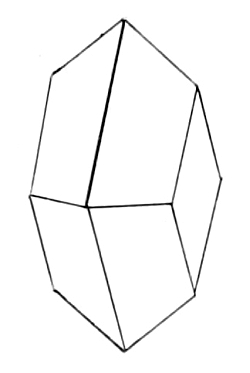 |
A crystallographic examination of the acid showed it to belong
to the orthorhombic system. Axial ratio: a: b: c = ·8507: 1: ·8121.
Planes. Ρ and α Ρ ὰ.
| |
|
|
⎧ |
Edge X = 131° 8' |
| |
⎧ |
Ρ ^ Ρ |
⎨ |
” Y = 82° 18' |
| Angles measured |
⎨ |
|
⎩ |
” Z = 118° 40' |
| |
⎩ |
Ρ ^ |
α Ρ ὰ |
= 114° 38' |
The crystals are up to 8 mm in length.
The pyramidal faces are
generally etched so that the image is poor. |