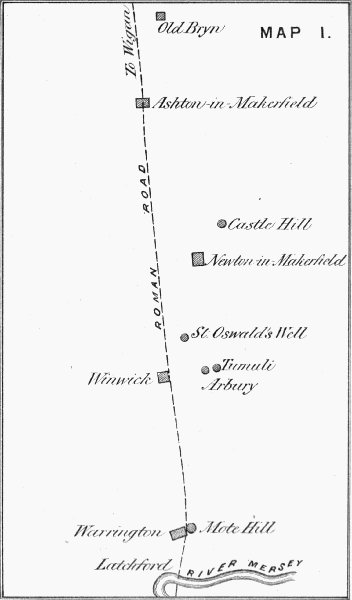
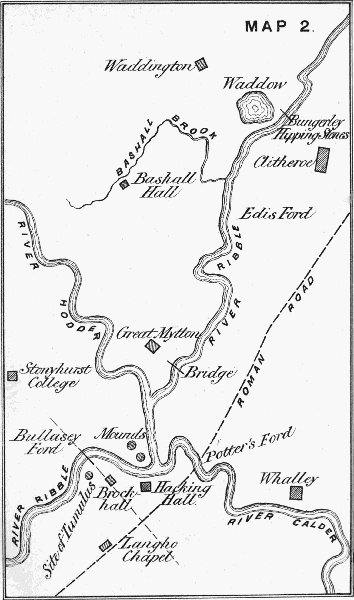
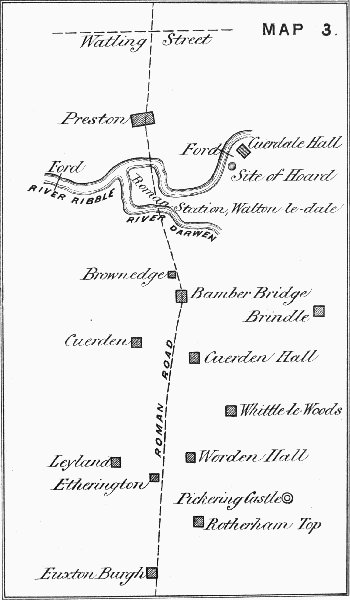
THE LEGEND OF THE WILD BOAR, "THE MONSTER IN FORMER AGES, WHICH
PROWLED OVER THE NEIGHBOURHOOD OF WINWICK, INFLICTING INJURY ON MAN
AND BEAST."
he Venerable Bede, in the ninth chapter of his "Ecclesiastical History
of the English Nation," says, in the year 642—"Oswald was killed in a
great battle, by the same Pagan nation and Pagan king of the Mercians
who had slain his predecessor, Edwin, at a place called in the English
tongue, Maserfelth, in the thirty-eighth year of his age, on the fifth
day of the month of August."
The Anglo-Saxon Chronicle, under the same date, says—"This year Oswald,
King of the Northumbrians, was slain by Penda and the South-humbrians at
Maserfeld, on the nones of August, and his body was buried at Bardney
(Lincolnshire). His sanctity and miracles were afterwards manifested in
various ways beyond this island, and his hands are at Bamborough"
(Northumberland), "uncorrupted."
The battle is likewise recorded by relatively more recent chroniclers,
yet its site, hitherto, has not been satisfactorily determined. Camden,
Capgrave, Pennant, Sharon Turner, and some others fix it at Oswestry, in
Shropshire; while Archbishop Usher, Alban Butler, Powell, Dr. Cowper,
Edward Baines, Thomas Baines, W. Beaumont, Dr. Kendrick, Mr. T. Littler,
and others prefer the neighbourhood of Winwick, in the "Fee of
Makerfield," Lancashire.[11]
Mr. Edward Baines says—"The district in which Winwick is seated has,
from a very distant period, been denominated Mackerfield or
Macerfield—a battle-field, with variations in the orthography usually
found in Norman and Anglo-Saxon writers." The late Rev. Edmund Simpson,
vicar of Ashton-in-Mackerfield, however, disputes this etymology, and
contends that "Mackerfield is Mag-er-feld, a great plain cultivated:
mag and er being Gaelic and feld Saxon. Thus Maghull, near
Liverpool, is a hill on the plain: thus, also, Maghera-felt in Ireland."
The "Fee of Makerfield" was co-extensive with the Newton hundred of the
Domesday record, and included nineteen townships. It extended from Wigan
to Winwick, and was traversed in its entire length by the great Roman
road, which entered Northumbria from the south near Warrington.
Professor Dwight Whitney, in his "Life and Growth of Language" (p. 39),
says—"Æcer meant in Anglo-Saxon a 'cultivated field,' as does the
German acker to the present day; and here, again, we have its very
ancient correlatives in Sanscrit agra, Greek ἀγρόϛ, Latin ager; the
restriction of the word to signify a field of certain fixed dimensions,
taken as a unit of measure for fields in general, is something quite
peculiar and recent. It is analagous with the like treatment of rod
and foot and grain, and so on, except that in these cases we have
saved the old meaning while adding the new."
Field is from A.S., O.S., and Ger. feld, Danish veld, the open
country, cleared lawn (Collins's Dic. Der.) With respect to acre the
old meaning is still retained, in one instance at least. We still say
"God's acre," when speaking of a churchyard or burial ground.
The following are some of the principal variations in the writing of the
name: Bede calls it Maserfelth, King Alfred writes it Maserfeld, as in
one MS. of the Anglo-Saxon Chronicle. Another copy, however, has it
Maresfeld. The latter is probably a clerical error resultant from the
accidental misplacement of the letters r and s by the copyist, or
it may be an ordinary example of what philologists call "metathesis," or
transliteration. Matthew of Westminster writes it Marelfeld, and John of
Brompton, Maxelfeld. Matthew and John, however, are relatively modern
authorities in comparison with Bede, the Anglo-Saxon Chronicle, and
Alfred. Their orthography, however, furnishes an apt illustration of the
mutation which has taken place in local nomenclature during the
transition of the language from Anglo-Saxon to modern English, and hence
the occasional difficulty of satisfactory identification at the present
day.
The phonetic difficulty between Maserfeld, Macerfeld, and Makerfield is,
perhaps, not insurmountable. The letter c in English is useless,
having either the sound of k or s. Before a, o, and u, it
becomes k, as in cat, cot, cure; before e and i it becomes s, as
in century, certain, cinder, and city. Cer, likewise, by metathesis, or
the transposition of the r, becomes cre, as in lucre, massacre,
etc.[12] Thus it would appear the modern word "Makerfield" probably
accords both etymologically and topographically with the Anglo-Saxon
name of the site of the battle. As no other hamlet, township, or parish,
or other territorial designation (the nearest being Macclesfield), does
this, especially when taken in conjunction with the many corroborative
evidences, would appear to satisfactorily identify the locality.[13]
These corroborative evidences are by no means either scanty or
unimportant.
The parish church of Winwick is dedicated to St. Oswald, and Mr. Baines
says—"Little more than half a mile to the north, on the road to
Golborne and Wigan, is an ancient well, which has been known from time
immemorial by the name of 'St. Oswald's Well.'" This well is still in
existence, and a certain veneration at the present time hovers about it
in the minds of others than the superstitious peasantry. On the upper
portion of the south wall of the church is an inscription in Latin,
purporting to be a "renovation" of a previous one, by a person named
Sclater, in the year 1530, in the curacy of Henry Johnson. On a recent
visit, this inscription, as well as other portions of the edifice, I
found had undergone further renovation. Gough translates the first three
lines as follows:—
This place of old did Oswald greatly love:
Who the Northumbers ruled, now reigns above,
And from Marcelde did to Heaven remove.
Mr. Beamont gives the translation of the inscription as follows:—
This place of yore did Oswald greatly love,
Northumbria's King, but now a saint above,
Who in Marcelde's field did fighting fall,
Hear us, oh blest one, when here to thee we call.
(A line over the porch obliterated.)
In fifteen hundred and just three times ten,
Sclater restored and built this wall again,
And Henry Johnson here was curate then.
This, and its repetition by Hollingworth in his "Mancuniensis," appears
to have alone constituted "the highest authority" relied upon by Edward
Baines for his statement that Winwick parish was the favourite residence
of King Oswald. The inscription does not, as some have assumed, state
the church is built in, on, or near Marcelde. It merely asserts that
Oswald died at a place so named, and which may have been Winwick, the
site of the church dedicated to St. Oswald, or any other locality,
Marcelde being evidently a corruption and a rythmical contraction of the
undoubted Anglo-Saxon name of the scene of Oswald's defeat and death.
Objection has been taken to the word "Marcelde," as a bad Latin
substitute for "Maserfeld." But the goodness or badness of mediæval
Latin substitutes for English names is of no consequence to the question
at issue, as the reference to the place of Oswald's death is undeniable.
It is but an apt illustration of the strange transformations local
nomenclature sometimes has undergone in transmission from past centuries
to the present time.
Geoffrey of Monmouth and the Welsh Bruts curiously confound the
incidents attendant upon this and a previous battle, in which Oswald was
engaged and was victorious. Geoffrey says that Cadwalla, a Brit-Welsh
king, one of the heroes of Lywrich Hen's poetic effusions, hearing of
Oswald's victory over Penda(?) at "Heavenfield," "being inflamed with
rage, assembled his army and went in pursuit of the holy king, Oswald;
and in a battle which he had with him, at a place called Burne, broke in
upon him and killed him."
Geoffrey here, as noted by Sharon Turner, shows his irrational
partiality to the fame of the British chieftain, and his disregard of
historical truth when it did not minister to his prejudices or presumed
patriotism. Cadwalla was slain in the battle with Oswald at
"Heavenfield," in 635, seven years previously to the saintly
Northumbrian warrior's defeat and death; and, consequently, the British
hero was, in accordance with ordinary mortal notions, somewhat
incapacitated for the performance of the after-deeds of valour, ascribed
to him by his panegyrist—without miraculous intervention—which,
however, Geoffrey does not even suggest, notwithstanding its presumed
frequency on other momentous occasions.[14]
Referring to Oswald's death, Bede says—"It is also given out and become
a proverb, 'that he ended his life in prayer;' for when he was beset
with weapons and enemies, he perceived he must immediately be killed,
and prayed to God for the souls of his army, hence it is proverbially
said, 'Lord have mercy on their souls, said Oswald, as he fell on the
ground.' His bones, therefore, were translated to the monastery which we
mentioned (Bardsea), and buried therein; but the king that slew him
commanded his head, hands, and arms to be cut off from the body, and set
upon stakes. But the successor in the throne, Oswy, coming thither the
next year with his army, took them down, and buried his head in the
church of Lindisfarne, and the hands and arms in the royal city"
(Bamborough).
Bede relates many anecdotes, illustrative of the sanctity of Oswald, and
the miracles wrought by his bones, as well as by the earth which
received his blood on the battle-field. One instance I give entire, in
Dr. Giles's translation of the venerable historian's own words. In
chapter x., book iii., he says—
"About the same time, another person of the British nation, as is
reported, happened to travel by the same place, where the aforesaid
battle was fought, and observing one particular spot of ground, green
and more beautiful than any other part of the field, he judiciously
concluded with himself that there could be no other cause for that
unusual greenness but that some person of more holiness than any other
in the army had been killed there. He therefore took along with him some
of that earth, tying it up in a linen cloth, supposing it would some
time or other be of use for curing sick people, and proceeding on his
journey, he came at night to a certain village, and entered a house
where the neighbours were feasting at supper; being received by the
owners of the house, he sat down with them at the entertainment, hanging
the cloth in which he had brought the earth, on a post against the wall.
They sat long at supper and drank hard, with a great fire in the middle
of the room; it happened that the sparks flew up and caught the top of
the house, which being made of wattles and thatch, was presently in a
flame; the guests ran out in a fright, without being able to put a stop
to the fire. The house was consequently burnt down, only that post on
which the earth hung remained entire and untouched. On observing this,
they were all amazed, and inquiring into it diligently, understood that
the earth had been taken from the place where the blood of King Oswald
had been shed. These miracles being made known and reported abroad, many
began daily to frequent that place, and received health to themselves
and theirs."
In June, 1856, whilst I was engaged superintending the excavations at
"Castle Hill," Penwortham, near Preston, an incident occurred, which,
"in the olden time," would have been regarded as a conclusive proof not
only of the miraculous quality of the earth on which St. Oswald expired,
but of the site of the battle-field. We found, under the mound
excavated, the remains of an edifice which had been destroyed apparently
partly by fire, and on the ruins of which to the height of about 12 or
14 feet, the Anglo-Saxon tumulus had been piled. The hill, situated at
the nose of the promontory overlooking the upper portion of the Ribble
estuary, had evidently been occupied at one time as a specula, or
outpost, in connection with the Roman station at Walton-le-dale. The
wattle and thatch characteristics of the remains of the fallen roof of
the edifice were very apparent. But the most remarkable, nay,
inexplicable feature disclosed, was a single oak pillar, with wooden
peg-holes in it, standing erect near the centre of the mound, while the
remainder of the structure was scattered in confusion on a mass of
debris and vegetable litter, in which were found, together with several
articles in metal, etc., an enormous quantity of bones of animals,
evidently killed and eaten for food. To the persistent enquiries of
several somewhat bewildered persons, anxious to discover an immediate
explanation of so remarkable a fact, I at length yielded, and related,
in a serious, but not authoritative manner, the statement of Bede, and
I feel confident several persons returned home with a conviction that
the story was probable enough, or at least there was something either
miraculous or "uncanny" about the whole affair. Without, of course,
assenting to the miraculous medicinal quality of the earth, it is highly
improbable that so conscientious, if credulous, a writer as Bede would
relate such a story, unless there had been some substratum of prosaic
fact reported to him, on which the miraculous element might easily have
been engrafted in those superstitious days. It is not improbable that
the accidental preservation of the pillar to which was hung the presumed
sacred earth on which the saintly monarch breathed his last, prevented
its destruction or removal, and hence its position near the centre of
the mound raised above the ruined edifice, and, doubtless, afterwards
used as a "mote hill," or out-of-door justice seat, or place of public
assembly. If Winwick be the site of the battle-field, the traveller
passing from thence northward by the great Roman road would arrive at
Penwortham in time for supper, presuming that his journey commenced
three or four hours previously.
All this may not be worth much more than some of the idle tales of the
old "historians" in support of the claims of the Lancashire site as the
locality of the great battle between the Christian and Pagan elements in
the population of the northern portion of England in the seventh
century.[15] Nevertheless, it presents, at least, one of those
remarkable coincidences that occasionally puzzle our reason and perplex
our faith. Deeper insight into the psychological aspect of the humanity
of any period may often be gained by a careful study of their legendary
lore and cherished superstitions than from the perusal of the more
orthodox historical chronicles. But there are other evidences respecting
the site of this important Anglo-Saxon conflict, more reliable than the
miracles of tradition, which demand our attention.
From the antecedents of the respective belligerents, and the statement
of Bede, it seems almost certain that the Pagan chieftain, Penda, was
the aggressor, and, anxious to avenge the death of Cadwalla, his
quasi-Christian ally, invaded the Northumbrian kingdom, on the frontier
of which he was successfully confronted by his Christian antagonist. The
tradition in Geoffrey's day, at least, distinctly states that Oswald's
conqueror was the aggressor. He says—"inflamed with rage, he went in
pursuit of the holy king." See Ante, p. 67.
Referring to the antecedents of the war under Oswy, which followed
Oswald's death, and in which Penda was slain near the river Winwid, Mr.
Green ("Making of England") says—"That Oswiu strove to avert the
conflict we see from the delivery of his youngest son, Ecgfrith, as a
hostage into Penda's hands. The sacrifice, however, proved useless.
Penda was again the assailant, and his attack was as vigorous as of
old." We, therefore, in the first instance, should naturally look for
the battle-field in Northumbria, rather than in North Wales,[16] or even
in Mercia.
Another important element with reference to the disputed site has not
hitherto, to my knowledge, received the attention it deserves. Geoffrey
of Monmouth, and the Welsh Bruts, notwithstanding their determination to
give all the honour to the defunct British chief, Cadwalla, could have
no motive for falsifying the site of the battle. Indeed, his reference
to it by name, as will be seen by the extract previously given, is of an
ordinary passing character.
Now, there is a locality, in the parish of Winwick, and in the "Fee of
Makerfield," to the north of the great barrow or tumulus, to which I
shall call further attention, that answers, on true phonetic laws, to
this nomenclature. Mr. Edward Baines says—"The original proprietors of
the township of Ashton" (which is the largest township in the old parish
of Winwick) "derived their name from Bryn Hall, the place of their
residence, or gave their name to that place, and Alan le Brun occurs in
the 'Testa de Nevill,' as holding by ancient tenure two bovates of land
for 6s. of Sir Henry de Le." It is here apparent that the present name
Bryn was originally Brun, and, as brun and burn are, by what
philologists term transliteration, but different renderings of the same
word, meaning a spring or brook, Geoffrey's varied reading of the name
of the locality—"at a place called Burne," strongly supports the
other evidence in favour of the Lancashire site. Edward Baines,
referring to the ancient Lancashire family, the Gerards of Bryn,
says—"This family have had four seats within the township of Ashton,"
(in Makerfield), "namely, Old Bryn, abandoned five centuries ago; New
Bryn, erected in the reign of Edward VI.; Garswood, taken down at the
beginning of the present century; and the new hall, the present
residence of the family."
Nennius says Penda slew Oswald at the "battle of Cocboy,"[17] and that
"he gained the victory by diabolical agency." No attempt, however,
within my knowledge, has been made to identify "Cocboy" with any
existing locality. There is, however, I understand, a place near the
ancient pass of the Mersey, or Latchford, and contiguous to the great
Roman road, named Cockedge. As Cocboy is unknown this may be a
corruption of it. Etymologists identify coc with the British gosh or
red. As the new red sandstone crops out in the neighbourhood, this
interpretation accords with the local condition.
Latchford, too, would be significant, if like Lichfield, it had its
root in the Anglo-Saxon lic, but this is doubtful. Lichfield or
Litchfield, the "field of dead bodies," is said to have derived its name
from the circumstance that "many suffered martyrdom there in the time of
Dioclesian."[18] In Gibson's "Etymological Geography," Win-feld, where
Arminius, or Hermann, defeated the Roman legions under Varus, A.D. 10,
is said to signify the "field of victory." A similar etymology is
equally valid for Winwick, and hence its significance. Indeed, the
intransitive form of the Anglo-Saxon verb winnan, whence our win,
signifies "To gain the victory." A similar interpretation will equally
apply to Winwidfield, near Leeds, the scene of Penda's subsequent defeat
and death.
When dealing with the identification of modern with ancient names, it is
well to bear in mind the remarks of so erudite a philologist as
Professor Dwight Whitney. In his "Life and Growth of Language," he
says—"It must be carefully noted, indeed, that the reach of phonetics,
its power to penetrate to the heart of its facts and account for them,
is only limited. There is always one element in linguistic change which
refuses scientific treatment, namely, the action of the human will. The
work is all done by human beings, adapting means to ends, under the
impulse of motives and the guidance of habits which are the resultant of
causes so multifarious and obscure that they elude recognition and defy
estimate." Again, "Every period of linguistic life, with its constantly
progressive changes of form and meaning, wipes out a part of the
intermediates which connect a derived element with its original. There
are plenty of items of word-formation in even the modern Romanic
languages, which completely elude explanation. Mere absence of evidence,
then, will not in the least justify us in assuming the genesis of an
obscure form to be of a wholly different character from that which is
obvious or demonstrable in other forms. The presumption is wholly in
favour of the accordance of the one with the other; it can only be
repelled by direct and convincing evidence." And again, "As linguistics
is a historical science, so its evidences are historical, and its
methods of proof of the same character. There is no absolute
demonstration about it: there is only probability, in the same varying
degree as elsewhere in historical enquiry. There are no rules, the
strict application of which will lead to infallible results. Nothing
will make dispensable the wide gathering-in of evidence, the careful
sifting of it, so as to determine what bears upon the case in hand and
how directly, the judicial balancing of apparently conflicting
testimony, the refraining from pushing conclusions beyond what the
evidences warrant, the willingness to rest, when necessary, in a merely
negative conclusion, which should characterize the historical
investigator in all departments."
The most important ancient structure at present remaining in the parish
of Winwick is an immense tumulus called "Castle Hill." Mr. Edward Baines
says—"At the distance of half-a-mile from and to the north of Newton,
stands an ancient barrow, called Castle Hill. It is romantically
situated on elevated ground, at the junction of two streams, whose
united waters form the brook which flows past the lower part of the town
of Newton.[19] The sides and summit of the barrow are covered with
venerable oaks, which to all appearance have weathered the rude and
wintry blasts for centuries. It is a spot well adapted for the repose of
the ashes of the mighty dead."
Mr. W. Beamont, in a paper read before the Lancashire and Cheshire
Historic Society, on the "Fee of Makerfield," etc., in March, 1873,
says,—"On the west side of this rivulet" (the Golbourne brook), "where
the red rock rises above it, there is scooped out a rude alcove or cave,
which the country people assign to Robin Hood, the popular hero, who in
most of our northern counties divides with Arthur of the Round Table and
Alfred the Great the right to legendary fame. The Castle Hill, which
stands in a commanding position above the other bank of the stream, and
is boul-shaped, is 320 feet in circumference at the base, 226 feet in
circumference at the top, and it has an elevation of 17 feet above the
level of the field below."
On a recent visit I found the old oaks, like faithful veteran sentinels,
still guarding, in Mr. Baines's language, "the repose of the mighty
dead." One or two of them, however, exhibited unmistakeable evidence
that the rude blast of the storm-wind and fiery embrace of the
lightning-flash had shattered their aged limbs, while the benumbing
grasp of Time had chilled their heretofore invigorating sap. Yet,
although they are destined, in a relatively very short period, from
their chronological standpoint, to succumb to the destiny of all
organic life, and finish their lengthened existence in ignominious
association with the faggot-shed, still their venerable forms,
notwithstanding the dilapidations which attest the force of years of
elemental conflict, in conjunction with the historic and legendary
memories with which they are associated, render them more suggestive
teachers in their decay than they were in the pride of their stalwart
and umbrageous prime.
Another change has likewise come over the scene since Mr. Beamont's
description was written. The stream near Newton has been blocked by an
earthen embankment, and the "Castle Hill" now overlooks a beautiful
artificial lake, with three branches. Robin Hood's cave, alas! had to be
sacrificed; four or five feet of water now placidly flows over the site
of its former entrance.
This tumulus, situated on the Gol-bourne brook, in the Fee of
Mackerfield, was opened on the 8th of July, 1843. An account of this
excavation, by the Rev. E. Sibson, was published in the "Transactions of
the Manchester Literary and Philosophical Society" at the time, from
which I gather the following important particulars. Mr. W. Beamont, who
was present during the excavations, likewise (in the paper previously
quoted) gives a detailed account of the mode of procedure adopted, and
of the remains discovered. The mound was found to be artificial, and
composed of earth, sand, and rock taken from a trench on the south and
west sides. This trench was then found to be about five feet deep and
forty feet wide. It appeared to have been originally seven feet deep,
two of which had been excavated out of the solid rock. A shaft six feet
wide was sunk in the centre of the tumulus, and an adit to meet it, from
the west side, on the level of the original soil. Mr. Beamont says—"At
the distance of about ten feet from the centre of the barrow, on the
south side of the shaft, a chamber was discovered. The base of this
chamber was two feet broad, and it was curved. Its length was twenty-one
feet, its height two feet, and the roof was a semi-circular arch. It
seemed to be constructed of masses of clay, about a foot in diameter,
rolled into form in a moist state, and closely compacted by pressure.
When the chamber was first opened the candles were extinguished, and
there was great difficulty in breathing. The sides and bottom of the
chamber were coated with impalpable powder, of smoke colour. The bottom
of the chamber was covered with a dark-coloured substance. The external
surface of this substance was like peat earth, being rough, uneven, and
of a black colour. The inside of it, when broken, was close and compact,
and somewhat similar to black sealing-wax, which, when examined by the
microscope, was found to be closely dotted with particles of lime. It
was thought to be a mixture of wood ashes, half burned animal matter,
and calcined bones. On this plate of animal matter, which had been
placed on the edge of the original green sward, was a covering of loose
earth, about two inches in thickness, which might have fallen from the
roof and sides of the chamber. Immediately below the plate of animal
matter a trench had been cut, about fifteen inches deep, and two tiers
of round oak timber had been placed in it. The first tier was notched
into the green sward, and the second tier was nine inches below it. The
horizontal distance of the several pieces was about eighteen inches, and
the pieces in the lower tier were placed exactly opposite to those in
the upper one. Several of the pieces were charred, and many of them had
entirely disappeared, leaving black marks in the sides of the trench,
where they had formerly been placed. These pieces of oak appeared to
have been three or four inches in diameter. In almost all the cases the
wood of these pieces had been absorbed; in some cases the bark on the
under side of these pieces was carbonised, and had nearly the appearance
of coal; and in other cases the bark on the under side of these pieces
retained its original form and colour. In one case, however, one of
these pieces, in contact with the animal matter, had the appearance of
dry decayed wood. The trench, below the plate of animal matter, was
filled with clay."
Mr. Beamont gives several other interesting details, and adds,—"It is
probable that this chamber contained the original deposit, and that it
had never been opened before. On the roof of the east side of the
chamber there was discovered a very distinct and remarkable impression
of a human body. There was the cavity formed by the back of the head,
and this cavity was coated with a very thin shell of carbonised matter.
The depression of the back of the neck, the projection of the shoulders,
the elevation of the spine, and the protuberance of the lower part of
the body, were distinctly visible. The body had been that of an adult,
and the head lay towards the west. The exact form and vertical position
of the circular chamber was indicated by a ridge on the crest of the
hill, which was one reason why the tunnel was driven from the bottom of
the shaft towards the south." The writer further informs us that the
"Castle Hill is said to be haunted by a white lady, who flits and
glides, but never walks. She is sometimes seen at midnight, but is never
heard to speak." The Rev. Mr. Sibson adds—"There is a tradition that
Alfred the Great was buried here, with a crown of gold, in a silver
coffin." He likewise says that in a "drift, on the east side of the
shaft, and near the centre of the hill, a broken whetstone was found. It
was of freestone of a fine grain, of a dull white colour, slightly
veined with red; and the surface was finely polished. It was about five
inches in length and three in breadth." He likewise figures a fragment
of an urn, apparently of Roman manufacture, from the presence of which
he inferred that "the Castle Hill had been a place of interment for
persons of distinction for a long period."
Dr. James Fergusson, in an appendix to his work on "Rude Stone Monuments
of All Countries," gives, at length, an account of the opening, in 1846,
of a huge tumulus, named "Oden's Howe," near Upsala, by Herr Hildebrand,
the royal antiquary of Sweden. The similarity of many of the remains
brought to light to those found in the "Castle Hill," seems to suggest
that these tumuli were erected by cognate people, and at no very distant
periods from each other. Herr Hildebrand says,—"During the diggings
were found unburnt animal bones, bits of dark wood, charcoal, bits of
burnt bones, etc. This was evidently a sepulchral mound. Diggings have
also been made in the smaller cairns near by, and, although they have
been opened before, burial urns have been found, burnt human bones,
bones of animals and birds, bits of iron and bronze, etc.... At the
middle of the howe, the grave-chamber is nine feet above the level of
the soil, 18 feet under the top of the howe. On the bed of the clay,
under the great stones, have been found an iron clinker three inches
long, remains of pine poles partly burnt, a lock of hair chestnut
coloured, etc. The numerous clusters of charcoal show that the dead had
been burned on the layer of clay, and the bones have been collected in
an urn not yet found. In one of the nearest small howes have been found
a quantity of burnt animal and human bones, two little-injured bronze
brooches, a fragment of a golden ornament, etc." After further
examination of the contents of the howe, Herr Hildebrand says, "June
29th, 1847,—The burial urn has been found in the grave-chamber, also
have turned up bones of men, horses, dogs, a golden ornament delicately
worked, a bone comb, bone buttons, etc." He afterwards writes to say
that the burial urn was found three inches under the soil, and was
covered with a thin slab. "It was seven inches high, nine inches in
diameter, filled with burnt bones, human and animal (horse, dog, etc.),
ashes, charcoal (of needle and leaf trees), nails, copper ornaments,
bone articles, a bird of bone, etc. In the mass of charcoal also were
found bones, broken ornaments, bits of two golden bracteates, etc. Coins
of King Oscar were then placed in the urn, and everything restored as
before. Frey's Howe was opened, and showed the same results."
"Dr. Fergusson, commenting on this, says—"With a little local industry,
I have very little doubt, not only that the date of these tombs could be
ascertained, but the names of the royal personages who were therein
buried, probably in the sixth or seventh century of our era."
In a paper read before the Lancashire and Cheshire Historic Society, in
March, 1860, the late Dr. Robson says—"In the Ordnance survey as first
published on the inch scale, about half a mile to the east of Winwick
church, we find a couple of tumuli, one on each side of a bye-lane; but
in the later and larger map, a single tumulus is marked, through the
centre of which the road seems to have been cut. The earlier survey
gives the more correct representation of the place, as there have
certainly been at least two barrows, one in the field on the east, the
other in that of the west side of the lane." The latter is on a farm
called "Highfields." As the land has long been under cultivation, the
tumulus was not very well defined, but it appeared to have been about
thirty yards in diameter. The summit is "distinct enough," says Dr.
Robson, and "is about six feet above the level of the lane." This mound
was dug into in November, 1859, and the Dr. records that "deposits of
burned bones were found at some distance from its centre, on the slopes
to the east and south. These bones were in small fragments, apparently
in distinct heaps, mixed with minute particles of burnt wood, and one or
two fragments of brown, thick, ill-burnt and rude pottery turned up,
not, however, appearing to have any connection with the bone
deposits—the only portion of which offering any recognisable character,
was the head of a thigh bone of a subject twelve or fourteen years old.
About six feet deep in the centre, the red sandstone rock was
reached.... Some labourers working in the field on the other side of the
lane, fifteen years ago, came upon an urn with bones in it, apparently
of a similar description. This tumulus was removed at the beginning of
the present year, and the men in their operations cutting into some soft
black stuff, struck a spade into an urn and broke it into pieces; it
seems to have been of large size, and has a feathered pattern scored on
the outside, in other respects agreeing with the fragments already
described. It contained bones in the same fragmentary state as those
found on the west side of the lane, and with them a stone hammer-head
and a bronze dart."
Near these tumuli, on the ordnance map, is a place named Arbury. This
name has evidently had originally some connection with these mounds. In
the "Imperial Gazetteer," Arbury, in Herts, on the Icknield-st., is
described as a "Roman camp," and so is Arbury or Harborough, near
Cambridge, as well as Arbury Banks, on the Watling-st., near Chipping
Norton, Northamptonshire. In Anglo-Saxon the prefix ar, according to
Bosworth's Dictionary, signifies "glory, honour, respect, reverence,"
etc.
Dr. Robson discusses at some length the presumed date of these
interments, and contends that such nomenclature as "stone and bronze
periods" only mislead. He says—"In some graves are coins which carry a
date with them, and in others Roman remains which belong to the first
four centuries of our era. But in tumuli such as those at Winwick, there
is nothing to show whether it was raised six centuries before or six
centuries after that period." From the drawings which accompany Dr.
Robson's paper, there appears nothing to vitiate the hypothesis that
these mounds were raised on the battle-field of 642. The stone hammer is
highly finished and polished. The form of the spear-head agrees with
some of the examples figured by Mr. Thomas Wright and Mr. L. Jewitt, as
pertaining to the earlier Anglo-Saxon period. It presents a kind of
transition from between the shorter Roman bronze and the more elongated
iron of the later Anglo-Saxon time. The "feathery pattern" scored on
the pottery resembles the rude "herring-bone," or zig-zag ornamentation
of late Roman and early Anglo-Saxon masonry.
Another and much larger tumulus until recently was situated opposite to
the parish church at Warrington, and contiguous to the ancient
Latchford, by which the British trackway and the great Roman road
crossed the Mersey. For some miles both on the east and west, in early
times, no other route was practicable; the mosses on the one hand and
the tidal estuary on the other presenting insuperable obstacles,
especially to heavy traffic. The tumulus at Warrington, named the "Mote
Hill," was entirely removed in 1852. Pennant had conjectured it to be
Roman; Ormerod, Norman; and John Whitaker, Saxon. In a paper read before
the Lancashire and Cheshire Historic Society, on November, 1852, Dr.
Kendrick gave a detailed account of the excavation, and exhibited the
discovered remains. Some of the pottery was rude (apparently
Romano-British), and cremated human remains were present, as well as an
immense quantity of the remains of animals. Referring to Whitaker's
conjecture of the Saxon origin of the mound, or of that race having
utilised it, Dr. Kendrick says—"to this opinion I think all the
appearances detailed this evening afford strong support." Mr. Sibson,
likewise, who was present at the examination of the hill in 1832, and
again in 1841, coincides in this view, and suggests that it originally
constituted a tumulus, or burial place, raised after the battle fought
at Winwick. Dr. Kendrick thought that as the church was dedicated to
St. Elphin, slain in 679, the mound might have covered his remains; but
the Pagan character of the interment or interments negatives this view.
Mr. W. T. Watkin, in a note to the present writer, says—"Dr. Kendrick's
account compared with that of Mr. Sibson evidently shows that the mound
was originally a Roman boundary mark, used afterwards in Saxon and
mediæval times for various purposes. The second excavation merely shows
the contents of the mound as they were thrown in after the first
exploration, with the exception of the well and one or two smaller
details." He adds—"All these things are in accordance with the rules of
the Roman agrimensores." This view seems very probable.[20]
I am inclined to regard these tumuli, in the main, as monuments of the
site of some great battle or battles, and that amongst others, Maserfeld
may be, perhaps, the latest and most important fought in the
neighbourhood previous to the disuse of cremation and the general
adoption of the modern Christian mode of interment. The whole of these
large barrows were evidently erected by people who burned and buried
their dead on the spot where the memorial mound or monument was
afterwards erected. We know from the Venerable Bede's record, how the
body of King Oswald was disposed of. Besides the king being a pious
Christian, such a mode of sepulture would not have been adopted by his
followers. Penda, on the contrary, was a Pagan, and strongly attached to
the superstitions and customs of his Teutonic ancestors. We know that
the Pagan Anglo-Saxons in England practised both modes of interment, the
burial of the body entire and cremation. Mr. Thomas Wright says—(Celt,
Roman, and Saxon, p. 401) "The custom in this respect appears to have
varied with the different tribes who came into the island. In the
Anglo-Saxon cemeteries in Kent, cremation is the rare exception to the
general rule; while it seems to have been the predominating practice
among the Angles from Norfolk into the centre of Mercia." It is,
therefore, highly probable, if the battle of Maserfeld was fought in
this district, that these tumuli, or some portion of them, were raised
by the Pagan Mercian victors over the bodies of chieftains of their
party slain in the battle. Nennius says that in the conflict Penda's
brother Eawa was slain, and, consequently, he and the other Pagan
chieftains who fell in the battle would be interred in Pagan fashion by
the victorious survivors.
The oldest Anglo-Saxon poem extant, "Beowulf," the scene of the events
of which Mr. D. Haigh, in his "Conquest of Britain by the Saxons,"
contends to be the neighbourhood of Hartlepool, in Durham,[21] has
preserved to us a description of such a ceremonial in detail. On
Beowulf's death, his warriors raised a funeral pile to burn the body. It
was—
hung round with helmets,
with boards of war, [shields]
and with bright byrnies, [coats of mail]
as he had requested.
Then the heroes, weeping,
laid down in the midst
the famous chieftain,
their dear lord.
Then began on the hill,
the warriors to awake
the mightiest of funeral fires;
the wood-smoke rose aloft
dark from the fire;
noisily it went,
mingled with weeping.
His faithful followers afterwards erected the barrow over his ashes:—
a mound over the sea;
it was high and broad,
by the sailors over the waves
the beacon of the war-renowned.
They surrounded it with a wall
in the most honourable manner
that wise men
could desire.
They put into the mound
rings and bright gems,
all such ornaments
as before from the hoard
the fierce-minded men
had taken.
The date of the erection of the first parish church at Winwick is not
known with certainty. Some contend that it was coeval with the
introduction of Christianity into the North of England by Paulinus.
Although this is incapable of absolute verification, it is generally
conceded that a church must have existed for some time antecedent to
the Norman conquest. The Domesday Survey, under the head of "Newton
Hundred," seems to confirm this. It says, "Under the reign of King
Edward" (the Confessor) "there were five hides in Newton: one of these
was held in demesne. The church of this manor had one carucate of land,
and St. Oswald, of this village, had two carucates, exempt from all
taxation." Mr. Baines says—"In 1828, while digging a vault in the
chancel of this church, there were found, at the depth of eight or ten
feet below the floor, three human skeletons of gigantic size, laid upon
each other, and over them a rude heap of cubical sandstone blocks of
irregular dimensions, varying from one to two feet. No remains of
coffins were found in the grave, and the history of the occupants of
this mysterious tomb remains undiscovered." It seems, however, not
improbable that these interments took place anterior to the building of
the church, that the skeletons were the remains of chieftains who
perished with Oswald, and that the sacred edifice, dedicated to the
warrior saint, was afterwards erected on the spot.
The first known record of the old church at Oswestry is thus referred to
by the Rev. D. R. Thomas (His: Diocese of St. Asaph):—"The Parish
Church of St. Oswald is first definitely mentioned in 1086 in the Grant
of Warin, Vicecomes ... to the abbot and monks of Shrewsbury Abbey,
dedit eis Ecclesiam Sancti Oswaldi cum decima ville;" but there is a
belief that there was a still earlier one elsewhere than on the present
site, which may be due partly to the fact that the town was originally
built on some other site, partly to the circumstance that several of the
earlier mission stations are still indicated by such names as Maen
Tysilio, Croes-Wylan, Cae Croes, and Croes Oswaldt, or The Cross; and to
the tradition which Leyland records, "that at Llanforda was a church
now" (sixteenth century) "decaid. Sum say this was the paroche church of
Oswestre."
I have previously referred to the ancient well, situated about
half-a-mile from Winwick Church, known from time immemorial as "St.
Oswald's Well." Mr. Edward Baines regards this sacred spring as having
been originally formed by the excavation of earth on the spot where
Oswald fell, and he fortifies his position by reference to Bede, who
says—"Whereupon many took up of the very dust of the place where his
body fell, and putting it into water, did much good with it to their
friends who were sick. This custom came so much into use, that the earth
being carried away by degrees, there remained a hole as deep as the
height of a man."
Perhaps the most important objection to the Oswestry site lies in the
fact that there is no satisfactory representative of the name of
Maserfeld to be found in its neighbourhood.[22] One writer says—"In the
vicinity of the town, at a place called by the Welsh 'Cae Naef'
(Heaven's Field) there is a remarkably fine spring of water, which bears
the name of Oswald's Well, and over which, as recently as the year 1770,
were the ruins of a very ancient chapel likewise dedicated to him."
Commenting on this, Mr. E. Baines says—"The well in that country is a
spring and not a fosse, as described by Bede, and is as the well at
Winwick," and he regards this feature as additional evidence in favour
of the presumed Lancashire site of the battle. The saint's well is
not, however, of much value, as Bede makes no mention of any spring,
natural or otherwise, and wells dedicated to saints in the "olden time,"
are common all over the country. Indeed, there is a natural spring near
the main highway about a mile to the north of Winwick Church, which is
likewise called St. Oswald's well. From Bede's context it is evident
Oswald died on the ordinary dry earth, which, in consequence,
thenceforth produced greener grass than the surrounding land, and the
soil was afterwards mixed with water and used medicinally. In England
there are at least five different places named after St. Oswald, and, in
addition, many ecclesiastical edifices have been dedicated to him.
There is something mysterious, or at least curiously coincident, about
this Welsh "Cae Naef," or "Heaven's Field," as this latter, according to
Bede, is the name of the site of the previous battle in 635, when Oswald
defeated and slew Cadwalla. The same authority likewise refers to it as
being fought "at a place called Denises-burn, that is Denis's-brook."
Dr. Giles says "Dilston is identified with the ancient Deniseburn, but
on no authority." Dilston is situated about two miles from Hexham.
Sharon Turner says—"Camden places this battle at Dilston, formerly
Devilston, on a small brook which empties into the Tyne." He adds,
"Smith, with greater probability, makes Errinburn as the rivulet on
which Cadwallon perished, and the fields either of Cockley, Hallington,
or Bingfield, as the scene of the conflict. The Angles called it
Hefenfield, which name, according to tradition, Bingfield bore." Dr.
Smith says that Hallington was anciently Heavenfelth, but adds that
probably the whole country from Hallington southward to the Roman wall
was originally included in the name. On the place where Oswald is said
to have raised a cross, as his standard during the battle, a church was
afterwards erected. Thus it would at first sight appear that Oswestry
might enter into competition with Bingfield for the site of the
Heavenfield struggle, rather than with Winwick for that of Maserfeld.
There is, however, one important fact which fatally militates against
this. Bede says, referring to the Heavenfield where Cadwalla met his
death, the "place is near the wall with which the Romans formerly
enclosed the island from sea to sea, to restrain the fury of the
barbarous nations, as has been said before." The greater probability is
as the two engagements are intertwined by the Welsh Bruts, and in the
Oswestry and Geoffrey traditions, that the place owes its designation
directly to neither the one nor the other; but that, like the sites I
have mentioned, the dedication of a church to the saint has been
sufficient to confer his name on the locality. That a neighbouring well,
under such circumstances, should receive a similar designation, is too
ordinary a matter to require special consideration.
It is not at all improbable that, as Geoffrey and the Welsh Bruts both
refer to the battle in which Oswald fell as fought at or near Burne, the
Oswestry traditions may have originally only had reference to the battle
of Denis-BURN or Denis-brook, in which the Welsh Christian hero,
Cadwalla, was slain by his hated rival, the Anglican Christian king
Oswald, of Northumbria. It is utterly improbable that the Welsh
Christians would dedicate a church to St. Oswald. The first Christian
king of Northumbria, Edwin, the friend of Paulinus and Augustine, was
slain by Cadwalla, "king of the Britons," or Brit-Welsh, in a battle at
Heathfield (Hadfield, in the West Riding of Yorkshire), A.D. 633, in
which he was aided by the pagan Penda. The Brit-Welsh Christians and the
disciples of Augustine and Paulinus hated each other with more than
ordinary sacerdotal intensity, and the former often entered into
alliances with the pagan Anglo-Saxons, in order to avenge themselves on
their detested rivals. One of the subjects of fierce contention between
them, as is well known, related to the time for the celebration of
Easter. Bede, referring to the defeat of Edwin at Heathfield and the
consequences attendant thereon, says—
"A great slaughter was made in the church or nation of the
Northumbrians; and the more so because one of the commanders by whom it
was made was a pagan, and the other a barbarian more cruel than a pagan;
for Penda, with all the nation of the Mercians, was an idolator and a
stranger to the name of Christ; but Cadwalla, although he bore the name
and professed himself a Christian, was so barbarous in his disposition
and behaviour, that he neither spared the female sex, nor the innocent
age of children, but with savage cruelty put them to tormenting deaths,
ravaging all their country for a long time, and resolving to cut off all
the race of the English within the borders of Britain. Nor did he pay
any respect to the Christian religion which had newly taken root among
them; it being to this day" (the 8th century) "the custom of Britons
not to pay any respect to the faith and religion of the English, nor to
correspond with them any more than with pagans."
Unquestionably no Christian church was dedicated to St. Oswald at
Oswestry until after the final subjection of the district by the
Anglican Christians. The probability therefore is that the locality was
merely named, as in the other instances referred to, from the fact that
it had become the location of a place of worship dedicated to him, and
that gradually the various traditions about the saint and his rivals
became inextricably confused. The last syllable "tre" is indicative of
British influence in the formation of the word Oswestry, as in Pentre,
Gladestry, Coventry (in Radnorshire), Tremadoc, Trewilan, Tredegar,
etc., which simply means, according to Spurrell's Welsh dictionary,
"resort, homestead, home, hamlet, town (used chiefly in composition)."
Indeed, Oswestry is more suggestive of Oswy's-tre, and may refer to a
successor who, some time after Oswald's death, built a church and
dedicated it to the saintly monarch.
The pagan Mercian king, Penda, was himself slain in the following year
by Oswy, the successor to St. Oswald. Bede says "the battle was fought
near the river Vinwed, which then with the great rains had not only
filled its channel, but overflowed its banks, so that many more were
drowned in the flight than destroyed by the sword." Most authorities
place this battle at Winwidfield, near Leeds. Mr. Thos. Baines, however
("Historical Notes on the Valley of the Mersey," His. Soc. Lan. and
Ches. Pro. session 5), claims for Winwick the scene of both engagements.
He says—"Penda and upwards of thirty of his principal officers were
drowned in their flight, having been driven into the river Winweyde, the
waters of which were at that time much swollen by heavy rains. There is
no stream in England which is more liable to be suddenly flooded than
the stream which joins the Mersey below Winwick[23], and there both the
resemblance of the names, and the probability of the fact, induce me to
think that Penda met with his death within two or three miles of the
place at which Oswald had fallen."
This seems, at first sight, plausible enough, but as Bede distinctly
states that "King Oswy concluded the aforesaid war in the country of
Loides" (Leeds), Winwidfield must unquestionably have preference over
the Lancashire site, as the scene of Penda's discomfiture and death.
It is generally accepted that Oswald died either at Oswestry or Winwick.
There are some, however, who accept neither, but contend that the true
site of the battle may yet, possibly, be found in a different locality.
This appears to be the opinion of Mr. John R. Green. In support of this
view he says ("Making of England")—"Though the conversion of Wessex had
prisoned it (Mercia) within the central districts of England, heathendom
fought desperately for life. Penda remained its rallying point; and the
long reign of the Mercian king was in fact one continuous battle with
the Cross. But so far as we can judge from his acts, Penda seemed to
have looked on the strife of religion in a purely political light. The
point of conflict, as before," [that is when Edwin was defeated and
slain at Hatfield] "seems to have been the dominion over East Anglia.
Its possession was vital to Mid-Britain as it was to Northumbria, which
needed it to link itself with its West-Saxon subjects in the south; and
Oswald must have felt that he was challenging his rival to a decisive
combat when he marched, in 642, to deliver the East Anglians from Penda.
But his doom was that of Eadwine; for he was overthrown and slain in a
battle called the battle of Maserfeld."
If this view be accepted, the claim of Oswestry must be at once
dismissed, while that of Winwick is rendered still more doubtful. But
Mr. Green does not state on what authority he relies when he states that
Oswald "marched in 642, to deliver the East-Anglians from Penda." In
consequence I am unable to test its value or probability. He certainly
would not march by either Oswestry or Winwick if such were his
destination. This statement, however, appears to be not exactly in
accordance with another by Mr. Green, previously quoted, in which he
says, referring to the antecedents of the war under Oswy, which followed
Oswald's death, and in which Penda was slain near the river
Winwid—"That Oswiu strove to avert the conflict we see from the
delivery of his youngest son Ecgfrith as a hostage into Penda's hands.
The sacrifice, however, proved useless. Penda was again the assailant,
and his attack was as vigorous as of old."
If Penda was the assailant, his assault must, in the first instance,
have been not on Oswald himself, but on his East-Anglian allies, or
Oswald would not have thought of marching in that direction for their
relief. But if Penda, having previously humbled the East-Anglians, had
become aware of such intention on the part of the Northumbrian monarch,
there is nothing improbable in a vigorous warrior of Penda's stamp, by a
rapid march, surprising him on the frontier of his own dominions,
defeating him, and thus warding off the threatened blow. Under such
circumstances Winwick might very probably have been the scene of the
conflict. The advocates of Oswestry do not deny the great probability
that Oswald had a favourite residence in the locality.
The neighbourhood of Winwick, however, is the undisputed site of a
battle in more recent times. After the Duke of Hamilton's defeat at
Preston, by Cromwell, in 1648, the former made a stand against his
pursuers at a place called "Red Bank," where he was totally routed by
the less numerous but highly disciplined army of his more skilful
antagonist.
A rude piece of sculpture built in the outer wall, evidently a relic
from an older edifice, was long supposed to be a representation of the
crest of St. Oswald; but this is disputed by Mr. Edward Baines. He
says—"The heralds assign to that monarch azure, a cross between four
lions rampant, or." He adds—"Superstition sees in the chained hog the
resemblance of a monster in former ages, which prowled over the
neighbourhood, inflicting injury on man and beast, and which could only
be restrained by the subduing force of the sacred edifice." This
sculpture he regards as not improbably a rude attempt to "represent the
crest of the Gerrards—a lion rampant, armed and langued, with a coronet
upon the head." This is certainly more probable than the heralds'
assignment of "azure, a cross between four lions rampant, or," to
Oswald, which is suggestive of mediæval Norman-French associations and
nomenclature, without the slightest Anglo-Saxon ingredient. The late Mr.
T. T. Wilkinson refers to a tradition which asserts that "the demon-pig
not only determined the site of St. Oswald's Church, at Winwick, but
gave a name to the parish." This attempt to solve the enigma by the
assistance of the squeak of a sucking pig, has evidently originated in
some rural jesting or lame attempt to divine the connection of the
animal with the church and neighbourhood.
This traditionary "monster in former ages, which prowled over the
neighbourhood, inflicting injury on man and beast," is worthy of a
little more serious attention than has hitherto been paid to it. The
legend is evidently but a northern form of the wide-spread Aryan myth
concerning Vritra, the dragon, or storm-fiend, who stole the light rain
clouds (the "herds of Indra," the Sanscrit "god of the clear heaven, and
of light, warmth, and fertilising rain"), and hid them in the cave of
the Panis (the dark storm-cloud). Indra, launching his lightning-spear
into the black thunder-cloud, (personified by the dragon, snake, or
monster whose poisonous breath parched the earth and destroyed the
harvest), released the confined waters and thus refertilised the land.
The Rev. Sir G. W. Cox, in his "Manual of Mythology," says—"In the
Indian tales Indra kills the dragon Vritra, and in the old Norse legend
Sigurd kills the great snake Fafnir." The myth survives in the exploits
of the patron saint of England, St. George, the slayer of the dragon.
In one Teutonic form Odin, or Wodin, hunted the wild boar, the
representative of the stormy wind-clouds. His tusk was a type of the
lightning. This mythical devouring monster is reproduced in Grendel, the
"great scather," in the old Anglo-Saxon poem "Beowulf," the scene of
which Mr. D. Haigh, in his "Conquest of the Britons by the Saxons,"
regards as the neighbourhood of Hartlepool, in Durham.
There exists a great diversity of opinion as to the genesis and original
habitat of the poem, Beowulf. Mr. Frederick Metcalfe, in his "Englishman
and Scandinavian," says—"There is, however, one Saxon work which tells
us of the northern mythology, 'Beowulf,' the oldest heroic, or, as some
will have it, mythic—perhaps it will be best to call it
mytho-heroic—poem in any German language, and which has been pronounced
to be older than Homer." In another place he says—"The date of its
composition has been much debated. By Conybeare it was thought, in its
present shape, to be the work of the bards about Canute's court. The
leading incidents of the plot are as follows:—Beowulf, the son of
Ecgtheow and prince in Scania (South Sweden), hearing how for twelve
years King Hrothgar and his people in North Jutland had been mightily
oppressed by a monster, Grendel, resolves to deliver him, and arrives at
Hart Hall, the Jutish palace, as an avenger."
Mr. Benjamin Thorpe, in the preface to his edition of the poem (1855)
says—"With respect to this the oldest heroic poem in any Germanic
tongue, my opinion is, that it is not an original production of the
Anglo-Saxon muse, but a metrical paraphrase of an heroic Saga composed
in the south-west of Sweden, in the old common language of the north,
and probably brought to this country during the sway of the Danish
dynasty. It is in this light only that I can view a work evincing a
knowledge of northern localities and persons, hardly to be acquired by a
native of England in those days of ignorance with regard to remote
foreign parts. And what interest could an Anglo-Saxon feel in the
valourous feats of his deadly foes, the northmen? in the encounter of a
Sweo-Gothic hero with a monster in Denmark? or with a fire-drake in his
own country? The answer, I think, is obvious—none whatever." In a
note Mr. Thorpe says—"Let us cherish the hope that the original Saga
may one day be discovered in some Swedish library." The only MS. of the
poem extant, (MS. Cott. Vitellius A. 15), he says—"I take to be of the
first half of the eleventh century."
With respect to the strictly historical character of this poem, Mr.
Thorpe says—"Preceding editors have regarded the poem of Beowulf as a
myth, and its heroes as beings of a divine order.[24] To my dull
perception these appear as real kings and chieftains of the North, some
of them as Hygelac and Offa, entering within the pale of authentic
history, while the names of others may have perished, either because the
records in which they were chronicled are no longer extant, or the
individuals themselves were not of sufficient importance to occupy a
place in them."
Mr. Haigh likewise contends for the historic value of the poem; but
attributes its locality to Britain. Some of the legends and traditions
of the North of England certainly suggest that the Scandinavian
population settled there were either acquainted with the poem or the
legendary elements which strongly characterise it, and upon which it is
evidently mainly constructed, whatever strictly historical matter, as in
the romances of Richard Cœur de Lion, Charlemagne, Arthur, and others,
may have become incorporated therewith.[25]
Mr. John R. Green ("The Making of England") says, "The song as we have
it now is a poem of the eighth century, the work it may be of some
English missionary of the days of Beda and Boniface, who gathered in the
homeland of his race the legend of its earlier prime."
After referring to the interpolations in which there "is a distinctly
Christian element, contrasting strongly with the general heathen current
of the whole," Mr. Sweet, in his "Sketch of the History of the
Anglo-Saxon Poetry," in Hazlitt's edition of Warton's "His. of English
Poetry," says—"Without these additions and alterations it is certain
that we have in Beowulf a poem composed before the Teutonic conquest of
Britain. The localities are purely continental; the scenery is laid
amongst the Goths of Sweden and the Danes; in the episodes the Swedes,
Frisians, and other continental tribes appear, while there is no mention
of England, or the adjoining countries and nations."
Mr. Jno. Fenton, in an able article on "Easter" in the Antiquary for
April, 1882, says—"To us in western lands the equinox is the beginning
of spring and the new life of the year; but in the east it is the
beginning of summer, when the early harvest is also ripe, when the sun
is parching the grass and drying up the wells, when, as Egyptian
folk-lore has it, a serpent wanders over the earth, infecting the
atmosphere with its poisonous breath."[26]
These mythical huge worms, serpents, dragons, wild boars, and other
monsters, "harvest blasters," are still very common in the North of
England. The famous "Lambton worm," of huge dimensions and poisonous
breath, when coiled round a hill, was pacified with copious draughts of
milk, and his blood flowed freely when he was pierced by the spear-heads
attached to the armour of the returned Crusader. The Linton worm curled
itself round a hill, and by its poisonous breath destroyed the
neighbouring animal and vegetable life. The Pollard worm is described as
"a venomous serpent which did much harm to man and beast," while that at
Stockburn is designated as the "worm, dragon, or fiery flying serpent,
which destroyed man, woman, and child."
In the ancient romance in English verse, which celebrates the deeds of
the renowned Sir Guy, of Warwick, is the following quaint description
of a Northumberland dragon, slain by the hero:—
A messenger came to the king.
Syr king he sayd, lysten me now,
For bad tydinges I bring you.
In Northumberlande there is no man,
But that they be slayne everychone;
For there dare no man route,
By twenty myle rounde aboute,
For doubt of a fowle dragon,
That sleath men and beastes downe.
He is blacke as any cole,
Ragged as a rough fole;
His body from the navill upwards.
No man may it pierce it is so harde;
His neck is great as any summere;
He renneth as swift as any distrere;
Pawes he hath as a lyon;
All that he toucheth he sleath dead downe,
Great winges he hath to flight,
That is no man that bare him might,
There may no man fight him agayne,
But that he sleath him certayne;
For a fowler beast then is he,
Ywis of none never heard ye.
The said Guy, amongst other marvellous exploits, killed at "Winsor,"
A bore of passing might and strength,
Whose like in England never was,
For hugenesse both in breadth and length.
Mr. Barrett, a saddler, of Manchester, with antiquarian taste, in an
illuminated MS., now in the Chetham Library, refers to an old tradition
concerning a dragon whose den was amongst the red sandstone rocks in the
neighbourhood of Lymm, about five miles from Warrington. Geoffrey of
Monmouth, in Merlin's prophesy especially, often refers to these
mythical monsters; and the Anglo-Saxon Chronicle is equally expressive
in attributing disaster to their influences. In the latter work we read:
"A.D. 793. This year dire forewarnings came over the land of the
Northumbrians, and miserably terrified the people; these were excessive
whirlwinds and lightnings; and fiery dragons were seen flying in the
air. A great famine soon followed these tokens." Mr. Baring-Gould says,
as recently as the year 1600,—"A German writer would illustrate a
thunderstorm destroying a crop of corn by a picture of a dragon
devouring the produce of the field with his flaming tongue and iron
teeth."
That this tradition at Winwick respecting a "monster in former ages,
which prowled over the neighbourhood, inflicting injury on man and
beast," is a legitimate descendant from our Aryan ancestors'
personification of natural phenomena, seems very apparent, and aptly
illustrates what Sir G. W. Dasent terms the "toughness of tradition,"
especially when interwoven with the marvellous or supernatural. Mr.
Walter K. Kelly, in his "Curiosities of Indo-European Tradition and
Folk-Lore," says—"These phenomena were noted and designated with a
watchfulness and a wealth of imagery which made them the principal
groundwork of all the Indo-European mythologies and superstitions. The
thunder was the bellowing of a mighty beast or the rolling of a wagon.
The lightning was a sinuous serpent, or a spear shot straight athwart
the sky, or a fish darting in zigzags through the waters of heaven. The
stormy winds were howling dogs or wolves; the ravages of the whirlwind
that tore up the earth were the work of a wild boar."[27] Mr. Fiske,
in his "Myths and Myth-makers," says that these mythical monsters "not
only steal the daylight, but they parch the earth and wither the fruits,
and they slay vegetation during the winter months."
These traditionary "Harvest Blasters," as they are sometimes styled,
have a wide range, and are not confined even to the various branches of
the Aryan race.
Most writers agree in assigning the origin of heraldry, in the modern
acceptation of the term, to the crusades. At least little is recorded
concerning the "science," or "art," as it is sometimes termed,
previously to the middle of the twelfth century. It was found necessary
during the religious wars in the east that the knights should wear some
device or distinguishing badge on the field of battle, on account of the
diversity of the languages spoken by the combatants, and hence the term
"cognizance" was often applied to these symbols. This, in the following
century, eventuated in the adoption of the warlike badges or "arms" of
the original bearers by their families. They afterwards became
hereditary characteristics, and hence the development of the quasi
science. These devices were figured on crest, banner, and shield. One
authority (Pen. Cyclop.) says—"The crest is said to have been carved on
light wood, or made of leather, in the shape of some animal, real or
fictitious, and fastened by a fillet of silk round the helmet, over
which was a large piece of fringed samit or taffeta, pointed with a
tassel at the end." The same writer adds—"The custom of conferring
crests as distinguishing marks seems to have originated with Edward
III., who, in 1333 (Rot. Pat., 9 Edward III.), granted one to William
Montacute, Earl of Salisbury, his 'tymbre,' as it is called, of the
eagle. By a further grant, in the thirteenth of the same king (Rot.
Vasc., 13 Edward III., m. 4), the grant of this crest was made
hereditary, and the manor of Wodeton given in addition to support its
dignity."
I am inclined, notwithstanding, to regard heraldry in its more extended
significance, that is if the term can properly be applied to practices
anterior to the establishment of heralds, as of much greater antiquity
than the crusades. Herodotus tells us that the Carians first set the
Greeks the example of fastening crests upon their helmets, and of
putting devices upon their shields. The "totems," or beast symbols, of
our savage ancestors undoubtedly preceded the mediæval practice, and
influenced its incipient development. The "White Horse" of Hengist, the
"Raven" of the Scandinavian vikings, the "Golden Dragon" of the kings of
Wessex, as well as others, might be mentioned, which clearly demonstrate
this position. Uther, the father of Arthur, according to Geoffrey of
Monmouth, caused "two dragons to be made of gold, which was done with
wondrous nicety of workmanship." The quasi-historian adds—"He made a
present of one to the cathedral church of Winchester, but reserved the
other for himself to be carried along with him to his wars. From this
time, therefore, he was called Uther Pendragon, which in the British
tongue signifies the dragon's head." Indeed, amongst savage nations at
the present or relatively recent time, we find "totems" or symbols, such
as beaver, snake, hare, cornstalk, black hawk, dog, wolf, bear, beaver,
little bear, crazy horse, and sitting bull, not only used by the warrior
chiefs, but even the tribes sometimes take their names therefrom.
Mr. E. B. Tylor, in his "Early History of Mankind," says—"More than
twenty years ago, Sir George Grey called attention to the divisions of
the Australians into families, and distinguished by the name of some
animal or vegetable, which served as their crest or kobong." He
adds—"The Indian tribes" (of America) "are usually divided into clans,
each distinguished by a totem (Algonquin do-daim, that is 'town
mark,') which is commonly some animal, as a bear, wolf, deer, etc.,
which may be compared on the one hand to a crest, and on the other to a
surname."
Indeed, until very recently, some of our own regiments had their "beast
totem" in the shape of a goat, a bear, or a tiger, which generally
marched at the head of the corps. The goat, I believe, yet survives, and
the men of one regiment are designated "tigers" to this day.
The crest is evidently one of the oldest, if not the oldest, forms in
which the beast symbol was displayed. The bronze Roman helmet, or rather
bust or head of Minerva, found at Ribchester, in 1796, had originally a
sphinx as a crest. This appendage, however, having become detached, has
since been lost. The gladiators' helmet decorations, in the pictures
found at Pompeii, are generally plumes or tufts of horsehair, but some
of their shields exhibit devices suggestive of those of more recent
date. The Roman historians, recording the events pertaining to the
great Cimbri-Teutonic invasion rather more than a century before the
Christian era, state that each of the fifteen thousand horsemen, which
formed the élite of the army of Bojorix, "bore upon his helmet the head
of some savage beast, with its mouth gaping wide."
Osman, the son of Ertoghrul, was the founder of the Turkish empire (A.D.
1288-1326). One writer (Pen. Cyc.) says—"The name Osman is of Arabic
origin (Othman), and signifies literally the bone-breaker; but it also
designates a species of large vulture, usually called the royal vulture,
and in this latter acceptation it was given to the son of Ertoghrul."
The Rev. Isaac Taylor, in his "Etruscan Researches," referring to the
origin of the tribal "totem" of the Asena horde, afterwards named Turks,
says—"It is not difficult to discover the genesis of the legend. It has
been already shown that the ancient Ugric word sena meant a 'man.' The
analogy of a host of ancient tribe-names leaves little doubt that the
Asena simply called themselves 'the men.' This obvious etymology of the
name having in lapse of time become obscure by linguistic changes, the
word schino, a wolf, was assumed to be the true source of the national
appellation, and the myth came into existence as a means of accounting
for the name of the nation which proudly called itself the 'wolf-race,'
and bore the wolves' heads as its 'totem.'"
It is said the Kabyls tattoo figures of animals on their foreheads,
cheeks, nose, or temples, in order to distinguish their various tribes.
A similar practice obtains generally in central Africa and the Caroline
archipelago.
The plague, sent by Artemis to punish Æneus, who had neglected to offer
up to her a portion of a sacrifice, was a "monstrous boar," afterwards
slain by Meleagros, Atalanta, and others, in the famous Kalydonian hunt,
is evidently a Greek form of a mythical "monster, which in former ages
prowled over the neighbourhood, inflicting injury on man and beast."
The boar, or the boar's head, was a favourite helmet crest or "totem"
amongst our Teutonic ancestors, both Scandinavian and German. This
animal was sacred to the goddess Friga, or Freya, whom Tacitus, in his
"Germania," styles the "mother of the gods," and from whom our Friday is
named. She was propitiated by the warriors in order to secure her
protection in battle. This practice is often referred to in the sagas,
as well as in the earliest known example of Anglo-Saxon poetry extant,
"Beowulf." The following illustrations are from this remarkable poem:—
When we in battle our mail hoods defended,
When troops rushed together and boar-crests crashed.
Then commanded he to bring in
The boar, an ornament to the head,
The helmet lofty in war.
Surrounded with lordly chains,
Even as in days of yore,
The weapon-smith had wrought it,
Had wondrously finished it,
Had set it round with shapes of swine,
That never afterwards brand or war-knife
Might have power to bite it.
They seemed a boar's form
To bear over their cheeks;
Twisted with gold,
Variegated and hardened in the fire;
This kept the guard of life.
At the pile was
Easy to be seen
The mail shirt covered with gore,
The hog of gold,
The boar hard as iron.
In the episode relating the events attendant on the battle of Finsburgh,
in the same poem, we find similar importance attached to the boar, as
the warrior's protector. We read—
Of the martial Scyldings,
The best of warriors,
On the pile was ready;
At the heap was
Easy to be seen
The blood-stained tunic,
The swine all golden,
The boar iron-hard, etc.
In the "Life of Merlin," Arthur and his kinsman, Hoel, are described as
"two lions," and "two moons." In the same poem, Hoel is styled the
"Armorican boar."
In the Welsh poem, "The Gododin," by Aneurin, are several allusions to
the boar and the bull, as warlike appellations:—
It was like the tearing onset of the woodland boar;
Bull of the army in the mangling fight.
The furze was kindled by the ardent spirit, the bull of conflict.
And those shields were shivered before the herd of the roaring Beli.[28]
The boar proposed a compact in front of the course—the great plotter.
Adan, the son of Ervai, there did pierce,
Adan pierced the haughty boar.
Mr. F. Metcalfe, in his "Englishman and Scandinavian," says—"Indeed
this porcine device was common to all the Northern nations who
worshipped Freya and Freyr. The helmet of the Norwegian king, Ali, was
called Hildigölltr, the boar of war, and was prized beyond measure by
his victors (Prose Edda, I., 394). But long before that Tacitus (Germ.,
45) had recorded that the Esthonians, east of the Baltic, wore
swine-shaped amulets, as a symbol of the mother of the gods.
Tacitus adds—"This" (the wild-boar symbol) "serves instead of weapons
or any other defence, and gives safety to the servant of the goddess,
even in the midst of the foe."
This connection of the boar with the religious ceremonies and warlike
exploits of our pagan ancestors is often referred to in the Edda. The
valiant Norseman believed that when he entered Walhalla he should join
the combats of the warriors each morning, and hack and hew away as in
earthly conflict, till the slain for the day had been "chosen," and
mealtime arrived, when the vanquished and victorious returned together
to feast on the "everlasting boar" (sœhrimnir), and carouse on mead and
ale with the Æsir. The boar's head, which figured so conspicuously in
the Christmas festivities of our ancestors, is evidently a relic, like
the mistletoe and the yule-log, of pagan times.
There is nothing, therefore, improbable in the proposition that the
standard, totem, or helmet-crest of some devastating Teutonic chieftain
like Penda, the ferocious pagan conqueror of Oswald, may have been of
this porcine character. The Christian adherents of the Northumbrian king
and saint would very easily confound him and the devastation attendant
upon his victorious march through their country, with the dethroned and
abhorred pagan deity whose emblem formed his crest or "totem," as well
as with the older wild boar storm-fiend, or "the monster who prowled
over the neighbourhood, inflicting injury on man and beast," and for the
subdual of which the sanctity of the edifice of the saintly monarch was
alone effectual. In the prophecy attributed to Merlin, King Arthur is
described as the wild boar of Cornwall, that would "devour" his enemies.
The mingling of ancient superstitious fears with the more modern
Christianity, especially with reference to such matters as charms,
prophylactics, etc., is of very common occurrence even at the present
day. Sir John Lubbock, in his "Origin of Civilisation and the Primitive
Condition of Man," says—"When man, either by natural progress or the
influence of a more advanced race, rises to a conception of a higher
religion, he still retains his old beliefs, which linger on side by side
with, and yet in utter opposition to, the higher creed. The new and more
powerful spirit is an addition to the old pantheon, and diminishes the
importance of the older deities; gradually the worship of the latter
sinks in the social scale, and becomes confined to the ignorant and
young. Thus a belief in witchcraft still flourishes amongst our
agricultural labourers and the lowest class in our great cities, and the
deities of our ancestors survive in the nursery tales of our children.
We must, therefore, expect to find in each race traces—nay, more than
traces—of lower religions."
Some parties regard the Winwick sculpture as "St. Anthony's pig," but
they acknowledge they know of no connection of that saint with the
parish. But, as I have shown in the previous chapter, "the deeds of one
mythical hero are sure, when he is forgotten, to be attributed to some
other man of mark, who for the time being fills the popular fancy."
Keightley, in his "Fairy Mythology," says—"Every extraordinary
appearance is found to have its extraordinary cause assigned, a cause
always connected with the history or religion, ancient or modern, of
the country, and not unfrequently varying with the change of faith.
The mark on Adam's Peak, in Ceylon, is by the Buddhists ascribed to
Buddha; by the Mohammedans to Adam."
Mr. Mackenzie Wallace, in his "Russia," speaking of the Finns and their
Russian neighbours, says—"The friendly contact of two such races
naturally led to a curious blending of the two religions. The Russians
adopted many customs from the Finns, and the Finns adopted still more
from the Russians. When Yumala and the other Finnish deities did not do
as they were desired, their worshippers naturally applied for protection
or assistance to the Madonna and the 'Russian god.' If their own
traditional magic rites did not suffice to ward off evil influences,
they naturally tried the effect of crossing themselves as the Russians
do in moments of danger." In another place he says—"At the harvest
festivals, Tchuvash peasants have been known to pray first to their own
deities and then to St. Nicholas, the miracle-worker, who is the
favourite saint of the Russian peasantry. This dual worship is sometimes
recommended by the Yornzi—a class of men who correspond to the medicine
men among the Red Indians." He truly observes—"popular imagination
always uses heroic names as pegs on which to hang traditions."
Bishop Percy, in the preface to his translation of "Mallet's Northern
Antiquities," says—"Nothing is more contagious than superstition, and
therefore we must not wonder if, in ages of ignorance, one wild people
catch up from another, though of very different race, the most arbitrary
and groundless opinions, or endeavour to imitate them in such rites and
practices as they are told will recommend them to the gods, or avert
their anger."
Jacob Grimm says (Deutsche Mythologie)—"A people whose faith is falling
to pieces will save here and there a fragment of it, by fixing it on a
new and unpersecuted object of veneration."
It appears, therefore, that the Winwick monster, in this respect, is but
an apt illustration of ordinary mythological transference of attributes
or emblems, which in no way invalidates the more remote origin to which
I have ascribed it, or its connection with the totem or beast symbol of
the heathen warrior. The boar, indeed, has been a sacred symbol for ages
amongst the Aryan nations. Herodotus (b. 3, c. 59) says that the
Eginetæ, after defeating the Samians in a sea-fight, "cut off the prows
of their boats, which represented the figure of a boar, and dedicated
them in the temple of Minerva, in Egina."
The Rev. Sir G. W. Cox, in his "Introduction to Mythology and
Folk-Lore," referring to the Greek war god Arês, says—"In the Odyssey
his name is connected with Aphrodite, whose love he is said to have
obtained; but other traditions tell us that when she seemed to favour
Adonis, Arês changed himself into a boar, which slew the youth of whom
he was jealous."
The Mussulman's abhorrence of roast pork is well known. Amongst the
Turkomans of Central Asia (the ancient home of our Aryan ancestors) the
prowess of the living animal is likewise regarded with a strange
superstitious dread, evidently akin to some more ancient belief in the
supernatural attributes of the animal. Arminius Vámbéry, in his "Travels
in Central Asia" (having narrowly escaped serious injury from a wild
porcine assailant), informs us he was seriously assured by a Turkoman
friend that he might regard himself as very lucky, inasmuch as "death by
the wound of a wild boar would send even the most pious Mussulman nedgis
(unclean) into the next world, where a hundred years' burning in
purgatorial fire would not purge away his uncleanness."
Since the above was written I have perceived a passage in Mr. Fiske's
essay on "Werewolves," in his "Myths and Myth-makers," that seems not
only to strengthen the conjecture that the boar was the crest or "totem"
of the pagan Penda, but likewise the probability of the influence of the
older mythical story with which I have associated it. The boar, it must
be remembered, in all the Indo-European mythologies, is associated with
stormy wind and lightning. Mr. Fiske, referring to what he terms one of
the "more striking characteristics of primitive thinking," namely, "the
close community of nature which it assumes between man and brute,"
says—"The doctrine of metempsychosis, which is found in some shape or
other all over the world, implies a fundamental identity between the
two: the Hindu is taught to respect the flocks browsing in the meadow,
and will on no account lift his hand against a cow, for who knows but
that it may be his own grandmother? The recent researches of Mr. Lennan
and Mr. Herbert Spencer have served to connect this feeling with the
primeval worship of ancestors and with the savage customs of
totemism.... This kind of worship still maintains a languid existence as
the state religion of China, and it still exists as a portion of
Brahmanism; but in the Vedic religion it is to be seen in all its native
simplicity. According to the ancient Aryan, the Pitris, or 'Fathers'
(Lat. Patres) live in the sky along with Yama, the great original
Pitri of mankind.... Now if the storm-wind is a host of Pitris, or one
great Pitri, who appeared as a fearful giant, and is also a pack of
wolves or wish-hounds, or a single savage dog or wolf, the inference is
obvious to the mythopœic mind that men may become wolves, at least after
death. And to the uncivilised thinker this inference is strengthened, as
Mr. Spencer has shown by evidence registered on his own tribal 'totem'
or heraldic emblem. The bears and lions and leopards of heraldry are the
degenerate descendants of the 'totem' of savagery which designated a
tribe by a beast symbol. To the untutored mind there is everything in a
name; and the descendant of Brown Bear, or Yellow Tiger, or Silver
Hyæna, cannot be pronounced unfaithful to his own style of
philosophising if he regards his ancestors, who career about his hut in
the darkness of the night, as belonging to whatever order of beasts his
'totem' associations may suggest."
In the Volsung tale of the Northern mythology the "gods of the bright
heaven" had to make atonement to the sons of Reidmar, whose brother
they had slain. This brother was named "the otter."
Modern surnames have been derived from very varied sources, including
trades, locations, and individual characteristics. Many, identical with
birds, beasts, and fishes, may have originally been what are vulgarly
termed "nicknames," or they may be corrupt modern renderings of very
different ancient words, such as Haddock, from Haydock, a township in
Lancashire; Winter, from vintner; and Sumner from summoner, &c.
Nevertheless, the old tribal "totem" or heraldic device of a feudal
superior may have given rise to some of the following: Wolf, Lyon, Hog,
Bull, Bullock, Buck, Hart, Fox, Lamb, Hare, Poynter, Badger, Beaver,
Griffin, Raven, Hawk, Eagle, Stork, Crane, Woodcock, Gull, Nightingale,
Cock, Cockerell, Bantam, Crow, Dove, Pigeon, Lark, Swallow, Martin,
Wren, Teal, Finch, Jay, Sparrow, Partridge, Peacock, Goose, Gosling,
Bird, Fish, Salmon, Sturgeon, Gudgeon, Herring, Roach, Pike, Sprat, &c.
Some flowers and plants may likewise have formed badges or tribal or
family symbols or "quarterings," and thus given rise to surnames. We
have several of this class, such as Plantagenet (the broom), Rose, Lily,
Primrose, Heath, Broome, Hollyoak, Pine, Thorne, Hawthorne, Hawes,
Hyacinth, Crabbe, Crabtree, Crabstick, &c. The leek, the Welshman's
"totem," is not an uncommon name, though generally spelled Leak. I
never, however, heard of such names as Shamrock or Thistle. On the other
hand, many families have reversed the process and adopted a symbol or
crest from a real or fancied similarity of their names and those of the
selected objects. The figure of a dog is borne on the arms of the Talbot
family, whence, perhaps, the name. The talbot is a dog noted for his
quick scent and eager pursuit of game.
Jacob Grimm ("Deutsche Mythologie,") says:—"Even in the middle ages,
Landscado (scather of the land) was a name borne by noble families." He
further says:—"Swans, ravens, wolves, stags, bears, and lions, will
join the heroes, to render them assistance; and that is how animal
figures in the scutcheons and helmet insignia of heroes are in many
cases to be accounted for, though they may arise from other causes too,
e.g., the ability of certain heroes to transform themselves at will
into wolf or swan."
Mr. Charles Elton ("Origins of English History,") says—"The names of
several tribes, or the legends of their origin, show that an animal, or
some other real or imaginary object, was chosen as a crest or emblem,
and was probably regarded with a superstitious veneration. A powerful
family or tribe would feign to be descended from a swan or a
water-maiden, or a 'white lady,' who rose from the moon-beams on the
lake. The moon herself was claimed as the ancestress of certain
families. The legendary heroes are turned into 'swan-knights,' or fly
away in the form of wild-geese. The tribe of the 'Ui Duinn,' who claimed
St. Bridgit as their kinswoman, wore for their crest the figure of a
lizard, which appeared at the foot of the oak-tree above her shrine. We
hear of 'griffins' by the Shannon, of 'calves' in the country around
Belfast; the men of Ossory were called by a name which signifies the
wild red-deer! There are similar instances from Scotland in such names
as 'Clan Chattan,' or the Wild Cats, and in the animal crests which have
been borne from the most ancient times as the emblems or cognizances of
the chieftains. The early Welsh poems will furnish another set of
examples. The tribes who fought at Catraeth are distinguished by the
bard as wolves, bears, or ravens; the families which claim descent from
Caradock or Oswain take the boar or the raven for their crest. The
followers of 'Cian the Dog' are called the 'dogs of war,' and the
chieftain's house is described as the stone or castle of 'the white
dogs.'"
The writer, in the Pen. Cyclop., of the memoir of Owen Glendwr,
says—"It was at this juncture that Glendwr revived the ancient prophecy
that Henry IV. should fall under the name of 'Moldwary,' or 'the cursed
of God's mouth'; and styling himself 'the Dragon,' assumed a badge
representing that monster with a star above, in imitation of Uther,
whose victories over the Saxons were foretold by the appearance of a
star with a dagger threatening beneath. Percy was denoted 'the Lion,'
from the crest of his family; and on Sir Edward Mortimer they bestowed
the title of 'the Wolf.'"
Hugh of Avranche, Earl of Chester, was called Hugh Lupus, from his
cognizance or favourite device of a wolf's head.
Shakspere has preserved to us at least two noteworthy instances in which
the "totem" or beast symbol of our savage ancestors survived, with its
original significance, until the period of the "Wars of the Roses." In
the Second Part of "King Henry VI." (Act 5, Scene 1), Warwick
exclaims:—
Now, by my father's badge, old Nevil's crest,
The rampant bear chain'd to the ragged staff,
This day I'll wear aloft my burgonet
(As on a mountain top the cedar shows,
That keeps his leaves in spite of any storm),
Even to affright thee with the view thereof.
To which boast Clifford replies:—
And from thy burgonet I'll rend thy bear,
And tread it underfoot with all contempt,
Despite the bearward that protects the bear.
Warwick, in the following scene, amidst the carnage of battle,
shouts:—
Clifford of Cumberland, 'tis Warwick calls!
And if thou dost not hide thee from the bear,
Now—when the angry trumpet sounds alarm,
And dead men's cries do fill the empty air—
Clifford, I say, come forth and fight with me!
The expression "dead men's cries do fill the empty air," I have
hitherto regarded, as doubtless most other readers of Shakspere have
done, as either a misprint or an obsolete form of expression, meaning,
in the more modern English, "dying men's cries do fill the empty air."
Taken in connection, however, with the continual reference of Warwick to
the "rampant bear" as his ancestral "totem" or beast symbol, I am
inclined to think it is not improbable that Shakspere, who has made use
of such an enormous number of other superstitious fancies as poetic
images, as well as illustrations of character, may have had in his mind
the old belief that the souls of ancestors, "Pitris," or "Fathers,"
careered and howled amongst the storm-winds in the form indicated by
their beast symbol or tribal "totem." Poetically, the thought is
singularly appropriate to the storm and strife of the battlefield, and
especially to the frenzied agony engendered by the horrors too often
attendant upon "domestic fury and fierce civil strife." Referring
to, and quoting from, the "Exodus," a poem of the Cœdman school, Mr.
Green ("The Making of England") says—"The wolves sang their dread
evensong; the fowls of war, greedy of battle, dewy feathered, screamed
around the host of Pharaoh, as wolf howled and eagle screamed round the
host of Penda." Shakspere places in the mouth of Calphurnia, when
recounting the prodigies which preceded Cæsar's assassination, the
following remarkable words:—
The graves have yawn'd and yielded up their dead:
Fierce fiery warriors fight upon the clouds
In ranks and squadrons and right form of war,
Which drizzled blood upon the Capitol;
The noise of battle hurtled in the air,
Horses did neigh and dying men did groan,
And ghosts did shriek and squeal about the streets.
When beggars die there are no comets seen:
The heavens themselves blaze forth the death of princes.
Again, in "Richard III." (Act 3, Scene 2), Stanley's messenger informs
Hastings that his master had commissioned him to say he had dreamt
that night "the boar (Richard) had raised off his helm." This, he adds,
his master regards as a warning to Hastings and himself—
To shun the danger that his soul divines.
The boar was the cognizance, crest, or "totem" of Richard. In the fourth
scene of the same act, Hastings, on hearing his death sentence,
exclaims:
Woe! woe for England! not a whit for me;
For I, too fond, might have prevented this:
Stanley did dream the boar did raise his helm;
But I disdain'd it, and did scorn to fly.
In Act 4, Scene 4, Stanley, addressing Sir Christopher Urswick,
says:—
Sir Christopher, tell Richmond this from me:
That in the sty of this most bloody boar,
My son, George Stanley, is frank'd up in hold;
If I revolt, off goes young George's head;
The fear of that withholds my present aid.
In Richmond's address to his army, in the second scene of the fifth
act, the Aryan personification of the destroying storm-wind and "harvest
blaster," as well as "the monster in former ages, which prowled over the
neighbourhood, inflicting injury on man and beast," is very distinctly
indicated, and adds another link to the chain of evidence by which I
have endeavoured to justify the hypothesis that the rude sculpture of
Winwick may represent the crest or "totem" of Penda, the ruthless pagan
victor in the disastrous fight at Maserfeld, in the year 642. Richmond
says:—
The wretched, bloody, and usurping boar,
That spoiled your summer fields and fruitful vines,
Swills your warm blood like wash, and makes his trough
In your embowell'd bosoms—this foul swine
Lies now even in the centre of this isle,
Near to the town of Leicester.
There is an old rhyming couplet, referring to the three personages who
were Richard's chief advisers or instruments, in his usurpation,
Ratcliffe, Catesby and Lovel, which throws additional light on this
beast symbolism:—
The rat and the cat, and Lovel the dog,
Do govern all England under the hog.
Amongst our Scandinavian predecessors the customs and superstitions now
under consideration seem to have been deeply rooted. Sir G. W. Dasent,
in the introduction to his translation of the Icelandic saga, the "Story
of Brunt Njal," says the Icelander believed in wraiths and patches and
guardian spirits, who followed particular persons, and belonged to
certain families—a belief which seems to have sprung from the habit of
regarding body and soul as two distinct beings, which at certain times
took each a separate bodily shape. Sometimes the guardian spirit or
Jylgja took a human shape, and at others its form took that of some
animal to foreshadow the character of the man to whom it belonged. Thus
it becomes a bear, a wolf, an ox, and even a fox, in men. The Jylgja of
women were fond of taking the shape of swans. To see one's own Jylgja
was unlucky, and often a sign that a man was 'fey,' or death-doomed. So,
when Thord Freedmanson tells Njal that he sees the goat wallowing in its
gore in the 'town' of Bergthirsknoll, the foresighted man tells him that
he has seen his own Jylgja, and that he must be doomed to die. Finer and
nobler natures often saw the guardian spirits of others.... From the
Jylgja of the individual it was easy to rise to the still more abstract
notion of the guardian spirits of a family, who sometimes, if a great
change in the house is about to begin, even show themselves as hurtful
to some member of the house. He believed also that some men had more
than one shape (voru eigi einhamir); that they could either take the
shapes of animals, as bears or wolves, and so work mischief; or that
without undergoing bodily change, an access of rage and strength came
over them, and more especially towards night, which made them more than
a match for ordinary men."
To those who may fancy that in this inquiry I have carried conjecture
and apparent analogy beyond the domain of legitimate critical inference,
I answer in the words of Professor Gervinus, in his comments on the
sonnets of Shakspere—"The caution of the critic does not require that
we should repudiate a supposition so extraordinarily probable; it
requires alone that we should not obstinately insist upon it and set it
up as an established certainty, but that we should lend a willing ear to
better and surer knowledge whenever it is offered." Professor Tyndall,
too, in his "Lectures on Light," referring to the genesis of all
scientific knowledge, says—"All our notions of nature, however exalted
or however grotesque, have some foundations in experience. The notion of
personal volition in nature had this basis. In the fury and the serenity
of natural phenomena the savage saw the transcript of his own varying
moods, and he accordingly ascribed these phenomena to beings of like
passions with himself, but vastly transcending him in power. Thus the
notion of causality—the assumption that natural things did not come
of themselves, but had unseen antecedents—lay at the root of even the
savage's interpretation of nature. Out of this bias of the human mind
to seek for the antecedents of phenomena, all science has sprung."
The value of "comparative folk-lore," in the elucidation of obscure
passages in the early history of mankind, especially with regard to
manners, customs, and superstitious faiths, is now pretty generally
acknowledged by archæological students. Since this chapter was first
written I find the subject has been ably treated by Mr. J. A. Farrer, in
the Cornhill Magazine of January, 1875. He says—"The evidence that
the nations now highest in culture were once in the position of those
now the lowest is ever increasing, and the study of folk-lore
corroborates the conclusions long since arrived at by archæological
science. For, just as stone monuments, flint-knives, lake-piles, and
shell-mounds point to a time when Europeans resembled races where such
things are still part of actual life, so do the traces in our social
organism, of fetishism, totemism, and other low forms of thought,
connect our past with people where such forms of thought are still
predominant. The analogies with barbarism that still flourish in
civilised communities seem only explicable on the theory of a slow and
more or less uniform metamorphosis to higher types and modes of life,
and we are forced to believe that ere long it will appear a law of
development, as firmly established on the inconceivability of the
contrary, that civilization should emerge from barbarism as that
butterflies should first be caterpillars, or that ignorance should
precede knowledge. It is in this way that superstition itself may be
turned to the service of science."