ON MOLECULAR and MICROSCOPIC SCIENCE VOLUME THE FIRST
Whole book · 24 sections
ON MOLECULAR and MICROSCOPIC SCIENCE VOLUME THE FIRST
By the same Author.
ON the CONNECTION of the PHYSICAL SCIENCES.
9th Edition. Portrait. Post 8vo. 9s.
PHYSICAL GEOGRAPHY. New Edition, thoroughly
revised. Portrait. Post 8vo. [In the press.
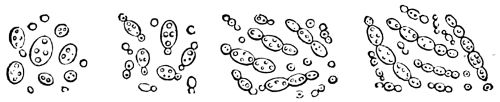
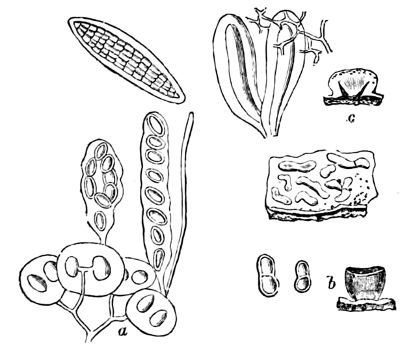
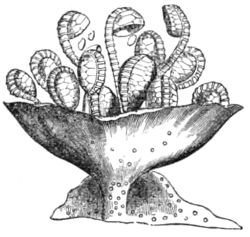
Fig. 89, p. 20.
EUCYRTIDIUM CRANOIDES.
[Frontispiece to Vol. I.
ON
MOLECULAR
AND
MICROSCOPIC SCIENCE
BY MARY SOMERVILLE
AUTHOR OF ‘THE MECHANISM OF THE HEAVENS’ ‘PHYSICAL GEOGRAPHY’
‘CONNECTION OF THE PHYSICAL SCIENCES’ ETC.
Deus magnus in magnis, maximus in minimis—St. Augustine
In Two Volumes—Vol. I.
WITH ILLUSTRATIONS
LONDON
JOHN MURRAY, ALBEMARLE STREET
1869
The right of translation is reserved
LONDON: PRINTED BY
SPOTTISWOODE AND CO., NEW-STREET SQUARE
AND PARLIAMENT STREET
PREFACE.
Microscopic investigation of organic and inorganic
matter is so peculiarly characteristic of the actual
state of science, that the Author has ventured to give
a sketch of some of the most prominent discoveries in
the life and structure of the lower vegetable and marine
animals in addition to a few of those regarding inert
matter.
The Author feels bound to return her best thanks
to kind friends—Sir John Herschel, Mr. Huggins,
Mr. Gwyn Jeffrey, Prof. Tyndall, and Mr. T. Moore of
Chelsea, who have aided in revising some of the sheets
for press, and have thus counteracted the disadvantage
under which she labours, of a residence abroad, and
at a distance from libraries of reference.
Page 3, line 5 from bottom, insert the before earth
59, line 19, dele the
59, line 21, dele the
59, lines 20 and 22, for part read parts
100, In the Table of Atomic Weights, read Copper 32; Zinc 32·5; Rubidium 86; Cæsium 133
101, lines 10 and 33, for 32 read 32·5
104, line 12 from bottom, for 29 read 32
1MOLECULAR AND MICROSCOPIC
SCIENCE.
SECTION I. ELEMENTARY CONSTITUTION OF MATTER.
The investigations which have revealed the most
refined and wonderful relations between light, heat,
electricity, and highly elastic media; the relation of
these powers to the particles of solid and liquid matter,
new methods of analysis, and the microscopic examination
of that marvellous creation, animal and vegetable,
which is invisible to the unaided eye of man, have
brought a new accession to the indefinitely small within
the limits of modern science.
Wherever the astronomer has penetrated into the
depths of space, luminous points are visible; and since
light merely consists in the undulations of the ethereal
medium, matter must exist in every part of the universe
of which man is cognizant, for although the luminiferous
ether is so attenuated that its very existence
is almost an hypothesis, its atoms are not more inconceivably
small than those of highly elastic ponderable
matter on earth. Atoms are the ultimate constituents
2of homogeneous simple substances; molecules, or groups
of heterogeneous atoms united in definite proportions,
constitute such as are compound. High pressure steam
is invisible as it issues from the boiler, yet each of its
molecules contains two atoms of hydrogen and one
of oxygen. The perfume of a flower is a compound
invisible substance formed of molecules.
We know nothing of the forms either of atoms or of
those groups of atoms which we call molecules; but we
cannot suppose them otherwise than as excessively hard,
since conceive them how we will, we are sure that an
atom, whatever be its form or nature, is ever the same.
It never wears, it never changes, though it may have
formed part of thousands of bodies and entered into
thousands of combinations, organic and inorganic;
when set free by their dissolution, it is ready to enter
into a new series; it is indestructible even by fire, the
same now as when created. Nor has the quantity of
matter in our terrestrial abode ever been increased or
diminished; liable to perpetual change of place and
combination, the amount remains the same: the bed of
the seas may be changed to dry land, and the ocean
may again cover the lofty mountains, but the absolute
quantity of matter changes not.
All substances, whether solid, liquid, or aëriform, are
supposed to consist of hard separate atoms or particles,
and in conformity with that supposition to be surrounded
by the ethereal medium, otherwise they could not transmit
light and heat, which are merely vibrations of
that medium. Even the hardest and most compact substances
are capable of compression, and have been compressed
to an enormous degree by the hydraulic press;
but it probably transcends mechanical force to bring
their atoms into contact: in fact, no known substance
is impervious to both light and heat, however thin.
By far the greater number of terrestrial substances
consist of heterogeneous atoms chemically combined
3into atomic systems or molecules; but there are sixty-four
which have never yielded to chemical analysis, and
are therefore believed to be respectively formed of only
one kind of atoms. Thirty-five of these are metals
found either pure or as ores, and sixteen are metals existing
naturally in chemical combination with alkalies,
alkaline earths, or earthy bases, that is as salts, from
which they have been obtained by the analytical power
of electricity or other means. The thirteen remaining
simple substances are non-metallic: some are aëriform,
some solid, one liquid.
The alkaline metals are sodium, potassium, lithium,
cæsium, rubidium, and thallium. They are distinguished
by their energetic affinities for, and the simplicity
of their compounds with, non-metallic elements.
They are never met with native, and are amongst the
most difficult metals to reduce from their ores, and their
spectra are remarkable for simplicity. Sodium and
potassium—which have been such important agents in
spectrum science—were reduced from their alkalies of
soda and potash by Sir Humphry Davy by means of the
voltaic battery, a discovery which led the way to the
reduction of many of the others. Lithium is a white
metal which burns brilliantly in air and oxygen; it
swims in naphtha, and is the lightest solid body known.
Cæsium is the most energetic of all metals in its chemical
affinities.
The metals of the alkaline earths are barium, strontium,
calcium, and magnesium. They possess, like the
preceding, energetic affinities for the non-metallic elements,
and are reduced with difficulty from their ores.
Barium is obtained from earth baryta: it is powerfully
alkaline, and its salts are colourless and poisonous.
Calcium is obtained from limestone, chalk, marble, and
gypsum, which are amongst the most abundant constituents
in the crust of the earth; it is a bright ductile
4metal of a bronze colour. Magnesium, which is a brilliant
silver-white hard brittle metal, is obtained from
magnesium limestone or dolomite. Although the ores
of calcium and magnesium cover vast areas of the
globe, the metals form a very small comparative proportion
of them.
The metals derived from non-alkaline earths are
glucinum, yttrium, thorinum, zirconium, and aluminium,
which is the only one of any interest: it is now becoming
a very useful metal. It combines readily with
oxygen to form clay. The ruby, sapphire, and oriental
topaz are merely coloured varieties of corundum, which
is nothing but crystallised clay. Rubidium, cæsium, and
thallium were discovered by spectrum analysis.
The avidity of some of these metals for oxygen
is quite remarkable: potassium and rubidium inflame
when they touch ice or cold water; they decompose the
water and combine with its oxygen. Calcium becomes
luminous in warm water, and burns with intense light
when heated to redness; but a magnesium wire burns
with such intense brilliancy that it has been employed
for photography, and will probably become useful for
household purposes, as two ounces and a half of magnesium
wire when burnt give a light equal to that of
twenty pounds’ weight of stearine candles.
The metals whose oxides are not reducible by heat
without the aid of some form of carbon include nearly
all the useful metals. They are all polyatomic, that is,
they combine with other elements in the number of
atoms varying from two to eight, and are divided into
seven groups in regard to this property. For instance,
zinc, copper, and cadmium are diatomic. Zinc
is invaluable as a source of electric light and heat in
the voltaic battery, and its vapour burns brilliantly.
Copper is one of the most useful of metals, while cadmium
is of no value at all. Nickel, cobalt, and uranium
5form the triatomic group; they are remarkable for their
complex spectra. Nickel is usually an ingredient in
meteorites; cobalt is employed in pigments and in
sympathetic inks; and the oxide of uranium is used to
stain glass, and gives it some very peculiar properties,
as will be shown. The precious metals have a feeble
affinity for oxygen at any temperature, and their oxides
are decomposed by heat alone, and sometimes even by
the undulations of light.
Metals are excellent conductors of heat, but they vary
exceedingly in that respect; both theory and experiment
prove that the best conductors are invariably the
worst radiators. In fact those atoms which transfer the
greatest amount of motion to the ethereal medium,
that is, which radiate most powerfully, are the least
competent to communicate motion to each other, that
is, to conduct with facility. Silver and copper are the
best conductors of heat, but the worst radiators. These
two metals are the best conductors of electricity, but it
is influenced by temperature; for MM. Matthiessen and
Von Bose’s experiments have proved that all pure
metals in a solid state vary in conducting power to the
same extent between zero and 100° Cent., and that the
alkaline metals conduct electricity better when heated
than when cold.
All metals are capable of being vaporized, but at very
different degrees of temperature. Platinum requires
the heat of the oxy-hydrogen blowpipe, which by estimation
amounts to 8801° Cent. This property makes it
valuable for terminal points to the conducting wires
of the voltaic battery and magneto-electric induction
machine where great heat can be employed without
fusing the platinum terminals. Copper is always employed
for the conducting wire on account of its superior
conductive power. The coil of wire in the magneto-electric
machine, which is often miles long, is insulated
6by a coating generally of green silk thread. But in
experiments of extreme delicacy where magnetism might
vitiate the results, perfectly pure copper wire which is
diamagnetic is used for the conducting wires in the
thermo-electric pile of the goniometer, and the wires
are coated with white silk thread, since it was discovered
that the green dye contains some magnetic metal.
The mass of the metals however constitutes comparatively
but a small part of the terrestrial globe,
which is formed of chemical combinations of only thirteen
simple elementary substances,—a wonderful manifestation
of creative power that could form a world of
such variety and beauty by means of atoms so little
diversified; still more wonderful is it that four simple
elements alone constitute the basis of nearly the whole
organic fabric. The air we breathe, water, the bodies of
men and living creatures, and the vegetation that adorns
the earth, are chiefly combinations of three invisible
gases, oxygen, hydrogen and nitrogen, with carbon, the
purest amorphous form of coal.
Oxygen gas forms three-fourths of the superficial
crust of the terrestrial globe, its productions and its
inhabitants. At least a third part of the solid crust of
the earth is oxygen in combination; it constitutes eight
parts out of nine in water, and water covers three-fourths
of the surface of the globe; it forms more than
twenty parts out of a hundred of atmospheric air, and
in the organic kingdom it is an essential constituent.
Except in the atmosphere, oxygen is never uncombined,
but may be obtained by distilling chlorate of potash, by
the decomposition of water by voltaic electricity, and by
other means. When pure it is a colourless, tasteless,
inodorous, invisible gas; it is incombustible at ordinary
temperatures, yet absolutely essential to combustion;
no animal can live long in it, and none can exist without
it. In the atmosphere oxygen is highly magnetic;
7its magnetism increases with cold and decreases with
heat; hence its intensity varies with night and day,
winter and summer, but its magnetic property vanishes
when it enters into composition.
Oxygen is perfectly quiescent and passive as a gas in
the atmosphere, and as a constituent of water and solid
bodies, yet that inactivity conceals the most intense
energy, which only requires to be called into action.
Thus combustion of extreme intensity takes place
when ignited sulphur is put into a vessel containing
oxygen gas; the metal potassium is instantly inflamed
by it on touching water; some of its combinations with
chlorine are highly explosive, and phosphorus burns in
it with dazzling splendour. Thus a stupendous amount
of energy is latent in oxygen under the most tranquil
appearance.
M. Schönbein of Basle discovered that oxygen exists
in another state, which has neither the extreme quiescence
on the one hand, nor the intense violence on the
other, of its ordinary form; and to express that intermediate
condition, in which its activity is less in
amount and different in quality, it has been called by
another name, viz. ozone, from the following peculiarity.
It had long been observed that there is a peculiar
smell when an electric machine is in activity, and when
objects are struck by lightning; that smell Professor
Schönbein ascertained to arise from the change of
oxygen into ozone, and actually produced ozone by
passing electric sparks through that gas. Ozone differs
from oxygen in having a strong smell and powerful
bleaching property; it purifies tainted air, changes
vegetable colours, and stains starch prepared by iodide
of potassium blue, which thus becomes a test of its presence;
yet it certainly is oxygen in an allotropic or changed
state, for it readily oxidizes or rusts silver and other
metals, and when ozonized gas is sent through a red-hot
8tube, it comes out pure oxygen. According to the
experiments of Messrs. Tait and Andrews, oxygen gas
loses six eighths of its volume, and becomes four
times more dense by the change; it contracts more
readily with obscure electricity than with the spark.
The experiments of Professor Tyndall on the absorption
of radiant heat by gases give reason to believe that
ozone is produced by the packing of the atoms of elementary
oxygen into oscillating groups, and that heating
dissolves the bond of union and restores the ozone
to the form of oxygen. Ozone chiefly exists in air that
has passed over a great expanse of sea, and the quantity
is increased during the aurora, which alone might lead
to a surmise of that phenomenon being electric.
The change of oxygen into ozone is not the only
instance of Allotropism,—that is to say, the existence of
the same substance in two states differing from each
other in every respect,—for ozone itself is allotropic.
Professor Schönbein has discovered that there are two
kinds of ozone standing to one another in the relation
of positively and negatively active oxygen; namely ozone
and antozone, which neutralize each other into common
oxygen when brought into contact. In this respect
they are analogous to electricity, and, like electricity
too, one kind cannot be produced without a simultaneous
development of the other.
When a metal, such as silver for example, is oxidized
or rusts, it gives polarity to the atoms of oxygen in the
atmosphere and divides them into the opposite states of
ozone and antozone; the ozone combines with the silver
and rusts or oxidizes it, at the same time that the antozone
is dissolved in the moisture or aqueous vapour in
the air and forms peroxide of hydrogen. The oxidized
or rusted silver, as well as every other oxidized substance,
is an ozonide, while the peroxide of hydrogen is an antozonide.
9Since both kinds of ozone are produced during the
decomposition of water by electricity, and as sea air is
always found to contain more or less free ozone, the
ocean is probably an antozonide, for all the antozone
formed by electricity during thunderstorms must be
either dissolved in the sea-water, or carried into it in
the form of peroxide of hydrogen by the rain. Ozone
must be exceedingly abundant in the zone of calms and
light breezes near the equator known as the variables,
which is subject to heavy rains and violent thunderstorms,
and also in the regions of the monsoons. On
land one of the benefits arising from these formidable
phenomena is the production of ozone, which oxidizes
decomposing organic matter and hastens its decay,
while the antozone, which is dissolved in the atmospheric
vapour, forms the peroxide of hydrogen and frees
the air from the antagonist principle.
The peroxide of hydrogen thus produced is a transparent
colourless inodorous liquid with a metallic taste,
and contains one equivalent of hydrogen and two of
oxygen. It retains its liquid state under a great degree
of cold, and mixes with water in any proportion. It
has a strong bleaching property, instantly destroying
vegetable colour. If exposed suddenly to a temperature
of boiling water it is decomposed with violent explosion,
and readily gives off oxygen at 59° Fahr. The mere
touch of an oxidized metal, as the oxide of silver, completely
and instantaneously decomposes it, and oxygen
gas is evolved by the union of the ozone and antozone
so rapidly as to produce a kind of explosion attended by
an intense evolution of heat.
During the combustion of phosphorus in the atmosphere
both kinds of ozone appear, and Professor
Schönbein considers the slow combustion of that substance,
which unites with the ozone and sets the antozone
free, as the type of all the slow oxidations which
10organic and inorganic bodies undergo in moist atmospheric
air; that true oxidation is always preceded by
the appearance of the peroxide of hydrogen, and that this
compound acts an important part in slow oxidations,
and is deeply concerned in animal respiration, and in
many other chemical actions going on in nature.
In confirmation of these views, it is certain that ozone
is a powerful minister in the work of decay. If wood
be made explosive like gun-cotton by a similar process,
it becomes pulverulent after a time, and burns without
exploding, though it still retains its shape. In the
natural state of the wood the oxygen is passive and
quiescent, for oxygen is a constituent of wood; in its
second state it is explosive, and after a time that is
succeeded by the semi-active state of ozone, which by a
slow imperceptible combustion causes the wood to decay.
Mr. Faraday observes that the force which would have
been explosive had it been concentrated into one effort,
expends itself in a long continued progressive change.
‘The majestic phenomena of combustion bespeak our
admiration and rivet our attention because of their imposing
grandeur; yet these are but spasmodic efforts in
the grand economy of the material world, occurrences of
now and then. The slower but continuous progress of
the elements to their appointed resting-place, the silent,
tranquil, ever progressing metamorphic changes involved
in the phenomena of decomposition and decay, these we
count for nothing and pass unheeded by. Yet with all
their majesty, with all their brilliancy, all their development
of tremendous energy, what are the phenomena of
combustion in the grand scheme of the universe compared
with these? When the loud crash of the thunder
or the lightning’s flash awakens us from our thoughtless
abstractions or our reveries, our feelings become impressed
with the grandeur of Omnipotence and the
might of the elements he wields, yet the whole fury of
11the thunderstorm—what is that in comparison with the
electric energies which silently and continually exert
themselves in every chemical change? Why, the electric
force in a single drop of water, and disturbed when that
water is decomposed, is of itself greater than in the
electricity of a whole thunderstorm. Those of us who
limit our appreciation of the powers of oxygen to the
energies displayed by this element in its feebly active
state, form but a very inadequate idea of the aggregate
results accomplished by it in the economy of the world.’
Oxygen is the only known gas that is allotropic, and is
the only known substance that is doubly allotropic, that
is existing in three different states similar to oxygen,
ozone, and antozone.
Hydrogen when pure is an invisible gas without smell
or taste; it is a constituent of various acids and alkalies,
but is itself neither acid nor alkaline. It is highly
inflammable, burning with a pale light, and, as already
mentioned, a combined jet of oxygen and hydrogen produces
heat of 8801°, which is so intense that nothing can
withstand it. It is the lightest substance known. A
balloon having the form of a globe ten feet in diameter,
would hold
321⁄2
pounds weight of common air, while two
pounds weight of hydrogen gas would fill it. Associated
with this small quantity of ponderable matter, hydrogen
has an enormous power of combination, but its activity
is only called forth by some exterior and exciting cause.
A mixture of two measures of hydrogen and one of
oxygen gas would remain inert for ever, but the instant
an electric spark is sent through it, a bright flash and
an explosion takes place, and the result is water: thus
a tremendous force lies quiescent in that bland element.
Hydrogen gas is introduced into the atmosphere by
imperfect combustion, but it is instantly diffused and
becomes harmless, for aëriform fluids are capable of
rapid and perfect diffusion through one another, each
12having a capacity peculiar to itself, which under the
same circumstances is greater as its density is less;
therefore hydrogen the lightest of gases not only rises
in the air on account of its levity, but is more quickly
and completely diffused than oxygen which is the support
of life. Though hydrogen is inferior in density
to every other gas, it surpasses them all in conducting
electricity, just as silver and copper conduct electricity
better than platinum, though far less dense. The great
refrigerating power of hydrogen is owing to its extreme
mobility and consequent rapid convection of heat, in
which it surpasses all other gases. It is as permeable
to radiant heat as atmospheric air, has a very high refractive
power, a specific heat of 3·2936, and may be
substituted in many chemical formulæ for a metal,
without altering their character: hence it is sometimes
called a metalloid.
The quantity of nitrogen gas or azote that exists in
nature is enormous. It constitutes four-fifths of the
atmosphere, whence it may be had in a pure state, as
well as by chemical means. Like oxygen, this gas is
permanently elastic, without smell, taste, or colour; it is
neither acid nor alkaline, it does not change vegetable
colours, it neither burns nor supports combustion, and
is incapable when breathed of supporting animal life.
It abounds in organic bodies, in all parts of the animal
texture, in the blood, muscles, nerves, even in the
brain; and is either a highly nutritious or poisonous
principle in the vegetable kingdom.
Nitrogen gas is altogether passive; it has no affinity
for the metals, and cannot be liberated from any of its
compounds even by electricity. Excepting boron and
titanium, it will not combine directly or spontaneously
with any simple element, even under the highest temperature,
but its indirect combinations are numerous
and violent: those with hydrogen are either noxious or
13poisonous, those with oxygen are all deadly poisonous.
Had nitrogen combined spontaneously with either of
these gases, especially with oxygen, life would have been
impossible as the organized creation is constituted; its
inertness renders its mixture with oxygen in atmospheric
air innocuous. However, combinations of nitrogen and
hydrogen, forming nitrate of ammonia, have been discovered
in the atmosphere by Professor Schönbein, the
union of evaporation, heat and air being the cause; and
as evaporation is continually going on, he concludes
that nitrate of ammonia, nitrates and other salts are
generated in the moist air, and are speedily washed
down in our rainy climates into the springs and rivers.
He considers the formation of nitrates out of water as
highly important for vegetation, because each plant
becomes a generator of a portion at least of its azotized
food, while the rain furnishes the ground on which it
stands with a supply of the same.
In the atmosphere, nitrogen has all the mechanical
properties of common air, but with a greater refractive
power, and its specific gravity is nearly the same with
that of oxygen. Since the atmospheric gases are the
most permeable to radiant heat, the earth is in the
most favourable circumstances for being warmed by the
solar rays, and thus the properties of the elementary
gases are admirably adapted for our comfort, nourishment,
safety, and pleasure.
Carbon, which combined with the three elementary
gases forms the basis of the organic creation, is widely
distributed throughout the globe, in enormous coal
formations, the vegetation of former ages. Diamond is
its purest crystalline form; and charcoal, which is wood
whence the volatile matters have been driven off by heat,
is its purest amorphous state. To this simple substance
and to hydrogen, we are indebted for terrestrial light
and heat, whether our fuel be coal or wood, our light a
14candle or a lamp. The products of combustion are
carbonic acid gas, whether pure or mixed with smoke,
for ashes are the incombustible earthy matter mixed
with coal or wood, and smoke is unconsumed carbon
arising from the bad construction of our chimneys; so
that the waste is enormous in a great city like London
where coal is the only fuel. Light is given out by incandescent
solid particles, which become luminous sooner
than gas, for all gases have a feeble illuminating power,
and heat results from the chemical combination of the
carbon with oxygen, a process in which the chemical force
merges into its correlative heat. Mr. Faraday observes,
that had the result of the combination of carbon and
oxygen been a gas only, we should have had very little
light, and had it been a permanent solid, the world
would have been buried in its own ashes.
Diamond and pure carbon leave no residuum when
consumed; they combine with the oxygen of our atmosphere
into carbonic acid gas, which is invisible,
poisonous, and so heavy, that it may be poured from
one vessel to another like water, thereby showing how
much carbon it contains in an invisible state. The
quantity of carbonic acid gas thrown into the atmosphere
in this invisible yet ponderous state is immense, since
six tons weight of atmospheric air rushes hourly through
an average size blast furnace, carrying with it more
than half a ton of carbon in the form of that gas, whose
constitution and properties are always the same, whether
it arises from combustion, fermentation, or respiration,
which latter may be regarded as a slow combustion,
consuming us to the bones if not supplied with carbon
by means of food. It has been computed that two
thousand million pounds weight of oxygen gas is daily
converted into carbonic acid gas by these operations,
and given into the atmosphere, which would soon be
contaminated by its poison and suffocating quality, were
15it not for vegetables which decompose it, assimilate the
carbon and set the oxygen free to mingle with the air
and make it again fit for respiration. Carbon has a
greater power of combination than any other simple
substance except hydrogen.
Mr. Faraday compressed carbonic acid gas into a
liquid by the pressure of its own elasticity when disengaged
from combination in close vessels, a force equal
to the weight of thirty-five times that of our atmosphere;
and the liquid was reduced to a solid by M. Thilorier
by rapid evaporation, during which the heat was given
out so quickly by one part of the liquid, that the remainder
was condensed into a substance like snow,
which could be touched with impunity, but when mixed
with sulphuric ether its temperature was reduced to
166° below zero of Fahrenheit’s thermometer.
Carbon appears naturally under a great variety of
forms, and exhibits one of the most striking instances
of allotropism, the same substance showing the greatest
contrast in appearance and physical properties. The
diamond, the most resplendent, transparent, and hardest
of gems, is identical with carbon, which is black, dull,
opaque, and brittle. Both are combustible; carbon is
easily ignited, but it requires a heat of 1860° to consume
the diamond.
However numerous the crystalline forms assumed by
substances either naturally or artificially may be, they
are all capable of being grouped into geometrical systems;
each system possessing its own allied and derivative
forms capable of mutual variations among themselves,
but the forms of one system never assuming those of
the other. With that law, however, carbon and a few
other substances are completely at variance. The
diamond crystallizes in octohedrons, while graphite,
which is also carbon, crystallizes in six-sided plates,—two
forms that belong to different systems quite irreconcilable
16with one another: and thus carbon possesses
the property of being dimorphous.
Sulphur is a simple inflammable mineral abounding
in volcanic countries, either in a crystalline or amorphous
state, and forming a constituent in organic
substances, animal and vegetable. It is readily dissolved
by bisulphide of carbon, by benzine, and by
a moderate heat; and copper filings exposed to its
vapour spontaneously take fire, the chemical force of
combination merging into light and heat. Sulphuretted
hydrogen gas, a combination of sulphur and hydrogen,
forms naturally during the putrefaction of organic
matter, and Mr. Faraday observes with regard to the
affinities of sulphur, ‘so numerous are its relations,
so extensive its range of combinations, that we must
consider it to be the very foundation on which chemical
manufacture is built up.’
Though a simple substance, sulphur exhibits the two
remarkable phenomena of dimorphism and the allotropic
property. When reduced by heat to vapour and
cooled slowly, it crystallizes in rhombic octohedrons;
when merely melted and allowed to cool slowly, it takes
the form of oblique rhombic prisms. Here the same
atoms when in vapour and in a liquid state are acted
upon by different forces; but however that may be,
sulphur is another singular exception to the law of the
immutability of the crystalline systems.
Sulphur becomes allotropic by the continued application
of heat; that is to say, it entirely changes its
appearance and character, though it remains chemically
the same. Naturally it is yellow and brittle, but when
fused, it is a colourless pellucid fluid which by continued
heat is changed into a black tenacious substance that
becomes like India rubber or gutta percha when thrown
into water. In this allotropic state it is endowed with
properties more powerful, energetic, and exalted; its
17tendencies to act chemically being increased like those
of ozone. That this black tenacious substance is chemically
the same with common sulphur there can be no
doubt, for when it is exposed to greater heat, it again
becomes a colourless pellucid fluid, which thrown into
water resumes the form of brittle yellow sulphur.
These new arrangements among atoms of the same
kind show that the immutability of matter is not
without exceptions.
The animal kingdom is the great reservoir of phosphorus,
a simple substance that is never found uncombined.
It is sparingly met with in the vegetable
kingdom, and still less in the mineral, but may be procured
abundantly from calcined bones. When pure it
is colourless, transparent, solid, extremely poisonous,
and so inflammable that it must be kept in water.
In air it is in continual combustion with oxygen, during
which ozone is produced. When burnt in a current
of air phosphorus leaves a residuum consisting of two
substances, of which one is an acid, the other is red
allotropic phosphorus, which has been extensively used
in the manufacture of lucifer matches, because its fumes
are not deleterious, and because it inflames less easily
than common phosphorus, to which it is reduced by heat
or friction, which generates heat.
Silicon is a simple substance, never found alone, but
when forty-eight parts of it are combined with fifty-two
parts of oxygen gas it forms rock crystal, the purest
form of silica or quartz. Silica is so abundant that it
may be said to constitute the basis of the mineral world.
The sand on the sea-shore, which is the debris of quartz
rocks, shows how universally it prevails. It is even
abundant in the vegetable kingdom, giving strength to
the stalks and leaves of the grasses, and may be felt in
the harshness of the beards of wheat and barley. Silicon
18exists in three different states—the amorphous, which
has no form; the graphic, which takes the form of small
hexagonal plates; and that of octohedral silicon: hence
this substance is dimorphous.
A singular analogy obtains between silicon and carbon:
the amorphous form of silicon corresponds to charcoal,
the graphic form of silicon corresponds to the graphic
form of carbon, and the octohedral form of silicon to
the diamond; yet the chemical relations between the
two substances are very small.
Silica has hitherto been considered to be insoluble
in pure water; at least M. Bischoff states that only one
part of silica dissolves in 769,230 parts of water; but by
a method hereafter to be explained, Professor Graham
has actually obtained a limpid solution of silica in pure
water.
Boron is a constituent of boracic acid, a natural
production in Thibet and Monte Corbalo in Tuscany.
It is a greenish-brown solid, insoluble in water, but
when heated to about 600° it burns in open air with a
vivid flame.
Fluorine is a constituent of a very beautiful mineral,
well known as fluor spar, which is found in cubic crystals
of a green, yellow, or purple colour. Hydrofluoric
acid obtained chemically from the mineral is highly
volatile and extremely corrosive.
Three of the non-metallic simple substances, chlorine,
bromine, and iodine, are connected by the most remarkable
analogies. They are marine productions, for chlorine
is obtained from common sea-salt and in greater
purity from rock-salt, both of which are compounds of
chlorine and the metal sodium. When sea-water is
evaporated, salt and a substance called bittern remain,
which contains a salt whence bromine is separated.
Again, when kelp, the ashes of burnt seaweeds, is
purified from the carbonate of soda and the chloride of
19potassium, a salt is left which is the iodide of potassium,
whence iodine is obtained. Iodine is also found in
sponges, oysters, and other low sea animals, as well as in
certain mineral springs, and sometimes in combination
with silver. These three elemental bodies have little
affinity for one another, but they combine powerfully
with other substances.
Chlorine is a yellowish-green gas, twice as heavy as
atmospheric air, with a noxious suffocating smell and
astringent taste. It has a powerful bleaching property,
and when combined with water, which absorbs twice its
volume of the gas, it is used for bleaching linen, in
calico-printing, and other arts. The clear solution of
chloride of lime is still more in use for the same purpose,
as well as for an antidote against contagion and unwholesome
smells. Carbon does not burn in chlorine
gas, yet it is capable of supporting combustion, for oil
of turpentine, phosphorus, thin leaves of tin and copper,
and powdered antimony, take fire spontaneously in it.
This gas shows its power by the development of intense
heat, but not by brilliant light, because the results of
its combustion are mostly vapours, or such gases as
have a feeble illuminating power; so chlorine differs
materially from oxygen in the phenomena of combustion.
Mr. Faraday observes, however, that the bleaching
powder is analogous to ozone in being an intermediate
state, for chlorine is pernicious and violently destructive
as a gas, perfectly innocuous and quiescent in common
salt and in its other natural combinations, while in the
bleaching substances its energy is subdued by art, so as
to make it an important agent in various manufactures.
Providentially, chlorine is never found free; but in a
combined state it exists in enormous quantities in the
salt of the ocean, in salt lakes, brine springs, and in
extensive deposits of rock-salt, as well as in organic
liquids. It has a strong affinity for hydrogen, and forms
20muriatic acid. A mixture of these two gases remains
inactive in the dark, but explodes in sunshine.
By chemical means chlorine is made to combine with
oxygen so as to produce four substances, two of which
are gases of such unstable equilibrium and weak affinity
that the slightest cause makes them detonate violently;
the other two are more stable, though they contain a
greater quantity of oxygen. The only combination of
chlorine with nitrogen is the most powerful and dangerous
explosive compound known. Chlorine combines
naturally with sulphur, and with the metals so as to
form ores.
Common salt affords a remarkable instance of change
of volume by chemical combination. Twenty-four parts
in bulk of salt contain 20·7 parts of sodium and 23·3
parts of liquid chlorine; hence by chemical combination a
bulk of 44 is compressed into a bulk of 24, yet that
great compression is consistent with perfect transparency,
crystallized salt being perfectly transparent to
light, and more so as regards radiant heat than any
other substance. Thus chemical affinity does what no
mechanical power could accomplish.
At an ordinary temperature and barometric pressure,
bromine is an orange red, extremely volatile fluid, which
congeals and becomes brittle at a temperature a little
below the zero of Fahrenheit’s thermometer, and if
combined with water at that degree of cold it crystallizes
in octohedral crystals which are permanent even at 50°
Fahr. Bromine is very poisonous, corrodes the skin,
has a disagreeable taste, and a smell similar to that of
chlorine, but more pungent and hurtful. It possesses
a powerful bleaching property, does not conduct electricity,
and like chlorine a taper will not burn in its gas,
though it spontaneously sets fire to phosphorus, and
some of the metals. Reasoning from analogy Professor
Schönbein believes that chlorine and bromine are not
21simple substances; he considers them to be ozonides
analogous to the peroxides of manganese, lead, &c. He
believes chlorine to be the peroxide of murium, and bromine
to be the peroxide of bromium. Professor Tyndall’s
experiments on the absorption and radiation of gases
show that the action of these two substances is very
different from that of the simple gases.
Iodine is a dark purple solid, crystallized in scales or
elongated octohedral plates. It slowly evaporates at
ordinary temperatures, and at that of 350° Fahr. it is
volatilized into a beautiful violet coloured gas which
changes starch into a bright blue, and for that reason a
little starch will detect the millionth of a grain of iodine
in composition. Iodine is slightly soluble in water, has
a hot acrid taste, and although used in medicine it is
poisonous when taken in large doses. Its bleaching
properties are inferior to those of its congeners, but its
chemical combinations are the same. With hydrogen
it forms a highly explosive compound, which detonates
with the slightest pressure.
These three simple substances are analogous in almost
every respect. They all possess a bleaching property,
many of their compounds are exceedingly explosive,
combustible substances do not burn in their gases, while
their gases set fire spontaneously to substances generally
reckoned incombustible. Hence, though not combustible,
they support combustion, but in a very different
manner from oxygen. Chlorine and the gases of
bromine and iodine diluted with common air, do not
transmit blue and violet light; that is to say, the spectrum
of a sunbeam transmitted through them is deprived
of its most refrangible coloured rays, and that which
remains is crossed by more than a hundred equidistant
dark lines; their spectral properties however will be
given hereafter. They resemble oxygen in one respect—that
when a current of electricity is passed continuously
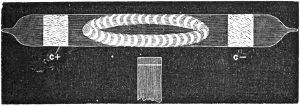
22through a glass tube filled with any of these three gases,
much attenuated, they slowly combine with the platinum
wire of the negative pole of the battery inserted in the
tube. The electricity by degrees passes in diminished
quantity, and at last ceases altogether, showing that
matter, however attenuated, is requisite to conduct it.
According to the experiments of M. Dumas, the
volatility of a compound is in the inverse ratio of the
condensation of the substances composing it, and simple
bodies come under the same law. For example, chlorine
is more volatile than bromine, and bromine is more
volatile than iodine; hence according to that law,
chlorine is the least dense of the three, bromine is
intermediate, and iodine is the most dense, which is
actually the case: for chlorine is a gas, bromine a liquid,
and iodine a solid at ordinary temperatures, which
proves that there is a sequence in the intensity of the
cohesive forces in this triad.
SECTION II. ON FORCE, AND THE RELATIONS BETWEEN FORCE AND MATTER.
23
Force is only known to us as a manifestation of divine
power which can neither be created nor destroyed. The
store of force or energy in nature is ever changing its
form of action, its amount never. It may be dispersed
in various directions, and subdivided so as to become
evanescent to our perceptions; it may be balanced so
as to be in abeyance, or it may become potential as in
static electricity; but the instant the impediment is
removed the power is manifested by motion. Whatever
form force may assume it has invariably a compensation
or equivalent, whether in the heavens or on the earth.
The total sum of the living forces, vis viva, or actual
energy of the planets is the same every time they return
to the same relative positions with regard to one another,
to their orbits and to space, whatever may have been
their velocities or mutual disturbances. In the ocean,
the energy by which 25,000 cubic miles of water flow
over a quarter of the globe in six hours, is exactly equal
to the force or energy that makes it ebb during the succeeding
six hours. A body acquires heat in the exact
proportion that the adjacent substances become cold;
and when heat is absorbed by a body, it becomes an
expansive energy at the expense of those around it,
which contract. Chemical action many miles distant
from the electro-magnet, as in telegraphs, is perfectly
24equivalent to the dominant chemical action in the
battery. The two electricities, positive and negative,
are developed in equal proportions, which may be combined
so as to produce many changes in their respective
relations, yet the sum of the energy of the one kind can
never be made in the smallest degree either to exceed
or to come short of the sum of the other.
The mechanical energy of machinery or working power
is exhausted by the very act of working, and cannot be
restored except by the action of other forces. In clockwork,
the weight must sink to move the wheel, and
when the weight is down, the store of energy is gone,
and can only be restored by raising the weight through
the expenditure of energy in the human arm, and the
expenditure of human energy must be restored by food
and rest. The heat given off from the bodies of men
and animals is restored by the combustion of the oxygen
inhaled during respiration and the carbon of the food,
and the light and heat given out by the combustion of
fuel, whether in the form of coal or wood, is compensated
by the light and heat of the sun stored up in
living vegetables. It is this equivalent for force or
energy which prevails in every department of nature
that constitutes the universal and invariable law of
the Conservation of Energy, ‘a principle in physics as
large and sure as that of the indestructibility of matter
or the invariability of gravity. No hypothesis should
be admitted nor any assertion of a fact credited, that
denies this principle. No view should be inconsistent
or incompatible with it. Many of our hypotheses in the
present state of science may not comprehend it, and
may be unable to suggest its consequences, but none
should oppose or contradict it.’[1] Thus, ‘there is a
definite store of energy in the universe, and every natural
change or technical work is produced by a part only of
25this store, the store itself being eternal and unchangeable.’[2]
Cohesion is a force which acting at inappreciably
small distances unites atoms and molecules of the same
kind into solids, liquids, and aëriform fluids, exactly according
to the law of the conservation of energy; for it
requires the very same amount of force to dissolve their
union as to form it. Cohesion varies with temperature
both in simple and compound bodies, for metals can be
fused and vaporized by artificial heat, and ice becomes
water and aqueous vapour as the seasons change from
winter to summer.
In solids the force of cohesion is so strong, that their
atoms and molecules always retain their respective places;
that power is so weak in liquids, that their atoms and
molecules are capable of motion among themselves, and
in gases and the ethereal medium the atoms are free and
have no cohesion whatever. The resistance offered by
substances to compression is an equal and contrary force.
The reciprocal attraction between solids and liquids
in capillary tubes is a case of cohesion. If a glass tube
of extremely fine bore be plunged into a glass of water
or alcohol, the liquid will immediately rise in the tube
above the level of that in the cup, and the surface of the
little suspended column will be a hollow hemisphere. If
on the contrary mercury be the liquid, it will not rise so
high in the glass tube, and the surface of the little
column will be a convex hemisphere. There is a reciprocal
attraction between the glass tube and the liquid,
and another between the particles of the liquid itself;
and the effect is produced by the difference between the
two. In the first case the attraction of the glass is
greater than that of the liquid, and in the second it
is less; hence the water rises higher in the tube than
26the mercury, and its surface is concave, while that of
the mercury is convex. The elevation or depression of
the same liquid in different tubes of the same matter is
in the inverse ratio of their internal diameters, and
altogether independent of their thickness; whence it
follows that molecular action is insensible at sensible
distances, for when tubes of the same bore are wetted
throughout their whole extent with water, mercury
will rise to the same height in all of them whatever be
their thickness or density, the film of water being
sufficient to intercept the molecular action, and to
supply the place of a tube by its own capillary attraction.
The action of this force is daily seen in the
absorption of water by sponges, sugar, salt and other
porous bodies, and it is a most important agent in the
circulation of fluids in animals and vegetables.
Every atom of matter is subject to the force of gravitation,
but each substance has its own peculiar weight
of specific gravity, that is to say, the same bulk of different
substances contains different quantities of matter.
Since nothing is known of absolute weight it is necessary
to have some standard of comparison, and for that
purpose pure water at the temperature 39° Fahr. (that
of its maximum density) is chosen for solids and liquids;
while for gases and vapours atmospheric air at the temperature
of sixty degrees of Fahrenheit’s thermometer,
and a barometric pressure of thirty inches, is assumed
as the unit of specific gravity.
The foot-pound, which is the unit of mechanical force
as established by Mr. Joule, is the force that would
raise one pound of matter to the height of one foot;
or it is the impetus or force generated by a body of one
pound weight falling by its gravitation through the
height of one foot. Now impetus or vis viva is equal to
the mass of a body multiplied by the square of the
velocity with which it is moving: it is the true measure
of work or mechanical labour. For if a weight be raised
27ten feet, it will require four times the labour to raise
an equal weight to forty feet. If both these weights be
allowed to fall freely by their gravitation, at the end of
their descent, their velocities will be as one to two, that
is as the square roots of their heights, but the effect
produced will be as their masses multiplied by one and
four; but these are the squares of their velocities.
Hence impetus or vis viva is equal to the mass multiplied
by the square of the velocity. Thus impetus is
the true measure of the labour employed to raise the
weights, and of the effect of their descent, and is entirely
independent of time.
It is well known that iron becomes red-hot by percussion
or impetus. The atoms of the iron are thrown
into vibration, and these minute motions communicated
to the nerves produce the sensation of heat. Now the
mechanical labour required to raise the hammer to any
number of feet is equal to the weight of the hammer
multiplied by that number of feet; but the impetus or
mechanical effect of the fall of the hammer is equal to
its mass multiplied by the square of the velocity, that
is to the vis viva: hence the quantity of heat generated
is proportional to the vis viva. The circumstances being
the same, if the mass be doubled the amount of heat is
doubled; and if the velocity be doubled the amount of
heat is quadrupled. If the weight and the perpendicular
height through which a body has fallen be
known, the quantity of heat generated may be determined.
The same amount of heat is generated by the
same amount of force, whatever that force may be,
whether impetus, friction, or any other.
Dr. Thomson has put in a strong point of view the
quantity of heat that might be generated by percussion
or impetus. He computed that if by any sudden shock
the earth were arrested in its orbit, the heat generated
by the impulse would be equal to 11,200 degrees of the
28centigrade thermometer, even if the capacity of our
planet for heat were as low as that of water; it would
therefore be mostly reduced to vapour, and should the
earth then fall to the sun as it certainly would do, the
quantity of heat developed by striking on the sun would
be 400 times greater. It is even supposed that the light
and heat of the sun are owing to showers of bodies
falling on the surface with impetus proportionate to his
attraction, for had he been in combustion he would have
been burnt out ages ago. The masses of meteoric iron
and stone that occasionally fall on the earth show that
matter may be wandering in space; the vast zone of
smaller bodies that in their annual revolutions round
the sun come within the earth’s attraction in August
and November, when thousands of them take fire and are
consumed on entering our atmosphere, show that a great
amount of matter of small dimensions exists within our
own system. Much may be beyond it which drawn by
the sun’s attraction may fall on his surface.
When a body is heated, it absorbs one part of the
heat; the other part raises its temperature. The part
absorbed increases the bulk or volume of the body, the
expansion being the exact measure, or mechanical equivalent
of the heat absorbed. In fact the coefficient of
expansion is the fractional part of the expansion in
length, surface, or volume of the body when its temperature
is raised one degree. When the body is
cooled, its volume is diminished, and then the contraction
is an exact measure, or mechanical equivalent of
the heat given out, and thus expansion and contraction
are correlatives with and represent heat and cold.
Specific heat is the quantity of heat required to raise
a given bulk or a given weight of a body a given number
of degrees. In the one case it is distinguished as
the specific heat for a constant volume, in the other for
a constant weight.
29Although the specific heat of a substance remains
the same, its sensible and absorbed heat may vary reciprocally
to a great extent.
As there can be no direct measurement of heat independent
of matter, its mutations and action on matter
are the sole means we have of forming our judgment
concerning its agency in the material world.
Mr. Joule has proved that the quantity of heat
requisite to raise the temperature of a pound of water
one degree of the centigrade thermometer is equivalent
to the mechanical work or force that would raise the
same mass of water to the height of 1,389 feet. This
is the unit, or mechanical equivalent of heat.
In fact, for every unit of force expended in percussion,
friction, or raising a weight, a definite quantity of heat
is generated; and conversely, when work is performed by
the consumption of heat, for each unit of force gained,
a unit of heat disappears. For since heat is a dynamical
force of mechanical effect, there must be an equivalence
between mechanical work and heat as between
cause and effect. That equivalence is a law of nature.
The mechanical force exerted by the steam engine is
exactly in proportion to the consumption of heat, neither
more nor less; for if we could produce a greater quantity
than its equivalent we should have perpetual motion,
which is impossible. When steam is employed to perform
any work, the temperature of the steam is lowered;
the heat that disappears is transformed into the force
that performs the work, and is exactly proportional to
the work done, and vice versâ.
The heat which is the motive force in the steam
engine is due to the chemical combination of the
carbon of the fuel with the oxygen of the atmosphere.
A pound weight of coal when consumed in one of our
best steam engines produces an effect equal to raising a
weight of a million of pounds a foot high, yet marvellous
30as that is, the investigations of recent years have demonstrated
the fact, that the mechanical energy resident in
a pound of coal and liberated by its combustion is
capable of raising to the same height ten times that
weight.[3] The quantity of coal existing in the whole
globe is believed to be inexhaustible, hence the energy
in abeyance is incalculable. The chemical energy continually
and actually exerted in the great laboratory of
nature is greater than that which maintains the planets
in their orbits.
The act of the combination of the atoms of carbon
and oxygen in combustion is ‘now regarded exactly as
we regard the clashing of a falling weight against the
earth, and the heat produced in both cases is referable
to the same cause;’[4] so chemical combination in combustion
is only a particular case of falling bodies.
Drummond’s light, the most brilliant of artificial illuminations,
is produced by a simultaneous shower of the
atoms of oxygen and hydrogen gas upon lime; and
platinum, the least fusible of metals, is vaporized by a
similar shower from the oxy-hydrogen blowpipe, and
thus impetus generates both light and heat, for although
the atoms are too small to admit of an estimation of
their individual vis viva, there can be no doubt that
like causes produce like effects.
In what manner or under what form magnetism and
electricity exist when quiescent in matter we know not,
but the compass needles show that numerous lines of
magnetic force, subject to periodic and secular variations,
perpetually traverse the earth and the ocean;
and that waves of magnetic force occasionally sweep
rapidly over great tracts of the globe. These phenomena
would seem to stand in some periodic connection
31with the solar spots. Professor Lamont of Munich
has discovered that a permanent and regular current
of electricity is propagated parallel to the equator all
over the earth, and another similar to it in the atmosphere.
Besides these, there are currents of electricity
in the surface of the earth, sometimes in one direction
and sometimes in another, which decrease with the
depth; and M. Lamont conceives that this electric
system is the cause of terrestrial magnetism. Electricity
of intense power and inappreciable quantity
certainly exists in abeyance in the atmosphere and
in all terrestrial matter till the equilibrium between
the antagonist forces be disturbed, and then it bursts
forth with terrific violence in the lightning flash and
stunning crash of thunder. Since it requires electricity
equivalent to that in activity during a thunderstorm
to form one drop of water, what must that
power have been which the Omnipotent wielded when
he created that deep over the face of which ‘darkness
brooded.’
Electricity, though the most formidable power in
nature, is made available to man by the voltaic battery,
and by the electro-magnetic induction apparatus, in
the battery of which it is generated by the chemical
action of dilute sulphuric acid on zinc. The positive
and negative electricities thus produced pass in opposite
directions through the two conducting wires of the
machine by a continuous transmission of force or vibration
from atom to atom, a circulation that is accompanied
by a continual development of heat in overcoming the
resistance it meets with in the wires. The electricity
decreases as the heat increases, and vice versâ; the
action is reciprocal. Thus electricity is merely a transmission
of force. Mr. Joule has proved that the
quantity of heat produced in a unit of time is proportional
32to the strength of the current, whatever may be
its direction, and that its power to overcome resistance
is as the square of the force of the current. The force
is exactly in proportion to the chemical action which
produces it, and that is measured by the quantity of
zinc consumed in the battery. Thus chemical action
produces electricity, and conversely electricity is a
powerful agent in the chemical composition and decomposition
of matter.
The light and heat of the electric spark are intense
though instantaneous; but a powerful induction apparatus
like Ruhmkorff’s gives so rapid a succession of
sparks that the light and heat are sensibly continuous
and of great intensity. The light and heat, powerful
as lightning itself, are produced by the combined currents
of two batteries, each consisting of fifty Bunsen
elements of moderate size. This formidable united
current passes through a circuit of thick copper wire
coated with silk thread, with an intensity of perpetually
renewed heat that no substance can resist. When the
copper conducting wires are fitted with charcoal terminals
and brought near to one another, the dazzling lights
emanating from each pole combine in one blaze of insupportable
brilliancy. The most refractory substances,
silica, alumina, iron and platinum, when placed between
the poles, immediately melt like wax, and volatilize.
Charcoal is so good a conductor of electricity that when
the terminals are in contact they complete the circuit,
and neither light nor heat appear. Air and glass are
non-conductors, yet the spark has passed through
several inches of air and perforated a mass of glass two
inches thick. A long electric spark combines or decomposes
a greater quantity of gas or vapour than a
short one, and for a given induction apparatus and
induction current, M. Perrot has shown that there
33exists a length of spark corresponding to a maximum
chemical action.
Professor Seebeck of Berlin discovered that electric
currents are produced by the partial application of heat
to a circuit formed of two solid conducting substances
as antimony and bismuth soldered together,—another
proof of the correlation of heat and electricity.
There cannot be a doubt that the atoms of a conducting
wire are in motion, and that they successively
take definite and momentary positions during the passage
of an electric current, after which they return
successively to their normal state. When electricity is
invariably sent from the same pole of an inductive
apparatus through the wire of a telegraph, in a very
short time the wire is torn or divided into small sections,
which destroy its continuity; but when the electricity
is sent from each pole alternately, the conducting wire
is not injured. As each atom of the wire has its own
electricity, this seems to indicate that during the successive
transits of the same kind of electricity, the pole
of each individual atom is attracted more and more in
the same direction, till at last they no longer return to
their normal state, the cohesive force is overcome, and
a rupture takes place, the more readily if there be any
imperfection in the wire. Since the electricity from
the other pole of the machine would have the same
effect, but in the contrary direction, an alternate
motion in the atoms must maintain the continuity of
the wire.
A closed current of electricity or magnetism is accompanied
by a simultaneous current of the opposite force
in the tangential direction equal in quality and intensity.
Thus the electric and magnetic currents, which
are merely transmissions of energy, differ by moving at
right angles to one another; their effects are alike, yet
they are not identical.
34The amount of the chemical action of light has been
determined by Professor Roscoe to be directly proportional
to the intensity of the light; and when the light
is constant the amount of action is exactly proportional
to the time of exposure. It appears that equal volumes
of chlorine and hydrogen explode in sunshine, but
combine slowly in shade; and as the combined gases
are absorbed by water as soon as combined, the gradual
diminution of the volume of the mixed gases during
the time of absorption is a measure of the amount of
action exerted by the light.
Professor Wm. Thomson has computed, by the aid of
Poullet’s data of solar radiations and Mr. Joule’s mechanical
equivalent of heat, that the mechanical value
of the whole energy, active and potential, of the disturbances
kept up on the ethereal medium by the
vibrations of the solar light in a cubic mile of our
atmosphere, is equal to 12,050 times the unit of mechanical
force: that is to say, twelve thousand and
fifty times the force that would raise a pound weight of
matter to the height of one foot. The sensible height
of the atmosphere is about forty miles, whence some
idea may be formed of the vast amount of force exerted
by the sun’s light within the limits of the terrestrial
atmosphere. The green mantle which clothes the earth
proves under a beautiful form the influence of light on
the organic world.
It has been proved that at any given fixed temperature
the amount of light and heat absorbed and that which is
emitted remains constant for all bodies. The greater the
amount absorbed, the greater the amount radiated. The
molecules or atoms of the bodies in consequence of the
law of resonance emit those ethereal undulatory motions
which have been previously impressed upon them, as a
35musical instrument resounds in answer to the note impressed
upon it. The whole is referable to molecular or
atomic motion, for in absorption the vibrations of the
ether are communicated to the atoms, and in radiation,
the vibrations are returned again to the ether. This
principle is known as the law of exchange.[5]
Matter has a decomposing and an elective power with
regard to both radiant light and heat; most coloured
bodies, such as flowers, green leaves, dyed cloth, &c.,
though seen by reflection, owe their colour to absorption.
The light by which they are seen is reflected, but it is
not in reflection that the selection of the rays is made
which causes the objects to appear coloured. When
light falls upon red cloth, a small portion is reflected at
the outer surfaces of the fibres, and this portion, if it
could be observed alone, would be found to be colourless.
The greater portion of the light penetrates into
the fibres, when it immediately begins to suffer absorption
on the part of the colouring matter. On arriving
at the second surface of the fibre, a portion is reflected
and a portion passes on, to be afterwards reflected
from, or absorbed by, fibres lying more deeply. At each
reflection the various kinds of light are reflected in as
nearly as possible the same proportion, but in passing
across the fibres while going and returning they suffer
very unequal absorption on the part of the colouring
matter; so that in the aggregation of the light perceived
the different components of white light are present in
proportions widely different from those they bear to
each other in white light itself, and the result is a vivid
colouring.
In certain substances however, as gold and copper, the
different components of white light are reflected with
different degrees of intensity, and the light becomes
36coloured by these reflections. Gold is yellow by reflection;
red cloth is red by absorption. In the same sense, physically
speaking, in which the red cloth is red, gold is
not yellow but blue or green; such is in fact the colour
of gold by transmission through gold leaf, and therefore
gold is greenish blue by absorption. In this case we
see that while the substance copiously reflects and intensely
absorbs rays of all kinds, it more copiously reflects
the less refrangible rays with respect to which it
is more intensely opaque. In general absorption and
radiation are independent of colour.
There is a vast diversity in the property which substances
possess with regard to the transmission of
radiant light and heat; glass, for instance, transmits
light abundantly, but is impervious to heat from non-luminous
sources; while other substances, which are
altogether opaque to light, transmit heat copiously, as
the bisulphide of carbon, which of all liquids is the most
diathermic, while water in all its forms is almost impervious
to heat.
Sir William Herschel discovered that invisible rays
of high heating power exist beyond the red end of the
solar spectrum, and Mr. Tyndall has shown that the
reason of a substance being impervious to the light of
the most brilliant flame and at the same time pervious
to these extra red rays is, that the intercepted rays of
light are those whose periods of recurrence coincide
with the periods of oscillation possible to the atoms of
the substance in question. The elastic forces which
separate these atoms are such as to compel them to
vibrate in definite periods, and when their periods synchronize
with those of the ethereal waves, the latter are
absorbed. Thus transparency in liquids as well as in
gases is synonymous with discord, while opacity is synonymous
with accord between the periods of the waves
of ether and those of the body on which they impinge.
37All ordinary transparent and colourless substances owe
their transparency to the discord which exists between
the oscillating periods of their molecules and those of
the waves of the whole visible spectrum. The general
discord of the vibrating periods of the molecules of
compound bodies with the light-giving waves of the
spectrum may be inferred from the prevalence of the
property of transparency in compounds, while their
greater harmony with the extra red periods is to be inferred
from their opacity to the extra red rays. Water
illustrates this transparency and opacity in the most
striking manner. It is highly transparent to the luminous
rays, which demonstrates the incapacity of its molecules
to oscillate in periods which excite vision. It is
as highly opaque to the extra red oscillations, which
proves the synchronism of its periods with more of the
longer waves. If, then, to the radiation from any source
water shows itself to be eminently or perfectly opaque,
it is a proof that the molecules whence the radiation
emanates must oscillate in extra red periods.
It has been already mentioned that many substances
which transmit radiant heat freely radiate badly, and
vice versâ. Rock-salt is extremely permeable to radiant
heat but radiates feebly; the reason according to Mr.
Tyndall is, that the motion of the molecules of the salt,
instead of being expended on the ether between them
and then communicated to the ether external to the
mass, is transmitted freely from molecule to molecule.
Alum is exactly the reverse. Mr. Balfour Stewart
proved that alum is an excellent radiator, and Mr.
Tyndall proved it to be a very bad conductor, imparting
freely and with ease the motion of its molecules to the
external ether, and ‘for that very reason it finds difficulty
in transferring the motion from molecule to molecule.
The molecules are so constituted that when one of them
approaches its neighbour, a swell is produced in the
38intervening ether; this motion is immediately communicated
to the ether outside, and is thus lost for the
purposes of conduction.’[6]
Melloni had investigated the laws of the radiation and
absorption of radiant heat in solid and liquid matter;
but its radiation and absorption by gases and vapours
was unknown previous to the experiments of Mr. Tyndall.
The apparatus employed was a horizontal brass tube
four feet long, between two and three inches in diameter,
polished inside, and closed air-tight at each end by a
plate of rock-salt, which transmits more heat than any
other substance. The air could be pumped out of the
tube by one pipe, and the gas or vapour for the experiment
introduced by another. Close to one end of the
brass tube there was a thermo-electric pile connected
with its goniometer. On each side of this arrangement
there was a vessel of water kept at the boiling point.
These two vessels were so placed that when the rays of
heat from one of them passed through the exhausted
tube, and fell upon one face of the thermo-electric pile,
their effect was so neutralized or balanced by the rays
of heat falling on the opposite face of the pile from the
other, thus the needle of the goniometer was steadily
maintained at zero, and its deflection instantly showed
the absorbent effect produced by any gas or vapour that
was admitted into the exhausted tube.
Since aqueous vapour has a very exalted absorbent
power, a gas or vapour was rendered perfectly dry
before its absorbent capacity was determined. For that
purpose the pipe that introduced it into the brass
experimental tube was so constructed that the gas had
first to pass over fragments of pumice-stone wet with
strong sulphuric acid, which absorbed its moisture and
dried it. Common atmospheric air, however, was not
39only dried in this manner, but it was deprived of its
carbonic acid by passing over caustic potash, and many
other precautions were taken to prevent the possibility
of error.
Under the ordinary pressure of the atmosphere, when
the experimental tube was exhausted, the needle of the
goniometer stood at zero, but as soon as pure dry
atmospheric air was introduced into the tube its absorption
caused the needle to move from zero to 1°.
The tube was again exhausted; the needle stood at
zero, but was deflected from zero to 1° as soon as the
tube was filled with oxygen. A similar experiment was
made with nitrogen and hydrogen with the same result.
Thus, dry air and the elementary gases, oxygen, nitrogen,
and hydrogen, have the same absorptive power, and
consequently they all deflected the needle of the goniometer
one degree. The whole amount of radiant heat
that passed through the exhausted tube produced a
deflection of 71° 5ʹ; hence taking as unit of heat the
amount that would deflect the needle one degree, the
number of units expressed by 71° 5ʹ is 308, consequently
the absorption of each of these four gases amounts to
100⁄308
or 0·3 per cent. The most delicate tests could not
show any difference between the three first, but Professor
Tyndall had reason to believe that hydrogen has
the lowest absorptive power of all gases and vapours,
though he was unable to express the amount. The
absorptive power of all four is very much less than that
of every other gas or vapour, and invariably deflects the
needle to 1°, which thus becomes the unit of comparison.
Olefiant gas, the most luminous of the constituents of
coal gas, possesses the highest absorptive power of the
permanent gases. When sent into the exhausted tube
it deflected the needle of the goniometer from 0° to
70° 3ʹ, which is equivalent to 290 units. The whole
heat that passed through the exhausted tube before the
40gas was admitted produced a deflection of 75° or 360
units, consequently more than
7⁄10ths
or 81 per cent. of
the whole heat was cut off by the olefiant gas. Such
opacity to heat in so transparent a gas is quite marvellous.
A current of it was sent into the open air between
the thermo-electric pile and one of the sources of heat,
and although it was perfectly invisible, it instantly
deflected the needle of the goniometer from 0° to 41°.
In order to ascertain the relation between the density
of the gas and the quantity of heat extinguished or
absorbed, an ordinary mercurial gauge was attached to
the air-pump. The experimental tube was exhausted,
and the needle of the goniometer stood at zero. Then,
from a graduated glass vessel, measures of olefiant gas,
each amounting to the
1⁄50th
of a cubic inch, were successively
sent through the drying pipe into the exhausted
tube. The amount of the heat absorbed and the depression
of the mercurial column corresponding to each
measure of gas as it was introduced, was registered
from one to fifteen measures. This experiment showed
that for very small quantities of gas, the absorption is
exactly proportional to the density or tension. One
measure of the gas only produced a depression of the
mercurial column amounting to the
1⁄367th
part of an
inch, or about the
1⁄15th
of a millimetre.
In many of the vapours of volatile liquids, the preceding
law only prevails to a certain amount of pressure
differing in each case, beyond which increase of tension
produces diminished effects. In sulphuric ether the
change begins at the eleventh term.
In bisulphide of carbon the law changes after the
sixth measure, &c.
In order to adapt the apparatus for experiments on
coloured gases, a glass experimental tube 2 ft. 9 in. long,
and 2 ft. 4 in. in diameter, was substituted for the brass
tube, and, instead of boiling water, sources of radiant
41heat having a constant temperature of 270° Cent. were
adopted.
The following table shows the absorption of a number
of gases at a common pressure or tension of one
atmosphere.
Dry air
= 1
Oxygen
1
Nitrogen
1
Hydrogen
1
Chlorine
39
Hydrochloric acid
62
Carbonic oxide
90
Carbonic acid
90
Nitrous oxide
35·5
Sulphuretted hydrogen
390
Marsh gas
403
Sulphurous acid
710
Olefiant gas
970
Ammonia
1195
The absorptive power of ammonia is so great, that
although as transparent in the glass tube as if it had
been a vacuum, a length of three feet of it would be
perfectly impervious or black to the heat here employed,
yet even this does not express the energy which it exhibits
under one inch of pressure.
When the relative absorptive actions of gases and
vapours is compared, it must be under the same amount
of pressure. Hence, for one inch of tension, the absorptive
action of
Dry air
= 1
Oxygen
1
Nitrogen
1
Hydrogen
1
Chlorine
60
Bromine
160
Hydrochloric acid
1005
Carbonic oxide
750
Nitric oxide
1590
Nitrous oxide
1860
Sulphide of hydrogen
2100
Ammonia
7260
Olefiant gas
7950
Sulphurous acid
8800
Thus, for a tension of an inch of mercury, the
absorption of ammonia exceeds that of air more than
7000 times; the action of olefiant gas is 7950 times, and
that of sulphurous acid 8800 times, greater than the
absorption of air.
The effect produced by
1⁄30th
of an inch of tension
of air and the elementary gases is equivalent to that
produced by one inch in the others, so the unit representing
42the absorption of these four gases is only the
1⁄30th
part of the unit in the preceding table.
It appears from the preceding tables of comparative
absorption that chlorine, a highly-coloured gas with a
specific gravity of 2·45, has an absorptive power expressed
by 39° under the pressure of one atmosphere,
while, at the same tension, hydrochloric acid, a chemical
compound of chlorine and hydrogen which is perfectly
transparent, with a specific gravity of only 1·26, has an
absorptive action amounting to 62, whence it appears
that the chemical change which renders chlorine more
transparent to light, makes it more opaque to obscure
heat. Again, bromine, which is far less permeable to
light than chlorine, and has a specific gravity of 5·54,
has an absorptive power of 160 under a tension of one
inch; while hydrobromic acid, which is perfectly transparent
to light, has an absorptive action for obscure
heat amounting to 1005. This is a striking instance of
transparency to light and opacity to heat being produced
by the very same chemical art.
The enormous difference between the absorptive
power of compound and simple gases and vapours is
ascribed to their atomic structure; in fact the radiant
and absorptive powers augment as the number of atoms
in the compound molecule augments. The three elementary
gases are formed of simple atoms, the compound
gases and vapours consist of different kinds of atoms
chemically united into groups. Both are free to receive
the vibratory motions of the ether which constitute heat;
but single atoms must produce a less effect than when
a number of them are united into a molecule. The
atoms are loaded by their chemical union, which offers a
greater surface of resistance to the vibrations of heat,
and renders the motion of the molecule more sluggish
and more fit to accept the slowly recurrent waves of the
obscure heat that strike upon it.
43Thus when atoms of hydrogen and nitrogen are
mixed in the proportion of three to one, the absorption
of the mixture is represented by unity; but when they
are chemically united in ammonia, the absorption is 1190
times as great. Atoms of hydrogen and oxygen mixed
in the proportion of two to one absorb very feebly; when
chemically united into a molecule of aqueous vapour
the absorptive power is enormous. The absorptive
power of nitrous oxide, a chemical compound of oxygen
and nitrogen, exceeds that of dry air 250 times; a convincing
proof that the atmosphere is a mixture and not
a compound gas. Olefiant gas at five inches of tension
absorbs 1000 times that of its constituent hydrogen. In
fact all the compound gases and vapours far surpass
the simple elementary gases and dry atmospheric air in
their capacity for absorption.
Chlorine and bromine, which have so many singular
properties in common, have this peculiarity also, that
though simple substances respectively formed of homogeneous
atoms, their absorptive powers are similar to
those of compound substances, for the absorptive power
of chlorine is 60 times that of the elementary gases, and
that of bromine 160 times. This high absorptive power
is ascribed by Professor Tyndall to their atoms being
united into groups which act powerfully as oscillating
systems, instead of the feeble action of single atoms.
Ozone is an analogous instance of the presumed union
of homologous atoms into oscillating groups. By comparing
the absorptive effect of ozonized oxygen obtained
from the electric decomposition of water with that of
the same oxygen deprived of its ozone by passing it over
a very strong solution of iodide of potassium, Professor
Tyndall found that ozonized oxygen possesses an absorption
force 136 times greater than that of pure oxygen.
The quantity of ozone producing this astonishing effect
was too small even to admit of estimation, far less
44of measurement. This result induced Professor Tyndall
to believe that ozone is produced by the packing of the
atoms of elementary oxygen into oscillatory groups; and
that heating dissolves the bond of union and allows the
atoms to swing singly, thus disqualifying them from
either intercepting or generating the motion which as
systems they were competent to intercept and generate.
The indefinitely small and invisible constituents of
perfumes of plants and flowers are proved to be compound
bodies by their absorptive and radiating properties.
The dried leaves of a flower or aromatic plant such
as thyme were stuffed into a glass tube 18 inches long
and a quarter of an inch in diameter. It was then
inserted between the drying pipe of the machine and
the experimental glass tube, which was exhausted, and
the needle of the goniometer stood at zero. Then when
the air admitted into the drying pipe passed over the
thyme and carried its aroma into the experimental tube,
the needle was deflected, and from thence the absorption
of the thyme was computed to be 33 times greater than
that of the air which carried it. By the same process
it was found that the absorption of peppermint was 34
times, spearmint 38 times, lavender 32 times, and wormwood
41 times greater than that of the dry air, which
was unity as usual. When small equal squares of bibulous
paper rolled into cylinders and moistened with an
aromatic oil, were substituted for the dried herbs, the
absorption corresponding to the deflection of the needle
was for dry air, equal to 1,—
Patchouli
30
Sandal wood
32
Geranium
33
Oil of cloves
33·5
Otto of roses
36·5
Bergamot
44
Lavender
60
Lemon
67
Orange
67
Thyme
68
Rosemary
74
Oil of laurel
80
Chamomile flowers
87
Spikenard
355
Anise seed
372
45The absorption of thyme and lavender shows how
much aroma is lost when plants are dried. So great
is the absorption of heat, that the perfume of a flower-bed
may be more efficacious than the entire oxygen and
nitrogen of the atmosphere above it.
The enormous absorption and consequently radiating
power of the perfumes of plants and flowers is a proof
that their constituent parts are molecules and not
simple atoms, incredible as it may seem. The absolute
weight of the substances producing these wonderful
effects is unknown, but there must be great differences:
some perfumes are carried to vast distances, others are
less volatile, and that of mignonette was remarked by
Dr. Wollaston to be absolutely so heavy that it was
quite as powerful below a balcony containing a box of
that plant, as in the balcony itself.
The perfumes during the experiments adhered to all
parts of the apparatus so pertinaciously, that after a continued
stream of dry air had been pumped through the
tube till the exhaustion seemed to be complete and the
needle stood at zero, after a few minutes’ repose, the
residue of the perfume came out so powerfully from the
crannies of the apparatus as almost to restore the
original deflection. ‘The quantities of those residues
must be left to the imagination to conceive. If they
were multiplied by billions they probably would not
obtain the density of the air.’
The absorptive power of the odour of musk was 72 or
74 times that of the air that conveyed it into the experimental
tube; the quantity that produced it was
quite inappreciable, yet the perfume was so persistent
that the pieces of the apparatus through which it had
passed had to be boiled in a solution of soda before they
were fit for other experiments.
The absorption of many gases and vapours having
been determined, their radiation was measured by a
46very simple arrangement. The thermo-electric pile
was raised on a stand with a screen of polished tin in
front of it. A heated copper ball in a perforated ring
on a low stand was placed behind the screen; all direct
radiation from the ball was thus cut off, but the heated
air rising in a column above the screen radiated its heat
on the pile and deflected the needle of the goniometer
60° when the ball was red-hot; but the radiation of the
hot air was neutralized by another source of radiant
heat on the opposite side of the pile which kept the
needle steadily at zero. Then a purified gas or vapour
conveyed by a pipe into the perforated ring which held
the ball rose mixed with the heated air above the screen,
but the radiation of the gas or vapour alone was shown
by the deflection of the needle, because that of the air
was compensated. With this apparatus Professor
Tyndall proved that the amount of the absorption of
each gas and vapour is exactly equal to the amount of
its radiation. He has shown that this result is a necessary
consequence of the dynamical nature of heat. For
as no atom or molecule is capable of existing in vibrating
ether without accepting a portion of the motion, the
very same quality whatever it may be that enables it to
do so, must enable it to impart its motion to still ether
when plunged into it. ‘Hence from the existence of
absorption we may on theoretic grounds infallibly infer
a capacity for radiation; from the existence of radiation
we may with equal certainty infer a capacity for
absorption, and each of them must be regarded as the
measure of the other.’ This reasoning, founded simply
on the mechanical relations of the ether and the atoms
immersed in it, is completely verified by experiment.
Hitherto the absorption and radiation of heat by the
same thickness of different gases and vapours have been
compared with each other, but in a recent series of experiments
Mr. Tyndall has compared the action of different
47thicknesses of the same gas or vapour on radiant
heat. The experiments extend from a thickness of 0·01
of an inch to that of 49·4 inches. The instrument employed
for ascertaining the action of the smaller thickness
was a horizontal hollow cylinder closed at one end
by a plate of rock-salt. A second cylinder was fitted
into this with its end also closed by a plate of rock-salt.
This cylinder moved within the other like a piston, so
that the two plates of rock-salt could be brought into
flat contact with one another, or could be separated to
any required distance, and the distance between the
plates was measured by a vernier. At one end of
the cylinder there was a source of constant heat, and
the differential goniometer already described at the
other. With this apparatus Mr. Tyndall found that
olefiant gas maintains its great superiority over the
other gases in absorptive power at all thicknesses. A
layer of that gas not more than 0·01 of an inch thick
intercepted about one per cent. of the total radiation.
This great absorption corresponded to a deflection of
11° of the needle of the goniometer, and such was the
delicacy of the apparatus that it would be possible to
measure the action of a layer of this gas of less thickness
than a sheet of writing paper. A layer of olefiant gas
two inches thick intercepts nearly 30 per cent. of the
entire radiation. A shell of olefiant gas two inches thick
surrounding our globe would offer no appreciable hindrance
to the solar rays in coming to the earth, but it
would intercept, and in great part return, 30 per cent. of
the terrestrial radiation; under such a canopy the surface
of the earth would probably be raised to a stifling
temperature.
The apparatus for measuring the action of the greater
thicknesses of gas was a hollow brass cylinder 49·4
inches long, closed at both ends by plates of rock-salt,
and divided internally into two compartments or chambers
48by a third plate of rock-salt movable in the interior;
the source of heat being at one end and the differential
goniometer at the other.
Carbonic oxide and carbonic acid are pervious to a
vast majority of the rays of radiant heat. When the
cylinder was filled with carbonic oxide gas and so
divided, by moving the internal plate of rock-salt, that
a stratum of the gas 8 inches long was next to the
source of heat, and that 41·4 inches long farthest from
it, the 8 inches of gas intercepted 6 per cent. of the
whole radiation. But when the plate of rock-salt was
moved till the column 41·4 inches long was next to the
source of heat, and that of 8 inches farthest from that
source, or behind the long one, the absorption of the 8
inches was sensibly zero. In like manner eight inches
of carbonic acid gas when in front of a column of 41·4
inches of the same gas absorbed
61⁄4
per cent. of the
whole radiation, while placed behind that column the
effect was nearly zero. The reason is that when the
8 inch stratum is in front, it stops the main portion of
the rays which give it its thermal colours,[7] while placed
behind these same rays have been almost wholly withdrawn,
and to the remaining 94 per cent. of the radiation
the gases are sensibly permeable.
It is inferred from an extension of this reasoning that
the sum of the absorptions of the two chambers taken
separately must always be greater than the absorption
effected by a single column of the gas of a length equal
to the sum of the two chambers; this conclusion is
illustrated in a striking manner by the experiments.
It is also found that when the mean of the sums of the
absorptions is divided by the absorption of the sum, the
quotient is sensibly the same for all gases. It may
farther be inferred that the sum of the absorptions
49must diminish and approximate to the absorption of
the sum as the two chambers become more unequal in
length, and that the sum of the absorptions of the two
chambers is a maximum when the medial plate of rock-salt
divides the long tube into two equal parts.
When air enters an exhausted tube it is heated dynamically
by the collision of its particles on the sides
of the tube as it rushes in to fill the vacuum; and when
the tube is exhausted again by the air pump, chilling is
produced by the application of a portion of the heat of
the air to generate vis viva. This dynamic principle
occurred in some of the experiments, and was dexterously
adopted and applied to the solution of a striking
and unprecedented problem: ‘To determine the radiation
and absorption of gases and vapours without any
source of heat external to the gaseous body itself.’
The two external sources of heat being therefore dispensed
with in the absorptive apparatus, the thermo-electric
pile was presented to the cold glass tube which
was exhausted, and the needle of the goniometer stood
at zero. Nitrous acid on entering the exhausted tube
became heated and radiated its heat upon the adjacent
face of the pile which deflected the needle of the goniometer
through 28° in the direction that indicates absorption.
As the heat of the gas became gradually
exhausted, the needle returned slowly to zero. The
pump was now worked, the rarefied gas in the tube was
chilled, and the adjacent face of the pile gradually
poured its heat on the chilled tube till the temperature
of the pile was so much lowered, that the needle was
deflected 20° on the negative side of zero, that is on the
side denoting radiation.
When olefiant gas entered the exhausted tube, the
needle showed an absorption of 67°, and when the gas
was pumped out again, the needle showed a radiation
amounting to 41°. When the gas was then pumped
50out, very dry atmospheric air was introduced into the
tube,—the needle pointed to 59° indicating absorption;
and when it was pumped out again the needle swung to
nearly 40° on the other side of zero, indicating radiation.
Remembering that the radiation and absorption of dry
air only produce a deflection of 1°, it is evident that the
preceding great deflection of the needle is entirely owing
to the action of the small residue of olefiant gas that
remained in the exhausted tube. In order to ascertain
how much the quantity of a gas or vapour might be
reduced before its action became insensible, the vapour
of boracic ether, which has the greatest absorptive
energy, was chosen.
The mercurial gauge for measuring the pressure or
tension of the vapour already mentioned remained attached
to the apparatus. When one-tenth of an inch
of the vapour of boracic ether was admitted into the
exhausted tube, the barometer stood at 30 inches: hence
the tension of the vapour within the tube was the
1⁄300th
part of an atmosphere. Dynamically heated by dry air
the radiation of the vapour produced a deflection of 56°.
Again the tube was exhausted to 0·2 of an inch and the
quantity of vapour was thereby reduced to
1⁄150th
of its
first amount; the needle was allowed to come to zero,
and the residue of the vapour produced a deflection of
42°. The pump was again worked till a vacuum of 0·2
of an inch was obtained, this residue containing of
course the
1⁄150th
of the quantity of ether present in the
tube; and on dynamically heating the residue, its radiation
produced a deflection of 20°.
Thus it is evident that the tension of the ether in
these experiments was continually diminished by the
0·2 of an inch, consequently its quantity was continually
diminished by its
1⁄150th
part, accompanied by a corresponding
decrease in the deflections of the needle. The
final result of this process showed that the radiation
51of an amount of vapour in the tube possessing a tension
of less than the thousand millionth of an atmosphere is
perfectly measurable. The temperature imparted to
this infinitesimal quantity of matter did not exceed 0·75
of a centesimal degree. The molecules which constituted
this intensely attenuated vapour, though inconceivable,
had as true an existence as the suns which
constitute the star-dust of the nebulæ. ‘A platinum wire
raised to whiteness in a vacuum by an electric current,
becomes comparatively cold in a second after the current
has been interrupted; yet that wire, while ignited, was
the repository of an immense amount of mechanical
force. What has become of this? It has been conveyed
away by a substance so attenuated that its very
existence must for ever remain an hypothesis. But
here is matter that we can weigh, measure, taste, and
smell; that we can reduce to a tenuity which, though
expressible by numbers, defeats the imagination to
conceive of it. Still we see it competent to arrest and
originate quantities of force which on comparison with
its own mass are almost infinite, a small fraction of this
force causing the double needle of the galvanometer to
swing through considerable arcs. When we find ponderable
matter producing these effects, we have less
difficulty in investing the luminiferous ether with those
mechanical properties which have long excited the
interest and wonder of all who have reflected upon the
circumstances involved in the undulatory theory of
light.’
The dynamical principle was next applied to determine
the radiation of a gas through itself; or through
any other gas having the same period of vibration. For
that purpose Mr. Tyndall made use of the hollow cylinder
49·4 inches long already mentioned, closed at both
ends by plates of rock-salt, and divided internally into
two chambers by a movable plate of the same substance.
52All sources of heat being dispensed with, the chamber
next the voltaic pile contained the gas which was to act
as an absorber, and the more remote as a radiator.
Heat is evolved in air when its motion is arrested; on
entering an exhausted tube, the more rapid the motion
the greater the heat. Both chambers of the cylinder
were at first filled with the vapour to be examined, the
usual pressure being the
1⁄60
part of an atmosphere.
But the vapour entered so slowly, and the quantity was
so small that the radiation due to the warming of the
vapour by its own collision was insensible. The needle
of the goniometer being at zero, dry air was allowed to
enter the chamber most distant from the pile; this air
became heated dynamically by the collision of its particles
against the sides of the tube, communicated its
heat to the vapour, and the vapour immediately discharged
the heat thus communicated to it against the
pile. This case not only resembles, but is actually of
the same mechanical character as, that in which a
vibrating tuning fork is brought into contact with a
surface of some extent. The fork, which before was
inaudible, becomes at once a copious source of sound.
What the sounding board is to the fork, the compound
molecule is to the elementary atom. The tuning fork
vibrating alone is in the condition of the atom radiating
alone; the sound of the one and the heat of the other
being insensible. But in association with sulphuric
or acetic ether vapour the elementary atom is in the
condition of the tuning fork applied to its sounding
board, communicating motion to the luminiferous ether
through the molecules, as the fork through the board
communicates its motion to the air.
Mr. Tyndall’s experiments show the great opacity of
a gas to radiations from the same gas, and may likewise
show the remarkable influence of attenuation in the
case of vapour. The individual molecules of a vapour
53may be powerful absorbers and radiators, but in their
strata they constitute an open sieve through which a
great quantity of radiant heat may pass. In such thin
strata, therefore, the vapours as used in the experiments
were generally found far less energetic than the
gases, while in thick strata the same vapours showed
an energy greatly superior to the same gases, but the
gases were always employed at a pressure of one atmosphere.
Lastly Mr. Tyndall examined the diathermancy of
the liquids from which his vapours were derived, and the
result leaves not a doubt that both absorption and
radiation are phenomena irrespective of aggregation.
If any vapour is a strong absorber and radiator, the
liquid from whence it comes is also a strong absorber
and radiator.
Perfectly dry pure air is as pervious to light and heat
as a vacuum itself; consequently, if the atmosphere was
quite pure and dry, the rays of the sun would fall on
the earth with unmitigated force during the day, and
would be radiated back again and dissipated in space
during the night to the destruction of vegetation. But
the earth is protected from these extremes by the absorptive
power of aqueous vapour, which is always
present more or less in the atmosphere; even when the
air is so transparent that distant objects seem to be near,
it is loaded with vapour in an elastic invisible state,
which a change of temperature may condense into cloud
or precipitate in rain.
The absorptive power of aqueous vapour was determined
by placing tubes containing fragments of glass
moistened with water between the drying apparatus
and the experimental glass tube of the instrument, so
that perfectly pure dry air in passing over the wet fragments
of glass carried a portion of aqueous vapour with
it into the exhausted experimental tube, and the deflection
54of the needle of the goniometer showed that the
absorptive power of the aqueous vapour exceeded that
of the dry air 80 times. Now since in the atmosphere
there is one molecule of aqueous vapour with an
absorptive power of 80 for every 200 atoms of oxygen
and nitrogen whose absorptive power is 1 like that of one
of its constituent atoms, it follows by comparison that
the absorptive power of the molecule is 16,000 times
greater than that of an atom of either oxygen
or nitrogen. From this enormous opacity to obscure
heat ‘it is certain that more than ten per cent. of the
terrestrial radiation from the soil of England is stopped
within ten feet of the surface of the soil; remove for a
single summer night the aqueous vapour from the air
which overspreads the country, and you would assuredly
destroy every plant capable of being destroyed by a
freezing temperature.’
The quantity of vapour in each place varies with the
latitude, the season, and other circumstances; but whenever
the amount of heat radiated from the earth surpasses
the absorption, the remainder passes through
the vapour into space, and for the same reason the
residue of that coming from the sun passes through the
vapour and comes to the earth, so that whatever may
be the local differences it has been decidedly proved
with regard to the whole globe, that the quantity of
heat annually received from the sun is annually
radiated into space; the latter is a force lost to the
earth, nevertheless it does not interfere with the law
of the conservation of force which extends to the
universe.
By observations made during ten scientific ascents in
a balloon to very great altitudes, Mr. Glaisher has
proved, that the theory of the uniform decrease of
temperature with increase of elevation is no longer
tenable. Since the absorptive force of aqueous vapour
55is 16,000 times that of dry air, the whole of the heat
radiated by the full moon is intercepted by our atmosphere.
It raises the temperature of the higher regions,
dissolves the vapour, dissipates the clouds,
prevents the formation of more, and allows the heat
radiated from the earth to pass freely into space: thus
confirming the common, and almost universal, belief that
the full moon dispels the clouds. The absorptive power
of aqueous vapour is so enormous that even the planet
Mercury may be habitable should his atmosphere contain
a sufficient quantity of it to mitigate the heat of
the sun.
No doubt all the heat from the stars must be absorbed
by the atmosphere, but their photographs show
that it is pervious to the chemical rays. Those from
Sirius, the nearest and brightest of the stars, travelling
through 180 millions of millions of miles and decreasing
in quantity inversely as the square of the distance,
still have sufficient energy to give a perfect photographic
impression of its spectrum; but Sirius is sixty
times larger than the sun, and is many times more
luminous. A photograph of the spectrum of Capella
has been taken, though three times more distant than
Sirius. Photographs of double stars of the sixth and
seventh magnitude show that actinic rays from immeasurable
distances in space have power sufficient to
decompose matter in unstable equilibrium on the surface
of the earth.
The chemical power of the moon’s light only surpasses
that of Jupiter in the ratio of 6 to 4 or 5, and
Jupiter’s light has twelve times more actinic energy
than that of Saturn. For such comparisons a standard
of photographic intensity is requisite.
A paper coated with chloride of silver can be prepared
which has a constant degree of sensitiveness,
and Dr. Roscoe has proved that a constant dark tint is
56produced on this standard paper by a constant quantity
of light, the tint being the same, whether light of the
intensity represented by 1 acts for the time represented
by 50, or light represented by 50 acts for the time
represented by 1; or in other words the amount of the
chemical action of light is directly proportional to the
intensity of the light, and when the light is constant,
the amount of action is exactly proportional to the time
of exposure.
The ratio of the chemical action of the rays of light
falling directly from the sun to the chemical action of
the light diffused over the whole sky can be determined
by means of an instrument, in which the shadow of a
little ball is made to fall on a sensitive paper so as to
intercept the direct rays of the sun, and allow it to
be impressed by an action of the light diffused over
sky alone; this compared with a similar paper, on
which both the direct and indirect light has fallen,
gives the ratio required. From this it appears, that
the relative amount of chemically active light which
comes directly from the sun, is very much less than
the amount of his direct visible light. For while
Professor Roscoe was making experiments at Manchester
on the maximum effect of the chemical action of light,
he found when the sun had an altitude of 20°, that
of 100 chemical rays which fell on a piece of standard
paper, only about 8 came from the direct light of the
sun; while on the contrary, of 100 rays of visible light,
66 came directly from the sun, and only 40 from the
light diffused over the whole sky, so that the diffused
light is richer in chemical rays than the direct solar
beam, ‘a startling result,’ but borne out by observations
not only made at Manchester and in its vicinity, but
at Kew, Heidelberg, and at Pará on the Amazon nearly
under the equator.
On account of the increasing rarity of the atmosphere,
57the greater the height above the level of the
sea, the less the amount of diffused light and consequently
of actinic power. Hence photographers have
to expose their plates for a much longer time to the
light on the snowy peaks of the Alps and other great
heights than in England or at the level of the sea.
During Mr. Glaisher’s tenth balloon ascent simultaneous
observations were made at Greenwich Observatory
and in the balloon, when at more than three miles
above the surface of the earth, the standard paper
exposed to the full rays of the sun was not as much
coloured in half an hour as the corresponding paper at
Greenwich in one minute.
By a series of observations at Heidelberg, Kew, and
Manchester, it has been proved that the very small
relative chemical action of the sun’s direct light decreases
rapidly with his altitude, and at these three
places of observation, it has frequently happened when
the sun’s altitude was very low, as at 12°, that his direct
light made no impression on a sensitive paper. ‘The
sun’s light had been robbed of its chemical power in
passing through the air.’ This singular result is ascribed
by Professor Roscoe to what he calls the opalescence
of the atmosphere.
Opalescent glass, slightly milky liquids, pure water
with particles of sulphur floating in it, are impervious
to the chemical rays, whence Professor Roscoe infers
that the atmosphere, more especially its lower regions,
possesses that property in consequence of multitudes of
solid particles floating in it. What they are is unknown,
but infinitesimal particles of soda seem to be everywhere,
and no doubt particles of other substances mixed
with them may be often seen as motes dancing in the
sunbeams. Besides, it is clearly proved that myriads
of the eggs and germs of organized beings, though
invisible to the naked eye, are continually floating in
58the air, and that they are more abundant in the lower
than in the higher strata of the atmosphere. Since
opalescent matter reflects the blue rays of light and
transmits the red, Professor Roscoe ascribes the blue
colour of the sky and the bright tints at sunrise and
sunset to the opalescent property of the air.
The atmosphere is permeable to every kind of chemical
rays, which is far from being the case with bodies
on earth, some of which though transparent to all the
visible rays, vary greatly in their transparency to the
chemical rays.
The atoms and molecules of matter not only have
the power of turning the rays of the solar beam out of
their rectilinear path, but of changing their refrangibility.
The myriads of ethereal waves or rays of light that
constitute the seven colours of the solar spectrum,
decrease in refrangibility and increase in rapidity of
vibration and length of wave from the extreme violet to
the end of the red; each ray having its own rate of
vibration, its own length of wave, and its own colour.
From the middle of the yellow, which is the luminous
part of the spectrum, the chemical spectrum extends
invisibly, but with increasing refrangibility and increasing
velocity of vibration, to a point far beyond the
violet. On the contrary, the heat spectrum, which may
also be said to begin in the yellow light, extends invisibly
but with decreasing refrangibility, and decreasing
velocity of vibration to some distance beyond the
visible red.
The rays of heat are absorbed by the humours of the
eye, but were they to reach the retina we should see
that they differ from one another as much as those of
the luminous spectrum; the chemical spectrum from its
greater length is still more diversified.
The whole of the solar spectrum, visible and invisible,
59is crossed at right angles to its length by innumerable
dark rayless lines, differing in breadth and intensity.
Sir John Herschel discovered vacant spaces in the
extra-luminous part of the heat spectrum, and more
recently M. Edouard Becquerel, by throwing the solar
spectrum upon a daguerreotype plate, discovered that
the chemical spectrum given by a glass prism, from its
beginning in the yellow to its extreme point beyond the
violet, is crossed by rayless lines, and that the lines in
the part passing through the visible spectrum coincide
exactly with the rayless lines in the luminous part.
This coincidence was confirmed by the independent
researches of Dr. Draper at New York. By means of
the rayless spaces or black lines in the visible spectrum,
M. Kirchhoff has proved that thirteen terrestrial substances
are constituents of the sun’s atmosphere.
The length of the undulations of the ether which
produce the impression of the extreme violet rays of
the solar spectrum on our eyes, is the seventeen millionth
part of an inch; the length of the ethereal undulation
that produces the sensation of the extreme red is the
twenty-six millionth part of an inch; the ethereal
undulations beyond these limits are invisible to human
eyes. Nevertheless certain substances have the power
of increasing the length of the vibrations, and reducing
the rays of the spectrum to a lower grade in the scale
of refrangibility, so that the invisible rays of the
chemical spectrum have thus been brought within the
limit of human vision.
For example, the chemical rays shine as visible light
when they fall on glass tinged with the oxide of uranium.
When these dark rays fall upon the glass, they put the
whole of its molecules into vibrations, the same with
their own, while at the same time they give a more
rapid vibration to a certain number of the same molecules.
The whole of the molecules restore their vibrations
60to the surrounding ether. Those having the same
velocity with the chemical rays make no sensible impression
on our eyes; but the more rapid vibrations
come within the limits of the visible spectrum; they
have consequently a lower refrangibility, and shine as
visible light. It is called degraded light on account of
its lower position in the prismatic scale, but more frequently
fluorescent light, because fluor spar was the
first solid known to possess the property. A number of
substances are fluorescent, both solid and liquid, organic
and inorganic.
If in a dark room a non-fluorescent body be illuminated
by a sunbeam passing through glass stained deep
blue by cobalt, it will reflect blue light; but it will
appear to be perfectly black if it be viewed through
glass tinged yellow by silver; while a piece of canary
glass, which is highly fluorescent, will shine with a
vivid light under the same circumstances. All the
molecules of the canary glass give back to the ether
the undulations that have been impressed on them by
the blue light; while a certain number of them possess
the power of receiving and giving back more rapid
vibrations to the ether. The yellow glass held before
the eye is impervious to the undulations of the blue
rays, but transmits those of the fluorescent light, which
emanate from the smaller number of molecules, and
which thus become in reality new centres of light,
different from the sun’s light, though dependent upon
it: the one terrestrial, the other celestial. Since the
vibrations of the fluorescent light are more rapid than
those of the blue light their colour is lower in the
prismatic scale. The vibrations of the molecules in a
fluorescent substance are analogous to those of a musical
cord, which give the fundamental note or pitch and its
harmonics, for the whole of the musical cord while
vibrating the fundamental note divides itself spontaneously
61into parts having more rapid vibrations, which
give the harmonics. Professor Stokes of Cambridge,
who made this beautiful experiment, computed that the
vibrations which produced the fluorescent light were a
major or minor third below the pitch or vibrations of
the blue light.
One of the first discoveries of fluorescence was made
by Sir John Herschel—certainly the first who observed
the property in a liquid. He found that the blue light
which emanates from all parts of a solution of the
sulphate of quinine, especially from its surface, is
fluorescent, and that the light transmitted through the
liquid, though sensibly like the incident white light, is
no longer capable of producing fluorescence; it has been
deprived of its chemical rays by absorption.
The chemical rays having been rendered visible by
an increase in the length of the periods of vibration,
unsuccessful attempts have been made to change the
periods of the rays of heat beyond the red end of the
spectrum so as to bring them within the limits of vision.
The idea of effecting such a change by employing a
substance opaque to light, but pervious to heat, is due
to Dr. Akin; but it has since been accomplished by
Dr. Tyndall, who, in the course of his experiments on
radiant heat, found that a solution of iodine in the bisulphide
of carbon excludes the most dazzling light,
but transmits the rays of heat freely. He employed a
mirror, lined in front with silver, to concentrate the
rays emitted from the charcoal points of the electric
lamp, and interposed a vessel containing the solution in
question, so that the rays of heat alone were brought
to a focus almost undiminished. When the solar
spectrum was examined, the point of maximum heat was
found to be as far beyond the extreme red on one side as
the green rays on the other. In the spectrum of the
electrical light the point of maximum heat was also
62found to lie beyond the extreme red, but the augmentation
of intensity was so sudden and enormous as far to
exceed the maximum heat of the sun previously determined
by Professor Müller. Aqueous vapour powerfully
absorbs radiant heat; so a solar spectrum beyond the
earth’s atmosphere might probably exhibit as great
intensity as the electrical light. With the apparatus
described oxidizable substances burst into the flame of
common combustion when put into the focus; but when
the chemical action of the oxygen of the atmosphere
was excluded by igniting substances in vacuo by the
invisible rays of heat, their periods of vibration were so
changed as to bring them within the limits of vision.
When the electric light is very powerful, a plate of
platinized platinum in vacuo is raised to white heat at
the focus of invisible rays; and when the incandescent
platinum is looked at through a prism, its light yields
a complete and brilliant spectrum. ‘In all these cases
we have a perfectly invisible image of the charcoal
points formed by the mirror; and no experiment illustrates
the change of heat into light’ more strongly
than the following:—When the plate of platinum or
one of charcoal is placed in the focus, the invisible
image raises it to incandescence, and thus prints itself
visibly on the plate. On drawing the coal points of the
lamp apart, or causing them to approach each other,
the thermograph follows their motion. By cutting the
plate of carbon along the boundary of the thermograph,
a second pair of coal points may be formed of the same
shape as the original ones, but turned upside down;
and thus by the rays of the one pair of coal points
which are incompetent to excite vision, we may cause a
second pair to emit all the rays of the spectrum.
Fluorescence and calorescence act in contrary directions.
Fluorescence causes the molecules of a fluorescent substance
to oscillate in slower periods than the incident
63light, while calorescence causes the molecules of a substance
to oscillate in longer periods than the incident
light. The refrangibility of the rays is lowered in the
first case, and raised in the second.
Substances differ as much in their transmission of
the chemical rays as those of light and heat. Glass
is impervious to the most highly refrangible chemical
rays, while rock crystal transmits them with the
greatest facility; and on that account the absolute
length of the spectrum was not known till the light
was refracted by prisms of rock crystal. Besides, the
number, position, and intensity of the chemical rays
vary with the source of light. Some flames have scarcely
any chemical rays; that of the oxy-hydrogen blowpipe,
though intensely hot, has very few, and even the solar
light is inferior in that respect to electricity. The
electric spark from the prime conductor of a common
electrifying machine, or the discharge of a Leyden jar,
emits rays of very high refrangibility, far surpassing
those which emanate from the sun. For, when the
electric light from a highly charged Leyden jar was
refracted by two quartz prisms and thrown by Professor
Stokes on a plate of uranium glass, the chemical
spectrum was highly luminous, and six or eight times
as long as the visible spectrum. An equally extensive
spectrum was obtained from the voltaic arc taken
between copper points; it consisted entirely of bright
lines. The long spectrum also appeared on the uranium
glass when the spark refracted by quartz prisms was
obtained from the secondary terminals of an induction
coil in connection with the coatings of a Leyden jar.
It consisted of bright lines, but was not so luminous as
that from a powerful voltaic battery. On changing the
metals of the points between which the sparks passed,
the bright lines were changed, which showed that they
were due to the particular metals.
64The heat of the electric spark volatilizes the metals
which form the points of the conducting wires; and all
volatilized metals give characteristic spectra, both
visible and chemical. The visible part differs from that
of the solar spectrum in being crossed by bright lines
instead of dark ones; but the number, intensity, and
position of both the visible and invisible lines change
with each metal. The changes in the invisible part
under consideration may be readily observed by throwing
the spectra either on a fluorescent or collodion
plate. For example: in the spectrum from the spark
between thallium points thrown on the latter, Dr. Miller
found that there were two strong groups of lines in the
least refrangible part of the spectrum; at a little distance
from these there were three groups, the two first less
intense than the third; several rows of feeble dots followed,
and the chemical spectrum terminated rather
abruptly with four nearly equidistant groups. This
spectrum bears a resemblance to those of zinc and
cadmium, less strongly to that of lead. Dr. Miller
found that the photographic spectra of iron, cobalt, and
nickel, also have a strong analogy, but that the metals
arsenic, antimony, and tin showed as great a difference
in the invisible as in the visible part of their spectrum.
The fluorescent spectra of seventeen metals were
examined by Professor Stokes of Cambridge; several of
them showed luminous lines of extraordinary strength,
especially zinc, cadmium, magnesium, aluminium, and
lead, which in a spectrum not generally remarkable
contains one line surpassing perhaps all other metals in
brilliancy. Some other metals exhibit in certain parts
of their spectra lines that are both bright and numerous;
on the whole some parts of the spectra are strong and
tolerably continuous, while in others they are weak.
This grouping of the lines is most remarkable in copper,
nickel, cobalt, iron, and tin. Of all the metals examined,
65magnesium gave the shortest spectrum, ending in a very
bright line, beyond which however excessively faint
light extended to a distance equal to that of the long
spectra. Aluminium, on the other hand exceeded all
the other metals in richness of the rays of the very highest
refrangibility. All the strong lines mentioned lie in
that part of the spectra.
In the course of these experiments Professor Stokes
observed that even quartz of a certain thickness is not
transparent to invisible lines of the highest refrangibility,
for the highest aluminium line, which is double,
could only be seen by rays passing through the edge of
the prism. This leads to another branch of the subject,
namely, the absorption of the invisible rays by solids,
liquids and gases. Mr. Wm. Allen Miller has shown from
his own experiments that bodies pervious to the chemical
rays in the solid form, are so also in the liquid and
gaseous form; that colourless transparent solids which
absorb the photographic rays, absorb them more or less
also in their liquid and gaseous states. He has moreover
found that the following substances have the same
maximum transparency:—rock crystal, ice, and fluor
spar among solids, water among liquids, the three elementary
gases and carbonic acid among gaseous substances.
The most opaque to the invisible rays are,
nitrate of potash, bisulphide of carbon, and sulphuretted
hydrogen. It appears that a thin plate of mica is
intensely opaque to all the invisible rays except a small
portion of them of the lowest refrangibility.
The absorptive property however is partial: an absorptive
substance either cuts off a portion of the light
of a fluorescent spectrum or stripes it with dark lines:
each substance absorbs rays peculiar to itself. Those
employed by Professor Stokes were the alkaloids and
glucosides, and he assumed the spectrum of tin for their
examination because it has a long interval of continuity.
66The fluorescent property of yellow uranite was discovered
by Professor Stokes some years ago, and now
he has added another fluorescent mineral in adularia or
moonstone; from its natural faces and planes of cleavage
alike a beautiful blue fluorescence emanated under the
induction spark. As the same was observed in colourless
felspars generally, Professor Stokes concluded that
fluorescence is an inherent property in the silicate of
alumina and potash constituting the crystal of moonstone.
The blue fluorescence extended to a very sensible
though small depth within the substance.
A particular variety of fluor spar found at Alston
Moor in Cumberland, which is very pale by transmitted
light, shows a strong blue fluorescence, and is eminently
phosphorescent on exposure to the electric spark. It is
the same kind of crystal in which Sir David Brewster
originally discovered the property of fluorescence. On
presenting such a crystal to the spark passing between
aluminium terminals, besides the usual blue fluorescence,
there was another of a reddish colour extending
not near so far into the crystal, produced by the rays
belonging to the strong lines of aluminium of extreme
refrangibility.
The cube of fluor spar which showed these effects was
externally colourless to the depth of
1⁄20
of an inch; then
came one or two strata parallel to the faces of the cube
showing the ruddy fluorescence, while the blue fluorescence
extended to a much greater depth and had a
stratified appearance. This crystal was eminently phosphorescent,
its blue phosphorescence being arranged in
strata parallel to the face of the cube like the blue
fluorescence, but it was not perceptible beyond a very
moderate distance below the surface at which the
exciting cause entered, that cause being the photographic
rays of extremely high refrangibility of the
electric spark—taken, as in all these experiments, between
67the secondary terminals of an induction coil in connection
with the coatings of a Leyden jar, and refracted by
quartz prisms.
Mr. Stokes has employed fluorescence as a means of
tracing substances in impure chemical solutions. When
a pure fluorescent substance is examined in a pure
spectrum it is found that on passing from the extreme
red to the violet and beyond, the fluorescence commences
at a certain point of the spectrum, varying from one
substance to another, and continues from thence onwards
more or less strongly in one part or another according
to the particular substance. The colour of the fluorescent
light is found to be nearly constant throughout the
spectrum. ‘Hence when in a solution examined in a
pure spectrum we notice the fluorescence taking as it
were a fresh start with a different colour, we may be
pretty sure that we have to deal with a mixture of two
fluorescent substances.’
Experience as well as theory shows that rapid absorption
is accompanied by copious fluorescence. But
experience has hitherto also shown what could not have
been predicted, and may not be universally true, that
conversely absorption is accompanied in the case of a
fluorescent substance by fluorescence.
The phosphorescent light of insects, fish, and plants
is owing to chemical action, which produces many
luminous phenomena; but a great number of inorganic
and organic substances shine in the dark with a phosphorescence
which is nearly allied to fluorescence. It
is produced by exposure to the sun, by heat, electricity,
insulation, cleavage, friction, and motion. For if a
bottle containing nitrate of uranium be shaken, it
shines spontaneously with a vivid light; even the hand
shows phosphorescence in the dark after being exposed
to the sun.
The essential difference between fluorescence and
68phosphorescence consists in the time during which the
light lasts. Fluorescence ceases almost immediately
after the exciting cause is withdrawn, while a phosphorescent
body whether excited by heat, solar light, or
electricity, lasts a much longer time; besides, the fluorescent
rays are generally of lower refrangibility. Light
and heat are temporarily absorbed and given out again
by every body on the surface of the earth, more or less,
that are exposed to the sun’s light. The nights would
be much darker even when illuminated by the stars were
it not for earth light, for the molecules restore to the
ether, in the form of phosphorescence, the undulations
they have received from the sun’s light during the day.
The snow and ice blink of the sailors is a striking
instance; generally, however, it is of much shorter
duration. The phosphorescent property is nearly allied
to electricity, for bodies that are bad conductors are apt
to become phosphorescent, while good conductors of
electricity rarely if ever show it. Ozone must be phosphorescent,
for oxygen exhibits persistent light when
electric discharges are sent through it, and Mr. Faraday
saw a flash of lightning leave a luminous trace on a
cloud which lasted for a short time.
In the solar spectrum the chemical or actinic rays
produce phosphorescence, which the red rays have the
power to extinguish. M. Nièpce de St-Victor found
that solar light impresses its vibrations so strongly on
substances exposed for a short time to its influence that
they not only shine in the dark, but that the phosphorescent
light they radiate has chemical energy enough
to decompose substances in unstable equilibrium, and
leave daguerreotype impressions of great delicacy and
beauty.
The polarization of light and heat affords a remarkable
instance of the elective power of matter. Light
and heat are said to be polarized, which, having been
69once reflected, are rendered incapable of being again
reflected at certain angles. For example, a ray incident
on a plate of flint glass at an angle of 57° is
rendered totally incapable of being reflected at that
same angle from another plate of flint glass in a
plane at right angles to the first. At the incidence of
57° the whole of the ray is polarized: it is the maximum
of polarization for flint glass, but there is a partial
polarization for every other angle; the portion of the
ray polarized increases gradually up to the maximum,
as the incidence approaches to 57°. All reflecting
surfaces are capable of polarizing light and heat, but
the angle of incidence at which the ray is totally polarized
is different in each substance. Thus, the angle of
incidence for the maximum polarization of crown glass
is 56° 55ʹ, and no ray can be totally polarized by reflection
from the surface of water unless the angle of
incidence is 53° 11ʹ. As each substance has its own
maximum polarizing angle, the effect is evidently owing
to the action of the molecules of matter, and not to any
peculiarity in the light or heat.[8]
Light and heat are also polarized by refraction, for
certain substances, especially irregularly crystallised
minerals like Iceland spar, possess the property of
dividing a ray of light or heat passing through them
in certain directions into two pencils, namely, the
ordinary and extraordinary rays. The first of these is
refracted according to the same law as in glass or water,
never quitting the plane perpendicular to the refracting
surface, while the second does quit that plane, being
refracted according to a different and more complicated
law. Hence, if a crystal of Iceland spar be held to the
eye, two images of the same object will generally be
seen of equal brightness. But when they are viewed
70through a plate of tourmaline it will be found that while
the spar remains in the same position the images vary
in relative brightness as the tourmaline is made to
revolve in the same plane; one increases in intensity
till it arrives at a maximum, at the same time that the
other diminishes till it vanishes, and so on alternately
at each quarter revolution of the tourmaline, proving
both rays to be polarized. For in one position the
tourmaline transmits the ordinary ray and reflects the
extraordinary, and after revolving 90°, the extraordinary
ray is transmitted and the ordinary ray is reflected.
The undulations of the ethereal medium which produce
the sensation of common light, are performed in
every plane at right angles to the direction in which
the ray is moving, but the case is very different after
the ray has been polarized by passing through a substance
like Iceland spar, for the light then proceeds in
two parallel pencils whose undulations are still indeed
transverse to the direction of the rays, but they are
accomplished in planes at right angles to one another.
The ray of common light is like a round rod, whereas
the parallel polarized rays resemble two long flat rulers,
one of which lies on its broad surface, and the other on
its edge. By a simple mechanical law, each vibratory
motion of the common light is resolved into vibratory
motions at right angles to one another.
The polarization of light and heat by refraction is not
owing to the chemical composition, but to a want of
homogeneity in the molecular structure of the substances
through which they pass; for regular crystals and
substances which are throughout of the same temperature,
density, and structure, are incapable of double
refraction. The effect of molecular structure is strikingly
exhibited by the circular polarisation in the
dimorphic crystals of quartz. In one form the plane
of polarization revolves from right to left, and in the
71other that plane revolves from left to right, although
the crystals themselves differ apparently by a very
slight and often almost imperceptible variety of forms.
Thus polarization forms the most admirable connection
between light, heat, and crystalline structure;
showing peculiar arrangements of the molecules in
regions otherwise unapproachable, and too refined for
our perceptions. Besides, the gorgeously coloured
images displayed by depolarization are splendid examples
of the power of matter in decomposing light.
The perfect correspondence of the properties of the
symmetrical, elastic, and optical axes of crystals with
light and heat is another instance of the connection
between the latter and crystalline form.
The axis of symmetry is that direction or imaginary
line within a crystal, round which all the parts or particles
are symmetrically arranged. A medium is said
to be elastic which returns to its original form with a
resilient force after being relieved from compression,
and the axis of elasticity of a crystal is that direction
in which it is most elastic. The optic axis is that line
or direction through which light passes in one beam
according to the law of ordinary refraction. Crystals
may have one, two or more optical axes according to
their form. Doubly refracting crystals such as Iceland
spar have only one principal optic axis in which the
whole beam passes according to the ordinary law; in
every other direction the beam of light is divided into
two polarized rays, one of which called the ordinary ray
passes according to the ordinary law, while the other,
known as the extraordinary ray, traverses the crystal in
a different direction, with more rapidity and according
to a different and more complicated law. The velocity
of this extraordinary ray is a maximum when at right
angles to the principal optical axis, and a minimum
when parallel to it.
72In perfectly regular crystals like the cube or die, the
octohedron, &c., there are three axes of symmetry and
of equal elasticity at right angles to one another. In
these regular crystals all the axes are optical, so that
they have no double refraction.
Right square prisms have two equal rectangular axes
of symmetry, two axes of equal elasticity, and one
optical axis.
All crystals of the pyramidal and rhomboidal systems
have one axis of symmetry, two axes of elasticity, one
optical axis; and form coloured circular rings traversed
by a black cross when viewed by depolarized light.
Lastly oblique prismatic crystals which have three
unequal axes of symmetry have three axes of unequal
elasticity, two optical axes; and by depolarization give
coloured lamnescata, that is coloured figures having the
form of the figure 8 which are traversed by a black cross
in two opposite quadrants, and when the crystal is made
to revolve, the same figure, but in the complementary
colours and traversed by a white cross, appears in the
other two quadrants.
The right and left-handed circular polarization of
quartz, according as certain facettes of the crystal are
turned to the right or left, and the property of double
refraction being exclusively possessed by crystals of the
rhomboidal form, are striking instances of the connection
between the geometrical arrangement of the molecules
of matter and the optical and thermal forces, for the
polarization of heat and all its consequences are in
every respect analogous to those of light, and similar
phenomena would be seen were heat visible.
Heat changes the position of the optical axes of
crystals. When applied to a crystal of sulphate of
lime, the two optical axes gradually approach to each
other and at last coincide; if the heat be continued and
increased, the axes open again, but in a direction at
73right angles to their former position. Thus the force
of heat throws every molecule in the body into correlative
motion. The angles of all crystals that are not
of the octohedral group are changed by heat and vary
with the intensity; the difference between the length of
the greatest and least optic axes in such crystals diminishes
as the temperature is raised, increases when
it is lowered, and is constant at a given heat. In Iceland
spar heat indirectly affects the doubly refracting
power, for the expansion of the crystal in the direction
of its axis is accompanied by contraction at right angles
to it, which brings the crystal nearer to the cubical
form, and consequently diminishes its doubly refracting
power.
According to the researches of M. Angström, in
crystals with different axes of elasticity the velocity of
the molecular vibrations is different in different directions
when they are heated. In rock crystal and tourmaline
the heat radiates from a surface cut parallel to
the axis of the crystal; in felspar the radiating surface is
at right angles to the symmetrical axis.
The optical axes of crystals are also affected by
pressure. Doubly refracting crystals with one principal
axis acquire two when the pressure is perpendicular to
it. The new principal axis coincides with the line of
pressure or is at right angles to it according as the
crystal is positive or negative, that is, according as the
extraordinary ray is refracted to or from the optic axis
of the crystal. The colours produced by polarization
are affected by compression and dilatation according as
the crystal is positive or negative.
Sir David Brewster is of opinion that all the properties
of double refraction and the gorgeous phenomena of
polarization, whether by crystals or produced in various
substances permanently or transiently by heat, cold,
rapid cooling, compression, dilatation, and induration,
74are wholly the result of the forces by which the atoms
are held together; but these phenomena may rather be
said to depend upon a reciprocal action between an
irregular molecular structure and the agency of light and
heat: which indeed seems to be confirmed by the transit
of these two forces through right and left-handed quartz,
for there is no reason to believe that there is any difference
in the form of the particles in these two crystalline
substances.
The experiments of M. Becquerel show that electricity
is a power which makes the atoms of matter aggregate
in crystalline forms; for he has succeeded in forming
crystals of gold, silver, cobalt, nickel, platinum, and a
variety of the gems undistinguishable from those in
nature, by exposing saturated solutions of these substances
for a very long time to feeble voltaic electricity;
and crystals of earthy matter have been obtained in the
same manner. The electric and magnetic state of
mineral veins in mines which contain a vast variety of
crystals, metallic and non-metallic, strongly favours this
view of the origin of crystalline form.
M. Regnault has proved that the ratio between the
specific heat and the weight of the atoms of matter is
intimately connected with the mode of their aggregation;
and indeed if it be considered that the atoms have
not only specific heat and weight, but specific affinity,
electricity, magnetism, consequently polarity, and probably
specific forms, these peculiar forces must necessarily
influence the structure of crystals according as
they combine with or oppose the natural or artificial
forces acting upon them, or upon their dissimilar faces,
and this may be the cause of the great variety of forms
that matter appears under. Carbonate of lime alone
assumes more than 1,200 different modifications of its
primitive type, but whatever be the variety of forms
which any one substance may take, they are found to
75be all compatible with and derivative from a common
type. The circumstances which have caused dimorphous
crystals to deviate from the general law have not yet
been explained.
It is very singular that when chlorate of soda is
dissolved in water the solution does not possess the
property of circular polarization, but when evaporated
and allowed to crystallise, some of the crystals turn
light to the right, and others to the left. Now if all
the crystals that have the same property be picked out
and dissolved in water a second time, the liquid will still
have no circular polarization, but when allowed to
crystallise, some of the crystals make light revolve
through them to the right and others to the left as
before. From this it is supposed that the atoms of
liquids, which are free to move in every direction, already
possess part of the characters which the change to
solidity renders evident and permanent.
Although the relations between the force of magnetism
and the atoms of matter do not exhibit such brilliant
phenomena as light does, they are nevertheless most
interesting and wonderful. Mr. Faraday discovered
that all substances, whether solid, liquid, or aëriform,
are either magnetic like iron, or diamagnetic like bismuth,
the latter being by far the most numerous. Thus
if a bar of iron be freely suspended between the poles of
an extremely powerful magnet or electro-magnet, it will
be attracted by both poles and will rest or sit axially,
that is, with its length between the poles or in the line
of magnetic force; whereas an equal and similar bar of
bismuth so suspended will be repelled by both poles and
will rest or sit equatorially, that is with its length perpendicular
to the line of magnetic force. Magnetism
and diamagnetism are both dual forces, but they are
in complete antithesis to one another, which is strikingly
illustrated by their action on crystalline matter.
76A sphere of amorphous substance freely suspended
under magnetic influence is indifferent, that is to say it
has no tendency to set one way more than another; but
a sphere cut out of a crystal whether magnetic or diamagnetic,
is more powerfully attracted or repelled in
one direction than in any other, which shows a connection
between the magnetic forces and crystalline structure.
Crystals of carbonate of iron and carbonate of lime
are isomorphous, that is, they have exactly the same
crystalline form, but the carbonate of iron being highly
magnetic is most powerfully attracted in the direction
of its greatest optical axis which therefore sets axially,
that is, in the line of magnetic force; while the principal
optic axis of the carbonate of lime, which is diamagnetic,
is most powerfully repelled and therefore sets equatorially.
In both cases the antithetic forces follow the
same law of decrease in intensity from the greatest
optical axis to the least.
A bar of soft iron sets with its longest dimensions
axially, but a bar of highly compressed iron-dust, whose
shortest dimensions coincide with the line of pressure, sets
equatorially, because it is most powerfully attracted in
the line of greatest density. A bar of bismuth sets
equatorially, but a bar of highly compressed bismuth
dust, whose shortest dimensions coincide with the line
of pressure, sets with its length axially, because it is
most strongly repelled in the direction of its greatest
density. Hence the action of magnets upon matter is
most powerful in the line of maximum density, the force
being attractive or repulsive according to the kind of
magnetism possessed by the atoms. It follows therefore
that the density is greatest in the line of the
principal optical axis, and gradually decreases to the
least optical axis, where it is a minimum.
The position which crystals take with regard to the
magnetic force depends also upon their natural joints of
77cleavages, and upon their power of transmitting electricity.
The diamagnetic force is inversely as the conducting
power of bodies, and the conducting power of
crystals is a maximum in the planes of their principal
natural joints. Hence the action of the diamagnetic
power is least in the natural joints, and conversely the
magnetic force is greatest. In fact, the magnetic
phenomena of crystals depends upon unequal conductibility
in different directions, and their set is determined
by the difference between the forces of attraction
and repulsion of the poles, for one pole of the magne-crystallic
axis is attracted and the other repelled. It is
unnecessary to give more examples to show the action
of the magnetic forces upon the atomic structure of
crystals.[9]
Magnetism changes the relations and distances between
the ultimate atoms of matter, a circumstance
which probably depends upon their polarity. It changes
steel permanently, iron temporarily, and it elongates a
bar of iron, which loses in breadth what it gains in
length; and as heat is developed in one direction and
absorbed in the other, the temperature of the bar remains
the same. Heat being an expansive force, diminishes
the magnetism of iron and nickel in proportion as it
increases the distance between their atoms, till at length
they lose their cohesive force altogether. But there
seems to be a temperature at which the magnetic force
is a maximum, above and below which temperature it
diminishes. Thus the magnetism of cobalt increases
with the temperature up to a certain point; it then
decreases as the temperature increases, and it loses its
magnetism altogether when the heat amounts to 1996°.
Sir Humphry Davy and M. Arago noticed that the
voltaic arc takes a rotatory motion on the approach of a
78magnet; and the effect of magnetism on the stratified
appearance of the electric light in highly rarefied air
shows how powerful its action is. In the year 1858,
Mr. Gassiot published a series of observations on stratified
light; subsequently various publications appeared on
the subject both by Mr. Gassiot and by Professor Plücker,
who made a series of very interesting observations on
the nature of the stratifications, but more especially on
the effects produced when they are under the influences
of magnetism. Since that time, Mr. Gassiot has published
several papers on the subject, and still continues his
experiments on the stratifications of electric light, which
give a visible proof of the connection between electricity
and magnetism. He first showed that the stratified
character of the electric discharge through highly attenuated
media is remarkably developed in the Torricellian
vacuum; latterly he has made his experiments
by passing electricity through closed glass tubes of
various lengths and internal diameters, filled with highly
attenuated gases and vapours.[10] Two among the many
brilliant experiments of this gentleman may be selected
as illustrations of the property of electric light.
One of these closed glass tubes containing a highly
attenuated gas was 38 inches long with an internal
diameter of about an inch, and had the extremities of
two platinum wires fused into the same side 32 inches
apart. When these wires were put in connection with
the wires of an induction battery and brought into
contact, and the electricity passed through the tube,
the luminous appearances at the extremities or poles of
the platinum wires were very different, but simultaneous.
79A glow surrounded the negative pole, and in close
approximation to the glow, a well defined black space
appeared, while from the positive pole there issued in
rapid succession a series of alternate dark and brilliantly
luminous curved strata, which formed a column of
stratified light, the concavities of the strata being turned
to the positive pole. The stratifications do not extend
to the black band round the negative wire or ball,
which is quite different to the dark intervening space
between the stratified discharge and the luminous negative
glow. On making and breaking the electric circuit,
the stratified discharge emanates from each pole alternately,
the concavities of the strata turning alternately
in different directions; in fact the whole phenomena are
reversed, but not changed. ‘The stratified discharge
arises from the impulses of a force acting on highly
attenuated but resisting media,’ a new proof of the
wonderful power inherent in highly attenuated gases;
the number of stratifications given out at each discharge,
depending upon the intensity of the electricity and rarity
of the gas.
Fig. 1.
Fig. 1 represents the form which the stratified discharge
assumes in a vacuum tube one inch diameter
and 38 inches in length, + and - representing platinum
wires attached to the terminals of a Ruhmkorff’s induction
coil.
When the tube, with its stratifications just described,
was laid horizontally on the pole of a magnet, the
80stratified column showed a tendency to rotate as a
whole round it. According to the theory of Ampère,
the polarity of a magnet is owing to a superficial current
of electricity perpetually circulating in a direction perpendicular
to its axis; and he also showed that currents
of electricity flowing in the same direction attract one
another, while currents flowing in opposite directions
repel each other. Hence, since the currents of electricity
in the magnet and tube were flowing in the same
direction on one side of the magnet, and in opposite
directions on the other side, the stratified column was
attracted at one end and repelled at the other, so as to
take the form
,
in consequence of its tendency to rotate
as a whole round the pole of the magnet.
When narrow bands of tin foil wrapped round the
glass tube near the platinum wires were put in communication
with the poles of the induction battery, brilliant
stratifications filled the whole tube between the tin
coatings every time the electric circuit was broken or
renewed; and when the tube was placed horizontally on
the pole of a magnet, the stratifications no longer showed
a tendency to rotate as a whole, they were divided into
two parts tending to rotate in opposite directions; when
the tube was placed between the poles of a powerful
electro-magnet, one half of the stratifications were
repelled and the other half attracted. When the tube
was placed on the north pole, the divided stratifications
arranged themselves on each side of the tube, changing
their respective positions when placed on the south
pole, but in every case each half was concave in opposite
directions.
Fig. 2 (p. 81) represents the form which the induced
stratified discharges assume when the vacuum tube is
placed on or between the poles of a powerful electro-magnet—the
tin foil coatings C+ C- being attached by
wires to the terminals of an induction coil.
81
Fig. 2.
If a vacuum tube with or without wires or tin coatings
be laid upon the induction coil of a battery, or
upon the prime conductor of an electrifying machine,
stratifications are produced by induction which are
divided by a magnet. Thus there are two distinct
forms of the stratified discharge, one direct, the other
induced.
When Professor Plücker of Bonn sent an induced
current of electricity from Ruhmkorff’s coil through a
vacuum tube having a platinum wire fused into each
extremity, and extending a little way into the interior
of the tube, electric light radiated from every point of
the negative wire, and when exposed to the action of
an electro-magnet the whole tube was filled with a
luminous atmosphere. But when all the negative
platinum wire except its extreme point was insulated
by a coating of glass, the rays of electric light which
radiated from the point were united into one single and
perfectly regular magnetic curve, upon the approach of
an electro-magnet; when the negative platinum wire
was partially insulated by glass coating, electric light
emanated from every exposed part, and assumed the
form of magnetic curves under electro-magnetic action.
Whence Professor Plücker concluded that the luminous
atmosphere in the first experiment was the locus of an
infinite number of magnetic curves, and consequently
82that magnetic light emanates from the negative or
warmth pole, and electric light from the positive or light
pole. These magnetic curves of light are precisely
similar to those assumed by iron filings from magnetic
action.
The most remarkable of these experiments is the
absolute extinction of a powerful electric discharge by
magnetic action. Mr. Gassiot sent a discharge from a
voltaic water battery, containing 3,520 insulated cells,
into a tube filled with attenuated carbonic acid gas.
The discharge was so strong that it was capable of
passing through more than six inches of the gas, yet,
on the approach of a very powerful electro-magnet, the
stratifications were arrested as soon as they appeared,
as if blown out, and finally extinguished. A stratified
discharge, in vacuo, from 400 insulated cells of a nitric
acid battery, was extinguished by the large electro-magnet
of the Royal Institution; the luminous strata
rushed from the positive pole of the battery, but under
the magnetic force they retreated; cloud followed after
cloud with deliberate motion, appearing as if swallowed
up by the positive terminal. The amount of electricity
that passed through the tube appeared to be materially
increased by exciting the electro-magnet; the discharge
was so intense on one occasion as to fuse half an inch
of the positive terminal. A very powerful magnet is
also capable of extinguishing a stratified discharge. In
fact, according to the law of the reciprocal action of
magnetism, the forces are equal in intensity and opposite
in direction.
The electric discharge from an induction coil is discontinuous,
or eruptive sparks of high tension are given
out producing stratified discharges.
The discharge of the voltaic battery had hitherto been
considered absolutely continuous; and so it is for
chemical action, whether of analysis or combination;
83nevertheless certain phenomena gave reason to doubt
its continuity. Mr. Gassiot has proved that the tension
of a single cell of a galvanic battery increases in force
according to the chemical energy of the exciting liquid,
and in all his experiments he found that ‘the higher the
chemical affinities of the elements used, the greater was
the development of evidence of tension.’ These observations
induced him to institute a series of experiments
with galvanic batteries of different chemical affinities,
and to compare the resulting phenomena with those
produced by the induction coil, whose sparks are of high
tension. The same carbonic acid vacuum tubes were
made use of in all the experiments; a copper wire
formed the positive terminal, and a copper plate was
fixed at the extremity of the negative terminal. In
other tubes platinum terminals extended into the interior,
coated with glass, except the points, to which charcoal
balls were fixed. One end of the tubes was of small
diameter and contained caustic potash.
When a discharge from an induction coil was sent
through these tubes, there were either minute luminous
spots, narrow stratifications, or a well defined cloud-like
discharge at the positive pole, according to the size and
structure of the terminal, but the characteristic phenomenon
in all the tubes was a large cloud-like luminosity
or circular glow on the brass plate or charcoal ball at
the negative terminal.
With 512 insulated cells of copper and zinc of Daniell’s
constant battery, the exciting liquid being dilute sulphuric
acid, a brilliant glow appeared round the charcoal
ball of the negative terminal on the passage of the
electric discharge through the tube, with very trifling
luminosity of the positive pole.
Two copper plates that could be separated or closed
by a screw, were placed between the poles of a nitric
acid battery, so that the circuit could be made or
84broken gradually, and spark discharges were obtained
between them. The vacuum tubes were placed between
one of these plates and a pole of the battery; one of
these tubes was 24 inches long, 18 in circumference,
and had a circular copper disc 4 inches in diameter on
its negative terminal. On completing the circuit, the
discharge of the battery passed with a display of magnificent
strata of dazzling brightness; on separating
the plates by the screw, the luminous discharges presented
the same appearance as when taken from an
induction coil, but brighter. On the copper disc within
the vacuum tube, there was a white layer, then a dark
space about an inch broad, and then a bluish atmosphere
curved like the disc, evidently three negative
envelopes on a great scale. When the disc was made
the positive pole, the effect was feeble.
In vacuum tubes 6 inches long and 1 inch diameter,
with carbon balls on the terminals, the discharge of the
nitric acid battery elicits extreme heat. In one of these
the discharge presented a stream of light of intolerable
brightness, but when viewed through a plate of green
glass strata could be seen. This soon changed to a
sphere of light on the positive ball, which became red
hot, the negative being surrounded by magnificent envelopes;
with a horse-shoe magnet the positive light was
drawn out into strata. The needle of a galvanometer
in circuit was violently deflected and the polarity reversed.
When the caustic potash was heated, the discharge
burst into a sunlike flame, subsequently subsiding
into three or four large strata of a cloud-like shape, but
intensely bright. This is called the arc discharge: it
occurs in vacuum tubes with charcoal balls; when the
potash is heated intensely, dazzling stratifications suddenly
emanate from the positive ball, and powerful
chemical action takes place in the battery, after which
the discharge ceases.
85This process facilitates the discharge and assists the
disintegration of the carbon particles, and these in a
minute state of division are subsequently found attached
to the sides of the glass. It is these particles which
produce the arc discharge with its intense vivid light so
suddenly observed with far more brilliant effects than
the usual stratified discharge. During its passage the
conducting power of the vacuum tube is greatly
enhanced.
It was already mentioned that a stratified discharge
was obtained from 3,520 insulated cells of a water battery,
which differs but little in intensity from 400 cells
of the nitric acid battery. On one occasion the electricity
seemed to pass through the vacuum tubes in
a continuous stream, but when examined with Mr.
Wheatstone’s revolving mirror it was decidedly stratified.
Mr. Gassiot never could obtain a continuous
discharge in air, whether between the points or metallic
plates of the water battery. The discharge was invariably
in the form of minute clearly defined and separate
sparks.
Thus it was proved by the preceding experiments
that a spark discharge could be obtained in air from
both the nitric acid and water battery; and that when
these discharges were passed through the highly attenuated
matter contained in carbonic acid vacua, the
same luminous and stratified appearance was produced
as by an induction coil; a proof that whatever may be
the cause of the phenomena it could not arise from any
peculiar action of that apparatus.
Mr. Gassiot finally concludes that the cause of the
stratified discharge arising from the impulses of a force
acting upon highly attenuated but resisting media is
also applicable to the discharge of the voltaic battery
in vacuo; while the fact of this discharge even in
its full intensity having been now ascertained to be
86also stratified leads to the conclusion that the ordinary
discharge of the voltaic battery, under every condition,
is not continuous but intermittent, that it consists of a
series of pulsations or vibrations of greater or less velocity,
according to the resistance in the chemical or
metallic elements of the battery or the conducting media
through which the discharge passes.
Caustic potash absorbs the carbonic acid gas by
degrees, and at last so completely exhausts a vacuum
tube that electricity cannot be conducted. Air is a
non-conductor, and an electric discharge that will not
pass through an inch of air, will pass through more than
30 or 40 inches of attenuated gas.
It has already been mentioned that the stratified
discharge can be obtained by a single discharge of the
primary current of an inductive coil, however long may
be the vacuum tube through which the discharge is
passed. If no addition be made to the battery and no
alteration be made in the arrangement of the coil so as
to increase or diminish the intensity of the discharge,
the stratifications will always present the same appearance
and form, occupying the same spaces and positions
in the vacuum tube; but if any change be made so as
to alter the intensity, then a corresponding alteration
will appear in the discharge, the striæ assuming a different
shape, and the bright and dark divisions occupying
different positions.
In order to try what effect a change of intensity
would produce, three separate insulated voltaic batteries,
in which the exciting liquid was brine, formed an electric
circuit which was completed by two long wires. It
was so arranged that the discharge of one, two, or all the
three batteries could be separately employed. In order
to vary the resistance at pleasure, two tubes 18 inches
long containing distilled water and connected at their
base were introduced into the circuit. By varying the
87depth to which the terminal wires of the circuit were
plunged into the water, the resistance could be regulated
at pleasure, and it was immaterial in what part of the
circuit the vacuum tube was introduced provided the
circuit was completed.
The first experiments were made with a carbonic acid
vacuum tube 20 inches long and 4 inches in diameter.
The negative terminal at one extremity of the tube was
of aluminium, cup-shaped, about 3 inches in diameter;
the positive terminal was a wire of the same metal fused
into the other extremity of the tube; the point of the
wire and cup were about four inches and a half apart.
With this tube and 2,240 cells of the battery the discharge
when the resistance was introduced had the
appearance of a positive and negative discharge, impinging
on and intermingling with each other, without
any dark space intervening. Around the negative terminal
the luminosity extends to the sides of the tube
and tapers to the point of the positive wire. The light
round the negative terminal becomes brighter, a dark
space appears next to it when the resistance is diminished,
and increases as the resistance decreases, by the rolling
back of the light in bright clouds to the point of the
positive terminal. These changes can be perfectly regulated
by the resistance, and various luminous phenomena
occur at each stage.
With 2,240 cells distinct sounds were heard in the
tube; with the whole battery of 3,360 series the sounds
were not heard till a magnet was applied to the striæ,
when they again became audible and the striæ were
spread over the surface of the tube.
A carbonic acid vacuum tube with platinum terminals
fused into the same side far apart was now put into the
circuit, the part of the wires that penetrated within the
tube being coated with glass up to the carbon balls in
which they terminated. When a discharge from all the
88three batteries passed through the tube, changes occurred
in the form and number of the striæ corresponding
to the greater or less amount of the resistance offered
in the circuit.
At the commencement of the experiments there were
18 inches of water in each of the tubes, which formed
the maximum resistance. The wires attached to the
terminal wires of the battery were placed inside of these
tubes, and as soon as they touched the surface of the
water a faint luminous discharge was seen at each ball
in the vacuum tube. As the wire attached to the negative
end of the battery was slowly depressed, the two
luminous discharges appeared to travel towards or attract
each other, and at times a portion of the positive luminosity
passed over and mingled with the negative; in
this state the discharge was extinguished by a magnet.
When the wire was pressed farther into the water a
dark space about an inch in length divided the light
into two parts, the positive glow being sharply defined,
the negative glow having an irregular edge. When the
wire had been about three inches deep in the water, the
positive and negative glows became more brilliant, and
a single clearly defined luminous disc burst from the
positive side and occupied the middle of the dark space.
When the wire was pressed down till 13 inches of it
were in the water, a second luminous disc travelled from
the positive side, and then the two luminous discs or
striæ occupied the dark space at a little distance from
one another. As the wire was pressed more into the
water, three parallel luminous striæ appeared, then four,
then five, and so on till as many as thirteen or fourteen
striped the dark central space. With the full power of
the battery, the adjacent disc impinged on the glow that
surrounded the negative ball. This disc was of a pale
green, those adjacent were reddish, while the negative
glow was of a bluish white; minute bright scintillations
89emanated from the negative ball, while distinct luminous
flash discharges took place through the striæ. Thus by
the amount of resistance introduced into the circuit, the
number of striæ can be regulated, their position fixed,
separating or closing up the dark space between the
luminous glows round the balls.
In these experiments there is indication of a force
emanating from the negative wire. The actual disruption
of the particles from the negative terminal also
indicates a force, and the disruption is as freely obtained
by the continuous discharge of the battery as it
is by the intermittent discharge of the induction
coil. Besides, when Mr. Gassiot sent discharges from
the induction coil through Torricellian vacua, he
several times observed that while a cloud-like discharge
issued from the positive terminal, a long tongue
of the most brilliant blue phosphorescent light emanated
from the upper part of the negative terminal, and
a brilliant white tongue of light was also seen close to
the negative wire: so there is reason to believe that force
emanates from both terminals.
Some of the preceding striated discharges ‘present
an appearance somewhat analogous with the stationary
undulations (or nodes) which exist in a column of air
when isochronous progressive undulations meet one
another from opposite directions, and on the surface of
water by mechanical impulses similarly interfering with
each other.’[11]
‘May not the dark bands be the nodes of undulations
arising from similar impulses proceeding from positive
and negative discharges? or can the luminous stratifications
which we obtain in a close circuit of the
secondary coil of an induction apparatus, and in the
circuit of a voltaic battery, be the representations of
90pulsations which pass along the wire of the former, and
through the battery of the latter, impulses probably
generated by the action of the discharge along the
wires?’
The action of magnetism and electricity on light is
similarly illustrated by the rotation of the plane of
polarization. Sir John Herschel was the first who tried
to rotate the plane of polarization of a ray of light by
surrounding it with a spiral wire electrized by the great
battery of two enormous plates of copper and zinc at
the London Institution, but he obtained no evidence of
any such action. Long afterward Professor Faraday
succeeded by sending a ray of light through a piece of
silico-borate of lead, which formed the core of a magnetic
helix. The silico-borate took on a quasi-crystallised
state during the passage of the electric current
round it, giving it for the moment the property of
circular polarization, analogous to that of glass in a
state of tension or compression.
Substances vary exceedingly in the facility with which
they transmit electricity; even the same substance under
another form differs remarkably in that property: charcoal,
which next to the metals is the best conductor
known, when under the form of diamond is quite
impervious to electricity. In general, substances that
are the best conductors of heat are also the best conductors
of electricity, as for example the metals, which
however, possess the transmissive property in very different
degrees. Silver and copper are the best conductors,
lead one of the worst; its resistance to the
passage of electricity is twelve times greater than that
of silver and copper, consequently it becomes twelve
times as hot, for when a current of electricity is
impeded it is changed into heat. So great is the
resistance offered by a fine platinum wire, that the
heat amounts to 3280° and the wire is melted, a striking
91instance of the correlation of electricity and heat, and
of the power of the cohesive force.
When electricity is passing through conducting substances
or when it is static, it induces an electric state
in bodies at a distance by transmission through non-conducting
substances or air, for it gives polarity and
tension to the adjacent atoms, and these to the next,
and the next in succession, throughout the whole intervening
mass,—a strong proof of the individuality and
polarity of the atoms of matter.
Motion, which is the result of all the physical powers,
has itself a strong action upon the ultimate elements
of matter; in cases of unstable equilibrium it accelerates
and even determines their chemical union. Some
substances will remain merely mixed as long as they
are at rest, but no sooner is their inertia disturbed by a
slight motion than they rush into permanent combination.
In newly sublimed iodide of mercury the vibration
impressed by the scratch of a pin is so rapidly transmitted
through the mass that its colour is immediately
changed from yellow to bright red. By a new arrangement
of the molecules their action on light is altered.
Catalysis or the chemical decomposition and composition
of substances by the contact of a foreign body, is
well illustrated by the chloride of nitrogen, that explodes
when touched by substances which at ordinary temperatures
would neither combine with the chlorine nor with
the nitrogen. The iodide of nitrogen explodes if
touched by a feather, and M. Becquerel decomposed the
iodide of nitrogen by the vibrations of sound. When
substances only exist in consequence of the inertia of
their atoms, the instability of their chemical attractions
and repulsions is only increased by an external agent,
so that a great effect is produced by a slight cause, as
in an avalanche, the snowy mass is on the point of
falling, and the smallest motion, a breath of wind, hurls
92it down. In such cases the potential energy of the
unstable mass is in a moment changed into vis viva or
impetus. Daguerreotype impression shows the power of
the chemical rays on substances in unsteady equilibrium,
and the length of time required to make the impression
under the same circumstances is a measure of the instability.
Most of the fulminates are compounds of nitrogen; of
that the fulminate of aniline is a recent instance, since
it is formed by the slow action of nitrous acid on aniline.
Explosion takes place on the sudden evolution of
gas, or the sudden change of a solid into vapour. In
these cases fire or percussion are the foreign causes of
change. They are all particular instances of the
general principle of catalysis, which is the chemical
combination of heterogeneous atoms by the action of
a substance that does not participate in the change.
Thus it has long been known that when platinum is
plunged into a mixture of oxygen and hydrogen it
combines these gases into water. Acids in some cases
seem to have the same effect; for when rags or starch
are dissolved in an acid the starch is changed to dextrine
and the liquid has acquired the power of turning
the plane of polarised light to the right. The acid has
undergone no alteration, but it has changed the properties
of the starch though not its chemical composition.
After a time, a second transformation takes place, the
liquid ceases by degrees to turn the plane of polarisation
to the right, and ends by turning it to the left. The
acid is still unchanged, but the dextrine has now disappeared:
it has combined with the water and is
transformed into glucose or sugar of grapes.
The quantity of the physical powers, active and
latent, is inappreciably great. The quantity of heat or
potential energy generated by chemical combination
alone is enormous.
SECTION III. ATOMIC THEORY, ANALYSIS AND SYNTHESIS OF MATTER, UTILITY OF WASTE SUBSTANCES—COAL-TAR COLOURS, ETC.
93
The chemical combination which forms the infinite
variety of substances in the organic and inorganic
creation consists in an intimate union of their ultimate
atoms which produces substances differing from their
constituent parts in every respect except gravitation, the
sum of the weights of their constituent parts being invariably
equal to the weight of the resulting substance.
Thus the chemical union of oxygen and hydrogen forms
water, and the weight of the water so formed is exactly
equal to the sum of the weights of the two gases.
All chemical changes whether of analysis or composition
are subject to definite unalterable laws of weight,
measure and number; nothing is by chance or casual,
the relative weights of the invisible atoms of matter, and
their combination in definite proportions reveal the laws
which prevailed in the primeval structure of created
things. By the wonderful discovery of these laws Dr.
Dalton has placed chemistry on a strictly numerical
basis.
The chemical union of different kinds of atoms and
volumes of matter in the definite proportions of whole
numbers entirely changes their character and properties,
as for example the chemical combination of one atom
of hydrogen and one atom of oxygen into water. The
condensation is often unexpected and wonderful; two
94different liquids are often condensed into a solid, and
the result of the chemical combination of two different
gases or vapours in quantitative proportions may be
solid, liquid or aëriform, a fact which could only have
been discovered by experiment. The powers of the
atoms are changed and often highly exalted by chemical
union as in ammonia, a chemical compound of three atoms
of hydrogen and one of nitrogen, which absorbs 1,195
times more radiant heat than its constituents whether
simple or mixed. During chemical combination light
and electricity are often evolved, heat always. The
quantity given out is exactly proportional to the energy
of the chemical action, and is often so great and so
rapidly evolved as to produce an explosion by the
sudden expansion of the air around. Whatever the
temperature may be, which is given out during the union
of the atoms, the very same quantity of heat is requisite
to dissolve their union, and the atoms are separated in
the same definite proportions in which they were combined.
Voltaic electricity both combines and resolves substances
into their component parts, strictly according to
the law of definite proportions. It combines eight parts
by weight of oxygen and one part by weight of hydrogen
into water; and again when it decomposes water, one
part by weight of hydrogen is given out at the negative
pole of the battery, and eight parts by weight at the
positive or zinc pole. For an electric current weakens
or neutralizes the force of affinity in one direction and
strengthens it in the other, so that the heterogeneous
atoms of the substance under its influence have a
tendency to go in different directions and appear at
opposite poles. Mr. Faraday has established as a
general law, that the quantity of electricity requisite
to unite the atoms of matter, is precisely equal to the
quantity requisite to separate the same atoms again.
95Electro-chemical action, or the power of electricity to
combine and separate the heterogeneous atoms of matter,
is in direct proportion to the absolute quantity
of electricity that passes in the current. Hence the
superior analytical power of voltaic over static electricity,
which has enormous intensity, but is very small in
quantity. The electric current separates molecular
combinations which yield to no other means: it is the
most powerful instrument of analysis; light is the most
delicate.
Two simple substances are only capable of a certain
number of chemical combinations, which form a regular
series of new substances; as for example oxygen and
nitrogen. Two measures of nitrogen gas will unite with
one measure of oxygen to form the protoxide of nitrogen;
with two measures of oxygen it unites to form the
binoxide of nitrogen; with three measures of oxygen it
forms the hyponitrous acid; with four it forms nitrous
oxide; and with five measures of oxygen it forms nitric
acid. Thus there are five compounds of nitrogen and
oxygen, no more. Affinity of kind is merely the attraction
of one element or atom of matter for another; affinity
of degree consists in the grades and limits of
combination; the preceding series is of the fifth degree;
the limit is the last term, for no further combination of
these two gases can take place, and these are accomplished
by art. All the five substances are deleterious,
most of them deadly poisons, for the protoxide of
nitrogen, which is the laughing gas, could not be long
inhaled with impunity. For a long time the middle
term of the preceding series was wanting, but Gay-Lussac
formed it by attending to the laws of definite
proportion and sequence.
The atoms of different kinds of matter possess an
affinity, or attractive force, which binds them together
chemically in different and very unequal degrees. Two
96substances may unite and form a third differing from both,
as water does from oxygen and hydrogen; but if a new
substance be added which has a greater attraction for one
of the substances than for the other, it will dissolve their
union, combine with that for which it has the strongest
attraction, and set the other free. Thus the metal potassium,
which has a greater attraction for oxygen than it
has for hydrogen, decomposes water, combines with the
oxygen, and sets the hydrogen free. Both chlorine and
ozone have the property of liberating the iodine in a
weak solution of the iodide of potassium; the liquid
stains starch blue, a proof of the free iodine. The facility
with which acids and alkalies combine affords the
means of eliminating either the one or the other from
a compound so as to liberate what remains.
The constituents of compound substances may be
separated from one another by a variety of means depending
upon their greater or less fusibility, volatility,
and other properties. Water, acids, alcohols and other
liquids hot or cold, different degrees of temperature,
sublimation, solution, distillation, evaporation, together
with static and voltaic electricity, are the most powerful
means of analysis.
But the animal and vegetable creation rear their
fabrics by a synthetic process. A plant after having
absorbed carbonic acid and water, decomposes the carbonic
acid, returns the oxygen to the atmosphere, and
combines the carbon and water into wood, leaves, and a
variety of organic substances. Now MM. Berthelot,
Wöhler, and other distinguished chemists, by following
this example of nature, have established a system of
synthetic chemistry, by which they have produced from
the chemical combination of the three elementary gases
and carbon alone more than 1,000 complete organic
substances, precisely the same with those formed within
the living plants and animals. Yet we are as far as
97ever from any explanation of the mystery of life, whether
animal or vegetable.
Carbon and hydrogen will not combine at any artificial
heat however great; but when the electric arc
between highly purified charcoal terminals passes
through hydrogen gas, acetylene, a new carburet of
hydrogen, is formed, consisting of four equivalents of
carbon and two of hydrogen. This substance, which
no organized being is capable to form, was discovered
by M. Berthelot, and being assumed as a base, yielded
an extensive series of organic substances. Thus when
two atoms of carbon are added to acetylene it becomes
olefiant gas; when two equivalents of oxygen are added
to olefiant gas, the result is alcohol, which is transformed
into acetic acid by the addition of two atoms of
oxygen, and from this by a similar process have been
obtained the malic, tartaric, succinic, and the other
acids; glycerine also, which is the sweet principle of
the oils, wax, essential oils, the perfumes of fruit and
flowers, the principle of the balms, the essential oil of
mustard, and numerous other organic substances, simply
from carbon, oxygen and hydrogen; but nitrogen was
introduced by combining alcohol with ammonia, an inorganic
substance consisting of three equivalents of
hydrogen and one of nitrogen, from whence a vast
number of nitrogenized substances were derived, both
animal and vegetable.
Chemical combination, which has from the beginning
of created things, and still is, building up organic and
inorganic matter in the earth, in the air, and the ocean,
exerts forces of transcendent power, though silent,
unperceived, and for the most part unknown. Professor
Tyndall has given a striking instance of this in water,
the most simple compound of oxygen and hydrogen, a
constituent alike of organic and inorganic nature. ‘In
the combustion of the two gases to form a gallon of
98water weighing ten pounds, an energy is expended, the
atoms clash together with a force, equal to that of a ton
weight let fall from a height of 23,757 feet; and in the
change from the state of vapour to water, an energy is
exerted equal to that of a ton weight falling from a
height of 3,700 feet, or of a hundredweight falling from
a height of 74,000 feet. The moving force of the stone
avalanches of the Alps is but as that of snowflakes
compared with the energy involved in the formation of
a cloud. In passing finally from the liquid to the solid
state,’ that is from water to ice, ‘the atoms of ten
pounds exercise an energy equal to that of a ton weight
falling down a precipice of 550 feet of perpendicular
height.’
From Mr. Joule’s investigation of the relation existing
between chemical affinity and mechanical force, it appears
that when affinity is feeble it can be overcome
mechanically. He formed amalgams of different metals,
that is he combined them with mercury, by electricity.
The affinity of iron for mercury is so feeble that the
amalgam is speedily decomposed when left undisturbed
by the pressure of the atmosphere, and if a greater
pressure be added, almost all the mercury is driven out.
The efficacy of mechanical force to overcome feeble
chemical affinities is strikingly illustrated by the amalgam
of tin, out of which nearly the whole of the mercury
is driven by long continued pressure. In these cases
the force of affinity did not amount to chemical equivalency,
otherwise the mercury could not have been driven
out by so small a force. Instances from the weakest to
the strongest affinity show that it is only when the
power reaches a definite point that the law of chemical
equivalents comes in. The intense energy which then
begins to be exerted has just been shown.
It is vain to hope for a knowledge of the absolute
weight of the ultimate atoms of matter, and nothing
99seems to be more beyond the power of man than to
determine even their relative weights; yet the definite
proportions in which they combine have enabled him
to do so. Thus, an atom of oxygen unites with an
atom of hydrogen to form water; but as every drop of
water, however small, contains eight parts by weight
of oxygen, and one part by weight of hydrogen, it
follows that an atom of oxygen is eight times heavier
than an atom of hydrogen. Now, since hydrogen
gas is the lightest body known, its atom has been
assumed as the unit of comparison. Hence, if the
unit of hydrogen be represented by 1, that of oxygen
may be represented by 8. Again, carbonic acid gas
contains six parts by weight of carbon, and eight parts
by weight of oxygen, and as an atom of oxygen is eight
times heavier than an atom of hydrogen, therefore an
atom of carbon is six times heavier than an atom of
hydrogen, and consequently may be represented by 6.
In this manner the relative weights of many substances
have been determined. But the property of isomorphism
also affords the means of ascertaining the atomic
weights of certain substances with unerring certainty.
It is exactly the contrary of dimorphism, for in the
latter substances are chemically the same under different
forms; whereas isomorphic bodies are chemically
different under the same form. Now the peroxide of
manganese contains one atom of oxygen for one atom
of metal; but in 100 parts of the protoxide there are
21·94 parts of oxygen and 78·06 of manganese. Comparing
these numbers with 8 the atomic weight of
oxygen, the result is 28 the weight of an atom of manganese.
The same number is obtained from two other
isomorphic compounds of oxygen and manganese, which
proves the accuracy of this result. The atomic weights
of many bodies have been determined, of which the
following are the most important.
100Atomic Weights, an Atom of Hydrogen being the Unit.
Hydrogen
1
Carbon
6
Oxygen
8
Nitrogen
14
Sulphur
16
Phosphorus
Sodium
23
Iron
28
Nickel
Manganese
Bromine
80
Copper
32
Zinc
32·5
Chlorine
35·5
Potassium
39
Rubidium
86
Cæsium
133
Iodine
127
Thallium
204
In the determination of atomic weights a few cases
have occurred of fractional numbers, and although it
cannot yet be affirmed that no such cases exist, yet it
seems to be established by the new and more perfect
analyses of MM. Dumas, Isidore, Williamson, and
others, that the atomic weights of substances compared
with an atom of hydrogen are in whole numbers.
This law leads to very important results. For example,
the equivalent weights of the chemical elements
of bodies derived from their specific gravities are either
identical with, or simple multiples or sub-multiples of,
their relative weights. Thus the specific gravity of
hydrogen is 0·0693, and that of oxygen is 1·111; hence
taking hydrogen as the unit of comparison, it is easy to
see that 0·0693 : 1·111 :: 1 : 16, the simple multiple of
8, the relative atomic weight of oxygen. In fact since
each substance has its own specific gravity or weight,
that weight must depend upon the weight of its atoms,
so that the weights of equal bulks of different substances
are proportional to the weights of their atoms,
and thus a relation is established between the atomic
weights and specific gravities of bodies, so that one
being given the other may be found.
Atoms like their substances have many different
capacities for heat and electricity. It was proved by
MM. Petit and Dulong, that specific heat, or the
quantity of heat required to raise a simple substance to
101a given temperature, is inversely as the weight of its
atoms, so that the specific heat or repulsive force of
simple substances multiplied by their atomic weights is
a constant quantity. Such is the condition requisite
for the equilibrium or equality of force; or the law may
be thus expressed: A given quantity of heat will raise
to the same number of degrees a portion of every simple
substance represented by its atomic weight. For instance,
the atomic weight of sulphur is 16, that of zinc
32·5; hence it requires twice as much heat to raise a
pound of sulphur ten degrees as it does a pound of zinc.
It has also been proved that the atoms of compound
bodies of analogous composition are endowed with the
same capacity for heat, so that there is a perfect correspondence
between the weight of atoms and their
specific heat. The numbers representing the atomic
weights derived from the specific heat of bodies are
connected with their equivalent atomic weights by the
simple ratios of equality, multiples or sub-multiples.
Mr. J. Croll has made experiments showing that the
specific heat of compound gases and liquids is generally
less, and those of solids more, than that of their component
elements, which is contrary to the hitherto
received opinion. Moreover it appears that the changes
in the specific heat of bodies which occur during combination
are not only due to chemical action, but also
to molecular changes; the real specific heat of a simple
atom probably remaining the same under all conditions.
Mr. Faraday has proved that the specific electricity of
different substances is also in proportion to their atomic
weights, that is to say, a given quantity of electricity
will separate combined substances into parts represented
by their atomic weights. For example, 32·5 parts of
zinc will generate voltaic electricity enough to separate
nine parts of water into eight parts of oxygen and one
part of hydrogen gas. The weights thus derived from
102decomposition are exactly the same with those determined
by composition, and thus the atomic weights
derived from electro-decomposition accord exactly with
those obtained from chemical composition. Moreover,
Mr. Faraday, as already mentioned, proved that the very
same quantity of electricity necessary to decompose a
body into its elementary atoms, is requisite to unite
them again. The analysis and synthesis of compound
matter, solid or fluid, show a constant and definite
proportion of the component elements expressed by
number, and by an equivalent or multiple ratio of parts
in every chemical change.
The atomic theory unites, by a common bond, specific
gravity, chemical affinity, heat, and electricity. Taking
atmospheric air at the temperature of 60° Fahr. and
a barometric pressure at 30 inches as the standard
unit of specific gravity; the quantity of heat required
to raise a volume of water 1° Fahr. as the unit of
specific heat; hydrogen gas as the unit of atomic
weight; and atomic electro-chemical electricity as the
unit of specific electricity, the following numbers have
been established:
Specific gravity
Equivalent atomic weight
Specific heat
Specific electricity
Hydrogen
0·0693
1
0·2936
1000
Oxygen
1·111
8
0·2361
125
Carbon
13·2
6
0·2631
Nitrogen
0·978
14
0·2750
The distances between the atoms of the gases are
equal, hence the atomic weights of simple gases are
proportional to their densities; and for the same reason,
equal volumes of the same fluid contain an equal number
of atoms, and the number of atoms in the same
volume of different fluids is in the simple ratio of one
to one, one to two, one to three, &c.
103It follows from the atomic theory that the number of
atoms in equal weights of any two solid substances, is
in the inverse ratio to the weights of these atoms.
Now since the bodies that have the greatest specific
gravities are the heaviest, if the specific gravities and
atomic weights of equal bulks of two simple substances
be known, the relative number of atoms they contain
may be found. For the density divided by the atomic
weight of the one, is to the density divided by the
atomic weight of the other, as the number of atoms in
the first to the number of atoms in the second. By
the preceding law it is found that in equal bulks of the
three metals, sodium, platinum, and potassium, platinum
contains five times as many atoms as sodium, and ten
times as many as potassium. When substances which
have strong analogous qualities are compared in this
manner, the results are either equality, or a simple
ratio.
It has already been mentioned that the protoxides
of iron, copper, zinc, nickel and manganese, have the
same form, and contain the same quantity of oxygen,
but differ in the respective metals that are combined
with it; and by the preceding law it appears that equal
bulks of these isomorphous bodies contain also the same
number of atoms.
Mr. Hermann Kopp has proved that the atomic weight
of a substance divided by the specific gravity, that is
to say, its atomic volume, is the same for all isomorphic
bodies simple and compound, and as a general law that
the atoms of isomorphous substances are not only the
same in form, but equal in dimensions. It follows,
therefore, that any one of the preceding metals might
be substituted for any other in the respective protoxides,
and on that account, according to the modern
theory, they are the chemical equivalents of each other,
for that expression is used now in a different sense from
104what it formerly had. Chemical equivalency between
two or more substances consists in their capacity for
being exchanged one for the other. Direct or indirect
substitution forms the basis of the modern doctrine of
chemical equivalents.
Substances which are capable of replacing one another
in compounds, and which are endowed with qualities
mutually analogous, are said to be isomeric. Many
isomeric compounds are formed of the same materials,
in the same proportions, and yet differ essentially both
in their physical and chemical properties; whence M.
Daniel observes, that a specific and definite arrangement
of the constituent molecules in space appears to
be no less essential to the individual constitution of
bodies than a certain proportion between their heterogeneous
ingredients.
Successive substitution in isomeric bodies does not
alter the character of the chemical formulæ of these
bodies; thus chlorine, bromine and iodine, are chemically
equivalent with an atom of hydrogen, for they
may be put for one or more atoms of hydrogen in
various compounds without changing the character of
the chemical formulæ of these compounds. The peroxide
of hydrogen consists of one atom of hydrogen
and two of oxygen; hence if 32·5 parts of zinc, 28 of
manganese, and 32 of copper be successively put for the
atom of hydrogen, the result will be the peroxides of
zinc, manganese and copper respectively. Here the
character of the chemical formula of the original compound
remains the same, and the three metals are
chemically equivalent to one another, and to the atom
of hydrogen. In many compounds organic and inorganic,
one or more atoms of hydrogen may be replaced
by an equal number of atoms of sodium, potassium,
zinc, &c., without altering the character of the chemical
formula of the compound.
Olefiant gas, olefiant oil and paraffin, form an isomeric
105series of a gas, a liquid and a solid, consisting of
carbon and hydrogen. The gas contains 86 parts in
100 of carbon, and forms the most luminous part of
coal gas.
M. Dumas has proved it to be a general law, that
when three isomeric bodies are arranged in the
sequence of their chemical properties, there will also
be a sequence in their respective atomic numbers, and
that whenever this symmetry of chemical properties
and atomic weights obtains, any one of these substances
may be substituted for the other without changing the
chemical character of the formula.
Sulphur, selenium, and tellurium, form an isomeric
group; that is, they form a sequence, with analogous
qualities, for sulphur is the most volatile; selenium, a
simple substance found in iron pyrites in Sweden, is
less volatile; and tellurium is the least volatile and with
regard to their atomic sequence, the atomic weight of
sulphur is 16, that of tellurium is 64, and half the
sum of these numbers is 40, the atomic weight of selenium,
the mean term. Hence selenium might be put in
any compound for the sulphur, and the tellurium for
the selenium, without changing the chemical character
of its formula.
The metallic group of calcium, strontium, and barium,
are endowed with analogous properties, perfect harmony
in their chemical qualities, and in the numbers expressing
their atomic weights. That of calcium is 20, that
of barium is 68, and the half sum is 44, the atomic
weight of strontium. So calcium might be put for
strontium, and strontium for barium, in any compound
without altering the character of its formula. Professors
Johnson and Allen have shown that the new metalloids
cæsium and rubidium form an isomeric triad with
potassium, for the atomic weight of cæsium is 133, that
of rubidium 86, and that of potassium 39.
Transmutations of one isomeric substance for another
106may also be made in organic bodies, but chlorine,
bromine, and iodine form an exception to M. Dumas’s
law, because the arithmetical relation is wanting.
There are certain groups of substances, especially
among the metals, whose atomic weights are in regular
arithmetical series, as those of titanium, tin, and tantalum,
which are 25, 59, and 92, the common difference
being 34.
Certain groups of combined atoms called compound
radicles are much more important than the preceding.
They unite chemically with one another, and with other
substances in definite proportions, precisely as if they
were ultimate atoms. They are even capable of being
substituted one for the other, forming groups of infinitely
varied properties, and thus chemical equivalency extends
to them.
Cyanogen, amidogen, and the peroxide of hydrogen
are compound radicles which combine with other substances
and with simple atoms as if they themselves
were simple elements; though the first is a chemical
compound of two atoms of carbon and one of nitrogen,
the second a chemical compound of one atom of nitrogen
and two of hydrogen, and the peroxide contains as
before mentioned two atoms of oxygen and one of
hydrogen. All three are capable of replacing hydrogen,
chlorine, and metals by equivalent substitutions. For
example, the chlorate of potash consists of one atom of
potash, an atom of chlorine, and five atoms of oxygen;
if then an atom of cyanogen whose weight is 26, be put
for the atom of chlorine, the result would be the cyanate
of potash.
Cyanogen, formed by passing nitrogen over red-hot
carbon, consists of two equivalents of carbon and one of
nitrogen. It is a frequent constituent of organic and
inorganic compounds, and travels in the voltaic circuit
as if it were a simple substance.
107Ammonia consists of three equivalents of hydrogen
and one of nitrogen; now, when the radical phenyle,
which consists of twelve equivalents of carbon and five
of hydrogen, is put in the ammonia for one equivalent
of hydrogen, the result is aniline, whence most of the
coal tar colours are obtained. In like manner carbazotic
acid, a beautiful yellow dye from coal tar, is
carbolic acid, three of whose equivalents of hydrogen
have been replaced by three equivalents of an oxide of
nitrogen.
Compound radicles, consisting of carbon and the three
elementary gases, have been discovered which enter into
combination in definite proportions as simple atoms, and
all compound radicles travel in the galvanic circuit as
equivalents to the elementary substances. Hitherto they
have been regarded as representatives or equivalents of
one atom of hydrogen. Now it is generally admitted
that each has the property of replacing two, three, or
more atoms of hydrogen by equivalent substitution.
This multiple equivalency among compound radicals
forms the basis of what is called the polyatomic theory,
now so much employed by MM. Hofmann, Berthelot,
and other great modern chemists.
Water is the most common radicle both in the inorganic
and organic world. Though a compound of oxygen
and hydrogen, it enters, according to the law of definite
proportion, into the composition of various amorphous
bodies in a dry state, that is in the form and proportion
of its gases. It is an essential element in the greater
number of crystals, and abounds in organic matter. In
certain cases the same substance crystallizes at different
temperatures, unites with different quantities of water
under the form of oxygen and hydrogen, and assumes
corresponding forms. For example, the seleniate of zinc
unites with three different portions of water and takes
three different forms, according as its temperature is
108hot, lukewarm, or cold. Thus each particle of water,
containing one atom of oxygen and one of hydrogen,
combines with one atom of zinc in three different proportions
as if it were a simple atom.
The water of crystallization may be driven off from
many substances by heat, as from the hydrates of lime,
iron, copper, &c., but when combined with the oxides of
certain metals, potassium for instance, it cannot be
driven off by any means whatever. In general a heat
of 212° Fahr. is sufficient, but some crystals lose their
water of crystallization at the ordinary atmospheric
temperature.
Crystals whose atoms are in unstable equilibrium, are
readily altered both externally and internally by a very
moderate degree of heat. Arragonite and calcareous
spar are isomeric, that is, they are chemically the same
but differ in form and hardness, which shows that their
molecules are grouped differently. When the arragonite
is heated, the inertia of its atoms is overcome, the crystal
explodes with force, and becomes a mass of crystals of
calcareous spar. The expansive force of the heat suddenly
overcoming the force of cohesion causes the explosion,
and at the same time disturbs the unstable
repose of the atoms, which immediately obey their
natural attractions and assume the stable form of calcareous
spar.
Dialysis is a method of separating and analysing
substances by means of their diffusion in alcohol or
water. If a wide-mouthed vial nearly full of a solution
of common salt be placed in a jar of water, after a few
days it will be found that the particles of salt have come
out of the vial and have diffused themselves through the
superincumbent water, even to its surface. Now Professor
Graham, Master of the Mint, with whom this
subject originated, made three arrangements precisely
like that described; the three vials were exactly similar
109and equal, the three jars exactly the same in size and
form, and contained the same quantity of water; but
the first vial contained a solution of gum arabic, the
second a solution of Epsom salt, and the third a solution
of common salt. After fourteen days the diffusion
of the gum had risen through one half of the superincumbent
water, while the particles of both the salts
had risen to the surface. However the common salt
would have risen much higher, for when the strata of
water at the two surfaces were drawn off by a siphon
and evaporated to dryness, there was fifteen times as
much common salt as Epsom salt. The three solutions
are heavier than water, yet they rise notwithstanding
their gravitation, whence Mr. Graham thinks that
there is probably an attraction between the particles
of the dissolved substances and those of the water.
The force of molecular attraction is more powerful
than gravitation, hence the particles must rise by the
difference of the two forces.
After many comparative experiments the professor
concluded that most substances differ in diffusibility,
and that crystalloids or crystalline substances such as
salts, sugars, &c., are much more diffusible than colloids
or amorphous sticky bodies, such as gum, caramel,
jellies, and substances that combine with the hydrogen
of the water to form gelatinous hydrates.
The partial decomposition of definite chemical compounds
may be effected by diffusion. Alum, which is a
double sulphate of the two metals potassium and
aluminium, furnishes an example; when allowed to
diffuse itself from its aqueous solution, the diffusive
tendency of potassium compounds is so much greater
than the diffusive property of aluminium compounds,
that a portion of the sulphate of potassium actually
breaks away from the sulphate of aluminium with which
it was combined, in order to diffuse itself in the superincumbent
110external water more freely than the sulphate
of alumina can do.
Common salt diffuses itself in a solid mass of jelly
almost as easily and extensively as in the same bulk of
free water. Thus colloid bodies do not interfere with the
diffusion of crystalloids such as salts, but they almost
entirely arrest the diffusion of one another. Solutions
of salts, sugars, and other crystalloids pass freely
through colloid substances, such as parchment-paper,
vellum, and membrane into water, although they
have no pores, because the particles of the crystals unite
diffusively with the water combined in these substances,
which solutions of gum, caramel, and other colloids
cannot do. These colloid substances are permeable
to solutions of crystalloids, impermeable to solutions
of colloids. This constitutes Dialysis.
The instrument used by Mr. Graham was a little
tray formed of vellum or membrane stretched tightly
over a hoop of gutta-percha and capable of holding a
liquid and floating on water. When a mixed solution
of equal parts of salt and gum is put into the tray,
after a time all the salt will have passed into the water
below, leaving nothing in the tray but an aqueous
solution of gum.
The following is one of the most extraordinary results
of dialysis. Mr. Graham took a silicate of soda, a
soluble crystalline salt formed by fusing quartz with
carbonate of soda at a red heat, which diffuses readily.
He acidulated the aqueous solution of the salt with
hydrochloric acid, which changes the constituent silica
from being a crystalloid substance into a colloid form.
When the liquid was poured into the tray floating on
water, after four days, the whole of the acid and the
chloride of sodium had been diffused in the water and
nothing remained in the tray but an aqueous solution
of quartz. There remained in fact, a solution of sand
111in water, a substance so hard that no pure aqueous
solution of it had ever been obtained. Many other
crystalline substances besides quartz can exist both in
the colloid and crystalloid states.
All colloid substances are characterized by non-crystalline
habits, low diffusibility, chemical inertness, high
atomic weight, and above all by their mutability. The
aqueous solution of quartz is limpid and liquid, even if
it contains 14 per cent. of silica, but after a time it
becomes opalescent, viscous, and ultimately sets into a
firm insoluble jelly, capable however of solution by
chemical means. This jelly gradually shrinks, exudes
pure water, and when perfectly dry it forms a glassy,
transparent, but not anhydrous substance, and the
residue left by ignition has a specific gravity of 2·2, that
of crystallized silica being 2·6.
Mr. Graham has obtained many pure aqueous solutions
of organic and inorganic matter, most of them
being unstable. Ice near or at its melting point is
believed to be a colloid body, consequently it is unstable
and resembles a firm jelly, having a tendency to rend
and recombine. ‘The constant intervention of colloid
septa in so many of the phenomena of animal and
vegetable life gives to the subject of dialysis a high
physiological interest, and it will doubtless exercise an
important influence on the progress of physiological
research.’[12]
Subsequently to these researches Mr. Graham published
a memoir on a new method of analysing gases
which he had called atmolysis. The memoir may be
regarded as consisting of four parts, the first of which is
preliminary, being on the reciprocal diffusion of gases
through porous plates. The next three parts relate to
effusion, or the passage of gases under constant pressure
112through a minute opening in a very thin plate into a
vacuum; transpiration, or the passage of gases through
capillary tubes into vacuo; and lastly atmolysis, which
is the partial separation of a mixture of gases and
vapours of different degrees of diffusibility by permitting
them to diffuse themselves through a porous plate
into a vacuum: a new kind of analysis, which possesses
a practical character of extensive application.
The diffusing instrument employed by Mr. Graham
was a cylindrical glass tube about an inch in diameter,
ten inches long, with one end closed by a very thin
porous disc of compressed artificial graphite fixed by a
resinous cement. While the tube was being filled with
hydrogen gas over a trough of mercury, the escape of
the gas was prevented by covering the graphite very
carefully with a thin sheet of gutta percha. As soon as
the gutta percha was removed, the reciprocal diffusion
of the gases began, and in from forty to sixty minutes
the whole of the hydrogen had escaped from the tube,
and a quantity of atmospheric air amounting to about
one fourth of the volume of hydrogen had entered the
tube and taken its place, according to the ordinary law
of the diffusion of gases. During this time the mercury
rises in the tube so as to form a column several inches
high, a fact which is a striking demonstration of the
intensity of the force with which the reciprocal penetration
of different gases effected.
Natural plumbago or graphite has little or no porosity
and cannot be used in these experiments, but the pores
of artificial graphite of which pencils are made, appear
to be so minute that only isolated molecules of gas are
able to pass, without however being at all impeded by
friction; for the smallest pores that we can suppose to
exist in the graphite must be real tunnels compared
with the minuteness of the ultimate atoms or molecules
of a gaseous body. The cause of motion appears to
113reside solely in that internal movement of molecules
which is now generally admitted as an essential condition
of matter in a gaseous state. The molecules and
atoms are assumed to be perfectly elastic and to move
in all directions with different velocities according to the
nature of the gas. Enclosed in a porous vessel the
moving atoms constantly strike against its walls and
against one another, but in consequence of their perfect
elasticity, no loss of movement results from the collision.
When the gases inside and outside of the tube are
of the same density and molecular movement, an exchange
takes place without any perceptible change of
volume; but when the two gases are of different densities
and molecular velocities, then the reciprocal penetration
ceases to be equal on the two sides. Reciprocal
diffusion of gases is accelerated by heat and retarded by
cold; the tension of the gases is increased in the first
case, and diminished in the second.
In Mr. Graham’s experiments relating to effusion,
a gas under a constant pressure was on one side of a
minute opening in a very thin plate, and a vacuum on
the other. The rapidity with which air or gases enter
the vacuum depends upon their specific gravity. A gas
rushes into a vacuum with the speed acquired by a heavy
body in falling from the height of an atmosphere of the
gas in question supposed to be everywhere of the same
density. The height of this uniform atmosphere will be
in an inverse ratio to the density of the gas. An atmosphere
of hydrogen, for example, will be 16 times
higher than one of oxygen. But the velocity acquired
by a heavy body not being in direct proportion to the
height, but to the square root of the height, it follows
that the rate of flow of different gases into a vacuum
will be in an inverse ratio to the square root of their
respective densities. The rate of flow of oxygen being
represented by 1, that of hydrogen will be represented
114by 4 the square root of 16. This law has been verified
by experiment, and is quite analogous to that which
regulates molecular diffusion, but the phenomena are
essentially different. It is the gas en masse which partakes
of the movements of effusion, whilst only the
molecules or atoms of a gas are affected by the movements
of diffusion. For that reason the swiftness of
the effusion of a gas is many thousand times greater
than that of diffusion. The swiftness of the efflux of
atmospheric air is as rapid as the velocity of sound.
The rate of the flow of different gases under constant
pressure through capillary tubes into a vacuum, constitutes
the capillary transpiration of gases. These
rates bear a constant proportion to one another, but
they are singularly unlike the rates of effusion. They
are independent of the material of the tube; they
are not governed by specific gravity; and ‘they appear
to be in constant relation with no other known property
of the same gases; and they form a class of phenomena
remarkably isolated from all else at present known of
gases.’
The pores of graphite are so fine that it is incapable
either of effusion or transpiration, but it is readily
penetrated by means of the molecular or diffusive
movements of gases, as appears on comparing the time
requisite for the passage of equal volumes of different
gases under constant pressure into a vacuum. For
oxygen, hydrogen and carbonic acid gas, the times are
nearly as the square roots of their densities.
The atmolysis or partial separation of mixed gases
and vapours of unequal diffusibility, can be effected by
allowing the mixture to penetrate through a graphite
plate into a vacuum. The amount of separation is in
proportion to the pressure, and attains its maximum
when the gases pass into a perfect vacuum. One of the
results of atmolysis was the concentration of oxygen in
115atmospheric air. When a portion of air confined in a
vessel was allowed to penetrate into a vacuum through
graphite or unglazed earthenware, the nitrogen passed
more rapidly than the oxygen in the ratio of 1·0668 to
1, and the portion of oxygen is proportionally increased
in the air left behind in the vessel. The increase of
oxygen actually observed when the air in the vessel was
reduced from 1 volume to 0·5 was 0·48 per cent. The
diffusion was continued till the air in the vessel was
reduced to 0·0625 and the concentration of the oxygen
in it amounted to 2·02 per cent. The molecular or
diffusive mobility exercises a certain influence on the
heating of gases by contact with heated liquid or solid
substances. The more rapid the molecular movement
of a gas is, the more frequent will be the contact of the
molecules and the quicker will be the communication of
heat. The greater cooling power of hydrogen compared
with that of oxygen or air is probably owing to that
cause. ‘Oxygen and hydrogen gas have the same
specific heat for equal volumes; but a hot object placed
in hydrogen is really touched 3·8 times more frequently
than it would be if placed in oxygen gas. Dalton had
already ascribed this peculiarity of hydrogen to the
high mobility of the gas.’[13]
It appears that isomorphic substances such as chloride,
bromide, and iodide of sodium, have a similar diffusibility,
another of the many analogies between these
singular marine substances.
Modem chemistry is essentially experimental; the
unprecedented magnitude to which British manufactures
have risen is chiefly owing to experiments conducted
with consummate skill and dexterity. In these
investigations, accidental circumstances have sometimes
occurred which led to other researches quite different
116from that originally in view, which have had unexpected
and invaluable results. Although the simple elements
are few, they are capable of an infinite variety of combinations,
so that by analysis and new combinations,
the most useful and valuable materials are now obtained
from obnoxious or useless substances, formerly
thrown away. The instances are numerous; but sawdust
may be mentioned as one of the most remarkable.
It was not even fit for fuel, but now oxalic acid,
a bleaching principle most extensively used in the
various processes of calico printing, is procured from it;
the quantity required may be imagined, since the cotton
cloth annually printed in Great Britain previous to the
American war, would surround the earth’s equator
nineteen times. Oxalic acid, which is a vegetable substance,
found combined with potash in wood sorrel or
Oxalis acetosella, used to be made from sugar or starch,
by the action of nitric acid. Now starch, sugar, and
woody fibre or fibrine, all contain twelve parts of carbon
and different portions of oxygen and hydrogen, always
in the proportions that form water; hence the name of
carbohydrates. Their composition is so similar that
the one may be changed into the other by the addition
or subtraction of one or two atoms of water under its
atomic form; thus when fruits ripen, the starch they
contain is changed into sugar by the addition of one
atom of water under its dry form.
Now sawdust is woody fibre, and might be changed
by nitric acid into oxalic acid like the others. But a
less expensive method is actually employed.
When sawdust, mixed with two equivalents of the
hydrate of soda and one equivalent of the hydrate of
potash, is exposed to a heat of 400° for a few hours, the
substances are fused, and when raised to a still higher
temperature the hydrates are decomposed: hydrogen is
evolved, and the carbon combines with the oxygen to
117form the oxalate of soda and the oxalate of potash. In
order to separate these oxalates they are put into a
filter, a solution of carbonate of soda is passed through
it; the oxalate of soda remains in the filter, the carbonate
of potash passes through it; and when lime is
added to the oxalate of soda, the soda is liberated,
passes through the filter, and the oxalate of lime remains.
Sulphuric acid is then added to the oxalate of
lime, sulphate of lime is formed, and oxalic acid mixed
with water remains, and by evaporation forms into
beautiful crystals of oxalic acid. This is an instance of
a complicated chemical process; nevertheless it is
carried on to a vast extent in Manchester, nine tons
a week being furnished by one manufactory alone.
Two pounds of sawdust yield one pound of oxalic
acid.
In ordinary distillation a volatile substance such as
water, by absorbing the heat applied to it, becomes converted
into vapour; by abstracting the absorbed heat
from the vapour, it is reconverted into the original
substance. Destructive distillation, on the contrary,
consists of an entire destruction of the original substance
and a simultaneous production of new substances.
Of this the destructive distillation of coal furnishes the
most interesting illustration, and shows at the same
time the success of modern chemistry in utilizing waste
substances.
Coal had been distilled for years to furnish gas for
the illumination of our cities before it was discovered
that the refuse contained principles of the greatest
value. The products of the distillation are threefold:
gas, coal water, and coal tar.
Coal gas is a combination of various gases, whose
illuminating properties depend upon, and are exactly in
proportion to, the quantity of carbon they contain. The
particles of carbon raised to a white heat give the light,
118for the gaseous part has a feeble flame, and requires a
higher temperature than solid matter, which becomes
luminous at about 700° in the dark, and at from 1000°
to 2000° in bright daylight. Coal gas consists of a
combination of illuminants: olefiant gas, which contains
86 per cent. of carbon, carburetted hydrogen or marsh
gas, which contains 75 per cent., carbonic oxide, carbonic
acid gas, hydrogen, sulphuretted hydrogen, and a very
small quantity of nitrogen, besides the bisulphide of
carbon, and benzol, a pure hydro-carbon, consisting of
12 equivalents of carbon and 6 of hydrogen.
The poisonous quality of coal gas is owing to the
carbonic oxide, which is fatal to life, and its explosive
quality to carburetted hydrogen, which also is generated
by decomposition of vegetable matter in stagnant pools
and marshes; and in the firedamp of mines it still bears
testimony to the vegetable origin of coal. That fatal
gas increases in explosive force as it mixes with atmospheric
air, and is at a maximum when it amounts to 12
per cent. Hydrogen, carburetted hydrogen, and carbonic
oxide do not add much to the light, on account of
the feeble flame of hydrogen and the small quantity of
carbon they contain, but they force the chief illuminating
gases out of the iron retorts in which the coal is
distilled before the heat has had time to decompose
them, and they also enable them to burn without smell
or smoke.
Carbonic acid, bisulphide of carbon, and sulphuretted
hydrogen are impurities from which coal gas is freed
before it is fit for use. By passing the gas over lime,
the lime absorbs both the carbonic acid and the sulphuretted
hydrogen; one per cent. of carbonic acid
diminishes the illuminating power six per cent., and
the sulphuretted hydrogen has an abominable smell.
The bisulphide of carbon, consisting of one equivalent
of carbon and two of sulphur, is got rid of by passing
119the gas over hot lime. The water of the lime is decomposed,
and carbonic oxide and sulphuretted hydrogen
are produced; but the latter may be absorbed by passing
the gas again over lime, or through a mixture of sawdust
and the oxide of iron. The oxide of iron decomposes
the sulphuretted hydrogen, forms water and
sulphide of iron, then the air restores the sulphide to
oxide, and the sulphur is deposited in the mixture.
After passing the gas through it till none of that impurity
remains, the gas is fit for use. The test is the
nitro-prusside of sodium, which the gas stains purple if
any of the impurity remains.
Paraffin, already mentioned as isomeric, is a pure hydrocarbon,
colourless, transparent, and of crystalline texture.
It melts at a heat of 120° or 130°, burns like wax
without smell or smoke, and makes beautiful candles,
which give a brilliant light on account of the 86 per cent.
of carbon they contain. Paraffin oil is much used for
lamps; the manufacture of these two substances at Bathgate
is one of the largest chemical establishments in the
world.
The black fœtid gas water resulting from the distillation
of coals, formerly thrown away, is so rich in the
salts of ammonia, that it has become the chief source
from which these materials so important in the arts are
obtained.
Ammonia is well known to be a colourless gas, with
an acrid pungent smell, consisting of one equivalent of
nitrogen and three of hydrogen. It has an alkaline
character, combining with acids, and is extremely soluble
in water.
Now the gas water contains carbonate of ammonia
and sulphide of ammonium, and when any acid strong
enough to decompose these substances is put into the
liquid, the carbonic acid and sulphuretted hydrogen being
volatile are driven off, and the acid combines with the
120ammonia to form a salt. For example, when muriatic
acid is put into the liquid, it drives off the volatile gases
and combines with the ammonia in solution to form
muriate of ammonia, which is dissolved in water and
evaporated till it crystallises; then it is vaporized and
sublimed to free it from impurities.
When ammonia and muriatic acid are separately
vaporized, the two colourless transparent vapours, when
mixed, combine into solid muriate of ammonia, a result
so unexpected that as Mr. Playfair justly observes, it
could only have been taught by experiment. About 4,000
tons of muriate of ammonia are annually made from
gas water in England for soldering, and for making alum.
Sulphate of ammonia to the extent of 5,000 tons is
annually made by adding oil of vitriol to the liquid. It
is also used for making alum, as well as for manure; it
supplies our grain with nitrogen, an important article of
vegetable food. To these may be added 2,000 tons of
carbonate of ammonia, so that a substance that was
considered to be good for nothing yields 11,000 tons of
valuable materials, but even this quantity forms only
part of the enormous amount annually consumed in the
manufactures of Great Britain.
Coal tar is of complicated nature, containing a variety
of substances, many of which are more or less volatile.
When it is distilled by sending a current of steam
through it, the steam collects the volatile parts, condenses
them into naphtha; the first product is condensed
steam or water with naphtha swimming on its
surface, the next product is dead oil, and the remainder
is pitch.
By the aid of the crude naphtha thus produced, Indian
rubber is dissolved and waterproof clothes are made.
When purified by sulphuric acid, it forms a substance
like tar which is thrown away, and the remaining products
when clarified are acid oils and neutral hydro-carbons.
121The carbolic and cressylic acids are the most
important of these acid oils. The carbolic acid, which
has the property of arresting the putrefaction and
decay of organic matter, consists of 12 equivalents of
carbon, 6 of hydrogen, and 2 of oxygen. The cressylic
acid only differs from the preceding by having two more
equivalents of hydrogen and two of oxygen in its chemical
composition.
Creosote is a mixture of these two acids. Those vast
beams of wood that are driven as piles into the sand or
mud at the bottom of the sea, as well as the timbers
that form marine superstructures, are saturated with it
to a certain depth to preserve them from the attacks of
marine insects, especially Limnoria terebrans, an isopod
crustacean, which is so destructive in some of our harbours.
The wood is deprived of its air by heat and the
creosote easily enters.
Carbolic acid is liquid, but becomes solid when purified
and dried; and as already mentioned the brilliant
yellow dye, carbazotic acid, one of the coal tar colours,
is a compound radical, in which the peroxide of nitrogen
has replaced three equivalents of hydrogen. The other
coal tar colours are obtained from the neutral hydro-carbons,
that is to say, compounds of hydrogen and
carbon, such as benzol, toluol, and other analogous
substances.
Benzol, which consists of 12 equivalents of carbon and
6 of hydrogen, is very volatile, boiling at 117° Fahr., and
when acted upon by nitric acid, it forms a compound
radicle in which one equivalent of oxide of nitrogen
takes the place of one of hydrogen. It smells strongly
of bitter almonds, and may be used with safety instead
of them. When water and iron are mixed with nitro-benzol,
the iron combines with the oxygen and forms
oxide of iron, and the result is rusted iron and aniline,
which is the origin and foundation of the coal tar
122colours. Now aniline consists of 12 equivalents of carbon,
7 of hydrogen, and 1 of nitrogen. It is a compound
radical: it is ammonia in which one equivalent of
hydrogen has been replaced by the radical phenyle,
consisting of 12 equivalents of carbon and 5 of hydrogen.
It may be remarked that in all these chemical operations
the quantity of carbon has remained the same.
Aniline is a colourless liquid, and, being an analogue
of ammonia, it readily combines with the different acids
to form the beautiful coal tar dyes, for which the world
is indebted to the brilliant researches of Dr. Hofmann,
professor of chemistry.
By combining a solution of the chloride of lime with
the colourless liquid aniline, he obtained the beautiful
colour mauve, but it could not be used as a dye till it
was rendered permanent by his pupil, Mr. Perkins.
His next discovery was the rich crimson crystalline
dye magenta, which M. Verguin first introduced into
trade at Lyons as a dyeing agent. It may be produced
by mixing the anhydrous bichloride of tin with aniline
and then driving off the excess of aniline by heat.
Other metallic chlorides, nitrates, and many oxidizing
agents, have the power of converting aniline into magenta;
as for example when the two colourless liquids
acetic acid and aniline are mixed and heated, a chemical
combination takes place in which three atoms of ammonia
have coalesced into one, a salt is formed which is the
acetate of aniline or magenta. Here two liquids unite
to form a solid and as in many other instances the
resulting substance has the power of decomposing light
which neither of its constituents can do. Magenta has
a redder tint than mauve, and on that account it is
sometimes called aniline red. Professor Hofmann has
discovered quite recently that pure aniline has not the
property of producing these colours, but that they originate
in an impurity of the aniline called toluidine.
123Rosaniline or roseine, a white substance, is the base
of aniline. It is a powerful alkali, readily combining
with acids to form highly coloured salts, many of
which have a tendency to crystallize, like magenta.
This base is most easily extracted from the acetate of
aniline. The boiling solution of that salt decomposed
by a large excess of ammonia, yields a crystalline
precipitate of a reddish colour, and when the colourless
liquid is separated by filtration from the precipitate,
it deposits on cooling perfectly white needles and tablets
of pure rosaniline. This substance unites to acids in
three different proportions forming three kinds of salts.
The salts that contain one equivalent of acid are extremely
stable compounds; for the most part they have
a green metallic reflection like some insects’ wings;
by transmitted light they are red, and their solutions
in alcohol have the magnificent crimson colour of
magenta.
A bright purple dye is furnished by mixing equal
weights of magenta and aniline. When this mixture
is kept at the temperature of 329° for some hours and
then mixed with water and hydrochloric acid to remove
any excess of magenta or aniline, the result is an insoluble
purple residuum or precipitate, but which when
well washed with water becomes soluble in alcohol and
boiling water slightly acidulated with acetic acid. When
the insoluble purple residue is boiled several times with
dilute hydrochloric acid, a fine blue dye is formed;
azuline, the most beautiful of the blue dyes, which resists
the action of the strongest acids, and which is produced
by oxidizing aniline under high pressure. It was first prepared
at Lyons from phenic acid, a product of the distillation
of coal; when pure it appears under the form
of copper bronze-coloured crystals soluble in alcohol, to
which they communicate a magnificent blue colour
tinged with red; but most of the blue dyes are derived
124from carbolic acid and from creosote. A blood-red
colour is the direct result of mixing the muriatic and
phenic acids. Aniline, the great source of the coal tar
colours, yields also a fine yellow. A vast deal of talent
has been employed in the research of colouring dyes both
at home and abroad, in which the manufacturers themselves
have shown great scientific knowledge.
Attempts have been unsuccessfully made to obtain a
green dye from chlorophyll, the green colouring matter
of plants. The want was for a short time supplied by
Lo-hao, a Chinese dye, but being unstable it was given up.
However the very same substance has been procured
from the Rhamnus cathartica (Buckthorn), one of the
commonest European trees. M. Charwin of Lyons, who
made the discovery, has utilized a waste substance, and
rendered it permanent as a dye. It is the only known
substance which with proper reagents is capable of
producing all the seven colours of the spectrum.[14]
The coal tar colours have nearly superseded those
from lichens which incrust rocks, walls and stems of
aged trees with brilliant colours, which do not however
furnish dyes directly; they yield a colourless crystalline
substance which combines with alkalies to furnish very
beautiful dyes; it is exactly the opposite of rosaniline,
which is a base. The Variolaria dealbata yields litmus
or orchil, from which the beautiful French purple
is made. The Rocella tinctoria and fusiformis give blue
and purple, and the pale yellow lichen, Parmelia parcolerina
furnishes a bright yellow dye, which a little
ammonia changes to a rich red, inclining to purple.
Mauve was first made from orchil, but was not permanent.
The fine dyes, alizarine blue, Turkey red and
garancine, are still much in use. They are derived from
madder, the dried roots of the Rubia tinctorum; the
125madder dyes most extensively employed are alizarine
and flower of madder. Mauve and other dyes are
derived from guano, the offal of seabirds, which is
imported in large quantities for manure.
The coal tar colours are manufactured on a highly
scientific plan and most extensive scale in Great Britain,
to supply the enormous quantity annually consumed in
dyeing silk and printing cotton. In general, animal
substances such as silk and wool can be permanently
dyed at once, because they have a strong affinity or
attraction for coloured dyes. If silk is destined to be a
moiré, the silk before it is woven undergoes a chemical
process in order to introduce fatty matter into it which
gives a softness to the silk when woven and renders it
fit to receive the moiré by intense pressure.
Cotton cloth has no affinity for dyes, which are
washed out at once if not fixed by art, because cotton
fibre consists of minute tubes generally open at the
extremity, which imbibe the dye by capillary attraction,
but cannot retain it unless fixed by a mordant, such as
the white of a raw egg, which readily absorbs any dye
that is mixed with it, and being then laid on the cloth
in any pattern it is absorbed by the tubular fibres, and
when coagulated by steam or any other application of
heat it is immovably fixed. Both animal and vegetable
substances afford a variety of mordants. Caseine or
cheese, the curd of milk, which may also be obtained
from pease and beans, is the mordant most used by
calico printers; for if caseine be dissolved in twice the
quantity of alkali necessary for its solution, it coagulates
like white of egg and may be used in the same manner.
Skimmed milk cheese from Scotland and Holland when
purified is extensively used in calico printing. The
quantity of mordants required is very great, for of all
the cotton that was imported into Britain before the late
American civil war, one seventh only was manufactured
126into muslin and printed calico, yet as already mentioned
that was sufficient to envelope the earth’s equator nineteen
times, and twenty-seven millions of pieces were exported
annually. Atmospheric electricity and ozone affect
the process of dyeing, and east wind has a retarding and
injurious effect. The Lyons manufacturers, not less
celebrated for their scientific skill and taste than for
the brilliancy of the colours, have an advantage in their
fine climate and bright sun.
It is a singular circumstance that petroleum has
existed in enormous quantities throughout the North
American States and a great part of Canada, unnoticed
and neglected till the year 1859, when its value was
discovered, and it almost immediately formed a new and
extensive branch of commerce, for during the succeeding
year at least 1,000 wells were dug, some of which
enriched the proprietors; others were a failure.
Petroleum from the fountains of Is, on the banks of
the Euphrates about 120 miles from Babylon, furnished
the asphaltic mortar for building Nineveh 2,000 years
before the Christian era. There are many sources of
naphtha, petroleum, and asphalt in Europe and Asia,
which like those in Trinidad and Venezuela occur for
the most part in rocks of the newer, secondary and
tertiary formations, though sometimes in the lower.
But in the northern part of the United States and
Canada these substances occur in rocks of all ages from
the lower silurian to the tertiary period inclusive; they
are usually found in the limestones and more rarely in
the sandstones and shales. Petroleum collects in the
fissures of the rocks, chiefly in those that have a tendency
downwards; in wells dug for it near one another,
an abundant supply is furnished at all depths
from 70 to 300 feet. In some parts of Ohio and Canada
the ground is saturated with petroleum, so that it is
believed there is enough in North America to supply
127the world for ages. In 1861 no less than 42,000,000
gallons of petroleum were sent to England. The wells
are not without danger, for when they pass through
the coal strata, the petroleum is accompanied by a
highly inflammable gas which on one occasion was
accidentally set on fire; it ignited the petroleum, which
was forced out as from the mouth of a volcano, and
covered the ground with liquid fire far around; at the
same time the burning gas formed an incandescent
atmosphere which extended to a still greater distance.
The distillation of petroleum yields substances for the
most part identical with those arising from the distillation
of coal. The crude petroleum is put into an iron
retort connected with a coil of iron pipes surrounded by
cold water, called the condenser. Heat is applied to
the retort, and from the open extremity of the condenser,
a pale coloured liquid with a strong smell flows,
which is very volatile and explosive naphtha. After
the naphtha has passed over, an oil of excellent illuminating
quality is distilled over. Steam is then forced
into the retort, and a heavy oil is driven over, and
there remains a black, oily, tarry matter, and a black
cake used for fuel. After the naphtha has been
repeatedly distilled, benzol is formed, and when the
heavy oil is cooled to 30° Fahr., crystals of paraffin
appear, which are separated from the oil by pressure,
and when they are purified by alternate pressure and
agitation in a melted state, they are moulded into
candles. This paraffin is identical with that from coal.
Among the products of the distillation of petroleum are
naphthalin whence aniline is obtained, which yields
mauve, magenta, and the other coal tar colours, also
solferino which yields dianthine and other dyes and has
been proposed as a substitute for chloroform and ether.
Many other substances have been separated from petroleum
which like some from coal have not yet been
128chemically examined. Most of the substances obtained
from petroleum and the distillation of coal are common
also to distilled peat, and now it is proposed to utilize
sea weeds, in which the northern coasts of Scotland and
Ireland are so rich. They were burnt for many years
chiefly to furnish soda, but as that substance is obtained
at a cheaper rate from salt, kelp or sea weed ashes has
only been made lately to obtain iodine for medical
purposes, and more than one half is wasted in the
process. Besides iodine and six other substances generally
procured from kelp, Mr. Stanford has discovered
that it contains naphtha, paraffin oil and volatile oil
rich in benzol, which yields aniline and magenta dyes
and shows that marine vegetation as well as terrestrial
abounds in colouring matter.
Every substance is now of use, no substance is without
its value, but it would be a vain attempt to mention
the innumerable discoveries made by experimental
chemistry, which is daily extending its empire over the
three kingdoms of organic and inorganic nature.
Composition of some of the preceding Substances.
Acetylene
C2H2
Olefiant gas
C2H4
Ammonia
H3N
Benzol
C12H6
Phenyle
C12H5N
Aniline
C12H7N3
Rosaniline
C40H9N3
Carbolic acid
C12H6O2
Cressylic acid
C14HO2
SECTION IV. THE SOLAR SPECTRUM, SPECTRUM ANALYSIS, SPECTRA OF GASES AND VOLATILIZED MATTER, INVERSION OF COLOURED LINES, CONSTITUTION OF SUN AND STARS.
129
To the unrivalled genius of Sir Isaac Newton we
owe the solar spectrum, and the laws of coloured rings,
by aid of which, Dr. Thomas Young proved and established
the undulatory theory which forms the basis of
the whole science of light. The visible part of the
solar spectrum forming a band of seven colours was
supposed to be continuous till the year 1802, when Dr.
Wollaston looking with a prism whose axis was
parallel to a narrow slit in a window shutter, at a sunbeam
passing through it, discovered seven dark lines
crossing the coloured band, at right angles to its
length.
Twelve years afterwards, Fraunhofer of Munich, a
celebrated optician, magnified the spectrum of a vertical
line of light passing through an upright prism by
receiving it upon the object glass of a telescope, and
discovered 600 dark lines. Having ascertained that
the position of the lines in the spectrum, and their distances
from one another, are invariable under every
circumstance, he determined their places accurately
and drew the diagram known as Fraunhofer’s lines,
which is universally referred to as a standard of comparison.
For that purpose, the principal lines are
designated by letters; thus the dark line A is in the
130red near the least refrangible end of the spectrum, B
and C are in the orange, the very remarkable double
line D is in the yellow, b and E are in the green, F is
at the limit between the green and the blue, G is in the
blue, and the double line H is in the violet.
The instrument used by MM. Bunsen and Kirchhoff,
though more complicated, is constructed on the same
principle as the preceding. A sunbeam transmitted by
a very narrow vertical slit passes through four prisms,
which disperse it so much, that if drawn on the scale
seen with the magnifying telescope which receives it,
the spectrum would extend over twenty feet. By means
of a micrometer screw, the telescope can be turned
round a vertical axis, and as the dark lines come
successively under the cross wires in its eye-glass they
are seen to pass over a graduated scale, so that the
distances between two thousand of them have been
measured in millimetres with unerring accuracy, but
that is only a small part of the whole. When viewed
through the telescope, the retina of the eye is the
screen on which this wonderful spectrum falls, crossed
by innumerable dark rayless lines of various breadths
and intensities. Black bands given by the inferior
refraction of one prism are here resolved into numerous
dark lines as fine as a spider’s thread.
Mr. Glaisher during his tenth scientific balloon ascent
devoted his attention for a time almost entirely to the
dark lines on the solar spectrum. At a height of about
four miles and a half, they were almost innumerable;
all he had seen on the earth were there, and many more.
The nebulous lines H were both seen, the spectrum was
a good deal lengthened at the violet end, and at the
red end the line A was visible. The light from the
sky near the sun gave a shorter spectrum; the lines
were only visible from B to G.
Besides these cosmical or permanent lines, Sir David
131Brewster observed that certain dark bands and lines in
the red and green parts of the spectrum are only visible
when the sun is near the horizon, whence he concluded
that they are occasioned by the absorption of the solar
light while traversing a thicker stratum of air than
when the sun is in the zenith. Various groups of these
absorption bands are to be seen at times on the solar
spectrum, especially a remarkable one near Fraunhofer’s
line D, and Dr. Miller observed that temporary
dark lines appeared during a heavy shower, which
vanished when the rain ceased.
When the sun was high, M. Kirchhoff mentions that
he had noticed traces of lines and nebulous bands in
different parts of the spectrum, which he thinks might
be resolved by a greater number of prisms than those
in his apparatus.
Sir David Brewster was led to his discovery of atmospheric
bands by observing that the brownish red
vapour of nitrous oxide has the property of absorbing
solar light, resolving the spectrum into a series of bright
and dark bands, alternating. Professors Daniel and
Miller found that bromine, iodine, and chlorous acid do
the same, and Sir John Herschel observed a multitude of
similar bands in the flame of cyanogen; but Dr. W. A.
Miller, who has particularly studied the phenomena
of absorption bands, has proved that the colour of a
vapour does not necessarily determine the position
or even the existence of dark bands. He has shown
that some simple substances which do not occasion
dark bands produce them abundantly by the absorptive
power they acquire when in composition, while lines
that are produced by a simple vapour, vanish when
it is in combination. Dr. W. A. Miller has proved
also that none of the preceding vapours exist in
the atmosphere. He computed that if free bromine
constituted only one in a thousand million parts of
132atmospheric air, it would betray its presence by absorptive
bands; nevertheless he suspects that there may
be some substance in the air that occasions certain
unaccountable changes. Possibly ozone, so intimately
connected with atmospheric electricity, may produce
some unknown effect.
The spectra from glowing solids and liquids, such as
Drummond’s light, which is incandescent lime, the still
more brilliant flame of the electric arc between charcoal
points, glowing solid and fused metals, and coal-gas
flame, are continuous; the spectra exhibit the seven
colours, but they are not crossed by dark rayless lines,
because such incandescent substances give off light of
all refrangibility. But solids and liquids reduced to
glowing vapours, and incandescent gases, only give out
rays of certain refrangibilities, which cross their spectra
at right angles, as bright lines of various colours and
intensities. Each glowing vapour and gas has bright
lines on its spectrum peculiar to itself.
In order to compare these bright lines with Fraunhofer’s
dark lines, solar light is transmitted through
one half of the vertical slit in Kirchhoff’s apparatus,
and the light of the luminous vapour or gas through
the other half. Then by prismatic refraction two
spectra are seen in looking through the telescope, the
gaseous one immediately below the solar one, and only
divided from it by an almost imperceptible dark line.
So that the bright lines appear to be continuations of
the dark lines if they occupy the same position in the
two spectra; if not, the deviation is at once visible. The
coincidence or deviation of the bright lines on the
spectra of two volatilized substances may be determined
by the same method.
The coloured light that has so beautiful an effect in
fire-works is owing to the combustion of the salts of
different metals: as soda, or common salt, which gives a
133perfectly pure homogeneous yellow; potash gives a violet
light, strontia red, baryta green. The colour is given
out by the glowing atoms of the vaporized metals
sodium, potassium, strontium, and barium in a state of
violent ignition; for as the salt and its metal give the
same colour and the same spectrum when ignited, it is
evident that the colour is independent of the oxygen of
the alkali.
Sir David Brewster appears to have been the first who
analysed coloured light with a prism; and in 1822 Sir
John Herschel, besides having made a series of observations
on coloured flames, had determined the spectra
of the muriates of strontia and lime, the chlorides and
nitrate of copper and boracic acid; and observes that
‘the colours thus communicated by different bases to
flame afford, in many cases, a ready and neat way of
detecting extremely minute quantities of them.’[15]
The same opinion was afterwards formed by Mr. Fox
Talbot, who after many experiments on metallic salts,
says in his paper,[16] that a glance at the prismatic spectrum
of a flame may show it to contain substances which it
would otherwise require a laborious chemical analysis to
effect. In that paper this gentleman noticed that the
glowing salts of lithium and strontium give a crimson or
red colour to flame so exactly of the same tint that if these
metals were in combination it would be impossible to
decide to which metal the colour is due. But when he
passed their respective lights through a prism, he found
that the bright lines on their spectra are entirely different.
‘The strontia flame,’ he observes, ‘exhibits a
great number of red rays well separated from each
other by dark intervals, not to mention an orange,
and a very definite bright blue ray. The lithia
134exhibits one single red ray,’ Whence Mr. Fox Talbot
observes, ‘I hesitate not to say that optical analysis
can distinguish the minutest portions of these two
substances from each other with as much certainty,
if not more, than any other known method.’ Thus
Sir John Herschel and Mr. Fox Talbot laid the foundation
of a spectrum analysis of unrivalled delicacy
and beauty, since carried to perfection by Messrs.
Bunsen, Kirchhoff and other experimenters, presently to
be mentioned.
M. Bunsen detected the characteristic crimson lithium
line in the spectra of numerous substances; in granite,
in the earliest geological strata, in meteoric stones, in
the ashes of most land plants, in blood and other animal
matter; so that instead of being one of the rarest metals,
it exists in all the three kingdoms of nature. In the year
1857 Mr. Swan gave an instance of the extreme minuteness
of spectrum analysis, by detecting the
1⁄2,300,000th
part
of a grain of salt by its yellow light; but by the same
reaction M. Bunsen not only recognised the 180 millionth
part of a grain of sodium, but found that there
is hardly any substance that does not contain it. It
exists in the dust on our clothes and furniture, particles
of it float in the air we breathe, so that while examining
the spectra of other incandescent substances, flashes of
yellow light appear as these atoms are volatilized and
instantly burnt up, which shows that common salt is
perhaps more universally diffused than any other kind
of matter.
By spectrum analysis, M. Bunsen has discovered the
two new metals, rubidium and cæsium. While examining
with a prism the spectrum of the hundredth part of a
grain of an alkaline substance separated from the residuum
of the Durckheim mineral water, he saw coloured
lines, which he had never seen before on the spectrum
of any other alkali, and at once concluded that they
135belonged to a new metal; and having obtained about 200
grains of the substance by the evaporation of forty tons
of the water, he found that they contained the chlorides
of the two new metals in question. Moreover he perceived
that these metallic chlorides resemble the chloride
of potassium so nearly in spectrum and chemical character,
that a refined prismatic analysis could alone
determine the difference. He thus ascertained that the
spectra of all the three have two red lines in the red
part of their spectrum, and two violet lines in the indigo,
while the middle part is occupied by a continuous
diffused light. The only difference is that the two red
lines in the rubidium spectrum are less refrangible than
the red lines in the potassium spectrum, and that the
cæsium spectrum is distinguished by two bright blue
lines in the diffuse middle part. Rubidium received its
name from rubidus, on account of the dark red of its
lines, and cæsium from its sky-coloured blue lines.
M. Bunsen thinks that there can hardly be a doubt
of rubidium having been mistaken for potassium, but he
has shown that they may be distinguished by the
difference in the solubility of the double salts which the
chlorides of these two metals form with the chloride of
platinum. An aqueous solution of the bichloride of
platinum and potassium gives an insoluble yellow precipitate,
consisting of the bichlorides of platinum and
potassium. An aqueous solution of the bichlorides of
platinum and rubidium gives an insoluble yellow precipitate
of the bichlorides of platinum and rubidium.
These two precipitates are undistinguishable to the eye.
Now if a solution of platinum be added to the first, no
further precipitate can take place, but if a solution of
rubidium be added to it, a yellow precipitate is formed
consisting of the bichloride of rubidium and potassium,
because the chloride of rubidium resolves the precipitate,
combines with the chloride of potassium, and sets the
136chloride of platinum free. Thus the precipitate of the
bichloride of rubidium and potassium is the least soluble
of the two. The yellow colour is evidently due to the
potassium. Cæsium may be distinguished from potassium
by the same process. The carbonates, hydrates,
and other salts of the two metals were determined; their
carbonates were shown to be readily separated, because
the carbonate of cæsium is soluble in alcohol, which the
carbonate of rubidium is not, and finally the metal
rubidium was separated. It has an extreme avidity for
oxygen, and burns in water like potassium, and possesses
many other analogous qualities. It melts at the temperature
of 38·5° Cent., and has a specific gravity of
1·516. Rubidium is abundant in the mineral lepidolite
in many parts of Europe and North America, and M.
Grandeau has detected it in the ashes of beetroot,
tobacco, coffee, tea, and grapes by spectrum analysis.
It exists in various mineral waters, and in fact is very
general. Traces of various metals are met with in the
same vegetable; thus the spectrum of tobacco gives lines
characteristic of lithium, potassium, rubidium, and lime.
Mr. W. Crookes discovered the new metal thallium by
means of its spectrum, which differs from every other in
having one bright green line upon a dark ground. He
obtained its various salts, and the metal itself, which he
describes as being heavy, dense, and very like lead, but
of greater specific gravity. Its fresh surface has a bright
metallic lustre, not so blue as that of lead, but it
tarnishes more easily. It is so soft that it can be
indented by the nail, yet it can be drawn into wire, and
in chemical properties it resembles mercury, lead, and
bismuth. Altogether it is more like a metal than a
metalloid, perhaps something between the two. Thallium
is completely volatilized at a temperature below
red heat, whether single or in composition. If the
quantity be small, the green line appears in a sudden
137flash, lasting but the fraction of a second. If a larger
quantity of the metal be gradually put into the flame,
it lasts a little longer, appearing as a single green line
of extraordinary purity and intensity, sharply defined
on a black ground. With respect to volatility, thallium
is analogous to the non-metallic element selenium,
which is so volatile that its beautiful blue light only
lasts a few seconds. The green light of thallium
comes out more rapidly, and with less of the substance,
than the blue light of selenium, a quantitative distinction
which accords with Dr. Miller’s observation
that the rapidity with which a result is obtained, and
the minuteness of the quantity required for the examination,
gives this method a superiority over every other
for the qualitative analysis of the alkalies and alkaline
earths. Thallium has been detected in mineral waters,
wine, treacle, tobacco, and chicory.
Drs. Reich and Richter discovered a fourth new metal
in the zinc-blende at Freiberg in Saxony, which has
been called indium, from two beautiful indigo-blue lines
in its spectrum, which have a greater refrangibility than
the blue lines in strontium. The chemical relations of
indium resemble those of zinc, with which it is associated
in nature. The metal can be reduced before the blowpipe
into a bead, which marks paper and has the colour of tin.
The practical importance of spectrum science has been
beautifully illustrated by Professor Roscoe by its application
to overcome a difficulty in Bessemer’s process for the
manufacture of steel. According to that process, steel
is made by sending a blast of air through a quantity of
melted iron; the difficulty was when to stop the blast,
for if stopped too soon, the metal retains so much carbon
that it crumbles under the hammer; if continued a few
minutes too long, the molten metal is so viscid that it
cannot be poured into the moulds. Experience had
hitherto enabled the manufacturer to judge of the
138right time from the appearance of the flame which
issued from the mouth of the converting vessel, but now
Professor Roscoe has determined the exact moment for
cutting off the blast by a spectral examination of the
flame, the light of which is most intense. The flame
spectrum in its various phases revealed complicated
masses of dark absorption bands and bright lines, showing
that a variety of substances were present in the flame
in a state of incandescent gas; and by a simultaneous
comparison of these with well-known spectra of certain
elementary bodies, Mr. Roscoe ascertained the presence
of sodium, potassium, lithium, iron, carbon, phosphorus,
hydrogen, and nitrogen in the flame.
Both Dr. Wollaston and Fraunhofer noticed that the
spectrum of the electric spark was crossed by bright-coloured
lines; and in the year 1835, Professor Wheatstone
determined the spectra of the electric spark taken
from fused zinc, cadmium, tin, bismuth, lead, and from
mercury, and found that each is crossed by bright lines
differing in number, position, and colour, but which are
the same whether the electric spark be from a static,
voltaic, or magneto-electric machine. Having given a
plate showing the colours of these bright lines on the
respective spectra, he proved that they are not owing to
the electricity, but to the incandescent atoms of the
metals, for by using different metals as terminals to the
conducting wires, he determined the spectra of these
metals in vacuo, which proved that they were due alone
to the volatilization of the metallic terminals, and concluded
that any one metal may be distinguished from
another by the appearance of the spark.
Wheatstone discontinued his spectrum researches, for
he had invented the electric telegraph, and was busy in
extending the first telegraphic wire that ever carried
the thought of man to man between London and Manchester.
Soon after he laid the first aquatic line across
139the Thames, and he has lived to see his telegraphic
lines spread over the surface of the earth and the bottom
of the ocean.
Mr. Wheatstone had perceived that the bright lines
on the spectra of the metals are different and more
complicated when taken in air than in vacuo, and Professor
Angström made the important remark that the
electric spark gives two superposed spectra, one due to
any metal that may be under examination, the other to
the incandescence of the air through which the spark
passes. Hence the importance of the spectrum analysis
of gaseous substances, especially of those which constitute
our atmosphere, a subject that has been ably and
successfully investigated by Professor Plücker. For that
purpose he made use of the Geissler or vacuum tubes,
similar to those he used in his experiments on the
stratification of electric light. When electricity was
sent through a tube containing oxygen gas, the gas
combined so rapidly with the platinum of the negative
terminal of the battery that there was little time to
examine the spectrum. The electral light in the tube
was too red at first, but as the attenuated gas gradually
disappeared it changed through flesh-colour to green,
then through blue to reddish-violet, and at length there
was too little gas to convey the electricity. However, the
oxygen spectrum has a remarkably bright red band at
its red extremity, two bright orange lines divided by a
black one in the orange, and some bright bands in the
green.
The electric light of attenuated hydrogen is red, and
almost the whole light in its spectrum is concentrated
into six bright bands of nearly equal breadths. There
is a dazzling red band near the red end of the spectrum,
which, however, does not coincide with the oxygen
band; then comes a very beautiful yellow band, in which
the whole of the yellow rays seem to be concentrated,
140followed by a grey interval which separates the yellow
from three bright lines in the green, the first of which
is yellowish green, the last a beautiful greenish blue; a
black and a dark space separates the latter from the
violet in which there is a bright line. The electric
light in a tube containing highly rarefied aqueous vapour
is red, the vapour is resolved into its simple elements by
the electricity, the oxygen combines with the platinum of
the negative or heat pole, and the spectrum is that of
pure hydrogen with the three most prominent bands only.
The nitrogen spectrum is brilliant with all the seven
colours; there are no broad dark spaces like those which
divide the bright bands in the hydrogen spectrum, but
it is crossed by numerous very fine black and grey lines.
Fifteen of the latter stripe the red and orange; the green
is separated from the yellow by a black narrow band;
it is terminated by two bright blue lines, and very fine
dark lines cross it and the rest of the spectrum. The
tube light is yellowish red.
The spectrum of highly rarefied atmospheric air is
chiefly that of nitrogen, for the oxygen combines with
the platinum of the negative terminal, and is in too
small a quantity to transmit the electricity through the
tube.
The rarefied vapours of chlorine, bromine, and iodine
are so rapidly combined with the platinum of the negative
terminal, that it is difficult to determine their
spectra; but they have peculiarities in common, which
distinguish them from all other spectra. The bright
lines that cross them are first at rest, but soon become
flickering. In the iodine spectrum, five of those lines of
flickering light of great beauty are in the green, two of
them close together. The bromine spectrum shows
a greater number, which extend across the colours
of its middle part, accompanied by dark lines; and in
the chlorine spectrum there are many lines, both of
141flickering light and darkness. New lines are brought
out in the iodine spectrum by increase of temperature.
At a low heat it is crossed by a number of dark lines,
but with a higher temperature the vapour has a greenish
hue, which is resolved by the prism into green lines at
some distance from one another, and fainter blue light,
crossed by groups of luminous bands.
Rarefied compound gases are resolved by the electricity
into their component parts, and the result is superposed
spectra, one belonging to each element. M. Seguin
considers the aspect of the electric spark to be a sure
indication of chemical action, for while the decomposition
is in progress, the electric spark is encompassed by a
halo, and the bright lines of the double spectrum are
less distinct; but when the reaction is finished, the spark
becomes slender, and the spectrum bands distinct. In
the decomposition of highly carburetted and attenuated
hydrogen gas, the spark resembles a flame, and the
spectrum is like that of white light. When the gas is decomposed,
the hydrogen is disengaged, and the carbon
deposited on the extremities of the conducting wires; the
spark becomes slender, and then the lines of the hydrogen,
the lines belonging to the hydro-carbon and to
carbon itself may be seen on the spectrum.[17]
The bright and coloured lines on the spectra of the
gases, and the vapours of a great number of the metals
and metallic salts, were known before MM. Bunsen and
Kirchhoff began their systematic researches, during
which they added many more, some so difficult and
analogous, that it required all their skill and experience
to make them out.
Of all the spectra that have been determined, those of
sodium and iron are the most important and interesting.
In that of sodium, the only light is of the purest yellow
142condensed into a double line of intense brilliancy on a
dark ground. The iron spectrum on the contrary is
crossed by bright lines of all intensities and colours in
such multitudes, that their number has not been ascertained.
The calcium spectrum has one very bright green
band in the orange, a red line in the yellow, and a well-defined
yellow line in the indigo. As already mentioned,
the red and orange parts of the strontium are crossed by
many red lines separated by dark intervals; there is a
bright blue line between the orange and yellow, and an
orange line in the blue. One intense crimson band in
the orange characterises the lithium spectrum. Seven
broad green bands stripe the yellow and a part of the
green, in the barium spectrum, and that of magnesium
has many green bands and lines.
All of these were determined by the heat of white coal
gas flame, which amounts to 2350° Cent., and at the time
MM. Bunsen and Kirchhoff were not aware that by an
increase of temperature new bright lines were added
to some of the spectra. That discovery was made by
Professor Tyndall, while examining the spectrum of
chloride of lithium, which with the low temperature has
only one crimson band in the orange, but with the hotter
flame of hydrogen gas, amounting to 3259° Cent., an
orange line appeared in the yellow, and when Mr. Tyndall
employed the electric lamp,[18] the spectrum acquired a
broad brilliant blue band between the orange and yellow,
while the crimson band remained unchanged.
Professors Roscoe and Clifton confirmed Tyndall’s discovery,
and upon comparing the spectra of strontium
and lithium, they found where only one prism was employed
that the blue line of lithium appeared to coincide
with the blue line, delta, of strontium; but with an
143apparatus having several prisms like that of Kirchhoff,
they saw that the two blue lines differed by one division
of the measuring scale, the lithium line being the most
refrangible. A great change was produced on the strontium
spectrum by increased electric temperature: three
of the red bands vanished, and new bright lines appeared,
that were not coincident with those they replaced; the
blue line was not affected, but four new violet lines were
added. With the intense heat of the electric spark, the
broad green band of the calcium spectrum is replaced by
five green lines of less refrangibility, the well-defined
yellow line vanishes, and instead of the red band three
red or orange lines appear, of greater refrangibility
than those that have vanished. Six of the bright green
bands in the spectrum of barium entirely vanish, and
bright new non-coincident lines appear. Thus, not
only new lines appear at very high temperature, but
the broad bands, characteristic of the metal or metallic
compound at a low temperature of the flame or a
weak spark, totally disappear at the higher temperature.
The new bright lines, which supply the part of the broad
bands, are generally not coincident with any part of the
band, sometimes being less and sometimes being more
refrangible. The gentlemen who made these experiments
add, that possibly the cause of the disappearance of the
broad bands and the production of the bright lines may
be, that at the lower temperature of the flame or weak
spark, the spectrum observed is produced by the glowing
vapour of some compound, probably the oxide of the
difficultly reducible metal, whereas, at the enormously
high temperature of the intense electric spark, these
compounds are split up, and the true spectrum is obtained,
namely, the narrow bright lines. No such
changes take place in the easily reducible metals,
potassium, sodium, or lithium, which remain unaltered
by change of temperature. In these experiments, a
144bead of the metallic salt on a platinum wire was placed
between the platinum terminals, from which the spark
of a powerful inductive coil could be passed, but in order
to have a more intensely hot spark the coating of a Leyden
jar was placed in communication with the terminals
of the secondary current respectively. By this addition
of static electricity, the intensity of the current was increased
four-fold, and must have been beyond estimation.
By high temperature the cæsium spectrum has been so
changed, that for number, colour and distinctness of its
lines, it is the most beautiful of those of the alkaline
and earthy metals, for besides its characteristic blue
lines, it has six red and an orange-red line in the red part
of its spectrum, a fine yellow line, and nine green
lines, the last coinciding with Fraunhofer’s E. The
thallium spectrum also acquires more lines when evaporated
by electricity, for besides the remarkable green
line in the green, it acquires a faint one in the orange,
two of nearly equal intensity in the green, a third fainter,
and a fifth in the blue.
MM. Plücker and Hittorf, in recent experiments,
proved that many non-metallic bodies, such as nitrogen
and sulphur, give two distinctly different spectra on
change of temperature, and that the transition from
one spectrum to the other is sudden. The change is
particularly striking in sulphur, for at the moment the
first spectrum attains its maximum brightness, it disappears,
and gives place to the second or high temperature
spectrum, which is one of the richest in
brilliant rays known. When the temperature is lowered
the first spectrum reappears. These changes M. Plücker
ascribes to the existence of the elements in two allotropic
conditions. M. Plücker has also found that each metalloid
possesses a peculiar and characteristic spectrum: as
hydrogen, which has three bright lines, all of which are
145coincident with dark solar lines, and nitrogen, which
exhibits a complicated series of bands.
The experiments of the Rev. Dr. Robinson on a
variety of gases and vapours, inclosed in glass tubes,
show that a greater change is produced by pressure
than by heat. At the ordinary atmospheric pressure,
the spectra show a number of bright lines on a coloured
ground, the light of which is, in general, stronger
towards the red than the violet end, and strongest in
the green. In some the ground is so bright as to efface
all but the most luminous lines. This is especially the
case with hydrogen. On gradually exhausting the
tube in which the vapour is contained, the spectra
rather suddenly fade away, leaving only a suspicion of
one or two lines, but upon exhausting the tube still
more, these transition spectra become bright again,
fresh lines appear, and they are changed into new
spectra which are never so bright as those at ordinary
pressure. Fewer lines are visible in the rarefied spectra,
and of these four-tenths are not found in the spectra
of atmospheric pressure. The difference between the
common pressure spectra, the transition, and the rarefied
spectra shows, that the character and even the existence
of certain lines depend upon the mere density of the
media, the chemical circumstances remaining unchanged.
Dr. Robinson also observed that spectra are not superposed
without a change; the spectrum of atmospheric
air does not always exhibit all the lines of oxygen and
nitrogen, and occasionally there are some lines not
visible in either of them. It appears also that for
certain lines the actions of bodies may be antagonistic.
Metals do not always give the same spectrum, whatever
may be the combinations in which they are found.
Among various instances M. Mitscherlich mentions that
the spectra of copper and the chloride and iodide of
copper present essential differences, and Mr. Roscoe
146has found that a similar difference prevails in the
spectra of carbon compounds when in a state of incandescent
gas, which have hitherto been supposed to yield
the same spectrum. ‘The spectrum obtained from the
flame of olefiant gas is different from that obtained by
the electric discharge through a vacuum of the same
gas; while the spark passing through a cyanogen
vacuum produces a spectrum identical with that of the
olefiant gas flame, and through the carbonic oxide
vacuum a spectrum coincident with that of the spark
through olefiant gas vacuum.’
The chlorides, bromides, and iodides are the most
easily vaporized of all the metallic salts, and give the
most brilliant flames and the most intense spectra,
especially the chlorides. A small piece of the chloride
of barium volatilized by a colourless gas flame tinges the
flame green, and the red and green lines on the spectrum
stand out with extreme brilliancy. The scattered
yellow light on the spectrum of the chloride of sodium
is comparatively dark by contrast with the bright
lines, and upon shading off the more luminous part
of it, traces of lines are visible in the more refrangible
portion.
Chloride of lithium gives the red and orange lines on
its spectrum; the brilliant blue band discovered by Mr.
Tyndall, and another more refrangible blue line is seen
when the ignition is at its greatest intensity. Chloride
of calcium gives a blue band very brightly, and several
other lines. The light of the chloride of copper is very
vivid, and its spectrum is remarkable for changing its
appearance with the decomposition of the chloride.
The chlorides of lead and cadmium, also, give very
bright and definite spectra, and chloride of bismuth
shows numerous brilliant red and blue rays which
quickly disappear. Thus the chlorides give spectra
with lines, such as the blue lithium and strontium
147lines, hitherto only brought out by an intense electric
spark.[19]
M. Bunsen produced a beautiful effect by vaporizing
a mixture of equal parts of the chlorides of sodium,
potassium, lithium, calcium, strontium, and barium,
and passing the light through the slit of his apparatus.
For on looking through the telescope the spectrum of
each substance with its characteristic coloured lines in
all their brilliancy came successively into view, and
gradually faded away as each substance was volatilized
and driven off. The sequence showed the time required
to vaporize each metal, and by spectrum analysis each
metal could be recognized, although the mixture only
contained the
1⁄1000
part of a grain of each chloride.
The position, colour, and nature of the bright lines on
the spectra of more than thirty metals have been determined,
besides those of the elementary gases and that
of the electric spark. To these M. Louis Grandeau has
added the spectrum of lightning. By a particular arrangement
the light passed at once through the slit in
the instrument, and a glass tube containing nitrogen
and the vapour of water. The general appearance of
the lightning spectrum at first recalled that of the
electric spark, but on a closer examination, M. Grandeau
noticed in the spectrum of almost every flash the coincidence
of a certain number of the rays of the lightning
spectrum with those of the spectra of nitrogen and
hydrogen. M. Grandeau remarks that this result is
not surprising, since all admit the production of ammonia
and nitric acid under the influence of electrical discharges.
Besides the rays of nitrogen and hydrogen,
the lightning spectrum contains the ubiquitous yellow
ray of sodium.
Fraunhofer had noticed a coincidence between the
148double yellow sodium line and the double dark line D of
the solar spectrum, though he was not aware to what it
was due. This coincidence, observed by M. Kirchhoff
many years afterwards, was fully appreciated by him,
and became the foundation of one of the most brilliant
discoveries of modern times. During a systematic
comparison between the spectra of volatilized substances
and the solar spectrum, he discovered a perfect
coincidence between Fraunhofer’s dark lines and all
the bright and coloured lines on the spectra of the
volatilized substances, sodium, calcium, magnesium,
chromium, iron, and nickel. To these M. Angström
has added aluminium and manganese, and M. Plücker
has very recently found that all the three bright lines
in the hydrogen spectrum are coincident with dark
solar lines, and that none of the potassium lines correspond
with any solar lines.
Drawings have been made of Fraunhofer’s spectrum
placed above the spectra of the principal metals and
metallic salts, in which the coincidence of the bright
and dark lines is shown from the line A in the extreme
red to the line G in the indigo, and as the length of an
undulation of the extreme violet light of the solar
spectrum is the
17⁄1,000,000
of an inch, and the length of an
undulation of the extreme red is the
26⁄1,000,000
of an inch,
the length of the undulations of the intermediate rays
can be computed by the undulatory theory of light. The
length of the waves corresponding to Fraunhofer’s seven
principal lines and many of the intermediate ones have
been computed, so that when a bright or coloured line
is coincident with any of these, the length of its waves
is at once known. There are other tables of Fraunhofer’s
lines, and the coincident bright ones in which
each dark line is marked by its own number, as the two
principal lines in the double line D, which are expressed
by the numbers 1002·8 and 1006·8, and so with the
149others; thus the coincidence of the spectra of volatilized
substances with the solar line forms a regular system.
Professor J. P. Cooke, junior, has recently constructed
a spectroscope which shows that the lines of the solar
spectrum are as innumerable as the stars of heaven,
that at least ten times as many are distinctly seen as
are given by Kirchhoff in his chart, besides an infinitude
of nebulous bands just on the point of being resolved.
Yet even with this greatly increased power, the coincidences
between the bright lines of the metallic spectra
and the dark lines of the solar spectrum remain perfect.
M. Kirchhoff had seen a fine yellow line between the
double lines D of the sodium spectrum. M. Merz of
Munich found four additional lines, but Professor Cooke
has discovered that there are in all seven intermediate
lines and a nebulous band. Although the two members
of the sodium line D could be spread so far apart that
the
1⁄2000
part of the intermediate space could be readily
distinguished, yet the coincidence with the two dark
Fraunhofer lines was absolute. The spectroscope
‘shows that many of the bands of the metallic spectra
are broad coloured spaces crossed themselves by bright
lines. This is the case with the orange band of the
strontium spectrum, and with the whole of the calcium
and barium spectra to a remarkable extent.’[20]
As early as the year 1849, M. Foucault discovered that
the sun’s light when shining through the electric light
gives black bands on that part of the spectrum where
the electric light alone would have produced bright bands,
so that the black and bright bands could be produced
alternately by admitting or excluding the solar light;
whence he concluded that the electric arc emits the same
lines which it absorbs when they come from another luminous
source. M. Angström also observed that the
150bright lines on the spectra of volatilized metals could
be reversed by a stronger light shining through their
flames. Neither of these gentlemen was aware of the
importance of a discovery which enabled M. Kirchhoff
to apply his delicate and refined analysis of terrestrial
matter to the sun and stars.
He had already determined the coincidence of the
double yellow sodium line with Fraunhofer’s dark line D,
but while looking with a prism at a bright solar beam
passing through a yellow sodium flame, he was surprised
to see a strong and well-defined double dark line instead
of the double yellow sodium line which he expected. He
obtained the very same result, more strongly, with
Drummond’s lime light, which is brighter than the
flame of any volatilized metal, and as he found that he
could produce the dark and yellow lines alternately, by
admitting and shutting out the brighter light, he concluded
that the sodium flame is subject to the law of exchange,
in consequence of which it absorbs rays of the
same refrangibility with those that it emits. In fact, the
soda flame is pervious to all the rays in solar light
and Drummond’s flame, except those of the same refrangibility
with its own; these it absorbs and it may
be supposed changes them into heat. Hence M. Kirchhoff
came finally to the conclusion, that the double dark
line in the solar spectrum is the reverse or negative of
the double yellow line seen on the spectrum of the sodium
flame.
Quite recently, M. Fizeau has discovered that the
spectrum of sodium burning in air is reversed during
the combustion. At first it is black, with the usual
double yellow line; at last, when the light is at its
maximum, the double yellow line becomes black on a
continuous spectrum with all the seven colours.
After M. Kirchhoff had ascertained that the bright
lines in the spectra of calcium, chromium, magnesium,
151iron and nickel coincide with dark lines in the solar
spectrum, he reversed them by sending Drummond’s
light through their respective flames, thus proving that
the coloured flames of these six metals are subject, like
the sodium light, to the law of exchanges.
M. Kirchhoff infers by analogy that the vapours of
all these six metals exist in the luminous atmosphere
of the sun, and that they absorb and change into heat
such rays of the continuous light of the incandescent
solar globe as have the same refrangibility with their
own, so that the corresponding dark rayless lines on
the solar spectrum are the reverses of the bright lines
in the spectra which these vapours would give were it
not for the brighter light of the sun shining through
his luminous atmosphere.
The dazzling white light of the incandescent body of
the sun containing rays of all refrangibilities would give
a continuous spectrum shaded with all the seven colours,
but for his luminous absorbent atmosphere, which comes
like a veil between him and the earth, and crosses his
spectrum with thousands of dark lines, which are the
reverses or negatives of the bright lines in the spectra
of the innumerable vapours it contains, all of which must
doubtless be the gases of substances existing in the solar
mass itself and vaporized by his intense heat.
Every metal, and almost every elementary substance
in a state of gaseous combustion, gives its own peculiar
luminous lines to its spectrum, but no volatilized matter
can be proved to exist in the sun’s atmosphere except
such as have bright lines in their spectra coincident
with some of its dark lines.
The bright lines in the spectrum of iron, coincident
with the dark lines of the solar spectrum, are so numerous
that many yet remain unknown. M. Kirchhoff
counted seventy in the small space between Fraunhofer’s
lines D and F, in which the coincidence extends
152even to shade, the deepest dark lines corresponding to
the most brilliant bright ones, and he computed that
the chances are as 1 to the ninth power of 10, that
the coincidence of these seventy lines is not fortuitous,
but owing to a definite cause, whence he concluded
that the presence of iron vapour in the solar atmosphere
is proved with as much certainty as can be
attained in any question of natural science.
In a later publication, M. Angström observes that,
although the coincident iron lines between D and F are
not so numerous as M. Kirchhoff affirmed, they are quite
sufficient to establish beyond a doubt the presence of
iron in the solar atmosphere. The iron lines are the
most characteristic in the whole solar spectrum, and if
a magnifying power be used, or if the light be refracted
through several prisms, these lines, or at any rate the
stronger ones among them, appear to be perfectly black.
M. Angström noticed that on a careful examination of
the solar spectrum, certain lines can be discovered, imbedded
in a mass of fainter ones, which, with increased
illumination, seem to withdraw themselves and disappear,
while the first mentioned lines, on the contrary,
only stand out in a stronger relief. These are metallic
lines of high fusion temperature; the most remarkable
among them almost invariably belong to iron.
The substances common on earth that have their
vapours in the atmosphere of the sun, though they
have fewer bright lines in their spectra than that of
iron, are quite as characteristic, and quite as distinctly
coincident with their reverses, whether they be single,
in groups, or double, as the sodium line, which is brighter
and its reverses darker than that of any other substance,
because volatilized sodium gives out a greater
quantity of light, and consequently absorbs a greater
quantity.
M. Angström has added aluminium and manganese
153to the seven metals whose vapours M. Kirchhoff has
shown to exist in the atmosphere of the sun, but he
thinks it doubtful whether barium, zinc, or copper are
solar metals, for although their brighter lines correspond
with distinct dark solar lines, their weaker lines
do not. Strontium is doubtful also, for one of its
strongest bright lines is not coincident with any dark
line. Though both iron and nickel are decidedly solar
metals, yet as cobalt is doubtful, it cannot be presumed
that meteorites are of solar origin.
The spectrum of luminous magnesium has many
green lines perfectly coincident with those in the solar
spectrum, so there is no doubt of that metal being a
constituent of the sun’s atmosphere. But there are
magnesium rays as well as some of iron of such high
refrangibility that in Mr. Stokes’s long spectrum they
are situated ten times as far from H as the whole
length of the visible spectrum from A to H. These
highly refrangible rays only become visible at the
exalted temperature of the electric spark, and as they
are not found in the solar spectrum, it is inferred that
the heat of the sun is inferior to that of the electric
spark.[21] Mr. Roscoe observes that this conclusion would
only be legitimate if we knew that these rays of high
refrangibility are not absorbed in passing through the
atmosphere.
These are some of the most striking results of the
numerous investigations that have been made since
M. Kirchhoff published his discoveries, for the subject
is anything but exhausted.
The intensely vivid light of a magnesium flame is
rich in violet and extra-violet rays, partly due to the
154incandescent vapour of magnesium, and partly to the
intensely heated magnesia formed by the combustion.
The properties of this light having been examined and
compared with those of the sun by Professors Roscoe
and Bunsen, with a view to photographic purposes, they
came to the conclusion that ‘the steady and equable
light evolved by magnesium wire, burning in the air,
and the immense chemical action thus produced, render
this source of light valuable as a simple means of
obtaining a given amount of chemical illumination, and
that the combustion of this metal constitutes a definite
and simple source of light for the purpose of photochemical
measurement.’
Bright lines of two different metals sometimes coincide
with the same black line, that is, they appear to
have the same reverse as an iron and a magnesian line,
an iron and a nickel line, and some others; but it is not
known whether the coincidence be real or apparent.
M. Kirchhoff has proved that neither gold, silver,
tin, lead, antimony, arsenic, mercury, lithium, cadmium,
and some others are constituents of the sun, because
none of their bright lines are coincident with any of
the dark lines of the solar spectrum. This negative
discovery does no less honour to M. Kirchhoff than the
proof of so many substances being common to the earth
and sun.
Since all incandescent solid and liquid bodies give
a continuous spectrum which exhibits no dark lines, M.
Kirchhoff conceives that the sun consists of a solid or
liquid nucleus, heated to the temperature of the most
dazzling whiteness, and that it is surrounded by a luminous
gaseous atmosphere of somewhat lower temperature,
endowed with the law of exchanges. The spectra
of Arcturus, Capella, and many other fixed stars are
crossed by dark lines similar to, and often coincident
with, the dark lines in the solar spectrum; therefore, it
155may be concluded that their structure is to a certain
extent the same with that of the sun.
Numerous observations have been made on the spectra
of the fixed stars, both in Britain and on the Continent.
In England, Mr. Huggins and Professor W. A. Miller
have published tables of the measures of about ninety
dark lines in the spectrum of Aldebaran, nearly eighty
in that of α Orionis or Betelgeux, and fifteen in that
of β Pegasi, with diagrams of the two first which
include the results of a comparison of the spectra of
various terrestrial elements with those of the stars.
Thus coloured lines of sodium, magnesium, calcium,
hydrogen, iron, bismuth, tellurium, antimony and mercury
were found to be coincident with some of the dark
lines in the spectrum of Aldebaran, and besides these
there are numerous lines in the spectrum of this star
which are probably due to forms of matter unknown to
us. Coloured lines of sodium, magnesium, calcium,
iron and bismuth, coincided with dark lines in the
spectrum of α Orionis; and β Pegasi had a spectrum
closely resembling that of α Orionis, but much fainter.
Between forty and fifty stars were examined, and it
was observed that the solar lines C and F corresponding
to hydrogen, which are present in the spectra of nearly
all the stars, are wanting in those of α Orionis and β
Pegasi. With a few exceptions, the terrestrial elements
hydrogen, sodium, magnesium, and iron, which appear
to be most widely diffused through the stars, are precisely
those which with the exception of magnesium are
essential to life as it exists upon the earth. Besides, the
elements hydrogen, sodium, and magnesium, represent
the ocean, which is an essential part of a world similar
to the earth. Should any planets revolve round α Orionis
and β Pegasi, they probably would have no hydrogen,
consequently, no ocean and no water: therefore, they
could not be inhabited by beings constituted as we are.
156Padre Secchi, the Roman astronomer, divides the stars
into three types; the first and most dominant type includes
Sirius, α Lyræ, and other white stars, which
invariably contain hydrogen of high temperature, and
are denoted by a black line in their spectra, which
coincides with the solar line F; and there is another
band also probably due to hydrogen in the violet half
of the stars visible to the naked eye belonging to this
group. A singular modification of this group, however,
occurs in the stars of the constellation Orion, which so
rarely show any deviation from one type, that, with the
exception of α Orionis or Betelgeux, they may be said
to form a family distinguished from all the other stars
in the sky; their spectra are crossed by fine lines, faint
in the violet, with a band more or less visible in F.
γ Cassiopeiæ and β Lyræ differ from the stars of the first
type in having a bright band near the solar line F, instead
of a black one.[22]
Padre Secchi’s second type includes α Orionis, α
Tauri, Antares, β Pegasi, &c., which have coloured
bands in the red and orange. According to M. Secchi,
the most remarkable star in this section is α Herculis.
It gives a spectrum which has the appearance of columns
illuminated on one side; ‘the stereoscopic effect
of the convexity of these bands due to the shading
is so surprising, that it cannot be beheld without
astonishment.’ The spectrum of the star δ2 Lyræ
has a similar appearance, only instead of convex it
has concave bands.
The third type consists of stars whose spectra are
crossed by fine lines, as Arcturus, Capella and our
own sun.
157The colours of the stars are produced by vapours
existing in their atmospheres, one colour predominating
over the others, which are absorbed by the number of
dark lines.
Messrs. Huggins and Miller obtained extraordinary
results from the examination of temporary and periodic
stars. Temporary stars suddenly shine forth with
great brilliancy and soon vanish or nearly vanish. A
temporary star which suddenly appeared on the night
of May 12, 1866, when examined with a spectroscope,
had two spectra, showing that its light emanated from
two distinct sources. One spectrum, analogous to that
of the sun, was formed by the light of an incandescent
solid or liquid photosphere, which suffered absorption
by the vapours of an envelope cooler than itself. The
second spectrum consisted of a few bright lines, indicating
that the light by which it was formed was
emitted by luminous gas: the position of some of the
lines denoted hydrogen; whence the observers believed
the phenomena to result from the burning of
hydrogen with some other element, and that the photosphere
was heated to incandescence by the resulting
temperature.
The variation in the brightness of periodic stars has
by some been supposed to be due to an opaque body
periodically obscuring the light. Should that body be
surrounded by an atmosphere like our planet’s, its presence
would be revealed by the absence or presence of
additional lines of absorption in the spectrum of the star.
Now three lines determined in the spectrum of Betelgeux
were no longer found when the star arrived at its maximum
of brightness, indicating it may be the presence
of an atmosphere round the opaque body.
With regard to our own planets, Jupiter has lines in
his spectrum which indicate the existence of an absorptive
atmosphere; one band indicates the presence
158of vapours similar to those existing in our atmosphere,
another band has no counterpart among the lines of
absorption of the earth’s atmosphere, and tells of some
gas which it does not contain.
In the feeble spectrum of Saturn there are lines
similar to those in the spectrum of Jupiter. These lines
are less strongly marked in the ansæ of the rings, and
show that the absorptive power of the atmosphere
about the rings is less than that of the atmosphere
which surrounds the ball.
M. Jansen has found lines denoting aqueous vapour
in the atmospheres of both Jupiter and Saturn. Some
very remarkable lines have been seen in the more refrangible
part of the spectrum of Mars supposed to be
connected with his red colour. Though the spectrum
of Venus is brilliant, and the dark lines distinct,
no additional lines indicate the existence of an atmosphere
differing from our own.
The phenomena resulting from an examination of
the nebulæ are most wonderful; their light is very
feeble, even that of the brightest. ‘The total light of
the whole nebula in Orion, the largest and brightest
of them, makes so small an impression on the naked
eye, that you may look twenty times at its place and
not perceive any nebulous light at all.’[23] Besides,
the brightness of a surface cannot be increased by a
telescope, however good. Notwithstanding difficulties
which seem to be almost insurmountable, Mr. Huggins
in England, and Padre Secchi at Rome, have been,
and still are, engaged in these researches.
The planetary nebulæ are beautiful objects; they
are like planets with a round or oval disc, equable,
slightly mottled and of enormous magnitude; one near
γ Aquarii is twenty seconds, and another is twelve
159seconds in diameter. Sir John Herschel computed that
if these objects be as far from us as the nearest of the
fixed stars, their magnitude, on the lowest estimation,
would fill the orbit of Uranus. He discovered twenty-eight
or twenty-nine of them, some of a beautiful blue
tint, in the southern hemisphere; and from the uniformity
of the discs in both hemispheres, and their
apparent want of condensation, he presumed that they
may be hollow shells emitting a feeble light from their
surfaces only. The spectrum analysis of that light, by
Mr. Huggins, in six of the planetary nebulæ, showed
that their structure is utterly unlike anything else in
creation,[24] for instead of an ordinary spectrum he
found, to his infinite surprise, that the spectra of
the feeble light of these bodies consist only of three
bright lines, such as those which proceed from an intensely
heated gas, and that the lines exhibited some of
those of the hydrogen and nitrogen spectra and an
unknown gaseous substance: whence he draws the astounding
conclusion, that planetary nebulæ are probably
composed of hydrogen, nitrogen, and some unknown
gas, without any solid nucleus whatever.
The annular nebula in Lyra, which is probably nearest
to the earth, and the dumb-bell nebula, gave a spectrum
indicating matter in a gaseous form. The annular nebula
appears to be a hollow elliptical ring of nebulous matter
of enormous magnitude. The interior opening of the
ring is not entirely dark, but filled with a faint hazy
light, like fine gauze stretched over a hoop. The dumb-bell
nebula in the constellation Vulpecula is like an
hour-glass of bright matter surrounded by a thin hazy
atmosphere, which gives the whole the form of an oblate
spheroid. Both of these nebulæ when viewed with a
very high telescopic power seem to consist of minute
160clustering stars, but the spectra of these two nebulæ
have one bright line, the structure of both being of the
same gaseous constitution.
The great nebula on the sword handle of Orion was
then examined. The spectrum of the light from the
brightest parts of this nebula, near the trapezium, was
crossed by three bright lines, in all respects similar to
those on the spectra of the planetary and other
nebulæ. Other portions of the great nebula were
then brought successively under examination, but
the spectra of the whole of those portions which
still were sufficiently bright for this method of observation
remained unchanged, and exhibited the three
bright lines only. The whole of the great nebula, as
far as it lay within the power of Mr. Huggins’ instrument,
emits light which is identical in its characters;
the light from one part differs from the light from
another part in intensity alone. The brighter portions
of this nebula have been to a certain extent resolved into
stars, by the powerful telescopes of Lord Rosse and Professor
Bond, of the United States of America; the whole,
or the greater part, of the light from that portion of the
nebula must therefore be regarded as the united radiation
of numerous stellar points. The spectrum of this
radiation being crossed by the three bright lines reveals
its gaseous source; Mr. Huggins therefore infers
that at least some of these stellar points are merely
denser parts of a gaseous matter, and that the nebulæ
which he examined are enormous gaseous systems.
The spectrum of the great nebula in Orion was subsequently
examined by Padre Secchi. He describes the
light of the spectrum as of a uniform green, crossed
by three bright lines; one tolerably wide and perfectly
sharp, a very slender one close to it, and the third at a
little distance from the latter. This spectrum afforded a
striking contrast to the spectra of the small stars in the
161brighter parts of the nebula. As soon as the light from
one of these stars entered the slit of the instrument, its
continuous spectrum was seen to flash across the field of
vision in a long coloured band. This shows that the
mass of matter in this immense nebula is in a different
state from that of the stars themselves, as Mr. Huggins
had already observed. Padre Secchi does not draw any
inference from his observations as to the structure of
nebulæ in general, probably thinking it premature, but
he expresses astonishment at their results.
Since the preceding lines were written, Mr. Huggins
and Professor W. A. Miller have continued their researches
on the constitution of the celestial bodies by a
method of direct simultaneous comparison of the lines
in their spectra with the lines in the spectra of many of
the terrestrial elements. The spectra for comparison
were obtained from the spark of the induction coil
taken between points of various metals; and sometimes
a platinum wire was used, surrounded with cotton,
moistened with a solution of the substance required.
The telescope of the instrument was mounted equatorially,
and followed the star by clockwork. By this
arrangement the spectrum of the star, and the spectrum
of the metal compared with it, are seen in juxtaposition;
and the coincidence or relative position of a dark line
in the stellar spectrum with a bright line in the metallic
spectrum can be determined with great precision.
It was found that Jupiter’s atmosphere has a much
greater absorptive power than the terrestrial atmosphere;
that they have some gases or vapours in common, but
that they are not identical.
Some of the lines seen in the atmosphere of Saturn
appear to be identical with those seen in the spectrum
of Jupiter.
‘The lines characterizing the atmospheres of Jupiter
and Saturn are not present in the spectrum of Mars.
162Groups of lines appear in the blue portion of the spectrum;
and these, by causing the predominance of the
red rays, may be the cause of the red colour which distinguishes
the light of this planet.’[25]
All the stronger lines of the solar spectrum were
seen in the brilliant light of Venus; but no additional
lines indicating an absorptive action of the planet’s
atmosphere.
The authors are of the opinion that in most of the
planets the light is probably reflected from clouds
floating at some distance from the surface, so that it is
not subject to the strong absorptive action of the lower
and denser strata of the planet’s atmosphere, which,
like our own, are most effective in producing atmospheric
lines.
The results of the observations on the fixed stars are
exceedingly interesting, for they show that their elementary
constituents are similar, but not identical;
and that although they contain many of the sixty-five
terrestrial elements, there are probably new unknown
substances also.
When seventy dark lines on the spectrum of the star
Aldebaran, and eighty on that of α Orionis (Betelgeux)
were compared with the bright lines on the spectra of the
vapours of a variety of the terrestrial simple elements,
it was found that Aldebaran contained nine terrestrial
substances and α Orionis five: that is, there were only
nine out of seventy of the dark lines of Aldebaran coincident
with bright lines, and five out of eighty of those
of α Orionis. Yet the seventy and eighty dark lines
that were compared represented some of the strongest
only of the numerous lines which were seen on the
spectra of these stars. Some of those remaining were
probably due to the vapours of other terrestrial elements
163which were not compared with these stars, but Mr.
Huggins concludes that many of those dark lines are
due to new unknown elements existing in these stars,
and that we cannot assume that the sixty-five simple
terrestrial elements constitute the entire primary material
of the universe. A community of matter, however,
exists throughout the visible creation; for the stars
contain many of the elements common to the sun and
earth. ‘It is remarkable that the elements most widely
diffused through the host of stars are some of those
most closely connected with the living organism of our
globe, including hydrogen, sodium, magnesium and iron.
May it not be that, at least, the brighter stars are like
our sun, the upholding and energizing centres of systems
of worlds adapted to the abode of living beings?’
With regard to the nebulæ Mr. Huggins’s observations
show that nine are gaseous, the spectra of six exhibiting
three bright lines, one shows an additional faint line
also, while the spectra of the dumb-bell nebula and
the annular nebula in Lyra show the brightness of
three green lines only. The spectra of eight other
nebulæ were continuous, showing that their light has
not undergone any modification on its way to us.
Mr. Huggins has been able to discriminate between
the light of the nucleus of a comet and that of its tail.
The nucleus is self-luminous, and its substance is in
the form of ignited gas. The coma shines by reflected
light as clouds do, and observations of the spectra give
reason to believe that comets chiefly consist of nitrogen
and another elementary body different from nitrogen
combined with it.
The terrestrial elements found in the fixed stars show
that, like the sun, they have an intensely luminous nucleus:
but if it be taken for granted that highly heated
gases are non-luminous internally, the planetary nebula
and the great nebula in Orion itself being thus considered
164to be gaseous, must emit their feeble light from their
surfaces alone. All the true clusters of stars which are
resolved by the telescope into distinct bright points of
light, give a spectrum which does not consist of separate
bright lines, but is apparently continuous in its light.
The great nebula in Andromeda, which is visible to the
naked eye, has an apparently continuous spectrum, but
the whole of the red and orange part is wanting, and
the brighter parts have a mottled appearance. The
easily resolvable cluster in Hercules has a similar
spectrum; Lord Rosse discovered dark streaks or lines
in both.
There is a striking correspondence between the results
of prismatic and telescopic observations; half of the
nebulæ which have a continuous spectrum have been
resolved into stars, while none of the gaseous nebulæ
have been resolved even by Lord Rosse’s telescope.
Thus it appears probable that primordial nebulous
matter does exist, according to the theories of Sir
William Herschel and La Place.
The structure of the sun himself, which forms one
amidst the multitude of stars which constitute the
Milky Way; and the maintenance of his light and heat
without apparent waste, are still in various respects
involved in mystery.
The luminous gaseous atmosphere of the sun is of
great extent and of lower temperature, at least in its
upper regions, than the photosphere on which it rests.
Mr. De la Rue’s photographs of the sun show that the
light from the border of the solar disc is less intense
than that from the equator, on account of the greater
depth of solar atmosphere it has to pass through before
it reaches the earth, by which a larger portion of the
light is absorbed.
The photosphere of the sun has a mottled appearance,
exhibiting minute masses, which must be of enormous
165magnitude to be visible at such a distance. They have
been examined with a very high telescopic power by Mr.
Nasmyth, who describes them as lens-shaped bodies
of wonderful uniformity, and likens them to willow
leaves crossing each other in all directions, and moving
irregularly among themselves. Mr. De la Rue and Padre
Secchi say they have seen something similar, and others
liken them to rice grains. Sir John Herschel[26] is of
opinion that they consist of incandescent matter sustained
at a level corresponding to their density in the
solar atmosphere, an atmosphere which he considers as
varying from a liquid state below to the highest tenuity
of a rarefied gas above. In a memoir read at the Institute
of Paris,[27] by M. Faye, something of the same
kind is suggested.
There are comparatively brighter waves of the
sun’s disc, called faculæ, which are portions of the sun’s
photosphere thrown up into the higher regions of his
atmosphere; for Mr. De la Rue took a stereoscopic impression
of a solar spot and some faculæ, in which the
spot appeared to be a hollow and the faculæ elevated
ridges. Being elevated above the photosphere, their
light is less absorbed by the sun’s atmosphere, and by
contrast they are brighter at the less luminous border
of the solar disc than at the equator.
It appears that the red flames and protuberances
seen round the edge of the sun during a total eclipse
are gaseous or vaporous luminous bodies which certainly
belong to the sun; for during the total eclipse in 1860
it was observed, that as the moon moved over the sun’s
disc, the red flames and part of the corona discovered
themselves at the side which she had left, and were
covered by her disc at the side towards which she was
approaching. Besides, the illuminating effect of the red
166light of these flames is so inferior to its photographic
power, that Mr. De la Rue photographed one of the protuberances,
although it was invisible to the naked eye.
The sun spots which are situated in that region of
the sun which lies below the photosphere consist of a
central darkness or umbra, surrounded by a penumbra
which is less dark. Professor Wilson, of Glasgow,
proved that the spots are cavities, of which the umbra
or darkest part forms the bottom, and the penumbra
the sloping sides, by observing that the umbra encroaches
on that side of the penumbra which is next to
the visual centre of the sun. Hence the umbra of a spot
is at a lower level than the penumbra; and since luminous
ridges and sometimes detached portions of luminous
matter cross over the spots, it is concluded that the
whole phenomenon is below the surface. The spots
have an apparent motion from east to west, due to the
rotation of the sun; and Mr. Carrington discovered that
they have a proper motion also from east to west, those
nearest the solar equator moving fastest. They are
confined to the equatorial regions.
No reason has yet been assigned for the periodicity
of the spots, which go through a cycle of maxima and
minima every ten years nearly. They are singularly
connected with terrestrial magnetism; the maximum
of the spots coincides with the period of the greatest
disturbance of terrestrial magnetism. The spots seem
to be influenced by the planet Venus in such a manner
that when a spot comes round by rotation to the ecliptical
neighbourhood of this planet, it has a tendency to
dissolve; and, on the other hand, as the sun’s surface
recedes from the planet it has a tendency to break out
into spots.[28]
PART II. VEGETABLE ORGANISMS.
167
SECTION I. MICROSCOPIC STRUCTURE OF THE VEGETABLE WORLD.
The study of the indefinitely small in the vegetable
and animal creation, is as interesting as the relation
between the powers of nature and the particles of
matter.
The intimate organic structure of the vegetable world
consists of a great variety of different textures indeterminable
by the naked eye, and for the most part requiring
a very high magnifying power to discriminate.
But ultimate analysis has shown that vegetables are
chemical combinations of a few very simple substances.
Carbon and the three elementary gases
constitute the bases of all. No part contains fewer
than three of these universal elements, hence the
great uniformity observed in the chemical structure
of vegetables. The elements unite according to the
same laws within the living plant as in the inorganic
creation, and the chemical laws acting upon them
are the same. For, as already mentioned, M. Berthelot
having combined carbon and hydrogen into acetylene,
which no plant is capable of doing, he assumed it as
a base from which he deduced, by the common laws
168of synthetic chemistry, hundreds of substances precisely
similar to those produced by vegetables. Although
it may be inferred from this that chemical
action is the same within the vegetable as it is in the
inorganic world, yet it is accomplished within the plant
under the control of the occult principle of plant-life. No
mere physical powers are capable of forming directly out
of inorganic elements, the living organism whose passage
through the cycle of germination, growth, reproduction
and decay, serves so pre-eminently to distinguish
between it and inert matter. Plants, indeed, borrow materials
from the inorganic, and powers from the physical
world, to mould them into living structures, but both are
returned at death to the great storehouse of nature.
All other circumstances being the same, the vigour
and richness of vegetation are proportionate to the
quantity of light and heat received. The functions
of light and heat are different, but their combined and
continued action is indispensable for the perfect development
of vegetation. Light enables plants to decompose,
change into living matter, and consolidate,
the inorganic elements of carbonic acid gas, water,
and ammonia, which are absorbed by the leaves and
roots, from the atmosphere and the earth; the quantity
of carbon consolidated being exactly in proportion to
the intensity of the illumination, which accounts for
the darker green tint of the tropical forests. Light
acting in its chemical character is a deoxidizing principle,
by which the numerous neutral compounds common
to vegetables are formed. It is the principal agent
in preparing the food of plants, and in all the combinations
and decompositions the law of definite quantitative
proportions is maintained. It is during these chemical
changes that the specific heat of plants is slowly evolved,
which, though generally feeble, is sometimes very sensible,
especially when the flowers and fruit are forming,
169on account of the increase of chemical energy at that
time. To the same cause, the phosphorescence of certain
flowering plants and a few fungi, is supposed to be due.
The action of heat is manifested through the whole
course of vegetable life, but its manifestations take
various forms suited to the period and circumstances
of growth. Upon it depends the formation of protein
and nitrogenous substances, which abound in the seeds,
buds, the points of the roots, and all those organs of
plants which are either in a state of activity, or are
destined to future development. The heat received,
acting throughout the entire organism of a plant, may
augment its structure to an indefinite extent, and thus
supply new instruments for the chemical agency of
light, and the production of new organic compounds.
The whole energy of vegetable life is manifested in this
production, and, in effecting it, each organ is not only
drawing materials, but power, from the universe around
it. The organizing power of plants bears a relation of
equivalence to the light and heat which act upon
them. The same annual plant from germination to the
maturation of its seed receives about the same amount
of light and heat, whatever be the latitude, its rate of
growth being in an inverse ratio to the amount it
receives in any given time. For one of the same
species, the more rapid the growth, the shorter the life.
The living medium which possesses the marvellous
property of being roused into energy by the action of
light and heat, and which either forms the whole or
the greatest part of every plant, is in its simplest form
a minute globe consisting of two colourless transparent
concentric cells in the closest contact, yet differing
essentially in character and properties. The external
one, which is the strongest, is formed of one or more
concentric globular layers of cellulose, a substance
nearly allied to starch, being a chemical compound
170of carbon, hydrogen, and oxygen in the proportions
of 12, 10, and 10, respectively.[29] It forms the universal
framework or skeleton of the vegetable world, but it
has no share whatever in the vital functions of vegetation.
It only serves as a protection to the globular
cell within it, which is called the primordial cell because
it is first formed, and because it pre-eminently constitutes
the living part, since the whole phenomena of
growth and reproduction depend upon it. In its earliest
stage the primordial cell is a globular mass of an azotized
colourless organizable liquid, called protoplasm, the life
blood of vegetation, containing albuminous matter and
dextrine or starch-gum. It is sufficiently viscid to
maintain its globular form, but its surface becomes
slightly consolidated into a delicate soft film. The
viscid albuminous liquid within it is mixed with highly
coloured semi-transparent particles containing starch;
besides cavities or vacuoles full of a watery vegetable
sap of highly refractive power are imbedded in it. By
degrees the coloured particles become more and more
condensed within a globule of mucus, which constitutes
the nucleus of the primordial cell. The watery sap
in the cavities increases so much as ultimately to fill
nearly the whole of the cell at the expense of the
viscid protoplasm, which then merely forms a lining
to the cell either coloured or hyaline. The primordial
cell then secretes and envelopes itself with the strong
protecting coats of cellulose already described. On
account of its high colour, which is chiefly green, the
whole contents of the primordial cell are called the
endochrome. The minute globular nucleus contains
a liquid of high refractive power, and is coated with
a delicate film. Its structure, which is best seen in
the hairs and young parts of plants, is not always
the same, nor is it always in the centre of the primordial
171cell, being sometimes attached to the internal
cell wall.[30] On the minute but complicated organ, the
primordial cell, vegetable life depends.
It will be shown afterwards that the primordial cell
sometimes constitutes
the whole plant, with
or without its cellular
coat. By its continual
bisection when so
coated, linear plants,
such as the confervæ,
are formed and
lengthened (fig. 3).
When bisection is
about to take place,
the cell increases in
length; the nucleus,
which always plays
an important part in
cell formation, spontaneously
divides into
halves; at the same
time the cell wall
becomes constricted
in the middle and
gradually folds between
them, and divides
the original cell
into two new ones, in
which the nuclei become perfect and assume their
normal position. The terminal cell may undergo the
same process, so that the plant may be lengthened
indefinitely.
Fig. 3. Development of Ulva:—A, isolated cells; B, C, clustered subdivided cells; D, E, confervoid filaments; F, G, frond-like expansions.
Plants which spread in two directions are formed and
172increased by the successive division of the cells into four
equal parts, as in some of the fuci, and the solid vegetable
mass is formed and augmented upon the same principle,
so that it consists of a congeries of primordial cells or
globules coated with cellulose, which by mutual pressure
take a many-sided cellular form. Six or eight sides are
most common; when six-sided, a section of the solid is
like honeycomb, but it frequently resembles a very irregular
fine lace or network. The form of the cells,
which not only depends upon the number of sides but
on the direction of the pressure, varies exceedingly in
different plants, and in different parts of the same plant.
The size of the cells averages from the three to the five
hundredth part of an inch in diameter. Some are very
large, as in the pulp of the orange and lemon; but in
the pollen of flowering plants, and other cases, they are
not more than the thousandth part of an inch in diameter,
consequently invisible to the naked eye. Occasionally
the cells are elongated in the direction of least
pressure, as in the stems and hairs of plants, or sometimes
they have a stellar form. In the looser and fleshy parts
they retain their globular form and only touch one another,
leaving triangular spaces between them filled with
air in water plants; but in general the cells are held
together by a viscid liquid. When these intercellular
spaces, whether left by globular or polyangular cells,
are placed the one over the other for some distance,
they constitute intercellular passages or channels, and
sometimes they form lacunæ or large empty spaces.
Notwithstanding its great variety of forms, this solid
congeries of cells, called cellular tissue, is the universal
basis of vegetable structure; it forms the principal part
of all plants, and the entire mass of many. Though
often highly coloured, as in flowers, green leaves and
young shoots, it is frequently hyaline and colourless.
The dark cells in fig. 4 represent the green part of a
173leaf, the white ones are those of the colourless skin.
Since the primordial cell is the medium in which light
and heat act, cellular tissue is present wherever growth
is in progress, for all the vital operations take place
within its cells. All the organs of plants in their earliest
stage consist entirely of cellular tissue, and even
in full grown trees the bark and pith of the stem, as
well as the soft parts of leaves and flowers, are generally
composed of the cells of this tissue, which though
assuming a great variety of forms never deviates far from
the original type. Every important change in the structure
of the cell diminishes
or destroys its
power of contributing
to the nourishment
of the plant, as
appears in all the tissues
derived from it,
and which, according
to M. von Mohl, is
a necessary consequence
of the disappearance
of the vital part of the primordial cell from
those parts of the cellular tissue destined to undergo
the change.
Fig. 4. Vertical section of the cuticle of Iris germanica:—a, cells of the cuticle; b, cells at the sides of the stomata; c, small green cells placed within these; d, openings of the stomata; e, lacunæ of the parenchyma; f, cells of the parenchyma.
The fibro-vascular bundles which constitute the wood
of trees, and form consecutive cylinders round the stem
between the pith and the bark, consist of vascular ducts
and woody fibre. The vascular ducts are formed of
large wide cells each standing upon the other’s flattened
end, their cavities being thus separated from each other
by septa or partitions directed at right angles to their
longitudinal axis. This vascular tissue when young
conveys the sap from the roots through the stem and
branches to the leaves. It forms part of the stems of
all climbing and quick-growing plants, in which the
174circulation of the sap is rapid, and the perspiration
great. The sap in this crude state passes freely through
the partitions, being probably a dialysable liquid; but in
the autumn, when the sap ceases to rise, the septa are
either absorbed or destroyed, as appears from the
fragments of them that sometimes remain, and then
the ducts become filled with air, which they convey to
mature the sap in the leaves and all parts of the plant.
Some of the vascular ducts have very narrow parallel
fibres of a bluish colour twisted in a more or less elastic
spiral from end to end of their internal surface, which
in by far the greater number of cases turns in the same
direction as a left-handed screw. In some ducts they
merely cross the inner wall of the cell at regular
distances as circles. The reticulated form from the
crossing of right and left-handed spirals is still more
frequent than the simple spiral; there is scarcely a plant,
from the mosses upwards, in which that structure cannot
be found.
In a vast majority of cases the secondary internal
membrane of some of the ducts is perforated by orifices
of numerous forms, sometimes irregularly, and sometimes
in a regular pattern like a sieve, and on that
account they are called the pitted tissue.
In the stem of a tree the vascular cylinders alternate
with cylinders of woody fibre, as may be seen in a section
perpendicular to the axis, in which the two tissues form
a series of alternate rings. The woody or ligneous
tissue, which gives strength and solidity to all vegetable
structures, consists of bundles of nearly parallel spindle-shaped
tubular fibres, having their attenuated extremities
applied end to end to the extremities of those above and
below them, so that they form groups of nearly straight
lines; but although the ends of these tubular fibres
overlap each other they do not prevent a free circulation
of the sap. The different layers of these combined
175tissues which form the wood do not convey the rising
sap in equal quantity. The outermost layers that are
nearest the bark, which are always the last formed or
youngest, convey it in greatest quantity, and on that
account are called the sap-wood: the older the layers
the less they convey, because the interior walls of the
cells of both tissues are coated with successive layers of
a mucilaginous substance which is the colouring matter
of the wood (lignin), and is called sclerogen, which becomes
hard, is ultimately united to the cell walls, and
fills or nearly fills the tubular fibres and vascular ducts,
so that those nearest the centre of the tree lose or nearly
lose the power of conducting the sap, as in hard wood
like the oak, though in softer wood, as the lime tree, it is
not entirely lost. Ligneous tissue forms the chief part
of the stems, branches, and shoots of trees and shrubs;
it gives firmness to leaves, flowers, and all their parts,
and strength to the stems and skins of herbaceous plants;
it is found in the bark of all trees, and constitutes the
strong fibre of hemp, flax, the agave, and many other
plants, whence linen, canvas, and cordage are made.
Cells lined with sclerogen form the shells of nuts, cocoa-nuts,
and walnuts, as well as cherry, peach, and plum
stones, the brown coat of apple and pear seeds, the gritty
particles in the heart of the pear, the white coats of the
pips of the orange and lemon, the husks of peas, &c.
All the tissues are represented in fig. 5, which is a
longitudinal section of the Italian reed, much magnified.
It consists of three parts: at a the cellular tissue of the
pith is represented; b is a fibro-vascular bundle containing
annular ducts (1), spiral ducts (2), a pitted duct (3),
besides the long spindle-shaped threads of woody fibre;
c is the exterior part of the reed, which consists of cellular
tissue, the two surface rows being rather compressed
and filled with coloured particles.
Besides the spiral vessels that are attached to the
176interior walls of the vascular ducts, there are groups
of independent spiral vessels of great beauty and
elasticity, of which the seeds of the wild clary afford a
remarkable instance. They consist of cylindrical tubes
with conical extremities twisted into a right or left-handed
screw, which can be unrolled without breaking.
They are found in the leaves of almost all plants, in the
petals and stamens of flowers, in the stalks of all fruits,
even in the minutest
seeds; large
parallel bundles of
them imbedded in
hexagonal cellular
tissue may be seen
in the veins of the
kernel of the hazel
nut, and they constitute
the medullary
sheath which
surrounds the pith
in trees. They are
all hollow, and capable
of conducting
liquids.
Fig. 5. Longitudinal section of stem of Italian reed:—a, pith; b, fibro-vascular bundles; c, cuticle.
The laticiferous
vessels or vasa propria,
those which
contain the proper
juices of plants whether milky or coloured, are exceedingly
varied in their forms and arrangement in
different plants, and in different parts of the same plant.
In the leaves they generally form a delicate capillary
network, in the bark they constitute a system of long
vascular ducts forming an elongated irregular network
pervious to the proper juices throughout; sometimes
they are formed of cells joined end to end, and frequently
177they are thin branching flexuous tubes, meandering
through the passages or interstices of the cellular tissue,
and occasionally filling the lacunæ.[31]
Every one of the preceding tissues may be found in
many of the highest class of vegetables—those which
are distinguished by having seeds with two lobes or seed
leaves, such as our common trees, shrubs, and most of
the herbaceous plants. Palms, the cereals, grasses, canes,
and all plants having seeds with but one lobe, which
form the second class, consist of cellular tissue mixed
with fibro-vascular bundles; whilst in the third or flowerless
spore-bearing class, there is a general tendency
to a more and more simple structure, from the tree fern
to the lichens and algæ, which last consist of cellular
tissue alone, and contain the lowest germs of vegetable
life.
In seeds the miniature plant is enclosed between the
two lobes, as in peas and beans, or in a cavity of a lobe,
as in a grain of wheat or barley; and all the parts of
the embryo are merely developed into the perfect plant
during the progress of vegetation. A spore, on the
contrary, which is the seed of a Cryptogam, or flowerless
class of plants, is a most minute globular cell,
full of granular matter, in which no embryo has yet
been discovered, so that the parts of the future plant
are supposed to be formed during the progress of vegetation,
instead of being developed. Seeds, and spores
also, sometimes produce new varieties, while buds and
offsets only transmit the parent plant, with all its
peculiarities. In the higher classes, the organs of
nutrition and reproduction are always separate; in the
lowest grades of vegetable life they are often the same.
Seeds bear no proportion to spores either in size or number;
178the latter are often so extremely small that they are
invisible to the unaided eye, and are not to be counted
even by thousands. It appears that beings, whether
animal or vegetable, are prolific in the inverse ratio of
their size. The incredible multitudes of the lowest
grades of vegetable life, the rapidity of their growth,
the shortness of their existence, and their enormous
fruitfulness, make them powerful agents in preparing
soil for the higher classes which are nourished by their
decay. But no sooner do even the monarchs of the
forest fall than the work of destruction begins; the
light and heat which in their chemical form brought
them to maturity, now in their physical character accelerate
their decay; the moss and the lichen resume
their empire, and live at the expense of the dying and
the dead, a cycle which perpetuates the green mantle of
the earth.
Notwithstanding the important part these inferior
beings perform in the economy of nature, they were imperfectly
known till they became a test for the power of
the microscope. Then indeed not only were the most
wonderful organisms discovered in the ostensible tribes
of the Cryptogamia, but a new and unseen creation was
brought under mortal eye, so varied, astonishing, and
inexhaustible, that no limit can be assigned to it. This
invisible creation teems in the earth, in the air, and in
the waters, innumerable as the sand on the seashore.
These beings have a beauty of their own, and are
adorned and finished with as much care as the creatures
of a higher order. The deeper the research, the more
does the inexpressible perfection of God’s works appear,
whether in the majesty of the heavens, or in the infinitesimal
beings on the earth.
SECTION II. ALGÆ.
179
The principal objects in the study of plant-life are the
organs by means of which they obtain and assimilate
substances that are essential for their nourishment and
growth, and those by which the perpetuity of their race
is maintained and their type transmitted from age to
age. In the lowest group of plants, represented by the
Algæ, which come first into consideration, the two properties
are combined; in the highest they are distinctly
different, but the progress from one to the other may
be traced through an ascending series of vegetable
structure. In the simple grades of vegetables, the primordial
cell frequently constitutes the whole plant; it
appears first, and then envelopes itself with a coat either
of cellulose or of a gelatinous substance.
Many instances of this are to be found amongst
the Algæ, which are all aquatic plants, and are found
growing either attached to other bodies, or floating independently,
and live, some species in fresh water, and
others in the sea and its estuaries. The Algæ absorb
carbonic acid and give out oxygen, under the influence
of sun-light, exactly as do the flowering plants;
and the quantity of oxygen disengaged by them is said
to be enormous.
Before proceeding to trace the structure and development
of the Algæ, it may be desirable to indicate
something of the classification of this curious group of
180plants. As already stated, they are without exception
aquatic plants. They comprise three distinct orders,
the Chlorospermeæ, having green spores; the Rhodospermeæ,
having red spores; and the Melanospermeæ,
having olive-coloured spores. These groups embrace
all the varied plants known as sea-weeds, as well as the
cellular plants which are developed in fresh water.
The Chlorospermeæ are separable into three groups,
namely, those which are simply cellular, including the
Palmelleæ, the green Desmidiaceæ, and the yellow-brown
silicious-coated Diatomaceæ; those which are
filamentous, called generally confervas, and including
the true Confervaceæ, in which the threads have no
compound axis, the Batrachospermeæ, in which the
threads are partially incorporated with an axis, the
Nostochineæ, in which the slender moniliform threads
are invested with a mucous or gelatinous mass, the
Oscillatoriæ, and some others; and those which are
foliaceous, comprising the Ulvaceæ. All these are monœcious
plants, whose reproductive bodies are zoospores
provided with ciliary appendages, or motionless cysts
filled with endochrome, true spermatozoids being rarely
present.
The Rhodospermeæ divide primarily into two groups
defined by the nature and position of their spores: one
having the spores indefinite, produced within mother
cells; the other having the spores single in the upper
joints of the threads of the nucleus. The first group
includes the Ceramiaceæ, which are filiform articulate
plants, with the nucleus naked, and the Rhodymeniaceæ,
which are compound inarticulate plants, with the spores
generated within the cells of moniliform threads. The
second group includes, amongst others, the Rhodomeliaceæ
and the Laurenciaceæ, the former articulate, the
latter inarticulate, and both bearing terminal spores,
and having the nucleus conceptacular. To this group
also belong the calcareous Corallinaceæ and the cartilaginous
181or membranaceous Sphærococcoideæ. The plants
of this group are diœcious, with two kinds of fruit,
spores and tetraspores, and they bear antheridia filled
with active spermatozoids.
The Melanospermeæ divide into two series, the articulate
and inarticulate. The former comprise the Ectocarpeæ,
which are filiform plants with external cysts,
and the Chordariæ, which are interlaced cylindrical
plants with immersed cysts. The latter include the
Laminariæ, flat, often strap-shaped, sometimes gigantic
plants, having the spores superficial and indefinite,
and the Fucaceæ, which constitute a large proportion
of the shore-weeds of our seas and estuaries, and which
bear their spores in elliptic or spherical conceptacles sunk
in the frond. The Melanospermeæ are either monœcious
or diœcious, and spermatozoids are general amongst
them, though occasionally propagation is effected by
means of zoospores resembling the spermatozoids.
Having thus indicated the several groups of the
great Algal family, their structure and development will
now be traced, commencing with the most simple forms,
which occur among the Chlorospermeæ.
Spring water absorbs oxygen, nitrogen, and a large
proportion of carbonic acid gas from the earth and the
atmosphere, without losing its limpidity, but notwithstanding
this apparent purity, if exposed for a time to
the sun, green slime appears, and this the microscope
shows to be full of globules or vesicles filled with green
matter—the primordial cell in its earliest form. No green
slime is formed in spring water if kept in darkness, so
solar light is the principal agent in this growth, which
is by no means a spontaneous birth; it is merely the
development of one or more of the many kinds of germs,
invisible to the naked eye, that exist in the earth, air,
and water in myriads, waiting till favourable circumstances
enable them to germinate.
182
Fig. 6. Palmoglœa macrococca:—A, full grown cell; B-E, successive stages of binary division; F, row of cells produced by a succession of subdivisions; G-I, cells treated by iodine; K-M, cells in conjugation.
The slime that covers damp walls or stones, and moist
cliffs or rocks in the sea, also the slime or mucus that
sometimes swims on the surface of water, are said by M.
Bory de St. Vincent to be provisional creations waiting
to be organized. Of this the conferva, Palmoglœa macrococca
(fig. 6), is an example. It is a green slime covering
damp places, consisting of microscopic primordial cells,
each of which is surrounded by a gelatinous envelope,
and filled with green granular matter occasionally concentrated
into a nucleus. This singular plant is propagated
in two different ways. The endochrome or green
matter within the cell spontaneously divides into two
equal parts, the thin coat of the cell bends round the
two ends, separates them, then each half takes a globular
or ovoid form, and secretes a gelatinous substance round
itself which completes the separation, so that they form
two distinct and independent plants, in every respect
similar to that from whence they were derived. After
a little time, each of these plants undergoes a similar
bisection, so that four new plants are formed with their
183gelatinous envelopes; by the same process eight are
produced and so on indefinitely, the organ of nutrition
being the same with that of reproduction. Again, the
membrane or film that covers each of these primordial
cells is so thin and soft, that occasionally two adjacent
cells of the series unite into one mass by a fusion of
their sides and internal matter, which is then coated by
a membrane, and after various internal changes becomes
a spore which terminates a generation. By and by the
spore germinates, produces a green primordial cell
which secretes a gelatinous coat, and becomes by the
process of bisection the parent of a new generation,
which terminates by the union of two adjacent cells to
produce a spore, a cycle of alternate modes of reproduction
that may be continued till ended by some external
circumstance, as the cold of winter.
When the matter in two adjacent cells joins to form a
spore, it becomes granular, and mixed with minute particles
of oil, which unite in a drop; and the spore, which
is at first green, gradually assumes a yellow brown
colour; conversely when the spore begins to grow, the
oil disappears, and the green matter takes its place.
This is a frequent occurrence during the formation of
spores in this class of plants, for the endochrome or
internal matter,—which consists of a small variety of
elements probably in a state of unstable equilibrium or
change,—is easily decomposed and recombined into new
substances by chemical action, but the bisection of the
cells of the Palmoglœa so as to form new individuals is
probably owing to heat alone. There is no apparent
difference between the cells selected to produce spores
by their union, and the others. It seems that in every
plant certain cells are reserved for certain purposes.
Professor Karsten conceives the nucleated cells to be
reserved for reproduction, while those destitute of nuclei
are designed for secretion.
184The Protococcus pluvialis (fig. 7), one of the unicellular
Confervæ, is frequently met with in rain-water cisterns.
The spore of the plant (fig. 7A) is a globular primordial
cell invested with a double coat of cellulose,
sometimes separated by an aqueous fluid, sometimes
not. The cell is filled with protoplasm, a colourless
watery liquid in which red and green particles are
scattered. When this spore begins to grow, the endochrome,
or solid matter in the primordial cell, divides
spontaneously into two similar and equal parts, round
at one end, and tapering to a point or beak at the
other, each being coated by a very thin film of the
transparent colourless protoplasm.
Fig. 7. Protococcus pluvialis:—A, encysted cell; B, C, cells divided into two; D, cell divided into four; E, cell divided into eight; F, cell divided into thirty-two; G, escaped motile gonidia; H-L, primordial utricles furnished with cilia.
After various changes, the green matter with several
red spots is condensed into the thick round half, while
185the tapering beaked part is left transparent, being only
filled with the watery liquid. Both bodies are then
coated with cellulose, and two vibratile filaments called
cilia, from their resemblance to eye-lashes, proceed from
a point near the beak. The whole of these changes
take place while the two bodies are still within the
common cellulose covering; the moment they come out
of it, by a rupture in the cell-wall, they swim about
with the greatest velocity by means of their cilia, which
lash the water so rapidly that they are invisible even
with a microscope. The activity of these zoospores, as
they are called, continues for about an hour and a half;
the motion then becomes gradually less rapid; the cilia
may now be seen, and soon fall off; then the bodies acquire
a firmer coat of cellulose, and sink to the bottom of
the water, where they remain at rest as still, or winter
spores. There is great variety in the Protococcus, for the
matter in the primordial cell sometimes divides not only
into two equal and similar parts, but into 4, 8, 16, 32
equal and similar parts consecutively; each brood is developed
into zoospores, which ultimately become resting
spores.
When a spore is to be formed in a primordial cell,
the starch and green matter condense into a nucleus in
its centre, and a membrane envelopes the liquid and the
nucleus within it, so that a spore in its first stage is a
free and independent cell containing azotized matter
swimming in a formative liquid. If the spore is to be
motile it remains of a green colour, and gets cilia; but
if it is to be a winter spore, the internal matter forms
into granules, mixed with particles of red oil, which
coalesce into a drop, and it generally undergoes the
same transformations as those which take place after
the conjugation or union of two adjacent cells into one
as already described. The zoospores may lose their
cilia, fall to the bottom of the water as green spores, and
186reproduce a facsimile of the parent plant as buds do, or
they may acquire a cellulose coat, undergo the transformations
and change of colour mentioned, and sink to
the bottom of the water as red winter spores.
Under certain circumstances which do not seem to
be perfectly known, it happens that during the formation
of some of the zoospores the green matter is
gradually changed into a red oily substance; they lose
their cilia, acquire by secretion their cell-walls and a
mucous envelope, and float on the water as winter spores.
Should they be left dry, they may remain in that state
for an indefinite length of time without losing their
vitality, and as they are extremely small, they are
carried by currents of air into the atmosphere, from
whence they are brought down in the rain, and having
fallen occasionally in places where they were never
seen before, have given rise to the idea of spontaneous
generation.
Many cycles may be accomplished from the still cell
to the zoospores, and back again, producing numerous
generations from the same plant before it returns to the
red thick-walled cell, which may again be dormant for
an unlimited time. These cycles, however, do not finish
the history of the plant, for there can be little doubt
that, in some stage of its existence, a conjugation of
two cells occurs, as in the Palmoglœa.
Sometimes when the division of the endochrome of
the spore of the Protococcus is successively divided into
sixteen parts, or even sooner, the new cells thus produced
get two long cilia, as in fig. 7H, and are
liberated before they acquire their cellulose coat. This
motile primordial cell soon acquires a bag-like investment
(fig. 7I, K, L,) of cellulose, through which the
cilia pass, and thread-like extensions of the protoplasm
are not unfrequently seen to radiate from the primordial
cell to the surrounding bag, as in fig. 7I, showing that
187the transparent space is only occupied by a watery
liquid. The varieties of this plant are very numerous,
and all related to one another. Sometimes the whole
of the matter within the primordial cell of the spore
divides at once into 4, 8, or 16 parts, giving rise to as
many minute primordial cells.
The cilia are extensions of the colourless transparent
film which covers the zoospores, and their vibrations
are generally believed to be a consequence of the vital
contractibility of that film, and intimately related to
the changes taking place in the cell on which they are
borne. The persistence of their motions after a cell
is detached from a compound body covered with them,
being like the persistence of the contractibility of
muscle fibre after being detached from a living animal,
proves that we must look to a contractile energy in the
film of protoplasm for the maintenance of these curious
operations.
It appears that a cell cannot perform two functions
at the same time, and that one must either precede or
follow the other. Thus, the zoospores have two distinct
periods of action; the first is that of mechanical
motion alone, which is followed by one of growth and
multiplication, manifestations which, though very dissimilar,
are really modes of action of the same vital
energy that formed these bodies while they were yet in
their parent cell. In fact, it seems to be a general law,
that each cell is endowed, altogether or for a time, with
its own mode of action, and is incapable of any other.
Of the Volvocineæ, by some regarded as fresh-water
microscopic plants, the Stephanosphæra pluvialis may be
taken as a type. This plant consists of a colourless transparent
globe not more than the
48⁄1000th
of an inch in
diameter, containing eight green primordial cells arranged
in a circle in its equator. Each primordial cell is
furnished with a pair of cilia; these 16 cilia pierce through
188the hyaline globe, and by their vibrations, they make it
rotate about an axis perpendicular to the plane of its
equator, and move actively through the water. Each of
the primordial cells, which are green with a spot of red in
the centre, secretes a cellular covering, and they swim
about in the interior of the globe as free cells. Eventually
they escape either by fissure of the globe, or by
its gradual dissolution. After swimming about for a
short time they become motionless, lose their cilia, and
sink to the bottom as green still spores.
If, after being dried, water be poured on one of these
green still spores, it takes up the water, its contents
become closely granular, and fill the whole membrane of
the spore. Then it divides, first into halves, then into
quadrants or heart-shaped segments, meeting in a point
in the centre of the membrane. These quadrants are
ultimately divided into 8 wedge-shaped segments, whose
contour lines, like the spokes of a wheel, meet in the
centre, and each gets a pair of cilia. The coloured
matter is driven back in each individual towards the
thick end of the wedge as if by centrifugal force, and
a colourless plasm remains in the points or beak. These
disappear, a cavity is formed in the centre of the disc,
the eight bodies assume the form of a wreath in close
contact, and the original cilia, which continue to vibrate,
cause the rotatory and progressive motion of the whole
organism.
Sometimes the eight globular bodies have been seen
to divide into a number of extremely minute motile
cells, while yet within the parent globe. These gonidia,
as they are called, are, with a few exceptions which may
reproduce the plant, believed to perish when they come
into the water.
The division of the primordial cell of this plant is
confined to a certain time of day; it begins towards
evening, and is completed the following morning, and
189according to Mr. F. Currey, the exact time is the same
in Lapland, where there is no night, and at Berlin in
spring when the day and night are almost equal. The
fertility is enormous. It is calculated that in eight days,
under favourable circumstances, 16,777,216 families of
the Stephanosphæra pluvialis may be formed from one
resting spore.
The transmutation of chlorophyll in the Protococcus
and Volvocineæ, from green to red and vice versâ, which
so frequently occurs in the lowest class of plants, shows
that its molecules must be united by very feeble affinities,
and easily converted into new combinations either by
direct chemical action, or by other substances also in a
state of change.
Fig. 8. Volvox globator.
The Volvocineæ consist of various species according
as the internal matter of the primordial cell divides into
2, 4, 8, 32, or a greater number of equal parts, forming
respectively as many free cells which ultimately become
ciliated spores, by means of which the globe either
rotates on the spot, or in straight lines. The Volvox
globator found in fresh-water pools is one of the most
remarkable of these, both for its
peculiarity and beauty of structure
and for its comparatively
large size, since in some lights
it is visible to the naked eye
while swimming in a drop of
water. When viewed with a microscope,
it is a pellucid sphere
whose surface is studded with
green spots, often connected by
green threads; each of the spots
has two cilia, so that the surface is bristled with these
filaments, whose vibrations give the sphere either a
rolling or smooth motion, or make it spin like a top in
the same place.
190In the interior of the sphere there are from two to
twenty dark green globes of different sizes; the smaller
are attached to the internal surface, while the larger
rotate freely by their cilia in the internal cavity. After
a time the sphere bursts open and its inhabitants swim
forth, and soon assume the form and character of that
which gave them birth.
The growth and development of the Volvox globator
are peculiar, for in the primordial cell the red and
green endochrome breaks up into numerous angular
masses, and a central globe rather larger than the rest.
The angular masses are connected by green threads,
the interstices between all the bodies are filled with a
hyaline substance secreted from their surfaces, and the
whole is enclosed in a distinctly membranous globular
envelope.
As this young Volvox increases gradually in size, the
hyaline matter is increased, the green threads lengthen,
and the angular masses assume the form of a flask the
1⁄3000th
of an inch in diameter exactly as in the Protococcus;
for the green matter with a few red spots is collected
in the thick end, while the hyaline beak is turned towards
the circumference of the sphere, which is pierced by their
long cilia. Each of them is invested with a pellucid
envelope of considerable thickness, the borders of which
are flattened against those of similar envelopes. While
these ciliated bodies are approaching maturity their endochrome
exhibits vacuoles or apparently empty cavities
of a spherical form about one-third of its own diameter.
Mr. G. Busk discovered that these vacuoles expand and
contract at regular intervals of about forty seconds.
The contraction, which almost obliterates the cavity of
the vacuole, is rapid and sudden; the dilatation is slow
and gradual. This action ceases when the body comes
to maturity.
When this mass of zoospores connected by green
191threads is immature and begins to expand into a hollow
sphere, then the central globe is continually bisected
so as to form 4, 8, 16, 32, 64, or a greater number of
equal and similar parts, each of which is ultimately developed
into a zoospore exactly the same with the matured
green zoospores on the surface of the primary
sphere, so that the ‘Volvox globator is a composite
fabric made up of a repetition of organisms in all respects
similar to each other,’ which Professor Ehrenberg
the first to discover, though he did not investigate the
development of the plant.
It appears that certain spheres of the Volvox are
monœcious, that is, each sphere contains male and
female cells, though the greater number of cells are
neutral. The germ or female cells are larger and of a
deeper green than the others; the male cells resemble
them, but the endochrome within them breaks up symmetrically
into a multitude of linear particles aggregated
into discoid bundles beset with vibratile cilia, which move
about within their cells and soon become decomposed
into their component corpuscles. Each of these corpuscles
has a linear body, thicker at its posterior end, and
furnished with two long cilia. The female cell, when
fertilized, gets a smooth envelope, and then a thicker one,
beset with conical-pointed processes, and the contained
chlorophyll gives place, as in Palmoglœa, to starch and
a red or orange coloured oil. It appears that the Volvox
stellatus and V. aureus are only phases of the Volvox
globator.
The Desmidiaceæ are minute green algæ inhabiting
fresh-water pools or slow running streams, never those
that are muddy. They are free unicellular plants, sometimes
triangular, sometimes cylindrical, crescent or bow-shaped,
smooth or spined. So varied are their microscopic
forms that a description would be tedious. In plants of
such extreme minuteness, the only means of ascertaining
192the nature of their component materials is by chemical
tests. A solution of iodine turns starch blue, and cellulose
brown, and thus it is found that the interior of the
Desmidiaceæ is occupied by a mass of starch granules,
covered with chlorophyll, and mixed with a formative
fluid. This mass, enclosed in a delicate membrane, constitutes
the primordial cell; it has an exterior coat of firm
cellulose, and the whole is more or less enveloped in a
gelatinous substance. Like other plants, when in bright
sunshine, the Desmidiaceæ decompose carbonic acid
gas, give off the oxygen, and assimilate the carbon into
chlorophyll.
Fig. 9. Various species of Staurastrum:—A, vestitum; B, aculeatum; C, paradoxum; D, E, brachiatum.
These plants are frequently distinguished by projections
from their cellulose coat above their surface,
these being sometimes short and conspicuous, but often
projected in spines, which form a beautiful symmetrical
hyaline border round the green internal cell, as shown
in fig. 9. Another peculiarity of the Desmidiaceæ is the
appearance of their being divided into two symmetrical
parts by a satural line, as the name implies, though
there is no real division.
193Many of the Desmidiaceæ, but more especially the
genus Closterium, are remarkable for having a double
circulation of the internal fluid in opposite directions,
maintained by a vital contractile energy. One current
flows between the cellulose horny coat, and the thin
film covering the chlorophyll, while the other spreads
in a broad stream in the contrary direction between
the thin film and the chlorophyll mass, carrying from
the latter some of its coloured particles to the extremities
of the frond, where there seems to be a connection
between the two streams.
Fig. 10. Economy of Closterium Lunula:—A, frond showing central separation; D, frond in a state of self-division.
The type of the Desmidiaceæ is continued by various
modes of bisection, depending upon the genus and
species of the plant. In the Closterium Lunula, which
has an elongated crescent shape, as in fig. 10A, the
endochrome or internal matter divides into two equal
parts, which retreat from one another at the middle
line; and a constriction of the cellulose coat takes
place between them, which increases till it closes entirely
round the extremities, as in fig. 10D; then one
of the halves remains at rest while the other moves
from side to side, and finally detaches itself from the
other with a jerk. In each of these halves a constriction
of the endochrome may be seen, dividing it into
an obtuse and an elongated part, and for some time
194the circulating fluid flows round the obtuse end, but
the latter gradually assumes the form of the elongated
end, the regular circulation of the fluid is established,
and in five or six hours after the separation, two young
desmids are formed precisely similar to their parent,
the Closterium Lunula.
The Cosmarium, another Desmid, consists of a cell of
two lobes united by a narrow isthmus. When about to
multiply, the isthmus swells into two globular expansions,
separated from each other and from the two lobes
of the cell, by a narrow neck. These enlargements increase
and assume the appearance of half segments of
the original cell. In this state the plant consists of four
segments lying end to end, the two old ones forming
the extremes, with the two new ones in the middle.
At last, each of the middle segments gets a new half,
which soon acquires the full size and characteristics
of the old one. This process, which is accomplished in
twenty-four hours, is repeated ere long, and being continued
indefinitely, the extreme lobes of the row are
thrust farther and farther asunder, and the whole constricted
thread or chain of Cosmaria is enclosed in a
gelatinous sheath. The last two central lobes contain
no portion of the original frond or plant, and may thus
be considered to be entirely new individuals.
Many of the Desmidiaceæ multiply by the subdivision
of their endochrome into a multitude of granular particles
called gonidia, which are set free by the rupture
of the cell wall, and of which every one may develop
itself into a new cell. The gonidia may be zoospores
with cilia and active locomotion, or they may be enclosed
in a firm envelope, and become resting spores.
The movement of the zoospores at first within the
cavity of the cell which gave them their origin, and
afterwards externally to it, has frequently been observed
in the varied species of the genus Cosmarium,
195and has been described under the name of the ‘swarming
of the granules,’ from the resemblance of the
moving mass to a swarm of bees. Their subsequent
history is unknown.
In the Pediastrum, a plant consisting of a cluster
of cells, the zoospores are not emitted separately, but
those formed by the subdivision of the endochrome of
one cell into 4, 8, 16, 32, or 64 parts, escape from the
parent plant still enclosed in the inner tunic of the
cell, and it is within this that they develop themselves
into a cluster resembling that in which they
originated.
Mr. Thwaites discovered that the Desmidiaceæ are also
propagated by conjugation, which would be impossible
if the hard coat of the adjacent cells about to unite
did not split open; then the whole endochrome in
one cell passes into and blends with that in the other
cell, so as to form one mass, which soon acquires a
delicate membranaceous envelope. At first the mass
consists of granular green matter, but when the membrane
becomes thicker, it changes to brown or red.
This body, which is called a sporangium, is sometimes
smooth, sometimes granular, covered with tubercles
or rough with spines, according to the nature of the
original plants. The filamental species are propagated
by conjugation, but the subsequent history of the produce
is still obscure, though there is reason to believe
that they give rise to plants of different forms, while
all the other modes of increase only reproduce a facsimile
of the parent.
Desmidiaceæ exist in America, but their distribution
is little known. In Europe, their maximum seems to be
in the south of England. They abound in small shallow
pools that do not dry up in summer, and also on boggy
moors. The larger kinds are spread out as a thin gelatinous
stratum at the bottom of water, or collected in
196little tufts; others form a dirty cloud upon the stems
and leaves of aquatic plants. They have been found in
a fossil state in flint, their spores have been discovered
in the grey chalk at Folkestone, and the cells of various
species of Closterium and Euastrum are imbedded in the
marls of the United States of North America.
The Diatomaceæ, or Brittleworts, are unicellular microscopic
plants so numerous that there is hardly a spot
on the face of the earth, from Spitzbergen to Victoria
Land, where they may not be found. They abound in
the ocean, in still and running fresh water, and even on
the surface of the bare ground. They extend in latitude
beyond the limits of all other plants, and can endure
extremes of temperature, being able to exist in thermal
springs, and in the pancake ice in the south polar latitudes.
Though much too small to be visible to the
naked eye, they occur in such countless myriads as to
stain the berg and pancake ice wherever they are washed
by the swell of the sea; and when enclosed in the congealing
surface of the water they impart to the brash
and pancake ice a pale ochreous colour.
Although the diatoms have a vast variety of forms,
they all consist of a simple primordial cell whose external
coat of cellulose is so deeply interpenetrated with
silex that it is indestructible, a structure which constitutes
the peculiar characteristic of the tribe. This
primordial cell, as in other plants, contains organizable
liquid or protoplasm, through which golden-brown
granules are pretty regularly distributed, except in the
centre, where they are collected into a nucleus. Round
this nucleus they commonly form a ring from which
radiating lines of granules diverge to the interior wall
of the cell. In each of these there is a double current
of granules, similar to the circulation in the Desmidiaceæ;
it was discovered by Professor Smith in some of the
comparatively large diatoms. At times oil globules are
197seen in the protoplasm. The golden-brown matter is
supposed to be chlorophyll, whose green tint has been
changed by the presence of iron, which is assimilated in
this group. Such is the internal structure of a race of
plants altogether invisible to the naked eye. Their external
forms, reproduction and movements, are no less
wonderful.
The silicious envelope of the simple cell of a Diatom
or frustule, as a single plant is usually called, consists of
two valves or plates, commonly of the most perfect symmetry,
closely applied
to each other
along a line of junction
like the two
valves of a bivalve
shell, and each valve
being more or less
concavo-convex, a
cavity is left between
the two which
is occupied by the
golden-brown cell
described above. The
form of the cavity
differs greatly, for
sometimes each valve
is hemispherical, so
that the cavity is
globular; sometimes
it is a small segment
of a sphere, resembling a watch-glass, so that
the cavity is lenticular; in short, the form of the cavity
depends upon that of the valves, which may be heart-shaped,
or much elongated, square, triangular, boat-shaped,
or furnished with outgrowths, which, however,
is rare.
Fig. 11.—A, Diatoma vulgare:—a, side view of frustule; b, frustule undergoing self-division.
B. Grammatophora serpentina:—a, front and side view of single frustule; b, front and end view of divided frustule; c, frustule about to undergo division; d, frustule completely divided.
198The diatom or frustule is considered to present its
front view when the joint or suture of the valves is
turned to the eye, as in fig. 11B, b, whilst the side
view is seen when the centre of either valve is directly
beneath the eye, as in fig. 11A, a. When the diatoms
are young the valves are in close contact, but as they
increase in size by a secretion round their edges, the
valves separate from one another, and the cell membrane
which is left exposed is immediately consolidated by
silex, and forms a kind of hoop between
the valves, as in fig. 12. This hoop increases
in breadth as the cell increases in
length. When the two valves are circular
discs, they are separated by a circular hoop,
round the edges of which water is admitted
to nourish the plant; but when the diatom
has an elongated form, the water enters
through depressed points in its extremities which are
free from silex.
Fig. 12. Biddulphia pulchella.
Fig. 13. Pleurosigma angulatum.—A, entire frustule; B, its hexagonal areolation; C, the same more highly magnified.
Numerous as these plants are, the valves of each genus
have their own peculiar ornaments, consisting of the
most beautiful and symmetrical designs, which are
impressed upon the young valves when they are in a
plastic state. The genus Navicula and others are
marked with the finest striæ, some diagonally, others
transversely. Rows of round or oval spots disposed in
parallel lines are peculiar to some; the valves of others
are covered with hexagonal forms of the most perfect
structure, as those of the Pleurosigma angulatum, fig. 13,
where A is the magnified diatom, and B and C its
hexagonal areolations, seen under higher and higher
microscopic powers; but the figures on the discoid
genera are the most beautiful of all. There is generally
a small ornamented circular space in the centre of
the valves, from whence rays extend to the circumference,
dividing the surface of the valves into eight, ten,
199or more equal parts, the alternate segments being differently
and highly ornamented, as in the Actinocyclus
undulatus (fig. 14), where A is the side view, and B is
the front view. The
Arachnoidiscus Ehrenbergii
takes its name
from the likeness of the
figures on its circular
valves to a spider’s web.
According to the observations
of Mr. Shadbolt,
each valve is formed of
two superposed layers;
on the uppermost of
these, which is a thin
horny transparent substance,
the spider’s web
is engraven; and the undermost
silicious layer,
which forms the supporting
frame-work, is like a
circular Gothic window.
The genus Triceratium,
nearly allied to the preceding
in general characters,
though differing
in having a triangular
shape, has many
species in a fossil state,
while others are still
existing in the ocean, and in tidal rivers. The Triceratium
favus, one of the largest and most beautifully
marked, occurs in the mud of the Thames, and
that of the estuaries of other rivers on our coasts; it
is also frequently found on the surface of uncleaned
200shells.[32] From the few examples given, a faint idea
only can be formed of the variety and beauty of the
engravings on the diatoms. It had long been doubted
whether those on the valves of Coscinodiscus, Triceratium
and others, were elevations or depressions, but
Professor Rood of New York, United States, has proved
them to be depressions by an optical arrangement which
will be useful for the investigation of microscopic forms.
Fig. 14. Actinocyclus undulatus.
Diatoms increase by spontaneous bisection, by conjugation,
and by the resolution of their endochrome into
minute spores, called gonidia.
When bisection is
about to take place the cell
elongates, the hoop increases
in breadth, the endochrome
divides into two equal parts,
and the coating of the
cell bends in between them,
which gives the diatom the appearance of an hour-glass.
At last they separate, and upon each of the
new surfaces a new silicious half is formed, usually
the exact counterpart of the old one, so that there are
two diatoms instead of one; and the process may be
continued indefinitely. In most cases, the new diatoms
thus produced are free and independent. Sometimes,
however, they adhere to one another by a fragment or
connecting membrane, and if they happen to be slender
and rectangular, and attached side by side, they form a
slender filament, or if attached by alternate angles they
form a zigzag chain, as in fig. 11.
The Meridion circulare (fig. 15) is a diatom of exquisite
beauty, millions and millions of which cover every submerged
stone, twig, or blade of grass, and even form the
201mud at the bottom of the streams at West Point, in the
United States of North America. Its frustule or single
diatom is long, slender, and rectilinear, but being broader
at one end than at the other, by continued bisection and
adhering to one another they form a circular, spiral, or
flattened helical screw of several turns. The individual
frustules of some marine diatoms have a precisely similar
form, being rectilinear and broader at one end than the
other, but each frustule is attached by its narrow end
to the extremity of branching cellulose stems fixed to
sea-weeds or stones, and by a continuous subdivision of
which the stem does not partake, they are spread out
at their free ends like a fan.
Fig. 15. Meridion circulare.
By continual bisection a diatom is propagated
through many generations, but at some stage or other,
owing to an unknown
cause, propagation by conjugation
takes place. When
two frustules are near to
each other, two little swellings
arise in one, which
meet two little swellings in
the other opposite to it.
These soon unite and elongate,
the septum or division
between them is absorbed
so that they form two tubes
in which the endochrome of the two frustules becomes
mixed, and a spore is formed in each of the two connecting
tubes, which increase in size and change in
form till they resemble in every respect the parent,
except in being much larger. As these young diatoms
swell, they split the two parent frustules, become free,
and lay the foundation of a twin series of generations.
In the Fragillaria only a single spore is formed.[33]
202In Surirella and Epithemia the manner of conjugation
is somewhat different. In the former the
valves of two free adjacent frustules separate from
each other at the suture or line of junction and the
two endochromes are discharged; they coalesce and
form a single mass, which becomes enclosed in a gelatinous
envelope, and in time this mass shapes itself
into a frustule resembling that of its parent, but larger.
In Epithemia, however, the endochrome of each of the
conjugating frustules divides at the time of its discharge
into two halves; each half of the one coalesces
with each half of the other, and two frustules are
formed which become invested with a gelatinous envelope
and gradually assume the form and markings
of the parent frustules, but grow to a much larger size,
for the spore masses have the power of self-increase
up to the time that their envelopes are consolidated.
This double conjugation seems to be the ordinary type
of the process among the diatoms.[34] But these plants
multiply also by gonidia. It is thought probable that
as long as the vegetative processes are in full activity
diatoms multiply by self-bisection, but when a deficiency
of warmth, of moisture, or of some other condition,
gives a check to these, that they increase by gonidia,
some of which becoming encysted, possess a greater
power of resisting unfavourable circumstances, and
thus the species is maintained in a dormant state till
a change enables them to germinate. It is even
thought they may be the origin of distinct species.
A peculiar spontaneous locomotion is exhibited by
some diatoms of a long narrow form, as the Naviculæ,
which by a succession of jerks in the direction of their
length, go to a certain distance, and then return nearly
by the same path. The motion of the Bacillaria cursoria
203is still more unprecedented. The frustules, which
are narrow, lanceolate, and acute, are joined end to end
in a long line by some highly elastic invisible medium.
One of the terminal frustules remains at rest while all
the others slide over it till the line is so much stretched
that they are nearly detached from one another; then
they all slide back again in the same manner, and this
alternate motion is continued indefinitely at regular
intervals of time. The velocity of the diatoms at the
free end of the row is very considerable; in the Bacillaria
paradoxa it is
1⁄200th
of an inch in a second; the impetus
of one has been observed to upset and even to push
aside a plant as much as three times its size which
obstructed its path. If the frustule at the free end gets
entangled, the fixed frustule takes the lead and continues
the motion till the other is free. Minute particles in
the vicinity are sometimes attracted and dragged after
the frustules, sometimes they are repelled, possibly by
some invisible organs; but the whole motion of the
diatoms themselves may perhaps be attributed to the
action of light and heat upon the highly contractile
substance, whatever it may be, which connects their frustules,
since their motion is exactly in proportion to the
quantity of light and heat received, for it ceases during
darkness, and is renewed on the return of light; ultimately
it may disperse the individual frustules, which
are not more than between the
28⁄10,000th
and the
84⁄10,000th
of
an inch in length and the
4⁄10,000th
of an inch in breadth.
Fig. 16. Bacillaria paradoxa
This Bacillaria paradoxa (fig. 16) differs from the preceding
204species in its motion; each half of the row of
frustules moves in an opposite direction on each side of
a central stationary frustule, and the alternate motion is
so regular as to time, that if in advancing, the frustules
meet with an impediment, they wait till the proper time
comes for their retreat. The jerking motions of the
Naviculæ are ascribed by Prof. W. Smith to forces acting
within the plants, originating in the vital operations of
growth, by which the surrounding water is drawn in at
one end of the frustule, and expelled at the other.
Some species of diatoms are so universal that they are
found in every region of the globe; others are local, but
the same species does not inhabit both fresh and salt
water, though some are found in brackish pools. The
ocean teems with them. Though invisible as individuals
to the naked eye, the living masses of the
pelagic diatoms form coloured fringes on larger plants,
and cover stones or rocks in cushion-like tufts; they
spread over the surface as delicate velvet, in filamental
strata on the sand, or mixed with the scum of living
or decayed vegetable matter floating on the surface
of the sea; and they exist in immense profusion in
the open ocean as free forms. The numbers in which
they exist in all latitudes, at all seasons, and at all
depths—extending from an inch to the lowest limit to
which the most attenuated ray of light can penetrate,
or at which the pressure permits—are immeasurably in
excess of what we have been in the habit of assuming.
Temperature has little to do with the distribution of
diatoms in the tropics; it decreases with the depth at a
tolerably fixed rate till it becomes stationary. It increases
in the polar regions with the depth, and approaches
the standard, which is probably universal, near
the bed of the ocean.
Nothing can exceed the vividness of colour or massiveness
of the endochrome or soft internal matter of the
205floating diatoms, that matter which diminishes their
specific gravity and makes the plant buoyant which
otherwise would be weighed down by its silicious coat.
At those periods in which the structural and reproductive
phenomena proceed most vigorously, their position
in depth must be fluctuating; hence they approach and
vanish from the surface. Their growth is perfected by
the heat and light which penetrates the sea in calm
weather.
Diatoms are social plants crowded together in vast
multitudes. Dr. Wallich met with an enormous assemblage
of a filamental species of Rhizoselenia, which is
from six to twenty times as long as it is broad, aggregated
in tufted yellow masses, which covered the sea
to the depth of some feet, and extended with little interruption
throughout six degrees of longitude in the
Indian Ocean. They were mixed with glistening yellow
cylindrical species of such comparatively gigantic size as
to be visible to the naked eye.
Other genera constitute the only vegetation in the
high latitudes of the Antarctic Ocean. Dr. Hooker
observes, that without the universal diffusion of diatoms
in the South Polar Ocean, there would neither be food
for the aquatic animals, nor would the water be purified
from the carbonic acid which animal respiration, and the
decomposition of matter, produce. These small plants
afford an abundant supply of food to the herbivorous
mollusca and other inhabitants of the sea, for they
have been found in the stomachs of oysters, whelks,
crabs, lobsters, scallops, &c. Even the Noctiluci, those
luminous specks that make the wake of a boat shine
like silver in a warm summer night, live on the floating
pelagic diatoms, and countless myriads are devoured by
the enormous shoals of salpi and other social marine
animals.
The silicious shells of the diatoms form extensive
206fossil deposits in various parts of the globe, containing
species which have long ceased to exist, and others that
are identical with those still alive even in their most
minute and delicate engravings. The polishing slate of
Bilin in Bohemia, which occurs in beds 14 feet thick, and
the Tripoli and Phonolite stones on the Rhine consist
entirely of the silicious coats of diatoms, while the city
of Richmond in Virginia stands upon a marine deposit
of the debris of diatoms 13 feet thick, and of unknown
extent. Near the Mediterranean, very extensive strata,
consisting almost entirely of marine Diatomaceæ, alternate
with calcareous strata chiefly formed of Foraminifera,
the latter being a race of microscopic mollusca.
The fossil Diatomaceæ at Oran in Algeria are particularly
perfect and beautiful. In many of these deposits
existing species are found.
The trade winds bring over large quantities of dust
mixed with diatoms, which sinks through the upper into
the lower current, blowing over America, and at last
falls in Europe. Professor Ehrenberg found that this
dust contained chiefly true American species, many of
which were identical with forms existing at the bottom
of the Antarctic Ocean, where an area of 4,800 square
miles was discovered by Sir James Ross skirting the
volcanic coast of Victoria Land, consisting of the remains
of these microscopic plants, which have deposited
their silicious valves at death for countless generations,
producing geological changes of enormous magnitude;
while a still greater area of sea-bed in the North
Atlantic is the perpetual grave-yard of myriads of
microscopic mollusca. Thus the Supreme Being, whose
power is stupendously manifested in the motions of the
celestial bodies, creates generations of infinitesimal
creatures, adorns them with exquisite beauty, and makes
them His agents to form future continents.
The Confervaceæ are a numerous tribe of pretty little
207plants, usually of a green colour, growing in fresh and
salt water, on moist ground, wet rocks, and thermal
springs. There is scarcely a gently running stream in
which they may not be seen, like bunches of green
threads, attached to stones and waving in the current;
some are so soft as to become almost a mass of jelly
when taken out of the water. They are sometimes
branched, but more frequently simple, formed of cylindrical
cells, joined in a single
long row by their flat ends, and
they increase in length by the
bisection of their terminal cells.
Cell multiplication in Conferva glomerata:—A, portion of filament with incomplete separation at a, complete partition at b; B, the separation completed; C. formation of additional layers of cellulose wall.
In unicellular plants bisection
is an act of reproduction;
in the multicellular Confervæ
it is an act of growth and extension
which is accomplished
as follows:—The terminal cell
of the plant grows to twice its
length, the matter within the
primordial cell spontaneously
divides into two equal parts,
and both the film and cellulose
coat which cover it, bend round,
and form a double layer or cellulose
division between them.
This cellulose layer extends
over the whole exterior of
the primordial cell, so that the new cellulose division
or septum becomes continuous with a new layer which
is formed throughout the interior of the cellulose wall of
the original cell. In this manner two perfect cells are
formed out of one, and as the extreme cell may undergo
the same process, the growth of the plant may be
continued indefinitely. Branches are sometimes formed
by buds springing from any part of the stem; though
208apparently so different, it results from the subdivision
of the cell which produces the bud.
Fig. 18. Zoospores.
The Confervaceæ are generally reproduced by zoospores.
In most cases the endochrome within a cell
divides itself into numerous segments, each of which
becomes a minute zoospore, and escapes into the water
through a rupture in the cell wall. This is the case in
a very graceful genus of Confervæ, of which the Chætophora
elegans is a species. It consists of filamental
strings of cells, ending in a capillary bristle, with lateral
branches like narrow fronds. It is reproduced by zoospores.
One half of each zoospore is round, opaque,
and full of matter; the other half hyaline, and tapering
to a beak furnished with four cilia. It frequently happens
in this genus of Confervaceæ, where the filaments are
divided at equal distances into
little joints or compartments, that
the zoospores issue from the terminal
cell first, then from the next,
and so on in succession till the
upper part of the branch is left
empty, while the lower part is still
forming zoospores. After moving
in water for a time, the zoospores
retreat to a shady place, fix themselves
to some substance, and begin
to grow. These plants rapidly cover a large surface of
water; for each individual cell may produce 100 zoospores,
and as the development and dissemination of
them continues during the whole summer, one plant
may yield an enormous number.
The Sphæroplea annulina is a rare and very remarkable
Conferva, whose cinnabar-coloured spores make the
surface of the water in which it floats, like a pool of
blood. It has no root, being merely a filament with
capillary extremities, formed of elongated cells joined
209end to end. The spores only grow on the filaments
that are exposed to the sun and air; the filaments that
are below the water are green and barren. The spores
are filled with red matter, grains of starch, and red oil,
the outer or cellulose coat being so plaited, that the
spore looks like a red star with white rays.
When a spore germinates, it produces a minute cell
ending in capillary fibres, which increases in length by
the continual bisection of its central cells, while the
other Confervæ grow by the bisection of those that are
terminal. During this growth, the red contents of the
spore are so changed by a remarkable succession of
chemical processes, that the primordial cells in the
filament of the young plant are filled with a colourless
viscous matter, an aqueous liquid, granules of starch,
and chlorophyll. In some of the cells the starch disappears,
while the green matter and the other materials
arrange themselves into a series of rings, alternating
with empty spaces or vacuoles. After a time, the green
changes to a yellowish red, and then each ring in
succession resolves itself into a multitude of minute
active particles, which move with incredible velocity in
the void spaces of the cell, till at last the whole cell
swarms with them. They are analogous to the pollen
of flowering plants, and thence are called spermatozoids.
Their form is cylindrical, thick, broad, and yellow at
one end, sharp at the other, with a colourless beak, and
long cilia. The parent cell is at last pierced by their
united efforts, and out they rush in great confusion
into the water; some whirl round their centres, others
swim in a circle, many describe cycloidal curves by a
series of leaps, and a few swim in straight lines.
During the preceding changes another process is in
progress, within what may be called female cells. In
these the starch, mixed with green matter and a
210plastic substance, arrange themselves also into green
and vacant rings, and after various and complicated
changes, each green ring forms itself into a kind of
plastic primordial free cell, which, after being fertilized
by the moving bodies, gets a stronger coat. The green
matter becomes first of a red-brown colour, then red;
and after leaving the parent cell it is invested with a
plaited cellulose coat, and becomes a star-like resting
spore which may produce a new plant. No cryptogamic
plant exhibits a greater variety in the modes of action of
the vital forces, none more activity in the motile powers.
In some of these Confervæ, the moving male filaments,
or spermatozoids, instead of escaping singly from their
prison cell in confusion into the water, are discharged in
a mass enclosed in a capsule furnished with cilia, which
moves with its lively burden like a zoospore, till a lid
falls off which sets them free.
Some pretty plants allied to the Confervæ are called
Batrachospermeæ, from the resemblance which their
beaded filaments bear to the spawn of a frog. They are
all inhabitants of fresh water, chiefly of gently flowing
streams, and are so flexible that they yield to every
movement of the water, and when taken out of it are
like a mass of jelly. Their colour is usually a brownish-green,
but sometimes it is of a reddish or bluish purple.
The central stem of the plant, though originally formed
of a single row of large cylindrical cells placed end to
end, gets an investment of cells, or rather branches, which
ultimately becomes a thick cylindrical stem, bearing,
at nearly regular intervals, whorls of short radiating
branches, each composed of rounded cells, arranged in
a bead-like row, and sometimes branching again. Some
of the radiating branches grow out into transparent
points, which may possibly be antheridia, and contain
motile bodies; for within certain cells in other branches
resting spores are found, which are agglomerated and
211form the large dark globular masses that are seen in the
midst of the whorls.
The Hydrodictyon utriculatum is another allied plant
of singular structure, which grows in fresh-water pools
in the midland and southern counties of England. It
resembles a regularly reticulated green purse, from
four to six inches long, and is composed of a vast
number of tubular cylindrical cells, which adhere to one
another by their rounded extremities, the points of
junction corresponding to the knots or intersections of
the network. Each of these cells may form within
itself from 7,000 to 20,000 gonidia, which at a certain
stage of their development are observed to be in active
motion in its interior; subsequently, by mutual adhesion,
they form into groups which lay the foundation
of new net-plants, when set free by the dissolution of
their envelope. Besides these groups, there are certain
cells which produce from 30,000 to 100,000 more minute
bodies of a longer shape, each of which is furnished with
four long cilia, and a red spot. These escape from their
cell in a swarm, move freely in the water for a time,
then come to rest, and sink to the bottom, where they
remain, heaped together in green masses. Their future
fate is unknown, but they are believed to be male filaments
similar to those described, and are generally
called spermatozoids.
The Nostochineæ are either an assemblage of cells
loosely united into numerous green chaplets, or distinctly
beaded filaments, generally twisted, and occasionally
branched; they are imbedded in a firm gelatinous
frond of different form, sometimes globular, sometimes
spreading in branched masses, often of considerable size.
They are frequently seen on damp shady walks in gardens:
they shrink to a film in dry weather, and reappear
so suddenly in rain that they have been called
fallen stars. They are reproduced by spontaneous
212division of their filaments; the segments escape from the
gelatinous mass, move slowly in the direction of their
length, after a time come to rest, secrete a gelatinous
envelope, and not only grow in length by transverse
bisection, but split longitudinally into new filaments
which are separated by their gelatinous secretions.
These movements, discovered by M. Thuret, are evidently
intended to disperse the plant.
Vesicular cells, destitute of endochrome, sometimes
furnished with cilia, and of a larger size than the others,
are occasionally seen at the end or middle of a filament
of the Nostocs, sometimes situated at intervals along
their length; and near to these are sporangial cells, a
little larger than the ordinary cells. From analogy, it
is believed that the vesicular cells are antheridia, and
that the sporangial cells contain germs which, after being
fertilized by the spermatozoids, are set free and become
resting spores. In some species, the sporangial cells
are oblong, and contain vividly green matter; in others,
the cells are elliptical and brown.
The species are widely distributed. Hormosiphon arcticus,
a species consisting of a modification of cellulose,
abounds to such a degree in the herbless polar regions,
that it affords a welcome variety of food. Each plant
lies on a small depression of the snow, which covers the
soft and almost boggy slopes bordering the arctic seas,
but it is carried by the winds in every direction, rolling
over the snow and ice to a distance of several miles. Two
northern species of Nostoc were found by Dr. Hooker in
Kerguelen’s Land, growing on wet rocks near the sea;
one of them was the common Nostoc commune. Other
species occur in the warm springs in India, as well as in
the arctic and antarctic regions, and an aquatic species is
much used in China as a wholesome food. The genus
Monormia forms floating masses of jelly on the surface
of brackish water. The necklaces are of vast length, and,
213together with the jelly in which they are imbedded, wave
with the slightest motion of the water. Floating masses
grow on large ponds or lakes, which give the water a
green tint.
The structure of the Oscillatoriæ is microscopic. They
are minute filiform plants closely allied to the Nostocs;
and consist of transparent colourless tubular filaments
containing colour cells of various forms, more or less
separated from each other, and visible through their
transparent tubes; the colour is usually some shade of
green, yellowish, or purple. In the genus Rivularia these
tubular filaments have a globular transparent cell at the
base, and are closely packed into little balls, either forming
small groups, as in the Rivularia nitida, or singly
attached to stones and rocks. In Rivularia nitida,
the filaments radiate from a centre. Some Oscillatoriæ
form velvety cushion-like patches upon rocks, others are
attached in tufts as parasites to other sea weeds, while
many are arranged in free or attached stratified bundles.
Lingbya furnishes a beautiful specimen of the latter.
The filaments in the stratified group are usually much
twisted and interwoven, and some of them exhibit singular
oscillating motions, as the Oscillatoria littoralis and
spiralis, Spirulina tenuissima and others; one end of
the filaments remains at rest, while the other extremity
is in constant vibration. With a microscope the movement
in some species is seen to be from side to side like
a pendulum, in others it is spiral or twisting, and when
a fragment of the plant is set free when vibrating the
movement is progressive. If a fragment be put into a
glass of water, its edge in a little time becomes fringed
with short filaments radiating from central points with
their tips outwards. They soon detach themselves from
the fragment by their oscillations, and as their vibrations
continue after they are free, they swim with a spiral
motion to the edge of the water, and even ascend the
214glass till arrested by the dry part above.[35] During these
motions there is a corresponding alteration in the form
of the filamental tubes believed to arise from rhythmical
periods of vital contractibility, which are affected by
light and heat, because the motions are more rapid in
sunshine than in shade; besides, they are checked by
strong chemical agents. Some of the species have a
tuft of delicate cilia at the extremities of their filaments.
The free stratified bundles contain the simplest form
of the Oscillatoriæ. Each filament is a straight or
slightly curved chain of cells, full of coloured matter,
and enclosed in a common transparent colourless tube.
Multiplication takes place in these by division; when
about to multiply, two adjacent coloured cells, or the
two halves of a divided cell, recede from one another,
and the outer tube contracts at the point of division, and
separates them into two distinctly new filaments. Sometimes
the transparent outer tube does not yield, so that
the divided parts retain their places in the tube, which
dilates when these new parts are again divided. The
manner of division varies with the species, and the
generic characters of the Oscillatoriæ depend upon the
different conditions of the external tube, and the form
and arrangement of the coloured cells within it. The
tube often contracts to the finest point during division,
and frequently consists of distinct coats, the number of
which increases upwards, sometimes with such regularity
as to produce a beautiful streaked effect. Like their
allies, the Oscillatoriæ are reproduced by zoospores.
While these parts are growing, but especially during
their dissolution, the endochrome undergoes various
changes of colour, staining the water they die in, and
rendering it putrid; some of the common kinds emit a
strong odour of sulphuretted hydrogen.
215In the compound gelatinous Oscillatoriæ, the jelly is
of very different degrees of tenacity. The mass of the
Dasyglœa is so slippery that it can scarcely be taken
hold of; Rivularia nitida (fig. 19) is equally so, its tubes
being so thick and tender. Many species of the genus
Rivularia have a peculiar
mode of oblique
alternate branching;
species of that genus
grow on the stems of
aquatic plants, on rocks
in rapid streams, on
cliffs when washed by
cataracts, or sometimes
in calcareous water, in
consequence of which
crystals of carbonate of
lime are deposited on
their substance. The
Rivularia nitida occurs
among Algæ exposed at
low tides, and a species
of another genus floats
on fresh-water lakes like
green stars.
Fig. 19. Threads of Rivularia nitida.
The Oscillatoriæ are found in every part of the world,
most abundantly in the temperate zones. They chiefly
inhabit fresh water, but these minute plants attain their
greatest size in the sea. Numerous species grow in
warm springs, and one species, Trichodesmium erythræum
(fig. 20), spreads for many square miles over
the surface of the Indian seas in faggots of red-brown
threads, like fragments of chopped hay; the same species
is said to abound in the Red Sea also.[36]
216The Conjugatæ are fresh-water plants of numerous
species, which have almost the same structure as the
Confervæ, but the green endochrome within the cells of
their articulated threads is more highly organized, and
the manner of reproduction is altogether different and
very peculiar.
These plants consist of strings of cylindrical cells
joined end to end by their flat ends, and generally
float freely on or near the
surface of still water, especially
when buoyed up by
the bubbles of gas which are
liberated from them by the
heat and light of the sun. In
the early stage of their life,
while as yet the cells are
undergoing multiplication by
self-division, the endochrome
is diffused pretty uniformly in
each cell; but as the plant
approaches towards maturity,
it undergoes various modifications,
according to the
species. In some it consists
of large granules disposed in
rows; in others it is formed into broad spiral bands
with large granules in binary or stellar groups placed
at intervals on it; and, in the œdogonium capillare and
others, the granules are united in spiral lines which
cross one another and form a network.[37]
Fig. 20. Trichodesmium erythræum.
The act of conjugation by which spores are formed,
usually takes place between the cells of two distinct
parallel filaments which happen to be adjacent to each
other, and all the cells of the two filaments generally
217take part in it at once. The cells that are opposite to
one another put out little protuberances, which come
into contact with each other; the intervening partitions
disappear, so that a tube is formed which establishes a
free communication or passage between the cavities of
the conjugating cells. In the genus Mesocarpus and
others, the conjugating cells pour their endochromes
into a dilatation of the passage that has been established
between them, and it is there that the matter
mingles to form a spore or embryo cell. But in the
Zygnema (fig. 21), which is the commonest form of these
plants, the endochrome of one cell passes entirely over
into the cavity of the other, and within the latter the two
endochromes coalesce into a single mass, round which a
firm coat is developed, and it becomes a spore. All the
cells of one filament are thus left empty, while spores are
formed in all the cells of the other.[38] Sometimes cells in
the same filament conjugate, and occasionally the endochrome
in a cell divides into two parts, each of which
becomes a spore.
Fig. 21. Conjugation of Zygnema quininum:—A. two filaments in the first stage of conjugation; B, completion of the act of conjugation.
Some of the spores are quiescent, others have cilia and
are motile, but both after a time become attached at
one end by two or three root-like fibres, and grow into
218filaments by repeated bisection. According to the observations
of M. Itzigsohn, the endochrome in certain
filaments of Spirogyra breaks up before conjugation
into little spherical aggregations, which are gradually
converted into nearly colourless spiral filaments, having
an active spontaneous motion, and therefore corresponding
precisely to antherozoids. With the exception
of South America, the Conjugatæ are widely dispersed
in warm and temperate climates.
The genus Vaucheria may be assumed as a type
of the Siphoneæ, whose essential character is, that the
plant consists of one single tubular cell, however
branched and complicated its form may be. The Vaucherias
form tufted masses of branching tubes, filled with
bright green granular matter, on mud and damp soil; they
abound in fresh-water pools, and some grow in the sea.
When about to produce fruit, the extremities of some
of the tubes swell out in the shape of a club, in which
a portion of the green matter collects, takes a darker
hue, and is separated from the rest by a transparent
space and a new envelope. After various changes, the
darker green matter forms itself into a zoospore, which
is so active that it breaks open the top of its club-shaped
cell, and comes into the water; sometimes
several come, one after another. They are egg-shaped,
with a colourless beak, and as their whole body is
bristled with cilia, they leave a long current in their
wake when they swim, which they do with such impetus
that they are flattened against any obstacle they meet
with, even to the discharge of their green endochrome.
They escape from their cell about eight in the morning,
move for two hours, then come to rest, and begin to
grow into a new plant.
M. Pringsheim discovered another mode of reproduction
in the Vaucherias, which are monœcious plants,
that is to say, the same plant produces snake-like
219fertilizing spermatozoids and female germ cells. For
example, the Vaucheria sessilis consists of one long
branched cell; on the same side of it two swellings
appear near to each other, one of which elongates,
curls round like a horn, and is soon filled with snake-shaped
filaments having long cilia at their thin end,
with which they move rapidly both within the horn,
and after they come out of it into the water. They
are perfectly colourless, and correspond to the pollen of
flowering plants. The other protrusion which swells
into a globose germ cell, and which corresponds to the
pistil of a flower, contains a mass of green endochrome,
which, after being fertilized by the snake-like filaments,
becomes a primordial cell which has no motion, but
after having secreted a strong coating of cellulose,
it sinks to the bottom of the water, becomes a winter
or resting spore, and lays the foundation for a new
generation of plants. The resting spores produce new
forms, while the zoospores, like buds, only multiply the
type of the individual plant with all its peculiarities.
The marine genus Bryopsis grows in New Zealand,
the Falkland Islands, and the seas about Cape Horn.
The species are mostly parasites on other Algæ, and
produce innumerable zoospores. The genus Codium is
found in high latitudes, and appears under four different
forms on the British coasts; one of these inhabits turfy
banks exposed to the spray of the sea, the others grow
in deep water, or on rocks never uncovered but at
spring tides. Species of this genus are found as far
south as Kerguelen’s Land, and in most of the intervening
latitudes. The Caulerpas inhabit the warmer districts in
the northern hemisphere, and furnish five species in
New Zealand. The numerous species afford almost the
whole food of turtles on many coasts, and other genera
furnish nutriment to a host of smaller animals.[39]
220The Achlya prolifera is also a unicellular plant, much
smaller than the Vaucheria, but whether an Alga or
a Fungus is not very clearly settled. To the naked eye
it appears as a cluster of colourless threads on dead
flies floating in water, on the gills of fishes, and sometimes
on frogs. With a microscope the tufts are seen
to consist of tubes extending in all directions, filled
with a nearly colourless granular matter, the particles
of which are seen to move slowly in streams along the
walls of the tubes, the currents sometimes anastomosing
with each other. When the plant is about thirty-six
hours old, the endochrome begins to accumulate in the
dilated ends of the tubes, and is cut off from the remainder
by a transverse division, the motion of the
particles being still visible in the part cut off. The
endochrome breaks up into a number of long masses,
each of which acquires a cell wall and two cilia, and
begins to move about within the parent cell; when
mature they are set free by the rupture in its wall, and
germinate, and produce a facsimile of the parent. It
appears that, in some species, the transverse dividing
film becomes convex as soon as the motile bodies are
discharged, a new fertile articulation is formed and
new motile spores are set free, and this process is continued
till the vital powers of the plant are exhausted.
The Achlya has resting spores, which may remain long
in the water without change, but if a dead insect be
put into it, they fix on it and germinate immediately.
It is supposed that these resting spores are fertilized by
filamental bodies. The Achlya prolifera goes through
all its changes in an hour and a half or two hours. It
is found in the thermal springs at Vichy, Nevis, and
Vaux, where it contains an alkaline iodide.
The whole of the plants which have been described
in the preceding pages belong to the group of green
Algæ, although many are inhabitants of fresh water.
221The structure of the marine Algæ is entirely cellular.
Deprived of vascular tubes, they can have no circulation
of sap, consequently they derive their nourishment by
absorption throughout their whole surface from the
medium in which they live, for their root, or rather
fulcrum, only serves to fix them to the rocks and stones
to prevent them from being buffeted by the waves.
Since solar light and heat decrease rapidly with the
depth, each family of Algæ has a zone peculiar to itself.
The first zone extends from high to low water mark, and
is inhabited by plants periodically exposed to the atmosphere,
to the direct light and heat of the sun, and occasionally
to rain. Some of the Algæ that are long left
dry are believed to derive some nourishment from the
substances to which they are fixed. The second zone,
which extends from low water mark to a depth of
fifteen fathoms, is the region of the great marine forests
which encircle the globe in both hemispheres. Other
two zones follow at greater and greater depths, but all
are divided into various minor regions, below the last
of which the Algæ decrease as the depth increases, till,
as far as we know, vegetation ceases altogether; that
depth, however, must be very great, as diatoms are
sometimes found, and in great quantities, three hundred
fathoms deep.
The marine Confervas, like those growing in fresh
water, are slender-jointed filaments formed of one series
of cells joined end to end. The cells become more or
less flattened on the surface of contact, while the side
walls retain their natural curvature, which may be cylindrical
or oval. The filament may, therefore, be cylindrical
or beaded. The cells are almost always longer
than they are broad, and for the most part equal and
similar in the same plant, although there are exceptions
to uniformity of size. The cells contain a transparent
liquid through which minute solid particles of various
222shades of green are pretty evenly scattered. The conversion
of these particles into zoospores has already been
described. Since these Algæ have no roots, and the cell
wall no opening, each cell of a Conferva elaborates independently
the nutriment it absorbs from the water.
Some species form a fleecy layer over rocks, and on the
bottoms of salt-water pools and estuaries, others extend
in bundles in salt-water ditches, and some are found on
rocks, between tide marks, rising in long, straight, stiff,
and wiry tufts, from three to eight or twelve inches
high.
The genus Hormotrichum, which forms tufts several
inches long, of bright grass green, differs from the
Confervas in being soft and gelatinous, and even more
by its mode of increase, which, however, is still by zoospores.
The H. collabens may be taken as the type of
this genus. It forms a long and large tuft of soft gelatinous
and slippery filaments of glossy green. The joints
of the filaments are once, or once and a half, longer
than they are broad, and the green granular matter
within them is collected into a round sac or sporidium
in the centre of each, and after being converted into
zoospores, the sac comes through a rupture in the joint
into the water, opens, and sets the zoospores free.
The genus Cladophora, which has twenty-five species
in the British seas alone, forms tufts of jointed filaments
from four to eight, ten, or even twenty inches high. In
some species the filaments are rigid, bristly, and wiry;
in others they are soft and silky; but they are always
richly, variously, and sometimes densely, branched and
rebranched. In some the branches and branchlets are
forked, in others tripartite; the Cladophora pellucida,
which is a rigid, wiry plant, combines both these forms.
The genus Bangia consists of purple filamentous
jointed and unbranched Algæ, which are distinguished
from all others by the microscopic arrangement of their
223endochrome, which is enclosed in little cells placed according
to a definite plan within the transparent and
tubular joints of the filaments. In the Bangia fuscopurpurea,
whose blackish purple tufts, several inches long,
cling closely to the rocks near high-water mark, the
tubular joints contain rows of minute colour cells radiating
from a centre. In the narrow filaments there is
but one colour cell in a joint, but in the broader filaments
there are from three to five, forming a tesselated line
across it. In this plant one spore is produced in each
joint. The Bangia ciliaris forms a scarcely perceptible
rosy pink fringe of hair-like jointed filaments on the Zostera
marina, and also on other Algæ. The filaments are
not more than the tenth or fifth of an inch long, consequently
their joints are most minute, yet the microscope
shows that they contain from two to three colour cells set
as if radiating from a centre, and that the granular endochrome
in each cell is converted into two zoospores.
The Bangia ceramicola, which forms purplish pink tufts
on small Algæ in rock pools, differs from both of the
preceding. The joints of its filaments are once or twice
as long as they are broad, and contain colour cells like
long upright lines. By aided vision zoospores are seen
to be formed within the linear colour cells, then the
cells run together into a globular mass, which bursts
through the cell wall, leaving the joint empty. The
whole genus is soft and sometimes gelatinous.
The Enteromorpha genus is characterized by a cylindrical
and tubular stem and branches. These plants
form two groups, one whose filaments and branches
swell from a narrow base upwards and terminate in a
blunt extremity, while in the other group the tips of
the branches are pointed. The Enteromorpha intestinalis,
which is an inhabitant of many seas, has a thin
membranous, tubular, cylindrical, and unbranched stem,
inflated upwards into a broad round head, being more
224or less wrinkled and curled throughout. Downwards it
tapers to a fine thread, and although attached at first,
at last it becomes floating. Several of these plants
rise from the same root, sometimes to the height of
two feet, at others not more than an inch, and they are
of every width, from the tenth of an inch to three
inches, their colour being grass green. The typical
form of the other group is much branched, and all the
branchlets are finely pointed.
The three genera Codium, Bryopsis, and the marine
Vaucherias are all soft plants characterized by their
filaments being tubular, however much they may be
branched. They agree also in being reproduced by
zoospores developed from the green matter within little
sacs attached to the exterior of their filaments. The
species of the genus Codium differ much, although
formed of similar elements. In the C. tomentosum,
which is from three to twelve inches long, the dark
green stem is thicker than a crow’s quill and much
branched; while Codium Bursa, on the contrary, is a dark
green round spongy lump of tubular filaments, densely
interwoven and matted together. These masses, which
are from one to eight inches in diameter, become hollow
when old, and different sizes and ages grow together in
a group.
The Bryopsis is a yellowish green tubular plant, from
two to four inches high, plumed like a feather, and sometimes
replumed. It is a rare plant in England, and
grows on the larger Algæ in deep water.
The Vaucheria marina forms soft limp tufts of hair-like
filament filled with bright green matter, which often
runs partially out. It is from one to three inches high,
and has a few long upright branches, to which are
attached small stalked pear-shaped sacs containing zoospores.
Both this plant and the Vaucheria velutina,
grow on muddy shores.
225
Fig. 22. Ulva latissima: a, portion of ordinary frond; b, cells in which the endochrome is beginning to break up; c, cells from the boundary between the coloured and colourless portion, some containing zoospores; d, ciliated zoospores; e, development of zoospores.
The Ulvas, which are the grass green layers seen on
all our coasts, originate in the simple vegetable cell,
whatever form their foliaceous fronds may ultimately
assume. When the cell is divided in one direction only,
a confervoid filament is the result; and if the filament
should increase in breadth as well as length, according
to a determinate law, a ribbon-shaped frond may be
produced; but when the original cell is divided into four
cells, and each of these four and all their successors
undergo similar division, the increase being as the
series 1, 4, 16, 64, &c., a membranous expansion is
formed, in which all the cells are firmly attached to
one another, and every portion is the exact counterpart
of another. The cells of the Ulvas frequently exhibit
an imperfect separation of the granular endochrome
into four parts preparatory to multiplication by double
division, and the entire frond or leaf shows the groups
226of cells arranged in clusters containing some multiple
form of four, as in fig. 3, page 171.
The frond membrane of the true Ulvas, as that of the
Ulva lactuca, is formed of but one layer of cells; the
frond itself is thin as cambric paper, almost transparent,
and of a pretty light green. When young it is a
puckered inflated bag, which afterwards bursts and
opens into a flat, ribless, wavy, more or less rounded expansion,
three to six inches long, and as many broad. This
plant, which is attached to the rocks between the tide
marks on our shores, is rare in the Mediterranean; nor is
it so common in Britain as the Ulva latissima (fig. 22),
which is cosmopolite, and abundant everywhere. It is
found as a ribless irregular expansion of a full bright
green in deep water, and of a yellow apple green when in
shallow water, and exposed to the light. The base and
stem are very short, and the frond, which the microscope
shows to be formed of two layers of cell membrane,
spreads so rapidly into crisp wide-lobed foliations, that
the parts often overlap each other in stiff bulging folds.
It is from six inches to a foot in height, and from three
to twelve inches wide. The frond of the Ulva Linza is
also formed of two layers of cells, but so small and so
closely pressed together that the two layers can only
be detected by the microscope. This plant, which is
from six inches to two feet long, is a ribless, narrow,
ribbon-shaped expansion with curled wavy edges tapering
to a base, and either blunt or pointed at the top. Its
colour is the same as that of the Ulva lactuca.
In the Ulvas, which are multilocular plants, some cells
are selected to bear fruit, and others not. The granular
endochrome of these chosen cells divides into several
parts, which are at first in close contact and at rest;
then they become restless, acquire four or a greater
number of cilia, and pass through a fracture in the cell
wall into the water, in which they swim freely as zoospores.
227After a time they come to rest, attach themselves
to some object, and begin to grow. The walls of the
cells which have thus discharged their endochrome in
the form of zoospores, remain as colourless spots on the
frond. The whole colouring matter of a portion of the
frond may escape as zoospores, leaving behind it nothing
but a white membrane. With a microscope, this process
may sometimes be observed in all the different stages of
its progress.
Every full-grown Ulva has its own precise and definite
form, but whatever that may be, the young plants on
their first appearance from the shore are in all respects
similar to Confervas; the top cells soon divide, and a
plane or sac-like frond is formed.
Certain Ulvas, which have a yellow tint, produce small
zoospores with only two cilia, but in the Ulva bullosa
and the Ulva latissima four zoospores are produced in
the same cell, each having four cilia. The same fructification
prevails also in the purple Ulvas—Porphyra
laciniata and vulgaris. The latter is seen in winter and
the early spring, covering the rocks near high water
mark, with its tiny bright purple lanceolate leaves.
Later in the season it grows into a flat narrow ribless
frond with a pointed end, and about two feet long, the
margin of the frond becoming waved and plaited as the
plant increases in growth. At a later period, it is seen
mixed with the Porphyra laciniata, which is a ribless
flat frond of a dull purple; sometimes it is very thin,
divided or torn, and occasionally growing in a circle
round its root. Both forms are sold as laver.[40]
The Rhodospermeæ, Florideæ, or Rosetangles, are the
most beautiful of the marine vegetation. No sea plant
surpasses them in delicacy and grace of form or richness
228of colouring, but the most beautiful are seldom seen,
because they grow below the line of ebb tides, or under
the shelter of other sea weeds in the rock pools left
at low water, their crimson tints being deepest when
sheltered from strong light. The Rhodosperms, which
have representatives in every sea, are much more
numerous than the green Algæ both in genera and
species. Thirteen orders, comprising sixty-seven genera,
inhabit the British coasts. Many are exceedingly minute,
forming patches and velvety cushions on rocks and other
Algæ; a vast number have jointed filamentous fronds,
while others consist of tubular filaments, and many
exhibit a shrub-like collection of firm branches; some
are flat and foliaceous expansions without a midrib,
either thin and delicate, or thick and strong, while a
very brilliant group of both narrow and spreading fronds
possess a midrib as a distinguishing character. The
structure of the frond varies from a simple membranous
to a cartilaginous or even horny substance, caused by
a greater development of the cellular tissue, which in
the higher kinds of Florideæ divides the epidermal layer
or skin from the parenchyme or spongy matter within.
The mode of reproduction by tetraspores, as well as
by simple spores, distinguishes the Rhodosperms from
the other two great divisions of the marine Algæ.
These bodies are produced by the division of the red or
crimson endochrome into four parts, which remain in
the cells till they acquire an envelope; their form, which
is much varied, depends upon that of the endochrome.
Some are produced by the breaking up of a globe of endochrome
from the centre into four pyramidal segments; or
should the endochrome be elliptical, by dividing it into
four by three parallel segments, or a mass may be divided
into four by horizontal and vertical sections.
Some of these are represented, greatly magnified, in
fig. 23. The tetraspores are lodged in wart-like excrescences,
229immersed either partially or wholly in some part
of the frond.
Fig. 23. A, Polyides rotundus:—a, thin slice showing the wedge-shaped spores; b, tetraspores. B, Furcellaria fastigiata:—c, thin slice showing a nucleus with the dividing spores; d, one of the large cells; e, a tetraspore.
The simple spores are produced within colourless
tubercules called nuclei, variously situated upon the
plant, as at fig. 23a, c. These nuclei contain many microscopic
spores. Sometimes the nuclei are enclosed in
conceptacles or ovate sacs, which are either perforate
or not at the apex. These contain many microscopic
strings of cells like jointed threads, and the endochrome
in each joint of these threads is converted into a spore
successively from the summit downward. Sometimes the
endochrome in one or two joints only, becomes a spore
whether terminal or central, and when the spores break
through the joint wall and fall off from the threads, they
are collected without any definite order into a mass
within the nuclei. Sometimes new joints or cells are
produced on the threads when the old ones have
yielded their fruit. Occasionally a globose nucleus
contains several secondary nucleoli full of spores. In
230every instance, the perfect spore is a dense grumous
mass surrounded by a hyaline sub-gelatinous coat consisting
of at least two membranes. The situation, mode
of growth, and structure of the nuclei vary almost
infinitely, and together with the structure of the
frond afford the distinctive marks by which the genera
are separated from each other.
The spores and tetraspores are equally capable, like
buds, of reproducing their species; but the spores are
believed to be in some cases fertilized by spindle-shaped
particles, and
consequently are considered
to be the true
fruit. Antheridia, or
sacs containing these
particles, have been
discovered in various
genera of Rhodosperms.
Although,
as a rule, the red
Algæ have two
modes of vegetative reproduction,
yet there
are various species
in which tetraspores
only have hitherto
been met with.
Fig. 24. Vertical sections of conceptacles:—a, Gracilaria armata; b, Grinnelia americana; c, Corallina officinalis, the membrane of which, more highly magnified, is shown at d.
A large proportion of the higher Rhodosperms is distinguished
from those possessing the preceding mode
of fructification by the internal structure of their
reproductive nuclei. In some of these Algæ the nuclei
are divided into two equal chambers by a fibro-cellular
substance to which the spores are attached; in others,
pear-shaped spores radiate from a fibro-cellular substance
at the base of the nucleus. There are, moreover,
Algæ which have nuclei containing conical spores whose
231broad bases radiate from the centre, and other arrangements
occur.
The Rhodosperms are comparatively small plants.
Some which form velvety cushions on stones, or minute
tufts on small Algæ, are only the fraction of an inch
high, but the larger kinds range from one to four, six,
ten, or twenty inches; probably none exceed two feet.
In thickness, some fronds are fine, like jointed and
branched hairs, while others are thick, like hog’s bristles
or crow quills. Numerous as the forms are, the simple
jointed filamentous frond is connected by a series of
forms with the highest order of the class.
A great portion of the Rhodosperms on the British
coasts is composed of the exquisitely beautiful order of
the Ceramiaceæ. They abound in every rocky pool, on
every piece of wood that has been long exposed to the
waves, on rocks and stones, and, above all, they fringe
the Zostera marina, or sea wrack, as well as the firmer
Algæ, with every shade of red from bright crimson to
purple. They are articulated filiform plants, approaching
in simplicity of form to the Confervas. The genus Callithamnion,
which has thirty species in the British seas,
consists of cylindrical jointed threads more or less
profusely branched, and distinguished by having the
divisions between the joints opaque and of various
shades of red and purple, while the joints themselves
are transparent and colourless, so that the stem and
branches appear to be striped across by alternately white
and coloured bands which are often visible to the naked
eye, notwithstanding the smallness of the plants and
the delicacy of their filaments, as the C. sparsum,—which
is a soft purple tuft of jointed threads scarcely
one-tenth of an inch high.
The Callithamnion corymbosum has a soft jointed filamentous
stem, hair-like below, fine as a cobweb above, and
excessively branched, with dichotomous branches. In
232fig. 25a represents a thread of this plant with tetraspores,
much magnified; b, a portion of the same, more
highly magnified; c, a thread with naked nuclei, gongylospermous,
that is, filled with a mass of spores, magnified;
and d, a spore, magnified more highly. The nuclei
are naked in all the Ceramiaceæ.
Fig. 25. Callithamnion corymbosum.
The genus Ceramium, some species of which have
spinulose branchlets, is characterized by the tips of the
forks of its terminal branchlets being hooked inwards,
and by the stems and branches being striped by alternate
hyaline and coloured bands as in the preceding genus,
though the arrangement of the colours is somewhat
different. The Ceramium ciliatum, which is a dense
tuft of capillary jointed filaments, from two to six inches
long, repeatedly and regularly forked, has the tips of
the last forks so much hooked inwards, that the extremities
of the branchlets look as if they were heart-shaped.
It has minute spores in globular nuclei, sessile
233on the branches with two or three branch-like hairs beneath
them, and tetraspores set in the coloured parts
of the joints with a thorn between each, for in this plant
the centre of the joint is hyaline, the rest coloured.
The genus Griffithsia contains various species of bright
rose-coloured plants, which become bleached when put
into freshwater, and form a circle when spread out. Soft,
tender, and gelatinous, they form dense tufts of jointed
and branched filaments on rocks at low water mark. The
filaments are slender below, capillary and forked above,
and the joints contain one linear upright rose-coloured
tube, which is seen throughout their transparent walls:
a distinguished mark of the genus. Tetraspores are
borne on the hair-like jointed ramuli, and spores are
amassed in coated roundish sessile nuclei, surrounded
by minute hair-like fibres. Several species once called
Griffithsia differ so much from the others, that they are
by some referred to Halurus, which has the stems and
branches thickened by overlapping whorls of tiny forked
jointed and curved ramuli. They are propagated by
spores, enclosed in clusters of nuclei borne on the tips of
short branches, with a mass of curved ramuli folding
over them, and by tetraspores attached to the inside of
another set of curved ramuli. Antheridia have been
discovered in several genera of the group Ceramiaceæ,
especially in Ceramium, Callithamnion, Griffithsia, and
Halurus. They consist of little clusters of cells variously
arranged, in which the active particles known as spermatozoids
are generated.
The Polysiphonia are Algæ, seen in tufts from ten to
twelve inches long, of usually much branched jointed
filaments, on rocks, corallines, and the smaller Algæ at
low water mark. The joints of the filaments contain
upright tubes, full of purple or reddish brown matter,
which is seen through their transparent walls. The
number of these colour tubes vary from four to ten,
234eighteen, or even twenty, and form the characteristic of
the genus. Thus there is a similarity of structure between
the Polysiphonia, a genus of the highest order
amongst Rhodosperms, and the Griffithsia, which is one
of the lowest. The Polysiphonia elongata, which is
from six to twelve inches high, has four primary and
several secondary colour tubes in the transparent joints
of its filaments. Like many of its congeners, this plant
does not come to perfection or bear fruit till the second
spring. In its youth, it resembles the full grown plant
but is smaller, and the colour tubes are not formed in the
capillary threads of the tufts, which with many of its
branchlets are deciduous, leaving the plant in its naked
winter state. With returning warmth, it assumes
its perfect form, and in March and April bears fruit,
which consists of nuclei in conceptacles, sessile on the
branches, either clustered or scattered. The spores are
at the top of jointed threads rising from a substance at
the base of the nuclei. In some species of this genus,
tetraspores only have been found.
The Cryptonemiaceæ are the most numerous and diversified
of all the orders of the Rhodosperms. Thirty-five
genera are widely dispersed throughout the world,
chiefly in the northern hemisphere; twenty-four genera
at least occur on the east coast of North America;
and fifteen genera have representatives in the British
seas. This multitude of generic forms is divided into
two groups of gelatinous structure, the one having inarticulate
fronds composed of articulate threads closely
incorporated, the other membranaceous, formed of
cells closely incorporated into a foliaceous expansion.
Most of these plants have a stratum of cellular tissue,
interposed between a spongy matter in the interior
of the frond, and the epiderm or external skin, which
for the most part consists of a simple layer of minute
cells firmly united by their sides, generally forming
235a mere film; but it may be thin and flexible, thick,
tough, or leathery, according to circumstances.
The Furcellaria fastigiata (fig. 23B) has an intermediate
layer of cellular tissue between its skin, and a
pulpy interior. The frond is cylindrical, smooth, strong,
and opaque, repeatedly forked with long narrow forkings.
The root is fibrous, and the stem short and tapering.
Masses of spores nestle under the skin and swell out
the upper forkings, and oblong tetraspores are deeply
imbedded in the same.
In the Dumontia filiformis the simple undivided stem
and branches are filled with a watery jelly.
The stem of the Chylocladia kaliformis is a cylindrical
tube, from four to eighteen inches high, constricted
at intervals of half an inch or more into long hollow
joints; branches of the very same construction but
smaller spring from each constriction either opposite
to one another or in whorls; these again have lesser
branches, all tapering more or less to each end. The
plant, which is of a pink colour fading to greenish
yellow, is propagated by tetraspores imbedded in the
branches, and by transparent conceptacles sessile on
the branchlets, enclosing nuclei containing pyramidal
spores. We neither possess the Constantinea rosa
marina, nor the C. sitchensis, some of the largest
and finest plants of the group, both being inhabitants
of high latitudes, but there are some very pretty
species on the British coasts. They are supposed to
be annuals.
The red dulses belong to the foliaceous and gelatinous
part of this order. The Chondrus crispus, or Irish moss,
sold as Carrigeen, is very common on rocky coasts in the
northern seas. It is from three to eight inches high, and
exceedingly varied in form. The frond is thickish, firm,
and elastic, with a stratum of cellular tissue under the
skin, which is probably much developed, as the plant
236becomes horny when dried. It is reproduced by tetraspores,
in large oval groups scattered all over the
surface, often prominent on one side only, and, in some
rare instances, spores in prominent oval conceptacles
are immersed in the lesser frond divisions. Besides
these are warts composed of radiating threads, possibly
antheridia, but not made out.
Fig. 26.—A, Rhabdonia Coulteri, portion of nucleus. B, Sphærococcus coronopifolius; portion of nucleus and single spore. C, Wrangelia penicillata, spore threads. D, Cruoria pellita, tetraspores.
The Rhodymeniaceæ are sometimes filiform, but for
the most part they are compressed flat cellular fronds,
spreading widely from a short delicate stem. They are
usually of a blood red, but Rhodymenia palmata, or common
Scotch dulse, is of a dark purple. The tetraspores
are variously disposed, and simple or compound globular
conceptacles containing nuclei are either attached
externally to the filiform fronds, or partly immersed
in those that are foliaceous. The spores are produced
in the joints of moniliform threads within the nuclei,
which are sometimes divided into two chambers by
237threads running from wall to wall. Rhabdonia (fig. 26A)
belongs to this group.
The Wrangeliaceæ are filiform, many species consisting
of a central thread coated more or less with smaller
ones, sometimes so disposed as to form a most elegant
lacework. Each joint of the stem, branches, and branchlets
is beset with whorls of short slender forked and
jointed ramuli. They have clusters of spores in stalked
capsules. The spore threads of Wrangelia penicillata
(fig. 26C) are surrounded by a whorl of ramuli composed
of radiating pyriform spores arising from the endochrome
of terminal cells.
The Squamariæ resemble lichens in spreading themselves
in a red crust over stones and rocks. They have
roots below, and warts, on their upper surface, in which
there are tufts of moniliform spore-bearing threads.
The tetraspores of Cruoria pellita are shown in fig. 26D;
its repeatedly forked filaments taper upwards, and the
tetraspores are formed in the swollen centre cell of the
filaments. The Peyssonnelia grows on shells and other
marine objects, and extends from the Mediterranean to
Ireland, and the east coast of North America.
The Polyides rotundus (fig. 23A), representing the
only genus of the Spongiocarpeæ, has a dark purple
solid gristly cylindrical stem, repeatedly and regularly
forked, all being of the same thickness. The tips of
the last forkings, which are small and equal, give the
top of the plant a rounded form. The microscope shows
that the stem and branches are composed of a central
column of interlaced threads and radiating cells; it
shows, moreover, that hyaline nuclei containing a cluster
of conical spores whose broad bases radiate in all directions
from a centre, as in fig. 23a, are scattered
among the articulated threads of oblong irregular spongy
warts which clasp or embrace the stem and branches.
The tetraspores are buried in the ends of the last forks.
238This plant is so like the Furcellaria fastigiata (fig. 23B),
that it affords a remarkable instance of similarity of
form and total diversity of fructification, not only in
the spores and their arrangements, but in the form of
the tetraspores; for in the Polyides they are formed
by two sections, one vertical and the other horizontal,
while in the Furcellaria the endochrome is divided by
three annular sections, as in fig. 23E.
The Gelidium corneum, common in Britain and
almost everywhere, representing the group Gelidiaceæ,
is opaque, firm, and of a dark purple. The axis with
its alternate and repeated branches lying all in one
plane, is composed of confervoid threads. This plant
is distinguished by having its spore-cases or nuclei
divided into two chambers by a fibro-cellular substance;
the spores are either attached to this or to a network
of threads; these bodies and the tetraspores are lodged
in the tips of the branchlets. It is one of the most
variable of all Algæ.
The Sphærococcoideæ comprise some of the most
common and beautiful Algæ, remarkable for their brilliant
rose and purple tints. This section consists of
those red Algæ which have their nuclei lodged in an external
subglobose conceptacle, the spores being formed
at the tips of jointed threads rising from a substance
at the base of the nucleus. A portion of a nucleus of
Sphærococcus coronopifolius, and a single spore magnified,
is shown at fig. 26b. The tetraspores are variously
disposed. The fronds in this family are either gristly or
membranaceous, and totally different from those which
follow. They often assume a leafy aspect from the
regularity of the nerves, which sometimes perform
the functions of a stem when the membraneous
border has decayed, and then they give rise in turn
to new fronds. That happens in some species of
Nitophyllum: a very short stem rises from a minute
239disc, and spreads widely into a flat ribless expansion,
more or less deeply slit into broad rounded divisions.
Wavy nerves from the top of the stem spread through
the fronds, which are left bare in winter, and give rise to
new fronds in spring. The leaves of the Delesseria sanguinea,
from two to eight inches long and from one to
six inches broad, are of the richest colour and most
delicate structure, with evenly curled edges, and a firm
solid stem, with prominent midrib and nerves. In winter
globose stalked spore conceptacles are borne on the
skeleton midribs of the summer’s leaves from which
the margin has decayed, which thus become the stems
of the next year’s plant. In this plant tetraspores
in small special stalked leaflets fringe the skeleton
midribs; in the Nitophyllums they are either scattered
in dots over the frond, confined to the centre, or in
lines round the margin. As regards the internal structure
of this order, nothing can be more various, but
they never acquire a truly articulate form. The genera
and species of this group are widely distributed;
they have many representatives in the Mediterranean.[41]
The genus Sphærococcus is confined to Europe, while
numerous genera are exclusively tenants of the southern
hemisphere. The Gracilaria lichenoides, the Ceylon
moss, is celebrated for its gelatinous qualities; and the
Gracilaria compressa on our own shores is excellent as
a pickle or preserve, and very ornamental. One of the
most beautiful Algæ known is the Grinnelia americana,
which abounds on the eastern coast of North America;
fig. 24b, is a vertical section of its conceptacle, showing
the rudimentary placenta and spore threads. It differs
singularly from the Delesseria sanguinea, of which
it is an exact analogue, in the capsules being scattered
over the surface of the frond instead of being situated on
240the midrib.[42] The Delesseria sanguinea is now known
as the Wormskioldia sanguinea.
The Corallines are florid Algæ, which absorb such a
quantity of carbonate of lime from the surrounding
water, that they become rigid, hard, and often stony.
They are purple or pink when fresh, white and sometimes
brittle when dry, and are propagated by strings of
spore threads rising from the base of the nuclei which are
enclosed in conceptacles or spore cases, open at the top.
Some are articulate, composed of closely compacted
threads, as the Corallina officinalis, a pretty little
branched and bushy plant, most luxuriant in deep water,
and particularly abundant in the rocky pools. Its
urn-shaped spore sacs are attached to the tips or sides
of the branches; fig. 24c is a vertical section of one
of them magnified, and d is a membrane of the same,
more highly magnified, with impressions of the external
cells. The joints of the articulate corallines, which
are flexible and vary much in length, are either free
from carbonate of lime, or ornamented with calcareous
plates; it is through these open spaces that the plant is
believed to obtain nourishment. The forms of the corallines
are varied beyond description; many are mere
amorphous crusts on stones and sea weeds, increasing
from the centre outwards as in the lichens, others are
lobed and branched like real corals. Corallines ascend
to very high latitudes, but abound most in warm and
tropical seas: either free, or coating pebbles at vast
depths, they form the last zone of vegetable life.
The Laurenciaceæ have fronds which are soft and
thread-like, or solid, fleshy, and inarticulate; both are
repeatedly branched. The colour of these plants is
purple or a dullish red, but they are extremely sensitive
to the influence of light and air, changing through
every shade of orange, yellow, or green, according to the
241exposure, and like many other florid Algæ they lose
their colour in fresh water. They are amongst our commonest
sea weeds. The Laurencia pinnatifida is the
pepper dulse of Scotland, and is also native on the eastern
and western coasts of North America. Species have
been found at the Cape of Good Hope, Australia, and
New Zealand. The fructification in this section is quite
peculiar. They have tetraspores lodged in the branchlets;
and egg-shaped conceptacles with a terminal pore,
enclosing nuclei with pear-shaped spores radiating from
a fibro-cellular mass at their base. The antheridia,
which differ in the different species, attain a greater
degree of complication than in other tribes. In Laurencia
tenuissima they form curious lateral twisted plates
of a greyish tint, bordered with large cells. The plate
is occupied by the productive cells of a much smaller
size, evidently springing from a cellular branched axis.
In Laurencia pinnatifida instead of a plate there is a
somewhat hollow cup-shaped disc, formed of dart-like
vertical groups of pale cells surmounted by two or
three larger oily-looking sacs filled with yellow pigment.
These bodies are sometimes forked, and appear
to shoot out from the mass. L. dasyphylla presents a
third modification, the antheridium being a sac, and
the dart-like groups of cells being ejected from the minute
terminal orifice. The moving particles produced
in the cells of these three forms, differ a little in shape,
and as they do not germinate they are believed to be
spermatozoids, though no cilia have been found on them.
The Rhodomelaceæ, the last and highest family of
florid Algæ, are, as the name implies, of a rich red brown
colour. None of the other Rhodosperms can vie with
them in peculiarity or variety of structure. The fronds
may be areolate or reticulate, filiform or variously leafy,
articulate or inarticulate.
Fig. 27. Dictyurus purpurascens.
Some genera, as for example Dasya, have slender,
242often elegantly branched threads, while such genera as
Amansia and Odonthalia have instead a flat and pinnatifid
frond. The latter, which has a very conspicuous
cellular reticulation, is a genus of high latitudes, but is
common on some parts of the Scotch and North American
coasts. The British seas are rich in many genera of this
order, and analogous forms occur in the southern hemisphere,
where there are at least twenty-three genera.
Many are remarkable for their singularity of structure:
the Claudea for example, which is one of the most elegant
of the Algæ, has a cancellated frond and is the ornament
of warm seas; the Amansia and Leveillea which are distinguished
by the beautiful reticulation of their fronds
caused by large hexagonal cells; and the Dictyurus,
in which the net forms a spiral web round the principal
stem. Fig. 27 shows a portion
of the network of Dictyurus
purpurascens magnified. All the
genera of this order possess free
areolate hollow conceptacles perforated
above, and containing
nuclei, from the base of which
short tufts of threads arise, each
bearing a large obovate spore at
its apex. The tetraspores are arranged
in series either within the
frond, or in distinct pod-like receptacles
called stichidia. Fig. 28
shows the Polyzonia cuneifolia
with its tetraspores arranged in rows in their
pod-like stichidia, together with the areolated conceptacle
and spores, all highly magnified. The antheridia
differ in form in the different genera. In the Dasya
they assume that of pods full of cells, in which the
motile particles are generated; in the Rytiphlæa tinctoria
the antheridia resemble those of the Dasya except
243in being elliptical, and in the Rytiphlæa pinastroides
they are cellular bodies, without any investing membranes,
clothed with delicate hairs.
The form of the Rhodosperms, as well as the limits
of the species, like those of other Algæ, are affected by
many circumstances known and unknown, such as the
depth, temperature, saltness, and currents in the water.
The Gelidium corneum varies to such an extent that its
forms may not only be considered as distinct species,
but even as belonging to different genera. The Delesseria
alata is
sometimes destitute
of its margin,
and then
its midribs alone
being left, it has
the form of the
Delesseria angustissima.
Several
species of
the florid Algæ,
which in their
natural state
have the tips of
their fronds even and straight, occasionally produce
hooked and clasping tips.
Fig. 28. Polyzonia cuneifolia.
Brackish water is often a cause of change. The
Irish moss, Chondrus crispus, when exposed to the
fresh water of an estuary acquires great breadth and
thickness, while at low water mark it is thin and
has narrow forked branches, and there are many intermediate
forms. The fruit rarely varies with these
changes; its disposition and intimate structure, as
well as that of the frond, are the points of prime importance
for the determination of genera and species
in the Algæ.
244The Melanospermeæ, or Melanosperms, are olive-green
Algæ, sometimes inclining to brown. They have
fewer species than the Rhodosperms, but the individuals
exceed in abundance and in magnitude all the
other Algæ.
These large Melanospermous Algæ, which form marine
forests in both hemispheres, are excessively strong and
tough on the exterior but of a looser texture within, so
that the cells of their tissue are of different sizes and
forms, according to the degree of pressure. The stems and
branches are more dense than the leaves. This highest
order, however, has small and delicate Algæ united to
the largest by many intermediate forms. The Melanosperms
are either monœcious or diœcious, and bear their
olive-green spores in cases, that is cysts, variously disposed
on the plants. Many have two kinds of zoospores
differing in nothing but size; they are produced in
different organs; in some species both are fertile, in
others only one, and, in these cases, the other is therefore
supposed to be a fertilizing body, but however that
may be, there are certainly antherozoids in this group
of Algæ, especially in the order Fucaceæ.
The Ectocarpeæ have many representatives on our
coasts, all of which are tufts of articulated threads from
one to eighteen inches long, branched or simple. They
are generally soft, some so flaccid that they cling together,
but sometimes they are firm and stiff. The cysts
which are attached to these threads have various forms;
they are spherical, siliquose (that is, like long pods), or
of other shapes, according to the species; but whatever
form they may assume, they are filled with a dense
endochrome. Besides these they have active granules
contained in other distinct organs. M. Thuret has
decided beyond a doubt that the latter are small
zoospores, and it is presumed that the endochrome in
the cysts is resolved into zoospores, but of a different
245order, as in the Ulvas. These two organs are for the
most part situated on different individuals; in Ectocarpus
pusillus (fig. 29b) they are on the same. The
different forms of fruit carpels are represented magnified
in fig. 29.
Fig. 29. Fruit of Ectocarpus:—a, E. sphærosporus; b, E. pusillus; c, E. fenestratus; d, E. fasciculatus.
The Ectocarpeæ contain little or no gelatine, whereas
the genera of the group Chordariæ have soft gelatinous
fronds of many forms, either incrustations, convex lumps,
or tubers, like the Leathesia so common on our coasts;
small plants as the Mesogloias, which have soft slippery
filiform stems beset with myriads of moniliferous worm-like
branches; or
lastly the Chorda
filum, a simple
unbranched slimy
cylindrical cord,
varying from a
quarter of an inch
to the thickness
of a pencil, and
from one to twenty
or even forty feet
in length in deep
water. The cord is tubular, divided into chambers
by transverse partitions, formed of interlaced vertical
and horizontal articulated threads. It tapers at each
extremity, and the exterior, which is brown, is clothed
with pellucid hairs. Vertical spores are immersed
throughout the whole surface of the cord, and Dr.
Harvey says that, mixed with these, there are numerous
narrow, elliptical, transversely striated cells, which according
to M. Thuret produce zoospores. Each plant
rises solitary from its own little disc, but as the Chorda
filum is a social plant, vast assemblies of it cover extensive
areas of sand and mud, and form dense thickets in
our northern seas. There are bands of it in the North
246Sea 15 to 20 miles long, and more than 600 feet
wide; there is a submarine forest of it in Skapta Bay,
Orkney; and in passing through the sounds of the
western islands, as between Kerrera and the mainland,
there are others. The long cords always lean in the
direction of the tide, and must oscillate between two
zones of rest, one at the turn of the flood, and another
at the turn of the ebb. When dried the people use
them for fishing lines. In the Chordaria divaricata
both kinds of spore cysts are external, and give rise to
zoospores.
In the preceding divisions of the Melanosperms the
fronds consist of articulated threads; in the succeeding
divisions the fronds are inarticulate. The latter comprise
four very remarkable groups, of which the Dictyoteæ
are distinguished by a leathery or membranous frond,
sometimes cylindrical, but mostly flat, the surface of
which is reticulated and sprinkled with groups or little
patches of naked spores or cysts. The endochrome in
the cysts is sometimes quadripartite, or even divided
into eight parts. In one of the genera only, anything
like antheridia have been found. The zoospores produced
from the quadripartite endochrome are large, of
a dark colour, and have two lateral cilia, while the
bodies in the filiform much divided antheridia seated
variously in the tufted threads are far more minute and
pale, but with similar cilia. This order obtains its
maximum of development in the tropical and subtropical
regions; several species are found in the Mediterranean,
while a few occur on our coasts, and on those of North
America.[43]
The genus Dictyota begins the zonarioid group, whose
structure is very curious. Every band (lacinia) of
the frond terminates in a single cell, by the constant
247division of which at the lower side, the other cells
of the frond are formed, the terminal cell of the frond
being thus continually pushed onwards. Hence it results
that the longitudinal lines of superficial cells converge,
thus affording a ready method of ascertaining
the genus in default of fructification. When a new
centre of growth is to be made, that is, when the frond
is to become forked, the terminal cell divides longitudinally
and then each half-cell grows according to its
own law. Fig. 30 shows the tip of the frond of the Dictyota
dichotoma magnified; the cells on its surface
are square, and the
interior of each has
a spiral structure.
Fig. 30. Dictyota dichotoma:—a, tip of young frond; b, cell showing spiral structure; c, threads from marginal cells; d, sorus of spores; e, f, terminal cells dividing into new centres of growth.
The Padina Pavonia,
or Peacock’s-tail
laver of our
southern coast, and
those of North America
and the Mediterranean,
is sometimes
included in the genus
Zonaria. The species
is remarkable
for its wedge-shaped
fronds, which are
olive green shaded with rust colour, and, when in
fruit, they are striped across with dark concentric zones,
which are merely lines of spores immersed in the frond
and seen through its transparent superficial membrane.
Each zone is ornamented with a fringe of orange-coloured
hairs. Parallel to, or rather concentric with, the spores,
is a row of articulated threads, which bear so strong
a resemblance to the antheridia of the Cutleria that
a similarity of function is suspected by Mr. Berkeley.
Species of Zonaria, Padina, and Haliseris, which is the
248most highly developed of the Dictyoteæ, are most abundant
in tropical and low latitudes.
The Cutleria multifida is a small plant not exceeding
eight inches in length, of an olive green varied with
rusty tints. The frond is a flat ribless expansion many
times variously slit in the upper part. It is beautifully
marked by prominent dot-like tufts of fructification
scattered over both sides of the frond, and grows on
rocks and shells in from four to fifteen fathoms water.[44]
The great Laminariæ form the principal part of those
vast submarine forests which encircle the globe in the
arctic and antarctic oceans. None of these gigantic
Algæ are to be met with in low latitudes, but there are
several smaller species. The Laminaria debilis of the
Mediterranean is not more than five inches high, and
we have some ribbon-shaped species also of small size.
Besides, many small individuals of the large species grow
on our coasts at low water mark or below it; but the
largest individuals are only found at depths suited to
their size, so that the great Laminaria, or tangle forests,
extend from low water mark to a depth of fifteen
fathoms.
The fronds of these Algæ are for the most part leathery
and of a fibro-cellular consistence. The Laminaria bulbosa
is the largest of our sea weeds. Mr. Berkeley says
that individuals are sometimes found which are a
sufficient load for a man to carry. A flat stem, often
more than a foot long, rises with a twist from a round
hollow bulb a foot in diameter, throwing out numerous
stout fibrous roots below; the stem is bordered by a thin
wavy membrane, whence these plants are commonly
called sea furbelows. At the top of the stalk there is
a broad leafy expansion cut into straps or segments,
twelve or more feet long, and from one to two feet
wide.
249The Laminaria digitata, commonly called the great
tangle, oar weed, or sea girdle, has a fibrous root, a
stem six or more feet long, with a wide expansion at its
top cut into very long narrow segments. The fronds of
some Laminariæ are deciduous; the stem increases in
size year by year, a new frond springing from the apex
and replacing the old one, which at last separates from
the point of junction with the new frond, to which it
is attached till the latter has attained its natural form
and dimensions.
The Laminaria saccharina, called the devil’s apron on
our northern coasts, is of a greenish olive when young,
brownish when old. It has a fibrous root, a stem several
feet long, ending in a flat ribless ribbon-like expansion,
always very much longer than the stem, and terminating
in a point. The margin of the frond is even, but wavy or
puckered.
‘The fruit of these three great Laminariæ is imbedded
here and there in the surface of the frond, thickening it
and forming cloudy patches.’[45] It consists of thick club-shaped
perpendicular cells in which the endochrome is
ultimately divided into four parts. This is certainly the
case in the Laminaria bulbosa, and also in the Alaria
Pylaii, a species of which latter genus, the Alaria esculenta
of our own coasts, is a much esteemed British
dulse.
Abundance of colossal Algæ are found in the North
Pacific, about the Kurile and Aleutian Islands, and
along the deeply indented and channel-furrowed northwestern
coast of America. The Nereocystis Lutkeana
forms dense forests in Norfolk Bay, and all about Sitka.
Its stem resembles whipcord, and is sometimes 300 feet
long. It is exceedingly slender at the top, where it terminates
in an enormous air-bladder six or seven feet long,
and about four feet and a half in diameter at its widest
250part, the lower extremity passing into the stem. This
huge air-vessel, which is the usual seat of the sea otter,
is crowned with a tuft of twin leaves mostly rising on
five stalks. These leaves, which are membranous and
lanceolate when young, and from one to two feet long
and two inches broad at the centre, are only marked
with a few faint nerves, but they ultimately split lengthwise,
cover a large space, and attain a length of twenty-seven
or thirty feet, or even more. The growth of the
Nereocystis must be enormously rapid, since it is an
annual, and must therefore develop its whole gigantic
proportions in one summer.[46] Boats cannot pass through
the floating masses of this plant, whose stem is used for
fishing lines, and whose cylindrical air-vessel serves as
a siphon for pumping water out of boats.
The Thalassiophyllum Clathrus is also an inhabitant
of the Russian coast of North America. It is about
six feet high, very bushy and branched, each branch
bearing a broad leaf at its extremity which unfolds
spirally, and by this gradual development produces the
stem with its branches and lateral divisions. A spiral
border wound round the stem indicates the growth of
the frond, which presents a large convex bent lamina
without nerves, or a leaf of which one-half is wanting.
Numerous long narrow perforations, arranged in a radiating
form, give it the appearance of a cut fan.
The Macrocystis pyrifera and the Laminaria radiata
are the most remarkable of marine plants, for their
gigantic size and the extent of their range. They
are met with on the antarctic coasts two degrees
nearer the pole than any other vegetable, except the
Diatomaceæ. The stem of the Macrocystis is slender,
smooth, round, and slimy, rising from a fibrous root,
like other Laminariæ, and bearing at its tip a lanceolate
251or oblong lanceolate frond. This frond divides at the
base; the fissures extend upwards so as to form two
petioles, each of which swells into an oblong or pyriform
air-vessel. Another fissure is formed in a similar way
a little above, and so on, till a single frond may at the
same time have eight or ten fissures, each of which
will ultimately gain the common apex. The margins
of the fissures are at first perfectly smooth, but they
soon become ciliated like the outer edge. The continuity
with the fibrous base is at last broken, and the
divisions of the leaves going on indefinitely, the whole
reaches the length of some hundred feet, forming enormous
floating masses which are wafted by the waves
hundreds of miles from their origin. Fructification
only takes place in young plants; consequently in such
as are still attached to their native rocks. Even in that
youthful state, Mr. Darwin mentions that such is the
buoyancy of this powerful weed, that there is scarcely
a loose block of stone on the coasts of Cape Horn that
is not buoyed up by it.[47] The Macrocystis is native
on the shores of the Atlantic, from Cape Horn to 43° S.
latitude; but on the Pacific coast, according to Dr.
Hooker, it extends to the river San Francisco in California,
and perhaps to Kamschatka. The plant is reproduced
by pyriform cells, full of endochrome, in nearly
parallel rows imbedded in the fronds.
The rocky coasts of the Falkland Islands are covered
with a vast growth of the gigantic Macrocystis mixed
with forests of the arborescent Lessonia, which forms
large dichotomous trees with a stem from eight to ten
feet high and a foot in diameter. The leaves are two
or three feet long, drooping from the forked branches
like weeping willows. In the Lessonia nigrescens the
quadripartite endochrome, ultimately resolved into
252spores, is contained in thickened club-shaped cells springing
vertically between the surfaces of the frond.
A transverse section of the stem of many of the
larger sea weeds presents zones, formed period by
period, corresponding with the development of the
laminæ, roots, and branches. The stem of the Lessonia
bears a strong analogy to that of dicotyledons
in having rings of growth, though there is a great
difference. As increase in Lessonia takes place by the
constant division of a flat leaf, the basilar portion of
which becomes the petiole and ultimately swells into
a branch, the stems have always a more or less elliptical
form, and their section exhibits an elliptical core.
This form of the core is not however peculiar, but exists
in other Algæ. It is probable that the Lessoniæ, although
attaining so large a size, are really of rapid growth.[48]
The Ecklonia is essentially a southern genus, though
one species ascends to Spain and the Canaries. The
frond is pinnatifid, the segments arising from the evolution
of marginal teeth. The stem of the Ecklonia
buccinalis, which is three or four inches thick and
strongly inflated above, exhibits rings of growth with
an orbicular central pith.
The group of the Fucaceæ exhibits the highest structure
of all the olive-green Algæ, and forms a large portion
of the sea weeds on our coasts, but they abound more in
individuals than in the number of genera and species. A
few have cylindrical stems and branches swelling out at
intervals into large oblong inflated air-vessels, which
gives them buoyancy in the water. The rest have a
flat, ribbon-like stem, and for the most part dichotomous
branches with a decided midrib, but no air-vessels,
because they chiefly grow at half-tide level, and are exposed
twice every twenty-four hours. The most common
of our fuci, the Fucus vesiculosus, or bladder-wrack, has
253a midrib with air-vessels, generally in pairs on each
side of it, formed by the inflation of the frond; these
vessels, however, are frequently wanting, for it is the
most variable in form and most widely spread of the
Fuci. The fructification of this group is contained in
large clavate receptacles or expansions of an orange or
greenish yellow colour situated at the extremities or
borders of the branches.
MM. Thuret and Decaisne discovered, by microscopic
investigation, that the fuci have a truly sexual fructification,
consisting of male and female cells inclosed in
these receptacles. In the common Fucus vesiculosus it
was found that the male and female cells are either in
different individuals, or in different conceptacles on the
same individual; whilst in the Fucus platycarpus, both
the male and female cells were found to be contained
in a globular cavity enclosed in the flattened receptacles
which grow at the extremities of the branches. The
cavity is lined with jointed hair-like filaments formed
of cells, some of which are so long as to project through
a pore on the surface of the receptacle in a spreading
brush (see fig. 31, where the whole is highly magnified).
Towards maturity, the cells of some of these filaments
assume an ovoid form; the white viscous, granular
matter in their interior acquires an orange hue, and is
divided into a multitude of hyaline particles, each having
an orange spot and two cilia of unequal lengths, which
enable these spermatozoids to swim with great vivacity
in the water as soon as they are set free by the rupture
of the cell in which they are inclosed. Besides these,
dark olive-green female cells, of a large pyriform shape,
are fixed to the walls of the same cavity by very short
stems; their contents spontaneously divide into eight
spore cells, never more; each contains a colourless
viscous liquid, which is mixed with protein and yellow-green
matter, and is inclosed in a double coat. ‘The
254coats are united at the base, and when the spores are ready
for dispersion, the inner coat bursts through the apex of
the outer one, dragging with it a portion of the latter in
the form of a little peduncle. The immediate covering of
the spores at length bursts, and they are set free.’[49] In
Fucus serratus, vesiculatus, and nodosus, swarms of
spermatozoids are produced, but M. Thuret has proved
by experiment that they never come to anything of
themselves, and the unfertilized spores perish.
Fig. 31. Vertical section of receptacle of Fucus platycarpus.
When a fertilized spore begins to grow, it assumes a
255pear shape, and sends out from its narrow end filaments
or footstalks containing solid yellow grains at their extremities,
where a hook or claw is formed by which it
fixes itself to rocks or stones. The spore then divides itself
into four equal cells of a brown colour, and by the continued
subdivision of these into four, the plant increases
in size, and assumes a form corresponding to the genus
and species of the spore. Dr. Carpenter mentions that in
the Fucaceæ there is also a multiplication by zoospores.
These bodies are produced within certain of the cells
that form the superficial layer of the frond, and swim
about freely for a time in the water after their emission,
until they fix themselves and begin to grow; but these
are merely gemmæ.
All the Fucaceæ are tough leathery plants. This is
even characteristic of the genus Cystoseira, various
species of which may be seen on our coasts at low water
mark, or in the tide pools. They are little shrub-like and
somewhat thorny plants, not more than three feet high,
with a cylindrical stem and many branches, near the
extremities of which there are inflated air-vessels, sometimes
two or three together; in some species they are
lower down. Long spiny conceptacles are situated at
the tips of the branches, but the endochrome does not
divide in the germ cells as it does in the Fuci, so that
each cell produces but one spore.
‘Throughout all latitudes the two divisions of Fucaceæ—Fucoideæ
and Cystoseireæ, form the prevailing
marine vegetation to which the name of sea-weed is commonly
applied, and the different genera so arrange themselves
as to present, with a few exceptions, a most harmonious
assemblage.’ ‘None of these approach the tropics;
the Fucoideæ abound towards the poles, and there attain
their greatest bulk, diminishing rapidly towards the
equator, and ceasing some degrees from the line itself;
while the immense genus Sargassum finds its maximum
256in lower latitudes and under the equator itself. In the
opposite cold and frigid zones the waters are inhabited
by certain genera of Fucoideæ, which are in a great
measure representatives of one another.’[50] The huge
D’Urvillæa and the Sarcophycus in the Antarctic Ocean
represent the Himanthalia and Fucus proper in the
north, and the Cystoseireæ and Halidrys of the northern
seas are represented by the Blossevillea and Scytothalia
in the southern.
The frond of the Himanthalia lorea is a knob about
an inch high, somewhat like a small mushroom; by
degrees the top of the knob sinks in, and the frond
becomes cup-shaped. In the second year of growth it
throws out from its centre strap-shaped receptacles from
two to three feet long and the sixth of an inch wide;
they are slimy, forked, and entirely covered with fruit.
The true frond sometimes becomes hollow and swells
into a bladder. This singular plant, which grows
on our coasts, extends from Norway to Spain. In
the D’Urvillæa, its representative in the southern
hemisphere, the frond and receptacle are united, for the
plant, which is of large dimensions, has dichotomous
fronds ten feet long, and an inch or more in breadth.
Their surface is ornamented with large cavities like a
honeycomb, and the fruit imbedded within them consists
of antheridia and club-shaped germ cells with four
spores in each. These plants form a large portion of the
wrack and also of the living Algæ which surround the
Falkland Islands and Cape Horn; and they extend to
Western Chili, where the poorer class make a sweet
mucilaginous soup of them. The Sarcophycus potatorum,
the only species of its order, is nearly allied to the
D’Urvillæa by the structure of its fruit, and is so named
from pieces of its frond being used to carry water. Many
other olive-green Algæ are peculiar to the southern
257hemisphere—among them the Hormoseira, in which
the frond, at first even and filiform, becomes inflated so as
to produce moniliform chains of vesicles, parts of which
are at length rough with the apertures of the conceptacles;
this plant has bladder-like air-vessels formed by
swollen parts of the frond, like many of our Fucaceæ.
Those genera which have distinct organs containing
air, as the Sargassum, of which there are numerous
species, are either of low latitudes or tropical, but are
sometimes drifted by currents to the extra-tropical
shores. The Sargassum vulgare, however, grows on the
rocks in the Mediterranean. The whole plant is of a
translucent reddish brown; the stem has alternate
branches, bearing lanceolate serrated leaves with a
midrib, and generally dotted with dark pores. The air-vessels
are small translucent round balls about the size
of a currant, borne on flat stalks in the axils of the
branches, and the spores are in conceptacles borne on the
branchlets just above the air-vessel. In one variety of
this most variable plant, the Uva di mare, the main
stem ends in a loose bunch of these little air-balls.
The Sargassum bacciferum is often found in the
Mediterranean, but only as a wanderer drifted in from
the Atlantic, where masses of it, like floating meadows,
occupy an area west of the Azores equal in extent to that
of France, which has never changed its position since
the time of Columbus, on account of the surrounding
currents. Fields of it cover the seas near the Bahama
Islands, and another permanent area of Sargassum of
great extent occurs in the South Pacific. The Sargassum
bacciferum is of a pale translucent olive colour, having
branched stems, with lanceolate, midribbed, and serrated
leaves, destitute of pores, and little stalked air-balls in
the axils of the branches. The same individual continually
produces new branches and leaves, and thus
multiplies its species, but it never produces fruit; consequently
258its habits exactly resemble those of the Macrocystis,
and as that plant becomes detached and floats
after fructification, it is supposed that the Sargassum
bacciferum may grow on rocks at the bottom of the
Atlantic, between the parallels of forty degrees north
and south of the equator, and when detached after
fructification that it is uniformly drifted to particular
spots which never vary. ‘Multiplication is so rapid in
the floating beds of the Sargassum and Macrocystis, as
to render fruit needless; and even the common Fucus
vesiculosus occurs in the Mediterranean under a peculiar
form consisting entirely of specimens derived from sea
borne weed carried in by the current which sets in
towards the Mediterranean from the Atlantic.’[51]
Kelp, the ashes of sea weeds, is the commercial source
of iodine. Algæ growing in deep water contain most of
that substance; consequently the kelp made at Guernsey,
consisting chiefly of the ashes of Laminaria digitata, is
richer in iodine than that made elsewhere.
Marine vegetation varies both horizontally and vertically
with the depth, and it seems to be a general law
throughout the ocean, that the light of the sun and vegetation
cease together. It consequently depends upon
the power of the sun, and the transparency of the water;
so that different kinds of sea weeds affect different depths,
where the weight of the water, and the quantity of light
and heat, suit them best. One great marine zone lies between
high and low water marks, and varies in species
with the nature of the coasts, but exhibits similar phænomena
throughout the northern hemisphere. In the
British seas this zone does not extend deeper than thirty
fathoms, but it is divided into two distinct provinces,
one to the south and another to the north. The former
includes the southern and eastern coasts of England,
the southern and western coasts of Ireland, and both
259the Channels; while the northern flora is confined to
the Scottish seas, and the adjacent coasts of England and
Ireland. The second British zone begins at low water
mark, and extends below it to a depth of from seven to
fifteen fathoms. It contains the great tangle sea weeds
or marine forests mixed with fuci, and is the abode of a
host of animals. A coral-like sea weed is the last plant
of this zone and the lowest in these seas, where it does
not extend below the depth of sixty fathoms; but in the
Mediterranean it is found at seventy or eighty fathoms,
and is the lowest plant in that sea. The same law
prevails in the Bay of Biscay, where one set of sea weeds
is never found lower than twenty feet below the surface,
another only in the zone between five and thirty feet,
another between fifteen and thirty-five feet. In these two
last zones they are most numerous; at a greater depth
the kinds continue to vary, but their numbers decrease.
The distribution in the Ægean sea was found by Professor
E. Forbes to be perfectly similar, only that
the vegetation is different and extends to a greater
depth in the Mediterranean than in more northern
seas. He also observed that sea weeds growing near the
surface are more limited in their distribution than those
that grow lower down, and that with regard to vegetation,
depth corresponds with latitude, as height does
on land. Thus the flora at great depths in warm seas
is represented by kindred forms in higher latitudes.
There is every reason to believe that the same laws of
distribution prevail not only throughout the ocean, but
in every sea.
SECTION III. FUNGI.
260
The Fungi are enormously numerous. No less than
2,000 of the highest and most conspicuous of these
plants have been figured; many more have been described;
multitudes of those inhabiting the torrid zone
are unknown; and the microscopic and parasitic tribes
are innumerable. Though with a few exceptions entirely
formed of cellular tissue, the fungi resemble animals
in respiration and chemical constitution. They
contain more azote than any other of the Cryptogamia,
and obtain it chiefly from their food, which consists of
animal and vegetable substances alive, dead, or decomposed.
They inhale oxygen, and exhale carbonic acid
gas, so that they never form true chlorophyll. No
plants are more dependent on heat and moisture;
many perform all the functions of life and reproduction
independently of light, preferring dark and shady
places to sunshine.
The Fungi form two principal groups, distinguished
by their mode of fructification. In the higher group,
Sporiferi, the fungus produces naked spores either
single or compound, by means of which it may be
multiplied. In the lower group, Sporidiiferi, the fructification
consists of sporidia, enclosed in a distinct
sac. The Sporiferi include the following orders,
Hymenomycetes, Gasteromycetes, Coniomycetes, and
Hyphomycetes. The Sporidiiferi include the Ascomycetes
261and the Physomycetes. These various groups we
may now proceed to examine.
The most important family of Fungi is, without question,
that of the Hymenomycetes, the species of which
far excel all others in their richness of colouring, and
beauty of form. In this group the hymenium is free
and mostly exposed. It comprises six orders, of which
the Agaricini hold the first place. The genus Agaricus
alone comprises 1,000 distinct species, which assume as
many different forms and colours, with only slight modifications
of substance, and it surpasses in number of
species all the other generic groups known.
The Agaricus campestris, or common mushroom, is a
type of that vast group; it consists of two distinct parts,
the nutritive and reproductive. The nutritive part is
the mycelium or mushroom spawn of gardeners, which
resembles a mass of white spider’s threads mixed in
inextricable confusion, and carries on for a time all the
functions of the plant. Mycelia may exist for years
without bearing the reproductive part, but fruit never
can be produced without spawn. The mushroom itself,
which springs from the spawn, is the fruit-bearing part,
in which the spores are formed and ripened. It is distinguished
by a kind of hat or bonnet called the pileus,
supported by a stem. The pileus is lined by a number
of gill-shaped plates or lamellæ radiating from a common
centre; they are the reproductive organs in which
the spores are produced by free cell formation, a process
always preceded by a concentration of the matter within
the parent cell, which is then divided into as many
nuclei as there are to be spores. In the higher fungi,
the number of spores thus formed is definite; in the
Agarics they are in groups of four placed at the extremity
of a stem, springing from the summits of these
reproductive gills. Most of the Agarics rise from the
262ground without any cover; the pileus or cap may show
every variety from a smooth polished surface to hairs or
shaggy scales, but some of the more highly organized
have a general wrapper or volva, which encloses the
whole plant, and bursting at last, it leaves some traces
behind. In others, the pileus is at first clothed with
fibres, which vanish or leave traces on its margin forming
a veil or curtain. Some have a membrane attached
to the stem, either connected with the volva, or spread
under the gills when young, and, when more or less persistent,
it is called a ring.
The spawn, which is the earliest product of the spore,
has a great variety of forms. Sometimes it is filamentous,
sometimes tubular, creeping extensively, or concentrated
in a felted mass, sparingly developed, or produced in
abundance. Besides, it is developed in a great variety
of situations often difficult to detect. The fructification
is alone evident, under innumerable forms, which are as
rapid in their growth as they are for the most part
ephemeral in their duration. Some species have been
known to acquire several square inches of surface in a
single night; the plant, however, is often far advanced
before it appears above ground. Some Agarics grow
most readily after thunder storms and abundant rains;
certain species are always single; others grow in dense
aggregations; while in several species there is a tendency
to assume a circular arrangement, and that not merely
when the spawn is perennial, but when the whole existence
of the fungus is confined to a few days or weeks.
A mass of spawn is not always produced by a single
spore, but by a collection of spores, from whence it
spreads in every direction, and forms a common belt.
In the Agaricus arvensis, Marasmius Oreades, &c., it
spreads in a circle and bears fruit; and, as it continues
to spread, the same process takes place at each circumference.
In this way are formed the Fairy Rings
263so frequently seen in pasture lands. The fairy rings are
sometimes of very ancient date, and attain enormous
dimensions, so as to be distinctly visible on the side of
a hill from a considerable distance. It is believed that
they originate from a single fungus, whose growth renders
the soil immediately beneath unfit for its reproduction.
The spawn, however, spreads all around, and in
the second year produces a crop, whose spawn spreads
outwards again, for the soil behind forbids its return in
the opposite direction. Thus the circle is continually
increased, and extends indefinitely till some foreign
cause destroys it. The manure arising from the dead
fungi of the former years makes the grass vigorous
around, so as to render the circle visible even when
there is no external appearance of the fungus; and the
contrast is often the stronger from that immediately
behind it being killed by the old spawn. This mode of
growth is far more common than it is supposed to be.
The depth to which spawn penetrates and the rapidity
of its growth even in the hardest timber if exposed to
damp is quite astonishing. Instances occur in which
the spawn of dry rot not only enters wood, but penetrates
solid structures of brick. It overcomes an immense
resistance.
The genera of the Agaricini differ in substance; some
are almost ligneous, others leathery or tough, occasionally
they are delicate and deliquescent, and although
most of them are entirely formed of cellular tissue,
the Lactarii and Russulæ form remarkable exceptions in
having laticiferous vessels mixed with their cellular
structure. These vessels exist in all parts of the plants,
especially in the gills, where they give out the liquid on
the slightest touch. In the Russulæ it is watery; but in
the Lactarii, in which it is either mild or acrid, according
to the species, it is also of different colours, which
sometimes change their tint upon exposure to the air,
264probably from ozone. In all fungi there is a small
amount of poisonous matter, and the quantity in any
given species is extremely uncertain, so that the same
fungus which may be eaten with safety in one country,
is deleterious in another.
In the dark coal mines at Dresden, luminous Fungi
cover the roof and pillars with the most dazzling phosphorescent
light, which increases with the temperature
of the mine. Agaricus Gardneri, a species parasitic on
the Pintado palm in Brazil, is highly luminous; and
the Agaricus olearius in the south of France also possesses
that rare quality. The gills under the pileus shine
as brightly as a glow-worm, in the dark crevices of the
olive stems in November and December. M. Tulasne
found that the light was extinguished in vacuo or non-respirable
gases, whence he concludes that it is due to
a slow combustion without heat, arising from a chemical
combination of the oxygen of the atmosphere, inhaled
by the fungus, with a substance peculiar to the plant.
In a few Agarics the cells are so connected by veins
or lateral branches, that they assume the character of
pores, as in the Chantarelle, a sweet-scented lemon-coloured
fungus, whose gills pass into mere veins, and
its inferior fruit-bearing surface is all but even and
uniform, so that it forms a connection between the
Agarics and the Polyporei, a most extensive order of the
higher fungi, essentially distinguished by having a multitude
of pores in the smooth under-surface of the pileus,
instead of gills. The pores are generally small; in some
species they are hexagonal, and so large that they look
like a honeycomb. In all, they are the mouths of cellular
tubes, packed closely together side by side, or more
closely connected, sometimes easily separated, sometimes
inseparable. They constitute the fructiferous surface
or hymenium of the fungus, and contain the spores.
This structure gives the pileus a thick heavy appearance,
265and a vast variety of characters; besides, the substance
itself varies in density and colour. The stem
also may be long or short, sometimes wanting altogether,
when the pileus or cap is attached to the surface
on which the fungus is growing. The growth of individual
fungi, whether Polyporei or Agarics, is centrifugal,
that is, they spread from the centre of the pileus,
as in the Polyporus fraxineus, which involves every
stick and blade of grass it meets with as it increases
in diameter, and continues to increase for years, till it
is occasionally a yard across.
The fructiferous surface in the higher fungi is essentially
turned away from the light, yet, although in
many of the lower Agarics it is uppermost and exposed,
such is the tendency to produce the fructification on
the lower side, especially in the Polyporei, that if the
position of the plant be reversed the hymenium or
fructiferous surface is gradually obliterated and a new
one is formed on the other side.
The Polyporei abound in the tropical forests, but
species are found in all latitudes. The higher fungi are
more or less plentiful in forests everywhere, and every
genus of trees seems to have one or more species of
fungus peculiar to itself. The Boleti, a genus of the
Polyporei, which are thick fleshy fungi of various forms,
and for the most part brilliantly coloured, grow under
trees in the temperate zones, sometimes in conspicuous
circles. When a slice of the Boletus luridus, cyanescens,
or other species is exposed to the air, the white
fleshy part acquires a blue tint in consequence of the
action of ozone upon the acetate of aniline, which was
ascertained by Dr. Phipson to be a constituent of
these fungi. According to M. Dutrochet more heat is
evolved by the Boletus æneus than by any other vegetable
except the Arum.
The Polyporei destroy decaying trees and timber,
266and the Merulius lacrymans or common house fungus,
attacks and induces the decay of timber previously
sound. The cap is large, fleshy, spongy and moist, but
delicate and velvety on the under-side, with wide porous
dentate folds. The plant is yellow with a white woolly
margin. It grows in a circle, and its mycelium attracts
moisture from the atmosphere, which falls down in drops
from the pileus. The decay of wood induced by the attacks
of this mischievous fungus, is what is called dry rot.
The four principal sub-orders of the Hymenomycetes,
or highest fungi, have a cap or pileus, and an inferior
fructiferous surface characterized by gills, pores, or
tubercles, and are connected by intermediate species;
but the other two sub-orders are quite different. The
Clavariei are club-shaped, upright, branching fungi,
with the fructification surrounding the uppermost extremity
of some of the stems. The finest species grow
in the Swiss forests where they form an article of food;
some are edible in Britain, but of smaller size.
The Tremellini consists of plants forming a gelatinous
mass of a bright orange, purple, or dark brown colour,
which may be seen on rotten sticks in hedges, and in
enormous masses resembling the convolutions of an
animal’s brain on the stumps of dead trees, or at the base
of living ones. They are mostly plants of temperate
climates, but the Exidia Auricula Judæ, or Jew’s ear,
is universal. All fungi have a mycelium, but in this
order it is not apparent. The structure of the fruit,
as determined by the microscopic observations of Mr.
Berkeley and of M. Tulasne, is unusual. The fructiferous
part is very extensive, being uppermost and spread over
the surface of the gelatinous mass, so as to follow all its
inequalities. Threads rise from this fructiferous surface
bearing on their extremities globular cells exhibiting
a concentration of coloured matter generally divided
into four lobes, and from the upper surface of these
267globular bodies, a number of flexuous threads spring,
carrying on their tips cymbiform spores.[52]
In the preceding family (Hymenomycetes) the fruit-bearing
surface has free access to the air, but in the
group of the Gasteromycetes, which consists of five or
six sub-orders, it has neither access to air or light till the
fruit is ripe, for the fructification is enclosed in a rind
of one or two coats, and springs without a stem from
a gelatinous thready, or cellular mycelium. The most
important group, Trichogastres, includes the puff-balls,
which grow on the ground. Of these the Lycoperdon,
found everywhere on pasture grounds and
meadows, is a familiar instance. When young it has
a milk-white coat filled with closely packed cells,
some of which bear naked spores set upon spicules.
When mature, the whole of the interior vanishes,
leaving nothing but a mass of threads and fruit; the
coat becomes brown, bursts open at the top, and gives
vent to a cloud of microscopic spores like the finest
dust. In general the ball is sessile, or it has merely
the rudiment of a stem. The Lycoperdon giganteum,
an exceedingly large species, is a native of
a warm climate. The tops of some of the branched
threads of its hymenium swell into pear-shaped cells
surmounted by short spicules ending in spores; when
young it is edible, when dry it is used for tinder and as a
styptic, and when ignited its fumes possess a property
similar to that of chloroform. The Batarrea forms a
contrast to the common puff-balls, being mounted on a
stem sometimes a foot and a half high. It has several
coats enclosing a thick gelatinous substance in which
the threads carrying the spores are distinctly spiral and
closely twisted.
The sub-order Hypogæi is subterranean, as the name
268implies. The exterior coat of these fungi is inseparable
from the internal matter, which is for the most part
fleshy. In some species it is dry, in others it abounds
in milky juice; but in all the fruit is formed in hollows
excavated in the interior mass. In some species these
cavities are traversed by threads, and in many species
the spores accumulate in such multitudes within the
cavities, as to make it certain that the spicules, on
which the spores are borne, produce successive crops.
They are set free by the rupture of the rind. A species
of the genus Melanogaster, abundant in the south of
England, is edible and sold as the red truffle of Bath;
but it is far inferior to the real truffle.
The order Phalloidei has a club-shaped or globose
head, composed in the interior of large cells mixed with
fruit-bearing cavities. This head has a coat consisting
of a jelly inclosed between two heterogeneous strata.
The whole interior of the fungus deliquesces, changes
to a mucilage, and drips out of the exterior coat in drops
dark with microscopic spores. The colour of these
fungi is often beautiful, but their smell is most loathsome,
tainting the air to a considerable distance; yet the
gelatinous volva of more than one species—an Ileodictyon—is
eaten by the New Zealanders under the name
of thunder dirt, and Phallus Mokusin is an article of
food in China.
Certain species of these fungi have a rudimentary
stem in their early stages, but it becomes full of deep
pits or cavities and suddenly acquires an enormous
development when the plant approaches maturity. The
cavities are at first strongly compressed, but as the stem
increases, they acquire a rounder form, till at length
their vertical tendency is so strong that the coat or
volva of the fungus is ruptured, which could only be
effected by a very strong force. Moreover, the stem is
fixed to the base by so small a point that the plant
269could not remain erect were it not for the tubes of the
volva which contract on the stem and act as a sustaining
force. Thus these very revolting fragile plants
afford a very striking instance of mechanical power exerted
by vegetable matter.
The Myxogastres are an anomalous group of fungi
which often appear as black or coloured spots on dead
leaves and twigs. Sometimes their mycelium or spawn
is large and conspicuous, as that of the Reticularia
maxima, which overruns cucumber beds, choking up the
breathing pores, and killing the plants. Species of these
fungi are found upon mineral and vegetable substances
dead and alive, and the same species grows upon plants
of very different affinities, so that they depend upon the
atmosphere for their nourishment, and not on their
matrix. Like the puff-balls they end their lives in
myriads of microscopic dust spores, but they begin it as
a gelatinous mass, sometimes sparkling as a gem, brilliant
with the metallic tints of gold, silver, steel, or
copper.
The gelatinous or creamy mucilage of which these
fungi consist, forms a mycelium which is either diffuse,
or creeps over the matrix on which it grows in anastomosing
filaments like a network, or it is arranged
without any definite order. This spawn gives rise to
many bodies having an envelope of one or more concentric
membranes, technically called a peridium, enclosing
a gelatinous fertile substance which, when mature, becomes
a mass of scales or threads mixed with spores; the
spores are mostly attached to short threads singly or in
groups, sometimes surrounded by a firm coat or cyst.
These bodies are either sessile on the mycelium or
stalked, and are either free or confluent. In their soft
state the tissues are so delicate that they exhibit no
structure, but just as they are passing from the puffy
to the dry dusty state there are indications of it.
270It would be tedious to describe the variety of forms
assumed by the fruit-bearing bodies in the different
genera of these fungi, or the manner in which they are
ruptured to give egress to the spores, which differ in
colour according to the species, though they are for the
most part red. The forms of the chaffy scales and
threads are equally diversified: in the species of Trichia,
the threads contain one or more spiral filaments, a form
peculiar to the vegetable kingdom.
Botanists are now generally of opinion that the
Myxogastres are vegetables, although the singular
Amœba-like motions some of them exhibit, and the
nature of the motile bodies they produce, seemed to
assign them a place in the animal kingdom; indeed,
even now little is known of the reproduction and final
life-history of these singular fungi.
Motions precisely similar to those of the Amœbæ, the
lowest class of animal existences, were observed by MM.
Hoffmann and Tulasne, and more especially by M. de
Bary,[53] in the Æthalium septicum. It is a yellow pulpy
mass, produced upon a spawn or mycelium consisting
of semi-fluid gelatinous anastomosing filaments, often
widely spread through the moist tan in hothouses.
M. de Bary describes the filaments of the mycelium
as full of a multitude of small colourless corpuscles
mixed with large yellow ones; moreover the branches
of this mucous network are described as continually
changing their form, in a manner closely resembling
the pseudopodia of the animal Amœba. They push out
new branches, others are withdrawn, and the whole
mycelium frequently advances with a creeping motion
of translation. The yellow pulpy mass produced by
the mycelium is entirely composed of similarly constituted
271soft filaments about the thickness of a bristle
closely interlaced. They anastomose in all directions,
in long or short meshes, and their upper free extremities
form groups of projections which bristle the
exterior surface of the pulpy mass.
When that mass is about to form spores, all the
asperities on its surface are withdrawn and replaced
by a bright yellow network of irregularly interlaced
filaments, which constitutes an envelope to the interior
spore-forming part, consisting of a white central
liquid or plasma containing an innumerable multitude
of colourless granules. Both of these parts are formed
at the expense of the filaments which are decomposed,
the yellow granules are absorbed in the envelope, while
the colourless granules retire with the gelatinous
matter towards the centre to constitute the plasma,
which is the fruit-producing part. Transparent globular
cells containing nuclei are generated simultaneously
in every point of the plasma, round each of
which a portion of the granular matter is consolidated;
it takes a dark purple colour and constitutes a spore,
myriads of which, fine as dust, are thus generated.
The whole of the plasma is consumed in the spores,
except a very small quantity, which forms the threads
found mixed with the spore dust. According to M. de
Bary the complete development of the Æthalium, from
the instant it appears above the tan in a hothouse
of high temperature to the maturity of the spores,
is accomplished in about fifteen hours. The rapidity
of growth of this fungus is therefore astonishing. Mr.
Berkeley mentions that a mass of it two feet long, formed
of many confluent individuals, was formed upon a piece
of iron that had been red-hot twelve hours before—a
proof among many others of the meteoric nature of
these fungi, the atmosphere affording them a sufficient
supply of food.
272The motions of the plastic matter contained within
the dust-like spores of the Æthalium septicum exhibit
amœban motions of the same character as its mycelium.
For when M. de Bary placed ripe spores of that fungus
in water, their skin burst open and the plastic granular
matter was set free under the form of a coherent globular
mass without any exterior membrane. These
globular corpuscles exhibited amœba-like changes of
form; processes were pushed out, and then drawn
in, till at last they assumed an elongated cylindrical
shape round at one end, prolonged at the anterior end
into a long cilium with which they turned convulsively
round their axis. At the same time vacuoles were
frequently seen to expand and contract alternately
in the round extremity. Ultimately these bodies lost
their middle, and at last were divided into two equal
parts, each of which went through the same changes
as the primary globule, and at length assumed the
ciliated active form. Besides these active bodies, there
were others which never acquired cilia. The motile
bodies were also discovered in other species of these
fungi by M. Hoffmann; there can be no doubt that
they are either zoospores, or of the same nature as the
eel-shaped motile bodies in some of the Algæ; possibly
the bodies which never acquire cilia may be germ cells.
There is still much obscurity with regard to the
Myxogastres, inasmuch as the origin of their mycelium
is unknown, whilst in all other fungi mycelium or spawn
are produced by the germination of the spores. The
spiral vessels found in the threads of the Trichia prove
that the members of this singular family are truly
vegetables. Professor Fries places the geographical
maximum or centre in the temperate zone, but different
species are found from New Zealand to high northern
latitudes.
The Nidulariacei constitute a beautiful order of this
273family of fungi. The plants are exactly like a bird’s nest
with eggs, sometimes with a stem, sometimes without.
At first the nest or cup has a cover consisting of several
coats, which either burst open with a stellate or irregular
figure, or by the separation of a little lid; then
the hollow of the cup or nest is exposed, and at the
bottom are seen one or more sporangia, that is spore
cases, often immersed in jelly and either free or fixed
to the nest by an elastic string. The spore-coats at
first contain a compact circular mass, but a cavity is
afterwards formed in the centre, and the cells which terminate
in the walls of the cavity bear spores on their tips.
When ripe the spore cases are ejected by elastic power.
The force with which the sporangium of the species of
Sphærobolus is ejected, far exceeds in proportion the
force with which a shell is projected from a large
mortar; this fungus sometimes grows in damp hothouses.[54]
Many Nidulariæ are widely spread, but they
thrive best in warm climates.
The intimate structure and fructification of the higher
fungi are for the most part microscopic but an
innumerable mass of the lower fungi are themselves
invisible to the naked eye, living upon all kinds of
vegetable and animal substances, dead, alive, fresh or
putrid. They vegetate upon decayed linen, flannel,
leather, and even on metallic and poisonous solutions.
They yield myriads of minute spores wafted by every
breeze. They float in the air we breathe, seeking a nidus
in anything that will supply them with suitable food.
There is scarcely a spot on the earth where these minute
spores may not exist, and being insoluble, they wait
where they fall for the growth or decay of the plant
or animal which suits them. As parasites they are
most destructive, producing disintegration, disease, and
even death, both in vegetables and animals.
274It is the mycelium or spawn which does the mischief,
by supplying the fungus with food at the expense of
the victim. The spores of the Botrytis Bassiana find
a nidus in the breathing pores which open into the
trachea of the silkworm; they develop their mycelium
in the air-tubes, which are soon filled up; it then extends
into the fatty matter under the skin, which nourishes
the worm during its dormant state, and, as soon as that
matter is exhausted, the victim dies.
In autumn, the common fly, though quite dead, may
be seen adhering to many parts of a room, especially
to the window glass, as if it were alive. In this state
it is always surrounded by a halo about an inch in
diameter of whitish dust, consisting of the spores of the
Empusa Muscæ, or fly fungus. The body of the fly is
much distended, the rings of its abdomen are separated
by the growth of the mycelium from within, and
all the contents of the body having been consumed
by the parasite, nothing remains but a hollow shell
with a thin felt-like layer of the interlaced mycelia
of innumerable fungi, for the fly fungus increases with
wonderful rapidity within the insect. Mr. Berkeley
believes the fly fungus to be merely a condition or
phase of one of those anomalous moulds which grow
on dead fish, making them conspicuous as they float
on the surface of the water, by the foggy halo which
surrounds them. Different kinds of parasitic fungi
may exist at the same time. Dr. Leidy found a variety
in the stomach of the Passalus cornutus, a beetle that
lives upon decayed wood. Fungi do not attack the carnivorous
beetles.
Man is not exempt from these parasites. Fourteen
different species of fungi were discovered by Mr. Hogg
in as many cutaneous diseases. There cannot be the
smallest doubt of cutaneous disease being induced by
inoculation with fungi; merely rubbing certain species
275on the skin is sufficient. Fungi cause baldness by
fixing themselves on the roots of the hair, and destroying
the internal structure of the bulb. Our eyes
are not exempt from attacks of these parasites, for in
performing an operation upon a diseased eye Dr.
Hannover found several species of fungi in it; one of
them was globular, and strongly refracted the light.
There is a fungus consisting of from four to sixty-four
cells united in square groups, which infests the stomachs
of men and animals, even in a healthy state; but although
fungi produce certain cutaneous diseases, there
is no proof as yet that fever, cholera, or any other
epidemic, is owing to the spores of the fungi which we
inhale from the atmosphere.
The family of Coniomycetes consists of six groups,
two of which are parasites on living vegetables, the other
four growing on those which are dead, decaying, or dying.
They are microscopic plants, and their mycelium is
filamentous, or vesicular, often obsolete; short threads
rising from it bear on their tips either septate spores,
or spores like fine dust, inclosed in oval or bottle-shaped
cases, called perithecia, or in cells united in a cell,
like a necklace of beads. We are chiefly indebted to
M. Tulasne and his brother for the obscure and extraordinary
life-history of these fungi.
The parasites on living plants form the two vast
groups of Epiphytes and Entophytes. The Epiphytes
exhibit their fructification on the surface of the plant,
while their mycelium penetrates the moist texture of
its interior, which feeds them. All parts are liable to
be attacked by these fungi; they may insinuate their
mycelium into the leaves, stem, flowers, stamens,
anthers, and the very heart of the seeds. The mycelium
is generally annual, but sometimes it is perennial, and
leaves a crop of fungi year after year; it disintegrates the
276tissues of the plant on which it feeds, and distorts or
kills it. Occasionally, the chlorophyll in the leaves is
oxidized, and becomes yellow by the oxygen which the
parasite absorbs.
The Entophytes, which constitute the second group of
parasites on living plants, form microscopic congregations
in the interior of the leaves and tender shoots, the
only indication of their existence being a white, red, or
orange coloured spot, which usually becomes black or
brown when the fungus attains maturity. It appears
that the same individual of these entophytes may assume
two or more different forms during the course of its life,
and bear two or more totally dissimilar types of fructification.
Of these, the
sub-orders Pucciniæ and
Uredines furnish many
examples.
Fig. 32. Pucciniæi:—a, Aregma speciosum; b, Xenodochus paradoxus; c, Puccinia Amorphæ; d, Triphragmium dubens; e, Young spores of an unknown Puccinia; f, Puccinia lateripes.
Fig. 32 represents various
species of Pucciniæi,
which consist of a
thread ending in club-shaped
or elongated cells
called asci, containing a
definite or indefinite number
of septate conidia or
spore dust cells. Each
order of plants, as the
Rosaceæ, has its own form
of these entophytes. In
the tissue of a rose leaf,
immediately beneath a
bright golden coloured surface spot, M. Tulasne found
two distinct forms of fungi, living together in a
small cavity. The forms were exactly those of a Puccinia
and Uredo. The Puccinia consisted of a short
colourless stem, ending in a club-shaped cell, containing
277two conidia or spore cells. These fungi were
crowded together in multitudes in a small space so as
to form a solid rounded mass, with their broad tops
immediately under the skin of the upper-side of the leaf,
but sometimes they were arranged in concentric circles.
The Uredines, on the contrary, had colourless branching
stems, like threads, bearing on their tops pointed
spore sacs. In some species these Uredines are scattered
through the mass of Puccinia, in others disposed in a
circle round it, or in the centre of the concentric ring
where the Puccinia takes that form. It was long believed
that these two forms of fungi living together in
the same cavity were totally different plants, but as in
various instances M. Tulasne perceived that the Uredo
had sprung up, shed its spores, and vanished before its
companion had ripened its fruit, he concluded that the
two different forms are merely two states of the same
plant, that the larger spores of the Uredo thus early
matured, immediately germinate and produce the Puccinia,
whose fine dust-like spores are merely the secondary
fruit of the Uredo. These minute spores issue
through a pore in the conidia or dust cell and a puncture
in the upper skin of the leaf into the air, whence they
are wafted in myriads by the winds; and, if not too late
in the season, they enter into the pores of the leaves and
tender parts of the same or other plants that may suit
them, and within these they form a mycelium, and
produce a young Uredo. Even if the autumnal leaves
fall in a moist place before the spores have germinated,
the entophyte will grow on the approach of
spring, and ultimately send its dust spores to enter into
young leaves, and grow with their growth.
Although there cannot be a doubt of the existence of
the Uredines as a numerous natural family, M. Tulasne
considers the species of certain genera to be only secondary
forms of certain genera of Pucciniæ. Many
278of these minute fungi have a third and even a fourth
order of fruit; the principle being carried to a maximum
in the order Cæomacei. These entophytes have a delicate
mycelium, which gives rise to short or obsolete fertile
threads, terminated by single spores or chains of spores.
These spores when they germinate produce a second
order of spores; these occasionally produce a third order,
and so on successively even to a fourth or a fifth order.
It is always the last and smallest spores which reproduce
the plant. The object of the successive orders seems to
be to diminish the size of the spores and to increase
their number, that they may more easily enter the
stomates of the plants they live upon, and be more easily
and widely dispersed by the winds.
The Uredo candida, or Cystopus candidus, which takes
its name from the white spot it forms on the leaves of
the cabbage and other vegetables, is found to produce
both female or germ cells and spermatozoids. Long
before the white spot is formed on the leaf, the presence of
the abundant spawn may be perceived by swellings and
deformities in the victim plant. Its filaments, which
creep exclusively in the intercellular canals of the cellular
tissue, are tubular, of unequal diameter, and exceedingly
branched, and are always formed of cellulose,
either thick-walled and gelatinous, or thin-walled and
membranous. From this mycelium, little threads hang
down, ending in globular vesicles containing a nearly
homogeneous colourless matter, and ultimately an aqueous
liquid; they are supposed to fix the mycelium to the
cells of the victim. According to the examination of
Mr. Berkeley, M. Tulasne, and others, the branches of
the mycelium accumulate in a hollow immediately under
the white spot in the skin of the leaf of the plant
attacked. From these branches spring bundles of club-shaped
tubes, directed perpendicularly towards the upper
skin of the leaf, and forming a tuft or little cushion of
279variable extent. The summit of each of these club-shaped
tubes is formed into a conidium, or spore dust
cell, which separates itself from that below it by taking
a globular form. In the upper end of the remainder of
the tubes, new spore dust cells are formed, and so on
indefinitely. These conidia remain attached to one
another in a string by slender constrictions which
become thinner, and at last give way from above downwards,
and they escape in succession through a crack
in the skin of the leaf. The quantity of spores that
are generated by the dense mass of these club-shaped
tubes must be enormous.
The Cystopus has female reproductive cells, which
had escaped notice from being hid in the plastic matter
which nourishes them. They appear before the spore
dust bearing cells, and are formed by terminal or interstitial
swellings in the tubes of the mycelium, which
become large oval cells, separated ultimately by a closure
from the rest of the tube that bears them; they are
filled with a granular liquid mixed with large granules
of a coloured fatty matter. The tips of some branches
of the mycelium swell into oval or club-shaped cells
containing spermatozoids, which fertilize the female
cells; then the matter within the latter assumes a globular
form, gets a coat of cellulose, and becomes the
true fruit of the Cystopus.
As early as the year 1807, M. B. Prévost had seen
that the sporangia, or spore cells of the entophytes
produced zoospores, and recently M. de Bary has seen
them produced, during the germination of the spores,
collected within a sporangium of the Cystopus. When
they came into the water they had two cilia, one of
which was short and went first, the other was long and
trailed after the zoospore. Neither M. de Bary nor M.
Tulasne have ever seen zoospores in the fungus itself, but
if the drops of rain or dew round the white spot on the
280leaf of a plant be examined, empty sporangia are generally
found, and spores in different states of development.
The Puccinia Fabæ, an entophyte on the common bean,
has but one spore in its cylindrical case, and is considered
identical with the Uromyces appendiculatus. Besides
male organs like those of the Æcidium, M. de Bary found
that the bean entophyte has four kinds of reproductive
organs, of which one alone reproduces the original form,
while the others present a well-marked alternation of
generations. The Puccinia forms a prothallus on which
conidia, or secondary spore dust cells, arise; these secondary
spores form a mycelium, on which an Æcidium
appears, whose orange-coloured fruit gives rise to a
Uredo, and the dust spores of the Uredo enter the leaves
of beans or peas, and grow into a Puccinia. All the
species of Æcidium are similar to one another, and M.
Tulasne is of opinion that they do not constitute a distinct
genus, but that, like many of the Uredines, they
are merely a secondary form of
some other fungus, and inhabit
the same cavity, as in the case of
Æcidium cyparissiæ and Uromyces
scutellatus, Æcidium leucospermum
and Puccinia Anemones, and
others.
Fig. 33. Puccinia Graminis.
The order Pucciniæi comprises
epiphytes, as well as entophytes.
The mildew on wheat is caused by
the Puccinia Graminis (fig. 33),
which attacks the stem of the plant,
and appears on its exterior in a
circular cluster of pear-shaped septate
spore cases. These spore cases
spring from a filamental mycelium, whose threads interweave
themselves among the soft tissue of the stem
of the wheat, and the fertile threads make their way
281through the stomates to the surface. Professor Henslow
has proved that the rust which appears on the leaves
and chaff scales of wheat is owing to the Uredo linearis,
a secondary form of the Puccinia Graminis, and that rust
is only an earlier form of mildew; so that the Puccinia
Graminis is a dimorphous and epiphytic fungus. It may
be a question whether the Uredo segetum, which destroys
the blossom of wheat, and reduces the ear to the sooty
mass of powder called smut, may not be the form of
some other fungus. The epiphytes of the order Pucciniæi
often appear on the exterior of plants in tufts of
brown, yellow, orange-coloured, or white sporangia.
Fungi are extensively propagated by fragments of
their spawn, and the threads of the mycelia are sometimes
diminished in thickness in order that they may
more easily penetrate into the stomates of the plant
they invade. This was discovered by Mr. Berkeley
while investigating the germination of the spores of
bunt, a fœtid rust which attacks wheat and other
grasses. It is perfectly analogous to the diminution of
the size of the dust spores in the successive orders of
fructification. It is thought probable that in many of the
parasitic fungi, new spores are formed at the tips of the
fructiferous threads of the mycelium as fast as the ripe
spores fall off, whence that enormous mass of minute
spores which a single individual is capable of producing.
Among the multitudes of known parasitic fungi, there
is not one that does not form a mycelium more or less
distinct. They do not arise from a disease in the plant
they attack, though they ultimately cause disease and
often death. Each parasite has its own mode of penetrating
into the tissues, and its own manner of vegetating;
they attack certain plants, and avoid others
though nearly allied.
Dust spores, single or septate, oozing out of a dark or
coloured fungous mass is characteristic of the group
282Melanconiei, which is more remarkable in regard to the
mode of fructification than any of the preceding Coniomycetes,
for instead of successively assuming the form
and fructification of two genera, or two orders, the plants
successively assume the form and fructification of two
distinct families.
The family of the Hyphomycetes takes its name from
its filamentous character. The mycelium gives rise to
white, dark brown, or bright coloured threads, simple or
compound, bearing naked spores on their extremities. Of
these there are five sub-orders and many genera.
The sub-order Isariacei has four genera found on the
pupæ of moths, on dead spiders, dead fungi, and dead
plants respectively. The group is characterized by
compound threads ending in pulverescent spores. Most
of the caterpillars of the Bombyx Rubi, or bramble
moth, fall victims to a species of Isaria, which has
several distinctly different periods and modes of fructification,
and at last assumes the form of a very
beautiful fungus belonging to a different family.
Near Paris, in the month of October, when the caterpillars
of the bramble moth seek for shelter from the
cold, in the earth, or under long grass and withered
leaves, M. Tulasne and his brother found that most of
them were surrounded by tufts of a whitish down, which
increased so rapidly that it killed the caterpillars and
covered the whole of their body except the bristly hairs,
and assumed characters similar to the muscardine fungus
that kills the silkworm. This down is a mycelium
composed of extremely fine branched filaments felted
together, the upright fertile branches of which bear
whorls of branchlets each terminated by chaplets of
from ten to fifteen equal and spherical cells filled with
dust spores. These most minute spores germinated, and
put out filiform creeping germs which quickly emitted
283many branches ending in long chaplets of fertile dust-bearing
cells.
Points here and there on the felted envelope of the
caterpillars became of an orange colour, took the form
of a mycelium, and produced little orange coloured club-shaped
cells which shed abundance of reproductive dust
spores from a ring of white hairs on their summit.
Each caterpillar had from ten to fifteen of these coloured
clubs on its sides, which lost their brightness when they
grew old, and had shed their dust spores. These fungi
possessed all the characters of the Isaria crassa, or
Isaria farinosa of Fries.
Later in the season other caterpillars on which this
club-shaped Isaria had not been produced, but which
were swollen and white with the felted spawn of the
parasite, gave out orange red club-shaped vessels of
a larger size and deeper tint than those of the nascent
Isariacei. They had no terminal ring of hairs, but
some of them had a red spore dust-bearing felt at
their base. Ultimately they assumed all the characters
of the Sphæria militaris of Ehrenberg or Cordyceps
militaris of Fries, which is a bright scarlet fungus half
an inch high with a fleshy upright stem ending in a
cup-shaped head containing long cylindrical sacs called
asci, in which the spore cells are so numerous as to resemble
strings of beads.[55] This fungus, therefore, begins
as a member of the family Hyphomycetes, and ends as
a member of the family Ascomycetes.
The order Stilbacei are little globose fungi with or
without a stalk, covered with semi-gelatinous spores.
They are united in cushion-like masses, on decayed
wood and dead twigs. The little scarlet masses on dead
currant branches so often seen in gardens, are examples.
The order Dematiei are the black moulds found on
284damp paper, old damp linen, dead wood and plants.
Their spawn is seldom much developed, the fertile
threads are erect, rigid, dark brown approaching to
black, sometimes of an olive green. The spores on
their tops are either simple, in whorls, or collected into
heads, which are large, septate, and even spiral.
The Mucedines are beautiful microscopic objects both
as to form and colour; they are very numerous both in
genera and species and are well known as red, blue, or
green moulds. These fungi spring from many points
of a generally abundant mycelium, in erect coloured
threads, bearing on their tips simple naked spores,
spores collected into little tufts, or spores strung
together like beads forming threads either branched
or simple. In this order of fungi there are, moreover,
instances of dualism, the second order of fruit being
that of the family of the Ascomycetes.
The Botrytis, or Peronospora infestans, which causes
the murrain in potatoes, shows how destructive the
Mucedines can be. Like other entophytes, its spores
enter the stomates in the leaves of the potato, and fill
the cavities of the leaves with spawn, the ramifications
of which are said to be very beautiful. This creeping
spawn then insinuates itself into the stem and tuber,
and from thence it finds its way to the exterior of the
plant, or to some internal cavity, where it fructifies,
bearing large globose sessile bodies yielding fruit of the
second order, and spores on the tips of its fertile
branches. The spawn of the Botrytis spreads rapidly
in a circle, and soon destroys the texture of the leaves
and stem, but although it attacks the tuber or potato
generally so called, it does not penetrate deeply. The
destruction of the potato is aided and completed by the
Fusisporium Solani, a microscopic fungus, which takes
various forms according to its age and changing conditions,
the last of which seems to be partly gelatinous;
285it sometimes hardens the tissues of the potato, but
sometimes causes rapid and loathsome decay.
The thread-like fibres of the spawn of the Peronospora
permeate even the branches and wood of trees. Wasps
are frequently seen to frequent hollow trees, probably in
search of the mycelia of some of these parasitic fungi,
which is identical in structure with the material of
which their nests are built. Signore Panceri, professor
of comparative anatomy in the university of Naples, has
discovered seven species of Mucedines in the albumen
of hens’ eggs.
Chemical changes in preserved animal and vegetable
substances afford suitable food for the Penicillia mould,
if indeed they are not the immediate cause of these
changes. The threads rising from the mycelium of
these moulds terminate in bundles of branchlets carrying
at their summits strings of spores, like necklaces of
small beads collected into bunches like tassels, white,
yellowish, blue or red according to their age or kind.
Figure 34 represents various species of Mucedines, in
which c is the Penicillium armeniacum, and f is a spore
of Helminthosporium Hoffmanni; all are magnified.
Different species of the Penicillia form the blue and
brick-red moulds on cheese, and the greenish and grey
moulds on jam and preserved fruit. They appear as dry
rot, as orange coloured spots on long kept potatoes, as
mildew on cloth, silk, sugar, meat, and even on weather-beaten
window glass. They can exist in metallic and
poisonous solutions by decomposing the chemical combination,
rejecting the metal or poison, and living on
whatever nutriment may be found in the remainder.
Like the larger fungi, these minute plants are sometimes
poisonous; the fatal effects occasionally produced by
sausages and spoilt meat are supposed to be owing to
poisonous moulds.
The Mucedines conform to the law prevailing in
286other low organizations of having their species widely
distributed. The Penicillium glaucum is found in all
countries, especially in the vicinity of man; it inevitably
appears in all saccharine substances, and, according to
M. Fries, it is met with alike in the alps of Lapland and
in the oasis of Jupiter Ammon in the Lybian desert,
an example which has no parallel in the geographical
distribution of the higher plants.[56] Ferment, that is to
say, the yeast plant, is a peculiar condition of certain
fungi, including the present species, and is capable of
unlimited propagation.
The real spore-bearing filaments of the Penicillium
glaucum are only developed in air, for when the spores
of that fungus are kept submerged in a liquid favourable
for their growth, as in a saccharine solution, or the juice
of the grape, they form an aquatic mycelium on the
filaments of which cells are produced, and carbonic acid
gas is given out. These cells increase by budding or
division into chains of ferment, easily separated into
single cells. The Penicillium glaucum is thus developed
287in all kinds of liquids, and in almost all kinds of conditions;
even the peculiar knotty filaments observed in its
submerged mycelium are not constant in different
liquids. M. Hoffmann has observed with certainty
the passage of Penicillium glaucum into Penicillium
candidum, into a sulphur-coloured Penicillium, and,
lastly, into the Coremium glaucum, so that this fungus
is polymorphous, although the conditions under which
the changes take place are unknown.[57]
It appears that substances and liquids do not ferment
spontaneously, for upon examining with a microscope the
dust obtained by scraping the exterior of gooseberries,
plums, vine leaves, potatoes, &c., M. Hoffmann found the
short chains of the Torula, the necklace-like ferments
of the Mucedines, and the chaplets of others. Some had
already begun to germinate, and were developed readily
when put into water. They had no doubt been carried
by the wind from the dry refuse of fermented substances
which are thrown away.
Fig. 35. Torula Cerevisiæ, showing successive stages of cell multiplication.
The yeast of beer was at one time considered to consist
entirely of the cells and chains of the Torula Cerevisiæ
(fig. 35). This, which is one of the Coniomycetes
of the order Torulacei, is in its early stage a colourless
transparent globe capable of endless increase by budding.
When in a liquid favourable to its growth, as the wort
of malt, buds in the form of young cells spring from the
walls of the globes; these soon become perfect and
acquire buds also, so that in a few hours the parent cells
288develop themselves into rows of four or five globes, which
remain in contact while the plant is growing, but separate
if anything checks the fermentation. The full
development of the plant only takes place when the
fermentation is allowed to continue for some time, and
then it is capable of producing a variety of forms, which
show that it has other modes of reproduction besides
budding.[58] In fact, when the fermentation is active in
the upper parts of the liquid it appears in chaplets of
from four to twelve articulations, or sometimes it ramifies
into little branches.
More recent observations show that yeast is a peculiar
state of the mycelium of various fungi, of which, as
already stated, a large proportion is believed to consist
of Penicillium glaucum, though it is known that other
kinds of mould also enter into its composition. These
plants grow naturally in a state of exposure to the
atmosphere, but they have the property of also developing
themselves when submerged; and as in this unnatural
condition, which they bear when developed as
yeast, they cannot produce their proper fruit, they propagate
themselves by means of shoots from the altered
mycelium. It has been observed that mechanical injury
destroys the vitality of German yeast, which consists of
yeast globules in a dried state. Thus a fall on the
ground, or a bruise caused by a blow or by careless
handling, will kill the plant, and such dead yeast
becomes dark-coloured and glutinous, and soon acquires
an offensive smell.
The form of Penicillium glaucum which produces
acetic fermentation, known as the vinegar plant, has a
filamental submerged instead of a vesicular mycelium.
Ferments may be formed in the wort of beer, in the
solutions of grape and cane sugar, in the juice of gooseberries,
currants, &c., by means of the submerged spores
289of the Uredines segetum and Rosæ, of Ascophora elegans,
Mucor Mucedo, Periconia hyalina and others. There
are active exchanges continually going on between the
contents of the globules of ferments and the exterior
liquid, and therefore a continual chemical action.[59]
M. Pasteur’s experiments on the nourishment of the
Mucedines concur with the observations of others in
showing that these plants are the origin of all fermentation
properly so called. When he put a mere trace
of the beer yeast fungus into pure water holding in
solution the three crystallizable substances, sugar candy,
an ammoniacal salt, and some phosphates, the globules
of yeast were seen to multiply, deriving their nitrogen
from the ammoniacal salt, their carbon from the sugar,
and their mineral material from the phosphates; at the
same time the sugar fermented. The same results
were obtained from lactic yeast. M. Pasteur now sowed
the spores of the Penicillium, or of some other mucedinous
fungus in pure distilled water holding in solution
the same ingredients, except that an acid salt of
ammonia was employed to prevent the development of
infusoria, which would soon have stopped the progress
of the microscopic plant by absorbing the oxygen without
which fungi cannot live. The result was the same as
in the preceding case. There is consequently a complete
analogy between the ferments, the mucedines, and plants
of more complex structure. If in these experiments any
one of the principles in the solution be omitted, the
vegetation is arrested. The quantities of these substances
in the air, the water, or in the spores themselves,
are not sufficient to make up for the suppression of
any one of them. For example, the carbonic acid in the
air or water does not make up for the omission of
the sugar. The mucedines and fungi generally obtain
their carbon from their food and from rain water, for
290rain water holds in solution nitrates and ammoniacal
salts together with salts of potash and lime, and M.
Barral has ascertained the existence of phosphates also.
M. Barral found that the nitrates and ammonia disappear
under the influence of cryptogamic plants.[60]
In the genus Oidium, belonging to the Mucedines,
the short threads have a string of spores, like a necklace
of beads, on their tops. Species of this genus are found
on damp paper and honeycombs; also on decayed oranges,
and other spoilt fruits.
The family of the Ascomycetes produces spore-bearing
cells, called sporidia, enclosed in long cylindrical
sacs or asci, in the definite numbers two, four, eight,
sixteen, thirty-two, &c. The great characteristic of this
large group, consisting of six orders, is the fleshy soft
texture and the more or less complete exposure of the
fructiferous surface. In one division the asci are persistent;
this includes the Elvellacei, the Tuberacei, the
Phacidiacei, and the Sphæriacei. In the other division
the asci are often evanescent, and this includes the
Perisporiacei and the Onygenei.
The genera Peziza and Helvella are the principal
fungi belonging to the order Elvellacei. The Pezizæ
are a very numerous race, and consist of brilliantly
coloured little cups, with or without stems, and more or
less concave. They grow in the cooler part of the temperate
zone, many show themselves in spring, and some
of the largest and most beautiful appear during the
melting of the snow.[61] A few are subterranean, and 128
species inhabit Great Britain, many growing on the
ground, others on stumps of trees, dead sticks and timber,
on living plants, damp walls, &c. They are singularly
beautiful, including ‘many of the most elegant
291fungi, from the little white and red Peziza elegans, which
is sprinkled over almost every fallen twig of the larch
and other conifers; the pale toothed cups of the P. coronata,
which abounds on the dead stems of herbaceous
plants; the scarlet P. scutellata with its edge fringed
with tawny hairs, and the graceful mouse-grey P. macropus,
to the gorgeous P. coccinea, which attracts attention
from its elegant form and bright colours; the more
irregular, but not less brilliant P. aurantia, and the font-shaped
P. acetabulum, which might form an elegant
pattern for an architect or silversmith. Fifty others
might be mentioned of equal pretensions to grace of
form and brilliancy of colouring.’[62] Some of the genus
are peculiar in their fructification, for in several plants
of this group, besides asci containing eight sporidia, M.
Tulasne met with cells full of eel-shaped particles like
those in the Algæ, and although without motion he considered
them to be analogous to the pollen of flowering
plants. In the Peziza aurantia, however, the particles
were staff-shaped and motile.
The genus Helvella may be regarded as Peziza with
the cup inverted; consequently, it assumes the character
of a pileus or hat, like a common mushroom, though
often very different in shape, and, instead of spore-bearing
gills, it has asci containing eight sporidia sunk in
its fleshy texture. The pileus is ovate or mitre-shaped
in some species and the margin free, in others it is
more or less attached to the stem. When the pileus
and stem are perfectly soldered together, we get the
club-shaped species of the group.
Some obscure forms of this group, forming the genus
Ascomycetes, cause the leaves of the peach, walnut, and
pear to blister. They consist of little more than asci,
accompanied by short necklace-shaped thread.
The Morchella esculenta, which is the morel, is so
292plentiful in some parts of England, that it is used for
making katsup; while the Cyttaria, which is indigenous
in the southern hemisphere, is the staple food of the
Fuegians during many months of the year; its subgelatinous
consistence indicates a nutritious principle. This
species has the peculiarity of growing upon living
branches, after the manner of the jelly-like fungus of
the juniper.
M. Tulasne has discovered in Peziza, and in the
genus Bulgaria and others, certain minute bodies,
which he considered to be of the nature of the eel-shaped
particles or antherozoids in the Algæ. Besides,
he has shown that several species of Peziza have a
second form of fruit. Fries had long before pointed
out the identity of Fusarium tremelloides and the orange
coloured Peziza common on nettle stems. Many of
the larger Pezizæ and Helvellæ eject their sporidia with
great elastic force. This is particularly remarkable in
the Peziza vesiculosa, common in hot-beds, when the
sun is shining; the least agitation raises a visible cloud
of sporidia like vapour. The motions of the sporidia
in the genus Vibrissea, which grows on twigs partly immersed
in water, is very peculiar. They are exceedingly
long and slender, and, when partly ejected, they wave
about in the sunshine till they are expelled.
The fungi of the order Tuberacei are nearly all subterranean,
and their fruit-bearing surface, as in the
truffle, is internal. The asci are either irregularly deposited
in cavities, or in the denser tubers they are
sprinkled through a dark substance which is mottled
with a paler tissue. The truffle, which is the most
important and best known of the order, has a dark corrugated
exterior, and the asci are represented by large
pyriform sacs containing sporidia covered with a reticulated
or spinose coat; but these spines are only the
angles of continuous cells, and are beautiful microscopic
293objects. Truffles prefer calcareous soil, and a temperate
climate. In England, they are found in Rutlandshire,
and numerous species grow in Northamptonshire,
but they are smaller than the continental truffles, which
increase in abundance and size towards the south, and
have their maximum in Italy, where they grow on the
roots of trees and vines, and are hunted by dogs, or
traced by the presence of a peculiar fly, and dug up for
sale. Sometimes the dogs dig them up, to the annoyance
of the proprietors of vineyards, from the mischief
they do to the roots of the vines.
The Sphæriacei, another order of Ascomycetes, are
enormously numerous. There are 1,000 well known
species of this order, and probably twice as many undetermined;
for there is scarcely a twig or dry branch in
the forests, hedges, or gardens on which they may not
be found. The rose tree, the oak, and other plants harbour
more than one species at a time. The genus Cordyceps
and many so-called species of Sphæria are only the
ultimate development of fungi of other families. The
Cordyceps purpurea, discovered by M. Tulasne on the
ergot of wheat, has a short, upright, slender stem, with
a minute pale purple globose fruit-bearing head. In
this ergotized state the white substance of the grain is
converted into a firm mass without any appearance of
meal, and having very powerful properties. When sown,
it is found to produce the Cordyceps. Mr. Currey found
the same plant on the ergot of the common reed, and
there are several other species of Cordyceps, all of which
are only the second form of ergot. To these may be
added the Cordyceps militaris of Ehrenberg, already
shown (p. 283) to be the ultimate development of the
Isaria, which attacks the caterpillars of the bramble
moth; and the Cordyceps Robertsii, which grows like
a bunch of rushes from the head of the Hepialus virescens
of New Zealand; whilst a kind of wasp in the
294West Indies, which continues to fly about after it is
attacked, is at last killed by branching Cordyceps, which
project from its head like a pair of antlers. But the
largest of all these parasites grows on an enormous
larva found on the banks of the river Murrumbidgee
in Australia. It appears that species of Sphæriæ are
parasitic on insects of very different affinities in China,
America, and Europe. It may be presumed that, like
the Cordyceps militaris, they are the ultimate development
of fungi belonging to other families.
Fig. 36. Sphæriacei:—Sphæria Desmazierii; a, ascus; b, sporidia; c, mycelium with conidia. Mucedines:—d, Botrytis curta.
In the genus Sphæria the fungus springs at once
from its mycelium, and consists of a perithecium or
external case, to the internal walls of which the asci
are fixed. Each ascus contains eight sporidia or spore
cells, and when the fruit is ripe the asci are emitted
through a pore or slit in the perithecium or external coat.
Fig. 36 represents the fructification of Sphæria Desmazierii.
295Sphæria bombarda is like an assemblage of minute
black beads lying flat and crowded together upon decayed
wood; each bead is an oblong vesicle pierced at
the apex for the emission of the microscopic sporidia,
or spore cells. The Sphæria aquila, found upon decayed
wood, has its fruit-bearing vessels seated upon thickly
matted fine threads. In some species they are in tufts;
others have bottle-shaped perithecia sunk into the
stems of the berberry, laburnum, and decayed oak
palings; and lastly the candle snuff Sphæria may frequently
be seen like patches of soot at the bottom of
stakes or gate posts. More than two hundred well ascertained
species of the genus Sphæria are native in
Great Britain alone.
The genus Nectria, which forms a connecting link
between the genera Peziza and Sphæria, has several
interesting species, as the Nectria Peziza, which grows
in a congeries of most minute cups forming a bright
orange-coloured patch on decayed stumps of trees.
In the order Perisporacei the perithecia, or external
cases, are free and become dehiscent at last, but when
young these fungi consist of cellular jointed filaments
like necklaces, rising upright from their mycelia, and
bearing reproductive bodies. In this state they constitute
the mildew on the vine, rose tree, turnip, hop,
pea, &c. They are true parasites, appropriating the
juices, and filling up the breathing pores of the leaves,
so as to cause disease and often death. The vine
mildew, which has been called Oïdium Tuckeri, but
which is now supposed to be an imperfect state of
Erysiphe, never advances beyond this state, consequently
it never has more than one form of fruit. Mr. Berkeley
has discovered that, on the contrary, the hop and pea
mildews, which belong to the genus Erysiphe, have five
different modes of reproduction. The destructive power
of these fungi is strongly illustrated by the extraordinary
296energy of their mycelia in draining the vital juices of
the plants on which they live in order to form such
various kinds of fruit; and the quantity of fruit produced
is so enormous, that if the whole were to germinate no
genus of plants for which they have an affinity could escape
annihilation. Other species of Erysiphe have at
least three different modes of reproduction. The perithecia
of some of these fungi are beautiful objects for
the microscope.
The Physomycetes, which form the sixth and last
order of the great fungus family, have bladder-like fertile
cells scattered on threads, the number of sporidia within
the cells being indefinite. The Antennariei are dark
coloured felt-like fungi which run over the leaves of living
trees, and have fruit on black threads, which in some
species, when magnified, resemble the antennæ of certain
beetles. The species of this order are not common in
Britain, and they are supposed to be only a condition
of some other fungi. They are certainly spore-bearing
plants, yet the fruit-bearing cells of the Antennaria
Robinsonii sometimes contain a ready formed miniature
of the parent plant waiting to be set free,—a singular
analogy between these microscopic fungi and flowering
plants.
The order Mucorini, or moulds, has threads springing
from the spawn, bearing on their extremities large
vascular sacs containing asci with spore cells. The
genus Ascophora contains several remarkable species,
as Ascophora elegans, which has two kinds of fruit,
and attacks bread while yet hot from the oven: however,
the spores were probably in the dough, for it has been
ascertained that the spores of some of the lower fungi
retain their vitality after being exposed to the temperature
of boiling water. The Mucors are probably
found on decayed and decaying matter all over the
297world; they grow on fat, on greasy walls, and on decaying
fruit and vegetables.
The extreme minuteness of the reproductive bodies
of the microscopic fungi, many of which are not more
than the 20,000th part of an inch in diameter, and their
extraordinary and varied forms even in the same plant,
have made these fungi one of the most difficult studies
in the whole science of botany. There is still some
obscurity with regard to those minute motile bodies
supposed to be male particles, and their analogues,
which have not been seen, or have rarely been seen to
germinate. These bodies have been observed in comparatively
few genera, and nothing more than mere
molecular motion has been observed in them.
One of the most unaccountable circumstances in the
history of the lower fungi is their sudden appearance
in immense numbers, and the rapid extension of disastrous
and destructive epidemics caused by them
among plants and animals, as the potato murrain
and the vine disease, which, though widely spread
through Europe and Madeira, leaves the North American
vines unscathed, whether grown at home or abroad.
The black mildews at one time raged so much in the
Azores and Ceylon as to threaten the complete annihilation
of the orange and coffee plantations. Their
ravages have been scarcely less among the olive trees
in some parts of Europe; and the Lanosa nivalis, which
grows in the melting snow in spring, is supposed to be
the cause in many instances of the death of the germs
of the sprouting rye. The destructive course of most
of these has abated, but the silkworm disease still
continues. The fungi require warmth and a moderate
degree of moisture for their development, but the unwonted
multitudes in which the parasites occasionally
appear, possibly indicate some meteoric influences of
which we are ignorant.
SECTION IV. LICHENS.
298
Lichens are essentially air plants, being nourished, like
the Algæ, by the medium in which they grow. They vary
from a pulverulent or dry papillose crust, to a leathery
or horny expansion, and even acquire an erect stem.
They are independent of the matrix to which they are
attached. Hence they spread their coloured frond, or
thallus, in circular or indefinite patches on old walls,
the tiles of houses, stones, and rocks. They appear in
large expansions of red, golden yellow, grey or white,
on barren heaths, under plantations, and on the stems of
aged trees; while others of them often hang from the
branches like long shaggy grey hair, and many form
forests of miniature bushes on the northern plains. The
lichen is the last trace of vegetation on the tops of the
mountains, and on the arctic deserts. Some lichens are
patient of severe cold, yet in general they prefer heat
and moderate warmth, and they love bright light so
much, that they are usually barren, or else yield little
fruit under shade. Though differing greatly from fungi
in slowness of growth, length of life, and the power
of forming chlorophyll, they resemble them in having
a mycelium in their youth, and in their ascigerous
fructification. A perfect lichen without an ascus would
be an anomaly, for the asci contain the true fruit,
associated with vertical threads or elongated cells called
paraphyses, which sometimes bear secondary spores
299on their summit. The asci with their paraphyses inclosed
in vessels of various shapes, called perithecia, are
aggregated in discs or shields, which form projections
on the surface of the plant. Some of these discs are
closed, and give egress to the spores through a fracture
or pore on their surface; others are open cups of various
forms, either with stalks or sessile on the frond, and
through these the spores have egress. Hence the whole
order of lichens is naturally divided into two groups,
according as their discs are open (Gymnocarpei), or
closed (Angiocarpei), the first being incomparably the
most important. Fig. 37 shows open, and sections of
closed cups, or perithecia.
Fig. 37. Lichens:—a, Trypethelium Sprengelii, pustules, with sporidia; b, Verrucaria variolosa, section of perithecium with sporidium; c, Endocarpon lacteum, thallus with section and fruit; d, Stegobolus Berkeleianus, portion of plant with ascus, and sporidia.
The highest type of horizontal lichens, of which
fig. 37b is a perpendicular section, has a firm, spreading,
superficial crust or surface, formed of oblong
coloured cells, or of coloured filaments closely aggregated,
and which covers two distinct layers of cellular tissue.
In the layer immediately below the surface, the cells
are globular and of a paler colour; the second layer, or
300marrow, which is the origin of fructification, consists of
lax, detached, branching rows of elongated cells and
gelatinous matter. These branches of cells spring up
from a fourth layer, which is the base of the plant. It
is of a strong, firm, and tough nature, composed of interlaced
filaments and is often ribbed on the under-side.
White fibres fix the base of the plant to the surface on
which it is spread; they are the remains of a mycelium
or matted mass of fibres, from whence lichens spring,
which vanishes when the plant is full grown.
Globular bodies of vegetable green called gonidia,
like those at the base of fig. 39a, are arranged in
regular parallel rows, and placed between the surface
and the base of the lichen, as in fig. 38b and c; they
are said to proceed from the medullary layer, though Mr.
Berkeley has seen them springing from the threads of
the mycelium of Parmelia parietina. The gonidia find
their way to the air through rents in the surface of the
plant, and are washed off by the rains, after losing a little
of their green colour. When they germinate they only
produce a facsimile of the mother plant, as buds do in
the highest classes. But according to the microscopic
301observations of M. Tulasne, the true fruit differs little if
at all from the asci-bearing fungi. Through the open
discs of the higher lichens, sporidia are discharged from
perpendicular septate asci which, with their paraphyses,
are imbedded in the substance below. The asci are formed
by the elongation of some of the cells of that layer into
cylindrical septate vessels, generally containing from
four to eight sporidia, the ultimate result of as many free
cells. In whatever part of a lichen the perithecia may
be placed, the asci and paraphyses invariably originate
in the medullary layer.
Fig. 39. a, Paulia perforata, gonidia, paraphysis, and asci; b, Calicium tympanellum, perithecium and sporidia; c, Graphis Leprevostei, with excipulum, asci, and sporidium.
The thallus or frond of many of these lichens is irregularly
covered with thick convex scales, in each of
which are concealed white or grey bodies, which become
flask-shaped, with pores in their extremities. When
mature, they exactly resemble the bottle-shaped perithecia
in the genus Sphæria among fungi. They are lined
with branching filaments or other supports, ending in
minute ovoid particles, which escape in myriads from the
flask-shaped vessels long before the spores appear. They
302are motile, though not provided with cilia, and are supposed
to be fertilizing particles like pollen, since they do
not germinate as spores do. In this vast family of open-shielded
lichens, which comprises every form and habit
of the plant, the preceding type, which is the highest,
undergoes many modifications; but the essential character
remains the same, and the group is so natural,
that the species run into one another so as to leave no
very striking distinction.
Commencing with the Gymnocarpei, the Parmeliacei
first claim notice as containing the highest types which
lichens are capable of assuming, and as abounding in
species. The disc, which is the hymenium, is orbicular or
kidney-shaped, and surrounded by the frond, without any
proper excipulum or cortical covering. A large portion
of our most widely diffused lichens, whether growing
on the ground or attached to rocks and trees, belong to
this tribe; they form patches two or three feet in diameter,
which are often of marvellous antiquity, and they
grow so slowly that even small patches are of great age.
This tribe consists of three distinct groups: in two of
these the plants are horizontal and sometimes foliaceous;
in the third they are vertical, often branched, and occasionally
pendulous.
The latter group of this large division of lichens comprises
the genera allied to Usnea, which are erect,
centripetal lichens, that is to say, their body or thallus
is an upright and generally cylindrical stem, in the
centre of which the layer of marrow, the origin of
fructification, is condensed, and the open discs, or
hymenia, are in connection with it, whether they be
situated at the ends of the branches, or on the surface
of the upright stems. The Usneæ have three forms,
the pendulous, the inflated and erect, and the branched
or shrubby. The Evernia jubata is an example of the
303first, and remarkable for its long, pendulous, cylindrical
branches hanging down like bunches of bluish grey
hair. It is often attached to the branches of aged
larch trees, and is exceedingly picturesque. With the
exception of Evernia vulpina and flavicans, which are
brightly coloured, all the rest of the genus have dull
tints. The genus Ramalina has the dull tints of the
Evernia, and some species approach very nearly in form
to that genus. The Ramalina polymorphum and R. scopulorum
abound in dyes, while the R. calicaris is rich
in gluten.
Lichens have lost much of their importance since
the discovery of the coal tar colours; nevertheless they
afford dyes still in use. In many species the dying
principle is colourless like aniline; but it yields the most
brilliant colours by means of alkalies. The Parmelia
parietina, common on walls and the roofs of houses,
gives the chrysophonic acid, a colourless liquid which
becomes bright yellow when treated with an alkali;
and in like manner the vulpinic acid, given by Evernia
vulpina, gives a brown dye. Notwithstanding the quiet
greyish green tints of the Rocella fuciformis and R.
tinctoria, no lichens are richer in the purple substance
known as orchil, from which, by means of soda or
potash, the valuable blue substance litmus is manufactured,
so important as a test for acidity. Many
of the small moss-like lichens yield orchil, but none
in such abundance as the R. fuciformis, which grows
in Madeira, Angola, Madagascar, and South America.
Oxalic and usnic acids are produced by lichens;
indeed the usnic acid combined with green and yellow
resins seems to be more or less a constituent of
various lichens. It is evident that the colour of the
dyes is altogether independent of the colour of the lichen
from whence they are obtained.
These aërial plants have a marvellous power of decomposing
304the light, and adorning themselves in brilliant
hues. In our own country, where the colouring is often
cold from the excess of verdure, the lichen affords a happy
relief by giving a little warmth to the landscape. Even
at Rome, where nature is so gorgeously coloured, the
ruins owe much of their picturesque beauty to the
red, white, and golden lichens with which they are
clothed.
The Usneæ are perhaps the most beautiful of the
lichens, the colours being sometimes brilliant, the forms
elegant, and when the broad discs are amply ciliated,
the appearance is very striking. The same species
are widely diffused, but the colours are brighter in exotic
specimens. Usnea melaxantha and Usnea Taylori are
splendid productions.[63] The Usneæ are cosmopolitan
in genera and species. The genus Cetraria, of which
the Iceland moss is a well known species, forms a
connection between the vertical and horizontal lichens;
its thallus is neither cylindrical nor quite erect, though
it becomes more so towards maturity. The Cetraria
tristis has only that degree of inclination which arises
from its crowded mode of growth, and springs like a
sea-weed from a little peltate disc.
The most typical species of lichens occur in the
second group of Euparmeliaceæ, or Parmeliacei proper,
in which the disc is at first closed, and surrounded after
expansion by a border arising from the thallus or frond.
The thallus is always horizontal, and expands from the
centre towards the circumference. The genus Sticta,
belonging to this group, is often highly foliaceous, and
is not excelled by any horizontal lichen in brightness of
colouring or elegance of form. Even in our own country
the Sticta pulmonacea spreads over a wide area, and is
remarkable for its pitted frond. In this genus the under-side
of the plant is covered with a delicate velvety
305down, amidst which are scattered round white spots,
which penetrate to the medullary strata.
The erratic lichens are among the peculiarities of
the genus Parmelia. The Parmelia saxatilis, common
on stones and boulders of the primary and metamorphic
formation, curls up into a ball, only fixed to its matrix
by a slender thread, which soon gives way, and the
ball being dry and as light as a balloon, is driven
bounding by the winds, over the sheep walks and downs
of England. The globular Lecanora esculenta sometimes
suddenly covers large tracts in Armenia, Persia,
and Tartary, where the plants are eaten by the cattle and
by the nomade tribes. This species, with Lecanora
affinis, is largely used by the inhabitants of the countries
east of the Levant, and in some parts of Africa is mixed
with wheat in grinding. These species are found, scattered
over the ground without any attachment, in the
form of rugged truffle-like objects of the size of walnuts.
Sometimes they are piled together in strata a few
inches thick, by the whirlwinds, after traversing the
air for many miles, which gives rise to the histories of
the miraculous descent of food. During a scarcity, a
shower of these lichens fell at Erzeroum, and there are
other well-authenticated instances recorded.[64]
The Peltigeri, or the third group of Parmeliacei, are
so named from the target-like discs on their surface,
covered by a veil, which afterwards disappears. The
species frequently spread their beautifully foliaceous
fronds upon the ground, and as the fruit is marginal,
it gives the thallus a digitate appearance. They are
often spotted by a little red fungus. The genus Solorina
has the fruit scattered over the frond; in the Solorina
saccata it is at first superficial, but a number of fibres are
formed on the under-side of the discs, which penetrate
the soil, and draw them down below the general surface—a
306very peculiar structure, in strong contrast with that of
the Solorina crocea, which has veins on the under-surface
but no fibres, and as no rootlets are sent out from the
base of the disc, it remains superficial. M. Tulasne
discovered fertilizing particles in several species of this
group.
The order of the Lecidinei contains numerous species
of the most varied habits. There is a distinct and regular
series upwards in the genus Lecidea, the species of
which are always crustaceous, and often form merely
a thin, close, adherent fibrous stratum on the hardest
flint or quartz. Some of them disintegrate the hard
rocks on which they spread, possibly by the action of some
acid which they contain. From this low type, the genus
rises to the exalted forms with erect branching stems
clothed with foliaceous scales, and brightly coloured.
The order is distinguished by an orbicular disc, contained
in a distinct excipulum or cortical envelope, which is
open from the earliest age; but it is frequently obliterated
afterwards by the development of that part of the
medullary stratum where the fruit is formed, the disc
in consequence becoming convex and capitate. This
transformation takes place in the highest forms of the
genus Lecidea. The genus Bæomyces has rose or chestnut
coloured convex discs, supported on a stem called a
podetium. The genus Cladonia has a foliaceous thallus
producing free scale-like fronds, from the midst of
which spring cylindrical or cup-shaped podetia, which
are sprinkled with leaves. The margins of the cups or
tips of the branches bear an abundant crop of convex,
irregular brown, or deep red discs, often as brightly
coloured as sealing wax.
The species of Lecidea bear severe cold, and are wonderfully
long lived. Mr. Berkeley mentions that there
are patches of the Lecidea geographica which probably
date from almost fabulous periods.
307The fronds of the order Collemacei are gelatinous; the
medullary stratum seems to occupy the whole, though
in two species of the genus there is a distinct epidermic
cellular coat. There are moniliform strings of minute
gonidia in the gelatinous matter, and others that are
single, arising from the division of each gonidium and
its supporting thread into two: both kinds differ from
the gonidia in other lichens. The fruit-bearing discs
on the surface are open. Members of this order occur
in Europe, Africa, and Australia.
The order Coccocarpei is mainly distinguished by
having orbicular discs entirely deprived of the cortical
envelope called an excipulum, or, if it does exist, it is
confounded with the thin membranaceous thallus. The
discs spring at once from the medullary stratum, and
contain asci and sporidia, similar to those of minute
fungi (Sphæriæ). Some species of the genus Coccocarpia
only differ from Lecidea in the total absence of an
excidium. The order is chiefly parasitic, and in some
cases the whole plant is little more than a mass of fructification,
parasitic upon and continuous with the substance
of other lichens, at whose expense they live, thus
forming an exception to the general habit of lichens,
which are fed by the atmosphere alone. M. Tulasne has
discovered that the genera Abrothallus and Scutula,
though consisting almost entirely of fruit, produce secondary
spores—they are the only lichens in which they
occur; while Phacopsis and Celidium bear spermatogonia,
which, analogous to antheridia, contain minute
fertilizing particles. The parasitic genera occur in most
parts of Europe and North America.
The Pyxinei are horizontal foliaceous lichens, for the
most part fixed by the centre. They have orbicular discs,
and form one of the most singular groups, both with
regard to the superficial fruit, and the curious convolutions
of the perithecia. The fruit-cup, or excipulum,
308is at first closed, and in the genus Gyrophora the disc
produces a number of partial fructiferous discs on the
original fruit-bearing surface. As usual the cells from
whence the asci spring belong to the medullary stratum;
the border on the contrary is cortical. The thallus is
always foliaceous, and more or less peltate, but it becomes
dry and brittle when exposed to drought. Several of
the species have tufts of strong rootlets by which the
frond is fixed to rocks, and some have deep pits, with
corresponding swellings on the upper-surface, from
whence they have their popular name of Tripe de Roche.
These lichens, together with some species of Gyrophora,
afforded a miserable sustenance to Sir George Back and
his companions during their journey along the frozen
regions of Arctic America in quest of the north-west
passage. It is evident that plants which derive their
sustenance solely from the medium in which they live,
whether air or water, can never become a permanent
and wholesome food for man, though erratic lichens and
laver may be eaten from necessity, certainly not from
choice. In the Gyrophora the perithecia are convolute,
in the Umbilicaria they are not; but both of these
genera, which have their seat in Arctic Europe and
America, possess fertilizing particles like most of their
class.
In the order Graphidei the disc is linear, simple, or
branched, with or without an excipulum, which is carbonaceous.
Many of these lichens are crustaceous,
and in most of the genera the perithecia are much elongated,
pointed at both ends. When they are parallel,
or placed at different angles to each other, they form
groups like Japanese or Chinese characters, whence their
name. The genera are determined by the position of
these perithecia, which are much varied. M. Tulasne
has found linear male particles immersed in the crust of
some of these lichens. They have their principal seat in
309tropical America, though a few species occur in the
frigid and temperate zones of both hemispheres.
The order Glyphidei has no true excipulum; the
coloured discs are at first immersed in the medullary
stratum of a crustaceous thallus, the crust then rises
into distinct expansions, in the centre of which the
coloured discs are set like gems in a mosaic. ‘There is
in fact no true border to the disc, the perithecium being
reduced to a thick conical base, from which proceed
immediately the asci and paraphyses; each individual
hymenium being surrounded by the intervening medullary
matter injected, as it were, into the interstices.’
The whole surface of Chiodecton monostichum is productive,
and in that genus M. Tulasne found vessels in
the form of little scattered perithecia, containing filiform
curved fertilizing particles. The species of this order
are almost wholly tropical, though the Chiodecton myrticola
has been found in Ireland.
The order Caliciei consists of horizontal lichens, with
generally an ill-developed crust; the discs, which are
at first covered by a veil, are contained in a stalked, or
more rarely sessile, excipulum, looking like little flat-headed
pins stuck into the crust; the veil at length
vanishes, and exposes a pulverulent mass of spores,
which adhere so loosely in the Calicium inquinans, that
they soil the finger if touched; in other cases they come
out of their ascus like little necklaces. The species of
these lichens are almost entirely confined to Europe
and North America.
In the second division of Lichenaceæ, the Angiocarpei,
the discs are enclosed in an excipulum, which
projects from the surface of the plant, and ultimately
discharges the spores from a rupture or pore in its
surface. Besides the fructification consisting of perithecia
containing paraphyses and asci with their enclosed
310sporidia, there is a nucleus in each disc, either
of firm or deliquescent matter.
Some of the lichens of this group are parasitic, others
are aquatic. The order Limboriei, like parasitic fungi,
begin their existence under the thick skin of the leaves
of tropical plants, spread their crustaceous thallus over
their surface, and destroy their beauty, by stopping
up their pores, and preventing the admission of light
to their tissues. The excipulum and perithecia are
black, and the latter burst in an irregular fissure, and
are in most cases covered by a beautifully sculptured
crust.
The crustaceous fronds of the Verrucariei are often
so thin as to be inseparable from the substance over
which they spread. The excipula are closed, the walls
of the perithecia are often black, and in some species
more or less crowded round a columella. In the
Verrucaria muralis fertilizing particles have been discovered.
The plants are widely distributed, and at least
one species spreads its crust over the smooth stones in
running streams.
In the group Endocarpei, the perithecia are immersed
in the substance of the plant, which has, for the most
part, a foliaceous horizontal crust, and a gelatinous
nucleus. Some species grow on stones, perpetually
or periodically submerged, or, if not under water, continually
wet with its spray. The Lichina, a genus
of the group Lichinei, lives on marine rocks, and
is often dripping with salt-water, and often suddenly
dried up.
The Sphærophorei, or sphere-bearing lichens, have
upright stems bearing globular fruit at the extremity of
their numerous branches. At first, the fruit is only
indicated by a swelling, but in time the outer bark bursts,
and exposes the contents of the perithecium, which
consist of asci and paraphyses seated on a central
311columella. The sporidia are beautiful objects under the
microscope on account of their spherical form, which is
rare among lichens, and their more or less deep blue tint—a
colour by no means peculiar to the sporidia of this
order of plants, for in other orders they are bright
scarlet, olive, golden yellow, or brown.
SECTION V. CHARACEÆ.
312
Fig. 40. Nitella flexilis.
The Characeæ are submerged annual water plants,
growing in stagnant pools and ditches rather than in
running streams. It is a small order
containing but three genera, but the
numerous species are dispersed all over
the world, especially in temperate climates.
The genera found in this
country are Nitella and Chara. The
Nitella flexilis (fig. 40) may be taken
as a representative of the order. Its
stem or axis is formed of very long
cylindrical transparent tubes, joined
by their flat ends, and surrounded at
each junction by a whorl of long tubes
which are forked or trifid at their extremities.
In some species the branches
are jointed, and have whorls precisely
like those on the main axis. On the
internal surface of the tubes, which
are sometimes several inches in length,
there are four longitudinal bands
parallel to the axis of the tubes, which
are occasionally twisted: two of these
bands are broad and covered with oval
green particles; while the other two are narrow, transparent,
and colourless. Each tube is filled with a limpid
semifluid liquid, in which pale green particles and jelly-like
313globules of a starchy nature float; and when these
particles are watched with a microscope, they show that,
in every tube of the plant, a continual current of that
liquid, with its particles, ascends one of the green bands
and descends by the other, even when the stem and
branches are twisted; but they never flow in the colourless
bands, though there is nothing to hinder them.
According to the observations of microscopists there is
probably a gyration of an azotized viscid fluid in all
plants originating in, and maintained by, vital contractility
of structure, but in none is it so evident as
in the Characeæ. Its rate is increased by heat and
diminished by cold, like the circulation of the blood in
animals, because the activity of the vital energy bears
a precise relation to the quantity of heat received.
The gyration is instantly arrested by a shock of electricity.
The reproductive organs of the Characeæ are of two
kinds, both growing in the axils of the branchlets,
namely, dark-red globules, which are antheridia, and
nucules or pistillidia, which contain germ cells. Sometimes
they are found in different individuals, but in most
of the Nitellas they are in the same individual, the globules
being placed closely below the nucules, as in fig. 41,
A, B. The envelope of the nearly spherical globules is
formed of eight spherico-triangular valves. From the
middle of the interior surface of these valves, a perpendicular
orange-coloured column extends to the centre
of the globule, where its summit is crowned with a
mass of confervoid filaments, which are formed of a
linear succession of minute cells; while from the base
of the column, bands of orange-coloured spherules imbedded
in gelatine radiate along the interior surface
of the valve to its margin as shown at C, in the same
figure. After successive changes in the matter within
the confervoid filaments, (fig. 42, D-G), the microscope
314shows that ‘in every one of the cells there is formed
a spiral thread of two or three coils, which, at first
motionless, after a time begins to move and revolve
within the cell; at last the cell wall gives way, and
the spiral thread makes its way out, partially lengthens
itself, and moves actively through the water in a
tolerably determinate direction, by the lashing action
of two long and very delicate filaments with which it is
furnished’[65] (fig. 42H).
Fig. 41. Antheridia of Chara fragilis:—A, antheridium developed at base of nucule; B, do., the nucule enlarged, and the antheridium laid open by the separation of its valves; C, one of the valves, with its group of antheridial filaments.
The nucule is an ovoid sac with five long cells spirally
twisted round it, the sac being full of a viscous fluid containing
globules of starch and oil. This nucule falls
off when fertilized by the spirally-coiled ciliated bodies,
and then germinates.
The Characeæ may also be artificially reproduced by
cuttings; while under favourable circumstances they
are reproduced by nodular bodies rich in starch grains,
which arise from the creeping root, and also by clusters
of cells called bulbils filled with starch grains, which
arise from a modification of the nodes.
The Charas, properly so called, are monœcious or diœcious,
315more or less opaque and brittle, their many-jointed
tubular stems bearing whorls of long slender awl-shaped
branchlets. The fruit, accompanied by a cluster of short
bracts or ramuli, is placed at intervals in the hollow side
of the branchlets, one at each joint. In the bristly Chara
the awl-shaped branchlets are simple, pointed at the
extremity, and composed of about seven joints, with a
whorl of from four to seven short bracts, and having fruit
at each articulation. Many of the species of Characeæ
are thickly incrusted with lime, and the whole order is
exceedingly fetid.
Fig. 42. Antheridia of Chara fragilis:—D, E, F, successive stages of formation of spermatozoids in the linear cells of the antheridial filaments; G, escape of mature spermatozoids, which are shown detached at H.
SECTION VI. HEPATICÆ, OR LIVERWORTS.
316
The Hepaticæ are the small herbaceous plants, which
constitute the three distinct natural orders called respectively
Ricciaceæ, Marchantiaceæ, and Jungermanniaceæ.
They are distinguished primarily by the first
having the sporangia valveless, without elaters; by the
second having dependent valvate or irregularly bursting
sporangia; and by the third having the sporangia valvate
and erect. Both the latter, moreover, have the
spores mixed with elaters.
The Ricciaceæ, popularly called Crystalworts, which
form the lowest grade of Hepaticæ, are inconspicuous
plants, growing in mud, or floating on water. They
have spreading, horizontal fronds, of a delicate cellular
structure and of indefinite form. Their fructification
consists of valveless spherical sporangia, or spore sacs,
imbedded in the frond; cells are formed within these
sporangia, each of which cells is divided into four parts,
which become spores, and, when ripe, the surface of the
sporangia is fractured to give them egress. In some
species there are many air passages in the cavities
where the sporangia are produced. The under-surface
of the frond is often beset with scales. The genus
Riella differs from all the other genera in having an
upright branchless stem with a distinct wing or limb
forming a continuous spiral round it. In the male
plant, the edge of the frond bears the antheridia containing
317spermatozoids; in the female plant the sporangia
spring from the stem; they have a separate envelope,
and the spores are echinate.
The Marchantiaceæ rank as higher forms of Hepaticæ.
In the Marchantia polymorpha (figs. 43, 44), which may
be taken as an illustration of the group, the structure
of the horizontal frond is complicated, for, besides the
colourless transparent skin, there are three distinct
layers, the uppermost of which consists of cells filled
with green matter, the lowermost (or base of the frond)
being formed of close-set cells full of very solid matter,
while between the two there is a cavity filled with air
and loosely branching filaments,
which spring from
the base, and consist of
green cells fixed end to
end, as in fig. 44B. The
surface of the plant appears
to be smooth and
shining, but when magnified
it is found to be
marked with numerous
narrow elevated green
bands, crossing one another
diagonally so as to mark out the surface into a
number of small lozenge-shaped divisions (fig. 44A).
These elevated bands are merely the tops of very solid
walls which descend perpendicularly to the base of the
plant, consequently they divide the internal air chamber
into a number of lozenge-shaped compartments, each of
which communicates with the external atmosphere by
means of chimneys opening in the centre of each compartment
on the surface of the plant. These chimneys
are so constructed of four or five superposed rings of
cells (see fig. 44B), that by the expansion and contraction
of the cells of the lowermost ring, more or less air
318can be admitted into the cavity below. This is a very
beautiful instance of the contractile vital energy acting
for the production of motion, its object being to supply
air, so essential to the health of all plants. White filaments
from the base at once fix the Marchantia to the
earth, and supply it with food.
This is the youthful state of the Marchantia polymorpha,
but after a time green points appear from
under little reddish scales on the surface, and these
are developed into stalks an inch or less in height,
which terminate differently, some in lobed shields,
others in spoked whorls, like a carriage wheel without
the rim (fig. 43). The lobed shields are rather concave
and covered with little elevations, in each of which
there is a flask-shaped cavity with a long neck opening
on the surface of the shield. In all of these hollows
there is a mass of cells full of an amorphous substance,
which is changed into spermatozoids, having the form
of delicate spiral filaments, thicker at one end, and furnished
with two cilia, with which they revolve in a spiral
within their cell. At last they emerge from it, and
come through the neck of the flask-shaped hollow to
the surface of the shield.
Fig. 44. Marchantia polymorpha:—A, portion of frond seen from above, showing lozenge-shaped divisions (a), with central stomata (b); B, vertical section, showing the layers of tissue, and one of the stomata (g).
Fig. 45. Marchantia polymorpha:—archegonia.
Fig. 46. Elater and spores of Marchantia.
In the companion female receptacles at an early age,
319certain objects called archegonia (fig. 45) are found to
be concealed between membranes which connect the
spokes of the whorl at their
origin. These archegonia are
shaped like flasks with
long necks, and each
has a germ cell in its
interior, into which a
canal leads down from
the extremity of the
neck. When this embryo
or germ cell is
fertilized by the spermatozoids,
instead of producing a new plant
resembling its parent, the embryo cell developes
itself into a sporangium containing spores, which
are isolated cells enclosed in firm yellow envelopes
and elaters, or ovoidal cells, each containing
a double spiral fibre coiled up in its
interior. This fibre is so elastic, that when the
surrounding pressure is withdrawn by the bursting
of the sporangium at maturity, the spires
suddenly extend themselves with such force as
to tear open the cell membrane, and jerk forth
the spores which may be adhering to their coils,
and thus to assist in their dispersion. The
spores, when they germinate, develope themselves
into little collections of cells, which
gradually assume the form of a flattened frond.[66]
It is only when exposed to light and air that
the Marchantias have regular fructification; in
shady places they are reproduced by buds placed in open
conceptacles, which are formed out of green globules
that appear in different parts of the frond, and after
a time split open at the summit and expand into
320singularly graceful cups or baskets, whose edges are
sharply and regularly indented so as to form a glistening
fringe of teeth, while each tooth is adorned with a
narrow fringe. When mature, the basket contains a
number of little green round or oval discs raised on
footstalks, and composed of two or more rows of cells.
As soon as these objects, called gonidia, are ripe, they
are detached from their stalks, and being washed out
of their basket by the rain, they quickly grow on the
moist earth around; sometimes they germinate before
they leave their nest, and form irregular lobes on the
parent plant. The Marchantia polymorpha, so admirably
constructed, occurs in all temperate climates,
and can bear considerable heat provided it has abundant
moisture.
The Marchantiaceæ are divided into three groups,
containing fifteen genera, which are distinguished from
each other by the character of their fructification. They
are minutely described in Mr. Berkeley’s ‘Cryptogamic
Botany;’ and are widely dispersed both in temperate
and tropical countries, most of the genera being represented
in Europe.
The Jungermanniaceæ, or Scale Mosses, in their
lowest forms bear the same resemblance to Lichens
that many of the other Liverworts do. These lichenoid
forms are lobed, leaf-like masses, sometimes ribbed and
sometimes not. There are forty genera of this group
of plants, distributed amongst fifteen tribes, and exhibiting
great variety of form and structure; but in
external aspect they are so closely connected, that a
graduated series may be traced from the flat-lobed frond
to the higher forms of erect-stemmed foliaceous plants,
approaching in size and structure to some of the
smaller mosses.
The higher groups have a distinct upright stem with
symmetrical leaves, which leaves, however, in the lower
321genera, are merely fleshy fronds without veins, of numerous
and sometimes grotesque forms, while in the higher,
they are generally oval, and disposed in spiral imbricated
rows on each side of the stem and branches, every leaf
overlapping part of that which is adjacent to it like
a row of tiles. They are disposed after two distinctly
different plans. In one, the leaves are arranged in a
spiral, which turns from left to right; consequently, the
anterior border of each inferior leaf is covered by the
posterior border of that immediately above it. This
constitutes the succubous group of frondose Jungermannieæ,
which embraces five tribes. In the second
case, the spiral of the leaves turns from right to left,
and the anterior border of each inferior leaf covers the
posterior border of that immediately above it. This
constitutes the incubous group embracing three tribes
of the frondose Jungermannieæ. Besides the imbricated
spiral leaves, there are small leaves alternating with
them, and applied directly on the stem between them.
The male fruit of the Scale Mosses consists of
antheridia, which form ovoid masses of cells variously
disposed; in each of these cells, there is a filiform
spermatozoid coiled in a circle in active motion, which
is maintained after leaving the cell. The female fruit
consists of archegonia, containing embryo cells, which
ultimately develope into sporangia; but the plants arrive
at their full development before the archegonia appear.
The same plant may produce more than one crop of
these objects, which are occasionally abortive. The stalk
of the sporangium is first surrounded by the sac of the
archegonium, then by an involucre or circle of bracts,
placed in a rosette of leaves. The sporangia contain
cells which ultimately become spores mixed with long
cells containing elaters, that is, elastic spiral filaments.
When the fruit is ripe, the sporangia split into four
equal parts, which form a cross on the top of their
322stems, and the elaters spring out of their cells, and
disperse the spores.
The plants of this order are also reproduced by
gonidia, but in such numerous genera and species the
arrangement of the reproductive bodies and their minute
details are exceedingly varied. They are chiefly distinguished
by the insertion of the fruit, and the form of
the different organs which surround it. They are pretty
little plants, occasionally of a bright green, but oftener
inclined to red, purple, and chocolate colour; a few are
fragrant, but they are of no known utility. They are
found in shady woods and moist situations, throughout
all regions of the globe, but are most abundant in damp,
tropical forests.
In all the families of the leafy Cryptogamia as well as
in the Hepaticæ, antheridia exist; they differ much in
form and structure, but they collectively agree in developing
in the interior of delicately walled cells, an
amorphous substance, coloured yellow by iodine, in place
of which, at the epoch of maturation, spermatozoids
appear, thick at one end and running to a very fine
point at the other, and displaying several spiral convolutions.
When rolled up like a watch-spring the motion
is more or less rotary, but if it be coiled in the
form of a corkscrew, the movement is at the same
time advancing. The thin end of the filament always
goes first both within the cell and after it comes out.[67]
The whole structure of the Hepaticæ is full of objects
of interest to the microscopic observer.
SECTION VII. MUSCI, OR MOSSES.
323
Mosses approach the higher classes of vegetable life
in having roots, and a more or less upright stem or axis
of growth. Like all other plants, they are chiefly formed
of cellular tissue, yet, in the stems, there is an indication
of a separation between the bark and pith by the intervention
of a circle of elongated cells approaching to
woody fibre, which passing into the branches and leaves
form a kind of midrib, either extending to the extremity
of the leaf or not. The delicate little leaves, which are
arranged with great regularity, consist of a single or
double layer of cells united by their flattened sides, and
rarely exhibiting any epiderm or skin. Green is the
prevailing colour in this order of beautiful little plants,
but, when exposed to the sun and much moisture, they
sometimes become red.
The urn-like vessels (fig. 47B), containing the spores,
are either terminal or lateral on the stem of the moss,
and rise on a slender stalk from a rosette of narrow leaves
possessing a skin perforated by stomata or breathing
pores of simple structure. This is the ultimate result
of fructification; for at a very early period, while the
rosettes of narrow leaves are merely buds, they contain
antheridia and archegonia, the latter or female organs
being either inclosed in the same bud, or in different buds
placed on the same or on different plants; but however
that may be, the buds are invariably placed at the
base of the leaves, close to the axis of the plant.
324When a male bud is developed, the antheridia are
found to be globular, ovoid, or elongated hyaline bodies,
set in a cluster of hairs
and paraphyses, or sterile
cellular filaments.
Fig. 48 represents the
antheridia of Polytrichum
commune, with the
paraphyses and hairs,
from the microscopic observations
of Dr. Carpenter.
The central antheridium
is discharging its
spermatozoids; the one
on the right is empty,
that on the left immature.
Fig. 47. A, plant of Funaria hygrometrica:—f, leaves; u, urns or capsules; S, seta or foot-stalk; o, operculum; c, calyptra. B, sporangia of Encalypta vulgaris:—u, urns; o, opercula; c, calyptra; p, peristome; s, seta.
The antheridia are
filled with a mass of
mucilage containing a
multitude of cells, in
each of which there is
a spiral filament furnished with cilia, as in fig. 49.
As soon as the filaments are mature, the cells open; the
mobile filaments, or spermatozoids, are free, and come
out through a pore in the antheridia, in multitudes
like pollen out of an anther.
While the antheridia are in process of formation, the
female buds expand and exhibit flask-shaped archegonia,
similar to that in fig. 45, seated in a rosette of leaves.
When this archegonium is fertilized by the spermatozoids,
its internal germ cell is developed by cell division
into a conical body elevated upon a stalk; and
this at length tears across the walls of the flask-shaped
archegonium by a circular fissure, carrying the higher
part upwards as a calyptra or hood (fig. 47c) upon its
325summit, and leaving the lower part to form a kind of
collar round the base of the stalk.
Fig. 48. Polytrichum commune:—group of antheridia mixed with hairs and sterile filaments (paraphyses), the central one discharging its contents.
Fig. 49. Polytrichum commune:—B, cellular contents of an antheridium previously to the development of the spermatozoids; C, the same, showing the first appearance of the spermatozoids; D, the same, mature and discharging the spermatozoids.
The urn-shaped organ or sporangium has a double wall,
and in its centre a fusiform or deeply winged columella.
Between these two there is a tissue of a most delicate
texture, divided into spherical cells, each of which usually
326produces four unripe spores, which get an exterior
coat when fertilised, and then it is that the stalk
lengthens, and the flask-shaped archegonium is torn
across.
The urns are closed by a lid or operculum of a flat,
convex, or pointed form, which falls off when the spores
are ripe to give them egress. The mouth of the urn
in most of the mosses is surrounded by a deciduous
annulus of two or three rows of elastic cells, which are
supposed to aid in scattering the spores, for the mosses
have no elaters. Although the separation of the lid
may at once expose the spores, they may be covered
with a membrane entire or toothed at the circumference,
or there may be one or two rows of teeth surrounding
the mouth of the urn like a fringe; these
teeth form the peristome, and their number is always
a multiple of 4, varying from 4 to 64 (see fig. 47p).
Sometimes they are divided half way down, sometimes
they are prolonged into straight twisted hairs. The
teeth arise from the thickening of the walls of two contiguous
cells; when there are two rows of teeth, the
outer row frequently arises from the layer of cells which
line the outer wall of the urn, the inner row from the
outermost layer of the spore sac; sometimes, when the
peristome is double, three strata of cells are requisite
to form the teeth. The urns of the Encalypta vulgaris
are represented at fig. 47B; one is covered with the
hood or calyptra, while from the other the lid has fallen
off, showing the mouth of the urn with its toothed
peristome.
When a spore begins to grow, its outer coat is ruptured,
its innermost coats protrude and form a projecting extremity,
which becomes developed into a confervoid pro-embryo,
analogous to the mycelium of fungi, but is distinguished
by the chlorophyll contained in its cells.
Many spores may concur or not in its formation; but
327the pro-embryo of each spore is capable of transforming
one or more of the cells seated upon its various ramifications
immediately into buds, which grow up into
leafy stems, as the Funaria hygrometrica, so that here
we have the peculiar condition of one spore giving rise
to the development of a number of plants.[68] In process
of growth each of these plants would produce antheridia
and archegonia, and, by the process described, a full-grown
Funaria hygrometrica with its urns and hoods,
as represented in fig. 47A, would be the result.
If the moss be annual or biennial it dies after bearing
fruit; if perennial, two or more successive crops
of archegonia are formed. The mode of fructification,
therefore, resembles that of flowering plants, with this
difference, that the fructification of the latter produces
a young plant from each embryonic cell, while in mosses
the fructification of one embryonic cell produces a sporangium
or urn containing spores, that is, a multitude
of reproductive bodies, which have no trace of cotyledons
or axis.[69]
Mosses are also propagated by gemmæ or buds. They
are produced in many situations, sometimes on distinct
organs, sometimes on the tips of the leaves, or on rootlets
which grow on various parts of the plants, and which
in some of the mosses form a dense woolly or silky mass
of a bright yellow or brown colour varying to purple.
On the fibres of this mass, green cells appear, which are
developed into reproductive buds. Almost every cell on
the surface of a moss is capable of forming, by continued
division, a cellular nodule, which falls off and gives
rise to a germ which grows into a new plant. These
nodules are generally situated at the extremity of the
leaves, or on the leaves themselves, while pro-embryo
fibres spring from the leaf cells of many mosses. M.
328von Mohl observes that since the cells in the different
parts of mosses are capable of being developed
into a bud or embryonic confervoid structure producing
a bud, it follows that in these plants, notwithstanding
their rather complex structure, the subordination of the
individual cell to the purposes of the whole plant is
still but small; and even here individual life readily
acquires the preponderance. This facility of reproduction
possessed by the various individual parts of the
plants, accounts for the extensive tracts over which
mosses spread themselves; moreover, some are diœcious,
and as the spores might not always be fertilized, the
gemmæ ensure the continued existence of the species.
Mosses are divided into five principal groups, differing
exceedingly in importance, and in comparative numbers.
They are chiefly distinguished by the position of their
fruit. The Pleurocarpi have their fruit lateral, whether
on the stem or branches. They comprise thirteen tribes;
many of them are found in the southern hemisphere,
but a considerable number, especially of the Hypnei,
Drepanophyllei, and Hookeriei, are European. The
Cladocarpi are characterised by having their urns
seated on the tops of very short lateral branches, and
by their double axis of growth. The Acrocarpi are distinguished
by their main stems ending in fruit. They
comprise twenty-seven tribes, and embrace genera and
species having a wide geographical range. In the
Syncladei the branches of the plant are fasciculate; this
group comprises the Sphagnums. The Schistocarpi are
remarkable for their fruit splitting into valves, and
consist of the tribe Andræaceæ. The various tribes
depend on the structure of the urns and leaves, as well
as on the natural habits of the plants. In this numerous
class of plants only a few remarkable for peculiarity of
structure can be mentioned.
The species of the acrocarpous tribe Phascei are exceedingly
329numerous, and contain the simplest of all
mosses; they grow on newly turned-up soil, and are
chiefly annual. Their leaves generally have nerves, and
are bordered by large cells. The urns, which are either
sessile, or upon a short stalk, have not a trace of peristome,
and sometimes have a columella, sometimes
not. The spores are large compared with those of other
mosses.
The tribe Dicranei contains numerous species, some
of which are the commonest of mosses in Europe.
They are easily known by their single peristome of sixteen
teeth divided half-way down. The leaves are extremely
crisp and convolute, and the hood is spoon-shaped.
The Leucobryum is remarkable for pallid
leaves; it has three layers of cells, a narrow layer
of green cells embedded in the centre of the leaf with
a broader layer of colourless cells on each side, whose
cell walls are perforated with large round openings, as
in fig. 50b. The mosses of this order live on sandstone
rocks, shady banks, and trunks of trees. Fig. 50
shows the microscopic structure of the leaves of various
mosses.
In the tribe Grimmiei we have frequently a sessile
urn, with a single peristome, and a mitre-shaped hood.
The leaves, which are dark green, have minute hexagonal
perforated cells on their upper surface, and a
white nerve projecting from their extremity.
In the tribe Polytrichei the mouth of the urn is mostly
closed by a flat membrane and a hood rough with silky
hairs. The leaves are sheathing at their base and
spreading at their tips; except in a few cases they are
rigid; and the nerve often exhibits lamelliform folds.
The Polytrichum dendroides contains scalariform ducts,
and starch granules.
The Bryei are of variable size, but a number of
European species are among the finest of mosses, on
330account of their large leaves and beautiful double-toothed
peristome, the great distinction of the group.
The leaves are margined, toothed, and composed of a
loose reticulation of large rhomboidal cells; in the
genus Timmia they clasp the stem at the base and
spread widely at the tip. There are thirty-three
British species of the genus Bryum, many of which
with their abundant urns are extremely ornamental.
Fig. 50. Microscopic structure of leaves of mosses:—a, Octoblepharum albidum; b, Leucobryum glaucum; c, Sphagnum latifolium; d, Hypopterygium Smithianum; e, Eucamptodon perichætialis; f, Andræa subulata; g, Campylopus lamellinervis.
The tribe Splachnei contain many of the most singular
and beautiful of the whole class of mosses. They
have large-celled diaphanous leaves and a straight urn,
with the spores radiating from the columella. The urn
has a swelling at its base, often of greater dimensions
than the urn itself. In the Splachnum vasculosum it
is purple and very large, but nothing in comparison of
that organ in S. luteum and rubrum, which are the
pride of hyperborean Europe and America. The enormous
size of the swelling, the variety of colouring,
the singularity and elegance of form, and in some
cases the unusual dimensions, make the species objects
331of great interest. The common S. ampullaceum, when
growing in abundance on the shallow peaty banks of
some mountain stream where cattle come to drink, is
scarcely exceeded in beauty by any cryptogam. Species
of this order are abundant in the two hemispheres, but
the same species rarely occur in both. Their habits,
too, are different, for while those in the north only grow
on manure, those in the south grow on the trunks
of fallen trees. Three genera occur in Great Britain.
Gemmæ are found in the axils of the leaves in most
species of this group.
The tribe of Schistostegei consists of but a single
most elegant species. It inhabits shady caverns, which
are sometimes lighted by a golden gleam from the refractions
of the confervoid shoots of its mycelium-like
pro-embryo, which is perennial, and produces a new
crop year after year. The urn is subglobose without a
peristome, and when young the spore cells radiate from
the columella as in the Splachna. The leaves show
various intermediate stages between a vertical and horizontal
insertion, and are sometimes perfectly free, while
at other times they are united. This moss is scarce, and
confined to the northern hemisphere.
There are various genera of aquatic mosses in the
different tribes, most of them floating plants. Of these
are the pleurocarpous Fontinalei, which inhabit the
northern hemisphere; their urn, with its double peristome
of sixteen teeth, forms a beautiful microscopic
object, on account of the latticed work in the inner
row, and the cross bars on the outer teeth, which are
united at their tips by two and two. The common
species have sharp-angled triangular stems, and keeled
leaves which clasp the stem at their base, and are
sometimes cleft along the keel.
The syncladeous Sphagnei are aquatic bog mosses
of a pale yellowish green colour. They form but one
332genus, Sphagnum, which consists of some eight or ten
species and several varieties. The species of Sphagnum,
or common bog moss, hold an important place in
the economy of nature. They are floating mosses,
entirely destitute of roots. The stalk of the full grown
plant, like that of land mosses, is constructed of three
kinds of cells; one forms the exterior or cortical layer,
another forms the central pith or axial system, while
the third, which is coloured and somewhat ligneous,
comes between the other two. The leaves, which have
their origin in the cortical layer while it is yet soft,
consist of two kinds of cells, one kind being large, elongated,
and colourless, and containing spiral fibres loosely
coiled in their interior. The membranous walls of
these cells have large round apertures by which their
cavities have free communication; for certain animalcules,
which sometimes live in the cells, have been seen
to pass from one to the other. Between these colourless
cells are some thick-walled, narrow, elongated
green cells, which give the leaf firmness and colour.
According to Mr. Wilson, the fascicles, or bundles of
branches, are disposed round the stem in imbricated
spirals, so that, for every complete spiral formed by five
of these fascicles, there are eight spirals formed of
twenty leaves, four leaves being inserted between each
pair of fascicles. The fructification in all these floating
mosses is immersed in the leaves of the stem, the
antheridia being globose, and the spermatozoids having
spiral motions, both within the cells of the antheridia
and when they come out. The urns, which are the product
of fructification, and are borne at the top of what
appears to be a long footstalk, but is in reality a pedunculate
vaginula, are globular, and their lids have been
observed to be driven off when the spores are ripe, with
such force as to give a distinctly audible report.
333The common bog moss grows so rapidly that, rootless
as it is, it soon covers a pool with its matted bundles
of branches, and as in a few years it has no room to
spread, the lower stems and branches decay, sink to
the bottom, and begin to form a peat moss, while the
upper parts grow on, so that new stems and branches
are perpetually produced. Multitudes of spores no
doubt germinate, and, in this way, the pool is filled up,
and a peat moss is at length formed.
The Sphagnum moss has such a power of absorbing
moisture from the atmosphere, that it forms and maintains
the peat mosses and quagmires in the mountains
which feed the streams at their feet. Mosses in
general are almost as much indebted for moisture to
the absorbing nature of their leaves as to their roots;
but the loose, large celled, and perforated leaves of the
Sphagnum suck up water like a sponge; even during the
heat of summer, a quantity of water may be squeezed
out of a handful of them. In fact the plant is a perfect
hydraulic machine, for a small stem of it put into a
glass of water with its drooping terminal branch
hanging over the edge, acts like a syphon, and soon
empties the glass, pouring the water out through its
bending top. Though the peat from Sphagnum is
often too spongy for fuel at present, yet that little
moss now growing on our mountains will yield aniline,
magenta, paraffin, and other illuminating gases to
remote generations, although not in such quantities as
the richer vegetation of the coal measures, the products
of a warmer period.
Like all cryptogams the mosses are exceedingly
variable and difficult to distinguish. Not only does the
same species show great differences in size, but even
in other respects the characters vary on account of
climate, soil, and exposure.
334Beyond that of becoming converted into peat, the
uses of the moss family are not of any great importance.
Brooms, mats, and other domestic articles are sometimes
formed from Polytrichum, and in Lapland Sphagnum
not only sometimes enters into the composition of
bread, but is used in place of clothing for new-born
babes.
SECTION VIII. FILICES, OR FERNS.
335
Of all the spore-bearing families, the Ferns are the
most universally known. They may easily be recognized
by the coiling inwards of their young leaves in spring
previous to expansion, and by the arrangement of the
fruit on their undersides when expanded. The Ferns
are exceedingly numerous both in genera and species,
and vary from low herbaceous plants of an inch high,
to trees with upright trunks forty or fifty feet or more
in height, bearing a graceful coronet of leaves at their
extremity. The tree ferns come to the utmost perfection
in the warm, moist islands of the tropical oceans.
Their boreal limit is about the thirty-seventh parallel
of north latitude, but, on account of the vast extent of
ocean in the southern hemisphere, they reach the fortieth
or fiftieth parallel of south latitude, the more
copious evaporation, and the consequently moister air
and soil, being specially congenial to the fern tribe.
For that reason a most luxuriant fern vegetation prevails
in Juan Fernandez, Western Chili, and New Zealand.
In the latter there are one hundred and twenty species,
some of which are subarborescent, while others form
tree ferns of considerable altitude. Shade is not absolutely
requisite to ferns, for many of them grow luxuriantly
when exposed to the sun, provided the soil be damp.
The range of the non-arborescent ferns is very extensive.
According to Dr. J. D. Hooker, twenty-one
species have been found in Fuegia and the Falkland
336Islands, and one grows in matted tufts in Kerguelen’s
Land. In the north the Cytopteris fragilis has been
found in the seventieth parallel of latitude at Minto
Inlet, and both it and Polystichum Lonchitis have been
gathered at Disco, on the west side of Greenland, and
Aspidium fragrans on the eastern side.
On account of the extremes of heat and cold in North
America there are only fifty species in all that enormous
extent of country; while in Britain we are indebted
to the humidity of our climate for a rich vegetation
of thirty-six species, which adorn our woodlands,
our valleys and mountains in wild profusion.
One-half of our ferns are also native in the Himalaya
mountains, where multitudes of British plants are indigenous.
The fern floras of Great Britain and New
Zealand are the richest in species of their respective
latitudes, and have several species in common. The
ferns of Tasmania are, with few exceptions, identical
with those of New Zealand; and the occurrence of the
rather common Australian and New Zealand Gymnogramma
rutæfolia in the Pyrenees, and no where else in
the whole world, so far as is known, is a remarkable
fact in the distribution of plants.[70]
Whatever the size of a fern may be, its spores (fig. 51A)
are microscopic. They are produced within the sporangium
by cell division, and are therefore free and variously
shaped. They consist of a grumous mass enclosed
in a double coat; and when the spore begins to grow,
it sends out from the cell wall of its inner coat a white
tubular projection or root fibre (fig. 51B), which passes
through the cell wall of its outer coat. This root
sucks up liquid till it expands the inner coat sufficiently
to burst open the outer one, and then it begins to
increase by the subdivision of its cells, till the primary
337green leaf or marchantioid prothallus (fig. 51D) is
formed. This prothallus lies flat on the ground, and
is furnished on the under-side with fibrous roots to fix
it, and supply it with food.
Fig. 51. Development of spores of Pteris serrulata:—A, spore; B, C, early stages of development; D, the prothallus with radical fibres (a, b) and antheridia (h, h).
Two sets of organs are subsequently developed on the
under-side of this prothallus; one of these is a stalked
cell called an antheridium, and is situated near the
roots; the other is an archegonium containing a germ
cell, which is sunk in the cellular tissue. In each of the
antheridia, which are numerous, a cell is formed, which
becomes filled with a mass of mucilage mixed with
a number of free cells, containing a flat ribbon-shaped
filament, or spermatozoid, coiled in a spiral manner,
which, as soon as set free by the rupture of the cell,
revolves rapidly by means of several long cilia placed
close to the large end. Fig. 52 shows the globular
antheridium and the spermatozoids of Pteris serrulata.
The archegonia are fewer in number, and contain the
germ cell, represented in fig. 53, as viewed from above,
338and sidewise; it is placed at a little distance from the
antheridia, and after being fertilized by the active filaments
or spermatozoids, and matured, it contains the
primordial cell of the young fern, which soon sends
forth leaves rolled up and curled inwards previous to
expansion, and a root, which being sufficient to feed
the plant, the flat pro-embryo, which was the first
stage of development, perishes. Thus in the family of
ferns there are two distinct periods of growth, and one
only of fertilization. In flowering plants, fertilization
and its products are the final result of vegetation, and
the maturation of the fructification is frequently followed
by death. In the ferns, on the contrary, fertilization
precedes the development of the plant, which, if perennial,
continues to bear fertilized fruit year after year.
Fig. 52. Antheridium and Spermatozoids of Pteris serrulata:—A, projection of one of the cells of the prothallus showing the antheridial cell (b); B, antheridium fully developed, containing sperm-cells, each enclosing a spermatozoid; C, one of the spermatozoids magnified, showing the cilia.
Fig. 53. Archegonium of Pteris serrulata:—A, as seen from above; B, side view, showing at A the cavity containing the germ cell; at B, the walls of the archegonium made up of four layers of cells; and at C, the spermatozoids within the cavity.
339It is evident that there is an essential difference
between the archegonium of the Marchantia, and that
of the ferns. The archegonium of the Marchantia
merely produces a sporangium, while that of the ferns
produces a new plant, and is therefore, in some sense,
analogous to the seed of one of the higher vascular
plants, though there is no affinity between the two.
The roots of ferns, like those of forest trees, are delicate
fibres, which descend either from a woody stem called a
rhizome, from rhiza, a root, or from a caudex, so named
from the Latin, caudex, a trunk. Thus the stems of ferns
are of two distinct types. The rhizome generally grows
horizontally, and creeps along the surface of the soil or
rock, or tree trunk to which it is affixed, but it is sometimes
subterranean. In this, the growing point is in
advance of the fronds, which appear at intervals along
the exposed side or sides, and after they have reached
maturity drop off, leaving a clean scar or cicatrix. The
caudex varies from the size of a small wire-like thread
to the size of a tree trunk. It is sometimes elongated,
as in the superfine wiry thread-like stems of
Hymenophyllum, the scandent ivy-like rooting stems
of Stenochlæna, and the subterranean, horizontal,
widely-creeping stems of Pteris aquilina, all of which
develop single fronds at intervals, but fronds which
adhere permanently to the stem, and which do not fall
off, leaving a scar, as do the fronds borne by the rhizome.
The more frequent form of caudex, however, is that of
a short stocky stem producing fronds on all sides from
its apex: very frequently this is a globose or oblong
mass growing erect, yet scarcely reaching above the
surface of the soil; but sometimes it is more lengthened,
showing a more or less elevated stem, or turning sideways,
and taking a decumbent position, the young fronds,
however, always rising from its apex. It is on the latter
plan, by a continuous erect and upward growth, that the
340trunks of tree ferns, which rise sometimes sixty or eighty
feet high, are formed. The common Lady Fern, Athyrium
Filix-fœmina, furnishes an example of the ordinary
herbaceous caudex; as also does the Male Fern,
Lastrea Filix-mas. In the Hart’s-tongue, or Scolopendrium,
the caudex is generally compact, and increases
by the formation of new crowns or centres of growth
around the older one, till the whole becomes an almost
spherical mass of considerable size.
The stipes or leaf-stalk of a fern is often of considerable
length, and in its upper part, called the rachis,
which bears the leafy portion, is commonly more or less
branched, as well as furrowed on its upper surface.
The fronds, or parts analogous to leaves, are sometimes
simple, as in the Hart’s-tongue, the rachis of which has
a symmetrical limb or wing on each side, so as to
form a long, even-margined, narrow, tongue-shaped
frond. If the limb on each side of the rachis be deeply
divided, as in the Polypodium vulgare, the frond is said
to be wing-cleft, or pinnatifid, and the divisions are
called segments or lobes. In most ferns, however, the
frond is once, twice, or three times winged or pinnate,
and in such cases the first divisions are called pinnæ, and
the secondary or subsequent ones when present, pinnulæ
or pinnules. The leafy portion, whether simple, pinnatifid,
or pinnate, is always traversed by veins arranged
on some definite plan, a most important circumstance,
since the sori or fructification of the ferns is always
produced in connection with the veins.
The fertile fronds, in certain groups, differ in form
from the sterile, generally by the greater or less contraction
of their parts. In most ferns the full-grown
fronds are flat, that is, with all their parts lying in one
plane; but, during their vernation, that is, when they
first rise from the stem, they are circinate or curled inwards,
like a crosier.
341When a fern acquires a considerable stem, as in Tree
Ferns, it consists of a central or medullary part, consisting
of cellular tissue, and an external or cortical
portion, formed of the consolidated bases of the fronds,
in which may be seen, on cutting a section of a trunk,
an irregular zone, formed of fibro-vascular bundles,
scalariform ducts, and woody fibre. Prolongations from
this zone pass into the leaf-stalks,
and thence into the
midrib of the leaf, whence
they spread into its lateral
branches, and ultimately appear
in the leafy parts in the
form of veins. It is the arrangement
of these bundles
of coloured woody tissue in
the cellular tissue of the leaf-stalks
of the herbaceous ferns,
which give rise to those peculiar
figures on their transverse
sections, such as a star, the letter T, and the heraldic
spread eagle, from which latter the common Brake Fern
(Pteris) takes its botanical specific name of aquilina.
Fig. 54 shows an oblique section of the footstalk of a
fern leaf with its bundles of scalariform ducts, as determined
by Dr. Carpenter’s microscopic observations.
Fig. 54. Section of footstalk of Fern frond showing scalariform ducts.
The fructification of the ferns is arranged with the
most perfect symmetry, usually on the under surface of
the leaf, but sometimes at the margin, and assuming a
great variety of forms and positions. It consists of
sori, that is, groups of nearly globular spore cases or
sporangia, sometimes sessile on the frond, sometimes
with a footstalk. They are always situated on a vein
or its branches, or at the extremity of the veins on the
margin of the frond. In fact the sporangia originate in
the cellular tissue immediately in contact with a vein,
342beneath the epidermis or skin of the leaf, which is
forced up as the sporangia increase in size, in the form
of a whitish membrane, which constitutes
the indusium, or protecting
cover of the sori. While the fruit is
advancing to maturity, the indusium
separates partly or wholly from the
surrounding skin or epiderm, and
subsequently either shrivels or falls
off altogether. In some few species
the opening is in the centre of the
indusium, and then it surrounds the
sori like a cup; in other ferns, the
skin from both surfaces of the leaf
extends beyond the margin, includes
the sori between it, and fulfils the
office of an indusium.
Fig. 55. Pinnule of Polypodium bearing sori.
The sori, as already noted, take a
variety of forms, and are variously
situated. Some are round and dot-like,
some are oblong and straight,
some are hippocrepiform or horse-shoe-shaped,
while some are continuous in a line-like
band. The indusium, when present, takes more or less
exactly the form of the sorus. These peculiarities are
so well marked that they are taken advantage of in the
discrimination of genera.
The sporangia or spore-cases are for the most part of
globular form, and are nearly or quite surrounded by a
strong elastic ring, which in some cases is continued so
as to form a stalk. When the spores are ripe, this ring,
by its elastic force, tears open the sporangia, and gives
free egress to their contents. The ring assumes various
forms. In one large group it passes vertically up the back
of the sporangium, and is continued to a point called
343the stoma, where the horizontal bursting takes place.
This form is seen in fig. 56, a, b. In other groups
it is, though vertical,
somewhat oblique, as in
fig. 56c. Sometimes,
though more rarely, it
is transverse and complete;
in which case the
rupture is vertical, as in
fig. 56d. In a few cases
it is apical, fig. 56e; and
in a few others it is obsolete,
fig. 56f. These
are the true Ferns. In
one or two small groups,
sometimes called Pseudo-Ferns,
the ring is altogether
wanting.
Fig. 56. Sporangia of Polypodiaceous Ferns:—a, b, Polypodiaceæ; c, Cyatheineæ; d, Gleichenineæ; e, Schizæineæ; f, Osmundineæ.
The systematic arrangement of the Ferns is chiefly
founded on peculiarities of the sori and sporangia,
characters which are quite intelligible by the aid of
a good magnifying lens, these spore-cases being very
pretty opaque objects under the microscope. Thus some
of the primary divisions are founded on the presence
or absence of the ring or annulus on the spore-case.
Another series of divisions are founded mainly on the
nature of the ring in those cases when it is present; and,
for the rest, the form and position of the sori come in
as discriminating characters. In this way the main
groups are marked out, but, in the case of the genera,
still further recourse is had to the sori and its covering,
and by some modern authors supplementary characters
derived from the venation are brought into use. The following
is the arrangement adopted by Mr. Moore,[71] and
344which agrees in its general features with that of most
modern observers.
The two leading groups are the Annulate and the
Exannulate Ferns, the first being much the larger division,
and consisting of the order Polypodiaceæ, which
comprises the True Ferns, while the second includes
the two orders Marattiaceæ and Ophioglossaceæ, which
are some times called Pseudo-Ferns.
The Polypodiaceæ, distinguished by the ring or annulus,
which more or less completely girts the sporangia,
offer so much variety of structure that it becomes necessary
to subdivide them; and for this purpose characters
derived from the form, number, or position of the sporangia,
or the structure or development of the ring, are
chiefly relied on. This gives several groups, e.g. Polypodineæ,
the most comprehensive of all, including some
ten or twelve minor groups, in which the sporangia are
almost equally convex, and have a vertical and nearly
complete ring, and in which the dehiscence is transverse
at a part called the stoma, where the striæ of the
ring are elongated, and apparently weaker; Cyatheineæ,
in which the spore-cases are sessile or nearly so, seated
on an elevated receptacle, with the nearly complete
ring more or less obliquely vertical, that is, vertical
below, curving laterally towards the top, and the dehiscence
transverse; Matonineæ, a single species only,
in which the sporangia are sessile, bursting horizontally,
not vertically, the ring being broad, suboblique,
and nearly complete, and the dorsal sori oligocarpous,
covered by umbonato-hemispherical indusia, affixed by
a central stalk; Gleichenineæ, with the ring complete,
transverse, either truly or obliquely horizontal, the sporangia
globose-pyriform, forming oligocarpous sori, i.e.
sori consisting of but few spore-cases (two or four to ten
or twelve), situated at the back of the frond, sessile or
nearly so, and bursting vertically, the fronds, moreover,
345being rigid and opaque, and usually dichotomously-branched;
Trichomanineæ, with the ring resembling
that of the Gleichenineæ, but the sporangia lenticular,
numerous, clustered on an exserted receptacle, which is
a prolongation of the vein beyond the ordinary margin
of the frond, so that the sori become extrorse marginal,
or projected outwards as well as opening outwardly,
while the fronds are pellucid-membranaceous; Schizæineæ,
with the ring horizontal or transverse, situated
quite at the apex of the oval sporangia, which is, in consequence,
said to be radiate-striate at the apex; Ceratopteridineæ,
one or two aquatic species, the sporangia
sometimes furnished with a very rudimentary ring,
reduced, as in Osmundineæ, to a few parallel striæ, sometimes
furnished with a very broad and more lengthened
ring; and Osmundineæ, with the spore-cases two-valved,
bursting vertically at the apex, the ring very rudimentary,
reduced to a few parallel vertical striæ on one side
near the apex. In all but the last of these groups, the
sporangia are not valvate, and consequently, when they
open for the liberation of the spores, they burst partially
or irregularly; but in the Osmundineæ they split
at the top in two equal divisions.[72]
A large portion of the Polypodineæ are either tropical
or subtropical. The genus Polypodium itself is one of
the most extensive and diversified genera of the group.
It is chiefly distributed over the tropical regions of the
western hemisphere, but four species are indigenous in
Britain, and of these the Polypodium vulgare, or Common
Polypody, is abundant about the trunks of moss-grown
trees, on banks, rocks, and old thatched roofs.
The young fronds appear in May, and rise from five or
six to twelve or eighteen inches in height. They are
lanceolate, deeply pinnatifid, with obtuse, linear, lanceolate,
indistinctly serrated segments. The genus is
346distinguished by its naked globular sori, which in this
species are regularly disposed in a line on each side of
the mid vein, half way between it and the margin of the
leaf. When young, they are of a yellow or bright
orange colour, which changes to brown when they are
ripe. The rhizome, which branches in all directions, is
at first clothed with a skin densely covered with yellowish
brown membranaceous lanceolate scales, which at
length fall or become obliterated, leaving the surface
nearly smooth. The Polypodium vulgare has many
varieties, several of which are well marked, especially
that called cambricum, which is twice pinnatifid. The
plant is common in temperate climates.
Fig. 57. Pinnule of Lastrea Filix-mas with sori.
The Aspidieæ form an extensive and widely distributed
group, embracing several of our common British species.
One of these is the genus Lastrea, which has, for the
most part, lanceolate fronds, bipinnate or tripinnate
in division, with linear lanceolate, and usually pinnatifid
pinnæ. The sori are nearly circular, seated upon the back
of the veins, and covered by a reniform indusium, which
is attached by its sinus. In Lastrea Filix-mas (fig. 57),
one of our commonest ferns, the fronds
spring up in a rather spreading mass,
from the extremity of a long scaly
caudex, and often present a vase-like tuft
hollow in the centre. The rachis, leafy
through a third or a fourth of its
length, is more or less clothed with thin
membranaceous scales, of a pale often
brownish-golden hue, a peculiarity common
to the other Lastreæ. Lastrea
Thelypteris, the Marsh Fern, however, has them not, and
differs also from most of its congeners in having its sori
submarginal. Its rhizome has a widely creeping habit
of growth. The Lastrea æmula has globular glands,
sessile over the whole under-surface of the fronds, which
347secrete a perfume like new-made hay. From a similar
cause, Lastrea rigida was botanically known as Polypodium
fragrans. This coumarine odour is possessed by
several other ferns, notably by Cheilanthes odora.
The Oleandra, which is a foreign genus, has simple
fronds articulated near to the rhizome, and its sori are
placed on the tips of the parallel veinlets. The Oleandra
neriiformis, which grows on open spots, has an
erect rhizome, and assumes quite a shrubby habit, rising
to from four to six feet, and bearing at intervals whorls
of fronds.
Fig. 58. Sorus and Indusium of Polystichum or Aspidium.
In the genus Polystichum, the fronds spring in tufts
from a short slow-growing caudex. They are rigid,
linear or lanceolate, and either pinnate, bipinnate, or
tripinnate. The upper terminations of the fronds are
sharp and spinous, while the pinnæ are auriculate at
their base above, and oblique below. Circular sori are
seated on the anterior branches of the parallel veins,
and these are covered by circular indusia, opening all
round and remaining attached by a short central stalk.
The free venation and this
peculiar form of the sorus
and indusium are the distinguishing
characters of the
genus. Fig. 58 shows a sorus
and indusium of Polystichum
or Aspidium, which differ
only in venation. One of
the spinous, serrated pinnæ of
the Holly fern, Polystichum
Lonchitis, is represented in
fig. 59; it is auriculate at its base above and oblique
below, with its sori disposed in regular series on each side
the mid-vein; these often become confluent at maturity.
This beautiful Alpine fern, which is of a deep glossy green,
has linear lanceolate, and simply pinnate fronds. The
348pinnæ are short, arranged alternately and obliquely on
the rachis, and extend nearly to its base, which is rather
densely clothed with reddish-brown chaffy scales. The
other British ferns of this genus
are bipinnate. P. aculeatum is
rigid, but P. angulare is lax, and
drooping. One of its varieties,
named proliferum, is abundantly
viviparous, producing small bulbils
about the bases of the lower
pinnæ and pinnules, which readily
reproduce the plant.
Fig. 59. Pinna of Polystichum Lonchitis.
All the preceding genera, from
Lastrea inclusive, belong to the
Aspidieæ, an enormous tribe,
abounding in species, and almost
conterminous with the old genus
Aspidium.
The Nephrolepis tuberosa and other species bear sub-translucent
tubers on the rhizome. They are subterranean,
ovoid, an inch and a half long, and filled with
a nearly translucent mucus. The tubers have a circle of
vascular bundles forming a sort of balloon, proceeding
from a common base below, and converging to the apex.[73]
Most of the species are tropical, but Lastrea and
Polystichum include several European species, some of
which are extremely variable.
The Onoclea is a remarkable genus from the pinnæ
being contracted into berry-like globes. Onoclea sensibilis
is a handsome free-growing American species and
appears to have been named sensibilis, from the particularly
rapid withering of the fronds after being gathered.
The genus Cystopteris, which has species in both hemispheres,
is the type of the Cystopterideæ, a small group
which approaches Aspidieæ through Nephrolepis and
349Acrophorus. The British species of Cystopteris are
small, fragile ferns, growing on walls and rocks in Alpine
and Subalpine districts. Their fronds are for the most
part erect, lanceolate or deltoid, and bipinnate or tripinnate.
They are generically distinguished by having each
round sorus covered by a hood-shaped indusium, which
is hollow and attached by its base, and opens towards
the apex of the segment, its free margin being elongated
and fringed; in this respect it bears some resemblance
to Woodsia, in which, however, the indusium projects from
beneath the spore-cases equally on all sides, becoming
incurved in a cup-like form. The Cystopteris fragilis, or
Brittle Bladder fern, flourishes in most shady mountainous
and rocky districts, but is also found in the lowlands.
It has a decumbent caudex, which extends slowly, branching
and forming new crowns around the old one, often to
the number of several during the summer and autumn.
The fronds rise in tufts from these crowns in April, rapidly
attain their maturity, and die away in succession
as their place is supplied by others, till the frost comes
and destroys them all. The tufts vary in height from
two or three inches to a foot or more. The fronds differ
much in form and division even in the same crown, but
both they and the pinnæ are usually lanceolate; the
pinnules are ovoid or oblong, always deeply pinnatifid,
and having the segments sharply toothed or serrated.
The Dicksonia group, Dicksonieæ, contains some of
the finest tree ferns. The Dicksonia antarctica sometimes
attains a uniform girth of twelve feet throughout
its height of forty feet. In the stem of this fern, the
vascular bundles are symmetrically disposed round the
axis so as to form a closed cylinder. The New Zealanders
slice the fibrous coating of the trunk, and use it
for constructing their houses. D. squarrosa reaches the
farthest south of the tree ferns. The D. lanata sometimes
forms a distinct stem but not always, for tree
350ferns vary much with regard to the dimensions and
elevation of their stem. The caudex of Cibotium Barometz
is covered with long
tawny hair; each has its own
peculiarity. The species of
Dicksonieæ belong principally
to the tropics and southern
isles. The ferns of this group
have globose sori, which are
submarginal, seated at the tip
of a vein or veinlet. The indusium
is lateral, persistent,
and bivalved; the lower valve
is formed by the true indusium, the upper by the altered
tooth of the frond folded back. In Dennstædtia the indusium
is cup-shaped, and curiously deflexed; while in
Deparia, another section of the group, the cup-shaped
indusium containing the sorus is extrorse marginal, as
shown in fig. 60.
Fig. 60. Sorus and cup-shaped indusium of Deparia prolifera.
The group Peranemeæ, or Woodsieæ, is represented
in the British Flora by two species of Woodsia, which
are amongst the rarest and most curious of our ferns,
and inhabit the crevices in our highest mountain tops.
Their tufts of fronds are not more than two or three
inches high, sometimes less, and the fronds themselves
are lanceolate, and pinnate; in Woodsia ilvensis they
have oblong and usually opposite deeply lobed pinnæ,
whose under-surface is clothed more or less with jointed
hairs and long attenuated scales. The sori in both
species are circular, and situated at the extremity of
the lateral veins. When young they are covered with
an indusium, which opens at the centre, and forms a
cup round the sori; afterwards it is divided into numerous
jointed and usually incurved threads.
The Davallieæ are mostly tropical and subtropical
ferns. Their sori are submarginal, placed upon the tip
351of a vein or veinlet, and enclosed within a tubular indusium,
which is either short and approaching to cup-shaped,
or more or less elongated. In this group the
stem assumes the form of a rhizome, often creeping
extensively, and the fronds are articulated, falling off
with a clean scar when they perish. Davallia canariensis
is cultivated in most conservatories, and is known
as the Hare’s-foot fern, from the stoutish scaly rhizomes
resembling the foot of a hare.
Somewhat allied to these are the Lindsæeæ, including
Lindsæa and its allies; these have linear marginal sori,
for the most part continuous, but sometimes regularly
interrupted, in which state they approach some of the
Davallieæ, Microlepia to wit. The indusium opens
towards the margin of the frond, and the sori more or
less connect the tips of the veins and veinlets.
Fig. 61. Scolopendrium vulgare.
The group of Asplenieæ is a very comprehensive one,
including, besides the extensive typical genus Asplenium,
the cognate subdivisions of Diplazieæ and Scolopendrieæ.
The latter is represented by Scolopendrium vulgare, the
Hart’s-tongue fern, in which the sori are linear, and
situated in pairs on two parallel veins, so closely approximate
that, though really double, they seem to form
but one straight line; they are not covered with one
indusium splitting down
the middle, but each has
its own indusium opening
in opposite directions. On
the under-surface of the
long strap-shaped entire
fronds of the common
Hart’s-tongue, which is a
type of the genus, the double sori with their opposite
indusia form parallel equidistant straight lines, diverging
on each side from the mid-vein of the frond, as in fig. 61.
The fronds are cordate at the base; sometimes they
352are forked, and occasionally crisped and wavy, and the
leaf-stem is shaggy with narrow membranaceous scales.
The caudex is very compact and deep-rooted; it does
not much elongate, but increases slowly by the formation
of new crowns round the older, attaining considerable
bulk. From this the fronds rise in circular tufts to the
height of a foot or more, and attain from two to three
feet, in favourable shady localities. At first the tufts
are straight, but ultimately they radiate and bend outwards.
This plant is exceedingly variable; hundreds
of varieties have been found or raised in Great Britain.
Though twin sori are characteristic of the Scolopendrieæ,
they diverge somewhat in Camptosorus, a North American
genus, sometimes called the Walking fern, from
its habit of throwing forward a bud on a thread-like
prolongation of the point of the frond, which becomes
established as a new growing centre, and thus carries
the plant onwards.
The group of ferns called Diplazieæ, another section
of the Asplenieæ, typified by the genus Diplazium, is
altogether tropical. The sori are bilateral or double, but
placed back to back on the vein, exactly the opposite of
Scolopendrieæ; so that the indusia, instead of opening
face to face, open in opposite directions. The species
are rather numerous, and embrace much variety of form
and character.
To the Asplenieæ proper belongs one of our commonest
species, the Athyrium Filix-fœmina, or Lady Fern,
which, when growing in moist shady places, is one of
the most elegant of British ferns. Its bipinnate frond
varies from a broad almost ovate outline to a linear
lanceolate form. The numerous fronds often spring from
the caudex in a vase-like arrangement, to the height of
four or five feet, those in the centre nearly erect, but
the outer ones, drooping around in all directions, forming
a tuft of lovely feathery foliage. The sori have
353commonly a semilunar outline, as in fig. 62; but they
are occasionally so much curved as to acquire a horse-shoe
form, and more rarely they are
linear, and they become at length
reflected by the growth of the sporangia.
In some varieties they are
distinct, in others so close as to
become eventually confluent and
completely cover the surface. The
Filix-fœmina is distinguished by
the linear junction of the indusium
with the frond. It is one of the
most variable of all the known
ferns, and is remarkably prolific, so that new forms
may be raised from the spores. There are a very large
number found in this country.
Fig. 62. Athyrium Filix-fœmina.
All the Asplenieæ have linear sori attached to the
side of the vein, so that they are said to be lateral. The
indusium opens on its inward side, and is sometimes
ciliated. There are many tropical ferns of this group,
but the genus Asplenium, which has representatives in
all parts of the world, yields
eight or nine species in Great
Britain.
Fig. 63. Asplenium Ruta-muraria.
The Asplenium Ruta-muraria,
or Wall Rue, is an indigenous
mountain plant growing
in tufts six or eight inches high
in the clefts of the rocks, but
has diminished much in size in
migrating to the plains, where
it is found on old brick walls
and outhouses. The fronds
are deltoid and bipinnate, the
pinnules are wedge-shaped and notched, or toothed, on
their upper margin; their colour is deep green, but in
354exposed situations they are always covered with a glaucous
secretion. The veins diverge from the footstalk
at the base of the pinnules, branch out above, and
extend to the teeth or serratures, as in fig. 63. The
sori, which are produced on the inner side of the veins,
are linear, elongated, and eventually become confluent,
covering the whole under-surface of each fertile pinnule.
The indusium, which is only traceable in the earlier
condition of the fructification, is white, and the free
inner margin is somewhat jagged.
Changes as remarkable take place in the sori of the
Asplenium lanceolatum. At first, when the sori are
covered by their white indusium, they are oblong, but
they become circular as they enlarge, and eventually often
confluent, so as to form a line round the whole under-margin
of the sharply toothed pinnule. This fern, which
is indigenous in the Atlantic islands, and is found in the
Channel Islands, as well as in the maritime counties of
England and Wales, grows in the crevices of rocks and
old walls, or clothes the sides of wells and deserted mines.
It belongs to the section which has a mid-vein.
The genus Ceterach apparently belongs to that section
of ferns which have a vertical ring, and no indusium;
but its affinities ally it closely with Asplenium. Its
want of an indusium is supplied, perhaps occasioned, by
the abundance of chaffy scales which cover the back of
the fronds. The lateral veins are alternate and irregularly
branched, with the branches anastomosing towards
the margin. The sori are oblong or linear, attached to
the upper side of the anterior branches except the last,
which is on the opposite side of the lower branch. The
British species, Ceterach officinarum, or Scaly Spleen-wort
(fig. 64), has deeply pinnatifid, lanceolate fronds,
with oblong, obtuse, alternate segments, and linear sori.
The whole of the under-surface is densely clothed with
brown, pointed, imbricated scales, finely serrated at
355their margins, the outermost of which extend beyond
the edges of the segments. They completely cover the
sori, and at first hide them entirely from view. On the
unexpanded fronds, the scales
are white and silvery. ‘This
plant has an obscure indusium,
only perceptible at an early
stage of fructification, and subsequently
as a nearly erect membrane,
attached to the back of
the vein. It is rendered unnecessary
by the arrangement of
the scales, which are disposed
in regular series along each side
of the veins and veinlets, pointing
outwards, and concealing
the sori with their broad bases, which completely overlap
them in their immature condition.’
Fig. 64. Ceterach officinarum.
It is well known that the seeds of tropical plants
have been brought to the western coasts of Scotland
and Ireland by the great Atlantic currents; it might
therefore be expected, that the spores of Cryptogams
brought to our shores by the same means, and finding a
congenial climate, should become naturalized, as appears
to have been the case in ancient times, with regard to
the Ceterach and Asplenium marinum, from their migrations,
as traced by Mr. Johnson. ‘The countries
bordering on the basin of the Mediterranean and the
islands and eastern shores of the North Atlantic appear
to have been the original stations of this remarkable
fern. In the British islands its distribution is too partial
to admit of its being regarded as strictly indigenous,
though probably naturalized here at a period little
subsequent to the arrival of Asplenium marinum. It
occurs here on limestone-rocks, but more frequently on
old walls and ruins, rooted deeply in the decaying mortar,
356and often accompanying Asplenium Ruta-muraria and
Asplenium Trichomanes. Like other natural importations
from the south, it is found most abundantly on the
western maritime counties that receive the more direct
flow of the tide, and has progressed slowly towards the
northern and central parts of the kingdom. In Scotland
it has not yet traversed beyond Perth, and is still regarded
as a rare species; while in Ireland its copious
distribution seems to indicate an earlier arrival.’
The group Vittarieæ, consisting mainly of Vittaria and
Tæniopsis, is essentially equatorial or sub-equatorial.
The plants have narrow ribbon-like fronds, with naked
sori immersed in the very margin of the frond, in a more
or less sunken furrow, there being no indusium.
The Blechnum Spicant, which may be taken as a
type of the Lomarieæ, is a very ornamental fern, with its
dark green, linear-lanceolate fronds, of two forms; the
fertile ones erect, pectinate, pinnate, with distinct narrow
linear and acute pinnæ, while the barren ones are smooth,
spreading, and pinnatifid, with broad linear, blunt, approximate
lobes. The rachis is generally smooth, and
of a dark purple hue, its leafless portion being shaggy
with membranaceous scales. The barren fronds lie on
the ground in the winter, while the fertile ones are erect,
bear fruit from May to October, and wither when they
have shed their spores. In the fertile fronds the lateral
veins are alternate, and extend obliquely upwards, about
half way towards the margin of the lobe, when, by a
sudden turn, each runs parallel to the mid-vein, and
anastomoses with the one above it, thus forming an apparently
longitudinal vein on which the sorus is placed,
so as to form a line on each side of the mid-vein;
this is covered with a continuous indusium like a hem,
which opens on the interior side (fig. 65). In the barren
fronds the veins do not anastomose at the margins
of the lobe. This species is common in almost every
357part of Great Britain, and extends on the Continent
from Swedish Lapland to the borders of the Mediterranean.
The species of Lomaria are marked by having the
fertile fronds contracted, so that the
sorus is quite marginal; but there are
many species of Blechnum in which
the elongated sorus, placed parallel
to the midrib, is quite distant from
the margin, much more so than in
Blechnum Spicant.
Fig. 65. Blechnum Spicant.
Fig. 66. Pteris aquilina.
The genus Pteris is the type of
another group, the Pterideæ, in which
the sori form a continuous marginal
line covered by the attenuated edge
of the frond folded over it, and forming
an indusium. This is the structure in most of
the species of Pteris, a large family abounding in the
tropics, and very widely distributed in almost every part
of the globe. In the Pteris aquilina, or Bracken (fig. 66),
however, in which the lateral veins of the leaf are divided
two or three times before they reach the margin, and the
extremities of the branches anastomose and form a
vein at the exterior or extreme margin of the leaf, the
sporangia are produced on the upper-surface
of the marginal vein, and are
enclosed by an extension of the skin
from both surfaces of the leaf; so
that the fructification, which is folded
back on the under-surface of the leaf,
is in the earliest stage of its development
enclosed between two thin membranes,
both of which have their
margins ciliated with jointed hairs,
while, under the microscope, their cellular structure
will be found to differ in accordance with that of the
358upper and under epidermis, from which they are individually
extensions. This fern is so universal in
Britain, as to exclude in some places almost every other
kind of vegetation, and is so well known, that it may
appear superfluous to mention that the fronds are
deltoid, with an elongated, stem-like petiole two or
three times divided, the primary pinnæ opposite, the
ultimate segments oblong, obtuse, and confluent. There
are exotic forms of Pteris in every part of the world,
which are mere varieties of the Pteris aquilina, so that
the Bracken may be said to rank as the most universally
distributed of all vegetable productions, extending from
West to East, over both continents and islands, in a
zone reaching from Northern Europe and Siberia to
New Zealand, where it is represented by, and perhaps
identical with, the well known Pteris esculenta.
The Allosorus crispus, Parsley fern, or Curled Rock
Bracken, which may be taken as a type of its genus, is
by some authors referred to the same group of Pterideæ,
though others regard it as one of the Polypodieæ.
It is a pretty little fern, growing in tufts in sheltered
crevices of mountain rocks, from Lapland to the Mediterranean.
The fronds are deltoid, twice or three times
pinnate, and of two kinds. The ultimate divisions of the
barren fronds are wedge-shaped, cut, and toothed; those
of the fertile fronds are linear, oblong, and entire.
Although the sori are at first circular, and situated near
the extremities of the lateral veins, they become confluent
in maturity, and being covered by the reflexed margin
of the pinnules of the contracted but scarcely altered
fertile frond, instead of by an indusium, they bear some
resemblance in fructification to Pteris aquilina.
The Adiantieæ form an exceedingly numerous and
mostly tropical group of ferns, in which the rhizome is
creeping or globose. Their sori are linear or oblong,
straight or curved, and growing on the under-side of the
359edges of the leaf, which are folded over with them, and
thus serve as an indusium. Adiantum has a free venation,
but Hewardia, a related genus, has a reticulated
venation. The Adiantieæ have linear, oblong or lunate
sori, seated on the margin of the leaf. Of the seventy
species of Adiantum, only A. pedatum and A. Capillus-Veneris,
the first American, the latter British, are inhabitants
of a cold climate. The A. Capillus-Veneris,
which is universally distributed in warm latitudes, is
believed to have migrated in ancient times to the mild and
damp south-western counties of England and Ireland.
The Adiantum Capillus-Veneris, or Maiden’s Hair,
has a slender, black, scaly, creeping, and branching
rhizome, from the extremities of which spring lax tufts
of fronds growing from a few inches to a foot high.
The stems with their alternate branches and branchlets
are slender, hair-like, and of a blackish purple
tint. The capillary branchlets bear at their extremities
thin, bright, but glaucous green, wedge-shaped leaves,
serrated at their edges. The fibro-vascular bundles
which traverse the
stems and branches,
on reaching the leaves,
spread into a palmate
venation, which terminates
at the margin
in bifurcations; and
upon these, in the
fertile leaves, roundish
sori are placed, and covered by the transverse oblong
folds of the edge of the leaf, as in fig. 67. These delicately
graceful ferns flourish almost exclusively in damp
shady crevices of rocks under the spray of cascades, and
still more luxuriantly in deep tropical forests, where the
air is loaded with warm vapour.
Fig. 67. Adiantum Capillus-Veneris.
The Acrosticheæ are among the most remarkable of
360ferns in having the whole under-surface of the frond
indiscriminately covered with naked sori, and in a few
species the upper-surface also. They are situated on the
veins and veinlets, from whence they extend into the
interstices of the fertile fronds, which are sometimes
much contracted. The species are almost all tropical
or subtropical. A New Zealand species of Lomariopsis
climbs high trees by means of its stout rooting caudex,
and has different leaves on different parts of the plant.
The Cyatheineæ are chiefly arborescent ferns, and,
with the exception of some fossil species, contain the
noblest representatives of the cryptogamic flora. Their
fructification consists of dot-like sori, in which the
usually compressed oblique sporangia are placed on an
elevated receptacle, which forms a raised point on the
surface of the fronds when the sporangia are removed.
Of these the Alsophileæ are without true indusia, while
the Cyatheæ have a spherical indusium, bursting above
or below, and forming a cup round the sorus. The
pulpy substance of the stem of Cyathea medullaris was
a common article of food with the New Zealanders.
The Gleichenineæ have a creeping or climbing rhizome,
and globose or trigonal sporangia, few in number,
and disposed in a radiating manner, so that the narrow
end is internal. They are often seated in a little cavity,
and are highly deciduous. The fronds are generally
forked or trifid, the middle division being sometimes
supplied with a little bulb-like body. They are mostly
tropical or subtropical plants, but some species grow in
Chili, New Zealand, and Japan.
The Trichomanineæ are pretty well distinguished from
other ferns by their pellucid membranaceous texture.
As regards their technical characters, they have an
oblique and complete ring to the sporangia, which are
of a lenticular form, and are collected about a more or
less elongated receptacle, which is free within either an
361urn-shaped cup or a two-valved indusium, projecting
from the edge of the frond. They are chiefly inhabitants
of the moist tropical forests, or extra-tropical regions of
damp and mild temperature. Great Britain only owns
one species of the genus Trichomanes, and two of the
genus Hymenophyllum, while species of these two genera
constitute one-fifth of the fern vegetation of our antipode
islands of New Zealand. It is more than doubtful
even that the Trichomanes radicans, or Bristle fern, is
indigenous, as it is found in no other part of Great
Britain except the Irish counties of Cork and Kerry,
growing on dripping rocks and waterfalls, or depending
from the walls and roofs of caverns; and as it is also
found in the West Indies and the North Atlantic islands
its transit may be accounted for, as in other cases.
Fig. 68. Trichomanes radicans.
The fronds of the Bristle fern, Trichomanes radicans,
are somewhat deltoid, or of a more elongated form, flimsy,
and beautifully reticulated when viewed with a microscope.
They rise at intervals from a creeping rhizome,
bristly, with narrow articulate scales, which often covers
the most precipitous rocks on which it grows with a
dark-coloured network. The rachis is branched and
rebranched three or four times, and the whole being
distinctly winged on both sides in the
plane of the frond, the successive branches
and branchlets running through the leafy
part become the veins of those parts, so
that a segment of the frond is merely a
winged vein, the wings on the branches
being however broader than those on the
rachis. The veins, which divide alternately,
are hard, woody, and wire-like, and, when
barren, terminate before reaching the
ends of the segments; but, when fertile,
they extend beyond the segment, the tissue of which
separates and distends in the form of a more or less
362elongated cup around the prolonged vein. At the
base of that vein the sporangia form a small globular
cluster; and, as they advance towards maturity, the vein
extends in the form of a bristle, far beyond the mouth
of the cup (fig. 68). The cup is winged in the more
luxuriant form of the plant, in consequence of the double
layer of tissue composing the segment to which it belongs
not separating through its whole breadth. The
cup-like cylinder being slightly compressed in the plane
of the frond is indicative of its origin.
Fig. 69. Hymenophyllum tunbridgense.
A slight difference in fructification separates the Hymenophyllum
tunbridgense, or Film fern (fig. 69), from
the Trichomanes, for both have
a creeping rhizome, from which
single fronds spring at short intervals.
The leafy parts of the
fronds are merely winged veins, and
the wings consist of two layers of
cellular tissue finely reticulated.
The Hymenophyllum is distinguished
from the Trichomanes by
a two-valved cup spinously serrated,
which completely conceals
the fruit-bearing vein, while, in
the Trichomanes, the cup is more cylindrical, smooth-edged,
with the fertile vein projecting far beyond it
(fig. 68). The beautiful little Film fern, with its semi-transparent
fronds not more than two or three inches
high, grows on shady wet rocks, among the moss on the
branches and roots of old trees, and on the ground
near lakes and rivulets. It is hardy enough to live in
the Highlands of Scotland; but the H. unilaterale, a far
less beautiful plant, has its limit in Unst, the most
northern of the Shetland Islands. The fructification in
the latter plant, though the same in position, is stalked
instead of being sessile. The involucre is rounded and
363ovate, instead of being cup-shaped, with much swollen
convex valves, meeting by their edges but not compressed
towards the apex.
The Schizæineæ are many of them climbing ferns,
and for the most part tropical. Lygodium articulatum
climbs trees in New Zealand to the height of fifty or
one hundred feet, and its tough wiry stems are used for
cordage. In one group of this order, represented by
Lygodium, the sporangia are disposed at the back of
the frond in imbricated marginal spikes, formed by a
transformation of the ultimate pinnæ. In the other
division, represented by Schizæa, the fruitful spikes are
really on the under-side of the frond, but the frond
being reversed they seem to be on the upper.
The Ceratopteridineæ, sometimes called Parkeriaceæ,
are tropical aquatic ferns, whose sterile fronds, which
are membranaceous, with a thick vascular footstalk,
float on the surface of the water, and by the time these
are nearly decayed the fertile fronds are perfected.
The latter are more erect, repeatedly divided and forked,
the divisions being linear. There is only a single genus,
Ceratopteris, which has continuous sori occupying the
longitudinal veins at the edge of the frond, and covered
by the indusioid margin. The sporangia have a very
broad incomplete ring, and connect the ringless ferns
with the group which possess them. The spores are
triangular, and marked with three sets of concentric
ridges.
The order Osmundineæ contains the Osmunda regalis,
considered to be the finest of all European ferns, which
is common throughout Great Britain in wet spongy
soils, and appears to be the only species of the group that
is European. The fronds grow in tufts from a thick
woody caudex, which branches and extends widely by
the formation of lateral crowns, but, if impeded, it elongates
and rises in an erect position to the height of two
364or even three feet above the soil. The barren fronds
of the large luxuriant tufts are highly developed, and
are from six to nine or even eleven feet high; the fertile
fronds are shorter and fewer in number. The bipinnate
character prevails throughout; the primary divisions are
opposite, the secondary alternate, and the pinnules are
oblong and opposite. The sculptured sporangia have a
very rudimentary ring, and, in the fruit-bearing fronds,
four or five of the lower pairs of pinnules have the leafy
character, while the remainder develop clusters of
sporangia in place of pinnules. The sporangia on the
fruitful branches are at first pale green, but gradually
become reddish brown, hence the name of Flowering
fern. The Leptopteris section of the genus Todea,
almost peculiar to New Zealand, has beautiful transparent
fronds, with naked sporangia placed upon the
veins, forming very much scattered sori.
The Marattiaceæ may be partly known by their
huge globose rhizome projecting above the ground,
and rough with the processes from which the leaf-stalks
have fallen. This sends out a few large fibrous roots,
and consists of cellular tissue abounding in starch, with
small bundles of fibro-vascular tissue regularly distributed
through it. The stipes have a pair of stipule-like
organs at their base; and the sori are either oblong fronds
of a double row of sporangia, which in some cases is
concrete, or they are circular with the sporangia annularly
concrete, or they are connate throughout the
fertile portions. These peculiarities respectively distinguish
the smaller groups of Marattineæ, Kaulfussineæ,
and Danæineæ, while the group Marattiaceæ itself
is distinguished from Ophioglossaceæ by having its sori
dorsal, that is, set on the back, or under-surface, of flat
leafy fronds. The leaves of Angiopteris evecta are used
365as a perfume in the Sandwich Islands, and its rhizome
serves for food, as that of the Marattia salicina does in
New Zealand.
The Ophioglossaceæ, or Adder’s Tongue ferns, are
few in number, and present comparatively little difference
in structure. They are known among the exannulate
series, from the Marattiaceæ, by having their fertile
fronds contracted, bearing their sporangia at the margin,
so that being entirely occupied by sporangia, the
fertile fronds appear as if they were an inflorescence
distinct from the foliaceous organs, as indeed they are
analogically. In this group there is the further difference
that the fronds are not circinate, but straight, in
their æstivation.
These Adder’s Tongue ferns are dwarf herbaceous
plants, differing greatly in structure from the true
ferns, though there is some similarity to them in the
fructification. They are divided into four genera, of
which Ophioglossum and Botrychium are best known.
The base of the stem is thick and bulbiform, and sends
off spreading succulent roots. The species of the genus
Ophioglossum are chiefly plants of a warm climate, but
Ophioglossum vulgatum, or common Adder’s Tongue,
is distributed in almost every part of the globe. In
England it is exceedingly abundant in meadows and
pastures, and varies in height from a few inches to a
foot, in moist soil. It has one barren ovate and one
fertile linear frond. The barren frond, which is of a
yellowish-green colour, invests the stem of the fertile
frond like a spathe; its form is ovate, varying to ovate
lanceolate, and more or less obtuse, with a complicated
network of anastomosing veins. Bivalved sporangia
form two parallel series on the margins of the club-like
terminations of the fertile frond. Soon after the fruit
366is shed the fronds die, but one or two buds are previously
formed at the base of the plant, which remain dormant
till the following spring.[74]
The genus Botrychium has few species, about half of
which grow in North America. Botrychium Lunaria,
or Moonwort, is the only species indigenous in Great
Britain. This plant, which is from five to six inches high,
has a rather long succulent stem, invested at the base
by the dark-coloured membranous remains of withered
leaves. It has one barren frond, the base of whose stem
is a sheath, through which the tall, fertile frond rises.
The barren frond has from three or four to seven pairs of
opposite smooth pinnæ, of a lunate shape and glaucous
green colour, overlapping each other; they are smooth,
crenated on the margin, and occasionally lobed, which
gives them a fan shape. The fertile frond is longer than
the barren one, and ends in a panicle or thyrse. The
sporangia, which are large and bivalved, are disposed in
two regular series upon the divisions of the panicle, and
directed towards the upper or inner face of the frond.
This fructification bears a strong resemblance to that of
Osmunda regalis, the Flowering fern.
The stem of this plant has been assumed to be solid
and branched, which is by no means the case; for, upon
dissection, it is found to be hollow, and at its base
the fronds of the following year may be detected more
or less perfectly formed, and the rudimentary bud of the
succeeding year within the latter; the position of the
barren and fertile fronds being reversed in the successive
developments.
SECTION IX. EQUISETACEÆ, OR HORSETAILS.
367
The Equiseta are leafless, herbaceous plants, annually renewed
from a creeping rhizome, and growing in marshy
land, in pools and ditches, on the banks of rivulets, and
in rivers, from Lapland and Siberia to within the tropics.
There is but one genus, and few species. The largest
of the ten or eleven species, which are indigenous in
Great Britain, is not more than five or six feet high, but
they are of greater size in warm climates. The Horsetails
begin their lives precisely like the Ferns; for, when
a spore begins to germinate, it forms a marchantioid leaf
or prothallus lying flat on the ground, upon which are
produced antheridia, full of cells, in each of which there
is a spermatozoid with numerous cilia. Archegonia
are also formed on the prothallus. These, after fertilization,
give rise to the perfect plant, which throws out
a rhizome, whence new shoots are produced. ‘The
structure of the rhizome is very different from that of
ferns. In an early stage it consists of a central column
of cellular tissue, sending off about eight radiating
plates, which connect it with an external cylinder of
the same tissue, and opposite to each of which there is,
in the central column, a vascular bundle consisting of
annular vessels passing into spiral. At a later period,
tissue grows from the walls into the cavities, in such
wise that they are more or less perfectly obliterated.’[75]368From the rhizome, which often extends to a great
length, the stems of the Equisetums rise in the form
of rough, rigid, hollow
cylinders, striated longitudinally,
and articulated
at intervals by separable
joints. Each
articulation is invested
at its base by a toothed
membranaceous sheath,
from beneath which, in
the greater number of
the species, whorls of
branches spring, jointed
like the stem, and similar
to it even to the
number of teeth in the sheaths and striæ on the surface,
but unbranched.
Fig. 70. Equisetum giganteum:—a, fragment of stem with branches; b, cone or spike of fructification; c, one of the scales of the cone; d, spore with its elastic filaments.
The fructification is occasionally on separate stems,
which make their appearance before the barren ones,
and are in general unbranched and succulent, bearing
a cone on their apex. The surface of the cone is at
first smooth or indistinctly reticulated, but it eventually
splits into numerous octagonal, brown, shield-like discs,
spirally arranged, which, separated from the stem, are
found to have a stalk, and to bear on the under-side
four or eight pendent sac-like bodies of a whitish hue.
These are the sporangia, which open on the inside by a
slit for the discharge of the spores. The inner coat of
the cells of the sporangium is composed of beautifully
spiral tissue. The spores arise by cell division, each
being covered by a separate membrane, which ultimately
forms a pair of elastic fibres attached by their middle,
closely coiled round the spore, as it is formed within
the cell; but, when the spore is liberated, they extend;
the least moisture, however, even the breath, makes
them contract.
369The Equisetaceæ differ from the Ferns in having
spiral instead of scalariform vessels in their structure;
but they agree in having only one period of fertilization,
after which they produce a crop of spores year after year,
and these, when sown, give rise to the primary leaf with
its antheridia and archegonia—a perpetual cycle.
The whole substance of the stems of the Equisetums
is so completely penetrated with silex, that a silicious
skeleton remains after the herbaceous part is destroyed,
and in some species as much as thirteen per cent. of the
whole plant, and fifty per cent. of its ashes are found to
be pure silex. On account of the crystallization of the
silex, the Horsetails form some of the most beautiful of
microscopic objects. If a fragment of the cuticle is
magnified and viewed by polarized light, the colours
are seen to be intense and vivid, and the arrangement
of the silicious particles so elaborate and symmetrical
as to resemble necklaces of diamonds and coloured gems.
The rows of crystals run in lines parallel to the axis of
the stem, the greater number being so disposed, but the
rest are grouped so as to form ovals joined together by
a chain of particles forming a sort of curvilinear quadrangle,
these rows of oval combinations being arranged
in pairs. The effect is brilliant when they are seen in
polarized light. According to Sir David Brewster every
particle has a regular axis of double refraction; but
Professor Bailey, of the United States of America, states
that the effect under polarized light is not produced by
the silicious particles, but by the organized tissues,
since, after these have been destroyed, the silex shows
no double refraction.
The vascular tissue of the Equisetums shows them to
be of a higher class than the Ferns. The recent forms
vary much in size, but even the Equisetum giganteum of
Brazil, which is eighteen feet high and three-quarters
370of an inch in diameter, is incomparably less than the
Calamites and other fossil Equiseta, which appear in the
coal measures and new red sandstone. Recent species
are found in Iceland and the high northern latitudes of
America, in the tropics, and in most parts of the world,
except Australia and New Zealand.
The Marsileaceæ, a natural tribe of small perennial
aquatic herbs, have a filiform creeping rhizome with
alternate erect leaves, curled in vernation like those of
the ferns. The sporangia are enclosed in oval or
spherical leathery capsules, or receptacles, which contain
two dissimilar forms of reproductive organs—sporangia
and antheridia, and are sessile, or nearly so, on the
rhizome at the base of the leaves, whence the general
name of Rhizospermæ. The Pilularia globulifera, or
Pillwort, the only British species of its genus, may be
taken as a type. Its rhizome creeps over sand or mud,
at the margins of lakes and pools, where
it is always submerged, or in sandy or
gravelly places, which are only occasionally
overflowed. At regular intervals the
rhizome sends off a tuft of roots and a
tuft of leaves opposite to them; the leaves
are smooth, erect, and very slender, in
deep water almost hair like, varying from
four to five inches in height. The solitary
globular receptacles, brown, hairy,
and about the size of a small peppercorn,
spring from the axils of the leaves, supported
on so short a stem that they appear
to be sessile. Fig. 71 shows an Algerian species
of its natural size. The receptacles are divided by cross
partitions into two or more cells, and separate at maturity
372into four equal valves. Each cell has a sort of
placenta to which the sporangium and antheridia are
attached; and its upper half is lined with three minute,
sessile, obovate, yellowish bodies, which are the antheridia;
the other half is occupied by a larger, roundish,
or oblong sessile sporangium, containing one spore,
which has a firm outer coat, tapering to a point, and
leaving a cavity at the top of the nucleus. According
to Hofmeister, this cavity becomes filled with cellular
tissue, constituting a conical prothallus confluent with
the nucleus. A single archegonium is formed in the
centre, the orifice of which corresponds with the apex
of the prothallus. The antheridia contain numerous
granules, from which long spiral delicate spermatozoids
are ultimately developed.[76] The embryos of the young
plants push forth their radicle in one direction to fix
them to the soil, and a frond or leaf in the opposite
direction. Thus these minute plants, approaching so
nearly to a monocotyledon, exhibit a high organization,
only inferior to that of the Lycopods.
The group contains the genera Marsilea, which has
leaves made up of cuneiform lobes, and resembling those
of some leguminous plant; and Salvinia and Azolla, both
of which consist of small floating plants, which mostly
occur in tropical or subtropical countries.
SECTION XI. LYCOPODIACEÆ, OR CLUB MOSSES.
373
The Club Mosses are mostly perennial plants, with
slender creeping stems, often several feet or yards in
length, occasionally erect, and clothed by small, sessile,
closely set, often imbricated leaves without veins. They
have in some instances a habit resembling that of
Conifers. The stems consist of a mass of thick-walled,
often dotted cells, enclosing one or many bunches of
scalariform tissue, which sends off branches to every leaf
and bud. The scalariform tissue is accompanied by
fine, elongated, and sometimes rather coarser cells, which
are occasionally reticulated. The stem approaches to
that of ferns, but the bundles of vascular tissue are
confined to the centre. The branches of the stems are
often bifurcate, and terminate in one or a pair of cone-like
spikes, which are either sessile or stalked. The
sporangia are sessile in the axils of the imbricated
leaves or bracts that cover the cones. Two kinds grow
on the same plant, one of them bivalved, containing a
powdery substance, whose particles a high magnifying
power shows to be globular spermatozoids: these do
not germinate; and the other three-valved, enclosing
comparatively large, nearly spherical granules, marked
with three prominent ridges, radiating from one extremity.
These certainly germinate, forming by cell-division
a prothallus of hexagonal cellular tissue,
adherent to and confluent with the spores, as in
Marsileaceæ, or penetrating their cavity, but without
374the protrusion of threads, as in ferns or mosses. On
this prothallus, archegonia are soon produced, the
embryo being formed from a cell at its base; this sends
down roots on one side, and a minute stem with the
two primary leaves of the young plant at the other.
The plant thus bears a close resemblance to a young
plant of the dicotyledons, and exhibits, with regard to
fructification, the highest organization of which the
Cryptogams are capable, although in their tissues the
Lycopods are inferior to the Equisetaceæ and Marsileaceæ.
There are four genera of this order, very widely dispersed,
most abundant and larger in the hot moist
parts of India and the Indian islands, but large tracts
are covered with them within the arctic circles and in
temperate latitudes. There are 200 species of the genus
Lycopodium, or Wolfs-claw, and of these, six only are
indigenous in Britain; they grow in very exposed situations,
as in the case of L. clavatum, which lives on upland
heaths and pastures, and which has a procumbent
stem, creeping for many feet or yards, sending out
branches in all directions, with a pair of cones at their
extremities, and strong roots at intervals to fix it to the
ground. Lycopodium inundatum forms large patches
on the marshes in the south of England. New Zealand
has many more species of this genus than Britain, and
some of the noblest specimens. The dried spores of the
L. clavatum are so inflammable, that they have been
used on the stage to produce the effect of lightning.
Some Club Mosses yield a blue dye, a colour which is
now obtained of a better quality from coal tar. Others
possess cathartic properties, but although they have
been used as medicine, they are very dangerous from
the violence of their effects.
The genus Selaginella has a moss-like habit. The
stem is generally creeping, and flat-looking from being
375clothed with distichous leaves; but sometimes it is tall
and erect, having feathery branches clad with leaves.
The sporangia are sacs, with two or three valves containing
large spores and sub-globose antheridia, containing
orange-coloured or minute scarlet bodies, ultimately
developed into spermatozoids. The species are
very numerous and greatly varied, and mostly tropical.
From a comparison of the structure of the stems
of the fossil plants, Sigillaria and Lepidodendron,
Dr. Hooker concludes that they are highly developed
Lycopods, approaching closely in structure to the highest
class of plants. The stems of the former differ chiefly in
size from those of the Lycopodium, and the cones of
the Lepidostrobus differ in their greater development
and in the thickness of their scales from those of the
Conifers. The spores of the Lepidostrobus ornatus too
are sphericotetrahedral, like those of the Lycopodium.
But inferior as the existing Lycopods are to their fossil
ancestors, their analogy to the Conifers gives them
a more exalted position in the vegetable world than
their tall and graceful allies, ‘the tree ferns.’
The gradual change of structure from the lowest to
the highest cryptogamic form is accompanied by a
singular variety in the mode of reproduction, and a
degree of vital energy scarcely to be expected, at least
in beings of such low organization as the yeast plant,
which produces gemmæ in vast and rapid profusion,
each gem or bud being only a facsimile of the parent
cell. In like manner the mother plant is reproduced
by the germination of the green zoospores, the green
globular cells in the fronds of the lichens, the motile
gonidia, and the discs in the baskets of the Marchantia,
especially those of the Marchantia polymorpha, which
have such vigorous vegetation that they form stomates
on whichever side is turned to the light, and roots on
the other. The result of all these is an individual
376perfectly similar to its parent, like that produced by a
bud and cutting of a tree, or the axillary fruit buds of
the Begonia. The leaves of that flowering plant, as
well as those of the Achimenes and Gloxinia, possess
the property of reproducing the parent plant, for, when
laid on moist earth and slit in different places, a young
plant rises from the upper side of the fracture, and
roots shoot down from the under. Although this manner
of growth resembles the germination of the embryo of
an archegonium, it is widely different, for the embryonic
cell is fertilized by the spermatozoids, so there is
a certain analogy but not the smallest affinity. The
highest vegetable classes can reproduce the mother
plant in many ways, but they have nothing akin to the
alternation of generations exhibited by many of the
lower tribes, nor yet to conjugation like the Desmidiaceæ
and Diatoms. Possibly the spores resulting from these
two modes of reproduction, as well as the resting spores,
may produce new species; certainly those resulting from
fructification do occasionally yield new varieties.
Many spores produce the plant directly, others indirectly,
as most of the fungi; but if the definition of a
perfect plant be that which bears the fructification, the
mycelium of a mushroom constitutes the plant, for the
mushroom itself is only a kind of sporangium or spore-case.
Nevertheless, the spores of the Puccinia and
other microscopic fungi, which are the cause of the rust
and mildew in wheat, give rise to a kind of prothallus,
‘a slight fore-shadowing’ of the prothallus of the
Marchantia and Mosses, which only produce sporangia,
and those of the Ferns, Horsetails, and Club Mosses,
whose archegonia contain the embryo of the plant itself.
The fructification of the Lycopods is the highest
of which the Cryptogamia are capable, and brings them
into a singular analogy with the flowering class. For
in the ovule, or seed-vessel of the flower-bearing race,
377a large cell is formed, containing mucilaginous matter,
which, soon after fructification, is converted into a mass
of cellular tissue, which gives rise to the cell containing
the embryo, just as the prothallus of a Lycopod gives
rise to the archegonium containing the embryo of the
plant. The linear leaves of existing Lycopods and the
cones of their fossil allies, are similar to the leaves and
cones of the Coniferæ: there is no affinity, but an
analogy existing between these two groups sufficient to
make them form links between the two great divisions
of the vegetable kingdom. The Lycopodiaceæ probably
may be regarded as the highest of the Cryptogamia, and
Coniferæ as the lowest of the flower-bearing class.
SECTION XII. GENERAL STRUCTURE OF FLOWERING PLANTS.
378
In some of the Cryptogamic families fertilization takes
place before the plant itself is developed. In the two
highest classes, those containing the great groups of
Flowering Plants, on the contrary, it is the ultimate result
of the inflorescence, which consists of calyx, corolla,
stamens, and pistils, all which are the later expansions
of the cellular tissues and groups of vessels which have
in earlier stages of development formed the leaves. They
contain the same materials, and in fact they are leaves
modified in form, structure, and function.
Although the almost innumerable diversities in the
form of leaves must produce corresponding diversities
in the inflorescence, yet the general characteristics are
the same or similar in both of the great botanical classes.
The structure of the calyx and corolla which form the
floral envelope of the fructification, is similar to that of
leaves. The calyx consists, in its early stage, of several
parts called sepals, which have all the characters of
leaves; subsequently they are sometimes united by their
edges, so as to form a tube, or are otherwise modified.
The corolla only differs from a leaf by greater delicacy
of organization; it has fewer stomates or breathing
pores, and the veins have less woody fibre and sometimes
many spiral vessels; the veins in the petals of
chickweed and some other plants are entirely composed
of spiral vessels. The calyx and corolla protect the
379fructifying organs consisting of stamens with their
anthers, and the pistil or pistils.
The stamens are formed of very fine filaments, and
the anthers, when young and still enclosed in the unexpanded
flower, are full of a liquid which is afterwards
changed into a delicate homogeneous, cellular tissue.
Then the internal part of that tissue becomes divided
into two kinds of cells, one of which goes to form the walls
of two lateral and parallel chambers or loculi, separated
by a part more or less continuous with the filament.
The other kind of cells are developed into pollen grains
within the chambers. They gradually form a cylindrical
assemblage of mother cells. Within each of these, four
cells are ultimately formed, each containing a single
pollen cell. In all plants, except the aquatic, the pollen
cells are soon clothed by the deposition of one or more
layers of cells, which form the outer membrane, on which
are impressed figures or markings peculiar to each species
of plant, such as slits, points, papillæ, sharply defined
circles, pores, &c. The colour of the external layer is
generally yellow, rarely green, blue, or red; the thread is
usually white, except in the fuchsia and some others.
When the pollen is ripe the chambers dehisce to emit it.
The opening is usually a slit between the valves which
close the chambers. The length of the slit is variable,
and the form of the pollen grains is equally so; they are
commonly ellipsoidal, and attenuated at the extremities;
but in all cases they are beautiful microscopic objects.
The contents of the pollen grains consist of a liquid
containing mucilaginous granules, which is in circulation.
The granules increase in number towards the
period of maturation, mingled with oil globules, and
frequently starch. The circulation of the fluid ceases
long before maturation in all cases, except the Zostera;
but the granules of the contents exhibit an active molecular
motion often within the pollen cell, and always
380after expulsion even in pollen taken from dried specimens.
After the liquid ceases to circulate, it becomes
concentrated and contracted; and when the pollen is
only enclosed in one delicate membrane, it simply bursts
the vesicle; but, as most pollen grains have a double
coat, they burst open at the slits, or pores, on their
surface, and through these the internal membrane, in
the form of a tube, is protruded, and emits its contents;
but it may be projected to a considerable distance without
bursting.
The pistil in a very young state is a greenish concave
body scarcely to be distinguished from a nascent leaf; it
becomes more concave; and finally the borders meet and
unite, so that a hollow body is formed, which ultimately
becomes a perfect pistil consisting of three parts, the
apex or stigma, the style, and the ovary, in which the
ovules, or unripe seeds, are formed and fertilized, the
latter afterwards becoming the fruit.
The ovary is composed of an outward skin containing
cellular tissue and vascular bundles of spiral vessels,
which, running upwards, converge towards the style;
they vary in number, and are sometimes ramified. A
single ovule, which is an unripe seed, may be produced
within the ovary, or the ovary may be divided into two
or more compartments, in each of which an ovule may
be formed and attached to the ovary by a mass of cellular
tissue, and not unfrequently by a single thread.
The style, when examined with a microscope, is a
hollow tube, or canal, extending from the cavity of the
ovary to the stigma. It consists of cellular tissue with
vascular bundles near the circumference, which pass
upwards in straight lines, and end below the summit.
In certain cases the canal is open; in others it is obstructed
by lax cellular tissue having many gaps. The
stigma is an expansion of that lax tissue at the point
where the canal opens externally. At the time of fructification,
381the canal of the style is occupied by soft
humid elongated cells mixed with a viscous fluid, which
exudes upon the surface of the stigma, rendering it
moist and glutinous. When the pollen grains adhere
to that humid substance, the tubular extension of their
inner lining, with its contents, passes down the style
and fertilizes the unripe seeds.
After fructification the anthers, stigma, and conducting
tissues wither, yet, in many fruits, additions are
made to the ovary and its contents by the remains of
some of the other parts of the inflorescence. In the
apple, which is a simple fruit, the skin of the calyx
forms the skin of the apple, and the flesh or edible
part is developed out of the ovary and the remainder
of the calyx, while the inner layer of the ovary forms the
horny cells containing the ripe seeds. In the strawberry,
which is a compound fruit, the pulp is the enlarged
fleshy receptacle bearing the simple fruit on its
surface. In the orange, the membranous partitions of
its segments are the linings of the ovary, and the pulp
is formed of lax large-celled cellular tissue developed
within it.[77] All fruits have the mark of the style; it
is very evident in the apple and orange. Simple fruits
are formed by a single flower; multiple fruits, like the
ananas, or pine-apple, and fir cone, are formed of masses
of inflorescence in a state of adhesion.
Spiral vessels are frequently found passing from the
fleshy part of fruits into the seeds; they are very numerous
in the seeds of the Collomia grandiflora and others,
coiled up and compressed by the outer skin; but they
start to their full length as soon as released. The coats
of the seeds of various plants, when seen through a
microscope, are beautifully marked. That of the Bignonia
382is surrounded by a fringe of elongated spiral
vessels, the seed of the poppy has a reticulated surface,
and many have wings like those of the ash tree, or down
like the thistle, that they may be dispersed by the wind.
The tendency of roots to strike downwards is so great,
that seeds right themselves whichever way they may
fall.
SECTION XIII. MONOCOTYLEDONOUS, OR ENDOGENOUS PLANTS.
383
The structure, growth, and reproduction of the flower-bearing
vegetation offer objects of the highest interest,
though very different from those furnished by the
flowerless class. The plants whose seeds have but one
lobe form a transition from the lowest to the highest
class of vegetables, and include those which furnish the
principal articles of food to man and animals. They
are all flower-bearing, and consist of numerous families
of land and water plants. The most important are
the palms, which serve for food in tropical countries,
the grasses, which are cosmopolite and social, covering
extensive tracts of country with rich verdure, and
including the Cerealia, which have been cultivated from
such remote antiquity, that the grasses from whence
they were derived are unknown. This monocotyledonous
class includes, besides the palms and cereals already
mentioned, the sugar-cane, the bamboo and other canes,
together with reeds, rushes, screw pines, most garden
bulbs, the singular and beautiful race of Orchids, and a
multitude of other ornamental and useful plants.
The seeds of this class consist of a thin skin covering
a mass of white or green matter, which, when ripe, constitutes
the starch and flour in the Cerealia. Within
that matter lies a fleshy lobe with the infant plant
imbedded in one corner. The same general structure
may be traced throughout the class, though the
lobe with its embryo in the surrounding matter may
384be covered with a hard coat, as in the cocoa-nut, or
inclosed in a shell covered with a rich fruit, as in
the date. The infant plant, as it lies in its seed lobe,
has a stem with a leaf bud or plumule at one end, and
an embryo root at the other; and, as soon as the seed
begins to germinate, it is nourished by the conversion
of the starch of the surrounding matter into sugar. At
first the whole young plant is of cellular tissue, but, as
soon as the seed leaf appears above the soil, it decomposes
the carbonic acid of the atmosphere, absorbs the
oxygen, and consolidates the carbon. Then cords of
fibro-vascular tissue are formed within it, which converge
at its base, and unite with the radicle of the young
plant to form the solid centre of the underground
stem, from whence the real roots descend, like slender
white cords, which supply the plant with food. The
seed lobe having set the current of the cell sap in
motion disappears, and the aërial or above-ground stem,
which now consists of pith, sap, wood, and skin or bark,
grows rapidly in length to its first node, or thickened
part, where the first leaf or leaves appear, for the first
leaves generally appear at the top of the stem in this
class, and are annually succeeded by others rising above
them from the top of the elongated stem, as in the palms
and grasses.
The stem or axis of a palm is a cylinder with a
graceful plume of leaves at its summit, and a cone of
white roots at its base. A section of the stem perpendicular
to its axis exhibits a mass of cellular tissue with
a number of dark-coloured spots irregularly scattered
throughout the whole with the exception of an envelope
of dense cellular tissue, which forms a kind of
bark. The dark spots are the sections of bundles
consisting of two or three very wide and large vascular
ducts enclosed in extremely fine woody fibre and
spiral vessels closely pressed together. These bundles
385after having formed the ribs and footstalks of the
leaves, enter the upper part of the stem, approach
towards its centre, bend down for a short distance,
then turn towards the exterior, interlace with the
bundles of the previous year, which have followed a
similar course, and make a circle of rough marks on the
surface of the stem. The stem then increases in length,
and a new plume of leaves crowns its top; the same
process is repeated; and, as this goes on indefinitely, the
lower part of the stem is rough, and sometimes even
rugged, as that of the Palmyra palm. In consequence
of this manner of growth, a perpendicular section of a
stem shows a series of curves intersecting each other
and originating in points gradually ascending as the
palm grows in height. These curves proceed from every
point of the circumference of the stem, present their
convexities to the centre, and bend round, and enter the
leaves, which are long, lanceolate, and often pinnate with
veins running through them longitudinally. In some
palms the greater part of the centre of the trunk is
altogether cellular tissue, but each species has an arrangement
of its own. Some palms, as the date palm,
are diœcious, one plant bearing male, the other female
flowers. In these cases, the pollen is carried from one
tree to the other by the wind or by insects, and, as
much is lost in the transit, there is always more produced
than is required to fertilize the female flowers.
The Graminaceæ are very numerous, but the general
structure is virtually the same, whether it be a simple
herbaceous grass, a sugar cane, or a bamboo. The stem
of the grasses is jointed, and furnished with long lanceolate
leaves, springing alternately to the right and left of
each successive joint, and the parts of the stem between
the joints are embraced and nearly surrounded, as by a
sheath, with the expanded bases of the leaves; for, in
this class of plants, one growth always springs from
386the interior of that which precedes it. In youth the
stems of the grasses are solid, and the bundles of woody
tissue which surround the pith are parallel to one
another and to the axis of the stem; but, at the joints,
they are turned aside and are condensed into a node or
joint, where they enter into a new arrangement, and pass
into the lanceolate leaf, to form its longitudinal ribs.
The compression of the fibro-vascular tissue is so great
as to form a septum across the interior of the stem as
the node. This is the case in all the grasses; for the
pith, which is of moist green cellular tissue when they
are young, soon disappears, so that a full grown grass
is a hollow stem articulated at intervals by solid joints,
from whence the long narrow leaves spring alternately,
and as the bases of the leaves are continuous with the
stem, they do not fall off when they wither.
In the majority of cases, the inflorescence of the Graminaceæ
consists of a pistil and three anthers; but in
the Anthoxanthum odoratum, or sweet-scented vernal
grass, and some others, there are but two anthers, while
some few species have more than three. In general,
the flowers are hermaphrodite; but in certain genera
they are monœcious, as in Zea and Zizania; and in
others they are polygamous, as in Andropogon and
Sorghum. The grasses are, for the most part, low and
herbaceous; but the Arundo Donax of Southern Europe,
and the sugar cane and bamboo of the tropics are lofty
strong-growing plants, the latter reaching as much as
50 or 60 feet in height. The stems and leaves of the
grass family are strengthened by silex; many of them
are so entirely coated with it, that their leaves are
as sharp as the edge of a knife. It gives hardness
to the beards of wheat and barley, and is often found
in concrete masses, called tabasheer, in the joints of
bamboos, which in the Indian jungles have been set on
fire by the friction of their silicious coats during a gale
387of wind. As no solid matter can enter the roots of a
plant, the silex must be absorbed in a state of solution;
and, as it coats the surface, which is full of
pores, the liquid is removed by perspiration, and the
silex is consolidated. The whole of this family abounds
in sugar, and its farinaceous products are too well
known to require any notice.
The grasses seem to have been the means of revealing
the earliest dawn of plant life, for the Hon. Sidney
Osborne discovered that the colourless protoplasm, or
organizable liquid extracted from the roots of young
wheat, produced spontaneously and simultaneously
double ovate vesicles, or cells, such as are found in the
roots themselves; and in that liquid, though hermetically
sealed in glass tubes, the formation of these vesicles or
cells was as active after six months as in the liquid
freshly taken from the young plant. Mr. Osborne
believed these vesicles to be the earliest organisms of
plant life, and that this is the direct and prevailing mode
of production of the embryo. This accords with the observations
of Messrs. Wenham and Devey.
Many other very remarkable plants belonging to the
Monocotyledons might be mentioned, as the Dracæna
Draco, or Dragon tree of Teneriffe, one of the most ancient
trees existing; the Pandanus, or screw pine, with
its aërial roots, indigenous in the islands of Oceania;
and the Zostera, or sea wrack, the only flower-bearing
plant except one that inhabits the ocean; their flowers
are minute and bisexual, are rarely produced, but they
cover large areas with long grassy leaves. Bulbous
plants, and the Orchidaceæ, the most splendid ornaments
of our gardens and hothouses, are members of
this class. Of the former, the snowdrop, crocus, colchicum,
arum, hyacinth, narcissus, tulip, and lily form a
group of singular beauty.
A bulb is merely a subterranean stem remaining permanently
388in the condition of a bud. It consists of a disc,
or conical plate, which is the point of growth whence the
flower-bearing stem and the leaves spring. These are
surrounded by leafy scales of a fleshy character overlapping
one another. The Liliaceæ and the Amaryllidaceæ
contain many of the most remarkable and beautiful
bulbous plants known in gardens. To the former order
belong the hyacinth, tulip, and onion, in which the
growing point is surrounded by a series of fleshy tunics,
each of which encloses its predecessor; as also the
lily itself, in the bulb of which the growing point is enclosed
in fleshy scales imbricated in rows one above the
other. One or two circles of roots descend from the
circumference of the disc in the form of slender, soft,
white cords or threads, with a spongy termination of
cellular tissue to imbibe water and other liquids for the
nourishment of the plant. These bulbs are reproduced
by buds, or offsets, developed in the axils of the fleshy
scales, which fall off either the first or second year of
growth. Offsets are also produced by the arum, crocus,
and meadow saffron or colchicum, whose bulbs form a
solid mass, and are called corms. These offsets merely
reproduce a facsimile of the parent. In these and all
flowering plants fructification must take place before a
new form or variety can be expected.
The Orchids surpass every plant in the vegetable
world, for the variety of means employed by nature
to continue the race. The blossoms are, for the most
part, at once both male and female, though some plants
are diœcious, but, except in rare instances, as in that
of the Bee Orchis, not a blossom can be fertilized without
the aid of insects. The flowers of the Orchideæ
are constructed upon a fixed plan, which can be traced
through the innumerable variety of beautiful, singular,
and often grotesque forms which they assume. A corresponding
variety is exhibited in the admirable contrivances
389and adaptations which enable insects to detach
the pollen from one blossom, and carry it to fertilize
another blossom.
Fig. 72. Orchis mascula:—A, side view of flower, with a portion cut away; B, section through one side of rostellum, with included disc and caudicle of pollinium; a, anther; r, rostellum; d, disc.
The British Orchideæ belong mainly to three natural
groups: the Ophreæ, which comprise the Orchis, Ophrys,
and other common Orchids; the Neotteæ, comprising
Epipactis, Neottia, Spiranthes, &c.; and the Malaxeæ,
represented by Malaxis. Orchids have white, fibrous
roots, and many of them a pair of fleshy tubercles.
From thence a straight stem springs up, ending in a
spike of blossoms, each of which is attached to the stem
by a twisted stalk, containing the ovarium, as represented
in fig. 72. Ribbed lanceolate leaves rise from
the roots, and some are attached sparingly to alternate
sides of the stem. The calyx is formed of three pointed
sepals, one perpendicular, the others horizontal. Instead
of being green they are usually coloured. Sometimes
the whole plant is green. One petal (fig. 72) is much
larger than the others, occasionally assuming the most
390extraordinary forms. It is called the labellum, or lower
lip; it secretes nectar, a sweet juice, to attract insects,
and is often produced
into a long, hollow, spur-like
nectary, as in fig. 72n. On
that side of the spur which
is opposite to the labellum,
the organs of reproduction
are so placed, that an insect
alighting upon the labellum
cannot insert its proboscis
into the nectary tube to eat
the honey, without touching
them.
Fig. 73. Orchis mascula:—Front view of flower, with sepals and petals removed; a, anther; r, rostellum; s, stigma; l, labellum.
Mr. Darwin, in his admirable
work on the ‘Fertilization
of Orchids,’ assumes the
Orchis mascula as a type for
explaining the mechanism of the reproductive organs
of the Orchidaceæ generally. Fig. 73 represents a front
view of the flower with all the sepals and petals cut off,
except the labellum, or lip; and fig. 72 is a side view of
the same, with the near half of the labellum cut away,
as well as the upper portion of the near side of the
nectary, or spur.
In all common Orchids there is only one stamen, which
is confluent with the three pistils, to form what is called
the column. The edges of the labellum are attached to
the sides of the column, leaving a space known as the
chamber or mouth of the nectary, and thus the mouth
has the column on one side, and the labellum on the
other. Although the three pistils are united into one, the
three stigmas are not; for the stigma of the upper pistil
is transformed into a pouch-shaped viscous mass (r, fig. 73),
called the rostellum, bearing no resemblance whatever
to a stigma, while the other two stigmas form a bi-lobed
391confluent mass or stigma below it, through which
the pollen grains fertilize the ovary, which latter forms
the apparently twisted stalk, by which the blossom is
attached to the stem. In fact, the rostellum (r) projects
into the mouth of the nectary, and overhangs the confluent
stigmas (s s). The lowest and narrowest part of a
hood-shaped anther (fig. 73a a,) is attached to the back
of the rostellum, and consists of two rather widely separated
oblong cells, which open longitudinally in front.
Each cell contains a pollen-mass, or pollinium. Fig. 74
represents one with its club-shaped mass of pollen
grains, its stalk, and viscid disc. These objects are
seen in situ in fig. 73. A pollinium consists of a
number of wedge-shaped packets of pollen grains held
together by exceedingly elastic fine threads, as in fig. 75;
the packets unite into the club-shaped head, and the
threads form the stem; the viscid discs are formed by
the rostellum.
At an early period of growth the rostellum consists of
a mass of polygonal cells full of brownish matter, which
soon resolve themselves into two balls of an extremely
viscid semifluid substance void of structure. These two
discs are flat on the top, and rounded below. They lie
quite free within the rostellum, except at the back,
where each viscid disc firmly adheres to a small portion
of the exterior membrane of the rostellum. The ends
392of the two stalks of the pollinia, or granular masses,
are strongly attached to these little discs, or balls.
Fig. 76. Pollinia of Orchis mascula, showing front view of the discs and caudicles within the rostellum:—r, rostellum; c, caudicle; d, disc.
At first the membrane forming the exterior surface of
the rostellum is continuous; but as soon as the flower
opens, the slightest touch causes it to rupture in such a
manner as to set free from it, and from one another,
the little discs, while at the same time the anther cells
themselves split in a longitudinal direction from top to
bottom. In this state none of the
organs are changed; they are merely
set free, and ready for change, yet
maintaining their normal positions.
The labellum, which is the largest
petal of the flower, lies on one side of
the nectary tube, and the rostellum
projects into it on the other; hence,
if an insect alights on the labellum,
and pushes its head into the tube,
in order to reach the honey in the
nectary with its proboscis, it cannot fail to touch and
depress the rostellum (see fig. 76), so that one or both
of the viscid discs carrying the pollinia will stick to it,
and as the anther cells are open in front, when the insect
withdraws its head, one or both of the pollinia are
drawn out of their cells, and stick upright on it like
horns. In that position they never could fertilize any
blossom which the insect might afterwards visit; but
Mr. Darwin has shown that their position is changed by
a contrivance that is not surpassed in beauty in the whole
vegetable world. While a pollinium is upright on the
head of the insect, the little viscid disc which supports it
contracts on being exposed to the air, so as to cause the
pollinium to sweep through ninety degrees towards the
apex of the insect’s proboscis, and this is accomplished
in about thirty seconds, the time an insect would take
to fly to another flower. The pollinium in this position
393would exactly strike the surface of the stigma when the
insect inserts its proboscis into the nectary of a flower.
It was long ago noticed by Robert Brown, that the
stigma is very viscid, but not so viscid as when touched
to pull the whole pollinium off the insect’s head, yet
sufficiently viscid to break the elastic threads by which
the packets of pollen grains are tied together, and leave
some of them on the stigma. Hence a pollinium attached
to an insect can be applied to many stigmas, and fertilize
them all. Mr. Darwin mentions having seen the pollinium
of Orchis pyramidalis adhering to the proboscis
of a moth with the stalks alone left, all the packets of
pollen having been left glued to the stigma of the flowers
successively visited. It appears that insects, for the
most part, only remove one pollinium at a time, and that
the rostellum returns to its normal position to prevent
the viscid matter of the discs of the remaining pollinia
from being exposed to the air.
Fig. 77. Orchis pyramidalis:—Front view of flower with upper sepal and petals removed; a, anther; s, stigma; r, rostellum; l, labellum.
The Orchis pyramidalis is
considered by Mr. Darwin to
be the most highly organized
species of the British Orchids
he has examined. It has
sharp leaves, and a close
pyramid of white or rose-coloured
blossoms. The upper
sepal and the two upper
petals form a hood, protecting
the anther and stigmatic surfaces
from the weather. In
fig. 77, a front view of a
blossom, these are cut off as
well as in fig. 78a, which represents
a side view of the
same blossom deprived of half the labellum, and the
upper part of the nectary, or spur. The labellum is long,
394with three equal entire lobes, and is produced into an
awl-shaped spur, or nectary. It has a small ridge on
each side of its narrow base to guide the proboscides
of insects to the mouth of the nectary, which, besides
being small, is partially closed by the pouch-shaped
rostellum, which is placed very low in this species,
and is flanked on each side by a distinct stigmatic
rounded surface (fig. 77s s). The rostellum
(r) is hollowed
out on its under-side
in the middle, and is
filled with a fluid. Instead
of two little viscid
discs or balls, as
in the Orchis mascula,
there is but one which
is saddle-shaped (figs. 78,
79), carrying on its
nearly flat top or seat,
the two stalks of the
pollinia, of which the
two truncated ends
firmly adhere to its
upper-surface. Before
the membrane of the
rostellum ruptures, the saddle-shaped disc forms part of
its continuous surface. The upper membrane of the
disc is rather thick; it is lined with a layer of highly
adhesive matter formed within the rostellum.
Fig. 78. Orchis pyramidalis:—Side view of flower, with a portion cut away; a, anther; r, rostellum; l, labellum; n, nectary.
Fig. 79. Disc of Orchis pyramidalis seen from above, with one pollinium, flattened by force.
Fig. 80. Pollinia of Orchis pyramidalis, attached to saddle-shaped disc.
Fig. 81. Pollinia of Orchis pyramidalis with the disc contracted.
Fig. 82. Pollinia of Orchis pyramidalis:—a, as withdrawn by the insertion of a needle; b, as after the second contraction.
When the flower opens, the saddle-shaped disc is set
free by the rupture of the membrane of the rostellum.
Then the rostellum, which projects into the minute
round orifice of the nectary, is easily depressed by the
proboscis of a moth, and as the now naked and sticky
under-surface of the saddle-shaped disc is uncovered, it
395adheres to the proboscis, and is withdrawn with it into
the air, carrying the two pollinia (fig. 80) on its exterior
surface. Almost instantly the saddle is exposed to the
air, a rapid movement takes place. The two flaps curl
inwards (fig. 81), and embrace the proboscis, and the
pollinia, at first parallel, become divergent. A second
movement now takes place, which causes the divergent
pollinia (fig. 81), which are at right angles to the proboscis,
to sweep through ninety
degrees towards the tip of the proboscis,
so as to become depressed,
and lie on each side of it. Hence,
when a moth pushes its proboscis
between the guiding ridges of the
labellum into the nectary of another
flower, the two thick ends
of the pollinia will exactly strike
against the two stigmas. These
stigmas are so viscid that they hold
and rupture the elastic threads
which bind the packets of pollen
grains together, and some dark
green grains are seen even with the naked eye remaining
on the two white stigmatic surfaces. In the Orchids,
as in all other flowering plants, tubes sent out by the
396pollen grains penetrate through the stigmas, and fertilize
the ovules in the twisted ovary. The double movement
of the pollinia, while on the moth’s proboscis, is owing
to the rapidity with which the viscid matter contracts
and dries. Both butterflies and moths frequent this
Orchis. Mr. Darwin enumerates twenty-three species
of these insects which he had seen with the pollinia of
the Orchis pyramidalis attached to their proboscides.
Many had two or three pairs; the proboscis of the
Acherontia had seven, and that of the Caradium had
no less than eleven of these saddles attached at regular
distances from top to bottom of its proboscis. Few of
the species of Orchis are visited by bees.
On account of some resemblance in form, the Ophreæ
are named after insects. The Fly Ophrys differs in no
material respect from the other Orchids. The stem or
caudicle of the pollinium, instead of being straight, as
in the Orchis mascula, is doubly and almost rectangularly
bent. The upper membrane of the disc to which
the stalk of the pollinium is fixed, being the summit of
the rostellum, is exposed to the air, and becomes dry
when the flower opens, consequently the disc, though
viscid enough on its under-side to stick to an insect’s
head, is incapable of shrinking, and causing that depression
of the pollinium, characteristic of all the species
of Orchis. The labellum has no spur, but at its base,
just below the stigma, there is a deep depression representing
the nectary; and as the pollinia, which cannot
be shaken out of their cells, or pouches, are certainly,
though rarely, extracted, Mr. Darwin conceives that
small insects crawl along the labellum to its base, strike
against one of the pouches, extract a pollinium, and fly
with it sticking on their head to another blossom, and
that while bending their heads into the hollow at the
base of the labellum, the pollinium, owing to its doubly
bent stalk, strikes the sticky stigmatic surface, and
397leaves pollen grains on it. There can be no doubt that
this plant is visited occasionally by insects, as it cannot
be fructified without them; but it is scentless, and
as no nectar has as yet been found in it, their motive
for visiting it is unknown.
Fig. 83. Epipactis palustris:—Side views of flower, with lower sepals cut away: A, with lip in natural position; B, with lip depressed as by an insect.
The fructification of the Ophrys apifera, or Bee Ophrys,
is independent of insects, for the stalks of the pollinia
are extremely long, thin, and flexible; and although
their viscid discs still remain in their pouches, as soon
as the flower expands, and the anther cells or pouches
open, the heavy thick ends of the pollinia fall out of
their cells, and hang freely down in the air exactly
opposite to the stigmatic surface. A breath of air is
sufficient to make them vibrate, strike the stigma with
their pollen mass, and leave pollen grains on its sticky
surface.
Fig. 84. Epipactis palustris:—C, side view of flower, with sepals and petals and half the labellum removed: D, front view of column: a, anther; r, rostellum; s, stigma; l, labellum.
The great tribe of British Neotteæ is characterized by
398a free anther standing like a hood behind the stigma;
the pollen grains are tied together with threads, and
attached to a viscous cap lying on the top of the rostellum.
The Epipactis palustris is a type of this group of
orchids. Its spike is short, and the pink blossoms stand
out horizontally from the stem on long ribbed footstalks,
which contain the ovaries. Fig. 83A is a side
view of the flower in its natural position, with the lower
sepals alone removed. The labellum, or lowest petal, is
interrupted in the middle by a kind of flexible hinge:
the basal part is a cup-shaped trough, at times abounding
in nectar; the extreme part is a wavy leaf (fig. 83B).
The entrance to the nectary cup is nearly closed by the
hood and the large anther; but, on account of the elasticity
of the hinge, the weight of an insect is sufficient
to give access to the nectar; but no sooner is the
labellum relieved of the weight, than it springs up into
its natural position, and the insect creeps backwards and
comes out at the top of the flower with the viscous cap
clasped round its proboscis, and the pollen grains attached
to it ready to fertilize another blossom. In
399fig. 84, C represents a section of the Epipactis, and D
is a front view of the column.
Fig. 85. Listera ovata:—Side view of flower, with sepals and petals cut away: a, anther; col, summit of column; p, pollen; r, rostellum; s, stigma; l, labellum; n, nectar-secreting furrow.
Of all the British Orchids, the Listera ovata, or
Twayblade (fig. 85), has the
most curious structure. It
grows in woods and pastures,
has a creeping root,
oval leaves, a downy stem,
and yellowish green flowers.
Fig. 85 represents a lateral
view of a blossom, with all
the sepals and petals removed,
except the labellum.
In this plant the rostellum
(r) is large, thin, convex in
front, concave behind, and
arches over (s) the stigmatic
surface. When the flower
is full blown, the anther
cells (a) are already open,
and the naked and friable
pollen grains united by a
few threads, which form
the pointed tips of the
pollinia, rest upon the concave
back of the rostellum.
The labellum, which is
contracted at the base, is
exceedingly long, hanging
down like a narrow ribbon.
It is divided half-way up,
and furrowed along the
middle, from the bifurcation close up to the base of
the stigmatic surface (s). The borders of the furrow are
globular, and secrete much nectar. The rostellum is
internally divided into a series of longitudinal cells, or
400chambers, which contain and expel viscid matter with
violence on the slightest touch, and the viscid matter
sets hard in two or three seconds, and soon assumes a
purplish brown tint. So exquisitely sensitive is the
rostellum, that a touch from the thinnest human hair
suffices to cause the explosion. As the pointed tops of
the loose pollinia lie on the crest of the rostellum, they
are always caught by the exploded drop. This never fails.
So rapid is the explosion, and so viscid the fluid, that it
is difficult to touch the rostellum with a needle quick
enough not to catch the pollinia already attached to the
partially hardened drop, and consequently the slightest
touch of any small insect which enters the flower,
suffices to explode the rostellum, and the pollinia which
attach themselves to its proboscis are carried by it to the
next flower to adhere to the viscid stigma and fertilize it.
Mr. Darwin has seen two Hymenopterous insects retreat
from one of these plants with bright yellow pollinia on
their heads, and Mr. C. K. Sprengel saw an insect of
that kind leave pollen upon a stigma. The action and
structure of Neottia Nidus-avis is almost identically the
same as that of Listera ovata.
The Malaxis paludosa, or Bog Malaxis, the smallest
of British Orchids, is a rare plant, and differs from all
of them in having its labellum turned upwards instead
of downwards. Its lower margin clasps the column,
making the entrance into the flower tubular. In this
orchis the upper sepal and two upper petals are reflexed,
to allow insects freely to visit the flower. In
many orchids the labellum is properly directed upwards,
but assumes its usual position as the lower lip
by the twisting of the ovarium, or pedicel, of the flower.
In the Malaxis paludosa, however, the twisting has
been carried to such an excess, that the flower occupies
the same position it would have held if the ovarium had
not been twisted at all, and which the stalk ultimately
401assumes when ripe by the process of gradual untwisting.
This little plant belongs to a genus distinguished
by having a movable and deciduous anther,
and is one of the British orchids that have allied forms
among the exotic genera. All Dr. Lindley’s vast tribes
of Epidendreæ, and the still more numerous and
splendid Vandeæ, have not a single British representative.
The structure of the exotic orchids is often very complicated,
and they possess many properties unknown in
the British genera. Their labellum, or lower lip, is so
varied, and sometimes so singular, that it baffles description;
besides, it often possesses peculiar motions,
sometimes from structure, at other times from irritation.
In the Bolbophyllum Rhizophoræ, the labellum is
attached to the column by a very narrow thin strap,
elastic as india rubber, which oscillates in a singular
manner; while that of the B. barbigerum has a beard
of fine hairs in almost constant agitation. The irritability
of the labellum in many of the allied forms of
the orchids is one of their remarkable properties; the
slightest touch sets them into motion. The Australian
genus Caleana possesses it in the highest degree; for
when an insect settles on its labellum, it suddenly shuts
up against the column, and encloses it, as it were, in a
box.
Some of the exotic orchids have a pseudo-diœcious
character. Thus some species of Catasetum have two
long horns, or antennæ, attached to the rostellum, which
stand over the labellum, and the pedicels of the anthers
are fastened down in a curved position; so, when an insect
alights upon the labellum and touches the antennæ, the
excitement is conveyed by them to the rostellum, the
attached edge of the disc of the anthers is ruptured, and
they straighten themselves with such force, that not only
do they drag the balls of pollen and anther cells from
402their places of attachment, but the whole pollinium is
jerked forward over and beyond the tips of the horns,
to the distance of two or three feet. The insect, disturbed
by so sharp a blow, or after having eaten its fill,
flies with the pollen adhering to it to fertilize the female
plant, which differs from the male in having no
antennæ. Thus the agency of insects is as requisite to
fertilize these semi-diœcious as hermaphrodite orchids.
The Vanilla, which is cultivated for its aromatic pods
in Tahiti, Bourbon, and the East Indies, does not bear
fruit without artificial aid, which shows that the American
insect, which fertilizes it in its own native home, is
not indigenous in the places mentioned. It appears that
many exotic orchids require a less elevated temperature
than has hitherto been supposed.
The form and position of the nectary are exceedingly
varied. In certain species, both of the native and
tropical orchids, they are always dry; but Mr. Darwin
has discovered that, in these cases, the walls of the
nectaries are thick and formed of two coats, and that a
liquid is contained between them, to which the insect
penetrates by piercing the inner wall. The exotic
orchids are, for the most part, larger, and require larger
insects to fertilize them than our small ones, whose
organs are generally microscopic. A curious instance,
both of this and of the extraordinary form of the nectary,
is found in the Angræcum sesquipedale, a Madagascar
orchid, with large six-rayed flowers, like stars formed of
snow-white wax. It has a green whip-like nectary,
sometimes as much as a foot long, and, from the structure
of the plant, it appears that the pollinia never could be
withdrawn, until a large moth, with a wonderfully long
proboscis, attempts to drain the last drop of nectar from
the bottom of the nectary.
Notwithstanding the vast diversity in the form of the
orchids, they are homologous in their general structure.
403Mr. Robert Brown was the first to observe, that an
orchid flower consists of fifteen organs, arranged alternately,
three within three, in five whorls. This accords
perfectly with a system of spiral vessels developed at an
early age in all orchids. Mr. Brown and three of the
greatest living botanists[78] have each traced the spirals
from six bundles surrounding the ovary in the footstalk
to the different organs of the flower, and have found
that they consist of fifteen bundles corresponding to the
fifteen organs of the flower; namely, three sepals, three
petals, six anthers in two whorls (three of which are
rudimentary), and three pistils, with their stigmas:
these are arranged in alternate whorls, and undergo
many modifications. The pistils and anthers are confluent,
and form the column; the uppermost stigma
becomes the rostellum; the three inner anthers are
rudimentary, one forming the front of the column, and
the other two forming the membranous sides of the
hood which protects the pollen; and, lastly, the two lower
anthers are united to the sides of the lowest petal, and
form the labellum, which accounts for its great size,
frequent tripartite form, and peculiar manner of attachment.
This system has been wonderfully modified to produce
the varied groups of extra-tropical and brilliant
forms of exotic orchids, yet it can be traced in all.
SECTION XIV. DICOTYLEDONOUS, OR EXOGENOUS PLANTS.
404
In Endogenous plants the seeds have but one lobe, and
the growth is invariably from the interior. In the Exogenous
class, on the contrary, the seeds have two lobes,
and the increase in growth is external: hence the botanical
distinction of Exogenous plants. Although the
distinctive character of the highest class of vegetables
is to have seeds with two lobes, yet the structure and
position of the seeds are extremely diversified. Many
have horny coats, such as the pips of apples and oranges;
or hard ones, as nuts, and the stones of plums and
cherries. They are sometimes on the outside of the fruit,
as in strawberries, but oftener within it, as in the melon,
the pear, and a variety of others. These succulent substances
nourish the young seeds for a time, but, when
they are matured, the light and heat which ripened the
fruits now combine to accelerate their decay and decomposition,
in order to set the seeds free.
Whatever be the size or form of the seeds, whether
large or microscopic, they invariably contain two seed
lobes or primary leaves, consisting of cellular tissue,
between which the miniature plant, with its radicle,
stem, and terminal bud lies concealed. At the end of
the first year there is little difference in the structure of
a young woody plant, whether from a one or two lobed
seed; the distinction begins the second year. In herbaceous
plants, the stem, which is in general annual, is
of loose cellular tissue, with separate bundles of fibro-vascular
405tissue running from the roots upwards, and
passing at last into the leaves, where they form the ribs
or veins. Many of the higher forms of plants have fleshy
underground stems, as instances of which may be named
the Corm, as seen in the crocus and colchicum, the Tuber,
as in the potato, the Rhizome, as in the fleshy rootstock
of Iris florentina, which yields the violet powder of the
shops, and indeed most bulbs may be considered as modifications
of stems, though they are more strictly analogous
to buds. The edible parts of the carrot, turnip, parsnip,
and radish are not stems, but highly developed succulent
roots, the unusual development of which is a direct
result of cultivation.
A young tree, at the end of the first year of its growth,
has subterranean roots, with their branches and fibrils,
and an aërial stem, often more or less branched, formed of
bark, wood, and pith, with a few leaves at its extremity,
all exceedingly tender. Every succeeding year a new
cylinder of woody fibre and vascular tissue is formed
between the wood and the bark, both in the stem and
branches. It follows from this manner of growth, that
the stem of a tree, consisting of bark, wood, and pith,
is formed of a series of cylinders or extremely elongated
concentric cones closely united, so that a transverse
section exhibits a series of concentric circles or zones
from the surface of the bark to the central pith. The
structure of the branches is similar, but the number of
zones depends upon the age. Since all the tissues that
have been described are combined to form the organs of
nutrition and reproduction in a full-grown tree, it affords
the best general illustration of the organization of the
highest class of vegetables.
Every part of a tree or plant, except the top of the
stigma and extremity of the roots, is covered by an extremely
delicate film of cellulose, closely pressed down
upon one, two, or three layers of transparent colourless
406cellular tissue compressed into a tubular form, which
constitutes the cuticle. These flattened cells, which are
firmly united to one another by their edges, differ in
shape in almost every tribe of plants. In the monocotyledons
they are elongated in the direction of the
parallel ribs of the leaves; in the highest class they
differ little from circular discs, but they have large
sinuosities in their edges, which make their junction
very irregular. The upper cells of the cuticle are lined
with a waxy substance, which protects the plant from
damp; and in many cases it contains more or less silex.
This general covering, or cuticle, is perforated by
numerous pores, especially on the under-side of the
leaves, and the green tender parts of the branches;
they are the organs of respiration. These pores, or
stomata, are usually formed of two crescent-shaped
cells, joined together by their points or horns, so as to
leave an open space like a mouth, through which the
plant breathes. These, however, are only the guardians:
the opening between them leads into a cavity
full of air, which is the antechamber to an interior
cavity. The valves of the stomata open and shut according
to the humidity or dryness of the atmosphere.
All plants of both classes, woody or herbaceous, have
stomates, except water plants, fungi, fuci, and others
of the lowest class. They are generally very abundant
on the under-surface of leaves. They are sometimes
in vast numbers on both sides of the leaves, and
are essential to the life of the plant. According to MM.
Payen and Liepner, silex and azote, together with calcareous
and alkaline salts, are invariably found in the
cells forming the skin of the roots, stems, leaves, fruits,
hairs, and spines. The strong cohesion of the skin, together
with the presence of these substances, becomes
a defence against the wearing effect of the weather,
without diminishing the transparency of the tissues.
407The bark is divided into three regions, or zones. The
external coat, lying immediately under the skin, is
formed of one or many layers of cubical or oblong cells,
elongated horizontally. They are transparent and
colourless at first, but become brown and opaque with
the colouring matter of cork as they grow older. On
that account it is called the suberous zone, and sometimes
acquires great thickness, as in the Quercus Suber,
or cork tree.
The green cellular envelope comes next to the corky
layer, and consists of prismatic cells and laticiferous
tubes, which form an irregular wide-meshed network,
elongated in the direction of the axis of the tree, and
sometimes constituting the chief thickness of the bark.
This zone, as well as the succeeding, increases imperceptibly
by new layers added to its interior, while the exterior
coats of the bark perish annually. In some trees
they are annually cast off in plates and large flakes, as
in the Oriental plane, whose stem and branches look as
if they had been peeled in autumn.
The liber, which is the third and innermost zone of
the bark, generally consists of several layers of cellular
tissue, traversed longitudinally by bundles of woody
fibre and laticiferous tubes.
The generating layer of cambium, in which all the
phenomena of growth takes place, is a semi-fluid mucilaginous
substance, which comes between the liber
and the wood. It is most abundant in the spring, and
is the origin of all horizontal growth. This mucilage
is really made up of a vast multitude of cells, with cell-walls
as delicate as those of a soap bubble, which
gradually undergo transformation into woody fibre, laticiferous
ducts, spirals, &c., thence called the cambium
zone. The whole of this matter spontaneously divides
into two parts: one forms a new layer of liber on the
interior of all those which precede it, and the other a
408new ring of young sap-wood, exterior to all its predecessors.
A portion of the cambium, in its unchanged
or liquid state, always remains between the wood and
the bark, which are never in absolute contact.
As a new cylinder of wood enclosing all its predecessors
is annually formed, the section of a stem perpendicular
to its axis exhibits a ring of woody fibre,
alternating with a ring of spotted and rayed vascular
tubes, which constitute the silver grain of the wood.
The rings are more and more crowded, and narrower
towards the centre, and at last become impervious to
the sap, which only rises through the younger part of
the sap wood. In fact, a large portion of the solid
fibres of most plants have ceased to take any active
share in the performance of vital functions, and, like
the solid heart of an oak, retain their integrity simply
because they are not exposed to influences which
would cause their decomposition. A vegetable tissue
exposed to ordinary chemical action, can only remain
entire so long as it is performing vital functions. The
arrangement of the woody fibre and ducts in the different
orders and genera is much varied. The breadth of
the rings of wood shows the effect of good and bad
seasons; and in extra-tropical latitudes, where there is
alternately a period of growth and repose, their number
frequently indicates the number of years’ growth; so
that the age of a tree may be approximately, if not exactly,
learned from a critical examination of a section
of its stem.
The innermost cylinder of wood is lined by the medullary
canal or tube containing the pith. It is a delicate
membrane, entirely formed of hollow spiral tubes. The
pith, which fills the canal, is of greenish cellular tissue
when young, full of sap, and occasionally, though rarely,
mixed with vascular and spiral tissue. It passes uninterruptedly
to the end of every branch, leaf bud, and
409flower. Perpendicular plates, called medullary rays,
radiate from the medullary sheath and end at the bark,
dividing the whole mass of the wood into triangular
or wedge-shaped sections. They are thin plates of cellular
tissue, stretched horizontally between the central
pith and the bark. In each family of trees and shrubs
they have a different arrangement, but in all they keep
up a horizontal communication between the centre
and the circumference, though they do not all extend
throughout the whole length of the stem; some do,
others do not. Thus the cellular tissue forms a horizontal
system, while the fibro-vascular ducts constitute a
perpendicular system of tissues. In some trees the pith
is scarcely perceptible, and in others it diminishes or
vanishes with age, as in the oak. In the alder and other
plants it dries up, breaks into pieces, and the canal is
filled with air.
In the stem and branches of the Coniferæ, there is
scarcely any mixture of vessels amongst the woody fibre,
the vascular system generally consisting exclusively of
glandular woody tissue, except in the medullary sheath,
where spiral vessels are found in small numbers.
The subterranean growth, or descending axis of trees
consists of large branches, sometimes tending downwards,
but more frequently spreading in extensive ramifications,
not far from the surface of the earth. Their
growth and structure are similar to those of the stem,
but the cylinders of wood are less apparent; they have
medullary rays, but no pith; they merely connect the
active roots with the stem, and fix the plant firmly in
the ground, for they have few or no pores, and contribute
little to the nourishment of the plant, except by conveying
liquids from the fibrous roots to the upper growth.
The active feeding roots spring from them in the form
of bunches of white fibres, like cords or threads, which
sink straight down into the ground. These real roots
410are of cellular tissue enclosed in vascular tubes and
spiral vessels, which terminate at a little distance from
the extremity, leaving a point of loose spongy cellular
tissue, called the spongiole, which absorbs from the
ground the liquids that nourish the plant. These root
fibrils are temporary organs; they die on the older
parts of the subterranean branches, and are succeeded
by others on the new.
The various tissues which form the stem of a tree
form, in the same manner, though in diminished numbers,
the complicated ramifications of the branches and
the leaf-stalks, and terminate in the leaves themselves.
Under the transparent film which forms the skin on the
upper-surface of a leaf, there is a layer of soft thin-walled
cylindrical or prismatic cells, closely pressed together,
and full of green vegetable matter, or chlorophyll.
Several layers of thick-walled cells follow, each
more loosely aggregated than that which precedes it,
and fuller of void spaces, till in the last green layer on
the under-side of the leaf the cells are globular, with
numerous large irregular void spaces, united in a reticulated
system filled with air, and in direct communication
with the atmosphere by means of the innumerable
stomata, which are to be found in the under-surface of
the leaves of all land plants of the higher classes, and
which are their organs of respiration.
The form of the leaf is determined by the arrangement
of the vascular bundles, which are in communication
with those in the interior of the stem, and branch out
in various directions through the green layers: these
branches unite again, and form the skeleton of the leaf,
which is often a delicate maze of the finest lacework of
nerves. The vascular system is double, consisting of
an ascending and descending portion. The ascending
portion, which is continuous with the medullary sheath,
becomes continuous at the apex of each nerve of the
411leaf with the descending portion, which is beneath and
in contact with it throughout its ramifications. This
descending portion at the base of the leaf-stalk, or
petiole, becomes continuous with the bundles of the
liber. In the upper part of the nerves of the leaf there
are spotted vascular ducts, in the lower part there are
laticiferous vessels. Those on the upper side carry the
rising sap to the green matter, where it is elaborated
and matured, and then it passes into the vessels on the
under-side of the nerves or veins, which carry it down
the liber.
Buds are generally formed of scales closely imbricated
round the young leaves, which are variously folded and
firmly packed; they contain the rudiments of the whole
plant, and as in a large tree they are renewed every
year, the sources of life are all but infinite.
The spines with which many plants are armed are of
two kinds; one is permanent, being an excrescence from
the wood, as in the blackthorn; the other proceeds
from the bark, and may be stripped off, as in the rose;
both contain silex, and are covered by the skin common
to the whole plant.
Few plants of any kind are without hairs, which are
chiefly found on the young shoots, and on the under
surface of the leaves. They are either formed of a transparent
elongated hollow cell, or consist of a number
of transparent colourless superimposed cells, sometimes
jointed, but more frequently rectilinear. When they
sting, as in the nettle, they are set upon a kind of
bulb composed of cells which secrete the acrid colourless
liquid which causes the irritation, and when slightly
pressed send it through the hair, the point of which
breaks off as it enters the skin of the hand.
The hairs are so transparent that the gyration of the
azotized liquid, called protoplasm they contain, has been
distinctly traced, a motion so universal in some part
412of the structure of plants that according to the observations
of Mr. Wenham, the difficulty is to find a
plant, aquatic or terrestrial, in which it does not take
place at some period of its growth. The gyration in
any given cell preserves a uniform direction; in different
cells the direction is different. It will persist in a detached
part of a plant for several days or even several
weeks. It is arrested by cold, and recommences its
gyration when the temperature is raised.
It has been mentioned that in the primordial cell the
solid coloured particles often form a nucleus in the
centre of the viscid liquid called protoplasm, which is
continually diminished by the increase of the watery
vegetable sap. At length the protoplasm in the hairs is
reduced to mere threads extending from the cell wall
to the nucleus, so that the latter looks like a spider in
the middle of its web. These threads are really streams
of the viscid protoplasm flowing through the more
liquid cell sap from the nucleus to the cell wall, where
they turn and flow back again in another thread.
When there are several currents in the same cell, the
nucleus, which is the common point of departure and
return, is the centre of the vital activity of the cell,
though it does not always maintain a central position;
in the cells of the leaves of the Vallisneria spiralis the
nucleus even follows the protoplasm, which flows in a
broad stream up one side of the cell and down the other,
as in the Chara. In most plants the gyration is transitory,
for the nucleus which always exists in young cells
is dissolved as the cell advances in age, and the protoplasm
is so much diminished in quantity, that its
motion is imperceptible. There are exceptions, however,
as in the hairs of the nettles and some other plants,
where it is persistent.
The motion is in general very slow. The thinness and
minuteness of the currents may be imagined, since they
413and the cells containing them are microscopic objects,
and the solid particles carried by the liquid, which
afford the means of tracing its course, are not more
than between the three and the five thousandth part
of an inch in diameter. M. Schleiden ascribes the
motion to changes in the form of the cells produced
by an internal vital action, while Professor Karsten
believes, from observations he made on the rotation of
liquids in the hairs of the common nettle, that it is a
phenomenon of diffusion, depending upon the chemical
changes taking place in the cells of the hairs independent
of any contractibility, not referable to them.
The whole of the tissues that exist in a well-grown
tree are not to be met with in each of the numerous
woody and herbaceous plants of the first class; some
may be wanting, and those that do exist may be, and
generally are, much modified both in form and size.
All the trees in the temperate zone, and most of those
in the tropics, belong to the class of Exogens; but
the annual rings of wood are less distinct in the latter,
the periods of repose and activity depending upon the
dry and wet seasons not being so decided as our winter
and summer. The leaves of tropical plants have a
thicker skin than in colder climates, to defend them
from an ardent sun. The structure of herbaceous plants
in all countries is lax and juicy, they have abundance of
pith, large medullary rays, and zones of fibro-vascular
tubes, which separate the pith from the bark. In
fact, each herbaceous and ligneous family has a structure
and properties peculiar to itself; but although
there is almost an infinite diversity of form and character,
the general type of the class may be traced in all.
Vegetable matter consists of carbon, hydrogen, oxygen,
and nitrogen, yet no plant can combine these
simple elements into organic substances; they imbibe
them by their roots and leaves under the form of carbonic
414acid, water and ammonia: these they have the
power of decomposing, and recombining their simple
elements into new compounds. Carbon forms the hard
part of plants, and enters extensively into their most
delicate structure; but it is never found free. Combined
with hydrogen and oxygen it not only constitutes
the cell wall cellulose, which may be regarded as the
skeleton of the vegetable world, but hundreds of compounds
differing decidedly in their properties, yet consisting
only of these three elements united with one
another in different quantities and proportions. Proteine,
a compound of all the four simple elements, is a
mucilaginous substance, which lines the primordial cell,
is homogeneous at first, and afterwards more or less
granulated. It is present wherever the vital energy is
in activity.
Although these four primary elements form the basis
of vegetation, plants require other substances which
they absorb from the ground in a state of solution,
such as silex, or rather silicious salts having a base of
potash or soda, the carbonates, sulphates, and phosphates
of lime, the phosphate of manganese, and the
oxides of manganese and iron, with various other metals
and substances in a state of combination and solution.
A few are universal constituents, as the earths and alkalies;
in general each race of plants only absorbs such as
are peculiar to itself. Soda abounds in the Algæ and
is found in the Liliaceæ, Cruciferæ, and other plants that
are indigenous on the sea-coast, or in brackish marshes.
Potash exists in land plants, and cannot be replaced by
soda, for however rich the soil may be in soda, they do
not thrive in it. The ashes of land plants consequently
contain the metal potassium, while most of the Algæ
yield sodium; they also yield chlorine, iodine, and bromine
in a state of combination. It is proved by spectrum
analysis, that every plant, with the exception of
415the very lowest, contains a variety of metals in infinitesimal
quantities, as lithium, rhodium, and others; but
they are not essential to the welfare of the plants. Iron
is the most frequent constituent in very small quantities;
there are also occasional deposits of soda, lime, and
a little manganese. All the various substances which
enter the vegetable system, are combined in definite proportions
into an infinite variety of organic compounds in
different plants, and in different parts of the same plant,
for the decomposed matter is carried by the ascending
sap to every part even of the highest trees. Throughout
the whole process the law of the division of labour prevails;
to each part of a plant, and to each group of
cells, its own duty is allotted.
The vegetable sap, consisting of water, carbonic
acid, ammonia, and other substances, which enter the
spongy extremities of the roots in a liquid state, rises
in the form of a crude fluid through the whole loose
texture of herbaceous plants, through both the wood
and pith of trees under two years’ growth, and in
older trees and shrubs it rises through the sap-wood of
the stem into the branches, and thence into the leaves,
the limit of ascent in all plants, so that in spring, all
the cells are full of sap. The vascular ducts are capillary
tubes, and the cellular tissue is an assemblage of
closed cells or sacs, whose wall or cell-membrane is permeable
by liquids; hence the imbibition of the roots
and the rise of sap in the plant are essentially due to
capillary attraction acting contrary to gravitation. The
ascension of the liquid is inversely as the diameter of the
capillary tubes and cells in the stem and branches; the
quantity raised is the same at all heights, and the
velocity of ascent is inversely as the height.[79] As soon as
the leaves are expanded, they evaporate a quantity of
water through their stomata during the day, so that in
416a tree or any plant, an enormous extent of evaporating
surface aids in raising the sap by creating a vacuum in
all the upper cells and vessels, by which the force of
suction and the rapidity of ascent are increased. It
appears that the water evaporated by the leaves is in
exact proportion to that taken up by the roots to supply
its place; but as soon as the young branches are
formed, the buds for the following year produced, and
when the leaves are full of the chlorophyll which
they have consolidated during the summer, the evaporation
is less, the sap ceases to rise, the spirals and
vascular ducts in the medullary canal and sap-wood
are left dry, and fill with air, which they convey to
every part of the plant except the bark, to assist in
assimilation, that is, in the formation of organic
compounds.
During the whole of this process the leaves and other
green parts, which are the organs of vegetable respiration,
are most active. They absorb carbonic acid gas
from the atmosphere by day, and exhale oxygen. For
by the direct action of solar light the carbonic acid gas
and ammonia in the crude sap are decomposed, part of
the oxygen is set free and exhaled, and the rest, with
part of the remaining elements, combine to form chlorophyll,
which is a compound of starch and a little nitrogen.
The oxygen inhaled by plants during the night,
combined with other elements in the sap, forms oxidized
vegetable compounds.
M. Kosmann, of Strasburg, observed that both the
leaves of plants and their corollas give out a ponderable
quantity of ozonized oxygen, much more than that which
exists in the air, and that the quantity is less in the
night.
All parts of plants that are not green exhale carbonic
acid gas, and inhale oxygen, like animals, night and
day; if prevented from inhaling oxygen they lose their
417vital power, are soon suffocated, and the plant dies. The
expiration of oxygen by the leaves is connected with the
nourishment of a plant, the inspiration of that gas is
connected with its life.
When the sap is completely organized by respiration,
evaporation, and the chemico-vital agency of light, it
descends chiefly through the cambium, lying between
the liber and the wood. From this layer the sap distributes
to each organ capable of increase, the requisite
nutritious liquids, deposits various organic compounds,
and annually renews the cambium. Part of the sap in
its descent runs into the wood through the horizontal
medullary rays, in the cells of which it deposits starch.
The descent of the sap is no doubt due to gravitation.
The latex is a general name for those white or
coloured juices peculiar to some plants. It is separated
in the leaves from the descending sap, which is
always colourless, and consists of a clear liquid, thickened
and coloured by white, yellow, reddish-brown, or
green globules floating in it; it does not turn blue
under the action of iodine, therefore it does not contain
starch. These proper juices differ as much in quality
as in colour; some contain fatty matters, others substances
of a totally different nature, as caoutchouc; a
few are bland and nutritious, many acrid and poisonous;
some contain alkaloids, others have none. These juices
are by no means essential to the life of the plant, for
sometimes they are wanting in their most essential
parts, and they are found in certain species and not in
others most nearly allied. Certain it is, that tropical
lactescent plants which do not produce their proper
juices when brought to a cold climate, still produce
their milk vessels.
These vessels follow the ramifications of the veins of
the leaves in the highest class, and also in some of the
monocotyledons. In the stem the milk vessels belong
418especially to the layers of the bark, where they take the
form of long reticulated perpendicular ducts, through
which the proper juices descend towards the roots.
Each plant has its own system of milk vessels, and
M. Lestiboudois has found that the coloured liquids
have a rapid motion; the movements are very complicated,
not from point to point, but in such a manner
that the granules are carried by the liquid into all the
ramifications of a complicated network.
The septa, or divisions between the primordial cells,
exert a powerful influence upon the substances contained
in the sap as it permeates through them, no
doubt acting as a dialysing membrane, which separates
the gelatinous from the crystalloid matter. The latex
is probably separated from the sap by the septa in the
cells of the leaves, and sent into the vessels peculiar to
it, and then, while the sap is descending and passing
through the cambium, it is likely to be dialysed by the
septa between the cells of that layer, arresting the protein,
and other gelatinous substances, and allowing
sugar, starch, and other crystalloid matter to pass
freely, and form deposits of organic compounds for the
following year. For perennial plants in extra-tropical
countries remain in a dormant state during the winter;
their cells are then full of organic compounds under
the form of protein, as well as sugar, gum, &c., but
especially starch, which is converted into sugar or dextrine,
when spring awakens the plants to renewed life
and activity.
The composition of inorganic matter is very simple;
there are comparatively few radicals, and the substances
are compounded of few equivalent atoms, at most eight
or ten, sometimes only two or three. Carbonic oxide is
formed of one atom of carbon and one of oxygen; carbonic
acid is formed of one atom of carbon and two of
oxygen; and acetylene, M. Bertholet’s base of synthetic
compounds, contains two atoms of carbon and two of
419hydrogen, chemically united; but no organic compound
contains less than three equivalent atoms, generally a
great many more. For example, citric acid, which is
lemon juice, contains 12 atoms of carbon, 5 of hydrogen,
and 11 of oxygen; while strychnine contains 44 atoms of
carbon, 23 of hydrogen, 4 of oxygen, and 2 of nitrogen.
Experiment has proved that the powers which maintain
stability among the numerous and complex constituents
of organic substances decrease in energy as the number
of the equivalent atoms augments; hence such compounds
are in less stable equilibrium than those of inorganic
bodies, and are more liable to be disturbed and
changed into new and more stable forms.
As the chemical functions are not the same in all the
cells, situated as they are in different parts of a plant,
they elaborate different substances from the same materials.
Besides, new substances are introduced with the
growth of the plant, to be acted upon by the light and
heat of the different seasons, so that numerous compounds
may be formed out of a given number of the
primary elements. For example, the ultimate elements
of wheaten flour, or a grain of ripe wheat, are carbon,
the three elementary gases, sulphur, phosphorus, calcium,
magnesium, and silex; but during the germination
and growth of the plant, its flowering, forming the
seed, and ripening the grain, certain portions of these
elements chemically combine in definite proportions to
form cellulose, starch, sugar, gum, gluten, fibrin, albumen,
casein, and fat, all of which are found in wheaten
flour.
However much plants may differ in their organic products,
they all agree in producing protein, which takes
an active part in the formation of cells; and all produce
neutral hydrates of carbon, such as cellulose, starch,
sugar, gum, &c., which consist of carbon, combined
with hydrogen and oxygen in the exact proportion that
420forms water. Many of them have precisely the same
quantity of carbon, and only differ in the quantity of
the aquatic element, as for example, lignin, starch, and
cane-sugar, which consist of 12 parts of carbon, in a
state of combination with 8, 10, and 11 parts of water
respectively; indeed the affinity between many of these
neutral hydrates is of a most intimate character. Some
of their varieties are isomeric, that is to say, they
contain the same ingredients in the same proportions,
and yet they differ essentially in regard to their properties.
Next to cellulose, starch is the most universal and
distinctive of vegetable productions, being a constituent
of all plants, except the fungi. It abounds in the grains
and other seeds, and supplies the young plant with food
till it can feed itself. In both of the flowering classes
it occurs in small colourless transparent grains, either
floating in the sap, attached to the walls of the cells, or
accumulated within them. Starch globules of very
small size are imbedded, either singly or in groups, in
the granules of chlorophyll, or leaf green; the manner
in which the green coating takes place is unknown.
Starch is an organic substance, varying from grains of
inappreciable minuteness to such as are visible to the
naked eye, and of such a variety of forms that it can be
ascertained with tolerable certainty by what plant a
grain of starch has been produced. The small grains
are generally globular, but whatever the form may be,
each consists of a series of superimposed layers of different
densities, which exhibit coloured rings and a black
cross in polarized light.
Starch is an early and transient product of young
plants, which is destined to be changed into nutritious
substances at a later period, but being insoluble in cold
water it is unfit to travel with the sap. However a
ferment called diastase produced during the incipient
germination of the grains and seeds, in the tubers of
421potatoes, &c., being in a state of change, imparts that
state to the starch, and converts it into a sweet soluble
matter known as dextrine or starch-gum which is
capable of being carried throughout the plant with the
sap, and which is itself ultimately changed into sugar.
Dextrine is an ingredient in the primordial cell. Starch,
dextrine, and cellulose are isomeric: consisting of the
same elements with different characters.
The woody part of trees and shrubs, the fibres of hemp,
flax, of the Agave, and many other plants, are formed of
cellulose, the purest form of that substance being bleached
flax and linen. During the progress of vegetation, the
cells of the ligneous tissue of trees, also those of woody
and fibrous plants, which are transparent and colourless
when young, become internally coated or filled with
sclerogen, the colouring matter of wood, a substance of
various hues. In extra-tropical countries it is generally
some shade of brown, sometimes dark, sometimes so
pale as to be almost white with a yellowish or reddish
tinge; and occasionally it is beautifully marked as in the
wood of the olive. In tropical countries the colours are
more vivid and varied, deeper and even black, as in ebony.
This colouring matter has the same quantity of oxygen
as cellulose, but it contains hydrogen and more carbon,
hence wood is combustible in proportion to the quantity
of sclerogen it contains. In beech it forms half of the
wood, in oak two thirds, and in ebony nine tenths, so it
is the most highly combustible of the three. The additional
carbon is obtained by increased respiration, the
hydrogen by decomposition of water in the sap.
Sugar is almost as universal a constituent of the
higher classes of plants as cellulose and starch, for besides
the saccharine juice of innumerable plants, starch,
the acids of unripe plants, and even the acrid juice
of the fig and other plants, is turned into sugar as the
plant advances to maturity, and the fruits ripen. Manna
and other saccharine exudations from the leaves or stems
422of trees, as the lime tree, are probably intercepted by the
dialysing septa of the cells, and exude to the exterior
through the pores of the skin. The sweet juice found
in the nectaries of flowers is formed in other parts of the
plant, and rarely flows to the flower before it is full
blown; the quantity is at its maximum during the emission
of the pollen, and ceases when the fruit is formed.
In diœcious plants and that singular and beautiful race
the Orchideæ, it is evidently intended to attract insects
for their aid in fertilization.
Vegetable oils, resins, and wax, consisting of the same
simple elements as the hydrates, form a large class of
inflammable organic substances in which hydrogen predominates.
Olive oil is a rare instance of a fixed oil
being obtained from a fruit; some laurels have that property
also, but the fixed oils are chiefly found in seeds,
as the walnut, hazel nut, and the almond, in which the
principle of oil is in its greatest purity. It is particularly
abundant in hemp seed, and in a great variety of
plants the starch in the seed is changed into oil to nourish
the embryo, till the seed lobes are above the ground,
and the true lobes appear.
Resins, gums, and wax, being colloid substances, are
dialysed and ejected from the system either through the
fissures in the bark, or by pores in the leaves. The
resins exude through the bark from canals that run
between the cells of the plant, in solution, and are consolidated
by the oxygen on coming into the air. The
herbaceous zone in the bark of the fir and pine family
furnish an abundant supply of resins and balsams; the
camphor tribe and the Amyrids are rich in them, as
frankincense, myrrh, balm of Mecca, and the Olibanum,
supposed to be the frankincense of scripture.
Wax is a frequent vegetable production, especially in
the torrid zone, where many of the wax-bearing plants
supply the natives with light. An exudation through
the pores of many plants coats their surfaces with resin
423or wax. Young buds are often covered with resin to
protect them from cold and wet during the winter and
early spring, as those of the horse-chestnut and balsam
poplar. It is wax that gives the bloom to the plum,
cherry, and grape, and the rain drops lie on the waxy
surface of the cabbage leaf, like balls of diamond, from
the total reflection of light at their point of contact.
Wax protects plants from damp in a rainy climate, and
prevents too strong perspiration from the fleshy leaves
of the aloe, cactus, and other inhabitants of the parched
and hot regions in the tropics.
The vegetable substances hitherto under consideration
are neutral, but the remarkable compounds albumen,
fibrin, and casein, already mentioned as constituents of
wheaten flour, not only contain carbon and hydrogen
with a little oxygen, but azote and small quantities of
sulphur and phosphorus. Each of these three organic
compounds is the same, whether derived from animal
or vegetable matter. Thus albumen is chemically the
same, whether obtained from wheat and other grains,
from arrowroot, dahlia roots, the serum of blood, or the
white of an egg. As it constitutes the film or thin coating
of the primordial cell, and combines with dextrine
in its internal viscid lining, it not only forms an ingredient
in all vegetable organisms, but plays an important
part in the growth of the whole vegetable world.
Fibrin is chemically the same in the juice of plants and
in blood, in which it exists as a liquid during the life of
the animal, and as a fibre after death. It forms the
basis of the muscular system in animals, and that extracted
from the juice of plants coagulates spontaneously
like blood. Casein is chemically identical, whether
derived from the curd of milk, or from peas and beans.
Azote is a very important principle in these substances
as well as in the gelatinous substance gluten. It forms
an essential part of the animal structure, and is either
highly nutritious or deleterious in the vegetable, being
424at once one of the most valuable, contradictory and
powerful agents in nature.
Chemists have formed by synthesis compounds identical
with all the fixed and essential oils, for confectioners
can now give the flavour of the pear, orange, quince,
pine apple and other fruits by means of artificial chemical
compounds. All the saccharine substances have not
yet been artificially obtained, nor the albuminous substances,
albumen, fibrin, and casein.
It cannot be a matter of surprise, when chemists form
organic substances out of inorganic elements, that they
should succeed in transforming compounds produced by
living plants into new compounds, as that of changing
the vegetable acids into alcohols, which is now done.
But some of the acids themselves are synthetically formed
out of inorganic elements; as for example the oxalic, the
most common of all the vegetable acids, which is found
most abundantly in the Oxalis or wood sorrel, and is a
frequent constituent of the highest and lowest plants.
The formic acid, which is the acrid stinging principle in
ants, is also synthetically formed; it is found in the juice
of the stinging nettle and in decaying pine leaves,
and contains hydrogen like all the other vegetable acids.
These acids result from an augmentation of oxygen
during nocturnal respiration, which penetrates deeply
into the vegetable structure.
Octahedral, prismatic, and stellar microscopic crystals
formed by the chemical combination of the natural acids
with bases imbibed by the roots, are deposited in the
cells under the skin, and in all parts of plants. However,
they appear most frequently as bundles of needle-shaped
crystals of carbonate of lime, lying side by side in the
hollow of a cell. They are known as raphides, from
raphis a needle, and may be easily seen under the skin
of the medicinal squill. Large single crystals of oxalate
of lime, octahedral or prismatic, are found in the cells
under the skin of the onion and other plants; and stellar
425crystals of the same substance abound so much in the
common rhubarb that the best specimens of the dry medicinal
root contain as much as thirty-five per cent. of
them; while certain aged plants of the cactus tribe have
their tissues so loaded with them as to become quite
brittle. The calcareous base in some instances is combined
with tartaric, citric, or malic acid. The crystals of
some raphides are
1⁄40th
of an inch long, others are not
more than the hundredth; they are brought into view
by polarized light.[80] Spherical raphides between the
1⁄2000th
and
1⁄4000th
of an inch in diameter have been
discovered scattered profusely through the tissues of the
leaves, and those parts of plants which are modifications
of the leaves; they may be seen under the skin of Pelargoniums
and other plants, and it is supposed that few if
any orders of plants are without them.[81]
Although azote forms 788 thousandth parts of the
atmosphere, none, or at least no appreciable quantity of
it, is absorbed by the vegetable world; that great principle
of nourishment is entirely supplied by ammonia
and nitric acid, imbibed by the roots, and decomposed
by the chemico-vital power. Here it shows its capricious
character by combining with other simple elements
in the bark, to produce the most precious medicines
in some plants, and in others the most deadly
poisons, while no vegetable substance is perfectly nutritious
without it.
The milk sap, when exposed to the air, coagulates
into a tenacious viscid solid. The white juice is generally
acrid, or narcotic, or both, and for the most part
extremely poisonous, though exhibiting strong contrasts
even in nearly allied species. In the order Euphorbiaceæ
or Spurgeworts, comprising nearly 1,500 species,
a large proportion are hurtful; but there is a gradation
from mere stimulants to the most formidable poisons.
426This order furnishes the Ethiope and the native Brazilian
with poison for their arrows. It contains the Manchineel,
and Excœcaria Agallocha, the most poisonous
of plants; even the smoke from the burning branches of
the Excœcaria affects the eyes with insufferable pain.
The white juice of the Fig, one of the Morad order, is
violently poisonous; in many, as in the common fig, it
is acrid and irritating. The Antiaris toxicaria, the
celebrated Upas-tree of Java, which is of the Artocarpeæ
or Bread-fruit order, owes its virulence to its
milky juice, which contains strychnia, the most fatal
of drugs. Dangerous and acrid as these orders are,
the Bread-fruit, abounding in starch, supplies the inhabitants
of the East Indian islands with excellent
food; the milky juice of the Cow-trees, chiefly of the
Bread-fruit and Fig orders, furnishes a wholesome
beverage to the South Americans; and the Manihot or
Cassava, a poisonous spurgewort when raw, yields
when roasted nutritious food to whole nations, the heat
driving off the dangerous principle. Caoutchouc, a
most harmless substance, is the solid produce of many
of the most acrid and virulent juices of plants belonging
to the preceding orders; the poison is probably left in
the liquid. The chemico-vital power is strikingly illustrated
by the number of safe and excellent fruits produced
by trees full of the most deleterious juices,
whether milky or not. Some of the finest fruits in the
Indian Archipelago are products of eminently dangerous
species of the Sapindaceæ or Soapworts. The acrid
juices of the leaves and branches, are so much diluted
with water in the fruits, that they become innocuous, or
they may be changed into sugar, as in the common fig.
Nothing can surpass the virulence of the juice of the
Upas-tree, yet its nuts are eaten with impunity, and the
pulpy contents of the fruit of the Strychnos nux vomica
is food for birds. The leaves and berries of the potato
are so strongly narcotic, that an extract from them is
427intermediate in power between that from deadly nightshade
and hemlock, yet the potato itself, like the cassava,
is rendered wholesome by being boiled or roasted.
The alkaloids are alkaline substances formed in the
bark and milky juices of plants, always combined with
an acid during the life of the plant. The chemical
structure of this class of substances is very much alike,
and chemists have succeeded in forming many of them
synthetically; they all contain azote, and have a great
affinity for acids. The bark of the different species of
Cinchoneæ, especially the Cinchona cordifolia and C.
Condaminea, yield three alkaloids—namely, cinchonine,
quinine, and cusconine—they are all formed of carbon,
hydrogen, and azote in the same proportions; but the
first has one atom of oxygen in addition, the second has
two atoms in addition, and the third has three; so that
in these alkaloids the carbon, hydrogen, and azote combine
to form an organic radical, which is oxidized in
three different degrees. Six of the alkaloids have been
obtained from opium, which is the solid portion of the
milk juice of the poppy; of these, morphine seems to
be the narcotic principle; and the orange-coloured milk
sap of the Chelidonium, a very poisonous and acrid
plant of the poppy order, has furnished chelidonine.
The Colchicum order, containing the meadow saffron
or autumnal crocus, and Veratrum album or white hellebore,
as well as many other plants, yield alkaloids, all of
which are medicinal or poisonous, according to the dose.
There is scarcely a people, however savage, that has
not discovered some exciting narcotic. Opium is almost
universally smoked or eaten among Eastern nations;
and bhang, a strong narcotic, obtained from the leaves
of Indian hemp, is in equally universal use among the
Brazilian savages and Hottentots, but especially among
the Malays, who are excited to madness when they smoke
it too freely. The same intoxicating effect is produced
by a strong liquor prepared from the Datura sanguinea,
428a species of stramonium; and its congener tobacco,
now all but a necessary of life among civilized mankind,
was smoked by the natives of the American continent,
before the arrival of the Europeans, as a relief
from hunger.
Coffee has been long in use on account of its stimulating
principle caffeine, which is now discovered to
be the same with theine, the latter, however, being less
exciting, unless the tea plant grows in a very hot climate.
In countries where nature furnishes few narcotic principles,
wine, beer, and spirits supply their place, especially
in the far north, where animal heat is rapidly carried off
by the cold, and carbon must be furnished to satisfy the
all-devouring oxygen which we draw in at every breath.
Caffeine, the highly azotized principle of coffee, obtained
from tea leaves and coffee beans, is one of the
substances known as neutral crystallisable principles.
Similar substances are found in asparagus, pepper,
almonds, the bark on the roots of the apple, pear, plum,
and cherry trees, as well as in the bark of the willow.
The two last are especially analogous, and contain no
azote, as the others do.
The colouring matter of flowers is a fluid contained
in cells, situated immediately under the skin, which itself
is perfectly transparent and colourless. The whiteness of
the white Camellia, rose, lily, and other flowers, is supposed
to be owing to the total reflection of light from
the cells immediately below the skin, which are either
full of air, or of a colourless liquid. The predominating
colours are yellow, red, and blue, with the various intermediate
tints. Sometimes these colours are converted
one into another in the petal after fertilization, at
which period the colours are brightest. The chemical
nature of these liquids, the cause of their variety, and
their definite arrangement in one and the same petal,
do not seem as yet to be ascertained.
The parts of plants that are not green inhale oxygen
429from the atmosphere, and exhale carbonic acid gas
exactly like animals. During the chemical combinations
of the oxygen with the carbon derived from the
nutriment to form the carbonic acid gas, heat is necessarily
evolved, especially in the flower, the point of
maximum heat varying with its expansion. The blossoms
of the Aroideæ, or Arums, are remarkable for the
evolution of heat. According to Saussure, a blossom
of the common Arum maculatum consumes five times
its volume of oxygen in twenty-four hours previous to
its evolution of fruit, so it is not wonderful that the
chemical combination of such a quantity of oxygen
should produce a strong development of specific temperature.
By M. Dutrochet’s observations, the heat
evolved by the Arum maculatum has a maximum in the
day and a minimum in the night, and he found that it
exceeded the heat of the surrounding air by between
25° and 27°. The heat of the Colocasia odorata, another
Arad, was determined by several observers to be even
50° above the warmth of the air. The heat evolved by
germinating seeds when in a heap is not from fermentation;
it is owing to their consumption of oxygen and
expiration of carbonic acid gas. The temperature of all
vegetating parts of plants, the roots, leaves, young juicy
shoots, &c., is far superior to that of their flowers. It
arises from the nutritive process, and has a maximum
at noon, and a minimum at midnight, like that of the
flower. The growth of plants is most vigorous at noon;
consequently there is then a greater evolution of heat.
Water in small quantities is secreted night and morning
from the points of the leaves of many plants, probably
to relieve them from a superabundance of liquid,
which evaporation is insufficient to carry off. The
arums are remarkable for the quantity they eject. It
falls in drops from the points of the leaves. About half
a pint is given out every night by the enormous leaves
of the Caladium distillatorium, a species of Arad. In
430that plant, and in the Colocasia, the water flows in
canals along each rib into a general duct, which runs
along the border of the leaf, and terminates in an orifice
upon the surface.
Since electricity is developed by chemical action in
unorganized matter, it may be inferred that it is also
developed within the vegetable cell where so many
organic compounds are formed; but it is probably given
off from the points of the leaves or by evaporation from
their surfaces. Professor Fleming ascertained by actual
experiment, that the sap of a leaf, and its surface, are in
different electric states; he also found that the surface
of the spongioles of the roots of plants and the ascending
sap have opposite electricities. Both of the preceding
cases the Professor ascribes, in part at least, to organic
changes which take place during vegetation. Slight
currents of electricity were obtained from the petioles of
flowers, but fruits and tubers give powerful electrical
currents due to the reaction of different vegetable juices
upon one another. The tuberose is said to emit scintillations
and dart small sparks of light in a hot electric
evening, and gardeners have long been aware that mushroom
spawn is most prolific in stormy weather.
The irritability of the tissues of plants which renders
them liable to be acted upon by external causes, has
occupied the attention of many celebrated botanists.
From experiments by Professor Ferdinand Cohn and his
pupil M. Krabsch upon the irritability of the stamens in
the florets on the discs of composite flowers, more especially
the Centaureas, they have come to the conclusion
that susceptibility to the excitement of light, as well as
to that of mechanical and probably electrical impulse, is
possessed by all young vigorous tissues, and upon comparing
the phenomena of these with those of animal
irritability, they further conclude that the faculty of responding
to external irritation by internal movements
and change of form, belongs to cells, and holds good in
431the vegetable as in the animal kingdom. To be irritable,
to change its normal form as a vessel of excitation, and
to revert to the normal form after a while by its internal
elasticity, are characteristics of the living cell. In
plants these properties are met with only when the vital
processes are in full activity, and therefore are particularly
noticed during the period of flowering, when
the processes are at the maximum. And it may be remarked
that the stamens, in which irritability is most
frequently noticed, are the only organs in which an
elevation of temperature measurable by the thermometer
occurs, although a certain degree of heat is generated in
all plant cells by the chemical process going on within
them. It is to be supposed that irritable properties
belong to all parts of plants, but that they exist in an
intensified degree, and for a certain epoch, in those parts
where their results arrest attention, as in the stamens of
the Centaurea, berberry, cactus, Cistus, nettle, &c., and in
the anthers of the Stylideæ, the leaves of Dionæa muscipula,
and many others, all of which are more or less
affected by the external action of mechanical force and
electricity; for it is scarcely possible that plants should
not be under the influence of atmospheric electricity, since
every shower of rain forms a perfect conductor between
the clouds and the earth. The motion does not always
immediately follow the excitement; plants often require
to be rudely shaken before the movement begins. M.
Hofmeister has observed that all young shoots and leaves
become curved by mechanical shaking.
Light is the most universal and important exciting
cause in the vegetable world. The mouths of the stomata
are opened by the influence of light. The leaves,
young shoots, and tendrils turn to the light; it regulates
the sleep of plants, as well as the diurnal motions
of the daisy and sunflower. The opening of blossoms
and of folded leaves which had been closed in sleep
during the night, shows the susceptibility of their tissues
432to the influence of light, an influence beautifully
exhibited by the orange-coloured Eschscholtzia, which
shuts its golden blossoms under every passing cloud.
All M. Cohn’s experiments prove that in the Mimosa
pudica, which is highly sensible to the action of light,
heat, electricity, and touch, ‘the propagation of the external
excitement, proceeds in the same mode as in
animals, and there is little doubt that the vascular
tissue (which contain spiral vessels) constitute the special
bundles adapted for the purpose, and that the phenomena
of contractibility depend upon a muscular tissue.’[82]
From Professor Franklin’s experiments it appears
that ‘the motions resulting from external causes are
owing to vital contractibility, and that they are governed
by the same laws which regulate similar action
in the animal kingdom. Their energies vary with the
vigour of the plant; they are exhausted by over exercise,
and require rest; and like animals they are lulled and
put to sleep by chloroform and narcotics.’
10. They are called vacuum tubes, and are filled while open by putting one
end in communication with the vessel in which the gas is generated, and the
other end in communication with an air pump. As soon as the atmospheric
air is pumped out, the gas rushes in and fills the tube, the communication
with the vessel containing the gas is cut off by fusing up that end of the
tube, and as soon as the gas is sufficiently rarefied the other end is fused up
also. An electrical discharge that will not pass through one inch of air,
will pass through thirty or forty inches in a vacuum tube.
14. Lectures by Dr. Crace Calvert on improvement and progress of calico
printing and dyeing since 1851.
15. This prediction, made in his Treatise on Light published in 1826, has
been completely fulfilled by the discovery of four new metals by spectrum
analysis.
17. ‘On the Spectrum of the Electric Spark in Compound Gases,’ by Mr. J.
M. Seguin. Comptes Rendus.
18. The light of the electric lamp is produced by an apparatus which successively
makes and breaks an electric current, whereby the terminal charcoal
points become red-hot.
19. ‘On the Means of Increasing the Intensity of Metallic Spectra.’ By
Mr. W. Crookes.
20. The Chemical News and Journal of Physical Science for July 4, 1863.
21. Dr. W. A. Miller has shown that these invisible highly refrangible
rays exist in the vapours of all metals, and has obtained photographs of
their spectra (see Phil. Trans. 1862, p. 876), which correspond to the
spectra of fluorescence.
22. In γ Cassiopeiæ, Mr. Huggins has detected a second bright line in the
red part of the spectrum. He has also found that these two bright lines
agree in position with the two brightest lines of the spectrum of hydrogen,
and may therefore be considered due to luminous hydrogen.
23. Sir John Herschel, who is of the highest authority with regard to the
nebulæ in both hemispheres.
24. Since this observation, Mr. Huggins discovered that two small comets
give an analogous spectrum.
25. From further observations Mr. Huggins is of opinion that the red
colour of this planet is not due to its atmosphere, but is peculiar to certain
parts of its surface.
28. On the latest discoveries concerning the sun’s surface, by Balfour
Stewart, Esq., in the ‘Chemical News and Journal of Physical Science’ of
April 1865.
29. According to Payen. Like starch, it is stained blue by iodine.
30. ‘On the Functions of the Nitrogenous Matter of Plants.’ By M. L.
Garreau, ‘Annales des Sciences naturelles,’ t. xiii. 1860.
31. ‘Remarks on the Vessels of the Latex, the Vasa Propria, and the
Receptacles of the elaborated Juices of Plants.’ By M. Lestiboudois,
‘Comptes rendus,’ 1863.
32. The author is indebted throughout many parts of this section to the
excellent work of Dr. Carpenter, and to the ‘Cryptogamic Botany’ of the
Rev. M. J. Berkeley, from which also many of the cuts are derived.
77. Inflorescence and fructification are fully explained, and applied to a vast
number of plants, in ‘Structural and Physiological Botany,’ by Arthur
Henfrey, Esq.,—a work of great research and merit.
82. Annals and Magazines of Natural History for 1863.
Transcriber's Note
This book uses inconsistent spelling and hyphenation, which were retained
in the ebook version. Some corrections have been made to the text, including
correcting the errata and normalizing punctuation.
Further corrections are noted below:
p. 29 heat indedendent matter -> heat independent matter
p. 166 next the visual center-> next to the visual center
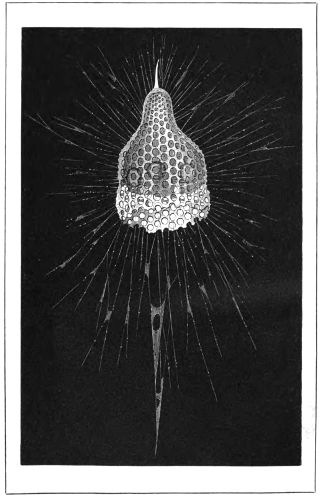
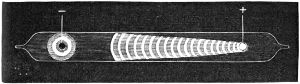
 ,
in consequence of its tendency to rotate
as a whole round the pole of the magnet.