"Oh, say, Mark, I wish you'd fight that ole cadet! An' ef you do, jest
won't we whoop her up! Gee whiz!"
The speaker was Texas. His quiet gray eyes were glistening as he spoke,
and his face was alive with excitement.
The two were resting from the morning's drill, and were lounging about a
shady nook in the corner of the siege battery inclosure. Grouped about
them, and equally interested in the important discussion were five
plebes, the other members of the Banded Seven.
It will be remembered that one of the "hop managers," a first classman
and an officer, Cadet Lieutenant Wright, had ventured in behalf of his
class to request Mark to leave the floor. Mark, who was in the midst of
a dance at the moment, had been justly indignant. He had informed the
other that an apology would be demanded; and that as a cadet, having an
invitation, he proposed to stay and dance. Whereupon the hop managers
had stopped the music and "busted up their ole hop" and gone home in a
rage.
That was the end of the matter, except that there was a fight on
between Cadet Mallory and Lieutenant Wright. It was to that fight that
Texas was alluding.
"An' ef you lick him," he repeated, "won't we whoop her up!"
"There will certainly be a fight," responded Mark, after a moment's
thought. "That is, unless Wright apologizes, which he will not do of
course. I do not like to fight; I'd a great deal rather get along
without it; for it is a brutal sort of an amusement at best."
"Rats!" growled Texas.
"But it's necessary all the same," continued the other. "I do not see
how I can keep my dignity otherwise. The notion that a plebe is a
creature without any feelings who may be slammed about at will is
altogether too prevalent to suit my taste; and I propose to have the
cadets understand once and for all that they may haze me all they want
to if they can, but that when they insult me they are going to get
hurt."
"Bully, b'gee!" chimed in Dewey, with a chuckle of delight.
"Do you think you can do him?" inquired one.
"I don't know," said Mark. "And what is more I don't want to know. If I
knew I could whip him I wouldn't want to fight. I mean to try."
"Wow!" growled Texas, angry at the mere supposition of Mark's not being
able to thrash any one on earth. "Didn't he whop Billy Williams? An'
ain't he the best man in the yearlin' class?"
"They said he was," said Mark. "And I had a hard time with him. But
Wright's been here two years longer and is trained to the top notch.
He's stronger than Williams, but I doubt if he's so quick. And still
he's captain of the football team, which means a good deal, I'll tell
you."
"I wish 'twar my chance to fight him!" exclaimed Texas. "Say, Mark, you
always were lucky."
"I don't even know if he'll fight yet," laughed the other.
"B'gee!" chimed in Dewey, "I think it's about time you began to think of
getting ready to start to send over and find out. Reminds me of a story
I once heard, b'gee——"
"Good Heavens!" groaned Mark, with a look of anguish, "I'll send at
once. Everything I do seems to remind you of something. I'll send."
"You will, hey?" laughed Dewey. "B'gee, that reminds me of another.
There was a fellow lived in Kalamazoo, and he——"
"You go!" said Mark. "I'll make you my ambassador to keep you quiet. Or
at least you can tell your stories to the enemy. Hurry up now!"
Dewey arose from his seat and prepared to start upon his errand. Texas
was on his feet in an instant.
"Naow look a yere, Mark!" he cried. "Why kain't I go? I want some fun,
too. You wouldn't let me go that time to Billy Williams!"
"I won't let you go now for the same reason," laughed Mark. "You'd be in
a free-for-all fight in half a minute yourself. You go ahead, Dewey.
Tell Mr. Wright that I demand an apology or else that he name the time
and place. Throw in a few 'b'gees' for good measure, tell him a yarn or
two, and make yourself charming and agreeable and handsome as usual.
Tra, la, la."
Dewey tossed him an effusive kiss by way of thanks for the compliment,
and then vaulted over the embankment and set out for camp, marching
right merrily to the tune of "The Girl I Left Behind Me," hands at the
side, chest out, palms to the front, little fingers on the seams of the
trousers!
The remainder of the Banded Seven waited in considerable anxiety for the
return of the "ambassador." They were one and all of them interested in
their leader and hero; his triumph was theirs and theirs his.
"He'll take half an hour, anyway," said Mark. "So there's no use
beginning to get impatient yet. Let's take it easy."
"Yea, by Zeus!" said the Parson. "And in the meantime allow me to call
your attention to a most interesting and as yet unclassified fossil
which I unearthed this very morning."
The Parson cleared his throat with his usual "Ahem!" and Mark cast up
his eyes.
"I wish I had found an embassy for the Parson, too," he groaned.
But there was no necessity for Mark's alarm, as it proved. The Parson
had barely time to give a few introductory bits of information about
"the pteroreptian genera of the Triassic and Jurassic periods," when the
"Girl I Left Behind Me" once more made herself audible and Dewey
appeared upon the scene, obviously excited.
"What are you back so soon for?" inquired Mark.
"I hadn't anything to do," responded the other, hurriedly. "Wright
wouldn't see me."
"What! Why not?"
"He says there's a committee from his class coming to see you about it,
b'gee."
"A committee!" echoed Mark. "I've got nothing to do with any committee.
It's my business to challenge him."
"I know. But that don't make any difference. He wouldn't talk about it,
he just said the committee would see you about it and explain the
situation. And to make it more exciting, b'gee, they're coming now."
"How do you know?" inquired Mark.
"I saw 'em," answered Dewey, "and I told 'em where you were and, b'gee,
they're on the way in a hurry. Something's up, b'gee, and I'm going to
be right here to see it, too."
Dewey dropped into his corner once more, and after that the Seven said
nothing, but waited in considerable suspense for the arrival of the
distinguished first classmen, wondering meanwhile what on earth they
could want and why on earth they found it necessary to interfere in
Mark's quarrel with the officer.
They came, three of them, in due time. The Parson immediately arose to
his feet.
"Hoi presbeis tou Basileos!" he said in his mist stately tone, and
with his most solemn bow. "That's Greek," he added, condescendingly—to
the six; he took it for granted that the learned cadets knew what it
was. "It's a quotation from the celebrated comedy, the Acharnians, and
it——"
They were shockingly rude, that committee. They paid not the least
attention to the Parson and his classical salutation, but instead, after
a stiff, formal bow, proceeded right to their business with Mark. The
Parson felt very much hurt, of course; he even thought of challenging to
a duel at once. But a moment later he found himself listening with rapt
attention to the amazing information which that committee had to give.
Mark did not know the names of the three cadets who confronted him.
Their faces were familiar and he knew that they were first classmen.
That was evidently all that the committee considered necessary, for they
did not stop for an introduction.
All of the Banded Seven's fun had, up to this point, been manifested
against the yearlings, and it had been the yearlings, chiefly, whose
wrath they had incurred. But that hop was too much; that had been an
insult to every cadet, and Mark knew that he had made new and more
powerful enemies. He could see that in the looks of the three stern and
forbidding cadets who glared at him in silence, with folded arms.
"Mr. Mallory," said the spokesman.
Mark arose and bowed politely.
"What is it you wish?" said he.
"We have been sent to say a few words to you from the first class."
Another bow.
"In the first place Mr. Mallory, the class instructs us to say that your
conduct at the hop the other night deserves their severest censure. You
had no business to go."
"As a cadet of this academy," responded Mark, calmly, "I considered it
my right."
"It has not been customary, sir," said the other, "for new cadets to go
to the hops."
"Precedent may be changed," was Mark's answer. "It should be when it is
bad."
There was a moment's silence after that and then he continued:
"Let us not discuss the point," he said. "I always consider carefully
the consequences of my acts beforehand. I am prepared for the
consequences of this one."
"That is fortunate for you," returned the "committee," with very mild
sarcasm. "To proceed however, Lieutenant Wright, one of our hop
managers, acting, please understand, in behalf of the class, requested
you to leave."
"To continue the story," said Mark, keeping up the sarcastic tone, "I
was naturally insulted by his unwarranted act. And I mean to demand an
apology."
"And if you do not get it?" inquired the other.
"Then I mean to demand a fight."
"Which is precisely what we were sent to see you about," responded the
cadet.
Mark was a trifle surprised at that.
"I thought," he said, "that my second should arrange the matter with Mr.
Wright's. However, I shall be glad to fix it with you."
"You will fix nothing with us," retorted the other. "The class has
instructed me to tell you that most emphatically you will not be
allowed to fight with the lieutenant."
Mark stared at the three solemn cadets in amazement, and Texas gave vent
to a muttered "Wow!"
"Not be allowed to fight!" echoed Mark.
"No, sir, you will not. Mr. Wright was the class' delegate; your quarrel
is with the class."
"B'gee!" put in Dewey, wriggling with excitement, "let's lick the class,
b'gee!"
Mark was silent for a while, thinking over the strange turn of affairs;
and then the committee continued:
"Mr. Wright will not do you the honor of a fight or of an apology."
Mark flushed at that stinging remark. The speaker never turned a hair,
but stared at him just as sternly as ever, seeing that his thrust had
landed.
Mark had a way of saying nothing when he was angry, of thinking
carefully what it would be best to do. And now he gazed into space, his
brows knitted, while his six friends leaned forward anxiously, wondering
what was coming next.
"Suppose," the plebe inquired at last, "suppose, sir, I were to force a
fight with Mr. Wright?"
"If you do," said the other, "the class will take it upon itself to
prevent that fight, using brute force if necessary, and punishing you
severely for your impertinence. And moreover you will be required to
defend your right to resist their authority, to defend it against every
member of the class."
"All at once?" inquired Mark, with a tinge of irony.
"No, sir. Separately, and in fair fight."
Mark was thoughtful and silent again.
"The consequences," he said, at last, "are unpleasant. The consequences
of swallowing so gross and unmerited an insult as Mr. Wright's, given
before hundreds of people, are more unpleasant still. Dewey!"
That young man sprang to his feet with an excited "B'gee!"
"Dewey," said Mark, in slow and measured tones, and never once taking
his eyes off the three stern cadets, "Dewey, you will return for me,
please, to Mr. Wright's tent. Tell Mr. Wright for me that I demand an
apology by this evening—or else that he name a time and place. And tell
him finally that if he refuses I shall consider myself unfortunately
obliged to knock him down the first time I see him."
"Bully, b'gee!"
"Wow!"
The six plebes had leaped to their feet as one man, with a wild hurrah!
Oh, could anything have been better than that? Those three cadets had
fairly quailed before Mark's bold and sudden, yet calm defiance.
"I think, gentlemen," said he, "that my purposes are clear to you now.
And I bid you good-morning."
Half a minute later Mark was buried in the wild embraces and
congratulations of his hilarious friends; Texas was dancing a Spanish
fandango about the inclosure, and Dewey, red and excited, was on his way
to camp as fast as his delighted legs could carry him.
"B'gee!" he kept chuckling. "B'gee, we'll wipe the spots off of 'em,
b'gee. Whoop!" The more excited Dewey got the more b'gees he was
accustomed to put in.
He was back again at the Siege Battery ten minutes later, this time even
more excited, more red, more breathless than ever.
"B'gee!" he gasped. "I got it. He'll—he'll—b'gee, he'll fight."
"Whoop!" roared Texas.
"Yes," continued Dewey, "and b'gee, you can bet there'll be fun! You
see, he wants to fight. He's no coward, I could see that, and he's mad
as thunder because the class won't let him. And b'gee, I chucked in a
few hints about his being afraid, which made him madder still, so that
when I fired out that last part about knocking him down if he didn't,
b'gee, he was wild. Oh, say! He hopped about that tent like—like Texas
is doing now—and b'gee he wanted to have it out right away."
"Whoop!" roared Texas. "Let's go up now! I'll help! Let's——"
"Sit on him and keep him quiet," laughed Mark, shoving Texas into a
corner. "Now go on."
"We couldn't fight at Fort Clinton, b'gee," continued Dewey still
gasping for breath, "because the cadets would have learned. And so
finally, b'gee, he said we'd get a boat and cross the Hudson. How's
that?"
"When?" cried Mark.
"To-morrow morning first thing, b'gee!"
Texas had escaped by this time and was dancing about once more. And the
rest of the Seven were about ready to join him. This was the greatest
bit of excitement of all. The most B. J. thing they had ever done,
defying the whole first class and going out of cadet limits besides.
There never were seven lads more full of fun than these boys; and never
had they seen a chance for quite so much fun as in this daring venture.
The seven adjourned for dinner soon after that. As they "fell in" on the
company street it was evident to Mark that the story of his bold
defiance, his desperate stroke, was all about the place even then. It
was known to the first class, and to the yearling enemies, and even to
the plebes, who stared at him in awe and wondered where on earth he had
gotten the "nerve" to dare to do what he had. For Mark Mallory stood
pledged by his defiance to fight the whole corps of cadets.
He bore his notoriety easily; he returned the stares of his enemies with
cool and merry indifference, and as he cleaned his musket and turned out
for drill, or made the dust about the camp fly while on "police duty,"
there was nothing about him to lead any one to suspect that he was, of
all West Point's plebes and even cadets, the most conspicuous, the most
talked of.
The story spread so far that it reached the ears of a certain very dear
friend of his. An orderly handed him a note late that afternoon; he knew
the handwriting well by this time and he opened the letter and read it
hastily:
"Dear Mr. Mallory: Please come over to the hotel as
soon as you can. I have some important news for the
Seven, and for you particularly.
"Your friend,
"Grace Fuller."
Mark went, wondering what could be "up," and he found that it was about
that same all-important affair that Grace wanted to see him.
"I hear you are going to fight," she began as soon as she saw him; there
was a worried smile on her face which made Mark smile involuntarily.
"It's nothing very desperate," he answered. "So you needn't be alarmed.
You see it's necessary for me to fight once in a while else you and I
couldn't play all our beautiful B. J. tricks."
"I guess you'd better go then," she laughed. "But I don't like it a bit.
You'll come home all bruised up and covered with court-plaster, and I
shan't have anything to do with you until you get handsome again."
"Thanks for that last word 'again,'" responded he with a laugh. Then, he
added, more seriously, "How did you find all this out? I thought none of
the cadets were going to speak to you since the hop?"
"Pooh!" said Grace. "You didn't suppose they meant that, did you? Half
of them are beginning to capitulate already. I knew they wouldn't hold
out."
"I knew it too," thought Mark to himself; he was watching the girl's
beautiful face, with its expression of action and life.
"It seems then that all my rivals are back again," he said, aloud.
"None of them are your rivals," answered the girl; and then she added,
quickly: "But that wasn't what I sent for you to tell you. I have been
finding out some more secrets. I think if I keep on practicing on the
cadets I'll be quite a diplomatist and confidence man by and by."
"What have you found out now?"
"Simply that the whole first class proposes to keep you from fighting."
"I knew that before," said Mark.
"Yes," answered Grace. "But you didn't know that they knew you and
Wright were going to cross the river to settle it."
"Do they know that, too?" cried Mark.
"They do; and moreover they intend to keep watch on you, and if you
leave camp to-night you'll have the whole class to follow you."
Mark looked interested at that.
"I can see," he said, "that I am going to have no small amount of fun
out of this business. I wish you could manage to use a little of your
diplomacy in helping me escape."
"And I wish," added Grace, gazing at him with the same anxious look he
had noticed before, "I wish I could help you do the fighting too. I hate
to think of your being hurt."
"It hurts me to have you look so unhappy," said Mark, seriously. "I can
stand the other. As a fighter I don't think you would make much of a
success. This is a case of 'angels for council; devils for war.'"
"Go ahead," sighed Grace, "if you have to go to hospital I'll come over
and nurse you."
Mark took his departure soon after that; he set out for camp, revolving
in his mind all sorts of impracticable schemes for outwitting the first
classmen that night. His thoughts were interrupted by hearing his name.
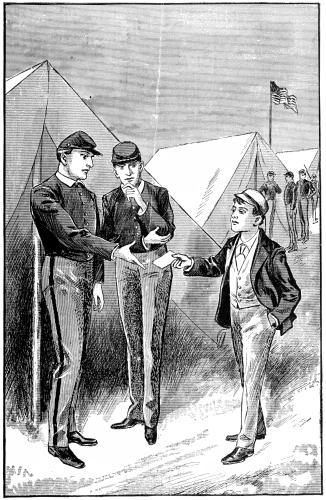
He looked up; a cadet was addressing him.
"Mr. Mallory," he said, "good-afternoon. My name is Harden. Mr. Wright
has asked me to be his second."
Mark bowed.
"Also to say that if you will be outside of your tent, dressed, at two
to-morrow morning he will have a boat ready to take us to a quiet
place."
Mark bowed again.
"Bring one second with you," the cadet continued, "Mr. Wright will have
but one. And keep this very secret; tell no one, for the cadets will
surely stop us if they learn. Mr. Wright has great doubts of our success
anyway."
"I shall do my best," answered Mark. "I am as anxious to succeed as he.
And I'm much obliged to you for your trouble."
Mark turned away and entered his tent.
"There'll be fun to-night," he muttered; "plenty of fun to-night."
There was.