ON THE INHALATION OF CHLOROFORM, ETC. — GENERAL REMARKS ON INHALATION. — CHLOROFORM. — PHYSIOLOGICAL EFFECTS OF CHLOROFORM. — CIRCUMSTANCES WHICH INFLUENCE OR MODIFY THE EFFECTS OF CHLOROFORM. — AMOUNT OF VAPOUR OF CHLOROFORM ABSORBED TO CAUSE THE VARIOUS DEGREES OF NARCOTISM. — PREPARATIONS FOR INHALING CHLOROFORM. — MODE OF ADMINISTERING CHLOROFORM. — RECOVERY FROM THE EFFECTS OF CHLOROFORM. — OCCASIONAL SEQUELÆ OF THE INHALATION OF CHLOROFORM. — CAUSE AND PREVENTION OF DEATH FROM CHLOROFORM. — FATAL CASES OF INHALATION OF CHLOROFORM. — ALLEGED FATAL CASES OF INHALATION OF CHLOROFORM. — SYMPTOMS IN THE FATAL CASES OF INHALATION OF CHLOROFORM. — MODE OF DEATH IN THE ACCIDENTS FROM CHLOROFORM. — THE TWO KINDS OF SYNCOPE. — SUPPOSED CAUSES OF DEATH FROM CHLOROFORM. — STATE OF THE CHIEF ORGANS AFTER DEATH FROM CHLOROFORM. — FURTHER REMARKS ON THE PREVENTION OF ACCIDENTS FROM CHLOROFORM. — TREATMENT OF SUSPENDED ANIMATION FROM CHLOROFORM. — EFFECT OF CHLOROFORM ON THE RESULT OF OPERATIONS. — THE ADMINISTRATION OF CHLOROFORM IN THE DIFFERENT KINDS OF OPERATIONS. — CHLOROFORM IN PARTURITION. — THE INHALATION OF CHLOROFORM IN MEDICAL CASES.
25
Inhalation is simply the act of breathing, or at least so
much of it as consists of inspiring, or drawing the air into
the lungs. The term is usually applied when any medicinal
substance is added to the air which the patient breathes,
and the process is altogether different from that called
“smoking,” as practised by the nations of western Europe
and of America, where the fumes of tobacco are merely
drawn into the mouth and puffed out again. The eastern
nations, however, always inhale when they smoke, as was
stated before (page 12). This process of inhaling smoke, as
I first witnessed it in a gentleman connected with one of
the eastern embassies to this metropolis, is very instructive,
as showing that the lungs become emptied of their contents
by three rather full expirations and inspirations. When
this gentleman took the cigar from his mouth to speak, the
smoke could be seen issuing thickly with each word till
there was a momentary pause as he took a fresh inspiration,
then the smoke could be seen issuing with each word as
before, only not so thick, and after another inspiration, the
smoke could be still perceived in the expired air, but in a
very diluted state; but after a third inspiration, it could no
longer be seen till he had resumed the cigar.
The following are the chief reasons for resorting to inhalation.
261. Certain agents, as nitrous oxide and oxygen, being
permanently in the gaseous form, cannot be administered in
any other way.
2. By taking advantage of the immense surface of the air-cells of the lungs for absorption, a more sudden and profound
effect may be produced by medicine than it would be
safe, or, in some cases, even possible to produce in any
other way. It is to this circumstance, and to the rapidity
with which certain volatile medicines exhale in the breath,
and leave the patient free from their effects, that the power
of preventing the pain of surgical operations is due.
3. Many medicines which have a disagreeable taste—as
turpentine, creasote, and camphor—are not unpleasant when
inhaled in the form of vapour; and the process of digestion
is less interfered with than by taking them into the
stomach.
4. Medicines, such as benzoic acid, and some of the gum-resins,
which are believed to exert a local action on the
mucous membrane of the air-passages, may be expected to
have a greater effect when inhaled, than when they are
taken into the stomach in the same doses, and reach the
lungs only through the circulation.
5. Some agents, as chlorine and ammonia, have a local
action when inhaled, which they could not exert if exhibited
in any other way.
In every kind of inhalation, the breathing should be
allowed to go on freely, and in the natural way.
Medicines may be inhaled either at the ordinary temperature,
or with the aid of artificial heat; and in the latter
case they may be breathed with the addition of vapour of
water, or with only so much of it as is naturally present in
the atmosphere. The medicines in use for the prevention
of severe pain, are always inhaled at the ordinary temperature.
27
History and Composition. Chloroform was first made in
1831 by two chemists who operated independently of each
other. The liquid, which is formed by the union of equal
volumes of chlorine and olefiant gas, and which is usually
called Dutch liquid, was named chloric ether by Dr. Thos.
Thomson (System of Chemistry, 6th ed., 1820). In consequence
of a statement in Silliman’s Elements of Chemistry,
that the alcoholic solution of this chloric ether was useful
in medicine as a diffusible stimulant, Mr. Guthrie, an American
chemist, attempted an easy method of obtaining it.[37]
He distilled together chloride of lime and alcohol, and he
considered that the product he had obtained was an alcoholic
solution of the chloric ether of Dr. Thomson,[38] and it
is still used in medicine under that name. About the same
time, M. Soubeiran distilled together the above ingredients
in France, and analysed the chloroform which he obtained.
His analysis, which was incorrect, led him to name the
liquid bichloric ether.[39] In 1832, Liebig examined the
liquid which has been since named chloroform, but as he
failed to detect the hydrogen which it contains, he called
the liquid chloride of carbon,[40] a name which its alcoholic
solution occasionally bore afterwards when used as a medicine.
In 1831, Dumas examined this liquid. He proved
that Soubeiran and Liebig had not obtained it pure, or had
been incorrect in their analysis.[41] He showed that it consists
of two atoms carbon, one atom hydrogen, and three
atoms chlorine.
Dumas gave the name of chloroform to the liquid, on
28account of the relation it bears in composition to formic
acid, which consists of two atoms carbon, one hydrogen, and
three oxygen.[42] Liebig, who, in common with other chemists,
admits the accuracy of Dumas’ analysis, has proposed
the name of perchloride of formyle.[43] He supposes
that the carbon and hydrogen which enter, in the same
definite proportion, into numerous compounds, form a base
which he calls formyle; and although this base has never
been obtained in a separate form, its existence is well supported
by analogy, and the term formyle is useful in assisting
the memory to retain the composition of a number of
substances. For all practical purposes, however, the medicine
we are considering is likely to go by the name of chloroform.
In the last edition of the London Pharmacopœia,
the article has received a name intermediate between the
other two. It is called chloroformyl, a name which departs
from the brevity of the word chloroform, without having
the merit of expressing the chemical constitution of the
substance. I believe that no one uses the word chloroformyl;
not even the Fellows of the College of Physicians
in their individual capacity.
Mode of Preparation. Chloroform can be obtained in
various ways, but the most convenient process, and the one
which yields it in greatest purity, is that alluded to above,
by which it was first procured. The following are the
directions in the London Pharmacopœia for making it.
“Take of chlorinated lime, lb. iv; rectified spirit, Oss;
water, Ox; chloride of calcium, broken in pieces, ʒj. Put
the lime first mixed with the water into a retort, and add
the spirit to them, so that the mixture may fill only the
third part of the retort. Then heat them in a sand-bath,
29and as soon as ebullition begins, withdraw the heat as
quickly as possible, lest the retort should be broken by the
sudden increase of heat. Let the liquid distil into the receiver
so long that there may be nothing which subsides,
the heat being reapplied if necessary. To the distilled
liquid add a quarter of the water, and shake them all well
together. Carefully separate the heavier portion which
subsides, and add the chloride to it, and frequently shake
them for an hour. Lastly, let the liquid distil again from a
glass retort into a glass receiver.”[44]
Some manufacturers of chloroform prefer to rectify it
from dry carbonate of potassa, since they consider that it is
liable to get an acid reaction from decomposition of the
chloride of calcium, when it is distilled from that substance.
The truth is, however, that there is very little occasion to
use either of these substances; for the small quantity of
water which chloroform can hold in solution is of no consequence.
Chemical and Physical Properties. Chloroform is a
clear colourless liquid, having a hot and intensely sweet
taste. It is not inflammable, but when paper moistened
with it is introduced into the flame of a candle, it is destroyed
with the evolution of smoke and chlorine gas. It is
just half as heavy again as distilled water. Its specific
gravity was formerly stated to be 1·483, but the liquid
used for inhalation of late years has been heavier than this.
I find that pure chloroform, when saturated with water, has
a specific gravity of 1·500 at 60° Fah.; and after agitating
it with sulphuric acid, to deprive it of the water, the specific
gravity is 1·503. The amount of water that chloroform
can hold in solution is only one part in from 200 to
30300; and when this is separated by oil of vitriol, the chloroform
is liable to undergo spontaneous decomposition.[45]
Chloroform is soluble in alcohol and ether in all proportions,
but it is very sparingly soluble in water. It has been
said to require 2000 parts of water for its solution, but this
is an error. As the solubility of this and similar medicines
in watery fluids has a very important connexion with their
physiological action, I took great pains to ascertain the
solubility of chloroform correctly. By admitting small
quantities of water into graduated jars containing chloroform
vapour, I was able to ascertain that chloroform is
soluble in about 288 times its volume of water. Chloroform
is itself an active solvent of many bodies; dissolving camphor,
caoutchouc, gutta percha, wax, resin, iodine, and some
other substances very readily. It is a very mobile liquid,
and when dropped from the lip of a small phial, the drops
are very small. There are three drops to a grain of the
liquid, and as a minim of it weighs a grain and a half, there
are nine drops in two minims. Consequently persons
should not speak indiscriminately of drops and minims, as
they sometimes do, when talking of chloroform.
Adulterations. The odour of chloroform is by no means
disagreeable. The only liquids that resemble it in smell are
Dutch liquid and the chlorinated products of hydrochloric
ether, but as they are much more difficult to prepare than
chloroform, they are not likely to be substituted for it, or used
for its adulteration. The smell of chloroform is therefore a
good criterion of its purity and identity. When dropped on
the hand, it should quickly evaporate, leaving not the least
moisture or smell behind. If a disagreeable odour remains
on the hand after the evaporation of the chloroform, it has
31probably been made from impure spirit, or even from wood
spirit or acetone, and is unfit for medicinal use.[46] When
chloroform becomes decomposed from any cause, it acquires
a greenish-yellow colour, and gives off chlorine and hydrochloric
acid, so that the alteration is at once apparent.
When chloroform is pure it has no reaction on test-paper,
but is quite neutral. The best way to detect a small quantity
of hydrochloric acid in it, is to moisten a slip of blue
litmus paper with distilled water, and hold it just within
the neck of the bottle exposed to the vapour. If sulphuric
acid should be present, it may be discovered by agitating
the chloroform with distilled water, and adding nitrate of
baryta.
The only article that can be mixed with chloroform without
altering its appearance and smell is alcohol. This can
be detected by the reduction it occasions in the specific
gravity of the chloroform; or, if it be present in any considerable
quantity, it may be discovered by adding water to
a little of the chloroform in a graduated tube or measure,
when a diminution of its volume takes place, owing to the
water abstracting the alcohol. The chloroform also acquires
a milky opacity under these circumstances. M. Miahle[47]
speaks of the milky opacity of the chloroform on the addition
of water as a very delicate test of the presence of alcohol;
but I find that it requires upwards of two per cent. of
alcohol to cause this appearance on the addition of water.
It has been asserted, and often repeated, that the presence
of alcohol in chloroform causes it to have caustic properties,
and makes its vapour unusually irritating. I have never
seen any evidence of this, although I have had hundreds of
32opportunities of witnessing the action of chloroform mixed
with spirit. Under certain circumstances, it is advisable
to dilute chloroform with alcohol previous to its administration,
as will be explained hereafter.
The chloroform I have met with in London has always
been sufficiently pure for inhalation, except in a few cases
where a small quantity had become decomposed, probably
from having been left a long time exposed to strong daylight.
In these instances, its altered appearance generally
prevented its being used. I am not aware of serious consequences
having arisen anywhere from the impurity or adulteration
of chloroform. A case occurred in the London
Hospital, where cough and a feeling of suffocation were
caused by hydrochloric acid with which the chloroform was
contaminated, but the inhalation was discontinued, and no
ill consequences resulted.[48]
Chloroform should be kept in well-stoppered bottles, and
protected from the light. It boils at 140 Fah. under the
ordinary pressure of the atmosphere. It is consequently
one of the most volatile liquids employed in medicine, with
the exception of sulphuric ether and amylene.
The Vapour of Chloroform is more than four times as
heavy as atmospheric air. It has a specific gravity of 4·2 at
60° Fah. Under ordinary circumstances, the vapour of
chloroform has of course no separate existence, but is always
mixed with air. It can exist in a pure state only when the
temperature is raised to 140° or upwards; or when the
pressure of the atmosphere is in a great measure removed by
the air-pump. The quantity of vapour of chloroform that
the air will hold in solution at different temperatures,
under the ordinary pressure of the atmosphere, depends on
the elastic force of the vapour at these temperatures. It is
governed by a law precisely analogous to that which
33determines the amount of watery vapour which air will
hold in solution.
The following table shows the result of experiments I
made to determine the quantity of vapour of chloroform
that 100 cubic inches of air will take up, and retain in
solution, at various temperatures.
| Temp. Fah. |
Cubic inches. |
| 40° |
7 |
| 45 |
8 |
| 50 |
9 |
| 55 |
11 |
| 60 |
14 |
| 65 |
19 |
| 70 |
24 |
| 75 |
29 |
| 80 |
36 |
| 85 |
44 |
| 90 |
55 |
In the above table, the air is a constant quantity of 100
cubic inches which becomes expanded to 107, and so on;
but it may be convenient to be able to view at a glance the
quantity of vapour in 100 cubic inches of the saturated
mixture of vapour and air, at different temperatures, and in
the table which follows the figures are so arranged as to
show this.
| Temp. Fah. |
Air. |
Vapour. |
| 40° |
94 |
6 |
| 45 |
93 |
7 |
| 50 |
92 |
8 |
| 55 |
90 |
10 |
| 60 |
88 |
12 |
| 65 |
85 |
15 |
| 70 |
81 |
19 |
| 75 |
78 |
22 |
| 80 |
74 |
26 |
| 85 |
70 |
30 |
| 90 |
65 |
35 |
As the effects of chloroform when inhaled depend entirely
34on the quantity of vapour present in the air which
the patient breathes, the effect of temperature on its volatility
is of great practical importance. The air, it is true,
does not become fully saturated with vapour during the
process of inhalation, but the effects of temperature are
relatively as great. If, for instance, a person inhales chloroform
from a handkerchief or an inhaler, in such a way that
the air he breathes shall be half saturated with the vapour,
then supposing the temperature of the apartment, the handkerchief,
etc., to be 50°, the air he breathes will contain
4 per cent.; but if the temperature be 70°, the air will contain
9·5 per cent. of the vapour.
A considerable amount of caloric becomes latent during
the evaporation of chloroform, and the temperature of the
vapour and air which the patient breathes are generally
reduced a good deal, but not to the same extent as during
the inhalation of ether. In giving chloroform from a small
sponge which had been squeezed out of water, I have sometimes
observed, after laying it down, that it became covered
with a kind of hoar frost; the minute particles of frozen
water having a slight taste of chloroform. The cold produced
by the evaporation of a liquid like chloroform is often
the means of checking the evaporation to a certain extent,
and limiting the amount of vapour which is taken up by
the air.
Chloroform belongs to the large class of medicines known
as narcotico-irritants. This and some other agents which
have been inhaled for the prevention of pain are often called
anæsthetics; a name to which there is no objection, so long
as it does not lead to the idea that they have a different
action from other narcotics, or more precisely speaking,
narcotico-irritants; there being no such medicines as pure
35narcotics. The term anæsthesia has been frequently employed
to designate the insensibility and suspension of consciousness
caused by chloroform and ether; but, in describing
the effects of these agents, I shall confine this term to
its original meaning, privation of feeling, and I shall employ
the term narcotism to designate the entire effects of
these agents on the nervous system. This is the sense in
which the term narcotism has always been employed. It
has been the custom, however, to restrict the use of the
word very much to cases in which stupor existed, but I
shall apply it to designate the slighter, as well as the more
profound effects of a narcotic, as I am entitled to do by
strict etymology.
In order to facilitate the description of the effects of
chloroform, I have been in the habit of dividing them into
degrees. I use the term degree in preference to stage, as,
in administering chloroform, the slighter degrees of narcotism
occur in the later stages of the process, during the
recovery of the patient, as well as in the beginning. The
division into degrees is made according to symptoms, which,
I believe, depend entirely on the state of the nervous centres,
and not according to the amount of anæsthesia, which
there is good reason to conclude, depends, in a great measure,
on the local action of the chloroform on the nerves.
The different degrees of narcotism glide insensibly into
each other.
In the first degree, I include all the effects of chloroform
that exist while the patient retains a perfect consciousness
of where he is, and what is occurring around him. This
degree constitutes all that a person remembers of the effects
of the vapour, except when he happens to dream, and recollect
it afterwards. The sensations caused by inhaling chloroform
are usually agreeable, when it is taken merely for
curiosity; and individuals who have inhaled nitrous oxide
36at some previous time of their lives, often describe their
feelings as being very much the same from both agents.
Patients who are about to undergo a surgical operation are,
however, not always in a state for receiving agreeable impressions,
and they sometimes complain of palpitation of
the heart, and a feeling of fulness in the head. There is
generally a sense of dizziness, with singing in the ears and
tingling in the limbs. Many persons have a feeling like
that of rapid travelling, and as an appearance of darkness
sometimes comes on from the failure of the sight, whilst
there is also a loud noise in the ears, it not unfrequently
happens that a person feels as if he were entering a railway
tunnel, just when he is becoming unconscious.
Those persons whose mental faculties are most cultivated
appear usually to retain their consciousness longest whilst
inhaling chloroform; and, on the other hand, certain navigators
and other labourers, whom one occasionally meets
with in the hospital, having the smallest possible amount of
intelligence, often lose their consciousness, and get into a
riotous drunken condition, almost as soon as they have
begun to inhale. There is a widely different class of persons
who also yield up their consciousness very readily, and
get very soon into a dreaming condition when inhaling
chloroform. I allude to hysterical females.
There is often a considerable diminution of the common
sensibility during the first degree of narcotism by chloroform,
more especially when it is inhaled very slowly, so
that the patient is kept some minutes partially under its
influence. In this way neuralgia can often be relieved,
without removing the consciousness, when it is not extremely
severe, and the suffering of labour may often be
removed in the same manner, when the pains are not very
sharp. In a few cases, the extraction of a tooth and other
minor operations have been performed without pain, whilst
37consciousness has been retained; but as a general rule, it is
better not to operate under these circumstances, for failure
is more likely than success; and this plan does not succeed
in any case without inhaling longer, and consuming more
chloroform, than would be necessary in the usual way.
The complete recovery of the patient from the effects of the
vapour, after a protracted inhalation of this kind, is also
more tardy.
The first degree of narcotism recurs when consciousness
returns as the effect of the chloroform is subsiding. At this
time, there is generally a greater amount of anæsthesia than
at the commencement of inhalation, just before consciousness
is removed. I have many times known the introduction
of sutures, and such like measures, performed at the
concluding part of an operation, after the patient had recovered
his consciousness, without his feeling what was being
done. As a general rule also, the smarting of the wound
does not commence till some time after consciousness has
returned.
In the second degree of narcotism, there is no longer correct
consciousness. The mental functions are impaired, but
not necessarily suspended. When a patient inhales chloroform
quietly for a medical or surgical purpose, he usually
appears as if asleep in this degree; but if his eyelid be
raised, he will move his eyes in a voluntary manner. There
are occasionally voluntary movements of the limbs; and
although the patient is generally silent, he may nevertheless
laugh, talk, or sing. Persons sometimes remember what
occurs whilst they are in this state, but generally they do
not. Any dreams that the patient has, occur whilst he is
in this degree, or just going into, or emerging from it, as I
have satisfied myself by comparing the expressions of patients
with what they have related afterwards. There is
sometimes a little trouble with the patient in this degree of
38narcotism. He feels the inconvenience of the vapour he is
breathing, and having become unconscious of the object for
which it is inhaled, he endeavours to push away the inhaler.
As a person in this condition can generally hear and
partly understand what is said, a few kind words will often
render him tractable. This is generally true of all those
who have been brought up with care and kindness, more
especially patients of the female sex; but the man who has
been roughly treated from the time of his birth, can often
be made insensible only by means of a little restraint.
There is generally a considerable amount of anæsthesia
connected with this degree of narcotism, and I believe that
it is scarcely ever necessary to proceed beyond it in obstetric
practice, not even in artificial delivery, unless for the
purpose of arresting powerful uterine action, in order to
facilitate turning the fœtus. The loss of sensation is indeed
sometimes so complete in this degree, especially in children,
that the surgeon’s knife may be used without pain; I have
indeed seen a child unconsciously handling its toys all the
time that the operation of lithotomy was performed on it.
Commonly, however, the use of the knife, when the narcotism
has not proceeded further than this degree, occasions
expressions indicative of pain, which are either not remembered,
or are recollected as having occurred in a dream.
The patient is generally in this degree during the greater
part of the time occupied in protracted operations; for
although, in most cases, it is necessary to induce a further
amount of narcotism before the operation is commenced, it
is not usually necessary to maintain it at a point beyond
this.
In the third degree of narcotism, there are no longer any
voluntary motions. The eyes, for instance, are not directed
towards any object; and although the limbs may move,
they are not directed to any purpose. The pupils are generally
39inclined upwards in this degree, and are at the same
time usually somewhat contracted. The bloodvessels of the
conjunctiva are generally somewhat enlarged in this degree
in all persons who are well nourished and not deficient in
blood. It is in this degree of narcotism that rigidity and
spasms of the muscles occur in certain cases. These phenomena
occur most frequently in cases where the muscles
have been much exercised, and are consequently well nourished.
They are never met with in infancy, and rarely before
puberty. They are much more common in the male than
the female sex. The rigidity and spasm are greatest and
most constant in labourers and persons accustomed to athletic
exercises, and they are usually absent in patients who
have been long confined to the room, or are much reduced
in strength from any cause. They are less marked in old
age than in the middle period of life, and they are not by
any means so frequent or strong in fat, as in thin, muscular
persons. I have seen the spasms take an epileptiform character
in a few cases; but by gently continuing the chloroform,
they have always been subdued. In a great number
of cases, the patient mutters in an almost inarticulate and a
perfectly unintelligible manner, just as the muscular rigidity
and spasm are subdued. Under these circumstances,
I have never heard a single word pronounced so that it
could be understood. If articulate language is uttered just
after the muscular rigidity, it is evidence that the effects of
the chloroform are being allowed to diminish, and that the
patient is going back into the second degree of narcotism.
In the third degree of narcotism, a person is quite incapable
of having any perception or consciousness of pain, but
anæsthesia is not a necessary part of this amount of narcotism
when it is first induced, and in some cases a patient
may flinch, and put on an expression of countenance which
seems indicative of pain. He may also cry out, but not in
40an articulate manner. By continuing the chloroform gently
for a minute or so, a state of complete anæsthesia can be
induced in nearly every case, without carrying the narcotism
of the nervous centres further than this degree.
The loss of sensibility of the conjunctiva, as shown by the
absence of winking when the edges of the eyelids are gently
touched, is the best criterion that the patient will bear the
knife without flinching or crying.
The circumstance of the anæsthesia, or loss of common
sensibility, not keeping pace with the degree of narcotism
of the brain, as shown by the presence or absence of consciousness
and volition, appears to depend on the chloroform
acting on the peripheral distribution of the nerves, as well
as on the nervous centres.[49] The following considerations
support this view. 1. Chloroform has the effect of diminishing
the sensibility of a part to which it is applied
locally, even to the sound cuticle. When the cuticle is
removed, the local anæsthesia of the surface is complete;
and in frogs, which have a thin permeable skin, and a languid
circulation, one limb can be rendered insensible, by the
local application of this agent, before the remainder of the
animal is much affected. 2. Chloroform when inhaled immediately
circulates throughout the body, in all parts of
which it can be detected by chemical means. 3. Chloroform
and other narcotics suspend the function of the nerves,
when locally applied to them. 4. When inhaled, the local
effect of chloroform must be greatest when it has had time
to exude through the coats of the vessels, into the extra
vascular liquor sanguinis, and come into immediate contact
with the nervous fibrillæ; and it must take some little time
after the chief part of the chloroform has escaped from the
blood during its passage through the lungs, before that
which is in the lymph external to the vessels can pass back
41again into them, by endosmosis. The brain, on the other
hand, is without lymph and lymphatics. The blood in this
organ is all contained within the vessels, in which, moreover,
it circulates with more velocity than in the external
parts of the body. It can be easily understood, therefore,
how the brain may escape from the effects of the vapour
whilst the nerves of sensation throughout the body still
remain partially under its influence. 5. It is in young subjects,
in whom, connected with the more active process of
nutrition, the quantity of lymph external to the vessels is
greatest, that the general insensibility most frequently remains,
whilst the cerebral hemispheres are resuming their
functions; whilst in persons of spare habit, approaching
the middle or later periods of life, there is little anæsthesia
except in the unconscious state.
The co-operation of the brain with the nerves is, of
course, necessary to sensation; and it is possible by a large
dose of chloroform to produce complete anæsthesia very
suddenly, before there is time for the nerves to be acted on
locally to any extent; and if the chloroform is not continued,
the anæsthesia may subside as quickly as it was induced.
The large ganglia of sensation, the optic thalami,
seem to require a greater quantity of chloroform to suspend
their function than is necessary to suspend that of the
cerebral hemispheres, but, by occupying three or four minutes
in giving chloroform, one is enabled to add its local
action on the nerves to its influence on the brain, and thus
to induce anæsthesia with less narcotism of the nervous
centres than would otherwise be required.
It must not be supposed that the difference of the action
of chloroform on the cerebral hemispheres, and on the optic
thalami, will of itself explain the want of uniformity between
the loss of consciousness and loss of feeling. If it were a
mere difference of degree, it might be so explained; but the
42absence of all regular relation between these phenomena can
only be satisfactorily accounted for when the circumstances
connected with the circulation and the liquor sanguinis,
that I have endeavoured to explain above, are taken into
account.
In the fourth degree of narcotism, the breathing is stertorous,
the pupils are dilated, and the muscles completely
relaxed. The patient is always perfectly insensible. It is
very seldom necessary to carry the effects of chloroform as
far as this degree. It is, however, sometimes requisite to
do so, in attempting to reduce dislocations of long standing
in muscular persons, and whilst the surgeon is dissecting
in the neighbourhood of important vessels and nerves, in
certain robust subjects and others who seem to have acquired
an excess of sensibility by hard drinking, and who
can hardly be kept quiet under the knife, except when the
breathing is stertorous.
There are some further effects of chloroform with which
one becomes acquainted in experiments on the lower animals.
If the inhalation is continued after the symptoms
just described are produced, the breathing is rendered difficult,
feeble, or irregular, and is sometimes performed only
by the diaphragm, whilst the intercostal muscles are paralysed.
If the dose of chloroform is gradually increased
after these effects are produced, the breathing entirely ceases,
but the heart continues to pulsate very distinctly, till its
action becomes arrested by the absence of respiration, as in
asphyxia. This interval, including the embarrassment and
cessation of the breathing, I call the fifth degree of narcotism.
Although the respiration may be suspended by an amount
of chloroform that has very little direct effect in the motion
of the heart, it is quite possible to stop the heart’s action by
the immediate effect of this agent. When frogs are exposed
43to the action of the vapour, they go on absorbing it by the
skin, after the respiratory movements have ceased; and in
this way the pulsations of the heart are arrested, when a
certain amount of chloroform has been absorbed into the
blood. And when animals of warm blood are made to
breathe air containing as much as eight or ten per cent. of
the vapour of chloroform, the blood which is passing
through the lungs becomes so charged with it as to stop the
action of the heart, when it reaches that organ through the
coronary arteries. It is in this way that accidents from
chloroform have happened. The power of this agent to
arrest the pulsations of the heart can also be shewn, by
blowing a stream of the vapour on its surface, when the
chest is opened immediately after the breathing has ceased,
and whilst it is still beating.
The ultimate and greatest effect that chloroform is capable
of producing on the animal body is to destroy the irritability
of the muscles, and produce the post-mortem rigidity.
Either the whole body or a single limb can be rendered
instantly rigid by injecting the arteries with a little chloroform
shaken up with water. The rigidity remains for
weeks in the dead body, and would probably be permanent
if the chloroform were prevented from evaporating. Whilst
it lasts, putrefaction is of course prevented.
Effect of Chloroform on the Pulse. I have not mentioned
the state of the pulse in the above description of the effects
of chloroform, for it affords no criterion of the amount of
narcotism, and it was better therefore to reserve it for a
separate notice. It is nearly always increased both in force
and frequency, more especially at the early part of the inhalation.
After the patient has become quite insensible,
the pulse indeed generally settles down nearly to the natural
standard, and in the middle of the most formidable operations,
it is often beating with natural volume and force, not
44more than sixty or seventy times a minute. The pulse
rarely becomes weaker or slower than natural under the influence
of chloroform, except from considerable loss of blood,
or where the patient is about to be sick. I have twice
found the pulse as slow as 44 in the minute at the conclusion
of an operation attended with great loss of blood. One
of the cases was the removal of a large tumour of the labium
pudendi, in a woman, aged forty-five, on the 28th of April,
1849, at King’s College Hospital, by Mr. Fergusson. The
pulse was, however, not small or weak, and there was no
faintness. In a few minutes, the patient vomited, and the
pulse immediately resumed its natural frequency.[50]
There is occasionally a feeble state of pulse with a feeling
of faintness as the effects of the chloroform subside, and in
two or three cases in which the patient was in a sitting
posture, positive syncope occurred, which, however, was
promptly removed by the horizontal position. The persons
most liable to a feeling of faintness after chloroform, are
those who are subject to syncope from slight causes.
Action of Chloroform on the Nervous System. Chloroform,
when inhaled, immediately reaches every part of the
nervous system through the circulation, and it acts on
every part of that system from the first, as a careful observation
of the symptoms proves. It does not, however, act
equally on all parts of the nervous system, according to the
quantity which is absorbed; some parts of that system
have their functions entirely, or almost, suspended, whilst
others are but little under the influence of the vapour, and
45it is owing to this fact that the most severe pain may be
prevented without danger. M. Flourens made the following
remarks respecting the action of sulphuric ether, and
they apply equally well to the effects of chloroform, when
it is inhaled gradually: “Under the action of ether, the
nervous centres lose their powers in regular succession—first,
the cerebral lobes lose theirs, viz., the intellect; next,
the cerebellum loses its, viz., the power of regulating locomotion;
thirdly, the spinal marrow loses the principle of
sensitiveness and of motion; the medulla oblongata still
retains its functions, and the animal continues to live:
with loss of power in the medulla oblongata, life is lost.”[51]
I may add, that after the breathing has ceased, from the
loss of power of the medulla oblongata, the ganglionic
nerves still perform their functions, and the heart and intestines
continue to move for a time, often with vigour.
Owing to the unequal effects of a given quantity of
chloroform on different parts of the nervous centres, and
owing to its acting also on the nerves, a variety of states
may be met with during a surgical operation, some of
which have often been thought curious, or anomalous. The
most usual state of the patient during an operation, when
chloroform is successfully administered, is one of perfect
quietude, without any sign of consciousness or sensation.
The patient under chloroform may, however, moan, or cry,
or flinch, or show other symptoms which are usually thought
indicative of pain, but without using any articulate language,
or remembering anything of the operation afterwards.
If his flinching or crying out has neither interfered with
the surgeon, nor distressed the friends who may be present,
a case of this kind may be considered satisfactory. A third
condition of the patient under the influence of chloroform is
that in which he talks, or laughs, or sings during the operation,
46his words having no reference to what is being done. If
he is sufficiently quiet for the proceedings of the surgeon, the
application of the chloroform must be considered successful,
and this condition proves the absence of pain even more completely
than that in which there is neither sign nor sound,
except the breathing and pulsation of the heart and blood
vessels. A fourth condition of the patient is that in which
he is conscious, and can look on whilst the surgeon is
performing some small operation, or the minor part of a
large one, without feeling it, or whilst feeling it in a manner
which is not painful. This condition, when it occurs, is
the most satisfactory proof of the power of chloroform to
prevent pain. It happens but rarely, however, and cannot
be induced at will, and it is usually at the concluding
part of an operation, during which the patient has been
unconscious, that this condition is met with. He wakes
whilst there is still a vessel to tie, or a suture to be introduced,
and does not feel it, owing, as was stated before, to
some of the chloroform being detained in the extra vascular
liquor sanguinis, whilst the brain has become almost free
from the medicine. When the knife, or the needle, is felt
without being painful, it is because the common sensibility,
without being entirely abolished, is so much reduced, that
what would otherwise cause acute pain only occasions an
ordinary sensation.
A fifth state of the patient is met with when an insufficient
quantity of chloroform has been administered, or when
its effects have been allowed to subside too soon. The
patient may call out or complain in articulate words, such
as “Oh, you are hurting me,” and yet may assert afterwards
that he had no pain, and knew nothing whatever of
the operation. His own language at the time must, however,
be held to decide that there was some pain, which
made so slight an impression on the disordered mind as not
47to remain in the memory. Pain which is not remembered
is of very little consequence, and probably is but slight in
degree. It should not be judged of by the expressions of
the patient when he is but partially conscious, and using no
self-control. Chloroform may, lastly, be administered so
badly, that the patient simply falls asleep under the soothing
influence of a very gentle dose, as he might sleep from
an ordinary dose of opium, without being insensible, and,
when the operation is commenced he wakes to full consciousness,
and both feels pain and remembers it.
Patients, when insensible, sometimes moan or groan from
the effects of the chloroform, and quite independently of the
operation. The groaning or moaning comes on sometimes
and even leaves off again, before the operation is commenced.
When symptoms like those of pain are present
during an operation, one may generally know whether they
are the consequences of it, by observing whether or not
they are connected with each cut of the knife. But even
when a flinch or a groan follows each manipulation of the
surgeon, it does not necessarily follow, provided the patient
does not speak, that he is suffering pain. Some amount of
consciousness is essential to the presence of pain, but many
of the lower animals execute movements like those caused
by pain, after the head is cut off, and when, of course, there
can be no consciousness. Although the mind, under ordinary
circumstances, is conscious of the attitude, gestures,
and cries, which accompany pain, neither the intellect nor
the will have any share in their production. On the contrary,
they usually take place in spite of the efforts of the
will to prevent them, and one may understand that, when
consciousness and volition are suspended, the actions usually
indicative of pain may, for want of control, be excited
by slighter causes, and to a greater degree, than in the
waking state.
48It is certain that chloroform may prevent pain in two
ways, either by rendering the mind unconscious of external
impressions, or by removing the sensibility to these impressions,
that is, by a true anæsthetic action, but usually, and
always when breathed in a full dose, it acts in both ways
at once.
The patient sometimes supposes that he remembers all
the particulars of the operation, although he did not feel
the pain, but on questioning him it is usually found that it
is a dream which he remembers, and not the actual facts.
It is extremely rare for a patient to assert that he has felt
pain from the operation, when he has not felt it, but I have
known this to happen once or twice, and a circumstance
which was related to me by Mr. Robinson proves the possibility
of it. He administered chloroform, or ether, to a
lady, with the intention of extracting some teeth, but could
not succeed in getting the mouth open, and the lady woke
before anything had been done, and asserted that she had
felt the operation. She inhaled again, and awoke, and repeated
the same statement once or twice before the teeth
were actually extracted.
I have heard it stated that patients have felt the pain of
the operation, but have been unable to make any sign of
feeling it. Such an occurrence may possibly take place
when the chloroform is inhaled too slowly, or not in sufficient
quantity; but I have not witnessed it, and it evidently
cannot happen with a sufficient dose.
I arrived at the conclusion, after much careful observation,
that chloroform might be given with safety and advantage
in every case in which the patient requires, and is
in a condition to undergo, a surgical operation; and having
49acted on this conclusion for several years, I have found no
reason to change it. It is desirable, however, to pay attention
to every circumstance connected with the health and
constitution of the patient before exhibiting chloroform, as
many of these circumstances influence its effects.
Age. The age of the patient has considerable influence in
modifying the effects of chloroform. It acts very favourably
on children: they sometimes oppose the inhalation of
it as long as they are conscious, but it does not occasion the
rigidity and struggling after loss of consciousness, which
are sometimes met with in the adult. Anæsthesia is generally
induced with a less amount of narcotism of the nervous
centres in children than in grown up persons. The effects
of chloroform are more quickly produced and also subside
more quickly in children than in adults, owing no doubt to
the quicker breathing and circulation. It often happens,
however, that when the insensibility has been kept up for
some time, say twenty minutes or half an hour, in a child,
it is followed by a natural sleep of a few hours duration,
provided there is no painful wound, or other cause, to prevent
the sleep. I have given chloroform in a few cases as
early as the ages of eight and ten days, and in a considerable
number before the age of two months; and I have at this
time, June 30th, 1857, memoranda of the cases of 186 infants
under a year old to whom I have administered this
agent. There have been no ill effects from it either in these
cases, or in those of children more advanced in life; and it
is worthy of remark that none of the accidents from chloroform
which have been recorded, have occurred to young
children.
There is nothing peculiar in the effects of chloroform on
people advanced in years, except that its influence subsides
rather slowly, on account of the slower breathing and circulation.
I have given chloroform to many patients over
50seventy-five years of age, and to one as old as ninety
years.
Strength or Debility. The comparative strength or debility
of the patient has considerable influence on the way
in which chloroform acts. Usually the more feeble the
patient is, whether from illness, or any other cause, the
more quietly does he become insensible; whilst if he is
strong and robust, there is very likely to be mental excitement
in the second degree, and rigidity of the muscles, and
probably struggling in the third degree of narcotism. Patients
in a state of debility resemble children, not only in
coming quietly and easily under the influence of chloroform,
but also in the circumstance, that the common sensibility is
suspended with less narcotism of the nervous centres than
is generally required in robust persons. Children and persons
in a state of debility have usually an acute sensibility
which causes them to suffer pain from very slight injuries,
but this sensibility is more easily suspended by chloroform
than the less acute sensibility of robust persons. It is in
strong men, accustomed to hard work or athletic sports,
that the rigidity and struggling previously alluded to in describing
the effects of chloroform, most frequently occur
after the loss of consciousness. Some of the patients in
whom the struggling and rigidity have been greatest were
gentlemen belonging to boating clubs; but I think the
patient, in whom these symptoms were most violent, was a
celebrated harlequin of one of the London theatres, on whom
Mr. Fergusson operated a few years ago.
The persons in whom the rigidity and struggling are well
marked are often lean and wiry, and these symptoms rarely
occur in fat people. The rigidity and struggling are less
marked when the chloroform is given slowly than when
quickly given.
Hysteria. Patients who are subject to hysteria sometimes
have symptoms of the complaint, such as sobbing, crying,
51or laughing, as soon as consciousness is suspended, or even
impaired, by the chloroform; but these symptoms can always
be subdued by proceeding with the inhalation. In a
very few instances the hysterical state returns, and becomes
troublesome as the effect of the vapour subsides. In two or
three cases that I have met with, it continued for three or
four hours, but it usually subsides in a much shorter time.
The inhalation should not be suspended on account of the
hysteria, but should be continued till it is subdued before
an operation is performed.
I have rarely seen a decided fit of hysteria from the
effects of chloroform, but in the case of a young married
lady, to whom I gave this agent to prevent the pain of an
operation on the rectum, a somewhat violent paroxysm of
hysteria came on directly after the inhalation was commenced.
The surgeon would not permit me to continue the
chloroform, and expressed his intention of operating without
it. After waiting for about half an hour, however, for the
hysteria to subside, and finding that it continued the same
as at first, the inhalation was resumed. The patient was
soon rendered insensible, and lay perfectly still whilst the
operation was performed. There was a little hysteria as
the effects of the chloroform subsided, but not so severe as
before.
I have several times seen hysterical symptoms in the
male, either during the administration of chloroform, or
whilst the patient was recovering from its effects. But in
all these cases, the patients informed me afterwards that
they were subject to hysterics when under the influence of
mental emotion.
In some persons who are subject to hysteria, the breathing
becomes excessively deep and rapid whilst inhaling
chloroform. This usually occurs just as the patient is becoming
unconscious, but in a few cases even earlier, and the
52patient is aware of the impulse to breathe in this manner.
After this kind of hysterical breathing has lasted a minute,
the patient generally rests nearly a minute without breathing
at all, after which the respiration generally becomes
nearly natural. I give the chloroform very sparingly during
this violent breathing, or else withdraw it altogether for a
minute or two.
I do not consider that the hysterical diathesis forms any
objection to the use of chloroform in operations, as the patients
would be generally quite as liable to suffer an attack
of hysteria from the pain, if chloroform were not used.
Epilepsy. Chloroform occasionally brings on a fit of
epilepsy in persons who are subject to this disease. It was
stated in one of the foreign medical journals, in 1848, that
this agent was so certain to cause a fit in epileptic persons,
that it might be used to detect impostors pretending to be
subject to this disease; but if this assertion has been acted
on, it must have led to great injustice, for I have many
times administered chloroform to the extent of causing
complete insensibility in epileptic patients who required to
undergo operations, without its inducing the least approach
to a fit.
In the few cases in which epileptic convulsions are occasioned
by chloroform, they do not appear till the third
degree of narcotism is induced, in this respect differing from
hysteria, which comes on in the second degree, or even earlier,
as was stated above. The course to pursue, when epileptic
convulsions appear, is to continue the chloroform
steadily and gently, till they subside. I have never seen the
chloroform fail to subdue the convulsions in a very few minutes,
and I have never seen them recur after the operation,
as the effects of the vapour subsided. In medical and obstetric
practice, and for slight operations, it is not requisite
to carry the effects of chloroform so far as that stage in
53which an epileptic fit would occur, so that under these circumstances
the fact of a patient being subject to epilepsy
hardly requires to be taken into account.
Pregnancy. I have repeatedly given chloroform at all
periods of pregnancy, both for tooth-drawing and more important
operations, and I have not met with any ill effects
from it in any of the cases.
The Menstrual Period. It is customary to avoid the
menstrual period in fixing the time for a surgical operation,
when it can be so arranged. There are, however, often
reasons for not waiting over this period, and under such
circumstances, I do not know any objection to the inhalation
of chloroform. I have administered it frequently during
the menstrual period, and have seen no ill effects from it.
I have observed that there is a little more tendency to
slight hysterical symptoms, during its inhalation at this
period, than when the same patients inhale it at other
times, which is what we might expect.
Diseases of the Lungs. Affections of the lungs sometimes
cause a little difficulty and delay in the administration of
chloroform, as the vapour is liable to excite coughing when
the mucous membrane of the air-passages is irritable. The
inconvenience is, however, confined to the time of inhalation,
for the cough is generally relieved afterwards.
I have given chloroform for surgical operations in many
cases where phthisis was present, and in several patients
who had suffered from hæmoptysis, and have not seen any
ill effects from its use in these cases. Chloroform has indeed
often been inhaled with advantage to relieve the cough
in consumption. The cases of chronic bronchitis in which
chloroform is administered for surgical operations are still
more numerous. The effects I have observed have been
coughing at the time of inhalation, and very often a relief of
the cough afterwards. Some of the patients had emphysema
54of the lungs. It is scarcely necessary to allude, in
this place, to acute diseases of the lungs, as surgical operations
are not performed during their continuance, but from
the fact of chloroform being inhaled occasionally in the
treatment of these affections, it is evident that they would
cause no obstacle to its employment.
Disease of the Heart. There is a very general impression
that the use of chloroform is unsafe when disease of the
heart exists, more particularly, fatty degeneration of that
organ. This belief has been encouraged by the circumstance
that this affection has been present in a few of both the
real and alleged deaths from chloroform; and also by the
fact that, in the accidents that have been really due to
chloroform, the heart has been the organ on which it has
exerted its fatal influence. When we come to investigate
these cases, however, we shall find reason to conclude that
the heart has probably been diseased in quite as great a
proportion of the patients who have taken chloroform without
ill effects, as in those who have succumbed under its
influence. As regards my own practice, indeed, the only
case in which death could in any degree be attributed to
the chloroform, was one in which there was extreme fatty
degeneration of the heart; but, on the other hand, I have
given chloroform in numerous cases without ill effects where
the symptoms of this, as well as other affections of the heart,
were present in a very marked degree. Indeed, I have
never declined to give chloroform to a patient requiring a
surgical operation, whatever might be his condition, as I
early arrived at the conclusion that this agent, when carefully
administered, causes less disturbance of the heart and
circulation than does severe pain. Whenever I have had an
opportunity of seeing an operation performed without chloroform,
I have carefully observed the pulse, and although
none of these operations have been of a very severe nature,
55I have found the circulation to be much more disturbed
than it would have been by chloroform carefully administered.
The pulse in most of these cases has been excessively
frequent during the operation, and in some instances
it has intermitted to an unusual extent.
In one instance, I had an opportunity of witnessing a
similar operation on the same patient, first without chloroform,
and afterwards under the influence of this agent. On
January the 6th, 1855, Mr. Fergusson performed lithotrity,
in King’s College Hospital, on a man, aged fifty-one. He
generally directs chloroform to be administered in lithotrity,
but in this instance he omitted to do so, as he thought that
the bladder was not very irritable, and that the patient
would not suffer much. I began to feel the pulse just when
the patient saw the lithotrite about to be introduced. It
was 120 in the minute. As soon as the instrument was introduced,
the pulse increased to 144, and immediately afterwards
it became uneven, irregular, and intermitting. I
could not count more than three or four beats at a time;
and, occasionally, when the pain seemed greatest, and the
man was straining and holding his breath, the pulse was
altogether absent for four or five seconds. In order to
ascertain whether the absence of pulse at the wrist might
not depend on the pressure of the muscles of the arms,
caused by grasping the table, I applied my ear to the chest,
and found that there was no sound whatever to be heard
during the intervals when the pulse was imperceptible.
It was evident that the patient held his breath till the right
cavities of the heart became so distended as to stop the
action of that organ till the respiration returned. The man
did not complain or cry out during the operation. A week
afterwards the lithotrity was repeated, but on this occasion
I administered chloroform. The pulse was about 120 in the
minute when the patient began to inhale the chloroform,
56but it became slower as he was made unconscious, and it
was regular and natural during the operation. It was only
towards the end of the operation, when the effect of the
chloroform was allowed to diminish, and when the man
began to strain a little, though not yet conscious, that the
pulse intermitted slightly, passing over a single beat occasionally.
There were none of the long intermissions of the
pulse observed on the former occasion.
It is very evident that if the above mentioned patient had
been the subject of any affection of the heart which weakened
or embarrassed its action, he would have run a much
greater risk from the pain of the first operation, than from
the inhalation of chloroform in the second one.
In a few of the patients having the arcus senilis of the
cornea, a weak, intermitting, or irregular pulse, and other
signs of fatty degeneration of the heart, there have been a
feeling of faintness and a tendency to syncope, as the effects
of the chloroform were subsiding, especially when the operation
had been performed in the sitting posture; but these
symptoms have soon subsided, in all the cases I have met
with, on placing the patient horizontally, with or without
the help of a little ammonia to the nostrils.
Cerebral Disease. Affections of the head offer no obstacle
to the administration of chloroform. I have given it to
several patients who had suffered previously from an attack
of apoplexy. Some of them still retained the paralysis resulting
from their attack, but the chloroform has not been
attended or followed by ill effects in any of these cases.
The following case, in which alarming head symptoms had
existed a few hours before the inhalation of chloroform, cannot
fail to be interesting.
The 31st of October, 1854, was appointed by Mr. Fergusson
to perform lithotrity on a gentleman, seventy-eight
years of age, who had a phosphatic calculus in his bladder.
57He was a patient of Mr. Propert, and Mr. Fergusson had
removed a similar calculus by lithotrity, and I had given
him chloroform at each of the operations, and it was arranged
that he should have chloroform on the present occasion.
Mr. Propert informed Mr. Fergusson and me, on our
arrival, that his patient had had an attack the night before
resembling apoplexy; he had been insensible, the breathing
had been stertorous, the pupils dilated, and the face very
red and congested. Mr. Propert had caused him to be
cupped to fourteen ounces, and had given him twenty grains
of calomel in the course of the night, and in the morning he
was as well as usual, and remained so at the time of our
visit. We considered the case with Mr. Propert, and as
there were reasons for not postponing the operation, it was
determined that he should inhale the chloroform rather than
be subjected to the pain. The vapour acted very favourably;
he recovered his consciousness a few minutes after
the operation, and expressed himself as feeling quite well.
Mr. Fergusson crushed another calculus in this patient in
March 1855, when I again administered chloroform, and in
1856 I understood that he was free from the complaint.
Insanity. Chloroform acts on insane patients just as it
does on others, that is to say, they are made insensible by
it, and, when its effects completely subside, it leaves them
in the same state of mind as before. Insane people are,
however, often so suspicious that they cannot be persuaded
to inhale chloroform, and it can only be given to them by
force. When once under its influence, however, I have seen
teeth extracted, and other operations performed, which it
would have been impossible to accomplish in the same individuals
without resorting to inhalation. The use of chloroform
in the treatment of mania will be alluded to in another
part of this work.
Hard Drinkers. It was at one time alleged that hard
58drinkers of spirituous liquors were not susceptible of the
influence of ether or chloroform, and for a long time there
remained an impression that these persons were difficult to
render insensible. I have always found that hard drinkers
were rendered unconscious, and even comatose, by the same
amount of ether or chloroform as other persons; but they
sometimes have a morbid excess of sensibility in the nerves
of common sensation, and do not lie still under the surgeon’s
knife except when the nervous centres are deeply narcotised,
and the breathing almost stertorous. On this account,
they sometimes inhale much more chloroform during
a protracted operation than other persons.
Before proceeding to describe the mode of administering
chloroform, it is desirable to treat of the quantity of it
which produces its different effects. Without alluding to
the facts and experiments which prove that all narcotics
produce their effects by being absorbed into the circulating
fluid, and so reaching the nervous system on which they act,
it is only necessary to mention the following circumstances
to show that this is the case as regards chloroform. In
some experiments in which I assisted Dr. Sibson, we found
that the vapour of chloroform produced its effects after
both the pneumogastric nerves had been divided, exactly the
same as before. Chloroform can be detected by means of
chemical tests exhaling in the breath of those who have just
previously inhaled it. It can also be detected in the urine
after inhalation, and very readily in all the tissues of animals
that have been killed by it, for several days after
death.
The quantity of chloroform in the blood in the different
degrees of narcotism might be estimated approximatively
59from the amount used in inhalation, but I devised some experiments
in 1848 for ascertaining the quantity with accuracy.[52]
The experiments were based on the following circumstances.
When air containing vapour is brought in contact with a
liquid, as water or serum of blood, absorption of the vapour
takes place, and continues till an equilibrium is established;
when the quantity of vapour in both the liquid and air,
bears the same relative proportion to the quantity which
would be required to saturate them at the temperature and
pressure to which they are exposed.
This is only what would be expected to occur; but I
verified it by numerous experiments in graduated jars over
mercury. The intervention of a thin animal membrane may
alter the rapidity of absorption, but cannot cause more
vapour to be transmitted than the liquid with which it is
imbued can dissolve. The temperature of the air in the
cells of the lungs and that of the blood circulating over their
parietes is the same; and, therefore, when the vapour is too
dilute to cause death, and is breathed till no increased effect
is produced, the following formula will express the quantity
of any substance absorbed:—As the proportion of vapour in
the air breathed is to the proportion that the air, or the
space occupied by it, would contain if saturated at the temperature
of the blood, so is the proportion of vapour absorbed
into the blood to the proportion the blood would dissolve.
The manner in which the experiments were performed,
was to place a small animal in a glass jar, so large that it
formed a capacious apartment for it, and held much more
air than it could require in the course of the experiment.
The jar was covered with a closely fitting lid, and a carefully
weighed portion of chloroform was allowed to diffuse itself
through the air of the jar. The experiments were continued
60till the chloroform produced no further effect. I shall pass
over a number of tentative experiments, and adduce only a
few of those which were made after I had ascertained the
quantities requisite to produce the desired effect. The results
obtained in these experiments were entirely due to the
degree of dilution of the vapour; for the quantity of chloroform
employed was, in every instance, more than would have
killed the animal in a much shorter time than the experiment
lasted, if it had been conducted in a smaller jar. It is
assumed that the proportions of vapour and air remain unaltered
during the experiment; for the quantity absorbed
must be limited to what the animal can breathe in the time,
which is so small a part of the whole that it may be disregarded.
Experiment 1. A guineapig and a white mouse were
placed in a jar holding 3,000 cubic inches, and fifteen grains
of chloroform were introduced by a tube in the lid of the
jar, which was closed immediately by a screw. The chloroform
fell on some blotting paper suspended in the jar, and
in a minute or two was converted into vapour and diffused
through the air in the jar. The animals were allowed to
remain half an hour, and were unaffected by the chloroform,
except that they appeared to be a little less brisk than usual,
during the first two or three minutes after their removal.
Experiment 2. A guineapig was placed in the same jar,
and twenty-two and a half grains of chloroform were introduced
in the same manner as before, being three-quarters of
a grain to each hundred cubic inches of air. In two or three
minutes the chloroform was converted into vapour and diffused
through the air in the jar. Six minutes afterwards
the guineapig began to stagger, and soon afterwards was
unable to keep on its legs. It was kept for half an hour in
the jar, but did not become further affected. It was occasionally
quiet, but always tried to walk when disturbed by
61moving the jar. When taken out, it flinched on being
pricked, and it tried to walk, although unable to support
itself on its legs. It recovered from the effects of the chloroform
in three or four minutes.
Experiment 3. Another guineapig was placed in the
same jar, and thirty grains of chloroform were introduced.
In three or four minutes the chloroform had evaporated and
diffused itself through the air in the jar. In two minutes
afterwards the guineapig lay down, but stirred when the jar
was moved. It was allowed to remain in the jar for half an
hour, being asleep except when disturbed. When taken
out it awoke and endeavoured to walk, but was unable to
support itself at first. It flinched on being pricked. Recovered
in three or four minutes.
Experiment 4. A cat was placed in the same jar, and
the same quantity of chloroform was introduced. In three
minutes it had evaporated, and, when ten minutes had
elapsed, the cat began to stagger. Soon afterwards it was
unable to support itself on its legs; and, when a quarter of
an hour had elapsed, it seemed asleep, but raised its head
when the jar was inclined. It remained apparently sleeping
till the end of an hour, when it was taken out. It was unable
to stand, but was sensible to the slightest pinch. It
recovered gradually in the course of twenty minutes.
Experiment 5. Sixteen grains of chloroform were put
into a jar holding 1,600 cubic inches, being one grain to
each 100 cubic inches of air, as in the two last experiments.
When it was converted into vapour, a white mouse was introduced,
by moving the lid a little to one side for a moment.
After running about for a minute and a half, it
began to stagger and to lose power, but it continued to run
with little intermission till three minutes had expired. After
this it lay still, except when the jar was inclined, when it
always endeavoured to maintain its balance and to walk. It
62also moved its limbs now and then, when not disturbed. It
was removed at the end of ten minutes, when it tried to
walk, but was unable. It did not flinch when its tail was
pinched, but flinched, half a minute after its removal, on one
of its toes being pinched. It recovered in two or three
minutes.
Experiment 6. A guineapig was placed in the jar holding
3,000 cubic inches, and 37·5 grains of chloroform were
introduced in the same manner as in the former experiments,
being a grain and a quarter to each 100 cubic inches of air.
The chloroform took three or four minutes to evaporate and
diffuse itself in the jar; and by the end of this time the
guineapig, which had been excited and running about, began
to stagger, and in two minutes longer it was unable to walk,
but endeavoured to keep its balance when the jar was inclined.
At the end of a quarter of an hour it was lying
still, but moved its limbs when it was rolled over by inclining
the jar; but it made no voluntary effort. It was taken
out when thirty-three minutes had elapsed. It moved its
limbs as it was removed, though apparently not in a voluntary
manner. Its limbs were not relaxed. It was quite
insensible to pricking. It recovered in about ten minutes.
The temperature in the axilla before it was put into the jar
was 100° Fah., and immediately after its removal 96°.
Experiment 7. A guineapig was placed in the same jar,
and forty-five grains of chloroform were introduced, being a
grain and a half to each 100 cubic inches of air. In four
minutes after the chloroform had evaporated, the guineapig
was unable to walk. In half a minute more it seemed asleep,
but there was a tremulous motion of the hind legs, which
continued till ten minutes had elapsed. Afterwards it lay
still, but winked now and then spontaneously. When rolled
over by moving the jar, it made no voluntary effort. It was
taken out twenty minutes after the chloroform had evaporated.
63It winked spontaneously, and also when the eyes
were touched. It did not flinch when the ear was pricked,
but flinched when the paw was pricked. The temperature in
the axilla before the experiment was 100°, and immediately
afterwards it was 96°. The guineapig recovered from the
effects of the chloroform in ten minutes.
Experiment 8. A guineapig was put into the same jar,
and 52·5 grains of chloroform were introduced, being a grain
and three-quarters to each 100 cubic inches of air. The
chloroform evaporated in the course of four minutes, at the
end of which time the guineapig was altered in its manner,
as if partially inebriated. In two minutes more it was becoming
drowsy. A little while afterwards it was lying
down. Six minutes after the evaporation of the chloroform
was complete, the guineapig made no effort when turned
over by inclining the jar, but only moved its feet, as it were
automatically. At the end of nine minutes, it was lying
quietly and breathing naturally. When fifteen minutes had
elapsed it was in the same condition, and was removed from
the jar. It cried and flinched on the foot being pricked. The
temperature in the axilla was 97°. In five minutes after its
removal it was fast recovering, and in ten minutes was quite
recovered.
Experiment 9. A guineapig was placed in the jar used
in the last three experiments, and sixty grains of chloroform
were introduced in the same manner, being two grains to
each 100 cubic inches of air. In four minutes it was all
converted into vapour, and the guineapig was beginning to
be affected by it. In two minutes more it was unable to
stand or walk. In five minutes from the time when the
evaporation was complete, the guineapig showed no sign of
sensibility when turned over by inclining the jar; the
breathing was natural. At the end of ten minutes it was
lying still, breathing gently forty times in the minute. At
64the end of fifteen minutes it was in the same condition.
From seventeen to twenty minutes, it stretched out one of
its hind legs several times, and was doing so when taken
out, at the end of twenty minutes. It showed no sign of
sensibility when pricked. The temperature in the axilla
was 96°. It began to recover gradually in a minute or two,
and recovered completely in from ten to fifteen minutes.
Experiment 10. A cat was placed in the same jar, and
the same quantity of chloroform was introduced in the same
manner. It became quite insensible in a few minutes after
the chloroform was introduced; and it was allowed to remain
for twenty-five minutes, when it was taken out. It
was perfectly insensible to pricking, and its muscles were
quite relaxed; it was breathing gently, and the pulsations
of the heart were between sixty and seventy in the minute.
It was immediately made the subject of another experiment
of drowning whilst insensible, which need not be related in
this place.
Experiment 11. Four grains of chloroform were put into
a glass jar holding 200 cubic inches, and when it had evaporated
and was diffused through the air in the jar, a white
mouse was introduced, by momentarily removing the cover
a little to one side. A minute after its introduction the
mouse was lying, but it moved its legs for a quarter of a
minute longer. When four minutes had elapsed, the breathing
became slow, and it was taken out. It was totally insensible
for the first three minutes after its removal, and
recovered during the two following minutes.
Experiment 12. Thirty-two grains of chloroform were
diffused through the air of a jar holding 1,600 cubic inches,
being two grains to each 100 cubic inches, as in the last
three experiments. A white mouse was introduced by
moving the cover a little to one side for a moment. In one
minute it was insensible, and did not make any effort on
65being rolled about by inclining the jar, but it moved its
paws for half a minute longer. It remained insensible,
breathing 160 times in the minute, till it was taken out at
the end of five minutes. It was quite insensible to pinching.
It began to walk in a minute or two. Its temperature
before the experiment was 98°, and immediately afterwards
was 92°. The temperature of the room was 68°.
Experiment 13. A guineapig was put into a jar holding
3,000 cubic inches, and 67·5 grains of chloroform were introduced
on blotting paper suspended within the jar, being
2¼ grains to each 100 cubic inches. In four minutes, the
chloroform had all evaporated, and the guineapig was becoming
affected. In two minutes more, it was quite insensible.
Eight minutes after the chloroform had evaporated,
it was lying still, breathing forty times in the minute.
During the next three or four minutes, it moved one or
other of its legs occasionally. At the end of seventeen minutes,
it was lying still, and the breathing was twenty-six
in the minute. It was taken out at the end of twenty minutes
quite insensible; in three or four minutes it began to
try to walk, and in ten minutes, was quite recovered.
Experiment 14. Two white mice, one being full grown,
and the other about three-quarters grown, were placed in
the jar holding 1,600 cubic inches, and forty grains of chloroform
were introduced on blotting paper, being two grains
and a half to each hundred cubic inches. In two minutes,
the chloroform had evaporated, and the mice were much excited.
In another minute, they were unsteady in walking;
and in a minute more, the old mouse was lying insensible,
and breathing deeply and laboriously. In four minutes
more, i. e., six minutes after the chloroform had evaporated,
the young mouse was insensible also, but was moving one
of its hind legs. In other four minutes, the young mouse
was breathing by slow gasps, whilst the old one continued
66to breathe deeply as before. Three minutes later, i. e., thirteen
minutes after the chloroform had evaporated, the old
mouse had begun to gasp, and the young one was gasping
only at intervals. They were removed, and recovered completely
in ten minutes. The young one recovered most
quickly. Their temperature, on being removed, was about 90°.
Experiment 15. A cat was put into the jar holding 3,000
cubic inches, and 82·5 grains of chloroform were introduced,
being two grains and three-quarters to each hundred cubic
inches. In five minutes, it had evaporated, and the cat
began to stagger in its walk. In two minutes more, it was
unable to stand. Five minutes after the chloroform had
evaporated, the cat was breathing deeply, seventy-five times
in the minute. At eight minutes, it was breathing less
deeply, one hundred and seventeen times in the minute.
Ten minutes after the chloroform had evaporated, the cat
was quite insensible, and breathing one hundred and twenty-six
times in the minute. It was now taken out. The temperature
in the axilla was 98°. In half an hour after its
removal from the jar, it had recovered its consciousness, but
was still drowsy.
It was now put into the jar again, and the same quantity
of chloroform was introduced in the same manner as before.
In five minutes, it had evaporated, and the cat was again
insensible. In other five minutes, it was breathing rather
deeply, forty-eight times in the minute. Twelve minutes
after the chloroform had evaporated, the cat was breathing
in the same manner, but sixty-eight times in the minute.
The breathing afterwards became shallow and feeble, and
half an hour after the chloroform had evaporated, it was
eighty-eight in the minute. In five minutes more, the
breathing ceased. The cat was taken out of the jar, and
the stethoscope was applied to the chest. The heart could
not be heard to beat at first, but in a short time, the cat
67gave a gasp, and the heart’s action returned, and the breathing
became reestablished.
Experiment 16. Forty-eight grains of chloroform were
put into a jar holding 1,600 cubic inches, being three grains
to each hundred cubic inches, and when it was converted
into vapour and diffused through the air in the jar, a white
mouse was introduced. It ran about for a minute and a
half, and then it was unable to move any longer. In nine
minutes and a half, the breathing was getting very slow, and
the mouse was immediately removed. Before it could be
got out, it appeared to have entirely ceased to breathe, but
it immediately began to gasp at intervals. In a minute, the
breathing improved, and soon became natural. Three minutes
after its removal, the mouse began to walk in a ring,
and in seven minutes, it had quite recovered.
Experiment 17. A guineapig was placed in a jar holding
1,600 cubic inches, and fifty-four grains of chloroform were
introduced on blotting paper, in the manner previously explained;
being three grains and three-eighths to each hundred
cubic inches of air. In four minutes, the chloroform
had evaporated, and become diffused through the air in the
jar, and the guineapig was drowsy. In three minutes
more, it was lying apparently insensible, and breathing
feebly, thirty times in the minute. After this, it kicked
occasionally for a few minutes. When six minutes had
elapsed from the time when the chloroform had evaporated,
the breathing was very feeble, and apparently performed
only by the diaphragm. From fifteen to eighteen minutes,
I could hardly see whether the animal was breathing or
not, and it was taken out of the glass at eighteen minutes,
when the breathing appeared to have ceased. The stethoscope
was applied to the chest, and the sounds of the
heart could scarcely be heard at first, but the breathing returned
in a few seconds, and the action of the heart improved.
68The guineapig gradually recovered, but it was not
able to walk for twenty-five minutes.
Experiment 18. Sixty grains of chloroform were introduced
into the jar employed in the last experiment, being
three grains and three-quarters to each hundred cubic
inches of air contained in the jar. When it had evaporated,
and was diffused through the air, a white mouse was introduced,
whilst the lid of the jar was moved a little to one
side for a moment. It ran about at first, but suddenly
ceased to run, and became insensible, at the end of three-quarters
of a minute. It lay breathing deeply and rapidly
till two minutes had elapsed, when the respiration became
slow, and it ceased at two minutes and three-quarters after
the mouse was introduced. It was removed at this time,
and it gasped a few seconds afterwards; this gasp was soon
followed by another; the gaspings became more frequent,
and in a short time, the natural breathing was resumed. In
five minutes, the mouse was able to walk.
The third, fourth, and fifth of the above experiments
show that one grain of chloroform to each hundred cubic
inches of air suffices to induce the second degree of narcotism,
or that state in which consciousness and voluntary
motion are disturbed, but not entirely abolished. Now one
grain of chloroform produces 0·767 of a cubic inch of vapour
at 60°, when its specific gravity is 4·2; and, when the vapour
is inhaled, it expands somewhat, as it is warmed to
the temperature of the lungs; but it expands only to the
same extent as the air with which it is mixed, and therefore
the proportions remain unaltered. But air, when saturated
with vapour of chloroform at 100°, contains 43·3 cubic
inches in 100; and
As 0·767 : 43·3 :: 0·0177 : 1.
So that if the point of complete saturation be considered
as unity, 0·0177 or 1–56th, will express the degree of saturation
69of the air from which the vapour is immediately
absorbed into the blood; and, consequently, also the degree
of saturation of the blood itself.
I find that serum of blood at 100°, and at the ordinary
pressure of the atmosphere, will dissolve about its own volume
of vapour of chloroform; and since chloroform of specific
gravity 1·483 is 288 times as heavy as its own vapour,
0·0177 ÷ 288 gives 0·0000614, or one part in 16,285, as
the average proportion of chloroform by measure in the
blood, in the second degree of narcotism.
It is evident, from the experiments numbered 9 to 12 inclusive,
that two grains of chloroform to each hundred cubic
inches of the inspired air cause a state of very complete insensibility,
corresponding with what I have designated the
fourth degree of narcotism; and by the method of calculation
employed above we get 0·0354, or 1–28th, as representing
the degree of saturation of the blood, and 0·0001228
the proportion by measure in the blood.
In experiments 6, 7, and 8, in which quantities of chloroform
were employed intermediate between one and two
grains to each hundred cubic inches of air, a moderate
amount of insensibility was induced, corresponding very
much with the state of patients during operations under
chloroform.
The experiments from 13 to 18 show that quantities of
chloroform, exceeding two grains to 100 cubic inches of air,
have a tendency to embarrass and arrest the function of
respiration, if the inhalation is continued. I have not yet
been able to determine satisfactorily the exact proportion
of chloroform which requires to be absorbed to arrest the
respiration of animals of warm blood. I believe there is a
definite proportion which has this effect, but there are two
reasons why it is not so easy to ascertain it, as to ascertain
the proportion which causes the minor degrees of narcotism.
70In the first place, the breathing often becomes very feeble
before it ceases, so that the animal inhales and absorbs but
very little chloroform, and remains on the brink of dying
for some time. In the next place, the temperature of the
body falls in a deep state of narcotism, especially in small
animals; and, as the temperature falls, the amount of chloroform
which the blood can dissolve from any given mixture
of air and vapour increases.
Judging from the experiments numbered 14 to 18, three
grains of chloroform to each hundred cubic inches of air
must be very nearly the quantity which has the power of
arresting the breathing when the temperature of the body is
100°; and as three grains of chloroform produce 2·3 cubic
inches of vapour, and air at 100° is capable of taking up
43·3 per cent. of its volume, it follows that the blood must
contain between 1–18th and 1–19th as much chloroform as
it is capable of dissolving, at the time when the respiration
is arrested. In the 14th experiment, the breathing of the
two mice was on the point of being stopped by two and a
half grains of chloroform in each hundred cubic inches of
air, but during the thirteen minutes which the mice breathed
the vapour, their temperature fell to about 90°. Air, when
saturated with the vapour of chloroform at this temperature,
contains 35 per cent., and two grains and a half of chloroform
yield 1·917 cubic inches of vapour; so by a calculation
similar to that made at page 68, the mice at the time when
the breathing was about to cease must have absorbed 1–18th
part as much chloroform as their circulating fluids were
capable of dissolving.
The reader will have observed that, in the experiments
related above, the mice became much more quickly affected
than the guineapigs and cats. The reason of this is their
quicker respiration and circulation, and much more diminutive
size. Little birds, such as linnets and sparrows, are
71also very quickly affected by chloroform. Frogs are more
slowly affected, owing to their languid respiration, unless
the vapour to which they are exposed is very strong.
They can, however, owing to their low temperature, be
rendered insensible by proportions of vapour too small to
affect animals of warm blood; and as they have no proper
temperature of their own, the amount of vapour (in proportion
to the air in which they are placed) that will affect
them, depends entirely on the temperature of that air.
The following experiment was several times performed on
frogs with the same result, the temperature of the room
being about 55°, as it was in winter.
Experiment 19. 4·6 grains of chloroform were diffused
through the air of a jar of the capacity of 920 cubic inches,
and a frog was introduced. In a few minutes, it became
affected, and at the end of ten minutes, was quite motionless
and flaccid; but the respiration was still going on. Being
now taken out, it was found to be insensible to pricking:
it recovered in a quarter of an hour.
In a repetition of this experiment, in which the frog continued
a few minutes longer in the vapour, the respiration
ceased, and the recovery was more tardy. On one occasion,
the frog was left in the jar for an hour, but when taken out,
and turned on its back, the pulsations of the heart could be
seen. In an hour after its removal, it was found to be completely
recovered.
The first of the experiments related above (page 60),
showed that an atmosphere containing half a grain of chloroform
to each hundred cubic inches, produced scarcely any
appreciable effect on animals of warm blood; but the following
calculation explains why this quantity acts so energetically
on the frog, and proves that this creature is
affected by chloroform according to the same law as animals
of warm blood. The vapour is absorbed into the blood and
72lymph of the frog at the temperature of the external air,
whose point of relative saturation therefore remains unaltered,
both in the lungs and in contact with the skin of the
animal; and as half a grain of chloroform produces 0·383
cubic inches of vapour, and air at 55° contains, when saturated,
10 per cent. of vapour; 0·0383, or 1–26th, expresses
the degree of saturation of the air, and also of the blood of
the frog. And this is a very little more than the quantity
(0·0354 or 1–28th) which was calculated above to be the
greatest amount which could be absorbed with safety into
the blood of the mammalia. It must be observed, however,
that the pulmonary respiration of the frog was arrested by
this proportion of 1–26th as much chloroform as the blood
would dissolve, whilst we calculated that it required about
as much as 1–18th to arrest the breathing of animals of
warm blood. It must be remembered, however, that the
pulmonary respiration of frogs is a process of swallowing
air, which only goes on when the creature is comparatively
active. In the torpid state, the respiration takes place only
by the skin, and the frog never breathes with the aid of the
same muscles and nerves as mammalia and birds.
By warming a frog, together with the air in which it is
placed, it is, in accordance with the law explained above,
rendered comparatively proof against an amount of chloroform
which would otherwise render it insensible.
Experiment 20. A frog, which had been a few days previously
subjected to the experiment just narrated, was put
into the same jar, which was placed near the fire, till a
thermometer inside marked 75° Fah.; 4·6 grains of chloroform
were then introduced, and diffused through the air in
the jar. The jar was kept for twenty minutes, with the
thermometer indicating the same temperature within one
degree. For the first seventeen minutes, the frog was unaffected;
and only was dull and sluggish, but not insensible,
73when taken out. Air at 75°, when saturated with vapour
of chloroform, contains 22 per cent., and therefore the 0·383
per cent. of vapour, which at 55° was capable of saturating
the fluids of the frog to the extent of 1–26th of what they
would dissolve, was, at 75°, capable of saturating them only
to the extent of 1–57th.
At one of Dr. Wilson’s Lumleian Lectures, at the College
of Physicians, on March 29th, 1848, I had the honour of
performing some experiments, and making some remarks,
on chloroform, and I combined together two experiments on
frogs and small birds, in a way which shows how entirely
the effects of a narcotic vapour depend on the quantity of
air with which it is mixed, and on other physical conditions.
Experiment 21. I introduced a chaffinch, in a very small
cage, into a glass jar holding nearly 1,000 cubic inches, and
put a frog into the same jar, covered it with a plate of
glass, and dropped five grains of chloroform on a piece of
blotting paper suspended within. In less than ten minutes,
the frog was insensible, but the bird was not affected.
Experiment 22. I then placed another frog and another
small bird in a jar containing but 200 cubic inches, with
exactly the same quantity of chloroform. In about a minute
and a half, they were both taken out,—the bird totally insensible,
but the frog not appreciably affected, as from its
less active respiration it had not had time to absorb much
of the vapour.
The blood in the human adult is estimated by M. Valentin
to average about thirty pounds. M. Valentin’s experiments
were so conducted that this quantity must include
the extra vascular liquor sanguinis, as well as the blood
actually contained within the vessels. On this account, his
estimate is all the better fitted for calculating the amount of
chloroform absorbed, since this medicine, when inhaled gradually,
passes by exosmosis through the coats of the bloodvessels
74into the fluid in which the tissues are immediately
bathed. The above quantity of blood would contain 26
pounds 5 ounces of serum, which, allowing for its specific
gravity, would measure 410 fluid ounces. This being reduced
to minims, and multiplied by 0·0000614, the proportion
of chloroform in the blood required to produce narcotism
to the second degree (see page 68), gives 12 minims
as the whole quantity in the blood. More than this is used
in practice, because a considerable portion is not absorbed,
being thrown out again when it has proceeded no further
than the trachea, the mouth and nostrils, or even the face-piece.
But I find that if I put twelve minims into a bladder
containing a little air, and breathe it over and over again,
in the manner of taking nitrous oxide, it suffices to remove
consciousness, producing the second degree of its effects.
To induce the third degree of narcotism, or the condition
in which surgical operations are usually commenced, would
require that about 18 minims should be absorbed by an
adult of average size and health, according to the above
method of calculation; and to induce the deep state of insensibility,
which I have termed the fourth degree of narcotism,
would require 24 minims; whilst to arrest the function
of respiration would require that about 36 minims
should be absorbed.
The only direction which it is usually requisite to give
beforehand, to the patient who is to inhale chloroform, is to
avoid taking a meal previous to the inhalation; for chloroform
is very apt to cause vomiting, if inhaled whilst there
is a quantity of food in the stomach. The sickness is not
attended with any danger, but it constitutes an unpleasantness
and inconvenience which it is desirable to avoid. The
best time of all for an operation under chloroform is before
75breakfast, but the customs and arrangements of this country
do not often admit of that time being chosen, and it is
unadvisable to make the patient fast beyond his usual hour.
It answers very well to perform an operation about the
time when the patient would be ready for another meal, or,
if the time of operation fall two or three hours after the
usual time of eating, to request the patient to make only a
slender repast at that time, so as just to prevent the feeling
of hunger. It is impossible to prevent vomiting in some
cases with the best precautions, for the stomach occasionally
will not digest when the patient is expecting a surgical
operation, and the breakfast may be rejected in an unaltered
state hours after it has been taken. In other cases the
patient does not vomit, even when he inhales chloroform
shortly after a full meal.
The most convenient position in which the patient can
be placed whilst taking chloroform is lying on the back, or
side, as he is then duly supported in the state of insensibility,
and can be more easily restrained if he struggle whilst
becoming insensible. The semi-recumbent posture on a
sofa does very well, and there is no objection to the sitting
posture, when that is most convenient to the operator. In
that case, however, the patient should be placed in a large
easy chair with a high back, so that the head as well as the
trunk may be supported without any effort, otherwise he
would have a tendency to slide or fall when insensible. It
has been said that it is unsafe to give chloroform in the
sitting posture, on the supposition that it would in some
cases so weaken the power of the heart, as to render it
unable to send the blood to the brain. Observation has
proved, however, that chloroform usually increases the force
of the circulation; and although the horizontal position is
certainly the best for the patient under an operation in all
circumstances, I consider that the sitting posture is by no
76means a source of danger, when chloroform is given, if the
ordinary precaution be used, which would be used without
chloroform—that of placing the patient horizontally if
symptoms of faintness come on. I have preserved notes of
nine hundred and forty-nine cases in which I have given
chloroform to patients in the sitting posture, and no ill
effects have arisen in any of these cases.
The person who is about to inhale chloroform is occasionally
in a state of alarm, either about that agent itself
or the operation which calls for its use. It is desirable to
allay the patient’s fears, if possible, before he begins to inhale,
as he will then be able to breathe in a more regular
and tranquil manner. In a few cases, however, the apprehensions
of the patient cannot be removed, and they subside
only as he becomes unconscious from the inhalation.
It has been said that chloroform ought not to be administered
if the patient is very much afraid, on the supposition
that fear makes the chloroform dangerous. This is, however,
a mistake; the danger, if any, lies in the fear itself.
Two cases will be related hereafter in which the patients
died suddenly from fear, whilst they were beginning to
inhale chloroform, and before they were affected by it; but
the probability is that, if they had lived till the chloroform
took effect, they would have been as safe as other patients
who inhaled it. If chloroform were denied to the patients
who are much afraid, the nervous and feeble, who most
require it, would often be deprived of its benefits. Moreover,
the patients would either be prevented altogether from
having the advantage of surgery, or they would be subjected
to the still greater fear of the pain, as well as the
pain itself; for whatever undefined and unreasoning fears
a patient may have when the moment comes for inhaling
chloroform, he has only chosen to inhale it on account of a
still greater fear of pain.
77Fear and chloroform are each of them capable of causing
death, just as infancy and old age both predispose to bronchitis,
but it seems impossible that fear should combine
with the effects of chloroform to cause danger, when that
agent is administered with the usual precautions. Fear is
an affection of the mind, and can no longer exist when the
patient is unconscious; but the action of that amount of
chloroform which is consistent even with disordered consciousness
is stimulating, and increases the force and frequency
of the pulse, in the same way as alcohol. I believe
that no one would assert that a person would die the sooner
of fright for having taken a few glasses of wine, or a small
amount of distilled spirits, whatever might be the state of
his health. When chloroform has been absorbed in sufficient
quantity to cause unconsciousness, fear subsides, and
with the fear its effects on the circulation. It is a subject
of almost daily observation with me that the pulse, which is
extremely rapid from some ill defined apprehension, when
certain patients begin to inhale chloroform, settles down to
its natural frequency after they become unconscious.
The practice I have always followed has been to try to
calm the patient, by the assurance that there was nothing
to apprehend from the chloroform, and that it would be
sure to prevent all pain; but where it has been impossible
to remove the fears of the patient in this way, I have always
proceeded to remove them by causing a state of unconsciousness.
It would of course be wrong to choose a moment
for beginning the inhalation, when fear was producing a
very marked depression of the circulation. On feeling the
pulse of a gentleman, about twenty-one years of age, in
March 1855, who had just seated himself in the chair to
take chloroform, previous to having some teeth extracted,
by Mr. Thos. A. Rogers, I found it to be small, weak, and
intermitting, and it became more feeble as I was feeling it.
78I told the patient that he would feel no pain, and that he
had nothing whatever to apprehend. His pulse immediately
improved. He inhaled the chloroform, had his teeth extracted,
woke up, and recovered without any feeling of
depression. Now if the inhalation had been commenced in
this case, without inquiry or explanation, the syncope which
seemed approaching would probably have taken place, and
it would have had the appearance of being caused by the
chloroform, although not so in reality.
The experiments previously related show that air containing
rather less than two grains of chloroform, in one
hundred cubic inches, is capable of causing a state of insensibility,
sufficiently deep for surgical operations; but in a
creature the size of the human being, an inconvenient length
of time would be occupied in causing insensibility with vapour
so much diluted. About four cubic inches of vapour,
or rather more than five grains of chloroform to each hundred
cubic inches of air, is the proportion which I have
found most suitable in practice for causing insensibility to
surgical operations. In medical and obstetric cases, it
should be inhaled in a more diluted form.
Dr. Simpson recommended chloroform to be administered
on a handkerchief—the method in which sulphuric ether
was administered by Dr. Morton, in the first case in which
he exhibited that medicine. The objection to giving chloroform
on a handkerchief, especially in surgical operations,
where it is necessary to cause insensibility, is that the proportions
of vapour and of air which the patient breathes
cannot be properly regulated. Indeed, the advocates of this
plan proceed on the supposition that there is no occasion to
regulate these proportions, and that it is only requisite that
the patient should have sufficient air for the purposes of
79respiration, and sufficient chloroform to induce insensibility,
and all will be right.[53] The truth is, however, that if there
be too much vapour of chloroform in the air the patient
breathes, it may cause sudden death, even without previous
insensibility, and whilst the blood in the lungs is of a florid
colour. Chloroform may indeed be inhaled freely from a
handkerchief without danger, when it is diluted with one or
two parts by measure of spirits of wine, but the chloroform
evaporates in largest quantity at first, and less afterwards,
until a portion of the spirit is left behind by itself. The
process, however, of inhaling chloroform from a handkerchief
is always uncertain and irregular, and is apt to confirm
the belief in peculiarities of constitution, idiosyncrasies and
predispositions, which have no existence in the patient.[54]
80The most exact way in which it is practicable to exhibit
chloroform to a patient about to undergo an operation, is to
introduce a measured quantity into a bag or balloon of
known size, then to fill it up by means of the bellows, and
allow the patient to inhale from it; the expired air being
prevented from returning into the balloon, by one of the
valves of the face-piece to which it is attached. I tried this
plan in a few cases, in 1849, with so much chloroform in the
balloon as produced four per cent. of vapour in proportion
to the air. The effects were extremely uniform, the patients
becoming insensible in three or four minutes, according to
the greater or less freedom of respiration; and the vapour
was easily breathed, owing to its being so equally mixed
with the air. I did not try, however, to introduce this plan
into general use, as the balloon would sometimes have been
in the way of the surgeon, and filling it with the bellows
would have occasioned a little trouble. It seemed necessary
to sacrifice a little of absolute perfection to convenience,
and I therefore continued the plan which I had already
followed.
The great point to be observed in causing insensibility by
any narcotic vapour, is to present to the patient such a
mixture of vapour and air as will produce its effects gradually,
and enable the medical man to stop at the right moment.
Insensibility is not caused so much by giving a
dose as by performing a process. Nature supplies but one
mixture of diluted oxygen, from which each creature draws
as much as it requires, and so, in causing narcotism by
inhalation, if a proper mixture of air and vapour is supplied,
each patient will gradually inhale the requisite quantity of
the latter to cause insensibility, according to his size and
strength. It is indeed desirable to vary the proportions of
vapour and air, but rather according to the purpose one has
in view, whether medicinal, obstetric, or surgical, than on
81account of the age or strength of the patient; for the respiratory
process bears such a relation to the latter circumstances,
as to cause each person to draw his own proper
dose from a similar atmosphere in a suitable time.
The inhaler represented in the adjoining engraving is,
with some slight alterations, the same that I have employed
since the latter part of 1847. It is made of metal, and consists
of a double cylinder, the outer space of which contains
cold water, and the inner serves for the evaporation of the
chloroform which the patient is to breathe. Into the inner
part of the cylinder there is screwed a frame, having numerous
openings for the admission of air, and four stout
wires which descend nearly to the bottom of the space, and
are intended to support two coils of stout bibulous paper,
which are tied round them, and reach to the bottom of the
inhaler. In the lower part of this paper four notches are
cut, to allow the air to pass in the direction indicated by
the arrows. As the quantity of chloroform which is put in
should never fill the apertures or notches, the air which
passes through the inhaler meets with no obstruction whatever.
There is a glass tube communicating with the interior
of the inhaler, and passing to the outside, to enable
the operator to see when the chloroform requires to be
renewed. The elastic tube which connects the inhaler to
the face-piece is three-quarters of an inch in internal diameter,
to allow of the passage of as much air as the patient
can possibly breathe. On the introduction of the practice
of inhaling sulphuric ether there was no tubing in this
country fit to be breathed through; that in ordinary use
was only about one-third, or three-eighths of an inch in
diameter,—not more than a quarter of the proper calibre.
82
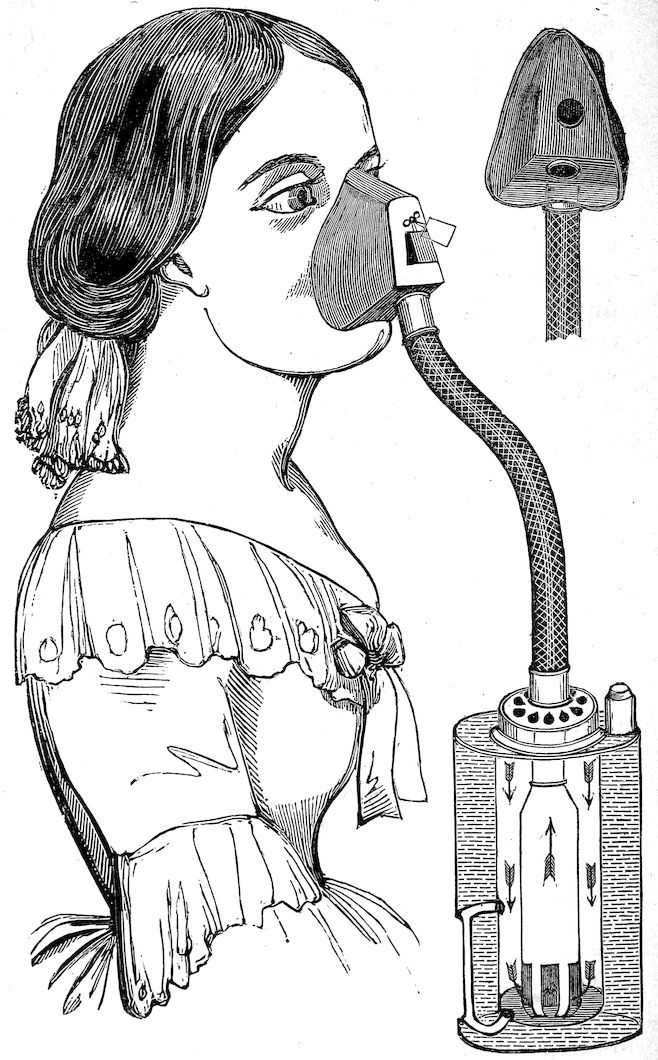
83The face-piece, to include both the mouth and nostrils, of
which that shown in the engraving is one of the modifications,
is one of the greatest mechanical aids to the process
of inhalation which has been contrived in modern times.
Dr. Francis Sibson is its inventor. Dr. Hawkesley did indeed
contrive a very similar one about the same time as
Dr. Sibson,—early in 1847,—but he did not make it known.
Dr. Ingen Housz made patients inhale oxygen through the
nostrils by means of a bottle of India rubber with the bottom
cut off; and Mr. Waugh, of Regent Street, had more recently
contrived a mouth-piece to be adapted outside the
lips, but the usual practice of inhalation previous to 1847,
was for the patient to draw in the medicated air by means
of a tube placed in the mouth. This led generally to great
awkwardness at first, as the patient usually began to puff as
if he were smoking a pipe; and it had the further inconvenience,
in the administration of ether, that the tube dropped
from the mouth, and the patient began to breathe by the
nostrils, just as he was getting unconscious. The sides of
the face-piece delineated in the engraving are made of thin
sheet lead, which is pliable, and enables it to be adapted
exactly to the inequalities of the face, and the patient can
breathe either by the nostrils or mouth, just as his will, or
instinct, or other nervous functions, determine.
I have introduced two valves into this face-piece, one
which rises on inspiration, to admit the air and vapour
from the inhaler, and closes again on expiration, and the
other which rises to allow the expired air to escape. I contrived
the latter valve to turn more or less to one side, as
indicated by the additional line in the engraving, and thus
admit more or less of the external air to dilute still further
that which has passed through the inhaler, and become
charged with vapour. By this means the patient can begin
by breathing air containing very little vapour, and more
and more of the air which has passed over the moistened
bibulous paper can be admitted, as the air-passages become
blunted to the pungency of the vapour.
84The object of the water-bath is to supply the caloric
which is rendered latent, and carried off, as the chloroform
is converted into vapour, and thus to render the process of
inhalation steady and uniform. Without the water-bath,
the evaporation of the chloroform would soon reduce the
temperature of the inhaler below the freezing point of
water, and limit very much the amount of vapour the patient
would inhale; and if the apparatus were warmed by
the hand, the temperature would be too high, and the
amount of vapour too great. A medical author of great
reputation in Paris sent to inquire at what temperature I
used the water-bath, and being informed, at the ordinary
temperature, published his opinion that it had no effect, and
might as well be left off. He appeared not to have
considered the relations of heat, either to liquids or vapours.
In arranging the bibulous paper in the inhaler, it is my
object to contrive that the air passing through, in the ordinary
process of inhalation, and at the ordinary temperature
of about 60°, shall take up about five per cent. of vapour.
This quantity can be diminished, as much as is desired, by
turning the expiratory valve of the face-piece a little to one
side; and in winter I usually place a short coil of bibulous
paper against the outer circumference of the inside of the
inhaler, in addition to the central coils which are delineated.
I commonly put two, or two and a half, fluid drachms of
chloroform into the inhaler at first. About a drachm of
this is absorbed by the filtering paper, and the rest remains
at the bottom of the inhaler; and in a protracted operation,
when it is seen, by means of the glass tube, that the latter
part of the chloroform has disappeared, more is added, by a
drachm or so at a time, to prevent the paper ever becoming
dry. Mr. Matthews, 8, Portugal Street, Lincoln’s Inn
Fields, makes the inhaler. There are smaller face-pieces for
85children. The patient never inhales in so upright a posture
as the artist has represented.
There are several other kinds of apparatus in use for the
inhalation of chloroform. The most usual consist of Dr.
Sibson’s face-piece more or less altered, and with a small
piece of sponge placed inside. The apparatus which is in
most reputation on the continent is that of M. Charrière; it
consists of a glass vase with suitable valves, and a fabric
for exposing a surface wetted with chloroform to the air
which passes through it.
M. Duroy, of Paris, has contrived an ingenious, but very
complicated, apparatus, which he calls an anæsthesimeter.
The object of it is to regulate the amount of chloroform
which is inhaled in a given time, and this can be varied
from four to sixty drops in the minute; but the experiments
which I have related show that the quantity of chloroform
employed is not so important as the proportion of it in the
inspired air; and although each of these circumstances has
considerable influence over the other, in many cases there
are conditions in which no regular relation exists between
them. For instance, if the inhaler were supplied with sixty
drops of chloroform per minute, these sixty drops weigh
twenty grains, and produce 15·3 cubic inches of vapour;
and if an adult patient were breathing the average quantity
of four hundred cubic inches per minute, the air he would
breathe would contain nearly four per cent. of vapour, which
would answer extremely well; but if the breathing were
slow or feeble, or if he should hold his breath for an interval
and commence again, he might breathe air much more
highly charged with vapour. Indeed it would depend on
the amount of surface moistened with chloroform, the temperature
of the air, and other physical conditions, whether
or not the air he inhaled might not be charged with chloroform
to a dangerous degree; whilst, on the other hand, if
86the breathing were deep and rapid, as often happens whilst
the patient is getting slightly under the influence of the
chloroform;—if, for instance, the patient were to breathe at
the rate of 1,600 cubic inches, instead of 400, the air he
would inhale would contain less than one per cent. of vapour,
and he would not become insensible with the utmost
supply of the anæsthesimeter, till his breathing should be
moderated. M. Duroy also follows the rude and objectionable
plan of using a nose clasp, and thus compelling the patient
to breathe by the mouth alone.
It is advisable to request the patient to breathe gently
and quietly, when he commences to inhale chloroform; in
other words, to do nothing but conduct himself as if he
were about to fall asleep naturally; for, if he breathes
deeply, the vapour feels much more pungent than it otherwise
would do, and is apt to excite coughing, or a feeling of
suffocation.
In using the inhaler described above, the patient should
commence to inhale with the expiratory valve of the face-piece
turned on one side, and it should be gradually advanced
to the required extent, over the opening it is intended
to cover, as the sensibility of the lungs becomes
diminished. Not only patients with phthisis or bronchitis,
but many sensitive and irritable persons with sound lungs,
have a great intolerance of the vapour of chloroform at
first, on account of its pungency; and it is necessary to
occupy two or three minutes in gradually commencing the
inhalation, before the patient makes any appreciable progress
towards insensibility. In administering chloroform
to children also, it is desirable to begin very gently; by this
means, and with a little persuasion, one generally succeeds
in getting them to inhale voluntarily; although, occasionally,
it is necessary to use a little force to accomplish one’s
purpose.
87In certain cases of the medicinal application of chloroform,
and also in obstetric cases, where the pains are not
severe, it is unnecessary to render the patient unconscious,
but for surgical operations this is nearly always requisite.
No force should ever be employed so long as the patient is
conscious, unless it be to children or lunatics; but some
patients become excited as soon as they are unconscious,
and attempt to leave the couch, or push away the chloroform;
under such circumstances, if they cannot be calmed
by what is said to them, they should be held, and the vapour
should be steadily and gently continued, for a minute
or two, till a state of quietude is produced. By far the
greater number of patients remain quiet as they become unconscious,
but there is no difficulty in ascertaining whether
a patient is unconscious or not. If the eyelids remain open,
the countenance shows whether the patient is conscious or
not; and, if they are closed, it is only necessary to touch
them gently, to ascertain this circumstance. If he is still
conscious, he will look at his medical man, and probably
speak, or, at all events, show intelligence in his countenance.
Signs of Insensibility. The absence of consciousness, and
a state of quietude, are both requisite before the commencement
of a surgical operation, and they go a good way
towards the preparation of a patient for it, but these symptoms
may be present and the patient not be ready for an
operation. The surgeon wishes to know whether he will
lie still under the knife, or whether he will make a resistance
and outcry which he would probably not make in his
waking state. Some surgeons have recommended that the
patient should be pricked with the point of a knife or
some other instrument. This is not a good or satisfactory
plan, however, for a person will often show no sign of feeling
a slight prick, when a severe incision would rouse him
to resistance. A more elegant and successful plan is to
88raise the eyelid gently, by placing one finger just below the
eyebrow, and then to touch its ciliary border very lightly
with another finger. This should not be done roughly nor
too frequently, for fear of exhausting the sensibility when it
is slight. Just after unconsciousness is induced, the eyelids
are often closed very strongly when their margins are
touched, especially in females, and there seems to be a positive
hyperæsthesia; this, however, is only apparent, and
arises from the control of the will being removed, whilst
sensibility remains. By continuing the chloroform, the sensibility
of the edges of the eyelids diminishes until, at last,
they may be touched without causing winking. Under
these circumstances, the most severe operation may, in
almost every case, be commenced without sign of pain. I
have employed this test of the sensibility or insensibility of
the patient ever since chloroform has been in use, and also
in the employment of ether in 1847, and I am satisfied that
it affords more reliable information on this point than any
other single symptom. It even indicates the amount of
sensibility where a little remains; when, for instance, touching
the margin of the eyelids causes very slight and languid
winking, the patient will commonly flinch a little if the
knife is used, but only in a manner that can be easily restrained,
and will not interfere with the majority of operations.
The cases, in which the indication afforded by the
eyelids is not always to be depended on, are those of hysterical
patients, in whom there is sometimes no winking on
touching the eyelids, even when unconsciousness is scarcely
induced. In such cases, one must judge by the other symptoms,
and also by the length of time the patient has inhaled,
the strength of the vapour, and depth and activity
of the breathing. Indeed, these conditions should be observed
and taken into account in every case; and all the
symptoms exhibited by the patient should be watched, such
89as the expression of the face, the state of the breathing, and
the condition of the limbs with regard to their tension or
relaxation. The last is indeed sometimes relied on as the
chief or sole sign whether the operation may be commenced,
but it is of itself very insufficient, and even fallacious. The
patient may allow his limbs to lie relaxed when he is scarcely
unconscious, and not at all insensible, merely because he is
not exerting his will upon them; if the arm is lifted, it may
fall listlessly down again, at a time when the knife of the
surgeon would rouse the patient to active resistance. Indeed,
the limbs, which have been lying relaxed, may become
tense as the effect of the chloroform increases, and may
remain so during a short operation, in which there is no
sign of pain.
Although the pulse of itself gives no indication as to how
far a patient is under the influence of chloroform, it is
proper to pay attention to it, not only during the first administration
of the chloroform, but also throughout the
operation, especially if it be attended with much bleeding.
The pulse sometimes becomes intermittent or irregular
during the administration of chloroform, more especially in
elderly persons. This more commonly happens in the first
exhibition of it, than when it is repeated during the course
of an operation. I have not seen any harm from either of
these conditions, but it is well to intermit the chloroform
for ten or fifteen seconds, and let the patient have a few
inspirations without it, if the pulse is not in a satisfactory
condition. If the precaution be taken to ensure that the
air the patient breathes shall never contain more than five
per cent. of vapour, the pulse can never be seriously affected
by the direct action of the chloroform, and the state of the
breathing affords the best warning against continuing the
inhalation too long at a time.
The breathing is fortunately also a sign that cannot be
90overlooked. It is by the breath that the chloroform enters,
and it is extremely improbable that any one would go on
giving the vapour after the breathing became stertorous and
laboured.
The patient sometimes holds his breath after he is unconscious,
and before he is insensible; this occurs under two
conditions: first, after deep and rapid breathing, during
which the patient seems to absorb more oxygen than is immediately
required, under the circumstances; and in this
condition, I have known him hold his breath for a whole
minute, whilst the pulse was unaffected. The other condition
in which the breathing is suspended, is when there is
rigidity in the third degree of narcotism, and the respiratory
muscles seem to partake of the general rigidity; the holding
of the breath in these cases seldom continues so long as
under the former circumstances. I do not consider that
there is any danger from either of these kinds of suspension
of breathing. I believe it always returns as soon as there is
a want of oxygen in the system. Of course the inhaler
need not be applied to the face when the patient is not
breathing, and he may as well have an inspiration or two
without chloroform when the breathing is renewed. It is
seldom requisite to carry the effects of chloroform so far
that the breathing becomes stertorous, and whenever stertor
is observed, the inhalation should be suspended; under
these circumstances, the patient is always insensible. In
some cases, in which a little more chloroform has been inhaled
than is necessary, the patient breathes for half a minute
or so by the diaphragm only, and breathes in fact
hardly at all. The abdomen rises and falls freely, but, from
the muscles of the chest not fixing the ribs, hardly any air
enters the lungs, and the face becomes rather livid; meanwhile
the pulse goes on very well, and at last the patient
draws a deep, sonorous inspiration, the face resumes its
91proper colour, and all is right again. I have not heard of
any accident from chloroform commencing in this manner.
This state of breathing, when it does occur, usually takes
place a few seconds after the inhalation has been left off, and
arises from the accumulation of the effects of the chloroform,
owing to the absorption into the system of the vapour
which was contained in the lungs at the time when the inhalation
was discontinued.[55] This accumulation or increase
of the effects of chloroform lasts for about twenty seconds;
it is not dangerous unless the vapour is inhaled of too great
strength, but it should be borne in mind in all cases. It
may be prevented altogether, by reducing the strength of
the vapour, just as the patient is getting insensible, or by
giving it with intermissions of a few seconds, at this time.
The rigidity and struggling previously mentioned (pages
39 and 50) as occurring occasionally in the third degree of
narcotism, more particularly in robust persons, often form a
very prominent feature in the effects of chloroform; and
have sometimes caused the medical man to discontinue the
exhibition of chloroform, under the belief that it did not
agree with the constitution of the patient, and that its
further exhibition would be unsafe. The proper course to
pursue is to continue the inhalation gently, till the struggling
and rigidity are subdued. The patient is often insensible
before these symptoms are subdued, but it is necessary
to have him quiet, in order to enable the surgeon to operate
with convenience and safety. I have always succeeded in
subduing the involuntary struggling and rigidity, but have
92occasionally occupied five or six minutes in doing so. It is
desirable to proceed slowly and cautiously, because, when
these symptoms occur, the patient has already absorbed
nearly the usual quantity of chloroform, and he often holds
his breath, and then takes a sudden and deep inspiration,
when he might inhale an overdose of vapour, unless it were
presented to him in a well diluted state.
When the rigidity and struggling are subdued, the
breathing, in some cases, becomes stertorous, and relaxation
of the muscles takes place, the limbs appearing quite
flaccid; but by proceeding gently, these effects may generally
be avoided, and the patient becomes quiet, whilst the
breathing is natural, and the muscles are in a moderate
state of tension. If the operator should be afraid to proceed
with the exhibition of chloroform, on account of the violence
of the muscular spasm and rigidity, it will be satisfactory to
him to know that, if the inhalation is resumed in a few minutes,
these symptoms will be less violent than at first.
Struggling and rigidity are less likely to occur, when
chloroform is administered slowly, than under opposite circumstances;
but it is impossible to prevent these phenomena
altogether in certain patients. After they are once subdued,
they but very rarely recur during the operation; the patient,
in most cases, seems to take on, when he is subdued by the
chloroform, the same relation to it that women, children,
and persons in a state of debility have from the first. M.
Chassaignac has called this condition one of tolerance of the
chloroform. It is a condition in which the patient bears
both the chloroform and the operation very comfortably;
but tolerance of a medicine is generally meant to imply that
the patient can take it in larger quantity than before. But
this is the reverse of what occurs when the patient is in a
tranquil state from chloroform; he has already absorbed a
considerable quantity, which has most likely penetrated
93deeply into the tissues, and he certainly does not require,
and could not bear, so much as in the earlier stage of inhalation,
where he is restless and breathing more quickly,
and thus exhaling and getting rid of the chloroform at a
greater rate.
It might be a question whether the absence of muscular
excitement, in a number of cases, does not arise from the
circumstance that anæsthesia, or absence of common sensibility,
is obtained, and the operation performed, at a stage
of narcotism anterior to that in which the muscular rigidity
and spasm occur. This is true in a few cases, but I am
satisfied by careful observation that, in the greater number
of instances in which muscular excitement is absent, it
would not occur at all, though the inhalation should be
pushed to the most extreme degree. Many animals also are
killed by chloroform without the least excitement of the
muscular system occurring at any part of the process.
The pupils of the eyes are dilated in the deep state of insensibility
which I have called the fourth degree of narcotism,
but it is desirable to avoid carrying the effects of
chloroform to this extent. They are occasionally dilated,
however, under the slighter effects of chloroform, and even
as the patient is recovering from its effects. In the third
degree of narcotism, when the eyes are turned upwards, the
pupils are usually, if not always, contracted; there seems to
be a consentaneous action in the iris and the muscles which
turn up the eye. The pupils seem also to be less sensitive
to light, when the patient is insensible from chloroform,
than at other times. This is all the information I am able
to give about the pupils. Some writers have entered into a
good deal of detail about the pupils, but their statements
are very conflicting. The pupils are acted on by other
causes, both external and internal, as well as the chloroform.
The amount of light has great effect on them; and I have
94seen them remain dilated for some time after the chloroform
was discontinued, and then suddenly contract, as the patient
began to use his eyes. Even if definite laws could be ascertained
with regard to the action of chloroform on the pupils,
in different doses, and under different conditions, there
would be some difficulty in applying them during the administration
of the vapour, as the patient cannot be made to
direct his eyes to or from the light. There is also some
difficulty in making correct observations on the pupils.
Very often, when I am exhibiting chloroform, one of the
bystanders lifts the patient’s eyelid and makes a remark on
the state of the pupil, and, on my looking in the face of the
speaker, I often have occasion to tell him that his own
pupils are quite as much dilated, or contracted, as the case
may be.
With regard to the position of the eyes, they are usually
turned upwards in the third degree of narcotism, as I have
already said, but in a considerable number of instances they
retain their usual position all through the inhalation. In a
few cases, they are turned downwards, the pupils being
almost hid under the lower eyelids, and causing a curious
expression. I have noticed this most frequently in children
of ten to fourteen years of age. I have scarcely ever seen
temporary strabismus under the influence of chloroform.
The length of time which it is most desirable to occupy
in the administration of chloroform, before the commencement
of an operation, is about two minutes in infants, three
minutes in children, and four or five minutes in adults.
Circumstances occasionally occur, however, to lengthen
these periods. The time during which the adult patient
usually remains conscious whilst inhaling, is about two and
a half minutes, but this period is sometimes prolonged from
the nervousness of the patient, or his intolerance of the
pungency of the vapour. Again, when unconsciousness is
95induced, there is, in many cases, an increased flow of saliva;
and although this usually causes no impediment, the patient
sometimes keeps making efforts of deglutition which very
much retard the inhalation; and, at other times, he holds
his breath, with his mouth full of saliva, as if he had some
obscure idea of disposing of it in a suitable manner.[56] The
delay which often arises from the struggling and rigidity
has been already mentioned; but notwithstanding all these
circumstances, it hardly ever takes more than seven or eight
minutes to make a patient sufficiently insensible.
I have indeed met with a few cases in which a longer
time has been occupied, but there has always been a physical
reason for it. I have never had occasion to attribute
the delay to any idiosyncracy, or great peculiarity in the
patient, but only to the circumstance that the vapour did
not enter the lungs in sufficient quantity within a given
time. I have had under my care several patients who, it
was supposed, were not susceptible of the effects of chloroform,
or were, at least, very difficult to bring under its influence,
as previous attempts had failed. It so happens,
however, that I have had no difficulty whatever with any of
these cases.
Two or three female patients who were about to undergo
some trifling operation, preferred to leave off before they
were unconscious, on account of unpleasant sensations in
the head or chest, and to have the operation performed
without the full effects of the chloroform; but there is no
doubt the agent would have acted well enough if it had
been continued.
The following case will show that chloroform may be inhaled
96with advantage in cases which at first seem very unfavourable.
I received a note in 1849 from a medical man
in the country, in which he says:—“I have now a young
lady under my charge, from whom I am about to remove a
tumour attached to the ear. She is anxious to take chloroform,
and by the desire of herself and mother, I yesterday
administered it by way of trial, but only to what would be
termed the second, and perhaps you would say, the first
degree. She lost some sensation, but was quite conscious,
and spoke. She felt giddy; there was tumultuous beating
of the heart, and a much accelerated pulse, with a dilated
pupil; a perfect coldness over the whole skin, with an
equally cold perspiration; and, during recovery from this
slight effect, severe tremors of the whole body, so much so
as to shake the couch on which she was lying. From this
state she did not recover for nearly an hour. She complained
of great giddiness and oppression at her chest. She
is a healthy-looking, florid girl, but not strong, and has had,
from time to time, severe spasm affecting her chest, so much
so as to take away her breath. I have thus endeavoured to
give you an outline of the constitution of my patient, how
she had suffered, and what were the effects of the small dose
of chloroform given by an inhaler. I never witnessed such
extreme cold, tremor, or such tumultuous action of the
heart; and am therefore anxious for the opinion of one who
has administered chloroform under a greater variety of circumstances
than myself, and to learn whether the symptoms
I have described are sufficient to deter one from giving a
sufficient dose to cause entire suspension of consciousness.
My own impression is that they are sufficient to deter, but
the patient and her friends being both anxious it should be
inhaled if possible, I shall only be too glad to hear that you
have witnessed like symptoms, and that you do not consider
them sufficient indications of danger to deter me from its
careful administration in the case.”
97I advised that the chloroform should be administered
again, and continued steadily till the patient should become
insensible; expressing my belief that the unpleasant
symptoms would subside as unconsciousness was induced.
I received a reply to the effect that the operation had been
performed very successfully under the influence of chloroform,
although the vapour had an exciting effect for some
time.
Repetition of Chloroform during an Operation. The
first application of chloroform often suffices for an operation,
if it be of short duration, without repeating the inhalation.
In a few cases the patient remains insensible to the knife
for three minutes after the inhalation is left off, but this is
an exception; and one cannot, at all events, make sure of
this prolonged effect of chloroform, without producing a
deeper state of narcotism than is desirable. More usually,
if the operation lasts more than a minute or two, it is necessary
to repeat the inhalation; it is, indeed, generally desirable
to let the patient have a few inspirations of air charged
with chloroform vapour every half minute or so, whilst the
operation continues, in order to keep up the insensibility.
When the surgeon is cutting in the neighbourhood of important
parts, it is desirable to prevent any sign of sensibility,
and to keep repeating the chloroform so as to keep
up the coma, without, however, causing embarrassment of
the breathing, or wide dilatation of the pupil. In the
greater number of operations, however, it is better to wait
till there is some sign of sensibility, such as a slight cry or
tendency to flinch, before the inhalation is resumed; and
then a few inspirations of well diluted vapour make the
patient quiet again.
As soon as a patient has ceased to inhale, the chloroform
98begins to exhale in the form of vapour from the blood as it
passes through the lungs. It cannot be detected by the
sense of smell, after the lungs have been emptied, by two
or three expirations, of the vapour they contained at the
moment when the inhalation was discontinued; but I have
detected it by chemical means, after consciousness had returned.
The chloroform exhales in greatest quantity at
first, and the patient usually recovers his sensibility and
consciousness in the time which it ought to take for the
chief part of the chloroform to be exhaled, according to
mechanical principles; as will be explained in treating of
the modus operandi of this agent. The last traces of the
chloroform of course exhale more slowly, and a very minute
and insignificant quantity may remain for a considerable
period in the system, not only of the patient, but of anyone
who was standing by whilst he inhaled.
It is probable that a small portion of chloroform passes
out by other channels than that of the expired air: the
latter, however, offers such a ready and expeditious outlet,
that the quantity excreted in any other way is, most likely,
very minute. I have on four occasions examined urine
passed after the inhalation of chloroform, by boiling it in a
flask, and passing the vapour, first through a red-hot tube,
and afterwards through a tube moistened inside with solution
of nitrate of silver, and I only on one occasion obtained
a very slight precipitate of chloride of silver.
The patient usually becomes conscious within five minutes
after the inhalation has been discontinued. After a short
inhalation, for a very brief operation, consciousness sometimes
returns immediately, and after a prolonged inhalation
the recovery of consciousness is sometimes retarded till ten
minutes have elapsed. Old people are often longer than
others in awaking from the effects of chloroform, owing,
no doubt, to their slower breathing and circulation. Children,
99on the other hand, usually recover very quickly from
its direct effects; but they often lapse into a natural sleep
which lasts a considerable time—even for hours if they are
not disturbed, and if the operation has left no painful
wound or other cause of uneasiness.
It is desirable not to talk to the patient as he is recovering
from the effects of chloroform, but to leave him to collect
his ideas, and not speak to him till he is quite conscious,
or makes some remark or inquiry himself. If not
prevented by the medical attendant, the friends of the
patient often address him the moment he opens his eyes;
and the words they generally use are of a very equivocal
meaning to one who cannot understand their application.
They usually say “It’s all over”, which very often has the
effect of raising an indefinite feeling of alarm in the patient;
for, until he has had time to recover his memory, the operation
he was to undergo is generally the farthest thing from
his mind. When left to himself the patient usually recovers
from the insensibility in a very tranquil manner. If
he has not been moved whilst insensible, and awakes in the
position in which he fell asleep, he supposes, very commonly,
that he has not been asleep at all; and in a great
number of instances will contend this point very stoutly,
even after a protracted operation, and assert that the chloroform
has not taken effect. It is as well to let him remain
in this conceit for a while, or even till he finds out the
mistake himself; for, if reminded of the pain they have
been spared, just on waking after an operation, persons
are liable to be excited by emotions of pleasure and gratitude;
but a few minutes later, when the effects of the
chloroform have more completely subsided, they are better
able to control their emotions. A few persons wake with
a full recollection of the preceding circumstances, and inquire
if the operation is done; whilst others, on first
100awaking, are still entirely occupied with the subject of their
dreams.
The greater number of patients who inhale chloroform
have to remain in bed on account of the operation which
has been performed, but after minor operations, the patient
is sometimes able to walk away within five minutes; although
more frequently there is a little languor or feeling
of fatigue for half an hour or so; and it is desirable in all
cases for the patient to sit or lie quietly for this space of
time, if not longer, before he makes any mental or bodily
exertion, even if he feels quite well.
Sickness. The chief drawback to the benefits conferred
by chloroform is the sickness which in many cases follows
its use. It is most frequent when the inhalation takes
place soon after a meal, and some of the precautions which
are requisite in order to avoid this symptom, or render it
as rare as possible, have already been described (p. 74);
but it occurs in certain cases, notwithstanding the best
measures which may be used for its prevention. Moving
the patient as the effects of the chloroform are subsiding is
very apt to excite vomiting when it might not otherwise
occur; it is therefore desirable, when convenient, to allow
the patient to lie for half an hour or so, without moving
his head from the pillow. By this means, even when a
feeling of nausea is present, it often subsides without the
occurrence of vomiting. It is advisable also not to give
the patient anything to eat or drink till about an hour after
the inhalation, and, as a general rule, not even then, unless
there is some inclination for it; for if anything is taken into
the stomach before the effects of the chloroform have entirely
subsided, it is apt to excite vomiting. Even medicine, such
as an opiate, is better delayed for an hour or upwards,
101unless there is an urgent necessity for giving it sooner.
Severe faintness from loss of blood during an operation of
course forms an exception to this rule; in such a case
brandy and water should be given, and repeated if it should
be vomited.
These rules respecting food are, moreover, meant to apply
only to the use of chloroform in surgical operations, and not
to its employment during labour. Under the latter circumstances,
one allows the patient all the nourishment that is
desirable, intermitting the inhalation now and then for the
purpose. And chloroform, given in the moderate way in
which it is employed in labour, hardly ever causes sickness,
but often alleviates it when present from physiological
causes.
The sickness induced by chloroform usually subsides of
itself in the course of an hour, or even less; I, therefore,
think it advisable not to do anything for it during this
space of time. When it has continued beyond this period,
I have found a little cold brandy and water to remove it in
most cases; and when the tendency to vomit still remained
after a few hours, I have seen it removed by a dose of
opium. Effervescing draughts have not appeared to be of
service in the sickness from chloroform, and sal volatile and
draughts of warm water seem injurious. It is desirable for
the patient to make no effort, but only to vomit if obliged
to do so.
Several cases have come within my knowledge, in which
the sickness has continued for two or three days after every
thing that was taken into the stomach. These cases have
not been under my care, but under that of the surgeon. I
have been informed, however, that all the usual remedies
for sickness were applied for the time mentioned above
without success. The cases in which the sickness lasts so
long form but a very small portion of the whole number in
102which chloroform is administered, and they chiefly occur in
persons who are subject to attacks of vomiting from slight
causes, or, as they say, to bilious attacks.
The most usual time for the vomiting to commence is
when the inhalation has been discontinued, and the effects
of the chloroform are passing of. In many cases, it occurs
before the patient has become quite conscious, and he does
not know that it has occurred unless he is told. In a few
cases, especially where there is a good deal of food in the
stomach, the vomiting comes on before the operation is
finished, or even before it is commenced. When vomiting
comes on during an operation, it is apt to interfere with the
inhalation, and it is sometimes difficult to prevent the
patient from waking; but this can be accomplished by
wiping the patient’s mouth, and reapplying the chloroform,
the moment the act of vomiting ceases. In many cases,
however, the sickness does not come on till the patient is
quite awake, and perhaps, even then, not until he moves.
I believe that the sickness which is due to chloroform always
commences within an hour or two, or at the farthest,
just after the first food which is taken. I have known
vomiting attributed to the chloroform which did not occur
till the following day, but I ascertained that a dose of
opium had been taken at night, and it was to this that the
sickness was probably owing. In those cases where the
chloroform does cause sickness in the first instance, it is not
always the cause of all the vomiting which the patient may
suffer. If the patient becomes infected or is inoculated
with the poison of erysipelas or hospital gangrene at the
time of the operation, he will probably be attacked with
vomiting a day or two afterwards; and if sickness has
already been caused by the chloroform, that which is due to
disease may appear to be a continuation of it.
Soon after the introduction of chloroform, I administered
103it to a gentleman, aged about 55, whilst a fatty tumour was
removed from the nape of the neck. It did not turn out as
fatty tumours usually do, but required to be dissected out.
The patient had taken a meal before the operation, and
vomited freely afterwards. On his visit the next morning,
the surgeon thought his patient going on well. Vomiting
returned, however, and the patient became affected with
partial stupor and delirium, which his friends attributed to
the chloroform. He became covered with an eruption of
erysipelas over a great part of the body, had a very rapid
pulse with great depression, and died on the fifth day. An
examination after death showed that there had been diffuse
cellular inflammation around the seat of the operation. A
surgeon who assisted at the operation on the above patient,
and also at the post-mortem examination, removed an encysted
tumour from the scalp of an old lady the day following
the latter event. This operation was performed without
chloroform, but the patient was attacked with erysipelas
and diffuse cellular information, and died in three or
four days.
Faintness and Depression. Although chloroform acts as
a stimulant to the circulation, increasing the force and frequency
of the pulse whilst it is being inhaled, it is occasionally
followed by a feeling of faintness, especially if the
patient remains in the sitting posture. At one period in
the history of medical opinion, it would have been said that
the depression was a consequence of the previous excitement.
The facts, however, would not agree with such a
doctrine. The subjects who are most stimulated by chloroform
are the strong and robust, and they do not suffer from
depression afterwards; whilst the feeble and debilitated,
who are most liable to subsequent depression, are but little
stimulated by it at the time of inhaling. Some amount of
faintness and depression usually accompanies the sickness
104caused by chloroform, and is in fact a consequence of it,
being, like the sickness, most frequent after a full meal.
This depression is usually relieved by vomiting. I have
met with a few cases in which there has been more decided
faintness, and once or twice absolute syncope after chloroform,
which was not attributable to loss of blood. In these
cases, however, the patients were in the sitting posture, and
they recovered from the syncope immediately, on being
placed horizontally. The patients most subject to faintness
after chloroform are those who are subject to this affection
at other times, being often persons in a state of anæmia, or
having the symptoms of fatty degeneration of the heart.
Faintness is, however, very much more rare after operations
with chloroform than without it. The only cases in which
I have seen it follow the use of chloroform in the horizontal
position, and where there was no considerable loss of blood,
have been two or three of operations on the rectum, performed
before breakfast, and after a brisk purgative had
been taken the previous night. It might be advisable,
where persons in a state of debility have taken a purgative,
to make an exception to the usual rule of prohibiting the
breakfast, and to risk the inconvenience of vomiting rather
than the more formidable symptoms of faintness from
inanition.
The faintness which now and then follows an operation
under chloroform should be treated on ordinary principles,
as the horizontal posture, the application of the vapour of
ammonia to the nostrils, and the exhibition of brandy or
wine, if the other measures do not suffice. I never give
ammonia internally where a patient is sick or faint, but the
spirit of sal volatile, when at hand, serves very well to pour
on the corner of a towel and apply to the nostrils.
Hysteria. I have already stated (p. 51) that chloroform
occasionally excites hysteria in those who are subject to
105that complaint; and that, in a few cases, the hysteria, which
has been subdued by the chloroform, reappears as the
effects of the vapour subside. It is nearly always in the
female sex that one meets with these phenomena, although
I have two or three times seen hysterical symptoms in the
male for half an hour or so after the inhalation. The
hysteria commonly takes the form of laughing or crying,
but the patient sometimes remains quiet, and simply in an
unconscious state. The hysterical symptoms usually pass
off spontaneously, in half an hour or less, without any remedies;
if they last longer, the ordinary remedies for
hysteria may be applied. I am not aware that the hysteria
has lasted longer than three or four hours in any of the
cases in which I have administered chloroform, but it may
have done so without my being informed of the circumstance.
I was informed of the case of a young woman in
King’s College Hospital, who remained unconscious, or at
least apparently so, for three days after chloroform had been
administered for an operation, the nature of which I have
forgotten. She recovered without ill effects. When the
patient does not wake spontaneously, and cannot be roused
to the waking state, within twenty minutes or half an hour
after the inhalation of chloroform has been left off, we may
rest assured that the patient is affected with hysteria—at
least this has been the case in every instance with which I
have become acquainted. The physical properties of this
agent do not permit it to remain long in the system, if the
circulation and respiration are going on properly, and this
circumstance ought to prevent unnecessary alarm, in the
absence of other symptoms except the state of unconsciousness.
I have, however, known great alarm to exist where
the properties of chloroform were not well understood.
Soon after its introduction, a medical man administered it
to a young woman in domestic service, for the extraction of
106a tooth. He became alarmed, in the first instance, from the
impression that he had given an overdose. In a few minutes,
however, the patient burst out in a loud fit of
laughter, but again became unconscious, and various measures
were used to restore her, including even artificial
respiration, in the idea that she was still under the influence
of chloroform. I was sent for thirty-six hours after the
inhalation, and found the patient apparently in a profound
state of insensibility, and breathing very feebly. Guided by
the considerations mentioned above, I concluded that she
was only labouring under hysteria, and that the anxiety of
those about her tended very much to keep up the complaint.
The anxious attendance on her was discontinued, she took
some medicine containing valerian, and became quite conscious
in few hours. I was told, however, that she did not
seem quite well for some time.
I am not aware of any permanent ill effects having been
produced by chloroform, although, amongst the multitudes
of persons who have inhaled it, some have not failed to
blame it for symptoms that have occurred afterwards.
A clergyman from the country called on me, in 1852,
and the following are some notes I made when he left my
room. He is 63 years of age. He said that he had inhaled
chloroform about a year ago to have four teeth extracted.
He felt very well for about a week afterwards, but on his
pupils returning, and his beginning to apply himself to
teaching, he became affected with flushings of the face and
a rushing noise in his head, which lasted occasionally for a
day or two, and have troubled him ever since. An eminent
physician, whom he named, prescribed quinine, under the
use of which he became worse. An eminent surgeon prescribed
infusion of hops, etc., and he has tried other medicines
without good effect. He had been recommended
to travel, and had been to Switzerland; but the complaint
troubled him when at leisure, as well as when applying
107himself mentally. He could not sleep at night,
when affected with the attacks. He is rather deaf, and has
been so for three or four years; he was also occasionally
troubled with a rushing sound behind the ears before he
inhaled the chloroform. He is rather short and rather stout,
and has a florid complexion. The pulse was rather feeble.
The second sound of the heart was rather louder than the
first. In other respects its sounds were natural, but its
impulse was not strong. In every respect, except the symptoms
above named, the health of the patient was good, and
he felt quite well between the attacks.
It was my opinion that the complaint of this gentleman
was coming on long before he inhaled the chloroform, and
that it depended on a much less transient cause. I have
not heard from him since.
All narcotics are capable of causing death, and the discovery
of preventing pain by inhalation consists essentially
in carrying the effects of a narcotic much further than had
previously been the custom; there was, therefore, every
reason to apprehend that accidents might occur in the new
practice, unless the effects of the medicines employed could
be very effectually controlled. There are certain circumstances
connected with the physiological properties of chloroform,
as ascertained in the experiments previously related,
which indicate how accidents may very easily happen with
this agent, if not carefully and systematically managed. It
was calculated (p. 74) that 18 minims of chloroform is
the average quantity in the system of an adult, when sufficiently
insensible for a surgical operation, and that this
amount might be absorbed by the use of 36 minims, allowing
one-half of the quantity breathed to be exhaled again,
without being absorbed; but 36 minims of chloroform
make only 37·5 cubic inches of vapour, which, at the temperature
108of 60° Fah., may exist in combination with 257
cubic inches of air, making it expand to not quite 300 cubic
inches; the whole of which might be breathed in twelve
ordinary inspirations of 25 cubic inches each. If the inhalation
of vapour of this strength were continued till insensibility
was induced, the lungs would still contain a great quantity
of unabsorbed vapour. The amount of air usually present
in the lungs is about 250 cubic inches, and if saturated with
chloroform at the temperature of 60° it would contain the
vapour of 30 minims. About half of this might be absorbed,
the remaining half passing off in the expired air;
but the addition of 15 minims to the 18 minims already
absorbed would almost double the quantity of chloroform in
the system, and bring the patient necessarily to the brink
of death. It is true that, in the ordinary methods of inhalation,
the air seldom becomes quite saturated with vapour,
and usually is not more than half saturated, or accidents
might be of much more frequent occurrence; but the above
considerations are sufficient to show that the amount of
vapour contained in the air breathed by the patient should
not be left to mere accident, such as the varying temperature
of the handkerchief from which the chloroform is
breathed, or the greater or less extent of wetted surface
over which the air passes. It should be recollected also that
the patient sometimes draws a deep and sudden inspiration
by which he may inspire 100 cubic inches of air, which
would contain, if strongly charged with vapour, ten or
twelve minims of chloroform—a large quantity to be suddenly
added to that already in the circulation, when the
patient is insensible, or nearly so.
It is, however, only by a knowledge of the different modes
in which chloroform is capable of causing death, that the
exact nature of the accidents from this agent can be understood,
together with the means of preventing them, and
109the reason why they are usually irremediable when they
happen. If animals are kept for a very long time under
the deep influence of chloroform, they become ultimately
exhausted, the circulation and respiration are gradually
weakened, and cease nearly together. Such a mode of
death from this agent is never likely to occur to the human
subject, and therefore need not engage our further attention.
The following experiments illustrate the different
modes of dying, when death is caused more suddenly by
this agent.[57]
Experiment 23. A young but full grown cat was placed
in a glass jar, of the capacity of 1,600 cubic inches, and a
fluid drachm of chloroform was introduced, by a portion at
a time, through a tube in the cover of the jar. As twenty-five
minims of chloroform produce twenty-six cubic inches
of vapour, the atmosphere which the cat had to breathe
contained nearly four per cent. of vapour, and the jar was
moved about, to ensure the uniform mixture of the vapour
with the air. In five minutes, the cat became insensible,
and lay breathing naturally. In about ten minutes more,
the breathing became very feeble, and it ceased altogether
in about another minute, or sixteen minutes after the cat
commenced to breathe the chloroform. It was immediately
taken out and laid on a table, and the stethoscope was
applied to the chest. The heart could be heard beating
distinctly at first, but the pulsations became slower and
110feebler, and in about a minute they could be no longer
heard. Just at this time, however, the cat took a gasping
inspiration, and immediately the heart was heard to beat
in a most rapid manner. The gasps were repeated, and the
action of the heart became less rapid, but stronger. In a
little time, both the breathing and the action of the heart
became natural, the cat remaining, however, insensible for
some minutes.
Experiment 24. A cat, about the same size as the last,
was put into the same jar, and the same quantity of chloroform
was introduced. It was removed at the end of four
minutes, when it was so far insensible as to offer no resistance.
Being laid on the table, it was made to breathe air
charged with ten per cent. of vapour of chloroform from a
bladder. Twenty-five minims of chloroform were put into
the bladder, which held 250 cubic inches, and it was filled
up with the bellows. A portion of another bladder which
was attached to the stop-cock, was made to surround the
head of the cat, which consequently breathed to and from the
bladder. In half a minute it was quite insensible: in about
half a minute more the breathing became difficult, and the
sounds of the heart less distinct. The breathing became
gradually slower, and ceased altogether between three and
four minutes after the respiration from the bladder commenced.
The sounds of the heart were rather frequent, and
scarcely audible, just before the breathing ceased, and they
could not be heard afterwards. The chest was opened
three-quarters of an hour after death. The lungs were of a
pale red colour, everywhere permeated with air; and a
small quantity of fluid blood flowed from them on making
an incision. The right cavities of the heart were quite full
of blood, and the left cavities contained a small quantity.
Experiment 25. A cat was made insensible in the same
manner as the two previous ones. As it made strong efforts
111to get out of the jar, and consequently breathed more
deeply, the chloroform took effect sooner; and it was removed
and laid on the table, in a passive state, at the end
of two minutes and a half. The respiration and sounds of
the heart were quite natural. The nose of the animal was
placed in the mouth of a metal vessel, lined with bibulous
paper, and used as a chloroform inhaler. The inhaler contained
chloroform, and was surrounded with water of the
temperature of 110° Fahr. The stethoscope was kept applied
to the chest whilst the chloroform was exhibited.
After four or five inspirations from the inhaler, the heart
suddenly ceased to beat, the breathing still going on. The
inhaler was removed as soon as I was satisfied that the
action of the heart had ceased, and there were two or three
rather convulsive respirations afterwards, and then the
breathing stopped; but, between one and two minutes
later, there were two or three feeble inspirations, accompanied
with motion of the nostrils, but no returning action
of the heart could be heard. The chest was opened ten
minutes after death. The lungs were quite pale throughout.
There was a little clear serum in the pericardium.
The heart appeared quite motionless when first observed;
but, after exposure to the air for a short time, there were
some slight contractions of a few fibres of the right ventricle.
The right auricle and ventricle were filled with blood.
The air which this cat breathed must have contained
much more than ten per cent. of vapour.
In experiment 23 the breathing was arrested by the influence
of the chloroform on the nervous centres, but the
action of the heart continued, until it was stopped, or very
nearly so, for want of respiration, as in asphyxia from privation
of air. In experiments 24 and 25 the action of the
heart was arrested by the direct effect of the chloroform; in
one instance at the same moment as the respiration, and in
the other instance, even before it.
112The paralysing effect on the heart of large doses of chloroform
was shown in the first experiments which were
made with this substance, viz., those by Dr. R. M. Glover
in 1842.[58] In animals which were killed by injecting it
into the jugular vein, the irritability of the heart was found
to be destroyed, whilst this organ retained its irritability in
those that were killed by the injection of chloroform into
the arteries, stomach, or peritoneum. I have frequently
arrested the action of the heart remaining in animals which
were opened immediately after death, by blowing the vapour
of chloroform on it; and I ascertained by some experiments
on frogs, that the motion of the heart can be arrested by an
amount of chloroform somewhat greater than suffices to
suspend the respiration. As absorption of chloroform vapour
is continued by the skin of these animals after the
respiratory movements have ceased, they can be exposed to
the vapour till the action of the heart is suspended by its
direct influence.
Experiment 26. Four and a half grains of chloroform
were introduced into a jar containing 600 cubic inches,
being three-quarters of a grain to each 100 cubic inches,
and, the vapour having been equally diffused, two frogs
were put in. They tried to climb up the side of the jar,
as if wishing to make their escape, and one or the other
occasionally ceased to breathe for a minute or two, probably
from disliking the vapour, but commenced to breathe again.
In about five minutes the efforts to escape ceased, and they
only moved to adjust their equilibrium when the jar was
disturbed. They were now breathing regularly, and continued
to do so till about ten minutes after their introduction,
when all voluntary power ceased, and the breathing
began to be performed only at intervals. They were allowed
to remain till half an hour had elapsed, during the
113last ten minutes of which time no respiratory movement
was observed in either of them. On taking them out, and
laying them on their backs, the pulsations of the heart were
observed on each side of the sternum. These pulsations
were the more distinct, from the lungs being apparently
empty. I continued the experiment on these frogs, placing
one of them back again, in the course of two or three minutes,
in the same jar, with three grains of chloroform, and
the other in a jar of 400 cubic inches capacity, with five
grains. They were laid on their backs, and the heart of the
former one, in air containing half a grain of chloroform to
each 100 cubic inches, continued to beat distinctly and
regularly, 45 times in the minute, for four hours that it
remained in the jar, and it was not observed to breathe
during the whole time, although it was watched almost constantly.
The respiration commenced again within half an
hour after its removal. In about an hour, it recovered its
power of voluntary motion, and it was not injured by the
long narcotism.
The pulsations of the heart of the other frog, in air containing
a grain and a quarter of chloroform to each 100
cubic inches of air, became slower and more feeble, and in a
quarter of an hour could not be observed. The frog was
left in the jar a quarter of an hour longer, and removed
when it had been in half an hour. The under part of the
thorax was immediately opened sufficiently to expose the
heart. It was moderately full of blood, but not contracting
at all, and it did not evince the least irritability on being
pricked, either at first or after exposure to the air for some
time. It is evident that the heart of this last frog became
paralysed by the absorption into the blood of more vapour,
in addition to the quantity that was sufficient to arrest the
respiration. The temperature of the room during this experiment
was 65° Fah.
114The effect of chloroform on the heart of the frog is further
shewn by the next experiment.
Experiment 27. A frog was placed in the jar containing
600 cubic inches, with six grains of chloroform. In twenty
minutes the respiration had ceased, but the heart continued
to pulsate strongly. At the end of three-quarters of an
hour, the pulsations were more feeble, and had diminished
from 40 to 30 in the minute. An hour and five minutes
from the commencement of the experiment, no movement of
the heart could be observed. The frog was taken out of the
vapour, and a portion of the sternum and integuments removed,
so as partly to expose the heart, when it was found
to be still contracting, with a very feeble undulatory motion.
This motion increased in force, and, in a quarter of
an hour after its removal, the heart was pulsating regularly
and strongly, the ventricle apparently emptying itself perfectly.
When the frog had been out twenty minutes, it was
placed again in the same jar, with the same quantity of
chloroform. In about ten minutes, the heart’s action began
to fail again; and in about twenty minutes, the slightest
movement could no longer be perceived in it. The frog was
immediately taken out, and the ventricle of the heart was
pricked with a needle. In a few seconds, a slight quivering
was observed,—whether the result of the prick is not certain,—and
the action of the heart became gradually reestablished
as before. It was arrested a third time by
exposure to the vapour; and although, in its third removal,
the anterior extremities of the frog had become rigid, the
heart resumed its action partially, and continued to contract
feebly for three or four hours after the rigidity of death had
invaded the body and limbs of the animal. The temperature
of the room was 62° during this experiment.[59]
In the human being and all other creatures of warm
115blood, any vapour which is inhaled and absorbed in the
lungs passes at once to the left side of the heart, and as the
coronary arteries are the first branches given off from the
aorta, the heart must, during the process of inhalation, be
always a very little in advance of the rest of the body, as
regards the amount of vapour to which it is subjected.
This, however, is no source of danger, as regards chloroform,
if the inhalation takes place in a gradual and uniform
manner; for the heart being able, as shown by the above
experiments on frogs, to bear a greater amount of this narcotic
than the brain, its action continues even after respiration
has ceased, if the vapour is added only by a little at
once to the blood, as it passes through the lungs. But if
the air which the patient breathes be too highly charged
with vapour, it is easy to understand how the sensibility of
the nerves of the heart may be paralysed, notwithstanding
their power to bear somewhat more of this agent than the
brain and nerves of respiration. I calculated (p. 74) the
quantity of chloroform which would suffice to arrest respiration
in the adult of average size to be thirty-six minims,
provided it were equally diffused through the circulation;
but supposing a patient breathes, at any time, air containing
ten per cent. of vapour of chloroform, a considerable part of
this might enter the lungs at a very few inspirations, for
thirty-six minims of chloroform occupy only 37·5 cubic
inches, and would be contained in 375 cubic inches of air,
and might be breathed in less than a minute; but for the
whole of the blood to pass through the lungs occupies a
considerable time—I believe about four minutes in the
adult—and therefore the portion of blood which is passing
through the lungs, at the time when vapour of the above
strength is inhaled, must become much overcharged with
chloroform, making every allowance for the portion of vapour
which is expired again, without being absorbed.
116I have observed the manner in which the breathing and
circulation ceased in a great number of instances, with the
stethoscope applied to the chest of the animal, when the
quantity of chloroform contained in the air it breathed was
known, and have notes of the result. The animals were
chiefly cats, which would otherwise have been killed by
prussic acid, or in some other way. In every instance in
which the quantity of vapour in the air breathed by the
animals was from three to six per cent., the respiration
ceased whilst the sounds of the heart were still very distinct,
as in Experiment 23, related above; in many instances
the heart continued to beat from two to three minutes
after the breathing had ceased, and, in a great number
of instances, there were one or more gasping inspirations
just at the moment when the sounds of the heart ceased.
In many cases these gasping inspirations caused the action
of the heart to return, as in Experiment 23, if the animal
had been withdrawn from the chloroform; but this was not
always the case; and if the chloroform was still breathed
during these gasping efforts, all signs of life immediately
ceased in every instance.
When, on the other hand, the air breathed by the animals
contained eight or ten per cent., or upwards, of vapour
of chloroform, the action of the heart was always seriously
affected and rendered extremely feeble, if it did not actually
cease, at the time the breathing was arrested. In several
instances, indeed, the sounds of the heart entirely ceased
before the breathing, as in Experiment 25; and although
the chloroform was withdrawn, in this and many other experiments,
the moment the heart ceased to beat, and fresh
air was drawn in by inspiratory efforts, it very rarely had
the effect of restoring the heart’s action, although this happened
so frequently when that organ had gradually ceased
to act on account of suspension of the breathing, by the
effect of more diluted vapour.
117In order to see more precisely the action of the vapour of
chloroform on the heart, when not sufficiently diluted, the
chest and pericardium were opened on four occasions, in
cats and a rabbit, and chloroform was exhibited by artificial
respiration. I was assisted by Mr. Peter Marshall in these
experiments, and the following is the account of one of
them.[60]
Experiment 28. A young rabbit, rather more than half-grown,
was made insensible by breathing air charged with
four per cent. of vapour of chloroform in a large jar. The
trachea was then opened, and a tube was introduced and
tied. The lungs and heart were then exposed, by making
an incision and removing the lower half of the sternum,
with the adjoining part of the cartilages of the ribs on each
side. The front of the pericardium was also cut away, to
expose the heart. Whilst these operations were performed,
artificial respiration was kept up by means of a bladder of
air attached to the tube in the trachea. The heart contracted
vigorously and quickly, and the lungs were of a
light red colour. The rabbit was beginning to show signs
of returning sensibility, when the bladder of air was changed
for one containing ten per cent. of vapour of chloroform.
The bladder contained 125 cubic inches, and twelve minims
of chloroform were put in before it was filled with the
bellows. Three or four inflations of the lungs only were
made, when I perceived that the heart was beginning to be
affected, and I changed the chloroform for a bladder containing
only air. These three or four inflations of the lungs
with chloroform, had the effect of causing the right cavities
of the heart to become distended with blood, and its pulsations
to become much slower. In two or three minutes,
however, the action of the heart was quite reestablished by
the artificial respiration, the pulsations being vigorous and
118frequent, and the ventricles being apparently emptied at
each contraction. The bladder charged with ten per cent.
of chloroform was again attached, and artificial respiration
was made with it. The right ventricle began almost immediately
to become distended; and, by the time that eight or
ten inflations of the lungs had been made, the contractions
of the heart were very slow and feeble. Artificial respiration
with air was resumed, but without the effect of restoring
the action of the heart. The lungs were observed at
the time when the right ventricle was becoming distended,
and it was noticed that their colour was unchanged. They
afterwards became paler, as the artificial respiration was
continued after the ventricle had ceased to empty itself.
No contractions of the diaphragm were observed after the
first inflation of the lungs with chloroform, and the rabbit
did not gasp at any time; whilst the cats were observed to
make a few gasping efforts at the time when the heart’s
action was ceasing.
The circumstance of the lungs not changing in colour at
the moment when the right ventricle was becoming distended,
which was observed in the cats as well as in the
rabbit, shows that the distension arose from the failure of
the contractile power of the heart, and not from impediment
to the pulmonary circulation; for, in the latter case, the
lungs would have become congested, and of a deeper colour.
In one of the cats, it appeared to me that the left, as well
as the right ventricle, was distended with blood; but this
distension of the left ventricle did not continue.
In the Experiments 24 and 25, related above, the animals
were first made insensible by vapour of moderate strength,
in order to keep them quiet for the application of the stethoscope
whilst the stronger vapour was inhaled, but when
animals are made to breathe air containing ten per cent. or
so of vapour of chloroform from the first, death takes place
119in the same manner, i. e. by the direct action of the chloroform
on the heart. Under these circumstances the creatures
die suddenly, after a brief interval of agitation and excitement,
without previous insensibility. This is what has
happened in some of the accidents from chloroform, to be
related further on; whilst in many cases death has happened
after a longer or shorter period of insensibility.
In many of the fatal cases of inhalation of chloroform the
alarming symptoms commenced whilst the patient was still
inhaling, but in a considerable number there was no sign of
danger until after the inhalation had been left off; and this
is a result which may be imitated on animals. The two
following experiments, which were made at Dr. Sibson’s on
December 27th, 1849, illustrate this point.
Experiment 29. The subject of this experiment was a
young guineapig, about half-grown. Ten or twelve drops
of chloroform were put into a short bent metal tube, lined
with bibulous paper, which formed part of an inhaler, and
one end of the tube was applied to the animal’s nose, which
closed it. The guineapig consequently breathed backwards
and forwards through the tube, which was, moreover, warm
from being held in the hand. It struggled at first, endeavouring
to get away from Dr. Sibson, who held it; but in
twenty or thirty seconds it became quiet; and observing
that the conjunctiva was insensible, I withdrew the chloroform,
and the guineapig was laid on the table. We remarked
that the breathing was very slow; and scarcely had
this remark been made, when it ceased altogether, three or
four inspirations only having been made since the inhalation
was left off. Dr. Sibson proceeded immediately to open the
body; but as soon as he had divided the integuments of the
chest the animal began to make some convulsive gasping
inspirations, during which the mouth was widely opened,
and we observed that the diaphragm acted alone, the ribs
120being pressed inwards by the atmosphere. The heart was
not contracting at all when the pericardium was first
opened; but in a few moments the auricles began to contract
rhythmically. The lungs were of a light red colour.
Experiment 30. Another guineapig of the same age was
treated in the same manner, except that I removed the tube
from the nose for a short time between every two or three
inspirations, in order to see if I could not make it insensible
in this way without a fatal result. In half a minute
or so the animal no longer required to be held, but lay on
the table without making any resistance, the conjunctiva
being still sensible, and some motion of the limbs, apparently
voluntary, remaining. It only inhaled once after Dr.
Sibson ceased to hold it, and whilst in the state just
described, and then only for two or three inspirations.
After this it appeared quite insensible, and no more chloroform
was given. It breathed at first naturally, except more
slowly and gently than before the inhalation; but the breathing
became slower, and ceased altogether about a quarter of a
minute after the inhalation had been left off. The body
was opened immediately. When the pericardium was
opened, the auricles were observed to contract slightly, and
the contractions increased after their exposure to the air.
The amount of vapour in the air breathed by these two
guineapigs is not known, but there is no doubt that it was
upwards of eight per cent.
If it were possible for a medical man to mistake or disregard
the symptoms of approaching danger, and to go on
exhibiting vapour of chloroform, diluted to a proper strength,
till the death of the patient, this event would take place
slowly and gradually, as in Experiment 23, related above,
121and every other experiment in which the air did not contain
more than five per cent. of vapour. The action of the
heart would survive the respiration; there would be a great
tendency to spontaneous recovery, and the patient would
be easily restored by artificial respiration, if it were performed
whilst the heart was still acting; as I have always
found it to be successful in animals under these circumstances.
In examining the recorded cases of fatal inhalation of
chloroform, we shall find, however, that they have none of
them taken place in this gradual manner; but that in all
cases the fatal symptoms, if not the actual death, have come
on very suddenly. Dr. Sibson was, I believe, the first to
point out that, in the fatal cases of inhalation of chloroform,
death was caused by its paralysing the heart; but he was
not at that time aware of the physical conditions under
which this agent may act directly on the heart. In commenting
on the first four deaths from chloroform, he says:[61]
“In all the four cases it is manifest that the immediate
cause of the instantaneous death lay in the heart. The
heart, influenced by the poison, ceased to contract, not from
the cessation of respiration, for the heart in asphyxia will
beat from one to three minutes after respiration has ceased,
but from immediate death of the heart. There is no doubt
a combination of causes operating to destroy the heart’s
contractile power: the mental influence, the congestion in
the systemic, and that in the pulmonary capillaries, will all
have a material influence.” And further on he says: “We
are obliged, then, from the experience of these cases, to
conclude, that in man the death is usually instantaneous,
and due, as every instantaneous death is, to paralysis of the
heart. In animals the death is usually due to paralysis of
the muscles of respiration. It is chiefly owing to the
122superior control of the mind over the body in man,
that in him the poison acts on the heart more than in
dogs.”
I had been long aware that chloroform was capable of
paralysing the heart in animals; and, indeed, that sulphuric
ether would do so when it could reach the heart in sufficient
quantity;[62] and soon after Dr. Sibson’s remarks I was
able to ascertain and point out the strength of the vapour
which will produce this effect, and how one may avoid the
risk of it, by having the vapour sufficiently diluted.[63] The
greater number of experimenters who have killed animals
with chloroform have found that the action of the heart
continued after the breathing ceased; but they did not either
control or ascertain the proportion which the vapours of
chloroform bore to the inspired air. In Mr. Thomas Wakley’s
experiments the action of the heart continued after
the breathing had ceased; and this was the case in a great
number of experiments performed by a Commission which
reported to the Society of Emulation of Paris, in 1855.[64]
This Commission came to the conclusion that, in all
instances in which animals are killed by chloroform, the
action of the heart survives the respiration; but they might
have administered chloroform to an equal number of human
patients without any one of them being cut off by sudden
paralysis of the heart. If animals were usually to die
suddenly of paralysis of the heart, when the chloroform is
given in a manner similar to what may be called its ordinary
administration to patients, we should be at a loss to know
how this agent could be used at all. It is only reasonable
to suppose that, in experiments so conducted, that mode of
death should usually be met with which would occur to the
123human subject, if the chloroform were continued, in the
disregard of dangerous symptoms, till death should ensue.
I have, indeed, been informed of several instances in which
animals died in a sudden, and what was thought an unaccountable
manner, whilst chloroform was given to prevent
the pain and struggles which would be occasioned by
physiological experiments. In these cases there is no doubt
the heart was paralysed; but the experimenters were often
too intent on other matters to observe the circumstance.
By a proper arrangement of circumstances, however, one
may produce at will the event in animals which occurs, in
fact, so very rarely to a patient, although it may at any
time happen if great caution, guided also by right principle,
is not used.
Air, when saturated only at 60° Fah., contains 12 per
cent. of vapour of chloroform, and at 70° 19 per cent.
(p. 33); and 8 or 10 per cent. in the inspired air is capable,
as we have seen, of causing sudden death by paralysing the
heart; but in practice the air is usually far from being saturated,
in passing over a handkerchief or similar material,
even at the temperature at which it is inhaled; and this
is generally lowered considerably by the absorption of
caloric by the chloroform, as it changes its condition from a
liquid to a vapour. Moreover, air strongly charged with
vapour of chloroform is not easy to breathe, owing to its
pungency; and the physiological knowledge and close
attention of every medical man who administers this medicine
causes him to withdraw it immediately on the least
appearance of danger.
Case 1. The first death from chloroform was that of
Hannah Greener, which occurred at Winlaton, near Newcastle,
on the 28th of January, 1848. The patient was a
girl of 15, who required to have the nail of the great toe
124removed. A similar operation had been performed on the
other foot, in the previous November, in the Newcastle
Infirmary, when ether was administered with a satisfactory
result. The following is the account of the accident by
Dr. Meggison, who administered the chloroform: “She
appeared to dread the operation, and fretted a good deal:
in fact, she commenced sobbing on our entering the house,
and continued so until seated in the operating chair, and
commencing the inhalation, which was done from a handkerchief
on which a teaspoonful of chloroform had been
poured. After drawing her breath twice, she pulled my
hand from her mouth. I told her to put her hands on her
knees, and breathe quietly, which she did. In about half a
minute, seeing no change in breathing, or alteration of
pulse, I lifted her arm, which I found rigid. I looked at
the pupil and pinched her cheek, and, finding her insensible,
requested Mr. Lloyd to begin the operation. At the termination
of the semilunar incision she gave a kick or
twitch, which caused me to think the chloroform had not
sufficient effect. I was proceeding to apply more to the
handkerchief, when her lips, which had been previously of
a good colour, became suddenly blanched, and she spluttered
at the mouth, as if in epilepsy. I threw down the handkerchief,
dashed cold water in her face, and gave her some
internally, followed by brandy, without, however, the least
effect, not the slightest attempt at a rally being made. We
laid her on the floor, opened a vein in her arm, and the
jugular vein, but no blood flowed. The whole process of
inhalation, operation, venesection, and death, could not, I
should say, have occupied more than two minutes.”[65]
An examination of the body was made the day after
death by Sir John Fife and Dr. Glover, who reported as
follows:—“The body was that of a well-grown female of
125about fifteen years of age.... On opening the chest, the
lungs were not collapsed. One or two very slight adhesions
were encountered on separating them from the walls
of the chest. The external appearance of both lungs, over
the whole surface, but especially in the inferior portions,
was that of organs in a very high state of congestion.
They were mottled with patches of a deep purple, blueish,
or scarlet hue. They were everywhere crepitant. Along
the outer and interior border of both lungs, particularly of
the upper lobe of the left lung, were several emphysematous
bubbles of small size.... The pulmonary tissue was
filled with bloody froth, which was also found in the
interior of the bronchi, mixed with mucus. There was no
appearance of hepatization. On examining the larynx and
trachea, the epiglottis was found reddened at the summit,
of a vermilion hue. The mucous membrane of the larynx
was redder than natural—mottled with vascular patches.
The sinuses of the larynx contained a good deal of dark
mucus. The œsophagus was healthy. The stomach was
distended with food. Some of the veins were more distinct
than usual. The heart contained dark fluid blood in both its
cavities: very little in the left. Its structure, and that of
the great vessels near it, quite healthy. The brain, externally
and internally, was more congested than usual; and
the ventricles contained rather more than the usual quantity
of serum.”[66]
Sir John Fife and Dr. Glover expressed the opinion that
chloroform caused death by producing congestion of the
lungs. After the further experience which has been
gained respecting chloroform, this opinion of the mode in
which it caused death, in the above case, would probably
not now be offered. Indeed, in similar cases which have
since occurred, the same opinion has not been advanced;
126and as the lungs were crepitant throughout, in the above
case, it is probable that the congestion was not greater than
is commonly met with in cases of sudden death without
hæmorrhage. Dr. Simpson published his opinion, immediately
after this case occurred, that it was not caused by
the chloroform, but by the brandy which was given when
the alarming symptoms came on; but Dr. Meggison replied
that only a teaspoonful of brandy was given; that it was
swallowed, though with difficulty; that there were no
symptoms of choking from it; and that the girl was without
pulse when it was given.[67]
From the lips becoming suddenly blanched in the above
case, there is every reason to conclude that the heart was
suddenly paralysed. The patient breathed for a little time
after this, and was able to swallow, though with difficulty.
The process of inhalation occupied only a little more than
half a minute in Dr. Meggison’s estimation; yet he appeared
to think that the fluid drachm of chloroform which he had
put on the handkerchief had evaporated; for he was about
to apply more when the alarming symptoms appeared.
But supposing only one-third of the drachm was actually
inhaled into the lungs in the half minute, the vapour would
necessarily be in a highly concentrated state—probably
twenty cubic inches of vapour in 200 cubic inches of air,
which would be adequate to occasion the result which happened.
In the short space of about half a minute, the
blood could not be uniformly impregnated with the vapour;
only a portion of it could pass through the lungs in the
time; yet, as the patient was rendered insensible, this portion
must necessarily have been highly charged with vapour.
It was often the practice to render the patient insensible
in as short a time as half a minute, when chloroform was
first introduced, but I believe never without danger; and I
127had expressed the opinion before any accident happened,
that, for reasons such as I have stated above, a patient
should on no account be rendered insensible in less than two
minutes.[68]
Case 2. The next recorded case in which the inhalation
of chloroform was fatal, occurred at Cincinnati, on the 23rd
of February, 1848. The subject of it, Mrs. Martha G. Simmons,
was thirty-five years of age, and enjoyed good general
health; she was the mother of six children, and her last
confinement occurred eight weeks before her death. The
patient exhibited no alarm on account of inhaling the chloroform,
which was administered by two dentists, who were
not members of the medical profession. It was breathed
from an inhaler which Dr. Morton of Boston contrived for
sulphuric ether. This inhaler consisted of a glass globe
four inches and a half in diameter, and contained a sponge
about one-third filling the globe, and saturated with chloroform.
Two female friends of the patient reported the following
as the events which occurred. “The respiratory movements
appeared to be free; chest heaving. While inhaling, the
face became pale. At the expiration of about one minute,
the instruments were applied, and four roots of teeth extracted.
The patient groaned and manifested what they
regarded as evidences of pain, while the teeth were being
extracted, although she did not speak or exhibit any other
sign of consciousness. As the last root came out, which
was about two minutes from the beginning of the inhalation,
the patient’s head turned to one side, the arms became
slightly rigid, and the body drawn somewhat backwards,
with a tendency to slide out of the operating chair. At
this instant, Mrs. Pearson states that she placed her finger
128upon the patients pulse; observed that it was feeble, and
immediately ceased to beat; respiration also ceased about
the same time. The face, which was previously pale, now
became livid, as did also the finger nails; and the lower jaw
dropped, and the tongue projected a little at one corner of
the mouth, and the arms were perfectly relaxed. The
females regarded her as being then quite dead.”[69]
The dentists gave nearly the same account, saying that
the breathing was at first slow, and that the patient inhaled
twelve or fifteen times, occupying from a minute to
seventy-five seconds. They committed the great error of
not placing the patient at once in the horizontal position,
when the alarming symptoms came on, but kept her sitting
in the chair, from five to ten minutes, whilst they sent out
for restoratives. They thought the patient was living
during this time, but her female friends thought not. The
patient was placed on a sofa, and sometime afterwards artificial
respiration and galvanism were applied without effect.
An examination of the body was made twenty-six hours
after death by Drs. Mussey, Lawson, Baker and Mulford.
The following are the chief particulars of the appearances
met with. A larger quantity of blood than usual flowed
from the sinuses of the dura mater. General aspect, colour,
and consistence of the brain, normal. Lungs considerably
but not intensely congested; crepitated freely at all points;
no extravasation. Lining membrane of bronchia slightly
congested, apparently the result of recent catarrh; deeply
stained by the blood. Pleura at all points highly injected;
six drachms of bloody serum in the right, and two ounces
in the left chest. Pericardium contained six drachms of
bloody serum. Heart flaccid, and all its cavities entirely
empty; inner surface of both ventricles and auricles deeply
129stained. Abdomen—one ounce and a half of bloody serum
in the right hypochondrium. Stomach and intestines distended
with gas. Partially digested aliment, amounting to
about three gills in the stomach. Blood fluid as water in
every part of the body; not a coagulum was seen in any
vessel. Lining membrane of all the bloodvessels deeply
stained. The colour in every part of the system was that
of dark venous blood.
It was estimated, in the inquiry which took place respecting
this case, that one-fourth part by measure of what
the patient inhaled might be vapour of chloroform; but this
is evidently an over-calculation, for there could not be this
quantity unless the interior of the glass globe were maintained
at the temperature of 80° Fah. and the air were
quite saturated with vapour in passing through it; however,
less than half the amount of vapour here assumed would
have the effect of causing sudden death, in the way it happened.
The period of the inhalation, a minute or seventy-five
seconds, during which the patient took twelve or fifteen
inspirations, did not admit of the blood in the body being
regularly and uniformly charged with the chloroform; and
the increase of its effects, owing, no doubt, to the absorption
and circulation of the vapour contained in the lungs at the
moment when the inhalation was discontinued, was well
marked. The patient became pale during the inhalation,
but the alarming symptoms suddenly came on during the
extraction of the fourth stump, probably within half a minute
after the inhalation ceased. The patient seemed, in
fact, to die with the slight struggle that took place at this
moment. In the case of Hannah Greener, related above,
the spasm at the moment of dying was even more marked.
This is a symptom I have often seen during the death of
animals killed suddenly with vapour of chloroform in a concentrated
state, before they were made thoroughly insensible.
130Although the heart was empty, the stained condition
of its cavities showed that they had contained blood at the
time of death and afterwards. Owing to its fluid state, it
probably escaped from the heart during the moving of the
body; especially during the examination of the head, which
was made first.
Case 3. The next recorded case of death from chloroform
is reported by Dr. John C. Warren, of Boston, U.S., in the
London Medical Gazette.[70] His report, apparently extracted
from some other report, is as follows.
“Name—Patrick Coyle. [Age—not stated.] Date—March
1848. Disease—fistula. Previous use of chloroform—once.
Time of inhalation—about one minute. Quantity
consumed—about thirty drops. [Query minims.] Posture—upon
the side. Lapse of time till death—about one
minute. Symptoms—showed signs of pain, by putting his
hand to the part; in a moment his pulse, which was full
and natural, sank: death. Morbid appearances—brain,
with membranes, natural and healthy. Heart enlarged,
pale, and soft; two or three ounces of serum in pericardium;
bloodvessels with dark fluid blood. Lungs, studded with
tubercles; abscess in each; lower parts congested; pleura
extensively adherent; stomach—mucous membrane softened,
its veins turgid.”
Nothing is said about the apparatus used in this case, but
from the summing-up of Dr. Warren’s paper, it must have
been either a towel or a handkerchief. The quantity of
chloroform employed appears to have been much less than
in the two previous cases. In speaking of drops, the writer
probably means minims, or what is the same, a quantity
equal to as many drops of water. Thirty drops of chloroform
from a small phial are only equal to between six and
131seven minims, and if they were dropped on a handkerchief,
so that they might be counted, they would evaporate entirely
during the process. Supposing the quantity used to
have been what is probably meant—half a fluid drachm—it
would be quite adequate, according to calculations previously
made in these pages, to cause the accident which happened.
The period of inhalation was again very short—one
minute; and the evidence of paralysis of the heart is
distinct:—“In a moment his pulse, which was full and natural,
sank: death.”
Case 4 was that of Madlle. Stock, aged thirty, and occurred
at Boulogne, in May 1848. The operation was that
of opening a sinus in the thigh, between two and three
inches in length, at the bottom of which a small splinter of
wood was found. M. Gorré, the surgeon who attended the
patient, says: “I placed over the nostrils of the patient a
handkerchief moistened with fifteen to twenty drops of
chloroform at most.” It is necessary to remark, however,
that a judicial examination of the bottle from which it had
been taken, proved that from five to eight grammes had
been used, a quantity equal to from 77 to 123 grains, and
there are three drops of chloroform to a grain. M. Gorré
proceeds to say: “Scarcely had she taken several inspirations,
when she put her hand on the handkerchief to withdraw
it, and cried with a plaintive voice, ‘I choke.’ Immediately
the face became pale; the countenance changed;
the breathing embarrassed; and she foamed at the mouth.
At the same instant (and certainly less than a minute after
the beginning of the inhalation), the handkerchief moistened
with chloroform was withdrawn.” M. Gorré performed the
operation, but he expressed the opinion afterwards that
death had already taken place when he made the incision.
Amongst the means used, with a view to resuscitate the
132patient, was inflation of the lungs, which was performed
with such force as to produce permanent dilatation of the air-cells.
The lungs, besides being distended from this cause,
were found after death to be visibly engorged in their lower
lobes. When cut into, a large quantity of black blood
escaped. The cavities of the heart were empty, but the
internal membrane, especially of the right cavities, was red.
The tissue of the heart was pale, and was easily torn. Air
was found in the pulmonary veins, and in most of the systemic
veins throughout the body. The blood was very
dark-coloured and fluid.[71]
M. Gorré reported the above case to the Academy of
Medicine of Paris, and a commission was appointed to
inquire and report on it, who came to the following conclusions.
“1. In the medico-legal fact submitted to our notice, we
found no indication of the poisonous action of chloroform;
and consequently we reply to the minister, that the patient
of M. Gorré did not die from the effect of inhalation of that
agent.
“2. There have occurred a great number of analogous
cases of sudden and unforeseen death, during operations,
without any administration of chloroform, in which the
most minute examinations have failed in detecting any
assignable cause of death.
“3. In the case in question, the most probable cause,
under all circumstances, seems to have been the mixture of
a considerable quantity of gas with the blood.”[72]
The report on this case gave rise to frequent discussions
in the Academy, extending over several months, and the
Academy ultimately confirmed the above conclusions, but
133not without considerable opposition from M. Blandin,
M. Jules Guérin, and other members.
M. Malgaigne, the reporter to the commission, and others,
who strongly supported the first of the above propositions,
founded their argument chiefly on the assertion that chloroform
always produces intoxication and insensibility before
death; but this is incorrect, as I have explained above; and
I took occasion to make the following remarks on this point
about the time when the discussion in the Academy of
Medicine took place. I said: “I have several times made
animals—small birds, mice and rabbits—breathe air saturated
with vapour of chloroform at the temperature of the
atmosphere, and the consequence has always been that,
after attempting for a few seconds to escape from the capacious
jar in which they were enclosed, they suddenly exhibited
signs of distress, and died without any interval of
intoxication or insensibility, in periods varying from less
than half a minute to a minute after their first exposure to
the vapour.”[73]
The power of chloroform to cause sudden death without
previous insensibility is now, I believe, generally admitted.
The French call this kind of fatal action sideration.
With regard to the second conclusion of the commission,
if it had been really true that the surgeon put only fifteen
to twenty drops at the most of chloroform on the handkerchief,
one would have been inclined to admit it; but with
the quantity actually employed, and the strong sensation of
choking it occasioned just before death, one must, in connection
with other cases, and with what is known of the action
of chloroform, attribute the fatal event to this agent, rather
than to the surgical operation, which was not of a serious
nature.
With regard to the third of the above conclusions, it is
134not a little remarkable that most even of those speakers
who opposed the conclusions of the commission, agreed that
death was caused by a sudden development of air in the
veins; and differed from them only in this, that they considered
the chloroform as the cause of the evolution of air or
gas, and that it proved fatal in this way. That the air was
not caused by putrefaction, and that it did not enter by the
wound in the thigh, may be readily admitted, but there remains
the artificial respiration, which was performed with
such force as to produce permanent dilatation of the air-cells.
It was argued in the Academy that, as the air was in
the systemic, as well as in the pulmonary veins, it could not
have been introduced by the artificial respiration, since the
left ventricle had previously ceased to act; but the action
of the left ventricle is not necessary for the passage of the
contents of the arteries through the capillaries into the
veins, since this commonly goes on after death, the arteries
being usually found entirely empty of the blood they must
have contained at the moment of death. With regard to
the passage of the air out of the heart into the arteries, supposing
that the pulmonary veins were ruptured during the
inflation of the lungs, there is an observation of Dr. Sibson’s
which will explain both this circumstance and the fact of
the heart itself being found empty of blood. He found that
the heart was often emptied of blood by distending the
lungs with air after death in preparing the body for his
diagrams of the position of the viscera.[74]
With the conclusions above quoted, some additional ones
were adopted from the second part of the report of the
commissioners; in these it was admitted that chloroform is
capable of causing death, if administered too long, or in too
large doses. One of these additional conclusions, however,
is as erroneous as the previous ones. It is, “there is risk of
135asphyxia when the anæsthetic vapour is not sufficiently
diluted with air.” When the vapour is not sufficiently
diluted with air, the risk is one of sudden death, by paralysis
of the heart. Chloroform does not yield enough vapour,
at the natural temperature and pressure of the atmosphere,
to exclude the air to the extent which would cause
asphyxia. When chloroform vapour largely diluted with
air is long continued, it may cause, not real asphyxia, but a
mode of death resembling it, owing to the medulla oblongata
and nerves of respiration becoming over narcotised.
Case 5 is that of a young woman at Hyderabad, who
inhaled chloroform to undergo amputation of the middle
finger. A drachm was sprinkled on a handkerchief and
inhaled. The operator described what occurred as follows:
“She coughed a little, and then gave a few convulsive
movements. When these subsided, I performed the necessary
incisions, which of course did not occupy more than a
few seconds. Scarcely a drop of blood escaped.” The absence
of bleeding seemed to be the circumstance which
called the attention of the operator to the state of his
patient; and after describing the means which were used
without avail to bring about recovery, he continues, “I am
inclined to think that death was almost instantaneous; for,
after the convulsive movements above described, she never
moved or exhibited the smallest sign of life.”[75]
In this case, it is probable that the breathing and the
action of the heart were both arrested at the same time, by
the action of the chloroform.
Case 6. Charles Desnoyers, aged twenty-two, a patient
in the Hôtel-Dieu at Lyons, affected with scrofulous disease
of the left wrist, having to undergo transcurrent cauterisation
136of the joint, inhaled chloroform from an apparatus for
five minutes, and died at the beginning of the operation.[76]
Further particulars are not given.
Case 7. A young gentleman, who had returned from
Australia to visit his relatives in the neighbourhood of
Govan, inhaled chloroform for an intended operation on the
great toe, in December 1848. It is stated that the patient,
after inhaling it, almost instantly expired. This account
appeared in the Glasgow Herald, and was copied into the
medical journals.[77] I believe that no further account of the
case was ever published.
Case 8 occurred on January 19th, 1849. It is related by
Dr. John C. Warren.[78] John Griffith, an Irishman, aged
thirty-one, a seaman in the American navy, was admitted
into the New York Hospital early in December 1848, on his
return from Mexico. He was suffering with diarrhœa,
chancres, and hæmorrhoids. The following is the account of
this accident.
“Gurdon Buck, jun., attending surgeon to the New York
Hospital, being sworn, says, that ‘on or about the 26th of
December, I advised that chloroform should be administered
to the deceased, for the purpose of examining the condition
of the rectum, the parts being in such a state of excessive
irritation as scarcely to admit of a separation of the nates.
The patient recovered from the effects of the chloroform,
and remained in all respects in the same condition, except
the local ailments spoken of; and he having never complained
of either his head or his chest, and not having suffered
from the first administration of chloroform, I directed
it to be administered to him for the purpose of performing
137an operation upon the rectum, and the operation of circumcision
to remove a phymosis caused by the chancres: the
patient soon became excited by the chloroform, as is usually
the case, but not beyond a degree that I have often observed.
Shortly after, he became more tranquil: the
deceased was placed upon his side, and the operation performed,
which consisted in the removal of two external
tumours, and the tying of one internal tumour.
“‘At this moment my attention was arrested by my
assistant’s calling for a wet cloth: on examining the patient,
I found his face and neck of a livid leaden hue or colour, the
eyes turned upward, the pulse imperceptible at the wrist,
and the whole body relaxed; after two or three gasps, he
ceased to breathe. Every means was promptly used to
restore the deceased, but without effect. The chloroform
was obtained from Kent’s, 91, John Street, and not exceeding
three drachms was administered on a napkin. A portion
of chloroform from the same phial had been administered
the day before to a patient without any unfavourable
effects. About ten minutes elapsed from the commencement
of its administration before death took place. On
making a post-mortem examination, twenty-four hours
after death, I found the face less livid than before death;
on examining the head, the brain and its membranes
presented no other appearances than are seen in persons
dying when in full health; the lungs were a good deal congested,
and discharged, when cut, a large quantity of bloody
serum; the heart was large, its ventricles and auricles were
empty, its condition flabby, the substance of the left ventricle
rather softer than natural; about half an ounce of
watery fluid was found in the pericardium; the viscera of
the abdomen were healthy.’”
This case differs from those previously related in respect
to the time at which the fatal occurrence took place. It
was not till ten minutes from the commencement of inhalation,
138and when an operation which probably occupied two
or three minutes had been performed, that the patient suddenly
expired. The evidence of paralysis of the heart is,
however, distinct enough in the absence of pulse at the
wrist, and the livid hue of the countenance. In several of
the previous cases, there was sudden pallor at the moment
when the heart ceased to inject blood into the capillaries,
but in a patient well supplied with blood, the sudden arrest
of the action of the heart would cause turgescence of the
veins and venous capillaries, which would be evident in the
face in a few seconds. The syncope occasioned by paralysis
of the heart differs from that kind of syncope which is
caused by loss of blood, inasmuch as the right cavities of
the heart are full in the former instance, and empty in the
latter.
The circumstance of the patient having inhaled chloroform
to insensibility three weeks previously, without accident or
ill effects, is worthy of notice, as showing that the fatal
event did not depend on any peculiarity of constitution.
Although the heart was found to be empty, its flabby
condition and the watery fluid in the pericardium indicate
that it must have contained blood at the time of death.
Case 9 occurred on January 24th, 1849, at the Hôtel-Dieu,
Lyons, where case 6 previously happened. The patient
was a youth, aged seventeen, named J. Verrier, who had
been employed as a miner. He was of good constitution,
and was about to undergo amputation of the middle finger
for necrosis of the first phalanx. The following is the
account of the accident.
“As the patient’s health was good, he was at once, and
by his free consent, placed under the influence of chloroform.
As usual, a piece of fine gauze was employed; it was spread
over the face, leaving a free passage for atmospheric air;
the chloroform was dropped from time to time upon that
139portion of the gauze which was over the nostrils. It was
administered by two assistants who were accustomed to its
use, and who at the time attended to the pulse. The operator
superintended the assistants. At the end of four or five
minutes, the patient still felt and spoke; and at the end of
another minute, he still spoke and was somewhat restless.
Up to this time, from a drachm to a drachm and a half of
chloroform had been employed. The pulse was regular, and
of the normal strength. All at once the patient raised his
body, and struggled so that the limbs escaped from the hold
of the assistants, who however seized them quickly, and
replaced the patient in his position. Within a quarter of a
minute, one of the assistants stated that the pulse at the
wrist had ceased to beat. The handkerchief was removed.
The countenance was completely altered. The action of the
heart had altogether ceased; the pulse could not be felt
anywhere; and the sounds over the region of the heart
could no longer be heard. Respiration still continued, but
it became irregular, weak, and slow; and at length ceased
completely in the space of about half a minute.
“The extreme danger of the patient was manifest, and
immediate and energetic means were employed to rouse
him. Ammonia was held to the nostrils, and rubbed in
large quantity over the surface of the chest and abdomen.
It was also applied to the most delicate parts of the skin,
e. g., the lips and the extremity of the penis, with a view to
excite irritation. Mustard was used; the head was inclined
over the bed; and, finally, an attempt was made to restore
respiration by means of alternate pressure on the abdomen
and chest. After two or three minutes, respiration reappeared,
and even acquired a certain fulness, but the pulse
nowhere returned. Frictions were continued. Respiration
became again slower, and at length ceased. Artificial inflation
was practised, at first through the mouth, and afterwards
140through the larynx, by passing a tube through the
glottis, as it was perceived that air had passed from the
mouth into the stomach. The precordial, epigastric, and
laryngeal regions were energetically cauterised with a hot
iron. The pulse did not return. For the space of half an
hour every effort was made to resuscitate the patient; but
in vain.
“The autopsy could not be made until seventy-two hours
after death. The temperature being low, the body showed
no signs of decomposition; there was still rigidity of the
limbs. The features were not altered. The examination of
all the organs was made with care.
“The stomach contained about one ounce and a half of a
thick fluid, of the colour of the lees of wine, in no respect
resembling an alimentary fluid. The organ was distended
with gas, as was also the rest of the alimentary canal, which
was otherwise sound. The liver and spleen were somewhat
congested.
“The heart, which was normal in volume, was flaccid and
empty, contained neither blood nor air. The ventricular
parietes were moistened by a fine, very red foam, as if from
the presence of a little blood, which had been, as it were,
whipped by the fleshy columns of the heart. The venæ
cavæ and the portal veins were distended by black fluid
blood in great quantity. On the Eustachian valve there
was a fibrinous clot, moderately firm, and weighing from
sixty to seventy grains. It was the only clot met with in
the cavities of the heart and great vessels. These cavities,
which were carefully opened, did not contain any appreciable
quantity of air.
“The lungs retracted on opening the chest. They presented
both in their surface and in their substance a very
black colour; otherwise their tissue was healthy. The
larynx and trachea presented no lesion. The brain was
141normal. The sinuses of the dura mater contained a considerable
quantity of black uncoagulated blood.”[79]
In this case every precaution appears to have been taken,
except that which is the most essential, of regulating the
amount of vapour in the respired air. Arrangement was
made that there should be amply sufficient air for the purpose
of respiration; the patient was carefully watched by
three persons at least, one of whom was constantly attending
to the pulse, but with no other result than to be able to
announce the exact moment when it suddenly stopped.
The arrest of the action of the heart in this case took place
at a time when the patient was not yet rendered insensible
by the chloroform, although he had been inhaling it for five
minutes. We must conclude that during these five minutes
the vapour he inhaled was largely diluted with air, and that
he then inhaled vapour in a much less diluted form. It is
not improbable that he took a deep inspiration of strong
vapour, just at the moment when he struggled violently,
and within a quarter of a minute of the time when his
pulse suddenly ceased.
The breathing continued a little time after the heart
ceased to beat, and it is therefore very probable that, if this
organ had not been irrecoverably paralysed, the natural
breathing would have restored its action after a short pause,
that would have attracted but a momentary attention. As
the spontaneous breathing of the patient did not restore the
heart’s action, there is no ground for surprise that the
measures adopted did not succeed.
Case 10 was that of a labourer, named Samuel Bennett.
It occurred on February 20th, 1849, at a dispensary in
Westminster. The patient inhaled chloroform for amputation
of one of the toes. Half an ounce of chloroform was
142“sprinkled on a handkerchief, and held over the mouth and
nose.... This quantity of the agent failed, however, to produce
anæsthesia, having caused only the ordinary excitement
and struggling.” After a delay of two hours, more
chloroform was procured, and half an ounce was again
applied on a handkerchief, “care being taken to allow the
entrance of air at short intervals.” Insensibility was induced,
and the toe was amputated; the chloroform being
applied, as I was told, during part of the time of the operation.
At the close of the operation, no blood escaped when
the pressure was removed from the arteries; the patient was
in fact dying, and in a short time expired. “A few inspiations
were noticed after the pulse had ceased at the wrist.”[80]
The lungs were of a dark venous hue throughout, a large
quantity of blood escaping from them when cut into.
Mucous membrane of trachea and bronchi congested. Heart
rather large but flabby; auricles empty; each ventricle
contained about an ounce of semi-fluid blood (the lungs had
been inflated). Head: sinuses and veins contained blood,
but not to any remarkable amount. But few bloody points
occurred in cutting into the cerebral mass. Kidneys congested.
The failure of the first attempt to cause insensibility in
this case, when so large a quantity of chloroform was used,
illustrates very forcibly the uncertainty and irregularity of
the way in which it was administered. On the first occasion
only excitement and struggling were produced, and on the
next the patient died suddenly.
Case 11 occurred on August 23rd, 1849, at Langres,
France. The subject of it, Madame Labrune, was reported
to be a healthy married woman. She inhaled chloroform
with the intention of having a tooth extracted. “Complete
143insensibility was not produced at the first trial: more chloroform
was placed on the handkerchief, and she drew a full
inspiration. Her countenance immediately became pallid;
her features were visibly altered; there was dilatation of
the pupils, with a convulsive rolling of the eyes; and no
pulse could be felt. Every attempt was made to restore
life, but without success. She died as if struck by lightning.”[81]
The instantaneous arrest of the circulation, on a
full inspiration being taken, immediately after more chloroform
had been placed on the handkerchief, is particularly
worthy of notice. The heart was paralysed, in this instance,
as quickly as in experiment No. 25, above related.
No inspection of the body is reported in this case.
Case 12 is the first which occurred in any of the hospitals
in this metropolis. The following is the account of it.
“John Shorter, aged forty-eight, a porter, known to Mr.
Solly for some time as a very active messenger, habits intemperate,
but apparently in perfect health, was admitted
into George’s ward, under Mr. Solly, on the 9th October,
1849, suffering from onychia of the left great toe, which had
existed some time. It was determined to remove the nail,
the man having decided before entering the hospital on
taking chloroform.
“On Wednesday, October 10th, at a quarter to two P.M.,
he began to inhale the chloroform with one drachm in the
inhaler. It had no visible effect for about two minutes; it
then excited him, and the instrument was removed from the
mouth, and about ten drops more were added; he then
almost immediately became insensible; the chloroform was
taken away, and the nail removed. He continued insensible;
and, his face becoming dark, the pulse small, quick, but
regular, respiration laborious, his neckerchief was removed,
144and the chest exposed to fresh air from a window near to
the bed; cold water was dashed in his face, the chest
rubbed, and ammonia applied to the nose. After struggling
for about a minute, he became still, the skin cold, pulse
scarcely perceptible, and soon ceased to be felt at the wrist;
respiration became slow and at intervals, but continued a
few seconds after the cessation of the pulse. Immediately
on the appearance of these symptoms, artificial respiration
was commenced by depressing the ribs with the hands and
then allowing them to rise again until the proper apparatus
was brought, when respiration was kept up by means of
the trachea tube and bellows, and oxygen gas introduced
into the lungs by the same means. Galvanism was also
applied through the heart and diaphragm, but all signs of
life ceased about six or seven minutes after the commencement
of inhalation. These means were persisted in until a
quarter past three, but to no purpose. On removing the
inhaler, the sponge, which only contains one drachm, fell
upon the floor, and the chloroform splashed about,—thus
showing that a considerable part of the chloroform remained
unused; so that the patient could not have inhaled more
than a drachm. Every endeavour was made to procure a
post-mortem examination, but in vain.”[82]
The above account is published in the Medical Gazette as
communicated by Mr. Solly, but it is clearly not written by
him, and it presents a very confused narrative of what
occurred. If we are to understand the events in the
sequence in which they are related, we must conclude that
the patient became insensible and had the operation performed,
that he then exhibited alarming symptoms for
which cold water was dashed in his face and other measures
were employed, and yet that after this he struggled for
about a minute. This would be a state of things inconsistent,
145in my opinion, with death from chloroform; but
possibly the proper sequence is not observed in detailing
what occurred. There is some obscurity also about the
amount of chloroform used in connection with what remained
on removing the inhaler. If the sponge was adapted
to hold a drachm in the proper manner, the chloroform could
not splash about on its falling, unless there was a good deal
more than a drachm in it. But whatever was the quantity
of chloroform remaining in the sponge, as it was in a condition
to splash about, it is difficult to perceive what prevented
the liquid chloroform from dropping into the patient’s
throat, as he lay on his back in bed. Chloroform is as pungent
as the essential oils. I have been informed of a case
in which a patient was nearly suffocated by one drop falling
into the throat; and the narrative of what occurred to Mr.
Solly’s patient is not at all inconsistent with death from
spasm of the glottis arising from this cause. If, however,
the patient died from the vapour of chloroform, we must
conclude that he inhaled it at one moment not sufficiently
diluted with air.
The chloroform in this case was administered by a non-medical
person—a sort of surgery-man. After this accident,
however, the chloroform in St. Thomas’s Hospital was always
entrusted to some one belonging to the profession.
Case 13 occurred at Shrewsbury, to a Mrs. Jones, a
patient of Mr. Clement, surgeon, who had partly performed
the operation of excision of the eyeball, when his patient
suddenly died. Mr. Clement has, I believe, not published
any account of the case, but the evidence which he gave at
the inquest was reported in various local newspapers, and
copied into the medical journals. The death was very
characteristic of the effects of chloroform vapour not sufficiently
diluted. Mr. Clement is reported to have said:
146“He gave her but a small dose to commence with, imbibed
from a sponge, and then commenced the operation. Finding
that did not make her insensible, about a drachm more was
poured on the sponge, which she inhaled again for a few
seconds. He then went on with the operation, and shortly
afterwards heard a peculiar sound, which he could not
describe, and she died in a moment; all the attempts to
rouse her proved ineffectual. She spoke in Welsh before
she died, but so quickly that he did not know what she
said; he had no doubt that she died from the effects of the
chloroform.”[83]
Case 14 occurred at Berlin. The subject of it was a
young lady twenty years of age, of good health, well made,
and of a good constitution. The chloroform was inhaled for
the extraction of a tooth. It was administered on a sponge,
covered with a napkin. The dentist who administered it
was not a medical man. He made five unsuccessful attempts
to extract the tooth under chloroform. Three of these
attempts were at nine in the morning, and two about noon,
just before the accident. His patient suddenly died almost
at the commencement of the last attempt to administer
chloroform, stretching herself out, and frothing at the
mouth at the moment of death; the countenance at the
same time becoming livid.
An examination of the body took place fifty hours after
death, when putrefaction had set in.
“The lungs presented nothing morbid; the bronchi contained
a little bloody froth. The blood was of the colour
and consistence of cherry juice. The heart was soft, flabby
and collapsed. Its coronary vessels and cavities were empty,
and presented the bluish-red discoloration of decomposition.”[84]
The other organs were healthy.
147Case 15 occurred in the public hospital of Kingston,
Jamaica, on January 29, 1850. The name of the patient
was William Bryan, his age is not stated, nor the nature of
the operation he was about to undergo. He had previously,
however, undergone the operation of amputation of the
penis, on account of cancer of that organ, but it was performed
without chloroform. Mr. Maygarth, the surgeon
who administered the chloroform, stated as follows: “I had
about a drachm poured on the sponge, and applied it over
his mouth and nostrils, but at first not in close contact—at
no period was the atmospheric air totally excluded. He
bore it badly, and I was frequently obliged to withdraw it,
to facilitate his breathing. The stage of excitement which
is usual came on, and he struggled and kept away the
sponge for some seconds; it was again reapplied, when,
after a few more seconds, observing that he made one
stertorous inspiration, I removed it altogether. He ceased
to breathe; but after some seconds had elapsed, made
another inspiration, and this occurred several times, until
at length respiration ceased entirely.” The measures which
were employed were of the usual kind, but were of no avail.
The brain and its membranes were found to be congested.
The lungs were congested, especially posteriorly. The right
side of the heart contained dark fluid blood, and the inner
surface of its left cavities, and of the aorta, were stained
with blood. There was some disease of the aortic valves,
and the heart had undergone some amount of fatty degeneration.[85]
Case 16. In February 1850, a death from chloroform
occurred on board ship at the Mauritius. A report of the
case was sent to the Board of Ordnance, and also to the
Admiralty. The secretary of Sir William Burnett first informed
148me of the case, and a day or two afterwards I had
an opportunity, through the kindness of the late Marquis of
Anglesey, of reading the report which was sent to him as
Master of the Ordnance, and I made a note of the chief particulars
as soon as I got home. As the report was a very
able one, it is to be regretted it has not been published.
The accident occurred to an artilleryman, aged 24, who required
to have the last phalanx of the middle finger removed.
In other respects, he was considered to be in good health.
Two scruples of chloroform were first poured on the handkerchief
with which it was administered, and then one
scruple more. It was observed that the face turned pale,
and the pulse and breathing ceased, soon after the chloroform
was discontinued. The measures which were employed to
restore him were of no service. The lungs after death were
found to be emphysematous; and, upon inquiry, it was
ascertained that he had been short of breath on exertion.
The right cavities of the heart were filled with fluid blood.
The sinuses of the dura mater contained less blood than
usual, and the brain was pale. The medical man reporting
the case considered that the emphysema was the cause of
death, by interfering with expiration, and thus detaining
the vapour; and it must be admitted that, if the vapour
were not sufficiently diluted with air, the emphysema might
increase the danger. I have, however, administered chloroform
in several cases in which emphysema existed to an
extreme degree, without any ill effects; consequently, when
the vapour is properly diluted with air, this affection appears
to be no source of danger.
Case 17 was that of a patient of Professor Carl Santesson,
in the Seraphim Hospital at Stockholm. I was indebted to
Mr. Paget for my first information about this case, and to
Dr. W. D. Moore, of Dublin, for some further particulars
respecting it.
149The patient, a man thirty years of age, was affected
with hydrocele, and there was some suspicion of disease
of the testicle. It was consequently intended to operate on
the hydrocele by incision, in order that the testicle, if diseased,
might be removed. The chloroform was administered
in the same way that Professor Santesson had seen it
exhibited by Dr. Simpson, except that it was poured on a
little cotton, which was placed at the small end of the cone,
into which the folded towel he made use of was rolled.
About a drachm and a half was first poured on the cotton,
and the patient was told to inhale in long and deep inspirations.
This quantity being nearly evaporated in two
or three minutes, a drachm more was added. After a few
inspirations rigidity and struggling came on: these subsided,
but in a little time returned more strongly than
before, and the towel was removed from the face until
the struggling ceased. The patient, however, not being
sufficiently insensible to undergo the operation with the
necessary quietness, the towel was reapplied, when, after a
few inspirations, the pulse suddenly ceased. The face and
the whole surface of the body turned pale, the eyes rolled
upwards and inwards, and the breathing became very slow,
but full and deep, the intervals between the inspirations
becoming longer, until the respiration ceased altogether.
The patient died before the operation was begun, and within
five minutes from the commencement of inhalation. During
the application of various means of resuscitation, including
the dropping of cold water guttatim on the epigastrium, the
breathing returned, and continued for the space of three or
four minutes; but the pulse and sounds of the heart did
not return.
At the examination, thirty-two hours after death, the
dura mater was found to be congested, and there was
considerable serous effusion between the membranes of
150the brain. There were also some bony deposits under the
dura mater, and some adhesions of the arachnoid, indicating
long standing disease of the membranes.
The heart was of normal size, and flaccid; the vessels on
its surface strongly distended with blood. The left ventricle
was empty; the left auricle, on the contrary, and the entire
of the right side of the heart, with the great veins, were
filled with thin uncoagulated blood. In the right ventricle
only was a little loose coagulum found. The lungs, posteriorly,
were highly congested, exhibiting here and there
infiltrations of blood from the size of a pea to that of a
small hazel-nut. The pulmonary tissue was otherwise
sound; giving, however, when cut into, the odour of chloroform,
but more feebly than the brain did. The mucous
membrane of the larynx and bronchial tubes were slightly
reddened from sanguineous congestion. The blood was
everywhere of the same thin juice-like nature.[86]
Case 18. I am indebted for my information respecting
this case to Dr. James Adams, of Glasgow, who was good
enough to send me a copy of the notes respecting it, from
the case book of his colleague, Mr. Lyon, in whose practice,
in the Glasgow Infirmary, the case occurred, in March
1850. The patient was a boy seven or eight years old, from
the Highlands, whose health was considerably impaired by
years of suffering from calculus. Mr. Lyon says, “being
laid in bed, I placed a piece of lint, moistened with chloroform,
near to his face, when, in a few minutes, he ceased crying.
I now told my clerk to take charge of the chloroform, and
introduced the sound. I thought I detected a calculus,
but could not hear the click distinctly, in consequence of
the patient moaning. One of the bystanders held his hand
between my ears and the patient’s face, when the click was
151at once heard. I withdrew the instrument, and was horror-struck
with the livid countenance and vacant eye of the
patient; the cardiac and radial pulses were gone, and,
making one deep gasp, he was to all appearance dead.”
Artificial respiration and other measures were employed
without effect. “The external jugulars being remarkably
turgid, and the face still very livid, the right jugular was
opened, when several ounces of dark blood flowed rapidly.”
This measure, and galvanism, which was applied afterwards,
were of no avail.
Case 19. The subject of this case was Alexander Scott,
aged thirty-four, a police constable, who died in Guy’s
Hospital in June 1850, whilst undergoing an operation for
the removal of a portion of the right hand. Mr. Cock, the
operator, said that he was certain there was no disease
about the patient. He described the accident as follows:—“The
ordinary machine was used, and, as it had not the
effect, witness directed that a napkin should be folded into
the shape of a cone, which was applied with chloroform.
The occupation of removing a portion of the bone occupied
one minute and a half, but before it was completed, the
blood which was gushing out, suddenly stopped, when witness
directed Mr. Lacy to feel the pulse of deceased, and
they found that deceased had expired.”[87]
The sudden stopping of the hæmorrhage shews that, in
this case, as in the others, the action of the heart was
suddenly arrested. The first attempt to cause insensibility
failed in this as in some other cases.
Mr. Cock tried to dissuade his patient from having chloroform,
severe as the operation would have been without
it. In Guy’s Hospital and St. Thomas’s the medical
officers had a strong objection to narcotism by inhalation
152for the first two or three years after the practice was introduced,
and chloroform was used much less generally in
these institutions than in any other of the hospitals of
London; yet it was precisely in these two hospitals that
two deaths from chloroform occurred, before any such accident
had happened in any other hospital in this metropolis.
This circumstance is worthy of the consideration of those
who propose to limit the accidents from chloroform by
restricting its use to a few great operations.
In this case the lungs were reported to be extremely
congested. Heart flabby, not particularly distended; about
two ounces of fluid blood on the right side; not more than
half an ounce on the left. Head.—Much congestion of the
dura mater; the grey matter of the brain was dark and
congested; fluid was found in the subarachnoid space; and
a considerable quantity of it in both ventricles. Kidneys
congested.[88]
Case 20 occurred on September 20th, 1850, at the Cavan
Infirmary, Ireland. The case occurred in the practice of
Dr. Roe, and I am indebted to Dr. Robert Adams, of Dublin,
for a manuscript account of it. The name of the patient
was James Jones, and his age twenty-four years. Chloroform
was exhibited with the intention of performing
amputation below the knee, on account of scrofulous disease
of the ankle, with ulceration of the cartilages. The
patient was reduced to a state of great debility by the
disease, and was suffering from hectic fever, but had no
cough. The following is Dr. Roe’s account of the accident:—
“When placed on the operating table the heart’s action
was very quick and weak, but he did not appear more faint
or pale than usual. I then saw Mr. Nalty, the apothecary,
measure one drachm of the chloroform in the small minim
153glass measure, and pour it upon a little folded lint, which
was placed in an oval hollow sponge, held in the hand with
a small towel. Recollecting I had used this chloroform in
another case, and finding some delay in producing the
anæsthetic effects, I directed Mr. Nalty to add thirty drops
more to that already put on the lint. I then applied the
sponge to the patient’s nose, directing him to keep his
mouth shut, and gave the towel into the care of Dr.
Halpin, who was on the opposite side of the table, while I
went to prepare myself for the operation. Mr. Bird had
scarcely screwed up the tourniquette, which had been previously
placed on the thigh, while I was examining the
state of the circulation in the tibial arteries, and which
could not have occupied one minute,—certainly the patient
could not have taken fifteen inspirations,—when Dr. Halpin
told me the anæsthetic effects were produced. This struck
me as being unusually quick and sudden, and on removing
the towel from the face, we saw a slight convulsive action
of the left eyelid (the eyelids were partially open), and a
small quantity of frothy saliva at the mouth. I felt rather
uneasy, but not much alarmed, as Dr. Halpin said he had
often seen such symptoms from the effects of chloroform,
although I had not met with them. On a more minute
examination of the heart, the eyes, muscles of the limbs,
&c. we found him dead.”
Energetic means were used with a view to restore the
patient, but without effect. No inspection of the body
took place.
Case 21. The next case of recorded death from chloroform
occurred in the Stepney Workhouse. The patient,
named John Holden, age not stated, was about to undergo an
operation on the penis. It was stated at the inquest that
half a drachm of chloroform was administered without
154effect, and then half a drachm more was applied, when the
patient suddenly expired. This death occurred in April
1851.
Case 22 is important, as having given rise to a prosecution.
The medical man, an officier de santé, named
Kobelt, was accused of homicide, by imprudence, want of
precautions, &c. The chloroform was administered on a
handkerchief, and the accident occurred as suddenly as any
of the others. The husband of the patient stated that the
whole process did not last a minute. “I observed attentively,”
he said, “during this time, and the character that
her countenance took all at once made me apprehensive.
I spoke of it to the operator, who tranquillized me, and
continued to extract the teeth. After the third tooth,
however, he partook of my apprehension, suspended the
operation, and proceeded to adopt measures indicated by
the circumstances.” Professor Sédillot, who had to pronounce
an opinion on the case, after hearing all the evidence,
said, “I do not think that M. Kobelt is guilty of
imprudence or of rashness, because that officier de santé
has followed a practice very habitually employed, and even
recommended, by eminent practitioners, whose example and
authority were sufficient to inspire him with security, and
shade him from reproach.” The accused practitioner was
acquitted. The above remark of Sédillot applied to the
plan of causing insensibility very rapidly, as first recommended
by Dr. Simpson; and he added some observations,
to the effect that, when used in a different manner, chloroform
is free from danger.
The above case occurred at Strasbourg, on June 10th,
1851. The name of the patient was Madame Simon, and
her age thirty-six. After death the lungs were found to be
somewhat congested, and emphysematous. Heart flaccid, of
155middle size; right cavities filled with liquid dark-coloured
blood, mixed with some fibrinous clots. The left cavities
contained similar blood in much smaller quantity.[89]
Case 23 occurred on July 8th, 1851, at the Seaman’s
Hospital, Greenwich. The patient was a light-coloured
mulatto, aged forty-five, native of New York. He died
during the operation of removing the left testicle, which
was disorganized by suppuration. “The chest had been
carefully examined a few days previously, both by percussion
and auscultation. No physical signs of disease were
detected. His pulse was regular and feeble, about seventy.
He was rather nervous, and fearful of the operation. No
arcus senilis. After taking a glass of wine he commenced
the inhalation, twenty minims of chloroform having been
poured on a linen cloth. At the expiration of a few
minutes, this had been dissipated, producing only very
trifling excitement; a second dose, of the same quantity,
was then administered in the same way; the man began
to sing and shout, his expressions relating to the firing of
guns. The second quantity having been exhausted, and
the effects of the chloroform becoming more apparent, but
sensibility being still perfect, and even intelligence almost
unaffected, a third quantity, of ten minims, was poured
out, and, afterwards, twenty minims more. Having passed
through the usual convulsive stage, and insensibility being
established, the further administration of chloroform was
desisted from at the end of about seven minutes, though
this time is merely guessed at; it might have been more, but
was certainly not less. At this time the respiration was
unembarrassed, and the pulse regular, and about seventy,
with as much volume as before the inhalation. The lips
were florid; in fact, the chloroform appeared to have acted
156in the most benign way. Mr. Busk commenced the
operation by an incision through the scrotum, which
divided a small arterial branch, and some enlarged veins,
from which the blood flowed pretty freely. The flow,
however, almost instantaneously ceased, and Dr. Rooke,
who kept his finger on the man’s pulse, found that cease
at the same moment. Respiration appeared to cease almost
instantaneously with the heart’s action. Regular respiration
at least did; for, while we were looking at the man’s face,
he fetched one or two sigh-like inspirations. The ribs and
abdomen were compressed, so as to induce inspiration and
expiration; the lungs were inflated by blowing through
the nostrils, the larynx being compressed against the spine,
and, for three or four minutes, upon our efforts being
suspended, the man occasionally took an inspiration; on
one occasion three or four in succession, so as to make us
flatter ourselves that he would come round.... It is
worthy of remark that, for a long time after spontaneous
respiration had ceased, the lips retained a florid colour.
The muscles were all relaxed, and the veins on the side of
the neck turgid.”[90]
At the inspection of the body next day, the vessels of the
dura mater, and those on the surface of the brain, were
gorged with fluid blood. The lateral sinuses also afforded
a flow of dark-coloured blood. There was a considerable
quantity of serous fluid in the cavity of the arachnoid and
in the spinal sheath. The substance of the brain was very
soft. (The weather was warm.) The lungs were of a dark
purple colour posteriorly, and much loaded with fluid blood
and serum, but were everywhere crepitant and healthy.
The external surface of the heart was covered almost entirely
with fat; in some parts to a considerable thickness.
There were two fibrinous spots on its surface. No fluid in
157the pericardium. The venæ cavæ were full of fluid blood.
On removing the heart, a white fibrous coagulum, about as
big as a walnut, was found in the commencement of the
pulmonary artery. The heart was uncontracted, and the
cavities contained a very small quantity of dark fluid blood.
The walls of the right ventricle, and of the left auricle,
were thinner than natural. Some portions of the substance
of the heart were paler than natural:—“In these paler
portions of the muscular substance, the fibres had, for the
most part, lost their striated aspect, and had become converted
into a fine granular material contained in the sarcolemma.
Here and there a minute oil-globule could be
observed in the muscular fibrillæ, but nowhere did this
amount to fatty degeneration.”
In this case all the precautions appear to have been taken
which are possible in making a patient insensible with
undiluted chloroform, administered on a handkerchief; and
the case, therefore, strongly confirms the proposition that
chloroform cannot be administered in this way with perfect
safety.
The patient was apparently in the most satisfactory condition
at the conclusion of the inhalation, and yet, a few
seconds afterwards, the heart suddenly ceased to beat, from
the effect, as we must conclude, of that portion of vapour
which was in the lungs at the moment when the inhalation
was discontinued.
Case 24 occurred in October, 1851, at Chipping Norton,
Somerset, to a patient of Mr. Farwell, named Elizabeth
Hollis, and aged 37. No one observed the manner in which
the breathing and circulation ceased, and, as the patient was
in a state of extreme debility, it is not quite certain that
the chloroform was the sole cause of death. It was administered
to prevent the pain of removing the fæces, which
158became impacted in the rectum on account of extensive
cancerous disease of the uterus and vagina. The surgeon
reports that “the time occupied in the inhalation was about
eight or nine minutes; quantity inhaled 10½ drachms, half
a drachm at a time, allowing her frequently to breathe the
atmospheric air. She spoke to me during this period.
When I found that her arm fell after being raised, I proceeded
to and accomplished the operation. At this time she
was not inhaling. I then, as I always do, wetted the face
with a sponge, with the view of washing off any remaining
chloroform from the nose and lips, when, to my surprise, I
found that she had ceased to breathe, and all attempts to
restore her were in vain.... When I commenced the
operation, the pupil was contracted, and the conjunctiva
slightly red. After death, the pupil was very dilated, and
the countenance extremely pallid.”[91] There was no inspection
of the body. This patient had inhaled chloroform on
two previous occasions for a similar operation.
Case 25 occurred in St. Bartholomew’s Hospital, on March
17, 1852. Thomas Hayward, aged 23, was suffering from
aneurism by anastomosis, occupying the right ear and its
neighbourhood. He had inhaled chloroform on the 14th of
the previous month, whilst Mr. Lloyd placed ligatures on
the temporal artery and some other arteries supplying the
tumour; and it was with a view to tie an additional artery,
situated between the mastoid process and the ramus of the
jaw, that chloroform was again administered.
“The chloroform was some of the same, and the apparatus
employed for its administration precisely similar [alluding
to the former occasion.] It was administered by one of Mr.
Lloyd’s dressers, who well understood, and had great experience
in its use. A gentleman of great experience, who
159had been for years at the hospital, and two years house-surgeon,
was watching its effects, and marking the state of
the pulse. Other gentlemen were assisting, and also on the
look out.
“In from five to ten minutes the usual effect was produced,
the patient having previously struggled much. The
operation was then commenced; but no sooner had Mr.
Lloyd cut the skin, than it was stated that the pulse had
suddenly ceased. The chloroform was at once removed;
but in a few seconds, the patient had ceased to breathe, and
no pulsation could be felt at any of the arteries or the heart.
“Artificial respiration, as well as percussion and compression
of the different parts of the body, were immediately
employed with energy; and, after continuing the means for
a short time, the circulation was observed to be returning,
and the act of respiration was several times performed. The
state of inanimation, however, speedily returned; but, by
the employment of the same means as before, with the use
also of galvanism, the circulation and respiration were again
restored. Quickly, however, the patient fell into the same
state as at first, but was again restored by the same means.
“In a few minutes the state of inanimation again returned,
when the external jugular vein, which on the right
side was very turgid, was opened, and tracheotomy was performed,
and the lungs inflated. The patient was also placed
in a warm bath, at the temperature of 104°, artificial respiration
being kept up all the time. All, however, was of no
avail.”[92]
At the examination of the body, the following are
amongst the appearances noted. “The venæ innominatæ
and vena cava superior were full of blood, and probably
would have been distended, but that two or three ounces of
blood had flowed into the coffin from the opening made into
160the external jugular vein. The right auricle and ventricle
were distended with blood, and would probably have been
more so but for the escape of blood mentioned above. The
left auricle and ventricle contained very little blood; the
left ventricle was perfectly contracted in the rigor mortis.
The heart was of full size. It appeared in every part
natural in its texture, and as if it had possessed full power.
Its valves also were all healthy; neither could any disease
be found in any of the chief bloodvessels within the chest.
All the blood, however, was fluid, and it remained without
coagulation after its escape from the heart and vessels. It
had also a brownish purple hue, much like that which is
commonly observed in the spleen: none of it, when thinly
spread out, presented the ordinary dark, black, or crimson
hue of venous blood. Both lungs were attached by old adhesions
about their apices and posterior surfaces, but these
were of small extent. Their texture was healthy, but they
appeared more than usually collapsed and dry. Their bloodvessels
were not over filled.”[93]
In this case, every precaution seems to have been taken,
except that one which is most essential of all, of regulating
the proportion of vapour in the inspired air. It had always
been made a great point in St. Bartholomew’s Hospital to
attend to the pulse very carefully,[94] and on this occasion it
was closely examined, but only, as in some other cases, with
the result of being able to note the moment when it suddenly
ceased.
With regard to the return of the circulation, which is
mentioned in the report as having occurred on three occasions,
together with the breathing, during the efforts at
resuscitation, I understood from inquiries I made of a
gentleman present, that this was judged of from the red
161colour returning to the face and lips, but that the pulse and
sounds of the heart were never distinctly perceived after
they first ceased. The respiration may cause the colour to
return to the face without a true circulation, as I have seen
whilst inflating the lungs of still-born children; for if a
portion of red blood be mechanically displaced from the
lungs by the motion of the chest, it will be propelled by the
contractility of the arteries, which continues for some time
after death.
Case 26 is related by Dr. Majer, of Ulm.[95] It occurred on
June 27th, 1852. The patient, Madame W., was 32 years of
age, and of good constitution. She was in very good spirits,
and was only waiting the operation of having a tooth extracted,
before going to dinner. It was stated that only
twenty or twenty-five drops of chloroform were put on a
sponge, which was surrounded by a handkerchief. After
four or five inspirations, the operator inquired if his patient
did not feel a singing in the ears. She replied with a
trembling and thick voice. At the same time she stretched
out her limbs, the face became bluish, the eyes haggard, the
head and the arms fell—she was dead. The patient’s husband
said, that the time between the inhalation and death
was so short that one could scarcely have said Yes or No.
An examination of the body was made twenty-five hours
after death. Putrefaction had commenced, and the body
was not rigid. The vessels of the membranes of the brain
were gorged with blood containing many bubbles of air.
The heart was soft and flaccid; the coronary vessels were
engorged with blood and air; the cavities of the heart contained
air, but little blood. The lungs were congested at
the inferior parts.
162Case 27 took place at Melbourne, Australia. The name
of the patient was Mr. John Atkinson, but his age is not
stated. Dr. Thomas, who was about to operate for fistula
in ano, said: “Before administering the chloroform, I
asked the deceased particularly if he had ever suffered
from any serious illness, to which he replied in the negative.
I also inquired whether he had been subject to cough or
palpitation, and he answered that, some time ago, he had
suffered slightly from cough. The pulse was good, and
Mr. Barker proceeded in the usual manner to administer the
chloroform, which shortly produced convulsive twitchings
of the muscles. I then went to the door to request the
nurse to send up some person to assist in holding the
patient in a proper position for the operation, and I returned
to the bed, and poured a little more chloroform on
the handkerchief; when it was applied to the face, I heard
him splutter at the mouth; the chloroform was instantly
discontinued, but the patient suddenly expired. We tried
all the means usually resorted to in other cases of suspended
animation, but without effect. I had frequently used the
same chloroform in other cases. It was not more than a
minute after the first application of chloroform that death
occurred. About a drachm had been poured on the handkerchief.”
At the examination after death, “there was considerable
serous effusion into the pericardium, and the heart itself
was larger and more flabby than usual. It was hypertrophied,
and there was dilatation of the cavities; the lungs
were healthy, and there was a slight appearance of disease
about the liver, such as is observed in persons addicted to
intemperance.”[96]
Case 28. On August 10th, 1852, a Mr. Martin, a cattle
163dealer died near Melrose, in Scotland, after inhaling chloroform
for the application of potassa fusa to some ulcers of the
leg. Dr. W. M. Brown, who relates the case, says:—“Before
proceeding to apply the caustic I gave him chloroform.
He was not easily affected by it, and struggled a good deal.
After beginning to apply the caustic I found he was not
sufficiently insensible to pain, and gave him a little more
chloroform, which had the desired effect. I then proceeded
with the application of the caustic, and was just finishing,
when I observed a sort of catch in his breathing. I immediately
stopped, and, on looking at him, I saw the mouth
and eyes open, the breathing irregular, the face pale, the
eyes slightly turned upwards, and the pupils dilated.” Dr.
Brown tried artificial respiration and other means to resuscitate
the patient, but without effect. He says, “in a few
minutes the man died.” The pulse is not mentioned, nor
the age of the patient.[97]
Case 29 took place in the Manchester Royal Infirmary,
on December 24th, 1852, during the removal of a malignant
tumour of the thigh, by Mr. Jordan. The patient was
Henry Hollingsworth, a factory operative. His age is not
stated. “The man was very much excited, struggled and
talked fast. The chloroform was administered slowly, and
every precaution was taken to prevent any danger, and the
medical men remarked two or three times how very long it
was in taking effect. He at last became insensible, in
about seven minutes at least. Mr. Jordan commenced the
operation by an incision into the skin covering the tumour.
I was assisting the surgeon when Mr. Heath directed my
attention to the patient’s face. This was about five minutes
after the operation had commenced. I then observed congestion
about the face, but there was no stertorous breathing.
164His pupils appeared almost to have ceased to act.
His breathing was becoming exceedingly slow, and he
seemed to be sinking fast. I directed the attention of the
operator and the other medical men to these symptoms. The
operation was then suspended, and means were resorted to
for restoring animation, but the pupils had ceased to act,
and had become fixed almost immediately. He gave one
strong gasp, and then to all appearance was dead. In
administering the chloroform, successive doses were given
until it took effect. Every dose consisted of a drachm,
taken, at intervals, in an inhaler.”[98]
The following remark is made respecting the autopsy.
“The post-mortem examination shewed that asphyxia,
caused by chloroform, produced the death. There was a
congestion both of the brain and lungs.” The appearances
met with after death from chloroform do not indicate the
way in which death has taken place. In animals that are
killed by it, the right cavities of the heart are always found
filled with blood, whether they die suddenly by its direct
action on the heart, or more slowly by its effects on the
brain, and the breathing ceases before the circulation. The
lungs are seldom much congested in animals, whichever be
the mode of dying, and the appearances in the head are not
unusual. The state of the pulse is not mentioned in the
above account of the case; but congestion about the face was
first observed, and then it was noticed that the breathing
was getting slow. It is sufficiently probable that the
breathing ceased on account of the action of the heart
being first arrested; but even if the respiration was embarrassed
by the action of the chloroform on the brain, it
is pretty certain that that agent also acted directly on the
heart; for it cannot be supposed that the means used for
restoring animation would have failed, if the heart had been
acting properly when the breathing ceased.
165Case 30 took place on March 19th, 1853, in University
College Hospital, London. The subject of it was an unmarried
woman, named Caroline Baker, aged twenty-eight.
The chloroform was administered with the intention of
applying nitric acid to a sloughing ulceration of the labia
and vagina. “The chloroform, supposed in the first instance
to be about a drachm, was poured on lint about five
inches square, and folded four or five times over. After a
short time the patient became restless, talked loudly, and
threw about her arms. Soon afterwards a partial relaxation
of the limbs took place, and she became insensible and
pulseless.”[99]
Further symptoms are not given, but it is stated that
she sank and died. The breathing is not mentioned, but
Mr. Erichsen, who, although not present at the accident to
his patient, would be made aware of all that occurred,
stated at the inquest, that death was produced by a paralysis
of the heart from the influence of the chloroform.
Dr. Quain examined the structure of the heart with the
microscope, and he “found that organ, particularly on the
right side, in a state of fatty degeneration.”
Case 31 was communicated to the Society of Surgery of
Paris by M. De Vallet, Surgeon-in-chief to the Hôtel-Dieu,
d’Orléans. “A soldier of the line, aged twenty-five, apparently
in good health, and of strong frame, consulted
M. Vallet for a small tumour situated behind the right
labial commissure. Before operating, he proceeded to direct
the inhalation of chloroform. The patient, fasting, being
placed in the horizontal posture, the chloroform (about one
gramme) was poured upon a hollow sponge, and applied
to the nose, the mouth being left free. At the expiration
of a minute, no effect having been produced, four grammes
166were poured on the sponge, and at the expiration of four
minutes, the patient, without having experienced any
irritation of the larynx, without having manifested any
resistance, without redness of the countenance, and after
only a slight period of agitation, fell into a state of insensibility
fit for the operation. Scarcely had the incision
been made, necessary to expose the cyst, when the patient
became pale, respiration was suspended, and he sank into a
state of complete collapse. All the usual remedies were
tried, and without avail. M. Vallet opened the trachea, and
performed artificial respiration with an elastic tube; then
an electric current was sent by needles through the region
of the heart. The patient died without any sign of reaction.
“Examination of the body.—The vessels of the brain
were empty; the lungs were congested with blood, which in
some situations was extravasated; the heart was excessively
flaccid; there were some soft clots in the right cavities;
the left were empty. The stomach was full of gas; the
liver, spleen, and kidneys were gorged with black blood.”[100]
Case 32 occurred in the Royal Infirmary of Edinburgh
to a man aged forty-three, on whom Dr. Dunsmure was
about to operate for stricture of the urethra by perineal
section. The chloroform was administered by Dr. Struthers.
About an ounce of chloroform was used, and the patient
had been put under the influence of this agent on two
former occasions, when a similar quantity was employed
without ill effect. The following is Dr. Dunsmure’s account
of the case:—
“While the patient was inhaling the drug, he struggled
considerably, and became a good deal congested in the face
and head. He seemed to take a slight convulsion, like an
epileptic fit, and such as I have seen on several occasions
167in people who have led an intemperate life. During the
convulsion, the handkerchief containing the chloroform was
removed to some distance from the face. In a short time
the inhalation took effect, and he began to snore, and
although still violent, the chloroform was removed from the
face entirely, and the handkerchief placed under the pillow.
As soon as the patient became more quiet, he was pulled
down on the table, and placed in the proper position for
the operation. I then shaved the perineum, and was just
going to make my first incision, when one of the assistants
said that his pulse was becoming weak. The posterior
tibial, Mr. Spence then remarked, was good, but in a second
or two after, both gentlemen exclaimed that the pulse was
gone. I rushed from my seat to the patient’s head, and
found that his breathing had ceased. Those present who
had an opportunity of observing the respiration, which I
had not, owing to the stool on which I sat being low,
positively assert that the breathing did not cease before the
pulse. The face was much congested, the jaws were firmly
closed, and the pupils were dilated. I immediately forced
open the lower jaw by means of the handle of a staff, and
with catch forceps pulled out the tongue. Artificial respiration
was had recourse to, and in a few minutes he
made a long inspiration. This was soon followed by a
second, by a third at a longer interval, by a fourth at a still
longer period, and then by a fifth, when all attempts at
natural breathing ceased. No pulsation could be felt in
the radial arteries. The chest was noticed to be much
contracted, to have apparently lost its elasticity, and not
to expand when the ribs were forcibly compressed during
the artificial respiration. I had previously sent for a galvanic
apparatus, which was in the flat below, and it arrived
almost immediately after the patient had made the fifth
inspiration. When the tongue was pulled out, and before
168the first breath was taken, I was on the point of opening
the trachea, but this proceeding was then abandoned; it
was now, however, had recourse to, in order to carry on
artificial respiration more certainly: the external jugular
was also opened, and about a couple of ounces of blood
flowed. By the time the tracheotomy tube was inserted,
the galvanic apparatus was in working condition, and it was
applied on each side of the diaphragm. It acted remarkably
well; at each application of the sponges, the muscle descended
as if the patient was in life; air passed through
the tube in the trachea, and for some time I was in great
hopes that the man was to be saved; but the muscle
gradually lost its contractility, and although the galvanism
was kept up for an hour, it was evident that all our efforts
were in vain—that life was extinct. The post-mortem
examination was made the following day at one o’clock,
rather more than twenty-four hours after the patient’s
death, and I give the report of it as drawn up by Dr.
Gairdner, the pathologist to the Infirmary:—
“John Mitchell, aged forty-three, died 28th September.
A very robust man; height five feet eight inches; diameter
(lateral) of base of thorax, ten and a half inches.
“External appearances.—Considerable lividity of face
and neck, and more than usual congestion of depending
parts. Considerable amount of fat, but more in omentum
and around viscera of abdomen than in external parietes.
“Chest.—Right pleura presents a few slight adhesions
near the middle; left pleura free. No fluid in either
pleural cavity. Pericardium contained about half an ounce
of serum, and presented a few opaque patches on its surface.
Both sides of heart contained blood, the right side
rather more than the left. Blood more than usually fluid.
External fat of heart considerable, about three lines on
some parts of right ventricle. Muscular tissue of heart
169generally flabby, and rather pale, but not distinctly disorganized
to the naked eye. Valves perfectly healthy.
Aorta presented very faint traces of atheroma. A few
traces of atrophy of right lung towards its apex and anterior
edge, but very limited. In all other respects lungs
free from disease, but somewhat congested.
“Spleen soft, but not diffluent.
“Liver congested, but otherwise normal.
“Kidneys congested, but otherwise healthy.
“Brain.—The subarachnoid fluid presents considerable
milky opacity, and is of moderate quantity. Moderate congestion
of the meninges generally. About half an ounce
of fluid in the ventricles. Substance of brain healthy.
Arteries at base perfectly free from atheroma. Air passages.—Glottis
perfectly patent. Mucous membrane of
larynx and trachea slightly congested.
“Microscopic examination shewed the fibres of the heart
to be nearly normal, though scarcely so distinctly striated
as in some cases. The minute vessels of the brain and pia
mater presented at some points a few clustering granules,
but to no great extent.”[101]
Dr. Dunsmure expressed the opinion that four or five
minutes elapsed from the time the chloroform was left off
before the pulse failed. But it is pretty certain that he has
much over-estimated the time. Indeed, if the shaving of
the perineum were likely to occupy even half of this time,
the operator would have done it, or had it done, before the
chloroform was administered. Dr. Dunsmure makes the
following remark in his comments on the case: “In several
instances where I have seen chloroform very nearly prove
fatal, the respiration became gradually restored after an inspiration
had once been made; in this case, however, no
such fortunate occurrence took place.” In the other cases
170to which allusion is here made, the heart has not been
paralysed, or at least not completely, but they show that the
method of administering chloroform in Edinburgh had been
far from satisfactory in its results, although no patient had
before that time been actually lost.[102]
Case 33 occurred in University College Hospital, London,
and the following account of it was given by Dr. Hillier:
“E. R., aged 40, a woman of moderate height, rather thin.
The general health has been pretty good; she had not been
liable to palpitation or dyspnœa. Had been in the habit of
drinking pretty freely. Admitted on October 5th, at 11 p.m.
She was suffering from the symptoms of strangulated hernia,
which had existed two days and a half. Efforts were made
to reduce the hernia, both without and with a warm bath,
in which she was for upwards of half an hour without
getting very faint. These efforts being unsuccessful, an
operation was at once determined on. Her pulse was at
this time regular, and of tolerable strength.
“Chloroform was administered in the usual way, on a
piece of lint, which was held three or four inches from the
patient’s face, and then brought to within an inch and a
half of her nose and mouth, leaving space around for the
admission of air.
“For three or four minutes nothing unusual presented
itself; the pulse and respiration proceeded normally. There
was put on the lint, at first, one fluid drachm of chloroform;
and, at the end of three or four minutes, forty minims more
were added. This was the whole quantity of chloroform
employed. Within a minute after the second quantity of
chloroform was added, the patient struggled violently both
with her arms and legs. During these struggles I was
171holding her right hand, and was unable to feel the pulse in
consequence of her constant motions. The struggling lasted
about a minute, and on its ceasing, the patient commenced
to breathe with loud, rough stertor. I at once removed the
lint from before the face, and felt for the pulse, which I
could not find. Immediately cold water was dashed on her
face. She breathed with this stertor for two or three short
inspirations, and then two or three long ones, and then the
breathing ceased. Immediately artificial respiration was
resorted to, and within a minute galvanism was applied to
the back of her neck and the diaphragm. Under the influence
of these agencies, the patient gasped about three
times at intervals; after this, no further signs of life were
exhibited.
“At the time when the stertor commenced and the pulse
failed, the pupils were dilated, and the face of the patient
was only slightly altered. The tongue was not retracted,
for one of the bystanders at once put his fingers into her
mouth to ascertain this.”
At the autopsy made by Dr. Garrod thirteen hours after
death, the rigor mortis was well marked; the blood was
very fluid in all parts of the body. There was about an
ounce of colourless fluid in the pericardium. The heart was
quite collapsed and empty, but, as Dr. Garrod observes, this
may have been due to the fluidity of the blood. The weight
of the heart was seven ounces and three-quarters; valves
healthy. Walls of the right ventricle flabby and pale; mean
thickness one eighth of an inch. At some parts the muscular
substance was in a very thin layer, being much encroached on
by fat. In several places there was scarcely any muscular fibre
visible. This was chiefly the case near the apex. Examined
by the microscope, much fatty degeneration of the muscular
fibres of the right ventricle generally was discovered. The
walls of the left ventricle were flabby, dry in appearance, pale,
172and very friable. Both lungs were crepitant throughout,
not much engorged. Brain not congested. The intestines
above the strangulation were much distended with flatus,
and inflamed.[103]
Case 34 occurred on October 20th, 1853, a few days after
the last. The patient was a young woman named Ann
Smith, aged 22 years, under the care of Mr. Paget in St.
Bartholomew’s Hospital, who was about to apply the actual
cautery to a sore of cancroid nature in the vagina. She
was a stout, florid young woman, formerly of dissolute
habits, but apparently in perfect health, with the exception
of the local ailment. She had been put under the full and
prolonged influence of chloroform a fortnight previously for
the application of the cautery, without the occurrence of
any untoward symptoms whatever. The chloroform was
administered by Dr. Black, one of the assistant physicians.
“The usual form of inhaler was employed,—a padded
metal cup, fitting over the nose and mouth, and supplied
with valves. A drachm, by measure, was first poured on
the sponge, but as the administration did not immediately
commence, a considerable part of this was no doubt wasted;
after a short inhalation, a second drachm was supplied, and
subsequently the further quantity of half a drachm. The
patient had gone through the usual stages of excitement,
etc., and the last dose was scarcely used, as she sank off,
almost immediately after its application, into a state of
complete insensibility, unattended by any alarming symptoms.
About five minutes had been occupied by the inhalation,
and probably not more than a drachm and a half
of the fluid really inhaled. The apparatus was now removed
from the face, and the patient having been drawn into the
proper position, Mr. Paget was about to commence the
173operation, when Dr. Black, who throughout had kept his
finger on the pulse, noticed it to have become extremely
weak and fluttering. Almost immediately afterwards, the
patient’s countenance was observed to be dusky, turgid, and
congested, and the respiratory movements began to be performed
at long intervals, and by slight catching efforts. No
time was lost; cold water was at once dashed on the thighs,
face, and breast; and, the failure of the respiration becoming
shortly complete, Mr. Paget immediately began artificial
insufflation of the lungs, by alternately blowing into the
nostrils, and compressing the chest. Just before commencing
this process, Mr. Paget had ascertained, by drawing
the tongue forwards and examining the glottis with the
finger, that the epiglottis was not pressed down.”
Other means were employed, but no further signs of life
appeared. It is further recorded that, “immediately after
the first alarming symptoms, the pupils were of the medium
size, neither contracted nor dilated. All efforts at respiration
ceased about two minutes after the first indications of
failure; the pulse, however, as a very feeble flutter, was
felt occasionally for at least two minutes later.”[104]
At the autopsy, performed by Mr. Paget, twenty-two
hours after death, “the thorax was first examined, and nothing
whatever abnormal could be detected in any of the
viscera; the lungs were healthy and crepitant in every
part; their posterior lobes were not more congested than
is seen in almost every examination; the heart, collapsed,
but not contracted, and containing a small quantity of fluid
blood in each cavity, was of normal size and proportions,
in every respect, and its muscular structure, examined by
the microscope, showed no degeneration.... The brain,
its sinuses, ventricles, etc., were all carefully examined, and
neither in texture nor quantity of blood was anything abnormal
detected.”[105]
174Although the failure of the pulse was the first symptom
of danger in this case, it continued to be felt as a very
feeble flutter for about four minutes, so that the heart was
not so completely paralysed as in most of the fatal cases.
It must, however, have been so far paralysed as to be past
recovery.
Case 35. Professor Dumreicher related a case of death
from chloroform at the meeting of the Vienna Society of
Physicians, held on November 16, 1853. The patient was
a young man, aged nineteen, in somewhat feeble health,
who inhaled chloroform in the recumbent position, in order
to have his anchylosed knee-joint forcibly extended. It
was inhaled from a vessel resembling a snuff-box, which
was held to the nostrils. “The inhalation was continued
for fifty seconds, and the patient had spoken a few seconds
previously, when Professor D. observed that the pulse had
become frequent and undulating. He immediately suspended
the administration of the anæsthetic. Trismus occurred;
the respirations became irregular; the face turned
livid, and he foamed at the mouth.” The measures which
were employed included the abstraction of eight ounces of
blood from the jugular vein, but they were of no avail.
He only once made a feeble attempt at inspiration.[106]
Case 36 occurred in the practice of Dr. Wüstefeldt of
Neustedt. “A young girl, thirteen years of age, had on
the dorsal region a voluminous lipoma, which extended
from the last dorsal vertebra to the crest of the ilium....
One drachm of chloroform was employed. As soon as insensibility
was manifested, the operation was commenced,
but scarcely had the surgeon divided the skin, when the
girl, yielding to the laws of gravity, fell suddenly forwards
175on her chest. Dr. Wüstefeldt, struck by the phenomenon,
which he had witnessed before under similar circumstances,
immediately desisted from operating, and strove to restore
the patient to life; but every effort was useless, and, in the
course of a few minutes, it became evident that she was
dead.”[107]
Further particulars are not given; but as the patient
died suddenly, when the surgeon had scarcely divided the
skin, it must be admitted that he was, in all probability,
correct in attributing the event to the chloroform. The
patient usually yields to the laws of gravity when only
partially under the influence of chloroform, and it seems
surprising that the operation should have been undertaken
without placing the patient in the horizontal posture. The
proper position of the patient, when a large tumour of the
back is to be removed, is to be lying almost flat on the
abdomen, the head being a little turned on one side, so that
it rests with one ear on the pillow.
Case 37. Jane Morgan, aged fifty-nine, died whilst inhaling
chloroform in the Bristol Infirmary, on January 21st,
1854. She was moderately stout, pale, but not otherwise
of unhealthy appearance. “The stethoscopic indications
were favourable, the beat of the heart was natural, and the
air passed freely throughout both lungs; but the chest
movements on the right side were not quite so free as on
the left.” Chloroform was ordered by Mr. Harrison, the
senior surgeon of the Infirmary, with the intention of attempting
to reduce a dislocation of the humerus of eight
weeks standing. “Having taken no food since her breakfast,
she commenced the inhalation of one drachm of chloroform,
at 2 P.M., in bed in her ward, under the superintendence
176of Mr. Hore, the house-surgeon. Nothing unusual
occurring in the patient’s general condition during
inhalation, a second drachm, in about five minutes from the
first, was poured upon the sponge, and the inhalation was
continued. Almost immediately after the addition of the
second drachm, the chloroform was withdrawn, as the patient’s
breathing became stertorous; and immediately afterwards
her pulse, which had hitherto continued pretty firm,
was suddenly imperceptible, the respiration ceasing at the
same time. The pupils were not dilated.” Various measures
were promptly resorted to with the hope of restoring
the patient; but there were no further signs of life, unless
“some convulsive efforts of the respiratory muscles,” under
the application of galvanism, be so regarded.
At the examination of the body on the following day,
the right pleura was found to be adherent. The lungs were
healthy in structure, but gorged with dark fluid blood.
There was about an ounce of fluid in the pericardium.
There was a small quantity of fluid blood in each of the
cavities of the heart. For the length of an inch from their
commencement, both coronary arteries were much dilated,
and studded with atheromatous and bony deposits. The
muscular structure of the heart was examined under the
microscope by Dr. William Budd, and a considerable proportion
of the fibres were found in a state of incipient fatty
degeneration. It was learned, after her death, that she had
been subject to occasional attacks of fainting.[108]
Case 38. A death from chloroform occurred in the
Hôpital St. Antoine, at Paris, in the spring of 1854. The
subject of this was a woman aged forty, on whom M.
Richard was operating for the removal of a uterine polypus.
The surgeon placed the patient in the horizontal posture,
177and administered the chloroform on a compress of lint.
She became insensible in two minutes, having first been
excited so that it was necessary to hold her. M. Richard
moved the patient to the edge of the bed, gave the compress
containing the chloroform into the hands of an assistant,
and commenced the operation, which was likely to
be of short duration. He had almost completed it, when
he was apprised by an assistant, who had been set to feel
the pulse, that it had ceased to beat. He sought for it
himself, but found that it did not beat. The face was
extremely pale; a slow respiration still continued, but
soon ceased; and the measures which were used with the
hope of restoring the patient were of no avail.[109]
At the examination of the body all the organs were found
in a healthy state. The right cavities of the heart and the
great veins contained a considerable quantity of blood, and
the left cavities of the heart a small quantity. The blood
was everywhere fluid.[110]
Case 39. A patient, named Mrs. Harrup, died at Sheffield
from the effects of chloroform administered with the intention
of removing a cancerous tumour of the left breast.
The age of the patient was forty-five, and she was stated to
be in good health, excepting the local affection.
“The chloroform was administered with more than the
usual precautions. After the inhalation had gone on
without any effect for twenty minutes, it was thought that
possibly different chloroform might succeed, and one ounce
was accordingly procured from the public dispensary.
After the inhalation had been conducted with the fresh
chloroform about twenty minutes, the usual effects of the
vapour began to manifest themselves. The pulse, which
was 136 before any chloroform had been given, and had
178been very gradually decreasing in frequency while it improved
in strength, was now about 104. At this moment
muttering—half articulate delirium—came on, but ceased
in a few moments, and was immediately followed by conclusive
signs of the satisfactory action of the chloroform.
Dr. Law now desired Mr. Wright to begin the operation;
but before he could do so, Dr. Law, seeing an alarming
change in the countenance of the deceased, cried, ‘Stop,
Mr. Lewis, how is the pulse?’ I replied, ‘It is gone.’”
After stating the means which were used with a view to
resuscitate the patient, it is added that the heart had ceased
to beat, and that, after a few short and laboured inspirations,
life became extinct.
At the examination of the body, the cartilages of the ribs
were found to be ossified. The heart and lungs were perfectly
healthy, but the lungs were in a congested condition.
There was an extravasation of blood in the spinal muscles,
and a little blood in the spinal canal, in what part or between
what structures is not stated.[111]
Case 40 occurred in the Lock Hospital, London, in May
1854. Walter Hollis, a tailor, aged eighteen, had been
under treatment for sores within the prepuce, and these
having healed, he was about to undergo the operation for
congenital phymosis. He had been of dissolute habits,
and exhibited a pale cachectic appearance.
“The inhaler used was a simple mouth-piece by which
the nostrils are left uncovered. About two drachms of the
fluid were poured into the instrument. After about six
minutes inhalation, insensibility seemed to be coming on,
and at this moment the pulse was ascertained to be of
good volume. Nothing whatever had occurred to indicate
the impending danger, when, after a few more inhalations,
179the pulse suddenly failed, became quite imperceptible, and
the countenance assumed a pale and leaden hue. The inhalation
was immediately stopped, and attempts to resuscitate,
by means of striking the chest sharply with a wet
towel, applying ammonia to the nostrils, and by artificial
respiration, were at once commenced. These were employed
for three or four minutes before any signs of life
were perceived; but, subsequently, the pulse was again to
be felt, and spontaneous respiration was renewed. Artificial
respiration was desisted from on the occurrence of
these signs of returning life, and for upwards of ten
minutes the chest continued to fill regularly, and the pulse
beat at a rate of from 40 to 50 in the minute; the countenance
of the patient also much improved, and even
assumed a slight flush. After the expiration of, perhaps,
a little more than ten minutes, however, these indications
of returning vitality again disappeared, the pulse and respiratory
efforts simultaneously ceased, and the countenance
became deathlike. Artificial respiration and the other
means were again adopted, but this time without the
slightest success.... Post-mortem examination on the
next day shewed great venous congestion within the
cranium; the lungs were also somewhat congested. The
heart was slightly enlarged, and the ventricular parietes
were thinned; in the muscular fibres the microscope detected
decided fatty degeneration. The blood was universally
fluid.”[112]
The partial recovery of the patient is a remarkable feature
in this case, and it is difficult to explain why he did not
recover completely. The number of the pulsations during
this partial recovery is mentioned, but not their quality,
and I cannot help supposing that the pulse must have been
extremely weak, as well as slow, at this period. The ten
180minutes during which the pulse and breathing returned is
mentioned with the qualifying term of “perhaps”, which leads
to the supposition that it was not noted by the watch or
clock, and under such circumstances of anxiety and suspense,
the time might be very much over-rated. The slight fatty
degeneration of the heart might probably interfere with the
complete recovery of the patient, after this organ had once
been paralysed by the chloroform.
Case 41 took place on July 13th, 1854, in the Middlesex
Hospital. The patient was a stout, muscular, and florid
man, 65 years of age, on whom Mr. De Morgan was about to
perform amputation at the upper part of the thigh, on
account of a large malignant tumour growing from the
inner side of the femur.
“Chloroform was administered by Mr. Sibley, the registrar
to the hospital. Snow’s inhaler was employed. The quantity
at first placed in the inhaler was rather less than two
drachms, and another drachm was added eight minutes
afterwards. The patient inhaled the chloroform without
difficulty, and went through the usual stages; at the end of
about ten minutes violent spasm was induced; this continued
about three minutes, and then somewhat abated. The pulse,
which had risen to about 120, descended to 70, having a
full, steady, and deliberate beat. The pupils, which had
been much dilated, became less so. The respiration continued
free and deep, but not stertorous. The colour of the
face remained good.
“At this moment, which was between thirteen and
fourteen minutes from the commencement of the inhalation
of the chloroform, the pulse gave a few rapid and irregular
beats, and then ceased. Respiration, which, as has been
stated, had been going on freely, ceased simultaneously.
The face became suddenly pallid and deathlike. The inhaler
181was removed instantaneously, and cold water dashed on the
face. Mr. Sibley immediately commenced to carry on artificial
respiration, by applying his mouth to that of the
patient, and inflating the lungs. The period that elapsed
between the sudden cessation of the pulse and the inflation
of the lungs was only a few seconds. After a few inflations,
there appeared to be a slight effort at inspiration, but this
was the only sign of life discovered after the syncopal attack.
Galvanism was in operation within two minutes after the
cessation of the pulse.”
“An examination of the body was made by Dr. Corfe
forty-eight hours after death. In the head nothing particular
was discovered; the brain was firm, and rather more
vascular than natural; the blood in the sinus was partly
coagulated; the heart was rather larger than natural, and
was extremely loaded with fat, especially on the right side,
where fat formed three-fourths of the thickness of the wall
of the ventricle; the muscular tissue was extremely pale and
soft, and exhibited both to the naked eye, and the eye
assisted by the microscope, an extreme degree of fatty degeneration;
the blood in the cavities of the heart was firmly
coagulated; on both sides it was almost purely fibrinous;
the clot on the right side was larger than on the left; a
fibrinous clot extended down the aorta.”[113]
I do not know how the bibulous paper was arranged in
the inhaler in this instance, nor whether the inhaler was
used with a view to regulating the amount of vapour in the
inspired air. The proportion of vapour must have been
small during the first ten minutes, as the patient became so
slowly insensible; and judging from the result, we must
conclude that the proportion was large just before the
accident. The firm coagulation of the blood and separation
of the fibrin were probably owing to the galvanism which
182was so promptly applied. I found the fibrin separated from
the colouring matter of the blood in the cavities of the heart
of a cat, in which shocks of electro-magnetism had been
sent through the chest just after it had been killed with
chloroform.
Case 42. A man died whilst inhaling chloroform in
University College Hospital on October 11th, 1854. The
patient was a shoemaker named George Sands, aged 39, and
of rather bloated aspect. He inhaled chloroform whilst Mr.
Erichsen was endeavouring to introduce a catheter, and had
the intention of puncturing the bladder if not successful.
The patient was made insensible, and the chloroform was
left off, but was reapplied on account of the patient making
some expression of pain. “Probably about two minutes of
the second inhalation had elapsed, when the man became
profoundly insensible, and began to snore with a peculiar
and very profound stertor. His face at this time was suffused
and flushed, and the inspirations were drawn at rather
prolonged intervals. Mr. Erichsen’s attention was at once
excited by these symptoms, and, desisting from the use of
the catheter, he immediately commenced dashing the patient’s
face and chest with water. The chloroform had, of course,
been removed. In the course of about a minute, the noise
with the breathing gradually lessened, and it became apparent
that the respiration was ceasing altogether. Mr.
Erichsen now put his finger into the patient’s pharynx, and
dragged forwards the root of the tongue; at the same time
attempting artificial inflation of the lungs, by applying his
own mouth to that of the man. The latter plan did not
appear to succeed well, and was almost immediately substituted
by the more usual mode of artificial respiration,
by compression of the chest, which was kept up most
vigorously. The man’s pulse had been felt by the administrator
183[Mr. Carnell] to be still beating some little time after
the commencement of the alarming symptoms and the
cessation of respiration. Artificial respiration had been employed
for about four minutes, when the man, whose countenance
had meanwhile retained its colour and an expression
of yet remaining life, began to breathe again. A
very short intermission of artificial assistance having been
made, he drew spontaneously three or four inspirations;
but, as each successive one was more feeble, the artificial aid
was at once recommenced. About five minutes from the
commencement, the galvanic apparatus was got in readiness
and applied. It produced, however, no benefit; and from
this time the patient lost colour in the face, and was evidently
dead.... The form of inhaler which had been
employed was the one in ordinary use at this hospital, viz.
a folded piece of lint. The administrator’s hands and the
patient’s face had been covered during the inhalation by a
towel.”[114]
At the examination of the body seventy hours after death,
extensive fatty degeneration of the heart was met with. The
cavities of the heart were empty, owing, no doubt, to the
artificial respiration.[115]
The above case differs to a certain extent from those
previously quoted, inasmuch as the first symptoms of
danger were those of profound coma, and of threatened
death by apnœa, as a consequence of the action of the
chloroform on the medulla oblongata and nerves of respiration.
In addition to this cause of danger, however, the
chloroform present in the lungs at the moment when the
inhalation was discontinued must have acted directly on
the heart, or the prompt assistance of so able an authority
on asphyxia as Mr. Erichsen, the moment the breathing
was suspended, would surely have restored the patient.
184The mode of death, although not exactly the same as that
in Experiment 24 (page 110), differs from that in the previous
experiment, where the heart’s action was good and distinct
after the breathing ceased; it resembles the mode of dying
in many animals that I have killed with chloroform; being,
in fact, a combination of death by apnœa and cardiac
syncope, which generally occurs when the quantity of
vapour in the respired air is intermediate between that in
Experiments 23 and 24, or somewhere between 5 and 10
per cent.
A great peculiarity in the way in which chloroform was
administered in the case we are considering was that the
head and face of the patient were covered by a towel, under
which the lint wetted with chloroform was held. The
countenance and state of respiration could not be observed
in this mode of giving the chloroform; the person administering
it had to depend almost entirely on the pulse; and,
except for this cause, there is every reason to conclude that
the chloroform would have been withdrawn in this instance
in time to save the patient. It was not apparently till a
peculiar and very loud stertor attracted the attention of the
operating surgeon himself, that the inhalation was discontinued,
and the face was already suffused.
This plan of administering chloroform with the head and
shoulders of the patient covered with a towel, was introduced
by Mr. Clover, who was for several years a resident
officer of the institution; and it is but right to state that it
led to no accident in his hands; in those of his successors
it was, however, less successful; three accidents having
occurred in a little more than a year and a half. I much
regret to find that Mr. Erichsen recommends this method of
giving chloroform in the edition of his work on surgery
recently published.
185Case 43 occurred in Guy’s Hospital, on December 5th,
1854. The patient was a woman whose leg Mr. Birkett was
about to amputate on account of malignant ulceration. She
gave her age as fifty-six, but appeared ten years older. “In
each eye was a fairly marked arcus senilis, but the woman
was not known to have suffered any symptoms referable to
thoracic disease.... The administration of the anæsthetic
was conducted by Mr. Bryant, the inhaler used consisting
of a fold of lint, rather larger than an out-spread hand, and
protected on its back by a piece of oiled silk to prevent
wasteful evaporation.... In the first instance, about a drachm
of the fluid was poured upon the lint. The patient inhaled
it kindly; and, after about two minutes, another drachm
was added. A stage of excitement now followed, during
which the limbs required to be held. Insensibility was just
fully established, and Mr. Birkett was on the point of commencing
the operation, when Mr. Callaway, who was compressing
the femoral artery, exclaimed that the pulse had
suddenly ceased entirely. The wrist was examined, and the
same found to be the case. Almost immediately afterwards,
a long-drawn inspiration, attended with a deep sighing
noise, was observed. For two or three breaths the cheeks
puffed out during expiration; the respiration next fluttered,
and then ceased. Mr. Birkett at once put his finger into
the patient’s mouth, and drew forward the tongue, artificial
respiration being meanwhile commenced by assistants by
means of compression of the chest. A few slight inspirations
were attempted by the patient subsequent to the commencement
of the artificial assistance; but they did not
continue, and no sign of vitality was ever afterwards shown....
It must be noted, that the woman had been very pale
both before and throughout the exhibition, and that no
change in her appearance was perceived when the alarming
symptoms occurred, excepting that the superficial veins of
186the neck and temple became distended with blood. The
cessation of the pulse was most sudden. Mr. Callaway
stated that it was not preceded by the least premonitory
fluttering, the stroke having been good one beat, and entirely
wanting the next. This order of symptoms was of
course suggestive of death beginning at the heart (cardiac
syncope), the cessation of the functions of the nervous
system having been markedly subsequent to that of the circulation....
“Autopsy, twenty-four hours after death (conducted by
Dr. Wilks). The corpse was much emaciated, and the rigor
mortis imperfect. The lungs were much congested with
fluid blood, which ran out after incision of their substance.
The heart was of normal size, but soft and flabby; its left
side was nearly empty, the right being distended with fluid
blood. The left ventricle was of good thickness; its muscle
of a deep colour, not encroached on by fat, or in the least
mottled, the only observable departure from a healthy state
being its flabbiness. The right ventricular wall was very
thin, the subserous fat having in some parts almost taken
the place of the muscular tissue. The layer of the latter,
however, although much thinned, had still a good colour,
and did not appear to the naked eye as degenerated, an
observation which may apply also to the carneæ columnæ.
The liver was in an early stage of cirrhosis, and the kidneys
were both of them mottled, and contained numerous small
cysts in the external part. The brain was rather paler than
usual, its convolutions appeared shrunken and atrophied,
and there was a quantity of serous fluid in the arachnoid
sac and in the ventricles. There was general atheromatous
disease of the arterial system, both in the head and other
parts of the body. The blood was universally fluid, and of
a dark colour.”[116]
187As far as could be estimated, the time occupied by inhalation
was about three minutes in this case.
Case 44 occurred at the Royal Ophthalmic Hospital, on
April 10th, 1855, in a man on whom Mr. Bowman was
about to perform excision of the left eyeball. The patient,
named John Cannon, was forty years old, and was moderately
stout, florid, and healthy-looking. He had generally
led a temperate life. The disorganisation of the eye was the
result of injury.
“The inhaler used was the one devised and recommended
by Dr. Snow.... The administration was entrusted to Dr.
Playne, of King’s College Hospital. In the commencement
of the inhalation, the valve of the mouth-piece was so turned
as to admit an abundant supply of air, a point to which
Mr. Bowman directed personal attention. During the first
four minutes (more or less) nothing unusual occurred. Dr.
Playne, who had his finger on the pulse, had noticed that it
had rather increased in fulness, and was of good volume.
Rather suddenly, however, just as the anæsthetic appeared
to be producing its effect, symptoms of excitement occurred.
The eyes became fixed and staring, the arms outstretched
and rigid, and the face contorted. It was now impracticable
to feel the pulse, on account of the tossing about of
the arms; but, as is usual in such conditions, the respiration
was noticed to be all but, if not quite, suspended by
the spasmodic fixture of the chest. The inhaler was at
once removed, and the face and chest of the patient dashed
with cold water. Almost immediately after, as the respirations
had become extremely feeble and sighing, Mr. Bowman
commenced practising artificial breathing, by the application
of his own mouth to that of the patient. By this means,
the chest was made to fill very completely, and the process
was kept up almost without intermission for from five to
188eight minutes. During the first three or four minutes after
the alarm began, the patient continued at times to make
slight sighing efforts at voluntary inspiration, and the case
was not thought, by those looking on, to be by any means
hopeless. At length, however, these finally ceased, and
from that time it was apparent that the man was dead....
At the first opportunity which occurred for examining
it after the spasmodic struggling had commenced,
the pulse was found to be extinct, and it remained so ever
after, although there were, as stated, feeble efforts at inspiration.
The patient’s countenance changed somewhat
during the treatment, but was mostly suffused and congested.”
At the examination of the body forty-eight hours after
death, “the sinuses, and the veins of the brain generally,
were much congested, and there was some œdema of the
brain substance. The heart, excepting some slight deposits
on the curtains of the mitral valve, was healthy. Its muscular
substance was easily lacerable. The right ventricle
contained a considerable quantity of fluid blood, the left
was nearly empty. There were some pleuritic adhesions,
and the lungs generally were congested, being also in some
parts full of air. The blood in every organ examined was
fluid, and without trace of coagulation.”[117]
It does not seem that the inhaler used in this case was
employed with the object for which it was contrived—that
of regulating the amount of vapour in the inspired air; and
I do not know whether the bibulous paper was arranged
properly in the interior.
Case 45. On September 8th, 1855, a lady, aged twenty-nine,
the wife of a physician, died suddenly whilst inhaling
chloroform for the relief of facial neuralgia. I was sent for
189when the accident happened, and arrived twenty minutes
afterwards. I found the deceased lady without any sign of
life. The face and lips were very pallid. The husband was
performing artificial respiration by mouth to mouth inflation
of the lungs, and alternate pressure on the chest, and
I assisted him in this for a long time, though with no hope
that any thing could be of service. Dr. Barker, of Grosvenor
Street, arrived soon after me, and assisted in the same
measures. An inhaler was employed in this case consisting
of a face-piece, like the one above delineated in this work,
and a bent metal tube lined with bibulous paper. Two
quantities of ten minims each had been inhaled, with some
relief to the pain, and without causing unconsciousness
when the inhaler and the chloroform were put away in a
closet; but the patient begged to have more chloroform, in
order to be completely relieved of the pain, as she had been
on a previous day. Ten minims more chloroform, as I was
informed, were put into the inhaler, and the patient, being
seated on a sofa, began to inhale very eagerly, but had no
sooner commenced than she gave a sudden start, as if taken
in some kind of fit. Her husband laid her on the floor, but
she evinced no further signs of life.
There was no inspection of the body.
The only explanation which the case admits of is that, in
her eagerness to get relief, the patient took one or more inspirations
of air very highly charged with vapour. The
symptoms were those of death by cardiac syncope.
Case 46 occurred in the practice of Dr. Roberts, a surgeon dentist
of Edinburgh. The patient was a lady, thirty-six
years of age, to whom Dr. Roberts had administered
chloroform on four previous occasions within a twelve-month.
Dr. Roberts says the chloroform was administered
in the usual way, by which he means on a handkerchief.
190He says: “Mrs. H. had only taken about nine or ten inspirations,
obtaining but a partial influence of a quantity
short of ʒiss poured out from the bottle, and inhaling it for
a space of time certainly less than a minute, when she said,
‘You must not operate until I am quite insensible;’ and
again, ‘I am not over yet;’ and immediately, even while
speaking, she gave a convulsive start, and with a stertorous
inspiration, and with the eyes and mouth open, sunk to the
floor.” Dr. Simpson was sent for, and arrived within five
minutes. Artificial respiration was resorted to, and after it
had been applied for a time, there were a few spontaneous
inspirations, and the pulse, it is said, could be perceived at
the wrist; but these symptoms of reviving animation disappeared.
At the examination of the body, the right cavities of the
heart were found gorged with blood. The walls of the
right ventricle were thinner than natural, and affected to a
certain extent with fatty degeneration.[118]
A paragraph was inserted in some of the Edinburgh
newspapers, and forwarded by Dr. Roberts to the Lancet,[119]
in which it was implied that death in this case was not
caused by the chloroform. It is, however, like the preceding
case, a well marked instance of the sudden and fatal
action of this agent.
Case 47. A sailor, aged thirty, died whilst inhaling
chloroform in St. Thomas’ Hospital, in October 1856, preparatory
to having some necrosed bone removed from one
of his fingers. “He did not appear to be in robust health;
still there was no obvious reason against his having the
chloroform, which was accordingly administered as follows.
One drachm was poured on a sponge folded between two
thicknesses of lint, and this held at a little distance from
191his mouth, while he was sitting in a chair. He appeared to
be going off very comfortably, when the chloroform was
left off for from half a minute to a minute, and then resumed.
He now began to raise his hands and tremble, and
kept spitting in the lint, and appeared as if about to vomit.
Suddenly he was violently convulsed through his whole
frame, as if in an epileptic fit. The chloroform was at once
discontinued, and he was laid in a semi-horizontal posture.
The convulsion only lasted for a few seconds, and when it
had ceased he began to breathe with effort and puffing of
the lips, and almost immediately to gasp irregularly. His
pulse was almost imperceptible and intermittent. Artificial
respiration was at once performed by alternate compression
and relaxation of the walls of the chest, the tongue being
held out of the mouth by the forceps. Ammonia was
applied to the nostrils, and cold water dashed in the face,
and in about a minute he rallied so as to breathe without
assistance, but in a few seconds he relapsed, and could not
be recovered.
“At the post-mortem examination there was found to be
fatty degeneration of the heart, liver, and spleen, and the
membranes of the brain were thickened. The lining of the
ventricles presented a peculiar pitted appearance, apparently
from inflammatory deposit. The brain itself was pale.”[120]
“It was ascertained after the man’s death that he had been
of intemperate habits, and had had an attack of delirium
tremens three weeks previously. In the report of this case
in the Association Medical Journal, the following is the
account of the appearances met with after death. In the
autopsy in the present case, which we observed with particular
care, the brain was in a state of œdema and bloodlessness,
very like the brain in a patient who died from
chloroform in the Ophthalmic Hospital. The liver was
192fatty; but the heart seemed the very model or type of the
healthiest kind of heart. All the other organs were also
healthy.”[121]
Case 48 is related by Mr. Paget as follows. “I am
anxious to place before the profession, at the earliest opportunity,
a narrative of a case in which chloroform proved
fatal in my private practice.
“The patient was a boy, nine years old, of delicate constitution,
and of nervous, timid disposition; but with no
indication of any organic disease, except that for which the
operation was to be performed: namely, a tumour of the
scapula; for which it was proposed to remove the greater
part of that bone.
“At half-past eight A.M., on February 28th, after the
patient had passed a night of sound sleep, the chloroform
was first administered in a room adjoining that in which
the operation was to be performed. He was alarmed at the
thought of being put to sleep, and of what would then be
done, and was very averse from taking chloroform, but he
was persuaded to inhale it; and, though not without resistance,
yet with less than is commonly made by patients
of the same age, he was brought under its full influence in
about three minutes. He sat in bed during the first few
inspirations, and after these, was recumbent. It was observed
that two or three deep inhalations were quickly
followed by complete insensibility; and the next few inspirations
were stertorous. He was at once carried, in the
horizontal posture, into the room, and laid on the table,
arranged for the operation.
“Three or four minutes passed while we were arranging
his position and his dress, and while I was pointing out to
those who were to assist me the proposed plan of operation.
193During this time the influence of the chloroform so far
passed off, that he became sensible, displaced his coverings
and pillows, said something expressive of discomfort, and
vomited a small quantity of frothy fluid. (He had taken no
food since the previous night, when he had had a good
supper.) A very small quantity more of chloroform was
slowly inhaled, and he became again nearly quiet, and was
again placed on his side. I was on the point of commencing
the operation, but as he again, by movements, indicated
some degree of sensibility, and changed his posture, about
forty drops more of chloroform were poured on cotton wool,
inclosed in a fold of lint,—an inhaler, with the chloroform
on sponge, having been previously used. The lint was held,
about half an inch from the face, by Mr. Thomas Smith, my
usual assistant in operations. The patient inhaled lightly
for a few times, then made one long inspiration, and appeared
to pass at once into deep sleep. Except that he thus
appeared to come suddenly under the full influence of chloroform,
no external change was visible; but, a few seconds
later, his pulse, which had been carefully watched, and had
been to this time normal, suddenly began to beat very
quickly; then it ceased for two or three seconds; then beat
rapidly several times, with a kind of flickering movement;
and then ceased to be perceptible.
“Just before this change of the pulse was observed, the
chloroform had been withdrawn. The one deep inspiration
was followed by a few stertorous breathings, but after these
he breathed naturally, his complexion and features showed
no change, he seemed only calmly asleep, and in this state
he continued breathing naturally, and with no change in his
appearance, but pulseless, for at least a minute. Then his
breathing became less frequent, and seemed as if it might
soon cease; his face grew pale, and his lips very slightly livid.
“With the help of cold water sprinkled on his chest and
194face, and cold air blown on his face and throat, he was raised
from this state of defective breathing in about two minutes,
and again breathed deeply and freely, though slowly, (probably
about twelve times in the minute.) He thus breathed
for two or three minutes, and during this time the lips, and
the pale or slightly livid parts of the face, became pink
again, and though no pulse could be felt at the wrists, the
heart was heard acting. During this time, also, some wine
and brandy were poured into the mouth, and passed down
the œsophagus, but without any evident movements of
swallowing. His breathing again became gradually infrequent
and feeble. Cold air and sprinkling with water,
frictions and percussions of the chest, scarcely increased the
breathing, and in less than two minutes it ceased. Artificial
respiration, by the method of Dr. Marshall Hall, was immediately
employed, and many times during the first five
minutes of its employment the artificial inspiration obtained,
when turning the body over to its side, was followed
by a distinct, and sometimes even a full muscular inspiration.
But at the end of about five minutes, these signs of
life ceased, fæces escaped, and no more indications of life
appeared, though the artificial breathing, the friction of the
limbs, and other means for resuscitation, were continued for
twenty or more minutes.
“I refrain, at present, from all comments on this case.
Only, I wish to call particular attention to the fact that
good breathing was maintained, and, after a suspension,
was renewed, long after the heart had ceased to act with
sufficient force to produce a pulse at the wrist. And I would
add, that this narration is sanctioned and considered to be
exact, by the four gentlemen who were to have assisted in
the operation, and to whom I am greatly indebted for their
counsel and assistance in the greater difficulty that we had
to cope with.”[122]
195Case 49. This case occurred in the Liverpool Infirmary
on April 5, 1857, and is related by Mr. Allan, the resident
officer who administered the chloroform. The subject of
the case was a labourer, aged 35, on whom Mr. Bickersteth
was about to perform amputation of the thigh on account
of gangrene following the ligature of the femoral artery.
He had inhaled the chloroform six days previously without
ill effects, when the femoral artery was tied for popliteal
aneurism. On the day of the accident, he was first rendered
insensible in the ward by chloroform poured on a piece of
lint which was held a short distance from the nose and
mouth. Having partially recovered during his removal
into the operating theatre, the chloroform was reapplied,
and Mr. Allan relates what occurred as follows: “About
half a drachm of chloroform was now poured on some lint,
which was held to the nostrils, and he then became fully
under the influence; respirations good; pulse frequent,
feeble. The operation was about to be commenced, and I
was pouring about twenty minims more chloroform on the
lint, (having pronounced the patient to be in a fit state,) so
as to be ready to give him some more as occasion required,
but had not applied it, when, turning round, I noticed something
peculiar in his general appearance, and, on lifting up
the eyelid, found the pupil dilated, and the lid did not close
over on the removal of the finger; the eyes were slightly
turned up. I at once felt for the temporal artery, but there
was no pulsation, and none detected at the left wrist; the
respirations had almost ceased. The head was lowered, cold
water was dashed on the face, and the abdomen struck with
the palm of the hand; the finger thrust into the mouth
(there was no action of the heart felt); the legs were
elevated, and a wet towel was dabbed over the epigastrium.
After one or two blows, the respirations became better,
and seemed good, and in about two minutes a pulse was
196felt at the wrist. This continued between two and three
minutes, the respiration being good. His pulse then began
to fail, and in about a minute more the respirations were
less. The tongue was seized with a pair of forceps, and
drawn forwards, and artificial respiration tried, and ammonia
held to the nostrils; but he was becoming livid in
the face, so the Ready Method was at once adopted, and
this produced apparently a few natural respirations. But
the pulse had gone, and in about two minutes more there
was no breathing save artificial. About the time that the
pulse stopped, there was a convulsive movement of the
muscles of the leg, and a slight clamminess of the skin succeeded.
The Ready Method was continued for half an hour,
and galvanism tried, but without avail. From the time he
was placed on the table to his death, or the cessation of
natural respiration, about ten minutes elapsed.”
The writer adds: “He apparently sank from syncope, or
cessation of the heart’s action, for his respiration had been
good just before he changed, and it continued for a second
or two, though faint, when the pulse had stopped; and after
the respiration had been restored, and was very good, the
pulse was very feeble, and ceased two minutes before the
respiration.”
At the autopsy on the following day, the brain was found
to be healthy, tolerably firm, and pale; the lungs were
healthy; the right cavities of the heart contained some fluid
blood, which afterwards coagulated on exposure, and a small
clot. The left cavities also contained some blood. The
muscular tissue of the heart had an unhealthy look, and
very readily tore, but no oil globules were discovered with
the aid of the microscope.[123]
Case 50 occurred in King’s College Hospital, August 7th,
1971857. The following is the account of the case furnished
by Mr. C. Heath, the House-surgeon:—
“The patient [Ann Stoner] was a female, aged seventeen,
under Mr. Partridge’s care, with syphilitic warts and mucous
tubercles. She was admitted July 8th, and had had
chloroform administered twice, in order that the sores might
be touched with nitric acid, and, on both occasions, not the
slightest ill effect was produced. On Friday evening last,
chloroform was again administered for the same purpose;
only a drachm was put into the inhaler (Snow’s), and as
soon as she became unconscious the inhaler was removed,
and the acid applied. I and my assistant (who administered
the chloroform), then went to see another patient in the
same ward, and then washed our hands, during which time
the patient was moving her legs about much as they do when
recovering, and in addition she made water over the bed.
I gave directions to the nurse to apply a poultice as usual,
and left the ward, having been up to the bed first without
noticing anything unusual about the patient. In a few
minutes the nurse came down for some medicine for another
patient, and mentioned that this one was looking very pale:
I sent up Mr. Liddon to see her at once; he found her pale
and senseless, dashed some water over her, and called me,
and I went up immediately. I found her pulseless and
cold, and immediately commenced artificial respiration
(Marshall Hall), and sent for the galvanic battery; this was
brought and applied without effect, and the artificial respiration
was continued for twenty-five minutes without
the slightest effect being produced.”[124]
I was present at the examination of the body on the
following day. The mouth was sore and swollen from the
effects of the inunction of mercury. There were a few
drachms of clear serum in the pericardium. The heart was
198large for the size of the patient. There was a patch of
organised lymph on the pericardium, covering the left ventricle.
The right cavities of the heart were full of dark
fluid blood, and the left cavities contained a little. The
mitral valve was much thickened, but the other valves were
healthy. The lungs were healthy, and not much congested.
The brain was healthy. The patient had suffered from
acute rheumatism before entering the hospital.
It will be observed that the pulse is not mentioned in
the above case, until its absence is alluded to, when the
patient was already cold, and the breathing is not alluded
to throughout the account; indeed, it is not known when
the patient died. She was alive after the application of the
nitric acid, as she was observed to move her legs, but
further than this there is no clear evidence.
It is perhaps an open question whether this patient died
at once from the direct effects of the chloroform, or whether
she died after partially recovering and going on favourably
for a time. The account would, at first view, seem to
favour the latter opinion, but it is not corroborated by any
other case. Patients have been partially recovered from
the effects of an overdose, without being entirely restored,
and others have sunk after great operations, attended with
hæmorrhage, when the effects of the chloroform had more
or less subsided, but there is no instance of a patient going
on favourably, and partially recovering from the influence
of the vapour, and then dying suddenly without any other
known cause. Patients have occasionally become faint
whilst recovering from chloroform, more especially if they
remain in the sitting posture, but in those cases the right
side of the heart is probably insufficiently supplied with
blood; whilst, in the case under consideration, the patient
was lying, and the right cavities of the heart were found
full after death, the serum in the pericardium showing that
199they had probably been distended when death took place.
If Mr. Heath had made any observation which enabled him
to say that the patient was really alive, when he went up
to the foot of the bed, before leaving the ward, it would
decide the question, and show that death did not take place
at once from the direct effects of the chloroform, but he
only makes the negative remark that he did not notice anything
unusual about the patient.
I had an opportunity of examining the particular inhaler
employed, and found that it was so arranged that the
vapour might be breathed from it in much greater proportion
than would be safe, if precautions were not taken to
leave the expiratory valve a considerable way open, especially
when the high temperature of the weather at the time
is taken into account.
The foregoing cases comprise all the instances I have seen
recorded in which death appears to have been occasioned by
the administration of chloroform, and not by other causes
in operation about the same time. A few additional cases
have indeed been referred to by different authors where
death was probably caused by chloroform, but as I do not
find that the details have been published, I cannot make
them available in an inquiry respecting the cause and prevention
of these accidents.
In June 1852, Dr. Simpson alluded in the following terms
to an accident from chloroform which had occurred near
Glasgow:—“In this instance, chloroform was given by the
practitioner for tooth extraction; but, I am sorry to add,
none of the parties present were at the time in a condition
to give any satisfactory evidence.”[125]
A person, named Breton, a dealer in porcelain, died in
Paris, in the early part of 1853, immediately after a few
200inspirations of chloroform, which was administered with the
intention of removing a tumour of the cheek. An action
was brought against Dr. Triquet and M. Masson for causing
death by imprudence in this case; and at the trial which
ensued, various interesting opinions were given, and the
accused practitioners were ultimately exonerated.[126] I have
not, however, met with any record of the symptoms which
occurred in the case.
In relating the case of death from chloroform, which
occurred in his practice, to the Medical and Chirurgical
Society of Edinburgh, Dr. Roberts referred to another death
from chloroform in tooth-drawing which took place in the
neighbourhood from which his own patient came, just previously
to October 1855; but I have not met with any
account of the case so alluded to. Dr. Mackenzie of Kelso
also alluded in the same Society, in the following year, to a
death from chloroform which had occurred at Coldstream,
and I do not know whether this was the case to which Dr.
Roberts had alluded, or a fresh one.
One of the surgeons to the hospital at St. Louis, who
was lately visiting the medical institutions of London, informed
me that there had been three deaths from chloroform
at his hospital out of between six and seven hundred
operations in which it had been administered. I did not
learn the particulars of those fatal cases.
There have been several cases in which persons have been
found dead after inhaling chloroform when no one else was
present, either for toothache or some other affection, but I
have not included such cases in the above list, as they throw
no light on the way in which death is occasioned. The
simple way to avoid such accidents as those just alluded to,
is for persons to abstain from inhaling chloroform, when no
one is by to watch its effects.
201
Several deaths have been attributed to chloroform which
were due to other causes, or where the cause of death is a
subject of great doubt. A gentleman, named Walter
Badger, twenty-two years of age, the son of one of the
coroners for the county of York, died instantly at Mr. Robinson’s,
the dentist’s, in Gower Street, on June 30th, 1848,
whilst commencing to inhale chloroform with the intention
of having some teeth extracted. The inhaler employed consisted
of a face-piece to enclose the mouth and nostrils, and
containing a sponge on which the chloroform (ʒiss) was
placed. This, according to the evidence of Mr. Robinson
and his female servant, who was present in the room, was
held not nearer than an inch and a half from the face for
less than a minute, and the patient made the remark that
the chloroform was not strong enough; Mr. Robinson requested
him, as he had done before, to have the operation
performed without chloroform, but he again declined; and
Mr. Robinson then took away the face-piece and asked his
servant to reach the bottle, intending to put more chloroform
on the sponge, to replace that which he believed had
been lost by evaporation. Just after removing the face-piece,
and before any fresh chloroform was poured out, the
head and hand of the patient dropped, and he did not show
any further sign of life.
I found, on making trial of the kind of inhaler which Mr.
Robinson employed, that it is impossible to inhale enough
of the vapour to produce any appreciable effect, unless it is
applied so as to touch the face. At the distance of an inch
no effect is produced, even in five or ten minutes; and
therefore I expressed my opinion, soon after this accident,
that it was not caused by the chloroform, which properly
speaking the patient did not inhale.
202A consideration of the symptoms in this case confirms
the view that the death was not caused by chloroform.
In six of the fatal cases related above, death took
place instantaneously, without insensibility or any of the
usual effects of chloroform having been produced; but the
mode of dying was not the same as in Mr. Robinson’s patient.
In Case 4, that of Madlle. Stock, the patient said “I choke”,
and tried to push away the handkerchief; then there was
embarrassed breathing and foaming at the mouth. In Case
11, that of Madame Labrune, the fatal attack followed
immediately on a full inspiration of chloroform, and there
was an immediate alteration of the features, and a convulsive
rolling of the eyes, amongst other symptoms. In
Case 14, the young lady stretched herself out, and frothed
at the mouth, at the moment of the fatal attack, and the
face became livid. In Case 26, that of Madame W., who
died at Ulm, the voice, when answering the question about
singing in her ears, was trembling and thick; she stretched
out her limbs, and the face became bluish. In Case 45,
that of the wife of a medical man, and in 46, that of Dr.
Roberts’s patient in Edinburgh, there was a convulsive
start at the moment of the sudden death. It thus appears
that when the heart is suddenly paralysed by an overdose
of chloroform, before the patient is rendered insensible,
there are usually some symptoms as if of a violent shock or
injury. After complete insensibility is induced, the heart
may be suddenly paralysed by chloroform, as is shown by
numerous cases, without this spasmodic action; and it
would perhaps be premature to deny that a patient might
die thus quietly without being first made insensible; and
the nature of the death in this particular case must be
chiefly decided by the physical fact that the patient could
not have inhaled enough chloroform to produce an appreciable
effect of any kind, much less to cause sudden death.
203At the inspection of the body, the liver was found so
much enlarged that it weighed eight pounds, and it encroached
very much on the chest. The walls of the left
ventricle of the heart were found thinner than natural, and
the muscular tissue was interspersed with fatty degeneration.
There was blood in the right auricle and in both
ventricles. In the ventricles it was partly coagulated.
The brain presented nothing abnormal.[127]
It is probable that the immediate cause of death in this
instance was fear. The patient had been told in the
country that it would be unsafe for him to take chloroform,
and yet he could not summon resolution to undergo the
operation without it. Mr. Robinson unfortunately allowed
his patient to remain seated in the operating chair; and it
was only when Dr. Waters had been sent for and arrived
from a neighbouring street that he was laid on the floor.
I was present on one occasion with Mr. Peter Marshall
at the examination of the body of a woman who died suddenly
of fright in consequence of a fire in the next house to
that in which she lived, and it is worthy of remark that
we found exactly the same diseased conditions as those
which were found in Mr. Robinson’s patient; viz., great
enlargement of the liver, displacing the viscera of the
chest, and fatty degeneration of the heart.
A young man, aged twenty-four, died suddenly of syncope,
on June 25th, 1848, at the Hospital Beaujon, at
Paris, whilst M. Robert was performing amputation at the
hip joint, the thigh bone having been broken into splinters
by a bullet during the conflict in the streets of Paris.
The patient was in a state of great depression, both physical
and moral, before the operation; and it is most likely
that he sank under the combined effects of the injury and
the operation.
204Another patient had the neck of the humerus broken by
a ball in the same conflict; he was much reduced by hæmorrhage
and gangrene of the wound; M. Malgaigne performed
disarticulation at the shoulder joint; a fresh inhalation
took place to enable him to search for the ball, and the
patient sank and died during the last incisions. This
patient also most probably died from the effects of the
operation added to those of the previous injury and loss
of blood.
A woman died in Paris, 1848, after removal of the
breast. The operation was finished, and the chloroform
had been left off some time, and the patient had become
conscious, when on raising her into a sitting posture, in
order to apply a bandage, she suddenly expired. Although
the chloroform was blamed in this instance, death evidently
took place by the ordinary kind of syncope, which
arises from the heart not being supplied with blood, and
which may be called anæmic syncope, in contradistinction
to cardiac syncope, which begins at the heart itself, when
properly supplied, or even when distended with blood.
A child, aged twelve years, died in the hospital at
Madrid in 1849, during amputation of the leg after violent
tetanic rigidity.[128] Death was attributed to the chloroform
which had been inhaled, but no further particulars are
given, and it is not stated whether or not there was any
unusual hæmorrhage, or other cause, which would explain
the fatal event.
Dr. Aschendorf has attributed the death of a child a
year old to chloroform.[129] The child had a nævus on the
face and neck, which extended from the zygoma to the os
hyoides, and from the external auditory meatus to the
205maxillary fossa. No one had been willing to undertake
its removal. Dr. Aschendorf operated on the nævus at
three different times, by means of seton threads. These
operations were performed under the influence of chloroform.
The tumour was reduced one-third part in size by
these means, and eleven weeks afterwards Dr. Aschendorf
determined to extirpate it. The chloroform was administered
as on the former occasions, by placing six drops on
some tow in a cup. In about ten minutes, as the child
cried a little, three drops more of chloroform were used
for inhalation, and in about eight minutes more the operation
was concluded. “On raising the child it laid its head
on one side, convulsive twitches of the face were observed,
with distortion of the eyeballs and dilatation of the pupils.
For one moment the arms were stretched out stiff, then
again they were relaxed, and fell as supple as the rest of
the body. Death quickly followed—only one pulsation of
the heart and a single râle with the expiration being perceived.”
There can be no doubt of this being a case of death from
hæmorrhage, after the direct effects of the chloroform had
subsided. Dr. Aschendorf says the quantity of blood lost
was about two tablespoonfuls; but it would be necessarily
removed by sponges during the operation, and there would
be no means of estimating the quantity. The child was
probably in a state of syncope during the latter part of the
operation, as it would not remain insensible to the knife
for eight minutes from a single application of chloroform.
On September 15th, 1852, a patient died to whom I was
administering chloroform whilst Mr. Cæsar Hawkins was
performing lithotrity. He was a gentleman from the
country, aged seventy-three; he was tall and stout, he had
a weak intermitting pulse, and a well marked arcus senilis
in each cornea. He had inhaled chloroform five or six
206times, between May 1850 and May 1851, for the same
operation, when under the treatment of another surgeon,
and it always acted favourably. In the first week of December
1851, Mr. Hawkins performed the operation of
lithotrity twice, when the chloroform was administered by
Mr. Geo. D. Pollock. On the second of these occasions he
became faint during the operation whilst under the influence
of the chloroform, but recovered from the faintness
before its conclusion. He again fell into a very alarming
state of syncope a few minutes after the conclusion of the
operation, but rallied, and vomited the breakfast which he
had taken a little time before. I first administered the
chloroform to this patient on December 15th, 1851, eleven
days after the above occurrence. Mr. Hawkins and I were
inclined to think that the alarming syncope on the previous
occasion might have been connected with the sickness
which occurred. It was my firm belief that the patient
had fatty disease of the heart; but I did not see any great
objection to the chloroform on that account, as I had frequently
given it in similar cases, and always with a favourable
result. On this occasion (December 15th) he inhaled
the chloroform before breakfast. Its effects were quite
satisfactory, and it was not accompanied or followed by
any unpleasant symptoms whatever. The operation was
repeated four days afterwards, when I again exhibited the
chloroform with like favourable results. After this the
patient went back to the country relieved from his stone.
He came back, however, in the autumn of 1852, with a
return of his complaint, and I was again requested by Mr.
Hawkins to assist him by giving the chloroform on September
15th.
The patient became insensible, without any excitement or
struggling, in the course of three or four minutes, and the
operation was commenced. A little more chloroform was
207administered two or three times during the operation, in
order to keep up the insensibility. After a few minutes
had elapsed, I observed that the face and lips of the patient
became pale. At this time he had not inhaled any chloroform
for about two minutes. Immediately afterwards,
however, his face became red, and he made straining efforts
with the muscles of respiration, as if he were beginning to
feel the operation. To prevent his becoming altogether
sensible, therefore, I commenced to give him a little more
chloroform, with the valve of the inhaler about one-third
open, as on the former occasions. He had only taken two
or three inspirations, however, when the breathing ceased.
He appeared to be merely holding his breath, as sometimes
happens during the exhibition of chloroform, and I expected
that he would begin to breathe again in about a quarter of
a minute. In the meantime, I endeavoured to feel the pulse
in the temporal artery, but did not perceive any. Instead
of the breathing recommencing at the time I expected, the
countenance became suddenly pale, and a little afterwards
rather livid. I applied my ear over the region of the heart,
but could not hear any sound. After a few seconds, however,
the patient took a rather deep inspiration, and immediately
after this I was pretty sure that I heard the heart
beating very feebly and rather frequently, but only for a few
seconds, after which no sound could be heard. There were
one or two more very feeble inspirations at intervals of
about a quarter of a minute, after which there were no
further signs of life. As soon as the patient had entirely
ceased to breathe, artificial respiration was performed, but
no sign of returning animation appeared.
At the examination of the body fifty-two hours after
death, the heart was found to be larger than natural, and
there was a good deal of fat on its surface. Its right
cavities contained air or gas, probably resulting from the
208partial decomposition of the blood. The right ventricle
was dilated, and its walls were very thin. At one place,
near the apex, they were extremely thin. The left ventricle
was also dilated, but its walls were of the proper thickness.
They were, however, like those of the other ventricle, very
soft and friable. There was a calcareous incrustation on
one of the aortic valves. There was scarcely any blood in
the heart, but its lining membrane was stained in places,
showing that blood had been present after death.
Mr. Pollock and the late Mr. W. F. Barlow examined the
structure of the heart under the microscope, and the latter
gentleman furnished me with the following account of the
examination:—
“Many of the fibres have been converted into fat completely;
in others, fatty degeneration was beginning. The
degeneration, which was in various stages, appeared very
general. The fasciculi were broken up, here and there,
into masses of small irregular fragments, as they may be
found frequently in hearts of this kind. Some large fat
globules lay between and upon the fibres. A few fibres
showed their transverse striæ plainly, and made the changes
in the others look the clearer. On the whole, it may be
said that the structure of the organ was greatly damaged,
and that its action, consequently, was liable to cease suddenly
from slight causes.”
I am of opinion that this patient did not die from the
direct effects of the chloroform. The air he was breathing
just before he died did not contain more than three or four
per cent. of vapour of chloroform at the utmost, and he
had previously breathed quite as much, both during the
same operation and on previous occasions. The patient
seemed to be holding his breath at the moment when his
heart ceased to beat; and it is whilst holding the breath,
and making a straining effort, that patients labouring
209under disease of the heart not unfrequently expire. Mr.
Pollock, who was present when the patient died, expressed
to me his belief that he died of his heart disease, and not of
the chloroform.
After reflecting on this case, I see no reason to regret
the course which was pursued. It was the opinion of Mr.
Hawkins that the patient could not have borne the operations
without the chloroform; consequently, if we had
decided not to permit its use any more, in consequence of
the alarming syncope which occurred after the operation
under its influence on December 4th, 1851, he would probably
have died in great suffering from the calculus, instead
of having seven or eight months freedom from the
complaint. And, on the other hand, if it had been
decided to operate without chloroform, it by no means
follows that the patient would have been in less danger,
judging from what I have observed of the effect of pain
on the circulation, as compared with the effect of the chloroform
carefully administered, in numerous other cases of disease
of the heart.
On May 11th, 1854, a patient died suddenly in St.
George’s Hospital as she was beginning to inhale chloroform.
She was a pale and delicate looking woman, aged
thirty-seven, from whose left breast Mr. Cæsar Hawkins
was about to remove a mammary glandular tumour. “On
entering the operating theatre she appeared nervous.
Having been placed on the table on her back, in a half reclining
position, the administration of chloroform was commenced.
Dr. Snow’s inhaler was used. The quantity of
chloroform placed in the receiver was a little more than a
drachm; and the valve for the admission of air was left
wide open. Apparently, from excitement, she did not inhale
well, but drew her breath by deep catches, and irregularly.
Mr. Potter, noticing this, spoke to her, begging her
210to compose herself, and try to breathe more quietly. The
valve was then slightly turned on, in order that she might
inhale but a very small quantity of chloroform. The same
spasmodic efforts at inspiration still continued; very shortly
afterwards, at most not more than a minute and a half
from the commencement of the inhalation, Mr. Potter
noticed her breathing to suddenly cease, and that she had
become deathly pale. The inhaler was at once removed.
On placing the finger on the wrist, no pulse could be found.
Endeavours to arouse her by dashing the face and chest with
water were immediately adopted; but, proving ineffectual,
artificial respiration was commenced within a minute of the
first symptoms. During the interval, two sighing attempts
at inspiration had been observed; but there had been no
pulse whatever; the mouth lay a little open, and the countenance
was still extremely pale.”[130] Other attempts at resuscitation
were made without effect.
“At the post-mortem examination, on the following day, no
very noticeable lesions of the viscera were discovered. There
was congestion of the whole venous system, and the blood,
in every organ, was of a deep purple colour, and quite fluid.
The brain substance itself was perhaps a little more vascular
than usual, and the veins of its meninges were loaded
with blood. The heart was small and fat, the right ventricle
being especially loaded with adipose material, and its
muscular layer much thinned. Under the microscope there
was found to be slight, yet decided, fatty degeneration of
the muscular structure. Both chambers, but more particularly
the right, were distended with blood in which no
coagula could be found. The posterior lobes of the lungs
were somewhat congested, but not more than the position
in which the corpse had lain might account for. There was
no disease of the abdominal viscera.”[131]
211I made a chemical examination of some blood obtained
from the heart and large vessels, and also of portions of the
lungs and liver, but I failed to detect any trace of chloroform,
although the process I employed is one by which I
have very easily detected it in the bodies of small animals
killed by it, and also in portions of limbs and tumours removed
whilst the patients were under its influence to the
usual extent.
It was impossible that this patient could have breathed
air strongly charged with vapour. Every one in the operating
theatre was a witness that the expiratory valve of the face-piece
was not, at any time, more than one-third closed,
being two-thirds open. In this way no great effect of any
kind can be produced, as very little of the air which the
patient breathes passes through the inhaler. Mr. Potter informed
me, moreover, that the patient breathed very little
even of air, her breathing was so much embarrassed by her
frightened condition. He was trying to calm her apprehensions
at the moment when she died.
The mental emotion under which the patient was labouring
was, no doubt, the cause of the sudden death in
this instance, as in that above referred to, which occurred
at Mr. Robinson’s. The mode of dying, in the present instance,
was evidently by cardiac syncope; the same mode
of death, in fact, as that which is occasioned by vapour of
chloroform, when not sufficiently diluted; and it is only
the absolute knowledge, that any small quantity of vapour
which this patient inhaled was very largely diluted with
air, that enables one to decide, with confidence, that the
chloroform was not the cause of death. It may be observed,
however, that there was an absence of the convulsive
start or spasm which occurred in all those deaths from
chloroform, which took place at the beginning of the inhalation,
without loss of consciousness having been first induced.
212The right cavities of the heart were found full of blood in
this case, and it is probable that they became so much distended,
as the patient was in a state of alarm, and scarcely
breathing, that, in the thin and diseased state of the walls of
the right ventricle, the action of the heart was arrested.
Sudden death not unfrequently takes place during mental
emotion, and, in many of the cases, the mode of dying is
probably that just mentioned.
Out of the fifty cases of death from chloroform, related
above, there are five in which the symptoms at the time of
death are not detailed, viz., Cases 6, 7, 21, 24, and 50; in the
two first cases it is merely related that the patient suddenly
expired, and, in the two last cases, no one was
watching the patient at the time when death took place.
In considering the remaining cases they may be conveniently
divided into groups, according to the period of the inhalation
at which the accident occurred. In six of the cases
the fatal symptoms came on suddenly, at the beginning of
the inhalation, before the patient had been rendered unconscious;
in each of these cases there was the most unequivocal
evidence of the sudden arrest of the action of the
heart. In cases No. 4 and No. 11 there was sudden pallor
of the face at the moment when the circulation ceased.
In Nos. 14 and 26 the face became livid at the time of
the fatal attack, and, in Nos. 45 and 46, the colour of the
face is not mentioned. In all these cases there were also
symptoms as if of a sudden shock to the system, such as
stretching out of the limbs, foaming at the mouth, rolling
of the eyes, or a sudden convulsive start. In Case 4, the
patient at Boulogne had just complained of a choking
feeling, one sign that the vapour she was breathing was not
213well diluted. In Case 11 the fatal symptoms occurred immediately
on a full inspiration; and in the other cases also
the strength of the vapour was left to accident, and the
result leads to the conclusion that it was very great at the
moment before the fatal symptoms occurred.
In thirteen cases the inhalation was discontinued on account
of the sudden appearance of dangerous symptoms,
after consciousness had been apparently suspended. These
cases are numbered 9, 15, 17, 20, 27, 30, 33, 35, 37, 40, 41,
44, and 47. In the greater number of these cases the over-action
of the chloroform appeared to be exerted simply on
the heart, the only dangerous symptoms being referrible to
the paralysis of that organ; whilst in some of these cases
symptoms of over-narcotism of the brain were conjoined
with those connected with the heart. In the case of J.
Verrier, No. 9, and in the case at Stockholm, No. 15, the
sudden and entire cessation of the pulse was the symptom
which first called attention to the danger of the patients,
whilst the breathing was still going on. In Case 30 the
woman became suddenly insensible and pulseless, after a
short period of excitement. In Cases 35 and 40, although
the pulse did not absolutely and entirely cease at once, its
sudden failure was the first alarming symptom. In Case 20,
at the Cavan Infirmary, the breathing and action of the
heart ceased at the same moment. In Case 41, at the
Middlesex Hospital, at a time when the pulse was full and
steady, seventy in the minute, it gave a few rapid and irregular
beats, and then ceased, and the breathing, which
was free and deep, but not stertorous, ceased at the same
time. In Case 15, which occurred at Jamaica, the patient,
after a period of excitement, made one stertorous inspiration,
when the breathing ceased. There were afterwards a few
distant inspirations. The pulse is not mentioned; but it is
pretty certain that it must have ceased about the time of
214the stertorous inspiration, or the additional inspirations
which took place after the chloroform was withdrawn,
would probably have restored the patient; to say nothing
of the measures that were resorted to with a view to his
resuscitation. Of Case 27, which happened at Melbourne,
it is merely related that the patient spluttered at the mouth,
and suddenly expired, just after a fresh portion of chloroform
had been applied on the handkerchief. The symptom
of spluttering at the mouth is recorded as occurring in
other cases, just at the moment when the pulse had suddenly
ceased.
In Case 44, at the Royal Ophthalmic Hospital, the narcotism
of the brain and nervous system proceeded as far
as the third degree, which was attended with strong muscular
spasms, as not infrequently happens; and an overdose
of chloroform appears at this moment to have acted
on the heart, for the pulse could not afterwards be felt. In
Cases 33, 37, and 47, the narcotism of the brain proceeded
as far as the fourth degree, producing stertorous breathing,
when the chloroform caused paralysis of the heart, by its
direct action on that organ.
There are six cases in which the fatal symptoms came on
just after the patient had been rendered insensible, and the
inhalation had been discontinued; the operation being
about to be commenced. They are numbered 32, 34, 39,
43, 48, and 49. All these cases bear a very close resemblance
to each other. In all of them the patient had been
made insensible (satisfactorily so as it was thought), when
in a few seconds the pulse suddenly stopped, or failed and
fluttered just prior to stopping; in Case 32 Dr. Dunsmure
thought the time was longer between the discontinuance of
inhalation and the cessation of the pulse. The breathing
continued a little time after the pulse ceased or failed in all
these cases, and there was an absence of the spluttering at
215the mouth, stretching of the limbs, and other spasmodic
actions, which occurred in all the six cases where the heart
was paralysed at the beginning of the inhalation, before
unconsciousness had been induced, and in some of those
when the paralysis of the heart took place at a later period
of the inhalation, when the patient had been apparently
rendered unconscious, but was not yet insensible. In
each of the six cases now under consideration, the fatal
event was evidently occasioned by the vapour of chloroform,
which remained in the lungs at the moment when the inhalation
was discontinued. A portion of this vapour becoming
absorbed, and added to that already in the blood,
had the effect of paralysing the heart, when it circulated
through the coronary arteries.
There remain twenty-two cases in which the fatal symptoms
came on during the course of the operation. In
twenty of these cases the symptoms are described with
more or less detail. I made some remarks respecting cases
No. 1 and No. 2, in the place where they are related. In
case No. 3, as in these cases, the patient appeared not quite
insensible, and showed signs of pain during the operation,
when “in a moment his pulse, which was full and natural,
sank.” In case No. 5 the patient was probably dead when
the incisions on the finger were commenced; the extreme
suddenness of the death, and the absence of bleeding, show
that death occurred in the way of syncope. The convulsive
movements which just preceded death are worthy of note
in connection with the other cases, in which death occurred
immediately after the commencement of inhalation. Some
remarks were appended to case No. 8. In case No. 10 paralysis
of the heart is indicated by the absence of bleeding
from the arteries, and the absence of pulse, whilst the
breathing still continued for a short time. I made some
remarks respecting case No. 12 when it was related. The
216patient seemed to die by embarrassed respiration, but
whether that was caused by the action of the chloroform on
the brain is doubtful. In case No. 13 the patient died in a
moment. In No. 16 the face turned pale, and the pulse and
breathing ceased soon after the chloroform was discontinued,
showing the effect of the vapour which was present in the
lungs at the moment when the inhalation was left off.
In Case 18 the livid countenance and sudden stopping of
the pulse prove cardiac syncope. In Case 19 the blood
which was gushing out suddenly stopped, and the patient
expired. The congested state of the lungs and the blood in
the right cavities of the heart prove that the syncope of
which he expired was not the ordinary anæmic syncope
from hæmorrhage; it was therefore cardiac syncope from
the chloroform.
In Case 22 the change of countenance and sudden character
of the death are evidences of cardiac syncope. In
Case 23 there was sudden cessation of the bleeding and of
the pulse; in Case 25 the pulse suddenly ceased. In Case
28 the patient died suddenly, but the pulse was apparently
not examined at the time. Some remarks have already been
made on Case 29, which happened in the Manchester Infirmary.
In Cases 31, 36, and 38 the suddenness of the
death showed that it took place by syncope. In the last
of these cases the pulse was being examined at the time it
ceased. In Case 36 there was no examination of the dead
body; but in 31 and 38 the presence of blood in the right
cavities of the heart indicates that the kind of syncope was
cardiac syncope. Respecting Case 42, some remarks have
already been made. The death commenced by deep coma,
which embarrassed, and then suspended, the respiration, and
cardiac syncope quickly followed. The chloroform was
administered by a method which precluded the medical
attendant from observing properly the most important
symptoms.
217The accompanying table of the fatal cases of the inhalation
of chloroform contains such short particulars respecting
them as seemed capable of being tabulated, and it may
assist the reader in retaining a more connected recollection
of the facts previously related more in detail.
In all the cases in which the symptoms which occurred
at the time of death are reported, there is every reason to
conclude, as shown above, that death took place by cardiac
syncope, or arrest of the action of the heart. In forty of
these cases the symptoms of danger appeared to arise
entirely from cardiac syncope, and were not complicated
by the over-action of the chloroform on the brain. It was
only in four cases that the breathing appeared to be embarrassed
and arrested by the effect of the chloroform on
the brain and medulla oblongata, at the time when the
action of the heart was arrested by it; and only in one of
these cases (No. 42) that the breathing was distinctly
arrested by the effect of the chloroform, a few seconds
before that agent also arrested the action of the heart.
It was previously shown that chloroform vapour has the
effect of suddenly arresting the action of the heart when it
is mixed with the respired air to the extent of eight or ten
per cent., or upwards; and we must therefore conclude
that, in the fatal cases of its inhalation, the air the patients
were breathing just before the accidents occurred contained
this amount of vapour. There was no means adopted, so
far as is reported, to regulate the proportion of vapour in
the inspired air, in any case in which an accident happened;
and there was the liability in every case that ten per cent.
or more of vapour might be present in the air the patient
breathed; and in no case did death occur in the manner
that it occurs when the vapour of chloroform does not
exceed five per cent. of the inspired air.
218
| TABLE OF FATAL CASES OF INHALATION OF CHLOROFORM. |
|---|
| |
| No. |
Patient. |
Age in yrs. |
Operation for which the chloroform was inhaled. |
Position whilst inhaling. |
Means by which the chloroform was exhibited. |
Time from the commencement of inhalation to the beginning of dangerous symptoms. |
Apparent mode of death. |
Previous inhalations. |
| 1 |
Girl |
15 |
Removal of toe-nail. |
Sitting |
Towel |
Half a minute |
Cardiac syncope |
Ether once. |
| 2 |
Married lady |
35 |
Extraction of teeth. |
Sitting |
Inhaler |
About two minutes |
Cardiac syncope |
None. |
| 3 |
Patrick Coyle |
|
Operation for fistula in ano |
Lying on the side |
Handkerchief |
About one minute |
Cardiac syncope |
One. |
| 4 |
Single lady |
30 |
Opening of sinus in thigh |
Lying |
Handkerchief |
Probably half a minute |
Cardiac syncope |
None. |
| 5 |
Young woman |
|
Amputation of the middle finger |
|
Handkerchief |
A very short time |
Cardiac syncope |
None stated. |
| 6 |
Young man |
22 |
Transcurrent cauterisation of wrist |
|
Inhaler |
Five minutes |
Symptoms not described |
None stated. |
| 7 |
Young man |
|
Intended removal of toe-nail. |
|
Probably handkerchief |
Not stated |
Death very sudden |
None stated. |
| 8 |
Seaman |
31 |
Removal of hæmorrhoids |
Lying on the side |
Napkin |
About ten minutes |
Cardiac syncope |
One. |
| 9 |
Miner |
17 |
Intended amputation of middle finger |
Lying |
Handkerchief |
About five minutes |
Cardiac syncope |
None. |
| 10 |
Labourer |
36 |
Amputation of toe |
|
Handkerchief |
Died at the close of the operation |
Cardiac syncope |
A previous attempt. |
| 21911 |
Married lady |
33 |
Intended extraction of tooth |
Sitting |
Handkerchief |
A very short time |
Cardiac syncope |
One. |
| 12 |
Porter |
48 |
Removal of toe-nail |
Lying |
Inhaler |
A little more than two minutes |
Probably asphyxia |
None. |
| 13 |
Married woman |
|
Removal of eyeball |
Probably lying |
A sponge |
Died during the operation |
Cardiac syncope |
None stated. |
| 14 |
Young lady |
20 |
Intended extraction of tooth |
Sitting |
A sponge enclosed in a napkin |
Just after beginning to inhale |
Cardiac syncope |
Previous attempts. |
| 15 |
A man |
|
|
|
A sponge |
Died before the operation |
Probably cardiac syncope |
None. |
| 16 |
Artilleryman |
24 |
Amputation of middle finger |
|
Handkerchief |
|
Cardiac syncope |
None. |
| 17 |
Bookkeeper |
30 |
Intended operation on testicle |
Lying |
Napkin |
Within five minutes |
Cardiac syncope |
None. |
| 18 |
Boy |
8 |
Sounding the bladder |
Lying |
Piece of lint |
A few minutes |
Cardiac syncope |
None. |
| 19 |
Policeman |
34 |
Removal of portion of hand |
|
Napkin |
Died during operation |
Cardiac syncope |
None. |
| 20 |
Man |
24 |
Intended amputation of leg |
Lying |
Folded lint in a hollow sponge |
A few minutes |
Cardiac syncope |
None. |
| 21 |
Man |
|
Intended operation on the penis |
Lying |
|
|
“Suddenly expired” |
None stated. |
| 22 |
Married lady |
36 |
Extraction of teeth |
Sitting |
Handkerchief |
Less than a minute |
Cardiac syncope |
None. |
| 23 |
Mulatto seaman |
45 |
Removal of testicle. |
Lying |
Napkin |
About seven minutes |
Cardiac syncope |
None. |
| 24 |
Married woman |
37 |
Removal of impacted fæces |
Lying |
Handkerchief |
Eight or nine minutes |
Symptoms not observed |
Two. |
| 25 |
Man |
23 |
Ligature of vessels near vascular tumour |
Lying |
Inhaler |
Five to ten minutes |
Cardiac syncope |
One. |
| 22026 |
Married lady |
32 |
Intended extraction of tooth |
Sitting |
Sponge surrounded by handkerchief |
Four or five inspirations |
Cardiac syncope |
None stated. |
| 27 |
Man |
|
Intended operation for fistula in ano |
Lying |
Handkerchief |
Not more than a minute |
Cardiac syncope |
None. |
| 28 |
Cattle dealer |
|
Applic. of potassa fusa to ulcers of leg |
|
Handkerchief |
Died during operation |
Probably cardiac syncope |
None. |
| 29 |
Factory operative |
|
Removal of malignant tumour of thigh. |
Lying |
Inhaler |
About twelve minutes |
Probably cardiac syncope |
None. |
| 30 |
Single woman |
28 |
Intended application of nitric acid to ulcers of pudenda |
Lying |
Folded lint |
|
Cardiac syncope |
None. |
| 31 |
Soldier |
25 |
Removal of small tumour from cheek |
Lying |
Hollow sponge |
Five minutes |
Cardiac syncope |
None. |
| 32 |
Tobacconist |
43 |
Intended perineal section |
Lying |
Handkerchief |
A few minutes |
Cardiac syncope |
Two. |
| 33 |
Woman |
40 |
Intended operation for strangulated hernia |
Lying |
Folded lint |
About five minutes |
Simultaneous deep coma and cardiac syncope |
None. |
| 34 |
Single woman |
22 |
Intended application of actual cautery to sore of vagina |
Lying |
Inhaler |
About five minutes |
Cardiac syncope |
One. |
| 35 |
Young man |
19 |
Intended forcible extension of knee |
Lying |
Inhaler |
Fifty seconds |
Cardiac syncope |
None. |
| 36 |
Girl |
13 |
Removal of tumour from back |
Apparently sitting |
|
|
Cardiac syncope |
None stated. |
| 37 |
Married woman |
59 |
Intended reductionof old dislocation of humerus |
Lying |
Hollow sponge |
About five minutes |
Deep coma and cardiac syncope |
None. |
| 22138 |
Woman |
40 |
Removal of uterine polypus |
Lying |
Folded lint |
A few minutes |
Cardiac syncope |
None stated. |
| 39 |
Married woman |
45 |
Intended removal of breast |
Lying |
Sponge, handkerchief, and inhaler |
Three-quarters of an hour. |
Cardiac syncope |
None. |
| 40 |
Tailor |
18 |
Intended operation for phymosis |
Lying |
Inhaler |
About seven minutes |
Cardiac syncope |
None. |
| 41 |
Labouring man |
65 |
Intended amputation of thigh |
Lying |
Inhaler |
Between 13 and 14 minutes |
Cardiac syncope |
None. |
| 42 |
Shoemaker |
39 |
Catheterism |
Lying |
Folded lint |
A few minutes |
Deep coma, apnœa, and cardiac syncope |
None. |
| 43 |
Woman |
56 |
Intended amputation of leg |
Lying |
Folded lint & piece of oiled silk |
About three minutes |
Cardiac syncope |
None. |
| 44 |
Man |
40 |
Intended excision of eyeball |
Lying |
Inhaler |
About five minutes |
Cardiac syncope |
None. |
| 45 |
Married lady |
29 |
Inhaled to relieve neuralgia |
Sitting |
Inhaler |
A few seconds |
Cardiac syncope |
Two or three. |
| 46 |
Married lady |
36 |
Intended extraction of teeth |
Sitting |
Handkerchief |
A few seconds |
Cardiac syncope |
Four. |
| 47 |
Sailor |
30 |
Intended removal of necrosed bone from finger |
Sitting |
Sponge and folded lint |
Three or four minutes |
Deep coma and cardiac syncope |
None. |
| 48 |
Boy |
9 |
Intended removal of tumour of scapula |
Lying |
Cotton wool & folded lint |
A few minutes |
Cardiac syncope |
None. |
| 49 |
Labourer |
35 |
Intended amputation of thigh |
Lying |
Folded lint |
A few minutes |
Cardiac syncope |
One. |
| 50 |
Young woman |
17 |
Application of nitric acid to syphilitic sores |
Lying |
Inhaler |
|
Symptoms not observed |
Two. |
222There is in a great number of the cases an evident connection
between the accident and the probable strength of
the mixture of vapour and air. In six cases the accident
occurred just after the commencement of the inhalation;
in two of the cases, Nos. 27 and 37, the fatal symptoms
occurred just after fresh chloroform had been applied on
the handkerchief and sponge; and in several cases, in which
the circulation was suddenly arrested just after the patient
had been rendered insensible, the insensibility had been
induced so quickly as to prove that the vapour must have
been inhaled in a very insufficient state of dilution.
Dr. Patrick Black has made an objection to the fact of
the patients having died of paralysis, or over-narcotism of
the heart, in the accidents from chloroform.[132] He says
that paralysis of the heart would be death by syncope, but
that the symptoms before death, and the conditions of the
organs met with afterwards, are not in accordance with
such a view of the case. In order to show that both the
symptoms and the after death appearances, in the fatal
cases of inhalation of chloroform, are consistent with
paralysis of the heart, it is necessary to point out the difference
between ordinary syncope and cardiac syncope.
One of the best examples of ordinary, or what may be
called anæmic syncope, is that which occurs in a common
blood-letting, whilst the patient is in the sitting posture.
When the bloodvessels, especially the veins, which at all
times contain the greater part of the blood in the body, do
not accommodate themselves fast enough to the diminished
quantity of blood, the right cavities of the heart are supplied
with less and less of the circulating fluid; and in a
223little time are not supplied at all, when the heart ceases to
beat, in accordance with the observation of Haller, that it
does not pulsate when it is not supplied with blood. The
moment the heart ceases to supply blood to the brain there
are loss of consciousness and stoppage of respiration; but
on the patient being placed in the horizontal position the
blood flows readily into the right cavities of the heart from
the great veins of the abdomen and lower extremities; the
heart immediately recommences its contractions; the brain
is again supplied with blood, and respiration and consciousness
return.[133]
The blood may remain in the ordinary quantity; but if
the bloodvessels do not keep up their usual support, and
exert a sufficient pressure on their contents, the same kind
of syncope will occur as that from blood-letting. The late
Sir George Lefevre related the case of a lady who fainted
whenever she left her bed, and assumed the upright posture;
no cause could be found for this until it was ascertained
that she suffered from varicose veins of the legs:
bandages to these extremities prevented the fainting. It
is obvious that in this case the mechanism of the syncope
was the same as that in blood-letting; the distension of the
varicose veins under the weight of the superincumbent
blood had the same effect in preventing the supply to the
right cavities of the heart, as if the blood had been entirely
removed. The faintness which often occurs on first rising,
when a person has long kept the recumbent posture from
224any local cause, is probably of the same kind; the veins not
having had to support the weight of the usual column of
blood for some days or weeks, lose their tone we may presume,
and yield when they are all at once subjected to the
weight of a column of blood extending from the lower extremities
to the heart, so that this organ ceases to be
properly supplied with the circulating fluid.
In cardiac syncope, on the other hand, the cavities of
the heart, or at all events the right cavities of this organ,
are always full, whether the syncope depend on paralysis
of the heart by a narcotic, or inherent weakness of its
structure, or on its being overpowered by the quantity of
blood with which it is distended. After death from this
kind of syncope, if the blood have not been displaced by
artificial respiration or other causes, the right cavities of
the heart and the adjoining great veins will be found filled
with blood, and the lungs will in many cases be more or
less congested. The appearances in short will be very
much the same as in asphyxia by privation of air, which
ends in a kind of cardiac syncope, the stoppage of the heart
being partly due to over-distension of its right cavities,
and partly to loss of power in its structure, from the want
of a supply of oxygenated blood through the coronary
arteries. In death by anæmic syncope, on the contrary, all
the cavities of the heart are found empty, or nearly so, and
the same is frequently the case with the adjoining great
veins, whilst the lungs are usually pale.
The syncope occasioned by some kinds of mental emotion
is of the ordinary or anæmic kind, and consequently the
condition of the brain must act first on the bloodvessels,
and not directly on the heart. Certain persons are liable to
faint on witnessing a surgical operation. Now if the mental
emotion of these persons acted directly on the heart, whilst
the rest of the vascular system was unaffected, the distribution
225of the blood would be nearly the same as in asphyxia,
where the circulation is first impeded in the lungs, and is
ultimately arrested by loss of power in the heart. If the
action of the heart were weakened, or stopped, in the first
instance, by the kind of emotion under consideration, the
arteries would be emptied by their contractility and elasticity,
and the blood would accumulate in the right cavities
of the heart and the great veins leading to them. In a medical
student fresh from the country, who is by no means
deficient in blood, the jugulars would become distended and
the face livid, and the recumbent posture would probably do
but little towards removing the symptoms. The phenomena
which are witnessed, however, indicate a very different condition
of the vascular system. The person about to faint
from the cause indicated, frequently becomes pale before he
feels anything wrong; and when requested to retire and sit
down, often says that there is nothing the matter with him.
In a short time he faints, and falls, if no one catches hold of
him; but the moment he is in the recumbent posture he
recovers. In such a case as this, the effect of the mental
emotion must be first exerted on the veins, or the veins and
capillaries, through the nerves which supply these vessels;
they allow themselves to become distended, and the heart
ceases to act for want of its supply of blood, as in syncope
from blood-letting, and anæmic syncope from any cause.
Several authors have attributed the empty state of the
heart met with after death, in certain cases of fatal syncope,
to want of power in the left ventricle to supply the right
cavities of the heart; but this is to argue as if the blood
passed out of the body after leaving the right ventricle, and
the left ventricle had to supply a newly formed fluid. The
effects of want of power in the left ventricle are the same as
those of an obstruction at the origin of the aorta; the lungs
become congested, and the right cavities of the heart more
226or less distended, from the blood not being able to pass
readily through the lungs. Patients who die of heart disease
die with the cavities of that organ full. Some patients, indeed,
with fatty disease of the heart, die suddenly of anæmic
syncope, and the heart is found empty; but in these cases it
is evident that death is not occasioned by the disease of the
heart, but by some condition of the bloodvessels which accompanies
it.
Chevalier was, I believe, the first to draw marked attention
to cases of sudden death arising from an empty state of
the heart, in a paper in the first volume of the Transactions
of the Royal Medical and Chirurgical Society; and he rightly
attributed the emptiness of the heart to a loss of power in
the bloodvessels. His words are as follow:—
“The disease I have now described may, perhaps, be
termed asphyxia idiopathica. The essential circumstances
of it evidently denote a sudden loss of power in the vessels,
and chiefly in the minuter ones, to propel the blood they
have received from the heart. In consequence of which,
this organ, after having contracted so as to empty itself, and
then dilated again, continues relaxed for want of the return
of its accustomed stimulus, and dies in that dilated state.”
The word asphyxia has become so closely connected by
physiologists with death by privation of air, where the symptoms
and appearances are the reverse of those in Chevalier’s
case, that it is necessary to discard his name of the disease
which he describes, although it is etymologically correct.
His cases come under the definition of what is now universally
called syncope, and what I have called anæmic to distinguish
it from cardiac syncope.
Chevalier speaks of a want of power in the vessels to
propel the blood, and as it is not now believed that the vessels
take any active share in the propulsion of the blood, this
may be the reason why the views of this author have received
less attention than they deserve; but it is very obvious
227that a want of tone in the vessels, or any great diminution
of that power which enables them to support and
compress the blood, is an adequate cause why the blood
should be unable to reach the right side of the heart. In
the case of varicose veins, previously mentioned, it was
physically apparent that the cause of the syncope lay in the
vessels. Disease of the arteries is well known to be usually
associated with degeneration of the heart; the veins are
also large and distensible in old people, who furnish the
greater number of those who are liable to anæmic syncope;
but the pathology of the veins, as regards both their functions
and structure, is not yet sufficiently known.
Persons with disease of the heart, who die suddenly in a
fit of anger, probably die always with the heart distended;
that is, of cardiac syncope. Dr. Joseph Ridge, however, in
his able and interesting remarks on the disease and death of
John Hunter,[134] states his belief that that celebrated man,
who had been long subject to attacks of angina pectoris,
died at last of syncope, with an empty heart. He died, as is
well known, during a fit of anger, and the coronary arteries
were found ossified. It is not said that the heart was
empty, but that it was small, and that there were no coagula
in any of its cavities. It is probable that there was
not much blood in its cavities, at the time of the post
mortem examination, but the body of Hunter was conveyed
in a sedan-chair, from St. George’s Hospital to Leicester
Square, a little more than an hour after his death, so that
the fluid blood would gravitate downwards. It is related
that the stomach and intestines were unusually loaded with
blood, and that those parts which were in a depending
position, as in the bottom of the pelvis and upon the loins,
were congested in a greater degree than the others; and
that “this evidently arose from the fluid state of the blood.”
228In syncope from muscular exertion, the cavities of the
heart are distended, and its walls have occasionally been
ruptured, both from violent exercise and fits of anger.
Fear probably occasions each kind of syncope in different
cases. In some cases, the right cavities of the heart become
distended owing to impeded respiration, and possibly to a
diminution of power in the heart itself. More frequently,
the syncope appears to be of the ordinary or anæmic kind,
the effect of the mental condition acting first on the more
distant parts of the circulation. The pallor caused by fright
is proverbial.
Pain is also capable of causing both kinds of syncope. I
have alluded to cases (page 55) in which the patients
strained and held their breath till the pulse became intermittent,
and the action of the heart was temporarily suspended
by the arrested breathing; on the other hand, patients
often become pale, if they are undergoing any slight
operation when seated, and syncope of the anæmic kind
occurs, without any previous disturbance of the respiration,
but passes off as soon as they are placed in the horizontal
posture. I have seen an apparently strong man faint in
this manner, during the removal of a tumour from the back
not larger than a nut, and where only a few drops of blood
were lost. Chloroform was not employed.
Many writers have supposed that the deaths from chloroform
have arisen from some peculiarity in the patient; and
when any notable change of structure has been met with
after death in any of the vital organs, this has been thought
to afford a sufficient explanation of the event; whilst in the
cases in which the organs were in a healthy state, surprise
has been expressed at the occurrence. In looking over the
account of the cases in which the inhalation of chloroform
229has been fatal, there is reason to conclude, however, that the
subjects of them were, as regards health and strength, quite
equal to the average of the multitude who have inhaled this
agent without ill effects. In fifteen out of the fifty cases
above related, there was no examination of the body after
death. In one of these fifteen cases, the patient was in a
state of debility, and had hectic fever, apparently from the
disease of the ankle-joint, for he had no cough; in another
of these cases, the patient was reduced to a state of great
debility from cancerous disease of the uterus. In fourteen
out of the thirty-five cases, in which an examination of the
dead body took place, all the chief organs were found to be
healthy, if we except the local congestions of blood connected
with the mode of dying, and a flabby state of the
heart in a few of the cases, which probably depended on its
being full of blood at the time of death, or its not being in
a state of post-mortem rigidity, at the time it was examined.
In one case, No. 25, the only morbid appearances were
adhesions of the pleura of small extent; and in No. 47, the
only disease was fatty liver. In Case 17, there were signs
of chronic disease of the membranes of the brain; and in
two cases, Nos. 16 and 22, there was emphysema of the
lungs. In the remaining sixteen cases, there was some
alteration of the heart, accompanied in a few instances by
disease of other organs. In Cases 23 and 32, there was fat
on the surface of the heart, but the structure was not degenerated.
In Case 43, the right ventricle was thinned, but
not fatty. In Case 44, there were slight deposits on the
mitral valve, the heart being otherwise healthy. In Case 50,
there were deposits of lymph on the mitral valve and also
on the surface of the heart, which was somewhat enlarged.
In Case 8, the heart is merely stated to be large; and in
Case 27, hypertrophied. In Case 3, the heart was enlarged,
pale, and soft, and the lungs were tuberculous. In Case 15,
230there was said to be some amount of disease of the aortic
valves, and some amount of fatty degeneration of the heart.
In Case 37, incipient fatty degeneration was present; and
in Case 40, that of a youth of eighteen, the heart was
slightly enlarged, with some amount of fatty degeneration.
In Case 46, the right ventricle was thinned and slightly
fatty. There remain three Cases, Nos. 30, 33, and 42, in
which the fatty degeneration was more decided; and one
case, No. 41, in which it is spoken of as being present in an
extreme degree. This was in a man, aged sixty-five, the
oldest person included amongst those who died from chloroform.
When we consider how common is fatty degeneration of
the heart, especially amongst old persons and those for a
long time confined to bed, it is very probable that this affection
has been proportionally as frequent, amongst the patients
who have inhaled chloroform without ill effects, as in
the fatal cases of its inhalation.
There are nine of the fatal cases in which the age of the
patient is not stated. In the other forty-one cases, the ages,
when grouped in decennial periods, are shown in the following
table, the last column of which shows the proportion
which the deaths bear at each period to the number living
at that period, out of a thousand persons of all ages in
England and Wales.
| |
Under |
5 |
years |
0 |
0 |
| 5 |
and under |
15 |
|
3 |
¹⁄₇₆ |
| 15 |
„ |
25 |
|
11 |
¹⁄₁₈ |
| 25 |
„ |
35 |
|
10 |
¹⁄₁₅ |
| 35 |
„ |
45 |
|
11 |
⅒ |
| 45 |
„ |
55 |
|
3 |
¹⁄₂₇ |
| 55 |
„ |
65 |
|
2 |
¹⁄₂₆ |
| 65 |
and upwards |
|
|
1 |
¹⁄₄₄ |
231The nine persons whose ages are not given were all
adults; one is spoken of as a young man, and another as a
young woman, and the rest are mentioned in such a manner
that it is certain they were not old people. It follows,
therefore, that so far as is known, there has been a complete
immunity from death by chloroform at both extremes of
life. I have already given my reasons for rejecting Dr.
Aschendorf’s case of an infant, and also the case of a gentleman,
aged seventy-three, who died whilst inhaling chloroform.
The youngest patient who died from chloroform was
seven or eight years of age, and the oldest sixty-five, being
the only death above sixty. The above table of the ages
shows that the number of deaths, in proportion to the
number living, increased rapidly after the age of twenty-five,
and decreased rapidly after the age of forty-five. The
small number of deaths between fifteen and twenty-five may
be partly due to the circumstance that surgical operations
are but seldom required at this period of life; but the decrease
after the age of forty-five cannot be explained in this
way; for persons become more liable to require surgical
operations as they advance in years. Operations are often
performed in infancy and old age, periods at which deaths
from chloroform have not been recorded. The greatest proportion
of deaths having occurred from thirty-five to forty-five,
when the system is often more robust than at any other
period, it cannot be supposed that an inability to bear the
usual dose of chloroform, when carefully administered, is
the ordinary cause of death from this agent.
Idiosyncrasy. The accidents from chloroform have frequently
been attributed to idiosyncrasy in the patient.
This, it may be observed, is not to give an explanation of
them, but merely to state that they depend on something
we do not understand; that something, however, being in the
person to whom the accident happens. This view receives
232apparent support from the supposition that the chloroform
has been inhaled in exactly the same manner in the fatal
cases as in other instances; but this apparent support fails
when it is pointed out that the supposed same manner is
only an equally uncertain manner. The different effects
that have been produced on the same patient at different
times, and the great number of instances in which medical
men have failed to make the patient insensible, show that
most of the usual modes of exhibiting chloroform are extremely
uncertain.
What most completely meets the question of idiosyncrasy,
however, is the circumstance that in no fewer than eleven
out of the fifty recorded cases of death from chloroform, the
patient had previously inhaled this medicine without ill
effects. In two other cases also, previous attempts had
been made to make the patient insensible without success,
on the day on which the accident occurred. In the above
table of the fatal cases, those are indicated in which previous
inhalations had taken place. In twenty-nine cases, I have
concluded that the patient had not previously inhaled, for
the medical man, having given an account of the state of
his patient, and his reasons for administering the chloroform,
would certainly have mentioned such a material fact as a
previous inhalation if it had occurred. There are ten cases
of which only a meagre account is given, and where a previous
administration of chloroform may possibly have taken
place without being mentioned; but if only eleven, out of
the fifty patients, who died from chloroform, had inhaled it
previously without ill effects, it is very clear that the fact
of having inhaled it with a favourable result, gives no immunity
from the possibility of accident. It would be impossible
to say what proportion of the patients who have
inhaled chloroform have inhaled it more than once, but it is
not probable that they amount to more than 22 per cent., if
so many.
233Alleged Impurity of the Chloroform. At one time accidents
from chloroform were loosely attributed to impurity
in the medicine, but this was only a guess, and is opposed
to the facts. No case of accident has been traced to this
cause, and in nearly all the cases of which the details are
given, it is distinctly recorded, either that the chloroform
was examined and found to be of good quality, or else that
chloroform out of the same bottle had been used in other
cases without ill effects. I have not thought it necessary to
state this in quoting the individual cases.
Apparatus employed. Accidents were at one time, and
in one quarter, attributed to the use of inhalers; and it is
curious that this allegation was made at a time when no
death from chloroform had yet occurred in any cases in
which an inhaler was used, except one in America, and one
in France, the accounts of which had not reached this
country. It is possible that death might be occasioned by
want of air from the use of a faulty inhaler, and a case will
be mentioned in which this apparently occurred in the administration
of sulphuric ether, but there is no recorded
case of accident from chloroform in which death was occasioned
in this way. In the cases of death previously recorded,
a handkerchief, a piece of folded lint, hollow sponge,
or some such simple contrivance, was used in thirty-four instances;
in twelve cases, an inhaler of some kind or other
was used; and in four cases, it is uncertain what were the
means employed.
Alleged Exclusion of Air. The assertion has often been
made that death might be caused by the vapour of chloroform
excluding the air, and so causing asphyxia; but it has
already been pointed out in this work that the physical
properties of chloroform do not allow it to yield a quantity
of vapour which would have that effect, and in much smaller
quantity than this the vapour kills by a quicker way than
234asphyxia, I believe that the only elastic fluids which can
cause death simply by excluding the atmospheric air are
nitrogen and hydrogen.
Alleged Closure of the Glottis. At the trial which took
place in Paris respecting the death of a porcelain dealer previously
mentioned, M. Devergie gave evidence, and after
saying that chloroform might cause death as a poison, if
given in undue proportion, he added: “Also it closes the
glottis, and offers an obstacle to respiration. Employed by
M. Demarquay on himself, in very small doses, closure of
the glottis was occasioned. It was possible that Le Sieur
Breton had experienced that accident, and in that case the
most able surgeon could not prevent death.”
I have not met with M. Demarquay’s account of his experiment,
but I am happy to know that he did not die of
the closure of the glottis. It may fairly be denied that a
person could commit suicide in this manner if he wished,
for he would either have to give up the attempt, or receive
the vapour into his lungs, and experience its specific effects.
When animals are placed in mixtures of vapour and air,
they always breathe them, whatever the strength; and if
the vapour amounts to eight or ten per cent., they die much
more quickly than they would of mere closure of the glottis.
Vapour of chloroform, when not largely diluted with air, is
apt to cause cough and closure of the glottis, as soon as a
little of it reaches the lungs; but this, so far from being a
source of danger, is, as a general rule, a safeguard, by its
preventing the patient from readily breathing air which is
highly charged with vapour.
In commenting on the fatal case No. 12, which occurred
in St. Thomas’s Hospital, I have suggested that the accident
might have happened from liquid chloroform being dropped
into the throat; but liquid chloroform is very different from
the vapour; it causes a lasting irritation if applied to a
235mucous membrane; when used for toothache, it often
blisters the gums. The irritation caused by the vapour,
on the contrary, is only momentary, and its local action
ceases directly it ceases to be inhaled; for what is left in
the air-passages is immediately absorbed or expelled with
the expired air. The glottis is not a vital organ of itself.
Its closure only causes death by preventing the access of
air to the lungs. The glottis does not remain permanently
closed, I believe, from the contact of any elastic fluid, however
irritating;[135] but it does from the contact of a liquid,
and persons who die by drowning, die with the glottis
closed, for they do not fill their lungs with water. Therefore,
if the vapour of chloroform did cause persistent closure
of the glottis, and if a person were to hold it by force to the
patient, the death it would occasion would be precisely like
that in drowning. Death by asphyxia is a comparatively
slow one. I find that when the access of air to the lungs is
entirely cut off, death does not take place in less than three
minutes and a half in guinea pigs, and four minutes in cats.
In dogs, the process of asphyxia is still slower. Mr. Erichsen
states, that on taking the average of nearly twenty experiments,
the contractions of the ventricles continued for nine
minutes and a quarter after the trachea had been closed,
and that the pulsations of the femoral artery also were perceptible
for an average period of seven minutes and a half.
The process of drowning in the human subject is well known
to occupy some minutes; and even if the pungency of the
vapour of chloroform should entirely prevent the patient
from breathing, and the medical man could overlook the
fact that breathing was not going on, it cannot be supposed
that he would use the force, and have the perseverance to
236cause his patient to die slowly by asphyxia. If any patient,
therefore, has died from closure of the glottis, it must have
been one in whom there was a great tendency to sudden
death from any slight interruption to respiration. I do not
know the particulars of the case respecting which M.
Devergie was giving his evidence, but in those fatal cases
previously related, in which the symptoms are sufficiently
described, it is not probable that death took place in any
instance from closure of the glottis. In the sudden death
at St. George’s Hospital (page 209), it is possible that the
slight pungency of the vapour might assist the fear under
which the patient was labouring in impeding the breathing,
and thus add to the distension of the right cavities of the
heart, under which the patient apparently died.
In 1855, two years after M. Devergie had given the above
opinion, Dr. Black, of St. Bartholomew’s Hospital, who has
had great experience in the administration of chloroform,
advanced a similar theory in the pamphlet previously alluded
to. He did not, however, confine the effects of the supposed
closure of the glottis to possibly causing a death here and
there, as M. Devergie had done, but he attributed all the
accidents which had happened to this cause, and not to the
effects of chloroform in the system. He says that “the
chloroform has not been even inhaled: its pungency was
felt at the glottis, and its inspiration was immediately
arrested. The patient would have removed the apparatus,
but in this he was restrained. The struggle forthwith commenced,
but up to the moment of his death, not a single
inspiration took place.” These remarks were not applied to
a single case, but generally to the accidents from chloroform.
Dr. Black says: “Any concentration of the vapour of
chloroform which can be breathed is safe; any condition of
dilution which forces the patient to cough or hold his breath
is dangerous, and if persevered in for even half a minute,
237may be fatal.... We have only to attend to the
breathing; we may disregard all considerations affecting
the relative proportion of the chloroform in the air which
is breathed;... if the patient breathes easily he is in
safety, whatever be the amount of chloroform which is
passing into the lungs.”
In Experiment 28, previously related, where the respiration
was kept up by a tube in the trachea, there could be no
error in respect to the vapour of chloroform entering the
lungs, when a bladder of air charged with ten per cent. of
that vapour was substituted for the bladder of simple air;
and the immediate paralysis of the heart was evident. An
examination of the fatal cases, of which the particulars have
been recorded, shows that death did not occur in the manner
Dr. Black suggests. In the majority of the cases, the patients
were rendered quite insensible by the chloroform, and
the operation had either been commenced, or was on the
point of commencing; when the fatal symptoms set in. In
several other cases, the patients were partially under the
influence of the vapour before the symptoms of danger commenced;
and in the six cases where death occurred at the
beginning of the inhalation, without loss of consciousness
having been induced, the patients were not restrained in any
way, and it was observed that they did breathe the chloroform;
three of them were speaking up to the moment when
the pulse stopped, and one took a full inspiration the moment
before the fatal symptoms set in. It is only in
eighteen of the fatal cases that there is any reason to suppose
that the patient required to be held, and then only
from mental excitement or muscular spasm, arising from the
physiological effects of the absorbed chloroform. It is
hardly possible that the struggles of a conscious patient
from inability to breathe, would be mistaken for excitement
or spasm caused by chloroform.
238In a case, No. 34, which occurred at St. Bartholomew’s
Hospital whilst Dr. Black was present, and long before his
pamphlet was written, the patient inhaled for five minutes,
and sank off into a state of complete insensibility without
alarming symptoms. The inhalation was discontinued, the
patient moved into a proper position, and the operation just
about to be commenced, when Dr. Black found the pulse to
become extremely feeble and fluttering. Surely this patient
breathed the chloroform, and died without any spasm of the
glottis. In Case 48, so minutely related by Mr. Paget, the
boy made one long inspiration, and became suddenly insensible.
In a few seconds, the pulse suddenly failed, and
then ceased to be perceptible, but the breathing continued
for at least a minute afterwards. There was certainly no
closure of the glottis in this instance.
Alleged Exhaustion from Struggling. In cases where the
patients have struggled violently whilst getting under the
influence of chloroform, the accidents have been attributed
to a supposed exhaustion caused by the struggling.[136] This
opinion is, however, contrary to experience; for the patients
who struggle violently are precisely those who bear chloroform
the best, provided they do not breathe it in an insufficient
state of dilution. They are generally cheerful and
exhilarated by it, and are less liable to be depressed by its
prolonged use, than those who come quietly under its influence.
Although the patients who struggle bear the chloroform
well, when it is carefully and judiciously administered,
it is not improbable that the struggling has been now and
then an indirect cause of accident. The muscular spasm
and rigidity do not occur till about three-quarters as much
chloroform has been absorbed as can be present in the
system with safety; and, as the patients often hold their
breath whilst struggling, and take deep inspirations suddenly
239and at long intervals, the greatest care is required
that the vapour be administered in a very diluted state.
In Cases 9, 44, and 47, the fatal symptoms came on whilst
the patients were struggling; and in some other cases, the
sudden failure of pulse occurred just after the struggling
had ceased, rendering it probable that the patient inhaled
too much of the vapour whilst struggling, or just as the
spasmodic condition of the muscles was subsiding.
The circumstances just mentioned, are probably the cause
why so many of the fatal cases occurred at that period of
life when the body is most robust. Very nearly two-thirds
(twenty-seven out of forty-one), of those cases in which the
ages are recorded, occurred in persons of twenty years and
under forty-five years of age, although the proportion of
persons living at this period of life, in England and Wales,
is only a little more than one-third of the entire population.
The majority of the accidents from chloroform occurred
also in the stronger sex, in which muscular rigidity and
spasm are most frequent:—twenty-nine of the fatal cases
happened to males, and only twenty-one to females. According
to my experience, the females who inhale chloroform
for surgical operations are nearly twice as numerous as the
males; and although this may not be the proportion in
every one’s practice, it is probable that females inhale this
agent quite as frequently as the other sex, in every part of
the world.
Sitting Posture. In some of the early cases of death from
chloroform, the patients were inhaling it in the sitting posture,
and it was surmised that this circumstance was the
cause of death.[137] An examination of the account of the
fatal cases, however, does not bear out this supposition. In
thirty-one instances the patients were lying, in nine instances
sitting, and there are ten cases in which the position
240is not mentioned, and where from the nature of the operation
it may have been either one or the other. In fully
one-fourth of the cases of which I have kept notes of the
administration of chloroform, the patients were seated in an
easy chair; and as in forty fatal cases in which the position
is known, only nine, or less than one-fourth, were seated, it
does not appear that the position of the patient has had any
share either in causing or preventing accidents.
Supposed Effect of the Surgeon’s Knife on the Pulse.
Mr. Bickersteth alluded to a peculiar circumstance,[138] which
he thought would account for several of the deaths attributed
to chloroform. He relates three instances in which
the pulse suddenly ceased on the first incision by the surgeon,
and commenced again in a few seconds, the breathing
going on naturally all the time. All the three cases were
amputation of the thigh, and occurred in the latter part of
1851. Mr. Bickersteth did not observe the circumstance
again during the two following years, and I have never
observed it, although I have very often examined the pulse
at the moment when the operation began, especially after
reading Mr. Bickersteth’s remarks. He supposes that the
action of the heart was arrested by the shock of the incision,
notwithstanding the patient was insensible. I should attribute
the temporary stoppage of the pulse in these instances
to the direct influence of the chloroform on the heart. The
moment when the operation is commenced, is usually a few
seconds after the inhalation has been discontinued, and
when the effect of the chloroform is at its height. A portion
of that which was left in the lungs having been absorbed,
in addition to that which was previously in the
system. And if the vapour inhaled just at last was not
sufficiently diluted, it might paralyse the heart, but not so
completely as to prevent the natural respiration from restoring
241its action, in those cases where respiration continues.
I found in experiments on animals that, when the action of
the heart has been suspended by the effect of chloroform, it
can very often be restored by artificial respiration instantly
applied; and it is extremely probable that an accident of
this kind not unfrequently occurs during the administration
of chloroform, and is remedied by the breathing, without
being noticed. The pulse recovered itself, in the cases mentioned
by Mr. Bickersteth, just as it does in animals after
the heart has been nearly overpowered by chloroform. In
the first case, the pulse remained imperceptible for a period
of four or five seconds, the countenance at the same time
becoming deadly pale. As it returned, it was at first very
feeble, but in a few seconds, it regained its usual strength.
In the second case, Dr. Simpson administered the chloroform,
and after the operation remarked that the pulse had
stopped suddenly just as the knife was piercing the thigh,
and had recovered itself with a flutter almost immediately.
Mr. Bickersteth’s reason for attributing the stoppage of
the pulse to the effect of the knife, rather than the chloroform,
was that he had arrived at the conclusion from some
experiments which he performed on animals, that the action
of the heart cannot be arrested by chloroform, until the
breathing has been first suspended. One of Mr. Bickersteth’s
experiments (No. 5, on a half-grown cat) exactly resembles
the experiment (No. 28 in this work) on a rabbit,
which I had published upwards of a year before Mr. Bickersteth’s
paper appeared, with the exception that in my experiment
the artificial respiration was performed with air
containing ten per cent. of vapour, and in Mr. Bickersteth’s
the vapour was an unknown quantity. In both experiments,
the heart of the animal was exposed. In that which
I performed, three or four inflations of the lungs almost
paralyzed the heart; and nine or ten inflations, which did
242not occupy half a minute, had the effect of paralyzing that
organ irrecoverably. In Mr. Bickersteth’s experiment, the
effect of the artificial respiration was as follows:—“After
continuing it for seven minutes, the diaphragm, hitherto
unaffected, began to move very irregularly and imperfectly;
then its movements became slow and hardly perceptible;
and, at the expiration of eleven minutes, they had ceased
altogether. During all this time the heart’s action remained
strong and regular, but now it got weaker and more rapid,
and, in four minutes from the time the diaphragm had
ceased acting, had become so feeble (still quite regular) that
I feared every moment it would stop.” Mr. Bickersteth
says he performed artificial respiration with air saturated
with chloroform; but saturated or not, the vapour certainly
did not exceed six per cent., and most likely was only
between four and five, if the artificial resembled the natural
respiration in quantity and frequency. The vapour which
can be breathed for seven minutes without causing serious
symptoms, and for eleven minutes without arresting the
breathing, is of course incapable of stopping the action of
the heart by its direct effect. It is scarcely so strong as
that which one administers every day to patients with impunity.
The vapour which is so diluted as to require to be
added by small increments during one hundred and fifty
inspirations, before the brain is even narcotized, cannot act
directly on the heart, an organ which can bear a much
larger amount of chloroform. Mr. Bickersteth fell into the
error into which the Committee of the Society of Emulation
of Paris afterwards fell, and argued from the rule to the
exception. What he witnessed was the mode of death which
would occur, if vapour of chloroform of the strength which
can be safely inhaled, were deliberately continued till the
death of the patient. But an accident from chloroform is
an exception, and the mode of dying is as much an exception
243as the death itself, if the inquiry is extended to what this
agent is capable of doing, instead of confining it to what one
endeavours to effect with it in the human subject alone.
So many of the deaths during the inhalation of chloroform
have occurred before the operation had commenced, or after
it had proceeded some way, that Mr. Bickersteth’s explanation
would not apply to a great number, even if it were
correct; and when it is remembered that the operation is
always commenced when the effect of the chloroform is expected
to be at its height, the number of cases of cardiac
syncope which have happened at the beginning of the operation
is not greater than might be expected as the result of
the effect of chloroform.
Sudden Death from other Causes. It has been more than
once suggested that the deaths which have occurred, during
the inhalation of chloroform, are of the same nature as the
sudden deaths which have often occurred about the time of
surgical operations, apparently without any adequate cause;
and that in fact the accident and the chloroform may be a
mere coincidence, and not connected as cause and effect. It
has been already shown that the Commission of the Academy
of Medicine of Paris made this suggestion in treating
of the case of Madlle. Stock, and Dr. Simpson has more than
once made a similar remark. On one occasion,[139] he remarked,
in speaking of chloroform:—“The first surgical
cases in which it was used were operated upon in the Royal
Infirmary here, on the 15th of November, 1847. Two days
previously, an operation took place in the Infirmary, at
which I could not be present, to test the power of chloroform;
and so far fortunately so; for the man was operated
upon for hernia, without any anæsthetic, and suddenly died
after the first incision was made through the skin, and with
the operation uncompleted.” I should say, so far unfortunately
244so, for whatever the cause of the man’s death, that
cause could hardly have been present if the patient had been
made insensible by chloroform; and so his life would in all
probability have been saved. If he died either from fear or
from pain, the chloroform would have prevented his death,
by removing and preventing these causes; and if his death
arose from simple exhaustion, it must be remembered that
chloroform is a stimulant, during the first part of its administration,
and, as a general rule, so long as it is actually in
the system. Even Mr. Bickersteth, who thinks that the
knife of the surgeon may have a direct influence on the
heart when the patient is quite insensible, expresses his conviction
that such an occurrence is far less likely to happen
under the influence of chloroform than in the waking state.
I have omitted from the list of deaths by chloroform two
cases which are usually attributed to that agent, namely,
the case of Mr. Robinson’s patient, and the one at St.
George’s Hospital, and have attributed them to fear; and I
also rejected the case of the infant on which Dr. Aschendorf
operated, for the reasons I stated; and it is quite possible
that amongst the fifty cases I have retained, there may be
one or two in which the death was not caused by chloroform,
especially as the details of some of the cases are very
meagre; but when all the circumstances of the cases are
examined, and especially when the mode of death is compared
to that which chloroform can be made to produce in
animals, it cannot be supposed that the fatal event was a
more coincidence in the whole fifty cases, or in any great
number of them.
There are numerous instances recorded of sudden death
during surgical operations, or just before intended ones,
without any evident cause, except fear or pain, before the
use of narcotic vapours was known; and some even since,
in cases in which it was not thought worth while to use
245them. After the passage quoted above, Dr. Simpson continues:—“I
know of another case in Edinburgh, where
death instantaneously followed the use of an abscess-lancet
without chloroform,—the practitioner, in fact, deeming the
case too slight to require any anæsthetic.” Such events
have, no doubt, often happened without being recorded;
and it is extremely likely that the deaths of this kind which
chloroform has prevented are quite as numerous as those it
has occasioned by its own effects, but the medical profession
will very properly not be satisfied with a result of this
kind, if more can be done; and the endeavour of the practitioner
of course is, whilst saving life as well as preventing
pain by the use of this agent, to avoid as far as possible
having any accident from its use.
Falling back of the Tongue. It has been alleged that the
falling back of the tongue into the throat, under the deep
influence of chloroform, might be the cause of death by suffocation;
but this appears to be an error; for the muscles of
the larynx and neighbouring parts preserve their action as
long as the diaphragm, and contract consentaneously with
it. When the breathing has ceased, the tongue is indeed
liable to fall backwards, if the person in a state of suspended
animation is lying on the back, and this circumstance requires
to be attended to in performing artificial respiration.
A few years ago, I examined the viscera of the chest, and
kept notes of the appearances, in thirty-seven animals killed
by chloroform. They consisted of two dogs, twenty-two
cats, one kitten, three rabbits, three guineapigs, two mice,
two larks, and two chaffinches. Many of the animals were
opened immediately after death, and the rest within a day
or two. The lungs were not much congested in any instance.
246In seven of the animals, they were slightly congested;
but in the remaining thirty, they were not congested.
They were generally of a red colour, but in a few
of the cats they were quite pale. I ascertained the specific
gravity of the lungs of two of the cats, in which they presented
the amount of vascularity I have most usually met
with. The specific gravity was 0·605 in one instance, and
0·798 in the other. As many of the animals died in a way
resembling asphyxia, the respiration ceasing before the circulation,
it might at first be supposed that we should meet
with the same congestion of the lungs; but by the time
that the respiration is altogether suspended by the action of
chloroform, that agent has begun already to influence the
heart, which does not inject the blood into the lungs with
the same force as when the respiration is mechanically prevented,
whilst it is in full vigour. Besides, in the gaspings
which so often take place when the heart is ceasing to act,
the animal inhaling chloroform draws air freely into the
lungs, whilst the asphyxiated animal is prevented from
doing so.
As regards the condition of the heart, it was found in the
two chaffinches that the auricles were filled with blood,
whilst the ventricles were empty. The condition of the
heart in the larks is not mentioned, but in all the thirty-three
quadrupeds, the right auricle and ventricle were filled
with blood. In ten of them, these cavities were much distended;
and in some of these instances, the coronary vessels
on the surface of the heart were distended also. The
left cavities of the heart never contained more than a small
quantity of blood, not exceeding a quarter of what they
would hold.
The head was examined in only ten of the animals. The
substance of the brain was found to be of the natural vascularity,
and the sinuses were not very much distended,
except in two instances.
247With respect to the state of the blood, it may be mentioned,
that in every instance in which the chest was opened
within an hour after death, the blood which flowed from the
cut vessels coagulated immediately and firmly. In eighteen
of the animals in which the blood was examined in the
heart or large vessels, a day or two after death, it was found
to be well coagulated in ten, loosely coagulated in seven
instances, and quite fluid in one instance. I have not met
with air in the bloodvessels, either in the above thirty-seven
examinations, or in any of the numerous other animals
that I have opened, after they have been killed by
chloroform. The appearances I have met with in animals
killed by this agent have usually been such as I have
described in the above thirty-seven instances; but I long
since ceased, as a general rule, to make careful notes of the
appearances, as I did not meet with anything new.
In the fatal cases of inhalation of chloroform previously
quoted, the lungs are related to have been congested more
frequently, and to a greater extent, than I have met with in
animals. But there is no standard of what should be called
congestion; and probably many of the medical men who
made the examinations were speaking by comparison with
cases where persons die after illness, in a state of inanition.
In the human subject, the right cavities of the heart, although
generally full of blood, were found empty in several
cases; but as I previously stated, it is almost certain that
they were emptied after death, either by the artificial respiration
which was employed, or in some other way.
The blood remained fluid in eighteen out of twenty-five
cases of fatal accident from chloroform, in which an examination
of the body was made and the condition of the
blood recorded; whereas it was only quite fluid in one instance
out of eighteen of the animals which were killed by
chloroform, and not opened till a day or two afterwards.
248The fact of the blood coagulating more generally, in the
animals on which I have experimented, than in the human
subjects who died from chloroform, is probably due to their
smaller size. I was formerly of opinion that the fact of the
body of a small animal cooling more quickly than the human
one was the probable explanation of this, but Dr. Richardson
appears to have proved that the blood is kept in a liquid
state by the presence of ammonia; and ammonia, we might
expect, would escape more readily from the body of a small
animal than from the human body. However this may be,
it is pretty certain that the blood generally remains fluid in
the human body after death from chloroform, only because
it usually remains fluid in every kind of sudden death.
When a patient dies slowly of illness, the body cools gradually
before death takes place, and ammonia keeps exhaling
in the breath, if Dr. Richardson is correct, whilst the formation
of this alkali must be almost suspended. In many
cases, we know that coagulation of the blood commences
before the respiration and circulation have ceased. The
blood which flows during surgical operations coagulates as
quickly and firmly when the patient is under the influence
of chloroform as at other times; and, as was mentioned
above, the blood which flows from animals, just after they
are killed by this agent, coagulates as well as usual; it
follows, therefore, that if the coagulation of the blood were
prevented by the chloroform, and not by the mere fact of
sudden death, it would be by the presence of this agent in
the blood after death, and not by any action which it exerted
during the life of the patient.
In consequence of the prevailing opinion that accidents
from chloroform depended chiefly on the condition of the
249patient, the main endeavours to prevent a fatal result have
taken the direction of a careful selection of the persons who
were to inhale this agent. It may be doubted, however,
whether this line of practice has had so much effect in limiting
the number of accidents, as in curtailing the benefits to
be derived from the discovery of preventing pain by inhalation.
In nearly all the recorded cases of accident from
chloroform, it is stated that the patients had been carefully
examined, and such proofs of disease as were met with after
death were chiefly those which had not been detected; and,
as already has been stated, were probably not greater on an
average than in the cases in which no accident happened.
I have not myself declined to give chloroform in any
case in which a patient required to undergo a painful operation,
whatever evidence of organic disease I have met with
on careful examination; and although I have memoranda of
upwards of four thousand cases in which I have administered
this agent, I have not, as I believe, lost a patient from
its use; the only person who died whilst under its influence
having, in my opinion, succumbed from other causes, as I
have already explained.
Many writers have stated that accidents from chloroform
might always be prevented by a close attention to the
symptoms, or to some particular symptom, as the pulse or
the breathing. Several authors have attached the utmost
importance to feeling the pulse, and have considered this
measure of itself sufficient to avert danger; whilst others
have asserted that attention to the pulse is of no use at all.
Mr. Bickersteth, for instance, writes as follows, in the article
from which I previously quoted. “But the pulse should
not be taken as any guide during the administration of
chloroform. It should be wholly disregarded except under
certain circumstances, when syncope is to be feared from
loss of blood during the performance of a capital operation.
250The pulse is only affected secondarily in consequence of the
failure of the respiration.”
If the person administering chloroform was always quite
sure that the vapour did not constitute more than five per
cent. of the inspired air, it is quite true that the pulse might
be wholly disregarded. I can never produce more certain
and uniform results with chloroform than when I am giving
it to small animals enclosed in glass jars, where of course
the pulse cannot be felt. In surgical practice, however,
where the amount of vapour in the inspired air is often very
uncertain, watching the pulse may be of great service, irrespective
of loss of blood; and although it will not always
prevent accident, I am persuaded that it has saved many
lives. In some of the accidents that have happened, the
pulse has ceased suddenly, whilst it was being very carefully
watched; but more usually it would show some signs
of failure before entirely ceasing.
In giving chloroform freely to animals from a napkin or
sponge, whilst the ear or the hand was applied over the
heart, I have usually found that its pulsations became embarrassed
and enfeebled before they ceased; and by withdrawing
the chloroform when the heart’s action first became
affected, the life of the animal could often be saved.
The importance of attending to the respiration of the
patient has been previously noticed, and it is so obvious a
symptom that it can hardly be disregarded, if anyone is
watching the patient; it speaks, moreover, almost to one’s
instincts, as well as to one’s medical knowledge. It is probable
that no patient has been lost by disregard of the
respiration, unless it be one or two whom no one was watching,
or in which the head and shoulders were covered with
a towel.
It has already been shown in this work, from experiments
on animals, and from the physiological effects and physical
251properties of chloroform, that accidents from this agent
would arise by its suddenly paralyzing the heart, if it were
not sufficiently diluted with air; and a careful review of
all the recorded cases of fatal accident shows that nearly
every one of them has happened in this way, and not from
any neglect in watching the symptoms induced, or mistaking
their import.
The first rule, therefore, in giving chloroform, is to
take care that the vapour is so far diluted that it cannot
cause sudden death, without timely warning of the approaching
danger; and the next rule is to watch the symptoms
as they arise. A description of those symptoms, and
what they indicate, has already been given.
I have previously stated that the most exact way of
giving chloroform to a patient is to put so much of it into
a bag or balloon as will make four per cent. of vapour
when it is filled up with the bellows; but I have not often
resorted to this plan, on account of its being somewhat
troublesome. I have previously described (p. 81) the inhaler
which I employ. By arranging the bibulous paper suitably,
and by ascertaining, with the inhaler in the scales, how
much chloroform a given quantity of air carries off at
different temperatures, I am able to produce very uniform
results in the administration of chloroform. But, as I previously
stated, those who do not wish to have the trouble of
studying a suitable inhaler, may give chloroform on a handkerchief
without danger, and with results sufficiently certain,
by diluting this agent with an equal measure of spirits of
wine. As the spirit (nearly all of it) remains behind, it is
desirable, in a protracted operation, to change the handkerchief
or sponge, now and then, for a dry one.
It is probable that artificial respiration, very promptly
252applied, will restore all those patients who are capable of
being restored from an overdose of chloroform. All the
patients who are related to have been restored after this
agent has occasioned a complete state of suspended animation,
have been resuscitated by this means. It is only by
artificial respiration that I have been able to recover
animals from an overdose of chloroform, when I felt satisfied
that they would not recover spontaneously. And under
these circumstances I have not been able to restore them,
even by this means, except when a tube had been introduced
into the trachea, by an incision in the neck, before
giving them what would have been the fatal dose.
M. Ricord succeeded in restoring two patients who were
in a state of suspended animation by mouth to mouth
inflation of the lungs. The first was a woman, aged twenty-six,
who had been made rapidly insensible by a few inspirations
of chloroform from a sponge. He had scarcely commenced
the operation of removing some vegetations, when
his assistant informed him that the pulse had ceased. The
breathing also ceased about the same time.
In the second case, he completed the operation of circumcision,
and the patient, a young man, not coming to himself,
M. Ricord found that the breathing had ceased, and the
pulse was becoming more and more extinct, and very soon
ceased entirely, till restored by the artificial respiration.
After these cases, hopes were expressed that M. Ricord
had discovered the means by which all patients might be
restored from the over-action of chloroform; but these hopes
have not been verified by events. In the first of the cases,
the heart had probably not been so entirely paralyzed by
the action of the vapour as sometimes happens, and in the
second case, that organ was apparently not paralyzed by the
chloroform at all. It was only after the breathing had
ceased, that M. Ricord found the pulse was failing. This
253was a case, therefore, in which artificial respiration might
reasonably be expected to restore the patient.
The following cases of resuscitation, from the over effects
of chloroform, are related by Mr. Bickersteth in the paper
previously quoted. They occurred in Edinburgh:
“Case 1. A boy was cut for stone by my friend Mr.
Hakes, on the 29th of March, 1849. Chloroform was administered
on a piece of sponge, and the full anæsthetic
effect produced, before proceeding to tie him up in the
ordinary position: the inhalation was continued, without
any regard to his condition, until the operation had been
completed—altogether about five minutes from the time he
first became insensible. It was noticed that during the
operation scarce a drop of blood escaped. When it was
over, the child was found, to all appearance, dead; the
muscles were flaccid; the surface of the body pale; the respiration
had ceased; the pulse could not be felt; the heart
sounds were not audible (but the room was by no means
quiet); the eyes were half open; the jaw dropped; the
pupils dilated; and the corneæ without their natural brilliancy.
Several means were tried to resuscitate him, but
without effect. At length artificial respiration was commenced;
the air escaped with a cooing sound, as if from a
dead body. After continuing it for a while, the breathing
commenced, at first very slowly and feebly. Soon it improved.
In two hours the child had quite recovered.”
“Case 2. In December 1851, a child, a few months old,
was put under the influence of chloroform for the purpose of
having a nævus removed from the right cheek. As soon as
insensibility was produced, the operation was commenced—the
handkerchief containing the chloroform remaining over
the face, as some difficulty had been experienced in keeping
up the anæsthetic effect. Suddenly the breathing ceased;
the muscles became flaccid; the countenance pale and collapsed,
254and the lips of a purple colour. Artificial respiration
was employed, and in less than a minute the breathing
returned, and the child was restored.”
“Case 3. On the 6th of March, 1852, I had occasion to
remove the finger of a robust, healthy-looking young man,
in the Royal Infirmary. He was already under the influence
of chloroform when I entered the room, and as there
had been some difficulty in producing complete anæsthesia,
and the last of the chloroform in the bottle was already on
the handkerchief, it was thought advisable by my friend in
charge of its administration to keep up the inhalation, in
order to produce a coma sufficiently profound to last until
the completion of the operation. It was therefore left over
his face, and I commenced and removed the finger, slowly
disarticulating it from the metacarpal bone. I distinctly
recollect hearing the man breathing quickly and shortly;
and I also remember, that when just about to look for the
vessels, my attention was attracted to his condition, by not
any longer hearing the respiration. The handkerchief was
still on his face. I took it off, and found, to my consternation,
that the breathing had ceased; the face was livid; the
eyes suffused; the pupils dilated; the mouth half open.
He was to all appearance dead; still the pulse could be distinguished
as a small, hardly perceptible thread, beating
slowly. Immediately artificial respiration was commenced.
For a minute or two, his condition did not alter in any
respect—then the lividity of the countenance increased, the
pulse was no longer perceptible, and the sounds of the heart
could not be satisfactorily heard. During the whole of this
time, artificial respiration had been diligently employed, but
still the air appeared to enter the chest very imperfectly.
I despaired. I felt certain that the man was dead, and that
no human aid could restore him; and if it had not been
that those standing near me urged me to persevere, I
255believe I should then have deserted the case as hopeless.
Just at this time it occurred to me to put my finger in the
mouth and draw forward the tongue, in order to secure
there being no impediment to the air entering the lungs.
Retaining it in this position, we again began the artificial
respiration, and found that then the chest was fully expanded
by each inflation. After keeping it up for a minute
or two, the gentleman, who had all along kept his hand on
the pulse, exclaimed, to our delight, that he could again feel
it—‘It was just like a slight flutter that reached the uppermost
of his four fingers,’ all of them being placed over the
course of the artery. It gradually became more distinct
and firmer, and at the same time, the lividity of the face
decidedly lessened. In another minute, the man made a
slight inspiratory effort. I ceased directly the artificial
respiration, and merely assisted the expiration by pressure
upon the ribs. Another and another inspiration followed,
and in a short time he breathed freely without assistance.
The countenance became natural, and he appeared as if in a
sound sleep. In half an hour, he spoke when roused; then
he vomited, and complained of giddiness. In an hour
afterwards, he had recovered sufficiently to walk home.
“Moments of intense anxiety appear much longer than
they really are; but even allowing this, I am quite sure
that, at the very least, five minutes elapsed from the time
when the man ceased breathing before the first inspiratory
effort took place, and that for not less than one minute the
pulse was imperceptible, and the heart’s action almost, if
not altogether, inaudible.”
“Case 4. A few weeks after the occurrence just described,
I was assisting Mr. Syme in removing the breast of a lady.
A gentleman, my superior in the hospital, was conducting
the inhalation of chloroform. Anæsthesia was complete,
and the breathing good, when the operation commenced.
256The chloroform was allowed to remain over the face during
the whole time of its performance. Before it was over, I
noticed the respiration become very quick and incomplete,
and suggested, in consequence, the propriety of removing
the handkerchief. My remark was neglected for eight or
ten seconds, and then, just as it was taken away, the breathing
ceased suddenly. The face became deadly pale; the
eyes vacant; the lips livid. Instant dissolution appeared
inevitable (the pulse was not felt). Artificial respiration
was immediately commenced, but the air not entering the
lungs freely, the tongue was pulled forwards, and retained
so by the artery forceps. The chest then expanded freely
with each inflation, the air escaping with a cooing sound.
In rather less than a minute, the respiratory movements
recommenced, but at first so slowly and imperfectly that it
was necessary to assist expiration. When recovery was a
little more established, the operation was completed. Before
the putting in of the sutures, sensation had partially returned,
and in a short time the lady had perfectly recovered.”
Mr. Bickersteth very properly adds: “There can be no
doubt, that in the foregoing cases, a grievous error was
committed by continuing the inhalation after anæsthesia
was produced, and that it was in consequence of this, the
accidents, so nearly fatal, occurred.”
As these accidents seem to have occurred from continuing
the inhalation too long, they differ entirely from nearly all
those which were actually fatal, and which, as we have
seen, arose from the too great concentration of the vapour,
and not from any want of care in watching the patient, so
as to be able to leave off at the right moment, if it were
possible. I have previously stated, that after breathing
vapour of the proper strength for inhalation, animals may
always be readily restored by artificial respiration after the
257breathing has ceased, provided the heart is still beating.
In the cases related by Mr. Bickersteth, the heart had
ceased to beat before the patients were restored; but in the
third case, there is distinct evidence that the heart continued
to beat for four minutes after the breathing had
ceased. It was, therefore, certainly not paralyzed by the
direct action of the chloroform. The patient was nearly in
the condition of a drowned person, where we know that
there is a good prospect of recovery by artificial respiration
during the first few minutes after the breathing has ceased,
even if the action of the heart be imperceptible. In the
other three cases, also, it is probable that the breathing
ceased before the action of the heart; and, at all events,
this organ was not paralyzed so thoroughly as in the cases
in which artificial respiration was promptly applied without
effect.
Several other cases have been related in the medical
journals in which patients have been restored by artificial
respiration, after animation had been suspended, more or
less completely, by chloroform; but the above remarks
would, I believe, be applicable to all these cases.
Where patients have recovered under the use of other
measures, without artificial respiration, it is probable that
animation was not completely suspended, and that the recovery
was spontaneous.
M. Delarue related a case of accident from chloroform to
the Academy of Medicine, on August 20th, 1850, which
was apparently of this nature. After administering the
vapour, and when he was about to divide some sinuses in
the thigh, he found that his patient (a woman) was in a
state of collapse, and the breathing and pulse, “pour ainsi
dire”, insensible. The face was injected, and there was a
bloody froth at the mouth. The uvula was titillated, and
there was immediate movement of the eyelids, which was
258soon followed by copious vomiting, and the patient recovered.[140]
Such measures as dashing cold water on the patient, and
applying ammonia to the nostrils, can hardly be expected to
have any effect on a patient who is suffering from an overdose
of chloroform; for they would have no effect whatever
on one who has inhaled it in the usual manner, and is
merely ready for a surgical operation, but in no danger. I
have applied the strongest ammonia to the nostrils of animals
that were narcotized by chloroform to the third or
fourth degree, and it did not affect the breathing in the
least. They recovered just as if nothing had been done. It
is difficult to suppose a case in which the breathing should
be arrested by the effects of chloroform whilst the skin remained
sensible, yet it is only in such a case that the dashing
of cold water on the patient could be of use. There is,
however, no harm in the application of this and such like
means, provided they do not usurp the time which ought to
be occupied in artificial respiration; for this measure should
be resorted to the moment the natural breathing has entirely
ceased.
I have only seen two cases in which the patients seemed
in imminent danger from the direct effects of chloroform.
One of these occurred in 1853. It was the case of a child,
aged six years, but small and ricketty, which had the
greater part of the eyeball removed on account of melanotic
disease. The usual inhaler was employed, and when the
child seemed sufficiently insensible, it was withdrawn. The
operation was commenced by introducing a large curved
needle, armed with a thick ligature, through the globe of
the eye, in order to draw it forward. As the needle was
introduced, the child cried out a very little, and thinking
the parents, who were in the adjoining room, would be
259alarmed, I poured some undiluted chloroform hastily on a
rather large sponge, and placed it over the nostrils and
mouth. The sponge became pressed by the surgeon’s hand
closer on the nose than I intended, but it was removed after
the child had taken a few inspirations. The operation was
quickly concluded without any further sign of sensation
than that mentioned above. At the end of the operation,
the breathing was natural, but the face was pale, and the
lips blue, and the limbs were also relaxed. I tried to feel
the pulse at the wrist, but did not discover any. The chloroform
had at this time been left off half a minute at least.
The pallor and blueness continued, and in a little time the
breathing became slow and embarrassed, and appeared about
to cease altogether, the pulse being still absent. The windows
were opened, and cold water dashed freely on the face.
The child made gasping inspirations now and then, but they
did not follow immediately, or seem connected with each
application of the water. The gasps became more frequent,
till the breathing was thoroughly reestablished, when the
colour returned to the lips, and the pulse was again felt at
the wrist. In a minute afterwards, the child was red in the
face, and crying violently from pain, which was relieved by
a little more chloroform. It appeared to be a minute or a
minute and a half from the time when the sponge with
chloroform was removed, till the breathing became of a
gasping character. There is no doubt that in this case the
heart was paralyzed, or nearly so, by the chloroform, and
that its action was restored by the spontaneous gasping inspirations
of the child. The accident could have been prevented
by having the chloroform, which was put on the
sponge, diluted with spirit.
The other case occurred in the latter part of 1852. I
have no notes of it, as it took place at the beginning of an
illness, which prevented me from writing for some time;
260but I recollect the chief particulars of it sufficiently well.
The patient was a lady rather more than sixty years of age,
rather tall and thin. She required to have a polypus removed
from the nose. Mr. Fergusson, who was about to
operate, was nearly an hour after the appointed time, and
during this interval she was pacing up and down the room,
apparently in a great fright. She was placed in an easy
chair for the operation, and the pulse was small and feeble
when she began to inhale. Nothing particular occurred
during the inhalation, but just at the time when the patient
was becoming insensible, the breathing ceased, and the
pulse could not be felt. She appeared to have fainted, and
was immediately placed on a bed which was in the room.
I applied my ear to the chest, but could hear no sound
whatever. Mr. Fergusson applied his mouth to that of the
patient, and with a very strong expiration, inflated her
lungs, so as to expand the chest very freely. I immediately
heard the heart’s action recommence with very rapid and
feeble strokes, as I had so often heard it recommence in
animals. The patient soon began to make distant gasping
inspirations, and the natural breathing and pulse were soon
reestablished. Mr. Fergusson made only one or two inflations
of the lungs after the first one, which of itself was the
means of restoring the patient. It was about twenty minutes,
however, before she became conscious; and during
the greater part of this time there were spasmodic twitchings
of the features and limbs on one side. In about an
hour, she was pretty well; and on the following day the
operation was performed without chloroform.
The most ready and effectual mode of performing artificial
respiration is undoubtedly the postural method, introduced
by Dr. Marshall Hall a little time before his death.
It consists in placing the patient on the face and making
pressure on the back; removing the pressure, and turning
261the patient on his side and a little beyond; then turning
him back on the face and making pressure on the back
again; these measures being repeated in about the time of
natural respiration.
Whether the artificial breathing is successful or not must
depend chiefly on the extent to which the heart has been
paralyzed by the chloroform, as was previously observed.
The fact of the breathing continuing after the action of the
heart has ceased, in some of the fatal cases, shows that the
heart may be so paralyzed as not to be readily restored by
the breathing. It is probable that in all cases in which
artificial respiration can restore the patient, its action would
be very prompt; still it is desirable to persevere with this
measure for a good while.
As already stated, there is every reason to conclude that
the right cavities of the heart are distended with blood, in
all cases of suspended animation by chloroform, and therefore
it would be desirable to open one of the jugular veins
if the artificial respiration does not immediately restore the
patient. In opening animals, just after death from this
agent, I have observed the contractions of the heart to return,
to a certain extent, when the distension of its right
cavities was diminished by the division of the vessels about
the root of the neck. Opening the jugular veins has been
resorted to in a few of the cases of accident from chloroform,
but hitherto without success.
I have not succeeded in restoring an animal from an
overdose of chloroform, by means of electricity, in any case
where I felt satisfied that it would not recover spontaneously;
and I have not heard of any patient being restored
by its means. For keeping up respiration, mechanical
means, such as the postural method, are better; as they
cause air to enter the lungs without exhausting the remaining
sensibility. If electricity be used, it should be directed
262towards restoring the action of the heart. It is probable
that the electric current would not reach the heart without
the help of the acupuncture needle; but it would be justifiable
to use this in a desperate case, when other measures
had failed. The needles should be coated with wax, or
some other non-conductor of electricity, except near the
points.
In the fatal cases Nos. 40 and 48, previously related, the
action of the heart partially returned during the efforts that
were made for the restoration of the patient, but did not
become thoroughly reestablished. It is probable that the
circulation through the coronary vessels of the heart was
not restored in those cases, or else the blood which must
have been freed from chloroform, in its passage through the
lungs, would most likely have enabled the heart to recover
completely. Dr. Cockle has expressed the opinion, which is
very probable, that the blood enters the coronary arteries in
a retrograde manner, during the diastole of the ventricles,
when the aorta and other great arteries are contracting on
their contents; if so, with a very feeble circulation, the
elasticity of the aorta, perhaps, cannot sufficiently act to
cause a backward current; and perhaps, also, the over-narcotism
of the heart is itself an obstacle to the coronary circulation,
on account of the congestion of the capillaries
which always attends on narcotism.
The knowledge how seldom anything effectual can be
done for a person who has inhaled a dose of chloroform from
which he would not spontaneously recover, ought to impress
the rule very strongly on every one, to use the greatest care
in its administration.
263
Besides the great benefit conferred by chloroform in the
prevention of pain, it probably confers still greater advantages
by the extension which it gives to the practice of
surgery. Many operations take place in children which
could not be performed in the waking state; excisions of
joints and tedious operations for the removal of necrosed
bone are often performed on persons who would be altogether
unable to go through them except in a state of
anæsthesia; and the moving of stiff joints by force is an
operation now frequently performed, although it would
probably not have been thought of if narcotism by inhalation
had not been discovered. The surgeon also obtains the
ready assent of his patient to a number of other operations,
where it would either not be obtained at all, or not at the
most favourable time, if the patient had to suffer the pain
of them.
The effect of chloroform cannot fail to be favourable, to a
certain extent, in large operations. The patient is in a
more tranquil and cheerful condition after the operation,
than he would be in if he had suffered the pain of it. His
pulse is usually of the natural frequency; and after an amputation,
there is generally an entire absence of the starting
of the stump, which was formerly so distressing. After all
the minor operations in which chloroform is used, and
which according to my experience comprise at least one-half
of the cases, there is never a death; and the only inconvenience
is a troublesome sickness of stomach in a very
few instances. Moreover, when patients die after the more
formidable operations, they succumb to causes which are
well known, and were in operation before the practice of
anæsthesia. I only know of a very few instances where
there has been a reasonable doubt on the mind of the surgeon,
264whether the chloroform may not have had some share
in preventing the recovery of the patient, after a severe
operation. These were cases in which the sickness, which
occasionally follows chloroform, continued for three or four
days, indeed till the death of the patient. This is a point
which it would be difficult to decide, for the latter part of
the sickness might depend on the sinking state of the patient,
and might have come on if chloroform had not been
used. Moreover, as sickness is seldom very prolonged after
chloroform in minor operations, except in persons who are
not in a good state of health, it is most probable, that the
patients who died after a great operation with continued
sickness, would not have done well if no chloroform had
been used.
Some attempts have been made to determine, by statistical
inquiry, whether the result of operations has been
more favourable since the introduction of anæsthesia.
These attempts have been confined to the larger amputations,
as they are the only operations which sufficiently
resemble each other to admit of the application of statistical
inquiry; and even in the case of these operations, the inquiries
which had been made previously to the introduction
of etherization differed widely in their results.
Dr. Simpson took great trouble, in the early part of 1848,
to collect the account of the amputations of the thigh, leg,
and arm, which had been performed under the influence of
ether or chloroform in forty-nine of the hospitals in Great
Britain; and for comparison, he collected from thirty
British hospitals the results of the same amputations, for
the two or three years preceding 1847. He found that the
mortality in the period preceding the use of ether was 29
per cent. in these amputations, and the return of patients
whose limbs had been amputated under the use of ether and
chloroform gave a mortality of 23 per cent.; and he concluded
265that 6 per cent. of the lives of those who had undergone
these amputations had been saved by the use of these
agents. In his application for an account of cases, however,
Dr. Simpson merely asked for the number of cases, and the
number of deaths. Nothing was said as to the time when
the amputations had been performed; and there is reason
to believe that a number of cases still under treatment may
have been included; some of which may have ended fatally
after the returns were made. The cutting part of a large
amputation is of very short duration. The loss of blood is
not great; and patients hardly ever died during the performance
of an amputation, but some time afterwards, of
diseases which ether and chloroform have not been found
capable of preventing. It was therefore not to be expected
that these agents should save the lives of so many as 6 per
cent. of those who underwent the larger amputations.
In the early part of 1849, I published an account of
fifty-five amputations of the thigh, leg, and arm, in which I
had administered ether or chloroform, and the mortality was
27 per cent.[141]
Dr. James Arnott has lately been investigating this subject
in a very persevering manner. During the last three
or four years, all the cases of amputation performed in the
London hospitals have been reported in the Medical Times
and Gazette, together with their results; and Dr. James
Arnott has stated that the average per centage of deaths,
after the three kinds of amputation above mentioned, is
34·4 per cent. There is obviously no means of ascertaining
what was the mortality after amputations in the hospitals
of London before the use of ether and chloroform, but Dr.
James Arnott brings forward four papers, which state the
mortality for a short period, in four hospitals, a little time
before the introduction of etherization. The number of
266cases in these papers is 174, and the number of deaths 41.
Dr. James Arnott states the per centage of deaths to be
21·9,[142] although it appears to me that it would be 23·5;
and it may be remarked that the four papers from which
these numbers are taken might probably not have been
published if the numbers they contain had not been favourable.
Dr. James Arnott, in a second table, gives the number
of amputations and deaths from the several hospitals in
London which are named. The cases are said to have occurred
“during eighteen months from June 1855 to June
1856, inclusive;” here being obviously a mistake. The
number of cases is 204, and the number of deaths 61;
which would give a mortality of 29·9 per cent.; almost
exactly the same as that which Dr. Simpson had obtained
from thirty provincial hospitals before the use of ether.
The numbers in Dr. Simpson’s table are 618 cases, and 183
deaths, or 29·6 per cent. Dr. James Arnott does not, however,
mention the per centage of deaths in his second table,
but gives another table, for a different period, in which the
names of the hospital are not given. The numbers he gives
in this table are 430 cases and 148 deaths, giving a mortality
of 34·4 per cent. Dr. James Arnott therefore concludes
that chloroform causes the death of upwards of 12
per cent. of those who inhale it for the purpose of undergoing
amputation. It is evident that he can have had no
experience of the effects of chloroform, or he would have
perceived at once the error of his conclusions, for this agent
is given for a much longer time than in amputations, in
numerous operations of which the entire mortality is less
than 12 per cent. In the removal of tumours of the female
breast, for instance, more chloroform is generally administered
than in an amputation, and the loss of blood is also
much greater, yet the entire mortality after this operation
267is considerably less than that which Dr. J. Arnott supposes
that chloroform adds to the ordinary mortality after amputations.
Dr. J. Arnott stated that the pyæmia, of which many of
the patients died after amputation, had probably been rendered
more prevalent and fatal by the use of chloroform;
but Mr. Thomas Holmes, in one of his able replies to the
remarks of Dr. Arnott, points out that pyæmia had been
prevalent also in cases of compound fracture, and others in
which the patients had no chloroform. He stated that this
complaint had been more prevalent in St. George’s Hospital
during the three years in which Dr. J. Arnott’s statistics of
amputations had been collected, than in the previous five
years, in which chloroform had been used.[143]
A very valuable paper on the result of operations performed
in the Newcastle Infirmary, before and since the use
of ether and chloroform, was published last year by Dr.
Fenwick.[144] He says, respecting his tables, “in the first
series are included the operations registered in the operation
books of the Newcastle Infirmary from 1823 to 1843; but,
as the record is imperfect, the actual period embraced is
seventeen and a half years. In the second, are the operations
registered since the first employment of ether; and as
the use of anæsthetic agents has been general in all the
more important operations since that time, these figures
may be used to show any disadvantages likely to arise from
the employment of chloroform.” Dr. Fenwick continues:—“Before
the use of chloroform, there were registered 225
amputations of the thigh, leg, and arm, of which 54, or 24
per cent., died. Since the use of anæsthetic agents, 149
cases of similar operations have been recorded, of which 36
died, showing also a mortality of 24 per cent.
268“Before, however, we can draw any conclusion from such
facts, we must carefully exclude all those circumstances
which are already known to produce an effect upon the
mortality of amputations. It is, for instance, well known
that amputations performed on account of accidents are, on
the whole, nearly twice as fatal as those required for long
standing disease. Now, if we divide the foregoing numbers
into these two classes, we shall find that before the introduction
of chloroform there were 144 pathological amputations,
with a mortality of 19 per cent.; while since its employment
there have been only 61, of which 13 per cent.
have died; and while of 81 traumatic amputations which
took place in the former period 32 per cent. died, only 31
per cent. perished in the latter period. The equal mortality
obtained from a general average of all amputations is thus
seen to have arisen from the smaller comparative number
of operations performed for diseases.”
After giving a table which shows the result of each kind
of amputation in the two periods, he adds, “It is plain
from the above table that since the employment of chloroform
there has been a diminution of mortality; thus in
amputations of the thigh for disease there has been 5 per
cent. less death, while after accidents 17 per cent. have been
restored to health, who formerly would have perished. In
the pathological amputations of the leg there is a difference
of 8 per cent. in favour of chloroform; and while one out of
three died after the removal of the forearm for accidents in
the former series of cases, no death had occurred out of
eight in the latter. The only exceptions are to be found in
the traumatic amputations of the leg, and in the pathological
amputations of the arm. In the former there is an
excess of deaths since the introduction of chloroform
amounting to 5 per cent.; and in the latter, the cases, being
269only two in number, do not warrant us in drawing any
deduction from them.”
Dr. Fenwick found that the mortality from lithotomy
had been greater since the introduction of chloroform than
before, but that the increase was confined to the cases
occurring in adults; and he justly attributes this to the
fact of the more favourable cases having been operated on
by lithotrity. He says, “However paradoxical it may appear,
I believe that as surgery improves the general average
of mortality, both after amputations and lithotomy, will increase;
in the former, from the operation being confined
more and more to those suffering from accidents, and in the
latter, from those with a healthy condition of the kidneys
and bladder being selected for the action of the lithotrite,
and the worst cases only submitting to the knife.”
Dr. Fenwick gives a table showing the causes of death in
the fatal cases of lithotomy before the use of chloroform
and afterwards, by which it is seen that, in the latter set of
cases, a larger proportion of the patients had been afflicted
with organic disease, in addition to the stone. He says:—“This
table shows that the relative proportion of deaths
arising from the operation in healthy persons has diminished
since the use of chloroform, 58 per cent. having died
in the former, and only 47 per cent. in the latter.”
Dr. Fenwick inquires into the result of a considerable
number of operations in the Newcastle Infirmary, before
and after the use of chloroform, in addition to those mentioned
above; and gives the following summary towards the
end of his paper.[145] “We find that there has been a decrease
in mortality since the introduction of chloroform in
the following operations:—
| 270 |
|
Per cent. |
| Pathological amputations of the thigh |
5 |
| Traumatic amputations of the thigh |
17 |
| Pathological amputations of the leg |
8 |
| Amputation at the shoulder joint |
7 |
| Traumatic amputation of the arm |
5 |
| Pathological amputation of the forearm |
33 |
| Traumatic amputation of the forearm |
16 |
| Ligature of the brachial artery |
20 |
| Ligature of the arteries of the forearm |
25 |
| Amputation of the penis |
11 |
| Amputation of the testis |
14 |
| Excision of the elbow |
30 |
| Tumours of the axilla, etc. |
8 |
| Tumours of the bones, etc. |
4 |
“There has been an increase of mortality in:—
|
Per cent. |
| Traumatic amputation of the leg |
5 |
| Pathological amputation of the arm |
41 |
| Lithotomy |
10 |
| Herniotomy |
12 |
| Amputation of the breast |
1 |
| Tumours of the head, etc. |
5.” |
Dr. Fenwick very properly remarks that other circumstances
may have had an influence over the mortality of the
various operations, as well as the fact of chloroform being
used or not used: but his inquiry is very important, as it
shows the result of operations in the same institution since
the employment of ether and chloroform, and for a long
period immediately preceding the use of those agents.
271
General directions for the exhibition of chloroform have
already been given, but it is desirable to say a few words
regarding its employment in some of the individual operations
of surgery.
Lithotomy. In this operation, it is advisable to have the
patient placed on the operating table with his head supported
by one or two pillows, and to administer the chloroform
before the sound is introduced. This having been
done, it is generally requisite to administer a little more
vapour cautiously and gently, whilst the bandages are applied
to the hands and feet, and the patient is drawn down
towards the foot of the table. The bandaging should on no
account be neglected in the adult patient. It would be an
abuse of chloroform to carry its effects so far in every case
that the slightest contraction of the muscles could not be
excited by the use of the knife, merely to save the trouble
of applying a bandage. In little children, the bandages are
not usually employed; but in these cases, the person administering
the chloroform should hold the head or shoulders
of the little patient, just as the surgeon makes his first
incision; for the two assistants who are holding the legs,
and think they are doing a great deal of good, are really
making a fulcrum to enable the child to push itself away
from the surgeon, if it makes the least flinch, which it is
almost sure to do, if the narcotism is not much deeper than
there is any occasion for. In this operation the patient
should be fully insensible when the surgeon makes his first
incisions; and the chloroform must be repeated or not
during the operation as occasion may require.
I have memoranda of fifty-seven cases in which I have
administered chloroform in the adult, and thirty-four in
272children, down to the present time, the end of March 1858.
It was my expectation that I should be able to give the
result of these, and all the other important operations; but
I have in a few cases either not ascertained whether the
patient recovered or not, or have neglected to make a note
of the circumstances at the time; and although the deficiencies
might perhaps be made up by private correspondence,
and by searching the books of three hospitals, I regret
that I have not time at present for such an undertaking.
A large proportion of the above cases of lithotomy were
performed by Mr. Fergusson, either in his private practice,
or in King’s College Hospital, and the remaining operations
were performed by a number of surgeons. On April 19th,
1855, Mr. Fergusson removed eight calculi, as large as
pigeon eggs, from the bladder of a gentleman, aged sixty-nine,
who had a favourable recovery.
On June 7th, in the same year, he removed fourteen calculi
from the bladder of an elderly gentleman, who also recovered.
In January 1857, he removed forty-two calculi
from the bladder of a gentleman, aged sixty-six; twelve of
them were nearly as large as chesnuts, and the rest about
as big as hazel-nuts. This patient died, I think, within a
fortnight. He had disease of the kidneys. A considerable
number of the elderly men on whom lithotomy has been
performed have had well marked symptoms of fatty degeneration
of the heart; but the chloroform has acted favourably
on all of them. In January 1853, Mr. Fergusson performed
lithotomy in the country on a gentleman, aged
sixty-four, removing a rather large calculus. The patient
weighed eighteen stone; he had a pulse which was liable to
intermit, some of his relations had died suddenly, and his
usual medical attendant was very much alarmed about the
chloroform; but its action was very satisfactory. The patient
recovered his consciousness without sickness, or any
273unpleasant symptom; and he had a favourable recovery.
On August 11th, 1855, I administered chloroform in King’s
College Hospital to a man, aged seventy-five, whilst Mr.
Fergusson performed lithotomy. The patient had suffered
from apoplexy a year before; he was still paralyzed on one
side, he had the arcus senilis well marked in both eyes, and
the temporal arteries were very thick and rigid. He went
through the operation well; the pulse being good all the
time. He died on the fifth day, and the following appears
in the Medical Times and Gazette respecting the appearances
found after death. “At the autopsy, the cellular
tissue of the pelvis was found infiltrated with pus. The
kidneys were contracted, and occupied by many cysts; the
ureters were inflamed and contained pus. The bladder was
extensively sacculated, and its mucous membrane so much
congested as to appear on the point of sloughing. There
was no peritonitis. The heart was large and fatty, and its
aortic valves diseased to a small extent. The brain was
congested, and its bloodvessels extensively ossified.” On
December 22nd, 1855, I administered chloroform in King’s
College Hospital to a very fat man, aged sixty-one, with a
soft weak pulse, and arcus senilis of the cornea. Mr. Fergusson
performed lithotomy. He went well through the
operation, and recovered promptly from the effects of the
chloroform. He died on the seventh day, with purulent
effusion into the left knee, and around the left shoulder.
The heart was large and flabby, and the substance of the
left ventricle was very friable. The right ventricle was
dilated and thinned, and its walls were soft and friable, and
encroached on externally by fat; at one place there seemed
scarcely any muscular substance left.
I have memoranda of four cases of lithotomy in the
female, in which the urethra was divided as well as dilated
274to extract the stone; and I recollect two other cases of the
same kind of which I have no notes.
Lithotrity. I have memoranda of 155 operations of lithotrity
in which I have administered chloroform. The number
of cases of stone in which these operations took place
was sixty, but some of the patients had operations performed,
either without chloroform, or when it was administered
by some one else. The earliest cases of lithotrity
in which I administered chloroform were in St. George’s
Hospital, and a great number of the patients to whom I
have given it were the private patients of Mr. Fergusson,
who is entirely satisfied of its utility in this operation.
Speaking of this operation in his Practical Surgery (third
ed., p. 800), he says: “I am of opinion that there is not any
department of practical surgery in which anæsthesia has
been of more service than in this.” I have administered
chloroform in a few operations of lithotrity by Sir Benjamin
Brodie; but I believe that he does not approve of it
in this operation, as a general rule. The following are
amongst the other surgeons whom I have frequently assisted
by giving chloroform in this operation: Mr. Cæsar
Hawkins, Mr. Cutler, Mr. Coulson, Mr. Charles Hawkins,
and Mr. Henry Lee. Mr. Fergusson, in one of his operations,
extracted some portions of gutta percha bougie round
which a phosphatic calculus had formed. He was not informed
of the presence of the bougie in the bladder, until it
was extracted. On another occasion, a patient was brought
from the country soon after a bougie of this description had
broken off, and he extracted with the lithotrite the piece
remaining in the bladder. It was between two and three
inches in length.
It is generally desirable to make the patient quite insensible
during the operation of lithotrity; and the patient
sometimes groans during its performance, when he is in a
275condition that, so far as one can judge, he would show no
sign of sensation under the use of the knife; but he, of
course, has no recollection of the operation afterwards.
The bladder is sometimes apt to expel the water which is
injected, if the patient is not well under the influence of
the chloroform; but when the vapour has been continued
for a few minutes, and the narcotism is complete, the
bladder will, I believe, always hold water as well as if the
operation were performed in the waking state, and generally
much better. There are some surgeons who occasionally
raise the breech of the patient for a short time
during this operation, so that the head becomes considerably
lower than the body. Stout old men generally snore more
loudly when in this position under the influence of chloroform;
but I have not met with any ill effects, nor expected
any, from the head being lowered for a short time. From
ten to twenty minutes has been the most usual duration of
the operations under chloroform at which I have been
present.
I have administered chloroform six times in female
children whilst Mr. Fergusson performed lithotrity. The
patients were three in number. I think the calculus all
came away after the first operation, and the second was
only an examination of the bladder. I administered chloroform
also, on one occasion, to a lady whilst Mr. Spencer
Wells repeated the operation of lithotrity.
Section of the Urethra in the Perinæum. I have notes
of 56 cases of this operation. A great proportion of them
were performed by Mr. Fergusson, either in King’s College
Hospital, or in private practice. Amongst the other surgeons
whom I have assisted in this operation were the late
Messrs. Guthrie, Bransby Cooper, and Avery. In a great
number of the cases, it was impossible to get a catheter into
the bladder until after the incision was made in the perinæum,
276and many of the operations were very tedious;
several of them lasting above an hour. It is very desirable
to apply the bandages in this operation, as in that of lithotomy,
especially if the assistants are not numerous.
Other Operations for Stricture, etc. I have notes of four
operations in which the stricture was divided internally by
a urethratome; and of two operations in which the orifice
of the urethra was enlarged; and of nine plastic operations
to restore deficiencies of the walls of the urethra, congenital
or otherwise. I have memoranda of 66 cases in which I
have administered chloroform for sounding the bladder or
the introduction of a catheter. In catheterism under chloroform
the patient, of course, lies on his back, which is
indeed the position in which he ought to be during this
operation, when chloroform is not administered.
Amputation of the Thigh. This operation is often performed
for disease of the knee, when the joint is in such a
state of tenderness that the least motion causes great pain.
In such cases, I have administered the chloroform to the
patient in bed, before his removal to the operating table,
and given a little more chloroform just before the operation
was commenced. In King’s College Hospital, I have several
times given the chloroform in the ward in such cases, before
the patient was removed to the operating theatre; but in
St. George’s Hospital, the passages and doors being wide,
the patient has been carried on his bed into the theatre,
where the chloroform was administered just before his being
lifted on the table. In those cases in which the tourniquet
is applied, in preference to pressure with the fingers, it
should be adjusted as the patient is getting under the influence
of the chloroform, and tightened just before the operation
begins. It is desirable to keep the patient quite
insensible till the limb is removed, and the femoral artery
is tied; after which a little chloroform may be given whenever
277the patient shows by a slight flinch, or contraction of
his features, that sensation is returning. A few patients
have recovered their consciousness during the tying of the
smaller arteries, and have entered into a conversation without
feeling the pain, but this condition is quite the exception.
I have notes of 49 cases of amputation of the thigh
in which I have administered chloroform. Some of the
patients, who were almost grown up to the adult age, did
not know that the limb was removed till three or four days
had elapsed.
Amputation of the Leg. I have notes of 31 cases in
which I have administered chloroform during this amputation.
The remarks made above with regard to amputation
of the thigh are applicable to this operation.
Amputation of the Arm. I have only administered chloroform
five times in this operation, and only in one case
during the last seven years. This case was that of a boy,
aged sixteen; Mr. Hancock was the operator, and the patient
recovered. I have no note of the disease for which
the operation was performed, but in two or three of the
remaining cases, the arm was amputated on account of malignant
disease of the forearm. In one of the operations,
the patient was seated in an easy chair, but in the others,
the patients were lying on a sofa, or operating table, with
the head and shoulders a little raised.
Amputation of the arm has apparently been much less
frequently performed of late years, owing to the increasing
practice of performing excision of the elbow; and it appears
to me that all the great amputations are much less frequently
performed now than they were a few years ago.
During a little more than nine months of 1847, I administered
sulphuric ether in 32 amputations of the thigh, leg,
and arm; and in the last ten years and four months, I have
only administered chloroform in 85 of the same operations;
278in the last three years, indeed, in only 16 cases; so that the
practice of amputation is still diminishing. This is due to
the practice of anæsthesia, which enables the surgeon to explore
and to remove diseased joints and portions of diseased
bone by operations that would be too long and too painful
to be endured in the waking state. This circumstance confirms
the remark of Dr. Fenwick, previously quoted, that
the mortality after amputations may be expected to become
greater, as they will cease to be performed, except after
accidents, or in very desperate cases.
Amputation of the Ankle. I have notes of 15 cases of
amputation at the ankle. They were chiefly performed by
Mr. Fergusson, and generally in the manner recommended
by Mr. Syme, or nearly so; but latterly Mr. Fergusson and
Mr. Partridge have, in three or four cases, adopted the modification
of this operation introduced by Prof. Pirogoff, by
which a portion of the os calcis is left.
Other Amputations. I have notes of nine cases of amputation
of the forearm; four of these operations were performed
in 1850, and only three since that year. I have
memoranda of twelve cases in which I have given chloroform
whilst Chopart’s or other partial operations of the foot
were performed. Also of three cases in which Mr. Fergusson
performed amputation at the knee, and three cases
in which he performed amputation at the wrist in King’s
College Hospital. I have notes also of 65 cases in which I
have administered it during the amputation of one or more
fingers or toes.
Operations for Necrosis. Anæsthesia is of the utmost
service in these operations, which are often tedious, and
would be of the most painful nature. The operations are of
the most successful kind of any in surgery; they usually
relieve the patient from a very painful affection, and leave
no mutilation. I have administered chloroform in many
279cases of necrosis in which an operation could not have been
undertaken without its assistance; and in a still larger
number, in which the operation could not otherwise have
been satisfactorily completed. I have memoranda of 197
cases of necrosis in which I have given chloroform. In 70
of these, the tibia was the bone affected; in 15 cases, the
femur; in 24 cases, the humerus; in 14 cases, the radius,
or ulna, or both of these bones; in 29 cases, the bones
either of the carpus or tarsus, or metacarpus or metatarsus.
I have notes of six cases of necrosis of the sternum; in five
of these the operation was performed by Mr. Fergusson, and
in one case by Mr. Solly. Great care was required in some
of the cases to avoid going through into the chest with the
bone nippers. There have been nine operations for necrosis
of the os calcis. In one of these, Mr. Wm. Adams
lately removed, along with the necrosed bone, a small bullet
which had been in the bone for six years.
The other cases of necrosis comprise the upper and lower
jaw, the parietal bone, the edge of the orbit, the scapula and
clavicle, the sacrum, the ileum, and the phalanges of the
fingers and toes.
Excision of the Head of the Femur. I have notes of five
cases of this operation. They all occurred in children from
eight to thirteen years of age. Three of the operations were
performed by Mr. Fergusson, one by Mr. Bowman, and one
by Mr. French; I also recollect assisting Mr. Henry Smith
in a similar operation in a child in 1848, at a time when I
did not keep any account of the operations in which I
administered chloroform. In one of Mr. Fergusson’s operations,
he removed some diseased portions of the acetabulum.
Excision of the Elbow. There is every reason to conclude
that this excellent operation has been performed more frequently
in consequence of the inhalation of narcotic vapours
than it otherwise would have been. I have memoranda of
28019 cases of this operation in which I have exhibited chloroform;
18 of them were performed by Mr. Fergusson, and
the remaining one was performed by Mr. Coulson, whilst
Mr. Fergusson was present.
Excision of the Knee. I have notes of 17 cases in which
I have given chloroform during the performance of this
operation. Thirteen of the operations were performed by
Mr. Fergusson, two by Mr. Bowman, one by Mr. Partridge,
and one by Mr. Henry Smith.
This operation had been rarely performed till within the
last seven years, and there is every reason to believe that it
never would have been frequently performed, if the practice
of producing anæsthesia had not been introduced. I shall
speak of this operation again in treating of amylene.
Excision of Wrist. There have been two cases of this
operation performed by Mr. Fergusson in King’s College
Hospital.
The Removal of Tumours of the Upper Jaw. Mr. Syme,
Mr. Lizars, and some other surgeons, expressed an opinion
at one time that chloroform could not be safely used in this
operation, as the blood would be liable to flow into the
lungs. This is not the case, however, as the glottis retains
its sensibility apparently unimpaired, if the influence of the
chloroform is not too deep or long continued. It is only
necessary to hold the head forward now and then, when the
throat is very full of blood, in order to allow the patient
the same opportunity of breathing that he would require if
he were awake. A good deal of blood passes into the
stomach in great operations about the mouth under the
influence of chloroform; and if a few drops pass into the
windpipe, they are coughed up again, as they would be in
the waking state; there is, however, less appearance of
suffocation in operations where the blood flows back into
the throat, when the patient is insensible, than when he is
281awake. The glottis appears to retain some sensibility as
long as a creature is capable of breathing, for I have placed
the head of more than one cat under water after making
them thoroughly insensible with chloroform, and the action
of the respiratory muscles lasted more than two minutes,
but no water entered the lungs.
I have always made the patient insensible in the usual
way, with the inhaler, before the operation of removing
tumours of the jaw, and have kept up the insensibility
during the operation by means of a mixture of chloroform
and spirit on a hollow sponge; or in cases in which I have
not been provided with this mixture, I have put not more
than fifteen or twenty minims of chloroform on the sponge
at one time. Owing to the hands of the surgeon and his
assistants being very much in the way, I have not always
been able to keep the patient quite insensible throughout
the operation. He has sometimes struggled or cried out,
but there has been hardly any case in which the patient
afterwards remembered any considerable part of the operation.
I have notes of twelve cases of removal of the upper jaw
in which I have administered chloroform, in addition to four
cases to which I alluded in the Medical Gazette, in the
early part of 1849. In some of the cases, the malar bone
was removed, as well as the superior maxillary. Eleven of
these operations were performed by Mr. Fergusson, and the
others were performed by Mr. Partridge, Mr. Henry Charles
Johnson, Mr. Hewett, Mr. Henry Smith, and Mr. Haynes
Walton.
Mr. Fergusson introduced a great improvement in this
operation about seven years ago; instead of the incisions
through the cheek or lip, or both of these parts, he merely
slits open the lip exactly in the mesial line, as far as the
columna of the nose, and then carries the knife along one
282side of the base of the columna into the nostril, next the
tumour. He says: “By opening the nostril in this way as
much relaxation was gained as if the knife had been carried
from the root of the ala an inch up the side of the nose, and
as much facility was given for the future steps of the operation,
as if an incision three inches in length had been made
through the lip and side of the nose, while a grand object
was gained in leaving the slightest possible conspicuous appearance
afterwards.”[146] This plan has the further great
advantage of avoiding the very copious hæmorrhage which
arises from a deep incision in the side of the face.
In one of the operations which was performed before this
improvement was introduced, the patient died of hæmorrhage.
The case is related by Mr. Prescott Hewett in the
Medico-Chirurgical Transactions for 1851. This operation
was performed in St. George’s Hospital, in May 1848, with
the consent of the surgical staff of the hospital. The patient
was a man, aged twenty-five; the tumour was of
nearly six years duration. For some time previous to the
operation, he had suffered occasionally from hæmorrhage
from the affected nostril, to an extent which had reduced
him considerably. The vapour was given to him rather
slowly, with the apparatus I commonly employ, and he became
gradually insensible, without previous excitement or
struggling. In about three minutes, the inhalation was
discontinued, the narcotism having reached the third degree.
The patient was passive, but the muscles were not relaxed.
The breathing was not stertorous. Some teeth were now
extracted without causing any sign of pain. A little more
chloroform was then given to him, and when the inhalation
was discontinued a second time, he was in the same state as
before the teeth were drawn. The operation was immediately
commenced. The superior maxillary and malar
283bones of the left side were removed. During the first part
of the operation, whilst the flaps were made, the patient
was perfectly quiet and silent; but afterwards he began to
groan and move his limbs, and he was not again rendered
altogether insensible; for although a few minims of chloroform
were from time to time sprinkled over a sponge, which
was, now and then, held near his face, yet, owing to the
hands of the operator and his assistants being in the way,
and the cavity of the mouth and nostril being laid widely
open, he got very little of the vapour, and the only effect of
it was partially to quiet him on one or two occasions.
After the first two or three minutes of the operation, the
effect of the chloroform never exceeded the second degree.
The patient executed voluntary movements of his arms and
legs; sometimes it was necessary to hold his hands, and at
one time he appeared conscious, for he folded his arms as if
making an effort not to raise his hands to the seat of pain.
He coughed now and then, and seemed somewhat embarrassed
with the blood in his throat. He was seated in a
chair, but as there was no window in the operating theatre
except the skylight, his head was obliged to be inclined
rather backwards. He was leaned forwards once or twice,
to allow him to get rid of the blood, and it appeared that
he vomited some on one of these occasions. Towards the
conclusion of the operation, and at a time when he was very
little under the influence of chloroform, he fainted. He was
laid down, and brandy was given to him. No more chloroform
was administered after this time. He partially rallied
from the syncope, but again became faint. The actual cautery
was applied, but oozing of blood continued until the
moment of death,—about half an hour after his removal
into another room. During this interval, he was much exhausted;
his pulse was small, and difficult to feel. He was
tossing himself about in a restless manner, but there was no
284difficulty of breathing. He seemed quite conscious, doing
as he was told, but, of course, could not speak, from the nature
of the operation. I left a few minutes before the
patient’s death. When he ceased to breathe, laryngotomy
was performed, and artificial respiration exercised by the
opening, with no beneficial result. In my opinion, this
measure was not indicated, but of course it could do no
harm.
One of the surgeons who was present when the patient
died informed me that blood entered his windpipe from the
wound, when he became moribund.
It was found during the operation that the tumour did
not involve the superior maxillary or malar bones, but was
situated behind them. In his address to the class immediately
after the operation, Mr. Hewett estimated the loss
of blood at sixteen ounces. It appeared to me to be much
greater; besides that a great deal of blood would certainly
be swallowed.
After death, portions of the tumour were found still
remaining attached to the posterior and upper part of the
cavity, and projecting into the foramen lacerum of the
orbit and right nostril, as well as in other directions. The
trachea and bronchi contained some frothy blood. Numerous
small dark spots of congestion were met with in the
lung, resulting from some of the small bronchi being filled
with blood.
The late Mr. Liston lost a patient from hæmorrhage
during the removal of a tumour of the upper jaw, before
the prevention of pain by inhalation was discovered; and
it is evident that the chloroform did not contribute either
directly or indirectly to the death of Mr. Hewett’s patient.
His symptoms were simply those of exhaustion from loss
of blood; he recovered from the effects of the chloroform
some time before he died; and the small quantity of blood
285which spotted the lungs, and was observed to enter as he
was dying, would not have led to any immediate urgent
symptoms if it had entered during the operation.
Tumours of the Lower Jaw. I have notes of twelve
cases in which I have given chloroform during this operation.
Eight of the operations were performed by Mr. Fergusson,
and the others by Mr. Stanley, Mr. Tatum, Mr.
Hancock, and Dr. Pettigrew. In some of the cases the
jaw was divided on each side above its angles, and in most
of the others it was disarticulated on one side, and divided
near the symphysis. Three of the patients died within
three days, from the hæmorrhage which occurred at the
time of the operation, but the others all recovered.
The remarks which were made respecting the application
of chloroform in the removal of tumours of the upper jaw
are applicable here. After the operation has been commenced,
one should endeavour to keep up the insensibility
by means of a mixture of chloroform and spirit on a hollow
sponge. In tumours, both of the upper and lower jaw, the
operating table is preferable to an easy chair for the patient
under chloroform. The head and shoulders must be raised
by the movable flap of the table, or by some other contrivance
if the operation be performed in a private house.
I have, however, seen the operation performed on a sofa,
and with the patient in bed. The blood does not flow into
the throat so much in the removal of tumours of the lower
jaw, as in those of the upper one.
Tumours of the Female Breast. I have memoranda of
222 cases in which I have given chloroform during the
removal of tumours of the breast, or tumours which returned
after the breast had been removed. I do not include
with these a considerable number of small tumours, situated
upon, and near the gland, but not involving it. By
far the greater number of the tumours of the breast were
286looked upon as malignant, but I am not able to state the
numbers which were believed to be malignant, and which
were thought not to be so. I may state that there is no
surgeon whom I am in the habit of assisting who does not
occasionally remove malignant, as well as non-malignant,
tumours of the breast. By far the greatest proportion of
the above mentioned operations on tumours of the breast
were performed in private practice. In a number of cases
diseased glands were removed from the axilla, in addition
to the mammary gland. It is desirable in the removal of
large tumours of the breast that the surgeon should be
well seconded, by assistants who are in the constant habit of
assisting him, in order that the bleeding may be restrained
and arrested as quickly as possible. I have not seen any
case in which the patient did not go through the operation,
and live, as far as I can remember, for two or three days.
But a few of the patients have been very faint from bleeding
during the operation, and faintness from hæmorrhage
seldom takes place during the influence of chloroform unless
the loss of blood is very great. The greater portion of the
patients who have been faint during the operation have
done well afterwards, but a few of them have not. In
cases where there is a great loss of blood, and a very large
wound remains, the patients are apt to sink and die in
from three to five days. Most patients may recover from a
considerable hæmorrhage, and most patients may be able to
bear up during the healing of a large wound, but the combination
of a great hæmorrhage and a great wound is apt
to be fatal; especially to patients who are already reduced
by illness. The largest tumour of the breast I have seen
removed, was one on which Mr. Fergusson operated, in
King’s College Hospital, on Feb. 26th, 1853; it weighed
eighteen pounds and a half. On the 4th of June, following,
the same patient had a small tumour removed from the
287same situation. It probably resulted from a portion of the
large one which had been left behind.
There are a few surgeons who prefer to have the patient
seated in an easy chair whilst removing a tumour of the
breast; but it is more convenient, under the influence of
chloroform, that the patient should lie on a table, or sofa, or
in bed. I usually keep the patient unconscious till the
wound is stitched up, and the plaster and bandage applied.
I have administered chloroform in four cases of tumour
of the male breast. These tumours were all of them malignant,
I believe.
Other Tumours. I have had to administer chloroform
during the removal of several large and deep-seated tumours
of the face, situated just in front of the ear, over the
parotid gland, with which some of them were thought to be
connected. These operations were generally extremely difficult
and tedious, owing to the necessity of avoiding the
division of the branches of the facial nerve which passed
over the tumour. When the branches of the facial nerve
are touched with the forceps, or back of the scalpel, during
these operations, the muscles of the face to which the
branches are distributed contract very freely, at a time
when the patient is perfectly insensible. Mr. Stanley, Mr.
Fergusson, and Mr. Tatum, are amongst the surgeons whom
I have assisted in the removal of tumours of this kind.
I have memoranda of 41 tumours situated behind the
angle of the jaw, in the removal of which I have exhibited
chloroform. These tumours, which mostly consisted of diseased
lymphatic glands, were often very deep-seated, passing
near to the carotid artery, and it was necessary on that
account to keep the patient quite insensible, to prevent his
flinching during the operation. The greater number of
these tumours were removed by Mr. Fergusson.
Seventy-one of the tumours of the removal of which I
288have notes, are stated to have been of the encysted kind.
Sixteen of them were situated on the eyelids, sixteen on the
scalp, three or four in the orbit, several in front, or at the
side of the neck, and the rest in different parts of the body.
I have memoranda of 66 fatty tumours which were removed
from different parts of the body. Some of them
were of great size; one weighed fifteen pounds. One which
Mr. Fergusson removed in 1855 from the arm of a lady, the
patient of Messrs. Maurice and Harris of Reading, was situated
beneath the biceps muscle, and weighed two pounds
six ounces and a half. The diagnosis of it was very difficult.
The fatty tumours were easily removed, except in a few instances,
in which the fat was infiltrated in the surrounding
tissues.
I have notes of the removal of 87 other tumours of various
kinds, as fibrous, scirrhous, epithelial, melanotic, fungoid,
etc.
On February 11th, 1854, Mr. Fergusson removed a large
fibrous tumour, situated over the right scapula of a stout
gentleman about forty. It weighed about three pounds.
The tumour was very adherent to all the surrounding tissues,
and the removal of it occupied five or ten minutes,
and was attended with considerable hæmorrhage. At the
time when the tumour was completely detached, the patient
became pale, and the pulse could no longer be felt in either
wrist or in the temporal arteries. He did not faint, however,
for the breathing continued to be well and regularly
performed. He partially recovered his feeling once or
twice, whilst the vessels were being tied, and more chloroform
was given to him. At the end of the operation he
was quite conscious, and did not complain of being faint,
although no pulse could be felt. The pulse had not returned
when I left him half an hour after the operation,
and I was informed that it did not return for about three
289hours. Four hours after the operation, when I called to
see him, he had a frequent and very distinct pulse. He
had some hot brandy and water just after the operation,
and about ten minutes afterwards he insisted on going to
the water-closet in the next room, and could not be persuaded
to lie still. The moment he was raised on his feet,
however, he fainted, but was immediately laid down again,
when he as quickly recovered his consciousness, and was
content to lie still. This was the only faintness he had.
It is my opinion that the effect of the chloroform kept up
the breathing and prevented syncope, whilst the smaller
arteries of the exterior of the body contracted so as to confine
the remaining blood very much to the vital organs.
The patient seemed in some danger for two or three days,
but was walking out quite well in less than a fortnight.
In April 1856, Mr. Paget removed a fibro-cellular tumour,
weighing probably ten or twelve pounds, from a lady a few
weeks out of her confinement. The tumour was situated
over the sacrum and nates. Sir Benjamin Brodie was present
at the operation. The patient recovered favourably.
Nævi. I have memoranda of 116 operations on vascular
tumours, the greater part of them in infants. The operations
have generally been performed by subcutaneous ligature,
and have been extremely successful. The greater
number of them have been performed by Mr. Fergusson and
Mr. Bowman, in private practice and in King’s College Hospital.
Some of the nævi on the faces of infants, which were
operated on by Mr. Fergusson, were very large, and required
a succession of operations.
Ligature of Arteries. I have administered chloroform
in three cases of ligature of the carotid artery, by Mr. Bowman,
Mr. Lane, and Mr. Haynes Walton. Mr. Walton’s
patient was an infant six months old. The right common
carotid artery was tied, on account of a tumour which
290pushed forward the eye to a great extent. On the child
being brought under the influence of chloroform, the prominence
of the eye diminished very much, as I was informed
that it had done when chloroform was given for
some reason on a previous occasion. On the ligature being
placed under the artery, the chloroform was discontinued,
and its effects allowed to subside before the ligature was
tied. As the effects of the chloroform went off, the eye became
as prominent as before; and the tightening of the
ligature had no effect on this prominence whilst I remained,
although it instantly stopped the pulsation of the temporal
artery. I was informed that this child was cured by the
operation.
I have also administered chloroform in three cases of
ligature of the external iliac artery, for aneurism of the
femoral. Two of the operations were performed by Mr.
Fergusson, and the other by Mr. Henry Smith. One of
Mr. Fergusson’s patients was a very stout gentleman; the
external iliac artery was diseased at the usual situation of
the ligature, and it had to be tied near to the common iliac.
This patient died. Mr. Henry Smith’s patient recovered, as
I believe did the other of Mr. Fergusson’s. It is necessary
that the patient should be kept very insensible during the
operation of tying the carotid or external iliac artery, to
prevent the possibility of his flinching.
I have exhibited chloroform six times for the ligature of
the superficial femoral artery, on account of aneurism in
the popliteal space. Two of these operations were performed
by Mr. Bowman on the same man with an interval
of three weeks. He had an aneurism in the popliteal space
of both limbs. There was a case of false aneurism of the
radial artery, on which Mr. Fergusson operated by tying
the artery above and below, and turning out the clot; and
also a case in which Mr. Hancock tied the vessels for a
291false aneurism, situated between the metacarpal bones of
the thumb and forefinger. There were two cases also in
which the radial artery was tied for a recent wound; one
by Mr. Henry Charles Johnson, the other by Mr. Henry
Lee.
Tumours of Bone. I have administered chloroform in a
number of cases of the removal of enchondroma, and other
tumours of bone. In June 1849 I assisted the late Mr.
Aston Key whilst he removed a bony tumour from a youth
about sixteen, situated at the inner and anterior part of the
femur, just above the knee; and I have seen two or three
other tumours of the same kind, exactly in the same situation.
I have no notes of the other cases; but one was a
patient of Mr. Quain, and another, I think, of Mr. Fergusson.
After an incision is made, the tumour can be clipped clean off
at once with a pair of strong, curved bone nippers. Unless
the bone nippers are curved, the operation is troublesome
and difficult.
Hare-Lip. I have notes of 147 operations for hare-lip,
for which I have given chloroform. A few of these operations
were performed by Mr. Arnott, Mr. Cæsar Hawkins,
Mr. Bowman, Mr. Henry Charles Johnson, and others, but
nearly nine-tenths of the whole number were performed by
Mr. Fergusson, either in his private practice or in King’s
College Hospital. A great number of Mr. Fergusson’s
operations were in children from three to six weeks old;
and some were younger than this, one being only eight
days. There used to be an objection against operating for
hare-lip on very young infants, as it was said that they
often died of convulsions, which I believe to be true. The
convulsions were supposed to be caused by the shock of the
operation on the nervous system, which I believe to be entirely
untrue. I believe they were caused by hæmorrhage;
and I would not recommend the surgeon to perform his
292first operations for hare-lip on very young and feeble infants.
The great success of this operation of late years, in
the first weeks of life, depends on the dexterity of the surgeon
who performs the operation so quickly that scarcely
any blood is lost. When Mr. Fergusson performs this operation,
the infant is held by a nurse, who is seated opposite
to him, whilst its head is placed in his own lap between his
thighs. An assistant compresses the labial artery on the
right side, by grasping the lip between his finger and
thumb, just at the angle of the mouth; a sharp-pointed
scalpel is pushed through the lip on the right side, just
below the nose, and carried downwards so as to cut away
the edge of the fissure; then the same performance is done
on the left side of the fissure, while Mr. Fergusson compresses
the labial artery on that side with the finger and
thumb of his left hand. In about twenty seconds from the
beginning of the operation, the hare-lip pins are introduced,
and the cut edges of the lip being pressed together, the
bleeding is at once entirely stopped. I have no doubt that
many lives are saved by early operation, especially amongst
the poor, as a child with a bad hare-lip cannot take the
breast till it is operated on, and there is a very great mortality
amongst infants brought up by hand.
The blood which escapes when the infant is laid on its
back flows back into the throat, and it usually passes on
each side of the epiglottis, and runs into the stomach without
any act of deglutition. In a few cases of strong children,
in whom the bleeding is rather free, the breathing
gets embarrassed, and Mr. Fergusson turns the face of the
child downwards for a moment to let the blood run out of
its mouth. When the quantity of blood flowing into the
throat is greater than can run down into the stomach, in
the way I have mentioned above, the glottis closes and the
breathing stops, which gives the indication for turning the
293face downwards. I have seen a few operations in the hospital
for hare-lip, without chloroform, whilst the children
were on their backs. In these cases they cried violently
from the pain, set the blood in the mouth into violent commotion,
and then drawing a deep inspiration, drew a little
of the blood into the larynx, which caused a violent cough;
so that there was usually much more appearance of choking
than in the cases where chloroform was given. Moreover,
in these latter cases, it is usually towards the end of the
operation that the children sometimes become embarrassed
with the blood; not because the quantity of blood is
greater, but because the sensibility is returning. I have
seen one case which shows that the effects of chloroform,
when deep or long continued, will diminish the sensibility
of the glottis. After an infant was made insensible some
years ago for an operation for hare-lip, it was found that an
instrument for dividing the projecting intermaxillary bone
was wanting, and I kept the child insensible for several
minutes, by administering chloroform occasionally, until the
instrument was found; the bleeding was rather free, and
some of it entered the windpipe and caused a tracheal râle.
The child coughed it up on awaking, and no ill consequences
followed; but the occurrence confirms the opinion previously
expressed, that the insensibility should not be both
deep and long continued at a time when copious hæmorrhage
is flowing into the throat. The effects of chloroform
pass off very quickly in infants, and it is not often that
they last till the operation of hare-lip is finished, short as
that operation is. In private practice, indeed, when the
parents of the infant are close by, I usually have an opportunity
to apply a little chloroform, mixed with spirit, on a
sponge, in the course of the operation, when it is required
to prevent crying; but in the hospital, the children sometimes
cry a little before the operation is concluded.
294Cancer of the Lip. I have memoranda of nineteen cases
of cancer of the lower lip, and three or four of the upper lip,
in which I have administered chloroform. As there is
never an easy chair in the operating theatre of an hospital,
and it is difficult to keep the patient in a common chair
when he is under the influence of chloroform, it is better to
place the hospital patient on the operating table, with his
head and shoulders raised during this operation; but in
private practice the patient may either be placed on a sofa,
or in a large easy chair with a high back. The effect of
the chloroform often lasts to the end of the operation, if it
be completed within two or three minutes; but I always go
provided with a hollow sponge, and a mixture of chloroform
and spirit to apply during the operation, if required.
Division of the Sensory Nerves of the Face. I have notes
of nineteen cases in which I have administered chloroform
during this operation. They were chiefly performed by Mr.
Fergusson, but a few of them by Mr. Bowman. The operation
is of so painful a nature, that I believe it was seldom performed
before the practice of inhaling narcotic vapours was
introduced. It is done subcutaneously, by means of a small
sharp-pointed bistoury, by which the affected nerves are
chopped up by twenty or thirty incisions, at and near the
points where they issue from their respective foramina. In
operating on the mental branch of the fifth nerve, the bistoury
is sometimes introduced from the face, and sometimes
from the interior of the mouth. The pain continues for
two or three days, till the inflammation caused by the operation
subsides, when there is usually a complete absence of
pain for three or six months, at the end of which time the
operation has often to be repeated. I am not aware whether
the relief has been permanent in any case, but it has often
been very complete for a time. One patient, on whom Mr.
Fergusson operated in King’s College Hospital, looked like
295an old man at the time of the operation, but this was the
effect of his severe suffering; for a week or two afterwards
he looked his real age, which I think was less than forty.
This operation is not performed for the milder cases of neuralgia,
or for cases that can be cured by quinine or iron;
but only for the more terrible forms of the complaint, which
fortunately are somewhat rare. Rare as they are, however,
they occur sometimes in near relatives.
Division of other Nerves of Sensation. I have notes of
nine cases in which nerves in other parts of the body were
divided, and a portion cut out, for neuralgia. On four occasions
the nerve was situated in a stump following amputation;
and on two occasions a tumour of the nerve was
removed. The operations were performed by Mr. Fergusson,
Mr. Solly, and Mr. Paget.
Operations on the Eye. The operations for cataract are
frequently performed without chloroform, when the patient
has sufficient resolution to keep his eye steady. I have,
however, administered chloroform fifty-three times during
the extraction of cataract; thirty of the cases occurred in
the private practice of Mr. Bowman. On November 25th,
1851, I administered chloroform whilst Mr. White Cooper
extracted a piece of flint from the interior of the eye; and
on February 7th, 1852, whilst Mr. Bowman extracted the
capsule of the lens. On February 17th of the same year, I
assisted Mr. White Cooper with chloroform whilst he extracted
a cataract from the eye of an elderly lady; and I
assisted him in eleven other cases during that and the following
year. I assisted Mr. George Pollock in two operations
of the extraction of cataract in June 1852; and Mr.
Lawrence in three operations in 1853. Eighteen of Mr.
Bowman’s operations were performed in the summer and
autumn of 1854, and were of the usual kind; but in six
out of the twelve cases in which I have since assisted him,
296the cataract was first drilled and then removed, in a softened
state, through a small opening in the cornea, by means
of a small scoop. I have assisted Mr. Alexander in two
cases, and Mr. Critchett also in two. Several of the patients
were over eighty years of age.
The operation for the extraction of cataract is said not to
be a painful one, but the patient requires to be as insensible
during its performance as if he were about to undergo
lithotomy, or a great amputation; without this, the eye
and eyelids will not be steady. The insensibility must be
kept up completely until the cataract is extracted.
It is necessary that the stomach should be empty when
the patient inhales chloroform for this operation, in order
that vomiting may, if possible, be avoided. There was a
little vomiting in a very few of the cases in which I administered
chloroform, but it was not attended with straining,
and I believe it did no harm in any case. Mr. Bowman
informed me of a case of his in which chloroform was administered
in the Ophthalmic Hospital for the extraction of
cataract, and the woman vomited violently afterwards, and
the eye was destroyed. She, however, was a person of bad
constitution, and the vomiting might have occurred without
the chloroform. The patients were lying on a sofa in
all the operations, except, I think, one by Mr. Alexander.
I have notes of nine cases of the drilling of cataract in
which I have administered chloroform, and there were some
other cases in 1848, of which I have no memoranda. Some
of the early operations were performed by Mr. George
Pollock, and the more recent ones by Mr. Bowman. Many
of the patients were infants or children. There have been
two cases of the removal of coagulated lymph from the interior
of the eye, by Mr. Bowman and Mr. White Cooper;
and six cases of the formation of artificial pupil, by the
same surgeons, and Mr. Dixon; and in two cases lately, Mr.
Bowman has removed a portion of the iris.
297I have given chloroform in 25 cases of excision of the
eyeball; 20 of the operations have occurred within the last
two years, in addition to some in which I administered
amylene. The whole of the operations were performed by
Mr. Bowman, except one by Mr. Fergusson, and one by
Mr. Hancock. The operation is of late years a much less
formidable one than formerly, owing to the plan of commencing
to dissect off the conjunctiva just around the cornea.
After the eyeball is removed, the edges of the conjunctiva
are drawn together by a fine suture, so that
scarcely any wound is left, and the patient can generally
begin to wear an artificial eye in four or five days. In cases
of malignant disease extending beyond the globe, of course,
the more formidable and extensive operation would still require
to be performed.
I have administered chloroform for the removal of sparks
of iron and other foreign bodies from the cornea, chiefly in
cases in which the surgeon had previously tried without
success. Under the influence of chloroform, the foreign
matters were always removed very readily. There have
also been operations for the removal of growths from the
eye and granular growths from the conjunctiva, and also for
staphyloma and pterygion.
I have memoranda of 54 operations for strabismus in
which I have administered chloroform. The greater number
of them were performed by Mr. Bowman, but several by
Mr. Fergusson, and a few by other surgeons. One operation
was performed by the late Mr. Dalrymple. Mr. Bowman
generally operates on both eyes at the same time. A
great number of the patients who have taken chloroform
for this operation were children. They have nearly all been
lying down during the operation.
There have been nine operations for ectropion and entropion,
chiefly by Mr. Bowman. I have administered chloroform
298on four occasions whilst Mr. Bowman has performed a
plastic operation for the formation of a new eyelid. On
three occasions, the eyelid had been destroyed by a burn,
and the material for the new one was taken from the integuments
of the forehead. The operations were necessarily
tedious.
Removal of Foreign Bodies and Polypi from the Ear.
In May 1849, Mr. Henry Charles Johnson extracted a pea
from the ear of a child, six years of age. The pea had been
a month in the ear, and Mr. Johnson had endeavoured to
examine the ear without chloroform, but could not do so.
In May 1857, I administered chloroform to a child aged
three years, a patient of Mr. Tuach, whilst Mr. Hewett extracted
a glass bead with sharp edges from the ear. He got
it out with a director. I have notes of four cases in which
a polypus was removed from the ear by Mr. Partridge, Mr.
Fergusson, Mr. Henry Lee, and Mr. Henry Smith; and I
recollect giving chloroform more than once at Mr. Toynbee’s
whilst he performed a similar operation, although I have no
memoranda of the circumstances.
The Removal of Polypi and Foreign Bodies from the Nose.
I have memoranda of fourteen cases in which I have administered
chloroform for the removal of polypi from the nose.
The operations were nearly all performed by Mr. Fergusson.
The patient was nearly always seated in an easy chair, and
the chloroform, in several cases, was repeated to keep up
the insensibility till the operation should be completed. In
one of the cases, the polypus caused a protrusion of the
nasal bones; the nostril was slit up, and there was very
great hæmorrhage as the polypus was brought away. The
pulse became small for a time, but there was no syncope.
The patient did well. In June 1852, I gave chloroform to
a girl, five years old, and Mr. Fergusson scooped out some
polypus growth from the right nostril, and also an oval
299softened body, rather bigger than a horse-bean, which was
a young orange that the child had pushed up her nose in
India. The case had given rise to a good deal of difference
of opinion amongst medical men in India and Malta, who
generally discredited the child’s account of the orange. In
August 1856, Mr. Stanley removed a bean from the nose of
a child.
Certain Operations in the Mouth. I have notes of six
operations for cancer of the tongue, performed by the late
Mr. Keate, Mr. Quain, Mr. Hancock, and Mr. Paget. Mr.
Paget’s was a case of epithelial cancer, in a lady, about
twenty-five. The operation was one of excision of the
tumour, and I lately heard that the patient remained free
from the complaint. The other operations were by ligature.
Mr. Quain’s was a hospital patient, and I do not know the
ultimate result of the case. The other patients had a return
of the disease, and died after great suffering.
I have notes of ten operations for epulis, chiefly by Mr.
Fergusson. The patient was generally on a sofa or the
operating table, with the head and shoulders raised. As
the operations were soon completed, the chloroform seldom
required to be repeated. There have been some cases of
cancerous disease of the gums and alveolar process in which
I have administered chloroform. One of these was a patient
of Mr. Bell, the dentist, on whom Mr. Hilton operated. I
assisted the late Mr. Avery by giving chloroform in two
operations for cleft palate. A large cork with a string to
it[147] was kept between the molar teeth on one side during
the operation; and the inhalation was repeated from time
to time. The surgeon, however, much prefers to have the
patient awake during this operation, when he can get his
assent.
300I have administered chloroform four times for the removal
of the tonsils. Three times in children, and once in
the adult. In the case of a child on which Mr. Curling
lately operated, he removed one of the enlarged tonsils very
easily and very well, but just as he was beginning to remove
the other, the child began to vomit its breakfast, and
the throat was afterwards so filled with mucus and blood,
that we thought it better to defer the remainder of the
operation till another day.
Plastic Operations. I have memoranda of 50 plastic
operations in which I have administered chloroform, in addition
to those on the eyelids, previously mentioned. Eight
of the operations were for the formation of a new nose.
Five of them were by Mr. Fergusson, two by Mr. Critchett
when Mr. Fergusson was present, and one by Mr. Samuel
A. Lane. I made the patients insensible with the inhaler
before the operation was commenced, and afterwards kept
up the insensibility by means of chloroform, diluted with
spirit, on a hollow sponge. No fewer than 24 of the plastic
operations were for the remedy or mitigation of deformity
caused by burns. In fourteen of these cases, the operation
was performed on the neck, but often extended to the breast
and lower part of the face. The other ten operations were
for burns on the face and arms and other parts of the body.
Nearly all these operations were performed by Mr. Fergusson.
One of his patients was a gentleman from New
York, who had a most severe burn in the face when a
child. The operations, without the action of a narcotic,
would be of the most painful nature; and the greater
number of those at which I have been present would not
have been performed, except for the discovery of narcotism
by inhalation. The remaining eighteen plastic operations
were for a variety of purposes, such as replacing the loss of
a lip, the closing of artificial anus, and of openings in the
cheek, and a variety of other defects, either congenital, or
301arising from injury or disease. They were nearly all performed
by Mr. Fergusson.
Raising depressed Portions of Skull. In Dec. 1848, I
administered chloroform to a gentleman in Norfolk, aged
sixty-two, on whom the late Mr. Aston Key operated. The
patient had been thrown from his horse four years previously,
and probably kicked whilst on the ground. He
believed that he did not lose his consciousness. There was
a considerable depression of a portion of the right parietal
bone, near its upper and posterior angle; but there were no
symptoms of cerebral pressure or irritation for two years
after the accident; but at that time he fell from his seat in
some kind of fit, after which he had partial paralysis of the
left arm, impaired vision, and a melancholy or apathetic
state of mind. He was also subject to attacks of real or
apparent suspension of breathing, and to occasional attacks
of vomiting.
His ordinary medical attendant, Dr. Bell of Aylsham,
objected to the chloroform, on account of feeble and irregular
action of the heart, in addition to the above symptoms.
The patient, however, became gradually insensible, without
any unfavourable symptoms. After making incisions in the
scalp, Mr. Key sawed out a good sized piece of the parietal bone
with Hey’s saw. The insensibility was kept up gently during
the operation, which lasted above half an hour. There was
pus under the bone, and the dura mater was diseased, and
gave way during the operation. Mr. Key immediately expressed
a bad opinion of the case. The patient recovered
his consciousness in about a quarter of an hour, and in a little
time was in the perfect enjoyment of all his faculties, being
very cheerful, and in a totally different state from the one
of apathy and almost unconsciousness, in which he appeared
when we first saw him. He was attacked with inflammation
of the brain on the third day, and died on the fifth.
302In May 1855, I administered chloroform in St. George’s
Hospital to a young man who had been kicked by a horse.
The frontal bone above the right eye was driven in to a
good depth, and a little of the brain had escaped. Mr.
Cæsar Hawkins cut a piece from the frontal bone, just above
the depressed portion, with the bone forceps, to enable him
to introduce the elevator. The depressed portion being
quite loose, was removed, together with the roof of the
orbit. The youth was partially comatose before chloroform
was given, but made a resistance to the operation. A week
after the operation, when I saw him, he was conscious, but
feverish, and he died a week or two later.
Mr. Bowman, on one occasion, made an incision over the
frontal sinus in a gentleman; and made an aperture in the
outer table of the frontal bone, which gave exit to a quantity
of pus which had been formed in the sinus.
In the summer of 1847 the late Mr. Liston performed a
similar operation on a lady, the patient of Dr. Locock, who
was present. I exhibited sulphuric ether on that occasion.
Operations for ununited Fracture. I have notes of seven
operations by Mr. Fergusson and Mr. Bowman, for ununited
fracture of the femur, humerus, radius, and ulna. The
usual course has been to scrape and puncture the ends of
the bones by subcutaneous incision, and where this has not
succeeded, to cut down on the bones and saw off the ends;
or to bore holes near the ends, and introduce ivory pegs.
The Reduction of Dislocations. I have notes of twenty-seven
cases in which I have administered chloroform during
the reduction, or attempted reduction, of dislocations. Only
three of these were recent dislocations. One had existed a
few days; and the other twenty-three for some weeks or
months. Twelve of the operations were performed by Mr.
Fergusson, and the others by Mr. Cæsar Hawkins, Mr.
Cutler, Mr. Bransby Cooper, Mr. Partridge, Mr. Tatum, Mr.
303H. C. Johnson, Mr. Charles Hawkins, Mr. Hewett, Mr.
Henry Lee, and Mr. Price. Most of the dislocations at the
shoulder were quite successfully reduced; one of them by
the late Mr. Bransby Cooper, as long as ten weeks after the
accident. Dislocations of the hip were successfully reduced
in three weeks and five weeks after the accident. At longer
periods, dislocations of the femur were often benefited by
the operation, but not completely reduced. The dislocations
at the elbow were not successfully reduced except
when recent, although the position and motion of the forearm
were improved in several cases by the operation. Pulleys
were applied, often for a length of time, in the old dislocations;
and many even of the successful operations could not
have been performed except the patient had been in a state
of anæsthesia. A full dose of chloroform is required in
the attempts to reduce old standing dislocations, in order to
suspend, as nearly as may be, the resistance of the muscles.
Forcible Movement of Stiff Joints. I have given chloroform
in twenty-two operations of this kind, within the last
three years, for the restoration of motion in the knee, elbow,
and hip, after the joints had become fixed in one position, generally
by adhesions resulting from disease. The first operation
of the kind in which I assisted was one performed by
Mr. Brodhurst, whom I have since assisted more frequently
in these kinds of operations than any other surgeon; but
other operations have been performed by Mr. Fergusson,
Mr. Cæsar Hawkins, Mr. Partridge, Mr. Bowman, Mr.
Hewett, and Mr. Edwin Canton. These operations would
evidently not have been performed except for the discovery
of producing a state of anæsthesia by inhalation.
Tenotomy. I have memoranda of 78 cases of tenotomy
in which I have administered chloroform. In some of the
cases which have occurred during the last two or three
years, forcible movement of a stiff joint has been resorted
304to, in addition to the tenotomy. I applied chloroform in
St. George’s Hospital in tenotomy, when the agent was
first introduced; and have also given it in King’s College
Hospital for ten years. During these ten years I have also
administered chloroform to a number of the private patients
of Mr. Fergusson, whilst he has performed tenotomy, and
to those of other surgeons occasionally. During the last
three years, I have given it in several operations by Mr.
William Adams. I understand that several orthopædic surgeons
had, at one time, an objection to chloroform in tenotomy,
from an impression that it would relax the muscles,
and thus render the operation less easy of performance.
But it is altogether unnecessary to carry the effects of chloroform
so far as to relax the muscles. The pain of this
operation can always be prevented without relaxing the
muscles, which are indeed often more tense than if the
patient were awake.
Operations for Strangulated Hernia. I have notes of
only nineteen cases of operations for strangulated hernia in
which I have administered chloroform since the end of 1849.
This operation is, I believe, often performed without the
use of this agent. Fifteen of the cases in which I have
exhibited chloroform were inguinal or femoral hernia, and
four cases were umbilical hernia. In these latter cases, the
patients all died.
In one of the cases, there was a complication, in addition
to the hernia. The patient was an old gentleman, and the
surgeon had directed him to apply ice and salt, and had
either given no directions respecting the time it was to be
applied, or the directions were misunderstood. The patient
was a scientific man, and applied the ice and salt most
effectually for about four hours. When we arrived, a portion
of the integuments around the umbilicus, larger than
the palm of the hand, was as hard as a board, and of a dull
305white colour. The surgeon said that he could not turn back
the flaps of the integument, if he made them whilst it was
in that hardened state. The part thawed whilst the patient
was inhaling chloroform, and when the incisions were made
some fluid blood of a light crimson colour flowed. Iced
water was applied to the part immediately after the operation,
for a short time. The integuments which had been
frozen sloughed two days after the operation. The patient
had peritonitis, and died on the fifth day.
On March 6th, 1848, a man was placed on the operating
table in St. George’s Hospital, with a strangulated femoral
hernia. I administered chloroform to him at the request of
Mr. H. C. Johnson; and when he became completely insensible
and the muscular system relaxed, Mr. Johnson readily
reduced the hernia by means of the taxis, although it
was previously quite incapable of reduction. If the taxis
had not been successful, the operation, for which the instruments
were arranged ready, would at once have been
performed whilst the patient was insensible. I do not
think that chloroform has been sufficiently employed of late
years during the application of the taxis to strangulated
hernia.
In every case in which sickness was present, it was relieved
by the chloroform. And vomiting returned in
scarcely any instance, after the chloroform, so long as I
remained in the room.
Operations for Hæmorrhoids and Prolapsus Ani. I
have memoranda of 171 operations for these affections in
which I have administered chloroform. A great number of
these operations have been performed by Mr. Fergusson and
Mr. Salmon; but I have also assisted Mr. Cæsar Hawkins,
Mr. Bowman, Mr. Quain, Mr. Erichsen, and a number of
other surgeons, whilst performing this operation. The patient
always lies on one or the other side during this operation,
306with the knees drawn up towards the stomach. The
chloroform should be inhaled till the patient is quite insensible,
that is, till the edge of the eyelid can be touched
without causing winking, otherwise he is apt to stretch out
his legs, as soon as the operation is commenced. Ligatures
always, or nearly always, introduced with a needle, have
been applied to the mucous membrane in every case both of
hæmorrhoids and prolapsus ani, except in two or three in
which Mr. Henry Lee applied nitric acid and the actual
cautery. In a great number of the cases, however, folds of
redundant and diseased skin were cut away from around
the anus, with a pair of large curved scissors, after the
ligatures had been applied to the mucous membrane. It is
the rule in these cases never to cut the mucous membrane,
and never to tie the skin. It is desirable to get the patient
to protrude the hæmorrhoids by bearing down at the night
stool before he inhales the chloroform, and they always remain
protruded during the operation; indeed, there is generally
a good deal of bearing down during the operation
under chloroform, and if the bowels have not been entirely
emptied, they are apt to act as the operation is being performed.
It is customary, and very desirable, to give a full
dose of opium almost as soon as the patient wakes from the
chloroform, to diminish the pain caused by the ligatures.
I have, in a few cases, continued to administer the chloroform
at intervals for an hour or two after the operation, till
the opium began to take effect; and I consider that it
would be useful, in some cases, to give the opiate two or
three hours before the operation. I administered chloroform
to two ladies, one a patient of Mr. Bowman, and the
other of Mr. Wm. Adams, whilst hæmorrhoids were removed
by the écraseur. The operations lasted rather more than
half an hour; but the chloroform, after the commencement
of the operation, required only to be kept up to a moderate
307extent. There was no hæmorrhage in either case; and it
seemed to me that the great pain which is caused by the
presence of the ligatures would be prevented by this means
of operating.
Hæmorrhoids and prolapsus ani are peculiarly prevalent
in the upper class of society. That small portion of English
people who dine in the evening seem to furnish more cases
of hæmorrhoids for operation than all the rest of the population.
And I am inclined to attribute the circumstance to
the habit of taking the greater part of the food towards the
close of the day, after a long fast; by which means congestion
of the liver, and obstruction to the return of blood from
the bowels is induced. Many of the patients with hæmorrhoids
are ladies who are far from luxurious in their habits,
indeed many of them are abstemious; and many of the
male patients are the reverse of sedentary, as they spend a
great part of their time in hunting, and other field sports.
Again, the complaint cannot in my opinion be attributed to
highly seasoned food, as I think the working classes use
more pepper than fashionable people. I am inclined to believe
that the habit of taking the chief meal of the day at
twelve or one o’clock, is the principal reason why bad cases
of hæmorrhoids are comparatively so rare in the working
and middle classes, many of whom live luxuriously, and are
more sedentary in their habits than the higher class of
society.
Several of the patients operated on for hæmorrhoids were
extremely blanched, from the continued loss of blood arising
from the disease; but these patients underwent both the
action of the chloroform and the operation very well. The
operation, it must be remembered, is not attended with loss
of blood.
Fissure of the Anus. I have notes of forty-four cases in
which I have exhibited chloroform in operations for the cure
308of this disease. Two of them were performed by the late Mr.
Copeland. The sphincter ani was divided in the greater
number of the operations. In addition to these cases, there
were some in which fissure existed, along with hæmorrhoids,
or fistula in ano. The patient was always placed on his
side, in the same position as in the operation for hæmorrhoids.
Operations for Fistula in Ano. The position of the patient
in this operation should be the same as in those for
hæmorrhoids and fissure of the anus, unless the patient is
placed on the back, in the lithotomy position, as I have
seen in a few cases.
I have memoranda of 218 cases in which I have given
chloroform in operations for fistula in ano. In many of
the cases the sinuses were very numerous and extensive.
It is necessary that the patient should be quite insensible
during this operation, to prevent the possibility of his
moving suddenly whilst the bistoury is being used.
Operations on Ovarian Tumours. I have notes of three
cases in which I gave chloroform during the removal of an
ovarian cyst. The first of these was in March 1850.
Twenty-four pints of liquid were first evacuated from the
tumour. It consisted of four cysts united together, two of
which contained serous fluid of slightly different colour;
the third contained serum tinged with blood, and the fourth
and smallest cyst, a purulent fluid. An incision was made,
twelve or fourteen inches in length, extending from the
pubes to midway between the umbilicus and sternum.
Some slender adhesions were removed at one spot. The
tumour was attached by a membranous pedicle, with the
left iliac fossa, and the fundus of the uterus. Needles were
passed through the pedicle, and it was tied in three or four
portions, when the tumour was removed. After the tumour
was removed, the patient seemed to breathe entirely by the
309ribs, the diaphragm remaining relaxed, and not contracting,
whilst the wound in the abdomen was being closed. Scarcely
any blood was lost during the operation. The patient died
of peritonitis early on the fourth day.
The next case occurred on August 27th, 1850, and is reported
in the Medico-Chirurgical Transactions for 1851.
Mr. Duffin was the operator, and the patient made a favourable
recovery.
The third operation was performed on the 31st of January,
1854. The patient was a spinster, twenty-eight years
of age, and the tumour had not been tapped. It contained
about two gallons of clear fluid, and was removed through
an opening in the median line above the umbilicus, about
seven inches in length. There was no depression when the
patient awoke after the operation. She died within three
days.
I administered chloroform in two cases where it was intended
to remove an ovarian cyst. In one case the cyst
was so adherent to the peritoneum that it could not be removed;
in the other case, there was no cyst, but some
serum in the peritoneal cavity, and a tumour growing
from the fundus of the uterus. This tumour was allowed
to remain. Several medical men, in addition to the operator,
had diagnosed an ovarian tumour in this case. These
two patients recovered.
I exhibited chloroform in four operations in which an
ovarian cyst was opened, and the cut edges of it sewed to
the wound in the abdominal parietes. These four patients,
I believe, all died. I am quite certain as regards three of
them.
On March 10th, 1852, I administered chloroform in St.
Mary’s Hospital to a woman, apparently about thirty-five,
who had suffered from an ovarian cyst about eighteen years.
Mr. Isaac Baker Brown made an incision, about six inches
310in length, into the peritoneal cavity, drew out a portion of
the cyst, tapped it, and removed several pints of clear serum.
He then cut away a piece of the anterior wall of the
cyst, about as large as the hand, and allowed the rest of the
cyst to remain loose in the abdomen. The wound in the
parietes of the abdomen was stitched up. If I remember
rightly, the patient died, but I have no note of the result.
Operations for Cancer of the Vagina. I have notes of
eighteen cases in which I have given chloroform for operations
of this kind by the knife, which would have been extremely
painful without the use of an anæsthetic.
I exhibited this agent, in 1848, to a lady, whilst the late
Mr. Aston Key applied the actual cautery to malignant excrescence
of the os uteri; and I have administered it in
several cases in which potassa and other caustics have been
applied to the os uteri. In operations on the vagina or
perineum, the woman should inhale chloroform whilst lying
on her back; and when insensible, should be drawn to the
edge of the bed, or the foot of the operating table, and
have the knees held back and separated.
Operations for Rupture of the Perineum. I have notes
of fourteen operations for this accident. Six of them were
performed by Mr. I. B. Brown, five by Mr. Fergusson, and the
others by Mr. Paget, Dr. Protheroe Smith, and Mr. Henry
Lee. Mr. Fergusson has, in five cases, performed an operation
for prolapsus uteri, by paring the edges of the outlet
of the vagina, and stitching them together so as to diminish
the orifice.
I have given chloroform in several operations for vesicovaginal
fistula, some of which were performed by Mr. Spencer
Wells; and also for the removal of warts and other growths
from the labia pudendi, either by the knife or caustics.
Removal of the Testicle; Amputation of the Penis, etc.
I have memoranda of twenty-seven cases in which I have administered
311chloroform during the removal of a testicle, generally
for malignant disease; and six cases in which I have administered
it for amputation of the penis, always for malignant
disease. There were six operations, also, in which a part
of the penis was removed for malignant disease; and eleven
cases in which warts were removed from the glans penis,
generally with the knife. In two cases in August 1854,
Mr. Acton destroyed a number of venereal warts on the
glans penis and prepuce by a caustic composed of potassa
and lime. In all the operations on the testicle and penis,
under chloroform, the patients have been lying on the
back.
Operations for Phymosis. I have memoranda of 76
operations for phymosis, in which I have exhibited chloroform.
The operations were generally in the adult, although
the complaint was, in most cases, congenital. I have known
two cases in which cancer of the penis was produced by
the patient’s suffering a congenital phymosis to remain to
about the age of fifty. The cancer commenced in the glans
from the irritation of the retained urine. One of the patients
died of the disease.
Removal of enlarged Bursa. I have notes of six cases
in which the bursa of the patella was dissected out by the
surgeons of King’s College Hospital for housemaid’s knee.
The patients were charwomen and domestic servants. In
two cases a bursa was removed from the forefinger.
Evulsion of the Nails. I have notes of twenty-five cases
in which I have given chloroform for cutting down the nail of
the great toe, and tearing away the whole, or the two
edges of it; and also of three cases in which one or more
finger nails were removed by a similar process. This operation
is one of the most painful of the minor operations of
surgery. It is better that the patient should be lying when
it is done under chloroform.
312Laryngotomy. I administered chloroform to one or two
infants in which Mr. Henry Smith performed laryngotomy
for croup. I also administered it, on four occasions, to a
patient of Mr. Partridge, a boy four years old, who was believed
to have a button in some part of the air-passages.
The larynx had been opened a few days previously to the
first occasion in which I gave chloroform, and I administered
it on a sponge, held near to the tube in the larynx. It was
necessary to give the vapour gently at first, just as if it
was entering in the usual way. When it was given at all
strong, whilst the patient was still conscious, he showed
exactly the distress that a patient experiences when he says
that the vapour produces a choking feeling; which confirms
my opinion that the feeling referred to the throat,
from the action of pungent vapours and gases, is caused by
their presence in the lungs. The chloroform was given to
keep the child quiet whilst Mr. Partridge searched for the
supposed button in the larynx and bronchi. When the
child recovered from the chloroform, before the operation
was concluded, the explorations in its air-passages embarrassed
the breathing much more, and caused more apparent
threatening of suffocation, than they did when he was
under the influence of the vapour. This little boy remained
for months in King’s College Hospital; and at last the embarrassment
in his breathing subsided, the tube was removed
from the larynx, and the wound allowed to heal;
and he left quite well, although the button, which was supposed
to have gone down his windpipe at the moment when
his symptoms first suddenly came on, was never found.
I have administered chloroform in a great variety of surgical
operations, in addition to those mentioned above, but
as they required only the usual management in the application
of the vapour, I need not allude to them, but shall,
however, make a few remarks regarding dental operations.
313Extraction of Teeth. It is the custom in the medical
journals and medical societies, to object occasionally to the
use of chloroform in tooth-drawing, as if the operation
were not sufficiently severe to require it. I will say nothing
of the wives and daughters of medical men in connexion
with this subject, but will only allude to the case of an
elderly lady, who had for thirty years been the private
friend, as well as the patient, of one of the Council of the
College of Surgeons. After she had had ten necrosed teeth
extracted, and had awakened from the effects of the chloroform,
her friend and surgeon, who had been looking on, discoursed
eloquently on her case, explaining how the state of
her mouth was ruining her health; how impossible it would
have been for her to go through the operation without chloroform,
and what a great advantage it was.
Dr. Watson says in his Lectures:[148] “I am not at all sure
that the increased longevity of modern generations is not, in
some degree, attributable to the capability of chewing their
food which the skill of the dentist prolongs to persons far
advanced in life.” I have seen at least fifty cases in which
the dentist has been able to exert his skill in enabling his
patient to masticate only by the aid of chloroform; cases of
feeble, aged, or debilitated persons, whose mouths contained
between twenty and thirty stumps of teeth or necrosed
teeth; and who were able to get rid of them all at two or
three operations a few days apart; but without the opportunity
of being made insensible, would undoubtedly have
continued with the mouth in a tender and painful state.
It was in consequence of the relief afforded by nitrous
oxide gas, in pain caused by a tooth, that Sir Humphrey
Davy suggested its application in surgical operations; it
was for the extraction of a tooth that Mr. Horace Wells
first carried out the suggestion of Davy; and it was in the
314extraction of teeth that Dr. Morton first employed sulphuric
ether as a substitute for nitrous oxide gas. These
circumstances seem to point to a demand for anæsthetics in
operations on the teeth; and when the great frequency of
these operations is considered, it is probable that more pain
may be prevented during their performance than in any
other class of operations.
I have notes of 867 cases in which I have administered
chloroform during the extraction of teeth, chiefly by dentists
living in this neighbourhood: amongst whom are Mr. Saunders,
Mr. Cartwright, Mr. Samuel Cartwright, Mr. Arnold
Rogers, Mr. Thomas A. Rogers, Mr. Tomes, Mr. Bigg, Mr.
Crampten, Mr. F. W. Rogers, Mr. Alfred Canton, Mr. Woodhouse,
Mr. Lintott, Mr. Rahn, Mr. Vasey, Mr. Sercombe,
Mr. Fletcher, and several others; and there is one dentist
in the City, Mr. West of Broad Street, whom I have frequently
assisted. The number of teeth, or stumps of teeth,
extracted in these 867 operations, has been about 3021. In
some cases in which several teeth have been removed, I
have not been sure of the exact number, but have put down
about the number.
The number of teeth extracted at an operation has varied
from one to nineteen. The latter number was extracted by
Mr. Canton on one occasion, and on two or three occasions,
Mr. Arnold Rogers and Mr. Samuel Cartwright extracted
seventeen at one sitting; but these gentlemen and others,
as well as myself, have thought it better, as a general rule,
to make more than one operation, when the number of
teeth to be drawn exceeded ten, in order that the mouth
might not contain too many wounds at one time, and that
the loss of blood might not be very great. A great number
of the operations have been for the extraction of the four
first permanent molars, in children about thirteen, as these
teeth are very apt to decay at an early period.
315I have on 181 occasions, of which I have memoranda,
given chloroform for the extraction of a single tooth. I
exhibited it lately to a lady, aged eighty-six, whilst Mr.
Bigg extracted an abortive wisdom tooth, which had recently
come through the gum, and was giving pain. She
awoke in about two minutes after the operation, and was
quite cheerful and well.
The patients have been seated in an easy chair in all the
operations on the teeth, except in a very few cases where a
female patient was too ill to sit up. In many cases, and
always if there was any feeling of faintness, the patient has
been placed on a sofa, after the operation, for twenty minutes
or half an hour. I am not aware of any inconvenience
from the chloroform, in any of the cases of tooth-drawing,
excepting sickness and vomiting, which in a very
few of the cases have been troublesome for some time.
It is necessary in tooth-drawing to make the patient unconscious,
and to continue the chloroform a little while
after unconsciousness is induced, till the sensibility of the
edge of the eyelid is very much diminished, or almost altogether
suspended, otherwise the patient will probably make
a resistance that will interfere with the operation, or scream
out and alarm his or her friends. I nearly always take
about four minutes in the inhalation. It is not desirable to
take longer than five or six minutes, as the patient would
be slower than is desirable in recovering completely from
the effects of the vapour.
The patient is usually in the third degree of narcotism
when the operation is performed, and, in this degree, as
was previously stated, there is not unfrequently a contracted
and rigid state of the muscles. This state often affects
the muscles of the jaws, and interferes with the opening
of the mouth, if it be closed. I generally tell the patient
to keep his mouth open whilst inhaling, and by that
316means it often remains open when he is insensible. Not
unfrequently, however, he closes it on becoming insensible.
One can generally open it by pressing on the chin; but as
the chin does not afford a very favourable hold, there are
a very few cases in which the mouth cannot be opened
easily in this way, at least not unless the effects of the
chloroform are carried further than is desirable for these
operations. I therefore carry with me a little instrument
of two blades, made to open by means of a screw. The
ends of the blades are covered with leather, and, if introduced
between the teeth, at the corner of the mouth on the
side opposite to that on which the dentist is about to operate,
the mouth can easily be opened.[149] The power of the
instrument is only such that I can scarcely open it with
one hand, when I hold the blades with the other. It would
not enable one to open the mouth of an adult if he were
closing it by voluntary power; but the spasm caused by
chloroform is very much less powerful than the action of
the muscles when influenced by the will. I never use the
instrument for opening the mouth when the patient is
closing it voluntarily under the influence of a disordered
consciousness, but always wait till consciousness and volition
are entirely suspended. When the mouth is once
opened, it can generally be kept open with the fingers, and
the instrument may be withdrawn.
The bleeding during tooth-drawing is never so free as to
interfere with the breathing; but when more than two or
three teeth are extracted, and especially if they be in the
back part of the mouth, some of the blood which escapes
nearly always flows into the stomach; it flows down the
fauces and œsophagus usually without any act of deglutition;
but the evidence of its having gone into the stomach
is obtained in those cases where the patient vomits. In
317consequence of the blood flowing into the stomach, vomiting
cannot so generally be prevented by the precaution of not
taking a meal before the operation in tooth-drawing as in
other operations; but the sickness usually subsides as soon
as the patient has emptied his stomach.
The chloroform has occasionally to be repeated in tooth-drawing
before the operation is completed, especially in
cases where several teeth require to be extracted. When
this is the case, I always reapply it as soon as the patient
begins to show signs of feeling the operation, without waiting
till he recovers his consciousness. In many cases, however,
a number of teeth are extracted without any repetition
of the chloroform; and in the instances in which as many
as fifteen, seventeen, or nineteen teeth were extracted at
one operation, it was chiefly because the first application of
the vapour enabled the dentist to take out such a number,
otherwise, in most of these cases, a number of the teeth
would have been left for a succeeding operation. It has
occasionally happened, however, that the chloroform has
required to be repeated, once or twice even, for the extraction
of a single stump. When the chloroform is repeated
once or twice, it is generally a longer time before the patient
is able to leave the dentist’s house. I always request
the patients who are operated on at the dentist’s, to drive
home, as it is not advisable to walk, or use any exertion for
an hour or two after the action of chloroform. Indeed, the
patient is usually disinclined for any exertion for twenty
minutes or half an hour after the influence of this agent,
and sometimes for much longer; although I have seen a
patient mount the box of a sort of dog-cart, and drive himself
away, within five minutes after having several teeth extracted
whilst he was in a state of complete insensibility
from chloroform.
I have administered chloroform in a great number of
318cases for the destruction of the nerves of the teeth. The
patient requires to be made as insensible in this operation
as in tooth-drawing.
Secondary Hæmorrhage after Operations. The hæmorrhage
which occasionally comes on several days after an
operation, from sloughing, ulceration, or the non-formation
of a coagulum in an artery, is probably as liable to occur
now as formerly; but I believe that hæmorrhage, a few
hours after an operation, is much less frequent since the
practice of narcotism by inhalation. Before this practice,
it was extremely common for the patient to faint during an
operation, when the bleeding of the smaller arteries stopped,
and they escaped the ligature, to break out in hæmorrhage
occasionally afterwards; but under the influence of narcotic
vapours it is unusual for the patient to faint, and consequently
every vessel which is capable of bleeding is tied
during the operation.
When the practice of inhalation in midwifery was first
introduced by Dr. Simpson, he very naturally adopted the
plan which is usually followed in surgical operations, making
the patient unconscious at once, and keeping her so to
the end of the labour. It was soon found, however, by
other practitioners, that this is not necessary; and, indeed,
it would not be safe in protracted cases. Drs. Murphy and
Rigby were, I believe, amongst the first to state, that relief
from pain may often be afforded in obstetric cases, without
removing the consciousness of the patient; and I soon observed
the same circumstance.[150] Some persons, indeed, have
alleged that the pain of labour can always be prevented,
without making the patient unconscious of surrounding
objects; whilst others have asserted that no relief can be
319afforded unless unconsciousness be induced. But both these
opinions are directly opposed to experience. There are
comparatively few cases in which the suffering can be prevented
throughout the labour without interfering with consciousness,
although there are very many cases in which it
can be in this way prevented in the early part of the labour.
This difference depends, in some measure, on the constitution
of the patient, but chiefly on the severity of the pain
to be prevented. It is in accordance with what is observed
in medical and surgical cases, that the pain should be removed,
in some instances, without abolishing consciousness,
and that in other instances it should not; for, in certain
cases of neuralgia, the pain is so severe, that no material
relief can be obtained by chloroform as long as consciousness
is retained; and in surgical operations, although it
now and then happens that the minor and concluding parts
of an operation, such as tying vessels and introducing sutures,
can be performed without pain, whilst the patient is
consciously looking on, a free incision in the skin can hardly
ever be made, under similar circumstances, without pain.
With regard to the cases of labour in which chloroform
may be employed, it will be readily conceded that, in cases
where the pain is not greater than the patient is willing to
bear cheerfully, there is no occasion to use chloroform; but
when the patient is anxious to be spared the pain, I can see
no valid objection to the use of this agent, even in the most
favourable cases. The benefits arising from chloroform in
severe cases of labour are experienced in a lesser degree in
favourable cases; and the patient may be fairly allowed to
have a voice in this, as in other matters of detail which do
not involve the chief results of the case. The determination
of the kind of labours in which chloroform should be
used, or withheld, is really a matter of not much importance,
because, as we pass from cases that are severe and
320protracted to those which are short and easy, the quantity
of chloroform that is used, and the amount of diminution
of the common sensibility, and of interference with the
mental functions, become so trifling, that very little remains
about which to hold a discussion. Indeed, from what I
have observed of the continued use of this agent in medical
cases, and its use by healthy persons for experiment, I believe
that the quantity which is inhaled in a short and easy
labour might be continued daily for an indefinite period,
without appreciable effect on the health.
The above remarks apply also, in some measure, to the
question as to the period of the labour when the exhibition
of chloroform should commence; for, in proportion as the
pains are feeble, it must be more sparingly administered.
The most usual time when the accoucheur and I have determined
that the inhalation should be commenced, has
been when the os uteri was nearly dilated to its full extent,
and the pains were taking on an expulsive character. In
many of the cases which I have attended, it has, however,
been commenced much earlier; for the suffering caused by
the dilating pains in the first stage of labour is often very
great, and the chloroform is consequently of the utmost
service when employed at this time.
As regards the manner of giving chloroform, I shall first
allude to cases not requiring manual or instrumental assistance.
In such cases, when it has been determined to
resort to inhalation, the moment to begin is at the commencement
of a pain; and the chloroform should be intermitted
when the uterine contraction subsides, or sooner, if
the patient is relieved of her suffering. It is desirable to
give the chloroform very gently at first, increasing the
quantity a little with each pain, if the patient is not relieved.
The practitioner easily finds, with a little attention,
the quantity of vapour which it is desirable to give at
321any stage of the labour, and in each particular case; his
object being to relieve the patient without diminishing the
strength of the uterine contractions and the auxiliary action
of the respiratory muscles, or with diminishing it as little
as possible. At first, it is generally necessary to repeat the
chloroform at the beginning of each “pain”; but, after a
little time, it commonly happens that sufficient effect has
been produced to get the patient over one or two uterine
contractions without suffering, before it is resumed.
The external evidences of the uterine contractions continue
as before, when the patient is rendered unconscious
by chloroform; and the muscles of respiration are called
freely into play, to assist the action of the uterus in the
second stage of labour. The aspect of the patient under
these circumstances, is generally that of one who is suppressing
the expression of her sufferings; and any relative
or friend who comes in, without knowing that chloroform
has been given, begins to praise the unconscious patient for
her fortitude. On some occasions, indeed, there are groans
and cries, as of suffering; but the mind being unconscious
of pain, it can hardly be said to exist.
It may be remarked, that complete anæsthesia is never
induced in midwifery, unless in some cases of operative
delivery. The diminution of common sensibility to a certain
extent, together with the diminution or removal of
consciousness, suffice to prevent the suffering of the patient
during labour; and she never requires to be rendered so
insensible as in a surgical operation, when the knife may
be used without causing a flinch or a cry. The nerves of
common sensation must be allowed to retain their functions
to a certain extent during labour; otherwise the assistance
of the respiratory muscles, which consists of reflex action,
or “motion arising from sensation, without the aid of volition”,
322would not take place, even if the contractions of the
uterus should still continue.
The effects of chloroform on the brain should not be carried
during labour beyond what I denominate the second
degree of narcotism, or that condition in which the mental
functions are diminished, but not altogether suspended, except
when the effect of the vapour is associated with natural
sleep. The patient under the influence of chloroform to
this extent, has no longer a correct consciousness of where
she is, and what is occurring around her, but is capable of
being aroused to give incoherent answers, if injudiciously
questioned. In this state, the patient will sometimes assist
the labour by bearing down voluntarily, if requested to do
so, and be otherwise obedient to what is said; and by withholding
the chloroform for a few minutes, she at any time
becomes quite conscious. As a general rule, it is desirable
not to hold any conversation whilst the patient is taking
chloroform, in order that her mind may not be excited.
The plan mentioned above, of giving the chloroform very
gently at first, also has a tendency to prevent its causing
mental excitement, the patient coming gradually under its
effects. In surgical operations, excitement of the mind can
nearly always be avoided by carrying the patient pretty
rapidly into a state of insensibility, in which the mental
functions are necessarily suspended. But in the practice
of midwifery, it is not allowable to cause a state of coma or
insensibility, except in certain cases of operative delivery,
hereafter to be mentioned.
I nearly always employ, in obstetric cases, the inhaler
that I use in surgical operations. There is not the same
necessity for an accurate means of regulating the proportion
of vapour in the air which the patient is breathing during
labour, where but a trifling amount of narcotism requires
to be induced, as in surgical operations, where a deeper
323effect is necessary; still I find the inhaler much more convenient
of application than a handkerchief, and it contains
a supply of chloroform which lasts for some time, thereby
saving the trouble of constantly pouring out more. When
I do administer chloroform on a handkerchief during parturition,
I follow the plan of putting only ten or fifteen
minims of chloroform on the handkerchief at one time.
The quantity of chloroform administered during any one
pain, never exceeds a very few minims; but the quantity
used in the course of a protracted labour is often considerable.
I have several times used from four to six ounces;
and in one case, at which I was present the greater part of
the time, seventeen fluid ounces of chloroform were used
with the inhaler, which would produce as much effect as
three or four pounds used on a handkerchief. The inhalation
was continued with intermissions over a period of
thirty-one hours. The patient was unconscious during the
greater part of the last five or six hours, but previously to
this, her constant complaint was that she had not enough
chloroform. She was the wife of a physician, was thirty-seven
years of age, and in her first confinement. The membranes
ruptured early. The labour was natural, but there
was excessive sensibility. The first twenty-six hours of
intermitted inhalation were during the first stage of labour.
Chloroform can be best applied when there is an additional
medical man, who has not to attend to the ordinary
duties of the accoucheur; but it can be given very well by
the accoucheur himself, so as to save the greater part of the
suffering of labour; although he perhaps cannot always administer
it in the perfect way in which he could, if he had
no other duties to divide his attention.
It is probable that the use of chloroform has no particular
influence over the duration of labour, in the whole
number of cases in which it is employed; but individual
324labours are occasionally either retarded or quickened by it,
according to circumstances. In some cases, the chloroform,
even when very moderately employed, diminishes both the
strength and the duration of the uterine contractions, and
prolongs the interval between them, thereby making the
labour somewhat longer—a matter of no consequence, however,
as the patient is not suffering in any way. In other
cases, the inhalation causes the uterine action to become
stronger and more regular, by removing the excess of sensibility
by which it has been interfered with. This occurs
more particularly in the first stage of labour. In some
cases, also, the chloroform seems to act as a direct stimulant
to the uterine contractions, increasing their force and frequency—a
circumstance at which we need not be surprised,
when we remember that both opium and brandy, in moderate
quantity, often act in the same manner. Chloroform
has also the effect of promoting the dilatation of the os
uteri in many cases, even when no rigidity exists; and
when there is rigidity of the os uteri, the inhalation is of
the utmost service, and shortens labour very much. This
is the case, also, when there is rigidity of the perineum.
When the forceps have to be applied, it is desirable to
make the patient insensible, as if for a surgical operation
just before they are applied; and to leave off the chloroform
as soon as they are introduced, in order to allow of the
uterine action to return, and assist in the delivery. I have
always found the action of the uterus return immediately
after the forceps were introduced; and where the child was
not delivered at once, I have continued the chloroform in
sufficient quantity to keep the patient unconscious, whilst
allowing the uterine contractions to continue.
I have administered chloroform on nine occasions in
which the forceps were applied; in four of the cases, I was
sent for in consequence of the operation being required;
325and in the other five cases, I was in attendance from an
early part of the labour, and had administered chloroform
more or less for some hours before the forceps were applied.
They were applied in three instances by Dr. Murphy, twice
by Dr. Ramsbotham, and in the other cases by Drs. Farre,
Frere, and Thudichum, and Mr. Peter Marshall.
I have administered chloroform in two cases of craniotomy,
both of which were performed by Dr. Murphy, on
account of deformity of the pelvis. The amount of chloroform
scarcely requires to be increased during this operation
beyond what would be given according to the strength of
the pains which may be present at the time.
In the operation of turning the child, the mother requires
to be made quite insensible, in order that the uterine contraction
may be entirely suspended till the legs of the child
are brought down, when the inhalation should be discontinued
to allow the contraction of the uterus to return. I
have notes of six cases of turning the child, in which I have
administered chloroform. The first case, which occurred in
1848, was one of natural presentation, in which turning
was performed by Dr. Murphy, on account of narrowness of
the pelvis, and the impossibility of applying the forceps;
the introduction of the hand was difficult on account of
want of space, but the uterus offered no resistance. Dr.
Murphy has related the case. Three of the other instances
of turning were performed by Mr. French, in cases which
had been attended by midwives, and the membranes had
been ruptured for several hours. The shoulder and part of
the chest were in each case pressed down into the pelvis,
and the pains were very strong; yet under a full chirurgical
dose of chloroform, the child was turned as easily as
if the membranes had not been ruptured. In the first of
these three cases, the child was dead before the operation
commenced. In the other two, it was born alive. In the
326last case, the membranes had been ruptured for ten hours
before the operation was performed. After the child was
delivered, there was found to be a second child presenting
naturally, but I did not stay to give any more chloroform.
The fifth case of turning was performed in a case of elbow
presentation by Mr. Peter Marshall. The membranes had
been previously ruptured. I administered chloroform, also
for Mr. Marshall, in a case where the hand was presenting
below the head; he raised it above the head, and as it did
not come down again when the pains returned, the labour
was allowed to pursue its natural course, and terminated
favourably in two or three hours, the child being alive.
The chloroform was not continued after the operation was
performed. The remaining case of turning was performed
by Mr. Tegart, of Jermyn Street. I was in attendance with
him from an early stage in the labour, and the operation
was performed before the membranes were ruptured.
I administered chloroform, in 1849, in a case in which
Dr. Murphy had to make an artificial os uteri. The patient
was, of course, made quite insensible as for any other surgical
operation; and the vapour was continued afterwards
in a modified degree till the labour was completed.
On December 26th, 1850, I was requested by Mr. Cooper,
of Moor Street, Soho, to assist him in a case of retention of
the placenta. The patient had given birth to a child two
hours before, and Mr. Cooper had introduced his hand, but
had been unable to bring away the placenta, on account of
firm contraction of the uterus in a sort of hour-glass form.
On the chloroform being administered, the hand was easily
introduced, and the placenta detached, and extracted. There
was very little hæmorrhage.
In some of the many cases at which I have met Dr. Cape,
premature labour was induced about the eighth month of
utero-gestation, by rupturing the membranes, on account of
deformity of the pelvis.
327In a case attended by Mr. Cantis, the patient was suffering
from osteo-sarcoma of the bones about the shoulder.
Dr. Ferguson was present during the latter part of the
labour. The lady lived a few weeks after her confinement.
A patient, attended in her confinement by Mr. Colambell
of Lambeth, in 1853, to whom I gave chloroform, had been
long under the care of Dr. Williams with cavities in the
lungs. I heard very lately that she was still living.
A patient of Mr. Robert Dunn, to whom I gave chloroform
in her confinement, was at the time in a state of
insanity.
In one of the patients whom I have attended with Dr.
Arthur Farre, there was separation of the recti muscles of
the abdomen; which there is no doubt must have taken
place gradually during pregnancy. The patient was but
twenty years of age, and in her first labour. Quite early
in the labour, before the pains were at all strong, Dr. Farre
and I observed that the abdomen was of a peculiar form,
the uterus projecting very much forwards, whilst there was
a slackness in the flanks. The abdominal muscles did not
assist the pains at all; and it was probably from this cause
that the labour progressed slowly and was terminated at
last with the forceps. The recti muscles recovered their
position by careful bandaging.
The chloroform has always been left off as soon as the
child was born, but a little has been administered again on
several occasions during the expulsion of the placenta. The
placenta has generally been expelled very soon in the labours
in which I have given chloroform; usually in about
five minutes. There has hardly ever been uterine hæmorrhage
of any amount, except in patients who had suffered
from it in previous labours. In a case attended by Mr.
Nathaniel Ward, however, there was a slight hæmorrhage
before the birth of the child, and about an hour afterwards
328there was a considerable hæmorrhage which made the patient
feel rather faint for some hours. She afterwards went
on favourably, however. She was a young woman who had
had several children.
A patient, to whom I was recommended by Sir John
Forbes, inhaled chloroform in three confinements. She recovered
favourably from the two first; but on the third
occasion, after going on favourably till the fifth day, she
was attacked with puerperal fever, and died on the seventh
day from her confinement.
I am not aware that more than one death has been recorded
as having occurred from chloroform during labour;
and this took place in England, in 1855, when no medical
man was present.[151] The patient had inhaled chloroform in
America in a previous labour; but her medical man, on
the last occasion, who was her particular friend, forbad
that agent, and said that if she was determined to have
it, he would not attend her. She procured chloroform
unknown to him, and a number of scents to put on her
handkerchief and hide the odour of it from him. He went
to bed in the house, and was not called up till his patient
had been dead about an hour. The monthly nurse, who had
procured the chloroform for the patient, said that she snored
very loudly for an hour after she fell asleep. About five
drachms of chloroform were used from the bottle, and the
handkerchief from which it was inhaled remained close to
the patient’s face till she died. The death seemed to have
taken place very slowly, and the monthly nurse was extremely
stupid to allow the patient to die. It may also be
remarked that the accident would not have taken place
except for the medical man’s extreme objection to the use
of chloroform.
The chloroform has been occasionally blamed by the
329friends of patients, or medical men opposed to its use, in
cases where patients have died from puerperal convulsions
or other causes, so long after the vapour had been left off
that it could not be the cause of death. The following case
shows how easy it would be to make a mistake with respect
to the effects of chloroform. Soon after its introduction,
I was requested to administer it to the wife of a
medical man who had a great desire for it in her confinement.
Mr. Propert was to attend the lady. I was sent for
late one evening, but as there were no pains at the time
when I arrived, I was requested to go to bed in the house.
After a time, I was called by a servant, who told me that
the baby was born, and that Mr. Propert was sent for. I
found that the birth had been so sudden that the husband,
who was in the room, could not get to the bed side before
the child was born. Mr. Propert arrived, and I went home,
leaving the patient very well. Mr. Propert informed me,
that after I left the patient went into such a state of syncope
as to make him think she was going to die, and continued
so for some time. She ultimately recovered. There
was no hæmorrhage or any other cause to account for the
faintness, and I understood Mr. Propert to say, that if the
patient had inhaled chloroform, he should have blamed it
for the condition into which she lapsed.
Neuralgia. When the pain of neuralgia is not extremely
severe, it may be removed by the inhalation of chloroform
without causing unconsciousness; but when it is very severe,
it is necessary to make the patient unconscious before
the pain is suspended. In some cases of neuralgia of the
face, the pain is so severe that the signs of it remain after
the patient is rendered unconscious, and only disappear
when he is quite insensible; and then, as the insensibility
330passes off, the hand is raised to the face, and the contortions
of the features return before the patient awakes to be
aware of his suffering. When the mental branch of the
fifth nerve is affected, the paroxysms of pain are accompanied
by a motion and smacking of the lips. In a hospital
patient I have seen this when he was awake, but in a
gentleman only when his consciousness was removed by the
chloroform, and before complete insensibility was induced;
when awake, he restrained the impulse to this kind of motion
of the lips.
In administering chloroform it is desirable to continue it
steadily and gradually till the pain is relieved; and if the
patient is rendered unconscious before the pain is removed,
to continue it till all signs of suffering disappear. After
the first inhalation of the vapour, the pain will generally
return in a few minutes, but when again subdued, it will not
return so quickly; and after it has been suspended a few
times by the repetition of the chloroform during the space
of an hour or so, the pain is usually removed either permanently
or for two or three hours. In some cases I have had
to repeat the chloroform occasionally throughout the day,
and, on one or two occasions, for two or three days in succession.
The chloroform can, in general, only be considered
a temporary remedy, and therefore such other medicines
should be applied as may be thought advisable.
When I have prescribed chloroform in a liniment, to be
applied to the face, the patient has often found out that
he obtained more relief by smelling at the liniment than
by applying it. Chloroform generally gives great relief,
however, when applied locally in neuralgia, either alone or
mixed with camphorated spirit; it is advisable to apply it
on a piece of lint or blotting paper, which should be covered
over with tinfoil, or some other impermeable substance, to
prevent the evaporation. It causes about as much heat and
331uneasiness as a mustard poultice, before it relieves the
pain.
Spasmodic Asthma. On November 12th, 1850, I administered
chloroform in the Hospital for Consumption, at
Brompton, to a married woman, aged thirty-five, a patient
of Dr. Cursham. She was in a fit of spasmodic asthma,
but was the subject also of chronic bronchitis. Twenty
minims of chloroform were inhaled from an inhaler. It
gave immediate relief, producing a momentary state of unconsciousness,
or a state bordering on it. In a few minutes
the difficulty of breathing gradually returned, but not to
the same extent, and the inhalation was repeated with a
like effect. The difficulty of breathing returned less quickly
and severely; and after a third inhalation of twenty minims
she was completely relieved, and could lie down. The
patient had a good night, and was better next day. On the
14th, she had another fit of spasmodic asthma, which was
relieved completely by the chloroform in the same manner
as the previous one. This patient inhaled extract of stramonium
every evening, by a method which will be described
further on.
Other cases of spasmodic asthma have been relieved as
readily and completely; but in one or two cases, in which
the difficulty of breathing seemed to depend on disease of
the heart, the relief was not so great; the patient went to
sleep, but the breathing remained embarrassed.
Spasmodic Croup. I have administered chloroform in
seven cases of this complaint. It was recommended in
every instance by Dr. Ferguson, and all the cases ended in
recovery. The children were from eight months to two
years of age; the majority being about a year. I always
gave enough chloroform to cause a state of unconsciousness,
for which a few minims suffices in a young child, and when
the effect passed off, or nearly so, I repeated the dose. I
332generally gave five or six doses in the course of about half
an hour, after which the child would often sleep for two or
three hours. In the milder cases it was repeated once a
day; but in the more severe cases it was continued, in the
above manner, twice a day. I administered it to a patient
of Dr. Van Oven, respecting whom Dr. Ferguson had been
consulted, for fifteen days, twice every day, excepting the
last three days. This child was very ill when the treatment
was first commenced, having a severe fit of spasmodic
breathing every five minutes. When the chloroform is
given during the spasm, it is desirable to give it very cautiously.
Mr. W. J. H. Cox read a paper on the treatment of laryngismus
stridulus, with chloroform, at the London Medical
Society, in 1850. He had entrusted the administration of
it to the mother or nurse, and directed it to be given whenever
the spasmodic breathing should come on. I am inclined
to think that this would be the best way of giving it, if
one could be quite sure of the intelligence of the party to
whom it was entrusted.
Hooping-Cough. I have only administered chloroform in
two cases of this complaint. It was recommended in both
cases by Dr. Ferguson. One of the children was extremely
ill of bronchitis, and it died. The other child recovered,
but the chloroform was not continued. I am not aware
that chloroform has had any fair trial in hooping-cough.
It should be given whenever a fit of coughing comes on.
Infantile Convulsions. I have administered chloroform
in two cases of this disease, with the effect of relieving the
convulsions, but the children died. They were both extremely
ill before the chloroform was administered. One
was the patient of Mr. Walter Bryant, and Dr. Seth Thompson
was consulted about it. A case has been related by
Dr. Simpson of Edinburgh, in which the chloroform was
333continued for a day or two, and in which the infant recovered.
Delirium cum Tremore.[152] Some cases have been related
in the medical journals, in which this complaint was treated
successfully by chloroform alone; but I prefer to use this
agent only as an adjunct to the treatment by opium. Sometimes
the patient is so violent and suspicious that he cannot
be made to take opium; but it is much easier to make
a person breathe a medicine, than swallow one. It is only
necessary to hold a patient, and to apply the chloroform
near his face, and he is obliged to breathe it, and as the
effect of it subsides, he recovers the power of swallowing
before his delirium returns; for whilst he is still unconscious,
he will swallow whatever is poured into his throat.
Opium can be administered, and the chloroform can be repeated
occasionally so as to keep him asleep for an hour or
two till the opium takes effect and prolongs the sleep. It
is a great advantage of chloroform that the delirium may
be subdued in a few minutes by it, and can be kept away
till opium takes effect.
In certain cases of delirium cum tremore, such a quantity
of opium is taken without procuring sleep, that the
medical attendant has, what I believe to be, a well-grounded
fear of giving more. A patient whom I saw with Mr.
Peter Marshall, in April 1850, had taken ten fluid drachms
of laudanum and two grains of acetate of morphia, within
twenty-four hours of my seeing him, without any sleep being
334procured. He was put to sleep immediately by chloroform,
which was repeated on the following day. The patient got
quite well in a few days.
In December 1851, I saw a patient who had had no sleep
for four days, except three intervals of a quarter of an
hour each, although a great deal of opium had been given.
He was very violent; and for the last twelve hours had
spat out all the medicine that was given to him; his pulse
was small and very rapid. He was made insensible in a
few minutes, and the chloroform was repeated, at intervals,
for half an hour, so as to keep him unconscious. Fifty
minims of tincture of opium were given in one of the intervals.
I waited an hour and a quarter after the chloroform
was discontinued; the patient was still sleeping, and
his pulse was less frequent. I learnt that when he awoke
he was quite free from delirium, and he was well in a few
days.
Delirium in Fever. In November 1857, I administered
chloroform to a youth of seventeen, who had been ill of
typhoid fever for sixteen days. He had been in a state of
constant delirium for upwards of forty-eight hours without
having the least sleep, although he had had tincture of
opium in divided doses to the extent of forty-five minims,
and had taken a tablespoonful of wine every four hours.
The chloroform was continued gently for half an hour; he
slept for an hour afterwards, and at intervals during the
night. He was a little better in the morning; and the delirium
was not again so violent as it had been. He died on
the nineteenth day of the fever, from a recurrence of
diarrhœa.
Dr. Fairbrother, of Bristol, gave small doses of chloroform
by inhalation, with the best effects, in a case of typhus
fever, in the Bristol Infirmary. The patient was delirious
and worn out for want of sleep, her life being in fact despaired
335of. She inhaled the chloroform occasionally for
several days, sleep being always procured when it was
applied, and she recovered without any other medicine.[153]
Hydrocephalus. I administered chloroform on two occasions,
for half an hour at a time, to a child, seven years old,
when delirious and screaming violently, in this complaint.
The child was much relieved by the inhalation, but it died
on the fourteenth day of the disease.
Tetanus. I have notes of three cases of tetanus in which
I have administered chloroform. The first was a patient of
the late Mr. Keate, in St. George’s Hospital, in February
1849. It was a girl, fourteen years old, who had received
some severe burns in the face and various parts of the body,
a fortnight previously. Four days before inhaling the
chloroform, she was attacked with symptoms resembling
those of chorea, but for the last two days the complaint
was recognised to be tetanus. There was rigidity of the
spine and jaws, and of one arm, which was flexed. Spasms
came on every minute or two, affecting, more particularly,
the head and the arm. I commenced to give chloroform
very gently at four in the afternoon. It prevented the
spasm before consciousness was quite removed. Whenever
the spasm offered to return, the inhalation was repeated
with the effect of stopping it. The chloroform was continued
till half-past five, with the effect of keeping the spasm
away; and the patient took some drink during this time,
better than she had done previously. I saw the child again
at eight o’clock in the evening, and found that the spasms
had returned soon after I left, and had continued as before.
The chloroform was given again at intervals for an hour
and a half, with the effect of keeping away the spasms, and
inducing sleep; but I found that the child was getting
336weaker, and would die even if the spasm was entirely prevented.
She died at a quarter past eight the following
morning. There was no inspection of the body.
The next case was a patient of Mr. Propert, a boy, ten
years of age, who had suffered from sloughing of the skin of
the inferior extremities. The tetanus came on during the
healing process, whilst the greater part of both extremities
was in a state of ulceration, and covered with healthy granulations.
The patient was in a very irritable and feeble
state, and his pulse was 150 in the minute. He was made
insensible, and the chloroform was repeated twice in the
space of half an hour. No relaxation of the muscles of the
jaws was produced, although the effect of the chloroform
was carried as far as seemed safe in such a subject. He
died twelve hours afterwards.
I administered chloroform lately to a patient of Mr. Salmon
in St. Mark’s Hospital. He underwent an operation
by ligature for prolapsus ani and hæmorrhoids on March
1st; on March 5th tetanus commenced, and on March 7th
chloroform was administered whilst Mr. Salmon removed
some sloughs from the anus; and it was repeated occasionally
afterwards. The patient was a man, fifty-two years of
age; he was the subject of kidney disease, and the tetanus
was extremely severe. He had had four doses, each containing
a fluid drachm of laudanum, between the time when
the tetanus commenced and his inhaling the chloroform.
His pupils were contracted, and he was made insensible by
an extremely small quantity of chloroform. He was, in fact,
very much under the influence of opium, although the
spasm of the tetanus prevented his sleeping.
Chloroform affords great relief to the patient affected
with tetanus, and it probably increases the prospect of recovery
in cases which are not too severe and acute.
Epilepsy. Dr. Todd at one time had chloroform administered
337by inhalation, in King’s College Hospital, to the
extent of causing insensibility, at stated intervals, in cases
of epilepsy, and he thought with advantage. I have frequently
administered chloroform for surgical operations to
patients who were subject to epilepsy, and have very rarely
found it produce any approach to a fit.
In July 1850, I administered chloroform to a boy, seven
years old, in an epileptic fit, which had lasted about an
hour when the inhalation was commenced. He had had
fits previously, the last of which had occurred a year before,
but none of them had lasted so long as the existing one.
He had eaten nine new potatoes for his dinner, at one
o’clock, and the fit came on about eight. I found the abdomen
swollen and very tympanitic. There was constant
convulsive motion of the right arm, and of the neck; the
latter drawing the head to the right side. The mouth was
also drawn to the right at each convulsive motion. The
chloroform was given by putting a few minims at a time on
a handkerchief, and holding it to the mouth and nostrils.
It caused immediate cessation of the convulsions every time
it was applied. The convulsions, however, returned again
in a minute or two. In the intervals that he was partially
under the influence of the vapour, he breathed easily without
stertor. The convulsions became gradually less severe,
and ceased entirely ten or fifteen minutes after the commencement
of the inhalation.
Puerperal Convulsions. I have not been called to any
case of this complaint since chloroform has been in use;
but some cases have been related in the medical journals in
which the inhalation of chloroform has been employed with
a favourable result. One case is related by Mr. Henry
Rudge, of Leominster.[154] When the chloroform was administered,
338the patient was in violent convulsions which came
on in frequently succeeding fits. The os uteri was dilated,
and the head presenting. The pains were entirely arrested.
The chloroform was administered by twenty minims, at intervals,
on a folded handkerchief. The convulsions, after a few
inhalations, entirely ceased, and Mr. Rudge extracted the child
without difficulty. There was another child with the head
presenting: it was delivered with the forceps. The placenta
was delivered with the hand on account of smart
hæmorrhage. There was only one attack of convulsions
after delivery, and the patient recovered favourably. It
was her first labour, and her age was twenty-three years.
A case of puerperal convulsions was related by Mr. Andrew
Bolton to the Newcastle and Gateshead Pathological
Society.[155] His patient, aged twenty-two, was at the full
period of her first pregnancy. The os uteri was high,
slightly dilated, and extremely rigid. She was treated at
first by blood-letting, and full doses of morphia. Mr. Bolton
says: “As her condition appeared hopeless should the paroxysms
continue, chloroform was administered on a piece
of linen, in half-drachm doses, and its full effects kept up
for three hours. At two P.M., there was a slight return of
convulsion; skin warm and perspiring; the os uteri was
found steadily dilating; and from her uneasy movements,
it was apparent that uterine action had begun.
“Half-past three. The membranes were ruptured; and
brisk uterine action ensuing, a dead child was expelled,
immediately followed by the placenta. She regained her
senses during the expulsive efforts, but appeared entirely
ignorant of her previous condition. Recovery followed
without any bad symptom.
“In conclusion, I would remark, that the convulsions
were in no measure mitigated by the depletion, which was
339carried to the utmost; nor was there any yielding of the
os uteri until the chloroform was inhaled.”
The urine was not examined in either of the above cases,
and it is not stated that œdema was present.
Hysterical Paralysis and Contractions. In December
1851, I administered chloroform in Charing Cross Hospital
to a young woman about twenty-five, a patient of Dr.
Chowne. She kept her left knee in a semiflexed position,
and would not allow it to be moved. She had been in bed
in the hospital for two months. She inhaled the chloroform
reluctantly, and, after becoming unconscious, she
breathed and sobbed in a hysterical manner. When insensible,
the limb went down flat on the bed, the knee being
quite movable. A straight splint was applied, and the
limb was secured to it with bandages. I was informed that
in a few days she contrived to get her leg bent again. She
was the domestic servant of a nobleman. It was evident
that there was nothing the matter with her limb, and that
it was only influenced by her volition, which was perverted
by the hysteria under which she was labouring.
In November, in the same year, I administered chloroform
in the same hospital to another patient of Dr. Chowne,
whose case was more obscure and complicated. The patient
was a woman, aged thirty-three, who represented that for
several months she had been unable to open her mouth, or
to speak, and that she had, for the same length of time,
been paralyzed in the left arm and leg. The affection, it
was said, came on suddenly, in a kind of fit, which was
followed by unconsciousness for three or four weeks. It
was also said, that she had one or two fits the previous
year, after which she was unconscious for a long time. The
patient was quite conscious before inhaling the chloroform,
and replied to questions by nodding or shaking the head,
or by writing on a slate. She was unmarried, and had not
340menstruated for some months past. The chloroform was
administered with a view to ascertain whether or not she
was feigning. On first becoming unconscious, the patient
breathed in a sobbing and hysterical manner. The chloroform
was given very gradually; and as she became more
affected, there were some struggling and rigidity, when the
right arm and leg were moved about a good deal. The left
arm and leg were also distinctly moved, but not above a
tenth part as much as the extremities of the opposite side.
When the patient was quite insensible, the limbs being relaxed,
the pupils turned upwards, and the conjunctiva insensible,
attention was turned to the jaws, which were still
firmly closed, but they were opened by using a moderate
degree of force with the fingers. The effect of the chloroform
having been allowed in a great measure to subside, it
was again administered, when the movements of the limbs
recurred, and there was the same difference between the
motion of the right side and that of the left, as before.
When I left the patient, more than half an hour after the
chloroform was discontinued, she had not opened her eyes
or answered questions; and she did not do either for six
days. I saw her five days after the chloroform. The pulse
was very rapid on my first going to the bedside, but its
frequency subsided in a few minutes. On my raising the
eyelid, she turned her eye about, as if endeavouring to hide
the pupil under the lid. On the following day she answered
questions by nodding and writing on a slate, and
was, in other respects, the same as before inhaling the chloroform.
The great difference in the amount of motion in the limbs
of this patient, under the influence of chloroform, showed
that the paralysis of the left side was not a mere pretence.
It is, indeed, possible that the absence of motion in the
limbs of the left side, for several months, would cause them
341to move less than the opposite ones during the action of
chloroform; but it is not to be supposed that the patient
would keep these limbs in one posture during the night,
and when no one was present, without ever moving them,
unless she herself believed that they were paralyzed. I
looked on the woman as a sick person, and not a mere impostor;
for although she appeared to exaggerate her symptoms,
and to have a good deal of pretence and affectation,
this circumstance arose, no doubt, from her complaint.
In April 1853, I administered chloroform four times to a
patient of Dr. Arthur Farre, a girl of fifteen years of age,
who was affected with a contraction of the flexor muscles
of the left thigh and leg, of the muscles which bend the
body to the left side, and those which bend and turn the
head to the same side, in consequence of which the leg was
drawn up, and the body and head were curved greatly to
the left side. The contraction of the muscles had lasted for
several weeks, but she had been ill for a much longer
period, her illness having commenced with a fever. She
took an extremely small quantity of nourishment, and was
very thin. Her bowels were moved with difficulty. The
pulse was very feeble and small, and there was a tendency
to coldness of the surface. An eminent surgeon in the provinces
had expressed his opinion that the distortion of the
limbs and trunk was a feigned disorder; but the action of
the chloroform proved that he was altogether in error. The
muscles became completely relaxed when the patient was
quite insensible, and the limbs and trunk and head could be
readily moved into any position; but as the effects of the
chloroform subsided, the deformity returned on each occasion
before the patient recovered her consciousness. Neither
the chloroform nor any other measures were of any service,
and Dr. Farre informed me that the patient died a few
weeks after I saw her.
342Mania. I have been informed of several cases in which
chloroform has been administered in acute mania, with the
effect of calming the patient and procuring sleep. I have
administered it in two cases with the same temporary advantage.
In one of the cases, the patient was persuaded to
inhale it; in the other, he had to be held by three keepers
till he was unconscious. An eminent and well-known scientific
man, who became insane some years ago, refused to
take food. It was found that after being made unconscious
by chloroform, he would take a meal just as he recovered
from its effects, and the chloroform was given before every
meal for a long time.
Spasmodic Pain. In August 1851, I administered chloroform
to a woman who was labouring under a severe paroxysm
of spasmodic pain in the abdomen. The pain was
completely removed, without altogether causing unconsciousness.
An opiate was given to prevent the pain from
returning.
I have not had the opportunity of administering chloroform
during the passage of calculi down the ureters, or of
gall-stones; but there can be no doubt that it would be of
the greatest service in such cases. If Dr. Griffin had been
provided with chloroform when he attended the late Mr.
Augustus Stafford with an attack of gall-stones,[156] he would
have been able to relieve his patient in five minutes, instead
of taking two or three hours to produce relief by opium.
There would have been no occasion for the venesection,
which was carried to thirty ounces. And at the end of the
attack, on Dr. Griffin leaving his patient for the night, if
chloroform had been employed, he would have left him
without any appreciable amount of the narcotic in his system.
As it was, however, he left him with a quantity of
opium unabsorbed from the alimentary canal. The bandage
343got displaced from the arm; there was an additional hæmorrhage,
the opium became absorbed more quickly, and a
dangerous state of narcotism was induced.
Frequent and long continued Use of Chloroform. Many
patients have inhaled this agent hundreds of times, and it
continued to produce insensibility as readily as at first.
The dose does not require to be increased on account of its
long use. I was informed of the case of a lady who was
affected with a painful cancer, and was attended by the late
Mr. Keate and Mr. Henry Charles Johnson. She inhaled
chloroform at frequent intervals, by day and night, for a
very long time, consuming three or four ounces in the
twenty-four hours.
In November 1851, a surgeon in the north of England
wrote to me respecting one of his patients, a lady, who had
inhaled a great deal of chloroform, on account of neuralgia
of the uterus. He said that, during that year, and principally
within the last six months, she had inhaled at least
two hundred ounces; that she often inhaled as much as
three ounces in a day; and that it seemed to have produced
very little effect on her general health, except that she
seemed to be more susceptible of pain. He said that he
had reluctantly yielded to the entreaties of his patient to
administer it so often, and he wished for my opinion respecting
the propriety of continuing its use, and what
effect it would be likely to produce.
I advised that the chloroform should be continued as
long as the severity of the pain rendered it necessary; and
expressed my opinion, that it would produce as little ultimate
effect as any other narcotic which might be used to
relieve the pain. I saw the surgeon in September of the
following year. He informed me that the chloroform was
continued for some time after he had written to me; but
344that his patient had recovered from her complaint, and had
left off the chloroform, and was in good health.
Mr. Garner, of Stoke-upon-Trent, has related the case of
a lady, affected with neuralgia, who inhaled sixty-two
ounces of chloroform from her handkerchief, in twelve
days.[157]