It is commonly said that the approach
to Snowdon begins at Capel Curig; but
this is a very shortsighted and unimaginative
way of regarding so rich an experience as a
pilgrimage to the heart of Wales. To the
true mountain lover, the approach begins at
Euston Square. Yes, there, in the great busy
station, when you have uttered the magic
word, “Bettws-y-Coed,” and have received
what looks like a mere railway ticket, but is,
in fact, a passport to the enchanted fastnesses
of the hills—from that moment, and all the
day, as you glide swiftly through the broad
fields of the Midlands, you see before you
(if you are fitted to be a pilgrim at all) the
distant ridges and cloud-capped peaks of
Snowdonia, and hear the music of the streams.
For let it not be supposed that Capel Curig
is, as other mountain hamlets are, a mere
halting-place in the “circular tour” of North
Wales. An old writer has called the place
“an excellent inn in a desert,” but it is much
more than that; it is an excellent desert round
an inn. It is the special glory of the Capel
that it lies, not in a sunken hollow, but on an
open upland, some 700 feet above the sea,
where the air, even at the hottest noontide,
breathes crisp and bracing from the hills.
The distance from Bettws-y-Coed is only five
or six miles by road; in climate the difference
is one that no mileage can express. From
the low, moist woodlands you mount gradually
up till you reach the point where the Llugwy
river winds in a series of rocky falls round the
base of Moel Siabod; then there is a bend,
and yet another bend, in the valley, and you
find yourself at St. Curig’s shrine. Great
mountains are all around you, but there is a
sense of space and freedom, with wild slopes
of grass and rock stretching up and back to
the higher ridges that lie behind. One is
not oppressed, as so often in mountain districts,
by the nearness of the overhanging heights.
By climbing one of the low hills that border
the junction of the streams, you may learn
the general features of the place at a glance.
Facing westward, with your back to Bettws-y-Coed,
you look into two bare, bleak, converging
valleys, of which the southern is topped
by the clear-cut peaks of Snowdon, the northern
by the bulky range of Carnedd Llewelyn,
while between them is the great mass of the
Glyders. You are face to face with the wildest
region of North Wales—a foreground of broad,
marshy moorland, where you see little life
but an occasional herd of black cattle, and a
background of mountains that rise above
3,000 feet; yet the dreariness of the scene,
so striking in its first impression, is relieved
and varied, on fuller acquaintance, by the
unsuspected tenderness that it enfolds. Simple
and severe as the outlines are, there lies beneath
them a wealth of loveliness that no
intimacy can exhaust—lakes and mountain
streams, unsurpassed for purity and freshness;
secret nooks and lawns, and green terraces of
turf, interspersed with grey crags and buttresses;
and, crowning all, the great circle of
mountains which for ever attracts and holds
the eye without laying a burden on the mind.
Capel Curig, as a glance at the map will
show, is the ideal centre for the exploration
of Snowdonia, lying as it does at the junction
of the two chief valleys, from which any of
the mountain ranges may be approached;
and there is in Capel Curig (for those who know
it) the ideal cottage in which to spend a memorable
fortnight among the hills. A more
welcome resting-place, for one who loves a
wild country, than this little home among
the mountains, with the plash of streams and
the cry of curlews all around, it would be
difficult to imagine; but it is less as a resting-place
than a starting-place that it is here
referred to. Let it be supposed, therefore,
that we have once more spent a night in the
cottage, with the moon looking down on us
from over the ridge of Siabod; that we have
paid yet another morning visit to our bathing-place
in the Llugwy, with the dipper and the
grey wagtail flying up and down the stream,
and that we are now starting out to make
renewed acquaintance with the grim giants
couched around.
The sense of severity and aloofness which
haunts these mountains as compared with the
Cumberland “fells,” is due chiefly no doubt
to their sterner physical features, and to the
greater depth and bleakness of the bare valleys
which intersect them, each group of peaks
rising apart, like a mountain system of its
own; but we Saxon visitors are also moved,
perhaps, by a feeling of racial strangeness
in a land which has no interpreter for us—no
literary associations such as those by
which the English lakes are endeared—nothing
but a dim record of earlier inhabitants, with
wild tales of battles and feuds, soldiers and
banditti, insurrections and invasions, now
alike buried in the past. We seem to be
looking on savage mountains in a foreign
land. For me at least the first impression
of “angry grandeur” in the Welsh mountains[9]
has never been wholly obliterated by the
intimacy of years, and has lent an unfailing
zest to my walks. I can still recall the youthful
eagerness with which, after my first ascent of
Snowdon with a College friend, we set off, then
and there, to toil from Pen-y-Gwryd up the
long ridge of Moel Siabod; and how on a
later occasion, after crossing Snowdon to
Beddgelert, I was not satisfied until I had
stood on the opposite crest of Moel Hebog in
the afternoon. There must assuredly be some
strong attraction about the mountains that
can draw one, even in the fervour of boyhood,
to pay them double homage such as this.
Next to the fact that they fall into the
three great groups of Snowdon, the Glyders
and the Carnedds—with Moel Siabod, and the
heathery moorlands that link it to Cynicht
and Moelwyn, forming a boundary on the
south-east—the first point that strikes the
watcher of these stimulating heights is that
they offer, for the most part, a precipitous
face on their northern or eastern fronts, while
to the south and west they sink less formidably,
though often with great steepness, to their
dividing “bwlchs.” This structure is very
marked in the central range of the Glyders,[10]
where for four miles around the head of Nant
Ffrancon the great escarpment looks down
on the waters of Llyn Ogwen; on the south
there is but a formless steep of intermingled
heather and rock, so that it would be surprising
that strangers should be instructed to
ascend the mountain from that quarter, if the
art of climbing—that is, of selecting the routes
that yield the greatest satisfaction to the
climber—were not so entirely overlooked.
To understand the Glyders, therefore, it
is from Ogwen that we must start, that beautiful
dark lake which lies, a thousand feet above
sea-level, in the great mountain basin from
which Nant Ffrancon descends—
Where all is rocks at random thrown,
Black waves, bare crags, and banks of stone.
There is much truth in the remark made
sixty years ago by Mr. C. F. Cliffe that “there
are few parts of these isles in which elemental
effects may be seen, or heard, to such advantage
as in this enormous valley, enclosed on nearly
three sides; Aeolus sports here to his heart’s
content”; for owing to the sharp northward
bend which the glen takes at the foot of Llyn
Ogwen, the play of wind and cloud in this
boisterous amphitheatre is often a wonderful
sight. Looking southward from this point,
we have above us the beetling front of the
Glyders, and by striking up the spur known
locally as the Gribin, with Llyn Idwal on its
right and Llyn Bochlwyd on its left, we gain
a natural causeway, at first broad and bulky,
then narrowing to a knife-edge, which leads
us through the heart of the mountain, with
intoxicating sights on either side, to the high
plateau between the Glyder Fawr and the
Glyder Fach. Across Cwm Bochlwyd, as we
ascend, rises the great mountain tower of
Tryfan, which, since the outrage done to the
majesty of Snowdon, is rivalled only by Crib
Goch for the supreme honours of Welsh
summits; on the other hand we see, above
Llyn Idwal, the famous black rift in the mural
precipice, known as the Devil’s Kitchen, with
its cataract of disgorged boulders streaking
the slope below. Having reached the top
of the Gribin, we pass at a step from our
narrow staircase into an upper storey between
the two summits of the Glyders, described in
early guide-books as “the chilly mountainous
flat”; nor to this day is there a spot that
more often merits the name, though there
are times, too, when it may serve rather as a
basking-place in summer heat. From this
pivot we have the whole mountain, with its
wide prospects, at our command, and can
either turn to the right toward the Glyder
Fawr, and thence follow the sky-line over
Y Garn to the Great Elidyr, the western buttress
of the range, or walk leftward (which is
by far the better course) to the Glyder Fach,
from which we can cross the gap to Tryfan
and descend by its precipitous northern ridge
to our starting-place at Llyn Ogwen.
The character of the Glyder itself is that of
a wild stony desert, upbreaking here and
there, as notably at its summit, into bristling
“horns” and “pikes”—stacks and shafts of
rock piled together in fantastic disarray—wonderful
in all weathers, but most when the
spell of cloud is upon them. Of many journeys
across this mountain, I best remember those
which were fought step by step against the
storm, when the wind was so strong that one
had to clutch at the crags to avoid being
blown away, and the mist so thick that even
the unforgotten rock figures—grotesque shapes
of beasts and fowls and reptiles without name—were
blurred and transformed, so that in the
compass alone was there certainty;[11] but the
fair days also are not less treasured in the
mind when one could sit and watch the Ogwen
stream, like the river in Mrs. Browning’s poem,
“flowing ever in a shadow greenly onward to
the sea,” or southward the glitter of Portmadoc
Bay, hung like a picture in the sky, or far to
the south-east the Berwyn Hills, and other
distant and more distant ranges, covered with
snow (I recall the wonders of one long-past
winter afternoon) and gleaming like fire in the
sunset.
But it is to Tryfan, even more than to the
Glyder Fach, that the heart of the pilgrim is
drawn—that huge rocky bastion which juts
out from the battlements of the main ridge,
and has been the marvel of generations of
travellers on the coach-road which it overhangs.
Well might Pennant, looking across
to it from the verge of the Glyder a hundred
years before rock-climbing was thought of,
feel dismayed at its frown! “In the midst
of a vale far below,” he wrote, “rises the
singular mountain Trevaen, assuming on this
side a pyramidal form, naked and very rugged.
A precipice, from the summit of which I surveyed
the strange scene, forbade my approach
to examine the nature of its composition.”
There is no difficulty in approaching Tryfan
from this side, indeed the very precipice of
which Pennant spoke is now recommended by
rock-climbers as a good training-place for
beginners; but so formidable is the look of
the mountain that until about forty years
ago it was ascended by only one route, nor
even now, when it has lost its former terrors,
has it lost one jot of its impressiveness. After
visiting Tryfan some scores of times, I still
feel its attraction as strongly as when I first
discovered it (for it comes to every mountain-lover
as a discovery of his own), and I have
sometimes thought that a summer might be
well spent in making a thorough study of the
peak, until one became familiar with the many
unexplored recesses which the climber passes
by, that labyrinth of cyclopean masonry—terraces
and galleries, slabs and spires, turrets
and gargoyles—with which it uprears itself,
like the great cathedral that it is, to the two
standing stones which form its crest.
No hermitage certainly could be more
sublime, for him who would dwell above the
pomps and vanities of the world, than a nook
in one of the rocky pent-houses or caverns
that yawn along the sides of Tryfan; and such
anchorite would at least enjoy the best natural
observatory, and the finest mountain berries,
that Carnarvonshire can produce. Plain living
and high thinking might there be practised
in excelsis.
When we turn from the Glyders and Tryfan,
still in their primitive state of utter wildness,
to their great neighbour, Snowdon, scarred
and maimed by copper-mine and steam-engine,
the change is a striking one; it is like passing
from a perfectly preserved work of art to
some broken monument, the torso of a giant
form, in which we have to reconstruct from
the beauty of what remains, the once exceeding
splendour of the whole. Capel Curig, as I
have said, is the point from which “Snowdon
and all his sons” (to use Pennant’s quaint
expression) are best seen; to ascend from
Llanberis and Beddgelert is to go up by a back
staircase in neglect of the front one, a mistaken
course at any time, and doubly so now
that the summit has been spoiled, and the
interest of the mountain in great part shifted
to its attendant peaks, which rise on the Capel
Curig side.
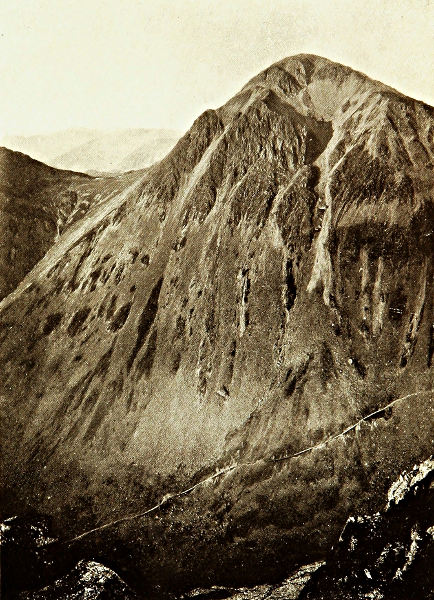
But crippled as Snowdon is, we may still
find on it one incomparable excursion, the
circuit of the great hollow of Cwm Dyli by
the ridges of Lliwedd and Crib Goch, which,
if we can shut our eyes to the abominations
of slag-heap and railroad that must be passed
on the way, will hold its own, even against
the Glyder and Tryfan, as the grandest mountain
walk in Wales. Lliwedd itself, which
rises so finely from the shores of Llyn Llydaw,
is a beautiful object from every side but the
south, and may be described as a sort of
glorified Skiddaw—as if the Cumbrian hill,
while losing none of the graceful lines and
curves that distinguish it, had been cut down,
on its front, from a mere steep of shale and
heather into a mighty precipice. Along the
edge of this rock-face, the haunt once of the
wild goat, now of the cragsman, and over the
twin peaks, with their bird’s-eye views of Cwm
Dyli and its two lakes on one side, and the
lakeless Cwm Llan on the other, we have an
ideal route to Snowdon.
Arrived there, what a scene awaits us,
especially if the train has just steamed in
with its latest freight of trippers! For consider
on what ground it is that we stand—the
very summit of the sacred hill, the shrine
of Snowdon, once the pride and stronghold of
the Cymry. Thus wrote the historian Camden,
more than three centuries ago:
We may very properly call these mountains
the British Alps, for besides that they are the highest
in all the island, they are also no less inaccessible
by reason of the steepness of their rocks than the
Alps themselves; and they all encompass one hill
which, far exceeding the rest in height, does so tower
its head aloft that it seems not merely to threaten
the sky, but to thrust its summit into it. It harbours
snow continually, being throughout the year covered
with it, or rather with an aged crust of snow; hence
the British name of ‘Craig Eryri,’ and the English
“Snowdon.”
We smile at the hyperbole of these ancient
writers, but even now, in these days of its
utmost wrong, the natural sovereignty of
Snowdon stands confessed; so truly imperial
is its form, and so symmetrically do its superb
ridges radiate from the parent peak. Its
everlasting snow was a fable; but deep
drifts may be seen as late as midsummer in
its northern gullies, and in the winter months,
when the zigzag tracks are deeply covered,
it is often no easy matter, for any but trained
climbers, to make the ascent from Capel Curig;
there are times when the high cornice of snow,
overlapping the brow of the ridge at the head
of Cwm Dyli, offers a formidable barrier.
It was well that so noble a mountain, rich
in legend and tradition, should continue to
stir public sympathies[12] and draw pilgrims to
its shrine; the pity is that the shrine itself
should have been despoiled—not, be it noted,
by the number of its votaries, which was great
even before the middle of the last century,
when the mischief was still undone, but by
the hideous “accommodation” provided for
them. It would not have been difficult, with
a little care and forethought, to build a mountain
hut in a sheltered place a few feet below
the top of the ridge, where it would have been
practically unseen; unfortunately what was
done, about seventy years ago, was to erect
some unsightly buildings on the very summit,
and these have lately been enlarged into the
present Summit Hotel, of which it need only
be said, as was said of the nose of a certain
philosopher, that “language is not vituperatious
enough to describe it.” I never see the
place without thinking longingly of the last
scene in Poe’s story, The Fall of the House of
Usher, where a certain accursed mansion
obligingly topples over and disappears in a
neighbouring tarn; might it not be hoped,
then, that on some wild winter night, when
these buildings are untenanted, they would
be blown by a south-west hurricane over the
edge of Clogwyn Garnedd into the waters of
Glaslyn below? But such wishes, however
pious, are unavailing; to take a cup of tea
in the refreshment-room, in preparation for
the advance to Crib Goch, is the wiser course.
It is pleasant to exchange the crowded mart
on Snowdon for the space and solitude of
Carnedd Ugain, its high northern shoulder
which overlooks the Llanberis side; but though
solitude will now be ours, space must soon
begin to fail us, as the broad expanse dwindles
and contracts to a mere rocky curtain. A
glorious ridge it is that we enter on, which
under the two names of Crib-y-Ddysgl and
Crib Goch, but in reality one and indivisible,
runs with hardly a break for a full mile eastward,
with Cwm Dyli on the right, and the
still greater depths of Cwm Glas and the Pass
of Llanberis on the left, until, after dipping
to the grassy saddle known as Bwlch Goch,
it rises again to the famous Pinnacles, and
then narrows in once again, and more acutely,
to the two summits, at a height of 3,000 feet.
Though the whole “Red Ridge” from end
to end is narrow, and a passage along it is
apt to bring to mind the Gendin Edge in
Peer Gynt—
Nigh on four miles long it stretches
Sharp before you like a scythe—
it is to the eastern section of it, between and
adjoining the two cairns, that the main interest
belongs, and hither for years past all lovers
of the Welsh hills have aspired. Yet owing
doubtless to the fact that every one who has
written of Crib Goch has written of it in the
terms of his own powers as climber, and these
powers vary immensely, it is by no means
easy to obtain a clear and trustworthy idea
of it from the published descriptions. The
old writers, for the most part, spoke of it as a
place of terror, where it was foolhardy to
venture, and where the least slip would be
fatal; in the literature of the new school of
rock-climbing, on the other hand it is treated
like Striding Edge on Helvellyn, or Sharp Edge
on Saddleback, as just a pleasant scramble,
and it is said to be a moot point among cragsmen
whether they could pass along it with
their hands tied. So differently does a mountain
present itself, according to the capacity
and confidence of the mountaineer!
I have heard the story of an ardent pilgrim,
by no means a cragsman, who had once braced
himself, with some misgivings, to the crossing
of Crib Goch, and was just entering on the
most awkward bit of the journey, when he
was met by another traveller coming from
the opposite end. Pleased to think that he
was about to receive, in his straitened circumstances,
a word of encouragement from a
fellow-climber, he was startled by the stranger
breaking out into an almost passionate reprobation
of the perils of mountain edges in general
and in particular of Crib Goch. “I am now
a married man,” he cried, “and it is not right,
it is not proper, for me to be here.” My
friend felt that there was a lack of reason
in addressing these remonstrances to him;
but his own position, astride of a knife-edge,
was not favourable for argument, and he
was indeed so taken aback by the inauspicious
character of the meeting that he sorrowfully
renounced Crib Goch and retired the way he
came.
In reality, though this “crib” offers no
obstacle whatever to an active person who
is quite free from giddiness, it is much narrower
and more precipitous than any of the Cumberland
“edges,” and for the ordinary climber,
as distinct from the expert, needs to be taken
with more care. Imagine yourself, reader,
perched on the roof, so to speak, of a mountain—a
colossal roof, some fifteen hundred feet
above the valleys below, where for sparrow on
housetop you have raven or buzzard—and,
further, imagine the angle of this roof to be a
ridge of spiky and crumbling rock, averaging
a foot in width at the top, and dropping
almost sheer on the north side into the hollow
of Cwm Glas, while on the south it falls away
in an extremely steep slope, which the timid
would call a precipice, but which offers an
abundance of friendly ledges and notches as
foothold. Such is Crib Goch, and along
this ridge you must travel to reach the higher
cairn, whether you approach it, as I have
described, in a descent from Snowdon, or
more directly by a stiff climb up its eastern
gable from Pen-y-Pas. In any case it has the
distinction, among Snowdonian summits, of
being accessible only to those pilgrims who
are prepared to “climb.”
But if the glory of Snowdon lies in its
shapely ridges, and of the Glyders in their
wilderness of rocks, it is for the very different
qualities of breadth and bulk that we admire
the great mountain range of which the centre
and crown is Carnedd Llewelyn. Look at a
graded map of Carnarvonshire, and you will
note that this conspicuous group, extending
from the steep spur of Carnedd Dafydd, above
the shore of Llyn Ogwen, to the sea-washed
promontory of Penmaenmawr, comprises a
much greater extent of high ground—say, of
over three thousand feet—than either Snowdon
or the Glyders; and, owing to its larger area,
its hidden recesses are wilder, more desolate,
and more primitive, than any other hill-tract
in North Wales. Sharp peaks it has none;
but in places, as at the head of Cwm Eigiau
or Cwm Llafar, there are huge crags and
precipices, nor are there wanting grand ridges,
such as the rocky isthmus that unites Pen
Helig to Carnedd Llewelyn, or the high saddle
between the two Carnedds themselves; but
for the most part what impresses one in these
mountains, as compared with those already
described, is the greater spaciousness of their
massive heights, and the greater openness of
their outlook, both skyward and seaward.
For those who love such wilds, nothing is
better than a long day’s wandering in the
heart of this secluded district, whether the
start be made from the Capel Curig quarter,
or from Nant Ffrancon on the west, or from
the Conway Valley on the east, or from the
northern seacoast at Aber; in any case there
is need of strong and steady walking to surmount
the marshy slopes, the haunt of plover
and curlew, by which the great Carnedd is
encircled, and to place oneself on the high
plateau above. The compass, too, will have
to be brought into play, if there are clouds
on the hills, for nowhere are mists more bewildering
than on these vast moorlands, where
there are no natural signposts for our guidance,
and where the bare grassy spaces stretch away
for miles without a distinguishing mark. The
best of all these walks is that from Capel
Curig to Aber, which takes us by Llyn Llugwy,
the source of the Llugwy River, to Carnedd
Llewelyn, and thence across the great flat
tops to Y Foel Fras, and down past the little
Llyn-an-Afon through a narrow glen to the
sea.
For myself these strange lonely mountains,
perhaps because I knew them earliest, have
always had a peculiar charm; and I have
found their fascination as strong in winter-time
as in summer. Great as are the delights
of Llyn Llugwy on a hot June day, I also
think of it with affection as I have known it
in December, lashed into fury by the winds,
and its black waters in sharp contrast with
the surrounding snow. What the temper of
the wind can be in these uplands on a gusty
winter afternoon, when it lifts up flakes of
snow and ice from the hillside and flings them
broadcast in blinding showers, only those will
understand who have plodded to the top of
Carnedd Llewelyn or Carnedd Dafydd at such
season.
Enough has now been said, perhaps, to make
plain at least the leading characteristics of
Snowdonia, as viewed from our central starting-point
at Capel Curig. But what the pilgrim
to these mountains can never make plain, for
he has only half guessed it himself, is the
deeper meaning which they have for him, the
higher vision which he has caught from their
stern companionship during his solitary rambles
in their midst.