The next day there seemed little if any diminution of the excitement.
The crowd was not quite so dense; but ordinary business appeared for
the time almost suspended. People were rushing up and down the street
with slips of paper in their hands on which were printed the latest
telegrams; and persons who were usually engrossed with their work in
the early hours of the day were standing at the doors of their shops
and houses discussing the great news of impending war, news which
gathered with every hour fresh confirmation.
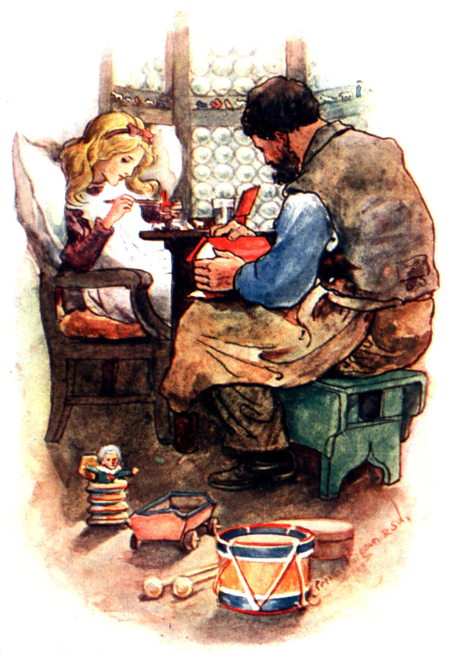
Violet, of course, seated as usual in her chair in the window, could
not but notice the bustle and the stir beneath; but it did not frighten
or distress her, for her father had brought his work up to her room
quite early this morning, and when he was near her she always reposed
on his strength and courage in place of her own.
But John was both distressed and disturbed; and presently seeing that
Violet's hair was a little blown about by the wind, he made it a
pretext for closing over the casement, so that she might not hear what
the people were talking about so earnestly in the street underneath;
and for a time his efforts were successful.
It was only as the day wore on and it came near the time when he had
to go to the store for orders that she grew restless, and the anxious
pleading look came into her eyes which he never could bear to see, and
which to-day he felt less able than ever to withstand.
"I shall not be long away, darling," he said softly as he gathered up
his tools and laid them on the broad window-sill beside her. "See, I am
not taking away my work materials, and I shall be back almost before
thou thinkest that I am gone. I will send Kate to sit with thee, and
thou canst teach her how to paint the ducks for the magnet-box, only
this time I would not give them scarlet wings; black, I think, would be
better."
Violet smiled at the idea of Kate's trying to paint the ducks—Kate,
who was so blind that she could not see a cockroach creeping across the
kitchen floor, and the length of whose nails would sadly interfere with
her holding the paint-brush.
"I would rather have Fritz to sit with me," she said plaintively.
"Fritz! ah, well; but is not this the time for his school?"
"He has not been at school all to-day. I have seen him ever so often
at the window. See, father, he is there now; and oh! only look what a
dress he has got on."
She burst out laughing, and even John with his heavy heart could
not repress a smile, for there at the window opposite stood Fritz
with an enormous spiked helmet on his head; a huge military coat
buttoned across his chest, which covered his whole body; and a pair of
riding-boots on his legs, which evidently encumbered him a good deal,
for just at this moment, while John and Violet were gazing at him, he
made a sudden rush at some unseen enemy beside the curtain, and one of
the boots doubling up at the ankle he fell waddling on the floor, his
helmet tumbling off his head and going almost out of the window, while
all his efforts to get up again, even with the assistance of fat Ella,
who tugged at him with all her might and main, were fruitless.
Again Violet burst out into one of those rare fits of real childlike
laughter which always delighted and refreshed poor John's heart; but
to-day, though he smiled somewhat grimly, he turned away quickly to
the door, saying as he went: "I shall see about Fritz coming to sit
with thee; but if his mother will not permit it thou must be content
for awhile with Kate."
"Yes, yes," cried Violet after him; "but do, please, send Fritz here. I
have something so particular to ask him."
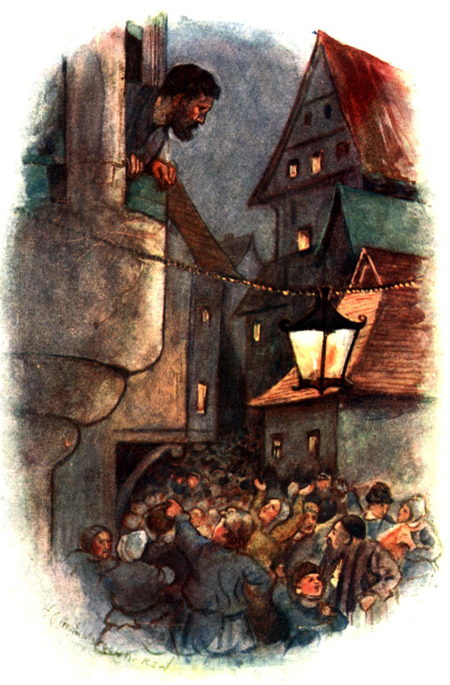
She watched her father as he crossed over the street to the baker's. He
was such a great tall man that he had generally to stoop as he went in
at the doorway; but to-day Madam Adler met him at the entrance to the
bakery, and they held what seemed to the watcher at the window upstairs
a very lengthy conversation. Madam Adler, who was a round fat little
body, gesticulating somewhat wildly, pointed first up the street and
then down it, and clutched every now and then at her cap, which was
hanging half off the back of her head, while she gazed up at the great
tall man beside her, whose grave eyes were fixed intently upon her
face, and who listened earnestly while she poured forth a torrent of
words, not one of which Violet could hear from the buzz and noise in
the street beneath.
Fritz, who had regained his legs by this time, was now standing in the
window opposite, making frantic signs across to Violet, who at first
remained quite unconscious of his efforts; but presently looking up
she saw him waving a sword furiously across the street to attract her
attention; and seeing now he had secured it, he proceeded to make a
sudden lunge at Ella, digging the weapon apparently deep into the
very middle of her body. Ella immediately collapsed on the floor, and
Fritz continued for some time to prod her violently. Violet screamed
and turned away her head; but when she looked round again, Ella, with
an enormous brown paper helmet on her head, was standing beside Fritz
in the very middle of the window grinning from ear to ear, while her
assailant, still martially attired in the old trailing coat, and with a
face flushed with victory, had his arm thrown affectionately round her
neck.
By-and-by, as Violet still gazed across and smiled more and more at
Fritz's excited movements, she saw her father enter the room opposite.
He sat down in a chair a little distance from the window and called
Fritz over to him, and a conversation ensued apparently of some
interest, as Fritz never lifted his eyes from John's face while he was
speaking to him, and Ella's countenance also assumed a kind of rigid
stolidity most unnatural to it.
But this tranquillity did not last long; for no sooner had John left
the room, having shaken hands with Fritz and kissed Ella, than a kind
of secondary excitement seemed to take possession of the children.
Fritz first took off his own helmet, and then, while Ella was stooping
down to unloosen her brown paper leggings, he snapped hers off also
with a summary politeness which Ella seemed for a moment to resent;
but Fritz had no time, evidently, to give to trifles. He laid both
helmets on the foot of a couch which projected out into the window,
and then he rapidly divested himself of his coat and his huge leather
boots, winding up by planting Ella on the end of the sofa and tugging
violently at her less cumbersome leggings, until the little girl
descended suddenly upon her back on the floor.
This time a few tears evidently softened the heart of the warrior, for
he stooped down, lifted Ella from the ground, and covered her face with
kisses; and in a few minutes Violet saw them both emerge from their
house hand-in-hand and cross over the street, and push through the
gathering of people towards the door of her own house, which opened
immediately beneath her window.
She felt rather sorry that Ella had come across with her brother, for
she had something to say to Fritz, a question to ask him in secret
about some subject which was troubling her, and which she felt she
could only confide to him in private. But when the door of her room
opened and Ella burst in all smiles and health and happiness, and
rushed over to fling her dimpled arms round Violet's neck, she forgot
for a time about her secret; and her spirits rose, and her white face
broke into one of its sudden smiles, as she noticed scraps of cord and
paper still sticking to Ella's fat legs which Fritz had evidently been
too hurried to remove.
"What hast thou been doing all this morning, Ella?" she asked
curiously; "and why has Fritz not been at school? I have seen him ever
since I was dressed, playing in the window."
Ella's cheeks suddenly deepened to a purple red, and she gazed towards
her brother with eyes which said plainly, "Thou must give an answer to
this question."
"I have not been at school because—because, well, because I did not
go; and besides I was busy doing lots of other things."
Ella's face looked decidedly relieved by this explanation of her
brother's, which was entirely satisfactory to her own mind; but Violet
was much puzzled by Fritz's words and still more perplexed by his
manner, which was strange and quite unlike himself.
While she was pondering with herself what it all meant Ella broke in
upon the silence.
"Yes, Fritz was doing lots of things all the morning—killing and
cutting and stabbing the French, and he gave me an awful scrape on
the arm; just look at it, Violet!" And Ella turned round the fattest
of arms to Violet for compassionate inspection, across which just at
the pink and dimpled elbow there certainly was a most undeniable and
somewhat gory scratch.
"Hold thy tongue, thou little gabbling goose of a chatterbox," cried
Fritz, turning suddenly round in real anger and casting a glance of
withering scorn upon his unhappy sister; "hast thou already forgotten
what I said to thee in the hall downstairs?"
"I did not say anything about the war," said Ella in reply, covering
her face suddenly with her frilled pinafore and grasping on to the
side of the invalid's chair, while she stretched out her hand as if to
defend herself;—"I did not say one word about the war, did I, Violet?"
"No, no; she said nothing—nothing that I heard. She is a good little
lamb, and thou must not frighten her, Fritz," cried Violet soothingly,
as she drew the little sobbing girl over to her side and held her arm
tightly round her fat waist.
"She is a good little new-born donkey," snorted Fritz still in much
virtuous anger; "she has no more sense than the head of a pin. I told
her something only a moment ago downstairs, and the instant she gets up
into the room she must begin to let out the whole secret."
"What secret?"
"About the war," sobbed Ella.
"About what war? I do not understand. Why is it a secret, and why
should Ella not tell me?" she added in a distressed voice.
"He said if I did tell thee he would cut my tongue out with his sword,
and give me to the policeman to put me into the prison," sobbed Ella.
"For shame, Fritz! how couldst thou frighten her so?" said Violet with
quite a hot flush on her usually pale face.—"I will not let him touch
thee, Ella. There, put down thy apron; Fritz was only laughing at thee."
"Of course," cried Fritz contemptuously; "but she is such a little
thrush, she would swallow a camel, hump and all, if one only held it up
to her mouth."
This brilliant sally was suggested by the descent of one of Violet's
newly-painted animals upon Fritz's head from the window-ledge above.
"I would not swallow a camel—I am not a thrush," still sobbed Ella,
hiding her face against Violet's chair.
"Well, well, what does it signify? stop crying," cried Fritz, making
an effort over himself to recover his usual gallantry. "Come along,
let's have some fun.—May we take down all those old beasts overhead
and have a game with them?—may we, Violet? We have not played at
crossing the desert for ages."
"Yes, yes; only take care. Some of them are quite sticky, and one or
two have broken legs; but there are lots of other animals in the Noah's
ark in the corner."
"All right; now we shall have real good fun," cried Fritz, tugging
Ella's lingering arm from the rungs of Violet's chair with reassuring
roughness and making room for her on the bench beside him. "Now, thou
shalt be Noah, and Violet shall be Aaron, and I will be Moses with the
rod."
"What rod?" asked Ella, gazing up at her brother rather doubtfully with
eyes all wet and smudged with tears, while she wriggled herself into a
more comfortable position on the carpenter's hard bench beside him.
"Oh, not the rod thou meanest," he replied reassuringly as he emptied
out pell-mell a whole box full of animals upon the table—cows, sheep,
ducks, elephants, and canary birds, all heaped up in a mound of wild
confusion.
Ella had by this time her yellow curly head pillowed confidingly
against Fritz's left shoulder, and perfect harmony was restored between
them. Violet was now the most silent of the three. For some minutes
past she had seemed in a reverie, and occasionally she looked anxiously
across at Fritz, as if longing but fearing to ask him some question.
Whether he was aware of these longing, sorrowful glances directed
towards him, it was impossible to tell. One might perhaps have thought
so from the way he rambled on in a foolish, disconnected style, while
he ranged the animals two by two along the edge of the table, and
elicited shrieks of laughter from Ella by making the broken-legged
elephant sit on its tail, while the no-legged goose was given a lift
across the desert, seated between the horns of a scarlet cow.
At last they were all arranged in order, from the elephant down to the
little red spotted lady-bird, which was fully as large as the mouse
some distance in front of it; and Ella was desired to keep her feet
and arms under the table, as every time she stretched them out she was
certain to overturn a whole cavalcade of animals.
"Now Moses is going to drive them all into the ark, and I am Moses,"
cried Fritz triumphantly; "and any that are stupid and won't go in for
me, Aaron can pick up and push them in after Moses, as hard as he
likes."
"But Moses did not drive the animals into the ark, nor Aaron either,"
said Violet smiling.
"Yes, yes," shouted Ella, kicking her toes against the underneath part
of the table, so that several of the astonished animals suddenly leaped
high into the air and then fell down on their sides—"yes, yes; Fritz
is right. Moses drove them in, every one, into the ark; he whacked them
with his rod, and off they galloped."
"For shame, Ella!" cried Violet, though she could not help laughing a
little as she looked at the joyous round face opposite her, stretched
in innocent smiles from ear to ear; "it was Noah who drove the animals
into the ark; and besides, that story is in the Bible."
"But Fritz said it was Moses," repeated Ella, whose confidence in
Fritz's veracity was not easily to be shaken.
"I know I did, but I was wrong. It was Noah of course—only, what
does it matter? I never can remember the names of those very old men;
and besides I don't much care for Bible stories—I like bits of them,
that's all."
"Oh!" said Violet, with a sound of such unmistakable dismay in her
voice that Fritz looked up surprised; "thou dost not care for Bible
stories, Fritz?"
"No, he does not; only bits—bits the size of a crumb," chimed in Ella,
who was busy crushing the heads of two stags together, to the total
destruction of their antlers.
"Hold thy tongue, Ella," cried Fritz angrily; "I do like some Bible
stories, of course: Daniel in the lions' den; and Gehazi, who was
turned white for telling a lie—that's a grand story; and the little
child who was standing in the corn in the sun and got a headache, and
who was made alive after he was dead, and given back to his mother—I
like that best of all."
"So do I," screamed Ella, whose mirth was momentarily becoming more
irrepressible. "Get in, old humpy back, into thy box; get in, I say,
old beast." This speech was addressed to a kind of violet-coloured
camel which had stuck in the entrance to the ark and was now standing
head downwards amongst its imprisoned comrades with its heels elevated
in the air.
"Ella, thou great goose, thou stupid little child, what art thou
saying? thou must not speak of humps to Violet." A sudden push from
Fritz's elbow sent the astonished Ella rolling off the bench on to the
floor.
"Violet," cried Fritz, suddenly looking up and taking no notice
whatever of his sister's descent, for at this moment a spasm of
recollection had flashed across his mind, "dost thou know, Violet, the
lamplighter's girl has a mother? I saw her yesterday morning in the
market selling fish."
"Selling fish?" said Violet, repeating Fritz's words in a curious,
absent manner.
"Yes; and such an old lobster I never saw. Her hands were just like
claws, and—but what is the matter with thee? why art thou crying? It
is all the fault of that horrid little Ella. But never mind; mother
slapped me for speaking about thy hump, and Ella shall get slapped too."
"I am not crying," said Violet, vainly trying to keep back a sob; "it
is only because I have been waiting so long, Fritz, to say something to
thee."
"Not about the war?" cried Fritz, colouring crimson and bending his
face down suddenly on the table. "I promised thy father I would tell
thee nothing about it."
"It is nothing about war. It is a secret, but—but I could not say it
to thee before Ella; she would not understand."
"Well, Ella shall go.—Come along home, thou little good-for-nought,
and I will carry thee across on my back."
Ella at these words half moved out from her hiding-place under the
wooden table, whither after her fall she had retreated in some dudgeon,
but she almost immediately drew herself in again, and said flatly,—
"Ella will not go home; mother will smack her for calling the camel a—"
"Hist, thou little goose; mother will do nothing of the kind. Get up
quickly, or I will not carry thee at all; there, hold on tightly now
and keep thy heels quiet, for it is getting so dark and the stairs are
so narrow I might fall down and break thy neck. Say good-evening now to
Violet, and away we go."
He carried Ella over to Violet's chair, and the little maiden put her
soft loving arms about her neck and kissed her with all the strength of
her childish heart.
"Ella did not make thee cry, Violet, did she? Ella did not know that
thou wast so fond of the poor—" She did not finish her sentence, for
Fritz whirled her away suddenly.
But Violet called down the stairs after her, "Ella did not make Violet
cry; Ella is a good girl. Good-evening, sweet Ella."
It was almost dusk when Fritz returned, and John had not yet come
home. Violet heard the boy's step on the stairs, and her heart beat
so fast that the neck of her little purple frock heaved up and down
flutteringly.
She had packed away all the animals she could fit into the Noah's ark,
and the others she had placed in a heap on the window-sill. There was
nothing now on the table before her but her mother's Bible and the book
with the gold-spotted cover.
For the twentieth time since Fritz had left the room, she had opened
this book at the picture of the little hunchback and as hastily closed
it again. "I will ask him first, and then I will show it to him," she
said in a whisper to herself as she looked up nervously at the opening
door.
But Fritz came in quite unconscious of the fluttering heart; his own
was beating so hard that he had to sit down on the chair by the stove
to get his breath, and it was some moments before he gasped,—
"Well, if ever I take that great fat Ella on my back again! I would
rather carry a cow to market on my shoulders than have her hanging on
to my neck and throttling me. First she made me carry her up to the top
of the house, to the very garret, because she said mother was there;
and then all the way down again, because she said mother was in the
bakehouse. Then I had to haul her all the way off again down the street
to Madame Bellard's, and up to the top of that house, where we found
mother and Madame Bollard crying over their coffee like two sea-crabs;
and there I left Ella gaping at them with her eyes nearly falling out
on her cheeks. Pah! she weighs at the least three tons."
"What were they crying about?" asked Violet curiously; "I saw so many
people crying in the street to-day."
"People often cry when they have nothing else to do," he said, jumping
up suddenly from his chair and raking out the ashes from the stove
vehemently,—"at least Ella does; but of course they had something to
cry for—only it is a secret, and thou must not ask me."
"A secret?" she said, nervously pushing the little book in front of
her up and down the table. "Thou hast not asked me yet, Fritz, what my
secret is."
"What is it, then?" he asked, coming close up to the table; and
then recognizing the gold-spotted cover on the back of which
Violet's fingers were trembling visibly, he added, "Is it about the
lamplighter's girl? or hast thou perhaps found out the name of the
little mother?"
"No," said Violet, shaking her head; "I cannot think who the mother is.
But oh, there is such a lovely story in her book, Fritz, and I want so
much to ask of thee, 'Is it true?'"
"Show it to me," said Fritz cheerfully. "Of course I can tell it to
thee at once."
But Violet covered the book with both her hands; and though it was now
almost dusk, he noticed how the blood rushed over her white face, and
she looked for a little while out of the window.
"No, no—in a minute thou shalt see it; but first thou wilt tell me one
thing, wilt thou not, Fritz? only one thing, but quite, quite truly;"
and she turned her eyes upon him so earnestly that the boy felt almost
frightened.
"Of course I will answer thee truly; but first I must hear thy
question."
"If mother were here she could tell me all I want to know," sighed
Violet, putting off the dreaded moment; "and father, I know he could
also tell me, only he does not like me to talk about hunchbacks."
"About hunchbacks!" cried Fritz with a sudden gasp; "I do not know
anything about hunchbacks."
"Yes, yes, thou dost," she cried excitedly. "I am a little hunchback;
thou knowest that; thou saidst so thyself, Fritz, one day long ago.
And now thou wilt tell me this one thing. Is it true—" She paused and
breathed more quickly than ever; the question was evidently one of
gigantic importance.
"Is what true?"
"That God gives the little hunchbacks these humps?"
"Yes, of course; that is to say, first they get a fall or something,
and then God gives them the humps afterwards."
"And what does he put into them?"
"What? I do not understand thee."
"Is there not something inside of every poor hunchback's hump?"
"Yes, of course there is."
"Well, and what is it, Fritz? dear Fritz, tell me what it is." The
question was breathed with actual pain.
"Dost thou mean what is in thy hump—this thing?" and Fritz laid his
hand very softly on her shoulders.
"Yes."
"Why, any one knows that. Bones, of course; I can feel them."
"Bones?" she gasped.
"Yes; bones, and flesh, and skin, and all that kind of thing."
Violet's eyes distended; an anguish crept into them that appalled even
Fritz. She drew the spotted book quickly over to her, and said slowly,
as she opened it at the story of the hunchback, "Look at that picture,
Fritz: that little sick child had 'wings' in her hump, lovely silver
wings; and are not books like this true, Fritz? There are angels in the
page, and the little girl flies up to her mother, and people would not
write what was not true about angels and—and heaven."
The question was a little puzzling; but Fritz answered it without
hesitation.
"The stories in this book are all fairy tales. Look at the cover and
thou canst see that for thyself."
"Fairy tales? but are fairy tales never true?"
"No; at least none that I ever read."
"But God, and the angels, and heaven are all in that book, and they are
true; and the little sick hunchback, that is not a fairy tale, for I am
sick just like her; and why—why must that one little bit be untrue?
And besides," sobbed Violet, whose whole courage and hope seemed almost
to have forsaken her,—"besides, the words under that picture are in
the Bible. I found them in mother's own Bible: 'No more tears.'" As she
lifted up her face to Fritz for some hope, some consolation, immense
tears were running down her cheeks, and the boy felt a tightening in
his own throat too.
"What does it matter?" he said as he pushed the spotted book away from
her; "I will throw this old thing out of the window if it makes thee
cry. Thou dost not want wings; thou art the best little angel in all
Edelsheim: and, besides, flies have wings, and they are horrid beasts;
and so why need one care?" and he threw his arms round her neck, and
kissed her wet face, and whispered every loving name he could think of
into her ear.