By PYE POD AND MAC A'RONY.
"Do you believe the whale swallowed Jonah?"
"No."
"And don't you believe Balaam's ass spoke to him?"
"Yes; I believe that."
"Why?"
"Because so many asses speak to me every day."
TOC
BY MAC A'RONY.
Days are but the pulse-beats of immortal time.—Sparks from
Iron Shoes—Mac A'Rony.
It was the twenty-tooth of April. The inclement
weather, which had rained supreme for forty hours, suddenly
abdicated in favor of the presumptive sun and
genial air apparent which ruled gloriously for some six
hundred and nine minutes. Save that it lacked the odor
of new-mown hay, it was a day fashioned after a donkey's
own heart. However, a yard of fresh grass painted green
would have satisfied my taste better than did the golden
sun rays and the transparent air.
At ten o'clock Pye Pod, D. D. (donkey driver), sauntered
off to do an errand, and then hastened to the stables
to saddle and pack his two noble and fractious partners,
Cheese and myself. I believe my erudite collaborator has
already introduced to you my long-eared comrade.
Such a load as we were to carry! Of course, I got the
worst of the bargain in which I had no voice. Said my
master, as he rubbed my nose, "Mac, old boy, since you
have become hardened to the trip by reason of your thirteen
hundred mile creep (I nabbed at him vexedly), I'll
just let you shoulder the two boxes." And, with nerve
incarnate, the unbalanced Professor balanced on my back
what seemed to me two one-ton cases of pig-iron. I believed
my time had come. Even the unsophisticated
Cheese, whispered to me nervously, "Our coffins, Mac,
sure as Balaam!" and resumed the mastication of timothy
hay, as if it were his last meal.
The pack-saddles were tightly cinched to us. Every
time Pod pulled on the ropes under my belly I grunted as
if in pain, although it only tickled me, and gnawed a half
inch off the oaken manger in seeming agony; so, while he
imagined he was squeezing all the breath out of me, I
had still enough left to inflate a balloon.
That's how I fooled Pod. All this time he was talking
to himself. He vowed that he would get even with a certain
officious policeman, who had daily gloried in the exercise
of his authority, by ordering him to lead his "confounded
jackass" away from the front portal of the hotel,
where crowds of curious people always gathered
around us and blocked the way. His soliloquy grew
louder and more fiery every moment. Even Cheese lifted
his snoot out of the haymow and, tilting his left ear, whispered,
"Say, Mac, our master must have some unholy motive
in mind. Hold on to your wind. Don't let him lace
those lockers on you, as a squaw would bind a pappoose
to her back, for you may want to kick 'em off. Pod's
daft."
Well, that suspicious jack's most grotesque foreboding
was soon realized. Everything went well until we were
nearly opposite the great double portal of the hotel, when,
suddenly, I felt the saddle slipping round my girth.
Another second and I was flat on my back, jerked high
off my feet on top of the boxes. For a moment I could
not realize the undignified posture I was in. Being roped
securely to the boxes, all I could do was to kick at the
flying sparrows, and bray as only a frightened donkey can.
Crowds quickly assembled. Excitement ran high.
Cheese, instead of raising a hoof in my defense, dropped
his ears and looked complacently on my animated heap
like a country gawk. The hotel guests rushed out bare-headed,
some of them fresh from the cafe with tripe and
ice cream in hand, and wild-eyed pedestrians flocked to
the scene of my troubles. Don barked excitedly and kept
the throng back. The coolest one of the outfit was Pod.
He stood quietly by, grinning and bowing to the open-air
audience, as if he were the bandmaster and I the band.
I now recollected Cheese's advice, and chided myself
for having expanded my lungs at the packing. The
thought was vexing to one in my position. Immediate
relief looked hopeless. Scared half to death, I brayed
myself hoarse before a would-be liberator wedged through
the crowd and order Pod to clear the thoroughfare. He
was that pompous policeman. He eyed Pod severely, and
glancing at my up-turned face, inquired:
"What's in them there boxes, Mister?"
"Pills," said Pod, "just pills," and with his usual
suavity added, "A very dainty but effective cathartic, the
best remedy in the world for a morbid patrolman. I
know you feel out of sorts, Mr. Cop, but the contents of
one of these boxes taken internally will make you imagine
you are not only the chief of the Chicago police but
the Mayor of the city and the President of the United
States combined."
The Professor then handed the man a small box, and
proceeded to free me. And, do you know, I choked
Michigan Boulevard for an hour before I was got "right
side up with care."
We next moved on to the Columbus Statue, which then
stood in a barren spot between the road and the lake
shore, where a photographer waited to take some rare
views of our outfit. The bombastic policeman ordered us
off the grass, although there was nothing but gravel in
sight. Cheese was raving mad and so annoyed by the
cop's impertinence that he boldly made a bluff at eating
the sculptured stone wreath off the statue, just to worry
him.
"Mac A'Rony, please keep your ears still for one moment,
will you?" said the photographer, as he took hold
of my flaps and pushed them forward, adding, "Now
keep them there."
As he let go they flew back into a natural position like
blades of whalebone. Next he twisted my nose almost
out of shape, and addressed me as if I were a lady.
"Now, smile gently—there!" Such a grin as I gave!
The instant he removed the black cloth from the camera,
a familiar lump came up in my throat, and I brayed. My
efforts to restrain myself joggled my ears out of gear and
completely shook the smile off my face. But I was
"took," body and bra'in's, with the whole outfit.
How I shudder, when I gaze upon those photographs;
my drooping eyes, and my lazy body—all taken together
made a picture so perfectly asinine that one can almost
detect the bray leaving my mouth. I have always been
ashamed of that picture of real life. Like all donkeys, I
was disappointed because my photo did not flatter me.
Besides, my master's eagerness to keep his contract to
advertise a patent medicine led him to drape Don in a
gray blanket, on which, "Throw physic to the dogs," was
brilliantly embroidered—words which helped make
Shakespeare immortal, but caused Don to blush.
It was a long jaunt to Illinois street. Several times my
burden threatened to come off. And once I almost made
a free distribution of pills by falling in front of an electric
car, which was brought to a stand only six inches from
me.
I caused a sensation, to say the least. And when
Cheese brayed in terror, a multitude flocked to the scene.
The passengers were thrown out of their seats, some of
them pitched off the front platform on the top of me, and
screamed with fright.
Pod, of course, flew into a rage. He accused me of attempting
suicide; but Cheese loyally defended me and
said, "Such a load of medicine is enough to prostrate a
herd of elephants."
Soon afterward, on turning a corner, the wind blew
Pod's hat off, and it went flying under the wheels of a
cable car which completely ironed the curl out of the hat
rim on one side, and gathered a crowd on the other.
"Managing one jackass is a difficult job, but controlling
two is impossible," I heard Pod mutter, as he slapped his
plug on his bald pate.
Although it was only five miles to Garfield Park as
the crow flies, it was ten by the course we took. At that
place we were not overfed, and soon after leaving we encountered
an electric hail storm. Volley after volley of
round shot ripped open Pod's ill-fated tile, and his spleen
broke loose again. "I'm glad this day's most ended!" he
thundered. His remark seemed to solicit sympathy, so I
answered gravely, "My worthy master, remember that
days are but the pulse-beats of immortal time. You
should cherish each as you do every heart throb." My
philosophic words silenced him for a moment. Then, as
if I might warp the wearisome hour by a mute tongue, I
lay back my tail and ears till they were parallel with the
road, and landed my cargo in Oak Park before six.
There was no hotel in sight, but as it was not yet dark,
Pod was enabled to find a barn, adjoining a saloon, and
there he stalled us, fed and watered us, and said good
night.
TOC
BY PYE POD.
Full in the midst the polish'd table shines,
And the bright goblets, rich with generous wines;
Now each partakes the feast, the wine prepares,
Portions the food, and each the portion shares;
Nor till the rage of thirst and hunger ceased
To the high host approached the sagacious guest.
—Homer's Odyssey.
I left my embryo caravan in Oak Park for the night,
and returned to the Auditorium Hotel. The clerk greeted
me with, "Well! well!" grasped my outstretched hand,
and with a smile said, "I thought your picturesqueness
had left us for good." Then, pulling a pen out of the
vegetable pen-stand which squinted "How to do?" with
one remaining eye, he handed it to me.
"I'm a hard customer to get rid of," I remarked; "could
not get out of the city entirely this day, though I've traveled
miles—jacks at Oak Park—saloon barn, best I could
find—no hotel—got to eat and sleep, you know." And
having said this, I walked majestically to the "lift."
"Seventh floor?" queried the elevator boy.
"No—dining room," I corrected, patting my stomach
fondly.
"Pretty late for feed, guess," observed the lad discouragingly,
as we began to rise.
"There's a banquet on now," continued the lad.
"Great Balaam! I am late!" I exclaimed. "I've been
a week saving my appetite for this dinner. Let 'er slide
kid—there!" and I hurried to the dining-room.
I knocked persistently against the locked doors, while
savory odors drifted through the keyhole, and was soon
admitted by the assistant head-waiter. I smile now as I
recall that watermelon grin, when the darkey yawned
like a coalbin in expression of his greeting.
"I'm somewhat embarrassed, Jim, to appear so tardy,"
I began, "I had about decided to deny myself the honor
and pleasure of the event. You see, my friends are all
togged out in their pigeon-tails, while—just look at me."
"Why, Mistah 'Tagras, shuah dey will be glad to—"
"Yes, yes, I know they would be more pleased to see
me in my odd regulation clothes; but no, not this time,
Jim; close your scuttle—mum's the word. Just let me
eat in this snug corner where I can hear the strains of
the orchestra, out of reach of their stale jokes. Fetch
on the viands." As I concluded I pressed a coin into
the mahogany hand, and took from my coat a button
containing Mac's and Pod's photo, and gave it to the
delighted darkey.
There was novelty in this strange situation. It was
the only feast I remembered ever having attended uninvited.
Across the spacious hall, obscured by Japanese
screens, sat the garrulous banqueters, blissfully ignorant
of my presence, while I, a famished and jaded nomad,
sat comfortably drinking in the liquid music of the serenade
and inflating my gastronomical pipes with terrapin,
squab, robin's eggs, salads and other dainties galore.
Presently I was served with something more mellifluous
than music, as Jim appeared with a bottle of that
familiar sparkling liquid, which is proverbially wrapped
in cobwebs and frost, in a pail of ice, and said: "Believe
yo' sayed Mumm, Sah—be dis yo' taste, Mistah 'Tagras?"
My eyes eloquently expressed my sentiments.
Oh, what a nerve tissue a donkey journey does create!
As I quaffed the soul-stirring nectar, I thought of Mac
A'Rony—how he would have relished a quart of that
sterling brand!—and then poured a bumper for him and
drank it to his very good health.
When I had finished, I called the waiter and said, with
visible effort: "Jim, I wish—hic—you would tell th'
bandmaster (here Jim poked a napkin into his mouth),
that a tardy guest—hic—heartily requests the pat—patriotic—hic
tune Macaroni's come to town. Go, Jim, that's
a good girl." And Jim went.
That waiter was the cleverest darkey I ever came
across. We all well know that one trait of a thoroughbred
darkey is the faculty for invention. Imagine my
surprise when the fellow returned with a gentleman in
full dress and introduced me. I, expecting to catch
something different, failed to catch his name.
My new acquaintance seemed to feel highly honored
with the presentation. He appeared a bit staggered,
though, and with difficulty found my wandering hand.
Taking my arm, he escorted and introduced me to the
convivial assembly as the distinguished guest of the evening—"though
somewhat belated, nevertheless his genial
presence duly appreciated."
When he mentioned the name of Professor Pythagoras
Pod such applause issued from the unsteady occupants of
the hundred chairs that I, thinking it my courteous duty
to join in the encore, clapped my hands vigorously. This
seemed to provoke great merriment. The laughter and
clapping grew louder and louder, until hands and throats
were inadequate to express the jubilant spirits of the
banqueters, and they began to stamp their feet. Finally
all arose, threw in the air imaginary hats, broke glasses
of wine, and, in fact, I don't know what would have happened
if the manager had not entered the scene.
Finally, some one called, "Speech! Speech! A speech
from Mr. Pod!" I tried to respond. I didn't believe the
guests knew who I was, other than a pod of some sort.
The hotel manager did, but he had gone. I therefore
decided not to reveal my identity; I would act the invited
guest I was taken to be.
I did not speak long. What I said was ostensibly so
appropriate, so pointed, so witty, so apropos, that the
frequent cries of "Hear! Hear!" told me I had made a
hit, and it was time to stop. I have no recollection of
what I said on that momentous occasion, but I apologized
for the abruptness of my departure on the plea
that I had six more banquets to attend that evening,
whereas I had but one stomach.
Wild cheers and handclapping greeted my speech.
When quiet was restored I offered the following toast,
asking all to rise with filled goblets:
Hic—here's to the man, boys, here's to the man
Who—hic—has the sagacity, gall, and who can
Partake of the bless—hics—of earth, though unbidden,
Without revealing the jack—hic—he has ridden;
Here's to—hic—his pocket and here's to—hic—his purse—
May Balaam shed tears when—hic—he rides in a hearse.
With a concerted "Bravo!" all drank my health. Then,
hat in hand, I followed a very tortuous route out and to
the elevator, and soon afterward found the keyhole of
my chamber door, and retired.
I did not feel well in the morning, but nevertheless
journeyed to Oak Park at an early hour.
What a surprise awaited me at the barn! The air was
dense with the odor of beer. I had hardly anticipated
trouble brewing; nothing was so foreign to my thoughts
as the possibility of finding two asinine inebriates and a
"jagged" canine instead of the sober company I left the
evening before.
But there they lay, both donkeys paralyzed, panting
and blear-eyed. An overturned beer keg swam in the
deluge of froth that flooded the floor. Mac must have
pulled the bung out of the keg. The fellow looked guilty
enough, but, when I recalled my own recent dissipation,
I didn't have the heart to upbraid him.
I was perplexed. What could I do? To resume my
pilgrimage that morning was out of the question. I
felt in my bones that as soon as the saloonkeeper learned
of the calamity, I, Pythagoras Pod, would have to pay
damages. Such I could not well afford. Why not go
to the man and enter a complaint against him for harboring
knock-out drops, and consequently causing my
valuable animals ruination of mind, physique and moral
character?
A capital idea! No sooner thought than done. The
man was speechless.
"Why!" I exclaimed, pounding my fist hard down on
the oaken bar, "think of it! a day's delay may lose me my
five thousand dollar wager. THINK OF IT, MAN!
FIVE THOUSAND DOLLARS!!" I would have said
more, but I noticed the Hibernian was knocked completely
out of the metaphorical ring by my unequivocal
utterances. His blanched countenance showed that his
conscience smote him. He paced the barroom floor like
a leopard trying to get away from his spots. Presently
he stopped, and, thrusting his fingers through his goatee,
looked out in time to witness Mac A'Rony turn a headspring
from the barn door.
"Begorry!" he exclaimed, "if Oi hod that mule, Oi'd
ruun 'im for alderman of the Tinth Ward. Shure, and
it's phure air and wather the bye's votin fer. It's this
Oi'm sayin', Misther Pod, Oi'll give ye twinty-foive
bones fer th' brute in his prisent condishun; Oi will that,
ond call it shquare."
Mac certainly was acting very compromisingly. But
I explained to the Irishman no reasonable sum could
purchase that particular donkey, and, furthermore, that
twenty-five dollars would barely satisfy my claims.
The exclamation of "Holy Mither!" checked me for
the moment, and as the man looked barnward he added,
elequently shaking his fists, "Oi'm dommed, if th'
shcapegrace ain't mixin' dhrinks!" Here Mr. Rooney
and I rushed out in the nick of time to prevent my crazy
jack from tapping a whiskey barrel standing in the shed
adjoining the barn.
"Misther Pod, a curse on me soul if Oi would ruun th'
bladherscat fer doorkeeper oof th' pinnytinsury! Here's
tin dollars, tear th' likes oof it in two and rhuun ond buy
a bhromo seltzer, and sober th' toper oop at wance." I
took the proffered note, and had gone but a hundred feet
when the Irishman called to me, "Hold on; before yez
lave fer th' sphace of a mooment moind thet ye puts a
muzzle on th' asrophoid rephrobate with th' bobtail ears,
ond shpring a toime lock on th' crethur."
The animals having been dosed, I was about to question
myself "What next?" when my host said cordially,
"Shure, ond yez will feed with us. Yez may keep th'
change from th' shinphlaster ond good luck in sthore fer
yez. Now, coom on to grub, ond lave th' brutes alone.
They'll be afther havin' their sea legs soon." And Pat
succeeded in conciliating me, and escorted me to the
house.
By one o'clock my disgraceful donkeys answered to
roll-call, and with touching humility submitted to be
saddled.
With such disappointing interpositions of Fate the
Golden Gate seemed to be a decade removed. For a
while, the donks were wavering and their pedals unreliable;
but after the first hour they meandered along quite
acceptably. As Mac was slow to recuperate, I rode
Cheese. He was surprisingly sure of foot, whereas Mac,
swell-headed, drowsy-eyed and swaying, couldn't have
walked a straight line a yard wide, unless it was a yard of
grass. He walked with a suspicious tread, like one venturing
on ice which threatened his death bath any moment.
When the afternoon was well advanced Cheese
showed symptoms of lameness in his nigh fore-leg, as I
had feared, in consequence of his late circus. We passed
Maywood and Elmhurst as we followed the main-traveled
road. I was compelled to dismount and lead my cripple
four miles to Lombard. Such was my luck in the State
of Illinois.
It was after dark, the second day out of Chicago, and
still we had traveled but twenty miles. To think—that
munificent gift, Cheese, was already an invalid on my
hands! I summoned a veterinary surgeon, and listened
to his diagnosis with solicitous attention. "Only a strain
of the shoulder muscles," said he; "must have run-hop-skip-and-jumped
to get such a strain—does he ever play
golf? Will require a full week's rest." The doctor rendered
his professional opinion with the air of a metropolitan
specialist prescribing a trip to Europe for some
delicate society belle.
Next morning I rode in company with a good fellow
two miles into the country, where I purchased a very
long-eared, shapeless donkey, of a good character, and
quickly rode him bare-back to town. Then I sold my
cripple at auction in the public square.
The cumbersome pack-boxes, which the sturdy Mac
A'Rony had borne without a murmur, I also sold to pay
the doctor's bill.
The following day saw me in the town of Wheaton,
whose reputed beauty I failed to appreciate in a pouring
rain. I remained there over Saturday night and Sunday.
The clipping of Cheese II on Monday morning proved
to be an exhibition well worth witnessing—at a safe distance.
That "model" character turned out to have the
temper of a vixen. First, a rope was twisted round his
nose, then his four legs were tied securely together, and
finally six strong men held him down on the floor to permit
the finishing touches to his vibrating limbs, while
carefully avoiding the finishing touches to their lives.
Instantly the half dozen assistants were sent sprawling
across the floor in all directions, while the stable dog
chased an imaginary bird into space and landed in a
poultry yard. The frightened donkey was mad, or had
a fit. On the other hand, Mac, in the noisy excitement,
pumped his bronchial organs to their utmost capacity,
and Don joined in the chorus, till any passer-by might
easily have mistaken the barn for a slaughter house.
Finally, the unruly subject was got under control, and in
time released on bail (of hay). I verily believe that the
electricity generated by that clipped donkey, if stored,
could have propelled a trolley for twenty-four hours.
During the ensuing week, the villages of Geneva, Elberon,
Maple Park and Courtland in turn greeted me
with the usual curiosity and concern, and I was spared
to enter De Kalb on Wednesday evening, after a most
distressing adventure. When we had proceeded about
two miles beyond Courtland, I unchained my dog for a
short sportive recess. I rode Mac, and about three feet
to our right ambled Cheese, a chain connecting his bit
with my saddlehorn. My little troop was peacefully
traversing the smooth country road when suddenly Don
came bounding down the highway, chasing a little red
calf, the dog barking gleefully, the calf bellowing with
fright. Drawing my revolver, I fired to distract Don's
attention; but without avail. A few moments later, as I
was aiming at a flock of black birds, I heard the ominous
clatter of hoofs rapidly approaching us from the rear,
accompanied by a deep, hoarse mooing, which clearly
emanated from a calf of mature years. Imagine my feelings
when, turning in my seat, I beheld an enraged cow
racing with Don in a bee line for me, the dog in the lead
going a mile a minute, the bovine a mile and a quarter.
It was the first I had known Don to flee from a foe.
His eye now protruded, his tongue hung out a-foam,
and his tail lay back straight like an arrow.
As I remember, the dog passed under the chain connecting
my donkeys, and instantly with the force of a
locomotive something alive plunged in our midst, striking
the chain. How many double somersaults I turned
I know not. How many minutes we remained in the
dusty road overturned in a heap I can only estimate
from the distance the lucky dog must have traveled to
get out of sight so soon.
My first mental reflection was that the cow must be
the calf's mother; my second thought was to save my
life. I managed somehow to crawl out from under the
animated heap, and then surveyed the situation. The
cow's horns were fast in the chain and one of her feet
in the saddle gear; and she tossed her head savagely,
every time lifting one donkey or the other bodily off the
ground and dropping him in a heap in the dust. She
kicked and bellowed, until, finally breaking loose minus
a horn, she made for me head down, innocent as I was.
I didn't stop to argue, but lit out for the barbed wire
fence with that outraged mother at my heels. I have
heard you can tell how fast a man thinks by the way he
eats. You could have told how fast I thought by the way
I ran. Over the fence I leaped, leaving my long coat-tail
hanging from the top strand of wire. The cow,
blinded with rage, made a lunge at the piece of cloth only
to lacerate her head on the barbs; then she jumped the
fence and took after me, tail in air, and foam dripping
from her mouth.
A small tree stood by the roadside not far distant, and
I cleared the fence again and made for it. Although not
an expert at climbing, I shinned aloft like a squirrel,
and for a moment expected the bovine to follow. She
reared on her haunches, and pawed furiously at the swaying
branches; then, backing several feet, she charged
headlong against the sapling, almost dislocating every
bone of my body and every hair of my head.
All but shaken out of the tree-top, I contrived to
gather in my legs and to wind them round the slender
trunk. Then I reached for my revolvers. My Colt 44
was missing, but with my Smith & Wesson 32, I peppered
that cow, until I shot away a section of her tail,
and sent her off in a cloud of dust—like a howling, raging
cyclone—in the direction of her calf.
I waited a while before venturing down to look for
my animals, now conspicuous for their absence. Darkness
had settled on the scene. Groping my way up the
road, I soon stumbled over a pair of boots, further on a
camera, and a hundred yards beyond my Winchester
rifle, minus its holster.
Still no sign of donkeys or dog. I stopped at a farm
house and inquired: "Have you seen two jackasses
strolling this way?"
The agriculturist pulled his goatee as he surveyed me
from foot to crown, and replied: "No, I hain't seen two
jackasses strollin' this way, but a whole herd of 'em came
tearing past my barnyard a-kitin' about an hour ago,
skeerin' the cattle I was a-milkin' into fits. Why! the
brayin' and takin's on of the wild beasts caused a stampede
of my hull gol-darned dairy. What be ye at a-pesterin'
round these parts with a herd of wild jackasses?"
My response was terse, and was given before the man
had finished. I hurried on, making inquiries at other
farmhouses before I found my fugitive caravan huddling
together in a corral, a mile beyond. My dog was with
them, but no cows or calves.
Borrowing a lantern and two halters, I retraced my
steps down the highway, my unwilling animals in tow,
and resaddled and packed them as best I could; then I
returned the loan and hastened to town.
larger
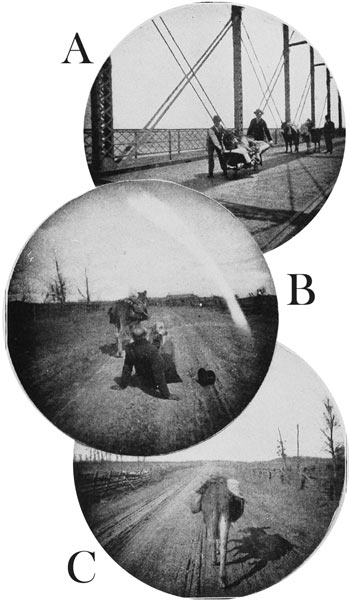
A. "In this way I crossed that bridge of size."
B. "I saw the streak of daylight."
C. "So slow that his shadow beat him to town."
TOC
BY MAC A'RONY.
An uneducated person, seeing a picture of a donkey in a field,
sees only a donkey in a field, however well it may be painted, and
I fancy very exceptional ability would be required to make any of
us think a gray donkey sublime, or believe an ordinary field to be
one of Elysian.—Ideala—Sarah Grand.
There will be many converts to the Darwinian Theory
by the time I have taken Pythagoras Pod to his destination.
They are recruiting all along the line.
The Professor's street lecture in De Kalb in a mist was
punctuated with effusive allusions to his "obstreperous
asses," which epithet only strengthened our ill-feeling
toward him, and furnished a new incentive for Cheese's
rascality. When Pod reached the middle of an elegant
burst of rhetoric, that animal, true to asinine instinct,
pushed a hind foot against the orator's stomach and
brought the speech to a finish. The afflicted one was tenderly
borne away, I know not whither, but Cheese whispered
probably to a blacksmith's where a bellows could be
had with which to pump wind into the vacuum.
The following day, my master having come to, it was
decreed that Cheese and I be taken to a smith's to have
our corns pared, and our shoes repaired. Whenever Pod
has an idle moment—thank Balaam he hasn't many!—he
amuses himself by torturing a donkey. Shoes are a nuisance,
especially new shoes, and I would much rather go
barefoot as do country boys and girls.
The blacksmith, an expert cobbler, shook hands with
us, with special deference to Cheese, who was to have
the new footgear, then informed my master that if we
jacks would treat him with respect he would do what was
right, but if not, he would inflict on him what he himself
had received from us. I overheard Pod mutter as he departed
that he was sure that villain Cheese was going to
kick him by proxy.
When Pod returned, that incorrigible donkey had both
smiths in a corner, and was kicking knots out of the walls.
Soon that shop appeared as if constructed of perforated
cardboard, and the two men as if they were worsted.
Both men were saved, however, by Pod, who ran to a
bakery for some cakes with which he completely subjugated
the murderous brute, and enabled the men to
complete the work.
All next day we labored through mud, which made my
feet feel good, but spoiled the looks of our new shoes.
That day the Professor bought a new donkey.
"Sell him cheap, sound as a dye," said the man. Perhaps
this was the truth, but he was the funniest donkey
I ever set eyes on. His face resembled a poodle dog's, except
that it was longer, and he appeared to be a combination
of crosses between South American llama, Rocky
Mountain sheep, baby camel, and muley cow, with only a
sprinkling of donkey blood. After this freak was roped
to my saddle and we had proceeded a little way, I asked,
"Excuse me, friend, but what stock did you descend
from?"
"Why, live stock," said the simpleton.
The rest of us hid our faces; but I persisted, "Who's
your father?"
"I never had a father," he returned. "If I did, he never
showed up in my lifetime. As for my mother, she kicked
the tenderloins out of a farmer's thoroughbred pig, in
consequence of which I was left to shift for myself, so
you can't call me a shiftless fellow."
Well, the poor fellow ain't quite as bad off as Topsy, I
thought—she had neither father nor mother.
For a week back Cheese had been complaining of a
weak foot, which explains why Pod desired an emergency
donkey. The heavy roads would have taxed a dray
horse. But by shifting the burden from Cheese and myself
to the new acquisition we were able to make better
time with less effort.
The sun was hot, and Poodle's long coat dripped with
perspiration. Before long, we were stopped in front of a
house, where a man was cutting the grass with a lawn-mower.
"Hay, there, Mister!" Pod shouted; "will you loan me
that machine a moment? I'll remunerate you handsomely
for the kindness."
The farmer just shouldered that machine and fetched it
down to the roadside. Then my master dismounted, and
whispering to the granger something I couldn't understand,
to my utter astonishment deliberately pushed that
lawn-mower almost the whole length of that donkey's
back.
I recall the incident so vividly. First sounded the noisy
swish of the mower, next the fragrant air was hazy with
flying hair, hat, man and mowing machine. A moment
of painful silence followed, when suddenly a clatter from
the roof of the house indicated that the jackass had
promptly returned the machine to its owner.
Poor Pod, it looked as if he were no mower. The farmer
laid him gently on the grass, where he finally awoke,
and with the aid of hard cider and a fanning machine was
restored. Three miles beyond he caught the refractory
jack that meant only to harm the machine, he said, and
not the man, and securing a slipnoose to Poodle's tail,
roped him to my saddle; next he tied Cheese to my tail,
and leaping aboard his new expedient led the way.
All at once Poodle espied two donkeys grazing in a
field. "I must say a farewell to my sweethearts before
leaving," he protested, braying and making a dash for the
fence, dragging me after him. I often wonder if he had
any feeling left in his tail after that; for while it pained
me to drag Cheese, it must have caused Poodle more pain
to tow us two by resorting to such a sensitive extreme.
Had not the fence been a thorn hedge, I verily believe
that that "Samson" would have dragged us across lots to
his sweethearts. I never saw Pod so enraged.
On nearer approach to Rochelle, we stopped in front of
a house where Pod purchased a drink of milk of a woman
who was passing milk cans to a man in a wagon. Neither
the man nor the woman asked a question, much to my
surprise, until we had proceeded some distance, when to
prevent a tragedy, nature asserted herself and impelled
the woman to call out: "Say, what be them thar animiles
ye-ve got, stranger?"
"Two are camels, and one is a dromedary," Pod yelled.
"Dromedary!" The woman exclaimed; and, to the
man, added, "That's a new sort of dairy I never heered
tell of. Did you, Hank?"
TOC
BY PYE POD.
"By my faith, Signor Don Quixote," quoth the duchess, "that
must not be; you shall be served by four of my damsels, all
beautiful as roses." "To me," answered Don Quixote, "they
will not be as roses, but even as thorns pricking me to the very
soul; they must in nowise enter my
chamber."—Don Quixote.
From Rochelle to the Mississippi I found the people
more conservative, but interesting subjects for character
study. The topography of the country varied but little.
Snipe, quail, doves and meadow larks were prevalent.
The pesty pocket-gophers were as shy of my fire-arms
as of the farmers' dogs; one might shoot a dozen of them
only to see the spry little fellows drop dead into their
"home-made" graves. I have seen hundreds of them sitting
upright on as many mounds, immovable as sticks, but
pop! and they vanished.
Crossing this one-time prairie state, I recalled pictures
of prairie fires in my school-books, and easily imagined
the terror of the droves of wild horses and buffalo, fleeing
before the leaping flames.
This seemed to be a contented section, and contentment
is a great thing. Although no woodland was visible, I
saw occasional clusters of "pussy willows," and groups of
shade-trees embowering a house, above which the shaft
of an aeromotor towered like a sentinel, asserting the
homestead rights. When the windwheels were in motion,
they created a noise which only an expert linguist could
distinguish from the vernacular of a guinea hen.
Here and there bunches of cattle browsed in the meadows
behind barbed-wire fences and thorn hedges; and
long corn-cribs, often full to overflowing, had rewarded
most every farmer.
About dark, May first, my small caravan ambled into
the village of Ashton, and my bugle blasts aroused the
nodding inhabitants sufficiently to give me a fair audience
for a lecture. The Germans predominated, and to them
May-day festivals are indispensable. Boys and girls celebrate
by hanging May-baskets on door knobs, and a few
wags, who resemble frogs, in that a half dozen make you
think they are a million, shower corn, sand and bird shot
at windows equal to a Kansas hail-storm.
The celebration that night seemed to be directed at my
particular window. The racket had almost soothed me to
sleep, when suddenly a rag doll loaded with shot came
smashing through the blinds and landed on my bed. My
patience overtaxed, I arose and resorted to free trade by
exporting to the street a piece of crockery, and a chair,
not to mention a few roasted invectives. I would have
folded my bedstead and sent it sailing after them, but the
disturbance of the peace and the pieces ceased together.
While at breakfast I wondered if any tricks had been
played on my animals. I was quite sure of it before reaching
the stable. The livery keeper came hobbling up on
one foot and a crutch, with his face done up in fly-paper,
and a bandage around his head.
"What's up?" I asked.
"Jacks got the spasms."
"You mean spavins," I corrected, innocently enough.
"Guess I ought to know the difference 'tween spasms
and spavins," he returned, sourly. "Those d—— mules
o' yourn kicked out petitions, hollared, and had such fits
last night that they scared all the mice and rats outen the
haymow."
"What kind of petitions?" I asked, remembering I had
been tempted to issue a petition on my own account.
"What kind d'y, 'spose? Wooden petitions," said he.
"And when I crawled out o' bed and went to the stalls to
see what ailed 'em——"
"Ailed the petitions?" I interrupted, excitedly.
"Naw, the mules,—something like a thousand rats and
mice ran over my bare feet. I thought the barn must be
afire, and I jumped so the lantern fell outen my hand and
broke, and I had to feel my way in the dark."
"You ought to know better than to feel around strange
donkeys, night or day," said I, reprovingly.
"It wasn't th' feelin' of 'em what broke me up so," said
he. "'Twas the kindlin' wood they piled up again me."
I did not discuss further the circumstances; I was
quite satisfied, since we had grievances in common.
While settling my bill, I noticed Mac gaze at the ceiling,
so I glanced upward, too, and at once saw hanging to a
nail on a cross-beam a circular rat-trap, bent almost flat,
and containing two dead rodents. That solved the mystery.
On recovering the trap, we found it sprinkled with
donkey hair, and sheep twine, which was proof enough
that some young villain had fastened a cage full of rats to
Mac A'Rony's tail, he being the most amiable of the
donkeys. There is nothing like the mysterious to frighten
a dumb brute, and when that donkey heard strange noises
and felt mysterious movements about his hind legs, he
didn't wait for an explanation. Good-bye, rats!
Although the day dawned clear, dark clouds began
early to bank in the Southwest, and before I could reach
the next town I was drenched by a heavy shower. But I
was fortunate in selling Cheese II, my weak-footed jack,
for seven dollars to the village butcher, who, while in
Ashton, had generously fed my dog.
Wet to my skin, I took refuge in a German tavern managed
by a widow with five comely daughters. All were
kind and responsive to my wants, and brought to my
room a varied assortment of house pets, literature, and
cheese, not omitting a bottle of beer, for my entertainment
and refreshment, while I remained in bed enveloped in
comforters, waiting for my only suit of clothes to dry by
the kitchen fire. Meanwhile I became almost asphyxiated
from the gas generated by the Limburger cheese which
had already smothered two hearty slices of bread. The
next day I spent in Dixon, and the following day in
Sterling, situated on Rock River. From my bedroom
window I had a charming view of the dam falls and the
iron bridge which spans the stream. My sojourn in both
these towns was profitable.
It was a hot and dusty ride to Morrison, where I found
a brass band serenading a leading citizen. "This won't
do," said I; and making Mac bray, I blew my bugle, and
at once turned the tide of popularity in our favor. The
fickle crowd soon gathered and cheered me to the hotel,
while the jilted band had the brass to march down the
street past me, blowing itself with might and main until
lost to view, not once thinking that distance lent enchantment
to my ear. Next day we made slow headway to the
Mississippi.
As I approached the "Father of Waters" the land, as
well as my donkeys, were more rolling. Several times
when wading through a pool of dust, Cheese III, alias
Poodle, would suddenly stop, circle about, kneel and roll
with all the paraphernalia he was carrying. Then my
steed would follow suit, before I could get out of the
saddle.
Thirteen miles from Morrison lay the village of Fulton,
on the banks of the Mississippi, and it was 4:30 P. M.
before we arrived at the big high bridge. The bridge
approach on each side of the river crosses a broad stretch
of lowlands which at certain seasons is inundated. My
donkeys refused to pass the toll-gate, although I had paid
the toll. I demanded of Mac an explanation. He maintained
silence, as did Cheese, and neither of them would
budge. A squad of laborers, amused at my plight, asserted
their donkey nature by imitating an ass's bray, and
so perfect was the imitation that my animals took them for
donkeys disguised in human apparel, and joined in the
awful chorus. Presently a timid woman following us
with a terpsichorean horse called to me and gesticulated
wildly. I feared a runaway and was at a loss to know
how to urge my contrary animals on, but before long a
double dray team came to my assistance. The teamster
roped Mac to the rear axle of his wagon, cracked his
whip, and drove on, dragging the obdurate donkey on his
haunches across the bridge, while Cheese crept closely behind
in fear and trembling.
When I had crossed the Mississippi it was exactly
seventeen minutes past five.
As we wended our way into Clinton, Ia., cheers greeted
us from every quarter. "The streets were rife with people
pacing restless up and down;" but soon all footsteps followed
in one direction, to the Reviere House, where I
took advantage of the favorable circumstances to make a
speech, and to dispose of a host of my chromos.
I had traveled thirteen hundred and sixty miles, about
one-third of the distance by trail from New York to San
Francisco, and had consumed one hundred and sixty
days; and there was left me only one hundred and eighty-one
days in which to accomplish the remaining two-thirds
of my journey.
TOC
BY MAC A'RONY.
Hell is paved with good
intentions.—Samuel Johnson.
How the Professor ever landed that lop-sided, dilapidated
tile of his on the west bank of the Mississippi without
a bottle of fish-glue is beyond me.
The wind gave our whole outfit a good blowing up for
not crossing the bridge earlier in the day, and Pod had
to handle the hat as carefully as an umbrella to prevent
it's turning inside out.
Except at such times, we donks were the only ones to
get a "blowing;" the threats Pod used to coerce us across
that lofty bridge and his final cruel expedient of having
a double team drag me with a rope around my neck were
enough to drive one to suicide.
"We must reach Iowa to-day," said he. "You show absolutely
no interest whatever in the next state; but I'll
convert you." I protested until I was hoarse. Said I,
"When you take into consideration all the different animals
that came out of the ark,—monkey, parrot, man and
ass,—and the results of several thousand years of study
and research, how many believe in any other state? Only
one. Man. There are a few horses and dogs and cats
and, occasionally, a white rat, that enjoy heaven on earth,
but we jackasses are always catching ——! The last
word of my peroration was spilled, as my master whacked
me over the ears with his black-snake whip and knocked
all the theological and theosophical considerations out of
my head.
"Get along, there, Mac," he shouted, "and quit your
everlasting braying;" and as the horses started, I "got,"
to save my neck.
When we reached the middle of the bridge and I was
over my dizziness, I slackened my neck rope and followed
the wagon more willingly, but my fetlocks bled from
scraping on the rough planks and my rich aristocratic
blood painted a faint red trail behind us. It was a hot
day; I burned as with a fever, and wanted a drink.
"And they call this the 'Father of Waters,'" my master
soliloquized, as he watched the sluggish current creep under
the bridge.
"What do they call the father of beer?" I asked,
facetiously, for I was mad.
"Mac," said Pod, "you have brought me back to earth.
Let us hurry to town."
When we were on Iowa soil, the Prof. tied his "stove-pipe"
over my ears with a green ribbon, and added
insult to injury by making me parade into Clinton in that
condition before all the genteel donkeys along the road.
We stopped at the post-office, and Pod read on the way
to the hotel portions of two letters, one informing him
that his sombrero was at the express office, the other casting
aspersions on my race. "Yes, I did promise to meet
you at the Mississippi and accompany you across the
plains," the letter ran, "but really, old man, after reading
your articles, I have concluded that I want nothing to do
with a jackass."
Pod seemed disappointed and, handing the envelope to
me, said, "Here, Mac, what do you think of it?" I greedily
devoured the contents without a murmur, and the Professor
galloped into the express office.
"Do you realize that you have swallowed a postage
stamp?" Cheese asked, gravely, after I had stowed away
the morsels of paper.
"Most assuredly," I said, smacking my lips, "and hereafter
you can look upon me as a sort of internal revenue
collector."
But now Pod appeared under cover of a broad-brimmed
hat, looking frightfully cowboyish. That evening the
sombrero so completely unbalanced his head that he sauntered
up the street armed to the teeth, and attempted to
"hold up" an Indian cigar sign, to the amusement and
terror of passing pedestrians. Later on, he became more
rational, and gave a street lecture.
Friday, May seventh, was a lucky day for Pod and
me. Friday is Pod's and the seventh of the month is
mine,—with a few exceptions; hence, the Prof, has on
an average of four and a half to my one.
His first errand in Clinton was an act of courtesy. He
called on Mr. Gobble, the genial Mayor, and obtained one
of his quills to embellish the autograph album which was
destined to furnish me a delectable repast, unless Pod
should find a gold cure to destroy my appetite for stationery.
His second errand was to place an order for panniers to
be made after his own designs, for they would soon be
needed; and his third, to call at the stable and superintend
a tonsorial artist clip Cheese III after the devil's designs.
The circus had begun when he arrived. There,
tangled in straps and ropes, lay the frightened subject on
the stable floor, kicking, while several men were performing
rare feats of tumbling. Pod was indignant.
"Is it necessary to pile on the donkey in that fashion?"
he inquired, starting up a ladder to the loft.
"I reckon so, squire," said the clipper, rubbing his
bruised arm; "we tied the brute t' auger-holes in the floor,
but he yanked the holes plumb out o' the boards, and we
bored 'em in agin. Then he brayed, and strained, and
pulled out the holes agin. What's he been livin' on?
Indian turnips?"
Pulled the holes out of the floor! Such an astonishing
statement was enough to warp a donkey's credulity. But
the operation was finished at last, and Pod returned to the
hotel to answer some letters, one of which seemed to tickle
him very much. It was from a farmer in the neighborhood,
and I'll quote it word for word.
Cornville Hollow, Iowa, May 6, 1897.
Prof. Pithygors Pod, Eskire, M. D.:
Illustrious Sir:—My wife has give me unexpeckted
opertunety ter do ye the grate onner of namin our latest
and last kid after ye and if ye cum this here way ye will
see a namesake ye will be prowd of. Times are not so
good with us of late but hope they air with you wishing
you a socksessfull jurny I remane Yours fraternally
Cy Sumac.
I did not see Pod's reply, but I took him to the post office
to purchase a ninety-nine cent money order, which he
mailed to Cy, and overheard him say that was all the
money he had when he started and no man had a right to
think he was any richer now, and hoped naming children
after him wasn't going to become a fad.
On our way to the hotel a little girl, walking with her
papa, expressed the wish to ride on my back. Pod overheard
her, and jumping off, placed the little one in the
saddle, and led me down the street.
Pod is never safe without a chaperone. He had no
more than got his land legs than a monstrous colored
woman, whose avoirdupois was out of proportion to her
energy, and with shoes that made him keep his distance,
stepped in his way, and with a grin half the width of an
adult watermelon asked him if he was "shully dat wonderful
traveler Pye-tag-o-rastus w'at was chasin' a mule roun
de world."
For a second Pod was somewhat colored, too; but he
laughed, and said he believed he was the gentleman. Then
the old mammy held out a great black hand, with knotted
fingers, looking more like an elephant's foot than anything
else, and asked if she might have the honor to walk a
piece with him. The Professor took the proffered hand,
and the pair sauntered on down town, and were soon lost
in the crowd.
TOC
BY PYE POD.
"Why, Toby's nought but a mongrel; there's nought to look at
in her." But I says to him, "Why, what are you yoursen but a
mongrel? There wasn't much pickin' o' your feyther an' mother,
to look at you." Not but what I like a bit o' breed myself, but I
can't abide to see one cur grinnin' at
another.—Mill on the Floss.
The good old black mammy, who made my acquaintance
on the street, called upon me at the hotel to present
me with a little dog. I thanked her, and told her that
one dog was all I could take care of; whereupon she argued
that I should visit the Indian Reservation at Tama
City, and if I presented a dog to the Chief that I would
be royally received. A good idea; I wondered it had not
occurred to me. I accepted the dog.
An hour later I came near being arrested for promoting
a dog fight in defiance of the law. Don was generous,
however, and left a little of the cur for the Indian
Chief, but next morning the sight of a bandaged and
plastered dog being dragged behind my outfit was gruesome
indeed.
This is how I managed the dogs. I chained Don to
one end of an eight-foot pole, and the mongrel to the
other, so that the dogs could not get closer than four
feet. Then I chained Don to the saddle-horn.
I hoped to reach the town of DeWitt before dark.
Everything went smoothly and I was congratulating
myself on getting out of the city without a mishap, when,
suddenly, both dogs leaped to the opposite side of my
donkey in the effort to reach a cat basking in the sun.
The pole yoke caught Mac's hind legs and upset us, almost
causing a runaway. This and other incidents delayed
me many hours. On arriving at the village tavern,
"The Farmers' Home," I was agreeably surprised to find
the landlord not so much out of spirits as I. A "night
cap," then to bed.
Next day I rode sixteen miles, through the beautiful
farming country to Wheatland. Nature was arrayed in
Sabbath attire, and no sermon could have inpressed me
more than the pure, sweet voicings of God's creation.
Graceful turtle-doves, always in pairs, flitted in mid-air;
bevies of quail whistled in the meadows and ditches;
flying-squirrels, half winged, half jumped from tree to
tree; and coy Norwegian girls scampered indoors as my
"mountain canaries" now and then joined in a carol.
Just before entering town a gay cotton-tail rabbit
shied at my pistol ball, allowing the ball to graze a calf
grazing in the field beyond, to wing a pigeon on a barn
further on, and eventually to announce my advent to the
towns-folk in a most singular manner.
When I arrived, the church bell was faintly tolling, and
a crowd of people were staring wild-eyed at the belfry
tower. I inquired of a countryman what was up.
"Blamed if I know," said the sexton; "I was jest settin'
down to feed, when sudden I heard a sharp clang
of the church bell. Sounded like it was hit with a hammer.
Whole hour before church, and the doors are
locked. Now I'd like to know what sot that bell to
chantin'."
"Go up and find out," I said.
"Not on yer life," he replied. "You may think us folks
superstitious—well, we are. Lots of queer things happen
in this town."
When I reached the privacy of my room, I did a good
deal of thinking; but whichever way I reasoned I arrived
at one conclusion. My pistol ball must have struck the
bell after calling on the calf and the pigeon. It was
merely a chant's shot.
The landlord of the Siegmund Hotel did not venture
close enough to shake hands.
"Doos them dogs bite—yes?" he asked from the veranda.
"No," I answered, "they won't bite you and me, but
they are very fond of each other."
Don looked up at me appealingly, as if he thought he
had been persecuted. When the donkeys and the mongrel
were in the barn, I turned Don loose. He was
tickled, and ran round the barn three times, jumped over
the hen-coop, upset the landlord, and then chased the
house cat so that it climbed to the top of the hotel chimney.
Most extraordinary dog; no common pastime satisfied
him.
The hilly country I was now entering made it necessary
for me to walk half the time, as a precaution against
wearing out my animals. But the air was sweet with
lilac, tulip, violet and apple blossoms; blue and red and
yellow birds serenaded me as I passed, all making me
feel somewhat repaid for my winter hardships.
The main street of Mechanicsville was beautifully
shaded, and along the road-side was a tempting pasture
for ruminating animals. As I rode along and admired
the scenes, I recalled a sentence from the Scriptures:
"Whatsoever cheweth the cud that shall ye eat." To the
right, in the cool shade, reclined a gentle-eyed cow,
chewing her cud; to the left, at the base of a magnificent
tree, sat a pretty bloomer girl beside her bicycle, also
chewing. I was puzzled.
On reaching Mount Vernon, I discovered, after diligent
inquiries, that Washington had never been there,
dead or alive. Cornell College, for boys and girls, distinguishes
the place as a seat of learning, and the students
showed an abnormal appetite for knowledge by
purchasing my books and photos. A few miles west I
crossed a ridge of wooded hills, descended into a lovely
vale, crossed Cedar River, and drew rein at Bertram, a
mountain town consisting of a railroad station, side
track, tavern, store, and two to three houses.
From Bertram we mounted another and still higher
ridge, from the summit of which I could see the great
verdant valley, and, winding about it, a spiral cloud of
smoke from the busy city of Cedar Rapids, where I arrived
at six o'clock.
That evening, after a lapse of nine years, I met my old
friend, Steve D——, who once had tramped Switzerland
with me. After I had explained the cause of my unique
pilgrimage and each had given an account of himself, he
planned for me a pleasant two days' sojourn, and suggested
it was time I had a useful traveling companion.
As I moved westward, the towns would be farther apart
and I would have to camp often on the highway. The
services of an able and trusty man would save me much
time. Steve said he would try to find him.
Cedar Rapids contains some of the largest oatmeal
factories in the country. I met through my friend several
pleasant people, dined with his family, and was tendered
a spread at the Grand Hotel, to which a few of his
friends were invited. Meanwhile I found the man I was
looking for.
He was about twenty, had been night porter in a hotel,
and was well recommended. Twice I refused him because
of his apparent inexperience in "roughing it," but
I was won over by his persistence at the third call. He
said his name was "Coonskin," and Wisconsin the State
of his nativity. His attainments were something extraordinary.
He could sling a Saratoga trunk into a first
story window; had painted the highest church steeples,
and broken the wildest horses; could skin all kinds of
game, and, with equal facility, could "skin the cat;" in
fact, he had made an enviable record in athletics, and had
won several championships for sprints. He could swim
like a frog, and, as for shooting, his comrades couldn't
touch him with any kind of a gun. He was never ill, and
had stood all kinds of exposures from hanging all night
on a church steeple after his ladder had fallen, to riding
on the trucks of a baggage car, as the result of the disbanding
of a theatre troupe.
This Coonskin was a wonderful combination of resources;
he was the very man I wanted. He wished to
go with me for fun and experience, and was perfectly satisfied
if I would defray his expenses. I took Coonskin
at once to make the acquaintance of Mac, Cheese, Don,
and the mongrel, and to be assigned to his duties.
At nine o'clock the morning of our departure, he
called at the hotel with a small bundle done up in a red
handkerchief, and wearing a new pair of shoes.
"What have you in that bundle?" I asked.
"Everything."
"Extra suit of clothes?"
"Yep—and patches for emergency."
"Extra shoes already broken to your feet?"
"Yep—and chloride-of-lime and extra socks."
"Brush and comb and tooth brush?"
"Yep—and corn plasters and curry-comb."
"Extra suit of underwear and handkerchiefs?"
"Yep. Pajandrums, too."
I smiled in astonishment, so small was the bundle.
"Well done," said I, "after this you shall do all my packing."
I was gratified to note Coonskin's quick perception,
his alertness to obey, and his capacity for memorizing.
He did not have to be told a thing more than three times
before understanding it, and his lively interest in my welfare
manifested itself at the start. When I went to the
stable at eleven o'clock, I found he had added to my
itinerant kennel a bull terrier, which took to Don as
fondly as Don had taken to the mongrel. I remonstrated.
"The more dogs you offer the Indian Chief, the bigger
time he will give you," said my valet. "Better keep the
terrier; I'll preserve harmony."
Glad to shift some of my responsibilities to the broad
shoulders of this young genius, I returned to the hotel
and dressed for luncheon.
You may imagine how my heart was set aflutter when
luncheon over, my valet rapped on the door and, venturing
a foot in the room, said, with the courtliness of a
Sancho Panza, "Your highness' donkeys and dogs are
at the door."
My guests were as much amused as I, and accompanied
me to the street, where a crowd had assembled.
I shall never forget the expression on my old friend's
face when he saw the dogs yoked together. A second
pole had been brought into use, and, Don and the mongrel
having become reconciled, the bull terrier was made
a sort of pivot round which revolved the other two, a
mean dog between two extremes.
Coonskin said at first he had made the little mongrel
act as the pivotal dog, but he had no sooner left the animals
than Don and Towser swung round and clinched
in pugilistic style, and, had it not been for the efficacy of
the stable hose, with all hands at the pump, the mongrel
would have soon been converted into sausage.
It was nineteen miles to the village of Norway; we did
not arrive there till eleven at night. Once or twice on
the way Coonskin was prevailed upon to relieve me in
the saddle for a couple of miles; but although his new
shoes were paining him, as I could see from his gait, he
was too "game" to admit it, and whenever I asked him
to ride, protested that walking wasn't a circumstance
with him. He would rather walk than eat.
We found Norway asleep. After assisting Coonskin
to stable the donks and secure the dogs, I perused a
newspaper while my young neophyte went out to smoke.
When he limped in, I noticed his coat pocket bulged
with something he would conceal. I did not question
him. But before retiring, I opened his door to give him
orders for the morrow, and found him dressing his feet
with Indian ointment, which he admitted he had procured
from the village druggist. He had with difficulty
aroused the man from slumber, in consequence of which
he was made to pay double price for his cure. Coonskin
was somewhat embarrassed, but I praised his pluck in
glowing terms, and put him at ease. Next day he was
ready to take advice, by wearing his old shoes and riding
most of the journey.
TOC
BY MAC A'RONY.
What made Balaam celebrated as an astronomer?
He found an ass-to-roid.—Old Conundrum.
I had heard about the chilly climate of Norway, and was
not surprised when we donks met with a cold reception.
We had plenty of hay but no grain. Next morning the
landlord said that he expected some oats soon after our
departure.
Pod had walked the last three miles, and warming up,
had strapped his vest to the saddle, where I found it next
morning. Peaking out of a pocket was a crisp five dollar
greenback.
Now, a donkey likes anything that's green. I never
had eaten a vest. But I determined to tackle this somewhat
tough corduroy "steak," and made a fair breakfast
on it, not to speak of its garnishes of green money, lead
pencils, and a scented lace handkerchief, the one my
master had long carried in the left inside pocket. Save
for the fact that I got a few sharp bones of a pocket-comb
in my teeth, and a page of court-plaster stuck in
my throat, I relished the repast.
But not so the Professor. When he had searched
some time for the vest, he looked at me. As luck would
happen, I had left sufficient circumstantial evidence on
the saddle to convict most any donkey, but no one in
particular. However, I suppose I looked guilty, and
my past record was against me. Pod was speechless a
moment, then he made up for lost time, and said that he
believed a jackass would devour a house and lot if he
had the chance.
"I don't know about a house," I replied, "but I know I
could eat a lot if it were set before me." Then I caught
it!
By nine o'clock the clouds having dispersed, we started
for Blairstown.
The Iowa farms were pleasing to my eye. Horses and
cattle were cropping the juicy grass, hogs were shelling
corn or taking mud-baths, fowls of all kinds were engaged
in athletic sports trying to add some new feather
to their plumage, and occasional bunches of sheep were
standing in barnyards and corrals with wool pulled over
their eyes, not knowing what to do with themselves. It
looked like a Garden of Eden, where donkeys were excluded.
Finally we met a farmer with a team of lazy horses.
Pod asked him if a donkey was a known quantity in
those parts, and was told that a man by the name of
K——, living near the next town, owned two that he had
been trying to give away. A mile beyond, we met a man
in a one-horse gig, who had a word to say, too. One
donkey knows another when he meets him.
"Your name is K——?" Pod inquired.
"That's the name I always went by," said the black-eyed,
black-hearted man. I did not like his looks; I
felt it in my bones that Pod was going to be "done" by
him. When a man or donkey is over anxious to acquire
something, he is pretty sure to make a blunder. On being
catechised, the man said his business was "hoss tradin'
some, farmin' some, and various some."
"Hear you've got a donkey for sale," Pod observed.
"Nope," said K——, "but I've got two of 'em. Sell
both er none."
"I was told you have tried to give them away," said
Pod.
The "hoss trader" threw one leg over the other, spat
tobacco juice in Don's eyes so he couldn't see all that
might a-cur, raked timothy seed out of his whiskers, and
inquired, "Who was tellin' ye that?"
"The fellow didn't give his name," answered Pod, "and
I wouldn't undertake to describe his physical geography,
but I could locate him if I wished to."
"If I could lay my hands on him, I'd dislocate him,"
said K——, snapping his eyes.
When my master told about his travels, the Iowan became
interested, and showed signs of weakening on his
ultimatum. Meanwhile, I discovered the subjects of the
discussion grazing in a meadow, and brayed them a
courteous "how to do," thus calling Pod's attention to
them.
The hoss trader was sharp enough to see it, and his
animal instinct told him that vanity was Pod's weak
point; so he opened up with a little blarney.
"Now, Mr. Pod, I'm fair t' say I've sort o' takin' a
likin' to ye, and I want to help ye along. I'll sell both
my donkeys for ten dollars, er one for five and trade the
other for one of your'n. Jest let your partner here run
across the field and drive 'em over. I want ye to see
'em."
Coonskin went, and K—— continued: "They're two
as fine-lookin' jennies as ye'll run across in many a day,
both healthy and strong—not too young—not too old—often
plow with 'em—kind and gentle—boy rides 'em
everywhere—fast, too, but no danger runnin' away.
Why, they're twice the size o' your'n, and 'll carry double
the load."
"I'm more than satisfied with my donkeys" (very
flattering to Cheese and myself), Pod affirmed, "and
only require one more. If I am suited with one of your
donkeys, I am willing to pay five dollars for it, but I
will not trade one of mine, nor will I purchase both of
yours."
By this time the animals arrived. They were certainly
big enough, and as for the danger of their running away,
they didn't act as if they could run ten feet if charged
with a thousand volts of electricity. The farmer said he
was bound to make a satisfactory deal with Pod somehow,
and that if he wasn't convinced by the time we
reached his house that both animals weren't superior to
either of his (an absurdity on the face of it), then he
would consider some other proposition.
When we reached the house, Cheese and I were generously
fed, and Pod and Coonskin invited into dinner.
Then K—— chased his donks around the yard, and
felt them all over, and finally hoodwinked my master to
buy one, and trade the other for Cheese. I could have
kicked the daylight out of that man.
When K—— was on his way to town with his five dollars,
Pod came to the stable. My new companions were
crabbed old spinsters, and raised some objections to going
with me.
"Where are you bound?" one asked.
"San Francisco," said I, "but I don't know where that
is any more than do you. Guess it's land's end." Then
I told them how far I had come, and that Pod said only
a few days before that the journey had only begun; also,
that he expected we donks would fall off some before
long, from which I inferred the fall would be gradual and
the horrors of death prolonged.
It was enough to frighten the wits out of any old maid,
and it took a pitchfork, two hoe-handles and a crowbar
to get those donkeys out of the gate. Then one of them
balked, kicked, threw Coonskin, broke her halter, and
ran back into the yard. She could run after all.
That was enough for Pod. He rode me back into the
yard, and told Coonskin to fetch Cheese out of the barn.
And it didn't take him long to shift the blanket from that
gray spinster to my old chum.
"You just tell your dad when he returns," said Pod
to K——'s son, "that I don't intend to put up with any
such game. He grossly misrepresented that donkey; it
would take a week to travel a mile with her. As I have
paid him for the other one, she belongs to me and I shall
push her along with the outfit. But this animal," and he
pointed to Cheese, "is mine yet awhile. Good-bye."
"Do as you like," K——, Jr., replied. "I know nothin'
'bout yer agreement."
We covered the first mile in slow time. Coonskin's
new steed was forever stopping, and straying out of the
road to eat grass. The young man wore himself out
keeping her moving by rapping her with the flat side of
a hatchet. This big, brown jenny was made of the right
stuff, but evidently lacked training and experience.
We were yet a half mile to Blairstown when a young
woman and a child drove toward us with a skittish horse.
It acted as though it had never seen a donkey. It
pricked up its ears, and snorted, and, so help me Balaam!
in a jiffy that buggy was on its side, the girls on the
ground, and the horse running to beat a cyclone. Luckily,
the girls escaped injury. My master was as frightened
as he was chivalrous, and assisting the girls to their
feet, invited them to ride us donkeys to town; which
kind offer was respectfully declined.
On our arrival, Pod took us to a blacksmith's to have
the new donkey's fore feet measured for a pair of shoes.
The smith seemed to be much taken with me, and said
I had the smallest feet of all the gentlemen donks he ever
met. The remark so tickled my vanity that I nibbled at
his coat tail, whereupon he turned to me and inquired,
"What kind of a donkey are you? Chinese?"
"Not much," said I, indignantly, "My name is Irishy,
and I always supposed I was a thoroughbred Irish ass,
but I'm beginning to believe I'm a roamin' donkey, after
all."
I could see that Pod expected trouble from some quarter,
but none of us knew just where the lightning would
strike. The next village, Luzerne, lay fifteen miles to
the west. My lady companion did not carry herself too
gracefully, nor her rider, either. She was broad and flat
across the hips, and, as Coonskin did not possess a saddle,
he found it more comfortable to sit far back on her
where he could get a good swing of the fence rail he substituted
for a whip.
We were ambling peacefully along the dusty road late
in the afternoon, when Pod broke the silence with a word
to his valet.
"Well, Coonskin," said he, "what 're you going to call
your donkey?"
"Damfino," said Coonskin; and he added, with a
drawl, "Git ap."
"You ought to have found a suitable name by this
time."
"I have named her," emphasized the young man.
"Good!" shouted the Professor. "Let's have it then."
"Damfino," yelled Coonskin, with a wild swing of the
fence rail.
Pod's face turned on its axis with a puzzled expression,
as his eyes regarded the hopeful pioneer. Said he,
"See here, young man, I know not whether my ears deceive
me, or you are not up on my dialect; you say you
have named the donkey, yet, when I ask the name, your
answer implies a contradiction. Again, what is her
name?"
Coonskin drew a long breath, and said loud enough
to be heard a mile away, "Damfino."
As the fellow uttered the word, I dropped to the joke
and, stopping in the road, brayed till my sides ached.
A new light now came into the Professor's eyes, and
he smiled. "Damfino, then, is the lady's angelic name,"
said he resignedly. "It's odd, it's not inappropriate. Let
it stand."
"Very well," returned Coonskin, "I will proceed with
the ceremony." And letting the fence rail fall on his
steed's rear quarter, he added, "In the name of the great
and only Balaam, I christen thee Damfino." It was an
interesting event. Thenceforth Cheese and I resolved
to be more choice in our language and decorous in our
manners in Miss Damfino's presence; and we lived up
to our pledge two hours before Cheese called Don and
the bull-terrier bad names for accidentally upsetting Miss
Damfino with their yoke, and I kicked the tired and
panting mongrel in the neighborhood of its pants.
TOC
BY PYE POD.
Thou hast described
A hot friend cooling.
—Julius Cæsar.
It was nine o'clock in the evening. While we were
chatting with the landlord of the only tavern in Luzerne,
a portly, smooth-looking individual entered the room.
He was clad in a great fur ulster and top boots. After
a familiar "hello" to the landlord, he eyed me searchingly,
and added, "Your name is Pod, ain't it?"
I said, "I believe so; yours is what, don't it?"
Evidently not pleased with my expression, he instantly
struck an attitude, or something equally hard, and announced,
"I'm the sheriff of Borden County, and have
come for a jack belonging to Mr. K——."
"Jack?" I interrogated; "boot-jack, apple-jack—"
"Just plain jack," interrupted the officer.
"Well," I replied, carelessly, "I have no jack belonging
to Mr. K——, but I have the jenny he sold me for
five dollars. Mr. K—— imposed upon me, and if he
will refund the money, I will be only too glad to return
his hundred-year old mule."
Here K—— himself entered. He stormed about, and
said that I told only a section of the truth.
The sheriff gave his client a look, which quelled his
ire for a moment, then, turning to me, said: "You talk
reasonably enough, Mr. Pod, and doubtless mean right,
but Mr. K—— has sworn out a warrant for your arrest;
and if you don't want trouble and a double-jointed advertisement
just turn over to K—— the jack he claims,
and send your man back for the gray jenny."
It may not seem strange that I was converted to the
officer's way of thinking.
"Take the donkey you claim," I said to K——, "you
have the advantage of me. I haven't time to fight my
case in the courts."
My black-bearded adversary now calmed his temper;
his victory must have tasted sweet. I calculated the cost
of the warrant and the sheriff's services to be at least ten
dollars, since the officer had sacrificed angling for posse
duty; although he was prevented from catching fish,
there was a nice mess for me.
With reluctant equanimity the man who had wished
to help me along explained that he had boasted of having
acquired one of Pye Pod's noted donkeys, but when
he found I had outwitted him, he swore vengeance.
On the other hand, the officer had conducted himself
as a gentleman.
"Here, Coonskin," said the officer, "take this dollar
and fetch us a pail of beer;" and, turning to me, added,
"we must drown ill feeling amongst us, for when you
come this way again, we'll show you how to catch fish."
By one o'clock next day Coonskin, weary, hungry,
and morose, had managed to steer his slow "craft" into
Luzerne and to moor it in front of the tavern barn. That
closed the interesting event.
On our way to Tama City I was greeted by a member
of assembly, who tendered me an invitation from the
Mayor to dine with them that day. Lounging about the
shop doors and strolling the streets, on our arrival in
Tama, were many stately, still proud redskins, who, when
they espied me with the wealth of canines collected on
my way, shied off the scent for "fire-water" and dogged
my trail to the hotel.
After dinner with the Mayor and Assemblyman, I
escorted them to the stable to discover Mac A'Rony
devouring a new hair-cushioned carriage seat. At once
the Mayor wanted to buy that donkey outright, head and
seat, for a round sum.
On expressing my intention to visit the Indian Reservation,
some three miles away, his Honor gave me letters
of introduction to the Indian Teacher and the Indian
Instructor in agriculture. There lived the Sac and Fox
tribe of the Musquaques. I was told that they were one
of the most primitive tribes in the States, holding on to
the primeval, and often evil, customs of feeding on dog
soup, indulging in various kinds of dances, living in teepees,
or wickey-ups, and wearing bears' teeth, eagles'
claws, scalps, skins and moccasins. As you know, I had
long hoped to be welcomed as their guest. I was tired
and weary of the care of my dog pack, and wished to
present it bodly, save Don, to the Chief.
About two o'clock we saddled and packed. When
ready to start, a diminutive bicyclist, mud-bespattered
and perspiring from a hot century run, he affirmed,
wheeled up to the stable and, almost before catching his
breath, introduced himself to me.
"My name is Barley Korker," said he, "de champion
lightest-weight wheelman in de United States, weighin'
jest sixty-eight pounds. I'm jest troo wid a trip from
New York in one month and tirty-two days. My bicycle
was giv me by de Cormorant Club of Phil'delfia. De
Bourbon Club of Chowchow Wheelman of Pittsburg
put up five hundred dollars 'gainst de wall dat I couldn't
go all de way to San Francisco and git dere. On de way
I hears of de great donkey traveler, Professor Pod, so
I says, I'll jest catch up wid him, and mebbe he'll take
me 'long wid him."
I at once made the little fellow a proposition, which
he accepted; if he would wheel ahead of my caravan
every day, carrying a small flagstaff with a streamer containing
the words, "Official Courier to Pye Pod," I
would, as long as he gave satisfaction, defray his traveling
expenses. Barley was delighted. He forthwith purchased
a piece of plum-colored silk and a bit of white silk
for letters, needles and thread, and, having once been a
tailor by trade, when we went into camp that night said
that he would make a beautiful streamer, one I would be
proud of. He promised to have it completed in a couple
of days.
I had not more than finished my business with my
courier, when a rustic-looking boy rode up on a white
donkey, and called to me, "Want ter trade?"
"Not anxious," I returned, but showed no signs of a
desire to flee.
"Trade with yer, if you give me five dollars to boot,"
said the enterprising lad.
I recalled how I had been swindled recently in a trade,
and resolved to make a deal with that boy by hook or
by crook.
"Do you suppose I would think of trading this thoroughbred
Irish ass that has gone around the world for
your common beast, just because mine is tired from fast
and long traveling, and yours is fresh?" I saw I had
made an impression; the lad dismounted, and examined
Cheese IV, critically.
"I hain't no money to-day," said the boy, "but if you'll
give me two dollars to boot I'll trade."
larger
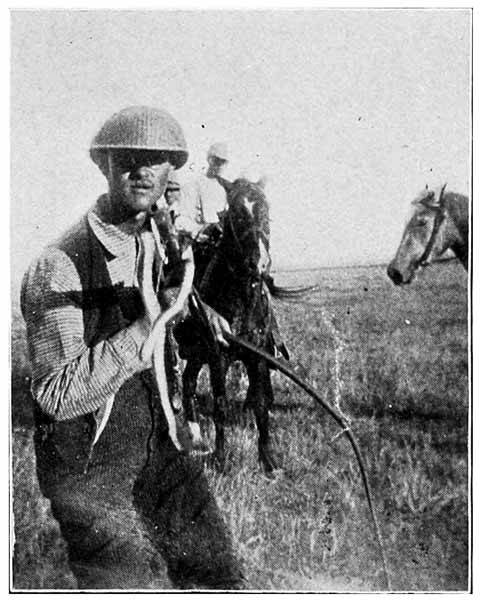
"I killed my first rattlesnake."
larger
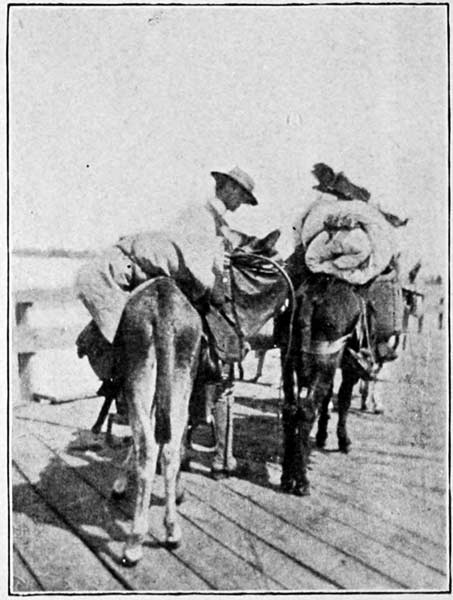
"Over the Platte
. . . after blindfolding them."
"What! do you want the earth?" I exclaimed. "Only
before dinner I paid two dollars to have this donkey
shod. I don't intend to pay two dollars more to shoe
your animal."
The lad replied "All right," and galloped away, but
had only gone a short distance when I hailed him. He
came back without hesitation, and I then concluded a
bargain. It was agreed that a blacksmith should take
the new shoes off Cheese and put them on his donkey,
and that I should pay him three dollars to boot. An
hour later Cheese V was shod, bridled and saddled, and
that afternoon became Coonskin's mount, Damfino carrying
the principal portion of our luggage, and Mac
A'Rony his master.
My party reached the Reservation in time for me to
meet the Indian teacher before he left school, my courier
having wheeled ahead to announce my coming.
I was greeted warmly when I presented the Mayor's
letter, was shown some of the lodges of the tribe, and
made acquainted with a few of the foremost braves of
the camp. The teacher was an admirable interpreter,
and the Indians grunted approvingly at meeting such a
noted personage as Professor Pye Pod.
A fat old buck named Ne-tah-twy-tuck (old one), on
being presented, extended me his hand, muttering, "How
do?" His grip almost mashed my fingers.
"Much dog," he observed, eyeing my pack with doubtful
admiration.
"Yes, too much," I replied; "I want to visit Me-tah-ah-qua,
your great chief, and give him a heap of dogs."
The Indian grinned majestically, while his teacher turned
his head to control his risibles.
"Make pleasant?" the redskin grunted, and shook his
head disapprovingly. "Me-tah-ah-qua say no dog good—old—make
tough soup." And the brave pinched one
of the mongrels, causing such a ky-eying that my interpreter
feared it would put the whole camp on the war-path.
Presently an Indian boy notified the teacher that the
chief had heard of Mr. Pod's arrival, and wished him to
dine with him at his lodge. I accepted, and the boy departed;
and soon afterward Coonskin and I were escorted
to the chief's wigwam, taking my dog pack with me.
Me-tah-ah-qua met us with a grunt, rubbed my nose
against his until it became lopsided, and likewise greeted
Coonskin.
Then the chief waved us into the wigwam. He seated
me on his right, and Coonskin on his left, while opposite
to me he placed his disenchanting daughter of forty-five
summers. Opposite the chief sat his first councilman,
Muck-qua-push-e-too (young one), and at my right, at
the entrance of the tent in full view of the host was seated
our Government interpreter, seemingly much amused by
the event. I lost no time in presenting my dogs to the
chief, who in broken sentences, half Indian, half English,
accepted the munificent gift in befitting words.
The spread consisted of a wolf skin, and on it rested a
large flat stone on which to stand the kettle of soup when
ready.
For some moments the chief regarded me searchingly,
then said, "Me-tah-ah-qua wants—big donk man to live
with him—and marry—his only daughter—Ne-nah-too-too.
Me-tah-ah-qua will give—him a bow and a quiver
of arrows—three seasoned pipes—five ponies—a new
wicky-up—two red blankets—a deer skin—bag full of
dogs' teeth—fifteen scalps taken by his father."
The chief left off abruptly, as if for my answer, but I
shook my head thoughtfully, and the chief continued:
"If you—will marry my daughter (here the chief
glanced at me, then let his eyes dwell fondly on that aged
belle of forty-five summers), Me-tah-ah-qua will make—you
chief of his tribe—before he goes to—the Happy
Hunting Grounds. He will call—your first born Chicky-pow-wow-wake-up."
I was never more embarrassed, and eyed the damsel of
forty-five summers, trying to persuade myself that she
was beautiful and rich, and still shook my head. The
old chief, seeing his inducements were not alluring, motioned
to his councilman to pass the pipe of peace. After
we had all taken a puff at it, the kettle of dog soup was
set before us, and we all dipped in our ladles, the chief
first, and began to eat.
When I first looked into that caldron of bouillon, I
could see in my mind's eye, all kinds and conditions of
dog staring at me, and almost fancied I could hear them
barking. The soup wasn't bad, after all; it reminded
me of Limburger cheese, in that it tasted better than it
smelled. But Coonskin and I, and even our interpreter,
ate sparingly (I use the word "ate," because there was so
much meat in it). I learned from the teacher that the
whole kettleful of soup was extracted from one small
spaniel. "Dog gone!" I sighed.
The feast at an end, I thanked the chief for the honor
conferred upon me, shook hands with his daughter, and
departed. Barley Korker, Mac A'Rony and the rest of
the party welcomed me with glee, and soon we were
marching over the hill toward the house of the Indian
farmer.
In front of a wigwam sat the chief's squaw, an old,
wrinkled and parched woman of a hundred and five winters,
weaving a flat mat; a little way off two Indian boys
were filling pails with sand, making believe they were at
Coney Island; and still beyond I saw two squaws carrying
huge bundles of faggots for the wigwam fires, round
which sat the lazy bucks, smoking.
A half-mile further on we met the Indian Farmer, and
I presented my letter of introduction. He extended me
a glad hand, and invited us all to supper, and on the way
to his house, enlightened me about Indian farming, and
the results of our Government's efforts to civilize the
savage tribes. The Reservation contains 2,800 acres of
woodland and arable soil.
After supper on bread and milk with the farmer, we
travelers made our beds of hay and horse-blankets in the
barn, and then followed the trail half way back to the
Indian village, until we came to a house, where I discovered
in the darkness its rustic incumbent leaning on
the fence, smoking. There we lay down on the dry sod,
lit our pipes, and listened for the first sound of the Indian
drum beats which, the farmer told us, we would soon
hear; that was the night for an Assembly dance, and the
first drum beat was to assemble the tribe to its nocturnal
orgie.
As I reclined on the grass in the starlight that mild
May evening, my mind recalling the harrowing tales of
the early settlers of the West, the first sound of the drum
beat sent a thrill through my frame. I mentally counted
the weapons comprising the arsenal in our belts; and
even Don crept closer to me and rubbed his face against
mine. After a few moments' interim the drum again
beat, but for a longer period, sounding something like
the army long-roll, only more weird. The farmer said
this was the signal for the dance to begin, so we strolled
leisurely down the hill trail through the woods to the
grotesque scene.
A circular corral, fenced with three or four strands of
wire, surrounded a pole driven slantingly in the ground,
and from the pole was suspended a very bright lantern.
Already within the enclosure could be seen the dusky
forms of the Musquaques, some of them grouped in a
sitting posture, crosslegged, in the center of the corral,
beating a large shallow drum resting on the ground;
while maneuvring fantastically about them were four
agile reds, clad in loose-fitting, bright-colored robes,
feathers, moccasins and sleighbells, dancing, and pow-wowing
frightfully.
Finally we drew closer to the scene, and then an educated
Indian, named Sam Lincoln, welcomed us into the
enclosure. He said he was a graduate of the Carlisle
Indian School of Pennsylvania, and greeted us in the
true American style, but he still loved the primitive customs
of his people. We sat on the ground against the
fence, and occasionally one or another of the dancers
would put a pinch of tobacco into the hand of Sam,
seated next to me.
"What was that he just gave you?" I asked of the
Indian.
"He give pleasant of tobacco," said Sam. "Show
good feeling—Indian not steal—leave things around—Indian
no take—Indian honest." By that sign of distributing
tobacco among his fellows, the tamed savage
promises fair play among his tribe.
The men alone danced. Before long, the squaws, one
by one, came into the ring from various quarters with
pappooses bound on their backs in shawls or robes, and
squatted in a circle just behind the drummers. As the
dancers became fatigued, I noticed that they would exchange
places with the spectators, most of whom were
in dancing rig. Sam Lincoln, after a time, excused himself
politely and asked me to sit on his coat, reminding
me should I leave before his return not to forget to leave
the strap he loaned me to tie my dog to a post.
The weird proceedings were all too exciting for Don,
and it was all I could do to prevent his making mince-meat
out of the dancers and prowling squaws. The
whoops and pow-wowing and yells were thrilling enough
to frighten even a man "tenderfoot."
Toward midnight speech-making began. The drummers
stopped beating the drum, and an old patriarch
walked from the fence toward the center group, and
stood behind the squaws a moment in silence. Presently
he softly uttered something that sounded like a prayer,
to which all the dusky auditors responded feelingly at
the close in a monosyllable not unlike "Amen." Then
the drum-beating and dancing was resumed, continuing
some moments, to be followed by another prayer.
At last, a great pipe was put through a series of mysterious
calisthenics, and passed around among the drummers.
At midnight the full, round moon rose above the
wooded hills, and cast a broad, silvery sash across the
ring, illuminating the weird and grotesque scene. Now
a squaw entered with a large earthen jar and passed it
around to all the Indians, the bucks first. I was ignorant
of its contents, as it was not passed to me and my
white comrades. Fatigued from travel, I finally rested
my head on Don's warm body, and went to sleep; and it
must have been near one o'clock when Coonskin awoke
me. Then we three, accompanied by my dog, started
for the barn to lay ourselves out for a few hours' repose.
I shall never forget that night.
Sam Lincoln said that several members of the tribe, a
few weeks previous, had gone to visit another branch of
the tribe in Wisconsin, in the absence of which a "meeting
dance" was held every fourth night, when the Indians
appealed to the Great Father for their safe return. Sam
told me that in all their various dances a different drum
was beaten—there was one each respectively for the
snake dance, ghost dance, wolf dance, buffalo dance,
peace dance, war dance, meeting dance, etc. The drum
for the meeting dance, Sam pronounced beautiful, and
"much nice"—"seven dollars fifty cents worth of quarters
on it—all silver on drum—fine drum—much cost."
The Indians valued their drums, evidently, more than
any other of their possessions.
We rested well that night in our haymow bed, although
the rats kept the dog busy till morning, so Barley
said; he was the only one of us three who failed to sleep
soundly. We rose in good season, and traveled five
miles to Mountour, Barley Korker wheeling on in advance
to order breakfast. He proved himself a good
financier on this, his first, mission as Pod's official courier,
and pleasantly surprised me by having bargained
for three twenty-five cent breakfasts for fifty cents.
Before reaching Marshalltown, we met with a terrific
thunderstorm, and rode up to the hotel at six o'clock in
a drenched condition.
TOC
BY MAC A'RONY.
What the devil was the good of a she-ass, if she couldn't carry
a sleeping bag and a few necessities?—Stevenson.
Our sojourn in Marshalltown was brief. Before leaving,
my master purchased cooking utensils, so that he
would not be compelled to travel more than he ought to
in a day to reach a town; now he could cook his own
meals. After going into camp the first night, Pod
fetched out the cooking tools, and having saved up a
huge appetite, went to work to get a fine supper.
"Hello! Coonskin," said he, "what do you think?
We've plenty of frying pans, but nothing to fry—never
once thought of buying grub." And three more disappointed,
famished individuals I never saw. But when to
get even they ate double their usual breakfast next morning
and were charged accordingly, Pod was enraged.
We trailed through State Center, Nevada, and Ames
to Boone, arriving at midnight, May 22d; and continued
on next day to Grand Junction, where a farmer invited
the men to sleep in his kitchen. Instead of accepting,
they shared with us donks the comforts of the barn,
where, after a supper, cooked at a safe distance from the
hay-stack, Pod received a delegation of gay young chaps
from town. They brought all kinds of prohibition
drinks and eatables; the popping of corks kept me awake
until a late hour. And when I complained, all I got was
an invoice of corn on the ear.
The Mayor of Jefferson, during our stop, presented
Pod with a heavy shillalah that was intended as an ornament,
but several times later, persuaded to do business.
The Irishman, also, as a compliment to my ancestry, invited
us all to dinner. After passing through Scranton
and Glidden, two or three interesting incidents occurred
on the road to Carroll. One night we were caught in a
shower that seemed to settle down to business for the
night. Coonskin thought he saw a barn in a meadow,
so Pod sent him to investigate. He came back soon
and said it was only a double corn-crib, built so a wagon
could drive between, under a roof. All three thought it
was just the thing; it was better than tramping through
rain and mud. So we broke through the fence, and soon
were unpacked and fed all the corn we could eat. The
men made their bed in one of the big cribs of corn, the
best they could with their scant blankets, and went to
sleep. Pod told me that wasn't the first night he had
spent in a crib. And I shouldn't wonder if that were
so. I said I preferred corn on the ear to corn on the feet.
It was a funny sight before the men arose. There
happened to be several holes in the inner wall, and the
men had twisted and turned about so much during the
night in their dreams and to get the ears comfortably
filled into their backs, that it resulted in Pod's head sticking
out of one hole, Coonskin's foot out of another, and
Barley's seat plugging another. When Pod awoke, his
head was red as a beet; he found his feet higher than his
head, Damfino having pulled the corn out of the hole
during the night. So much did we donks eat that, before
starting on the day's journey, our stomachs ached and
doubled us all up.
Then a ridiculous sort of runaway happened. A fat
Irishwoman tried to drive a gentle horse past our party.
The pet stuck up his ears and stopped a hundred feet
away; Pod called to the courageous driver to wait, and
that he would send his man to lead the horse past us.
But the woman yelled back that she could manage her
own horse; so she whipped him on. To the left was a
marsh deep from the heavy rains; and the frightened
horse made a dash through it, but he hadn't run far
before he stuck knee-deep, right beside us. The horse
snorted and plunged, and tried to get away, but it was
no "go." He burst the traces, and the frantic driver
hollered so that I almost "busted" too.
"Don't move your feet an inch, or you'll go over," Pod
cautioned the woman, but she took it as a personal
offense, and said her feet were all right.
"Help me and Oi'll pay yez!" she implored.
So Coonskin waded in and, tying the reins around the
broken traces, led the horse on to dry land at a safe distance.
Then he held out a hand for his pay.
"Phwat do yez want, ye poppinjay?" said the ingrate.
"You promised to pay me if I would help you," replied
the valet, soberly.
"Ah, gwan, yez crazy loot!" she exclaimed. "Dishpose
of thim hathenish jackasses, ond yez will have
money ond th' rishpect of the community."
Coonskin was watersoaked up to his waist. But before
he could get to a hotel to change his clothes, our
little courier met us coming into town, and inquired,
"Hev yuse been havin' a fallin' out wid de crazy mule?"
"Not by a blank sight," retorted the valet, in ill humor.
He felt like scaring Barley, and he did. "Two women
met us down the road a way driving a fractious horse—horse
got frightened at donks—ran away—upset wagon—both
women killed—expect sheriff and posse after us
with shot guns. You weren't in the muss and are safe.
Here's my mother's address."
To say the fellow was scared half to death doesn't
express it. It was his business to gather information
and pace our party out of every town on the best road
to the next. On this occasion he took us out on the
longest road to Carroll, saying he had paced us on that
road to elude pursuit.
"Dey's method in my madness, Mr. Pod," said the
excited fellow, leaping off his wheel, to better explain
matters. "If de whole blamed country's after yuse, do
yuse tink I was goin' to let yuse be catched if I could
help it? We sticks togedder, we do, tru t'ick an' thin,
an' when de sheriff t'inks he is chasin' yuse one way,
we's chasin' ourselves de udder way, see?" And our
courier looked heroic. Pod said he was grateful, and
slyly winked to Coonskin, who turned his head and
grinned.
At Carroll, Pod purchased some canvas for a sleeping-bag.
He said he was tired of sleeping in barns and corn-cribs
and such, and if he had a bed of his own, he would
be independent. Barley sewed up the canvas for him,
to save expense, and we left town with the patent bed.
Of course, the men were anxious to put the thing into
service. About nine o'clock, the three crawled in and
soon went to sleep. The bagful of humanity rested on
the sloping roadside where the grass was thick, their
heads being at the higher end, their feet at the lower.
We donks were up bright and early the next morning
eating thistles, when, suddenly, I heard Miss Damfino
giggling. She nodded toward the sleeping-bag, and I
saw a funny sight. The seam at the foot of the bag had
been ripped by the weight of the three bodies sliding
down against it, and now six legs were sticking out
clear up to the knees, the feet turned skyward in all
directions. In a lumber wagon opposite, a farmer sat
taking in the curious sight with a phiz that would make a
monkey laugh. One couldn't tell who or what was in
that bag, except for human legs. Miss Damfino was so
convulsed with merriment she just lay down and rolled.
Now it happened that Cheese V was a droll wag, and
chock full of innocent mischief, so as soon as his eyes
lighted on that row of awkward-looking feet, he quietly
strolled over to the sleeping-bag and commenced to lick
the bare soles of those sensitive pedals. In a minute the
peaceful bed looked as if hit by a cyclone. Such yells,
I had never before heard. The men's heads were down
so far in the bag that the terrified fellows didn't know
which end to crawl out of first, so tried both ends at
once; and, slap bang me! if that bag full of live things
didn't begin rolling and hopping about the highway like
a sackful of oats. One could have heard the hollaring
a mile off. I laughed so hard I thought I'd die, and
Cheese, Damfino and Don were weak from the strain
of their risibles long afterward. The farmer almost
rolled off the seat, but finally he pacified his excited
horse, got down, and caught the animated bag before it
jumped the fence, ripped it open, and pulled out the
dazed men. For the life of me, I thought at one time
the bag would reach the creek across the field, and
drown the men. Cheese escaped detection for his practical
joke, and I, from the way Pod leered at me all day,
knew that I got all the blame.
TOC
BY PYE POD.
If I know'd a donkey wot wouldn't go
To see Mrs. Jarley's wax-work show,
Do you think I'd wollop him?
Oh, no, no! Then run to Jarley's——
—Old Curiosity Shop.
Dennison was still and peaceful when, at nine in the
evening, we trailed up to its leading hotel, after a long
and tiresome day's walk, for, to relieve Cheese and Mac
A'Rony, Coonskin and I had journeyed half the distance
on foot. But we left next day in good season for
Arion, taking it slowly, as Cheese was noticeably lame;
he had stumbled in the darkness the evening before. At
Arion, so aggravated was his injury, that I tarried a
whole day, for I appraised him a valued animal.
When I resumed the pilgrimage, I took it slowly, and
relieved the animal from any burden more than his saddle.
Coonskin and I took turns riding Mac, who was as
chipper and strong as ever. He gloried in his health and
vigor, and found amusement in chaffing his unfortunate
comrade.
The eve of May thirtieth was spent in camp a few
miles from Woodbine. The following morning, when
we were still two miles from town, my courier, who had
preceded us, wheeled back in company with an old, white-haired
man leading three white Esquimaux dogs. The
stranger managed his sportive pets with one hand, and
carried a basket of apples in the other; and, introducing
himself and shaking hands, he presented me with the
delicious russet fruit, and welcomed me to his home in
the distance as his guest for the holiday, a pleasure I
was compelled to deny myself, for lack of time.
According to his own account, he was a hermit and
lived in the society of his canine companions, as he had
the greater part of his seventy-five years. Content to
subsist on the product of his little thirty-six acre farm,
he denied himself the use of any portion of a small fortune
of $15,000 in gold which, he claimed, he had buried
somewhere outside of that state; nobody had ever helped
him to a cent, and he resolved that no one should enjoy a
dollar of his money.
I put up at the Columbia Hotel, Woodbine, a pretty
brick hostelry, and, after an enjoyable lounge in the parlor,
we all went out to see the military and civic parade,
in keeping with the usual Memorial day custom.
The band assembled from all quarters and kinds of
quarters—doors, windows, cellars, barns, corn-cribs,
hay-stacks, hencoops, smoke-houses, etc., and without delay
began tuning instruments. Their uniforms challenged
imitation. No two were dressed alike. Every
horn was different; they tried to outvoice each other,
when, suddenly, the bass drum banged away and upset
the equilibrium of the horns, until the snare drums and
cymbals interfered as peacemakers. At last, after much
strain of nerve tissue, the medley of musical tools settled
down to a good, sensible patriotic tune, which held sway
for fifteen minutes.
But the procession that followed the band beggared
description. The band acted as leaders, the Grand Army
followed as pointers, then trailed the wheelers—carriages
filled with citizens and farmers. There were democrat
wagons, side-bar buggies, buckboards, carts, gigs, surreys,
hayricks, baby carriages, wheelbarrows, goat carts,
and velocipedes. Pedestrians then fell into line, and
brought up the rear. To cap the climax, a big, fat man
with inflated chest galloped past on a faded, wind-broken
horse, and exhorted the excitable celebrators to strictly
obey orders. "Remember, citizens," he yelled, "let us
take care not to have any accident to-day, for we are not
used to 'em here!" The procession had begun slowly
to move forward, when suddenly the command was given
to halt, and the bangity-bang, clapity-clap, rip-slap of
wagon tongue against wagon boxes sounded like freight
cars when the engine clamps on the brakes.
The firearms carried looked as if they had been loaned
by some museum for the event. They were muskets,
match-locks, flint-locks, and minus-locks; Winchesters,
Remingtons, Ballards, Floberts, Sharps, Springfields;
shot-guns, muzzle-loaders and breach-loaders; blunderbusses;
carbines, bean-shooters, sling-shots and cross-guns—a
most formidable looking arsenal. Such a
pageant!
When the procession arrived at the cemetery, the
hearse, filled with flowers, stopped in front of a newly
made grave. Then the undertaker in black clothes and
red cap, seated beside the driver in blue coat, white
trousers and stovepipe hat, banged a bass drum in his
lap with an Indian club, as each floral piece was placed
on the several soldiers' graves.
Presently my attention was directed to a new excavation,
before which solemnly stood Coonskin, as immovable
and statuesque as a marble slab; and soon I observed
an aged woman approach, bend toward the human
statue, and read the pathetic epitaph on his back: "Take
Blank's cathartic pills and keep healthy."
"Poor boy!" she exclaimed, sorrowfully, "a pity to have
died so young."
That was too much for Coonskin, who instantly resumed
consciousness, and wheeled about, as the frightened
mourner gasped, "Bless my stars, alive!" When
Mac took in the situation he brayed with merriment,
almost shaking me out of the saddle.
The interesting proceedings concluded with a volley
fired over a grave, and at once bird shot, buck shot, salt
pork, hickory nuts, marbles, acorns, beans, and pebbles
rained about us frightfully. When the firing was
through, I assisted a quack doctor probe for a number
one duck shot in Barley's shoulder and an acorn in Coonskin's
leg. As I mounted my terrified donkey, I noticed
the old woman had fainted. Bending over her was a
gallant fellow countryman trying to fan her back to life
with his broad-brimmed hat, while exposing patched
trousers to an admiring crowd. As soon as she came
to, we started for the hotel, congratulating ourselves on
our narrow escape.
Next day we set out for Logan. Our arrival was signaled
by an assembly of townspeople, headed by their
Mayor, who greeted me cordially and asked to ride the
celebrated donkey. He rode Mac up and down the central
street before the cheering throng, as had the Mayors
of other towns we had visited. Then I delivered a lecture
on my travels, on a corner of the business street,
after which Coonskin, who had lately received his banjo-guitar
from home, accompanied me with my mandolin,
recently purchased, as we gave a short serenade of music
and song that made everybody sad and wish we would
depart.
The morrow was the first of June; I welcomed summer
joyfully. Missouri Valley was reached in the afternoon,
and there, with my dog chained in the cellar of a
hotel and the three donkeys stabled, we men retired and
slept the sleep of the just.
The further I journeyed, the more primitive and
squatty were both dwelling and store in small places, and
the architecture reached the superlative of simplicity on
the plains; but I observed more of a passion for flower
gardens and shrubbery evinced west of the Mississippi
than east.
The great bluffs characterizing the banks of the Missouri
now loomed up, verdant and picturesque, after the
genial showers and sunshine of spring. Every turn in
the road presented a different kaleidoscopic effect to the
landscape. Wild roses lined the roadside as we passed
in review with our hats trimmed with blossoms, and
songbirds caroled sweet melodies from early morn till
eventide. Pure springs and wells were ever within reach,
and the farmers treated us to brimming bowls of sweet
milk and buttermilk. One day, after imbibing freely
from a barrel of buttermilk, standing against the porch,
where I was chatting with the housewife, I was astonished
to see a calf walk up to the barrel and drink. After
that I lost my appetite for buttermilk.
All through Iowa were droves or bunches of white-faced
cattle, the predominating breed. I was told that
the white-faced cattle make the best beef, which seemed
to sustain the theory early advanced by the Indians, that
pale-faces made the best roasts.
During the last few days, I noted a happy change in
Damfino's demeanor, and a marked improvement in
Cheese's tender feet. Damfino traveled faster and more
smoothly, her long ears swinging back and forth with
every stride like pendulums of a clock and apparently
assisting her to walk to regular time.
Just as we were trailing out of Crescent City, a woman
presented me with a large bouquet of flowers.
I had intended to travel ten miles that lovely June
night, but when some five miles from town, on observing
an inviting grassy lot, I decided to go into camp.
We let our donkeys roam at will and graze, and spread
our sleeping-bag under an apple-tree; then, with Don
on guard and with the gleaming stars beaming on us
through the boughs, we enjoyed a delightful sleep. At
dawn we were awakened by the owner of the property,
a short, crabbed individual, who lifted a dirty face above
the top fence-rail and called, "Git out," to us.
I was awfully sleepy and dozed on luxuriously. After
a while he again hailed us, now from the opposite quarter,
but still on the outside of the enclosure, where I
could see him eyeing disapprovingly my huge dog.
Finally we induced him to come into our camp, on the
promise that our dog wouldn't molest him, and even
invited him to breakfast with us. When we departed he
was in good spirits. He said he lived "over in that
house yonder all alone," because he couldn't afford to
live "together." Of course, we understood. He informed
me that we were following the old Mormon trail
to Council Bluffs, where Mormonism and bigamy flourished
for a season before the historic band of pilgrims
crossed the Missouri in 1848. Thursday, June third, my
donkeys ambled into Council Bluffs.
TOC
BY MAC A'RONY.
He was mounted upon a mule, which he rode gineta fashion,
and behind him, by the duke's order, was led his Dapple, adorned
with shining trappings of silk, which so delighted Sancho that
every now and then he turned his head to look upon him, and
thought himself so happy that he would not have exchanged
conditions with the Emperor of
Germany.—Don Quixote.
The city of Council Bluffs is four miles from the Missouri
River, and takes its name as many people do, from
both sides of the house. Council comes from the old
Mormon councils formerly held there, and Bluffs is borrowed
from the bluffs on which the city is built.
Often such things are handed down for many generations;
the Mayor seemed to be constructed on the bluff
order. He had the consummate cheek to tell my master
he wasn't allowed to sell photographs without procuring
a license, and thought he had squelched him, but he almost
fell out of his chair when Pod nonchalantly pulled
out a fifty dollar bill and said, "Just make out a license
at once." Then he went to work and did a land-office
business, taking more money out of the town than the
Mayor could put into it in a year's time.
Next morning Miss Damfino went shopping, coming
back with a brand new pair of shoes. She said she saw
lots of donkeys shopping, and began to distribute to a
stableful of equine and asinine gossips such a lot of scandal
that I was ashamed of her. She had also discovered
the startling fact that there was one more river to
cross. "Furthermore," said she, "our highfaluting, aristocratic,
literary genius, Mac A'Rony, is to enjoy the distinction
of crossing the great Missouri River Bridge in a
wheelbarrow." This caused me to collapse. I fell on
my knees and preyed on the bed of yellow straw, and
brayed aloud for spirituous support, but all I got was a
bucket of water. An hour afterward I was saddled for
the show. I had experienced riding in a wheelbarrow before,
and did not like the idea, but said nothing.
Sure enough, when we arrived at the bridge, there
stood a wheelbarrow, just brought by a wagon from the
Bluffs. I eyed the vehicle disdainfully. That was the
same kind of carriage that a man once went to London
with to fetch a wife home in, and now, as a fitting jubilee
memorial of that historic event, I, a respectable scion of
an ancient race, was to be toted across a bridge into a
great city in this outlandish vehicle, to the cheers and
jeers of a multitude. The event was heralded in the
morning papers of both Council Bluffs and Omaha; I saw
Pod reading about it on the way.
At the bridge, I was at once unsaddled, and my luggage
distributed equally between Cheese and Damfino. The
quilts and blankets were folded in the wheelbarrow, and
with the help of two men Pod and Coonskin lifted me into
the one-wheeled carriage, where I was strapped and roped
so securely I couldn't budge without upsetting. Pod
wheeled me a short way first, then Coonskin relieved him;
in this way I crossed that bridge of size. When half
way, I thought I would be easier if I turned over, for it
was an awful long bridge; in a minute I was on the
bridge proper, the wheelbarrow on the top of me, improper.
Wasn't Pod mad though! A street-car line
crossed the bridge, and cars full of curious passengers
were passing continually, having paid extra, I reckoned, to
see the circus. I had to be untied, and again deposited
in the wheelbarrow, and do you believe, those human
jackasses didn't have sense enough to lay me on my other
side. Then another distressing circumstance happened
soon after. I could see the street at the Omaha terminus
jammed with people as on a Fourth of July, but that
didn't matter; a horse-fly buzzed around me a minute
prospecting, and suddenly made his camp-fire on my left
hip. Soon the fire burned like fury, and I not able to
stand it, made one super-asinine effort, ripped and tore,
and upset myself and Pod, who was wheeling me. Then
the crowd cheered louder than ever. Some boy with a
large voice yelled, "Hurrah for Mac A'Rony!" and three
cheers were given.
"I think he'll walk the rest of the way, Coonskin,"
said Pod, referring to me. "Save us the trouble of fixing
him in the wheelbarrow again."
Thinks I, I'll just get even with the Professor at once,
and I lay down as if I were in a barnyard for the night.
It didn't take those men long to put me in the wheelbarrow
again, I tell you. This time Pod didn't seem to care
whether I was all in or not. My tail caught in the spokes
of the wheel, and wound up so quickly that I was nearly
pulled out on the bridge. The wheelbarrow came to such
a sudden stop that Pod fell all over me. At first I
thought I had lost my tail by the roots. It was sore long
after. Couldn't switch off flies with it, and had to kick
at them, and ten times out of nine I'd miss the fly and
kick my long-legged rider in the leg or foot, whereupon
I would catch it with whip and spur.
At length we crossed the bridge, and there I was
dumped; then I had a good roll in the dust, just to show
there was no hard feeling; after which a host of inquisitive
spectators followed us to the Paxton Hotel in
Omaha, where we were to have a two days' rest.
Good fortune began to fall before us now like manna
from the sky. The first morsel came in the manner of a
proposition for Pod and me to pose in front of a leading
apothecary's shop in the business center, and extol the virtues
of fruit frappe, and incidentally his perfumed soaps,
insect powders, and dog-biscuits, in consideration of
several dollars in silver. The frappe clause of the contract
was most agreeably cool and delectable for that summer
season, and the sample doses of the various ices to
which Cheese and I, not to mention Pod, were treated,
furnished rare sport for an appreciative audience. The
cheerful proprietor, recognizing my blue blood, attempted
to feed me with a long, silver spoon; I so admired the
spoon that with my teeth I stamped it with our family
crest.
As the demand for frappe increased, the brass-buttoned
society began to gather from the four points of the
compass, and finally attempted to arrest Pod for blocking
the thoroughfare; and, but for the timely arrival of
the druggist, there would have been a riot. Coonskin
had two guns in his belt, and Pod declared he would not
be taken alive.
On this occasion, besides the money received from the
druggist, Coonskin sold many chromos, for the wily Professor
was far-seeing enough to work in considerable nonsense
about his travels, and got even the police so interested
that several cops wedged through the gang and
purchased souvenirs. We made a pretty fair street show.
All were there but Miss Damfino, who felt indisposed
and remained indoors.
One of our severest crosses (some folks think the ass
has only one cross, and that on its shoulders), was experienced
a few miles southwest of the city, where we
donks refused to walk a narrow plank over a shattered
bridge, and were forced to ford the stream.
TOC
BY PYE POD.
We may live without poetry, music and art;
We may live without conscience, and live without heart;
We may live without friends; we may live without books;
But civilized man cannot live without cooks.
—Lucile.
It was my good fortune to obtain in Omaha a most
adaptable teepee tent, a triangular canvas bag, as it
were. One man could put it up in a minute. This
waterproof tent had a canvas floor stoutly sewn to the
sides, and when the door was tied shut neither sand,
water, nor reptile could invade its sacred precincts; mosquito
netting across the two small windows kept out all
kinds of insects. Three could sleep in it comfortably,
besides allowing ample room for luggage and supplies;
and the tent with its folding poles only weighed thirty
pounds. This extra baggage was added to Damfino's
pack, for she was large and strong, and by this time in
good traveling fettle.
I could now thoroughly enjoy the outdoor life of the
West, with its fresh and fragrant air; after sleeping a
few nights under the stars, only some imperative emergency
could induce me to spend a night indoors. Although
my two attendants were not companions of
choice they were fairly good company, but my courier
unconsciously furnished entertainment for Coonskin and
myself. He had such an absurd dialect—he said he had
learned it in an eastern factory where Irish, Germans,
and Swedes, and other nationalities were employed—and
his gullibility was a constant challenge for practical
jokes.
One day at supper, an idea of putting up a game on
Barley came to mind.
"It's a pity we haven't blue beetle sauce for our quail,
Coonskin," I said, giving my valet a sly wink, and he,
suspecting I had some joke in mind, took up the argument.
"You bet," was his response. "Seen hundreds of beetles
to-day."
Barley eyed Coonskin, then me, and satisfied that we
were serious, queried, "Do yuse mean wese kin make
sauce of de blue beetles what wese see in de road?"
"Why," I said, as with astonishment, "haven't you
ever heard of it before? Man, they pay a steep price for
blue beetles at Delmonico's. Only the wealthy enjoy
such a luxury."
"The dandiest stuff I ever et on broiled birds of any
kind," seconded my valet cleverly. The repast over, my
courier was convinced of the surpassing virtues of blue-beetle
sauce.
Next day the bettles came out thicker than ever. With
enthusiasm, I dismounted, and began to fill my emptied
purse with the insects, and Coonskin followed suit by
filling a handkerchief, exclaiming: "By the very old
Ned! Gather 'em all; we'll have a treat for the gods."
Up to this, Barley kept on his wheel within talking
distance, but now he leaped off and made a dive in the
dust with his hat, as if he had trapped a butterfly. "Remember,
man," I called to him, "there should be seventeen
in every family; bag every one of them."
"Here's fourteen Ise got, guess dey's one family, but
can't see no more; besides my handkerchief's full. Has
yus got a sock yuse kin lend me?" I said I had, and
then he came to get the sock. His trousers pockets
were filled with the strong smelling beetles.
Suddenly, he dived for a whole entomological tribe
almost under Mac's feet; had the donkey not leaped over
him, we all would have been hurt.
We lunched in a small village where I purchased peppermint
oil for flavoring the sauce. That night, I made
a concoction that would only satisfy a Siwash appetite.
We had bagged two dozen quail and doves, so we had
plenty of game, and an abundance of beetles; the next
thing in order was a heap of fun.
After frying our potatoes, gun oil, peppermint oil, pink
tooth-powder, butter milk, lemon juice, and beetles were
stirred in the frying pan, and when it began to sizzle and
steam, Barley was put in charge and cautioned to keep
stirring it. I thought, when he looked at the repelling
mess and inhaled a little of those bug aromas, he would
smell the joke, but he didn't. He kept on stirring, and
smacked his lips, and finally said that it looked done. I
decided to bring the joke to an end. Going to the fence
ostensibly to tie more securely the donkeys, Coonskin
loosened Damfino's rope while I seated myself at our
table, and called, "Supper is ready." At once that grinning
youth chased the freed donkey plumb into our fire,
and so surprised was my courier that he never knew
whether Damfino or Coonskin kicked over the pan, and
robbed us of the rarest delicacy on record.
I stormed about like a madman, and blamed both attendants,
then went at the hot broiled birds inwardly
delighted with the success of the joke. Barley never
was the wiser. The following day, several times, he told
me we were passing lots of beetles, but he wasn't going
to spend his time catching them to be wasted.
Something followed the game supper which more
fully explains my courier's displeasure. By oversight,
one of the socks of bugs was left untied; the result
was, beetles ran the tent all night. Barley claimed he
found a beetle in his windpipe. Coonskin spent the
night lighting matches and hunting the pests. I myself
smothered a score of more in my pillow. That experience
closed my calendar for practical jokes.
On to Lincoln was now the watchword. While still
five or six miles from the city, a donkey and cart hove
in sight, both gayly decorated with flags and bunting.
The driver said he had been sent from Lincoln by a
prominent citizen to escort me and my party into the
city.
Barley had been busy stirring up the populace, so
when I rode majestically up to the leading hotel on Mac
A'Rony, I found a crowd of representative citizens there
to give me a befitting greeting. As soon as my donkeys
were anchored, a tall, fat, jovial member of the medical
profession, advancing with outstretched hand, welcomed
me to the city.
"Mr. Pod," said he, smiling all over, "I'm Dr. E——
and am at your service. I shall take pleasure in doing
what I can to make your sojourn a pleasant memory."
The first thing the Doctor did was to take me to the
Executive Mansion. We found the Governor absent,
but easily traced him to a local sanitarium, where my
escort found him on a couch, wrapped in swaddling
clothes, apparently secure from all intruders but the
genial Doctor himself. He had just finished a Turkish
bath, but he sent the Doctor for me at once.
"We meet under difficulties," was his Excellency's smiling
greeting. "I'm trying to knock out an attack of
rheumatism."
"True enough," I acknowledged, extending my hand,
"both of us are flat on our backs."
Gov. Holcomb then wrote some hieroglyphics in my
autograph album, and expressed the hope that I would
not find it as hot on the desert as I did in that room.
Our next stop was at a soda fountain. Then we visited
a leading clothier—where I procured a contract to
direct, with Mac's assistance, the public's attention to
alluring bargains in its show-windows. For this I received
a five dollar note.
My first evening in town was pleasantly spent in the
company of Mrs. Bryan, who, on learning that I was in
town, invited me to call.
I remained in the last evening to rest, while Coonskin
and Barley took a trip to Burlington Beach, a famous
local watering place.
"Wese taught, yuse see," said my little courier, in the
morning, "dat it was something like Coney Island; so
it's bein' only ten cents round trip dare, wese takes de
trolley an' goes down.
"Well, yuse oughter seen de place. Before wese gets
dare it begins to smell—why, Coney Island ain't in it
fer smells. Den wese gets off de cars and shuffles our
feet across a long wooden bridge over on to a island,
where dare was a dance hall and lots of girls of all kinds
and canal boats, and dongolas, and drinks, and beers—talk
of beers!—say, wese had a tank dat high fer a
nickel. Yuse see, de beach is on a island in a counterfeit
lake, made of salt wells and sand, but day ain't no
oysters, ner clams, ner crabs, day's nothin' but bad
smells—but say, yuse oughter seen de lobsters crawlin'
round wid dere sweethearts on dere arms! Say, dem
peoples t'ought dey was havin' a big time. Gee, I
wished day could see once Coney Island!"
We had not journeyed far beyond Lincoln Park before
we approached the State Asylum for the Acute
Insane. From the beginning of my pilgrimage, I had
kept a sharp lookout for Insane Asylums, always passing
them after dark, but Mac argued that the public had by
this time found me harmless, and advised me to call. So
I did.
"A patient has arrived," some one called to an attendant.
I was startled, but soon recovered my equilibrium,
when I observed several doctors and nurses rush out of
doors to a carriage at the porch. The lunatic having
been safely deposited in one of the wards, the Superintendent
then welcomed me, and persuaded me to accept
his invitation to visit and inspect the institution.
There was only one department that interested me. I
had no sooner entered the kitchen than my omnivorous
eye caught the pie-ocine stratum of a well-developed
pie, and my curiosity led me to inquire if it were made by
a lunatic.
"Why, most certainly, Professor!" exclaimed the Superintendent.
"What's the matter with it?"
"As far as appearances go, I think it's all right—doesn't
look different from any other pie I've seen and
eaten. Shouldn't think a crazy man could make a decent
pie, though; did he do it all alone, without anybody
watching him?"
"Oh no, we employ a sane cook to supervise the cooking,"
explained the officer, much to my satisfaction.
"Will you have a piece?" he asked.
"Y-y-y-y-yes," I said incredulously, "if you are sure
there is no danger of insanity being transferred to me by
such a delectable agency."
The head cook then butchered the great pie into quarters,
and the Superintendent said, "Help yourself, boys."
I gathered up the juicy quarter, and saying, "My good
sir, you have heard of dog eat dog, you shall now witness
Pye eat pie." I proceeded to devour it. I couldn't recollect
ever having eaten better pie; I was almost prompted
to ask the cook to slaughter another, but, instead, carried
the remaining quarter out to Mac A'Rony.
When we had left the asylum, I could not help but remark
the scrutiny with which each man regarded the
other.
At length we went into camp near a farm house, where
we certainly acquitted ourselves in a manner to arouse
the suspicions of any sane observer. We put our sleeping-bag
on the ground outside of the tent, built a fire
close to the tent on the windward side while a strong
breeze was blowing, cooked creamed potatoes in the
coffee pot, and steeped tea in the frying pan; and Coonskin
tied all three donkeys and the dog to a small sapling
by their tails. I felt sure that insanity was breaking
out in our party in an aggravated form, and congratulated
Cheese, Damfino and Don for not having eaten
infected pie.
Camp Lunatic, as we called it was visited by the owner
of the farm, a hospitable German, who had a large family.
He gave us a generous donation of corn-cobs for
fuel, milk, butter, fresh eggs, and water, then introduced
his wife and children. I asked him how he came to have
such a large family. He explained that he had a large
farm and couldn't afford hired help, and he thought the
best way to remedy the difficulty was to rear boys to help
him. He looked hopeful, although he had eight girls, no
boys.
Supper over, the farmer conferred on me every possible
honor, even letting me hold his youngest girl, a
child of ten months. He said, enthusiastically, he was
going to name his boy after me; the wife smiled heroically.
To cap the climax, I was asked to write my name
in the big family Bible. The book was in German.
My host opened it to a blank page, and, without comment,
I inscribed my name underneath the strangely
printed heading—Gestorben, thus pleasing the whole
family.
When we reached our tent, Barley began to find fault
with me. "What for did yuse want to write your name
on de Gestorben page?" he asked seriously. "Dat
means bad luck, dat does."
"And why?" I inquired, puzzled.
"Gestorben is German and means death, yuse crazy
loon!" he returned. "It's de lunatic pie dat's workin' already;
wese all goin' crazy."
Next day was hot. In the afternoon my party rested
three hours in the shade of a peach orchard, where we
were treated to ice cream by the kind lady of the house
close by. It was about 105 miles from Lincoln to Hastings,
and we covered it in five days.
Threading the villages of Exeter, Crete, Friend, and
Dorchester, we arrived in Grafton, where I caught my
courier in a dishonest trick, and discharged him.
The party reached Hastings Thursday, June 17, where
I purchased a saddle for Coonskin. Detained by a
thunderstorm, we passed a miserable night in close quarters.
Next morning, Mac pranced about like a circus
donkey, and trailed to Kearney in a manner almost to
wind his fellows.
Before leaving Hastings, the Superintendent of the
Asylum for the Chronic Insane, three miles out of town,
telephoned me to stop and dine with him. On this occasion
I rode into the asylum grounds without hesitation
or nervousness.
"You must earn your grub, according to contract,
Professor," said the Superintendent, when the greetings
were over, pointing to a wood-pile in the rear of the
building. As soon as I fairly began to comply with the
suggestion his young lady secretary, the daughter of a
deceased and much esteemed congressman, trained a
camera on me and the axe and secured a picture.
I was then notified I had more than earned my dinner,
and was escorted into the family dining-room, where an
enjoyable repast was accorded me, after which, some
twenty wardens and matrons purchased photos at double
price. Then I resumed the journey with more heartfelt
blessings than had been expressed to me on similar occasions.
The trail was superb. But an intensely hot spell followed,
and made all of us perspire. Two days of hard
travel brought us to the old Government Reservation of
Ft. Kearney, established by Gen. Fremont on his historic
overland trip to California in pioneer days.
The fort has long since been abandoned. There the
Mormons camped for a short period after leaving Council
Bluffs.
Next evening, I made my camp on the site of the notorious
Dirty Woman's Ranch of early days, and spent
a Sunday in delightful rest and recreation in the shade of
the grove of wide-spreading elms and cotton-woods that
sighed mournfully over the deserted scene.
larger
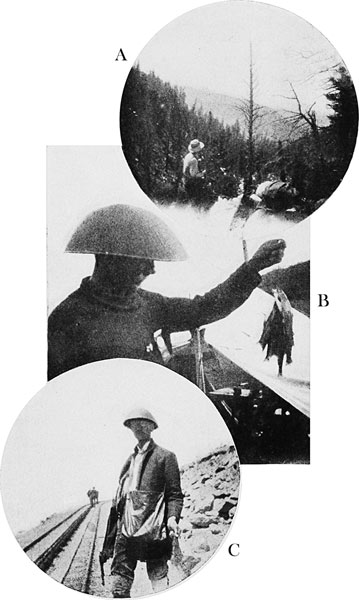
A. "Trail through the timber."
B. "He had caught a nice mess."
C. "Climbing Pike's Peak."
We crossed the long, low bridge over the Platte, early
in the morning. It required nearly an hour and all our
wits and energies to get the donkeys across, even after
blindfolding them. And when my party ambled into
Kearney, that sultry, dusty June day, grimy with dirt
and perspiring, we all were in ripe condition for a swim.
The little city looked to be about the size of Hastings,
but did not show the same enterprise and thrift. In fact,
the inhabitants ventured out in the broiling sun with an
excusable lack of animation, and seemer to show no more
interest in their local affairs than they did in Pye Pod's
pilgrimage. It was here I first saw worn the Japanese
straw helmet. It served as a most comfortable and effective
sun-shade, and purchasing a couple, we donned
them at once.
Kearney is said to be the half-way point, by rail, between
New York and San Francisco. My diary, however,
showed I had covered fully two thousand miles of
my overland journey; I had consumed 227 days, with
only one hundred and thirty-four days left me, the prospects
of accomplishing the "feat" in schedule time looked
dubious enough.
The great Watson Ranch, when my donkey party arrived,
was experiencing its busiest season. But, while
the male representatives were in the fields, the good
matron in charge of the house made us welcome and
treated us to cheering bowls of bread and milk. When
Mr. Watson, Jr., arrived, he showed us about the place
and enlightened me about alfalfa, of which he had over a
thousand acres sown; fifty hired hands were busy harvesting
it.
For a week or two we had, for the most part, been
trailing through the perfumed prairies at an invigorating
altitude ranging from two thousand to nearly three thousand
feet, inhaling the fresh, pure air, gazing on the
flower-carpeted earth, and enjoying a constant shifting
of panoramic scenes of browsing herds, and bevies of
birds, and occasional glimpses of the winding Platte
and the sand dunes beyond.
The cities and villages, that formed knots in the thread
of our travels on the plains, came into view like the incoming
ships from the sea. At first one spied a white
church-steeple in the distance like a pointed stake in the
earth only a mile away, but soon the chimneys and roofs
and finally door-yard fences would come into view, then
what we thought a village, nearby, proved to be, as we
journeyed onward, a town of much greater size seven
or eight miles beyond the point of calculation. The
crossbars on the telegraph poles, along the straight and
level tracks of the Union Pacific, formed in the eye's dim
perspective a needle, as they seemed to meet with the
rails on the horizon. Little bunches of trees, scattered
miles apart and then overtopped by the spinning wheel
of an air motor, indicated the site of a ranch-house where
we might procure water. The trail ahead became lost in
a sea of flowers and grasses.
From time to time, as I dismounted to ease myself and
little steed I picked from the stirrups a half dozen kinds
of flowers, ensnared as my feet brushed through the
grasses. Great beds of blood-red marshmallows; natural
parterres of the wax-like blooms of the prickly pear;
scattering stems of the flowery thistle with white corollas
as large as tulips; and wild roses and daisies of all shades
and colors—the white and pink, and the white wild roses
being the first I ever saw; these with varicolored flowers
of all descriptions were woven into the prairie grasses
and likened the far-reaching plain to a great Wilton carpet
enrolled from the mesa to the river.
Some of the sunsets were gorgeous. At times, the
western sky glowed like a prairie fire; and the sunrises
were not less magnificent. Sometimes, we were overtaken
by severe electric storms, and obliged to pitch the
tent in a hurry. When the lightning illuminates the
plains at night, the trees and the distant towns are
brought into fantastic relief against the darkness, like the
shifting pictures of a stereopticon.
A flash of lightning to the right reveals a church or
school-house, to the left, a bunch of cattle chewing the
cud or grazing, ahead of us, a ranch house, and, sometimes,
to the rear, a pack of cowardly coyotes, at a safe
distance, either following my caravan, or out on a forage
hunt.
Often, as the trains swept by, the engineers would
salute with a deafening blast of whistles, frightening the
donkeys and entertaining the passengers. Some of the
prairie towns which look large on the map have entirely
disappeared. In one case, I found more dead citizens
in the cemetery than live ones in the village. Frequently,
as a means of diversion, I left the saddle to visit these
white-chimney villages of the dead. Such might be considered
a grave sort of amusement, but really some of the
gravestones contained interesting epitaphs. In one instance
the following caught my eye:
"God saw best from us to sever
Darling Michael, whom we love;
He has gone from us forever,
To the happy realms above."
Imagine the shock to my sobered senses on reading
these lines cut on a white-washed wooden slab, close by:
"Here lays Ezekiel Dolder,
Who died from a jolt in the shoulder;
He tried to shoot snipe
While lighting his pipe,
And now underneath his bones moulder."
Just below the heartrending epitaph appeared in bold
letters the satisfactory statement—"This monument is
pade fer."
On the lonely plains, miles from habitation, a single
grave fenced in with barbed wire in a circular corral, I
discovered a mate to the preceding epitaph, which illustrates
the utter abandon with which the rugged, dashing
"bronco buster" regards the perils of riding a bucking
wild horse.
"Here is buried my bronco, Ah Sam,
Beside me—I don't give a damn!
While bucking he killed me;
On this spot he spilled me,
And now the devil's I am."
Sometime before parting with my courier, unknown
to him we pitched camp one dark night in a graveyard.
Barley was an early riser, and, as we know, as superstitious
as he was gullible. He was the first out of the
tent at dawn. Suddenly he rushed back, exclaiming:
"De Resurrection has came, fellows, an' wese de first
livin' on earth agin." And with terror in his eyes and
voice, dragged Coonskin and me to see a strange sight
indeed. There, some forty feet from the tent, stood a
towering crucifix with a figure of the Saviour, life size,
looking down upon us, while about us were tablets and
mounds: the scene was so still and solemn no wonder
that my awestricken courier thought the world had come
to an end.
On the 24th of June, after a hot and dusty trail across
an arid waste, where only occasional patches of buffalo
grass and cacti matted the earth in the place of the long
prairie grass and flowers we were tramping in a few days
before, my weary troop, jaded and hungry entered the little
village of Overton.
TOC
BY MAC A'RONY.
And the ass turned out of the way, and went into the field;
and Balaam smote the ass, to turn her into the way.—Book of
Numbers.
Shortly after reaching Overton, I took Pod with Coonskin
and Don to pay our respects to Towserville, a large
dog town so closely situated to Overton as to inspire a
rivalry far more serious than that existing between Minneapolis
and St. Paul. Overtonians complained of repeated
raids made by prairie dogs of Towserville on their
chickens and gardens. On the other hand, the Towser
"villians" repudiated the calumny, then fled in confusion
from the charge of shotguns and rifles.
As our party approached with guns trained for a complimentary
salute, I saw his honor, the Mayor, seated in
his hallway. The roof of his mound towered above the
other habitations, and was undoubtedly the City Hall.
Copying after New York, each burrow in Towserville had
a representative in the City Council.
I'm sure we would have been welcomed cordially, had
not Don wanted to be first to shake the Mayor's paw;
his honor abruptly excused himself to avoid a scene, and
his fellow townsdogs likewise, with the result that the
above dogtown population rushed in and slammed the
doors in our faces. The Professor was embarrassed.
He had no visiting cards, so decided to leave at each door
a sample box of cathartic pills; and a careful distribution
was made.
Next morning as we passed Towserville, his dogcellency,
the Mayor, his alderdogs and towndogs looked
regretful of their slight to us, as each stood at his door
or sat with his housekeeper, the owl, on the roof of his
dwelling, nodding and waving at us. Others, however,
were prostrate, either from remorse or Pod's magnanimity.
Sometime about noon, we approached the shallow current
of the Platte, where we were unpacked and fed. We
donks were almost roasted from the sun's scorching rays.
Close by was a deep well, but no bucket in which to draw
water. So Coonskin hitched a syrup can to the rope and
drew water for Pod and himself. Soon a drove of cattle,
accompanied by two ranchmen and a boy, came down to
the river to drink with us donks, just to show there was
no hard feeling. The lad laid down to drink from the
stream.
"Here, boy, come and have a drink of cold water!"
Pod called. "That ain't fit to drink."
"Fitter'n that well water," answered the lad.
Said Pod: "I'd like to know the reason."
"Well," replied the lad, approaching, "I dropped a
dead jackrabbit in the well a week ago."
Somehow the men had drunk so much of that cool
well-water they hadn't room for dinner; too cool water
I guess aint' good for one when heated. After the dishes
were washed, Pod took off everything but his socks and
collar-button, and wrote his newspaper letter, while Coonskin
went prospecting. Pretty soon the latter returned
with a sand turtle and, hitching it up in a rope harness,
said he was going to keep it for a pet. He named it Bill.
He said it would make a fine center-piece for the table;
it would keep the Buffalo gnats and mosquitos and flies
off the victuals, and if tied at the tent door no centipede
or tarantula would dare enter. Pod thought it a good
scheme. So, when we packed up, Bill was put in one of
my saddle bags, without my knowing it. All new luggage
was generally tied on to Damfino; I supposed the
turtle was.
After going a couple miles, I felt something mysterious
crawling on my back. I looked around, but my master
was in the way; so I up and kicked with all my might, determined
to scatter that crawling thing to the four winds,
but, instead, threw Pod completely over my head. Then
I ran pell-mell down the desert trail, kicking and braying,
with that terrible something gnawing my hair and bouncing
and flopping with every jump I made. I ran fast
and thought fast, and that thing stuck fast. Suddenly,
I stopped, laid down, and tried to roll on it. This I
couldn't do, on account of the saddle horn. But while I
was still trying, the rest of the party came up, and solved
the mystery by capturing the turtle, Bill; then they
chained him on Damfino, and our outfit moved on peacefully
for several miles, the men talking merrily. Said
Pod, "Hitting the trail on the plains in summer isn't as
comfortable as driving a city ice-wagon.
"Not much," Coonskin returned; "but the donkeys and
dog have their woes, too."
"Verily so," confirmed the Professor. "For instance,
there's Damfino; she thinks she's awfully persecuted.
Being a female, she doesn't have much to say. But how
about Mac? Doesn't he do more kicking than all the
rest put together?"
"Oh, well," Coonskin answered, "you see Mac regards
himself a pioneer and all the others mere tenderfeet."
I couldn't help grinning at the simple debate. The
fact of the case was, our caravan had been growing larger
with every day's travel. New articles were continually
added. Cheese and I generally carried the men; but to our
saddles were hung guns, revolvers, cameras, and the
lantern, not to mention a bundle of blankets; all of which,
added to the burden of our thoughts, a nagging whip and
a pair of spurs, and a million and one buffalo gnats, mastodon
mosquitos, and other kindergarten birds of prey,
tended to make us lose our mental equilibrium a dozen
times a day. In my case, there was a lump of avoirdupois
in the saddle ranging between 150 and 160 pounds.
Sometimes Pod would get out of his seat and walk a
mile or two, to relieve me. With Cheese it was much
the same. But that old spinster, Damfino, bore a burden,
increasing daily. She was large and strong, and couldn't
appreciate fine sentiments, or fine stuffs either, even complaining
of sand in the wind, and coughed and snorted
continually. Her sawbuck saddle corset was laced tightly
around her robust bust, and to this unhealthsome vesture
were hung on both sides large canvas panniers, packed
with canned goods, medicines, salves, ink, cow-bells,
vegetables, ham and bacon, vinegar, old shoes, toilet articles,
including currycomb, clothes, soap, flour, salt, baking-powder,
cheese, coffee, tea, kerosine oil, matches,
cooking tools, ammunition, folding kitchen range, and
two dozen et ceteras. On top and lopping over the panniers
were roped the tent and tent-poles, folding beds,
canteens, musical instruments, axe, and axle-grease, five
iron picket-pins, packages of photos (for sale), a tin wash
basin, two tin pails, extra ropes, a half dozen paper pads,
and a dozen more et ceteras.
Beneath all that burden, she ambled along without a
murmur, swinging her ears to help her outwalk the rest,
except Don, who kept up a dog-trot.
A ranchman gave Pod some new potatoes one day
(half of which I yanked out of the tent door at night and
devoured), and in reply to his habitual inquiry, "Where'll
we stow 'em?" Coonskin said, "On Damfino, of course."
When some canned goods were added to the list of poisons,
my master was puzzled. "Strap 'em on Damfino,"
advised Coonskin. Pod bought some canteens. "Where'll
we put these?" he asked. "Oh, hang 'em on Damfino
somewhere," said the wise "Sancho." One day a large
package of chromos came, and the Professor was discouraged.
"How the d—l can we carry these?" he asked
with bewilderment.
"Why," ejaculated the valet chuckling, "right on Damfino."
Just then that silent old maid looked at the men;
and I saw blood in her eye.
Picture if you can our party trailing along the banks
of the Platte that bright June afternoon. A few miles
away loomed the cacti-covered sand-dunes, and between
them and the river stared the desert of glistening
alkali, sprinkled with cacti and sage, where an occasional
steer was scratching an existence—and mosquito bites.
We came to a muddy irrigation ditch, where the water
had leaked out. Across it was an alfalfa field, and beyond
that an adobe ranch house. We donks thought the
mud in the ditch was stiff; the green field looked tempting.
Damfino whispered that she would make a bolt for
the field, if we would follow; and we said we would. At
once she shied into the ditch, and the next minute was
knee-deep in quicksand, and still sinking. Cheese and I
stood riveted to the trail, while the men just gaped at
Damfino with open mouths. Damfino, thinking she would
soon be out of sight, brayed as she never brayed before.
When Pod got his senses he yelled, "Let's pull her
out!"
"What with? Every rope and strap's on Damfino,"
said the truthful valet, running around like a head with
the chicken cut off. Coonskin tried to reach a rope and,
losing his balance, put a foot in the quicksand. Then, all
excited, he attempted to pull his foot out, and got them
both in. The Professor tried to reach a bridle-rein to
his comrade, and went sprawling across the ditch on his
corduroys and whiskers, his arms elbow-deep in the mire.
This put Don in a panic. Seeing his master sinking, he
grabbed his boots and pulled them off. Then he fastened
his teeth in Pod's trousers, and I expected to see them
come off too, but s' help me Balaam! the dog only pulled
off one trouser leg, when Coonskin managed to free himself
by crawling over Pod's corduroy road to dry land,
and saved the day! At once, with a bridle-rein, the valet
roped the Professor's feet and pulled him out, after
which both men fastened the reins to Damfino's pack
and tied the other ends to the saddles of Cheese and myself.
Then that she-ass, wet and gray as a rat, with her
burden, was dragged out of the ditch into the trail.
Well, that quicksand pulled all the bad nature out of her,
and she went a long time before she was tempted to leave
the trail again.
The men looked grateful as they wiped the brine from
their faces, and Pod remarked, "That was a narrow
escape for all of us. Our donkey party came within two
of going ass-under, sure."
TOC
BY PYE POD.
It has come about that now, to many a Royal Society, the Creation
of a World is little more mysterious than the cooking of a
dumpling; concerning which last, indeed, there have been minds
to whom the question, How the apples were got in, presented
difficulties.—Sartor Resartus.
It was noon at Big Springs, the last village on the
Union Pacific Railroad in Nebraska, when I sat down
to write in my dairy. I had just finished a combination
breakfast and dinner, warranted to kill any appetite and
keep it dead for twelve hours. Consequently I wrote
under great pressure.
Since striking Camp Coyote, I had shot prairie dogs,
owls, jack-rabbits, and gophers innumerable, but on Wednesday,
June 30, I killed my first rattlesnake. It was not
the first we had seen, but the first to lie in our path. I
wanted to shoot it's head off, but instead of it losing its
head, I lost mine, and severed its vertebræ. The snake
was three feet five, and possessed eight rattles and a button.
Cookskin suggested that the button might come in
handy in many ways. "You know, Pod, you are always
losing buttons."
These dreaded reptiles abound on the plains, particularly
in dogtowns, where they can dine on superfluous
baby-dogs when families become too large. Three sorts
of creatures, including the owl—animal, bird, and reptile—bunk
together companionably, but have quarrels of their
own, doubtless, like mankind in domestic affairs. At
that season the South Platte was drained for irrigation
in Colorado. I was riding peaceably along, watching
its morbid current and the gray hills beyond, when suddenly
my valet yelled to me, "Look out, Pod, a rattler
ahead!"
Coonskin was riding Cheese, who leaped to one side,
but my own steed, blinded by his spectacle-frames, walked
on and stepped over the coiled snake, which struck at my
leg. Fortunately my canvas legging protected me from
the reptile's fangs, which glanced off, letting him fall in
the trail. Instantly I turned in my saddle and ended its
miserable existence.
The report of my revolver attracted some cowboys,
who galloped up on their rope horses and accompanied
us to their adobe house a few miles beyond. It was five
in the afternoon, the day was hot, and our journey long
and dusty. They were a jolly lot. Thir ranch was a
square sod structure, without a floor, and sparingly furnished,
but cool and comfortable.
"We'll have hot biscuit for supper," said one of the
cowboys.
"So you like cooking," I remarked; "I pride myself
on the dumplings I make, and my flapjacks are marvels
of construction."
"Hang together well, I suppose," observed the cook,
smiling and piling buffalo chips in the stove.
"I haven't tasted dumplings since I visited the World's
Fair," said another.
"Well," declared the first speaker, "my tenderfoot
friend, your oven will soon be hot, and the flour, soda,
shortening, and apples are on the shelf. Anything else
you need, ask for it."
I was in a bad fix; I remembered the parrot that got
into trouble with the bull-terrier by talking too much.
"It requires a long time to steam dumplings; it will
delay supper," I protested.
"We shan't turn you out, if it takes you all night, but
we'll shoot the enamel off your front teeth if you don't
make them apple dumplings, and do your best," said a
cowboy.
"All right, boys, I'll try my luck, and you can save
time by helping."
"Sure," all replied.
"Fetch me the shortening," I called.
"Right before your eyes," said one.
"Blamed if I can see it," I explained. The fellow put
his hands on a cake of greasy-looking substance.
"That's soap," I said, remonstrating, with a chuckle.
"All we use for shortening," apologized the cook;
"don't see much butter or lard out on this here desert."
I fell to with a will. Before long my dough was mixed.
As I rolled it out with a tin can, I directed a cowboy to
put in the apples and roll up the dough. Soon the dumplings
were in the steamer, and the cook began to prepare
other eatables for the meal. Then, my duty done, I
watched two fellows throw the lariat, and shoot the fly
specks off Coonskin's hat in midair.
At last, five hearty eaters sat down to dinner. The
cook's hot biscuits, potatoes, bacon, eggs and coffee were
delicious, and I devoured them greedily. But in the middle
of our repast I turned my head in time to detect the
cook meddling with the dumplings.
"Shouldn't take off the cover till they're done," I
shouted; "makes 'em heavy."
"Didn't take it off—lifted itself off," explained the man,
regarding me first, then the steamer. "Man alive, the
dumplings are as big as cabbages."
"And 'tain't more'n likely they've got their growth
yet," said Coonskin, who examined the wonders.
"Gracious!" I exclaimed. "How many apples did you
cram into each dumpling?"
"Only fifteen or twenty," the cook returned; "awfully
small, you know."
"That explains the size of them," said I. "You've got
a half dozen whole apples in each dumpling, and a peck
or more in the steamer. Don't you know dried fruit
swells?"
"But how am I to keep the lid on the steamer," asked
the hungry cook, wistfully eying the disappearing meal.
"Sit on it, you crazy loon," suggested a companion.
And the fellow did. Presently there was a deafening
report, and the cook was lifted off the steamer, while
dumplings flew in every direction, striking the ceiling,
and then, from heaviness, dropping on the floor. One
broke my plate into a dozen pieces. Another hot and
saucy dumpling shot through the bursted side of the
steamer, hitting one of the cowboys in the eye.
"Just my luck," I said; "they would have been as light
as a feather."
"Light!" exclaimed the injured fellow with a handkerchief
against his scalded optic. "It was the heaviest
thing that ever hit me, let me tell you, and I've been
punching cattle seven years."
When the excitement was over, and we had found sufficient
grub to complete our meal, all assembled in the cool
outer air, where Coonskin and I entertained with our
musical instruments until bedtime.
Next morning, on my suggestion, a cowboy threw his
lariat round my body good-naturedly and pulled me over,
but before I could right myself Don took three bounds
and pulled the fellow down by the shoulder, frightening
one and all. I shouted so loudly to the dog that I was
hoarse for a week. That demonstration of Don's loyalty
was a revelation to me. The man was not injured, although
his coat was torn.
The lack of energy and enterprise of the town of the
western plains was both surprising and amusing. I expected
a package of photos at Willow Island. When I
called for it I was informed that the railroad station had
burned a few months before, and that their express
stopped at Cozad, which I had passed through. So I
wrote to have the package forwarded to a station farther
west.
Gothenburg, the next town, was in a decline, the reaction
of a boom. A traveler approaching it expects to
find a business center. Many stores and dwellings were
of brick, but whole rows were vacant at the time. The
soothing melody of the squalling infant was only a
memory to the village druggist; the itinerant butcher
and milkman had ceased their daily rounds; and all that
was left to distinguish the half-deserted village from the
desert was an occasional swallow that went down the
parched mouth of a chimney. There is another town
characteristic of the plains. I had a letter to post at
Paxton, but forgot it; some miles beyond, a ranchman
whom we met said I would find a post-office at Korty, five
miles further on. After traveling two hours, we could
see no vestige of a village anywhere. Don ran ahead to
the top of every sand hill and stood on his hind feet to
have the first peep at the mysterious town. I came to
the conclusion the ranchman had said twenty-five miles
instead of five. Finally the trail approached the railroad.
"I see the town of Korty!" my valet exclaimed.
"Where?" I asked.
"There. Plain as day. Can't you see it?" he asked,
pointing straight ahead.
"I must confess I can't," I replied. "Let me look over
your finger." Then I saw it. It wasn't one hundred
feet away. A single white-painted post stood beside the
track, and on it was nailed a cross-bar, lettered in bold
type, "Korty;" underneath was a letter-box. That was
the town. There was no section house, no water tank,
no break in the wire fence, and there being, of course, no
general delivery window in the "post-office," I did not ask
for my mail.
On the way to North Platte, we passed the site of old
Ft. McPherson, where Buffalo Bill, the celebrated scout,
once lived and won his fame and title by providing
buffalo meat for the Government, and also the site of a
notorious Pawnee village, now called Pawnee Springs.
We reached North Platte, situated at the confluence of
the North and South Platte rivers, which form the great
River Platte, Saturday afternoon, and spent Sunday in
a manner to meet the approval of the most pious.
That first evening I lectured from a large dry-goods
box on a prominent corner.
Sunday afternoon an old friend and classmate drove
me into the country to the famous "Scout's Rest Ranch,"
the estate of Mr. Cody (Buffalo Bill), where I saw a herd
of buffalo and a cornfield of 500 acres.
"There is quite a contrast between your cornfield and
mine," I said to the manager.
"How big a cornfield have you?"
"Just a small one," I replied. "One acher on each big
toe."
"I see, only sufficient for your own use," came the response;
"your 'stock in' trade, as it were." Then the
ranchman purchased a photo, and we two grown-up school
boys drove back to town, in time to escape a thunder
shower.
The country between North Platte and Julesburg is a
desolate and barren region. Occasionally we could see
a ranch house, sometimes cattle grazing on I knew not
what. There was plenty of alkali grass in the bottom
lands of the Platte, and further back on the mesa, patches
of the short and nutritious buffalo grass, half seared by
the scorching sun. The railway stations, with one or two
exceptions, consisted of water tanks and section houses,
where water could be procured. At Ogalala we met a
train-load of Christian Endeavorers, and had a chance
to quench our thirst.
TOC
BY MAC A'RONY.
What a thrice double ass
Was I, to take this drunkard for a god,
And worship this dull fool!
—Tempest.
Where and how to celebrate the Fourth of July greatly
concerned Pye Pod. The third was spent in Julesburg, a
town in Colorado, two miles west of the boundary line;
as Sunday was the Fourth, we naturally expected a lively
programme for Saturday.
We were disappointed. Everybody had gone off on
an excursion, and Julesburg was dead. So my master,
realizing the long journey before us, inquired as to the
possibility of obtaining an extra donkey, and was told of
one, some six miles from town. He rode in a buggy
to a ranch right after lunch and brought back the prettiest
damsel I ever saw. Her name was Skates; Pod
said he so named her because she ran all the way and
beat his pride-broken, wind-broken horse into town. I
gave Skates a loving smile, but she gave me a look, which
said, "Keep your distance, young feller." So I did. But
I lost my heart to that girl then and there.
Pod noticed my leaning toward Skates, and asked me
my intentions. I frankly told him. "But what nonsense
for a youth of four years," he remarked. "Mac, be patient;
wait until you are of age, at least."
Time was precious, and we could not tarry. That
afternoon we set out for Sterling, sixty miles into the
desert, where, it was said, there would be a big time on
the fifth.
Monday dawned cloudy and threatening, as is usual
with celebration days. The tent door was open, and
Skates and I were looking in, I waiting for a chance to
pull a bag of eatables out of the tent for her.
"What is your programme for to-day?" Pod asked his
valet.
No answer. The question was repeated; still no response.
Then my master turned drowsily on his pillow,
and beheld Coonskin with bloodshot eyes and the only
whiskey bottle clasped lovingly to his breast. The valet
wanted to say something, but his lips refused to speak.
It was evident that his celebration had begun the night
before. Pod sat up and rubbed his eyes to make sure
he was not dreaming, and then asked the fellow why he
drank all the emergency whiskey.
"R-r-r-r-r-r-r-rat-schnake bite-bite-bited me—d—drank
whisky t'shave life," stammered the youth. "H-h-h-hic-have
shome, Prof."
Pod looked mad. He up and dressed, and mixed soda
and water and lemon juice, and made Coonskin drink it.
Soon the tipsy fellow tried to dress, but finally gave it up
and went to sleep. Two hours later he awoke quite sober,
and came out to where Pod was currying me for the celebration,
and showed him his programme. I haven't space
to give it in full.
One feature was an obstacle race, the prize for the
winner being a quart bottle of snake-bit (whiskey).
Coonskin said, as his excuse for drinking the whiskey,
that he was certain of winning the race, but afraid the
bottle might be broken before the event. Pod thought
that reasonable enough, and forgave him; but he told me
confidentially that he didn't know what he should do if he
were bitten by a rattlesnake without whiskey at hand. I
suggested, in such event, he should point a revolver at
Coonskin's garret, where his brains ought to have been,
and make him suck out the poison.
The obstacle race began at eleven in the morning. The
start was made from the tent door; the course and conditions
were as follows:
Run to the fifth fence-post down the trail, alongside the
railroad track; crawl through the barbed-wire fence four
times between different posts on the way back to the
tent, without tearing clothes; creep through the legs of
the little portable table (purchased in Julesburg) without
rolling off an egg resting on it; run a hundred yards and
unpicket one of the donkeys and ride it round the tent
three times with a spoon in hand, holding an egg; ride the
donk back to his picket-pin and crawl between its hind legs
without disturbing the animal's equilibrium; stand in the
tent door and shoot some hair off one of the donkey's
tails without touching the tail proper; then lead that
donkey to the tent and hitch him to the turtle, Bill.
Cheating, if detected, forfeited the prize.
Well, while there were two starters, there was only
one finisher. It seems that Coonskin shot a piece off
Cheese's tail (improper, the donk said), and, in consequence,
man and donk disappeared over the horizon, without
leaving their future address or the date for their
return.
Coonskin rode Cheese into camp after dark. Then he
rubbed axle-grease on Cheese's sensitive part, and prepared
the delayed dinner. Next came fire-works—Roman
candles, firecrackers, and pin-wheels—after which both
men retired, fancying they had the jolliest Fourth ever
witnessed by man or donkey in the history of the Colorado
desert.
TOC
BY PYE POD.
Sancho Panza hastened to his master's help as fast as his ass
could go, and when he came up he found the knight unable to
stir, such a shock had Rosinante given him in the
fall.—Don Quixote.
The casualty, which terminated our celebration on the
fifth, seemed to portend bad luck. The metaphorical
lightning first struck me. We struck camp, that hot July
day, before the sun was an hour high, and a mile beyond
trailed through a dog-town reservation. I had long been
desirous of securing a prairie dog to have mounted; as a
rule one can pick off these shy creatures only at long
rifle range. This morning, stealing up behind a cornfield,
I wounded a dog, then dropping my gun, ran to
catch him before he could escape into his hole. Crawling
through a barbed-wire fence without afterward appearing
in dishabille is considered by a tenderfoot the feat of
feats. Before I reached the hole half undressed the dog
had tumbled into it. He must have made a mistake, however,
for out the fellow came, and made for another hole.
I grabbed him, but instantly dropped him, for he tried to
bite me. Then, like a shot, he dived into the second hole,
and I thrust my arm in to pull him out. But my hand
came out quite as fast as it went in. It was bitten; and
at the mouth of the hole I now detected for the first time
the tail of a rattlesnake. That was an awful moment,
What should I do? My whiskey was gone; I had no
antidote for the poison. I rushed to where Coonskin
was waiting with my outfit.
"Make for the house!" he exclaimed.
A ranch house stood some two miles away, but not a
soul was in sight. Still, that seemed to be my only salvation;
I realized a painful death was the only alternative.
With a hundred other thoughts rushing into my head, I
ran toward the distant house. Coonskin began picketing
the donkeys, and promised to follow.
While racing madly through the cacti and sage, I
thought of my past, from three months upward. Just
when I had reached an episode, which almost ended my
reckless career at the age of ten, I heard the sound of
galloping hoofs, and, a moment later, a young woman
reined her steed at my side, dismounted and gave me her
horse.
"Into the saddle, quick, man!" she cried. "Mother has
turpentine and whiskey. The horse will take the fence
and ditch. Pull leather, stick to the saddle, never mind
the stirrups!" and to the horse—"Git home, Topsy!—Run
for your life, old girl!" Like a flash, the big mare
sped forward with the velocity of the wind.
To pull leather, in the parlance of the cowboy, means
to grip the saddle with the hands. For a cow-puncher
to pull leather is deemed disgraceful; for Pod, it was excusable.
Although the mare fairly flew, she did not
travel half fast enough to suit me. With reins round
the saddle-horn, I gripped the saddle with my left hand
and sucked the bite on my right, but suddenly the mare
took a hop-skip-and-jump over the fence and ditch; fell
to her knees, and threw me over her head.
When I sat up, I saw a woman in the door of the
house, yet a half mile away, no doubt, wondering how a
maniac happened to be on her daughter's steed. The
next moment, Coonskin arived all out of breath, and assisted
me to the house. Before we could fully explain the
situation, the good woman disappeared, soon to return
with a bottle of turpentine, which she turned nozzle down
over the snake bite, while my valet poured whiskey down
my throat.
They say it takes a long time and much whiskey to
affect one bitten by a rattler, but this case seemed to be
an exception; in a few moments, my head was going
round, and I prostrate on a couch. My kind nurse
looked curiously at the turpentine, and finally said it was
queer it didn't turn green, as it should in the case of a
rattle-snake bite.
A half hour passed and still there was no change.
Then when I repeated my story of how the thing happened,
she grinned, and said she guessed it was the prairie
dog and not the snake that bit me, after all. I was so
dead drunk when the daughter came that she glanced at
me and asked in a whisper, "Is he dead?"
"No," said the mother, "and he ain't going to die.
We've been trying to cure dog bite with 'snake bit', and I
reckon it'll take a week or more to sober the man up."
Then the daughter began to get a meal, and Coonskin
went after my outfit, on the good woman's suggestion, to
fetch my animals to the corral.
It was not until morning that I was fit to sit my saddle;
but I made the effort, and after thanking my hostesses
and insisting on paying for the turpentine, we said
good-bye.
Mid-day travel, in the Colorado desert at that season,
was enervating in the extreme. Our straw helmets, being
supported by a skeleton crown, allowed a free circulation
of air over and about the head; also a free circulation
of buffalo gnats, blue flies, mosquitos, flying ants,
grasshoppers, and everything else that hadn't an excuse
for living. Everything seemed to be free in that country.
The sunrays beat down mercilessly on the sandy plain,
and every live thing seemed to be in search of shade or
water. Once, while crossing the dry and cracked bed of
a stream, I saw a rabbit, almost dying of thirst, and I
put an end to its agony with my six-shooter. In the narrow
bars of shade cast by the fence posts along the railroad,
could be seen occasional birds, standing on the hot
sand, immovable, with bills wide open, panting from the
excessive heat.
We reached Sterling late that night, after a twenty-eight
mile journey. The town looked dull. Everybody
complained of the hottest weather for years. It occurred
to me that an awning would add greatly to our comfort,
so I bought the canvas, and had one made. Henceforth
we would travel at night, and sleep as much as possible
in the day beneath the awning. I also purchased a light
folding chair, which, with our table and stove, could easily
be carried on Skates, the new donkey.
We pitched camp eight miles from town, near a sod
house and well. On the way the donkeys became obstreperous,
and before they were under control, our only
lantern was smashed. This stroke of bad luck was the
forerunner of other misfortunes.
As I fell on my hard bed, expecting to have a delightful
rest, I voiced a righteous yell of pain, and leaped out of
doors. I was a fair imitation of a porcupine. Coonskin
had carelessly pitched the tent on a bed of cacti. The
astonished fellow made profuse apologies, and set to the
task of picking the cactus spears out of me by the flare
of lighted matches. But for a week I suffered the sensations
of sleeping on pins and needles.
The turtle, Bill, deserves some notice. He was put in
the center of a table at meal time to catch flies, but all
that stupid turtle did was to scrape them off his head by
drawing it under his shell. He disdained the carnivorous
diet. Millions of insects swarmed about the table, where
before only thousands had gathered, attracted, doubtless,
by Bill. They literally covered our food and all we could
safely eat was flapjacks. Holding a fork against the
mouth, we could with lips and tongue draw a flapjack in
through the tines, by which delicate operation all flies and
other insects were scraped off; and in course of time a
fairly good meal was conveyed to our stomachs. Of
course, one's success depended upon the strength of the
flapjacks. Most of them stood the strain.
The afternoon of July 11, we saw Long's Peak, the
first spur of the Rocky Mountains, in view. The following
evening we rode into Fort Morgan. Journeying on,
to escape the heat of the day, we came at midnight to
where several trails crossed, and were puzzled which to
take.
"Put the responsibility on the donkeys," I finally suggested.
"They've great instinct."
"Good idea," commented my valet; "I've often heard
of horses taking lost hunters out of the woods." So
giving the word, my caravan resumed the march in the
darkness, and went into camp about four in the morning.
When I arose about noon, I was surprised to find ourselves
on the outskirts of a village. I called Coonskin,
with a feeling of suspicion dawning in my mind.
"The blasted town looks familiar," said my valet.
About that time a cowboy rode up, and I asked him the
name of the town.
"Fort Morgan," he answered. "Have you fellows lost
anything?" Coonskin and I eyed each other, then both
gazed thoughtfully at the jackasses.
I was provoked about the loss of that night's journey;
to think of our following our donkey's ears round an
imaginary race-course in the desert, some twenty odd
miles, was not conducive to a good temper. Many well-meaning
persons had advised me to carry a compass.
Some day, some night, they said, I would stray from the
trail. I resolved to purchase such an instrument immediately
on reaching Denver.
We spent the afternoon enjoying the luxuries of our
new awning and camp chairs; I writing my article for the
press, Coonskin reading a thrilling dime novel.
"This is life," remarked my napping valet, as he rolled
over on his pillow.
"You bet," I replied; "we know who we are."
"I suppose there are lots of folks who don't know,
Prof," he returned; "but they'll find out before we reach
'Frisco."
"But Coonskin," I asked, looking up from my writing,
"do you know where we are?"
I had no sooner put the question than a whirlwind
swept down upon the camp and scattered everything
broadcast. Tent, awning, table, chairs, ink and writing
pad, packing cases, and articles of all kinds, not to mention
dog, donkeys, and men chased each other over the
cacti and sand; the tent half inflated, rolled over in the
scudding wind like a balloon.
"No, I don't," said Coonskin, gaining a sitting posture
a rod from where I stood on my head, some hundred yards
from our original camp.
"What are you talking about?—are you wandering?"
I asked.
"I think the whole shooting-match has been wandering
some," said he, picking the sand out of his eyes.
It was long before we collected our belongings. I
never found my letter for the press.
Just before sunset we took up the march across the
broad, rolling plains, which grew tiresome to look upon
before darkness set in. But occasionally a hand-car with
its sloop-rigged sails set to the wind would speed over
the rails in the distance, like a cat-boat before a gale, and
break the monotony of the scene. This mode of travel
appears to be characteristic of the Western plains alone.
We saw innumerable buffalo wallows, great depressions
in the sand where the vast herds of buffalo in the
early days wallowed in the cool earth for salt, and to escape
the heat and pestering gnats. In most cases these
"wallows" are covered with cacti and other desert verdure,
and are apt to upset the unwary traveler after dark,
unless he keeps to the beaten trail.
At a little before sunset we arrived at the great D.
Horse Ranch, where we watered our animals and accepted
the ranchman's invitation to supper.
TOC
BY MAC A'RONY.
That is the idea; for Juliet's a dear, sweet, mere child of a girl,
you know, and she don't bray like a jackass.—Huckleberry
Finn.
We did not tarry at the D. Horse Ranch, but later on
pitched camp near a sheep ranch run by a Mexican, who
met us with a grunt that nobody understood.
"Gee! how I wish I could speak Spanish!" remarked
Pod, facing the squatty ranchman. It was comical to
watch Coonskin's puzzled face. "I once studied Spanish,
but why didn't I master it! Just two words can I remember:
"porque"—why, and "manana"—to-morrow.
But how can they help me? To utter them would be to
ask, why to-morrow? And there would be no sense in
that."
"But it might convey the idea," I interrupted, "that
either you know more than you looked to know, or appeared
to know more than you do know; and that would
be something."
My master did not answer, but when the Mexican
came around again, he said to him, "Porque manana?"
The Mexican laughed—who could blame him—and said
something about Espanola, a young lady I never heard
tell of, and invited us all to the corral, except the men,
who followed him to the house. Nothing like Mexican
hospitality when one understands the language as Pod did.
At first the Mexican did not comprehend that we all
were thirsty. The Professor asked for a drink in many
varieties of expression, concluding with a desperate
"Porque Manana?" at the same time pointing to the well.
The Mexican grinned, and replied in a peculiar vernacular,
and handed him a huge tin cup. Pod next inquired
the right trail to Brighton in many artistic demonstrations
of verbal inflection and gesticular design, and wound up
with a heroic "Porque Manana." The mystified sheep
herder shook his head quizzically, and began to pour out
a whole tubful of liquid linguistics which my pedantic
master drained to the dregs without discovering their
meaning; then he shook hands with the gracious host and
gave the word to "hit the trail."
"Mighty lucky you understood Spanish, Mr. Pod,"
Coonskin remarked, when we were some distance from
the house. "I'd give a farm to speak it like you."
That tickled Pod's vanity, and he told his flattering
valet that Spanish could not be learned in a day, but perhaps
sometime he would give him a few lessons, just to
prepare him for an emergency.
That night we donks were picketed to a rickety, barbed-wire
fence, and the men pitched the tent close by, cooked,
and went to bed early. Seldom had been so much care
taken to prevent my getting wound up in the rope so I
couldn't eat or lie down. In the morning there was a
surprise for everybody. S' help me Balaam! if there
wasn't a circus, then I never saw one. We donks were
completely tangled in the dismantled wire fence, and cutting
up capers to beat a side-show. I kept my eye peeled
on the tent door for an hour. Finally Pod came out,
took in the situation at a glance, and then sat down on a
cactus, for less than a fraction of a second, to laugh.
I was proud of the rôle I played in that matinée.
There I was, with a fence post wired to each of my legs,
which raised my feet off the ground, walking about on
veritable stilts, and close behind me followed Cheese and
Skates with a post yoking their necks together, like oxen,
while Damfino was rolling over and over, unmindful of
the cacti, as if our extraordinary sport were for her special
entertainment. We were quiet, until Cheese suddenly
opened his mouth and brayed with glee. I told him to
shut up. Says I, "Pod will think we got in this fix on
purpose, and give us Hail Columbia."
Pod looked worried. He said he wondered how they
could dismount that giraffe—meaning me, no doubt—without
breaking his legs. I didn't feel comfortable so
far above the earth, the atmosphere was chilly, and the
rarified air made me dizzy; but that remark frightened me.
The trick was, at last, accomplished. Coonskin held my
fore-stilts, while Pod braced his feet, and with a violent
push threw me over on my side on a pile of blankets and
pillows. Well, let me tell you, my donkey friends, it
required two hours to free us from the fence-posts and
wire. After that, both men busied themselves like Red
Cross Nurses. (Skates said they were cross nurses of
some sort), and bandaged up our cuts and scratches,
then, after breakfast, they saddled and packed us for the
day's journey. I never want another experience like that.
On Thursday night, I think (I ate up Pod's only calendar),
we again wandered from the trail, and about two
o'clock camped near a cottonwood tree which seemed to
indicate we were near water. Although I was awfully
dry, I had to wait till morning. It was pleasant to be
lulled to sleep by the rustling of leaves (and it was consoling
to know something besides us donks had to rustle),
yet there we were in the boundless desert. Don's barking
awoke us early. A ranchman rode up and said we would
find plenty of water yonder at the well, the only water
for many miles around; then he rode away.
There was one long row of cottonwood trees hundreds
of feet apart, stretching for a mile or two across
the desert, as if planted by birds fifty years ago.
Pod took us empty donks and canteens over to the well.
That was the novelest thing I ever saw; and the water
was the coolest I ever tasted. An iron wheel turned in a
cog and drove a piston-rod down a deep well, the power
being furnished by a meek-looking horse which walked
round the pump in circus fashion, thinking he was the
whole show, and pulled a sort of walking-beam that turned
the cog-wheel. There the ranchman and his big small
boy rode every morning many miles from home to pump
water for their cattle, which ate (they evidently had eaten
everything in sight) during the day, and chewed their cud
at night in the cottonwood shade.
That morning, when several miles nearer our goal, a
stiff wind introduced itself and increased in velocity until
such speed was attained that the men had to stop traveling
and tie the whole outfit to the picket-pins driven in the
ground. That gale beat the tornado on the shore of Lake
Erie, and the cyclone near Sterling. We donks had to lie
down with our backs to the wind, for Damfino, not thinking,
lay the other way at first, and the wind blew into her
mouth so fast she swelled up twice her natural size. She
was so full of air that she arose and turned around, before
being able to lie down again.
Pod said it was a good time to write his letter for the
paper. So he hitched his shoulders to ropes tied to picket-pins
about five feet apart, and sat in a camp-stool, and,
facing the gale, laid his writing pad on the wind, and
finished his article in fine style.
When I asked him how the wind could be so strong as
to brace up both the pad and his story, he said he was
writing in a lighter vein than usual.
We were in sight of Brighton next morning when a
strange accident happened to Pod. We were approaching
a field of grain on an irrigated ranch when, suddenly, he
was struck on the head by a mastodon grasshopper and
knocked senseless out of the saddle. At once Don chased
the creature and headed him off, while Coonskin lassoed
him and bound him on Damfino. We took the wonder
to Denver. There Pod put the thing in a bottle of alcohol,
but it hadn't been there more than a half hour when it
kicked out the bottom, and almost upset a street car in
trying to escape. Again the grasshopper was captured,
then poisoned and skinned, and the bones were expressed
to the Smithsonian Museum.
About one o'clock we left the line of the B. & M. railroad,
and cut across the plain six miles to the Union
Pacific, which we had left on the previous week. Then
we began to descend into the verdant valley of the
Platte. Great fields of grain waved in the breeze on
either hand. The song of the reaper was cheering, the
glistening snow on the distant Rockies, cooling.
At last our caravan ambled into Brighton. It impressed
me as a pretty town; after crossing a two hundred
mile desert, I was in condition to compliment any
sort of a place. That night we traveled ten miles and
camped near the Nine Mile House, where, next morning,
we were disappointed not to obtain breakfast.
Beautiful, far-famed Denver loomed up on the distant
plain. The smoke from her smelters curled on high, a
dusky sign of prosperity. We breakfasted three miles
nearer the city, and at two P. M. our picturesque outfit
strode up Seventeenth street and anchored in front of the
Albany Hotel. Denver at last!
TOC
BY PYE POD.
At the head of the procession strode the four heralds. Silently
they marched, in silence the populace received them. The spectacle
reminded very old men of the day the great Axaya was
born in mournful pomp to Chapultepec.—The Fair
God.
When I had taken a bird's-eye view of Denver, and
visited many of its handsome streets and buildings, and
met its hospitable citizens, I dubbed it one of the most
attractive cities.
One of the first to greet me was a member of the Jacksonian
Club, who invited me to attend a lawn party to be
given at the home of a fellow member. The grounds
were illuminated with Japanese lanterns and a platform
was erected for speech-making, while indoors were served
refreshments. In the midst of the pleasant proceedings a
gentle rain frightened everybody into the house, where
dancing closed the festivities. Of course, every pretty
girl wanted to dance with Pod.
Sunday seemed to be the accepted day for sight-seeing.
The "Seeing Denver" car (electric) made two twenty-five
mile trips a day, threading the more attractive portions
of the city and suburbs and giving the passengers a
splendid idea of the beauties and possibilities of Denver.
Each car was manned by a director, who clearly described
all points of interest en route.
Finally, the car was stopped on the heights overlooking
Clear Creek Valley, where, in 1858, Gregory, a North
Carolina prospector, discovered gold in quartz and proved
his theory that all placer ore came from a mother lode.
People in the East, hearing that gold could be found here
in quartz, hurried to the spot, resolved to be contented if
they could only find it in pints. While many were disappointed,
within a year one hundred and seventy quartz
mills were erected, and in 1860 Colorado's gold output
amounted to $4,000,000.
The Colorado farmer raises everything in the fruit and
vegetable line that can be produced in the East. Through
the system of irrigation the soil is brought to such a
state of production that one farmer near Denver was
reaping a revenue of $5,000 a year from a twenty-acre
plot.
"One of our best crops is tomatoes," said our guide,
with the view of enlightening some possible investor.
"There, you can see in the distance, is one of our largest
canneries. It cans tomatoes only. All the tomatoes they
can are raised around Denver, and all the tomatoes not
consumed in the city are sent to this cannery to be
canned. They raise all they can and what they can't raise
they can't can. They eat all they can, and all they can't
eat they can. Moreover, all they can't can they eat, and
what they eat they can't can. All canned tomatoes they
can and cannot eat they ship to those who can't visit
Denver to eat all they can. If you can visit the cannery
and see them can all they can and eat what they can't
can, and can't eat a can yourselves, you then only can
understand why it is they can't eat what they can and
can't can what they eat. Can you not?" When he had
finished three women cried.
Later on the journey the car was stopped in a different
quarter of the suburbs, where several got off to pluck
wild flowers. In the course of our tour many attractive
buildings were pointed out, among them the Consumptive's
Home, erected by philanthropists of the East, and
the several smelting mills, one of which boasts of a
chimney four hundred feet in height, the tallest on the
continent. While the ladies were gathering wild flowers
I was persuaded to perpetrate a practical joke suggested
by two jovial Johnny Bulls. I had become quite chatty
with their party. They had the impression that I
was a cowboy, and when they discovered their error they
proposed I should jostle a fellow countryman of theirs as
soon as they could decoy him off the car, they claiming
that he still believed me a real cow-puncher out for a
holiday. They said it was his first trip to America, and
that he had frequently expressed a curiosity to see one of
those wild men of the plains. On promises of their support
in case of offense being taken, I chuckled and
awaited my chance.
Presently the man was persuaded to pick a wild rose,
and as he was about to pass me I backed roughly against
him, almost sending him off his feet. When he had regained
his equilibrium and was on the point of rebuking
me, I turned furiously upon him: "Say, you foreign
tenderfoot," I said, "you got a preemption on the whole
earth? If so, just fence it in. Don't yer brush me that
way agin, or I'll show yer how we trim moustaches out
in this country when our razors ain't sharp. Understand?"
As I uttered these words I put my hand on my hip-pocket.
My sombrero was tilted, and the attitude I
struck would have amused any real cowboy. The astonished
Englishman, red in the face, edged away in silence
and eyed me narrowly.
"Turn your lamps the other way, or I'll shoot off yer
eyebrows!" I shouted.
At once the innocent butt of our ungentlemanly joke
ventured to apologize for the carelessness that was not
his, when a peal of laughter from behind told plainly
that the joke was off. I turned to see everybody in a fit
of laughter; I now began to feel embarrassed, and had
not my confederate immediately explained the case and
introduced me to their imposed-upon comrade, I certainly
would have felt very awkward. As it was, the
tourist laughed heartily at the joke, complimented me on
my art in acting and gave me a cordial handshake. At
our journey's end I was introduced to all the ladies, and
induced to pose for their cameras, after which I departed
with the well-wishes of all.
I must not overlook an amusing incident of the trip.
One of the passengers was an Irishman, who caused
much merriment by a stroke of wit, or a blunder, just as
the car stopped in front of the City Hall.
"This lovely park which you see," said the director,
"has been brought to its present beautiful condition by
levying a tax of one mill on all property owners. The
burden, you see, was light for each person, and just to
all."
"Light was it!" the Emerald-Islander exclaimed. "Begorry!
mills must be dom plintiful in these parts, whin
every mon is willin' to give uup a mill for an interist in
a parruk. Be dad! it must ha' been rough on th' mon
that owned but one mill. It was thot!" Whereupon our
erudite guide politely dissertated on the great difference
in mills, to the amusement of the English party and the
Hibernian's satisfaction.
Before leaving Denver I found it advisable to add considerable
to my traveling equipment. I ordered a tin
canteen from my own design, to hold a gallon of water,
and within it was fashioned a receptacle for holding two
pounds of butter. Its value was constantly appreciated
when crossing the deserts where we were enabled to
carry butter, and an extra quantity of drinking water
which was kept cool by wrapping the canteen with cloth
and canvas and keeping them in a moist condition. I
also purchased a large basket-covered demijohn of port
wine (for medicinal purposes), an extra pack-saddle and
camp supplies.
Although that altitude of 5,000 feet was quite invigorating,
the sun at that season was unusually warm, and I
intended to enjoy as much camp life as possible. We took
a southerly course towards Pike's Peak, threading the
villages of Littleton, Castle Rock, Sedalia and Monument,
and the city of Colorado Springs. The scenic
beauties of Colorado became more manifest every day.
Sunday afternoon I observed in the southwest a dark
cloud draw a threatening hood over that giant discovery
of 1806 by Col. Zebulon M. Pike, and I decided to camp
in the vicinity of a dairy ranch. Anticipating a shower,
I rode Skates, my fastest donkey, to the house with canteen
and pail, leaving Coonskin to unpack, pitch tent,
and build a wood-pile under shelter.
On approaching the house, I detected a pretty dairymaid
in the doorway. I endeavored to dismount from
my asinine steed with grace, but the picture so unbalanced
me that I caught a foot in a stirrup and fell heels
over appetite on the ground at my charmer's very feet,
much to my embarrassment and her amusement.
"Can you spare me a quart of milk, Miss?" I inquired,
lifting my hat. She smiled. Then, fearing lest I might
have created the impression of begging, I asked; "can
you sell some? I mean to pay for it, of course."
My words seemed to break her spell, and she replied
sweetly, "We have two kinds—cream and skimmed milk."
And her eyes sparkled. I caught my breath and gave
her a chance to lose hers. "Per-per-perhaps you might
mix the two safely—mightn't you?" I now felt the crisis
coming, and twisted myself nervously. The maid
laughed. It quieted my nerves.
"But," she returned, "you see, the cream is all engaged,
and—and I would not like to sell you the skimmed
milk, because—because we feed that to the hogs."
I smiled now and tried to answer. "Well, what is good
enough for hogs ought—," and I hesitated, feeling I was
getting things twisted; but she came to the rescue nobly.
"What you mean is, what is good enough for you
ought to be good enough for hogs, eh?"
"Thank you," I said. "What you say goes," and I
handed her the pail, which she accepted with a shy
courtesy.
As she hurried to the spring house, I watched her
admiringly until foosteps behind caused me to turn
around. Behold! there was another young lady, tall and
becomingly gowned, even prettier than the other. The
softness of her brown, lustrous eyes bespoke the tenderness
in her nature. Even Don interpreted this when she
patted his head and observed: "What a nice dog you
have!"
The expression "nice dog" was very familiar to Don,
and they were no sooner uttered than the huge dog
arose to the occasion by planting his fore-paws against
the lady's breast and attempting to steal a kiss.
The shock would have upset her completely if I had
not caught her in my arms. It was therefore under somewhat
embarrassing circumstances that the dairy maid
witnessed the embrace—embarrassing to all save the dog.
Explanations will only make matters worse, I thought,
so I took the pail and kept mum, though I know I looked
anything but innocent.
Business over, we conversed until it began to sprinkle,
and then, after accepting the ladies' invitation to spend
the evening with them, I cantered back to camp.
"I feared you had gone on to 'Frisco," said Coonskin;
"I'm dying for a drink of water."
Indeed, I had forgotten to fill the canteen—all on account
of those charming girls. "I declare, Coonskin," I
explained, "I had such a time persuading the folks to sell
me a little milk that I never thought of water. I'll hurry
back for it." And not giving my companion time to anticipate
me, or stopping to mount a donkey, I did the
errand on foot.
That evening we passed a pleasant hour with "wine,
women and song," and departed with another invitation
to a fish and game dinner next day, if I would tarry and
provide trout and birds. Of course, I tarried. Coonskin
accompanied me into the canyon next morning with
rod and line, and in the afternoon with gun and bag. By
five he had caught a nice mess of trout and I had shot a
young jack-rabbit.
It was a delicious repast that was served us by those
New England girls. We ate fish till their tails stuck
out of our mouths. The bread tasted like angel's food,
and the beans were well done, in spite of the fact it required
a whole day to cook beans in that altitude.
I smacked my lips and said to myself: "I'll eat heartily
now, for it'll be long before I'll get another dinner
like this."
On the way to the Springs next day I suggested to
Coonskin that we climb the Peak and see the sun rise.
"Why, is sunrise up there any finer than it is down
here?" he inquired.
I thought he was making a mental calculation of the
number of steps, and labored breaths, and obsolete words
the ascent would require.
"Certainly," I said, "the reflections to be seen from
that altitude are more beautiful and varied than from the
plains."
"They're more beautiful perhaps, but I've been riding
a mule over three months now, and my reflections are
about as varied as anything could make 'em."
My donkey party reached Colorado Springs in time
for dinner.
larger
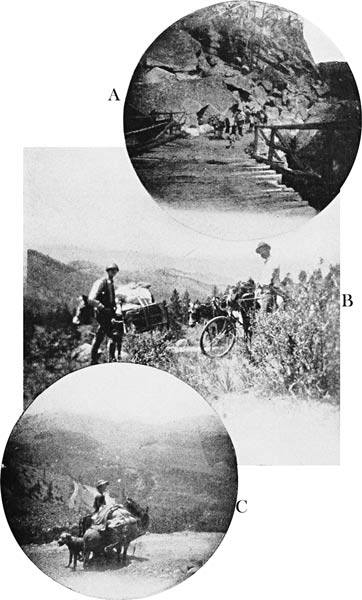
"A. Independence Pass . . .
one of the loftiest of the Continental Divide."
"B. Trail to Florisant."
"C. Two days of hard climbing to cross Western Pass."
TOC
BY MAC A'RONY.
The Professor, scorning to waste shoe leather and economize
francs, began the ascent on a mule steered by a woman holding
on to the beast's tail.—Easter on the Riviera.
A curious proceeding held my rapt attention as we
neared Petersburg, a suburb of Denver. At the terminus
of a horse-car line I observed a car approaching
us down-grade, with a horse on its rear platform. As
soon as the car stopped at the station the horse stepped
off on a platform and took his place in front of the car,
ready to haul it up-grade again and earn another ride. I
did not have the chance to ask the horse how he enjoyed
it, but I would willingly have exchanged places with him.
Next morning, to my surprise, Coonskin was the first
to rise. Our camp was near Littleton, on the banks of
a small stream, and here at early dawn that ambitious
youth gathered a panful of glittering wet sand, and
rushed into the tent with it, almost out of breath.
"Look here, Pod!" he called, excitedly, "see the strike
I've made! The river bottom is yellow with gold!"
Then I heard Pod say, "Rich, I should say! Funny
this placer hasn't been discovered before now."
"Let's file a claim," said Coonskin, "we can make a
million in six months."
"Let's!" the Professor exclaimed. As soon as breakfast
was over both tenderfeet were trying their luck at
panning gold. A cabin stood not far away, and presently
there issued from it an old man who approached the
argonauts, and sat on a log to watch them.
"Your first experience at placer mining?" the stranger
observed.
"For an instant both men looked confused. I could
see that Coonskin didn't want to reveal his newly discovered
fortune by the way he dumped his sand and
said nothing. But Pod held on to a frying-pan full of
sand with one hand, and reached for his revolver with
the other to defend his claim.
"Well, boys," observed the native, laughing, "you're
goin' through jest what all tenderfeet do when they first
strike these parts—try to wash gold dust out of mica.
All the streams out here 're filled with them glist'ning
particles, but recollect, boys, all what glitters ain't gold.
That you've got's called 'fool's gold.'"
It was plain that Pod was disappointed, but the
stranger gave him some good advice, and a large Colorado
diamond for a keepsake, then strolled away, leaving
two sadder but wiser men.
The road to Colorado Springs was a popular thoroughfare
for bicyclists. Saturday afternoon, as we
donks began the ascent of a long, steep, and winding incline,
a din of voices and a whir of wheels suddenly
sounded ahead, and a party of fifty or more young men
and women in gala attire came speeding down toward
us. As quickly as possible we donks turned out to the
right. I think the bicyclists must have been English,
for they steered to the left. In a minute "it was all off."
It happened that the leader of the wheel brigade saw
us donks too late and tried to save himself by turning
suddenly to his right. Result: Tire off and man off.
Sequel: A wild rough-and-tumble conglomeration of
sexes, as his followers mixed up with our party. Bicycles,
donkeys, men, women, lunch baskets, packs, hats,
petticoats and cameras were distributed in all directions.
The cries and shrieks of the bruised and frightened together
with the confusion of the wreckage so terrified
us donks that as soon as we could pick ourselves up we
reared on our haunches, and cavorted, and brayed, and
so help me Balaam! it was the worst mix-up I was ever
in.
When every man had assisted some one else's girl to
her equilibrium, a council of war assembled to adjust
grievances and repair machines; but the proceedings did
not interest the Professor, for he hustled us donks up hill
and out of sight as quickly as possible. The din of voices
soon sounded in the distance like a swarm of yellow-jackets.
Colorado City was a gambling resort lying between
Colorado Springs and Manitou. Our stop there was all
too brief. While Pod and Coonskin were at feed we
donks stole down-street to watch a "play." That was
the time I regretted having eaten the five dollar bill back
in Iowa, for three times in succession the roulette ball
dropped on my colors, and by compounding the principal
and interest each time I could have made a beautiful
scoop which might have given us donks a high old time.
Thence onward Pike's Peak was the chief topic of discussion.
To begin with, Pike's Peak is the largest
mountain of its size in the world. Cats can't live ten minutes
on the summit before going crazy, and dogs even
lose their bark at the timber-line. I concurred with Pod
that it would be a big feat to climb the Peak. On the
other hand, Cheese and Skates demurred from our
opinion. Skates positively declined to leave the stable,
and Cheese backed her up by putting both fore feet in
the manger. Damfino stood by Pod and me. She argued
that when one has climbed to an elevation of 14,147
feet above sea-level he is likely to feel a blamed sight
nearer heaven than he is ever apt to be again. The result
was that Damfino and I alone accompanied the men
on that adventuresome trip.
Everything went well until we struck the cog track in
Engleman's Canyon. It was the first experience for us
donks in "hitting the ties." I did not fancy the route at
all. But Pod, having seen a boy ride a native burro up
the track, resolved to do no less. The first half mile was
not steep, and the men rode us donks; but when we
caught up with a party of men and women making the
ascent, an ambitious boy grabbed my tail and allowed
me the privilege of dragging him a hundred yards before
the Prof discovered him, and dismounted. How I
thanked the boy for his thoughtfulness.
Damfino lagged behind. She had changed her mind.
The consequence was, we donks were driven ahead, and
Coonskin no sooner hit Damfino a whack with the butt
of his six-shooter, then she began to pace so fast none
of us could keep up with her. When we came to the
steep 25 per cent. grade the men were winded; not so
we donks. The men called to us, but we would not listen.
They threw stones at us, and we quickened our gait.
The men couldn't run up-grade to save their lives, whereas
mountain climbing finds a donkey in his true element.
"Ain't this fun!" exclaimed Damfino. "Never had such
a picnic!" I added. Well, Pod walked half the way from
New York and prided himself on walking, and Coonskin
had won medals for sprinting: so it looked to us a
huge joke, and we just brayed.
The next instant a locomotive bell sounded ahead, and
I saw a train approaching from round a bend. We felt
that we had the right of way, and were much put out
when the train refused to stop. We would not get off
the track; it would be contrary to the nature of first-class
donkeys to do such a thing.
Say, what wonderfully powerful things steam engines
are! We got it in our heads that we could stop the train,
if we didn't push it off the track. You just ought to have
seen us pitch headlong down the bank of the canyon into
the foaming torrent. It was a mighty plunge we made,
I can tell you. Before we rose to the surface the car
stopped, and many of the passengers got off. The banks
of the pool were so steep we couldn't climb out, and we
had to swim and tread water to keep from drowning.
Damfino brayed like a lunatic, I spouted like a geyser,
and great excitement reigned among the tourists.
Evidently "nothing was doing" for our immediate relief.
The engineer was loudly refreshing Pod's memory
that he had no right on the railroad bed with his donkeys,
and the female passengers gesticulated wildly and
condoled with Damfino and me for the deep predicament
we were in. One facetious fellow asked if we jackasses
were Baptists, and the Professor told him he didn't
know what denomination we formerly adhered to, but
he believed that we were skeptics now.
Presently our masters began search for ropes and
straps. Alas! all of them had been left behind. I was
now through with coughing, but still weak and out of
breath, while Damfino pumped logarithms of abuse at
the cog train and exhorted me to keep swimming—advice
entirely unnecessary. Finally the car steamed down
to Manitou, and the sympathetic occupants called back
that they would send aid.
Coonskin was first to come to his senses. Said he,
"I can run, I'll run to the village for help;" and away he
went to beat the cars. This expedient awoke the
Prof.'s dormant mind to an idea, and he began to roll
rocks into the Pool. At the same time he yelled something
at us, but I couldn't wait to listen, for I ducked under
water in the nick of time to dodge a half-ton boulder.
It came within an inch of knocking all the bad character
out of Damfino's head, and completely submerged us
both. After that Pod was more careful, and instead of
rolling one giant stone he sent two middle-weights down
the bank in a manner to make us dive. I concluded Pod
had gone daft.
"For Balaam's sake! what you trying to do up——"
I brayed loudly, but scarcely finished when I came within
an ace of "passing in my chips," as a gigantic pebble
of the first water whizzed between our heads. Pod called
back, "I'm lifting the bottom of the pool so you two can
crawl out." I was astonished at such inventive faculty.
A wonder we donks survived to tell it. Rolling stones
may gather no moss, but they need a lot of looking
after.
It seemed hours before Coonskin returned. By this
time I had found a footing so I could rest with my head
out of water.
"Why were you gone so long?" Pod asked, as he sat
himself on a rail to rest his windpipe.
"Well," said the winded man, adjusting a lariat, "I
hunted all over Manitou before I found the superintendent
of the waterworks."
"But what on earth did you want of him?"
"I told him of the fix of our donks, and asked him to
change the course of the stream till we could get them
out of the pool."
"You idiot! And what did he say?"
"Oh, he was civil enough; said he, 'If you would like
to have the mountain moved a little to one side I will
have it put on jackscrews without delay."
Now it nettled me to listen to such nonsense while
Damfino and I were refrigerating in ice water, and I
brayed to the jester above: "Say there, you old fool, if
you had only thought to have him pump the water out
of the canyon above us you might have furnished a little
dry humor that we would have appreciated."
The lariat was found to be of little service, but soon a
couple of tourists arrived on the scene and assisted the
two with their contract to raise the devil, as well as the
bed of the torrent, and, at length, to extricate us water-soaked
donks from our unhappy predicament. Then we
were taken to the stable, rubbed down, and put to bed.
TOC
BY PYE POD.
It is the property of great men to rise to the height of great
events.—Victor Hugo.
The city of Colorado Springs possesses many attractions,
and is growing in population and wealth. Here
is a good-sized collection of pretty homes, built on wide
and well-shaded streets, where reside beside the health
hunter of independent means the mining king, the
wealthy ranch owner, the Eastern capitalist, and the
English tourist or speculator.
Friday morning we entered that picturesque Swisslike
hamlet of Manitou with flying colors. The summer
tourists were either lounging on the broad verandas of
the hotels or assembling for burro trips to the Garden of
the Gods and other famous retreats in the mountains.
Coonskin and I rode our favorite mounts to the principal
hotels, Hiawatha Gardens and the iron and soda
springs, at which several places I delivered lectures to
the amused tourists and reaped a small harvest.
The Garden of the Gods is some distance from town,
the popular drive being fourteen miles from start to
finish. To ride our slow steeds there would mean a
sacrifice of a day's time. So after much prospecting, I
bargained with a garrulous but genial guide to drive us
with his team to the Garden and Glen Eyre for the sum
of $2.
What a gay old ride that was, in a cushion-seated carriage!
I'll bet there wasn't one square inch of the seat
that I didn't cover before I got back. Some way I
couldn't seem to get in a comfortable position. The
driver-guide was very accommodating and offered to go
back to put a saddle on the seat for me to ride in, if I
would but say the word.
The Garden of the Gods is a picturesque and grotesque
natural park, the rock formations of red and white sandstone
resembling roughly most every bird and beast and
human character imaginable. In fact, one old pioneer
whom we met insisted that the place is the original Garden
of Eden, and that when Adam and Eve were caught
eating the sour apple, God caused the earth to cough,
whereupon it threw up mountains of mud and petrified
many fine specimens of the menagerie. The mountaineer
struck me as something so unique in his make-up and
mental get-up that I bribed him to accompany me and
explain those wonderful exhibits of the earth's first zoo.
"Now there is Punch and Judy," he said; "most folks
take them as sech."
"I suppose you make out they are the stone mummies
of Adam and Eve?" I interrogated, showing effusive interest.
"Our first parents, sure's you are born," he returned
with conviction. "And there yender is th' old washerwoman
what done up Eve's laundry."
"But," I argued, "the Scripture says Eve didn't wear
clothes, so she couldn't have had any washing."
The man coughed.—"Well, my young man," said he,
"I've lived a good many year and in a heap of places and
seen a lot of females come inter the world, or seen 'em
soon after they did come, and I never yet saw one come
in dressed, but yer kin bet yer last two-bit piece, from
what I knows of women, it didn't take Eve more time
than she needed to catch her breath to change her
'mother Eve' fer a 'mother Hubbard."
Then the pioneer pointed out the "Kissing Camels,"
the "Seal" and "Bear," and the "Baggage-room."
"Are there any petrified elephants in this menagerie?"
I asked. "I'm fond of big exhibitions."
"N-n-no, they ain't no elifants here," said he with a
jerk of the head. "Yer see when the mud was coughed
up, they got so fast they left some of their trunks. That's
them in the Baggage-room yender." And he ha-hahed
over this poor joke.
As we passed successively the "Buffalo's head," the
"old Scotchman," the "Porcupine," the "Ant Eater," the
"old man's wine cellar" and the "Egyptian Sphinx" my
guide enlightened us on geology, botany and mineralogy
far beyond my powers of understanding, but not
desiring to reveal my ignorance, I listened attentively,
and now and then gasped: "Well, I never!" "I do declare!"
"Would you believe it!" and "Gracious sakes
alive!"
The "Gateway" to the famous park lies between two
giant towering rocks three to four hundred feet in height,
and further on the "Balancing Rock," a mammoth mass
of sandstone, appears to be on the verge of a fall. Before
leaving the park with its myriad curiosities, I called
upon the "fat man" who runs a bar, restaurant, curiosity
shop and miniature zoo. There lying in a box partially
covered was a sculptured figure of a Digger Indian,
which some enterprising mortal must have buried, unearthed,
and sold to the hoodwinked man, for genuine
petrified aboriginal meat.
Rainbow Falls, Grand Caverns, William's Canyon,
Cave of the Winds and Cheyenne Mountain Drive all
had their peculiar attractions. On Cheyenne Mountain
is the original grave of Helen Hunt Jackson, author of
"Ramona."
It was about midnight when, with a small lunch in an
improvised knapsack and revolvers in our belts, Coonskin
and I began the ascent of Pike's Peak, the first attempt
to do it having been so summarily defeated. By
1 a. m. we were well up Engleman's Canyon and with
the aid of a lantern we surveyed the wild and steep cog
track with about the same pleasure one feels in descending
a deep mine with a lighted candle. Higher and
higher as we rose toward the starlit heavens we found it
more difficult to breathe and easier to freeze. At times
the grade was so steep that we had to creep on our hands
and knees to prevent sliding backward to Manitou. The
so-called beautiful Lake Moraine looked disenchantingly
black and icy, and the timber line, still far above us,
seemed as elusive as a rainbow. We had to stop frequently
to rest our knees and to breathe, for air up there
was at a premium. Later on we built a fire of railroad
ties and ate our lunch.
By four o'clock we overtook others striving to make
the climb—men, women and small boys, whose chief aim
in life evidently was to climb Pike's Peak. Some of
them had started twelve hours before; others had been
twenty-four hours climbing seven miles, and from the
questions they put to us were doubtless under the impression
there was an error in the guide books and that
they had already tramped fifty miles from Manitou.
The sunrise effects from the Peak are marvelous, but
Uncle Sol appeared to have as hard work in rising mornings
as we travelers. The sunrise looked as uncertain as
our arrival on the summit. Once, we tarried to speculate
on our chances of reaching the opposite side of Manitou
in time to witness the event, then resumed tramping and
creeping, puffing and blowing and snorting, and venting
our wrath on Mr. Pike for discovering the peak, and
made the turn to find the sun as tardy as ever, with no
apparent inclination to rise.
One old man we overtook told me he had been "nigh
on to twenty year" climbing Pike's Peak, and hadn't
climbed it yet. That gave me courage. I wouldn't back
out. It looked as if there were only one more turn to
make, when, about half way around, three shivering
maidens sitting on a rock asked me most pathetically if
I had seen any kindling wood about. My heart was
touched! I replied that I had not, but would try to find
some.
I built a fire, and the girls were real nice to me, and
insisted that I share their cheese sandwiches.
On arriving at the summit I was just in time to see the
most dazzlingly beautiful sunrise to be witnessed on earth.
Arriving on the board walk in front of the Summit
House I saw Coonskin thawing in the sun, fast asleep.
Inside the house a young man lay on a sofa in a swoon,
for want of air. There is a golden opportunity for some
enterprising man to transport barrels of air to an airtight
building on the Peak, and sell it to patrons for a
dollar a pint. A hundred gallons could have been sold
that morning—I would have bought fifty myself.
Wandering aimlessly and weakly, as if from that tired
feeling, about the house and rocky-looking grounds, were
several dozen mountain-climbers, shaking hands with
themselves for having seen the sunrise, or examining the
crater of the extinct volcano, or discussing the mysterious
ingredients of their coffee cups in the only restaurant,
which small concoctions cost fifteen cents each. I
haven't said what was in the cups; it was supposed to be
coffee. I bought a cup, and forgetting that I had drunk
it, bought another, and still I didn't make out what it
was. Then I purchased another, and after I had finished
four cups began to have a suspicion of coffee. It cost
me sixty cents.
After resting an hour we started back to Manitou. It
was two p. m. before the foot-sore Pod and his lung-sore
valet managed to get to their hotel. In less than
an hour both became rational, and agreed that the first
of them to mention Pike's Peak should instantly be deprived
of breath.
To those who boast of their ability to grow fat on
beautiful scenery I heartily commend the trail through
Ute Pass, Divide, Cripple Creek, South Park, Leadville
and Aspen to Glenwood Springs, crossing Western
and Independence Passes. First proceeding up Ute Canyon
along the banks of the turbulent stream and in the
shadow of the towering cliffs, often in view and in hearing
of the trains on the Colorado Midland, we passed the
summer retreats of Cascade and Green Mountain Falls,
at which places the tourists flocked from hotels, cottages
and tents to talk with Pod and Mac A'Rony.
Only a brief stop was made at Divide to enable me to
replenish my larder; then we hustled on toward the famous
mining camp.
Early every afternoon a thunder shower drenched
our party. Once or twice the thunder in advance warned
us so we could pitch tent and crawl under shelter. Thus
our travels in that region were impeded.
Three miles beyond Gillette we climbed to Altman,
said to be the highest incorporated town in the United
States, some 11,300 feet above the sea. It rests literally
on the summit and hangs down over the mountain sides
secure enough whenever and wherever there is a prospect
hole with sufficient gold in it to serve the miners a
foothold and check their sliding further. The high altitude
of the district makes it especially undesirable for
women, causing nervous troubles. Even the male population
are more or less excitable, and when prospectors
think they have made a strike some of them run about
like lunatics.
From Altman we took a tortuous trail, threading Goldfield,
Independence, Victor and Anaconda. The mountains
about are honeycombed with prospect holes—or
graves they might be properly called, for many of them
contain buried hopes. From a distance they look like
prairie-dog towns, but occasional shaft-houses and gallows-frames
rise here and there to give character to the
mining region, while several railroad and electric car
lines wind about the hills and gulches.
Many of the cabins in these towns are built of logs; the
streets look to have been surveyed by cows rather than
engineers. As a rule, there is no symmetry to the thoroughfares—up
hill and down hill, crooking and winding,
crossing and converging, in a manner to puzzle a resident
of a year. The situation of most of the habitations
seems to have been governed by the location of the
claim of each house owner. This great camp got its
name from two circumstances occurring when the locality
was known for no other virtue than a grazing place
for cattle. One day on the banks of the creek that trickled
through the present site of Cripple Creek a man broke
his leg, and the following day a cowboy was thrown
from his bronco and had his arm broken. Some one,
seeing both accidents, said: "I reckon we'd better call
this place Cripple Creek." So the noted camp was christened.
TOC
BY MAC A'RONY.
You do ill to teach the child such words; he teaches him to
kick, and to hack, which they'll do fast enough of themselves;
and to call horum;—fye upon you!—Merry Wives of Windsor.
Frequently since crossing the Mississippi Pod had received
letters from proud parents informing him that
they had named their latest boy after him. At that time
in Cripple Creek, several boys ranging from a day to six
weeks old, whose destinies were thought to be promising,
were afflicted with my master's ponderous name.
A little green-eyed Irish girl, five days old, was named
Pythagorina Podina Mulgarry. The happy father called
personally on Pod and asked him to act as godfather at
the baptismal service, Sunday afternoon. The impressive
ceremony took place at the cabin of Miss Pythagorina,
as the aged grandmother wished to witness it. Pod
said he was somewhat embarrassed about attending,
since he had forgotten almost all his Latin, but he arranged
with one of the pall bearers to give him nudges
and kicks when it was expected of him to make a response,
and so he got through fairly well—better than
the kid did. He said the babe was an unruly child, and
kicked so frantically when the priest took her in his arms
that two flatirons were tied to its feet to keep them down.
It was simply nervousness, because the high altitude affected
the child's nerves. So when the priest was handed
the tiny thing in swaddling clothes and held it over
the barrel that served as the font, the poor girl was
frightened and squirmed, and suddenly slipped out of the
priest's arms into the barrel and sank out of sight.
There was great excitement and surprise because the
flatirons didn't float, and the undertaker, or what you
call 'em, overturned the barrel of water and set everybody
afloat, drenching the sponsors and guests.
Pod said the scene was without a parallel; he was
soaked to his equator; the half-christened, half-drowned
Pythagorina Podina was picked up from the flood with
a tablespoon, and the ceremony finished; then she was
rolled on the barrel to get all the water out of her, and
put to bed with hot flatirons at her feet to prevent croup
and mumps. Then the wake broke up. I don't believe
the child understood a word that the priest said; Pod
didn't.
That night he got up a fine supper, and invited some
old friends. He bought a big porterhouse steak, thick
and tender, and personally broiled it on his patent folding
stove. Just when everything was on the table and
the guests were finding stones and tin plates to sit on,
Don, not having had a thing to eat for an hour, coolly
pulled the hot steak off the platter and dropped it on the
ground. Pod didn't say anything, though, but just
forked it on to the platter and scraped off some dry
grass and a sliver and a bug, and carved it up and generously
put it on the ladies' plates. The ladies looked
at the dog, and then at Pod, not knowing which to
thank, then feeling sensitive about accepting the best
part of the steak, insisted upon Pod's having one of their
pieces and Coonskin the other; and both men being
kind and gallant accepted the compliment, and all fell
to eating. But the guests didn't eat much. They said
they had just had dinner. You could see plainly from
their appetites that they were telling the truth. After
supper Don feasted on the tougher parts of the steak,
and we donks were fed the scraps of potatoes and bread
and tin tomato and peach cans. When the banquet was
over the guests went home.
Pod devoted Monday morning to business, and took
in a good stock of supplies, and after lunch we set out
on the trail to Florisant, about twenty miles away.
About six o'clock we went into camp on the margin of
a famous petrified forest. Pod objected at first, because
of the scarcity of fire-wood.
"Lots of petrified wood chips lying around," I remarked;
"and they'll last. Ordinary wood burns up too
fast."
"Bright idea!" exclaimed Pod. And Coonskin went
to work gathering petrified wood for the supper fire.
"The only trouble will be in starting the fire," said Pod.
"Just as soon as it's once going, it ought to burn
smoothly enough—might pour coal oil on the chips.
What do you say, Coonskin?"
Coonskin's opinion didn't benefit Pod much. His
hard-wood fire wasn't very satisfactory, but with some
dry brush the men got the meal under way. Next morning
we visited the noted petrified stump, measuring upwards
of forty-five feet in circumference. Several saws
were imbedded in it, for many futile attempts had been
made to take off some slices for the Denver Exposition.
It has been estimated by various ornithologists, botanists
and entomologists that the stump is millions of years
old. I think they were guessing at it, for I couldn't see
the rings, and even if I had seen them with a telescope a
fellow couldn't live long enough to count them.
We journeyed until ten at night, stopping at Florisant
only a few minutes to buy a crate of peaches. Several
times I had a suspicion that we had been misdirected.
When we came to the end of a narrow wood-road I
was sure of it. We went into camp, and before breakfast
a timberman called on us.
"You kin trail through the timber to Pemberton," said
he to Pod, "and then cut through to Fairplay, er you kin
go back the way ye came."
"What do you say?" Pod inquired, turning to Coonskin.
"I think best to go through the woods," said the
valet.
So we were headed for the timber. Our tramp
through the forest I cannot soon forget. Up and down
the rocky heights, through thickets of quaking asp and
pine, tangled roots and fallen trees, we climbed and
panted and coughed and brayed for some four miles, when
we stopped to rest and realized we were lost. Coonskin
said he was an experienced woodman, and would blaze
the trees so we would get out again. Wonderful! the
amount of learning he had gleaned from dime novels.
He lagged behind to do the blazing; and pretty soon I
smelt smoke. The Professor snuffed.
"Smells as if the woods were on fire somewhere,"
hinted Pod.
"Look behind you; they are!" I exclaimed. And Pod
caught that erudite valet-back-woodsman in the act of
setting a tree on fire with oil and matches. Fortunately
for us the wind wasn't blowing strong, but we had to
change our course some, and hustle faster, for the blazing
trail chased us. Coonskin learned a new lesson, and
turned down the corner of the page so he'd recollect it.
After Pod had explained the meaning of the word "blaze"
in this case, the fellow was more put out than the fire.
At length we struck a trail which led to a couple of
cabins in the canyon. A board sign informed us it was
simply Turkey Creek. I couldn't see any turkeys, but
there was good pasturage around. The hot trip through
the timber made us all hungry.
It was three o'clock when we donks were picketed
and allowed to graze. Then Coonskin went fishing. He
said he had seen some trout in the stream; by supper
time he had caught a nice mess. Pod said he would
fry the fish, and went at it so enthusiastically that he forgot
to put the bag of corn meal back in its place. After
the meal was over, he began to look around for the bag.
It was nowhere to be found; I had eaten the corn meal
and bag. It was comical how those two men puzzled
their brains about that missing commodity. When
Coonskin detected some meal stamped in the ground, Pod
pointed at me and said, "That's the thief, there."
Next morning, Coonskin was the first to return from
fishing, and looked much excited. When Pod returned
he told him he had seen huge bear tracks; he was going
bear-hunting. Pod laughed at him.
"Now let me tell you," said the boy, "we aren't likely
to get any big game on this trip if we are looking and
gunning for it. That was my experience in the woods
of Wisconsin. The men at the saw-mill said we should
see bear in this forest, but where are they? It's my
opinion if we loiter around this here canyon a day without
guns we will see a bear pretty soon. A silvertip
would be a boon to you, Prof; its skin would fetch
fifty dollars or more. Let's look for bear."
"What would you do if you saw a bear?" Pod asked.
"Well, now leave that to me," said Coonskin. "In the
first place, it would be worth a hairbreadth escape to see
one wild; I've only seen bears in circuses, or traveling
chained to Italians; in the second place, I can run. I've
plenty of medals for sprinting, but if I saw a real bear I
could beat all records."
Pod looked at me and I looked at Pod; I hadn't anything
to say on the subject; it didn't interest me as much
as it did Coonskin. Pod went fishing that afternoon
with a gun, and took the whole arsenal along with him,
including the axe.
Somewhere about five o'clock Pod came into camp
with a good mess of trout. After cleaning the fish, he
took off his guns, and laid down on the grass, and wondered
if that crazy valet had run across any more bear
tracks. He wasn't there long when, suddenly, I heard
yells issuing from the canyon down stream round the
bend. The shouting sounded nearer every second, and
I soon distinguished Coonskin's voice. Pod got up from
the ground excitedly.
"Coonskin's in trouble, plain enough," said Pod aloud
to himself, "I must run to his aid." So he started on a
trot down stream to the bend, and then quickly turned,
falling all over himself, and ran toward the cabins faster
than I ever saw him run before or since. And immediately
Coonskin came flying into view with the biggest
bear at his heels I ever want to see.
That sight paralyzed me; I couldn't get on to my feet
for a minute or two, then I broke the rope and kited up
the canyon a hundred yards, where behind a tree I
waited to see the interesting finish.
TOC
BY PYE POD.
Who dared touch the wild bear's skin
Ye slumbered on while life was in?
—Scott.
How fast a man can run when he knows he's got to
win a race! There was one time in my life when
"can't" was an obsolete word in my vocabulary. It was
when that silvertip granted Coonskin's chief desire in
the field of adventure.
"Shoot him! Shoot him!" cried the angler, as he
fairly flew past me, headed for the first cabin.
But I had neither time nor gun to shoot; when I heard
bruin at my heels I switched off to the left and ran three
times around the second cabin before I realized the bear
had taken a stronger fancy to my comrade. It seems he
had chased Coonskin around the cabin several times,
until the man dived in the door and head first out of the
window. Bruin followed in, but remained. He smelled
the fragrant peaches.
Coonskin, however, under the impression that bruin
was still after him, ran twice around the cabin before he
climbed a tree.
Meanwhile, I, having climbed a tree close to the cabin,
descended to the cabin roof. I knew silvertips couldn't
climb trees, so I felt safe. The sudden shuffle of my feet
on the gravel-covered roof disturbed the peace of the
present incumbent, and out he came, rose on his haunches
and looked about to see what was up. I was immovable.
Back into the cabin went brother Bruin, and began to
break up things, generally.
Then followed a few moments of dreadful silence. Not
a sound issued from Coonskin's tree; he was probably
trying to recover his breath and reason. Night soon
fell upon us; it gets dark early in the canyons, and the
mercury falls fast. I was chilly, for I shivered frightfully.
The blankets and guns were on the ground just
outside the cabin.
"Let's flip a coin to see which of us goes down for a
gun," suggested Coonskin from his tree. But I did not
take him seriously.
"Don't you wish you had taken the fish-line off your
rod?" he added; "you could fish up a blanket and keep
from freezing."
"By jingo!" I exclaimed, "I have my line, and I'll try
it."
At once I fashioned a fish-pole out of a pine bough,
and after much patience secured the only blanket within
reach. Then winding it around myself, I lay as snug as
possible, but couldn't go to sleep. That was the longest
night I ever experienced. How long we should be kept
off the earth, was an unpleasant speculation. Once I
called to Coonskin not to go to sleep and tumble out of
the tree, but he answered that he was so stuck up with
pitch he couldn't fall.
Our hopes were low, when, suddenly, about seven
o'clock, from the canyon below appeared a man in the
rough garb of a mountaineer, with a rifle across his
shoulder and a hunting knife in his belt. As he was
about to pass I hailed him.
The hunter stopped, looked my way, approached to
within a few feet of the cabin, and said a cheery "Good
morning." I responded in a mood still more cheery.
"What you doin' up there—smoking? Had breakfast,
I reckon."
"No, haven't cooked yet this morning," I returned.
"Glad t' hear that—haven' et yet myself. Got 'nough
to go round?" he asked, shifting a cud of tobacco from
one side to the other.
"Don't know about that," I said. "You'll have to ask
the boss—he's inside."
As the rugged looking huntsman approached the cabin
door, I held my breath, but I rose to my feet when I actually
saw the hunter's hat rise on his uplifted hair as he
looked into the cabin door. With the quickness and coolness
that come to one habituated to solitary life in the
wilds, he put his Sharp's rifle to his shoulder, aimed and
fired. There was a second report, followed by a tremendous
thud, and the sound of something within
struggling for life and vengeance. The hunter had no
sooner fired than he dodged, and stood ready for a second
charge; but that was not needed.
"Come down," he said to me with a grim smile. "I'm
boss here now."
I slid off the roof, and Coonskin, to the man's surprise,
appeared from his lofty perch; then we introduced ourselves.
While I thanked the hunter for his kind offices
and welcomed him to breakfast, Coonskin began to prepare
the meal. Our guest explained that he was a bee-hunter.
"When the bear meets the bee-hunter searchin' for a
bee tree, brother Bruin says, 'Ahem! Excuse me, but
I'm workin' this 'ere side of the trail, you just take t'other
side.' Then the bee-hunter says: 'Pardon, my friend,
Mr. Bear, but I'm workin' both sides of this particular
trail, just throw up your paws.'"
The bee-hunter chuckled over the practical joke played
on him, and said as it came from a tenderfoot he'd take
it in good part; but if it had been a backwoodsman that
played such a game he'd settle with the bear and the
man in the same fashion. His words and manner startled
me.
The bee-hunter rose from the log and drawing his
knife, dropped on his knee, and began to skin the bear as
if he thought he owned it.
"You needn't bother about skinning it for us," I said,
"we're quite satisfied that you killed it."
The man eyed me. "This bear belongs to me, if ye
want to know," he said.
"How is it your bear?" Coonskin asked, when he came
to announce breakfast. "You shot it, but in our cabin."
"That don't make no difference, and I don't intend
arguing the question," came the positive retort; "I say
he's mine—who says he hain't?"
I suddenly felt a bee in my bonnet. "The 'ayes' have
it," I said.
That stopped the debate, but I could see blood in
Coonskin's eye when he ushered us to breakfast. Before
we had finished, my nervy valet asked our guest
if he played poker. "Ya-a-as, some," the hunter drawled.
"If there's money in it, I'll jine ye in a game."
larger
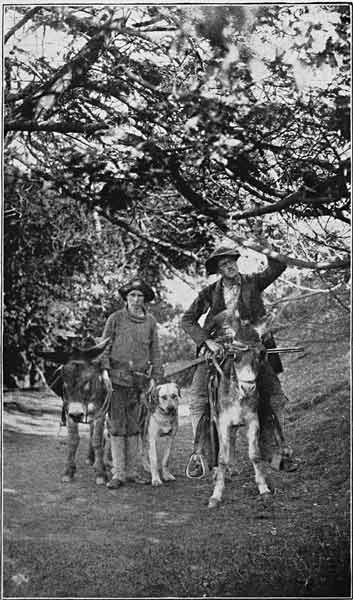
"Through thickets, tangled roots and fallen
trees."
What could Coonskin have in mind, to challenge this
rough mountaineer to a game of cards? He had often
boasted of his skill at poker. Now he cleared the table
and brought forth the cards he had carried way from
Iowa, and motioning the bee-hunter to a seat, the two
cut for the deal. From my seat, beside Coonskin, I discovered
a little round mirror hanging on the wall behind
the hunter opposite; it was the one my valet had purchased
in Denver. Where he sat he could see the hunter's
hand reflected in the glass. I felt if he were detected
in this underhand game it would go ill with both of us; so
put both revolvers in my belt, and kept mum. That was
an interesting game.
"Lend me some change," said Coonskin. I threw him
my bag of silver. Then he added: "Pod, you count out
the matches here for chips and act as banker." So I
was drawn into the game. The first few hands were very
ordinary, and caused no excitement. But finally the
bee-hunter, arched his eyebrows; I knew he must have a
fine hand or a bluff, in store for his tenderfoot opponent.
He bet heavily, but Coonskin raised the ante every time.
Suddenly what had been in Coonskin's mind all the time
was revealed. "Lend me fifty dollars," said he to me,
and to the bee-hunter added: "I'll lay this roll of bills
against the bear skin, and call you."
"I'll go ye," said the bee-hunter. When both men
lay down their hands, I had taken down the mirror and
hid it in my pocket.
"Beaten by four jacks! I be d——d!" the outraged
mountaineer exclaimed, pounding his fist on the table
and regarding his four ten-spots with grim disfavor.
Coonskin grinned from ear to ear as he swept in the
money. Said he, "Mac A'Rony, Cheese, Damfino and
Skates—I swear by them every time. Whenever I get
that hand I'm billed to win."
"So yer travelin' on them jacks," remarked the defeated
partner.
"No, not exactly," Coonskin returned as he rose from
his seat. "The jacks I'm traveling with are out doors;
these are their tin-types."
The bee-hunter looked chagrined enough, but he took
the thing as a matter of course, apparently never dreaming
that he had been actually buncoed by a boy tenderfoot.
Presently he rose, and shouldering his rifle, made
his departure without thanking us for our hospitality. I
hoped sincerely he would find his bee tree, and harvest
a rich reward. I told Coonskin he was a brick. He accepted
his winnings modestly, and fell to finishing the
task of skinning the bear. It was a fine skin. After salting
it, and wrapping it in gunnysacks, I packed our luggage
while Coonskin saddled the donkeys.
Shortly after noon we reached the road that was already
familiar to us, and five hours later arrived in Florisant.
It was sundown when we went into camp. I had lost
three days, but I had been fully compensated by the
pleasures of angling and bear-hunting.
Next day we were off for Leadville in good season.
My animals seemed to be in fine traveling form; by sunset
we arrived in South Park. It was Saturday. There
we enjoyed the hospitality of a deserted, floorless cabin,
where, sheltered from the wind, we could eat without
swallowing an inordinate amount of sand. Close by was
a fine spring, so we resolved to remain until Sunday
afternoon. We were awakened at dawn by a bevy of
magpies perched on the tent; Coonskin was so annoyed
that he crept to the door and shot the chief disturber, in
spite of the bad luck promised him by a popular legend.
South Park is one of three great preserves in Colorado.
There once roamed buffalo, deer, elk, antelope and
wolves, while on the mountains bordering the valley were
quantities of mountain sheep. A few deer, sheep and
bear are said to be still found in that section. Coyotes
are heard nightly, and the evening we trailed out of the
Park a traveler with a prairie schooner said he had seen
two gray wolves.
Our afternoon trip through the Park was a painful
one. Mosquitoes attacked us from every quarter, and it
was mosquito netting, pennyroyal and kerosene alone
that saved our lives. When we consider that Mosquito
Pass, the highest pass of the Rockies, 13,700 feet, was
named after a mosquito we may derive some idea of the
size of the insect.
It was late in the night, when, after brief stops at two
sheep ranches run by Mexicans, and another at a small
settlement, we entered the canyon. It required two days
of hard climbing to cross Western Pass. The snow-capped
peaks of the range looked grand and beautiful, and the
noisy streams in the canyons leading from the summit
on both sides were stocked with trout.
The morning we trailed out of the canyon into the
Arkansas Valley was clear and lovely. After traveling
some distance up the valley, the smoke of the Leadville
smelters burst into view, and a mile beyond the city
itself could be seen nestling against the towering mountains.
This famous mining camp gave us royal welcome. The
report in the papers that Pye Pod would lecture that
evening drew an enthusiastic throng, applauding and
crowding closely about the donkeys, all eager for the
chromos that Coonskin sold while I talked.
Next morning we crossed the valley and pitched camp
on the banks of Twin Lake, two lovely sheets of water at
the mouth of the canyon leading to Independence Pass.
This pass is one of the loftiest of the Continental Divide—that
snowy range from which the rivers of Western
America flow east or west through undisputed domains.
Trailing up, the ascent gradually became very precipitous
and the trail a severe trial. Over this pass, climbed the
overland stages and freighting wagons with their four
and eight-horse teams. It was, in ante-railroad days, a
popular route, and the now deserted cabins of Independence
once composed a lively mining camp. Although
the trail was kept in good order, yet wagons and teams
frequently toppled over the narrow trail, and mules,
horses and passengers met their death on the rocks below.
We men walked to relieve our animals and arrived at
the summit at sundown. Looking backward, for six or
seven miles the view surpassed in grandeur any scene of
the kind I had ever viewed. The stream appeared to be
spun from liquid fleece from the mountain sides, and
tumbled and foamed over the rocks and fallen trees in
its bed until it looked like a strand of wool in a hundred
snarls.
While resting, a heavy snow squall descended, and
drove us on across the pass into the western canyon for
shelter. This canyon surpassed in grandeur and size the
other. Knowing our sure-footed steeds would keep the
trail much better than we, Coonskin and I got in the
saddle, but more than once I nearly went over Mac's
head.
When we had proceeded only a mile below the summit,
the trail became particularly narrow and rocky. To
the right, protruded from the bank a great boulder, and
to the left sloped a deep and sheer precipice, to which
only the roots and stumps of trees could cling. Here
my valet dismounted; I should have done likewise. Mac
considered a moment whether or not to descend further,
then made a sudden dive, shying from the declivity and
striking the rock on our right, and was jarred off his feet,
falling with me over the edge of the trail.
Down and over we rolled toward the yawning gulf
some forty feet before we caught on a stump and
stopped. That was a dreadful moment for me. For a
time I lay still, not daring to excite Mac.
Carefully I extricated myself from my perilous position,
and held my donkey's head down till Coonskin got
the ropes from Damfino's pack and came to my relief.
In time the other three donkeys pulled Mac A'Rony up
on to the trail.
We pitched camp and Sunday morning continued
down the trail, which soon presented difficulties still
more discouraging. The numerous springs had necessitated
corduroy roads often hundreds of feet in extent.
But these had been so long in general disuse that the logs
had rotted away in places.
Frequently Coonskin and I dismounted and repaired
the corduroy breaches, with fallen trees, thereby losing
much time. By dark my outfit had made but three
miles. In the darkness of evening we came to the empty
cabins of old Independence, whose single inhabitant
called to us from his doorway as we passed.
At last we arrived at an old-time stage-house. It was
now temporarily tenanted by fishermen from Aspen, who
asked us to spend the night with them. I accepted; soon
my animals were feeding on the fresh grass bordering a
spring nearby, and Coonskin and I seated at the hot repast
our hosts had quickly provided.
The house was large, with a high roof and a dirt floor.
A great fire blazed in the center, lending comfort to the
cozy quarters. The anglers had spread their blankets
in one end of the shack, and we pitched our tent in the
other and soon fell to sleep, while the fishermen likely
continued to swap "lies" till a late hour. The last remarks
I heard almost made me cry.
"I don't think it would do for me to go to hell, pa,"
said the lad of the party.
"Why?" queried the sire.
"Oh," said the boy, "the light would hurt my eyes so,
I couldn't sleep."
Getting an early morning start, we trailed down and
out of the long canyon into Roaring Fork Valley, and at
four o'clock arrived in Aspen, a famous silver camp of
early days. A crowd soon gathered, and I had no sooner
announced a street lecture for that evening than the news
began to spread all over town. Here supplies must be
bought, some business transacted under my advertising
contract, and Mac shod. For the first time that jackass
kicked the blacksmith. When I reprimanded him, he
claimed the man had pounded a nail in his hoof almost
to the knee, and added, for the smith's benefit, "Shoe an
ass with ass's shoes, but set them with horse sense."
Which I thought sound philosophy.
At the appointed hour and place for my lecture the
street was choked with an eager audience. Coonskin
had been instructed to have the donkey there, saddled
and packed, by eight sharp. They failed to appear. So
impetuous and enthusiastic were the crowding, cheering
citizens that I mounted a block and began to talk. Suddenly,
I was interrupted by a shout, "The donkeys are
coming," and at once the crowd became so hilarious that
I had to cease speaking till my outfit arrived. "Mac
A'Rony!—Mac A'Rony!—Damfino!—Cheese!" echoed
and re-echoed, as a number of boys ran to meet the
donks. It occurred to me that Coonskin might soon
have his hands full, so I hastened to his side. But, ere I
arrived my handsome Colt's revolver was stolen from its
holster, buckled to Mac's saddle horn. As Coonskin
was riding Cheese and trailing the others he could not
guard against the theft, but I blamed him for not heeding
my instructions always to leave the guns at my headquarters.
It was the only article lost by theft on
my journey. The four marshals on duty hoped to recover
the revolver, and forward it to me, but I never received it.
When I had finished my lecture, Judge S—— passed
his hat and handed me a liberal collection. And as my
outfit trailed out of town toward Roaring Fork, a young
man wheeled up with us and gave me a silver nugget
scarf pin. In Aspen, as in Leadville, I disposed of many
photos.
It was a fine evening. I was promised a smooth trail
through to Glenwood Springs. We were to travel ten
miles that night, and hence would need to sleep late next
day. So I advised Coonskin to set the alarm clock, just
purchased, for ten a. m.
TOC
BY MAC A'RONY.
And riding down the bank, he spurred into the water.—The
Fair God.
When, at the conclusion of Pod's Aspen lecture, he
gave the signal for our outfit to "move on," I breathed
a sigh of relief. I abhor crowds; I despise shoemakers.
They say that an ingrown nail is painful; an inpounded
nail is worse. Pod said he wouldn't care if I had lockjaw;
for then I'd have to keep my mouth shut.
"You ordered Bridget to call us at eight in the morning,
didn't you?" Pod asked of his valet, when we were
a mile out of town.
"I did that," Coonskin replied. Who could Bridget
be? Surely the turtle, Bill, hadn't changed his name.
I'd hate to have him pull me out of bed.
"Have the men got a woman stowed away in their
luggage?" queried Cheese; "I hear 'em talking of some
biddy."
"It's scandalous!" exclaimed Miss Damfino, and Miss
Skates said she thought so, too. These words were
hardly spoken when, about eight o'clock, we were strolling
peacefully down the trail along the high bank of
Roaring Fork River in the darkness, something with a
shrill voice suddenly began to scream and kick up a terrible
racket in one of my saddle bags, electrifying my
whole being. Was Pod bewitched? Or was some demon
upon me? I asked both questions at once, and not
waiting for an answer, ran through the darkness blind
with terror. Ears back, tail out straight, and legs spinning,
I failed to see the trail, or hear my master's
"Whoas!" I only thought the devil was after me, and
flew through the air like a meteor. Soon the trail turned
to the right, but I kept on straight ahead, and suddenly
tumbled, tail over ears, down the steep bank into the
rushing river, my master still holding on to reins and
saddle horn. How deep I dived I can't say. The dampness
poured into my ears and mouth and drowned my
thoughts, and just when I had begun to think of my past
life, I came to the surface with that demon still yelling
and clinging to the saddle or to Pod. Then a terrific
jerk on my bit brought me to my senses, and I swam
to the nearest shore. It was a long, hard pull. Pod
clung to me as though I were a life buoy, and when I
climbed on to the bank out of breath, the screaming demon
chased me half way up to the trail.
Pod's mouth was a flame of fire, but aimed more at
Coonskin than at me. Reckon he thought me too wet
to burn.
The whole outfit, including dog and turtle, awaited us
with bated breath.
"We've found out who Bridget is," said Cheese, laughing.
"To the devil with Bridget!" I retorted. "What in the
name of Balaam was that after us?"
"The new alarm clock, you fool," replied Cheese.
I was too full for utterance—too full of water. The
Professor was a sight, even in the darkness. Never
saw him so mad.
"Didn't you know that if at six o'clock you set the
alarm for eight in the morning, it would ring at eight in
the evening?" he vociferated, wildly gesticulating at his
scared and speechless attendant.
Cautiously through the darkness we proceeded for a
couple of miles, Pod walking to prevent taking cold, he
said. Then we were steered to an old cedar stump, where
we camped. Bridget's alarming voice had made a fearful
impression upon me. Several times on the way to camp
I imagined a demon was after me, and shied into the
sage. Why, I've seen roosters and hens chase all over a
half acre lot and jump a fence after losing their heads,
simply from nervousness.
The cedar stump was set ablaze, and as soon as Pod
had pitched the tent, he began walking around it dressed
in his only suit of clothes, trying to get thoroughly dry.
He was not in a good mood to talk with, so I kept aloof.
Next morning the valley and the mountains hemming
it in revealed a beautiful and bountiful nature. Although
alfalfa seemed to be the chief crop, fields of
wheat and oats waved in the breeze. It was August; the
harvest had hardly begun. The vendure on the mountains
was not less lavish in its rare autumnal tintings
than were the internal colorings of the hills with metals—copper,
lead, silver and gold. Now the trail would
hug the river so closely I could hear the roaring flood,
and again the current would sink beyond reach of ear
or eye, suddenly to burst upon us later.
The sun grew hotter with every hour's travel; the trail
became more dusty; the prickly sage looked more
browned and withered.
One evening, under the screen of darkness, the men
pitched camp conveniently near to an alfalfa field, hay-stack,
and potato cellar. The sage, while much seared
by the sun, was yet too young and green to burn, so
when Coonskin dropped two large boards in front of the
tent Pod was elated. The fellow said he had unroofed
a tater cellar. In view of the shady deed, Pod kindled
the fire on the shady side of the tent and proceeded to
cook the supper. We hadn't time to make our escape
next morning before we heard the rattle of a wagon
approaching. Presently a team of horses, driven by a
short, morose-looking, black-whiskered farmer, stopped
right in front of camp. Instinct told me he was the
owner of the property we had "squatted on" and intended
to make trouble. Pod was seldom embarrassed,
but when so he appealed to Coonskin's wit and gall for
the desired relief. The man climbed out of the wagon
and walked toward the tent, until he saw Don, and
stopped short.
Coonskin winked slyly at Pod and me under his hat-brim,
and said to our caller, "Walk right in, sir, and
make yourself miserable; the dog won't hurt you;" then
Pod said a "Good morning" sweet and juicy. The
stranger's sharp eyes surveyed the remaining board and
the cremation ashes of the departed, and nodded sourly.
I was now saddled, and Coonskin was buckling on his
belt with revolvers and hunting knife. Said he to our
guest, "This traveling round the world on a bet ain't
what it's cracked up to be."
"Reckon not," returned the stranger. And he asked,
"Big bet."
"N-o-o, only fifteen thousand dollars."
The stranger grunted, as he mentally appraised the
value of his lumber, and then regarded the men as if he
wanted to put a price on their heads.
"Wouldn't been so bad," Coonskin resumed, "If one
of our original party hadn't got scalped by Esquimaux
when crossing the Arabian Desert."
"I want ter know!" the stranger exclaimed. "How
did it happen?" As he spoke, he sat down near the board
and whittled a stick, now and then eyeing Coonskin with
overdue interest.
"Well, you see," the valet began, "we were trailing on
the desert at night, because the sun in India is so hot,
when he suddenly hailed what we took to be a caravan.
But instead of one outfit, there were three, all of 'em
enemies of each and tother—Hottentots, Spaniards, and
Solomon Islanders, all at lagerheads. Say, weren't we
in a nice mess!"
"'Pears so," the farmer ejaculated, with wrapt phiz.
"At once all tried to capture us," Coonskin continued,
"but pretty soon fell to fighting among themselves;
and that'e how we escaped. But Jack got shot."
Coonskin looked as if he had lost his last friend.
"Poor Jack," muttered Prof., shaking his head sorrowfully.
I saw plainly the story had touched the stranger's
heart. "Purty sad, wasn't it boys?" he commented.
"Didn't ye have no shootin' irons along?" he asked.
"Should say we did—a whole battery," said the valet.
"We shot several of the black demons (here waxing excited
as he recalled the harrowing spectacle), but what
was a thousand of them compared with one Jack!" And
Coonskin tickled me in the ribs.
"Ner a hundred Jacks," returned the farmer absentmindedly,
and looking thoughtful. Then Pod said it
was time to be going, and offered to pay the farmer for
the board he had much enjoyed; but the latter said he
"didn't want no pay," and, after offering Pod and Coonskin
his plug of tobacco, clambered into his wagon and
drove off.
Then we made for Glenwood Springs.
TOC
BY PYE POD.
You may nail it on the pailing as a mighty risky plan
To set your judgment on the clothes that cover up a man;
It's a risky piece of business, for you'll often come across
A fifty-dollar saddle on a twenty-dollar hoss.
—Old Saw.
We reached Glenwood Springs the week of the annual
races, and I piloted my outfit to a prominent corner
in town. At once a crowd gathered. After making a
few remarks about my trip and promising a lecture before
leaving town, I inquired for the leading hotel.
"The Colorado," answered a chorus. Then a man in
shirtsleeves, sombrero, and high boots edged to my
side, and whispered, "Prof, there's a dollar house
t'other end of town. The tax is five dollars a day at the
Colorado."
"How much can I make at the dollar house?" I asked.
My informant shrank into his clothes. "I don't believe
you can make your salt," he answered.
I left my outfit, and rode Mac to the post office. I
had not been indoors long before I heard loud cheers
and laughter in the street. I rushed out, thinking somebody
was making sport with my donkey, and was surprised
to see Don leading by the reins that incorrigible
flirt, Mac A'Rony, up-street toward the post office. He
had strolled to the next corner to make the acquaintance
of a prepossessing donk of the opposite sex, and my
faithful dog, conscious of his responsibilities, was doing
his duty.
The town is situated on the east bank of the Grand
River; across, some distance from the water, stands the
Hotel Colorado. An iron bridge spans the stream, and
across it I led my caravan to the hotel in time for dinner.
As I dismounted, the guests on the veranda hurried
to the railing and whispered to one another; I paid
no heed, but, giving my valet instructions to care for
my animals, hurried in. The clerk extended his hand in
greeting.
"Just on time," said he. "Lunch is awaiting you."
I shall never forget the sensation I caused when I
entered the dining room. A sweeping glance detected
every eye upon me. I sat at the nearest table opposite
two dudes who almost choked to death when I reached
for the menu card. Even the pretty waitresses stopped as
if struck. One of the poor girls dropped a tray of dishes.
Every countenance said plainly, "How did it drift in?"
Several pretty girls at the next table, seasonably gowned
in silks and muslins, whispered and giggled audibly.
Presently the dudes considered there wasn't room for
us three at the table, and changed their seats so precipitately
that one of them stumbled over the legs of his
chair and broke his fall by first breaking a cup. As they
now faced the pretty girls, their prospect was more inviting,
if not picturesque. My hair and beard were long,
one of my coat-sleeves threatened to come off with the
slightest cough or sneeze; I looked like one who had
experienced hardship and rough traveling.
This is a treat, I thought, as I divided my interest between
the diners opposite and my menu card. I was
famished. The waitresses kept aloof from me.
Suddenly my ear caught the words spoken by one of
the dudes, "He acts as if he owned the dining room, and
had first bid on the hotel." I smiled. Just then I felt a
hand on my shoulder, and recognized the head-waiter,
who, a moment before, had left the room probably to see
the hotel clerk. He was all smiles, as he asked if I was
being waited upon. I said I was not.
"I-I-I beg your humble pardon," he stammered, and
off he danced. The next minute a half dozen waitresses
were assailing me for my order. Finally I was lavishly
served; then there was dissatisfaction at the next table.
The dudes began to complain because that "hobo" received
every attention while they were neglected.
Having received an invitation to the races, I did not
tarry longer than necessary. I was sure things would be
different when I returned for dinner. And such a change
as there was! I was assigned to a table at which was a
bevy of girls and two or three gentlemen. My seat had
evidently been reserved for me by request. I didn't have
to wait for the waitresses to pass me things, the girls did
that. I was treated like a hero, and almost embarrassed
with attentions. When I retired to dress for the ball given
in my honor by the young women of Glenwood, I fell in
a chair and laughed till my sides ached. What fun the
study of human nature does afford!
The evening paper stated that the famous donkey traveler,
Professor Pythagoras Pod would be the guest of
the evening, and was expected to appear in traveling
clothes, spurs, and belt guns. And so I attired myself,
arriving at the hall at eight-thirty, and was at once introduced
to one and all of the fair gathering. I danced
myself completely out. When supper was announced I
was glad. Had I traveled thirty miles that day I couldn't
have felt more fatigued. It was almost eleven o'clock
when I set out for my hotel.
One of the attractions at the Colorado is the great out-of-doors
natatorium, between the river and the hotel. I
had hardly crossed the bridge when I heard Mac's bray
issuing from that quarter. The darkness and thick
foliage obscured the view, but I heard splashing of water,
and laughter, and another wild bray, and concluded some
mischief was on the boards among the college students
who were guests of the hotel. Quickening my pace, I
stole through the shrubbery to the reservoir, and beheld
a sight to cause me fright. There was a high chute beside
the natatorium, and a staircase for the bathers to
climb to the top "to shoot the chutes." There, almost
at the top of the stairs, was my misused donkey, being
carried to the source of the water raceway by several
young men, the donkey braying and kicking frantically,
the men struggling in the throes of smothered laughter
as well as with their asinine burden. By the time I had
collected my senses, Mac was deposited on the platform.
"Heigh, there!" I yelled at the top of my voice. "Drop
that donkey, you ruffians!" They dropped him. And
down he came, tobogganing over the slippery, watery
chute, over and over, and landing in the pond, flat on his
back. It didn't take long for Mac to finish his bath.
When he rose to the surface he snorted and brayed
louder than ever, and in swimming about to find a place
he could climb out he chased every bather on to land.
One of the men got a rope, and, several others assisting,
pulled the frightened animal out. Without stopping to
discuss the affair, I led Mac to his corral.
The following morning a committee persuaded me to
deliver a lecture to the guests of the hotel. A notice was
posted, announcing Pod's lecture to be delivered at 2 p. m.
on the broad veranda in front of the hotel office.
I talked in my happiest vein. The interest manifested
by my fair auditors would have inspired any lecturer.
larger
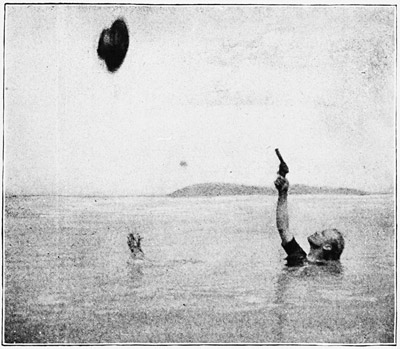
"And floated on Salt Lake."
larger
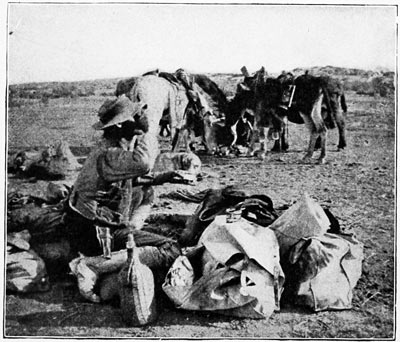
"Skull Valley desert; we stopped to feed and rest."
I concluded with these words: "It is very gratifying
for me to know so many are interested in Mac A'Rony's
welfare. I hope to take him through with me to the
Pacific. I do not like it to appear that I, while a guest
of the hotel, am taking undue advantage of its privileges,
but if there are any among you who desire a souvenir of
our novel trip I have a few pictures which may be procured
at twenty-five cents each. I now formally bid you
all adieu."
The souvenirs went like hot cakes. Presently a sweet
girl who had purchased three pictures, with beaming eyes
and a winsome smile, asked, "Oh, Mr. Pod, won't you
please put your autograph on these photos?"
"Certainly," I replied, "but each signature will cost
twenty-five cents extra." I said it, just to see how it
would take.
"Of course, I'll be glad to pay for the autographs," the
maid returned, and handed me the photos to sign. And
I was kept busy signing pictures until my hand ached.
My last afternoon in Glenwood was a busy one. I decided
to heed the admonitions of many Westerners I had
met, to avoid the Green River desert, a barren waste of
shifting sands, utterly devoid of water, stretching a hundred
and thirty miles and more, and, instead, to trail
northwesterly via Meeker, White River, and the Ute
Reservation. On the Meeker route I was promised fair
grazing and ample water supply every twenty or thirty
miles of the distance to the Mormon City.
It was five in the p. m. when Coonskin brought
my caravan to the hotel, and saluting me, said, "Professor,
your donkeys are ready and packed for the journey."
The guests of the hotel, with few exceptions, were
assembled to witness the start, and my dog in appreciation
of the compliment strode grandly among the ladies
and kissed their hands, and I believe bade every one an
affectionate farewell.
I thought this a good time, for once on my trip, to put
on stylish "airs." I had never called upon Coonskin to
exercise the duties of a valet, in the strictest sense. As
soon as he buckled the guns on the saddles, I dropped
my ragged canvas leggings at his feet, put forth a foot,
and gave him a significant look. Immediately the gallant
"Sancho" knelt down on one knee and proceeded to
lace the leggings on me, creating much amusement. I
then made a short farewell address, got into Mac
A'Rony's saddle, and gave the word to start. Such a
cheer as arose from the ladies that lined the veranda!
I'll bet there wasn't one who would have missed the
event for a five dollar note.
Hugging the Grand River (the only hugging I had
done in that section) until after dark, we trailed through
the sage until ten o'clock, when, discovering a fair grazing
place, I ordered camp.
My donkeys had just rested two days, so next day, the
28th day of August, I made them trail fast and far, in
spite of the heat. It was five o'clock when we pitched
camp near the Scott Ranch.
I had observed a cow and several hens about the
ranch. If I couldn't get milk, I might still obtain fresh
eggs, and vice versa. Not waiting to unpack for a can,
I set out for the house and knocked at the back door.
"Come in," called a female voice.
I entered the kitchen with hat in hand and politely
said, "How to do?" The sober-faced housewife did not
pause in her duties as she welcomed me to be seated.
"I came to purchase some milk and eggs," I said presently.
"Ain't got no eggs er milk to spare jest now," she
replied; "cows all dried up." My face reflected my disappointment.
"Are all your hens dry also?" I asked, as the woman
deluged a big white cochin with a pan of dish-water.
"That one ain't," she returned, smiling at her play on
a word and a hen. The incident, trifling as it was, served
to break the "ice." I introduced myself and explained
my journey; the woman was interested; she had read
about me. She told me to make myself "at home," and,
admitting that one cow still gave milk and she could
spare me a little, she went to the creamery. When she
handed me a pail of milk, I offered to pay for it, and
persuaded her to sell me a loaf of bread. But I had
hardly started for camp with my precious purchases than
I was surrounded by a swarm of yellow-jackets which
proceeded to alight on the rim of the pail and my
hand. I dropped the milk instantly, if not sooner. The
woman's exclamation of indignation embarrassed me. I
explained and apologized, while my kind "hostess" tried
to convince me of the docility of those yellow-jackets;
from her account one might suppose they were merely a
dwarf species of canary birds. But finally she forgave
my indiscretion, refilled the pail, and handing it to me,
told me the insects were perfectly harmless, and were not
known to sting anybody, unless they were harmed. I
thanked the woman for her exceptional generosity and
rare treatise on "insectology" and again started for my
tent, resolved to preserve that milk at any cost. But I
soon wavered from my resolve; the pail wavered, too. I
couldn't change it from one hand to the other fast
enough to elude those docile yellow-jackets. Then I hit
upon a new idea; it looked practical enough. I spilled
some milk on the ground, and after weaning many hornets
from the pail, I lifted the latter, covered it with my
hat, and made for camp.
Now once in a while a babe is found hard to wean;
the same may be said of a yellow-jacket. One buzzing
fellow, doubtless young and feeble, and being tired from
long flight, sat on my bald pate to rest, there to die a
violent death. On that spot, although his remains were
removed, was soon reared a monumental mound, sacred
to his memory. I yelled before I remembered it was not
manly to do such a thing, and the good madam hastening
to my aid, if not relief, carried the pail of milk to my
tent, also bringing with her a can of jam. Her kind, forgiving
disposition mentally paralyzed me. My own unprecedented
conduct almost made me hang my sore head
with shame.
We men dined on bread and milk, and at seven o'clock
struck out for Meeker. We had passed through the village
of Newcastle when some fifteen miles from the
Springs; and there were invited into a peach orchard
to delight our palates with some delicious fruit, but no
other village did we thread on our route to White River.
The last twenty miles of the journey led us across a
series of divides, mesas or benches, variously called,
and between these miniature watersheds trickled occasional
rivulets which either lost themselves in the
parched soil, or struggled on till they joined with a
larger stream to reach a river. As the tired eye wanders
over this sun-scorched wilderness, strewn with what appears
to be volcanic matter, he imagines he sees on the
black, rock-strewn butes the craters of long-extinct
volcanos, which the ravages of time and the elements
have almost leveled. And over these charred piles and
the intervening plains of white and yellow sage one
sometimes sees a solitary horse or steer standing bewildered,
as if before impending doom, or else trending
by animal instinct some tortuous, obscured trail to a
hidden spring.
Meeker takes its name from a family, massacred by the
Indians in the 70's. Four or five hundred inhabitants to-day
compose this quiet and now law-abiding community,
whose chief pursuits appear to be the pursuit of wild
steers, horses, fish and game. White River flows past the
town on its picturesque way to the Grand, the latter further
on joining forces with the Green to form the Colorado.
The hills about Meeker abound with large game—mountain
lions, bear, bobcats, and, when the snow comes,
deer and elk. I was informed from authentic sources
that in early winter the deer are driven by the snow down
the river in to Grand Junction valley in such numbers
that ranchmen have had to stand guard over haystacks
with guns and pitchforks. One woman told me with
modest candor that she had actually seen her husband
catch and hold a deer in his arms.
After leaving Meeker the scenic views from the trail
down and along White River for seventy miles are magnificent
and imposing. Rising sheer and bold from the
west bank of this deep stream, is a lofty ridge of brown
and barren mountains, whose mural crests of red and
yellow sandstone and limestone formed in my imagination
the walls and watch-towers of castles of a prehistoric
race, while the placid river at their base appeared
to be a mighty moat to protect the towering battlements
from menacing foe.
White River City lies some twenty miles south of
Meeker. It has great possibilities. If another house
were erected there, and it domiciled as many people as
the one habitation then standing did, the population of
the place would be increased 100 per cent. Even a part
of that house was converted into a post office and a general
store. About twenty-five miles from White River
City is Angora, another town containing a single house.
We arrived at sunset. The proprietor of this goat ranch
invited me to pitch camp on his meadow lot, where my
animals could find some feed, and treated me to a leg of
goat. He possessed a herd of about two hundred Angoras,
and derived his chief livelihood from their hair, hides, and
"mutton," as he called it. I found the meat sweet and
tender; it was hard to distinguish it from lamb; possibly
because I had forgotten how lamb tasted. My host
visited my camp-fire and entertained me with many interesting
tales of adventure.
Occasional gardens and fields of alfalfa are seen on the
east bank, all due to irrigation. Great water-wheels,
turned by the river current, raise cans of water ten feet
and more and empty them in troughs, so conveying the
water to ditches.
Ranchmen had cautioned me to give Rangely, the
next settlement, a "wide berth." I was told it was a den
of outlaws and desperate cowboys, who lived by "rustling"
cattle and rebranding them, hunting mavericks,
(unbranded calves) and following other nefarious pursuits.
Instead of frightening me away, these accounts
interested me.
At four in the afternoon we came to a trail branching
and leading to a large log house a half mile away. That
was Rangely; and we headed for it.
TOC
BY MAC A'RONY.
I'll say of it
It tutors nature: artificial strife
Lives in these touches, livelier than life.
—Timon of Athens.
Pod was always looking for trouble. The fellow who
courts trouble finds it sooner or later. I brayed myself
hoarse trying to persuade my reckless master to give
Rangely a wide berth. He couldn't think of it. He was
anxious to meet real wild-and-woolly-west cowboys of
the old-time style; he didn't fear the worst of 'em.
"Hit the trail, there, Mac," he said, spurring me toward
the hotbed of cowboy rascality. Arriving at
the house-saloon-store-city-hall-business-headquarters of
Rangely, the dozen rough-looking men lounging about
swaggered toward us, pleased-like and curious.
"Prospectin'?" one inquired.
"N-o-o-o," Pod drawled; "just traveling." That was
the time in Pod's life when he ought to have lied. Then
he explained where he was from, and where he was
bound, but did not say that he was a darn fool. The
cowboys grunted, or nodded, or smiled, some winked to
each other, and one of 'em nudged another in the ribs;
everything they did had a deep meaning. I began to
tremble for Pod. Would they shoot at his heels and make
him dance? Or make him ride a bucking bronco? Or
what?
"Better feed yer jacks, Mister," said one; "ye'll find
grain in th' shed yender." Pod seemed to be as delighted
as we donks.
"The Prof is going to catch it soon," Cheese observed.
"Serve him right," added Damfino.
Coonskin left us to feed and walked to the house with
Pod. Soon afterward they returned with a cowboy, who
said I had a good shape, asked my weight, and inquired
if I was sound in body and mind; then he questioned
Coonskin.
"What did you do fer yer salt 'fore ye jined th' outfit?"
"I was night porter in a hotel," was the reply.
"What was ye doin' 'fore that?"
"Railroading some."
"And 'fore that?"
"Painting."
"Paintin' what?"
"Church steeples."
"Golly! yer jest th' man we're lookin' fer."
Coonskin didn't quite understand them, but he did
later.
"Bridle this 'ere jack," said the cowboy, meaning me.
Coonskin bridled me and rode to the joint. I didn't
think anything would happen to me. Several more cowboys
had just come in from the range, and soon every
man of the gang was busy. I now noticed one fellow
mixing red paint; three or four were making two ladders;
another one appeared with an armful of blankets;
and another with ropes, and presently a cowboy climbed
one of the ladders to the roof. Something was doing,
sure. Pod seemed interested, but didn't say anything.
Coonskin looked as if he saw his finish. I giggled.
Suddenly came a surprise. One cowboy wrapped the
blankets round my body, while another bound them on
with lariats; another trimmed my tail with a pair of
sheepshears. Then ropes were fastened to my body and
the other ends thrown to the men on the roof. Next the
ropes were slung round the two chimneys at both ends
of the roof, and thrown to the gang below. At once the
cowboys grabbed hold and pulled, and I rose in the air,
until my head bunked against the eaves. There I dangled
and swung and kicked and brayed. Never was so scared
in all my life. Splinters flew as I kicked holes in the
house, and knocked off a section of the eaves. The cowboys
howled, they thought it so funny. But the real circus
began when Pod was commanded to mount a ladder
with a pail of red paint, and using my tail for a brush,
paint the name "R A N G E L Y" on that house. Coonskin
was made to climb the other ladder with another
pail of paint, and, he being a professional painter, with a
real paint brush go over Pod's lettering to make a decent
job of it.
Well, I had seen Pod mad, but never as mad as he was
then. He grabbed my tail and started to paint a big letter
R, when I up and kicked the pail out of his hands
and sent red paint flying all over half the cowboys; not
satisfied with this, I put a few more holes in the house,
and finally hit the ladder and spilled Pod on the ground.
The cowboys thought that was fun, too; some were so
tickled they fired off their revolvers. Here Coonskin
was told to divide his paint with Pod, and the painting
was continued on the letter A.
The Prof worked as well as he could with such a nervous
paint brush, now and then dodging my heels. I
admit I didn't know what I was doing, when suddenly
I struck my master in the stomach, and made him get
down from the ladder. But the sign had to be finished.
Up the ladder again Pod climbed like a man, the cowboys
pulled on the ropes, dragging me along so that my
tail could be brought to where the next letter should be.
Then Pod started on the fourth letter, G. By this time
the men were tugging on the ropes to keep me in position
for the painter's convenience. Finally the men
backed from the house and pulled me away from its side,
and Pod turned me about till I hung the other end to,
and began the fifth letter, E.
Now I could see the sign. It was up hill. I knew it
wouldn't suit those cowboys, and I expected it would
have to be painted over. It wasn't Pod's fault, it wasn't
mine. As I was gradually pulled along the eaves the
higher I was raised, because there was no pulley on the
rope. But now that I was turned about, I was swung
back some, and the E had to be painted below the level
of the first four letters. L and Y followed each other
up hill, until, just as the job was finished, I hit the pail a
crack with my right foot and sprinkled two more cowboys.
The crowd made sport of them, and I think, after
all, those cowboys fared worse than we three painters.
Then I was lowered to the earth.
To my surprise, the cowboys liked the sign immensely.
One pronounced it artistic, another said it was odd and
people would notice it, and several agreed that it was the
best job of its kind they ever saw. Pod didn't seem to be
tickled over this flattery, but Coonskin was puffed up
with pride, and when one fellow told him he ought to
have stuck to painting, he acknowledged that he should
have done so.
When the two started down the ladders the cowboys
called: "Hold on there, we want a speech." So the
Prof made a speech. Both men were then escorted indoors
and the barkeeper mixed a high-ball in a pail and
sent it out to me. I was "loony" for hours afterwards.
I never want another experience like that. Pod said
afterward it was his first and last painting. He thought
the cowboys might have shot a pipe out of his mouth,
but he hadn't thought they could condescend to such a
low trick as to make him paint a sign with his donkey's
tail. The cowboys wanted us to spend the night with
them, but Pod replied that he couldn't tarry, but he said
he was much obliged for all their courtesies. About dark
we said good-bye, and pretending we would travel ten
miles that evening, pitched camp near a bridge crossing
White River, one or two miles from Rangely. At dawn
the men were out after sage hens. They saw several, but
couldn't get a shot at the shy creatures.
We started early and traveled over a desolate wilderness
of sage and greasewood in a torturing sun, and
were unpacked at one o'clock for an hour's rest. Sometimes
the trail led through deep channels in the hard-baked
sand for several hundred yards, where we were
obscured from view. These channels wound about
through the desert and mesa, as if they might be the beds
of dried-up rivers; and they were often so narrow that
had we met a wagon either our outfit or the vehicle
would have had to turn back. We came across quantities
of skeletons and skulls of horses and cattle and
wild animals, but I failed to see any donkey's bones.
Don was glad when in these cuts, for he managed there
to keep in the shade, while trailing in the open he was
ever trotting ahead to hide under a bush where three-fourths
of him was exposed to the sun.
Toward the middle of the afternoon we crossed the
backbone of the plateau, at an altitude of seven thousand
feet, and met a wagon with four horses, bound for
Leadville with honey. The driver said he was from Vernal,
some sixty miles to the west. Pod thought honey
would go well with hot cakes for supper, and after some
coaxing got the freighter to break a case and sell him a
half dozen boxes. Then the question arose, how could
he safely carry the honey?
"Good idee not to put all your eggs in one basket,"
Coonskin remarked. Pod said he wouldn't. He tucked
one box in a saddle-bag, another in a roll of blankets
strapped behind his valet's saddle, another in a bag of
supplies on Skates, and the last two he packed carefully
in the canvas awning. The men conversed and smoked
awhile, when the stranger happened to mention that he
sometimes dealt in hides. Here was the chance the men
were waiting for. The bearskin Skates had carried from
Turkey Creek belonged to the poker-player, but he
promised half what he should get for it to Pod, if he
would let the donks carry it till disposed of. The man
said he was willing to give $60 for a fine silvertip skin,
so Coonskin unpacked. The stranger was more pleased
with it than he would admit, and hemmed and hawed
some about the price, but finally paid the $60, and we
moved on.
It was six o'clock, and the sun was sinking behind the
distant plain when the buildings of the K ranch loomed
in the distance. The sound of galloping horses approaching
us from behind caused me to look around, and
I beheld two Indians with guns in hand, yelling and gesticulating
wildly as they leaned over their ponies' necks,
spurring hard to catch up with us. When Pod and
Coonskin saw the Indians after them, they got ready to
throw up their hands. Their faces were as chalky as an
alkali desert.
"Have you seen any cattle branded U. S.?" one of the
wild men inquired. Pod said he hadn't.
"Where you from?" questioned the half-breed. Pod
said: "White River country."
"Ah, we just from there—been hunting up stolen cattle,"
the half-breed replied. "Found them, but fellows
wouldn't give them up. We've done our duty; the fort
must deal with them now."
Pod asked what fort, and was told Fort Duchesne,
some seventy miles away. We learned that two companies
of colored troops of the U. S. army were stationed
there. The Indians never touched us.
TOC
BY PYE POD.
"Dost not hear the neighing of horses, the blare of the trumpets,
the beating of the drums?"
"I hear nothing," said Sancho, "but a great bleating of ewes
and wethers." And this was true, for the two flocks had now
come up near them.—Don Quixote.
The great K ranch welcomed us just before dark. My
animals were generously fed, and we men soon joined
the Indian policemen at supper in the house.
When, next morning, the foreman saw us pack the
donkeys, he expressed surprise at my traveling with such
a luxurious camp outfit. The folding table and chairs,
awning, many blankets and other articles were condemned
as disgraceful by this experienced plainsman;
so, my sensibilities being shocked by such a criticism, I
abandoned a hundred pounds of luggage, giving the
table, chairs and superfluous blankets to the ranchman,
and selling him the awning; then we resumed the journey.
Green River was twenty-five miles to the west. The
journey was even more monotonous than that of the previous
day. The powdered alkali rose in our faces and
penetrated our eyes and throats, compelling us almost
constantly to sip from our canteens, wrapped in wet
cloths to keep the water cool. Frequently my dog would
jump at the larger canteens in the panniers and bark for
a drink. I loved to watch him lie down in the narrow
shade of a donkey, and, resting his chin on the rim of
the basin, slowly lap the frugal measure of water I was
able to spare him.
We reached Green River by five, and waited until the
ferryman awoke from his daydream to guide the flat-boat
across the stream for us. He charged me only two dollars.
I thought it very decent of him, as the river was
too deep to be forded and he controlled the only ferry;
our only alternative was to swim this treacherous stream.
Several overland travelers with prairie schooners were in
camp on the opposite shore, eastward bound.
I paid a dollar to graze my animals in an alfalfa field
for the night, but when we left for Vernal next morning
every donkey had the stomach-ache. They grunted and
groaned on the march until noontime, and deplored their
gluttony with sundry brays that were grating on the
nerves.
Vernal is a veritable oasis in a desert, nestling in a
broad and fertile valley, which, irrigated from the numerous
springs in the mountains forming a rampart round it,
is a garden of vivid green. Farmhouses dot the orchards
and meadows everywhere, and the village itself
is splendidly shaded. Honey is a leading industry; one
can see bee-hives in almost every door yard.
After a good supper with a stranger who offered his hospitality,
we two strolled about the flower-scented streets
in the cool evening air, until we retired to a downy bed
in his apartment that made me wish my trip at an end.
Here were no mosquitoes. The fruits of this valley are
prolific and delicious, and haven't a blemish; the water is
pure, and the climate healthful and exhilarating; surely
Vernal received its name from Nature.
The frontier post, Fort Duchesne, lay twenty-eight
miles to the south, across a desert waste. A few miles
beyond Vernal we entered the Uintah Indian Reservation.
Further on we saw the shacks and teepees of the
Utes, and once we passed a party of this treacherous tribe
on their ponies. Apparently taking us for desperadoes,
they veered off to some distance in the sage and gave us
a "wide berth." The strength and humility of their little
steeds was surprising. Several of them carried four and
five people, the buck sometimes with a boy in front of
him and his squaw astride behind him with a papoose
strapped to her back, and a boy or girl behind her. When
they saw Damfino with her towering pack they, too, perhaps,
did some wondering.
We crossed the bridge spanning the Uintah River just
before sunset, and reached the guardhouse of the fort
just as the bugle sounded retreat parade. To my surprise
and delight the officer of the day, Lieut. Horne,
was adjutant and chief commissary, and better still, an
old classmate. And when, after parade, I saw the popular
officer crossing the parade ground to meet me, I wondered
if the changes wrought in our appearance by the
lapse of thirteen years would make us both unrecognizable.
Our meeting was amusing. The orderly ushered
me into the officer's presence, and I advanced and
grasped my old friend's hand in a manner to convince
him that I knew him; but while we shook hands vigorously
and playfully punched each other in the shoulders,
the puzzled man could not speak my name.
"You old fool! Don't you know me?" I asked, still
shaking his hand.
"You disgraceful old vagabond! Of course I know
you; but blast me if I can place you," he returned grinning
all over. "Who are you for heaven's sake? Where
're you from, and how did you get here? Speak, man!
Relieve me of suspense, if you don't want to get shot by
a colored regiment of United States troopers."
"Why," I asked, "is it possible that you do not recollect
your old classmate; the famous pillow fight at S—'s
Hotel? The mock fight with our old chum, Mike H—n,
in my room, when you frightened the boy from West
Virginia half to death with—?"
"Pod! Blast me, if it ain't Pod!" exclaimed the Lieutenant.
"Well, well, if this doesn't beat me. Sit down
and tell me about it. I am glad to see you. But you do
look rough. Prospecting? Or fighting Indians? Or
what?"
I explained. My animals, I said, were waiting outside
in the care of my valet. Horne rose in astonishment.
"Traveling overland with a valet!" he exclaimed. "You
are a beautiful looking swell. I have often read about
you, but, blast me! if I ever once suspected it was my old
chum making the famous trip. Show me the jackasses."
Forthwith I escorted the laughing Lieutenant out and
presented Mac A'Rony.
I spent two enjoyable days at Fort Duchesne, as the
guest of my friend. One of the first to call upon me was
the genial Colonel commanding. He asked me to lecture
to the residents of the post. Accordingly, I gave my
talk that evening to a large audience, and at its conclusion
I was introduced to many ladies and officers of the
post and afterwards entertained at the army club.
The following day, at one o'clock, my outfit was ready
to start. The donkeys were in fine fettle, and Don
frisked about gayly, eager for the journey. My friend
regretted I could not spend a month with him, and tucked
a package in my saddle-bag by which to remember him,
and many officers and ladies joined with him in wishing
me God-speed. Then we waved an adieu and climbed
the long, sage-covered mesa, toward Heber City, a hundred
and thirty-mile march without a habitation in view.
Fort Duchesne was still in sight when a hailstorm
struck us. The donkeys were compelled to close their
eyes and turn their backs to the fearful charges of the
merciless elements, while we men pulled our hats over
our eyes, put our hands in our pockets, and crouched
under our animals; still we were severely bruised, and our
necks and arms were black and blue. When the hail
ceased, the leaden clouds poured down a cold rain, which
beat in our faces and greatly impeded travel. The trail
was soon converted into a veritable torrent; the sand or
rock-waste soil softened into mire many inches deep,
causing the stubbornly faithful burros to slip and stumble
and labor as they never did before.
We had journeyed only sixteen miles when, at eight
o'clock, we pitched camp on the banks of the swollen
Lake Fork River. The night was black. What a nasty
predicament! No bottom to the soil anywhere; the mud
and water reached to my boot-tops. Before unpacking
we cut sage brush and trampled it into a large square
bed two feet deep, on which to place our packs. Then,
picketing the animals, we tried to kindle a fire with
water-soaked brush sprinkled with coal oil; but failed.
Soon a ranchman arrived leading his horse, and said he
had almost lost his steed while fording the river and narrowly
escaped drowning. He joined us in a cold supper
of canned meat and corn, whiskey and water, then rode
away in the pouring rain.
Our bed that night was anything but inviting. We
could not pitch the tent. The soaked sage and the rain
saturated our canvas sleeping-bag and dampened our
clothing. How I regretted having disposed of those
"superfluous" blankets at the K ranch. We were not
only wet, but cold, rolled in two blankets and a quilt.
When I awoke in the morning I even wrung the water
out of the underwear I had slept in, and, also, my trousers
and coat before I could get them on, and then in the
still pouring rain ate a cold breakfast, saddled, packed,
and resumed the trip.
That day we made twenty miles, and "ran" as terrible
a gauntlet of thunderbolts as I ever witnessed. Next day
it became necessary to swim Lake Fork. Mac said it
was his Rubicon as well as mine.
The current was swift, and roared and foamed like a
mountain torrent. My donkeys, brought to the water's
edge, reared and wheeled and rushed intractably into the
willows, scraping off their packs on the miry banks; it
required a half hour to replace and securely cinch the
luggage on the beasts so that it might not be washed
away. Then, with stout willow goads and howling invectives,
we drove the braying animals into the flood and
followed them, fording or swimming across the river.
Cheese was carried down stream and almost drowned.
Gaining the nether bank we tramped through storm
and mire all day, making eighteen miles, and after dark
camped with the party of a prairie schooner at the foot
of a hill, where we found seasoned cedar stumps for fuel,
and built a roaring fire. The soil there was more solid,
the land gently sloping, and we pitched the tent near the
wagon and fire, staked the donkeys, and joined hands
with our chance acquaintances to provide the evening
meal. The good woman of the party gave us a pie, a
can of beef and a loaf of bread; these luxuries, together
with boiled potatoes and hot coffee, put our bodies in
prime condition for a sound night's sleep in wet garments
and bedding. My provisions were not only quite
spoiled by the rain and river water, but were insufficient
to last us through.
Rising early, we breakfasted in the rain, and traveled
only fifteen miles, swimming the Duchesne River once
and fording it twice that day. The stream was somewhat
deeper than Lake Fork, but the current less swift, and
at every crossing my donkeys rebelled. Soon after the
last fording, the sun broke through the clouds, and gave
us an opportunity to dry ourselves and freight. A patch
of wild meadow enabled my animals to fill their empty
stomachs with grass, while some giant sage brush soon
dried in the broiling sun, allowing us to spread our blankets
and soaked apparel thereon. We unpacked, and
cooked, and when our clothes were dry enough to feel
comfortable and shrunken enough hardly to be got on,
we resumed the march. Our supplies were in a mess.
Our only can of coal oil was broken, and the contents
had seasoned every eatable not canned. The forgotten
boxes of honey had been smashed, and everything was
gummed with it; every pack smelled like a bee-hive.
The honey I rolled in our underwear, diluted with the
water of the several fords, had permeated the raiment so
thoroughly that now the heat of our bodies began to
warm it up, and my clothes were soon glued to my skin.
That night we camped on Current Creek, after fording
the stream. A bear appeared, but scampered grunting
into the thicket, my dog not inclined to give chase.
Once I was awakened by the cry of a mountain lion, and
Coonskin said the yelps of wolves kept the dog growling
and snarling half the night through.
It appeared that we were experiencing the fall
equinox. Wearily traveling through another day of
rain, we camped for the night near a bunch of dwarf
cedars. Now the rain ceased for a couple of hours, and
enabled us to kindle a fire and cook before lightning
played on every hand and the rain descended again. Our
largest canteen leaked from some accident it had received,
and our surprise and despair on discovering the
emptied receptacle may be imagined. What should we
do for drinking water? I had not more than asked the
question than my eye discerned several small basins in
the table rocks close by. These basins were filled, but
were so shallow that only by dipping the water with a
saucer could we obtain a two-quart can of the precious
liquid; next morning we secured another frugal supply
for the ensuing day's journey.
Our luggage was placed under two cedars for protection
from the storm. During the night we were awakened
by the terrific crash of a thunderbolt, which struck so near
as to shock us. In the morning I saw that one of the
trees had been struck. But our packs were uninjured,
save the whiskey bottle, which was broken and its precious
contents lost. Thus the sympathy existing between
"Jersey lightning" and Utah lightning. Another day's
tramp over a muddy trail, and a night camp on another
roaring stream, Red Creek; our supplies quite exhausted,
we boiled some onions and ate them with the
last of our honey. I felt as if I were eating diphtheria
medicine. Next morning we breakfasted on a turkey
buzzard shot by Coonskin, and that afternoon my jaded
caravan crossed the summit of the plateau, and descended
into the beautiful Strawberry Valley in the glow of a
gorgeous sunset. Soon after, we met two sheep-herders
on horseback, looking for two comrades, and, when
crossing the broad, verdant valley, we saw two great
flocks of sheep, one grazing up the valley, the other
down. We camped near Strawberry Creek. The four
sheep-herders rode up presently and having a wagon full
of supplies, said if I would lend them my tent-poles they
would string up a lamb and divide. I gladly consented.
Two of the herders rode off to mill up the flocks for the
night, while the other two butchered a sheep, built a fire
and cooked.
If the scene of that highland camp could have been
painted with true color and detail, it certainly would have
made the artist famous. A few feet from the flaming
fire stood my tent-poles like a tripod, and from their
apex was suspended, head down, a fat mutton; on bended
knee with hunting knife in hand, one of the herders was
taking its woolly pelt. The coffee-pot and frying-pan
were on the fire with a kettle of boiling potatoes, and,
while the shepherd-cook was preparing bread for my
Dutch oven, two herders gathered sage for a reserve
supply of fuel.
Some fifty feet way the horses were picketed, and
across the stream the donkeys grazed on the juicy grass,
untethered but none the less secure in the novel corral
of twenty thousand sheep which the faithful shepherd
dogs promised to keep milled round us all throughout the
black, chilly night. The camp-fire sent flashlight beams
on the surrounding scene, and etched weird pictures on
the darkness. The silhouetted heads and backs of the
horses and donkeys moved fantastically against the starry
sky like animated mountain peaks on the distant horizon;
the vast field of wool encompassing us and the
bleating of its contented life seemed like the troubled
waters of some highland lake imprisoning us on its one
small island; and away across the vale and again just
above us towered the barrier of mountains against the
sparkling heavens, forming banks and pillows for stray
clouds to sleep upon.
At a late hour we hungry men sat down to a tasty
supper of fried mutton, potatoes, hot bread and coffee.
The air soon rang with laughter. Later when we brought
forth our companionable pipes and began story-telling
round the cozy fire, I felt a delight which seemed a full
compensation for the hardships we had suffered during
the last week. Suddenly the cry of a mountain lion set
the collies barking, but the report of a herder's rifle
silenced the prowler and sent him back, no doubt, into
the hills. The lions and wolves are a constant menace to
the flocks in that popular valley.
It was midnight when we retired. Storm-clouds had
gathered and shut out the light of the stars; it looked
and felt like snow. The shepherds, learning that we
travelers were short of bedding, brought us two heavy
woolen blankets; so we rolled ourselves together and
were soon asleep, and in the morning awoke, covered
with snow an inch deep. By seven o'clock we were
ready to resume our journey and the shepherds had
saddled their mounts for their day's duties.
Trailing out of the valley, and through Daniel's
Canyon, we traveled some twenty-five miles down to the
lowlands, and at nine in the evening pitched camp near
where, next morning, we discovered a ranchhouse and
haystack.
Heber City lay five miles away; arriving there we were
royally entertained.
Friday we started for Provo. The trail lay through
a picturesque canyon, along the bank of Provo River,
where the mountains rose sheer and barren to a great
height on either hand. Numerous waterfalls pour their
loveliness over steep declivities; patches of crimson and
yellow verdure showed in the crevices of the gray summits;
and now and then a terraced vineyard or orchard
or an irrigation ditch, hugging the steep slopes, indicated
a habitation was hidden somewhere near in leafy
bower or vine-covered trellis. Once we crossed the river
on a new iron bridge replacing an old stone structure
which avalanches had demolished.
Passing the night in Provo, I rode Skates six miles to
Springville, through a beautiful, verdant valley, where
rows of poplars lined the fields and orchards, reminding
one of Normandy. There I was greeted by a newspaper
editor and a school principal, the latter inviting me to
dinner.
Returning to Provo I found my outfit ready for trail.
Making a brief stop in Lehi, we reached Pleasant
Grove about eight, and camped in a peach orchard adjoining
a hotel. The landlord welcomed us to a hot supper,
in spite of the late hour, then offered us a downy
bed, which we declined, preferring the pure, crisp outer
air.
I boarded the early morning train for Salt Lake City
to attend Sunday service at the Tabernacle and hear the
famous organ and choir. Coonskin remained behind to
care for our animals.
Without my donkeys to identify me, my rough, unkempt
and most eccentric person caused a sensation at
the Mormon capital. I kept aloof from everybody, and
nobody was inquisitive enough to inquire my name, errand,
and previous condition of servitude. I strolled
about the beautiful city, and then went to church.
larger
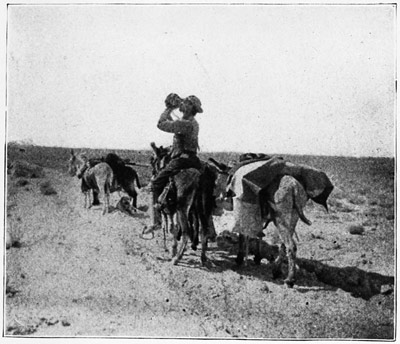
"The last and only drop."
larger
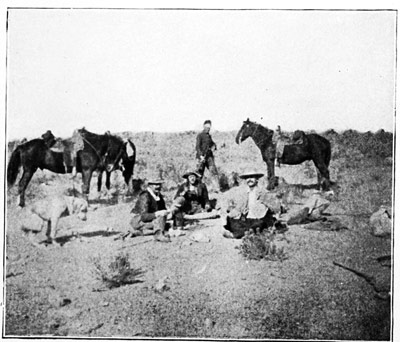
"Just finished lunch when the posse arrived."
An usher with a charitable heart led me half way down
the aisle to a pew in the midst of that fashionable congregation.
Every one was dressed better than Pod.
But I did not feel ill at ease; on the contrary, I felt at
home. A great many true churchmen and churchwomen
should have kept their eyes on their hymnals instead of
watching me try to chant "I want to be a Mormon and
with the Mormons stand." Presently my sensitive
nerves were irritated by successive coughing across the
aisle. I looked to see what kind of a mortal was suffering
so, and beheld a vision of loveliness! Instantly
I remembered a small box of cough drops in my pocket,
and felt it my duty as a gentleman to summon the courage
to cross the aisle and offer the soothing remedy.
Soon with palpitating heart and crimson face, I stepped
with quaking limbs across the aisle and reached the box
to the fair cougher.
I remember her look, as she lifted the lid of the—empty
box. I knew plenty of people in my lifetime who had
fainted; I regretted never having taken lessons from
them.
My head reeled, the Tabernacle was going round, and
with difficulty I retreated to the pew in front of my hat,
which I looked for, but couldn't find. I needed fresh
air, I wanted to go out. Strange to say the lady stopped
coughing. It was the shock that cured her, but the
congregation were not aware of that. Some of them
saw her look into the mysterious pasteboard box and turn
red-beet color, and cease her convulsions. That was why
several spoke to me, and asked if I were a magician, or
healer, as they had read of such people. When I had
once escaped into the airy street, I wondered how that
box became emptied; then, suddenly, I recollected that,
before retiring the night before, Coonskin asked if I had
some cough drops left, and helped himself.
After dinner I felt better. I visited the Jubilee Museum,
where was exhibited an interesting collection of
Mormon relics of pioneer days, and then took a car for
Fort Douglas, about three miles from the city on the
mountain side, and was invited to tea with an officer of
the post, my old friend Lieut. K——n.
It was late when I reached Pleasant Grove. The following
day my party covered nearly twenty-five miles,
and about two o'clock on the succeeding afternoon
marched into the Mormon capital. There a well known
pioneer made a speech and welcomed me to the city;
and after I had responded in fitting words, he presented
me to leading citizens, among them bishops, presidents
and elders of the Mormon church. The presiding
bishop, an affable old gentleman, asked the privilege of
caring for my animals at the Tithing House; another
prominent citizen invited me to be his guest. I declined
the latter kindness, preferring to be a free lance and to
make the most of my sojourn. I was next introduced to
Governor Wells.
That same evening Coonskin and I were invited to the
theater, and next day, besides delivering many lectures,
I contracted with S——& Company, prominent silversmiths,
to make a full set of silver shoes for Mac A'Rony,
to be sent to Oakland, Cal., and there to be set for his
triumphant entry into San Francisco.
TOC
BY MAC A'RONY.
O, that he were here to write me down an ass! but, masters,
remember that I am an ass; though it be not written down, yet
forget not that I am made an ass.—Much Ado About Nothing.
My sojourn in the famous Mormon Capital was too
short for my taste. I shall remember it as long as I have
bra'in's. I am proud to say that I was initiated into the
Mormon faith and took unto myself no less than eleven
wives; and I would have outrivaled Brigham Young in
connubial conquests if Pye Pod had not bribed the Elders
and put an end to my marital ambitions.
While a guest at the Tithing House, I found it well
stored with asinine and equine luxuries. The Bishop and
many charming lasses brought me bread, cake, apples and
jam, and some genial fellow of a convivial turn tapped a
bottle of rum punches. After imbibing a few "balls," I
was quite ready to tipple Cheese, Damfino and Skates, and
right here let me say, that of all skates I ever knew or
heard about, the last named takes the palm as an artist in
"high-jinks." While she gave a clever exhibition of an
inebriated athlete, the rest of us donks lay stupidly on a
bunch of hay, which was one-tenth of some Mormon's
harvest, and reveled in day dreams.
Skates had reached that stage of her circus where she
was burlesquing a Shetland pony cavorting on two legs,
when Coonskin announced it was time to start. None of
us stirred, except Skates. She showed the man how
superbly she could pirouette on her left legs around the
corral; then, suddenly, she toppled over in front of him,
and reached for the bottle lying at his feet. Coonskin
grabbed the bottle, smelt of it, eyed each one of us distrustfully,
flung it over the fence, and prodded us all on
to our feet. You can bet he had a hard job to keep two
of us standing, let alone all four of us. He looked disgusted,
turned on his heel, and made for the gate at once.
When Coonskin returned, he bore a pail of water in
each hand. Indeed, the forgiving old soul, I thought, is
going to refresh us and wash that dull, brown taste out of
our mouths. Staggering to my feet, I advanced to meet
him. Damfino and Cheese were almost dead to the world,
but Skates made for the man on a lop-sided trot, arriving
at one pail just as I reached the other. Into the liquid we
dipped our nozzles, and as quickly jerked them out. What
strange tasting water!
"Water from a mineral spring," observed Skates. "No,
it's a bromo-seltzer," said I. Then each drank about a
fourth of a pailful, and would have drunk more, but Coonskin
snatched the pails away, and, it seems, transposed
them.
Again we fell to drinking. But, so help me Balaam!
soon something began to boil and sizzle inside of me. I
thought I had swallowed a school of swordfish, but immediately
a geyser raged within, and, like a shot, spouted
out of my mouth, spraying Coonskin's face; and almost
simultaneously Skates played another fountain in the
man's eyes.
"Seidlitz powders!" I gasped, trying to catch my
breath, which seemed to have left me forever. And
didn't that man curse the whole race of jackasses! Dropping
the pails, he ran for a pump.
Presently Coonskin returned. "You infernal scapegraces!"
he exclaimed, as he eyed me and picked up the
pails.
My recent experience had quite restored me to a rational
donkey, and, remembering that "a soft word turneth
away wrath," I said, "You are too eager to fix the blame
on an innocent creature, Master Coonskin. The recent
episode which was so distasteful to us three, and most exasperating
to you, points a good moral. Never become so
absorbed in the virtues of a cure that you are blind to its
possible effect upon your patient."
The man left us, shaking his head and talking to himself,
and administered the dose to Damfino and Cheese.
When Coonskin first visited us it was eleven o'clock.
Damfino did not sound eight brays to announce the sun's
meridian and the hour for barley, but we donks were considered
sober enough to be packed by one o'clock, although
in poor condition to travel. It was an effort for me to walk,
an impossibility to walk straight. My asinine comrades
grunted and groaned from nausea, and Cheese complained
that we had been cheated of our mid-day meal.
When we arrived at the Hotel, Pod had just finished his
luncheon. Damfino looked into the hotel portal and
brayed. Then Pod came out, got into my saddle, and
amid great applause from the assembled citizens, piloted
our caravan down the broad thoroughfare, out of the
lovely poplared streets and hospitable, home-lined avenues,
past orchard and field and cottage and windmill,
over the road to Garfield Beach, on "that mysterious
inland sea," a few miles from the city. Once or twice, as
I wabbled across the level and luxuriant valley, I turned
my head for "one last, lingering look behind," though I
confess I did so timorously, with a feeling intermixed with
superstitious foreboding, as I recalled the story of how
Lot's wife turned into a pillar of salt. It suggested itself
to my reason that if there was one spot on earth indigenous
to such a dire transformation it was right in that
Salt Lake valley.
There, above and behind us, and across the majestic
towers of the Temple, lay Fort Douglas, the gem frontier
post of America, its white painted fences and barns glistened
like meerschaum in the sunshine, with lovely drives
and walks, and smooth-cut foliage, and sleek-broomed
lawns of emerald, and fountains (not charged with seidlitz),
and blooming flowers. And beyond towered the
rugged, snow-crowned summits of the "eternal barrier"
which holds the fort below, and guards with loving care
the "Land of Promise" and that so-called "modern Zion"
at their feet, like a dog guards his bone when threatening
elements are wagging his way.
We arrived at Utah's Coney Island, Garfield Beach,
late in the middle of the afternoon. This famed resort,
named after the martyr President who was the victim of
an assassin, is a very pleasant retreat on the lake shore.
It is accessible by railroad train, horse and buggy, or
donkey engine, although few people accept the latter
mode of conveyance, as Pod did, I observed.
Pod stopped to swim and float on Salt Lake. Then we
went on and brought up at a delicious fresh-water well, in
front of the Spencer Ranch-house, where I led my asinine
quartette in the song of the "Old Oaken Bucket." An
audience at once gathered. Mr. S—— invited us all to
tarry for the night, and when the Prof. accepted, we donks
gave three "tigers" and a kick, which struck the ranch
dog as being most extraordinary. Landing on the other
side of the fence, he yelped himself into the house without
further assistance.
TOC
BY PYE POD.
There are braying men in the world, as well as braying asses;
for what's loud and senseless talking and swearing any other
than braying?—Sir Roger L'Estrange.
We set out early from Spencer ranch, refreshed by a
good night's sleep. The weather was mild, but the trail
dusty, and the country uninteresting. I found Tooele
to be a sociable town that, from appearances, subsisted
mainly on sympathy and fruit. Some of its denizens
own outlying ranches or fruit-farms, and the remainder,
those who don't, have sympathy for those who do.
There appears, however, betwixt these two outcropping
extremes to be ample means with which to provide the
more modest comforts of life—wives and children: for
such are known to exist, under any conditions, all over
the world.
No sooner had I entered the village, than a gentle-eyed
siren coyly approached, and said her papa wished
me to put my jacks in his stable. While I was trying
to please that man, a squatty youth scraped across the
road in his elder brother's breeches to say that his mother
would like to have me spend the night at her house.
"Sociable people all right," my valet remarked, while I
said to the boy, "Kid, you run and tell your good
mother that I have a man with me, and, if she can
accommodate us both, I will be glad to compensate her
liberally for the hospitality."
But these Mormon beaux esprits, while followers of
the Prophet, reverence old Bacchus as though he were
Young.
As soon as my animals were provided for, Coonskin
and I were called to supper and greeted at the gate
by Mr. and Mrs. Noah and the children. I was hungry
and tired. It occurred to me that in all probability my
hosts had drawn heavily on their larder to provide a generous
repast, and would yet have to pluck all their drakes
and ganders before they could make our beds down.
That evening, on venturing in the street, I was held up
by a jolly party, armed with two kegs of beer, a barrel
of sandwiches, and a number of mandolins and guitars.
In front of my donkey's quarters was a spacious, grass-grown
area, where they spread their feast; there I met my
fête. The serenade, if not the banquet, was in honor of
the whole party, biped and quadruped. Although my
dog whined at the harmony to frighten the performers,
Mac and Damfino applauded the classic selections
vociferously, while all four donks availed themselves of
standing-room only, rest their chins on the top corral
rail, and audibly discussed the exercises.
As soon as my entertainers departed, Coonskin and I
sought our hostess. It was a beautiful September night.
No air was astir. The sky was darkly clear and the
myriad stars were winking with insomnia.
Startled from sound sleep at early dawn by a blast
from a "busted" fish-horn, I rolled out of bed in the
presence of Noah, instead of Gabriel, as I was frightened
to expect.
The next thing was to wash and dress. A half vinegar
barrel stood at the back door abrim with water. I was
told it was soft, but I found it hard enough to wash in. A
few feathers floated on the surface, and the soft water
looked like soft soap. Old Noah was one ahead of me
and dipped in. His wife, sons, and dog made their
ablutions in turn, while the Shanghai hens and a pet
magpie had doubtless rinsed their fowl beaks in it.
I watched the exhibition reflectively, and, concluding
it would not show proper respect to appear at table before
taking a dip, and that more than likely I should have
to drink worse water before I had crossed the desert, I
ducked my head, paddled my fins, then dried them in the
sun, for I couldn't "go" that towel. The scrambled
pigs' feet at breakfast was a new dish to this epicure,
though my versatile valet observed with an inflated appetite,
that he had often made pigs' feet scramble back in
Wisconsin.
In spite of a late start, we reached Stockton before
noon. My first duty was to hunt up an opulent resident,
whom I had met at the soiree in Tooele, and who had
promised me a burro.
We at once unpacked the donkeys, to give them a
restful nooning, and piled the luggage in front of a
store. It was here that my philanthropic friend found
me smoking. At once, he sent a lad to chase up a good,
strong burro to make good his promise; next he offered
me the freedom of the town.
"I'm kind of tired, my good sir," I said gratefully,
"but—how—how far is the town."
The donor of Coxey blinked his eyes and felt of his
goatee, then, straightening back, said, "Not fer, it's right
here. Can't you see it all round ye? Ye didn't cal'luate
ter find a New Yirk er New Orlins, did ye? This is jest
plain unadulterated Stockton, and it's glad ter welcome ye.
Now, if ye're trim ter go about a piece, I'll guide ye."
"Thanks, awfully," I replied, rising. "Take me to a
smith the first thing; I want all my donks' feet examined
and put in condition for the desert."
Then leaving an order for supplies at the store, I
had Coonskin ride my new burro to the blacksmith.
After a two-and-a-half-hour sojourn in Stockton, my
caravan was wending its way to the next and last town
we would visit in Utah, St. Johns. The next after that
would be one hundred and seventy-five miles away.
Here and there along the trail a ranchman's shack stood
alone, the glistening window panes flashing like a lighthouse
tower in that sea of sage. An occasional horse
or steer would loom above the brush; once or twice a
jackrabbit bounded across the trail, or a weary buzzard
careened in the air overhead, as though figuring for me
a fatal horoscope.
I was silent a long time before Coonskin reminded me
that I had neglected my weekly letter to the papers.
Said he, "It's a good time to cultivate the acquaintance
of Samantha Jane, that typewriter you got at Salt Lake."
"Can't you suggest something more sensible?" I replied.
"How can I manage the machine while riding a
jackass?"
"Easy enough," said Coonskin. "Lash it on Damfino,
and seat yourself as you would to play solitaire."
Great idea! The neglected typewriter was at once introduced
to my party for the first time, and secured in
a comfortable position on the broad-backed donkey.
Then I seated myself vis-à-vis, and opened up a somewhat
spirited conversation on the journey.
It was not with the best of grace that Samantha Jane
consented to be my amanuensis. She held the sheet of
paper very mechanically, and appeared utterly devoid of
animation. I first tried to date my letter. I shot my
finger at the S key and struck the L just as Damfino
nabbed at a sage bush. I'll correct the spelling afterward
I thought, and tried to hit the letter E, but rapped
A full in the face. "Don't joggle so!" I yelled at my
steed, and, drawing a bead on P, literally knocked
down Z, as Damfino stubbed her toe. Next, in vexation,
I shot at T quite recklessly, and punched Y's face close
by. The effort had overtaxed me, and snatching the
paper from my typewriter, read aloud L-A-Z-Y. Mac
grinned from ear to ear, and Coonskin laughed loudly.
The donkey remarked that practice is a good remedy
for incompetence, even if it does not cultivate patience.
Again and again I tried to write the abbreviation
"Sept.," but at length called "Coonskin, I'm going to
discharge this typewriter, and stow her away till we get
to Eureka."
"Your courtship is amusing. Keep it up, you'll
understand each other in time," he replied.
"I have my doubts," brayed Mac, "when she won't
even let him make a date with her."
I resolved to begin the letter anew, and to write at
least a paragraph, date or no date. This is how it
looked when I had finished.
"Talo hab$ getoch-Tho forntnigs ate erut%wsot
pirowigs og owhym, dyl swelboka swice, bomblastnig
wisj thu cleg pry) wet dnpenting tresgd wobm -&a
wihng rubpint dor a Togues Cruop; % ro mi Noty gni-
leek befort dajosty ga eht5 safey haschimb she boj o rew
laim$."
It was extremely encouraging, to find but four correctly-spelled
and distinctly English words in all that
jumble of dialects. I thought it a good paragraph to
practice on, and would have tried it over, but Coonskin
called to me that we were approaching town and, from
appearances, the villagers were going to give us a hearty
welcome. So I stopped Damfino, and hastily tucked
Samantha Jane away in time to avoid a scandal.
TOC
BY MAC A'RONY.
Very good; well kissed! an excellent
courtesy.—Othello.
By the time our caravan reached St. Johns, Pye Pod
was bewailing his failure to discover the key to his typewriter's
character, the non-production of his newspaper
letter, and the forfeiture of the check it would have
brought him; besides, he was borrowing trouble by deploring
his prospective desert journey ere it had begun.
"What a sleepy old hamlet in which to bid farewell to
earth!" he muttered dejectedly, as we passed the first
house. "I'll bet 13 to 1 that there isn't a soul in the
whole settlement to welcome us. The great and only
Pythagoras Pod, D. D. (donkey driver), passeth through
with his stately train and entereth the seared and thorny
purgatory of the desert without the perfume of a single
rose to waft to him its balm of comforting sympathy."
Suddenly a happy cheer greeted our ears in the distance.
The sound was sweetly feminine, and Pod said
that to his sensitive ear the angelic chimes swelled and
died and softly returned, like the tender notes of the
nightingale in an echo vale. (Pod is often swelled by the
divine inflatus). At this time not a soul beyond our outfit
was visible, but soon we discovered in the foreground
of a kennel-shaped schoolhouse a bevy of girls, all clad
in white and garnished with flowers and delicate vines.
As we drove near, the whole band of pretty maidens, led
by the tallest of them, approached and surrounded us.
I knew not whether Pod was frightened or elated; he fell
off my back in an effort to dismount gracefully.
The pretty chieftess made a bow, and looked at the
sky, and played nervously with her skirt, and turned side-ways,
and finally began to intone her "Him of the Asinine
Pilgrimage."
"Noble and valorous courtier," she began softly—and
a donk of the party brayed, "Speak louder!"—"we daughters
of St. Johns, Queen of the Desert, come to greet you
with kind and admiring hearts." (Coxey brayed boisterously,
"Here, Here!") "We hail your brilliant achievement,
as the planets hail the sun"—("What a Venus that
middle one," I confided to Pod)—"Your courage, your
fortitude, your manly sacrifice of the associations of your
nativity and of the affectionate kisses of dear ones left
behind you. These, we deem, should be recognized.
Therefore, having learned that you and your stately caravan
were coming by this highway and that your trusty
charger, Mac A'Rony, was still standing faithfully by
you" (I bowed at the compliment)—"and your poultroon
of long-eared cavalry"—"For Balaam's sake! What's
that she calls us?" I questioned my mute master. "She
means 'Platoon,' not 'poultroon,'" he explained—"St.
Johns has befittingly chosen the flowers of her desert
garden—thirteen comely virgins—to be presented to you
on this momentous occasion. And so, in honor of your
famous exploits," continued the chieftess, composedly,
"we now come to meet the lion fearlessly in his desert
haunts. Here, take these flowers" (she handed Pod a
bunch) "and wear them. They will prove a talisman to
conduct you and your party in safety to the farther desert
shore." And with the most exalted, sweet-scented nerve
Pod accepted the bokay. He smelled of it, and examined
it, and then disappointedly yet courageously replied: "I
see no tulips among the flowers, and I love two-lips so
much."
"Indeed? Well, then you shall not be disappointed,"
said the pretty speaker; and, s'help me Balaam! If that
girl didn't step forward and give my surprised master
her two lips. And every one of the dozen others, except
the last one, gave hers too, or drown me in an alkali
pond. The last girl sensibly boxed his ears. Pod just
kissed every mouth of them, from the eldest to the
youngest, save the one. The touching ceremonies over,
I rather expected my master to respond eloquently in a
few well-chosen words, but he was speechless. "Speech!"
cried Cheese, and every donkey of us repeated, "Speech,
Speech!" Then Pod found his tongue and began:
"Beautiful and spicy sage-flowers," he bungled; and
the maidens' sweet faces colored,—"I am completely
overcome with this splendid ovation. As frogs dive into
a crystal pool, you have disturbed the morbid surface of
my present feelings with radiating ripples which shall
widen and cease to fade into oblivion only when I shall
have reached the desert's opposite strand. The honey
you have left on my lips shall sweeten my ertswhile bitter
hours, and the milk of your human kindness will
quench my thirst when the last drop in my canteen has
evaporated. Now I must bid you all a fond and affectionate
farewell."
At once the silver-tongued orator went down the line
again, kissing each and every one of the dozen he had
sampled before; then he got into my saddle. The thirteen
foolish virgins backed sorrowfully against the
barbed wire fence with handkerchiefs to their eyes; the
blushing, crimson sun hid his phiz behind the distant
mountains; a dumb weathercock tried to crow as he
tucked himself to roost on a neighboring barn; and our
caravan moved on toward the desert waste.
"A complete triumph," remarked the Professor,
swelled with pride; "but for that eldest prude who
slapped my face."
"The incident points a moral," I returned. "Don't
attempt to pet every cat that purrs."
TOC
BY PYE POD.
The lottery of my destiny
Bars me the right of voluntary choosing.
—Shakespeare.
Rocky Mountain canaries were singing their lullabys
and Bridget (the clock) had just called eleven o'clock
when the house of St. Joer loomed in the darkness. A
hush was upon it and all the out-buildings. Though nobody
greeted me, still I knew where I was by the odd-looking
arch over the corral gate. Mr. St. Joer was at
the soiree in Tooele, and had made me promise to tarry
with him a night before braving the desert; so we camped
in the corral. We were awakened early by the genial
ranchman, and escorted in to breakfast with him and a
guest, a young man from Salt Lake City, who had just
ridden horseback from Granite Mountain, where he had
been inspecting some lead mines.
It was a treat for me to sit again at a meal not cooked
by myself; all four of us ate with genuine relish. The
stranger was about thirty, of light complexion, tall and
slender, and was dressed in a nobby riding-suit, with
leather leggings and spurs.
"If you take the Granite Mt. trail to Redding Springs,"
suggested my host, turning to the young engineer for his
indorsement—"but no, that's too risky," he corrected.
"Save forty miles and more," commented the engineer.
"I can give the Professor a diagram of the desert and all
the trails to Fedora Spring in Granite Mt.; the trail from
there to Redding is not confusing, I understand."
I said I would take the risk to save forty miles, a two
days' journey. My first intention had been to go south
of the desert by Fish Springs, the route generally traveled
by emigrant schooners.
Three hours later, we were climbing the rocky summit
of the range that hid the great desert beyond, and threading
the jagged causeway called the Devil's Gate.
They rose sheer and craggy high above us—immutable
witnesses of that sundering catastrophe of nature
when the earth's mighty convulsions of a prehistoric age
converted an obstacle into a convenient pass. When out
on the western side and I beheld the broad expanse of
sun-tanned desert reaching from that sage mottled slope
to the parallel-stretch of mesa, some twenty miles away,
the intervening Skull Valley lost for me its legendary
terrors. But it was a forlorn-looking prospect; only two
things made up the perfect picture of a despised Nature—alkali
and sage.
About noon, when we had proceeded some distance into
the Skull Valley desert, we stopped to feed and rest an
hour before resuming the march. As we seemed to have
abundance of water and provisions, this glaring solitude
with such a lugubrious name caused me no dread sensations,
for when supplied with the necessities of life, it is
difficult for one to realize the dying man's agonies of starvation
or thirst.
By six we had crossed Skull Valley. The last mile of
trail wound up a slight grade to a grassy bench, where
stood a low-roofed, log shack; it was the deserted Scribner's
Ranch. A few moment's reconnoitering resulted in
our finding the spring.
Then we unpacked and picketed the animals, excepting
Mac A'Rony, who was usually allowed to roam at
will; for when tied, he was forever tangling himself in a
snarl that required time and patience to unravel.
Our tent was pitched a hundred feet from the shack,
whose dusky contour, wrapped in the sombre veil of night,
on the mesa above us and against the sparkling firmament,
looked cold and repelling indeed.
Day had advanced two hours when we awoke. The
broad desert to the west gleamed at white heat. While I
cooked breakfast, Coonskin saddled the animals, to save
time; then, the meal over, we quickly packed and started
for the scorching sands. The trail was as hot and level
as a fire-brick floor. As far as the eye could reach in
three directions, the blue, curved dome of heaven and the
glistening desert met in a gaseous haze, hiding the horizon,
but in time, far to the west, as we proceeded gradually,
rose a bluish-gray pyramid, which we know to be
Granite Mountain; while, to the rear, the distant hills,
where stood the deserted cabin, looked to be mere dust-heaps
at the base of Nature's architecture—the towering
rocks of the Cedar Mountains through which we trailed
the morning before.
Every few minutes we had to tap our canteens; the
powdered alkali dust rose in our faces and swelled our
eyes and tongues; no amount of water would alleviate our
pangs of thirst. Besides, the evaporation of the water in
our cloth-wrapped canteens and basket-covered demijohn
was frightfully great; I feared lest the supply would not
last us through to Fedora Spring. I gave Don frequent
drinks, yet his eyes were blood-shot and his tongue hung
out foaming and swollen. As a precaution against any
sudden freak of madness on his part, I held my revolver
in readiness to dispatch the dear fellow should it become
necessary.
On the other hand, my donkeys strode along quietly,
without complaint or seeming discomfort, as if in their
native element.
Not a living thing could we see beyond our caravan.
No jack-rabbits ventured into the desert; no more would
a water-spaniel breast a scalding sea. The only living
thing we met with in that gigantic kiln was a horned toad,
which was existing as a hermit and was apparently content.
We captured it, and Coonskin named it Job, because
the horns which covered it looked like the extinct
craters of once boiling boils. Our water was vanishing so
rapidly by noon that I decided not to tarry for lunch and
rest, but to hasten to the spring; but at five, when the sun
was nearer the horizon and evaporation less, I ordered a
dry camp, and the donkeys were unpacked and grained
with the last of the barley generously presented by St.
Joer. We men lunched on cold meat and crackers and
canned fruit, and sparing draughts of warm water; after
which we reclined and smoked until the sun set. Then
we repacked before darkness set in to confuse us. How
the donkeys did enjoy rolling in the alkali! When they
had finished their dry ablutions they looked like negroes
who had been hit with a bag of flour.
Just before resuming the march, we men poured a few
drops of citric acid into our two quart canteens, whose
tepid water was only an aggravation of our thirst; the
acid made it palatable. Soon afterward I discovered our
great error. The acid so worked on the tin that the water
became, in time, unfit to drink; fearing lest it would poison
us, we both had to throw the precious liquid away.
About mid-way that afternoon I saw my first mirage.
It was simply magnificent, wonderful! A snow-crowned
mountain rose out of the desert, and on top of it, turned
bottom-side up, rested its counterpart, both phantom peaks
remaining a while immovable; then they appeared to
crush into each other and dissolve. The spectacle was bewildering.
Like mammoth icebergs in a glistening sea,
they seemed to melt and leave on the arid waste a great
lake of crystal water. At sundown they reappeared with
still grander effect.
The sun threw a crimson, fiery mantle over the under
mountain, which produced the effect of flowing lava down
its snow-white slope to a flame-red lake on the desert,
while above, on the upper mountain, reflected and danced
shadows of rose-color and pink, as if reflected from
flames within the crater of a volcano underneath. Then,
as the sun sank below the horizon, the upper mountain
gradually rose toward the zenith and opened wider, like
a great fan, tinted with all the colors of a rainbow, until it
faded into radiating webs of gossamer, and disappeared.
One other time we saw plainly the skeletons of a man
and a horse glistening several hundred feet from the trail,
but I was too incredulous to put faith in the old proverb,
"Seeing is believing," and passed on. Just before dark
the huge Granite Mountain looked to be only a couple of
miles away. Still we traveled till midnight before we
passed the edge of the dusky pile, so deceiving are distances
in that rarified air.
The evening in that cooling oven of baked sand and
alkali was oppressively long, dull and wearisome. Every
trail branching toward Granite Mountain had to be
checked off my diagram, for we had seen no sign-board.
True, the heavens lent a little cheer with their sparkling
lights, but the temperature fell from far above the 100
degree mark to 70 degrees by eight o'clock, and to 48 degrees
before we pitched camp. We had passed three trails
not on the diagram, and I began nervously to speculate
whether the sign-board had been taken by some overland
voyager for fuel and we had passed the trail to Fedora
Spring.
The clock pointed to one. A few moments later a well-beaten
trail curved southward toward the towering pyramid
of rock. I called a halt to reason with my man on
the advisability of following it.
"We'll chance it," I said; and we trailed toward the
mountain. Narrower, rockier and steeper grew the trail
for two miles, before I discerned the sloping sides of the
canyon we were in, when I ordered camp. The donkeys
were securely picketed to the roots of giant sage with our
longest ropes, to enable them to find sleeping places among
the rocks; I knew they must be very thirsty, and
would try to break away in search of water. Then we
made our bed in the trail, and with lantern went to find
the spring; but we searched in vain and returned to our
camp-fire discouraged. Evidently we had taken a wood-trail
into a dry canyon.
Only half a two-quart canteen of water was left us. We
ate a cold lunch, and drank sparingly; after which I took
charge of the canteen for the night. Coonskin remonstrated
at once, saying he was thirsty. I said I was, too,
and that when I should drink, he could, but not otherwise.
We were in desperate circumstances, and I must exercise
my authority. So we crawled into our blankets, on the
hard and narrow trail under the glittering canopy of
heaven, and were soon asleep. But, before lying down,
with a realizing sense that we were lost and without the
water to keep us alive half the distance either to Skull
Valley or to Redding Springs, I knelt in fervent prayer
to God to guide us out of that awful wilderness to water
in time to save us from the death that seemed to be in
store for us on the morrow. The beaming planets, also
voyagers on a limitless sea of mystery and doubt, looked
down, cold and unsympathetic. Coonskin was first
asleep; when I was sure, by his breathing, I quietly rose
and gave my faithful dog a few drops of water in the
wash basin. He was grateful indeed, and tried to be content;
he seemed to realize the situation, and licking my
cheek, lay down close to my side.
The sun shone over the walls of the canyon and awoke
us frightfully late. We stretched and yawned. Now, I
thought, if I had only taken Mac's suggestion to lay in a
store of carrots and turnips, the water in the vegetables
would have sufficed in emergency, and the donkeys had
feed.
As my hopeful outfit tramped and slipped and tumbled
down to the shining plain, I almost felt I could see my
finish on that sun-scorched lime-hued gridiron which
faded away into a gaseous nothingness in three directions.
When we came to the main desert trail, I halted
my caravan to debate with my despondent valet as to what
would be the wisest move. Should we go east or west?
"Flip a penny," said Coonskin, "Heads, west; tails,
east!" and he at once threw the coin whirling in the air,
and caught it, tails up.
"West we have been traveling, and west we shall continue
to go," I said positively; and gave the command to
move on, adding: "If we fail to discover the sign-board
after passing beyond the mountain, then we'll come back
and search to the east."
We had proceeded a mile and a half when Coonskin
went crazy, or had a fit, and I emptied the canteen in his
mouth. This revived him. He had partially undressed
and was trying his best to frighten me and the dog. The
sun beat down furiously; the sky wasn't the only thing
that looked blue. I raised the canteen to my lips and
drained it of the last and only drop. My tongue hung out
swollen, and my palate and throat burned. Another half
mile, and I should have despaired, when, suddenly, a small
white board, nailed to a short stake, loomed up ahead of
us. I knew intuitively it marked the branch trail to the
coveted spring. No two happier mortals ever lived than
Coonskin and I. We threw our hats in the air; we shouted,
and hurrahed, and sang; and turned handsprings and
somersaults on the white, dusty floor of the desert. An
hour later my little caravan had climbed the canyon to
its fountain, and there we men fell on our stomachs with
my dog, under the heels of the five donkeys which crowded
about the cool, delicious waters, and drank until seized
by the collar and dragged away from the spring by a man
and boy.
Near by stood prairie schooners, and some yards beyond
were their horses, nibbling on the tops of sage
brush. The party was bound east, and did us a kindness
by preventing our drinking to excess in our condition.
The man was kind enough to caution me before departing
to mark well the sky and the wind, for should we be
caught in a rain in that dreaded Red Desert, whose soil is
so tenacious, we would "pass in our chips" without doubt.
At one o'clock we struck out. The afternoon's march
was just as tedious, and uncomfortably hot, and thirst-provoking
as that of the previous day. But, with the exception
of a fright we received late in the day when a few
drops of rain fell from a passing cloud, there was nothing
to mar the serenity of the journey to Redding Springs.
The long-traveled trail was worn to a depth of twenty
inches and more for many miles. We men, especially I,
had to sit our animals Turkish-fashion to avoid being
drawn out of the saddles by our dragging feet. The
march after sunset to two in the morning was the most
wearisome. Finally, when we were still three or four
miles to Redding, I heard a dog bark ahead in the darkness,
and thought we were almost there. Yet we traveled
an hour and a half before the buildings of the ranch
loomed in the darkness. Soon we had supped, and were
wrapped in slumber.
Redding Springs is a great oasis in the Salt Lake
Desert. Three springs, varying from fifty to one hundred
and fifty feet in diameter, overflow the reeded banks and
irrigate a wide area of what otherwise might be an arid
spot. An Italian owns this cattle-ranch and grows most
of the necessities of life; he seemingly is content, though
far removed from the cheerful and busy world. He believed
that two of the springs were bottomless, and had
some subterranean outlet. A steer once attempted to swim
across one pond, and was drawn under by the suction and
never seen again. To prove the Italian's theory, these two
ponds, or springs, contained fish whose blindness indicates
they must have lived in underground channels where eyesight
was not required, soon losing their optics altogether.
Mac A'Rony observed, when I had related to him the
dago's story that in all probability the steer had undertaken
an underground voyage to join a herd of sea-cows
in the Pacific.
Our much-needed day of rest was a delightful one.
It was a twenty-eight mile journey to Deep Creek. My
outfit was in readiness to start at 7 a. m. next day. The
nine miles across the sage-covered plain to the mountains
was accomplished in a little over three hours; then my
animals began slowly to climb the ascent over a rough but
well-beaten trail.
By carrying out the directions given me by the Italian,
at ten that night my fatigued caravan was straggling
along the western slope of the broad-shouldered Deep
Creek range. The sky was clouded, the air heavy with
mist; a shower was imminent. I strained my eyes to ferret
out a habitation of some sort from among the distant
and faintly twinkling lights, but when I had selected one
for our objective point and gone a hundred yards or so, it
suddenly went out, and I had to single out another one.
Again we were disappointed. Evidently it was the bed-time
hour; soon all the lights would be extinguished.
Presently rain began to fall. I took it as a timely warning,
and ordered camp. We pitched our tent in the trail,
the only place in which we could spread our bed, and
crawled under cover just as the rain poured down with a
vengeance.
We had not more than closed our eyes than Don uttered
a growl of warning, and I heard the sound of galloping
hoofs approaching. I sat up. Then I heard the trampling
of sage to one side of the trail, and looking out, saw a
man on horseback. "Hello there! Who be you? Travelin'
er goin' somewhere?" called a voice. I liked the tone;
the words were genial, even cheery. When I answered,
he gave us an urgent invitation to pack up and go on with
him to his cabin a half mile distant, as his guests until
the storm abated.
"I thought you were drunken Injuns at first," said he.
"Not common for white men to camp in the trail. My
horse was so frightened he nearly spilt me, shying into
the chaparral."
I laughed good-naturedly, and promised to arrive at
his house in time for breakfast, explaining that it would
not be worth our while to dress and pack in the rain, since
we were perfectly comfortable. Soon a hush fell upon the
scene, and the beating rain on the canvas lulled us sweetly
to sleep.
When we arose in the morning, everything was dripping
and a furious gale blowing. The rain appeared to be
over, but no sooner had we packed up than down again it
came. We hustled our animals up the muddy incline, and
soon rode into the door-yard of the only cabin on the trail,
and commenced unpacking. Soon our midnight acquaintance,
Murray, and his chum, an old man who went
by the cognomen of Uncle Tom, came out and welcomed
us; both our hosts were effusive in their hospitality. One
stabled and fed the donkeys, and the other ushered us into
the cabin where we were provided with dry raiment and a
hot breakfast. The fire in the stove roared in triumph and
scorn at the scudding rain and wind without, while I
smiled in gratitude.
The men brought us books and tobacco, and couldn't
do enough for us. The storm soon assumed the character
of a hurricane; and I tried to fancy my little party struggling
in the throes of those merciless elements to make
headway across the valley and up the western mesa. The
gale waged all day and night, but on the following morning
the sky was clear and the wind had died considerably.
It was a relief to get out of the stuffy house into the free
and open air. I took the axe and exercised myself with
chopping wood for an hour, which display of energy
greatly pleased Uncle Tom, who, I assumed, provided the
fuel for the camp.
Murray was to start at eight on a round-up; so I resumed
my pilgrimage at the same time. Before good-byes
were said he presented me with a fine hair rope, braided
with his own hands, as a souvenir of the happy occasion.
The place to find large hearts is out on the western plains!
Nine o'clock saw us trampling sage in a short cut down
the slope toward a small group of log houses, designated
as Deep Creek. The frontier store was kept by an Irishman,
but bossed by his wife, who tried to impress me with
her importance. Adjoining it stood another old shack,
and projecting from its front eves was a small signboard
on which was the following startling announcement:
1st. class dentestry
All kinds dun cheap. Horses a specilty.
Wimen prefured.
TERMS CASH or
credit.
I was amused at the novelty of this dentist's shingle; so
was Mac A'Rony.
"Poor Damfino!" he ejaculated presently, as I rubbed
his nose. "Can't you help her out of her suffering? The
poor girl has had a toothache for two days."
"Most assuredly I will," I said. "Why didn't you inform
me before?" And forthwith I ferreted out the frontier
tooth-doctor. He, resurrected from his prolonged
lethargy, hunted up a dust-covered tool-chest, and followed
me impetuously to his asinine patient.
TOC
BY MAC A'RONY.
Of all tales 'tis the saddest—and more sad
Because it makes us smile.
—Byron.
Contrary to the old saw, "Misery loves company,"
Damfino wished to be alone. She said she wanted to
cry, but couldn't. She had the sympathy of us all. Only
those who have suffered can appreciate the sufferings of
others. I never shall forget my profanity and the pain
that prompted it when the too considerate Prof. consented
to my electric bath.
And now, with the same kind motives oozing out of
his face, he introduced the sage brush dentist to Damfino.
Dr. Arrowroot dropped his toolchest and seizing
his patient by the upper jaw with his left hand and by the
lower jaw with his right, said: "Open up, madam," and
proceeded to examine her molars.
"Locate the claim, Doc?" an on-looker asked, facetiously.
The doctor said he did, but no sooner began to dig
than he was ejected. Then the tooth-doctor called for
volunteers to assist him; every man not valuing his life
responded. Two Mexicans held the remote end of a
long pole and pried Damfino's jaws apart, while several
Indians and halfbreeds braced against her sides to prevent
her from kicking and falling.
At length, Doc fastened his forceps on the ulcerated
tooth, and, grinding his teeth and wrinkling his face,
yanked with all his might. He might just as well have
tried to pull a tree out of the ground. He rested a few
moments, then sent for some hay wire and a lariat, and
after wiring the lariat to the tooth, tied it to Damfino's
hind feet. We other donks were holding our sides; I
thought I would "bust." Then, when the patient was
unbound—that cantankerous donkey's four legs were
roped together to prevent further excavations in the local
cemetery—there was performed the neatest, cleverest,
most thoroughly successful piece of dental surgery that I
ever heard of. That moaning "Old maid" just kicked
the tooth clean out of her jaw. And, s'help me Balaam!
the root of all that evil was three inches long.
Poor Damfino was the last to realize that the trick had
been accomplished, and kept on kicking till she threw
off the lariat and slung the molar half way through the
side of the store. When Pod showed her the tooth, she
brayed for the loss of it, and as evidence of her ingratitude,
the shrew turned to me and whispered: "Mac,
since I pulled my own tooth, how can that brutal dentist
have the nerve to ask pay for it?"
"He got the nerve from your tooth, like as not," I
said. "You once told me that the Bible says, 'An eye
for an eye, and a tooth for a tooth,'"—and in a jiffy
Damfino made for that innocent, fleet-footed tooth-doctor,
before Pod could have time to settle with him.
Before long, I was leading the troop up the sage-covered
mesa in step with Damfino's mutterings. When
we arrived at Billy Jones' ranch, Billy was leaning on
the picket fence in front of his back door. His house
was once turned around, hind side foremost, by a cyclone.
He was munching pinenuts, and did not budge, at first,
taking us for prospectors. When Pod introduced himself,
Billy almost fell to pieces with surprise. Soon Mrs.
Jones came out, and Pod was almost persuaded to remain
over night.
But we did not tarry. It was dark and misty; rain
threatened to descend any moment. When darkness settled,
it was as black as Egypt and almost impossible for
me to follow the trail. After a while a light could be
seen through the mist; Pod said it must be the Tibbits'
ranchhouse, where he proposed to camp.
Suddenly, wwhile chuckling over a joke, we donks
walked slam-bang against a barbed-wire fence, throwing
the men into a rage. Then I leading the way, we followed
the fence, turned a corner round a barn, and finally
anchored at the back door of the house. Pod found the
doorknob, and made the ranchman's acquaintance, while
Coonskin pitched the tent, unpacked and picketed us
donks, then both men gathered fire-wood with which to
cook. Mr. T——, when once assured that Pod was
neither beggar nor tramp, authorized us animals to be
fed grain and hay; but his wife said it was too late to
prepare supper for the men. This did not disturb Pod
for he soon had one prepared.
My, that ranchman was close-fisted! Pod even had to
pay for his kindling wood before starting the fire. The
old man was a plain-looking ruddy-faced Englishman,
as snobbish as he was penurious, but after a time he condescended
to "join" the five in a post-prandial smoke.
And not until it was pounded into his thick cranium, that
his strange guests were traveling like princes did he affect
to be hospitable.
Long before dawn, our donkey matin song awoke the
natives as well as our masters, and Pod issued from the
tent, half awake, hardly in presentable condition to face
Madam T., who was splitting wood, while the old man
looked on. He now insisted on his "guests" taking
breakfast with him, and afterwards charged for the
bacon, eggs, coffee and bread double the sum charged
by other ranchmen previously. The bill for hay, grain
and firewood was also presented and paid by the amused
Prof. Coonskin was rash enough to hint to Mr. T. that
by some oversight no charge had been made for water,
for our party drank lots, but the Briton said no, he'd be
generous.
He accompanied us horseback four miles, nearly to the
base of the mountain, where we turned to cross the pass,
and on the way acquaint us with the superior advantages
of country life in England as compared with the disadvantages
in America, and admitted that, while a squatter
in the West, he had for twenty-five years declined to be
naturalized.
The climb over the Antelope Mountains was slow and
laborious. Across the flat valley beyond, mottled with
sage and greasewood, alkali and sand spots, rose the
summits of the Kern Mountains. We trailed through
straggly groves of dwarf pines laden with cones, full of
tiny nuts, some of which the men gathered and munched
unroasted. Coonskin said they were a dandy invention,
just the thing to break the monotony of talk, for they
kept the jaws at work just the same; and they were so
hard to gather and shuck that a fellow couldn't eat too
many to crowd the stomach.
The valley was about ten miles broad; we crossed it
and camped at the base of another range of mountains,
near the V—— sheep ranch. The boss was away, but
his genial wife and son were holding down the claim.
They visited camp after supper, listened to the Professor's
marvelous tales, and next morning the good woman sent
her son horseback to lead us beyond the point of conflicting
trails, to the entrance to the pass to Schelbourne.
As the lad rode off we donks joined in that pathetic
hymn: "One more mountain to cross," just as a sort of
parting serenade.
The trail was smooth, but in some places almost obliterated;
it was the old pony express trail of ante-railroad
days. Sometimes it was steep and we donks puffed like
engines. There were the charred stumps of the telegraph
poles that the Injuns burned to annoy Uncle Sam,
and occasional ruins of stone or adobe cabins or saloons,
relics of those hot times of savages and fire-water. Every
time I saw one of them I felt dry.
By 11 a. m. we had crossed the summit and were
resting near the great stone barn of Schelbourne. It
is built strong, with sheet-iron doors and shutters, and
high enough to admit a stage coach and four. When
the Injuns used to get out for a little holiday sport, the
stage, freighted with passengers, mail and express, used
to drive in at a two-forty gait; and I've heard tell how
the iron doors would shut and give the coach a friendly
boost in the nick of time to receive on their armor a
hail of leaden bullets or a shower of poisoned arrows.
On reaching the plain, I heard my master tell his valet
we would spend that night at Green's ranch. I was glad,
for I was hungry; the savory smell of the nuts the men
chewed was tantalizing. Midway the plain we were
stopped to enable Pod to empty a sackful of cones,
which Cheese had threshed by his wibble-wobble motion,
and to refill their pockets with nuts. At length, we arrived
at Green's a half-hour after dark. Here we donks
were fed and watered; then Coonskin proceeded to get
camp ready for the night, while Pod made a fashionable
call on Mrs. Green. And—well, he will tell you what
happened.
larger
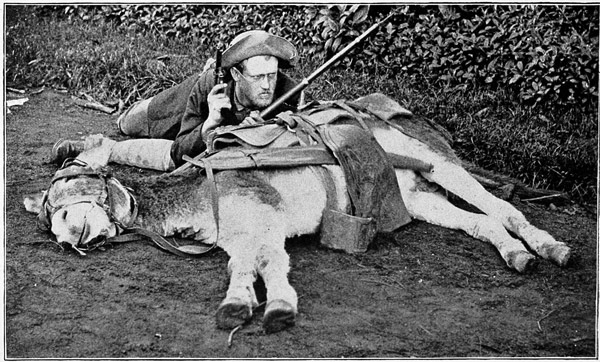
"Coonskin and I took shelter behind our donkeys."
TOC
BY PYE POD.
Here, brother Sancho, we may dip our hands up to the elbows in
what they call adventures. But take note, though thou seest me
in the greatest danger on earth, thou must not set thy hand to
thy sword to defend me, unless thou shouldst perceive that they
who assail me are rabble and low people, in which case thou canst
come to my aid.—Don Quixote.
It was early evening, October 5, at Green's ranch.
The somber quiet of the place seemed to indicate a deserted
estate, but a dim light in the window invited me
to knock. At once I heard feet shuffle across the floor,
and a bolt slide in the door.
"Who be you?" called a woman, distinctly.
I introduced myself through the key-hole and was admitted.
Mrs. Green extended me a left-handed greeting
while holding a sixshooter in her right hand. It was
a most interesting reception.
"What are you going to do with that?" I inquired,
smiling. The idea that a frontier woman should be so
easily frightened seemed ridiculous.
"Haven't you heard?" she returned. "Why, the whole
country is up in arms looking for two desperate outlaws.
They shot a sheep-herder last night in Telegraph Canyon,
and after robbing the fellow of four dollars, left him
for dead. Mr. Green went to Egan Canyon this afternoon
for the mail, and hasn't returned. He ought to be
back by now. It is only three miles away." Here the
somewhat perturbed woman glanced at the clock, which
indicated 8:00.
I conversed with Mrs. Green a few moments, and she
invited us men to supper and told me to feed my animals
from the hay-stack. I said we were well provided with
food and fire-arms, that she might feel quite safe from
the brigands. Now Coonskin called for me and said our
evening meal was under way. So, I bade Mrs. Green a
good night.
Coonskin, whose chief literary diet had been dime
novels, listened to the news with rapt attention, and
suggested that I cook while he prepared camp for a
sudden attack.
"Gee! Wouldn't I like to capture 'em, though!" he
said enthusiastically.
"I would like to see you try it," I returned; "you have
been 'spoiling' for a scrap with an Indian, or a desperado,
or some wild beast ever since we crossed the borders,
and I shouldn't wonder if this were your opportunity.
Something tells me that we'll meet these outlaws."
Supper over and dishes washed, we retired. Our bed,
only separated from the earth by a single canvas, never
was more comfortable. The night was cool and a gentle
breeze was blowing, but there was no sound, save the
braying of the donks. Suddenly I heard Don, who was
on guard, growl, then a sound of wheels and a horse's
whinny.
"Will your dog bite, Mr. Pod?" called Mr. Green.
I rushed out barefoot and dispelled his fears, and,
after shaking hands, questioned him how he knew who
I was.
"Oh," he chuckled, "anybody would know you by
your outfit; besides, everybody along the trail has been
expecting you, even two desperadoes."
This was interesting. But I explained that his wife
had told me all, whereupon he invited us men to breakfast,
and was escorted by Don to a point which he considered
the limit of his master's domain.
While at breakfast I learned that the Salt Lake newspapers,
containing illustrated accounts of my prosperity,
had subscribers all along the trail; that the shooting at
Telegraph Canyon was the first in that section for sixteen
years; that no pay-boxes were expected at the Egan
mill, where a half dozen men were working; and that,
what was of more importance than the rest, it was the
prevailing opinion that Pye Pod was the man the outlaws
were laying for.
"Griswold is the unfortunate man's name," said Green.
"The outlaws pretended to be friendly, lunched with him,
and started off on their horses. But Griswold had no
sooner turned his back than the strangers ordered him
to throw up his hands. They took all his funds, shot
him, and galloped away with his good horses, leaving
their jaded ones. The poor fellow regained consciousness,
and managed by morning to crawl six miles to a
ranch. Resolute men hurriedly saddled their horses,
and soon thirty were after the outlaws. I hear Griswold
is with them, he having recovered. But they say at
Egan that some of the boys this afternoon gave up the
chase, because it was getting too warm for them; they
felt pretty near the game."
Mr. Green gave me a second-handed description of the
desperadoes and their outfit, and directing me on my
route, wished us Godspeed.
I felt that my route forced me to overtake rather than
to meet by chance two men who set but little value on
other men's lives, and even less on their own; therefore
having everything to gain and nothing to lose, they put
up the best kind of a fight.
We soon arrived at Egan, where we were kindly received.
The men showed us about the works, allowing
me to take photographs, and gave me a more accurate
description of the outlaws, and the long trail of a hundred
miles to Eureka. At three points only should we
find water, at Nine Mile Spring, Thirty Mile and Pinto
Creek, the latter being seventy miles away. No habitation
would we see; only an occasional coyôte, or a band
of wild horses, or possibly some prairie schooner, or the
outlaws, or some of the possès.
By trailing through Egan Canyon we cut the backbone
of the mountain range and now, at an altitude of
several hundred feet above the plain, were climbing
higher and higher the rugged plateau, until we reached
Nine Mile, and unpacked. The spring was in a grassy
spot, and Coonskin first replenished our canteens, then
released the donkeys.
It was noon. Accustomed as we were to travel on two
meals a day, I could set no regular hour for them. It
was twenty-one miles to Thirty Mile Spring. So we
cooked here.
The desperadoes formed the chief topic of discussion,
even Don showed the bloodhound in him, and, ever since
leaving Egan, showed unusual excitement and was more
vigilant. We must have crossed the tracks of the outlaws,
or were following them unwittingly. Taking
everything into consideration, we were in a fair mood to
be startled when the dog sprang to his feet, and growled.
Then three men, heavily armed, galloped up and dismounted.
I was relieved when I saw one of the riders
wearing a bandage round his head; it must be Griswold.
The strangers left their steeds standing, each tying a
rein to a stirrup, then introduced themselves. We had
just finished lunch and were smoking when the possè
arrived; but now Coonskin cooked for our friends, while
I did all the honors and gleaned all the information
essential to our interests. They were affable fellows and
resolute, but had set out hardly equipped for the chase.
One picked up a two-quart canteen, saying good-naturedly
that he reckoned he would have to rustle it.
I said they were welcome to anything I could spare.
Before separating on our several missions, Coonskin
photographed the party, and Griswold repeated his description
of the outlaws. Couriers had been dispatched to
Ely, Hamilton, Eureka, and other points; these men
were bound for Hunter, seven miles over the mesa. Before
leaving they asked me if I would blaze a sage-brush
fire that night should I reach Thirty Mile and discover
any evidence of the bandits. They also admonished me
to hold up and shoot without considering an instant any
two mounted men of the description given, else we two
would never live to tell how it happened.
With this parting injunction, unofficial though it was,
the riders loped away, and my nervous troop, at half-past
two, "hit the trail" in lively form. I was glad the country
was clear and open. Only an occasional dwarf cedar
stood in dark relief against the sage. About midnight
the grade began perceptibly to grow steeper, and in consequence
of the clouds which had gathered the darkness
was dense. I felt we must be near to Thirty Mile. The
idea of passing the spring and having to trace our steps
next morning was not to be entertained. Seeing a bunch
of cedars some distance to the right, I headed for them.
And there we camped. Behind the screen of three small
trees and the darkness we spread our blankets, lunched
on bread and cold meat, and went to sleep. The donkeys
were picketed still another hundred yards back, so
as not to be seen from the trail; we did not light a fire.
By ten o'clock next morning we had breakfasted, and
were trailing toward the summit of the plateau. Three
miles further on was Thirty Mile. Here again I unpacked
the animals for an hour's grazing on the grass
by the spring.
The noon hour found us weary travelers reclining on a
heap of blankets. To the east, some fifty feet away,
stood a tub, obscured by pussy willows, and brimming
with cool water furnished by a cedar trough which
reached from the bubbling spring. The overflow streamed
down a tiny gorge in the hard soil, under cover of the willows,
and finally sank in the earth.
"I'm afraid the fellows ain't going to bother us after
all," said Coonskin disappointedly, at length. "I'd give
a farm to get a whack at them."
He had no sooner uttered the words than he turned
pale, and I turned to behold two small moving dots on
the horizon, some two miles down the trail. "Jove!"
he added, "I believe the outlaws are coming."
Indeed, I could make out two men, mounted on a dark
and a light-colored horse respectively, slowly approaching.
Assigning to my valet the shot-gun and the Smith
& Wesson double-action revolver, I loaded two extra
shells with buckshot, tested the locks of my Winchester
and single-action Colt revolver, gave Coonskin explicit
instructions, and awaited events.
When the strange riders rode to within a half mile of
us they stopped and dismounted. It was plain they were
cinching their saddles, probably preparing to do some
rough riding. The dark horse appeared to be somewhat
darker than the one described by Griswold, but I was
cautioned that they might exchange a horse for one on
the range in order to mislead their pursuers. They and
their outfit in all other respects tallied with the description
given to me.
My companion in arms, who of late had evinced such
courage, now showed signs of weakening. He protested
that it would be better not to attempt to hold up the fellows
until we were sure we were right, and when I said
that I proposed to get the drop on them the first opportunity
offered, and to shoot if necessary, and should
count on him to aid me, he was speechless. Don seemed
to understand, and stationing himself some ten feet before
us, watched the strangers eagerly. I assured Coonskin
that if our dog allowed those horsemen to enter
camp, we could rest easy, but if, when I hailed them,
Don uttered a protest, we could mark them as the outlaws.
"Don't let them corral us," I cautioned; "if they
get us between them, the game is up."
Those were anxious moments for me, as well as for
the young man who was ten years my junior. I was
seated on our packs, my Winchester lying across my
knees, cocked; Coonskin sat on the ground at my right,
with shot-gun in hand. Our revolvers were in our belts.
Our bearded and sun-burned faces, long hair, and generally
rough attire, added to our unfriendly attitude, must
have puzzled the approaching horsemen. When they
had come to a hundred feet from us, I called roughly,
"Helloa, boys! come in. You're just in time for grub."
Instantly Don leaped to his feet, and with tail straight
out and body trembling from rage he uttered a savage
growl of defiance. He identified the desperadoes.
Instantly reining their steeds, one of them slung some
simple questions at me, designed, no doubt, to throw us
off guard.
"Purty nice lot of burros you've got," he began.
"Pretty fair," I replied disinterestedly.
"Which way you traveling?"
"West. Where 're you bound?" I inquired.
"Just lookin' round. Which is the trail to Hamilton?"
I did not answer. Then the man asked: "How far is
it?"
"I don't know, and I don't care a d——," I answered
coarsely, with bravado, as if I considered it wasting time
to talk.
The smiling outlaw now looked grave, and turning to
his comrade asked, loud enough for me to hear: "Shall
we go in and cook?"
"No, better water our horses and go on," said the
partner.
Then, quite as I anticipated, while the more slender
man rode direct to the tub of water, to the right of us,
the other guided his horse to our left, to hem Coonskin
and me in between them.
Instantly I rose to my feet, and trailing the rifle over
my wrist strode, eyeing him defiantly, in a line at a right
angle with the course of his horse, but the rogue did
not go far before turning his steed in the direction of the
tub. There both men dismounted behind their steeds,
took off the bridles with spade bits that their horses
might drink, and regarded us tenderfeet with some respect
and concern. They handled their bridles with their
left hands, which left their right hands free to use the
revolvers I had seen in their belts; in view of which fact,
Coonskin and I took shelter behind our donkeys, three
of which were lying down after rolling, and, aggressive
as well as defensive, awaited our opportunity.
larger
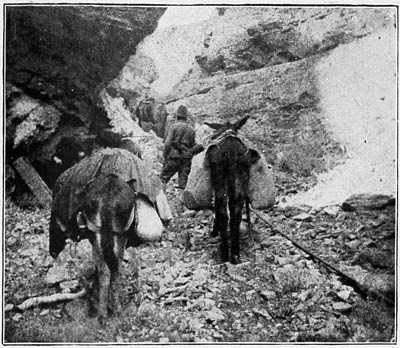
"Through Devil's Gate, their panniers scraped the walls."
larger
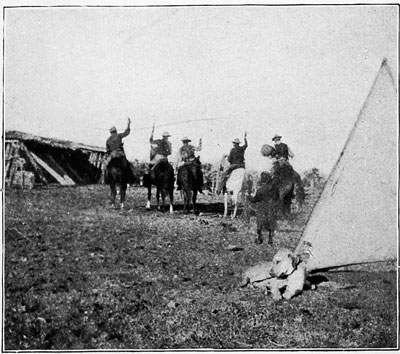
"Fired their revolvers in the air."
Presently the spokesman of this bandit party, inquired:
"Say, fellows, have you seen three armed men mounted,
looking for two fellows riding a grey horse, bare-foot,
and a sorrel with a bald face, they claimed shot a man in
Telegraph Canyon?"
"Not exactly," I said with a faint smile. "Don't think
I ever saw three armed men." I waited a few seconds
for my levity to produce the desired effect, then added:
"There were three determined-looking fellows armed
with double-barreled shot-guns who stopped here. They
were man-hunting."
"That so?" queried the outlaw, quite excitably. "How
long ago were they here? Where'd they go?"
"Oh just a little while ago. They took in a few cans
of water," I here pointed in their direction, and said:
"They were going to cook over there behind that knoll."
At once, as I hoped they would, the desperadoes were
thrown off their guard and looked behind them. And
as they did so I raised my rifle and whispered to Coonskin
to pull on them. But "Sancho" never budged, his
courage had left him. The outlaws turned their eyes
upon us so quickly I think they must have overheard my
whispered command. They hastily bridled, mounted,
and rode southwesterly in the direction we were bound,
while turning in their saddles and watching us until they
were beyond range of our guns.
I was in the mood to "jump" Coonskin for not aiding
me to hold up the outlaws. Our one great opportunity
to distinguish ourselves on the journey was lost. "Think
of the receptions we would have had if we had captured
and disarmed those desperadoes, and marched them
handcuffed into Ely, the county seat! And think of the
handsome reward," I said.
The thought of a forfeited reward seemed to stagger
the boy. I concluded my lecture with the emphasized
mandate that henceforth I must not detect any unusual
display of courage or prowess on his part, unless it should
be solicited by me, and furthermore, I did not wish to
hear any expressions of desire to attack anything more
formidable than a jack-rabbit.
Our donkeys were soon packed for a twenty-mile evening
tramp toward Pinto Creek. I pinned a penciled
message on paper to the tub before departing, for the
benefit of the possè, and my caravan was on the move
again. About midnight we made a dry camp at a discreet
distance from the trail, where without building a
fire we made a cold lunch serve for our second meal that
day, and retired.
Next morning early we resumed the journey. By two
o'clock we had crossed the Long Valley Mountains and
were on the margin of a sage-covered plain, still probably
twenty miles to Pinto. Several times we were puzzled
by forking trails, and were in doubt whether we were
on the right one to Eureka.
I judged the valley to be ten miles wide. On we rode,
the plucky animals swinging slowly along in that awkward
yet amusing hip-movement characteristic of the
burro, until I distinguished across the plain what looked
to be a house. I decided to head for it. We arrived
there at five o'clock, to find the place temporarily deserted,
to discover a fine spring and plenty of hay.
Here we cooked our evening meal and were enjoying
a smoke when two men rode up with an air of conscious
proprietorship. They were Mr. Robinson, proprietor
of Newark Mines, and his superintendent. Both
were very hospitable. Mr. Robinson invited me to help
myself to anything I or my party needed, regretted that
we had not waited to dine with him, and asked us to
spend the evening at his house and breakfast with him.
When I told them the story of our experience with the
outlaws, they were greatly interested, and it called forth
many tales of adventure from both those frontiersmen.
We were treated to a heaping plate of delicious apples,
and it was a late hour before we sought our tents. It
was a relief to feel myself well beyond the outlaws'
domain.
Next day my good host directed his superintendent to
guide us over Chihuahua Pass, which would save us a
fifteen-mile journey around the extremity of the mountain
by way of Pinto.
The climb over the pass was rich with beautiful views.
After rising several hundred feet and looking back, the
vista between the summits and the plains glistening in
the sun was superb. The mines were a mile or two up
the canyon, and to this point my kind host accompanied
us, after which his man on horseback led us over the
roughest and most puzzling part of the trail.
So narrow was the passage through Devil's Gate that
two animals could not walk abreast, and their panniers
often scraped the rough walls of the winding and rocky
gate-way. Having once gained the summit, a great oval
of bench-land spotted with buffalo-grass, we rested and
grazed the donkeys while we lunched; then we shook
hands with the good-hearted guide, and trailed down the
long, pine-covered slope to Eureka.
TOC
BY MAC A'RONY.
I will feed you to bursting.—The Fair God.
Eureka is a good old mining town that saw its finish
when Congress demonetized silver. As have some
clouds, it has a silver lining; the earth beneath and the
surrounding hills are rich, or rather poor, in the white
metal. A few of the mines were still operating, and any
one could see ten-horse teams drawing ore done up
in bags, like grain, to fool any mule or donk. The
night we hungry donkeys arrived in town we followed
a wagon filled with bags of ore a quarter of a mile out
of our course before Prof. discovered the mistake.
I observed that the populace didn't take much interest
in what I had to say, so I didn't say much, but I
thought lots, and stored away plenty of grain and hay,
to say nothing of water. The amount I drank would
make a camel envious. But I wasn't satisfied. I hadn't
tasted fruit for a long time. So I got out of the corral,
strolled to a grocery store, and helped myself to dried
apples; I was about to nab a bacon when I was driven
away to a watering-trough by a kind boy who knew
a thing or two, and then led to the corral.
I remembered having eaten less than two quarts of
apples, but before ten minutes were gone I easily believed
I had eaten ten bushel. To look at me you would
have sworn I had swallowed a barrelful, barrel
and all. Most of the day, I spent rolling round the
corral in pain. For the first time in my life I knew
what it was to be really tight.
The kind boy stood innocently by, and a companion
of his dared him to go up first. "Up where?" asked
the kind boy.
"Up in the balloon, yo' big idiot!" said the other.
"Jest got ter tie a basket to his tail, and git in, and
hang on. Fillin' fast, he'll rise purty soon."
That mockery was more than I could stand while lying
down, so I rolled on to my feet and made both boys
scarce. And if a horse-doctor hadn't stabbed me, the
kind boy would have needed a balloon to save himself.
That evening saw me well again, but my cravings took
a different turn. I had a taste for a newspaper. Finally
a man threw one to me. Among its contents, I ran
across the following squib, and smiled:
"MAC TEMPTED AND DRIVEN OUT.
Some vixen let out one of Pye Pod's burros—it happened
to be his pet jack—then drove him to Pete Dago's
open-air lunch counter, where the ass helped himself
to that diet which would go farthest, yet take up the
least room—dried apples. It's a sad story, but the worst
is over, and save a small doctor's bill, and a grocer's
bill, and a five dollar bill, and the small boy, Bill, who
has been placed in the coop for the night, no other bill
figures in the case. The distinguished party leave in the
morning, also the nigh extinguished party (meaning me).
Adam was the first ass to be tempted to eat of forbidden
fruit, but not the last. Adam blamed Eve. Mac
blames a kind boy. Adam deserved some commiseration
for having perhaps sampled apples too green, for
we know what it is to be a boy, but no compassion can
be tendered the 'narrow-gage mule' that is such an ass
as to pack away a hundred pounds of evaporated apples,
gulp down a cistern, and expect to fly."
During his sojourn Pod wrote his weekly letter, discussed
the desperadoes with the sheriff, photographed
some crippled, dried-up Piute Indians, and doctored the
sick dog, for Don had on the trail imbibed too freely
of alkali water.
We left town the morning of October 11th, and arrived
at the Willows about midnight, after a long
forced march through a wilderness. There Pod pitched
camp. Neighing broncos disturbed my dreams, and
daylight revealed a bunch of cowboys on a round-up,
also a bale of hay, which set us all braying so loudly
that we awoke the men in time to start for Austin
before the sun got scorching hot.
The cowboys were a jolly lot. They gave an exhibition
of rough riding which nearly frightened Damfino
into epileptics and Don into hydrophobia. Then the
whole lot of 'em fired their revolvers in the air and
skooted through the sage, yelling like mad.
Our next stop was the Blackbird ranch, twenty-five
miles further on, whose hospitable proprietor showed
greater interest in the novel tent than in anything else.
Coonskin took it down with one hand, pitched it with
two feet, and while the wondering spectators pulled their
whiskers, bound up the canvas and tied the rope with
his teeth.
The seventy-five mile journey from Eureka to Austin
was accomplished in three days. There, the Professor lectured
to an immense audience.
Austin is another mining town that had seen more
prosperous times; its people, like those of Eureka, were
cordial and generous. When Pod and I led the troop
out of town, he was considerably enriched in pocket and
mind.
Twelve mile ranch is twelve miles from the town.
Same, I suppose, as October thirteenth is the 13th of
the month. Here was a large stock ranch, and the thrifty
proprietor did his best to persuade my stubborn master
to remain over night, at least until the threatening storm
had passed. He would not tarry, but hustled us on
in a drizzling rain.
By nightfall we began to climb a canyon winding over
the Shoshone Mountains, I think, and about midnight
reached the summit in a blinding snow squall. The
wind blew at half a hurricane gait, and the men were
mad because they couldn't light a match to look at the
compass and get their bearings, and Damfino laid down
on the dog that had lain under the donkey to get out of
the ice-shod wind, and the men wasted twenty minutes
searching for the right trail.
You see, my biped friends, that another range of
mountains met the Shoshones at right angles at this
point, and it was dollars to nutmegs that the men would
miss the trail in the dark, which happened; as the result,
two hours later, our outfit slid into camp for the rest of
the night some two half miles from the plain. Breakfast
was served at ten. Menu: sage brush for five.
We were on the north side, and the wrong side, of
the range, plain enough. Pod said it was Coonskin's
fault, Coonskin claimed the Prof. was to blame, and the
dispute would have ended in the blessings of the pipe
of peace if Coxey and Cheese had not chewed up the
only bag of tobacco while the men were feeding.
We were now in what was, I believe, the Sinkarata
Valley. It stretched many miles to the north, and appeared
to be twenty miles wide at the narrowest point.
No sign of habitation could we see. All day long we
trailed through that desolation parallel with the range
until we came to a cross-trail leading to the mountains.
Here the men examined the compass, and headed for
the hills.
It was sundown ere we began the ascent, and ten
o'clock when we went into camp half-way to the summit.
The air was chill, and we thirsty animals were
left unguarded while the men built a fire. I smelt snow
on the mountain peak, so did my comrades. My instinct
told me that in a moment more we all would be
picketed for the night. Our mouths were parched; but
the men had only enough water in their canteens for
themselves.
Self preservation is the first law of nature, I reflected,
and to think was to act. I whispered to Damfino, she
passed the word to Coxey, and all five of us desperate
donks stole away unnoticed in the darkness and followed
our noses as fast as our weary legs could take us in the
direction of the peak. The air was so rarified I could
hear the least sound, and the slow-kindling fire flamed
more plainly instead of more dimly as we widened the
breach of confidence between us and our masters.
"Rather hard on the fellows for us to run off with their
water," observed Cheese, stopping for breath.
Sure enough, the men were left without supplies,
water or food. Not a thing had been unpacked. I loved
the Professor, for he had many times made sacrifices for
me, and the thought made me stop and look back. The
men were talking and gesticulating excitedly. Presently
one started up the trail, and the other down, and
were soon lost to view. They had set out on the wrong
scent. With some misgivings I hastened to catch up with
my comrades.
TOC
BY PYE POD.
Then, looking down at the great
dog, he cried, with a kind of daft glee:
"Up an' waur them a', Quharrie,
Up an' waur them a', man;
There's no a Dutchman i' the pack
That's ony guid ava, man—Hooch!"
—The Raiders.
Never before was I in such a desperate plight, nor was
I ever more frightened than now. I knew not where, but
believed we were in the De Satoyta Mountains, possibly
on the trail to pass between Indian Peak and Mt. Atry.
We had kindled a fire, warmed our hands, and were about
to unpack when Coonskin exclaimed, "For God's sake!
Pod, the donks are gone!"
Often had I exercised the importance of Coonskin's
picketing the beasts before leaving them, but now was no
time to scold. I directed him to take matches and examine
the ascending trail, while I retraced our steps and did
likewise. Luckily our revolvers were in our belts, and
it was agreed that the first to discover traces of the deserters
should shoot until hearing a shot in answer. Don
went with Coonskin. The lighted lantern was left by the
unreliable fire.
It was difficult in the wind to keep a match lighted long
enough to be of value, even when protecting it with my
hat, as I knelt on the hard trail or on the softer earth
in the sage, and strained my eyes to detect the shoe prints
of my runaways. Every few steps I stopped to listen for
a signal shot, and deplored our dire predicament without
food or water.
I had about concluded that the only resort left us was
an all-night tramp over the pass, perhaps to be followed
by an all-day hunt in the next valley for a habitation and
spring, when I heard the welcome signal from Coonskin.
Presently through the still air came the sound of Don's
barking, then I knew the fugitives were captured. With
a lighter heart I now gathered sage preparatory to cooking,
for we had traveled all day without a bite.
Our animals that night were securely roped both to the
iron tent-pins and the tent, so that they could not slip
away during the night without taking us with them.
When I opened my eyes next morning, Mac stood with
his head inside the tent-door, wistfully eyeing the canteen
by my pillow. My heart was touched, but I thought,
"Self-preservation is the first law," and knew that, if
turned loose, all five donkeys would have the asinine instinct
to find a spring in time to save themselves, whereas
a man might fall a hundred feet from a spring and die in
ignorance of it.
One hour after sunrise the breakfast dishes had been
cleaned with a rag, in the absence of water, and the
donkeys were standing to be packed for the disheartening
journey. A heap of ashes smothered some fragile
hot coals of sage, which, from all appearances, were most
inviting to any donkey to roll in. While cinching the
pack on Coxey, I observed Mac to steal to the ash heap,
look at it wistfully a moment, circle round it two or three
times, and, kneeling down, flop over on his side, plumb
in the middle of the warm, gray ashes, and still warmer
coals. It was his custom to roll over several times, but
he didn't do so this morning. He didn't roll at all. If
he had fallen on a huge rubber ball, he couldn't have
bounded on to his feet with more alacrity.
When Mac once had his balance, he shook himself vigorously
and brayed, then eyed the ash heap as if it were
a nest of rattlesnakes. The air smelled of singed hair.
The donkey reached around and licked his side a moment,
then he backed away. When one donkey rolls and his
fellows do not follow suit, you can mark it as most significant.
Two hours later my caravan had crossed the summit
and were marching down the western slope of the range.
Nevada is the home of the wild horse, and now we saw
bunches of these wary creatures grazing in the distance,
or running like deer for the hills at the sight of my outfit,
although five and more miles away.
It was 2 o'clock when, rounding a bend, my searching
eye discerned across the valley, close to the base of the
Augusta range, a building or hay-stack. My heart leaped
with joy. Our canteens were empty, but ere long we
might slake our thirst at a ranch well and give our faithful
animals a treat.
On we pressed until, passing the stack, we reached a
trail leading into the canyon. A few moments more, and
I saw a wreath of smoke ascending not far up the pass.
My intuition told me it was the Maestratti ranch. And it
was.
We received a hearty welcome. Don, poor thing, was
so weak from a prolonged siege of dysentery that he could
scarcely creep to the house; but, while Coonskin and I
unpacked and watered the donkeys, my faithful dog was
fed scalded bread and milk by our hostess, who ordered a
hearty meal for us men.
Mr. Maestratti invited us to a bed in his house, but I
declined it, preferring my own blankets; and now, as I
strode wearily to it, I called affectionately to my dog.
Something told me I was going to lose him, my devoted
friend during three thousand miles and many months of
travel. I missed the loving pressure of his face against
mine, his warm tongue on the back of my hand, his gay
antics and playful bark when in his happier moods, and
anticipated the grief I should soon feel. I paused at the
tent door and whistled.
"Don has stolen away to die," said Coonskin, feelingly.
"That's just what dogs do. Let's take the lantern and try
and find him." So saying, the man lighted up, and we
began the search.
We found him. He was lying beside a stalk of sage a
hundred feet from camp, uncomplaining, weak, and
breathing irregularly. The flare of the lantern aroused
him, and he turned his bloodshot eyes to mine, as much as
to say, "Leave me, kind master, I shall soon be out of
misery. Do not mourn."
Then I thought of his identification of the outlaws at
Thirty Mile, and of his attack on the cowboy in Nebraska
who had playfully lassoed me at my request. I remembered
the chill nights in Iowa barns when he crept over
and nestled against me in the hay that the heat from his
great, warm body might keep me comfortable. I could
not restrain my tears. My best friend must not die in
the brush alone. We persuaded him to return with us,
and made him a comfortable bed in a corner of the tent,
patted his head, and retired. But soon the poor fellow
stole out into the frosty night.
It was not the rising sun or a donkey's bray that awoke
me, but a woman calling, "Breakfast!" I intended first
before answering the demands of my stomach, to look at
my dead friend's face, but to my surprise and delight I
saw the dog lying in the sun, his head up and his tail
wagging, very much alive. He had passed the crisis of
his illness during the night; I had hopes that he would
soon be well.
A fortunate circumstance threw us in the company of a
stranger journeying westward in a wagon. Like everybody
else, he showed great interest in my travels, and
when he saw the condition of my dog, he offered to convey
him over the mountains.
We arrived at the summit of the pass by ten o'clock.
There we rested an hour and fed our animals. The journey
down the western slope, while apparently as trying to
the donkeys as the ascent had been, was more inviting to
the convalescing dog, and he on the way surprised us by
leaping out of the wagon and making after a jackrabbit.
At two o'clock Don's Good Samaritan drove away to the
south, and at four we arrived at the Donaldson Ranch.
Many courtesies were extended us here and we were half
persuaded to remain over night with these hospitable people.
We cooked dinner early, gave our animals a liberal
mess of barley, filled our canteens, packed and departed at
seven with the well-wishes of all and a fifty-pound bag of
grain, which was donated to Mac A'Rony.
Darkness had set in. Although cautioned about two
diverging trails which we would reach before ascending
the mountain, before an hour had passed I realized we
were going in the wrong direction. The night was chill
and pitch dark. Quickly changing the saddle from Mac
to my fleet-footed Skates, I rode back to the ranch. No
light shone through the windows of the house, and I knew
that every one had retired. I could see no expedient left
me other than to arouse somebody to set me straight.
Feeling my way to the house, I shouted with all my might,
and soon awoke Mr. Donaldson, Jr., who came good-naturedly
to my relief, saddled a horse, and insisted on
guiding my party to the summit. We did not arrive there
until midnight.
The noonday saw me at Horse Creek, and midnight, at
Sand Spring, where we camped. At dawn, a sweeping
glance from my tent door revealed the most desolate of
surroundings. To the west was a great barren desert,
while on every hand were massive sand dunes, some of
them towering a hundred feet.
A breeze had sprung up during the night. After purchasing
a peck of pine nuts from some Piute Indians who
had camped close by for the night, and were now starting
out on the home trail, I tied the door flaps as tightly as
possible to keep out the drifting sand, then went back to
bed. In spite of my precautions the sand forced an
entrance, coated our blankets an inch thick, and scattered
seeds of unkindness in our nostrils, ears and hair. When
I awoke and saw the sides of the tent bended inward and
half way up the walls an uneven horizon, where, through
the canvas, the sand and sunshine met, I roused my
companion and we dressed. In a few moments more
we might have been buried alive.
How we were to cook breakfast was a serious question.
On unfastening the door, we were immediately blinded
with sand and alkali dust; and it was only with the greatest
difficulty that I could find the ruins of the old restaurant
of '49, which at early dawn I had discovered only
two hundred feet away. The floor of this structure had
long since gone to provide camp-fires for many a traveler,
but I kicked off a piece of siding. Then I tried to find the
tent. I groped and stumbled in the blinding storm, and
only by calling to Coonskin and keeping him constantly
answering did I hold to my bearings and succeed in reaching
camp.
Saturating a few sticks with coal oil, I got them a-blazing,
and then under cover of our water-pail I ventured out
of the tent and built a fire sufficient to boil coffee. Our
bread when buttered looked as if veneered with sand-paper.
Coonskin, gulping down a half cup of coffee,
echoed my sentiments when he remarked, "It takes plenty
of grit to cross these plains."
How we ever packed and drove our half-crazed animals
out of that sandy hurricane is beyond my power to describe.
Blinded and choked with the sand themselves,
they could scarcely be made to walk to the well. Having
washed out their throats, Skates was persuaded to move,
and the others followed reluctantly out of range of the
warring elements.
As soon as we were clear of the sand belt, we stopped
and made our toilet. All day long while crossing that
broad desert my eyes smarted and swelled, and they did
not cease paining me until we reached the first habitation,
where I procured witch-hazel.
Grimes' ranch at seven o'clock saw my whole party in
better spirits. I declined both the invitation to remain
over night and to stop for supper. Mr. Grimes telephoned
to Mr. Len A——n, of Sinclair, advising him that I was
on my way there and expected to arrive by nine. It was
much after that time, however, when my outfit reached
the ranch. When still three miles away and a full hour's
march, we could see a lantern swinging, and when we got
within a half mile the sound of cheers and calls of welcome
greeted our ears. We answered the signals with
our lantern and cheered so lustily that Mac A'Rony
paused to bray and led the donkey quintette in a heartrending
chorus.
The day's thirty-mile jaunt thus came to a happy end
in marked contrast with its beginning. A stalwart, broad-shouldered
man, with a smiling face half hidden by a
beard streaked with gray, lifted his sombrero as he
grasped my hand and shook it heartily.
"Welcome, welcome, my boy! Now make yourself at
home," said Len A——n.
larger
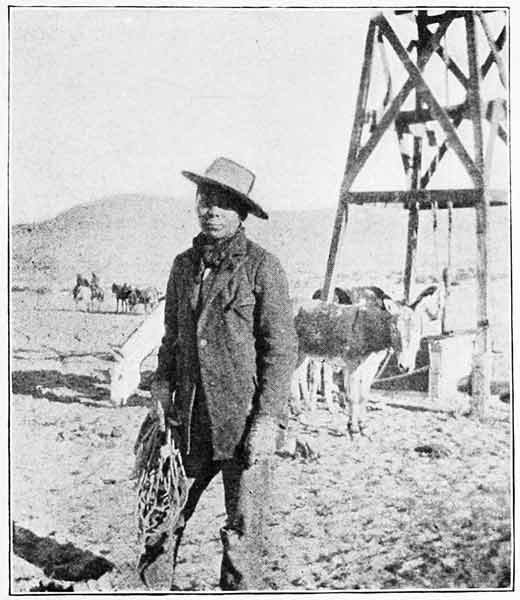
"Some Piute Indians who had camped close by."
larger
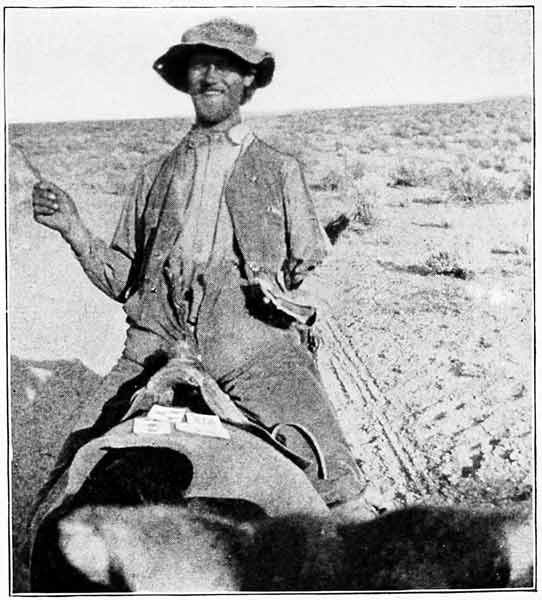
"Playing Solitaire on Damfino's broad back."
TOC
BY MAC A'RONY.
"A torch for me, let wantons, light of heart,
Tickle the useless rushes with their heels;
For I am proverb'd with a grandsire phrase.
I'll be a candle-holder, and look on."
—Romeo and Juliet.
Old Len A——n was a jolly old soul, and a jolly old
soul was he; he leaped aboard in the middle of my back,
and hollared to me: "Git!—Haw!—Gee!"
We donks had a great time at that little desert metropolis.
Len owned the place, that is, until Pod's outfit
arrived, then Mac A'Rony owned it. Pardon my seeming
vanity. When the nabob of Sinclair rode me to the
corral, the crowd cheered me three times three, "Hooray
fer Mac A'Rony!"
Besides Len, the sturdy pioneer of '49, there were the
foremen, store-keeper, blacksmith, bronco buster, justice
of the peace, postmaster, cowboys, cooks, and numerous
wives and daughters and cousins and aunts all willing
and anxious to make our party comfortable. Pod was at
once escorted to the house to entertain and be entertained
by the ladies, while Coonskin unpacked, watered
and fed us donks, like a good fellow. For once on my
long journey, I had my fill.
Finally we were left to entertain ourselves. In less
than a half hour I wanted a drink, for when we were led
to the well I refused to imbibe; now I regretted it.
Donks are funny creatures—regular Chinese puzzles.
When you think us thirsty we ain't, and when we are we
must help ourselves, or go dry.
I discovered a rope dangling from a projecting arm of
a high gatepost, nabbed it, and pulled; the gate did the
rest—opened. So I walked straightway to the well
trough and drank, then sauntered to the house to learn
how Pod was faring. S' help me, Balaam! there he sat
with Coonskin at a long table, surrounded by men and
women, all talking and laughing and "joshing." But I
noticed the travelers kept their knives and forks busy,
and wasted no time. It made me hungry to see them
eat, so I returned to the corral to finish my barley; but
when I got there I found it already finished. No use
talking, a jackass ain't to be trusted, nohow, at any time.
The only thing left for me to do was to go foraging.
Out I went, nosing around, hoping to discover a
clothesline with some shirts and socks hanging on it, or
to stumble over an old gunnysack or cast-off garment.
After a little, I observed that the second largest house
was the scene of considerable activity, and I sneaked up
and peeped in the window.
The ground floor was one vast room, presumably the
bunk house for those men not having homes of their
own. At one extremity a ladder reached from the floor
to the loft. One half of the ceiling was boarded, and the
other half looked white, as if it were made of canvas or
sheeting. I suppose lumber was scarce out there in the
desert. Now, a donkey's curiosity ain't to be sneezed at.
Fearing lest I might be discovered and locked up, I withdrew
to the rear to another window, when, suddenly, I
ran into a heap of bedding and other stuff. I could arrive
at only one conclusion; there was to be a dance in
honor of Pye Pod.
I had devoured half of a hay mattress before the guests
began to arrive for the dance. They came from the various
houses and cabins, clad in their finest, and among
them were a fiddler and a mouth-organ grinder, who at
once pitched camp in one corner of the room and tuned
up.
To open the dance, the Prof. led off with the landlord's
pretty daughter in a waltz, Coonskin sailed around close
behind with her black-eyed companion, and soon that
bunk-house was as busy as a stock exchange.
After several dances had occurred, the men excused
themselves and came out to the table beside the luggage,
and commenced opening several bottles of the
"real article." I stood stock still at some distance in the
darkness, but within smell of the refreshments, and noted
that some took it straight, while others mixed it with
sugar and water, or milk. Coonskin doted on punches
of all kinds (except one variety reserved for obstreperous
donks), milk punches, rum punches, whiskey punches,
claret punches, etc., but milk punches mostly, and so this
was an event for that unbridled youth. He gulped down
several milk punches with great glee, and then followed
the gang into the house and went at the dance again in
earnest. Later on the men came out for more refreshments.
At a late hour that "O be joyful dance" was
brought to a sudden finish by a frightful incident, or accident.
It seems that the cowboys had to rise early to hunt up
stock on the range, and therefore went up the ladder to
bed before the dance was over. As Coonskin had a cot
with them, he was asked to retire at the same time, so as
not to disturb them. But that boy wanted just one more
dance—it was one too many.
When he started to climb the ladder I held my breath;
once he slipped through the rungs and only caught himself
by his chin. The rest of the dancers kept their feet
as busy as ever, and the fiddler had just called "Balance
ter corners," and everybody looked to be in good spirits—the
best of spirits was in the men—when all at once
Coonskin dropped through the sheet ceiling overhead on
to the floor in their midst. I was glad to see he lit on
his feet like a cat, instead of on his head, as one would
suppose with such a heavy "load" as it must have had.
The frightened, embarrassed fellow chased himself in
his shirt tail round and round that room, passing three
doors at every lap, yet calling: "Where's th' door?" For
a moment everybody looked paralyzed. But by the time
the first of them regained his senses, Coonskin discovered
a door and scooted out into the darkness, and ran
plumb over me. Both of us went sprawling on the
ground. It broke up the dance and everybody there.
The women gathered in one corner and laughed in their
sleeves, and the men ran out to look for what had
dropped out of the ceiling, or sky—they seemed sort of
dazed like, as if they didn't know. When I got my
breath, I set out for the corral and brayed with laughter
all the way.
Finally, I heard a familiar voice whispering to me in
the stable door, and creeping up I discovered Coonskin
shivering with a sheepskin about his shoulders.
"They're after me, ain't they?" he asked.
"Well, I reckon they are," I replied. "How did it happen?"
"Well, it was this way," Coonskin explained. "When
I went upstairs to bed, I found the men had blown out
the candle and left me to undress in the dark-hic-ness.
I felt round till I found my cot, and undressed, all but
my shirt, when I found my pillow missing. Says I,
'Where's my pillow?' One fellow says: 'There it is,
over there; wese had a pillow fight.' So I started to go
for it. I hadn't gone far before I sort o' felt I was treading-hic-on
velvet, but I thought it was the punches and
kept right on, till I struck the floor downstairs. That-hic-'s-all."
Just then the men entered the stables and finding
Coonskin huddled up in wool, had a laugh, and brought
him clothes to put on, and went with him to the deserted
dance hall, and saw him safely to bed.
The more I thought of this accident the more sober I
got, until I thought what a miracle saved Pod's valet,
and wondered what he would have done without him out
there in the desert. Then I tangled up my legs and
went to sleep.
Next day Coonskin was the most embarrassed fellow
that ever rode a donk. The good-natured host could
hardly persuade him to breakfast. Everybody was silent
at the table, Pod said; but finally Len began to chuckle,
and remarked that he'd been West nigh on to fifty year,
but last night was the first time he had ever seen the
ghost dance. Coonskin said it was no ghost dance, just
a new kind of breakdown.
After breakfast, Len gave Pod a look at his stock and
made him stock up with all necessary provisions. He
wouldn't take a cent for anything, only a few photographs
to distribute to his retainers. He even said he
was sorry for the hard times; he would like to give the
Prof. at least a hundred dollars. I believed the generous
old pioneer, for it would be just like him.
Pod began the day in fine spirits. He had been pleasantly
surprised on being assigned to a room in Len's
house to notice the furnishings arranged with distinctively
feminine taste; so he was not surprised, when at
the breakfast table he catechized Miss A——n, to draw
from the lips of the blushing maiden the confession that
she had resigned her boudoir to the distinguished
donkey-traveler. Hence Pod had a delicious sleep in the
downiest of beds. And, as a token of his appreciation
for the courtesy, he presented the young lady with a
silver scarf-pin which he had worn across the desert.
I shared some of my master's regrets on leaving. The
women hugged me good-bye, but when the ranchman's
daughter put her arms round my neck, Pod was so jealous
that he jammed a spur in my side.
After a time we got started on the trail. Len not only
declined pay for Pod's supplies, but gave me a hundred
pounds of barley. This my comrades offered to carry
provided I would divide with them.
For the three days following there was little else to see
besides sand and sage and basaltic rocks. Ragtown still
stands, a squatty cabin and dilapidated shed with corral
adjoining, where old Ace Kenyon of questionable fame
reaped a harvest from the half-starved emigrants of early
days by extorting from them rewards for recovering
their lost cattle, which he had had his retainers drive
into the mountains in the night. Ace would place all
the blame on the innocent shoulders of the Indians. He
claimed that such depredations were often made by hostile
tribes, and that only through the courage of his
desperate cowboys could he possibly retrieve them.
After the despondent emigrants had tarried several days
and been forced to pay extravagant prices for provisions,
and some of them induced to throw away their rags for a
suit of new clothes, the cattle would be driven into camp.
Then the elated travelers had to open their purses again.
Ragtown, situated as it was at the extremity of the Humboldt
Desert, was a sort of overland depot, and we were
told that thousands of emigrants used to drift in that
direction from other routes when water had given out
and for miles the trail was then strewn with cast-off raiment,
abandoned wagons, sometimes with oxen attached,
and the skeletons of cattle and men who died from
thirst. At times we could see the winding line of cotton-woods
that marked the tortuous current of the Carson in
the distance, and again the river would flow slowly
close at hand. Pod spent most of the dull hours playing
solitaire on Damfino's broad back, riding backwards.
We struck camp at the last ranch on the Carson the
morning of October 18, and tried to reach Dayton the
same night. Everything went well until we came to a
point where three trails met. Pod had been cautioned to
take the best-beaten one, so, the night being dark, Coonskin
left us donks in Pod's charge and ventured to examine
the trails. It was eleven o'clock. Not a thing
had we had to eat or drink all day except a small measure
of barley. To stand waiting for that slow boy to
get his bearings was more than we donks could bear, and
soon Damfino whispered to Cheese and me to slip away
from the outfit and follow her lead.
The suggestion was at once acted upon. Each of us
took a different course to start with, but we soon caught
up with Damfino, who led us a good pace for two hours
and ran us all into Six Mile Canyon about one a. m.
There we lay down with saddle and packs on, and, to
our surprise, discovered that faithful dog, Don, lying
close by, on guard. It was not the most comfortable
night I had ever passed, but it was better than standing.
When Coonskin found us in the afternoon he caused me
to change my ideas on that question, but on reaching
Dayton, the Prof, was so glad to see me that he lavishly
dined us all, watered us, and let us roll to our heart's
content. So all scores were settled.
TOC
BY PYE POD.
It means, monsieur, that a storm is raging at the summit—a
snow storm—which will be upon us ere long. And, dame! it is
dangerous!—Tartarin on the Alps.
We left Dayton at two o'clock. Carson City lay six
miles away, close to the Sierra Nevadas, whose towering
heights, on the Nevada side, rise abruptly from the plain.
That afternoon's journey was the last we were to experience
through the monotonous chaparral.
When we trailed into Carson, the sun had gone down
behind the forest-covered mountains, leaving me a little
less than thirteen days in which to reach San Francisco.
The leading hotel was pointed out to me, and a cheering
crowd followed us there and called for a speech from
me. While unstrapping our traps for the porter to take,
we men answered inquiries about the trip, then conducted
our animals to a stable, to be cared for.
I was glad to note that they were generally in good
condition, although Damfino's shoulders were somewhat
tender from the rubbing of the pack-saddle, as the result
of her running away. Dr. Benton, at the stable, after
dressing her shoulders, showed me the famous watch
bequeathed to him by Hank Monk, the clever stage-driver
of early days, to whom it was presented for having
driven Horace Greeley over the pass to Placerville, in
time to keep his lecture engagement.
larger
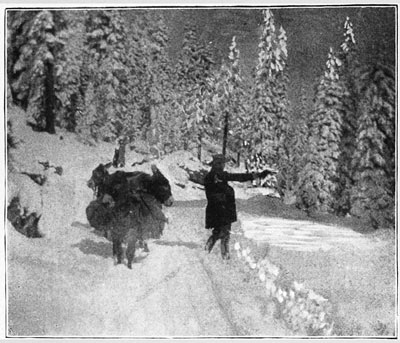
"Began to plow Snow toward Placerville."
larger
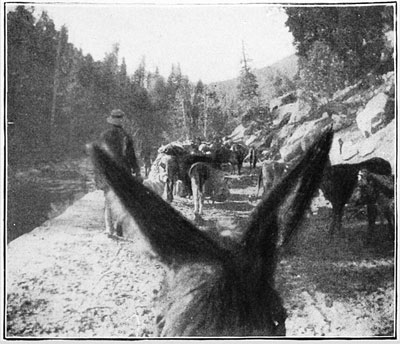
"The Cattle Passed Us."
I had just registered at the hotel, and was chatting
with the group of men crowded round me, when a generous,
good-natured gentleman edged through the cordon
and grasped my hand.
"I'm going to take charge of you," he said, with a
comical wink of the eye; "you are my guest while in
town."
The next moment I found myself launched in an offhand
lecture on my travels. And I should have talked
myself hoarse had not my host led me out to his carriage.
After telling the landlord to make Coonskin comfortable,
I asked who the gentleman was who had taken
me in custody.
"Why, he's Sam D——s; you've heard of Sam, of
course—editor, writer and humorist—famous story-teller—the
biggest 'josher' on earth——." But that was
enough. I fled.
Indeed, Sam's reputation was known to me long before
I arrived on his stamping ground. I leaped into the
buggy, and we drove for his country home.
"Keep yer hand on yer pocket-book!" shouted one
of my host's intimates; whereupon Sam turned to me
with affected seriousness and observed, "Good advice.
But I took the precaution to leave my money and watch
at the office. I heard of your capture for donkey-stealing
back in Iowa."
On the drive my host recalled many happenings of
the golden days of the Comstock, which made me lose
all reckoning of the present. Soon we had reached his
ranch. When I met his family I was ready to believe
some of his accounts of the practical jokes he claimed to
have played on his fellows. I was somewhat disconcerted
when he introduced me to his wife as a noted
"road agent"—an old friend of his who had wavered
from the path of rectitude—whom he desired to feed and
hide from the sheriff's possè, hot on his trail. But I was
amused when his good wife, who of all would be expected
to know him best, apparently took his word for
granted, and, regarding me with nervous suspicion,
started to get me a quick lunch. But Sam delayed her
a moment.
"Dan wants to entrust this $25,000 with me until he
has eluded the possè," he said to his wife, taking my
weighty saddle-bags and passing them to her. "There is
no fire in the front-room stove, is there? Might shove
'em in there." She accepted the trust so seriously that I
laughed outright, and exploded the joke. My hostess
chuckled good-naturedly, and said that most any woman
might take me for a bandit. I did look disreputable.
Adjoining the ranch were a few acres owned by "Mrs.
Langtry," and sold to her by Sam, so he said, but how
he made the deal is too good a story to be injured by
my telling. I was up early next morning. In spite of
my host's urgent invitation to remain another day, I
drove to town with Sam after breakfast. There I was
shown several places of interest.
Dark and threatening clouds hung over the mountains
and alarmed me. My friend cautioned me to hasten
across, if I would avoid the storm. By two o'clock my
outfit left Carson and began the ascent of the steep trail
over the pass to Glenbrook, a lumber camp on the shore
of Lake Tahoe. Dr. Benton advised me to telephone
him from Glenbrook, if it snowed so hard as to endanger
us before crossing the second summit, in which case he
volunteered to dispatch at once a relief expedition, with
horses to break the trail and render me a safe conduct
beyond the snow belt. I shall always remember the
veterinary's thoughtfulness. My friend Sam must have
been interested in the plan.
As higher we climbed the steep ascent, the air became
more damp and chilly, and the heavy clouds looked more
ominous. We men were afoot, for my donkeys were
burdened enough. Mac A'Rony and Cheese were favored,
merely carrying the saddles and guns, for Cheese
seemed to be quite worn out, and Mac, while sound and
strong, was the one, if it be decreed that only one should
survive, I wished to take through. The donkeys often
stopped for breathing spells, and not until we neared
the summit did they require urging to make the fatiguing
climb.
By this time we were over our ankles in snow. The
biting wind came down over the pass in aggressive
sorties and volleyed blasts of cutting snow dust in our
faces, nipping our ears and noses, and blinding us.
By reason of the fast-falling flakes and the darkness, the
donkeys often lost the trail, and the snow obscured the
rocks over which we all continually stumbled and slipped.
At length, when we stood on the summit and looked
back over that battle-ground, I think all of us took courage
for the final conflict awaiting us on the next and
higher pass.
We arrived at Glenbrook at eight o'clock and found
cozy quarters for all. The storm having driven everybody
indoors, the place looked coldly uncordial for a
time; but as soon as its warm-hearted people were apprised
of my arrival they hastened to welcome me. When
provision had been made for the comfort of my animals,
I returned with Coonskin to the hotel, where a hot supper
had thoughtfully been provided for us. And there
we recounted our adventures, which evidently afforded
our auditors the keenest enjoyment.
Morning revealed a dreary prospect. The snow was
a foot deep, and it was still falling thick and fast. My
friends urged me to tarry until the storm had abated,
but I set out, after an early breakfast, for Myer's Station,
twenty miles away. There I hoped to find feed for
us all, and, should the storm be over by that time, comfortable
shelter for the night.
The trail followed the shore of beautiful Lake Tahoe—never
more severely grand and picturesque than now—followed
it many miles before it led into the majestic,
white-clad forest. The snow fell incessantly, while the
rays of the sun, peeping through its cold armor, either
melted it into slush or softened it so as to "ball up" the
donkeys' hoofs and render their tramp more difficult.
When we reached Myer's Station it was snowing
harder than in the morning, so I resolved to rest an
hour and to cross the pass that night. The solitary
tavern first came into view through the dense snow-screen,
not a hundred feet away. It was four o'clock.
Then a barn loomed up beyond and across the trail,
and I felt grateful. I had great confidence in Skates,
Damfino and Coxey; Coonskin and I had ridden but a
little that day, so that, if Mac A'Rony and Cheese could
fortify themselves with plenty of grain, I had hopes of
getting all five over the summit.
Alas! my hopes were soon shattered. There was
neither grain nor hay to be had. The landlord explained
that he didn't keep "no cattle." Even the pantry was
depleted, but my host would find a bite for us men, and
"boil" us some tea, which would have to suffice until the
expected supplies arrived. They might be delayed by
the storm until morning. Meanwhile we shouldn't
starve. I didn't intend my animals should starve, either,
but bought several loaves of bread and fed it to them.
"Don't think I am going to stay here over night," I
said to the tavern-keeper.
"You don't mean to cross the summit in this storm!"
I nodded. At that moment a man stumbled in, accompanied
by a frigid gust of wind, and, walking to the
stove, stamped the snow off his high boots, unwound
a tippet from his neck, and slapped his ice-covered hat
against his limbs.
"Whose jackasses be them outside?" he inquired.
"Mine," I replied.
"Where ye bound with them?"
"Over the pass to Placerville."
The man laughed, then, looking sober, inquired,
"Where yer from, may I ask?"
"New York," I said, nonchalantly.
"Not with them little burros?"
"With one of them."
"Je-ru-salem! I don't know but ye may cross with
'em!" he exclaimed, in astonishment. "But I doubt it.
Jest fetched down my four horses—left the wagon up
to the hubs in snow half-way up the trail—snow must
be three foot deep on the summit. You'll leave your
carcasses in the snow, if ye try it, I'm tellin' ye."
Said the proprietor, "If you will wait here till to-morrow,
there'll be five hundred cattle cross the pass
and break the trail for you."
"I go to-night," said I, "and will break the trail for
the cattle."
I thanked both men for their kind caution, but said
such impediments had stared me in the face ever since
leaving New York, and never yet one of them proved
to be an obstacle. As we moved off, the men stood in
the hotel door, gaping in mute wonderment at my stubborn
resolution.
Darkness gathered ere we began the ascent of the
mountain. Slowly the donkeys climbed the slippery
trail, Coonskin, upon my advice, walking beside Cheese
and watching him with utmost concern. The snow
scudded against our faces, although the mountain somewhat
shielded us from the biting gale we had faced all
day. The three stronger animals carrying the packs
walked ahead, while close behind them struggled Cheese
and Mac, supporting our saddles and lighter traps, we
men encouraging them the while with kind words and
allowing them a few moments' rest every time they
stopped.
Soon I feared lest Cheese would give out. At length,
when about one-third the summit was climbed, he stopped
and deliberately lay down. I knew that meant his abandonment,
then and there. We might induce him to
climb a little further, but we might better free him at
once; he would likely find his way back to the station.
So we took off his saddle and bridle, cinched them on
Mac, and, saying a sad farewell, hid our faces in our
sleeves, and soon had climbed beyond his vision. It
was no time to indulge in sentiment. Once or twice
Mac, Cheese's oldest comrade, stopped and looked behind,
then with a soft bray resumed the ascent; and from
the distance at once came Cheese's response, causing my
eyes to fill with tears. No two human beings could have
shown more tender feelings at parting than did those two
heroic little donks.
Finally we came to the abandoned wagon, half enveloped
in whiteness. I had no idea of the hour, but it
must have been eleven o'clock when my sturdy leader,
Skates, began to stop for rest at every twenty paces.
An hour later we could make only ten feet headway
with every undertaking. I was afraid another donkey
would drop at any moment. Several times I thought we
had reached the summit, when a turn of the Z trail
showed a clear space, with Skates far in the lead, ploughing
and dragging her burden through two feet of snow.
Suddenly, when we had all but reached the summit, as
we after learned, Damfino fell with a groan. She was so
strong and hardy, I had not anticipated her giving out.
Coonskin thought she had slipped and broken a leg. We
took off part of her pack, and at length succeeded in
getting her on to her feet; but not far beyond she again
fell, when, realizing it was from fatigue, we left her, with
all the supplies on. We had no way to carry them, and
I still had hopes of her resting out and trailing over
after us.
It was now a question of life and death. Could I
but get Mac A'Rony through, even by leaving all else
behind, I should do so and fight to the bitter end. Mac
was certainly a wonder. After thirty-eight hundred
miles of travel, during a period of three hundred and
thirty-odd days, he was chipper and nabbed at me mischievously
as I kindly twisted his tail.
Eureka! At last we stood on the summit of that
high Arctic pass of the snow-bound Sierras! Man and
beast were ensconced in snow and ice, and my ears and
face and hands and feet were numb; but I was too happy
to feel any suffering. Could Cheese and Damfino have
been with us then, I should have been jubilant.
The battle was won. I could now see myself, in my
mind's eye, in company with Mac in Golden Gate Park,
gazing out on the balmy Pacific. After a quarter hour's
rest, we resumed the journey through the two and a
half feet of snow, until, after several resting spells, we
began gradually to descend. The air at once felt milder;
the snow had ceased falling; as if crushed with defeat, the
elements had retreated.
It must have been two in the morning when Coonskin,
who was in advance beside Skates to check her
impetuosity, shouted, "Helloa, Pod, I see a house!" I
threw my hat in the air with delight. We had expected
to have to wade through snow until daylight. Were
we all to find a refuge in that half-buried cabin?
TOC
BY MAC A'RONY.
How he trots along on his mule! I declare the beast's ears are
not so long as his master's.—The Hunchback of Notre
Dame.
The supreme moment of my life had "arrove." Must
have come on Skates. I had crossed the broad continent
at last—all but a little toboggan-slide of one hundred
and fifty miles, more or less, and that would be easy sailing.
I felt boastful now. When Pod wasn't occupied
in prodding me over the pass he was quoting "Hannibal
Crossing the Alps" and other heroic adventurers, imagining
his little exploit of the same class. Prof., old boy,
just bear in mind that hobo Hannibal was not so fortunate
as to have five gullible jackasses to help him.
The storm had abated. As I stood waist-deep in snow
while the men-folks were trying to waken the sleepers of
an uninhabited shanty, I looked back where we donks sang
"One More Mountain to Cross" for the last time, and I
gave three brays with a gusto.
Standing in snow or water taxes my patience. Coxey
brayed to the men to "get a move on," but Skates and I
amused ourselves by sucking icicles hanging from our
bangs. Pod's courageous valet received first orders. He
rode an avalanche bareback down the mountain and went
through the door without knocking until he hit the other
side of the shanty.
"Don't shoot, for heaven's sake, folks;" he yelled. No
answer. "Beg thousand pardons, friends, but couldn't
stop," he added. No answer. Then he picked himself up
and called. "Ain't nobody livin' here? Speak up, I won't
hurt you." No answer. The next thing that boy did was
to find the lantern he had lost in the snow slide, and explore
the place.
"The cabin's empty," he called presently.
"Any stove and fuel?" Pod asked.
"Yep," answered Coonskin, "and a hay tick, and-waow-w-w-w!!!—!—!—!—!—spook!
Scat you!—and a gol blasted cat," he added. "Folks must've left just before
the storm." Then to the dog he called, "Here, Don,
sick'em—cats!" and Don sicked.
My elated master next ordered Skates to slide down
that chute to the cabin, and she shooted. He hinted that
Coxey and I would follow, but I wasn't so sure. Judging
from Coonskin's experiment, it looked too swift for
my blood. But when I witnessed Skates safely descend
and heard Coxey's whisper, "Come on, Mac, show your
nerve," I was bound to stay with it and follow suit.
We donks no sooner reached the door than Pod began
to unpack us. It was no go. Knots and buckles, everything
was frozen stiff; my saddle felt glued to my back.
"We must fire up, and thaw them out," said Pod, and
he led us in doors. Coonskin converted some shelves into
kindling, and soon the little stove was roaring like a coke
oven. When we began to thaw, one by one the ropes and
straps were unhitched, or cut, until we were all relieved
of our burdens—and part of our avoirdupois.
Although the men had tramped almost all the way from
Carson in order to spare us, our wrenching and twisting
in climbing the slippery summits had loosened our saddles,
which rubbed into our shoulders until we were
badly galled. Our proud flesh had frozen to the icy
blankets, and when Pod, while near the stove saw our conditions
great tears melted in his eyes, and he rubbed my
frosted nose, I suppose expecting me to purr. We got
thawed out by three in the morning.
That small apartment depicted a busy scene. We donks
were so cramped that we couldn't turn if we had tried.
While Coonskin dried the bedding, the Prof found in the
luggage a box of tar, and gave us a good plastering.
Then he put us in the other room,—it was a two-room
house,—and fed us the hay tick, and a wooden soap box
for dessert, and bade us good-night.
I heard Coonskin mention something about supper, but
Pod told him all the grub was cachéd in the snow over the
summit and that Damfino carried the keys; there was,
however, a possible chance of getting a bite later if he
would go back for the supplies. Soon after I heard both
men snoring.
As I recall the circumstance, I don't see how we three
donks stood it, cramped up in that small room, eight long
hours before the men got up. First we ate the hay tick;
the hay went fast enough, but it took time to chew the tick.
Then we gnawed soap box until dawn. The latter was
savory, but rather tough, and had to be eaten slowly on
account of the bones—nails, Pod called them—which
would get into our teeth. Coxey happened to swallow
one, and said he wouldn't lie down for a week for fear
of puncturing himself. Every time one of us gnawed on
the box Don barked, taking it to be mice. He lay under
Coxey with one eye open, ready to vacate at a second's
warning, for that donk pretended he was going to lie
down every moment.
We breathed the air of that cell ten times over, and had
begun on the eleventh course when the door opened.
What a magnificent pair of spectacles was open to our
eyes! The mountains on both sides of the canyon looked
like great billows of a frozen sea, while the fir trees sticking
out of the snow resembled the spars of sunken wrecks
with their torn sails frozen to the yardarms.
Coonskin was up first. While dressing he happened to
glance out of the window and his tell-tale exclamation
caused Pod to leap out of bed.
"Well! In the name of Balaam, if there ain't Damfino!"
he laughed.
"She's a nervy dame," observed the youth with satisfaction.
"She knows the other donks are here, all right."
Curiosity led me to stick my head out of the door, and
there, knee-deep in snow, stood the old girl, patiently
waiting for an invite to our house party. Skates had to
be taken up to pilot down the half-starved, half-frozen,
timid refugee. Damfino slipped on the way but collected
herself, and the "girls" whispered something to each
other, which I could not catch, and laughed. I suppose
it was a joke, so I got off an old one to Coxey, and he
brayed with merriment. Then I told it to Pod, and he
gave it to Coonskin, who snorted like a colt over a horse
chestnut.
As soon as Damfino was unloaded the men got breakfast.
The dishes washed and our galls redressed with
tar and cotton wool, our shoulders were padded for the
saddles, and we were packed for the journey. Two
o'clock swung around before we got up that toboggan-slide.
Once there, we stopped for wind, then began to
plow snow toward Placerville.
It was a beautiful day, but the glare of the sun on the
snow made us shed tears. Not a sound jarred the air, except
the swish-swash of our pedals hewing away the snow,
or an occasional asinine sneeze, or canine cough, the
result of a night's exposure. At the steep and narrow
turn where the stage driver nearly spilled Horace Greeley
trying to take him through on pony-express time, I became
interested, and the spot where Sawlog Johnson was
crushed to death by a giant tree falling on his shadow
riveted my attention for some time. I thought it a good
place to rest; the trees were bent by the heavy snow and
ice, and I knew lightning never struck twice in the same
spot.
We reached Hart's shingle camp long after dark. Pod
and I were cordially received and entertained. When
about to resume travel next morning the drove of cattle
which we were urged to wait for passed us. They had
crossed the summit in quick time, of course, after we
donks had broken the trail.
Now only small patches of snow dotted the roadside,
and we had a muddy trail down to the Bridge house.
The keeper gave Pod a round reception, and charged him
an all-round sum. We left early next morning.
The scenery on that mountain trail was a thing to out-last
a donkey's memory. One sheer cliff rising a thousand
feet marks the site of a bold exploit. It is said that once
upon a time Snowshoe Thompson, while out hunting
above this cliff, was chased by a grizzly, and only escaped
by leaping off the precipice and striking the frozen river
on his snow-shoes, the momentum taking him down to
Sacramento, seventy miles away. On that cliff was afterwards
found a grizzly of 1,220 pounds dead weight with a
hunting knife in his heart. It was the coroner's verdict
that the bear was so astonished at the fearless hunter's
brave act that he committed suicide with the knife the
hunter dropped in his hurry.
Although it was near to November, the foliage of the
trees was barely colored. The climate of California
charmed me. We were making fast time down grade, in
spite of our jaded condition, and we did not tarry for
lunch. When Placerville hove in sight I was a most
tickled donk. Just one minute after dark we ambled into
town, and were escorted to the famous spot where Horace
Greeley first stepped on California soil.
TOC
BY PYE POD.
Who can tell a man from manners?
Who can tell him by his close?
Beggars often smoke Havanners;
Nabobs wear a bottle-nose.
—Dog-eared Doggerels.
Placerville greeted us royally. It was once one of the
largest cities in California, and in those lawless days was
called Hangtown. After describing my journey in my
happiest vein, the thoughtful sheriff passed his hat and
presented me with about nine dollars. Then amid hearty
cheers for Mac A'Rony, we were escorted to a hotel.
That evening Coonskin and I were fêted by the young
"bloods" of the town.
The following morning a jolly party drove me to Coloma,
where I saw the statue of Marshall, and old Sutter's
Mill, where he discovered gold. It was a lovely
autumn day. The leaves were turning, but the verdure
of the Pacific slope is more subdued in its colorings than
that of the East, where the change of seasons embellishes
it with scarlet. My genial companions were refreshing
to me after being so long a recluse, but, returning to
Placerville, I dined and wasted no time in starting for
Sacramento. Coonskin had shipped to San Francisco
most of our luggage, to relieve our animals, and at two
p. m. my little caravan drifted toward the Sacramento
Valley.
The next stop was Folsom, the seat of a state prison,
twenty miles away, where we arrived at midnight. All
the inhabitants seemed to be asleep. We were noisily debating
about which street to follow, when a man called
from a chamber window, and directed us to the best
hotel, saying he would call on me in the morning. He
introduced himself after breakfast as an officer of the
Society for the Prevention of Cruelty to Animals, and
asked to see my donkeys. I escorted him to the stable,
but I feared trouble. I knew three of my donkeys were
galled since leaving Carson, and was so solicitous that I
sent Coonskin to have the blankets and saddles cinched
on them for the start, hoping the officer would be guided
by the wisdom of the proverb, "What the eye cannot see
the heart cannot grieve for."
You may imagine how disconcerted I was when the
officer uncinched the saddle on Skates, the one most
galled, and lifted the blanket.
"I am sorry to say, Mr. Pod," said he calmly, "I must
arrest you for cruelty to animals."
I protested, and explained that my valet and I had
been as tender and solicitous for our animals' health and
comfort as a father could have been for a child; that we
had tramped across both passes from Carson; and that
the galls resulted from unavoidable loosening of the
cinches and the shifting of the saddles. We had even
changed the packs from one animal to another at frequent
intervals to distribute equally the general burden.
If he doubted my word we would show him our feet.
The sight of our sore and bleeding feet caused the
"humane" officer to blush at his threat, and as a sympathetic
murmur ran through the crowd he said: "Professor,
I must say, you men are exonerated. You are
as bad off as your poor donkeys, but I cannot let you
take this animal out of town in that condition."
larger
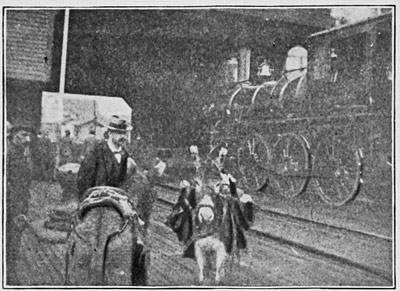
"Across on the exclusive Solano."
larger
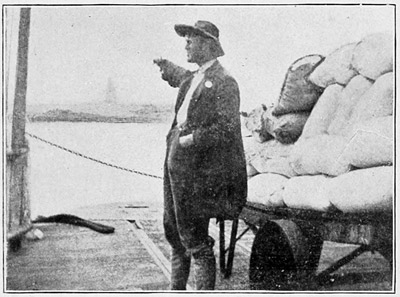
"I pointed toward the goal."
larger
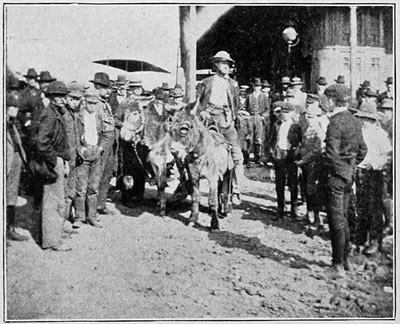
"The Ferry approach in 'Frisco was choked with a rabble."
I was grieved to part with Skates, who had piloted us
across the summits in that heavy storm, but the law must
be obeyed. I sold the donkey to a son of the hotel
landlord, who promised to cherish her as a pet. We
were allowed to proceed with the rest on condition that
neither of us would ride.
It was a long day's journey to the capital, upwards of
thirty miles, and we got under way by nine o'clock.
Coonskin and I could scarcely walk, and as we drove
our three jaded burros down the main street we were
cheered on every hand. After reaching the open country
Mac A'Rony, observing me screw my face and hearing
me sigh from pain, seemed to say: "I'm sorry, old
man, but when we are out of sight of those meddling
officers, get in the saddle and I will carry you a way."
The dear fellow; he could read me like a book.
We threaded a lovely country. The orchards were
denuded of fruit and verdure, but the vineyards were
laden with their white and pink and purple harvest, and
the waving alfalfa sent us whiffs from their fragrant
censers all along the trail. We stopped at the great
Sonora Vineyard to rest and enjoy some Muscat grapes;
and shortly after lunch hour, we rested again at a weighing
station, where I received a telephone message inquiring
when we might be expected at the capital.
Handkerchiefs and hats were waving from the balconies
of the Golden Eagle Hotel, Sacramento, and newsboys
were crying the arrival of Pod and Mac A'Rony
as we approached. While I had tramped most all of
the way from Folsom, I rode into the city, and after a
brief address at the hotel, sent my animals to the
stable.
The landlord welcomed me cordially, and I was immediately
assailed by reporters. The next morning a newspaper
man took me driving about the city. I was presented
to several state officials, and shown through the
handsomest state capitol grounds in the Union. Half
the day was devoted to business duties; in the evening I
delivered a lecture; and several times I was asked to escort
a party of ladies to the stable to see the donkey that
enjoyed the unrivaled distinction of having made a 4,000
mile journey from the Hudson to the Sacramento.
Next day we started for 'Frisco at eight a. m. Just
five days were left us in which to travel the ninety miles to
our goal. There were many who advised me to go by
way of Stockton, a longer journey by forty miles, cautioning
me that my donkeys would not be allowed to
cross in the "Solano" ferry at Benicia, which was reserved
strictly for people and passenger trains.
But we started on the shorter route, Mac and I leading
the way out of the beautiful city and along the banks
of the Sacramento River, through the toolies and hop
fields towards Davisville.
When yet a mile to town, Damfino while not even
carrying a saddle, staggered and showed symptoms of
the colic. The noble beast had done her duty on the
hard trip from Iowa, and being the biggest and strongest,
she had borne the heaviest burden. She had earned her
freedom. I decided to leave her by the roadside. Somebody
would soon find her, and take good care of her;
which I afterwards learned to be the case.
Next morning Coonskin and I set out early with the
remaining two donkeys, Mac A'Rony and Coxey, for
Suisun, some twenty-five miles away, we walking two-thirds
of the distance for the sake of our animals, although
augmenting our own sufferings, for our feet still
pained us. My dog, Don, on the other hand, was full of
health and abrim with mirth.
Suisun welcomed us at sunset. That evening a happy
idea came to mind; I would send Coonskin to Oakland
by train. Considerable business must be done there
which he could attend to, besides, he might arrange for
hotel and stable accommodations, and engage a blacksmith
to put on Mac A'Rony the silver shoes which
should be at the express office in that city. There was
left me three days in which to travel fifty miles, but now
I could ride alternately the two donks and not overtax
either.
I was received with usual courtesies at Benicia, and
the hotel swarmed with townspeople and guests to hear
about my trip.
At nine next morning a sympathetic crowd accompanied
me to the ferry, fully expecting to see my party
refused passage.
"You cannot board the Solano with your burros," said
the officer, positively; "the boat is strictly reserved for
passenger trains and people."
I did not show surprise, but calmly explained my overland
trip, and emphasized the importance of my reaching
'Frisco with Mac by noon of November 3.
"Will you send a message to the Southern Pacific's
head office at my expense?" I asked. The officer said
he would, and sent it. The answer soon came directing
the ferrymaster to pass Pod and party across on the exclusive
Solano and extend us every courtesy.
The officer seemed much astonished at receiving the
message. His obsequiousness made Mac A'Rony bray.
When the expected train arrived and the Solano left the
dock and the passengers realized that they were the first
to cross in the company of four-legged donkeys, they
treated to cigars and fruit and paid Mac A'Rony exceptional
homage.
Landing at Porte Costa, I was directed on the shortest
route to Oakland, and amid cheers and hearty well-wishes
started to climb the trail over the hills which
border the river from that point to some distance south.
It was after dark when, descending the bluffs and trailing
a few miles along the river, I rode into the little village
of San Pablo. The streets were quite deserted, and
the few men I talked with answered my inquiries in
Spanish. Finally, I entered a humble tavern whose Irish
proprietor directed me on the right road. Only a few
miles now lay between me and Oakland, and although
tired and hungry I did not stop for supper, but pushed
onward over the level road, now and then walking a half
mile to rest my tired yet uncomplaining mounts or to
ease my joints, until I rode into the city at midnight.
Coonskin met me on the road and cheered me with the
information that all the duties assigned to him were attended
to, then piloted me to the hotel and the animals to
the stable. After getting something to eat I retired.
Coonskin had interviewed the reporters, and the morning
press heralded my advent in long and sensational
notices. When I went to the stable everybody seemed
to identify me with the traveler pictured in the papers.
I inwardly chuckled when I thought of my dilapidated
garb and general unkempt appearance. I was still lame
and felt that I had walked around the world in eighty
days.
My poor little donks were lying down when I went to
their stalls. The twenty-eight-mile tramp of the preceding
day had told on them. Mac rose to his feet and stuck
up his nose to be rubbed.
"You have almost earned your pension, too," I said.
"But now come to the smith's to have your new shoes
put on. They are of pure silver, and befitting one that
has made such a record in the field of travel." The little
fellow smiled, and playfully pulled the handkerchief out
of my pocket while I adjusted his bridle. And when he
walked out of the shop "in" his pretty new shoes he
looked as proud as any lad in his first pair of pants.
Coonskin and I lunched early. The customary crowd
followed my party to the ferry, and some crossed with us
on the boat to 'Frisco. How happy I felt while drifting
over San Francisco Bay! I pointed toward the goal, and
to a bystander, said: "During my 340 days' journey, I
have had only a vague vision of the city before me, but
the day I started from New York I felt as confident of
reaching it as I do now." Several passengers laughed
incredulously; nevertheless I spoke the truth.
The ferry approach in 'Frisco was choked with a
rabble. Upon landing Coonskin and I rode our little
long-eared animals up Market street to a prominent
hotel, a cheering throng of men and street gamins tagging
behind or following by the walk on both sides of
the street. And when at two o'clock the glass doors to
its great white court were thrown open to us, I was just
twenty-two hours ahead of schedule time.
The several rows of balconies were crowded with hotel
guests and friends waving handkerchiefs and hats, and
cheer upon cheer rose to the crystal roof and descended
to our ears. The court was packed. I called a porter.
"Bring a rug for my silver-shod donkey to stand on,"
I ordered. The darkey looked mystified, and had the
insolence to question my strange request, but he soon
brought the rug. The reporters aided me to urge back
the crowd to give the spectators in the balconies a view
of Mac's silver-shod hoofs, all four of which Coonskin
lifted, one after the other, for them to see.
"Three cheers for Mac A'Rony!" some one shouted
from the balcony. It was the signal for a general outburst
of applause; and Mac, Coxey and Don, each, respectively,
brayed or bayed his deafening acknowledgment
of the popular ovation.
Then I briefly reviewed my long and tempestuous voyage
of 4,096 miles on a donkey's hurricane deck in 340
days and two hours. Frequently I was interrupted with
laughter or cheers, as I cited some ludicrous experience,
and the unbridled throng, many of them mere street
loungers, laughed and yelled and whistled until, finally,
the incensed manager was attracted to the Court. The
police were unable to cope with the crowd, so I was requested
to remove the cause of the disturbance. Indeed
I was grateful for the excuse to get away from that wild
scene. Coonskin took the animals to the stable, and I,
after registering, immediately sought a more exclusive
hotel, to whose landlord I bore a letter of introduction
from a distinguished gentleman friend.
I must have looked as if I had crossed Central Africa
and had fought fifty tribes of cannibals. My clothes, hat
and leggings were in shreds, my sleeves were fastened to
my coat with bale-wire, and blue cotton hung in view.
"Do you take tramps at this hotel?" I inquired of the
astonished clerk of the Occidental, as I leaned on the office
counter. He stopped sorting letters and eyed me with
curiosity, but before he recovered his reason, the junior
proprietor appeared, and said: "Sometimes," then with
a knowing smile extended his hand in greeting.
"I believe this is Mr. Pod," he said. I nodded and
handed him the letter. When he had read it the affable
young gentleman extended me the freedom of the hotel
and three days later got up a coaching party in my honor.
I was soon a transformed man. After a shave and
hair-cut and bath, I dressed and appeared at the office attired
as a gentleman on parade, and was hardly recognized
by the clerk to be the same man.
Coonskin, too, I had fitted out completely; besides I
gave him a sum of money and an honorable discharge.
In a few days he secured a situation in a hotel, but later
set out for a mining camp in the Sierras to dig for gold.
I presented one donkey to Golden Gate Park, and sold
the other, but I retained possession of my dog. Frequently
afterward I called at the park to see dear old faithful
Mac A'Rony.
In conclusion, let me state that I had eleven donkeys
on my overland trip, never more than five at one time.
I wore out ten pairs of boots, and put one hundred and
forty-eight shoes on my animals at an average cost of
ninety cents each, and arrived at my journey's end with
several hundred dollars in pocket and weighing thirty-three
pounds more than I did the day I set out from New
York with ninety-nine cents.
"I am as free as Nature first made man,
Ere the base laws of servitude began,
When wild in the woods the noble savage ran."
TOC
This tale will be hard to swallow, because truth is stronger
than fiction.
The trip was more healthful for Pod than for me.
There are four distinct distances across the American continent,
viz:
Three thousand miles as the crow flies.
Three thousand five hundred as the train steams.
Four thousand by overland trail for a man.
A million miles as a donkey goes.
The most monotonous constant companion for a long journey
is a man.
There are more people who descend to the level of a jackass
than donkeys that rise to the plane of man.
If Pye Pod had been killed or drowned, or had died on the
journey he would have been condemned and ridiculed as a fool
by the same people who now applaud and envy him for his
achievement.
If I had died on the first day of the trip the world would have
called me lucky; now that I lived through it, I'm d——d lucky!
M. A'R.

TRANSCRIBER ENDNOTE:
End-of-line hyphens have been retained or discarded to
maintain internal consistency, when possible.
In table of contents, for page 213, "XXVII." changed to "XXVIII."
For the page 219 entry, "Accross" changed to "Across".
Page 49: in "he did it them.", "them" to "then".
Page 50: the quotation mark at the end of the paragraph that ends
with "[...] to his quarters." has no obvious mate, unless at the
beginning of the paragraph on page 49 "Those who were not 'let in'
to [...]" If so, then this would be a long quotation containing five
paragraphs, with only two quotation marks, other than embedded short
quotations. It has been formatted (e.g. by indentation) as such herein.
Some instances of the odd use of quotation marks have been retained.
Others--which seemed clearly wrong or misleading, have been changed.
Some were changed silently, but a few of these are listed below.
Page 102: one "the" removed from "visiting the homes of the the
great".
Page 107: "protographs" to "photographs".
Page 109: "into his hay loft.." to "into his hay loft." Similar
corrections on page 121 and 126. Also fixed a double comma on page
255.
Page 120: "semed" to "seemed".
Page 130: "Exixer" to "Elixir". Missing quotation mark inserted
after "moral?".
Page 166: "accompained" to "accompanied".
Page 173: period added to the end of "The topography of the country
varied but little".
Page 190: period added to the end of a paragraph.
Page 193: quotation mark with no mate removed from start of
paragraph beginning with "I did not discuss further".
Page 200: quotation mark with no mate removed from "I recalled how I
had been swindled [...]".
Page 211: "wheeel" to "wheel".
Page 212: in "caught the animated beg before it", "beg" to "bag".
Page 216: missing quotation mark inserted for "a pity to have
[...]".
Page 218: "Fnally" to "Finally".
Page 224: "smaal" to "small".
Page 246: excess quotation mark removed after "companion.".
Page 253: "Hhat" to "That".
Page 258: "I thing the whole" to "I think the whole".
Page 260: "Buy" to "But".
Page 278: "comething" to "something". Also, "house" to "hours".
Page 308: missing quotation mark inserted. Also in illustration facing
page 312.
Page 313: missing "it" inserted.
Page 341: quotation mark inserted after "patient.".
Page 376: "I answered. coarsely," to "I answered coarsely,".
Page 377: quotation mark inserted after "of water,".
Page 381: "to save him-" to "to save himself."
Page 410: missing quotation mark inserted before "Ain't nobody livin'".
Also, extraneous single quote deleted after "blasted cat,". Also,
"wasn"t" to "wasn't".