§ 9. In former days, whenever a large camping-ground could not be
found, the Ponkas used to encamp in three concentric circles; while the
Omahas, who were a smaller tribe, pitched their tents in two similar
circles. This custom gave rise to the name "Oyate yamni," The Three
Nations, as the Ponkas were styled by the Dakotas, and the Omahas
became known as the Two Nations. But the usual order of encampment
has been to pitch all the tents in one large circle or horseshoe,
called "hú¢uga" by the Indians. In this circle the gentes took their
regular places, disregarding their gentile circles, and pitching the tents,
one after another, within the area necessary for each gens. This circle
was not made by measurement, nor did any one give directions where
each tent should be placed; that was left to the women.
When the people built a village of earth-lodges, and dwelt in it, they
did not observe this order of camping. Each man caused his lodge to
be built wherever he wished to have it, generally near those of his kindred.
But whenever the whole tribe migrated with the skin tents, as
when they went after the buffaloes, they observed this order. (See
§ 133.)
Sometimes the tribe divided into two parties, some going in one direction,
some in another. On such occasions the regular order of camping
was not observed; each man encamped near his kindred, whether
they were maternal or paternal consanguinities.
The crier used to tell the people to what place they were to go, and
when they reached it the women began to pitch the tents.
§ 10. The road along which they passed divided the tribal circle into
two equal parts; five gentes camped on the right of it and five pitched
their tents on its left. Those on the right were called the Hañgacenu,
and the others were known as the Ictasanda. The Hañgacenu gentes
are as follows: Wéjincte, Iñké-sábě, Hañ´ga, ₵átada, and [K]an´ze. The
Ictasanda gentes are as follows: Man`¢iñka-gáxe, [T]e-sĭn´de, [T]a-[p]á,
Iñg¢é-jide, and Ictásanda.
According to Wahan-¢iñge, the chief of the [T]e-sĭnde gens, there used
to be one hundred and thirty-three tents pitched by the Hañgacenu,
and one hundred and forty-seven by the Ictasanda. This was probably
the case when they went on the hunt the last time, in 1871 or 1872.
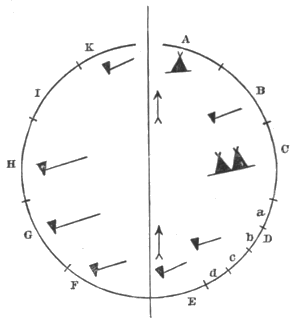
Fig. 12.—The Omaha tribal circle.
LEGEND. The Omaha tribal circle.
| Hañgacenu gentes. |
| |
| A. Wejincte, or Elk. |
| B. Iñke-sabě. |
| C. Hañga. |
| D. ₵atada: |
| a. Wasanbe-hit`ajĭ. |
| b. Wajiñga-¢atajĭ. |
| c. [T]e-[p]a-it`ajĭ. |
| d. [K]e-`in. |
| E. [K]anze. |
| |
| Ictasanda gentes. |
| |
| F. Mañ¢iñka-gaxe. |
| G. [T]e-sĭnde. |
| H. [T]a-[p]a. |
| I. Iñg¢e-jide. |
| K. Ictasanda. |
The sacred tents of the Wejincte and Hañga gentes are designated by appropriate figures; so also
are the seven gentes which keep the sacred pipes. The diameter of the circle represents the road
traveled by the tribe, A and K forming the gentes in the van.]
§ 11. Though they did not measure the distances, each woman knew
where to pitch her tent. Thus a [K]anze woman who saw a Wejincte tent set
up, knew that her tent must be pitched at a certain distance from that part
of the circle, and at or near the opposite end of the road or diameter of
the circle. When two tents were pitched too far apart one woman said
to the other, "Pitch the tent a little closer." Or, if they were too close,
she said, "Pitch the tent further away." So also if the tents of neighboring
gentes were too far apart or too close together. In the first case
the women of one gens might say, "Move along a little, and give us
more room." In the other they might say, "Come back a little, as there
is too much space between us." When the end gentes, Wejincte and
Ictasanda, were too far apart there was sometimes danger of attacks of
enemies. On one occasion the Dakotas made a dash into the very midst
of the circle and did much damage, because the space between these
two gentes was too great. But at other times, when there is no fear of
an attack, and when the women wish to dress hides, etc., the crier said:
"Halloo! Make ye them over a large tract of land." This is the only
occasion when the command is given how to pitch the tents.
When the tribe returned from the hunt the gentes encamped in reverse
order, the Wejincte and Ictasanda gentes having their tents at
the end of the circle nearest home.
There appear indications that there were special areas, not only for
the gentes, but even for the subgentes, all members of any subgens
having their lodges set up in the same area. Thus, in the Iñke-sabě
gens, there are some that camped next the Wejincte, and others next
the Hañga; some of the Hañga camped next the Iñke-sabě, and others
next the ₵atada, and so on. (See § 73.)
§ 12. Within the circle were placed the horses, as a precaution against
attacks from enemies. When a man had many horses and wished to
have them near him, he generally camped within the circle, apart from
his gens, but this custom was of modern origin, and was the exception
to the rule.
§ 13. The three sacred tents were pitched within the circle and near
their respective gentes: that of the Wejincte is the war tent, and it was
placed not more than 50 yards from its gens; those of the Hañga gens
are connected with the regulation of the buffalo hunt, etc.; or, we may
say that the former had to do with the protection of life and the latter
with the sustenance of life, as they used to depend mainly on the hunt
for food, clothing, and means of shelter.
§ 14. All the sacred pipes belong to the Hañga gens, though Hañga,
in ancient times, appointed the Iñke-sabě gens as the custodian of
them. (J. La Flèche and Two Crows.) The Iñke-sabě gens, however,
claims through its chief, Gahige, to have been the first owner of the
pipes; but this is doubtful. There are at present but two sacred
pipes in existence among the Omahas, though there are seven gentes
which are said to possess sacred pipes. These seven are as follows:
Three of the Hañgacenu, the Iñke-sabě, ₵atada, and [K]anze, and four
of the Ictasanda, the Man¢iñka-gaxe, [T]e-sĭnde, [T]a-[p]a, and Ictasanda.
The two sacred pipes still in existence are kept by the Iñke-sabě gens.
These pipes are called "Niniba waqube," Sacred Pipes, or "Niniba
jide," Red Pipes. They are made of the red pipestone which is found
in the famous red pipestone quarry. The stems are nearly flat and are
worked near the mouth-piece with porcupine quills.
§ 15. Gahige, of the Iñke-sabě gens, said that his gens had the seven
pipes at the first, and caused them to be distributed among the other
gentes. He named as the seven gentes who had the pipes, the following:
1. Iñke-sabě; 2. [T]e-[p]a-it`ajĭ sub-gens of the ₵atada; 3. Man¢iñka-gaxe;
4. [T]a-[p]a; 5. [T]e-sĭnde; 6. Ictasanda; 7. Hañga (sic). In order
to reach the Hañga again the seven old men had to go partly around
the circle a second time. These are the gentes that had pipes and
chiefs at the first. The chiefs of the three remaining gentes, the Wejincte,
[K]anze, and Iñg¢e-jide, were not made for years afterward. He
also said that the buffalo skull given to the [T]e-[p]a-it`ajĭ was regarded as
equivalent to a sacred pipe.
The writer is inclined to think that there is some truth in what Gahige
has said, though he cannot accept all of his statement. Gahige gives
one pipe to the Hañga gens; Two Crows intimated that his gens was
the virtual keeper of a pipe. But Anba-hebe's story shows that it was
not a real pipe, but the firebrand for lighting the pipes. In like manner,
[T]e-[p]a-it`ajĭ has not a real pipe, but the buffalo skull, which is considered
as a pipe. Hence, it may be that the men who are called
"keepers of the pipes" in the [K]anze, Man¢iñka-gaxe, [T]a-[p]a, [T]e-sĭnde,
and Ictasanda gentes never had real pipes but certain objects which
are held sacred, and have some connection with the two pipes kept by
the Iñke-sabě.
§ 16. The following is the tradition of the sacred pipes, according to
Anba-hebe, the aged historian of the Omahas:
The old men made seven pipes and carried them around the tribal circle. They
first reached Wejincte, who sat there as a male elk, and was frightful to behold, so
the old men did not give him a pipe. Passing on to the Iñke-sabě, they gave the first
pipe to the head of that gens. Next they came to Hañga, to whom they handed a
firebrand, saying, "Do thou keep the firebrand," i. e., "You are to thrust it into the
pipe-bowls." Therefore it is the duty of Hañga to light the pipes for the chiefs (sic).
When they reached the Bear people they feared them because they sat there with the
sacred bag of black bear-skin, so they did not give them a pipe. The Blackbird people
received no pipe because they sat with the sacred bag of bird-skins and feathers.
And the old men feared the Turtle people, who had made a big turtle on the ground,
so they passed them by. But when they saw the Eagle people they gave them a
pipe because they did not fear them, and the buffalo was good. (Others say that the
Eagle people had started off in anger when they found themselves slighted, but the
old men pursued them, and on overtaking them they handed them a bladder filled with
tobacco, and also a buffalo skull, saying, "Keep this skull as a sacred thing." This
appeased them, and they rejoined the tribe.) Next the old men saw the [K]anze, part
of whom were good, and part were bad. To the good ones they gave a pipe. The
Man¢iñka-gaxe people were the next gens. They, too, were divided, half being bad.
These bad ones had some stones at the front of their lodge, and they colored these
stones, as well as their hair, orange-red. They wore plumes (hinqpe) in their hair
(and a branch of cedar wrapped around their heads.—La Flèche), and were awful
to behold. So the old men passed on to the good ones, to whom they gave the
fourth pipe. Then they reached the [T]e-sĭnde, half of whom made sacred a buffalo,
and are known as those who eat not the lowest rib. Half of these were good, and they
received the fifth pipe. All of the [T]a-[p]a (Anba-hebe's own gens!) were good, and they
obtained the sixth pipe. The Iñg¢e-jide took one whole side of a buffalo, and stuck
it up, leaving the red body but partially buried in the ground, after making a tent
of the skin. They who carried the pipes around were afraid of them, so they did not
give them one. Last of all they came to the Ictasanda. These people were disobedient,
destitute of food, and averse to staying long in one place. As the men who had
the pipes wished to stop this, they gave the seventh pipe to the fourth subgens of the
Ictasanda, and since then the members of this gens have behaved themselves.
J. La Flèche and Two Crows say that "Wejincte loved his waqube,
the miʞasi, or coyote, and so he did not wish a pipe" which pertained to
peace. "Hañga does not light the pipes for the chiefs", that is, he does
not always light the pipes.
§ 17. The true division of labor appears to be as follows: Hañga was
the source of the sacred pipes, and has a right to all, as that gens had
the first authority. Hañga is therefore called "I¢ig¢an´qti aké," as he
does what he pleases with the pipes. Hañga told Íñke-sabě to carry
the pipes around the tribal circle; so that is why the seven old men did
so. And as Hañga directed it to be done, Iñke-sabě is called "A¢in´ aké,"
The Keeper. Ictasanda fills the pipes. When the Ictasanda man who
attends to this duty does not come to the council the pipes cannot be
smoked, as no one else can fill them. This man, who knows the ritual,
sends all the others out of the lodge, as they must not hear the ancient
words. He utters some words when he cleans out the pipe-bowl, others
when he fills the pipe, etc. He does not always require the same amount
of time to perform this duty. Then all return to the lodge. Hañga, or
rather a member of that gens, lights the pipes, except at the time of the
greasing of the sacred pole, when he, not Ictasanda, fills the pipes, and
some one else lights them for him. (See § 152.) These three gentes,
Hañga, Iñke-sabě, and Ictasanda, are the only rulers among the keepers
of the sacred pipes. The other keepers are inferior; though said to
be keepers of sacred pipes, the pipes are not manifest.
These seven niniba waqube are peace pipes, but the niniba waqube of
the Wejincte is the war pipe.
§ 18. The two sacred pipes kept by Iñke-sabě are used on various ceremonial
occasions. When the chiefs assemble and wish to make a decision
for the regulation of tribal affairs, Ictasanda fills both pipes and
lays them down before the two head chiefs. Then the Iñke-sabě keeper
takes one and the [T]e-[p]a it`ajĭ keeper the other. Iñke-sabě precedes,
starting from the head chief sitting on the right and passing around
half of the circle till he reaches an old man seated opposite the head chief.
This old man (one of the Hañga wag¢a) and the head chief are the only
ones who smoke the pipe; those sitting between them do not smoke it
when Iñke-sabě goes around. When the old man has finished smoking
Iñke-sabě takes the pipe again and continues around the circle to the
starting-point, but he gives it to each man to smoke. When he reaches
the head chief on the left he gives it to him, and after receiving it from
him he returns it to the place on the ground before the head chiefs.
When Iñke-sabě reaches the old man referred to [T]e-[p]a-it`ajĭ starts from
the head chiefs with the other pipe, which he hands to each one, including
those sitting between the second head chief and the old man.
[T]e-[p]a-it`ajĭ always keeps behind Iñke-sabě just half the circumference of
the circle, and when he receives the pipe from the head chief on the left he
returns it to its place beside the other. Then, after the smoking is over,
Ictasanda takes the pipes, overturns them to empty out the ashes, and
cleans the bowls by thrusting in a stick. (See §§ 111, 130, 296, etc.)
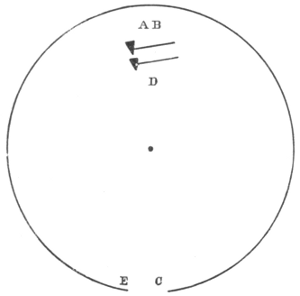
Fig. 13.—Places of the chiefs, etc., in the tribal
assembly.
A.—The first head chief, on the left. B.—The second
head chief, on the right. C.—The two Hañga
wag¢a, one being the old man whom Iñke-sabě
causes to smoke the pipe. D.—The place where
the two pipes are laid. The chiefs sit around in
a circle. E.—The giver of the feast.
In smoking they blew the smoke
upwards, saying, "Here, Wakanda,
is the smoke." This was done because
they say that Wakanda gave
them the pipes, and He rules over
them.
§ 19. Frank La Flèche told the
following:
The sacred pipes are not shown to the
common people. When my father was
about to be installed a head chief, Mahin-zi,
whose duty it was to fill the pipes, let one
of them fall to the ground, violating a law,
and so preventing the continuation of the
ceremony. So my father was not fully initiated.
When the later fall was partly
gone Mahin-zi died.
Wacuce, my father-in-law, was the Iñke-sabě
keeper of the pipes. When the Otos
visited the Omahas (in the summer of
1878), the chiefs wished the pipes to be taken out of the coverings, so they ordered
Wacuce to undo the bag. This was unlawful, as the ritual prescribed certain words
to be said by the chiefs to the keeper of the pipes previous to the opening of the bag.
But none of the seven chiefs know the formula. Wacuce was unwilling to break the
law; but the chiefs insisted, and he yielded. Then Two Crows told all the Omahas
present not to smoke the small pipe. This he had a right to do, as he was a Hañga.
Wacuce soon died, and in a short time he was followed by his daughter and his eldest
son.
It takes four days to make any one understand all about the laws of the sacred
pipes; and it costs many horses. A bad man, i. e., one who is saucy, quarrelsome
stingy, etc., cannot be told such things. This was the reason why the seven chiefs
did not know their part of the ritual.
§ 20. A child belongs to its father's gens, as "father-right" has succeeded
"mother-right." But children of white or black men are assigned
to the gentes of their mothers, and they cannot marry any women
of those gentes. A stranger cannot belong to any gens of the tribe,
there being no ceremony of adoption into a gens.
§ 21. This gens occupies the first place in the tribal circles, pitching
its tents at one of the horns or extremities, not far from the Ictasanda
gens, which camps at the other end. When the ancient chieftainship
was abolished in 1880, Mahin-¢iñge was the chief of this gens, having
succeeded Joseph La Flèche in 1865.
The word "Wejincte" cannot be translated, as the meaning of this
archaic word has been forgotten. It may have some connection with
"wajin´cte," to be in a bad humor, but we have no means of ascertaining
this.
La Flèche and Two Crows said that there were no subgentes in this
gens. But it seems probable that in former days there were subgentes
in each gens, while in the course of time changes occurred, owing to
decrease in numbers and the advent of the white men.
Taboo.—The members of this gens are afraid to touch any part of the
male elk, or to eat its flesh; and they cannot eat the flesh of the male
deer. Should they accidentally violate this custom they say that they
are sure to break out in boils and white spots on different parts of the
body. But when a member of this gens dies he is buried in moccasins
made of deer skin.
Style of wearing the hair.—The writer noticed that Binze-tig¢e, a boy
of this gens, had his hair next the forehead standing erect, and that
back of it was brushed forward till it projected beyond the former. A
tuft of hair at the back extended about 3 inches below the head. This
style of wearing the hair prevails only among the smaller children as
a rule; men and women do not observe it.
Some say that `An-wegan¢a is the head of those who join in the worship
of the thunder, but his younger brother, Qaga-man¢in, being a more
active man, is allowed to have the custody of the Iñg¢an¢ě and the
Iñg¢anhañgac`a. J. La Flèche and Two Crows said that this might be
so; but they did not know about it. Nor could they or my other informants
tell the meaning of Iñg¢an¢ě and Iñg¢anhañgac`a. Perhaps
they refer either to the wild-cat (iñg¢añga), or to the thunder (iñg¢an).
Compare the Ictasanda "keepers of the claws of a wild-cat."
§ 22. The sacred tent.—The sacred tent of the Elk gens is consecrated
to war, and scalps are given to it, but are not fastened to it, as some
have asserted. B¢anti used to be the keeper of it, but he has resigned
the charge of it to the ex-chief, Mahin-¢iñge.
The place of this sacred tent is within the tribal circle, and near the
camping place of the gens. This tent contains one of the wa¢íxabe, a
sacred bag, made of the feathers and skin of a bird, and consecrated to
war. (See § 196.) There is also another sacred bag in this tent, that
which holds the sacred ʇíhaba or clam shell, the bladder of a male elk
filled with tobacco, and the sacred pipe of the gens, the tribal war-pipe,
which is made of red pipe-stone. The ʇihaba is about nine inches in
diameter, and about four inches thick. It is kept in a bag of buffalo
hide which is never placed on the ground. In ancient days it was carried
on the back of a youth, but in modern times, when a man could not
be induced to carry it, it was put with its buffalo-skin bag into the skin
of a coyote, and a woman took it on her back. When the tribe is not
in motion the bag is hung on a cedar stick about five feet high, which
had been planted in the ground. The bag is fastened with some of the
sinew of a male elk, and cannot be opened except by a member of the
Wasabe-hit`ajĭ sub-gens of the ₵atada. (See § 45, etc.)
§ 23. Service of the scouts.—When a man walks in dread of some unseen
danger, or when there was an alarm in the camp, a crier went
around the tribal circle, saying, "Majan´ i¢égasañga té wí á¢inhe+!" I
who move am he who will know what is the matter with the land! (i. e.,
I will ascertain the cause of the alarm.) Then the chiefs assembled
in the war tent, and about fifty or sixty young men went thither. The
chiefs directed the Elk people to make the young men smoke the sacred
pipe of the Elk gens four times, as those who smoked it were compelled
to tell the truth. Then one of the servants of the Elk gens took out
the pipe and the elk bladder, after untying the elk sinew, removed some
of the tobacco from the pouch (elk bladder), which the Elk men dare
not touch, and handed the pipe with the tobacco to the Elk man, who
filled it and lighted it. They did not smoke with this pipe to the four
winds, nor to the sky and ground. The Elk man gave the pipe to one
of the bravest of the young men, whom he wished to be the leader of
the scouts. After all had smoked the scouts departed. They ran around
the tribal circle, and then left the camp. When they had gone about
20 miles they sat down, and the leader selected a number to act as policemen,
saying, "I make you policemen. Keep the men in order. Do
not desire them to go aside." If there were many scouts, about eight
were made policemen. Sometimes there were two, three, or four leaders
of the scouts, and occasionally they sent some scouts in advance to
distant bluffs. The leaders followed with the main body. When they
reached home the young men scattered, but the leaders went to the Elk
tent and reported what they had ascertained. They made a detour, in
order to avoid encountering the foe, and sometimes they were obliged
to flee to reach home. This service of the young men was considered
as equivalent to going on the war path.
§ 24. Worship of the thunder in the spring.—When the first thunder is
heard in the spring of the year the Elk people call to their servants,
the Bear people, who proceed to the sacred tent of the Elk gens. When
the Bear people arrive one of them opens the sacred bag, and, after removing
the sacred pipe, hands it to one of the Elk men, with some of
the tobacco from the elk bladder. Before the pipe is smoked it is held
toward the sky, and the thunder god is addressed. Joseph La Flèche
and Two Crows do not know the formula, but they said that the following
one, given me by a member of the Ponka Hisada (Wasabe-hit`ajĭ)
gens, may be correct. The thunder god is thus addressed by the Ponkas:
"Well, venerable man, by your striking (with your club) you are
frightening us, your grandchildren, who are here. Depart on high.
According to [P]á¢innanpájĭ, one of the Wasabe-hit`ajĭ, who has acted as
a servant for the Elk people, "At the conclusion of this ceremony the
rain always ceases, and the Bear people return to their homes." But
this is denied by Joseph La Flèche and Two Crows, who say, "How is
it possible for them to stop the rain?"
While the Elk gens is associated with the war path, and the worship
of the thunder god, who is invoked by war chiefs, those war chiefs are
not always members of this gens, but when the warriors return, the
keeper of the sacred bag of this gens compels them to speak the truth
about their deeds. (See § 214.)
§ 25. Birth names of boys.—The following are the birth names of boys
in the Elk gens. These are sacred or nikie names, and sons used to
be so named in former days according to the order of their births. For
example, the first-born son was called the Soft Horn (of the young elk
at its first appearance). The second, Yellow Horn (of the young elk
when a little older). The next, the Branching Horns (of an elk three
years old). The fourth, the Four Horns (of an elk four years old). The
fifth, the Large Pronged Horns (of an elk six or seven years old). The
sixth, the Dark Horns (of a grown elk in summer). The seventh, the
Standing White Horns, in the distance (i. e., those of a grown elk in
winter).
For instance, when, in any household, a child is named Wasabe-jiñga, that name cannot
be given to any new-born child of that gens. But when the first bearer of the name
changes his name or dies, another boy can receive the name Wasabe-jiñga. As that
is one of the seven birth names of the Wasabe-hit`ajĭ it suggests a reason for having
extra nikie names in the gens. This second kind of nikie names may have been birth
names, resorted to because the original birth names were already used. This law applies
in some degree to girls' names, if parents know that a girl in the gens has a certain
name they cannot give that name to their daughter. But should that name be chosen
through ignorance, the two girls must be distinguished by adding to their own names
those of their respective fathers.]
Other proper names.—The following are the other nikie3 names of
the Elk gens: Elk. Young Elk. Standing Elk. White Elk (near by).
Big Elk. `An-wegan¢a (meaning uncertain). B¢an-ti, The odor of the
dung or urine of the elk is wafted by the wind (said of any place where the
elk may have been). (A young elk) Cries Suddenly. Hidaha (said to mean
Treads on the ground in walking, or, Passes over what is at the bottom).
Iron Eyes (of an elk). Bullet-shaped Dung (of an elk). (Elk) Is coming
back—fleeing from a man whom he met. Muscle of an elk's leg. Elk
comes back suddenly (meeting the hunter face to face). (Elk) Turns
round and round. No Knife or No Stone (probably referring to the
tradition of the discovery of four kinds of stone). Dark Breast (of an
elk). Deer lifts its head to browse. Yellow Rump (of an elk). Walking
Full-grown Elk. (Elk) Walks, making long strides, swaying from side to
side. Stumpy Tail (of an elk). Forked Horn (of a deer). Water-monster.
The Brave Wejincte (named after his gens). Women's names.—Female
Elk. Tail Female. Black Moose(?) Female. Big Second-daughter (any
gens can have it). Sacred Third-daughter (Elk and Iñke-sabě gentes).
Iron-eyed Female (Elk and Hañga gentes). Land Female (Elk and
₵atada gentes). Moon that Is-traveling (Elk, Iñke-sabě, Hañga, ₵atada,
and [K]anze gentes); Nan-ze-in-ze, meaning uncertain (Elk, ₵atada, and
Deer gentes). Ninda-win (Elk, ₵atada, and Ictasanda gentes). Names
of ridicule.—Dog. Crazed by exposure to heat. Good Buffalo.
§ 26. According to [T]e-da-u¢iqaga, the chief Anpan-ʇañga, the younger,
had a boat and flag painted on the outside of his skin tent. These were
made "qube," sacred, but were not nikie, because they were not transmitted
from a mythical ancestor.
§ 27. This gens has furnished several head chiefs since the death of
the famous Black Bird. Among these were Anpan-skă (head chief after
1800), Anpan-ʇañga, the elder, the celebrated Big Elk, mentioned by
Long and other early travelers, and Anpan-ʇañga, the younger. On the
death of the last, about A.D. 1853, Joseph La Flèche succeeded him
as a head chief.
§ 28. This is a Buffalo gens, and its place in the tribal circle is next to
that of the Elk gens. The head chiefs of this gens in 1880 were Gahige
(who died in 1882), and Duba-man¢in, who "sat on opposite sides of
the gentile fire-place." Gahige's predecessor was Gahige-jiñga or Icka-dabi.
Creation myth, told by Gahige.—The first men created were seven
in number. They were all made at one time. Afterwards seven women
were made for them. At that time there were no gentes; all the people
were as one gens. (Joseph La Flèche and Two Crows never heard
this, and the following was new to them:)
Mythical origin of the Iñke-sabě, as related by Gahige.—The Iñke-sabě
were buffaloes, and dwelt under the surface of the water. When
they came to the surface they jumped about in the water, making it
muddy; hence the birth-name for the first son, Ni-gaqude. Having
reached the land they snuffed at the four winds and prayed to them.
The north and west winds were good, but the south and east winds were
bad.
§ 29. Ceremony at the death of a member of the gens.—In former days,
when any member of the gens was near death, he was wrapped in a
buffalo robe, with the hair out, and his face was painted with the privileged
decoration. Then the dying person was addressed thus: "You are
going to the animals (the buffaloes). You are going to rejoin your ancestors.
(Ániʇa dúbaha hné. Wackañ´-gă, i. e.) You are going, or, Your
four souls are going, to the four winds. Be strong!" All the members
of this gens, whether male or female, were thus attired and spoken to
when they were dying. (La Flèche and Two Crows say that nothing is
said about four souls, and that "Wackañ-gă" is not said; but all the
rest may be true. See § 35 for a similar custom.) The "hañga-ʞi`anze,"
or privileged decoration, referred to above and elsewhere in this monograph,
is made among the Omahas by painting two parallel lines across
the forehead, two on each cheek and two under the nose, one being
above the upper lip and the other between the lower lip and the
chin.
§ 30. When the tribe went on the buffalo hunt and could get skins
for tents it was customary to decorate the outside of the principal Iñke-sabě
tent, as follows, according to [T]e-[p]a-u¢iqaga: Three circles were
painted, one on each side of the entrance to the tent, and one at the
back, opposite the entrance. Inside each of these was painted a buffalo-head.
Above each circle was a pipe, ornamented with eagle feathers.
Frank La Flèche's sketch is of the regular peace pipe; but his father
drew the calumet pipe, from which the duck's head had been taken and
the pipe-bowl substituted, as during the dancing of the Hedewatci. (See
§§ 49 and 153.)
A model of the principal [T]e-[p]a-it`ajĭ tent, decorated by a native artist,
was exhibited by Miss Alice C. Fletcher, at the session of the American
Association at Montreal in 1882. It is now at the Peabody Museum.
Iñke-sabě style of wearing the hair.—The smaller boys have their hair
cut in this style. A A, the horns of the buffalo, being two locks of
hair about two inches long. B is a fringe of hair all around the head.
It is about two inches long. The rest of the head is shaved bare.
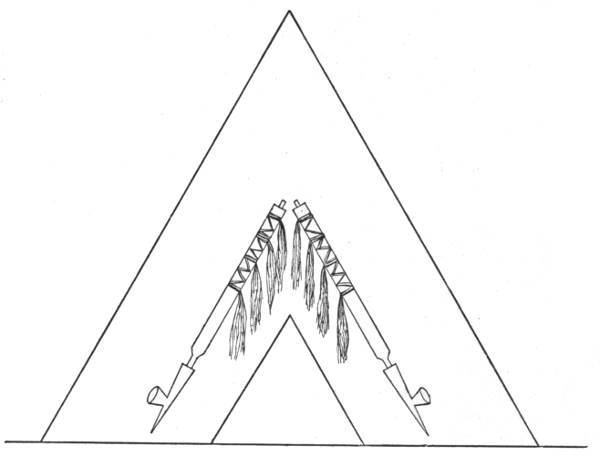
Fig. 14.—Frank La Flèche's sketch of the Iñke-sabě tent, as he saw it when he went on the buffalo
hunt.
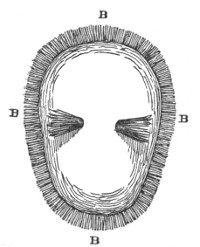
Fig. 15.—Iñke-sabě style of wearing the hair.
§ 31. Subgentes and Taboos.—There has evidently been a change in
the subgentes since the advent of the white man. In 1878, the writer
was told by several, including La Flèche, that there were then three subgentes
in existence, Wa¢ígije, Watan´zi-jíde ¢atájĭ, and Naq¢é-it`abájĭ
the fourth, or Íekí¢ě, having become extinct.
Now (1882), La Flèche and Two Crows give the
three subgentes as follows: 1. Wa¢ígije; 2.
Niníba t`an; 3. (a part of 2) Íekí¢ě. The second
subgens is now called by them "Watan´zi-ji´de
¢atájĭ and Naq¢é ít`abájĭ." "[T]an¢in-nanba and
Nágu or Wa¢ánase are the only survivors of the
real Niniba-t`an, Keepers of the Sacred Pipes."
(Are not these the true Naq¢é-ít`ábájĭ, They
who cannot touch charcoal? I. e., it is not their
place to touch a fire-brand or the ashes left in
the sacred pipes after they have been used.)
"The Sacred Pipes were taken from the ancestors
of these two and were given into the charge of Ickadabi, the paternal
grandfather of Gahige." Yet these men are still called Niniba-t`an,
while "Gahige belongs to the Watanzi-jide ¢atajĭ and Naq¢e-it`abajĭ, and
he is one of those from whom the Iekí¢ě could be selected."
In 1878 La Flèche also gave the divisions and taboos of the Iñke-sabě
as follows: "1. Niniba-t`an; 2. Watanzi-jide ¢atajĭ 3. [T]e-hé-sábě
it`ájĭ 4. [T]e-¢éze¢atájĭ" but he did not state whether these were distinct
subgentes. The [T]e-he-sabě it`ajĭ, Those who touch not black horns
(of buffaloes), appear to be the same as the [T]e-¢eze ¢atajĭ, i. e., the
Wa¢ígije. The following is their camping order: In the tribal circle,
the Wa¢ígije camp next to the Hañga gens, of which the Wacabe people
are the neighbors of the Wa¢igije, having almost the same taboo. The
other Iñke-sabě people camp next to the Wejincte gens. But in the
gentile "council-fire" a different order is observed; the first becomes
last, the Wa¢igije having their seats
on the left of the fire and the door,
and the others on the right.
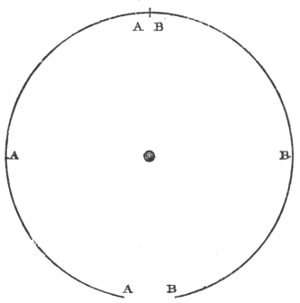
Fig. 16.—The Iñke-sabě Gentile Assembly.A.—The
Wa¢igije, or Waqúbe gáxe aká, under Duba-man¢in.
B.—The Watanzi-jide ¢atajĭ the Ieki¢ě,
and the Naq¢e-it`abajĭ. These were under Gahige.
The Wa¢igije cannot eat buffalo
tongues, and they are not allowed
to touch a buffalo head. (See §§
37, 49, and 50.) The name of their
subgens is that of the hooped rope,
with which the game of "[P]a¢in-jahe"
is played. Gahige told the
following, which is doubted by La
Flèche and Two Crows: "One day,
when the principal man of the
Wa¢igije was fasting and praying
to the sun-god, he saw the ghost of
a buffalo, visible from the flank up,
arising out of a spring. Since then the members of his subgens have
abstained from buffalo tongues and heads."
Gahige's subgens, the Watanzi-jide ¢atajĭ, do not eat red corn. They
were the first to find the red corn, but they were afraid of it, and would
not eat it. Should they eat it now, they would have running sores all
around their mouths. Another tradition is that the first man of this
subgens emerged from the water with an ear of red corn in his hand.
The Ieki¢ě are, or were, the Criers, who went around the tribal circle
proclaiming the decisions of the chiefs, etc.
Prior to 1878, Wacuce, Gahige's brother, was the keeper of the two
sacred pipes. At his death, in that year, his young son succeeded him
as keeper; but, as he was very young, he went to the house of his
father's brother, Gahige, who subsequently kept the pipes himself.
§ 32. Gahige said that his subgens had a series of Eagle birth-names,
as well as the Buffalo birth-names common to the whole gens. This
was owing to the possession of the sacred pipes. While these names
may have denoted the order of birth some time ago, they are now bestowed
without regard to that, according to La Flèche and Two Crows.
Buffalo birth-names.—The first son was called "He who stirs up or
muddies the water by jumping in it," referring to a buffalo that lies
down in the water or paws in the shallow water, making it spread out
in circles. The second son was "Buffaloes swimming in large numbers
across a stream." The third was [S]i-ʞan-qega, referring to a buffalo
calf, the hair on whose legs changes from a black to a withered or dead
hue in February. The fourth was "Knobby Horns (of a young buffalo
bull)". The fifth was "He (i. e., a buffalo bull) walks well, without fear
of falling." The sixth was "He (a buffalo bull) walks slowly (because
he is getting old)." The seventh was called Gaqaʇa-najin, explained by
the clause, "ʇenúga-wináqtci, júg¢e ¢iñgé, a single buffalo bull, without
a companion." It means a very old bull, who stands off at one side
apart from the herd.
The Eagle birth-names (see § 64), given by Gahige, are as follows:
Qi¢á-in4 (meaning unknown to La Flèche and Two Crows; word doubted
by them). Eagle Neck. Wajin-hañga, He who leads in disposition.
Kinka-ʇañga, the first bird heard in the spring when the grass comes
up (the marbled godwit?). Blue Neck (denied by La Flèche and Two
Crows). Rabbit (La Flèche and Two Crows said that this name belonged
to the Hañga gens). Ash tree (doubted by La Flèche and Two
Crows). A birth-name of this series could be used instead of the corresponding
one of the gentile series, e. g., Gahige could have named
his son, Ukanadig¢an, either Siʞan-qega or Wajin-hañga. There were
similar series of birth-names for girls, but they have been forgotten.
§ 33. Principal Iñke-sabě names.—I. Men.—(Buffalo that) Walks
Last in the herd. (Buffalo) Runs Among (the people when chased by
the hunters). Four (buffaloes) Walking. Black Tongue (of a buffalo).
The Chief. Real Chief. Young Chief. Walking Hawk. Without any
one to teach him (i. e., He knows things of his own accord). (Buffalo)
Makes his own manure miry by treading in it. Horns alone visible
(there being no hair on the young buffalo bull's head). Little (buffalo)
with Yellowish-red hair. He who practices conjuring. Thick Shoulder
(of a buffalo). (Buffalo) Comes suddenly (over the hill) meeting the
hunters face to face. Swift Rabbit. Rabbit (also in Hañga gens). He
who talks like a chief; referring to the sacred pipes. Big Breast (of a
buffalo). Seven (some say it refers to the seven sacred pipes). (He
who) Walks Before (the other keepers of the sacred pipes). Badger.
Four legs of an animal, when cut off. Bent Tail. Double or Cloven
Hoofs (of a buffalo). Yonder Stands (a buffalo that) Has come back
to you. Buffalo runs till he gets out of range of the wind. Little
Horn (of a buffalo). Two (young men) Running (with the sacred pipes
during the Hede-watci). Skittish Buffalo Calf. Foremost White Buffalo
in the distance. Looking around. (Buffalo?) Walks Around it.
(Buffalo) Scattering in different directions. Big Boiler (a generous
man, who put two kettles on the fire). (Buffalo) Sits apart from the
rest. He who makes one Stagger by pushing against him. He who
speaks saucily. Difficult Disposition or Temper (of a growing buffalo
calf). The Shooter. He who fears no seen danger. Young Turkey.
II. Women.—Sacred Third-daughter. She by Whom they were made
Human beings (see Osage tradition of the Female Red Bird). Moon
in Motion during the Day. Moon that Is traveling. Moon Has come
back Visible. Foremost or Ancestral Moon (first quarter?). Visible
Moon. White Ponka (female) in the distance. Precious Female. Visible
one that has Returned, and is in a Horizontal attitude. Precious
Buffalo Human-female. Buffalo Woman.
§ 34. Hañga seems to mean, "foremost," or "ancestral." Among the
Omahas this gens is a buffalo gens; but among the Kansas and Osages
it refers to other gentes. In the Omaha tribal circle, the Hañga people
camp next to the Iñkě-sabe. Their two chiefs are Two Crows and Icta-basude,
elected in 1880. The latter was elected as the successor of his
father, "Yellow Smoke," or "Two Grizzly Bears."
Mythical origin of the gens.—According to Yellow Smoke, the first
Hañga people were buffaloes and dwelt beneath the water. When they
were there they used to move along with their heads bowed and their
eyes closed. By and by they opened their eyes in the water; hence
their first birth-name, Niadi-icta-ugab¢a. Emerging from the water,
they lifted their heads and saw the blue sky for the first time. So they
assumed the name of [K]e¢a-gaxe, or "Clear sky makers." (La Flèche,
in 1879, doubted whether this was a genuine tradition of the gens; and
he said that the name Niadi-icta-ugab¢a was not found in the Hañga
gens; it was probably intended for Niadi-ctagabi. This referred to a
buffalo that had fallen into mud and water, which had spoiled its flesh
for food, so that men could use nothing but the hide. Two Crows said
that Niadi-ctagabi was an ancient name.)
§ 35. Ceremony at the death of a member of the gens.—In former days,
when any member of the gens was near death he was wrapped in a
buffalo robe, with the hair out, and his face was painted with the "hañga-ʞi`anze."
Then the dying person was thus addressed by one of his
gens: "You came hither from the animals. And you are going back
thither. Do not face this way again. When you go, continue walking."
(See § 29.)
§ 36. The sacred tents.—There are two sacred tents belonging to this
gens. When the tribal circle is formed these are pitched within it,
about 50 yards from the tents of the gens. Hence the proper name,
U¢uci-najin. A straight line drawn from one to the other would bisect
the road of the tribe at right angles.
The sacred tents are always together. They pertain to the buffalo
hunt, and are also "wéwaspe," having a share in the regulative system
of the tribe, as they contain two objects which have been regarded as
"Wakañda égan," partaking of the nature of deities.
These objects are the sacred pole or "waq¢éxe," and the "ʇe-san´-ha."
The decoration of the outside of each sacred tent is as follows: A cornstalk
on each side of the entrance and one on the back of the tent,
opposite the entrance. (Compare the ear of corn in the calumet dance.
See §§ 123 and 163.)
Tradition of the sacred pole.—The "waq¢exe," "jan´ waqúbe," or sacred
pole, is very old, having been cut more than two hundred years
ago, before the separation of the Omahas, Ponkas, and Iowas. The
Ponkas still claim a share in it, and have a tradition about it, which is
denied by La Flèche and Two Crows. The Ponkas say that the tree
from which the pole was cut was first found by a Ponka of the Hisada
gens, and that in the race which ensued a Ponka of the Makan gens
was the first to reach the tree. The Omahas tell the following:
At the first there were no chiefs in the gentes, and the people did not prosper. So
a council was held, and they asked one another, "What shall we do to improve our
condition?" Then the young men were sent out. They found many cotton-wood
trees beside a lake, but one of these was better than the rest. They returned and reported
the tree, speaking of it as if it was a person. All rushed to the attack. They
struck it and felled it as if it had been a foe. They then put hair on its head, making
a person of it. Then were the sacred tents made, the first chiefs were selected, and
the sacred pipes were distributed.
The sacred pole was originally longer than it is now, but the lower
part having worn out, a piece of ash-wood, about 18 inches long, has
been fastened to the cotton-wood with a soft piece of cord made of a
buffalo hide. The ash-wood forms the bottom of the pole, and is the
part which is stuck in the ground at certain times. The cotton-wood is
about 8 feet long.

Fig. 17.—The sacred pole.
A.—The place where the two pieces of wood are joined.
B.—The aqande-pa or hin-qpe-i¢iban, made of the down of the minxa (a swan. See the Man¢iñka gaxe
gens.)
C.—The scalp, fastened to the top, whence the proper name, Nik'uminje, Indian-man's (scalp) couch.
Two Crows said that the pole rested on the scalp when it was in the
lodge. The proper name, Min-wasan, referring to the minxasan or swan,
and also to the aqande-pa (B). The proper name, "Yellow Smoke"
(rather), "Smoked Yellow," or Cude-nazi, also refers to the pole, which
has become yellow from smoke. Though a scalp is fastened to the top,
the pole has nothing to do with war. But when the Omahas encounter
enemies, any brave man who gets a scalp may decide to present it to
the sacred pole. The middle of the pole has swan's down wrapped
around it, and the swan's down is covered with cotton-wood bark, over
which is a piece of ʇéha (buffalo hide) about 18 inches square. All the
ʇeha and cord is made of the hide of a hermaphrodite buffalo. This
pole used to be greased every year when they were about to return home
from the summer hunt. The people were afraid to neglect this ceremony
lest there should be a deep snow when they traveled on the next
hunt.
When Joseph La Flèche lost his leg, the old men told the people that
this was a punishment which he suffered because he had opposed the
greasing of the sacred pole. As the Omahas have not been on the hunt
for about seven years, the sacred tents are kept near the house of Wakan-man₵in.
(See § 295.)
The other sacred tent, which is kept at present by Wakan-man₵in, contains
the sacred "ʇe-san´-ha," the skin of a white buffalo cow, wrapped
in a buffalo hide that is without hair.
Joseph La Flèche had two horses that ran away and knocked over
the sacred tents of the Hañga gens. The two old men caught them and
rubbed them all over with wild sage, saying to Frank La Flèche, "If
you let them do that again the buffaloes shall gore them."
§ 37. Subgentes and Taboos.—There are two great divisions of the
gens, answering to the number of the sacred tents: The Keepers of the
Sacred Pole and The Keepers of the [T]e-san-ha. Some said that there
were originally four subgentes, but two have become altogether or
nearly extinct, and the few survivors have joined the larger subgentes.
There are several names for each subgens. The first which is sometimes
spoken of as being "Jan´ha-aʇá¢ican," pertaining to the sacred
cotton-wood bark, is the "Waq¢éxe a¢in´" or the "Jan´ waqúbe a¢in´,"
Keepers of the Sacred Pole. When its members are described by their
taboos, they are called the "[T]á waqúbe ¢atájĭ," those who do not eat
the "ʇa" or buffalo sides; and "Minxa-san ¢atájĭ" and "[P]étan ¢atájĭ,"
those who do not eat geese, swans, and cranes. These can eat the
buffalo tongues. The second subgens, which is often referred to as
being "[T]e-san´-ha-ʇá¢ican," pertaining to the sacred skin of the white
buffalo cow, consists of the Wacábe or Hañ´gaqti, the Real Hañga people.
When reference is made to their taboo, they are called the "[T]e¢éze ¢atájĭ,"
as they cannot eat buffalo tongues; but they are at liberty
to eat the "ʇa," which the other Hañga cannot eat. In the tribal circle
the Wacabe people camp next to the Iñke-sabě gens; and the Waq¢éxe
a¢in have the Quʞa of the ₵atada] gens next to them, as he is their servant
and is counted as one of their kindred. But, in the gentile circle,
the Waq¢éxe a¢in occupy the left side of the "council-fire," and the
Wacabe sit on the opposite side.
§ 38. Style of wearing the hair.—The Hañga style of wearing the hair
is called "ʇe-nañ´ka-báxe," referring originally to the back of a buffalo.
It is a crest of hair, about 2 inches long, standing erect, and extending
from one ear to the other. The ends of the hair are a little below
the ears.
§ 39. Birth-names of boys, according to [P]a¢in-nanpajĭ. The first is
Niadi ctagabi; the second, Jan-gáp'uje, referring to the Sacred Pole.
It may be equivalent to the Dakota Tcan-kap'oja (Ćaŋ-kapoźa), meaning
that it must be carried by one unencumbered with much baggage.
The third is named Man pějĭ, Bad Arrow, i. e., Sacred Arrow, because
the arrow has grown black from age! (Two Crows gave this explanation.
It is probable that the arrow is kept in or with the "ʇe-san-ha.")
The fourth is Fat covering the outside of a buffalo's stomach. The
fifth is Buffalo bull. The sixth, Dangerous buffalo bull; and the seventh
is Buffalo bull rolls again in the place where he rolled formerly.
§ 40. Principal Hañga names. I. Men.—(Buffalo) Makes a Dust by
rolling. Smoked Yellow ("Yellow Smoke"). (Buffalo) WalksinaCrowd.
He who makes no impression by Striking. Real Hañga. Short Horns
(of a buffalo about two years old). (Buffalo calf) Sheds its hair next to
the eyes. Two Crows. Flying Crow. He who gives back blow for blow,
or, He who gets the better of a foe. Grizzly bear makes the sound
"ʇide" by walking. Grizzly bear's Head. Standing Swan. He (a buffalo?)
who is Standing. (Buffalo?) That does not run. (Buffalo) That
runs by the Shore of a Lake. Seven (buffalo bulls) In the Water.
Pursuer of the attacking foe. Scalp Couch. Pointed Rump (of a buffalo?).
Artichoke. Buffalo Walks at Night. A Buffalo Bellows. Odor
of Buffalo Dung. Buffalo Bellows in the distance. (Sacred tent) Stands
in the Middle (of the circle). Seeks Fat meat. Walking Sacred one.
Corn. He who Attacks.
II. Women.—Iron-eyed Female. Moon that is Traveling. White Human-female
Buffalo in the distance.
§ 41. This gen occupies the fourth place in the tribal circle, being between
the Hañga and the [K]anze. But, unlike the other gentes, its subgentes
have separate camping areas. Were it not for the marriage law,
we should say that the ₵atada was a phratry, and its subgentes were
gentes. The present leaders of the gens are [P]edegahi of the Wajiñga-¢atajĭ
and Cyu-jiñga of the Wasabe-hit`ajĭ. When on the hunt the four
subgentes pitch their tents in the following order in the tribal circle:
1. Wasabe-hit`ajĭ 2. Wajiñga ¢atajĭ 3. [T]e-da-it`ajĭ 4. [K]e-`in. The Wasabe-hit`ajĭ
are related to the Hañga on the one hand and to the Wajiñga-¢atajĭ
on the other. The latter in turn, are related to the [T]e-da-itajĭ
these are related to the [K]e-`in; and the [K]e-`in and [K]anze are related.
§ 42. The name of this subgens is derived from three words: wasabe,
a black bear; ha, a skin; and it`ajĭ, not to touch; meaning "Those who do
not touch the skin of a black bear." The writer was told in 1879, that
the uju, or principal man of this subgens, was Icta-duba, but La Flèche
and Two Crows, in 1882, asserted that they never heard of an "uju" of
a gens.
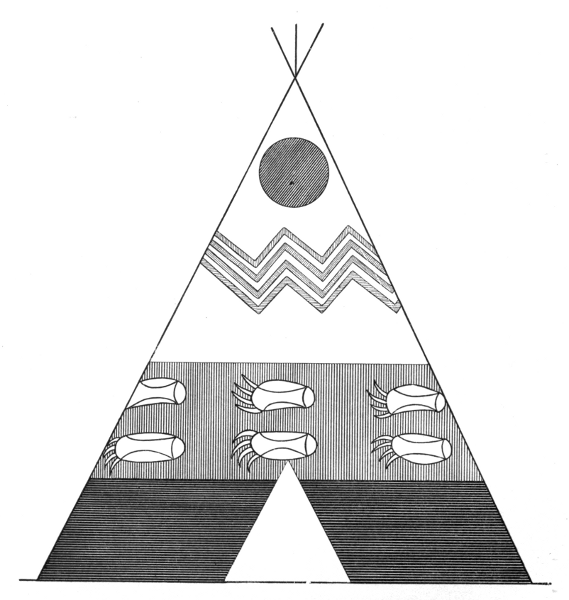
TENT OF AGAHA-WACUCE.
Taboo.—The members of this subgens are prohibited from touching
the hide of a black bear and from eating its flesh.
Mythical origin.—They say that their ancestors were made under the
ground and that they afterwards came to the surface.
§ 43. Plate II is a sketch of a tent which belonged to Agaha-wacuce,
the father of [P]a¢in-nanpajĭ. Hupe¢a's father, Hupe¢a II, owned it
before Agaha-wacuce obtained it. The circle at the top representing a
bear's cave, is sometimes painted blue. Below the zigzag lines (representing
the different kinds of thunders?) are the prints of bear's paws.
This painting was not a nikie but the personal "qube" or sacred thing
of the owner. The lower part of the tent was blackened with ashes or
charcoal.
§ 44. Style of wearing the hair.—Four short locks are left on the head,
as in the following diagram. They are about 2 inches long.
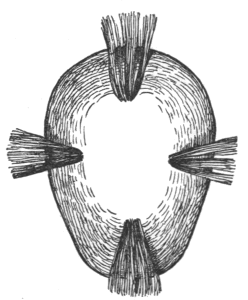
Fig. 18.—Wasabe-hit`ajĭ style of wearing the hair.
Birth-names of boys.—[P]a¢in-nanpajĭ gave
the following: The first son is called Young
Black bear. The second, Black bear. The
third, Four Eyes, including the true eyes and
the two spots like eyes that are above the
eyes of a black bear. The fourth, Gray Foot.
The fifth, Cries like a Raccoon. (La Flèche
said that this is a Ponka name, but the
Omahas now have it.) The sixth, Nídahan,
Progressing toward maturity (sic). The
seventh, He turns round and round suddenly
(said of both kinds of bears).
§ 45. Sections of the subgens.—The Wasabe-hit`ajĭ people are divided into sections. [P]a¢in-nanpajĭ
and others told the writer that they consisted of four divisions:
Black bear, Raccoon, Grizzly bear, and Porcupine people. The Black
bear and Raccoon people are called brothers. And when a man kills
a black bear he says, "I have killed a raccoon." The young black bear
is said to cry like a raccoon, hence the birth-name Miʞa-xage. The
writer is inclined to think that there is some foundation for these statements,
though La Flèche and Two Crows seemed to doubt them. They
gave but two divisions of the Wasabe-hit`ajĭ and it may be that these
two are the only ones now in existence, while there were four in ancient
times. The two sections which are not doubted are the Wasabe-hit`ajĭ
proper, and the Quʞa, i. e., the Raccoon people.
When they meet as a subgens, they sit thus in their circle: The
Wasabe-hit`ajĭ people sit on the right of the entrance, and the Quʞa
have their places on the left. But in the tribal circle the Quʞa people
camp next to the Hañga Keepers of the Sacred Pole, as the former are
the servants of the Hañga. The leader of the Quʞa or Singers was
himself the only one who acted as quʞa, when called on to serve the
Hañga. [P]a¢in-nanpajĭ's half-brother, Hupe¢a, commonly styled [T]e-da-u¢iqaga,
used to be the leader. Since the Omahas have abandoned the
hunt, to which this office pertained, no one has acted as quʞa; but if
it were still in existence, the three brothers, Dangerous, Gihajĭ, and
Man-¢i`u-ke, are the only ones from whom the quʞa could be chosen.
Quʞa men.—Dried Buffalo Skull. Dangerous. Gihajĭ. Black bear.
Paws the Ground as he Reclines. Young (black bear) Runs. Mandan.
Hupe¢a. Laugher. Maqpiya-qaga. [T]añga-gaxe. Crow's Head. Gray
Foot. J. La Flèche said that Hupe¢a, Laugher, Maqpiya-qaga, and
[T]añga-gaxe were servants of the Elk gens; but [P]a¢in-nanpajĭ, their
fellow-gentile, places them among the Quʞa. (See § 143.)
In the tribal circle the Wasabe-hit`ajĭ proper camp next to the
Wajiñga-¢atajĭ. These Wasabe-hit`ajĭ are the servants of the Elk people,
whom they assist in the worship of the thunder-god. When this
ceremony takes place there are a few of the Quʞa people who accompany
the Wasabe-hit`ajĭ and act as servants. These are probably the
four men referred to above. Though all of the Wasabe-hit`ajĭ proper
are reckoned as servants of the Wejincte, only two of them, [P]a¢in-nanpajĭ
and Sida-man¢in, take a prominent part in the ceremonies described
in §§ 23, 24. Should these men die or refuse to act, other members
of their Section must take their places.
Wasabe-hit`ajĭ men.—He who fears not the sight of a Pawnee. White
Earth River. Four Eyes (of a black bear). Without Gall. Progressing
toward maturity. Visible (object?). Gaxekati¢a.
Quʞa and Wasabe-hit`ajĭ women.—Danabi. Danama. Land Female.
Minhupeg¢e. Min-ʇaninge. She who is Coming back in sight. Wetanne.
Wete win.
§ 46. This name means, "They who do not eat (small) birds." They
can eat wild turkeys, all birds of the minxa or goose genus, including
ducks and cranes. When sick, they are allowed to eat prairie chickens.
When members of this subgens go on the warpath, the only sacred
things which they have are the g¢edan (hawk) and nickucku (martin).
(See § 196.)
Style of wearing the hair.—They leave a little hair in front, over the
forehead, for a bill, and some at the back of the head, for the bird's tail,
with much over each ear, for the wings. La Flèche and Two Crows do
not deny this; but they know nothing about it.
Curious custom during harvest.—These Wajiñga-¢atajĭ call themselves
"The Blackbird people." In harvest time, when the birds used to eat
the corn, the men of this subgens proceeded thus: They took some
corn, which they chewed and spit around over the field. They thought
that such a procedure would deter the birds from making further inroads
upon the crops.
Wackan-man¢in of this subgens keeps one of the great wa¢ixabe, or
sacred bags, used when a warrior's word is doubted. (See § 196.)
§ 47. Sections and subsections of the subgens.—Waniʇa-waqě of the
[T]a-da gens told me that the following were the divisions of the Wajiñga-¢atajĭ
but La Flèche and Two Crows deny it. It may be that these
minor divisions no longer exist, or that they were not known to the two
men.
I.—Hawk people, under Standing Hawk.
II.—Mañg¢iqta, or Blackbird people, under Wajina-gahige. Subsections:
(a) White heads. (b) Red heads. (c) Yellow
heads. (d) Red wings.
III.—Mañg¢iqta-qude, Gray Blackbird (the common starling), or
Thunder people, under Wa¢idaxe. Subsections: (a) Gray
Blackbirds. (b) Meadow larks. (c) Prairie-chickens; and,
judging from the analogy of the Ponka Hisada, (d) Martins.
IV.—Three subsections of the Owl and Magpie people are (a) Great
Owls. (b) Small Owls. (c) Magpies.
§ 48. Birth-names of boys.—The first son was called, Mañg¢iqta, Blackbird.
The second, Red feathers on the base of the wings. The third,
White-eyed Blackbird. The fourth, Dried Wing. The fifth, Hawk
(denied by La Flèche). The sixth, Gray Hawk. The seventh, White
Wings. This last is a Ponka name, according to La Flèche and Two
Crows.
Wajiñga-¢atajĭ men.—Red Wings. Chief who Watches over (any
thing). Becomes Suddenly Motionless. Poor man. Standing Hawk.
He from whom they flee. Rustling Horns. Scabby Horns. The one
Moving towards the Dew (?). White or Jack Rabbit. Gray Blackbird.
White Blackbird. Four Hands (or Paws). Ni-¢actage. Yellow Head
(of a blackbird). Fire Chief. Coyote's Foot. Buffalo bull Talks like a
chief. Bad temper of a Buffalo bull. White Buffalo in the distance.
Hominy (a name of ridicule). He who continues Trying (commonly
translated, "Hard Walker"). He who makes the crackling sound
"Gh+!" in thundering. Bird Chief.
Wajiñga-¢atajĭ women.—(Female eagle) Is Moving On high. Moon in
motion during the Day. Turning Moon Female. Mindacan-¢in. Mintena.
Visible one that Has returned, and is in a Horizontal attitude.
§ 49. These are the Eagle people, and they are not allowed to touch a
buffalo head. (See Iñke-sabě gens, §§ 30, 32.) The writer was told
that their uju or head man in 1879 was Mañge-zi.
He who is the head of the Niniba t`an, Keepers of a (Sacred) Pipe, has
duties to perform whenever the chiefs assemble in council. (See Sacred
Pipes, § 18.)
The decoration of the tents in this subgens resemble those of the
Iñke-sabě.
§ 50. Birth names of boys.—The first was called Dried Eagle. [P]a¢in-nanpajĭ
said that this really meant "Dried buffalo skull;" but La Flèche
and Two Crows denied this, giving another meaning, "Dried Eagle
skin." The second was Pipe. The third, Eaglet. The fourth, Real
Bald Eagle. The sixth, Standing Bald Eagle. The seventh, He (an
eagle) makes the ground Shake suddenly by Alighting on it.
§ 51. Sections of the Subgens.—Lion gave the following, which were
doubted by La Flèche and Two Crows. I. Keepers of the Pipe, or
Workers, under Eaglet. II. Under The-Only-Hañga are Pidaiga, Wadjepa,
and Manze-guhe. III. Under Real Eagle are his son, Eagle makes
a Crackling sound by alighting on a limb of a tree, Wasaapa, Gakie-man¢in,
and Tcaza-¢iñge. IV. To the Bald Eagle section belong Yellow
Breast and Small Hill. The Omahas reckon three kinds of eagles, the
white eagle, the young white eagle, and the spotted eagle. To these
they add the bald eagle, which they say is not a real eagle. These
probably correspond with the sections of the [T]e-[p]a-it`ajĭ.
§ 52. This subgens camps between the [T]e-[p]a-it`ajĭ and the [K]anze, in
the tribal circle. Its head man in 1879 was said to be [T]enuga-jan-¢iñke.
[K]e`in means "to carry a turtle on one's back." The members of this
subgens are allowed to touch or carry a turtle, but they cannot eat one.
Style of wearing the hair.—They cut off all the hair from a boy's head,
except six locks; two are left on each side, one over the forehead, and
one hanging down the back, in imitation of the legs, head, and tail of a
turtle. La Flèche and Two Crows did not know about this, but they
said that it might be true.
Decoration of the tents.—The figures of turtles were painted on the
outside of the tents. (See the Iñke-sabě decorations, §§ 30-32.)
Curious custom during a fog.—In the time of a fog the men of this
subgens drew the figure of a turtle on the ground with its face to the
south. On the head, tail, middle of the back, and on each leg were
placed small pieces of a (red) breech-cloth with some tobacco. This
they imagined would make the fog disappear very soon.
§ 53. Birth names of boys.—The first son was called He who Passed
by here on his way back to the Water; the second, He who runs very
swiftly to get back to the Water; the third, He who floats down the
stream; the fourth, Red Breast; the fifth, Big Turtle; the sixth,
Young one who carries a turtle on his back; the seventh, Turtle that
kicks out his legs and paws the ground when a person takes hold of
him.
Sections of the subgens.—Lion gave the following as sections of the
[K]e-`in, though the statement was denied by La Flèche and Two Crows.
"The first section is Big Turtle, under [P]ahe-ʇa[p]`ě, in 1878. The second
is Turtle that does not flee, under Cage-skă or Nistu-man¢in. The
third is Red-breasted Turtle, under [T]enuga-jan-¢iñke. The fourth is
Spotted Turtle with Red Eyes, under Ehnan-juwag¢e."
Turtle men.—Heat makes (a turtle) Emerge from the mud. (Turtle)
Walks Backward. He Walks (or continues) Seeking something. Ancestral
Turtle. Turtle that Flees not. (Turtle that) Has gone into the
Lodge (or Shell). He alone is with them. He Continues to Tread on
them. Turtle Maker. Spotted Turtle with Red Eyes. Young Turtle-carrier.
Buzzard. He who Starts up a Turtle.
One of the women is Egg Female.
§ 54. The place of the [K]anze or Kansas gens is between the [K]e-`in and
the Man¢iñka-gaxe in the tribal circle. The head man of the gens who
was recognized as such in 1879 was Zanzi-mande.
Taboo.—The [K]anze people cannot touch verdigris, which they call
"wase-ʇu," green clay, or "wase-ʇu-qude," gray-green clay.
Being Wind people, they flap their blankets to start a breeze which
will drive off the musquitoes.
Subgentes.—La Flèche and Two Crows recognize but two of these:
Keepers of a Pipe and Wind People. They assign to the former
Majanha¢in, Majan-kide, &c., and to the latter Wajin-¢icage, Zanzi-mandě,
and their near kindred. But Lion said that there were four subgentes,
and that Majanha¢in was the head man of the first, or Niniba
t`an, which has another name, Those who Make the Sacred tent. He
gave Wajin-¢icage as the head man of the Wind people, Zanzi-mandě as
the head of the third subgens, and Majan-kide of the fourth; but he
could not give the exact order in which they sat in their gentile circle.
A member of the gens told the writer that Four Peaks, whom Lion
assigned to Zanzi-mandě's subgens, was the owner of the sacred tent;
but he did not say to what sacred tent he referred.
Some say that Majanha¢in was the keeper of the sacred pipe of his
gens till his death in 1879. Others, including Frank La Flèche, say
that Four Peaks was then, and still is, the keeper of the pipe.
According to La Flèche and Two Crows, a member of this gens was
chosen as crier when the brave young men were ordered to take part in
the sham fight. (See § 152.) "This was Majanha-¢in" (Frank La Flèche).
§ 55. Names of Kansas men.—Thick Hoofs. Something Wanting. Not
worn from long use. He only is great in his own estimation. Boy who
talks like a chief. Young one that Flies [?]. He Lay down On the way.
Young Beaver. Two Thighs. Brave Boy. Kansas Chief. Young
Kansas. Making a Hollow sound. Gray Cottonwood. The one Moving
toward the Land. He who shot at the Land. Young Grizzly bear.
White Grizzly bear near at hand. He started suddenly to his feet.
Heartless. Chief. Four Peaks. Hair on the legs (of a buffalo calf
takes) a withered appearance. Swift Wind. Wind pulls to pieces.
He Walks In the Wind. Buffalo that has become Lean again. Lies
at the end. Young animal Feeding with the herd. He who makes an
object Fall to pieces by Punching it. Blood. He who makes them
weep. Bow-wood Bow.
Names of Kansas women.—Kansas Female. Moon that Is traveling.
Ancestral or Foremost Moon. Moon Moving On high. Last [?] Wind.
Wind Female. Coming back Gray.
§ 56. This gens, which is the first of the Ictasanda gentes, camps next
to the [K]anze, but on the opposite side of the road.
The chief of the gens is Cañge-skă, or White Horse, a grandson of the
celebrated Black Bird.
The name Man¢iñka-gaxe means "the earth-lodge makers," but the
members of this gens call themselves the Wolf (and Prairie Wolf)
People.
Tradition.—The principal nikie of the Man¢iñka-gaxe are the coyote,
the wolf, and the sacred stones. La Flèche and Two Crows say that
these are all together. Some say that there are two sacred stones, one
of which is red, the other black; others say that both stones have been
reddened. (See § 16.) La Flèche and Two Crows have heard that there
were four of these stones; one being black, one red, one yellow, and
one blue. (See the colors of the lightning on the tent of Agaha-wacuce,
§ 43.) One tradition is that the stones were made by the Coyote in ancient
days to be used for conjuring enemies. The Osage tradition mentions
four stones of different colors, white, black, red, and blue.
Style of wearing the hair.—Boys have two locks of hair left on their
heads, one over the forehead and another at the parting of the hair on
the crown. Female children have four locks left, one at the front, one
at the back, and one over each ear. La Flèche and Two Crows do not
know this, but they say that it may be true.
§ 57. Subgentes.—La Flèche and Two Crows gave but two of these:
Keepers of the Pipe and Sacred Persons. This is evidently the classification
for marriage purposes, referred to in § 78; and the writer is confident
that La Flèche and Two Crows always mean this when they speak
of the divisions of each gens. This should be borne in mind, as it will
be helpful in solving certain seeming contradictions. That these two
are not the only divisions of the gens will appear from the statements
of Lion and Cañge-skă, the latter being the chief of the gens. Cañge-skă
said that there were three subgentes, as follows: 1. Qube (including
the Wolf people?). 2. Niniba t`an. 3. Min´xa-san wet`ájĭ. Lion gave
the following: 1. Mi´ʞasi (Coyote and Wolf people). 2. In´`ě waqúbe,
Keepers of the Sacred Stones. 3. Niníba t`an. 4. Min´xa-san wet`ájĭ.
According to Cañge-skă, Qube was the name given to his part of the
gens after the death of Black Bird; therefore it is a modern name, not
a hundred years old. But In´`ě-waqúbe points to the mythical origin of
the gens; hence the writer is inclined to accept the fourfold division as
the ancient one. The present head of the Coyote people is [T]aqie-tig¢e,
whose predecessor was Hu-¢agebe. Cañge-skă, of the second subgens,
is the successor of his father, who bore the same name. Uckadajĭ is the
rightful keeper of the Sacred Pipe, but as he is very old Cantan-jiñga
has superseded him, according to [P]a¢in-nanpajĭ. Minxa-skă was the
head of the Minxa-san wet`ajĭ, but Mañga`ajĭ has succeeded him. The
name of this last subgens means "Those who do not touch swans,"
but this is only a name, not a taboo, according to some of the Omahas.
Among the Kansas Indians, the Manyiñka-gaxe people used to include
the Elk gens, and part of the latter is called, Min´xa únikacinga, Swan
people. As these were originally a subgens of the Kansas Manyiñka-gaxe,
it furnishes another reason for accepting the statement of Lion
about the Omaha Minxa-san-wet`ajĭ.
§ 58. Birth-names of boys.—[P]a¢in-nanpajĭ gave the following, but he
did not know their exact order: He who Continues to Travel (denied
by the La Flèche and Two Crows). Little Tail (of a coyote). Sudden
Crunching sound (made by a coyote or wolf when gnawing bones).
(Coyote) Wheels around suddenly. (Coyote) Stands erect very suddenly.
Surly Wolf.
Names of men. I. Wolf subgens.—Sudden crunching sound. Wacicka.
Continues Running. Wheels around suddenly. The Standing one who
is Traveling. (Wolf) Makes a sudden Crackling sound (by alighting
on twigs or branches). Ghost of a Grizzly bear. Stands erect Very
suddenly. Little Tail. Young Traveler. He who Continues to Travel,
or Standing Traveler. Standing Elk. Young animal Feeding or grazing
with a herd. II. In`ě-waqube subgens.—White Horse. Ancestral
Kansas. Thunder-god. Village-maker. Brave Second-son. Black
Bird (not Blackbird). Big Black bear. White Swan. Night Walker.
He whom they Reverence. Big Chief. Walking Stone. Red Stone.
[P]a¢in-nanpajĭ said that the last two names were birth-names in this
subgens. III. Niniba-t`an subgens.—He who Rushes into battle. Young
Wolf. Saucy Chief. IV. Swan subgens.—He whom an Arrow Fails
to wound. Willing to be employed. A member of this gens, Tailless
Grizzly bear, has been with the Ponkas for many years. His name is
not an Omaha name.
Names of women.—Hawk-Female. New Hawk-Female. Miacte-ctan,
or Miate-ctan. Min-miʇega. Visible Moon. (Wolf) Stands erect. White
Ponka in the distance. Ponka Female. She who is Ever Coming back
Visible. Eagle Circling around. Wate win.
§ 59. The [T]e-sĭnde, or Buffalo-tail gens, camps between the Man¢iñka-gaxe
and the [T]a-[p]a gentes in the tribal circle. Its present chief is
Wahan-¢iñge, son of Takunaki¢abi.
Taboos.—The members of this gens cannot eat a calf while it is red,
but they can do so when it becomes black. This applies to the calf of
the domestic cow, as well as to that of the buffalo. They cannot touch
a buffalo head.—Frank La Flèche. (See §§ 31, 37, and 49.) They cannot
eat the meat on the lowest rib, ʇe¢iʇ-ucag¢e, because the head of the
calf before birth touches the mother near that rib.
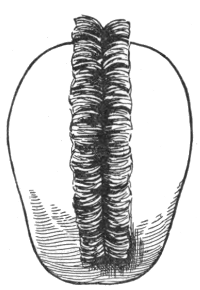
Fig. 19.—[T]e-sĭnde style
of wearing the hair.
Style of wearing the hair.—It is called "[T]áihin-múxa-gáxai," Mane
made muxa, i. e., to stand up and hang over a
little on each side. La Flèche and Two Crows do
not know this style.
§ 60. Birth-names of boys.—[P]a¢in-nanpajĭ was uncertain
about them. He thought that six of them
were as follows: Gray Horns (of a buffalo). Uma-abi,
refers to cutting up a buffalo. (A buffalo that
is almost grown) Raises his Tail in the air. Dark
Eyes (A buffalo calf when it sheds its reddish-yellow
hair, has a coat of black, which commences
at the eyes). (Buffalo Calf) Unable to Run. Little
one (buffalo calf) with reddish-yellow hair.
§ 61. Subgentes.—For marriage purposes, the gens
is undivided, according to La Flèche and Two Crows; but they admitted
that there were at present two parts of the gens, one of which
was The Keepers of the Pipe. Lion said that he knew of but two
subgentes, which were The Keepers of the Pipe, or, Those who do not
Eat the Lowest buffalo rib, under Wild sage; and Those who Touch no
Calves, or, Keepers of the Sweet Medicine, under Orphan. J. La Flèche
said that all of the [T]e-sĭnde had the sweet medicine, and that none were
allowed to eat calves.
§ 62. Names of men.—Wild Sage. Stands in a High and marshy place.
Smoke Coming back Regularly. Big ax. (Buffalo) Bristling with Arrows.
Ancestral Feather. Orphan, or, (Buffalo bull) Raises a Dust by
Pawing the Ground. Unable to run. (Body of a buffalo) Divided
with a knife. Playful (?) or Skittish Buffalo. Little one with reddish-yellow
hair. Dark Eyes. Lies Bottom-upwards. Stands on a Level.
Young Buffalo bull. Raises his Tail in the air. Lover. Crow Necklace.
Big Mane. Buffalo Head. He who is to be blamed for evil.
Names of women.—Min-akanda. Sacred Moon. White Buffalo-Female
in the distance. Walks in order to Seek (for something).
§ 63. The place of this gens in the tribal circle is after that of the
[T]e-sĭnde. The chief of the gens is Sĭnde-xanxan.
Taboo.—The members of this gens cannot touch the skin of any animal
of the deer family; they cannot use moccasins of deer-skin; nor
can they use the fat of the deer for hair-oil, as the other Omahas can
do; but they can eat the flesh of the deer.
Subgentes.—La Flèche and Two Crows recognized three divisions of
the gens for marriage purposes, and said that the Keepers of the Sacred
Pipe were "uʞanha jiñga," a little apart from the rest. Waniʇa-waqě,
who is himself the keeper of the Sacred Pipe of this gens, gave four
subgentes. These sat in the gentile circle in the following order: On
the first or left side of the "fire-place" were the Niniba t`an, Keepers of
the Pipe, and Jiñga-gahige's subgens. On the other side were the
Thunder people and the real Deer people. The Keepers of the Pipe and
Jiñga-gahige's subgens seem to form one of the three divisions recognized
by La Flèche. Waniʇa-waqě said that his own subgens were
Eagle people, and that they had a special taboo, being forbidden to
touch verdigris (see [K]anze gens), charcoal, and the skin of the wild-cat.
He said that the members of the second subgens could not touch charcoal,
in addition to the general taboo of the gens. But La Flèche and
Two Crows said that none of the [T]a-[p]a could touch charcoal.
The head of the Niniba t`an took the name Waniʇa-waqě, The Animal
that excels others, or Lion, after a visit to the East; but his real Omaha
name is Disobedient. [P]a¢in-gahige is the head of the Thunder subgens,
and Sĭnde-xanxan, of the Deer subgens.
§ 64. Birth-names for boys.—Lion said that the following were some
of the Eagle birth-names of his subgens (see Iñke-sabě birth-names,
§ 32): The thunder-god makes the sound "ʇide" as he walks. Eagle
who is a chief (keeping a Sacred Pipe). Eagle that excels. White
Eagle (Golden Eagle). Akida-gahige, Chief who Watches over something
(being the keeper of a Sacred Pipe).
He gave the following as the Deer birth-names: He who Wags his
Tail. The Black Hair on the Abdomen of a Buck. Horns like phalanges.
Deer Paws the Ground, making parallel or diverging indentations.
Deer in the distance Shows its Tail White Suddenly. Little
Hoof of a deer. Dark Chin of a deer.
§ 65. Ceremony on the fifth day after a birth.—According to Lion, there
is a peculiar ceremony observed in his gens when an infant is named.
All the members of the gens assemble on the fifth day after the birth
of a child. Those belonging to the subgens of the infant cannot eat
anything cooked for the feast, but the men of the other subgentes are
at liberty to partake of the food. The infant is placed within the gentile
circle and the privileged decoration is made on the face of the child
with "wase-jide-nika," or Indian red. Then with the tips of the index,
middle, and the next finger, are red spots made down the child's back,
at short intervals, in imitation of a fawn. The child's breech-cloth (sic)
is also marked in a similar way. With the tips of three fingers are
rubbed stripes as long as a hand on the arms and chest of the infant.
All the [T]a-[p]a people, even the servants, decorate themselves. Rubbing
the rest of the Indian red on the palms of their hands, they pass their
hands backwards over their hair; and they finally make red spots on
their chests, about the size of a hand. The members of the Pipe subgens,
and those persons in the other subgentes who are related to the
infant's father through the calumet dance, are the only ones who are
allowed to use the privileged decoration, and to wear hinqpe (down) in
their hair. If the infant belongs to the Pipe subgens, charcoal, verdigris,
and the skin of a wild-cat are placed beside him, as the articles
not to be touched by him in after-life. Then he is addressed thus: "This
you must not touch; this, too, you must not touch; and this you must
not touch." The verdigris symbolizes the blue sky.
La Flèche and Two Crows said that the custom is different from the
above. When a child is named on the fifth day after birth, all of the
gentiles are not invited, the only person who is called is an old man who
belongs to the subgens of the infant.5 He puts the spots on the child,
and gives it its name; but there is no breech-cloth.
§ 66. Names of men. I. Pipe subgens.—Chief that Watches over something.
Eagle Chief. Eagle that excels, or Eagle-maker (?). Wags his
Tail. Standing Moose or Deer. (Lightning) Dazzles the Eyes, making
them Blink. Shows Iron. Horns Pulled around (?). Forked Horns.
(Fawn that) Does not Flee to a place of refuge. (Deer) Alights, making
the sound "stapi." Pawnee Tempter, a war name. White Tail.
Gray Face. Like a Buffalo Horn (?). Walks Near. Not ashamed to
ask for anything. (Fawn) Is not Shot at (by the hunter). White Breast.
Goes to the Hill. Elk.
II. Boy Chief's subgens.—Human-male Eagle (a Dakota name, J. La
Flèche). Heart Bone (of a deer; some say it refers to the thunder; J.
La Flèche says that it has been recently brought from the Kansas).
Fawn gives a sudden cry. Small Hoofs. Dark Chin. Forked Horns.
(Deer) Leaps and raises a sudden Dust by Alighting on the ground. He
who Wishes to be Sacred (or a doctor). Flees not. Forked Horns of a
Fawn.
III. Thunder subgens.—Spotted Back (of a fawn). Small Hoofs. Like
a Buffalo Horn. Wet Moccasins (that is, the feet of a deer. A female
name among the Osages, etc.). Young Male-animal. White Tail. Dazzles
the Eyes. Spoken to (by the thunder-god). Young Thunder-god.
Dark Chin. Forked Horns. Distant Sitting one with White Horns.
Fawn. Paws the Ground, making parallel or diverging indentations.
Black Hair on a buck's Abdomen. Two Buffalo bulls. Red Leaf (a
Dakota name). Skittish. Black Crow. Weasel. Young Elk. Pawnee
Chief.
IV. Deer subgens.—(Deer's) Tail shows red, now and then, in the distance.
White-horned animal Walking Near by. White Neck. Tail
Shows White Suddenly in the distance. (Deer) Stands Red. (Deer)
Starts up, beginning to move. Big Deer Walks. (Deer that) Excels
others as he stands, or, Stands ahead of others. Small Forked Horns (of
a fawn). Four Deer. Back drawn up (as of an enraged deer or buffalo),
making the hair stand erect. Four Hoofs. He who Carves an animal.
Shows a Turtle. Runs in the Trail (of the female). (Fawn) Despised
(by the hunter, who prefers to shoot the full-grown deer). Feared when
not seen. White Elk.
Lion said that White Neck was the only servant in his gens at present.
When the gens assembled in its circle, the servants had to sit by
the door, as it was their place to bring in wood and water, and to wait
on the guests. La Flèche and Two Crows said that there were no servants
of this sort in any of the gentes.
Yet, among the Osages and Kansas, there are still two kinds of servants,
kettle-tenders and water-bringers. But these can be promoted to
the rank of brave men.
Names of women in the gens.—Eᴐna-maha. Habitual-Hawk Female.
Hawk Female. Precious Hawk Female. Horn used for cutting or
chopping (?). Ax Female. Moon-Hawk Female. Moon that is Flying.
Moon that Is moving On high. Nanzéinze. White Ponka in the
distance. Ponka Female.
§ 67. The meaning of this name has been explained in several ways.
In Dougherty's Account of the Omahas (Long's Expedition to the Rocky
Mountains, I, 327) we read that "This name is said to have originated
from the circumstance of this band having formerly quarreled and
separated themselves from the nation, until, being nearly starved, they
were compelled to eat the fruit of the wild cherry tree, until their excrement
became red". (They must have eaten buffalo berries, not wild
cherries. La Flèche.) Anba-hebe did not know the exact meaning of
the name, but said that it referred to the bloody body of the buffalo
seen when the seven old men visited this gens with the sacred pipes.
(See § 16). Two Crows said that the Iñg¢ejide men give the following
explanation: "[T]éjiñga ídai tědi, iñg¢é zí-jide égan": i. e., "When a
buffalo calf is born, its dung is a yellowish red."
The place of the Iñg¢e-jide in the tribal circle is next to that of the
[T]a-[p]a. Their head man is He-mu[s]nade.
Taboo.—They do not eat a buffalo calf. (See [T]e-sĭnde gens.) It appears
that the two Ictasanda buffalo gentes are buffalo calf gentes, and that
the two Hañgacenu buffalo gentes are connected with the grown buffalo.
Decoration of skin tents.—This consists of a circle painted on each side
of the entrance, within which is sketched the body of a buffalo calf,
visible from the flanks up. A similar sketch is made on the back of the
tent.
§ 68. Birth names of boys.—These are as follows, but their exact order
has not been gained: Buffalo calf. Seeks its Mother. Stands at the
End. Horn Erect with the sharp end toward the spectator. Buffalo
(calf?) Rolls over. Made dark by heat very suddenly. Manzedan, meaning
unknown.
Subgentes.—The Iñg¢e-jide are not divided for marriage purposes. Lion,
however, gave four subgentes; but he could not give the names and taboos.
He said that Horn Erect was the head of the first. The present
head of the second is Little Star. Rolls over is the head of the third;
and Singer of the fourth.
Names of men.—Walking Buffalo. Buffalo Walks a little. (Buffaloes)
Continue Approaching. Tent-poles stuck Obliquely in the ground.
Becomes Cold suddenly. Hawk Temper. Bad Buffalo. (Buffalo calf)
Seeks its Mother. (Buffalo bull) Rolls over. Stands at the End.
Singer. Crow Skin. Small Bank. Kansas Head. Rapid (as a river).
Sacred Crow that speaks in Visions. White Feather. Walks at the
End.
Names of women.—Moon-Hawk Female. Moon Horn Female. (Buffaloes)
Make the ground Striped as they run. Walks, seeking her own.
§ 69. The meaning of "Ictasanda" is uncertain; though Say was told
by Dougherty that it signifies "gray eyes." It probably has some reference
to the effect of lightning on the eyes. The place of the Ictasanda
is at the end of the tribal circle, after the Iñg¢e-jide, and opposite to the
Wejincte. The head of the gens is Ibahanbi, son of Wanuʞige, and
grandson of Wackanhi.
Taboo.—The Ictasanda people do not touch worms, snakes, toads,
frogs, or any other kinds of reptiles. Hence they are sometimes called
the "Wag¢ícka níkacin´ga," or Reptile people. But there are occasions
when they seem to violate this custom. If worms trouble the corn after
it has been planted, these people catch some of them. They pound
them up with a small quantity of grains of corn that have been heated.
They make a soup of the mixture and eat it, thinking that the corn will
not be troubled again—at least for the remainder of that season.
§ 70. Birth names of boys.—Ibahanbi said that the first son was called
Gaagig¢e-hnan, which probably refers to thunder that is passing by. The
second is, The Thunder-god is Roaring as he Stands. The third, Big
Shoulder. The fourth, Walking Forked-lightning. The fifth, The thunder-god
Walks Roaring. The sixth, Sheet-lightning Makes a Glare inside
the Lodge. The seventh, The Thunder-god that Walks After others
at the close of a storm.
Birth names of girls.—The first is called The Visible (Moon) in Motion.
The second, The Visible one that has Come back and is in a Horizontal
attitude. The third, Zizika-wate, meaning uncertain; refers to wild
turkeys. The fourth, Female (thunder?) who Roars. The fifth, She
who is Ever Coming back Visibly (referring to the moon?). The sixth,
White Eyed Female in the distance. The seventh, Visible ones in different
places.
§ 71. Subgentes.—For marriage purposes the gens is divided into
three parts, according to La Flèche and Two Crows. I. Niniba-t`an,
Keepers of the Pipe, and Real Ictasanda, of which [T]e-uʞanha, [K]awaha,
Wajin-anba, and Si-¢ede-jiñga are the only survivors. II. Wacetan, or
Reptile people, under Ibahanbi. III. Ing¢an, Thunder people, among who
are Ui¢anbe-ansa and Wanace-jiñga.
Lion divided the gens into four parts. I. Niniba-t`an, under [T]e-uʞanha.
II. Real Ictasanda people, under Wajin-anba. III. Wacetan (referring
to the thunder, according to Lion, but denied by Two Crows), Reptile
people, under Ibahanbi. These are sometimes called Keepers of the
Claws of the Wild-cat, because they bind these claws to the waist of a
new-born infant, putting them on the left side. IV. The Real Thunder
people are called, Those who do not touch the Clam shell, or, Keepers of
the Clam shell, or, Keepers of the Clam shell and the Tooth of a Black
bear. These bind a clam shell to the waist of a child belonging to this
subgens, when he is forward in learning to walk. (See §§ 24, 43, 45,
and 63.)
At the time that Waniʇa-waqě gave this information, March, 1880, he
said that there were but two men left in the Niniba-t`an, [T]e-uʞanha, and
[K]awaha. Now it appears that they have united with Wajin-anba and
Si¢ede-jiñga, the survivors of the Ictasandaqti. [T]e-uʞanha, being the
keeper of the Ictasanda sacred pipe, holds what was a very important
office, that of being the person who has the right to fill the sacred pipes
for the chiefs. (See §§ 17 and 18.) [T]e-uʞanha, does not, however,
know the sacred words used on such occasions, as his father, Mahinzi,
died without communicating them to him.
But some say that there is another duty devolving on this keeper.
There has been a custom in the tribe not to cut the hair of children
when they were small, even after they began to walk. But before a
child reached the age of four years, it was necessary for it to be taken,
with such other children as had not had their hair cut, to the man who
filled the sacred pipes. Two or three old men of the Ictasanda gens sat
together on that occasion. They sent a crier around the camp or village,
saying, "You who wish to have your children's hair cut bring
them." Then the father, or else the mother, would take the child, with
a pair of good moccasins for the child to put on, also a present for the
keeper of the sacred pipe, which might consist of a pair of moccasins,
some arrows, or a dress, etc. When the parents had arrived with their
children each one addressed the keeper of the pipe, saying, "Venerable
man, you will please cut my child's hair," handing him the present at
the same time. Then the old man would take a child, cut off one lock
about the length of a finger, tie it up, and put it with the rest in a
sacred buffalo hide. Then the old man put the little moccasins on the
child, who had not worn any previously, and after turning him around
four times he addressed him thus: "[T]ucpáha, Wakan´da ¢a`é¢i¢é-de
ʞáci man¢iñ´ka si á¢ag¢é taté—Grandchild, may Wakanda pity you, and
may your feet rest for a long time on the ground!" Another form of the
address was this: "Wakan´da ¢a`é¢i¢e taté! Man¢iñ´ka si á¢ag¢é taté.
Gúdihégan hné taté!—May Wakanda pity you! May your feet tread the
ground! May you go ahead (i. e., may you live hereafter)!" At the
conclusion of the ceremony the parent took the child home, and on
arriving there the father cut off the rest of the child's hair, according to
the style of the gens. La Flèche told the following, in 1879: "If it was
desired, horns were left, and a circle of hair around the head, with one
lock at each side, over the ear. Some say that they cut off more of the
hair, leaving none on top and only a circle around the head." But the
writer has not been able to ascertain whether this referred to any particular
gens, as the Ictasanda or to the whole tribe. "It is the duty of
Wajin-anba, of the Real Ictasanda, to cut the children's hair. The
Keepers of the Pipe and the Real Ictasanda were distinct subgentes,
each having special duties." (Frank La Flèche.)
§ 72. Names of men.—[T]e-uʞanha (Sentinel Buffalo Apart from the
herd) and his brother, [K]awaha, are the only survivors of the Keepers of
the Pipe. Hañga-cenu and Mahin-zi (Yellow Rock) are dead.
II. Real Ictasanda people.—Wajin-anba and Small Heel are the only
survivors. The following used to belong to this subgens: Reptile
Catcher. (Thunder-god) Threatens to strike. Wishes to Love. Frog.
(Thunder) Makes a Roar as it Passes along. Night Walker. Runs (on)
the Land. Sacred Mouth. Soles of (gophers') Paws turned Outward.
The Reclining Beaver. Snake. Touched the distant foe. Rusty-yellow
Corn-husk (an Oto name). Young Black bear. He who Boiled a Little
(a nickname for a stingy man). Small Fireplace. He who Hesitates
about asking a favor. Maker of a Lowland forest. Stomach Fat.
III. Wacetan subgens.—Roar of approaching thunder. He who made
the foe stir. He who tried to anticipate the rest in reaching the
body of a foe. Cedar Shooter. Flat Water (the Platte or Nebraska).
He is Known. (Thunder-god) Roars as he Stands. Sharp Stone.
(Thunder that) Walks after the others at the close of a storm. Big
Shoulder. (Thunder) Walks On high. Wace-jiñga (Small Reptile?)
Wace-tan (Standing Reptile?). Wace-tan-jiñga (Small Standing Reptile?).
(Snake) Makes himself Round. Sheet-lightning Flashes Suddenly.
Forked-lightning Walks. Thunder makes the sound "z+!" Black
cloud in the horizon. Walks during the Night. White Disposition
(or, Sensible). Sole of the foot. He got the better of the Lodges (of
the foe by stealing their horses). Ibahanbi (He is Known) gave the
following as names of Ictasanda men, but J. La Flèche and Two Crows
doubt them. Large Spotted Snake. (Snake) Makes (a frog) Cry out (by
biting him).6 Small Snake.6 (Snake) Lies Stiff. Big Mouth. Black
Rattlesnake. (Snake that) Puffs up itself.
IV. Thunder subgens.—Sheet-lightning Flashes inside the Lodge.
Swift at Running up a hill. Young Policeman. Cloud. He Walks
with them. He who Is envied because he has a pretty wife, a good
horse, etc., though he is poor or homely.
Names of women.—Danama. She Alone is Visible. Skin Dress. She
who Is returning Roaring or Bellowing. She who is made Muddy as
she Moves. Moon has Returned Visible. Moon is Moving On high.7


 EGO, a male.
 EGO, a female. A, [A], B, [B], C, [C], D, [D], F, H, and [H] as
above.
EGO, a female. A, [A], B, [B], C, [C], D, [D], F, H, and [H] as
above.
 Wigaq¢an, my wife.
 Wíeg¢añge, my husband.


 These
potatoes are boiled; then the skins are pulled off, and they are dried.
These
potatoes are boiled; then the skins are pulled off, and they are dried.


